Pacific
Islands
Monthly
I 34,AiLgJ "1 P Vda jf =CT A* J «
American Samoa... US$l.75 Australia Wt.M * A 51.50 Cook Islands £..NZ51.50 , F 'i' F 51.50 Hawaii &US mainland US$l.95 Kiribati «, -...A51.75 Nauru ...X... A 51.75 New Caledonia ... CFPI9O
New Nzsi 75
N 'ue NZ$l.5O Norfolk Island A 51.50 Papua New Guinea KI.SO Solomons ssl 50
T «Wti Cfpi9O
Tonga Z...Z P 1.50 Tuvalu A 51.75 USTT A Guam US$l 95 Vanuatu... A 51.50 Western Samoa T 1.60 ‘Recommended retail price only.
Registered by Australia Post Publication No. NBPI2IO
tnßHMlrreijfi'iSiiF
Hw Caledonia
O Nt Rovers|P|J
Advertisements & other items, p. 2 (1 item)
Accord
Born again bigger and better with fresh ideas.
The new Honda Accord 4-door Sedan is here!
The original Honda Accord was an international success. When it was introduced six years ago, it was the right car at the right time and fit the needs of its owners exceedingly well. The new Honda Accord 4-door is made for a new generation of buyers who want more space with
improved performance and fuel
efficiency. It’s built on a longer wheelbase and wider tread and gives more length and width in the roomy interior. And it’s all useable Equipment may vary in some countries. space. The trunk is 26.5% larger than the original Accord. All this extra space means more room to stretch out in greater comfort and you can carry more cargo.
The trusty engine coupled to the compact front-wheel drive system has also been made to work harder.
It’s more powerful and still more economical. Honda engineers have also upgraded the suspension and brakes. As a result, the new Accord performs better all around. It’s also more comfortable inside and the
fully instrumented easy-to-read
dashboard is only one of many luxury appointments.
The new Honda Accord: spacious and gracious—just the way you want it to be!
A HONDA
Accord
PAPUA NEW GUINEA; Steamships-Machinery P.O. Box 1, Port Moresby/TAHITI: Honda Distribution S.A.R.L. B.P. 1665 Papeete/FIJI ISLANDS: Carpenters Motors 61-63 Foster St|j Bay, Suva/KIRIBATI; Atoll Auto Stores P.O. Box 71, Bairiki Tarawa/U.S. TRUST TERRITORY: United Micronesia Development Assn. P.O. Box 238, Saipan, Mariana Islands 969508 HONDA MOTOR CO.. LTD. TOKYO, JAPAN COOK ISLANDS: Cook Islands Motor Center Ltd. P.O. Box 74, Rarotonga/AMERICAN SAMOA: Holidy Motors, Parts and Service P.O. Box 968, Pago Pago Haleck’s Service CenteJ P.O. Box 1138, Pago Pago/GUAM: Mark's Motor Co., Inc. P.O. Box DV, Agana/WESTERN SAMOA: Motor Distributors (Samoa) Ltd. P.O. Box 576, Apia/SOLOMON ISLANDS!
Trading Company (Solomon) Ltd. P.O. Box 114, Honiara/NEW CALEDONIA; Establissements Ballande Boite Postale No. C 4, Noumea Cedex/NIUE ISLAND: Niue Island United Enterprises P.O. Box 4, Alofi/NAURU: Nauru Cooperative Society Republic of Nauru, Nauru Island, Central Pacific/VANUATU: Yamathai (Melanesia) Kaihatsu Kaisha P.O. Box 194, Pord Vila Santo Gas Centre Ltd. P.O. Box 45, Santo/TUVALU: Tuvalu Co-operative Wholesale Society P.O. Box Funafuti, Tuvalu/TONGA: Jones Holding P.O. Box 34, Nukualofa TongaJ
Pacific Islands Monthly
Vol. 52 No. 12
December 1981 (USPS 952480)
Representatives
AUSTRALIA: Distribution: NSW & ACT: Allan Rodney Wright (Circulation) Pty Ltd, PO Box 907, Darlinghurst, NSW 2010: Elsewhere: Gordon & Gotch (A/asia) Ltd, Box 40, PO, Rosebery, NSW 2018 Advertising Melbourne Ray Brown Pty Ltd, 614 Queensberry St, North Melbourne 3051, telephone 329 8522, telex 31717, Brisbane - D.
Wood, Anday Agency, Box 1918, GPO, Brisbane 4001, tele phone 44 3485, 44 1546; Adelaide Hastwell Media, PO Box 30, Glen Osmond, SA 5064, 233 Glen Osmond Rd, Frewville, SA 5063, telephone 79 1869 Perth - Adrep, 62 Wickham St., East Perth, WA 6000, telephone 325 6395 FIJI; Distribution and subscriptions Desai Bookshops, PO Box 160, Suva, Fiji, telephone Suva 23036 Advertising - Fiji Times & Herald Ltd, 20 Gordon St, Suva, telephone 312 111, telex FJ2124.
FRENCH POLYNESIA: Distribution Hachette Pacifique, 10 Ave Bruat, Papeete, telephone 25610, HAWAII, UNITED STATES: Distribution PIM, Hawaii, PO Box 22250, Honolulu, Hawaii 96822 Advertising Roger Brookes, PO Box 10217, Honolulu, Hawaii 96816, telephone 808 536 6677 JAPAN: Advertising and subscriptions Universal Media Corporation, CPO Box 1762. Tokyo, telephone 666 3036 NEW CALEDONIA: Distribution Depot Centre de Presse Michel Pentecost, CBP2, Noumea, telephone 27 2434 27 4729.
NEW ZEALAND: Distribution Gordon & Gotch, PO Box 584, 2 Carr Road, Mt. Roskill, Auckland 4 Advertising - International Media Representatives Ltd, PO Box 2313, Auckland, telephone 795 487; 493 389, cables Intereps, Auckland. Subscriptions - Ross Haines & Son Ltd, PO Box 1289, Auckland, telephone 769 042.
PAPUA NEW GUINEA: Distribution Gordon & Gotch, PO Box 3395, Port Moresby, telephone 254551, 254855 Advertising - PNG Post-Courier, PO Box 85, Port Moresby telephone 21 2577 UNITED KINGDOM: The Herald & Weekly Times Ltd, No. 1 Maltravers Street, London WC2R 3DZ, England, telephone 01 836 5162, telex London 21989.
UNITED STATES MAINLAND: Advertising - Joshua B Powers Jr, Powers International Inc., 551 Fifth Ave New York, New York 100 017, telephone 867 9580, telex 236514 Subscriptions - PIM, Hawaii, PO Box 22250 Honolulu, Hawaii 96822.
Subscriptions
PIM is airfreighted to most subscribers and agents in the Pacific Islands and the United States, but not the UK or the continent.
E rinS'o^ 80 cheque are on, y acceptable in Aus u rencv For Em 10 AuStralia) ’ US and New Zealand Eubank Hri« 0 A re . mi r ances please send an irr ational bank draft in Australian dollars. übhshed monthiy by Pacific Publications (Aust) Pty Ltd ahan rS.| n n AUS,ralia by Paramac ' Alexandria, NSW.Aus ahan coyer price is recommended retail only Registered / Australia Post, publication No NBPI2IO. Second class “’Stage paid at Honolulu, Hawaii Coovnoht ® Parifir
Publications (Aust.) Pty Ltd.
Honolulu Send address changes Hawaii96B2?" B ° X H °"°
American Samoa Australia Canada Cook Islands Fiji
French Polynesia
Local $US21 $A15
Sus23
Aust. $18 $15 $20 $19 $18 $22 3uam Hawaii Japan <iribati
Sus23
$US23 $20 $20 $20 Micronesia Hauru $US23 $19 $20 Hew Caledonia $21 $22 $18 Hew Zealand Hiue $NZ21 Horfolk Island $19 $15 $20 $23 $19 $19 northern Marianas $US23 ’apua New Guinea Jolomon Islands onga uvalu Jnited Kingdom IS Mainland 'anuatu Stg 11 $US23 $19 $20 $20 Western Samoa $19 Isewhere $18 $A23
This month
Pacific Islands
Monthly
• 21st SOUTH PACIFIC CONFERENCE - Angus Smales was in Port-Vila in October to cover the 21st South Pacific Conference. He reports on the alarm expressed by member governments at the cost of the various regional organisations.
Papua New Guinea’s radical proposal that they should all be rolled into one by next year (or as soon as possible thereafter), reiterated opposition to French nuclear testing and Japanese plans for nuclear-waste dumping in the Pacific and, finally, some good news for Islands women 13 • DECISIONS Decisions of the South Pacific Conference in detail 14 • FRENCH POLYNESIA Marie-Therese and Bengt Danielsson give a full run down on the recent visit of an interesting new French Government minister in an interesting new portfolio, Louis Le Pensec, France’s Minister of the Sea 18 • KANAK AND CALDOCHE Noted French historian Professor Jean Chesneaux writes exclusively for PIM on what he sees as the happiest possible future for New Caledonia’s multi-racial society 24 • MICRONESIA Jerry Burris reviews recent talks at Maui, Hawaii, between US and Micronesian representatives, and finds that the US appears interested above all in the defence aspects of its future relationship with regional governments ..29 • FIJI SUGAR L. M. Sherwood, a veteran of the Fiji sugar industry, reviews a new book on its history 43 • TRAVEL Malcolm Salmon concludes a two-part series on a tourist trip to New Caledonia. He writes on a visit to the Isle of Pines, and comments on the prospects and problems of the territory’s tourist industry 51
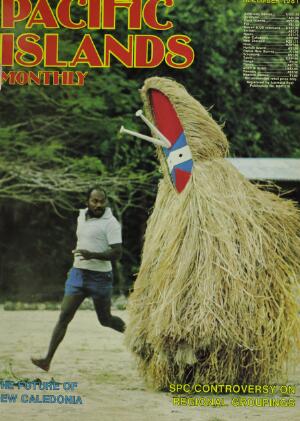
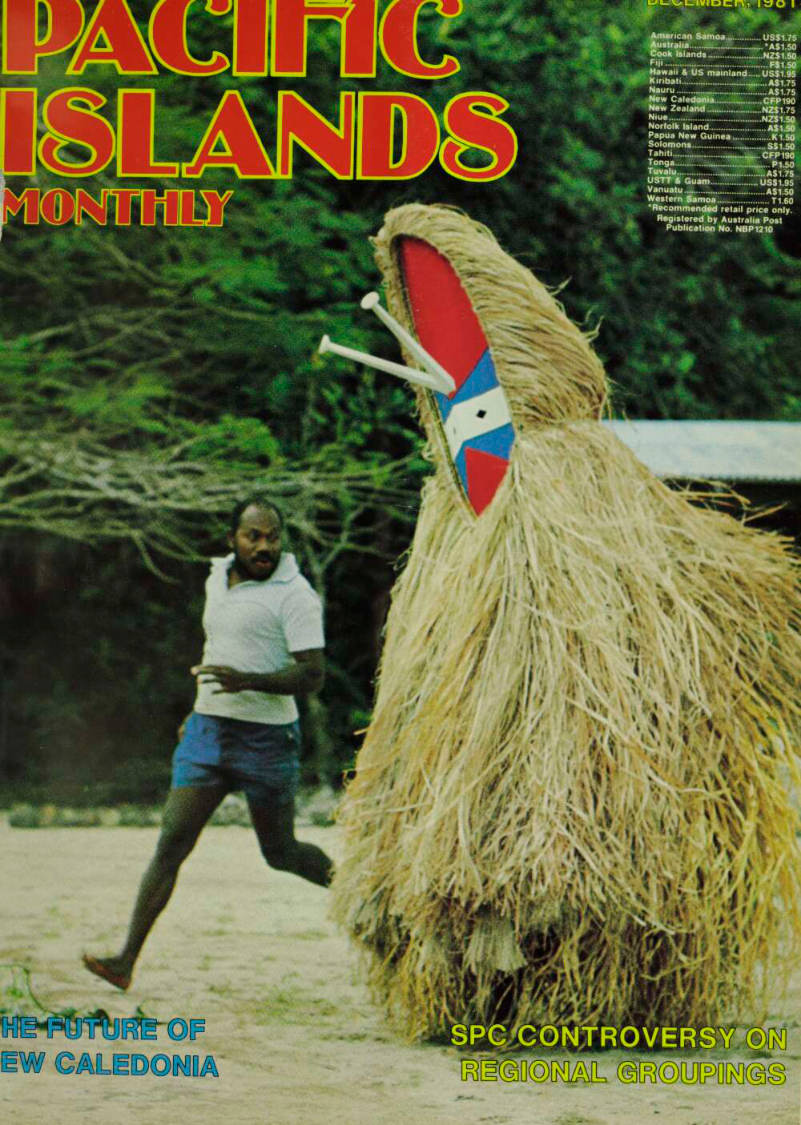
rp r? tU L e N °J tOC surehow t 0 take the apparition, a local man makes a running inspection of the Spirit of the Dead as it comes alive at Vamcolo, Milne Bay province, Papua New Guinea. Bengt Danielsson
Piciutg.
Australia in the Pacific 35, 35 Belau 27
Books ZZiZZZZtt
Chile in the Pacific 53 Cook Islands ZZZZZ~3I Deaths Easter Island ZZZZZZiII
f'ii ! ..35,36" 37, 43, 51
France m the Pacific is 22 51 Islands Press ’..49 Kiribati
Letters Z!!!ZZZ!!!...7
New Caledonia .!!!”"!.!!22,^'24"51 New Zealand in the Pacific .Z"...’. ..36 Niue Noumea Notebook 22
Pacific Report 5 Papua New Guinea 9, 37, 47 People 37 Political Currents 24 Postmark Papeete 18 Shipping Schedules 69 Ships 45, 51 Solomon Islands 45, 47 South Pacific Conference 13 Tradewinds 53 Travel 51 Tropicalities US in the Pacific n, 29 Vanuatu 31 Western Samoa 10, 40, 41 Yachts 63
Advertisements & other items, pp. 3-4 (2 items)
3
’ACIFIC ISLANDS MONTHLY DECEMBER, 1981
Founded 1930 by R. W. Robson Editor Angus Smales Associate Editor Malcolm Salmon Advertising Sales Manager Phil Martin Editorial Adviser John Carter A Pacific Publications production 76 Clarence Street, Sydney 2000 GPO Box 3408 Sydney 2001 Cables; PACPUB Sydney Telex: 21242 (answers INTARAD) Telephone; Sydney 29 6693 Melbourne 63 0211 ext. 1444 Editor-in-Chief: John McDonald
Datsun Forklift
4.0-ton Pneumatic/Cushion/Turbo-charger 4.0-ton Heavy Duty Pneumatic/Cushion/Turbo-charger 3.5-ton Pneumatic/Cushion/Turbo-charger The difference will amaze you. These monocoque body heavyweights are tough on big jobs, maneuverable enough for small aisles and easy on operators.
New Datsun Forklift FO3 Series models excel in any role. Even many reserved for smaller lift capacity forklifts.
Smart 3/3.5/3.5-ton heavy-duty cushion tire and 3.5/4/4-ton heavy-duty pneumatic tire models provide optimum tight-space handling. Rugged, fuelefficient gasoline engines or a turbo-charged diesel engine assure high torque, gradeability and speed.
Total toughness reduces downtime. Maintenance is minimal. Single-lever tilt/lift control, power steering and wide-angle visibility keep operator fatigue low.
Built to give owners and operators more in return.
The versatile Datsun Forklift FO3 Series.
DATSUN FORKLIFT
NISSAN MOTOR CO., LTD. 17-1, Ginza 6-Chome, Chuo-ku, Tokyo 104, Japan Loadlift Equipment Limited 2Maurice Road, Penrose, Auckland 6, New Zealand Tel: 663-714 Auckland Nissan Motor Co., (Australia) Pty. Ltd.
Industrial Machinery Division Suite 1, 6th Floor, 100 William Street, Sydney, N.S.W. 2000, Australia Tel: 358-5444 Boroko Motors Ltd. P.O. Box 1259, Boroko, Via Port Moresby, Papua New Guinea Tel; 255255, 255347
Pacific Report
‘Fruitful’ Talks With Mitterrand Pidjot
‘Fruitful and positive’ was how Roch Pidjot, New Caledonian deputy to the French National Assembly and Independence Front leader, described his October 26 talks with President Mitterrand in Paris. Leaving the Elysee Palace, he said: ‘There is an understanding by the president of our demands that is definite progress for us.’ Another spokesman for Mr Pidjot’s party, the Union Caledonienne, Frangois Burck, said in Noumea: ‘Mitterrand has understood that our demand for Kanak independence is not racist, as some would have him believe. This is a step forward for us.’ Mr Burck said that following the talks, the Independence Front might now be willing to delay by six months or a year its plan for a unilateral declaration of independence on September 24, 1982, 129th anniversary of the French take-over of New Caledonia. But, he added, planned occupations of a number of white-owned farms and plantations would go ahead as planned, in mid-November. This plan received further endorsement at the UC congress held on the island of Lifou, in the Loyalty Group, on November 14-15. The new note of understanding following the Paris talks was marred by bomb explosions in a Paris restaurant and an airport car park for which a so-called ‘Kanak Liberation Army’ claimed responsibility. But pro-independence Kanak spokesmen in both Paris and Noumea denied that any such body existed, and suggested the explosions were provocations orchestrated by the Rightwing MOP organis ation in New Caledonia, and a like-minded movement, the Ordre Nouveau, in France. Pro-independence spokesmen also dis owned responsibility for a bomb attack on a French monument in Noumea on November 7, which was followed by rioting in which 102 people were arrested by police. The incidents were apparently touched off when a number of young Melanesians attacked some Wallisians towards the end of the annual Noumea street fair. —Chris Ray.
Jakarta Denies Guerrilla Activity
Australian press reports in September-October spoke of a revival of activity by anti-Indonesian guerrillas in the province of Irian Jaya. On September 21, the Melbourne daily The Age reported that guerrillas had fired on an aircraft of the Garuda airline, the Indonesian flag-carrier. On October 15 the same paper carried a despatch from Port Moresby saying that guerrillas had raided a gaol in Irian Jaya in an attempt to release imprisoned comrades.
Both reports were denied by the Indonesian Government
U.S. Army Instructors In Fiji
Eleven US Army instructors arrived in Fiji in late October to train local army instructors in the handling of special weapons and equipment they will be required to use as part of the Sinai peace keeping force. A Fiji Government spokesman said that the US team had come ‘to help familiarise our instructors with the equipment, and not to train the soldiers’. Training of local soldiers would be done by Fiji instructors, he said. A Fijian soldier with the United Nations peace-keeping force in Lebanon was killed in October. He was checking a confiscated rifle which accidentally discharged.
FIRST RURAL LAND LEASE SIGNED IN VANUATU History was made in Vanuatu on October 9 when the first rural land lease to an alienator was signed by the custom owners of Eton village on the island of Efate. The lease was in favour of Pacific Grazing (NH) Ltd, and was over a property of more than 3000 hectares, La Cressoniere. The lease is for 75 years, an exception having been made to the 50-year maximum rule because of the targe capital investment made and envisaged by Pacific Grazing. Lease payments are an average of VTIOO (about SAI) per hectare. Payment was made from Independence Day (July 30, 1980), and for six months in advance.
Big Noumea March For ‘Peace, Fraternity’
An estimated 25 000 people took part in a November 11 march in Noumea organised by the Caledonian Fraternal Association.
Members of all races in the territory took part. On the east coast a purely Melanesian region, a similar march of 400 people took place. Theme of the marches was peace, fraternity and security.
Banners proclaimed ‘Three colours, a single people’. The
Noumea march extended over five kilometres. President Biciv of the CFA, a Melanesian, told the crowd: ‘We should not feel we are condemned to live together, but on the contrary we should be happy that we can live in harmony. We decided to organise this march of Caledonian solidarity and fraternity to bring people together, not to divide them.’ Proceeding to the residence of the High Commissioner, the marchers presented a petition demand ing government action to prevent ‘acts of aggression against peaceful citizens of all races who ask for nothing but to be left to live in harmony with others’. It appealed to the HC to state ‘with the greatest candour’ the direction in which he intended to guide the territory. HC Claude Charbonniaud undertook to despatch the message to Paris at once. Replying to an accusation by pro independence member of the Territorial Assembly, Nidoishe Naisseline, President Biciv later denied that his association was ‘political’. ‘lt is, and will remain, non-political,’ he said. Daniel Tardieu in Noumea.
Radioactivity Lowest Since 1960’
The latest Environmental Radioactivity Annual Report of the New Zealand National Radiation Laboratory found that radioactivity in the South Pacific is at its lowest level since 1960. The report, based on monitoring activity at a total of nine stations in New Zealand and the Islands, states: ‘The concentration of fission products in air at New Zealand stations was latitude-dependent during the French South Pacific atmospheric tests (1966-74). For example, concentrations were usually higher at Auckland than at Christchurch. Moreover, in the Pacific Islands concentrations were significantly higher. . . Since mid-1975, about nine months after the termination of the French atmospheric tests, concen trations have been near or below the limit of detection at all stations. No fresh fission products have been detected since underground testing started’. The report sums up: ‘The concentrations of strontium-90 and caesium-137 in New Zealand milk have reflected the changes in fallout deposition. The average concentrations during the past few years have been the lowest recorded since measurements commenced (in 1960).’
Australia-Chile Cargo Service Reopened?
At press time it was still unclear whether a service designed to end an eight-year freeze on shipping contacts between Australia and Chile would actually get under way. A company known as Kapal Pacifico (KP) Pty Ltd planned to inaugurate the service in mid- November using the 16 250-tonne German-registered vessel, MV Luise Bornhofen. According to plans, the vessel, with 245-container capacity, was to operate a two-month turn-around service between east coast Australian ports and Pacific-coast South American countries such as Peru and Chile. But whether Australian maritime trade unions’ politically-based opposition to contacts with junta-ruled Chile had been effectively overcome was unclear. A trade union source contacted by PIM said the Luise Bornhofen had arrived in Sydney from Canada with a cargo of paper, had then come under a new charter, and was, at the time of the interview, at the Victorian port of Geelong loading cargo, all of which was marked as destined for Peru. Another shipping source outside the union movement suggested that the ship would not be making the trans-Pacific journey because there was not enough cargo on offer to make it economic. The source claimed that only about 1000 tonnes of cargo was available
Unity Eludes New Caledonia’S Socialists
New Caledonia’s Socialist Party split down the middle on the issue of independence for the territory when it held its annual congress in October. Delegates rejected by 219 votes to 181 a move to commit the party to ‘prepare for independence’.
Spokesmen for the losing faction claimed that their opponents had stacked’ the congress with anti-independence immigrants from Wallis Island, and that only a quarter of the delegates were Melanesians. The spokesman said his group would be forming a new party.
Tonga Still Thrashes About On Passports
The Tongan Government failed again in October to gain parliamentary approval for its proposal to sell passports at a suggested price of STIO 000 to nationals of other countries designated as Tongan Protected Persons’. The original Passport Act Amendment Bill, introduced by Minister of Police the Hon Akau’ola in October 1980, was defeated by one vote after heated debate. On March 31, 1981, an amended version was published in the Tonga Government Gazette as an ordinance. But this was invalidated a month later by a further gazetted notice stating that the ordinance had not been approved by the Privy Council and was therefore not law (PIM Jul 1981 p 6). The bill,
with amended wording, was again introduced by the police minister in October 1981. He withdrew it after two days of debate when it became clear that the government still lacked the required numbers. It then went back to the Privy Council which will decide whether to drop it altogether, or try again after further amendments. Penny Hodgkinson in Nukualofa.
RATU MARA BACKS TONGAN OIL STORAGE PLAN The Tongan Government’s idea of establishing a bulk oil storage depot at Nukualofa in co-operation with the government of oil rich Kuwait (PIM Nov p 67) was discussed in the corridors of the October meeting of Commonwealth Heads of Government in Melbourne. If the depot were established, oil from it would be sold to Pacific nations at prices below those asked by major oil companies in the region. Fiji Prime Minister Ratu Sir Kamisese Mara told journalists in Melbourne that not all leaders had been able to make a firm commitment in support of the plan without more consultation at home, but most thought it was a good idea.
Fiji was in favour of it. The energy problem faced by small island states was one of the issues considered by the meeting. The heads of government called for immediate consideration of special arrangements to help them, and supported a plan for a World Bank energy affiliate. Sue Green.
Marshalls To Vote Soon On Compact
The Compact of Free Association with the United States should be finished by the end of the year, and a vote on it held in the Marshall Islands in March or April, 1982, according to the Marshalls representatives at the October talks held in Hawaii between US and Micronesian representatives. They made their prediction in a report given to the Nitijela (parliament) on their return.
Fiji: Case Of The Unwanted Lottery
A flopped lottery for a $35 000 Mercedes saloon has landed Fiji’s ruling Alliance Party with a $250 000 albatross around its neck that could seriously embarrass it in raising funds to fight the general election set for next July. At its annual convention in November, the party approved a $166 000 budget for 1982, including $153 000 for the election, and then spent some time worrying how to raise what it wanted. Having approved the budget, the party was hit by a bombshell when militant trade union leader and defector from the opposition National Federation Party, Apisai Tora, now a vice-president of the Fijian Association, admitted that a lottery organised on his own initiative to raise money for the Alliance was in a ‘critical’ situation. With only a month to the draw of the already twice postponed lottery, tickets worth $257 710 were ‘outstanding’ because he had been unable to persuade ticket sellers to turn in the cash. Me added that of $l2 000 received, only $6OOO was left in the bank after expenses. These had included a trip to Australia by him in an effort to unload $22 000 worth of tickets on the Fiji community there. A dismayed Prime Minister Ratu Sir Kamisese Mara, and party treasurer Sir Charles Stinson, warned that the Alliance had no choice but to salvage the lottery and guarantee the prizes if it was to save its face and credibility. ‘This lottery will go against the party in the general election,’ Stinson said. ‘I don’t think we are going to get the whole country to accept that we are not responsible.’ The Alliance’s management board is to appoint a special lottery salvage committee, and has meanwhile postponed indefinitely the lottery it had planned to run itself to cover a $55 000 deficit in its budget anticipated next year.
Robert Keith-Reid in Suva.
Turuola Efi In Melanesia
Western Samoa Prime Minister Tupuola Efi visited Vanuatu on October 22-24. In a conversation with Willie Bongmatur, chairman of Vanuatu’s national council of chiefs, Tupuola recalled that Samoan missionaries had been among those who brought Christianity to Vanuatu in the 19th century. On a visit to Erakor island, Tupuola laid a wreath on the grave of a Samoan missionary who arrived on Efate in 1885, and worked and died there. Earlier, Tupuola had paid similar brief visits to Papua New Guinea and Solomon Islands. He was returning to Apia from the Commonwealth Heads of Government meeting in Melbourne.
Polynesia’S Senator Miscues
French Polynesia’s Senator Daniel Millaud in October placed a question on notice in the Senate in Paris in the course of which he denounced the ‘shocking’ racism of Australia’s immigration procedures. The senator claimed that, although they are French citizens, Polynesians visiting Australia are allowed to stay only 72 hours in the country without a visa, whereas white French citizens from France may stay a month. PlM’s inquiries with officials in
Canberra indicate that the senator’s criticism is wide of the mark responsible sources in the Australian capital say that Polynesians and French people from France are treated in exactly the same way as, indeed, are all citizens of non-communist countries arriving in Australia: they are granted an automatic 72-hour transit visa. Senator Millaud’s claim seems to be part of an orchestrated propaganda effort by some circles in French Pacific territories to paint Australia as the region’s arch-villain following criticisms of aspects of France’s policies in the Pacific by Australian Government spokesmen.
INDIRA’S DIPLOMACY TO THE FORE IN FIJI During her October stop-over in Fiji (PIM Nov p 5), Indian Prime Minister Indira Gandhi effectively endorsed the multi-racial policies of Prime Minister Ratu Sir Kamisese Mara. A commen tator in the Suva-based monthly South Pacific Islands Business News wrote: ‘Mrs Gandhi made it clear she had come to visit all the people of Fiji, not just the Indians. She uttered salutations in the Fijian language before speaking in Hindi. She spoke of the need to accept checks and balances to keep a multi-racial society peaceful and stable. Such a society, she said, would not survive unless each part of it was prepared to accommodate the others. Fiji, she told the Indians, was their home and it should command their loyalty. She spoke of Progress and Prosperity words which the Alliance Party (of Ratu Mara) uses in its election slogan . . . One political analyst was heard to murmur after Mrs Gandhi’s first speech in Fiji: “It sounded like a campaign speech for the Alliance.’’ ’ Fiji goes to the polls in a general election in July 1982. y
Hoaxers At Work In Mount Hagen
A so-called ‘monkey-man’ put on display in October at the Mount Hagen show in Papua New Guinea’s Highlands turned out to be a showman’s hoax. At the centre of attention was a metre-tall dwarf with facial deformities, Alu Seke, who shortly before had been over-run and captured by clansmen from Kwamei village in the Western Highlands. The hoaxers glued the fur of a cus cus, a possum native to PNG, over Alu Seke’s back to substantiate their claim that he was, variously, a ‘monkey-man’, a ‘pig-man’, an unknown aberration of creation, or a feral man raised by wild pigs. Thousands were taken in by the hoax, and scientists showed keen interest. Apparently unruffled by his experience, 40-year-old Alu Seke drank his first beer, smoked newspaper twisted cigarettes, and, after it was all over, returned to take up his normal life with his midget parents in one of the remotest parts of Western Highlands province.
SISTER S DEATH CLOUDS AGGIE GREY’S 84th Aggie Grey, probably the Pacific’s most famous hoteliere, celebrated her 84th birthday on October 31. Many hundreds of guests attended her birthday party at her hotel. However, the occasion was saddened for Aggie by the death the day before of her sister, Maggie Fabricius (see Deaths of Islands People).
Seven Survive 45-Day Drift
Seven inhabitants of Gau Island, Fiji, in September-October survived a 45-day, 1286-kilometre drift in a disabled punt. They were discovered in an advanced state of exhaustion on October 16 by Solomon Islanders only a few hundred metres off Reef Island. The Fiji Marine Department abandoned rescue attempts after six days, following the sighting of a wrecked vessel which was taken to be the punt from Gau. The seven had been given up for dead by relatives, who had conducted funeral ceremonies for them.
SIR TOM TAKES A SWIPE AT WELLINGTON Cook Islands Premier Sir Thomas Davis lashed out in October at what he called New Zealand’s ‘unsympathetic’ government. He said Wellington had ‘shown a complete lack of care’ by constantly changing Air New Zealand’s flight schedules to the Cook Islands during the past year. The latest move chopping out Rarotonga as a stop-over for its international flights, and withdrawing one Boeing 737 flight every second week was the last straw, Sir Thomas said.
Now Perjury Charges For Samoa Mp
The suspended Western Samoa MP Leota Leuluaialii Ituau Ale (PIM Nov p 37) now faces two charges of perjury arising from the Supreme Court case which led to his suspension from parliament.
Chief Justice R. J. B. St John in his summing-up had described Leota’s evidence as ‘a farrago of blatant lies’. Leota’s suspension arose from a violation of section 10 (j) of Western Samoa’s electoral act. The clause prohibits incumbent MPs from having sexual intercourse with a person ‘other than his spouse by valid marriage’.
Origins of

Letters
Origins of Harold Gatty, aviator
In writing of the origins of Air Pacific (PIM Sep p 65) your Suva correspondent incorrectly refers to Harold Gatty as an ‘American aviator’.
Harold Gatty was born in Tasmania, Australia, and a monument has been erected at his birthplace in Campbelltown.
He served in the Royal Austra lian Air Force in command of air transport in the South Pacific during World War 11, md settled back in Fiji perma lently after the war, becoming i member of legislative council, md operating a copra plan ation.
Perhaps your correspondent s confused because it was American capital that financed iarold’s early, unsuccessful fforts to establish a tuna indus ry in Fiji, or because Harold’s round-the '°rld flight in 1931 was mnched in the IJS with merican aviator Wiley Post.
But Harold remained Austra an, and up to his death in 1957 i Suva always considered Fiji i home , as do I, his son, who as raised there.
Professor) RONALD GATTY ity University of New York ew York NY SA
lulling over
massacre reply to F. L. Ascencio’s ter (PIM Aug plO) I would e to make the following ints: 1) The point ©f my article IM Apr p 47) was that the linese sailor was unmentioned the monument. Even you, L. Ascencio, missed this as :t in your article. 2) The sub-title of F. L. cencio’s article reads; ‘lB7 irs ago the French and the
Samoans met at A’asu. The French lost 12 to o.’ However, at least one account says that 39 Samoans died. 3) How I missed F. L.
Ascencio’s article, I’ll never know. It was printed in a pamphlet entitled Amerika Samoa not to be confused with Captain Gray’s book of that title. Amerika Samoa was a short-lived, long-defunct, type-written, locally-distrib uted, very slim supplement to the government News Bulletin.
It is found in no Readers’ Guide and no back issues are kept even by local libraries. To find a copy I had to plough up dusty ‘archives’ in the bowels of the Administration Building. Keep watching these pages for my new article, The Search for Ascencio’s Missing Missive’.
Joseph Theroux
Pago Pago American Samoa
Torres reviewer
hits back
The replies (PIM Sep pp 7-9) to my review of John Singe’s book The Torres Strait: People and History by the author and by Mr Jones both misread and misconstrue what I wrote.
The central point of criticism I was making in PIM in my June review was that Mr Singe fails to out his stated purpose: to make his book ‘the Islanders’ story’. Somewhere between the telling of the facts to him by Islanders and the finished work he has managed to misread that story, and this can be illustrated in a host of ways.
Like Mr Singe I have found Islanders ready and able to tell people whom they trust the truth about their customs and
experience. When I read Mr Singe’s book I assumed that he had the good intentions which he now re-emphasises. I a,so sensed that it resulted from years of diligent and painstaking work.
When requested by the editor of PIM to review the book 1 was
aware that it contained many inaccuracies which were not only misleading but also damag ing to Islanders. I attempted to write about it as kindly as possible.
The context of the book and of my review is this: despite the onslaught by pearlers, missionaries, government bu reaucrats ‘protectors’, ‘man agers’, ‘government teachers’ on Island culture over more than 100 years and the subjec tion of Islanders to myriad ordeals, humiliations, re pressions and frustrations of initiative in the name of ‘better ment’, ‘civilising influences’ and cultural superiority, they have managed to survive as a people.
So much so that when Islander unity was put to the test by a proposal to shift the border in the 19705, Islanders who re mained in Torres Strait, and those who had found it necess ary to move to the mainland, replied unanimously.
Mr Singe appears to be only partially aware of this situation.
Perhaps he is unaware too of the current feelings of Islanders on their inalienable possession of their Islands and seas in long established custom. These were expressed in a poll conducted by the Torres Advisory Council in the Islands and the five communities in the northern peninsula area in July and August. The vote for freehold rights to their lands by the people at Bamaga on the main
land, where many Saibai Islanders now live, was just as overwhelming as that in the Islands.
The author’s belief that most Islanders living on the mainland are lost to their people and do not see their Islands again is currently being tested through Mr Bjelke-Petersen’s threat to abolish reserves without recognising customary land ownership by Islanders. Follow ing a public meeting in Townsville early in August, Islanders formed a land rights committee to fight for the return of the Islands to all Island people according to the established traditions of their forefathers.
Islanders’ move to the main land was associated with the collapse at the end of the ’sos of the pearling industry, within which they had been integrated for nearly a century, the con tinuing repressive situation me diated by Queensland Govern ment bureaucrats, and the DAIA-run second-rate schools sytem in the Islands.
Instead of giving credence to the erroneous conclusion drawn from a survey of Islanders in Townsville and Cairns in 1974 that Islanders on the mainland had ‘weak ties’ with the Torres Strait, Mr Singe could do something really helpful for his Island relatives, friends and informants. He might press governments to provide the
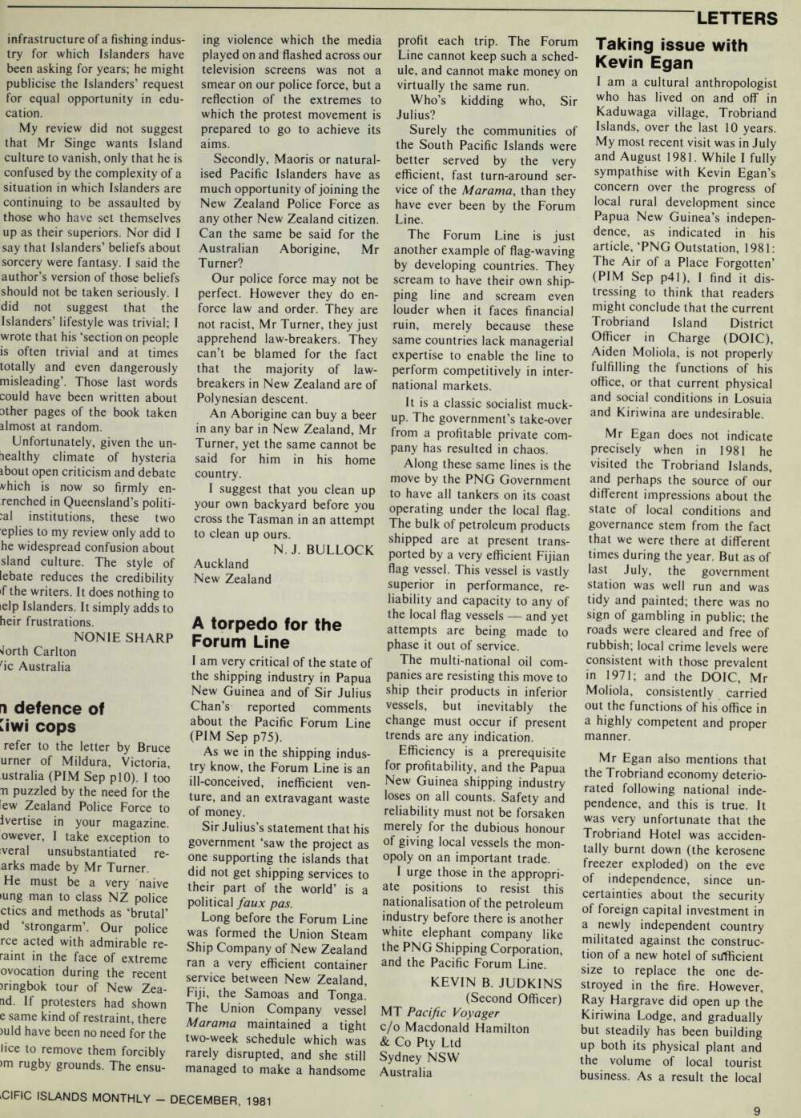
Yes-Harold Gatty was an Australian, and his son sets the record straight on this page.
Gatty (right) is shown soon after establishing Fiji Airways in 1951.
With him is pilot Fred Ladd, and the aircraft is a De Havilland DHB9A Rapide from the early fleet of the airline. The airline grew into Air Pacific, now the national flag-carrier.
infrastructure of a fishing indus try for which Islanders have been asking for years; he might publicise the Islanders’ request for equal opportunity in edu cation.
My review did not suggest that Mr Singe wants Island culture to vanish, only that he is confused by the complexity of a situation in which Islanders are continuing to be assaulted by those who have set themselves up as their superiors. Nor did I say that Islanders’ beliefs about sorcery were fantasy. I said the author’s version of those beliefs should not be taken seriously. I did not suggest that the Islanders’ lifestyle was trivial; I wrote that his ‘section on people is often trivial and at times
totally and even dangerously
misleading’. Those last words could have been written about ether pages of the book taken almost at random.
Unfortunately, given the un healthy climate of hysteria about open criticism and debate vhich is now so firmly en renched in Queensland’s politi cal institutions, these two eplies to my review only add to he widespread confusion about sland culture. The style of
lebate reduces the credibility
if the writers. It does nothing to ielp Islanders. It simply adds to heir frustrations.
Nonie Sharp
4orth Carlton r ic Australia
i defence of
[iwi cops
refer to the letter by Bruce urner of Mildura, Victoria, ustralia (PIM Sep plO). I too n puzzled by the need for the ew Zealand Police Force to Ivertise in your magazine, owever, I take exception to veral unsubstantiated re arks made by Mr Turner.
He must be a very naive »ung man to class NZ police ctics and methods as ‘brutal’ id ‘strongarm’. Our police rce acted with admirable re raint in the face of extreme evocation during the recent iringbok tour of New Zea nd. If protesters had shown e same kind of restraint, there )uld have been no need for the lice to remove them forcibly >m rugby grounds. The ensu
ing violence which the media played on and flashed across our television screens was not a smear on our police force, but a reflection of the extremes to which the protest movement is prepared to go to achieve its aims.
Secondly, Maoris or natural ised Pacific Islanders have as much opportunity of joining the New Zealand Police Force as any other New Zealand citizen.
Can the same be said for the Australian Aborigine, Mr Turner?
Our police force may not be perfect. However they do en force law and order. They are not racist, Mr Turner, they just apprehend law-breakers. They can’t be blamed for the fact that the majority of law breakers in New Zealand are of Polynesian descent.
An Aborigine can buy a beer in any bar in New Zealand, Mr Turner, yet the same cannot be said for him in his home country.
I suggest that you clean up your own backyard before you cross the Tasman in an attempt to clean up ours.
N. J. Bullock
Auckland New Zealand A torpedo for the
Forum Line
I am very critical of the state of the shipping industry in Papua New Guinea and of Sir Julius Chan’s reported comments about the Pacific Forum Line (PIM Sep p 75).
As we in the shipping indus try know, the Forum Line is an ill-conceived, inefficient ven ture, and an extravagant waste of money.
Sir Julius’s statement that his government ‘saw the project as one supporting the islands that did not get shipping services to their part of the world’ is a political faux pas.
Long before the Forum Line was formed the Union Steam Ship Company of New Zealand ran a very efficient container service between New Zealand, Fiji, the Samoas and Tonga.
The Union Company vessel Marama maintained a tight two-week schedule which was rarely disrupted, and she still managed to make a handsome
profit each trip. The Forum Line cannot keep such a sched ule, and cannot make money on virtually the same run.
Who’s kidding who, Sir Julius?
Surely the communities of the South Pacific Islands were better served by the very efficient, fast turn-around ser vice of the Marama, than they have ever been by the Forum Line.
The Forum Line is just another example of flag-waving by developing countries. They scream to have their own ship ping line and scream even louder when it faces financial ruin, merely because these same countries lack managerial expertise to enable the line to perform competitively in inter national markets.
It is a classic socialist muck up. The government’s take-over from a profitable private com pany has resulted in chaos.
Along these same lines is the move by the PNG Government to have all tankers on its coast operating under the local flag.
The bulk of petroleum products shipped are at present trans ported by a very efficient Fijian flag vessel. This vessel is vastly superior in performance, re liability and capacity to any of the local flag vessels and yet attempts are being made to phase it out of service.
The multi-national oil com panies are resisting this move to ship their products in inferior vessels, but inevitably the change must occur if present trends are any indication.
Efficiency is a prerequisite for profitability, and the Papua New Guinea shipping industry loses on all counts. Safety and reliability must not be forsaken merely for the dubious honour of giving local vessels the mon opoly on an important trade.
I urge those in the appropri ate positions to resist this nationalisation of the petroleum industry before there is another white elephant company like the PNG Shipping Corporation, and the Pacific Forum Line.
Kevin B. Judkins
(Second Officer) MT Pacific Voyager c/o Macdonald Hamilton & Co Pty Ltd Sydney NSW Australia
Taking issue with
Kevin Egan
I am a cultural anthropologist who has lived on and off in Kaduwaga village, Trobriand Islands, over the last 10 years.
My most recent visit was in July and August 1981. While I fully sympathise with Kevin Egan’s concern over the progress of local rural development since Papua New Guinea’s indepen dence, as indicated in his article, ‘PNG Outstation, 1981; The Air of a Place Forgotten’ (PIM Sep p4l), I find it dis tressing to think that readers might conclude that the current Trobriand Island District Officer in Charge (DOIC), Aiden Moliola, is not properly fulfilling the functions of his office, or that current physical and social conditions in Losuia and Kiriwina are undesirable.
Mr Egan does not indicate precisely when in 1981 he visited the Trobriand Islands, and perhaps the source of our different impressions about the state of local conditions and governance stem from the fact that we were there at different times during the year. But as of last July, the government station was well run and was tidy and painted; there was no sign of gambling in public; the roads were cleared and free of rubbish; local crime levels were consistent with those prevalent in 1971; and the DOIC, Mr Moliola, consistently carried out the functions of his office in a highly competent and proper manner.
Mr Egan also mentions that the Trobriand economy deterio rated following national inde pendence, and this is true. It was very unfortunate that the Trobriand Hotel was acciden tally burnt down (the kerosene freezer exploded) on the eve of independence, since un certainties about the security of foreign capital investment in a newly independent country militated against the construc tion of a new hotel of sufficient size to replace the one de stroyed in the fire. However, Ray Hargrave did open up the Kiriwina Lodge, and gradually but steadily has been building up both its physical plant and the volume of local tourist business. As a result the local
wood-carving industry, the mainstay of the Trobriand cash economy, has been recovering, and it is reasonable to expect that in the fairly near future the income derived from wood carv ings will approach the level attained before the Trobriand Hotel fire.
Susan P. Montague
Associate Professor of Anthropology Northern Illinois University DeKalb Illinois
Usa
More on HJM,
Rls
I enjoyed very much reading Joseph Theroux’s series on Harry Jay Moors (PIM Aug ppsl-57, Sep pps9-64).
Mr Theroux has erred, how ever, in stating that Robert Louis Stevenson ‘left Moors a photo of himself and his Caligraph typewriter’. Accord ing to my pirated edition of Moors’ book (With Stevenson in Samoa), Collins Clear-Type Press, London and Glasgow), it was Mrs Stevenson who pres ented Moors with a portrait of RSL ‘as a token of regard’ before she left Samoa. The famous Caligraph typewriter was acquired by Moors at an auction when much of the Vailima furniture, and part of the library, was sold.
While it is generally believed, as Mr Theroux points out, that Stevenson cut no great figure in the minds of most white men in Samoa, he was also, according to Moors, a prophet in the eyes of the Samoans, and ‘honoured as a man set apart from his fellows’. Interestingly, when Moors first met RLS he ac knowledged his station: ‘This was Stevenson RLS, “the best beloved initials in recent literature” and I knew it even before he spoke.’ Refer ring to Stevenson’s land pur chases, Moors says: ‘Vailima! it means “five waters”; but with the lapse of time the configuration of the country has altered, and you will only find two streams running there now.’
Perhaps the meaning ‘a handful of water’ is more appropriate.
As a result of a letter from me appearing in the journal Samoana in 1965 which asked if there were any Samoans alive who remembered RLS, I was
introduced by Eddie Stowers of 2AP to an 81-year-old Irish- Gilbertese, Mrs Mary Palu Tuioti. Invalided with elephan tiasis, she still possessed a remarkably sharp mind. She recalled that Tusitala’ as Stevenson was known to the Samoans always rode on a white horse, ahead of the ladies of his household when they passed Malifa, where as 10-year-old Mary Hall she lived in 1894. Mrs Palu said that on one occasion a rug, which always covered the buggy, worked its way down the back and fell off on the road. She and her younger sister saw this, and ‘remembering what they had been taught by the Catholic Sisters at Savalalo’, ran to pick up the rug and proceeded to chase after the buggy, calling out to the ladies as they made their way down to Apia. Finally the buggy stopped and, in appreciation for what the girls had done, the old lady presumably Stevenson’s mother gave them each a coin.
With the passage of time I doubt very much if there is a Samoan living today who would remember Stevenson.
Incidentally, RLS’s real name was Robert Lewis Balfour Stevenson, as his last will and testament of September 1893 revealed. An ad featuring land for sale near ‘Robert Lewis Stevenson’s’ old home carried in PIM for several months in 1980 was therefore not in error as some may have thought.
To end on a personal note;
when I addressed a Seventh-day Adventist end-of-year school gathering in Apia on December 4, 1964, and spoke about the life and works of RLS to mark the 70th anniversary of his death, I was flattered to be asked if, because of an apparent likeness, I was a relative of some kind (see picture PIM Mar 1963 p3l). Alas, Scots ancestry and a love of Samoa are all I have in common with the famed novelist.
John Milne
Bangkok Thailand A critic takes a
second bite
As Marie-Therese and Bengt Danielsson (PIM Aug pp 9-10) ask for a reply, I apologise for once again seeking space in your letters columns. 1) As Mr H. Lombard has written to me personally, and, I believe, in a new letter to PIM, he did not consider my letter ‘a rambling affair’, but clear, pre cise and to the point. I wished to say if the Danielssons care to read my letter carefully that I agreed with Mr Lombard’s observations. I did not write that he ascribes the present situation to ‘a hasty decolonisation’. 2) Sadly, I found myself reading in the same August issue of PIM an article by Associate Editor Malcolm Salmon on The Politics of the Vahines’, which brings new confirmation of Mr Lombard’s and my opinions. The letter of a nearly pure Tahitian (how many are there?) Mr H. Wright (PIM Aug plO) should also give matter for reflection to Marie- Therese and Bengt Danielsson
.. . On ‘politics’, they give evidence themselves in their ninth paragraph. 3) I wish only to repeat here what a friend of mine remarked to me in Papeete 20 years ago: ‘Would the Tahitians resign themselves to becoming “danc ing monkeys” for American tourists?’ Is such a future ac cepted by the Danielssons for their friends in independence?
As far as other ‘decolonised islands’ are concerned, I know more about Papua New Guinea than the Danielssons. I did not get publicity from a ‘rafting venture’, but worked obscurely for 20 years as a lay missionary, then a health officer, in the most remote parts of PNG. I vacci nated thousands of people on the West Irian border against smallpox, was in charge of campaigns against malaria and tuberculosis, worked among leprosy sufferers and kuru vic tims (with Dr C. Gajdusek, Nobel Prize for medicine, 1976).
I married a New Britain girl in 1963 and we have had four daughters.
We remain in contact with our second country (France is only third) through our friends who are still in PNG, or many mixed families in the far north of Queensland. We know, from the financial problems of the Chan government, tribal troubles in the Highlands, separatisms in New Britain or Bougainville, that there are not many people hapnv today in the former Territory This does not mean that they are ‘eager to return to the colonial fold’ (Danielssons dixit). I wish only to repeat the remark made by Mr Michael Somare a few years ago to the effect that ‘localis ation of the public service has been too rapid and too general’ a lesson for future free islands.
J. Huonde
Navrancourt
Atherton Qld Australia
Bravo, lambakey
Okuk!
1 would vote for Papua New Guinea’s Deputy Prime Minis ter Okuk if I were a constituent of his. I say this on the basis of what was written about his
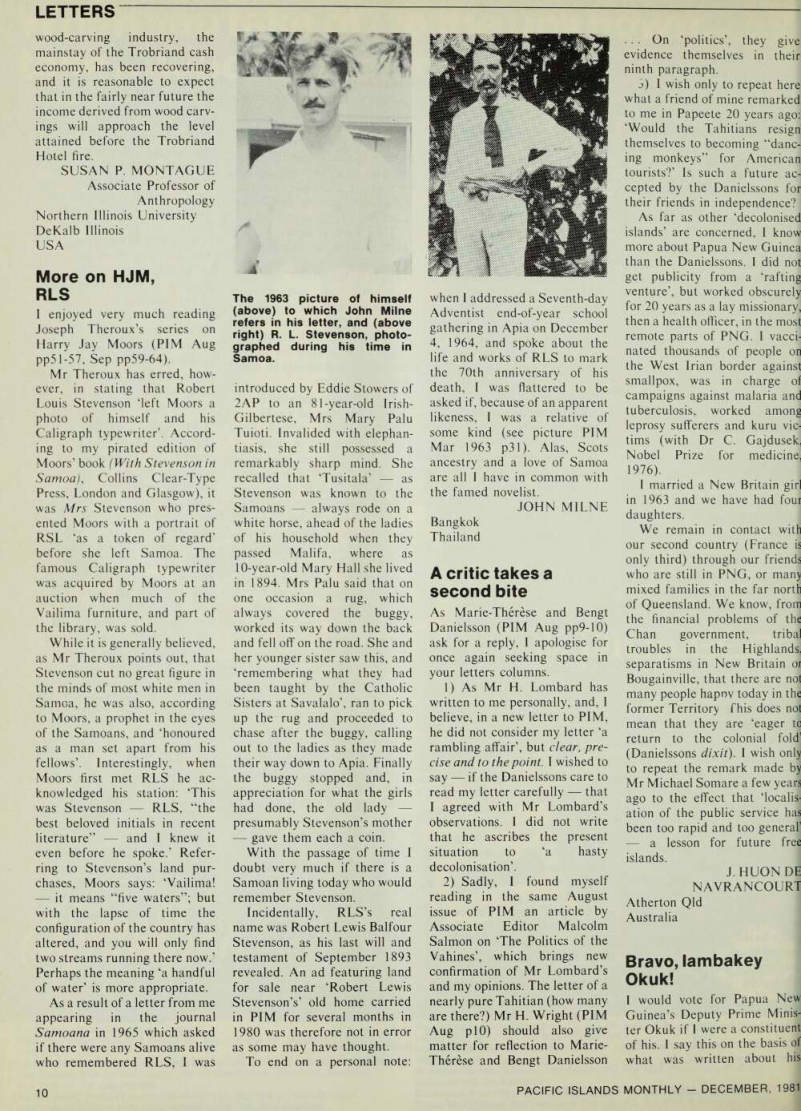
The 1963 picture of himself (above) to which John Milne refers in his letter, and (above right) R. L. Stevenson, photo graphed during his time in Samoa.
recent visit to Australia by Angus Smales (PIM Aug 1981 p5B).
PNG is fortunate to have a man active in its government who says what he means and means what he says. They are few and far between. Bravo Mr lambakey Okuk!
An incisive piece. Bravo Mr Angus Smales!
Thomas P. Butterfield
Pleasant Hill Calif
Usa
The item referred to by reader Butterfield was a straight news report of some of what Mr Okuk had to say during his visit to Australia. It n no way implied my or p lM’s political support for Mr Okuk. Angus Smales, Editor.
More on Tuvalu
controversy
note that a further letter from 4r Telavi Fati has been pub ished in PIM (Sep p 7).
I do not wish to prolong this orrespondence, but in view of 'hat is said in the letter re ared to I feel that your readers lay be interested in the result f the recent general election ith regard to Nanumea.
Mr Telavi Fati was a candi ate, and the result of the poll as that he came fifth among lose standing for election. I as re-elected.
I leave your readers to judge ho was making ‘wild and ill msidered’ statements, and ho better represents the ishes of the people of anumea.
Maheu Naniseni Mp
atangitonga anumea ivalu
emembering Prince
ee 800 :ame across your November ue of PIM (1980) yesterday, d since I’m originally from lau (born and raised) 1 lughl Ed inquire about the icle on Prince Lee 800 which a published on page 22 of it issue.
I would like to know if Messrs -hards and Peacock are do ; something for the 200th liversary of the death of nee Lee 800 in 1984. Also,
I’d like to know if there’s any published pamphlets or comic strips on sale at this time in relation to Prince Lee 800.
I’m prepared to meet all the expenses for I think it’s a very noble idea for all Palauans to celebrate Prince Lee Boo’s 200th anniversary. Palauans are slowly but surely forgetting their customs, their cultures and their histories. At the time 1 was in school we still had Micronesian history to study, but now that course has long been eliminated in order to make space for the new society.
At this time in Palau, anyone who’s 20 and under probably has never heard of Prince Lee 800.
Thank you for your co operation. Keep up the good work . . .
Jesse Ray Mikel
PO Box C-10994 Represa Calif
Usa 95671
Over to Messrs Richards and
Peacock.
Editor.
Ambassador’s good
oil on Easter Island
Professor R. Crocombe has seen fit to reply (PIM Oct p 7) to my letter (PIM Jun p 9).
I do not propose to enter into a polemic with him. He has formed his ideas and however one-sided his sources and emotionally coloured his views, they are only his concern.
I would be grateful, however, if you allowed me to clarify certain aspects of his reply, mainly for the benefit of PIM readers who, because of the connotations implied in Pro fessor Crocombe’s letter, might form an erroneous image.
The present system of gov ernment of Chile was ratified on September 11, 1980, when 67% of all Chileans and Easter Islanders are Chilean voted in favour of the new consti tution.
The mayor of Easter Island is Mr Samuel Cardinal!, a civ ilian. As 1 stated in my previous letter, Easter Island is one province of the sth Region of Chile, which comprises also the provinces of Petorca, Los Andes, San Felipe, Quillota, Valparaiso and San Antonio. In a Unitarian system such as ours, different from a federal admin
istration. Regional Adminis trators are and always have been appointed by the Central Government and are dependent upon the Minister of the In terior, a civilian. The Regional Administrator of the sth Re gion is indeed, an admiral, sitting at Valparaiso, Chile’s main military as well as com mercial port. He is not a ‘minister with special respons ibility for Easter Island’, and such a position does not exist in Chile.
As for the University of Chile, it has had for many years an extension programme for Easter Island since its academic responsibilities include research and extension in all Regions of Chile.
Professor Crocombe visited Easter Island for the confer ence on ‘The Pacific Com munity: Towards a role for Latin America’(October 1979).
As is customary in all inter national meetings where a country is host to a number of foreign authorities who are there as its guests, consider ation is given to their security.
We have recently seen this on the occason of the CHOGM in Melbourne.
It is regrettable that Pro fessor Crocombe has miscon strued these measures in Easter Island.
Thanking you for permitting me to clarify these points, I remain
Jorge Valdovinos
Ambassador for Chile in Australia Canberra ACT Australia
Where’s Melbourne,
Hobart?
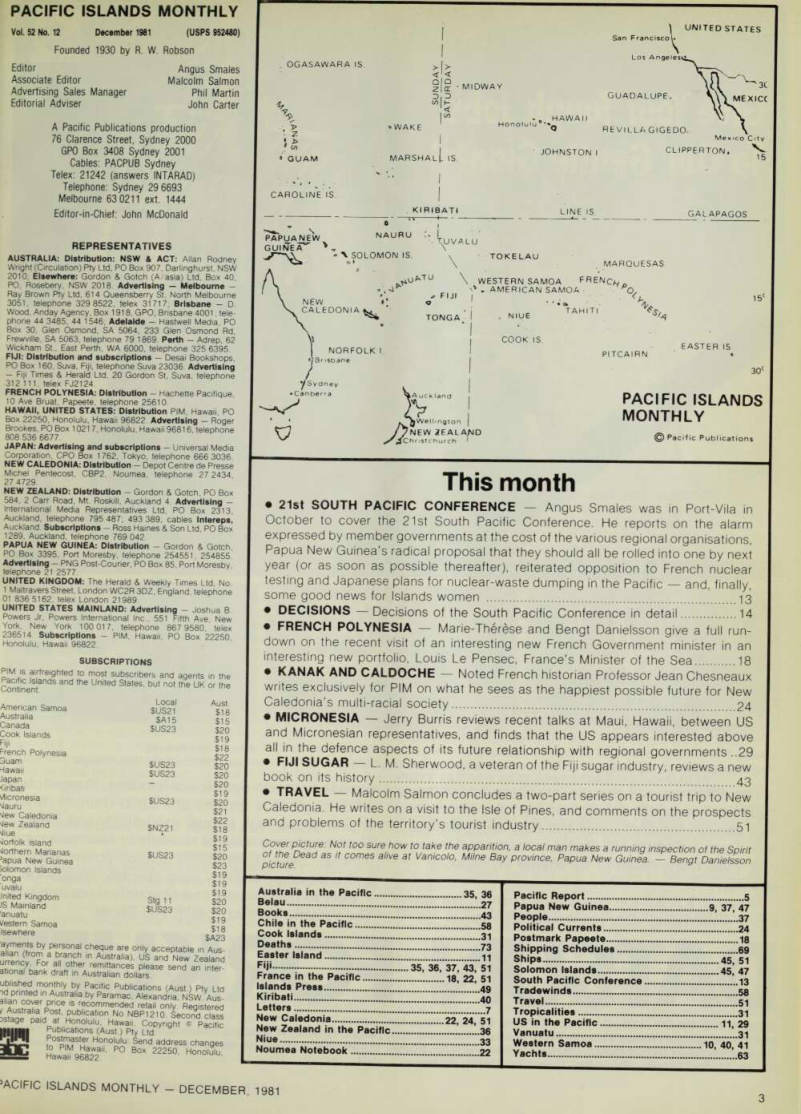
I have been a PIM reader for 40 years, and would like to draw your attention to what seem to me omissions in the map of the Pacific which each month ap pears on the magazine’s title page.
The map takes in the east coast of Australia, and notes the positions of Brisbane, Sydney, and Canberra.
My question is: Why aren’t Melbourne and Hobart in cluded? I think both should rate a mention, especially in view of the fact that Melbourne has air connections to the Pacific (in
eluding the Air Nauru ser vices), and Hobart has the Ansett service to Christchurch, New Zealand.
Eric W. Trebilcock
(Formerly of Salamaua, Papua New Guinea.) Camberwell Vic Australia Thank you. It’s a good point, strengthened by the new air transport developments.
Editor.
U.S. sub base for Belau?
I recently read an article in The Times of Papua New Guinea (Oct 16-22, 1981) about a US submarine base planned for Belau in the Pacific, despite the Belau people’s overwhelming opposition to the project ex pressed in three separate refer endums (as reported by American scientist R. C.
Aldridge).
Can’t the US, the ‘civilised’ super-power, realise that we simple ‘primitive’ folk of the Pacific Islands are for a nuclear free Pacific, and do not want our islands and territorial waters to be military zones, and possibly made unfit for human habitation?
Both the US and France have much on their consciences in this respect. Consider Bikini and Moruroa atolls.
I know that this letter will carry little weight, and will be ignored. But let it be printed all the same.
Not only is the US presence in the Pacific frightening, it is also questionable. Consider the US involvement in Latin America, and how they have been involved indirectly or di rectly in every coup and counter-revolution over many years in that part of the world.
If you are genuine about our security, then stay. But if you are genuine only about your egotistical super-power arms race, and your experiments that could end in some form of genocide in our region, leave us alone.
I would rather die at an invader’s hand than by the hand of my defender.
L. X. Noman
Port Moresby Papua New Guinea
Advertisements & other items, pp. 7-12 (4 items)
Jfic Islands Monthly December, 1981
take a superstar along
When you take off to the unknown,
- H : m w \ m
SK-212F
Next time you take off for parts unknown, add another dimension to your ventures. The new Sound Trek™ dimension by Pioneer.
A galaxy of out-of-this-world multi-
band (FM/MW/SWVSW 2 ) radio-cassette
recorders designed to put great music
in your orbit.
Pioneer’s advanced hi-fi engineerin and solid audio craftsmanship make these stereo portables sound terrific.
There’s a galaxy of exciting sounds out there. Go exploring with Sound Trek from Pioneer. • . * • SK-212F. Fashionable, Compact and donvenien Streamlined to go wherever you do. And so light and compact you'll want to take your Sound Trek everywhere. Loaded with a high sensi tivity FM tuner, and features' like a handy carrying strap, a choice of 2 bands (FM/AM) and available in a variety of fashionable colors.
SK-404F. Convenient Features for Stereo Fun.
Sound Trek SK-404F gives you a wide choice of convenient features to boost yobr listening pleasure. Like Pioneer's exclusive DSS (Direct Source Selector) for instant mode changes (from tape to radio and vice versa). Music Search to automatically find and play the next number on your tape. Also the SK-606F. with the added plus of a digital clock/timer.
(Id PIONEER
SK-404F
Hi-fi mobility through technology.
Sound Trek portables are displayed only at stores showing the emblem For further Information, please contact: Australia: Pioneer Marketing Service Pty. Ltd., P.O. Box 317, Mordialloc, Victoria, 3195 Tel: 90-9011 Fiji Islands: Brijlal & Company, G.P.O. Box No. 362, Suva, Fiji Islands Tel; 22258 New Zealand; Monaco Distributors Ltd., 30 Pollen Street, Grey Lynn, Auckland, New Zealand Tel: (09) 762 098 Norfolk Island: Burns Philp (Norfolk Island) Ltd., P.O. Box 21, Norfolk Island, New Hebrides: Burns Philo (New Hebrides) Ltd., Vila, New Hebrides Nauru Island: Jacob Enterprises, P.O. Box No. 4, Republic of Nauru Tahiti: Tahiti Hi-Fi, P.O. Box 848, Papeete, Tahiti New Caledonia: Menard Pacifique Sari, B.P. 3899, Noumea, New Caledonia Tel; 48-24.36 American Samoa: Transpac Corporation, P.O. Box 1477, Pago Pago, American Samoa 96799 Tel: 633-5224 Rarotonga: South Seas International Ltd., P.O. Box 49, Rarotonga, Cook Islands Tel.
Papua'New Guinea: Bali Merchants Pty. Ltd., P.O. Box 6103, Boroko Tel: 254887
The name of performance.
SUZUKI Vehicles are shipped to approximately 100 countries throughout the world and are well received by users in those countries. Behind the high-quality of SUZUKI 4-wheelers is the m-depth research carried out from all aspects, rigorous tests and an extensive after-sales service net-work. Vehicles that are ready when you need them and which you can trust when driving SUZUKI Vehicles. •if - - 1 M M s Ki y
SJ4IO
SSBOF
ST9OVT
ST9O
% • * X V V . - / ❖ iSUzuKi ■ . : / ••• >/ C
SUZUKI MOTOR CO, LTD
,'iOOTakatsuka. Ilamamatmi, jaj
9
CIFIC ISLANDS MONTHLY DECEMBER, 1981
LETTERS
11
LETTERS
3IFIC ISLANDS MONTHLY DECEMBER, 1981
Island links unweakened-but

South Pacific Conference In Vanuatu
Island links unweakened-but can the structure remain?
The South Pacific Conference, representing 21 autonomous Island countries, together with Australia, New Zealand, Britain, USA and France, met in Vanuatu in October. PIM Editor ANGUS SMALES, who was in Port-Vila for the conference, describes growing pressures for a new regional structure, moves to strengthen the role of women, attitudes to nuclear issues and proposals to develop and protect Island economies.
The regional links of the mod ern Pacific are as strong as ever they were and the shared cul tural backgrounds of the Island countries in particular continue to contribute to a special brand of sympathetic unity. This much was obvious at the South Pacific Conference in Vanuatu in October, the 21st gathering of a regional non-political insti tution which has consistently typified the spirit of the new Pacific better than any other institution or alliance. ‘Our vitality and our friendships are being renewed all the time,’ was the comment of Young Vivian, soon to retire as Secretary- General of the South Pacific Commission.
The conference ethos was indeed as strong as in any year, but a number of undercurrents existed, adding weight to in creasing speculation that a gen eral shake-up of Pacific regional institutions may be round the corner.
One conference observer 'there was no shortage of ob servers, accredited or unofficial) suggested that the conference or the first time reflected a legree of tension in its debates md its lobbying.
Most delegates wouldn’t igree with this. ‘Tension’ was oo strong a word, they said, fhey stressed that nothing vhich had happened at the (inference in any way hreatened regional links or egional co-operation. On exam nation, the undercurrents ap ear to be related to the mech nical application of regional tructures, not to the concept of bntinued regional co peration.
The undercurrents arose ■om such things as differences f opinion concerning the role
which the SP Conference is supposed to play, fears about the cost of regional structures at a time when most countries are feeling the pinch at home, concern at an apparent prolifer ation of regional institutions, claims of overlapping responsi bilities between regional insti tutions and the growing role of politics in what is supposed to be a non-political alliance.
In essence the SP Com mission and the SP Conference (the conference directs the annual work of the com mission) are not political agencies and they are not aid agencies. They are supposed to take a research and develop ment application role directed at all facets of the Islands regional community.
A degree of politics is un avoidable when political issues can be demonstrated as having a direct bearing on wide issues.
The application of what are essentially research and pilot funds or ‘sponsorship’ project funds also has some difficulty with aid agency work.
But the source of many of the undercurrents at the Vanuatu SP Conference appeared to be a misunderstanding of or a dis content with the defined role of the conference. Three delegates told newsmen that the confer ence had no teeth because of its ‘ban on politics.’ Another claimed that aid funds from metropolitan Conference countries would be better ap plied directly to recipient countries rather than ‘filtered and diluted’ through the SP Commission. It is immaterial whether these attitudes rose from ignorance of the Confer ence and Commission roles or from a deep-seated desire for change.
Whatever the motivation, the comments (and the proceedings of the conference) have been interpreted as evidence of a growing movement for reorgan isation of Pacific regional struc tures.
The country which most strongly questioned existing structures was Papua New Guinea. For a start, PNG did not have ministerial represen tation at the conference be
his country’s payment was only in the interests of regional solidarity. He urged caution on plans for a regional develop ment fund, saying that the administration might be so costly that effective benefits would be small.
He expressed concern at the proportion of SP Commission funds which were spent on salaries and at a proposal to establish a Pacific region stabil-
cause, in the words of a government statement, ‘this is not seen as necessary.’ This in itself was s.gmficam Th 6 man w h ° led the PNG delegation was the very able career diplomat and administrator Paulius Matane, head of his country’s foreign affairs and trade department.
Mr Matane wasted no opportunity to question the worth of proposed new activities, to question expenditure levels and to appeal for curbs on the growth of regional structures.
He agreed to a general decision to raise member country contributions to the SP Commission by 10 percent, but said
isation fund for agricultural exports. Overheads in the stabilisation fund could be ex cessive, he said, But his strongest contribution to the need for austerity was a formal recommendation on be half of PNG that ‘a single regional organisation in the Pacific should be established in 1982 or as soon as possible thereafter.’ This is the issue
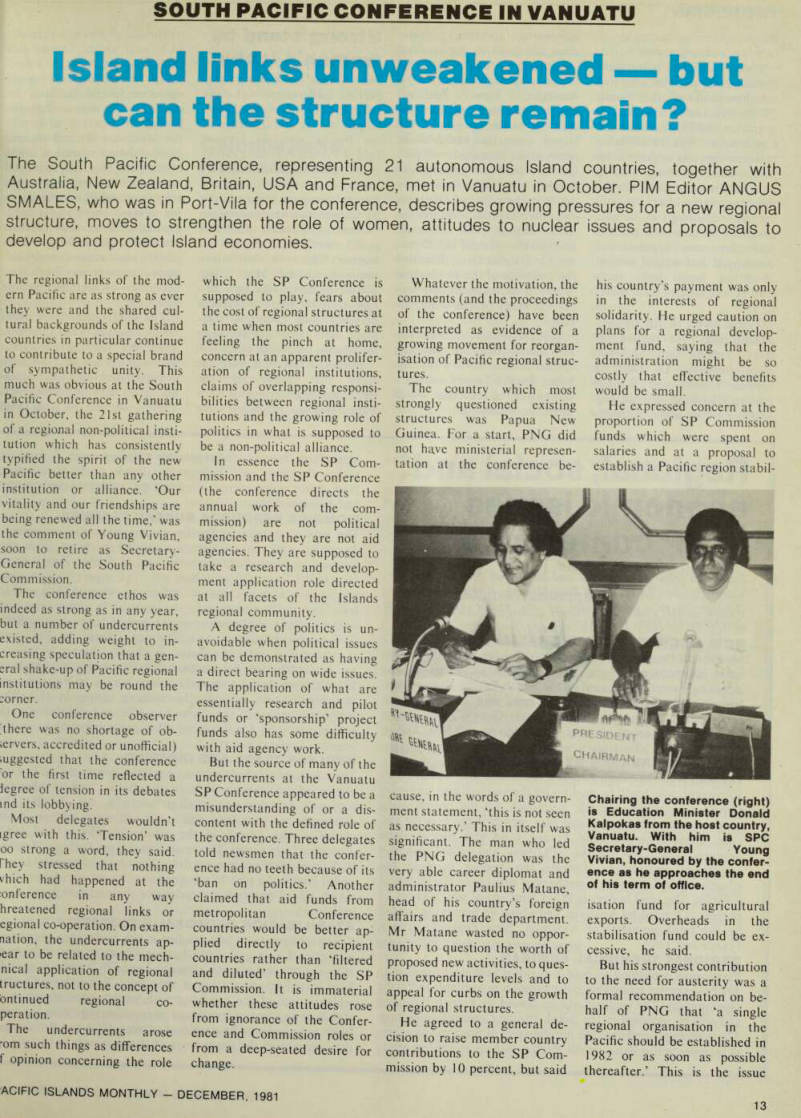
Chairing the conference (right) is Education Minister Donald Kalpokas from the host country, Vanuatu. With him is SRC
Secretary-General Young
Vivian, honoured by the confer ence as he approaches the end of his term of office.
which strikes at the roots of existing arrangements.
PNG’s call for a single organ isation would mean the effective amalgamation of the South Pacific Bureau of Economic Co operation (SPEC) and the SP Commission. The relationship between the two organisations has created a long-standing issue, and it was debated for the third successive year still without deciding a definite course of action. Mr Matane said the two organisations overlapped and wasted money. ‘And we don’t want more studies and studies on studies,’ he said.
Tiwau Awira (Kiribati) com mented that ‘the matter de serves looking into’ and two other delegates, Dr Enetama Lipitoa (Niue) and Ezekiel Alebua (Solomon Islands sug gested forming a committee to
consider an ‘umbrella’ organis ation under which the existing organisations would work. The five metropolitan countries Australia, New Zealand, Britain, USA and France all deferred to the opinion of the Island countries. Mr Matane received no immediate support for his hard-line recommen dation, but there was little doubt in the minds of delegates and observers that pressures for some change will increase.
Predictably, the SPEC Direc tor, Dr Gabriel Gris, defended the existence of the two bodies. ‘There is not as much overlap ping as many people think,’ he said.
Discussions on the relation ship were deferred pending further consideration within the South Pacific Forum and by a committee of officials which SPEC is organising.
Strong stand by
women’s lobby
The women’s lobby at this year’s conference was the strongest it has ever been, largely due to the influence of the Pacific women’s seminar held in French Polynesia earlier in the year and pushed along by a decision to establish a women’s resource bureau at the SP Commission headquarters in Noumea. The accent which this year’s conference placed on women’s roles in the Pacific was summed up by Mrs Claire Slatter of Suva who told del egates: ‘After years of fruitless planning and countless sem inars, some important decisions for women are being made.’
But for all this there were still signs that many of the participating governments or their delegates, anyway are
still unsure of what the women’s lobby is all about. The debates tended to produce an atmos phere of dealing in special rights or special facilities for women rather than in the part nership of men and women in the day-to-day life and organis ation of Island countries. Some of the delegates, too, managed to produce the impression that they were dealing in concessions for women. There was a light hearted tone to many of their comments, the parading of little jokes about women, and each woman speaker was given loud applause something the men didn’t get.
The conference heard from Henry Naisali (Tuvalu) who said: ‘We have no problems with our women, and we have demonstrated this by not bring ing any to this conference.
There’s nothing to stop them
standing for parliament, but they know they will lose.’
On a more serious note, however, the conference en dorsed a series of recommen dations from the women’s sem inar. The most important of these will be the establishment of the women’s resource bureau for which Australia has guaran teed a grant of $25 000. Exter nal funding will be sought for other projects contained in the recommendations which cover a wide range of health, education, family, nutrition and welfare matters. The proposed resource bureau will be directed at integrating women into a wider range of Pacific affairs at the community and national level.
Dr Sa’euteuga Scanlan (American Samoa), one of the women who presented papers to the conference, said there was no suggestion that the family
role of women ‘given to us by creation’ should be relin quished. ‘But there is a big life outside the home, and we can fill both roles they are not alien to each other,’ she said.
Colonial hand,
leader warns
Vanuatu Prime Minister Walter Lini, who opened the conference at a ceremony in Port-Vila, appealed for the de claration of the Pacific as a nuclear-free zone and warned that a brand of colonialism was still affecting the Island countries of the Pacific. His remarks were described by some delegates as the most politically motivated ever heard at a South Pacific Conference opening ceremony.
They said it reflected the growing feeling among some
member countries, particularly the newer ones, that the non political constitution of the con ference was becoming outdated and that changes in regional structures were required to suit the changing needs of the Island countries.
Father Lini said there were continuing pressures to bring nuclear activity into the Pacific, but these pressures should be resisted by all countries. He claimed it was a matter of life and death that the Pacific be declared a nuclear-free zone because of the particular en vironmental issues confronting Island countries. ‘There can be no compromise and no retreat where the crucial issue of nu clear activity is concerned,’ he said.
Father Lini said there could be no half measures, and he believed the Island countries
should press for the banning of nuclear tests of all types, the dumping of nuclear waste, the operation of nuclear-powered ships and submarines and the carrying of nuclear devices by submarines or aircraft.
Father Lini said there was also a need for the people of the Pacific to establish confidence in themselves and their abilities or they could easily remain victims of colonial influences which still existed. He believed that the Pacific remained one of the last regions of the world where ‘the heavy band of colonialism continues to be played.’
Father Lini defended the aims and operation of the South Pacific Commission in the face of a degree of criticism in recent years. He said that the Island countries had reached the stage where they still relied heavily
on aid but their ability to advance and develop rested on what they were able to do for themselves. Co-operation and sharing were important parts of this process, and in this respect the work of the SP Commission was central. Its role could be immediate and dynamic in helping the Island countries to outride external pressures and persuasions, he said.
SPC Secretary-General Young Vivian, who also ad dressed the opening ceremony, appealed for greater unity and harmony. He said that the spirit now popularly known as ‘The Pacific Way’ should permeate all relationships.
Diplomat starts
chain reaction
A Japanese diplomat at the conference started a chain reac tion of his own when he inter vened in the delicate political issues surrounding his country’s plans which are still indefinite to dump nuclear waste in the western Pacific.
Earlier the conference had adopted a resolution which, among other things, called for an end to proposals to dump radioactive waste in the Pacific.
This was a direct reference to a long-standing Japanese pro posal, although Japan was not specifically named in the resol ution.
On the final day of the conference observers from non participating governments and from visiting agencies and insti tutions were invited to speak.
This is a well-established prac tice in the history of the South Pacific Conference, and the statements which emerge tend to be non-controversial, usually involving diplomatic and tech nical messages. One of the observers who spoke this year was the Japanese Ambassador to Fiji, Tonga, Kiribati, Tuvalu and Nauru, Mr K. Ikebe, of Suva. After expressing Japan’s support for the aspirations of the Pacific people, Mr Ikebe launched into a detailed ac count of his country’s reliance on nuclear energy (12% of its total power) and of the disposal requirements of low-level waste.
He outlined the present Japanese attitudes which have already been widely publicised
in the Pacific. They are that the proposed dumping area is nearer to Japan than to any other land, that tests show there will be no danger or environ mental hazards, that proper monitoring will be maintained and that proposals to begin dumping are still indefinite while public reaction is as sessed.
His statement produced an immediate response from con ference delegates. Two said they admired Mr Ikebe’s cour age in speaking to the meeting but that their opposition to dumping would not be shaken.
The strongest response was from Mr George Chan (North ern Marianas), an alternative energy specialist who earlier had presented comprehensive reports on energy and environ mental issues. Mr Chan said; ‘Whatever claims you make, the fact remains that our country is in your back yard and if anything happens, we are in trouble. And I remind you, too, that fish swim all over the Pacific taking pollution with them.’ Mr Chan also disputed claims that the proposed dump ing methods were safe, and said it was significant that USA had stopped dumping low-level waste in the Pacific.
The controversy deepened the next day when an incorrect news report circulated through out the Pacific claiming that Mr Ikebe had ‘announced in Port- Vila that Japan intended to start dumping nuclear waste in the Pacific.’ The report prompted an angry reaction from the Solomon Islands where it was accepted at face value and where it led to a denouncement of Japan by the Solomons Prime Minister, Solomon Mamaloni. Mr Ikebe issued a subsequent statement to newsmen in which he stressed that Japan was not defying public opinion, and that he had not announced any decision to begin routine dumping.
‘Don’t let fabric
turn to plastic’
Lobbying for the position of Secretary-General was one of the early issues which led to undercurrents at the confer ence. The present Secretary- General, Young Vivian (Niue),
is constitutionally required to stand down in the middle of next year, and two nominations for the position had been lodged. The nominees were Palauni Tuiasosopo, now assist ant to the governor in American Samoa, and Francis Bugotu, now a roving ambassador for Solomon Islands.
The Planning and Evaluation Committee, which met in cam era before the conference, en dorsed the nomination of Mr Bugotu. American Samoa, up set by the turn of events, withdrew the nomination of Mr Tuiasosopo and the conference then unanimously appointed Mr Bugotu.
The full details of how the nominations were handled in committee were not disclosed.
The formal reason, given briefly several days later, was that the position had to be rotated among the major groupings within the Islands community.
Leaked information suggested in addition that some delegates were unhappy about the possi bility of an appointment from American Samoa on the alleged grounds that American Samoa was excessively influenced by US policies.
Whatever might have been the nature of the discussions, the fact remains that Governor Peter T. Coleman of American Samoa, leader of his country’s delegation, delivered a critical and emotional statement to the conference about what had hap pened.
Mr Coleman stood down from the conference after de livering his statement in which he said that his country had seriously considered withdraw ing its entire delegation. Only a dedication to the principles of Pacific unity had persuaded the delegation to remain, he said.
Mr Coleman’s statement also included a spirited defence of his country’s autonomy and its strong but independent associ ation with USA.
He told the conference: ‘As you know we had proposed a Secretary-General, but when we arrived we found a decision had already been taken. We in American Samoa did not know how to take this it was as if the South Pacific community had forgotten some of its own people. The action which was
taken overlooked certain eti quettes and courtesies for which we are generally known. We contemplated, as a mission, returning home that is how serious it was to us . . . ‘We are withdrawing the candidacy of our nominee for one reason lest the delicate fabric woven in the past should turn to plastic. We do this as a courtesy in the belief that it will save the freedom and the soli darity that this conference rep resents.’
Referring to the relationship between his country and USA, Mr Coleman said he believed American Samoa had a mess age of togetherness to bring to the Pacific. Among the once territorial islands of the Pacific, American Samoa had led the way to independent status, he said, and the present partner ship with USA was a two-way street. American Samoa made its own decisions and stood on its own feet, he said, and at the same time was an integral part of the Pacific community. Un like some countries, he con tinued, it was not taking advan tage of current attitudes which allowed receiving everything and giving nothing.
The incoming Secretary- General, who will take up his appointment on July 1 next year, is in favour of a merger between the South Pacific Bu reau for Economic Co operation (SPEC) and the SP Commission. Mr Bugotu was not at the Port-Vila conference which announced his appoint ment, but in an interview later in Papua New Guinea he ex pressed appreciation of the confidence which had been shown in him and outlined his attitudes to regional issues.
He said he was aware of the criticisms which had been made of present institutional struc tures in the Pacific, and he believed the time had come for a change. He believed that a merger of the two bodies would better utilise limited resources and still provide a valuable service to the region. Mr Bugotu said that he saw his new appointment as making him ‘a servant of the people’ and he said he would commit himself to give more attention to the smaller Island countries of the Pacific.
Advertisements & other items, p. 13 (1 item)
13
ACIFIC ISLANDS MONTHLY - DECEMBER, 1981
Regional, social and economic issues
economic issues at SP conference
Delegates from 26 countries and territories attended the 21st South Pacific Conference in Port-Vila, the Vanuatu capital, in October. Here's a summary of the major decisions and developments from the talks:
New Secretary-General Appointed
Mr Francis Bugotu, a roving ambassador for Solomon Islands since independence there in 1978, was appointed as the incoming Secretary-General of the South Pacific Commission.
He will take office in the middle of next year. The conference paid tribute to the retiring Secretary-General, Mr Young Vivian, and spoke of his long dedication to the SPC and to Pacific regional affairs.
Budget Increased By 10 Percent
The budget of the South Pacific Commission was increased by 10 percent, which will be paid for by the assessed and voluntary contributions of the member countries. All the participating governments agreed to the increase, which is the first for two years. In addition Australia, France, USA and New Zealand promised new funds for the SPC tuna and billfish fisheries assessment programme. Despite the budget increase the effective spending power is unchanged because of the effects of inflation. The total budget is SUS3.S million of which about 33 percent is funded by Australia and about 93 percent is funded by the total payments of Australia, New Zealand, Britain, France and USA.
Regional Technical Seminar
Plans were confirmed to hold a regional technical seminar in 1982 to examine renewable energy resources available to Pacific communities. The seminar will be hosted by French Polynesia and will be included in the South Pacific Commission budget.
The conference endorsed the development of practical measures to increase self-reliance in the Pacific with special reference to
agriculture, fisheries and renewable energy sources. It received technical reports on achievements already made in recycling farm waste, solar energy, wind energy, ocean thermal energy and biomass energy.
Women’S Resource Bureau Planned
The role of women in Pacific communities was extensively discussed, and the conference endorsed a report from the seminar of South Pacific women held in French Polynesia in July (PIM Sept p2O and Nov p 9). The report recommends setting up a women’s resource bureau in Noumea, designed to train and prepare women for wider roles in community and national affairs. It also recommends changes to the existing SPC Community Education and Training Centre in Fiji, and recommends a series of surveys on which to base a wider role and better lifestyle for women. Australia announced a grant of $25 000 towards the proposed resource bureau in Noumea, and an offer to help upgrade the training centre in Fiji. The conference endorsed the Australian offer and decided to seek external funding for financing other recommendations in the women’s seminar report.
Nuclear Tests And Dumping
The conference called on ‘those countries concerned’ to end the testing of nuclear weapons in the Pacific and to abandon proposals for dumping nuclear waste in the Pacific. The reference was to France and Japan, although neither of the countries was named in the resolution. France and USA abstained from voting. The resolution was put to the conference by Vanuatu during a general discussion on environmental issues, and it included a plea to recognise the ‘fragile environment’ on which Island countries depended for their economy and their existence.
Stabilisation Proposal Endorsed
Tentative agreement was reached at the conference to proceed with plans for a regional stabilisation scheme to protect incomes from agricultural exports, although some SPC countries already have stabilisation schemes of their own. Papua New Guinea, which is one of the countries with an extensive structure of stabilisation schemes, expressed reservations regarding the costs likely to be incurred by a regional scheme. USA and Britain said they recognised the importance of the proposals but would be
mable to make financial contributions because of existing :ommitments.
>Alau Admitted To Spc
Phe Republic of Palau (known as Belau in its own language) was idmitted and welcomed to full participation in the South Pacific Conference community, thus ending the participation of the Jnited States Trust Territory of the Pacific Islands. Palau •ecarne a republic earlier in the year. The three other states vithin the trust territory the Federated States of Micronesia, he Marshall Islands and the Northern Mariana Islands are Iready members of the conference community. The trusteeship > still in force, but USA told the conference that the admission f the separate trust states to the conference community was nother major step towards its termination.
00 Many Organisations Says Png
Representatives at the conference revived the long-standing ebate over regional institutions in the Pacific, including the ontentious question of whether the work of the South Pacific ommission and the South Pacific Bureau for Economic Coo peration (SPEC) would be better handled by a single rganisation. In a strongly-worded statement to the conference, apua New Guinea claimed that money was being wasted on an xcess of regional organisations and that a single organisation tould be introduced in 1982 or as soon as possible thereafter, he conference deferred any immediate decision, but will revive s discussions following a planned meeting of officials which PEC is organising and following a review by the South Pacific orum, the political alliance of Pacific nations. Because not all PC countries are members of SPEC the conference commended that non-members of SPEC should be permitted > make written submissions to the planned meeting of officials
Acific Arts Festival
he four-yearly South Pacific Festival of Arts and the SPC ionsored council which organises it are to have new names in :eping with the widening regional area involved. The festival ill now be known as the Pacific Arts Festival and the council the Pacific Arts Council. The changes come into effect Mowing the adoption of reports and recommendations from the uncil. Other decisions which arose from the report are that the uncil will widen its activities to include cultural exhibitions in
addition to the four-yearly festival, and that consideration will be given later t 0 the estab,ishment of an association of Oceania museums. An approach will be made to the United Nations Educational, Social and Cultural Organisation (UNESCO) for a grant of $2OO 000 towards each Pacific Arts Festival. During the conference debate Britain expressed reservations towards approaching UNESCO because of effects on the total UNESCO budget. The next Pacific Arts Festival the fourth will be in 1984.
Pacific Advisory Service
The conference accepted a report from the Commonwealth Fund for Technical Co-operation in Britain on tentative proposals to establish a Pacific regional advisory service. The report was well received ’ although no formal recommendations arose from the conference. Under the proposals, which came from a survey of Commonwealth Pacific Island countries a secretariat would be established to share expertise and skills among Island administrations so that knowledge held by any one country could be pooled for the benefit of the region,
Regional Development Fund
A report was accepted on proposals to establish a Pacific Islands regional development fund which would mobilise and make available additional funds to support national projects of regional value and to encourage ecLomic inter'acfion in the region ' The report was the result °f a surve y commissioned by ‘he South Pacific Commission and the South Pacific Bureau for EConomiC Co -o perati °" USA a " d Britain the conferenc that alth ° Ugh they acce P ted the value of the Proposals their making further recommendations,
Next Year’S Conference
ssssssse-s
Advertisements & other items, pp. 15-17 (3 items)
15
THE REGION
ISLANDS MONTHLY - DECEMBER, 1981
Compo!
The Memorable
A jewel reveals the beauty of light and Sansuis micro computer ICs reveal the beauty of music.
Sansuis Super Compo stereo system has micro-computer memories to make music listening unforgettable. Stereo is now simpler and more fun.
Just push buttons and you’ve programmed any seven selections on a record in any order you like. Wonderful conveniences of the FM/AM tuner include Digital Quartz- PLL Synthesizer tuning and pushbutton selection of any 6 FM and any 6 AM pre-set stations.
Microcomputer delights of the
cassette deck are full-logic and Automatic Music Program Search. Wireless remote control is a nice option, and so is
the versatile Graphic Equalizer/Reverb/
Mixer Consolette.
Just push a button for memorable music. Memorable Super Compo by the hi-fi specialist, Sansui.
COMPO 9900
i i
HSIHh
-5- M* a
‘Guilin -
m •« FR-D 55: Computerized Track Sequence Selection Full Auto DD Turntable RS-7: Infrared Remote Control System RG-7: Stereo Graphic Equalizer Consolette with reverb/mixer T-9: Digital Quartz-PLL Synthesizer Tuner with 12 FM/AM Station Pre-sets and Auto Search Tuning A-9: Integrated DC-Servo Amplifier, 63W RMS x 2 D-300M: Full-logic Metal-Compatible Cassette Deck GX-95: Audio Cabinet with Headphone Jack S-65: 4-Way Speaker System 12-3/8" Woofer, 105 W SANSUI ELECTRIC CO., LTD .14-1 Izumi 2-chome, Suginami-ku, Tokyo 168, Japan • Australia VAN FI (Aust.) Pty. Ltd. 297, City Road, South Melbourne, Victoria 3205, Australia Phone: 690-6200/283 Alfred Street, North Sydney, N.S.W. 2060, Australia Phone: 929-0293 • Fiji Prabhu Brothers Ltd. P.O. Box 183, Nadi Phone: 70183/4 • Papua New Guinea Oceania Indent Agency (P.N.G.) Pty. Ltd. Box 5518, Boroko, Port Moresby Phone: PM 256406 • New Zealand David Reid Electronics Ltd. C.P.O. Box 2630, Auckland, 1 Phone: 491-489 • New Caledonia Ets Michel MERCIER B.P. 1123, Noumea Phone: 27. 59. 11 • South Pacific Miltons Department Stores Limited P.O. Box 146, Norfolk Island 2899 Phone: 2161 • Central Pacific Nauru Co-operative Society Republic of Nauru • Vanuatu The Sound Centre P.O. Box 434, Port Villa Phone: 2035 • Cook Island United Island Traders Ltd. P.O. Box 1 & 2, Rarotonga • Tahiti SIMEL P.O. Box 3338 Phone: 26979
17
THE REGION
3 ACIFIC ISLANDS MONTHLY - DECEMBER, 1981
Memorable
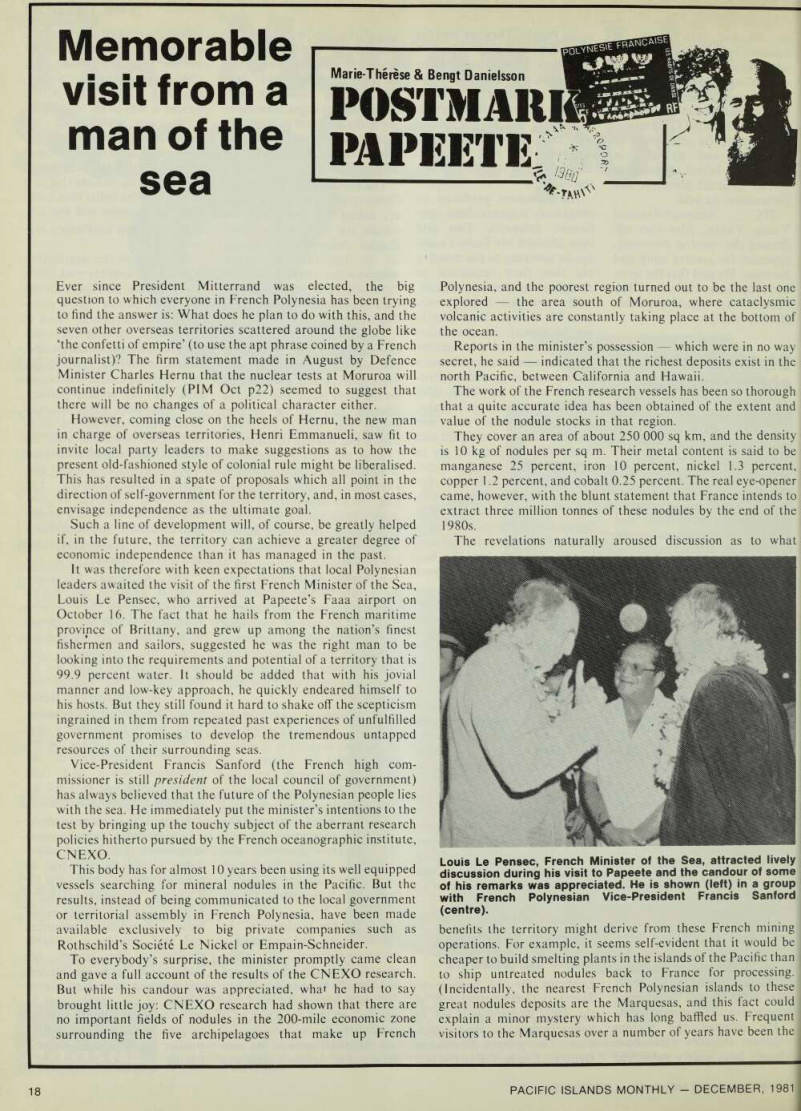
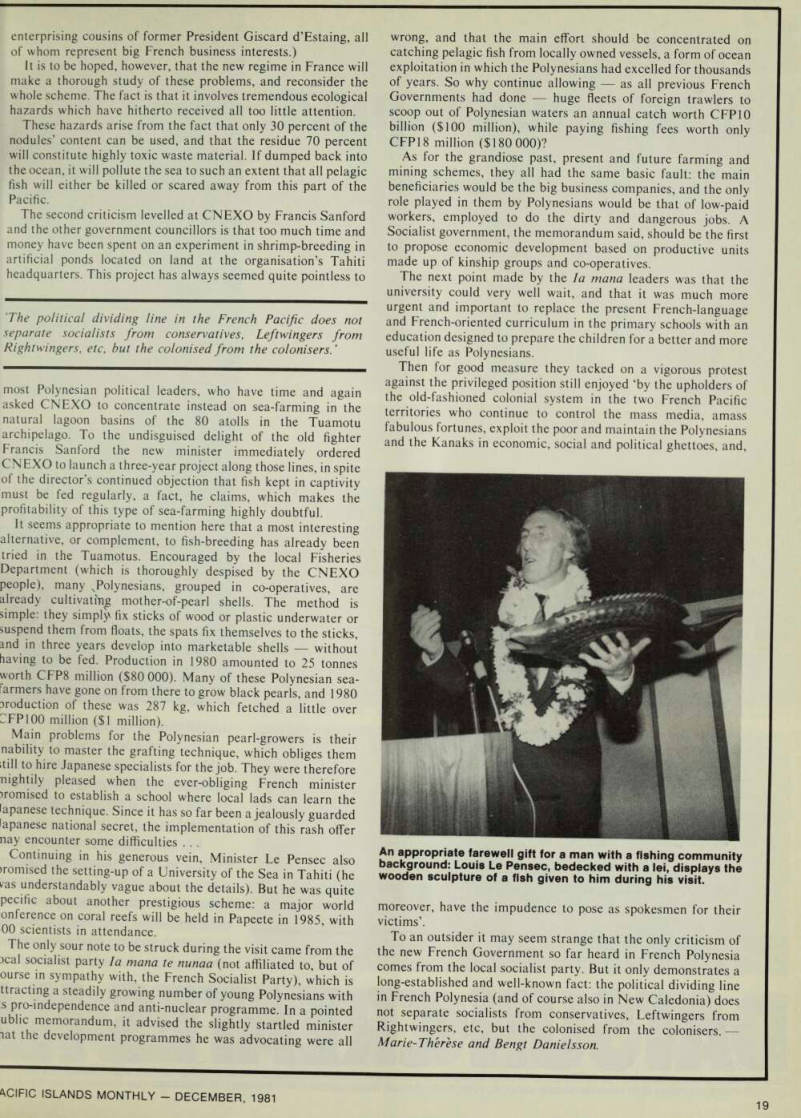
visit from a man of the sea
Ever since President Mitterrand was elected, the big question to which everyone in French Polynesia has been trying to find the answer is: What does he plan to do with this, and the seven other overseas territories scattered around the globe like ‘the confetti of empire’ (to use the apt phrase coined by a French journalist)? The firm statement made in August by Defence Minister Charles Hernu that the nuclear tests at Moruroa will continue indefinitely (PIM Oct p 22) seemed to suggest that there will be no changes of a political character either.
However, coming close on the heels of Hernu, the new man in charge of overseas territories, Henri Emmanueli, saw fit to invite local party leaders to make suggestions as to how the present old-fashioned style of colonial rule might be liberalised.
This has resulted in a spate of proposals which all point in the direction of self-government for the territory, and, in most cases, envisage independence as the ultimate goal.
Such a line of development will, of course, be greatly helped if, in the future, the territory can achieve a greater degree of economic independence than it has managed in the past.
It was therefore with keen expectations that local Polynesian leaders awaited the visit of the first French Minister of the Sea, Louis Le Pensec, who arrived at Papeete’s Faaa airport on October 16. The fact that he hails from the French maritime province of Brittany, and grew up among the nation’s finest fishermen and sailors, suggested he was the right man to be looking into the requirements and potential of a territory that is 99.9 percent water. It should be added that with his jovial manner and low-key approach, he quickly endeared himself to his hosts. But they still found it hard to shake off the scepticism ingrained in them from repeated past experiences of unfulfilled government promises to develop the tremendous untapped resources of their surrounding seas.
Vice-President Francis Sanford (the French high com missioner is still president of the local council of government) has always believed that the future of the Polynesian people lies with the sea. He immediately put the minister’s intentions to the test by bringing up the touchy subject of the aberrant research policies hitherto pursued by the French oceanographic institute,
Cnexo.
This body has for almost 10 years been using its well equipped vessels searching for mineral nodules in the Pacific. But the results, instead of being communicated to the local government or territorial assembly in French Polynesia, have been made available exclusively to big private companies such as Rothschild’s Societe Le Nickel or Empain-Schneider.
To everybody’s surprise, the minister promptly came clean and gave a full account of the results of the CNEXO research.
But while his candour was appreciated, what he had to say brought little joy: CNEXO research had shown that there are no important fields of nodules in the 200-mile economic zone surrounding the five archipelagoes that make up French
Polynesia, and the poorest region turned out to be the last one explored the area south of Moruroa, where cataclysmic volcanic activities are constantly taking place at the bottom of the ocean.
Reports in the minister’s possession which were in no way secret, he said indicated that the richest deposits exist in the north Pacific, between California and Hawaii.
The work of the French research vessels has been so thorough that a quite accurate idea has been obtained of the extent and value of the nodule stocks in that region.
They cover an area of about 250 000 sq km, and the density is 10 kg of nodules per sq m. Their metal content is said to be manganese 25 percent, iron 10 percent, nickel 1.3 percent, copper 1.2 percent, and cobalt 0.25 percent. The real eye-opener came, however, with the blunt statement that France intends to extract three million tonnes of these nodules by the end of the 1980 s.
The revelations naturally aroused discussion as to what
benefits the territory might derive from these French mining operations. For example, it seems self-evident that it would be cheaper to build smelting plants in the islands of the Pacific than to ship untreated nodules back to France for processing. (Incidentally, the nearest French Polynesian islands to these great nodules deposits are the Marquesas, and this fact could explain a minor mystery which has long baffled us. Frequent visitors to the Marquesas over a number of years have been the
Louis Le Pensec, French Minister of the Sea, attracted lively discussion during his visit to Papeete and the candour of some of his remarks was appreciated. He is shown (left) in a group with French Polynesian Vice-President Francis Sanford (centre).
enterprising cousins of former President Giscard d’Estaing, all of whom represent big French business interests.) It is to be hoped, however, that the new regime in France will make a thorough study of these problems, and reconsider the whole scheme. The fact is that it involves tremendous ecological hazards which have hitherto received all too little attention.
These hazards arise from the fact that only 30 percent of the nodules’ content can be used, and that the residue 70 percent will constitute highly toxic waste material. If dumped back into the ocean, it will pollute the sea to such an extent that all pelagic fish will either be killed or scared away from this part of the Pacific.
The second criticism levelled at CNEXO by Francis Sanford and the other government councillors is that too much time and money have been spent on an experiment in shrimp-breeding in artificial ponds located on land at the organisation’s Tahiti headquarters. This project has always seemed quite pointless to
‘The political dividing line in the French Pacific does not separate socialists from conservatives. Leftwingers from Rightwingers, etc, but the colonised from the colonisers. ’
most Polynesian political leaders, who have time and again asked CNEXO to concentrate instead on sea-farming in the natural lagoon basins of the 80 atolls in the Tuamotu archipelago. To the undisguised delight of the old fighter Francis Sanford the new minister immediately ordered CNEXO to launch a three-year project along those lines, in spite of the director’s continued objection that fish kept in captivity must be fed regularly, a fact, he claims, which makes the profitability of this type of sea-farming highly doubtful.
It seems appropriate to mention here that a most interesting alternative, or complement, to fish-breeding has already been tried in the Tuamotus. Encouraged by the local Fisheries Department (which is thoroughly despised by the CNEXO people), many Polynesians, grouped in co-operatives, are already cultivating mother-of-pearl shells. The method is simple: they simply fix sticks of wood or plastic underwater or suspend them from floats, the spats fix themselves to the sticks, and in three years develop into marketable shells without having to be fed. Production in 1980 amounted to 25 tonnes worth CFPB million ($BO 000). Many of these Polynesian sea farmers have gone on from there to grow black pearls, and 1980 aroduction of these was 287 kg, which fetched a little over -FPIOO million ($1 million).
Main problems for the Polynesian pearl-growers is their nubility to master the grafting technique, which obliges them ; tiH to hire Japanese specialists for the job. They were therefore nightily pleased when the ever-obliging French minister iromised to establish a school where local lads can learn the Japanese technique. Since it has so far been a jealously guarded (apanese national secret, the implementation of this rash offer nay encounter some difficulties .. .
Continuing in his generous vein, Minister Le Pensec also >romised the setting-up of a University of the Sea in Tahiti (he yas understandably vague about the details). But he was quite pecific about another prestigious scheme: a major world onference on coral reefs will be held in Papeete in 1985, with 00 scientists in attendance.
The only sour note to be struck during the visit came from the Deal socialist party la mana te nunaa (not affiliated to, but of ourse in sympathy with, the French Socialist Party), which is ttractmg a steadily growing number of young Polynesians with s pro-independence and anti-nuclear programme. In a pointed üblic memorandum, it advised the slightly startled minister lat the development programmes he was advocating were all
wrong, and that the main effort should be concentrated on catching pelagic fish from locally owned vessels, a form of ocean exploitation in which the Polynesians had excelled for thousands of years. So why continue allowing as all previous French Governments had done huge fleets of foreign trawlers to scoop out of Polynesian waters an annual catch worth CFPIO billion ($lOO million), while paying fishing fees worth only CFPIB million ($lBO 000)?
As for the grandiose past, present and future farming and mining schemes, they all had the same basic fault: the main beneficiaries would be the big business companies, and the only role played in them by Polynesians would be that of low-paid workers, employed to do the dirty and dangerous jobs. A Socialist government, the memorandum said, should be the first to propose economic development based on productive units made up of kinship groups and co-operatives.
The next point made by the la mana leaders was that the university could very well wait, and that it was much more urgent and important to replace the present French-language and French-oriented curriculum in the primary schools with an education designed to prepare the children for a better and more useful life as Polynesians.
Then for good measure they tacked on a vigorous protest against the privileged position still enjoyed ‘by the upholders of the old-fashioned colonial system in the two French Pacific territories who continue to control the mass media, amass fabulous fortunes, exploit the poor and maintain the Polynesians and the Kanaks in economic, social and political ghettoes, and,
moreover, have the impudence to pose as spokesmen for their victims’.
To an outsider it may seem strange that the only criticism of the new French Government so far heard in French Polynesia comes from the local socialist party. But it only demonstrates a long-established and well-known fact: the political dividing line in French Polynesia (and of course also in New Caledonia) does not separate socialists from conservatives. Leftwingers from Rightwingers, etc, but the colonised from the colonisers.— Marie-Therese and Bengt Danielsson.
An appropriate farewell gift for a man with a fishing community background: Louis Le Pensec, bedecked with a lei, displays the wooden sculpture of a fish given to him during his visit.
Advertisements & other items, pp. 19-21 (2 items)
19
ISLANDS MONTHLY DECEMBER, 1981
Datsun Creates Hi
Listen to
the sound of quiet.
These days you expect a lot more from your car than just getting you from here to there. You expect it to get you there safely, comfortably, reliably, and quietly as well.
The problem is that all of the qualities you expect in a car are often in conflict with each other.
For example, you want a quiet car. But you also need one that is roomy and comfortable. Less noise would seem to mean thicker, heavier doors and body panels. More interior space would seem to mean thinner, lighter doors and body panels.
The world of automotive design is a world of such conflicts. Correct one problem and you create another.
Change one part and you may end up changing hundreds more.
At Datsun, we not only accept conflicts. We look for them. And then we look for the best ways to bring them into “harmony” to improve the Sound Deadener on Door Panel Flat Surface Pillar and Double Lip Seal 3-Joint Propeller Shaft Thick Sound Insulator Modified Grommet Concealed Center Pillar Rear Sound Insulator Roof Sound Insulator Soft Type Strut Insulator X Newly Designed Engine Mounting \ Damping Material “U” Turn Tail Tube (H/TT\ Soft Type Strut Insulator on Floor Metal "O” Type Muffler Mounting overall quality of our cars.
Thinking and working in harmo helps us to resolve seemingly unresolvable differences. To find the proper balance between apparent contradictions.
For example, by reducing the thickness of the panels and adding a special sound-suppressing materi between the steel layers, we not only decreased the noise level, we increased seating space as well.
That’s what we mean by harmony.
DATSUN CREATES HI
Cook Islands: COOK ISLANDS MOTOR CENTRE LTD , Harotonga/Fiji: CARPENTERS MOTORS, Suva/Guam: DATSUN MOTOR SALES, Agana/Hawaii: NISSAN MOTC CORPORATION IN HAWAII LTD . Honolulu/Kiribati: ATOLL AUTO STORES, Tarawa/Nauru: JACOB ENTERPRISES LTD New Caledonia: AGENCE ALMA S.A.. Noumtj
And there’s a lot of it in every sun.
From “fine tuning” vibrations sed by the engine, drive train and s until they mutually cancel each er out, so that passengers enjoy jieter, more comfortable ride. * suspending the engine on special vdamping rubber insulators ch permit vibrations to escape i the air before they have a chance et into the car.
From minimizing air resistance through aerodynamic styling to maximizing sound absorption by placing insulating material everywhere vibrations are likely to occur.
No noisy detail is overlooked.
Even the antenna is located where it makes the least amount of noise.
Problem-solving by designfinding the proper balance between conflicting elements—has helped Datsun build cars that are quiet and roomy, yet light and fuel efficient.
At Datsun, we’re working hard to design the kind of cars the world needs. Without sacrificing what you want in your car.
That’s harmony.
The model shown above is the Datsun 1808 for Europe.
Specifications and equipment may vary according to market.
DATSUN
MONY BY DESIGN
. UNITED ENTERPRISES LTD , Honiara /Tahiti: TAHITIBULL S.A.R.L , Papeete/ Western Samoa: MORRIS HEDSTROM LTD . Apia
to-ing and fro-ing
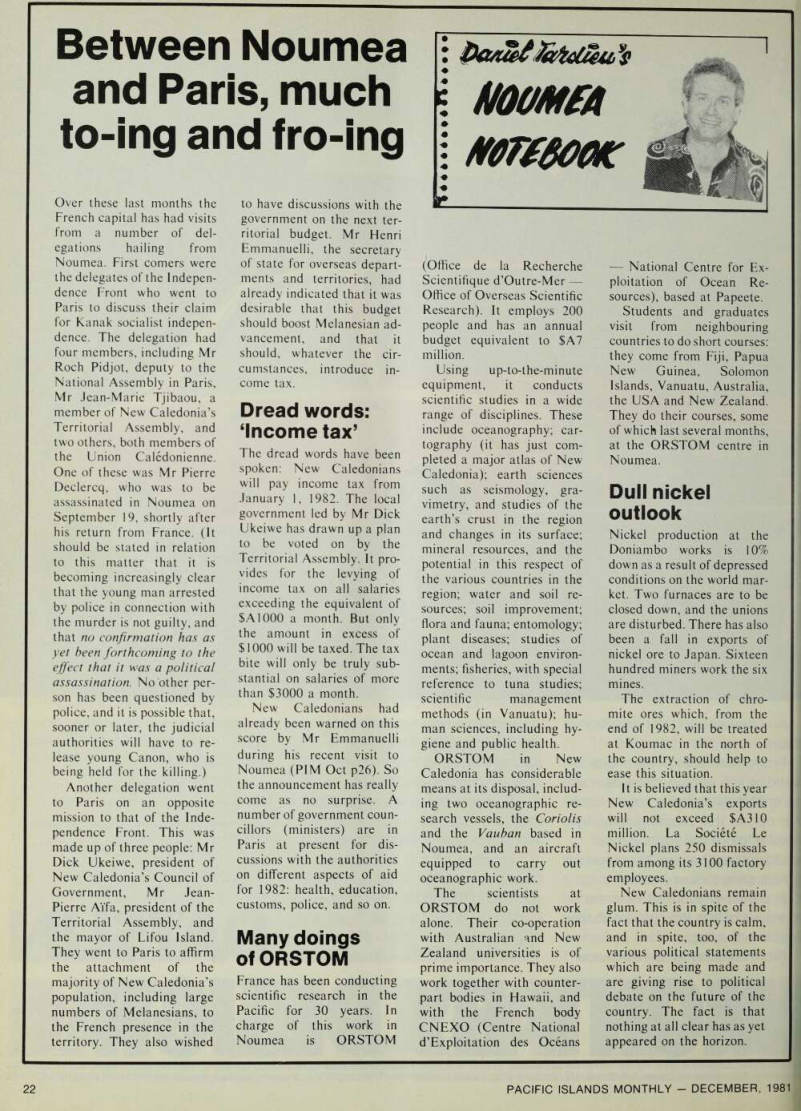
Between Noumea and Paris, much to-ing and fro-ing
Over these last months the French capital has had visits from a number of del egations hailing from Noumea. First comers were the delegates of the Indepen dence Front who went to Paris to discuss their claim for Kanak socialist indepen dence. The delegation had four members, including Mr Roch Pidjot, deputy to the National Assembly in Paris, Mr Jean-Marie Tjibaou, a member of New Caledonia’s Territorial Assembly, and two others, both members of the Union Caledonienne.
One of these was Mr Pierre Declercq, who was to be assassinated in Noumea on September 19, shortly after his return from France. (It should be stated in relation to this matter that it is becoming increasingly clear that the young man arrested by police in connection with the murder is not guilty, and that no confirmation has as yet been forthcoming to the effect that it was a political assassination. No other per son has been questioned by police, and it is possible that, sooner or later, the judicial authorities will have to re lease young Canon, who is being held for the killing.) Another delegation went to Paris on an opposite mission to that of the Inde pendence Front. This was made up of three people: Mr Dick Ukeiwe, president of New Caledonia’s Council of Government, Mr Jean- Pierre AVfa, president of the Territorial Assembly, and the mayor of Lifou Island.
They went to Paris to affirm the attachment of the majority of New Caledonia’s population, including large numbers of Melanesians, to the French presence in the territory. They also wished
to have discussions with the government on the next ter ritorial budget. Mr Henri Emmanuelli, the secretary of state for overseas depart ments and territories, had already indicated that it was desirable that this budget should boost Melanesian ad vancement, and that it should, whatever the cir cumstances, introduce in come tax.
Dread words:
‘lncome tax’
The dread words have been spoken; New Caledonians will pay income tax from January 1, 1982. The local government led by Mr Dick Ukeiwe has drawn up a plan to be voted on by the Territorial Assembly. It pro vides for the levying of income tax on all salaries exceeding the equivalent of SAIOOO a month. But only the amount in excess of $lOOO will be taxed. The tax bite will only be truly sub stantial on salaries of more than $3OOO a month.
New Caledonians had already been warned on this score by Mr Emmanuelli during his recent visit to Noumea (PIM Oct p 26). So the announcement has really come as no surprise. A number of government coun cillors (ministers) are in Paris at present for dis cussions with the authorities on different aspects of aid for 1982: health, education, customs, police, and so on.
Many doings
Of Orstom
France has been conducting scientific research in the Pacific for 30 years. In charge of this work in Noumea is ORSTOM
(Office de la Recherche Scientifique d’Outre-Mer Office of Overseas Scientific Research). It employs 200 people and has an annual budget equivalent to SA7 million.
Using up-to-the-minute equipment, it conducts scientific studies in a wide range of disciplines. These include oceanography; car tography (it has just com pleted a major atlas of New Caledonia); earth sciences such as seismology, gra vimetry, and studies of the earth’s crust in the region and changes in its surface; mineral resources, and the potential in this respect of the various countries in the region; water and soil re sources; soil improvement; flora and fauna; entomology; plant diseases; studies of ocean and lagoon environ ments; fisheries, with special reference to tuna studies; scientific management methods (in Vanuatu); hu man sciences, including hy giene and public health.
ORSTOM in New Caledonia has considerable means at its disposal, includ ing two oceanographic re search vessels, the Coriolis and the Vauban based in Noumea, and an aircraft equipped to carry out oceanographic work.
The scientists at ORSTOM do not work alone. Their co-operation with Australian and New Zealand universities is of prime importance. They also work together with counter part bodies in Hawaii, and with the French body CNEXO (Centre National d’Exploitation des Oceans
National Centre for Ex ploitation of Ocean Re sources), based at Papeete.
Students and graduates visit from neighbouring countries to do short courses: they come from Fiji, Papua New Guinea, Solomon Islands, Vanuatu, Australia, the USA and New Zealand.
They do their courses, some of which last several months, at the ORSTOM centre in Noumea.
Dull nickel
outlook
Nickel production at the Doniambo works is 10% down as a result of depressed conditions on the world mar ket. Two furnaces are to be closed down, and the unions are disturbed. There has also been a fall in exports of nickel ore to Japan. Sixteen hundred miners work the six mines.
The extraction of chro mite ores which, from the end of 1982, will be treated at Koumac in the north of the country, should help to ease this situation.
It is believed that this year New Caledonia’s exports will not exceed SA3IO million. La Societe Le Nickel plans 250 dismissals from among its 3100 factory employees.
New Caledonians remain glum. This is in spite of the fact that the country is calm, and in spite, too, of the various political statements which are being made and are giving rise to political debate on the future of the country. The fact is that nothing at all clear has as yet appeared on the horizon.
Advertisements & other items, p. 23 (1 item)
Reliability
Denise Biellmann
chose
And the reason
why is
A i Denise Biellmann, one of the most reliabl —and exciting—performers on ice. JVC, on* of the most reliable and exciting pet formers in the field of home entertainment. / winning combination.
Reliability is a major reason why JVC is worldwide industry leader in audio-video elec tronics. And a good example of that reliability it the exciting new P-Compo. Try it and discove why JVC skates circles around its competitors.
Reliability
m \
JVC
Can two opposite views of the past
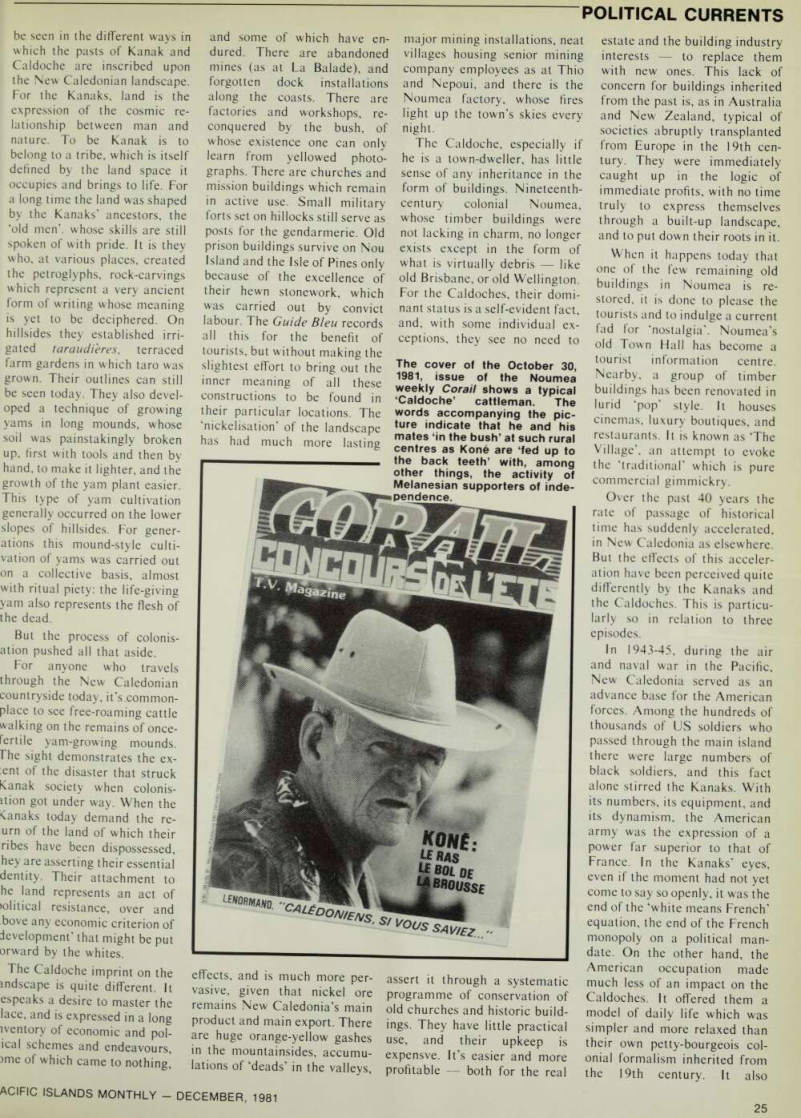
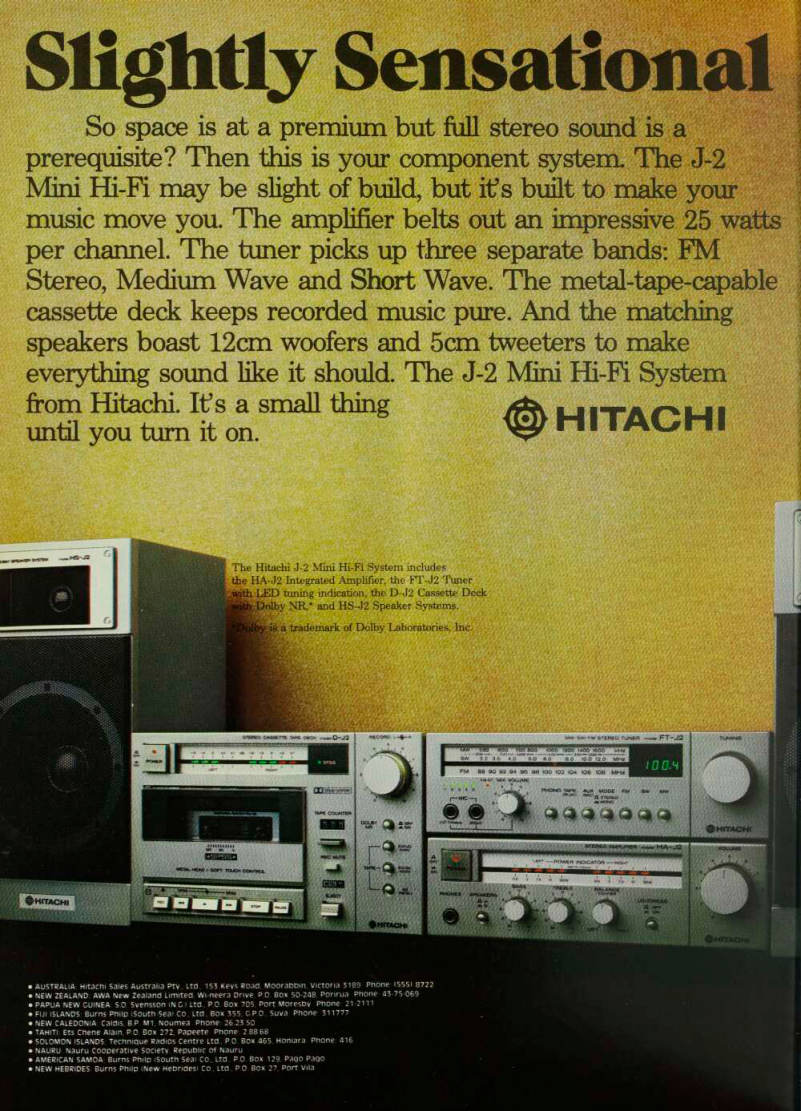
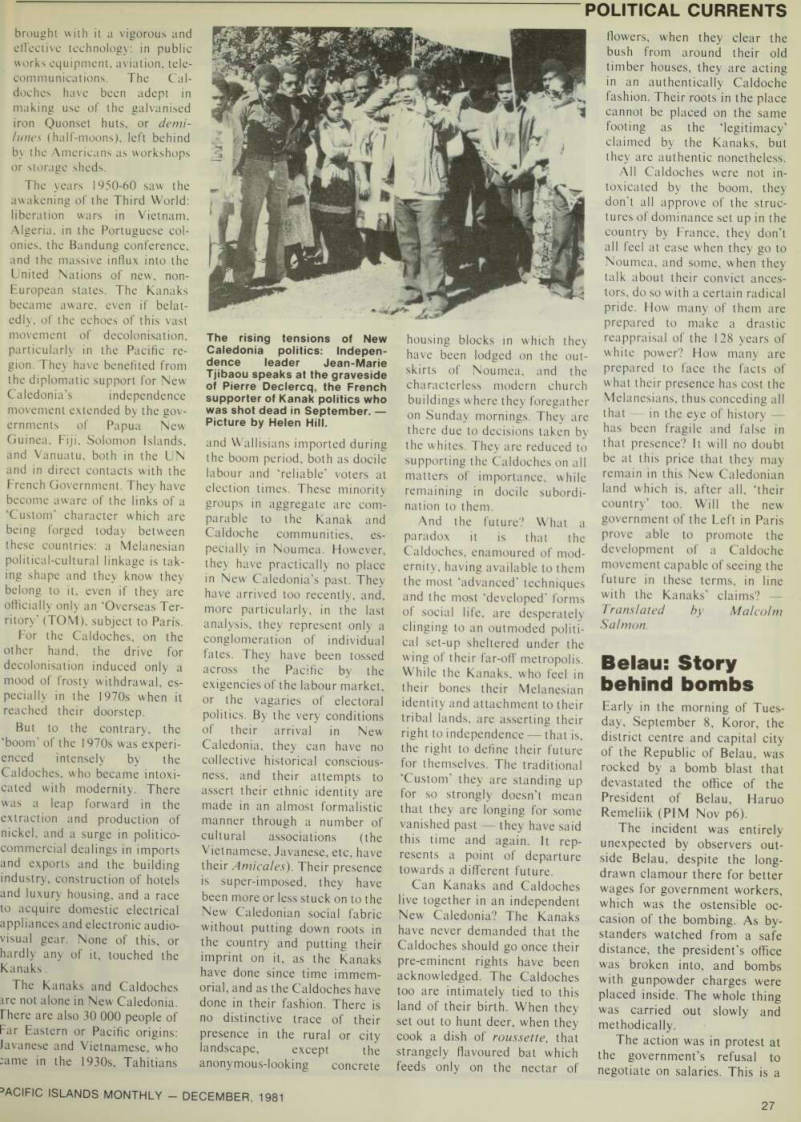
New Caledonia
Can two opposite views of the past be turned into one in the future?
Noted French historian Professor JEAN CHESNEAUX of the Sorbonne, Paris, recently made an on-the-spot study of the situation in the troubled French territory of New Caledonia. He found that there were glaring differences between the conceptions held of New Caledonia’s past by the Melanesian and French-descended communities, and argues constructively that it is not beyond the bounds of possibility that, should these conceptions become one in the future, the world could see New Caledonians of French origins living at peace in an independent New Caledonia in which the pre-eminent rights of the Kanak people are acknowledged. Professor Chesneaux’s article was written exclusively for PIM.
On September 24, 1853, France officially Took possession’ of New Caledonia. The past 128 years are perceived quite differently by the 60 000 Kanaks who at first became French ‘subjects’, and then French ‘citizens’, and by the 50 000 white Caldoches* who have been settled for gener ations on the main island. Cer tainly, the historical period is common to both communities they have shared it. But their historical conceptions of it are quite opposite.
For the Kanaks, it has been ‘a long night', a period of dispossession not only of their lands, but of their essential political being. Their utter re fusal to accept French power was expressed in silence and a dumb passivity, punctuated only by brief spasms of revolt such as those of 1878 and 1915, or waves of mass suicide such as occurred at the beginning of the 20th century. The Kanaks’ silence was interpreted quite wrongly by the whites as acquiesence. The considerable hold still exercised over the Kanaks by the Catholic and Protestant missions is due to the fact that, according even to representatives of the contem porary independence move ment, ‘they kept the Kanak people company throughout the long night’.
The Kanaks’ ‘folk memory’ itself was reduced to silence, going into a kind of hibernation.
It is waking up today. Old men now, when they feel they are among friends, will talk readily of the humiliations and mal
treatment associated with the corvee (compulsory labour) which was done away with only in 1945, at the same time as the whole system known as the indigenat a set of regulations defining the status and obli gations of indigenes, or ‘natives’. Today high chiefs AtaV and Noel, the leaders of the 1878 and 1915 insurrec tions, are publicly honoured, their names even appearing in graffiti on the walls of Noumea.
For the Kanaks, the past 128 years represent an immediate historical whole, a clear con tinuum of shared experience.
Their demand for the recog nition of ‘Kanak legitimacy’ stems from this sense of their continued and continuing exist ence as a race, and has its basis in history. Even if ‘Kanak collective self-awareness’, as an ethnic reference to all the tribes subjected since 1853 to French power, is a term of only recent origin, it is also a reality of only recent origin, a reality born of the rejection of French power.
Throughout these same 128 years, the ‘Caldoche’ settlers have been establishing them selves in New Caledonia. They came from France, but they also came from Algeria, Aden and Djibouti, Reunion, French trading establishments in India, and from Saigon, including its Chinese area. They followed the old sea route of the steamers plying between Marseilles and Noumea in the colonial period, thus giving rise to that high degree of cross-breeding which is typical of the Caldoches.
There are very few ‘white’ families established in New Caledonia for several gener ations who do not have at least one Algerian, Somali, Malabar
Indian, Vietnamese, or Chinese, ancestor . . .
Still today, Caldoche social life is steeped in antiquated colonial ways: meals eaten very early in the day, street names in Noumea, norms of social behav iour, type of education. The closeness to Australia, and the legacy of the penal colony, have endowed this Caldoche cultural identity with two quite singular features. Around 1860 the white colonists in New Caledonia began raising cattle in the large-spread, Australian fashion. In doing so, they at the same time adopted a whole social model; houses, ‘stores’, and streets laid out at right angles to each other in the little towns; ‘stations’, ‘stockmen’, and ‘rodeos’ in the country. The words in quotation marks have been adopted without change as part of the local French language.
The fact that New Caledonia served as a penal colony from 1864 to 1896 was long con sidered a taboo subject in polite circles. Such memories were not appreciated even if the name of the millionaire Right wing deputy to the National Assembly, Lafleur, comes straight from this criminal underworld of the past. Now, the subject is talked about in a relaxed manner. So much so that there’s no hesitation in discussing the ‘Reds’ of the Paris Commune who were depatched to New Caledonia in the years between 1872 and 1879. Anything judged likely to enhance the historical image of the white presence in New Caledonia is brought to the fore. There is great understand ing in Noumea for the convicts of the past. They were ‘poor
Political
Currents
folk, transported for doing] things that really didn’t amount I to much’.(But the same people] who voice these views are quite! pitiless when it comes to the! least sign of delinquency or] vandalism committed by the young, unemployed, Kanaks of 1 today.) For the same reasons, travel-] lers’ tales and other old texts! relating to New Caledonia are] being reprinted and are] being very well received; the] Caldoches are keen to assert! their historical position, their! roots in the country. But on one condition; nothing must be said about the essential thing, their] colonial origins. Except for! those who live in the bush, the ■ Caldoches don’t like being re-| ferred to as colons.
The Kanaks and the Caldoches thus have two very] different senses of history, they ! do not experience time in the same way. On the one hand there is a sense of permanence I and of the long-term past which I persists into the present in the \ form of protest and rejection. On the other hand there is a desire to affirm the historic ■ rights of the whites over this country to which they came as foreigners, and in which they s have created a whole patchwork I of highly diverse cultural j modes.
There is a similar contrast to
* Term used to denote New
Caledonian-born people of
French extraction.
be seen in the different ways in which the pasts of Kanak and Caldoche are inscribed upon the New Caledonian landscape.
For the Kanaks, land is the expression of the cosmic re lationship between man and nature. To be Kanak is to belong to a tribe, which is itself defined by the land space it occupies and brings to life. For a long time the land was shaped by the Kanaks’ ancestors, the ‘old men’, whose skills are still spoken of with pride. It is they who, at various places, created the petroglyphs, rock-carvings which represent a very ancient form of writing whose meaning is yet to be deciphered. On hillsides they established irri gated taraudieres, terraced farm gardens in which taro was grown. Their outlines can still be seen today. They also devel oped a technique of growing yams in long mounds, whose soil was painstakingly broken up, first with tools and then by hand, to make it lighter, and the growth of the yam plant easier.
This type of yam cultivation generally occurred on the lower slopes of hillsides. For gener ations this mound-style culti vation of yams was carried out on a collective basis, almost with ritual piety; the life-giving yam also represents the flesh of the dead.
But the process of colonis ation pushed all that aside.
For anyone who travels through the New Caledonian countryside today, it’s .common place to see free-roaming cattle walking on the remains of once fertile yam-growing mounds.
Fhe sight demonstrates the ex tent of the disaster that struck Kanak society when colonis ition got under way. When the Kanaks today demand the re urn of the land of which their ribes have been dispossessed, hey are asserting their essential dentity. Their attachment to he land represents an act of »olitical resistance, over and bove any economic criterion of development’ that might be put orward by the whites.
The Caldoche imprint on the tndscape is quite different. It espeaks a desire to master the lace, and is expressed in a long iventory of economic and pol ical schemes and endeavours, )me of which came to nothing,
and some of which have en dured. There are abandoned mines (as at La Balade), and forgotten dock installations along the coasts. There are factories and workshops, re conquered by the bush, of whose existence one can only learn from yellowed photo graphs. There are churches and mission buildings which remain in active use. Small military forts set on hillocks still serve as posts for the gendarmerie. Old prison buildings survive on Nou Island and the Isle of Pines only because of the excellence of their hewn stonework, which was carried out by convict labour. The Guide Bleu records all this for the benefit of tourists, but without making the slightest effort to bring out the inner meaning of all these constructions to be found in their particular locations. The ‘nickelisation’ of the landscape has had much more lasting
effects, and is much more per vasive, given that nickel ore remains New Caledonia’s main product and main export. There are huge orange-yellow gashes in the mountainsides, accumu lations of ‘deads’ in the valleys.
major mining installations, neat villages housing senior mining company employees as at Thio and Nepoui, and there is the Noumea factory, whose fires light up the town’s skies every night.
The Caldoche, especially if he is a town-dweller, has little sense of any inheritance in the form of buildings. Nineteenth century colonial Noumea, whose timber buildings were not lacking in charm, no longer exists except in the form of what is virtually debris like old Brisbane, or old Wellington.
For the Caldoches, their domi nant status is a self-evident fact, and, with some individual ex ceptions, they see no need to
assert it through a systematic programme of conservation of old churches and historic build ings. They have little practical use, and their upkeep is expensve. It’s easier and more profitable both for the real
estate and the building industry interests to replace them with new ones. This lack of concern for buildings inherited from the past is, as in Australia and New Zealand, typical of societies abruptly transplanted from Europe in the 19th cen tury. They were immediately caught up in the logic of immediate profits, with no time truly to express themselves through a built-up landscape, and to put down their roots in it.
When it happens today that one of the few remaining old buildings in Noumea is re stored, it is done to please the tourists and to indulge a current fad for ‘nostalgia’. Noumea’s old Town Hall has become a tourist information centre.
Nearby, a group of timber buildings has been renovated in lurid ‘pop’ style. It houses cinemas, luxury boutiques, and restaurants. It is known as ‘The Village', an attempt to evoke the ‘traditional’ which is pure commercial gimmickry.
Over the past 40 years the rate of passage of historical time has suddenly accelerated, in New Caledonia as elsewhere.
But the effects of this acceler ation have been perceived quite differently by the Kanaks and the Caldochcs. This is particu larly so in relation to three episodes.
In 1943-45, during the air and naval war in the Pacific, New Caledonia served as an advance base for the American forces. Among the hundreds of thousands of US soldiers who passed through the main island there were large numbers of black soldiers, and this fact alone stirred the Kanaks. With its numbers, its equipment, and its dynamism, the American army was the expression of a power far superior to that of France. In the Kanaks’ eyes, even if the moment had not yet come to say so openly, it was the end of the ‘white means French’ equation, the end of the French monopoly on a political man date. On the other hand, the American occupation made much less of an impact on the Caldoches. It offered them a model of daily life which was simpler and more relaxed than their own petty-bourgeois col onial formalism inherited from the 19th century. It also
The cover of the October 30, 1981, issue of the Noumea weekly Corail shows a typical ‘Caldoche’ cattleman. The words accompanying the pic ture indicate that he and his mates in the bush’ at such rural centres as Kone are ‘fed up to the back teeth’ with, among other things, the activity of Melanesian supporters of inde pendence.
brought with it a vigorous and effective technology: in public works equipment, aviation, tele communications. The Cal dochcs have been adept in making use of the galvanised iron Quonset huts, or demi lunes (half-moons), left behind by the Americans as workshops or storage sheds.
The years 1950-60 saw the awakening of the Third World: liberation wars in Vietnam, Algeria, in the Portuguese col onies, the Bandung conference, and the massive influx into the United Nations of new, non- European stales. The Kanaks became aware, even if belat edly, of the echoes of this vast movement of decolonisation, particularly in the Pacific re gion. They have benefited from the diplomatic support for New Caledonia’s independence movement extended by the gov ernments of Papua New Guinea, Fiji, Solomon Islands, and Vanuatu, both in the UN and in direct contacts with the French Government. They have become aware of the links of a ‘Custom’ character which are being forged today between these countries: a Melanesian political-cultural linkage is tak ing shape and they know they belong to it, even if they are officially only an ‘Overseas Ter ritory’ (TOM), subject to Paris.
For the Caldoches, on the other hand, the drive for decolonisation induced only a mood of frosty withdrawal, es pecially in the 1970 s when it reached their doorstep.
But to the contrary, the ‘boom’ of the 1970 s was experi enced intensely by the Caldoches, who became intoxi cated with modernity. There was a leap forward in the extraction and production of nickel, and a surge in politico commercial dealings in imports and exports and the building industry, construction of hotels and luxury housing, and a race to acquire domestic electrical appliances and electronic audio visual gear. None of this, or hardly any of it, touched the Kanaks.
The Kanaks and Caldoches are not alone in New Caledonia.
There are also 30 000 people of Far Eastern or Pacific origins: Javanese and Vietnamese, who :ame in the 19305, Tahitians
and Wallisians imported during the boom period, both as docile labour and ‘reliable’ voters at election times. These minority groups in aggregate are com parable to the Kanak and Caldoche communities, es pecially in Noumea. However, they have practically no place in New Caledonia’s past. They have arrived too recently, and, more particularly, in the last analysis, they represent only a conglomeration of individual fates. They have been tossed across the Pacific by the exigencies of the labour market, or the vagaries of electoral politics. By the very conditions of their arrival in New Caledonia, they can have no collective historical conscious ness, and their attempts to assert their ethnic identity are made in an almost formalistic manner through a number of cultural associations (the Vietnamese, Javanese, etc, have their Amicales). Their presence is super-imposed, they have been more or less stuck on to the New Caledonian social fabric without putting down roots in the country and putting their imprint on it, as the Kanaks have done since time immem orial, and as the Caldoches have done in their fashion. There is no distinctive trace of their presence in the rural or city landscape, except the anonymous-looking concrete
housing blocks in which they have been lodged on the out skirts of Noumea, and the characterless modern church buildings where they foregather on Sunday mornings. They are there due to decisions taken by the whites. They are reduced to supporting the Caldoches on all matters of importance, while remaining in docile subordi nation to them.
And the future? What a paradox it is that the Caldoches, enamoured of mod ernity, having available to them the most ‘advanced’ techniques and the most ‘developed’ forms of social life, are desperately clinging to an outmoded politi cal set-up sheltered under the wing of their far-off metropolis.
While the Kanaks, who feel in their bones their Melanesian identity and attachment to their tribal lands, are asserting their right to independence that is, the right to define their future for themselves. The traditional ‘Custom’ they are standing up for so strongly doesn’t mean that they are longing for some vanished past they have said this time and again. It rep resents a point of departure towards a different future.
Can Kanaks and Caldoches live together in an independent New Caledonia? The Kanaks have never demanded that the Caldoches should go once their pre-eminent rights have been acknowledged. The Caldoches too are intimately tied to this land of their birth. When they set out to hunt deer, when they cook a dish of roussette, that strangely flavoured bat which feeds only on the nectar of
flowers, when they clear the bush from around their old timber houses, they are acting in an authentically Caldoche fashion. Their roots in the place cannot be placed on the same footing as the ‘legitimacy’ claimed by the Kanaks, but they are authentic nonetheless.
All Caldoches were not in toxicated by the boom, they don’t all approve of the struc tures of dominance set up in the country by France, they don’t all feel at ease when they go to Noumea, and some, when they talk about their convict ances tors, do so with a certain radical pride. How many of them are prepared to make a drastic reappraisal of the 128 years of white power? How many are prepared to face the facts of what their presence has cost the Melanesians, thus conceding all that in the eye of history has been fragile and false in that presence? It will no doubt be at this price that they may remain in this New Caledonian land which is, after all, ‘their country’ too. Will the new government of the Left in Paris prove able to promote the development of a Caldoche movement capable of seeing the future in these terms, in line with the Kanaks' claims? - Translated by Malcolm Salmon.
Belau: Story
behind bombs
Early in the morning of Tues day, September 8, Koror, the district centre and capital city of the Republic of Belau, was rocked by a bomb blast that devastated the office of the President of Belau, Haruo Remeliik (PIM Nov p 6).
The incident was entirely unexpected by observers out side Belau, despite the long drawn clamour there for better wages for government workers, which was the ostensible oc casion of the bombing. As by standers watched from a safe distance, the president’s office was broken into, and bombs with gunpowder charges were placed inside. The whole thing was carried out slowly and
methodically.
The action was in protest at the government’s refusal to negotiate on salaries. This is a
The rising tensions of New Caledonia politics: Indepen dence leader Jean-Marie Tjibaou speaks at the graveside of Pierre Declercq, the French supporter of Kanak politics who was shot dead in September.- Picture by Helen Hill.
particularly inopportune mo ment for wage negotiations since the various Micronesian governments are now getting reduced US federal aid, and must use what money they have to travel to the many meetings held in various parts of the world, the latest in Hawaii and the next in Washington, DC, to complete work on the Compact of Free Association and its attendant subsidiary agree ments. This, and other matters, have led to charges of over spending on travel by the execu tive branch, which has spent nearly SUSSOO 000 on it so far (time of writing: October 24) this year.
The Guam newspaper, Pacific Daily News, had a photo of the bombers in action, and a local television station sent one of their reporters, a Palauan woman, to interview govern ment officials, bombers and residents of Belau about the incident; her half-hour story was aired twice on television.
Later in the day, the Office of the President, the leadership of the Olbiil era Kelulau (legis lature), and members of the ‘Striking Government Em ployees’, with businessman Roman Tmetuchl as their rep resentative, signed an agree ment promising a $5O increase to lower classes of government employees and an increase of
525 to higher-paid employees
iffective October 1981. Other xunts in the five-point agree nent include a meeting of the resident with the high com nissioner concerning the de nands of the striking workers, einstatement of and withhold
ing of sanctions against the striking workers, and a promise by the strikers to return to work two hours after the execution of the agreement.
It is alleged that other build ings would have been bombed if the government had not nego tiated with the strikers.
In reaction to the involve ment of Mr Tmetuchl in this affair, there appeared a ‘Declar ation of Public Revenge’ writ ten anonymously in Palauan (without an English trans lation). It castigated Mr Tmetuchl, who had been an unsuccessful candidate for the office of president in the first election for the office held in 1980, alleging his use of the strikers’ demands to serve his own political and business aims, and naming four prominent people as his co-conspirators and supporters. There is no doubt of Mr Tmetuchl’s politi cal ambitions; he is already governor of Airai State in south eastern Babeldaob Island. But it is uncertain if his involvement in this matter will further his ends, or only harden and broaden his opposition.
In a recent television inter view seen on Guam, the high commissioner said those in volved in the bombing will be prosecuted once the situation in Belau allows a trial to be held in circumstances not likely to pro voke violence and to lead to additional acts of civil dis obedience. According to him, the agreement reached on September 8 does not preclude prosecution of those involved, as had been believed earlier.
Mark L. Berg on Guam.
Advertisements & other items, pp. 25-28 (3 items)
Political Currents
Slightly Sensational
So space is at a premium but full stereo sound is a prerequisite? Then this is your component system. The J-2 Mini Hi-Fi may be slight of build, but its built to make your music move you. The amplifier belts out an impressive 25 watts per channel. The tuner picks up three separate bands: FM Stereo, Medium Wave and Short Wave. The metal-tape-capable cassette deck keeps recorded music pure. And the matching speakers boast 12cm woofers and scm tweeters to make everything sound like it should. The J-2 Mini Hi-Fi System from Hitachi. It’s a small thing yfJU uitaoui until you turn it on. W M I I AOMI The Hitachi J-2 Mini Hi-Fi System includes the HA-J 2 Integrated Amplifier, the FT-J 2 Tuner with LED tuning indication, the D-J2 Cassette Deck ■lfcDolby NR,* and HS-J2 Speaker Systems. a trademark of Dolby Laboratories, Inc.
SB MM, m d r ■mm
PERFORMANCE
dependable
marine engines
When fishing is your living, you know you need dependable gear working with minimum downtime and your engines have to deliver reliable power when and where you need it.
CATERPILLAR offers you a comprehensive selection of performance proven Cat Marine Diesel Engines from 85hp up to IOOOhp, backed by after sales service and replacement parts facilities that are second to none. m v LB y 1 & ¥ ml & F zi m b bn.
I
dependable
•I'Wir n * > '7 Whatever your electric power needs, there’s a Catbuilt generator set to meet them. Caterpillar generators feature adjustment free fuel systems, large capacity radiators, heavy duty air cleaners and quick-change fuel and oil filters to ensure dependable performance throughout the islands, in all kinds of tropical conditions.
HASTINGS DEERING
LAE:
Milford Haven Road, Telephone 42 2355.
PORT MORESBY:
Telephone 256650.
BOUGAINVILLE:
Itakara Industrial Park, Arawa Telephone 959077.
carptrac
SUVA: Carpenter Street, Raiwai.
Private Mail Bag, GPO Suva, Fiji. Ph. 381622.
Telex FJ2190 Cables CARPTRAC.
LAUTOKA: Veitari. Telephone 61877.
LABASA: Vulovi. Telephone 81868.
YOUR
CATERPILLAR
DEALER
Caterpillar, Cat and CQ are Trademarks of Caterpillar Tractor Co. 8A10452
27
POLITICAL CURRENTS
3 ACIFIC ISLANDS MONTHLY DECEMBER, 1981
defence aspects
Micronesia
U.S. spokesmen hit defence aspects hard at Maui talks
alks about a new political tatus for the Trust Territory of ic Pacific stalled since lortly after Ronald Reagan on the American presidential lection are now back on ack (PIM Nov p 5).
But if the noises made by US articipants in an early-October
round of talks on the Hawaiian island of Maui are any indi cation, those tracks are going to be straight, narrow and headed in one direction only.
US spokesmen insisted forcefully on Maui that there will be no more money for the various Micronesian govern
ments beyond what has already been negotiated, and they were insisting on American military rights in the area ‘for the longest period’.
The current offer is a roughly SUSI billion total aid package to the various Micronesian governments (along with a maximum 7.5% a year inflation factor) over the life of a 15-year compact of ‘free association’ between the new Micronesian governments and the USA. During those 15 years, there would be no ques tion that the US would control certain military and defence rights in the area, while the Micronesian governments would retain control over all other aspects of their interna l and international political life.
But after 15 years, what?
It is clear the Reagan admin istration wants a pledge from the Micronesian governments not only to allow the US into the area after the 15 years are up, but to guarantee that others will be kept out the so-called doctrine of deniability.
It was war and military need that brought the US into the vast sweep of islands known as Micronesia in the first place.
And it is the continuing needs of the military that are foremost in American minds as the post- World War II trusteeship is brought to a close.
The point was made at the opening of the Maui talks by Noel C. Koch, deputy assistant secretary of defence for inter national security affairs: ‘1 wish to ask that each of your governments consider again the importance we place on ensuring, for the longest period of time, that no third country has military access to your territory, your ports, your airfields’, Koch said.
In return, Koch promised ‘exactly the same defence com mitment we have given to Australia and New Zealand under the ANZUS alliance’.
Then Koch, in a departure from his prepared remarks, put American military interests in a more vivid context. He referred to the bloody American cam paign to recapture the islands of Micronesia from Japan during World War 11. ‘What happened then will not happen again,’ he vowed.
That’s all well and good for the US, Micronesian leaders indicated, but such promises in ‘perpetuity’ will not come free.
Palau has already made a 100-year agreement with the United States for specified har bour and training rights within its borders. But the other island groups want to see what the US is willing to give in exchange for near-permanent military rights.
The next round of talks were scheduled to be nuts-and-bolts discussions of some 11 ‘subsidi ary’ agreements to the main compact of free association.
They were probably to take place in Washington DC. These technical discussions were to focus on such things as econ omic aid, extension of American social welfare pro grammes into Micronesia, and the like.
But hanging over all minds will be the bottom-line military interests of the US in any final agreement.
While the Micronesian leaders on Maui weie learning how the Reagan administration will approach the political status talks, they also met the people who will represent the US in the final rounds.
The leader of the US del egation was Under-secretary of State James L. Buckley, the former United States senator.
Buckley headed up the top-level study group which rec ommended that the Reagan administration go ahead with the status talks.
Also on hand unofficially were three key members of the American team for Trust Terri tory matters: Pedro San Juan, Janet McCoy and Fred Zeder.
San Juan has been nominated to be assistant secretary of the Department of Interior for Ter ritorial and International Affairs. McCoy, a public re lations specialist from Oregan with close political ties to Reagan from his days as Cali fornia governor, wil almost cer tainly be named High Com missioner of the Trust Territory replacing acting HiCom Dan High. Zeder, a Honolulu businessman and director of the Office of Territorial Affairs from 1975 to 1977, is in line to be chief US representative at
future status talks.
Jerry
Burris in Honululu.
Advertisements & other items, pp. 29-30 (2 items)
Political Currents
29
ACIFIC ISLANDS MONTHLY DECEMBER, 1981
Komatsu flakes a Difference
I ■ B In critical areas like reliability and performance, Komatsu products and systems are making a significant difference at mining and construction sites around the world.
In the USA, for example, Komatsu’s largest and most powerful work machine the D455A bulldozer is establishing a superior record of reliability and productivity at mining sites that virtually no other machine in its class can match.
And in another critical area, technology, Komatsu is also making a difference in responding to market demands for improved product quality, and for new and original product innovations.
Consider our new computerized seabed robot system: Operating on the ocean floor, it can relay TV pictures of the seabed to a mother ship, or perform man-like boring, drilling and piling operations down to planned depths of 500 meters* Discover the Komatsu difference above sea level, or down to depths of 500 meters. Komatsu a name you can build on.
•H KOMATSU LTD.
Tokyo, Japan Komatsu offices: Tokyo, Sydney, Singapore, Jakarta, Manila, Bangkok, Bangalore, Karachi, Beijing, Istanbul, Cairo, Alger, Dubai, Tehran, Baghdad, Jeddah, Riyadh, Damman, Nairobi, Abidjan, Lagos, Johannesburg, Moscow, Warsaw, Brussels, Paris, Madrid, Frankfurt, Stuttgart, London, Habana, Buenos Aires, Panama, Caracas, Sao Paulo, Bogota, Mexico City, San Francisco, Oakland, Philadelphia, Detroit, Dallas, Atlanta, Chicago, Toronto, Vancouver, and distributors in over 100 countries around the world. m ♦ The Komatsu seabed robot system is currently operating in the Japan Inland Sea at depths down to a maximum of 70 meters, in a government-sponsored bridge works program
Rarotonga’s
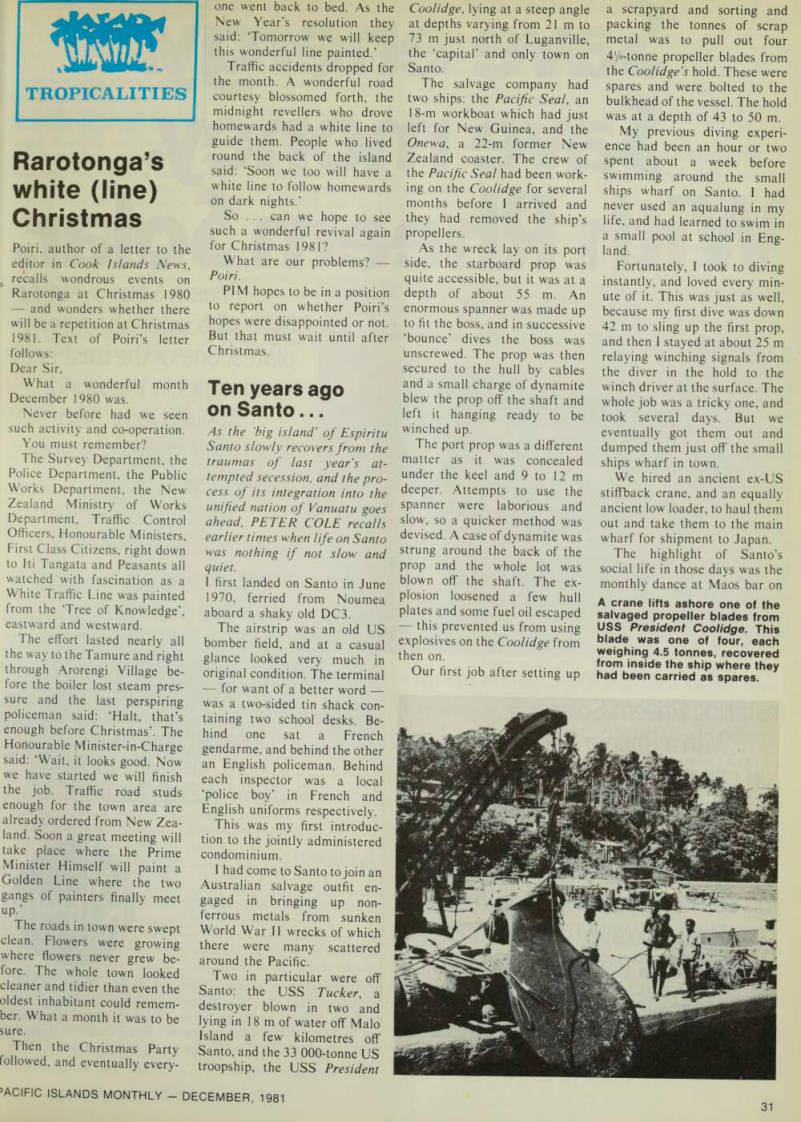

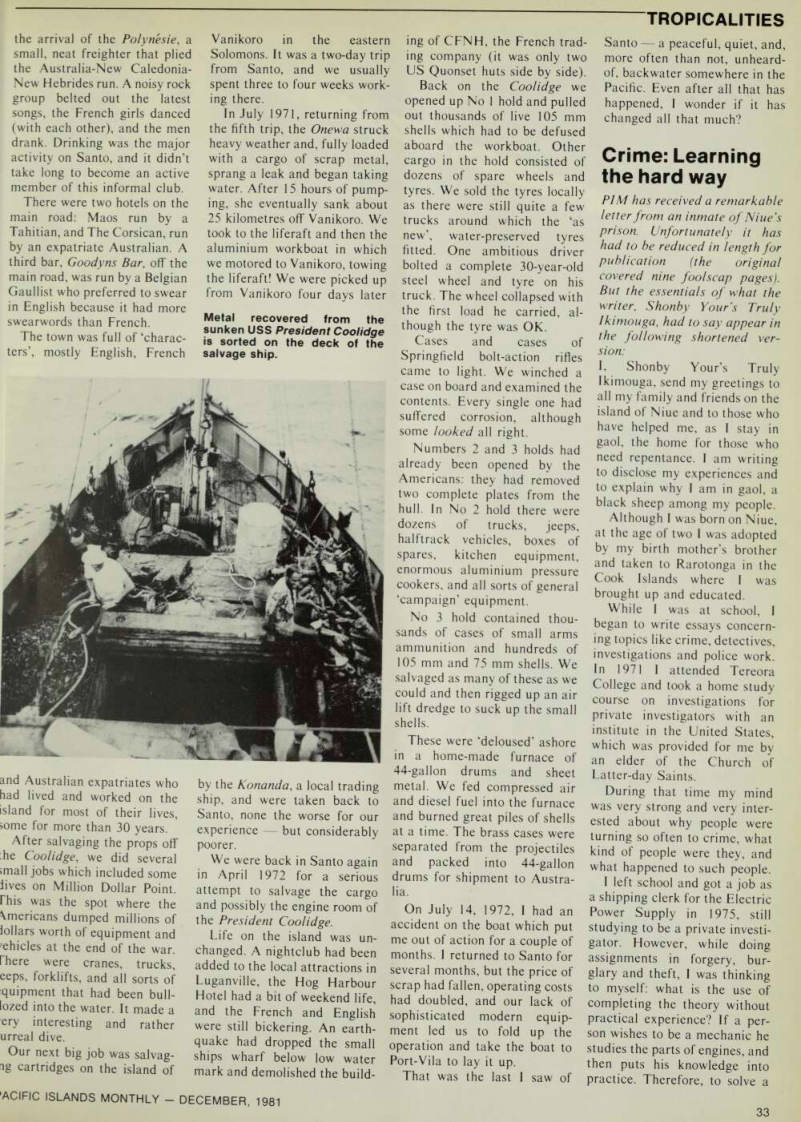
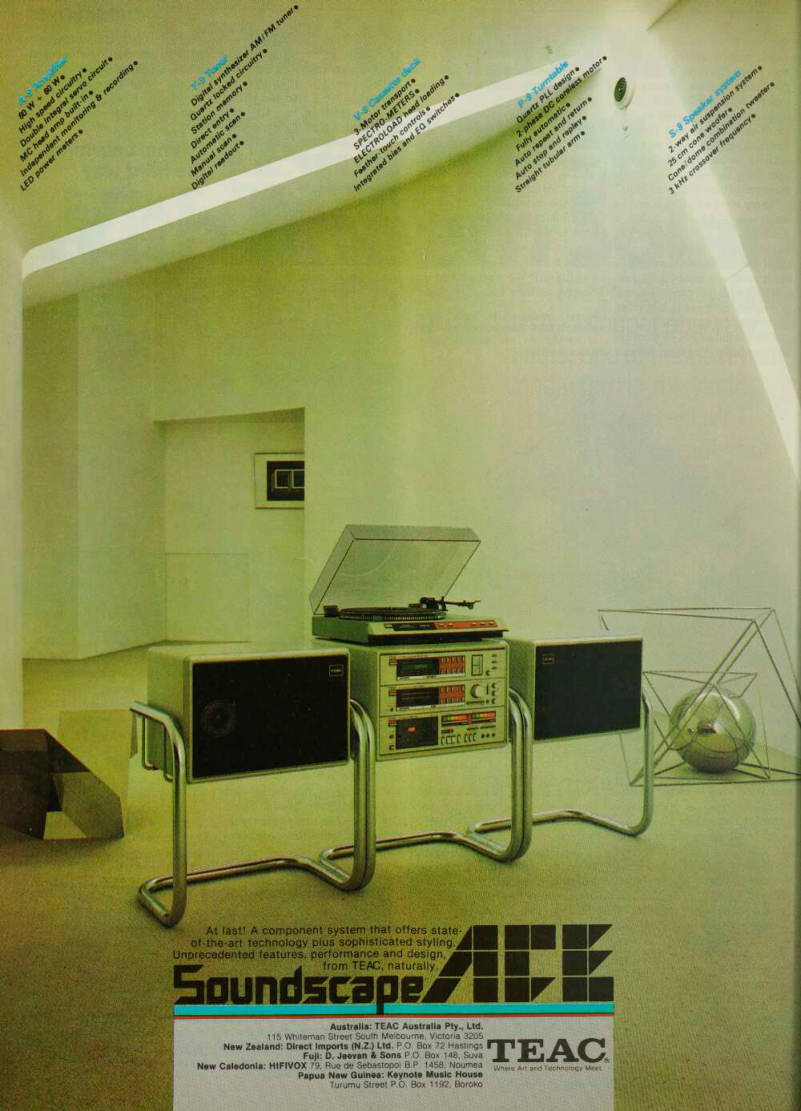
Tropicalities
Rarotonga’s white (line) Christmas
Poiri, author of a letter to the editor in Cook Islands News , 6 recalls wondrous events on Rarotonga at Christmas 1980 and wonders whether there will be a repetition at Christmas 1981. Text of Poiri’s letter follows: Dear Sir, What a wonderful month December 1980 was.
Never before had we seen such activity and co-operation.
You must remember?
The Survey Department, the Police Department, the Public Works Department, the New Zealand Ministry of Works Department, Traffic Control Officers, Honourable Ministers, First Class Citizens, right down to Iti Tangata and Peasants all watched with fascination as a White Traffic Line was painted from the ‘Tree of Knowledge’, eastward and westward.
The effort lasted nearly all the way to the Tamure and right through Arorengi Village be fore the boiler lost steam pres sure and the last perspiring policeman said; ‘Halt, that’s enough before Christmas’. The
Honourable Minister-in-Charge
said: ‘Wait, it looks good. Now we have started we will finish the job. Traffic road studs enough for the town area are already ordered from New Zea land. Soon a great meeting will take place where the Prime Minister Himself will paint a Golden Line where the two gangs of painters finally meet up.’
The roads in town were swept clean. Flowers were growing where flowers never grew be fore. The whole town looked cleaner and tidier than even the oldest inhabitant could remem ber. What a month it was to be sure.
Then the Christmas Party followed, and eventually every
one went back to bed. As the New Year’s resolution they said: Tomorrow we will keep this wonderful line painted.' Traffic accidents dropped for the month. A wonderful road courtesy blossomed forth, the midnight revellers who drove homewards had a white line to guide them. People who lived round the back of the island said: ‘Soon we too will have a white line to follow homewards on dark nights.’
So . . . can we hope to see such a wonderful revival again for Christmas 1981?
What are our problems?
Poiri.
PIM hopes to be in a position to report on whether Poiri’s hopes were disappointed or not.
But that must wait until after Christmas.
Ten years ago
on Santo...
As the ‘big island’ of Espiritu Santo slowly recovers from the traumas of last year’s at tempted secession, and the pro cess of its integration into the unified nation of Vanuatu goes ahead, PETER COLE recalls earlier times when life on Santo was nothing if not slow and quiet.
I first landed on Santo in June 1970, ferried from Noumea aboard a shaky old DC3.
The airstrip was an old US bomber field, and at a casual glance looked very much in original condition. The terminal for want of a better word was a two-sided tin shack con taining two school desks. Be hind one sat a French gendarme, and behind the other an English policeman. Behind each inspector was a local ‘police boy’ in French and English uniforms respectively.
This was my first introduc tion to the jointly administered condominium.
I had come to Santo to Join an Australian salvage outfit en gaged in bringing up non ferrous metals from sunken World War II wrecks of which there were many scattered around the Pacific.
Two in particular were off Santo: the USS Tucker , a destroyer blown in two and lying in 18 mof water off Malo Island a few kilometres off Santo, and the 33 000-tonne US troopship, the USS President
Coolidge , lying at a steep angle at depths varying from 21 m to 73 m just north of Luganville, the ‘capital’ and only town on Santo.
The salvage company had two ships: the Pacific Seal , an 18-m workboat which had just left for New Guinea, and the Onewa , a 22-m former New Zealand coaster. The crew of the Pacific Seal had been work ing on the Coolidge for several months before I arrived and they had removed the ship’s propellers.
As the wreck lay on its port side, the starboard prop was quite accessible, but it was at a depth of about 55 m. An enormous spanner was made up to fit the boss, and in successive ‘bounce’ dives the boss was unscrewed. The prop was then secured to the hull by cables and a small charge of dynamite blew the prop off the shaft and left it hanging ready to be winched up.
The port prop was a different matter as it was concealed under the keel and 9 to 12 m deeper. Attempts to use the spanner were laborious and slow, so a quicker method was devised. A case of dynamite was strung around the back of the prop and the whole lot was blown off the shaft. The ex plosion loosened a few hull plates and some fuel oil escaped this prevented us from using explosives on the Coolidge from then on.
Our first job after setting up
a scrapyard and sorting and packing the tonnes of scrap metal was to pull out four 4‘/4-tonne propeller blades from the Coolidge’s hold. These were spares and were bolted to the bulkhead of the vessel. The hold was at a depth of 43 to 50 m.
My previous diving experi ence had been an hour or two spent about a week before swimming around the small ships wharf on Santo. I had never used an aqualung in my life, and had learned to swim in a small pool at school in Eng land.
Fortunately, I took to diving instantly, and loved every min ute of it. This was just as well, because my first dive was down 42 m to sling up the first prop, and then I stayed at about 25 m relaying winching signals from the diver in the hold to the winch driver at the surface. The whole job was a tricky one, and took several days. But we eventually got them out and dumped them just off the small ships wharf in town.
We hired an ancient ex-US stiffback crane, and an equally ancient low loader, to haul them out and take them to the main wharf for shipment to Japan.
The highlight of Santo’s social life in those days was the monthly dance at Maos bar on
A crane lifts ashore one of the salvaged propeller blades from USS President Coolidge. This blade was one of four, each weighing 4.5 tonnes, recovered from inside the ship where they had been carried as spares.
the arrival of the Polynesie , a small, neat freighter that plied the Australia-New Caledonia- New Hebrides run. A noisy rock group belted out the latest songs, the French girls danced (with each other), and the men drank. Drinking was the major activity on Santo, and it didn’t take long to become an active member of this informal club.
There were two hotels on the main road: Maos run by a Tahitian, and The Corsican, run by an expatriate Australian. A third bar, Goodyns Bar, off the main road, was run by a Belgian Gaullist who preferred to swear in English because it had more swearwords than French.
The town was full of ‘charac ters’, mostly English, French
Vanikoro in the eastern Solomons. It was a two-day trip from Santo, and we usually spent three to four weeks work ing there.
In July 1971, returning from the fifth trip, the Onewa struck heavy weather and, fully loaded with a cargo of scrap metal, sprang a leak and began taking water. After 15 hours of pump ing, she eventually sank about 25 kilometres off Vanikoro. We took to the liferaft and then the aluminium workboat in which we motored to Vanikoro, towing the liferaft! We were picked up from Vanikoro four days later
and Australian expatriates who had lived and worked on the island for most of their lives, some for more than 30 years.
After salvaging the props off ;he Coolidge , we did several imall jobs which included some lives on Million Dollar Point.
Phis was the spot where the \mericans dumped millions of lollars worth of equipment and 'chicles at the end of the war. fhere were cranes, trucks, eeps, forklifts, and all sorts of quipment that had been bull iozed into the water. It made a cry interesting and rather urreal dive.
Our next big job was salvag es cartridges on the island of
by the Konanda, a local trading ship, and were taken back to Santo, none the worse for our experience but considerably poorer.
We were back in Santo again in April 1972 for a serious attempt to salvage the cargo and possibly the engine room of the President Coolidge.
Life on the island was un changed. A nightclub had been added to the local attractions in Luganville, the Hog Harbour Hotel had a bit of weekend life, and the French and English were still bickering. An earth quake had dropped the small ships wharf below low water mark and demolished the build
ing of CFNH, the French trad ing company (it was only two US Quonset huts side by side).
Back on the Coolidge we opened up No 1 hold and pulled out thousands of live 105 mm shells which had to be defused aboard the workboat. Other cargo in the hold consisted of dozens of spare wheels and tyres. We sold the tyres locally as there were still quite a few trucks around which the ‘as new’, water-preserved tyres fitted. One ambitious driver bolted a complete 30-year-old steel wheel and tyre on his truck. The wheel collapsed with the first load he carried, al though the tyre was OK.
Cases and cases of Springfield bolt-action rifles came to light. We winched a case on board and examined the contents. Every single one had suffered corrosion, although some looked all right.
Numbers 2 and 3 holds had already been opened by the Americans: they had removed two complete plates from the hull. In No 2 hold there were dozens of trucks, jeeps, halftrack vehicles, boxes of spares, kitchen equipment, enormous aluminium pressure cookers, and all sorts of general ‘campaign’ equipment.
No 3 hold contained thou sands of cases of small arms ammunition and hundreds of 105 mm and 75 mm shells. We salvaged as many of these as we could and then rigged up an air lift dredge to suck up the small shells.
These were ‘deloused’ ashore in a home-made furnace of 44-gallon drums and sheet metal. We fed compressed air and diesel fuel into the furnace and burned great piles of shells at a time. The brass cases were separated from the projectiles and packed into 44-gallon drums for shipment to Austra lia.
On July 14, 1972, I had an accident on the boat which put me out of action for a couple of months. I returned to Santo for several months, but the price of scrap had fallen, operating costs had doubled, and our lack of sophisticated modern equip ment led us to fold up the operation and take the boat to Port-Vila to lay it up.
That was the last I saw of
Santo a peaceful, quiet, and, more often than not, unheard of, backwater somewhere in the Pacific. Even after all that has happened, I wonder if it has changed all that much?
Crime: Learning
the hard way
PIM has received a remarkable letter from an inmate of Niue’s prison. Unfortunately it has had to be reduced in length for publication (the original covered nine foolscap pages).
But the essentials of what the writer, Shonby Your’s Truly Ikimouga, had to say appear in the following shortened ver sion: I, Shonby Your’s Truly Ikimouga, send my greetings to all my family and friends on the island of Niue and to those who have helped me, as I stay in gaol, the home for those who need repentance. I am writing to disclose my experiences and to explain why I am in gaol, a black sheep among my people.
Although I was born on Niue, at the age of two I was adopted by my birth mother’s brother and taken to Rarotonga in the Cook Islands where I was brought up and educated.
While I was at school, I began to write essays concern ing topics like crime, detectives, investigations and police work.
In 1971 I attended Tereora College and took a home study course on investigations for private investigators with an institute in the United States, which was provided for me by an elder of the Church of
Latter-day Saints.
During that time my mind was very strong and very inter ested about why people were turning so often to crime, what kind of people were they, and what happened to such people.
I left school and got a job as a shipping clerk for the Electric Power Supply in 1975, still studying to be a private investi gator. However, while doing assignments in forgery, bur glary and theft, I was thinking to myself: what is the use of completing the theory without practical experience? If a per son wishes to be a mechanic he studies the parts of engines, and then puts his knowledge into practice. Therefore, to solve a
Metal recovered from the sunken USS President Coolidge is sorted on the deck of the salvage ship.
crime, one must be involved in crime, and so I decided to sacrifice myself to find out what drives people to commit crimes and to experience myself what happens to such people.
The first time I put the theories I had studied into practice was when I forged $150.00 on a cheque book. I donated the money to the church, and I was found out, and was sentenced to one year on probation. My parents hit me and I was teased by people and I was without friends. 1 got married and returned to Niue. In 1980 I completed the theory in my studies and passed all 12 courses, gaining a badge, an identification card and a diploma as a qualified pro fessional investigator. Although the institute in the United States provided the theory, the practical part was my own idea, and I felt that 1 needed to experience it further. 1 became employed with Burns Philp (SS) Co Ltd as an invoice customs clerk. My job was to clear cargoes from cus toms and I was told to make payments for all goods entered on import entries. I did not wish to handle cash as it is the job of the cashiers, but they told me to still do what I am told to do. As my wages of $33.75 a week could not provide for me and my family, I used some of the cash intended for payments of import duties for myself. I told the manager what I had done, and he reported me to the police.
When I went to court, I had no legal aid, and although I explained to the judge my reasons for commiting the crime, he said policemen do courses but they don’t get involved in criminal offences, and he sentenced me to three years in prison. My appeal against the sentence failed, even though I had a wife and two daughters to support, and although I offered to repay Burns Philp out of my wages, they refused.
So I am writing from prison to share my experiences and what I have found out about being a criminal.
Firstly, people often steal Decause they do not have mough money to buy the things hey need. Forgery is a crime
usually committed by teenagers, mainly males who want easy money for pleasure, Burglary starts because youths want what the rich persons have, and is usually committed by those from poor families, Second, although in this world today everyone has done something bad, if you are from a highly respected family and you commit a crime, everything possible is done to get you out of prison, but a person from a poor family is not recognised and is left to his fate. People with important jobs or relatives of the judge get away without being convicted, or are not sent to gaol, which is not fair to others.
Third, when a person has been sent to prison and later released, he should be treated like a human being. Fie has worked for so many months or years in prison and when he comes out he is utterly clean, he has paid back what he did and should be given a chance, Here in prison, we have no blankets, no sort of entertain ment facilities, no library and it is very dirty. I feel very sorry for my family and all the families
of the other people in prison with me. For those families, whose sons and fathers are in prison, cannot support them selves.
I wish to start an appeal fund, to be called the Prison Inmates Family Benefit Fund. It is time we help these families. I don’t mind about me but I am worried for the others. I have accomplished my mission and have done what no man dare try to do, to qualify as a private investigator and to experience crimes as well, although it is not nice in prison. But I appeal to you to support the fund. And also, please feel free to write to me and tell me what you think about what I have done. Is it right? Is it wrong? It is for you all to answer.
Finally, you parents are the teachers of your children. Give them what they need and love them the Christian way. That way you will never depart from your children and your children
will never depart from you to go to prison. Also, never under estimate yourself because you never know what will happen to you, so be alert for temptations and do not do dishonest things.
God bless you all.
Shonby Your’s Truly Ikimouga, PO Box 13, Alofi South, Niue Island.
Top windsurfers
for Fiji in June
More than 400 of the world’s best windsurfers will be pitting muscles and skills against each other at Fiji’s Beachcomber Island Resort next June at the First World Professional
Windsurf Championships.
Competitors from Europe, Japan, USA, Canada, Austra lia, New Zealand and Fiji itself, are expected to take part in the four rated events slalom, freestyle, long-distance endur ance and pentathlon.
Racing will take place in the waters surrounding Beach comber and Treasure Islands, 15 km off Lautoka, and will last from June 20-July 4. Canadian Pacific Airlines are sponsoring the competition, which offers $3O 000 (Canadian) to be won.
A travel package, including 14 nights’ accommodation, and all meals, plus some special evening functions, has been prepared for the event. In addition to its two islands resort facilities the Islands in the Sun company will anchor its mini liner Matthews Flinders off the islands for use as a hotel-ship.
Fund to honour
John Knight
The great interest and involve ment in the South Pacific by Australian Senator John Knight, who died in March (PIM Apr p 9), is to be perpetu ated with a special fund estab lished in his memory.
Details of the fund were given in Suva by Mr Roger Shipton, a member of the Aus tralian Parliament and chair man of the Parliamentary Joint Committee on Foreign Affairs and Defence.
Mr Shipton was visiting Fiji as a special emissary of the Australian Government for ad vance talks with the Prime
Windsurfing is rapidly becom ing a big sport in a number of Pacific harbours, and the first world championships will be in Fiji next year.-Alize picture in Corail, New Caledonia.
Minister of Fiji, Ratu Sir Kamisese Mara, about the Commonwealth Heads of Gov ernment Meeting in Melbourne in September-October.
Mr Shipton said that under the fund it was proposed that South Pacific islanders would visit Australia to expand their professional and educational ex perience and to increase under standing between the countries.
Where possible, it would favour handicapped people, or those involved in their care.
The fund would be adminis tered by the Australian National University, where earlier in his career John Knight held a public service fellowship. The university would have an advisory and selection committee including Members of Parliament and Senator Knight’s family, to choose the fellows.
Senator Knight, who died from a heart attack aged 37, was an officer of the Australian Department of Foreign Affairs before entering parliament and served in India, Fiji and Saudi Arabia.
During his parliamentary ca reer he was a member of the Senate Standing Committee on Foreign Affairs and Defence which reported on Australia and the South Pacific. Aus tralian Information Service.
Bounty for sale,
at $5,175 million
Bounty fever swept Auckland last October, with tens of thou sands of sightseers clambering over the replica of the famous 18th-century sailing ship during her first visit to the city.
Graeme Kennedy reports in the New Zealand paper 8 O’clock: Schoolchildren and office workers lined up with housewives and businessmen for almost an hour at times for their chance to go aboard the majestic vessel at Princes Wharf . . .
More than 50 000 people crowded the wharf on the Sunday to relive if only for an hour or so the long-gone days of the tall ships.
The 30 m replica the star of the 1981 Travel Show has had a controversial career since Mrs Thea Muldoon launched
her at the Whangarei engineer ing yards in December, 1978.
Bounty was built for $2.5 million for the Dino De Laurentiis Corp., which had asked top producer David Lean to make two films about the 1789 mutiny The Law breaker and The Long Arm.
De Laurentiis, however, scrapped plans for the movies in 1979 and Lean was unable to find other backers.
The Bounty became a tourist attraction in Whangarei’s town basin but was closed to the public for several months in late 1979 when she was arrested and a writ nailed to her mast.
Her builders alleged that the De Laurentiis company had failed to make final payment.
The dispute settled, Bounty resumed her role as a tourist attraction; then De Laurentiis announced that the great ship was for sale for $5,175 million.
Since then, several schemes have been put forward as a means of keeping the Bounty in New Zealand waters and, in September 1981, it was sug gested she sail to the UK to commemorate the centenary of the first shipment of frozen meat from New Zealand to London.
Meanwhile, a Bounty Society has been formed to try to raise the millions needed to buy the ship.
Whatever her fate, it will be a long time before Aucklanders forget the memories of another age the Bounty brought to the city.
‘Freedom route’
for Oz crime
It appears that Lord Howe and Norfolk Islands are playing an unwitting role in the criminal world by forming an important part of an escape route for fugitives from the law in Aus tralia.
It has been discovered that criminals can by-pass the rigor ous security checks at Austra lia’s international airports by slipping out of the country via Port Macquarie on the New South Wales north coast. They then island-hop by air to Lord Howe, Norfolk Island and on to New Zealand.
During the entire trip, the
only official check is made on the tiny island of Lord Howe which has a population of 250 people, no police force, and a radio telephone to the mainland which only works a few hours each day. The Lord Howe check is made to ensure that each passenger has a valid passport, and as forged pass ports and identification papers are readily available through the Australian underworld net work for between $2OOO and $20,000 depending on how ‘big’ the criminal in question is, this is not an insurmountable hurdle.
On reaching New Zealand the traveller is safe unless arbitrarily singled out for atten tion, as there is normally no provision for New Zealand police and immigration officials to have a copy of the Australian ‘wanted’ list.
The problem lies in the fact that both Lord Howe and Norfolk Islands are considered part of Australia, and flights to them are classified as internal and therefore do not have to undergo the stringent security checks required for inter national travel. The route is also believed to be used for smug gling narcotics into Australia from Asia via New Zealand and Fiji.
Australian police are aware of the existence of the route, and attempts to tighten up security between New Zealand and Australia were made from July 1 this year with the introduction of passports for travel between the two countries (pre-anounced in PIM Jun p 6).
At time of writing, they ' appear to be doing little more than scratching their heads as to what more can be done to close off this embarrassing ‘freedom route’ for wanted criminals.
Ancient pottery
find in Fiji
Fragments of clay figurines 3000 years older than anything like them found in Fiji before have been unearthed at Naigani Island between Viti Levu and Ovalau.
The only other known Fijian pottery figures date from the 19th century, according to
Fergus Clunie, director of the Fiji Museum. He rates the Naigani find as ‘an archaeol ogical discovery of the most primary significance’.
The fragments include a skull-like human face, part of a dog-like or pig-like animal, and part of an unknown animal.
Mr Clunie said they were 3000 to 3500 years old and were related to what is known as Capita pottery, a product of what are believed to have been the first people to settle in Fiji in about 1500 BC. They turned up during drain digging for a resort on the island being built by Naigani Resorts Ltd.
The company’s managing di rector, Charles Williams, and works manager, John Moore, immediately realised the value of the find and halted work until the museum could carry out an excavation, Mr Clunie said.
Led by a New Zealand auth ority on Capita pottery, Simon Best, a team from the museum worked through August and early September and recovered several hundred kilograms of material.
Mr Best was reluctant to give a firm verdict until a detailed examination of the pottery had been made, but it looked as if Naigani was one of the earliest occupied sites in the Fiji group, Mr Clunie said. The site seemed also to have been used for the manufacture of stone adzes and shell bracelets.
Some chips of black obsidian or volcanic glass could have been imported from New Britain, off the northeast New Guinea coast.
This will be remarkable evi dence for the crossing of the broad sea gap between Fiji and Melanesia, if this proves to be true, and could suggest some sort of direct or indirect contact between the Capita pottery using people of Fiji and northwest Melanesia over 3000 years ago.’
The site seemed to have lain undisturbed since it had been abandoned, a rather unusual situation for so old a site in a country which had been for so long heavily populated, Mr Clunie said.
The 3000-year-old pottery figures will go on display in the museum after detailed study.
From The Fiji Times
Advertisements & other items, pp. 32-35 (3 items)
Save money.
Save energy.
With Rheem Solar.
txheem Now is the time to think about installing Rheem Solar.
With a Rheem Solar system, you can save on your annual hot water bill and help conserve valuable energy.
A Rheem Solar system offers you some very special features The exclusive Rheem Sunstat* valve controls water temperature.
This means your water temperature can't exceed 70 degrees, so there is no risk of accidental scalding.
Rheem Solar systems have all copper absorber plates, one of the best heat conductors in the world.
Their 200 or 300litre capacity will suit your family needs.
And they come with Rheem reliability and 40 years’ experience in the hot water business.
For a free brochure on Rheem Solar, send in the coupon below.
Hb: Export Manager, Appliance Division, Rheem Australia Ltd, RO.
Box 6, Rydalmere 2116. Australia.
Name: Address: ft
ITI
DISTRIBUTORS: PAPUA NEW GUINEA. Steamships Trading Co. Ltd: Port Moresby, Lae, Kieta, Goroka, Madang, Rabaul, Popondetta, Kundiawa, Samaria, Mt. Hagen, Vanimo. Mainland Plumbing Supplies: Lae. NEW CALEDONIA. Ballande: Noumea. TAHITI. Coupimex: Papeete.
We would welcome enquiries for agencies in areas not covered above.
RHAIIO6
At last! A component system that offers stateof-the-art technology plus sophisticated styling Unprecedented features, performance and design, pßpr from TEAC, naturally.
Soundscape
r i r Australia: TEAC Australia Pty., Ltd. 115 Whiteman Street South Melbourne, Victoria 3205 New Zealand: Direct Imports (N.Z.) Ltd. P.O. Box 72 Hastings Fuji; D. Jeevan & Sons P.O. Box 148, Suva New Caledonia: HIFIVOX 79. Rue de Sebastopol B.P. 1458, Noumea Papua New Guinea: Keynote Music House Turumu Street P.O. Box 1192, Boroko
TEAC.
Where Art and Technology Meet
33
TROPIC ALITIES
’ACIFIC ISLANDS MONTHLY - DECEMBER, 1981
35
TROPICALITIES
3 ACIFIC ISLANDS MONTHLY DECEMBER, 1981
People
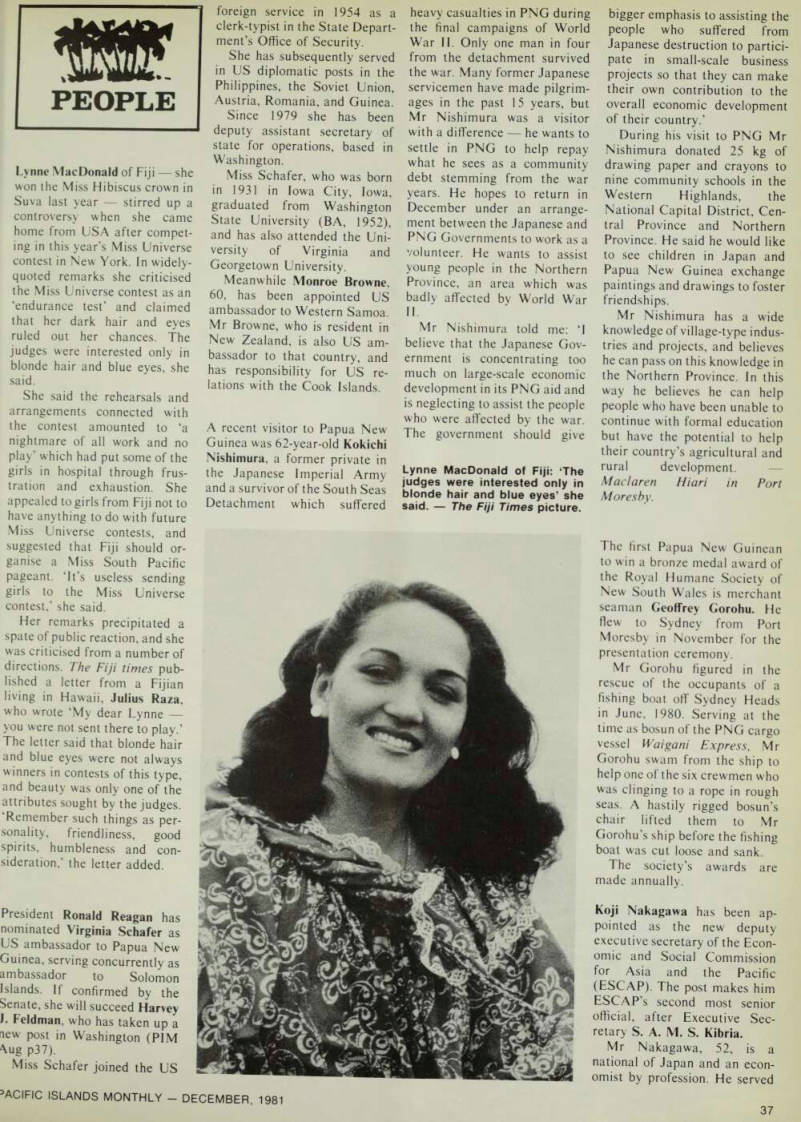
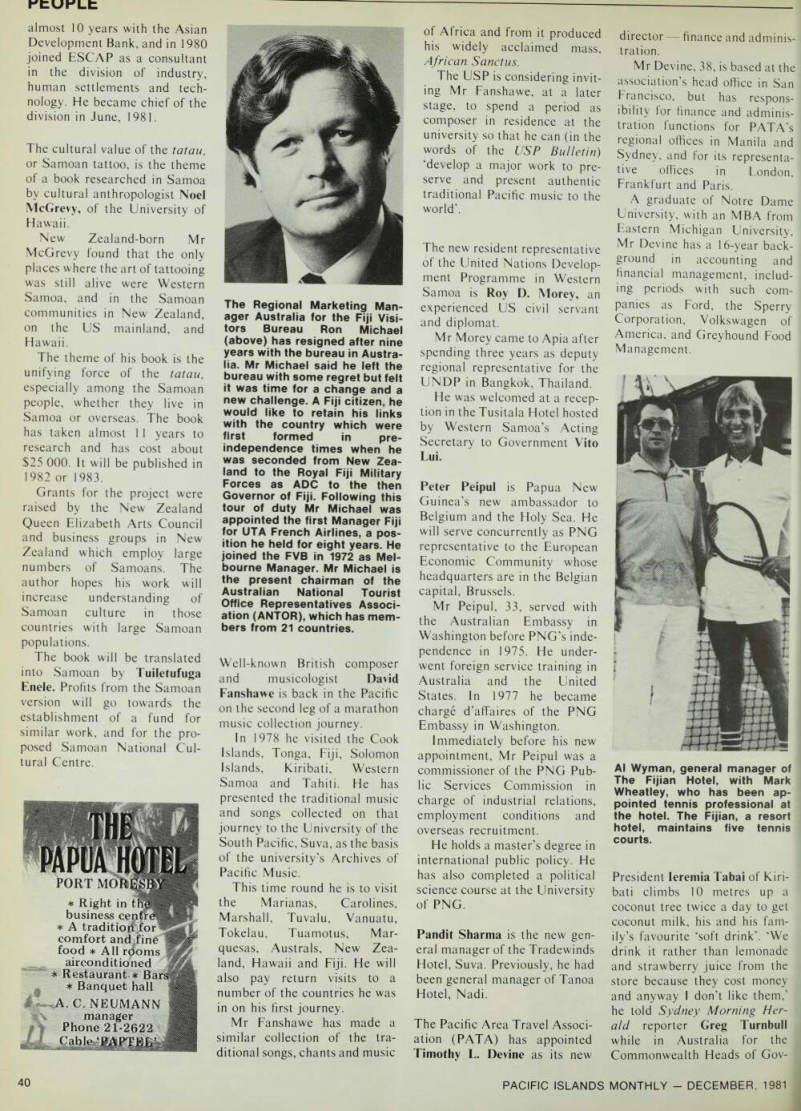
Lynne MacDonald of Fiji she won the Miss Hibiscus crown in Suva last year stirred up a controversy when she came home from USA after compet ing in this year’s Miss Universe contest in New York. In widely quoted remarks she criticised the Miss Universe contest as an ‘endurance test’ and claimed that her dark hair and eyes ruled out her chances. The judges were interested only in blonde hair and blue eyes, she said.
She said the rehearsals and arrangements connected with the contest amounted to ‘a nightmare of all work and no play’ which had put some of the girls in hospital through frus tration and exhaustion. She appealed to girls from Fiji not to have anything to do with future Miss Universe contests, and suggested that Fiji should or ganise a Miss South Pacific pageant. ‘lt’s useless sending girls to the Miss Universe contest,’ she said.
Her remarks precipitated a spate of public reaction, and she was criticised from a number of directions. The Fiji times pub lished a letter from a Fijian living in Hawaii, Julius Raza, who wrote ‘My dear Lynne you were not sent there to play.’
The letter said that blonde hair and blue eyes were not always winners in contests of this type, and beauty was only one of the attributes sought by the judges. ‘Remember such things as per sonality, friendliness, good spirits, humbleness and con sideration,’ the letter added.
President Ronald Reagan has nominated Virginia Schafer as US ambassador to Papua New Guinea, serving concurrently as ambassador to Solomon Islands. If confirmed by the Senate, she will succeed Harvey J. Feldman, who has taken up a lew post in Washington (PIM p37).
Miss Schafer joined the US
foreign service in 1954 as a clerk-typist in the State Depart ment’s Office of Security.
She has subsequently served in US diplomatic posts in the Philippines, the Soviet Union, Austria, Romania, and Guinea.
Since 1979 she has been deputy assistant secretary of state for operations, based in Washington.
Miss Schafer, who was born in 1931 in lowa City, lowa, graduated from Washington State University (BA, 1952), and has also attended the Uni versity of Virginia and Georgetown University.
Meanwhile Monroe Browne. 60, has been appointed US ambassador to Western Samoa.
Mr Browne, who is resident in New Zealand, is also U T S am bassador to that country, and has responsibility for US re lations with the Cook Islands.
A recent visitor to Papua New Guinea was 62-year-old Kokichi Nishimura, a former private in the Japanese Imperial Army and a survivor of the South Seas Detachment which suffered
heavy casualties in PNG during the final campaigns of World War 11. Only one man in four from the detachment survived the war. Many former Japanese servicemen have made pilgrim ages in the past 15 years, but Mr Nishimura was a visitor with a difference he wants to settle in PNG to help repay what he sees as a community debt stemming from the war years. He hopes to return in December under an arrange ment between the Japanese and PNG Governments to work as a volunteer. He wants to assist young people in the Northern Province, an area which was badly affected by World War 11.
Mr Nishimura told me; ‘I believe that the Japanese Gov ernment is concentrating too much on large-scale economic development in its PNG aid and is neglecting to assist the people who were affected by the war.
The government should give
bigger emphasis to assisting the people who suffered from Japanese destruction to partici pate in small-scale business projects so that they can make their own contribution to the overall economic development of their country.’
During his visit to PNG Mr Nishimura donated 25 kg of drawing paper and crayons to nine community schools in the Western Highlands, the National Capital District, Cen tral Province and Northern Province. He said he would like to see children in Japan and Papua New Guinea exchange paintings and drawings to foster friendships.
Mr Nishimura has a wide knowledge of village-type indus tries and projects, and believes he can pass on this knowledge in the Northern Province. In this way he believes he can help people who have been unable to continue with formal education but have the potential to help their country’s agricultural and rural development.
Maclaren Hiari in Port Moresby.
The first Papua New Guinean to win a bronze medal award of the Royal Humane Society of New South Wales is merchant seaman Geoffrey Gorohu. He flew to Sydney from Port Moresby in November for the presentation ceremony.
Mr Gorohu figured in the rescue of the occupants of a fishing boat off Sydney Heads in June, 1980. Serving at the time as bosun of the PNG cargo vessel Waigani Express. Mr Gorohu swam from the ship to help one of the six crewmen who was clinging to a rope in rough seas. A hastily rigged bosun’s chair lifted them to Mr Gorohu’s ship before the fishing boat was cut loose and sank.
The society’s awards are made annually.
Koji Nakagawa has been ap pointed as the new deputy executive secretary of the Econ omic and Social Commission for Asia and the Pacific (ESCAP). The post makes him ESCAP’s second most senior official, after Executive Sec retary S. A. M. S. Kibria.
Mr Nakagawa, 52, is a national of Japan and an econ omist by profession. He served
Lynne MacDonald of Fiji: ‘The judges were interested only in blonde hair and blue eyes' she said.- The Fiji Times picture.
almost 10 years with the Asian Development Bank, and in 1980 joined ESCAP as a consultant in the division of industry, human settlements and tech nology. He became chief of the division in June, 1981.
The cultural value of the tatau, or Samoan tattoo, is the theme of a book researched in Samoa by cultural anthropologist Noel McGrevy, of the University of Hawaii.
New Zealand-born Mr McGrevy found that the only places where the art of tattooing was still alive were Western Samoa, and in the Samoan communities in New Zealand, on the US mainland, and Hawaii.
The theme of his book is the unifying force of the tatau. especially among the Samoan people, whether they live in Samoa or overseas. The book has taken almost 11 years to research and has cost about $25 000. It will be published in 1982 or 1983.
Grants for the project were raised by the New Zealand Queen Elizabeth Arts Council and business groups in New Zealand which employ large numbers of Samoans. The author hopes his work will increase understanding of Samoan culture in those countries with large Samoan populations.
The book will be translated into Samoan by Tuiletufuga Enele. Profits from the Samoan version will go towards the establishment of a fund for similar work, and for the pro posed Samoan National Cul tural Centre.
Well-known British composer and musicologist David Fanshawe is back in the Pacific on the second leg of a marathon music collection journey.
In 1978 he visited the Cook Islands, Tonga, Fiji, Solomon Islands, Kiribati, Western Samoa and Tahiti. He has presented the traditional music and songs collected on that journey to the University of the South Pacific, Suva, as the basis of the university’s Archives of Pacific Music.
This time round he is to visit the Marianas, Carolines, Marshall, Tuvalu, Vanuatu, Tokelau, Tuamotus, Mar quesas, Australs, New Zea land, Hawaii and Fiji. He will also pay return visits to a number of the countries he was in on his first journey.
Mr Fanshawe has made a similar collection of the tra ditional songs, chants and music
of Africa and from it produced his widely acclaimed mass, African Sanctus.
The USP is considering invit ing Mr Fanshawe, at a later stage, to spend a period as composer in residence at the university so that he can (in the words of the USP Bulletin) ‘develop a major work to pre serve and present authentic traditional Pacific music to the world’.
The new resident representative of the United Nations Develop ment Programme in Western Samoa is Roy D. Morey, an experienced US civil servant and diplomat.
Mr Morey came to Apia after spending three years as deputy regional representative for the UNDP in Bangkok, Thailand.
He was welcomed at a recep tion in the Tusitala Hotel hosted by Western Samoa’s Acting Secretary to Government Vito Lui.
Peter Peipul is Papua New Guinea’s new ambassador to Belgium and the Holy Sea. He will serve concurrently as PNG representative to the European Economic Community whose headquarters are in the Belgian capital, Brussels.
Mr Peipul, 33, served with the Australian Embassy in Washington before PNG’s inde pendence in 1975. He under went foreign service training in Australia and the United States. In 1977 he became charge d’affaires of the PNG Embassy in Washington.
Immediately before his new appointment, Mr Peipul was a commissioner of the PNG Pub lic Services Commission in charge of industrial relations, employment conditions and overseas recruitment.
He holds a master’s degree in international public policy. He has also completed a political science course at the University of PNG.
Pandit Sharma is the new gen eral manager of the Tradewinds Hotel, Suva. Previously, he had been general manager of Tanoa Hotel, Nadi.
The Pacific Area Travel Associ ation (PATA) has appointed Timothy L. Devine as its new
director finance and adminis tration.
Mr Devine, 38, is based at the association’s head office in San Francisco, but has respons ibility for finance and adminis tration functions for PATA’s regional offices in Manila and Sydney, and for its representa tive offices in London, Frankfurt and Paris.
A graduate of Notre Dame University, with an MBA from Eastern Michigan University, Mr Devine has a 16-year back ground in accounting and financial management, includ ing periods with such com panies as Ford, the Sperry Corporation, Volkswagen of America, and Greyhound Food Management.
President leremia Tabai of Kiri bati climbs 10 metres up a coconut tree twice a day to get coconut milk, his and his fam ily’s favourite ‘soft drink’. ‘We drink it rather than lemonade and strawberry juice from the store because they cost money and anyway I don’t like them,’ he told Sydney Morning Her ald reporter Greg Turnbull while in Australia for the Commonwealth Heads of Gov
The Regional Marketing Man
ager Australia for the Fiji Visi tors Bureau Ron Michael (above) has resigned after nine years with the bureau in Austra lia. Mr Michael said he left the bureau with some regret but felt it was time for a change and a new challenge. A Fiji citizen, he would like to retain his links with the country which were first formed in pre independence times when he was seconded from New Zea land to the Royal Fiji Military Forces as ADC to the then Governor of Fiji. Following this tour of duty Mr Michael was appointed the first Manager Fiji for UTA French Airlines, a pos ition he held for eight years. He joined the FVB in 1972 as Mel bourne Manager. Mr Michael is the present chairman of the Australian National Tourist Office Representatives Associ ation (ANTOR), which has mem bers from 21 countries.
Al Wyman, general manager of The Fijian Hotel, with Mark Wheatley, who has been ap pointed tennis professional at the hotel. The Fijian, a resort hotel, maintains five tennis courts.
ernment Meeting last October.
President Tabai also had another reason for this activity, according to Turnbull, who wrote: The president climbs trees because one day he may have to do it for a living. He faces a presidential election next February and if he loses . . . well, there are no parliamen tary pensions in Kiribati.' Speaking of his chances of re election, President Tabai told Turnbull; ‘lf you say you are confident you will be re-elected in Kiribati, you are throwing away votes. ‘I will not over-campaign, in fact I may not campaign at all.
It is more important to be known personally, for people to think you have commonsense ‘I am retaining the way of a normal villager so it will not be a shock if I lose my job. I do not fear returning to the outer islands.’
The 31-year-old president does not like to play sport because he is conscious of his youth and does not want to give the impression that he is cava lier about his job, Turnbull wrote. ‘I try to judge the view of the people about how they expect me to behave. They do not want me to be playing all the time,’ he said.
Commenting on the ‘North- South Dialogue’ which loomed large at the CHOGM meeting.
President Tabai said: ‘We are at the mercy of the developed countries, but we feel our needs are largely ignored . . . ‘We put a lot of hope on the development of our fisheries resources. But, for instance, we need a wharf that would cost $3 million, and it is beyond our capacity. ‘Wharves are not made of dialogues . ..’
For American Dr Frederic Sutter, filming a shark being caught in traditional Samoan style was the highlight of a recent three-month assignment in Western Samoa.
According to a report in The Samoa Times, he was there to make films and displays for US and other educational establish ments on the people, places and customs of Samoa.
But one thing eluded him until quite late in his stay: he
had been unable to get film of a shark being caught in the tra ditional manner.
Then one day he was in a boat with two fishermen a few kilo metres off the island of Siumu when they sighted a shark. The fishermen began rattling loose pieces of coconut the sound of which attracted the shark it is believed the noise resembles that made by a wounded fish.
The shark was lured closer to the boat with bonito and mutton bait dangled on the end of a coconut-fibre string. ‘lt was rather like teasing a bull at a bullfight,’ said Dr Sutter. When the shark was alongside, fisherman Faaaso slipped a noose of especially strong coconut fibre over its head, making sure at the same time it was placed well down its body. Then he pulled the noose tight and lifted the thrashing shark out of the water. His mate rammed the stick down its throat and struck it over the head 10 times, killing it.
Dr Sutter said the technique was highly ingenious, consider ing that only coconut fibre was used to make the catch. New fishing techniques have by now made this method practically obsolete. But he was greatly pleased that he’d been able to record it on film.
He said: ‘Showing American teenagers a picture of a kava ceremony probably won’t inter est them very much. But show them a shark caught this way and they’ll really sit up and say
“wow”, and they will have a new respect for Samoans.’
Gary B. Wong, former consul at the Australian high commission in Vanuatu, has returned to Canberra after a two-year post ing. During his service in Vanuatu, he experienced the upgrading of the Australian diplomatic mission from a con sulate (under William Fisher) to a high commission (under Michael Ovington) when Vanuatu became independent in 1980.
Gary Wong was very actively involved looking after the affairs of Australian citizens caught on both sides of the prison fence during the Santo rebellion of May-August 1980.
His antics on the cricket pitch will be greatly missed by his friends.
Replacing him in Port-Vila is Robert E. Secombe, whose most recent postings were in Jakarta and Cairo. lan Mclntyre in Port-Vila.
Vance C. Pace is the newly appointed US International Communication Agency (USICA) public affairs officer in Fiji. He replaces Don Crider who has returned to the USA.
Born in Utah, Mr Pace has had extensive diplomatic ex perience in Latin America, and
speaks Spanish as a second language.
A graduate of the Fiji School of Medicine, Dr Balram Iyer, has become the first local graduate to become a member of the Royal Australian and New Zea land College of Psychiatrists.
Dr Iyer is consultant psychiatrist and medical super intendent at St Giles Hospital, Suva, and is also the first local graduate to hold this position.
In 1976 he was awarded a New Zealand Government scholarship to study psychiatry at Otago University, where he completed his post-graduate course in psychological medi cine in 1979.
Yoda Nysta has been confirmed for a new three-year term as Public Service Commissioner of the Marshall Islands.
Confirmation came in a vote of 13-10 in the Nitijela (parlia ment).
A Cook Islander, Paul Koteke, 24, was chosen as a member of the New Zealand All Blacks Rugby Union team which re cently toured France and Romania. He was the first Cook Islands player ever to win selec tion in the team.
Joe Mulders (PIM People Apr p 35) has returned to Australia to live after almost 20 years spent in New Hebrides/ Vanuatu.
Arriving in Port-Vila in 1962, Mr Mulders was first involved with the travel company Coral Tour, and then in 1964 became manager of the Vate Hotel. He also worked for New Hebrides Airways, which later merged with Air Melanesiae. He was president of the first National Arts Festival of the New Hebrides held in 1979. He was also president of the Vanuatu Tourism Association, and of the board of Kawenu College.
For many years he was re sponsible for the Port-Vila Agri cultural Show.
His wife Katherine directed the Burns Philp Travel com pany, and was for 16 years the representative in Port-Vila of the Fiji airline. Air Pacific.
She had also represented the New Hebrides at the South Pacific Games.
Vance C. Pace of the US Inter
national Communication Agency,
now public affairs officer with the US Embassy in Fiji.
Advertisements & other items, pp. 37-42 (2 items)
3 Acific Islands Monthly December, 1981
ufft^r
*4 rr ■' C \ ■ j*.. . * ».o • ji- - ** '■ ■ • -x* :•• ■ . 3 ■
, «... .* **■ ‘ v -'•;- r •* »v* *‘ ,k V- . • a.* . Va ■ ' •' ■ < •■ V. • ** rs*.
'• v !S
NfC
El *■ • ■
:■•: -::.v ■*■ TT#lli
«. a jJ I
;if. *•> qfc:*Vr& - V- * m 1'" ' *f' |*M Av»^s*i •*=* V * * • fc < ■ ■->- .-•
*ryt-
WR
SKSSG
n . •S ■■-.V "Tj v> * Kv '-'i. ** t-f * • -i ; v -> ' aN •.- ■ ** B ■—v V ' • S~ «**<•■* «*-••*., *•* ,J, • * • * fV V*.
'..vri. ; r«*W-* -
•’. . •• .*» • *, vr*
SMOOTH SAUNG.
When Yamaha decided to build its big 115 outboard, size, smoothness and fuel economy were primary design considerations. To achieve them, a new V-4 engine block was developed. Not only is it smaller than comparable in-line engines, it’s natually smoother and its lower center of gravity gives boats far better stability.
But the engineers didn’t stop there. Besides a long list of standard Yamaha features, they added a host of special extras, like an over-rev limiter, overheating buzzer, speedometer sensor and an advanced fuel recirculation. The result is superior safety and surprisingly good fuel economy.
Yamaha builds a complete selection of outboards for just about any purpose you can imagine.
There are a total of 29 different rugged Yamaha models, including three unique kerosene-burning engines. All are extremely light and easy to care for. There’s also a long list of special-purpose options for different hulls and specifications.
Today, all over the world, Yamaha has become one of the most respected names in marine engineering. Boats and motors for business and pleasure, created by one of the most active research programs in the business, another way Yamaha puts technology to work to make play more exciting and work more rewarding.
YAMAHA
YAMAHA MOTOR CO., LTD. 2500 shingai iwata shi Shizuoka ken japan
PORT
or ♦ Right in business cei * A traditioj comfort food * All rdoms airconditioned * Restaurant * Bai * Banquet hall
*A. C. NEUMANN
manager Phone 21-2622 M
liSlili m m. j f \ f h m /
Catch the.big catch with the world’s
favourite videotaping system.
Catching yourself catching that big blue marlin calls for something more advanced than a pocket camera.
Our portable video system would be perfect.
The colour video camera weighs only I.Bkg. And its 6x zoom lens and automatic iris makes videotaping easy as falling over the side.
It works indoors as well as onboard. And you can see what you shot there and then on the tiny TV screen/viewfinder.
So if you don’t like what you shot, just rewind the tape and reshoot.
You can tape for up to four hours on one video cassette.
Cassettes can be used over and over again. With no development costs to pay and no reloads to worry about every two or three minutes.
Despite its size, our new baby has still frame, single frame advance and quick/slow motion capability.
A matching, programmable TV tuner/timer is also available for straight-off-the-TV taping.
As Japan’s biggest consumer electronics group, Matsushita Electric has produced five million VHS units.
In fact, our VHS has streaked ahead of the shoal to become the world’s favourite videotaping system.
And that's no fisherman’s story!
VHS
xrs
§ National Panasonic
National, Panasonic and Technics are the brandnames of Matsushita Electric.
TV picture simulated Unauthorised recording of TV programmes and other materials may infringe the rights of others
Fiji sugar study
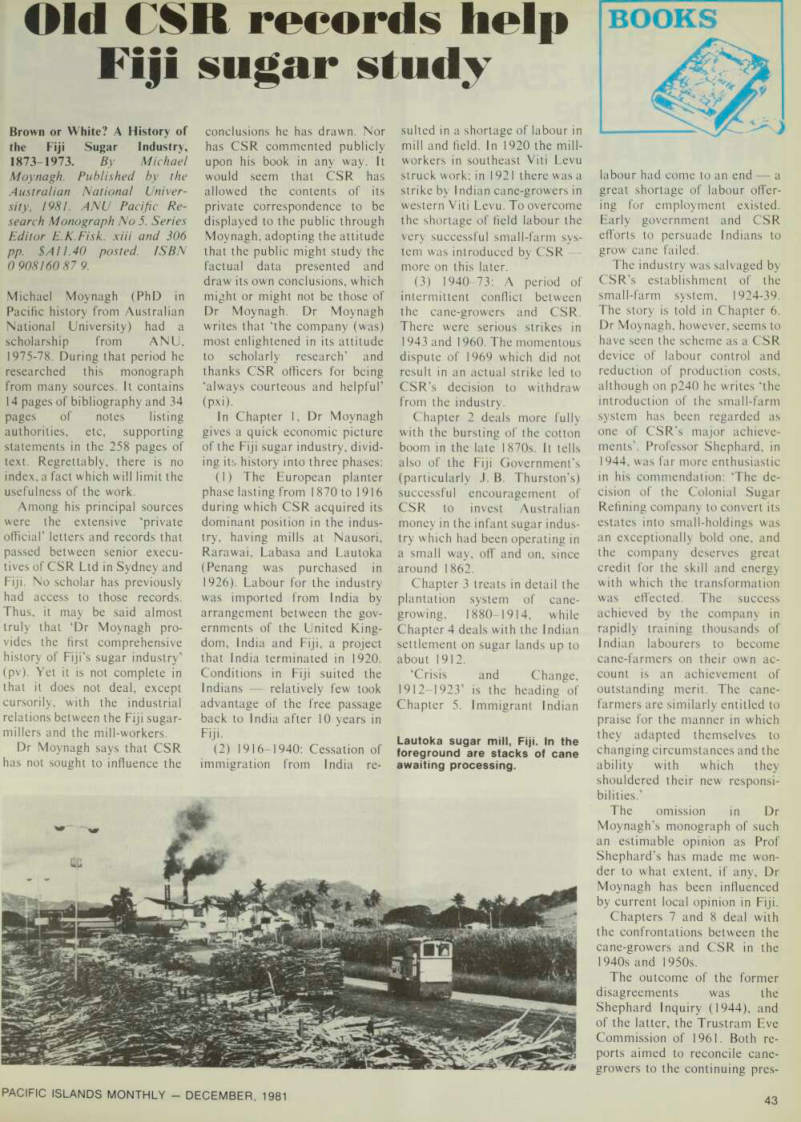

Old CSR records help Fiji sugar study
Books
Brown or White? A History of the Fiji Sugar Industry, 1873-1973. By Michael Moynagh. Published by the Australian National Univer sity, 1981. ANU Pacific Re search Monograph No 5. Series Editor E.K.Fisk. xiii and 306 pp. 5A11.40 posted. ISBN 0 908160 87 9.
Michael Moynagh (PhD in Pacific history from Australian National University) had a scholarship from ANU, 1975-78. During that period he researched this monograph from many sources. It contains 14 pages of bibliography and 34 pages of notes listing authorities, etc, supporting statements in the 258 pages of text. Regrettably, there is no index, a fact which will limit the usefulness of the work.
Among his principal sources were the extensive ‘private official’ letters and records that passed between senior execu tives of CSR Ltd in Sydney and Fiji. No scholar has previously had access to those records.
Thus, it may be said almost truly that ‘Dr Moynagh pro vides the first comprehensive history of Fiji’s sugar industry’ (pv). Yet it is not complete in that it does not deal, except cursorily, with the industrial relations between the Fiji sugar millers and the mill-workers.
Dr Moynagh says that CSR has not sought to influence the
conclusions he has drawn. Nor has CSR commented publicly upon his book in any way. It would seem that CSR has allowed the contents of its private correspondence to be displayed to the public through Moynagh, adopting the attitude that the public might study the factual data presented and draw its own conclusions, which might or might not be those of Dr Moynagh. Dr Moynagh writes that ‘the company (was) most enlightened in its attitude to scholarly research' and thanks CSR officers for being ‘always courteous and helpful’ (pxi).
In Chapter 1. Dr Moynagh gives a quick economic picture of the Fiji sugar industry, divid ing its history into three phases: (1) The European planter phase lasting from 1870 to 1916 during which CSR acquired its dominant position in the indus try, having mills at Nausori, Rarawai, Labasa and Lautoka (Penang was purchased in 1926). Labour for the industry was imported from India by arrangement between the gov ernments of the United King dom, India and Fiji, a project that India terminated in 1920.
Conditions in Fiji suited the Indians relatively few took advantage of the free passage back to India after 10 years in Fiji. (2) 1916-1940: Cessation of immigration from India re
sulted in a shortage of labour in mill and field. In 1920 the mill workers in southeast Viti Levu struck work; in 1921 there was a strike by Indian cane-growers in western Viti Levu. To overcome the shortage of field labour the very successful small-farm sys tem was introduced by CSR more on this later. (3) 1940-73: A period of intermittent conflict between the cane-growers and CSR.
There were serious strikes in 1943 and 1960. The momentous dispute of 1969 which did not result in an actual strike led to CSR’s decision to withdraw from the industry.
Chapter 2 deals more fully with the bursting of the cotton boom in the late 1870 s. It tells also of the Fiji Government’s (particularly J. B. Thurston’s) successful encouragement of CSR to invest Australian money in the infant sugar indus try which had been operating in a small way, off and on, since around 1862.
Chapter 3 treats in detail the plantation system of cane growing, 1880-1914, while Chapter 4 deals with the Indian settlement on sugar lands up to about 1912. ‘Crisis and Change, 1912-1923’ is the heading of Chapter 5. Immigrant Indian
labour had come to an end a great shortage of labour offer ing for employment existed.
Early government and CSR efforts to persuade Indians to grow cane failed.
The industry was salvaged by CSR’s establishment of the small-farm system, 1924-39.
The story is told in Chapter 6.
Dr Moynagh, however, seems to have seen the scheme as a CSR device of labour control and reduction of production costs, although on p 240 he writes ‘the introduction of the small-farm system has been regarded as one of CSR’s major achieve ments’. Professor Shephard, in 1944, was far more enthusiastic in his commendation: ‘The de cision of the Colonial Sugar Refining company to convert its estates into small-holdings was an exceptionally bold one, and the company deserves great credit for the skill and energy with which the transformation was effected. The success achieved by the company in rapidly training thousands of Indian labourers to become cane-farmers on their own ac count is an achievement of outstanding merit. The cane farmers are similarly entitled to praise for the manner in which they adapted themselves to changing circumstances and the ability with which they shouldered their new responsi bilities.’
The omission in Dr Moynagh’s monograph of such an estimable opinion as Prof Shephard’s has made me won der to what extent, if any, Dr Moynagh has been influenced by current local opinion in Fiji.
Chapters 7 and 8 deal with the confrontations between the cane-growers and CSR in the 1940 s and 19505.
The outcome of the former disagreements was the Shephard Inquiry (1944), and of the latter, the Trustram Eve Commission of 1961. Both re ports aimed to reconcile cane growers to the continuing pres
Lautoka sugar mill, Fiji. In the foreground are stacks of cane awaiting processing.
ence of CSR in Fiji. The withdrawal of CSR is the sub ject of Chapter 9.
During the 1960 s the Indians were in financial difficulties.
These arose out of several factors; (1) The basis of the small farm system was that 10-12 acres would provide a living for a man, his wife and young children, the family doing all the work of cultivation, harvest ing, etc, and of reaping the rewards therefrom. But the families grew up, married and had issue of their own, all of whom wanted to live on the farm and be sustained by its insufficient profit. On p6O Moynagh tells that about one third of the labour living on the farms (sons, etc) were surplus to the needs of the farms’ husbandry. (2) Farmers refused to under take the hard work: they bought tractors for which there was but part-time work, employed labour to clean drains, to har vest the cane, etc. As Dr Moynagh says, the farmer came to consider himself as a pro prietor and manager. (3) They were burdened with debt, borrowing to maintain their new standard of living.
Average debt was about two thirds of gross annual income (p 228). There was the huge mutti k'dam (earth money), the premium that had to be paid in acquiring a non-CSR farm.
Accordingly, the demands as presented by the growers’ unions were great because the growers’ needs were of those dimensions. The prestigious the Rt Hon Lord Denning, Master of the Rolls, England, adjudi cated and awarded the farmers with what he considered to be justice in respect of the matter before him. The CSR subsidi ary, South Pacific Sugar Mills Ltd, the then owner of the mills, determined ‘it is not feasible for a commercial milling enterprise to engage in the Denning Con tract on a long-term basis’; it accepted the award but gave two years notice that ‘the own ership of the mills must change’. (Also, says Moynagh, CSR was dismayed at the errors in the Denning Report and at his criticisms of the company.) Since no private investor was willing to buy SPSM, and if the
sugar industry in Fiji were to be continued, the government had to acquire SPSM together with the CSR land not the property of SPSM (which government had refused to buy when offered a few years previously). Govern ment took over on April 1, 1973.
Dr Moynagh tells the story of the formation of the Fiji Sugar Corporation (almost wholly government-owned), notes the striking similarities in its style of management to that of CSR, and describes the unexpected sharp rise in sugar prices in the 19705.
A new formula for the pay ment for cane became operative in 1980. Dr Moynagh notes that ‘some wonder if FSC’s share of proceeds will leave it with sufficient margin to maintain desired capital expenditure’ (p 243). He observes also that the conflict between growers and millers, and between labour and millers, ‘limits the potential contribution the industry can make to the economic develop ment of Fiji’ (p 244).
I spent my working life in the sugar industry, 37'/* years of it in Fiji. 1 do not accept all Dr Moynagh’s conclusions; I think some of them are those of an academician, not those of a businessman. I think also the text contains some errors.
Nevertheless, for those inter ested in Fiji and its sugar industry, 1 think the monograph can be classed as the best available on the subject. I suggest that such people should read it and make their own judgment. LM. Sherwood * *Mr Sherwood is a retired CSR industrial chemist.
An 1875 engraving showing the pioneer Suva sugar mill set up by Brewer and Joske.
Advertisements & other items, p. 44 (1 item)
Exporter!'Fair
BUY
NEW ZEALAND
at the
NEW ZEALAND
EXPORTER!'FAIR
Princes Wharf, Auckland. 27t030 April 1982 (Taking up from where the hugely successful 2nd New Zealand Exporters Fair in 1978 left off) The New Zealand Exporters Fair 82 is a comprehensive exhibition of New Zealand's best manufactured and processed products. * over 200 New Zealand companies featured * over 10,000 individual product items on display Main industry categories; • Foodstuffs • Building Products • Consumer goods • Engineering machinery • Export Houses and equipment • Marine Products
ATTENTION ALL TRADERS, BUYERS,
RETAILERS, DISTRIBUTORS, AGENTS
The New Zealand Exporters Fair 82 is your one-stop-shop to examine the full range of New Zealand products and see for yourself the depth and variety of our industries.
The venue is the Overseas Terminal of Princes Wharf in the heart of Auckland city. This stunning seafront location which boasts spectacular views of the famous Hauraki Gulf, is right next to Auckland's Downtown retail complex and many other business, transport, entertainment and hotel facilities.
The fair is the third of its kind and is being organised by the Export Institute of New Zealand Inc., a non-profit society of over 2,500 export practitioners. ; □ Yes I wish to come as a buyer/visitor to the New Zealand Exporters' Fair 82. Please send me full registration details. □ Please send me more information and keep me informed of the progress of this fair. (Tick appropriate box) Name: Title: Company: Address: Country: Products you are particularly interested in: Phone: Telex: Will your partner be travelling with you?
His/Her name: Attach Business Card and send to: Export Institute of New Zealand, P.O. Box 17120, Auckland 5, New Zealand, Telex 21796, (Phone 540 188)
MAIL TODAY
Details also available from your nearest New Zealand Trade Commissioner.
W/p)
INSTITUTE OF NE\ATZEALAND
First Solomons novel:
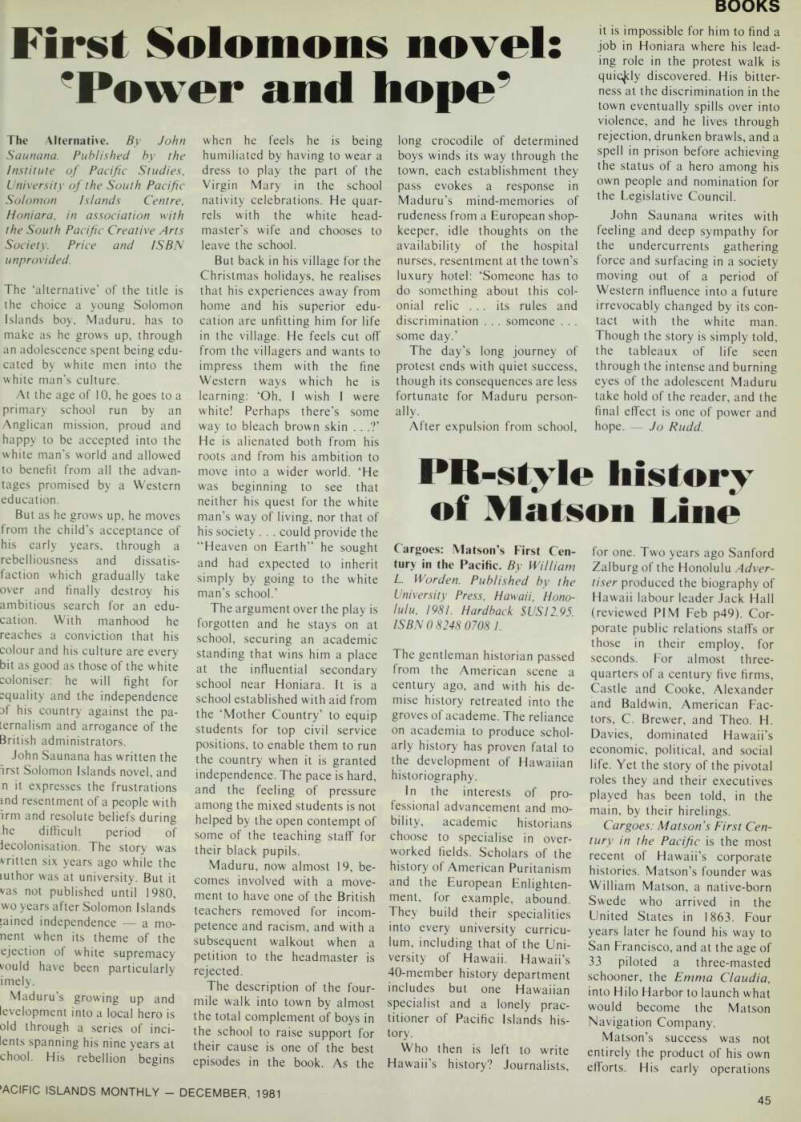
Tower and hope’
The Alternative. By John Saunana. Published by the Institute of Pacific Studies, University of the South Pacific Solomon Islands Centre, Honiara, in association with the South Pacific Creative Arts Society. Price and ISBN unprovided.
The ‘alternative’ of the title is the choice a young Solomon Islands boy, Maduru, has to make as he grows up, through an adolescence spent being edu cated by white men into the white man’s culture.
At the age of 10, he goes to a primary school run by an Anglican mission, proud and happy to be accepted into the white man’s world and allowed to benefit from all the advan tages promised by a Western education.
But as he grows up, he moves from the child’s acceptance of his early years, through a rebelliousness and dissatis faction which gradually take over and finally destroy his ambitious search for an edu cation. With manhood he reaches a conviction that his colour and his culture are every bit as good as those of the white coloniser: he will fight for equality and the independence Df his country against the pa ternalism and arrogance of the British administrators.
John Saunana has written the irst Solomon Islands novel, and n it expresses the frustrations md resentment of a people with irm and resolute beliefs during he difficult period of lecolonisation. The story was vritten six years ago while the iuthor was at university. But it vas not published until 1980, wo years after Solomon Islands gained independence a mo nent when its theme of the ejection of white supremacy
vould have been particularly
imely.
Maduru’s growing up and levelopment into a local hero is old through a series of inci lents spanning his nine years at chool. His rebellion begins
when he feels he is being humiliated by having to wear a dress to play the part of the Virgin Mary in the school nativity celebrations. He quar rels with the white head master’s wife and chooses to leave the school.
But back in his village for the Christmas holidays, he realises that his experiences away from home and his superior edu cation are unfitting him for life in the village. He feels cut off from the villagers and wants to impress them with the fine Western ways which he is learning: ‘Oh, I wish I were white! Perhaps there’s some way to bleach brown skin . . .?’
He is alienated both from his roots and from his ambition to move into a wider world. ‘He was beginning to see that neither his quest for the white man’s way of living, nor that of his society . . . could provide the “Heaven on Earth” he sought and had expected to inherit simply by going to the white man’s school.’
The argument over the play is forgotten and he stays on at school, securing an academic standing that wins him a place at the influential secondary school near Honiara. It is a school established with aid from the ‘Mother Country’ to equip students for top civil service positions, to enable them to run the country when it is granted independence. The pace is hard, and the feeling of pressure among the mixed students is not helped by the open contempt of some of the teaching staff for their black pupils.
Maduru, now almost 19, be comes involved with a move ment to have one of the British teachers removed for incom petence and racism, and with a subsequent walkout when a petition to the headmaster is rejected.
The description of the four mile walk into town by almost the total complement of boys in the school to raise support for their cause is one of the best episodes in the book. As the
long crocodile of determined boys winds its way through the town, each establishment they pass evokes a response in Maduru’s mind-memories of rudeness from a European shop keeper, idle thoughts on the availability of the hospital nurses, resentment at the town’s luxury hotel: ‘Someone has to do something about this col onial relic ... its rules and discrimination . . . someone . . . some day.’
The day’s long journey of protest ends with quiet success, though its consequences are less fortunate for Maduru person ally.
After expulsion from school.
it is impossible for him to find a job in Honiara where his lead ing role in the protest walk is quickly discovered. His bitter ness at the discrimination in the town eventually spills over into violence, and he lives through rejection, drunken brawls, and a spell in prison before achieving the status of a hero among his own people and nomination for the Legislative Council.
John Saunana writes with feeling and deep sympathy for the undercurrents gathering force and surfacing in a society moving out of a period of Western influence into a future irrevocably changed by its con tact with the white man.
Though the story is simply told, the tableaux of life seen through the intense and burning eyes of the adolescent Maduru take hold of the reader, and the final effect is one of power and
hope.
Jo Rudd.
PR-style history
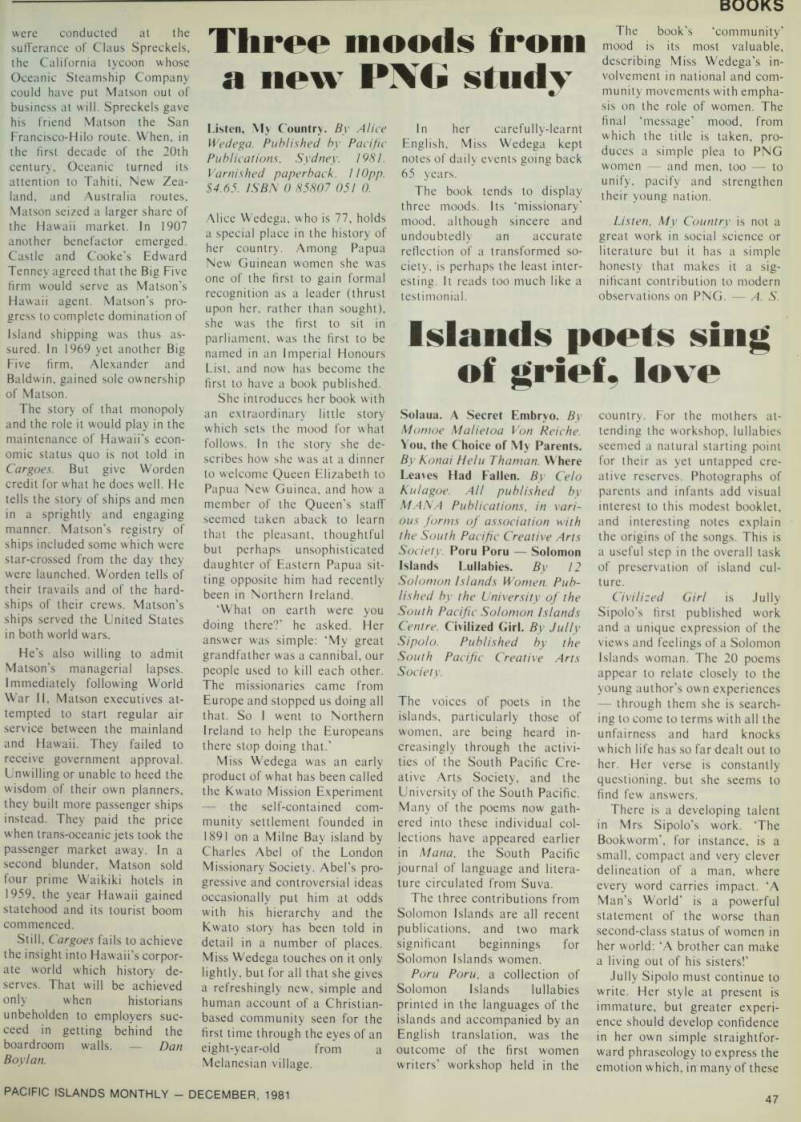
of Matson Line
Cargoes: Matson’s First Cen tury in the Pacific. By William L Worden. Published by the University Press, Hawaii. Hono lulu. 1981. Hardback SUS 12.95.
Isbn 0 8248 0708 I.
The gentleman historian passed from the American scene a century ago, and with his de mise history retreated into the groves of academe. The reliance on academia to produce schol arly history has proven fatal to the development of Hawaiian
historiography.
In the interests of pro fessional advancement and mo bility, academic historians choose to specialise in over worked fields. Scholars of the history of American Puritanism and the European Enlighten ment, for example, abound.
They build their specialities into every university curricu lum, including that of the Uni versity of Hawaii. Hawaii’s 40-member history department includes but one Hawaiian specialist and a lonely prac titioner of Pacific Islands his tory.
Who then is left to write Hawaii’s history? Journalists,
for one. Two years ago Sanford Zalburg of the Honolulu Adver tiser produced the biography of Hawaii labour leader Jack Hall (reviewed PIM Feb p 49). Cor porate public relations staffs or those in their employ, for seconds. For almost three quarters of a century five firms, Castle and Cooke, Alexander and Baldwin, American Fac tors, C. Brewer, and Theo. H.
Davies, dominated Hawaii’s economic, political, and social life. Yet the story of the pivotal roles they and their executives played has been told, in the main, by their hirelings.
Cargoes: Matson’s First Cen tury in the Pacific is the most recent of Hawaii’s corporate histories. Matson’s founder was William Matson, a native-born Swede who arrived in the United States in 1863. Four years later he found his way to San Francisco, and at the age of 33 piloted a three-masted schooner, the Emma Claudia. into Hilo Harbor to launch what would become the Matson
Navigation Company.
Matson’s success was not entirely the product of his own efforts. His early operations
were conducted at the sufferance of Claus Spreckels, the California tycoon whose Oceanic Steamship Company could have put Matson out of business at will. Spreckels gave his friend Matson the San Francisco-Hilo route. When, in the first decade of the 20th century. Oceanic turned its attention to Tahiti, New Zea land, and Australia routes, Matson seized a larger share of the Hawaii market. In 1907 another benefactor emerged.
Castle and Cooke’s Edward Tenney agreed that the Big Five firm would serve as Matson's Hawaii agent. Matson’s pro gress to complete domination of Island shipping was thus as sured. In 1969 yet another Big Five firm, Alexander and Baldwin, gained sole ownership of Matson.
The story of that monopoly and the role it would play in the maintenance of Hawaii’s econ omic status quo is not told in Cargoes. But give Worden credit for what he does well. He tells the story of ships and men in a sprightly and engaging manner. Matson’s registry of ships included some which were star-crossed from the day they were launched. Worden tells of their travails and of the hard ships of their crews. Matson’s ships served the United States in both world wars.
He’s also willing to admit Matson’s managerial lapses.
Immediately following World War 11, Matson executives at tempted to start regular air service between the mainland and Hawaii. They failed to receive government approval.
Unwilling or unable to heed the wisdom of their own planners, they built more passenger ships instead. They paid the price when trans-oceanic jets look the passenger market away. In a second blunder, Matson sold four prime Waikiki hotels in 1959, the year Hawaii gained statehood and its tourist boom commenced.
Still, Cargoes fails to achieve the insight into Hawaii’s corpor ate world which history de serves. That will be achieved only when historians unbeholden to employers suc ceed in getting behind the
boardroom walls.
Dan
Boy lan.
Advertisements & other items, pp. 45-46 (2 items)
Books
'ACIFIC ISLANDS MONTHLY - DECEMBER, 1981
Deep- down accuracy.
"X' » ** : - * f %• - ■ : ■ . ■ . - - v : -:-: -■> - . * , • -\-ii i r «r- -.V)..: j\ E£?
X ■SlUfll*-, i s_*> / sa S£S % mty - v » ■'»> ; *-’ • ' N
XX ‘ X ' X
’I /: ■*£ *Av < */Sr 'OO
MU Lr
'4 La V* - m ;7 • * ¥•// ”S&. /’. i *- ;
Deep- down accuracy.
Water-resistant quart! watches from Citizen.
Under a clear blue sky or the deep blue sea, these slim quartz watches from Citizen are always at hpme. Accurate to within seconds a month, the Water Resist 100 series keeps time at 100 meters below the surface as well as it does on dry land. All models, analog and digital, feature day and date and all are made to Citizen’s high standards of ruggedness and precision.
wotrreslstlOO ‘ CITIZEN
Citizen Watches Australia Pty. Ltd., 122 Old Pittwater Road, Brookvale, N.S.W. 2100. Telephone 939 7077 P.O. Box'2lB, Brookvale, N.S.W. 2100. Cable: Citizen, Sydney. Telex: AA26633
Three moods from
a new PNG study
Listen, My Country. By Alice Wedega. Published by Pacific Publications, Sydney. 1981.
Varnished paperback. I!0pp.
$4.65. Isbn 0 85807 051 0.
Alice Wedega, who is 77, holds a special place in the history of her country. Among Papua New Guinean women she was one of the first to gain formal recognition as a leader (thrust upon her. rather than sought), she was the first to sit in parliament, was the first to be named in an Imperial Honours List, and now has become the first to have a book published.
She introduces her book with an extraordinary little story which sets the mood for what follows. In the story she de scribes how she was at a dinner to welcome Queen Elizabeth to Papua New Guinea, and how a member of the Queen’s staff seemed taken aback to learn that the pleasant, thoughtful but perhaps unsophisticated daughter of Eastern Papua sit ting opposite him had recently been in Northern Ireland. ‘What on earth were you doing there?’ he asked. Her answer was simple: ‘My great grandfather was a cannibal, our people used to kill each other.
The missionaries came from Europe and stopped us doing all that. So I went to Northern Ireland to help the Europeans there stop doing that.’
Miss Wedega was an early product of what has been called the Kwato Mission Experiment the self-contained com munity settlement founded in 1891 on a Milne Bay island by Charles Abel of the London Missionary Society. Abel’s pro gressive and controversial ideas occasionally put him at odds with his hierarchy and the Kwato story has been told in detail in a number of places.
Miss Wedega touches on it only lightly, but for all that she gives a refreshingly new, simple and human account of a Christian based community seen for the first time through the eyes of an eight-year-old from a Melanesian village.
In her carefully-learnt English, Miss Wedega kept notes of daily events going back 65 years.
The book lends to display three moods. Its ‘missionary’ mood, although sincere and undoubtedly an accurate reflection of a transformed so ciety, is perhaps the least inter esting. It reads 100 much like a testimonial.
The book’s ‘community’ mood is its most valuable, describing Miss Wedega’s in volvement in national and com munity movements with empha sis on the role of women. The final ‘message’ mood, from which the title is taken, pro duces a simple plea to PNG women and men, too to unify, pacify and strengthen their young nation.
Listen, My Country is not a great work in social science or literature but it has a simple honesty that makes it a sig nificant contribution to modern
observations on PNG.
A. S.
Islands poets sing
of grief, love
Solaua. A Secret Embryo. By Momoe Malietoa Von Reiche.
You, the Choice of My Parents.
By Konai Helu Thaman. Where Leaves Had Fallen. By Celo Kulagoe. All published by MANA Publications, in vari ous forms of association with the South Pacific Creative Arts Society. Poru Poru Solomon Islands Lullabies. By 12 Solomon Islands Women. Pub lished by the University of the South Pacific Solomon Islands Centre. Civilized Girl. By Jully Sipolo. Published by the South Pacific Creative Arts Society.
The voices of poets in the islands, particularly those of women, are being heard in creasingly through the activi ties of the South Pacific Cre ative Arts Society, and the University of the South Pacific.
Many of the poems now gath ered into these individual col lections have appeared earlier in Mana, the South Pacific journal of language and litera ture circulated from Suva.
The three contributions from Solomon Islands are all recent publications, and two mark significant beginnings for Solomon Islands women.
Poru Poru, a collection of Solomon Islands lullabies printed in the languages of the islands and accompanied by an English translation, was the outcome of the first women writers’ workshop held in the
country. For the mothers at tending the workshop, lullabies seemed a natural starting point for their as yet untapped cre ative reserves. Photographs of parents and infants add visual interest to this modest booklet, and interesting notes explain the origins of the songs. This is a useful step in the overall task of preservation of island cul ture.
Civilized Girl is Jully Sipolo’s first published work and a unique expression of the views and feelings of a Solomon Islands woman. The 20 poems appear to relate closely to the young author’s own experiences through them she is search ing to come to terms with all the unfairness and hard knocks which life has so far dealt out to her. Her verse is constantly questioning, but she seems to find few answers.
There is a developing talent in Mrs Sipolo’s work. The Bookworm’, for instance, is a small, compact and very clever delineation of a man, where every word carries impact. ‘A Man’s World’ is a powerful statement of the worse than second-class status of women in her world; ‘A brother can make a living out of his sisters!’
Jully Sipolo must continue to write. Her style at present is immature, but greater experi ence should develop confidence in her own simple straightfor ward phraseology to express the emotion which, in many of these
poems, often seems hidden be neath the calm cliches.
The third collection from Solomon Islands, Where Leaves Had Fallen, contains poems written over a period of eight years by Celo Kulagoe, who is at present studying education at the University of the South Pacific.
This writing is much more sophisticated, reflecting the author’s extensive education, and a variety of style and form has been attempted. As with Jully Sipolo, there is anger in many of the poems, against exploitation, priests, religion.
But small incidents are also recounted which give insight into the meaning of life, and the author’s personal philosophy.
Some of the poems seem to me unnecessarily obscure is ‘The Shrimp’ a hymn to some mystic sexual experience? I sometimes wondered what kind of audience Celo Kulagoe is writing for.
The best piece in the book heralds a small group of love poems, where a clear, lyric voice is heard, rising from deep felt emotion. ‘lf I were to write a poem’ is a beautiful love song, trailing a faint reminiscence in places to Shakespeare’s sonnets to his lady: my eyes read sonnets of your face, couplets of your breasts; my ears play symphonies of your breath, voice and laughter, and I fly to the dance of your gait.
From Tonga comes a reprint of a collection by Konai Helu Thaman first published in 1974, when she joined the staff of the University of the South Pacific.
She has lived in New Zealand and the States as well as Tonga, and the poems reflect experi ences from widely differing locations and cultures.
A simple call to her fellow women to ‘take a chance and make the break’, mingles with poems of fear about white discrimination, the clashing of cultures, fellow Tongans dis placed in alien environments. In California: ‘Hey people, I am lost;/1 am here/We are all here/And we aren’t.’
The title poem, ‘You, the choice of my parents’, is ad dressed to the man chosen by the writer’s parents as her husband. It is a moving and honest lament telling of resig nation and acceptance of filial duty, but clinging throughout to a free spirit which cannot be subjugated: But when my duties are fulfilled My spirit will return to the land of my birth Where you will find me no more Except for the weeping willows along the shore.
The final, and perhaps most accomplished, selection comes from Western Samoa. Momoe Malietoa Von Reiche is an artist and a mother of seven, and this is her first collection of poems. The style is vibrant and strong, words deliberate, care fully chosen, hard-hitting. The meaning and emotion in the poems are unmistakable, often couched in beautifully wrought imagery drawn from nature and sexuality.
In ‘Rain’, Mrs Von Reiche gives vent to her grief at her husband’s infidelity while she carries their child. She becomes the raindrops being absorbed into the earth (seen as her husband) ‘turning me/Into a stream that would/Cry into the sea’. ‘Of You’ is a poem of strict rhythm and form dealing, by contrast, with the most fluid of subjects longing for another person. It is superbly done.
Many poems voice the com mon theme of bitterness against men, their demanding sexu ality, their infidelities and lack of kindness and understanding.
The book closes with ‘A Final Wish’ a universal outpouring of female anger at the pain and restrictions placed on a wife by child-rearing and a cruel mate. ‘My final wish/Is not revenge/But maybe someday/ Someone will do more than/ Break your heart/Then you’ll honestly know how it/Feels to be hurt.’
Mrs Von Reiche is an intelli gent and sensitive writer and it is to be hoped this will not be
her last book of poems.
Jo
Rudd.
Advertisements & other items, p. 48 (1 item)
Pty. Ltd.
& m
WATER WHEEL EXPORTS
493 Bourke Street, Melbourne, 3000, Australia Cables: Watermill - Melbourne.
Telex: AA 32165 Telephone: 602 1433
THE WATER WHEEL GROUP OF COMPANIES
Winners of Australia’s Top Export Award and Flour Millers for over 100 years.
BEST AUSTRALIAN
WHEATEN FLOUR
(High Protein, Bakers, Stone ground Wholemeal, Donut).
COOLROOMS REFRIGERATED
CABINETS ETC.
INCLUDING SALT WATER
ICE MAKERS
STOCK & POULTRY FEEDS
(Pellets or Mash form)
YELLOW SPLIT PEAS &
WHOLE PEAS
(Machine-Dressed)
COMPLETE RANGE OF FROZEN
AND GENERAL FOOD ITEMS
QUALITY AUSTRALIAN
WINES
WOOD FUEL STOVES
AND WATER HEATERS
FOR FURTHER INFORMATION
Return this coupon to:
WATER WHEEL EXPORTS PTY. LTD.
Please forward me: Name Address Phone: More information on your above products/ product Export Manager Water Wheel Exports Pty, Ltd. 493 Bourke Street, Melbourne 3000.
Australia.
Islands
From the
Press
From the Nauru Post, describing a visit to Nauru by a group of youths from Ponape who were guests of members of the Orro Congregational Church Pastor James Aingimea said that very little bible study was done because most of their visitors were so well and truly excited about being on Nauru that there was no chance of them being able to sit even for a few minutes to concentrate on any lesson. They wanted to do everything and go everywhere that the one week.stay appears not to be enough for them. When the time did come for them to return home most of them were reluctant to leave and wanted to stay longer. One of them did succeed in staying longer as he was in hospital for injuries he had incurred in a motorcycle accident From a letter complaining about the lack of service in a shop, The Observer, Western Samoa . . . advise to the management to hire the right kind of people.
Those with fat bodies should not be working there. They are the kind that can hardly stand up and very lazy as the body is too big for the poor legs to support.
On the occasion of the opening of a school which had been rebuilt on larger premises, Solomon Islands News Drum Twelve pigs, one cow, 2,507 puddings and other foods were shared among the 833 people who attended the celebration.
From an article on taro exporting, Tohi Tala Niue, Niue The factory will send a message by Radio Sunshine when to dig your taro and when the factory calls, have your taro ready and play fair. Do not try and sell rotten or rejected taro. This costs the factory staff a lot of time in sorting out the poor taro. This taro is sent to the hospital and they use what they can but does not help our exports . . .
Sir Julius Chan, launching a campaign to recruit intelligence officers, The Times of Papua New Guinea An understanding of, say, commodity pricing hardly requires a sexist gun-slinger in the James Bond mould.’
From the Cook Islands News A morning tea hosted by Internal Affairs for the Papua Paramana Strangers band was held yesterday morning. The six man band is managed by Papua MP and Minister of Defence, Mr Gary Pepena.
The band also has a woman member of parliament, Josephine Abaijah, a chaperone.
From Tohi Tala Niue, an article entitled ‘Safety Lights and Road Trenches’
Between Kaimiti station and the Airport is the ditch witch trench digging project, please take particular care when you drive through besides this safety lights are standing by to guide you at night ind please do not touch or throw them away as without them will ead life to danger.
From a report in the Samoa Times on the media treatment of the Public Servants Association strike earlier this year It is well known that editors and journalists (no matter where) after icquiring a reputation tend to believe their own inflated view of heir self-importance, and, when slighted or threatened or denied he right to know, they overreacted, magnifying pebbles into nountains which they then parade in their papers as important lational issues.
From Sir Julius Chan on the Public Service, The Times of Papua New Guinea ‘As Prime Minister, I find it impossible to avoid the conclusion that the Public Service machine is decidedly sluggish. It is not good at anticipating problems, or coming up with fresh initiatives and it is slow at reacting.’ ... And from The Observer, Western Samoa Working in the Public Service would undoubtedly be so pleasantly stimulating and an efficient service would be assured if all those personal petty ill-intentions were reduced to the bare minimum.
On the topic of controlling wild pigs on Niue, entitled ‘Personal suggestions’, Tohi Tala Niue (1) .. . Anyone who see any stray pig .. . shoot with no strings attached. This of course ... if we have the SLUGS. I may very well be an offender one day ... so what... lam expecting to be treated like anyone else. No favouritism! (2) . . . Open importation of SLUGS (no restrictions) to Niue to combat the problem. Keep the price to the minimum. Beai in mind also that these particular brand of firework is not suitable for shooting pigeons and flying foxes. Ideal for pig eradication.
From the Cook Islands News, entitled ‘Recreation and
Human Development’
It is necessary we learn to relax as death has been known to come quickly to those who have given up recreation.
Mr Lemeki, Labour minister, speaking on grants for trade unions, The Times of Papua New Guinea ‘lf my submission gets Cabinet blessing, I will ensure that the big union leaders do not use the money for their big wages and other luxuries.’
A light-hearted extract from an article debunking any romantic ideas about the growing overseas trend to re-utilise, either completely or partially, the use of sails in navigation, Cook Island News There aren’t any sailing ships left in the Cook Islands. They’re all diesel jobs and from what I’ve seen of their captains, they usually wear an old shirt, a baseball cap and an ancient pair of pants. That’s in fine weather. During bad weather they generally wear a plastic yellow raincoat that makes them look like a ripening orange.
An extract from a letter to the editor of The Reporter, regarding what appears to be the rise of a new form of sport at the PNG University of Technology Consider the evidence: the emergence early in the year of the Morobe Racing Toad Association and its successful attempt to promote a totally new and alien sporting contest that of toad racing. Where were wellington-bool throwing, cow-pat hurling, pea pushing-with-the-nose, or taro-bashing when they were required?
Alas, all were found wanting, or not wanting and so, by default, the first step was taken down the road of the toad.
From The Reporter, PNG, warning campus tenants not to tamper with the power supply Tenants are notified that there is, on average, a minimum potential of approximately 3.2184524 horses forced behind every wall outlet (horsepower)... 3.21 84524 exploding horses can be messy and will, very likely, cause combustion.
From the Cook Islands News, a letter to the editor
signed ‘Visitor’
Being a visitor to Rarotonga, I have come across the cheapest house built by contract on the island. Situated at ‘Aroa’ Arorangi, the cost would astonish most people at a price of $ 1,800.00. Size of house: 34 feet by 24 feet. Time it took to erect: one week. With a big sitting room, kitchen and three bedrooms, it must be the cheapest, most inexpensive house. So come and see or inqui re about it. . .
The Nauru Post, Nauru Heard that a girl from the Philippines who met an Englishman on Nauru, married him, and is now living in England, is still not accustomed to English wildlife. This was clearly demonstrated one evening when she ran into the lounge, explaiming to her startled husband: There’s a mouse with standing-up hair drinking water in the rabbit run.’ The ‘mouse’ turned out to be a hedgehog.
Advertisements & other items, p. 50 (1 item)
Pioneer*
Only Pioneer’s tremendous range of audio exoertise could give you so great a combination of advanced technology and stylish design. The new Personna Music Systems...the truly personal approach to fit any corner of your life.
The RX-70 Personna Cassette Receiver Sharp styling plus solid audio engineering. Full-logic cassette deck, digital FM/AM tuner and powerful stereo amp—all very easy to use and easier still to enjoy.
RX-70
PIONEER*
The MX-80 Personna Cassette Disc Receiver Total stereo system capability is at your fingertips with Auto Function Switching. Turntable, cassette deck, FM/AM tuner and stereo amp—all in a single high-tech unit.
The S-9 Personna Shelf Components Sleek matching units with an individual outlook and Auto Function Switching. Includes separate digital synthesized FM/AM tuner with programmable timer, a full-logic cassette deck, a fully automatic turntable and a stereo amp.
Personna from Pioneer. Now, stereo systems as personal as your music.
S-9 For further information, please contact: Australia: Pioneer Marketing Services Pty. Ltd., P.O. Box 317, Mordialloc, Victoria, 3195 Tel: 90-9011 Fiji Islands: Brijlal & Company, G.P.O. Box No. 362, Suva, Fiji Islands Tel: 22258 New Zealand: Monaco Distributors Ltd., 2 Poland Road, Glenfield, Auckland, New Zealand Tel: (09) 444-9144 Norfolk Island; Burns Philp (Norfolk Island) Ltd., P.O. Box 21, Norfolk Island, New Hebrides: Burns Philp (New Hebrides) Ltd., Vila, New Hebrides Nauru Island: Jacob Enterprises, P.O. Box No. 4, Republic of Nauru Tahiti: Tahiti Hi-Fi. P.O. Box 848, Papeete, Tahiti New Caledonia: Menard Pacifique Sari, B.P. 3899, Noumea, New Caledonia Tel: 48.24*36 American Samoa: Transpac Corporation, P.O. Box 1477, Pago Pago, American Samoa 96799 Tel: 633-5224 Rarotonga: South Seas International Ltd., P.O. Box 49, Rarotonga, Cook Islands Tel: 2327 Papua New Guinea: Bali Merchants Pty. Ltd., P.O. Box 6103, Boroko Tel: 254887
learning for tourism planners
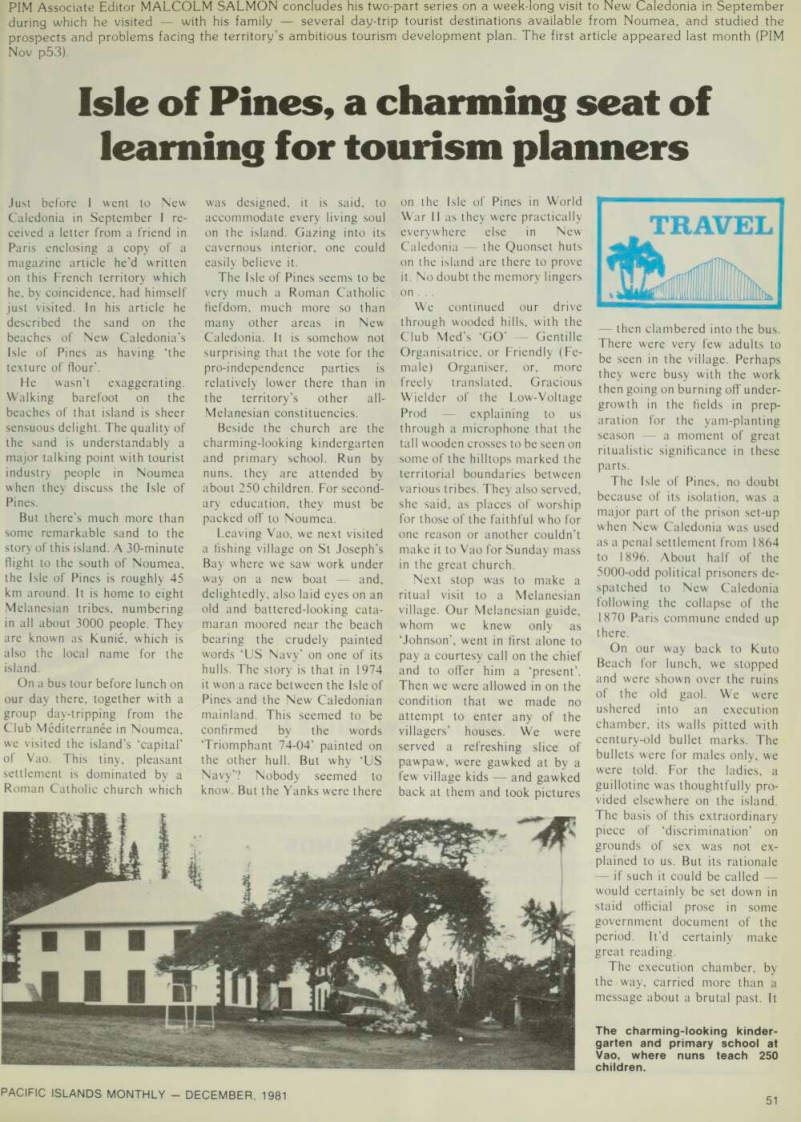
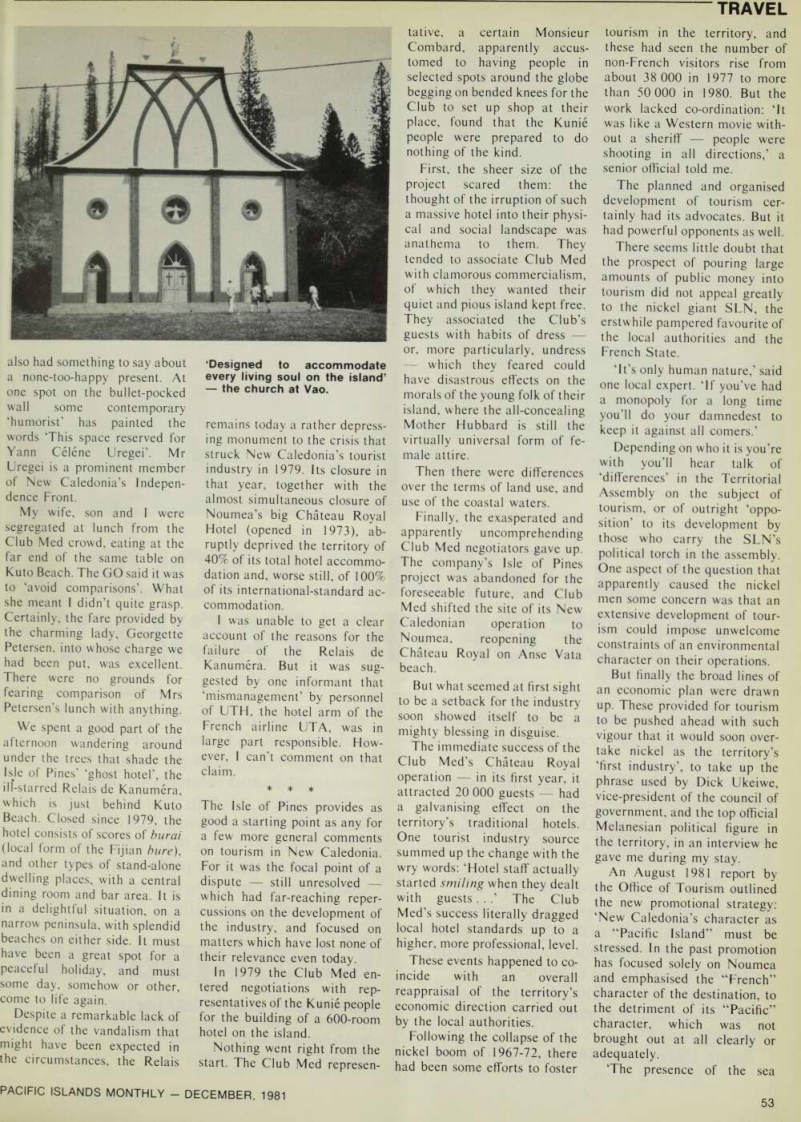
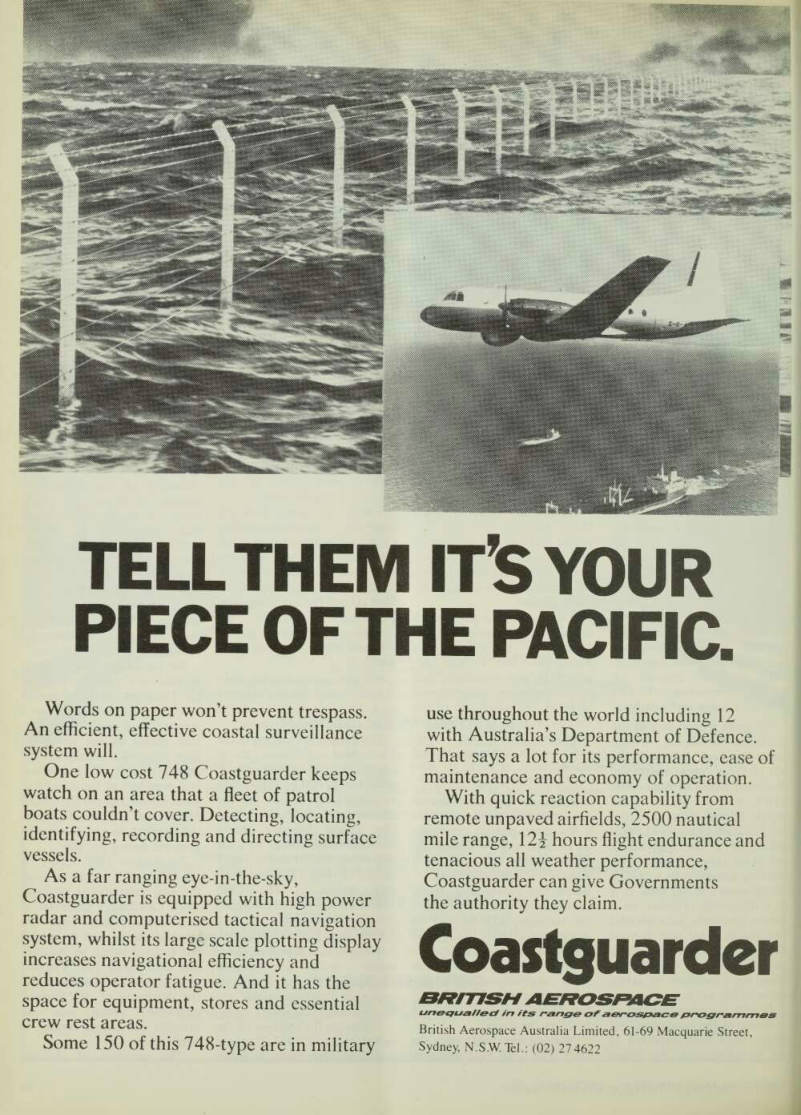
Isle of Pines, a charming seat of learning for tourism planners
Travel
PIM Associate Editor MALCOLM SALMON concludes his two-part series on a week-long visit to New Caledonia in September during which he visited with his family several day-trip tourist destinations available from Noumea, and studied the prospects and problems facing the territory’s ambitious tourism development plan. The first article appeared last month (PIM Nov p 53).
Just before I went to New Caledonia in September I re ceived a letter from a friend in Paris enclosing a copy of a magazine article he’d written on this French territory which he, by coincidence, had himself just visited. In his article he described the sand on the beaches of New Caledonia’s Isle of Pines as having ‘the texture of flour’.
He wasn’t exaggerating.
Walking barefoot on the beaches of that island is sheer sensuous delight. The quality of the sand is understandably a major talking point with tourist industry people in Noumea when they discuss the Isle of Pines.
But there’s much more than some remarkable sand to the story of this island. A 30-minute flight to the south of Noumea, the Isle of Pines is roughly 45 km around. It is home to eight Melanesian tribes, numbering in all about 3000 people. They are known as Kunie, which is also the local name for the island.
On a bus tour before lunch on our day there, together with a group day-tripping from the Club Mediterranee in Noumea, we visited the island’s ‘capital’ of Vao. This liny, pleasant settlement is dominated by a Roman Catholic church which
was designed, it is said, to accommodate every living soul on the island. Gazing into its cavernous interior, one could easily believe it.
The Isle of Pines seems to be very much a Roman Catholic fiefdom, much more so than many other areas in New Caledonia. It is somehow not surprising that the vote for the pro-independence parties is relatively lower there than in the territory’s other all- Melanesian constituencies.
Beside the church are the charming-looking kindergarten and primary school. Run by nuns, they are attended by about 250 children. For second ary education, they must be packed off to Noumea.
Leaving Vao, we next visited a fishing village on St Joseph’s Bay where we saw work under way on a new boat and, delightedly, also laid eyes on an old and battered-looking cata maran moored near the beach bearing the crudely painted words ‘US Navy’ on one of its hulls. The story is that in 1974 it won a race between the Isle of Pines and the New Caledonian mainland. This seemed to be confirmed by the words ‘Triomphant 74-04’ painted on the other hull. But why ‘US Navy’? Nobody seemed to know. But the Yanks were there
on the Isle of Pines in World War II as they were practically everywhere else in New Caledonia the Quonset huts on the island are there to prove it. No doubt the memory lingers on . . .
We continued our drive through wooded hills, with the Club Med’s ‘GO’ Gentille Organisatrice, or Friendly (Fe male) Organiser, or, more freely translated. Gracious Wielder of the Low-Voltage Prod explaining to us through a microphone that the tall wooden crosses to be seen on some of the hilltops marked the territorial boundaries between various tribes. They also served, she said, as places of worship for those of the faithful who for one reason or another couldn’t make it to Vao for Sunday mass in the great church.
Next stop was to make a ritual visit to a Melanesian village. Our Melanesian guide, whom we knew only as ‘Johnson’, went in first alone to pay a courtesy call on the chief and to offer him a ‘present’.
Then we were allowed in on the condition that we made no attempt to enter any of the villagers’ houses. We were served a refreshing slice of pawpaw, were gawked at by a few village kids and gawked back at them and took pictures
then clambered into the bus.
There were very few adults to be seen in the village. Perhaps they were busy with the work then going on burning off under growth in the fields in prep aration for the yam-planting season a moment of great ritualistic significance in these parts.
The Isle of Pines, no doubt because of its isolation, was a major part of the prison set-up when New Caledonia was used as a penal settlement from 1864 to 1896. About half of the 5000-odd political prisoners de spatched to New Caledonia following the collapse of the 1870 Paris commune ended up there.
On our way back to Kuto Beach for lunch, we stopped and were shown over the ruins of the old gaol. We were ushered into an execution chamber, its walls pitted with century-old bullet marks. The bullets were for males only, we were told. For the ladies, a guillotine was thoughtfully pro vided elsewhere on the island.
The basis of this extraordinary piece of ‘discrimination’ on grounds of sex was not ex plained to us. But its rationale if such it could be called would certainly be set down in staid official prose in some government document of the period. It’d certainly make great reading.
The execution chamber, by the way, carried more than a message about a brutal past. It
The charming-looking kinder garten and primary school at Vao, where nuns teach 250 children.
also had something to say about a none-too-happy present. At one spot on the bullet-pocked wall some contemporary ‘humorist’ has painted the words ‘This space reserved for Yann Celene Uregei’. Mr Uregei is a prominent member of New Caledonia’s Indepen dence Front.
My wife, son and I were segregated at lunch from the Club Med crowd, eating at the far end of the same table on Kuto Beach. The GO said it was to ‘avoid comparisons’. What she meant I didn’t quite grasp.
Certainly, the fare provided by the charming lady, Georgette Petersen, into whose charge we had been put, was excellent.
There were no grounds for fearing comparison of Mrs Petersen’s lunch with anything.
We spent a good part of the afternoon wandering around under the trees that shade the Isje of Pines’ ‘ghost hotel’, the ill-starred Relais de Kanumera, which is just behind Kuto Beach. Closed since 1979, the hotel consists of scores of burai (local form of the Fijian bare), and other types of stand-alone dwelling places, with a central dining room and bar area. It is in a delightful situation, on a narrow peninsula, with splendid beaches on either side. It must have been a great spot for a peaceful holiday, and must some day, somehow or other, come to life again.
Despite a remarkable lack of evidence of the vandalism that might have been expected in the circumstances, the Relais
remains today a rather depress ing monument to the crisis that struck New Caledonia’s tourist industry in 1979. Its closure in that year, together with the almost simultaneous closure of Noumea’s big Chateau Royal Hotel (opened in 1973), ab ruptly deprived the territory of 40% of its total hotel accommo dation and, worse still, of 100% of its international-standard ac commodation.
I was unable to get a clear account of the reasons for the failure of the Relais de Kanumera. But it was sug gested by one informant that ‘mismanagement’ by personnel of UTH, the hotel arm of the French airline UTA, was in large part responsible. How ever, I can’t comment on that claim.
The Isle of Pines provides as good a starting point as any for a few more general comments on tourism in New Caledonia.
For it was the focal point of a dispute still unresolved which had far-reaching reper cussions on the development of the industry, and focused on matters which have lost none of their relevance even today.
In 1979 the Club Med en tered negotiations with rep resentatives of the Kunie people for the building of a 600-room hotel on the island.
Nothing went right from the start. The Club Med represen
tative, a certain Monsieur Combard, apparently accus tomed to having people in selected spots around the globe begging on bended knees for the Club to set up shop at their place, found that the Kunie people were prepared to do nothing of the kind.
First, the sheer size of the project scared them: the thought of the irruption of such a massive hotel into their physi cal and social landscape was anathema to them. They tended to associate Club Med with clamorous commercialism, of which they wanted their quiet and pious island kept free.
They associated the Club’s guests with habits of dress or, more particularly, undress - which they feared could have disastrous effects on the morals of the young folk of their island, where the all-concealing Mother Hubbard is still the virtually universal form of fe male attire.
Then there were differences over the terms of land use, and use of the coastal waters.
Finally, the exasperated and apparently uncomprehending Club Med negotiators gave up.
The company’s Isle of Pines project was abandoned for the foreseeable future, and Club Med shifted the site of its New Caledonian operation to Noumea, reopening the Chateau Royal on Anse Vata beach.
But what seemed at first sight to be a setback for the industry soon showed itself to be a mighty blessing in disguise.
The immediate success of the Club Med’s Chateau Royal operation in its first year, it attracted 20 000 guests had a galvanising effect on the territory’s traditional hotels.
One tourist industry source summed up the change with the wry words: ‘Hotel staff actually started smiling when they dealt with guests.. .’ The Club Med’s success literally dragged local hotel standards up to a higher, more professional, level.
These events happened to co incide with an overall reappraisal of the territory’s economic direction carried out by the local authorities.
Following the collapse of the nickel boom of 1967-72, there had been some efforts to foster
tourism in the territory, and these had seen the number of non-French visitors rise from about 38 000 in 1977 to more than 50 000 in 1980. But the work lacked co-ordination: ‘lt was like a Western movie with out a sheriff people were shooting in all directions,’ a senior official told me.
The planned and organised development of tourism cer tainly had its advocates. But it had powerful opponents as well.
There seems little doubt that the prospect of pouring large amounts of public money into tourism did not appeal greatly to the nickel giant SLN, the erstwhile pampered favourite of the local authorities and the French State. ‘lt’s only human nature,’ said one local expert. ‘lf you’ve had a monopoly for a long time you’ll do your damnedest to keep it against all comers.’
Depending on who it is you’re with you’ll hear talk of ‘differences’ in the Territorial Assembly on the subject of tourism, or of outright ‘oppo sition’ to its development by those who carry the SLN’s political torch in the assembly.
One aspect of the question that apparently caused the nickel men some concern was that an extensive development of tour ism could impose unwelcome constraints of an environmental character on their operations.
But finally the broad lines of an economic plan were drawn up. These provided for tourism to be pushed ahead with such vigour that it would soon over take nickel as the territory’s ‘first industry’, to take up the phrase used by Dick Ukeiwe, vice-president of the council of government, and the top official Melanesian political figure in the territory, in an interview he gave me during my stay.
An August 1981 report by the Office of Tourism outlined the new promotional strategy: ‘New Caledonia’s character as a “Pacific Island” must be stressed. In the past promotion has focused solely on Noumea and emphasised the “French” character of the destination, to the detriment of its “Pacific” character, which was not brought out at all clearly or
adequately.
‘The presence of the sea
‘Designed to accommodate every living soul on the island’ -the church at Vao.
naturally defines New Caledonia. What is required, therefore, is that promotional themes and slogans should be reversed so that New Caledonia becomes “A wonderful Pacific Island with the bonus of a French atmosphere”. ‘To this seaside holiday con cept we must add the promise of discovery of the various natural environments to be found in the territory. The importance of building hotel accommodation, whether in Noumea, in the interior, or in the islands, can thus be clearly seen. This work must be given very high pri ority . ..’
As can be seen, a key part of the plan is the strong develop ment of tourist facilities in the New Caledonian interior, and the offshore islands princi pally the main islands of the Loyalty group off the east coast, Lifou, Ouvea and Mare. ‘Noumea alone is not an adequate Pacific destination,’ said Stanley Camerlynck, the member of the council of gov ernment responsible for tour ism. He told me: ‘What we see as an ideal week’s holiday in the territory would be three days in Noumea, and four either in the interior or the islands.’
This new thrust of New Caledonian tourist policy inevi tably poses the problem of developing the meagre existing 'acilities outside Noumea md that in turn necessarily mtails doing so in a Melanesian mvironment.
Mr Camerlynck, as a veteran )f the epic Battle of the Isle of J ines, is keenly aware of the )roblems. ‘There can be no atisfactory tourist develop nent without trust on both ides. Tourists will go to a given pot for a few days. To meet heir needs we will have to move n and do things, build things, in laces where the local /lelanesian people spend their ntire lives. What we do, what 'e build, simply has to be cceptable to them.’
Mr Camerlynck said the gov rnment was preparing a code f investment designed to in olve Melanesians as joint ntrepreneurs with the govern lent in tourist accommodation rojects. ‘We hope that nancial rewards, and the re ilting benefits to the local
communities will gradually make tourism and, of course, tourists acceptable and even welcome. ‘What we do just has to be acceptable to the local com munity. That must be our first and golden rule.’
Mr Camerlynck and two rep resentatives of the Kunie from the Isle of Pines visited Fiji last year to study ways in which these problems have been tackled in the context of that country’s much more developed tourist trade. Mr Camerlynck says the trip was well worth while and that he and his Kunie companions had learned much that could be of value in the New Caledonian situation.
1 returned to Australia on September 9. Ten days later Pierre Declercq, secretary general of the pro-independence party Union Caledonienne, was assassinated in Noumea.
I met Mr Camerlynck again in Sydney early in October. He had come for the opening in that city of the new South Pacific regional office of the Pacific Area Travel Association and also to talk to the Downs family, residents of Sydney who, in the disturbances follow ing Declercq’s murder, had been held hostage by rebellious Melanesians at Canala while they were holidaying on New Caledonia’s east coast. Mr Camerlynck was to offer them recompense in the form of a
further week’s holiday in the territory at the expense of the New Caledonian authorities.
His offer was accepted.
He told me: ‘lf our tourist trade is to grow at all, we simply must be able to offer visitors a safe destination. My party, the Federation pour une Nouvelle Societe Caledonienne (FNSC), is working hard for the political changes required to achieve this end.’(The FNSC is more or less the Centre party in New Caledonian politics. It operates as part of the majority in the Territorial Assembly, but differs on many matters from its coalition partners to the Right of it. While stopping short of advocating independence, it seeks a much broader autonomy for New Caledonia, favours more rights for the Melanesian community, and supports the introduction of income tax. It has seven members in the as sembly and two (one of them Stanley Camerlynck) members of the council of government. It also sends New Caledonia’s only senator, Lionel Cherrier, to represent the terri tory in the French Senate in Paris.) New Caledonia certainly has a lot going for it in terms of tourism. What my wife, son and I saw in Noumea (its marvel lous aquarium alone would almost justify a visit), on Turtle Island, Amedee Island, and the Isle of Pines, is proof enough of that. We did not visit the east coast so did not see its tropical forests and waterfalls. But that highly seasoned and revered
Australian observer, David McNicoll, from the Sydney magazine The Bulletin , who preceded us by a few weeks in New Caledonia, has assured his readers that the east coast is ‘sheer magic’. Then there are the islands, especially the Loy alty Islands, which have great appeal, especially for those keen to learn more about tra ditional Melanesian society.
The new tourism develop ment strategy seems very soundly based. The main ques tion is: can it be applied in such a way in the various Melanesian environments as to help the kind of political change towards greater self-rule which is the over-arching condition for the success of the tourist plan or for any other plan that may be undertaken in today’s New Caledonia? Then there is a further question; will the new French Government view the territory’s tourism development ambitions with as favourable an eye as the old? Certain com ments by the new man in charge of the problems of ‘overseas France’, Henri Emmanuelli, about the ‘bloated tertiary sec tor’ of New Caledonia’s econ omy must give rise to some doubt on this score.
But if hard work is any criterion, the devoted team who are working to develop New
Caledonia’s tourism Mr Camerlynck himself. Director of the Office of Tourism Michael Doppler, the talented young Melanesian Emile Wabete (who served us on our visit as guide, philosopher and friend), the tourist office’s ac tive Sydney representative Jacques Saint, and a good number of others certainly deserve to succeed.
The ruined gaol which held political prisoners from France.
Emile Wabete
Advertisements & other items, pp. 52-57 (2 items)
Insurance
/ ✓ k /s gr 7*r W'
NATIONAL >
N ft'
COVERS THE
PACIFIC
-4* A •V
ylf%,
m *
FIJI
THE NATIONAL INSURANCE COMPANY OF FIJI, LIMITED. (Incorporating Southern Pacific Insurance Co. (Fiji) Ltd) SUVA Dominion House. Thomson St, Phone 25601, Tlx 2337 L. M. Rolls, General Manager.
LAUTOKA Ist Floor National Bank Bldg. Phone 62951 M. Y. Hussain, Resident Inspector.
LABASA Ist Floor National Bank Bldg. Phone 81099. A. Singh. Resident Inspector.
PAPUA NEW GUINEA
THE SOUTHERN PACIFIC INSURANCE COMPANY (PNG) LIMITED. (Incorporating C.I.C. Insurance (Pacific) Pty Ltd) PORT MORESBY 8 Champion Parade, Phone 21-1388, Tlx 22261. D. J. McCall, General Manager LAE Second St, Phone 42-4590. Tlx 42443. T. S. Kennedy, Manager.
RABAUL Mango Ave, Phone 92-2755, Tlx 92923. P. M. Mitchell. Manager, MT HAGEN Phone 521-164. J. P. Devaney, District Manager.
ARAWA B. Snowden, District Manager. Phone 969-219
SOLOMON ISLANDS
THE NATIONAL INSURANCE COMPANY OF NEW ZEALAND. LIMITED.
HONIARA Ist Floor Kingsley Bldg. Phone 919 B. R. International Agencies (W.V. Gledhill) Agent.
WESTERN SAMOA
NATIONAL PACIFIC INSURANCE LIMITED.
(National Insurance Company of New Zealand. Ltd Managing Agents) APIA Taufusi St, Phone 20481, Tlx 228. D. I. Humphry, Managing Director.
PAGO PAGO Suite 200, Lumana'i Bldg, Phone 96799. J. McGuire, Manager.
COOK ISLANDS
THE NATIONAL INSURANCE (COOK ISLANDS) LIMITED.
RAROTONGA Ist Floor Ingram House,,Phone 2076, Tlx 62028. R. Wheeler, Manager.
TELL THEM IT’S YOUR
PIECE OF THE PACIFIC
Words on paper won’t prevent trespass.
An efficient, effective coastal surveillance system will.
One low cost 748 Coastguarder keeps watch on an area that a fleet of patrol boats couldn’t cover. Detecting, locating, identifying, recording and directing surface vessels.
As a far ranging eye-in-the-sky, Coastguarder is equipped with high power radar and computerised tactical navigation system, whilst its large scale plotting display increases navigational efficiency and reduces operator fatigue. And it has the space for equipment, stores and essential crew rest areas.
Some 150 of this 748-type are in military use throughout the world including 12 with Australia’s Department of Defence.
That says a lot for its performance, ease of maintenance and economy of operation.
With quick reaction capability from remote unpaved airfields, 2500 nautical mile range, I2i hours flight endurance and tenacious all weather performance, Coastguarder can give Governments the authority they claim.
Coastguarder
BRITISHAEROSPACE
t-moc/oaHed in its range of aerospace progmammos British Aerospace Australia Limited, 61-69 Macquarie Street, Sydney, N.S.W. Tel.; (02) 27 4622
- A aw ill Si
all 747’s are not
created equal.
The facts: The specification of the unique Air New Zealand 747 created the world’s finest expression of this superb aircraft.
From the superlative comfort of the Recaro sleeper seat through to the finest detail of service, there has never been a more spacious, restful and quietly luxurious atmosphere than that encountered in the Air New Zealand 747 First Class cabin.
The Pacific Class on the upper deck brings new prestige and comfort to economy air travel. There’s more space, special seating and in-flight service includes free headsets, complimentary liquor and wines and a menu with a choice of meals.
In economy, the 388 seats are laid out in four spacious rooms and wherever you are seated you can enjoy generous leg room for maximum comfort.
So no matter what class you’re travelling, with Air New Zealand you’ll feel more than equal to the best.
Air New Zealand 747 Serving Australia, Singapore, Honolulu, Los Angeles, Fiji and Tahiti. atariD * * » * '• ■T\ \ y * ■
The Pacific's
Number One
f* air neiu ZEatano
55
TRAVEL
ACIFIC ISLANDS MONTHLY DECEMBER, 1981
trade with Chile
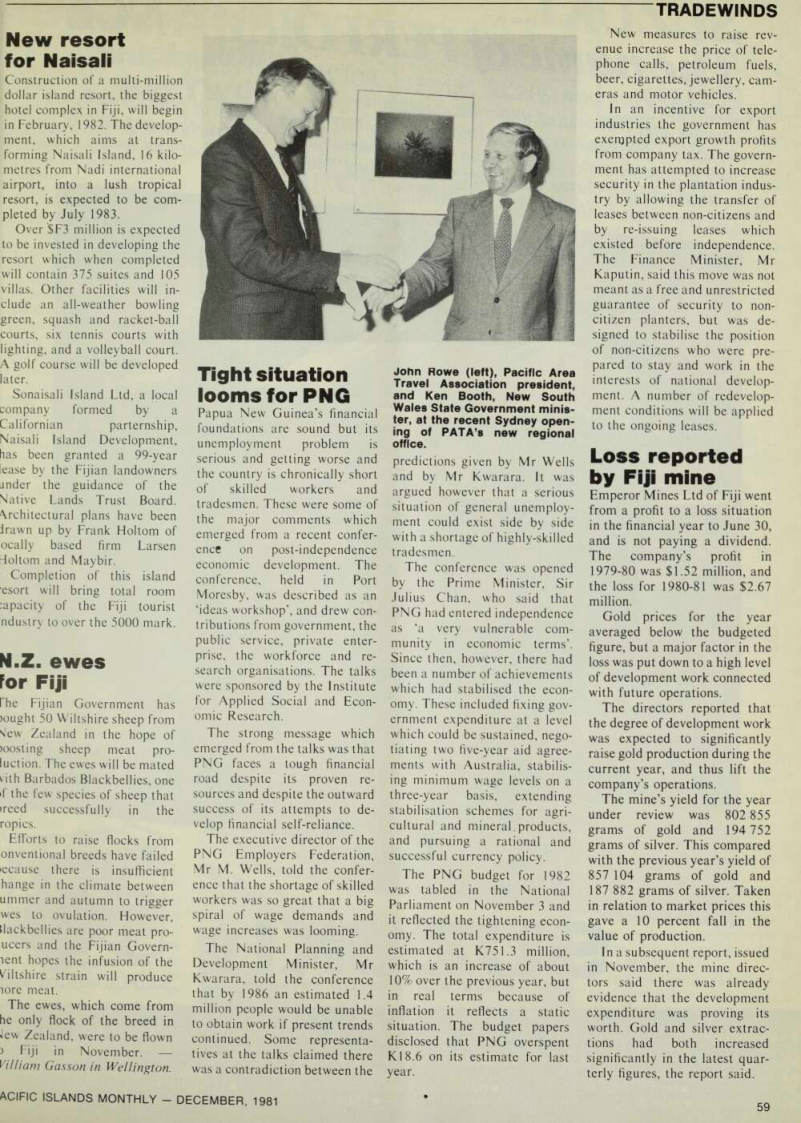
Poll issue in N.Z. union ban on trade with Chile
Trade
Winds
New Zealand’s trade with Chile or the lack of it emerged as a hot issue in the run-up to the country’s November 28 general election.
With a deficit of SNZB43 million in its overseas exchange transactions for the year ending in September, and foreign exchange reserves down to $5OO million, the country is in desper ate straits for new and expand ing markets for its food, paper and manufactured exports.
But in this respect the national trade union body, the Federation of Labour, was prov ing a kingsize fly in the oint ment: its ban on all trade with Chile stymied a trading re lationship which New Zealand authorities reckoned could be bringing $l5O million annually into the country. The FOL was refusing to budge on the ban in spite of the fact that a good number of other countries, in cluding some communist countries, are trading actively with Chile.
Stubborn adherence to the ban has placed FOL President Jim Knox at odds even with his traditional allies in the Oppo sition Labour Party, which had promised electors that the ban would be lifted before mid-1982 if Labour were elected. Not so, said Mr Knox, adding that he would continue to oppose the ‘fascist Pinochet regime’ until it restores the rights of Chilean trade unions, and frees political prisoners from its gaols. For good measure he took a sideswipe at politicans who ‘make statements about FOL policy without consulting it first’. He said: ‘As MPs they should have more brains than to come out with statements like this.’
Summing up, New Zealand journalist lan Templeton wrote in the Sydney magazine The Bulletin on November 24: ‘lf the trade ban has hurt New Zealand more than it has Chile, the issue that disturbs many New Zealanders is that foreign policy is being decided in this instance not in parliament but in the trades hall. The ban also
underlines the monopoly power of the union movement. Both these anxieties extend across the spectrum of voting opinion and some political observers believe they are the real “sleepers” of the election cam paign. ‘The Prime Minister, Robert Muldoon, has sought to exploit them by questioning the re lationship between the Labour Party and the FOL, which, he says, is falling into the hands of the extreme Left. “You’ve got Ken Douglas (secretary of the FOL and a leading figure of the Moscow-aligned Socialist Unity Party) down there, making the ammunition for poor old Jim Knox to fire,” he told one election meeting.’
While the Chile trade issue was moving centre-stage in New Zealand politics, lower-key efforts have been under way in Australia to end the eight-year, union-imposed freeze on trade with that country. A shipping company planned to launch a Sydney-Valparaiso service in November, but at press time it was still unclear whether their efforts would be successful (see Pacific Report).
Australia’s Deputy Prime Minister Doug Anthony, in a recent speech in parliament, warmly praised the initiative.
His fulsome lauding of the Chilean Government’s econ omic successes, and of the confidence it was now inspiring in foreign investors, even brought a smile to the normally austere face of Australian Prime Minister Malcolm Fraser.
PNG: Fiddling
with grants
Papua New Guinea’s Chief Ombudsman Ignatius Kilage did some plain speaking in November when he charged that some senior politicians and public servants in PNG think government grant programmes are for their personal benefit.
In his annual report for the Ombudsman Commission, he revealed that he had used his
power to stop cheques being issued under one government scheme. He had done so be cause the commission’s investi gations had revealed that in two instances the grants were for the purchase of Land Rovers for MPs. A third involved a grant to help the MPs’ business company purchase assets of another company.
Mr Kilage recommended, as part of the way out of the problem, higher pay for MPs and senior public servants, say ing: ‘The situation in PNG is that only expatriates get real wages. Nationals get a grossly disproportionate amount .. .
We wish also to point out that our leaders become susceptible to temptation when there is no parity between their income and the standard of living expected of them.’
The chief ombudsman also had a word or two about the business activities of PNG’s provincial governments. Said he: ‘ln some provinces the people who run the govern ment’s business arms are using them for their own selfish ends.’
In the same week that saw publication of his report, the West Sepik provincial govern ment’s business arm, Wesdeco, went into oblivion, owing more than SAI.3 million. Observers of the PNG scene say it’s unlikely to be the last.
Bumper citrus
crop in Cooks
The Cook Islands’ total citrus harvest in 1981 was 2671 tonnes, up almost 100% on the 1980 harvest of 1436 tonnes.
Rarotonga had the biggest harvest, taking in 2485 tonnes, of which 126 tonnes were ex ported as fresh fruit, with the rest being processed by Kia Orana Foods Factory.
Total fruit received from the Outer Islands was 186 tonnes, down 56 tonnes as compared with last year. The decrease was attributed to shipping prob lems, domestic consumption, and a severe drought during the early cropping season.
Karlil Valji, Kia Orana man ager, said his company and the government, through price sup port, had this year paid citrus farmers a total of $354 340 for their products. The actual value of processed fruit juice for the year had been $B2O 000.
Vanuatu’s
buttons
Vanuatu has become the first developing country to produce mother-of-pearl buttons from trochus shells, which abound in its coastal waters, for export to fashion markets in the West.
The French sportswear manu facturer, Lacoste, is expected to buy more than two million of the buttons. The Times of Papua New Guinea.
Air Pacific’s
737-200 Air Pacific took delivery of a new Boeing 737-200 jet on October 31, 1981 in another major step into the world of modern jet aviation.
The company, then known as Fiji Airways, was established in 1951 with an eight-seater Rapide. Three years later i Drovers began taking over. As the domestic airline grew Doves and Herons were added, \ Then came DHC-2 Beaver am- ( phibious aircraft for the outly ing islands.
DC3s appeared in 1965 on aj ‘wet lease’ arrangement, and the first Hawker Siddeley 748 ■ was purchased in 1967. Thus Fiji Airways became a regional airline, and to denote its re-1 gional character, the name Fiji!
Airways was changed to Air Pacific in 1971.
As the demands for regional] services grew Air Pacific pur-1 chased its first BACI-11 in] 1972. By 1978 Air Pacific had in its fleet three BACI-lls and] four Bandeirantes.
The airline is now operating] flights to Tahiti, Solomon!
Islands, New Caledonia, Vanuatu, Tonga, Kiribati, and 1 Western and American Samoa. ] It also has regular services tol Australia and New Zealand.
With the addition of the new I Boeing 737-200 Air Pacific has I the capability and flexibility to I provide more services, and more 1 freight and passenger capacity, I than ever before.
New resort
for Naisali
Construction of a multi-million dollar island resort, the biggest hotel complex in Fiji, will begin in February, 1982. The develop ment, which aims at trans forming Naisali Island, 16 kilo metres from Nadi international airport, into a lush tropical resort, is expected to be com pleted by July 1983.
Over SF3 million is expected to be invested in developing the resort which when completed will contain 375 suites and 105 villas. Other facilities will in clude an all-weather bowling green, squash and racket-ball courts, six tennis courts with lighting, and a volleyball court.
A golf course will be developed later.
Sonaisali Island Ltd, a local company formed by a
Californian parternship,
Naisali Island Development, has been granted a 99-year lease by the Fijian landowners ander the guidance of the Native Lands Trust Board.
Architectural plans have been irawn up by Frank Holtom of ocally based firm Larsen rJoltom and Maybir.
Completion of this island esort will bring total room capacity of the Fiji tourist nduslry to over the 5000 mark.
N.Z. ewes
For Fiji
fhe Fijian Government has >oughl 50 Wiltshire sheep from 'Jew Zealand in the hope of >oosting sheep meat pro luction. The ewes will be mated vith Barbados Blackbellies, one •f the few species of sheep that ireed successfully in the ropics.
Efforts to raise flocks from onventional breeds have failed •ecause there is insufficient hange in the climate between ummer and autumn to trigger wes to ovulation. However, flackbellies are poor meat pro ucers and the Fijian Govern icnt hopes the infusion of the Wiltshire strain will produce lore meat.
The ewes, which come from he only flock of the breed in Jew Zealand, were to be flown ) Fiji in November.
Vi I ham Gasson in Wellington.
Tight situation
looms for PNG
Papua New Guinea’s financial foundations are sound but its unemployment problem is serious and getting worse and the country is chronically short of skilled workers and tradesmen. These were some of the major comments which emerged from a recent confer ence on post-independence economic development. The conference, held in Port Moresby, was described as an ‘ideas workshop’, and drew con tributions from government, the public service, private enter prise, the workforce and re search organisations. The talks were sponsored by the Institute for Applied Social and Econ omic Research.
The strong message which emerged from the talks was that PNG faces a tough financial road despite its proven re sources and despite the outward success of its attempts to de velop financial self-reliance.
The executive director of the PNG Employers Federation, Mr M. Wells, told the confer ence that the shortage of skilled workers was so great that a big spiral of wage demands and wage increases was looming.
The National Planning and Development Minister, Mr Kwarara, told the conference that by 1986 an estimated 1.4 million people would be unable to obtain work if present trends continued. Some representa tives at the talks claimed there was a contradiction between the
predictions given by Mr Wells and by Mr Kwarara. It was argued however that a serious situation of general unemploy ment could exist side by side with a shortage of highly-skilled tradesmen.
The conference was opened by the Prime Minister, Sir Julius Chan, who said that PNG had entered independence as ‘a very vulnerable com munity in economic terms’.
Since then, however, there had been a number of achievements which had stabilised the econ omy. These included fixing gov ernment expenditure at a level which could be sustained, nego tiating two five-year aid agree ments with Australia, stabilis ing minimum wage levels on a three-year basis, extending stabilisation schemes for agri cultural and mineral. products, and pursuing a rational and successful currency policy.
The PNG budget for 1982 was tabled in the National Parliament on November 3 and it reflected the tightening econ omy. The total expenditure is estimated at K 751.3 million, which is an increase of about 10% over the previous year, but in real terms because of inflation it reflects a static situation. The budget papers disclosed that PNG overspent K 18.6 on its estimate for last year.
New measures to raise rev enue increase the price of tele phone calls, petroleum fuels, beer, cigarettes, jewellery, cam eras and motor vehicles.
In an incentive for export industries the government has exempted export growth profits from company tax. The govern ment has attempted to increase security in the plantation indus try by allowing the transfer of leases between non-citizens and by re-issuing leases which existed before independence.
The Finance Minister, Mr Kaputin, said this move was not meant as a free and unrestricted guarantee of security to non citizen planters, but was de signed to stabilise the position of non-citizens who were pre pared to stay and work in the interests of national develop ment. A number of redevelop ment conditions will be applied to the ongoing leases.
Loss reported
by Fiji mine
Emperor Mines Ltd of Fiji went from a profit to a loss situation in the financial year to June 30, and is not paying a dividend.
The company’s profit in 1979-80 was $1.52 million, and the loss for 1980-81 was $2.67 million.
Gold prices for the year averaged below the budgeted figure, but a major factor in the loss was put down to a high level of development work connected with future operations.
The directors reported that the degree of development work was expected to significantly raise gold production during the current year, and thus lift the company’s operations.
The mine’s yield for the year under review was 802 855 grams of gold and 194 752 grams of silver. This compared with the previous year’s yield of 857 104 grams of gold and 187 882 grams of silver. Taken in relation to market prices this gave a 10 percent fall in the value of production.
In a subsequent report, issued in November, the mine direc tors said there was already evidence that the development expenditure was proving its worth. Gold and silver extrac tions had both increased significantly in the latest quar terly figures, the report said.
John Rowe (left), Pacific Area Travel Association president, and Ken Booth, New South Wales State Government minis ter, at the recent Sydney open ing of PATA’s new regional office.
Advertisements & other items, pp. 59-60 (2 items)
Tradewinds
59
ACIFIC ISLANDS MONTHLY DECEMBER, 1981
Suzuki 1
t PFR fORMANCt
The name Of R• •
t ttrOARDS are truly ALL K
suzuki outboaku sitmt
also for the P^fltfQ'is'bestsuited to your
M “ ’ .
X
SUZUKI
|- 1 yjggpgai
SUZUKI 1
SUZUKI MOTOR CO, LTD Hamamatsu, Japan SUZUKI GENERATOR SEIBOO i NEW ZEALAND SOUTH PACIFIC SUZUKI DISTRIBUTORS LTD. PHONE; 58-599 • PAPUA NEW GUINEA HI SPEED DIESEL SERVICE PTY. LTD. PHONE: 42-2679 • FIJI NIRANJANS AUTOPORT LTD. PHONE: 381555 • TAHITI NIPPON AUTOMOTO PHONE: 2-98-1 » SOLOMON SOLOMON ISLAND PHONE: 565 • VANUATU HENRI LEROUX • NEW CALENDONIA STE. SUPERCAL PHONE: 272068 i AMERIAN SAMOA PACIFIC PRODUCTS, INC. PHONE: 639-9140 • WESTERN SAMOA VATCO LTD. • GUAM ISLAND CYCLERY, INC. >HONE: 565-2298 • NIUE BURNS PHILP CO.,LTD. • NAURU EQUIPAC MOTORS PHONE: 4019 • TONGA TONGA EQUIPMENT > YAP AMBROSE • KOROR BECHESRRAK T. COMPANY PHONE: 338 • TRUK KIOMASA STORE PHONE; 470
Merger for Fiji’s
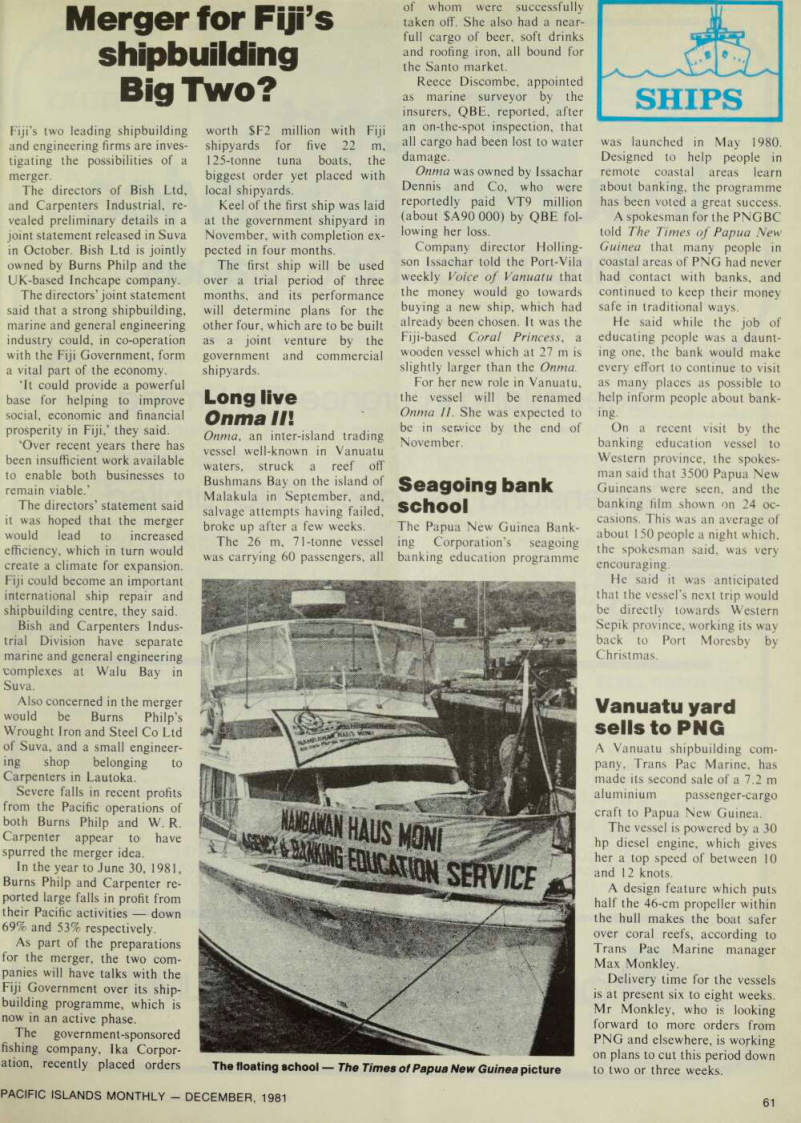
shipbuilding Big Two?
Ships
Fiji’s two leading shipbuilding and engineering firms are inves tigating the possibilities of a merger.
The directors of Bish Ltd, and Carpenters Industrial, re vealed preliminary details in a joint statement released in Suva in October. Bish Ltd is jointly owned by Burns Philp and the UK-based Inchcape company.
The directors’ joint statement said that a strong shipbuilding, marine and general engineering industry could, in co-operation with the Fiji Government, form a vital part of the economy.
Tt could provide a powerful base for helping to improve social, economic and financial prosperity in Fiji,’ they said. ‘Over recent years there has been insufficient work available to enable both businesses to remain viable.’
The directors’ statement said it was hoped that the merger would lead to increased efficiency, which in turn would create a climate for expansion.
Fiji could become an important international ship repair and shipbuilding centre, they said.
Bish and Carpenters Indus trial Division have separate marine and general engineering complexes at Walu Bay in Suva.
Also concerned in the merger would be Burns Philp’s Wrought Iron and Steel Co Ltd of Suva, and a small engineer ing shop belonging to Carpenters in Lautoka.
Severe falls in recent profits from the Pacific operations of both Burns Philp and W. R.
Carpenter appear to have spurred the merger idea.
In the year to June 30, 1981, Burns Philp and Carpenter re ported large falls in profit from their Pacific activities down 69% and 53% respectively.
As part of the preparations for the merger, the two com panies will have talks with the Fiji Government over its ship building programme, which is now in an active phase.
The government-sponsored fishing company, Ika Corpor ation, recently placed orders
worth SF2 million with Fiji shipyards for five 22 m, 125-tonne tuna boats, the biggest order yet placed with local shipyards.
Keel of the first ship was laid at the government shipyard in November, with completion ex pected in four months.
The first ship will be used over a trial period of three months, and its performance will determine plans for the other four, which are to be built as a joint venture by the government and commercial shipyards.
Long live
Onma 111
Onma , an inter-island trading vessel well-known in Vanuatu waters, struck a reef off Bushmans Bay on the island of Malakula in September, and, salvage attempts having failed, broke up after a few weeks.
The 26 m, 71-tonne vessel was carrying 60 passengers, all
of whom were successfully taken off. She also had a near full cargo of beer, soft drinks and roofing iron, all bound for the Santo market.
Reece Discombe, appointed as marine surveyor by the insurers, QBE, reported, after an on-the-spot inspection, that all cargo had been lost to water damage.
Onma was owned by Issachar Dennis and Co, who were reportedly paid VT9 million (about SA9O 000) by QBE fol lowing her loss.
Company director Holling son Issachar told the Port-Vila weekly Voice of Vanuatu that the money would go towards buying a new ship, which had already been chosen. It was the Fiji-based Coral Princess , a wooden vessel which at 27 m is slightly larger than the Onma.
For her new role in Vanuatu, the vessel will be renamed Onma 11. She was expected to be in ser.vice by the end of November.
Seagoing bank
school
The Papua New Guinea Bank ing Corporation’s seagoing banking education programme
was launched in May 1980.
Designed to help people in remote coastal areas learn about banking, the programme has been voted a great success.
A spokesman for the PNGBC told The Times of Papua New Guinea that many people in coastal areas of PNG had never had contact with banks, and continued to keep their money safe in traditional ways.
He said while the job of educating people was a daunt ing one, the bank would make every effort to continue to visit as many places as possible to help inform people about bank ing.
On a recent visit by the banking education vessel to Western province, the spokes man said that 3500 Papua New Guineans were seen, and the banking film shown on 24 oc casions. This was an average of about 150 people a night which, the spokesman said, was very encouraging.
He said it was anticipated that the vessel’s next trip would be directly towards Western Sepik province, working its way back to Port Moresby by Christmas.
Vanuatu yard
sells to PNG
A Vanuatu shipbuilding com pany, Trans Pac Marine, has made its second sale of a 7.2 m aluminium passenger-cargo craft to Papua New Guinea.
The vessel is powered by a 30 hp diesel engine, which gives her a top speed of between 10 and 12 knots.
A design feature which puts half the 46-cm propeller within the hull makes the boat safer over coral reefs, according to Trans Pac Marine manager Max Monkley.
Delivery time for the vessels is at present six to eight weeks.
Mr Monkley, who is looking forward to more orders from PNG and elsewhere, is working on plans to cut this period down to two or three weeks.
The floating school - The Times of Papua New Guinea picture
Advertisements & other items, p. 62 (1 item)
Expert
Insurance Service
throughout the islands
Queensland Insurance (Fiji) Limited
Head Office, 34 Usher St., SUVA General Manager; L. G. Liddell A.A.1.1. Assistant Managers: R. Jackson, Vijay Lai, Phone: 23851.
LAUTOKA OFFICE: Burns Philp Bldg., Naviti St. District Manager: J. Dalton. Phone: 60642.
Queensland Insurance (PNG) Limited
PAPUA NEW GUINEA
Head Office, B.N.G. Building, Musgrave St,.PORT MORESBY. General Manager: J. M. Dawe.
Phone: 212144.
LAE: 4th St. & Coronation Drive. District Manager: C. D. Hillier Phone: 423873.
MOUNT HAGEN: Hagen Drive. District Manager: G. W, Jack Phone: 521002.
ARAWA: Chebu St. District Manager: J. Longbut. Phone: 951555.' MADANG: Kasagten St. District Manager: N. D. Ramage. Phone: 822020.
RABAUL: Wirraway St. District Manager: W. F. Tinker. Phone: 921014.
QBE Insurance Limited
VANUATU, PORT VILA: Rue de Paris,.Suite 19,Oceania Bldg. Manager. I. R. Martin.
Phone: 2299.
SANTO: Burns Philp ( Vanuatu) Ltd. Phone: 230.
PACIFIC AGENCIES
NEW CALEDONIA: Ste. W. A. Johnston, S.A.R.L. 5 Rue Anatole France, NOUMEA.
Phone: 272083.
TAHITI: Arthur Chung. Immeuble 8.1.5., Front de Mer, PAPEETE . Phone: 2.86.19.
NIUE. Burns Philp (South Sea) Company Ltd.
NORFOLK ISLAND: Burns Philp ('N I ) Company Ltd. Phone: 2191.
SAMOA: APIA, Burns Philp (South Sea) Company Ltd. Phone: 22611 TONGA Burns Philp (South Sea) Company Ltd. NUKUALOFA, Phone 21500 HAAPAI, VAVAU
MEMBERS OF THE:
%£?QBE INSURANCE GROUP UMITED
Yachts
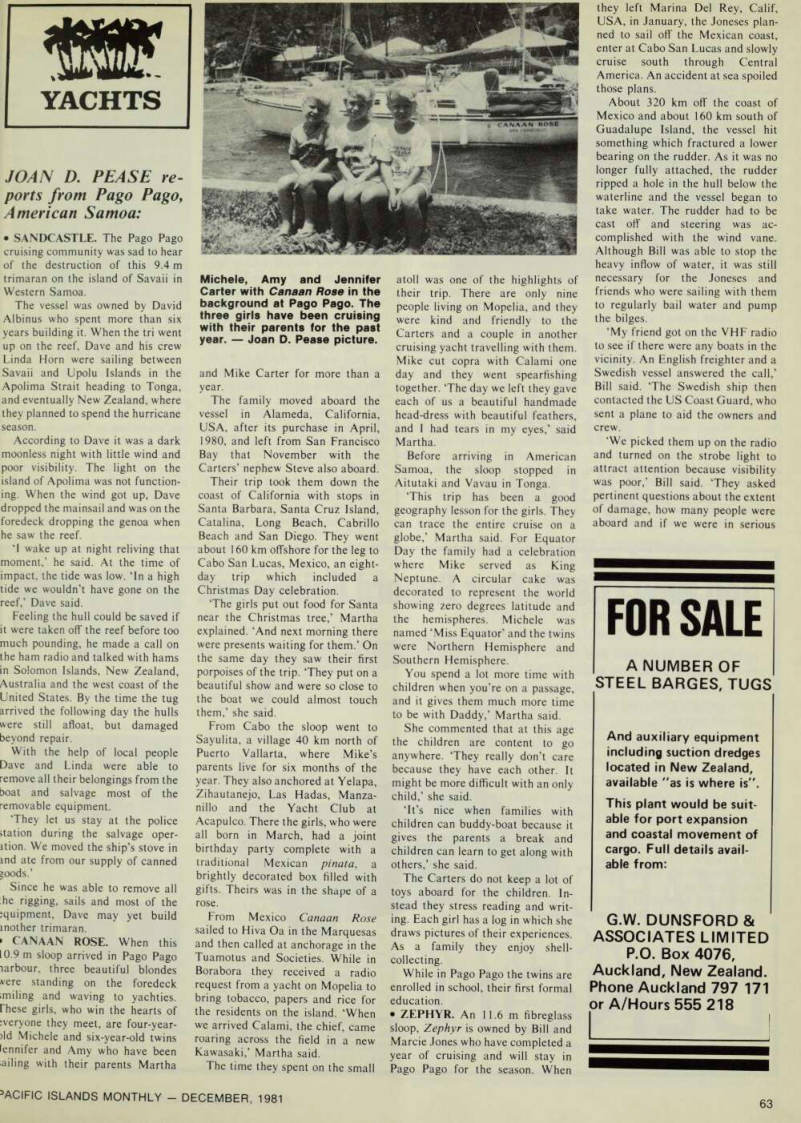
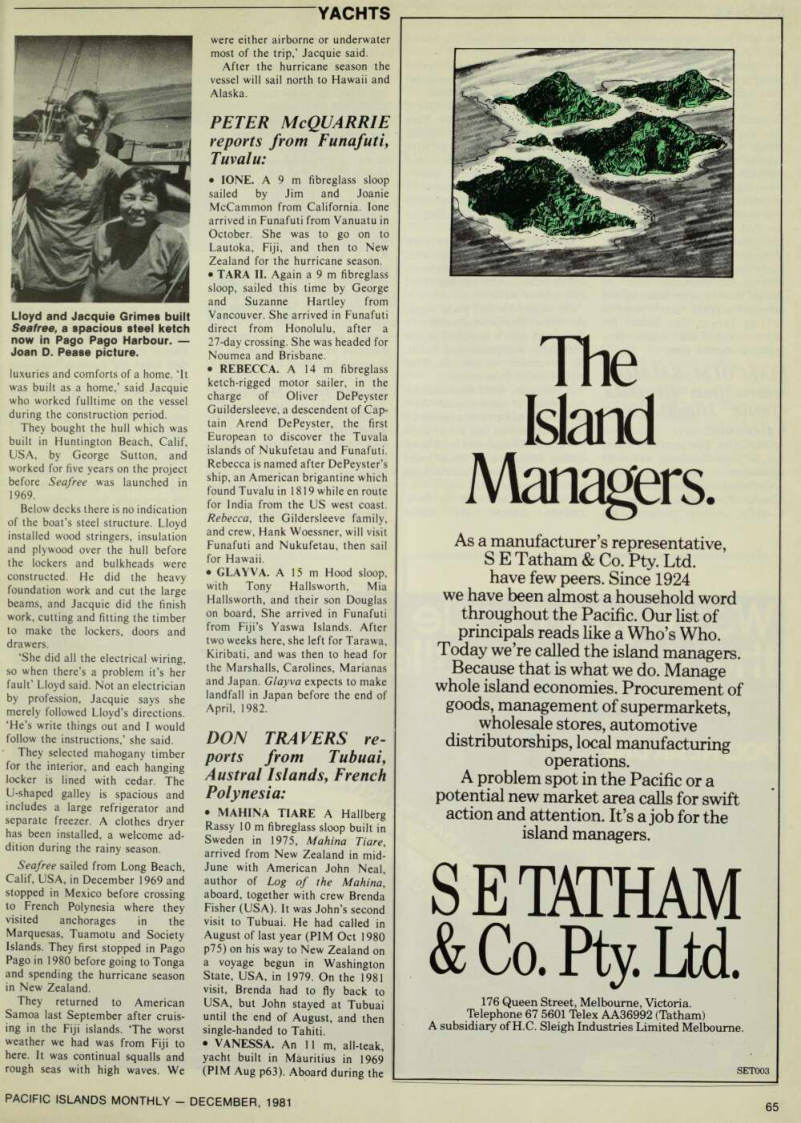
Joan D. Pease Re
ports from Pago Pago,
American Samoa:
• SANDCASTLE. The Pago Pago cruising community was sad to hear of the destruction of this 9.4 m trimaran on the island of Savaii in Western Samoa.
The vessel was owned by David Albinus who spent more than six years building it. When the tri went up on the reef, Dave and his crew Linda Horn were sailing between Savaii and Upolu Islands in the Apolima Strait heading to Tonga, and eventually New Zealand, where they planned to spend the hurricane season.
According to Dave it was a dark moonless night with little wind and poor visibility. The light on the island of Apolima was not function ing. When the wind got up, Dave dropped the mainsail and was on the foredeck dropping the genoa when he saw the reef. ‘I wake up at night reliving that moment,’ he said. At the time of impact, the tide was low. ‘ln a high tide we wouldn’t have gone on the reef,’ Dave said.
Feeling the hull could be saved if it were taken off the reef before too much pounding, he made a call on the ham radio and talked with hams in Solomon Islands, New Zealand, Australia and the west coast of the United States. By the time the tug arrived the following day the hulls were still afloat, but damaged
beyond repair.
With the help of local people Dave and Linda were able to remove all their belongings from the boat and salvage most of the
removable equipment.
‘They let us stay at the police station during the salvage oper ition. We moved the ship’s stove in md ate from our supply of canned »oods.’
Since he was able to remove all he rigging, sails and most of the ;quipment, Dave may yet build mother trimaran. ► CANAAN ROSE. When this 10.9 m sloop arrived in Pago Pago larbour, three beautiful blondes vere standing on the foredeck ;miling and waving to yachties. fhese girls, who win the hearts of
weryone they meet, are four-year
)ld Michele and six-year-old twins lennifer and Amy who have been ailing with their parents Martha
and Mike Carter for more than a year.
The family moved aboard the vessel in Alameda, California, USA, after its purchase in April, 1980, and left from San Francisco Bay that November with the Carters’ nephew Steve also aboard.
Their trip took them down the coast of California with stops in Santa Barbara, Santa Cruz Island, Catalina, Long Beach, Cabrillo Beach and San Diego. They went about 160 km offshore for the leg to Cabo San Lucas, Mexico, an eight day trip which included a Christmas Day celebration. ‘The girls put out food for Santa near the Christmas tree,’ Martha explained. ‘And next morning there were presents waiting for them.’ On the same day they saw their first porpoises of the trip. ‘They put on a beautiful show and were so close to the boat we could almost touch them,’ she said.
From Cabo the sloop went to Sayulita, a village 40 km north of Puerto Vallarta, where Mike’s parents live for six months of the year. They also anchored at Yelapa, Zihautanejo, Las Hadas, Manza nillo and the Yacht Club at Acapulco. There the girls, who were all born in March, had a joint birthday party complete with a traditional Mexican pinata, a brightly decorated box filled with gifts. Theirs was in the shape of a rose.
From Mexico Canaan Rose sailed to Hiva Oa in the Marquesas and then called at anchorage in the Tuamotus and Societies. While in Borabora they received a radio request from a yacht on Mopelia to bring tobacco, papers and rice for the residents on the island. ‘When we arrived Calami, the chief, came roaring across the field in a new Kawasaki,’ Martha said.
The time they spent on the small
atoll was one of the highlights of their trip. There are only nine people living on Mopelia, and they were kind and friendly to the Carters and a couple in another cruising yacht travelling with them.
Mike cut copra with Calami one day and they went spearfishing together. ‘The day we left they gave each of us a beautiful handmade head-dress with beautiful feathers, and I had tears in my eyes,’ said Martha.
Before arriving in American Samoa, the sloop stopped in Aitutaki and Vavau in Tonga. ‘This trip has been a good geography lesson for the girls. They can trace the entire cruise on a globe,’ Martha said. For Equator Day the family had a celebration where Mike served as King Neptune. A circular cake was decorated to represent the world showing zero degrees latitude and the hemispheres. Michele was named ‘Miss Equator’ and the twins were Northern Hemisphere and
Southern Hemisphere.
You spend a lot more time with children when you’re on a passage, and it gives them much more time to be with Daddy,’ Martha said.
She commented that at this age the children are content to go anywhere. ‘They really don’t care because they have each other. It might be more difficult with an only child,’ she said. ‘lt’s nice when families with children can buddy-boat because it gives the parents a break and children can learn to get along with others,’ she said.
The Carters do not keep a lot of toys aboard for the children. In stead they stress reading and writ ing. Each girl has a log in which she draws pictures of their experiences.
As a family they enjoy shell
collecting.
While in Pago Pago the twins are enrolled in school, their first formal education. • ZEPHYR, An 11.6 m fibreglass sloop. Zephyr is owned by Bill and Marcie Jones who have completed a year of cruising and will stay in Pago Pago for the season. When
they left Marina Del Rey, Calif, USA, in January, the Joneses plan ned to sail off the Mexican coast, enter at Cabo San Lucas and slowly cruise south through Central America. An accident at sea spoiled those plans.
About 320 km off the coast of Mexico and about 160 km south of Guadalupe Island, the vessel hit something which fractured a lower bearing on the rudder. As it was no longer fully attached, the rudder ripped a hole in the hull below the waterline and the vessel began to take water. The rudder had to be cast off and steering was ac complished with the wind vane.
Although Bill was able to stop the heavy inflow of water, it was still necessary for the Joneses and friends who were sailing with them to regularly bail water and pump the bilges. ‘My friend got on the VHP radio to see if there were any boats in the vicinity. An English freighter and a Swedish vessel answered the call,’
Bill said. ‘The Swedish ship then contacted the US Coast Guard, who sent a plane to aid the owners and crew. ‘We picked them up on the radio and turned on the strobe light to attract attention because visibility was poor,’ Bill said. ‘They asked pertinent questions about the extent of damage, how many people were aboard and if we were in serious
Michele, Amy and Jennifer Carter with Canaan Rose in the background at Pago Pago. The three girls have been cruising with their parents for the past year.-Joan D. Pease picture.
trouble. They also volunteered to drop off pumps.’
Next day the plane returned to check on their progress. At that point it was necessary to pump for two minutes every 15 minutes. The Coast Guard had Bill set up a ham radio schedule with the San Francisco Coast Guard Station. ‘We kept the schedule when reception was possible, but had to give it up because we were so busy pumping the bilge, he said.
Subsequently the Coast Guard reported them missing at sea.
Friends from Marina Del Rey who had sailed from California two days before Zephyr , heard the VHF conversations and agreed to meet the sloop in Magadalena Bay, Mexico. It was five days before the crippled yacht arrived after being considered missing. ‘lt was a tearful reunion with our friends,’ Bill said.
After unsuccessful attempts to repair the rudder in Mag Bay and Cabo San Lucas, they sailed to La Paz and Bill returned to the US to get a new one. After the installation, he and Marcie sailed to Socorro Island in Revillagigedo.
It was late April before they crossed from Socorro to Hiva Oa in the Marquesas. The repairs had taken so long they could not sail to Central America before the storm season. They anchored also in Tahu
Ata and in Nukuhiva where they met other friends from California.
In the Tuamotus they stopped at Ahe and Rangiroa. They also visited Tahiti, Moorea, Huahine Raiatea, Tahaa, Borabora and
Mopelia.
‘We got caught in a storm en route to Niue which tore off the windvane, so we ran for Pago, the closest place for repair and ordering parts. ‘We’ve been moving too fast,’ said Bill who spent five years
building the well-found sloop.
‘Maybe I’m not taking enough time to smell the flowers, T think you have to cruise for about a year to shift gears from the rat race at home to the lay-back, manana attitude,’ he said. They’ll stay in Pago until the end of the season and slowly visit Tonga, Fiji and Vanautu in 1982 before sailing to New Zealand for the season, • TEKEA 11. A 9.1 m Cheoy Lee Bermuda ketch from Newport Beach, Calif, USA, will spend the hurricane season in Pago Pago, Owners Kim and Gordon Eschner bought the fibreglass ketch five years ago after living for 18 months on a 7.6 m catamaran which they admit was small, They began their South Pacific cruise in November 1980, making several stops along the coast of
Mexico: Esenada, Turtle Bay, Bahia Santa Maria where they got 24 lobsters in two hours Caba San Lucas, where they joined 100 boats for the Christmas holidays, La Paz and Puerto Vallarta.
The crossing from Puerto Vallarta to Nukuhiva in the Marquesas took 23 adventure-filled days. ‘We left in beautiful weather and walked into the biggest storm of the season. For three days we had heavy winds and rough seas. That’s a lousy way to start a passage,’ Gordon said.
About 12 days after leaving Mexico, the Eschners were drop ping the mainsail in a squall when the topping left gave way and the boom broke at the gooseneck.
Gordon was able to jury-rig the spar to get them sailing again, but the damage was unnerving.
That was not the end of their troubles. About two days before the Marquesas landfall they caught the end of a storm which swept through French Polynesia in March. ‘We had horrendous seas from three directions, wind gusting to 45 knots and a constant cloud coyer,’ Gordon recalled. Under a 7 sq m staysail Tekea II was going six knots and at one point during the storm the vessel nearly broached. As soon as the sky cleared, the Eschners were
able to get a moon shot to get an accurate position, and within an hour they sighted Nukuhiva.
They called at Fatuhiva, Hiva Oa, Tahu Ata and Ua Pou during their three months in the Marquesas, spending one month in Nukuhiva. ‘We had more fun in the Marquesas than anywhere. We met more people and did more things. I can’t imagine returning to the US without first going back there,’
Gordon said.
At Taipivai in Nukuhiva they anchored at Thomas and Luc’s Yacht Club where yachties are welcomed and the owners prepare Marquesan food. ‘They took us on expeditions to see tikis and diving for lobsters,’ Gordon said.
Tekea II anchored for a month in Ahe in the Tuamotus which was Kim’s favorite island. ‘I left my heart in Ahe,’ she said.
The Eschners stayed in Papeete at the Quay for the July 14, Bastille Day, celebration and then called at Moorea, Huahine and Borabora before sailing to American Samoa.
That crossing included a two-day spinnaker run.
In 1982 they will visit Tonga, Fiji, New Caledonia and Australia. • SEAFREE. This 16.8 m steel ketch was built by owners Jacquie and Lloyd Grimes and includes the
luxuries and comforts of a home. ‘lt was built as a home,’ said Jacquie who worked fulltime on the vessel during the construction period.
They bought the hull which was built in Huntington Beach, Calif, USA, by George Sutton, and worked for five years on the project before Seafree was launched in 1969.
Below decks there is no indication of the boat’s steel structure. Lloyd installed wood stringers, insulation and plywood over the hull before the lockers and bulkheads were constructed. He did the heavy foundation work and cut the large beams, and Jacquie did the finish work, cutting and fitting the timber to make the lockers, doors and drawers. ‘She did all the electrical wiring, so when there’s a problem it’s her fault’ Lloyd said. Not an electrician by profession, Jacquie says she merely followed Lloyd’s directions. ‘He’s write things out and I would follow the instructions,’ she said.
They selected mahogany timber for the interior, and each hanging locker is lined with cedar. The U-shaped galley is spacious and includes a large refrigerator and separate freezer. A clothes dryer has been installed, a welcome ad dition during the rainy season.
Seafree sailed from Long Beach, Calif, USA, in December 1969 and stopped in Mexico before crossing to French Polynesia where they visited anchorages in the Marquesas, Tuamotu and Society Islands. They first stopped in Pago Pago in 1980 before going to Tonga and spending the hurricane season in New Zealand.
They returned to American Samoa last September after cruis ing in the Fiji islands. ‘The worst weather we had was from Fiji to here. It was continual squalls and rough seas with high waves. We
were either airborne or underwater most of the trip,’ Jacquie said.
After the hurricane season the vessel will sail north to Hawaii and Alaska.
Peter Mcquarrie
reports from Funafuti ,
Tuvalu:
• lONE. A 9 m fibreglass sloop sailed by Jim and Joanie McCammon from California. lone arrived in Funafuti from Vanuatu in October. She was to go on to Lautoka, Fiji, and then to New Zealand for the hurricane season. • TARA 11. Again a 9 m fibreglass sloop, sailed this time by George and Suzanne Hartley from Vancouver. She arrived in Funafuti direct from Honolulu, after a 27-day crossing. She was headed for Noumea and Brisbane. • REBECCA. A 14 m fibreglass ketch-rigged motor sailer, in the charge of Oliver DePeyster Guildersleeve, a descendent of Cap tain Arend DePeyster, the first European to discover the Tuvala islands of Nukufetau and Funafuti.
Rebecca is named after DePeyster’s ship, an American brigantine which found Tuvalu in 1819 while en route for India from the US west coast.
Rebecca , the Gildersleeve family, and crew. Hank Woessner, will visit Funafuti and Nukufetau, then sail for Hawaii. • GLAYVA. A 15 m Hood sloop, with Tony Hallsworth, Mia Hallsworth, and their son Douglas on board, She arrived in Funafuti from Fiji’s Yaswa Islands. After two weeks here, she left for Tarawa, Kiribati, and was then to head for the Marshalls, Carolines, Marianas and Japan. Glayva expects to make landfall in Japan before the end of April, 1982.
Don Travers Re
ports from Tubuai,
Austral Islands , French
Polynesia:
• MAHINA TIARE A Hallberg Rassy 10 m fibreglass sloop built in Sweden in 1975, Mahina Tiare, arrived from New Zealand in mid- June with American John Neal, author of Log of the Mahina , aboard, together with crew Brenda Fisher (USA). It was John’s second visit to Tubuai. He had called in August of last year (PIM Oct 1980 p 75) on his way to New Zealand on a voyage begun in Washington State, USA, in 1979. On the 1981 visit, Brenda had to fly back to USA, but John stayed at Tubuai until the end of August, and then single-handed to Tahiti. • VANESSA. An 11 m, all-teak, yacht built in Mauritius in 1969 (PIM Aug p 63). Aboard during the
Lloyd and Jacquie Grimes built Seafree, a spacious steel ketch now in Pago Pago Harbour.- Joan D. Pease picture.
call at Tabuai were owner Jerry Sauzier of Mauritius, his wife Hana of Borabora, and crew Golde Milligan and Charles Van de Water (both USA). They arrived in late June from New Zealand via Raivavae. Jerry and Hana were on their way back to Borabora after a voyage to New Zealand to refit Vanessa. • NIMBUS. An 11 m cutter built in New Zealand of three skins of kauri, Nimbus arrived on June 28 with owner Bill Sellers (USA), his son Rod, and crew Christine Hall and Michele Henry (both NZ).
They arrived from Raivavai after a 22-day voyage from New Zealand.
Nimbus had previously called at Tubuai in 1979. after following the same route (PIM Oct 1979 pB3).
Leaving Tubuai, they headed for Moorea and Tahiti where they hoped to spend a year.
Malcolm Salmon
reports from lie Ouen
(Turtle Island) y New
Caledonia:
• CADENZA. This 11 m steel cutter was in New Caledonia waters in
September.
On board were Australians Kim Chuck, 29, co-owner skipper, Erl Franklin, co-owner navigator, 28,
and crew member American Daniel Liddle, 23.
Cadenza had put into He Ouen to recharge her motor’s batteries be fore entering Noumea harbour.
Daniel is a young man with a story. He set out from New York two years ago to ride his bicycle around the world. As things have turned out he’ll be doing that and sailing around the world as well.
He said: ‘When I started I thought it would take 18 months to two years. Now I’m thinking in terms of four years or five.’
Daniel first rode from New York to Mexico, Guatemala, El Salvador, Honduras, Nicaragua, Costa Rica, and Panama where he was faced with a lot of water.
He caught his first yacht there, the New Zealand-registered Te Pahi, with which he sailed to the
Galapagos, Marquesas, and Tahiti.
He proceeded to ride his bike around Tahiti three times.
A US yacht. Hard Rock , was his next means of sea transport. With her he went to Rarotonga, which he circled on his bike four times. Then it was on to Tonga, and a lot more cycling during the six weeks spent there. Then Fiji, and a Suva to Suva bike ride around Viti Levu.
From Fiji he went to New Zealand aboard the yacht
Solanderi. He planned to spend three to four months in New Zealand but finished up staying for eight, during which he rode from ‘top to bottom’ of the country’s two islands and back again.
With the yacht Alouette , Daniel then sailed from Auckland to Noumea, and on to Port-Vila, where he met up with Cadenza and, of course, did a Port-Vila/Port-Vila circuit of Efate on his bike.
After what he plans as a long visit to Australia which offers plenty of scope for bike-riding Daniel will head off through Southeast Asia still, he hopes, crewing on yachts.
Then it will be Africa, Europe, and, finally back home to USA. ‘I still want to cycle around the world, but now I also want to sail around the world. I don’t know how it’ll work out in the end, but so far so good,’ he said.
Marcia Davock
reports from Port-Vila ,
Vanuatu:
• GENESIS. This Baba 30, owned by Carl and Patty Kaiser of
Olympia, Washington, USA re
cently visited the Vanuatu islands of Emae, Epi, Ambrym and Malakula. In Malakula, they were
pinned down in Port Sandwich for two weeks with high winds, as were Triad II and Chrysalis. The yachts traded goods with the village chief for a pig, which they cooked local style in an underground oven. Con tinuing on to Ouvea in New Caledonia’s Loyalty Islands, they again found high winds and rough seas. But, Ouvea’s fishing was the best in the Pacific, they thought.
With the hurricane season ap proaching, the Kaisers returned to Port-Vila for rest, relaxation and
reprovisioning, before heading to
Russell, New Zealand, where they expect to stay until April. They will then head home to Washington State. The Kaisers have been cruis ing for two and a half years, visiting Mexico, French Polynesia, the Cook Islands, American Samoa, Tonga, Fiji, Vanuatu, the Loyalty Islands and New Zealand, where they spent the previous hurricane season. • RUADH. New Zealanders Bruce and Fiona Martyn spent five years finishing their cutter-rigged fibreglass FI-28, then left New Zealand in June, with crew Gus Wilson aboard. They spent six weeks in Vavau, Tonga, restoring and converting a local family’s
fishing dinghy into a sailing boat.
They had many happy experiences
with this family on the small island of Pangai Motu. They then cruised for two months in Fiji, spending most of their time in sunny Nadi waters. From Port-Vila, the Martyns will head for Southport, Australia, where they plan to work and install a new motor and a self steering unit. • ENSALLA. This 16 m cutter rigged Tradewinds 48, a Monk design, is in Port-Vila. Owners Maurice and Lucy Baldwin, whose homebase is San Francisco, Cali fornia, will leave shortly for New Caledonia and New Zealand, where they will spend the hurricane season.
The Baldwins left California two and a half years ago for Mexico, Costa Rica, the Panama Canal, San Bias Islands, Venezuela and Colombia (they particularly loved Cartagena). They visited Caribbean islands as far north as Puerto Rico, originally intending to sail to Europe. Then, however, they changed their minds and returned through the canal to the Pacific, visiting the Marquesas, Tuamotus and Society Islands; American and Western Samoa; Tonga, Fiji and Vanuatu. They are undecided about future plans following New Zea land. • BRIGHT WING. Dean Whitaker and Wanda Rensel are in Port-Vila aboard their 10 m engineless Brown Searunner trimaran, whose home port is New Orleans, Louisiana.
Since departing California seven years ago, Bright Wing had zig zagged across the Pacific, stopping ‘almost everywhere’, Dean said.
They especially enjoyed Fanning
Island, but Fiji offers their pre ferred cruising grounds. A previous trip in 1953 to the South Pacific aboard 15 m Laurent Giles ketch took Dean to Hawaii, French Polynesia, New Hebrides (now Vanuatu), Solomons, New Guinea and Australia. Then, in 1965, he circumnavigated Africa, starting
and finishing the trip in Nigeria,
aboard his 10 m Golden Hind. Dean is a former deep sea diver on oil rigs; he is also a crop duster pilot and stunt pilot in movies. Future plans may include Australia, Fiji,
Singapore or Papua New Guinea . . . we’re not in a rush to make decisions,’ said Dean. • WANDERLURE. Art Hammond reports that he is ‘alive and well in Vanuatu’ aboard his 10 m schooner, whose homeport is Long Beach, California. Art, who worked for the Panama Canal from 1970 to 1975, has been cruising the Pacific ever since. His most recent cruising has included New Zealand, Fiji, Vanuatu, Solomons, Australia and New Caledonia. He has spent three previous hurricane seasons in New Zealand, and plans to head for the Bay of Islands in December. • MOONDOG. Jo and Joanne Hudson, from Big Sur, California, arrived in Port-Vila, planning to remain for the hurricane season. Jo co-designed the unique 14 m trimaran with Jim Brown, and it’s a one-of-a-kind boat, panelled inside with Big Sur redwood. The boat took three years to build, then went on a ‘shakedown’ cruise to Tahiti, arriving back in California in 1976.
This year, the Hudsons departed in June for Hawaii, then stopped at Fanning Island and Fiji en route for Vanuatu. Jo, who cruised the New Hebrides 16 years ago, still finds them the most comfortable and charming cruising waters, with much more variety (volcanoes, blend of cultures, exotic local cus toms) than other areas. ‘lt’s like being on a frontier,’ Joanne said. Jo is a cartoonist and writer who contributes to numerous publica tions.
Other boats in Port-Vila include Tethys, Barones and Shearwater.
PA UL RYSA VYreports
from Rarotonga , Cook
Islands:
• HARMONY. An 11 m Fantasia sloop was one of the few late callers to Rarotonga in October. On board the four-year-old yacht were Frank Boucek and his wife Susan. The couple began their voyage from San
Diego in November 1979, and cruised down the California coast to Baja, and then spent 14 months in the Sea of Cortez. As keen scuba divers, the couple were enthralled by the abundance of marine life in this area, and this strongly influenced their decision to remain in Mexico longer than planned.
The couple then continued their journey to the Marquesas, the Tuamotus and the Societies where they remained for several months.
Frank and Susan were so im pressed with Mopelia in the Societies that they persuaded friends aboard Aura, another cruis ing yacht, to join them there.
Unfortunately, as Aura approached Mopelia, the watch fell asleep and the yacht was smashed on the reef.
A month of salvage work ensued, but, according to Frank, they were only able to recover about $6OOO worth of equipment. The cost of Aura was around $300,000. The delay in Mopelia accounts for Harmony’s late arrival in Rarotonga. She will berth in New Zealand for the hurricane season, and then sail back to San Diego via Fiji, the Societies, Tonga, Samoa and Hawaii. • JOSHUA. A five-year-old Cava lier 32 sloop was also berthed in Avatiu Harbour in early October.
The vessel is owned by Kiwi couple Ross and Jo Blackman, and their sole crew member is Chris Brombie.
Joshua is travelling in the opposite direction to most yachts now in the South Pacific.
She began her journey from her home port of Auckland in late September, and Rarotonga is the first port of call. After two weeks here, Joshua departed for the Societies, the Tuamotus, the Marquesas, and Hawaii, where it will remain for the hurricane season.
The Blackmans have owned the sloop for only six months, and this is their first ocean cruise in their own boat. Ross, a sailmaker by pro fession, has done some ocean racing, and has always longed to sail his own vessel.
The trip so far has been good, though Murphy’s Law, ‘everything that can go wrong will go wrong’, has come into play.
Ross feels that after four months, the couple will have adjusted prop erly to the cruising life, and all the mechanical appliancies on the yacht will have long since broken down and been repaired. Then, he hopes, it will be really smooth sailing. The couple anticipate re turning to Auckland around July 1982.
On board Nimbus at Tubuai were (from left) Bill Sellers, Christine Hall, Michelle Henry and Rod Sellers (report p66)- Don Travers picture.
Advertisements & other items, pp. 63-68 (3 items)
63
3 ACIFIC ISLANDS MONTHLY - DECEMBER, 1981
For Sale
A NUMBER OF
STEEL BARGES, TUGS
And auxiliary equipment including suction dredges located in New Zealand, available "as is where is".
This plant would be suitable for port expansion and coastal movement of cargo. Full details available from:
G.W. DUNSFORD &
ASSOCIATES LIMITED
P.O. Box 4076, Auckland, New Zealand.
Phone Auckland 797 171 or A/Hours 555 218
Add New Life To Your Record Enjoyment DEMON has supplied the
broadcasting industry with
professional equipment for
many years and met with
highest acclaim.
DP-60L: “DEMON Quartz”
“Auto Lift” D.D. Turntable.
The straight and the S-shaped type tonearm are compatible, equipped also.
Mirrorfinish, laminated cabinet exhibits clean lines and luxury looks.
DEMON.
70 years experience in sound research & development
NIPPON COLUMBIA CO LTD
No. 14-14, AKASAKA 4-CHOME, MINATO-KU,
TOKYO 107, JAPAN
DL-305: “Amorophous boron cantilever” MC type phono cartridge. DL-303: “Lightest Weight Vibration System” MC type phono cartridge.
DL-301: “High Complicance’
MC type phono cartridge.
The
Island
Managers.
As a manufacturer’s representative, S E Tatham & Co. Pty. Ltd. have few peers. Since 1924 we have been almost a household word throughout the Pacific. Our list of principals reads like a Who’s Who.
Today we’re called the island managers.
Because that is what we do. Manage whole island economies. Procurement of goods, management of supermarkets, wholesale stores, automotive distributorships, local manufacturing operations.
A problem spot in the Pacific or a potential new market area calls for swift action and attention. It’s a job for the island managers.
SEWHAM
& Co. Pty. lid.
176 Queen Street, Melbourne, Victoria.
Telephone 67 5601 Telex AA36992 (Tatham) A subsidiary of H.C. Sleigh Industries Limited Melbourne.
SETOO3
WeVe just made
the ocean smaller!
Polynesia Line's new MS Polynesia 550-container ship provides regular monthly cargo service between Papeete, Pago Pago and Apia in the South Pacific, and Long Beach and Oakland on the US Pacific Coast.
POLYNESIMJNE
Interocean Steamship Corporation. General Agent Port Agents .
V <2 & u 3* CA94104 5* v 908 C ?
Apia Paco Pago Papeete and we do it better!
Serving Polynesia is all we do ,
BOTTLING
EQUIPMENT
SUPPLIERS
Manufacturers and suppliers of spare parts for the progressive range of bottling equipment.
Complete reconditioning or parts reconditioned.
Sale of reconditioned and second-hand machinery, also general bottling equipment.
Design and manufacture of bottle conveyor systems to suit your application.
Comprehensive service throughout Australia, New Zealand, New Guinea and South Pacific Islands
11 MARSH ST.,
FOOD-TEX MACHINERY
SERVICE PTY. LTD.
GRANVILLE 2142. PHONE 682-1488 (2 lines).
P.O. Box 146, Carlingford 2118.
Sydney, Australia.
Phone: 682 1488 (2 lines) South Pacific Agents: ALFRED LAWRENCE & CO., AUCKLAND, NEW ZEALAND Mail Address: P.O. Box 732, Auckland, New Zealand
In our 87th Year Selling ‘Service’ to the Pacific Islands
Nelson & Robertson
RABAUL
■I o 2: o & A/ m •••
MADANG
LAE
/ . vW ;... *. •v.;.
BRISBANE
SYDNEY
Pty. Ltd.
(Established 1895)
Plantation House, 197 Clarence Street, Sydney.
Cables: ‘IVAN’, Sydney, Brisbane.
Telex: AA22381, Sydney.
Phone: 29 2871
KIETA
LAUTOKA
V-: >.v. ...
;SU'V A
*• • V/,I• ;I. ; •••*
For Indents
from Australia,
New Zealand and Overseas
Foodstuffs £&***-
Softgoods
Hardware
Machinery
Travel
Insurance
Canned Fish
Jute Goods
Real Estate
V/./.v;* *
BRANCH OFFICES:
Nelson & Robertson Pty. Ltd., P.O. Box 575, Brisbane, Qld., Australia. 2216966 P.O. Box 2092, Govt. Bldg., Suva, Fiji. 22430 P.O. Box 258, Lautoka, Fiji, 62101 P.O. Box 2420, CPO Auckland 1, New Zealand. 774141 u :-v- -:/.yr V&-
:PAPUA NEW GUINEA REPRESENTATIVES:
Tni Pty. Ltd., Rabaul, P.N.G. 922911 Box 1406, Lae, P.N.G. 422366 .0. Box 711, Madang, P.N.G. 822066 P.O. Box 253, Kieta, P.N.G. 956185
64
Y Awn I o
PACIFIC ISLANDS MONTHLY - DECEMBER, 1981
Services
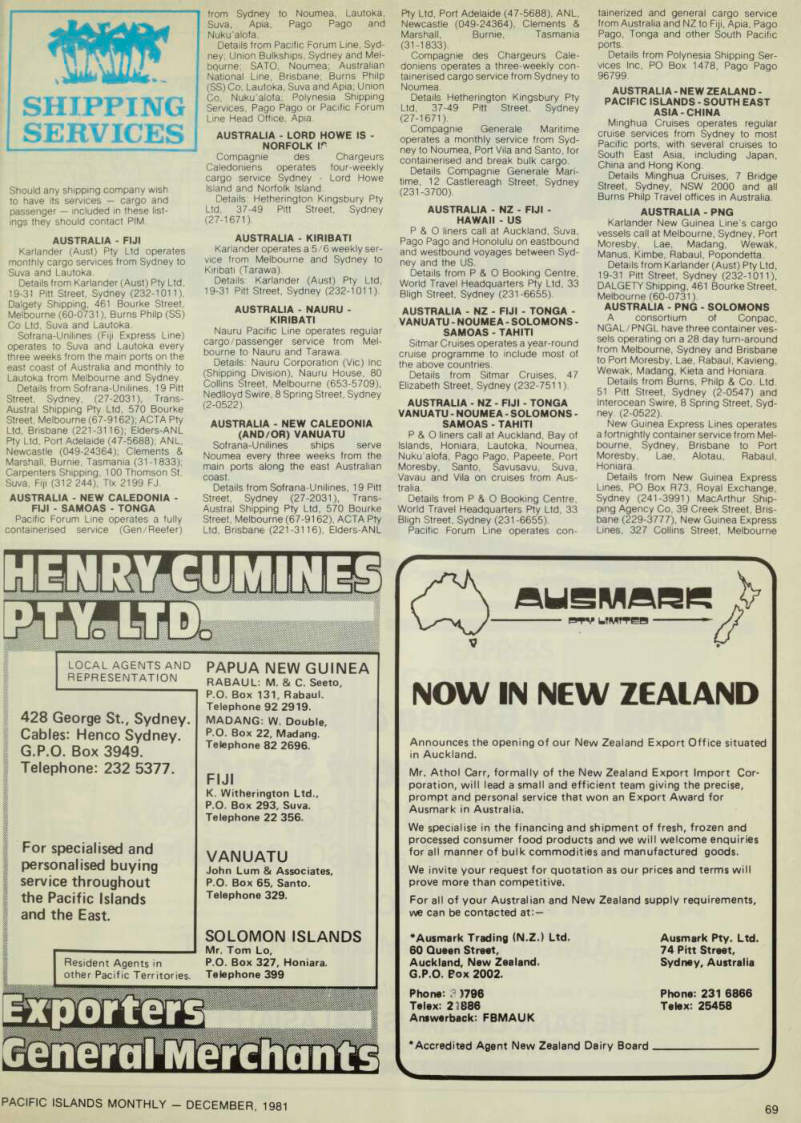
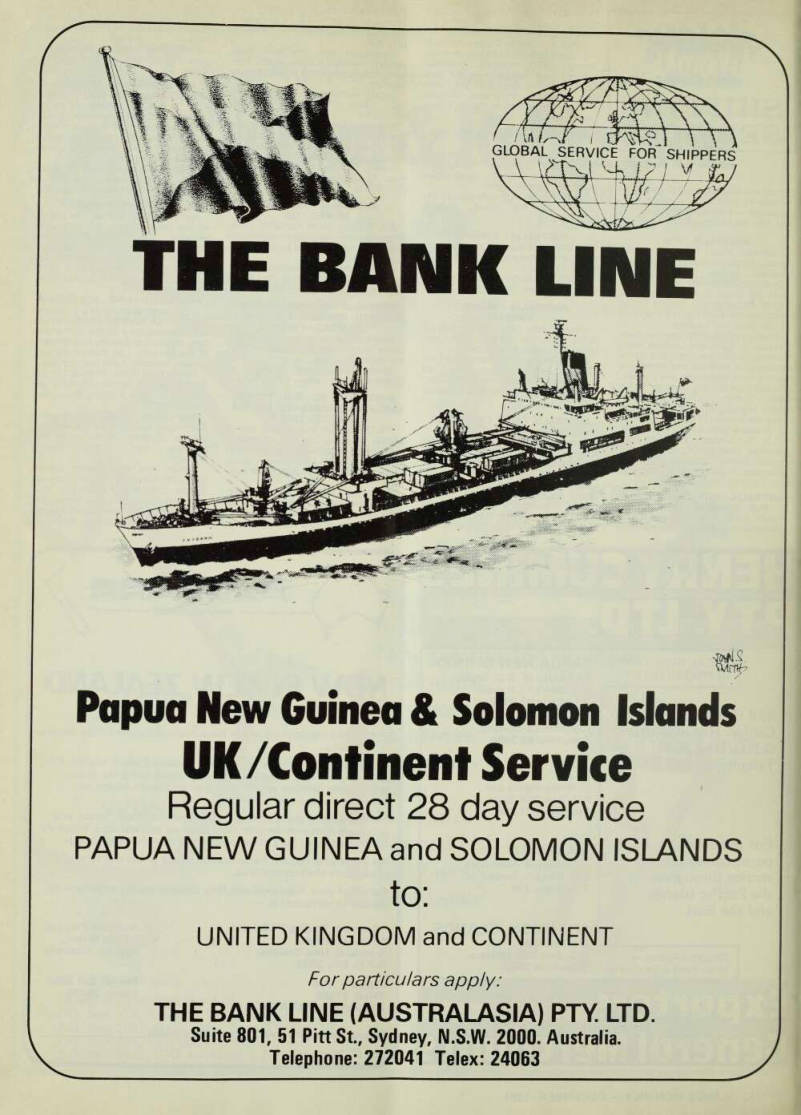
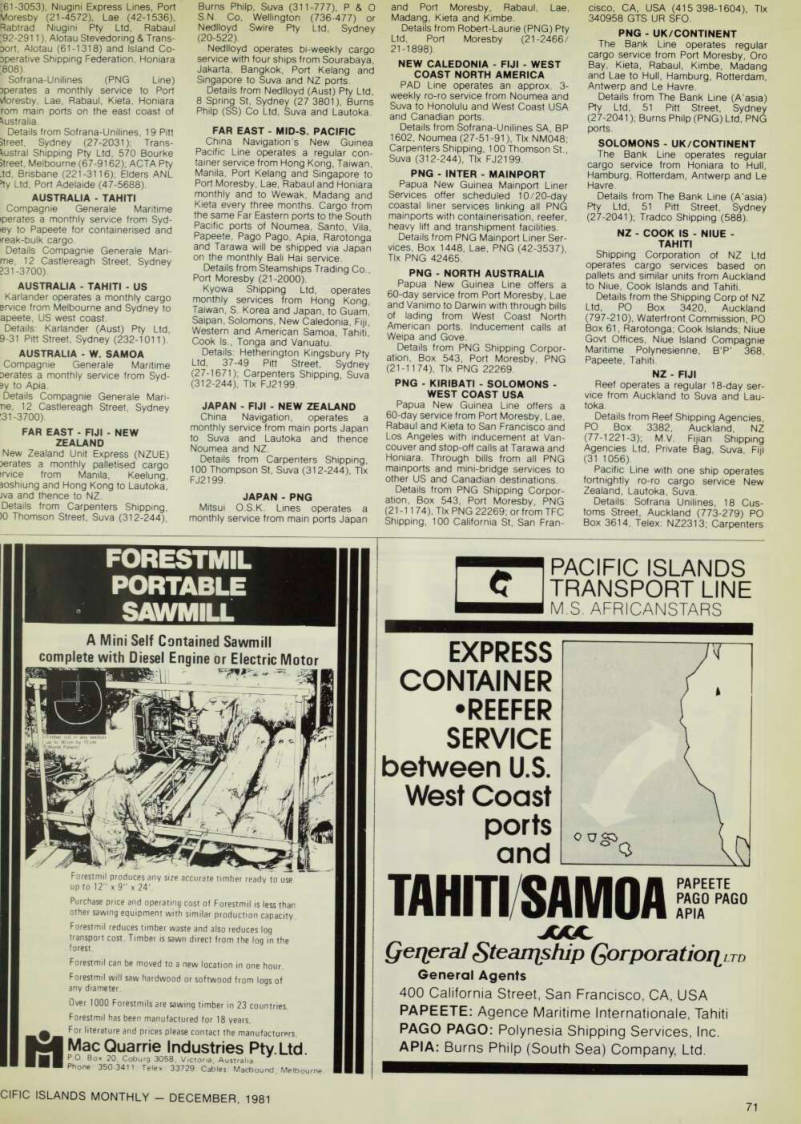
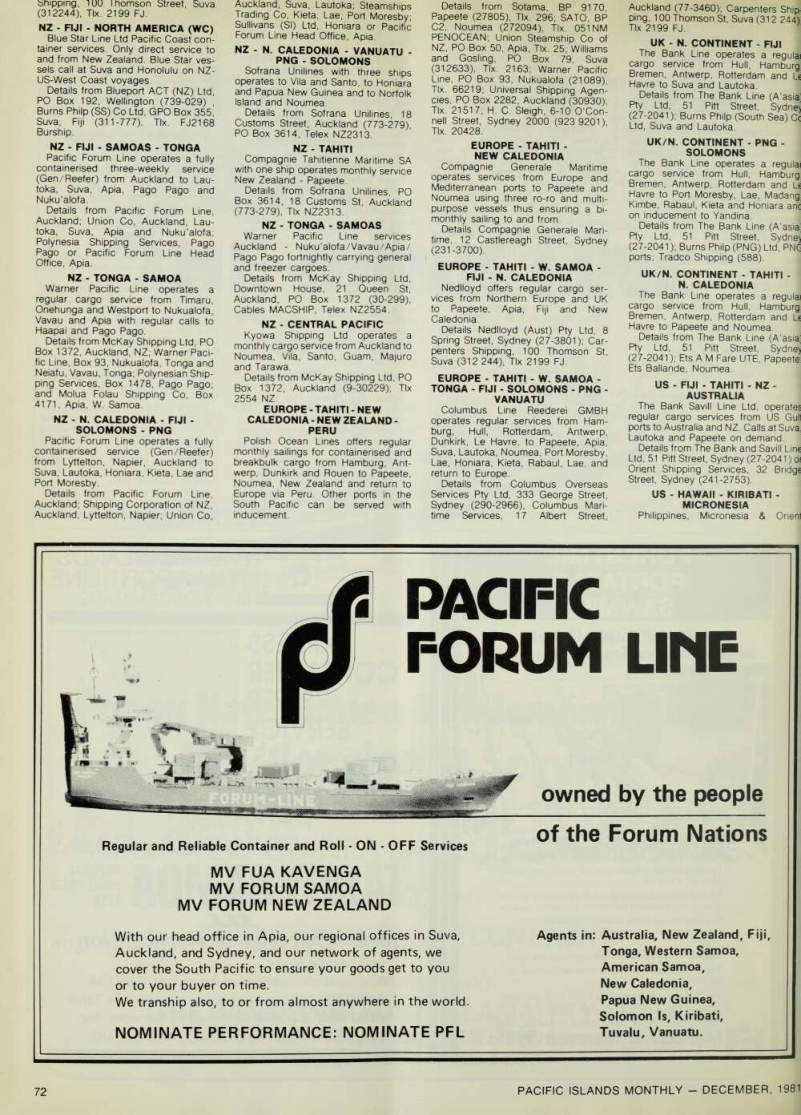
Shipping
Should any shipping company wish to have its services cargo and passenger included in these list ings they should contact PIM.
Australia - Fiji
Karlander (Aust) Pty Ltd operates monthly cargo services from Sydney to Suva and Lautoka.
Details from Karlander (Aust) Pty Ltd, 19-31 Pitt Street, Sydney (232-1011), Dalgety Shipping, 461 Bourke Street, Melbourne (60-0731), Burns Philp (SS) Co Ltd, Suva and Lautoka.
Sofrana-Unilines (Fiji Express Line) operates to Suva and Lautoka every three weeks from the main ports on the east coast of Australia and monthly to Lautoka from Melbourne and Sydney.
Details from Sofrana-Unilines, 19 Pitt Street, Sydney, (27-2031), Trans- Austral Shipping Pty Ltd, 570 Bourke Street, Melbourne (67-9162); ACTA Pty Ltd, Brisbane (221-3116); Elders-ANL Pty Ltd, Port Adelaide (47-5688); ANL, Newcastle (049-24364); Clements & Marshall, Burnie, Tasmania (31-1833); Carpenters Shipping, 100 Thomson St.
Suva, Fiji (312 244), Tlx 2199 FJ
Australia - New Caledonia -
Fiji - Samoas - Tonga
Pacific Forum Line operates a fully containerised service (Gen/Reefer)
from Sydney to Noumea, Lautoka, Suva, Apia, Pago Pago and Nuku’alofa.
Details from Pacific Forum Line, Syd ney; Union Bulkships, Sydney and Mel bqurne; SATO, Noumea; Australian National Line, Brisbane; Burns Philp (SS) Co, Lautoka, Suva and Apia; Union Co, Nuku’alofa; Polynesia Shipping Services, Pago Pago or Pacific Forum Line Head Office, Apia,
Australia - Lord Howe Is -
Norfolk \R
Compagnie des Chargeurs Caledoniens operates four-weekly cargo service Sydney - Lord Howe Island and Norfolk Island.
Details: Hetherington Kingsbury Pty Ltd, 37-49 Pitt Street, Sydney (27-1671).
Australia - Kiribati
Karlander operates a 5/6 weekly ser vice from Melbourne and Sydney to Kiribati (Tarawa).
Details: Karlander (Aust) Pty Ltd, 19-31 Pitt Street, Sydney (232-1011).
Australia - Nauru -
Kiribati
Nauru Pacific Line operates regular cargo/passenger service from Mel bourne to Nauru and Tarawa.
Details: Nauru Corporation (Vic) Inc (Shipping Division), Nauru House, 80 Collins Street, Melbourne (653-5709), Nedlloyd Swire, 8 Spring Street, Sydney (2-0522).
Australia - New Caledonia
(And/Or) Vanuatu
Sofrana-Unilines ships serve Noumea every three weeks from the main ports along the east Australian coast.
Details from Sofrana-Unilines, 19 Pitt Street, Sydney (27-2031), Trans- Austral Shipping Pty Ltd, 570 Bourke Street, Melbourne (67-9162), ACTA Pty Ltd, Brisbane (221-3116), Elders-ANL
Pty Ltd, Port Adelaide (47-5688), ANL, Newcastle (049-24364), Clements & Marshall, Burnie, Tasmania (31-1833).
Compagnie des Chargeurs Cale doniens operates a three-weekly con tainerised cargo service from Sydney to Noumea.
Details Hetherington Kingsbury Pty Ltd, 37-49 Pitt Street, Sydney (27-1671).
Compagnie Generate Maritime operates a monthly service from Syd ney to Noumea, Port Vila and Santo, for containerised and break bulk cargo.
Details Compagnie Generate Mari time. 12 Castlereagh Street, Sydney (231 -3700).
Australia - Nz - Fiji -
Hawaii - Us
P & O liners call at Auckland, Suva, Pago Pago and Honolulu on eastbound and westbound voyages between Syd ney and the US.
Details from P & O Booking Centre, World Travel Headquarters Pty Ltd, 33 Bligh Street. Sydney (231-6655).
AUSTRALIA - NZ - FIJI - TONGA -
Vanuatu - Noumea - Solomons -
Samoas - Tahiti
Sitmar Cruises operates a year-round cruise programme to include most of the above countries.
Details from Sitmar Cruises, 47 Elizabeth Street, Sydney (232-7511).
AUSTRALIA - NZ - FIJI - TONGA
Vanuatu - Noumea - Solomons -
Samoas - Tahiti
P & O liners call at Auckland, Bay of Islands, Honiara, Lautoka, Noumea, Nukualofa, Pago Pago, Papeete, Port Moresby, Santo, Savusavu, Suva, Vavau and Vila on cruises from Aus tralia.
Details from P & O Booking Centre, World Travel Headquarters Pty Ltd, 33 Bligh Street, Sydney (231-6655).
Pacific Forum Line operates con
tainerized and general cargo service from Australia and NZ to Fiji, Apia, Pago Pago, Tonga and other South Pacific ports.
Details from Polynesia Shipping Ser vices Inc, PO Box 1478, Pago Pago 96799.
Australia - New Zealand -
Pacific Islands - South East
Asia-China
Minghua Cruises operates regular cruise services from Sydney to most Pacific ports, with several cruises to South East Asia, including Japan, China and Hong Kong.
Details Minghua Cruises, 7 Bridge Street, Sydney. NSW 2000 and all Burns Philp Travel offices in Australia.
Australia - Png
Karlander New Guinea Line's cargo vessels call at Melbourne, Sydney, Port Moresby, Lae, Madang, Wewak, Manus, Kimbe, Rabaul, Popondetta.
Details from Karlander (Aust) Pty Ltd, 19-31 Pitt Street. Sydney (232-1011), DALGETY Shipping. 461 Bourke Street, Melbourne (60-0731).
Australia - Png - Solomons
A consortium of Conpac, NGAL/PNGL have three container ves sels operating on a 28 day turn-around from Melbourne, Sydney and Brisbane to Port Moresby, Lae, Rabaul, Kavieng, Wewak, Madang, Kieta and Honiara.
Details from Burns, Philp & Co. Ltd. 51 Pitt Street. Sydney (2-0547) and Interocean Swire, 8 Spring Street, Syd ney. (2-0522).
New Guinea Express Lines operates a fortnightly container service from Mel bourne, Sydney, Brisbane to Port Moresby, Lae, Alotau, Rabaul, Honiara.
Details from New Guinea Express Lines, PO Box R 73, Royal Exchange, Sydney (241-3991) MacArthur Ship ping Agency Co, 39 Creek Street, Bris bane (229-3777), New Guinea Express Lines. 327 Collins Street, Melbourne
(61-3053), Niugini Express Lines, Port Moresby (21-4572), Lae (42-1536), Rabtrad Niugini Pty Ltd, Rabaul (92-2911), Alotau Stevedoring & Trans- Dort, Alotau (61-1318) and Island Co- Dperative Shipping Federation, Honiara (808).
Sofrana-Unilines (PNG Line) operates a monthly service to Port Moresby, Lae, Rabaul, Kieta, Honiara rom main ports on the east coast of \ustralia Details from Sofrana-Unilines. 19 Pitt Street, Sydney (27-2031); Trans \ustral Shipping Pty Ltd, 570 Bourke Street, Melbourne (67-9162); ACTA Pty .td. Brisbane (221-3116); Elders ANL *ty Ltd. Port Adelaide (47-5688).
Australia - Tahiti
Compagnie Generate Maritime •perates a monthly service from Syd ley to Papeete for containerised and ireak-bulk cargo.
Details Compagnie Generate Mari ne, 12 Castlereagh Street, Sydney >3l-3700).
Australia - Tahiti - Us
Karlander operates a monthly cargo ervice from Melbourne and Sydney to apeete, US west coast.
Details: Karlander (Aust) Pty Ltd, 9-31 Pitt Street, Sydney (232-1011).
Australia - W. Samoa
Compagnie Generate Maritime Derates a monthly service from Syd sy to Apia.
Details Compagnie Generate Mari ne, 12 Castlereagh Street, Sydney 131-3700).
Far East - Fiji - New
Zealand
New Zealand Unit Express (NZUE) )erates a monthly palletised cargo srvice from Manila, Keelung, aoshiung and Hong Kong to Lautoka, jva and thence to NZ, Details from Carpenters Shipping, )0 Thomson Street, Suva (312-244),
Burns Philp, Suva (311-777), P & O S.N. Co, Wellington (736-477) or Nedlloyd Swire Pty Ltd, Sydney (20-522).
Nedlloyd operates bi-weekly cargo service with four ships from Sourabaya, Jakarta, Bangkok. Port Kelang and Singapore to Suva and NZ ports.
Details from Nedlloyd (Aust) Pty Ltd, 8 Spring St, Sydney (27 3801), Burns Philp (SS) Co Ltd, Suva and Lautoka.
Far East - Mid-S. Pacific
China Navigation’s New Guinea Pacific Line operates a regular con tainer service from Hong Kong, Taiwan, Manila, Port Kelang and Singapore to Port Moresby, Lae, Rabaul and Honiara monthly and to Wewak, Madang and £ ieta t( l ree m onths. Cargo from It 16 same ar astarn P orts totoe South Pacific ports of Noumea, Santo, Vila, Papeete, Pago Pago, Apia, Rarotonga and Tarawa will be shipped via Japan on the monthly Bali Hai service.
Details from Steamships Trading Co., Port Moresby (21-2000).
Kyowa Shipping Ltd, operates monthly services from Hong Kong Taiwan, S. Korea and Japan, to Guam,’
Saipan, Solomons, New Caledonia, Fiji, Western and American Samoa Tahiti Cook Is., Tonga and Vanuatu.
Details: Hetherington Kingsbury Pty Ltd - 37-49 Pitt Street, Sydney (27-1671); Carpenters Shipping, Suva (312-244), Tlx FJ2199.
Japan - Fiji - New Zealand
China Navigation, operates a monthly service from main ports Japan 10 uva and Lautoka and thence
“s "from Carpenters Shipping,
’ “ St ' SuVa < 3 ’ 2 ‘ 244) ' Tlx yy
Japan - Png
Mitsui O.S.K. Lines operates a monthly service from main ports Japan
and Port Moresby, Rabaul, Lae, Madang, Kieta and Kimbe.
Details from Robert-Laurie (PNG) Pty Ltd, Port Moresby (21-2466/ 21-1898).
New Caledonia - Fiji - West
Coast North America
PAD Line operates an approx. 3weekly ro-ro service from Noumea and Suva to Honolulu and West Coast USA and Canadian ports.
Details from Sofrana-Unilines SA, BP 1602, Noumea (27-51 -91), Tlx NMO4B; Carpenters Shipping, 100 Thomson St., Suva (312-244), Tlx FJ2199.
Png - Inter - Mainport
Papua New Guinea Mainport Liner Services offer scheduled 10/20-day coastal liner services linking all PNG mainports with containerisation, reefer, heavy lift and transhipment facilities.
Details from PNG Mainport Liner Ser vices, Box 1448, Lae, PNG (42-3537), Tlx PNG 42465.
Png - North Australia
Papua New Guinea Line offers a 60-day service from Port Moresby, Lae and Vanimo to Darwin with through bills of lading from West Coast North American ports. Inducement calls at Weipa and Gove.
Details from PNG Shipping Corpor ation, Box 543, Port Moresby, PNG (21-1174), Tlx PNG 22269.
Png - Kiribati - Solomons -
West Coast Usa
Papua New Guinea Line offers a 60-day service from Port Moresby, Lae, Rabaul and Kieta to San Francisco and Los Angeles with inducement at Van couver and stop-off calls at Tarawa and Honiara. Through bills from all PNG mainports and mini-bridge services to other US and Canadian destinations.
Details from PNG Shipping Corpor ation, Box 543, Port Moresby. PNG (21-11 74). Tlx PNG 22269; or from TFC Shipping, 100 California St, San Fran
cisco, CA. USA (415 398-1604), Tlx
340958 Gts Ur Sfo.
Png - Uk/Continent
The Bank Line operates regular cargo service from Port Moresby, Oro Bay, Kieta, Rabaul, Kimbe, Madang and Lae to Hull, Hamburg, Rotterdam, Antwerp and Le Havre.
Details from The Bank Line (A’asia) Pty Ltd, 51 Pitt Street, Sydney (27-2041); Burns Philp (PNG) Ltd, PNG ports.
Solomons - Uk/Continent
The Bank Line operates regular cargo service from Honiara to Hull, Hamburg, Rotterdam, Antwerp and Le Havre.
Details from The Bank Line (A’asia) Pty Ltd, 51 Pitt Street, Sydney (27-2041); Tradco Shipping (588).
NZ - COOK IS - NIUE -
Tahiti
Shipping Corporation of NZ Ltd operates cargo services based on pallets and similar units from Auckland to Niue, Cook Islands and Tahiti.
Details from the Shipping Corp of NZ Ltd, PO Box 3420, Auckland (797-210), Waterfront Commission. PO Box 61, Rarotonga; Cook Islands; Niue Govt Offices, Niue Island Compagnie Maritime Polynesienne. B'P' 368, Papeete, Tahiti.
Nz - Fiji
Reef operates a regular 18-day ser vice from Auckland to Suva and Lau toka.
Details from Reef Shipping Agencies, PO Box 3382. Auckland. NZ (77-1221-3); MV. Fijian Shipping Agencies Ltd, Private Bag. Suva. Fiji (31 1056).
Pacific Line with one ship operates fortnightly ro-ro cargo service New Zealand, Lautoka, Suva.
Details: Sofrana Unilines, 18 Cus toms Street, Auckland (773-279) PO Box 3614, Telex: NZ2313; Carpenters
snipping, iuu momson Street, Suva (312244), Tlx. 2199 FJ.
NZ - FIJI - NORTH AMERICA (WC) Blue Star Line Ltd Pacific Coast con tainer services. Only direct service to and from New Zealand. Blue Star ves sels call at Suva and Honolulu on NZ US-West Coast voyages.
Details from Blueport ACT (NZ) Ltd PO Box 192, Wellington (739-029) , Burns Philp (SS) Co Ltd, GPO Box 355, Suva, Fiji (311-777). Tlx. FJ2168 Burship.
NZ - FIJI - SAMOAS - TONGA Pacific Forum Line operates a fully containerised three-weekly service (Gen/Reefer) from Auckland to Lau toka, Suva, Apia, Pago Pago and Nuku’alofa.
Details from Pacific Forum Line, Auckland; Union Co, Auckland, Lau toka, Suva, Apia and Nuku’alofa; Polynesia Shipping Services, Pago Pago or Pacific Forum Line Head Office, Apia.
Nz - Tonga - Samoa
Warner Pacific Line operates a regular cargo service from Timaru, Onehunga and Westport to Nukualofa, Vavau and Apia with regular calls to Haapai and Pago Pago, Details from McKay Shipping Ltd, PO Box 1372, Auckland, NZ; Warner Paci fic Line, Box 93, Nukualofa, Tonga and Neiafu, Vavau, Tonga; Polynesian Ship ping Services, Box 1478, Pago Pago; and Molua Folau Shipping Co, Box 4171, Apia, W. Samoa.
NZ - N. CALEDONIA - FIJI -
Solomons - Png
Pacific Forum Line operates a fully containerised service (Gen/Reefer) from Lyttelton, Napier, Auckland to Suva, Lautoka, Honiara, Kieta, Lae and Port Moresby.
Details from Pacific Forum Line, Auckland; Shipping Corporation of NZ, Auckland, Lyttelton, Napier; Union Co.
Auckland, Suva, Lautoka; Steamships Trading Co, Kieta, Lae, Port Moresby; Sullivans (SI) Ltd, Honiara or Pacific Forum Line Head Office, Apia.
NZ - N. CALEDONIA - VANUATU -
Png - Solomons
Sofrana Unilines with three ships operates to Vila and Santo, to Honiara and Papua New Guinea and to Norfolk Island and Noumea, Details from Sofrana Unilines, 18 Customs Street, Auckland (773-279) PO Box 3614, Telex NZ2313.
Nz - Tahiti
Compagnie Tahitienne Maritime SA with one ship operates monthly service New Zealand - Papeete.
Details from Sofrana Unilines, PO Box 3614, 18 Customs St, Auckland (773-279). Tlx NZ2313.
Nz - Tonga - Samoas
Warner Pacific Line services Auckland - Nuku’alofa/Vavau/Apia/ Pago Pago fortnightly carrying general and freezer cargoes.
Details from McKay Shipping Ltd, Downtown House, 21 Queen St, Auckland, PO Box 1372 (30-299), Cables MACSHIP, Telex NZ2554.
Nz - Central Pacific
Kyowa Shipping Ltd operates a monthly cargo service from Auckland to Noumea, Vila, Santo, Guam, Majuro and Tarawa.
Details from McKay Shipping Ltd, PO Box 1372, Auckland (9-30229); Tlx 2554 NZ
Europe-Tahiti-New
Caledonia - New Zealand -
Peru
Polish Ocean Lines offers regular monthly sailings for containerised and breakbulk cargo from Hamburg, Ant werp, Dunkirk and Rouen to Papeete, Noumea, New Zealand and return to Europe via Peru. Other ports in the South Pacific can be served with inducement.
Details from Sotama, BP 9170, Papeete (27805), Tlx, 296; SATO, BP C 2, Noumea (272094), Tlx. 051 NM PENOCEAN; Union Steamship Co of NZ, PO Box 50, Apia, Tlx. 25; Williams and Gosling, PO Box 79, Suva (312633), Tlx. 2163; Warner Pacific Line, PO Box 93, Nukualofa (21089), Tlx, 66219; Universal Shipping Agen cies, PO Box 2282, Auckland (30930), Tlx. 21517; H, C. Sleigh, 6-10 O'Con nell Street, Sydney 2000 (923 9201) Tlx. 20428.
Europe - Tahiti -
New Caledonia
Compagnie Generate Maritime operates services from Europe and Mediterranean ports to Papeete and Noumea using three ro-ro and multi purpose vessels thus ensuring a bi monthly sailing to and from.
Details Compagnie Generate Mari time, 12 Castlereagh Street, Sydney (231-3700).
EUROPE - TAHITI - W. SAMOA -
Fiji - N. Caledonia
Nedlloyd offers regular cargo ser vices from Northern Europe and UK to Papeete, Apia, Fiji and New Caledonia.
Details Nedlloyd (Aust) Pty Ltd, 8 Spring Street, Sydney (27-3801); Car penters Shipping, 100 Thomson St, Suva (312 244), Tlx 2199 FJ.
EUROPE - TAHITI - W. SAMOA - TONGA - FIJI - SOLOMONS - PNG -
Vanuatu
Columbus Line Reederei GMBH operates regular services from Ham burg, Hull, Rotterdam, Antwerp, Dunkirk, Le Havre, to Papeete, Apia, Suva, Lautoka, Noumea, Port Moresby, Lae, Honiara, Kieta, Rabaul, Lae, and return to Europe.
Details from Columbus Overseas Services Pty Ltd, 333 George Street, Sydney (290-2966), Columbus Mari time Services, 17 Albert Street,
Auckland (77-3460); Carpenters Ship ping, 100 Thomson St, Suva (312 244) Tlx 2199 FJ.
Uk - N. Continent - Fiji
The Bank Line operates a regulai cargo service from Hull, Hamburg, Bremen. Antwerp, Rotterdam and Le Havre to Suva and Lautoka.
Details from The Bank Line (A'asia’
Pty Ltd, 51 Pitt Street. Sydnev (27-2041); Burns Philp (South Sea) Cc Ltd, Suva and Lautoka.
Uk/N. Continent - Png -
Solomons
The Bank Line operates a regulai cargo service from Hull, Hamburg, Bremen, Antwerp, Rotterdam and Le Havre to Port Moresby, Lae, Madang, Kimbe, Rabaul, Kieta and Honiara and on inducement to Yandina.
Details from The Bank Line (A’asia] Pty Ltd, 51 Pitt Street, Sydney (27-2041); Burns Philp (PNG) Ltd, PNG ports; Tradco Shipping (588).
Uk/N. Continent - Tahiti -
N. Caledonia
The Bank Line operates a regulai cargo service from Hull, Hamburg, Bremen, Antwerp, Rotterdam and Le Havre to Papeete and Noumea, Details from The Bank Line (A’asia] Pty Ltd, 51 Pitt Street, Sydney (27-2041); Ets A M Fare DTE, Papeete; Ets Ballande, Noumea.
US - FIJI - TAHITI - NZ -
Australia
The Bank Savill Line Ltd, operates regular cargo services from US Gull ports to Australia and NZ. Calls at Suva, Lautoka and Papeete on demand.
Details from The Bank and Savill Line Ltd, 51 Pitt Street, Sydney (27-2041) or Orient Shipping Services, 32 Bridge Street, Sydney (241-2753).
Us - Hawaii - Kiribati -
Micronesia
Philippines, Micronesia & Orient
avigation Co (PM&O Lines) operates gular container service on self stained ship with ro-ro capabilities >m Oakland, Portland and Honolulu to irawa, Ebeye, Majuro, Kosrae, >nape, Truk, Saipan, Yap and >ror.
Details for Micronesia can be itained from Larry Guerrero, PM&O vners Rep, PO Box 803, Saipan, Ml 950, Cable COMMONTIME Tlx 3605; PM80; PM&O Lines, 181 amont St, San Francisco, California 105, Cable PMONAV.
Us - Hawaii - Nauru -
Micronesia
Nauru Pacific Line operates regular nventional/container and passenger rvice from San Francisco and •nolulu to Majuro, Ponape, Truk and ipan. Cargo is accepted for Nauru d Kosrai with transhipment at Majuro d Ponape.
Details from Nauru Corporation (Vic) : (Shipping Division), Nauru House, Collins Street, Melbourne >3-5709); North American Maritime encies, 100 California St., San Fran co. California 9411.
Us - Noumea - Fiji
3 AD Line operates an approx veekly roro service from West Coast A and Canada to Noumea and va.
Details from Sofrana-Unilines SA BP D 2, Noumea (27-51 -91), Tlx NMO4B; rpenters Shipping, 100 Thomson St, /a (31-2244). Tlx FJ2199; Trans-
Austral Shipping, Box R 232 PO, Royal Exchange, NSW (27-2441), Tlx AA21204,
Us - Tahiti - Samoa
Pacific Islands Transport operates a five weekly cargo service from North America west coast ports to Papeete, Pago Pago, Apia.
Details from Polynesia Shipping Ser vices Inc, PO Box 1478 Pago Pago 96799.
Polynesia Line operates container and general cargo service from US west coast ports to Papeete and Pago Pago.
Details from Polynesia Shipping Ser vices Inc., PO Box 1478, Pago Paqo 96799.
US - TAHITI - SAMOA - NZ - AUST Farrell Lines Inc, operate a fast regular lash/container cargo service from west coast ports Canada/USA to Papeete and Pago Pago thence to NZ and Australia.
Details Wilh Wilhelmson Agency, Sydney, Melbourne and Brisbane Tlx AA20136, Cable FARSHIPS Sydney; Dalgety (NZ) Ltd, Auckland and Wellington, Tlx NZ2445, Cable DALSHIP Auckland; Compagnie Mari time Polynesienne, Immeuble Franco Oceanienne, PO Box 368, Papeete Tahiti, Tel 26393, Tlx 258. FP ANSB Taporo, Cable OCEAN Papeete; Kneubuhl Maritime Service, PO Box 39’
Pago Pago, Telephone 633-5121 : Tlx 782505.
Advertisements & other items, pp. 69-72 (2 items)
Now In New Zealand
LOCAL AGENTS AND
REPRESENTATION
428 George St., Sydney.
Cables: Henco Sydney.
G.P.O. Box 3949.
Telephone: 232 5377.
PAPUA NEW GUINEA
RABAUL: M. & C. Seeto, P.O. Box 131, Rabaul.
Telephone 92 2919.
MADANG: W. Double, P.O. Box 22, Madang.
Telephone 82 2696.
FIJI
K. Witherington Ltd., P.O. Box 293, Suva.
Telephone 22 356.
For specialised and
personalised buying
service throughout
the Pacific Islands and the East.
VANUATU
John Lum & Associates, P.O. Box 65, Santo.
Telephone 329.
Resident Agents in other Pacific Territories.
SOLOMON ISLANDS
Mr. Tom Lo, P.O. Box 327, Honiara.
Telephone 399 11 e U
AUSMARR
LTMTTeB
NOW IN NEW ZEALAND
Announces the opening of our New Zealand Export Office situated in Auckland.
Mr. Athol Carr, formally of the New Zealand Export Import Corporation, will lead a small and efficient team giving the precise, prompt and personal service that won an Export Award for Ausmark in Australia.
We specialise in the financing and shipment of fresh, frozen and processed consumer food products and we will welcome enquiries for all manner of bulk commodities and manufactured goods.
We invite your request for quotation as our prices and terms will prove more than competitive.
For all of your Australian and New Zealand supply requirements, we can be contacted at: •Ausmark Trading (N.Z.) Ltd 60 Queen Street, Auckland, New Zealand.
G.P.O. Pox 2002.
Phone: 1796 Phone; 231 6866 Telex; Telex; 25458 Answerback: FBMAUK •Accredited Agent New Zealand Dairy Board Ausmark Pty. Ltd. 74 Pitt Street, Sydney, Australia
V 5
GLOBAL SERVICE SHIPPERS
V
THE BANK LINE
& wis. svrnf? /
Papua New Guinea & Solomon Islands
UK/Continent Service
Regular direct 28 day service
PAPUA NEW GUINEA and SOLOMON ISLANDS
to;
UNITED KINGDOM and CONTINENT
For particulars apply:
THE BANK LINE (AUSTRALASIA) PTY LTD.
Suite 801, 51 Pitt St, Sydney, N.S.W. 2000. Australia.
Telephone: 272041 Telex: 24063
FORESTMIL
PORTABLE
SAWMILL
A Mini Self Contained Sawmill
complete with Diesel Engine or Electric Motor U Forestmil produces any size accurate timber ready to use up to 12" x 9" x 24'.
Purchase price and operating cost of Forestmil is less than other sawing equipment with similar production capacity.
Forestmil reduces timber waste and also reduces log transport cost. Timber is sawn direct from the log in the forest.
Forestmil can be moved to a new location in one hour.
Forestmil will saw hardwood or softwood from logs of any diameter.
Over 1000 Forestmils are sawing timber in 23 countries.
Forestmil has been manufactured for 18 years.
For literature and prices please contact the manufacturers.
Mac Quarrie Industries Pty.Ltd.
P.O. Box 20, Coburg 3058, Victoria Australia Phone 350-3411 Telex 33729 Cables Macbound, Melbourne
PACIFIC ISLANDS
TRANSPORT LINE
M.S. AFRICANSTARS
EXPRESS
CONTAINER
•REEFER
SERVICE
between U.S.
West Coast ports and
TAHmSAMOA =••
xoc Qeqeral Ste£UT\ship General Agents 400 California Street, San Francisco, CA, USA PAPEETE: Agence Maritime Internationale, Tahiti PAGO PAGO: Polynesia Shipping Services, Inc.
APIA: Burns Philp (South Sea) Company, Ltd.
PACIFIC
FORUM LINE
■ t Regular and Reliable Container and Roll - ON • OFF Services
owned by the people
of the Forum Nations
MV FUA KAVENGA
MV FORUM SAMOA
MV FORUM NEW ZEALAND
With our head office in Apia, our regional offices in Suva, Auckland, and Sydney, and our network of agents, we cover the South Pacific to ensure your goods get to you or to your buyer on time.
We tranship also, to or from almost anywhere in the world.
NOMINATE PERFORMANCE: NOMINATE PFL
Agents in: Australia, New Zealand, Fiji, Tonga, Western Samoa, American Samoa, New Caledonia, Papua New Guinea, Solomon Is, Kiribati, Tuvalu, Vanuatu.
71
CIFIC ISLANDS MONTHLY DECEMBER, 1981
Deaths
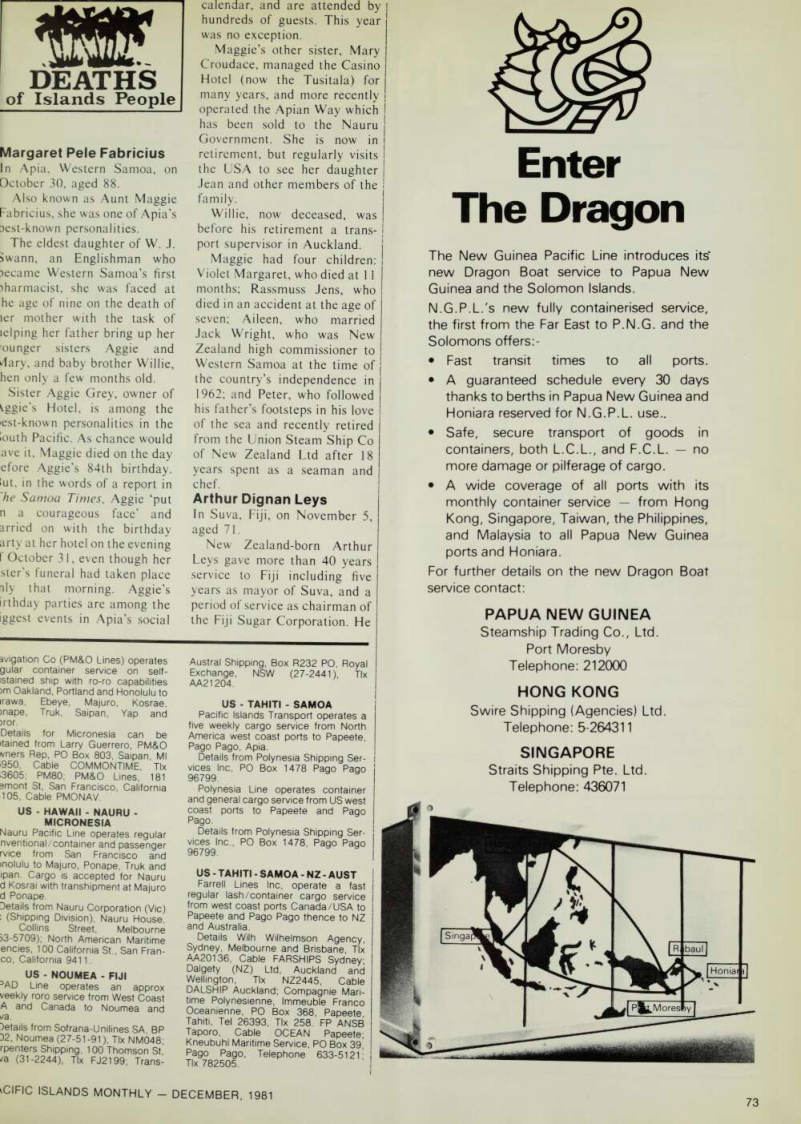
of Islands People
Margaret Pole Fabricius In Apia, Western Samoa, on October 30, aged 88.
Also known as Aunt Maggie Fabricius, she was one of Apia’s Dest-known personalities.
The eldest daughter of W. J.
Swann, an Englishman who aecame Western Samoa’s first iharmacist, she was faced at he age of nine on the death of ter mother with the task of idping her father bring up her r ounger sisters Aggie and 4ary, and baby brother Willie, hen only a few months old.
Sister Aggie Grey, owner of Aggie’s Hotel, is among the •est-known personalities in the louth Pacific. As chance would ave it, Maggie died on the day efore Aggie’s 84th birthday, lut, in the words of a report in he Samoa Times, Aggie ‘put n a courageous face’ and arried on with the birthday arty at her hotel on the evening f October 31, even though her ster’s funeral had taken place nly that morning. Aggie’s irthday parties are among the iggest events in Apia’s social
calendar, and are attended by hundreds of guests. This year was no exception.
Maggie’s other sister, Mary Croudace, managed the Casino Hotel (now the Tusitala) for many years, and more recently operated the Apian Way which has been sold to the Nauru Government. She is now in retirement, but regularly visits the USA to see her daughter Jean and other members of the family.
Willie, now deceased, was before his retirement a trans port supervisor in Auckland.
Maggie had four children: Violet Margaret, who died at 11 months; Rassmuss Jens, who died in an accident at the age of seven; Aileen, who married Jack Wright, who was New Zealand high commissioner to Western Samoa at the time of the country’s independence in 1962; and Peter, who followed his father’s footsteps in his love of the sea and recently retired from the Union Steam Ship Co of New Zealand Ltd after 18 years spent as a seaman and chef.
Arthur Dignan Leys
In Suva, Fiji, on November 5, aged 71.
New Zealand-born Arthur Leys gave more than 40 years j service to Fiji including five years as mayor of Suva, and a period of service as chairman of the Fiji Sugar Corporation. He
also served as chairman of the Transport Control Board, the War Pensions Board, and the Fiji After-Care Fund.
During his five years as mayor of Suva (1954-59), he played a large part in putting the city on a sound financial footing, and building a spring board for subsequent rapid de velopment.
In World War II he was a captain in the 2nd Fiji Bat talion. From 1947 to 1953 he was consular agent for France in Fiji.
He was awarded the CBE in recognition of his public ser vice.
In the business world, he was chairman of Carlton Brewery (Fiji) Ltd, and Lysaghts (South Pacific) Ltd, and a Fiji director of CML Assurance Society Ltd.
Amra Singh
At Savusavu, Fiji, in August, aged 102.
One of Savusavu’s oldest residents, Mr Singh, of Dogoru estate, was born at Koronivia, one of nine children whose parents came to Fiji from India in the indentured labour ship Syria.
Bartholomew Kebaku In Arawa Hospital, North Solomons Province, Papua New Guinea, on October 25, aged 34.
Assistant Secretary of PNG’s Department of Primary Indus try, Mr Kebaku had gained a popularity which many other senior public servants might envy. A tribute in the Arawa Bulletin said: k Mr Kebaku’s many colleagues, friends and relations will always remember him with affection, for he was a very friendly man who always had a broad smile on his face.
His high-pitched laugh, which was never far away, will be greatly missed. He lived life to the full and was deeply commit ted to his work.’
Barth Kebaku married only in April 1981. His untimely death was attributed to the combined effects of pneumonia and a stomach ulcer.
Kwan Toor In Solomon Islands on September 27, aged 62.
A successful businessman of Chinese extraction, Mr Kwan Toor had lived in Solomon Islands for many years.
All business companies
owned and operated by the Kwan How Yuan company founded in Solomon Islands by Mr Kwan Toor closed for the day on September 29 out of respect for his death. These included KHY operations such as the JBM Factory and the Joy Supermarket.
B. D. Lakshman In Brisbane, Australia, on October 5, aged 81.
He was a pioneer in the fields of industry, education, and the trade union movement in Fiji.
Born at Waila, in Nausori, in 1900, Mr Lakshman was edu cated at a number of insti tutions in Fiji before leaving in 1927 for further education in India. In the course of his seven year stay he became deeply involved with the freedom struggle led by Mahatma Gandhi, and was once gaoled for four months for his activi ties. During the September visit to Fiji of Indian Prime Minister Indira Gandhi, she presented to Mr Lakshman’s sons, in their father’s absence, the Indian Government’s copper plate award, given only to those who played notable roles in the nation’s independence movei ment.
After his return to Fiji, he started a model high school at Gurukul, Saweni, near Lautoka, under the auspices of the Arya Samaj. He later estate fished his own Mahatma Gandhi Memorial College at Lautoka.
He helped to establish the Fiji Kisan Sangh, the cane farmers’ organisation, in 1937-40, and served as its president in 1949. This and his many other trade union activi ties led to his election as president of the Fiji Trades Union Congress in 1959.
Branching into industry, he became the first manufacturer in Fiji to produce buttons from mother-of-pearl shells.
He became actively involved in politics with his election to the Legislative Council in 1940, and again in 1959.
In 1962, he bought a large tract of freehold land at Deuba which he later sold to a Canadian company. The Pacific Harbour resort stands on the site today. He later acquired more land at Navua, and was planning to restart commercial cane-farming for ethanol and rum-making before his death.
Advertisements & other items, pp. 73-74 (2 items)
73
ISLANDS MONTHLY DECEMBER, 1981
The Dragon
Enter
The New Guinea Pacific Line introduces its* new Dragon Boat service to Papua New Guinea and the Solomon Islands.
N.G.P.L.'s new fully containerised service, the first from the Far East to P.N.G. and the Solomons offers;- • Fast transit times to all ports. • A guaranteed schedule every 30 days thanks to berths in Papua New Guinea and Honiara reserved for N.G.P.L. use.. • Safe, secure transport of goods in containers, both L.C.L., and F.C.L. no more damage or pilferage of cargo. • A wide coverage of all ports with its monthly container service from Hong Kong, Singapore, Taiwan, the Philippines, and Malaysia to all Papua New Guinea ports and Honiara.
For further details on the new Dragon Boat service contact;
PAPUA NEW GUINEA
Steamship Trading Co., Ltd.
Port Moresby Telephone; 212000
HONG KONG
Swire Shipping (Agencies) Ltd.
Telephone: 5-264311
SINGAPORE
Straits Shipping Pte. Ltd.
Telephone: 436071 t ( Singa r baul] Homar Pat Moresly
CLASSIFIED
ADVERTISEMENTS
TO JOB SEEKERS IN REMOTE AREAS
WE SUPPLY YOU WITH THE LATEST
JOB ADS FROM THE AUSTRALIAN &
INTERNATIONAL PRESS. QUARTERLY
SUBSCRIPTIONS $3O. WRITE BOX 1942,
TOWNSVILLE 4810. AUSTRALIA.
employment
Australian Man: 30, seeking employment in Pacific area.
Experienced mechanic, boat building, marine, rigger, general trades. Wishing to resettle, re-locate.
Canadian Spouse: teaching, social work, crafts child syrs Excellent Resume Available.
Graeme Kelly 2 Demontigny, Pte Des Cascades, Quebec JOP IMO, Canada
BUYING OR SELLING
LIST WITH US FOR:
COMMERCIAL SHIPS
FISHING VESSELS
.YACHTS
TRAWLERS
WORK BOATS
Sonar Ships Brokerage
BOX 1811 CAIRNS. OLD.
AUSTRALIA
PH: (070) 515371
.«Produce *
*eA' i ' red
amt
BECHE-DE-ME
FISH MAW
SHARK FINS, etc.
For details please write to:
ASIA SEAFOOD Co.,
353 A Circuit Rd., Block 64, Singapore 1337.
Advertisers Index
Air New Zealand 56-57
Asia Tonga Trading 74
Asia Seafood 74 Ausmark 69 Bankline 70 British Aerospace 54 Carptrac 28 China Navigation 73 Citizen Watches 46 Denon 64 Dunsford 63 Export Institute of NZ 44 Foodtex 67 Goerman, Peter 74 General Steamships 71 Honda IFC Hitachi 26 Henry Cumines 69 Kelly, G.R. 74 Komatsu 30 MacQuarrie Industries 71 Matsushita 42 Nelson & Robertson 68 National Insurance 52 Nissan 4,20-21 NZ Dairy Board IBC Norfolk Island Bakery 74 Pioneer 8, 50 Polynesia Line 66 Pacific Forum Line 72 Papua Hotel 40 QBE Insurance 62 Rheem Australia 32 Sonar Ship Brokerage 74 Suzuki 12, 60 Sansui 16 Teac 34 Toyota OBC Tatham, S.E. 65 Victor Co, of Japan 23 Waterwheel Exports 48 Yamaha 38-39
Advertisements & other items, pp. 74-76 (1 item)
Require
NORFOLK ISLAND
FOR SALE
BAKERY & HEALTH
SHOP
No Tax, Rates or Death Duties. What you make is your own.
Write Box 268 or phone 2025
REQUIRE
DRIED SHARK FINS
FOR PRICES AND
INFORMATION ETC.,
PLEASE WRITE TO;
S. DADDOW,
ASIA TONGA TRADING,
7 KASAI ROAD,
REPUBLIC OF SINGAPORE
2880.
CABLE: "ASIATONGA"
Mm ■ j i ■- :■ * •y&b***- «i «■!
H m M 5! s ■ e*-rN'^£ » <-■ K g -*-
agas*
Yi m^m - ■ %£ % !sBf jiS&A r,_ ~^ZiS4i-\ • -•, .<.•
rjUj
‘\fl[ Vr^ L»J ■*£&. y f y?:. milk v.
Ajicass
■ ' cowrint *nii» """
4nthox‘
WlO>
TfrilJ
w Ir ted miuj § Anenof j .instant « whole /!f .If 1 *ilfc i >°st ot cw • ( y rec ala nd bll NewZ^ ery I flHl >5jS25 rt instant ■ •~ Jfied whole I *>xuor Anchor : JWfc -_ .I,l^. x
-earned
butter
•* \ or S »h w -1 *• *•rn
milk
u ..« IT! - . .-hP?
J P meck » «»• f > ® Mg —1 CHt! ■/5»
■*lli
•^o't nr o fs
iMfefr.
felfep
< - *n ■ *sr Xmz* A K* 5* * % A i ■* ff^ ■'••‘.l
SHSBQSKwWg
re aira
slraj?a£
r<p v •Ta ajlTa
The newest reason
N a 9 The r|ew Toyota Corolla toughest car buyers. Inside smart styling and roomy, c then consider the real beai Corolla its incredible economy. Trouble-free consumption figures that have earned Corolla i worldwide popularity. Two of the main reason: more than 8,000,000 Corollas have been produi date. And because you’re behind the wheel of Toyota you can be sure of reliable backup service \ you need it.
The new Tj definitely ’ you look at Wk ’
Hr- V —i m 'MS m m
TOYOTA
E ’V.
COROLLA
wfml
TOYOTA
SERVICE
TOYOT/
The Toyota range includes: COROLLA, STARLET, CORONA, CRESSIDA, HI-LUX, STOUT, HI ACE, DYNA, COASTER and LAND CRL