Advertisements & other items, pp. 1-2 (2 items)
hdfdfdfdfd
PACIFIC
ISLANDS
MONTHLY
Ji/AM k m/ff\ niYrn I ISKiSI
hdfdfdfdfd
©©Mi
UJSTRATED MAM -
» $m @@®
Full-Function VTR Goes Portable
I
HITACHI
VIDEO
BBS
slight & Compact
Easier to carry, easier to find space for Low Power Consumption Amazingly low 5.5 W power consumption saves electricity.
Preset Programming
Leave for 3 weeks, still record 8 programs. is 5 Creative Freedom Use a Hitachi home video camera to make your own shows.
Reliability
Hitachi is famous for it.
TheVT-6500 is built to last.
Pulse Control Editing Insert new scenes with no distortion.
Sound-on-Sound Add your own sound, without erasing previous sound.
H % % Fine Slow Motion Dial-adjustable slow motion control.
Visual Search Find scenes quickly and easily Still Picture/Frame Advance Study your form in detail.
Remote Control Thin, hand-size, 13-mode remote control unit.
Full-Function VTR Goes Portable
The VT-6500 Portable Video System. Smaller. Lighter. Really portable.
And it’s got all the features you’d find on larger, heavier units.
Because at Hitachi, we’ve put our know-how in electronic integration to work on our video cassette recorders. So less size doesn’t mean less features.
The recorder and tuner/timer are separate units. Take the recorder and one of our compact cameras along with you to get all the fun on tape. When you get back home, you've got the full-function convenience of a large-sized VTR.
Performance and reliability are also up to Hitachi’s remarkably high standards.
The VT-6500 from Hitachi. The greatest little thing in VTRs yet.
A-V6O VT-TU6S
VK
CBOO
VK-C6OO
U 2 m
- CSSS
•ssr VT-6500
SSSS
m Si o
•AUSTRALIA H
Phone: PRO 75- Fijt, Phone 312( Centre Ltd . P O i Pfy . Lid 153 Keys GUINEA, SO Svens: 2 »N£W ZEALAND AWA New Zealand Limited, Wi-neera Drive. P O Box 50-248 ; 21-2111 •Fin ISLANDS AWA New Zealand Limited 47 Foster Road (P O Box 85 Alain, P O Box 272, Papeete Phone 288 68 'SOLOMON ISLANDS Technique Ra id. Moorabbm, Victoria 3189 Phone {: (N C ) Ltd . P O Box 705, Port Moresb oumea Phone; 26.23 50 •TAHITI Ets
•PAPUA NEW CUIN
•NEW CALEDONIA
B P Ml
HF OHITACHI
Pacific Islands Monthly
Vol. 53 No.1 January 1982 (USPS 952480)
Representatives
AUSTRALIA: Distribution: NSW & ACT: Allan Rodney Wright (Circulation) Pty Ltd, PO Box 907, Darlinghurst, NSW 2010; Elsewhere: Gordon & Gotch (A/asia) Ltd, Box 40, PO, Rosebery, NSW 2018 Advertising - Melbourne - Ray Brown Pty Ltd, 614 Queensberry St, North Melbourne 3051, telephone 329 8522, telex 31717; Brisbane - D.
Wood, Anday Agency, Box 1918, GPO, Brisbane 4001, tele phone 44 3485, 44 1546, Adelaide - Hastwell Media, PO Box 30, Glen Osmond, SA 5064, 233 Glen Osmond Ro.
Frewville, SA 5063, telephone 79 1869 Perth - Adrep, 62 Wickham St., East Perth, WA 6000, telephone 325 6395 FIJI: Distribution and subscriptions Desai Bookshops, PO Box 160, Suva, Fiji, telephone Suva 23036 Advertising - Fiji Times & Herald Ltd. 20 Gordon St, Suva, telephone 312 111, telex FJ2124 FRENCH POLYNESIA: Distribution - Hachette Pacifique, 10 Ave Bruat, Papeete, telephone 25610 HAWAII, UNITED STATES: Distribution PIM, Hawaii, PO Box 22250, Honolulu, Hawaii 96822 Advertising - Roger Brookes, PO Box 10217, Honolulu, Hawaii 96816, telephone 808 536 6677 JAPAN: Advertising and subscriptions - Universal Media Corporation, CPO Box 1762, Tokyo, telephone 666 3036.
NEW CALEDONIA: Distribution - Depot Centre de Presse Michel Pentecost, CBP2, Noumea, telephone 27 2434, 27 4729.
NEW ZEALAND: Distribution - Gordon & Gotch, PO Box 584, 2 Carr Road, ML Roskill, Auckland 4 Advertising - International Media Representatives Ltd, PO Box 2313, Auckland, telephone 795 487; 493 389, cables Intereps, Auckland. Subscriptions - Ross Haines & Son Ltd, PO Box 1289, Auckland, telephone 769 042 PAPUA NEW GUINEA: Distribution - Gordon & Gotch PO Box 3395, Port Moresby, telephone 254551, 254855 Advertising PNG Post-Courier, PO Box 85, Port Moresby, telephone 21 2577.
UNITED KINGDOM: The Herald & Weekly Times Ltd, No. 1 Maltravers Street, London WC2R 3DZ, England, telephone 01 836 5162, telex London 21989 UNITED STATES MAINLAND: Advertising - Joshua B Powers Jr, Powers International Inc., 551 Fifth Ave, New York. New York 100 017, telephone 867 9580, telex 236514 Subscriptions PIM, Hawaii PO Box 22250, Honolulu, Hawaii 96822
Subscriptions
PIM is airfreighted to most subscribers and agents in the Pacific Islands and the United States, but not the UK or the Continent
Payments by personal cheque are only acceptable in Aus tralian (from a branch in Australia), US and New Zealand currency. For all other remittances please send an inter national bank draft in Australian dollars Published monthly by Pacific Publications (Aust.) Pty Ltd and printed in Australia by Paramac, Alexandria, NSW. Aus tralian cover price is recommended retail only Registered by Australia Post, publication No NBPI2IO Second class postage paid at Honolulu, Hawaii Copyright ® Pacific
Publications (Aust.) Pty Ltd Postmaster Honolulu; Send address changes to PIM Hawaii, PO Box 22250, Honolulu, Hawaii 96822
Local Aust American Samoa $US21 $18 Australia $A15 $15 Canada $US23 $20 Cook Islands $19 Fiji $18 French Polynesia $22 Guam $US23 $20 Hawaii
Sus23
$20 Japan = $20 Kiribati $19 Micronesia $US23 $20 Nauru $21 New Caledonia $22 New Zealand $NZ21 $18 Niue $19 Nortolk Island $15 Northern Marianas $US23 $20 Papua New Guinea $23 Solomon Islands $19 Tonga $19 Tuvalu $19 United Kingdom Stg 11 $20 US Mainland
Sus23
$20 Vanuatu $19 Western Samoa $18 Elsewhere $A23
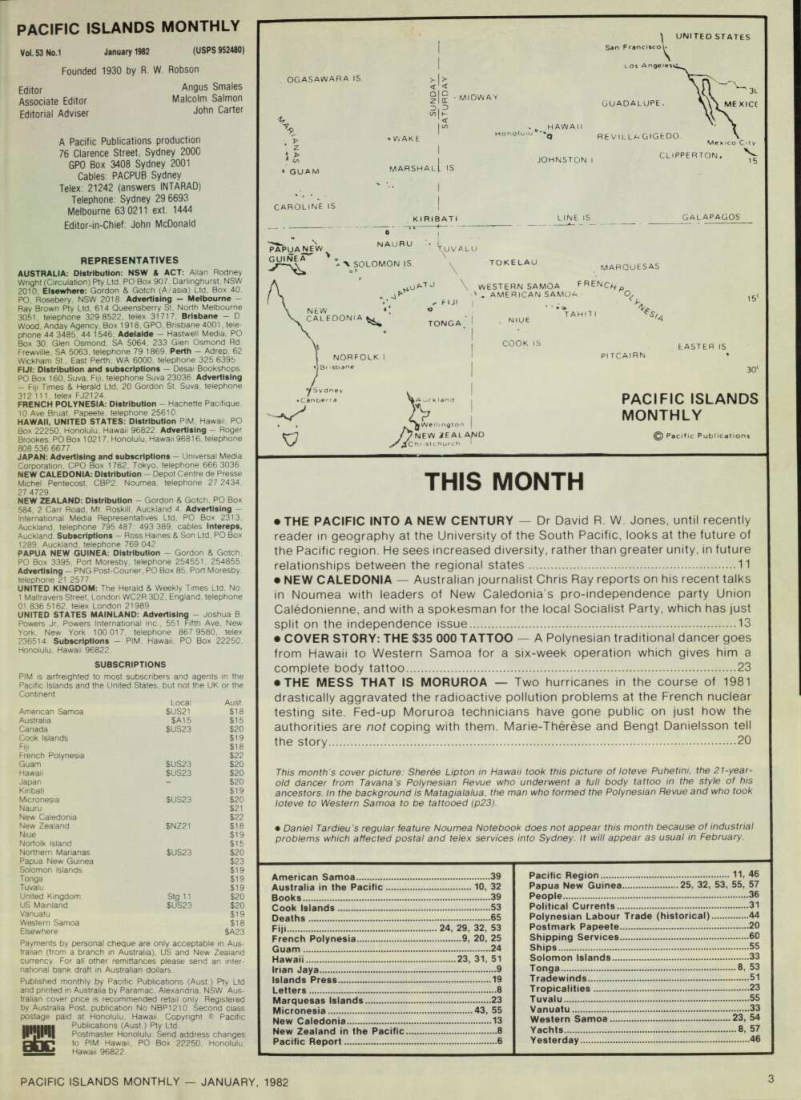
This Month
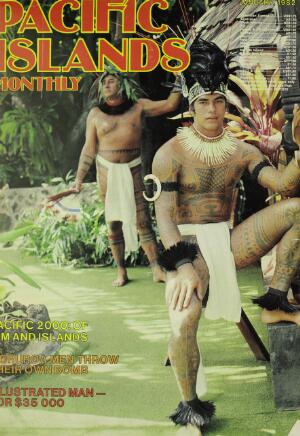
• THE PACIFIC INTO A NEW CENTURY Dr David R. W. Jones, until recently reader in geography at the University of the South Pacific, looks at the future of the Pacific region. He sees increased diversity, rather than greater unity, in future relationships between the regional states 11 • NEW CALEDONIA Australian journalist Chris Ray reports on his recent talks in Noumea with leaders of New Caledonia's pro-independence party Union Caledonienne, and with a spokesman for the local Socialist Party, which has just split on the independence issue 13 • COVER STORY: THE $35 000 TATTOO A Polynesian traditional dancer goes from Hawaii to Western Samoa for a six-week operation which gives him a complete body tattoo 23 • THE MESS THAT IS MORUROA Two hurricanes in the course of 1981 drastically aggravated the radioactive pollution problems at the French nuclear testing site. Fed-up Moruroa technicians have gone public on just how the authorities are not coping with them. Marie-Therese and Bengt Danielsson tell the story 20 This month's cover picture: Sherde Lipton in Hawaii took this picture of loteve Puhetim. the 21-year old dancer from Tavana's Polynesian Revue who underwent a full body tattoo in the style of his ancestors. In the background is Matagialalua. the man who formed the Polynesian Revue and who took loteve to Western Samoa to be tattooed (p 23). • Daniel Tardieu's regular feature Noumea Notebook does not appear this month because of industrial problems which affected postal and telex services into Sydney. It will appear as usual in February.
American Samoa 39 Australia in the Pacific 10, 32 Books 39 Cook Islands 53 Deaths 65 Fiji 24, 29, 32, 53 French Polynesia 9, 20, 25 Guam 24 Hawaii 23, 31, 51 Irian Jaya 9 Islands Press 19 Letters 8 Marquesas Islands 23 Micronesia 43, 55 New Caledonia 13 New Zealand in the Pacific 8 Pacific Report 6
Pacific Region 11. 46 Papua New Guinea 25, 32, 53, 55, 57 People 36 Political Currents 31 Polynesian Labour Trade (historical) 44 Postmark Papeete 20 Shipping Services 60 Ships 55 Solomon Islands 33 Tonga 8, 53 Tradewinds 51 Tropicalities 23 Tuvalu 55 Vanuatu 33 Western Samoa 23, 54 Yachts 8, 57 Yesterday 46
Advertisements & other items, pp. 3-5 (2 items)
Founded 1930 by R. W. Robson
Editor Angus Smales Associate Editor Malcolm Salmon Editorial Adviser Jofin Carter A Pacific Publications production 76 Clarence Street, Sydney 2000 GPO Box 3408 Sydney 2001 Cables; PACPUB Sydney Telex: 21242 (answers INTARAD) Telephone; Sydney 29 6693 Melbourne 63 0211 ext. 1444 Editor-in-Chief; John McDonald
Datsun Creates Ha
You never see a lot
of our best work.
Today, people are looking at new cars in a new way.
Sure, you still want a car that will zip through traffic. But you also need one that will zip past gas pumps and repair shops.
You want a car that is comfortable. But you also need one that is comfortably priced.
You want a car that looks nice.
But you also need one that will hold its good looks for some years to come.
And that comes from the way the people who built the car think.
At Datsun, we think in terms of “harmony.” % V Harmony between research and development. Between design and engineering. Throughout testing. And retesting. And up and down each of our assembly lines.
In short, harmony from concept through the completed car.
Thinking and working in harmony permits us to resolve seemingly unresolvable differences. To balance flatout contradictions.
For example, you want a strong, safe car. But you also need one that is fuel efficient. More strength would seem to mean more weight. More fuel efficiency would seem to mean less weight.
Our solution: A new, high-tension steel. It is thinner and lighter than the steel it replaced. Yet equally as strong. More pounds were saved, with no loss of strength, by drilling holes in the steel suspension system (which were later filled with rubber plugs).
Problem-solving by designresolving conflicting elements to improve the overall quality of the product—has helped Datsun to build
DATSUN CREATES HA
Cook Islands: COOK ISLANDS MOTOR CENTRE LTD., Rarotonga/Fiji: CARPENTERS MOTORS, Suva/Guam; DATSUN MOTOR SALES, Agana Hawaii: NISSAN MOTC CORPORATION IN HAWAII LTD , Honolulu Kiribati: ATOLL AUTO STORES, Tarawa/Nauru: JACOB ENTERPRISES LTD New Caledonia: AGENCE ALMA S.A., Noume.
cars that are strong and safe, yet light and fuel efficient.
Harmony has also led to many other solid product improvements.
Some you see. Some you don’t.
When a Datsun leaves the assembly line, it leaves with nearly nine pounds of gleaming acrylic paint.
And almost four and a half pounds of sound deadener.
Part of that paint does an undercover job. Inside the air cleaner.
On the underside of the hood. Under the mat in the trunk. Even the drive shaft is painted. As is the inside of the rocker panels, fender wells and splash pans. (Which also receive a generous extra layer of stone guard coat to help fight off salt damage in colder climates.) Every trunk is sealed with more than a pound of weather stripping.
Every door with nearly half a pound.
And every door also comes with a hole in the bottom... a precisely-positioned drain hole to prevent build-up of water running down the windowpane.
So now you have some idea of why Datsuns are so right for the times.
They offer you what the world needs.
Without sacrificing what you want.
That's harmony.
The model shown above is the Datsun 120 Y for South America.
Specifications and equipment may vary according to market.
DATSUN
IMONY BY DESIGN
THE NAME OF QUALITY
NISSAN
NISSAN MOTOR CQ. LTD
Vanuatu: PENTECOST S.A., Port Vila and Santo Norfolk Islands: SIRIUS MOTORS/ Papua New Guinea: BOROKO MOTORS LTD , Port Moresby/Saipan: JOETEN MOTOF COMPANY INC. /Solomon Islands; UNITED ENTERPRISES LTD., Honiara /Tahiti: TAHITIBULL S.A.R.L.. Papeete/ Western Samoa: MORRIS HEDSTROM LTD., Api;
Pacific Report
‘Remember Pearl Harbor’ 40 Years On
December 7, 1981, was the 40th anniversary of the Japanese attack on the US fleet in Pearl Harbor which touched off the Pacific war. In Japan, a few days before the anniversary, the mass-circulation newspaper Yomiuri asked 3000 people what the date meant to them. Fewer than half remembered, with the recollection rate unsurprisingly highest among people over 50.
Only one teenager in five knew from reading of it in schoolbooks.
Two percent recalled it as the date of an aunt’s birthday, or of the year-end bonus at their place of work. The anniversary coincided with the discovery in a Tokyo secondhand bookshop of a secret wartime document showing wartime Japanese officials advocat ing Nazi-style racial policies for ruling conquered nations, and the reported finding in the Philippines of the $2.5 million ‘Yamashiti Treasure’. (General Yamashita, ‘the Tiger of Malaya’, is said to have buried gold before the Americans captured and hanged him as a war criminal.) But the Tokyo correspondent of The Australian, Alan Goodall, summed up: Times change. A war foe becomes a useful ally and top market for electronic goods. The present generation sees Pearl Harbor as a beautiful place for a honeymoon.’ On the American side, the anniversary revived the long-standing controversy as to how it could have happened that the US was taken so completely by surprise by the attack. In an article in the Sydney magazine The Bulletin of December 8, British historian David Irving claims that an intercepted Japanese message gave the US three clear days’ warning that war was imminent, but no action was taken on it. In view of the fact that the crucial message known as No. 7001 was later removed by persons unknown from US Navy records, Irving strongly suggests a cover-up at the highest levels designed, notably, to protect the reputation of President Roosevelt. At Pearl Harbor on December 5, 1981. just two days before the anniversary, at least 10 people died when a plane taking skydivers to jump at a football game crashed into the harbour near the USS Arizona memorial.
Mitterrand To Mara: Delay Trip Please’
The French Government early in December asKed Fiji’s Prime Minister Ratu Sir Kamisese Mara to delay the visit to Paris of a delegation of three South Pacific leaders which was to be headed by him. The mission, authorised by the South Pacific Forum in August, was to discuss with President Mitterrand the future of France’s Pacific territories. It had planned to leave for Paris on December 13. Accompanying the French Government’s request were indications that a new bill it has under preparation contains ‘bold reforms’ for New Caledonia, which are expected to be made public in the course of January. According to press reports, the reforms will stop short of mentioning the word ‘independence’, but will allow the government immediately to buy out the 900 or so colons who own large areas of Melanesian lands on which they run mixed farms and cattle. The land will be returned to descendants of the original owners. The bill is also expected to freeze all transactions in land for 10 years, vote considerble sums for local government councils, initiate training programmes for Melanesians, and require European employers to employ, say, two Melanesians for every white.
W. Samoa Poll For February 27
Western Samoa will go to the polls in general elections on February 27.
France Appoints New Man In Noumea
The man with responsibility for implementing such reforms on the ground in New Caledonia will be Christian Nucci, 42, who was named by the French Government in December as France’s new high commissioner in New Caledonia, succeeding Claude Charbonniaud. Mr Nucci is a politically prominent member of the Socialist Party, and until his new appointment held the important post of vice-president of the French National Assembly (lower house of parliament). Mr Nucci was born in Algeria and lived there for 23 years. He has also served as a teacher in Morocco, under
the French Government’s co-operation agreements with that country. He is expected to arrive in New Caledonia in January
French N-Tests Stepped Up
France conducted nuclear tests at Moruroa Atoll, French Polynesia, on November 11, December 5, and December 8, according to New Zealand Government seismologist Dr Warwick Smith. French Defence Minister Charles Hernu confirmed the November 11 explosion in a statement released in Paris on November 25, but denied suggestions that it was a neutron bomb. Meanwhile, the Australian Government is seeking clarification of charges that the test site atoll has suffered structural damage as a result of the N-tests, and that as a result radioactive material is being released into the surrounding ocean.
The French Government has undertaken to give a written reply to the Australian inquiries. In another development, Mr Hernu confirmed in Paris on December 10 that a storm in March 1981 had scattered waste on the atoll, but, he said, the situation was ‘now perfectly under control’. (See Postmark Papeete, pp2o-21.) MATELOTS KEEP AN EYE ON THE VEGA The early days of December saw three French naval vessels shadowing the anti-nuclear protest ship Vega, as it sailed deep within the prohibited French N-testing zone off Moruroa Atoll. The captain of the vessel, David McTaggart of the Greenpeace organisation, said he and his four fellow crewmen had written to President Mitterrand putting their case and claimed they would not leave the area until France agrees to sign the nuclear test ban treaty. Among the tasks McTaggart and his friends are undertaking is checking on reports that a huge crack in the reef has caused the release of radioactive materials into the surrounding ocean. Among the crew is Brice Lalonde, who stood on an anti-nuclear energy platform in the May 1981 French presidential elections, and a young Australian, David Robertson.
Nauru An O.T.E.C. World First?
Nauru now has what is claimed to be the world’s first land-based Ocean Thermal Energy Conversion (OTEC) plant. The $4-million, 100-kilowatt plant, is the test version for a 1500-kilowatt project planned for Nauru. It was funded by the Tokyo Electric Power Service Corporation. Jay Lether, Guam Energy Office director, said in an interview published in The Honolulu Star-Bulletin that the Nauru project will have ‘particular significance to other Pacific islands, which now depend on expensive imported oil for electricity’. ‘Right now, a lot of people are doubtful OTEC will work. But this will establish it as a viable energy source,’ he said.
Mr Lether said the success of the Nauru project, which is already providing electricity to part of the Nauru community, will provide a boost for OTEC, which had taken a back seat in the Reagan administration’s budget plans. Nauru’s OTEC project had been a well-kept secret by the two Japanese companies involved, who had built it in just three months.
Fijians Must Rule’ Mara
Fiji’s Prime Minister Ratu Sir Kamisese Mara, in a spirited address to the convention of his ruling Alliance Party, has claimed that only continuing leadership by native Fijians would keep the multi racial country peaceful and prosperous. He accused other political parties of being ‘wholly racial’, and of having limited appeal. The opposition National Federation Party depended for support on the Indians, who form half of Fiji’s population, while small Fijian political groups ‘are wholly racial in outlook and of limited appeal, both geographically and in terms of their policies’, he said. The Alliance, which has ruled Fiji since 1970, is formed by three parties the Fijian Association, CMA. the Indian Alliance, which is supported by a small part of the Indian community, and the General Electors’ Association, which is backed by most people who are not Fijians or Indians. Ratu Mara told the convention that the Alliance was still ‘the only party whose composition truly reflects the diverse social and economic backgrounds of Fiji’. The campaign leading up to the July elections is likely to be a long and bitter affair, with simmering racial differences as the paramount talking point. The Alliance at present has 36 seats in the 52-seat House of Representatives, and is expected to have its numbers cut back to a narrow working majority. Robert Keith-Reid in Suva.
Chan Backs Off In Police Row
Faced with a threatened revolt by sections of the Papua New Guinea police force, PNG Prime Minister Sir Julius Chan appeared in December to back off from an earlier call he had made for the resignation of the country’s Police Commissioner Philip Bouraga. Deputy Prime Minister lambakey Okuk had warned the PM of ‘disastrous consequences’ if he insisted on the
commissioner’s resignation. In his later statement, Sir Julius said he had asked the Public Service Commissioner to consider laying disciplinary charges against Mr Bouraga. He added that if the PSC decided to lay charges, Mr Bouraga should automatically resign. Mr Bouraga in the course of the row has repeatedly stated that he would not resign, and that ‘they’ll have to sack me’.
Background to the trouble is the sharp increase in the crime rate in Port Moresby following cuts in police funds ordered by the government in May-June, 1981. Also in play is a clash of personalities between Mr Bouraga and Police Minister Warren Dutton. Mr Dutton is a member of Sir Julius’s Peoples Progress Party, whereas Mr Bouraga has a record of close association with the previous government of Michael Somare, in which his Pangu Party was the dominant force. The Chan government has tended to show marked dislike for senior public servants who were close to the Somare government.
OIL STORAGE PLAN FOR PAGO IN TROUBLE A proposal by the US-based Marlex Corporation to set up a floating oil refinery and storage facility in Pago Pago harbour is running into trouble with businessmen, students, and environmentalists. Among objections to the plan was the claim that the project could not compete with the larger bulk oil storage facility planned for Tonga, with Kuwaiti aid (PIM Dec ‘Bl p 6).
Sir Tore In Vanuatu
The Governor-General of Papua New Guinea, Sir Tore Lokoloko and Lady Lokoloko paid an official visit to Vanuatu in late November. The three-day visit included a day spent on the island of Santo, where PNG troops in August 1980 quelled the Vemarana secession.
Club Med For Madang?
The giant French-based tourist organisation, Club Mediterranee, is looking at a site near Madang, Papua New Guinea, with a view to setting up a Club Med operation there.
Oz Diplomats Shuffled
Australia’s Ministry of Foreign Affairs announced in December changes in diplomatic postings to Solomon Islands, Western Samoa and Nauru. T. H. B. Sofield is Australia’s new high commissioner to Solomon Islands, replacing R. G. Irwin, K. R.
Fraser replaces A. J. Deacon as high commissioner to Western Samoa, and R. B. Hodgson takes over from O. J. Cordell in the same post on Nauru.
New Caledonian Journalists In Vanuatu
A delegation of journalists from New Caledonia has been received in Port-Vila by Vanuatu President Ati George Sokomanu. The visit, made at the invitation of the Vanuatu Government, was a first step towards dispelling some of the mistrust and misunder standing which arose between the two sides at the time of the Santo revolt of May-August 1980. It is expected to lead to an increase in the numbers of New Caledonian tourists visiting Vanuatu.
Vanuatu’S Ties With Two Koreas
Vanuatu has established relations with both South (Republic of) Korea and North (People’s Democratic Republic of) Korea.
Cooks-Tahiti Trade Opens Up
Cook Islands Prime Minister Sir Thomas Davis, and Agriculture Minister Tangata Simiona, lent a hand in November loading copra on the Tahitian ship, Tuhaa Pae 11. The occasion was the beginning of a new trading relationship between the Cook Islands and Tahiti. Also present, having flown from Papeete for the occasion, were Alexandre Ata, member of French Polynesia’s government council responsible for economic development and tourism, oil plant director Julien Siu, and the export manager for Hinano beer, Tony Magnier.
Direct Dialling From Oz
Most metropolitan telephone subscribers in Australia are now able to dial direct to 10 South Pacific countries. From December 6 international subsciber dialling came into effect for calls to New Zealand, Papua New Guinea, Fiji, New Caledonia, Vanuatu, French Polynesia, Nauru, Tonga, American Samoa and Solomon Islands.
Racial Strains In Hawaii Noted
‘The ties that hold together Hawaii’s multi-racial society are being tested again by tensions arising from demands by the Hawaiian Polynesian minority for a bigger share of the state’s wealth and greater political power,’ writes Wallace Turner in a recent article reproduced in the Cook Islands News. Turner adds: ‘While only 19.9% of the state’s 950 000 residents are Hawaiian or part- Hawaiian, a disproportionately large number of theifi are on welfare rolls, in gaol and are school dropouts. Militant Hawaiians
blame the island’s Japanese and mainland Caucasians whom they call “haoles” for these problems.’
Scientists Aim At Immunity From Malaria
Scientists in Papua New Guinea and Australia are working on the production of a vaccine to provide immunity against malaria, still a major cause of death and chronic debility in tropical countries.
They describe the results so far as ‘encouraging’ but believe at least 10 years of further work will be needed before full-scale field testing can begin. If the project is successful it will represent a major development in medical science. The main weapons against malaria so far have been the suppression of its effects and the prevention of its transmission, rather than creation of immunity. The centre of the new project is at the PNG Institute of Medical Research where a team of doctors and scientists is working under the leadership of the institute’s director, Dr Michael Alpers. Associated work is being undertaken in Australia at the Walter and Eliza Hall Institute in Melbourne, the Queensland Institute of Medical Research in Brisbane and the Newcastle University in Newcastle.
First Pacific Schools Games For Brisbane
More than 2000 primary and secondary students are expected to attend the first Pacific Schools Games in Brisbane next August.
They are being staged as a curtain-raiser for the 1982 Commonwealth Games. Students aged from nine to 19 from Papua New Guinea, Fiji, Tonga, Solomon Islands, Cook Islands, Australia and New Zealand will be among the participants. The students will stay in Brisbane homes during the six-day event, and compete in athletics and swimming events organised by the Queensland State Schools Council. The games are being sponsored by Colgate-Palmolive.
Anchored Supertanker For Png?
The French company Ultra-Marine Pty Ltd is talking with Papua New Guinea’s National Investment and Development Authority about a plan for the permanent anchoring of a chartered supertanker in PNG waters off southern New Ireland. It would serve as an oil bunker vessel for international shipping. PNG would get a royalty on oil supplied, which would be brought to the tanker from Indonesia.
Undp Helps Train Hotel Staffs
The United Nations Development Programme is sponsoring a South Pacific regional programme to train hotel staffs in the smaller countries. It will sponsor training courses at the Fiji Hotel Catering School.
Fiji Eyes Imports Of U.S. Fruit
An outbreak of Mediterranean fruit fly in southern California has led to the banning in Fiji of all casual imports of fruit from the USA.
Regular importers of American produce must now obtain import permits.
Old Apia Hotel Reopens
The Apian Way Inn, one of Western Samoa’s oldest hotels, reopened in October after renovations carried out by its new owners, the Nauru Investment Corporation. The corporation belongs to the government of Nauru.
Big Upgrade For Norfolk’S Airport
The first contract was let in November for a $A6.2 million upgrading of Norfolk Island’s airport. It was a $2.3 million contract to Island Industries Ltd of Norfolk Island to supply crushed rock for use in constructing a new runway. An Australian Government spokesman said sufficient work would be done by the end of 1982 to accommodate medium jet aicraft such as the F-28 Fokker Fellowship. The F-28s are faster and larger than the prop-jet Fokker Friendships now in use on the Norfolk service
Massive Ore Deposit Near Galapagos
American scientists have discovered a massive undersea ore deposit worth at least SUS2OOO million near the Galapagos Islands in the eastern Pacific. The deposit, totalling 25 000 tonnes of ore in water 2500 metres deep, contains copper worth an estimated $2OOO million, and quantities of silver, lead, cadmium, vanadium, tin and zinc.
Samoan Rugby Men Under Cloud
Western Samoa rugby clubs could face an international ban following a violent incident in Hawaii recently, when a Samoan player representing the Vaiala Club struck the referee, New Zealander Trevor McLachlan. Several other players joined the attack, in which Mr McLachlan is reported to have been seriously hurt.
Spain, Tonga Have Diplomatic Ties
The two kingdoms of Spain and Tonga established diplomatic relations in October.
of yachties?
Letters
What value in news of yachties?
Fair crack of the whip. You’re beginning to overdo the Yachtie gossip column.
Current issue (October 1981) has no fewer than seven of its 82 pages devoted to the comings and goings of this leisure class, quite apart from that harrowing letter from Alvah G. Simon re the poor people of Nauru being deprived of the pleasure of his company.
Surely your coverage is out of all proportion to their numbers or value to the Pacific Way.
It’s all very interesting. I’m sure, to themselves and possibly other yachties, but pretty damned boring for the rest of us.
PIM has always reported on the wanderings of yachtsmen, and fair enough, but don’t let’s go overboard on the matter.
It seems to be expected by most Yankee sailors that, hav ing drifted across the Pacific to these climes, we should all stand up and cheer.
Hell, Thor Whatsisname proved years back that if one sat on a lump of wood over there, and stuck to it, one would inevitably finish up over here.
What about stopping this nonsense before they take you
over completely.
Frank Lewis
Rabaul Papua New Guinea Would any other reader care to comment? Editor.
Christine Bourne
has a fan Congratulations to Christine Bourne of Tahiti (PIM Oct p3l). She appears to be one of the few remaining individuals in the region with courage enough to tackle the truth and congratulations to PIM editors.
who appear to run the only remaining unbiased regional publication.
Perhaps it is time for the advocates of ‘decolonisation’ and ‘freedom’ to clean up their own socio-economic-industrial mess before embarking on purely materialistic adventures in their neighbours’ gardens stirring a bit of Kanaka revol ution in the process.
Daily earbashings about Namibia and Poland will not eliminate the memory of the cowardice shown over Cambodia, Timor and Irian Jaya. Nor will they eliminate the problems of land rights for the Australian Aborigines.
Let us hope the Kanaka movements have the logic and realism to see the greedy am bitions of those who may already be calculating the profits that could come their way from nickel, and via Steam ships and BP supermarkets.
Vitaliz Paingame
Cairns Qld Australia In defence of Kiwi cops In reply to your corespondent Bruce Turner’s letter (PIM Sep 1981 plO), I wish to comment on his allegations of brutal tactics and strongarm methods used by the New Zealand police during the South African Springbok lour of 1981.
I wish to point out to Mr Turner that at no time did the police throw rocks, sticks, or acid in tennis balls at the demonstrators, as the demon strators threw at the police. At no time did the police call members of the public who were Maoris and Islanders ‘black bastards’. This was done by demonstrators to members of the police force.
If he has read the New Zealand newspapers he would have seen that the public as a whole were more than pleased with the way in which the police handled themselves during this controversial lour, and have shown this in a practical man ner by donating over SNZI2O 000 for holiday homes for members of the police force.
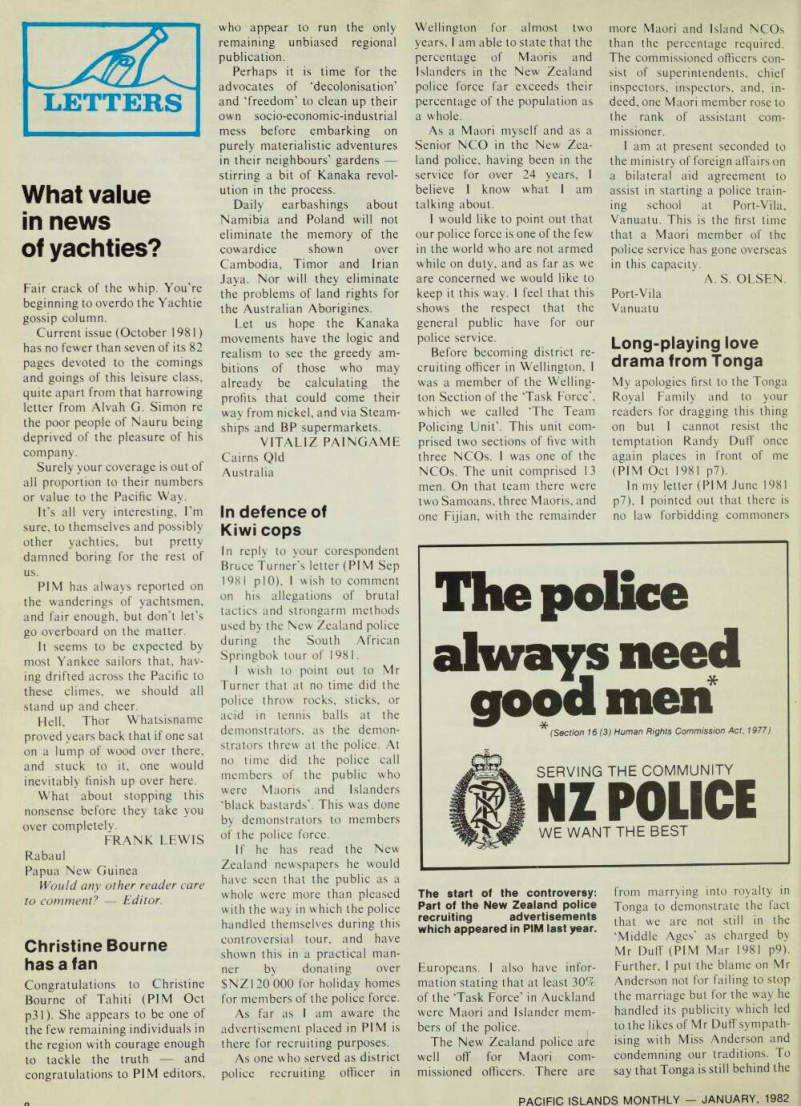
As far as I am aware the advertisement placed in PIM is there for recruiting purposes.
As one who served as district police recruiting officer in
Wellington for almost two years, 1 am able to state that the percentage of Maoris and Islanders in the New Zealand police force far exceeds their percentage of the population as a whole.
As a Maori myself and as a Senior NCO in the New Zea land police, having been in the service for over 24 years, I believe I know what 1 am talking about.
I would like to point out that our police force is one of the few in the world who are not armed while on duty, and as far as we are concerned we would like to keep it this way. I feel that this shows the respect that the general public have for our police service.
Before becoming district re cruiting officer in Wellington, I was a member of the Welling ton Section of the Task Force’, which we called The Team Policing Unit'. This unit com prised two sections of five with three NCOs. 1 was one of the NCOs. The unit comprised 13 men. On that team there were two Samoans, three Maoris, and one Fijian, with the remainder
The start of the controversy: Part of the New Zealand police recruiting advertisements which appeared in PIM last year.
Europeans. I also have infor mation stating that at least 30% of the Task Force’ in Auckland were Maori and Islander mem bers of the police.
The New Zealand police are well off for Maori com missioned officers. There are
more Maori and Island NCOs than the percentage required.
The commissioned officers con sist of superintendents, chief inspectors, inspectors, and, in deed, one Maori member rose to the rank of assistant com missioner.
I am at present seconded to the ministry of foreign affairs on a bilateral aid agreement to assist in starting a police train ing school at Port-Vila, Vanuatu. This is the first time that a Maori member of the police service has gone overseas in this capacity.
A S. Olsen.
Port-Vila Vanuatu
Long-playing love
drama from Tonga My apologies first to the Tonga Royal Family and to your readers for dragging this thing on but I cannot resist the temptation Randy Duff once again places in front of me (PIM Oct 1981 p 7).
In my letter (PIM June 1981 p 7), I pointed out that there is no law forbidding commoners
from marrying into royalty in Tonga to demonstrate the fact that we are not still in the ‘Middle Ages’ as charged by Mr Duff (PIM Mar 1981 p 9).
Further, 1 put the blame on Mr Anderson not for failing to stop the marriage but for the way he handled its publicity which led to the likes of Mr Duff sympath ising with Miss Anderson and condemning our traditions. To say that Tonga is still behind the
times is hardly a compliment at all. Also there is a big difference between failing to notice a friendship in Tonga, and en couraging and organising a wedding in Hawaii, not to mention the carefully worded and nicely-framed stories given to the press.
To be acceptable means ‘worth accepting'. That’s why in England in the 19305, Mrs Wallis Simpson, despite her vast wealth and impressive con nections. did not sit on the throne. And lately. Miss Davina Sheffield of England would have walked Prince Charles to the altar if not for her former live-in lover blowing the lid on their affair.
Sure Miss Anderson has a background and 1 did not contradict that. But perhaps I should have been more frank and to the point. Being a step daughter in her later life to a Tongan noble, and also eventu ally having a wealthy showman in Hawaii declared her father, simply fails to impress us Tongans at all.
Mr Duff also pointed out that Miss Anderson is at great ease in the company of our royal family. I sure am glad to inform him that this privilege is definitely not exclusive to Miss Anderson.
And on Mr Duffs proposal that ‘this lovely girl should be welcomed into the royal family' I am sure they would rather welcome an untainted beauty, not necessarily with a high birth-status, but most definitely without an embarrassing past, to protect both our traditional values and the reputation of our Royal members.
Lastly, please note that 1 am definitely a ‘Miss’ not a ‘Mr’.
(Miss) Pauline
Manutu’Ufanga
’Unga
Sydney NSW Australia
Anti-Oz bug bites
in French Pacific An anti-Australian bug seems to be biting quite a few mem bers of the elite in the French Pacific territories, and it is leading them into some embar rassing situations.
French Polynesia’s Senator Daniel Millaud, led by the bug
into barking up the wrong tree in charging that Polynesians were treated in a discriminatory fashion by Australian immi gration authorities (PIM Dec ’Bl p 6), is not the only one to suffer.
The Papeete newspaper La Depeche de Tahiti recently went wild with excitement about a World Council of Churches report which made strong criti cisms of aspects of the Austra lian Government’s treatment of Australian Aborigines.
The headline on its article on the subject proclaimed that the Australian Government had had ‘its nose rubbed in its racism’, and the article praised the WCC report as the work of ‘defenders of this oppressed people’.
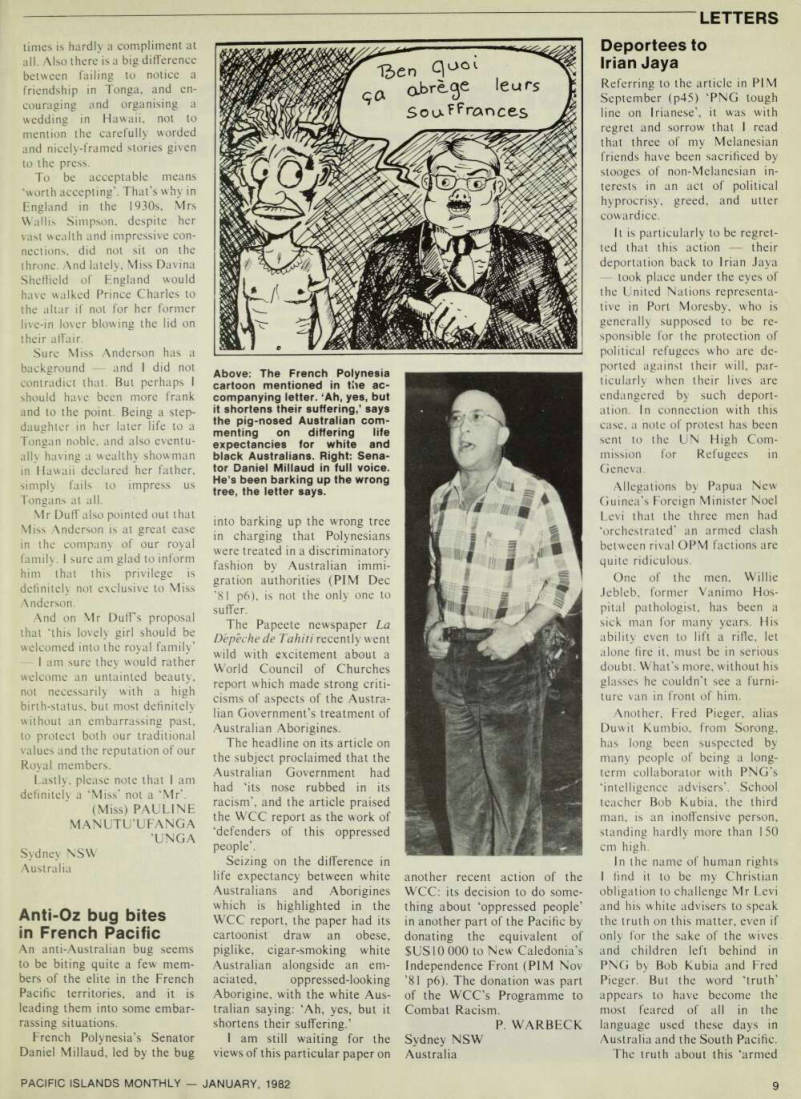
Seizing on the difference in life expectancy between white Australians and Aborigines which is highlighted in the WCC report, the paper had its cartoonist draw an obese, piglike, cigar-smoking white Australian alongside an em aciated, oppressed-looking Aborigine, with the white Aus tralian saying: ‘Ah, yes, but it shortens their suffering.’
I am still waiting for the views of this particular paper on
another recent action of the WCC: its decision to do some thing about ‘oppressed people’ in another part of the Pacific by donating the equivalent of SUSIO 000 to New Caledonia’s Independence Front (PIM Nov ’Bl p 6). The donation was part of the WCC’s Programme to Combat Racism.
P. Warbeck
Sydney NSW Australia
Deportees to
Irian Jaya
Referring to the article in PIM September (p 45) ‘PNG tough line on Irianese’, it was with regret and sorrow that 1 read that three of my Melanesian friends have been sacrificed by stooges of non-Melanesian in terests in an act of political hyprocrisy, greed, and utter cowardice.
It is particularly to be regret ted that this action their deportation back to Irian Jaya took place under the eyes of the United Nations representa tive in Port Moresby, who is generally supposed to be re sponsible for the protection of political refugees who are de ported against their will, par ticularly when their lives are endangered by such deport ation. In connection with this case, a note of protest has been sent to the UN High Com mission for Refugees in Geneva.
Allegations by Papua New Guinea's Foreign Minister Noel Levi that the three men had ‘orchestrated' an armed clash between rival OPM factions are quite ridiculous.
One of the men, Willie Jeblcb, former Vanimo Hos pital pathologist, has been a sick man for many years. His ability even to lift a rifle, let alone fire it, must be in serious doubt. What’s more, without his glasses he couldn’t see a furni ture van in front of him.
Another, Fred Picger, alias Duwit Kumbio, from Sorong, has long been suspected by many people of being a long term collaborator with PNG’s ‘intelligence advisers’. School teacher Bob Kubia, the third man, is an inoffensive person, standing hardly more than 150 cm high.
In the name of human rights I find it to be my Christian obligation to challenge Mr Levi and his white advisers to speak the truth on this matter, even if only for the sake of the wives and children left behind in PNG by Bob Kubia and Fred Pieger. But the word ‘truth’ appears to have become the most feared of all in the language used these days in Australia and the South Pacific.
The truth about this ‘armed
Above: The French Polynesia cartoon mentioned in the ac companying letter. ‘Ah, yes, but it shortens their suffering,’ says the pig-nosed Australian com menting on differing life expectancies for white and black Australians. Right: Sena tor Daniel Millaud in full voice.
He’s been barking up the wrong tree, the letter says.
clash’ and the historical facts are as follows: the OPM Righlwing leader, E. O. Bemey, crossed the border and attacked ‘General’ Rumkorem's commu nist faction in the Wulung gardens near Vanimo, where he has been in permanent resi dence (with the PNG auth orities turning a blind eye) since 1976. In the process, Bemey took prisoner another notorious collaborator and traitor to his own people, the Luluai from Scoliao village, OPM ‘Major’
Jordan Pieger This man and Fred Pieger betrayed their own brother-in-law and tambu, Jacob Hendrick Prai, to Austra lian kiaps and so-called intelli gence and security advisers to the PNG Government, also in Vanimo.
Neither of the Piegers is much loss, it is true. But the big question remains: how is it possible for ‘General’ Seth Rumkorem and his OPM Left wing faction to remain for so many years unnoticed with all his men in the immediate neigh bourhood of the Vanimo PNG Defence Force barracks, and the Vanimo ‘security’ and advis ory staff? I further would like to ask Mr Levi and Mr Ted Diro the following questions; Is it not a fact that ever since the communist OPM ‘General’ look up residence in the Wulung gardens, he has been a constant
visitor to the PNG Defence Force canteen, occasionally in the company of the commander of the PNG Defence Force?
And is it not a fact that certain foreign ‘advisers’ keep a con stant liaison with the commu nist ‘General’ in either Wulung or the Vanimo Hospital?
Who are Mr Levi and the PNG Government trying to fool with their anti-communist and anti-socialist propaganda cam
paign? Maybe they’re fooling
Australia, but certainly not Mr Busiri Surjowinoto or Admiral Sudomo.
Manfred Eiserman
Cairns Qld Australia Appeal from a voisin For the last eight months 1 have been preparing a weekly broad cast for FR3 Radio Tahiti entitied ‘Nos Voisins du Pacifique’ (‘Our Pacific Neigh bours’). This broadcast informs the people of French Polynesia about what is happening in the Pacific area, and is the only one of its kind.
The broadcast, which lasts 20-25 minutes, is divided into a magazine section and a news section.
The magazine section might present details on a particular country in the Pacific, an inter view with a person prominent in regional affairs (a head of state, prime minister, or such), details of one of the Pacific regional organisations (SPC, SPEC, Fo rum, for example), deal with certain Pacific customs, or ana lyse some recent events.
The news part includes news on political, economic, indus trial, scientific, and artistic
events, as well as sports and outstanding recent events in public affairs.
The purpose of this broadcast is to make people interested in their part of the world. Unfortu nately, I find it quite difficult to gather adequate information (although I read PIM every month) and documents, since I have no allowance to support me in this work.
I would very much appreci ate it if some PIM readers were kind enough to send me as much documentation as they can on their country news papers, magazines, anything that conveys information from on the spot about what is happening in the country con cerned. I very much want to present a realistic picture so I want all the information 1 can get: economic statistics, consti tution, history, plans for devel opment, agricultural resources, fishing, forests and so on and on.
I do hope some of your readers will be willing to help me.
Michel Charleux
‘Nos Voisins du Pacifique’
BP 3935 Papeete Tahiti French Polynesia Fiji and the Sinai force Nakavandra’s emotional letter (PIM Oct ’Bl p 7) deploring Fiji's participation in the pro posed Sinai peace-keeping force suffers from several errors and misconceptions which should not pass uncorrccled.
Firstly, Fiji and the US are not the only participants in the Sinai force. Countries that have indicated their support for or their willingness to participate in the force are Uruguay, Colombia, Italy, France, Britain, Netherlands, Australia and New Zealand.
Secondly, all peace-keeping forces can be described as being ‘controversial’ as they are in variably creatures of political controversy. There is no such creature as an ‘unconlroversiaF peace-keeping force and if there has been one created can your magazine or Nakavandra please enlighten its readers with an example?
Thirdly, for Nakavandra to
claim that the government of Fiji is under . . the delusion that the whole world appreci ates and admires the sacrifice of Fiji military manhood in Lebanon’ is not only a grossly unfair statement for anyone to make but is an insult to the memory of Fijian soldiers who have fallen in Lebanon. We in Fiji do not expect the sympathies of the whole world.
We are quite content with the expressed appreciation and ad miration shown to our soldiers by the Lebanese people them selves, the displaced Palestinians and the Israelis.
Moreover the sacrificing of Fijian military manhood is not a new experience to Fijians. We have made similar and greater sacrifices before in France and Italy (World War 1), the Solomons and Bougainville (World War II), Malaya (1952 to 1956), Lebanon (since 1978), Zimbabwc-Rhodcsia (1980) and to commence in 1982, the Sinai peninsula. Mention must also be made of the hundreds of Fijians who have served and are still continuing to serve the British army with distinction.
Fourthly, Fiji did not contrib ute troops to Vanuatu because as far as Fiji was concerned, the nature of the Santo dispute was essentially civil and not military and therefore military force was not required. It would appear that Britain and France agreed with this assessment judging by the passivity of British and French troops in Vanuatu at the lime. The use of troops to settle the comic-opera situation that existed in Santo at the time was an unnecessary overkill.
In conclusion I would like to point out that a commonly held principle in Fiji is that if a person does not pay tax to the government of a country then that person has no right to criticise the policies of that government. If we accept this principle as being a fair one, then Sir Julius Chan had no right to criticise the Fiji Gov ernment policy not to commit Fijian soldiers to Vanuatu, and likewise Nakavandra has no right to criticise Fiji Govern ment policy to commit troops to the Sinai force.
N.W. Lalokalo
Suva, Fiji
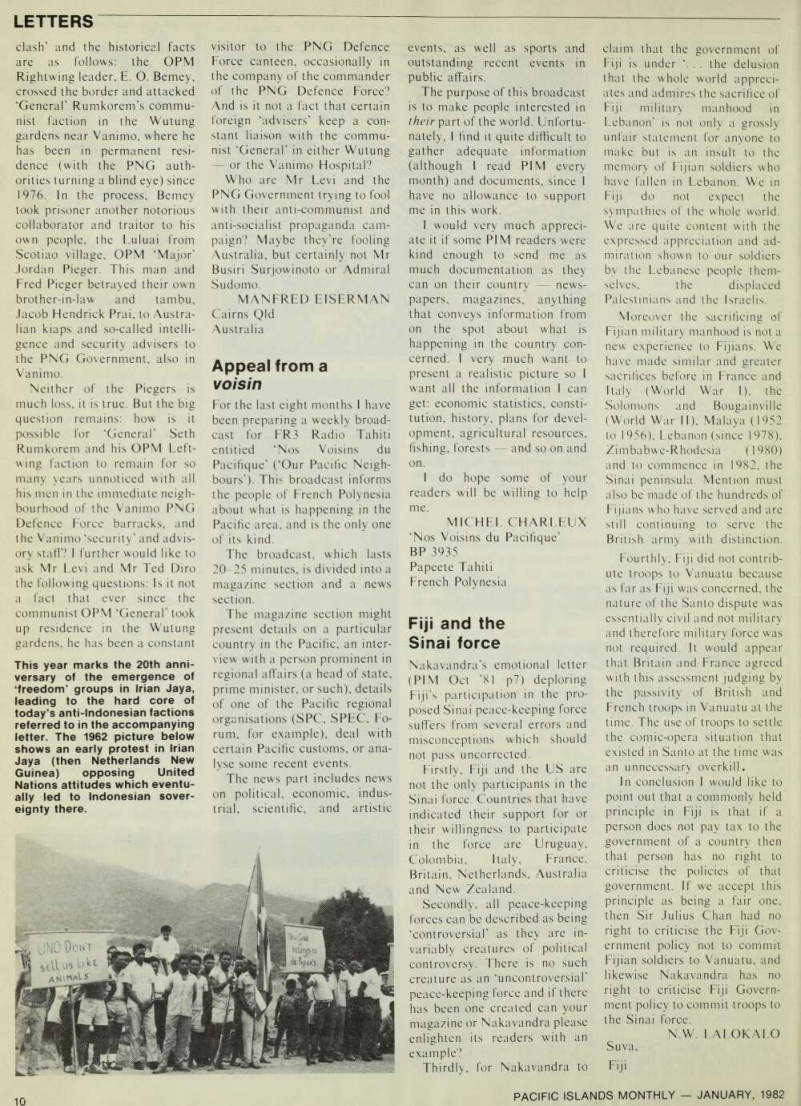
This year marks the 20th anni versary of the emergence of ‘freedom' groups in Irian Jaya, leading to the hard core of today's anti-Indonesian factions referred to in the accompanying letter. The 1962 picture below shows an early protest in Irian Jaya (then Netherlands New Guinea) opposing United Nations attitudes which eventu ally led to Indonesian sover eignty there.
Advertisements & other items, p. 8 (1 item)
The police
always need good men (Section 16(3) Human Rights Commission Act, 1977) E
SERVING THE COMMUNITY
HZ POLICE
WE WANT THE BEST
Pacific 2000: Another look at the future
future of Rim and Islands
Dr DAVID R. W. JONES* in the article below takes issue with certain ideas expressed by Professor RON CROCOMBE in an article in PIM of April 1981. Dr Jones sees the main tendency in the South Pacific over the next couple of decades as one of increased diversity, rather than greater unity, between the states in the region.
Professor Crocombe’s elaborate geopolitical essay on the Pacific basin (PIM April p 11) suffers from a number of conceptual and analytical weaknesses.
Possibly a response might serve to open a dialogue which, how ever far short it may fall of a South Pacific ‘think tank’, as proposed by Professor Crocombe, may be of some value to those in the region who must necessarily think in geo political terms.
It is a common failing of political geographers, in or out of uniform, to conceive of nation states as pieces in a vast game of chess. Indeed, a com parative map of chess-playing densities would point up some astute minds lucked away in the Philippines and Indonesia, some deadly intellects in the forgot ten Latin American fringe of the Pacific, and some mighty brains pushing their pieces in Vladivostok. I have yet to experience the Korean version of the game. The South Pacific can hardly expect to win at chess, and must bear the awful certitude of being regarded as ranks of pawns. Some are slightly fatter than others, but all face the inevitability of being sacrificed in somebody else’s game.
Fortunately, most political geographers are wrong. Nation states are not chess pieces with specified roles, set objectives and fixed configurations, but are subject to occasional and sometimes cataclysmic change.
It is in recognising this, and in studying the process of change, that political geographers differ most markedly from geopoli ticians. Each of the ‘great powers’ circling the Pacific, or
making their presence felt, are subject to political change; Japan, China, the USSR, the USA and the European Econ omic Community. So too are the currently less powerful circum-Pacific countries of Chile, Peru, Ecuador, Colombia, Mexico, the Central American republics, Australia, New Zealand, Indonesia, the Philippines, Vietnam and Korea. No prognosis of pres sures and events over a 10-or -20-year period is complete with out a thorough analysis of potential changes in each of these component parts. A ‘Pacific 2000’ think-tank mem ber requires a greater breadth of background knowledge than most of us possess.
Within the small nation stales of the South Pacific, change is also taking place and may well accelerate during the next decade or two. For example, the mid-1981 strike of public servants in Western Samoa is hardly likely to make zero impact on the socio political structure of that country, just as the reverber ations of Jimmy Stevens’ antics in Vanuatu have not yet ceased to shape attitudes in that country. A central plank in Professor Crocombe’s geopoliti cal manifesto, for such it at limes appears to be, is that the South Pacific nation states should stand united in the face of diverse pressures from the Pacific rim and beyond. To do this, however, is to minimise each small state’s liberty to make internal changes in what ever direction. Differential rates of change in each state imply, surely, some widening in the already apparent rifts between the South Pacific countries, differing philosophies, differing levels of acceptance of aid from specified donor countries, differing international transport requirements and so on.
For example, we cannot ex pect, say, a socialist Kiribati to
receive proportionate aid flows from the USA and Australia, given the present political stance of those countries. Nor could we expect an obscurantist quasi-mystical government to receive much encouragement and assistance from the Soviet Union. The circum-Pacific powers do have exportable preferences with regard to the political complexion of states whom they wish to aid and abet, and will continue to hold to these preferences in spile of a possible post-Reagan re-
surgence of multi-lateral aid programming.
It is perhaps in this light that we should see Soviet aid, in cluding military assistance, to Afghanistan and Vietnam, rather than in the perspective of Sir Halford Mackinder and other long-dead geopoliticians, i.e., that of global moves in a vast strategical chess game.
After all, the USSR does not aid Pakistan (at present) or, for that matter, Turkey.
The status quo in South Pacific countries is supported principally by aid flows from Australia, NZ, the UK and the USA, with EEC price supports and Japanese long-term raw material extraction contracts.
They have internal economic structures largely dominated by
a handful of banks and com panies based in these same countries. It is inconceivable, in the light of recent Jamaican experience, that a nationalis ation of the banks and selected major companies in one or other South Pacific nation state would not be accompanied by concerted attempts at destabilisation from outside.
We need only recall the over throw of Ali Soilih’s Left leaning government in the Comoro Islands by a group of French mercenaries, the con
slant threat of a mercenary spearheaded coup in the Seychelles, and frequent land ings of armed men in Grenada to realise that small island states are not immune from the most drastic forms of outside intervention.
In that Professor Crocombe’s thesis apparently leans heavily on a concept of South Pacific unity, it inevitably implies the
*Dr David R. W. Jones teaches political geography at the Uni versity of Calgary in Western Canada, and until recently was reader in geography at the University of the South Pacific, Suva.
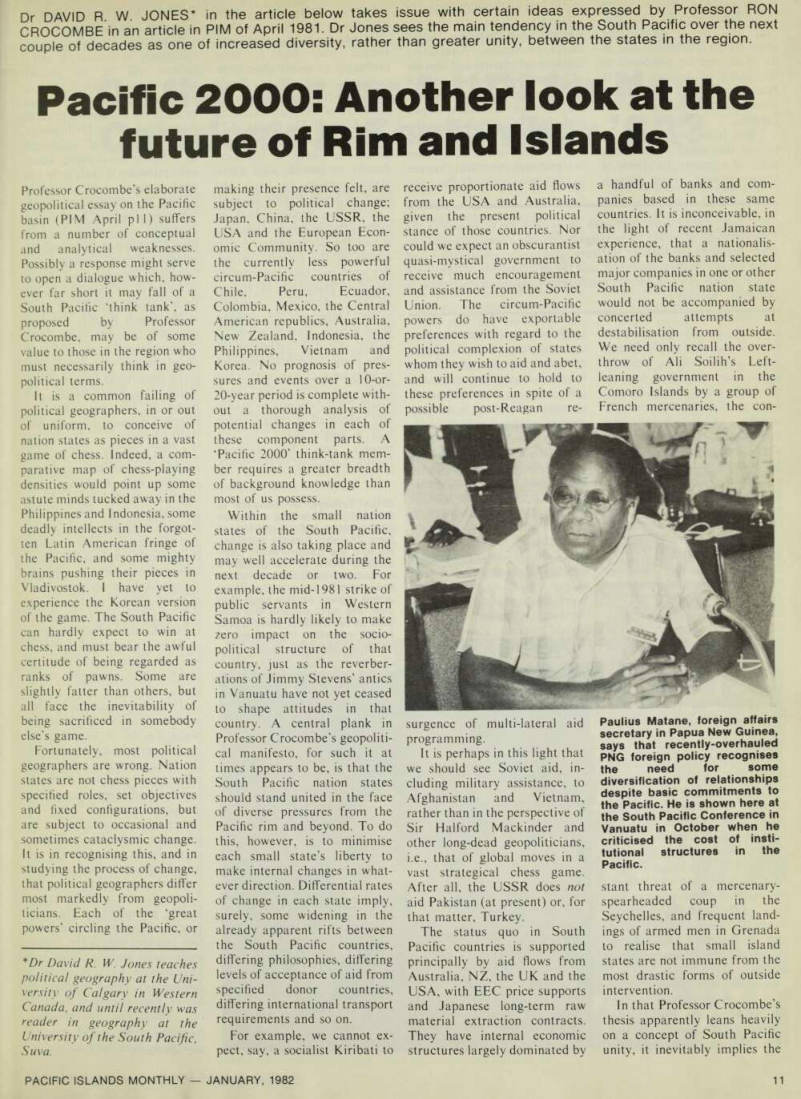
Paulius Matane, foreign affairs secretary in Papua New Guinea, says that recently-overhauled
PNG foreign policy recognises
the need for some diversification of relationships despite basic commitments to the Pacific. He is shown here at the South Pacific Conference in Vanuatu in October when he criticised the cost of insti tutional structures in the Pacific.
maintenance of the status quo in the South Pacific. This pros pect may be of diminishing allure to the inhabitants and, in its effect, can be compared to the policy of indirect rule in Northern Nigeria, Malaya and elsewhere in the defunct British Empire.
There is no sound reason to believe that small island states must, of necessity, be clients of larger powers, even though
‘. . . If one were to conclude with an admonition to people in the South Pacific, it would be to suggest periodic examination of the bank accounts of leading military, politico/administrative and other figures, in their countries, and the development of links with rather more circum-Pacific intelligence organisations than is presently the case
many in fact are. It would not be easy to assign the Maldives, the Cape Verde Islands, Seychelles or Malta to any particular camp. Tonga, Tuvalu and even Tokelau are perfectly capable of developing and maintaining a real indepen dence, free of external leverage and without recourse to regional groupings. Indeed, the sheer multiplicity of interested large and medium powers in the Pacific permits some adroit manoeuvring in the pursuit of genuine independence.
We may accept, however, Professor Crocombe’s assertion that some members of the educated elite in the South Pacific may succumb to the blandishments of interested foreign powers and may, in deed, reach positions high enough to temporarily take their countries into the orbit of large circum-Pacific powers.
The discovery of West German and US agents even among cabinet ministers in Guinea subsequent to the abortive Portuguese-backed invasion at tempt of 1970, should make this point clear. Traitors are not hard to find and recruit in any country. Nor will any assertion of Pacific culture or the Pacific Way do more than camouflage sell-outs to foreign powers. We may recall that Leopold Senghor’s ‘negritude’ did little more, in the event, than mask a blatantly pro-French neo colonial regime.
In terms of a 20-year prog nosis of developments in the Pacific basin we may fairly confidently predict a steady diversification of trade patterns.
facilitated by the appearance of relatively low-cost Soviet, Chinese and perhaps Indian merchant vessels. Alternative markets for exports and sources of imports will, at least, reduce the leverage that Australia, NZ, Britain the USA, Japan and the EEC now have in the South Pacific, making it poss ible for some countries to usher in significant structural changes in their economies. If the post
1974 economic recession con tinues to deepen, the likelihood of radical change in some South Pacific nation states must inevi tably increase, and with such changes will come a realign ment of external political link ages. A US-Australian axis in the South Pacific will be hard pul to maintain the status quo in each errant nation state.
This is particularly true as the Third World continues to shake itself free of residual colonial and neo-colonial ties.
After all, it only requires a significant change of direction in, say, five or six major Third World countries for the spirit of Bandung to return revivified.
Should Brazil, Zaire, Saudi Arabia. Pakistan and Indonesia
radically alter their inter national political stance, countries such as the Cook Islands may find it more profitable to assert their inde pendence and Third World character than to remain in the backyard of a rapidly declining New Zealand. The Group of 77 and the militant Third World in general is likely, in the next decade, to provide solid diplo matic support to even the smallest South Pacific country.
It is also apparent that no circum-Pacific power is likely to repeat the demographic exper iments of the colonial period.
We need not fear the implan tation of thousands of Italian settlers, American settlers, Somali labourers or Afghan shopkeepers. Except where it might suit the ambitions of some parochial political hopeful to whip up racialism within the Pacific, we may expect each South Pacific country to gradu ally absorb all of their citizens into a single polity. In this respect only Fiji remains fragile. Intrusion in the South
Pacific is likely to be military, economic and political.
Military intrusion may effectively be countered, and I believe will be, by greater Soviet naval capabilities; wit ness the about-face performed by a US fleet, steaming towards Bangladesh in its birth pangs, when it found itself shadowed by a Soviet naval force. Econ omic intrusion is likely to be the most intense, with a whole gamut of international trade techniques, ranging from export quotas to boycotts, coming into play. I would personally see the establishment of an aggressive School of International Trade as likely to be more profitable than a geopolitical ‘think tank’ in the South Pacific. External economic interests in the form of investments, banks and mer chant houses are vulnerable, given the crucial fact of sover eignty in the South Pacific, and being so are less likely to interfere excessively in the pol itical process.
In the political sense we may confidently anticipate, and here 1 agree with Professor Cro combe, a small but significant percentage of the South Pacific’s military, trade union and administrative elites selling themselves to circum-Pacific in telligence services. As a result, we are likely to see the emerg ence of several regimes, poss ibly as grotesque in nature as the late Central African Empire or Haiti, whose real function will be little more than to preserve the economic status quo.
If one were to conclude with an admonition to people in the South Pacific, it would be to suggest periodic examination of the bank accounts of leading
military, politico/admin
istrative and other figures, and the development of links with rather more circum-Pacific in telligence organisations than is presently the case. Overall, my own prognosis would be that external interference in the South Pacific will be quite largely generated by the very process of change and conserva tive reaction within the region itself, each seeking allies and links outside. Least of all can I foresee any broad alliance of South Pacific nations fending off unsolicited interference from the wider world peering covetously over the Pacific rim.
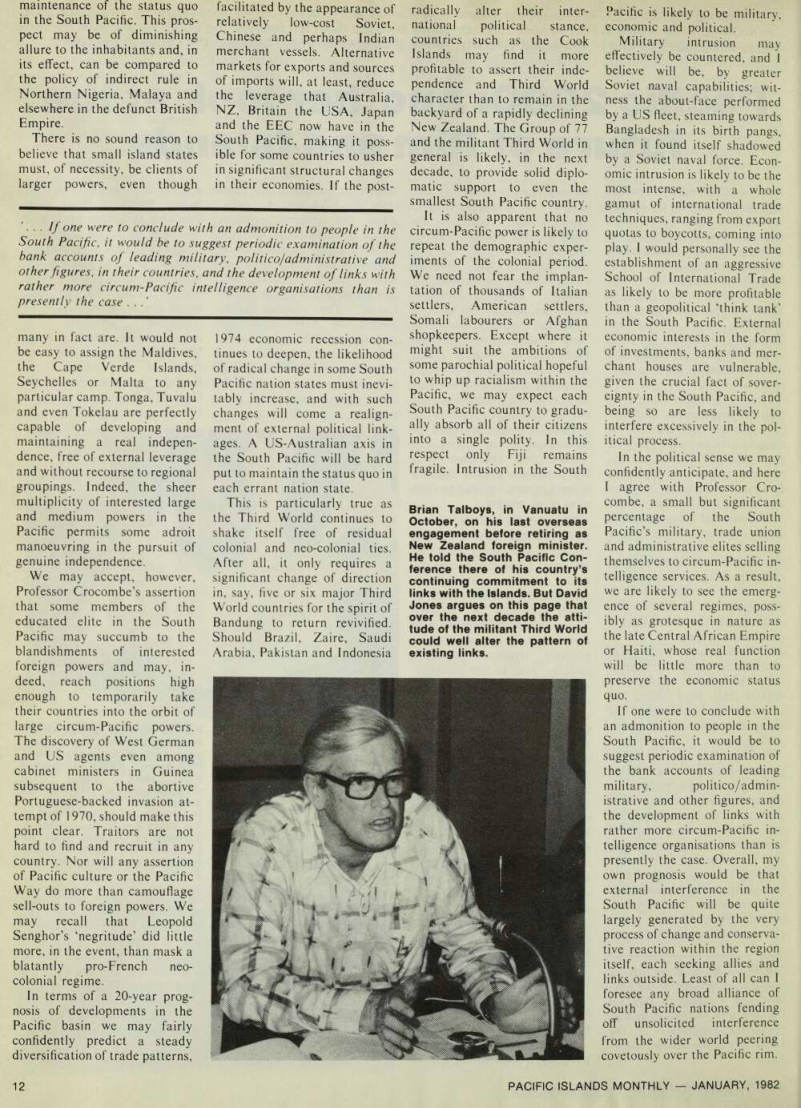
Brian Talboys, in Vanuatu in October, on his last overseas engagement before retiring as New Zealand foreign minister.
He told the South Pacific Con ference there of his country’s continuing commitment to its links with the Islands. But David Jones argues on this page that over the next decade the atti tude of the militant Third World could well alter the pattern of existing links.
Caledonia in September ’82?


On the way up: A UDI for New Caledonia in September ’82?
Australian journalist CHRIS RAY was in New Caledonia for several weeks late last year. During his visit he discussed with representatives of New Caledonia’s oldest political party, the Union Caledonienne, the results of the UC s talks in Paris with President Mitterrand last October, and also met representatives of other political groups.
French President Mitterrand’s remarks during his October talks in Paris with representa tives of the pro-independence party Union Caledonienne centred on the future of the New Caledonian-born whites, the Caldoches, according to Francois Burck, a UC Terri torial Assembly member.
Speaking at UC head quarters in Noumea a run down suburban villa patrolled by a ferocious dog Mr Burck said that the president was keenly aware that the Caldoches were ‘worried as to what their future would be under Kanak and socialist inde pendence’. ‘After our talks,’ said Mr Burck, The president under stands that our demands for Kanak independence are not racist, as some would have him believe. That is a step forward for us. ‘No party seeking indepen dence has ever spoken of mak ing anyone pack their bags and leave.’
Mr Burck told me that the UC was sufficiently pleased with the talks to consider delay ing by six months or a year the plan of the Independence Front - in which the UC is the largest party to make a unilateral declaration of inde pendence on September 24 this year the 129th anniversary of French colonisation of New Caledonia. But our interview took place shortly before the November 11-15 congress of the UC on the island of Lifou in the Loyalty group of islands off New Caledonia’s east coast.
And to judge from post congress remarks by another UC leader, Jean-Marie Tjibaou, on Noumea television, this plan was not adopted: Mr Tjibaou quite firmly predicted that inde pendence would be declared as planned on September 24, 1982.
Apart from Mr Burck’s re marks, and the generally ap
proving comments made on the talks by the UC delegation leader Roch Pidjot, (PIM Dec ’Bl p 5), few details of what transpired have been made pub lic.
In its comments, the Noumea daily Les Nouvelles Caledon iennes. assured its predomi nantly white readership that Mitterrand had given ‘no pre cise undertakings’ to the UC team.
The paper said the president had ‘indicated to his guests that he was going to think aloud before them, and he submitted to them in turn each of the possible scenarios for the terri tory and asked them to react to them, without stating his view’.
But it added that the four members of the UC delegation ‘noted above all that Mitterrand did not deny the right of the Kanak people to independence, and therefore did not renege on his previous undertakings on this point’.
But no amount of good news
from Paris is likely to defuse growing agitation by tribal Kanaks seeking to recover tra ditional lands now owned by French colons.
Mr Burck said Kanak tribes would go ahead with plans to occupy a number of farms and plantations owned by whites.
He said the owner of one property (400 hectares of cattle pasture) at Poya, near the central-western coast, was in formed of and ‘gave his consent’ to the planned occupation. But neighbouring white farmers had since been pressuring him to resist.
Although the Kanaks in tended the occupations to be peaceful, Burck said he did not rule out the possibility that some colons would react violently. ‘lf this does happen we are confident the French Socialist government will not hesitate to use riot police or even troops against any white vigilante movement,’ he said.
Burck claimed the number of firearms in white hands in New Caledonia was put at 140 000 by the three senior police officers sent from Paris to inves tigate the murder of UC secretary-general and indepen dence activist Pierre Declercq last September.
Burck argued: ‘lt is better for the tribes to take possession of the land in their own way. A Kanak does not feel at home if he is not installed by the clan that owns the land. It is hoped that these occupations will force the colons to listen to the Kanaks’ demands, instead of running to the police or the high commissioner. A dialogue must start now.’
Indications that the planned
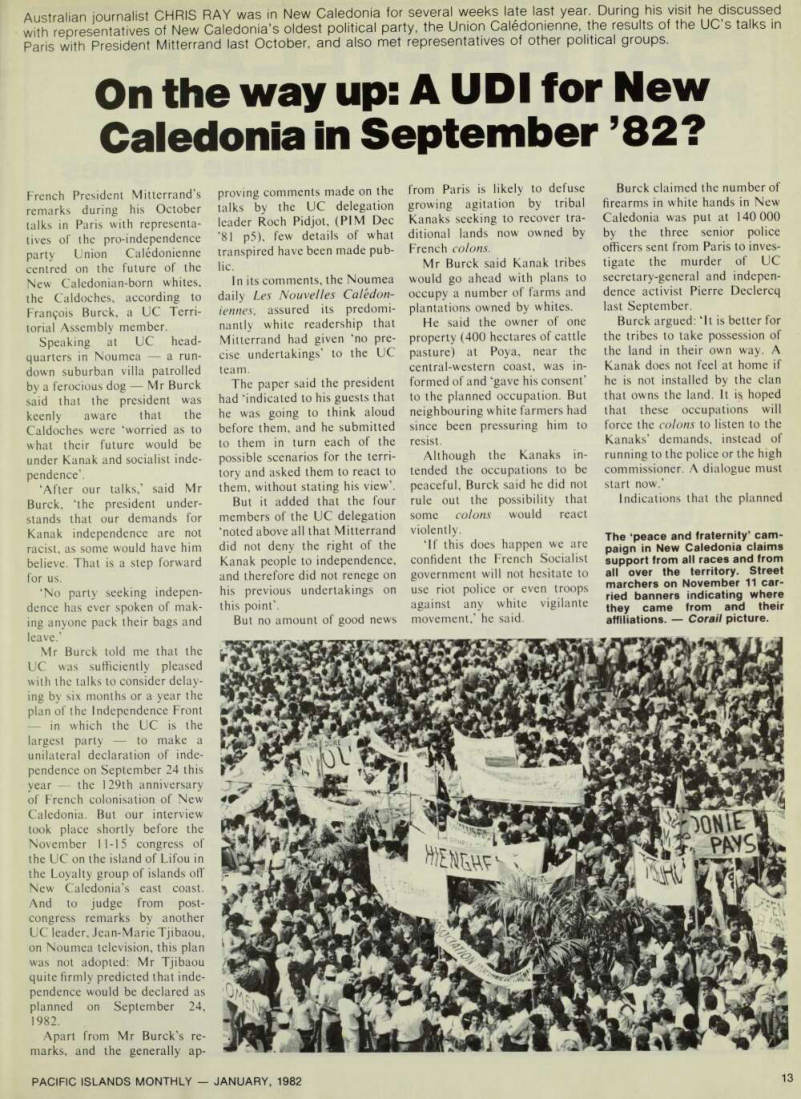
The ‘peace and fraternity’ cam paign in New Caledonia claims support from all races and from all over the territory. Street marchers on November 11 car ried banners indicating where they came from and their
affiliations. - Corail picture.
New Caledonia Politics
actions had got underway were contained in a November 22 Australian press report which said; ‘An unarmed group of more than 200 Melanesians yesterday tried to take over a 270-hectare estate in New Caledonia without violence.
The estate was heavily guarded so the group, led by pro independence activists, broke up after heated discussions among its leaders.’
Burck said that the first attempts at peaceful occu pations of land would be fol lowed by other tribes in different parts of the territory, though he was reluctant to state exactly when and where.
The movement to regain tra ditional land lost to Europeans in some cases more than a century ago is strongest in the northwest. Though each tribe has its own objective, their activities are co-ordinated.
They are supported by the Independence Front which holds 14 of the 36 Territorial Assembly seats, and by the more radical Kanak Liberation Party, Palika, which usually distances itself from the co alition.
Until now the tribes have generally been content to make contact with French colons occupying alienated land and make formal requests for its return. Since 1979 the French administration has been pre pared to purchase land from the colons and return it to the Kanaks, and last August the new French Secretary of State for Overseas Departments and Territories, Henri Emmanuelli, promised to speed the process.
But land reform appears not to have satisfied the Kanaks. ‘Only about 6000 hectares has gone back to Kanaks and most of it is poor soil,’ Burck com plained.
Kanaks are worried also that a reform which delivers pieces of once-tribal land to individ uals or sub-groups of a tribe could further disrupt the communal way of life. Thus they view the land reform as yet another threat to the concept of group ownership and a social structure already eroded by colonisation.
The inadequacy of the land reform and related policies so far pursued by the Socialist government was acknowledged
by Mr Emmanuelli in a state ment made following the November 7 rioting in Noumea (PIM Dec 'Bl p 5). He said: ‘We must make a political response to the Melanesian problem. ‘lt is not only economic and social reforms that will bring a solution to this problem.' His statement coincided with a special meeting called by President Mitterrand to discuss the New Caledonian crisis.
Writing in the Australian weekly The National Times, journalist Robert Milliken com mented; ‘Australian Govern ment officials see Emmanuelli’s statement as the first hard sign that the French are willing to consider decolonisation of their troublesome Pacific territory.' After more than a century of colonisation Kanaks make up less than half the population of New Caledonia. The January 1980 census put their members at 60 500, and Burck estimates that only 7000 are employed outside of subsistence farming on the reserves one reason why land is so important to them.
The census counted 49 700 Europeans in the territory, with
17 600 Polynesians and I I 800 Asians.
In the French presidential election last May, 65.5 percent of votes cast in New Caledonia went to Giscard d’Estaing, and since Mitterrand's Socialist Party had ’reaffirmed its desire to support and guarantee the Kanak people’s right to freely decide their future,’ the ballot was seen by whiles at least as a sort of referendum on indepen dence.
The Kanak independence parlies dispute this view, argu ing that only Kanaks have the right to determine whether New Caledonia becomes indepen dent or stays with France. At the least they would insist that the right to vole in any refer endum on the subject be limited by a qualifying period of resi dence.
At present, any French citi zen can vole in New Caledonia
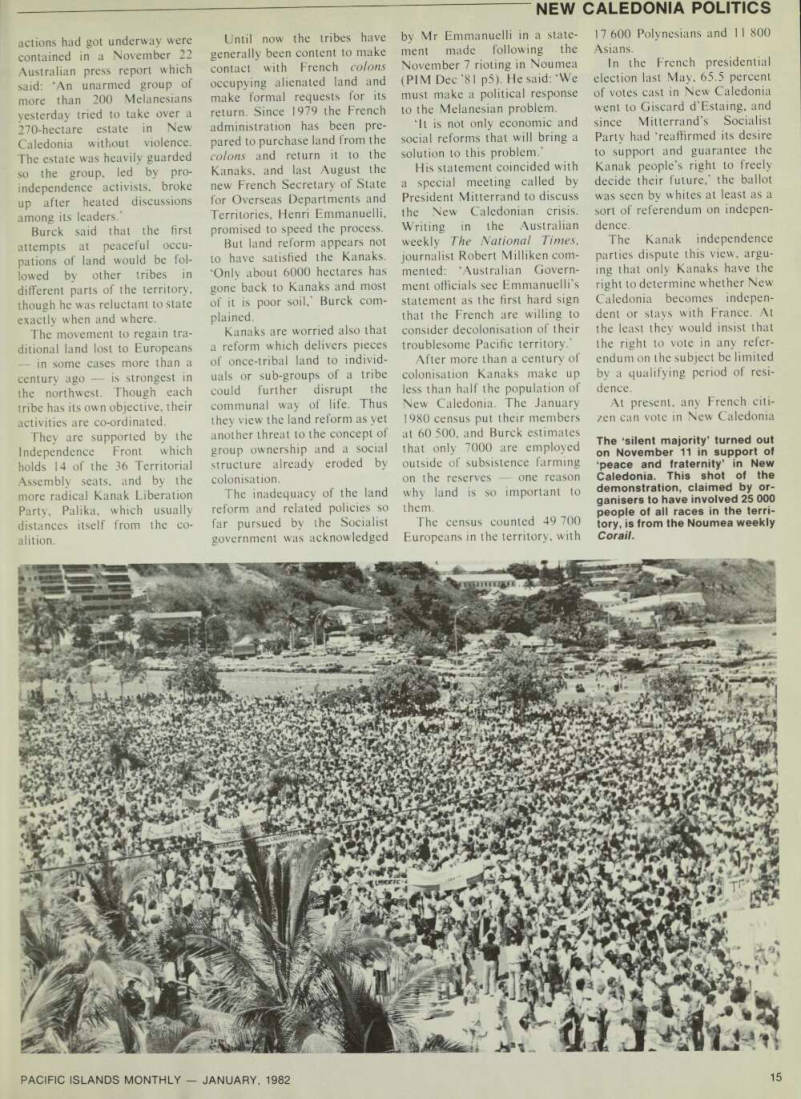
The ‘silent majority’ turned out on November 11 in support of peace and fraternity’ in New Caledonia. This shot of the demonstration, claimed by or ganisers to have involved 25 000 people of all races in the terri tory, is from the Noumea weekly Corail.
after three months' residence.
Asks Burck: ‘Who has the right to demand independence other than those who have been colonised? Who is entitled to land rights, other than those whose land has been stolen?’
The independence parties want legal title to all land to revert to the clans, to the ‘custom owners’. White farmers who accept Kanak indepen dence would be able to nego tiate leases if the clans wanted them to stay on (as is happening in newly independent, neigh bouring Vanuatu).
But such reassurances seem to be having little effect on the whites. The drive for Kanak independence has divided even those whites on the left of politics who are generally sym pathetic to Kanak aims.
Last October the Socialist Party of New Caledonia, kin to its namesake in France, split down the middle over the inde pendence question at a rowdy annual congress in Noumea (PIM Dec 'Bl p 5).
Delegates rejected by 219 votes to 181 a move to commit the party to ‘prepare for inde pendence’, and the losing fac tion announced its intention to form a new party.
A leader of the defeated group. Paris-trained economist Max Chivot, claimed his op ponents had ‘stacked’ the con gress by hurriedly enrolling new members, mainly people from the French island of Wallis who emigrated to New Caledonia seeking work in the nickel mines and refinery, and worry that
they would be expelled after independence. He said only a quarter of congress delegates were Kanaks.
Chivot’s convict ancestors settled in the north of New Caledonia in 1878, the year of the great Kanak revolt. At university in Paris Chivot was a classmate of Nidioshe Naisseline who leads the organ isation known as Liberation Kanake Socialiste (LKS), a member of the Independence Front.
Chivot worries that the forces of Kanak independence ‘tell us we are immigrants. We recog nise the Kanaks were the first inhabitants and that their land was stolen from them. But they must recognise too that people like myself are a part of the country'. ‘As for the Europeans, they must decide right now whether they are New Caledonian or French. If like me they choose the former they must side with the Kanaks and work for a peaceful transition to a multi racial independent state,’ he says.
Chivot complains that Kanak demands for land make no distinction between small farm ers and big landholders.
Chivot himself owns 100 hec tares of pasture ‘capable of supporting perhaps 50 cows'.
The neighbouring property of 30 000 hectares is owned by Jacques Lafleur, one of New Caledonia’s two deputies to the French parliament. ‘My land is not important to me,' he says, ‘but there are many settlers who rely on such relatively small parcels of land for their income. They won't give them up without a struggle.’
If the fiercely anti independence Noumea weekly Corail is to be believed, that struggle is already on in earnest.
Its issue of November 21 last, as well as carrying a full four pages of pictures of the big November 11 Noumea demon stration of the territory's ‘silent majority’ for ‘Caledonian Fra ternity,’ contained a savage editorial under the heading ‘The Criminal Adventure of the Union Caledonienne'.
The editorial depicts a ‘counter-power’ already estab lished in New Caledonia by the
UC following its Lifou con gress.
Referring to Jean-Marie Tjibaou’s TV appearance in which he proclaimed ‘the inde pendence of the regions' of New Caledonia, Corail wrote; ‘So, since November 14, each region (there are six or eight of them) is adrift in the euphoria of pre independence. Independence it self will be officially proclaimed on September 24 next. ‘Each region, according to Mr Tjibaou, has taken charge of its economic activities, and is to decide its future at the township level . . . ‘ln his Republik of Kanala, Mr Machoro lays down the law and nobody can say him nay.
The few remaining colons are “invited” to compulsory meet ings of the Land Reform Com mission. The “invitation” is signed by Karembeu, vice president of the Republik, who also happens to be the town's mayor. ‘Watch it. The situation has entered a dangerous skid. The Union Caledonienne is in the process of systematically divid
ing up New Caledonia. Al Canala today, in other places tomorrow. On Saturday there will be more occupations of land. Don’t let the authorities say they know nothing about it.
They have been warned.’
The French journalist Alain Rollat, writing in The Guardian Weekly, has described Canala as ‘the centre of the indepen dence movement that has mo bilised the Kanaks over recent years’.
He explains: ‘The Melan esian community of over 2000 in Canala is particularly politi cised because most local workers, who are almost all employed by the mining com pany, Societe Le Nickel, 30 kilometres to the north of Kouaoua, have long been trained in political militancy by their trade union . . .’
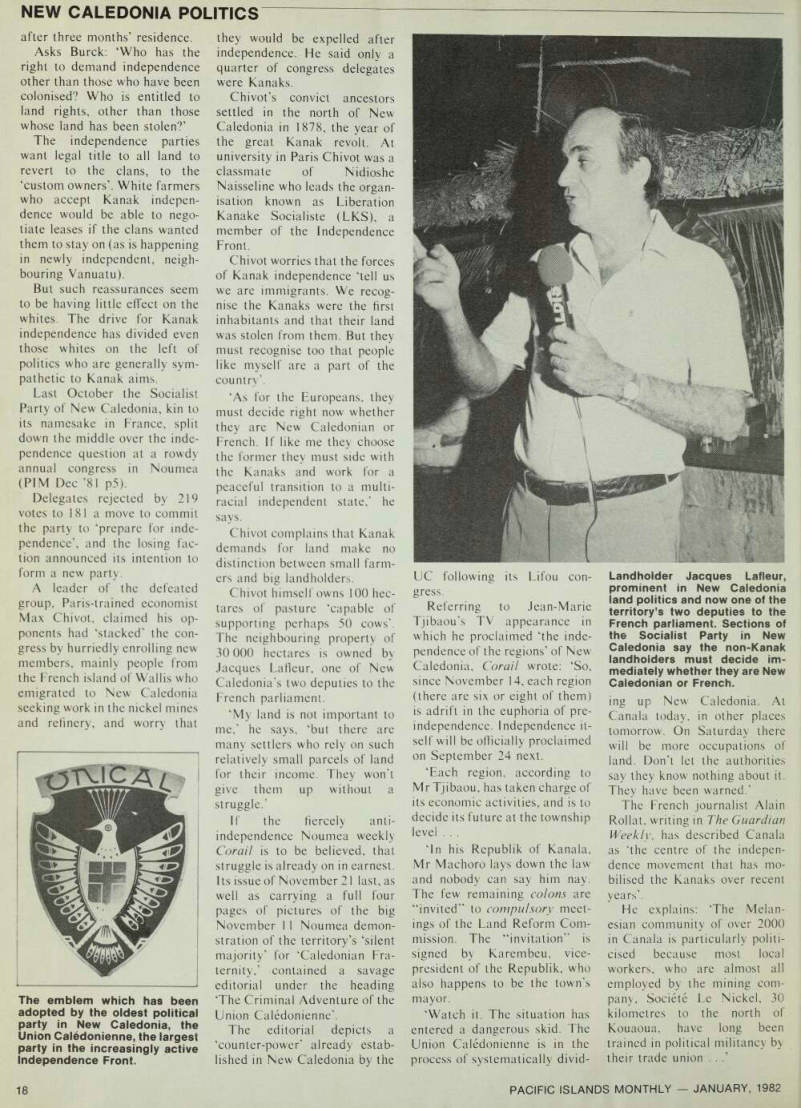
The emblem which has been adopted by the oldest political party in New Caledonia, the Union Caledonienne, the largest party in the increasingly active Independence Front.
Landholder Jacques Lafleur, prominent in New Caledonia land politics and now one of the territory’s two deputies to the French parliament. Sections of the Socialist Party in New Caledonia say the non-Kanak landholders must decide im mediately whether they are New Caledonian or French.
Advertisements & other items, pp. 14-17 (1 item)
Performance
#■ 2) LB y F—fs u 21 B d'* i HR
dependable
marine engines
When fishing is your living, you know you need dependable gear working with minimum downtime and your engines have to deliver reliable power when and where you need it.
CATERPILLAR offers you a comprehensive selection of performance proven Cat Marine Diesel Engines from 85hp up to IOOOhp, backed by after sales service and replacement parts facilities that are second to none.
dependable
generator sets*
Whatever your electric power needs, there’s a Catbuilt generator set to meet them. Caterpillar generators feature adjustment free fuel systems, large capacity radiators, heavy duty air cleaners and quick-change fuel and oil filters to ensure dependable performance throughout the islands, in all kinds of tropical conditions. > V
HASTINGS DIERING
LAE:
Milford Haven Road, Telephone 42 2355.
PORT MORESBY:
Telephone 256650.
BOUGAINVILLE:
Itakara Industrial Park, Arawa Telephone 959077. e
carptrac
SUVA: Carpenter Street, Raiwai.
Private Mail Bag, GPO Suva, Fiji. Ph. 381622.
Telex FJ2190 Cables CARPTRAC.
LAUTOKA: Veitari. Telephone 61877.
LABASA: Vulovi. Telephone 81868.
YOUR
CATERPILLAR
DEALER
Caterpillar, Cat and □ are Trademarks of Caterpillar Tractor Co. 8A10452
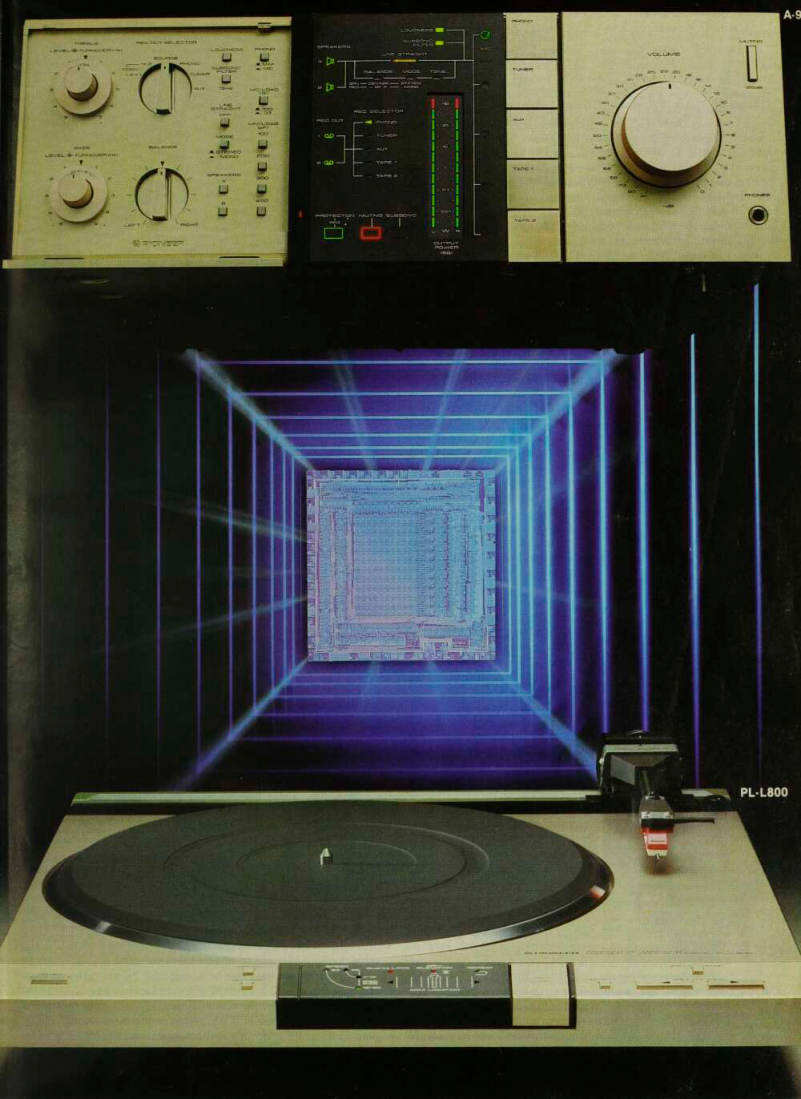
high-tech: higher-fi.
Pioneer components bring you a great new look and top erformance to match. Plus total access to all their high jchnology advances—through Total System Design.
More than mere technical elegance, Total System Design leans greater convenience through the components’ entralized System Status Control and Indication panels.
In the A-9 amp, it means pure sound through Nonwitching™ and DC-Servo circuitry. Line-Straight signal flow > protect that purity. And electronic pushbuttons that put du in command.
In the F-9 tuner, it means accurate, quartz-PLL synthesized ining. Push-pull FM front end and digital detector to widen /namic range and eliminate IF nonlinearity. And instant recall f up to six FM and six AM stations by pushbutton Memory.
In the 3-Direct-Drive-Motor CT-9R cassette deck, it means Computer-Aided Convenience plus precision performance. The CT-9R’s so “smart” it sets tape bias, level and equalization.
And in the PL-LBOO turntable, it means tangential tracking and a low-mass Polymer Graphite™ tone arm for high tracking ability. And a high-output cartridge for delivering startlingly clear sound without need for a special MC head amplifier.
Total System Design: the high point in our decades of developing high-technology high-fidelity. What it means to “higher-fi” is something you’ll just have to hear for yourself to appreciate.
Pioneer components are displayed only at stores showing this emblem. ■ F-9 ■ jnn c n 1 u u.D u I 11111111
U U'U u
g auto data
p, u DIRECT DRIVE
(PIONEER
CT-9R
Advanced performance through technology.
Ov ■ . I
!D PIONEER
>r further information, please contact; ■stralia: Pioneer Marketing Service Pty. Ltd., P.O. Box 317, Mordiailoc, Victoria, 3195 1:90-9011 ji Islands: Brijlal & Company, G.P.O. Box No. 362, Suva, Fiji Islands Tel: 22258 »w Zealand: Monaco Distributors Ltd., 2 Poland Road, Glenfield, Auckland, >w Zealand Tel: (09) 444-9144 >rfolk Island: Burns Philp (Norfolk Island) Ltd., P.O. Box 21, Norfolk Island, >w Hebrides: Burns Philp (New Hebrides) Ltd., Vila, New Hebrides Nauru Island: Jacob Enterprises, P.O. Box No. 4, Republic of Nauru Tahiti: Tahiti Hi-Fi, P.O. Box 848, Papeete, Tahiti New Caledonia: Menard Pacifique Sari, B.P 3899, Noumea, New Caledonia Tel; 48-24.36 American Samoa; Transpac Corporation, P.O. Box 1477, Pago Pago, American Samoa 96799 Tel: 633-5224 Rarotonga: South Seas International Ltd., P.O. Box 49, Rarotonga, Cook Islands Tel: 2327 Papua New Guinea; Bali Merchants Pty. Ltd., P.O. Box 6103, Boroko Tel: 254887
A-9 £n -I -J □ ij 1 □
PL-LBOO
% O _r> m i i
Islands
From the
Press
The Cook Islands News, Rarotonga, quoting Papua New Guinea Director of Tourism Chris Talie on the subject of PNG tribal fighting Clan fighting usually not more than local ‘affairs of honour’ between tribes does occur, and often involves several thousand people. But guns are never used! And unless a tourist is foolhardy enough to dash unexpectedly between the two groups for an unusual photograph, the chance of being struck by a stone or a wayward arrow is less than finding an extra $ 100 credit on your credit card billing.
The Samoa Times, Apia, Western Samoa, referring to New Zealand Prime Minister Robert Muldoon . . . but his main offensive weapon is his mouth. What he does with it enrages half of New Zealand as much as it delights the other half.
Critical comment from the Marshall Islands Journal, Majuro, after visitors to the public gallery in parliament had been told to wear ‘suitable’ clothes And what’s so disrespectful about short trousers? They are easy to get into and out of if you are in a hurry and are generally more comfortable than long pants. They are also easier to wash and dry than long trousers. They are easy to wring out too. Your wife will be humming away and in a cheerful mood if she sees five short trousers instead of five long trousers.
Hahine’s column in The Times of Papua New Guinea,
Port Moresby
Recently I told you about husbands in Papua New Guinea preferring sons to daughters. Well, in reply to that, a male colleague tells me that in one part of this country where bride price payments are high, parents are neglecting their sons. It’s common among these parents to cradle their daughters in their arms and chant: ‘This one will bring me a jet plane, this one will bring me an outboard motor, this one will bring me a motor vehicle . . .’ and so on. I wish parents wouldn’t regard their daughters as business investments. They should send their daughters to schools and give them all their support in their education.
From a reader’s letter in the News Drum, Honiara, Solomon Islands, criticising the establishment of ministerial portfolios to represent the country’s provinces I am very glad that our government is an open one, and so would not mind any criticism. First, I think the establishment of these so called provincial ministers is a sheer waste of money. By that I mean public money. Money that should go into rural development will now be channelled into these ministers’ pockets.
Part of a letter to the PNG Post-Courier, Port Moresby, in which A. Saweri criticises a government suggestion to use troops as peace-keepers in the 1982 elections The thought of armed soldiers at polling booths must be frightening to the voters and nauseating to the Fathers of the Constitution against the background of parliamentary democracy in this nation . . . In this country we have enough trouble keeping alive freedom of speech, press freedom and freedom of movement, so let us not tamper with free elections.
University This Week, the official news and notices publication of the University of Papua New Guinea, Port Moresby Could students please return immediately the cockroach traps they borrowed from the Biology Department more than a month ago.
Keep your cockroaches, but return our traps.
From a reader’s letter in The Observer, Apia, Western Samoa, defending the need to keep dogs When I had a dog, it protected my garden and my house. Now I am without a dog and 1 am also without most of my bananas, pumpkins and pineapples. They have been stolen.
The Times of Papua New Guinea, Port Moresby I n one part of I ndia, a volunteer worker belonging to the US Peace Corps took the task of explaining to a group of men the use of the condom as a method of contraception. During his explanations he used a pencil. After some months he returned to the area to find that the men were very violent towards him because their wives were pregnant. In a hut nearby hung a row of condoms neatly pushed on to pencils.
The Cook Islands News, Rarotonga, describing the Papua New Guinea village of Hanuabada which is largely built on stilts over the sea in Port Moresby Harbour History tells us the Hanuabada people were formerly land dwellers but due to tribal wars they were driven off the land. Now most of them are in the lagoon.
An editorial from The Observer, Apia, Western Samoa Once again the government, confronted by the huge uncertainty usually brought about by the fear of power slipping cruelly through, is belatedly trying to drape itself with the garments of the true patriot, insisting on its unfailing concern for the country, reminding almost boastfully of its achievements and hardly ever of its shortcomings, desperately groping for soothing words which make playful misleading intentions, and doing it all in a reckless and hasty manner because the general elections appear threateningly not too distant.
An editorial in the Marshall Islands Journal, Majuro In the estimates supporting the 1982 government budget we noticed that several lawyers are earning more money than the highest-paid doctors. We would not argue that good lawyers should be paid less, but rather that good doctors should be paid more. The government should be willing to pay at least as much for good doctors as for good lawyers. It seems to us that pay scales in the health system need to be revised.
A reader’s letter from Our News, Port Moresby, Papua New Guinea I have seen some of our school girls looking for lice in their friends’ hair during the assembly times, which 1 think is not a good habit.
I think it is a shame in front of the teachers and students getting lice. So my friends if you want to stop the habit, wash your hair daily and comb it nicely because lice doesn’t want clean places.
The Papua New Guinea Post-Courier, Port Moresby Thirst or greed? A liquor thief in Kundiawa, Chimbu Province, had more than the usual legal headache when he woke up in the lock up at the weekend. Police said the man drank himself unconscious in the shop. They found him sleeping amid a pile of empties.
Editorial comment in The Fiji Times, Suva, on pay rises of 140 percent which are being demanded by senior staff of the financially troubled Air Pacific At a time when Air Pacific needs all hands on deck to help it to ride troubled financial times, its senior staff members have chosen to ignore a plea for wages restraint and have, instead, retaliated by delivering a lethal blow. Their association has slapped on the management a log of claims that can only be described as outrageous. The airline’s chief executive, Mr Akuila Savu, was particularly justified in pleading with all his employees to take a 10 percent pay cut so that the airline would not go deeper into the red.
Mr Savu perhaps expected a negative response, but he certainly did not expect a bombshell being hurled back at him.
own bomb
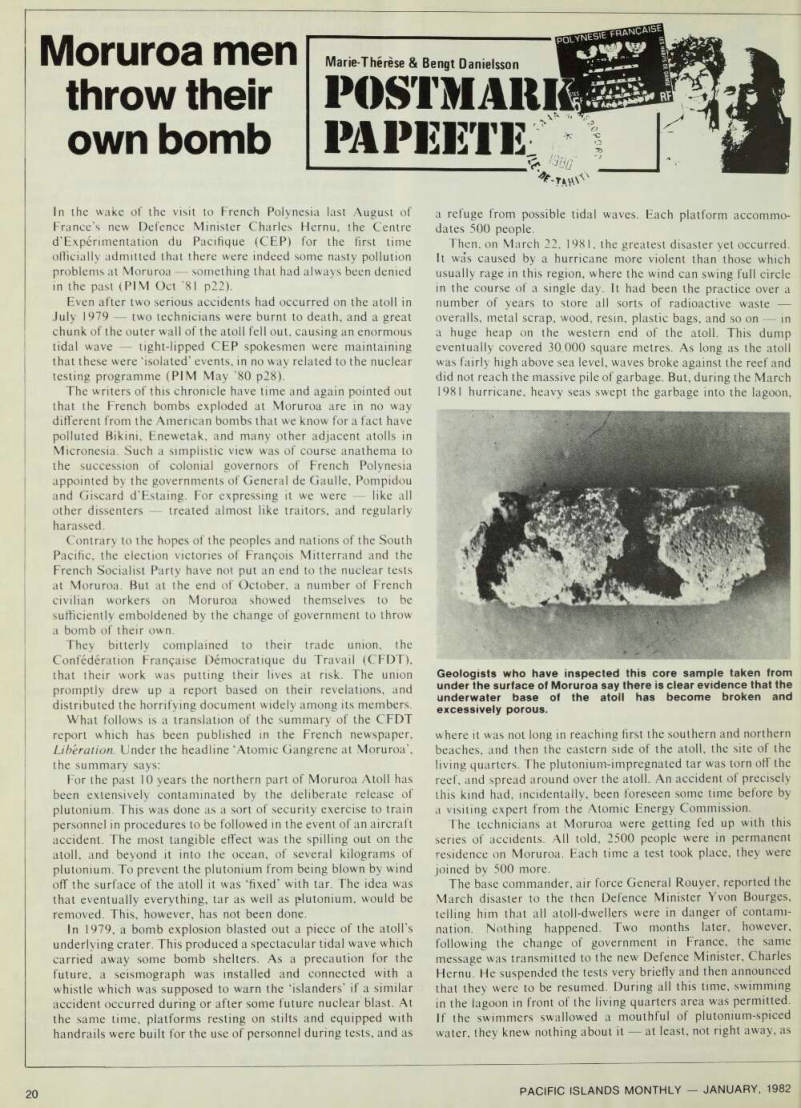
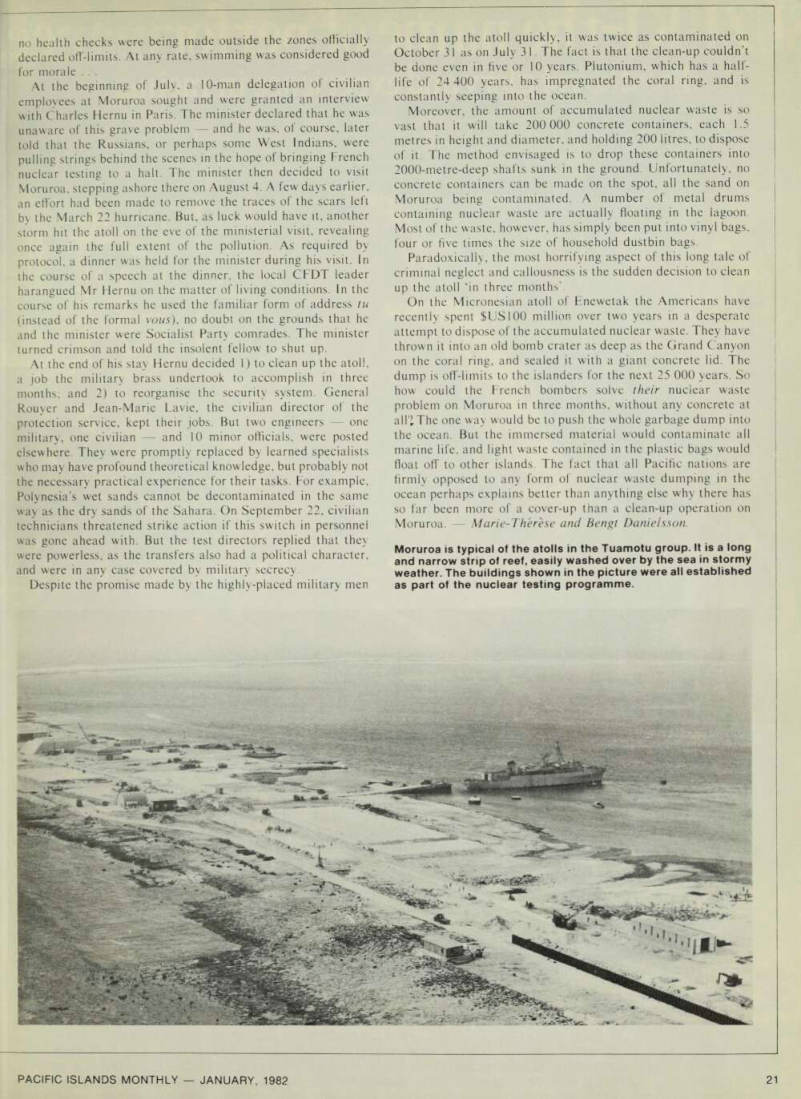
Moruroa men throw their own bomb
In the wake of the visit to French Polynesia last August of France’s new Defence Minister Charles Hernu, the Centre d’Experimenlation du Pacifique (CEP) for the first time officially admitted that there were indeed some nasty pollution problems at Moruroa something that had always been denied in the past (PIM Oct ’Bl p 22).
Even after two serious accidents had occurred on the atoll in July 1979 two technicians were burnt to death, and a great chunk of the outer wall of the atoll fell out, causing an enormous tidal wave tight-lipped CEP spokesmen were maintaining that these were 'isolated’ events, in no way related to the nuclear testing programme (PIM May 'BO p2B).
The writers of this chronicle have lime and again pointed out that the French bombs exploded at Moruroa are in no way different from the American bombs that we know for a fact have polluted Bikini, Enewetak, and many other adjacent atolls in Micronesia. Such a simplistic view was of course anathema to the succession of colonial governors of French Polynesia appointed by the governments of General de Gaulle, Pompidou and Giscard d’Estaing. For expressing it we were like all other dissenters treated almost like traitors, and regularly harassed.
Contrary to the hopes of the peoples and nations of the South Pacific, the election victories of Francois Mitterrand and the French Socialist Parly have not put an end to the nuclear tests at Moruroa. But at the end of October, a number of French civilian workers on Moruroa showed themselves to be sufficiently emboldened by the change of government to throw a bomb of their own.
They bitterly complained to their trade union, the Confederation Fransaise Democratique du Travail (CFDT), that their work was putting their lives at risk. The union promptly drew up a report based on their revelations, and distributed the horrifying document widely among its members.
What follows is a translation of the summary of the CFDT report which has been published in the French newspaper.
Liberation. Under the headline ‘Atomic Gangrene at Moruroa’, the summary says: For the past 10 years the northern part of Moruroa Atoll has been extensively contaminated by the deliberate release of plutonium. This was done as a sort of security exercise to train personnel in procedures to be followed in the event of an aircraft accident. The most tangible effect was the spilling out on the atoll, and beyond it into the ocean, of several kilograms of plutonium. To prevent the plutonium from being blown by wind off the surface of the atoll it was ‘fixed’ with tar. The idea was that eventually everything, tar as well as plutonium, would be removed. This, however, has not been done.
In 1979, a bomb explosion blasted out a piece of the atoll’s underlying crater. This produced a spectacular tidal wave which carried away some bomb shelters. As a precaution for the future, a seismograph was installed and connected with a whistle which was supposed to warn the ‘islanders’ if a similar accident occurred during or after some future nuclear blast. At the same time, platforms resting on stilts and equipped with handrails were built for the use of personnel during tests, and as
a refuge from possible tidal waves. Each platform accommo dates 500 people.
Then, on March 22, 1981, the greatest disaster yet occurred.
It was caused by a hurricane more violent than those which usually rage in this region, where the wind can swing full circle in the course of a single day. It had been the practice over a number of years to store all sorts of radioactive waste overalls, metal scrap, wood, resin, plastic bags, and so on in a huge heap on the western end of the atoll. This dump eventually covered 30 000 square metres. As long as the atoll was fairly high above sea level, waves broke against the reef and did not reach the massive pile of garbage. But, during the March 1981 hurricane, heavy seas swept the garbage into the lagoon.
where it was not long in reaching first the southern and northern beaches, and then the eastern side of the atoll, the site of the living quarters. The plutonium-impregnated tar was torn off the reef, and spread around over the atoll. An accident of precisely this kind had, incidentally, been foreseen some time before by a visiting expert from the Atomic Energy Commission.
The technicians at Moruroa were getting fed up with this series of accidents. All told, 2500 people were in permanent residence on Moruroa. Each time a test took place, they were joined by 500 more.
The base commander, air force General Rouyer, reported the March disaster to the then Defence Minister Yvon Bourges, telling him that all atoll-dwellers were in danger of contami nation. Nothing happened. Two months later, however, following the change of government in France, the same message was transmitted to the new Defence Minister, Charles Hernu. He suspended the tests very briefly and then announced that they were to be resumed. During all this time, swimming in the lagoon in front of the living quarters area was permitted.
If the swimmers swallowed a mouthful of plutonium-spiced water, they knew nothing about it at least, not right away, as
Geologists who have inspected this core sample taken from under the surface of Moruroa say there is clear evidence that the underwater base of the atoll has become broken and excessively porous.
no health checks were being made outside the zones officially declared off-limits. At any rale, swimming was considered good for morale . . .
At the beginning of July, a 10-man delegation of civilian emplovees at Moruroa sought and were granted an interview with Charles Hernu in Paris. The minister declared that he was unaware of this grave problem and he was. of course, later told that the Russians, or perhaps some West Indians, were pulling strings behind the scenes in the hope of bringing French nuclear testing to a hall. The minister then decided to visit Moruroa, stepping ashore there on August 4. A few days earlier, an effort had been made to remove the traces of the scars left by the March 22 hurricane. But, as luck would have it, another storm hit the atoll on the eve of the ministerial visit, revealing once again the full extent of the pollution. As required by protocol, a dinner was held for the minister during his visit. In the course of a speech at the dinner, the local CFDT leader harangued Mr Hernu on the matter of living conditions. In the course of his remarks he used the familiar form of address tu (instead of the formal vous ), no doubt on the grounds that he and the minister were Socialist Party comrades. The minister turned crimson and told the insolent fellow to shut up.
At the end of his stay Hernu decided 1) to clean up the atoll, a job the military brass undertook to accomplish in three months; and 2) to reorganise the security system. General Rouyer and Jean-Marie Lavie, the civilian director of the protection service, kept their jobs. But two engineers one military, one civilian and 10 minor officials, were posted elsewhere. They were promptly replaced by learned specialists who may have profound theoretical knowledge, but probably not the necessary practical experience for their tasks. For example.
Polynesia’s wet sands cannot be decontaminated in the same way as the dry sands of the Sahara. On September 22, civilian technicians threatened strike action if this switch in personnel was gone ahead with. But the test directors replied that they were powerless, as the transfers also had a political character, and were in any case covered by military secrecy.
Despite the promise made by the highly-placed military men
to clean up the atoll quickly, it was twice as contaminated on October 31 as on July 31 The fact is that the clean-up couldn't be done even in five or 10 years. Plutonium, which has a half life of 24 400 years, has impregnated the coral ring, and is constantly seeping into the ocean.
Moreover, the amount of accumulated nuclear waste is so vast that it will take 200 000 concrete containers, each 1.5 metres in height and diameter, and holding 200 litres, to dispose of it. The method envisaged is to drop these containers into 2000-metre-deep shafts sunk in the ground. Unfortunately, no concrete containers can be made on the spot, all the sand on Moruroa being contaminated. A number of metal drums containing nuclear waste are actually floating in the lagoon.
Most of the waste, however, has simply been pul into vinyl bags, four or five times the size of household dustbin bags Paradoxically , the most horrifying aspect of this long tale of criminal neglect and callousness is the sudden decision to clean up the atoll ‘in three months'.
On the Micronesian atoll of Enewetak the Americans have recently spent SUSIOO million over two years in a desperate attempt to dispose of the accumulated nuclear waste. They have thrown it into an old bomb crater as deep as the Grand Canyon on the coral ring, and sealed it with a giant concrete lid. The dump is off-limits to the islanders for the next 25 000 years. So how could the French bombers solve their nuclear waste problem on Moruroa in three months, without any concrete at all'iThe one way would be to push the whole garbage dump into the ocean. But the immersed material would contaminate all marine life, and light waste contained in the plastic bags would float off to other islands. The fact that all Pacific nations are firmly opposed to any form of nuclear waste dumping in the ocean perhaps explains better than anything else why there has so far been more of a cover-up than a clean-up operation on
Moruroa.
Marie-Thérèse and Bengt Danielsson.
Moruroa is typical of the atolls in the Tuamotu group. It is a long and narrow strip of reef, easily washed over by the sea in stormy weather. The buildings shown in the picture were all established as part of the nuclear testing programme.
Advertisements & other items, p. 22 (1 item)
iUZUKI-the name of performance
Breathes of glory and experience in racing.
Watch it feeling over on-roads and boldly crossing off-roads.
Presenting SUZUKI s motorcycles that blends superb performance with elegant modernistic styling.
Seen strikingly alive in SUZUKI s motorcycles is SUZUKI’s technology and experience originally incorporated in the champion machine which has claimed a variety of race titles.
These climaxing technological innovations are apt to attract motorbike fans worldover. * r ' * as X tt X * \ I 1 L f s ✓ i w* ■Mr ft ~T i f w If 7 /'ln , ff. &
SUZUKI MOTOR CO, LTD
Suzuki! 300Takatsuka, Hamamatsu, Japan SOLOMON ISLANDS SOLOMON ISLAND SERVICE STATION LTD. NEW CALEDONIA STE. SUPERCAL PAPUA NEW GUINEA HI SPEED DIESEL SERVICE PTY LTD. VANUATU HENRI LEROUX NIUE ISLAND BURNS PHILP (SOUTH SEA) CO., LTD. PONAPE LEO ETSCHEIT TAHITI NIPPON AUTOMOTO ELLICE ISLAND TUVALU COOPERATIVE WHOLESALE SOCIETY LTD. GUAM & SAIPAN ISLAND CYCLERY, INC. NORFOLK MARTIN’S AGENCIES LTD. SAMOA PACIFIC PRODUCTS, INC. KIRIBATI GILBERT ISLANDS rnnocDATn/c ccrncDATinM i a oonni irTC iMr' MAI ICII POl IADAf' ynTOR.Q Fi.il NiIRANUANR Al JTOPORT LTD.
Reviving an
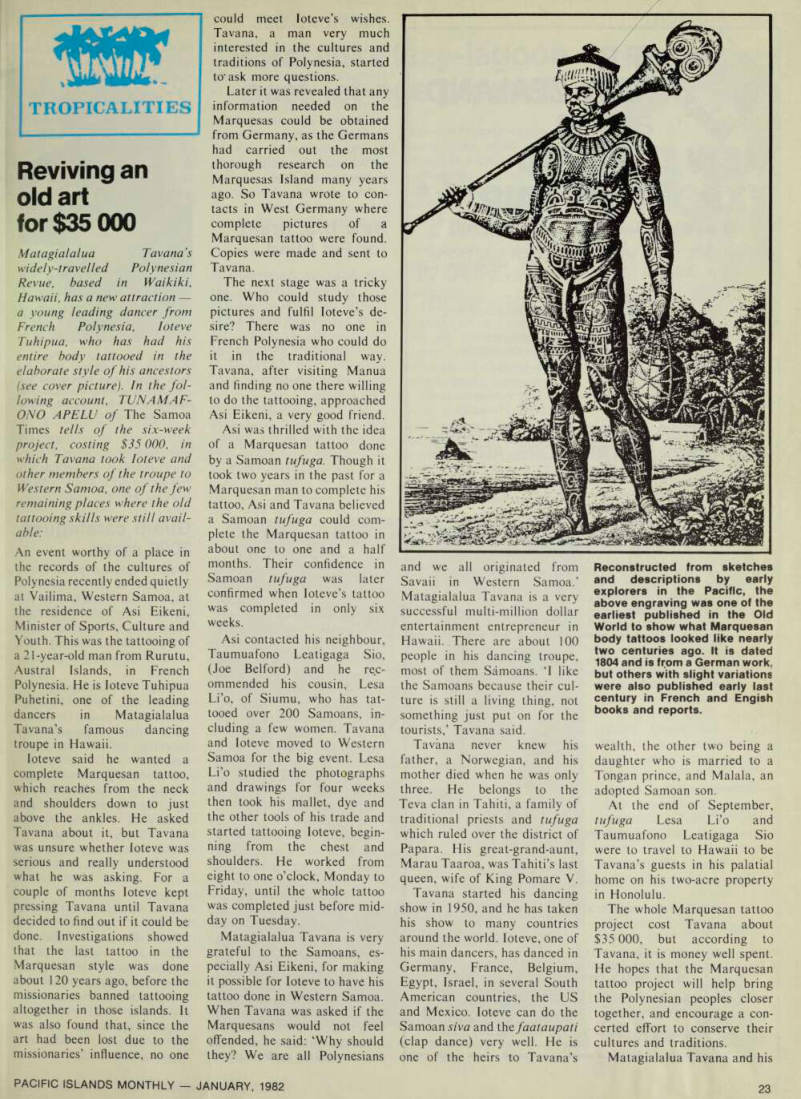
Tropicalities
Reviving an old art for $35 000
could meet loteve’s wishes.
Tavana, a man very much interested in the cultures and traditions of Polynesia, started to’ask more questions.
Later it was revealed that any information needed on the Marquesas could be obtained from Germany, as the Germans had carried out the most thorough research on the Marquesas Island many years ago. So Tavana wrote to con tacts in West Germany where complete pictures of a Marquesan tattoo were found.
Copies were made and sent to Tavana.
The next stage was a tricky one. Who could study those pictures and fulfil loteve’s de sire? There was no one in French Polynesia who could do it in the traditional way.
Tavana, after visiting Manua and finding no one there willing to do the tattooing, approached Asi Eikeni, a very good friend.
Asi was thrilled with the idea of a Marquesan tattoo done by a Samoan tufuga. Though it took two years in the past for a Marquesan man to complete his tattoo, Asi and Tavana believed a Samoan tufuga could com plete the Marquesan tattoo in about one to one and a half months. Their confidence in Samoan tufuga was later confirmed when loteve’s tattoo was completed in only six weeks.
Asi contacted his neighbour, Taumuafono Leatigaga Sio, (Joe Belford) and he rec ommended his cousin, Lesa Li’o, of Siumu, who has tat tooed over 200 Samoans, in cluding a few women. Tavana and loteve moved to Western Samoa for the big event. Lesa Li’o studied the photographs and drawings for four weeks then took his mallet, dye and the other tools of his trade and started tattooing loteve, begin ning from the chest and shoulders. He worked from eight to one o’clock, Monday to Friday, until the whole tattoo was completed just before mid day on Tuesday.
Matagialalua Tavana is very grateful to the Samoans, es pecially Asi Eikeni, for making it possible for loteve to have his tattoo done in Western Samoa.
When Tavana was asked if the Marquesans would not feel offended, he said: ‘Why should they? We are all Polynesians
Matagialalua Tavana’s widely-travelled Polynesian Revue, based in Waikiki, Hawaii, has a new attraction a young leading dancer from French Polynesia, loteve Tuhipua, who has had his entire body tattooed in the elaborate style of his ancestors (see cover picture). In the fol lowing account, TUNAMAF ONO APELU of The Samoa Times tells of the six-week project, costing $35 000, in which Tavana took loteve and other members of the troupe to Western Samoa, one of the few remaining places where the old tattooing skills were still avail able: An event worthy of a place in the records of the cultures of Polynesia recently ended quietly at Vailima, Western Samoa, at the residence of Asi Eikeni, Minister of Sports, Culture and Youth. This was the tattooing of a 21-year-old man from Rurutu, Austral Islands, in French Polynesia. He is loteve Tuhipua Puhetini, one of the leading dancers in Matagialalua Tavana’s famous dancing troupe in Hawaii. loteve said he wanted a complete Marquesan tattoo, which reaches from the neck and shoulders down to just above the ankles. He asked Tavana about it, but Tavana was unsure whether loteve was serious and really understood what he was asking. For a couple of months loteve kept pressing Tavana until Tavana decided to find out if it could be done. Investigations showed that the last tattoo in the Marquesan style was done about 120 years ago, before the missionaries banned tattooing altogether in those islands. It was also found that, since the art had been lost due to the missionaries’ influence, no one
and we all originated from Savaii in Western Samoa.’
Matagialalua Tavana is a very successful multi-million dollar entertainment entrepreneur in Hawaii. There are about 100 people in his dancing troupe, most of them Samoans. T like the Samoans because their cul ture is still a living thing, not something just put on for the tourists,’ Tavana said.
Tavana never knew his father, a Norwegian, and his mother died when he was only three. He belongs to the Teva clan in Tahiti, a family of traditional priests and tufuga which ruled over the district of Papara. His great-grand-aunt, Marau Taaroa, was Tahiti’s last queen, wife of King Pomare V.
Tavana started his dancing show in 1950, and he has taken his show to many countries around the world. loteve, one of his main dancers, has danced in Germany, France, Belgium, Egypt, Israel, in several South American countries, the US and Mexico. loteve can do the Samoan siva and the faataupati (clap dance) very well. He is one of the heirs to Tavana’s
wealth, the other two being a daughter who is married to a Tongan prince, and Malala, an adopted Samoan son.
At the end of September, tufuga Lesa Li’o and Taumuafono Leatigaga Sio were to travel to Hawaii to be Tavana’s guests in his palatial home on his two-acre property in Honolulu.
The whole Marquesan tattoo project cost Tavana about $35 000, but according to Tavana, it is money well spent.
He hopes that the Marquesan tattoo project will help bring the Polynesian peoples closer together, and encourage a con certed effort to conserve their cultures and traditions.
Matagialalua Tavana and his
Reconstructed from sketches and descriptions by early explorers in the Pacific, the above engraving was one of the earliest published in the Old World to show what Marquesan body tattoos looked like nearly two centuries ago. It is dated 1804 and is from a German work, but others with slight variations were also published early last century in French and Engish books and reports.
Guam catalogues
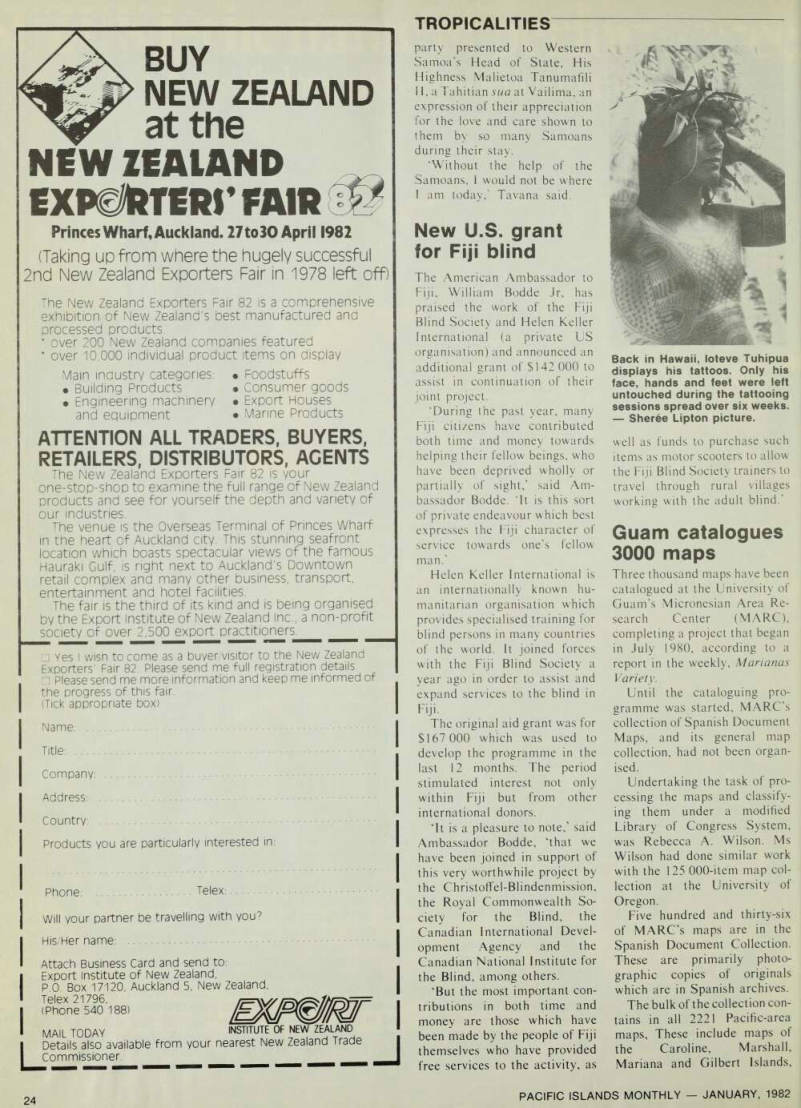
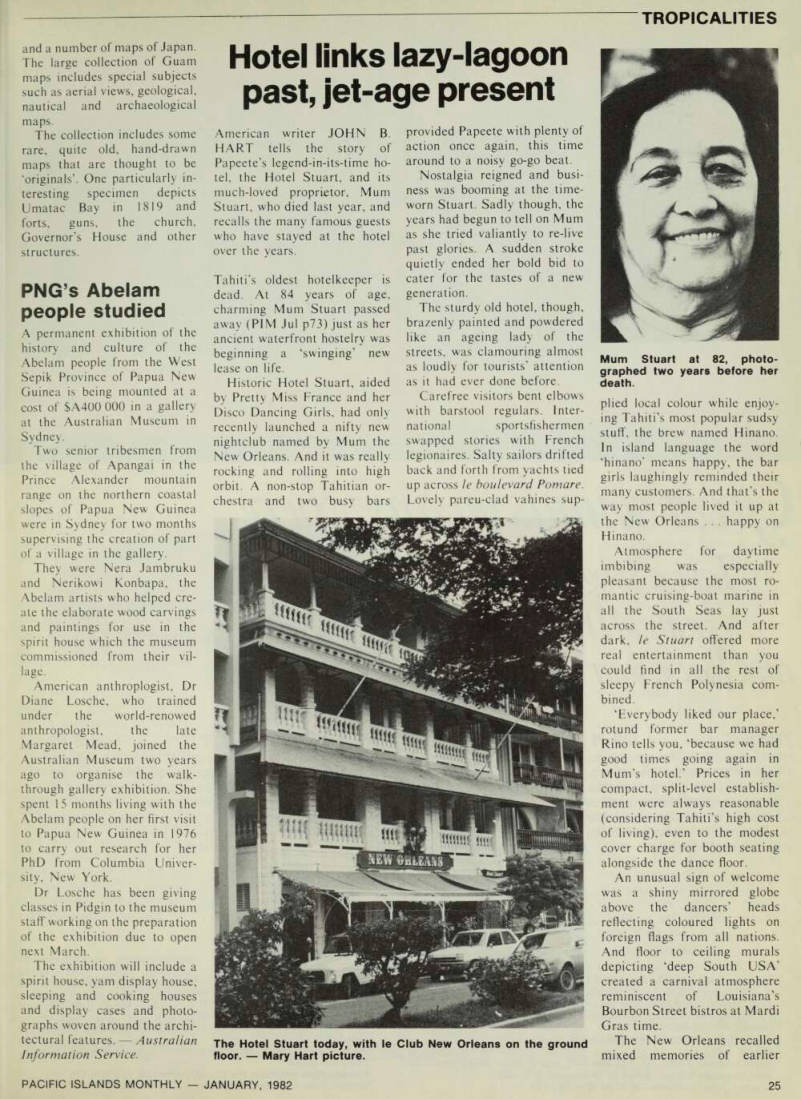
parly presented to Western Samoa’s Head of State. His Highness Malietoa Tanumafili 11, a Tahitian sua at Vailima. an expression of their appreciation for the love and care shown to them by so many Samoans during their slay. ‘Without the help of the Samoans. 1 would not be where I am today,’ Tavana said.
New U.S. grant
for Fiji blind
The American Ambassador to Fiji, William Bodde Jr, has praised the work of the Fiji Blind Society and Helen Keller International (a private US organisation) and announced an additional grant of $142 000 to assist in continuation of their joint project. ‘During the past year, many Fiji citizens have contributed both time and money towards helping their fellow beings, who have been deprived wholly or partially of sight,’ said Am bassador Bodde. ‘lt is this sort of private endeavour which best expresses the Fiji character of service towards one’s fellow man.' Helen Keller International is an internationally known hu manitarian organisation which provides specialised training for blind persons in many countries of the world. It joined forces with the Fiji Blind Society a year ago in order to assist and expand services to the blind in Fiji.
The original aid grant was for $167 000 which was used to develop the programme in the last 12 months. The period stimulated interest not only within Fiji but from other international donors. ‘lt is a pleasure to note,’ said Ambassador Bodde, ‘that we have been joined in support of this very worthwhile project by the Christoffel-Blindenmission, the Royal Commonwealth So ciety for the Blind, the Canadian International Devel opment Agency and the Canadian National Institute for the Blind, among others. ‘But the most important con tributions in both time and money are those which have been made by the people of Fiji themselves who have provided free services to the activity, as
well as funds to purchase such items as motor scooters to allow the Fiji Blind Society trainers to travel through rural villages working with the adult blind.'
Guam catalogues
3000 maps
Three thousand maps have been catalogued at the University of Guam’s Micronesian Area Re search Center (MARC), completing a project that began in July 1980, according to a report in the weekly, Marianas Variety.
Until the cataloguing pro gramme was started, MARC’s collection of Spanish Document Maps, and its general map collection, had not been organ ised.
Undertaking the task of pro cessing the maps and classify ing them under a modified Library of Congress System, was Rebecca A. Wilson. Ms Wilson had done similar work with the 125 000-item map col lection at the University of Oregon.
Five hundred and thirty-six of MARC's maps are in the Spanish Document Collection.
These are primarily photo graphic copies of originals which are in Spanish archives.
The bulk of the collection con tains in all 2221 Pacific-area maps, These include maps of the Caroline, Marshall, Mariana and Gilbert Islands,
Back in Hawaii, loteve Tuhipua displays his tattoos. Only his face, hands and feet were left untouched during the tattooing sessions spread over six weeks. - Sheree Lipton picture.
and a number of maps of Japan.
The large collection of Guam maps includes special subjects such as aerial views, geological, nautical and archaeological maps.
The collection includes some rare, quite old, hand-drawn maps that are thought to be ‘originals’. One particularly in teresting specimen depicts Umatac Bay in 1819 and forts, guns, the church.
Governor’s House and other structures.
PNG’s Abelam
people studied
A permanent exhibition of the history and culture of the Abelam people from the West Sepik Province of Papua New Guinea is being mounted at a cost of SA4OO 000 in a gallery at the Australian Museum in Sydney.
Two senior tribesmen from the village of Apangai in the Prince Alexander mountain range on the northern coastal slopes of Papua New Guinea were in Sydney for two months supervising the creation of part of a village in the gallery.
They were Nera Jambruku and Nerikowi Konbapa, the Abelam artists who helped cre ate the elaborate wood carvings and paintings for use in the spirit house which the museum commissioned from their vil lage.
American anlhroplogist. Dr Diane Losche, who trained under the world-renowed anthropologist, the late Margaret Mead, joined the Australian Museum two years ago to organise the walk through gallery exhibition. She spent 15 months living with the Abelam people on her first visit to Papua New Guinea in 1976 to carry out research for her PhD from Columbia Univer sity, New York.
Dr Losche has been giving classes in Pidgin to the museum staff working on the preparation of the exhibition due to open next March.
The exhibition will include a spirit house, yam display house, sleeping and cooking houses and display cases and photo graphs woven around the archi tectural features. Australian Information Service.
Advertisements & other items, p. 24 (1 item)
Exporter!’ Fair
BUY
NEW ZEALAND
at the
NEW ZEALAND
EXPORTER!’ FAIR
Princes Wharf, Auckland. 27t030 April 1982 (Taking up from where the hugely successful 2nd New Zealand Exporters Fair in 1978 left off) The New Zealand Exporters Fair 82 is a comprehensive exhibition of New Zealand's best manufactured and processed products. * over 200 New Zealand companies featured * over 10,000 individual product items on display Mam industry categories: • Foodstuffs • Building Products • Consumer goods • Engineering machinery • Export Houses and equipment • Marine Products
ATTENTION ALL TRADERS, BUYERS,
RETAILERS, DISTRIBUTORS, AGENTS
The New Zealand Exporters Fair 82 is your one-stop-shop to examine the full range of New Zealand products and see for yourself the depth and variety of our industries.
The venue is the Overseas Terminal of Princes Wharf in the heart of Auckland city. This stunning seafront location which boasts spectacular views of the famous Hauraki Gulf, is right next to Auckland's Downtown retail complex and many other business, transport, entertainment and hotel facilities.
The fair is the third of its kind and is being organised by the Export Institute of New Zealand Inc., a non-profit society of over 2,500 export practitioners. i i i i i i i i i i i □ Yes I wish to come as a buyer'visitor to the New Zealand Exporters' Fair 82. Please send me full registration details. □ Please send me more information and keep me informed of the progress of this fair. (Tick appropriate box) Name: Title: Company: Address: Country; Products you are particularly interested in: Phone: Telex: Will your partner be travelling with you?
His/Her name: Attach Business Card and send to: Export institute of New Zealand, P 0 Box 17120, Auckland 5, New Zealand, Telex 21796, (Phone 540 188)
MAIL TODAY . . T
Details also available from your nearest New Zealand Trade Commissioner.
INSTITUTE OF NEVTZEALAND
past, jet-age present
Hotel links lazy-lagoon past, jet-age present
American writer JOHN B.
HART tells the story of Papeete’s legend-in-its-time ho tel. the Hotel Stuart, and its much-loved proprietor. Mum Stuart, who died last year, and recalls the many famous guests who have stayed at the hotel over the years.
Tahiti’s oldest hotelkeeper is dead. At 84 years of age, charming Mum Stuart passed away (PIM Jul p 73) just as her ancient waterfront hostelry was beginning a ‘swinging’ new lease on life.
Historic Hotel Stuart, aided by Pretty Miss France and her Disco Dancing Girls, had only recently launched a nifty new nightclub named by Mum the New Orleans. And it was really rocking and rolling into high orbit. A non-stop Tahitian or chestra and two busy bars
provided Papeete with plenty of action once again, this time around to a noisy go-go beat.
Nostalgia reigned and busi ness was booming at the time worn Stuart. Sadly though, the years had begun to tell on Mum as she tried valiantly to re-live past glories. A sudden stroke quietly ended her bold bid to cater for the tastes of a new generation.
The sturdy old hotel, though, brazenly painted and powdered like an ageing lady of the streets, was clamouring almost as loudly for tourists’ attention as it had ever done before.
Carefree visitors bent elbows with barstool regulars. Inter national sportsfishermen swapped stories with French legionaires. Salty sailors drifted back and forth from yachts tied up across le boulevard Pomare.
Lovely pareu-clad vahines sup-
plied local colour while enjoy ing Tahiti’s most popular sudsy stuff, the brew named Hinano.
In island language the word ‘hinano’ means happy, the bar girls laughingly reminded their many customers. And that’s the way most people lived it up at the New Orleans . . . happy on Hinano.
Atmosphere for daytime imbibing was especially pleasant because the most ro mantic cruising-boat marine in all the South Seas lay just across the street. And after dark, le Stuart offered more real entertainment than you could find in all the rest of sleepy French Polynesia com bined. ‘Everybody liked our place,’ rotund former bar manager Rino tells you, ‘because we had good times going again in Mum’s hotel.’ Prices in her compact, split-level establish ment were always reasonable (considering Tahiti’s high cost of living), even to the modest cover charge for booth seating alongside the dance floor.
An unusual sign of welcome was a shiny mirrored globe above the dancers’ heads reflecting coloured lights on foreign flags from all nations.
And floor to ceiling murals depicting ‘deep South USA’ created a carnival atmosphere reminiscent of Louisiana’s Bourbon Street bistros at Mardi Gras time.
The New Orleans recalled mixed memories of earlier
The Hotel Stuart today, with le Club New Orleans on the ground floor. - Mary Hart picture.
Mum Stuart at 82, photo graphed two years before her death.
Advertisements & other items, pp. 26-28 (1 item)
Aiwa
m s
Take a songalong
m:
andleave your cares behind
CS-J 1
HS-F1 HS-P1
TUNE IT CS-J 1
Here’s beautiful FM stereo as you walk along, with cassette sounds too. And the CS-J 1 is the only pocket-size portable that records stereo tapes directly off the FM tuner! Compact folding headphones for easier portability and comfortable listening.
TAPE IT HS-F1
A built-in one-point stereo microphone lets you make live stereo recordings at the touch of a button. This lightweight model can also dub tapes from a hi-fi amplifier via stereo connection cords. Metal tape capable for recording and playback.
ENJOY IT HS-P1
Only 345 grams light, this playbackonly budget model delivers the same beautiful cassette performance as other AIWA portables. Wide frequency response (metal-capable too) means you’ll enjoy all the music.
Take it along!
AIWA for craftsmanship
AIWA
AIWA CO., LTD. 11-9, Ueno 1-chome, Taito-ku, Tokyo, Japan.
Australia AIWA Australia Pty., Ltd., P.O. Box 339, Rockdale, N.S.W., Australia 2216 Tel: 597-2388/2808 Cook Islands Island Merchants Ltd., P.O. Box 69, Rarotonga, Cook Islands Fiji D. Ranchhod & Company, Corner of Vidilo St. & Vitogo PDE, P.O. Box 18, Lautoka. Fiji Tel: 60227 Fiji P. Hargovind Bros., Duty Free Centre, 190 Renwick Road, Suva, Fiji Tel: 24350 Guam Micropac Audio, Inc., P.O. Box 3478, Agana, Guam 96910 Tel: 472-8091 New Caledonia hifivox; 79 Rue de Sebastopol, B.P 1458, Noumea, New Caledonia Tel: 27 24 66 et 28 29 31 New Zealand Miles & Carlaw Ltd., Air New Zealand House 1 Oueen Street, Auckland New Zealand Tel: 797-880 PN.G. Oceania Indent Agency (P.N.G.) Pty., Ltd., Box 5518, Boroko, Port Moresby, P.N.G. Tel: PM 256406 Solomon Islands Harvest Pacific Ltd., G.P.O. 517, Honiara, Solomon Islands Tel: 718 Tahiti Fare Hi-Fi Stereo, Rue de Marechal Foch, P.O. Box 269, Papeete, Tahiti R C 6604 A Vanuatu (New Hebrides) The Sound Centre Ltd., P.O. Box 434, Vila, Vanuatu (New Hebrides) Tel: 2035
Vt\E SKA
**» d
’PALAU IS
/• • >r
COROUKE ISLANDS j
-. !«*>•#* Or.fei «*•£«*•» ***
MARSH AML* ISLAKSS
rw t*
NAI/RU jt...GU-HK«T ~t*
. PHOEWX ISLANDS
Q c B Basin
Jpj
rst inemo
ERR A
» !> y.
QM series 20-33 HP *
SOLOMON
***H 1 /
%^ ASDS / l»L*l
.w©R»BY **/
T«,y!,.. i«, WmKv / •-“ -
/ tuval "..„ . <*• X
“"LAC ISLAND^
EUNARfTI
*»L .k*i, ! \ / v \
V B ““ \ —T-* .
\ \ \ r^-ssii- I /tw '” fc "’S ,•
/NEW* HEBRIDES
Rhw* m 'T-
APIA s V<OA ISLANDS
T««S *«**» M
5*OW a> • r a wb. stern I®:'" j z* - v s .HYJ»^v.
"*VjLWALTT IS. , * * ■
MARQUESAS ISLANDS
’CtMtaw / ** *»*•«• I *** I
SOCIETY IS ■ 'C*. / ,
ft...».« V - / TLAHOtU ARCH
p Ifcwwwc* / «•*— t* • ' ' •*. «... ■ v «c / —
ARCHIPELAft© IS
‘ ;>—«... "T" ; i I I I -towll, ! rs,v>;i v s«4 £
SOUTH C
HAE series 165-300 HP In the Pacific, the message i#diesef. Diesel engines are delivering everything they promise in the way of compact, clean, economical power.
They are helping Island economies flourish.
The tough, non-compromise, high torque of Yanmar diesels is enabling longer
range fishing operations, a broader range
of fishing techniques, shorter landed
time, and modern power generation on
shore for storage, lighting and a dozen other
jobs.
The benefits of the diesel can be applied more readily and more efficiently, and with more savings, than any other form of economical power.
Today’s Yanmar diesel engine is a modern, super-refined, highly durable worker.
For any Pacific community, today’s
message is diesel, the medium is Yanmar. J Cl t L ’a - C A world of uses: 4^ —5000 HP
YANMAR
DIESEL ENGINE
1-1,2-chome, Yaesu, Chuo-ku, Tokyo 104, Japan Cable: YANMAR TOKYO Telex: 0222-2310,0222-4733
Tahitian watering holes; notori
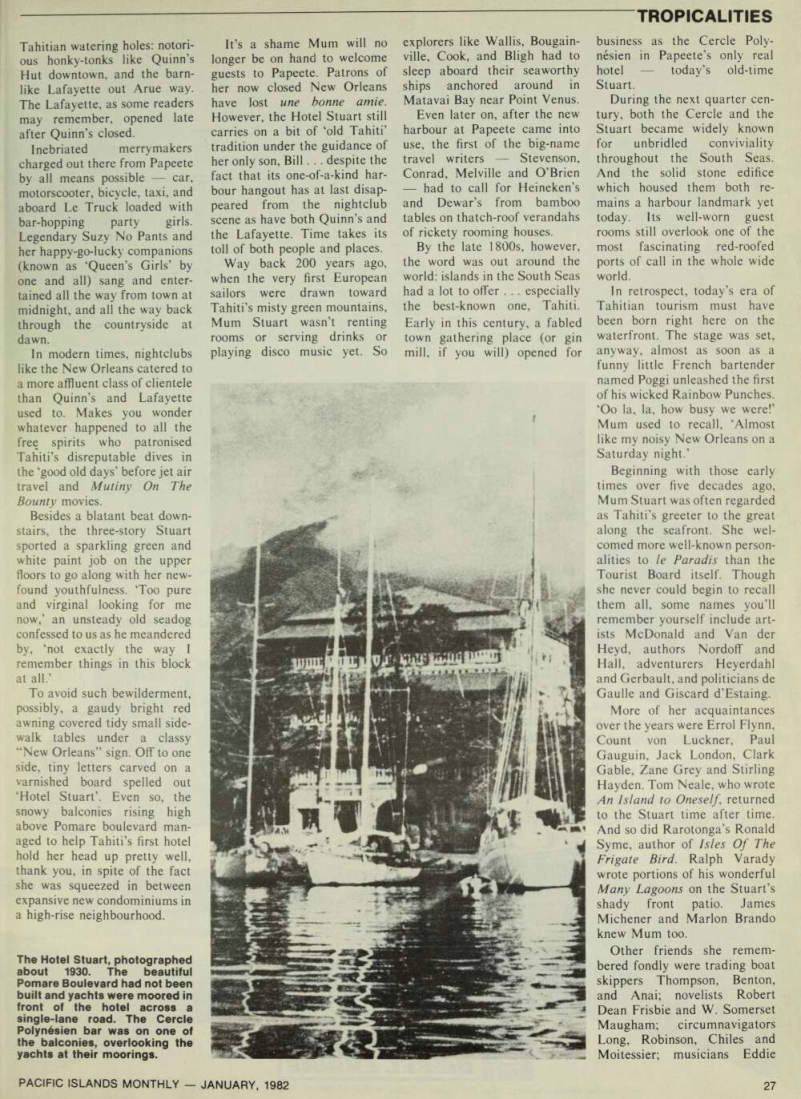
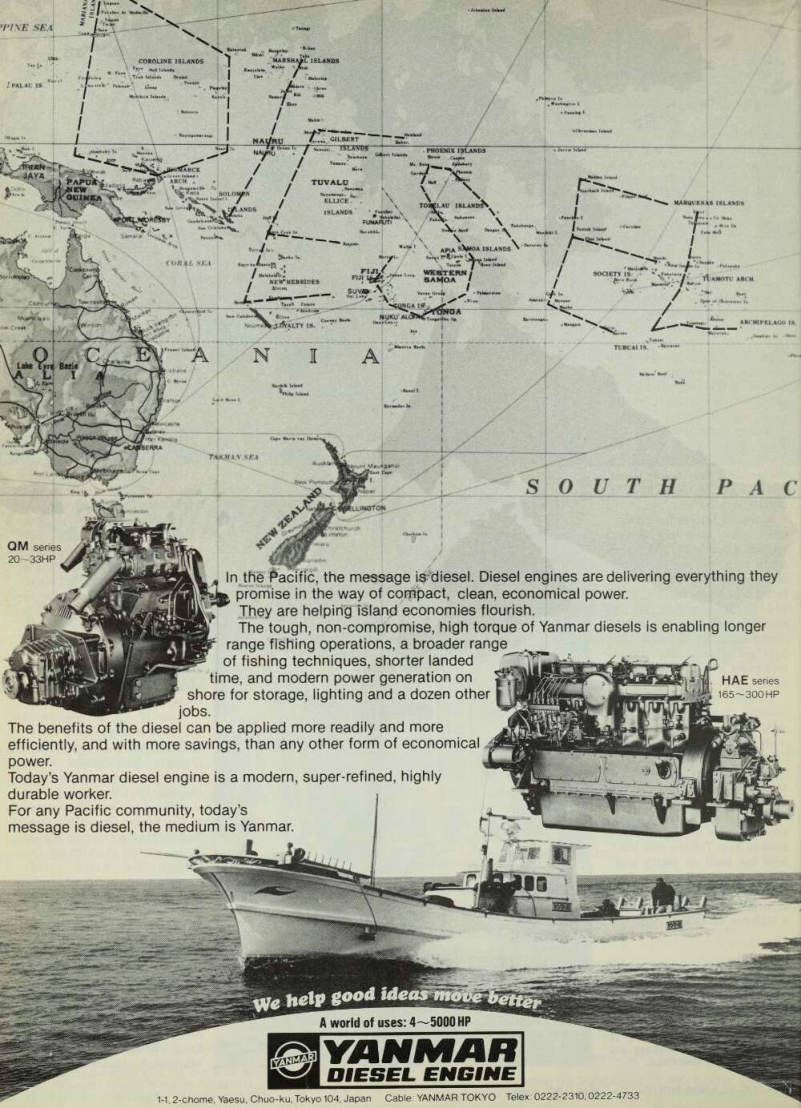
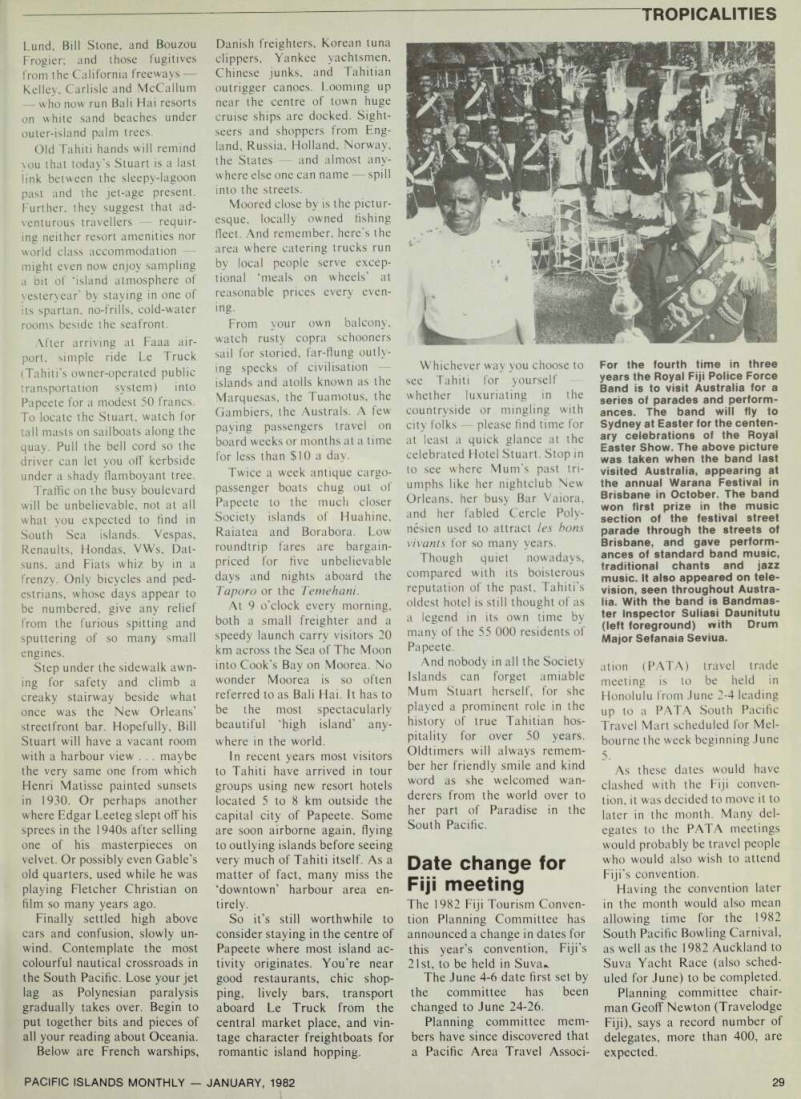
ous honky-tonks like Quinn’s Hut downtown, and the barn like Lafayette out Arue way.
The Lafayette, as some readers may remember, opened late after Quinn’s closed.
Inebriated merrymakers charged out there from Papeete by all means possible car, motorscooter, bicycle, taxi, and aboard Le Truck loaded with bar-hopping party girls.
Legendary Suzy No Pants and her happy-go-lucky companions (known as ‘Queen’s Girls’ by one and all) sang and enter tained all the way from town at midnight, and all the way back through the countryside at dawn.
In modern times, nightclubs like the New Orleans catered to a more affluent class of clientele than Quinn’s and Lafayette used to. Makes you wonder whatever happened to all the free spirits who patronised Tahiti’s disreputable dives in the ‘good old days’ before jet air travel and Mutiny On The Bounty movies.
Besides a blatant beat down stairs, the three-story Stuart sported a sparkling green and white paint job on the upper floors to go along with her new found youthfulness. ‘Too pure and virginal looking for me now,’ an unsteady old seadog confessed to us as he meandered by, ‘not exactly the way I remember things in this block at all.’
To avoid such bewilderment, possibly, a gaudy bright red awning covered tidy small side walk tables under a classy “New Orleans” sign. Off to one side, tiny letters carved on a varnished board spelled out ‘Hotel Stuart’. Even so, the snowy balconies rising high above Pomare boulevard man aged to help Tahiti’s first hotel hold her head up pretty well, thank you, in spite of the fact she was squeezed in between expansive new condominiums in a high-rise neighbourhood.
It’s a shame Mum will no longer be on hand to welcome guests to Papeete. Patrons of her now closed New Orleans have lost une bonne amie.
However, the Hotel Stuart still carries on a bit of ‘old Tahiti’ tradition under the guidance of her only son. Bill. . . despite the fact that its one-of-a-kind har bour hangout has at last disap peared from the nightclub scene as have both Quinn’s and the Lafayette. Time takes its toll of both people and places.
Way back 200 years ago, when the very first European sailors were drawn toward Tahiti’s misty green mountains, Mum Stuart wasn’t renting rooms or serving drinks or playing disco music yet. So
explorers like Wallis, Bougain ville, Cook, and Bligh had to sleep aboard their seaworthy ships anchored around in Matavai Bay near Point Venus.
Even later on, after the new harbour at Papeete came into use, the first of the big-name travel writers Stevenson, Conrad, Melville and O’Brien had to call for Heineken’s and Dewar’s from bamboo tables on thatch-roof verandahs of rickety rooming houses.
By the late 1800 s, however, the word was out around the world: islands in the South Seas had a lot to offer ... especially the best-known one, Tahiti.
Early in this century, a fabled town gathering place (or gin mill, if you will) opened for
business as the Cercle Poly nesien in Papeete’s only real hotel today’s old-time Stuart.
During the next quarter cen tury, both the Cercle and the Stuart became widely known for unbridled conviviality throughout the South Seas.
And the solid stone edifice which housed them both re mains a harbour landmark yet today. Its well-worn guest rooms still overlook one of the most fascinating red-roofed ports of call in the whole wide world.
In retrospect, today’s era of Tahitian tourism must have been born right here on the waterfront. The stage was set, anyway, almost as soon as a funny little French bartender named Poggi unleashed the first of his wicked Rainbow Punches. ‘Oo la, la, how busy we were!’
Mum used to recall, ‘Almost like my noisy New Orleans on a Saturday night.’
Beginning with those early times over five decades ago.
Mum Stuart was often regarded as Tahiti’s greeter to the great along the seafront. She wel comed more well-known person alities to le Paradis than the Tourist Board itself. Though she never could begin to recall them all, some names you’ll remember yourself include art ists McDonald and Van der Heyd, authors Nordoff and Hall, adventurers Heyerdahl and Gerbault, and politicians de Gaulle and Giscard d’Estaing.
More of her acquaintances over the years were Errol Flynn, Count von Luckner, Paul Gauguin, Jack London, Clark Gable, Zane Grey and Stirling Hayden. Tom Neale, who wrote An Island to Oneself, returned to the Stuart time after time.
And so did Rarotonga’s Ronald Syme, author of Isles Of The Frigate Bird. Ralph Varady wrote portions of his wonderful Many Lagoons on the Stuart’s shady front patio. James Michener and Marlon Brando knew Mum too.
Other friends she remem bered fondly were trading boat skippers Thompson, Benton, and Anai; novelists Robert Dean Frisbie and W. Somerset Maugham; circumnavigators Long, Robinson, Chiles and Moitessier; musicians Eddie
The Hotel Stuart, photographed about 1930. The beautiful Pomare Boulevard had not been built and yachts were moored in front of the hotel across a single-lane road. The Cercle Polynèsien bar was on one of the balconies, overlooking the yachts at their moorings.
Lund. Bill Slone, and Bouzou Frogier; and those fugitives from the California freeways Kelley, Carlisle and McCallum who now run Bali Hai resorts on white sand beaches under outer-island palm trees.
Old Tahiti hands will remind you that today’s Stuart is a last jink between the sleepy-lagoon past and the jet-age present.
Further, they suggest that ad venturous travellers requir ing neither resort amenities nor world class accommodation might even now enjoy sampling a bit of ‘island atmosphere of yesteryear' by slaying in one of its spartan, no-frills, cold-water rooms beside the seafront.
After arriving at Faaa air port. simple ride Le Truck (Tahiti’s owner-operated public transportation system) into Papeete for a modest 50 francs.
To locate the Stuart, watch for tall masts on sailboats along the quay. Pull the bell cord so the driver can let you off kerbside under a shady flamboyant tree.
Traffic on the busy boulevard will be unbelievable, not at all what you expected to find in South Sea islands. Vespas, Renaults, Hondas, VWs, Dat suns, and Fiats whiz by in a frenzy. Only bicycles and ped estrians, whose days appear to be numbered, give any relief from the furious spitting and sputtering of so many small engines.
Step under the sidewalk awn ing for safety and climb a creaky stairway beside what once was the New Orleans' streetfront bar. Hopefully, Bill Stuart will have a vacant room with a harbour view . . . maybe the very same one from which Henri Matisse painted sunsets in 1930. Or perhaps another where Edgar Leeleg slept off his sprees in the 1940 s after selling one of his masterpieces on velvet. Or possibly even Gable’s old quarters, used while he was playing Fletcher Christian on film so many years ago.
Finally settled high above cars and confusion, slowly un wind. Contemplate the most colourful nautical crossroads in the South Pacific. Lose your jet lag as Polynesian paralysis gradually takes over. Begin to put together bits and pieces of all your reading about Oceania.
Below are French warships,
Danish freighters, Korean tuna clippers, Yankee yachtsmen, Chinese junks, and Tahitian outrigger canoes. Looming up near the centre of town huge cruise ships are docked. Sight seers and shoppers from Eng land, Russia, Holland, Norway, the States and almost any where else one can name spill into the streets.
Moored close by is the pictur esque, locally owned fishing fleet. And remember, here’s the area where catering trucks run by local people serve excep tional ‘meals on wheels’ at reasonable prices every even ing.
From your own balcony, watch rusty copra schooners sail for storied, far-flung outly ing specks of civilisation islands and atolls known as the Marquesas, the Tuamotus, the Gambiers, the Australs. A few paying passengers travel on board weeks or months at a lime for less than $lO a day.
Twice a week antique cargo passenger boats chug out of Papeete to the much closer Society islands of Huahine, Raiatea and Borabora. Low roundtrip fares are bargain priced for five unbelievable days and nights aboard the Taporo or the Temehani.
At 9 o’clock every morning, both a small freighter and a speedy launch carry visitors 20 km across the Sea of The Moon into Cook’s Bay on Moorea. No wonder Moorea is so often referred to as Bali Hai. It has to be the most spectacularly beautiful ‘high island' any where in the world.
In recent years most visitors to Tahiti have arrived in tour groups using new resort hotels located 5 to 8 km outside the capital city of Papeete. Some are soon airborne again, flying to outlying islands before seeing very much of Tahiti itself. As a matter of fact, many miss the ‘downtown’ harbour area en tirely.
So it’s still worthwhile to consider staying in the centre of Papeete where most island ac tivity originates. You’re near good restaurants, chic shop ping, lively bars, transport aboard Le Truck from the central market place, and vin tage character freightboats for romantic island hopping.
Whichever way you choose to see Tahiti for yourself whether luxuriating in the countryside or mingling with city folks please find time for at least a quick glance at the celebrated Hotel Stuart. Stop in to see where Mum's past tri umphs like her nightclub New Orleans, her busy Bar Vaiora, and her fabled Cercle Poly nesien used to attract les bons vivants for so many years.
Though quiet nowadays, compared with its boisterous reputation of the past, Tahiti's oldest hotel is still thought of as a legend in its own lime by many of the 55 000 residents of Papeete.
And nobody in all the Society Islands can forget amiable Mum Stuart herself, for she played a prominent role in the history of true Tahitian hos pitality for over 50 years.
Oldtimers will always remem ber her friendly smile and kind word as she welcomed wan derers from the world over to her part of Paradise in the South Pacific.
Date change for
Fiji meeting
The 1982 Fiji Tourism Conven tion Planning Committee has announced a change in dates for this year’s convention, Fiji’s 21st, to be held in Suva*.
The June 4-6 date first set by the committee has been changed to June 24-26.
Planning committee mem bers have since discovered that a Pacific Area Travel Associ
ation (PATA) travel trade meeting is to be held in Honolulu from June 2-4 leading up to a PATA South Pacific Travel Mart scheduled for Mel bourne the week beginning June 5.
As these dates would have clashed with the Fiji conven tion, it was decided to move it to later in the month. Many del egates to the PATA meetings would probably be travel people who would also wish to attend Fiji’s convention.
Having the convention later in the month would also mean allowing time for the 1982 South Pacific Bowling Carnival, as well as the 1982 Auckland to Suva Yacht Race (also sched uled for June) to be completed.
Planning committee chair man Geoff Newton (Travelodge Fiji), says a record number of delegates, more than 400, are expected.
For the fourth time in three years the Royal Fiji Police Force Band is to visit Australia for a series of parades and perform ances. The band will fly to Sydney at Easter for the centen ary celebrations of the Royal Easter Show. The above picture was taken when the band last visited Australia, appearing at the annual Warana Festival in Brisbane in October. The band won first prize in the music section of the festival street parade through the streets of Brisbane, and gave perform ances of standard band music, traditional chants and jazz music. It also appeared on tele vision, seen throughout Austra lia. With the band is Bandmas ter Inspector Suliasi Daunitutu (left foreground) with Drum Major Sefanaia Seviua.
Advertisements & other items, p. 30 (1 item)
another breakthrough.
Sansui follows up the widely
acclaimed Super Feedforward System with yet
The Super Feedforward System is a remarkably effective amplifier circuit developed by Sansui and first introduced last year in the widely acclaimed AU-Dll and AU-D 9.
Combining a standard negative feedback loop with an error-correction feedforward circuit, it successfully reduces to the very threshold of measurability all types of distortion —including all traces of switching, crossover and TIM.
So how is Sansui improving on this? Easy. We're introducing two new competitively-priced Super Feedforward amplifiers, models AU-D 33 and AU-D 22, along with a matching tuner, model TU-533.
This technological breakthrough means that now anyone can put together a stereo system built around a versatile, high-performance Super Feedforward
amplifier. Q**
We invite you to compare the distortion figures of either amp against any others on the market. And when you do, remember that Super Feedforward reduces or eliminates all types of distortion, not just harmonic or switching or TIM.
We're confident that you won't find smoother or purer sound at any price. Sansui, a leader in audio engineering for 35 years.
AU-D 33; 50 watts/ch., min. RMS, @ 8 ohms, 20 to 20,000 Hz with no more than 0.004% T.H. distortion.
AU-D 22: 35 watts/ch., min. RMS, @ 8 ohms, 20 to 20,000 Hz with no more than 0.006% T.H. distortion.
TU-533: FM Servo-Lock tuning system for drift-free reception.
mSPV fEs.
* * Ck □ (Also available in black finish) ! CO., LTD. 14-1 Izumi 2-chome, Suginarni-ku, Tokyo 168, japan. (Aust) Pty. Ltd. 297. City Road, South Melbourne, Victoria 3205. Australia Phone: 690-6200/283 Alfred Street North Sydney NSW 2060, Australia Phone: 929-0293 • Fin Prabhu Brothers Ltd. PO. Box 183, Nadi Phone 71122 9 Papua New Guinea Oceania Indent Agency (P.N.G.) Pty Ltd, Box 5518 Boiok Poit Mores: Phone PM 236406 %Ne: 'tv Zeeland David Reid Electronics Ltd. PO. Box 2630, Aucklan.; Phone 488-049 • Afetv Caledonia Ets Michel MERCIER B P 1123, Noumea Phone 27.59 11 • Central Pacific Nauru Co-operative Society Republic of Naum • Vanuatu TheSoundjßentre PO, 80x J34, Pou. Villa Phone 2035 • Tahiti SIMEL PO Box 3338 Phone 26979 i
Renaissance’
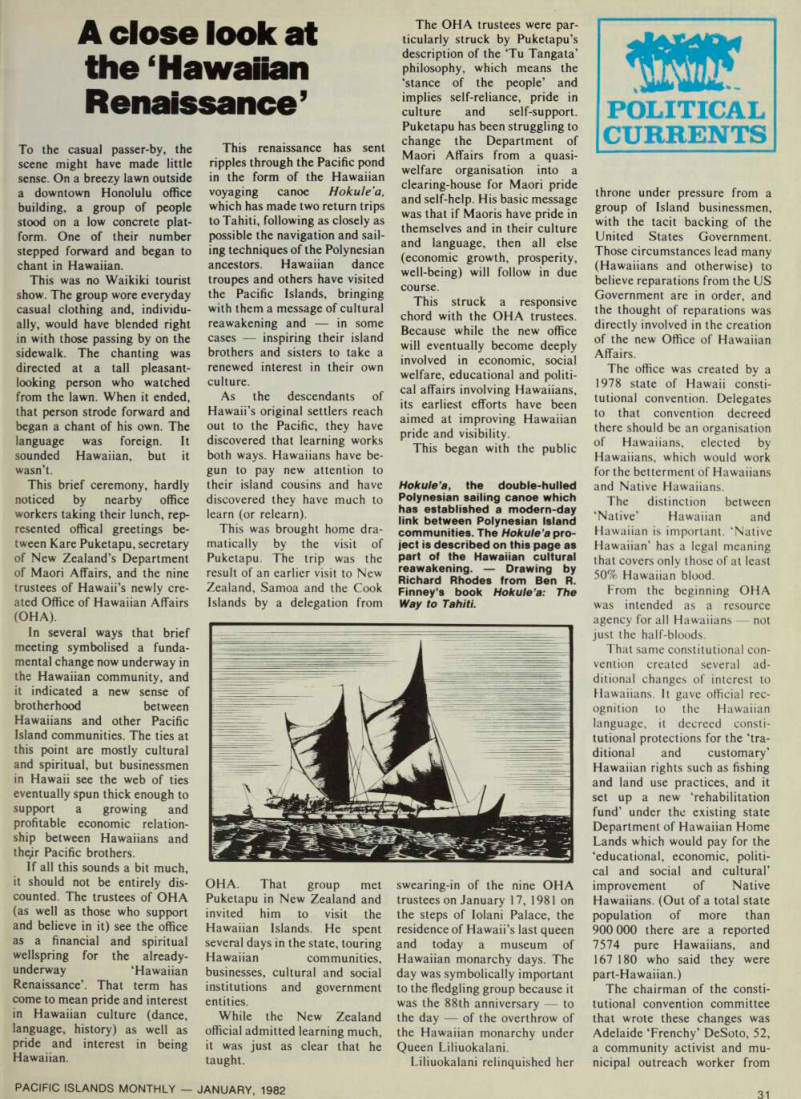
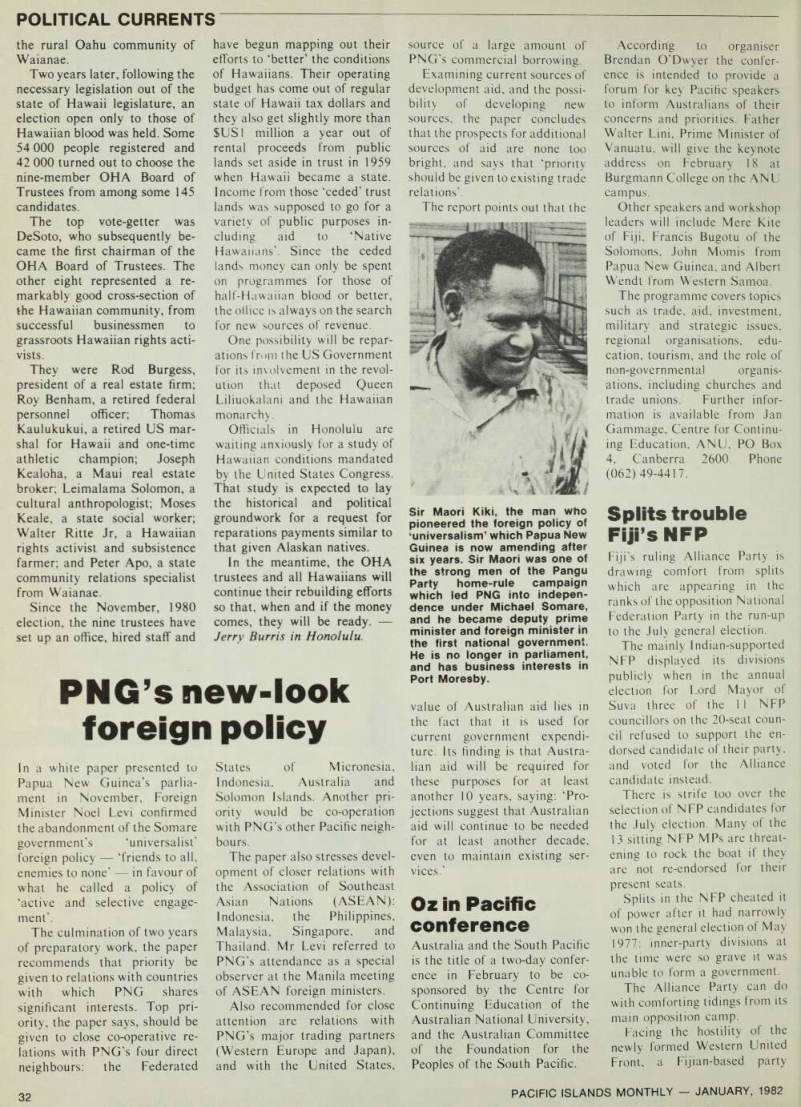
Political
Currents
A close look at the ‘Hawaiian Renaissance’
To the casual passer-by, the scene might have made little sense. On a breezy lawn outside a downtown Honolulu office building, a group of people stood on a low concrete plat form. One of their number stepped forward and began to chant in Hawaiian.
This was no Waikiki tourist show. The group wore everyday casual clothing and, individu ally, would have blended right in with those passing by on the sidewalk. The chanting was directed at a tall pleasant looking person who watched from the lawn. When it ended, that person strode forward and began a chant of his own. The language was foreign. It sounded Hawaiian, but it wasn’t.
This brief ceremony, hardly noticed by nearby office workers taking their lunch, rep resented offical greetings be tween Kare Puketapu, secretary of New Zealand’s Department of Maori Affairs, and the nine trustees of Hawaii’s newly cre ated Office of Hawaiian Affairs
(Oha).
In several ways that brief meeting symbolised a funda mental change now underway in the Hawaiian community, and it indicated a new sense of brotherhood between Hawaiians and other Pacific Island communities. The ties at this point are mostly cultural and spiritual, but businessmen in Hawaii see the web of ties eventually spun thick enough to support a growing and profitable economic relation ship between Hawaiians and the;r Pacific brothers.
If all this sounds a bit much, it should not be entirely dis counted. The trustees of OHA (as well as those who support and believe in it) see the office as a financial and spiritual wellspring for the already underway ‘Hawaiian Renaissance’. That term has come to mean pride and interest in Hawaiian culture (dance, language, history) as well as pride and interest in being Hawaiian.
This renaissance has sent ripples through the Pacific pond in the form of the Hawaiian voyaging canoe Hokule’a, which has made two return trips to Tahiti, following as closely as possible the navigation and sail ing techniques of the Polynesian ancestors. Hawaiian dance troupes and others have visited the Pacific Islands, bringing with them a message of cultural reawakening and in some cases inspiring their island brothers and sisters to take a renewed interest in their own culture.
As the descendants of Hawaii’s original settlers reach out to the Pacific, they have discovered that learning works both ways. Hawaiians have be gun to pay new attention to their island cousins and have discovered they have much to learn (or relearn).
This was brought home dra matically by the visit of Puketapu. The trip was the result of an earlier visit to New Zealand, Samoa and the Cook Islands by a delegation from
OHA. That group met Puketapu in New Zealand and invited him to visit the Hawaiian Islands. He spent several days in the state, touring Hawaiian communities, businesses, cultural and social institutions and government entities.
While the New Zealand official admitted learning much, it was just as clear that he taught.
The OHA trustees were par ticularly struck by Puketapu’s description of the ‘Tu Tangata’ philosophy, which means the ‘stance of the people’ and implies self-reliance, pride in culture and self-support.
Puketapu has been struggling to change the Department of Maori Affairs from a quasi welfare organisation into a clearing-house for Maori pride and self-help. His basic message was that if Maoris have pride in themselves and in their culture and language, then all else (economic growth, prosperity, well-being) will follow in due course.
This struck a responsive chord with the OHA trustees.
Because while the new office will eventually become deeply involved in economic, social welfare, educational and politi cal affairs involving Hawaiians, its earliest efforts have been aimed at improving Hawaiian pride and visibility.
This began with the public
swearing-in of the nine OHA trustees on January 17, 1981 on the steps of lolani Palace, the residence of Hawaii’s last queen and today a museum of Hawaiian monarchy days. The day was symbolically important to the fledgling group because it was the 88th anniversary to the day of the overthrow of the Hawaiian monarchy under Queen Liliuokalani.
Liliuokalani relinquished her
throne under pressure from a group of Island businessmen, with the tacit backing of the United States Government.
Those circumstances lead many (Hawaiians and otherwise) to believe reparations from the US Government are in order, and the thought of reparations was directly involved in the creation of the new Office of Hawaiian Affairs.
The office was created by a 1978 state of Hawaii consti tutional convention. Delegates to that convention decreed there should be an organisation of Hawaiians, elected by Hawaiians, which would work for the betterment of Hawaiians and Native Hawaiians.
The distinction between ‘Native’ Hawaiian and Hawaiian is important. ‘Native Hawaiian’ has a legal meaning that covers only those of at least 50% Hawaiian blood.
From the beginning OHA was intended as a resource agency for all Hawaiians not just the half-bloods.
That same constitutional con vention created several ad ditional changes of interest to Hawaiians. It gave official rec ognition to the Hawaiian language, it decreed consti tutional protections for the ‘tra ditional and customary’
Hawaiian rights such as fishing and land use practices, and it set up a new ‘rehabilitation fund’ under the existing state Department of Hawaiian Home Lands which would pay for the ‘educational, economic, politi cal and social and cultural’ improvement of Native Hawaiians. (Out of a total state population of more than 900 000 there are a reported 7574 pure Hawaiians, and 167 180 who said they were part-Hawaiian.) The chairman of the consti tutional convention committee that wrote these changes was Adelaide ‘Frenchy’ DeSoto, 52, a community activist and mu nicipal outreach worker from
Hokule’a, the double-hulled Polynesian sailing canoe which has established a modern-day link between Polynesian Island communities. The Hokule’a pro ject is described on this page as part of the Hawaiian cultural reawakening. Drawing by Richard Rhodes from Ben R.
Finney’s book Hokule’a: The Way to Tahiti.
the rural Oahu community of Waianae.
Two years later, following the necessary legislation out of the state of Hawaii legislature, an election open only to those of Hawaiian blood was held. Some 54 000 people registered and 42 000 turned out to choose the nine-member OHA Board of Trustees from among some 145 candidates.
The top vote-getter was DeSoto, who subsequently be came the first chairman of the OHA Board of Trustees. The other eight represented a re markably good cross-section of the Hawaiian community, from successful businessmen to grassroots Hawaiian rights acti vists.
They were Rod Burgess, president of a real estate firm; Roy Benham, a retired federal personnel officer; Thomas Kaulukukui, a retired US mar shal for Hawaii and one-time athletic champion; Joseph Kealoha, a Maui real estate broker; Leimalama Solomon, a cultural anthropologist; Moses Keale, a state social worker; Walter Ritte Jr, a Hawaiian rights activist and subsistence farmer; and Peter Apo, a state community relations specialist from Waianae.
Since the November, 1980 election, the nine trustees have set up an office, hired staff and
have begun mapping out their efforts to ‘better’ the conditions of Hawaiians. Their operating budget has come out of regular state of Hawaii tax dollars and they also get slightly more than SUSI million a year out of rental proceeds from public lands set aside in trust in 1959 when Hawaii became a state.
Income from those ‘ceded’ trust lands was supposed to go for a variety of public purposes in cluding aid to ‘Native Hawaiians’. Since the ceded lands money can only be spent on programmes for those of half-Hawaiian blood or better, the office is always on the search for new sources of revenue.
One possibility will be repar ations from the US Government for its involvement in the revol ution that deposed Queen Liliuokalani and the Hawaiian monarchy.
Officials in Honolulu are waiting anxiously for a study of Hawaiian conditions mandated by the United States Congress.
That study is expected to lay the historical and political groundwork for a request for reparations payments similar to that given Alaskan natives.
In the meantime, the OHA trustees and all Hawaiians will continue their rebuilding efforts so that, when and if the money comes, they will be ready.
Jerry Burris in Honolulu.
foreign policy
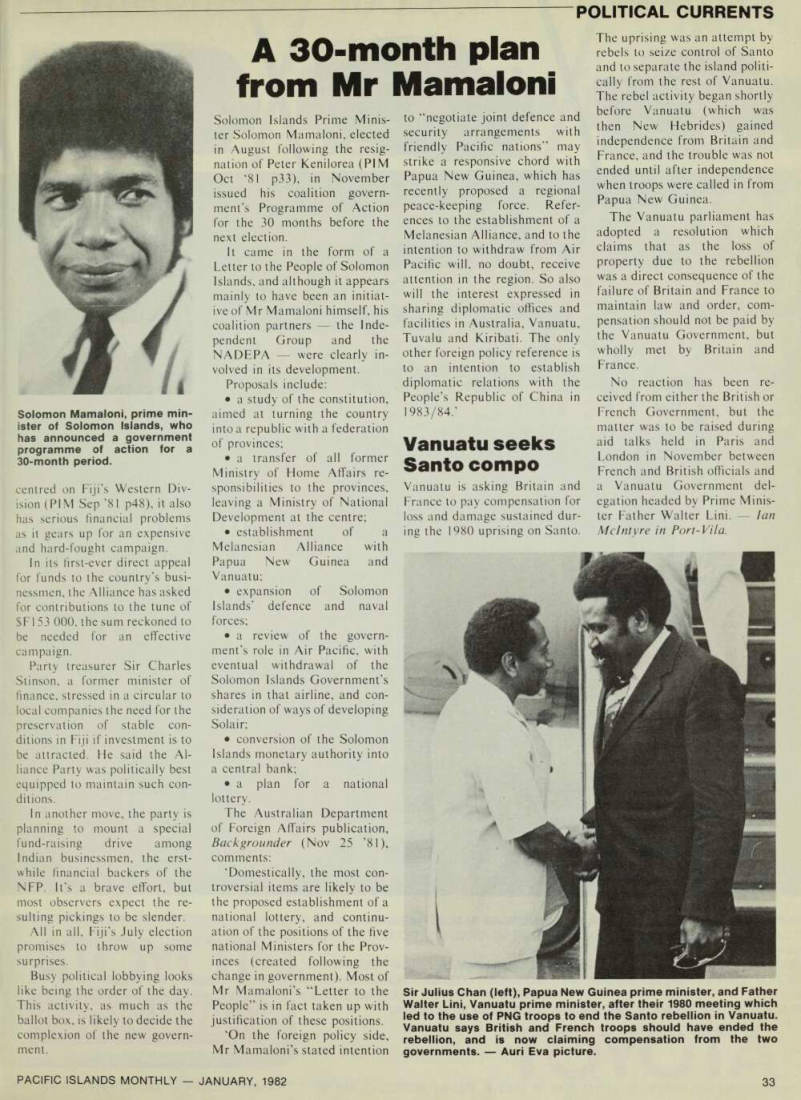
PNG’s new-look foreign policy
In a white paper presented to Papua New Guinea’s parlia ment in November, Foreign Minister Noel Levi confirmed the abandonment of the Somare
government’s ‘universalist’
foreign policy ‘friends to all, enemies to none’ in favour of what he called a policy of ‘active and selective engage ment'.
The culmination of two years of preparatory work, the paper recommends that priority be given to relations with countries with which PNG shares significant interests. Top pri ority, the paper says, should be given to close co-operative re lations with PNG’s four direct neighbours: the Federated
States of Micronesia, Indonesia, Australia and Solomon Islands. Another pri ority would be co-operation with PNG’s other Pacific neigh bours.
The paper also stresses devel opment of closer relations with the Association of Southeast Asian Nations (ASEAN): Indonesia, the Philippines, Malaysia, Singapore, and Thailand. Mr Levi referred to PNG’s attendance as a special observer at the Manila meeting of ASEAN foreign ministers.
Also recommended for close attention are relations with PNG’s major trading partners (Western Europe and Japan), and with the United Slates,
source of a large amount of PNG’s commercial borrowing.
Examining current sources of development aid. and the possi bility of developing new sources, the paper concludes that the prospects for additional sources of aid are none 100 bright, and says that ‘priority should be given to existing trade relations’.
The report points out that the
value of Australian aid lies in the fact that it is used for current government expendi ture. Its finding is that Austra lian aid will be required for these purposes for at least another 10 years, saying: ‘Pro jections suggest that Australian aid will continue to be needed for at least another decade, even to maintain existing ser vices.’
Oz in Pacific
conference
Australia and the South Pacific is the title of a two-day confer ence in February to be co sponsored by the Centre for Continuing Education of the Australian National University, and the Australian Committee of the Foundation for the Peoples of the South Pacific.
According to organiser Brendan O’Dwyer the confer ence is intended to provide a forum for key Pacific speakers to inform Australians of their concerns and priorities. Father Walter Lini. Prime Minister of Vanuatu, will give the keynote address on February 18 at Burgmann College on the ANU campus.
Other speakers and workshop leaders will include Mere Kite of Fiji, Francis Bugotu of the Solomons. John Momis from Papua New Guinea, and Albert Wendt from Western Samoa.
The programme covers topics such as trade, aid, investment, military and strategic issues, regional organisations, edu cation, tourism, and the role of non-governmental organis ations, including churches and trade unions. Further infor mation is available from Jan Gammage, Centre for Continu ing Education, ANU. PO Box 4. Canberra 2600. Phone (062)49-4417.
Splits trouble
Fiji’s NFP
Fiji’s ruling Alliance Party is drawing comfort from splits which are appearing in the ranks of the opposition National Federation Party in the run-up to the July general election.
The mainly Indian-supported NFP displayed its divisions publicly when in the annual election for Lord Mayor of Suva three of the 11 NFP councillors on the 20-seal coun cil refused to support the en dorsed candidate of their parly, and voted for the Alliance candidate instead.
There is strife too over the selection of NFP candidates for the July election. Many of the 13 sitting NFP MPs are threat ening to rock the boat if they are not re-endorsed for their present seals.
Splits in the NFP cheated it of power after it had narrowly won the general election of May 1977; inner-parly divisions at the time were so grave it was unable to form a government.
The Alliance Party can do with comforting tidings from its main opposition camp.
Facing the hostility of the newly formed Western United Front, a Fijian-based party
Sir Maori Kiki, the man who pioneered the foreign policy of ‘universalism’ which Papua New Guinea is now amending after six years. Sir Maori was one of the strong men of the Pangu Party home-rule campaign which led PNG into indepen dence under Michael Somare, and he became deputy prime minister and foreign minister in the first national government.
He is no longer in parliament, and has business interests in Port Moresby.
centred on Fiji’s Western Div ision (PIM Sep ’Bl p4B), it also has serious financial problems as it gears up for an expensive and hard-fought campaign.
In its first-ever direct appeal for funds to the country’s busi nessmen, the Alliance has asked for contributions to the tune of SFI 53 000. the sum reckoned to be needed for an effective campaign.
Parly treasurer Sir Charles Stinson, a former minister of finance, stressed in a circular to local companies the need for the preservation of stable con ditions in Fiji if investment is to be attracted. He said the Al liance Parly was politically best equipped to maintain such con ditions.
In another move, the party is planning to mount a special fund-raising drive among Indian businessmen, the erst while financial backers of the NFP. It’s a brave effort, but most observers expect the re sulting pickings to be slender.
All in all, Fiji's July election promises to throw up some surprises.
Busy political lobbying looks like being the order of the day.
This activity, as much as the ballot box, is likely to decide the complexion of the new govern ment.
Solomon Mamaloni, prime min ister of Solomon Islands, who has announced a government programme of action for a 30-month period.
A 30-month plan
from Mr Mamaloni
Solomon Islands Prime Minis ter Solomon Mamaloni, elected in August following the resig nation of Peter Kenilorea (PIM Oct ‘Bl p 33), in November issued his coalition govern ment’s Programme of Action for the 30 months before the next election.
It came in the form of a Letter to the People of Solomon Islands, and although it appears mainly to have been an initiat ive of Mr Mamaloni himself, his coalition partners the Inde pendent Group and the NADEPA were clearly in volved in its development.
Proposals include: • a study of the constitution, aimed at turning the country into a republic with a federation of provinces; • a transfer of all former Ministry of Home Affairs re sponsibilities to the provinces, leaving a Ministry of National Development at the centre; • establishment of a Melanesian Alliance with Papua New Guinea and Vanuatu; • expansion of Solomon Islands’ defence and naval forces; • a review of the govern ment’s role in Air Pacific, with eventual withdrawal of the Solomon Islands Government’s shares in that airline, and con sideration of ways of developing Solair; • conversion of the Solomon Islands monetary authority into a central bank; • a plan for a national lottery.
The Australian Department of Foreign Affairs publication, Backgrounder (Nov 25 ’81), comments: ‘Domestically, the most con troversial items are likely to be the proposed establishment of a national lottery, and continu ation of the positions of the five national Ministers for the Prov inces (created following the change in government). Most of Mr Mamaloni’s “Letter to the People” is in fact taken up with justification of these positions. ‘On the foreign policy side, Mr Mamaloni’s stated intention
to “negotiate joint defence and security arrangements with friendly Pacific nations” may strike a responsive chord with Papua New Guinea, which has recently proposed a regional peace-keeping force. Refer ences to the establishment of a Melanesian Alliance, and to the intention to withdraw from Air Pacific will, no doubt, receive attention in the region. So also will the interest expressed in sharing diplomatic offices and facilities in Australia, Vanuatu, Tuvalu and Kiribati. The only other foreign policy reference is to an intention to establish diplomatic relations with the People’s Republic of China in 1983/84.’
Vanuatu seeks
Santo compo
Vanuatu is asking Britain and France to pay compensation for loss and damage sustained dur ing the 1980 uprising on Santo.
The uprising was an attempt by rebels to seize control of Santo and to separate the island politi cally from the rest of Vanuatu.
The rebel activity began shortly before Vanuatu (which was then New Hebrides) gained independence from Britain and France, and the trouble was not ended until after independence when troops were called in from Papua New Guinea.
The Vanuatu parliament has adopted a resolution which claims that as the loss of property due to the rebellion was a direct consequence of the failure of Britain and France to maintain law and order, com pensation should not be paid by the Vanuatu Government, but wholly met by Britain and France.
No reaction has been re ceived from either the British or French Government, but the matter was to be raised during aid talks held in Paris and London in November between French and British officials and a Vanuatu Government del egation headed by Prime Minis ter Father Walter Lini. lan Mclntyre in Port-Vila.
Sir Julius Chan (left), Papua New Guinea prime minister, and Father Walter Lini, Vanuatu prime minister, after their 1980 meeting which led to the use of PNG troops to end the Santo rebellion in Vanuatu.
Vanuatu says British and French troops should have ended the rebellion, and is now claiming compensation from the two
governments. - Auri Eva picture.
Advertisements & other items, pp. 34-35 (1 item)
Toyota
11l IAIA4WD
OIVJUI
nmv^c
tot
v
Toy
*W : w * M ma .
TOYOTA
LAND CRUISER (Station Wagon)
2" , j* * > •mm 1 * m > r m
CKUIOLK
TRUCK
rr
Toyota commercial vehicles are
a very special breed apart, unrivaled
for their toughness and sure handlin;
on or off the road. Built tough to stand up to the most difficult load*
Built also to take the punishment
of bad weather, and beaten up
road surfaces. Like the new 4W!
1 Toyota Land Cruiser Station
e :
I and%tfelsypvservl
r it.
' tough bre
t #N V
GUAM: ATKINS, KROLL (GUAM) LTD., P.O.
Box 6428, Tamuning.
VANUATU: VANUATU MOTORS, P.O. Box
18, Port Vila.
SOLOMON: MENDANA ENTERPRISES
(5.1.) LTD., G.P.O. Box 174, Honiara.
TAHITI: NIPPON AUTOMOTO. B.P. 342,
Papeete.
The Toyota range includes: COROLLA,
COOK ISLANDS: COOK ISLANDS
TRADING CORPORATION LTD., P.O. Box
92, Rarotonga.
NAURU: NAURU COOPERATIVE SOCIETY.
KIRIBATI: TARAWA MOTORS, Box 36.
Bairiki, Tarawa, Kiribati.
NORFOLK ISLAND: BORRYS RENTAL
CARS, MOUNT PITT (ENTERPRISES) LTD.,
P.O. Box 169.
NEW CALEDONIA: SERVICE
IMPORTATION AUTOMOBILE DU
PACIFIQUE, Rond-Point du Pacifique (Station Total) B.P. 438, Noumea.
TOYOTA
STARLET, CORONA, CRESSIDA, HI-LUX, STOUT, HI ACE, DYNA, COASTER and LAND CRUISE
People
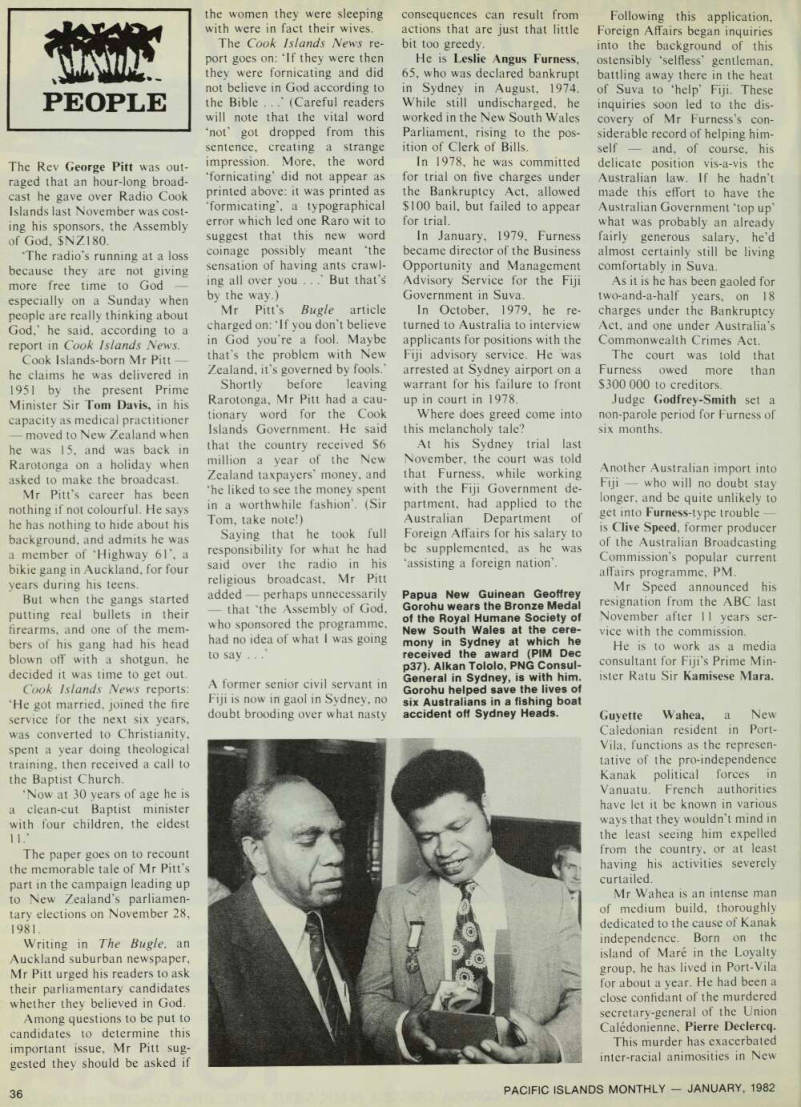
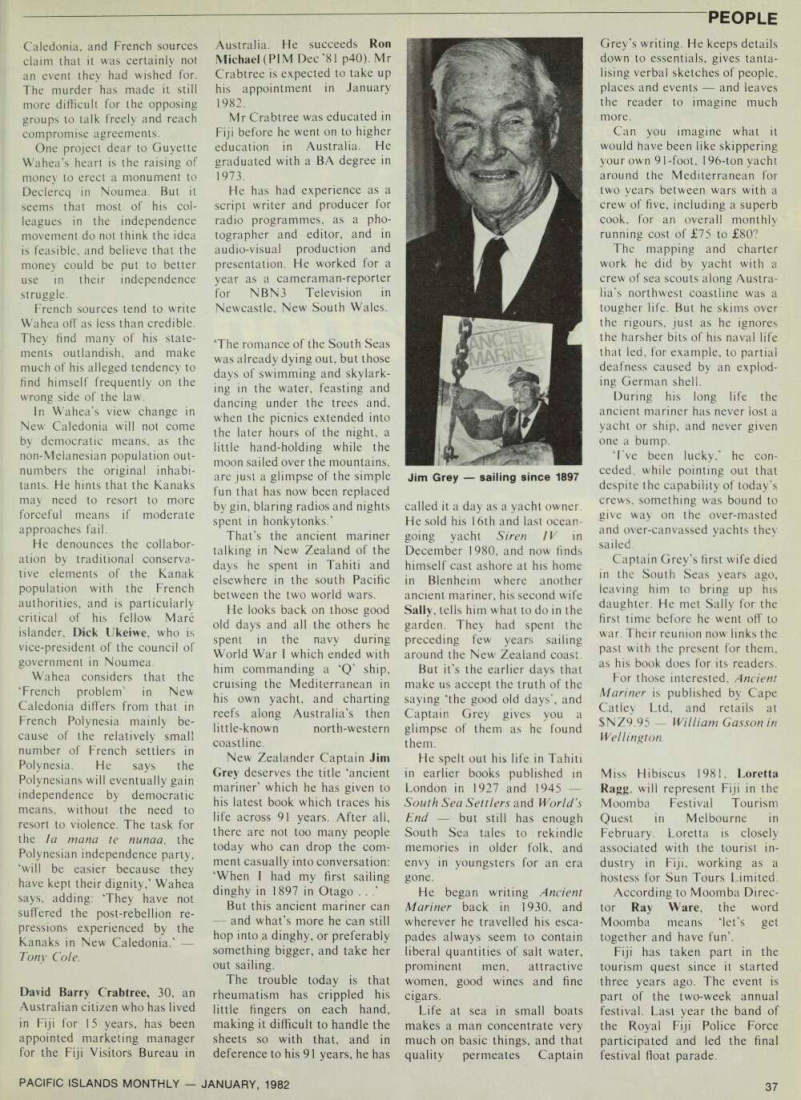
the women they were sleeping with were in fact their wives.
The Cook Islands News re port goes on; ‘lf they were then they were fornicating and did not believe in God according to the Bible . . .’ (Careful readers will note that the vital word ‘not’ got dropped from this sentence, creating a strange impression. More, the word ‘fornicating’ did not appear as printed above; it was printed as ‘formicating’, a typographical error which led one Raro wit to suggest that this new word coinage possibly meant ‘the sensation of having ants crawl ing all over you . . .' But that’s by the way.) Mr Pitt’s Bugle article charged on; ‘lf you don't believe in God you’re a fool. Maybe that’s the problem with New Zealand, it’s governed by fools.’
Shortly before leaving Rarotonga, Mr Pitt had a cau tionary word for the Cook Islands Government. He said that the country received $6 million a year of the New Zealand taxpayers’ money, and ‘he liked to see the money spent in a worthwhile fashion’. (Sir Tom, lake note!) Saying that he took full responsibility for what he had said over the radio in his religious broadcast, Mr Pitt added perhaps unnecessarily that ‘the Assembly of God, who sponsored the programme, had no idea of what 1 was going to say .. .’
A former senior civil servant in Fiji is now in gaol in Sydney, no doubt brooding over what nasty
The Rev George Pitt was out raged that an hour-long broad cast he gave over Radio Cook Islands last November was cost ing his sponsors, the Assembly of God, SNZIBO. ‘The radio’s running at a loss because they are not giving more free lime to God especially on a Sunday when people are really thinking about God,’ he said, according to a report in Cook Islands News.
Cook Islands-born Mr Pitt he claims he was delivered in 1951 by the present Prime Minister Sir Tom Davis, in his capacity as medical practitioner moved to New Zealand when he was 15, and was back in Rarotonga on a holiday when asked to make the broadcast.
Mr Pitt’s career has been nothing if not colourful. He says he has nothing to hide about his background, and admits he was a member of ‘Highway 61’, a bikie gang in Auckland, for four years during his teens.
But when the gangs started pulling real bullets in their firearms, and one of the mem bers of his gang had his head blown off with a shotgun, he decided it was time to get out.
Cook Islands News reports: ‘He got married, joined the fire service for the next six years, was converted to Christianity, spent a year doing theological training, then received a call to the Baptist Church. ‘Now at 30 years of age he is a clean-cut Baptist minister with four children, the eldest 11.’
The paper goes on to recount the memorable tale of Mr Pitt’s part in the campaign leading up to New Zealand’s parliamen tary elections on November 28, 1981.
Writing in The Bugle, an Auckland suburban newspaper, Mr Pitt urged his readers to ask their parliamentary candidates whether they believed in God.
Among questions to be put to candidates to determine this important issue, Mr Pitt sug gested they should be asked if
consequences can result from actions that are just that little bit too greedy.
He is Leslie Angus Furness, 65, who was declared bankrupt in Sydney in August, 1974.
While still undischarged, he worked in the New South Wales Parliament, rising to the pos ition of Clerk of Bills.
In 1978, he was committed for trial on five charges under the Bankruptcy Act, allowed $lOO bail, but failed to appear for trial.
In January, 1979, Furness became director of the Business Opportunity and Management Advisory Service for the Fiji Government in Suva.
In October, 1979, he re turned to Australia to interview applicants for positions with the Fiji advisory service. He was arrested at Sydney airport on a warrant for his failure to front up in court in 1978.
Where does greed come into this melancholy tale?
At his Sydney trial last November, the court was told that Furness, while working with the Fiji Government de partment, had applied to the Australian Department of Foreign Affairs for his salary to be supplemented, as he was ‘assisting a foreign nation’.
Following this application, Foreign Affairs began inquiries into the background of this ostensibly ‘selfless’ gentleman, battling away there in the heat of Suva to ‘help’ Fiji. These inquiries soon led to the dis covery of Mr Furness’s con siderable record of helping him self and, of course, his delicate position vis-a-vis the Australian law. If he hadn’t made this effort to have the Australian Government ‘top up’ what was probably an already fairly generous salary, he’d almost certainly still be living comfortably in Suva.
As it is he has been gaoled for two-and-a-half years, on 18 charges under the Bankruptcy Act, and one under Australia’s Commonwealth Crimes Act.
The court was told that Furness owed more than $3OO 000 to creditors.
Judge Godfrey-Smith set a non-parole period for Furness of six months.
Another Australian import into Fiji who will no doubt stay longer, and be quite unlikely to get into Furness-type trouble is Clive Speed, former producer of the Australian Broadcasting Commission’s popular current affairs programme, PM.
Mr Speed announced his resignation from the ABC last November after 11 years ser vice with the commission.
He is to work as a media consultant for Fiji’s Prime Min ister Ratu Sir Kamisese Mara.
Guyette Wahea, a New Caledonian resident in Port- Vila, functions as the represen tative of the pro-independence Kanak political forces in Vanuatu. French authorities have let it be known in various ways that they wouldn’t mind in the least seeing him expelled from the country, or at least having his activities severely curtailed.
Mr Wahea is an intense man of medium build, thoroughly dedicated to the cause of Kanak independence. Born on the island of Mare in the Loyalty group, he has lived in Port-Vila for about a year. He had been a close confidant of the murdered secretary-general of the Union Caledonienne, Pierre Declercq.
This murder has exacerbated inter-racial animosities in New
Papua New Guinean Geoffrey Gorohu wears the Bronze Medal of the Royal Humane Society of New South Wales at the cere mony in Sydney at which he received the award (PIM Dec p37). Alkan Tololo, PNG Consul- General in Sydney, is with him.
Gorohu helped save the lives of six Australians in a fishing boat accident off Sydney Heads.
Caledonia, and French sources claim that it was certainly not an event they had wished for.
The murder has made it still more difficult for the opposing groups to talk freely and reach compromise agreements.
One project dear to Guyetle Wahea’s heart is the raising of money to erect a monument to Declercq in Noumea. But it seems that most of his col leagues in the independence movement do not think the idea is feasible, and believe that the money could be pul to better use in their independence struggle.
French sources lend to write Wahea off as less than credible.
They find many of his state ments outlandish, and make much of his alleged tendency to find himself frequently on the wrong side of the law.
In Wahea’s view change in New Caledonia will not come by democratic means, as the non-Melanesian population out numbers the original inhabi tants. He hints that the Kanaks may need to resort to more forceful means if moderate approaches fail.
He denounces the collabor ation by traditional conserva tive elements of the Kanak population with the French authorities, and is particularly critical of his fellow Mare islander, Dick Ukeiwe, who is vice-president of the council of government in Noumea.
Wahea considers that the ‘French problem' in New Caledonia differs from that in French Polynesia mainly be cause of the relatively small number of French settlers in Polynesia. He says the Polynesians will eventually gain independence by democratic means, without the need to resort to violence. The task for the la mana te nunaa, the Polynesian independence party, ‘will be easier because they have kept their dignity,’ Wahea says, adding; ‘They have not suffered the post-rebellion re pressions experienced by the Kanaks in New Caledonia.’
Tony Cole.
David Barry Crabtree, 30, an Australian citizen who has lived in Fiji for 15 years, has been appointed marketing manager for the Fiji Visitors Bureau in
Australia. He succeeds Ron Michael (PIM Dec ’Bl p4O). Mr Crabtree is expected to take up his appointment in January 1982.
Mr Crabtree was educated in Fiji before he went on to higher education in Australia. He graduated with a BA degree in 1973.
He has had experience as a script writer and producer for radio programmes, as a pho tographer and editor, and in audio-visual production and presentation. He worked for a year as a cameraman-reporter for NBN3 Television in Newcastle, New South Wales. ‘The romance of the South Seas was already dying out, but those days of swimming and skylark ing in the water, feasting and dancing under the trees and, when the picnics extended into the later hours of the night, a little hand-holding while the moon sailed over the mountains, are just a glimpse of the simple fun that has now been replaced by gin, blaring radios and nights spent in honkytonks.’
That’s the ancient mariner talking in New Zealand of the days he spent in Tahiti and elsewhere in the south Pacific between the two world wars.
He looks back on those good old days and all the others he spent in the navy during World War I which ended with him commanding a ‘Q’ ship, cruising the Mediterranean in his own yacht, and charting reefs along Australia’s then little-known north-western coastline.
New Zealander Captain Jim Grey deserves the title ‘ancient mariner’ which he has given to his latest book which traces his life across 91 years. After all, there are not too many people today who can drop the com ment casually into conversation: ‘When I had my first sailing dinghy in 1897 in Otago . . .’
But this ancient mariner can and what’s more he can still hop into,a dinghy, or preferably something bigger, and take her out sailing.
The trouble today is that rheumatism has crippled his little fingers on each hand, making it difficult to handle the sheets so with that, and in deference to his 91 years, he has
called it a day as a yacht owner.
He sold his 16th and last ocean going yacht Siren IV in December 1980, and now finds himself cast ashore at his home in Blenheim where another ancient mariner, his second wife Sally, tells him what to do in the garden. They had spent the preceding few years sailing around the New Zealand coast.
But it’s the earlier days that make us accept the truth of the saying ‘the good old days’, and Captain Grey gives you a glimpse of them as he found them.
He spelt out his life in Tahiti in earlier books published in London in 1927 and 1945 - South Sea Settlers and World’s End but still has enough South Sea tales to rekindle memories in older folk, and envy in youngsters for an era gone.
He began writing Ancient Mariner back in 1930. and wherever he travelled his esca pades always seem to contain liberal quantities of salt water, prominent men, attractive women, good wines and fine cigars.
Life at sea in small boats makes a man concentrate very much on basic things, and that quality permeates Captain
Grey’s writing. He keeps details down to essentials, gives tanta lising verbal sketches of people, places and events and leaves the reader to imagine much more.
Can you imagine what it would have been like skippering your own 91-fool, 196-ton yacht around the Mediterranean for two years between wars with a crew of five, including a superb cook, for an overall monthly running cost of £75 to £80?
The mapping and charter work he did by yacht with a crew of sea scouts along Austra lia’s northwest coastline was a tougher life. But he skims over the rigours, just as he ignores the harsher bits of his naval life that led, for example, to partial deafness caused by an explod ing German shell.
During his long life the ancient mariner has never lost a yacht or ship, and never given one a bump.
'l've been lucky.’ he con ceded, while pointing out that despite the capability of today’s crews, something was bound to give way on the over-masted and over-canvassed yachts they sailed Captain Grey’s first wife died in the South Seas years ago, leaving him to bring up his daughter. He met Sally for the first time before he went off to war. Their reunion now links the past with the present for them, as his book does for its readers.
For those interested. Ancient Mariner is published by Cape Calley Ltd, and retails at 5NZ9.95 William Gasson in Wellington.
Miss Hibiscus 1981, Loretta Ragg. will represent Fiji in the Moomba Festival Tourism Quest in Melbourne in February. Loretta is closely associated with the tourist in dustry in Fiji, working as a hostess for Sun Tours Limited.
According to Moomba Direc tor Ray Ware, the word Moomba means ‘let’s get together and have fun’.
Fiji has taken part in the tourism quest since it started three years ago. The event is part of the two-week annual festival. Last year the band of the Royal Fiji Police Force participated and led the final festival float parade.
Jim Grey - sailing since 1897
Advertisements & other items, p. 38 (1 item)
Innovation
Scott Carpenter
andJVC.
Both explorers,
loth dedicated to —
■ T v*\ Scott Carpenter. An explorer who has spent his professional career on the cutting edge of innovation. One of the original US astronauts and an aquanaut. The only man to penetrate both inner and outer space.
JVC. too. has always been identified with innovation. Like Scott, we have spent years opening up new worlds. New worlds of home entertainment. We originated VMS. the most widely used home video system. VJe make versatile equipment like the HR-2200 portable video cassette recorder and the CX-68 video camera.
Take a look and see if you don V agree that JVC products are out of this world.
Innovation
IHi
JVC
I KB m v the PFA *or«d Cue
JVC
a 'bold experiment'
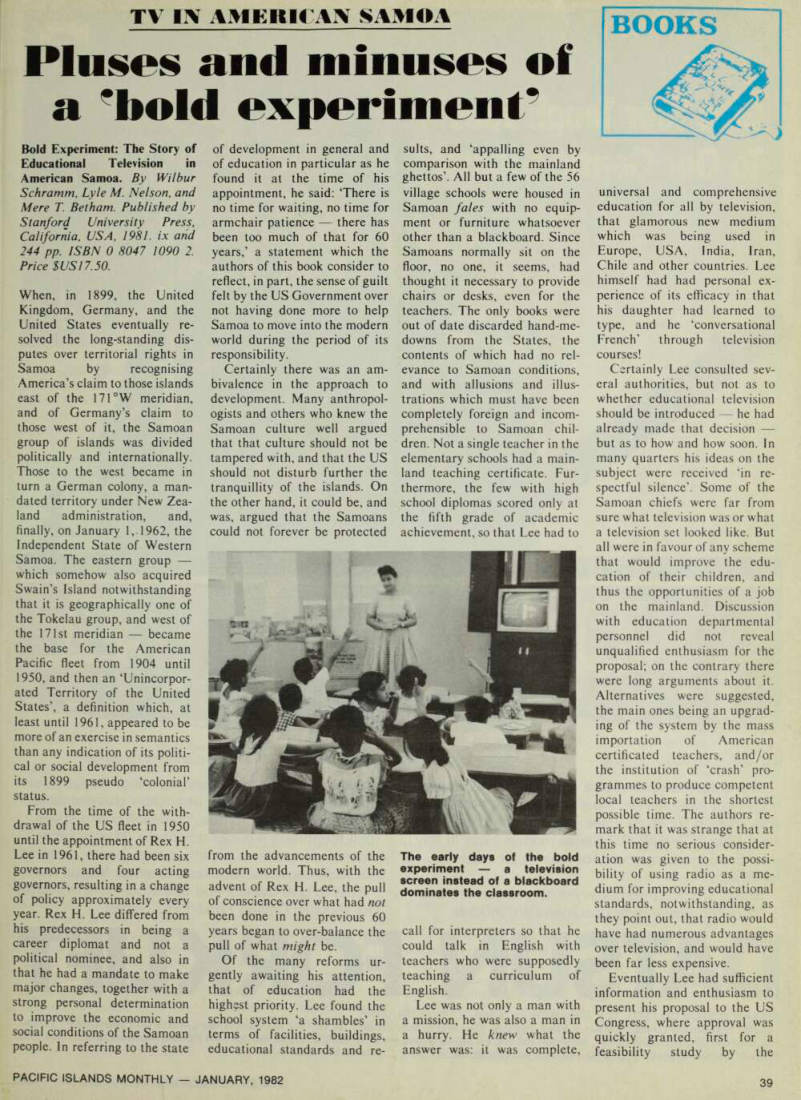
Books
Tv In American Samoa
Pluses and minuses of a 'bold experiment'
Bold Experiment: The Story of Educational Television in American Samoa. By Wilbur Schramm, Lyle M. Nelson, and Mere T. Betham. Published by Stanford University Press, California, USA, 1981. ix arid 244 pp. ISBN 0 8047 1090 2.
Price SUS 17.50.
When, in 1899, the United Kingdom, Germany, and the United States eventually re solved the long-standing dis putes over territorial rights in Samoa by recognising America’s claim to those islands east of the 171 °W meridian, and of Germany’s claim to those west of it, the Samoan group of islands was divided politically and internationally.
Those to the west became in turn a German colony, a man dated territory under New Zea land administration, and, finally, on January 1,1962, the Independent State of Western Samoa. The eastern group which somehow also acquired Swain’s Island notwithstanding that it is geographically one of the Tokelau group, and west of the 171st meridian became the base for the American Pacific fleet from 1904 until 1950, and then an ‘Unincorpor ated Territory of the United States’, a definition which, at least until 1961, appeared to be more of an exercise in semantics than any indication of its politi cal or social development from its 1899 pseudo ‘colonial’ status.
From the time of the with drawal of the US fleet in 1950 until the appointment of Rex H.
Lee in 1961, there had been six governors and four acting governors, resulting in a change of policy approximately every year. Rex H. Lee differed from his predecessors in being a career diplomat and not a political nominee, and also in that he had a mandate to make major changes, together with a strong personal determination to improve the economic and social conditions of the Samoan people. In referring to the state
of development in general and of education in particular as he found it at the time of his appointment, he said: ‘There is no time for waiting, no time for armchair patience there has been too much of that for 60 years,’ a statement which the authors of this book consider to reflect, in part, the sense of guilt felt by the US Government over not having done more to help Samoa to move into the modern world during the period of its responsibility.
Certainly there was an am bivalence in the approach to development. Many anthropol ogists and others who knew the Samoan culture well argued that that culture should not be tampered with, and that the US should not disturb further the tranquillity of the islands. On the other hand, it could be, and was, argued that the Samoans could not forever be protected
from the advancements of the modern world. Thus, with the advent of Rex H. Lee, the pull of conscience over what had not been done in the previous 60 years began to over-balance the pull of what might be.
Of the many reforms ur gently awaiting his attention, that of education had the highest priority. Lee found the school system ‘a shambles’ in terms of facilities, buildings, educational standards and re
suits, and ‘appalling even by comparison with the mainland ghettos’. All but a few of the 56 village schools were housed in Samoan fales with no equip ment or furniture whatsoever other than a blackboard. Since Samoans normally sit on the floor, no one, it seems, had thought it necessary to provide chairs or desks, even for the teachers. The only books were out of date discarded hand-me downs from the States, the contents of which had no rel evance to Samoan conditions, and with allusions and illus trations which must have been completely foreign and incom prehensible to Samoan chil dren. Not a single teacher in the elementary schools had a main land teaching certificate. Fur thermore, the few with high school diplomas scored only at the fifth grade of academic achievement, so that Lee had to
call for interpreters so that he could talk in English with teachers who were supposedly teaching a curriculum of English.
Lee was not only a man with a mission, he was also a man in a hurry. He knew what the answer was: it was complete,
universal and comprehensive education for all by television, that glamorous new medium which was being used in Europe, USA, India, Iran, Chile and other countries. Lee himself had had personal ex perience of its efficacy in that his daughter had learned to type, and he ‘conversational French’ through television courses!
Certainly Lee consulted sev eral authorities, but not as to whether educational television should be introduced he had already made that decision but as to how and how soon. In many quarters his ideas on the subject were received ‘in re spectful silence’. Some of the Samoan chiefs were far from sure what television was or what a television set looked like. But all were in favour of any scheme that would improve the edu cation of their children, and thus the opportunities of a job on the mainland. Discussion with education departmental personnel did not reveal unqualified enthusiasm for the proposal; on the contrary there were long arguments about it.
Alternatives were suggested, the main ones being an upgrad ing of the system by the mass importation of American certificated teachers, and/or the institution of ‘crash’ pro grammes to produce competent local teachers in the shortest possible time. The authors re mark that it was strange that at this time no serious consider ation was given to the possi bility of using radio as a me dium for improving educational standards, notwithstanding, as they point out, that radio would have had numerous advantages over television, and would have been far less expensive.
Eventually Lee had sufficient information and enthusiasm to present his proposal to the US Congress, where approval was quickly granted, first for a feasibility study by the
The early days of the bold
experiment - a television
screen instead of a blackboard dominates the classroom.
Advertisements & other items, pp. 40-42 (1 item)
Datsun Forklift
NISSAN
ig li
EST 3
m I k, ■ n i f 2r 119 r mm
pik
I mm 3.5-ton Pneumatic/Cushion/Turbo-charger 4.0-ton Pneumatic/Cushion/Turbo-charger 4.0-ton Heavy Duty Pneumatic/Cushion/Turbo-charger The difference will amaze you. These monocoque body heavyweights are tough on big jobs, maneuverable enough for small aisles and easy on operators.
New Datsun Forklift FO3 Series models excel in any role. Even many reserved for smaller lift capacity forklifts.
Smart 3/3.5/3.5-ton heavy-duty cushion tire and 3.5/4/4-ton heavy-duty pneumatic tire models provide optimum tight-space handling. Rugged, fuelefficient gasoline engines or a turbo-charged diesel engine assure high torque, gradeability and speed.
Total toughness reduces downtime. Maintenance is minimal. Single-lever tilt/lift control, power steering and wide-angle visibility keep operator fatigue low.
Built to give owners and operators more in return.
The versatile Datsun Forklift FO3 Series.
DATSUN FORKLIFT
NISSAN MOTOR CO.. LTD. 17-1, Ginza 6-Chome, Chuo-ku. Tokyo 104, Japan . .
Loadlift Equipment Limited 2Maurice Road, Penrose, Auckland 6, New Zealand Tel: 663-714 Au^ kla M °J° r M ° tors Ltd n Box 1259 Industrial Machinery Division Suite I,6th Floor, 100 William Street, Sydney, N.S.W. 2000, Australia Tel: 358-5444 Boroko Motors Ltd. P.O. Box 1259, Boroko, Via Port Moresby, Papua New Guinea Tel: 255255, 255347
Reach out and the
The Spectrum 50 matched-
omponent system finally puts a
icher musical life within reach of
he most restrictive hi-fi budgets.
Each Spectrum 50 component is
. star in a perfectly harmonizing
udio galactic system. The brain-
hild of some of the hi-fi world’s
nost dedicated engineers.
Reach out, and your journey to
nusic’s realm of inner space can
>egin now!
mu EB
mm ms : m: #: m IS * • -! ‘ * *
Spectrum 50
KA-50 Stereo Integrated Amplifier KT-30 FM-AM Stereo Tuner KX-50 Metal-Tape Stereo Cassette Deck with Dolby* NR
KD-40R
Direct-Drive Auto-Return Turntable
LS-110F
65W 3-way Speaker System
SRC-5
Audio Rack with glass door and casters GE-90 Stereo Graphic Equalizer (option) *TM Dolby Licensing Corp.
TRIO-KENWOOD CORPORATION
Shionogi Shibuya Building, 17-5, 2-chome, Shibuya,
Shibuya-ku, Tokyo 150, Japan
TRIO-KENWOOD (AUSTRALIA) PTY. LTD.
4E Woodcock Place, Lane Cove, N.S.W. 2066, Australia. Tel; 428-1455 NEW ZEALAND JOHN GILBERT & CO., LTD. Auckland Tel. 30-839 FIJI PEPE'S DUTY FREE CENTRE LTD. Tel. 26187 PAPUA NEW GUINEA S.O. SVENSSON (N.G.) LTD. Port Moresby Tel. 42-4467 SOLOMON ISLANDS TECHNIQUE RADIOS CENTRE LTD. Honiara Tel. 416 NEW CALEDONIA HI-FI VOX Noumea Tel. 27-2466 VANUATU FUNG CHOI LUEN. Port-Vila Tel. 2556 TAHITI MAI SON AURORE Papeete Tel. 29703 AMERICAN SAMOA ISLAND PACIFIC AGENCIES, INC. Pago Pago Tel. 633-4687
REPUBLIC OF NAURU NAURU CO-OPERATIVE SOCIETY
MARIANA ISLANDS J C. TENORIO ENTERPRISE Saipan Tel. 6444
Washington-based National As sociation
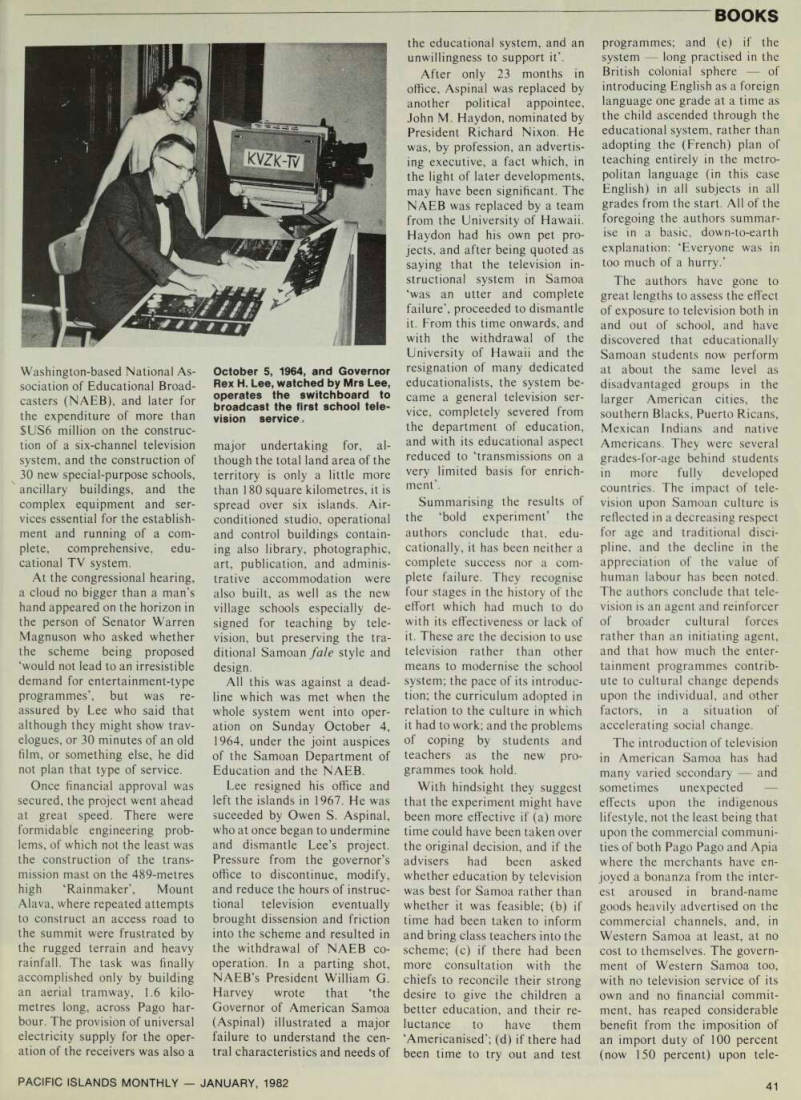
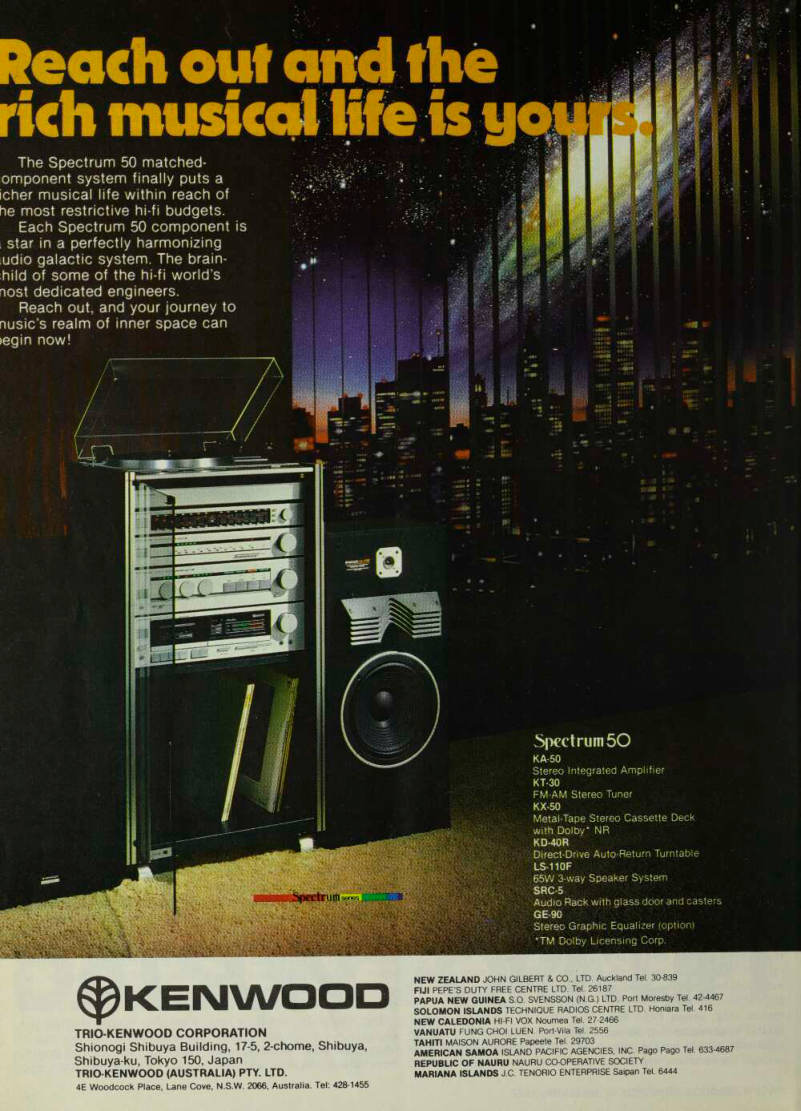
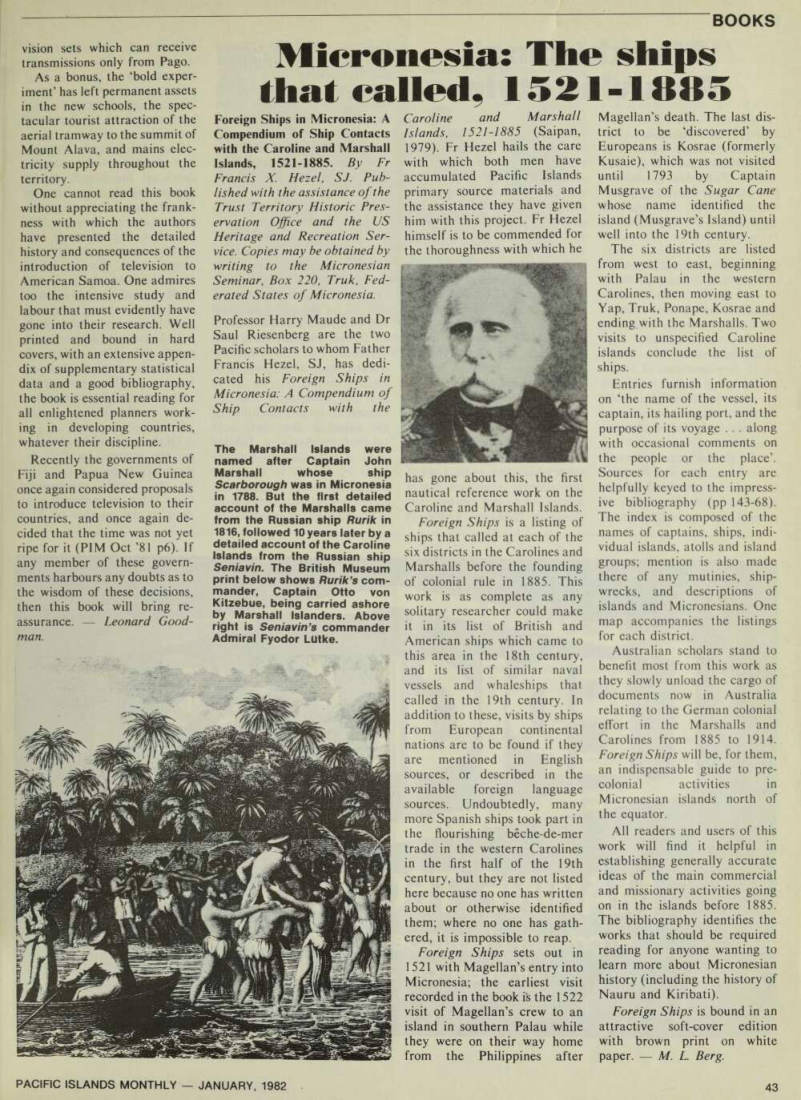
sociation of Educational Broad casters (NAEB), and later for the expenditure of more than SUS 6 million on the construc tion of a six-channel television system, and the construction of 30 new special-purpose schools, ancillary buildings, and the complex equipment and ser vices essential for the establish ment and running of a com plete, comprehensive, edu cational TV system.
At the congressional hearing, a cloud no bigger than a man’s hand appeared on the horizon in the person of Senator Warren Magnuson who asked whether the scheme being proposed ‘would not lead to an irresistible demand for entertainment-type programmes’, but was re assured by Lee who said that although they might show trav elogues, or 30 minutes of an old film, or something else, he did not plan that type of service.
Once financial approval was secured, the project went ahead at great speed. There were formidable engineering prob lems, of which not the least was the construction of the trans mission mast on the 489-metres high ‘Rainmaker’, Mount Alava, where repeated attempts to construct an access road to the summit were frustrated by the rugged terrain and heavy rainfall. The task was finally accomplished only by building an aerial tramway, 1.6 kilo metres long, across Pago har bour. The provision of universal electricity supply for the oper ation of the receivers was also a
major undertaking for, al though the total land area of the territory is only a little more than 180 square kilometres, it is spread over six islands. Air conditioned studio, operational and control buildings contain ing also library, photographic, art, publication, and adminis trative accommodation were also built, as well as the new village schools especially de signed for teaching by tele vision, but preserving the tra ditional Samoan fale style and design.
All this was against a dead line which was met when the whole system went into oper ation on Sunday October 4, 1964, under the joint auspices of the Samoan Department of Education and the NAEB.
Lee resigned his office and left the islands in 1967. He was suceeded by Owen S. Aspinal, who at once began to undermine and dismantle Lee’s project.
Pressure from the governor’s office to discontinue, modify, and reduce the hours of instruc tional television eventually brought dissension and friction into the scheme and resulted in the withdrawal of NAEB co operation. In a parting shot, NAEB’s President William G.
Harvey wrote that ‘the Governor of American Samoa (Aspinal) illustrated a major failure to understand the cen tral characteristics and needs of
the educational system, and an unwillingness to support it’.
After only 23 months in office, Aspinal was replaced by another political appointee, John M. Haydon, nominated by President Richard Nixon. He was, by profession, an advertis ing executive, a fact which, in the light of later developments, may have been significant. The NAEB was replaced by a team from the University of Hawaii.
Haydon had his own pet pro jects, and after being quoted as saying that the television in structional system in Samoa ‘was an utter and complete failure’, proceeded to dismantle it. From this time onwards, and with the withdrawal of the University of Hawaii and the resignation of many dedicated educationalists, the system be came a general television ser vice, completely severed from the department of education, and with its educational aspect reduced to ‘transmissions on a very limited basis for enrich ment'.
Summarising the results of the ‘bold experiment’ the authors conclude that, edu cationally, it has been neither a complete success nor a com plete failure. They recognise four stages in the history of the effort which had much to do with its effectiveness or lack of it. These are the decision to use television rather than other means to modernise the school system; the pace of its introduc tion; the curriculum adopted in relation to the culture in which it had to work; and the problems of coping by students and teachers as the new pro grammes took hold.
With hindsight they suggest that the experiment might have been more effective if (a) more time could have been taken over the original decision, and if the advisers had been asked whether education by television was best for Samoa rather than whether it was feasible; (b) if time had been taken to inform and bring class teachers into the scheme; (c) if there had been more consultation with the chiefs to reconcile their strong desire to give the children a better education, and their re luctance to have them ‘Americanised’; (d) if there had been time to try out and test
programmes; and (e) if the system long practised in the British colonial sphere of introducing English as a foreign language one grade at a time as the child ascended through the educational system, rather than adopting the (French) plan of teaching entirely in the metro politan language (in this case English) in all subjects in all grades from the start. All of the foregoing the authors summar ise in a basic, down-to-earth explanation; ‘Everyone was in too much of a hurry.’
The authors have gone to great lengths to assess the effect of exposure to television both in and out of school, and have discovered that educationally Samoan students now perform at about the same level as disadvantaged groups in the larger American cities, the southern Blacks, Puerto Ricans, Mexican Indians and native Americans. They were several grades-for-age behind students in more fully developed countries. The impact of tele vision upon Samoan culture is reflected in a decreasing respect for age and traditional disci pline. and the decline in the appreciation of the value of human labour has been noted.
The authors conclude that tele vision is an agent and reinforcer of broader cultural forces rather than an initiating agent, and that how much the enter tainment programmes contrib ute to cultural change depends upon the individual, and other factors, in a situation of accelerating social change.
The introduction of television in American Samoa has had many varied secondary and sometimes unexpected effects upon the indigenous lifestyle, not the least being that upon the commercial communi ties of both Pago Pago and Apia where the merchants have en joyed a bonanza from the inter est aroused in brand-name goods heavily advertised on the commercial channels, and, in Western Samoa at least, at no cost to themselves. The govern ment of Western Samoa too, with no television service of its own and no financial commit ment, has reaped considerable benefit from the imposition of an import duty of 100 percent (now 150 percent) upon tele
October 5, 1964, and Governor Rex H. Lee, watched by Mrs Lee, operates the switchboard to broadcast the first school tele vision service,
vision sets which can receive transmissions only from Pago.
As a bonus, the ‘bold exper iment’ has left permanent assets in the new schools, the spec tacular tourist attraction of the aerial tramway to the summit of Mount Alava, and mains elec tricity supply throughout the territory.
One cannot read this book without appreciating the frank ness with which the authors have presented the detailed history and consequences of the introduction of television to American Samoa. One admires too the intensive study and labour that must evidently have gone into their research. Well printed and bound in hard covers, with an extensive appen dix of supplementary statistical data and a good bibliography, the book is essential reading for all enlightened planners work ing in developing countries, whatever their discipline.
Recently the governments of Fiji and Papua New Guinea once again considered proposals to introduce television to their countries, and once again de cided that the time was not yet ripe for it (PIM Oct ’Bl p 6). If any member of these govern ments harbours any doubts as to the wisdom of these decisions, then this book will bring re assurance. Leonard Good man.
Micronesia: The ships
that called, 1531-1885
Foreign Ships in Micronesia: A Compendium of Ship Contacts with the Caroline and Marshall Islands, 1521-1885. By Fr Francis X. Hezel, SJ. Pub lished with the assistance of the Trust Territory Historic Pres ervation Office and the US Heritage and Recreation Ser vice. Copies may be obtained by writing to the Micronesian Seminar, Box 220, Truk, Fed erated States of Micronesia.
Professor Harry Maude and Dr Saul Riesenberg are the two Pacific scholars to whom Father Francis Hezel, SJ, has dedi cated his Foreign Ships in Micronesia: A Compendium of Ship Contacts with the
Caroline and Marshall Islands, 1521-1885 (Saipan, 1979). Fr Hezel hails the care with which both men have accumulated Pacific Islands primary source materials and the assistance they have given him with this project. Fr Hezel himself is to be commended for the thoroughness with which he
has gone about this, the first nautical reference work on the Caroline and Marshall Islands.
Foreign Ships is a listing of ships that called at each of the six districts in the Carolines and Marshalls before the founding of colonial rule in 1885. This work is as complete as any solitary researcher could make it in its list of British and American ships which came to this area in the 18th century, and its list of similar naval vessels and whaleships that called in the 19th century. In addition to these, visits by ships from European continental nations are to be found if they are mentioned in English sources, or described in the available foreign language sources. Undoubtedly, many more Spanish ships took part in the flourishing beche-de-mer trade in the western Carolines in the first half of the 19th century, but they are not listed here because no one has written about or otherwise identified them; where no one has gath ered, it is impossible to reap.
Foreign Ships sets out in 1521 with Magellan’s entry into Micronesia; the earliest visit recorded in the book is the 1522 visit of Magellan’s crew to an island in southern Palau while they were on their way home from the Philippines after
paper.
Magellan’s death. The last dis trict to be ‘discovered’ by Europeans is Kosrae (formerly Kusaie), which was not visited until 1793 by Captain Musgrave of the Sugar Cane whose name identified the island (Musgrave’s Island) until well into the 19th century.
The six districts are listed from west to east, beginning with Palau in the western Carolines, then moving east to Yap, Truk, Ponape, Kosrae and ending with the Marshalls. Two visits to unspecified Caroline islands conclude the list of ships.
Entries furnish information on ‘the name of the vessel, its captain, its hailing port, and the purpose of its voyage . . . along with occasional comments on the people or the place’.
Sources for each entry are helpfully keyed to the impress ive bibliography (pp 143-68).
The index is composed of the names of captains, ships, indi vidual islands, atolls and island groups; mention is also made there of any mutinies, ship wrecks, and descriptions of islands and Micronesians. One map accompanies the listings for each district.
Australian scholars stand to benefit most from this work as they slowly unload the cargo of documents now in Australia relating to the German colonial effort in the Marshalls and Carolines from 1885 to 1914.
Foreign Ships will be, for them, an indispensable guide to pre colonial activities in Micronesian islands north of the equator.
All readers and users of this work will find it helpful in establishing generally accurate ideas of the main commercial and missionary activities going on in the islands before 1885.
The bibliography identifies the works that should be required reading for anyone wanting to learn more about Micronesian history (including the history of Nauru and Kiribati).
Foreign Ships is bound in an attractive soft-cover edition with brown print on white
M. L. Berg.
The Marshall Islands were named after Captain John Marshall whose ship Scarborough was in Micronesia in 1788. But the first detailed account of the Marshalls came from the Russian ship Rurik in 1816, followed 10 years later by a detailed account of the Caroline Islands from the Russian ship Seniavin. The British Museum print below shows Rurik’s com mander, Captain Otto von Kitzebue, being carried ashore by Marshall Islanders. Above right is Seniavin’s commander Admiral Fyodor Lutke.
‘Blackbirding’,
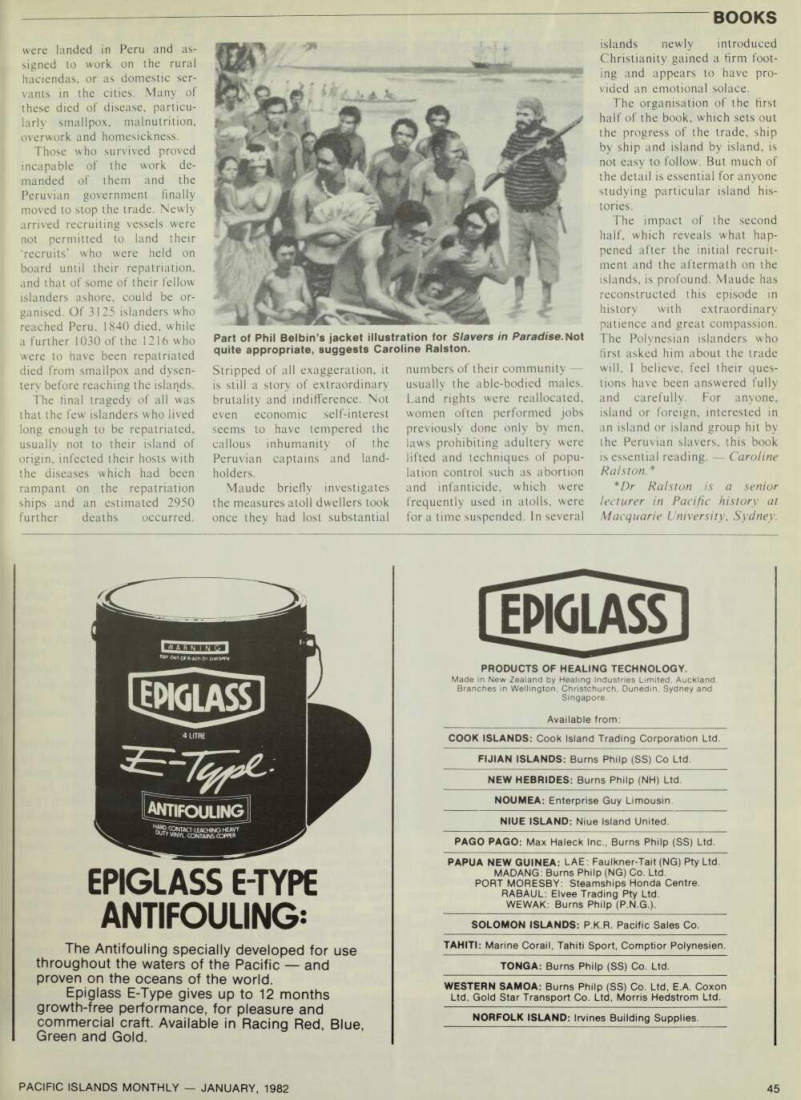
Peruvian style
Slavers in Paradise: The Peruvian Labour Trade in Polynesia, 1862-1864. By H E.
Maude. Published by Austra lian National University Press, Canberra, 1981. xxii and 244
(Pp.) Isbn O 7081 1607 8.
Price SA2S.
Despite the dustjacket picture and the title, Slavers in Para dise is a serious academic study and a most welcome addition to the history of many islands in Polynesia and Kiribati. The offending picture is a crude, garish representation of brown people being herded into boats by armed white villains, while the title across this background suggests little but Hollywood sensationalism.
The ‘slavers’ part of the title is not inaccurate. The Peruvian Government attempted to regu late the trade, to insist on properly interpreted contracts.
voluntarily signed, and to en sure that the islanders were adequately treated once they reached Peru. But in practice none of the regulations was adhered to. The means of ac quiring Pacific islanders and their conditions in Peru were little short of slavery.
The equation of the island world with ‘paradise’ is more questionable. In contrast to the conditions the islanders en dured on the ships and in Peru, undoubtedly home was para dise. But the stereotype of Polynesia as paradise is one most modern Polynesian histo rians shun as inaccurate and unhelpful, and Maude himself claims that some islanders went on board the slavers' vessels hoping to find food or access to food, which was, at the time of the slavers’ visit, so scarce ashore. To my mind The Peruvian Labour Trade in
Polynesia 1862-1864 would have been a more appropriate and illuminating title.
But these criticisms are not fundamental. Discard the dustjacket, ignore the title and one has a book impeccably presented, and meticulously and exhaustively researched qualities for which H.E. Maude is justifiably renowned.
Not surprisingly, over the intervening century, many as pects of the Peruvian labour trade have been exaggerated, as Maude makes clear. For example, there is no evidence to suggest that islanders were ‘re cruited’ for the guano mines on the Chincha Islands off main land Peru, and very little good evidence that any islander worked there after landing at Callao. Similarly, the claim that 200 men (more than the estimated total population of the island at the time) were taken from Atafu, a Tokelau atoll, is reduced most convinc ingly by Maude to 37. These and many other legends are carefully explored, the sources of falsification and exaggeration
documented, and the record straightened. This does not, however, mean that the story which is revealed is not gruel ling and inhumane; it is, as a brief resume of the facts will establish.
The whole tragedy, from the first islander taken to the last death on the islands due to diseases introduced by the very few islanders who were repatri ated, occurred between 1862 and 1864. Approximately 3500 islanders were rounded up, mostly from Easter Island, Niue, the Cook Islands, Tuvalu, Kiribati and the Marquesas.
Atoll dwellers were more vul nerable than high-island inhabi tants because the former had no means of retreat from the armed slavers, and their iso lation left them unprotected and unwarned by missionaries, white officials or other islanders.
Of those ‘recruited’, 345 died on the voyage to Peru dysentery being a major killer on the grossly overcrowded ships. Men, women and chil dren to the number of 2116
were landed in Peru and as signed to work on the rural haciendas, or as domestic ser vants in the cities. Many of these died of disease, particu larly smallpox, malnutrition, overwork and homesickness.
Those who survived proved incapable of the work de manded of them and the Peruvian government finally moved to stop the trade. Newly arrived recruiting vessels were not permitted to land their ‘recruits’ who were held on board until their repatriation, and that of some of their fellow islanders ashore, could be or ganised. Of 3125 islanders who reached Peru, 1840 died, while a further 1030 of the 1216 who were to have been repatriated died from smallpox and dysen tery before reaching the islands.
The final tragedy of all was that the few islanders who lived long enough to be repatriated, usually not to their island of origin, infected their hosts with the diseases which had been rampant on the repatriation ships and an estimated 2950 further deaths occurred.
Stripped of all exaggeration, it is still a story of extraordinary brutality and indifference. Not even economic self-interest seems to have tempered the callous inhumanity of the Peruvian captains and land holders.
Maude briefly investigates the measures atoll dwellers took once they had lost substantial
numbers of their community usually the able-bodied males.
Land rights were reallocated, women often performed jobs previously done only by men, laws prohibiting adultery were lifted and techniques of popu lation control such as abortion and infanticide, which were frequently used in atolls, were for a time suspended. In several
islands newly introduced Christianity gained a firm foot ing and appears to have pro vided an emotional solace.
The organisation of the first half of the book, which sets out the progress of the trade, ship by ship and island by island, is not easy to follow. But much of the detail is essential for anyone studying particular island his tories.
The impact of the second half, which reveals what hap pened after the initial recruit ment and the aftermath on the islands, is profound. Maude has reconstructed this episode in history with extraordinary patience and great compassion.
The Polynesian islanders who first asked him about the trade will, 1 believe, feel their ques tions have been answered fully and carefully. For anyone, island or foreign, interested in an island or island group hit by the Peruvian slavers, this book
is essential reading.
Caroline
Ralston.
*Dr Ralston is a senior lecturer in Pacific history at Macquarie University, Sydney.
Part of Phil Belbin’s jacket illustration for Slavers in Paradise. Not quite appropriate, suggests Caroline Ralston.
Advertisements & other items, pp. 44-45 (1 item)
Epkjlass
MARINE TECHNOLOGY.
Products developed in the laboratory, proven on the water ...
IjWOLAS^
PRODUCTS OF HEALING TECHNOLOGY.
Made in New Zealand by Healing Industries Limited, Auckland.
Branches in Wellington, Christchurch. Dunedin, Sydney and Singapore.
Available from: COOK ISLANDS: Cook Island Trading Corporation Ltd.
FIJIAN ISLANDS: Burns Philp (SS) Co Ltd.
NEW HEBRIDES: Burns Philp (NH) Ltd.
NOUMEA: Enterprise Guy Limousin.
NIUE ISLAND: Niue Island United.
PAGO PAGO: Max Haleck Inc., Burns Philp (SS) Ltd.
PAPUA NEW GUINEA: LAE . Faulkner-Tait (NG) PtyLtd.
MADANG: Burns Philp (NG) Co. Ltd.
PORT MORESBY: Steamships Honda Centre.
RABAUL: Elvee Trading Pty Ltd.
WEWAK; Burns Philp (P N G.).
SOLOMON ISLANDS: P.K.R. Pacific Sales Co.
TAHITI: Marine Corail, Tahiti Sport, Comptior Polynesien.
TONGA: Burns Philp (SS) Co. Ltd.
WESTERN SAMOA: Burns Philp (SS) Co. Ltd, E.A. Coxon Ltd, Gold Star Transport Co. Ltd, Morris Hedstrom Ltd.
NORFOLK ISLAND: Irvines Building Supplies.
rit» OM Of n.jif,, (.MOW
IPKjLASS
EPIGLASS E-TYPE
ANTIFOULING:
The Antifouling specially developed for use throughout the waters of the Pacific and proven on the oceans of the world.
Epiglass E-Type gives up to 12 months growth-free performance, for pleasure and commercial craft. Available in Racing Red, Blue, Green and Gold.
its ‘islands adjacent’
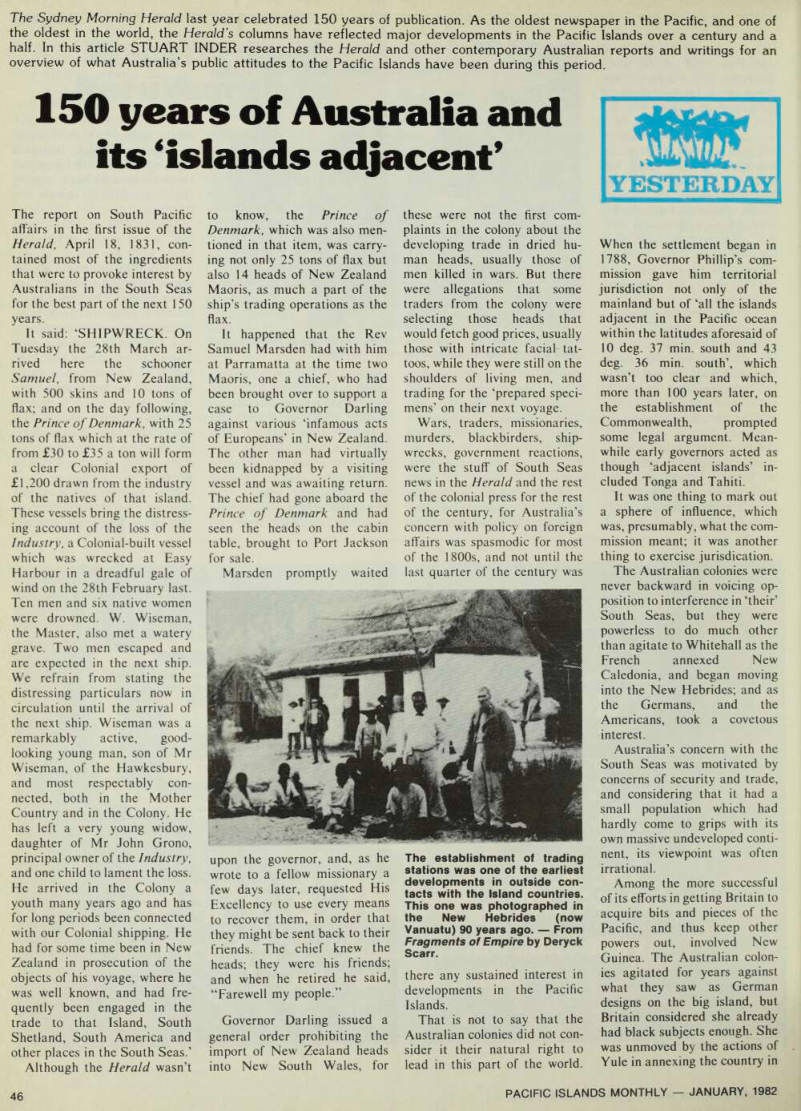
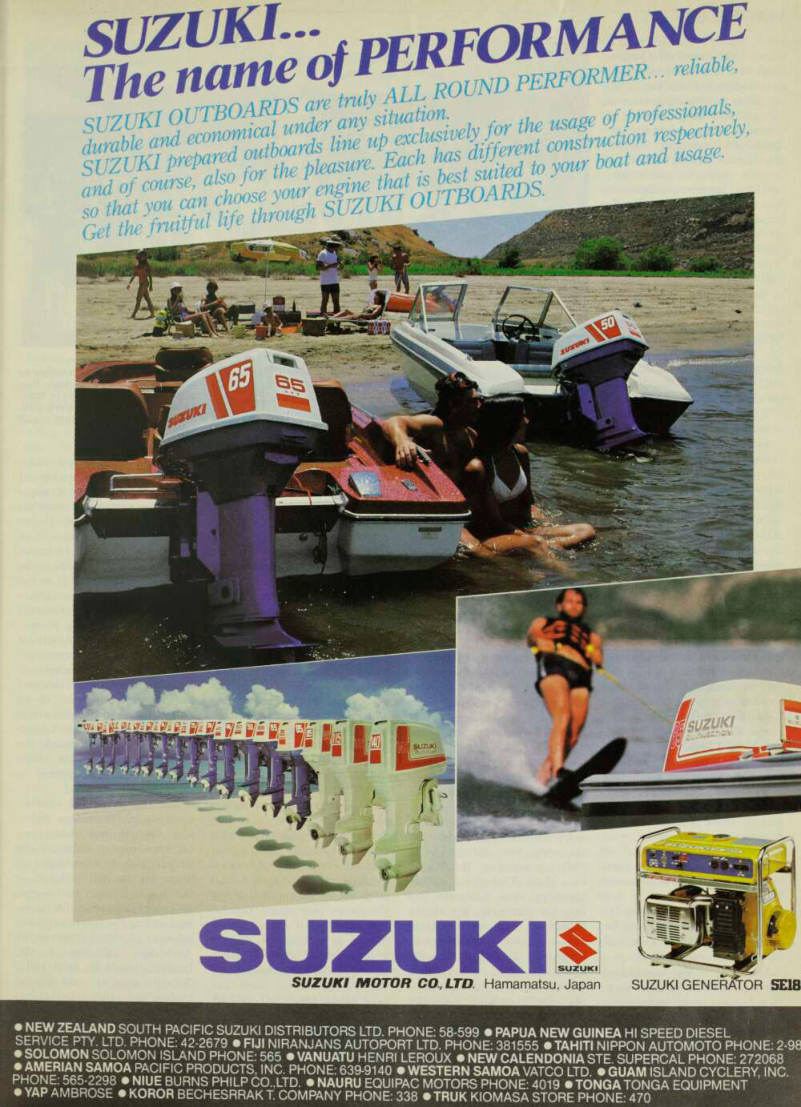
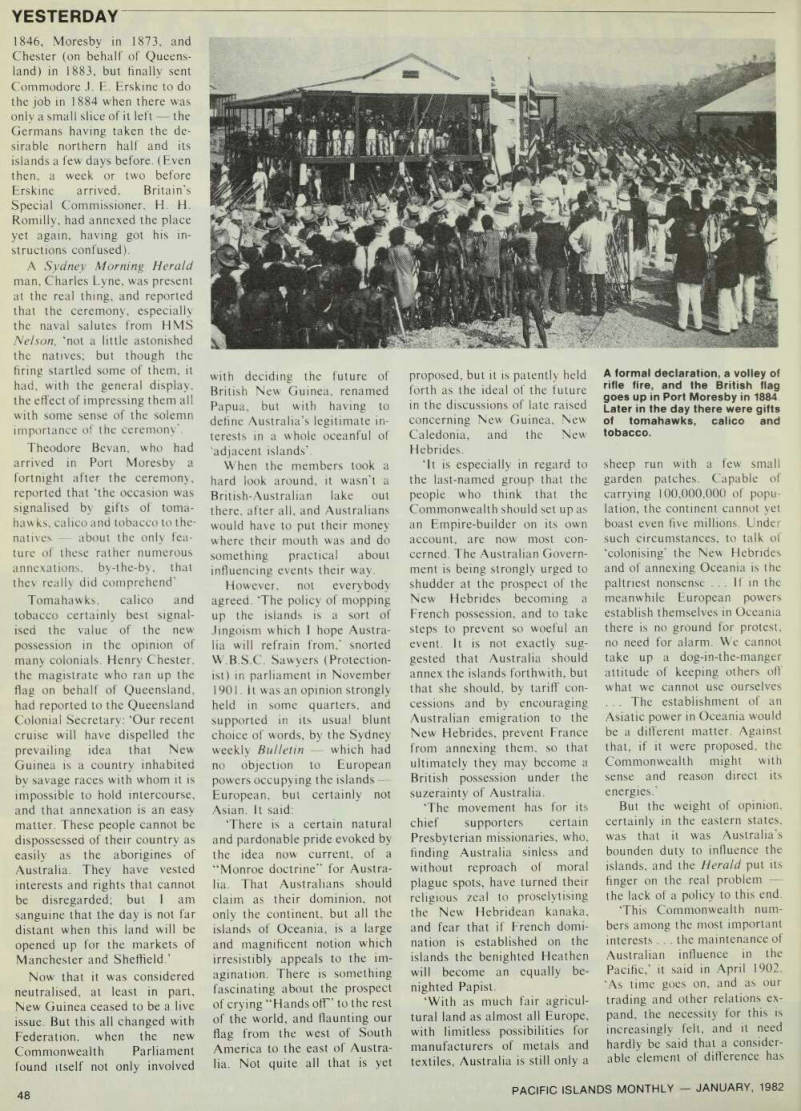
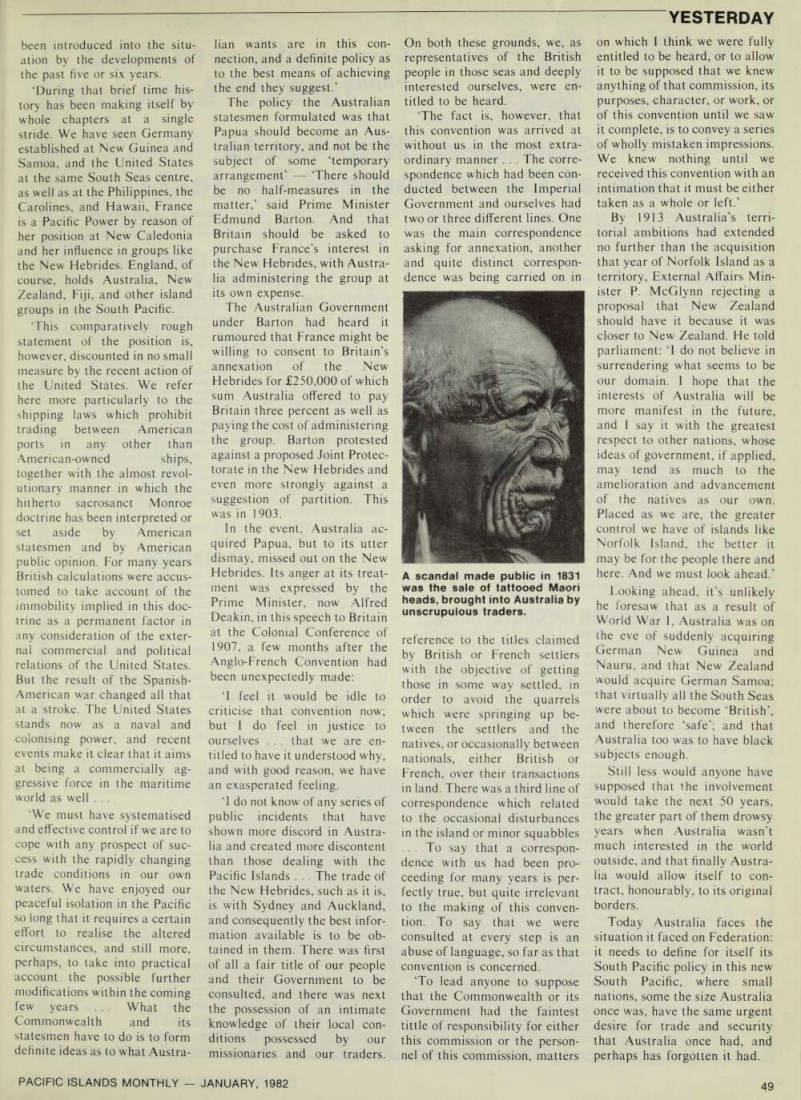
Yesterday
150 years of Australia and its ‘islands adjacent’
The Sydney Morning Herald last year celebrated 150 years of publication. As the oldest newspaper in the Pacific, and one of the oldest in the world, the Herald s columns have reflected major developments in the Pacific Islands over a century and a half. In this article STUART INDER researches the Herald and other contemporary Australian reports and writings for an overview of what Australia’s public attitudes to the Pacific Islands have been during this period.
The report on South Pacific affairs in the first issue of the Herald, April 18, 1831, con tained most of the ingredients that were to provoke interest by Australians in the South Seas for the best part of the next 150 years.
It said: ‘SHIPWRECK. On Tuesday the 28th March ar rived here the schooner Samuel, from New Zealand, with 500 skins and 10 tons of flax; and on the day following, the Prince of Denmark, with 25 tons of flax which at the rate of from £3O to £35 a ton will form a clear Colonial export of £1,200 drawn from the industry of the natives of that island.
These vessels bring the distress ing account of the loss of the Industry, a Colonial-built vessel which was wrecked at Easy Harbour in a dreadful gale of wind on the 28th February last.
Ten men and six native women were drowned. W. Wiseman, the Master, also met a watery grave. Two men escaped and are expected in the next ship.
We refrain from stating the distressing particulars now in circulation until the arrival of the next ship. Wiseman was a remarkably active, good looking young man, son of Mr Wiseman, of the Hawkesbury, and most respectably con nected, both in the Mother Country and in the Colony. He has left a very young widow, daughter of Mr John Grono, principal owner of the Industry, and one child to lament the loss.
He arrived in the Colony a youth many years ago and has for long periods been connected with our Colonial shipping. He had for some time been in New Zealand in prosecution of the objects of his voyage, where he was well known, and had fre quently been engaged in the trade to that Island, South Shetland, South America and other places in the South Seas.’
Although the Herald wasn’t
to know, the Prince of Denmark, which was also men tioned in that item, was carry ing not only 25 tons of flax but also 14 heads of New Zealand Maoris, as much a part of the ship’s trading operations as the flax.
It happened that the Rev Samuel Marsden had with him at Parramatta at the time two Maoris, one a chief, who had been brought over to support a case to Governor Darling against various ‘infamous acts of Europeans’ in New Zealand.
The other man had virtually been kidnapped by a visiting vessel and was awaiting return.
The chief had gone aboard the Prince of Denmark and had seen the heads on the cabin table, brought to Port Jackson for sale.
Marsden promptly waited
upon the governor, and, as he wrote to a fellow missionary a few days later, requested His Excellency to use every means to recover them, in order that they might be sent back to their friends. The chief knew the heads; they were his friends; and when he retired he said, “Farewell my people.”
Governor Darling issued a general order prohibiting the import of New Zealand heads into New South Wales, for
these were not the first com plaints in the colony about the developing trade in dried hu man heads, usually those of men killed in wars. But there were allegations that some traders from the colony were selecting those heads that would fetch good prices, usually those with intricate facial tat toos, while they were still on the shoulders of living men, and trading for the ‘prepared speci mens’ on their next voyage.
Wars, traders, missionaries, murders, blackbirders, ship wrecks, government reactions, were the stuff of South Seas news in the Herald and the rest of the colonial press for the rest of the century, for Australia’s concern with policy on foreign affairs was spasmodic for most of the 1800 s, and not until the last quarter of the century was
there any sustained interest in developments in the Pacific Islands.
That is not to say that the Australian colonies did not con sider it their natural right to lead in this part of the world.
When the settlement began in 1788, Governor Phillip’s com mission gave him territorial jurisdiction not only of the mainland but of ‘all the islands adjacent in the Pacific ocean within the latitudes aforesaid of 10 deg. 37 min. south and 43 deg. 36 min. south’, which wasn’t too clear and which, more than 100 years later, on the establishment of the Commonwealth, prompted some legal argument. Mean while early governors acted as though ‘adjacent islands’ in cluded Tonga and Tahiti.
It was one thing to mark out a sphere of influence, which was, presumably, what the com mission meant; it was another thing to exercise jurisdication.
The Australian colonies were never backward in voicing op position to interference in ‘their’
South Seas, but they were powerless to do much other than agitate to Whitehall as the French annexed New Caledonia, and began moving into the New Hebrides; and as the Germans, and the Americans, took a covetous interest.
Australia’s concern with the South Seas was motivated by concerns of security and trade, and considering that it had a small population which had hardly come to grips with its own massive undeveloped conti nent, its viewpoint was often irrational.
Among the more successful of its efforts in getting Britain to acquire bits and pieces of the Pacific, and thus keep other powers out, involved New Guinea. The Australian colon ies agitated for years against what they saw as German designs on the big island, but Britain considered she already had black subjects enough. She was unmoved by the actions of Yule in annexing the country in
The establishment of trading stations was one of the earliest developments in outside con tacts with the Island countries.
This one was photographed in the New Hebrides (now Vanuatu) 90 years ago. - From Fragments of Empire by Deryck Scarr.
1846, Moresby in 1873, and Chester (on behalf of Queens land) in 1883, but finally sent Commodore J. E. Erskine to do the job in 1884 when there was only a small slice of it left the Germans having taken the de sirable northern half and its islands a few days before. (Even then, a week or two before Erskine arrived, Britain’s Special Commissioner, H H.
Romilly, had annexed the place yet again, having got his in structions confused).
A Sydney Morning Herald man, Charles Lyne, was present at the real thing, and reported that the ceremony, especially the naval salutes from HMS Nelson, ‘not a little astonished the natives; but though the firing startled some of them, it had, with the general display, the effect of impressing them all with some sense of the solemn importance of the ceremony'.
Theodore Bevan, who had arrived in Port Moresby a fortnight after the ceremony, reported that ‘the occasion was signalised by gifts of toma hawks. calico and tobacco to the' natives about the only fea ture of these rather numerous annexations, by-lhe-by, that thev really did comprehend' Tomahawks, calico and tobacco certainly best signal ised the value of the new possession in the opinion of many colonials. Henry Chester, the magistrate who ran up the flag on behalf of Queensland, had reported to the Queensland Colonial Secretary: ‘Our recent cruise will have dispelled the prevailing idea that New Guinea is a country inhabited by savage races with whom it is impossible to hold intercourse, and that annexation is an easy matter. These people cannot be dispossessed of their country as easily as the aborigines of Australia. They have vested interests and rights that cannot be disregarded; but I am sanguine that the day is not far distant when this land will be opened up for the markets of Manchester and Sheffield.’
Now that it was considered neutralised, at least in part.
New Guinea ceased to be a live issue. But this all changed with Federation, when the new Commonwealth Parliament found itself not only involved
with deciding the future of British New Guinea, renamed Papua, but with having to define Australia’s legitimate in terests in a whole oceanful of ‘adjacent islands' When the members took a hard look around, it wasn’t a British-Auslralian lake out there, after all, and Australians would have to put their money where their mouth was and do something practical about influencing events their way.
However. not everybody agreed. ‘The policy of mopping up the islands is a sort of Jingoism which I hope Austra lia will refrain from,' snorted W.B.S.C. Sawyers (Protection ist) in parliament in November 1901. it was an opinion strongly held in some quarters, and supported in its usual blunt choice of words, by the Sydney weekly Bulletin which had no objection to European powers occupying the islands European, but certainly not Asian. It said: ‘There is a certain natural and pardonable pride evoked by the idea now current, of a “Monroe doctrine" for Austra lia. That Australians should claim as their dominion, not only the continent, but all the islands of Oceania, is a large and magnificent notion which irresistibly appeals to the im agination. There is something fascinating about the prospect of crying “Hands off" to the rest of the world, and flaunting our flag from the west of South America to the east of Austra lia. Not quite all that is yet
proposed, but it is patently held forth as the ideal of the future in the discussions of late raised concerning New Guinea. New Caledonia, and the New Hebrides. ‘lt is especially in regard to the last-named group that the people who think that the Commonwealth should set up as an Empire-builder on its own account, are now most con cerned. The Australian Govern ment is being strongly urged to shudder at the prospect of the New Hebrides becoming a French possession, and to take steps to prevent so woeful an event. It is not exactly sug gested that Australia should annex the islands forthwith, but that she should, by tariff con cessions and by encouraging Australian emigration to the New Hebrides, prevent France from annexing them, so that ultimately they may become a British possession under the suzerainty of Australia. ‘The movement has for its chief supporters certain Presbyterian missionaries, who, finding Australia sinless and without reproach of moral plague spots, have turned their religious zeal to proselytising the New Hebridean kanaka, and fear that if French domi nation is established on the islands the benighted Heathen will become an equally be nighted Papist. ‘With as much fair agricul tural land as almost all Europe, with limitless possibilities for manufacturers of metals and textiles, Australia is still only a
sheep run with a few small garden patches. Capable of carrying 100,000.000 of popu lation, the continent cannot yet boast even five millions. Under such circumstances, to talk of ‘colonising’ the New Hebrides and of annexing Oceania is the paltriest nonsense ... If in the meanwhile European powers establish themselves in Oceania there is no ground for protest, no need for alarm. We cannot take up a dog-in-the-manger attitude of keeping others oft’ what we cannot use ourselves . . . The establishment of an Asiatic power in Oceania would be a different matter. Against that, if it were proposed, the Commonwealth might with sense and reason direct its energies.’
But the weight of opinion, certainly in the eastern states, was that it was Australia's bounden duty to influence the islands, and the Herald pul its finger on the real problem the lack of a policy to this end. ‘This Commonwealth num bers among the most important interests ... the maintenance of Australian influence in the Pacific,’ it said in April 1902. ‘As lime goes on, and as our trading and other relations ex pand, the necessity for this is increasingly felt, and it need hardly be said that a consider able element of difference has
A formal declaration, a volley of rifle fire, and the British flag goes up in Port Moresby in 1884 Later in the day there were gifts of tomahawks, calico and tobacco.
been introduced into the situ ation by the developments of the past five or six years. ‘During that brief time his tory has been making itself by whole chapters at a single stride. We have seen Germany established at New Guinea and Samoa, and the United States at the same South Seas centre, as well as at the Philippines, the Carolines, and Hawaii, France is a Pacific Power by reason of her position at New Caledonia and her influence in groups like the New Hebrides. England, of course, holds Australia, New Zealand, Fiji, and other island groups in the South Pacific. ‘This comparatively rough statement of the position is, however, discounted in no small measure by the recent action of the United States. We refer here more particularly to the shipping laws which prohibit trading between American ports in any other than American-owned ships, together with the almost revol utionary manner in which the hitherto sacrosanct Monroe doctrine has been interpreted or set aside by American statesmen and by American public opinion. For many years British calculations were accus tomed to take account of the immobility implied in this doc trine as a permanent factor in any consideration of the exter nal commercial and political relations of the United States.
But the result of the Spanish- American war changed all that at a stroke. The United States stands now as a naval and colonising power, and recent events make it clear that it aims at being a commercially ag gressive force in the maritime world as well . . . ‘We must have systematised and effective control if we are to cope with any prospect of suc cess with the rapidly changing trade conditions in our own waters. We have enjoyed our peaceful isolation in the Pacific so long that it requires a certain effort to realise the altered circumstances, and still more, perhaps, to take into practical account the possible further modifications within the coming few years .. . What the Commonwealth and its statesmen have to do is to form definite ideas as to what Austra-
Man wants are in this con nection, and a definite policy as to the best means of achieving the end they suggest.’
The policy the Australian statesmen formulated was that Papua should become an Aus tralian territory, and not be the subject of some ‘temporary arrangement’ ‘There should be no half-measures in the matter,’ said Prime Minister Edmund Barton. And that Britain should be asked to purchase France’s interest in the New Hebrides, with Austra lia administering the group at its own expense.
The Australian Government under Barton had heard it rumoured that France might be willing to consent to Britain’s annexation of the New Hebrides for £250,000 of which sum Australia offered to pay Britain three percent as well as paying the cost of administering the group. Barton protested against a proposed Joint Protec torate in the New Hebrides and even more strongly against a suggestion of partition. This was in 1903.
In the event, Australia ac quired Papua, but to its utter dismay, missed out on the New Hebrides. Its anger at its treat ment was expressed by the Prime Minister, now Alfred Deakin, in this speech to Britain at the Colonial Conference of 1907, a few months after the Anglo-French Convention had been unexpectedly made: T feel it would be idle to criticise that convention now; but I do feel in justice to ourselves . . . that we are en titled to have it understood why, and with good reason, we have an exasperated feeling.
T do not know of any series of public incidents that have shown more discord in Austra lia and created more discontent than those dealing with the Pacific Islands . . . The trade of the New Hebrides, such as it is, is with Sydney and Auckland, and consequently the best infor mation available is to be ob tained in them. There was first of all a fair title of our people and their Government to be consulted, and there was next the possession of an intimate knowledge of their local con ditions possessed by our missionaries and our traders.
On both these grounds, we, as representatives of the British people in those seas and deeply interested ourselves, were en titled to be heard. ‘The fact is, however, that this convention was arrived at without us in the most extra ordinary manner . . . The corre spondence which had been con ducted between the Imperial Government and ourselves had two or three different lines. One was the main correspondence asking for annexation, another and quite distinct correspon dence was being carried on in
reference to the titles claimed by British or French settlers with the objective of getting those in some way settled, in order to avoid the quarrels which were springing up be tween the settlers and the natives, or occasionally between nationals, either British or French, over their transactions in land. There was a third line of correspondence which related to the occasional disturbances in the island or minor squabbles . . . To say that a correspon dence with us had been pro ceeding for many years is per fectly true, but quite irrelevant to the making of this conven tion. To say that we were consulted at every step is an abuse of language, so far as that convention is concerned. ‘To lead anyone to suppose that the Commonwealth or its Government had the faintest tittle of responsibility for either this commission or the person nel of this commission, matters
on which I think we were fully entitled to be heard, or to allow it to be supposed that we knew anything of that commission, its purposes, character, or work, or of this convention until we saw it complete, is to convey a series of wholly mistaken impressions.
We knew nothing until we received this convention with an intimation that it must be either taken as a whole or left.’
By 1913 Australia’s terri torial ambitions had extended no further than the acquisition that year of Norfolk Island as a territory. External Affairs Min ister P. McGlynn rejecting a proposal that New Zealand should have it because it was closer to New Zealand. He told parliament: '1 do not believe in surrendering what seems to be our domain. 1 hope that the interests of Australia will be more manifest in the future, and I say it with the greatest respect to other nations, whose ideas of government, if applied, may tend as much to the amelioration and advancement of the natives as our own.
Placed as we are, the greater control we have of islands like Norfolk Island, the better it may be for the people there and here. And we must look ahead.’
Looking ahead, it’s unlikely he foresaw that as a result of World War I, Australia was on the eve of suddenly acquiring German New Guinea and Nauru, and that New Zealand would acquire German Samoa; that virtually all the South Seas were about to become ‘British’, and therefore ‘safe’; and that Australia too was to have black subjects enough.
Still less would anyone have supposed that the involvement would take the next 50 years, the greater part of them drowsy years when Australia wasn’t much interested in the world outside, and that finally Austra lia would allow itself to con tract, honourably, to its original borders.
Today Australia faces the situation it faced on Federation; it needs to define for itself its South Pacific policy in this new South Pacific, where small nations, some the size Australia once was, have the same urgent desire for trade and security that Australia once had, and perhaps has forgotten it had.
A scandal made public in 1831 was the sale of tattooed Maori heads, brought into Australia by unscrupulous traders.
Advertisements & other items, pp. 47-50 (1 item)
Thfnatne of
&* £3 5& S'-- - VI v. i
SUZUKI
mmmki
5
SUZUKI
1 Cl c * ✓
SUZUKI I
SUZUKI MOTOR CO, LTD Hamamatsu, Japan SUZUKI GENERATOR SEIB ?cm^4^^^?^9,oTtl,^ ACIFIC SUZUKI DISTRIBUTORS LTD. PHONE: 58-599 • PAPUA NEW GUINEA HI SPEED DIESEL 42 ' 2679 * FIJI NIRANJANS AUTOPORT LTD. PHONE: 381555 • TAHITI NIPPON AUTOMOTO PHONE: 2-9 I M No»9iI? «M ?^ ND PHONE: 565 • VANUATU HENRI LEROUX • NEW CALENDONIA STE. SUPERCAL PHONE: 272068 * A . M ™ oaao oA £mS Fl p PRODUCTS, INC. PHONE: 639-9140 • WESTERN SAMOA VATCO LTD. • GUAM ISLAND CYCLERY, INC.
Pl VJD 9 c B - JilnllIPHILP 1 PHILP CO..LTD. • NAURU EQUIPAC MOTORS PHONE: 4019 • TONGA TONGA EQUIPMENT • YAP AMBROSE • KOROR BECHESRRAKT. COMPANY PHONE: 338 *TRUK KIOMASA STORE PHONE- 470
Unw Government of Papua New Guinea
Southern Highlands
Rural Development Project
Specialist staff are required by the Government of PNG tor the above project an integrated R.D.P. partiallyfinancedbya World Bankcredit agreement, which provides additional inputstothe existing Southern Highlands Province Programmes in road building, cash crop development, secondary and non-formal education, health improvement and staff training.
Specifically the specialists required are:-
EXTENSION TRAINING OFFICER (E.T.0.)
The E.T.O. would be a member of A.RTS.EM U. and would ensure that research results are translated into an appropriate form and pass quickly to the field extension staff and then the target population.
The provincial Public Service has a Provincial Staff Development Officer and other S.D.O.’s in the divisions of Health, Primary Industry, Education and District Services. These divisions have an extension establishment in excessof 600 and the majority of staff have primary and secondary qualifications.
The ETO. would work with these officers developing programmes to:- (I) Identify the needs of field staff for technical skills particularly communication and extension techniques, (II) Design and implement learning exercises to meet these needs and, (III) Evaluate these training programmes.
It is expected there would be heavy emphasis on empirical training but access to a local language radio station and a media unit is available.
As A.F.T.S.E.M.U.’s emphasis is on agriculture the ETO. would probably be an agricultural graduate or diplomate with additional qualifications in Rural Extension.
A strong background in methods of training for extension work amongst a largely illiterate rural population and practical experience in a similar programme would be highly desirable.
COFFEE EXTENSION SPECIALIST (C.E.S.)
The arabica coffee component of the Project envisages the planning of a further 530 ha of smallholder coffee of up to 2500 holdings on traditional land and the provision of advisory and supervisory services to clans or groups wishing to establish commercial holdings between 5 hato2o ha. Atotalof4so haof such clan block development has been described and rural credit through the PNG Development Bank is available.
The Division of Primary Industry provides agricultural extension services and has appointed national officers in each of the seven provincial districts to be specifically responsible for the coffee programme. Most of these officers have tertiary qualifications and some support staff.
The C.ES. would be attached to this division and would work with these officers to develop programmes to service individual smallholders and to provide block designs, development plans, supply services and supervision of rural credit for commercial blocks The successful applicant would have a tertiary agricultural qualification preferably with a rural extension content Experience with coffee smallholders in a developing country would be required and some knowledge of commercial block development most desirable. The ability to prepare programmes and co-ordinate their implementation will be essential.
FOOD CROPS AGRONOMIST
The Food Crops Agronomist would be a member of A. RTS. E M. U. and would work with other agronomy staff on a structured modified cropping system research programme already in progress. The programme is directed towards the evaluation and improvement of the traditional food production system.
The team has identified three ecologically representative areas of the province for intensive study. These small area studies involve the regular field monitoring of family training activities together with the establishment of village and“on station” trials to identify existing production constraints.
The programme will then explore these constraints to provide the extension work force with practical answers to facilitate any necessary intensification of food production and/or introduction of cash crops as a supplement to the food production system.
The Agronomist would have an appropriate degree, and preference would be given to applicants with experience in developing countries ideally with subsistence farming in the highlands tropics
MONITORING AND EVALUATION
OFFICER (M.E.0.)
The M.E.O. would be a member of AF.T.S.EM.U. and would assist that unit to design and carry out surveys of agricultural practices land use, crop and livestock marketing, health and nutritional aspects of the population and demography. Information systems would be required to allow on-going evaluation of the programmes of A.F.T.S.EM.U. members The Provincial Public Service has a Policy, Planning and Advisory Services Division with establishment for Papua New Guinea planning and research personnel. The M.EO. would work with these officers to develop an on-going provincial data collection, interpretation and presentation system capable of being sustained with existing resources Data would be required for a wide range of subjects covering the Province, its people and economy and would include demography, health, education, cash cropping, small industries, incomes and expenditures An initial task would be to inventory existing data sources and screen for validity, input effectiveness and usage. A need appears to exist for the introduction of valid sampling techniques The M. EO. would be either an Economist, Agricltural Economist or Statistician with strong interest in the economics of broad based rural development.
A digital PDP 11 /34 computer and Data Processing Manager are available to the A.F.T.S.E.M.U.
MEDIA UNIT DIRECTOR
The Information Services Branch of the Policy, Planning and Advisory Services Division has been provided with a Media Unit under the Project. The Unitwill have facilities for offset printing, photographic reproduction and audio-visual operations and will provide communication planning expertise to determine the best use of these media in conjunction with divisional extension programmes.
The Media Unit Director would be attached to P.P.A.S. and duties would include:- (I) Working with Provincial divisions, Radio Southern highlands, local government council, missions and other community groups in design pre-test and produce learning and extension materials. (II) Selection and ordering of additional audio-visual equipment (111 of Information Services Branch staff in all aspects of the Media Unit operations.
The successful applicant would have a degree in Social Science or equivalent. Experience in educational communications in developing countries would be highly desirable and specific skills in design and production of printed and audio-visual materials radio broadcasts are essential.
Key staff are required for a term of four years but two year contracts would be considered in some cases and under special circumstances.
Conditions of employment would include the provision of leave fares, housing and generous education allowances for children (including overseas fares and boarding allowances for secondary students).
Interested applicants should apply in writing to the address below giving full personal details, an indication of the nett remuneration expected in American dollars, a telephone contact number, referees, telex or telegraphic contact number or address and enclosing curriculum vitae. Closing date for applications is January 29th, 1982.
The Project Co-ordinator, S.H.R. D.P.
Department of Finance,
Post Office, Wards Strip,Waigani,
Papua New Guinea Telex: Finance NE 22218
Telegrams: Finance, Waigani.
A $100 m plan
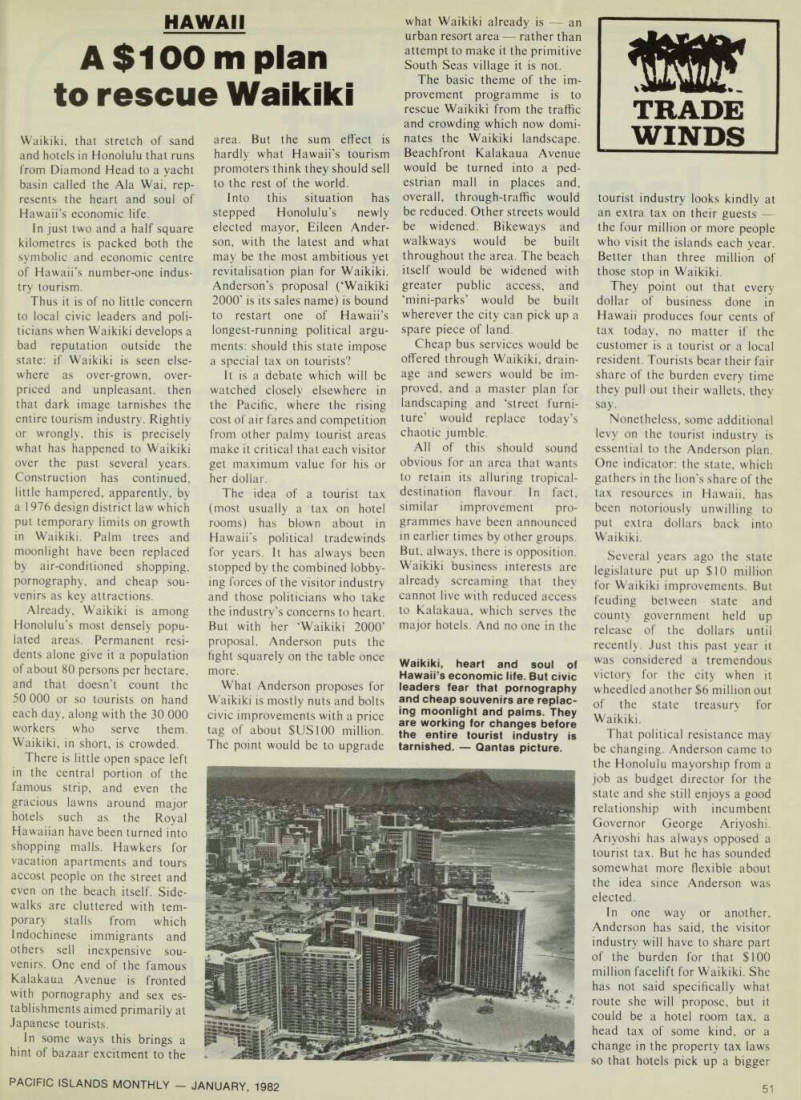

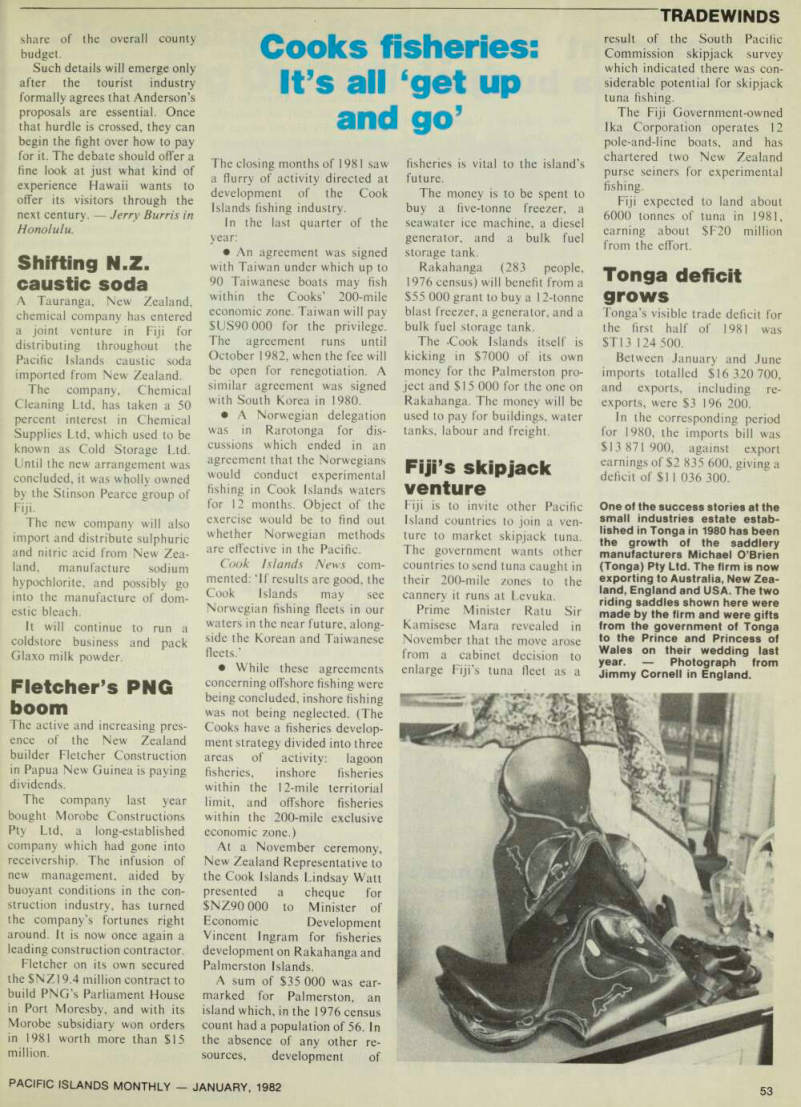
Trade
Winds
Hawaii
A $100 m plan to rescue Waikiki
Waikiki, that stretch of sand and hotels in Honolulu that runs from Diamond Head to a yacht basin called the Ala Wai, rep resents the heart and soul of Hawaii’s economic life.
In just two and a half square kilometres is packed both the symbolic and economic centre of Hawaii’s number-one indus try tourism.
Thus it is of no little concern to local civic leaders and poli ticians when Waikiki develops a bad reputation outside the state: if Waikiki is seen else where as over-grown, over priced and unpleasant, then that dark image tarnishes the entire tourism industry. Rightly or wrongly, this is precisely what has happened to Waikiki over the past several years.
Construction has continued, little hampered, apparently, by a 1976 design district law which pul temporary limits on growth in Waikiki. Palm trees and moonlight have been replaced by air-conditioned shopping, pornography, and cheap sou venirs as key attractions.
Already, Waikiki is among Honolulu’s most densely popu lated areas. Permanent resi dents alone give it a population of about 80 persons per hectare, and that doesn’t count the 50 000 or so tourists on hand each day, along with the 30 000 workers who serve them.
Waikiki, in short, is crowded.
There is little open space left in the central portion of the famous strip, and even the gracious lawns around major hotels such as the Royal Hawaiian have been turned into shopping malls. Hawkers for vacation apartments and tours accost people on the street and even on the beach itself. Side walks are cluttered with tem porary stalls from which Indochinese immigrants and others sell inexpensive sou venirs. One end of the famous Kalakaua Avenue is fronted with pornography and sex es tablishments aimed primarily at Japanese tourists.
In some ways this brings a hint of bazaar excitment to the
area. But the sum effect is hardly what Hawaii’s tourism promoters think they should sell to the rest of the world.
Into this situation has stepped Honolulu’s newly elected mayor, Eileen Ander son, with the latest and what may be the most ambitious yet revitalisation plan for Waikiki.
Anderson’s proposal (‘Waikiki 2000' is its sales name) is bound to restart one of Hawaii’s longest-running political argu ments; should this state impose a special tax on tourists?
It is a debate which will be watched closely elsewhere in the Pacific, where the rising cost of air fares and competition from other palmy tourist areas make it critical that each visitor get maximum value for his or her dollar.
The idea of a tourist tax (most usually a tax on hotel rooms) has blown about in Hawaii’s political tradewinds for years. It has always been stopped by the combined lobby ing forces of the visitor industry and those politicians who take the industry’s concerns to heart.
But with her ‘Waikiki 2000’ proposal, Anderson puts the fight squarely on the table once more.
What Anderson proposes for Waikiki is mostly nuts and bolts civic improvements with a price tag of about SUSIOO million.
The point would be to upgrade
what Waikiki already is an urban resort area rather than attempt to make it the primitive South Seas village it is not.
The basic theme of the im provement programme is to rescue Waikiki from the traffic and crowding which now domi nates the Waikiki landscape.
Beachfront Kalakaua Avenue would be turned into a ped estrian mall in places and, overall, through-traffic would be reduced. Other streets would be widened. Bikeways and walkways would be built throughout the area. The beach itself would be widened with greater public access, and ‘mini-parks’ would be built wherever the city can pick up a spare piece of land.
Cheap bus services would be offered through Waikiki, drain age and sewers would be im proved, and a master plan for landscaping and ‘street furni ture’ would replace today’s chaotic jumble.
All of this should sound obvious for an area that wants to retain its alluring tropical destination flavour. In fact, similar improvement pro grammes have been announced in earlier times by other groups.
But. always, there is opposition.
Waikiki business interests are already screaming that they cannot live with reduced access to Kalakaua, which serves the major hotels. And no one in the
tourist industry looks kindly at an extra tax on their guests the four million or more people who visit the islands each year.
Better than three million of those stop in Waikiki.
They point out that every dollar of business done in Hawaii produces four cents of tax today, no matter if the customer is a tourist or a local resident. Tourists bear their fair share of the burden every time they pull out their wallets, they say.
Nonetheless, some additional levy on the tourist industry is essential to the Anderson plan.
One indicator: the state, which gathers in the lion’s share of the tax resources in Hawaii, has been notoriously unwilling to put extra dollars back into Waikiki.
Several years ago the state legislature put up $lO million for Waikiki improvements. But feuding between state and county government held up release of the dollars until recently. Just this past year it was considered a tremendous victory for the city when it wheedled another $6 million out of the state treasury for Waikiki.
That political resistance may be changing. Anderson came to the Honolulu mayorship from a job as budget director for the state and she still enjoys a good relationship with incumbent Governor George Ariyoshi.
Ariyoshi has always opposed a tourist tax. But he has sounded somewhat more flexible about the idea since Anderson was elected.
In one way or another.
Anderson has said, the visitor industry will have to share part of the burden for that $lOO million facelift for Waikiki. She has not said specifically what route she will propose, but it could be a hotel room tax, a head tax of some kind, or a change in the property tax laws so that hotels pick up a bigger
Waikiki, heart and soul of Hawaii’s economic life. But civic leaders fear that pornography and cheap souvenirs are replac ing moonlight and palms. They are working for changes before the entire tourist industry is
tarnished. - Qantas picture.
share of the overall county budget.
Such details will emerge only after the tourist industry formally agrees that Anderson’s proposals are essential. Once that hurdle is crossed, they can begin the fight over how to pay for it. The debate should offer a fine look at just what kind of experience Hawaii wants to offer its visitors through the next century. Jerry Burris in Honolulu.
Shifting N.Z.
caustic soda
A Tauranga, New Zealand, chemical company has entered a joint venture in Fiji for distributing throughout the Pacific Islands caustic soda imported from New Zealand.
The company, Chemical Cleaning Ltd, has taken a 50 percent interest in Chemical Supplies Ltd, which used to be known as Cold Storage Ltd.
Until the new arrangement was concluded, it was wholly owned by the Stinson Pearce group of Fiji.
The new company will also import and distribute sulphuric and nitric acid from New Zea land, manufacture sodium hypochlorite, and possibly go into the manufacture of dom estic bleach.
It will continue to run a coldstore business and pack Glaxo milk powder.
Fletcher’s PNG
boom
The active and increasing pres ence of the New Zealand builder Fletcher Construction in Papua New Guinea is paying dividends.
The company last year bought Morobe Constructions Ply Ltd, a long-established company which had gone into receivership. The infusion of new management, aided by buoyant conditions in the con struction industry, has turned the company’s fortunes right around. It is now once again a leading construction contractor.
Fletcher on its own secured the SNZI9.4 million contract to build PNG’s Parliament House in Port Moresby, and with its Morobe subsidiary won orders in 1981 worth more than $l5 million.
Advertisements & other items, p. 52 (1 item)
Expert
Insurance Service
throughout the islands
Queensland Insurance (Fiji) Limited
Head Office, 34 Usher St., SUVA . General Manager: L. G. Liddell A.A.1.1. Assistant Managers: R. Jackson, Vijay Lai. Phone: 23851.
LAUTOKA OFFICE: Burns Philp Bldg., Naviti St. District Manager: J. Dalton. Phone: 60642.
Queensland Insurance (PNG) Limited
PAPUA NEW GUINEA
Head Office, B.N.G. Building, Musgrave St PORT MORESBY. General Manager: J. M. Dawe.
Phone: 21 2144.
LAE: 4th St. & Coronation Drive, District Manager: C. D, Hillier Phone: 423873.
MOUNT HAGEN; Hagen Drive. District Manager: G. W. Jack Phone: 521002.
ARAWA: Chebu St. District Manager: J. Longbut. Phone: 951555.' MADANG: Kasagten St. District Manager: N, D. Ramage. Phone: 82 2020.
RABAUL: Wirraway St. District Manager: W. F Tinker. Phone: 921014.
QBE Insurance Limited
VANUATU, PORT VILA: Rue de Paris,Suite 19,Oceania Bldg. Manager: I. R. Martin.
Phone; 2299.
SANTO: Burns Philp (Vanuatu) Ltd. Phone: 230.
PACIFIC AGENCIES llViir A
NEW CALEDONIA Ste. W. A. Johnston, S.A.R.L. 5 Rue Anatole France, NOUMEA.
Phone: 272083.
TAHITI Arthur Chung. Immeuble 8.1.5., Front de Mer, PAPEETE Phone. 2.86.19.
NIUE Burns Philp (South Sea) Company Ltd.
NORFOLK ISLAND: Burns Philp ('N I ) Company Ltd. Phone: 2191 c/\ynA APIA Burns Philo (South Sea) Company Ltd. Phone. 22611 TONGA Burns Philp (South Sea) Company Ltd. NUKUALOFA. Phone 21500 HAAPAI. VAVAU
MEMBERS OF THE:
INSURANCE GROUP LIMITED
and go’
Cooks fisheries: It’s all ‘get up and go’
The closing months of 1981 saw a flurry of activity directed at development of the Cook Islands fishing industry.
In the last quarter of the year: • An agreement was signed with Taiwan under which up to 90 Taiwanese boats may fish within the Cooks’ 200-mile economic zone. Taiwan will pay SUS9O 000 for the privilege.
The agreement runs until October 1982, when the fee will be open for renegotiation. A similar agreement was signed with South Korea in 1980. • A Norwegian delegation was in Rarotonga for dis cussions which ended in an agreement that the Norwegians would conduct experimental fishing in Cook Islands waters for 12 months. Object of the exercise would be to find out whether Norwegian methods are effective in the Pacific.
Cook Islands News com mented: ‘lf results are good, the Cook Islands may see Norwegian fishing fleets in our waters in the near future, along side the Korean and Taiwanese fleets.’ • While these agreements concerning offshore fishing were being concluded, inshore fishing was not being neglected. (The Cooks have a fisheries develop ment strategy divided into three areas of activity: lagoon fisheries, inshore fisheries within the 12-mile territorial limit, and offshore fisheries within the 200-mile exclusive economic zone.) At a November ceremony, New Zealand Representative to the Cook Islands Lindsay Watt presented a cheque for SNZ9O 000 to Minister of
Economic Development
Vincent Ingram for fisheries development on Rakahanga and Palmerston Islands.
A sum of $35 000 was ear marked for Palmerston, an island which, in the 1976 census count had a population of 56. In the absence of any other re sources, development of
fisheries is vital to the island’s future.
The money is to be spent to buy a five-tonne freezer, a seawater ice machine, a diesel generator, and a bulk fuel storage tank.
Rakahanga (283 people, 1976 census) will benefit from a $55 000 grant to buy a 12-tonne blast freezer, a generator, and a bulk fuel storage tank.
The .Cook Islands itself is kicking in $7OOO of its own money for the Palmerston pro ject and $l5 000 for the one on Rakahanga. The money will be used to pay for buildings, water tanks, labour and freight.
Fiji’s skipjack
venture
Fiji is to invite other Pacific Island countries to join a ven ture to market skipjack tuna.
The government wants other countries to send tuna caught in their 200-mile zones to the cannery it runs at Levuka.
Prime Minister Ratu Sir Kamisese Mara revealed in November that the move arose from a cabinet decision to enlarge Fiji’s tuna fleet as a
result of the South Pacific Commission skipjack survey which indicated there was con siderable potential for skipjack tuna fishing.
The Fiji Government-owned Ika Corporation operates 12 pole-and-line boats, and has chartered two New Zealand purse seiners for experimental fishing.
Fiji expected to land about 6000 tonnes of tuna in 1981, earning about SF2O million from the effort.
Tonga deficit
grows
Tonga’s visible trade deficit for the first half of 1981 was
Sti3 124 500.
Between January and June imports totalled $l6 320 700, and exports, including re exports, were $3 196 200.
In the corresponding period for 1980, the imports bill was $l3 871900, against export earnings of $2 835 600, giving a deficit of $ll 036 300.
One of the success stories at the small industries estate estab lished in Tonga in 1980 has been the growth of the saddlery manufacturers Michael O’Brien (Tonga) Pty Ltd. The firm is now exporting to Australia, New Zea land, England and USA. The two riding saddles shown here were made by the firm and were gifts from the government of Tonga to the Prince and Princess of Wales on their wedding last
year. - Photograph from
Jimmy Cornell in England.
to Samoa budget
‘Restraint’ is key to Samoa budget
‘Selfish economic policies of the major industrialised coutries’ were blamed by Western Samoa’s Finance Minister Vaovasa Filipo for many of the country’s economic woes when he made his 1982 budget speech to the Legislative As sembly in Apia late last November.
He said these ‘sefish’ policies were reflected in high interest rates, protectionism, and the high cost of imported goods.
The strengthening of the American dollar also posed problems, he said. Taken together, these factors dictated a policy of restraint for Western Samoa in the coming financial year.
On the local scene, export prices had continued to fall considerably, resulting in greatly reduced earnings. The Public Service Association strike had contributed to the worsening economic situation through foreign exchange losses due to the loss of anticipated tourist earnings, and remittance and telecommunications rev enues.
Total statutory, current and development expenditure for 1982 would be SWS7O.9 million, compared with total planned expenditure for 1981 of $68.9 million.
On the foreign trade front, Vaovasa said total export re ceipts for the first nine months of 1981 were $7.7 million, against imports in that period of $44.9 million. Exports of copra, cocoa, bananas and timber were all down compared with the same period in 1980. Only taro showed improvement, with 120 600 cases worth $ 1 545 000 being exported compared with 58 400 cases worth $674 000 for the same period in 1980.
Vaovasa said: ‘As I said in my statement on the 1981 Sup plementary Estimates, we are simply not producing and ex porting enough.
“We are living in a time of significant international econ omic uncertainty, and the only way we can strengthen our economy is to produce and export more.’
On inflation, Vaovasa said that along with many Third World countries. Western Samoa was experiencing a period of high inflation. The increase in the cost of living in 1979 was 24 percent. This jumped to 29 percent in 1980.
The incease for the first nine months of 1981 had been 21 percent, but this could increase for the remainder of the year.
Assessing the government’s achievements, Vaovasa said health and education services were steadily improving, the roads system was continually being upgraded, and the inter national telecommunications system now gave Samoa im mediate links throughout the world. ‘We own our own container vessel and our shipping links have been greatly improved in past years. ‘lnter-island and inter-Samoa shipping services are carried out with our own vessels.
“Polynesian Airlines Ltd has been greatly upgraded, and flies to many points in the region. ‘Substantial funds have been used for developing Western Samoa Trust Estates Corpor ation (WESTEC) and our for estry industry, and results of this expenditure will be of great benefit in the years ahead. ‘We have embarked on a hydro-power programme, and the first two hydro-power plants will be commissioned in the next few months. These will mean large savings in foreign exchange which is at present being spent on diesel,’ Vaovasa said.
Vavau ‘Refuge’:
Happy ending
The Paradise International Ho tel in Vavau, Tonga, has a short and troubled history.
Construction started in 1972, and she was opened in 1974 as the Port of Refuge Hotel.
In 1977 the hotel went bank rupt and remained in receiver ship for four years. There were many lawsuits before the hotel was auctioned off in August,
1980, and still more before her new owner. Carter Johnson, could take possession of the hotel in June, 1981.
Johnson is an American with business interests in Australia and the USA. He has moved his wife Jan and three daughters Jody, Ann-Marie and Shirlene to Vavau, and is making a fulltime project of improving the hotel. Already major im provements can be seen in the grounds, plumbing, kitchen, dining room, bar, service and general attitudes of the staff.
Carter is planning a pier on the waterfront with water, showers and facilities accessible to visiting yachts as well as guests. Capacity will be ex panded from 29 to 42 rooms, and all furnishings will be replaced and improved.
Under the able management of Oscar Kami, the Paradise International is a beehive of feasts, dances, receptions and tours using the hotel’s launch, two buses, and 12-passenger aircraft. ‘Vavau will have a hotel to be proud of,’ says Mr Johnson.
Patty Kaliher in Neiafu, Vavau.
Tuvalu stamp
sales soar
The Tuvalu Philatelic Bureau was looking forward to a record year in 1981 for the sale of Tuvalu postage stamps.
An official announcement last October said the sales were anticipated to be worth more than $1.5 million, compared with just over $605 000 in the previous year.
Renison to
boost gold
Renison Goldfields Consoli dated Ltd intends doubling gold production at its recent acqui sition, New Guinea Goldfields Ltd.
In the last financial year.
New Guinea Goldfields pro duced 6765 ounces of gold.
Renison aims to boost gold production to more than 15 000 ounces a year which, at an average gold price of $4OO an ounce, gives an annual revenue of about $6 million. ‘ln addition to immediately doubling the capacity of the
existing operation, a substantial exploration programme will be mounted,’ directors said in the annual report of the merged group which was released late last November.
Suva’s Garrick
to reopen
Ten years after its closure, the Garrick Hotel, one of Suva’s oldest, situated in the heart of the Fiji capital, was expected to be open for business again in December 1981.
The traditional colonnaded old colonial-style building has been bought by D. Gokal & Co, duty-free dealers. The plan is for the Garrick to have 44 bedrooms, a loungebar, as well as a re-created English tavern like public bar. Vinod Gokal said the first four double rooms were expected to be ready by December, and the whole con cept should be completed towards the end of 1983.
Saga of a fuel
depot
Australian aid to the tune of $6OO 000 built a fuel depot in Vavau. Tonga, which was officially opened by King Taufa’ahau Tupou IV in February, 1981.
But it was several months before it was decided that Shell Oil should have the franchise.
And it look several more months before Shell could char ter a Burns Philp tanker which is capable of entering Vavau’s harbour.
It was mid-September 1981 before all of Vavau rejoiced to see the tanker arrive and fill the fuel depot’s seven large tanks with kerosene, petrol and distil late.
But three weeks later there was still no fuel for sale in downtown Neiafu. The Tongan Government and Shell oil had not decided upon a price. So once again the people of Vavau wailed.
All that waiting may have been worthwhile: the Privy Council and Shell finally nego tiated a cut in fuel prices.
Fuels are now selling for as much as 30c less per gallon than in the past because the new fuel depot has reduced transport costs. Patty Kaliher in Neiafu, Vavau.
Steamships, Brambles
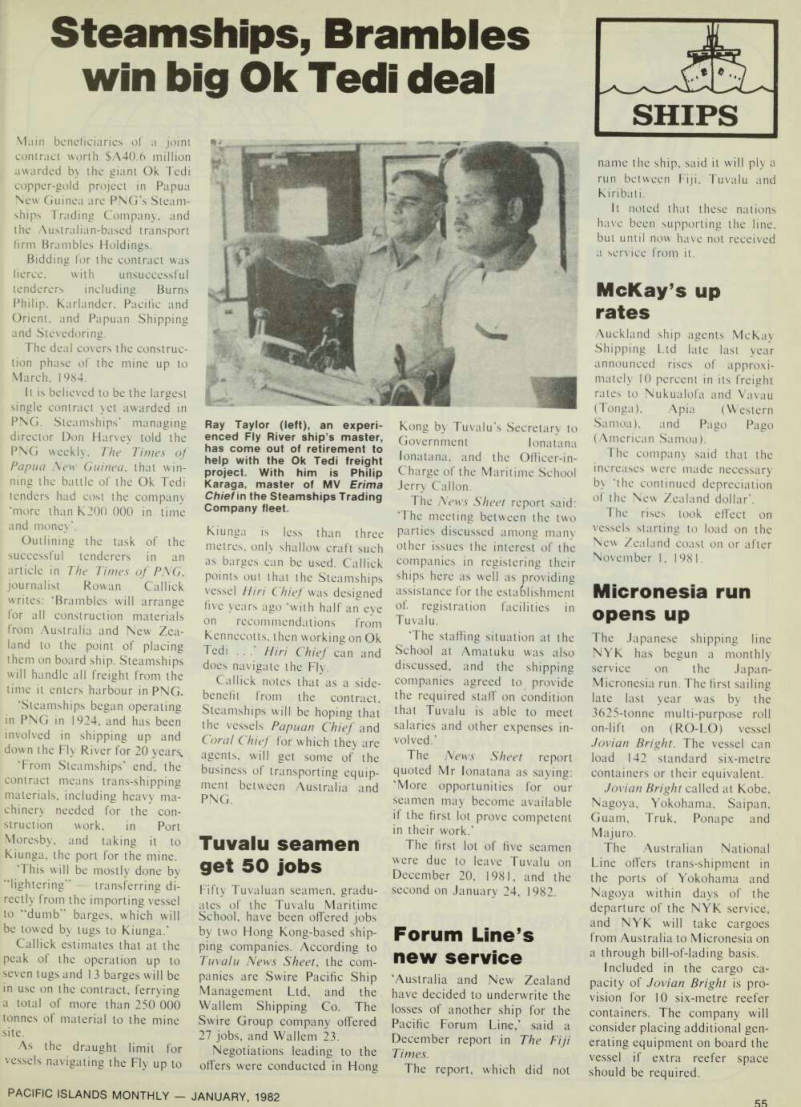
Ships
Steamships, Brambles win big Ok Tedi deal
Main beneficiaries of a joint contract worth 5A40.6 million awarded by the giant Ok Tedi copper-gold project in Papua New Guinea are PNG's Steam ships Trading Company, and the Australian-based transport firm Brambles Holdings.
Bidding for the contract was fierce. with unsuccessful tenderers including Burns Philip. Karlander. Pacific and Orient, and Papuan Shipping and Stevedoring.
The deal covers the construc tion phase of the mine up to March. 1984.
It is believed to be the largest single contract yet awarded in PNG. Steamships’ managing director Don Harvey told the PNG weekly. The Times of Papua New Guinea , that win ning the battle of the Ok Tedi tenders had cost the company ‘more than K2OO 000 in time and money'.
Outlining the task of the successful tenderers in an article in The Times of PNG , journalist Rowan Callick writes: ‘Brambles will arrange for all construction materials from Australia and New Zea land to the point of placing them on board ship. Steamships will handle all freight from the time it enters harbour in PNG. ‘Steamships began operating in PNG in 1924, and has been involved in shipping up and down the Fly River for 20 years.
'From Steamships’ end, the contract means trans-shipping materials, including heavy ma chinery needed for the con struction work, in Port Moresby, and taking it to Kiunga, the port for the mine. ‘This will be mostly done by “lightering" transferring di rectly from the importing vessel to “dumb” barges, which will be towed by lugs to Kiunga.' Callick estimates that at the peak of the operation up to seven lugs and 13 barges will be in use on the contract, ferrying a total of more than 250 000 tonnes of material to the mine site.
As the draught limit for vessels navigating the Fly up to
Kiunga is less than three metres, only shallow craft such as barges can be used. Callick points out that the Steamships vessel Hiri Chief was designed five years ago 'with half an eye on recommendations from Kcnnccolls, then working on Ok Tedi .. . Hiri Chief can and does navigate the Fly.
Callick notes that as a side benefit from the contract.
Steamships will be hoping that the vessels Papuan Chief and Coral Chief for which they are agents, will gel some of the business of transporting equip ment between Australia and
Png.
Tuvalu seamen
get 50 jobs
Fifty Tuvaluan seamen, gradu ates of the Tuvalu Maritime School, have been offered jobs by two Hong Kong-based ship ping companies. According to Tuvalu News Sheet , the com panies are Swire Pacific Ship Management Ltd, and the Wallem Shipping Co. The Swire Group company offered 27 jobs, and Wallem 23.
Negotiations leading to the offers were conducted in Hong
Kong by Tuvalu’s Secretary to Government lonatana lonatana, and the Officer-in- Charge of the Maritime School Jerry Gallon.
The News Sheet report said: The meeting between the two parties discussed among many other issues the interest of the companies in registering their ships here as well as providing assistance for the establishment of. registration facilities in Tuvalu.
'The staffing situation at the School at Amatuku was also discussed, and the shipping companies agreed to provide the required staff on condition that Tuvalu is able to meet salaries and other expenses in volved.’
The News Sheet report quoted Mr lonatana as saying: 'More opportunities for our seamen may become available if the first lot prove competent in their work.’
The first lot of five seamen were due to leave Tuvalu on December 20, 1981, and the second on January 24, 1982.
Forum Line’s
new service
‘Australia and New Zealand have decided to underwrite the losses of another ship for the Pacific Forum Line,’ said a December report in The Fiji Times.
The report, which did not
name the ship, said it will ply a run between Fiji. Tuvalu and Kiribati. 11 noted that these nations have been supporting the line, but until now have not received a service from it.
McKay’s up
rates
Auckland ship agents McKay Shipping Ltd late last year announced rises of approxi mately 10 percent in its freight rales to Nukualofa and Vavau (Tonga), Apia (Western Samoa), and Pago Pago (American Samoa).
The company said that the increases were made necessary by ‘the continued depreciation of the New Zealand dollar'.
The rises look effect on vessels starting to load on the New- Zealand coast on or after November 1, 1981.
Micronesia run
opens up
The Japanese shipping line NYK has begun a monthly service on the Japan- Micronesia run. The first sailing late last year was by the 3625-tonne multi-purpose roll on-lift on (RO-LO) vessel Jovian Bright. The vessel can load 142 standard six-metre containers or their equivalent.
Jovian Bright called at Kobe, Nagoya, Yokohama, Saipan, Guam, Truk, Ponape and Majuro.
The Australian National Line offers trans-shipment in the ports of Yokohama and Nagoya within days of the departure of the NYK service, and NYK will take cargoes from Australia to Micronesia on a through bill-of-lading basis.
Included in the cargo ca pacity of Jovian Bright is pro vision for 10 six-metre reefer containers. The company will consider placing additional gen erating equipment on board the vessel if extra reefer space should be required.
Ray Taylor (left), an experi enced Fly River ship’s master, has come out of retirement to help with the Ok Tedi freight project. With him is Philip Karaga, master of MV Erima Chief in the Steamships Trading Company fleet.
Advertisements & other items, p. 56 (1 item)
28 Day Service
THE BANK LINE
r &
United Kingdom and Continent to:
PAPEETE • NOUMEA
PAPUA NEW GUINEA and SOLOMON ISLANDS
PORT VILA & SANTO BY TRANSHIPMENT
* United Kingdom and Continent to: SUVA AND LAUTOKA (FCL LCL & UNITISED ONLY) * Papua New Guinea cind Solomon Islsnds to.
UNITED KINGDOM and CONTINENT
For particulars apply:
THE BANK LINE (AUSTRALASIA) PTY. LTD.
18th Floor 1 York Street SYDNEY N.S.W 2000 Australia Tel; 272041 Telex: 24063 5.
yachts were few
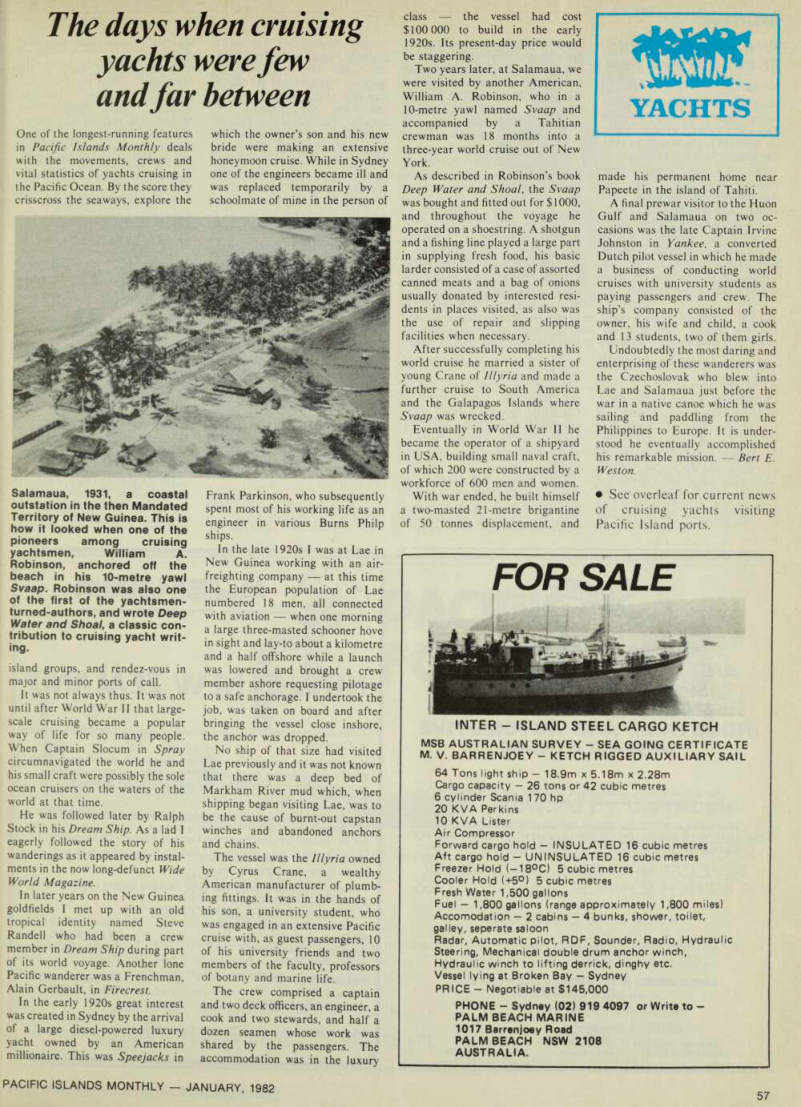
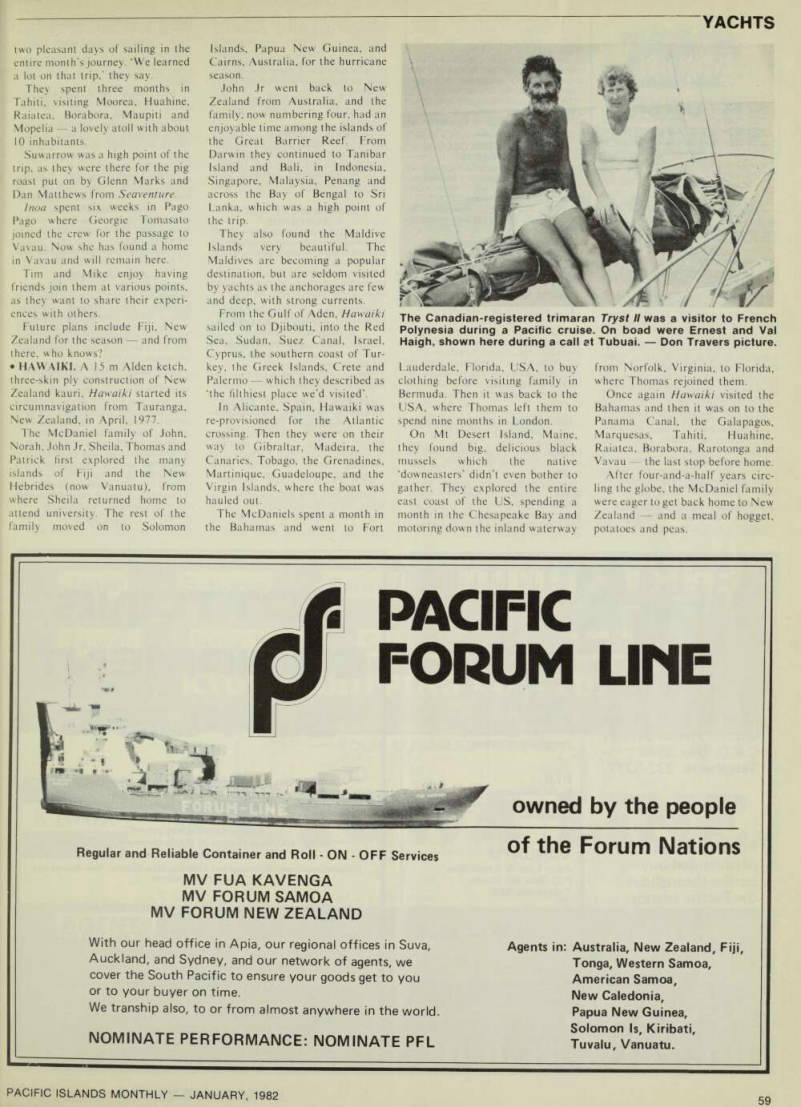
Yachts
The days when cruising yachts were few and far between
One of the longest-running features in Pacific Islands Monthly deals with the movements, crews and vital statistics of yachts cruising in the Pacific Ocean. By the score they crisscross the seaways, explore the
island groups, and rendez-vous in major and minor ports of call.
It was not always thus. It was not until after World War II that large scale cruising became a popular way of life for so many people.
When Captain Slocum in Spray circumnavigated the world he and his small craft were possibly the sole ocean cruisers on the waters of the world at that time.
He was followed later by Ralph Stock in his Dream Ship. As a lad I eagerly followed the story of his wanderings as it appeared by instal ments in the now long-defunct Wide World Magazine.
In later years on the New Guinea goldfields I met up with an old tropical identity named Steve Randell who had been a crew member in Dream Ship during part of its world voyage. Another lone Pacific wanderer was a Frenchman, Alain Gerbault, in Firecrest.
In the early 1920 s great interest was created in Sydney by the arrival of a large diesel-powered luxury yacht owned by an American millionaire. This was Speejacks in
which the owner’s son and his new bride were making an extensive honeymoon cruise. While in Sydney one of the engineers became ill and
was replaced temporarily by a
schoolmate of mine in the person of
Frank Parkinson, who subsequently spent most of his working life as an
Burns Phi,p
sni P s ¥ r In the late 1920 s I was at Lae in New Guinea working with an air freighting company at this time the European population of Lae numbered 18 men, all connected with aviation when one morning ? -se three-masted schooner hove in sight and lay-to about a kilometre and a half offshore while a launch was lowered and brought a crew member ashore requesting pilotage to a safe anchorage. I undertook the job, was taken on board and after bringing the vessel close inshore, the anchor was dropped.
No ship of that size had visited Lae previously and it was not known that there was a deep bed of Markham River mud which, when shipping began visiting Lae, was to be the cause of burnt-out capstan winches and abandoned anchors and chains, The vessel was the Illyria owned by Cyrus Crane, a wealthy American manufacturer of plumb ing fittings. It was in the hands of his son, a university student, who was engaged in an extensive Pacific cruise with, as guest passengers, 10 of his university friends and two members of the faculty, professors of botany and marine life.
The crew comprised a captain and two deck officers, an engineer, a cook and two stewards, and half a dozen seamen whose work was shared by the passengers. The accommodation was in the luxury
class the vessel had cost $lOO 000 to build in the early 19205. Its present-day price would be staggering.
Two years later, at Salamaua, we were visited by another American, William A. Robinson, who in a 10-metre yawl named Svaap and accompanied by a Tahitian crewman was 18 months into a three-year world cruise out of New York.
As described in Robinson’s book Deep Water and Shoal , the Svaap was bought and fitted out for $ 1000, and throughout the voyage he operated on a shoestring. A shotgun and a fishing line played a large part in supplying fresh food, his basic larder consisted of a case of assorted canned meats and a bag of onions usually donated by interested resi dents in places visited, as also was the use of repair and slipping facilities when necessary.
After successfully completing his world cruise he married a sister of young Crane of Illyria and made a further cruise to South America and the Galapagos Islands where Svaap was wrecked.
Eventually in World War II he became the operator of a shipyard in USA, building small naval craft, of which 200 were constructed by a workforce of 600 men and women.
With war ended, he built himself a two-masted 21-metre brigantine of 50 tonnes displacement, and
made his permanent home near Papeete in the island of Tahiti.
A final prewar visitor to the Huon Gulf and Salamaua on two oc casions was the late Captain Irvine Johnston in Yankee, a converted Dutch pilot vessel in which he made a business of conducting world cruises with university students as paying passengers and crew. The ship’s company consisted of the owner, his wife and child, a cook and 13 students, two of them girls.
Undoubtedly the most daring and enterprising of these wanderers was the Czechoslovak who blew into Lae and Salamaua just before the war in a native canoe which he was sailing and paddling from the Philippines to Europe. It is under stood he eventually accomplished
his remarkable mission.
Bert E.
Weston.
• See overleaf for current news of cruising yachts visiting Pacific Island ports.
Salamaua, 1931, a coastal outstation in the then Mandated Territory of New Guinea. This is how it looked when one of the pioneers among cruising yachtsmen, William A.
Robinson, anchored off the beach in his 10-metre yawl Svaap. Robinson was also one of the first of the yachtsmen turned-authors, and wrote Deep Water and Shoal, a classic con tribution to cruising yacht writ ing.
The Fiji Visitors
BOREAL! reports from
Suva:
Many of Australia’s leading ocean racing yachts, including Admiral’s Cup and Clipper Cup contenders, are expected to compete in the 1 982 KB Sydney-Suva Yacht Race.
The race has recently been launched in Suva by the two organising clubs, the Royal Suva Yacht Club and the Middle Har bour Yacht Club of Sydney.
The Governor-General of Austra lia has been invited to start the race from Sydney on May 22.
The clubs are confident that there will be a record fleet in 1982.
Don Travers Re
ports from Tubuai 9
Austral Isi and s y French
Polynesia:
• TRYSTE 11. Al 2 m Hedley Nicol trimaran, with owners Ernest and Val Haigh, called at Tubuai last October from Raivavae and Tahiti.
The Haighs built their tri in British Columbia over the period 1966-68.
They have since pul 120 000 km under the keels, including a 1969-74 circumnavigation with four of their five daughters, and a 1977-78
Canada-New Zealand-Canada voy age with just themselves.
They began their present voyage last July from Canada and departed Tubuai for Rarotonga and Aitulaki in the Cook Islands, New Zealand and Australia (Tasmania).
Further plans are uncertain perhaps a second circumnavigation.
The word ‘tryste’ means ‘a journey in company’ in old Scottish.
Patty Kali Her Re
ports from Vavauy
Tonga:
• PELICAN This Golden Hind 9 m sloop is hull number 61 of the series.
It was built 14 years ago, but purchased by the present owners, the Hill family, two years ago in the Turks and Caicos Islands. They sailed her back to Florida and rebuilt her there.
In October, 1980, Janet, Robert and Tom Hill, who hail from Greenville, South Carolina, USA, left Florida for the Bahamas, Haiti, Jamaica and the San Bias Islands, where they were so enchanted they stayed two months.
From Panama they sailed to the Galapagos Islands where yachts are not allowed to remain for more than seven days. However, the Hills were
engaged in observing and photo graphing animal behaviour for sev eral weeks. They swam with sea lions ‘very safe and friendly so long as it wasn't mating season’ and found the penguins very friendly and inquisitive. Pelicans often landed on the boat and one picture of pelicans sitting on the lifelines of Pelican , flapping their wings to balance, is highly prized by the Hills. The parrot which was part of the crew at the lime and was normally nonplussed by visitors to the yacht, was driven to hysteria by the pelicans.
Next, Pelican visited the Marquesas (especially enjoying Uapou), the Tuamotus, Societies, and Pago Pago, before coming to Vavau. They are now spending the summer in New Zealand, with future plans indefinite.
• Seaventure. This 11 M
Freeport fibreglass sloop was bought new in San Francisco in February, 1980. Glen Marks and Dan Matthews then set out to learn to sail.
They left California in August of 'BO and arrived in Hilo, Hawaii, in need of a new engine which the manufacturer finally agreed to fly out for them.
On October 5, 1980, they were again headed for the South Pacific with dreams never fulfilled of
beautiful women swarming over their boat.
They spent five weeks in the Marquesas, visited the Tuamotus, Papeete. Borabora. Huahine, Raiatea, Tahaa, Moorea, and
Maupiti. On Maupiti they bought
Mortimer, a 19-kg pig, and moved him into the lazaret. 'He slept at our feet during the day. and was a much easier travelling companion than we
expected.'
On May 9, Mortimer was the star attraction of the ‘First and Last Annual Suwarrow Pig Roast', at tended by 27 people off 11 yachts.
From Suwarrow Glen and Dan sailed to Pago Pago and Apia, where Debbie Morrison joined them for the passage to Vavau and Fiji.
Seaventure will winter in New Zealand and return to San Francisco by November of 'B2. • INOA. The word means ‘name’ in Hawaiian, but in Eskimo it means ‘the soul of things’ and that is how owners Tim McCormick and Mike Sliefel feel about their fibreglass Westsail '32. They bought the boat in Honolulu in September, 1980, and started their adventure in December of that year.
The passage to Tahiti was a very
rough 28 days. They couldn't make
the easting to the Marquesas as
originally planned, and had only
two pleasant days of sailing in the entire month's journey. ‘We learned a lot on that trip,' they say.
They spent three months in Tahiti, visiting Moorea, Huahine, Raiatea, Borabora, Maupiti and Mopelia a lovely atoll with about 10 inhabitants.
Suwarrow was a high point of the trip, as they were there for the pig roast put on by Glenn Marks and Dan Matthews from Seaventure.
Inoa spent six weeks in Pago Pago where Georgic Tomasalo joined the crew for the passage to Vavau. Now she has found a home in Vavau and will remain here.
Tim and Mike enjoy having friends join them at various points, as they want to share their experi ences with others.
Future plans include Fiji, New Zealand for the season and from there, who knows? • HAWAIKI. A 15 m Alden ketch, three-skin ply construction of New Zealand kauri, Hawaiki started its circumnavigation from Tauranga, New Zealand, in April, 1977.
The McDaniel family of John.
Norah, John Jr, Sheila, Thomas and Patrick first explored the many islands of Fiji and the New Hebrides (now Vanuatu), from where Sheila returned home to attend university. The rest of the family moved on to Solomon
Islands, Papua New Guinea, and Cairns, Australia, for the hurricane season.
John Jr went back to New Zealand from Australia, and the family, now numbering four, had an enjoyable time among the islands of the Great Barrier Reef. From Darwin they continued to Tanibar Island and Bali, in Indonesia, Singapore, Malaysia, Penang and across the Bay of Bengal to Sri Lanka, which was a high point of the trip.
They also found the Maidive Islands very beautiful. The Maldives are becoming a popular destination, but are seldom visited by yachts as the anchorages are few and deep, with strong currents.
From the Gulf of Aden. Hawaiki sailed on to Djibouti, into the Red Sea, Sudan, Suez Canal, Israel, Cyprus, the southern coast of Tur key, the Greek Islands, Crete and Palermo which they described as ‘the filthiest place we’d visited'.
In Alicante, Spain, Hawaiki was re-provisioned for the Atlantic crossing. Then they were on their way to Gibraltar, Madeira, the Canaries, Tobago, the Grenadines,
Martinique, Guadeloupe, and the
Virgin Islands, where the boat was hauled out.
The McDaniels spent a month in the Bahamas and went to Fort
Lauderdale, Florida, USA, to buy clothing before visiting family in Bermuda. Then it was back to the USA, where Thomas left them to spend nine months in London.
On Mt Desert Island, Maine, they found big, delicious black mussels which the native ‘downeasters’ didn’t even bother to gather. They explored the entire east coast of the US, spending a month in the Chesapeake Bay and motoring down the inland waterway
from Norfolk, Virginia, to Florida, where Thomas rejoined them.
Once again Hawaiki visited the Bahamas and then it was on to the Panama Canal, the Galapagos, Marquesas, Tahiti, Huahine.
Raiatea, Borabora, Rarotonga and Vavau the last stop before home, After four-and-a-half years circ ling the globe, the McDaniel family were eager to get back home to New Zealand and a meal of hogget, potatoes and peas.
The Canadian-registered trimaran Tryst II was a visitor to French Polynesia during a Pacific cruise. On boad were Ernest and Val Haigh, shown here during a call at Tubuai. - Don Travers picture.
Advertisements & other items, pp. 57-59 (1 item)
For Sale
wh* 0M
INTER - ISLAND STEEL CARGO KETCH
MSB AUSTRALIAN SURVEY - SEA GOING CERTIFICATE M. V. BARRENJOEY - KETCH RIGGED AUXILIARY SAIL 64 Tons light ship —18.9 m 5.18 m x 2.28 m Cargo capacity - 26 tons or 42 cubic metres 6 cylinder Scania 170 hp 20 KVA Perkins 10 KVA Lister Air Compressor Forward cargo hold - INSULATED 16 cubic metres Aft cargo hold - UNINSULATED 16 cubic metres Freezer Hold (—lB°C) 5 cubic metres Cooler Hold (+s°) 5 cubic metres Fresh Water 1,500 gallons Fuel - 1,800 gallons (range approximately 1,800 miles) Accomodation - 2 cabins - 4 bunks, shower, toilet, galley, seperate saloon Radar, Automatic pilot, RDF, Sounder, Radio, Hydraulic Steering, Mechanical double drum anchor winch, Hydraulic winch to lifting derrick, dinghy etc.
Vessel lying at Broken Bay - Sydney PRICE - Negotiable at $145,000 PHONE - Sydney (02) 919 4097 or Write to
PALM BEACH MARINE
1017 Barrenjoey Road
PALM BEACH NSW 2108
AUSTRALIA.
FUEL INJECTION
AND ELECTRICAL SYSTEMS
SPECIALISTS FOR ALL
MARINE, COMMERCIAL,
INDUSTRIAL AND AUTOMOTIVE
INSTALLATIONS
We service and stock fuel pumps, injectors, turbochargers, governors, alternators, generators and starter motors for all applications.
CONTACT US BY TELEX FROM ANYWHERE IN THE PACIFIC -OR IMMEDIATE DESPATCH OF REPLACEMENTS AND SPARES FOR
BOSCH, BRYCE, CATERPILLAR, CAV, DIESEL KIKI,
GM HOLSET NIPPON DENSO, ROOSAMASTER,
AIR RESEARCH, SCHWITZER, SIMMS, DAHL FILTERS
WOODWARD GOVERNORS
SIMMS DIESEL & ELECTRICAL SERVICES LTD.
P O BOX 11-114 ELLERSLIE
77 LEONARD ROAD. PENROSE AUCKLAND
NEW ZEALAND
TELEX No NZ 60266 SIMMS
DAYTIME TEL,
AUCKLAND 591-159
EVENING TEL.
DIESEL specialists AUCKLAND 568-259
aUSMAHK ./>
LTMTTI
NOW IN NEW ZEALAND
Announces the opening of our New Zealand Export Office situated in Auckland.
Mr. Athol Carr, formally of the New Zealand Export Import Corporation, will lead a small and efficient team giving the precise, prompt and personal service that won an Export Award for Ausmark in Australia.
We specialise in the financing and shipment of fresh, frozen and processed consumer food products and we will welcome enquiries for all manner of bulk commodities and manufactured goods.
We invite your request for quotation as our prices and terms will prove more than competitive.
For all of your Australian and New Zealand supply requirements, we can be contacted at:— * Ausmark Trading (N.Z.) Ltd. 60 Queen Street, Auckland, New Zealand.
G.P.O. Box 2002.
Phone: 30796 Telex: 21886 Answerback; FBMAUK Ausmark Pty. Ltd. 74 Pitt Street, Sydney, Australia Phone: 231 6866 Telex: 25458 ‘Accredited Agent New Zealand Dairy Board
PACIFIC
FORUM LIME
»'W » » » c »-PT Regular and Reliable Container and Roll ■ ON - OFF Services
owned by the people
of the Forum Nations
MV FUA KAVENGA
MV FORUM SAMOA
MV FORUM NEW ZEALAND
With our head office in Apia, our regional offices in Suva, Auckland, and Sydney, and our network of agents, we cover the South Pacific to ensure your goods get to you or to your buyer on time.
We tranship also, to or from almost anywhere in the world.
NOMINATE PERFORMANCE: NOMINATE PFL
Agents in: Australia, New Zealand, Fiji, Tonga, Western Samoa, American Samoa, New Caledonia, Papua New Guinea, Solomon Is, Kiribati, Tuvalu, Vanuatu.
Shipping

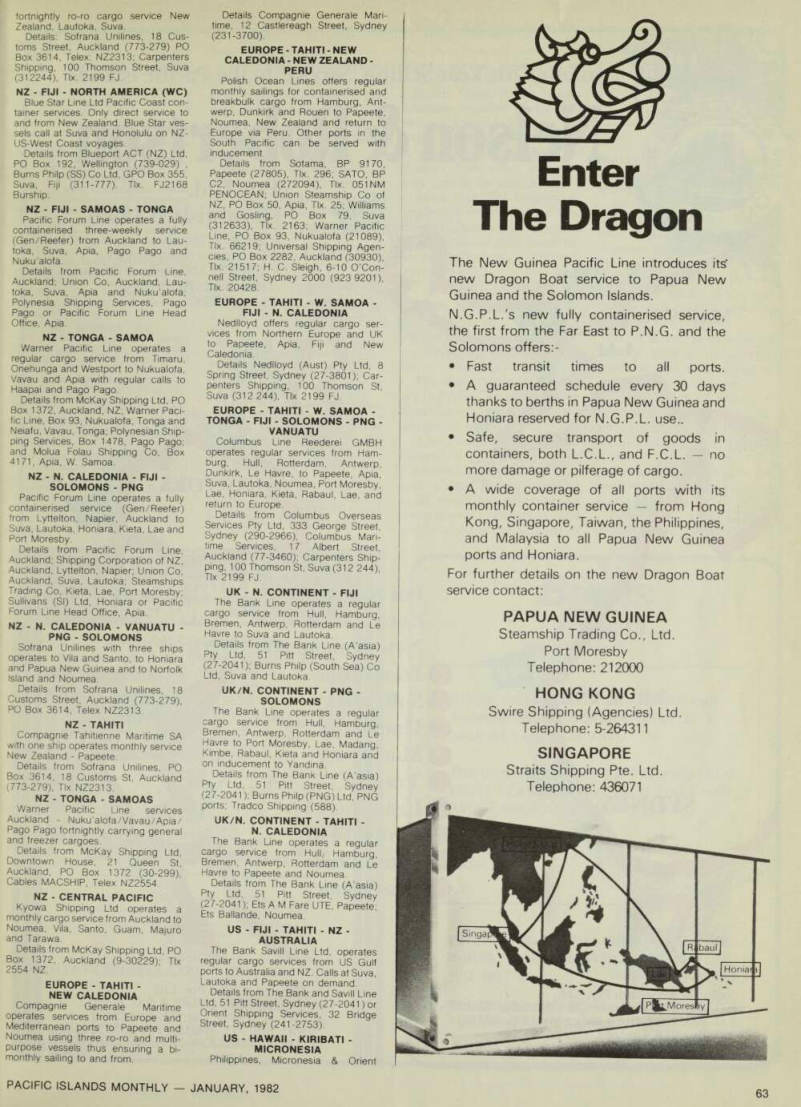
Services
Should any shipping company wish to have its services cargo and passenger included in these list ings they should contact PIM.
Australia - Fiji
Karlander (Aust) Pty Ltd operates monthly cargo services from Sydney to Suva and Lautoka.
Details from Karlander (Aust) Pty Ltd, 19-31 Pitt Street, Sydney (232-1011), Dalgety Shipping, 461 Bourke Street, Melbourne (60-0731), Burns Philp (SS) Co Ltd, Suva and Lautoka, Sofrana-Unilines (Fiji Express Line) operates to Suva and Lautoka every three weeks from the main ports on the east coast of Australia and monthly to Lautoka from Melbourne and Sydney.
Details from Sofrana-Unilines, 19 Pitt Street, Sydney, (27-2031), Trans- Austral Shipping Pty Ltd, 570 Bourke Street, Melbourne (67-9162); ACTA Pty Ltd, Brisbane (221-3116); Elders-ANL Pty Ltd, Port Adelaide (47-5688); ANL, Newcastle (049-24364); Clements & Marshall, Burnie, Tasmania (31-1833); Carpenters Shipping, 100 Thomson St, Suva. Fiji (312 244), Tlx 2199 FJ.
Australia - New Caledonia -
Fiji - Samoas - Tonga
Pacific Forum Line operates a fully
containerised service (Gen/Reefer) from Sydney to Noumea, Lautoka, Suva, Apia, Pago Pago and Nuku’alofa.
Details from Pacific Forum Line, Syd ney; Union Bulkships, Sydney and Mel bourne; SATO, Noumea; Australian National Line, Brisbane; Burns Philp (SS) Co, Lautoka, Suva and Apia; Union Co, Nuku’alofa; Polynesia Shipping Services, Pago Pago or Pacific Forum Line Head Office, Apia.
Australia - Lord Howe Is -
Norfolk Is
Compagnie des Chargeurs Caledoniens operates four-weekly cargo service Sydney - Lord Howe Island and Norfolk Island.
Details; Hetherington Kingsbury Pty Ltd, 37-49 Pitt Street, Sydney (27-1671).
Australia - Kiribati
Karlander operates a 5/6 weekly ser vice from Melbourne and Sydney to Kiribati (Tarawa).
Details; Karlander (Aust) Pty Ltd, 19-31 Pitt Street, Sydney (232-1011).
Australia - Nauru -
Kiribati
Nauru Pacific Line operates regular cargo/passenger service from Mel bourne to Nauru and Tarawa.
Details: Nauru Corporation (Vic) Inc (Shipping Division), Nauru House, 80 Collins Street, Melbourne (653-5709), Nedlloyd Swire, 8 Spring Street, Sydney (2-0522).
Australia - New Caledonia
(And/Or) Vanuatu
Sofrana-Unilines ships serve Noumea every three weeks from the main ports along the east Australian coast.
Details from Sofrana-Unilines, 19 Pitt Street, Sydney (27-2031), Trans- Austral Shipping Pty Ltd, 570 Bourke Street, Melbourne (67-9162). ACTA Pty Ltd, Brisbane (221-3116), Elders-ANL
Pty Ltd, Port Adelaide (47-5688), ANL, Newcastle (049-24364), Clements & Marshall, Burnie, Tasmania (31-1833).
Compagnie des Chargeurs Cale doniens operates a three-weekly con tainerised cargo service from Sydney to Noumea.
Details Hetherington Kingsbury Pty Ltd, 37-49 Pitt Street, Sydney (27-1671).
Compagnie Generate Maritime operates a monthly service from Syd ney to Noumea, Port Vila and Santo, for containerised and break bulk cargo.
Details Compagnie Generate Mari time, 12 Castlereagh Street, Sydney (231-3700).
Australia - Nz - Fiji -
Hawaii - Us
P & O liners call at Auckland, Suva, Pago Pago and Honolulu on eastbound and westbound voyages between Syd ney and the US.
Details from P & O Booking Centre, World Travel Headquarters Pty Ltd, 33 Bligh Street, Sydney (231-6655).
AUSTRALIA - NZ - FIJI - TONGA -
Vanuatu-Noumea-Solomons -
Samoas - Tahiti
Sitmar Cruises operates a year-round cruise programme to include most of the above countries.
Details from Sitmar Cruises, 47 Elizabeth Street, Sydney (232-7511).
AUSTRALIA - NZ - FIJI - TONGA
Vanuatu - Noumea - Solomons -
Samoas - Tahiti
P & O liners call at Auckland, Bay of Islands, Honiara, Lautoka, Noumea, Nukualofa, Pago Pago, Papeete, Port Moresby, Santo, Savusavu, Suva, Vavau and Vila on cruises from Aus tralia.
Details from P & O Booking Centre, World Travel Headquarters Pty Ltd, 33 Bligh Street, Sydney (231-6655).
Pacific Forum Line operates con
tainerized and general cargo service from Australia and NZ to Fiji, Apia, Pago Pago, Tonga and other South Pacific ports.
Details from Polynesia Shipping Ser vices Inc, PO Box 1478, Pago Pago 96799.
Australia - New Zealand -
Pacific Islands - South East
Asia-China
Minghua Cruises operates regular cruise services from Sydney to most Pacific ports, with several cruises to South East Asia, including Japan, China and Hong Kong.
Details Minghua Cruises, 7 Bridge Street, Sydney, NSW 2000 and all Burns Philp Travel offices in Australia.
Australia - Tuvalu
Karlander operates a three monthly service from Sydney and Melbourne to Tuvalu (Funafuti).
Details from Karlander (Aust) Pty Ltd, 19-31 Pitt Street, Sydney (232-1011).
Australia - Png
Karlander New Guinea Line’s cargo vessels call at Melbourne, Sydney, Port Moresby, Lae, Madang, Wewak, Manus, Kimbe, Rabaul, Popondetta.
Details from Karlander (Aust) Pty Ltd, 19-31 Pitt Street. Sydney (232-1011), DALGETY Shipping, 461 Bourke Street, Melbourne (60-0731).
Australia - Png - Solomons
A consortium of Conpac, NGAL/PNGL have three container ves sels operating on a 28 day turn-around from Melbourne, Sydney and Brisbane to Port Moresby, Lae, Rabaul, Kavieng, Wewak, Madang, Kieta and Honiara.
Details from Burns, Philp & Co. Ltd. 51 Pitt Street, Sydney (2-0547) and Interocean Swire, 8 Spring Street, Syd ney. (2-0522).
New Guinea Express Lines operates a fortnightly container service from Mel bourne, Sydney, Brisbane to Port Moresby, Lae, Alotau, Rabaul, Honiara.
Details from New Guinea Express Lines, PO Box R 73, Royal Exchange.
Sydney (241-3991) MacArthur Ship ping Agency Co, 39 Creek Street, Bris bane (229-3777), New Guinea Express Lines. 327 Collins Street, Melbourne (61-3053), Niugini Express Lines, Port Moresby (21-4572), Lae (42-1536), Rabtrad Niugini Pty Ltd, Rabaul (92-2911), Alotau Stevedoring & Trans port, Alotau (61-1318) and Island Co operative Shipping Federation, Honiara (808).
Sofrana-Unilines (PNG Line) operates a monthly service to Port Moresby, Lae. Rabaul, Kieta, Honiara from main ports on the east coast of Australia.
Details from Sofrana-Unilines, 19 Pitt Street, Sydney (27-2031); Trans- Austral Shipping Pty Ltd, 570 Bourke Street, Melbourne (67-9162); ACTA Pty Ltd, Brisbane (221-3116); Elders ANL Pty Ltd, Port Adelaide (47-5688).
Australia - Tahiti
Compagnie Generate Maritime operates a monthly service from Syd ney to Papeete for containerised and break-bulk cargo.
Details Compagnie Generate Mari time, 12 Castlereagh Street. Sydney (231-3700).
Australia - Tahiti - Us
Karlander operates a monthly cargo service from Melbourne and Sydney to Papeete. US west coast.
Details: Karlander (Aust) Pty Ltd, 19-31 Pitt Street. Sydney (232-1011).
Australia - W. Samoa
Compagnie Generate Maritime operates a monthly service from Syd ney to Apia.
Details Compagnie Generate Mari time, 12 Castlereagh Street, Sydney (231 -3700).
Far East - Fiji - New
Zealand
New Zealand Unit Express (NZUE)
operates a monthly palletised cargo service from Manila, Keelung, Kaoshiung and Hong Kong to Lautoka, Suva and thence to NZ.
Details from Carpenters Shipping, 100 Thomson Street, Suva (312-244), Burns Philp, Suva (311-777), P & O S.N. Co, Wellington (736-477) or Nedlloyd Swire Pty Ltd, Sydney (20-522).
Nedlloyd operates bi-weekly cargo service with four ships from Sourabaya, Jakarta, Bangkok, Port Kelang and Singapore to Suva and NZ ports.
Details from Nedlloyd (Aust) Pty Ltd, 8 Spring St, Sydney (27 3801), Burns Philp (SS) Co Ltd, Suva and Lautoka.
Far East - Mid-S. Pacific
China Navigation’s New Guinea Pacific Line operates a regular con tainer service from Hong Kong, Taiwan, Manila, Port Kelang and Singapore to Port Moresby, Lae, Rabaul and Honiara monthly and to Wewak, Madang and Kieta every three months. Cargo from the same Far Eastern ports to the South Pacific ports of Noumea, Santo, Vila, Papeete, Pago Pago, Apia, Rarotonga and Tarawa will be shipped via Japan on the monthly Bali Hai service.
Details from Steamships Trading Co,, Port Moresby (21-2000).
Kyowa Shipping Ltd, operates monthly services from Hong Kong, Taiwan, S. Korea and Japan, to Guam, Saipan, Solomons, New Caledonia, Fiji, Western and American Samoa, Tahiti, Cook Is., Tonga and Vanuatu.
Details: Hetherington Kingsbury Pty Ltd, 37-49 Pitt Street, Sydney (27-1671); Carpenters Shipping, Suva (312-244), Tlx FJ2199.
Japan - Fiji - New Zealand
China Navigation, operates a monthly service from main ports Japan to Suva and Lautoka and thence Noumea and NZ.
Details from Carpenters Shipping,
100 Thompson St, Suva (312-244), Tlx FJ2199.
Japan - Png
Mitsui O.S.K, Lines operates a monthly service from main ports Japan and Port Moresby, Rabaul, Lae, Madang, Kieta and Kimbe.
Details from Robert-Laurie (PNG) Pty Ltd, Port Moresby (21-2466/ 21-1898).
New Caledonia - Fiji - West
Coast North America
PAD Line operates an approx. 3weekly ro-ro service from Noumea and Suva to Honolulu and West Coast USA and Canadian ports.
Details from Sofrana-Unilines SA, BP 1602, Noumea (27-51-91), Tlx NMO4B; Carpenters Shipping, 100 Thomson St..
Suva (312-244), Tlx FJ2199.
Png - Inter - Mainport
Papua New Guinea Mainport Liner Services offer scheduled 10/20-day coastal liner services linking all PNG mainports with containerisation, reefer, heavy lift and transhipment facilities.
Details from PNG Mainport Liner Ser vices, Box 1448, Lae, PNG (42-3537), Tlx PNG 42465.
Png - North Australia
Papua New Guinea Line offers a 60-day service from Port Moresby, Lae and Vanimo to Darwin with through bills of lading from West Coast North American ports. Inducement calls at Weipa and Gove.
Details from PNG Shipping Corpor ation, Box 543, Port Moresby, PNG (21-1174), Tlx PNG 22269.
Png - Kiribati - Solomons -
West Coast Usa
Papua New Guinea Line offers a 60-day service from Port Moresby, Lae, Rabaul and Kieta to San Francisco and Los Angeles with inducement at Van couver and stop-off calls at Tarawa and Honiara. Through bills from all PNG mainports and mini-bridge services to
other US and Canadian destinations.
Details from PNG Shipping Corpor ation, Box 543, Port Moresby, PNG (21 -1174), Tlx PNG 22269; or from TFC Shipping, 100 California St, San Fran cisco, CA, USA (415 398-1604), Tlx
340958 Gts Ur Sfo.
Png - Uk/Continent
The Bank Line operates regular cargo service from Port Moresby. Oro Bay, Kieta, Rabaul, Kimbe, Madang and Lae to Hull, Hamburg, Rotterdam, Antwerp and Le Havre.
Details from The Bank Line (A'asia) Pty Ltd, 51 Pitt Street, Sydney (27-2041); Burns Philp (PNG) Ltd, PNG ports.
Solomons - Uk/Continent
The Bank Line operates regular cargo service from Honiara to Hull.
Hamburg, Rotterdam, Antwerp and Le Havre.
Details from The Bank Line (A'asia) Pty Ltd, 51 Pitt Street, Sydney (27-2041); Tradco Shipping (588).
NZ - COOK IS - NIUE -
Tahiti
Shipping Corporation of NZ Ltd operates cargo services based on pallets and similar units from Auckland to Niue, Cook Islands and Tahiti.
Details from the Shipping Corp of NZ Ltd, PO Box 3420, Auckland (797-210), Waterfront Commission, PO Box 61, Rarotonga; Cook Islands; Niue Govt Offices, Niue Island Compagnie Maritime Polynesienne, B'P’ 368, Papeete, Tahiti.
Nz - Fiji
Reef operates a regular 18-day ser vice from Auckland to Suva and Lau toka.
Details from Reef Shipping Agencies, PO Box 3382, Auckland. NZ (77 : 1221-3); MV. Fijian Shipping Agencies Ltd, Private Bag, Suva, Fiji (31 1056).
Pacific Line with one ship operates
fortnightly ro-ro cargo service New Zealand, Lautoka, Suva.
Details: Sofrana Unilines, 18 Cus toms Street, Auckland (773-279) PO Box 3614, Telex: NZ2313; Carpenters Shipping. 100 Thomson Street, Suva (312244), Tlx. 2199 FJ.
NZ - FIJI - NORTH AMERICA (WC) Blue Star Line Ltd Pacific Coast con tainer services. Only direct service to and from New Zealand. Blue Star ves sels call at Suva and Honolulu on NZ US-West Coast voyages.
Details from Blueport ACT (NZ) Ltd, PO Box 192, Wellington (739-029) , Burns Philp (SS) Co Ltd, GPO Box 355, Suva, Fiji (311-777). Tlx. FJ2168 Burship.
NZ - FIJI - SAMOAS - TONGA Pacific Forum Line operates a fully containerised three-weekly service (Gen/Reefer) from Auckland to Lau toka, Suva, Apia, Pago Pago and Nuku’alofa, Details from Pacific Forum Line, Auckland; Union Co, Auckland, Lau toka, Suva, Apia and Nuku’alofa; Polynesia Shipping Services, Pago Pago or Pacific Forum Line Head Office, Apia.
Nz- Tonga - Samoa
Warner Pacific Line operates a regular cargo service from Timaru, Onehunga and Westport to Nukualofa, Vavau and Apia with regular calls to Haapai and Pago Pago.
Details from McKay Shipping Ltd, PO Box 1372, Auckland, NZ; Warner Paci fic Line, Box 93, Nukualofa. Tonga and Neiafu, Vavau, Tonga; Polynesian Ship ping Services, Box 1478, Pago Pago; and Molua Folau Shipping Co, Box 417 T, Apia, W. Samoa.
NZ - N. CALEDONIA - FIJI -
Solomons - Png
Pacific Forum Line operates a fully containerised service (Gen/Reefer) from Lyttelton, Napier, Auckland to Suva, Lautoka, Honiara, Kieta, Lae and Port Moresby.
Details from Pacific Forum Line, Auckland; Shipping Corporation of NZ.
Auckland, Lyttelton, Napier; Union Co, Auckland, Suva, Lautoka; Steamships Trading Co, Kieta, Lae, Port Moresby; Sullivans (SI) Ltd, Honiara or Pacific Forum Line Head Office, Apia.
NZ - N. CALEDONIA - VANUATU -
Png - Solomons
Sofrana Unilines with three ships operates to Vila and Santo, to Honiara and Papua New Guinea and to Norfolk Island and Noumea.
Details from Sofrana Unilines, 18 Customs Street, Auckland (773-279), PO Box 3614, Telex NZ2313.
Nz - Tahiti
Compagnie Tahitienne Maritime SA with one ship operates monthly service New Zealand - Papeete.
Details from Sofrana Unilines, PO Box 3614, 18 Customs St, Auckland (773-279), Tlx NZ2313.
Nz - Tonga - Samoas
Warner Pacific Line services Auckland - Nuku’alofa/Vavau/Apia/ Pago Pago fortnightly carrying general and freezer cargoes.
Details from McKay Shipping Ltd, Downtown House, 21 Queen St, Auckland, PO Box 1372 (30-299), Cables MACSHIP, Telex NZ2554.
Nz - Central Pacific
Kyowa Shipping Ltd operates a monthly cargo service from Auckland to Noumea, Vila, Santo, Guam, Majuro and Tarawa.
Details from McKay Shipping Ltd, PO Box 1372, Auckland (9-30229); Fix 2554 NZ.
Europe - Tahiti -
New Caledonia
Compagnie Generate Maritime operates services from Europe and Mediterranean ports to Papeete and Noumea using three ro-ro and multi purpose vessels thus ensuring a bi monthly sailing to and from.
Details Compagnie Generate Mari time, 12 Castlereagh Street, Sydney (231-3700).
Europe-Tahiti-New
Caledonia - New Zealand -
Peru
Polish Ocean Lines otters regular monthly sailings for containerised and breakbulk cargo from Hamburg, Ant werp, Dunkirk and Rouen to Papeete, Noumea, New Zealand and return to Europe via Peru. Other ports in the South Pacific can be served with inducement.
Details from Sotama, BP 9170, Papeete (27805), Tlx. 296; SATO, BP 02, Noumea (272094), Tlx. 051 NM PENOCEAN; Union Steamship Co of NZ, PO Box 50, Apia, Tlx. 25; Williams and Gosling, PO Box 79, Suva (312633), Tlx. 2163; Warner Pacific Line, PO Box 93, Nukualofa (21089), Tlx. 66219; Universal Shipping Agen cies. PO Box 2282, Auckland (30930), Tlx. 21517; H. C. Sleigh, 6-10 O’Con nell Street, Sydney 2000 (923 9201), Tlx. 20428.
EUROPE - TAHITI - W. SAMOA -
Fiji - N. Caledonia
Nedlloyd offers regular cargo ser vices from Northern Europe and UK to Papeete, Apia, Fiji and New Caledonia.
Details Nedlloyd (Aust) Pty Ltd, 8 Spring Street, Sydney (27-3801); Car penters Shipping, 100 Thomson St, Suva (312 244), Tlx 2199 FJ.
EUROPE - TAHITI - W. SAMOA - TONGA - FIJI - SOLOMONS - PNG -
Vanuatu
Columbus Line Reederei GMBH operates regular services from Ham burg, Hull, Rotterdam, Antwerp, Dunkirk, Le Havre, to Papeete, Apia, Suva, Lautoka, Noumea, Port Moresby, Lae, Honiara, Kieta, Rabaul, Lae, and return to Europe.
Details from Columbus Overseas Services Pty Ltd, 333 George Street, Sydney (290-2966), Columbus Mari time Services, 17 Albert Street, Auckland (77-3460); Carpenters Ship ping, 100 Thomson St, Suva (312 244), Tlx 2199 FJ.
Uk - N. Continent - Fiji
The Bank Line operates a regular cargo service from Hull, Hamburg, Bremen, Antwerp, Rotterdam and Le Havre to Suva and Lautoka.
Details from The Bank Line (A’asia) Pty Ltd, 51 Pitt Street, Sydney (27-2041); Burns Philp (South Sea) Co Ltd, Suva and Lautoka.
Uk/N. Continent - Png -
Solomons
The Bank Line operates a regular cargo service from Hull, Hamburg, Bremen, Antwerp, Rotterdam and Le Havre to Port Moresby, Lae, Madang, Kimbe, Rabaul, Kieta and Honiara and on inducement to Yandina.
Details from The Bank Line (A’asia) Pty Ltd, 51 Pitt Street, Sydney (27-2041); Burns Philp (PNG) Ltd, PNG ports; Tradco Shipping (588).
Uk/N. Continent - Tahiti -
N. Caledonia
The Bank Line operates a regular cargo service from Hull, Hamburg, Bremen, Antwerp, Rotterdam and Le Havre to Papeete and Noumea.
Details from The Bank Line (A’asia) Pty Ltd, 51 Pitt Street, Sydney (27-2041); Ets A M Fare UTE, Papeete; Ets Ballande, Noumea.
US - FIJI - TAHITI - NZ -
Australia
The Bank Savill Line Ltd, operates regular cargo services from US Gulf ports to Australia and NZ. Calls at Suva, Lautoka and Papeete on demand.
Details from The Bank and Savill Line Ltd, 51 Pitt Street, Sydney (27-2041) or Orient Shipping Services, 32 Bridge Street, Sydney (241-2753).
Us - Hawaii - Kiribati -
Micronesia
Philippines, Micronesia & Orient
Advertisements & other items, pp. 60-65 (2 items)
Xi3Aisj^3Ii3Iizi[^S
LOCAL AGENTS AND
REPRESENTATION
428 George St., Sydney.
Cables: Henco Sydney.
G.P.O. Box 3949.
Telephone: 232 5377.
For specialised and
personalised buying
service throughout
the Pacific Islands and the East.
PAPUA NEW GUINEA
RABAUL: M. & C. Seeto, P.O. Box 131, Rabaul.
Telephone 92 2919.
MADANG: W. Double, P.O. Box 22, Madang.
Telephone 82 2696.
FIJI
K. Witherington Ltd., P.O. Box 293, Suva.
Telephone 22 356.
VANUATU
John Lum & Associates, P.O. Box 65, Santo.
Telephone 329.
SOLOMON ISLANDS
Mr. Tom Lo, P.O. Box 327, Honiara.
Telephone 399 Resident Agents in other Pacific Territories. * I
BOTTLING
EQUIPMENT
SUPPLIERS
Manufacturers and suppliers of spare parts for the progressive range of bottling equipment.
Complete reconditioning or parts reconditioned.
Sale of reconditioned and second-hand machinery, also general bottling equipment.
Design and manufacture of bottle conveyor systems to suit your application.
Comprehensive service throughout Australia, New Zealand, New Guinea and South Pacific Islands
FOOD-TEX MACHINERY
SERVICE PTY. LTD.
11 MARSH ST., GRANVILLE 2142. PHONE 682-1488 (2 lines).
P.O. Box 146, Carlingford 2118.
Sydney, Australia.
Phone: 682 1488 (2 lines) South Pacific Agents: ALFRED LAWRENCE & CO., AUCKLAND, NEW ZEALAND Mail Address: P.O. Box 732, Auckland, New Zealand
Japan
T aiwan
S. Korea
Hong Kong
T aiwan
Singapore
To: Solomon Is., New Caledonia, Fiji, W. Samoa, A. Samoa, Tahiti, Cook Is., Tonga, Vanuatu. Tuvalu, Nauru To: Guam, Saipan, Truk, Ponape, Majuro, Yap, Koror
Hong Kong
Philippines
Singapore
To: Papua New Guinea, Pacific Islands.
KYOWA SHIPPING CO., LTD.
HEAD OFFICE: OSAKA OFFICE:
sth FI., Suzumaru Bldg. 39-8. 2-chome, Nishi-Shinbashi, Minato-ku. Tokyo, Japan. Okajima Bldg., 7th Floor, 2-14. Nishihonmachi 1-chome, Nishi-ku, Osaka, Japad Phone: 03(437)2885(Rep.) Cables} “MARIQUEEN” Tokyo. Telex: 242-4651 Kyowa J. Phone: 06(533)5821 (Rep.) Cables: “MARIQUEEN” Osaka Telex: 525-6271 Ssjosa J.
KYOWA
AGENTS
S. Korea: Dong Sue Shipping Co.. Ltd., Seoul Taiwan; Royal Steamship Corp., Ltd., Taipei Hong Kong: Dahzun Enterprises Ltd.
Singapore: Ocean Shipping & Enterprises Pte.. Ltd.
Philippines: Sky International Inc., Manila Guam: Maritime Agencies of the Pacific Ltd., Guam Saipan: Saipan Shipping Company Inc., Saipan Truk: Truk Shipping Co., Truk Ponape: United Micronesia Development Association, Ponape Yap: Waab Transportation Co., Inc., Yap Koror: United Micronesia Development Association, Koror Solomon Is: Solomon Taiyo Ltd., Honiara Vanuatu: Pentecost Pacific S.A., Port Vila New Caledonia: Agence Maritime Du Rond Point Du Pacific. Noumea Fiji: Carpenter Shipping, Suva & Lautoka A. Samoa: Polynesia Shipping Services, Inc., Pago Pago W. Samoa: Morris Hedstrom Ltd., Apia Tahiti: Compagnie Tahitienne Maritime S.A., Papeete Cooks: Eastern Associates Ltd., Rarotonga Tonga; E.M. Jones Ltd., Nukualofa Rabaul: Carpenters Shipping Ltd.. Rabaul Port Moresby: J.C. Waller Pty. Ltd., Port Moresby Lae: Robert Laurie (New Gumea) Pty. Ltd., Lae Indonesia: P.T. Porbdisa Raya Shipping Lines. Jakarta Australia: Hetherington Kingsbury Pty. Ltd., Sydney. N.S.W.
New Zealand: Mckay Shipping Limited, Auckland Nauru: Nauru Cooperative Society.. Nauru
TATHAM LIMITED
Bringing the worlds best
Ell : & »• «
Zealand
— 4/ the world mexits
IJaLumba
f
VAIUMfIA
lit
5 Tatham Limited brings you the world’s best . . . share in the profits . . . Order now!
Tatham Limited Brings the Best of Australian Wines to the Pacific Islands A sample of superb reds, brilliant, crisp whites and ports includes .
YALUMBA Galway Vintage BURGUNDY 18 months in French Nevers oak, 2 years in the bottle. A superb full-bodied wine to enjoy now or put down.
YALUMBA Four Crown CLARET A light, dry table wine from shiraz grapes. For those who love a good, lighter red.
YALUMBA Four Crown MOSELLE A superb Moselle style table wine. Right for any occasion.
YALUMBA Four Crown REISLING
A crisp, dry table wine to compliment the finest
YALUMBA Koorianda WHITE BURGUNDY
For the discerning palate. A dry. white burgundy . . . Order now! style wine. I
lAN UNITED
WSmm.
Enter
The Dragon
The New Guinea Pacific Line introduces its’ new Dragon Boat service to Papua New Guinea and the Solomon Islands.
N.G.P.L.'s new fully containerised service, the first from the Far East to P.N.G. and the Solomons offers;- • Fast transit times to all ports. • A guaranteed schedule every 30 days thanks to berths in Papua New Guinea and Honiara reserved for N.G.P.L. use.. • Safe, secure transport of goods in containers, both L.C.L., and F.C.L. no more damage or pilferage of cargo. • A wide coverage of all ports with its monthly container service from Kong Kong, Singapore, Taiwan, the Philippines, and Malaysia to all Papua New Guinea ports and Honiara.
For further details on the new Dragon Boat service contact:
PAPUA NEW GUINEA
Steamship Trading Co., Ltd.
Port Moresby Telephone: 212000
HONG KONG
Swire Shipping (Agencies) Ltd.
Telephone: 5-264311
SINGAPORE
Straits Shipping Pte. Ltd.
Telephone: 436071
Nelson & Robertson
In our 87th Year Selling ‘Service’ to the Pacific Islands
nßEft/*'
o 2: o IP 5^ V. o
RABAUL
MADANG
su#'- -• Kir
LAE
i/V. •*.*/.
KIETA
Vv: • ...• •. • *:• ; • v •vA: : • • • v*. • •
BRISBANE
SYDNEY
1 ••• P.O
Pty. Ltd.
(Established 1895)
Plantation House, 197 Clarence Street, Sydney.
Cables: ‘IVAN’, Sydney, Brisbane.
Telex: AA22381, Sydney.
Phone: 29 2871
LAUTOKA
.v.■
For Indents
from Australia,
New Zealand and Overseas
Foodstuffs
Softgoods
Hardware
Machinery
Travel
Insurance
Canned Fish
Jute Goods
Real Estate
SUVA
•• • •••*, •• • « • • C •V- -• r.v;
BRANCH OFFICES:
Nelson & Robertson Pty. Ltd., P.O. Box 575, Brisbane, Qld., Australia. 2216966 P.O. Box 2092, Govt. Bldg., Suva, Fiji. 22430 P.O. Box 258, Lautoka, Fiji. 62101 P.O. Box 2420, CPO Auckland 1, New Zealand. 774141 &
PAPUA NEW GUINEA REPRESENTATIVES
rii Pty. Ltd., Rabaul, P.N.G. 922911 1406, Lae, P.N.G. 422366 , Box 711, Madang, P.N.G. 822066 P.O. Box 253, Kieta, P.N.G. 956185
FORESTMIL
PORTABLE
SAWMILL
A Mini Self Contained Sawmill
complete with Diesel Engine or Electric Motor >*■ Wa ter Forestmil produces any size accurate timber ready to use up to 12" x 9" x 24' Purchase price and operating cost of Forestmil is less than other sawing equipment with similar production capacity.
Forestmil reduces timber waste and also reduces log transport cost. Timber is sawn direct from the log in the forest.
Forestmil can be moved to a new location in one hour.
Forestmil will saw hardwood or softwood from logs of any diameter.
Over 1000 Forestmils are sawing timber in 23 countries.
Kl Forestmil has been manufactured for 18 years.
For literature and prices please contact the manufacturers.
MacQuarrie Industries Pty.Ltd.
P.O. Box 20, Coburg 3058, Victoria, Australia Phone 350-3411 Telex 33729. Cables Macbound, Melbourne
Navigation Co (PM&O Lines) operates
regular container service on self sustained ship with ro-ro capabilities from Oakland, Portland and Honolulu to Tarawa, Ebeye, Majuro, Kosrae, Ponape, Truk, Saipan, Yap and Koror.
Details for Micronesia can be obtained from Larry Guerrero, PM&O Owners Rep, PO Box 803, Saipan, Ml 96950, Cable COMMONTIME, Tlx 783605; PM80; PM&O Lines, 181 Fremont St, San Francisco, California 94105, Cable PMONAV.
Us - Hawaii - Nauru -
Micronesia
Nauru Pacific Line operates regular conventional/container and passenger service from San Francisco and Honolulu to Majuro, Ponape, Truk and Saipan. Cargo is accepted for Nauru and Kosrai with transhipment at Majuro and Ponape.
Details from Nauru Corporation (Vic) Inc (Shipping Division), Nauru House, 80 Collins Street, Melbourne (653-5709); North American Maritime Agencies, 100 California St., San Fran cisco, California 9411.
Us - Noumea - Fiji
PAD Line operates an approx 3-weekly roro service from West Coast USA and Canada to Noumea and Suva.
Details from Sofrana-Unilines SA, BP 1602, Noumea (27-51-91), Tlx NMO4B; Carpenters Shipping, 100 Thomson St, Suva (31-2244), Tlx FJ2199; Trans- Austral Shipping, Box R 232 PO, Royal Exchange. NSW (27-2441), Tlx AA21204.
Us - Tahiti - Samoa
Pacific Islands Transport operates a five weekly cargo service from North America west coast ports to Papeete, Pago Pago, Apia.
Details from Polynesia Shipping Ser vices Inc, PO Box 1478 Pago Pago 96799.
Polynesia Line operates container and general cargo service from US west coast ports to Papeete and Pago Pago.
Details from Polynesia Shipping Ser vices Inc., PO Box 1478, Pago Pago 96799.
US - TAHITI - SAMOA - NZ - AUST Farrell Lines Inc, operate a fast regular lash/container cargo service from west coast ports Canada/USA to Papeete and Pago Pago thence to NZ and Australia.
Details Wilh Wilhelms6h Agency, Sydney, Melbourne and Brisbane, Tlx AA20136, Cable FARSHIPS Sydney; Dalgety (NZ) Ltd, Auckland and Wellington, Tlx NZ2445, Cable DALSHIP Auckland; Compagnie Mari time Polynesienne, Immeuble Franco Oceanienne, PO Box 368, Papeete Tahiti, Tel 26393, Tlx 258. FP ANSB Taporo, Cable OCEAN Papeete; Kneubuhl Maritime Service, PO Box 39, Pago Pago, Telephone 633-5121; Tlx 782505.
Deaths
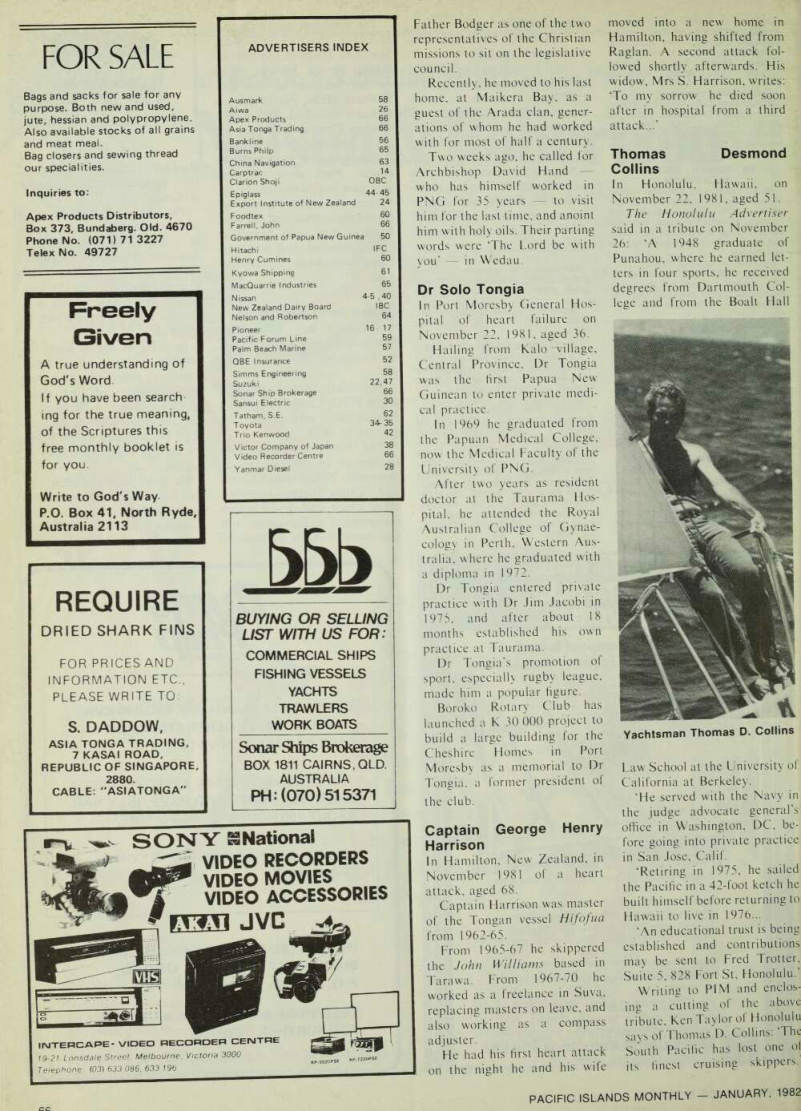
of Islands People
’Esei Lavulo In Sydney, Australia, in September, aged 60. ’Esei Lavulo was well-known in Tonga’s Haapai group, and in the Tongatapu area, as a man who dedicated his life to work for the mission. He served the Church of Tonga in his home land over three decades.
Moving to Australia after his retirement in 1978 to join mem bers of his family, he was soon actively organising a branch of the Church of Tonga in Sydney.
The President of the Church of Tonga, the Rev Selu Mafi, flew from Tonga to conduct the funeral service. He was joined in this function by the Rev Savinata Mahe, Pacific Islands Minister attached to Sydney’s Wesley Central Mission. Mr Mahe described ’Esei Lavulo as ‘a pioneer hero of the Church of Tonga’. Four other ministers took part in the service.
More than 500 Tongans at tended the service, and the local Tongan choir sang hymns as they farewelled their much ad
mired countryman.
Wyvern
Kite.
Canon John Bodger At Maikera Bay, Milne Bay Province, Papua New Guinea, on November 26, 1981, aged 80.
The oldest Anglican mission ary in PNG, Canon Bodger, an Englishman, arrived in the country in 1929.
The Times of Papua New Guinea in an obituary in its November 27-December 3 issue said: Canon Bodger patrolled areas which had never before encountered a European, and was involved in the building of
the Gothic cathedral at Dogura, the Anglicans’ major mission station.
He stayed during the war, and was present at an ordination of a Papua New Guinean as Japanese planes flew overhead.
He was a great raconteur, with a deep, firm voice to the end, despite the cancer of the neck and the diabetes from which he suffered.
In 1950, he had to leave the country because of a heart condition, and became organis ing secretary of the New Guinea Mission in Britain now the PNG Church Partner ship. He returned in 1971 and set up the Anglican parish at Alotau.
He spoke perfect Wedau, and was frequently to be heard on Radio Milne Bay.
Before the war. Adminis trator Hubert Murray chose
Father Bodger as one of the two representatives of the Christian missions to sit on the legislative council.
Recently, he moved to his last home, at Maikera Bay, as a guest of the Arada clan, gener ations of whom he had worked with for most of half a century.
Two weeks ago, he called for Archbishop David Hand who has himself worked in PNG for 35 years to visit him for the last time, and anoint him with holy oils. Their parting words were ‘The Lord be with you' in Wedau.
Dr Solo Tongia In Port Moresby General Hos pital of heart failure on November 22, 1981, aged 36.
Hailing from Kalo -village.
Central Province, Dr Tongia was the first Papua New Guinean to enter private medi cal practice.
In 1969 he graduated from the Papuan Medical College, now the Medical Faculty of the University of PNG.
After two years as resident doctor at the Taurama Hos pital. he attended the Royal Australian College of Gynae cology in Perth, Western Aus tralia. where he graduated with a diploma in 1972.
Dr Tongia entered private practice with Dr Jim Jacobi in 1975, and after about 18 months established his own practice at Taurama.
Dr Tongia's promotion of sport, especially rugby league, made him a popular figure.
Boroko Rotary Club has launched a K 30 000 project to build a large building for the Cheshire Homes in Port Moresby as a memorial to Dr Tongia, a former president of the club.
Captain George Henry Harrison In Hamilton, New Zealand, in November 1981 of a heart attack, aged 68.
Captain Harrison was master of the Tongan vessel Hifofua from 1962-65.
From 1965-67 he skippered the John Williams based in Tarawa. From 1967-70 he worked as a freelance in Suva, replacing masters on leave, and also working as a compass adjuster.
He had his first heart attack on the night he and his wife
moved into a new home in Hamilton, having shifted from Raglan. A second attack fol lowed shortly afterwards. His widow, Mrs S. Harrison, writes; To my sorrow, he died soon after in hospital from a third attack...’
Thomas Desmond Collins In Honolulu. Hawaii, on November 22, 1981, aged 51.
The Honolulu Advertiser said in a tribute on November 26: k A 1948 graduate of Punahou, where he earned let ters in four sports, he received degrees from Dartmouth Col lege and from the Boalt Hall
Law School at the University of California at Berkeley. ‘He served with the Navy in the judge advocate general’s office in Washington, DC, be fore going into private practice in San Jose, Calif. ‘Retiring in 1975, he sailed the Pacific in a 42-foot ketch he built himself before returning to Hawaii to live in 1976... ‘An educational trust is being established and contributions may be sent to Fred Trotter, Suite 5, 828 Fort St, Honolulu.’
Writing to PIM and enclos ing a cutting of the above tribute. Ken Taylor of Honolulu says of Thomas D. Collins; ‘The South Pacific has lost one ol its finest cruising skippers.
Yachtsman Thomas D. Collins
Advertisements & other items, pp. 65-66 (1 item)
PhHp
Burns
GROUP OF COMPANIES M
BURNS PHILP VILA HAVE TWO 140 KVA
YANMAR DIESEL GENERATORS FOR
SALE AT 5 MILLION VATU.
THE GENERATORS ARE APPROXIMATELY
EIGHT YEARS OLD AND HAVE ONLY HAD
ABOUT 100 HOURS RUNNING TIME.
THE SALE IS " AS IS WHERE IS " ON A
CASH BASIS.
INTERESTED PARTIES SHOULD CONTACT:
BURNS PHILP (VANUATU) LIMITED,
P. O. BOX 27.
TELEPHONE 2456 PORT VILA VANUATU
FOR FURTHER DETAILS.
FOR SALE
Bags and sacks for sale for any purpose. Both new and used, jute, hessian and polypropylene.
Also available stocks of all grains and meat meal.
Bag closers and sewing thread our specialities.
Inquiries to: Apex Products Distributors, Box 373, Bundaberg. Old. 4670 Phone No. (071)71 3227 Telex No. 49727
Freely
Given
A true understanding of God's Word.
If you have been search ing for the true meaning, of the Scriptures this free monthly booklet is for you.
Write to God's Way P.O. Box 41, North Ryde Australia 2113
REQUIRE
DRIED SHARK FINS
FOR PRICES AND
INFORMATION ETC.,
PLEASE WRITE TO:
S. DADDOW,
ASIA TONGA TRADING,
7 KASAI ROAD,
REPUBLIC OF SINGAPORE,
2880.
CABLE; "ASIATONGA"
Advertisers Index
Ausmark 58 Aiwa 26 Apex Products 66 Asia Tonga Trading 66 Bankline 56 Burns Philp 65 China Navigation 63 Carptrac 14 Clarion Shoji OBC Epiglass 44-45 Export Institute of New Zealand 24 Foodtex 60 Farrell, John 66 Government of Papua New Guinea 50 H itach i IFC Henry Cumines 60 Kyowa Shipping 61 MacQuarrie Industries 65 Nissan 4-5 ,40 New Zealand Dairy Board IBC Nelson and Robertson 64 Pioneer 16- 17 Pacific Forum Line 59 Palm Beach Marine 57 QBE Insurance 52 Simms Engineering 58 Suzuki 22,47 Sonar Ship Brokerage 66 Sansui Electric 30 Tatham, S.E. 62 T oyota 34- 35 Trio Kenwood 42 Victor Company of Japan 38 Video Recorder Centre 66 Yanmar Diesel 28
Advertisements & other items, pp. 66-68 (2 items)
Video Accessories
BUYING OR SELLING
LIST WITH US FOR:
COMMERCIAL SHIPS
FISHING VESSELS
YACHTS
TRAWLERS
WORK BOATS
Sonar Ships Brokerage
BOX 1811 CAIRNS. OLD.
AUSTRALIA
PH: (070) 515371
r-v
>•*- SONY
1
VIDEO RECORDERS
VIDEO MOVIES
VIDEO ACCESSORIES
553 JVC
INTERCAPE- VIDEO RECORDER CENTRE
19-21 Lonsdale Street. Melbourne, Victoria 3000 Telephone: (03) 633 086. 633 196
KP-502CPSE KP-7220PSE
- n V M E 5 ■ <«
fis
- «as& • i»i: m »«T . ■,* 72* vvt Tiii sjt BKilPfeSwOtc iiac ai
IMISLIgi
9519}§ ■ * ' -r ■ f 7V •x '■
AfirjiJyj
non fat
I dried »il
fl milk
\i'JCM
I wun mu*
;Vj[j}iollite2£
.nonfat Ir ted milk *
j .instant :
?^ t nd whole
SLa 4 i
,if«Ufli i
llhi *%a r> J* J •o*l
>UCT (H
New • X J Ct hU New Zealand
bu creamery
butter
'ik nor d taitaat
Jried whole
Anchor . Ajjfc
*O6 net %dor ]sr
sar
L.CJVNH
■MI O9HAYBO
Aifrh<»i m an c uq **. 4- Anehors
milk
Ut/a-Fcslarised ■ ■ as
TiSi
Ik T 3illia
Saiio /
Ilk
i- *
c >fcCK STOCK ROTATION ■W"
PURF ocalSd?* \|
'*) M(» UAL** 0
CHEESE
,35E^ »i |jV> * sU. f I . h i <• ■•W}; *:• i it •l&lill* rj '* - , ~-fcT
K Clarion
■' Ity Series
LE TUNER
K
EJECT
0
DD DOLBY SYSTEM
1/9 fl •
PROGRAM
in m o
i u• u u
POWER
PM Cro2
TUNER PROGRAMMIN
THE GREATEST ROADSHOW
ON EARTH.
The Clarion PE-959 is the world's first all-programmable car stereo, and is it a marvel in electronics!
Take the tuner, for instance. Thanks to a microprocessor, it can tune in up to ten stations automatically. Simply pick the stations, preset them in any order you want, and it will switch over from one station to another. Automatically and at the exact time you want it.
You need no longer worry about noise either. The SASC Mk II (signal-actuated FM stereo control circuit) automatically adjusts the reception to signal strength, assuring the best reception mode at all times.
The Clarion PE-959 has all the sophistication you could ask for. Metal tape capability. Dolby NR* circuit. Easy, all-pushbutton operation with 32 logically laid out control buttons. Quartz digital display. High 23W + 23W power, using a GA-301 stereo power amplifier.
There's no question about it. The Clarion PE-959 is "hi-way fidehty."
You can drive for mile after mile, and be sure of enjoying every minute of it.
PE-959. World's First All-Programmable Car Stereo
EJECT
K Cl3lion Programmable TUNER i n i l li i u u
TUNER PROGRAMMING
i « ‘Dolby and the double-D symbol are trademarks of Dolby Laboratories Licensing Corporation.
K Clarion
CLARION CO., LTD.
Australia: Amalgamated Wireless (Ausb-alasia) Lt^:. S 5 I 4 1^® m ß^^af&'c 362, Suva/Tahiti: New Zealand Limited, P.O Box 50-248, Cedei/Guam: Guam Radio &TV Shop, P.( Shangrila, B.P. 200, Papeete/New Caledonia. CaldK.BP. , Vila/Cook Islands: South Seas Inlerm K Ud. P.O. BOX 1428, Borolto, Port Mo Tnl/i/n lanan