Pacific Islands Monthly

News Magazine Of The South Pacific
July, 1971
Australia, Nz, Geic, Bsip 50C
PNG, FIJI, COOKS, TONGA, W. SAMOA, N. HEBRIDES 45c
Nauru, Norfolk, Niue 45C
AMERICAN SAMOA 70c HAWAII 80c MICRONESIA 90c NEW CALEDONIA 65 CFP FRENCH POLYNESIA 75 CFP
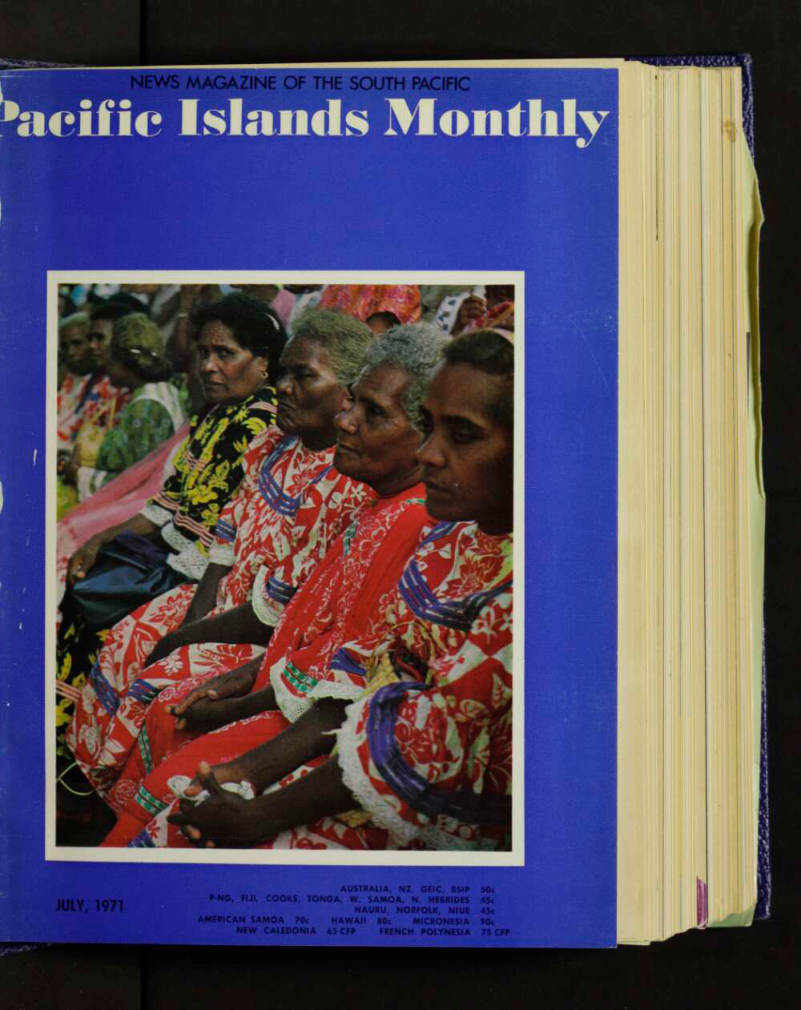
Our Cover
No international cricketers ever got as colourful an array of spectators as this one photographed by Bruce Adams at a women's cricket match in New Caledonia.
Advertisements & other items, p. 2 (1 item)
Mitsubishi
Pick either the sleek hardtop or stylish sedan and you are a winner.DYNA-WEDGE lines and luxurious appointments blend beautifully with the Colt Galant's snappy sports car performance. Add tothese elegant llißijpSli|s features, comfort, safety, economy—and you know g what owning the Colt Galant is all about. % m
■saa
sS 4= .>
MITSUBISHI
MOTORS CORPORATION
Tokyo, Japan
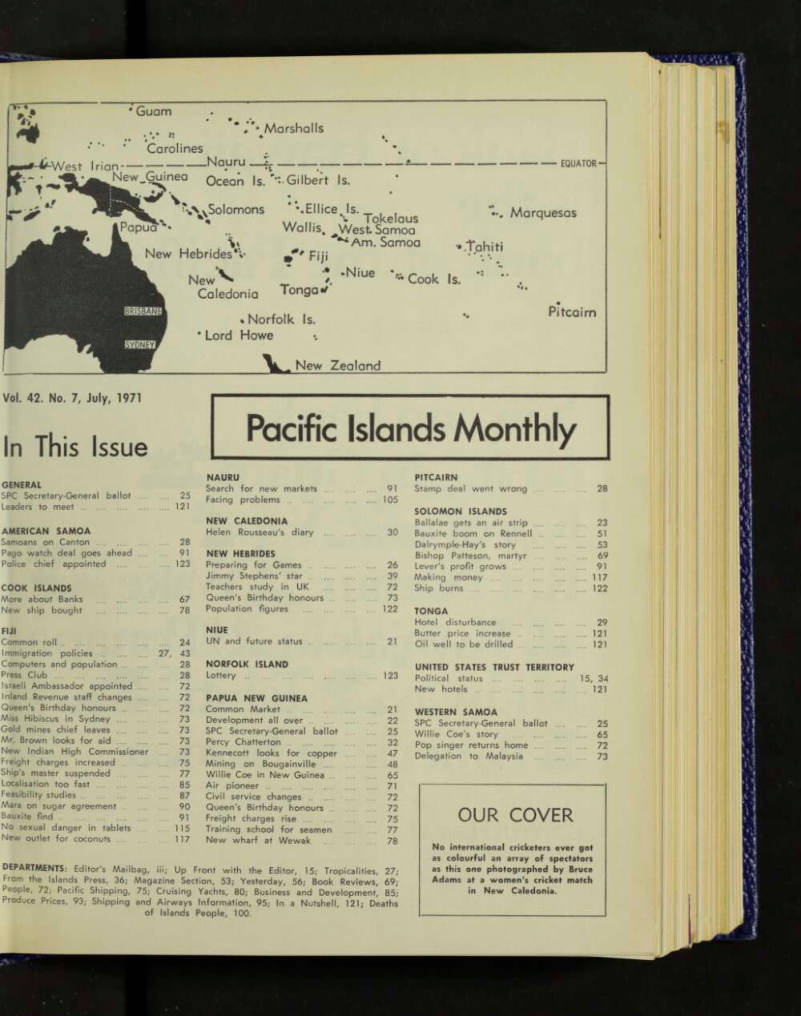
In This Issue
General
SPC Secretary-General ballot 25 Leaders to meet 121
American Samoa
Samoans on Canton 28 Pago watch deal goes ahead 91 Police chief appointed 123
Cook Islands
More about Banks 67 New ship bought 78
Fiji
Common roll 24 Immigration policies 27, 43 Computers and population 28 Press Club 28 Israeli Ambassador appointed 72 Inland Revenue staff changes 72 Queen's Birthday honours 72 Miss Hibiscus in Sydney 73 Gold mines chief leaves 73 Mr. Brown looks for aid 73 New Indian High Commissioner ... 73 Freight charges increased 75 Ship's master suspended 77 Localisation too fast 85 Feasibility studies 87 Mara on sugar agreement 90 Bauxite find 91 No sexual danger in tablets 115 New outlet for coconuts 117
Nauru
Search for new markets 91 Facing problems 105
New Caledonia
Helen Rousseau's diary 30
New Hebrides
Preparing for Games 26 Jimmy Stephens' star 39 Teachers study in UK 72 Queen's Birthday honours 73 Population figures 122
Niue
UN and future status 21
Norfolk Island
Lottery 123
Papua New Guinea
Common Market 21 Development all over 22 SPC Secretary-General ballot 25 Percy Chatterton 32 Kennecott looks for copper 47 Mining on Bougainville 48 Willie Coe in New Guinea 65 Air pioneer 71 Civil service changes 72 Queen's Birthday honours 72 Freight charges rise 75 Training school for seamen 77 New wharf at Wewak 78
Pitcairn
Stamp deal went wrong 28
Solomon Islands
Ballalae gets an air strip ... 23 Bauxite boom on Rennell 51 Dalrymple-Hay's story 53 Bishop Patteson, martyr 69 Lever's profit grows 91 Making money 117 Ship burns 122
Tonga
Hotel disturbance 29 Butter price increase 121 Oil well to be drilled 121
United States Trust Territory
Political status 15, 34 New hotels 121
Western Samoa
SPC Secretary-General ballot 25 Willie Coe's story 65 Pop singer returns home 72
Delegation to Malaysia 73
DEPARTMENTS: Editor's Mailbag, iii; Up Front with the Editor, 15; Tropicalities, 27; From the Islands Press, 36; Magazine Section, 53; Yesterday, 56; Book Reviews, 69; People, 72; Pacific Shipping, 75; Cruising Yachts, 80; Business and Development, 85; Produce Prices, 93; Shipping and Airways Information, 95; In a Nutshell, 121; Deaths of Islands People, 100.
writer to interview Jerry Pentland and

Goya Henry, who are somewhere around. 1 don’t mean a reporter such as interviews blokes like me for half an hour, but one who can be inter ested in writing a book and spending a week or so with them.
Not only will an early history of flying in New Guinea be available but also a history of the Royal Flying Corps. Both were in the early days of New Guinea flying and the stories they can tell are worth a fortune.
Jerry’s stories are sometimes exag gerated, but having lived with him for 12 months or so I know they are not too much so.
Lance Wilkinson.
Samarai, Papua. • The old hands concerned are both in Sydney, and we occasionally hear from Goya. Their New Guinea aviation stories were recorded some years ago by that other remarkable New Guinea pioneer lan Grabowsky, when he was putting together the raw material for a history of New Guinea aviation. lan became ill in Melbourne, and his huge dossier of facts is now in the capable hands of Jim Sinclair, of Goroka, NG, who is getting it into book form. There’s a review of Jim’s latest book, on Gibbes Sepik Airways, in this issue of PIM. But for some oj the difficulties of producing instant history from old-timers, see the com ments, Up Front column, May PIM.
Fiji Drinking
Sir, —It’s an old, old story, the one put out by the liquor brewers (PIM.
June, p. 35) that beer has to be 8 per cent, or 9 per cent, proof spirit if it is to keep in the tropics. It just isn’t true. A friend of mine in Fiji regularly bought cartons of canned beer imported by the Suva Co-op. from England—Toby was the name of one of the two varieties. It was well below the strength of the local brew—it didn’t taste as good either— but it kept well. The real objection by the hotel keepers in Fiji to weaker beer is that it might not. be welcomed by the Fijians who’s main aim is to get stoned as quickly as possible.
Your June article reported the grow ing incidence of drunkenness in Fiji, This is not confined to Fiji or to under-developed countries, but it is more noticeable in places like Fiji where there is little or no control over drinking. There are only two rules imposed by hoteliers —the drinker has to be able to pay for his drink and be still conscious when he asks for it. Unless there is more con trol, the staggering, brawling drunks will continue to pour out of Fiji’s bars.
T. C. Ross
Auckland, NZ.
Advertisements & other items, pp. 4-18 (4 items)
Only Pea-Beu Insecticide
guarantees to kill aH
insect pests... FAST!
Pea-Beu is the strongest insecticide
available today
A recent survey, which included laboratory testing, conclusively proved that Pea-Beu aerosol insecticide contained the highest concentration of the world’s most powerful insect-killing ingredients.
Flies, mosquitoes, in fact no insect can survive its powerful fume action. Powerful Pea-Beu penetrates to all corners with devastating effect to all flying and crawling insect pests, even seeking out and destroying those hiding in inaccessible places. Because of its strong concentration, Pea-Beu aerosol insecticide is very economical. You need only short bursts in a room to ensure complete protection from all disease-carrying insect pests.
The dangers of diseases spread by insect pests cannot be stressed enough, especially to mothers of young children. Pea-Beu is the only insecticide that will kill all insect pests, even the hardy cockroach. Regular spraying with powerful Pea-Beu aerosol insecticide will eradicate insect pests such as flies, mosquitoes, cockroaches, fleas, ants, moths and silverfish and all insect pests that bring the dangers of disease into your home.
Always remember the health of your family depends on your choice of insecticide. Powerful Pea-Beu is guaranteed to kill all diseasecarrying insect pests before they have a chance to bring illness into your home.
Powerful Pea-Beu—guaranteed the strongest, most
powerful insecticide available today.
Pea-Beu kills all insects
s.
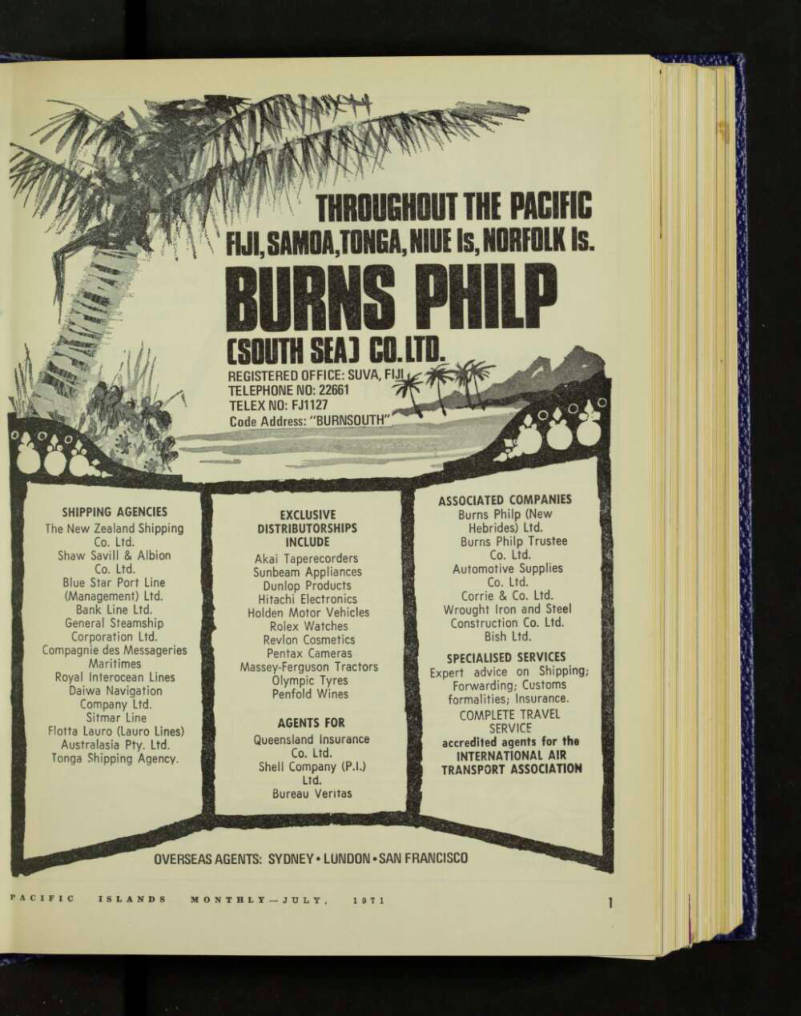
THROUGHOUT THE
NIUE IS
SAMOA.TONGA
HJI
■PACIFIC
HORIOLK IS.
iii* L/\
[SOUTH SEA] CO. LTD.
REGISTERED OFFICE: SUVA, FW
TELEPHONE NO; 22661
TELEX NO: FJ1127
Code Address: "BURNSOUTH'
SHIPPING AGENCIES
The New Zealand Shipping Co. Ltd.
Shaw Savill & Albion Co. Ltd.
Blue Star Port Line (Management) Ltd.
Bank Line Ltd.
General Steamship Corporation Ltd.
Compagnie des Messageries Maritimes Royal Interocean Lines Daiwa Navigation Company Ltd.
Sitmar Line Flotta Lauro (Lauro Lines) Australasia Pty. Ltd.
Tonga Shipping Agency.
EXCLUSIVE
DISTRIBUTORSHIPS
INCLUDE
Akai Taperecorders Sunbeam Appliances Dunlop Products Hitachi Electronics Holden Motor Vehicles Rolex Watches Revlon Cosmetics Pentax Cameras Massey-Ferguson Tractors Olympic Tyres Penfold Wines
AGENTS FOR
Queensland Insurance Co. Ltd.
Shell Company (P. 1.) Ltd.
Bureau Veritas
ASSOCIATED COMPANIES
Burns Philp (New Hebrides) Ltd.
Burns Philp Trustee Co. Ltd.
Automotive Supplies Co. Ltd.
Corrie & Co. Ltd.
Wrought Iron and Steel Construction Co. Ltd.
Bish Ltd.
SPECIALISED SERVICES
Expert advice on Shipping; Forwarding; Customs formalities; Insurance.
COMPLETE TRAVEL
SERVICE
accredited agents for the
INTERNATIONAL AIR
TRANSPORT ASSOCIATION
OVERSEAS AGENTS: SYDNEY • LONDON • SAN FRANCISCO
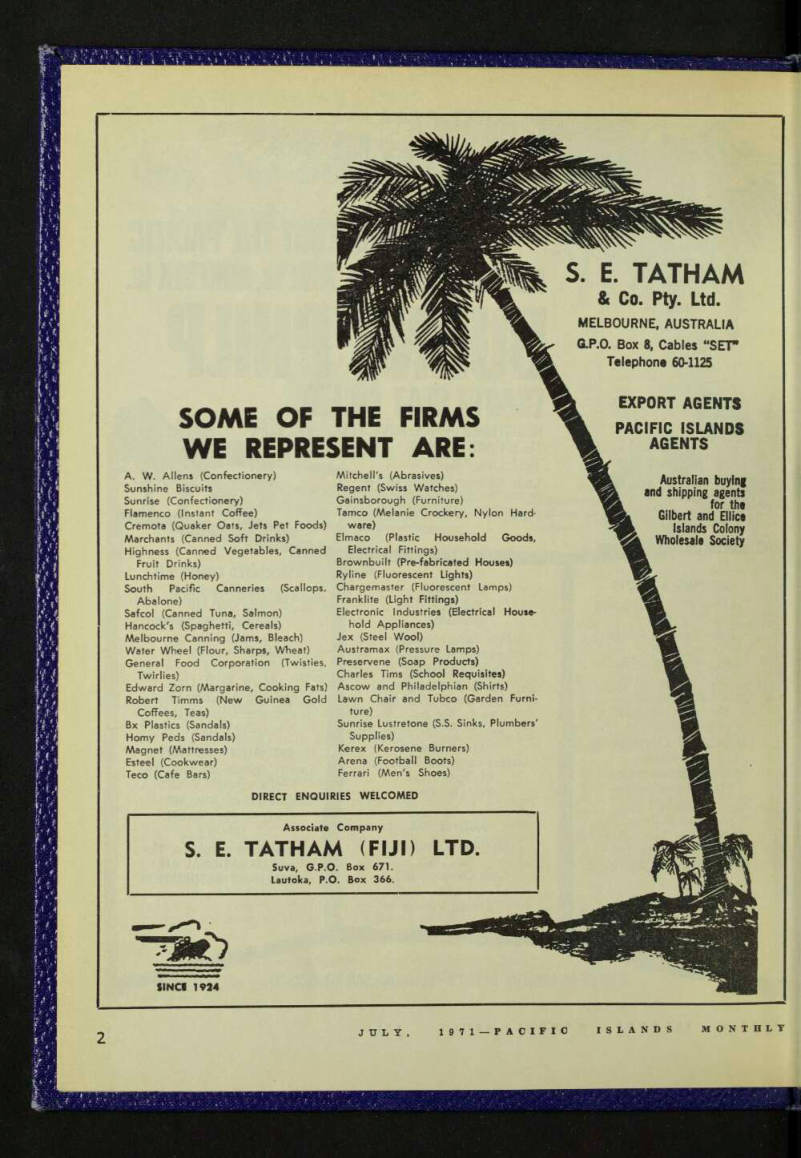
SOME OF THE FIRMS
WE REPRESENT ARE:
A. W. Allens (Confectionery) Sunshine Biscuits Sunrise (Confectionery) Flamenco (Instant Coffee) Cremota (Quaker Oats, Jets Pet Foods) Merchants (Canned Soft Drinks) Highness (Canned Vegetables, Canned Fruit Drinks) Lunchtime (Honey) South Pacific Canneries (Scallops, Abalone) Safcol (Canned Tuna, Salmon) Hancock's (Spaghetti, Cereals) Melbourne Canning (Jams, Bleach) Water Wheel (Flour, Sharps, Wheat) General Food Corporation (Twisties, Twirlies) Edward Zorn (Margarine, Cooking Fats) Robert Timms (New Guinea Gold Coffees, Teas) Bx Plastics (Sandals) Homy Peds (Sandals) Magnet (Mattresses) Esteel (Cookwear) Teco (Cafe Bars) Mitchell's (Abrasives) Regent (Swiss Watches) Gainsborough (Furniture) Tamco (Melanie Crockery, Nylon Hardware) Elmaco (Plastic Household Goods, Electrical Fittings) Brownbuilt (Pre-fabricated Houses) Ryline (Fluorescent Lights) Chargemaster (Fluorescent Lamps) Franklite (Light Fittings) Electronic Industries (Electrical Household Appliances) Jex (Steel Wool) Austramax (Pressure Lamps) Preservene (Soap Products) Charles Tims (School Requisites) Ascow and Philadelphian (Shirts) Lawn Chair and Tubco (Garden Furniture) Sunrise Lustretone (S.S. Sinks, Plumbers' Supplies) Kerex (Kerosene Burners) Arena (Football Boots) Ferrari (Men's Shoes)
S. E. TATHAM
& Co. Pty. Ltd.
MELBOURNE, AUSTRALIA
G.P.O. Box 8, Cables "SET"
Telephone 60-1125
EXPORT AGENTS
PACIFIC (SUNOS
AGENTS
Australian buying and shipping agents for the Gilbert and Ellice Islands Colony Wholesale Society
DIRECT ENQUIRIES WELCOMED
Associate Company
S. E. TATHAM (FIJI)
Suva, G.P.O. Box 671.
Lautoka, P.O. Box 366.
LTD
SINCi 1924
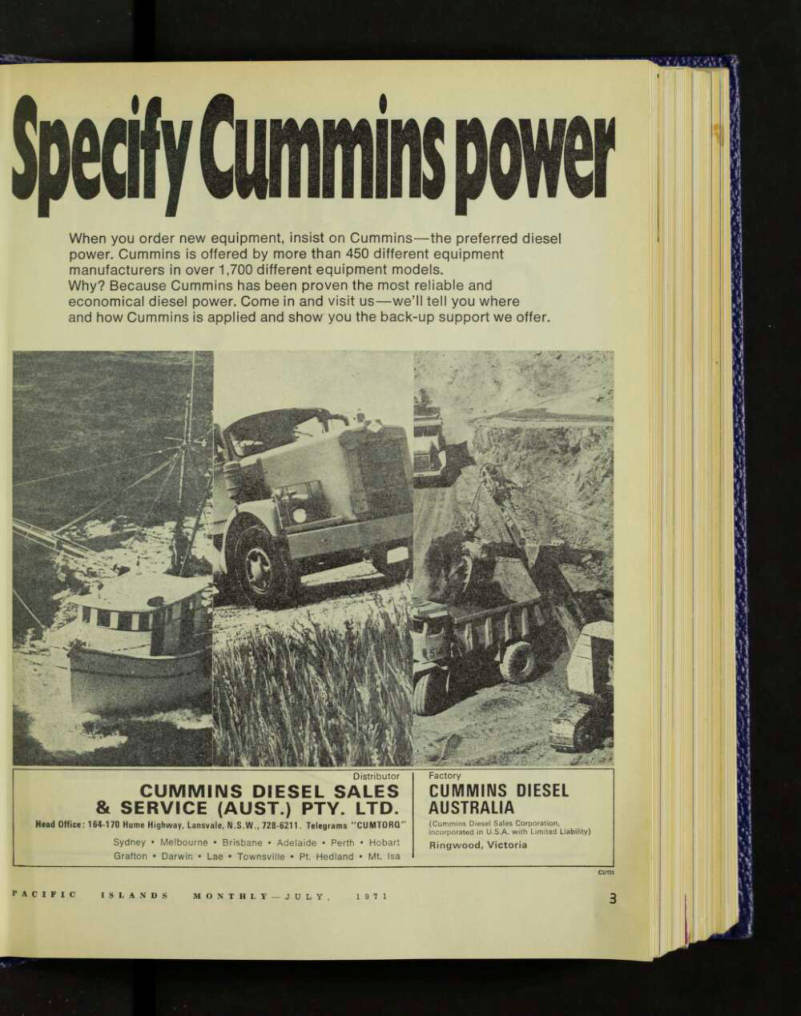
When you order new equipment, insist on Cummins —the preferred diesel power. Cummins is offered by more than 450 different equipment manufacturers in over 1,700 different equipment models.
Why? Because Cummins has been proven the most reliable and economical diesel power. Come in and visit us—we’ll tell you where and how Cummins is applied and show you the back-up support we offer. - , re : re life I? :l£ : I m m m :■ m i i M m I ‘ <3
wor.
m m m ’O fip- -6i O ft*
one
Only the world’s finest Virginia tobaccos are blended to produce...
PLAYER’S
GOLD
LEAF
ofthe greatcigarettes
8593/2/70
I © * m K . ■ mem
you need the
Esso cure from
BRECKWOLDT & CO.
This is the best combination to solve your lubrication troubles.
Esso quality combined with specialist knowledge will eliminate all your lubrication headaches.”
Esso
Contact your local Breckwoidt Branch for the cure. 1866/86
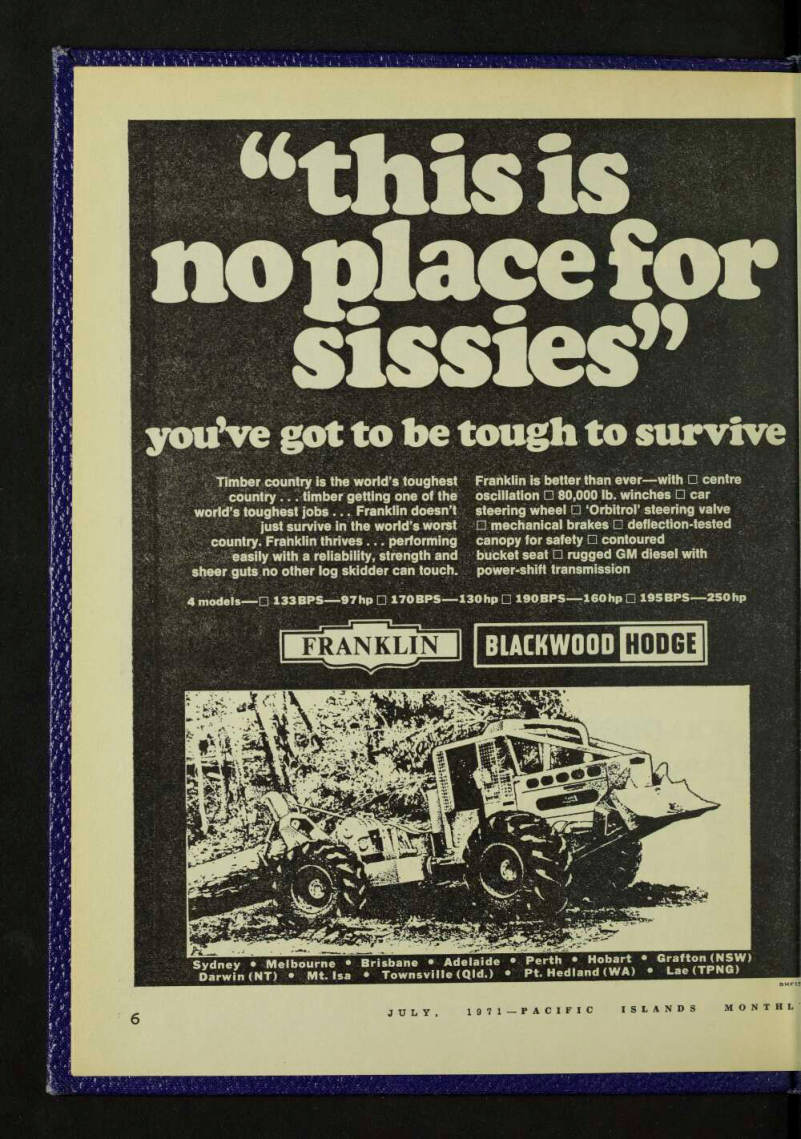
no place for
sissies”
survive
Timber country is the world’s toughest country ... timber getting one of the world’s toughest jobs ... Franklin doesn’t just survive in the world’s worst country. Frahklin thrives ... performing easily with a reliability, strength and sheer guts no other log skidder can touch.
Franklin is better than ever—with □ centre oscillation □ 80,000 lb. winches □ car steering wheel □ ‘Orbitrol’ steering valve □ mechanical brakes □ deflection-tested canopy for safety □ contoured bucket seat □ rugged GM diesel with power-shift transmission 4 models —□ 1338 P □ 170BPS—130 hp □ 190BPS —160 hp □ 195BPS—250hp
FRANKLIN
BLACKWOOD
HODGE
S 3 m ¥ m W V v / Sydney • Melbourne • Brisbane • Adelaide • Perth • Hobart • Grafton(NSW) Darwhi(NT) • Mt. Isa • Townsville (Qld.) • Pt. Hedland (WA) • Lae(TPNG)
Today, the major components
for low-cost buildings
are made by...
i: si ti h / Your Brownbuilt distributor is now a one-stop shop for your industrial building and housing needs. Brownbuilt don’t just make one or two building components . . . they make the lot.
Ready painted wall cladding, roofing and insulation, steel building and roof frames, ceiling, soffit and fascia systems, feature gutters and all accessories. And they’re all made for each other.
Brownbuilt
LIMITED
Building Products Division
6 Brunker Road Chullora NSW 2190 Designed to fit together quickly and easily.
So your building’s up fast.
And remember, only Brownbuilt offers the protection of Colorarmor.
So next time you’re thinking of building ... or extending, think of Brownbuilt. See your local distributor or post coupon for more information. r 1 I Please send me further details I I I I on Name Address
88.P33P1M
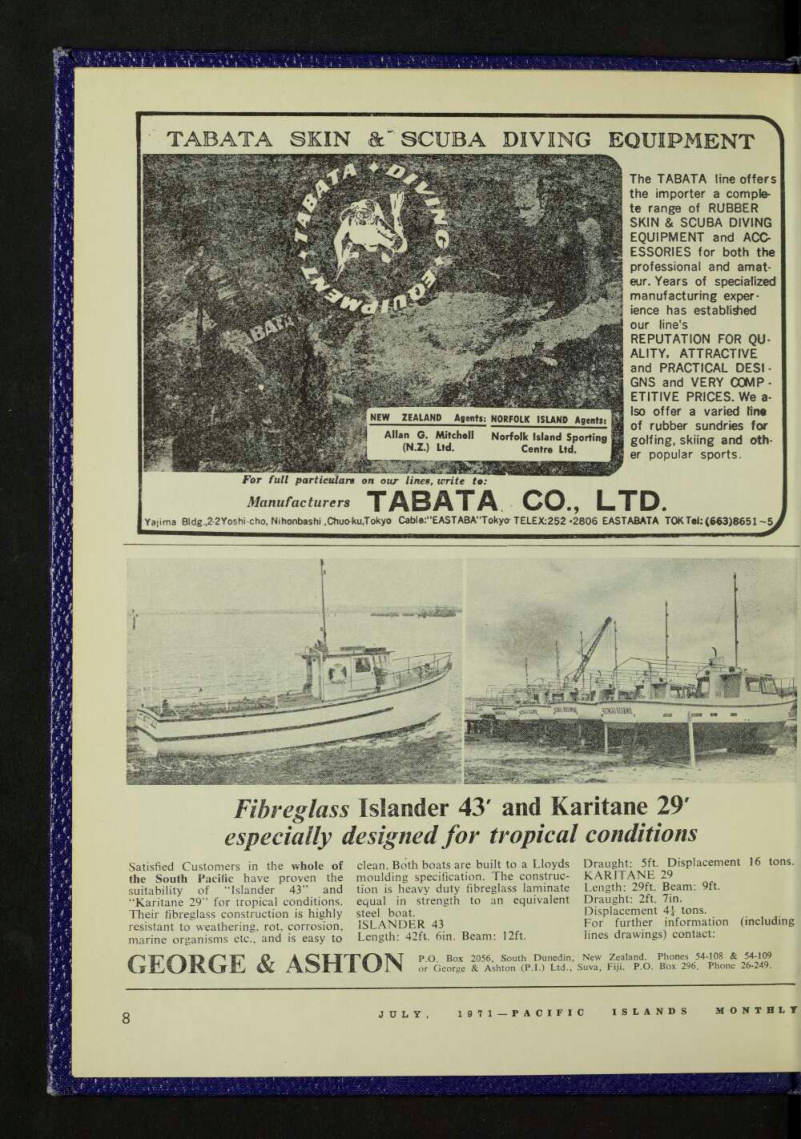
TABATA SKIN &' SCUBA DIVING EQUIPMENT
i m a-
NEW
ZEALAND
Agents
NORFOLK
ISLAND
Agents: Allan Mitchell Norfolk Island Sport mg Ltd Centre Ltd The TABATA line offers the importer a complete range of RUBBER
SKIN & SCUBA DIVING
EQUIPMENT and ACC-
ESSORIES for both the professional and amateur. Years of specialized manufacturing experience has establidied our line's
REPUTATION FOR QU-
ALITY. ATTRACTIVE
and PRACTICAL DESI-
GNS and VERY COMP -
ETITIVE PRICES. We a-
Iso offer a varied line of rubber sundries for golfing, skiing and other popular sports.
For full particulars on our lines, write to:
Manufacturers TABATA CO., LTD.
Yajima 81dg..2-2Yoshi-cho. Nihonbashi .Chuo-ku,Tokyo CabIe:"EASTABA"Tokyo- TELEX;2S2 *2806 EASTABATA TOK Tel; (663)8651 —5.
... . 1g - .■ 1 I ■ uM!
M $P*« *«
Fibreglass Islander 43' and Karitane 29'
especially designed for tropical conditions
Satisfied Customers in the whole of the South Pacific have proven the suitability of “Islander 43” and “Karitane 29” for tropical conditions.
Their fibreglass construction is highly resistant to weathering, rot, corrosion, marine organisms etc., and is easy to clean. Both boats are built to a Lloyds moulding specification. The construction is heavy duty fibreglass laminate equal in strength to an equivalent steel boat.
ISLANDER 43
Length: 42ft. 6in. Beam: 12ft.
Draught; sft. Displacement 16 tons.
KARITANE 29
Length: 29ft. Beam: 9ft.
Draught: 2ft. Tin.
Displacement 4j tons.
For further information (including lines drawings) contact:
GEORGE & ASHTON
P.O Box 2056, South Dunedin, New Zealand. Phones 54-108 & 54-109 or George & Ashton (P. 1.) Ltd., Suva, Fiji. P.O. Box 296. Phone 26-249.
■ ' f m
MF4O LOADER
s**
MFI2 TRANSPORTER
/ >'?• 'l* 1 ■N P
MF2I TRAILER
W' ' - v * < ; iiyrr 1 i iK
MF2I MULTI-PURPOSE BLADE
One man
and a Massey-Ferguson 135
can do almost anything
MF7156 ASK YOUR MASSEY-FERGUSON DISTRIBUTOR FOR COMPLETE DETAILS ... THE MAN TO SEE IS HERE
PAPUA AND NEW GUINEA
Ela Motors Limited, P.O. Box 75,
PORT MORESBY
Branches and Dealers throughout Papua and New Guinea
For
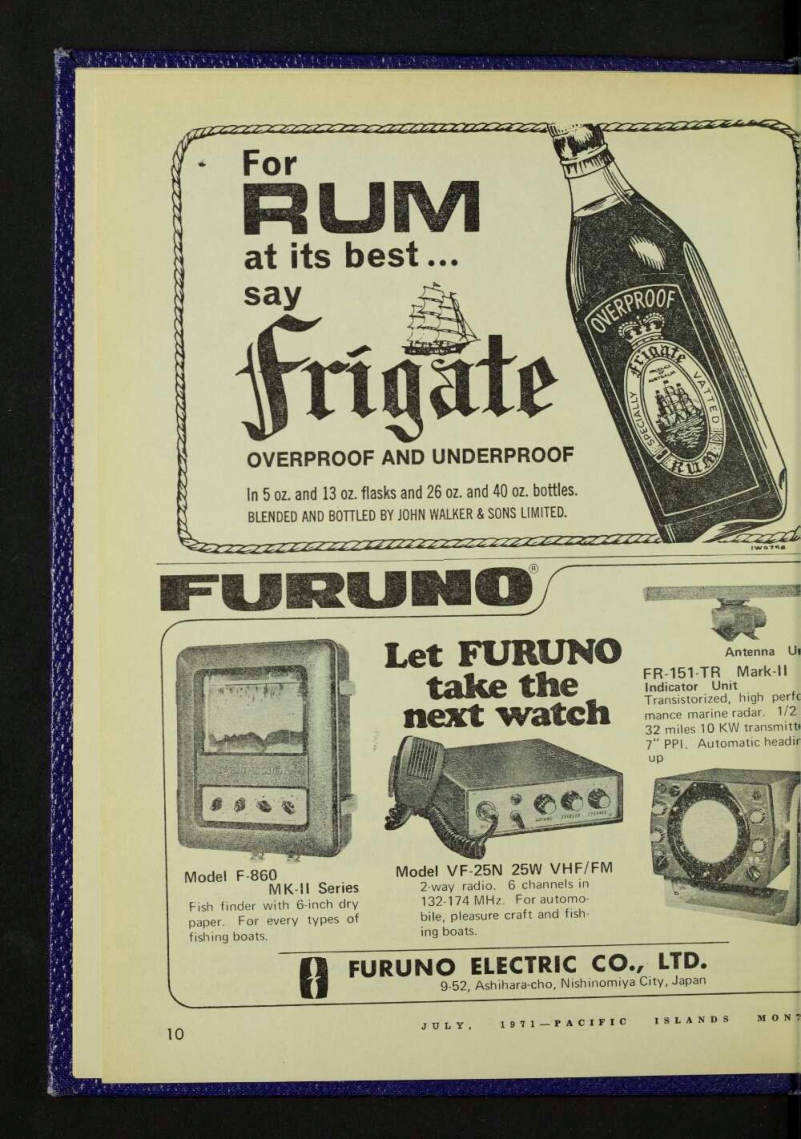
RUM
at its best...
say
OVERPROOF AND UNDERPROOF
In 5 oz. and 13 oz. flasks and 26 oz. and 40 oz. bottles.
BLENDED AND BOTTLED BY JOHN WALKER & SONS LIMITED. 2^2
IWOTRA
URUNO
ft Model F-860 MK-ll Series Fish finder with 6-inch dry paper. For every types of fishing boats.
.et FUHUNO
take the
next watch
Model VF-25N 25W VHF/FM
2-way radio. 6 channels in 132-174 MFIz. For automobile, pleasure craft and fishing boats.
Antenna Ui FR-151-TR Mark-ll Indicator Unit Transistorized, high perfc mance marine radar. 1/2 32 miles 10 KW transmits 7" PPL Automatic headir 0
FURUNO ELECTRIC CO., LTD.
9-52, Ashihara-cho, Nishinomiya City, Japan
Its wide range of applications has earned the NA2 Level a new, appropriate name
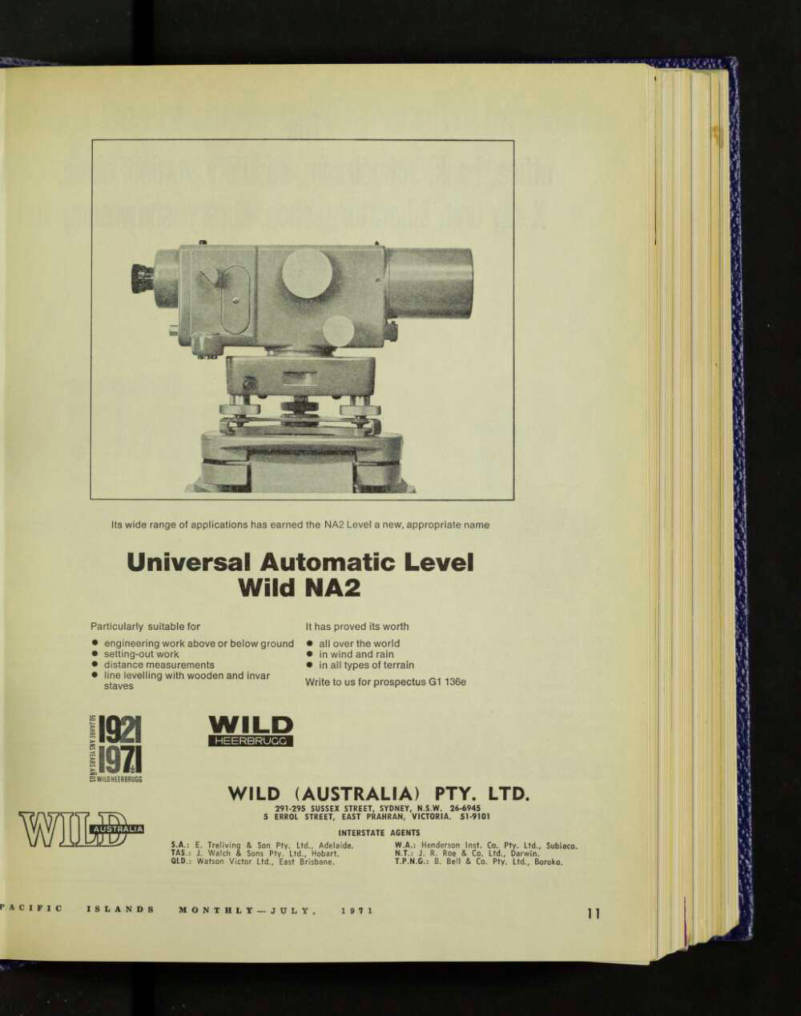
Universal Automatic Level
Wild NA2
Particularly suitable for • engineering work above or below ground • setting-out work • distance measurements • line levelling with wooden and invar staves It has proved its worth • all over the world • in wind and rain • in all types of terrain Write to us for prospectus G 1 136 e 1921 1971
5 WILD HEERBRUGG
WILD
HEERBRUGG
WILD (AUSTRALIA) PTY. LTD,
291-295 SUSSEX STREET, SYDNEY, NS W. 26-6945 5 ERROL STREET, EAST PRAHRAN, VICTORIA. 51-9101
INTERSTATE AGENTS
S.A.: E. Treliving & Son Pty. Ltd., Adelaide.
TAS.: J. Walch & Sons Pty. Ltd., Hobart.
OLD.: Watson Victor Ltd., East Brisbane.
W.A.: Henderson Inst. Co. Pty. Ltd., Subiaco.
N.T.: J. R. Roe & Co. Ltd., Darwin.
T.P.N.G.: B. Bell & Co. Pty. Ltd., Boroko.
The
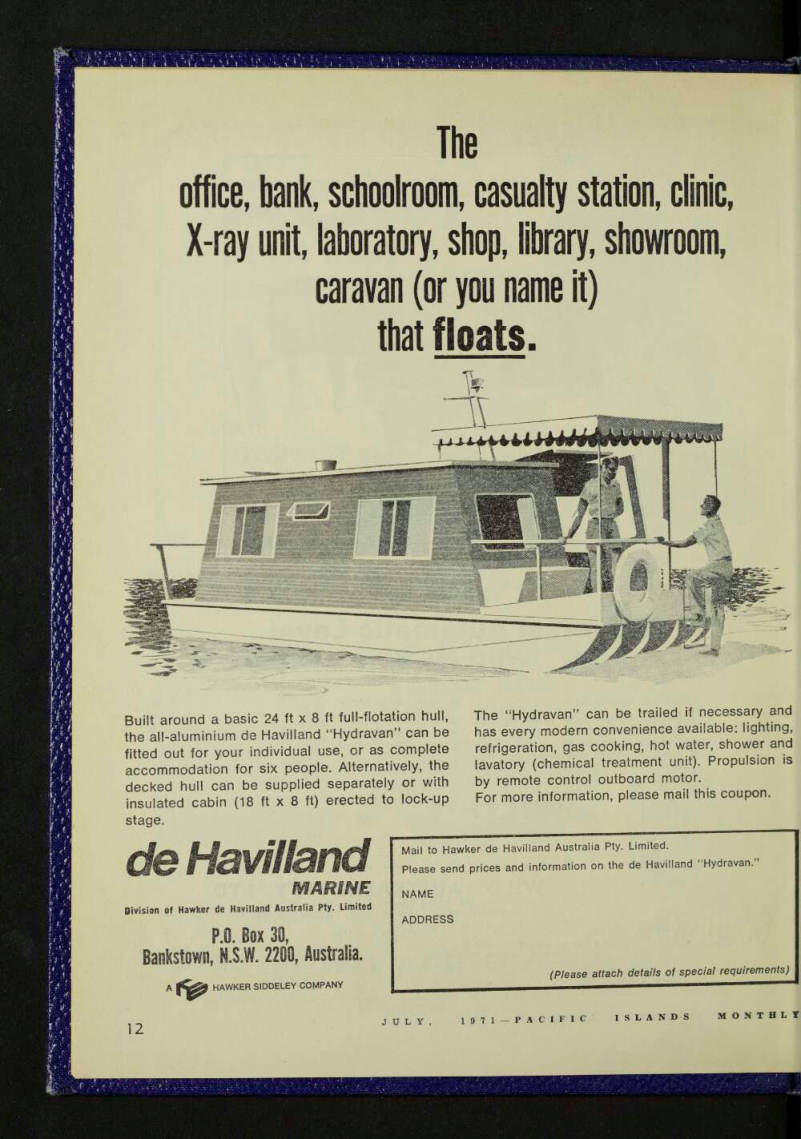
office, bank, schoolroom, casualty station, clinic,
X-ray unit, laboratory, shop, library, showroom,
caravan (or you name it)
that floats.
*** Built around a basic 24 ft x 8 ft full-flotation hull, the all-aluminium de Havilland “Hydravan” can be fitted out for your individual use, or as complete accommodation for six people. Alternatively, the decked hull can be supplied separately or with insulated cabin (18 ft x 8 ft) erected to lock-up The “Hydravan” can be trailed if necessary and has every modern convenience available: lighting, refrigeration, gas cooking, hot water, shower and lavatory (chemical treatment unit). Propulsion is by remote control outboard motor.
For more information, please mail this coupon. stage.
de Havilland
MARINE
Division of Hawker de Havilland Australia Pty. Limited
P.O. Box 30,
Bankstown, H.S.W. 2200, Australia.
AfOgj HAWKER SIDDELEY COMPANY
Mail to Hawker de Havilland Australia Pty. Limited.
Please send prices and information on the de Havilland “Hydravan.
NAME
ADDRESS
(Please attach details of special requirements) ' ’
new heart
a U H AU999
AUBBB
AU666
AUIOI
AUSSSA
AU999; SANSUI's top-of-the-line in its distinguished solidstate control amplifier series. A dazzling 180 watts of music power, with total distortion less than 0.4%. 10 to 30,000 Hz power bandwidth. Triple tone control. Separately useable pre- and main amplifier sections. Accommodates 3 sets of speaker systems, 2-tape decks, and 2 turntables.
AUBBB:Offers a full-bodied 140 watts of music power. 10 to 40,000 Hz power bandwidth, with distortion kept to 0.4% or less. Triple tone controls. Separable pre- and power amplifier sections. Accommodates 3 sets of speaker systems, 2-tape decks, and 2 turntables. AU666‘Probably the most advanced control amplifier in the medium-tohigh power range. 10 to 40,000 Hz power bandwidth, with distortion no more than 0.5%. 100 watts of music power.
Triple tone controls. Exceptional tone quality. Separately useable pre- and main amplifier sections. Accommodates 2 sets of speaker systems simultaneously. AUSSSA;One of the best buys in the medium power range. A rousing "m. 85 watts of music power. 20 to 40,000 Hz power bandwidth, with distortion less than 0.5%. Independently useable pre- and power amplifier sections. 2 speaker switches, 5 outputs, and 7 inputs. AU101: Offers professional features out of proportion to its modest price tag. 50 watts of music power. 25 to 40,000 Hz power bandwidth, with distortion limited to less than 0.8%. Complete accessory circuits. pand your present stereo set into system, all you need are the QS-1, a second set of speakers, and a second power amplifier.
QS-1 4-Channel Synthesizer Decoder : Creates fantastic'Mive sound field" from2-channel sources. To excomplete 4-channel fr The Symbol of SANSUI 4-Channel Sound PRABHY BROTHERS LTD. P.O. Box 183, Nadi, Fiji Islands Tel. 70183/SERVONNAT Rue des Polius, Tahitiens Pateete, Tahiti.'Tel. 03-29/OCEANIA INDENT AGENCY P.O Box 5518, Boroko, Port Moresby, Papua & New Guinea. Tel. 56406/CHIN H. MEEN & SONS P/L Tabari Place, P.O. Box 1106, Boroko Tel. 56546/Kametere St., P.O. Box 224, Rabaul.
Tel. 2462/PAUL MOW & CO. 9th St., P.O. Box 449, Lae. Tel. 2954/MICHAEL CHOW & CO. P/L Okari St., P.O. Box 1106, Boroko Tel. 56338/SEETO KONG & SONS P/L Taurama Road, P.O. Box 1218, Boroko Tel. 56445/PINCS (MT HAGEN) P/L P.O. Box 16S, Mt Hagen. Tel. 385/BOUGAINVILLE COPPER Canteen, Panguna/ PHOTOSONIC P.O Box 519, Madang. Tel. 2503/SANSUI ELECTRIC CO., LTD. 14-1, 2-chome, Izumi, Suginami-ku, Tokyo, Japan
/C> O •'V o >v % ** *r
Lunch size, snack size
SAO biscuits
are the right size!
Crisp, fresh Arnett’s Sao biscuits ... right size to satisfy, right size for snack foods, too! Cheese for lunch? A big slice fits just right on Sao. So does a slice of ham or salami.
Prefer jam or spread? Or how about tomato? Simply serve with Sao—the right-size biscuit that makes all the crisp difference to lunches at home and at school or outof-doors. The triple-wrapped pack keeps the biscuits crisp and fresh.
Qmott's/«™>“s Biscuits
There is no Substitute for Quality
7
ACIFIC ISLANDS MONTHLY JULY, 1971
9
ACIFIC ISLANDS MONTHLY JULY, 1971
July. 1971-Pacific Islands Mont
Pacific
Islands
Monthly
Established 1930: 41st Year of Publication.
Owned And Published By
Pacific Publications (Aust.) Pty. Ltd.,
29 Alberta St., Sydney, N.S.W., 2000.
Postal Address: G.P.O. BOX 3408, SYDNEY,
N.S.W., 2001.
Telegraphic Address: PACPUB, Sydney.
Telephones: 61-9197, 61-7101, 61-4669.
Chief Executives: Managing Director: R. W. Robson.
Executive Director/Publisher: Judy Tudor.
Executive Director/Business Manager: Selwyn Hughes.
Executive Director/Chief Editor: Stuart Inder.
Pacific Islands Monthly
Editor: Stuart Inder.
Assistant Editor: John Carter.
Advertising Manager: W. A. Gasnier.
Branch Offices
Fiji: Pacific Publications (Fiji) Ltd., Fiji Times Building, 20 Gordon Street, Suva. Tel.: 25601.
Fiji Times Office, Mayfair Building, Namoli Ave., LAUTOKA. Telex: 1144. Tel.: 60-422.
Papua-New Guinea: PORT MORESBY, P.O.
Box 16; LAE, P.O. Box 227; RABAUL, Mr.
Steve Simpson, P.O. Box 433 (c/- Rabaul Photographic. Tel.: 2677).
Representatives
Victoria; Advertising—Wilke & Co. Ltd., 37 Brown's Road, Clayton, Vic., 3168. Tel.: 544-8222.
Queensland; Advertising—Beale Media Services, 232 St. Paul's Terrace, Fortitude Valley, Qld., 4006. Tel.: 51-5827.
New Zealand: Mrs. E. M. Fisher, C.P.O. Box 2229, Queen St., Auckland. Tel,: 485-155.
United Kingdom: S. R. Warman, Park House, 22 Park Street, Croydon, CR9 3NP. Tel.. 01-6884177.
Overseas Newspapers (Agencies) Ltd., Cromwell House. Fulwood Place, London, W.C.I. Tel.: 01-242-0661. Cables: WESNEWS, London, DS4 Japan: Advertising—Universal Media Corpora tion, C.P.O. Box 46, Tokyo. Tel.: 666-3036
Agents
All main trading firms and stores in the Pacific Islands.
Pacific Publications Pty. Ltd. is the Australian agent for THE FIJI TIMES.
Subscription Rates:
"Pacific Islands Monthly" is air-freighted to all subscribers and agents in the Pacific Islands; copies to other areas go by surface mail.
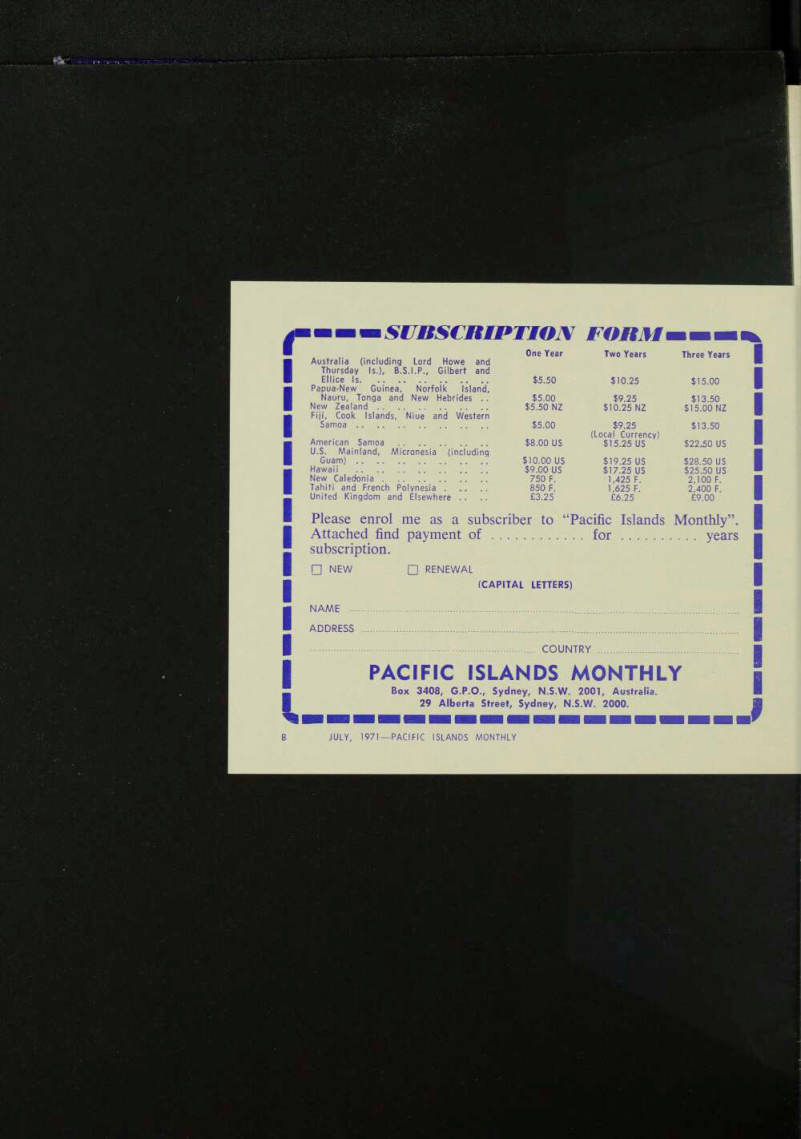
Australia (including Lord Howe and Thursday Is.), 8.5.1. P., Gilbert and Ellice Is.; $5.50 Aust.; Papua-New Guinea, Norfolk Island, Nauru, Tonga and New Hebrides: $5.00 Aust.; New Zealand: $5.50 NZ; Fiji, Cook Islands, Niue and Western Samoa: $5.00 (local currency); American Samoa; $B.OO US; U.S. Mainland, Micronesia (including Guam); $lO.OO US; Hawaii: $9.00 US; New Caledonia: 750 French Pacific francs; Tahiti and French Polynesia: 850 French Pacific francs; United Kingdom and elsewhere; £3.25.
Copyright ©, 1971,
Pacific Publications (Aust.) Pty. Ltd.
Up Front
with the Editor
Commonwealth is one of those words that mean different things to different people, and “Commonwealth status” as currently used by America in its dialogue with the Micronesians is causing some confusion in the rest of the Pacific Islands.
Most of the islands have a British background (my apologies to the French presence) and the British Commonwealth does not bear much relationship to what America has in mind in Micronesia. Hence the con fusion.
I submit, though, that it was Bri tain, not America, that altered the original meaning of the word Com monwealth.
At the grass roots, Commonwealth started out meaning simply a group of persons banded together for the com mon good, and that’s the way that America still sees it.
There are within the United States four states still officially called com monwealths—Pennysylvania, Virginia.
Kentucky and Massachusetts. And vir tually sharing US statehood is the Commonwealth of Puerto Rico, in the Caribbean. Most federal laws apply to Puerto Rico as though it were a state, and its people are US citizens with free access to the US. Essential differences between Puerto Rico and the four states that still bear the word common wealth in their titles is that Puerto Rico has a non-voting representative in the US Congress, and it does not pay federal income taxes.
Commonwealth status suits some Puerto Ricans, but there are internal political pressures for full US state hood.
The British Commonwealth took shape early in the century as a group of self-governing countries banded to gether for the common good, but the changes in form and emphasis since are legion.
Internal pressures have brought the changes. The ties were loosening as long ago as 1926 at the Imperial Con ference in London which defined the Commonwealth as “united by a com mon allegiance to the Crown, and freely associated members of the Commonwealth of Nations”. Since
then, member nations have come and gone, with varying degrees of enmity or joy, and what is left is an extra ordinarily loose association that surely deserves to be a source of wonder for the cohesion it still retains, the Common Market decision notwith standing.
This cohesion has a lot to do with the fact that the member countries of the Commonwealth of Nations are free to do their own political thing any way they like. They are in fact free.
It’s not this kind of developed Com monwealth status that America has so far offered Micronesia—but the Puerto Rico kind.
Micronesia would become part of the United States as the Common wealth of Micronesia—a relationship not so close as that of a state, but closer than that of an unincorporated territory.
It would have internal self-govern ment, with a non-voting delegate to the US House of Representatives. It would have local courts but the US Federal Court system would be ex panded to include Micronesia.
A Commonwealth of Micronesia would have the choice of having federal income tax laws or not, but with the tax money being retained by Micronesia. The US has also offered to match local revenues with an equal sum from the US Treasury, and also appropriate additional US funds for specific purposes.
Micronesians would have the choice of becoming US nationals or US citi zens.
The Commonwealth of Micronesia would have the right to control land, with the exception of land required by the US as “being necessary for the public purposes”. Foreign policy mat ters, defence, banking and postal sys tems would be the responsibility of the United States.
The Congress of Micronesia, as a
whole, has rejected Commonwealth status. It gave official notice of its re jection 12 months ago, and only now are both sides beginning to ease out of their deadlock and arrange to talk to each other again.
The settlement is not likely to be easy, especially as it has recently been complicated by the apparent determi nation of the Marianas, one of the six districts of Micronesia, to do its own thing. There is a strong element in the Marianas which would like to have Commonwealth status, and would secede from the Trust Territory to have it, “by force of arms if neces sary”. Thus Micronesia is dividing at a time when unity would be in its best interests.
The Congress of Micronesia re jected Commonwealth status simply because it does not want to be ab sorbed holus-bolus into the American system. It has laid down four basic principles that it says must be met by America in deciding on Micronesia’s future.
These are: 1. Full Micronesian control of gov ernment. 2. Free choice of independence or association with any nation. 3. The right to draw up and change the constitution. 4. Freedom to end the association.
In the long debates that have sur rounded discussion on Micronesia’s future it has been clear that the Micronesians are not anti-American, despite the enunciation of these four principles of freedom. My own observations during a visit to all the districts last year also convince me of this. The wonder is that with the great distances between those widely-scat tered islands of Micronesia there is as much cohesion and America orientation.
America deserves much credit for what she has done there, but I wish she wouldn’t push her luck during the next few significant months. There are alternatives, and the odds are that a free Micronesia will work even more closely with America than other wise.
What Micronesia really is asking for is Commonwealth status as it works among the Commonwealth of Nations, and not the original, but narrow, American version that has never developed further because it has never had to.
So long as the key decisions are made before the present comparative era of goodwill dissipates, both sides can have their cake and eat it too. I believe it is as clear as that.
Stuart Inder.
Advertisements & other items, pp. 20-24 (1 item)
&wm<t Cad6mtfA
mmvt Cm(6m.(fA
HkdSmifA
&want Ca
<o It’s worth saying over and over again because there’s a glass and a half of pure, fresh, full-cream milk in every half-pound of Cadbury Dairy Milk Chocolate. No other chocolate can possibly give you that creamy, creamy Cadbury taste. Look for the famous purple wrapper.
CADBURY
DAIRY MILK CHOCOLATE
the biggest selling block chocolate in Australia MD4/32/0
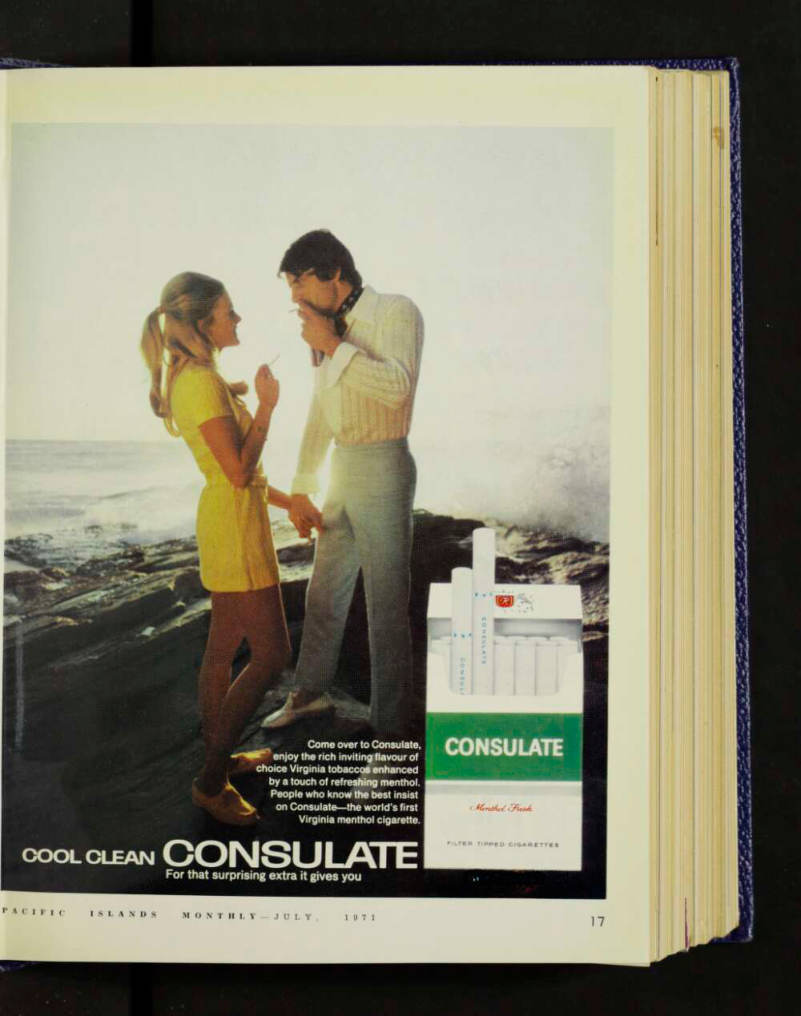
4 RW •> m / K Come over to Consulate, enjoy the rich inviting flavour of choice Virginia tobaccos enhanced by a touch of refreshing menthol.
People who know the best insist 3. on Consulate—the world’s first Virginia menthol cigarette.
COOL CLEAN CONSULATE
For that surprising extra it gives you
NSULATE
filter tipped cigarettes
mmm
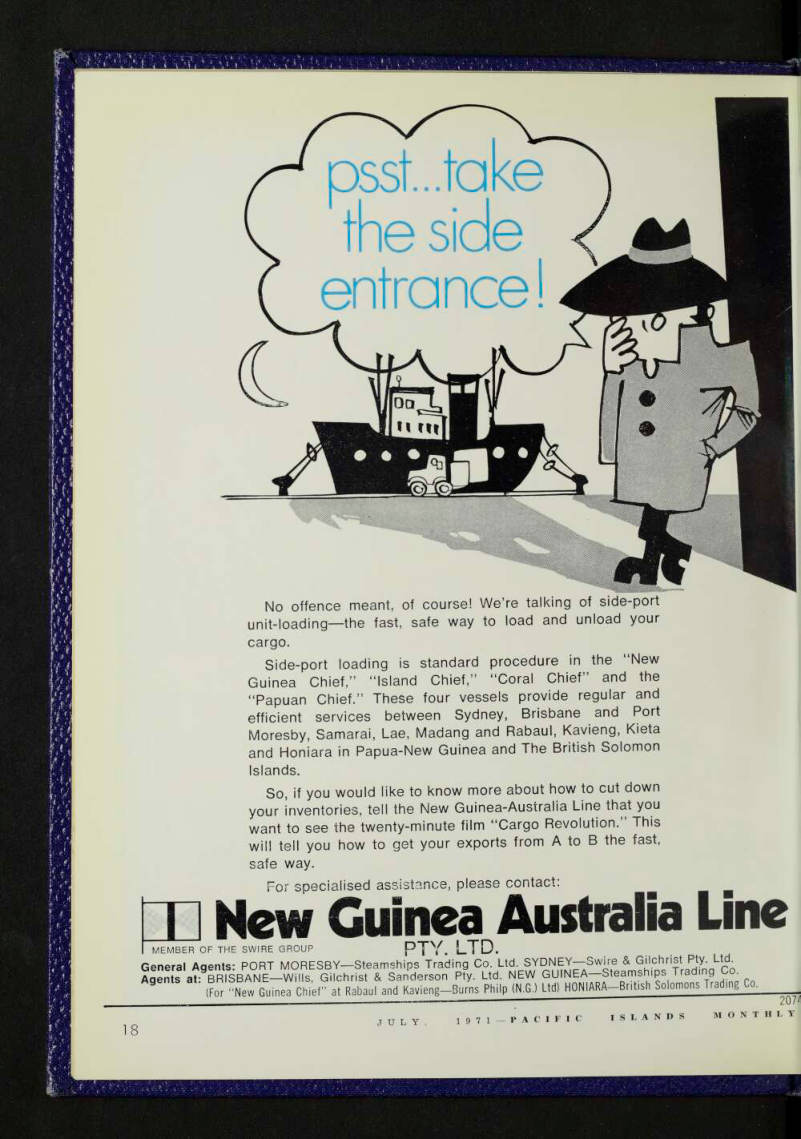
pssLtake
the side
entrance!
□□ ti rit $3 No offence meant, of course! We’re talking of side-port unit-loading—the fast, safe way to load and unload your cargo.
Side-port loading is standard procedure in the “New Guinea Chief,” “Island Chief,” “Coral Chief” and the “Papuan Chief.” These four vessels provide regular and efficient services between Sydney, Brisbane and Port Moresby, Samarai, Lae, Madang and Rabaul, Kavieng, Kieta and Honiara in Papua-New Guinea and The British Solomon Islands.
So, if you would like to know more about how to cut down your inventories, tell the New Guinea-Australia Line that you want to see the twenty-minute film “Cargo Revolution.” This will tell you how to get your exports from A to B the fast, safe way.
For specialised assistance, please contact: rUi bptJUldliocu aouuiunv/^,
11 New Guinea Australia Line
MEMBER OF THE SWIRE GROUP
pty. ltd.
eneral Agents: PORT MORESBY—Steamships Trading Co. Ltd. SYDNEY—Swire & Pty. Ltd. gents at: BRISBANE—WiIIs, Gilchrist & Sanderson Pty. Ltd. NEW GUINEA— Steamships Trading . (For “New Guinea Chief” at Rabaul and Kavieng—Burns Philp (N.G.) Ltd) HONlARA— British Solomons Trading
m
R A TASTV
v, ntage aw m
yHEE<ic
p € CH
KRAFT
kra f T
Cream
KRAFT
'he Spree ese
SHUNK STYIE
Kraft s»a«
\KWAF7>
here’s to
GOOD EATING
Wherever you find good eating, you’ll find foods, fresh ■■ from Kraft, Australia. *Reg’d Trade Mark 059-P- ! 64
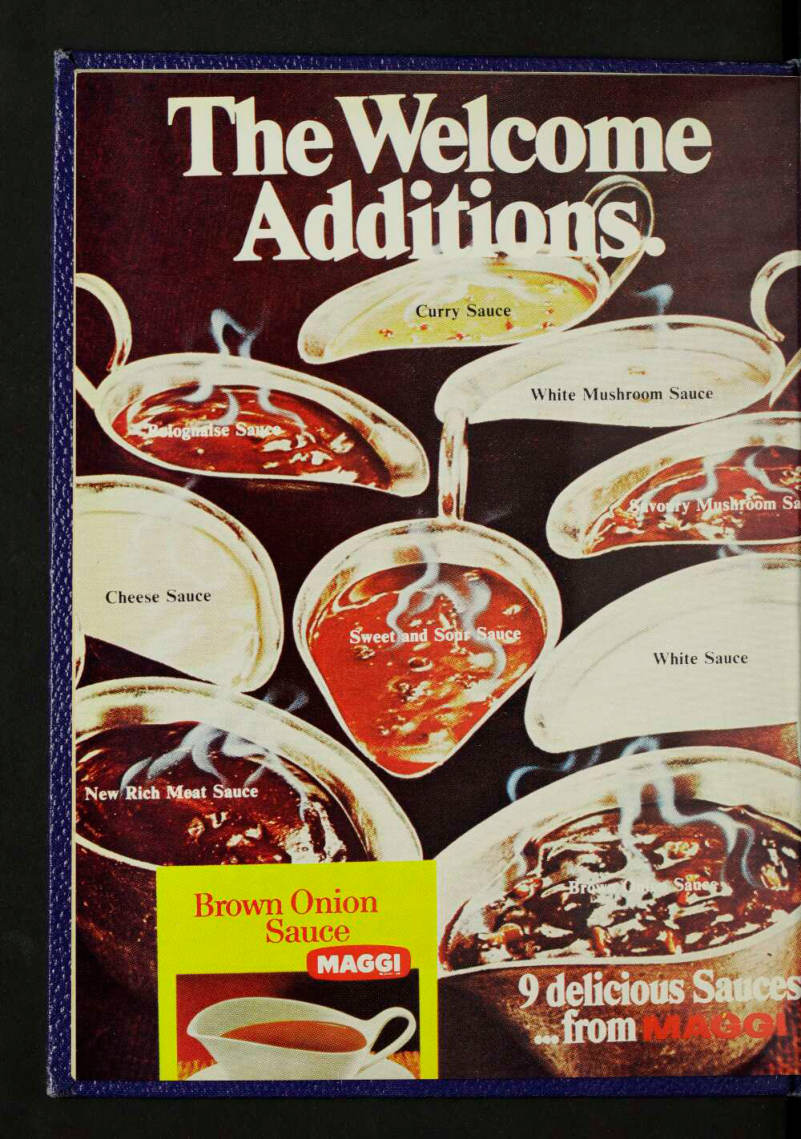
The Welcome
Additions.
Curry Sauce |t ** Jv- White Mushroom Sauce Cheese Sauce White Sauce - «*
Brown Onion
Sauce
Pacific Islands Monthly
New Guinea may lose most through Britain's entry to Common Market
Papua New Guinea stands to lose about one-third of her export trade, worth about $lOO million annually, now that Britain seems to be a 100 to 1 on shot to enter the Common Market.
Loss of the UK market should force some sharp rethinking about PNG trade policies and a positive drive for new markets.
PNG was in an unfortunate position during the Luxemburg negotiations. She is not independent and so could not apply for associate status. She is a dependant of another country vitally concerned with the outcome in Luxemburg, and it is history now how badly Australia fared.
However, the PNG representative at the London talks preceding the meeting at Luxemburg, Mr. N. J.
Thomson, was reported to be pleased with the progress he had made in his efforts to get special safeguards for the territory. He believes there was general sympathy for PNG’s position and hoped for some positive undertaking in a few weeks.
This is the position about PNG’s major commodities: Coconut oil —This will lose pre ference in its major market, and will find reverse preferences operating against it.
Copra —About two-thirds of the copra production goes to the UK.
PNG could expect to lose the 10 per cent, preference it has over non- Commonwealth producers, and would have to compete on equal terms with major exporters such as the Philip pines and Indonesia.
Cocoa beans —The UK is a signifi cant market for PNG cocoa beans, and industry would suffer if a reverse preference were applied.
Palm oil and kernels —PNG and other Commonwealth countries have a 10 per cent, tariff preference, while the EEC allows duty-free entry for members and associated States, and imposes a common external tariff of 6 per cent, on oil imports from else where, including PNG. Kernels are duty-free from all sources. The oil would lose its 10 per cent, preference
and would have to compete with associate EEC States which have tariff protection of 6 per cent. —a total deterioration of 16 per cent.
Tea —The UK imports this duty free from all sources while the EEC provides for duty-free entry from associated members and places a 9 per cent, tariff on imports from else where. Tea is a new industry for PNG and could suffer badly with such a tariff against it in major markets.
Coffee —The UK imposes no tariff on Commonwealth coffee, which en joys the additional advantage of a tariff preference. The EEC imposes a 7 per cent, duty on imports from countries outside the EEC. Here, PNG could suffer from competition from countries in East Africa asso ciated with the EEC.
Any recovery from the loss of markets in the EEC would be long term. Among the immediate effects would be a financial crisis with wide spread unemployment in cash and subsistence economics, a period of stagnation in agricultural pursuits, and greater pressure on Australia, at least financially, and probably politic ally.
PNG seems as though she will fare worse than any other Pacific terri tory. New Caledonia, French Poly nesia and Wallis Island, as French territories, have special status, while the New Hebrides, as a condominium controlled by a member and a poten tial member, will also have a special status. As far as the BSIP and the GEIC are concerned, as British possessions, they will probably receive status similar to that of the French territories.
Western Samoa and Tonga, as in dependent countries, could apply for a status similar to that granted to 18 African countries under the Yaounde Convention. Britain could be expected to support such applica tions. The Yaounde Convention makes special provision for imports for the countries it covers, and also for aid from Common Market mem bers.
Fiji intends to seek association with the EEC under the Yaounde Conven tion. Fiji has till 1974, when the Commonwealth Sugar Agreement ex pires, to negotiate terms with the EEC. She will negotiate on her own, but will look for consultants to advise in drawing up terms for an agree ment (see page 90).
There is a question mark over the Cook Islands, but she has a very small trade with any of the EEC countries.
Give The Colonies A Go!
When Fiji joined the UN following independence last October she announced she would be spokesman for the South Pacific. In June, Fiji's Special Representative to the UN, Mr. Satia Nandan, gave a demonstration of this when addressing a panel of the Special Committee on Colonialism during a debate on conditions in Niue and the Tokelaus.
He praised New Zealand’s record as an administering power in the Pacific and said Fiji was confident that the problems of Niue and the Tokelau Islands would be solved to the satisfaction of their peoples.
He said: “While perpetual colonial status of these territories is in prin ciple unacceptable to my delegation, the Fiji delegation is nevertheless
firmly against the application of a blanket anti-colonial formula in these territories without first finding satisfactory solutions to the unique problems of size, remoteness, lack of resources and small populations.”
These were as much the problems of the territories as for the administrat ing powers, but they called for a com passionate approach by the latter.
The Papuans insist they're
not New Guineans
From a Port Moresby correspondent It was a happening month in Papua New Guinea, where suddenly the Administration is called a “government”, the Minis terial Members are called “Ministers” and everybody talks about self-government and independence as though they will be attained next year. Notwithstanding, it’s still a safe bet that nobody has any idea where this territory is headed politically or what it will do when it gets there.
The May/June meeting of the House of Assembly reversed the recent parliamentary tendency to dullness, that has presumably been brought about by the downhill run to the gene ral elections that are due after Christ mas. There was plenty of interest this time, although as usual not a lot of worthwhile discussion on social rather than political issues.
An exception was the debate on four land bills aimed at enabling native customary land to be registered by individuals. The bills were intro duced in March for debate at this meeting, but meantime they attracted extraordinary opposition.
Roman Catholic Archbishop of Port Moresby, Dr. Virgil Copas> and the Anglican Bishop of PNG, Rt. Rev.
David Hand, appealed to the Ad ministrator, Mr. Johnson, to defer the bills until after the elections, or “even wait until full internal self-govern ment is attained”.
The church leaders said that the legislation could “drastically change and even destroy the whole pattern of life of the majority of our people . . , We are not convinced that indi vidualisation of land tenure in PNG will necessarily further economic development”.
The previous month, at the Wai gani Seminar in Port Moresby, former Chief Commissioner of Land Titles, Mr. Cyril McCubbery, now a Port Moresby solicitor, described the bills as “the most dangerous set of land legislation ever introduced”.
Dr. A. D. Ward, who is teaching this year at the University of Papua New Guinea, warned in a paper cir culated to members of the House that similar land reforms attempted among NZ Maoris had caused social disrup tion, landlessness and decline in pro ductivity.
Large areas of land passed to banks and lending institutions under forced sale and this would happen in PNG.
It was wrong to assume there was no halfway house between complex tradi
tional rights and fully negotiable free hold title.
The legislation, he said, was framed not for the simple villager “but for a populace of Melbourne businessmen who know how to play the system and can phone a Collins Street lawyer”.
These outside pressures were re flected in the House and the govern ment withdrew the bills. Deputy Ad ministrator and government leader in the House, Tony Newman, said the main problem in the House seemed to be fear brought about by the fact that nobody fully understood the pro posals.
Events that had cast their shadows before also played a part in the de velopment of a debate on the status of distinct from the New Guineans. The Papua v New Guinea argument had got an unexpected air ing at the March meeting, and in late May it was the subject of a statement about national unity issued by Ad ministrator Johnson, who strengthened the announcement by noting that he had been authorised by the Minister for External Territories to say it.
Mr. Johnson reiterated the policy of the Australian Government “to ad vance PNG to internal self-govern ment and independence as a united country”, and said he saw no other course long-term. The difference of legal status between the inhabitants of Papua [Australian citizens] and New Guinea [Australian protected persons] had been of little consequence since 1947, when the two territories began an administrative union authorised by the UN. The people of the combined territory would all be treated the same.
Without unity, the country would “inevitably break down into a col lection of tiny, hostile fragments”, and the administrator appealed to all leaders “to recognise the grave dan gers which disunity threatens”.
In the Assembly a fortnight later, Bert Counsel, Tasmanian-bom mem ber for Western and Gulf, who has
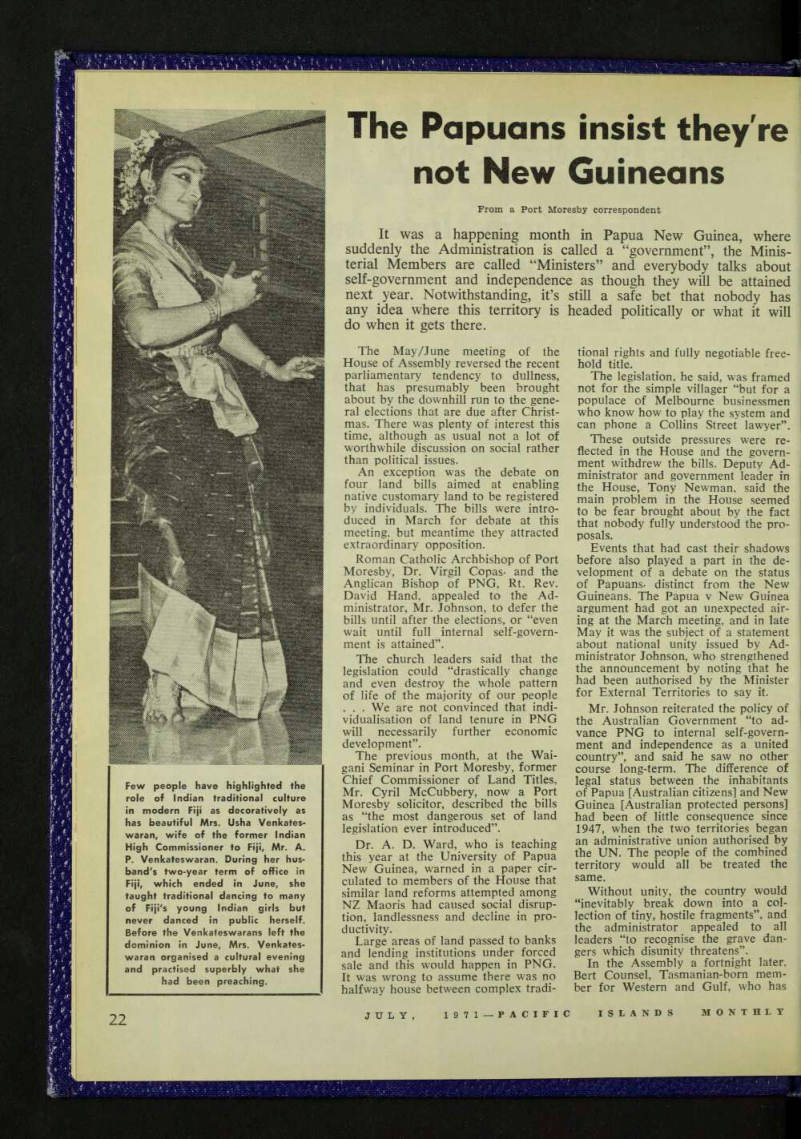
Few people have highlighted the role of Indian traditional culture in modern Fiji as decoratively as has beautiful Mrs. Usha Venkates waran, wife of the former Indian High Commissioner to Fiji, Mr. A.
P. Venkateswaran. During her hus band's two-year term of office in Fiji, which ended in June, she taught traditional dancing to many of Fiji's young Indian girls but never danced in public herself.
Before the Venkateswarans left the dominion in June, Mrs. Venkates waran organised a cultural evening and practised superbly what she had been preaching.
lived in Papua for 25 years, and has a Papuan wife and nine children, threw mud in Mr. Johnson’s eye.
First he introduced an urgency de bate on the issue of Papuan union with New Guinea, and a day or two later moved a motion virtually demanding that Papua be entitled to decide for itself whether it would join New Guinea or seek separate status.
The motion called on the Austra lian Government not to change Papua’s status “without the express approval of the Papuan people or their elected representatives”, and, sur prisingly, it was passed, 30 votes to 25.
General tenor of both debates, which were dominated by Papuans, was that Papuans opposed being forced into a union which they feared might result in them being over whelmed.
Mr. Percy Chatterton (Moresby) said Papuans and New Guineans were not one people, and the only national unity that was any good was the unity of people who came together because they wanted to come together.
“A unity imposed by the arrogant on the unwilling can only end in dis aster and misery”, he said.
There were viable alternatives be tween national unity and Mr. John son’s “tiny* hostile fragments”. There could be a group of provinces within a federal State; there could be a group of small independent States linked by a common market and joint defence agreements. But the alternatives should be considered without bullying and brainwashing.
Mr. Warren Dutton (North Fly) said the real conflict was not between Papuans and New Guineans, but be tween the people of PNG and the Australian Government.
The government members, despite their strong objections to the motion, conformed to their convention of not voting on constitutional matters.
In getting the support of the House the Papuans achieved what neither the break-away Mataungans of New Britain nor the Bougainville secession ists have been able to achieve—that is, success for separatist sentiment.
Even then the issue wouldn’t lie down. A couple of days later another Papuan-inspired motion was passed asking that an Australian all-party parliamentary committee be appointed to review the wishes of the Papuan people on their future.
Percy Chatterton remarked, “I hope if an Australian delegation does come it comes to find out what Papuans think, not to tell Papuans what Aus tralia thinks”.
Outside the House the Administra tor kept his cool. He said the govern-
Continued on p. 124
ment was devoting some thought to Papua’s problems, especially economic ones, which he thought were at the root of Papuan dissatisfaction.
“If I were a Papuan I might feel the government did not give me enough attention”, he said.
But he added that Australia did not regard separate Papuan constitutional development as a negotiable issue. In any case, he pointed out, after two tours of the territory, which had in cluded Papua, the Assembly’s select committee on constitutional develop ment had concluded that most people wanted a single, united country.
Mr. Johnson was plagued with other problems besides those high lighted by the honourable members.
He announced the territory’s cabinet—the Administrator’s executive council—was considering how to deal with the growing urban population drift and related problems of vag rancy, prostitution and VD, which had “got ahead of our capacity to cope.”
He admitted he had been under considerable pressure to try to restrict movement of people to the towns, but this sort of legislation posed big diffi culties. The government would have to decide whether the benefits of re strictions were worth the infringement of civil liberties.
Mr. Johnson said the increasing number of crimes directly attributable to drinking was “alarming”, and the territory’s liquor laws might have to be reviewed.
In case it might be thought that his strictures were reserved only for the black population, the Administra tor went into the attack on some of the whites while opening the Central District Show on June 14.
He said some people in Port Moresby lived wretchedly, and few of the rest “gave a damn”. The town was breeding discontent and violence.
“Port Moresby is a good town— for some”, he said. “It’s a good town if you are white because you’ve got a good job and a decent home and ex pensive things to play with, cars and boats and clubs. It’s a good town for some who are not white, for they have these things as well. It’s a bad town for some because it gives them neither work nor shelter”.
He said Moresby had no mobilised social conscience and he didn’t know how to mobilise it.
A few days later, the PNG Public Service Association, which is the ter ritory’s biggest trade union, made it
clear that the good life wasn’t all that good. President T. J. Jackson accused the government of having an obsessive interest in keeping wages down while making no effort to stop prices spiral ling. Price control was administered so timidly that apparently there had been no prosecution since 1956. The cost of living, for everybody, was meanwhile rising alarmingly, he said.
There were two other significant developments during a busy month. • A bill to restrict the entry of expatriates into the territory to work was introduced into the House and will be debated in August. The gov ernment wants to prohibit certain categories of work from being under taken by people brought from over seas. Other jobs will be restricted to overseas people for a limited time, while local people are trained to take over. • The Mataungan Association launched a renegade Local Govern ment Council on Rabaul’s Matupit Island, announcing that it will go its own way “until independence comes”.
The council will operate alongside the legally-recognised Gazelle Peninsula Council, which the Mataungans are seeking to destroy. The term of the legal council has been extended for another six months, because it was realised that elections for a new one would probably be boycotted by the Mataungans.
Ballalae is back in the world
From JUNE WOOD, in Honiara
Ballalae airfield in the Shortland Islands, nestled in one of the most beautiful parts of the Solomons, has come to life again after 25 years of neglect and disuse.
Ballalae, which name author James Michener has said to be the most beautiful he has ever heard, is popularly believed—along with many others!—to have been the inspiration for the island of Bali Ha’i in his Tales of the South Pacific.
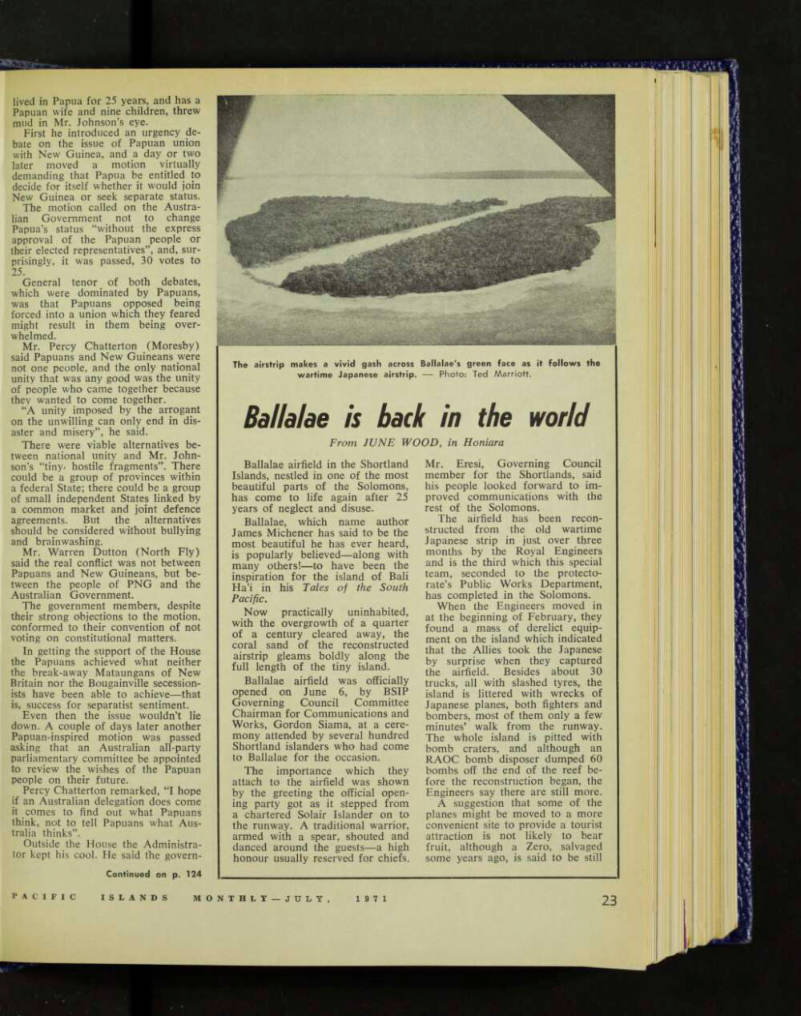
Now practically uninhabited, with the overgrowth of a quarter of a century cleared away, the coral sand of the reconstructed airstrip gleams boldly along the full length of the tiny island.
Ballalae airfield was officially opened on June 6, by BSIP Governing Council Committee Chairman for Communications and Works, Gordon Siama, at a cere mony attended by several hundred Shortland islanders who had come to Ballalae for the occasion.
The importance which they attach to the airfield was shown by the greeting the official open ing party got as it stepped from a chartered Solair Islander on to the runway. A traditional warrior, armed with a spear, shouted and danced around the guests—a high honour usually reserved for chiefs.
Mr. Eresi, Governing Council member for the Shortlands, said his people looked forward to im proved communications with the rest of the Solomons.
The airfield has been recon structed from the old wartime Japanese strip m just over three months by the Royal Engineers a °d is the third which this special team, seconded to the protecto rate s Public Works Department, has completed m the Solomons.
When the Engineers moved in h beginning of February, they f d a * mass s of derelict equip ment on the island which indicated h h A „ ies took he Japanese b rise when they captured th y e air P field , Besides y abo J t 30 trucks, all with slashed tyres, the island is littered with wrecks of Japanese planes, both fighters and bombers, most of them only a few minutes’ walk from the runway, The whole island is pitted with bomb craters, and although an RAOC bomb disposer dumped 60 bombs off the end of the reef be fore the reconstruction began, the Engineers say there are still more, A suggestion that some of the planes might be moved to a more convenient site to provide a tourist attraction is not likely to bear fruit, although a Zero, salvaged some years ago, is said to be still
The airstrip makes a vivid gash across Ballalae's green face as it follows the wartime Japanese airstrip. Photo: Ted Marriott.
flying in Canada. The Engineers believe the planes would break up in any attempt to tow them away, and so they remain, almost com plete, with trees and creepers growing over and through them, a stark reminder of the war.
The original Japanese strip was 1,300 metres and the Engineers have cleared, re - aligned and marked out 680 metres so far, sufficient for Solair’s Baron and Islander, but not long enough for any overseas aircraft.
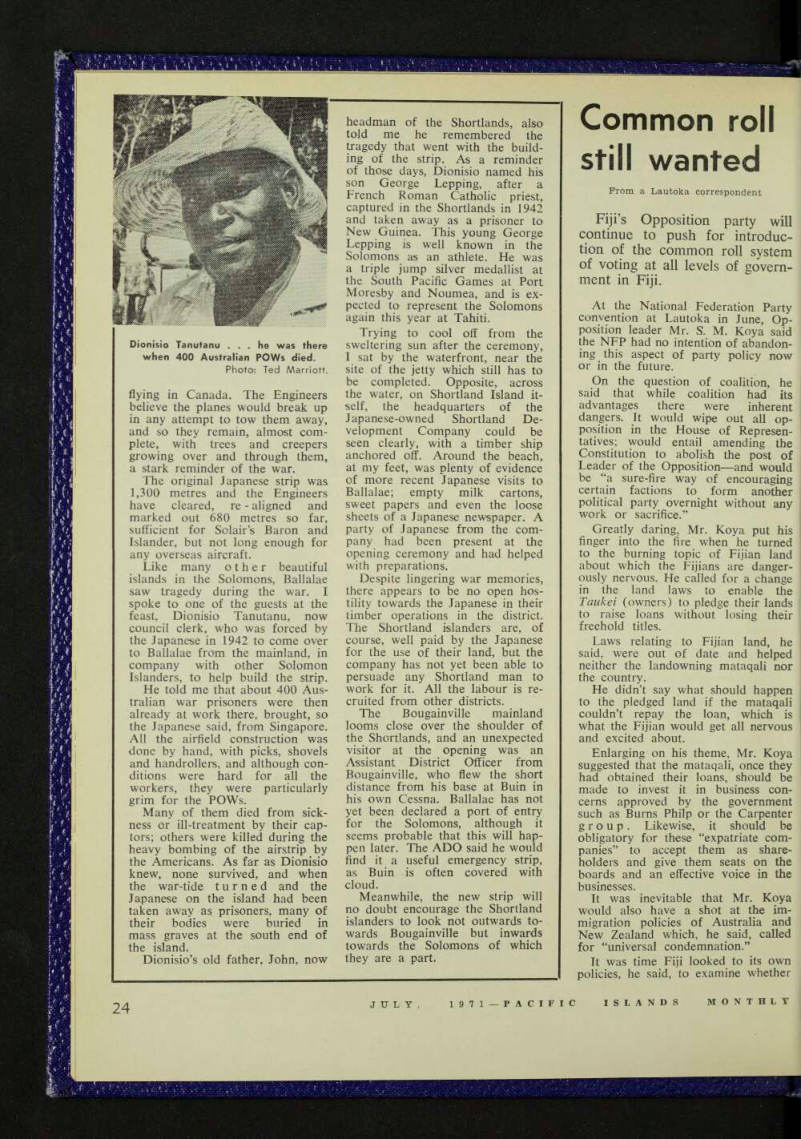
Like many other beautiful islands in the Solomons, Ballalae saw tragedy during the war. I spoke to one of the guests at the feast, Dionisio Tanutanu, now council clerk, who was forced by the Japanese in 1942 to come over to Ballalae from the mainland, in company with other Solomon Islanders, to help build the strip.
He told me that about 400 Aus tralian war prisoners were then already at work there, brought, so the Japanese said, from Singapore.
All the airfield construction was done by hand, with picks, shovels and handrollers, and although con ditions were hard for all the workers, they were particularly grim for the POWs.
Many of them died from sick ness or ill-treatment by their cap tors; others were killed during the heavy bombing of the airstrip by the Americans. As far as Dionisio knew, none survived, and when the war-tide turned and the Japanese on the island had been taken away as prisoners, many of their bodies were buried in mass graves at the south end of the island.
Dionisio’s old father, John, now
headman of the Shortlands, also told me he remembered the tragedy that went with the build ing of the strip. As a reminder of those days, Dionisio named his son George Lepping, after a French Roman Catholic priest, captured in the Shortlands in 1942 and taken away as a prisoner to New Guinea. This young George Lepping is well known in the Solomons as an athlete. He was a triple jump silver medallist at the South Pacific Games at Port Moresby and Noumea, and is ex pected to represent the Solomons again this year at Tahiti.
Trying to cool off from the sweltering sun after the ceremony, I sat by the waterfront, near the site of the jetty which still has to be completed. Opposite, across the water, on Shortland Island it self, the headquarters of the Japanese-owned Shortland De velopment Company could be seen clearly, with a timber ship anchored off. Around the beach, at my feet, was plenty of evidence of more recent Japanese visits to Ballalae; empty milk cartons, sweet papers and even the loose sheets of a Japanese newspaper. A party of Japanese from the com pany had been present at the opening ceremony and had helped with preparations.
Despite lingering war memories, there appears to be no open hos tility towards the Japanese in their timber operations in the district.
The Shortland islanders are, of course, well paid by the Japanese for the use of their land, but the company has not yet been able to persuade any Shortland man to work for it. All the labour is re cruited from other districts.
The Bougainville mainland looms close over the shoulder of the Shortlands, and an unexpected visitor at the opening was an Assistant District Officer from Bougainville, who flew the short distance from his base at Buin in his own Cessna. Ballalae has not yet been declared a port of entry for the Solomons, although it seems probable that this will hap pen later. The ADO said he would find it a useful emergency strip, as Buin is often covered with cloud.
Meanwhile, the new strip will no doubt encourage the Shortland islanders to look not outwards to wards Bougainville but inwards towards the Solomons of which they are a part.
Dionisio Tanutanu ... he was there when 400 Australian POWs died.
Photo; Ted Marriott.
Common roll
still wanted
Prom a Lautoka correspondent
Fiji’s Opposition party will
continue to push for introduc tion of the common roll system of voting at all levels of govern ment in Fiji.
At the National Federation Party convention at Lautoka in June, Op position leader Mr. S. M. Koya said the NFP had no intention of abandon ing this aspect of party policy now or in the future.
On the question of coalition, he said that while coalition had its advantages there were inherent dangers. It would wipe out all op position in the House of Represen tatives; would entail amending the Constitution to abolish the post of Leader of the Opposition—and would be “a sure-fire way of encouraging certain factions to form another political party overnight without any work or sacrifice.”
Greatly daring, Mr. Koya put his finger into the fire when he turned to the burning topic of Fijian land about which the Fijians are danger ously nervous. He called for a change in the land laws to enable the Taukei (owners) to pledge their lands to raise loans without losing their freehold titles.
Laws relating to Fijian land, he said, were out of date and helped neither the landowning mataqali nor the country.
He didn’t say what should happen to the pledged land if the mataqali couldn’t repay the loan, which is what the Fijian would get all nervous and excited about.
Enlarging on his theme, Mr. Koya suggested that the mataqali, once they had obtained their loans, should be made to invest it in business con cerns approved by the government such as Burns Philp or the Carpenter group. Likewise, it should be obligatory for these “expatriate com panies” to accept them as share holders and give them seats on the boards and an effective voice in the businesses.
It was inevitable that Mr. Koya would also have a shot at the im migration policies of Australia and New Zealand which, he said, called for “universal condemnation.”
It was time Fiji looked to its own policies, he said, to examine whether
they were in Fiji’s best interests. In the name of tourism, the dominion had not questioned the policies of Australia and New Zealand. He claimed Fiji’s policy should be based on the rule of reciprocity and should put an end to the “notion that Fiji, even after its independence, is an economic colony of Australia and New Zealand.”
Nationalisation of the banks was another of his suggestions. He wanted State supervision if not control of all “nerve centres of commerce and industry”. Later, Mr. Koya pointed out that his speech did not represent final party policy.
Mr. Koya has other things to worry about, however. Circulating around the floor at the convention was a document written by Mr. A. A.
Awasthi, of Samabula, a former party official and ex-editor of the Federa tion Party’s newspaper Jagriti. He blamed Mr. Koya and general secre tary Mr. K. C. Ramrakha for a com plete breakdown in communications between the party’s hierarchy and “commoners” and said party prestige had suffered under their leadership.
He was also critical of Mr. Koya’s “deep romance” with .the party’s political foes.
Little is expected to stem from Mr. Awasthi’s revolt, however.
Atomic boom to tourist boom
tourist boom
Two nuclear devices exploded at Mururoa atoll in the Tuamotus in June in the face of protests from Fiji and other countries were described as “perfectly satisfactory” by Vice-Mar shal Garden, Air Force Vice-Marshal in charge of the tests.
He said the first test, involving a 10 to 15 kiloton device was intended for warheads on Jaguar and Mirage 111 fighters, and the second, in the half megaton range, was for nuclear submarines. They were part of a total of six to eight tests.
About the time the atomic cloud was mushrooming above the Mururoa lagoon, the United Nations was con sidering the fate of another island devastated by atomic blasts—Bikini atoll, site of the United States first postwar atomic tests which the US hopes will become a tourist resort. Re porting to the UN on its Trust Terri tories, the US said the atoll showed promise of a boom over the next few years.
Src Stakes
Only Two
Starters In The
By a staff writer
The starters for the South Pacific Commission Stakes got down to two in June when they lined up at the barrier in Canberra. But the handi caps were too heavy for both, and it was a no-race.
The starters were Mr. Fred Betham, a Western Samoan Member of Par liament and a former Minister for Finance, and a Papuan, Gala Oala- Rarua, Assistant Ministerial Member for the PNG Treasury, and both were running in the ballot by the eight member governments of the South Pacific Commission to decide who will become secretary-general. The post has been vacant since February, when Western Samoan Afioga Misimoa died in office.
The governments lodged mail votes after the two men had been inter viewed in Canberra by representatives of the powers. Both men impressed the delegates.
Mr. Betham told them that he would have no desire to continue in politics if he were selected—that he had had a good innings. Oala-Rarua, a younger man, said he felt he had a future in PNG in politics but that he would enjoy the new challenge in the meantime.
When the vote was taken it was deadlocked, which is not difficult under the peculiar SPC voting rules.
It is necessary for a successful candi date to have a two-thirds majority, but the member governments have different voting strengths. Australia
has five votes, France, NZ and America four each, Britain three, Nauru, Western Samoa and Fiji one each.
Fiji was this time casting its first votes as a full SPC member, as she was admitted to the SPC only in May —its Senior Commissioner being Mr.
Tone Naisara, Fiji’s Minister for Youth, Sport and Rural Development.
Western Samoa had hoped its can didate, Mr. Betham, would be ap pointed unopposed so as to “finish the term” of Misimoa. But Australia said it had already nominated Gala before it knew that Mr. Betham was being nominated.
The micro-states thought Australia should have withdrawn nomination.
There were also some mutterings over Australia’s five votes, which she holds for herself, Papua, New Guinea, Nauru and Norfolk Island. Norfolk Island has never taken part in the SPC and Nauru is independent (no body took one vote from Australia following Nauru independence be cause it was held that three powers, Britain, NZ and Australia, were equally responsible for Nauru).
Even Australian Government think ing now is that Australia should not continue to hold five votes; but she does hold them, and will continue to do so until changes are made in the agreement. This could be discussed soon because Tonga has indicated she doesn’t want to join the SPC while the big powers have extra votes as a veto.
Although the voting details were not disclosed, it’s likely that Mr. Betham received more votes than Oala-Rarua, and that only two or three votes will be needed to give Mr. Betham victory in the second ballot.
In late June it wasn’t certain when that would be held, and at worst the
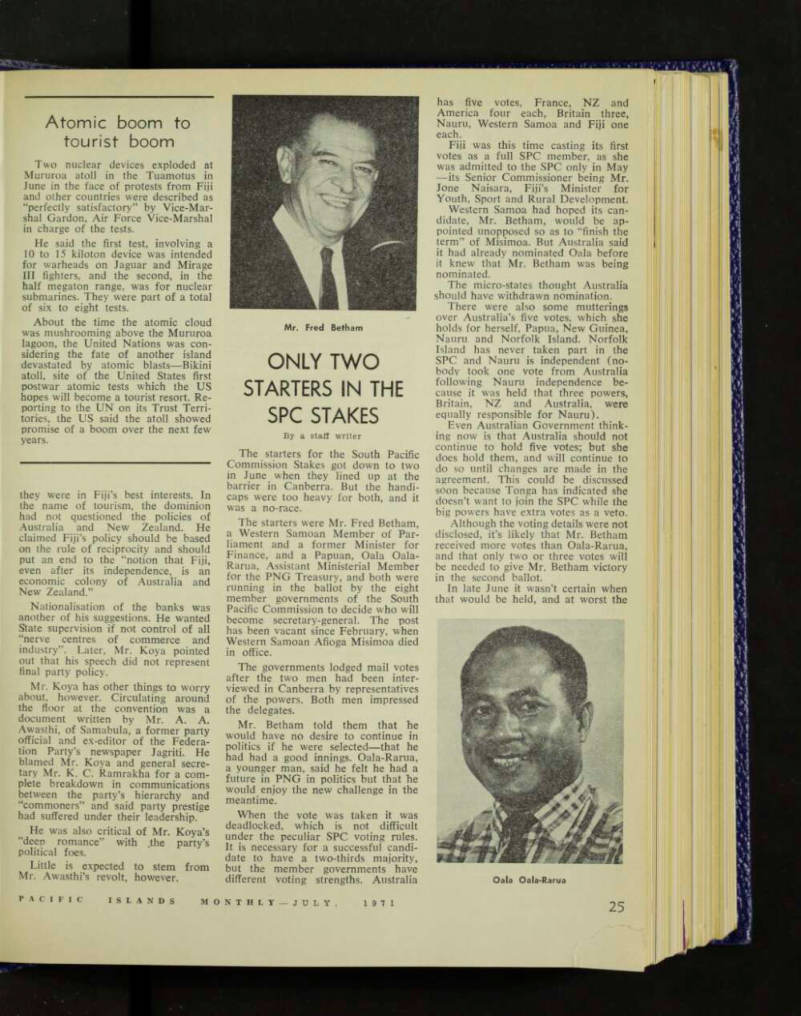
Mr. Fred Betham
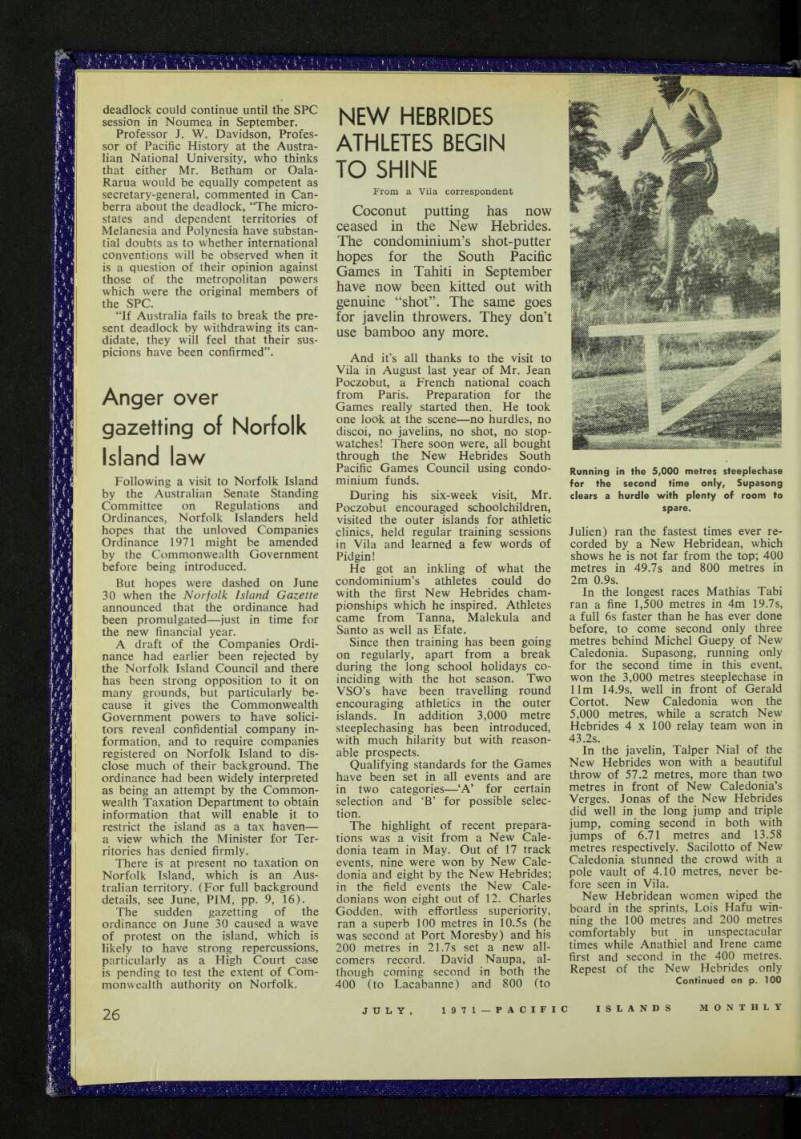
Oala Oala-Rarua
deadlock could continue until the SPC session in Noumea in September.
Professor J. W. Davidson, Profes sor of Pacific History at the Austra lian National University, who thinks that either Mr. Betham or Oala- Rarua would be equally competent as secretary-general, commented in Can berra about the deadlock, “The micro states and dependent territories of Melanesia and Polynesia have substan tial doubts as to whether international conventions will be observed when it is a question of their opinion against those of the metropolitan powers which were the original members of the SPC.
“If Australia fails to break the pre sent deadlock by withdrawing its can didate, they will feel that their sus picions have been confirmed”.
Anger over gazetting
gazetting of Norfolk Island law
Following a visit to Norfolk Island by the Australian Senate Standing Committee on Regulations and Ordinances, Norfolk Islanders held hopes that the unloved Companies Ordinance 1971 might be amended by the Commonwealth Government before being introduced.
But hopes were dashed on June 30 when the Norfolk Island Gazette announced that the ordinance had been promulgated—just in time for the new financial year.
A draft of the Companies Ordi nance had earlier been rejected by the Norfolk Island Council and there has been strong opposition to it on many grounds, but particularly be cause it gives the Commonwealth Government powers to have solici tors reveal confidential company in formation, and to require companies registered on Norfolk Island to dis close much of their background. The ordinance had been widely interpreted as being an attempt by the Common wealth Taxation Department to obtain information that will enable it to restrict the island as a tax haven— a view which the Minister for Ter ritories has denied firmly.
There is at present no taxation on Norfolk Island, which is an Aus tralian territory. (For full background details, see June, PIM, pp. 9, 16).
The sudden gazetting of the ordinance on June 30 caused a wave of protest on the island, which is likely to have strong repercussions, particularly as a High Court case is pending to test the extent of Com monwealth authority on Norfolk.
New Hebrides
Athletes Begin
To Shine
From a Vila correspondent Coconut putting has now ceased in the New Hebrides.
The condominium’s shot-putter hopes for the South Pacific Games in Tahiti in September have now been kitted out with genuine “shot”. The same goes for javelin throwers. They don’t use bamboo any more.
And it’s all thanks to the visit to Vila in August last year of Mr. Jean Poczobut, a French national coach from Paris. Preparation for the Games really started then. He took one look at the scene—no hurdles, no discoi, no javelins, no shot, no stop watches! There soon were, all bought through the New Hebrides South Pacific Games Council using condo minium funds.
During his six-week visit, Mr.
Poczobut encouraged schoolchildren, visited the outer islands for athletic clinics, held regular training sessions in Vila and learned a few words of Pidgin!
He got an inkling of what the condominium’s athletes could do with the first New Hebrides cham pionships which he inspired. Athletes came from Tanna, Malekula and Santo as well as Efate.
Since then training has been going on regularly, apart from a break during the long school holidays co inciding with the hot season. Two VSO’s have been travelling round encouraging athletics in the outer islands. In addition 3,000 metre steeplechasing has been introduced, with much hilarity but with reason able prospects.
Qualifying standards for the Games have been set in all events and are in two categories—‘A’ for certain selection and ‘B’ for possible selec tion.
The highlight of recent prepara tions was a visit from a New Cale donia team in May. Out of 17 track events, nine were won by New Cale donia and eight by the New Hebrides; in the field events the New Cale donians won eight out of 12. Charles Godden, with effortless superiority, ran a superb 100 metres in 10.5s (he was second at Port Moresby) and his 200 metres in 21.7s set a new all comers record. David Naupa, al though coming second in both the 400 (to Lacabanne) and 800 (to
Julien) ran the fastest times ever re corded by a New Hebridean, which shows he is not far from the top; 400 metres in 49.7 s and 800 metres in 2m 0.95.
In the longest races Mathias Tabi ran a fine 1,500 metres in 4m 19.75, a full 6s faster than he has ever done before, to come second only three metres behind Michel Guepy of New Caledonia. Supasong, running only for the second time in this event, won the 3,000 metres steeplechase in 11m 14.95, well in front of Gerald Cortot. New Caledonia won the 5,000 metres, while a scratch New Hebrides 4 x 100 relay team won in 43.25.
In the javelin, Talper Nial of the New Hebrides won with a beautiful throw of 57.2 metres, more than two metres in front of New Caledonia’s Verges. Jonas of the New Hebrides did well in the long jump and triple jump, coming second in both with jumps of 6.71 metres and 13.58 metres respectively. Sacilotto of New Caledonia stunned the crowd with a pole vault of 4.10 metres, never be fore seen in Vila.
New Hebridean women wiped the board in the sprints, Lois Hafu win ning the 100 metres and 200 metres comfortably but in unspectacular times while Anathiel and Irene came first and second in the 400 metres.
Repest of the New Hebrides only
Continued on p. 100
Running in the 5,000 metres steeplechase for the second time only, Supasong clears a hurdle with plenty of room to spare.
managed third place in the 800 metres, behind Diohoue and Wamo of New Caledonia but still broke her own previous record. She should im prove with more local competition.
New Hebrides won the 4 x 100 metres relay.
In the field events Leisale and Didin between them demolished the opposition in the shot, discus and javelin with throws of 10.22 metres, 33.18 metres and 37.65 metres respec tively. It was in the two jumps how ever that Elocie of New Caledonia showed us how far we are behind in these events.
The competition stimulated per formances on both sides and was an unqualified success. The NHAAA has since tried to get a small team to Fiji for similar competition but found it couldn’t afford the fare. As in most countries the AA depends largely on its own fund-raising abilities to pro vide cash and in a small territory the resources are limited.
Since the New Caledonia match we have had the traditional Queen’s Birth day sports meeting (June 11) but this took place in almost continual rain.
No records were broken but athletes began to show great competitive spirit in chasing the tape.
At the Lakatoro Queen’s Birthday sports, Ruth of South-West Bay was only half a second behind the New Hebrides record for the 200 metres, winning in 26.35, the fastest time re corded in Vila this season. Mary Rion, of Nakatoro, cleared 4 ft 8 in. in the high jump. The next meet ing, the national championships, will be held on July 10 with final selection for Tahiti taking place the next day.
Mr. Poczobut returns then, so the New Hebrides expects to be sending a strong team of about 20 athletes to the Games.
Fourteen Pacific territories will take part in September in the Fourth South Pacific Games in Tahiti. The surprise, however, lies in the fact that only five territories will compete in swim ming, which should be the number one sport.
Twelve territories will compete in boxing. As was expected, the host territory, French Polynesia, will parti cipate in every sport. Following are the entries: Athletics: All 14 territories will par ticipate in the men’s events, but on the women’s side the Gilbert and Ellice will be missing.
Basketball: Men: Fiji, Guam, Nauru, New Hebrides, PNG, French
Polynesia, American Samoa, Wallis, New Caledonia. Women: Cooks, Fiji, New Hebrides, PNG, French Polynesia, American Samoa, New Caledonia.
Boxing : All territories except Nauru and GEIC, Underwater fishing : Cooks, Fiji, Guam, French Polynesia, Solomons, Tonga, Wallis, New Caledonia.
Cycling: Guam, New Hebrides, PNG, French Polynesia, Wallis, New Caledonia.
Soccer : Fiji, Cooks, New Hebrides, PNG, French Polynesia, Tonga, New Caledonia.
Golf: Men: Fiji, Guam, New Hebrides, PNG, French Polynesia.
Women: Fiji, Guam, PNG, French Polynesia.
Weight-lifting: Fiji, PNG, French Polynesia, Western Samoa, Wallis, ew ,^ a^.9. XT tt UrJrUc Judo: Fiji, Guam, French Poiynesia, Solomons, Amencan Samoa, New Caledonia.
French’ ( pSynes?a, New
Caledonia.
Rugby: Cooks, French Polynesia, American Samoa, Western Samoa, Wallis, New Caledonia.
Softball: Guam, Nauru, PNG, French Polynesia, American Samoa.
Tennis : Women and men: Cooks, Fiji, GIC, Guam, Nauru, New Hebrides, PNG, French Polynesia,
American Samoa, Western Samoa, New Caledonia.
Table Tennis: Men: Cooks, Fiji, Guam, PNG, French Polynesia, Solomons, New Caledonia. Women: Fiji, PNG, French Polynesia, New Caledonia.
Archery ; Fiji, PNG, French Poly nesia, New Caledonia.
Volleyball : Men: Cooks, Fiji, Guam, French Polynesia, American Samoa, Tonga, Wallis, New Caledonia.
Women: Guam, French Polynesia, American Samoa, Tonga, Wallis, New Caledonia.
Yachting: Cooks, Fiji, Guam, PNG? French Polynesia, Solomons, Western Samoa, New Caledonia.
An interesting point is tha t Guam is participating in 13 out of 17 sports hi h for the s!ze c f Guam is con sidered a yery bjg eflort In tennis, players will probably be able to call for yellow balls if desired.
Competitors and spectators using Mormon facilities at Papeete will be required not to smoke or drink.
N Q Women's Club Meetng
, ... xr „ The annual meeting of the New Guinea Women s Club will be held m Sydney on July 29 at 11 a.m., at 161 Castlereagh Street. Morning tea tol lows.
Advertisements & other items, pp. 30-33 (2 items)
26
JULY, 1 9 7 1 - P A C I F I C ISLANDS MONTHLY
TropicaLities
CONFUSION FOR
THE BELONGERS
“It’s a combination of lessons learned in other independent countries —plus a good measure of their mistakes and disasters,” said a dis gruntled Fiji Government official in June.
The 14-page muddle of verbiage which comprises Fiji’s new application form for people wanting to reside or work in the dominion prompted a host of less-restrained descriptions from people who’ve attained “belonger” status in Fiji. A “belonger” is a non-citizen entitled to enter or reside because of long number of years in Fiji or because of special circumstances.
They have until October 10, 1972, to make up their minds on whether they’ll take Fiji citizenship.
There was confusion as to whether or not belongers needed work permits.
The head of Immigration, Mr. Dudley Saint, who had the unenviable job of trying to explain some of the am biguities of the application form to people bombarding him with questions, was reduced to saying that belongers needed work permits today, but he couldn’t predict whether they would need them tomorrow!
Heads of companies found them selves in the position of having to advertise their own jobs, state why no Fiji citizen was capable of filling the job and to name the local person being trained to take over!
“Some of the questions almost amount to an invasion of privacy,” protested one belonger, who after 18 years found he had to apply for a work permit. “It’s the biggest botch up of red tape ever seen.”
Among other things, the application form demands that people over 21 (except wives of Fiji citizens) should attach a certificate from the police in countries where the applicant has resided for the previous five years.
This certificate is to confirm that he has not been convicted of a serious criminal offence or of an offence in volving drugs or immorality in that period.
A woman seeking to reside in Fiji with her husband must fill out a special section. Those whose husbands are Fiji citizens must also fill it in.
Another section, for husbands wish ing to join their wives in Fiji, notes that “a husband cannot be guaranteed entry on the basis of his wife’s status in Fiji and special grounds must exist for entry to be considered.”
People wishing to undertake research studies in Fiji must give details of their onward tickets.
Employers requiring work permits for qualified overseas people—bank clerks, journalists, accountants, lawyers— must explain what action is proposed to train a Fiji citizen to fill the position; the name of the person to be trained and the date by which the employer expects to localise the post.
The confusion about the interpreta tion of the application was still so great in late June that the Prime Minister, Ratu Sir Kamisese Mara, thought it better to explain the whole thing. He did and calmed the fears of the “belongers”, telling them that until October 10, 1972, any belonger and family of children under 21 would remain exempt from the Act and would not require work permits.
Short-term permits would be valid until the same date, unless cancelled or expired earlier, but linked only with the same employer as on June 1, 1971.
Computing Pacific
populations
On this matter of confusion, the piece about the Fijian birth-rate in June PIM (p. 24) apparently told only part of the interesting story— interesting because the figures are so different to those which came out of the Registrar-General’s Department in the previous 20 years.
These figures now come from the statistician’s office, and that might be the difference.
European birth-rate in Fiji has usually been under 20 per 1,000 —in the last census year, 1966, it was as low as 13.99 per 1,000 —but in 1970
it shot up to 33.09 per 1,000, second only to the Rotumans in the produc tion stakes.
The birth-rate of Fijians, on the other hand, which has for years been in the 32-36 per 1,000 bracket, dropped to an all-time low of 28.95, beating the Indians at family restric tion although the reverse has been the case in the last half-dozen years.
The people who had fewer babies than anyone else were “other Pacific Islanders” (excluding Rotumans), who had only 21.30 per 1,000.
The death-rate figures for 1970 are also interesting. The Europeans had the highest rate of any racial group—s. 69 per 1,000 —although for years their rate has been lowest and usually between three and four per 1,000. Here again the “other Pacific Islanders” won hands down with a rate per thousand of only 1.64.
Fijians also hit an all-time low with only 4.24 deaths per 1,000 of popu lation.
The conclusions to be drawn from these figures are that, in 1970, while some sections of the European popu lation were dying off like flies, other sections were having babies like mad.
Explanation of the Fiji statistician’s office about the European situation is that, as most Europeans send their children away to school, the Euro pean population seems smaller than it really is and the death and birth rates therefore turn out higher.
As the European community has always sent children abroad to school —-as much in the past as currently— this doesn’t seem to be the reason why European deaths and births have suddenly increased.
A more likely explanation seems to be that criteria now being used in calculations are different to those
used in the days when population figures were issued from the Registrar-General’s office.
Except for Papua New Guinea where there has been a government Bureau of Statistics for many years, statisticians are pretty new in the Pacific. Fiji has had one only four or five years and those in Western Samoa, New Hebrides and Solomons are almost brand-new. Two of them —PNG’s Mr. H. M. Barton, the doyen of them all, and Mr. B. C.
Hanslow, of the New Hebrides—can wear the same club tie. Both came from the Commonwealth Statistician’s Department. But all seem to keep in touch, have the same interests—and the same problems.
For example, all over the Pacific these days inquirers are getting the same sort of reply. “Terribly sorry those figures are late this year. We are now using computers.”
Canton's new
population settles in
The US Government is spending Si.B million on its Air Force and Missile Test Centre on Canton Island and job-hungry American Samoa is making the most of it. Canton is the most northerly island of the Phoenix Group. It is an atoll enclosing a pear-shaped lagoon about nine miles long.
One hundred and seven American Samoans are working under contract on the isolated island and have drawn praise from officials of the Air Force and Kentron Hawaii, which is the prime contractor on the job.
Governor John M, Haydon and a few members of his staff visited Canton recently and stayed overnight to see how the local workers are faring.
“Kentron and the Air Force are doing a great deal for our people,” the governor said. “Their food is good and the quarters are adequate but it’s still lonely, rough duty and I was pleased to find that so many of them have adjusted.” Morale, he said, was high, chiefly because they made the effort to entertain them selves.
The Samoan workers were re cruited in Samoa by Kentron for jobs ranging from construction to house keeping. Even police and firemen were hired to perform their regular jobs.
The workers are paid under the American wage scales and much of the money is being sent home to their families.
There is a weekly flight from Pago Pago carrying mail and supplies.
Radio Station WVUV has provided
the Canton workers with tapes made by Samoan singing groups and copies of the American Samoan News Bulletin to keep the men posted on events at home.
Dr. Stan Swerdloff, director of the Office of Marine Resources, scheduled a trip to Canton in June to work out recreational fishing and diving pro grammes for the workers. The governor has asked him to attempt to develop a small shark fishery so that the men could earn extra money in their spare time. They would catch the sharks for their fins which would be handled through a Pago Pago broker and which would find a ready market in Hong Kong.
The Office of Samoan Affairs is assembling the parts for a small Samoan fale which the Air Force has offered to take to Canton for the workers. “The matai system is work ing on Canton and the men need a place to meet and discuss their com munity affairs,” said Governor Hay don.
While on Canton the governor paid brief visits to nearby Hull and Birnie islands and found them even more desolate. “Compared to them, Canton is a very active place,” he said.
On Hull, the party saw the wreck of an Oriental fishing sampan which went on a reef there several years ago, the crew spending several weeks on the island before being rescued.
Fiji Fourth Estate's
uplift club
Formed a few months ago to “en courage high standards of reporting and professional competence”, the Fiji Press Club has begun by taking itself admirably seriously.
The Press Club—with a surprising potential full membership of 64, al though not all have bothered to pay up yet—aims to Get Things Done to make reporting easier and therefore more accurate in the dominion. First task was to write to the Speaker of the House of Representatives on the un satisfactory standard of Press facilities in Parliament.
A seminar in May on Reporting in a Multi-Racial Society, a question that needs some thinking about in a coun try where there’s much sensitivity about the subject, considered guide lines laid down by a Press Foundation of Asia seminar in Kuala Lumpur last year for coverage of “sensitive” issues, particularly in times of racial tension.
These included suggestions that news media avoid identifying people by race wherever possible and avoid generalising about communal inci dents.
The editor of the Fijian-language weekly Nai Lalakai, Ratu Luke Vuid reketi, highlighted a problem that is particularly worrisome in Fiji. Trans lations of news reports from one major language to another, he said, sometimes introduced the danger of misinterpretation. Inadequate transla tions were one of the major difficul ties facing the vernacular media.
Some official translations of news re leases were little more than “word by-word” translations, paying no re gard to the proper grammatical con struction.
Another frequently heard complaint was that “official news” was couched in language of too high a standard for the average reader or broadcast listener to understand.
The Press Club has just acquired a patron—film actor Raymond Burr, who stated in the past his intention of starting up a newspaper in Fiji.
Enough for a
second mutiny
Pitcairners, who usually make a good thing out of philately, are stamp ing their feet with annoyance. They received only 1,000 of the special stamps commemorating the visit to the island on February 22 of the Duke of Edinburgh. The rest, 40,400, were sold by the printers in London un known to the islanders.
In fact, the issue has been a mixed up, disappointing thing all round, the islanders think.
In the first place, they thought they were on a good thing which would lick anything in the stamp world. The Royal yacht Britannia even brought them to Pitcairn along with the Duke and the Pitcairners were assured, or believed, that not only did they bear the stamp of royal patronage, but that the issue was limited to 1,000 and they’d got the lot (PIM, May, p. 36).
All were sold, 300 going to three regular large stamp dealer customers —on the recommendation of the Ad ministration—and only 800 were can celled as First Day Covers.
That made them a rarity and the islanders sat back and waited for a kind of philatelic Poseidon to develop.
Then, to their consternation, thousands of envelopes bearing the stamp began to arrive at the island from stamp dealers all over the place, with re quests for franking.
To the Pitcairners, the situation hinged on the fraudulent—only 1,000 stamps issued, one of an existing issue overprinted for the occasion and yet, like a flock of seagulls, thousands more were coming to the island.
Said puzzled Tom Christian, Pit cairn’s radio operator: “We can’t figure it out at all, and are most
anxious that London tells us what is going on right away.
“The value of this supposedly rare stamp is at stake, and we are eager to find out what has happened”.
Well, they’ve found out what hap pened and they’re feeling really per forated. They asked London what was going on and London told them about that grand total of 40,400. There was certainly nothing fraudulent about it.
“Local stamp dealers were very dis appointed to hear this news as it means that for the first time in more than 20 years they will be unable to fulfil standing orders for their regular customers”, says the Pitcairn Miscel lany.
It’s enough to make all 87 of them (plus or minus) support the Commit tee of 24’s pipe-dream of an indepen dent Pitcairn which would issue its own stamps.
Magic makes
the sunshine
It rained all over the New Hebrides on the Queen’s Birthday, June 11, except on Tanna where the people had sunshine nearly all day until nightfall. Elsewhere, the pro cessioners, the athletes and the dancers were soaked.
The Tanna people credited their local magician with weather controlling powers and thought he should have been in the Honours List as well as getting his traditional reward of a bullock’s head. In the Santo procession there were seven decorated floats, the prize for the best going to the South Pacific Fishing Company.
Mr. and Mrs. Ratard, who won the cup for the most amusing float, re wrote the Book of Genesis. Their juvenile Adam, who sat with a juvenile Eve on a coral island atop a car, refused Eve’s offer of the for bidden fruit—a papaw.
New Nauru man an
international lawyer
Nauru’s new Chief Secretary, Barry Connell, 43, is a former schoolmaster and public servant, and at present he is a university academic, but he doesn’t give the appearance of being any of these.
Tall (6 ft 3 in.), smiling, outgoing, he seems more like a businessman, and you would probably say he was on the marketing side. He has packed a lot of varied experience into his working life.
After graduating from Melbourne University with an Arts degree and a Diploma of Education, he became senior history master at Geelong Grammar, remaining there from 1951-57.
He then returned to university, tutoring in politics and international relations, at the same time graduating with his LL.B. He went to the Vic torian Bar, practising for two years.
In 1963, Mr. Connell was with the Attorney-General’s Department in Canberra where he specialised in constitutional and international law.
He remained in Canberra until 1966 when he joined Monash University, Melbourne, where he is currently sub dean of the Faculty of Law and senior lecturer in international law.
At the end of 1968 he was given leave by the university to take up a 15 months UN appointment as inter national legal adviser to the Kingdom of Lesotho (formerly Basutoland), Southern Africa.
Mr. Connell’s wife, Carmel, and the youngest of their four children, Jacqueline, 8, will go with him to Nauru when he takes up the Chief Secretary’s appointment in September.
As to what prompted him to apply for the position of chief secretary (vacant since Nauru’s first appointee,
Q.V.L. Weston took up his position as the republic’s representative in London in November, 1969) Mr.
Connell says he has always been interested in the Pacific and its problems.
In particular I am fascinated by Nauru’s situation,” he says. “I first looked at it with the eye of an inter national lawyer. Here is such a small state yet it has international relation ships far and wide through phosphate.
It’s valuable experience for an inter national lawyer.”
Mr. Connell plays golf, tennis and squash, and he and his wife are interested in the theatre and ballet.
His wife’s “hobby”, he says, is a property in the Riverina district growing wool, fat lambs, cattle and rice.
“She uses Nauruan phosphate,” he grins.
The not so Friendly
Islanders
A fight in Nukualofa’s govern ment-owned Dateline Hotel with glasses thrown and drunken patrons locked out got a mention in the King’s Speech from the Throne when King Taufa’ahau opened the 71st session of the Legislative Assembly in June.
Expressing concern at the behaviour of “locals” at the hotel. King Taufa’ahau said parents should see that their children did not behave badly at hotels, giving tourists a bad impression. The King had probably read a “visitor’s” letter in the Tonga Chronicle complaining at the “decline of standards” and the presence of prostitutes who made “no effort to disguise their intent” and “drunken, half-dressed members of visiting ships”. Reaction of the hotel manager was to refuse admission to anyone “not correctly dressed”.
Hardly ever —and maybe never before—has a private citizen been honoured by being featured on a stamp during lifetime. But that will happen to the famous Aggie Grey (and her hotel) on August 9, release date for a set of four new stamps issued by the Western Samoa Government as a tourist promotion. The 10c stamp (pictured) shows Aggie in typical smiling mood with her hotel in the background—publicity worth thou sands. Aggie, of course, is supposed to be the model for Michener’s “Bloody Mary”, which she always denies strenuously. So does Michener. As he told her once, “You were the model only for the good parts”. The other three stamps are the 5c, which depicts Samoan dancing; the 7c, showing a game of cricket, Samoan style, on the village green and the Bc, the Hideway Hotel, a new tourist resort on the north coast of Upolu.
Las Vegas Ahoy?
Coconut radio signals picked up by PIM in June told of the progress up the east coast of Australia from Syd ney of a large yacht, well-known in Australian yachting circles and with some South Pacific cruising on its log.
The yacht has an all-girl crew and is headed either for Weipa, the baux ite development on Australia’s north coast, or Keita, Bougainville—an area, like Weipa, populated by thousands of male workers.
The yacht has two poker machines aboard, and machines-plus-girls are hpped by the promoters to be a win ning combination. The sea-going casino would, of course, ply its trade while moored outside territorial limits.
Diary
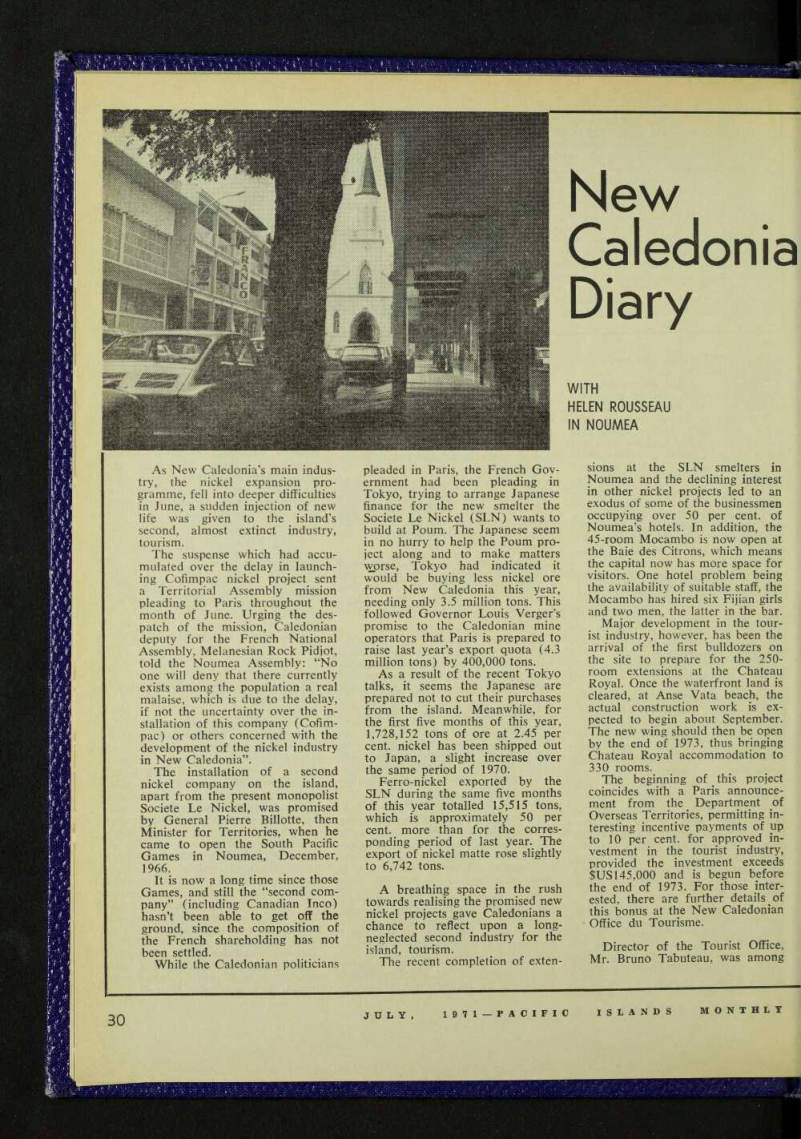
New Caledonia Diary
With
Helen Rousseau
In Noumea
As New Caledonia’s main indus try, the nickel expansion pro gramme, fell into deeper difficulties in June, a sudden injection of new life was given to the island’s second, almost extinct industry, tourism.
The suspense which had accu mulated over the delay in launch ing Cofimpac nickel project sent a Territorial Assembly mission pleading to Paris throughout the month of June. Urging the des patch of the mission, Caledonian deputy for the French National Assembly, Melanesian Rock Pidjot, told the Noumea Assembly: “No one will deny that there currently exists among the population a real malaise, which is due to the delay, if not the uncertainty over the in stallation of this company (Cofim pac) or others concerned with the development of the nickel industry in New Caledonia”.
The installation of a second nickel company on the island, apart from the present monopolist Societe Le Nickel, was promised by General Pierre Billotte, then Minister for Territories, when he came to open the South Pacific Games in Noumea, December, 1966.
It is now a long time since those Games, and still the “second com pany” (including Canadian Inco) hasn’t been able to get off the ground, since the composition of the French shareholding has not been settled.
While the Caledonian politicians
pleaded in Paris, the French Gov ernment had been pleading in Tokyo, trying to arrange Japanese finance for the new smelter the Societe Le Nickel (SLN) wants to build at Poum. The Japanese seem in no hurry to help the Poum pro ject along and to make matters wprse, Tokyo had indicated it would be buying less nickel ore from New Caledonia this year, needing only 3.5 million tons. This followed Governor Louis Verger’s promise to the Caledonian mine operators that Paris is prepared to raise last year’s export quota (4.3 million tons) by 400,000 tons.
As a result of the recent Tokyo talks, it seems the Japanese are prepared not to cut their purchases from the island. Meanwhile, for the first five months of this year, 1,728,152 tons of ore at 2.45 per cent, nickel has been shipped out to Japan, a slight increase over the same period of 1970.
Ferro-nickel exported by the SLN during the same five months of this year totalled 15,515 tons, which is approximately 50 per cent, more than for the corres ponding period of last year. The export of nickel matte rose slightly to 6,742 tons.
A breathing space in the rush towards realising the promised new nickel projects gave Caledonians a chance to reflect upon a long neglected second industry for the island, tourism.
The recent completion of exten
sions at the SLN smelters in Noumea and the declining interest in other nickel projects led to an exodus of some of the businessmen occupying over 50 per cent, of Noumea’s hotels. In addition, the 45-room Mocambo is now open at the Baie des Citrons, which means the capital now has more space for visitors. One hotel problem being the availability of suitable staff, the Mocambo has hired six Fijian girls and two men, the latter in the bar.
Major development in the tour ist industry, however, has been the arrival of the first bulldozers on the site to prepare for the 250room extensions at the Chateau Royal. Once the waterfront land is cleared, at Anse Vata beach, the actual construction work is ex pected to begin about September.
The new wing should then be open by the end of 1973, thus bringing Chateau Royal accommodation to 330 rooms.
The beginning of this project coincides with a Paris announce ment from the Department of Overseas Territories, permitting in teresting incentive payments of up to 10 per cent, for approved in vestment in the tourist industry, provided the investment exceeds SUS 145,000 and is begun before the end of 1973. For those inter ested, there are further details of this bonus at the New Caledonian Office du Tourisme.
Director of the Tourist Office, Mr. Bruno Tabuteau, was among
delegates to the conference of the Melanesian Tourist Federation, early June, in Vila, New Hebrides.
Chairman of the Federation is Don Barrett of Papua New Guinea, with Joe Mulders, of Vila, acting as secretary. General aim of the federation is to promote the chain of Melanesian islands from New Caledonia north to Papua New Guinea, travelling via the New Hebrides and Solomons.
Representatives of six interna tional airlines attended the meet ing which recommended, among other things, that the four member island groups do not participate in the joint “South Sea Islands” tour ist promotion suggested by Fiji last September (at the 10th South Paci fic Conference in Suva). The Mela nesian travel leaders felt that com bining with Polynesian islands from the other side of the Pacific was not really going to help their own individual image and that therefore they would be more effective, on their modest budget, continuing to publicise their four island groups as one separate unit.
A general survey of South Paci fic tourist potential and ways of developing it was begun in June by a team of three Americans from the University of Hawaii, spon sored by the UNDP, in co-opera tion with the SPC. In New Cale donia, the team mentioned that the existence of pollution is a factor which may eventually wipe some places off the tourist map.
It is interesting to note that in Noumea tests made since the instal lation of extra electric furnaces at the town’s nickel smelters have in dicated that red nickel dust colon residents’ window ledges contains no less than 2.4 per cent, nickel. At SUSI 6 per ton, the ob noxious dust may yet have a com mercial value for enterprising housewives.
A young Noumea artist, Mrs.
Gemmanick Harbulot, has just shipped out a batch of 129 paint ings, which represent over two years’ work and are destined for an exhibition in Tokyo. Many of the oils have been inspired by the years Gemmanick has lived in iso lated mining districts.
And another Caledonian export item is to be a locallv-made pre fabricated house. This seems strange at a time when the terri tory is employing hundreds of
overseas workers to erect prefabri cated houses of steel and wood from as far afield as Canada and France.
But the Caledonian house to go abroad joins the exhibition village of island houses planned for the South Pacific Festival of Arts in Suva next May.
Latest plans for the festival were discussed in Noumea, late in June, by its executive director, Mr. Vic tor Carell. Mr. Carell was most enthusiastic at his meeting with the recently-formed Caledonian Music Lovers’ Societe, whose musicians he feels should make a significant contribution to the Suva festival.
Other visitors to the territory in June included an Australian par liamentary delegation of 11 mem bers, who were making a three and-a-half-week tour of seven is land groups in the South Pacific.
It’s led by Mr. Charles Barnes, the Minister for Territories.
The parliamentarians received a particularly romantic, candle-lit reception in Noumea: the city, bursting in its hasty development, produced a timely electricity black out the evening of their first recep tion, at the residence of the Aus tralian Consul, and the degelation was able to see at first hand that Noumea is expanding fast.
Anew bank opened in the terri tory in June, the State-controlled Societe Generale. Construction has also finally begun on the island’s second brewery. At the same time, the Noumea Chamber of Com merce is being flooded with letters from workers in France, seeking jobs in the territory: no less than 102 requests were received in the first two months of this year. The Chamber of Commerce has thus recommended that the Overseas Territories Department in Paris should advise would-be-immigrants more realistically about the prob lems of accommodation and high living costs in the territory, before whole families land on the island without firm work contracts and lodgings.
If last month saw the great world powers battling to guard their secrets of space exploration and defence strategy in Vietnam, Noumea also had its secrets to cherish, such as the choice of a new secretary-general and anew three-year plan for the South Paci fic Commission.
Certain people at the SPC, where the staff morale is currently at its lowest ebb, seem so keen to have secrets and hide their activi ties in oblivion that some observers are wondering, out aloud, if there isn’t some sinister plot to let the commission sink to a watery grave in the lagoon by the time of its 25th anniversary next February.
Some islanders, however, have a rather keen grasp of the situation and if they can get control of the rudder, they will succeed in keep ing the commission afloat by steer ing it away from the reef and into more rewarding waters.
Meanwhile, for those who are fascinated by South Seas mysteries, we can report that the SPC plan ning meeting in June followed habitual trends.
France, after making sure that French-speaking delegates were represented in the essential com mittees, is reported to have promptly walked out of one of them. This harmless little game, however, is but a part of what is fondly known as maintaining “la presence francaise” in the Pacific.
At the same time, it is apparently becoming increasingly difficult to find the right kind of locally-born people in New Caledonia and French Polynesia to represent these two territories, so they were again represented at the SPC by metropolitan French public ser vants.
The meeting had some fortunate results, however. Against an im pressive background row of UN observers. Islanders sat down to discuss some hundred proposals for conferences and training programmes to be conducted over the next three years. Some international observers were dis mayed at the complete absence of any properly-defined policy to guide Islanders in their de cision on what the SPC should be doing to help develop the region.
A committee was thus appointed to draw up what became a very valuable series of pointers in set ting a course for SPC activity and island development generally. This paper was to be circulated subse quently around the Islands.
Finally, the Islanders made their major decision in urging the SPC to form an Economic Intelligence Unit. This is intended to supply the kind of information that would best help the Islands promote their industries and overseas trade.
Footnotes
VI/’HEN I first came to Papua there was a lot ** of talk among the egg-heads about the “clash of cultures”. What was usually meant was the disruptive and sometimes destroying impact of the intrusive western culture on the indigenous one. And it was widely premised by the anthro pologists that the inevitable result of the impact would be the decline and extinction of the tribes which suffered it.
Whether their desire to preserve the tribes as museum pieces was prompted by genuine com passion or by a desire to have something to study is a matter on which I will not express an
opinion.
Then came a time when we began to talk about the “blending of cultures”. We envisaged a new culture arising in Papua which would unite the best in our western way of life with the best from the old-time Papuan way.
And now voices are being raised telling us that this was just a pipe dream; that the cultures won’t blend; that Papuans and New Guineans can’t have the best of both worlds; and that, in the field of economic development at any rate, they must face up, as the price of progress, to tossing out the old and installing the new in its place.
I find two areas of irony in these develop ments.
First, the very iconoclasm for which the early missionaries have been so bitterly denigrated in the field of religion is now the up-to-the-minute gospel in the field of economics.
Second, while those of us who advocated culture-blending during the decades immediately preceding and following the 1939-45 war found our seed falling on stony ground, with most young Papuans only too eager to toss over the ways of their fathers and become brown Austra lians, now there is among a new generation a rising appreciation of the good features of the old ways and a desire to incorporate them in a new Papua and New Guinea way of life. And the economists choose this moment to tell us that it can’t be done.
A research hound told the recent Waigani Seminar at the University of Papua and New Guinea that he had discovered that many trade store owner/operators in Papua New Guinea were concerned with building up prestige rather than profits. Most participants in the seminar (the expatriate ones, at any rate) seemed to re-
Is Scrooge To
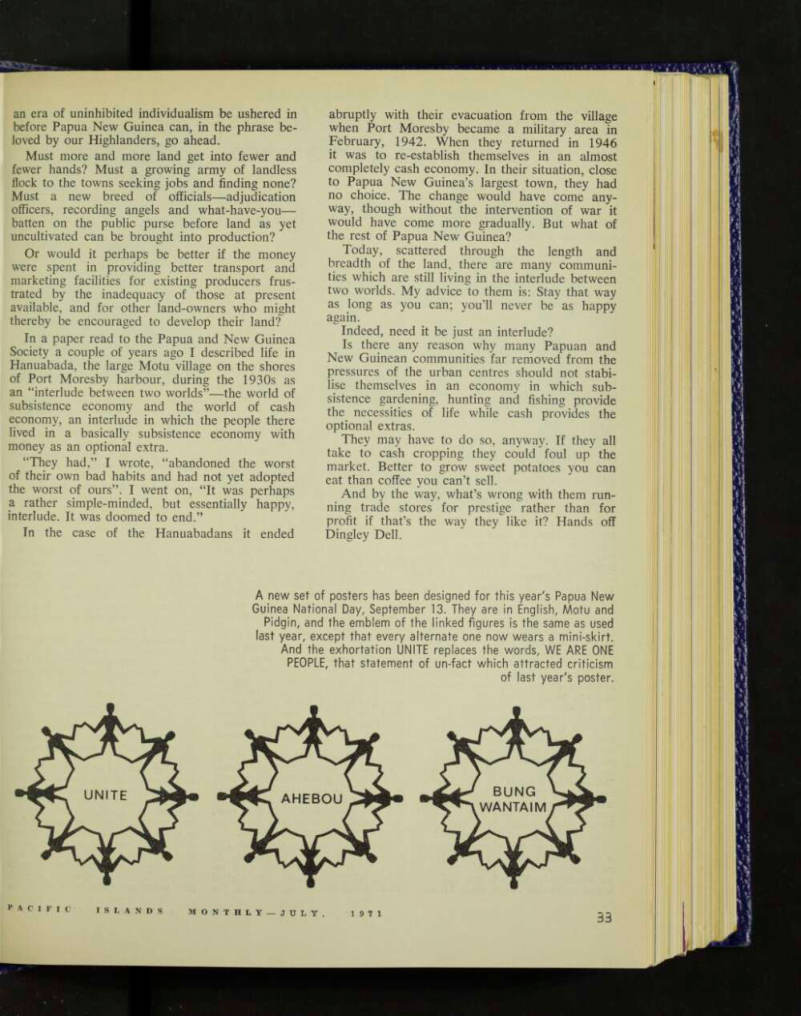
Be Model Png
Businessman?
gard this attitude as very reprehensible and as an ill to be cured. Some of them were ready with remedies for curing it.
However, I got the impression that not all of the indigenous participants were prepared to accept this view unquestioningly, but were in clined to ask themselves, “If this is the price of progress, is it worth it?” It seems clear from the opposition to the Administration’s voluminous and arduously prepared new land legislation that some, at any rate, are prepared to answer “No”.
As paper followed paper at the seminar I fell to wondering what would happen if the seminar had appointed a sub-committee to reassess the works of Charles Dickens. Clearly the genial squire of Dingley Dell would get short shrift. The fellow was blatantly squandering the produce of his estates to build up his social prestige through lavish entertainment. The sub-committee’s favourite character would no doubt have been that nambawan man bilong bisnis, Ebenezer Scrooge.
Since the seminar ended I have been toying with the idea of writing a pepped-up version of A Christmas Carol and offering it to the De partment of Business Development for publica tion, perhaps as a text book for high schools.
It would have to be pretty extensively re written, of course. The ghosts could be retained, and could be used to give advice to Scrooge on how to effect further reductions in his overheads.
But all that nonsense about rushing round to Bob Cratchit’s place on Christmas morning with outsize turkeys would clearly have to go. Apart from its extravagance, it was plainly an attempt to placate the spirits and might easily have started a cargo cult.
However, as a concession to sentiment and an artistic way of rounding the story off, the last chapter might describe the initiation of Fellow Ebenezer into Rotary.
Are the tough liners right? Must kinship ties be broken, kinship obligations be repudiated and
an era of uninhibited individualism be ushered in before Papua New Guinea can, in the phrase be loved by our Highlanders, go ahead.
Must more and more land get into fewer and fewer hands? Must a growing army of landless flock to the towns seeking jobs and finding none?
Must a new breed of officials—adjudication officers, recording angels and what-have-you— batten on the public purse before land as yet uncultivated can be brought into production?
Or would it perhaps be better if the money were spent in providing better transport and marketing facilities for existing producers frus trated by the inadequacy of those at present available, and for other land-owners who might thereby be encouraged to develop their land?
In a paper read to the Papua and New Guinea Society a couple of years ago I described life in Hanuabada, the large Motu village on the shores of Port Moresby harbour, during the 1930 s as an “interlude between two worlds”—the world of subsistence economy and the world of cash economy, an interlude in which the people there lived in a basically subsistence economy with money as an optional extra.
“They had,” I wrote, “abandoned the worst of their own bad habits and had not yet adopted the worst of ours”. I went on, “It was perhaps a rather simple-minded, but essentially happy, interlude. It was doomed to end.”
In the case of the Hanuabadans it ended
abruptly with their evacuation from the village when Port Moresby became a military area in February, 1942. When they returned in 1946 it was to re-establish themselves in an almost completely cash economy. In their situation, close to Papua New Guinea’s largest town, they had no choice. The change would have come any way, though without the intervention of war it would have come more gradually. But what of the rest of Papua New Guinea?
Today, scattered through the length and breadth of the land, there are many communi ties which are still living in the interlude between two worlds. My advice to them is: Stay that way as long as you can; you’ll never be as happy again.
Indeed, need it be just an interlude?
Is there any reason why many Papuan and New Guinean communities far removed from the pressures of the urban centres should not stabi lise themselves in an economy in which sub
sistence gardening, hunting and fishing provide
the necessities of life while cash provides the optional extras.
They may have to do so, anyway. If they all take to cash cropping they could foul up the market. Better to grow sweet potatoes you can eat than coffee you can’t sell.
And by the way, what’s wrong with them run ning trade stores for prestige rather than for profit if that’s the way they like it? Hands off Dingley Dell.
A new set of posters has been designed for this year's Papua New Guinea National Day, September 13. They are in English, Motu and Pidgin, and the emblem of the linked figures is the same as used last year, except that every alternate one now wears a mini-skirt.
And the exhortation UNITE replaces the words, WE ARE ONE PEOPLE, that statement of un-fact which attracted criticism of last year's poster.
most important conference
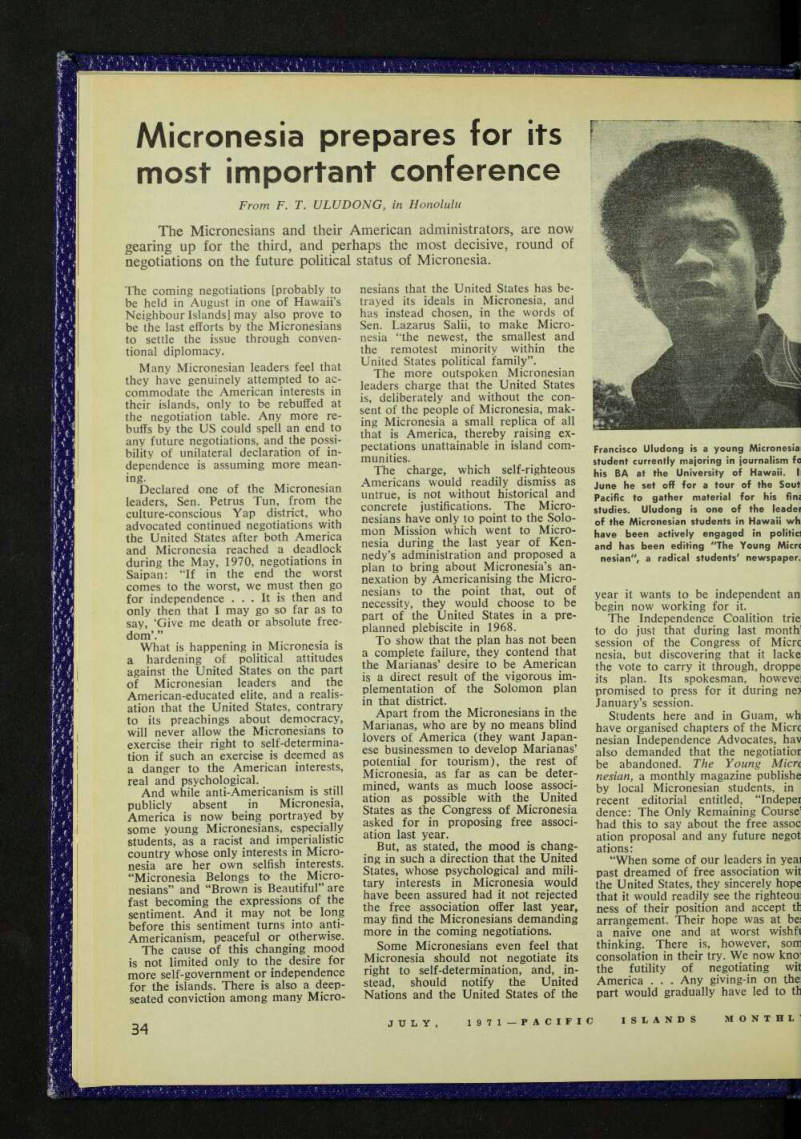
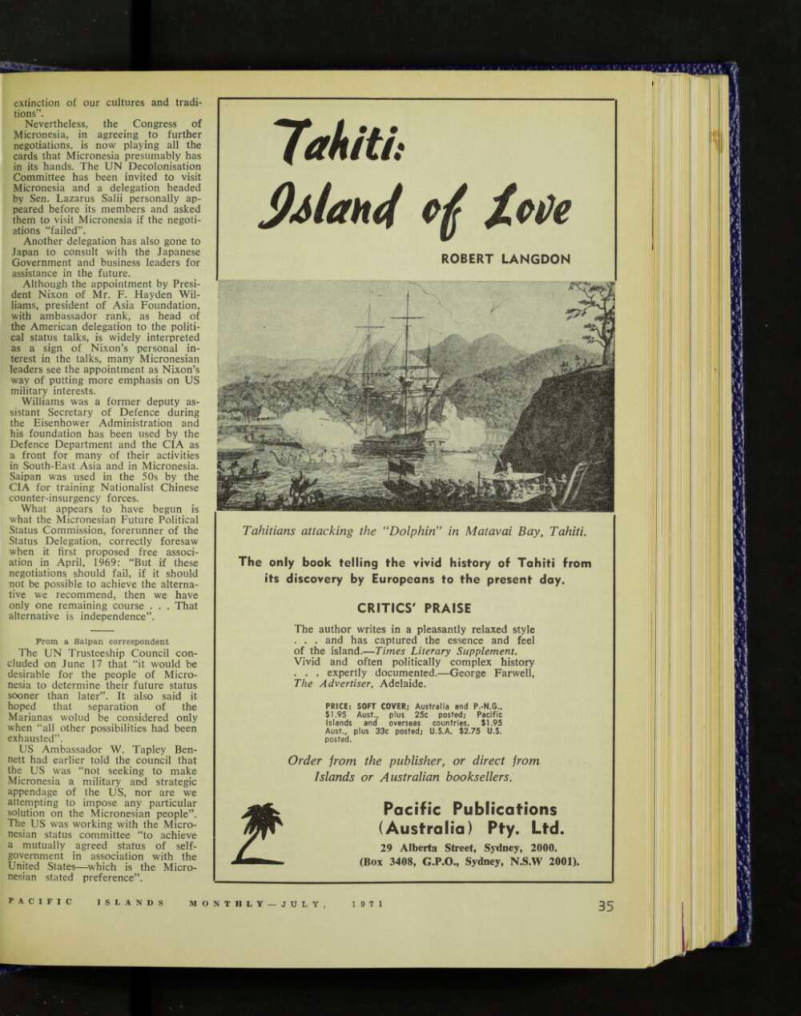
Micronesia prepares for its most important conference
From F. T. ULUDONG, in Honolulu The Micronesians and their American administrators, are now gearing up for the third, and perhaps the most decisive, round of negotiations on the future political status of Micronesia.
The coming negotiations [probably to be held in August in one of Hawaii’s Neighbour Islands! may also prove to be the last efforts by the Micronesians to settle the issue through conven tional diplomacy.
Many Micronesian leaders feel that they have genuinely attempted to ac commodate the American interests in their islands, only to be rebuffed at the negotiation table. Any more re buffs by the US could spell an end to any future negotiations, and the possi bility of unilateral declaration of in dependence is assuming more mean ing.
Declared one of the Micronesian leaders, Sen. Petrus Tun, from the culture-conscious Yap district, who advocated continued negotiations with the United States after both America and Micronesia reached a deadlock during the May, 1970, negotiations in Saipan; “If in the end the worst comes to the worst, we must then go for independence ... It is then and only then that I may go so far as to say, ‘Give me death or absolute free dom’.”
What is happening in Micronesia is a hardening of political attitudes against the United States on the part of Micronesian leaders and the American-educated elite, and a realis ation that the United States, contrary to its preachings about democracy, will never allow the Micronesians to exercise their right to self-determina tion if such an exercise is deemed as a danger to the American interests, real and psychological.
And while anti-Americanism is still publicly absent in Micronesia, America is now being portrayed by some young Micronesians, especially students, as a racist and imperialistic country whose only interests in Micro nesia are her own selfish interests.
“Micronesia Belongs to the Micro nesians” and “Brown is Beautiful” are fast becoming the expressions of the sentiment. And it may not be long before this sentiment turns into anti- Americanism, peaceful or otherwise.
The cause of this changing mood is not limited only to the desire for more self-government or independence for the islands. There is also a deep seated conviction among many Micro
nesians that the United States has be trayed its ideals in Micronesia, and has instead chosen, in the words of Sen. Lazarus Salii, to make Micro nesia “the newest, the smallest and the remotest minority within the United States political family”.
The more outspoken Micronesian leaders charge that the United States is, deliberately and without the con sent of the people of Micronesia, mak ing Micronesia a small replica of all that is America, thereby raising ex pectations unattainable in island com munities.
The charge, which self-righteous Americans would readily dismiss as untrue, is not without historical and concrete justifications. The Micro nesians have only to point to the Solo mon Mission which went to Micro nesia during the last year of Ken nedy’s administration and proposed a plan to bring about Micronesia’s an nexation by Americanising the Micro nesians to the point that, out of necessity, they would choose to be part of the United States in a pre planned plebiscite in 1968.
To show that the plan has not been a complete failure, they contend that the Marianas’ desire to be American is a direct result of the vigorous im plementation of the Solomon plan in that district.
Apart from the Micronesians in the Marianas, who are by no means blind lovers of America (they want Japan ese businessmen to develop Marianas’ potential for tourism), the rest of Micronesia, as far as can be deter mined, wants as much loose associ ation as possible with the United States as the Congress of Micronesia asked for in proposing free associ ation last year.
But, as stated, the mood is chang ing in such a direction that the United States, whose psychological and mili tary interests in Micronesia would have been assured had it not rejected the free association offer last year, may find the Micronesians demanding more in the coming negotiations.
Some Micronesians even feel that Micronesia should not negotiate its right to self-determination, and, in stead, should notify the United Nations and the United States of the
year it wants to be independent an begin now working for it.
The Independence Coalition trie to do just that during last month’ session of the Congress of Micrc nesia, but discovering that it lacke the vote to carry it through, droppe its plan. Its spokesman, howevei promised to press for it during neJ January’s session.
Students here and in Guam, wh have organised chapters of the Micro nesian Independence Advocates, hav also demanded that the negotiatior be abandoned. The Young Micrc nesian, a monthly magazine publishe by local Micronesian students, in recent editorial entitled, “Indepei dence: The Only Remaining Course’ had this to say about the free assoc ation proposal and any future negot ations: “When some of our leaders in yeai past dreamed of free association wit the United States, they sincerely hope that it would readily see the righteoui ness of their position and accept th arrangement. Their hope was at be; a naive one and at worst wishfi thinking. There is, however, som consolation in their try. We now kno 1 the futility of negotiating wit America . . . Any giving-in on the: part would gradually have led to th
Francisco Uludong is a young Micronesia student currently majoring in journalism f[?] his BA at the University of Hawaii. [?] June he set off for a tour of the Sout[?] Pacific to gather material for his fina[?] studies. Uludong is one of the leader[?] of the Micronesian students in Hawaii wh[?]
have been actively engaged in politic[?]
and has been editing "The Young Micr[?] nesian", a radical students' newspaper.
extinction of our cultures and tradi tions”.
Nevertheless, the Congress of Micronesia, in agreeing to further negotiations, is now playing all the cards that Micronesia presumably has in its hands. The UN Decolonisation Committee has been invited to visit Micronesia and a delegation headed by Sen. Lazarus Salii personally ap peared before its members and asked them to visit Micronesia if the negoti ations “failed”.
Another delegation has also gone to Japan to consult with the Japanese Government and business leaders for assistance in the future.
Although the appointment by Presi dent Nixon of Mr. F. Hayden Wil liams, president of Asia Foundation, with ambassador rank, as head of the American delegation to the politi cal status talks, is widely interpreted as a sign of Nixon’s personal in terest in the talks, many Micronesian leaders see the appointment as Nixon’s way of putting more emphasis on US military interests.
Williams was a former deputy as sistant Secretary of Defence during the Eisenhower Administration and his foundation has been used by the Defence Department and the CIA as a front for many of their activities in South-East Asia and in Micronesia.
Saipan was used in the 50s by the CIA for training Nationalist Chinese counter-insurgency forces.
What appears to have begun is what the Micronesian Future Political Status Commission, forerunner of the Status Delegation, correctly foresaw when it first proposed free associ ation in April, 1969: “But if these negotiations should fail, if it should not be possible to achieve the alterna tive we recommend, then we have only one remaining course . . . That alternative is independence”.
Prom a Saipan correspondent The UN Trusteeship Council con cluded on June 17 that “it would be desirable for the people of Micro nesia to determine their future status sooner than later”. It also said it hoped that separation of the Marianas wolud be considered only when “all other possibilities had been exhausted”, US Ambassador W. Tapley Ben nett had earlier told the council that the US was “not seeking to make Micronesia a military and strategic appendage of the US, nor are we attempting to impose any particular solution on the Micronesian people”.
The US was working with the Micro nesian status committee “to achieve a mutually agreed status of self government in association with the United States—which is the Micro nesian stated preference”.
Advertisements & other items, p. 39 (1 item)
sMan4 o/f iWe
Tahiti:
ROBERT LANGDON
Tahitians attacking the “Dolphin” in Matavai Bay, Tahiti.
The only book telling the vivid history of Tahiti from its discovery by Europeans to the present day.
CRITICS' PRAISE
The author writes in a pleasantly relaxed style . . . and has captured the essence and feel of the island. —Times Literary Supplement.
Vivid and often politically complex history . . . expertly documented.—George Farwell, The Advertiser, Adelaide.
PRICE; SOFT COVER; Australia and P.-N.G., $1.95 Aust., plus 25c posted; Pacific Islands and overseas countries, $1.95 Aust., plus 33c posted; U.S.A. $2.75 U.S. posted.
Order from the publisher, or direct from Islands or Australian booksellers.
Pacific Publications
(Australia) Pty. Ltd.
29 Alberta Street, Sydney, 2000. (Box 3408, G.P.0., Sydney, N.S.W 2001).
From the Islands Press
Item from BSIP News Sheet: An old Ulawa custom of killing trees by shouting has just been revived and its success has caused much surprise among young people of the area. News of this custom, possibly the only one of its kind, has been received from Mr. Edward Lioha, of Ahia village, Ulawa, and his story has been verified by some Ulawa islanders in Honiara . According to Mr. Lioha, the custom is used if a group of people want to get rid of a tree for a special reason, such as to clear an area for a garden, if the tree is too big and hard to chop down. Every morning for about a month an old man or woman goes quietly to the tree and then utters a piercing yell. After some time it loses its leaves and branches and dies, due, it is believed, to the succession of shocks it has received while asleep.
Letter in GEIC 'lnformation Notes', Tarawa: We appear to be joining the large international club of polluters of the ocean, the filth that daily flows out with the tide from Betio harbour being our membership card. Several years ago Betio Harbour was blue and sparkling and safe to swim in but it is now a turbid soup. The biggest polluters are ships that clean out their fuel tanks in the harbour. ... I presume if a ship bunkering station is set up at Butaritari we will see that beautiful lagoon covered in a filthy brown oil slick if there is no legislation to prevent dumping of dirty fuel oil in the lagoon or in the ocean near the island. ... It is interesting to note that the ocean is having her revenge on polluters of her waters. She is now producing fish with ulcerations, benign tumours, malformed bodies and fin and lip cancers.
An advertisement from The Fijian Hotel in 'The Fiji Times' asking taxi drivers to confirm bookings from hotel visitors: We would draw taxi drivers’ attention to the misunderstandings that may occur due to language problems, names and the spelling of same.
Head nodding and arm waving may not neces sarily indicate willingness by a guest. Tourists coming to Fiji are to all intent and purposes in a foreign country. They need the same patience and understanding that you yourselves would
expect if visiting their particular territories.
Extract from a letter from W. T. McCoy in The Norfolk Islander': This writer believes the time is over-ripe, and now decaying, to raise concerted voices from the resident public of Norfolk Island in efforts to amend the present form and system of administration. If you doubt we are still saddled with the retrograde step take a look or cast in your mind the present number of highly-paid officials ensconced in the offices of administration. You will then realise that, in addition, the public is also bridled with heart breaking expenses to keep the wheels of administration
turning. Even this could be overlooked if this costly business could only show something of value to Norfolk Island, This naturally leads to the question—are all these highly-paid officials necessary?
Letter in 'Our News' published by the PNG Department of Information: I would like to know why Papuan and New Guinean girls never show their manners? Here in Madang there are too many girls that have no manners at all. For instance, Tusbab High School girls, whenever I say ‘Good morning’, they never say ‘Good morning’, but put their noses in the air. Now how can we leam to live in unity, brother and sister, in our country.
News item in the 'Micronitor' in US Trust Territory: Construction of a Lagoon Side Bar to complement the already completed and occupied 12-room facility of the growing Eastern Gateway Hotel complex is progressing smoothly. When complete, the bar will cater to guests in an atmosphere of tall drinks and quiet conversation. This will be the first bar of such a nature in Majuro where the usual bill of fare is shameless music and ragtime women in loud profusion.
News item in 'American Samoa News Bulletin': A spokesman for the Department of Agriculture said toda reports that from 70 to 200 head of cattle, descendants of a herd brought to American Samoa by the Navy more than 20 years ago, are roaming the northwestern mountainside of Tutuila are grossly exaggerated. Glenn Anderson, a former Californian dairy rancher and now the department's authority on the subject, said men who participated in a round-up Saturday spotted only a few head —which promptly high-tailed it into the heavily-wooded area. He said they were all old cows and could hardly form the nucleus of a cattle industry which the department plans to develop on the Manu'a island of Tau.
Extract from article by J. R. McCreary, Associate Profesor of Sociology, Victoria University, in the 'NZ Listener 7 : It is easy to poke fun at some of the material which has found its way into Pacific classrooms. There was the small Melanesian boy, living on an outer island, battling with the sum, “One train travels 200 miles, another train travels 420 miles. How far do the two trains travel together?” . . . There was also the schoolroom, with the jungles of Melanesia bordering the playground, where a frieze surrounded the wall entitled “The Seasons” showed lambs gambolling in spring, leaves falling in autumn and snowmen dotting a bleak landscape in winter. . . .
But is the School Certificate syllabus or that for the Cambridge Overseas School Certificate really more appropriate for secondary school scholars?
Advertisements & other items, pp. 40-42 (2 items)
36
JULY, 1971 PACIFIC ISLANDS MONTHLI
/Sa^*uf£
Pa*4W' f 6 t*4J*ist% amdfy &,s&** di|j2k.
q ,
/S" y i
7sa^*6&> Just dial a different angle until the nib position is exactly how you want it.
Your fingers rest in the curved grip of a Parker 75, so you write relaxed.
Fill up from an ink bottle, or load with a special Parker cartridge. It has a 'tap tank' in reserve, for up to 700 more words ' after you think your ink's run out!
Every Parker 75 passes 792 inspections before you see it. Sterling quality, so it's sterling silver. Or rolled gold, or Vermeil which is 14 ct gold on silver.
+PARKER
Maker oj the world's most wanted pens
kill them quickly, cleanly, efficiently
with new Flick BATBLOX
Q=--.
Just throw x RATBLOXinto inaccessible areas... under the fridge... behind stored goods. Can be used outdoors, too. d Km A Ask your retailer, or your nearest Flick Branch Office. Trade Enquiries: Flick Chemical Industries Pty.
Ltd., 73 Victoria Ave., Chatswood,
NSW. 2067.
Jimmy Stephens'
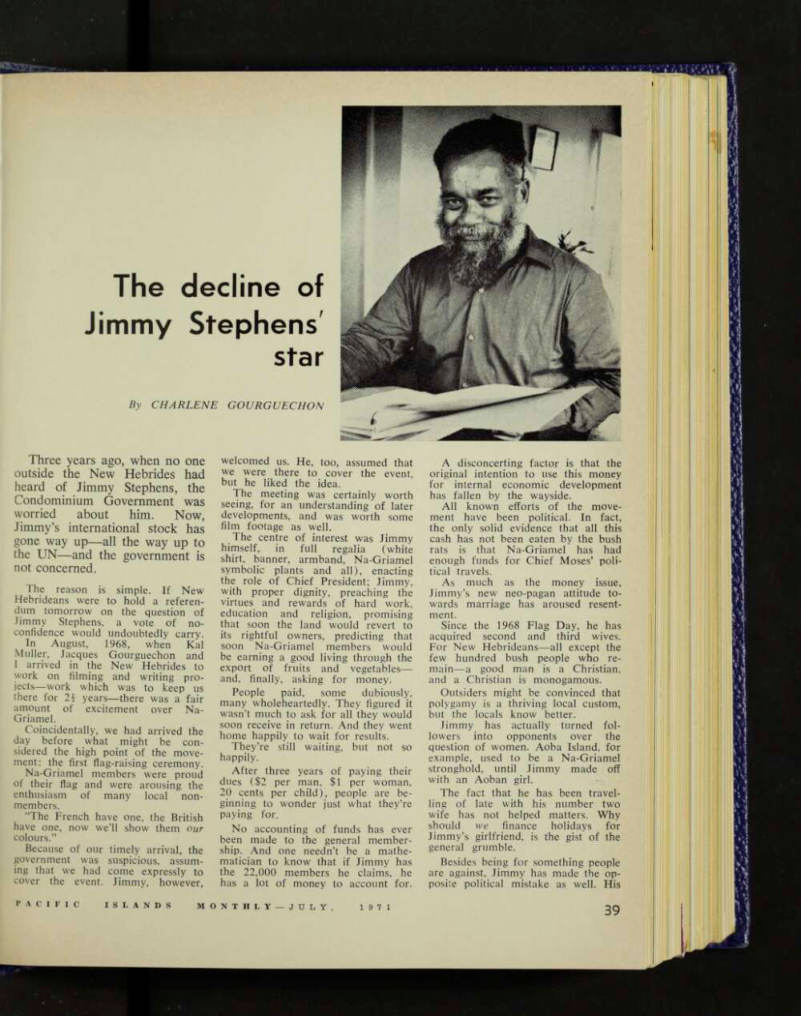
The decline of Jimmy Stephens' star
By Charlene Gourguechon
Three years ago, when no one outside the New Hebrides had heard of Jimmy Stephens, the rnnHnmini,.m rmrornmnnt Condominium Government was WOrnea about him. Now, Jimmy’s international stock has gone wav un all tho wav nn ™ • ana the government is not concerned. . u[ -j reason 18 simple. If New rlebndeans were to hold a referendum tomorrow on the question of JIITI Stephens, a vote of noconfidence would undoubtedly carry.
August, when Kal Muller, Jacques Gourguechon and i arrived m the New Hebrides to work on filming and writing prothere keep us amount of Excitement over 3 NjT Griamel excitement over Nau„a • a
? the
sidereH the hiah nnlnt tH 6 COn m d en^ d ,^ e fi^ h fl a P Na-Griamel members were proud of their flag and were arousing the enthusiasm of many local nonmembers.
“The French have one, the British have one, now we’ll show them our colours.”
Because of our timely arrival, the government was suspicious, assummg that we had come expressly to cover the event. Jimmy, however,
welcomed us. He, too, assumed that were there to cover the event, bu L he like s the idea> • , L T* 16 meeting was certainly worth seeing, for an understanding of later developments, and was worth some f°°tage as well.
The centre of interest was Jimmy himself ’ in full regalia (white shirt, banner, armband, Na-Griamel symbolic plants and all), enacting the role of Chief President; Jimmy, with proper dignity, preaching the virtues and rewards of hard work, education and religion, promising that soon the land would revert to its rightful owners, predicting that soon Na-Griamel members would be earning a good living through the export of fruits and vegetables— and, finally, asking for money.
People paid, some dubiously, many wholeheartedly. They figured it wasn ’ t much to ask for all they would soon receive in return. And they went home happily to wait for results.
They’re still waiting, but not so After three y ears of P a V in g their dues per man > $1 per woman, 2 P S ents per child), people are beginning to wonder just what they’re pa y in g for - No accounting of funds has ever been made to the general membership. And one needn’t be a mathematician to know that if Jimmy has the 22,000 members he claims, he has a lot of money to account for.
A disconcerting factor is that the original intention to use this money [ or i n , t I erna J economic development has fallen by the wayside.
All known efforts of the move ment have been political. In fact, the only solid evidence that all this cash has not been eaten by the bush rats is that Na-Griamel has had enough funds for Chief Moses’ poli tical travels.
As much as the money issue, Jimmy’s new neo-pagan attitude to wards marriage has aroused resent ment.
Since the 1968 Flag Day, he has acquired second and third wives.
For New Hebrideans—all except the few hundred bush people who re main—a good man is a Christian, and a Christian is monogamous, Outsiders might be convinced that polygamy is a thriving local custom, but the locals know better Jimmy has actually turned fol lowers into opponents over the question of women. Aoba Island, for example used to be a Na-Griamel stronghold, until Jimmy made off Wlth ao Aoban girl, The fact that he has been travel ling of late with his number two wife has not helped matters. Why wg finance holidays for Jimmy s girlfriend, is the gist of the general grumble, Besides being for something people are against, Jimmy has made the op posite political mistake as well. His
Jimmy Stephens
stand on temperance, while it may have merit, is not popular. The only New Hebrideans who consistently do not drink are the Seventh-day Adven tists.
There is always resentment towards an attitude with holier-than-thou over tones, and so rumours are current of the days when Jimmy was said to be quite a drinker himself—rumours of the past, and present suspicions.
In remoter areas of the New Hebrides, where people knew we had seen more of the Na-Griamel than they had, we were asked—among other questions, and often over a beer at the local co-operative—whether it was true that Jimmy was an abstainer.
We said we didn’t think so. How did we know? We related the following anecdote.
In April, 1970, two of the three in our film team, taking a walk in Suva, glanced through the open window of an out-of-the-way pub and recognised Jimmy, a beer in his hand. We greeted him.
He rushed outside, rather flushed and flustered, to tell us that he had not really been drinking, that he was there to meet a friend, that it would be good if we mentioned nothing of this in the New Hebrides, as people might misunderstand.
But we saw no reason for keeping secrets.
Though drinking is a relatively minor issue—money and women are not —serious dissent is arising from a change in Na-Griamel’s basic policy.
Three years ago, Jimmy advocated opposition to Europeans over land but nothing else. General opposition to the condominium was not part of the programme. Gradually, it has be come so, and many Na-Griamelers do not agree.
On north Ambrym a few months ago we witnessed a meeting between the people of several villages and the French Delegate, with Olsen Kai, Na- Griamel’s second-in-command, as opposition leader.
The delegate had come to offer condominium funds for a road which the Ambrym Islanders had already started to build, on their own initiative and with hand-tools only.
The Na-Griamel urged rejection of such funds —non-co-operation by not taking money from the Europeans.
The delegate explained that the money in fact belonged to the New Hebrideans, that even those present had contributed, knowingly or not, through export duties on their copra.
The leaders of these villages being firm Na-Griamel supporters, the offer was politely refused. The delegate packed up his money and left. But there was some heated discussion dur ing the next few days.
There were numbers of people who felt that turning down money for road equipment was not the direct route to progress. And when, moreover, will the Na-Griamel be able to make a similar offer?
North Ambrym, like Aoba, used to be a Na-Griamel stronghold.
Overall, these days, New Hebri deans are developing an image of Na- Griamel as something that has no direct significance for them, and pro vides no direct benefits. Those who pay, as several Ambrym Islanders ad mitted frankly, often do so as a form of insurance. For $2, a man can afford to bet against the odds.
Few are convinced of the value of Jimmy’s trips abroad, New Hebri deans generally favouring economics over politics. They associate this par ticular way of spending money with Europeans.
And that observation reminds them of a fact they were willing to over look three years ago: Jimmy is nart- European, also part Tongan. I no olsein mifala, some are beginning to say; he’s not one of us.
Those who know the story of the rifles are beginning to dredge that up, too, and repeat it.
It seems that once, before the birth of Na-Griamel, Jimmy took money from a number of people, promising rifles. The rifles were never delivered, the money was never seen again, and Jimmy wound up in gaol.
The decline of Jimmy’s star, even near Na-Griamel’s headquarters vil lage on Santo, was seen recently in a meeting over a land dispute.
Locals, representatives of the French society which owns the land in question, and government officials were present.
Jimmy took the floor and proposed to speak for the people, whereupon a government official demanded, “And who are you to speak for the people? Who gives you the right?”
Jimmy searched the eyes of his “supporters”, seeking support. But no one said a word. He sat down, silenced.
The Condominium Government, known for attempting little and bung ling much of that, was for once politically right in not taking action on Na-Griamel. It could have put obstacles in Jimmy’s way. But it chose to let him get in his own way, in his own good time, and that is what he is doing.
Advertisements & other items, pp. 44-46 (1 item)
Huso
FIAT
CONCESSIONAIRES
American Samoa Silver Star Transport Inc.,
P.O. Box CB-4, PAGO PAGO.
Fiji Motibhai & Co. Ltd., P.O. Box 40, ba.
New Caledonia Agence Automobile S.A.,
P.O. BOX 842, NOUMEA.
New Guinea New Guinea Motors Pty. Ltd.,
P.O. Box 1027, BOROKA.
New Hebrides Societe Bourgeois & Cie.,
P.O. BOX 28, PORT VILA.
New Zealand Torino Motors Ltd.,
P.O. Box 6240, AUCKLAND.
Norfolk Island Red Rental Ltd.,
P.O. Box 147, NORFOLK ISLAND.
Solomon Islands Chan Wing Motors Ltd.,
P.O. BOX 820, HONIARA.
Tahiti Agence Tahiti Poroi,
P.O. BOX 83, PAPEETE.
Western Samoa E. A. Coxon & Co. Ltd.,
P.O. Box 38, APIA.
HUSO
& IK ii
VAB
«s«K' US
(With a Fiat Bambina.)
Bambina.
It means baby girl. Fiat’s baby girl.
It could be your little bundle of joy.
For such a small price it’s a kidnap.
When will your Italian Love Affair begin?
DBEJnnEIES
what
know-hows
in all 6 varieties of their famous chocolate biscuits i v * V* They know more about flavour; more about freshness; more about delighting your taste with smooth, rich chocolate.
Webster s put years of know-how into each packet of their chocolate biscuits. And it shows —in that distinctive Webster’s taste. 1 IJflflllli 93 sK V’
V o <X S?H
Chocolate 1
4- O 0 um Zi/i A. o ch°?S" vt e
CHOCOLATE
OZ-NET
HONEY
V
CREAMS
O. r. 1 7 OZ.
GRAHAMS
V <7 ft X o
NET
<? / o
Put it to the today
Fiji's A Beaut
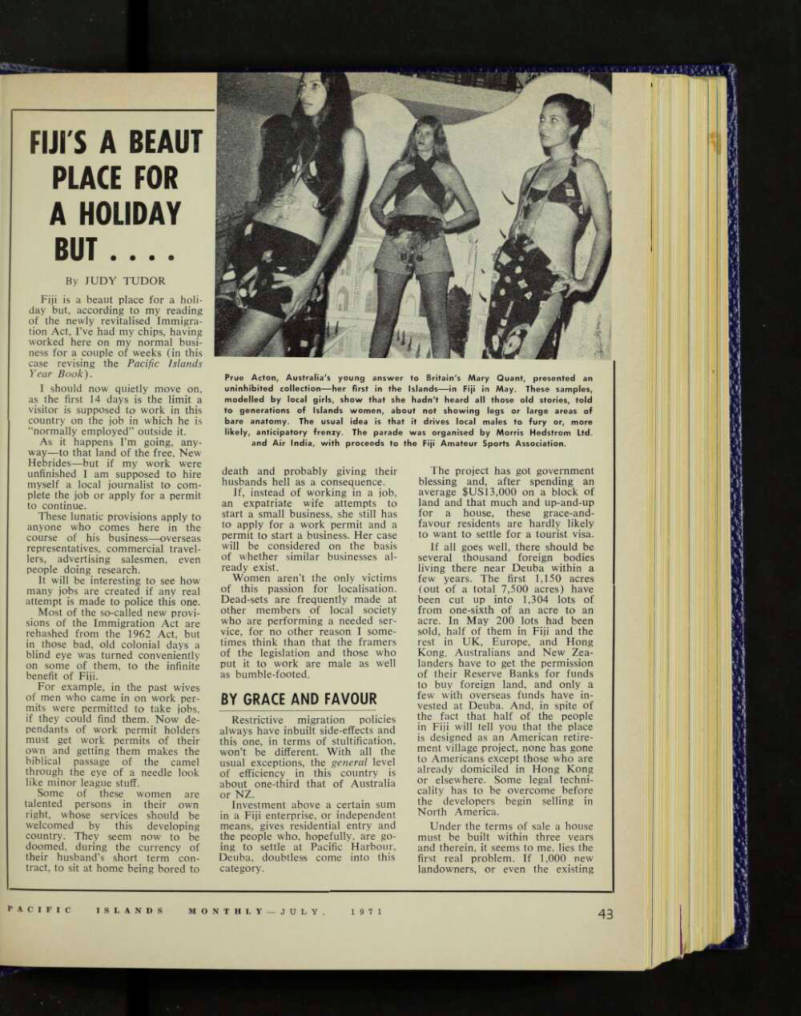
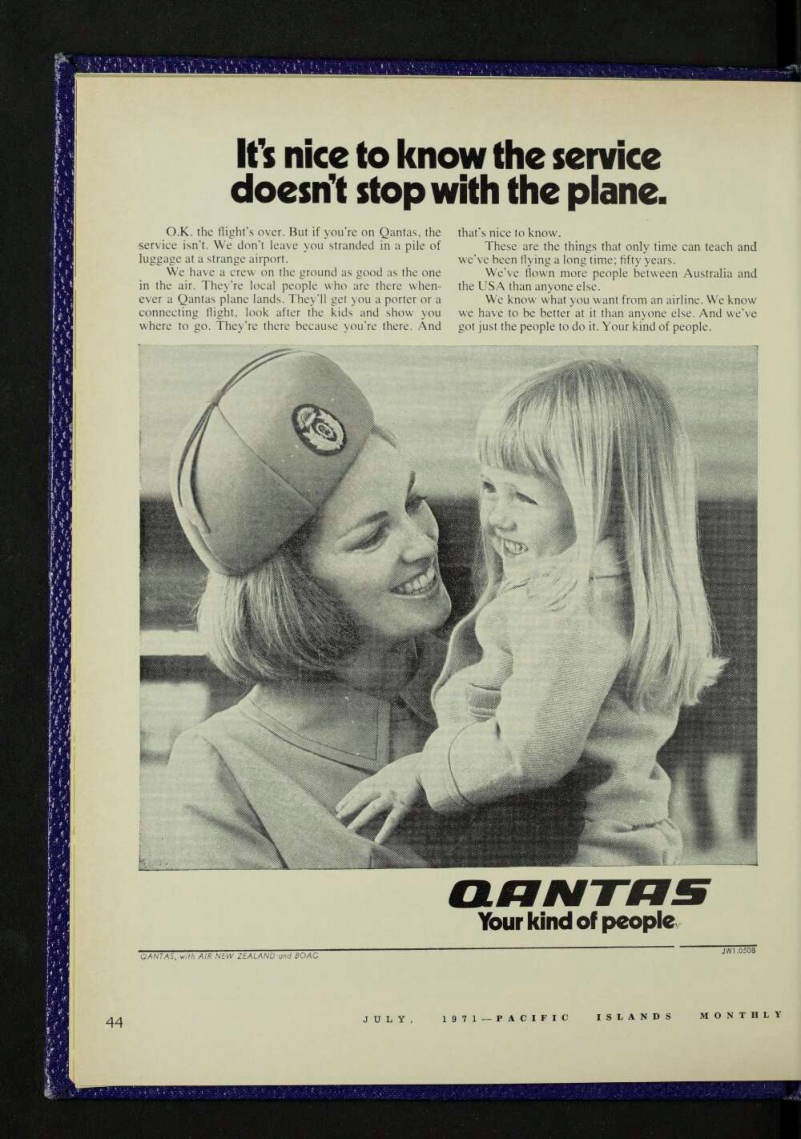
Place For
A Holiday
But
By Judy Tudor
Fiji is a beaut place for a holi day but, according to my reading of the newly revitalised Immigra tion Act, I’ve had my chips, having worked here on my normal busi ness for a couple of weeks (in this case revising the Pacific Islands Year Book).
I should now quietly move on, as the first 14 days is the limit a visitor is supposed to work in this country on the job in which he is “normally employed” outside it.
As it happens I’m going, any way—to that land of the free, New Hebrides—but if my work were unfinished I am supposed to hire myself a local journalist to com plete the job or apply for a permit to continue.
These lunatic provisions apply to anyone who comes here in the course of his business—overseas representatives, commercial travel lers, advertising salesmen, even people doing research.
It will be interesting to see how many jobs are created if any real attempt is made to police this one.
Most of the so-called new provi sions of the Immigration Act are rehashed from the 1962 Act, but in those bad, old colonial days a blind eye was turned conveniently on some of them, to the infinite benefit of Fiji.
For example, in the past wives of men who came in on work per mits were permitted to take jobs, if they could find them. Now de pendants of work permit holders must get work permits of their own and getting them makes the biblical passage of the camel through the eye of a needle look like minor league stuff.
Some of these women are talented persons in their own right, whose services should be welcomed by this developing country. They seem now to be doomed, during the currency of their husband’s short term con tract, to sit at home being bored to
death and probably giving their husbands hell as a consequence.
If, instead of working in a job, an expatriate wife attempts to start a small business, she still has to apply for a work permit and a permit to start a business. Her case will be considered on the basis of whether similar businesses al ready exist.
Women aren’t the only victims of this passion for localisation.
Dead-sets are frequently made at other members of local society who are performing a needed ser vice, for no other reason I some times think than that the framers of the legislation and those who put it to work are male as well as bumble-footed.
By Grace And Favour
Restrictive migration policies always have inbuilt side-effects and this one, in terms of stultification, won’t be different. With all the usual exceptions, the general level of efficiency in this country js about one-third that of Australia or NZ.
Investment above a certain sum in a Fiji enterprise, or independent means, gives residential entry and the people who, hopefully, are go ing to settle at Pacific Harbour, Deuba, doubtless come into this category.
The project has got government blessing and, after spending an average SUSI3,OOO on a block of land and that much and up-and-up for a house, these grace-and favour residents are hardly likely to want to settle for a tourist visa.
If all goes well, there should be several thousand foreign bodies living there near Deuba within a few years. The first 1,150 acres (out of a total 7,500 acres) have been cut up into 1,304 lots of from one-sixth of an acre to an acre. In May 200 lots had been sold, half of them in Fiji and the rest in UK, Europe, and Hong Kong. Australians and New Zea landers have to get the permission of their Reserve Banks for funds to buy foreign land, and only a few with overseas funds have in vested at Deuba. And, in spite of the fact that half of the people in Fiji will tell you that the place is designed as an American retire ment village project, none has gone to Americans except those who are already domiciled in Hong Kong or elsewhere. Some legal techni cality has to be overcome before the developers begin selling in North America, Under the terms of sale a house must be built within three years and therein, it seems to me, lies the first real problem. If 1,000 new landowners, or even the existing
Prue Acton, Australia's young answer to Britain's Mary Quant, presented an uninhibited collection—her first in the Islands—in Fiji in May. These samples, modelled by local girls, show that she hadn't heard all those old stories, told to generations of Islands women, about not showing legs or large areas of bare anatomy. The usual idea is that it drives local males to fury or, more likely, anticipatory frenzy. The parade was organised by Morris Hedstrom Ltd. and Air India, with proceeds to the Fiji Amateur Sports Association.
200, all start to try to build their houses together, the work force of the local building industry, already stretched to the limit, is likely to crack off in the middle.
Meantime about a million dol lars worth of earthmoving equip ment is literally moving mountains at Deuba, or slithering around in the mud forming roads, digging canals or artificial lakes.
Whatever you might think of this sort of development you have to give the promoters an E-for- Effort and a great big O-for- Optimism.
Not only will they shape up the whole basic conception and put in most of the services, but they will supply plans to customers, build and even furnish their houses, maintain them and rent them to tenants when not required by the owners.
Against the Fijian background my heart quails at the prospect of the vast and ulcer-making job en tailed.
Obviously, great sums of money have already been sunk at Deuba —to such an extent it is hard to see how the scheme can be allowed to fail. Yet a lot of sound Fiji citizens still say they can’t see it getting off the ground. Mr. Jack Hackett, who has been govern ment PRO in Suva for the past 15 years or so is to join the company shortly. Probably part of his job will be to persuade sceptics that they are wrong.
Clean-Up Campaign
Suva now has some prestigious buildings, including the Develop ment Bank Building and the new National Provident Building which is situated out to hell-and-gone, on the edge of the city in Grantham Road.
It also has some that once were and are no longer. The Native Land Trust Board building, for example. There is no problem about localisation there—so far as I could see when I was there last week localisation is complete, with everyone a Fijian, all friendly, helpful types.
But what was really needed was a brigade with buckets and mops.
One row of tiles is missing from the top steps of the porch; the tiles of the porch look as though they have never seen soap and water; the two coffin-shaped receptacles that flank the porch, and which I imagine were designed as flower
boxes are full of desiccated earth and cigarette butts; the stairs and passage ways are grimy, with big blobs of black stuff here and there which I would say was dehydrated chewing-gum, except that, so far as I know, Fijians are not gum chewers.
Korotogo Strip
Meantime back at the ranch ... this ranch called Casablanca, pro nounced Thasamblantha, Queens Road, Korotogo.
When I left it, last November, the wet season had scarcely begun; when I returned to it in May, the wet season officially past (it is, in fact, still raining gallons) I ex pected anything—damp, mould, even that the house had slipped from its moorings on the hill.
There wasn’t and it hadn’t. The Fijian staff had kept the place spot less; the garden that was alterna tively a mud slide and a dust heap in November is now clothed from top fence to the beach in green lawn; the papaw trees are 10 feet high; the poinsettias are in bloom and the cannas grown into a forest.
An entirely satisfactory state of affairs.
We formerly had another, smaller house, at the end of the Korotogo strip and near the village, its Fijian name, “Vale Vulavula” (white house). We were finally driven from there by the village dogs which kept up such a racket at night that I, as a natural-born insomniac, rarely ever slept; and by our neighbours’ hens who cleaned up their own environment and then proceeded to clean up ours.
We bought many rolls of chic ken wire and fenced the whole two acres, but the hens and dogs burrowed under it.
We consulted the Sigatoka police who said: “We have exactly the same trouble ourselves. We throw stones”.
I resigned myself to rushing out at intervals, waving my arms and yelling like a banshee, whereupon flocks of hens would take off under or over the chicken wire, while our neighbours sat on their verandahs, fascinated at the sight, but im passive.
When, at a later time they were asked why the hell didn’t they keep their hens locked up, they said in surprise: “Hens! We wondered why the
memsahib sometimes ran up and down, calling out”.
The coupe de grace wasn’t ad ministered to the memsahib, as it happened, but to the sahib. He came home one afternoon and found three goats tethered to his gate.
Up at this end of the settlement the dogs are less numerous, no one keeps hens and so far none of our neighbours has got a goat.
But the house is again white and obviously can’t be called “Vale Vulavula”. Various Fijian circum locutions for “House on the Hill”, “Sea View”, etc., were tried, but didn’t fit. As a joke it began to be called Casablanca, it stuck and now it’s on a board near the front fence. Official.
But it’s a fool of a name for a house in Fiji where “c” is pro nounced “th” and “b” is always pronounced as though it had an “m” in front of it.
Expendable Coconuts
The coconuts right up and down this strip of coast and, for miles on either side, are being ravaged by rhinoceros beetle. Some now have died right out and it looks as though many more will follow. To the authorities our palms are ex expendable because it isn’t a copra producing area and no one can be spared for beetle control here.
It seems short-sighted. Coconuts are still part of the village diet; moreover, they are beautiful to look at and part of the scene. Most householders would gladly pay to have their trees treated, both for their own edification and as a con tribution to the beauty of the area.
What’s a tropical South Sea island without coconut palms?
Aquatic Lunches
Reef Lodge Hotel down the road has now dropped “Lodge” from its name and, after about a year of turmoil, has emerged face lifted, enlarged and as the latest resort on this coast.
Among its amenities are three swimming pools. A small one for small people, a large one for adults and a middling-sized one for those who like to mix business and pleasure. It’s slap-bang up against the snack bar and has submerged bar stools. Customers can sit there, up to their waists in water, while thp.v chew hamburgers or drink beer. Very cute.
Advertisements & other items, pp. 48-52 (3 items)
doesn't stop with the plane.
It's nice to know the service
O.K. the flight’s over. But if you’re on Qantas, the ■service isn’t. We don't leave you stranded in a pile of luggage at a strange airport.
We have a crew on the ground as good as the one in the air. They’re local people who are there whenever a Qantas plane lands. They'll get you a porter or a connecting flight, look after the kids and show you where to go. They’re there because you’re there. And that’s nice to know.
These are the things that only time can teach and we’ve been flying a long time; fifty years.
We’ve flown more people between Australia and the USA than anyone else.
We know what you want from an airline. We know we have to be better at it than anyone else. And we’ve got just the people to do it. Your kind of people. & £ i % I
Your kind of people
QANTAS. with AIR NEW ZEALAND and BOAC JW1.0503
45
CIFIC ISLANDS MONTHLY JULY, 1971
Page 50
MELANESIA'S BURIED TREASURE
DENIS FISK REPORTS
ON KENNECOTT
The big American mining com pany, Kennecott, has discovered cop per ore in large rich lumps in a remote area of Papua—there’s no doubt about it. But whether the find will be a goer—whether the copper can be extracted profitably—is an other matter.
Meanwhile the primitive people of the Star Mountains, who still wear penis gourds, are getting their first contact with the world.
The copper find is deep within the mountain called Fubilan, about 12 miles from both the West Irian and New Guinea borders.
Fubilan’s copper was found in 1968 by two geologists, John Felderhoff and Doug Fishburn, on a routine company prospecting trip. They found traces of copper in the lower Ok Tedi, a tributary of the vast Fly River, and followed it upstream to Fubilan. Ex
ploration followed the same year from a camp called Ok Tedi—but now the camp is at Tabubil, because there was no more room for expan sion at the now abandoned Ok Tedi.
It would be hard to find anywhere more remote in Papua. Everything goes in by air, much of it after a long journey up the Fly River.
To reach it even by air from Port Moresby can take all day. A Twin Otter prop-jet aircraft takes two hours to Daru, the Western District centre on the coast of Papua. It’s another
two hours to Kiunga, the little port and sub-district headquarters near the head-waters of the Fly River; a 15minute flight in a Britten-Norman Islander to the patrol post of Nin gerum, an airstrip brought to life by the constant ferrying of Kenne cott’s goods; then it’s another 35 miles by Alouette helicopter to Tabu bil and, if the clouds haven’t come down, 10 minutes to Fubilan.
The main base camp at Tabubil looks very new, sitting amid dozens of tree stumps on a rare limestone
In Papua, Kennecott hopes for big things; on Bougainville, CRA is in the midst of big things; in the Solomons, Mitsui is on the threshold. PIM correspondents here present some of the angles.
Top, opposite page, aerial view of Pan guna minesite and company town looking towards the east coast. Open cut is at centre and circling it is one of the 80 ft wide mine haul roads. Pictured below, new portsite at Anewa Bay, east coast.
Wharf is 251 ft long. A 135 mw steam electric power station is under construc tion top centre. Pictured right, Arawa township takes shape on a former planta tion. It is being built by Bougainville Copper Pty. Ltd. and the PNG Govern ment, and will have a population of 8,000.
Anewa Bay is over headland, in far dis tance.
plateau 2,300 ft above sea level and a few hundred feet straight up from the Ok Tedi. There’s been an unusual stretch of “fine” weather and sun light glares off aluminium roofs and almost blinding-white crushed lime stone paths between the buildings. The paths ensure traverse through the never-absent mud.
A lone metal shed containing a transceiver theoretically gives the camp daily radio contact with Port Moresby, but when the weather’s bad there’s simply no contact, and most days it’s a work of art to have under standing in both directions.
Tabubil was only just made com fortable in time for the wetter-than usual wet season which “clags-in” the mountains from April to September, and stops more than 90 per cent, of flying and consequently all but one drill on Fubilan.
Fubilan, where the copper is, is a peak of 6,800 ft, one of numerous peaks only a few minutes by helicop ter from Tabubil, but sometimes un touchable for more than a week when the cloud and rain descend.
On the very peak of the Fubilan cone lies the drilling base camp, Hong Kong. There are over 40 drill sites, with names like Toronto, Kings Cross, Athens (in Greek characters) —all places their “founders” would rather be.
A first-light flight finds you shiver ing uncontrollably in your shirtsleeves in the persistent wind. There’s a per verse and tight-mouthed pride in the men—geologists, drillers and field assistants—working to discover the ex tent of the copper beneath them as 450 inches of rain falls on them annu ally. At Tabubil you sleep comfort ably naked with one light blanket.
On Hong Kong you’re virtually fully dressed, under seven blankets, and using a kerosene heater.
What they’re all working to prove is whether that rich copper is mine able, and Kennecott is still a long way off deciding whether it has that goer or not.
At Tabubil, that surprising plateau in a jumble of mountains in that top left-hand corner of Papua, there may be room for an airstrip, which would
take the load off the hellishly expen sive helicopter fleet—in recent months a Super Frelon from France, capable of taking a DCS load; two turbine powered Alouette Ills, and a Jet Ranger for whizzing the geologists about. The three smaller craft are hardly ever on the ground, while the Frelon has borne the heavy and awk wardly shaped loads.
Tabubil accommodates and feeds more than 200 men, about half of them labourers from local sources and from the Highlands. There are two messes—one integrated, the other for natives who prefer traditional diet.
The New Guineans who choose the integrated mess are mostly the trainees and a few artisans. There are more than 20 trainees who are being edu cated beyond their fourth year of secondary schooling with written lessons and a lot of practical tuition and experience. If a mine were de cided on, some of these would take senior positions in the running of vari ous aspects of the mine operations.
Already, one is at the Institute of Technology in Lae at company ex pense studying accountancy and busi ness management to diploma level.
Trainees are allowed to specialise in fields they prefer, but all are trained to know all aspects of camp work-bushcraft, simple geology, stream sediment sampling and stream gauging, surveying, stores ordering and handling, aircraft loading, drilling, preparation of drill core samples, camp management, learning and teaching the two languages used most widely by labour (Pidgin and Police Motu), first aid, and using radio.
Where their specialised field requires it, the company will send them to tertiary institutions.
The advent of a mine would bring social upheaval to the mountain people and quicken change among the heavier populations towards the coast as the preparation stage soaked up thousands of workers. It’s not hard to see what a difference work for thous ands of men would make in the West ern District’s total population of 60,000.
Kennecott hopes to replace the in evitable destruction of a simple way
of life with opportunity in a modern economy. It sounds too good to be true, but what has been done so far encourages belief in the company’s intentions. The training scheme, a school, a four-bed hospital, integra tion, recognition of social impact, the use of helicopters to carry villagers to hospitals whenever asked—these have come before the company has decided whether it will mine.
If Kennecott has a goer, as every body hopes, then the whole Western District of Papua will stir from its historical position of poverty and neglect. Fubilan could be another Bougainville.
from home
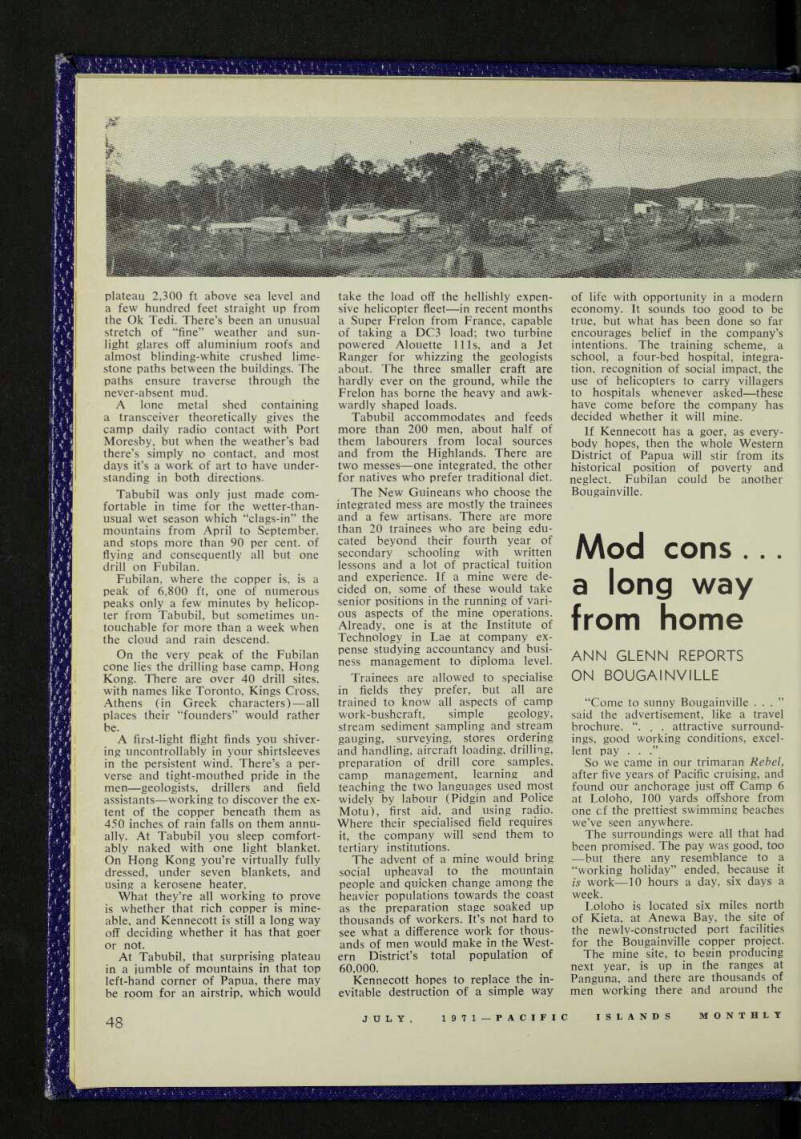
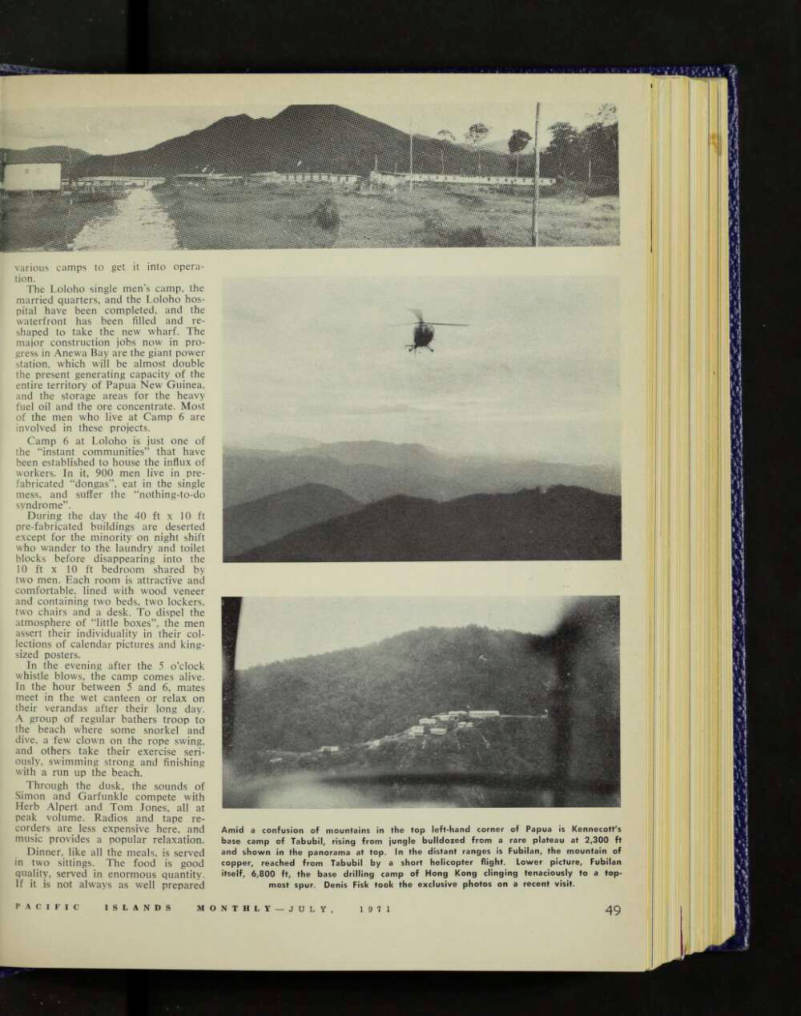
Mod cons ... a long way from home
Ann Glenn Reports
On Bougainville
“Come to sunny Bougainville . . . ” said the advertisement, like a travel brochure. . . attractive surround ings, good working conditions, excel lent pay . .
So we came in our trimaran Rebel, after five years of Pacific cruising, and found our anchorage just off Camp 6 at Loloho, 100 yards offshore from one cf the prettiest swimming beaches we’ve seen anywhere.
The surroundings were all that had been promised. The pay was good, too —but there any resemblance to a “working holiday” ended, because it is work—lo hours a day, six days a week.
Loloho is located six miles north of Kieta, at Anewa Bay, the site of the newly-constructed port facilities for the Bougainville copper project.
The mine site, to begin producing next year, is up in the ranges at Panguna, and there are thousands of men working there and around the
various camps to get it into opera tion.
The Loloho single men’s camp, the married quarters, and the Loloho hos pital have been completed, and the waterfront has been filled and re shaped to take the new wharf. The major construction jobs now in pro gress in Anewa Bay are the giant power station, which will be almost double the present generating capacity of the entire territory of Papua New Guinea, and the storage areas for the heavy fuel oil and the ore concentrate. Most of the men who live at Camp 6 are involved in these projects.
Camp 6 at Loloho is just one of the “instant communities” that have been established to house the influx of workers. In it, 900 men live in pre fabricated “dongas”, eat in the single mess, and suffer the “nothing-to-do syndrome”.
During the day the 40 ft x 10 ft pre-fabricated buildings are deserted except for the minority on night shift who wander to the laundry and toilet blocks before disappearing into the 10 ft x 10 ft bedroom shared by two men. Each room is attractive and comfortable, lined with wood veneer and containing two beds, two lockers, two chairs and a desk. To dispel the atmosphere of “little boxes”, the men assert their individuality in their col lections of calendar pictures and king sized posters.
In the evening after the 5 o’clock whistle blows, the camp comes alive.
In the hour between 5 and 6, mates meet in the wet canteen or relax on their verandas after their long day.
A group of regular bathers troop to the beach where some snorkel and dive, a few clown on the rope swing, and others take their exercise seri ously, swimming strong and finishing with a run up the beach.
Through the dusk, the sounds of Simon and Garfunkle compete with Herb Alpert and Tom Jones, all at peak volume. Radios and tape re corders are less expensive here, and music provides a popular relaxation.
Dinner, like all the meals, is served in two sittings. The food is good quality, served in enormous quantity.
If it is not always as well prepared
Amid a confusion of mountains In the top left-hand corner of Papua is Kennecott's base camp of Tabubil, rising from jungle bulldozed from a rare plateau at 2,300 ft and shown in the panorama at top. In the distant ranges is Fubilan, the mountain of copper, reached from Tabubil by a short helicopter flight. Lower picture, Fubilan itself, 6,800 ft, the base drilling camp of Hong Kong clinging tenaciously to a top most spur. Denis Fisk took the exclusive photos on a recent visit.
as it might be, it is because the cooks are feeding 900 men with facilities de signed for a maximum of 600. And men who have few other pleasures to occupy their minds can always find fault with the food.
The repetitive complaint that there is “nothing to do” is at least partially justified. The single men complain that there are no girls, and nowhere to take them if there were; the mar ried men miss their wives and chil dren.
There are movies three nights a week—they’re free. But when it rains —and that is not uncommon—the roofed-in section of the outdoor theatre area is far too small to shelter the crowd.
There are snooker tables, but the long wait for a game discourages all but a few.
Even the small choice between the wet canteens in Camp 6 and one of the other camps is denied to all but a few men, because private transport is a rare luxury.
The philosophical among them grin and say it is a great place if you want to study or take a correspondence course—there are so few distractions.
Most of the men who grumble about ‘ nothing to do” will admit, if pressed, that after 10 hours of work, they’re not really interested in a late night— but they do resent the decision being made for them.
On Sundays, their only day off, the men face the same problem—only more so. On Sundays, the beauty of the natural surroundings comes into its own again, and the beachfront is the centre of activity. Skin-diving is probably the number one sport.
Kieta shops do a brisk business in swim fins, masks and snorkels, and quite a few have the full gear—high powered spear guns, tanks and all The men fish, paddle about in the narrow native outrigger canoes, or take turns on water skis. Groups of men organise to charter one of the four yachts in the area to take them out to the tantalising nearby islets.
I’m content with life at Camp 6.
I have my home and my husband, plenty of new friends, a job I find interesting and we are rapidly saving money to continue our cruising way of life.
In contrast, most of the men in Camp 6 have strong interests Down South, and for them, “Sunny Bougain ville” represents little more than an opportunity to make a quick dollar.
If the average worker doesn’t develop an affection for the place, perhaps it’s understandable.
Advertisements & other items, p. 54 (1 item)
Distributors Wanted
Picture Yourself in a Go Anywhere Lake Amphibian 3 high performance, 4 seat, models to choose from. 1,135 lbs useful load and 150 mph cruising speeds. Ruggedly constructed and corrosion proofed for salt water operation. For full details or a demonstration contact:
LAKE AIRCRAFT SALES PTY. LTD.
154 INGLEBURN ROAD, INGLEBURN, N.S.W. 2565, AUSTRALIA.
Phone Sydney 605-1478. Australasian & South Pacific Distributor.
A holiday in Fiji is not complete without a stay at
KOROLEVU BEACH HOTEL
Korolevu, the South Pacific's most famous resort, is a must for all visitors to Fiji. Situated on the beautiful Coral Coast of Viti Levu, Korolevu is a holiday-maker's dream. The beautiful curving white sand beaches and the shimmering palm fronds make a stay at Korolevu a truly memorable occasion.
Other Northern Hotels at Suva, Sigatoka, Nadi, Lautoka, Ba and Tavua.
KOROLEVU BEACH HOTEL,
KOROLEVU-I-WAI, NADROGA, FIJI.
Sales Representative: Shaul International, Hotel Representatives, 34th Floor, Australia Square, Sydney, N.S.W., 2000, Australia.
Telephone: 27-4601. Cable: "Rephotel", Sydney.
Shaul International, 6th Floor, 330 Collins Street, Melbourne, 3000, Victoria, Australia.
Write or Cable:
Distributors Wanted
Throughout The Pacific
• 9.4 cu. ft. capacity •Full width freezer chest •Glide-out shelves * Resistant white titanium porcelain steel interior •Vegetable drawer •Gas models have safety cut-off device
SHELDON & COMPANY, INC.
104 FIFTH AVENUE, NEW YORK, N.Y. 10011 Cable: Teneka, N.Y
The Boom
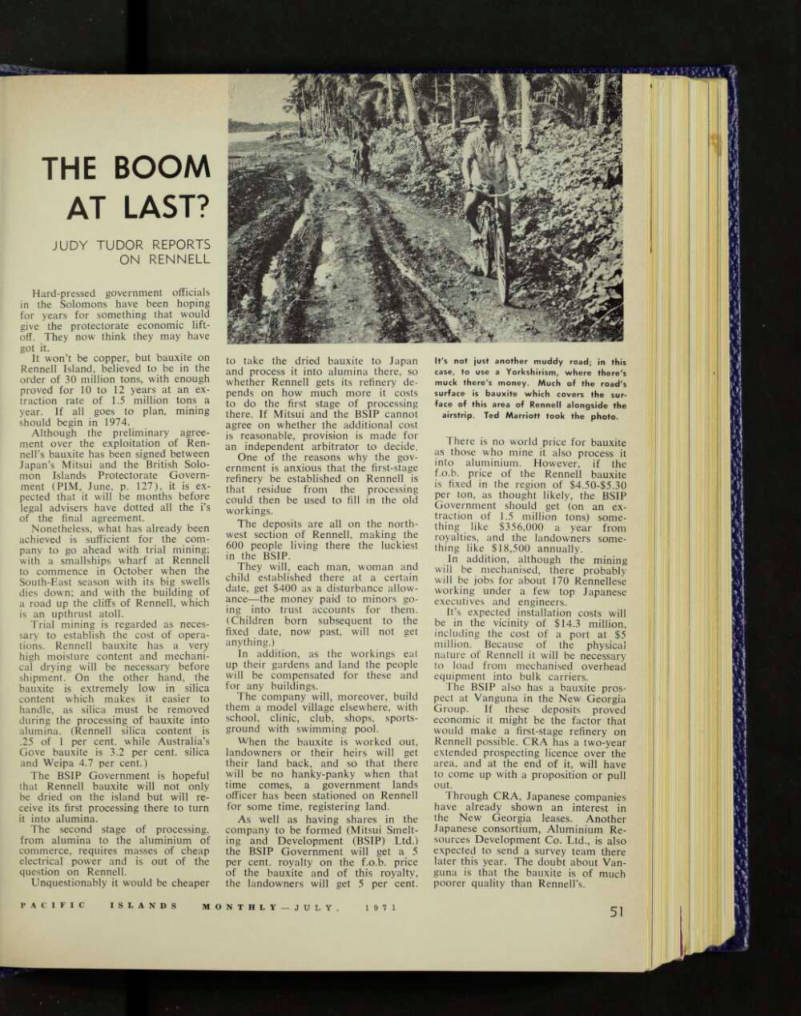
At Last?
Judy Tudor Reports
On Rennell
Hard-pressed government officials in the Solomons have been hoping for years for something that would give the protectorate economic lift off. They now think they may have got it.
It won’t be copper, but bauxite on Rennell Island, believed to be in the order of 30 million tons, with enough proved for 10 to 12 years at an ex traction rate of 1.5 million tons a year. If all goes to plan, mining should begin in 1974.
Although the preliminary agree ment over the exploitation of Ren nell’s bauxite has been signed between Japan’s Mitsui and the British Solo mon Islands Protectorate Govern ment (PIM, June, p. 127), it is ex pected that it will be months before legal advisers have dotted all the i’s of the final agreement.
Nonetheless, what has already been achieved is sufficient for the com pany to go ahead with trial mining; with a smallships wharf at Rennell to commence in October when the South-East season with its big swells dies down; and with the building of a road up the cliffs of Rennell, which is an upthrust atoll.
Trial mining is regarded as neces sary to establish the cost of opera tions. Rennell bauxite has a very high moisture content and mechani cal drying will be necessary before shipment. On the other hand, the bauxite is extremely low in silica content which makes it easier to handle, as silica must be removed during the processing of bauxite into alumina. (Rennell silica content is .25 of 1 per cent, while Australia’s Gove bauxite is 3.2 per cent, silica and Weipa 4,7 per cent.) The BSIP Government is hopeful that Rennell bauxite will not only be dried on the island but will re ceive its first processing there to turn it into alumina.
The second stage of processing, from alumina to the aluminium of commerce, requires masses of cheap electrical power and is out of the question on Rennell.
Unquestionably it would be cheaper
There is no world price for bauxite as those who mine it also process it into aluminium. However, if the f.o.b. price of the Rennell bauxite is fixed in the region of 54.50-55.30 per ton, as thought likely, the BSIP Government should get (on an ex traction of 1.5 million tons) some thing like $356,000 a year from royalties, and the landowners some thing like $18,500 annually.
In addition, although the mining will be mechanised, there probably will be jobs for about 170 Rennellese working under a few top Japanese executives and engineers.
It’s expected installation costs will be in the vicinity of $14.3 million, including the cost of a port at $5 million. Because of the physical nature of Rennell it will be necessary to load from mechanised overhead equipment into bulk carriers.
The BSIP also has a bauxite pros pect at Vanguna in the New Georgia Group. If these deposits proved economic it might be the factor that would make a first-stage refinery on Rennell possible. CRA has a two-year extended prospecting licence over the area, and at the end of it, will have to come up with a proposition or pull out.
Through CRA, Japanese companies have already shown an interest in the New Georgia leases. Another Japanese consortium, Aluminium Re sources Development Co. Ltd., is also expected to send a survey team there later this year. The doubt about Van guna is that the bauxite is of much poorer quality than Rennell’s.
to take the dried bauxite to Japan and process it into alumina there, so whether Rennell gets its refinery de pends on how much more it costs to do the first stage of processing there. If Mitsui and the BSIP cannot agree on whether the additional cost is reasonable, provision is made for an independent arbitrator to decide.
One of the reasons why the gov ernment is anxious that the first-stage refinery be established on Rennell is that residue from the processing could then be used to fill in the old workings.
The deposits are all on the north west section of Rennell, making the 600 people living there the luckiest in the BSIP.
They will, each man, woman and child established there at a certain date, get $4OO as a disturbance allow ance—the money paid to minors go ing into trust accounts for them. (Children born subsequent to the fixed date, now past, will not get anything.) In addition, as the workings eat up their gardens and land the people will be compensated for these and for any buildings.
The company will, moreover, build them a model village elsewhere, with school, clinic, club, shops, sports ground with swimming pool.
When the bauxite is worked out, landowners or their heirs will get their land back, and so that there will be no hanky-panky when that time comes, a government lands officer has been stationed on Rennell for some time, registering land.
As well as having shares in the company to be formed (Mitsui Smelt ing and Development (BSIP) Ltd.) the BSIP Government will get a 5 per cent, royalty on the f.o.b. price of the bauxite and of this royalty, the landowners will get 5 per cent.
It's not just another muddy road; in this case, to use a Yorkshirism, where there's muck there's money. Much of the road's surface is bauxite which covers the sur face of this area of Rennell alongside the airstrip. Ted Marriott took the photo.
Advertisements & other items, pp. 56-58 (1 item)
neighbours
why no
visit the
We have an awful lot in common. Yet we visit each other so seldom. Times are changing fast. It’s possible to travel round the islands quickly and comfortably these days in 40-seater jetprop aircraft. Get a Timetable and Fares folder from Fiji Airways, or your travel agent.
Fiji Airways, P.O.
Box 112, Suva. General Sales Agent for
BOAC, Q ANT AS
and TAA in East Fiji and Tonga.
Also General Sales Agent for BOAC, Q ANT AS and Air New Zealand in British Solomon Islands Protectorate, New Hebrides, Gilbert and Ellice Islands Colony and Nauru.
... yy: a
nauru
NEW
GUINEA
SOLOMON
ISLES.
■'s
new
hebrides
I =s^ <=> *H rmip samoa •'.. ... -*v .
JD/ r-jr.r- -r iifJETWOMf COVERING 4,500,000 SQUARE MILES OF THE SOUTH PACIFIC 1269
(POEffl
News magazine of the South Pacific
. . . with concise reporting on the significant news of the South Pacific, penetrating background stories, bright informative magazine articles, big picture features, Pacific travel, profiles of Pacific personalities, a cruising yachtsman's department, Islands' business and development, reviews of the latest books and a special section for planters.
Take out a subscription and dip yourself each month into the real South Pacific.
USE THE FORM OVERLEAF TO BECOME A REGULAR READER
I Australia (including Lord Howe and Thursday Is.), B.S.I.P., Gilbert and Ellice Is Papua-New Guinea, Norfolk Island, Nauru, Tonga and New Hebrides ..
New Zealand Fiji, Cook Islands, Niue and Western Samoa American Samoa U.S. Mainland, Micronesia (including Guam) Hawaii New Caledonia Tahiti and French Polynesia United Kingdom and Elsewhere Please enrol me as a subscriber to “Pacific Islands Monthly”.
Attached find payment of for years
subscription.
□ NEW □ RENEWAL
(CAPITAL LETTERS)
NAME
ADDRESS
COUNTRY
PACIFIC ISLANDS MONTHLY
Box 3408, G.P.O., Sydney, N.S.W. 2001, Australia. 29 Alberta Street, Sydney, N.S.W. 2000.
I B I I J
JULY, 1971—PACIFIC ISLANDS MONTHLY
Magazine Section
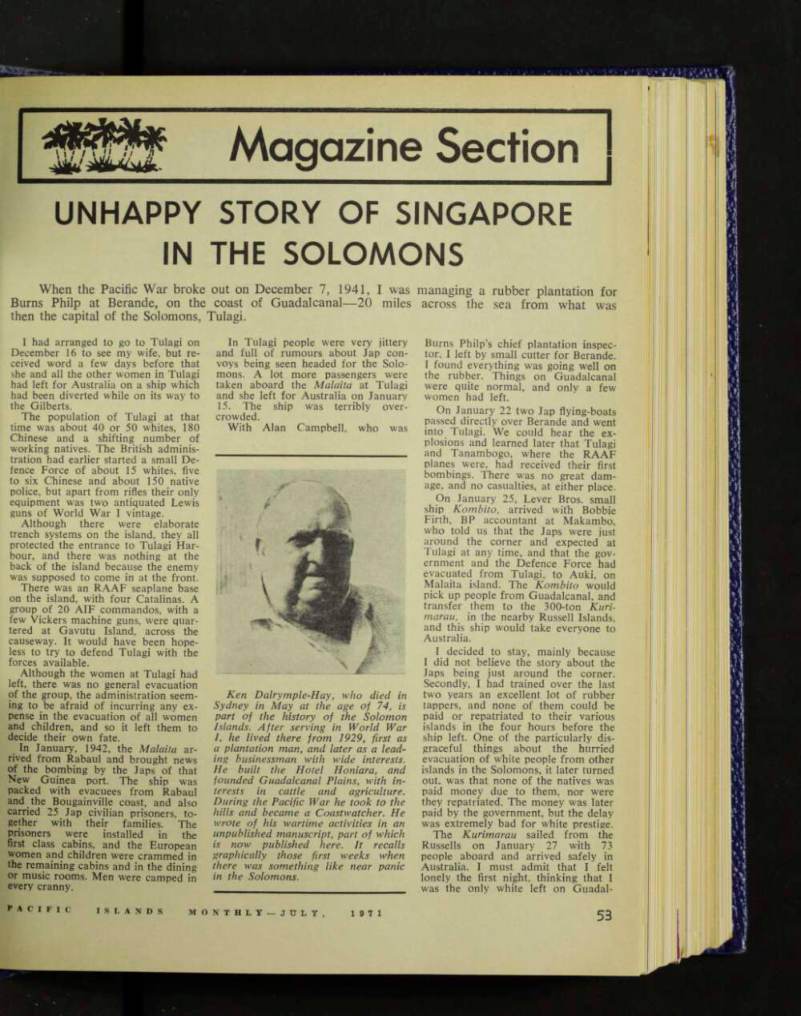
Unhappy Story Of Singapore
In The Solomons
When the Pacific War broke out on December 7, 1941, I was managing a rubber plantation for Burns Philp at Berande, on the coast of Guadalcanal—2o miles across the sea from what was then the capital of the Solomons, Tulagi.
I had arranged to go to Tulagi on December 16 to see my wife, but re ceived word a few days before that she and all the other women in Tulagi had left for Australia on a ship which had been diverted while on its way to the Gilberts.
The population of Tulagi at that time was about 40 or 50 whites, 180 Chinese and a shifting number of working natives. The British adminis tration had earlier started a small De fence Force of about 15 whites, five to six Chinese and about 150 native police, but apart from rifles their only equipment was two antiquated Lewis guns of World War I vintage.
Although there were elaborate trench systems on the island, they all protected the entrance to Tulagi Har bour, and there was nothing at the back of the island because the enemy was supposed to come in at the front.
There was an RAAF seaplane base on the island, with four Catalinas. A group of 20 AIF commandos, with a few Vickers machine guns, were quar tered at Gavutu Island, across the causeway. It would have been hope less to try to defend Tulagi with the forces available.
Although the women at Tulagi had left, there was no general evacuation of the group, the administration seem ing to be afraid of incurring any ex pense in the evacuation of all women and children, and so it left them to decide their own fate.
In January, 1942, the Malaita ar rived from Rabaul and brought news of the bombing by the Japs of that New Guinea port. The ship was packed with evacuees from Rabaul and the Bougainville coast, and also carried 25 Jap civilian prisoners, to gether with their families. The prisoners were installed in the first class cabins, and the European women and children were crammed in the remaining cabins and in the dining or music rooms. Men were camped in every cranny.
In Tulagi people were very jittery and full of rumours about Jap con voys being seen headed for the Solo mons. A lot more passengers were taken aboard the Malaita at Tulagi and she left for Australia on January 15. The ship was terribly over crowded.
With Alan Campbell, who was
Ken Dalrymple-Hay, who died in Sydney in May at the age of 74, is part of the history of the Solomon Islands. After serving in World War I, he lived there from 1929, first as a plantation man, and later as a lead ing businessman with wide interests.
He built the Hotel Honiara, and founded Guadalcanal Plains, with in terests in cattle and agriculture.
During the Pacific War he took to the hills and became a Coastwatcher. He wrote of his wartime activities in an unpublished manuscript, part of which is now published here. It recalls graphically those first weeks when there was something like near panic in the Solomons.
Burns Philp’s chief plantation inspec tor, I left by small cutter for Berande.
I found everything was going well on the rubber. Things on Guadalcanal were quite normal, and only a few women had left.
On January 22 two Jap flying-boats passed directly over Berande and went into Tulagi. We could hear the ex plosions and learned later that Tulagi and Tanambogo, where the RAAF planes were, had received their first bombings. There was no great dam age, and no casualties, at either place.
On January 25, Lever Bros, small ship Kombito, arrived with Bobbie Firth, BP accountant at Makambo, who told us that the Japs were just around the corner and expected at Tulagi at any time, and that the gov ernment and the Defence Force had evacuated from Tulagi, to Auki, on Malaita island. The Kombito would pick up people from Guadalcanal, and transfer them to the 300-ton Kuri marau,' in the nearby Russell Islands, and this ship would take everyone to Australia.
I decided to stay, mainly because I did not believe the story about the Japs being just around the corner.
Secondly, I had trained over the last two years an excellent lot of rubber tappers, and none of them could be paid or repatriated to their various islands in the four hours before the ship left. One of the particularly dis graceful things about the hurried evacuation of white people from other islands in the Solomons, it later turned out, was that none of the natives was paid money due to them, nor were they repatriated. The money was later paid by the government, but the delay was extremely bad for white prestige.
The Kurimarau sailed from the Russells on January 27 with 73 people aboard and arrived safely in Australia. I must admit that I felt lonely the first night, thinking that I was the only white left on Guadal
canal, apart from a few men in the goldfields. But I soon got some visitors —J. A. Johnstone, commonly known to all as “Johnno”, and J. Cramer- Roberts, who was manager of Mr. E.
G. Theodore’s goldmining interests on Guadalcanal. Both had come down from Goldridge and were amazed to learn of everyone’s hurried departure.
I had very little food for ourselves and only about two weeks’ supply of native food, so the first thing to do was !ry to get to Tulagi for supplies, if the Japs were not already there.
Johnno and I decided to leave that night by cutter while Cramer-Roberts stood by at Berande.
We were met at Tulagi not by the Japs but by Lieut. Don Russell, who was in charge of the AIF commandos and who was later killed in New Guinea. And the RAAF were still at Tanambogo, just across the causeway.
Don Russell told me that C. V.
Widdy, general manager of Levers Pacific Plantations, had remained be hind and was nearby on Florida.
Widdy had the keys to Burns Philp store, which I was anxious to get, but I was rather nervous at having to make contact with Widdy, as we had had a misunderstanding some three years earlier and had cut each other dead ever since. But this was no time for personal rows so I decided to go across and see him.
As I arrived at the wharf, Widdy was getting out of his launch. As soon as he saw me he walked across, put out his hand and said, “Hullo, Ken!
Damn glad to see you. I have the keys to BP’s store, which I’ll hand over to you. Tell me if there is any thing I can do for you, and while you’re here you can stay at my camp”. Widdy on many occasions after that proved what a real man he was.
I found that the BP store at Makambo island, which is about a half-mile from Tulagi, had been broken open and some looting had taken place, but there were still large supplies left. The general office was intact, with valuable records in the safe.
I decided then that instead of getting just enough food for us at Berande I would try to move the entire stocks to Berande, but it was obviously going to be a race between the looters and myself, because on a walk through Tulagi’s Chinatown I saw that the natives had broken down doors and looted everything.
All the Chinese storekeepers had fled when the government had left, abandoning their stores. What the natives could not carry away they had thrown into the street. I have never seen such a mess, and wondered why no effort had been made by the Resident Commissioner to protect essential stores.
I borrowed a vessel from Widdy, and that night went off with my first load—taking the stuff the natives were likely to loot first, such as tinned meat, tobacco, rice and calico. Of course they got to work on the stores as soon as I left, but I put an old boy in the store as a spy and he supplied me with a list of the looters’ names. I let them know this and some of the loot was returned by the more timid ones. But bolder spirits came along and collected it again!
Nevertheless I eventually managed to transport to Guadalcanal everything of value, making 23 trips in all.
It was now early February, 1942, and Widdy told me that the government had arranged for the Morinda to evacuate all remaining Europeans from the group, and she was expected to arrive about February 9. The
evacuation was not compulsory, but all Europeans were advised to leave, Having decided earlier to remain I could see no reason for leaving now, especially as I had taken on the re sponsibility of looking after the stores, It was about this time, while on one of our visits to Tulagi from Berande, that Johnno and I found ourselves under attack. We had been visiting the Tulagi Club in the hope of finding some beer when two Jap flying-boats attacked the wireless station, a few hundred yards ahead of us.
They dropped eight bombs from about 4,000 ft—one of them falling uncomfortably near the shallow trench we were in, a jagged piece of the “daisy cutter” flying in with us.
We later went up to see how the radio operator, R. S. Taylor, had fared, and found that one wall of his house had been knocked in by the blast. His house, I think, was the first to be dam aged at Tulagi, but certainly not the l ast - , , , .
We went back to Berande that night feeling rather proud that we had been under fire for the first time m this war.
My next trip to Tulagi was on Feb ruary 7, when I found Tulagi and Makambo had been > repopulated. All the government officials had come back from Auki, and people had ar rived from other districts, to evacuate in the Morinda. I took across 3,000 lb of dry rubber and all the Burns Philp records.
The Morinda was expected the next day. About 9 a.m. news came through by teleradio on Bougainville, where two coastwatchers were at work to tell us that two Jap flying-boats had passed over, and we could expect them in a couple of hours, The Morinda arrived at Makambo at 11 a.m. and Lieut, D. S. Macfarlan,
an Australian naval liaison officer of the RANVR, who had been on Tulagi for some months, went out by launch and warned her captain of the air raid. The Morinda made off towards Port Purvis, and shortly afterwards two Jap flying-boats arrived and made straight for her. They dropped their bombs without causing any damage and headed north again.
On Makambo there was a general scatter and the 80 natives who had been standing by to load the ship all made off by canoe for the Florida mainland. They moved across the short stretch of water like speedboats, and in their wake was a well-known plantation manager, unable to enlist because of a bad heart, rowing for dear life in a dinghy.
Without labour I now gave up the idea of loading any copra.
As soon as the raid was over the bustle began again. All the govern ment records were being landed on the Makambo wharf and there were also piles of luggage—even a carpen ter’s bench and toolcase—although everyone had been instructed to travel with one suitcase only.
The Morinda, however, went along side the Gavutu wharf, and the people at Makambo had to load their luggage into small boats and make for Gavutu if they were to get aboard.
I went to Gavutu to load the 30 bales of rubber and the Burns Philp records, and found the decks of the Morinda packed with people all clamouring for cabins. Captain Roth ery was extremely annoyed at the ship being mobbed, as he had asked the government to prepare a passenger list and check people aboard. TTiere were now more people on the ship than he had lifeboats for.
All the luggage was still on the wharf, but none of the would-be pas
sengers seemed anxious to collect it, the idea being that if you left the ship you mightn’t get back on.
Eventually about 12 people were told they couldn’t travel—these mainly being plantation men and miners. They included my old friend Johnno. None of the young govern ment officials was put off the ship.
One plantation man took it badly, and moaned about his dear wife being all alone in Sydney without him. I advised him, ironically, to “sneak back up on the gangway”, and by God he did—leaving his luggage on the wharf!
While all this was going on, there was an explosion at W. R. Carpenter’s workshop, which caused some con sternation. It was not caused by the Japs but by “Spearline” Wilson, who was blowing up the workshops as part of a scorched earth policy. The gov ernment officially had such a policy, set out in a circular headed, “Denial of Resources to the and ordering that all plant, machinery, launches, copra mills, etc., which could be of any use to the enemy in working plantations, should be de stroyed.
Most plantations carried out this policy, but the government didn’t.
When the Japs finally entered Tulagi, besides having no opposition, they were able to use the government facilities, such as the wharves, stores, offices and houses, and a hospital complete with X-ray equipment. The scorched earth policy on Tulagi was eventually carried out by the Ameri cans in bombing raids.
By late afternoon the government records had arrived at Gavutu from the Makambo wharf, but there were still no natives to load them. The AIF commandos took off their shirts and did the job, with the help of only one
government official. The rest of the officials looked down from the ship’s rail. My boat crew loaded my rubber and I handed over the BP records to Captain Rothery for delivery to Syd ney.
Widdy, who was leaving on the ship, was the only manager of the three commercial firms who had re mained behind until all his employees were evacuated. Even then he wanted to come to Guadalcanal with me, but I persuaded him that his job was com pleted. He came back to Guadalcanal later, landing with the American Marines as an RAAF liaison officer and was decorated by President Roosevelt with the Legion of Merit.
The Morinda sailed from Tulagi at dusk, but there were very few people on board I bothered to say goodbye to. I was too disgusted at the save your-skin-at-any-price attitude. The Resident Commissioner, Mr. W. S.
Marchant, who stayed behind with some of his officers to set up head quarters again at Auki, also told me he was disgusted at the scramble to get away.
After the ship left there were still piles of luggage and mail bags on the wharf.
This was February, 1942. It was another three months, on May 4, when the Japs actually arrived at Tulagi, Three months, and what a lot could have been done in saving valuable stores and equipment and hundreds of tons of copra had there been proper control. There was no opposition. The RAAF pilots were worked to death, even using Catalinas as dive bombers to attack Jap ship ping.
Winston Turner, an Australian war correspondent, later summed it up in an article in the Sydney Sun headed “Singapore in the Solomons”.
He lived his life with gusto . . . "
In 1937 the District of Ysabel in the Solomons also included the Russell Islands some 60 miles to the south and it was on the Russells that most of the copra production and consequently the labour force, of the Solomons was concentrated.
My first tour of the Russells, in 1937 as Acting District Officer, led to my meeting Ken Hay, as he was then known, in his guise as manager of Banika plantation. The Wai Ai tied up to the wharf and Ken came down to meet me. He was a large man, very solidly built and had the air of being king in his own domain if not of the Russells.
He had a case of assault to bring against one of his labourers and I heard the case straight away. It soon transpired that the assault had been occasioned by Ken’s interpretation of the Labour Regulations and led immediately after the hearing of the first case to a second case in which I fined Ken for “bending” the pro visions of the Regulations to suit himself.
After the proceedings were over, I thought that he would be incensed at what had happened and was pre paring to return to the Wai Ai and to continue with my tour of inspection— but he would have none of it. He
said I must come and have a mea and meet his wife. There was no trao of rancour and I returned with hin to meet the charming Sylvia and t( enjoy the first of many such meetings Ken lived life with gusto and panache His outlook took little note o whether fortune was smiling oi him or whether he was for the tim being reeling from the blows of fat —often occasioned by his own some what unorthodox behaviour. His sens of humour remained intact and h had a keen sense of irony. His friend were his friends and his enemie were his enemies, and quite ofte:
D. C. HORTON, AUTHOR OF "FIRE OVER THE
Solomons", Pays Tribute To Fellow Coast
Watcher Ken Dalrymple-Hay.
returned to his esteem if, in his view, they were fundamentally decent people, but he could not stand meanness and was himself a most generous person; although, if he had reason to believe himself unjustly treated, he would pursue the per petrator of the deed, whether it was government or a private individual, with vigour and vehemence until the matter was settled to his satisfaction or he found that he could get no further.
Our paths crossed in the Islands from time to time and whether I was dealing with him officially or drinking
with him, Ken always added a sparkle to the occasion, and when war came to the Solomons he remained behind when he could have left, and did sterling work in removing valuable commercial material from the enemy’s reach. He was then made a Coast watcher and added lustre to that highly individual body of men.
After the war he threw himself into the commercial side of the rehabilita tion of the Solomons and did an enormous amount to prepare the ground for postwar developments. I met him again in Honiara in 1969.
Physically he had become a great deal
larger than when I first knew him but fundamentally he had not changed.
He said he could not be bothered to alter his way of life—which con tinued to exhibit a buccaneering spirit with all its faults and virtues—and on that basis we continued our friendship. I did not see him again and the news of his passing brought a sense of loss. He did a great deal unobtrusively for a number of people and whatever he did was in keeping with the beliefs with which he had enlivened the ways of those who knew him. We shall miss him.
Yesterday
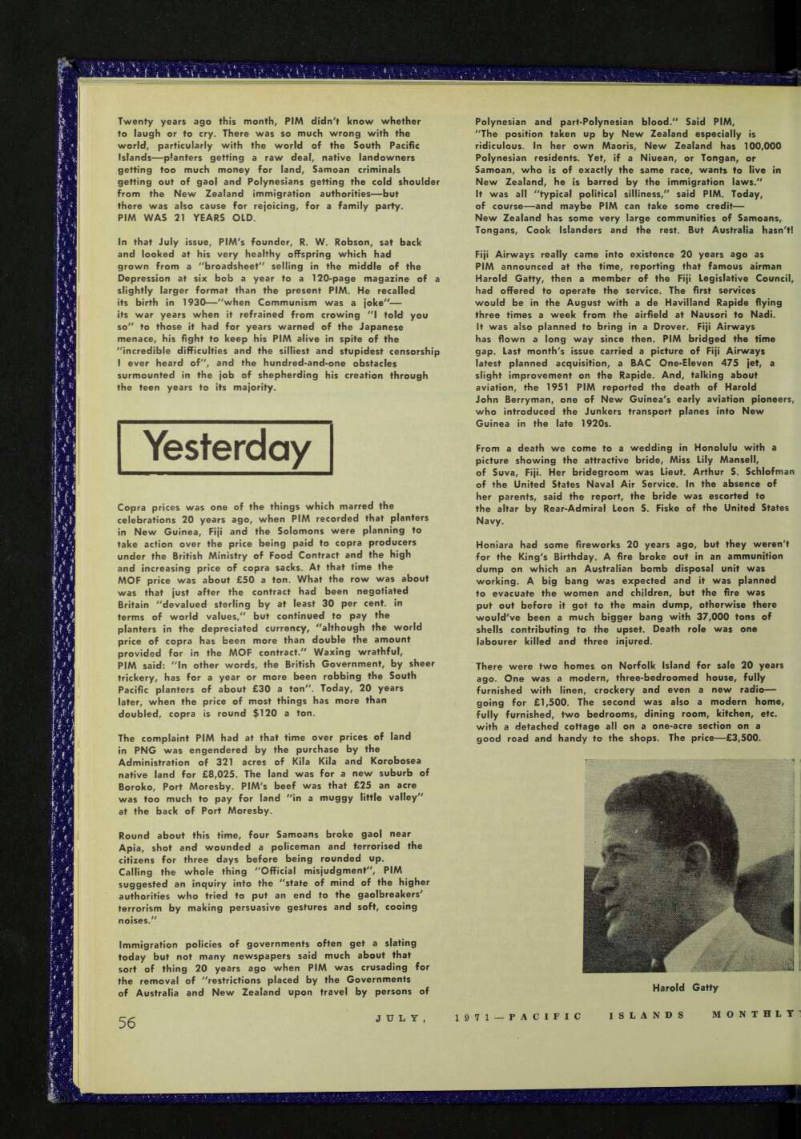
Copra prices was one of the things which marred the celebrations 20 years ago, when PIM recorded that planters in New Guinea, Fiji and the Solomons were planning to take action over the price being paid to copra producers under the British Ministry of Food Contract and the high and increasing price of copra sacks. At that time the MOF price was about £5O a ton. What the row was about was that just after the contract had been negotiated Britain "devalued sterling by at least 30 per cent, in terms of world values," but continued to pay the planters in the depreciated currency, "although the world price of copra has been more than double the amount provided for in the MOF contract." Waxing wrathful, PIM said: "In other words, the British Government, by sheer trickery, has for a year or more been robbing the South Pacific planters of about £3O a ton". Today, 20 years later, when the price of most things has more than doubled, copra is round $l2O a ton.
The complaint PIM had at that time over prices of land in PNG was engendered by the purchase by the Administration of 321 acres of Kila Kila and Korobosea native land for £8,025. The land was for a new suburb of Boroko, Port Moresby. PlM's beef was that £25 an acre was too much to pay for land "in a muggy little valley" at the back of Port Moresby.
Round about this time, four Samoans broke gaol near Apia, shot and wounded a policeman and terrorised the citizens for three days before being rounded up.
Calling the whole thing "Official misjudgment", PIM suggested an inquiry into the "state of mind of the higher authorities who tried to put an end to the gaolbreakers' terrorism by making persuasive gestures and soft, cooing noises."
Immigration policies of governments often get a slating today but not many newspapers said much about that sort of thing 20 years ago when PIM was crusading for the removal of "restrictions placed by the Governments of Australia and New Zealand upon travel by persons of
Polynesian and part-Polynesian blood." Said PIM, "The position taken up by New Zealand especially is ridiculous. In her own Maoris, New Zealand has 100,000 Polynesian residents. Yet, if a Niuean, or Tongan, or Samoan, who is of exactly the same race, wants to live in New Zealand, he is barred by the immigration laws."
It was all "typical political silliness," said PIM. Today, of course —and maybe PIM can take some credit— New Zealand has some very large communities of Samoans, Tongans, Cook Islanders and the rest. But Australia hasn't!
Fiji Airways really came into existence 20 years ago as PIM announced at the time, reporting that famous airman Harold Gatty, then a member of the Fiji Legislative Council, had offered to operate the service. The first services would be in the August with a de Havilland Rapide flying three times a week from the airfield at Nausori to Nadi.
It was also planned to bring in a Drover. Fiji Airways has flown a long way since then. PIM bridged the time gap. Last month's issue carried a picture of Fiji Airways latest planned acquisition, a BAC One-Eleven 475 jet, a slight improvement on the Rapide. And, talking about aviation, the 1951 PIM reported the death of Harold John Berryman, one of New Guinea's early aviation pioneers, who introduced the Junkers transport planes into New Guinea in the late 19205.
From a death we come to a wedding in Honolulu with a picture showing the attractive bride, Miss Lily Mansell, of Suva, Fiji. Her bridegroom was Lieut. Arthur S. Schlofman of the United States Naval Air Service. In the absence of her parents, said the report, the bride was escorted to the altar by Rear-Admiral Leon S. Fiske of the United States Navy.
Honiara had some fireworks 20 years ago, but they weren't for the King's Birthday. A fire broke out in an ammunition dump on which an Australian bomb disposal unit was working. A big bang was expected and it was planned to evacuate the women and children, but the fire was put out before it got to the main dump, otherwise there would've been a much bigger bang with 37,000 tons of shells contributing to the upset. Death role was one labourer killed and three injured.
There were two homes on Norfolk Island for sale 20 years ago. One was a modern, three-bedroomed house, fully furnished with linen, crockery and even a new radio— going for £1,500. The second was also a modern home, fully furnished, two bedrooms, dining room, kitchen, etc. with a detached cottage all on a one-acre section on a good road and handy to the shops. The price—£3,500.
Twenty years ago this month, PIM didn't know whether to laugh or to cry. There was so much wrong with the world, particularly with the world of the South Pacific Islands —planters getting a raw deal, native landowners getting too much money for land, Samoan criminals getting out of gaol and Polynesians getting the cold shoulder from the New Zealand immigration authorities —but there was also cause for rejoicing, for a family party.
Pim Was 21 Years Old.
In that July issue, PlM's founder, R. W. Robson, sat back and looked at his very healthy offspring which had grown from a "broadsheet" selling in the middle of the Depression at six bob a year to a 120-page magazine of a slightly larger format than the present PIM. He recalled its birth in 1930—" when Communism was a joke"— its war years when it refrained from crowing "I told you so" to those it had for years warned of the Japanese menace, his fight to keep his PIM alive in spite of the "incredible difficulties and the silliest and stupidest censorship I ever heard of", and the hundred-and-one obstacles surmounted in the job of shepherding his creation through the teen years to its majority.
Harold Gatty
Advertisements & other items, pp. 63-70 (1 item)
Iitpella 1600 Sedan
The Stylish Seventies
Let's face it, looks are important. When a new car comes out, body styling is the first thing you notice. Note the graceful wave-form body lines of the all-new CAPELLA 1600 Sedan. It's styled for the seventies. Just the right amount of chrome.
But when you have to decide what car is for you, performance, comfort and safety all play a part. Concealed in this stylish family sedan is a quiet 4cylinder OHC powerplant that puts out 104 hp at 6,000 rpm. Effortless ball and nut steering system and a surprising 4.7 meter turning radius make driving a dream. Specially designed seats to fit every driver or passenger, two independent ventilating systems and plenty of leg and shoulder room add up to luxurious comfort.
For safety's sake, you get power-assisted brakes all round with discs up front, laminated safety windshield, hazard warning flasher, padded dash, collapsible interior fixtures. Seat belts (opt.).
All this at a price competitive in its class from the world's first mass producer of the revolutionary rotary engine. cm
iItPELLA 1600 SEDAN
From the world's most creatin’ automaker Tayo Kogyo Ca.Lld., Hiroshima. Japan New Zealand/CHAMPION MOTORS LTD. Durham Street.
Christchurch, P.O, Bo* 1344. Tel: 60-783 Papua/PNG MOTORS LTD. P 0. Bo* 1394, Boroko Western Samoa/H. & J. RETZLAFF P.O Bo* 195 Apia American Samoa/MAX HELECK INCORPORATED Pago Pago. American Samoa 96920 f i|i/NIRANJAN S AUTO PORT LTD. G P.O. Bo* 450 Suva "The trademark MAZDA in this advertisement stands for AUTOMOBILES MAZDA as far as France and her territories are concerned."
u What’s a nice jet like you doing in a place like this? I ■
§ I work here#
M M I v u n'uTCTT
imp—
-4 m r ‘ " ' ■■■ '"M S ... .* ~r * *. My .- & + i .
T : « » -v , V * ' BAC One-Eleven 475 — the big jet for the small field
BRITISH AIRCRAFT CORPORATION
the most powerful aerospace company in Europe
100 PALL MALL LONDON SWI
British Aircraft Corporation (Australia) Pty. Ltd., 1.C.1. House, 61-69 Macquarie St., Sydney, New South Wales.
Real action,
Real fact
They so together.
New tiger-paw traction Front Wheel Drive.
Dashing space-capsule styling.
Fully independent 4'Wheel suspensions.
Swift acceleration tol4okm/h speeds.
Long 2,335 mm wheelbase.
Disc brakes, tachometer available. 1 \ You ask: Where's the action?
You ask: How to get with it?
* H■ HI im ■i* ■ 4i v W * : > Available at: BOROKO MOTORS LTD. Port Moresby, Lae, Madang, Mt Hagen. RABAUL GARAGE LTD. Rabat.
PACIFIC S.A. Port Vila, Santo. R.C. SYMES PTY. LTD. Honiara B.F. KNEUBUHL. Pago Pago. SIRIUS SERVICE RICKLEMAN BROTHERS. Nukualofa. J.C. TENORIO ENTERPRISES. Saipan. J & G MOTOR CO. f LTD. Guam.
Here’s the new car that meshes man and machine more perfectly than ever before!
Just consider these facts: Room for everybody: more room than any car in its class according to the international roominess index. Easily seats you and the wife up front, three growing children in the back.
Tested, powerful engine: Full IOOOcc displacement, 59 horses and 140km/h speeds. Very efficient. —Very economical.
Front Wheel Drive: Newly designed for top traction over snow, rain, slippery pavements.
Total cornering control at all times.
Independent 4-wheel suspensions: the very same kind the world’s most expensive cars have. Safe. Smooth. Top road holding.
Sporty options: includes disc brakes combined with tandem master cylinder dual-brake system, fully reclining front buckets, high speed tires, one-lever control integrated ventilation system, tachometer.
And lots more.
DATSUNi NISSAN MOTOR CO., LTD.
'A MOTORS LTD. Suva, Lautoka. MORRIS HEDSTROM LTD. Apia. E.D. PENTECOST. Noumea. PENTECOST )N. Norfolk. SOCIEDADE AGRICOLA PATRIA E TRABALHO LDA. Dili. JACOB ENTERPRISES. Nauru.
FOR OVER 50 YEARS
THE MOST TRUSTED
FLOUR BRAND IN THE
PACIFIC ISLANDS...
Gillespie's
ANCHOR
ANCHOR
FLOUR
MAINTOP HIGH PROTEIN
BISCUIT FLOURS AND WHEATMEALS
Gillespie flours are milled from selected high quality Australian wheats and are entoleted for purity. Their consistent high quality has made them the best-known, most asked-for, brands of flour in the Islands. (Entoletion is a special purification process which reduces the risk of insect infection.) 52 Union
(G.P.O.
GILLESPIE BROS. PTY. LTD.
HEAD OFFICE:
St. Pyrmont, Sydney, NS W Box 2518, Sydney, 2001).
Phone; 660-4933
CABLE ADDRESS;
"GILLESPIE",
Sydney and Brisbane (P.O.
BRISBANE OFFICE:
Albion, Brisbane, Queensland Box 8, Albion, Brisbane, 4010).
Phone: 6-1121
o*' V S' i#s^ The M.S. Taiyuan leaves Brisbane every 21 days for Sydney, Lautoka, Suva and Noumea then returns to Brisbane.
She is a fully mechanised ship providing a fast, reliable and safe cargo service. The Taiyuan carries her own fork-lifts for the speedy loading and unloading of unitised cargo, including wiretainers, seatainers and miniflats. She carries all kinds of cargo: large and small, light and heavy, frozen and chilled —even vehicles.
Special packaging prevents damage and pilfering.
The M.S. Taiyuan gives you a transport deal over this route that cannot be bettered by any other carrier. If you’d like us to put your cargo on i the map, just contact one _EL j*r=j |S of our local agents for further details. And leave the rest to us.
Jtf
A □
DQ@hM]
MEMBER OF THE SWIRE GROUP
SUVA—Morris Hedstrom Ltd. SYDNEY-Swire & Gilchrist Pty. Ltd. Agents in: MELBOURNE-P. & 0. Lines of Australia Pty.
Ltd. BRISBANE—WiIIs, Gilchrist & Sanderson Pty. Ltd. NOUMEA-Etablissements Ballande, Service Maritime. LAUTOKA-Morris Hedstrom Ltd. 1536/86
The worlds
first full cream soup*
Another example
ers
h ... ‘ M m sr
WtlW
5T ■ mm WN? «r 57
HEIAtf
a 57 a -
Wtiwz
soup
57 - * -J /
GESSh
mmmm
mm Heinz made the world’s first rich, thick, full cream soups. So full of cream you only add water.
Homogenized by an exclusive process so the flavour goes right through.
This is just one of the examples of Heinz leadership in product research and development.
In being first to create products to suit all tastes-satisfy all needs.
Try any Heinz product and enjoy the taste that makes them leaders.
The story of Willie Coe
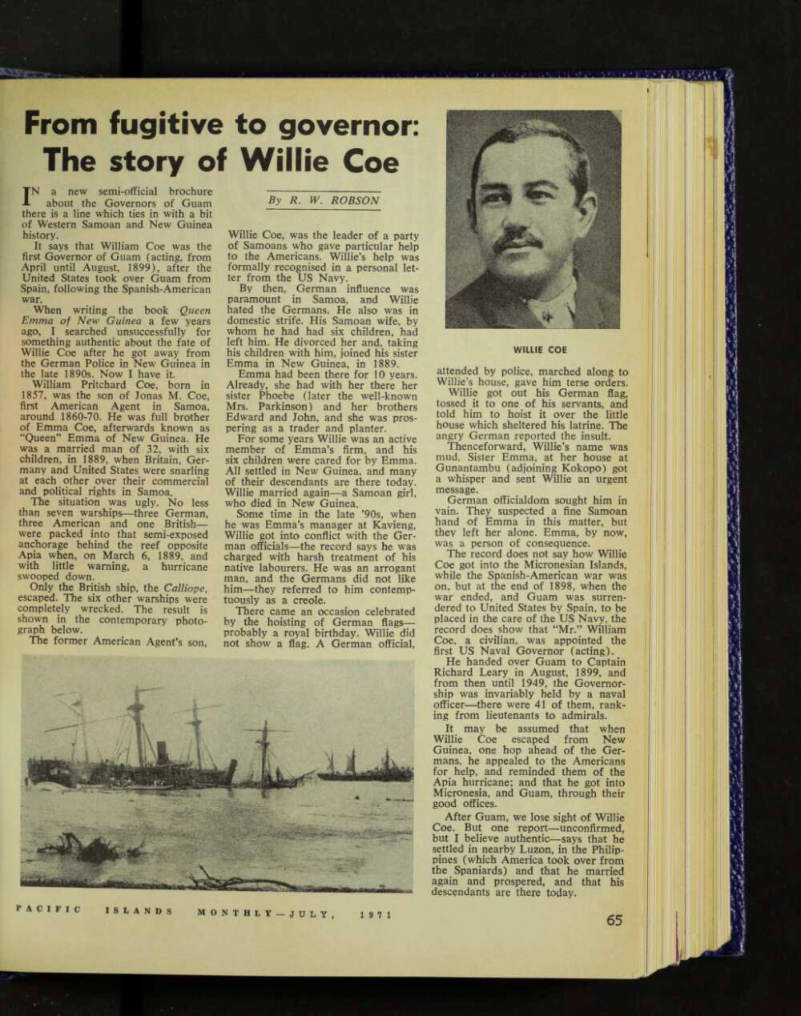
From fugitive to governor: The story of Willie Coe
IN a new semi-official brochure about the Governors of Guam there is a line which ties in with a bit of Western Samoan and New Guinea history.
It says that William Coe was the first Governor of Guam (acting, from April until August, 1899), after the United States took over Guam from Spain, following the Spanish-American war.
When writing the book Queen Emma of New Guinea a few years ago, I searched unsuccessfully for something authentic about the fate of Willie Coe after he got away from the German Police in New Guinea in the late 1890 s. Now I have it.
William Pritchard Coe, born in 1857, was the son of Jonas M. Coe, first American Agent in Samoa, around 1860-70. He was full brother of Emma Coe, afterwards known as “Queen” Emma of New Guinea. He was a married man of 32, with six children, in 1889, when Britain, Ger many and United States were snarling at each other over their commercial and political rights in Samoa.
The situation was ugly. No less than seven warships—three German, three American and one British— were packed into that semi-exposed anchorage behind the reef opposite Apia when, on March 6, 1889, and with little warning, a hurricane swooped down.
Only the British ship, the Calliope, escaped. The six other warships were completely wrecked. The result is shown in the contemporary photo graph below.
The former American Agent’s son,
By R. W. Robson
Willie Coe, was the leader of a party of Samoans who gave particular help to the Americans. Willie’s help was formally recognised in a personal let ter from the US Navy.
By then, German influence was paramount in Samoa, and Willie hated the Germans. He also was in domestic strife. His Samoan wife, by whom he had had six children, had left him. He divorced her and, taking his children with him, joined his sister Emma in New Guinea, in 1889.
Emma had been there for 10 years.
Already, she had with her there her sister Phoebe (later the well-known Mrs. Parkinson) and her brothers Edward and John, and she was pros pering as a trader and planter.
For some years Willie was an active member of Emma’s firm, and his six children were cared for by Emma, All settled in New Guinea, and many of their descendants are there today, Willie married again—a Samoan girl, who died in New Guinea, Some time in the late ’9os, when he was Emma’s manager at Kavieng, Willie got into conflict with the Ger man officials—the record says he was charged with harsh treatment of his native labourers. He was an arrogant man, and the Germans did not like him—they referred to him contemp tuously as a creole, There came an occasion celebrated by the hoisting of German flags— probably a royal birthday. Willie did not show a flag. A German official,
attended by police, marched along to Willie’s house, gave him terse orders.
Willie got out his German flag, tossed it to one of his servants, and told him to hoist it over the little house which sheltered his latrine. The angry German reported the insult.
Thenceforward, Willie’s name was mud. Sister Emma, at her house at Gunantambu (adjoining Kokopo) got a whisper and sent Willie an urgent message.
German officialdom sought him in vain. They suspected a fine Samoan hand of Emma in this matter, but they left her alone. Emma, by now, was a person of consequence.
The record does not say how Willie Coe got into the Micronesian Islands, while the Spanish-American war was on, but at the end of 1898, when the war ended, and Guam was surren dered to United States by Spain, to be placed in the care of the US Navy, the record does show that “Mr.” William Coe, a civilian, was appointed the first US Naval Governor (acting).
He handed over Guam to Captain Richard Leary in August, 1899, and from then until 1949, the Governor ship was invariably held by a naval officer—there were 41 of them, rank ing from lieutenants to admirals.
It may be assumed that when Willie Coe escaped from New Guinea, one hop ahead of the Ger mans, he appealed to the Americans for help, and reminded them of the Apia hurricane; and that he got into Micronesia, and Guam, through their good offices.
After Guam, we lose sight of Willie Coe. But one report—unconfirmed, but I believe authentic—says that he settled in nearby Luzon, in the Philip pines (which America took over from the Spaniards) and that he married again and prospered, and that his descendants are there today.
Willie Coe
Advertisements & other items, p. 72 (1 item)
the Maharajah
invites you aboard
his giant new
Palace in the Sky.
There’s a new way to cross the world. Join us at Nadi, or Singapore, or Sydney, and Air-India’s Maharajah service is yours as always. And then from Bombay fly on to Europe and London (and New York if you wish) in Air-India’s giant new 747 . . . big, beautiful, uniquely magnificent and the first of its kind between India and Europe. The Air-India 747 is truly a Palace in the Sky. Ask any Travel Agent. treats you like a Maharajah worldwide TAKE A BREAK - HALFWAY TO EUROPE Modern India is one of the world’s great travel bargains. You can see a whole lot of India on your way to or from Europe at no extra air fare ... the colour, the contrast, the excitement of a country that stretches from the snow-capped Himalaya to the fringed beaches of the South. On your way to Europe, take a break. Take a tour in India - at no extra air fare.
DELHI
TTA
OMBAY
jfl®
w m
How Banks rode pony
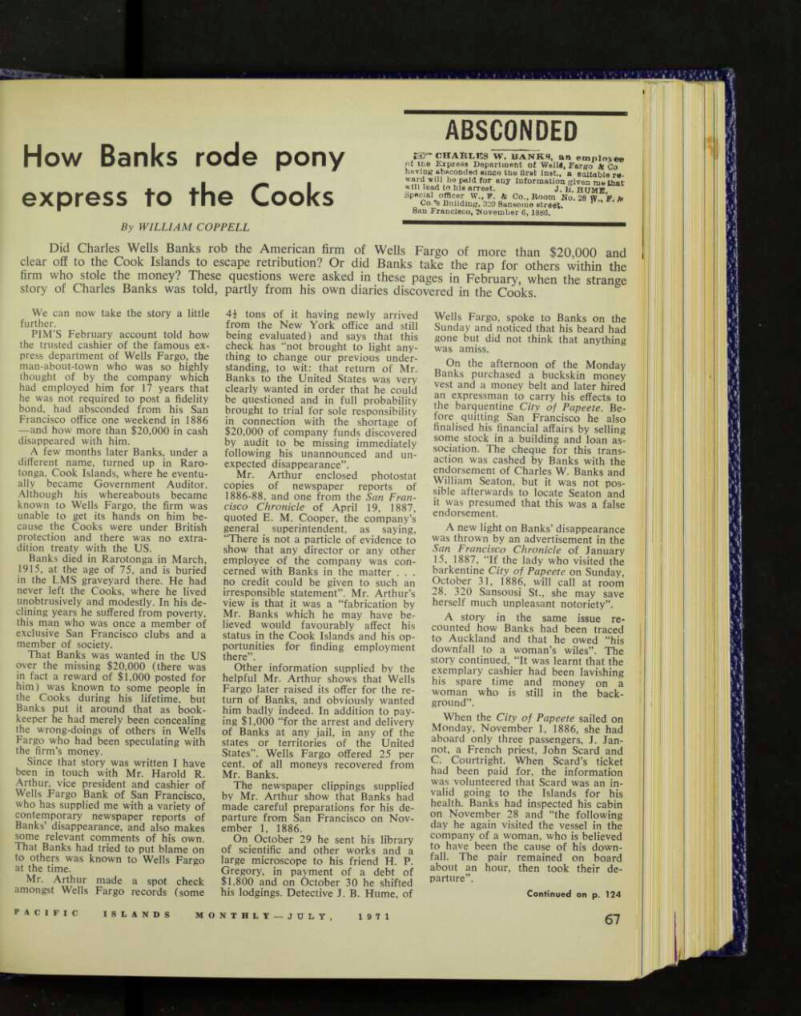

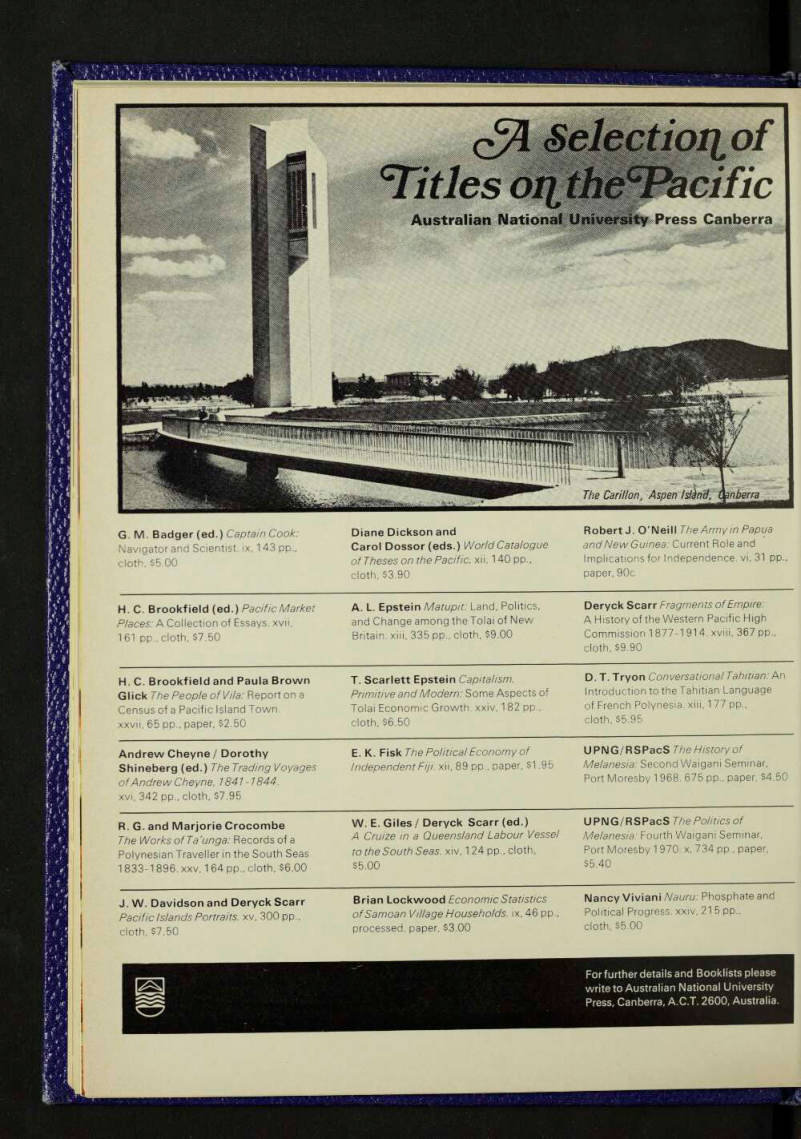
express to the Cooks
By William Coppell
Did Charles Wells Banks rob the American firm of Wells Fargo of more than $20,000 and clear off to the Cook Islands to escape retribution? Or did Banks take the rap for others within the firm who stole the money? These questions were asked in these pages in February, when the strange story of Charles Banks was told, partly from his own diaries discovered in the Cooks.
We can now take the story a little further.
PIM’S February account told how the trusted cashier of the famous ex press department of Wells Fargo, the man-about-town who was so highly thought of by the company which had employed him for 17 years that he was not required to post a fidelity bond, had absconded from his San Francisco office one weekend in 1886 —and how more than $20,000 in cash disappeared with him.
A few months later Banks, under a different name, turned up in Raro tonga, Cook Islands, where he eventu ally became Government Auditor.
Although his whereabouts became known to Wells Fargo, the firm was unable to get its hands on him be cause the Cooks were under British protection and there was no extra dition treaty with the US.
Banks died in Rarotonga in March, 1915, at the age of 75, and is buried in the LMS graveyard there. He had never left the Cooks, where he lived unobtrusively and modestly. In his de clining years he suffered from poverty, this man who was once a member of exclusive San Francisco clubs and a member of society.
That Banks was wanted in the US over the missing $20,000 (there was in fact a reward of $l,OOO posted for him) was known to some people in the Cooks during his lifetime, but Banks put it around that as book keeper he had merely been concealing the wrong-doings of others in Wells Fargo who had been speculating with the firm’s money.
Since that story was written I have been in touch with Mr. Harold R.
Arthur, vice president and cashier of Wells Pargo Bank of San Francisco, who has supplied me with a variety of contemporary newspaper reports of Banks’ disappearance, and also makes some relevant comments of his own.
That Banks had tried to put blame on to others was known to Wells Fargo at the time.
Mr. Arthur made a spot check amongst Wells Fargo records (some
4J tons of it having newly arrived from the New York office and still being evaluated) and says that this check has “not brought to light any thing to change our previous under standing, to wit: that return of Mr.
Banks to the United States was very clearly wanted in order that he could be questioned and in full probability brought to trial for sole responsibility in connection with the shortage of $20,000 of company funds discovered by audit to be missing immediately following his unannounced and un expected disappearance”.
Mr. Arthur enclosed photostat copies of newspaper reports of 1886-88, and one from the San Fran cisco Chronicle of April 19, 1887, quoted E. M. Cooper, the company’s general superintendent, as saying, “There is not a particle of evidence to show that any director or any other employee of the company was con cerned with Banks in the matter . . . no credit could be given to such an irresponsible statement”. Mr. Arthur’s view is that it was a “fabrication by Mr. Banks which he may have be lieved would favourably affect his status in the Cook Islands and his op portunities for finding employment there”.
Other information supplied by the helpful Mr. Arthur shows that Wells Fargo later raised its offer for the re turn of Banks, and obviously wanted him badly indeed. In addition to pay ing $l,OOO “for the arrest and delivery of Banks at any jail, in any of the states or territories of the United States”. Wells Fargo offered 25 per cent, of all moneys recovered from Mr. Banks.
The newspaper clippings supplied by Mr. Arthur show that Banks had made careful preparations for his de parture from San Francisco on Nov ember 1, 1886.
On October 29 he sent his library of scientific and other works and a large microscope to his friend H. P.
Gregory, in payment of a debt of $l,BOO and on October 30 he shifted his lodgings. Detective J. B. Hume, of
Wells Fargo, spoke to Banks on the Sunday and noticed that his beard had gone but did not think that anything was amiss.
On the afternoon of the Monday Banks purchased a buckskin money vest and a money belt and later hired an expressman to carry his effects to the barquentine City of Papeete. Be fore quitting San Francisco he also finalised his financial affairs by selling some stock in a building and loan as sociation. The cheque for this trans action was cashed by Banks with the endorsement of Charles W. Banks and William Seaton, but it was not pos sible afterwards to locate Seaton and it was presumed that this was a false endorsement.
A new light on Banks’ disappearance was thrown by an advertisement in the San Francisco Chronicle of January 15, 1887, “If the lady who visited the barkentine City of Papeete on Sunday, October 31, 1886, will call at room 28, 320 Sansousi St., she may save herself much unpleasant notoriety”.
A story in the same issue re counted how Banks had been traced to Auckland and that he owed “his downfall to a woman’s wiles”. The story continued, “It was learnt that the exemplary cashier had been lavishing his spare time and money on a woman who is still in the back ground”.
When the City of Papeete sailed on Monday, November 1, 1886, she had aboard only three passengers, J. Jan not, a French priest, John Scard and C. Courtright. When Scard’s ticket had been paid for, the information was volunteered that Scard was an in valid going to the Islands for his health. Banks had inspected his cabin on November 28 and “the following day he again visited the vessel in the company of a woman, who is believed to have been the cause of his down fall. The pair remained on board about an hour, then took their de parture”.
Continued on p. 124
On the voyage Banks, alias Scard, was generous with the crew and when the ship arrived at Papeete he rented a cottage and took the Captain for buggy rides. When he parted with Captain Berude of the City of Papeete, he handed him an ounce vial of sulphate of morphia, remarking, “I guess that I won’t need this now and you might as well put it in your medicine chest”. This comment was later seen as meaning he might have tried to suicide if cornered.
It was reported that Banks reached Auckland on Christmas Day, 1886, on the Janet Nicoll, having left Papeete six hours before the arrival from San Francisco of the Raiated, the captain of which was furnished with photographs of Banks and instructions to arrest him if he was in Tahiti.
On March 20, 1887, the San Francisco papers reported Banks’ arrival in his sanctuary in the Cook Islands, although the exact geographical location was variously given as Rarotonga.
and Tonga. The Daily Examiner says that he had $1,700 when he arrived in Rarotonga, and “he proclaimed his purpose to remain in Rarotonga, where it was said he is in great favour with the dusky Queen and very popu lar with the inhabitants, both black and white”.
The final substantial link between the USA and Banks was broken on May 14, 1888, when it was reported that, “a despatch received from New York last night brought the intelli gence that Mrs. Fannie Banks had been granted a divorce from Charles Banks, the defaulter”.
This chapter in Banks’ life is closed w j t h the statement, “at latest account Banks was reported to be living on the island of Itatucke (Aitutaki), near Rarotonga, in peaceful comfort. He has probably enough for his wants, as he carried away his booty, and liv ing is not as costly in those parts as it is in San Francisco to a member of the Union Club, which Banks was in his cashier days”.
Advertisements & other items, pp. 73-74 (2 items)
67
NTHLY JULY, 1971
PACIFIC ISLANDS MO
Absconded
£3?-CHAfcLBS W. BANKS, an employee of the Express Department of Well#, Fargo & Co having absconded since the first inst., a suitable reward will be paid for any Information given me that will lead to his arrest, J, B. HUME Special officer W., F. & Co„ Room No. 28 W P, * Co.’s Bnilding, 320 Sansotne street.
San Francisco, November 6,1880.
GUx
Crackers
taste as it
thevre
buttered!
Brockholt CHx are crisp golden cr^® rS E t t hem ""•Hi-.;* or<OP *l D BrocKW«Cnx Oven-crisp for Crackers if m m There’s value, variety and quality in
BROCKHOFF BISCUITS
6441/8 X 6V4
Book Reviews
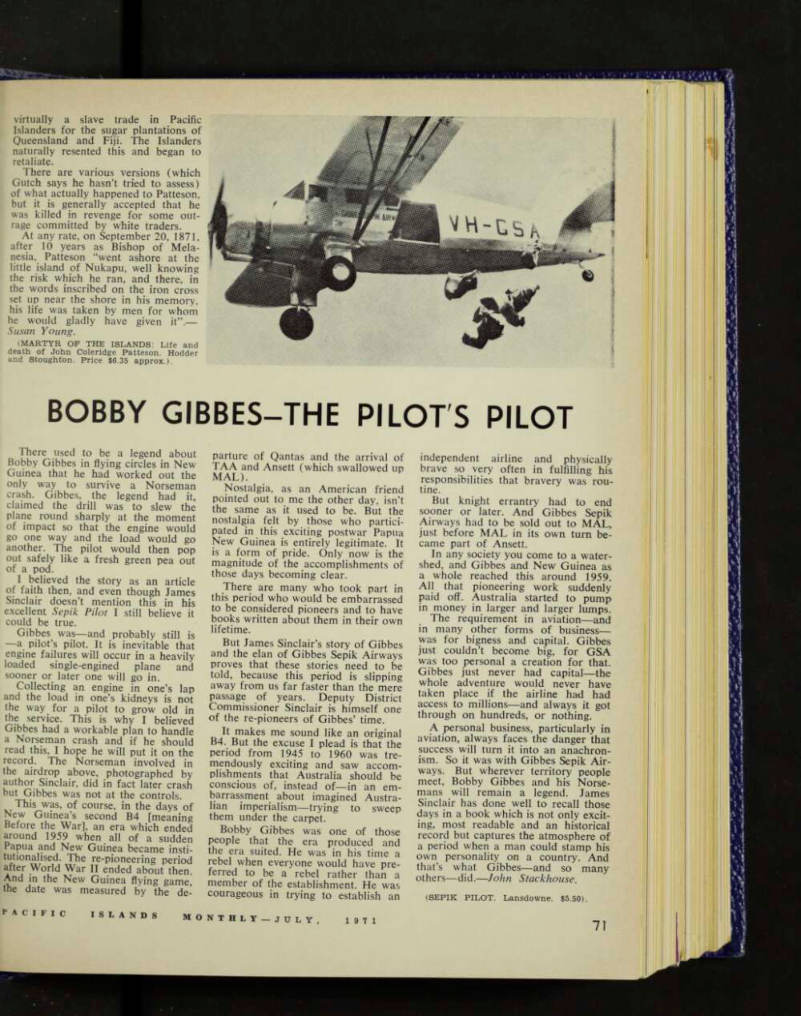
Missionary In Advance Of His Time
There’s a story that the vast reaches of Melanesia were originally included in the Anglican diocese of New Zea land through a slip of the pen.
According to this story, New Zealand’s northern ecclesiastical limit was laid down, in error, as 34 degrees north, instead of 34 degrees south.
Well, mistake or not, that definition was also to define the life and death of a 19th century Englishman whose memory is venerated in the Islands— lohn Coleridge Patteson, first Bishop of Melanesia.
This year the centenary of his martyrdom is being commemorated and we now have, topically, a new record of his life and death, Martyr of the Islands, written by a former High Commissioner of the Western Pacific, Sir lohn Gutch.
It’s a straightforward account, workmanlike and readable. It will make the reader want to know more than the book has to offer.
It is based mainly on Patteson’s own letters, many of which appeared in a life of Patteson, written soon after his death. But the author claims that there are also many which throw new light on Patteson himself and on his relations with others.
As the author observes, “It would be difficult to find a greater contrast to the savage and uncertain scene in Melanesia than the comfortable sur roundings of upper class Victorian England into which the young Patte son was born”.
Patteson showed religious leanings early: by the age of five he was read ing the Bible regularly and at about this age he also first conceived the idea of going into the Church. There is something a trifle unnerving about such inclinations at such an age, so it comes as a relief to learn that the child Patteson was rather lazy and given to “displays of will and tem per”.
Still, by the time he had been through Eton and Oxford, we find that he was “an unusually engaging voung man who made friends easily”, tall, well built and a fine cricketer. Attrac
tive, maybe, but hardly very likely material for pioneering mission work on the other side of the world.
However, the seed had in fact been sown some time back. While still a boy, Patteson had been deeply im pressed by a sermon preached by the brand-new Bishop of New Zealand, George Augustus Selwyn.
“In fact, he confided to his mother afterwards that it was his greatest wish to go out with Bishop Selwyn when he grew up”. The dream remained dormant for more than 12 years.
Then in 1854 he had a little talk with Bishop Selwyn, who was on a visit to England, and by next year Patte son was on his way to the antipodes.
Once out there, any remaining trace of laziness seems to have vanished utterly.
During his 16 years in the Pacific Patteson travelled constantly, built up a flourishing training college for Melanesians, did a prodigious amount of translation work, cared passion ately for his people, and generally “set the framework for the extension of the Anglican church in Melanesia”.
Sir lohn Gutch has chosen his quotes well, to point up Patteson’s
wry sense of humour and his ability to turn a vivid phrase. We also get some idea of what the author calls “the fascinating association of these two very different characters—Selwyn domineering, decisive, indefatigable: Patteson gentle, at times diffident, but in his way just as determined”.
Yet the pull of these two characters and the shifting action between New Zealand and Melanesia are somehow rather unsettling influences on the reader. I wasn’t quite sure whose bio graphy I was really reading; and I became as interested in New Zealand as I did in Melanesia. There’s quite a sense of disappointment as Selwyn and New Zealand gradually fade out of the book.
Church workers particularly should find this book worth while, not only because it’s an edifying story about a bishop and martyr, but also because Patteson faced many prob lems and held many views which have a startlingly familiar, modern, ring about them.
And Gutch has some interesting thoughts about what Patteson would make of the Melanesian scene now.
On racism, Patteson was there a hundred years before us —“any form of racial discrimination was anathema to him”. He believed that if was to grow and last, the church in Mela nesia had to be built by Melanesians, using their culture and customs and leaning as little as possible on expatri ate help. This is a “modern” concept among today’s churches.
Patteson also had liberal views on co-operation between the churches that wouldn’t fit in too badly with the ecumenical scene in 1971.
Like many missionaries today, Pat teson was shocked and distressed by the effect of European settlement and influence. He found drink “a great and raging evil”, and there were bitter dis putes over land.
Almost certainly it was one of these culture clashes which resulted in his death.
For years, life in the Islands had been getting more difficult and dan gerous because of “blackbirding”—
virtually a slave trade in Pacific Islanders for the sugar plantations of Queensland and Fiji. The Islanders naturally resented this and began to retaliate.
There are various versions (which Gutch says he hasn’t tried to assess) of what actually happened to Patteson, but it is generally accepted that he was killed in revenge for some out rage committed by white traders.
At any rate, on September 20, 1871, after 10 years as Bishop of Mela nesia, Patteson “went ashore at the little island of Nukapu, well knowing the risk which he ran, and there, in the words inscribed on the iron cross set up near the shore in his memory, his life was taken by men for whom he would gladly have given it”.— Susan Young.
(Martyr Of The Islands: Life And
death of John Coleridge Patteson. Hodder and Stoughton. Price $6.35 approx.).
Political Parties
In New Guinea
A history of political parties in Papua New Guinea is to be published by Lansdown Press next February, in time for the PNG general elections.
IPs the result of four years work by David Stephen, of Melbourne, who describes it as an attempt to explain the present political party structure of the territory through historical ob servation. The book covers influence of political bodies from other coun tries and begins in the 1920’s with a branch of the Kuomintang. The Australian Labor Party has made eight attempts to form PNG branches since 1938. The Mataungan Associ ation and Pangu Party are discussed fully.
Advertisements & other items, p. 76 (1 item)
:
IP, »• 1C
Press
ra m H For further details and Booklists please write to Australian National University Press, Canberra, A.C.T. 2600, Australia.
Bobby Gibbes-The Pilot's Pilot
There used to be a legend about Bobby Gibbes in flying circles in New Guinea that he had worked out the only way to survive a Norseman crash. Gibbes, the legend had it, claimed the drill was to slew the plane round sharply at the moment of impact so that the engine would go one way and the load would go another. The pilot would then pop out safely like a fresh green pea out of a pod.
I believed the story as an article of faith then, and even though James Sinclair doesn’t mention this in his excellent Sepik Pilot I still believe it could be true.
Gibbes was—and probably still is —a pilot’s pilot. It is inevitable that engine failures will occur in a heavily loaded single-engined plane and sooner or later one will go in.
Collecting an engine in one’s lap and the load in one’s kidneys is not the way for a pilot to grow old in the service. This is why I believed Gibbes had a workable plan to handle a Norseman crash and if he should read this, I hope he will put it on the record. The Norseman involved in the airdrop above, photographed by author Sinclair, did in fact later crash but Gibbes was not at the controls.
This was, of course, in the days of
New Guinea’s second B 4 [meaning
Before the War], an era which ended around 1959 when all of a sudden Papua and New Guinea became insti tutionalised. The re-pioneering period after World War II ended about then.
And in the New Guinea flying game, the date was measured by the de
parture of Qantas and the arrival of TAA and Ansett (which swallowed up
Mal).
Nostalgia, as an American friend pointed out to me the other day, isn’t the same as it used to be. But the nostalgia felt by those who partici pated in this exciting postwar Papua New Guinea is entirely legitimate. It is a form of pride. Only now is the magnitude of the accomplishments of those days becoming clear.
There are many who took part in this period who would be embarrassed to be considered pioneers and to have books written about them in their own lifetime.
But James Sinclair’s story of Gibbes and the elan of Gibbes Sepik Airways proves that these stories need to be told, because this period is slipping away from us far faster than the mere passage of years. Deputy District Commissioner Sinclair is himself one of the re-pioneers of Gibbes’ time.
It makes me sound like an original 84. But the excuse I plead is that the period from 1945 to 1960 was tre mendously exciting and saw accom plishments that Australia should be conscious of, instead of—in an em barrassment about imagined Austra lian imperialism—trying to sweep them under the carpet.
Bobby Gibbes was one of those people that the era produced and the era suited. He was in his time a rebel when everyone would have pre ferred to be a rebel rather than a member of the establishment. He was courageous in trying to establish an
independent airline and physically brave so yery often in fulfilling his responsibilities that bravery was rou tine.
But knight errantry had to end sooner or later. And Gibbes Sepik Airways had to be sold out to MAT, just before MAL in its own turn be came part of Ansett.
In any society you come to a water shed, and Gibbes and New Guinea as a whole reached this around 1959.
All that pioneering work suddenly paid off. Australia started to pump in money in larger and larger lumps.
The requirement in aviation—and in many other forms of business— was for bigness and capital. Gibbes just couldn’t become big, for GSA was too personal a creation for that.
Gibbes just never had capital—the whole adventure would never have taken place if the airline had had access to millions—and always it got through on hundreds, or nothing.
A personal business, particularly in aviation, always faces the danger that success will turn it into an anachron ism. So it was with Gibbes Sepik Air ways. But wherever territory people meet, Bobby Gibbes and his Norse mans will remain a legend. James Sinclair has done well to recall those days in a book which is not only excit ing, most readable and an historical record but captures the atmosphere of a period when a man could stamp his own personality on a country. And that’s what Gibbes—and so many
others—did.
John Stackhouse.
(SEPIK PILOT. Lansdowne. $5.50).
Advertisements & other items, p. 77 (1 item)
Pacific Islands Monthli - J D L Y , 1971
People
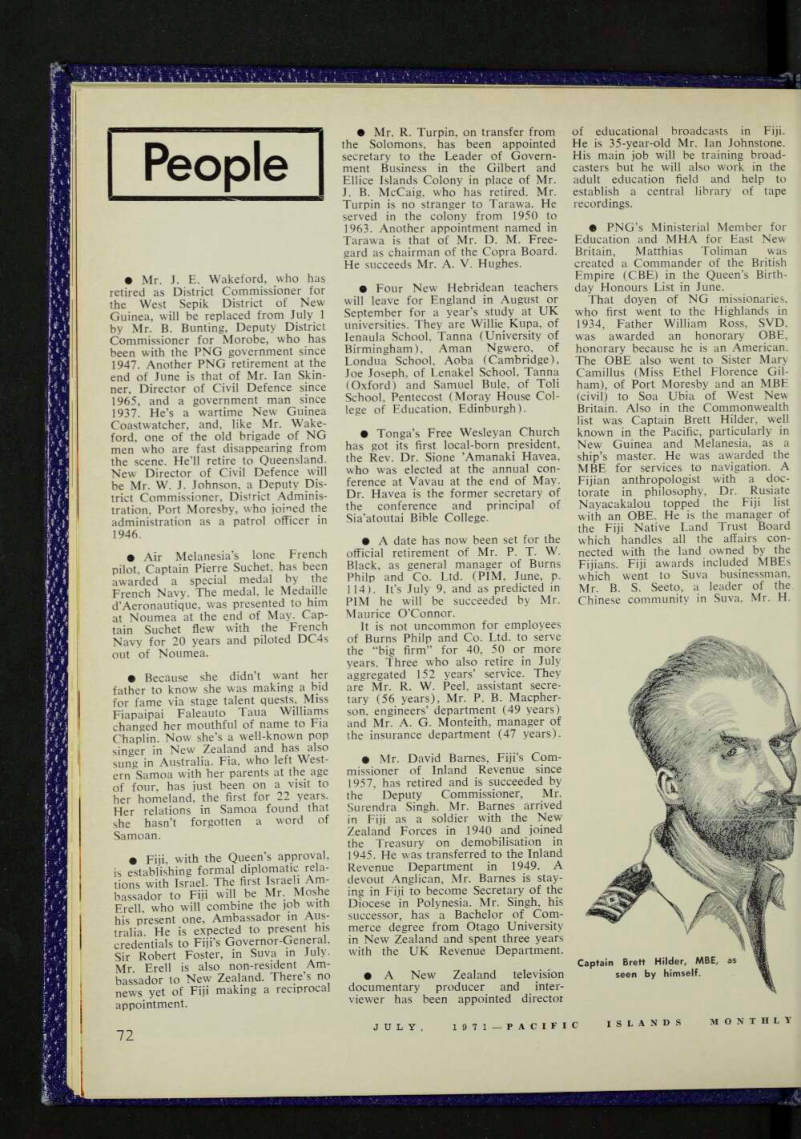
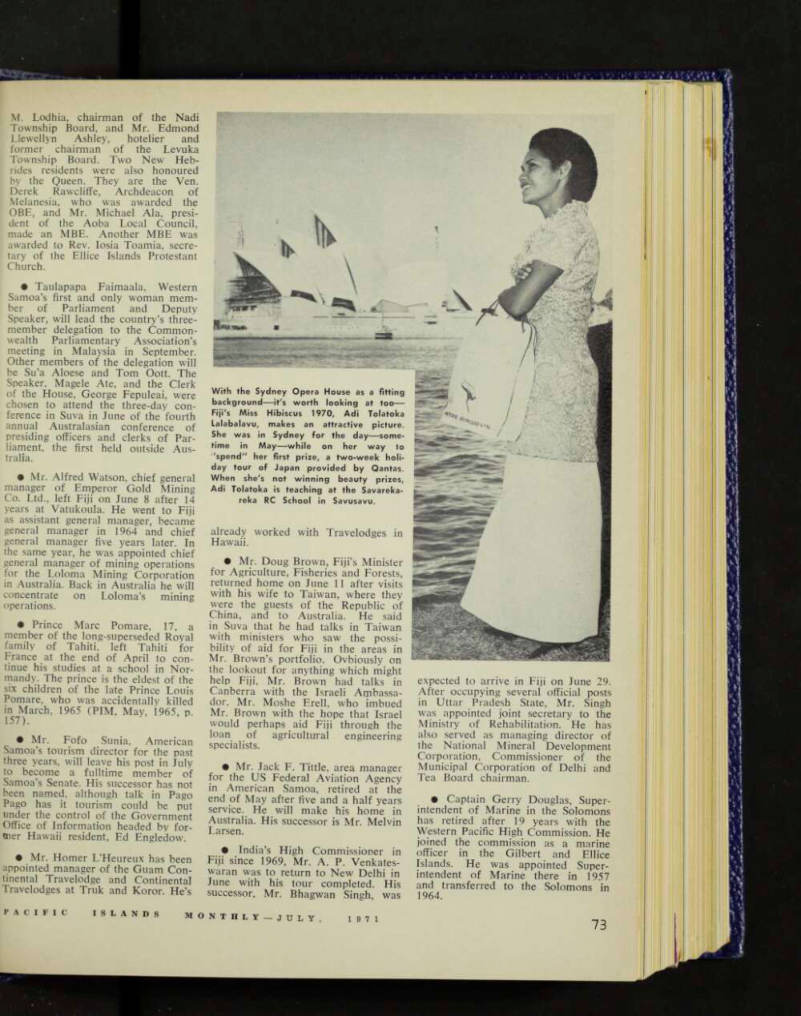
• Mr. J. E. Wakeford, who has retired as District Commissioner for the West Sepik District of New Guinea, will be replaced from July 1 by Mr. B. Bunting, Deputy District Commissioner for Morobe, who has been with the PNG government since 1947. Another PNG retirement at the end of June is that of Mr. lan Skin ner, Director of Civil Defence since 1965, and a government man since 1937. He’s a wartime New Guinea Coastwatcher, and, like Mr. Wake ford, one of the old brigade of NG men who are fast disappearing from the scene. He’ll retire to Queensland.
New Director of Civil Defence will be Mr. W. J. Johnson, a Deputy Dis trict Commissioner. District Adminis tration, Port Moresby, who joined the administration as a patrol officer in 1946. • Air Melanesia’s lone French pilot. Captain Pierre Suchet, has been awarded a special medal by the French Navy. The medal, le Medaille d’Aeronautique, was presented to him at Noumea at the end of May. Cap tain Suchet flew with the French Navy for 20 years and piloted DC4s out of Noumea. • Because she didn’t want her father to know she was making a bid for fame via stage talent quests. Miss Fiapaipai Faleauto Taua Williams changed her mouthful of name to Fia Chaplin. Now she’s a well-known pop singer in New Zealand and has also sung in Australia. Fia, who left West ern Samoa with her parents at the age of four, has just been on a visit to her homeland, the first for 22 years.
Her relations in Samoa found that she hasn’t forgotten a word of Samoan. • Fiji, with the Queen’s approval, is establishing formal diplomatic rela tions with Israel. The first Israeli Am bassador to Fiji will be Mr. Moshe Erell, who will combine the job with his present one, Ambassador in Aus tralia. He is expected to present his credentials to Fiji’s Governor-General, Sir Robert Foster, in Suva in July.
Mr. Erell is also non-resident Am bassador to New Zealand. There s no news yet of Fiji making a reciprocal appointment.
• Mr. R. Turpin, on transfer from the Solomons, has been appointed secretary to the Leader of Govern ment Business in the Gilbert and Ellice Islands Colony in place of Mr.
J. B. McCaig, who has retired. Mr.
Turpin is no stranger to Tarawa. He served in the colony from 1950 to 1963. Another appointment named in Tarawa is that of Mr. D. M. Free gard as chairman of the Copra Board.
He succeeds Mr. A. V. Hughes. • Four New Hebridean teachers will leave for England in August or September for a year’s study at UK universities. They are Willie Kupa, of lenaula School, Tanna (University of Birmingham), Aman Ngwero, of Londua School, Aoba (Cambridge), Joe Joseph, of Lenakel School, Tanna (Oxford) and Samuel Buie, of Toli School. Pentecost (Moray House Col lege of Education, Edinburgh). • Tonga’s Free Wesleyan Church has got its first local-born president, the Rev. Dr. Sione ’Amanaki Havea, who was elected at the annual con ference at Vavau at the end of May.
Dr. Havea is the former secretary of the conference and principal of Sia’atoutai Bible College. • A date has now been set for the official retirement of Mr. P. T. W.
Black, as general manager of Burns Philp and Co. Ltd. (PIM, June, p. 114). It’s July 9, and as predicted in PIM he will be succeeded by Mr.
Maurice O’Connor.
It is not uncommon for employees of Burns Philp and Co. Ltd. to serve the “big firm” for 40, 50 or more years. Three who also retire in July aggregated 152 years’ service. They are Mr. R. W. Peel, assistant secre tary (56 years), Mr. P. B. Macpher son, engineers’ department (49 years) and Mr. A. G. Monteith, manager of the insurance department (47 years). • Mr. David Barnes, Fiji’s Com missioner of Inland Revenue since 1957, has retired and is succeeded by the Deputy Commissioner, Mr.
Surendra Singh. Mr. Barnes arrived in Fiji as a soldier with the New Zealand Forces in 1940 and joined the Treasury on demobilisation in 1945. He was transferred to the Inland Revenue Department in 1949. A devout Anglican, Mr. Barnes is stay ing in Fiji to become Secretary of the Diocese in Polynesia. Mr. Singh, his successor, has a Bachelor of Com merce degree from Otago University in New Zealand and spent three years with the UK Revenue Department. • A New Zealand television documentary producer and inter viewer has been appointed director
of educational broadcasts in Fiji.
He is 35-year-old Mr. lan Johnstone.
His main job will be training broad casters but he will also work in the adult education field and help to establish a central library of tape recordings. • PNG’s Ministerial Member for Education and MHA for East New Britain, Matthias Toliman was created a Commander of the British Empire (CBE) in the Queen’s Birth day Honours List in June.
That doyen of NG missionaries, who first went to the Highlands in 1934, Father William Ross, SVD. was awarded an honorary OBE, honorary because he is an American.
The OBE also went to Sister Mary Camillus (Miss Ethel Florence Gil ham), of Port Moresby and an MBE (civil) to Soa Übia of West New Britain. Also in the Commonwealth list was Captain Brett Hilder, well known in the Pacific, particularly in New Guinea and Melanesia, as a ship’s master. He was awarded the MBE for services to navigation. A Fijian anthropologist with a doc torate in philosophy, Dr. Rusiate Nayacakalou topped the Fiji list with an OBE. He is the manager of the Fiji Native Land Trust Board which handles all the affairs con nected with the land owned by the Fijians. Fiji awards included MBEs which went to Suva businessman, Mr. B. S. Seeto, a leader of the Chinese community in Suva, Mr. H.
Captain Brett Milder, MBE, as seen by himself.
M. Lodhia, chairman of the Nadi Township Board, and Mr. Edmond Llewellyn Ashley, hotelier and former chairman of the Levuka Township Board. Two New Heb rides residents were also honoured by the Queen. They are the Yen, Derek Rawcliffe, Archdeacon of Melanesia, who was awarded the OBE, and Mr. Michael Ala, presi dent of the Aoba Local Council, made an MBE. Another MBE was awarded to Rev. losia Toamia, secre tary of the Ellice Islands Protestant Church. • Taulapapa Faimaala, Western Samoa’s first and only woman mem ber of Parliament and Deputy Speaker, will lead the country’s three member delegation to the Common wealth Parliamentary Association’s meeting in Malaysia in September.
Other members of the delegation will be Su’a Aloese and Tom Oott. The Speaker, Magele Ate, and the Clerk of the House, George Fepuleai, were chosen to attend the three-day con ference in Suva in June of the fourth annual Australasian conference of presiding officers and clerks of Par liament, the first held outside Aus tralia. • Mr. Alfred Watson, chief general manager of Emperor Gold Mining Co. Ltd., left Fiji on June 8 after 14 years at Vatukoula. He went to Fiji as assistant general manager, became general manager in 1964 and chief general manager five years later. In the same year, he was appointed chief general manager of mining operations for the Loloma Mining Corporation in Australia. Back in Australia he will concentrate on Loloma’s mining operations. • Prince Marc Pomare, 17, a member of the long-superseded Royal family of Tahiti, left Tahiti for France at the end of April to con tinue his studies at a school in Nor mandy. The prince is the eldest of the six children of the late Prince Louis Pomare, who was accidentally killed in March, 1965 (PIM, May, 1965, p. 157). • Mr. Fofo Sunia, American Samoa’s tourism director for the past three years, will leave his post in July to become a fulltime member of Samoa’s Senate. His successor has not been named, although talk in Pago Pago has it tourism could be put under the control of the Government Office of Information headed by for mer Hawaii resident, Ed Engledow. • Mr. Homer L’Heureux has been appointed manager of the Guam Con tinental Travelodge and Continental Travelodges at Truk and Koror. He’s
already worked with Travelodges in Hawaii. • Mr. Doug Brown, Fiji’s Minister for Agriculture, Fisheries and Forests, returned home on June 11 after visits with his wife to Taiwan, where they were the guests of the Republic of China, and to Australia. He said in Suva that he had talks in Taiwan with ministers who saw the possi bility of aid for Fiji in the areas in Mr. Brown’s portfolio. Ovbiously on the lookout for anything which might help Fiji, Mr. Brown had talks in Canberra with the Israeli Ambassa dor, Mr. Moshe Erell, who imbued Mr, Brown with the hope that Israel would perhaps aid Fiji through the loan of agricultural engineering specialists. • Mr. Jack F. Tittle, area manager for the US Federal Aviation Agency in American Samoa, retired at the end of May after five and a half years service. He will make his home in Australia. His successor is Mr. Melvin Larsen. • India’s High Commissioner in Fiji since 1969, Mr. A. P. Venkates waran was to return to New Delhi in June with his tour completed. His successor, Mr. Bhagwan Singh, was
expected to arrive in Fiji on June 29.
After occupying several official posts in Uttar Pradesh State, Mr. Singh was appointed joint secretary to the Ministry of Rehabilitation. He has also served as managing director of the National Mineral Development Corporation, Commissioner of the Municipal Corporation of Delhi and Tea Board chairman. • Captain Gerry Douglas, Super intendent of Marine in the Solomons has retired after 19 years with the Western Pacific High Commission. He joined the commission as a marine officer in the Gilbert and Ellice Islands. He was appointed Super intendent of Marine there in 1957 and transferred to the Solomons in 1964.
With the Sydney Opera House as a fitting background—it's worth looking at too — Fiji's Miss Hibiscus 1970, Adi Tolatoka Lalabalavu, makes an attractive picture.
She was in Sydney for the day—some time in May—while on her way to 'spend" her first prize, a two-week holi day tour of Japan provided by Qantas.
When she's not winning beauty prizes, Adi Tolatoka is teaching at the Savareka reka RC School in Savusavu.
Advertisements & other items, p. 80 (1 item)
EQUIPPED MID Braybon
AUMIIMIY POWER IMIS
mm
tafs
m * :3 a *. -*S 1 r- H p Three new Australian-designed and built giant landing barges for operation in the S.-W. Pacific area are equipped with Braybon Auxiliary Power Units. These new 70 kW Cummins-Diesel powered alternators also have many industrial applications on land. 81 mw & Write for fully illustrated literature and obligation-free quotation.
BRAYBON SERVICE EXTENDS
THROUGHOUT THE S.-W.
PACIFIC AREA
We design and manufacture a complete range of diesel alternating sets for industrial, marine and domestic applications up to 100 kVA capacity. Both mobile and stationary units are available.
DEAL DIRECT WITH THE MANUFACTURERS
Braybon Bros
W PTY. LTD.,
2 ROTHWELL AVENUE, CONCORD WEST 2138.
Tel.: 73-3246. 886032/1170
Pacific Shipping
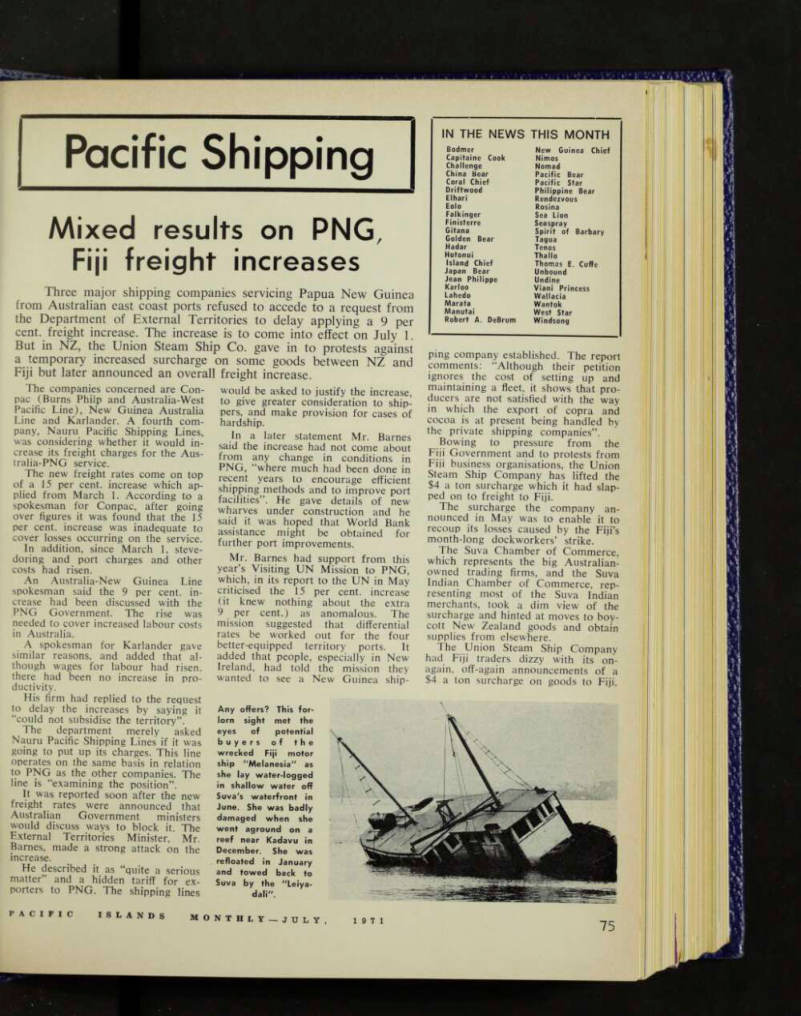
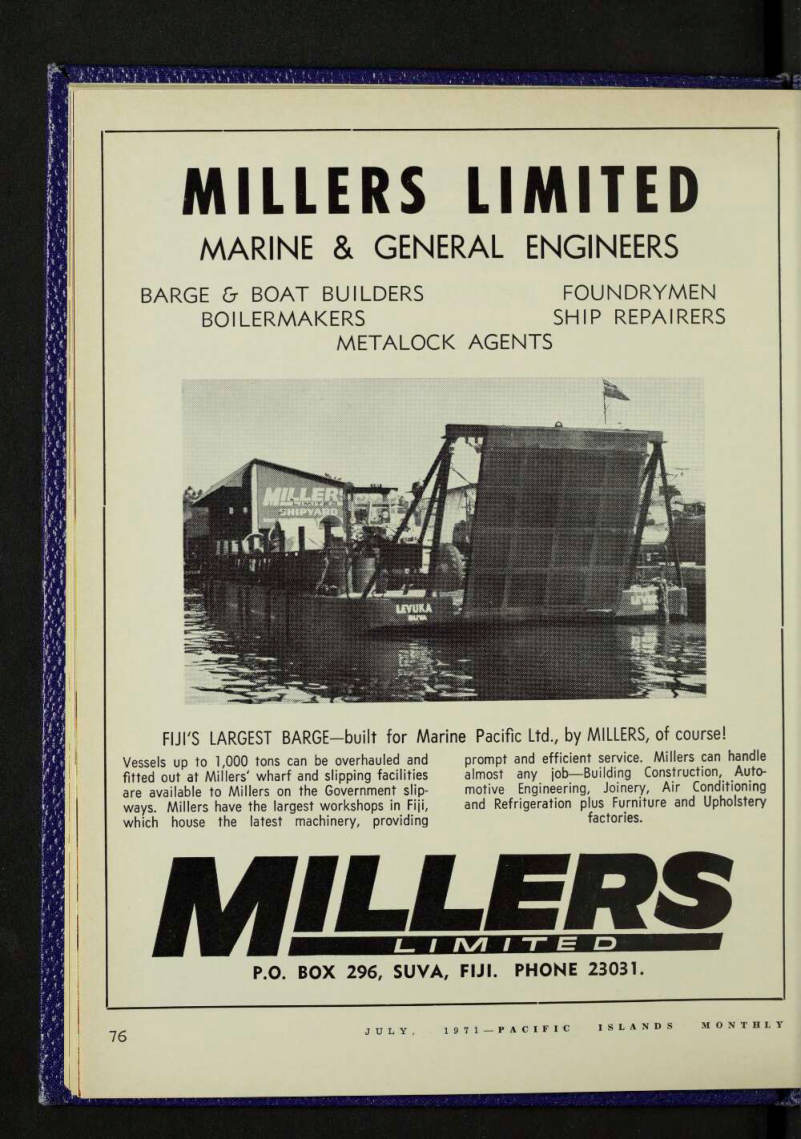
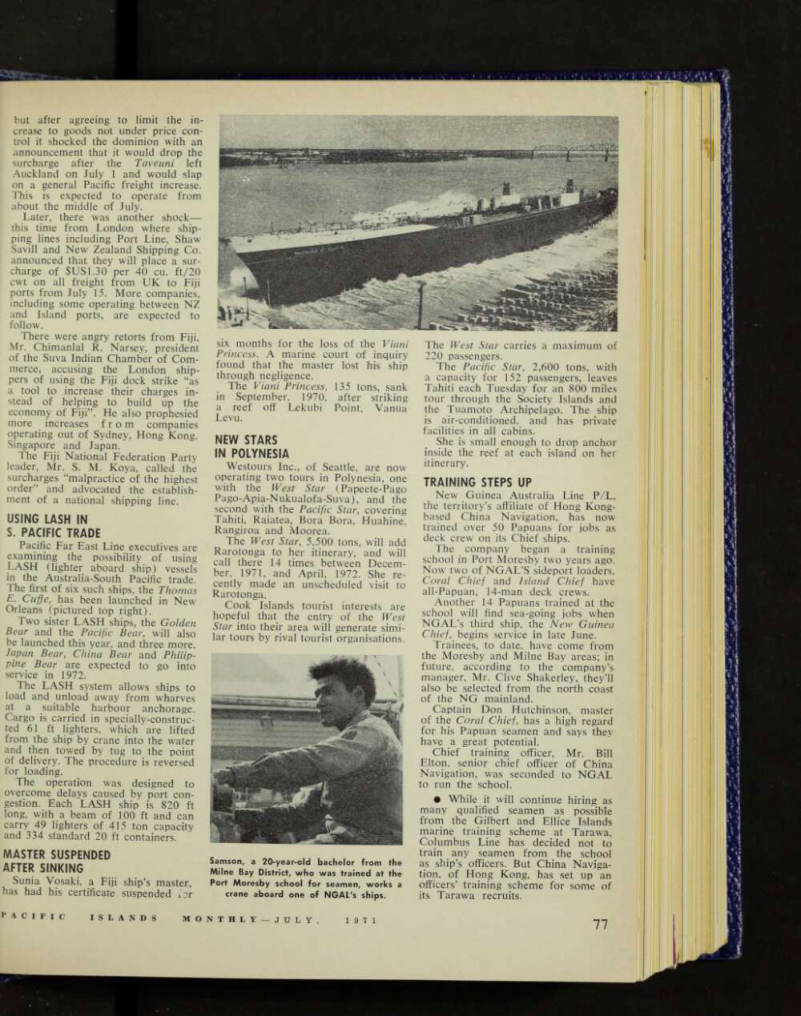
Mixed results on PNG, Fiji freight increases
Three major shipping companies servicing Papua New Guinea from Australian east coast ports refused to accede to a request from the Department of External Territories to delay applying a 9 per cent, freight increase. The increase is to come into effect on July 1.
But in NZ, the Union Steam Ship Co. gave in to protests against a temporary increased surcharge on some goods between NZ and Fiji but later announced an overall freight increase.
The companies concerned are Con pac (Burns Philp and Australia-West Pacific Line), New Guinea Australia Line and Karlander. A fourth com pany, Nauru Pacific Shipping Lines, was considering whether it would in crease its freight charges for the Aus tralia-PNG service.
The new freight rates come on top of a 15 per cent, increase which ap plied from March 1. According to a spokesman for Conpac, after going over figures it was found that the 15 per cent, increase was inadequate to cover losses occurring on the service.
In addition, since March 1, steve doring and port charges and other costs had risen.
An Australia-New Guinea Line spokesman said the 9 per cent, in crease had been discussed with the PNG Government. The rise was needed to cover increased labour costs in Australia.
A spokesman for Karlander gave similar reasons, and added that al though wages for labour had risen, there had been no increase in pro ductivity.
His firm had replied to the request to delay the increases by saying it “could not subsidise the territory”.
The department merely asked Naum Pacific Shipping Lines if it was going to put up its charges. This line operates on the same basis in relation to PNG as the other companies. The line is “examining the position”.
It was reported soon after the new freight rates were announced that Australian Government ministers would discuss ways to block it. The External Territories Minister, Mr.
Barnes, made a strong attack on the increase.
He described it as “quite a serious matter” and a hidden tariff for ex porters to PNG. The shipping lines
would be asked to justify the increase, to give greater consideration to ship pers, and make provision for cases of hardship.
In a later statement Mr. Barnes said the increase had not come about from any change in conditions in PNG, “where much had been done in recent years to encourage efficient shipping methods and to improve port facilities”. He gave details of new wharves under construction and he said it was hoped that World Bank assistance might be obtained for further port improvements.
Mr. Barnes had support from this year’s Visiting UN Mission to PNG, which, in its report to the UN in May criticised the 15 per cent, increase (it knew nothing about the extra 9 per cent.) as anomalous. The mission suggested that differential rates be worked out for the four better-equipped territory ports. It added that people, especially in New Ireland, had told the mission they wanted to see a New Guinea ship
ping company established. The report comments: “Although their petition ignores the cost of setting up and maintaining a fleet, it shows that pro ducers are not satisfied with the way in which the export of copra and cocoa is at present being handled by the private shipping companies”.
Bowing to pressure from the Fiji Government and to protests from Fiji business organisations, the Union Steam Ship Company has lifted the S 4 a ton surcharge which it had slap ped on to freight to Fiji.
The surcharge the company an nounced in May was to enable it to recoup its losses caused by the Fiji’s month-long dockworkers’ strike.
The Suva Chamber of Commerce, which represents the big Australian owned trading firms, and the Suva Indian Chamber of Commerce, rep resenting most of the Suva Indian merchants, took a dim view of the surcharge and hinted at moves to boy cott New Zealand goods and obtain supplies from elsewhere.
The Union Steam Ship Company had Fiji traders dizzy with its on again, off-again announcements of a S 4 a ton surcharge on goods to Fiji,
Any offers? This for lorn sight met the eyes of potential buyers of the wrecked Fiji motor ship "Melanesia" as she lay water-logged in shallow water off Suva's waterfront in June. She was badly damaged when she went aground on a reef near Kadavu in December. She was refloated in January and towed back to
Suva by the "Leiya
dali".
but after agreeing to limit the in crease to goods not under price con trol it shocked the dominion with an announcement that it would drop the surcharge after the Taveuni left Auckland on July 1 and would slap on a general Pacific freight increase.
This is expected to operate from about the middle of July.
Later, there was another shock— this time from London where ship ping lines including Port Line, Shaw Savill and New Zealand Shipping Co. announced that they will place a sur charge of SUSI.3O per 40 cu. ft/20 cwt on all freight from UK to Fiji ports from July 15. More companies, including some operating between NZ and Island ports, are expected to follow.
There were angry retorts from Fiji, Mr. Chimanlal R. Narsey, president of the Suva Indian Chamber of Com merce, accusing the London ship pers of using the Fiji dock strike “as a tool to increase their charges in stead of helping to build up the economy of Fiji”. He also prophesied more increases from companies operating out of Sydney, Hong Kong.
Singapore and Japan.
The Fiji National Federation Party leader, Mr. S. M. Koya, called the surcharges “malpractice of the highest order” and advocated the establish ment of a national shipping line.
Using Lash In
S. Pacific Trade
Pacific Far East Line executives are examining the possibility of using LASH (lighter aboard ship) vessels in the Australia-South Pacific trade.
The first of six such ships, the Thomas E. Cuffe, has been launched in New Orleans (pictured top right).
Two sister LASH ships, the Golden Bear and the Pacific Bear, will also be launched this year, and three more, Japan Bear, China Bear and Philip pine Bear are expected to go into service in 1972.
The LASH system allows ships to load and unload away from wharves at a suitable harbour anchorage.
Cargo is carried in specially-construc ted 61 ft lighters, which are lifted from the ship by crane into the water and then towed by tug to the point of delivery. The procedure is reversed for loading.
The operation was designed to overcome delays caused by port con gestion. Each LASH ship is 820 ft long, with a beam of 100 ft and can carry 49 lighters of 415 ton capacity and 334 standard 20 ft containers.
Master Suspended
After Sinking
Sunia Vosaki, a Fiji ship’s master, has had his certificate suspended ijr
six months for the loss of the Viani Princess. A marine court of inquiry found that the master lost his ship through negligence.
The Viani Princess, 135 tons, sank in September. 1970, after striking a reef off Lekubi Point, Vanua Levu.
New Stars
In Polynesia
Westours Inc., of Seattle, are now operating two tours in Polynesia, one with the West Star (Papeete-Pago Pago-Apia-Nukualofa-Suva), and the second with the Pacific Star, covering Tahiti, Raiatea, Bora Bora, Huahine, Rangiroa and Moorea.
The West Star, 5,500 tons, will add Rarotonga to her itinerary, and will call there 14 times between Decem ber, 1971, and April, 1972. She re cently made an unscheduled visit to Rarotonga.
Cook Islands tourist interests are hopeful that the entry of the West Star into their area will generate simi lar tours by rival tourist organisations.
The West Star carries a maximum of 220 passengers.
The Pacific Star, 2,600 tons, with a capacity for 152 passengers, leaves Tahiti each Tuesday for an 800 miles tour through the Society Islands and the Tuamoto Archipelago. The ship is air-conditioned, and has private facilities in all cabins.
She is small enough to drop anchor inside the reef at each island on her itinerary.
Training Steps Up
New Guinea Australia Line P/L, the territory’s affiliate of Hong Kong based China Navigation, has now trained over 50 Papuans for jobs as deck crew on its Chief ships.
The company began a training school in Port Moresby two years ago.
Now two of NGAL’S sideport loaders, Coral Chief and Island Chief have all-Papuan, 14-man deck crews.
Another 14 Papuans trained at the school will find sea-going jobs when NGAL’s third ship, the New Guinea Chief, begins service in late June.
Trainees, to date, have come from the Moresby and Milne Bay areas; in future, according to the company’s manager, Mr. Clive Shakerley, they’ll also be selected from the north coast of the NG mainland.
Captain Don Hutchinson, master of the Coral Chief, has a high regard for his Papuan seamen and says they have a great potential.
Chief training officer, Mr. Bill Elton, senior chief officer of China Navigation, was seconded to NGAL to run the school. • While it will continue hiring as many qualified seamen as possible from the Gilbert and Ellice Islands marine training scheme at Tarawa, Columbus Line has decided not to train any seamen from the school as ship’s officers. But China Naviga tion, of Hong Kong, has set up an officers’ training scheme for some of its Tarawa recruits.
Samson, a 20-year-old bachelor from the Milne Bay District, who was trained at the Port Moresby school for seamen, works a crane aboard one of NGAL's ships.
Wewak's New
Wharf Open Soon
The $750,000 new overseas wharf at Wewak, New Guinea, is expected to be in use about the middle of Aug ust. The wharf is 240 ft long and has a causeway of 1,500 ft. One over seas ship only will be able to berth at a time.
At present ships are unloaded by a lighterage system, using small boats.
The "Robert A. Debrum"
A new addition to the US Trust Territory fleet was christened at Saipan in May, only about a month after the death of the man who has given his name to the ship—the MV Robert A. Deßrum.
Captain A. Robert Deßrum, com modore of Micronesia Interocean Line, Inc., died on April 16 at Saipan’s Dr. Torres Hospital.
His widow officially christened the MV Robert A. Deßrum in a dockside ceremony. An ex-US Navy vessel, the Robert A. Deßrum is 177 ft long and displaces 400 tons. She is commanded by Captain Tetrick J. Melander of Kusaie.
New Ship For
The Cooks
In Denmark in search of a replace ment for the Tagua, wrecked off Mangaia Island on December 15 (PIM, Jan., p. 90), Mr. Don Silk, of Silk and Boyd Ltd., of Rarotonga, has bought a IOJ-year-old Danish coaster.
Mik, which as the Manutai (Bird of the Sea) will be Cooks’ biggest ship.
Powered by a five cylinder diesel engine, the Manutai can reach 10 knots and has space for 400 tons of general cargo and 300 tons of copra.
She has a draught of only 9 ft, a single large hatch and two derricks, each of three tons capacity. According to Mr.
Silk, the Manutai is a little larger than current requirements warrant but the company is confident she will be paying her way in five years. They hope to develop more trade with Tahiti. Mr. F. Hendricks, the Bod mer’s engineer, who was to fly to Denmark to take charge of the Manutai, will load cargo in Copen hagen and other European ports before sailing to Rarotonga. • Construction of two large steel framed cargo sheds at Avatiu harbour.
Rarotonga, was well underway in June.
In The News This Month
Bodmer Capitaine Cook Challenge China bear Coral Chief Driftwood Elhari Eolo Falkinger Finisterre Gitana Golden Bear Hadar Hotonui Island Chief Japan Bear Jean Philippe Karloo Lahedo Marata Manutai Robert A. Deßrum
New Guinea Chief Nimos Nomad Pacific Bear Pacific Star Philippine Bear Rendezvous Rosina Sea Lion Seaspray Spirit of Barbary Tagua Tenos Thallo Thomas E. Cuffe Unbound Undine Viani Princess Wallacia Wantok West Star Windsong
Advertisements & other items, p. 82 (1 item)
Millers Limited
MARINE & GENERAL ENGINEERS
BARGE & BOAT BUILDERS FOUNDRYMEN
BOILERMAKERS SHIP REPAIRERS
METALOCK AGENTS
FIJI'S LARGEST BARGE-built for Marine Pacific Ltd., by MILLERS, of course!
Vessels up to 1,000 tons can be overhauled and fitted out at Millers' wharf and slipping facilities are available to Millers on the Government slipways. Millers have the largest workshops in Fiji, which house the latest machinery, providing prompt and efficient service. Millers can handle almost any job—Building Construction, Automotive Engineering, Joinery, Air Conditioning and Refrigeration plus Furniture and Upholstery factories.
I A/l I
FIJI.
BOX
296, SUVA,
PHONE 23031.
Shipping briefs
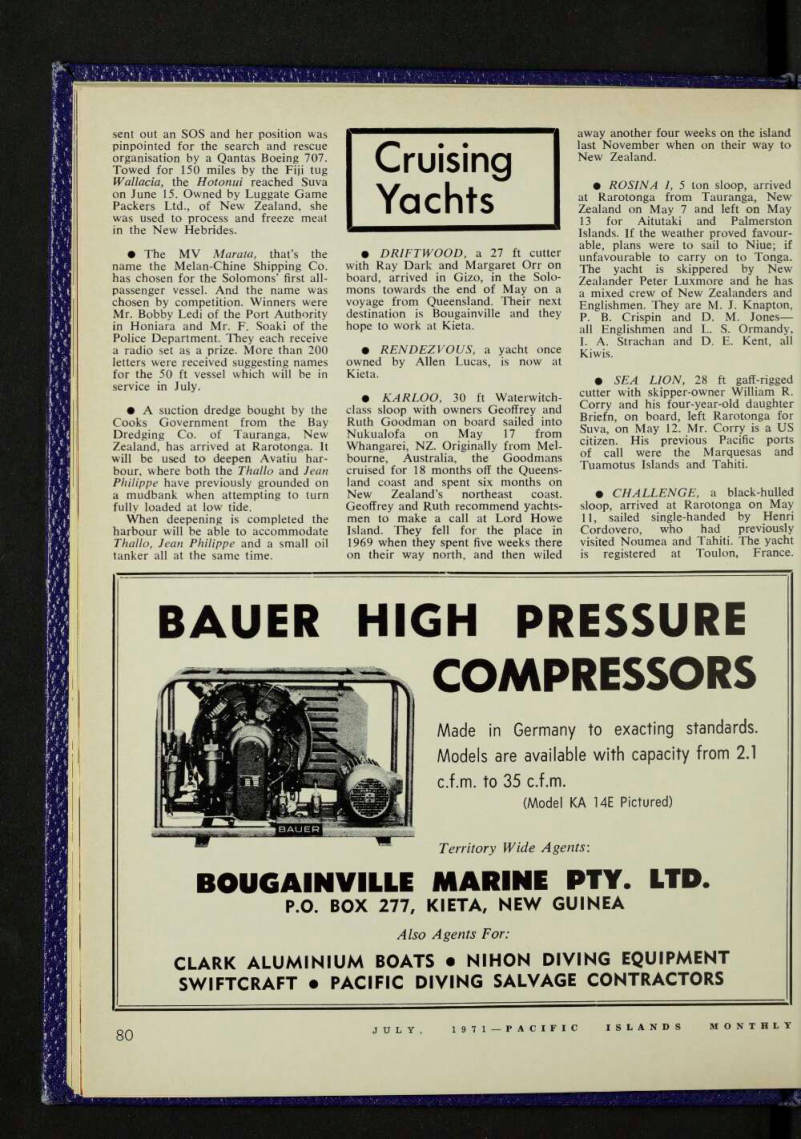
SO far as registration of ships is con cerned, Tonga may become the Liberia of the South Pacific.
According to King Taufa’ahau, several overseas companies had said they wanted to register their ships in Tonga and crew them with Tongans.
Opening parliament in June, the King said that if the Pacific Islands Producers’ Association decided to go ahead with a regional shipping line based on the Tonga Shipping Agency, the kingdom would be ready to enter the project with bigger ships. It was already planning to buy a patrol boat to guard its sea boundaries. • Another move in the Pacific Islands Producers Association’s plan to establish a regional shipping line will be taken soon in Nukualofa.
PIPA’s secretariat in Suva has sent out a circular to the six member governments suggesting a meeting in the Tongan capital of a joint work ing party. If established, the shipping line will be based on the facilities of the Tonga Shipping Agency.
• Vila’s first slipway is ready to take its first craft. The slipway has been built by British Works on Iri riki Island at a cost of about $5,000, and will take vessels up to 36 tons.
Built of concrete, it is 80 ft long and 10 ft wide and has a cradle running on rails. • The Societe Francaise de Navi gation (Sofrana) will launch a new freezer and general cargo service be tween New Zealand and Papua New Guinea ports, via other islands, with the Capitaine Cook. After New Zealand the Capitaine Cook will call at Noumea, Honiara, Port Moresby, Lae, Rabaul and Kieta. • Conpac have reorganised their services from Sydney and Brisbane to Papua New Guinea. The Tenos will now service Lae in place of the Nimos, as she is a larger ship and better equipped to handle all Lae requirements.
The Nimos has been switched to the service terminating at Port Moresby. Her cargo-handling facilities are considered better suited to Port Moresby. • Fiji has two hydrofoils, the first ever seen in the country. They have been bought by Mr. Dick Smith for his Castaway Island resort on the island of Qalito to ferry tourists.
Built in Holland and cruising at 24 knots, the craft can cover the distance from the island to Lautoka in 55 minutes compared with 2\ hours taken by the ketch Seas pray. • The United Nations Food and Agriculture Organisation (FAO) and the Fiji Agriculture Department have chartered a Japanese fishing boat for a tuna fishing feasibility study in Fiji waters. A Fiji crew will be given on the-job training in pole-and-line fishing, a method used by Japanese and Hawaiian skip-jack fisheries. • pie Keia Boat Company, of Mangaia Island in the Cooks, expect delivery from New Zealand about August of a single-screw steel barge which will be used for the lighterage of pineapple cargoes at Mangaia.
The barge, 32 ft long with a 12 ft beam, is being built at Whangarei. • A seaman was injured when an explosion in the engine-room of a New Zealand ship, the Hotonui, blew out a crankcase door while the ship was on her way from Noumea to Suva on June 13.
The seaman, John Langi, was later transferred to a Norwegian ore carrier, the Falkinger, and taken to Suva.
With engines crippled, the Hotonui
sent out an SOS and her position was pinpointed for the search and rescue organisation by a Qantas Boeing 707.
Towed for 150 miles by the Fiji tug Wallacia, the Hotonui reached Suva on June 15. Owned by Luggate Game Packers Ltd., of New Zealand, she was used to process and freeze meat in the New Hebrides. • The MV Marata, that’s the name the Melan-Chine Shipping Co. has chosen for the Solomons’ first all passenger vessel. And the name was chosen by competition. Winners were Mr. Bobby Ledi of the Port Authority in Honiara and Mr. F. Soaki of the Police Department. They each receive a radio set as a prize. More than 200 letters were received suggesting names for the 50 ft vessel which will be in service in July. • A suction dredge bought by the Cooks Government from the Bay Dredging Co. of Tauranga, New Zealand, has arrived at Rarotonga. It will be used to deepen Avatiu har bour, where both the Thallo and Jean Philippe have previously grounded on a mudbank when attempting to turn fully loaded at low tide.
When deepening is completed the harbour will be able to accommodate Thallo, Jean Philippe and a small oil tanker all at the same time.
Advertisements & other items, pp. 84-85 (1 item)
Bish Limi
FOR ALL YOUR SHIP REPAIRS
1,--' I .. i i r 11 7: 4 1
CABLES;
"BISHLIMITED"
G.P.O. BOX 172,
SUVA. FIJI ISLANDS.
BISH LIMI
H29BL
(ESTABLISHED 1906)
Works phone: 23021, 23022 22668, 22669, 22660 A/H Workshop: 23021, Manager: 23739 Asst. Man.: 23739
Marine Accessories Co. Pty. Ltd.
"MAKO" MARINE PRODUCTS
EXPORTERS THROUGHOUT THE ISLANDS
"MAKO" NYLON, POLYETHELENE,
KURALON FISH NETS
"ARALDITE" BOAT SHEATHING KITS
"FERROPRO" RUST CONVERTOR
"FERROPRO" COLD GALVANISING
"FERROPRO" META SEAL N.F.
"FERROPRO" LAQUER COATING FOR
BRASS, ALUMINIUM, COPPER, CHROME
"FERROPRO" ANTI-FUNGICIDAL AND
FLUORESCENT PAINTS
"ALSAFE" LIFEJACKETS, BUOYANCY VESTS
"SOILAX" BILGE CLEANERS
AZLON NYLON FISHING LINES
"CHANDLERY" ALL YACHT, PLEASURE CRAFT,
AND SHIPS CHANDLERY
Please write and we will forward you our full catalogue on all stocks available.
Marine Accessories Co. Pty. Ltd.
c/- P.O. BOX 112, GLEBE, N.S.W., 2037
CABLE ADDRESS: "MAKO" SYDNEY
Cruising
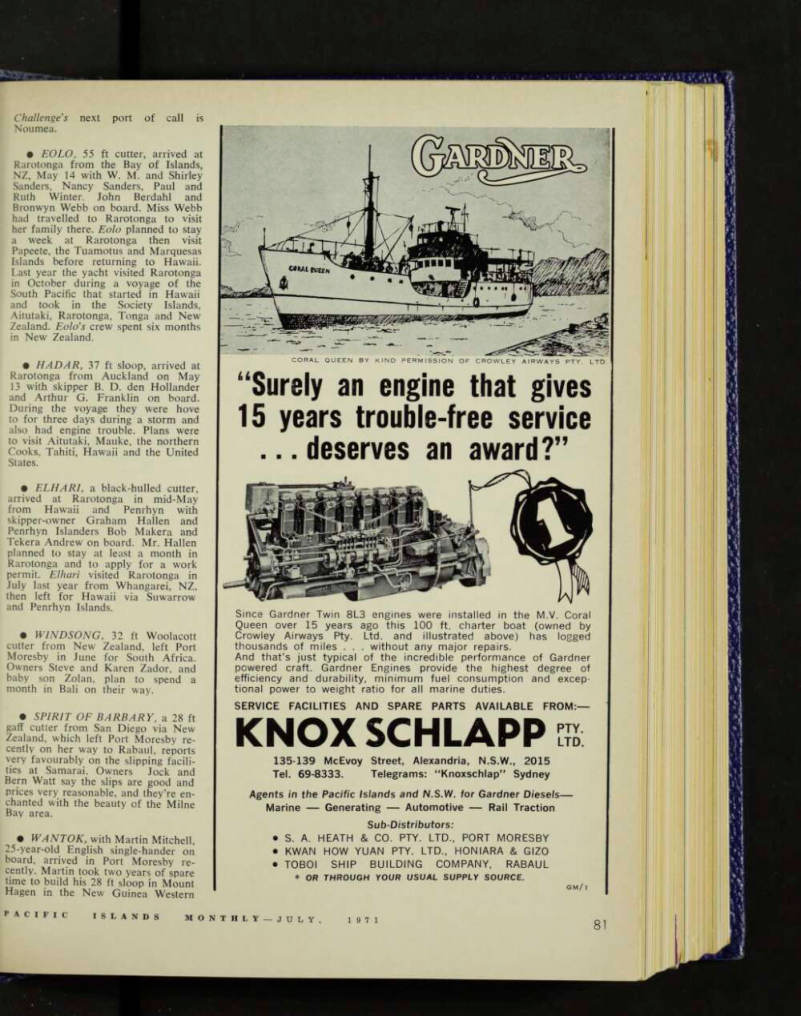
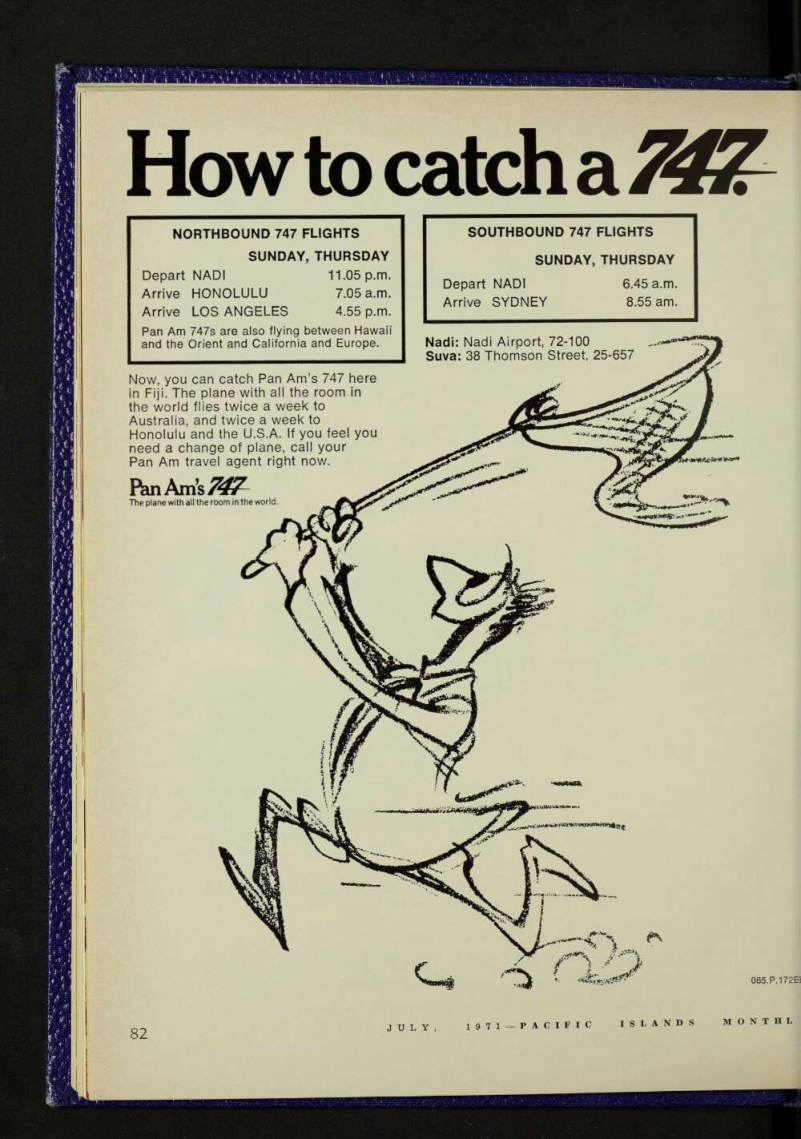
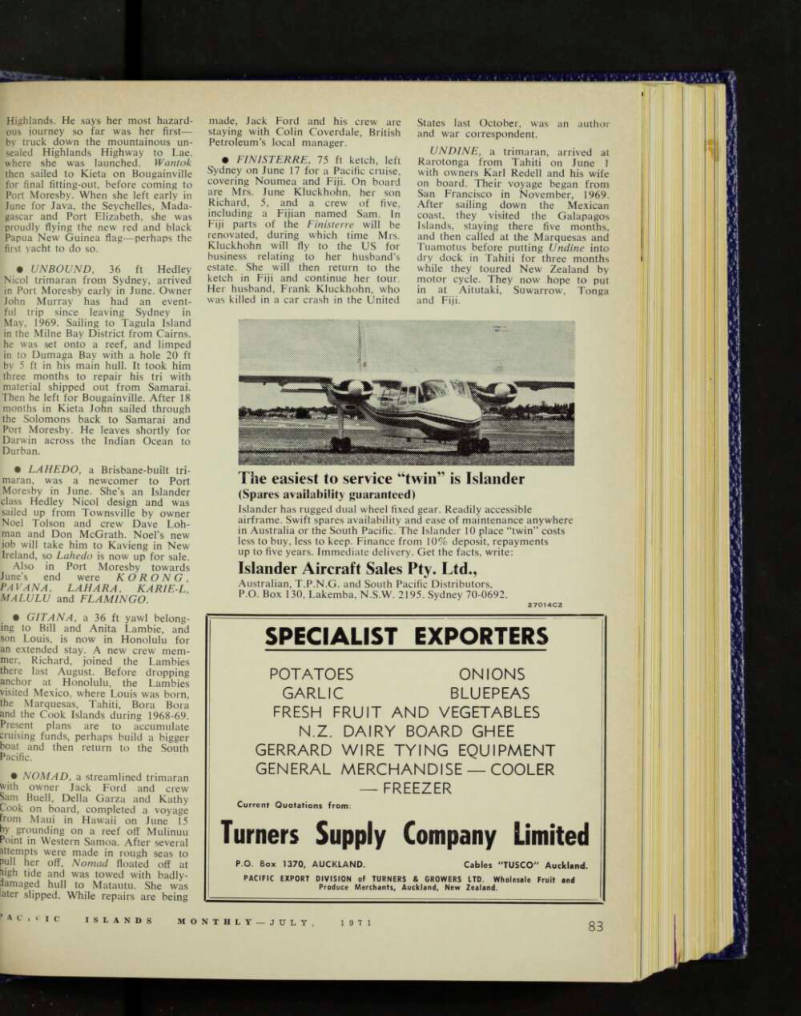
Yachts
• DRIFTWOOD, a 27 ft cutter with Ray Dark and Margaret Orr on board, arrived in Gizo, in the Solo mons towards the end of May on a voyage from Queensland. Their next destination is Bougainville and they hope to work at Kieta. • RENDEZVOUS, a yacht once owned by Allen Lucas, is now at Kieta. • KARLOO, 30 ft Waterwitch class sloop with owners Geoffrey and Ruth Goodman on board sailed into Nukualofa on May 17 from Whangarei, NZ. Originally from Mel bourne, Australia, the Goodmans cruised for 18 months off the Queens land coast and spent six months on New Zealand’s northeast coast.
Geoffrey and Ruth recommend yachts men to make a call at Lord Howe Island. They fell for the place in 1969 when they spent five weeks there on their way north, and then wiled
away another four weeks on the island last November when on their way to New Zealand. • ROSIN A 1, 5 ton sloop, arrived at Rarotonga from Tauranga, New Zealand on May 7 and left on May 13 for Aitutaki and Palmerston Islands. If the weather proved favour able, plans were to sail to Niue; if unfavourable to carry on to Tonga.
The yacht is skippered by New Zealander Peter Luxmore and he has a mixed crew of New Zealanders and Englishmen. They are M. I. Knapton, P. B. Crispin and D. M. Jones— all Englishmen and L. S. Ormandy, I. A. Strachan and D. E. Kent, all Kiwis. • SEA LION, 28 ft gaff-rigged cutter with skipper-owner William R.
Corry and his four-year-old daughter Briefn, on board, left Rarotonga for Suva, on May 12. Mr. Corry is a US citizen. His previous Pacific ports of call were the Marquesas and Tuamotus Islands and Tahiti. • CHALLENGE, a black-hulled sloop, arrived at Rarotonga on May 11, sailed single-handed by Henri Cordovero, who had previously visited Noumea and Tahiti. The yacht is registered at Toulon, France.
Challenge’s next port of call is Noumea. • EOLO, 55 ft cutter, arrived at Rarotonga from the Bay of Islands, NZ, May 14 with W. M. and Shirley Sanders, Nancy Sanders, Paul and Ruth Winter. John Berdahl and Bronwyn Webb on board. Miss Webb had travelled to Rarotonga to visit her family there. Eolo planned to stay a week at Rarotonga then visit Papeete, the Tuamotus and Marquesas Islands before returning to Hawaii.
Last year the yacht visited Rarotonga in October during a voyage of the South Pacific that started in Hawaii and took in the Society Islands, Aitutaki, Rarotonga, Tonga and New Zealand. Eolo’s crew spent six months in New Zealand. • HADAR, 37 ft sloop, arrived at Rarotonga from Auckland on May 13 with skipper B. D. den Hollander and Arthur G. Franklin on board.
During the voyage they were hove to for three days during a storm and also had engine trouble. Plans were to visit Aitutaki, Mauke, the northern Cooks, Tahiti, Hawaii and the United States. • ELHARI, a black-hulled cutter, arrived at Rarotonga in mid-May from Hawaii and Penrhyn with skipper-owner Graham Hallen and Penrhyn Islanders Bob Makera and Tekera Andrew on board. Mr. Hallen planned to stay at least a month in Rarotonga and to apply for a work permit. Elhari visited Rarotonga in July last year from Whangarei, NZ, then left for Hawaii via Suwarrow and Penrhyn Islands. • WINDSONG, 32 ft Woolacott cutter from New Zealand, left Port Moresby in June for South Africa.
Owners Steve and Karen Zador, and baby son Zolan, plan to spend a month in Bali on their way. • SPIRIT OF BARB ARY, a 28 ft gaff cutter from San Diego via New Zealand, which left Port Moresby re cently on her way to Rabaul, reports very favourably on the slipping facili ties at Samarai. Owners Jock and Bern Watt say the slips are good and prices very reasonable, and they’re en chanted with the beauty of the Milne Bay area. • WANTOK, with Martin Mitchell, 25-year-old English single-hander on board, arrived in Port Moresby re cently. Martin took two years of spare time to build his 28 ft sloop in Mount Hagen in the New Guinea Western
Highlands. He says her most hazard ous journey so far was her first— by truck down the mountainous un sealed Highlands Highway to Lae. where she was launched. Wantok then sailed to Kieta on Bougainville for final fitting-out, before coming to Port Moresby. When she left early in June for Java, the Seychelles, Mada gascar and Port Elizabeth, she was proudly flying the new red and black Papua New Guinea flag—perhaps the first yacht to do so. • UNBOUND, 36 ft Hedley Nicol trimaran from Sydney, arrived in Port Moresby early in June. Owner John Murray has had an event ful trip since leaving Sydney in May, 1969. Sailing to Tagula Island in the Milne Bay District from Cairns, he was set onto a reef, and limped in to Dumaga Bay with a hole 20 ft by 5 ft in his main hull. It took him three months to repair his tri with material shipped out from Samarai.
Then he left for Bougainville. After 18 months in Kieta John sailed through the Solomons back to Samarai and Port Moresby. He leaves shortly for Darwin across the Indian Ocean to Durban. • LAHEDO, a Brisbane-built tri maran, was a newcomer to Port Moresby in June. She’s an Islander class Hedley Nicol design and was sailed up from Townsville by owner Noel Tolson and crew Dave Toll man and Don McGrath. Noel’s new job will take him to Kavieng in New Ireland, so Lahedo is now up for sale.
Also in Port Moresby towards June’s end were KORO N G ,
P Avan A, Lahara, Karie-L,
Malulu And Flamingo.
• GIT AN A, a 36 ft yawl belong ing to Bill and Anita Lambie, and son Louis, is now in Honolulu for an extended stay. A new crew mem mer, Richard, joined the Lambies there last August. Before dropping anchor at Honolulu, the Lambies visited Mexico, where Louis was born, the Marquesas, Tahiti, Bora Bora and the Cook Islands during 1968-69.
Present plans are to accumulate cruising funds, perhaps build a bigger boat and then return to the South Pacific. • NOMAD, a streamlined trimaran with owner Jack Ford and crew Sam Buell, Della Garza and Kathy Cook on board, completed a voyage from Maui in Hawaii on June 15 by grounding on a reef off Mulinuu Point in Western Samoa. After several attempts were made in rough seas to pull her off, Nomad floated off at high tide and was towed with badly- Jamaged hull to Matautu. She was later slipped. While repairs are being
made, Jack Ford and his crew are staying with Colin Coverdale, British Petroleum’s local manager. • FINISTERRE, 75 ft ketch, left Sydney on June 17 for a Pacific cruise, covering Noumea and Fiji. On board are Mrs. June Kluckhohn, her son Richard, 5, and a crew of five, including a Fijian named Sam. In Fiji parts of the Finisterre will be renovated, during which time Mrs.
Kluckhohn will fly to the US for business relating to her husband’s estate. She will then return to the ketch in Fiji and continue her tour.
Her husband, Frank Kluckhohn, who was killed in a car crash in the United
States last October, was an author and war correspondent.
UNDINE, a trimaran, arrived at Rarotonga from Tahiti on June 1 with owners Karl Redell and his wife on board. Their voyage began from San Francisco in November, 1969.
After sailing down the Mexican coast, they visited the Galapagos Islands, staying there five months, and then called at the Marquesas and Tuamotus before putting Undine into dry dock in Tahiti for three months while they toured New Zealand by motor cycle. They now hope to put in at Aitutaki, Suwarrow. Tonga and Fiji.
Advertisements & other items, pp. 86-90 (3 items)
Compressors
BAUER HIGH PRESSURE
UVy Made in Germany to exacting standards.
Models are available with capacity from 2.1 c.f.m. to 35 c.f.m. (Model KA 14E Pictured) Territory Wide Agents :
BOUGAINVILLE MARINE PTY. LTD.
P.O. BOX 277, KIETA, NEW GUINEA
Also Agents For: CLARK ALUMINIUM BOATS • NIHON DIVING EQUIPMENT
SWIFTCRAFT • PACIFIC DIVING SALVAGE CONTRACTORS
• • * •• CORAL QUEEN BY KIND PERMISSION OF CROWLEY AIRWAYS PTY, LTD
“Surely an engine that gives
IS years trouble-free service
... deserves an award?”
i X mm Ml ■■ ■ m m Since Gardner Twin BL3 engines were installed in the M.V. Coral Queen over 15 years ago this 100 ft. charter boat (owned by Crowley Airways Pty. Ltd. and illustrated above) has logged thousands of miles . . . without any major repairs.
And that's just typical of the incredible performance of Gardner powered craft. Gardner Engines provide the highest degree of efficiency and durability, minimum fuel consumption and exceptional power to weight ratio for all marine duties.
SERVICE FACILITIES AND SPARE PARTS AVAILABLE FROM:—
KNOX SCHLAPP rs
135-139 McEvoy Street, Alexandria, N.S.W., 2015 Tel. 69-8333. Telegrams: “Knoxschlap” Sydney Agents in the Pacific Islands and N.S.W. for Gardner Diesels — Marine Generating Automotive Rail Traction Sub-Distributors: • S. A. HEATH & CO. PTY. LTD., PORT MORESBY • KWAN HOW YUAN PTY. LTD., HONIARA & GIZO
• TOBOI SHIP BUILDING COMPANY, RABAUL
* OR THROUGH YOUR USUAL SUPPLY SOURCE. gm/i
How to catch a 74Z
NORTHBOUND 747 FLIGHTS
SUNDAY, THURSDAY
Depart NADI 11.05 p.m.
Arrive HONOLULU 7.05 a.m.
Arrive LOS ANGELES 4.55 p.m.
Pan Am 747 s are also flying between Hawaii and the Orient and California and Europe.
SOUTHBOUND 747 FLIGHTS
SUNDAY, THURSDAY
Depart NADI 6.45 a.m.
Arrive SYDNEY 8.55 am.
Nadi: Nadi Airport, 72-100 Suva: 38 Thomson Street, 25-657 Now, you can catch Pan Am’s 747 here in Fiji. The plane with all the room in the world flies twice a week to Australia, and twice a week to Honolulu and the U.S.A. If you feel you need a change of plane, call your Pan Am travel agent right now.
ftuiAm’s 747-
The plane with all the room inlhe world.
“'■‘rf-S \ N fi ■s 065.P.172E
i|p JR m The easiest to service “twin” is Islander
(Spares availability guaranteed)
Islander has rugged dual wheel fixed gear. Readily accessible airframe. Swift spares availability and ease of maintenance anywhere in Australia or the South Pacific. The Islander 10 place “twin” costs less to buy, less to keep. Finance from 10% deposit, repayments up to five years. Immediate delivery. Get the facts, write:
Islander Aircraft Sales Pty. Ltd.,
Australian, T.P.N.G. and South Pacific Distributors, P.O. Box 130, Lakemba, N.S.W. 2195. Sydney 70-0692. 27014C2
SPECIALIST EXPORTERS
POTATOES ONIONS
GARLIC BLUEPEAS
FRESH FRUIT AND VEGETABLES
N.Z. DAIRY BOARD GHEE
GERRARD WIRE TYING EQUIPMENT
GENERAL MERCHANDISE COOLER
FREEZER
Current Quotations from;
Turners Supply Company Limited
P.O. Box 1370, AUCKLAND. Cables "TUSCO" Auckland.
PACIFIC EXPORT DIVISION of TURNERS & GROWERS LTD. Wholesale Fruit and Produce Merchants, Auckland, New Zealand.
; t A r r 2571 A mm A wmm, * 1 i !^
CON 20.87
Two vital commodities in building the Territory.
Caterpillar Tractors and fresh meat.. . typical examples of the variety of cargo which Conpac carries from Australia to Papua/New Guinea. Conpac is equipped to carry all kinds of cargo safely and surely.
From refrigerators to precious pottery . . . galvanised iron to steel girders. Conpac offers you the safety, convenience and flexibility of containers, refrigerated containers, pallets or flats. Why not try Conpac next time you import cargo from Australia. Contact your local Conpac Agent for details of sailing dates.
Conpac’s regular sailing schedule from Australia:
M.V. NIMOS M.V. TENOS M.V. DELOS
Sydney, Brisbane to Sydney, Brisbane, Adelaide, Melbourne.
Port Moresby every to Lae every Sydney to Lae and 18 days. 19 days. Madang every 44 days.
CONTRINERS PRCIFIC EXPRESS LINE
A joint enterprise of Burns Philp and Australia West Pacific Line.
SYDNEY: 7 Bridge Street, Telephone 2 0547.
BRISBANE: 133 Mary Street, Telephone 31 0391.
MELBOURNE: 340 Collins Street, Telephone 67 8941.
ADELAIDE; Dalgety Australia Ltd., 35 Baker Street, Pt. Adelaide. Telephone 47 5655.
PORT MORESBY: Musgrave Street, Telephone 2369.
LAE: Macdhui Street, Telephone 2269. iiAHAur. + Awoniio Tolonhnno 9093
82
JULY, 1971-PACIFIC ISLANDS MONTHL
83
*ACi « I C ISLANDS MONTHLY JULY, 1971
Business and Development
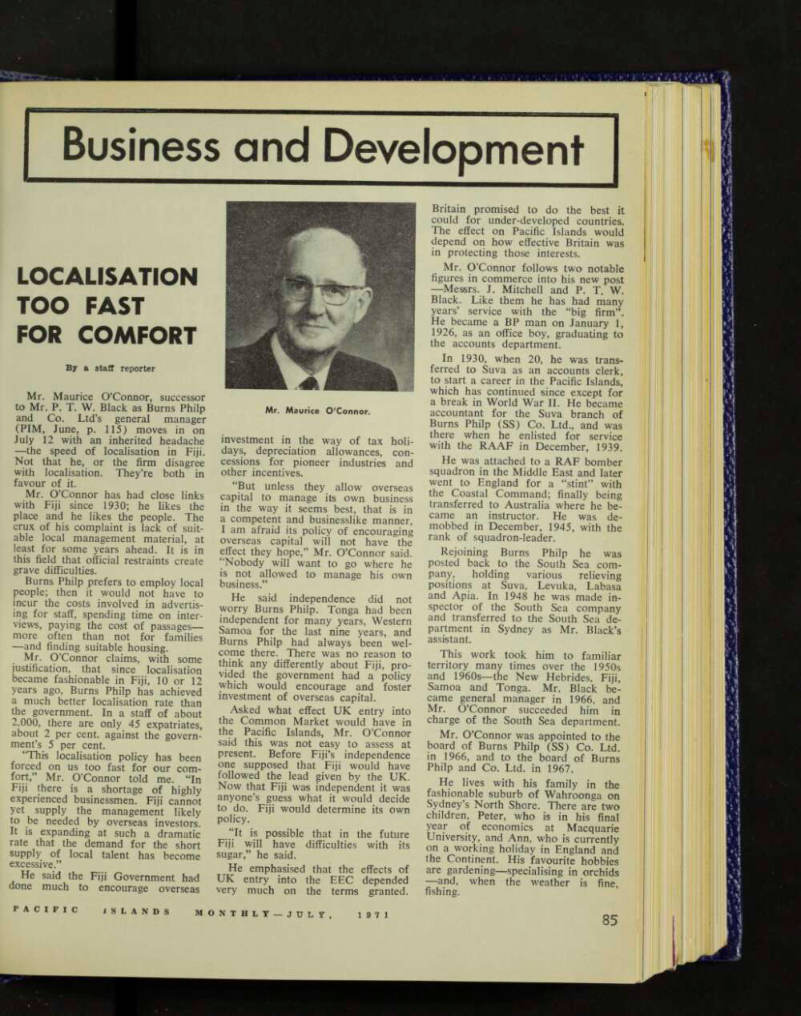
Localisation
Too Fast
For Comfort
By a staff reporter
Mr. Maurice O’Connor, successor to Mr. P. T. W. Black as Burns Philp and Co. Ltd’s general manager (PIM, June, p. 115) moves in on July 12 with an inherited headache —the speed of localisation in Fiji.
Not that he, or the firm disagree with localisation. They’re both in favour of it.
Mr. O’Connor has had close links with Fiji since 1930; he likes the place and he likes the people. The crux of his complaint is lack of suit able local management material, at least for some years ahead. It is in this field that official restraints create grave difficulties.
Burns Philp prefers to employ local people; then it would not have to incur the costs involved in advertis ing for staff, spending time on inter views, paying the cost of passages— more often than not for families —and finding suitable housing.
Mr. O’Connor claims, with some justification, that since localisation became fashionable in Fiji, 10 or 12 years ago. Burns Philp has achieved a much better localisation rate than the government. In a staff of about 2,000, there are only 45 expatriates, about 2 per cent, against the govern ment’s 5 per cent.
“This localisation policy has been forced on us too fast for our com fort,” Mr. O’Connor told me. “In Fiji there is a shortage of highly experienced businessmen. Fiji cannot yet supply the management likely to be needed by overseas investors.
It is expanding at such a dramatic rate that the demand for the short supply of local talent has become excessive.”
He said the Fiji Government had done much to encourage overseas
investment in the way of tax holi days, depreciation allowances, con cessions for pioneer industries and other incentives.
“But unless they allow overseas capital to manage its own business in the way it seems best, that is in a competent and businesslike manner, I am afraid its policy of encouraging overseas capital will not have the effect they hope,” Mr. O’Connor said.
“Nobody will want to go where he is not allowed to manage his own business.”
He said independence did not worry Burns Philp. Tonga had been independent for many years, Western Samoa for the last nine years, and Burns Philp had always been wel come there. There was no reason to think any differently about Fiji, pro vided the government had a policy which would encourage and foster investment of overseas capital.
Asked what effect UK entry into the Common Market would have in the Pacific Islands, Mr. O’Connor said this was not easy to assess at present. Before Fiji’s independence one supposed that Fiji would have followed the lead given by the UK.
Now that Fiji was independent it was anyone’s guess what it would decide to do. Fiji would determine its own policy.
“It is possible that in the future Fiji will have difficulties with its sugar,” he said.
He emphasised that the effects of UK entry into the EEC depended very much on the terms granted.
Britain promised to do the best it could for under-developed countries.
The effect on Pacific Islands would depend on how effective Britain was in protecting those interests.
Mr. O’Connor follows two notable figures in commerce into his new post —Messrs. J. Mitchell and P. T. W.
Black. Like them he has had many years’ service with the “big firm”.
He became a BP man on January 1, 1926, as an office boy, graduating to the accounts department.
In 1930, when 20, he was trans ferred to Suva as an accounts clerk, to start a career in the Pacific Islands, which has continued since except for a break in World War 11. He became accountant for the Suva branch of Burns Philp (SS) Co. Ltd., and was there when he enlisted for service with the RAAF in December, 1939.
He was attached to a RAF bomber squadron in the Middle East and later went to England for a “stint” with the Coastal Command; finally being transferred to Australia where he be came an instructor. He was de mobbed in December, 1945, with the rank of squadron-leader.
Rejoining Burns Philp he was posted back to the South Sea com pany, holding various relieving positions at Suva, Levuka, Labasa and Apia. In 1948 he was made in spector of the South Sea company and transferred to the South Sea de partment in Sydney as Mr. Black’s assistant.
This work took him to familiar territory many times over the 1950 s and 1960 s—the New Hebrides, Fiji, Samoa and Tonga. Mr. Black be came general manager in 1966, and Mr. O’Connor succeeded him in charge of the South Sea department.
Mr. O’Connor was appointed to the board of Burns Philp (SS) Co. Ltd. in 1966, and to the board of Burns Philp and Co. Ltd. in 1967.
He lives with his family in the fashionable suburb of Wahroonga on Sydney’s North Shore. There are two children, Peter, who is in his final year of economics at Macquarie University, and Ann, who is currently on a working holiday in England and the Continent. His favourite hobbies are gardening—specialising in orchids —and, when the weather is fine, fishing.
Mr. Maurice O'Connor.
Advertisements & other items, p. 92 (1 item)
Lightburn
announce the appointment of
PTY. LIMITED
■ w
as their agents for
ii 4
THE PACIFIC ISLANDS
Si ii & mm Lightburn Products Ltd., long established South Australian manufacturers, are pleased to announce the appointment of Kerr Brothers Pty. Limited, 65 York St„ Sydney, N.S.W., as their Agents for the Pacific Islands.
Over the past 60 years, Kerr Brothers have built up an unparalleled reputation for service throughout the Pacific Islands. They will now be in a position to offer immediate delivery of the complete range of Lightburn products . . . concrete mixers, hydraulic jacks, electric power tools and electric washing machines.
Due to the high standard of their engineering and their outstanding reliability, these Lightburn products are being exported in ever increasing volume to over 70 countries.
LIGHTBURN
Exporters to over 70 Countries FOR FURTHER INFORMATION OR SUPPLIES CONTACT KERR BROTHERS PTY. LIMITED, 65 YORK ST, SYDNEY, N.S.W. 2000
Fiji Dreams, And

The Best Of
British Luck
By Judy Tudor
The most popular thing to have in Fiji at the present time is a feasibility study. No day seems to pass without news of another economic dream get ting the treatment, and just about everything from whether Fiji should have a wood-chip industry to the possibility of a new daily newspaper is . being put under the economic microscope.
Ideas are a dime a dozen and there always seems to be some international Big Daddy with the will and the wherewithal to come forward and pay for it.
Just about the only thing about which there isn’t a feasibility study (sometimes it’s in the minor league and called a plain “study”) is feasi bility studies. Studying on those is left to cynics like me and at the moment I’m in the right mood for it.
I’ve spent the last two weeks col lecting material for the Fiji section of the next edition of the Pacific Islands Year Book, in the course of which I’ve revisited every government department that I visited three years ago. on the same chore, to check on what’s been going on in the interval.
It’s a salutary experience to find out how many schemes of the sixties have faded out or failed to come up to expectations in the seventies; how the once traditional export crops (al ways excepting sugar) have remained static or declined; and how, as a con sequence, the prices of locally produced items have now soared up into the stratosphere with a parallel demand for rises in wages and salaries. .We can start with the once-famous Fiji banana, which according to ancient history back in the days when its culture was in the hands of Euro peans, once reached an export total of 800,000 cases in one year. Even in 1956, when the industry had long been turned over to mainly Fijian growers, 257,000 cases were exported and, two years later, when New Zea land sought to restrict Fiji banana imports to a quota of 180,000-200,000
cases a year, there were screams of anguish from all up and down the Rewa River system where over 80 per cent, of the crop is still grown.
They were premature screams. Not once since has Fiji looked like get ting near the NZ quota. In 1969, 89.000 cases were exported and in 1970, 79,500 cases.
One reason for the decline is the disease called Black Leaf Streak, which can be controlled by spraying at regular intervals. This is most effi ciently done when the plants are grown, plantation fashion, and can be easily got at. In spite of some effort, the bulk of Fiji bananas are still grown village fashion, in clumps, on river banks and higgeldy-piggeldy, where you will.
Spraying under these circumstances is usually neglected and so is fertiliser —unless the government makes loans or subsidies to pay for it.
Now let’s take coconuts. About 50 per cent, of Fiji copra comes from native groves. To anyone brought up in the big-plantation tradition of New Guinea or the Solomon Islands, these plantations were something of a night mare—trees at all angles, in a tangle frorn nuts that sprouted where they fell into the great masses of under growth that were allowed to grow up unchecked.
In 1963 the government started in to do something about it with the aid of the generous British taxpayer who financed a subsidy scheme. There were subsidies for clearing undergrowth, subsidies for replanting areas so cleared, and subsidies for new planted areas. In all, something like $2 m. was expended on these subsidies, 113,000 acres thinned out and 66,000 acres of new coconut planting completed.
So far, very good. But by 1969 the scheme was drawing to a close and so the Department of Agriculture’s scribe records in the annual report for 1969, issued m 1970—and more in sorrow than in anger I fancy— “ With the termination of new rehabili tation and planting work under the coconut subsidy scheme, there has been a very considerable decline in this work . . . This is disappointing.
Equally disappointing has been the lack of interest in maintaining plan tations once subsidy payment for this ceases . . .”
It is too soon yet to see any result from the plantings that were made during the subsidy boom, though something should be showing up in 1972 and thereafter. Meantime, in its new Five-Year Plan, Fiji intends to have a subsidy scheme financed by itself and optimistically calculates that 48.000 tons p.a. will be produced in 1975.
Well, the best of British luck to them. They’ll need it—copra produc
tion in 1969 was 33,089 tons and in 1970, 27,989 tons.
Cocoa which, way back a decade ago, was the bright diversification hope, now barely gets a mention ex cept by the Department of Agricul ture which notes that, “present policy is to encourage only those growers who show genuine interest”, and goes on to report on the “rehabilitation of overgrown plantations” and that only one half of plantations in Central Division “receive regular mainten ance”. Exports in 1968 were I\\ tons; in 1969, 46 tons.
Until 1967 there were two butter factories in Fiji and at one time they produced more butter than could be absorbed.
When one factory closed, all cream was diverted to the other and pro duction continued at seemingly the same level. However, Australian and New Zealand butter was still available although real patriots insisted on buy ing the local brand.
Then came the strike of a few weeks back, and to everyone’s con sternation supplies of local butter dried up like everything else—so the horrible secret was out. Patriots learned that the Fiji butter that they insisted on buying was, in fact, blended—that of the 1,764,208 lb of butter that bore the local brand last year, over half of it was New Zealand butter brought in in bulk and mixed.
For some reason this fact appears to have dented Kai Viti amour propre more than any other single economic event in a decade.
One reason for the fall-off in local butter production is that milk con sumption, since the introduction of the homogenised milk plant, has in creased—from 469,200 gallons in 1969 to 536,869 gallons in 1970.
Under existing circumstances it is im possible to have both milk and butter.
One could go on endlessly mulling over the agricultural projects, major and minor, that remain experimental, meet disaster or unaccountably shrink.
But, in a sentence, it is quite clear that, apart from sugar, any natural increase in production of many commodities is being taken up by the increase in population, by the shift of many people from village economy to a wage economy, and by tourism.
Although family planning is one of the real success stories of Fiji, the population increased from 476,737 at the 1966 census to an estimated 524,457 at the end of 1970, and that’s still nearly 48,000 more mouths.
The drift of people from village life into such industries as tourism, not only removes them from producing for export along traditional lines, it also usually results in their turn ing to store food for sustenance.
Continued over page
Along this gimmicky-named Coral Coast where tourism has boomed, the villagers, who once spent a lot of their time fishing and gardening, now find easier ways of earning cash with the result that they too go to Sigatoka market for fruit, vegetables and fish and to the stores for imported items.
The dock strike did more than show people where the butter came from; it showed just how much this small country depends on outside countries for its food, food moreover that is grown and produced by European high-cost labour.
The government, in a panic and quite unnecessarily, hopped in and slapped price control on such basic items as flour, sharps and rice.
No effort was made to control the prices of much of the locally-produced food and even on Sydney standards these are astronomical.
Eggs, for example, were selling in the Sigatoka market for $1 a dozen; BPs had a few at 85c a dozen and there were queues for those.
The story here is that during the strike supplies of imported poultry mash dried up and the hens refused to do their stuff on anything grown locally. With all due respect to inter national economists and local egg pro ducers, it seems to me that if the whole egg production business of Fiji depends on importing laying mash from Australia and New Zealand, it would be better to import the eggs from NZ, where local farmers can produce cheaper than anywhere else in the world, and let the people in Fiji who now tend hens be employed growing something like dalo which is currently selling at from 40c to 50c for three.
On the sunny side of the gloomy agriculture picture there is always sugar. Sugar, to the people who grow it, still mostly Indians, is a way of life as much as a crop. There is no problem in getting it grown, it is in grained in them, to the extent that no other crop is of interest —as was proved some years back when CSR Co. shut down its Nausori mill. It was hoped then that the people who had been growing sugar for the mill would grow rice instead. They didn’t. They either went elsewhere and grew sugar or went to Suva and worked for wages. .
But right now Fiji is right up to its international quota of of 341,000 tons p.a. and there is little room for manoeuvre. At the same time there are so many question marks about Fiji’s sugar in particular and Commonwealth sugar in general that it deserves a story on its own.
On the credit side of the general Fiji economy are the many small and a few large secondary industries that
have sprung up in recent years; and, lastly, but most important of all, that glamorous milch cow that gives golden liquid in the form of tourist dollars.
I have never understood how tour ist profitability is calculated, but I am assured that, in 1970, tourism con tributed S23m. to Fiji’s economy— which makes it more profitable than copra, coconut oil, bananas, fish and gold combined.
In the last few years dozens of small industries and some large ones have started in Fiji. Aluminium doors and screens, plastic clothes pegs, barbed wire, umbrellas, matches—the list is endless and is being added to each week, all with the idea of cutting down on imports.
But has it? The total tentative im ports bill for 1970 is sBBm. —which means that it has increased over 75 per cent, since 1966. In the same period, the population has increased only 10 per cent., so obviously the rest must be going on more luxuries for everyone, a higher standard of living, inflation, or on tourism— —building materials for hotels, special food, goods to pamper tourist, like duty-free radios, cameras, watches, etc. In the same period exports have risen, in value, by 50 per cent., all of the increase accounted for by sugar and frozen fish from the Levuka depot of an Asian-manned tuna-fishing en terprise.
Balancing plans and performances against each other, many people wonder whether Fiji has its priorities right. Whether it mightn’t be better to let Australia go on supplying the plas tic clothes pegs, Hong Kong the umbrellas, Bryant and May the matches, and other industrialised nations a dozen other commodities, while Fiji gets back to producing more for export or simply in order to eat cheaper at home.
It can be said, of course, that the people who make pegs or matches iren’t likely to be planting coconuts inyhow; that the import bill would be ligher without their efforts; and that many young Fijians—and who can Plame them—find it infinitely more to heir taste to play a guitar in a band >r work as a waiter or bartender in i hotel than slave in the village garden
Wanting tapioca.
But that isn’t the argument. The irgument is that imports are increas ng so much faster than exports and hat even when the invisible export )f tourism is added to the actual exports, there still is a trade deficit.
The businesses of trade and produc ion for home consumption are inter ocking items, part of an array of undamental problems that are too fequently blanketed from view by
a whole flock of new plans, new studies and grandiose dreams.
Certainly, since independence, Fiji has been pushed into a political lifestyle more fitting for a country 20 times its size and 10 times its efficiency and while outside capital keeps coming in to build new hotels and new resorts, this artificial level of circulating money appears to support it.
But should the tourist industry reach a point where it becomes static or no fresh infusions of funds are made, it is anyone’s guess what fiscal measures in new taxes, restrictions and penalties might then present them selves as the only way out.
Right now, Fiji has three big fin-
ance problems coming up—the Nadi- Suva road, the sixth Five-Year Plan and purchase of the sugar industry, The Minister for Finance is at pre sent in the United States with his en tourage arranging for a World Bank loan to seal and rebuild the two end sections of the road (the middle, and worst section, Korotogo to Deuba, must await another day); he will then go on to Europe to arrange loans in connection with the new Five-Year Plan. j n 1973 the government must start paying the Cofonial Suear Refining was handed to them on a platter, at bargain rates, but it still runs into
millions of dollars.
Fiji’s independent and feeling her oats and I wished her the best of British luck some time back. I amend that—the best of any kind of luck. I think she’s going to need it.
FOOTNOTE; The most going con cern that I’ve found in Fiji is the National Provident Fund. It got go ing only in 1966 and is financed by a compulsory levy of 10c on each dollar of wages or salary earned —contributed on a 50-50 basis by employer and employee. It is primarily designed to give workers a lump sum at retire ment aged 55.
The fund has built itself elegant offices on the outskirts of Suva and has in its kitty as of now $l4 million, which it invests in Fiji. Naturally it is
the very favourite step-child of gov ernment which makes full use of this facility; and of those private interests who are also in the market for money and who are able to convince the Fund’s Board that they are worthy of assistance. • Five new companies were registered in Fiji at the end of May.
They were, Navava Properties Inc., of Tacoma, Washington, real estate; Western Tobacco Co. Ltd., producers and manufacturers of tobacco pro ducts; Ba Rock and Concrete Pro duction Ltd., manufacurers of con crete blocks; Asha Investments Ltd., of Lautoka; Monier Tiles Ltd., manu facturer and supplier of concrete roofing and floor tiles.
Advertisements & other items, pp. 94-96 (2 items)
Kahlaiuoer
WINE
INVESTMENT
This is a once-in-a-lifetime opportunity to join the booming Australian Wine Industry.
A valuable 106-acre freehold property, centred in one of Australia’s top vine growing areas, McLaren Vale, South Australia, is being offered for sale.
This property includes a threebedroom house, extensive plant and equipment, and would be ideal for the establishment of a winery.
There are 30 acres currently under vines, five acres cleared for planting, four acres of almonds and the remainder virgin soil.
Priced at $71,250 this property offers an excellent profitability potential.
For further details write to: A. L. Powell & Co., Solicitors, 406 Lonsdale Street, Melbourne, Vic, 3000; or Griffin, Hume & Co., Solicitors,
G.P.O. Box 356 D,
Adelaide, S.A. 5001.
(AP.B.S]
INVEST AT
6i?« P.A.
IN THE
AUSTRALASIAN
PERMANENT BUILDING
SOCIETY LIMITED
NORFOLK ISLAND, SOUTH PACIFIC
For further details and Application Forms please complete this coupon.
Name Address and mail to P.O. Box 150, Norfolk Island. (PIAA)
MORE PORTS / MORE OFTEN
KAHLAIUOER
KARLANDER NEW GUINEA LINE: Serving,- Pt. Moresby, Samarai, Lae, Madang, Rabaul, Wewak, Manus Is., Kieta, Honiara, Yandina, Gizo, Vila, Norfolk Is., and Lord Howe Is.
KARLANDER KANGAROO LINE: Serving; Los Angeles, San Francisco,
Auckland, Melbourne, Suva, Lautoka.
AUSTRALIAN TERRITORY LINER SERVICES; Serving; Melbourne,
Sydney, Newcastle, Brisbane, Weipa, Gove, Thursday Is.
with
Managing Agents
KARLANDER (AUSTRALIA) PTY. LIMITED
19-31 Pitt Street, Sydney
General Agents
Manus Is.: Edgell & Whiteley Ltd.
Rabaul: Rabaul Trading Co. Ltd.
Honiara: E. V. Lawson Pty. Ltd.
Kieta: Breckwoldt & Co. Pty. Ltd.
Lae: N.G.G. Trading Company.
Wewak: Burns Philp (N.G.) Ltd.
Fiii: Burns Philp (S.S.) Ltd.
Gizo: British Solomon Trading Co.
Vila: Burns Philp (N.H.) Ltd.
Norfolk Is.: Burns Philp (S.S.) Ltd.
Brisbane: F. H. Stephens Pty. Ltd.
Melbourne: F. H. Stephens (Vic.) Pty. Ltd.
Pt. Moresby: Carpenter Shipping Agencies.
Samarai: Burns Philp (N.G.) Ltd.
San Francisco: Transpacific Transportation Co.
Los Angeles: Transpacific Transportation Co.
Madang; B. J. Back Pty. Ltd.
Yandina; Levers Pacific Plantations Co. Ltd.
Santo: Burns Philp (N.H.) Ltd.
Lord Howe Is.: R. Wilson, Leanda Lei.
Thursday Is.: Torres Industries Ltd.
a guaranteed
on your investment
THAT’S THE BEAUTY OF JBL SHORT-
TERM REAL ESTATE SYNDICATION.
It’s really very simple □ Invest $2,000 or more in a JBL Syndicate of 20 members □ A trust deed secures your investment □ JBL use this money to erect a new commercial or industrial building □ Then sell it on completion and close the syndicate □ They return your funds plus a profit share guaranteed at 12% P.A. □ JBL Syndication is the SAFE way to invest □ No special skills or personal involvement needed □ And you share in Australia’s commercial growth □ Leader in this field JBL Shareholders funds exceed $2,000,000 □ Syndication funds under management exceed $11,000,000 □ If you want to know more, mail our coupon □.
A
KBHEiaBIIiSfIIHHHIHIIIIII
5 JBL Developments (Old.) Pty. Ltd., II (Syndication Division), 6th Floor, llCommonwealth Bank Building, II King George Square, Brisbane, 4000. >• I H Please send me explanatory literature ■on real estate Syndication p|M 7/7 ,
RIM 7/71
ALSO
SYDNEY
MELBOURNE
AUCKLAND
TOKYO
POSTCODE PHONE
LEADERS IN
REAL
ESTATE
SYNDICATION
Travel or retire
without a care
in the world
With Burns Philp Trustees at your service, getting away for a hardearned rest is easy. No fuss, no worries—simply appoint us to act as your Agents or Attorneys. There's nobody better qualified to handle the day-to-day management of your business, real-estate and other investments and assets. And you'll find nobody to take a more personal and professional interest in your financial affairs.
Then, of course, there are the services we provide to help you do the very most for the security of your family. Services like Will planning; farm, portfolio and business management; action as your Executor. For further information, or for the free (and obligationfree) brochure explaining our services more fully, contact:
BURNS PHILP TRUSTEE COMPANY LIMITED
In Fiji: Mr. A. W. Cooper (Resident Manager), In Papua-New Guinea: Senior Trustee Executives regularly visit main centres.
Write to us at Head Office.
Fiji Board of Directors: Sir Maurice Scott, C.8.E., D.F.C., D. M. N. McFarlane, C.8.E., H. A. Baker.
Fiji Manager: A. W.. Cooper. Fiji Office: Rodwell Road, SUVA. Telephone 2-4661.
Directors: J. D. 0. Burns, P. T. W. Black, E. P. Lee, L. N. Stanford, A. H. E. Furze Managing Director: A. H. E. Furze. Secretary: J. M. MacCallum.
Head Office: 51 Pitt Street, Sydney, Australia, 2000.
Telephone: 241-1021. Telegrams: "BURNSTRUST", Sydney.
Jranch Offices: 446 Collins Street, MELBOURNE. Also Registered Offices at BRISBANE, PORT MORESBY (Papua) and VILA (New Hebrides).
Canberra Agent: BURNS PHILP TRUSTEE COMPANY (CANBERRA) LIMITED, 86 Northbourne Avenue, Canberra City, A.C.T., 2601..
89
ACIFIC ISLANDS MONTHLY JULY, 1971
sugar agreement
Happiness is a sugar agreement
Within a few hours of his return from London in June Fiji’s Primer Minister Ratu Sir Kamisese Mam called a news conference—on the vitae; subject of sugar.
The method of its disposal is fa£ from being understood, or evens vaguely comprehended, by the averag»§ canefarmer.
It was reassuring for them to learn that the Prime Minister was satisfieos with what had been achieved at thd discussions in London between Comrr monwealth sugar-producing countries; and Britain.
Ratu Mara said arrangements ha«n been made to have Fiji’s High Comrr missioner in London accredited tcf the Common Market countries.
“The market for the Commonrn wealth Sugar Agreement countries it assured until 1974—from then on, ww have an assurance that the marker will continue, particularly for deaf veloping Commonwealth the PM said.
“This will be confirmed by joinin;n the Common Market by associatiomc We have from now until 1974 td negotiate the terms of this associo ation”.
While Fiji was assured of a comr tinued market at a satisfactory pries! in the UK for the annual quota co 140.000 tons of sugar, a market fosi the balance of Fiji’s production hac to be found outside the Commomc wealth Sugar Agreement.
Fiji’s sales outside the CSA includb 40.000 tons for the USA, and other sales in Canada, New Zealand, Japans Singapore and Malaysia.
Ratu Mara pointed out that ne T s competition would arise in the likelTs event of Australia being phased out o CSA after 1974.
“It is for this reason that we havrs pressed the EEC to join the sugsg agreement, which provides quotas foi various member countries and woulu provide quotas for EEC memberszi he said. . , ...
Mr. Geoffrey Rippon, Britain s chmr negotiator for membership of thft EEC, impressed Fiji’s Prime Ministeal “Mr. Rippon made it quite clesa that he was fully confident that tHI EEC was sincerely determined t honour the undertakings to the Com monwealth sugar-producing countries but said the British Governmeiai would be prepared, if necessary, 1 use its veto to assure equitable as rangements for marketing our sugsgi in Britain”, Ratu Mara added.
Fiji bauxife find
'most important'
Mining equipment is being installed in preparation for extracting the Savulevu bauxite deposits on Fiji’s island of Vanua Levu. The mine, to be operated jointly by three Japanese companies, has enormous economic importance.
Experts say it is the most impor tant mine opened in Fiji since gold was found at Vatukoula in the 19305.
Shareholders in the locally registered Bauxite Fiji Ltd. are the Nippon Light Metal Co. (with a 50 per cent, holding), Showa Denko Co. (15 per cent.) and Sumitomo Chemical Co. (25 per cent.).
According to their agreement with the Fiji Government they must start exporting the ore from August next year. They will invest $2,500,000 in setting up the mine.
The secretary of Bauxite Fiji Ltd., Mr. Toni Ishikawa, has said that the five million tons of known reserves at Savulevu would be mined at a rate of 250,000 tons a year . . . giving the mine at least 20 years’ life.
But there are complications. Al though the company holds a licence to mine 2,000 acres, it still needs site and road access licences. It also has to complete an agreement with the Native Land Trust Board about the amount of compensation payable to about 10 mataqali landholding units whose land would be affected.
About 70 per cent, of the loan capital for the mining project will :ome from the Overseas Economic Co-Operation Fund, a Japanese Gov jrnment institution, according to Mr. tshikawa.
Lever's trebles profit
Lever’s Pacific Plantations Pty.
Ud. trebled its net profit last calendar 'ear.
The annual accounts of the com pany just released in Sydney show
that the net profit jumped from $57,792 to $188,641 last year.
The big profit increase was after a leap in the depreciation provision from $135,464 to $625,948.
Total shareholder’s funds rose by $191,382 to $2,275,928.
The value in the books of the land and buildings of the company was down by $52,910 to $1,796,429.
The provision for cyclone damage dropped from $61,208 to $45,808.
The company is a subsidiary of Unilever (Commonwealth Holdings) Ltd. It operates plantations in the British Solomon Islands.
Go-ahead for
Pago watch deal
After a host of false starts, American Samoa will be taking ad vantage of federal legislation which allows the free import into the US of goods manufactured in the terri tory, Bulova Watch Company has leased land and will begin construction shortly on an assembly plant which will be the first building in a new industrial park which the American Samoan Government is developing near the airport at Tafuna.
Under the law, which has been used successfully in the Virgin Islands and Guam, parts can be im ported to American Samoa for assembly. If the money spent on local labour enhances the value of the parts by a certain percentage the finished project can be shipped to the US free of duty.
Bulova and Samoa negotiated with the US Commerce Department and secured an allocation which will allow free admission to 205,000 watches to the US this year. Bulova is going all out to get actual assembly started and so take advantage of this year’s
allocation. The movements will be purchased in Switzerland. There will be only one women’s model, assembled at the beginning.
The firm has worked with local schools in testing high school seniors, and between 50 and 60 of them will be hired to work in the plant. Bulova also is looking for a Samoan manager to be trained in the US and to then take over the assembly operation.
The search is being made in Samoan communities on the US West Coast as well as in Samoa.
The Samoan Office of Economic Planning and Development looks upon the Bulova project as an “ice breaker”, that a successful operation by Bulova will induce other manufac turers to open assembly plants there.
Nauru looks for
new market-s
Nauru hopes to develop new markets for its phosphate in the Philippines and Taiwan, Mr. J. F.
Pi Ibe am , Nauru Government’s representative in Australia said in June after his visit to Manila with President Deßoburt. President De- Roburt paid a courtesy call on President Ferdinand Marcos to thank his government for co-sponsoring Nauru (together with Australia) into membership of ECAFE. The two presidents discussed their mutual interests in trade and shipping and phosphate sales were one of the subjects of talks between President Deßoburt, Mr. Pilbeam and Ernesto Maceda, the Philippines Minister for Commerce and Industry. The pos sibility of Nauru becoming a member of the Asian Development Bank was raised in a preliminary discussion with Mr. Watanabe, president of the bank.
President Deßoburt went to Taipeh alone for meetings with Chinese Government when phosphate was again on the agenda.
Advertisements & other items, pp. 96-98 (2 items)
July, 1971 Pacific Islands Monthl J
Investment
10*
SHORT TERM
SECURED BY FIRST MORTGAGE
INVEST IN MULTIPLES OF $lOO AT THESE RATES 10% p.a. 3 yr. fixed term 9% p.a. 2 yr. fixed term 8% p.a. 1 yr. fixed term 7a% p-a. 6 months fixed term
INTEREST
PAID
QUARTERLY
ALL COSTS PAID BY BORROWERS
Negotiated by G. F. PHILLIPS, F.A.1.F.8.
416 ST. KILDA ROAD, MELBOURNE. PHONE: 267-1488.
NAME
ADDRESS
Proved best by test
on one of the world’s
toughest truck
testing courses!
w»«< 4 #1 i At} ■f t ii Proved best of all by thousands of owners!
INTERNATIONAL TRUCKS
ACCO Series trucks (with GVW ratings from 15,000 lb. to 35,000 lb.) have been testedand proved-under the worst conditions you could ever imagine ... conditions far worse than any you are likely to meet!
A top seller in Australia, the top truck in the carrying field, ACCO Series trucks are the ones to buy if you want the best!
Get full details today from your local distributor or send coupon.
EXPORT SALES DEPT.
International Harvester Company of Australia Pty. Ltd. 171-205 City Road, South Melbourne, Vic. Aust. 3205.
Please send me complete details of the ACCO Series Trucks
NAME ...
ADDRESS
POSTCODE
FIJI: Niranjan's Auto Port, Suva and Lautoka.
NEW GUINEA: N.G.G. Trading Co., Lae.
Steamships Trading Co. Ltd., Rabaul.
New Guinea Goldfields Ltd., Wau.
Wewak Engineers, Wewak.
Govt. Council, Mt. Hagen.
NEW CALEDONIA: Marine Agricole Electrique, Noumea.
TAHITI: Produits Shelltex, Papeete.
PAPUA: Steamships Trading Co. Ltd., Port Moresby.
SOLOMON ISLANDS: Solomon Motors Ltd., Honiara.
NEW HEBRIDES: Kerr Bros. Pty. Ltd., Sydney.
6710/E/FP
Produce Prices
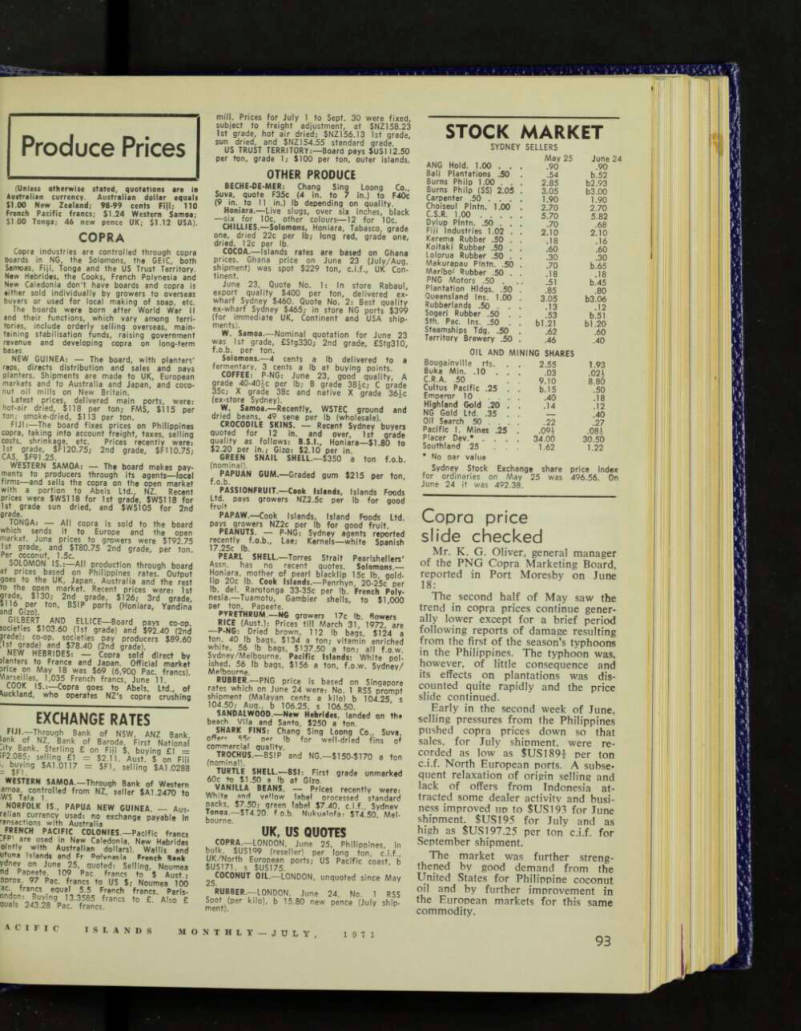
(Unless otherwise stated, quotations are in Australian currency. Australian dollar equals $l.OO New Zealand; 98-99 cents Fiji; 110 French Pacific francs; $1.24 Western Samoa; SI.OO Tonga; 46 new pence UK; $1.12 USA).
Copra
Copra industries are controlled through copra boards in NG, the Solomons, the GEIC, both Samoas, Fiji, Tonga and the US Trust Territory.
New Hebrides, the Cooks, French Polynesia and New Caledonia don't have boards and copra is either sold individually by growers to overseas buyers or used for local making of soap, etc.
The boards were born after World War II and their functions, which vary among terri tories, include orderly selling overseas, main taining stabilisation funds, raising government revenue and developing copra on long-term bases NEW GUINEA: The board, with planters' reps, directs distribution and sales and pays planters. Shipments are made to UK, European markets and to Australia and Japan, and coco nut oil mills on New Britain.
Latest prices, delivered main ports, were: hot-air dried, $llB per ton; FMS, $ll5 per ton,- smoke-dried, $ll3 per ton.
FIJI: —The board fixes prices on Philippines copra, taking into account freight, taxes, selling costs, shrinkage, etc. Prices recently were: CAS S sF9i i '2s sFl2o ’ 7s; 2nd 9rad6, sFno>7s; WESTERN SAMOA: The board makes pay ments to producers through its agents—local firms—and sells the copra on the open market with a portion to Abels Ltd., NZ. Recent prices were SWSIIB for Ist grade, SWSIIB for Ist grade sun dried, and SWSIOS for 2nd grade.
TONGA: All copra is sold to the board which sends it to Europe and the open market. June prices to growers were 5T92.75 Ist grade, and $T80.75 2nd grade, per ton.
Per coconut, 1.5 c.
SOLOMON IS.;—AH production through board at prices based on Philippines rates. Output goes to the UK, Japan, Australia and the rest to the open market. Recent prices were: Ist arade, $130; 2nd grade, $126; 3rd grade, $ll6 per ton, BSIP ports (Honiara, Yandina and Gizo).
GILBERT AND ELLICE—Board pays co-op societies $103.60 (Ist grade) and $92.40 (2nd jrade); co-op societies pay producers $89.60 [lst grade) and $78.40 (2nd grade).
NEW HEBRIDES: Copra sold direct by Hanters to France and Japan. Official market jirice on May 18 was $69 (6,900 Pac. francs).
Vaf’seilles, 1,035 French francs, June 11.
COOK IS.:—Copra goes to Abels, Ltd., of kuckland, who operates NZ's copra crushing
Exchange Rates
. P' J, — T hrough Bank of NSW, ANZ Bank, lank of NZ Bank of Baroda, First National to nfl| nk ' I S l t erlin 9 £ on Fiji $, buying £1 = •F 2.085; selling £1 = $2.11. Aust. $ on Fiji I buying $A1.0117 = SFI, selling $A1.0288 WESTERN SAMOA. —Through Bank of Western WS°Ta| C a° n i ro,led fr ° m NZ ' Seller * Al247 ° t 0
Norfolk Is., Papua New Guinea. Aus
raiian currency used: no exchange payable in redactions with Australia FRENCH PACIFIC COLONIES— Pacific francs .FP' are used in New Caledonia, New Hebrides olntly with Australian dollars), Wallis and utuna Islands and Fr Polynesia French Bank Vdney on June 25, quoted: Selling, Noumea nd Papeete 109 Pac. francs to $ Aust.; pprox. 97 Pac. francs to US $; Noumea 100 * rancs . equal 5.5 French francs. Paris ondon; Buying 13.3585 francs to £ Also £ duals 243.28 Pac. francs.
mill. Prices for July 1 to Sept. 30 were fixed, subject to freight adjustment, at $NZ158,23 Ist grade, hot air dried; $NZ156.13 Ist grade, sun dried, and $NZ154.55 standard grade.
US TRUST TERRITORY;—Board pays $U5112.50 per ton, grade 1; $lOO per ton, outer islands.
Other Produce
BECHE-OE-MER: Chang Sing Loong Co., Suva, quote F3sc (4 in. to 7 in.) to F4oc (9 in. to 11 in.) lb depending on quality.
Honiara.—Live slugs, over six inches, black —six for 10c, other colours—l2 for 10c.
CHILLIES.—SoIomons, Honiara, Tabasco, grade one, dried 22c per lb; long red, grade one, dried, 12c per lb.
COCOA.—lslands rates are based on Ghana prices. Ghana price on June 23 (July/Aug. shipment) was spot $229 ton, c.i.f., UK Con tinent.
June 23, Quote No. 1: In store Rabaul, export quality $4OO per ton, delivered ex wharf Sydney $460. Quote No. 2: Best quality ex-wharf Sydney $465; in store NG ports $399 (for immediate UK, Continent and USA ship ments).
W. Samoa.—Nominal quotation for June 23 was Ist grade, £Stg33o; 2nd grade, £Stg3lo, f.o.b. per ton.
Solomons.—4 cents a lb delivered to a fermentary, 3 cents a lb at buying points.
COFFEE: P-NG: June 23, good quality, A grade 40-40£c per lb; B grade 38ic; C grade 35c; X grade 38c and native X grade 36ic (ex-store Sydney).
W. Samoa.—Recently, WSTEC ground and dried beans, 49 sene per lb (wholesale).
CROCODILE SKINS. Recent Sydney buyers quoted for 12 in. and over, Ist grade quality as follows: 8.5.1., Honiara—sl.Bo to $2.20 per in.; Gizo: $2.10 per in.
Green Snail Shell.—S3So A Ton F.O.B.
(nominal).
PAPUAN GUM.—Graded gum $215 per ton, f.o.b.
PASSIONFRUIT.—Cook Islands, Islands Foods Ltd. pays growers NZ2.5c per lb for good fruit PAPAW.—Cook Islands, Island Foods Ltd. pays growers NZ2c per lb for good fruit.
PEANUTS. P-NG: Sydney agents reported [ecently |b f.0.b., Lae; Kernels—white Spanish PEARL SHELL.—Torres Strait Pearlshellers' Assn, has no recent quotes. Solomons.— Honiara mother of pearl blacklip 15c lb, gold ip 20c lb. Cook Islands.—Penrhyn, 20-25 c per lb, del. Rarotonga 33-35 c per lb. French Poly, nesia.—Tuamotu, Gambier shells, to $l,OOO per ton, Papeete.
PYRETHRUM—NG growers 17c lb, flowers RICE (Aust.): Prices till March 31, 1972, are — P ‘ N G : .Dried brown, 112 lb bags, $124 a ton, 40 lb bags, $134 a ton; vitamin enriched white, 56 lb bags, $137.50 a ton; all f.o.w.
Sydney/Melbourne. Pacific Islands: White pol ished, 56 lb bags, $156 a ton, f.o.w. Sydney/ Melbourne.
RUBBER—PNG price is based on Singapore rates which on June 24 were: No. 1 RSS prompt shipment (Malayan cents a kilo) b 104 25 s 104.50; Aug., b 106.25, s 106.50.
SANDALWOOD.—New Hebrides, landed on the beach Vila and Santo, $250 a ton.
SHARK FINS: Chang Sing Loong Co., Suva, offers Sflr onr lb for well-dried fins of commercial quality.
TROCHUS.—BSIP and NG.—slso-$l7O a ton (nominal).
TURTLE SHELL.—BSI: First grade unmarked 60c to $1.50 a lb at Gizo. ..VANILLA. BEANS. Prices recently were; White and yellow label orocessed standard packs, $7.50; green label $7.40, c.i.f., Sydnev Tonga.—sl4.2o. f o.b. Nukualofa: $T4.50 Mel bourne.
Uk, Us Quotes
, nP PR <Mi77n« NDON ' June 25, Philippines, in n'i’/M (reseller) per long ton, c.i.f., DK/North European ports; US Pacific coast, b
Susi7I, S Susi7S.
OIL.—LONDON, unquoted since May
Rubber.—London, June 24, No. 1 Rss
Spot (per kilo), b 15.80 new pence (July ship ment).
Stock Market
Sydney Sellers
Sydney Stock Exchange share price index tor ordinaries on May 25 was 496.56. On June 24 it was 492.38.
ANG Hold. 1.00 . .
May 25 June 24 .90 .90 Bali Plantations .50 .54 b.52 Burns Philp 1.00 . . 2.85 b2.93 Burns Philp (SS) 2.05 3.05 b3.00 Carpenter .50 . . 1.90 1.90 Choiseul PIntn, 1.00 2.70 2.70
C.S.R. 1.00 . . . .
5.70 5.82 Dylup PIntn. .50 . . .70 .68 Fiji Industries 1.02 .
Kerema Rubber .50 . 2.10 .18 2.10 .16 Koitaki Rubber .50 . .60 .60 Lolorua Rubber .50 . .30 .30 Makurapau PIntn. .50 .70 b.65 Maribo' Rubber ,50 . .18 .18 PNG Motors .50 . .51 b.45 Plantation Hldgs. .50 .85 .80 Queensland Ins. 1.00 3.05 b3.06 Rubberlands .50 . . .13 .12 Sogeri Rubber .50 .53 b.51 Sth. Pac. Ins. .50 . bl .21 bl .20 Steamships Tdg. .50 .62 .60 Territory Brewery .50 .46 .40
Oil And Mining Shares
Bougainville rts. . 2.55 1.93 Buka Min. ,10 , . .03 .02*
C.R.A. .50
9.10 8.80 Cultus Pacific .25 b. 15 .50 Emperor 10 .40 .18 Highland Gold .20 . .14 .12 NG Gold Ltd. .35 . .40 Oil Search 50 . . . .22 .27 Pacific 1. Mines .25 .09* .08* Placer Dev.* . . . 34.00 30.50 Southland .25 . . 1.62 1.22 * No oar value
Copra price
slide checked
Mr. K. G. Oliver, general manager of the PNG Copra Marketing Board, reported in Port Moresby on June 18: The second half of May saw the trend in copra prices continue gener ally lower except for a brief period following reports of damage resulting from the first of the season’s typhoons in the Philippines. The typhoon was, however, of little consequence and its effects on plantations was dis counted quite rapidly and the price slide continued.
Early in the second week of June, selling pressures from the Philippines pushed copra prices down so that sales, for July shipment, were re corded as low as SUSIB9i per ton c.i.f. North European ports. A subse* quent relaxation of origin selling and lack of offers from Indonesia at tracted some dealer activity and busi ness improved up to SUSI 93 for June shipment. SUSI9S for July and as high as $U5197.25 per ton c.i.f. for September shipment.
The market was further streng thened by good demand from the United States for Philippine coconut oil and by further improvement in the European markets for this same commodity.
Advertisements & other items, pp. 99-100 (2 items)
93
ACIFIC ISLANDS MONTHLY JULY, 1971
Sandys
THE BANK LINE
MONTHLY SERVICES
U.K., CONTINENT to PAPUA-NEW GUINEA & SOLOMON ISLANDS PAPUA, NEW GUINEA to NORTH AMERICA & U.K., CONTINENT SOLOMON ISLANDS, FIJI, TONGA, SAMOA AND TARAWA to U.K.,
CONTINENT
☆ US. GULF/AUSTRALASIA VESSELS CALL AT FIJI WHEN REQUIRED & Mil
FOR PARTICULARS APPLY:
THE BANK LINE (AUSTRALASIA) PTY. LTD., SYDNEY, N.S.W.
SANDYS
EXTRUDED ALUMINIUM
ADJUSTABLE LOUVRES
FITTED WITH ALUMINIUM OR GLASS BLADES
FOR SUN AND VENTILATION CONTROL
ALSO SANDYS EXTRUDED ALUMINIUM GLAZING BAR FOR
ECONOMICAL SAWTOOTH ROOF AND SIDEWALL GLAZING
AVAILABLE FROM:
JAMES SANDY PTY. LTD.
637 GARDENERS ROAD, MASCOT,
N.S.W., 2020, AUSTRALIA.
• GLASS MERCHANTS
• ALUMINIUM STOREFRONTS
• ALUMINIUM WINDOWS AND DOORS
• SHOWER SCREENS
• MIRRORS
Shipping
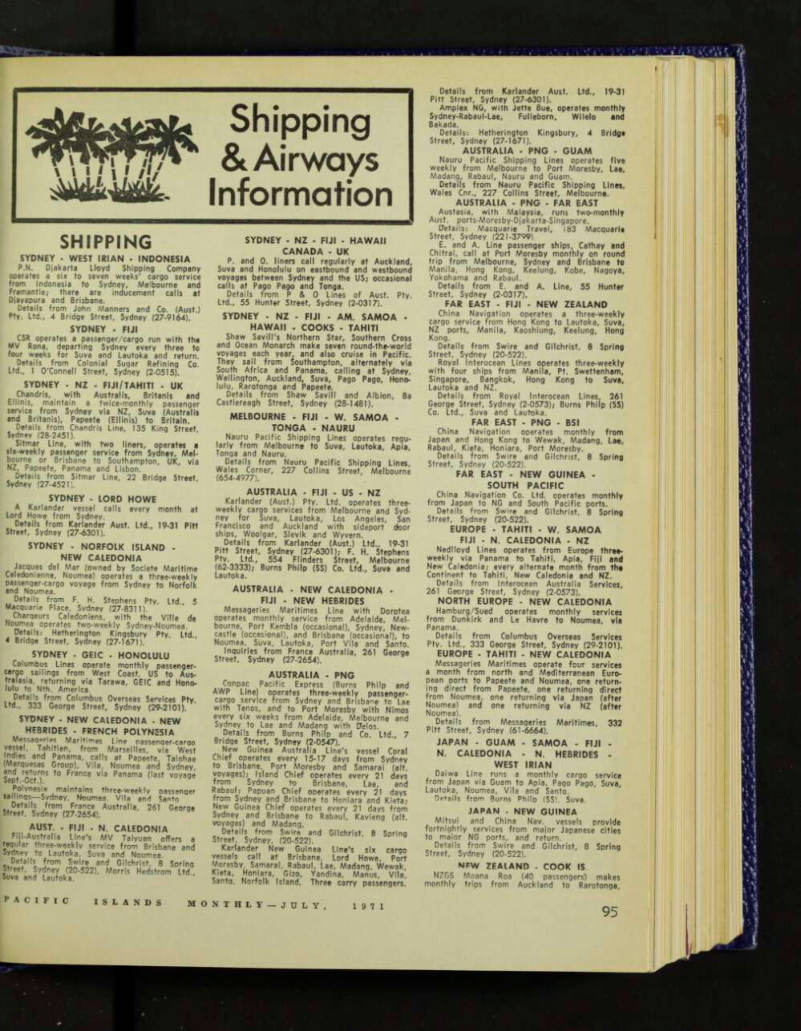
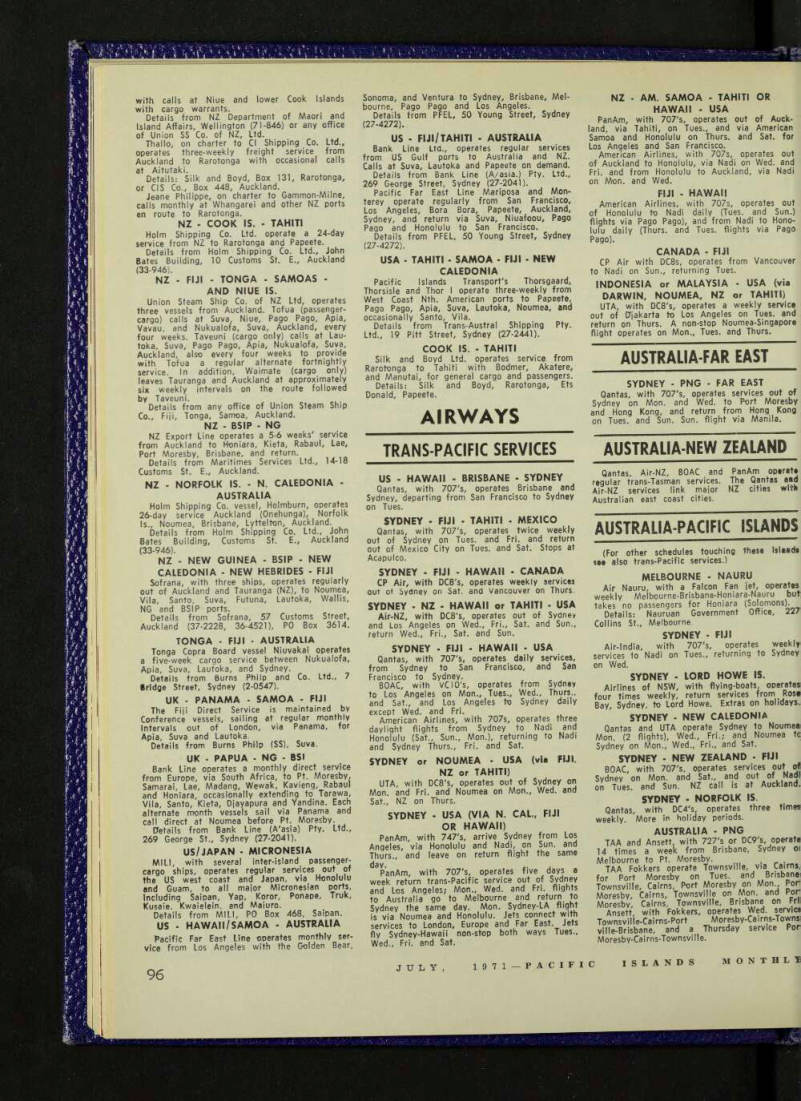
& Airways Information
Sydney - West Irian - Indonesia
P.N. Djakarta Lloyd Shipping Company operates a six to seven weeks' cargo service from Indonesia to Sydney, Melbourne and Fremantle; there are inducement calls at Djayapura and Brisbane.
Details from John Manners and Co. (Aust.) Pty. Ltd., 4 Bridge Street, Sydney (27-9164).
Sydney • Fiji
CSR operates a passenger/cargo run with the MV Rona, departing Sydney every three to four weeks for Suva and Lautoka and return.
Details from Colonial Sugar Refining Co.
Ltd., 1 O'Connell Street, Sydney (2-0515).
SYDNEY - NZ - FIJI/TAHITI - UK Chandris, with Australis, Britanis and Ellinis, maintain a twice-monthly passenger service from Sydney via NZ, Suva (Australis and Britanis), Papeete (Ellinis) to Britain.
Details from Chandris Line, 135 King Street, Sydney (28-2451).
Sitmar Line, with two liners, operates a ilx-weekly passenger service from Sydney, Mel bourne or Brisbane to Southampton, UK, via NZ, Papeete, Panama and Lisbon.
Details from Sitmar Line, 22 Bridge Street, Sydney (27-4521).
Sydney - Lord Howe
A Karlander vessel calls every month at Lord Howe from Sydney.
Details from Karlander Aust, Ltd., 19-31 Pitt Street, Sydney (27-6301).
Sydney - Norfolk Island -
New Caledonia
Jacques del Mar (owned by Societe Maritime Caledonienne, Noumea) operates a three-weekly passenger-cargo voyage from Sydney to Norfolk and Noumea.
Details from F. H. Stephens Pty. Ltd., 5 Macquarie Place, Sydney (27-8311).
Charqeurs Caledoniens, with the Ville de Noumea operates two-weekly Sydney-Noumea.
Details: Hetherington Kingsbury Pty Ltd 4 Bridge Street, Sydney (27-1671).
Sydney - Geic - Honolulu
Columbus Lines operate monthly passenger cargo sailings from West Coast, US to Aus tralasia, returning via Tarawa, GEIC and Hono lulu to Nth. America.
Details from Columbus Overseas Services Pty Ltd., 333 George Street, Sydney (29-2101),
Sydney - New Caledonia - New
Hebrides - French Polynesia
Maritimes Line nassenqer-cargo vessel, Tahitien, from Marseilles, via West Indies and Panama, calls at Papeete, Taiohae (Marquesas Group), Vila, Noumea and Sydney, and returns to France via Panama (last voyage sept.-oct.).
Polynesia maintains three-weekly passenger sailings—Sydney, Noumea, Vila and Santo Details from France Australia, 261 George Street, Sydney (27-2654).
Aust. - Fiji - N. Caledonia
Fiji-Australia Line's MV Taiyuan offers a regular three-weekly service from Brisbane and Sydney to Lautoka, Suva and Noumea Details from Swire and Gilchrist, 8 Spring Street, Sydney (20-522), Morris Hedstrom Ltd Suva and Lautoka.
SYDNEY - NZ - FIJI - HAWAII
Canada - Uk
P. and 0. liners call regularly at Auckland, Suva and Honolulu on eastbound and westbound voyages between Sydney and the US; occasional calls at Pago Pago and Tonga.
Details from P & 0 Lines of Aust. Pty.
Ltd., 55 Hunter Street, Sydney (2-0317).
SYDNEY - NZ - FIJI - AM. SAMOA -
Hawaii - Cooks - Tahiti
Shaw Savill's Northern Star, Southern Cross and Ocean Monarch make seven round-the-world voyages each year, and also cruise in Pacific.
They sail from Southampton, alternately via South Africa and Panama, calling at Sydney, Wellington, Auckland, Suva, Pago Pago, Hono lulu, Rarotonga and Papeete.
Details from Shaw Savill and Albion, 8a Castlereagh Street, Sydney (28-1481).
MELBOURNE . FIJI - W. SAMOA ■
Tonga - Nauru
Nauru Pacific Shipping Lines operates regu larly from Melbourne to Suva, Lautoka, Apia, Tonga and Nauru.
Details from Nauru Pacific Shipping Lines, Wales Corner, 227 Collins Street, Melbourne (654-4977).
AUSTRALIA - FIJI - US - NZ Karlander (Aust.) Pty. Ltd. operates three weekly cargo services from Melbourne and Syd ney for Suva, Lautoka, Los Angeles, San Francisco and Auckland with sideport door ships, Woolgar, Slevik and Wyvern.
Details from Karlander (Aust.) Ltd., 19-31 Pitt Street, Sydney (27-6301); F. H. Stephens Pty. Ltd., 554 Flinders Street, Melbourne (62-3333); Burns Philp (SS) Co. Ltd., Suva and Lautoka.
Australia - New Caledonia -
Fiji • New Hebrides
Messageries Maritimes Line with Dorotea operates monthly service from Adelaide, Mel bourne, Port Kembla (occasional), Sydney, New castle (occasional), and Brisbane (occasional), to Noumea, Suva, Lautoka, Port Vila and Santo.
Inquiries from France Australia, 261 George Street, Sydney (27-2654).
Australia - Png
Conpac Pacific Express (Burns Philp and AWP Line) operates three-weekly passenger cargo service from Sydney and Brisbane to Lae with Tenos, and to Port Moresby with Nimos every six weeks from Adelaide, Melbourne and Sydney to Lae and Madang with Delos.
Details from Burns Philp and Co. Ltd., 7 Bridge Street, Sydney (2-0547).
New Guinea Australia Line's vessel Coral Chief operates every 15-17 days from Sydney to Brisbane, Port Moresby and Samarai (alt. voyages); Island Chief operates every 21 days from Sydney to Brisbane, Lae, and Rabaul; Papuan Chief operates every 21 days from Sydney and Brisbane to Honiara and Kieta; New Guinea Chief operates every 21 days from Sydney and Brisbane to Rabaul, Kavieng (alt. voyages) and Madang.
Details from Swire and Gilchrist, 8 Spring Street, Sydney, (20-522).
Karlander New Guinea Line's six cargo vessels call at Brisbane, Lord Howe, Port Moresby, Samarai, Rabaul, Lae, Madang, Wewak, Kieta, Honiara, Gizo, Yandina, Manus, Vila, Santo, Norfolk Island. Three carry passengers.
Details from Karlander Aust. Ltd., 19-31 Pitt Street, Sydney (27-6301).
Amplex NG, with Jette Sue, operates monthly Sydney-Rabaul-Lae, Fulleborn, Wilelo and Bakada.
Details: Hetherington Kingsbury, 4 Bridge Street, Sydney (27-1671).
Australia - Png - Guam
Nauru Pacific Shipping Lines operates five weekly from Melbourne to Port Moresby, Lae, Madang, Rabaul, Nauru and Guam.
Details from Nauru Pacific Shipping Lines, Wales Cnr., 227 Collins Street, Melbourne.
Australia - Png - Far East
Austasia, with Malaysia, runs two-monthly Aust. ports-Moresby-Djakarta-Singapore.
Details: Macquarie Travel, 183 Macquarie Street, Sydney (221-3799) E. and A. Line passenger ships, Cathay and Chitral, call at Port Moresby monthly on round trip from Melbourne, Sydney and Brisbane to Manila, Hong Kong, Keelung, Kobe, Nagoya, Yokohama and Rabaul.
Details from E. and A. Line, 55 Hunter Street, Sydney (2-0317).
FAR EAST - FIJI - NEW ZEALAND China Navigation operates a three-weekly cargo service from Hong Kong to Lautoka, Suva, NZ ports, Manila, Kaoshiung, Keelung, Hong Kong.
Details from Swire and Gilchrist, 8 Spring Street, Sydney (20-522).
Royal Interocean Lines operates three-weekly with four ships from Manila, Pt. Swettenham, Singapore, Bangkok, Hong Kong to Suva, Lautoka and NZ.
Details from Royal Interocean Lines, 261 George Street, Sydney (2-0573); Burns Philp (SS) Co. Ltd., Suva and Lautoka.
Far East - Png ■ Bsi
China Navigation operates monthly from Japan and Hong Kong to Wewak, Madang, Lae, Rabaul, Kieta, Honiara, Port Moresby.
Details from Swire and Gilchrist, 8 Spring Street, Sydney (20-522).
Far East - New Guinea -
South Pacific
China Navigation Co. Ltd. operates monthly from Japan to NG and South Pacific ports.
Details from Swire and Gilchrist, 8 Spring Street, Sydney (20-522).
Europe - Tahiti - W. Samoa
Fiji - N. Caledonia - Nz
Nedlloyd Lines operates from Europe three weekly via Panama to Tahiti, Apia, Fiji and New Caledonia; every alternate month from the Continent to Tahiti, New Caledonia and NZ.
Details from Interocean Australia Services, 261 George Street, Sydney (2-0573).
North Europe - New Caledonia
Hamburg/Sued operates monthly services from Dunkirk and Le Havre to Noumea, via Panama.
Details from Columbus Overseas Services Pty. Ltd., 333 George Street, Sydney (29-2101).
Europe - Tahiti - New Caledonia
Messageries Maritimes operate four services a month from north and Mediterranean Euro pean ports to Papeete and Noumea, one return ing direct from Papeete, one returning direct from Noumea, one returning via Japan (after Noumea) and one returning via NZ (after Noumea).
Details from Messageries Maritimes, 332 Pitt Street, Sydney (61-6664).
JAPAN - GUAM - SAMOA - FIJI -
N. Caledonia - N. Hebrides -
West Irian
Daiwa Line runs a monthly cargo service from Japan via Guam to Apia, Pago Pago, Suva, Lautoka, Noumea, Vila and Santo.
Details from Burns Philo (SS), Suva.
Japan - New Guinea
Mitsui and China Nav. vessels provide fortnightly services from major Japanese cities to major NG ports, and return.
Details from Swire and Gilchrist, 8 Spring Street, Sydney (20-522).
Npw Zealand . Cook Is
NZGS Moana Roa (40 passengers) makes monthly trips from Auckland to Rarotonga,
with calls at Niue and lower Cook Islands with cargo warrants.
Details from NZ Department of Maori and Island Affairs, Wellington (71-846) or any office of Union SS Co. of NZ, Ltd.
Thallo, on charter to Cl Shipping Co. Ltd., operates three-weekly freight service from Auckland to Rarotonga with occasional calls at Aitutaki.
Details: Silk and Boyd, Box 131, Rarotonga, or CIS Co., Box 448, Auckland.
Jeane Philippe, on charter to Gammon-Milne, calls monthly at Whangarei and other NZ ports en route to Rarotonga.
Nz - Cook Is. - Tahiti
Holm Shipping Co. Ltd. operate a 24-day service from NZ to Rarotonga and Papeete.
Details from Holm Shipping Co. Ltd., John Bates Building, 10 Customs St. E., Auckland (33-946).
NZ - FIJI - TONGA - SAMOAS ■
And Niue Is.
Union Steam Ship Co. of NZ Ltd, operates three vessels from Auckland. Tofua (passenger cargo) calls at Suva, Niue, Pago Pago, Apia, Vavau, and Nukualofa, Suva, Auckland, every four weeks. Taveuni (cargo only) calls at Lau toka, Suva, Pago Pago, Apia, Nukualofa, Suva, Auckland, also every four weeks to provide with Tofua a regular alternate fortnightly service. In addition, Waimate (cargo only) leaves Tauranga and Auckland at approximately six weekly intervals on the route followed by Taveuni.
Details from any office of Union Steam Ship Co., Fiji, Tonga, Samoa, Auckland.
Nz ■ Bsip - Ng
NZ Export Line operates a 5-6 weeks' service from Auckland to Honiara, Kieta, Rabaul, Lae, Port Moresby, Brisbane, and return.
Details from Maritimes Services Ltd., 14-18 Customs St. E., Auckland.
NZ - NORFOLK IS. - N. CALEDONIA •
Australia
Holm Shipping Co. vessel, Holmburn, operates 26-day service Auckland (Onehunga), Norfolk Is., Noumea, Brisbane, Lyttelton, Auckland.
Details from Holm Shipping Co. Ltd., John Bates Building, Customs St. E., Auckland (33-946).
NZ - NEW GUINEA - BSIP ■ NEW
Caledonia - New Hebrides - Fiji
Sofrana, with three ships, operates regularly out of Auckland and Tauranga (NZ), to Noumea, Vila, Santo, Suva, Futuna, Lautoka, Wallis, NG and BSIP ports.
Details from Sofrana, 57 Customs Street, Auckland (37-2228, 36-4521), PO Box 3614.
Tonga - Fiji - Australia
Tonga Copra Board vessel Niuvakai operates a five-week cargo service between Nukualofa, Apia, Suva, Lautoka, and Sydney.
Details from Burns Philp and Co. Ltd., 7 Bridge Street, Sydney (2-0547).
UK - PANAMA - SAMOA - FIJI The Fiji Direct Service is maintained by Conference vessels, sailing at regular monthly intervals out of London, via Panama, for Apia, Suva and Lautoka.
Details from Burns Philp (SS), Suva.
UK - PAPUA ■ NG • BSI Bank Line operates a monthly direct service from Europe, via South Africa, to Pt. Moresby, Samarai, Lae, Madang, Wewak, Kavieng, Rabaul and Honiara, occasionally extending to Tarawa, Vila, Santo, Kieta, Djayapura and Yandina. Each alternate month vessels sail via Panama and call direct at Noumea before Pt. Moresby.
Details from Bank Line (A'asia) Pty. Ltd., 269 George St., Sydney (27-2041).
Us/Japan - Micronesia
Mill, with several inter-island passenger cargo ships, operates regular services out of the US west coast and Japan, via Honolulu and Guam, to all major Micronesian ports, Including Saipan, Yap, Koror, Ponape, Truk, Kusaie, Kwaielein, and Maiuro.
Details from Mill, PO Box 468, Saipan.
Us - Hawaii/Samoa ■ Australia
Pacific Far East Line operates monthly ser vice from Los Angeles with the Golden Bear,
Sonoma, and Ventura to Sydney, Brisbane, Mel bourne, Pago Pago and Los Angeles.
Details from PFEL, 50 Young Street, Sydney (27-4272).
Us - Fiji/Tahiti - Australia
Bank Line Ltd., operates regular services from US Gulf ports to Australia and NZ.
Calls at Suva, Lautoka and Papeete on demand.
Details from Bank Line (A/asia.) Pty. Ltd., 269 George Street, Sydney (27-2041).
Pacific Far East Line Mariposa and Mon terey operate regularly from San Francisco, Los Angeles, Bora Bora, Papeete, Auckland, Sydney, and return via Suva, Niuafoou, Pago Pago and Honolulu to San Francisco.
Details from PFEL, 50 Young Street, Sydney (27-4272).
USA - TAHITI • SAMOA - FIJI ■ NEW
Caledonia
Pacific Islands Transport's Thorsgaard, Thorsisle and Thor I operate three-weekly from West Coast Nth. American ports to Papeete, Pago Pago, Apia, Suva, Lautoka, Noumea, and occasionally Santo, Vila.
Details from Trans-Austral Shipping Pty.
Ltd., 19 Pitt Street, Sydney (27-2441).
Cook Is. - Tahiti
Silk and Boyd Ltd. operates service from Rarotonga to Tahiti with Bodmer, Akatere, and Manutai, for general cargo and passengers.
Details: Silk and Boyd, Rarotonga, Ets Donald, Papeete.
Airways
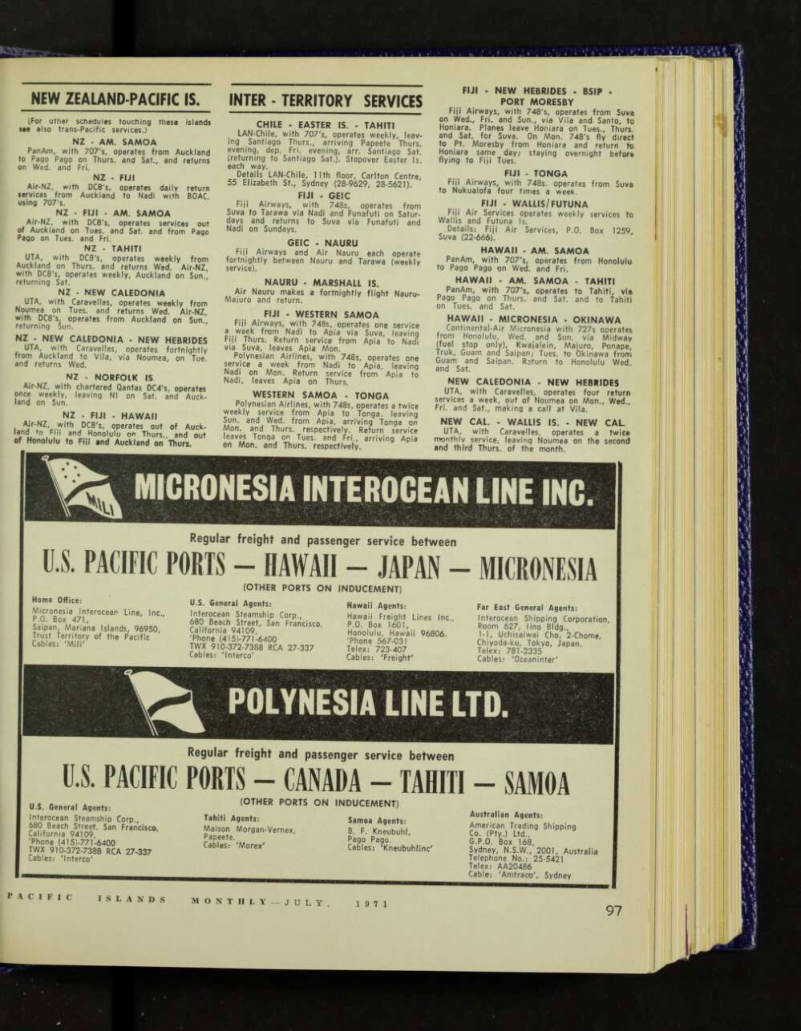
Trans Pacific Services
US . HAWAII - BRISBANE - SYDNEY Qantas, with 707's, operates Brisbane and Sydney, departing from San Francisco to Sydney on Tues.
SYDNEY • FIJI • TAHITI - MEXICO Qantas, with 707's, operates twice weekly out of Sydney on Tues. and Fri. and return out of Mexico City on Tues. and Sat. Stops at Acapulco.
SYDNEY • FIJI - HAWAII • CANADA CP Air, with DCB's, operates weekly services out ot Sydney on Sat. and Vancouver on Thurs.
SYDNEY - NZ - HAWAII or TAHITI - USA Air-NZ, with DCB's, operates out of Sydney and Los Angeles on Wed., Fri., Sat. and Sun., return Wed., Fri., Sat. and Sun.
SYDNEY - FIJI • HAWAII - USA Qantas, with 707's, operates daily services, from Sydney to San Francisco, and San Francisco to Sydney.
BOAC, with VClO's, operates from Sydney to Los Angeles on Mon., Tues., Wed., Thurs., and Sat., and Los Angeles to Sydney daily except Wed. and Fri.
American Airlines, with 7075, operates three daylight flights from Sydney to Nadi and Honolulu (Sat., Sun., Mon.), returning to Nadi and Sydney Thurs., Fri. and Sat.
SYDNEY or NOUMEA ■ USA (via FIJI,
Nz Or Tahiti)
UTA, with DCB's, operates out of Sydney on Mon. and Fri. and Noumea on Mon., Wed. and Sat., NZ on Thurs.
SYDNEY - USA (VIA N. CAL., FIJI
Or Hawaii)
PanAm, with 747'5, arrive Sydney from Los Angeles, via Honolulu and Nadi, on Sun. and Thurs., and leave on return flight the same da p‘anAm, with 707's, operates five days a week return trans-Pacific service out of Sydney and Los Angeles; Mon., Wed. and Fri. flights to Australia go to Melbourne and return to Sydney the same day. Mon. Sydney-LA flight is via Noumea and Honolulu. Jets connect with services to London, Europe and Far East. Jets fly Sydney-Hawaii non-stop both ways Tues., Wed., Fri. and Sat.
NZ ■ AM. SAMOA - TAHITI OR
Hawaii - Usa
PanAm, with 707's, operates out of Auck land, via Tahiti, on Tues., and via American Samoa and Honolulu on Thurs. and Sat. for Los Angeles and San Francisco.
American Airlines, with 7075, operates out of Auckland to Honolulu, via Nadi on Wed. and Fri. and from Honolulu to Auckland, via Nadi on Mon. and Wed.
Fiji - Hawaii
American Airlines, with 7075, operates out of Honolulu to Nadi daily (Tues. and Sun.) flights via Pago Pago), and from Nadi to Hono lulu daily (Thurs. and Tues. flights via Pago Pago).
Canada - Fiji
CP Air with DCBs, operates from Vancouver to Nadi on Sun., returning Tues.
Indonesia Or Malaysia - Usa (Via
Darwin, Noumea, Nz Or Tahiti)
UTA. with DCB's, operates a weekly service out of Djakarta to Los Angeles on Tues. and return on Thurs. A non-stop Noumea-Singapore flight operates on Mon., Tues. and Thurs.
Australia-Far East
Sydney - Png - Far East
Qantas, with 707's, operates services out of Sydney on Mon. and Wed. to Port Moresby and Hong Kong, and return from Hong Kong on Tues. and Sun. Sun. flight via Manila.
Australia-New Zealand
Qantas, Air-NZ, BOAC and PanAm operate regular trans-Tasman services. The Qantas aid Air-NZ services link major NZ cities with Australian east coast cities.
Australia-Pacific Islands
(For other schedules touching these lsl«*d* see also trans-Pacific services.)
Melbourne - Nauru
Air Nauru, with a Falcon Fan jet, operates weekly Melbourne-Brisbane-Honiara-Nauru but takes no passengers for Honiara (Solomons).
Details; Nauruan Government Office, 227 Collins St., Melbourne
Sydney - Fiji
Air-India, with 707's, operates weekly services to Nadi on Tues., returning to Sydney on Wed.
Sydney • Lord Howe Is.
Airlines of NSW, with flying-boats, operates four times weekly, return services from Rosa Bay, Sydney, to Lord Howe. Extras on holidays.
Sydney • New Caledonia
Qantas and UTA operate Sydney to Noumea Mon. (2 flights), Wed., Fri.; and Noumea tc Sydney on Mon., Wed., Fri., and Sat.
Sydney • New Zealand - Fiji
BOAC, with 707's, operates services put of Sydney on Mon. and Sat., and out of Nadi on Tues. and Sun. NZ call is at Auckland.
Sydney • Norfolk Is.
Qantas, with DC4's, operates three times weekly. More in holiday periods.
Australia - Png
TAA and Ansett, with 727's or DC9's, operate 14 times a week from Brisbane, Sydney oi Melbourne to Pt. Moresby.
TAA Fokkers operate Townsville, via Cairns, for Port Moresby on Tues. and Brisbane Townsville, Cairns, Port Moresby on Mon , For Moresby, Cairns, Townsville on Mon. and Por Moresby, Cairns, Townsville, Brisbane on FM Ansett, with Fokkers, operates Wed. seme* Townsville-Cairns-Port Moresby-Cairns-Towns ville-Brisbane, and a Thursday service Por Moresby-Cairns-Townsville.
New Zealand-Pacific Is.
(For other schedules touching these islands tee also trans-Pacific services.)
Nz ■ Am. Samoa
PanAm, with 707's, operates from Auckland to Pago Pago on Thurs. and Sat., and returns on Wed. and Fri.
Nz • Fiji
Air-N2, with DCB's, operates daily return services from Auckland to Nadi with BOAC, using 707's.
Nz - Fiji - Am. Samoa
Air-NZ, with DCB's, operates services out of Auckland on Tues. and Sat. and from Pago Pago on Tues. and Fri.
Nz - Tahiti
UTA, with DCB's, operates weekly from Auckland on Thurs. and returns Wed. Air-NZ, with DCB's, operates weekly, Auckland on Sun., returning Sat.
Nz - New Caledonia
UTA, with Caravelles, operates weekly from Noumea on Tues. and returns Wed. Air-NZ, with DCB's, operates from Auckland on Sun/, returning Sun.
NZ ■ NEW CALEDONIA - NEW HEBRIDES UTA, with Caravelles, operates fortnightly from Auckland to Vila, via Noumea, on Tue and returns Wed,
Nz - Norfolk Is
Air-NZ, with chartered Qantas DC4's, operates once weekly, leaving Nl on Sat. and Auck land on Sun.
Nz - Fiji - Hawaii
Air-NZ, with DCB's, operates out of Auck land to Fiii and Honolulu on Thurs. and out of Honolulu to Flil and Auckland on Thurs.
Inter - Territory Services
Chile - Easter Is. - Tahiti
LAN-Chile, with 707's, operates weekly, leav ing Santiago Thurs., arriving Papeete Thurs. evening, dep. Fri. evening, arr. Santiago Sat. (returning to Santiago Sat.). Stopover Easter Is each way.
Details LAN-Chile, 11th floor, Carlton Centre, 55 Elizabeth St,, Sydney (28-9629, 28-5621).
Fiji - Geic
Fiji Airways, with 7485, operates from Suva to Tarawa via Nadi and Funafuti on Satur days and returns to Suva via Funafuti and Nadi on Sundays.
Geic - Nauru
Fiji Airways and Air Nauru each operate fortnightly between Nauru and Tarawa (weekly service).
Nauru - Marshall Is.
Air Nauru makes a fortnightly flight Nauru- Maiuro and return.
Fiji - Western Samoa
Fiji Airways, with 7485, operates one service a week from Nadi to Apia via Suva, leaving Fi|i Thurs. Return service from Apia to Nadi via Suva, leaves Apia Mon.
Polynesian Airlines, with 7485, operates one service a week from Nadi to Apia, leaving Nadi on Mon. Return service from Apia to Nadi, leaves Apia on Thurs.
Western Samoa - Tonga
Polynesian Airlines, with 7485, operates a twice weekly service from Apia to Tonga, leaving Sun. and Wed. from Apia, arriving Tonga on Mon. and Thurs, respectively. Return service leaves Tonga on Tues. and Fri., arriving Apia on Mon. and Thurs. respectively.
FIJI • NEW HEBRIDES - BSIP •
Port Moresby
Fiji Airways, with 748's, operates from Suva on Wed., Fri. and Sun., via Vila and Santo, to Honiara. Planes leave Honiara on Tues., Thurs. and Sat. for Suva. On Mon. 748's fly direct to Pt. Moresby from Honiara and return to Honiara same day; staying overnight before flying to Fiji Tues.
Fiji - Tonga
Fiji Airways, with 7485. operates from Suva to Nukualofa four times a week.
FIJI ■ wallis/futuna Fiji Air Services operates weekly services to Wallis and Futuna Is.
Details: Fiji Air Services, P.O. Box 1259, Suva (22-666).
Hawaii - Am. Samoa
PanAm, with 707's, operates from Honolulu to Pago Pago on Wed. and Fri.
Hawaii - Am. Samoa - Tahiti
PanAm, with 707's, operates to Tahiti, via Pago Pago on Thurs. and Sat. and to Tahiti on Tues. and Sat.
Hawaii - Micronesia - Okinawa
Continental-Air Micronesia with 727 s operates
from Honolulu, Wed. and Sun. via Midway (fuel stop only), Kwajalein, Majuro, Ponape.
Truk, Guam and Saipan; Tues. to Okinawa from Guam and Saipan. Raturn to Honolulu Wed and Sat.
New Caledonia - New Hebrides
UTA, with Caravelles, operates four return services a week, out of Noumea on Mon., Wed., Fri. and Sat., making a call at Vila.
NEW CAL. - WALLIS IS. - NEW CAL.
UTA, with Caravelles, operates a twice monthly service, leaving Noumea on the second and third Thurs. of the month.
New Guinea - West Irian
TAA, with DC3's, leaves Madang on alternate Sat. for Djayapura and returns the same day.
Png - Solomons
TAA, with Fokkers and DC3's, operates three times weekly. Wed. planes leave Moresby to Honiara, returning Thurs. Sat., Tues. leave Rabaul via Buka, Kieta, Munda, Yandina to Honiara, return Sun. and Wed.
Tahiti - Usa
UTA, with DCB's, operates on Mon., Tues., Thurs., Fri. (Sat. non-stop from Papeete to Los Angeles), and return the same day.
PanAm, with 707's, operates to San Francisco, via Los Angeles on Mon. and Fri.; to San Francisco, via Honolulu on Tues. and Sat.; and to San Francisco, via Pago Pago and Honolulu on Sun. and Thurs.; from San Francisco via Honolulu and Pago Pago, to Tahiti on Sat., and from San Francisco, via Los Angeles, to Tahiti on Wed. and Sat.
Air-NZ, with DCB's, flies to Los Angeles from Papeete on Sun., leaves Los Angeles Frl.
W. Samoa - Am. Samoa
Polynesian Airlines, with DC3's, operates between Apia and Pago Pago at least twice a day (all flights, 45 min.J.
W. Samoa - Fiji
Polynesian Airlines, with 748's, operates Apia-Nadi on Thurs. and Nadi-Apia on Mon.
FIJI - TONGA - NIUE - W. SAMOA Fiji Airways, with 7485, operates from Fiji to Tonga (Tues.), Niue (Mon.), Apia (Mon.), return Fiji (Tues.).
FIJI - AM. SAMOA - COOK IS.
Fiji Airways (chartered by Air-NZ) with HS74B's, operates fortnightly service from Nadi to Rarotonga, via Pago Pago (technical stop), returning via Aitutaki and Pago Pago. Service leaves Nadi on Thurs. and returns on Fn. (Fiji time).
Tahiti ■ Cook Is.
Air Tahiti with Piper Aztec, operates from Papeete to Rarotonga.
Internal Services
Fiji
Fiji Airways, with HS74B's, DC3's and Herons operates regular services to Labasa, Matei, Nadi, Nausori and Savusavu.
Details: Qantas, BOAC or Air-NZ.
Fiji Air Services, with Beech Baron and Nor man Islander aircraft, operates to Ovalau Is., Korolevu, Natadola on regular service basis.
Details: Fiji Air Services, P.O. Box 1259, Suva (telephone 22-666).
French Polynesia
Air Polynesia, with DC4's, Twin Otters and Islanders, operates to Bora Bora, Hfahine, Moorea, Papeete, Raiatea and Rangiroa.
Details from RAI, Quai Bir Hakeim, Papeete, or any UTA office.
Air Tahiti and Air Moorea, with light air craft, operate shuttle service from Papeete to Moorea and charter service to Raiatea, Bora Bora, Huahine, Rangiroa and Manihi.
Air Tahiti with Piper Aztec and RAI with Twin Otter operate services from Papeete to Ua Huka.
Gilbert And Ellice Islands
Fiji Airways, with Herons, operates regular services between Tarawa, Butaritari, North Tabiteuea and Abemama.
Guam - Us Trust Territory
Continental-Air Micronesia with 727 s and DC6s operates regular service connecting Honolulu, Okinawa and Guam with Saipan, Rota, Yap, Palau, Truk, Ponape, Kwajalein and Majuro.
Details from Air Micronesia and Saipan.
Air Pacific, with Piper Navajos, operates regular services linking Guam, Saipan, Tinian, and Rota, and charter services are available to other Trust Territory islands.
Details, Air Pacific Inc., Saipan Lagoon Aviation Inc. and Marshall Islands Air Taxi Service, both with Grumman Widgeons, operate charter services for the Marshalls dis trict, based on Majuro. MIATS has regular scheduled services to Kwajaleen and Ponape, and utilises a D-50 Beech.
Papua - New Guinea
TAA operates throughout the territory.
Ansett operates throughout the territory.
Aerial Tours operates mostly in the Sepik district. . u , .
Territory Airlines operates in the nign- Macair operates throughout the territory.
Bougainville Air Services Ltd. operates char ter services on Bougainville.
New Caledonia
Air Caledonie, with Twin Otters, and Is landers operates regular services to Houai lou. Isle of Pines, Isle Ouen, Kone, Koumac, Lifou, Mare, Noumea, Ouvea, Touho, Mueo, Belep, Tiga. .
Details from Air Caledonie, Noumea.
New Hebrides
Air Melanesiae with Britten-Norman Islanders operates to Santo, Malekula (Norsup and Lamap), Aoba (Walaha and Longana), Pentecost (Lono rore), Erromanga, Tongoa, Aneityum, Tanna and Vila Twenty-one direct flights connect with all UTA flights Noumea-Vila and return.
Details from Air Melanesiae, PO Box 72, Vila.
Solomon Islands
Solair, with Beech Barons and Islanders operates to Auki, Avu Avu, Barakoma, Gizo, Honiara, Kira Kira, Marau, Munda Parasi Sege Yandina, Santa Cruz, Mono, Rennet! Is., Choiseul Bay and Ballalae. ... .* j Details from Solomon Islands Airways Ltd., Box 23, Honiara, BSIP.
Advertisements & other items, pp. 103-110 (1 item)
Polynesia Line Ltd.
Regular freight and passenger service between
U.S. PACIFIC PORTS - HAWAII - JAPAN - MICRONESIA Home Office: Micronesia Interocean Line, Inc..
P.O. Box 471, Saipan, Mariana Islands, 96950, Trust Territory of the Pacific Cables; 'Mili'
(OTHER PORTS ON INDUCEMENT)
U.S. General Agents: Interocean Steamship Corp., 680 Beach Street, San Francisco, California 94109, 'Phone (415)-771-6400
TWX 910-372-7388 RCA 27-337
Cables: 'lnterco' Hawaii Agents: Hawaii Freight Lines Inc.
P.O. Box 1601, Honolulu, Hawaii 96806.
'Phone 567-031 Telex: 723-407 Cables: 'Freight' Far East General Agents: Interocean Shipping Corporation, Room 627, lino Bldg., 1-1, Uchisaiwai Cho, 2-Chome, Chiyoda-ku, Tokyo, Japan.
Telex: 781-2335 Cables: 'Oceaninter'
POLYNESIA LINE LTD.
Regular freight and passenger service between
U.S. PACIFIC PORTS - CANADA - TAHITI - SAMOA U.S. General Agents: Interocean Steamship Corp., 680 Beach Street, San Francisco, California 94109, 'Phone (415)-771-6400
TWX 910-372-7388 RCA 27-337
Cables: 'lnterco'
(OTHER PORTS ON INDUCEMENT)
Tahiti Agents: Maison Morgan-Vernex, Papeete.
Cables: 'Morex' Samoa Agents; B. F. Kneubuhl, Pago Pago.
Cables; 'Kneubuhlinc' Australian Agents: American Trading Shipping Co. (Pty.) Ltd., G.P.O. Box 168, Sydney, N.S.W., 2001, Australia Telephone No.: 25-5421 Telex: AA20486 Cable: 'Amtraco', Sydney
UNION STEAM SHIP CO. of N.Z.
LIMITED
Serving the Pacific for nearly 100 years.
Regular Sailings by Modern Vessels
From Auckland to Lautoka, Suva, Pago Pago, Apia, Niue, Vavau, Nukualofa. Also from Tauranga to Lautoka, Suva, Apia, Nukualofa. Regular sailings from Australia to New Zealand to enable transhipment of cargo to all the above ports.
Ship your cargo by a Union Company Vessel.
BRANCHES AT ALL MAIN AUSTRALIAN, NEW ZEALAND AND ISLAND PORTS.
PACIFIC ISLANDS TRANSPORT UNE
Owners: Thor Dahls Hvalfangerselskap A/S —Sandefjord, Norway.
Motor Vessels "Thorsisle", "Thorsgaord" and "Thor I"
Regular Freight and Passenger Services between Pacific Coast Ports of U.S.A. and Canada and
TAHITI SAMOA TONGA FIJI NEW CALEDONIA
NEW HEBRIDES
GENERAL STEAMSHIP CORPORATION LTD.
General Agents 400 California Street, San Francisco, California, U.S.A.
AMA-Burns PhHp (S.P.H Spa, Company, PAPEETE Agence Maritime Inter- LAE/RABAUL —Burns Philp (New Guinea) nationale Tahiti. Ltd PAGO PAGO—G. H. C. Reid & Co. PORT VILA Comptoirs Francais de NOUMEA—Etablissements Ballande. Nouvelles Hebrides
Classified Advertisements
Per line, 95c Anst.; Minimum rate. 4 lines.
STAMPS
COLLECTOR want's to buy Postage Stamps: Papua, New Guinea, Pacific Islands. Any quantity, used. Write offer or send to O. E. Anders, 24 Watkins St., Bondi 2026, (Sydney), Australia.
POSITIONS/PARTNERSHIPS
COUPLE with extensive experience in holiday resort design, promotion and management, desire to work in Pacific Islands tourist industry. Would invest $35,000. Please direct correspondence to: Bamboo Interiors, Airlie Beach, 4800, Nth Q’ld., Australia.
ACCOMMODATION
PARK VIEW MOTEL—BRISBANE
Quiet location—opp. Botanic Gardens.
Single, double, family suites, all with refrig., air conditioning, phone, TV, radio, tea making facilities, from $lO. Pool and restaurant.
Phone 31-2695—Telex 40270.
Write for coloured brochure— Park View Motel, 128 Alice St, BRISBANE, Old., 4000.
VISITING BRISBANE?
Stay at TOWER MILL MOTEL. First class air-conditioned accommodation, T.V., private bathroom and verandah with a delightful view. Two restaurants.
From $lO.OO per day.
Book through your Travel Agent or Airline office or direct to 239, Wickham Terrace, Brisbane. Telephone 31-1421.
BOOKS, MAGAZINES, ETC.
ALL BOOKS AND JOURNALS ON AUS-
PRALASIA AND THE PACIFIC BOUGHT
AND SOLD. Catalogues issued and sent free on application. Correspondence In- Berkelonw > 114 King St., Sydney. *OOO. Telephone: 28-7874.
BODEN’S BOAT DESIGNS PTT. LTD.,
695 George St., Sydney. 2000. Get your Bodens Boat Designs and Boat Building Book from newsagents everywhere. Posted direct $A2.20 surface mail.
RAMBLER'S GUIDE TO
NORFOLK ISLAND
$l.OO at bookstalls or from Pacific Publications (Aust.) Pty. Ltd., Box 3408, G.P.0.,
Sydney (plus 18c postage).
Faster schedules
for Fiji Air
Fiji Airways’ new jet aircraft, the BAC One-Eleven 475, is expected to be flying around the South Pacific by next April—on a new, streamlined schedule.
Because the BAC has greater passenger capacity than the HS 748 76 seats to 40—and greater speed, it will be possible to cut down frequencies, the Melanesian Tourist Federation was told at its meeting in Vila on June 2. There will be one flight a week from Fiji through Vila, Santo and Honiara to Port Moresby; a weekly flight from Fiji to Vila and Santo and ending at Honiara, and a third flight from Fiji to Vila. There will be no overnight stop at Honiara on the Fiji-Port Moresby flight.
UTA plans to increase its services from Noumea to Vila in January from four flights a week to five, all by Caravelle. It is also hoping to start a new service between Noumea and Japan in two to three years’ time. • Fiji Airways’ newly-introduced night flights between Nadi and Suva are proving popular. The new schedules ease Suva-Nadi travel, particularly where connections with overseas flights are concerned. The night flights operate seven nights a week. Flights out of Nausori are at 6.30 p.m. and 10 p.m. and from Nadi at 8.30 p.m. • Niue’s new airfield is changing its name—from Vaiola Aerodrome to Hanan Aerodrome after New Zealand’s late Minister for Island Affairs, Mr. J. R. Hanan, the name the island’s Legislative Asembly originally picked. When Mr. Hanan was in office he was approached by the Assembly and asked to give his name to the air strip. He declined because he felt it would be inappropriate as he was still in office.
WANTED
WANT LONG LEASE, or freehold, on island near beach, about ten homesltes for retirement or vacation. Will consider small plantation. E, A. Morris, Esq., 34th Floor, Bank of America Center, San Francisco, Calif. 94104, U.S.A.
WANTED TO BUY TRADE STORE. Any-
where in South Pacific. Please reply c/- Box 3408, G.P.0., Sydney, 2000.
I WILL PURCHASE STAMPS on envelopes postally used anywhere in the South Pacific Islands. Write to: Peters, P.O. Box 3272, Honolulu, Hawaii.
EDUCATIONAL
BUDDHIST view of life and basic human problems, their cause and remedy. Free literature: Buddhist Society, Box 61, Kandy, Ceylon. Seamail free; airmail enclose postage.
FOR SALE
FERROCONCRETE TRAWLER DESIGN
HULL. 50 ft x 17 ft, displacement 43 tons, hull is completed, fitted out as required, basic hull & decks. $lO,OOO. Can supply Gardner 6LX 2nd Hand W/shaft, Prop, etc. Further details contact: Honiara Marina & Shipyard Co. Ltd., P.O. Box 144, Honiara, 8.5.1. P.
FERRO-CONCRETE COASTAL LAUNCH.
38 ft x 12 ft. New, with marine ply superstructure, nav. lights, 5 bunks, hydraulic steering, galley, stove, fridge, sink, toilet, shower, etc. Motor not fitted yet, with Ford 271 SE Diesel, W/Borg Warner 3:1 Hydraulic G/Box. $lB,OOO.
Enquiries: Honiara Marina & Shipyard Co. Ltd., Box 144, Honiara, 8.5.1. P,
MAURICE CRISP
Ship, Launch, and Yacht Broker.
Huddart Parker Building.
Post Office Square, Wellington,
NEW ZEALAND.
For all types of commercial and pleasure craft, whether buying or selling. For further information, write C.P.O. Box 854, Wellington, or Phone 44-009.
After hours 888-307. Telegrams "Nautilus"
New Zealand and Pacific coverage.
CONCRETE BLOCK MACHINE. Makes
blocks, flags, edgings, screen-blocks, garden stools —up to 8 at once and 06 an hour. SAIO7 c.l.f. main ports. Send for leaflets. Forest Farm Research, Londonderry, N.S.W., 2753.
LAND FOR SALE OR LEASE. Beautifully situated, with sweeping view of the entire Segond Canal. Suitable hotel site. For further details write to: Box 32, Santo, New Hebrides.
FLEETS. New 35 ft carvel workboat, mar ?i« sel ’, radio - sounder, light winch gear, 400 gals, fuel, 3 berths, some hold space, $20,000. Fleets, Rowe’s Bldg., Edward St..
Brisbane. Cable: Fleets, Brisbane.
SUBMERSIBLE
DECOMPRESSION
CHAMBER
(WITH GAUGES)
Interior dimensions, 4 ft diameter x 7 ft; 3 observation windows; door lock end; test, 240 p.s.i.; workable, 133 p.s.i.; weight, 7,000 lb.
PRESSURE VESSEL, 20 in, diameter x 10 ft; test, 3,000 lb; working 2,000 lb.
McDermotts metals
PTY. LTD.,
82 McEvoy St., Alexandria, N.S.W., 2015. Phone: 69-1217.
COME
ON DOWN!
See your Travel Agent or AIR NEW ZEALAND for further information.
AIR NEW IE ALAND
KNOWS THE SOUTH PACIFIC BEST
Freshen up down South in a clean, green country where even the prices keep you cool.
There's more of everything you ever wanted to do and it's all only a few comfortable hours away by
AIR NEW ZEALAND DC-8.
Come on down to New Zealand, the clean, green country with the clearest skies in the South Pacific. ¥ *4'
f jiter im
a
PP'J; Mk
vts ■■ • .
I mi
LL-5080
usic Life
ith Kenwood
The Good Life” is inconceivable without music. And the pleasures can be increased many fold when the music comes from a Kenwood high fidelity sound system. m in i f fill f if I.r ■"
WMfmm
i Ii H fjiif r f
rjv f I fl s 11imI n
if-ijjf y V y
i 111 ll
i \i\iij
yV y *
M ; * *I > |rl 1: , I I ' : Ii T ?. * » I * < 4 I Mil
tw\\\UV«
aWwVivv;-.
Iil» i * i * i * ? * ’ k . I I . . . ll * I 4,1\ \ \ t I 111* 11 . the sound approach to quality
KENWOOD
ie compact Kenwood KA- Stereo Amplifier delivers (IHF) of low-low distorhi-fl music. Linked to the >OBO Damped Pipe Duct ly 5-Speaker System, it Is a music system cherby music lovers the over.
Good Lift” can be better with Kenwood.
Mf£ .
MBIIW- ,B * IG
■ PARIS.
KA-4002
TRIO ELECTRONICS, lIVO. T .
or minute information, write to: 7 P - SECTION, TRIO ELECTRONICS. INC. 6-5. 1-chome, Shibuya, Shibuya-ku. Tokyo. Japan
What’s
the Stout got that the
Land Cruiser and
these other Toyotas
got?
Quality and guts.
The TOYOTA LAND CRUISER has got it. 4-wheel drive. 6-cylinder 155 HP engine.
Fantastic gear combinations of six forward speeds and two reverse. It doubles as a versatile family fun car, too.
Then there’s the big horse pickup, TOYOTA STOUT. The front and rear axles, suspension and powerful brakes feature the stoutness of those used in heavier duty trucks. Plus if packs a 1 06HP engine. Big cab and cargo box.
Plenty of legroom in front and space in back.
And the split bench seat has cushion comfort.
You get power, safety, economy and stoutness, too. *
TOOMWXK
But you may like the dual rear wheel TOYOTA DYNA. You can choose a heavy duty pickup. Or a bigger payload platform truck.
Even a double cab and delivery van. With either a husky 106 HP gasoline engine or an economical ZOHPdiesel job.
Or you may want the big one.
The TOYOTA TRUCK. Six big models built to take the rough and tough.
With 130 HP diesel or 155 HP regular fuel engines under an alligator bonnet.
Got room for a Toyota?
TOOACVNA
ISTRIBUTORS; TERRITORY OF PAPUA & NEW GUINEA ELA MOTORS LIMITED; Burns Philp Hou jpuo IU S TRUST TERRITORY MICROI CORPORATION: PO. Box 234, Saipan, Monona Islands. Trust Territory of the Pacific Islands / Jl ISLAND AUTOMOTIVE SUPPLIES CO., LTD., PO Box 355. Su»o / AMERICAN SAMOA BURNS PHILP (SOUTH SEA) CO., LTD., Pago igo / WESTERN SAMOA BURNS PHILP (SOUTH SEA) LTD., Ap.o / GUAM RICKY'S AUTO CO., P O. Box 1458, Agono / NEW HEBRi es burns philp (n.h.) ltd., v.i a / Solomon islands zephyr service station pty ltd.. Hon.ora / new Caledonia soars d importation automobile DU PACIFIC, Noumea / TAHITI ITABLISSEmENTS ImILE A MARTIN & FILS, B P 41 Papeete
TOYOTA
Instant on-site
accommodation!
END ROOF PANEL
ROOF JOINT FLASHING
NTERMEDIATE METAL ROOF
PANEL
ROOF COVER BRACKET
END ROOF PANEL
DOOR PANEL
LOCK UP DOOR
AWNING WINDOW PANELS
FLOOR PANEL
CORNER COVER
CORNER BRACKET
WALL PANEL
pre-fabricated Exploded view of
FLOOR
frames typical unit CORNER cover .
Pillarbilt Demountable Units—erected
in 4% hours by unskilled labour
It's true!
Pillarbilt Demountable Units can be erected by anyone.
A basic 9’ x 9’ unit can be easily erected by two men in 4!/2 hours.
You don’t need power tools.
You don't need screws and nails. These great units simply bolt together. Or. . . for transport ... unbolt easily to be taken to the next site.
Fourteen standard sizes to choose from. All wall panels are standard sized and interchangeable for easy re-arrangement. Panel sizes are 8’ high, 3’ and 4’ in width.
Roofing: Profiled zinc coated metal roofing, pre-finished with thermo setting white vinyl paint. Features exclusive wide over-hanging eaves.
Wall Panels: Corrosion resistant steel framing with exterior cladding of flexible asbestos cement or galvanized crimp steel.
Flooring: Optional. Factory finished hardwood drop-in floor panels.
Ceiling: Optional. Drop-in asbestos panels with or without insulation.
Assembly: Complete easy to follow assembly instructions are issued with all kits.
Packs are complete with all brackets, bolts, cover strips, cover plates and door locks.
For further information please write to: Please send details on Pillarbilt Units Please tick sizes (floor area) applicable to you □ 9’x 9’ □ 9’xlB’ o 10’x12’ □ 10’x18’ □ 12’x15’ □ 9’xl2’ □ 10’x 9’ □ 10’x15’ □ 12’x12’ □ 12’x24’
PILLAR NACO
PTY. LIMITED
Name...
Address .
naco
Deaths Of Islands People
Capt. L. Wild Retired US Navy Captain Laurence Wild, Governor of American Samoa during World War 11, has died in Coronado, California, at the age of 81.
Kaliopasi Fe'iloakitau Kaho A member of the Tonga civil service for 45 years, Kaliopasi Fe’iloakitau Kaho (Sione) died on June 3 at his home at Kolofo’ou at the age of 89. Educated at Tonga College, he served in the Education Department for 24 years.
He was appointed a police magis trate in 1933 and in 1937 was Acting Governor of Vavau. His eldest brother, Tev was a Premier of Tonga.
Mr. S. Smith Mr. Stuart Smith, a former bond keeper and auditor in the Norfolk Island administration for 17 years, died at his home on the island on June 15 aged 83. A Queenslander, Mr. Smith, better known as “Smithy”, arrived on Norfolk in 1908 as a Pacific Cable Board operator, then
served in World War I, returning to the island in 1938.
Mr. A. Bell Holder of the New Hebrides amateur athletic records for the long jump and triple jump, Mr. Alan Bell has died in New Zealand. He came to the condominium 13 years ago as a carpenter with the Presbyterian Church, joined the British Service three years later and before returning to New Zealand last October was building foreman with the Works De partment. He was a founder of the New Hebrides Amateur Athletic As sociation and represented the New Hebrides in the first South Pacific Games at Suva in 1963.
Mr. Julian Reimers Julian Reimers, eldest son of lead ing Majuro businessman Robert Reimers, died in Guam Hospital in May from head injuries received when his pickup and a jeep collided in a Majuro street.
He is survived by his wife Reity and 12 children.
Advertisements & other items, p. 106 (1 item)
Tahiti Games
100
JULY, 1971 PACIFIC ISLANDS MONTHLY
Continued from p. 26
Republic
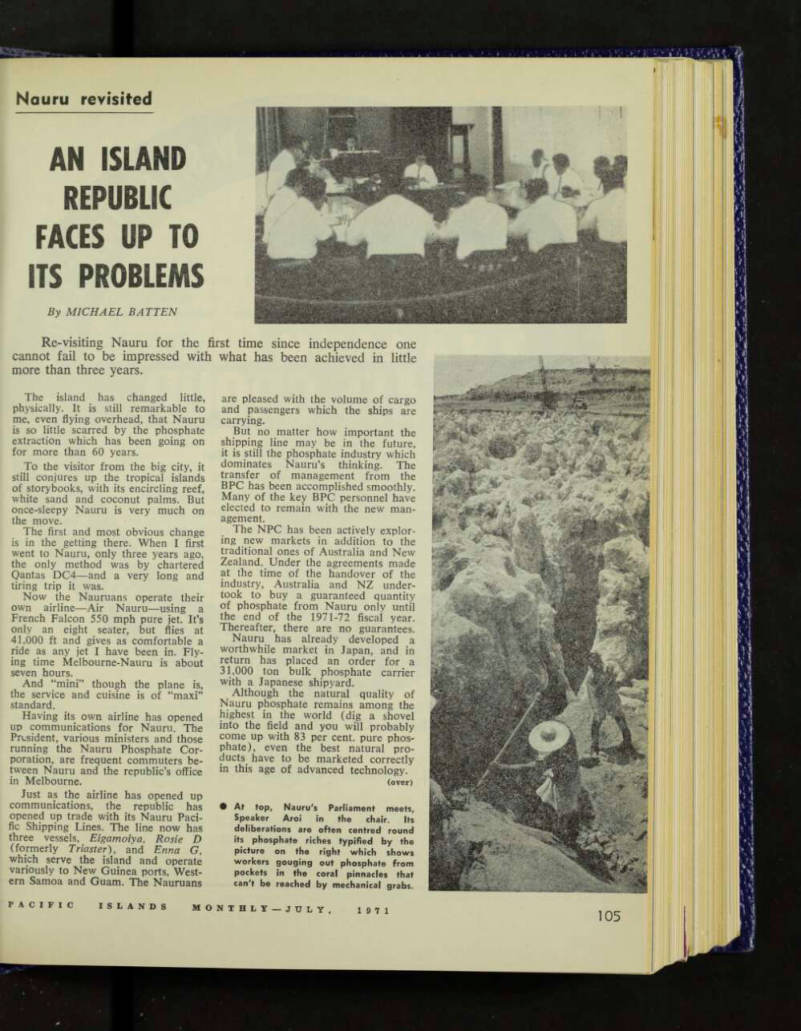
Nauru revisited
An Island
Faces Up To
Its Problems
By Michael Batten
Re-visiting Nauru for the first time since independence one cannot fail to be impressed with what has been achieved in little more than three years.
The island has changed little, physically. It is still remarkable to me, even flying overhead, that Nauru is so little scarred by the phosphate extraction which has been going on for more than 60 years.
To the visitor from the big city, it still conjures up the tropical islands of storybooks, with its encircling reef, white sand and coconut palms. But once-sleepy Naum is very much on the move.
The first and most obvious change is in the getting there. When I first went to Naum, only three years ago, the only method was by chartered Qantas DC4—and a very long and tiring trip it was.
Now the Nauruans operate their own airline—Air Nauru—using a French Falcon 550 mph pure jet. It’s only an eight seater, but flies at 41,000 ft and gives as comfortable a ride as any jet I have been in. Fly ing time Melbourne-Nauru is about seven hours.
And “mini” though the plane is, the service and cuisine is of “maxi” standard.
Having its own airline has opened up communications for Nauru. The President, various ministers and those running the Nauru Phosphate Cor poration, are frequent commuters be tween Naum and the republic’s office in Melbourne.
Just as the airline has opened up communications, the republic has opened up trade with its Naum Paci fic Shipping Lines. The line now has three vessels, Eigamoiya, Rosie D (formerly Triaster ), and Enna G, which serve the island and operate variously to New Guinea ports, West ern Samoa and Guam. The Naumans
are pleased with the volume of cargo and passengers which the ships are carrying.
But no matter how important the shipping line may be in the future, it is still the phosphate industry which dominates Nauru’s thinking. The transfer of management from the BPC has been accomplished smoothly.
Many of the key BPC personnel have elected to remain with the new man agement.
The NPC has been actively explor ing new markets in addition to the traditional ones of Australia and New Zealand. Under the agreements made at the time of the handover of the industry, Australia and NZ under took to buy a guaranteed quantity of phosphate from Nauru only until the end of the 1971-72 fiscal year.
Thereafter, there are no guarantees.
Naum has already developed a worthwhile market in Japan, and in return has placed an order for a 31,000 ton bulk phosphate carrier with a Japanese shipyard.
Although the natural quality of Naum phosphate remains among the highest in the world (dig a shovel into the field and you will probably come up with 83 per cent, pure phos phate), even the best natural pro ducts have to be marketed correctly in this age of advanced technology. (over)
• At top, Nauru's Parliament meets, Speaker Aroi in the chair. Its deliberations are often centred round its phosphate riches typified by the picture on the right which shows workers gouging out phosphate from pockets in the coral pinnacles that can't be reached by mechanical grabs.
Fertiliser plants around the world are beginning to demand finer crush ing, and to meet this demand the NPC is planning to install a new plant which will crush to a size of minus i in. instead of the present minus 2 in.
Further upgrading is planned with the installation of a calcining plant (a process which removes moisture and reduces the content of impurities including limestone). Other new equipment to be installed will enable even the phosphate dust to be utilised, by being compounded into pellets.
Nauru is still dependent on expatri ate skills in both the running of the phosphate industry and in the govern ment itself. Yet NPC now employs 117 Nauruans compared with 140 ex patriates, and more than 70 per cent, of the posts in the Nauru Public Ser vice are held by Nauruan citizens.
Nauru suffers from a fairly high turnover of expatriate staff. Life in distant, small communities requires a special kind of people, and in the pro cess of finding these people, many others pass through the system.
Nauru is intent on educating its own people to take increasing respon sibility. There is a scholarship system at secondary school level, with 20 chil dren selected each year to study at a school of their choice (normally Aus tralia). There is also a cadetship scheme at tertiary level which assists intending university students and those undertaking other courses at tertiary level (such as schools of mines, etc.).
An apprenticeship scheme also ope rates.
The results of these education assist ance schemes are becoming apparent.
Nauruan graduates include a doctor of medicine, a dental surgeon, and a Bachelor of Arts in political science.
There are also five Fiji-trained Nauruan doctors (Diploma of Medi cine and Surgery) at the Nauruan General Hospital.
Currently, Nauruan cadets are pur suing studies as diverse as business administration, nursing, law, medi cine, engineering, dental mechanics and surveying in Australia, NZ, New Guinea and Hawaii.
Nauruans are also emerging as teachers. Some, including Lawrence Stephen, a member of parliament, have graduated with the Diploma of Teaching English as a Second Langu age from the University of Papua and New Guinea and returned home to teach own people.
Stephen is one of the young brigade who was elected to parliament in the first poll since the original elections which followed independence. Their
election highlighted another trend on Nauru —growing political awareness.
Question time in parliament is fre quently an opportunity for the young brigade to aim pinpricking questions at the cabinet ministers—albeit with good humour. With one of the team being a graduate in political science (Australian National University graduate Kinza Clodumar), the gov ernment could hardly expect anything else.
Despite the obvious signs of pro gress, Nauru’s President Hammer Deßoburt remains impatient. A tire less worker himself (he recently tele phoned a senior public servant at 3 a.m. to complain that the electricity had been cut off, interrupting his labours) he expects everyone else to be equally dedicated.
The President remains personally involved in all important decisions and still travels extensively, particu larly to Australia. He is highly re spected by both Nauruans and expat riates.
With the results of its phosphate revenues, Nauru has been able to re main a duty-free, income tax-free haven in the Pacific, and there is no indications that these policies will change.
It takes a visitor from Sydney a long time to adjust to prices such as 14c for 20 cigarettes, bottled-in-Scot land Scotch for $1.76, and French wine for $l.lO. At the NPC staff club, to which all expatriates auto matically belong, a beer costs seven cents, and any spirit 14c (with the “mixer” drink thrown in free).
Duty-free prices and absence of income tax have probably been the biggest lure to expatriates in the past, but with the deterioration in the qual ity of life in Australia’s big cities, Nauru’s other attributes—absence of pollution, traffic snarls and crime—
President DeRoburt
may well prove to be equal attractions in the future.
No one locks the door of his home or car. About the only offences are traffic violations—not surprising when you consider that there are about 900 cars and 1,100 motor cycles on the 8i square mile island for a total population of 6,600.
Mention of the law reminds me that Nauru’s progress is not confined to material things. For example, major revisions of the Criminal Code are be ing undertaken currently by Chief Justice Thompson and legal advisers.
The main revisions will be to in corporate many reforms recently in troduced in the UK and Fiji, and to rationalise relative sentences for offences. When the review is com pleted, Nauru’s Criminal Code will be among the most advanced in the world.
Other reforms are intended to suit purely local conditions. For example, because there are presently no bar risters or solicitors practising on Nauru (outside the Justice Depart-, ment) the courts will accept “pleaders”—unqualified people who have to pass an examination set by the court and who receive an annual practising certificate which is capable of being revoked.
However, it is likely that the gov ernment will invite a legal firm to establish a branch on the island.
The phosphate revenues enable the islanders to have an enviable standard of living and a wide range of social services, including pensions, free housing, free hospital, medical and dental treatment, free telephones, and free bus transport to work and school.
The government provides homes for all its citizens. The latest design is an attractive, modern, two-storey home with brick ground floor and timber/ asbestos cement upper storey. All homes are sewered.
Apart from its homebuilding pro gramme, the government is currently building a modern civic centre which will incorporate bank, post office, commercial offices, supermarket, and social centre. A new cinema, library and museum are also planned.
When I was on the island there had been no rain for many months (the drought has broken since), and there was a severe water shortage.
There is no natural catchment—and water was being brought in by tanker at a cost of as much as $4 per 1,000 gallons.
There is already a total of about 17m. gallons of water storage on the island, but with weekly consumption as high as 750,000 gallons, this will
not outlast prolonged drought condi tions.
The Nauruans are studying various alternatives—including a desalination plant. They have also had a study car ried out **v a civil engineer who re commended creating giant storage tanks in the worked-out fields and covering them with special rubber sheeting to retard evaporation. Be cause of the limestone pinnacles which remain after phosphate mining, even this would require massive excavation work.
Another possibility would be to create storage under the airfield—the only large open space on the island.
As extensions to the airport are cur rently planned to lengthen the runway to 5,800 ft and to strengthen the surface to take large-sized jets, it is possible that the water storage problem could be tackled at the same time.
Mothers attack
bride bartering
The Anglican Mothers’ Union in Papua New Guinea has come out strongly against the custom of paying for brides with goods or cash.
The Mothers’ Union has passed a resolution declaring that the bride custom was “quite wrong” in cases where it had become simply a pay ment for the bride. However, mem bers said the traditional “friendly ex change of gifts” between families of bride and groom was a perfectly acceptable custom.
As a result of the resolution, the union will ask its 4,000 members in the Territory to try to persuade their husbands to refuse to have anything to do with bride prices as a form of payment.
The PNG P resident of the union, Mrs. Ray Kendall, hopes it will soon be an accepted fact that families of Mothers’ Union members do not en gage in bride price payments. This would be influential in eliminating the bad aspects of the custom and en couraging the good.
O Nauru, per head of population, has probably done more for the vic tims of the disastrous floods in East Pakistan earlier this year than any other country. An appeal for flood relief raised $13,608.77. Expenses in curred in raising the money totalled a mere $117.70.
Advertisements & other items, pp. 112-120 (2 items)
yXi • ltd. * ty p
Established 1890 offering merchants in the Pacific, buying service giving prompt, careful and expert attention to all requirements.
For that service with a difference, cable "Success", Sydney.
Sole Distributors in the Pacific for: Tilley lamps, Plastevic antifouling paints, Fulda tyres, Success & Tiara footwear, 4711 Eau de Cologne, Hilite batteries, Woodcemair prefab houses, Ross frozen foods, Balgay jams, Success canned fish, kerosene refrigerators, jute sacks, ice cream, torches, textiles, furniture, electric appliances.
HIGHEST PRICES OBTAINED ON WORLD MARKETS
FOR YOUR
SHELL - COCOA - COFFEE - COPRA - ETC.
31 MACQUARIE PLACE, SYDNEY, N.S.W. 2000.
G.P.O. BOX 5315, SYDNEY, 2001.
SUCCESS'—Sydney
CABLE ADDRESSES
'TAllCO'—Sydney^
m
HELLABY’S
CANNED MEATS
ff
CROWN
PACIFIC 1 '
ARROW "
ff SK£ ff Ns II
CORHtD#**
$ 9?
SOUTHERN PACIFIC INSURANCE
COMPANY LIMITED
Head Office: Equitable Life Building, 80 Alfred Street, Milsons Point, N.S.W., 2061.
Specialising in
Pacific Island Insur for over 30 years. iquiremenfa • FIRE • FIRE AND VOLCANIC ERUPTION • HOUSEHOLD COMPREHENSIVE • MOTOR VEHICLE • COMPULSORY THIRD PARTY • COMPULSORY WORKERS' COMPENSATION
• PUBLIC LIABILITY • MARINE
Enquiries invited for all classes of insurance from special representatives ati RABAUL: Jack T. Ray—Manager for Papua & New Guinea, Mango Avenue. P.O. Box 123.
LAE: Alex B. Barker—Manager at Lae, Kam Hong's Building, Central Avenue. P.O. Box 758. PORT MORESBY; H. A. K. McKee—Manager at Port Moresby, Maloney's Building, Cuthbertson Street. P.O. Box 136. SUVA-FIJI: L. M. Rolls—Manager for Fiji, McGowan's Building, Margaret Street. P.O. Box 521.
♦ SULLIVAN EXPORT SERVICE *
C. SULLIVAN (EXPORT) PTY. LTD.
4th Floor, Kemblo Building,
60 MARGARET STREET, SYDNEY, 2000, N.S.W.
Telephone: 29-8144 (6 lines).
MELBOURNE
SULLIVAN (EXPORT)
PTY. LTD.
59 William Street, Melbourne, 3000, Vic.
Telephone: 62-6600 Cables and Telegrams: CHASULL, Melbourne
Also at; PORT MORESBY •
Telegrams and Cables: CHASULL, Sydney
BRISBANE
C. SULLIVAN (Q'LAND)
PTY. LTD.
Empire House, cnr. Queen & Wharf Sts., Brisbane. 4000 (G.P O Box 1697 V, Brisbane, 4001.) Telephone: 24958 Cables and Telegrams: CHASULL, Brisbane
NEW ZEALAND
C. SULLIVAN (N.Z.)
LTD.
Levein Building, cnr. Paul & Alrdaie Sts., Auckland, 1 Telephone: 36-0472.
Cables and Telegrams: CHASULL, Auckland.
LAE • RABAUL • SUVA • LAUTOKA • LONDON • SAN FRANCISCO
OFFERING A COMPREHENSIVE BUYING SERVICE
TO ISLANDS CLIENTS
OTHER HANOI PRODUCTS!
Handi' range of quality products also includes: a portable Twin-Burner Stovette and 'Handi' Pumpless Petrol Iron.
Keep a
HANOI handy!
No need to fumble and fume! Throw light on the subject with a 'Handi'. It's twice as bright as electric light. Completely stormproof. Simple and safe to use.
PRESSURE OPERATED
One filling gives 12 hours of brilliant 300 candle-power lighting. Built to last, with chromed, rust-proofed finish. Petrol or Kerosene models.
Ask for Handi! Everywhere!
THE BEST OF BOTH WORLDS
COLORGAN
SOUND ACTUATED LIGHTING SYSTEM
Operates from any sound system stereo tape recorder, etc.
Background, Gain and Delay Controls.
All solid state construction.
Cristallux display spheres, complete with lamps cable and Atlas stand.
Coloured Music is a delight to watch. You and your friends will be amazed at the instant response to the Colour to Sound similarity.
TRANSLATOR ENTERPRISES
MUSK
YOU CAN
Made in Australia—fully guaranteed.
CHEGWYN ST., BOTANY, N.S.W. 2019 AUSTRALIA
MORRIS
HEDSTROM
LIMITED
HEAD OFFICE: SUVA, FIJI
LONDON OFFICE:
MORRIS HEDSTROM LTD.,
Park House, 22 Park Street, Croydon,
CR9 BNP
• GENERAL MERCHANTS
• PRODUCE BUYERS
• IMPORTERS AND
EXPORTERS
• PLANTATION OWNERS
• COMMISSION AND
INSURANCE AGENTS
AUSTRALIAN
REPRESENTATIVE:
W. R. CARPENTER & CO. LTD.,
(Merchandise Division) The A. Gr N.Z. Building, 68 Pitt Street, Sydney, 2000.
Registered Cable Addresses: • DEUBA—SUVA • CAMOHE—SYDNEY • SUV AMARK—LONDON • MORRISCO—NUKUALOFA
• DEUBA—APIA • CODES: ALL.
AGENTS AND DISTRIBUTORS FOR:
• Bacardi International • China Navigation Co. • Crittall Hope Export • John Dewar & Sons Ltd. • Electrolux Limited • Elizabeth Arden • Evinrude Outboard Motors • Ford Motor Co. • Glaxo Laboratories • Goodyear Tyre & Rubber Co. • Guinness Exports Ltd. • Jas Hennessy & Co. • Imperial Chemical Industries • Mobil Oil Australia Ltd. • Max Factor & Co. Inc. • McWilliams Wines Pty.
Ltd. • Napier Bros. Ltd. • Parker Pen Company • Proctor & Gamble • Rootes Ltd. • Ronson Products Ltd. • Rowntree & Co. Ltd. • Tanqueray Gordon & Co Ltd. • Taubmans Ltd. • Viners of Sheffield • Yorkshire Imperial Metals Ltd Morris Hedstrom Ltd. are LLOYD'S AGENTS in
FIJI and WESTERN SAMOA.
For friendly service and complete satisfaction ii r s Morris Hedstrom Ltd. in
FIJI - WESTERN SAMOA - TONGA
BENEFIT FROM 85 YEARS
OF INSURANCE EXPERIENCE
QUEENSLAND
INSURANCE
Company Limited
(INCORPORATED 1886 IN AUSTRALIA)
HEAD OFFICE: 82 Pitt Street, Sydney FIJI —Branch Office, Suva, Manager for Fiji: K. Galloway.
LAUTOKA, BA, LEVUKA, LABASA—Bums Philp
(South Sea) Co. Limited. District Manager at Lautoka: U. Singh.
PAPUA & NEW GUlNEA—Branch Office, Port Moresby: Manager for Papua & New Guinea: D. J. Granter.
SAMARAI, LAE, MADANG, RABAUL, KAVIENG,
MT. HAGEN—Bums Philp (New Guinea) Limited.
District Manager at Rabaul: J. S. Bell. District Manager at Lac: J. D. Mac Lean. District Manager at Mt. Hagen: G. F. Donnelly.
HONIARA (b.s.i.p.) —Brcckwoldt & Company (5.1.) Pty. Limited.
NOUMEA—T. A. Hagen, Ste W.A. Johnston S.A.R.L.
VlLA—Bums Philp (New Hebrides) Limited.
SANTO—Bums Philp (New Hebrides) Limited.
NORFOLK ISLAND—Bums Philp (South Sea) Co. Limited.
OTHER SOUTH SEA ISLANDS—Bums Philp (South Sea) Co. Limited.
Assets exceed $ A 65,000,000
SADDLERY AND RIDING EQUIPMENT
Send for FREE illustrated catalogue of;— Saddlery Horse rugs Breaking-in-gear Whips (Stock and riding) Yarding canes (sheep and cattle) Riding clothing Riding boots (elastic-side and Polo) Polo equipment Driza-bone raincoats Pony Club and Hunting Caps
HOME TANNING OUTFITS
For tanning all kinds of skins. Kangaroo, rabbit, sheep, crocodile, bullock hides, etc Price $3.50 Post FREE.
JOHN CHARLTON & CO. PTY. LTD.
168-170 PACIFIC HIGHWAY, ST. LEONARDS, N.S.W., 2065 Phones: 43-1010, 43-6087. After Hours: 451-4718.
Telegraphic & Cable Address: "CHARLTONS", Sydney.
A
great bunch
of flours.
Robert Hutchinson makes the greatest bunch of flours In the Pacific. Bakers’ flour.
Superlite cake and sponge flours.
Biscuit flour and cracker flour.
Wheaten sharps and wheaten meal.
We’re particularly proud of our i bunch of flours. So we have a technical advisory service to help you use them properly.
So next time you see a Robert Hutchinson flour (or even one of our Hutmill stock feeds), remember it’s just one of the bunch i wm *5- £ rv.' Vm M m
ROBERT
HUTCHINSON
LIMITED
(he flour people
Harrington Street, Glenroy, Victoria. Australia. 3046. Telephone Melbourne 306 7261
RHIO2
I tt
meet
YORKSIL
the plumber’s
mate”!
Cocky little fellow isn’t he!
That's because of his tremendous success with plumbers since his introduction last year.
We know why, too! This brand new “compact” fitting costs less.
YORKSIL can save a plumber up to 20% on copper fittings for silver brazing. No wonder he’s so popular with the trade!
Mind you YORKSIL'S not the only star in the Yorkshire ‘family’ big brothers YORKWAY and YORKSHIRE still rate very high in popularity for other fitting applications.
Precision made in copper or non-dezincifiable brass and conforming to S.A.A. standard 8181, YORKSIL is available in sizes and in the 23 most popular types.
ASK YOUR SUPPLIER FOR YORKSIL
orh/il
YORKSHIRE IMPERIAL (AUSTRALIA) PTY. LTD.
144-154 Milperra Road, Revesby, N.S.W., 2212. Phone 77-0561
MELBOURNE 569-0859 BRISBANE 36-0455
PERTH 24-1017 ADELAIDE 57-4445
YL/3B
W. H. GROVE & SONS LTD.
Established 1896
EXPORTERS
P.O. Box 490, Auckland, New Zealand.
Telegraphic and Cable Address: 'Grove' Auckland. • Entrust your requirements to the firm with more than 70 years' practical experience in exporting to the Pacific Islands.
Accredited Agents for The New Zealand Dairy Board, The New Zealand Apple and Pear Marketing Board and exporters of all classes of New Zealand manufactured goods and produce. • IN FIJI as W. H. GROVE & SONS (FIJI) LTD.
FOR CONSISTENT HIGH QUALITY
v A A i
BRUNTON
Terry Rood, Dulwich Hill, N.S.W. 2203 CO. PTY. LTD. Cables: '"Beacon and Brunton". Phone: 56-1448 F'tahlished 1868 Australia’s oldest export our millers.
Nauru revisited
113
PACIFIC ISLANDS MONTHLY - J U L Y , 1971
On the record
No sexual danger in
this tablet taking
The Medical Department’s tasks in the remoter parts of Fiji must seem difficult enough without rumours such as the latest one relating to filarial tablets!
The department has reported that the people of Macuata and Bua were reluctant to take the tablets be cause they feared their sex life would be affected.
A spokesman said: “There is a rumour in Macuata that the filarial tablets, which have to be taken regu larly to cure filariasis, will prevent people from having children and that they interfere with men’s sex life.
“The Medical Department wishes to tell the people of Macuata and Bua most emphatically that this rumour is not true”.
The spokesman urged the Indian population and all the people in the area to support the anti-filarial cam paign and to take the tablets at the prescribed time.
He added: “The rumours about the tablets interfering with the pro creation of children and with sex life are pure imagination—but there is no imagination about the dreadful results which can stem from filariasis once it gets a firm hold.
“It can lead to the appalling dis figurement of elephantiasis, apart from it having a very bad effect on general health. The debilitation caused by filariasis is certainly calcu lated to interfere with sex life. The tablets will not interfere with it”.
Trait ends for
shell collector
Islands shell collectors probably won’t be seeing Willard Mohorter again. The 82-year-old American has decided to call it a day after 37 years criss-crossing the world, in cluding the South Pacific, buying or collecting all kinds of shells.
Mr. Mohorter will now concentrate on managing the shell collection in a museum in his home town, Cin cinnati, Ohio. Of the museum’s 23,000 shells, he has loaned 20,000 of them.
Mr. Mohorter retired 12 years ago as a publishing company executive, but long before that, from 1934, he had been taking several months off each year to travel the world in
search of shells. In that time he has amassed the world’s largest individual collection of shells —more than 650,000. Mr. Mohorter has been visiting Fiji since the 1930 s and New Guinea since the late 19405, and once made news in Rabaul, New Guinea, by paying $l,lOO for a Gloria maris shell.
Making money's not
all easy cash
Making money’s not so popular any more, it seems, in the Solomons, A suggestion that a workshop or fac tory be set up on Malaita in the British Solomon Islands to make shell money, was turned down by a recent meeting at Busu, Small Malaita.
The meeting, attended by eight chiefs from the Tarapaina area and local council members, was called because there was some concern about the shortage of shell money, and the fact that the number of people able to make it was decreasing.
One of the reasons for the shortage was said to be that young girls were not interested in making the money because the job took a long time and because they were not paid well. It was explained at the meeting that it takes six months or more to make a ta’afuliae and costs about $72 if the people making it are paid in dollars.
At the meeting it was suggested that a factory be set up to make the money more quickly. It could then be sold and the workers better paid.
However (according to the local BSIP news sheet) the idea was op posed by several Langa Langa people, who did not think the art of making shell money was dying out. They said if a family wanted to make more, it was up to the man of the house to make the women work harder.
Confectionery takes
Fiji coconuts
Having been presented with an ?asy, profitable alternative outlet for their coconuts, some Savusavu danters have stopped producing copra >n their estates.
They are supplying husked coco mts to an American confectionery nanufacturing firm, Mendonca bandies. Its Nausori factory pro luces frozen 1010 (coconut cream) or sweet-making in Hawaii. The company has plans to open a desic ated coconut factory about two ailes from Savusavu township.
In negotiations with the company’s epresentative, Mr. Gerald Kleiman,
the Copra Producers’ Association has managed to get a higher price for a ton of husked coconuts than is currently being paid for a ton of first-grade copra.
Mr. Robbie Lepper, of Wina Estate, was among the first to benefit when Mendonca Candies started buy ing husked coconuts from Savusavu about a year ago. He has been able to stop producing copra on his four estates and, as the company’s purchasing agent in the area, is now buying on its behalf from 10 other estates.
The company is reported to pay about SFI44 a ton (about 6,000 nuts). The price is fixed and there are no fluctuations.
“We don’t have to worry about the price of copra anymore,” Mr.
Lepper said. “WeTe sending at present about 300 sacks of coconuts ;ach week to the Mendonca factory. [ hope to increase this to 700 sacks.”
He said there were no freight charges. All that the planter had to io was husk the coconuts, count and ?ag them and payment was made on he spot.
Visitor business
• The Trust Territory received 16,700 visitors last year according to he Office of Tourism —an increase )f 30 per cent, over 1969. Direct ourist expenditure in 1970 amounted o $2 million—about double that of [969. US visitors amounted to 60 )er cent., while Japanese tourists emained at 1969’s level of about 25 >er cent. Marianas had the most dsitors while Ponape had the fastest ;rowth rate. • Back in Agana, Guam, is Nor )ert Unpingco, the newly-appointed lirector of Guam Visitors’ Bureau, rom a world-wide whistle-stop tour o promote Guam, sponsored by |anAm’s arch rival, TWA. Miss juam International, Flora Baza, ac companied Unpingco on his trip. • Fiji, in the first quarter of this r ear, had 10,000 more staying visitors han in the first quarter last year, '5,000 compared with 25,000. Most pectacular increase was in Canadian isitors who, for the same period, in reased by more than 81 per cent, 'lew Zealanders were 50 per cent, lore, Americans 48 per cent, and Uistralians 32 per cent. The March 3tal was nearly 33 per cent, more han that for March last year, with Americans contributing nearly 5,000 3 the total of 12,000, Australians early 3,000, New Zealanders 1,300 nd Canadians over 800. Only 3 per ent. of the March visitors came by ea.
Advertisements & other items, pp. 121-126 (4 items)
G.M. Diesel Alternators Coupled
2-80 K.V.A.
WITH SYNCHRONISING UNIT
Capable of delivering up to 160 k.v.a.
Both units have recently been overhauled.
Would consider selling separately or as a matched pair.
Full details and price on application to:
MANAGER, TRADING DEPARTMENT,
P. FERON (j SON LTD.,
P.O. BOX 83,
CHRISTCHURCH, NEW ZEALAND.
MICK SIMMONS LTD.
THE MODERN HOME OF SPORT
adidas ROME
A strong very good looking shoe and for a long time our best seller Oxhide white upper, adidas Arch support, toe cap and reinforced heel counter. Now fitted with our newest patent, the "Achilles Protector".
Padded tongue and white aon-slip Olympia sole. Excellent for outdoor training and competition.
PRICE $12.95
SPECIAL ATTENTION GIVEN ALL MAIL ORDERS
ORDERS AND ENQUIRIES TO MICK SIMMONS,
720 GEORGE STREET, HAYMARKET, N.S.W. 2000, AUSTRALIA
60 FT. VESSEL FOR SALE
JVoav Available New boat, constructed under Commonwealth survey, to open hull stage.
Ready for rapid completion to your requirements
SUIT: ISLAND TRADING • MISSION BOAT
• FISHING • SPECIAL PURPOSE
Contact : WOODLEYS SLIPWAY PTY. LTD.,
I BALLS HEAD ROAD, WAVERTON, SYDNEY, N.S.W. 2060, AUSTRALIA, Phone: 92-1021.
D
Jfapua new guinea
printing co. ply. ltd.
Supplying the Territory with:
• COMMERCIAL JOB PRINTING
• PAPER RULING
• STATIONERY REQUIREMENTS
• RUBBER STAMPS
Mail Orders Invited P.O. Box 633, Port Moresby P.O. Box 759, Lae P.O. Box 30, Mount Hagen Cables & Telegrams: Printer Port Moresby and Lae
I need rest-
baby's exhausted,
too —
What would
you do?
I've tried to be an attentive mother but so many times I've felt at a loss to know just how to comfort my little one.
Baby, having arrived so much later than Tim and Jen, I'd really forgotten the distressing symptoms that come with teething troubles.
Then, in desperation I remembered Fisher's Teething Powder.
You'd be amazed what an effective and soothing aid they are to baby's sore gums, digestive disturbances and intestinal upsets which are natural teething disorders.
Another great virtue of Fisher's Teething Powders is their safety.
They do not contain Calomel, Opiates, Bromides or any harmful substances. Even if the baby by mischance should eat several, they could do no harm.
By giving your baby a Fisher's Teething Powder as needed, you not only keep the little one happy and well, but save yourself all those upsets and nervous tensions that beset a mother when her baby suffers distress. Be sure to get a supply of Fisher's Teething Powders from your chemist or store. Only 30 cents for 20 powders, write direct to Fisher & Co, Manufacturing Chemists, 17 May St., St. Peters, N.S.W. Postcode 2044.
THE NEW LONGER-LIFE r
KNIVES THAT HAVE THE EDGE
OVER ALL OTHERS
Swiss design and manufacture
OBTAINABLE
FROM THE
LEADING
BUTCHER
SUPPLIERS
Sole Importers:
PETER FISHER
TRADING PTY.LTD.
321 Pitt Street
SYDNEY
Telephone 26 1109
THE
YORKSHIRE INSURANCE:
CO. LTD.
(Incorporated in England)
A MEMBER OF THE GENERAL ACCIDENT GROUP OF COMPANIES
ALL CLASSES OF INSURANCE
AUSTRALIAN HEAD OFFICE: 10-12 Spring Street, Sydney Group Manager for Australia: R M. Trotter PAPUA AND NEW GUINEA BRANCH: Douglas Street, Port Moresby Manager: H. M. Harvey.
CHIEF ISLAND REPRESENTATIVES
Port Moresby, James Services Pty. Ltd.; Rabaul, A.S.P. (N.G.) Ltd.; Lae, Radio Cabs (Lae) Ptyyt Ltd.; Madang, W. Stokes; Manus, Edgell & Whiteley Ltd.; Honiara, 8.5.1. P., E. V Lawsonnc Ltd.; Suva, Williams & Gosling Ltd.; Noumea, R. Laubreaux; Norfolk Island, Martin s Agencies Apia, E. A. Coxon & Co.
RAMBLER'S
GUIDE TO
NORFOLK
ISLAND
$l.OO at bookstalls or from Pacific Publications (Aust.) Pty. Ltd., Box 3408, G.P.0., Sydney (plus 18c postage).
%Vtc!a\
I time/?
TIME TO TURN
GRASS
INTO LAWN!
A model available to suit all conditions and every purpose Obtainable from:
SUVA MOTORS LTD.
Suva, Lautolca.
ISLAND PRODUCTS LTD
Port Moresby.
NEW GUINEA CO. LTD
Rabaul, Madang, Lae, Mount Hagen, Minj, Goroka.
YOUR NEXT LEAVE
Modern up to the minute homes at Palm Beach, Avalon. Newport, Church Point.
Mona Vale, etc., available to Island Residents for Holidays. Write for information to:
J. T. STAPLETON PTY. LTD.
ESTATE AGENTS,
133 PITT STRE£T, SYDNEY, 2000. 25-5305, 25-1737 also Box 32, P. 0., Avalon Beach, Sydney 2107. 918-2221.
nedlioyd Koninklijke Nedlloyd nv
REGULAR SAILINGS BY FAST, MODERN, CARGO VESSELS
from CONTINENTAL PORTS via PANAMA to
PAPEETE, APIA, SUVA, LAUTOKA, NOUMEA and
NEW ZEALAND
other ports called at subject to sufficient inducement heavy-lift facilities —refrigerated space—cargo deeptanks For further particulars apply to agents Ets. Donald Tahiti, Russell & Sommers (Wellington) Carpenter's Fiji Ltd., Interocean Australia Services Papeete. Ltd., Wellington, N.Z. Suva, Pty. Ltd., Sydney.
Morris Hedstrom & Co. Ltd., O. F. Nelson & Co. Ltd., Agence Maritime Pentecost, Lautoka. Apia. Noumea.
Ask for FOUREX—the clear sparkling amber beer...
available in BOTTLES, CANS and STUBBIES
The Popular
KZJI
‘lts Quality Never Varies' Wholesale Distributors:
C. SULLIVAN
(NEW GUINEA) PTY. LTD.,
Port Moresby, Lae, Mt. Hagen, Rabaul, Kieta, Lautoka and Suva, Fiji.
AGENCIES:
R. Bensley—Madang. Ping Shee & Co. —Wewak. E. V. Lawson Ply. Ltd.— Honiara, British Solomon Islands.
pisnjiMiKj
out*
eastlemair'e
BITTMAIf
itSTUWd xxxx
Fitter
“•asr Brewed from the finest Ingredients by Castlemaine Perkins Limited, Brisbane. Queensland, Australia.
m *> % «
Buy and sell the world
with one phone call
Overseas trips to secure new markets or to investigate new trends may be beyond the financial resources of some companies ... yet the price of a local phone call can put you in touch with the world.
ANZ Banking Group will give you general or specific information about any country ... it’s yours for the asking.
Get the facts on trade. Currency. Credit. Regulations and Legal Matters. Business transactions. Introductions.
Get through to the world through ANZ.
All enquiries to ANZ Bank, Administrative Headquarters, 351 Collins Street, Melbourne, Australia, 3000, telephone 61 2011, or to any ANZ branch in Fiji, Papua and New Guinea, British Solomon Islands and New Hebrides.
AISR
AUSTRALIA AMD MEW ZEALAND
BANKING GROUP LIMITED
INCORPORATING ANZ BANK AND ES4A BANK
ANZB64
Petromax products exclusively available from;
Breckwoldt & Co.
Head Office; Hamburg / Germany V£
til
m % if a* (fiE our branches are;
BREWO
BRECKWOLDT & CO. (N.G.) PTY, LTD.
P.O. Box 222, RABAUL
P.O. Box 1549, Boroko, PORT MORESBY.
P.O. Box 185, MADANG.
P.O. Box 557, LAE.
P.O. Box 72, KIETA.
P.O. Box 237, MT. HAGEN.
P.O. Box 178, WEWAK.
BRECKWOLDT & CO.
P.O. Box 47, APIA.
BRECKWOLDT & CO. (5.1.) LTD.
P.O. Box C 5, HONIARA.
PRUFPLY Another First for Klinkil!
An Interior
plywood to
RESIST all
TERMITE and
INSECT attacks!
• Arsenic-treated glueline offers
permanent, positive protection!
• Prufply is economical and ideal for all interior applications. • Prufply saves time and cuts repair and maintenance costs. pim/ 4 Available from; New Guinea Co. Ltd.
Burns Philp {New Guinea) Limited .
Steamship Trading Company Limited all branches Island Products Limited Collins and Leahy Pty. Ltd. all branches Arshak C. Galstaun ali branches Waso Limited ... Port Moresby Goroka Angoram Wapendmanda
117
ACIFIC ISLANDS MONTHLY JULY, 1971
119
ACIFIC ISLANDS MONTHLY JULY, 1971
Dsfdf
Nutshell
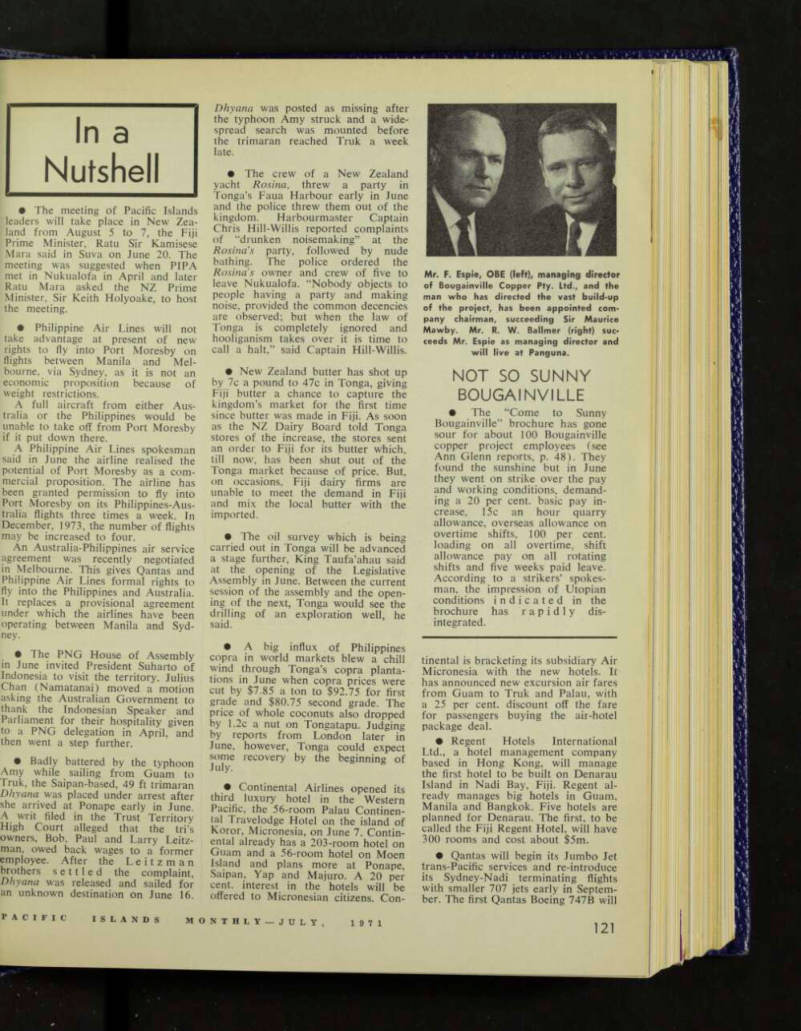

In a Nutshell
• The meeting of Pacific Islands leaders will take place in New Zea land from August 5 to 7, the Fiji Prime Minister, Ratu Sir Kamisese Mara said in Suva on June 20. The meeting was suggested when PIPA met in Nukualofa in April and later Ratu Mara asked the NZ Prime Minister, Sir Keith Holyoake, to host the meeting. • Philippine Air Lines will not take advantage at present of new rights to fly into Port Moresby on flights between Manila and Mel bourne, via Sydney, as it is not an economic proposition because of weight restrictions.
A full aircraft from either Aus tralia or the Philippines would be unable to take off from Port Moresby if it put down there.
A Philippine Air Lines spokesman said in June the airline realised the potential of Port Moresby as a com mercial proposition. The airline has been granted permission to fly into Port Moresby on its Philippines-Aus tralia flights three times a week. In December, 1973, the number of flights may be increased to four.
An Australia-Philippines air service agreement was recently negotiated in Melbourne. This gives Qantas and Philippine Air Lines formal rights to fly into the Philippines and Australia.
It replaces a provisional agreement under which the airlines have been operating between Manila and Syd ney. • The PNG House of Assembly in June invited President Suharto of Indonesia to visit the territory. Julius Chan (Namatanai) moved a motion asking the Australian Government to thank the Indonesian Speaker and Parliament for their hospitality given to a PNG delegation in April, and then went a step further. • Badly battered by the typhoon Amy while sailing from Guam to Truk, the Saipan-based, 49 ft trimaran Dhyana was placed under arrest after she arrived at Ponape early in June.
A writ filed in the Trust Territory High Court alleged that the tri’s owners, Bob, Paul and Larry Leitz man, owed back wages to a former employee. After the L e i t z m a n brothers settled the complaint, Dhyana was released and sailed for an unknown destination on June 16.
Dhyana was posted as missing after the typhoon Amy struck and a wide spread search was mounted before the trimaran reached Truk a week late. • The crew of a New Zealand yacht Rosina, threw a party in Tonga’s Faua Harbour early in June and the police threw them out of the kingdom. Harbourmaster Captain Chris Hill-Willis reported complaints of “drunken noisemaking” at the Rosina’s party, followed by nude bathing. The police ordered the Rosina’s owner and crew of five to leave Nukualofa. “Nobody objects to people having a party and making noise, provided the common decencies are observed; but when the law of Tonga is completely ignored and hooliganism takes over it is time to call a halt,” said Captain Hill-Willis. • New Zealand butter has shot up by 7c a pound to 47c in Tonga, giving Fiji butter a chance to capture the kingdom’s market for the first time since butter was made in Fiji. As soon as the NZ Dairy Board told Tonga stores of the increase, the stores sent an order to Fiji for its butter which, till now, has been shut out of the Tonga market because of price. But, on occasions, Fiji dairy firms are unable to meet the demand in Fiji and mix the local butter with the imported. • The oil survey which is being carried out in Tonga will be advanced a stage further, King Taufa’ahau said at the opening of the Legislative Assembly in June. Between the current session of the assembly and the open ing of the next, Tonga would see the drilling of an exploration well, he said. • A big influx of Philippines copra in world markets blew a chill wind through Tonga’s copra planta tions in June when copra prices were cut by $7.85 a ton to $92.75 for first grade and $80.75 second grade. The price of whole coconuts also dropped by 1.2 c a nut on Tongatapu. Judging by reports from London later in June, however, Tonga could expect some recovery by the beginning of July. • Continental Airlines opened its third luxury hotel in the Western Pacific, the 56-room Palau Continen tal Travelodge Hotel on the island of Koror, Micronesia, on June 7. Contin ental already has a 203-room hotel on Guam and a 56-room hotel on Moen Island and plans more at Ponape, Saipan, Yap and Majuro. A 20 per cent, interest in the hotels will be offered to Micronesian citizens. Con
tinental is bracketing its subsidiary Air Micronesia with the new hotels. It has announced new excursion air fares from Guam to Truk and Palau, with a 25 per cent, discount off the fare for passengers buying the air-hotel package deal, • Regent Hotels International Ltd., a hotel management company based in Hong Kong, will manage the first hotel to be built on Denarau Island in Nadi Bay, Fiji. Regent al ready manages big hotels in Guam, Manila and Bangkok. Five hotels are planned for Denarau. The first, to be called the Fiji Regent Hotel, will have 300 rooms and cost about ssm. • Qantas will begin its Jumbo Jet trans-Pacific services and re-introduce its Sydney-Nadi terminating flights with smaller 707 jets early in Septem ber. The first Qantas Boeing 7478 will
leave Sydney on September 3 for San Francisco, via Fiji and Hawaii. Initi ally a weekly service, it will be built up to three Jumbo services a week by September 20. Rescheduling its flights to allow for the 356-seat Jumbo to complement the 140-seat 7075, Qantas will bring back its Syd ney-Nadi terminating flights scrubbed in October last year. Both Fiji flights will be daylight out of Sydney and Melbourne. A 707 will leave Sydney for Nadi on Saturday morning, and return to Melbourne Saturday night.
On Sunday morning, the same jet will leave Melbourne for Fiji, returning to ' Sydney at night.
O There are 1,964 British subjects living in the New Hebrides according ; to a recent Immigration Department ; survey. Of these, about 45 per cent, are European. Next largest groups are ; the Gilbertese and Fijians, each with j about 20 per cent. • Debris seen in the sea in June 700 miles south-west of Hawaii, is be- ■ lieved to be from a US Air Force t transport plane which vanished while ; flying on a secret mission from Pago < Pago to Honolulu. Although Air - Force spokesmen have refused to < comment, it is believed the plane’s < secret mission was to monitor the j French nuclear tests at Mururoa. • The Anglican diocese of Papua i New Guinea is going ahead with its * million dollar appeal in Australia. .
Work has already begun, but the cam- paign will be intensified next year to c provide the PNG church with a capi- tal fund enabling it to stand on its z own feet. • The 11-year-old Papuan boy \ who was gaoled for two years by a r magistrate, Mr. A. H. Germain, for i four breaking and entering offences, has had his sentence cut to three s months by the Supreme Court at Port J Moresby. After three months, he will 1J be placed in his parents’ care and re- main under the control of the Direc- -: tor of Child Welfare until he is 16. .< He is serving his sentence at a Catho- h lie mission home in Wewak. At thes time he sentenced the boy, Mr. Ger--main criticised the government’s z' failure to provide juvenile corrective e institutions. • The mystery of distress flaresg off the Western Solomons on June 13 £ has been solved with the finding ofh the burnt-out hulk of the Taiwan fishd catcher, New Cathay, on Mundas Reef. The crew, none injured but all II suffering from exposure, was taken n off. Government vessels searched an wide area after the flares were seen, t r but drew a blank.
• Melanesian Roman Catholic priests working in Papua New Guinea and the Solomons have formed an organisation called the Catholic Indigenous Priests’ Conference, with the Rev. Ignatius Kilage (Goroka) as chairman and the Rev. Fred Reiher MSC (Port Moresby) as secretary.
Sixteen indigenous priests con celebrated Mass at the opening of the conference with Bishop Louis Vangeke MSC, auxiliary at Port Moresby as principal celebrant. • Mr. Ron Green, administrative officer in Nauru’s public service, has been transferred to the republic’s Melbourne office as personnel officer.
He took up his appointment on the island in February, 1969 and had recently acted as senior administra tive officer in the temporary absence of Mr. Peter Kelly. • From July 1 the affairs of American Samoa, Guam, the US Trust Territory and the American Virgin Islands will be switched from the US Office of Territories to one man, the newly-created Deputy Assistant Secretary for Territorial Affairs, who had not been named when the change was announced by Washington at the beginning of June, Tasks of the deputy assistant sec retary will include the rendering of technical assistance, programme plan ning and co-operation with other Federal agencies and Congress. • The retirement of Mr. David Petrie Ragg from the posts of chair nan and managing director of North ern Hotels, Fiji, leaves quite a blank n the Northern Hotels hierarchy.
There still will be Raggs in charge )f the Northern Hotels chain (Mr. W.
"lark, manager of Korolevu Beach tJotel, who married Kathy, a daughter )f the late Sir Hugh Ragg, is the new nanaging director) but DPR had )een prominent there for nearly 40 fears, and will be missed.
He was bom in 1906, and in his ;arly life was a CSR overseer, a law Jerk and a plantation manager.
Vhen he was 27 he joined Sir Hugh lagg in the management of the chain >f hotels which Sir Hugh had as embled. He took over the top position vhen Sir Hugh died in 1966.
In so successfully establishing Corolevu as the first famous holiday esort hotel on the south coast of liti Levu, Sir Hugh Ragg, David, nd Bill Clark, pioneered tourism in 'iji.
While actively controlling Northern iotels, Mr. Ragg has occupied many lirectorships and positions connected pith business, sport and public
affairs. He is the chairman of the large Fiji Electrical Authority.
Presumably, he will continue those operations and remain a prominent and esteemed figure in the Fiji busi ness world. • Alleging that the defendant had knocked him from his bicycle and then thrown a bottle containing ammonia at his feet, Patrick Matthew Anthony (33), formerly of Lautoka, Fiji, and now living at 15 Cascade St., Paddington, Sydney, summoned 36-year-old Allan Hamilton, of 102 Alison Road, Randwick, Sydney for assault. The hearing opened in the Magistrate’s Court at Waverley, Sydney, on June 24 and was adjourned by the Magistrate, Mr. B. J. Hayes, until September 15. • Marshall Islands Air Taxi Service, one of two charter services based at Majuro, is seeking permis sion from the Gilbert and Ellice Islands Colony in the south to operate a scheduled service each Sunday from Majuro to Tarawa return. MIATS uses a 6-44 Widgeon and a D-50 Beech, and in July will inaugurate a scheduled service four times weekly between Majuro and Kwajalein and once every Friday from Majuro to Ponape, The Ponape flight will con nect with Air Micronesia’s turn around, to establish a through service between Majuro and Saipan. • Spending $4 million on two new DCS’s, bringing its DCS fleet strength to six, Air New Zealand will extend its weekly Nadi-Honolulu flight through to Los Angeles from early November. The flight leaves Nadi for Honolulu early on Friday mornings.
It will arrive in Los Angeles (over the date-line) on Thursday afternoon, leave the same night for Fiji, arriving at Nadi on Saturday morning.
Fiji Airways is expected to make its first commercial flight to Niue on July 6 with the HS74B, but the new service—a weekly one which Fiji Airways will operate for Polynesian Airways until PA gets its own HS74B in October or November—is not ex pected to create a tourist boom.
There’s no accommodation for visitors on the island.
The Niue flight leaves Nausori Air port at 7.15 a.m. on Tuesdays, stops for 40 minutes in Tonga and then hops over the date-line, arriving on Niue at 12.40 p.m. on Monday. Forty minutes later the flight leaves, stop ping at Apia for 40 minutes and arriving at Nausori at 5.55 p.m.—it’s still Tuesday at Nausori, The round flight is about 10J hours. • Chief Toleafoa T. V. Le’iato, of Fagaitua, has been appointed Chief
of Police of American Samoa. Aged 39, Chief Le’iato has been 16 years in the police force and recently served as captain of the Field Service Divi sion. • A cost-price squeeze which the Papuan rubber industry faced in 1970 was the reason for the poor results returned by three Papuan rubber com panies, according to Mr. W. L.
Conroy, PNG Director of Agriculture.
World market factors included both strong supplies and the effect of economic recession in major industrial consuming countries. In 1970, rubber was at its lowest sustained level of price since 1921. • Australia will soon be flooded with 300,000 Norfolk Island tourist brochures—at $1 each. They will be tickets in a monster art union (which is an Australian euphemism for lottery) being promoted by the Norfolk Island sub-branch of the Returned Services League.
Prizes include holiday houses in Australia and a new car. Profits will go to form the foundation of a special welfare fund on the island, which is bereft of any social service of this nature because the islanders don’t pay taxes.
The man responsible for floating the venture is David “Scotty” Neagle, whose original intention was to offer houses on Norfolk Island itself. How ever, the NSW Government witheld permission for this, as it had no jurisdiction over property on the island and would not be in a position to guarantee protection to the winner, as it legally must.
RSL clubs throughout Australia will be selling tickets in the art union over a period of six months.
The Norfolk Island RSL has a membership of 62—about one for every 20 of the island’s population— and the body has been active in many charitable activities within its own tiny shores, but hasn’t gone “inter national” before. • The University of the South Pacific’s executive committee met in Nukualofa towards the end of May for its first meeting outside Fiji, a significant venue because the Chancellor is King Taufa’ahau Tupou IV who opened the meeting and, at a private audience earlier in the day, discussed varsity affairs with the Pro-Chancellor, Masiofo Fetaui Mata’afa, of Western Samoa, and the Vice-Chancellor, Dr. C. C.
Aikman.
Not So Sunny
Bougainville
• The “Come to Sunny Bougainville” brochure has gone sour for about 100 Bougainville copper project employees (see Ann Glenn reports, p. 48). They found the sunshine but in June they went on strike over the pay and working conditions, demand ing a 20 per cent, basic pay in crease, 15c an hour quarry allowance, overseas allowance on overtime shifts, 100 per cent, loading on all overtime, shift allowance pay on all rotating shifts and five weeks paid leave.
According to a strikers’ spokes man, the impression of Utopian conditions indicated in the brochure has rapidly dis integrated.
Mr. F. Espie, OBE (left), managing director of Bougainville Copper Pty. Ltd., and the man who has directed the vast build-up of the project, has been appointed com pany chairman, succeeding Sir Maurice Mawby. Mr. R. W. Ballmer (right) suc ceeds Mr. Espie as managing director and will live at Panguna.
Advertisements & other items, pp. 128-129 (2 items)
End the problem
-rt** S
of dry skin
Unless you take particular care harsh weather can easily rob your complexion of the precious moist oils quicker than the oil ducts of the skin can replace it, thus resulting in dry skin and the foundation of wrinkles.
A little extra attention should be taken at this time of the year by smoothing oil of Ulan over the face and neck daily before applying makeup. Oil of Ulan is recommended because of its special isotonic properties that help nature to maintain the natural oil and moisture balance of the skin.
Beauty, the glow of a healthy complexion and protection of your skin from dryness are yours when you use this unique tropical oil regularly.
Beauty skin specialists are also recommending that the oil of Ulan should be smoothed over the face last thing at night before retiring to give your skin the added benefit of night-time nourishment.
123
’ ACIFIC ISLANDS MONTHLY JULY, 1971
Were land laws
a test case?
By Denis Fisk
So, the Papua New Guinea Govern ment has lost its urgent, late-starting campaign to revolutionise land tenure and give the territory a vehicle for grass roots economic development?
Was the government really expect ing to get debated and settled within a few months four bills, adding up to 230 complicated pages of legal draughtsmanship, to allow potentially the most far-reaching reforms ever set in train in the territory’s history?
Did the government actually not expect to get the reforms through this year at all?
Were the bills meant merely to be bounced off the heads of territory leaders and opinion-makers to gauge reaction?
After the next elections in Febru- March, native politicians will have more responsibility, and the territory will be well on the road to internal self-government.
And if the new government takes the responsibility for the far-reaching land changes, then Australia will not be blamed for having imposed them, and have to take the brunt of the up heaval to society that will follow.
Advertisements & other items, pp. 130-132 (3 items)
Month in
Banks rides the Pony express (Continued from p. 67)
Month in Continued from p. 23
Registered At The Gpo Sydney For Transmission By Post As A Newspaper — Category B.
BURNS PHILP
NEW GUINEA LID.
SHIPPING & CUSTOMS AGENTS.
Head Office: PORT MORESBY/PAPUA
Cable: BURPHIL
Subsidiary Companies
Ela Motors Ltd.
The 8.1M.G. Trading Co. Ltd.
The Port Moresby Freezing Co. Ltd.
Agents for
Burns Philp Trustee C*o. Ltd.
Queensland Insurance Co. Ltd.
Lloyds of London Stewarts & Lloyds Dist. Pty. Ltd.
Shell Company (Pacific Islands) Ltd.
Overseas Agents Burns Philp & Co., all Aust. States Burns Philp & Co., London Burns Philp Co. of San Francisco Inc.
Trade inquiries invited.
Shipping Agents for Bank Line Ltd.
Burns Philp & Co. Ltd.
Cogedar Line Campagnie Des Messageries Maritimes Chandris Line Cunard Steamships Co. Ltd.
Nederland Line Royal Dutch Mail P & 0 Orient Line Royal Rotterdam Lloyd The Indo-ChinaSteam Navigation Co.
Union Steamship Co. of N.Z. Ltd.
Airline Agents for Ansett A.N.A.
Trans-Australia Airlines Qantas Empire Airways International Air Transport Representatives
Travel Department
Consult our experienced personnel for planning world wide travel.
Ltd.
Distributorships include
British Paints Buckingham & Carnatic Textiles Byford Products Citizen Watches "CeCoCo" Machinery Conditionaire Air Curtain Doors Hardie's Building Products Heuga Tile Floor Coverings Jean Patou Parfums "John" Valves Johnson Ceramic Tiles Kienzle Clocks Marcel Rochas Parfums Mikimoto Pearls National Radios & Appliances Noritake Chinaware Rolex Watches Ronson Products Rover Power Mowers Sunbeam Appliances, Mowers & Rural Products Exporters of Coffee & Cocoa Beans, Peanuts, Rubber Branches & Shopping Centre Papua: Port Moresby, Boroko, Daru, Samarai and Popondetta.
IMew Guinea: Rabaul, Kokopo, Kavieng, Lae, Wewak, Madang, Goroka, Wau, Bulolo, Kainantu, Mt. Hagen and Kieta.
BURNS PHILP
FOR SERVICE AND VALUE
NEW GUINEA LTD
Head Office —Port Moresby. Telex PM 116 Telegrams all centres —‘Burphil’
WORLD TRADERS
IN THE PACIFIC
s o * • N V a.
COFFEE. TEA
1 \ •* *» y^ st
SUVA
m
LO MARIK
L & Str& hi / U!
SYDNEY
EL Z^3 V ' hS ess V
AUCKLAND
NEW ZEALAND
The W. R. Carpenter Group has been a major trader between the Pacific Islands and the rest of the world for more than 55 years. As a grower, buyer and processor of island produce such as copra, coffee and cocoa beans the Group has contributed to the economic progress of the area and
of its peoples.
Associated companies of the Group in the Pacific Islands include:
PAPUA AND NEW GUINEA
W. R. Carpenter (T.P.N.G.) Limited Coconut Products Limited New Guinea Company Limited Boroko Motors Limited The Group is also a wholesaler and retailer and holds many
leading agencies, including
• NISSAN/DATSUN • FORD • DEWARS WHISKY
• ELECTROLUX • GORDON'S GIN
• EVINRUDE • VICTA
FIJI
W. R. Carpenter (South Pacific) Limited Carpenters (Fiji) Limited Morris Hedstrom Limited Millers Limited island Industries Limited Suva Motors Limited
W. R. CARPENTER & COMPANY LIMITED
68 PITT STREET
SYDNEY
CABLES: U K. OFFICE:
"CAMOHE" 22 PARK ST., CROYDON, CR9 3NP