Pacific Islands Monthly
New Magazine Of The South Pacific
August, 1971
Australia, Nz, Geic, Bsip 50C
P-NG, FIJI, COOKS, TONGA, W. SAMOA, N. HEBRIDES 45c
Nauru, Norfolk, Niue 45C
AMERICAN SAMOA 70c HAWAII 80c MICRONESIA 90c NEW CALEDONIA 65 CFP FRENCH POLYNESIA 75 CFP
Advertisements & other items, pp. 2-8 (1 item)
I Greenlites I !
/ i / ? //' ' 1 / v ■■' . * . \ i '' -i ■ AV CONTENTS 50 MADE IN AUSTRALIA ■
I Brymay I
■ Waterproof matches I
I Greenlites I !
. ■ - 9 I • till ■ - ■
Bright new label
and still the only matches in
the world that light when wet.
Greenlites are made for your part of the world.
They’re tropical matches — waterproof matches.
Ask for them.
MADE IN AUSTRALIA BY BRYANT & MAY »M 23 esi
I The rich 1
and golden I There’s value, I
... I variety and quality in ®99 s " bu *J er BROCKHOFF
shortbread: I biscuits J
Brockhoff '
Edinburgh
Shortbread.
Farm fresh eggs and creamy dairy butter a i quarter by weight, make Edinburgh Shortbread i melt in your mouth. Traditional Scottish biscuits that serve so deliciously with coffee or tea.
Edinburgh Shortbread is baked oven-crisp with the flavour-fresh goodness that’s i unmistakably Brockhoff. , —
'/i ja?
/\ iTI I ILJAaiitil
\\ brockhoff
\ \ " I X. I ——! 1,1-11 njn ilium ... ■■.■■_* 8442/eX6 I
COFFEE J
/// \ \ \\ BANANA
wo
o—oM, / JNtA/AAA
tU\V' \
CARROT jVV I
COCOA / /I I I/ A
(([ n j 1111,) fir tomat ° m/A
ONION
Make every year a bountiful year.
nutrient requirements. Its urea, diammonium phosphate, 15.15.15 and other in your guarantee of bigger, better, more beautiful crops. for deta,fed information on ho W Showa Dent's fertilizers can heip you. we invite your .npu.ry fo Denko or its agents in your area. <>SHOWADENKOK.K. 34, Shiba Miyamoto-cho, Minato-ku, Tokyo Distributed by. THEO THOMAS & CO., PTY LTD. Rabaul Office: P.O. Box 535 TEL: 2261
IfP THROUGHOUT THE PACIFIC
>WwV FIJI,SAMOA,TONGA, NIUE Is,NONFOLK Is.
f BURNS PHILP
[SOUTH SFA] CO. LTD.
jfc/ IW/ REGISTERED OFFICE: SUVA, j|
|U.W J||| J/ X t TELEPHONE NO: 22661 TfK jpM, <" JllwFite- ‘ TELEX NO: FJ1127 Code Address: "BURNSOUTH" x T|
GrErwfrfF 7 ’WSfc •■■ i i
[SHIPPING AGENCIES ° AT p D b PANIES I The New Zealand Shipping ■ DISTRIBUTORSHIPS ■ Hebrides) Ltd. ■ ch c’°’-ii’ t c’Aik- I INCLUDE ■ Burns Philp Trustee Shaw Savill& Albion Akai Taperecorders I Co. Ltd. g di ex' n xi • ■ Sunbeam Appliances ■ Automotive Supplies ■ r k V Dunlop Products I Co. Ltd. (Management) Ltd. ■ Hitachi Electronics ■ Corrie & Co. Ltd. I anK Line Ltd. B Holden Motor Vehicles H Wrought Iron and Steel « ■ General Steamship ■ Ro|ex Wafches ■ Construction Co. Ltd. fe I ComnfnX d M d - • 1 Revlon Cosmetics ■ Bish Ltd. ■ Compagme des Messageries * Pentax Camera? ■ K ■ Maritimes ■ Ma „l® n F T . a r * e T ™ S rtftrc ■ SPECIALISED SERVICES T'; Royal Interocean Lines ■ Olvmoic Tvres I Ex P ert advice on Shipping. g| ■ Daiwa Navigation ■ PenfnH wino? ■ Forwarding; Customs B ■ Company Ltd. ■ ■ formalities,- Insurance. ji.i ■ Sitmar Line ■ AGENTS FOR ■ COMPLETE TRAVEL H Flotta Lauro (Lauro Lines) ■ AGENTS FOR M SERVICE ■ Australasia Pty. Ltd. ■ Queensland Insurance ■ accrediled aaents for the ■ IV Tonga Shipping Agency. ■ Co. Ltd. ■ INTERNATIONAL AIR ■ Shell Company (P. 1. ■ TRANSPORT ASSOCIATION I I ■ B ■ ■ Bureau Veritas K ■
OVERSEAS AGENTS: SYDNEY* LONDON* SAN FRANCISCO
Begin making the most of your money The Secretary, i Newcastle Permanent Building Society Ltd., P.O. Box 1,
NEWCASTLE WEST, N.S.W. 2302, AUSTRALIA.
I Dear Sir, .
J Please send me a free investment pack with full details of how to open an account with the Newcastle Permanent Building Society. j
I NAME
ADDRESS
I I I 1
Return this coupon
The secret of wise investment is good return with absolute security, and secure, rewarding investment is as close as your post box.
Open an account by mail with the Newcastle Permanent Building Society. Earn per annum for no fixed term of investment. Enjoy the absolute
ffl ] War J
security of the Society’s asset backing, now approaching $6O million, plus the safeguard of the Withdrawal Guarantee Fund, which independently guarantees that investors’ funds are readily withdrawable up to $lO,OOO per investor.
Conducting your account is simplicity itself. You will receive an investment card with its folder. To deposit, mail this
card, with your cheque or money order, to the Society, where the card will be credited and immediately returned.
Withdrawals are just as easy, and as there is no fixed term of deposit, all or part of your savings can be withdrawn at any time without loss of interest, brokerage, or any other charges.
What’s more, market fluctuations cannot affect your investment, interest payments are made in January and July, and at your option will be forwarded by cheque, or
added to your account where they will continue to grow.
The Newcastle Permanent Building Society is one of Australia’s largest, fastest-growing Building Societies. Founded in 1939, it now has over 25,000 investors, and has loaned over $BO million in first mortgage home finance to more than 50,000 families, thus establishing itself a secure and valuable place in the community.
In over 30 years it has never failed to pay its promised interest on time, and modern, efficient management ensures its continued growth and prosperity.
Saving with the Newcastle Permanent Building Society really is making the most of your money.
Newcastle
lUI Permanent
Building Society Ltd.
HEAD OFFICE: 450-454 Hunter Street, Newcastle, N.S.W. 2300, AUSTRALIA.
I ■' '. <l ’ ?X s? VIII ■ '"■ -•'■fo-■' ' ’• IR wC'* ffOi' ' f ■■‘ ' ; - z ''' . y '”^^ h ® t s, '’ ; *' ' t> : -’’ o*’ " r “■““■■■l
IRWr' >
r-v iiMif
i \ JMrin” ■■• 1 V Jf v, J / K
Your living room, kitchen, bedroom, bathroom. Even your office or factory.
Sisalation can make them all a lot more comfortable, by making them 15° cooler. Here's how. Sisalation is top quality reinforced aluminium foil.
When installed (simply and economically) beneath the roof, inside the walls and under the floors, it provides cooling, reflective insulation that gives you
permanent sun-control. It also acts as a second roof, so should your roof be
damaged, you're automatically
protected against rain, damp or storms.
For your protection, the name is branded on the surfaces of
SISALATION 420 and SISALATION 450
(which is fire-resistant, too). Accept nothing less than branded Sisalation.
It costs you no more.
Sisalation srm *ai
GOOD INSULATION - FOR GOOD ICiEGIS"M V I Philippines: Australasian Mand^^inaanor el3^ n KU h' a .L umpur Kew Caledonia: Maison Barrau. Noumea. (Hong Kong) Ltd, Kowloon. oletheTm 4 S Ltd E k S, q e £ a^ y - < Sin 9 a P° re ) Ltd ”<>"9 Kong: Mackinnon Mackenzie Distributors throughout the Territory of Paoua & New Ci Dh OU h ,Mr ,IC , a ;/u, a lgamated Packaging Industries Limited. * = « wa, mships Tradina c °- »/71) ®Registered Trademark
J / / . I ' -- albJI > s ifc— JM ...
Lunch size, snack size
SAO biscuits
are the right size!
Crisp, fresh Arnott’s Sao biscuits . . . right size to satisfy, right size for snack foods, too! Cheese for lunch. A big slice fits just right on Sao. So does a slice of ham or salami.
Prefer jam or spread? Or how about tomato? dimply serve with Sao —the right-size biscuit that makes all the crisp difference to lunches at home and at school or outof-doors. The triple-wrapped pack keeps the biscuits crisp and fresh.
> /; Qrnott!S.^ mous Biscuits
|Il There is no Substitute for Quality
The Editor's Mailbag
Witty, But Incorrect
Sir, —Your review of Austin Coates’ book Western Pacific Islands (PIM, June, p. 81) is over-generous.
I expect you to warn readers —at least as far as the chapters on the Solomons go—that many of the ap parently objective statements made are dubious, if not plain errors.
Whoever heard of yams and taro growing best in the shade, or would describe the vegetation of the Solo mons as “the stunted angularities of the equatorial brush”? And bird lovers will hoot at Coates’ statement that “the only owl one notices, and then only rarely, are sea-birds or birds adapted to long flight—hawks, frigate birds, an occasional eagle”.
Perhaps he himself did not see any others, but if he was sufficiently ob servant to see the rare eagle, it is amazing that he missed the parrots, sunbirds, kingfishers and of course mynahs that throng the gardens of Honiara.
A more serious error is made when Coates claims that “some of the people of Tikopia sailed even further west to settle on Rennell, where the same culture is found, but in a re duced and much decayed form”.
This is pure speculation and ignores the anthropological work that has been done on Rennell.
Writing rather hysterically about the Queensland labour trade and the termination of labour in 1960, Coates says bluntly, “By 1960 every Pacific Islander in Australia had been re patriated”. The facts are that for a number of reasons some hundreds were given permission to stay in Aus tralia and many others took to the bush rather than return to the islands where life tended to be short, nasty and brutish. E. W. Docker, in his well-researched book The Black birders, gives the total figure at about 1,600.
Apart from these criticisms, the book is certainly wittily and urbanely written, well-illustrated (from un acknowledged sources), and includes a very readable summary of Deryck Scarr’s important but fairly solid book Fragments of Empire', but to anyone who knows the Islands, Coates’ book is ill-balanced, partial and prone to exaggeration. For example, although the Melanesian Mission and the Christian Fellowship Church are handsomely written up, there is scarcely a mention of Goldie
and the Methodist Mission, or of the important work done by the Roman Catholic Church.
It is well worth reading but should not be taken as authoritative.
Finally, the price in UK is not $1.50 as you quoted, but £1.50 which for 349 pages is still cheap.
E. P. W. Marriott.
Honiara, BSIP.
Blue Ribbon For Judy
Sir, —Bully for Judy Tudor. Her article “It’s Not Much Fun as a Loner Any More” (PIM, Jan. p. 53) may well be the most honest travel article I have read in years. And I have read a good many.
Would that other so-called travel writers were as honest and straight forward in their comments. Instead, most of them take their trips “courtesy” of the airlines and hotel tourist establishments. The results are predictable.
She’s dead right, too, about the plight of the “loner”, the person who shuns the group madness, knows a bit more than the normal tourist about the country he is visiting, and isn’t interested in fancy bars, floor shows, and gadgets.
If I were passing out the travel awards, Judy Tudor would get the blue ribbon. More power to her.
Lyle M. Nelson.
Stanford, California.
The New Hebrides
Sir, —Many of the informative articles in PIM and other publica tions on the tourist development in the New Hebrides mention the fierce and complex feelings of local people over the plans of American develop ment.
I am one of those nuts who have bought property on Santo, and we are building our future around a desire to live in the South Pacific.
Many of us here on Okinawa are not trying to escape the US—we love our country.
I’m truly sorry that much of the news-worthy foreign words only
Because of pressure of space the choice this month was between Stuart IndePs “Up Front with the EditoP’ and readers? letters. The readers won.
discuss America’s problems, not her. beauty, spirit or sincerity. We arei not moving to the New Hebrides to get rich or to play in the sun— although neither would be unc welcome. We do hope we can builol and make a meaningful life thate will prove worthy of a pioneer, spirit.
I feel we can bring to the New Hebrides a rate of development imc possible in any other way. Many olc us aren’t rich enough to do it all at once, but we are all dedicated to: protecting the environment anoi keeping our developments “Island”" but with quality education, life stylea and self-government. We want to! teach what we can, build what we\ can and live with everyone the bess: we can!
I and my family have about two\ years to serve before we can comtr to the New Hebrides. We are usinu this time to study building, diesea engine repair, small home crafts anoi business operation. We may not neeoj to know much of basic crafts for ouu own life styles but maybe we can help others with these ideas.
Certainly development brings probd lems but it is coming to the Soutib Pacific (wanted or not). New modern cities, educated and industrious builders, and new ways, can’t b»c all bad.
I want to learn as much as po®< sible about the life and conditionn in the South Pacific and would likoJ very much to exchange corresponn dence with anyone who is kimr enough to write. Thank you.
(Cpt.) Derees Kince
Usastratcom Ll Bn Sup,
APO SF 96331 Okinawa.
Sir, —Just a quick note to say hoy much we appreciate PIM and especiic ally the news about the New Hebrides where many of us iii Hawaii have property, thanks to Mu Gene Peacock. We are looking fom ward eagerly to moving there in tbr not-too-distant future and, in thd meantime, look to PIM to keep us iii touch.
Geo. J. Scrantom
Honolulu, Hawaii.
The Nude
Sir; —I agree with the views o W. J. Hall (PIM, Apr., p. 33) com cerning the use of pictures of midb and semi-nude persons appearing ii certain advertisements in yon< magazine.
I am sure the majority of PIM] readers would think this unnecessam in your otherwise very interesting and informative publication.
B. M. Scott
Panguna, Bougainville.
Advertisements & other items, p. 10 (1 item)
t naturally.
Good health.
Happiness.
Australian
Dairy Foods.
They go together—
t naturally.
Australian Dairy Foods provide you with the body-building goodness that you and your children need.
Concentrated energy from Australian butter. Vital protein and calcium from Australian cheese.
Australian Dairy Foods contain the natural health and strength giving properties that all of us need — every day.
Always the best. Australian Dairy Food products include: k. Butter, Ghee, Cheese, Full Cream, Skimmed and Malted jft J' vi•/ • - Oft Milk Powders, Baby Food rola ’• $».. and Invalid Food.
IHII \
m •**••’* Jibp
/ ft w
. • • , f AUSTRALIA
w ;Y? . . For good health . . . look -a , Illi for the word 'Australia' |Mf ' on th ?.. labeL IWkSWWI ■ ■■w -jWwf 'W ••' v' A
tfc IO • J
Pacific Islands Monthly
In This Issue
Vol.. 42. No. 8, August, 1971
General
Leaders' NZ meeting 12 SPC Secretary-General deadlock ... 13 Urban living seminar 17 Migration study 22 Tourism 54 Shipping lines' programmes 93
American Samoa
Full-time legislators 15 Sailor gaoled 31
Cook Islands
Freight rates rise 89 Aitutaki grumbles 91 Mr. D. Metuarau dies 121
Fiji
Immigration to Australia 15 Urban living seminar 17 Bomb scare at Nadi 24 Civil servants' pay rise row 29 Rising tide of drunkenness 30 Tourism prospects 54 Freight rates rise 89 Red trawlers at Suva 93 Fiji sugar report 11l New brewery 11l Adi Laisa Ganilau dies 121
French Polynesia
More on autonomy 14 New stadium opened 20
Geic
MPs in Yorkshire 102
Guam
New freight service 91
Nauru
Jet service 18 Preparation for SP Games 20
New Caledonia
Helen Rousseau's diary 34 Nickel workers' strike 110
New Hebrides
The condominium as Judy Tudor sees it 47 Vila wharf progress 91
Niue
First commercial flight 19
Norfolk Island
Company ordinance row 39 Freight rates rise 89 'Sletholm" service to continue 95
Papua New Guinea
Earthquakes 14
Cargo cultists 16 Urban living seminar 17 Tolai custom returns 22 Canadian bishop in Peace Corps ... 23 Police stoned 24 Oil palm project problems 29 Drinking laws probe 30
Percy Chatterton 32 Death of Mrs. F. Kroening 37 "Fax" retires 104 Infant tea industry 109 Collins and Leahy shares 112
Solomon Islands
Urban living seminar 17 Fashion show 23 Judy Tudor's visit 47 A funny bird 49 Solomon Mamaloni's judgment 51 Ken Dalrymple-Hay, coastwatcher ... 71 Training ships' engineers 91
Tonga
Immigration to Australia 15 Preparing for SP Games 21 Drilling for oil 24
Western Samoa
Immigration to Australia 15 Urban living seminar 17 Drug sensation 20
DEPARTMENTS: Editor's Mailbag, 9; Tropicalities, 22; In a Nutshell, 24; From the Islands Press, 62; Magazine Section, 71; Yesterday, 79; Book Reviews, 81; Pacific Shipping, 89; Cruising Yachts, 97; Business and Development, 109; Produce Prices, 113; Shipping and Airways Information, 117; Deaths of Islands People, 121.
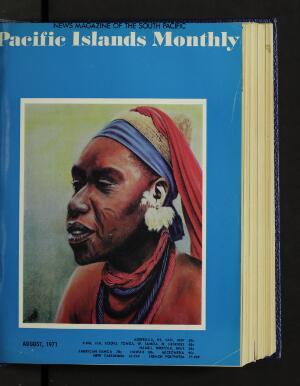
Our Cover
Neville Moderate, official photo grapher with the PNG Government,
whose photographs frequently ap
pear in PIM, is also a skilled hand with the artist's brush. This head of a Nondugl woman in her sing sing finery was done in artist's pastels, and the original, 18 in. x 24 in., adorns the office of his Port Moresby darkroom. Neville travels widely and likes to paint.
Pacific Islands Monthly
Wellington Conference Means
New Era Of Pacific Alliances
From
W. D. Forsyth.
in Canberra*
The de-colonisation of the island region of the Pacific has so far brought forward to indepen dence Western Samoa in 1962, Nauru in 1968, Fiji in 1970; in 1970 also the Kingdom of Tonga made its “re-entry into the comity of nations”, resuming control of defence and foreign affairs; while the Cook Islands have been fully self-governing since 1965.
Five of the oceanic insular countries are thus in the position of speaking for themselves and control ling their own future, and more are coming along. The five are to meet in Wellington in August to discuss a proposal that they set up some arrangement for regular consultation on questions in which all are in terested but which are of a political character and thus not appropriate for discussion in the non-political, development-oriented South Pacific Conference, in which they retain membership and voting rights.
What events and considerations have led to the Wellington meeting?
What sort of questions might an Islands political forum find it useful to discuss? And what may be the implications for the South Pacific Commission and conference?
Islands’ leaders and delegates have always talked to one another about political matters when they have come together from all over the Pacific at the 10 meetings that have taken place of the South Pacific Con ference. The conference was first launched at Suva by the South Pacific Commission in 1950—it met triennially at first, but since 1967 annually. But these talks were private and informal and outside the agenda and the meeting rooms.
This corridor consultation is likely to continue, since the majority of the islands are not yet independent or fully self-governing, and get to gether only in the annual conference.
Attempts to bring political matters into the debates of the conference have been made from time to time.
For example at Pago Pago in 1962 when some delegates wanted to dis cuss the then hot topic of West Irian; • W. D. Forsyth was Secretary-General, South Pacific Commission, 1948-51, 1963-66.
they were ruled out of order. Last year at the 10th conference at Suva criticism of the French nuclear tests in the Pacific was pressed into dis cussion on the floor of the con ference: the French delegation walked out of the debate, though not out of the conference. However, this incident showed the risk of serious division within SPC if political matters were forced into its meetings, and France is not the only member of SPC concerned with touchy topics, as we shall see.
Yet leaders of independent states are not happily resigned to keeping their mouths shut on things they feel to be of serious concern to them.
At the Singapore meeting of the Commonwealth Prime Ministers in January this year the three new Commonwealth members from the Pacific, Western Samoa, Fiji and Tonga, supported one another in seeking Commonwealth support for their strong protest against the French nuclear tests; the slightly dusty answer they got (PIM, Feb., p. 28) almost certainly strengthened
their feeling that it might be time to think about some platform of their own, additional to the Common wealth and SPC.
On his return to Apia, Tamasese Lealofi, Prime Minister of Western Samoa, in his Press conference called for a meeting of Prime Ministers of island states. The Fiji Times re ported that he had the support of Prime Minister Ratu Sir Kamisese Mara, of Fiji, and President Deßoburt of Nauru.
The Islands leader probably most entitled to the credit of initiating publicly the idea of an Islands’ political forum is Premier Albert Henry, of the Cook Islands. Mr.
Henry has been making known for the past 18 months or so his view that the independent and fully self governing states of the South Pacific should set up their own regular political consultations outside SPC.
He has made it clear that he wants this because the leaders must express themselves publicly on matters of concern to their peoples and where these matters are of common island! concern it is advantageous to do so with mutual support.
But he has also made it clear that he is not thinking along the lines of getting out of the SPC; on the con trary, he believes that to continue trying to force political discussion jn SPC and conference meetings will be damaging to the SPC, out of which after all the Islanders get each year a million dollars worth of social and economic projects they want. Moreover, they themselves, with their new ascendency in the conference and the membership of four of the independent states in the commission proper, lay down what these projects (and investigations and technical meetings) will be—the commission pays most of the cost,
the Islands contributions to the SPC budget being as yet small.
To make the commission a “political battle-field”, Albert Henry believes, would run the risk of dis rupting it; we could be parted from “our Tahitian cousins”, he points out. Strains affecting other “senior” members besides France could also arise, jeopardising an SPC network which benefits the Islands and is now very largely under their control.
At the PIPA meeting (Pacific Island Producers’ Association) in Tonga in April the Prime Ministers of Tonga, Fiji and Western Samoa and Premier Henry were present and on the side agreed to meet officially to discuss a possible consultative organ. Mara of Fiji, it was agreed, should approach New Zealand to see whether it would provide a meeting place; this was done in May and the announcement by New Zealand’s Prime Minister Sir Keith Holyoake that New Zealand (which has been showing increased interest in the Islands in recent years) would gladly provide facilities was followed by a statement by Australia’s Foreign Minister, Leslie Bury, welcoming the move. This is the Wellington meeting, to take place from August 5-7.
Australian Minister for Territories, Mr. C. E. Barnes, will represent Aus tralia.
Some topics on which the Islanders feel keenly have been mentioned.
There are others. At the Singapore Commonwealth Conference the Islands’ delegates also wanted sup port for their opposition to the American decision to dump the nerve-gas bombs, rejected by Okinawa, at Johnston Island, “on the door-step” of the South Pacific.
Readers of PIM will know of the repeated occasions when Islands’ re sentment of Australia’s apparently racial exclusion of Pacific Islands’ immigrants has been ventilated— perhaps the forum if set up will go into possible arrangements by which Australia could make good use of at least some of the thousands of young Islanders coming forward each year for jobs it is difficult even with vigorous development programmes for the small Islands economies to provide in adequate number. Then there is the discontent with which several Islands’ governments and ad ministrations regard the poaching on their fishing grounds by Japanese and Korean deep sea and other fishing vessels—Western Samoa and Tonga for example.
Further, the Commonwealth meet ings have shown the usefulness of exchanging opinions and attitudes, without necessarily reaching de-
The new High Commissioner in Fiji for the Government of India, Mr. Bhagwan Singh who took up his new post on June 29. Mr. Singh has been to Fiji twice be fore in a business capacity and his father was born at Rakiraki.
cisions, on international questions.
Now that Fiji is a member of UN it has to take positions on UN General Assembly items, e.g. ad mission of the Peoples Republic of China and what to do about Taiwan.
As Fiji is the only one of the Islands group as yet in UN, it might find it useful to know the minds of the others on this and questions like Rhodesia, nuclear disarmament and hosts of other questions, e.g. pollu tion of ocean waters and the activi ties of the notorious Committee of 24.
Similarly, there are SPC questions on which Western Samoa, Fiji and Nauru, as members of the com mission, and Tonga as, like them, a member of the South Pacific Con ference, might well find prior think-
ing and planning between them help ful, such as the present deadlock on the succession to the secretary generalship, the often-expressed need for a bigger SPC budget, and the out-dated plural voting system in the commission (which seems to be keep ing Tonga from seeking member ship ).
There are other questions which have long troubled the Islands, such as the inadequacies of shipping ser vices and the hampering effects of tariff barriers on island trade and development—both questions with important political elements.
Is the new forum, if set up, likely to down-grade the SPC? Are the independent Islands’ states likely to lose interest in the SPC? This hardly seems likely, for several reasons.
They want the developmental con tribution of SPC’s Work Programme (they have just helped to produce a three-year draft programme for the SPC in a widely representative con ference of planners at Noumea).
They now themselves control SPC decisions on the work programme, though not the budget limitation.
The South Pacific Conference is the only region-wide contact centre, and they control this too. They could not themselves afford to main tain an international secretariat and specialist services (including the ex pensive translation and simultaneous interpretation team) on anything like the scale of the SPC apparatus.
And an important role of the con ference and the SPC secretariat is now clearly taking shape: regular review and assessment (an approach to co-operation) of the somewhat miscellaneous technical assistance activities of the plurality of inter national bodies now working in various parts of the region, a subject which could well be examined in the political forum of Islands’ leaders.
What They'll Talk About
Cook Island’s Premier Mr. Albert Henry said in Rarotonga in July that the conference of South Pacific leaders to take place in Wellington in early August offered the leaders “a wonderful opportunity”. Matters to be discussed were all of common interest, and they included trade, tourism, the mass media, Western style government in Islands’ politics and the place of Christianity in Islands’ affairs. Although he didn’t mention it, Islands’ immigration into Australia and New Zealand will also be discussed in Wellington.
Spc Decision Postponed
PIM in July covered what was known after the first ballot for the choice between Fred Betham, of Apia, and Gala Oala-Rarua, of Papua, for the job of secretarygeneral of the SPC. It can now be confirmed that when the ballot ended in deadlock, the governments agreed to a Fiji proposal that further vote be postponed until the SPC session in October.
The voting on the first ballot was 13 for Betham, 10 for Oala. Australia, which nominated Oala, has five votes, so Oala must have obtamed the support of one of the holders of four votes (France, NZ
or US) plus one of the three one vote members (Western Samoa, Fiji and Nauru). Fiji voted for Betham, who could hardly have lacked also the vote of his sponsor, Western Samoa; that leaves Nauru as support ing Gala.
In a letter to The Canberra Times on June 30 I argued that Australia should gracefully withdraw, and should also give a lead in dumping the unseemly plural voting system.
A change in the system can scarcely happen before October, so unless there is a compromise meanwhile there will be a not-too-desirable tussle at Noumea.—lF. D. Forsyth
'Quakes were PNG's biggest
shake-up for 64 years
Rabaul Harbour, part of which is seen above, is surrounded by volcanoes, but the big quakes of July were undersea shocks. Centre right of this picture is Matupit Island, where the causeway to the mainland at left subsided.
Fears that have been nnietened hv a opnprstinn nf quietened Dy a generation ot quiescence of New Britain s active volcanoes were swiftly aroused in July by a series of pnrthnnalrpQ that th P earthquakes that rocked the Rabaul area, and were felt on nearby New Ireland and Bou-
gainville.
Dozens of families—mainly women and children—left the Gazelle Peninsula on which Rabaul is situated, for safer parts. The airlines put on extra planes to meet the demand. The first big quake occurred on July 14, and less than a fortnight later there was another, equally severe. In the interval there were literally thousands of tremors.
Both quakes registered more than eight on the Richter scale. The centre of the disturbances was quite close, deep in the Solomon Sea.
There was no serious structural damage to any buildings in Rabaul, and most damage was caused by tidalwaves which swept in from the harbour, and bringing with them debris. Water swept through shops and the ground floor of at least one hotel. Cars were swept along.
Matupit Island, near the airport, was inundated, and the causeway joining it to the island sank. Some
of the islanders swam for their lives, and later islanders were given e shelter on main i an d.
Outside of Rabaul, worst hit was Gaulim Teachers’ College, about 30 miles away, where many buildings were destroyed or damaged. The tidalwaves caused havoc in some o f the villages on New Britain and New Ireland. Two children were missing on Bougainville and they were believed to have been swept to sea while fishing. One Tolai hospital patient near Rabaul died of a heart attack.
The PNG director of Civil Defence, Mr. W. A. Johnston, said on July 27 it was impossible to estimate the cost of damage but it was likely to run to at least $1 mil lion. The Gaulim College suffered $lOO,OOO damage, according to a church estimate.
A Rabaul vulcanologist said the frequency of the aftershocks was “really incredible”.
Other experts said it was a freak that two earthquakes of such inten sity had occurred in the same place so soon after each other. The inten sity of the second undersea shock was believed to be the world’s severest since the Alaskan shock of March, 1964, and the biggest in PNG since 1906. Undoubtedly if it had been more shallow and closer to land it would have been devastating.
Fr. Polynesia
New move on autonomy for Fr. Polynesia
From a Papeete correspondent A proposal that French Polynesia should have a new constitution (statut) giving the territory greater autonomy was submitted to the laws commission of the French National Assembly recently by a group of eight members of the assembly, headed by French Polynesia’s repre sentative, Mr. Francis Sanford.
The proposal was the latest move in a long series of usually unsuccess ful manoeuvres designed to force the French Government to loosen its hold on the management of affairs in French Polynesia.
The text of the proposal follows that of a resolution on internal self government adopted by French Poly nesia’s Territorial Assembly two years ago (PIM, June, p. 15).
This envisages that French Poly nesia would remain an overseas terri tory of the French Republic, but that the chief executive would be a Prime Minister elected by the Territorial As sembly, rather than a governor ap pointed by the French Government as at present. The office of governor would become that of French High Commissioner.
In a letter to the National As sembly laws commission, which ac companied the latest proposal, Mr.
Sanford and his colleagues said, “The present proposal is comparable to the constitution which was granted to the territory of the Comoro Islands [near Madagascar] some years ago and which has given satisfaction. What is good for the Indian Ocean cannot be bad for the Pacific”.
Political observers in Tahiti do not believe that the latest move will have much impact on the French Govern ment, which has made it plain that it does not want French Polynesia to have much more autonomy than it already has.
However, Tahiti’s autonomists take the view that if they keep up the pressure long enough, they will even tually get somewhere.
Meanwhile, a new political move ment has been launched in Tahiti under the name of Te Autahoeraa (The Union). Its object is to achieve an autonomy of a less drastic kind than that sought by Mr. Sanford and his colleagues.
The founders of the new party are Messrs. Charles Taufa (president), Gerald Coppenrath and Maco Tevane (vice-presidents), Frantz Vanizette (general secretary), Richard Brother-
son (treasurer), Jean-Roy Bambridge, Eric Lequerre and Jimmy Estall.
Mr. Taufa, a trade union leader, made a strong bid for the mayoralty in recent elections for the Papeete Municipal Council (PIM, June, p. 14).
The founders of Te Autahoeraa be lieve that French Polynesia should seek such autonomy as is within its means and capacities—not a form of government based on a priori ideas.
One of the chief planks in their platform is the promotion of a local elite and the Oceanisation of the pub lic service and private enterprise so that there will be “an authentic de centralisation of administrative and political decision-making”.
Te Autahoeraa is an alliance of four former member polical groups.
It plans to contest future elections.
Politicians now
full-timers
By Felise Va’A
American Samoa’s first full-time legislators met for the first full-time legislative session in Pago on July 12, making history thereby.
Before this historic meeting, there was only one regular session of the legislature, lasting 40 days, in addition to the special sessions called by the governor to discuss the budget and other urgent matters. Now there are two regular sessions in a year.
Before the new setup, government employees were permitted under the territory’s constitution to hold legis lative office, a situation which fairly bristled with anomalies.
For instance, government work could not be performed as long as government employees were tied up in legislative meetings. As is usual in developing countries, where brains are at a premium, good jobs with government went to the educated ones who were also the only ones able to qualify for seats in the legis lature. About half the legislature filled this bill, but constitutional changes forced them to choose— to be a ruler or a government worker. They couldn’t be both. All but three chose the Fono (legislature) and SUS6,OOO a year. As part-time legislators they got $6OO a year.
As the average salary in the upper echelons in American Samoa is around $3,000 a year, being a full time politician at $6,000 a year makes a better deal.
Fine Friendly
Where Can These
People Go?
Mr. Barnes.
From a Suva correspondent Senior Australian officials visiting Fiji in the future would be wise to prepare themselves in advance for unpleasant questions about immigra tion.
As Minister for External Terri tories, Mr. C. E. Barnes, found in July, talk of future aid doesn’t pre vent Fiji citizens from wanting to know about Australia’s “white” policy.
Perhaps unsettled by the fact that several of his Press interviewers were in the category that might be refused entry, he took refuge in the explana tion that critics of Australia’s policy simply didn’t understand the reasons for it.
It went back to Federation, he said, and stemmed from the troubles of the gold rush days.
“Yes,” agreed a Fiji Indian. “That was 1901. The world is more educated now—isn’t it time Australia changed its policy?”
“The tragedies of mixed cultures remain the same,” replied Mr.
Barnes. “Until they are solved, I can’t see Australia changing its policy. This is not because we are superior—we just want to preserve our culture.”
The Minister said he couldn’t see Australia taking in Pacific Islanders on the same basis as New Zealand does with unskilled workers. “Un employment in Australia is usually among the unskilled workers and
since we are experiencing a recession in rural areas, we can expect an influx of people to the cities. I can’t see us changing our policy with re gard to taking in unskilled workers, even on a temporary basis,” he said.
In answer to a question, Mr.
Barnes said he did not agree that Australia had neglected her responsi bility in the Pacific. On the contrary, he said, Australia had contributed a great deal. He stressed however that Australia was a rapidly develop ing country—not a developed one.
It made a vast call on its own re sources.
Australia did not consider its aid to either countries as a charitable operation and didn’t expect gratitude.
“And Pacific Islands’ leaders are not mendicants—they do not beg for our aid,” he said.
Mr. Barnes was in Fiji as leader of an eight-man Australian parlia mentary delegation which spent 25 days there and in Tonga, the two Samoas, New Caledonia, New Hebrides and New Zealand.
Back in Sydney answering ques tions from the Australian Press, Mr.
Barnes said the matter of immigra tion into Australia had been raised in most territories, and both Tonga and Samoa, which had problems of population pressure, had asked Aus tralia to give their people work permits. He could only tell them that he couldn’t hold out any help for relaxation of the immigration policy. They were “realistic people” and they accepted the reasons for Australia’s policy and there was “definitely no bitterness” over the immigration.
Mr. Barnes said he found the Poly nesians unified, cohesive and far more sophisticated than the Mela nesians of New Guinea. He was sur prised at this degree of sophistication.
New Guinea was considerably behind these other territories.
He added that he thought Fiji was meeting more of its problems than any of the territories.
A Labour member of the dele gation, Mr. A. W. (Bert) James, said what he had learned from the tour was that Australia had to have a very serious look at relaxing its immigration restrictions to allow con trolled migration from the islands.
They were fine, friendly people.
“Samoans and Tongans are poor compared to our standards in Aus tralia; their islands are getting crowded and they have nowhere to go,” he said. He added he felt the whole delegation was surprised at what it had learned. All had been particularly impressed with the charm and knowledge of current affairs of King Taufa’ahau of Tonga.
Faith can move mountain markers
Odd Side Of New Guinea
“Now remember, as soon as the stuff arrives, we hit ’em for import tax!”
Mount Turu, its summit coated in cloud, broods over the lush Sepik jungles.
To the thousands of people below it is a spirit mountain, guardian of their welfare.
In 1962 the United States Air Force during a geodetic survey of Papua New Guinea placed concrete markers on the summit.
Since then people around Mount Turu have developed the belief that the markers are interfering with the benign spirits of the mountain. From the deep inner recesses of their minds grew an obsession that the markers must go.
The belief was a strange mixture of ancient pagan rites, Roman Catholicism and millenial aspects of the Jehovah’s Witnesses.
The whole thing was fuelled by the villagers’ growing frustration with their inability to acquire Western material wealth.
Just what removal of the markers would achieve meant different things to different people. Mathias Yaliwan, of Ambukanja, the village nearest the summit, spoke of crops and fish, and game abounding. Daniel Harwina, of Marambanja, close to the government station at Yangoru, originally claimed human sacrifices would accompany removals, then later spoke of world-
wide brotherhood resulting from the ceremony.
Many of the cult’s lesser lights be lieved great wealth would miracu lously appear after the ceremony.
Yaliwan fixed the time for the markers’ removal at the seventh hour of the seventh day of the seventh month and all the Sepik waited for the big moment.
The Administration, fearful both of violence and disruption to deli cately poised village economies, mounted a propaganda offensive against it.
But the belief remained —the markers had to go.
AAP correspondent Don Woolford was one of seven Australian journalists who arrived at Yangoru on Tuesday, July 6, and began walk ing to the mountain for the ceremony the next day.
The next 24 hours was a bewilder ing, fascinating series of images of primitive but compelling personal ties, almost military discipline and a pro found faith in an irrational belief.
There was Harwina at Maram banja, a village demagogue sum moning his followers with a tin whistle, then shirtless and with muscular arms outstretched, haran guing them. His performance was
part-political part-revivalist.
Periodically he paused to call, “Am I right?”, and a chorus of nearly 1,000 replied, “Yes sir!”
There was Yaliwan, the ascetic in his mountain fastness, waiting im mobile until the crowd was com pletely silent, crushing with a glance a person who dared smoke near him.
Yaliwan spent the night alone in his house praying to the accompani ment of pop music on his radio.
There was Peter Koe, a carpenter from Yule Island off the Papuan coast, who has somehow attained leadership among an alien people.
Koe was suddenly hostile when a journalist made a flippant remark.
And later as we tried to sleep on the bare, uneven boards of an Ambu kanja hut, he spoke with menace of “white pigs in a cage”.
In contrast there was almost uni versal hospitality of the local people —the constant good mornings and handshakes along the track and the gift of coconuts at one village, of bananas at another.
There was the religious fervor of the Ambukanja villagers who said rosary at dusk and again at dawn before departing for the mountain top to bring their pagan beliefs to a climax.
There was farce, too. A middle aged Australian trudged into Ambu-
kanja just before nightfall with a brand-new movie camera saying he was going to the ceremony out of curiosity. There was widespread re ports that he really was working for the government, but if he was doing some part-time spying he was hardly a success, for by the time he struggled to the summit the ceremony was over and his camera broken.
Villagers also told of a local man whom the government had infiltrated but who had come to believe in the cult and was now acting as a double agent!
At the summit there were more prayers in the swirling morning mist before the markers were dragged out.
The crowd surged forward to grab a piece of thick mud that clung to them and carefully wrap it in leaves so that later it could be put in their food garden.
Then there was the three-hour procession back to Yangoru.
A man holding the New Testament led the way, followed by two markers strung under a carrying pole.
It was solemn procession.
Few talked, none laughed. i- A} eac fi village on the way men lined the muddy path, standing to attention and often praying or count ing rosary beads. They joined in at the tail, so long before Yangoru was reached a line stretched out of sight in both directions.
At Yangoru there was no need k°[- jl e , xtra Police, some lurking behind hedges around the sub-district omce, or the hastily upgraded radio network.
The head of the procession stopped outside the office and the markers were placed on the lawn.
A government officer spoke a few quiet words and the line of men passed gently across the adjacent grass air strip before dispersing.
The deed was done, the offending markers were removed and returned to their owners, the government. lhe ceremony was over—but are he repercussions?
Immediate government reaction was had all § one off so y . but concern remains. hen benefits fail to materialise nere may be resentment. If there is ikei e v nc t e n H , arwin ? the most kely target as he is the custodian 21 579 • S asure chests with '21,572 the faithful have subscribed.
If past cult experience is any guide he followers will gradually accept hat the anticipated wealth will not Pf/ DOt hOWeVer con ’ ! he 1 C ’i lt actlvit Y is of no In * tead , the y will believe that kX h ?u W failed to pre isely the right ceremony.
Planners take the lid
off island suburbia
From a Suva correspondent • .. battle against the abysmal problems accompanying urban isation m the Islands may already be lost. Or so it would seem from some of the observations by delegates to the Second South Pacific Seminar in Suva in July
They came from all over the Paci fic to offer ideas on “Living in Town” urbanisation in developing countries and the picture that emerged was far from bright, or even hopeful.
Their papers made interesting and, frequently, disturbing social com ment. Many of the problems were common to most of the Island terri tories. Others were unique. But whether anything really effective will be done to stop the rot rests not with those who do the talking—but those who make the decisions. And there weren’t too many of those at the seminar.
. One of the most gloomy disserta tions came from Mr. William Lim, architect, urban planner and develop ment consultant from Singapore.
He emphasised that modem plan ning theories were based on condi tions in developed countries and were not applicable to developing areas.
New theories must soon be developed to meet the impending crisis”, he warned.
“Slums and squatters must be ac cepted as permanent habitats in de veloping countries for many decades.
Mr. William Lim... presented a gloomy future.
Grass root participation must be en couraged and integrated in the de velopment process”. . Mr. Lim warned that many towns in countries like Fiji and other de veloping regions would soon be faced with uncontrolled migration from rural areas.
He wouldn’t be surprised, he said, it Suvas population of about 85,000 grew to about 120,000 within four years or so. Large squatter settlements were already living in appalling con ditions in many major urban areas (this is certainly true of Fiji) and the situation was likely to get pro gressively more serious.
Lack of planning was deemed re sponsible for a great many of the problems now experienced in the Islands. In Western Samoa, said Mr.
J. T. Soon, of the Lands and Survey Department, planning in both urban and rural areas was non-existent.
Various schemes had been put for ward over the years and in 1967 an interim planning scheme had been pre pared by a United Nations expert. His proposals had never been imple mented. Even the boundaries of the urban area of Apia had never been defined or accepted.
There could be two reasons for this situation—the reluctance of land owners, and especially customary land owners, to accept planning con trols and the lack of decision as to who and what organisation is to do the planning”, he said, and added that it was encouraging to note that gov ernment was considering setting up a planning organisation to undertake “proper and systematic planning”.
The urban drift was one of the major problems in the Gilbert and Ellice Islands, said a GEIC repre sentative, Mr. Otiuea Tanentoa.
The number of schools had in creased with more pupils enrolled— and the views of the young genera tion had changed. “They have be come more and more contrary to those of their fathers and grand fathers. They wish to leave their village and island life, which seems to them dull and uninteresting and
begin to move to urban areas to see for themselves what they have heard of and read about in their text books.
“They have heard about western type buildings, ships, aeroplanes, motor cars. They live amongst Euro peans and learn English, the only foreign language learned at school .
Young people in the Gilbert and Ellice Islands considered copra-cutting and fishing to be unattractive occupa tions. They preferred to be teachers, seamen, doctors, nurses and clerks. . . so they went to the towns.
Speakers agreed that one of the greatest difficulties caused by the urban drift was that of housing.
Newcomers in GEIC usually had relatives employed by. the govern ment, the wholesale society or in pri vate enterprise.
“The relatives then, according to our custom, must invite them to stay or the family relationship would be broken for ever if they did not”, said Mr. Tanentoa. “The number of people to occupy one house may be increased from about four to nearly 20,, if two or three families are invited”.
Adult and juvenile delinquency was another problem facing the GEIC.
When people had to wait two or three months, or even a year, for a
job, while living off perhaps one rela tive earning a low salary, the next step was to bubuti (cadge) from other relatives or steal.
Other problems were caused by lack of water and lack of proper sewerage. Most people in urban places used latrines built over the reef.
“These small latrines create no prob lem during spring tide, but the situ ation is terrible during neap tide as the sewage is uncovered and breeds flies and causes bad smells”, he said.
The colony needed more finance, legislation controlling the movement from rural to urban areas, and more development in rural islands, Mr.
Tanentoa declared.
Outspoken Mr. Francis Bugotu, from the Solomons Department. of Education, pointed out that urbanisa tion problems were created not by buildings but by people . . . “people sleeping in houses, buying in shops, loving in beds, fighting in the street and drinking in the pubs.
“They are created by us when we are supposed to become more and more civilised”. , . . i The effects of urbanisation, al though at a comparatively early stage, were to be seen clearly in the Solo mons, he told delegates. The first generation town lad was the most conspicuous and would set the pattern for the future unless checked. Ihose boys thought they owned the town.
They felt it was their right to own a motor bike and would go to the ex tent of stealing money or forcing
Typical of living conditions in island slums is this shack in Suva.
relatives to give it to them in order to buy a bike. .
“The town lad is in fact the laziest character in town. He spends a lot of his time copying the latest of fashions that come ashore on tourist boats big hair, huge dark glasses and long tight jeans with big belts”.
Young girls were attracted to town life even more than boys. “Towns have mirrors, fancy combs, ribbons and earrings and the girl becomes ‘prettier’ overnight . .. she becomes an easy prey to the visiting young Euro pean boy who is supposed to have the qualities of sophistication she looks for. She hops on the back of a motor cycle driven usually by the white boy, but sometimes by the black boy, and lets her hair fly in the wind for one or two days. .
“Soon she finds she is pregnant out side marriage, which proves the boy to be not that sophisticated after all. He goes off to England, Australia or New Zealand and she is left with shame in Melanesian custom to face her parents ... a future problem for the town to deal with”.
With prostitution on the upsurge in some territories, a solution put for ward by Papua New Guinea delegate Mr. A. L. Bais aroused in^re^ t - He felt that prostitution should be legalised in the territory.
“In other words there should be semi-institutionalised brothels with provision for regular medical check ups This, in my opinion, would pre-
vent the spread of venereal disease”, he said.
“Another, perhaps very likely solution is the discontinuation of the single men’s labour scheme, and in its place there should be employment of married labourers who should be accommodated with their wives. This would abolish the present compound system, which is very poor even com pared with village standards”.
Mr. Bais added that while his sug gestions might sound extreme, the long-term effects would be rewarding.
In a paper about urban delinquency in Fiji, Mr. Subhas Chandra, psycho logist-vocational guidance officer at the University of the South Pacific, pointed out that about 25 per cent, of Fiji’s population lived in the towns.
The intake at the Approved School at Nasinu (Fiji’s correctional institu tion for young offenders) had been rising, with the peak periods on 1951 and 1969. The Indian population had been somewhat uniform, but there was a significant increase in the num ber of Fijians committed to the ap proved school in recent years. Among delinquents, there were almost twice as many Fijians from urban areas as
from the villages.
Most juveniles in the approved school were guilty of larceny. Other frequently-committed offences were assault, obtaining goods under false pretences, obtaining stolen goods, malicious damage and attempted suicide. There were some sex offences “it should be noted that there is a similarity of crime pattern between the Indians and Fijians, while then cultures are divergent. It is probably the urbanisation that produces simi lar crimes”, said Mr. Chandra.
Nauru To Go
Pure Jet
Air Nauru has de % dedto y -_ S 3 million, 40-seat Fokker 28 je and has applied to the Australia: Department of Civil Aviation fo twice weekly flights with hetwee Nauru and Melbourne via Bnsban It hopes to begin operating fron ? * October to replace the 8 seate Falcon Fan jet now leased to a.
Nauru by the Melbourne compan headed by Mr. Ron Walker. Anse would service the new jet and M Walker’s company would manage i The decision comes after sever months of scrutiny by wil Mr. Walker’s help, of all ayailab aircraft and if Nauru can get DC permission to operate, it will me. that Air Nauru will be months ane< of Air Pacific in operating je regionally in the Islands.
Niue
enters the air age
From Sue Wendt
July was momentous for Niue Island, one of the few remain NiUe (meaning “ behold the
An Air Pacific HS 748 turbo-prop, bearing the name and colours of Fiji Airways and chartered by Polynesian Airlines landed us—the “pioneer” commercial passengers—at Niue’s new Hanan International Airport on July 5. Despite the confusion of names, there was no confusion about the importance of the event. . This was the first commercial flight into Niue. More than that—it was the beginning of another era for the isolated New Zealand protectorate, ibout which even New Zealanders mow virtually nothing.
Rising straight up from encircling ■eef, with a topping of scrubby vege ation and coconut palms, the 100 iquare-mile coral island seems to
float in the middle of nowhere. In reahty n is 300 miles east of Tonga, 350 miles south-east of Samoa. And it is surprisingly developed.
Niue has schools and very service able roads, a timber mill, a factory tor extracting passionfruit pulp a honey and dairy industry, a radio telephone service linking it with New Zealand and, from July, with Raro tonga. There are shops, including the übiquitous Burns Philp “all purpose”, and even a restaurant. n p ° V 7 i the j eXt three years, the W7^7 a ?n n n d A Governme nt will spend ? NZ 3,075,000 in aid to Niue— and tew New Zealanders will even know that its gone.
On left, Mr. Robert Rex, Niue's Leader of Government Busi ness, fronts a "Wel come" board at Hanan Airport, an aerial view of which is seen above.
Photos: Harry Coleman and A. G. Shearer.
. A measure of the protectorate’s isolation is the fact that upon return ing to Fiji and telling one very educated Kiwi where I’d been for a week, I received the reply: “Oh yes’
The manure island.” He meant Nauru I suppose—but on behalf of the Niueans, I felt incensed!
New Zealanders working now in Niue receive the same kind of re sponse from friends and family. j h ave to l earn French,” they advised, meaning Noumea—or You 11 have all that phosphate in the back garden.” Nauru again.
Niue’s rustication might be measured too by the reception I met from the Resident Commissioner, Selwyn Wilson, and the Leader of Government Business, Robert Rex right on down through the echelons of government and politics. Not a smgle “don’t quote me” . . . balm to the ears of a journalist!
The new air service departs from Nauson, near Suva, on Tuesdays, stopping in Tonga en route to Niue (where of course it’s Monday, be cause of the International Dateline) After a brief stopover at Niue— where transit passengers can stock up on the island’s unique and incredibly inexpensive wovenwear—the flight re turns to Nausori, via Apia.
Until the first calibration flight under the auspices of the New Zealand Civil Aviation Board, landed at Niue in October last year the only fink with the outside world was through the monthly visits of the lofua. Boat day, naturally enough was an event involving the whole island—and though it’s still bound to be a big day, the frenzied letter writing that used to go on among
both expatriates and the many Niueans with families living in New Zealand seems likely to disappear The airfield, considered among the best in the Islands, was completed in just over two years, at a cost of approximately SNZ6OO,OOO. By the time communications and airport facilities have been upgraded, the total will be around $1 million.
The airstrip itself occupies 5,400 ft of sealed area, with a crushed coral base and 200 ft of grass over runs at each end.
What the service means to Niue is hard to imagine unless one has lived for a month on an island with out fresh food supplies, mail, visitors or other diversions. Certainly, there’ll be no recurrence of the mildly desperate situation of a few months ago, when the Tofua left the monthly mailbag sitting on Suva’s wharf.
It will be invaluable in cases of emergency illness, a boon for busi ness efficiency. Visitors will be more frequent and there are plans now to build a guest house with 20 double bedrooms, starting in August or September. Sited on the Alofi water front, it’s due for completion in 18 months time and expected to cost $NZ220,000.
The island even has an embryo tourist authority which aims to attract a limited number of holiday makers—“ Probably retired New Zealand sheepfarmers,” remarked one —with a week to spare and an interest in out-of-the-way spots.
But Niue’s real problem —its diminishing population —is bound to intensify as a result of the new service. Already some 3,000 Niueans are living in New Zealand, while only 5,000 remain at home. The service will make it easier for the stay-at homes to depart, so long as they can raise the fare. And many can.
Not everyone is wholly in favour of seeing the turbo-jet every week, although their reservations are generally for sentimental reasons.
They fear it will be the end of Niue's particular brand of charm, which stems from its very isolation.
Certainly, most community leaders consider a weekly service ample at present. Nobody (and this is a typical Niuean trait) is in favour of rushing headlong into change—and, besides, the New Zealand Govern ment would have to subsidise any flights that didn’t pay on the Tonga- Niue-Western Samoa run.
My week on Niue coincided with the “triennial allocation”.
Directors of departments went about their business with an antici patory gleam in their eyes.
Mr. Wilson announced the alloca tion —New Zealand’s aid for the next three-year financial period—on July 9. It came to a goodly $NZ3,075,000, which will do much to improve the standard of living and public facili ties for the Niueans at home.
The $3 million-plus will include a grant of $2,160,000 towards the ad ministration expenses of the Niue Government, a grant of $580,000 as a contribution towards the general capital works programme, a grant of $lBO,OOO for road reconstruction, a grant of $85,000 for increasing electric power generating capacity and a grant of $70,000 to the Niue Development Board.
The NZ Ministers of Finance and Island Affairs may also jointly approve any additional cash needed by Niue to meet salary and wage increases which might be approved by the NZ State Services Commis sion between April this year and March, 1974.
In the capital works field the gov ernment’s programme envisages a big upgrading of the standards of Niue’s reading, construction of a fruit-processing factory, improvement of port facilities, construction of a guest house, and new school.
Samoans' drug
sensation
Probably not for generations has lynch fever run so high in West ern Samoa as it did in July when the arrest of four American yachtees, two men and two women, after drugs had been found in their stranded yacht Nomad, sparked off a sensation which only simmered down when three of them were gaoled.
They were the country’s first drug offenders, which was sensa tion enough for the Samoans, but what caused the fever was that one of the yachtees, John Frederick Ford, 24, of 881 Holyglen, Long Beach, California, who was gaoled for three terms of four years each concurrent, had given some of the drugs to two young Samoan boys.
Ford was also fined $4OO. Samuel Clark Buell, 30, of Lahaina, Maui got 12 months and fined $lOO.
Kathleen Cook, 23, of Portland, Oregon, was gaoled for six months and fined $lOO. Adella Ann Garza, 21, of Monterey Park, California, had the charges against her with drawn. The judge recommended deportation for the convicted three as soon as possible, even if the sen tences had not been served.
ready for
Tahiti gets ready for the Games
The impressive new $U51,300,000 stadium, built at Pirae, Tahiti, for the Fourth South Pacific Games in Sep tember, was officially opened on the evening of June 22 by the Governor of French Polynesia, Mr. Pierre Angeli.
Work on the stadium began in November, 1967. It was designed to seat 10,000 people, including 2,300 under cover.
At an athletics display after the offi cial opening ceremony, French Poly nesia’s champion pole vaulter Stanley Drollet, leapt to a new height of 14 ft 6 in. This was 4 in. better than his previous best, and 151 in. better than his performance at the Port Moresby Games in 1969 when he won the sil ver medal. The winner on that occa sion was Y. Bonnet de Larboyne, of New Caledonia, who set a new Games record with a leap of 13 ft 10 in.
In a soccer match following the athletics display, a team representing Tahiti beat a touring Welsh team by two goals to one, after being one-all at half-time.
“Your victory was well-merited”, the Welsh captain said after the game.
By July’s end, Tahiti was about ready to host the Games. Apart from the huge bill for the new Olympique stadium, Tahiti has spent SUSBOO,OOO on renovating the old . Fautaua stadium, almost rebuilding it and re laying the cycle track; SUS7OO,OOO on the new Olympic-size swimming pool, and $U5550,000 on organisation and billeting.
There are two villages for the Lsoo' competitors, one at the Lycee Pauli Gaugin, which will house 1,000, andl the other at another school with room for 500. There will be room for 1,000 visitors at the hotels.
Rehearsals for the Games were in full swing in the various territories by the end of July, and a few new “hopes” were emerging. Fiji touna a promising long-distance runner iff Rajendra Prasad, one of the first Fiji- Indians to shine over long distance.
In a training run in Suva in the third week of July, he covered the 5,000 metres in 15 min. 54.7 sec., only 9.9 sec. slower than the Games record established at Noumea in 1966 by R. Morgan-Morris, of Nauru, ano
8.1 sec. better than the time at Port Moresby in 1969.
Morgan-Morris is also running well in Nauru and, if he reaches peak form just at the right time, he could take the gold medal for Nauru in the 5,000 metres.
His time over the distance during an athletics match between Nauru and a GEIC team was 15 min. 57.5 sec., 3 min. 78.9 sec. in front of his team mate Karl Cabwea.
Nauru won all the events, both men’s and women’s athletics and also a tennis tournament.
Outstanding for Nauru were Tony Bowditch, holder of the Games 1,500 metres record, who won the 1,500 metres and the 800 metres; Nelu, win ner of the 200 metres and 400 metres and Tawaieta, who won the women’s 400 and 800 metres. Karakoa was GEIC’s fastest man.
Fiji’s swimming coach, Bob Ken nedy, takes a dim view of the Games swimming programme. “It’s too crammed”, he complained.
What upset him was the fact that the Tahiti programme is almost iden tical t 0 the 1966 programme about which Fiji complained. Not only have the complaints been ignored, but four relay heats have been added for the first time, and to make heats possible 10 teams are needed against only six at the last Games.
Early morning starts have also an noyed Fiji’s coach. At the Port Moresby Games swimming started at 7 p.m. and the swimmers were able to lie in for a morning. At Tahiti, however, they’ll have to be up for 9 a.m. starts.
Kennedy thought the planners had gone out of their way to limit the free time available to swimmers, who would be hard-pushed to see some of the other events. He also thought that, as the swimmers would be tired at the closing stages, it was too much to expect them to swim 800 and 1 500 metre finals right at the end.
“Overall, the programme is model led too much on the Olympics”, said Kennedy.
Fourteen territories will take part m the Games against 12 in the 1969 Games. Fiji will not be represented in three of the 17 sports—softball rugby and cycling. Softball and cyc ling get little support in Fiji, which isnt the reason for the withdrawal from rugby. Where rugby is con cerned, Fiji feels—and everyone igrees-—that she is far too good for he other teams.
The number of sports each terri ,° ry J.s.competing j n is: Cook Islands GEIC 2 ’ Guam 13: Nauru I; New Caledonia 14: New Hebrides s; Papua New Guinea 13; French olynesia 17; Solomons 6; American >amoa 6; Tonga 5; Wallis and Futuna
8. Western Samoa’s entries were not known when the list was compiled.
Tonga sportsmen
short of money
From a Nukualofa correspondent Still in the red after the third South Pacific Games at Port Moresby in 1969, the Tonga Amateur Sports Association is scraping every seniti together to send a team of 15 to Tahiti for the fourth Games—and finding it a hard task.
The association feels that it doesn’t get enough support for the good it does. Fiji has a Ministry of Sport and Recreation. Then why not Tonga? It’s long overdue here to safeguard sport and recreation for the kingdom’s youth. Most young Tongans find it hard enough to get a job. Surely they should not be deprived of their recreation as well!
Sports, athletics, football, basket ball, swimming, cricket—all safety valves, all ways of letting off excess steam, but the association is finding it harder, as time goes on and living costs rise, to make ends meet. Fund raising for the association began in January, 1963, and since then four sports teams have been sent over seas, three to the Games and one to Western Samoa’s celebrations in Apia.
Up to June 30 this year, the asso ciation, with the aid of its affiliated bodies, had raised $11,425.35 and over the same period the government has given grants totalling $2,800. A loan of $3,000 was obtained to get the third South Pacific Games team away.
Now, with the fourth Games only a short time away, the association is the raising about 56,000 to send our 15-strong team away. We will get the government grant of $6OO which leaves $5,400 to be found. We are hoping the Miss Tonga contest will bring in enough to cover the balance but over the
next few years we have to find enough to repay the loan of $3,000. With the government grant we can pay it off in five years, but that only leaves the association with its affiliation fees to run on, which will not be enough for normal expenses let alone sending a team to the fifth Games.
Turning from the sordid matters of money, to the reason for the asso ciation’s existence, we can report that the athletic team for the Games is coming along well, and all athletes should be able to turn in good per formances.
Leading the field, of course, is Peni Tu’ipulotu, one of the stars of the last two Games. He is in the United States at present but is expected back early in August.
His main events will be 110 metre hurdles and 400 metre hurdles the Games record for which he holds.
He has also asked to contest 100 metre, 200 metre and 400 metre.
Keta ’longi will enter for 100 metre, 200 metre, 100 metre hurdles, long jump and pentathlon. She is almost back to her best times and should again make her presence felt.
Her younger sister Kailasi will be a second string to Keta in 100 metre and 200 metres. Kailasi is young but keeps on improving and should turn in good performances in Tahiti.
Big things are expected of Sanitesi Latu who went to the third South Pacific Games as a high jumper. In these Games he has been entered for 110 metre hurdles, high jump, long jump and decathlon.
The others that make up the team are untried against overseas oppo sition but it is hoped they will come up to expectations. Peauafi Hokinima is a middle distance runner and will be entered for 3,000 metres steeple chase and 5,000 metres. Sosifa Toko lahi will run in the 400 metres and 800 metres whilst Talitolu Ngaluafe has been entered for 100 metres, 200 metres, 400 metres and 400 metres hurdles.
The fact that Tonga boxers fought only moderately behind Fiji and the Samoas at Moresby is no reflection on the popularity of the sport in Tonga. The reverse is the case. The main troubles are the almost com plete lack of training facilities and competent coaches, and the steady trickle of top amateurs into profes sional ranks.
Only one boxer in each division will go to Tahiti. They are, heavy weight Moniti Fifita, light heavy weight Viliami Sovaleni, middleweight Ilaiuti Longani, light middleweight Maile Peti, welterweight Asipeli Potauame, light welterweight Solo mone Namoa. Mr. Adolph Johansson is boxing manager.
Tropicalities
Tongues May
Tell A Story
Carbon dating, ocean currents, pottery and artifacts have all been used in the probe into the origins of the peoples of the Pacific Islands.
Now language is yielding more clues.
The Australian National Univer sity’s Department of Linguistics is making a study of the languages of the Islands in an attempt to trace migration patterns in the prehistory of the Islands’ peoples.
Hot on the scent, Professor S. A.
Wurm, the department’s head, believes that results already achieved by the study seem certain to shed new light on the history of the migration of man into the Islands.
Dr. Wurm explained that three types of language had occupied the Pacific area. They were Papuan, Australian and Austronesian, the last embracing such languages as Indo nesian, Polynesian, Melanesian and Micronesian. (These titles are used by linguists to refer to types of lan guage; they do not refer to the countries or areas of the same name).
Until recently it had been thought
that the Southwest Pacific had been occupied by several hundred varieties of language which could have some relationship to the Austronesian group of languages. But the issue was con fused by the strangeness of some of the languages—a strangeness possibly due to the languages being a mixture of many different elements.
A more thorough study led to the thought that perhaps many of them were not independent languages within the Melanesian group but were in fact more normal Austro nesian languages than was at first thought, possibly deriving from the one common ancestor.
Clues seem to have yielded many facts including one which appears to upset previous beliefs about who was first to arrive in the South Pacific Islands. The dark-skinned people were thought to have been first comers, but it’s now apparent from a study of the Austronesian-type of language, spoken by the comparati-
vely light-skinned people, that the dark-skinned, Melanesian-speaking people came thousands of years after, not before, the light-skinned people and that Austronesian was the first language and culture in the area.
Professor Wurm said there were still hundreds of languages to be studied in an attempt to find answers to all the questions raised by the department’s project which got under way about 18 months ago. A pattern of migration appeared to be emerging from the studies which would be pursued for some years to come.
Dr. D. T. Tryon, a Research Fellow in the department, recently returned after 10 months in the New Hebrides. His preliminary survey indicated that the languages there — and there seemed to be well over 100 of them—were affected by two distinct migrations, one 5,000 to 3,000 years ago, and the other only about 1,000 to 2,000 years ago.
The first migration was thought to have come from an area far to the wes t—possibly Indonesia. The second could have left the same area at the same time but got caught up on the way, possibly in New Guinea, where the language became mixed with Papuan. The resultant cultural mix was then taken on to the New Hebrides.
An old custom
comes back
A Tolai (PNG) custom long neglected by today’s villagers is com ing back into favour — Namata — the ceremony a young man goes through before marriage. Ratongor village on the north coast and Matalau on the Nodup coast have set the pattern for a return to the old ways. The custom revolves around the bridegroom and his preparation for marriage.
Traditionally, a Tolai bridegroom was secluded from womenfolk and normal village life for several days before his wedding. He spent the time in a sacred place in the jungle with elder male relatives and friends, re turning to his village on the day of the wedding amid festivities.
Since World War II the custom has waned. Now it has returned to Mata lau and Ratongor villagers, changed slightly, but still linked to the past.
At Matalau a village elder, Joseph ToDiadiap, decided to return to the old ways when his son, Penias Ligia, married. Penias went into seclusion and then returned home housed in a nalnapidik—3. sacred house (below).
Measuring six feet by three and the height of a man, the daily-decorated palnapidik is used to convey the bride groom from the jungle to his home, maintaining his seclusion until his ar rival in the village.
Traditionally, the wedding cere mony would follow, but nowadays, that is held over for a church cere-' m Elders at Matalau say that few of:
today’s younger Tolais have ever seen a palnapidik. The last remembered at Matalau was in 1937. The palnapidik at Matalau and Ratongor, and those of the past, however, don’t last as long as the marriages they precede. Their arrival in the village with the bride groom heralds a feast, but following the wedding they are destroyed— again with accompanying festivities.
Says ToDiadiap, “I decided to do this because it seemed we were get ting too far away from the customs of our forefathers. Old customs like this one still have a part to play in our life”.
But, as Namata costs a lot, only the wealthy will be able to stage it.
Canadians are
"Peace Corps" now
A 71-year-old Canadian bishop has joined the staff of a boys’ high school in Papua— to teach book keeping. He is the Rt. Rev. Russell Brown, who retired as Anglican Bishop of Quebec in June. Now he is on the staff of the Anglican Martyrs’ School near Popondetta.
Bishop Brown was one of about 40 volunteers brought into Papua New Guinea at the beginning of July by the Canadian University Service Overseas organisation.
English-born Bishop Brown was an early Air Force pilot, an insurance broker and a missionary, before being elected Bishop of Quebec eleven years ago. He says he volunteered E or a teac hi n g j°b on his retirement because I still enjoy good health and felt that I wanted the opportunity to render a bit more active service.”
Early birds could
lose the worm
u B ?i A 9 1S kee P in g silent on the part it will play in the development of the resort complex planned by the Fijian- Mocambo Hotel group for Natadola beach, one of only two beaches in the dominion with any surf.
Qantas and BOAC have bought into the group but the part they will play is, at present, somewhat shadowy. BOAC’s first semi-official contact with the project came early n July when its chairman, Mr. Keith Granville took a quick glance at ne beach during a stopover on his irst trip to Australia.
But, he was a little non-committal ater when PIM asked him about the nsit.
Yes, he said, he had looked at ne land but there were no firm Hans— -especially at this time. Why at this time” he didn’t say. When isked if BOAC had plans to play a
big part, like other airlines, in the Islands’ hotel and tourist resort industry, Mr. Granville said, “Our policy is to support hotel develop ment in territories where it is not being sufficiently actively dealt with by the hotel industry itself. Our entry is at very selective points and in a selective way.”
Mr. Granville was much more ex pansive when it came to discussing air fares. If he, and BOAC, get their way, there’ll be an “Early Bird” scheme of cheaper fares on the London to Sydney route next year.
“Early Bird” for the benefit of the noncognoscenti, is a fare plan the very opposite of the “Fly Now, Pay Later” one. You pay your money and book your seat several months before you intend to travel. The worm you get as an early bird is a 30 per cent, to 40 per cent, reduction in the existing economy class fare.
There’s one small snag, though.
If you can’t travel on the date booked you lose. There’s no cancellation and no refund.
If the International Air Transport Association agrees to the scheme for the trans-Atlantic route, then BOAC will try to introduce it on the Kangaroo route.
New sights
for old-timers
Old timers in Honiara are always complaining that the place is chang ing, and often add sourly, as they eye the new red buses rumbling along the main road, that the changes are not always for the better.
One striking change over the past few years has been the increased demand for hotel accommodation.
The two hotels are already extending and a new one is projected, to cope with ever-rising numbers of tourists, and government servants who find themselves temporarily homeless.
The oldest hotel, the Mendana, is now often filled with elderly Ameri cans on packaged tours, whose pre sence tends to inhibit some of the older and thirstier residents. With its coloured lights and Island-style dresses for its staff, all recently intro duced, it has been the first to change its face to suit the new scene.
So it was not really a surprise on July 13 when 300 locals crowded out the tourists at the Mendana to enjoy the first professionally-presented fashion show seen in the capital.
Some of the proceeds went to the Crippled People’s Society.
Some attractive Honiara women recruited by Ailsa Meldrum, en thusiastic owner of Honiara’s only boutique, modelled a summer collec tion brought from Melbourne. There
Rosemary Scaddon models a "granny" dress.
were minis, midis and maxis, and there were cries of “never!” from the men when a floor length “granny” dress was modelled, which compere Frank Parsons predicted would be worn in the streets of Honiara before long.
Dresses with long sleeves and tightly-fitted bodices weren’t tempting to those who have to live in these steamy isles, but the safari suits with neat little shorts under short sleeved, belted and pocketed coats, were regarded as an answer to the’ prayer of any maiden having to tour in the protectorate’s small, incon venient boats. What to wear on tour is always a vexed question in Honiara; slacks are too hot, knee length dresses too hampering; and minis are apt to glaze the eyes of male passengers.
Nutshell
In a Nutshell
• The new officer-in-charge of Mount Hagen (New Guinea) police station, Inspector B. Chape, spent two hours at the Mount Hagen Hotel on July 3 speaking to villagers about the problem of stone-throwing by local people, and asked for greater co operation with the police. As he drove away, he was farewelled with a shower of stones thrown by one of his audi ence. Later, villagers apologised for the man’s “breach of faith”. There were six other stone-throwing incidents the same night, indicating a growing trend towards violence in the area. • Fiji Airways, in changing its name to Air Pacific, makes this claim, probably unrivalled, in its first AP timetable “Only Air Pacific flies to an independent state (Western Samoa), a protectorate (the BSIP), a condo minium (the New Hebrides), a colony (the GEIC), a territory (Papua New Guinea), a kingdom (Tonga) and a republic (Nauru).”
Only one missing seems to be a dic tatorship.
• Although some co-operative societies in PNG have fallen by the wayside, the success ratio of the movement is better than in many advanced Western countries. Ac cording to figures produced by Mr.
Paulius Matane, secretary of the Business Development Department, co-operatives returned an average of 15.8 per cent, on their outlay in 1969-70. The Co-operative Extension Division has about 160 field in the territory guiding the 380 established co-operatives and new business opportunities are being created with an experimental silk worm industry in the Southern and Western Highlands and textile weav ing in the Highlands where about 100 looms have been set up. Further pottery making and textile weaving at Port Moresby’s Small Scale In dustries Centre show promise of future avenues for more people to establish their own businesses.
• A consortium of banks operat ing in Fiji is expected to lend the dominion $6 million to help it take over the sugar industry from the South Pacific Sugar Mills. Share holders will be bought out at a cost of $lO million plus $3,750,000 for the land. The World Bank has also agreed to finance the new road from Suva to Nadi. Fiji’s Minister of Finance, Mr. Wesley Barrett, who visited London, the United States, Switzerland and Malaysia looking for financial aid for Fiji, was full of optimism, when he returned home in July, about prospects of loans. He was followed into Suva by Mr.
Anthony Best, a representative of the
world-wide Rothschild banking or ganisation. Mr. Best spent two days in Fiji. • Mr. Rupert Alexander Maxwell Colyer, one of the founders of Colyer Watson, the well known Islands trading firm, left an estate of $372,045. His will has been probated in the NSW Supreme Court. Mr.
Colyer, who lived in Vaucluse, Sydney, died on January 5, 1971, aged 81. He left $119,000 to Ruma Investments Pty. Ltd., and the re mainder of his estate to his wife and family. Duty on the estate was estimated at $164,000. Colyer Watson was taken over by Steamships Trading Co. Ltd. in the early 19605. • From July 1 wages and salaries in the Trust Territory are being taxed for the first time. Everybody em ployed for wages is subject to a flat tax of 3 per cent, on his income, with no deductions and no graduated t in creases. There is also a tax of SUS4O on the gross receipts of all businesses operating in the TT up to $lO,OOO, with 1 per cent, on gross receipts above $lO,OOO in any one calendar year. The new taxes are expected to raise $2.5 million a year. Employers will withhold the taxes from em ployees’ wages as they earn, and tax returns don’t have to be filed.
• The Cook Islanders are planning to bottle imported liquor to prevent a price rise following an increase in freight charges. A bottling plant has been ordered from New Zealand and spirits will be imported in 56-gallon containers. Whisky, rum, gin and unfortified wines will be bottled. The job of collecting bottles has been given exclusively to the Boys Brigade. • The Cook Islands Rarotongan Bible is out of date. It also contains misspellings and mistranslations and some of the old Maori words are double-Dutch to today’s young people.
The Rev. H. C. Bischoff of the Bible Society in New Zealand discovered these things for himself when he visited Rarotonga recently, The old Rarotongan Bible, he was told, was translated by a European whose knowledge of the Cook Juanas dialects was far from perfect. The Bible Society is expected to appoint
a committee to consider the job of retranslation —but that job could take up to 30 years. • Kieta Local Government Coun cil has approved the purchase of 3,000 Bougainville mining shares and scotched a rumour some Nasioi people were spreading that owner ship of the shares would give the company a claim to their land.
• With the help of Japanese manufacturers, Fiji’s duty-free shops are hoping to beat Australia’s new Customs limitations on duty-free goods. New rules brought into force by the Australian Customs on July 1 limit the weight at which transistor radios can be brought in duty-free to under 4 lb, and to under 12 lb for such items as tape recorders and re cord players. Japanese manufacturers are hoping to send to Fiji a new, light weight combination radio, tape . re corder and record player. Its weight: will be 111 lb. • Two plantations and an agricul tural station will be taken over by the; PNG Government for a new satellite: town on 600 acres of land five miles; from Rabaul on the Gazelle Peninsula..
Industry and low-cost housing on the: site will relieve pressure on Rabaul which is short of land for industrial! development. Mrs. Greenwood, owner of Vunawutung plantation, has agreed! to sell it to the government for $70,000 and negotiations are beings carried out for the purchase of Vuna kamkambi plantation from Mr.. F.
Chow. The government is worried, however, over the refusal of the Rasi man people to allow the building oi a power station at Kabaira Bay on the peninsular to continue. Failure this project may jeopardise the de-: velopment of the satellite town. • Passengers in an American Air lines Boeing 707 jet airliner slid dowi the emergency chutes when the plane landed at Nadi Airport in Fiji on July 15. Just before the landing, the pilot was told there was a bomb aboard It turned out to be a hoax, aimed ai the bearded Bishop Crowther, of Cali; fornia, on his way home after lead ing anti-apartheid demonstrators pro: testing against the South Africai Springboks rugby team in Australia.. • Drilling an exploratory well ir search of oil will begin on Tonga island of Tongatapu in late Septemr ber. The six-member consortium senior petroleum engineer from Thi Hague, Mr. Theo Albers, has gone tc Australia for further talks with thi companies concerned on local tacton and is also engaging drilling con: tractors.
Advertisements & other items, pp. 25-28 (1 item)
IMwl' j
XI ® w 5 ■ ;C"
" ' V>’.' -;<, Bk
ISBBk B-' JI Sfc
ill
1» ■'■' B S W '< Bl 111 BM mn CQi BBi ofTb “k grBIS 1 f i I r
l^^ffrfVTrrnnn^^^B^ 81 1
■ InirlsllVM H j j■ r : * 9
IMwl' j
' \ s?tc ' AL I v V' <s^^' I ■
118 t . ' ; i I i t i : : Oss®sftxtg-|| :
4wMr
' M ' \v^s' '^^^Kt^' < -' v^' i! ' < I i I
,^W?* >; ■;-xrWx:>'?,■'■'■]
j - ■ ,
SEAGULL - a new polycarbonate zenithal lantern for buoys and beacons - is designed for the toughest sea-going life.
It’s practically indestructible, needs only minimal maintenance.
The polycarbonate is ultra-violet stabilised. It does not discolour or craze with age, brings out signals in their true colours. Range is more than adequate: up to 14 miles in white light. The unit is light, completely self-contained and supplied with filament lamps and lampchanger, or with discharge tube. Flasher and photo-electric switch are standard.
Lens comes in clear, red or green.
Base is white opaque polycarbonate with watertight stainless steel band and gasket. The standard aluminium alloy mounting foot resists
sea-atmospheres, is removed simply by slackening three bolts. Special fittings to order.
SEAGULL is a brilliant all-rounder right for every offshore job in every kind of weather. The safest afloat.
If you have a navigational aids problem, bring it to Stone-Chance.
Consultancy is free. Project service covers installation, commissioning, servicing and maintenance.
If you’d like to know more, send for our Navigational Aids publications.
STONE-CHANCE NAVIGATIONAL AIDS
Stone-Platt Crawley Limited, Gatwick Road, Crawley, Sussex, England. Tel: Crawley 27711 Telex: 87132. Cables: Tostones Crawley Or contact Stone-Chance in Ontario, Canada or Springvale, Australia
seagull
in indestructible no-fade polycarbonate
The new beauty
of the Mark II
Face the beautiful truth.
The Toyota Corona Mark II underwent ■■ IV ■
I Ul IO UirFTL J
The center of the grille now juts forward. * Then there are the new contoured body ■ lines. Handsome, yes. But designed like an airplane. To zip you through the wind.
Yet you get more fresh air. Thanks to jflflb more ventilation louvre directions.
If you like, you also get a new improved / J|flEß&|g u four speed transmission. i^l^^^*’*^*** S And because it is a Toyota you get more of everything. W More roomy cushioned comfort. More / r economical power. More good looks. / "' Without reaching deep into your savmqs / ‘ I S
Beautiful! rl
lIP / jn
fl 4
jflß
Moresby. Papua / U.S. TrSVtERRITORY lATK>N°p "o'Box' ' Phi ' P Hous( “' Mus 9«ve Street. Port Pacific Islands / FIJI ISLAND: AUTOMOTIVE SUPPLIES CO LTD PC) R RRA e 34 ’/^oir^' 303 lslands ' Tr ust Territory of the SEAI CO.. LTD.. Pago Pago / WESTERN SAMOA BURNS fSoSTH SEaTI Tn a Z^? AM ° A: BURNS PH| LP (SOUTH 1458, Agana / NEW HEBRIDES BU RNS PH ILP(NH ) i TD \/ i /cnT ic TD " AP ' a GUAM RICKY 'S AUTO CO., P.O. Box Honiara / NEW CALEDONIA SOCIETE D'IMPORTATION An'TnMnmi^T iTa^ 05 ZEPHYR SERVICE STATION PTY LTD A MARTIN & FILS, B.P 61 Papeete AUTOMOBILE DU PACI FIC, Noumea / TAHITI ETABLISSEMENTS EM ILE
' IgSEi,;
jSSWaiwEt
TRADE mark REGO
New chunky
capture allthe |fe|k
nati flk
of choice |u
coffee beans I
Nescafe has developed a ' completely new kind You can see the difference. New Nescafe takes all the flavour of v <yF hQI those famous 43 beans and -X'%V : ' V i jLifft/ , turns them into instant coffee v t granules big chunky granules that melt instantly in • ||t z < c your cup to give you the biggest coffee flavour the coffiest coffee you’ve ever tasted.
W ' ■■ w
NLS9I6I
Gun-Jumping
Fiji Style
When Fiji’s civil servants looked at their fortnightly pay cheques round the middle of July most of them blinked. They’d got a rise (which is going to cost the tax payer an extra $2 million a year) and it hadn’t even been OK’d by Parliament as part of the Civil Service restructuring exercise.
The result—a big row in Fiji’s House of Representatives with the Opposition hurling accusations of, “You’ve jumped the gun” at the government benches.
Opposition Leader Mr. S. M.
Koya spearheaded the attack with dire predictions of industrial un rest—everybody’ll want a rise— and whopping additional expendi ture of $8 million over three years if the reorganisation proposals are implemented.
Mr. Koya even wanted the gov ernment chief accountant’s head on a platter, asking that he be brought before the Bar of the House to explain the “unautho rised and illegal payment”.
Battle was joined when the Prime Minister, Ratu Sir Kamisese
Mara, moved the motion asking for implementation of the structural review—which is basically a honing down of the Civil Service grades from 98 grades of pay to 10 grades.
The government was also accused of making a monumental blunder and victimising some civil servants who didn’t agree with the restructuring.
Nearly every post which came under review involved a salary increase. Mr. Koya wondered, as most people did, whether the Fiji economy could stand the strain of the proposed increases.
Implementation of the reviewed salaries would impede, if not destroy, the attainment of the principles of Development Plan Six, he declared. It would undoubtedly produce repercussions.
“It will push the present infla tion to the hilt,” he stressed.
What’s more, the fact that the civil servants had received the re vised salary before the review was approved by Parliament meant that a high constitutional principle was involved. Even in colonial days, such an event did not take place.
From the government benches there was no attempt made to de fend the gun-jumping, although, at the time of writing, the Prime Minister had not replied to the de bate. Most government speakers contented themselves with looking at the salary increases as a “good thing”. The Minister for Communi cations, Works and Tourism, Mr.
Charles Stinson, agreed that an in crease of $2,300,000 was a large sum, but it was split among a large number of people.
Meantime, as the debate con tinued, civil servants were wonder ing whether they’d have to refund their “revised” pay in the event of a parliamentary thumbs-down.
Trouble smoulders under the oil palms
From AAP correspondent
Donald Woolford,
in Hoskins, New Britain.
hi-a^ e t SUCC^ SS u f Pa P ua New Guinea’s
biggest agricultural undertaking, the
kSv 011 P 31 ? 1 . P r °i e ? t ’ r X 8Y ° D * b ° ld S ° Cial Thl . U- U i 12 7 111O1 J Proiect, which was _- p a non ♦ Uly r i b. e P r °ducwtn f ii tons of palm oil monthly fu 1 Production begins m five y it -o , • • i . firm ,o J n Jl y a Bntish tPiS’tnrv aDd + CrOsfield ’ and 1116 tei ™° ry government.
The project when completed will Snd S ‘ln Pr °f e nucleu j 1 100'small . acres !, and total of Tl son b S k 7 1,h > a Rnth ? r de T 011 palm officials sav all comp , a " ! l oniciais say all indications are that the highest X l ld SUC< H ed ’ v PalmS haVe oects h de^M d ’ pH’t ™y ket . in g Prosentrf; iJn! E? % Bntain s >< eminent excdlent he Common Market > are itc „ ‘r . holders °“ S ? aU 1968 and whn^haL h ° arrived in Ivt’fk ♦? have come from all over the territory. Most are from economic prXess PUlatl ° nS P °° r The u c , loyalties and tr«didn Ve i C an loyalties and traditional enmities.
Administration officials admit feuds could disrupt production and possibly destroy crops. So far, however, rela tions have been as harmonious as anyone expected.
The only violence has been be tween the Chimbus, tough and aggressive Highlanders, and the proud and sophisticated Tolais from the Gazelle Peninsula.
But few people on the project believe the danger is yet over.
“Sometimes relations are good, sometimes they’re not,” a company official said.
“We sometimes feel there is an undercurrent of trouble smouldering,” an Administration officer said.
There are also problems between settlers and the Nakanais, the local population. The Nakanais sold their land for the project and some now regret it. Many resent the influx of outsiders.
There was a flare-up early this year when the Nakanais tried to prevent settlers from speaking at a public meeting of the Select Committee on
Constitutional Development held at Hoskins.
The Nakanais’ spectacular develop ment also a PP ears to have given fresh life to an old Nakanai cargo cult, The cultists believe that when a new wharf built to service the project is opened later this year a warship will arrive from South America laden with cargo for them.
Government officers fear Nakanai resentment may increase when they see settlers enjoying the benefits of their blocks.
Settlers are now living on govern ment loans to tide them over until their crops are mature. The first of the crops will be harvested at the end of July and from then on settler income will steadilv increase Farh settler is expected to earn at least $2,000 yearly once his 15-acre block is in full production.
This is far more than most Nakanais could ever expect. Even an indigenous university graduate earns less on entering the Public Service.
The main hone for neace that some Nakanais have themselves taken up blocks and may act as a link between their own people and the newcomers.
Alarm At Rising Tide Of Liquor
From, correspondents in Port Moresby and Suva
The authorities in the two biggest Island territories in the South Pacific, Papua New Guinea and Fiji, are concerned over the rising tide of drunkenness.
The death of a police inspector at the hands of a drunken youth has sparked off a police drive against drunks in Fiji. The PNG Govern ment plans to appoint a committee to probe the drinking laws and some drastic tightening up of those laws can be expected.
With the rising tide of drunkenness and an increase in crime, much of which can be attributed to drink, has come a rising tide of criticism of the existing laws which have not been reviewed since 1961.
In that year, the administration ap pointed a commission to examine the drink laws which placed a total prohibition on natives drinking. The result was a bill approved in October, 1962, which lifted the ban and made drink, including spirits, a free-for-all.
Mayhem was predicted.
Now, the laws are under attack, particularly the section which controls supply. The critics complain that there are not enough controls and
that, under the law, almost any kind of store can sell liquor.
PNG church leaders and politicians have complained that the laws are too liberal and that drinking is breaking up family life. Senior police officers and people connected with the courts blame excessive drinking for the crime rate which has risen steadily since prohibition was abolished.
The Administrator, Mr. L. W.
Johnson, announced on July 15 that the commission of inquiry’s terms of reference would be to investigate all aspects of the sale and consumption of liquor in the Territory, with parti cular reference to the effect on living conditions of persons, especially indi genous persons, living in areas where liquor is freely available; to investi gate the extent to which the consump tion of liquor has changed social be haviour patterns, including the inci dence of crime in urban areas; and to make recommendations on what changes are needed to existing licens ing laws. The commission will report to the Administrator. Members of the commission have yet to be named.
Fiji, particularly in Suva, Lautoka and other population centres has been
plagued by drunks for years, in fact from 1958 when the permit system was scrapped and Fiji and Indian males were given the right to drink beer, although hard liquor remained on permit. Then, on New Year’s Day, 1963, the last restriction, so far as males were concerned, was removed.
Spirits became available, but such had been the outcry against allowing Island and Indian women to drink that this discriminatory legislation banning drink for women was retained. This ban was swept away in January, 1969.
Drunkenness among men has steadily increased and fights between drunks have become a familiar sight on the streets especially on Friday nights, Saturdays and holidays.
Christmas time drinking usually brings a crop of 50 to 60 drunks in the courts on the first working day after the festival.
The incidence of drunkenness has also kept pace with wage rises and today there is a marked increase in the number of drunks seen reeling about the streets.
It was brought to a head early in July when a police inspector, Jone
Bainivalu, 38, a sector leader at the Central Police Station in Suva, was assaulted by a drunk at the Suva Market taxi stand.
His assailant, a 23-year-old unemployed villager, was gaoled for nine months for assault and later, when the inspector died, the man was charged with his murder. r™ r . . , The police reaction—accompamed by cries for a clean-up from the public was an all-out drive against drunks which, on the first weekend since the inspector’s death, yielded °Y e r 60 arrests for offences connected rV 11 Fm f S /° r offenders Ti io the Suva court on July 12. The following weekend 79 were arrested.
Calling for “some hard and constructive thinking about a problem which is growing worse every day”, the Fi/V ed^t ° r^ Q a e bars m some Suva hotels and non-metropohUn ones ? s , ar ® Jt “Stu p . lg ’ sties la be er is swilhsd customers are P es t ered ’ punches are thrown and prostitutes offer their wares.”
The editorial ended with, “The courts will have to impose harsh penalties where these are justified if the police campaign is to be carried to a logical conclusion. And some hoteliers could make their contribution by P ullin g up their socks and running establishments where it is safe for ordinary citizens to have a
beer in peace—without being pestered by drunken louts or finding them selves in the middle of a brawl.”
This problem of drunkenness has een discussed in Fiji on many oc casions by many organisations but, so far, no one has come up with a so i ut i on> j fj indeed, there is a solu *:on Some have talked about reducing drinking hours and even of pro hibition but, with memories of the New York and Chicago beer barons in mind, and the futility of pro hibition laws in other countries, including some of the states of India, an attack on the individual’s liberty to drink would only bring greater evils by driving drink underground.
Advertisements & other items, p. 30 (1 item)
W. H. Grove & Sons Ltd.
Established 1896
EXPORTERS
P.O. Box 490, Auckland, New Zealand.
Telegraphic and Cable Address: 'Grove' Auckland. • Entrust your requirements to the firm with more than 70 years' practical experience in exporting to the Pacific Islands.
Accredited Agents for The New Zealand Dairy Board, The New Zealand Apple and Pear Marketing Board and exporters of all classes of New Zealand manufactured goods and produce. • IN FIJI as W. H. GROVE & SONS (FIJI) LTD.
Drink and Fa'a Samoa
Fa'a Samoa
Centuries-old Samoan custom and modern United States justice confronted each other in the High Court in Pago Pago towards the end of June. It was a kind of legalistic tug-of-war and the prize —a man’s freedom. The man, an Australian navyman, went to gaol.
But there was give and take with honour satisfied on both sides.
Only the man, and a woman, lost in the end and, because of Fa’a Samoa (in the Samoan way), he is due out of gaol in August. He could have been inside for five years.
It all happened this way.
The Royal Australian Navy destroyer Queenborough sailed into Pago harbour on June 21 for a routine goodwill visit during a training cruise. There were official visits, the traditional cocktail party on board for the local VIPs, and shore leave for the ship’s com pany.
Franz Habenschuss, young, thin, tattooed, a career sailor with three years of faultless service and a wife and infant son in Australia, went ashore in the first group.
After a few beers in a local bar, he and four other ratings set off to see more of the island of Tutuila than the bars of the Pago Bay area. Franz drove a rented car towards the western side of the island. They stopped in villages and watched games of cricket. And they drank more beer at village stores. That night the car, with Franz at the wheel, knocked down and killed Mrs.
Fa’afouina Faimalie Moeivanu, who was walking along the road in the village of Futiga.
There were stories that Franz and a shipmate were beaten by villagers. The local police took over and Franz was locked up.
The following afternoon he pleaded guilty in the High Court to a charge of driving while drunk and causing the woman’s death.
The court adjourned.
It was then that Fa’a Samoa took over. Commander Donald Weil, the destroyer captain, and some of his officers went to Futiga along with High Chief Sonoma Unutoa, deputy secretary of the Office for Samoan Affairs. With them they carried $250, collected by Queenborough’s crew for the Moeivanu family, plus a pile of traditional, line mats, one of the basic symbols of Samoan ceremonial.
The money and the mats were presented and Chief Unutoa voiced the apologies of Commander Weil and the ship’s company on Franz’ behalf. Futiga High Chief Ulufale and other village leaders re sponded. Custom, Samoan custom, which has settled disputes for centures, was satisfied. Franz was forgiven. The matter was closed.
It was— Fa’a Samoa. But there was still American legal justice to satisfy. The High Court resumed the following morning and the Samoan judges heard about the ceremony; were satisfied that Fa’a Samoa had been followed and voted for a lengthy sentence which would be immediately sus-
pended, allowing Franz to rejoin the Queenborough.
Then American justice spoke through Associate Justice Goss, who probably feared the setting of a precedent which would ignore the constitution and leave similar cases to be settled in the same way. He overruled the Samoan judges, and imposed a sentence of 200 days subject to parole, which could mean Franz’ release in 64 days.
Public Defender Morrow ap pealed for clemency to Governor John M. Haydon, asking for the commutation of the sentence to one day in gaol. The governor reluctantly declined to upset the court’s sentence because of the seriousness of the charge and the growing number of deaths on Samoa highways.
The Queenborough sailed and Franz went to gaol. But, once again, Fa’a Samoa prevailed. The gaol warden, Chief Fele Fa’asua malie, who was a relative of the dead woman, had heard that during the anxious hours of the hearing, Franz couldn’t eat. Chief Fele took him to a hotel, bought him a meal and tried to persuade him to eat.
Dr. Andrew Eklund, chief surgeon at the Lyndon B. Johnson Tropical Medical Center in Pago, ran the rule over Franz, pro nounced him fit and then rallied the local Australian community who promised to visit Franz regularly with gifts of special food, smokes and books. The gaol authorities, bending over back wards to help, are currently allow ing Franz to leave gaol for visits to local homes.
*Footnotes
What's In This
Dream For
Paguineans?
rpHE House of Assembly has been criticised for A not finding a neater solution to the national name problem. Personally, although in the past I have tried to promote “Niugini” in this column, and have even given “Pagini” an airing, I do not consider that the House’s choice of “Papua New Guinea” (no “and” please, and no hyphen) is unduly cumbersome, and I suspect that it comes closer to the real wishes of the majority of the people than any of the alternatives sug gested so far.
Our troubles begin when we want to talk about the people and are stuck with “Papuans and New Guineans”, and even with such sentences as, “He is the first Papuan or New Guinean to be appointed to this position.”
I, therefore, propose for the future in this column (did I hear Stuart Inder growl, “Who says it has a future?”) to use “Paguinean” as a
convenient piece of shorthand for “Papuan and/or New Guinean”.
The June meeting of the House of Assembly saw the government’s controversial land bills aired, criticised and withdrawn. The withdrawal was gracefully done; the follow-up was perhaps less graceful.
Administration spokesmen claimed that the bills’ oppo nents opposed them because they did not understand them. That
was not the impression I got from listening to the debate. My impression was that the bills’ opponents did understand their implications with some clarity. On the other hand, the only Paguinean back-bencher to support them said, frankly, that he had not read them and did not understand them.
However, that was the administration’s story, and to it was added the rider that between now and next year, when a new group of bills will be presented to a new House, a massive programme of “explanation” must be carried out by the ad ministration’s propaganda machine—the Depart ment of Information and Extension Services.
In other words, an exercise in face-saving is to be followed by an exercise in brain-washing.
Opponents of the bills have also been reproved
With Percy Chatterton
in Port Moresby
for not being constructive. They should have been prepared, it has been said, to propose amend ments which would make the bills acceptable.
But how could they, when what they objected to was not this clause or that clause or even this bill or that bill, but the whole philosophy, the basic assumptions, on which the bills were con structed?
These bills pose for Paguineans the basic question, “What is progress?”
We must avoid romanticising traditional
Paguinean society. But it seems fair to say that it was a society in which no one was very rich and no one very poor; no one was landless, except perhaps for a few fisherfolk who obtained their garden food by bartering fish for it; no one died of hun ger, though there were periods of food shortage in which all went short together. It was also a society in which the reciprocal
responsibilities of kinship pro
vided an effective system of
social security in a moneyless world.
With such a background, Paguineans may well ask themselves, “What, for us, is progress? Does it consist in abandoning our old equalities and our old securities in order that some of us, the hard-working or just the lucky ones, may attain to the western world’s standard of affluence?”
If their answer to this question is “Yes”, they should go on, I think, to ask themselves, “Is that standard of affluence in fact attainable—by us?”
Paguineans are constantly being told, and in deed have begun to tell one another, “If you want to be rich like the white men, you must work as hard as the white men do.”—ln passing, this should rule out lotteries as well as cargo cults. But is it true that by working as hard as
the white men Paguineans can become as rich as they are?
Last year, in October, 1970, PIM, I quoted these words from Keith Buchanan’s book The Transformation of the Chinese Earth: “The con ditions which made possible the contemporary affluence of the West, conditions which included and include the plundering of a great deal of the world, are not going to be repeated—that we should imply that our levels of wealth are attainable by the peoples of the emerging coun tries is either downright dishonest or irresponsibly naive.”
Now comes a voice from nearer home.
Dr. lan Maddocks was Dean of the Papuan Medical College when it was a government insti tution. Now that it has been transmuted into a faculty of the University of Papua New Guinea, he is one of the faculty’s foundation professors.
In an effort to understand the problems of health services in Papua New Guinea, he and his family have lived in a Papuan village for the past three years.
In his inaugural lecture, after speaking of the aims and achievements of Western scientific tech nology, he goes on, “In what can only be de scribed as a massive confidence trick, the poorer countries of the world have accepted this grotesque Western dream as their own, and are pursuing it along with the rest of the world, but from a position of no advantage. Their major contribution to the dream is to offer their natural resources of oil and metals for consumption by the West. They derive little benefit from this.”
Pat on cue, though unintentionally so, comes that staid journal, the Australian Financial Re view. As quoted by the PNG Post-Courier, it says, “Concerned are the British, who effectively
control the Bougainville operation; the Japanese, who have signed up to buy what it produces; the Australians, who are doing the work; and the Americans. It is now clear that the main plums in what is ranking as one of the world’s biggest mining construction projects of the 19705, are
falling to US suppliers.”
You will notice that there is no mention of the Paguineans, who may perhaps feel that they are doing some of the work too, and who will certainly have to repay, from their 1.25 per cent, royalty on the value of copper concentrate sold, the substantial loans by means of which their government is currently providing facilities for
Cra.
You will notice that there is also no mention of the Bougainvilleans, whose landowners in the actual mining area will receive a royalty of slightly more than 6 cents for every $lOO-worth of copper concentrate sold while the exercise is on, and when it is over will be left with a big hole and, in all probability, polluted fishing grounds.
They wouldn’t even have got the six cents if it hadn’t been for the bulldog tenacity of their MHA, Paul Lapun.
The social consequences of the enthronement of King Copper are well described in Momis and Ogan’s first-rate paper read at the fifth Waigani Seminar and now published in New Guinea.
These too are part of the price of “progress”.
When CRA’s operations on Bougainville first began, an old Bougainvillean was reported to have said, “If there’s copper under our ground, let it stay there.”
Silly old man.
Or was he?
Mr. Paul Lapun
Caledonians
want more self-rule
New Caledonia Diary
With
Helen Rousseau
In Noumea
Noumea in July, in the island’s “mid-winter”, was marked by an excessive stream of hot air, but a significant reduction in smoke.
The city’s usual smoky red haze was eliminated from the beginning of the month, when a strike broke out at the Doniambo smelters of the Societe Le Nickel (SLN).
The rise in temperature and cur rents of hot air were provoked by the return of a Territorial Assembly mission from Paris, fol lowed by two motions for internal self-government (autonomie in terne).
Both autonomy motions were defeated, but not before providing some good newspaper copy and causing a further party split, re ducing the Union Caledonienne to a minority in the assembly.
Under the fervent French love of liberty and individualism, New Caledonia must be the only island in the Pacific where already one two-man party has split to form two one-man parties. By the latest divisions, the former 22-man majority was reduced to 12 sitting members. After the breakaway of four Melanesians to form the Union Multiraciale last year, the Union Caledonienne’s latest purge eliminated six European members from its ranks, including Assembly President Jean Leques. This left three European and nine Mela nesian UC members in the House.
The Gaullists hold 11 seats, while
the two one-man parties complete the total of 35 members.
The return of the assembly mission on July 2, after a four week visit to Paris, was quickly obscured by the breaking out of strikes that same day, at the Noumea smelters and on the waterfront. The dock workers were demanding a 20 per cent, wage rise, while the nickel workers were seeking to force the SLN to accept an arbitration com mission wage award, handed down after nine months of legal battle and recommending roughly a six per cent, payroll increase.
At the beginning of their five day strike, the dock workers were promptly faced with a battery of police and gendarmes, equipped with helmets. The nickel workers were confronted with what the SLN termed a “world nickel crisis” which, it claimed, made it impossible for the company to accept the arbitration award.
Some 4,000 workers then began a rolling strike at the smelters and inland ore-loading centres.
A week later, by July 9, produc tion was turned off in all three matte-producing blast furnaces and all 10 electric furnaces pro ducing ferro-nickel. Production loss was estimated at more than 1,000 tons a week.
The turning down of the furnaces in no way reduced the
temperature in Noumea, however, where the campaign over auto nomie interne was waging strong.
Speaking on the eve of July 14, the French national day, Governor Louis Verger told villagers at Pouembout, about 200 miles north of Noumea, that “New Caledonia is an integral part of the national territory and will remain for ever French”. The governor warned that “if France were not present, New Caledonia would not escape from foreign greed. I do not know . . . what foreign countries would prevail here but, what I am sure of is that this rich and attractive territory would not long remain without a master and that one would bitterly regret—but it would then be too late—(the presence of) France which is liberal, generous and impartial”.
The governor continued, “You know that New Caledonia faces a great destiny which, beyond the difficulties and problems which, unfortunately, we are experiencing today, will assure for everyone the future happiness and pros perity that they deserve”.
Meanwhile, the nickel workers and dockers had been joined by other unions in the public service and commerce sectors, all strug gling to maintain their purchasing power in face of rapidly-rising costs. While the governor strongly opposed the autonomists, his
second -in - command, Secretary - General Mr. Michel Levallois, waged the battle against the tide of inflation.
Addressing the Territorial Assembly in early July, Mr.
Levallois explained the efforts of the Administration to try to hold back the flood. The rising cost of imports from Australia and France was partly to blame, he said. In addition there had been heavy demand for labour and goods on the home market, coupled with a shortage of hous ing and land speculation.
Mr. Levallois spoke of land prices which had risen five times their value in two years, wages which had risen as much as 20 per cent, in 1970 and imported foodstuffs which had risen 55 per cent. The cost of living index has already risen 6 per cent, in the first half of this year and wages are adjusted accordingly each month, but workers claim this still does not maintain their buying power at an adequate level.
While the air in Noumea was likened to the disastrous times of Cyclone Colleen in 1969, the atmosphere was nevertheless pure and free of nickel dust, a good time for everyone to take a breather. This must have been especially appreciated by sports men, as they trained in the out doors for next month’s Games in Tahiti.
New Caledonia, with a delega tion of 240, promises to be one of the largest teams at these Fourth South Pacific Games. As athletes were being geared for the event, various overseas sportsmen continued to be received in the territory. Last month they in cluded boxers from the New Hebrides and a soccer team from New Zealand, with volleyball teams expected from Australia and Paris.
At the same time, five coun seillers techniques arrived from France to coach the Caledonians for Tahiti. These men were Messrs. Laurent for boxing, Joly (tennis), Juan (judo), Flechon (table tennis) and Mous sard (cycling). In the meantime, French swimming coach Francois Openheim had arrived to settle in Noumea, while the basketbailers were awaiting the return of New Zealand coach Ross Williams.
Caledonian sportsmen who have been competing in France also began arriving back in the terri tory in preparation for Tahiti, Among them were two cyclists, Alphonse Chevalier and Christian Thepinier, who spent two months training in France. Three boxers returned with the cyclists, after being coached at the Institut National des Sports and then boxing on the French Riviera.
They were Raymond Nebayes, Olivier Berlioz and Noel Kaoutche.
Caledonian swimmer Philippe Maillot also returned from his studies in France and is expected to accompany the team to Tahiti.
The runner Wejieme is also ex pected to fly back from France to participate in the Games, while one or two others are expected to return for the soccer team.
Two other Caledonian sportsmen have been competing in the French national teams in Europe: they are the Melanesian tennis player Wanaro N’Godrella and the discus thrower Arnojolt Beer.
Both competed in France before the 1969 South Pacific Games.
Some Caledonian sportsmen have felt embarrassed about the inclusion in their team of athletes who have spent so much time away from New Caledonia, playing international sport for so long. Others feel that the French drive for medals and the huge sums spent on sport make an un favourable impression beside the more modest means of some smaller territories. However, sporting officials here claim that the French keenness is contribut ing to the improvement of stan dards, and that the expensive stadiums and other facilities will last for generations. Certainly, the frequent movement of sportsmen around the Pacific is now provid ing a much wider field of friend ship for many otherwise isolated islanders.
As mentioned earlier, July saw some parts of Noumea closing down in industrial strife, but at the same time new activities were opening up on the other side of town.
Among these was the city’s first caravan park, which has now re ceived its first tenants, in a bid to help ease the housing crisis. Sixty two parking lots have been created, on a site at the sth Kilo-
metre out of town. It is hoped that this area will help ease the overcrowding in the camping ground at Anse Vata beach, originally intended for tourists, but actually accommodating many families on a semi-permanent basis, complete with TV sets and other amenities. In view of the housing crisis, one Noumea busi ness house had been offering park ing facilities in the suburb of Faubourg Blanchot for those buying its caravans.
The New Caledonian Museum also opened its doors in July, following the arrangement of its first permanent exhibits. It is now almost five years since the museum was erected, overlooking the Baie de la Moselle, on the edge of the city centre. Visitors will shortly be able to admire an interesting collection of handi crafts from all around the Pacific, including contributions made by visiting delegations at the time of the South Pacific Games in Noumea, December, 1966. The museum is not open weekends.
Another official opening last month was that of the Blaise Pascal College at Anse Vata. The 250 secondary-level boys and girls at this new Catholic school held a day of great festivities to wel come parents and friends to their classrooms, built in 10 blocks of prefabricated material, from New Zealand. Opening day activities reflected all the groups typically found in Noumean schools, with young people from the rest of the French Pacific (Wallis Islands and Tahiti, besides the New Hebrides), settlers from former French colonies in North Africa, such as Morocco, besides the French possessions in the Carib bean. Visitors to Caledonian high schools rarely fail to comment on the chic, sometimes startling dress of the youngsters, with girls these days appearing in the latest French styles from boots and midi dresses to pantsuits.
The recent college inauguration was attended by the new Arch bishop of Noumea, Monseigneur Eugene Klein, who has arrived from Papua New Guinea, to suc ceed Monseigneur Pierre Martin, who resigned from his post last year. The new nomination has caused surprise in both lay and ecclesiastical circles.
Advertisements & other items, p. 36 (1 item)
I Biscuits I
j Everybody loves 1
fffIWWQWS V*
iff Bl
• x-o \ V ® j| you’ll love the freshness
(buy some now?
Queen Emma
Death breaks a link with Queen Emma
Death came peacefully, through heart trouble, on July 7 at her beloved Toboroi planta tion at Kieta, of Mrs. Frances Kroening, and snapped a link— perhaps the last—with the famous Queen Emma. She was 74, highly-respected by all, and part of an island legend which had its gracious beginnings in the slower, romantic days when planters and Islanders mingled in an easy partnership over which there were no political shadows.
She was bom—Frances Hiley—in the Mortlock Group, 140 miles east of Kieta. Her father, an Englishman of good family, was one of Queen Emma’s personable young men at Gunamtambu. He married one of Emma’s pretty young Samoan girls— a relative—and, so the story goes, Emma started the young couple off by giving them the Mortlocks as a wedding present.
There Frances was born and there she spent her early years, knowing all the native youngsters who, in some cases, have grown old with her.
Frances went to school in Australia —to the Presbyterian Ladies’ College —for some years to finish her educa tion.
After that, she went to Yorkshire, England, to stay with her father’s relatives, a definitely “county” family with interests in the wool trade and entered into the life of the landed gentry with its hunting and its social round.
While Frances was still in her •eens, her father died. The famous fleinrich Rudolph Whalen, who had nought out Queen Emma’s interests n New Britain and in New Guinea )ecame her guardian and, as Frances ias said he was always indulgent ind open-handed where she was con erned. ■ Oj l e L, return from England, she ived at Gunamtambu, which was a ocial centre, and there she enjoyed of those spacious days 1 the South Seas.
It is on record that Frances Hiley 'as an extremely pretty and accom lished girl, much sought after by all
the young blades. Gordon a good judge of a woman—used to say—meditatively, through puffs of cigarette smoke “Well, Frances Hiley was easily the prettiest girl in ♦ eV u Guinea, the belle of Gunamtambu at any festivities . Gordon was ar °und these parts at the time, coming I °t u ln , iyiL , , in her teens she became engaged to Dr. BrU n o Kroening, a medical Srnmi newly-formed Kieta government station in Bougainville, ™ amed at . Gunamtambu R„rti ,? ve “ awa V by flnwpri W fr! himself - Champagne This would be in 1913. Celebratlons - When war came in 1914, Frances accompanied her husband to Germany, as all German officials were repatriated to Germany under the peace terms laid down at the surrender of German New Guinea to the Australians. She was born a Bntish subject but she was also loyal to ber busband. inio lth w the en ding of the war in 1918, Mrs. Kroening returned to Toberoi and Dr. Kroening followed.
With the exception of the time of the Japanese occupation, she lived at Toberoi for the rest of her life.
Four children survive her Bruno who lives in the New Ireland District’
Helmut, who lives in Sydney, Mrs.’
Irmgard Joyes, living in Brisbane, and Mrs. Beatrix Tandy, of Canberra.
There are several grandchildren Mr. 1 . .’ , cW 8 a ys ? lai ? t < ained a Islands^d la hf neni? ‘w Mort l Ock . ad .*‘s P e °P le \ He P mother, tend’/ dS d af a r u er firSt A US bands death and became Mrs.
Calder, developed Toberoi plantation about 1920. She died in the Mort locks in the middle 1930 s as the result of a dynamite accident when “shooting fish”, and the islanders then looked to Mrs. Kroening for advice and help whenever they visited Kieta.
They revered her almost like their patron saint for she was the descen dant of the first European who had lived on their atoll group. She was born among them and had become part of the islands’ legend surround ing the arrival of her parents and the part they played in building up the sickly remnants of the islands people stron B an d independent com- There was a large crowd at the service in the big Roman Catholic Church at Tubiana, Kieta, on July 10 including the family, the District Commissioner, several government officials, many friends and many natives who had known Mrs. Kroen ing for years. About 40 Mortlock natives, who are working on the holi day resort project on Arovo Island, also crowded into the church. . They insisted that their rightful job was that of pall bearers and as such they closely attended the coffin in its entry into the church and from t! ? e cbu F ch . to the airport where they P laced it m the plane for the final ] our ney to Sydney, where Mrs. Kroen irl 8 was crema ted after another ser , . service at tbe Tubiana church was a very moving one. It was con ducted b y the Rev - Fat ber O’Sullivan (Father Dick) ’ a well-known pioneer pnest in Bougainville and a very old friend of ,he Kroen.ng family_ FRED ARCHER, in Rabaul.
Advertisements & other items, pp. 37-38 (1 item)
A Total Job
BY HUNGERFORD REFRIGERATION PTY. LTD.
PORT MORESBY 56033, LAE 3472.
• Refrigeration and air conditioning engineers and contractors. • Rudnev pre-fabricated freezers and cold rooms. • Rudney pre-fabricated freezers and cold rooms. • Westinghouse air conditioning. • "Bitzer" refrigeration plant. ® Hussman self-service cases. • Refrigerated cabinets for all applications.
DESIGN • INSTALLATION • MAINTENANCE • SERVICE
great bunch
of flours.
K-&< •• *s/A &>>■ ■ J '•■'•' •••> Robert Hutchinson makes p* lhe greatest bunch of flours in the Pacific. Bakers’ flour. ,z/ * • Superlite cake and sponge flours.
Biscuit flour and cracker flour, ftm-J- Wheaten sharps and wheaten meal. ; We’re particularly proud of our |w tZ* W bunch of flours. So we have a technical advisory service to J' help you use them properly.
So next time you see a Robert Hutchinson flour (or even one of our Hutmill stock feeds), remember it’s just one of the bunch.
ROBERT
HUTCHINSON
LIMITED
the flour people
Hartington Street, Glenroy, Victoria. Australia. 3046. Teiephone Melbonme 306 7261
democracy'
Norfolk's 'Scandalous abuse of democracy'
Norfolk Island, 900 miles north-east of Sydney, is an odd mixture of commercial and rural activities—epitomised by this cow drinking from a rainwater puddle in the main business section, Burnt Pine. A new companies ordinance has caused great controversy.
In this article I will attempt to deal with two distinct aspects of the recent introduction into Norfolk Island by the Australian Government of sweeping amendments to the existing Norfolk Island Companies Ordinance. First I will deal with the manner in which the amendments were bulldozed through in the face of opposition from a majority of members of the Norfolk Island Council, and I will then deal briefly with the obviously objectionable, and in one case, revolutionary, aspects of the new ordinance from the legal point of view.
It had been known for some time that the government was considering amendments to the existing company law in Norfolk Island, which is based on the New South Wales Com panies Act of 1899, which in turn is based on English legislation dating back to about 1868. But nobody could foresee the suddenness and the ruthlessness with which the amend ments, when finally produced, would be rushed into law.
On Wednesday, March 31 last, it was expected by the Norfolk Island Administrator that he would receive on that day’s plane from Sydney copies of the draft amendments to the companies ordinance. It appears that the amendments missed the plane and did not arrive until Satur day afternoon, April 3. The Norfolk island Council, which consists of eight elected members and the Administrator, normally meets on the first Tuesday of each month.
Iwo of the seven members of the council then on the island (the eighth being seriously ill in a Sydney hos prtal) approached the Administrator on Friday, April 2 and made it Known that they were planning to go to Sydney on Sunday, April 4 on
business, but would postpone their departure if the amendments to the companies ordinance were to be dis cussed at the meeting on Tuesday night, April 6. After they had been given the assurance that the matter would not be discussed, they left the island.
Subsequently, at the meeting on Tuesday night Councillor Bataille moved that discussion of the amend ments to the companies ordinance be deferred until the next meeting. The voting on this motion was 3:2 in favour, but the Administrator then used his deliberative and casting votes to defeat the motion.
Councillor Bathie moved that the amendments, which comprised about 150 foolscap pages without an index and were obviously compiled in great haste, be approved in their entirety, subject to the correction of a few minor errors which had already been discovered at that stage.
The motion was carried along the same lines, with the Administrator
Norfolk Islanders are up in arms over the new Norfolk Island Company Ordinance and will petition the Australian Parliament to disallow it. This article giving the background to the controversy was specially commissioned by PIM, and was written by a Sydney lawyer specialis ing in company and income tax law. See also p. 44.
using his casting vote. Incidentally, the Registrar of Companies, who is also the Administrator’s legal adviser, but whose salary is paid by the people of Norfolk Island, advised the council that there was nothing controversial in the proposed amendments and that, in the main, they followed the Uniform Companies Legislation of the mainland.
Councillor Bataille then gave notice that at the next meeting of the council he would move that the Norfolk Island Act be amended by allowing the Administrator to remain as chairman at meetings of council but depriving him of any voting rights.
This motion was carried at the next meeting of council held early in May, and is, of course, a polite vote of no-confidence in the Admin istrator. Nothing further has been heard about the matter at the time of writing this article.
Subsequently, direct representations were made to the Minister for Ex ternal Territories, Mr. C. E. Barnes, and a recission motion was moved by a clear majority of the members of the council.
Despite this, the Minister would give no undertaking that the ordinance would not be presented to the Gov ernor-General for ratification before the recission motion had been dealt with.
Accordingly, the Governor-General was approached direct and asked to
Councillors resign
use his discretion in favour of the people of Norfolk Island, in the event of the ordinance being placed before him before the recission motion had been dealt with.
At the May meeting of the council the recission motion was carried, as was the motion to deprive the Administrator of his voting rights.
The Administrator had warned the councillors that, if the recission motion were carried, it would mean technically that the ordinance would have been before the Norfolk Island Council for a period in excess of 30 days without a decision having been reached on it so that, under the strict terms of the Norfolk Island Act, the ordinance could be pro mulgated whether or not it was ap proved by the council.
Faced with this threat, the five members of the council (who are the same men who have subsequently resigned), moved that a special meet ing of the council be held at the first available date, which was early the following week.
The purpose of the meeting was to discuss the companies ordinance and the proposed amendments to it.
The first motion at that meeting, which was carried, rejected the draft amendments in their entirety. Council lor Bataille then attempted to move a motion which would have, in effect, appointed a sub-committee of the council to advise and report back on all aspects of the formation and administration of companies on Norfolk Island, with a view to making any necessary recommendations for any amendments considered desirable so these could be passed on to the parliamentary draftsmen for the pre paration of the appropriate draft legislation.
The Administrator promptly ruled this motion out of order, and Council lor Bataille immediately challenged him to obtain the ruling of the Attorney-General on it. The matter was in fact referred to the Attorney- General.
The Minister for External Ter ritories visited Norfolk Island at the end of May and on May 24 broad cast to the people (PIM, June, p. 16).
He made it very clear that, where the welfare of Australia was con cerned, the Commonwealth would not hesitate to legislate for Norfolk Island irrespective of the wishes of the Norfolk Island Council.
This in itself is a shameful and disgraceful state of affairs, especially when it is realised that the Norfolk
Norfolk's Administrator, R. N. Dalkin.
Island people are a separate ethnic group with their own unique language, history and social background. One cannot help but wonder whether the Minister would have made such a sinister statement if the colour of the islanders’ skin had been other than white.
During the Minister’s visit, he made no mention of the fact that a second draft of the amendments to the companies ordinance was about to arrive on the island. The second draft, this time comprising 169 fool scap pages, was distributed to mem bers of the council on May 27, four days before the next meeting of council on June 1. The second draft again contained no index (and it took me a full day to prepare one).
The matter was not raised at the meeting of June 1, as the councillors naturally thought that nothing further would be done until the Attorney-General had ruled on Councillor Bataille’s motion, and that decision was still awaited.
Early in June, the Australian Senate Standing Committee on Regulations and Ordinances visited the island and was informed in no uncertain terms, by the councillors and the solicitors and accountants on the island, that the second draft of the proposed amendments was un acceptable. The Senate committee stated that it could not deal with the matter unless and until the pro posed ordinance had actually been promulgated.
The majority of members of the council have told me that they felt that their representations had never theless been well received and they felt confident that the council would be given adequate opportunity to debate the proposed amendments
before anything was promulgated. It was generally considered that the matter would be discussed at the regular monthly meeting to be held on July 6.
The entire island was therefore completely stunned to read a pro clamation on June 30 that the amendments to the companies ordinance had been proclaimed by the Governor-General. At first, no one was able to find out, either in Norfolk Island or in Canberra, just what had been promulgated, and it was not for several days that it was learned that the second draft, dis tributed on May 27, had been adopted in its entirety.
I believe that the excuse from the Department of External Territories will be that technically, time began to run against the council under the provisions of section 16 of the Norfolk Island Act—which allows 30 days for discussion for ordinances by the council, from the day on which the second draft of the amendments was distributed, namely May 27.
The majority of the members of the council believe that they have been hoodwinked by the Administra tor and the Department of External Territories over the matter. Accord ingly, they decided that, in view of all the circumstances, the best course for them to adopt at this stage was to resign in a body and to seek re election with a clear mandate from the people of the island to obtain either a reasonable measure of self government or at least some proper legal assurance that their democratic rights would be fully protected in the future. Five of the councillors resigned at the meeting of July. 6.
At this stage, the entire island is seething with indignation about the manner in which the sweeping legislation has been introduced, and the secretive and furtive way the Administrator has completely ignored the wishes of a clear majority of the council.
I shall now deal briefly with the salient provisions of the amending ordinance.
One of the worst aspects is that the new amendments graft on to an archaic piece of legislation a very considerable body of new law, making the legislation difficult to comprehend as a whole. It would have been much better to have started afresh, and to have prepared a single document, complete in itself.
Indeed, this would have been one of the recommendations, I feel sure, of the sub-committee which council lor Bataille proposed setting up and which has been blocked by the Administrator’s ruling which, inciden-
Debate 'not allowed'
tally, has now apparently been upheld by the Attorney-General.
The old ordinance made no dis tinction between public companies and private companies, all being treated in the latter category. This distinction was first introduced in New South Wales in 1936, following the English Companies Act of 1925.
The new ordinance imposes all sorts of onerous restrictions on public companies, in the main along those provided by the Uniform Com panies Legislation in Australia.
However, the latter, of course, exempts private or proprietary com panies from many of these provisions, because they are not advertising for money from the general public and are private in nature.
The new amendments make no distinction, and will make it expensive and onerous for all companies on Norfolk Island to continue in the future. The amount of red tape involved will be enormous. As all but one or two of the approximately 1,500 companies at present on the island are essentially private in character, this alone proves that the amending ordinance is not suited to the needs of Norfolk Island.
The second unsatisfactory feature about the amending ordinance is the abnormally high scale of fees which it introduces, which must be paid each year by all but a handful of companies incorporated on the island.
The annual fee has nothing to do with the cost of administering com panies and is quite obviously a tax on companies.
Wh en a similar fee was introduced m the Bahamas a few years ago it was openly admitted that it was a tax. It is interesting to note that the annual fee in the Bahamas, which incidentally is one of the most ex pensive places in the world, is the ®S len k in Australian currency of &89.00. The annual fee under the $250 00 81 Slat Norfolk Island is This figure, together with the onerous accounting requirements and other restrictions imposed on com pames by the new ordinance, makes Norfolk Island one of the most ex pensive tax havens in the world, with much less to offer than most of its rivals.
One would have thought that the matter of the appropriate fees to be charged should have been carefully discussed by the council, in the light of expert advice. I think that every one would agree that the island is entitled to benefit as much as reason ably possible from being a tax haven,
The Administration of Norfolk Island is conducted from these sets of old colonial buildings, convict-built and now historic. The building seen inside the wall at right was the colonial officers mess and it was gutted by fire last year. It is to be restored. Increased revenue from company registrations is to be spent on Norfolk.
but at the same time, the field is highly competitive and it is clearly against the interests of the island to price itself out of what could other wise be a very lucrative market.
The worst feature of the new ordinance (and I could go on for page after page) is the new section 71R. This applies to all companies which have at any time, now or in the past, been incorporated on Norfolk Island. It is accordingly, retrospective.
It enables the Administrator, with out giving any reasons whatsoever, to call upon any person or persons, including solicitors, who may have or have had an interest in the com pany, whether pecuniary or other wise, to furnish to the Administrator full details of the ownership and control of the company or the shares and debentures therein.
Expressed in plain language, the section requires solicitors, or any one who has ever acted for a Norfolk Island company in the capacity of a solicitor, to break the fundamental privilege which exists between a solicitor and his client in relation to his affairs. This is made even more serious by the fact that the legislation is retrospective.
The sanctity of the privilege between solicitor and client in English law is one of the bulwarks upon which our democracy has been founded. To remove it, under the pain of threat of gaol, without allow ing any reasonable opportunity for debate, is a scandalous abuse of the democratic process.
I find it hard to believe that the Australian Government would have acted in this way. It is difficult to
find words strong enough to condemn the introduction of such legislation by backdoor methods.
Just what effect the introduction of the amending ordinance will have in Norfolk Island is difficult to gauge at this stage. Already a substantial number of companies is going into liquidation and I have no doubt that this trend will continue. Accordingly, as a means of raising revenue, there seems to be no doubt that the amend ments will be a dismal failure.
There will be a secondary effect upon the economy because the busi ness and professional people who were using Norfolk as a tax haven were wont to spend fairly heavily in the duty free stores, the hotels and the superb restaurant.
I anticipate that the cream of this trade will be lost as a result of the introduction of the amending ordinance.
It may well be that the above factors will be sufficient to convince the Australian High Court at some stage in the future that the new law has nothing to do with the “peace, order and good government of Norfolk Island” and is hence invalid.
However, even if this were to happen, a lot of the companies would never return, especially as the Con dominium of the New Hebrides is going out of its way to fill the vacuum created by the Australian Government with the introduction of the new companies ordinance.
PIM in June published an excellent article entitled “Whither Norfolk?”
In the light of what has happened since its publication, the question “whither Norfolk?” is now even more pertinent.
Advertisements & other items, pp. 40-42 (1 item)
The Remploy range.
Made well in Britain to sell wen in your country
' -A - ri! i I P- \*-| V ' I '■■ t ''"f 1 9 1 |.
I .. fl . ■-' ■
I fj 4 '■
Ka ’ : "J RV 3
I ' < I ' tn p\. w t W 3!
The Remploy range—craftsmanship at low prices. Couple this with a prompt service and you'll know why our products sell so well all over the world.
A look at a few items from our range will show you what we mean.
There are Spring Interior Mattresses and Divan Sets in a wide range of sizes and qualities—all made to specifications that ensure comfort and durability.
There are leather goods—everything from slim folio cases and school satchels to prestige executive briefcases and the luxury Skai range of travel goods.
There's tough industrial clothing which offers complete protection and comfort for the wearer.
And there's metal furniture, immersion heaters, electric soldering irons, walking aids and rehabilitation equipment.
All made well in Britain to sell well in your country.
For full details write to our Sales Promotional Representatives, Demka (PTY) Ltd., 2/12 Carrington St., Sydney, New South Wales, Australia 2000, or contact us direct.
Remploy Limited, Export Department, 415 Edgware Road, Cricklewood, London NW2 6LR, England.
jo® Kodak Carouse; S I
f jl
B \Il S I , vfllF g .
Official view of the Great Norfolk Debate
Great Norfolk Debate
The Administrator of Norfolk Island, R. N. Dalkin, has endorsed the following article, especially prepared for PIM by the Norfolk Administration.
The article by the Sydney solicitor purports to show that the Norfolk Is land Companies Ordinance 1971 was passed through the Norfolk Island Council in an objectionable and even an underhand way, and that there are a number of aspects of the ordinance itself which are unacceptable from a legal point of view. Both these view points are grossly in error and dis tort the events leading up to the mak ing of the ordinance, as well as show ing a regrettable lack of understanding of the effect which the legislation will have on company operations on Nor folk Island.
Prior to 1968, councillors had ex pressed concern on a number of occa sions about the large number of com panies registering on the island. They felt that proper control should be exercised over these companies and that the island should also benefit from the revenue obtainable from them. Early in 1968 council resolved almost unanimously, and the Ad ministrator endorsed the recommend ation, that the company laws in force in the State of New South Wales, that is to say the “Uniform Companies Legislation” (UCL) should be suit ably adapted to apply to Norfolk Island.
In April, 1968, as a result of coun cil’s recommendation, the Department of External Territories was asked to take processing action to give effect to the resolution. This was certain to be a lengthy task, as indeed it proved to be, and later in 1968, as an in terim measure, council also recom mended an increase in the rate of the initial company registration fees.
This interim increase, involving. a simple amendment to the then exist ing Norfolk Island Companies Ordi nance, became law in February, 1969.
Meanwhile, processing of the earlier council resolution concerning the in troduction of the UCL continued.
At a council meeting held on Sep tember 1, 1970, one councillor clearly impatient at the time which was being taken to process the draft legislation, gave notice of motion seeking to impose an annual registra tion fee on companies registered on the island. At its meeting on Oc tober 6 council discussed this motion, which dealt in some detail with the proposed increase in company fees
as well as with some associated amendments. At that same meeting the matter of the pecuniary interest of some councillors in companies was raised and a decision on this matter was made by the Administrator. The Attorney-General’s Department subse quently recommended that this de cision be reversed.
At the meeting on January 6, 1971, council was informed by the Adminis trator that the processing of the ori ginal motion of council had reached the stage where draft legislation to amend the existing law was nearing completion. They were informed also that this draft legislation included pro visions similar in effect to the provi sions of the UCL insofar as those pro visions would be applicable to Nor folk Island. They were told that some of these aspects taken from the UCL, related to: (a) company names, (b) registered offices, (c) prospectuses, (d) annual returns, (e) accounts and audit, (f) duties and responsibilities of company officers, including directors, (g) the periodic filing of returns of directors, registered offices, etc., (h) the striking off of unregistered companies, (i) the administration of the legislation gen erally, (j) the fact that the legislation would also take into account financial and procedural aspects relevant to the island’s situation.
The then proposed changes were concerned essentially with the intro duction of those aspects of modem company legislation which were seen as being urgently needed to update the existing company law and which had already been recommended by coun cil. Council was also informed that adequate consideration was being given to the financial aspect as it affected the island economy.
It was hoped at that time to circu late the draft to councillors during February, 1971, when they would have an opportunity of making known their views. As stated in the Sydney solicitor’s article the drafts of the legislation finally arrived on Saturday, April 3.
The article also states that two of the seven members of the council approached the Administrator on April 2 and made it known that they were planning to go to Sydney on April 4 on business, but would post-
pone their departure if the amend ments to the companies ordinance were to be discussed at the meeting on April 6, and had left the island after they had been given the assurance that the matter would not be discussed.
Neither of the two councillors, nor any others, approached the Adminis trator. One left the island on April 4 but did not at any time see the Ad ministrator before his departure. The other had a discussion with the Ad ministrator on a social matter but the subject of the ordinance was not raised, much less were any assurances given either about the next Tuesday night’s business or whether or not any councillor could or should leave the island. Councillors’ movements in this regard are their own affair.
Subsequently, neither in nor out of council have either of these two coun cillors claimed that any such approach was made.
A third councillor was in fact ap proached by the Administrator on April 2, and the ordinance, which at that date had still not arrived on the island, was discussed. This councillor attended the meeting on April 6.
It is a serious matter that an appar ently legally qualified person should relate a distorted and obviously second or third hand version of events that did not take place.
Referring to the meeting on April 6, the Administrator is the chairman of council and the Norfolk Island Council Ordinance provides him with the use of a casting vote. It was the Norfolk Island Council that recom mended the making of this law.
It is curious also to assert that the draft was “obviously compiled in great haste”. As has been shown, work had been proceeding on this draft for upwards of one year.
The comment in the article about a subsequent motion concerning amendment of the Norfolk Island Act is in error in two respects. The motion related to the Norfolk Island Council Ordinance, not the act: and it did not contain any reference to “allowing the Administrator. to re main as chairman at meetings of council”. The motion related only to the voting rights of the elected mem bers of council, and the chairman s and the president of committee’s vot ing rights. It requires a stretching of the imagination to the extent appar ent only in the mind of our “Sydney solicitor” to read a “polite notice of no confidence in the Administrator into the true wording of the motion.
The comments in the article con cerning this motion relating to the chairman’s voting powers, and the motion relating to the rescission of the earlier resolution concerning the
Continued on p. 115
?mpanies ordinance, overlook the ict that the Norfolk Island Council an advisory one. If the council ishes it to be otherwise then a reso ition to the effect that the council ants to assume some local govern lental authority and responsibility ould be appropriate.
The Administrator, and the Minis ir for External Territories, have ated repeatedly that any such reso ition would be regarded sympathetic- Lly and examined fully. Indeed, the ommonwealth Government produced draft ordinance in the early 1960 s roviding for a measure of local gov mment for the island. The council of le day refused to accept it.
During his visit to the island in May le Minister made a full and complete tatement on the position of the coun it the Norfolk Island Administration nd the Commonwealth Government i relation to the proposed companies rdinance. The statement was given ride publicity and was quoted in une PIM.
Insofar as obtaining council’s ad ice and views on the draft ordinance /as concerned some councillors made iiggestions at the meeting on April . It is true that at the time of that leeting councillors had had three ays in which to examine the draft rdinance. However, the ordinance /as again discussed a month later at he meeting of the council on May 4.
Jo suggestions as to any further de ired amendments were pvt forward •y councillors at that meeting.
Similarly, at the special council neeting called at the request of some ouncillors on May 11 no amend nents to the draft were suggested. In leed, a resolution was passed to the ffect that the matter of the companies ►rdinance would not be listed as an igenda item until a ruling of the kttomey-General had been obtained see below). The meeting of June 1 ilso passed without any amendments >eing suggested.
At the special meeting the chair nan refused to accept a motion to et up a committee of councillors to ook anew into the whole question of he formation and administration of companies on Norfolk Island (a task vhich was likely to be outside the council’s capabilities to perform). A iubsequent ruling by the Common wealth Attorney-General upheld the chairman’s decision not to accept such i motion at the then late stage in the of the draft legislation, rhose councillors who had expressed their opposition to the ordinance were free to form themselves into what-
ever informal committee they desired.
The solicitor’s article goes on to say that at a subsequent council meet ing on June 1 the matter was not raised as councillors “naturally thought that nothing further would be done until the Attorney-General had ruled (on the motion to form a committee)”. Councillors had no reason for adopting such an attitude, and in fact the matter of the ordin ance was raised at the meeting—by the councillor who had previously moved the motion that it should not be further discussed.
The solicitor’s version, second or third hand, of what was alleged to have been the outcome of the public hearings of the Senate Committee on regulations and ordinances is also seriously at variance with the facts.
It is not generally realised that the latest amendments represent the first substantial up-dating of the Norfolk Island Companies Ordinance which has continued virtually unaltered since its introduction in May, 1926.
The law in force in the territory is the Companies Act 1899 of NSW, with the NSW amendments up to 1918. Since 1918 there have been two thorough revisions of company law in NSW, the first in 1936 and the second in 1961 with the introduc tion of the Uniform Companies Act.
The NSW Government has recently announced that it intends to review the Companies Act again in the next year or so.
Prior to 1971 none of the changes of either 1936 or 1961 was incor porated in the law of Norfolk Island, even though a great number of sophisticated and financially large corporations are operating in the terri tory. The 1899 Act therefore has be come quite inadequate to meet the needs of the 19705. Many of the re quirements which have been intro duced first appeared in the 1936 NSW Companies Act.. The greater part of the amendments introduced in the 1971 ordinance are taken from the Uniform Companies Legislation which now applies in all Australian states and three Australian territories.
These provisions were used because they are generally suitable and will be familiar to all persons involved in company law in Norfolk Island.
These persons must in fact have a knowledge and understanding of Aus tralian company law before they could successfully practise on the island.
Referring again to the solicitor’s article, solicitors will not be required to disclose confidential communica tions. The ordinance states (Section 71u) “an inspector appointed under this act shall not require disclosure by a duly qualified legal practitioner of any privileged communication made to him in that capacity, except
as respects the name and address of his client”.
The solicitor’s statement about Sec tion 71R is inaccurate. Sections 7IQ and 71R appear in all other Austra lian companies legislation. With the exception of the necessary substitu tion of words to meet the needs of the island, e.g. “Administrator” for “Crown Law Officer” or “Attorney- General”, these two sections are iden tical with Sections 177 and 178 of the Australian Uniform Companies Legislation. Indeed these provisions in turn were taken from Sections 172 and 173 of the English Companies Act 1948.
The ordinance is not. as claimed, unnecessarily complicated. The 1971 ordinance introduces some 75 or so new sections or parts of sections of the 1899 act. Of these, at least 50 are copied directly from the Australian Uniform Companies Legislation. The new provisions should be familiar to anybody dealing with Australian com panies. Because of the basic similar ity between Australian. English and New Zealand company law the new provisions should also be reasonably familiar to persons outside Australia.
There are several modem and basic textbooks available to professional people should they have any doubts about these provisions. Those amend ments which are not taken from the Australian Uniform Companies Legislation are simple and are gene rally short amendments made to suit local needs.
Similarly, the investigation provi sions contained in the 1971 ordinance are the same as. those of the Uniform Companies Legislation in force in all Australian states and in three other Commonwealth territories —the ACT, the Northern Territory and Papua New Guinea. In these other Common wealth territories the powers of in vestigation are used only for the pur poses of the companies legislation.
Indeed the provisions of Section 166 (8) and (9) make it an offence for an inspector or the Registrar of Companies to disclose information ac quired in an inspection pursuant to that section.
The ordinance is designed to meet local needs and not to close loop holes in Australian law. It has been introduced primarily to deal with the problems which affect Norfolk Is land. If the Commonwealth Govern ment or state governments wished to close loopholes affecting their own area of responsibility they could do so very quickly by an act of the particu lar parliament. Such legislation would not of course be the affair of Norfolk Island.
The new ordinance makes it com-
Continued on p. 122
pulsory for a few specified companies to have their accounts audited. These are companies which are either owned by, or own, other companies; they are companies with a large number of shareholders or companies with a large paid-up capital. In fact very few genuinely local Norfolk Island companies would require an audit.
It is worth noting however that the constitution of most companies requires them, by their own rules, to complete an audit. Thus those few
companies which are now required by the ordinance to be audited were in any event almost certainly already required by their rules to be audited.
Turning to the ordinance itself it is concerned with updating the law in three important areas, i.e., prospectuses, accounts and inspection, and striking off powers; all from the UCL. A prospectus in simple terms means an advertisement to the public to invest in a company. The provisions of the ordinance are designed to pro tect the public from fraudulent and misleading statements by company promoters.
The new ordinance requires every company to keep proper books of accounts. Similar provisions were in troduced into New South Wales in 1936. These provisions not only pro tect the shareholders but also the public and company creditors. The ordinance sets out procedures whereby the shareholders or directors of com panies may initiate investigation into the affairs of their companies and procedures whereby the Administra tor may initiate investigation into the affairs of companies. The purpose of these provisions is to enable share holders, directors or the Norfolk Is land Administration to track down and prosecute persons involved in fraud or dishonest practices.
The ordinance also makes provi sions for notifying the Registrar of details of who are directors and share holders. This is to enable persons having business with the company to know who they are dealing with. The ordinance provides also for the regis tration of auditors and liquidators, the introduction of redeemable prefer ence shares, and for minor changes in the requirements relating to an-
nual returns. The Norfolk Island fee of $250 for other than local com panies is quite reasonable in compari son with other “tax havens”.
The subsequent resignation of five councillors, the “petition” which was circulated and the subsequent public meeting attended by a good-natured and well-conducted audience of resi dents and visitors to the island, have clearly indicated that the actions oi the non-resident protagonists of the “anti-company ordinance” group in this matter are not in the best long term interests of the island.
Further discussion on the wild as sertions that “the entire island was completely stunned” when the ordin ance was made, and “the majority ol the members of council believe they have been hoodwinked by the Ad ministrator and the Department ol External Territories”, and “the entire island is seething with indignatior about the matter”, and “the secre and furtive way the Administratoi has completely ignored the wishes ol a clear majority of the council” 1 would be too tedious and unnecesi sary. The thinking islander has 8 good realisation of the true facts.
It is likely that the new ordinance will be the cause of some companie: leaving Norfolk Island. However, ii is certain that the greater proportion of companies will remain so long a; it is profitable for them to do so.
In a sense it is a pity it has been necessary to write this article, but ii is essential that a balanced viewpoini be presented in this important matter It might also achieve a secondary obi ject of informing the public aboui the true effects of the latest amend! ments to the companies ordinance ii its application to Norfolk Island.
Advertisements & other items, pp. 45-46 (1 item)
’ ~ 7-7 \ Mazda
The Stylish Seventies
Let's face it, looks are important. When meter turning radius make driving a a new car comes out, body styling is the dream. Specially designed seats to fit first thing you notice. Note the graceful every driver or passenger, two indewave-form body lines of the all-new pendent ventilating systems and plenty CAPELLA 1600 Sedan. It's styled for of leg and shoulder room add up to the seventies. Just the right amount of luxurious comfort. chrome. For safety's sake, you get power-as- But when you have to decide what sisted brakes all round with discs up car is for you, performance, comfort front, laminated safety windshield, hazand safety all play a part. Concealed in ard warning flasher, padded dash, colthis stylish family sedan is a quiet 4- lapsible interior fixtures. Seat belts (opt.), cylinder OHC powerplant that puts out AH this at a price competitive in its 104 hp at 6,000 rpm. Effortless ball and class from the world's first mass producer nut steering system and a surprising 4.7 of the revolutionary rotary engine. >* 3«/-; > “* z f w ’ .-77%
’ 7-7 \ MAZDA
*' From the world's most creatin' automaker Toyo Kogyo Ca,Ltd„ Hiroshima, Japan New Zealand/CHAMPION MOTORS ITO. Durham Sheet
- -ifLUaA louU SEDAN
Fiji/NIRANJAN’S AUTO PORT LTD. G P 0 Box 450. Suva "The trademark MAZDA in this advertisement stands for AUTOMOBILES MAZDA as far as France and her territories are concerned."
BEk *■ ■ Jf * 1
IaWW
w -wllMOk. 4®f / Hb|s ■-, i; ii ' j|Mhß - H -’ : ■ / V • /Ji w^*^ L '' /H /JM •<«wWR e ; / r > /m ih v < JLa_ ri /y s ■. jM xy ; ? -..J| :| -. . w a
There Are Ripples In The Quieter
Pools Of Melanesia
By Judy Tudor
Between the instant independence of Fiji and the phrenetic politicking of Papua New Guinea, come the outpost lands of the New Hebrides and Solomons. If not exactly bottomless pools of tran quility any longer, they do retain enough of their old style to provide the Pacific voyager, who has travelled long in miles and cynicism, some measure of relief.
Of the two,, the New Hebrides is, in human terms, the personality kid.
This is due as much to the leavening of French on British as to the peculiar political set-up that makes purists beat their breasts in despair, but provides fine background for latter-day buccaneers plus some of the flavour of the South Pacific Islands as they once were.
Not that the New Hebrides is living in the past. It’s up and running, full of ideas and new enterprises of a sort, with land prices soaring into the stratosphere and a steady if small stream of people seeking either a haven for their funds or a piece of land away from the three cursed “P’s” of the Seventies politics, pollution and protesters.
Basically, this state of present New Hebrides euphoria is brought about by the general belief that while Papua New Guinea will get self-government in the next four or five years, and the Solomons soon after, in the New Hebrides it is at least 10 years away and more, probably 15 or even 20.
Certainly, current commercial /oze de vivre isn’t based on any New
Hebrides Panguna of copper or even a Rennell of bauxite. Forari manga nese continues but the present opera tors are producing at a much lower rate than the original French com pany. At the same time, traditional agriculture, such as coconuts and cocoa, is declining or static and al though beef production is growing, the labour situation, always a problem in the NH, has worsened.
Even if what’s been happening there of late can’t be called a brain- At top, a view over central Vila to wards Iririki Island in Vila Bay. Topping Iririki is the Residency of the British Resident Commissioner while at the southern end is the Paton Memorial Hospital founded by the Presbyterian Church of the New Hebrides. The hospital is shortly to be replaced by a new British Base Hospital to be built on the mainland.
On the far side of the bay a $2.8 million wharf is being constructed to cope with greatly increased shipping. At present larger vessels are obliged to anchor well out in the bay and discharge and load their cargoes by lighter.
drain, it has certainly been a muscle drain in which 3,000 to 4,000 New Hebrideans have shipped quietly off to New Caledonia where they are welcomed with loud hurrahs and paid at high rates for unskilled work in nickel mining.
The full extent of this migration is only now being realised. As one official says: “There is some check on the number who go out by air, but God knows how many just sail off in the Poly.”
Nor is there much that can be done about it. New Hebrides offers nothing similar, New Hebrideans have never been interested in working on other people’s plantations, which leaves commerce and the three public services.
Because of the smallness of the operation in the NH, job oppor tunities are limited in both sectors and where localisation has made some headway—as for example, the Vila post office—it is not always popular.
The post office is one of the last old buildings along the waterfront road and was probably built in the early years of the century when it
was adequate for the population of the day. Now it is adequate no longer and totters in decrepitude. It will soon be demolished to make way for a new building.
Behind its cramped counter and underneath the stern eyes of General Charles de Gaulle looking out in full colourgravure from a wall picture, are usually two unhappy-looking New Hebrideans. Sometimes they function alone but frequently they are master-minded by a bi-lingual French woman and an alert Chinese girl.
The men then merely, on instruction, tear stamps out of a book.
This they certainly do in slow motion but, if it’s any comfort to Vila residents, they do no worse than others in post offices further up the line, where localisation is more ad vanced.
Down the road are the new condo minium offices, completed since I was last in Vila, where many grand condominium compromises are hatched and where, according to one of the secretaries, for six months of the year they work French office hours (7.15 a.m. to 11.30 a.m. and 1.30 p.m. to 4.30 p.m.) and British office hours, which lop half an hour off the lunch break, for the other six.
What’s more likely is that they are hot season and cool season hours, but it all adds colour to the condo minium legend, much of which has now been so publicised that it be comes cliche.
Nonetheless, I have often wondered how, even in the interests of life and limb, the respective governments de parted from the custom of two of everything long enough to decide that motor traffic should drive on one side of the road only. According to one theory it happened many years ago when roads were few and no motor traffic had yet appeared. The
two Resident Commissioners decided then that traffic rules should be intro duced according to the nationality of the first person to bring in a motor vehicle.
Not long afterwards a French nun brought in a Peugeot motor-bike and so traffic rules are French and vehicles keep to the right of the road.
Most of the time.
Meanwhile, up in the British Pad dock and in contrast to the face lifting that has gone on along Rue Higginson. Vila’s waterfront road, little has outwardly changed—the offices are still a collection of huts and hutments, built at varying periods and of varying materials. But the metamorphosis within is considerable.
After I was last in Vila I wrote that British civil servants there “. . . take their dogs to work, have racks of pipes on their desks and play golf at weekends in the British paddock”.
This time I found them playing golf on the new course out at Le Lagon Hotel and though they still smoke pipes I did not meet one office dog.
This time, office-wise, each officer is equipped with a pressure-pack can
of insecticide and when the visitor has flapped around a bit after one or two of the town’s recalcitrant flies, they will rise without comment and, while still continuing the conversa tion, go P-f-f-s-s, P-f-f-s-s with their pressure-pack.
I have a feeling that Freud or one of his disciples could have made something out of the fact that insecti cide has taken the place of dogs, but I’m not sure what it is. I am sure that a new spirit is abroad in the British service, however, and that the collective Fve-swallowed-the-canary expression is not imagination.
Much of this changed attitude can be attributed to the new company regulations which were enacted in April, are 100 per cent. British, and put the seal of approval and respect ability on organisations that are al ready using or shortly will use the New Hebrides as a tax haven.
Although modelled on the UK Act, the New Hebrides regulations pro vide for a few local deviations and for exempt companies—those who carry on their business outside the NH. Although these must put their shingle up at their registered place of business, their operations and balance sheets are not open to public scrutiny.
At the end of May there were 288 of these exempt companies registered in the New Hebrides and each of them pay into the national coffers of the British, a minimum annual registration fee of $2OO.
What pleases the British is not so much the revenue derived therefrom, which is still peanuts, but the one-up manship over the French who have always dominated. Registration of a company under French law is a much more difficult exercise and unless fundamental changes are made this must continue to be a British pre serve.
One British official told me that one Frenchman with investment
Despite the rash of new buildings springing up in the main street, the Post Office struggles along in this old, delapidated building.— Photo: G. Shearer.
Ted Marriott took this photograph of Savo Islanders "farming" their mega pode eggs. Of about 1,000 people on the island, only 200 have plots, which are handed down from genera tion to generation. At one time the birds were an object of worship but nowadays they are appreciated rather more for their commercial properties.
The eggs sell in Honiara for around two for 10 cents.
money had already packed up and gone home weeping that the condo minium was finished as far as French men were concerned.
I can’t say that I noticed it myself.
The benefits of the prosperity gene rated by the setting up of the inter national companies have washed off on a lot of private residents, irres pective of nationality. A small covey of lawyers and trust company officials has moved in and, in a place the size of Vila, this immediately put a premium on houses, accommodation and land. Anyone who can supply these commodities is now doing nicely.
As in Norfolk Island, local direc tors are needed for the exempt com panies and some of these in relation to director’s fees are said to “be charging like wounded bulls”.
And Vila is still very much a French town. There are some good new houses and public buildings but it still has its old air of French colonial untidiness which, with a naturally beautiful harbour, is half of its charm.
Rossi’s restaurant, utilitarian in ap pearance, is crowded nightly and bursts at the seams on Saturdays.
There, undisturbed by the amplified music that is the curse of the real tourist pads of the Pacific, patrons get down to the serious business of good food, wine and conversation. It is all very French provincial.
Nor do the French turn thumbs down on the sort of land development that, according to local rumour, has “made millions” for Mr. Eugene Peacock, ex-Hawaii land developer.
The British, on the other hand, tend to treat the very mention of it like an improper suggestion.
Most of this land, in three areas of Santo (Hog Harbour, Palikolo and Cape Quiros) was sold sight-unseen to Americans, but a thin trickle of these people are now arriving to look it over. Up until recently not even the most rudimentary development had been done in any of the areas and some buyers have had difficulty in locating the land that they bought.
However, roads are now reported to be underway on the first subdivision, at Hog Harbour.
(Continued on p. 125)
This whole land subdivision ques tion was covered thoroughly in PlM’s January report by John Griffin, who visited the New Hebrides last year.
Local attitudes haven’t changed since tie left.
Some people like the idea of the money Americans might bring in, but the majority seem to take the view that, while the French-British-Hebri dean hodge-podge is one thing, haying had 70 years to get used to it, it is quite another if there is to be a great influx of Americans. So far they have nothing concrete to worry about—as Griffin says, it is still just an Ameri can dream.
But in these days when so many people are fed up with what social revolutionaries have done to West ern democracy, anything is likely to happen. Even to the extent, incredible as it might have seemed a few years ago, of an American colony in the remote New Hebrides.
The land developments have had the effect of making the NH think tourism, which is already making its contribution to national income, but they have also had the reverse effect □f stultifying hotel building because of the astronomical prices owners now want for land.
Asking price for hotel sites around Vila come as high as $250,000, al though, if tourism is to grow, new hotels are badly needed.
The Vate and Rossi’s (which has some excellent new air-conditioned bedrooms) still operate in Vila town, but most of the tourists are channelled through Le Lagon Resort Hotel some miles out.
It is owned by a French company which bought the land when it was comparatively cheap and the hotel sprawls over many acres, with the golf course on one side and the lagoon pn the other.
Accommodation is in large blocks □r in individual thatched cottages scattered along the lagoonside and far away from the organised confusion of reception, bar and restaurants.
New air-conditioned bedroom blocks and a swimming pool are being added to the establishment this year.
A faint smell of sulphur pervades the area at low tide, but it all has about it a wonderful tranquility that grows on you.
It is particularly beautiful in the early morning and, as a frenzied Syd ney commuter for part of my time, I remember with pleasure my breakfast half-hour at Le Lagon. While eating you can look out from the restaurant onto the lagoon, satin smooth at that
hour, disturbed only by the girls who work in the hotel and paddle across from the village opposite to park their canoes on the sandy beach.
If extra entertainment is required this is provided daily by Australian and American executive types who don’t think that fruit, coffee and toast make a breakfast and, red faced and impatient, try to hurry the process of getting scrambled eggs or bacon from a staff that obviously doesn’t think that they are necessary.
Honiara, British Solomon Islands Protectorate, seems after Vila to be neat, clean and staid in its manners, as befits the capital of a territory which intends nothing dodgy in the way of earning its living. No tax havens here, or planned expatriate colonies of get-away-from-it-allers.
But BSIP too, according to local opinion, is soon to be up and away economically.
Because I once said that there was nothing in the BSIP that a good mine wouldn’t fix, the Mitsui deal (PIM iuly, p. 51) over bauxite was quickly rotted out for my inspection. But this sn’t all—there is the s6+ million lalm-oil project between the Com nonwealth Development Corporation md the government which aims to de velop 8,000 acres of Guadalcanal ilains in this crop. Further, Japan ese experts were to assess the tuna ishing potential; and it is still hoped o be able eventually to produce suf icient rice for home and export.
Three years ago the rice project of he late Ken Hay’s Guadalcanal ’lains Ltd. was the big hope of local :ommerce, but it since has had its iroblems, including drought and irmy-worms. Both can be controlled >y irrigation and work on getting vater to some parts of the project were under way in early June. With rrigation two crops of rice per year an be grown.
With the exception of rice, none of he benefits of the hopeful new in lustries are likely to be immediate, t will probably be 1974 before there s much result from Rennell, and oil ialm, like most tree crops, is a long erm process.
Still, things do look more hopeful n the Solomons than they did three ears ago and there is a chance that, >y the time Britain hands over to the Melanesians, the economy will be loser to being viable.
But if something should go wrong /ith the new, promising industries, nd this has been too often the fate f grand BSIP schemes, I wonder will lose super-optimists, the top expatri te public servants, still come up with
the oft-expressed hope that all will come right in the end?
The Solomons have been different from other Pacific territories in that top officials have stayed longer, mostly because there is no other place to go and localisation has not pro ceeded very far.
Many of these have withstood suc ceeding expectations and failures and can still come back with the predic tion that “this time the Solomons are really going to take off”.
Now time for producing the eco nomic rabbit out of the hat appears to be running out. Official policy is that the British will carry on until the people want to take over, but un officially it is said that once Papua New Guinea gets independence, the BSIP can’t be far behind.
The administration sets great store oy its present system of government oy committee, every elected member of the Governing Council belonging to one of the five that have been set up. This is designed to give all nembers a direct experience of gov ernment and is the BSIP answer to the Westminster variety upon which jo many ex-colonial countries have foundered. It is obvious, however, that the BSI experiment will be suc cessful only if the experience gained oy members of one council is not cancelled out in the next ballot-box.
If the electorate follows the Papua New Guinea example few members will survive more than one term in office. They are usually tossed out by /oters for failing to get central gov ernment to produce enough bridges or oads or other development for the lome electorate.
Although in the protectorate there ire not as many different opinions as to the shape future government should take as there are in PNG, where there ire hundreds of divergent ones, there ire conflicting views. One school sees no hope for independence unless some local dictator can be produced be tween now and then, and there is no sign of any such person at pre sent.
There is also some disillusion and mpatience amongst public servants. 3ne man I’ve always regarded as a op advocate of a Solomons-for-the- Solomon Islanders platform tells me tie is soon getting out because he can no longer stand the “absolute piffle” that comes out of the Governing Council and can see nothing there that augurs well for the Solomons under self-government.
Meantime the protectorate some how manages to appear economically flourishing. Private enterprise, al though it continues to complain that
it is either receiving too much or not snough attention from authority, is prosperous. There is much new pri vate and public building and there is a small but slowly growing tourist industry left largely to a few en thusiasts.
Although Honiara will probably lever be a tourist destination point as Vila already is, it has a good deal ?oing for it for a short stay as part >f a Pacific package deal.
Americans like to visit the old battlefields that are close by; the lapanese will probably want to do he same once that source is tapped; md there is a diversity of Islands jeople right there in the town, in cluding Micronesians from the Gil berts and Polynesians from the BSIP nitliers.
One of the pleasantest evenings I ;pent there lately was in the Tikopian rillage where impromptu dances and ongs were performed under the stars, rhe Tikopians moved into Honiara ome years back when their remote itoll became overcrowded, and their ancing and chanting is unique enough o send experts in this art-form into scstacies.
In June, Travelodge hotel/motel hain was still negotiating for a piece if land on Honiara’s waterside and xtensions were planned for Mendana nd Honiara hotels. Nonetheless, those vho are trying to increase the tourist low say they get little support from he government and the industry is Iso handicapped by the usual Pacific lifficulties over hotel staff.
In 1970, all three existing hotels ot together and sponsored a train ig course for staff. By mid-1971 there vas not one of the trainees still in he hotel business.
Hotels now try to train their own taff from raw recruits, ex-bush. How asic this has to be is indicated by he efforts at the Mendana. In a room sed for waiter orientation there’s a irge blackboard with 18 “Dos and )on’ts” written on it. It starts off by aying: It is tabu to . . .
Pick your nose; Scratch yourself in public . . . nd it goes on to admonish all aspir nts to swim every day; powder under le arms; not to lean on pillars and to eep walking.
It occurred to me that the final istruction. suitably paraphrased, light do for the coat-of-arms of an idependent Solomon Islands. I can :e it now—entwined under an oil alm rampant and a Mitsui shield, ie words: DO NOT LEAN—KEEP
Foving.
Un Told Condominium Outdated
The United Nations subcommittee on decolonisation turned its guns on to the New Hebrides early in July. The first shot was fired by Poland’s Mr. Tadeuz Strulak who complained that no constitutional progress had been made in the past year and said the condominium system was outdated. The situation had changed little since his delegation made a full statement on the territory last year. Poland, he said, shared the regret expressed by other delegations about the lack of co-operation by the administering powers. He pointed out that there was a minority of elected members and a majority of non-New Hebrideans on the condominium’s advisory council. Indian delegate Mr. Barakat Ahmad also pointed a finger, saying that only three New Hebrideans were enrolled in French universities and only one in a UK university. How could enough indigenous public servants be trained under such conditions, he asked. What steps were being taken to train them to take over? The subcommittee ended its session with an authorisation to the chair man, Mr. M. H. Aryubi, of Afghanistan, to draw up conclusions and recom mendations on the New Hebrides and add some on Niue and the Tokelaus in time for the next meeting for which no date was given.
The Megapode
Such A Funny Bird Is
The latest visitor attraction in the Solomons is the burrowing megapode bird! This avian curiosity, although somewhat smaller than the ordinary domestic fowl, lays eggs twice the size of a regular hen’s egg—in burrows two feet deep.
The megapodes, which abound on Savo Island, 25 miles from Honiara, are being promoted by Hunts of the Pacific as one of the Protectorate’s unique attractions. According to Bruce Saunders, operations manager, visitors are happy to pay around SA2S a head to visit the island and watch the unique egg-collecting methods of the villagers.
But visitors are not quite so happy to pay an extra $3OO to visit the Solomons and New Guinea, now that the new 35-day excursion fare is operating in the South Pacific. i r j Saunders told PIM that it looked as though the Protectorates expected tourist increase would not eventuate this year after all. , We had 1,200 visitors last year were ex P ectin § some 1,700 during 1971 , he said.
“But we’ve noticed a definite drop-
off since the announcement of the new 35-day excursion fare, which came into operation on April 1. The South Pacific excursion fare used to be for 45 days. Now, if anyone wants to tack on an extra 10 days to visit New Guinea and the Solomons, it costs an additional $3OO per person.
“Whereas we were getting groups of 15 people, the numbers are now about five or six per group.
“it looks as though this year’s total will be about the same as last year —around 1,200 visitors”.
Mr. Saunders said he was confident, however> that tourism would grow in the area —j us t as soon as sufficient hotels rooms became available.
“Great interest was shown b a o f j apanes e travel agents brought to the Solomons earlier this year by Q an t as ”, he said. “Like American travellers, the Japanese are tremendously interested in the war history o£ the So)omons . « TT r x x i TT • , Unfortunately, Honiara still only has 15 rooms that could really be classified as first-class. The situation will improve with extensions to the Mendana”.
Advertisements & other items, p. 50 (1 item)
the service doesn’t stop
It’s nice to know
with the plane.
jr Sis n wWrSMB #\ mX" ■ MF * ’ "VMW ? *pigSi J • ' ./ i «■ A \ I \
anNTns
Australia's round the world Airline.
” ” JWI 0915
Judgment of Solomon: Council lacking
Solomon: Council lacking
From a Honiara correspondent Elected member for Makira, Solomon Mamaloni, at 2 8-years old the youngest politician in the
Solomons, and regarded by
many as the enfant terrible of the House, has returned from his first visit to Britain with his wits, to say nothing of his knives, newly sharpened, to do battle at
Governing Council’s meeting in
August.
Ever vociferous, since he gained his seat, in his criticism of the new con stitution, which brought in 1969 an elected majority and the committee system, he is, after his recent talks with British politicians and a repre sentative from the Seychelles (the latter abandoned the committee sys tem several years ago), even more convinced that his country is develop ing along the wrong lines politically.
The constitution is not right, he says firmly, but though he is quick to point out what is wrong, it is not easy to discover exactly what he wants.
His main complaint is that plans are formulated in semi-secrecy at committee level, and it then befalls the unfortunate members not on that committee to explain away to their constituents decisions and policies which, he claims, are often both un popular and incomprehensible to them. Carrying the can in this way, he affirms, can cause members to lose both face and confidence in their districts.
He quotes as an example the re cently negotiated fishing survey of Solomon s waters by a Japanese com pany, which he condemns as set up without consultation outside the Natu ral Resources Committee. He claims that many members are having enough trouble reconciling their con stituents to the presence of the Japanese already in their midst.
Mamaloni shrugs off any suggestion that some shortcomings could be laid at the door of unpractised members,
and might not be the fault of the system. He is convinced that even with more experienced politicians, the committee system would not work.
Conversely, he does not feel that the move toward independence is too fast for members or their electors and wants no slowing down, particularly over localisation of government posts.
He admits that his very tight sche dule in Britain, meeting politicians, trades union officials, educationists and other Commonwealth Parliament ary Association delegates like himself, gave him insufficient time to assimi late everything. But, he has, nonethe less, returned with some very clear impressions of the British way of life which, on the whole, he finds to his taste.
He regards the Westminster system of government as the most democratic there is, and this, one feels, is what he really hankers after for his own country.
Seeing the British on their own ground for the first time, he thinks the British in the Solomons are not typical. He claims he found their counterparts in Britain, both in and outside the civil service, more open and sympathetic, and friendly to a degree he had not experienced before.
He noted particularly that Britons walking the streets seemed preoccu pied with problems and worries, and one feels strongly that he wishes a little more of this awareness of the reality of life was evident among his own countrymen. He praises the orderliness and discipline of British drivers, and confesses he felt much safer in a car in London’s traffic than he now does back in Mendana Ave nue.
At the May meeting of Governing Council, members voted to raise their salaries to $3,500, with $5,472 for committee chairmen, and there has been a great deal of criticism of this move at the present crucial stage of the protectorate’s economic de velopment.
Mamaloni feels strongly that better salaries will attract better men, but asserts that he is definitely worse off financially with his $3,500. Previ ously. when his tax-free salary was low, he had all his expenses paid.
Now, with his travelling, living ex penses and income tax to pay, plus the fact, he says, that he works far harder than he ever did as a civil servant, Mamaloni feels that an elec ted member’s lot is not a happy one.
It had been suggested to him, he
said, that he would have a better career if he returned to the civil ser vice, but he made no comment on how he felt about his political future.
The next election, due in 1973, could make his mind up for him.
The final proof of the Solomons’ pudding will be in the eating, still sometime in the future. While the in gredients are still being mixed. Mama loni is determined to try and give it his own particular flavour.
• Leading West German film producer Dicker Seelman recently visited Nauru to make a 45-min. colour television film which will be shown on leading European networks.
Mr. Seelman, who is head of Monitor Films, one of Europe’s largest film production units, spent a week on Nauru. Interviews with the Acting President, Mr. Austin Bernicke, and the Minister for Finance, Mr. James Bop, were filmed.
Advertisements & other items, pp. 51-53 (1 item)
everything
.x z<iC„' V \vify
. • M—te
j MMfe'
*-$,-*•* '
vAfi&
" ' - ' ' ZZZ xZ ' '
An island
in the sun is
not quite
everything
The people of the Pacific Islands represent a huge market for all kinds of merchandise. They need more than nature provides to make their paradise complete. ANZ Bank knows the Islands well, and can give manufacturers and suppliers both accurate information and practical assistance in finding new outlets. Or we can put you in touch with new sources of supply.
We’re in business to open up new business for you anywhere in the world. ANZ Bank can help you with import and export information and business advice of every kind.
Enquiries to ANZ Bank, Administrative Headquarters, 351 Collins Street, Melbourne, Australia, 3000. Or to any ANZ Branch in Fiji, Papua and New Guinea, British Solomon Islands and the New Hebrides.
AW
AUSTRAUA AND NEW ZEALAND
BANKING GROUP LIMITED
INCORPORATING ANZ BANK AND ESAA BANK jgj " '
NEW CREST
Brisbane will never be the same again.
On August Ist, Brisbane comes alive Unsurpassed convention facilities for with its first international standard hotel. 700 and a formal ballroom for 400 seated guests.
The Crest International. Underground carparking for both Right in the City centre —overlooking guests and visitors, plus a complete complex of the new King George Square—the Crest Inter- intimate bars, restaurants, exotic lounges and national offers discriminating travellers all the shops, prestige, service and excitement of a truly inter- There is nothing quite like the new national hotel. Crest International Hotel.
Elegant features include a tropical You be the judge, garden, rooftop pool with barbecue and bar, two We’re sure you'll find that Brisbane superb penthouses (unparalleled in Australia for will never be the same again, luxury) and complete 24 hour room service, seven days a week. , : ; .. - T i , ~~T-. INTERNATIONAL HOTEL,
f\' BRISBANE
wiFSf=cl (where it’s summer all year round) In n LJ kJTII A 7>-— —-'A A Book through your travel agent or: W'TU Tri ri- ,Ti UTr<T*i ‘il! / z T I \ ' King George Square, Brisbane, ft Ml Wits 1 Sa "-SSS" - TtTjL A' Rfi' -'| Cables “Crestel” Telex 21352 fl TtT'T’^'- 1 - A TH Tfl' li tT- . Local Phone bookings: 1 Hj4=lflllJ U H Lil HrTriTILH Ul Melbourne 63 4511 and 63 6295 Adelaide 8 6721 Perth 21 7681
Willi A
r AcA.A
JESS f JWAIf
AY AU/IA VTaAPPLIESTO BRISBANE TOO!
1\ I) TrT°4T /ri C H9iSA/Keo))
.. A ■
■ Wtejj
»i I The best performing STOL “twin” is Islander. (260 or 300 lip engines) New 300 hp fuel injected Lycoming series 10-540 engine option improves performance all-round, lifts the Islander’s all-engine ceiling to 22,000 ft and cruise speed to 167 mph. Lands where other ‘twins” can’t. Costs less to buy, less to keep. Finance available from 10% deposit, repayments up to five years. Immediate delivery. Get the facts, write:
Islander Aircraft Sales Pty. Ltd.,
Australian, T.P.N.G. and South Pacific Distributors, P.O. Box 130, Lakemba, N.S.W. 2195. Sydney: 70-0692. 27014A2
Sydney's top record retailer offers mail order service!
For over 30 years, Edels have been renowned for customer service and supply of all types of recordings.
Now you can select from the largest stock of records in Sydney— Pop, Jazz, Rhythm & Blues, Classical.
You are invited to add your name to our mailing list (we already have many customers in the Pacific Islands) and receive listings of the latest release recordings available through our C.O.D. mail order system.
To Edels Pty. Ltd. 437-439 George Street, Sydney. N S W. 2000 Please send me by post, pamphlets on (Name type of music you are interested in) (Name items of interest, records, tapes, etc.) Name Address I understand that this places me under no obligation of any kind.
PIM 7/69
Complacency could addle
tourism's golden eggs
In Fiji's islands of Lau, craftsmen still know how to make the canoes of their forefathers.
This takia (single hulled canoe) took nearly a year to build. It's now taking tourists for trips in Suva harbour.
By a staff writer
With their traditional markets menaced by the exclusivism of the Common Market, South Pacific Island territories are looking for economic alternatives and, hopefully, think they have found one in tourism, the modern money-spinner.
On many islands, some a few years ago seemingly inaccessible to tourists and unheard of, hotels are springing up. Territorial groups are forming tourism organisations and multicoloured brochures depicting a thousand and one paradises are being showered on travel agencies in the sun-starved northern cities. New air routes are being charted, air lines are expanding and sea cruises are becoming the main business of the shipping lines.
There’s a yearning among the smogsmothered city dwellers to “get away from it all” and “away” is increasingly being interpreted as Pacific Islands.
Tourism can’t miss as the biggest economy booster, Island communities are being told, and believing it.
But, in some places uncertainty is creeping in. Recession is the scarey word on some lips and those lips are in places like Hawaii, the bastion of tourism, in Puerto Rico, Acapulco and so on. Honolulu, shocked to its hedonistic core by the accusation of one of crusader Ralph Nader’s Raiders that it was overbuilt and polluted, is finding its tourist figures are dropping. Letters from Waikiki
hotels to travel agents in Australia and New Zealand are almost pathetic in their appeals for attention.
It’s still only a small cloud on the horizon, this seeming recession, and places like Fiji, the Samoas, Tonga and the Solomons are still eyeing graphs zooming upwards.
And nowhere are those graphs zooming more than in Fiji. More and more, Fiji’s Government is finding itself in the position of having to admit that tourism is Fiji’s only real financial hope for the future.
After the recent sugar talks in London, the Prime Minister, Ratu Sir Kamisese Mara—while expres sing himself “not pessimistic” about the future of sugar—admitted to a BBC reporter that Fiji had little to fall back on except tourism.
It’s a happy state of affairs for everyone connected with the industry.
Not only does the government want tourism. Tourists want Fiji—as the soaring statistics show. The future looks pretty rosy and those who’ve worked hardest at promoting travel to these islands are netting their rewards.
But they must guard against com placency. There are serious lessons to be learned from recent reports.
Puerto Rico’s unhappy situation in particular contains a warning. The island is in the throes of a recession.
Observers say its slumping tourist
Continued on p. 57
trade is a prime cause of its economic malaise.
Unlike Fiji, Puerto Rico’s income from tourism is declining. The casinos are quiet, hotels are actually closing down. Palm-fringed beaches are deserted, except for litter. The drop off in visitors has been blamed on the US recession and competition from cheap group-rate fares to Europe, plus increasing violence between those for and against Puerto Rican independence.
But most of the blame, says Time magazine in a recent article, belongs to the hotelmen, “who during the boom days boosted prices exorbitantly and genially ignored visitors’ outraged complaints.
“Hotel employees did little to help, treating tourists indifferently and often with undisguised ill-humour.
The hotel workers had little to grumble about; their hourly wages and benefits soared an estimated 143 per cent, between 1959 and 1970.
During the same period, consumer prices rose by 40 per cent.”
By comparison, Fiji hotel tariffs are not exorbitant—but they are creeping up. Except for one resort which charges Fss2 a day a double, the highest rates are around $2O a day for two people. Good accom modation is still available for around $lO-$ 12 a day per double. Un fortunately there are not enough of these rooms to meet the demand. n?^ rta^ y ’ m ore rooms are planned.
Work has started on the Flagship Beachcomber hotel—to be operated by the American Airlines subsidiary Flagship Hotels. Intercontinental Hotels have also announced plans to build m Fiji—and at least half a dozen more hotels are on the draw ing boards.
With building costs on the up and up and local workers demanding higher wages, it’s doubtful whether mese new super-luxurious establish ments will be charging in the $lO a day range. Will Americans and Canadians continue to come if they have to pay Caribbean-type prices on top of the high Pacific air fare? Many local tourism experts think not.
Another thing that worries me is all this talk about establishing a room tax in Fiji,” said one tourism !? an ’ .commenting on the fact that the Fiji Government has been con sidering imposing a special tax on hotel rooms.
“If the tax meant an extra 30 cents a day at this end, you can bet your lite that by the time it was passed on to the traveller, it would become something like 45 cents. Most tourists
wouldn’t know they were paying it, because it would be added on to the top of their pre-paid accommodation.
But it would make a Fiji holiday that much more expensive.”
And that much less attractive.
One section in Fiji which got very few kudos out of tourism until recently was the Fijian people, but they are now looking for a greater share, mainly through the one valuable asset they possess, their land.
One mataqali was made a share holder in one hotel, The Fijian, about four years ago and others are fol lowing, mainly because the best land remaining for hotel sites is Fijian owned. Thanks to the efforts of the Native Land Trust Board, which administers the land, more native owners are being included in the privileged circle of hotel owners.
Dr. Rusiate Nayacakalou, the NLTB manager, spelled out the board’s position and responsibilities when he spoke at the fifth Waigani Seminar in Port Moresby recently. He said that between 1969 and April this year six leases for hotel purposes were issued over Fijian land. Between them they would provide about 1,900 hotel rooms. There were seven proposals e °P t ’ on stage, adding another 970 rooms, and three more applica tions for sites which had not reached the option stage.
The tourism boom with its in satiable demand for land has com pelled the Native Land Trust Board to—m the words of Dr. Rusiate— reassess its approach to its respon sibilities and in the face of a highly increased demand for native land it has been forced to consider the best way of taking advantage of the situation.
“It has been brought directly face to face with the stark reality that if a map of the business life of the w™!ij y tO f day were drawn ’ Fi i ians would not appear on it. The usual explanation given for this lack of participation by the Fijians in the bus,n ® ss life of their country is that whh- d °V haV l the ca P ital to start W J e - th u y own 83 per ce nt. or the land m the country, which is very valuable capital indeed. The r the NLTB was how to capital. I’’ 1 ’’ Va Uable capital into business How they’re doing their job was by i Dr Rusiate - Using the Irak formula employed by the US hnrtT^ en U n the leasing of native for a government hotel, the board has based rental on the gross receipts of the hotel.
There are six terms set out for the
granting of leases—under the present -l U nd?h?se F^e n ' and CannOt be S ° ld • A developer must apply for an option with fees ranging between $l,OOO and $3,000 and during the
XZ f lo^ m mS
Site . P 'i a £ n th a e nd deXZ g exe e rcZ the option the board may then issue, a lease after being satisfied with site plans and financial arrangements; • Leases will be for 99 years generally with no renewal provision; • The board requires that the landowners should be given the right to acquire a minimum of 10 per cent. of the shares in the developer com pany, completely or partly free of charge in lieu of a premium on the land, and at least one seat on the board of directors, • Fall compensation for the owners for land improvements; • A two-part rental charge; at first a development rent for the period up to the end of the second year of the hotels operation fixed at 5 per
cent of the land s unim P roved capital value; after the development period, a rental of 21 per cent, of the gross receipts provided the amount actually
*?han‘zFpe'XnXnheXnd"
unimproved capital value Q6O° Pt f ed bi ! ? n October,l969, at least
a yXZfheZrs"
Zxxizxx/Xts 000 T
a y f ar Wlth a ceiling of $75,000 according to the venture s success.
The second lease is attracting an annual rental of $14,000 and the landowners look forward confidently to a maximum income of $300,000 a year. In each case more than 200 owners are involved.
Dr. Rusiate sees in tourism’s rise “an entire change in the pattern of economic life of the Fijian from subsistence to employment for wages in the tourist industry.” One threat he doesn’t see.
He asks, “Will Fiji get another Waikiki with its concrete jungle?” and he answers himself, “On present indications this is hardly likely.”
Hotel developers are searching for good beach-front lands and these are scattered, particularly along the 135 miles between Nadi and Suva. o Su , ch development, Dr. Rusiate
j? or * |X m ™‘’th‘
for employment appear very good.
Already he said the Fiiians have hit ho^abZ P th * he bUSh!
Fijian culture and traditions?" 51 ” °"
Dr v us ; ate „: ves t awav ; n terms * „ There jf little of the Fijians preserving their culture and traditions as they are known today let alone as they were known 50 years ago.
“And even without this importation the amount of improvisation that one already sees as one watches tradi tional dances performed or hears songs sung indicates that the main culprit in changing Fijian culture is likely to be the Fijian people them selves.”
He adds, “What the youth of 20 years ago used to like and value is no longer regarded in the same light by the youth of today.”
Advertisements & other items, pp. 54-60 (1 item)
£ Ifs/Wo/T? /7J
FIAT
CONCESSIONAIRES
American Samoa Silver Star Transport Inc.,
P.O. Box CB-4, PAGO PAGO.
Fiji Motibhai & Co. Ltd., P.O. Box 40, ba.
New Caledonia Agence Automobile S.A.,
P.O. BOX 842, NOUMEA.
New Guinea New Guinea Motors Pty. Ltd.,
P.O. Box 1027, BOROKA.
New Hebrides Societe Bourgeois & Cie.,
P.O. Box 28, PORT VILA.
New Zealand Torino Motors Ltd.,
P.O. Box 6240, AUCKLAND.
Norfolk Island Red Rental Ltd.,
P.O. Box 147, NORFOLK ISLAND.
Solomon Islands Chan Wing Motors Ltd.,
P.O. BOX 820, HONIARA.
Tahiti Agence Tahiti Poroi,
P.O. BOX 83, PAPEETE.
Western Samoa E. A. Coxon & Co. Ltd.,
P.O. Box 38, APIA.
£ IFs/Wo/T? /7J
I Now you can I
„ fall in love
all over again.
I Fiat introduce a new 124 Sport Coupe I I wfar- WTi- ' ■' .-. I 1 •' “ H.. 1
1 fOF " ,1
?< • 1 gW ’■'■ <jBBW -4/ otaUKfa. K I il /••»> ' '/> / Mw I
Ifß JM I
W W& f-h 1
K k —.-A I
I f W' 'll ♦< a lit $ ?.■ ~±‘. ; L< I You know how it is when you’ve been in love a long time. And you hardly notice vou’re in Our a iTs 0 no e ; r T e en SUd ? enl £ She ? angeS ‘ JuSt a * tle - And all ' he 01d magic returns. I linpc t! SP C° upe K ha s Ranged too. See the difference? The bonnet has new curving I An/fk P ■ i-T WlSe P recaut ion with a new twin circuit, four disc, brake system I the reversing light has moved under the bumper out of harms way. J j '* ■ nside, our bucket seats are now trimmed with cloth, which is cooler. UULJU i Passengers have individual ventilation, which could be hotter or DBS""" cooler. And the dash looks even more aeronautical. SSSdiS£„ \ When will your Italian Love Affair begin? Again tjjIULSJuJU
BBEBB I
8518
A new audio product
from Japan's audio-only specialist
- "" Bl "'' I
r HIMIHI
' < J ' : Jr ' • ■ f : »!,« ■'!■ ; * ■ fe-M lIHMTW' M—l ! °‘ JI " - t '. I s I . ' ’I '-1 “*<• f ' £ |k fl y W M >«/r\«7 <zz<j<t<4///y 2IM : jBIP’ B fi ' ■ ■>. ■ ■,,?.. .. , ..., ;. --- <— r - - - - > "•"to. —«" v. . S||| *' . ... . . ;. z ■ ■
Sansui's 210 A solid-state
2-band SW/MW tuner with stereo amplifier
You seldom find a high-class receiver and stereo amplifier in one compact package. But here it is.
The 210 A offers flawless reception in both MW and SW bands and boasts such big-receiver characteristics as extralarge tuning meter, direct tape monitor switch, and high-sensitivity ferrite bar antenna.
Silicon circuitry throughout guarantees exceptional signal-to-noise ratio and very
wide dynamic range for fine-grained, high-linearity sound.
All of this is housed in one luxurious walnut cabinet with silver-gold aluminum panel. Uncompromising quality from the inside out. From Sansui, Japan's audioonly specialist.
PRABHU BROTHERS LTD. P.O. Box 183, Nadi, Fiji Islands Tel. 70 183/SERVONNAT Rue des Pohus, Tahit.ens PapeeteTahiti Tel 0-3,OCEAN .
Box 5518, Boroko, Port Moresby, Papua & New Guinea. Tel. 56406/CHIN H. MEEN & SONS P/L Tabari Place P.O, Box 1106 Boroko Tel_s6 546 L Rabaul Tel 2462/PAUL MOW & CO. 9th St., P.O. Box 449, Lae. Tel. 2954/MICHAEL CHOW & CO. P/L Okar. St., P.O. Box 1106, Boroko Tel. 56338.5EET0 KONG & SO Taurama Road P O. Box 1218, Boroko Tel. 56445 / PINGS (MT HAGEN) P/L P.O. Box 165, Mt Hagen. Tel. 385/BOUGAiNVILLE COPPER Canteen, Panguna / PHOTOSONIC P.O Box 519, Madang. Tel. 2503/SANSUI ELECTRIC CO., LTD. 14-1, 2-chome, Izumi, Suginamt-ku, Tokyo, Japan
fc W fc ®S te»® W « ® M®h MM®
ill 1
I
When you buy chocolate
always say—‘l want Cadbury’s’
Nothing else has got that Cadbury taste because there is a glass and a half of pure, fresh, full-cream milk in every half-pound of Cadbury Dairy Milk Chocolate.
Look for the famous purple wrapper.
CADBURY
DAIRY MILK CHOCOLATE
the biggest selling block chocolate in Australia Mpg/aa/q
|f St 4/ L 4
I’ve got one lighter made out of two
Victorian pennies.
It’s never worked.
I’ve got another that I bought as a holiday souvenir. That went for a week.
I’ve got three other jobs that only need a new little ratchet thingummy.
I’ve got a lighter with a wick like a pyjama cord that lights in a gale and nowhere else.
Lighters ?
I’ve got a drawer full of them.
And a sore thumb.
Somebody please give me a Ronson One of these will do nicely
■■MMO
J A ' < Premier top-selling gas lighter f I Windmaster gas lighter
fe—— — - 'i. 7T
I ' ’ 2, ... I Adonis slim gas lighter k ■ Comet gas lighter
To givers of Ronson gas lighters. A filling can last for months. Re-fuelling lasts 5 seconds. The lighter - with its adjustable flame could easily last forever.
RONSON
' ■ 1 Jr /Br -Swjk ’UhL » jK ik jl JI W i&
IMwSk ILf ■*
"' x J > 1 ’ w k' 4 ■ 5
End the problem
of dry skin
Unless you take particular care harsh weather can easily rob your complexion of the precious moist oils quicker than the oil ducts of the skin can replace it, thus resulting in dry skin and the foundation of wrinkles.
A little extra attention should be taken at this time of the year by smoothing oil of Ulan over the face and neck daily before applying makeup. Oil of Ulan is recommended because of its special isotonic properties that help nature to maintain
the natural oil and moisture balance of the skin.
Beauty, the glow of a healthy complexion and protection of your skin from dryness are yours when you use this unique tropical oil regularly.
Beauty skin specialists are also recommending that the oil of Ulan should be smoothed over the face last thing at night before retiring to give your skin the added benefit of night-time nourishment.
If you liked the first 57
you’ll love the rest
z ' "f , IfeTo* l >‘ , IwgsS » —.. ■»»«
* yy •< ? jst «
e i Labs?lHJ •t 1 ?Wir
U ■ ■ B itv*?? Bi ‘^ hi .
ISwWfll 1 4 ®<— IL 11 ■»
X SaWo ■
■ . ;B ■ ■*;• S * S H. c> w -■•••- ■ . '■-■ < J z - w wlu*-- « <• ♦ f * > ' * z <
iPicca.J^^^WP"^"™
1 jKfr ]gjjH Remember those good old Heinz 57 varieties? Of course you do. ® - j JH They’re still available.
' W But now they’ve got company. ilat K World-wide company. Hundreds ME. . jM of other tasty Heinz products- 't W' from American Hamburger Dill ■:- Pickles and British Stuffed s .. j|| Manzanilla Olives to toothsome p Lol rff Wml Australian Salads. From Mango B 1 3| I Chutney to Green Tomato Piccalilli Relish. —s- S In fact Heinz now make one of ■ - llil the world’s largest ranges of H foods. And they’re all as good as ' . jl8i! the good old 57 that made our |||r *>" IHlii name f amous -
•aBEjMBSR Bfefe
'* 1 I»MM JJ//J//LA
1 1« ' z 1111!
A neat mixture for the tourists
Now they’re mixing Polynesia with Melanesia to get a different kind of tourists resort.
Bougainville’s 28-acre Arovo Island, right at the entrance to Kieta harbour is about to welcome its first visitors after almost two years of publicity-free preparation (most un usual in the Pacific visitor business).
Arovo, housing 30 to 40 people in separate bungalows, is being staffed by natives from Mortlock and Tas man islands east of Bougainville, who have a Polynesian background.
They’re a cheerful, good-looking people, excellent sailors and makers of artifacts whom Arovo’s managing director, Captain Bill Hallam, got to know well during the many years he was an inter-island skipper.
Arovo is to be linked with Kieta by a ferry now being buillt in Taiwan.
Shareholders in Arovo include Captain Hallam, Russell and Hermon Slade and Bill Tyree, of Sydney, Mr. Fred Archer, of Rabaul, and the late Mrs. Frances Kroening.
Advertisements & other items, pp. 62-72 (2 items)
From the
Islands Press
Letter from Bernard Diba, Sina-Sina, Chimbu District in 'Our News', Port Moresby: I am an ex-student of Kerowagi High School. I now live in my village. I would like to express my ideas on leaders, or councillors as they are called, playing cards for money in the villages. I think that if the councillors continue to play cards, all the villagers will join in and no one in the area will follow the regulations passed by the House of Assembly. Also, when the council comes to collect tax, the big gambling winners will be able to pay their tax, but the losers will go broke and they will have nothing to pay their tax with.
Letter from S. Ronnie Vava, Rabaul, in the BSIP News Sheet: I have read many articles and talks on this (independence) issue, and I am compelled to comment on Mr. N. A. Tingulu’s letter (No. 6/71). He said that the Solomons will get independence in 20-30 years time, unless four things are considered. . . .
Independence is not like dynamite to be thrown at a certain date; it is a slow, deliberate process for our country as it faces a form of western democracy that is unfamiliar with our tribal rules. It does not mean that we lose what we have now and revert to our primitive ways. ... It means that we will control our own economic, social and political standing as a nation, using our own minds. Well, my friend, I cannot wait with you for 20-30 years, but tomorrow?
Item from the 'Nauru Bulletin': Do you think you could buy a product from someone for $l4O and then sell it back to him at $1,600? It happens in Micronesia. Micro nesians sell tuna to Van Camp for $l4O a ton.
This same tuna, canned and sent back to the TT, sells at 35c per 7 oz can. If Van Camp weighs fish on the short ton (2,000 lb) then we pay 80c a pound for canned tuna. Multiply 80c by 2,000 lb and you get $1,600 per ton for canned tuna in the TT.
Comment by Mr. W. Estall, Cook Islands Minister of Works and Communications, reported in 'Cook Islands News': Trying to force 72 lbs of bananas into a 11 bushel case is like a man with a 50-inch waist attempting to wear a pair of pants designed for a 40-inch waist—the overhang must be tucked in whatever the cost! The result in both instances is an unsightly mess which must lead to some kind of damage.
Editorial in the 'Norfolk Islander': Over the last few weeks there have been many statements made ... as to what is the best for Norfolk Island.
It is quite obvious there is a wide difference of opinion about this. The main area of agreement stems around much that has happened in the past and an awareness that we must, at all costs, preserve not only the historical and natural beauties of the Island but also the characteristics and ways of life that have been handed down over the years since the arrival of the Pitcairners. But what of the future character and identity of Norfolk Island? . . .
It is our belief that if the Island is to progress to the position of being able to speak with a united voice, we must recognise our responsibilities, one to another, and endeavour to overcome the suspicions and doubts that now exist.
From the New Hebrides 'British Newsletter': The Editor wishes to make an unreserved apology to the ladies of Santo for having described their Queen’s Birthday football match as taking place between ’men dressed as women’. The error was caused by poor radio-telephone conditions.
Letter from 'Hawk Eye' in the 'Tonga Chronicle': ... To illustrate the disrespect for the Sunday Laws I refer to a recent incident. On Sunday night, while in the vicinity of the Police Training Barracks, I saw a policeman hanging his washing on the line. This tends to suggest that he had also washed them on the Sabbath. I cannot blame the policeman for such action as on several occasions I have wished to do the same thing myself. But I consider this incident and others unmentioned to be a reminder to Parliament that the Sunday Laws are being rejected by the
people.
Extract from Guest Editorial by Ketson Johnson in the 'Micronesia Star': It is not enough a reason for the United States to keep Micronesia just because she won these islands in a costly war. Micronesia cannot pay for a war she was not responsible for. It is not fair for the United States to reserve the islands of Micronesia as the possible future staging areas for military thrusts into South East Asia. ... It does not give any nation the right to settlement on our soil and to control, move around and to sacrifice the lives of our people whenever that nation feels like to do so. If the United States or any other nation has the right to claim our soil, then what have we, as Micronesians? Don't Micronesians have the right to live, too?
Advertisement in the 'Fiji Times': Marlows Ltd. announcement: Under pressure from the Building Workers Union our Building, Plumbing and Electrical Departments will be closed on Saturdays. Electrical and Plumbing emergencies may be catered for at overtime rates Ora pro nobis (Pray for us). —Alf. H. Marlow,
managing director.
Get the PHILADELPHIA idea
r ml. / . ’■■midi 1 [
I CREf
I f ■ ■ -iirnm
PHILADELPHIA. BRAND* Cream
Cheese gives you a new idea on cheese cakes, savouries, dips, desserts, snacks and main course dishes And because it’s made from rich farm cream, PHILADELPHIA is a sheer delight to spread. Always so marvellously smooth. Try our luscious No- Bake Lemon Cheese Cake and get the PHILADELPHIA idea.
NO-BAKE LEMON CHEESE CAKE
Crumb Crust: 2 cups sweet biscuit crumbs 4 oz. butter, melted Filling: 1 packet lemon jelly crystals % cup boiling water 1 dessertspoon grated lemon rind 1 /4 cup lemon juice reg’d trade mark
12 oz. can evaporated milk, well chilled
8 oz. PHILADELPHIA BRAND Cream
Cheese, softened at room temperature 1 cup castor sugar 1 teaspoon vanilla essence Whipped cream or strawberries Crumb Crust: Combine biscuit crumbs and melted butter. Press onto bottom and sides of a buttered 9 inch cake tin with removable base. Bake in a moderate oven (350°F Gas, 375°F Electric) for 10 minutes. Cool and chill.
Filling: Dissolve jelly crystals in boiling water, add lemon rind and lemon juice; cool slightly. Beat evaporated milk until thick. Beat the PHILA- DELPHIA BRAND Cream Cheese until smooth, blend in sugar, vanilla
essence and beaten evaporated milk.
Fold in the warm jelly mixture. Pour into prepared crumb crust and chill for several hours or overnight. Decorate with whipped cream or strawberries. 10 to 12 servings.
FREE colour recipe booklet
“44 ways with PHILLY"
For more ideas with PHILADELPHIA BRAND Cream Cheese, just write to us: Dept. P., Kraft Foods Limited, Box 5065, G.P.0., Melbourne, 3001.
More good food
ideas from ( KRAFIW
059-P-163
JMusic In Your Life
Kenwood
i f ‘ A “The Good Life” is inconceivable without music. And the I \l * r /1 T P ,easures can bo increased many fold when the music k'** [ M y H comes from a Kenwood high fidelity sound system. t l\ It h t I V y W 5 h m -"' Jk Ih e compact Kenwood KA- ' /1 ,* 5 : V V 1 f I r r n * i V 11' ! Hi *IMMfoO2Stereo Amplifier delivers y V - !\!* & ' *' ll I 1 ' * * ”* IlWbW flHF) °f low-low distor- *■ >- V u t h I U ; £ / J : Pr ft «* * H| t|pri)hi‘fi music. Linked to the »I > ft n % I < y j I 1 * MM . »•’ : Damped Pipe Duct f i vWl/lftHl ‘ 1,1 . I 1 * S System, it 5 \l\ht X I vUUuUtM » i M I ' * I I 1 ’ t < » a music system cherr V U n * it* 1'1 i 11 1 * * * ' \ • ’ ’ Bflfeed by music- lovers the ‘waWW //Ik''V.V.-' ■L h^S“, ' b '“ , “ r ii, f. i iti iifii, lt In ’' I
liHuyibjH'M I ?'■'■■' .xLiS
• 'j f (/ m (i [ j i f f i f ■■ • i»> • < > * > h ■, . ! y V”TxT>) f '?L^A^ <n lr" , ' , ‘‘ ‘ ; < JT -~, :T MmH h 0 n !\ l . v v v i
(jilletyie 4
FLOUR
MAINTOP HIGH PROTEIN
BISCUIT FLOURS AND WHEATMEALS
Gillespie flours are milled from selected high quality Australian wheats and are entoleted for purity. Their consistent high quality has made them the best-known, most asked-for, brands of flour in the Islands. (Entoletion is a special purification process which reduces the risk of insect infection.)
GILLESPIE BROS. PTY LTD.
HEAD OFFICE:
52 Union St., Pyrmont, Sydney, N.S.W (G.P.O. Box 2518, Sydney, 2001).
Phone: 660-4933
CABLE ADDRESS;
"GILLESPIE",
Sydney and Brisbane
BRISBANE OFFICE:
Albion, Brisbane, Queensland (P.O. Box 8, Albion, Brisbane, 4010).
Phone: 6-1121
—— - —— « ' ' '' ' ' * - aagfcwufej . : '• i ■ - - ■* t !H ~..’ - ' ■ '■’*■ - • . ■ /:." • :• • ■ • <s i r o .. ;i -. ■ ?'. •■ s' : -‘ • X . ■■' . ’■-■• ■■' " ■' C..' : . : .-av . ■'■■•■. ——— ? ■ . ■ ' ' ' i
'■?' I f-«^ : i|
I
< ’ \ /ISS ii ■
KW V* I ■ ;l ■
"<•-i ■■■ ;. I
\ Ink '
W ..■ - ‘X ■.
'SBiIiIII Hfe
Available at: BOROKO MOTORS LTD. Port Moresby, Lae, Madang, Mt. Hagen RABAUL GARAGE LTD. Rabai PACIFIC S.A. Port Vila, Santo. R.C. SYMES PTY. LTD. Honiara B.F. KNEUBUHL. Pago Pago. SIRIUS SERVICE RICKLEMAN BROTHERS. Nukualofa J.C. TENORIO ENTERPRISES. Saipan. J & G MOTOR CO., LTD. Guam.
t Jr I ——« ,JM *" . <ssr J^^#w,ww *”^"“ l »^^i ■ - • f ’ . .j.-, .2 - ‘ jife’ Z'-s
.■WpiwIJM
Here’s the new car that meshes man and machine more perfectly than ever before!
Just consider these facts: Room for everybody: more room than any car in its class according to the international roominess index. Easily seats you and the wife up front, three growing children in the back.
Tested, powerful engine: Full IOOOcc displacement, 59 horses and 140km/h speeds. Very efficient. —Very economical.
Front Wheel Drive: Newly designed for top traction over snow, rain, slippery pavements.
Total cornering control at all times.
Independent 4-wheel suspensions: the very same kind the world’s most expensive cars have. Safe. Smooth. Top road holding.
Sporty options: includes disc brakes combined with tandem master cylinder dual-brake system, fully reclining front buckets, high speed tires, one-lever control integrated ventilation system, tachometer.
And lots more.
NISSAN MOTOR CO.. LTD.
M J OT f ° RS e^;^^. LaUtOka MORRIS HEDSTROM LTD. Apia. E.D. PENTECOST. Noumea. PENTECOST I. Norfolk. SOCIEDADE AGRICOLA PATRIA E TRABALHO LDA. Dili. JACOB ENTERPRISES. Nauru.
wo 7w vHH < o/r/ M A
I f / /7/«W ' JI
/ w jgy x7z W ' / /' & 31 JlB
, cargo
Instead of having your cargo lifted up, over, then down into the hold, why not play safe and simply have it go straight in and down? That’s side-port unit-loading—the fast, safe way to load and unload cargo.
Side-port loading is standard procedure in the “New Guinea Chief,’’ “Island Chief,’’
“Coral Chief’’ and “Papuan Chief.’’ These four vessels provide regular, scheduled ser-
vices between Sydney, Brisbane and Port Moresby, Samarai, Lae, Madang, Rabaul, Kavieng, Kieta and Honiara in Papua-New Guinea and The British Solomon Islands.
If you would like to know more about how to cut down your cargo costs, tell the New Guinea Australia Line that you want to see the 20-minute film “Cargo Revolution.’’ This shows you how —and more!
For specialised assistance, please contact:
2D New Guinea Australia Line
MEMBER OF THE SWIRE GROUP PTY. LTD.
General Agents: PORT MORESBY—Steamships Trading Co. Ltd. SYDNEY—Swire & Gilchrist Pty. Ltd.
Agents at: BRISBANE—WiIIs, Gilchrist & Sanderson Pty. Ltd. NEW GUlNEA—Steamships Trading Co. (For “New Guinea Chief” at Rabaul and Kavieng—Burns Philp (N.G.) Ltd) HONlARA—British Solomons Trading Co. 2075;
/ All) r> \ / xX>> 3\
mffl® ; o/jW;
«O>; ws:
\l ' y n y
A "~-<xx
The MS Taiyuan
Some people know us as a takes as Lautoka, Suva and Noumea passenger ship, and some as a then returns to Brisbane. On board cargo ship. We like to think of II ■ X I kzClf is every kind of cargo: frozen and ourselves as a cargo ship that chilled foods, heavy machinery carries passengers. Ul 11“ I vdH' ' and vehicles.
Whichever way you look at The M.S. Taiyuan provides you it, you can be sure of one thing: Civ) v 5 ; with a transport deal over this Cargo Care. The Taiyuan provides a £ route that is not bettered b Y any other fast, reliable and safe cargo service. WI lld carrier. All you have to do is contact Every 21 days the Taiyuan one of our * oca ' agents for more leaves Brisbane for Sydney, JdOww AVI v) details. And leave the rest to us
IE ?n|=/£>3asteUEs
MEMBER OF THE SWIRE GROUP LTD.
General Agents: SUVA-Morris Hedstrom Ltd. SYDNEY—Swire & Gilchrist Pty. Ltd. Agents in: MELBOURNE—P &0. Lines of Australia Pty Ltd. BRISBANE—WiIIs, Gilchrist & Sanderson Pty. Ltd. NOUMEA—Etablissements Ballande, Service Maritime. LAUTOKA-Morris Hedstrom Ltd. 920/86
I I
The flavour of good tobaccosgfg" J|F|
plus the freshness of menthol J t ! ow you get two kinds 1 jM of cigarette in one HF W
; Alpine
I FILTER £lGftft(TUS
VB -Jli TtCk ■ a
** ,< ** www r ■■■ v^ 2 ' ■ "■r * ''
A refreshing book for anyone
interested in life outdoors
- s S‘ WITH HOOK, LINE
""" AND SNORKEL
gite. I® IN THE SOUTH PACIFIC
M w Jl| Rob Wright
- ■ ' Il K - u I 11 "One feels that the author went ashore to sleep . hj reluctantly—in the absence of gills.”—Sydney "Country Life”.
Hook, Line and Snorkel is a Pacific Islands nature book where stories of the ones that were caught, or got away, go alongside fascinating descriptions of such oddities as the rising of the balolo; where adventures with ever-present sharks are described as a counterpoint to a word picture of a tranquil island-studded lagoon and the Islander's way of life upon it. There is practical advice that runs all the way from how to tie knots in monofilament lines to ways to cook what you have caught, Island style. 200 pages; cloth bound; illustrated.
Use the form overleaf when ordering
ORDER FORM
"WITH HOOK, LINE AND SNORKEL" sells in Australia and P.-N.G. for $3.75 Aust., plus 21c posted; Pacific Islands and overseas countries, $3.75 Aust., plus 28c posted; U.S.A., $4.00 U.S., posted. ■ Please send copy(ies) “WITH HOOK, LINE
AND SNORKEL” to g
I
I NAME
I
■ ADDRESS H
■ : ■ z: I
■ (BLOCK LETTERS, PLEASE)
for which payment of is enclosed.
■ Pacific Publications (Australia) Pty. Ltd.
I 29 Alberta Street, Sydney, N.S.W. 2000. (Postal address: Box 3408, G.P.0., Sydney, N.S.W. 2001) £ When ordering ask for our Pacific book catalogue —— , —— „ — .J
D AUGUST, 1971—PACIFIC ISLANDS MONTHLY
Magazine Section
Behind The Japanese Lines On
Wartime Guadalcanal
It was May, 1942, and I was awakened one morning by a ship’s searchlight turned on my house at Berande, Guadalcanal—and I realised that the Japs had actually arrived. It was time to leave for Goldridge in the truck that I had fully loaded with stores only the day before.
At daylight I could see many ships in the Tulagi area and a screen of destroyers and cruisers patrolling about outside. A little later I heard the roar of aircraft coming across the Guadalcanal mountains, and the air craft passed over me and went in to attack the Japanese shipping.
The first wave seemed to take the Japs completely by surprise and it certainly came as a surprise to me, as I had no idea there were any American aircraft in the vicinity.
'These were obviously from an air craft carrier.
I grabbed a small Brownie camera and climbed up onto the roof of the bungalow. The Jap’s ships were in a proper panic, and were coming out of Tulagi at full speed, zig-zagging in all directions.
The American bombers pressed home their attack and seven or eight ships in my line of vision received direct hits and three sank almost im mediately. One was a large transport, which must have given the sharks a good feed. Two cruisers which were burning fiercely were heading north west, still being attacked, when I lost sight of them. The air seemed to be full of planes and ack-ack bursts.
In an action of this nature it is difficult to give an accurate descrip tion because there is so much to see.
I had taken six pictures, but in the excitement of the battle I had forgot ten to turn the spool!
This fascinating fight turned out to be the southern flank of the Battle of the Coral Sea. I really believe the de feat of the Jap fleet in the Coral Sea Battle saved Australia from invasion and people in Australia can thank the Americans that they are not now pulling rickshaws.
After the American planes left I had two double whiskies and set off in my loaded truck, with three natives and my two dogs, Nickie and Susie.
As I went across the grassy plain, Nickie fell off. I pulled up, and as I did so two Jap float planes over-shot me, their guns blazing.
The dog hopped in again and I turned the truck off the road into the high grass and beyond that to a patch of jungle. By the time the planes turned to have another crack at me I was well hidden.
The planes scouted about for me for about five minutes before going off in the direction of Tulagi, and I was able to continue my journey to Bamboo Creek, which was as far as I could take the truck. I found my native guards there still in charge of the big dump of stores that I had hid den for emergencies, and I unloaded the truck and hid it in the jungle.
Two or three days later I arrived at Goldridge, which had been the headquarters of the Solomon Gold Exploration Co. Ltd. All the field staff had been evacuated, with the excep-
When war came to the Solomons in December, 1941, planter Ken Dalrymple-Hay, who had already fought in World War I, stayed behind to see if he could help. The Japs did not land until the fol lowing May, and then Hay took to the hills as a coastwatcher— and remained on the job until the following February, when Guadalcanal had been retaken.
This account of his personal war is extracted from an un published MS which was among his papers when he died in Sydney in May at the age of 74. The MS is now in the pos session of his sister Margaret, of Sydney. An earlier extract was published in PTM in July.
tion of a Fijian named Kelemendi, who had stayed behind to look after their plant. He was a well-educated, exceptionally nice bloke.
Goldridge was about 2,800 ft above sea level and was an ideal observa tion point, as all the shipping activi ties over a wide area could be seen.
You had a clear view of the grass plains and foreshores from Kukum to Tasimboko, a distance of about 20 miles.
Already at Goldridge was Lt. D. S.
Macfarlan, the Australian naval liai son officer. Macfarlan, Kelemendi and myself settled down in the house of E. G. Theodore, which was the only respectable dwelling on Goldridge.
Macfarlan had a teleradio and this was now a coastwatcher’s camp.
From native reports and from our observation of shipping, it was obvi ous that the Japs were firmly estab lishing themselves on Tulagi. The Japs had also made small landings on Savo Island and at Lunga and Tenaru, along the Guadalcanal coast, where they were killing cattle and sending them across to Tulagi on barges.
I sent two trustworthy natives down to have a look at the situation at Berande, the plantation I had been managing for Burns Philp, and after a week they returned to tell me that the plantation had been looted by the local natives. They had even removed the bath and kitchen stove. A lot of the cattle had been speared, some of which were still alive in the paddocks with spears through their bellies.
The looters had made a systematic search of the garden and by probing with spears they located my house hold silver and other valuables (which they later gave to the Japs as pre sents). They took all the food from my store dump and they poured out 20 cases of Gordon’s Gin, 22 cases of vermouth, and 20 cases of Scotch whisky, so they could use the bottles for water! (over)
The same people later made a call at the Bamboo Creek cache of stores and repeated the whole process. When this news was received I felt very much down in the mouth, since our emergency food supplies were now limited to the one remaining dump at Kolio.
For the next few weeks there was little to do at our coastwatching camp except listen to the news from London, Australia, America, Rome, Berlin and Tokyo, and then have long discussions as to which news was likely to be correct.
Early in June, planter Snowy Rhoades, who was in the jungle fur ther up the coast of Guadalcanal with a radio, reported seeing 13 enemy ships approaching Savo Island from the north-west. Two days later the Navy said it had made an extensive search by air and had not been able to find the shipping. It could not have been a thorough search, as we could see from our post eight large cargo ships, escorted by five warships, dis charging cargo at Lunga and Kukum. and they stayed there for four days without interference from our air craft.
From native reports we heard that a Japanese named Ishimoto, who had been a carpenter on Tulagi for years and who was now “political officer” for the Jap forces, had contacted most of the coastal natives and told them that the British Empire was finished and that they would now become Japanese citizens. They were all issued with a small square of Kauri gum boat-planking with some Japanese writing on it to hang around their necks.
Ishimoto told them that to com plete their entry into Japanese citi-
zenship they would have to go to Lunga and work on the airfield for one month without pay. After that, pay would start. This airfield is what later became Henderson Field, and the Japs were wasting no time getting it built.
The request by the Japanese for labour gave us the opportunity to send some reliable natives to work on the airfield and apply for Jap citizen ship. About 10 days later they re turned. bursting with all kinds of valuable information.
They told us that there might be 10,000 Japanese there. They told us how every morning at seven o’clock the Japs would line up in the coco nut plantation at Lunga and march off to work.
We carefully inquired how many coconut trees would be hidden by the first rank of the line, and how many lines of labourers there were. By allowing 25 Japs between the trees, which are about 30 ft apart, we de cided that there must be about 3,000 of them on the airstrip, not 10,000, and this figure later proved to be
about right.
Our native spies also told us where the power house and wireless station were, and gave us details of progress on the construction of the airfield. We coded this information and sent it off.
Japanese flying-boats were now well established at Tanambogo, where the RAAF had been, about 20 miles across the water from our observa tion point up on the hills. When visibility was good you could see them at their moorings. Daily at 8 a.m. these boats would fly directly over our position, returning in the after noon, and we had to be careful not
to show signs that our camp was occu pied.
American Flying Fortresses were now making fairly frequent visits both to Lunga and Tulagi and apparently there were a lot of casualties and damage at these places. At Lunga the power house received a direct hit.
It was at this stage that we began receiving numerous native reports that Jap patrols were coming up the moun tains to take us. But the rumours proved to be false, as the Japs were keeping strictly to the coast, concen trating all efforts on building the air field. The rumours were circulated by the coastal natives who thought the news might force us further inland and thus allow them to loot our remaining supplies. Nevertheless. F.
M. Campbell [a former District Offi cer turned miner] who had moved to Tin’o’meat mining lease below us, moved up to our camp. We kept up daily teleradio schedules with Snowy Rhoades, in the hills behind Cape Nagle; with Martin Clemens, another District Officer, who had gone inland to Vungana, and with the government station still based on Malaita.
About this time, Macfarlan received a signal from the Navy which said that they would rescue his party within a month —which we decided meant an attack was being planned on the enemy positions in the Solo mons, because such an attack would have to be made before the Japs could complete their airfield.
Meanwhile our luck was out. On July 12 two Zero float planes sud denly dived down on our position, machine gunning us energetically.
Macfarlan decided we would have to move at once, as the float plane pilots would report our position. Rhoades
In the middle distance in the recent aerial photo at left are Point Cruz and Honiara, and behind the town are the hills in which Ken Dalrymple-Hay operated as a wartime coastwatcher.
Henderson Field is on the plains at far left of the photo. Goldridge gave a panorama up and down the coast and for 30 to 40 miles out to sea.
He could see Savo Island and had a grandstand view of the major naval battles of the day. The picture below shows American destroyers operating over Ironbottom Sound, with Savo Island in the distance. This area is a graveyard of warships.
had already advised us that the Japs had landed a lot of army dogs for tracking, which sounded unpleasant news.
We left that afternoon with the teleradio and other necessary equip ment, including a supply of benzene.
Only a small supply of food could be taken, as we were unable to get enough native carriers.
When, much later, I saw our house at Goldridge from down on the flats on the airfield I was amazed to dis cover how plainly it could be seen, and it became a mystery to me why it wasn’t blown to pieces by the Japs at an early stage. The Japs must have known what we were doing up there because there was a good deal of plain language sent over the teleradio in the early stages, when we were passing messages between the coast watchers.
Anyway, now we moved well out of the way, climbing Mt. Juanapu, some 5,300 ft, where the jungle is among some of the densest in the Solomons.
We had to pull ourselves up sheer cliffs by hanging on to vines or anything else that came to hand.
We had about an hour’s spell on the top and then started the descent to the Sutasiki River, many miles below. Going down was as bad as
the climb up. Only by hanging on to vines could we stop ourselves from falling down precipices of 200 to 300 ft.
We were completely exhausted when we arrived at the river, and after a spell moved down further to a primitive native village named Bom badeo—the mountains towering above us so that only at certain times of the day could we get any sun.
We were treated with great dis favour by the natives. There were villages scattered all the way up this river from the coast and obviously propaganda had been passed from one village to another. They had been told that if they sheltered any white people the Japs would massacre the entire population.
A few days later the natives prac tically all left the village and took to their food gardens in the hills. They would sell us only very small quanti ties of food, and charged us black market prices.
Kelemendi, the Fijian who had come across from Goldridge with us, now decided to return in case the coastal natives discovered and looted the remainder of our supplies. Kele mendi had previously very cunningly hidden all the valuable mining instru ments not far from Goldridge and I had also put some valuables there, including three cases of benzene which were essential for the radios battery charger. Kelemendi found this hide out had not been touched.
Life for us in the village was more and more monotonous, as we were continually damp and uncomfortable.
Our main conversation concerned the probable date of the arrival of the American attacking force.
Towards the end of July US air activity greatly increased, and it was fine to see Flying Fortresses going over to attack the Jap position on the coast. But we were also worried be cause native reports began to indicate
that the Japs would have the air field sufficiently advanced in a month to land some aircraft, and once they managed to do this the Battle for the Guadalcanal would be much bloodier.
August 7 turned out to be the great day. At dawn we heard heavy firing in the direction of Lunga, and shortly afterwards wave after wave of US dive bombers passed overhead.
On the radio I found the aircraft frequency and we spent the rest of the day listening to bomb-by-bomb description of the action on Guadal canal and Tulagi. By the end of the day we knew how successful both American landings had been, and we heard Admiral Turner send out his message of congratulations to all ranks.
Next morning a native runner ar rived from Goldridge with a letter from Kelemendi giving us a full de scription of the landing, of which he had had a grandstand view.
Kelemendi’s report was in English, and here is some of it, “As dawn came we saw the whole channel was covered with miles of ships. There were long lines of warships shelling the coast and behind them there were large transports.
“It was a great sight. As the ships were shelling, hundreds of planes roared across the sky, dive-bombing and machine-gunning the landing areas. The whole coastline was a mass of bursting shells and bombs and the noise was deafening.
“Fires could be seen in all parts of the Japanese positions, the flame shooting hundreds of feet into the air. At 9 a.m. I could see hundreds of barges and all manner of landing craft making for the shore. As the landing craft went in, hundreds of low-flying aircraft made a protective umbrella over them and the warships concentrated their fire on the beaches.
Suddenly the bombardment ceased, and only the distant shelling of Tulagi could be heard. Wave after wave of high-speed landing craft began travelling to and fro from the beaches, disgorging marines”.
By this time our unfriendly village natives had returned from their hill side gardens, anxious to know what was happening. We told them that the Americans had recaptured Guadal canal and Tulagi and that the Japs were finished. There was great jubila tion at this and later that day we were offered an abundance of native food.
On August Ila native police boy arrived with a message on a US Marine signal form. It was addressed to either Macfarlan or Hay and read, “Americans have landed in force.
Come in via Volinavua in daylight.
Repeat, in daylight. Signed Pilot Offi-
cer C. V. Widdy”. Widdy, formerly general manager of Levers Pacific Plantations, had landed with the marines and he knew we were in the hills.
August 21 found us all back at the Goldridge camp, where Macfarlan, who had gone ahead earlier, told us that the US Marine Grumman Wild cats and dive-bombers had landed on the new airfield the day before. This was just 13 days after the marines had landed on Guadalcanal, which gives you an idea of how close the Japs were to completing Henderson Field.
This was great news and it gave us a good deal of satisfaction to think that the information sent out by the coastwatchers on Guadalcanal during the Japanese occupation had enabled the Americans to time their attack before the Japs had been able to get their aircraft on to the field.
But the Japs certainly hadn’t fin ished. Native scouts arrived at Gold ridge early that morning with the news that a large force of Japs had landed east of the airfield and were making their way towards it. We sig nalled this information to Lunga, and the outcome was what is now known as the Battle of Tenaru, which was a crushing defeat for the Japs, over 800 of whom were killed.
Although the Japs were now bomb ing the new airfield consistently, the US Grumman fighters were taking a heavy toll of them. It was like being at a movie show, sitting up there on Goldridge watching air battles, many of which were fought directly above us. We had a magnificent panoramic view of the whole battle area and in good visibility could see shipping 30 to 40 miles out to sea.
The remnants of the original Japan ese labour force and garrison on the airfield were now scattered about the jungle. The main force was in the upper reaches of the Tenaru River and natives reported to us that these troops were without food and were ransacking the village gardens.
A large force of our bush natives armed with spears and axes shadowed them and one day they attacked them just before dawn as they slept. They killed about 80, the remainder getting away. The natives brought back 100 rifles and had dressed themselves up in Jap uniforms stripped from the dead. They looked a comical sight, with Jap swords and revolvers hang ing from their belts. They also brought in a lot of Jap diaries and yen notes, which were later sent down to the Intelligence corps at Lunga.
About this time an American plane came over us and dropped bags of food—very welcome indeed, as our
Lunga beach, quiet now, but it was in the middle of the war in Dalrymple-Hay's time.
diet had narrowed down to potatoes and tea.
Meanwhile Japanese air activity be gan to increase, with raids on the air strips, and the enemy were now send ing in forces of naval destroyers by night and landing supplies and troops on the coast.
The US airmen were having a very hard time, for they had to go into combat about two or three times a day as well as attack Jap shipping be tween times. The US Navy did not appear to be much in evidence at this stage of the war.
Early in September, Father De Klerke, a Dutchman who was in charge of the Roman Catholic mission station at Tangarare, on the north west of Guadalcanal, arrived at Gold ridge with Machinist Bill Warden, of Pasadena, California, who had been shot down over the Russell Is lands from his plane, based on the US carrier Enterprise. His was a re markable escape story, and it was lucky for him that he had been found by one of Snowy Rhoades’ scouts and taken to Snowy’s hideout, where he stayed for a week.
Bill Warden was thrilled to watch the air battles from our position, as being a fighter pilot he had never seen dog fights from this angle. He was most anxious to get down to Lunga, but it wasn’t safe to let him go as the marines at this stage were holding only a strip around the air field about eight miles long and four miles wide and the Japs had the rest of Guadalcanal, which is about 90 miles long.
A few days later, natives arrived from the coast and told us that two Roman Catholic fathers, Duhamel and Engelbrink, and Sister Sylvia and a young French sister, all from Rua vatu Mission, had been found mur-
dered in a hut at Tasimboko. They had all been bayoneted through the throat by the Japs and had been stripped of their clothing. The re maining sister, together with a small orphan native girl of about seven, had escaped into the jungle and they were at present in a native village.
This news shocked us all and we decided that any Japs we encoun tered from now on would receive no mercy.
Father De Klerke wrote us a letter in French to the sister, Sister Edmee, telling her that we were sending natives to bring her to Goldridge.
Although it was a long and hazard ous journey, and Sister Edmee was 65 years old, it was decided she would be safer at Goldridge than wandering about in the coastal area.
Sister Edmee got to us about Sep tember 24. She was still dressed in her long black robes and was in a state of complete exhaustion. It was several weeks before I felt she was really fit enough to have a proper conversation. My French dated back to World War I, when it had been used chiefly on the Parisian ladies, but we were able to carry on a conversation of sorts.
It appeared that before the Ameri cans landed on Guadalcanal the Japs treated the missionaries fairly well, but after the Americans landed their behaviour changed. The political offi cer Ishimoto had called at the mis sion with about 20 soldiers and the fathers and sisters were marched for days up the coast and at one stage the two fathers were told to go alone to the American positions near the Tenaru River with a false message.
They were to tell the Americans that 20,000 Jap soldiers with tanks had landed further down the coast and that if the Americans did not surren-
der immediately they would be massacred. Ishimoto said he would keep the sisters hostage and he would kill them if the fathers had not re turned by nightfall.
The fathers flatly refused to go.
They said they didn’t wish to take any part in any kind of warfare.
Ishimoto was angry.
After many privations the party was marched back to Ruavatu Mis sion, where one morning Sister Edmee was in a small hut, bathing the small orphan girl Cecila, when she saw a Jap officer and a squad of soldiers go into the main mission house and march the two fathers and two sisters away.
Suspecting the worst, she made for the jungle with the little girl. In this way she escaped the appalling fate which overtook her companions.
At Goldridge the sister said prayers every morning and afternoon and soon gathered around her quite a few of the Catholic faith from among my native scouts. Every afternoon I tuned into the French session from San Francisco and she heard the latest war news.
By this time I was in charge of the coastwatching station at Goldridge.
Macfarlan went to Australia on leave and I had volunteered to remain and operate the station. I was still a civilian and had I been caught operat ing a teleradio I would have been treated as a spy by the Japs, so I was offered a commission in the RANVR. I accepted and on October 17 I learned that I had been com missioned from October 8, five days after Macfarlan had left.
From information supplied by Snowy Rhoades, who also in October had been flown to Australia for a well-earned rest, I knew that a Jap observation post was operating from Veruru, at Cape Hunter, on the west ern side of the island, and I called for volunteers from my native scouts to go and clean them up. Three Malaita men offered to do the job, as they said they had some Malaita friends on the other side who could help them do it.
By October 20 they were back, with nine Japanese rifles and some Jap flags as trophies. They had been very cunning. They had picked up 13 natives at Inakona, where they also had heard that some of the Japs had been at the village a few days before, asking for pigs.
So the 16 natives went to the Jap post, where 13 of them hid in the jungle, while the other three made friendly contact, offering food to the Japs for tobacco. When the subject of pigs came up—as the Malaita men expected it would—they agreed to
Ken Dalrymple-Hay, as Brett Hilder saw him 15 years ago.
organise a pig hunting party with the help of some of their friends.
The next morning the full party of natives turned up, all armed with spears and long-handled axes, and in vited the 10 Japs at the post to join the hunt. Eight of them did, leaving two at the post. During the “pig hunt” the party split in two, “in order to follow two branches of the river”, and the Japs, outnumbered, were killed with spears.
Returning to the post, the natives waited until dark before attempting to rush the two sentries. Native strategy depends very much on the element of surprise, the idea being to catch the enemy when his capacity for resistance is at its lowest.
When they rushed the hut they found only one Jap there, whom they killed, but the other one had disap peared and was never seen again. The natives destroyed two machine guns, ammunition, and a radio, and carried away the stores after burning down the hut. It was a well-planned job and I was thankful they were on my side.
The Japs continued to make land ings on both sides of the airfield, but American air strength was increasing as more strips were completed. The US airmen were far too good for the Japs, who were taking a colossal beat ing, yet still they came and I often wondered how the Jap pilots felt when they saw their names go on the duty board for a raid on Guadalcanal.
It was an amazing experience to sit down on Goldridge in comparative safety, watching this life and death
struggle. As soon as I heard the rush of fighters taking off and saw the usual cloud of red dust rising from the airfield below I would tune into the control frequency and watch and listen to these dramas of the air.
Sister Edmee remained with me at Goldridge until December 7—it being impossible to get her down earlier because of Japanese activities. I had tried on one occasion and been forced back. But by now I had made my first personal contact with the Ameri cans. and Goldridge was becoming quite civilised. I had a visit from a Colonel Matheson, an Australian on loan to the US Army, and two mem bers of the BSIP Defence Force— Captain David Trench [who later be came Western Pacific High Commis sioner] and Lt. Case. I took the opportunity of sending Sister Edmee down to the coast with them, rigging up a chair attached to two poles, which the natives carried. From Lunga she was flown to Noumea—a gallant nun, who stood up to dread ful dangers and hardships with more fortitude than many a man.
As it happened, two days after Sis ter Edmee left Goldridge. a scout told me he had seen 20 Japs on the track on the route that Sister Edmee’s party had taken. I sent out a native patrol of 20 men armed with Jap rifles and they returned a few days later with the news that they had caught up with the Japs, killing 11 of them. They found another five already dead, prob ably from starvation. All the Japs were in a half-starved condition and must have been lost for some time.
Life lapsed into the steady mono tony that was the worst feature of parts of my stay on Goldridge. Even continued reports of Jap activity in the vicinity did not liven things up.
There were no longer any exciting air and naval battles to watch and I had seen all the great sea battles that were fought in the Guadalcanal area.
Early in January 1943 I received a signal from the Naval staff office to close down the Goldridge station and report to Lunga. I was glad to get this news, as I was very tired of it all and had not been to Australia since 1939. I had had several heart attacks and for the past two months had been annoyed by toothache.
The battle for Guadalcanal was drawing to an end and the American forces coming from both sides of the island had the Jap forces confined to a small part of the area, decimating them as they went. At 7 p.m. on February 9, 1943, the following signal was sent out by Major-General Patch the commanding general on Guadal canal: “To all commanding officers— Japanese forces on Guadalcanal de stroyed today. Our forces have met at Cape Esperance”.
Advertisements & other items, pp. 76-80 (1 item)
Only Massey-Ferguson Slashers
- .. ~.w zz. ; . z . . z \ \ • t MF7127 Only Massey-Ferguson Slashers have this flywheel It keeps them going in conditions that would stop others short
The rugged range of MF Slashers will make short work of any shredding, clearing or cutting job. Nine models, in mounted and trailed designs provide an extensive range of cutting widths from four to six feet. And, each model has a range of attachments that equip it for a wide range of slasher applications. Top-quality construction and advanced design pay off with superior
performance and longlife dependability. Among many refinements, two features stand out a
unique, large-diameter disc with four swing-back blades, that utilises the fly-wheel principle to maintain constant drive revs, even under the most severe cutting conditions. In addition, it drastically reduces the horsepower requirement. The fully shrouded design of the output shaft is another outstanding feature. It eliminates any possibility of fencing wire or other
foreign material wrapping around the shaft to cause damage to the machine.
MASSEY-FERGUSON
PACE-SETTER IN MODERN MECHANISED FARMING
ASK YOUR MF DISTRIBUTOR FOR MORE INFORMATION ... THE MAN TO SEE IS HERE.
Distributors South Pacific Area. Ela Motors Ltd., P.O.
Box 75, Port Moresby, Papua Branches throughout Papua-New Guinea
R. C. Symes Pty. Ltd., P.O.
Box 83, Honiara, Guadalcanal, British Solomon Islands Protectorate Pentecost Pacific S.A., Port Vila & Santo, New Hebrides
Burns Philp (South Seas) Co.
Ltd., P.O. Box 255, Suva, Fiji Branches throughout Fiji, Tonga, Western Samoa and other South Pacific Territories
Pacific Motors S.A., 9 Rue Jean. Jaures, Noumea. New Caledonia Etab Donald Tahiti, P.O. Box 131. Papeete, Tahiti
z * JF 4 *■< "*■ 1k If ’ eC-'- l!llll
wg«y > '.■“
W?;’<• ■ ... ■■. ':■ :■ ‘ . ...••■•.>•*'• <.-■ ■■. .■■■-' .v^ :^^’: <: : ' ■ ■■:-■■ :■: ■ ■■■ ’■■■ ■'■■■' "' ‘ .■■'■ ■■ ■ : ..-• '■■■ - . ' .'•■'■■ ■•. ’
you need the
Esso cure from
BRECKWOLDT & CO.
This is the best combination to solve your lubrication troubles.
Esso quality combined with specialist knowledge will eliminate all your ‘‘lubrication headaches.”
Contact your local Breckwoldt Branch for the cure. (E ss q> 1866/86
Iff
II I
r
I IBr
COLEMAN
ALSO MAKES THESE
WORLD FAMOUS PRODUCTS:
2 B ifiJ
The Coleman
Cold Makers
Coleman Air Conditioners have special "Tropical capacity" coils, Tecumseh compressors, (5 year warranty) for reliable heavy duty performance. They dehumidify, filter out dust, dirt and pollen. Coleman Air Conditioners will keep you cooler and more comfortable than you've ever been.
They operate safely, efficiently and quietly year after year.
EXPORT DIVISION
The Canadian Coleman Company Limited, 9 Davies Avenue, Toronto, Ontario,
A LITTLE SOMETHING
THAT WILL COME IN
HANDY.
A Rabone Chesterman pocket rule.
In fact there are four versions, each subtly different from the others, but essentially they are the same, having bonderised tempered steel blades, special hand-shaped cases, and sliding tips.
Available in a variety of lengths and graduated in Imperial, Metric or both, these rules are economically priced and available from Hardware Stores and D.I.Y. Shops.
RaboneHß
Chesterman A member of the RCF Group of Companies Whitmore Street Birmingham BIBSBD England
IsK.
I btw 1 Kk WaM ; . Mfefc"' M iH I^H^MkOHw 1 K w. r
Yesterday
August is usually a pleasant month in the South Pacific Islands; winter, balmy breezes blown in by the Trades, little rain, lots of sunshine, low humidity, lovely, languorous.
That's how it must have been in August, 1951—beautiful and peaceful, no one eager to do much, to make news headlines. That's for sure because PIM of that August had nothing big to chronicle. There were a few wrangles, "a teacupful of storm" PIM called one row over a wharf at Fiji's sugar centre of Lautoka. The citizens wanted a new wharf. They were told some months before they could have one for £335,000 but the government knocked it back on the ground that it was too dear. So the people blamed Suva for having tried, through jealousy, to get in Lautoka's way, and blamed the CSR Co., owners of the existing wharf for not wanting a new wharf for financial reasons. Well, the teacupful of storm blew over and Lautoka got its wharf, about the middle 1960s and for much more than £335,000.
hough there wasn't much in the way of big news, there eemed to be an unusual number of deaths of people vho had left their imprint on South Pacific history. One vas Sir Albert Ellis, who died in Auckland. He was famous s the discoverer of the enormously rich deposits of hosphate on Nauru and Ocean Islands. Sir Albert was urious about the peculiar rock formations on the two (lands, and the curiosity made him famous. He had an nalysis made and the result is history, an island republic <hich is now flourishing on phosphate, and another group f islands which is anticipating with anguish the last >n of phosphate to be lifted from Ocean Island. nother obituary recorded that month by PIM was that F James Norman Hall in Tahiti, famous World War I ero of the Escadrille Lafayette, formed by American aredevil fliers who fought with the French Air Force id partner with Charles Nordhoff in several literary lumphs. Together they wrote "Mutiny of the Bounty", , n Against the Sea" and "Pitcairns Island". Hall wrote least a dozen books by himself, his last, "The Far Lands" >pearing only months before his death at the age of 64. ne of the current talking points in the Islands is the ;e in freight charges. It was also a subject for gossip id regret in August, 1951 when PIM reported that »rns Philp and Co. Ltd. had raised all freight rates ports in Papua New Guinea, New Hebrides and the Jomons by an additional surcharge of 5 per cent., ie to spiralling costs. The company regretted the rise it was helpless in the matter as the cost in Australia of actically every commodity and service had risen steeply d was still rising. Other shipping lines upped their fes. Nothing ever changes. turn of the page of that 20-year-old PIM and we me to a story with a picture. A group of Tongans are "dmg m a field, in the middle of a crop of peanuts. 6 \ e d z^. aS . neXt tO the airfield at F u a ™tu near the □ital of Nukualofa. There was a connection between the tield and the peanuts. PIM reported that New Zealand tional Airways had cut Tonga out of the flight •edule. The airfield was run by the NZ Government's " ,S l7a W ° rks Which had decided *at Tonga should / £lO,OOO a year towards its upkeep. The Tongans
retorted that the air service was run for the benefit of European merchants and government officials, and that they wouldn't pay. The Prime Minister, Prince Tungi, now King Taufa'ahau, owned the airfield land, and, the report said, he was going to grow peanuts on it. Today, of course, if it was peanuts versus tourists, the peanuts would come a bad second.
Two pages further on there is another story about the a,r an£ J a search for gold. A Qantas Drover plane had disappeared into the sea off Lae in New Guinea in July with the loss of seven lives, one Bishop Stephen Appelhans, Bishop of Alexishafen whose headquarters were at Madang.
The plane was on a routine flight from Wau to Lae.
The weather was not good and as he approached Lae, the pilot, First Officer John William Spiers, was asked to lay off for a little while. He swung off over Huon Gulf and disappeared. On board was £35,000 in gold bullion from the Bulolo goldfields. Early in August a search revealed the wrecked plane 100 ft down but no gold.
In the days of World War I, a butt of the cartoonists, notably the one in the famous "Punch" magazine, was Little Willie, the chinless son and heir of German Kaiser Wilhelm, known as Kaiser Bill by the same cartoonists.
Little Willie was made one of the villains of the piece, particular stress being laid on his womanising while all the other Germans were fighting. What's this got to do with PIM? Well, PIM 20 years ago got a letter from Little Willie himself, which read: "Thank you for the very interesting book 'Where the Trade Wind Blows'. I read and enjoyed every line of it. My compliments to the authors, Judy Tudor and R. W. Robson. ... If I could put back the hands of Father Time, I should visit those lovely islands of the South Seas (Samoa and New Guinea) that should have been ours, but which were lost through bad advice and bad advisers." But Little Willie had waited too long. His death was reported about the time the letter reached PlM's offices.
Tahiti was in the news around that time. The place was all astir, PIM reported. What was stirring it up was a plan by the French Government to naturalise all the Chinese living in French Oceania. The French, the Tahitians and the French-Tahitians didn't like the idea at all and sa,d so. The big fault of the Chinese, they said, was that they wouldn't mix but maintained their own community
James Norman Hall, a photograph taken a few months be fore his death.
Advertisements & other items, p. 82 (1 item)
Territory travel
is a cup of
mutt 1
ffEI i Wfl
• str /^s?i * < iMei
flßh « <■"’ I
rK' rl
jMF .- / If |p Jf * *- ~. ': -... * I
OWIBB
Hr IBhBbbHIIW
It’s that easy when you fly in the comfort of an airconditioned pressurised *Ansett Airlines of Papua New Guinea prop jet. Up and over the Owen Stanleys, back and forth throughout the Territory. Ansett A.rhnes of Papua New Gumea have a generation of experience flying the Territory . . . experience any airline would be glad to tuck under its wing. In the air or on the ground our service friendly, courteous and very helpful. Keep us in mind next time you' a A flight . . you’ll agree that with Ansett Airlines of Papua New Guinea Territory travel is a cup of tea! * (Also operating the services of Papuan Airlines Pty. Ltd.)
/kIMSETT AIRLINES OF PAPUA NEW GUINEA
AIMOE I I AlHUir-M h ansett a|RL|NES of AUSTRALI a J - 838/107
Book Reviews
Trader With A Reporter's Eye
I made the observation in PIM a few months ago that because the adventurers of this world are usually unable to express themselves on paper, a lot of worthwhile Pacific experience has been lost to the record.
Captain Andrew Cheyne is among the exceptions, as The Trading Voyages of Andrew Cheyne 1841- 1844, gives absorbing testimony. And praise be not only to the energy and power of intelligent observation of the good captain, but also to the ability of Canberra’s Dr. Dorothy Shineberg, who has transcribed the :aptain’s story from his original, virtually unknown, MS in the Mitchell Library and edited it as the third in he Pacific History Series put out by he Australian National University kress.
As Beaglehole did for Captain Look, Dr. Shineberg has done for Laptain Cheyne that is, made a food narrator even more readable.
Vhat she doesn’t clarify in illuminat ng footnotes or intelligent editing of he text, she gives us in a long and nteresting introduction to the back ;round of this Scots sailor-trader uthor, who sailed the South Seas or many years before being murdered n 1866 by the natives of Palau, in he Carolines.
He had begun as a sandalwooder •ut of the infant Sydney. He came 3 grief only after he had become a rader and ship owner on his own ccount and failed to take note of ie fact that the people upon whom e depended his crews and mployees, and the natives with 'hom he traded were not as -Hable or as honest as he was him- Although Cheyne had contempt )r the savagery of the savage, he laintained a high sense of justice )wards them, for, as he said, “We Hight them, not they us”. Cheyne id not see himself as the strong white laster of the Melanesians. As Dr. nmeberg notes, such a conventionai ew was not one that either Cheyne r other traders of the time accepted, Jcause they knew from experience iat the Islanders were just as wily, ist as adept at sharp trading prac :es as any merchant of Sydney own, Europe or the East.
Cheyne, with his contemporaries, had to shed his ethnic skin to the extent of discovering what the Islanders wanted, not what the traders thought they should have, for this was the way they could establish a prac tical business relationship.
It was in their own interests not to interfere with local usages and some times even to conform to them. The traders were very much in the hands of the locals.
Cheyne’s narrative gives many examples of how discretion is the better part of any permanent busi ness arrangement, but the incident I like best happened when he and his colleagues were ashore on the Isle of Pines, New Caledonia, in 1841. Cheyne’s account of that ex pedition was, incidentally, the first to have, in any detail, recorded the island and its people.
They were loading up with sandal wood, the natives going to a great deal of trouble to help them to it in return for empty glass bottles, beads and hoop iron. But there were too many incidents of stealing, so Cheyne brought the ship’s bulldog ashore and chained it at the door of the house they used as a trade store house.
“This had the desired effect,” reported Cheyne in his MS, “as the natives had never seen a dog before, and were very much afraid of him— but unfortunately we nearly got into
a serious scrape through it—for the King Motuka came down to the trade house about noon and being, of course, a privileged person was going in the door as usual when the dog seized him behind and nearly took a piece out of his posteriors.
“On hearing the noise I ran out and took the dog off him, he was in an awful rage and shook his club over my head—but seeing one of the men close behind me with a musket, he dropped it, ran out of the yard and told the natives to bring a fire brand which he was about apply ing to the thatch when I stopped him with a pistol to his head.
“Had he been allowed to fire the house it would have been the signal for a general massacre—as there was at least 300 armed men round the trade house at the time, and it would have been impossible for any of us to have escaped as our men were scattered about in small parties cut ting sandalwood in the bush with hundreds of natives around them.
“Although it was hazardous on my part to threaten his life, I knew it was the only chance we had and the natives respected their king too much to do anything which might endanger his life. By removing the dog and giving him a number of presents I soon pacified him.” Such were the good relations Cheyne established with the king that he was able to return again.
Incidentally, Dr. Shineberg makes the observation that the posterior biting English bulldog probably was the first dog the Isle of Pines had seen, as dogs were not indigenous to New Caledonia, and the name in the local language for the animal is “dog”, suggesting that the arrival of the name coincided with the arrival of the dog.
Captain Cheyne, still writing about the same period on the Isle of Pines, also makes these observations: “The articles most in request here are tomahawks, axes, adzes, cloth, fish hooks, knives, iron hoop and large
lue glass beads, but the greater part t our sandalwood was purchased )r beads and iron hoop. The natives >r a long time could form no idea as > the use we made for the sandal °od-—and would not believe it was >ed for burning [as incense in China], iter seeing us eating biscuit, which ey thought was made of sawdust ey came at last to the conclusion at we ground it into powder and f°°d> and no explanation >uld dissuade them from holding at opinion. ‘‘At first they took our salt beef id pork for human flesh and it was me time before we could convince em to the contrary, having no idea
than ami ££ ls la J ger I existence. They have 5 whth Th P° rk t l bul \ ma tV < eVe they T Ve teaches ” fr ° m SamOan native , stin !?’i ° f a WO f d Pacific odJ ?n y m p? rOl i gh ? Ut cuTarlv b±V°f S eef ’ ? artl_ As nf th. L/r ♦ New ?£ lieSt , visitors to naturallv of f MS h h a L°* spec ’ al interest for what “ok IfsT find plenty of life among the early traders in the
Carolines, and of his involvement with the natives. Cheyne acquired tracts of L and in Palau and Pona Pe and had drea . ms of develo P in g a vast trading empire. He might have done it if not * or his own personality weaknesses, and when his native fading Partners des P atched him with a stone it was found he left onl V $ l7 - 78 his years of struggle and labour. It’s a pity he was so far before his time. As a true adventure story, today’s after noon tabloids would have paid him era?™^ N ? r^ YA c?nbe r °ra. A S N 7 D 9?) EW
Advertisements & other items, p. 84 (1 item)
frigate W I
n THE BIG FLAVOURS COME TO THE ' ' U u q SOUTH PACIFIC M 11 I I The red hibiscus symbol proudly marKs the « introduction of some of New Zealand's most W. ; af > \ Jr<, popular soft drinks by Island Bottlers of Fiji Ltd., M B I from their new modern factory. / M " ln A P ia in Western Samoa the same flavourful / 1 / range is produced by the Apia Bottling Company / V iIIgII and P e °P* e everywhere are asking for these f W •*famous names-
LEMON and PAEROA, TARTAN DRY GINGER
ALE and the colourful fruity range of JU'CY
SOFT DRINKS.
f ’ They're yours to enjoy . . . time after time.
tSiuffl ■ E KIITARTANW’Piyy
k t Manufactured under franchise to Innes Tartan TA,NS PH£s£RV 1 « Ltd., Auckland, New Zealand by -
H ISLAND BOTTLERS OF FIJI LTD.
apia BOTTLING COMPANY LTD.
ff° r 1
RUM
t at its best... U|| . t
; say
frigate W I
OVERPROOF AND UNDERPROOF
J \ In 5 oz. and 13 oz. flasks and 26 oz. and 40 oz. bottles. b 3 BLENDED AND BOTTLED BY JOHN WALKER & SONS LIMITED.
vagaries
Pacificana vagaries
Attempting to decide what you should pay at public auction in Australia for a secondhand book on the Pacific Islands is no simple exercise. The collector needs more than a knowledge of the market— he needs to know something of human nature and the state of the weather, and have Chinaman’s luck.
Australian Book Auction Re cords 1969/70, just published privately by Sydney bookseller Margaret Woodhouse, will help give him an insight into the state of the recent market, but what this useful catalogue won’t tell him is what he will actually be faced with when he starts his bidding. Aus tralian Book Auction Records can only warn him to hope for the best and prepare for the worst, and a study of its pages is a salutary experience.
Why, for instance, should the two-volume edition of D’Albertis’
New Guinea have been sold for $45 in March last year and for $l9O nine months later? Why anyway, should anybody have to pay $l9O for a book that appears frequently enough in the cata logues and at auction?
On the other hand some lucky fellow, despite what might appear to be a high price for a very small book did very well in paying only $25 for Hugh Hastings Romilly’s A True Story of the Western Pacific, at auction last December when Romilly’s three other books
i Were fl? 180 red, L an i. brought less than $25 each. The three Rom i U y books are not difficult tO get al fbough one certamly has to search—but his True Story, which is a ghost story about Rotuma which Romilly swore was true - is a rari| y and most collecthe keen collector wanting to complete a set of Romilly that young En Bbsh dandy who left his mark on several Pacific territories.
Why should Wilfred Beaver’s Unexplored Ne W Guinea have fetched $B5 last December at the £ uct j on ch z t lenry on New Guinea exploration pub- F"
Cannibal 8
■ ln k <~ * he pa ' nt ? r ?«ing now to the difference^S-M)'"not SB5 t_ e oiuerence. MO, not $B5, is a
eren foa?Ton 1
nr kl gh side. 1? n ° Simp e mT WoJtho hy P nces ,. vary ’, as S
a pearly
record of Australiana and Pacifica books sold at auction in Australia). Auctions and auctioneers
vary, and so do the bidders.
Atmosphere can be different.
“The excitement preceding the sale,” Mrs. Woodhouse notes, “and the frequent attacks of auction fever—that indefinable act of madness which keeps our eye brow or hand raised when our pocket says no, cannot be gleaned from reading a price-list such as this.”
What, for instance, does the bidder do when there are two copies of the same book on offer?
Mrs. Woodhouse has found bid ders divide into three schools— those who get the first copy at whatever price to make sure they have it, those who concentrate on the second after having seen the market tested, and those who play it by ear. Mrs. Woodhouse’s ob servations are that, in most cases, the second copy brings the greater price.
Despite the vagaries of the market, Australian Book Auction Records does prove clearly what none of us doubted—that in Aus tralia as overseas the prices for Pacific books are getting no cheaper, as more universities enter the market and the original volumes become scarcer.
Probably in future editions of Book Auctions even this first Woodhouse catalogue will be listed as having changed hands at treble its price—as I notice that Maggs Bros. 1964 catalogue did in Mel bourne in December, 1969. That’s not a bad investment, and think of the fun and puzzlement you’ll have studying it in the meantime —SI.
(Australian Book Auction
RECORDS, 1969/70. Published by Margaret Woodhouse Bookshop 133 Macquarie Street, Sydney. $7.50)
Advertisements & other items, p. 86 (1 item)
W iWiW I
MBWBB BHHmH BKUM9
•] 1)1 fn hi! C*l B
I r « i®J ®<S *< •J ® I i R i ™ •* . **■ ki Hal■ ■ ■ 1 al"J11M 11* J 7
MI7IRI h 111 n* J
■HK&B
- • *2flMKfiMr
I■ 13IMP 3[M (Clw‘ 1c 11
W iWiW I
« Lightburn Products Ltd., long established South Australian manufacturers, are pleased to announce the appointment of Kerr Brothers I Pty. Limited, 65 York St., Sydney, N.S.W., as their Agents for the / V Pacific Islands.
Over the past 60 years, Kerr Brothers have built up an unparalleled ' reputation for service throughout the Pacific Islands. They will now ft ▼ be in a position to offer immediate delivery of the complete range of Lightburn products . . . concrete mixers, hydraulic jacks, electric power tools and electric washing machines. Due to the high standard of their engineering and their outstanding reliability, these Lightburn products are being exported in ever /l! W increasing volume to over 70 countries.
UGHTBURN
Exporters to over 70 Countries
FOR FURTHER INFORMATION OR SUPPLIES CONTACT KERR BROTHERS PTY. LIMITED, 65 YORK ST, SYDNEY, NS W. 200 C
Lectures to aid Jeremiahs
aid Jeremiahs
Will New Guinean societies go under? Are they undergoing the change necessary to ensure their survival? Is the change fast enough?
Much of the pessimism of some economists, political scientists and other learned and not-so-learned persons is based on the belief that New Guineans are in a social maelstrom, with little hope of coming out of it in good health. But do the pessimists have the necessary know ledge of social change and social continuity? Some of the prophets of doom have certainly failed to recognise the demonstrated adapt ability of New Guineans to the
pressures of a rapidly-encroaching
world.
It is most opportune that Melbourne University Press has reprinted Professor lan Hogbin’s Josiah Mason Lectures, first published 12 years ago. rhe lectures explain what social :hange is, how it comes about and low it sometimes manifests itself, logbin points out that the practi ioners of anthropology, his disciples, lave so far devoted most of their ttention to the disintegration of social tructures and have overlooked that ntegration, in terms of a new kind •f structure, is taking place. He con fers it essential to recognise and
malyse this reintegration—just as
ssential as it is to understand the ismtegration of “traditional” struc ures.
The book traverses a long span and 'ide area of human history, drawing n events in places as far apart as ritain, the Pacific Islands and North imerica. It reminds us that techno }gical change, that much-bruited bout facet of modern societies, is ot a new, human experience. To take ist one example: the impact of the Production of steel axes to the :onomy of the Siane of the New minean highlands about 30 years ?o was much greater than that of ectncity on Edison’s contemporaries, nd the chain reaction caused by ivention and innovation is found iroughout history. Those who splore the present plight of the able South Seas savage and throw
their hands up in horror over his precipitated entry into the modern world, need to read this book. Hogbin reminds them that we have much better knowledge of the causes and events which led to the doom of some cultures than was possessed by the people of those cultures. It fol lows, as he rightly suggests, that, by furthering their knowledge and under standing of social change in Pacific societies, those who plan for develop ment will be in a better position to make sound decisions. They will also take heart from this account of the resilience of human societies.
Professor Hogbin’s long and wide experience among, and empathy with Pacific islanders are matched by scholarship. Using clear and often delightful prose, he has brought together and developed the ideas of a long line of noted anthropologists and sociologists. Administrators will find of value his explanation why Pacific Islanders eagerly adopt some innovations while rejecting others seemingly as attractive. And mis sionaries will, if they still need to, read a dispassionate account of the values which Pacific Islanders accord to Christianity. Overriding all of this is the main theme of the similarity of change in society among different peoples, in different places and at different times.
If books were accompanied by song, then “When will they ever learn?” would be the appropriate tune. —HHI. (SOCIAL CHANGE, $6.60, Melbourne University Press, 1970).
THERE’S only one word on the cover, Tahiti, but there’s also a lovely bikinied vahine, which, to the world outside, is what Tahiti is all about. , Mr. Alexandre M. Ata, Director of Tourism for French Polynesia, has developed that angle, and the curves too, in 128 pages of a volume ob viously aimed at the tourist.
There’s no price given but, as it’s a promotional effort, it shouldn’t be more than a couple of dollars or so and no doubt good value for those who want to look at colour pictures of the sea, the sand, the flowers, the hills, the valleys, the streets, the hotels and the girls of French Poly nesia. n Many of the pictures are new; all are first class.
“Stirring smoothness of the skin, heavy hair, big expression-filled eyes, wide shoulders, a splendid back fol lowed by narrow hips and strong round legs, a pharaonic profile with a superb poise: the vahine,” writes Mr. Ata in two languages. He should know. —JC.
Advertisements & other items, pp. 87-90 (1 item)
IMifl
Only Pea-Beu Insecticide
guarantees to kill all
insect pests... FAST!
IMifl
Pea-Beu is the strongest insecticide
available today
A recent survey, which included laboratory testing, conclusively proved that Pea-Beu aerosol insecticide contained the highest concentration of the world’s most powerful insect-killing ingredients, frtfn’n m^ quit ° e . s ’ » n £ act no inse ct can survive its powerful fume action Powerful Pea-Beu penetrates to all corners with devastating enect to all flying and crawling insect pests, even seeking out and destroying those hiding in inaccessible places. Because of its strong concentration, Pea-Beu aerosol insecticide is very economical. You ° l l ? l y. short bur sts in a room to ensure complete protection from all disease-carrying insect pests.
Pea-Beu kills all insects
The dangers of diseases spread by insect pests cannot be stressed enough, especially to mothers of young children. Pea-Beu is the only insecticide that will kill all insect pests, even the hardy cock- Lm Ch ' *. eg “ lar . sprang with powerful Pea-Beu aerosol insecticide will eradicate insect pests such as flies, mosquitoes, cockroaches fleas, ants, moths and silverfish and all insect pests that bring the dangers of disease into your home.
Always remember the health of your family depends on your choice of insecticide. Powerful Pea-Beu is guaranteed to kill all diseaseyo r u 7home SeCt PCS ' S bef ° re they haVe a chanCe ,0 bring illness into
Powerful Pea-Beu—guaranteed the strongest, most
powerful insecticide available today.
FROM 85 YEARS
OF INSURANCE EXPERIENCE I
QUEENSLAND I
INSURANCE I
Company Limited
(INCORPORATED 1886 IN AUSTRALIA) fe
HEAD OFFICE: 82 Pitt Street, Sydney 4 FIJI — Branch Office, Suva, Manager for Fiji: K. Galloway.
LAUTOKA, BA, LEVUKA, LABASA— Bums Philp
(South Sea) Co. Limited. District Manager at Lautoka: U. Singh. H PAPUA & NEW GUlNEA— Branch Office, Port Moresby: C Manager for Papua & New Guinea: D. J. Granter. O'
SAMARAI, LAE, MADANG, RABAUL, KAVIENG,
MT. HAGEN— Bums Philp (New Guinea) Limited. \;'- District Manager at Rabaul: J. S. Bell. District Manager at Lae: J. D. Mac Lean. District Manager at Mt. Hagen: G. F. Donnelly. HONIARA (b.s.i.p.)—Breckwoldt & Company (s.i.) Pty. Limited.
NOUMEA— T. A Hagen, Ste W.A. Johnston S.A.R.L, VlLA— Bums Philp (New Hebrides) Limited.
SANTO— Bums Philp (New Hebrides) Limited.
NORFOLK ISLAND— Bums Philp (South Sea) Co. Limited.
OTHER SOU TH SEA ISLANDS— Bums Philp (South ; Sea) Co. Limited. |||;- Assets exceed $A65,000,000 Q 303
YOUR NEXT LEAV
Modern up to the minute homes at Palm Beach, Avalon, Newport, Church Point, Mona Vale, etc., available to Island Residents for Holidays. Write for information to:
J. T. STAPLETON PTY. LTD.
ESTATE AGENTS,
133 PITT STREET, SYDNEY, 2000. 25-5305, 25-1737 also Box 32, P. 0., Avalon Beach, Sydney 2107. 918-2221.
——- > *w ■ * « , *dt* £ A?
A J M < I.' W
TAA’s got you covered,
and Dulux has TA A covered
More flights. More places. More comfort.
That’s why more people fly TAA to fifty centres in the Territory and islands.
Wherever you fly 3 TAA has you covered.
And keeping TAA covered: Dulux paint.
TAA chose Dulux for their exciting new ochre and blue colour scheme. Dulux protects their
airline fleet. . . running a daily schedule through the elements of nature. Sub-freeziq temperatures at high altitudes. 120 degrees o the ground. 300 mile-per-hour airspeeds.
TAA chose Dulux because Dulux paint mee the rigorous standards demanded by our
airline industry.
TAA No.l-the friendly one
AIRLINES OF NEW GUINEA '
(A ]I I I TVT« made and proved in J £9 the Territory. ‘Dulux is a registered trade mark of BALM Paints Ltd.
D
■fe F kHJSj
■K'S?- m y .^B-Aw xH ><J®» ■ z —; W»<4 J i i ■ F SSI l. g —i SSSSSHBI IF* SST I j teFF > ; X’*t A - r - ■■<’• ’ i
k^^wW® u W erm* i
«r* i -> - w B J X\\ \ \ <
- x - ■ aJ® M
MBHb> - •'■« ■■”♦ ■
MIM >« “orrs ■ -SJ .. XI. ■ HMMH ---fs £ A > ,:; .;f ■
.Starrs
O J3r SJ ' -'•■ 4. -'s'AdAN I : Sandru ""W . ?■< ~' 7 88 : AUSTRALIA lh < if OlMbtf.. ■ _i«r.il# > ‘ v . ‘V- K / :-/Z 3 A r ' x> r /,' a’: " F ' ''. -f-rV Mi- •
job
Flour that’s milled fresh
when called for by your shipping agent Milled fresh —when called for—then packed in clean, strong £rA_ sacks or drums. That's the reason why AAungo HJI I 1 #X HT W Scott's have the largest output of any mill in Australia. IVI iM Cj! I Mungo Scott's skilled laboratory staff put to practice - S I KU I I ■ F" every modern method to ensure you receive the F 1 fl II Iwl I 1 <7 finest quality entoleted flour.
Since 1894 . . . Mungo Scott "a good firm to do A DIVISION OF ALLIED MILLS INDUSTRIES PTY. LTD. Ao business with". We pride ourselves on documentation. Summer Hill, N.S.W., Australia J ■ BAKERS FLOUR • SHARPS • MEALS Cable & Telegraphic SUPERB Sydney, iS(JPERB I CAKE FLOUR • BISCUIT FLOUR • SPONGE FLOUR Phone: 797-8333 I——l
Pacific Shipping
Rates Rise
Tidal Wave
The cost of living in Fiji is expected to go up sharply in the wake of in creases in shipping charges—one applied by overseas companies servicing the dominion, and the other by local Fiji companies on outer island services.
With Fiji using more imported foodstuffs (PIM, July, p. 84) the double hike in freight rates will hit the pocket hard. Customs duties are imposed on a cif basis, so duties will rise automatically.
Three companies, Karlander, Fiji- Australia Line and Messageries Mari times, which operate regular services from Sydney to Fiji, lifted their rates for the first sailing after August 1.
The CSR Co. will apply the in crease with the September sailing of the Rona to Fiji. The increase for these four companies is 15 per cent, —from $27.50 a ton to $31.60. The reasons are increased stevedoring charges in Australia and Fiji, and increased port charges in Australia.
While leaving its PNG rates alone Nauru Pacific Shipping Lines has lifted its rates by 221 per cent, on the Australia-Fiji service, but they are still cheaper than the other four companies. Its previous charge was $23.90 a ton, or for 40 cubic feet.
The new rate will be a little more than $29.
The Tonga Copra Board, which operates the Niuvakai five-weekly be tween Nukualofa, Apia, Samoa, Suva, Lautoka and Sydney, plans to stay on the $27.50 a ton rate for Sydney- Fiji cargo, with rates to the other ports also unchanged. This will give it an advantage, but it will hardly be able to capitalise on it with such a ship as small as the Niuvakai.
However, there is talk that the Tonga Copra Board is looking at the possi bility of buying another ship for the service to Australia.
Cargo rates from areas other than Australia are also expected to rise— some already have. Royal Interocean
Lines has warned that all cargo originating from Far East ports is to be subject to a stevedoring surcharge of SUSI.SO a ton. Several companies put on a SUSI.3O a ton surcharge on freight from London to Fiji in July (PIM, July, p. 77).
The rise in Fiji’s inter-island freight rates averages 121 per cent. They vary from 5 per cent, to 25 per cent., with the higher rate applying to the best cargo routes and the lowest to the remote, thinly populated islands.
Mr. Gerald Barrack, a director of Carpenters (Fiji) Ltd., a spokesman for Fiji shipowners, said the increases had been under consideration before the April dock strike. The last in creases were in April, 1969, and since then there had been a number of rises in costs. The new rates apply from July.
About the same time as the inter island charges were raised, a number of customs agencies and cartage com panies dealing with marine freight lifted their rates by 10 to 15 per cent. —because of higher costs.
Lord Howe Island and Norfolk Island have also been caught in the cost increases. Karlander, which services both Lord Howe and Nor folk, announced that it was several years since any adjustment had been made in freight charges to those, islands. For the same reason as freights to Fiji were lifted, it had been decided to lift charges by 221 per cent, from August 1.
Thus • the charge from Australia for Lord Howe cargo rose from $37.50 a ton to $46, and for Norfolk Island from $3O to $36.
Messageries Maritimes, which ser vices the New Hebrides with the chartered Dorotea, so far has made no announcement about higher charges for that group. The current rate is $37.10 a ton.
The Holm Shipping Co. and the Union Steam Ship Co. have increased their cargo rates from various New Zealand ports to the Pacific Islands.
Holm rates went up by 10 per cent, on August 2 to Tahiti, Rarotonga, Norfolk Island and Noumea.
The USS Co. lifted its rates by 15 per cent, to Fiji, 61 to Apia, Tonga and Niue and 5 per cent, to Pago Pago.
The NZ Government got into the act with the Cook Islands trader, Moana Roa, lifting the charges by 10 per cent. The Cook Islands Shipping Co., which operates the Thallo, also
A container ship of the Tarros class, two of which have been ordered by Micronesia Interocean Line Inc (MILI) for the start of its full container ship service in May, 1972.
Cruising at 16 knots, the ships can carry more than 110 standard 20 ft containers and a dozen cars. Loading and discharge will be over the side by shore crane or through a special stern ramp. Crews' quarters will be air-conditioned.
lifted its rates to the Cooks by a similar amount.
The French-owned Sofrana Line was doing its best to delay increases as long as possible on its NZ-Pacific Islands services, and had been suc cessful to mid-July.
New Zealand manufacturers were unhappy about the increases. They claimed they faced problems enough trying to build up a substantial trade with the Pacific Islands without the additional burden.
In The News This Month
Ananias Mariposa Cootoola Matua Dorotea Moana Roa Eigamoiya Nerista Fairsea Niuvakai Fairwind Norfolk Islander Finn Island Onewa Francis Drake Orcades George Anson Paruja Golden Phoenix Resolution Havaiki Rigadoon Himalaya Rona Hydra Sea Witch Karie-L Shi-Bui Kathena II Sletholm Kawamee Suka Klaraborg Sultan D.
Kluchevskoy Taveuni Konanda Thallo Korong Tofua Krechet Vlaag Lahara Wellington Exporter Lira White Squall II
Advertisements & other items, p. 92 (1 item)
Millers
LIMITED
MARINE & GENERAL ENGINEERS
BARGE & BOAT BUILDERS FOUNDRYMEN
BOILERMAKERS SHIP REPAIRERS
METALOCK AGENTS
FIJI'S LARGEST BARGE—built for Marine Pacific Ltd., by MILLERS, of course!
vessels up to 1,000 tons can be overhauled and fitted out at Millers' wharf and slipping facilities are available to Millers on the Government slipways. Millers have the largest workshops in Fiji, which house the latest machinery, providing
prompt and efficient service. Millers can handle almost any job—Building Construction, Automotive Engineering, Joinery, Air Conditioning and Refrigeration plus Furniture and Upholstery factories.
MILLERS
P.O. BOX 296 z SUVA, FIJI. PHONE 23031.
Karlander To Fill
A Freight Gap
Inauguration on August 20 of a Karlander service Sydney to Guam will fill a gap that has irritated Sydney’s shippers since the Dominion Far East Line sold the Francis Drake and George Anson last year.
The Dominion had found freight rates uneconomic and apparently needed a 40 per cent, increase. The only other regular freight link with Guam is the Nauru Shipping Lines’
Eigamoiya which operates from Mel bourne thus requiring Sydney ship pers to send freight overland to connect.
They haven’t been happy with this double handling although it is re ported that Nauru is prepared to put in at Sydney now that the new Karlander service is competing.
Karlander will use the Golden Phoenix and will also call at Brisbane en route to Guam, returning via Djajapura and possibly other New Guinea ports if the loads are offering.
The Karlander service seems to have been inaugurated as a result of some public relations work by Ken T. Jones junr., president of Jones and Guerrero, of Guam, who for 14 years operated his own ships between Guam and Australia because he saw that Australia was a useful supply house for Guam and the Trust Ter ritory.
Two young men from the BSIP, Moffat Gatu (left), 19, of Guadalcanal, and John Komea, 21, of Liueniua, at work in the Gardner diesel engine workshop in Alexandria, Sydney. They are learning about these engines under a training scheme Gardners have instituted to en sure there are qualified men capable of servicing their engines in the Pacific Islands. Course arrangements are dove tailed so that when they return home after four to six months to pass on their practical knowledge, two men from an other group come to Sydney for training.
After their period of "teaching" at home the men come back to Sydney for tech nical training which equips them to fully service Gardner engines. Moffat and John will work for Kwan How Yuan Pty.
Ltd., in the BSIP. The Toboi Shipping Co., Rabaul, will supply the next students.
Jones and Guerrero will supply the Phoenix with at least 1,000 tons of its 4,000 ton cargo capacity each voyage and expects to build up to 2,000 tons. Of the regular cargo, 500 tons comprises rice for Guam and the Trust Territory.
'Matua' Wrecked
The Matua, 4,250 tons, once be loved by the people of Fiji, Tonga, Niue and Samoa, has been wrecked on a reef in the Philippines. The Union Steam Ship Co. withdrew her from the Auckland-Islands service two years ago and sold her to an Asian company, which renamed her Sultan D.
As the Matua, she was in South Pacific service for about 35 years.
During World War II she was an armed merchantman. When she left Suva on her last voyage she was even given an official farewell by the Fiji Government.
Nz Line Suspends
Service
The New Zealand Export Line has suspended its Auckland-Port Moresby- Brisbane service, which it operated with the Wellington Exporter, 1,359 tons. The Wellington Exporter is now laid up in Auckland.
The French Sofrana Line opened a service to Papua New Guinea earlier this year. It had an immediate ad vantage for it operated under French conditions with overseas crews, while the NZ Export Line employed local seamen at NZ rates of pay.
According to a spokesman for NZ Export Line, there was no particular reason for suspending the service.
But the line had pioneered a service at great cost, and felt it had acquitted its responsibilities now that another line was running a similar service.
NZ Export Line was formed about three years ago by the Hamburg- Sued Shipping Group.
Grumbles At Aitutaki
Shipping Service
The people of Aitutaki, the Cooks second most highly-populated island, feel they are being neglected. Their shipping service is bad, they say, the cost of living too high and the water supply is inadequate.
They gave a list of their grievances to the Cook Islands Minister of Works and Communications, Mr. W.
Estall, when he called there in June.
The biggest complaint was over shipping. NZ ships call at Aitutaki to collect the island’s bananas but don’t bring any cargo, which is left at Rarotonga and has to be shipped
by local vessels, even though it’s been consigned to them.
This means double freight and double handling. No wonder the cost of living is so high, the Aitutakians said, adding that on-shore loading facilities were poor and it took two to three days to turn local ships around. There was a large crane for heavy loads but nothing else so that heavy drums of fuel and other heavy goods had to be manhandled.
Work Going Well
On Vila Wharf
Work on Vila’s new wharf is going well and the wharf should be ready by about April next year.
Operations were watched recently by two VIPs from the companies carrying out the job, Mr. J. R. Tay lor, partner of Wilton and Bell, Dob bie and Partners, of Sydney, consult ing engineers to the joint administra tion for the wharf development pro ject, and Mr. J. W. Woods, director of G. Dew and Co. Ltd., of Oldham, Lancashire, the contractors. Mr. Tay lor later told PIM that he was very
pleased with the quality of the work being carried out. At the present rate of progress, he said, there should be little difficulty in meeting next year’s completion date.
The contractors have already shifted the 70,000 cu. yds of spoil originally estimated for excavation and addi tional excavation is now being carried out, on the government’s instructions, to provide a by-pass road behind the wharf site. This by-pass road was not originally envisaged as part of the wharf scheme, but the condominium government decided to take advantage of the presence of the contractors to have the work carried out at the same time as the wharf development. The extra dig will also yield large quanti ties of filling material required for the reclamation of a large area along the Vila waterfront.
It is expected that the total final quantity of excavation now to be car ried out will amount to about 140,000 cu. yds and PIM incorrectly stated in June (p. 101) that the esti mate for the original excavation was “way out”.
Advertisements & other items, p. 94 (1 item)
nedlloyd Koninklijke Nedlloyd nv
□.I lid ■ will lid ■ wLI A j ■—Ui A il - — IJ ia|. —1 h il , 1 _—d a_ -j. 11 A i jHaL
REGULAR SAILINGS BY FAST, MODERN, CARGO VESSELS
from CONTINENTAL PORTS via PANAMA to
PAPEETE, APIA, SUVA, LAUTOKA, NOUMEA and
NEW ZEALAND
other ports called at subject to sufficient inducement
heavy-lift facilities—refrigerated space—cargo deeptanks
For further particulars apply to agents Ets. Donald Tahiti, Russell & Sommers (Wellington) Carpenter's Fiji Ltd., Interocean Australia Service* Papeete. Ltd., Wellington, N.Z. Suva. Pty. Ltd., Sydney.
Morris Hedstrom & Co. Ltd., O. F. Nelson & Co. Ltd., Agence Maritime Pentecost, Lautoka. Apia. Noumea. tropic or temperate climate — Fibreglass Refrigerated units by George & Ashton exceed all requirements George and Ashton moulded fibreglass refrigerated units are unaffected by rust, rot, fatigue, weathering r or corrosion. No joints to harbour vermin, so cleaning is easy. Used for any type of vehicle or as i static storage units. Any size units can be supplied ; w llif i assembled or in prefabricated sections for easy shipping .. WIL and erection on site. p|J| MpaTS Approved by N.Z. Depts f WMWg W ; of Health and /MMI k MMiTBO Agriculture. / F GEORGE & V® 7 ’ > ■
ashton ym
South Dunedin. 1 New Zealand. A J Phones 54-108, 54-109 WSM George & Ashton <p.i.) Ltd.
Box 296, Suva, Fiji.
Phone 26-249. The Fiji Meats unit illustrated is the second supplied to this Company
Red Sails In
The Sunset
The word has gone out to Soviet Russia’s world-ranging fishing fleet, “Use Fiji’s ports for bunkering and provisioning”. The 3,500 ton stern trawling factory ship Krechet berthed at Suva on July 7 and her captain, Oleg Krasnikov, said two other ships of the same class, the Kluchevskoy and the Paruja would follow her.
The Krechet is the first Soviet fish ing vessels to call at Suva but research ships have been using the port’s facilities for at least 15 years.
The Russian trawlers Lira and Nerista were at Suva late in June but they are research ships.
It is well known that Russia uses commercial units such as trade missions and ships to further her political ends and, with Fiji newly independent and in a strategic position in the South Pacific, Russia could be interested in obtaining a foothold in the area.
You Won't See The Sea
For Cruise Ships
The growing importance of holi day cruises in the shipping lines’ economy is illustrated in the 1972 programmes released in July by Pacific Far East Line, P. & O. and the Sitmar Line.
Pacific Far East Line’s 1972 cruise schedule includes a round-world cruise by the 20,000-ton Mariposa starting from Sydney on April 4 and calling at 26 ports including Port
Moresby, Papeete, Moorea and Bay of Islands and Auckland in New Zealand.
Other highlights of PFEL’s cruise programme are eight cruises through the South Seas between California and Sydney and two cruises from California to Alaska.
P. & O.’s Canberra will sail on her first South Seas cruise in October, 1972, as part of P. & O.’s expanding holiday cruise programme for 1972 which consists of 32 cruises, ranging from four to 34 days. There will also be 18 sailings to the United Kingdom—lo of them through the Pacific and Panama Canal and eight via South Africa.
The longer cruises include a three week visit to Tahiti by Orcades in May and a Hawaiian cruise over Christmas and the New Year. There will be three cruises to the Orient— Orcades in March, Himalaya in June and Canberra in October.
Sitmar Cruises plan to operate two cruise ships in the Pacific from 1972 on. The ships, costing an estimated $50.5 million, are under construction at Trieste, and will be named the Fairwind and Fairsea.
The Fairsea will be first to operate, out of Los Angeles. The Fairwind will be based at Sydney. She will leave Southampton on her maiden voyage on January 9, arriving in Sydney on February 15.
Advertisements & other items, pp. 95-96 (1 item)
Marine Accessories Co. Pty. ltd.
"MAKO" MARINE PRODUCTS
EXPORTERS THROUGHOUT THE ISLANDS
"MAKO" NYLON, POLYETHELENE,
KURALON FISH NETS
"ARALDITE" BOAT SHEATHING KITS
"FERROPRO" RUST CONVERTOR
"FERROPRO" COLD GALVANISING
"FERROPRO" META SEAL N.F.
"FERROPRO" LAQUER COATING FOR
BRASS, ALUMINIUM, COPPER, CHROME
"FERROPRO" ANTI-FUNGICIDAL AND
FLUORESCENT PAINTS
"ALSAFE" LIFEJACKETS, BUOYANCY VESTS
"SOILAX" BILGE CLEANERS
AZLON NYLON FISHING LINES
"CHANDLERY" ALL YACHT, PLEASURE CRAFT,
AND SHIPS CHANDLERY
Please write and we will forward you our full catalogue on all stocks available.
Marine Accessories Co. Pty. ltd.
c/- P.O. BOX 112, GLEBE, N.S.W., 2037
CABLE ADDRESS: "MAKO" SYDNEY
GLASS
MSIMUrS FOREMOST
GLASS MERCHANTS AND
MIRROR MANDFACTURERS
• SHEET, FIGURED ROLLED & PLATE
GLASS
• "ARMOURPLATE” GLASS
• ANTI-GLARE & HEAT ABSORBING
GLASS
• LAMINATED & TOUGHENED
AUTOMOTIVE GLASS
• GLASS LOUVRE BLADES
• GLASS BENDING
• GLAZING BARS
• “COPPERBAK” MIRROR—
CUT-TO-SIZE & STOCK SIZES
• FRAMED & UNFRAMED
DECORATIVE WALL MIRRORS
• CHEVAL MIRRORS
• VANITY TABLE MIRRORS
• ONE-WAY VISION MIRRORS
• SHOP FRONTS
• METAL MOULDINGS
• "KAWNEER” ALUMINIUM SECTIONS
• ENTRANCE DOORS & SCREENS
• “ARMOURPLATE” DOORS
• "AQUALITE” SHOWER SCREENS
• MODULAR PARTITIONING
• "U-RECT-IT” STORE EQUIPMENT
• GLASS & SHOP FITTING TRADE
TOOLS, HARDWARE & SUPPLIES
• "COWDROY” & “LIDCO” SLIDING
GLASS DOORS & WINDOWS
• CARD KEY SECURITY SYSTEMS
ORDERS AND ENQUIRIES THROUGH THE GENERAL MERCHANTS IN YOUR AREA
FRANK G. O’BRIEN LTD.
Catalogues and Price Lists Available 223 Botany Rd., Waterloo, N.S.W. 2017—Telegrams: FOBRON, Sydney
TELEPHONE SYDNEY 69 0466
Looking for an all-purpose ply
IB that’s
extra tough but
J f EXTRA LIGHT?
ffl KLINKII
Made by Commonwealth New Guinea Timbers Ltd, Bulolo, New Guinea M Available from plywood suppliers in the Territory & Pacific area PA
'Sletholm' Rumour
Isn't True
Norfolk Islanders can stop worry ing. The island will not lose the Sletholm service, operated by Kar lander. Nor is Karlander planning a withdrawal from the Norfolk Island run. The Norfolk Island newspaper, the Norfolk Islander reported on July 17 a rumour that the Sletholm might have made its last trip to the island, but added that the rumour appeared to be unfounded.
A Karlander spokesman in Sydney said there was no intention of with drawing the Sletholm; Karlander would carry on the service as usual.
Shipping Briefs
• The salvage vessel Onewa sent out a May Day message early on July 7 when a storm struck as the ship was near Vanikoro, BSIP. The skipper, Australian Bill Martin and his crew had to take to dinghies when the Onewa began to sink. They were picked up by a local ship, the Coo toola, taken to Vanikoro and later transferred to the New Hebridean ship, Konanda, which took them to Vila.
• Some shipping exporters from the South Island of New Zealand are unhappy about their links with Fiji and Samoa. Mr. H. E. Radley, chairman of the Pacific Shipping Committee, said recently that if a small, partly or fully refrigerated, ship provided a regular monthly service to Fiji and Samoa from the South Island, there almost certainly would be sufficient cargo for the return trip.
If the ship were not too big there would be sufficient cargo to fill it for eight months of the year. Mr.
Radley said that at present his company, which would, on a direct service, ship hundreds of tons of potatoes and onions to Fiji, was
allotted only a total of 20 tons for each monthly sailing of the Tofua and Taveuni. • Nauru Pacific Shipping Lines has chartered the Hydra, 8,400 tons, for 12 months for the Mel bourne-New Guinea run, on a five weekly service. She has not been scheduled beyond her first two trips, to Lae and Rabaul, because of un certainty over a waterfront dispute in Melbourne. In later trips calls at other than Lae and Rabaul will depend on inducement.
Meanwhile, Conpac Pacific’s Delos has been withdrawn from its six weekly service connecting Australian ports with Lae and Madang.
Advertisements & other items, pp. 97-98 (1 item)
in the world
Travel or retire
without a care
With Burns Philp Trustees at your service, getting away for a hardearned rest is easy. No fuss, no worries—simply appoint us to act as your Agents or Attorneys. There's nobody better qualified to handle the day-to-day management of your business, real-estate and other investments and assets. And you'll find nobody to take a more personal and professional interest in your financial affairs.
Then, of course, there are the services we provide to help you do the very most for the security of your family. Services like Will planning; farm, portfolio and business management; action as your Executor. For further information, or for the free (and obligationfree) brochure explaining our services more fully, contact:
BURNS PHILP TRUSTEE COMPANY LIMITED
In Fiji: Mr. A. W. Cooper (Resident Manager), In Papua-New Guinea: Senior Trustee Executives regularly visit main centres.
Write to us at Head Office.
Fiji Board of Directors: Sir Maurice Scott, C.8.E., D.F.C., D. M. N. McFarlane, C.8.E., H. A. Baker.
Fiji Manager: A. W.. Cooper. Fiji Office: Rodwell Road, SUVA. Telephone 2-4661.
Directors: J. D. 0. Burns, P. T. W. Black, E. P. Lee, L. N. Stanford, A. H. E. Furze.
Managing Director: A. H. E. Furze. Secretary: J. M. MacCallum.
Head Office: 51 Pitt Street, Sydney, Australia, 2000.
Telephone: 241-1021. Telegrams: "BURNSTRUST", Sydney.
Branch Offices: 446 Collins Street, MELBOURNE. Also Registered Offices at BRISBANE, PORT MORESBY (Papua) and VILA (New Hebrides).
Canberra Agent: BURNS PHILP TRUSTEE COMPANY (CANBERRA) LIMITED, 86 Northbourne Avenue, Canberra City, A.C.T., 2601..
RATS!
hill them quickly, cleanly, efficiently
wiffi new Filch RATBLOX
fOmn i Just throw I ~J RATBLOX into x \J!ji/7'\ I .. ~„ aißaSflflSl inaccessible \\\|
areas...under V/v A \ I
the fridge... yzNAzI lIIIIIF/ r*t 4 behind stored //?J w I goods. Can be K/ / yfff 0 W| used outdoors, I H ft fI) * f |1 * lto °” y?| i If b T As . k your retai,er ’ or your nearest // I Flick Branch Office. Trade Enquir- |;-W ies: Flick Chemical Industries Pty.
Ltd -» 73 Victoria Ave., Chatswood, I N sw ‘ 2o67, I I v 11
Cruising
Yachts
A major topic of discussion for visiting yachts in Port Moresby is the difficulty of getting a sailing permit to visit Indonesia. Letters seem to go unanswered and many boats have sailed from there hoping to clear up the formalities in Portu guese Timor. Hard to say where the hold-up is, as requests must go through one’s own embassy in Djakarta to the Indonesian Navy.
While not all cruising yachtsmen have a great deal of spending money, if Indonesia is hoping to build up its tourist industry it seems a pity to lose the favourable publicity the yachts could otherwise give the country on their return home. • ANANIAS, 29 ft sloop, arrived at Rarotonga from Bora Bora on June 12 with Paul and Jan Henriques on board. Their voyage started from Los Angeles, US, in July last year and their Pacific ports of call were the Marquesas and Society Islands before arriving at Rarotonga. The young couple, interested in island life, plan to stay in Rarotonga for several months, obtain employment, and have their yacht careened. Next planned ports are Tonga, Fiji and NZ. 28 ft cutter built in the UK in 1939, arrived at Rarotonga on lune 16 from Tahiti with skipper owner Frank Dodson, Anne Molton ind a cat on board. They left Britain ive years ago and spent two years on the east coast of the US, then :alled at the Galapagos and Society islands. They spent 18 months in french Polynesia and intend to visit litutaki, Palmerston and Suwarrow. further plans are to stay a year in sZ before continuing round the world. • KAWAMEE, 63 ft steel-hulled Letch, arrived at Rarotonga from Honolulu, Fanning and Penrhyn slands on June 28. On board were <ockne H. Johnson (master), his vife, Rubellite, their son, Dane, Mr. ind Mrs. Maierhofer, their two iniversity student sons, Robert and Villiam, William Bond and Bruce <earney. Kawamee left Honolulu on une 1 on a three-month Pacific cruise nd will call at the Society Islands, tie Australs, Tuamotus and Marquesas before returning home, dr. Johnson does research in eophysics with the University of lawaii and his wife is a lecturer on
the Hawaiian language at the same university. The Johnsons and their three daughters called at Rarotonga last year on the HAVAIKI when Mr.
Johnson was searching for a submarine volcano. He finally found it on a south-east extension of the Austral Islands chain. • VLAAG, 19 ft sloop, sailed by single-hander Ivo van Laake of Holland, arrived at Rarotonga on June 29 from Papeete. Mr. van Laake bought Vlaag in San Francisco and sailed her to Tahiti from Honolulu in 33 days. The vessel is only big enough for one person. Mr. van Laake intends to call in at Tonga and Fiji.
• RIGADOON, a 38 ft Bill Atkins-designed ketch, left Miami, Florida for a world cruise on June 1, 1970, with owners Carl and Jeanne Moesly on board. After sailing along the coast of Mexico, Honduras, Nicaragua, Costa Rica and through the Panama Canal, the Rigadoon followed the west coast of Panama and then on to Galapagos, Marquesas, Tuamotus and Tahiti.
From Tahiti, the route was to Moorea, Huahine, Bora Bora and Samoa to Fiji. The Moeslys tied up at the Tradewinds Hotel in Suva for several delightful weeks, then called at Lautoka, leaving there on July 1 f or the Yasawas and Vila.
• KLARABORG, 110-year-old gaff rigged ketch, which has been at Sydney for more than six months after sailing from Sweden, was scheduled to leave mid-July after recruiting more crew to bring the strength up to 12—six men, six women. Ove Linner, 27, is the skipper.
First stop will be Tonga, followed by Hong Kong, Indonesia, the Indian Ocean and South Africa. • WHITE SQUALL 11, a 70 ft schooner, with New Zealander Ross Norgrove and his American Virgin Islands-born wife Minine aboard, was at Papeari in Tahiti early in July. Crew member is a small black Schipperke dog called Clancy, whose job is to lower the boom. Leaving the Virgin Islands in June last year White Squall 11 has cruised leisurely —“None of the wham, bang, smash, crash charter stuff”, Ross writes to PlM—via Cartegena, San Blas Island, Panama, Perlas, Galapagos and the Marquesas to Tahiti. “Pricewise, St.
Thomas, Virgin Islands and Honolulu, the two dearest places in the United States are just cheapskate stuff alongside this place,” Ross writes.
White Squall 11 has an automatic pilot, hydraulic windlass and roller furling jib. Ross is inquiring about an “old sparring partner”, Jim Shortall, of Auckland whom we haven’t heard from ourselves lately. Presumably he is still radio officer somewhere on the high seas. • RESOLUTION, a 40 ft yacht with owner-skipper Mr. Horst Oeltjen, his wife Susan and Mr. William E.
Ingersoll on board was at Darwin in the middle of July. Sailing from Vancouver, they made for Brisbane and then enjoyed a six weeks run to Darwin through the Great Barrier Reef. After a week’s stay in Darwin they were hoping to make for Portu guese Timor, then drop anchor for a brief pause in Bali before setting course for Durban in South Africa via Christmas Island and Cocos- Keeling Islands. Just to set the record right, Mr. Ingersoll writes, it was the Ueltjens who found themselves in the choppy waters of Cemetery Bay at Norfolk Island in April when the dinghy overturned and not a Mr 105 r ) BeSS and (P ™’ June ’ p - » 34 ft traditional gaff ketch from Los Angeles, arrived m Port Moresby after a series of misadventures. On the trip from she broke her gaff collar and lost her port main shrouds in a squall. She finished the voyage to he coast under staysail alone. While moored at Kapakapa on the Papuan :oast for repairs, Sea Witch caught ler bowsprit under a jetty and broke 1 jackstay. Owners Jeff Bruce and
Mickie Rogers were busy at Port Moresby repairing the damage before taking off for Darwin, Timor and across the Indian Ocean to Durban.
Sea Witch was the first yacht to enter and moor in the new Asau Harbour on Savaii, Western Samoa, which was at the time dredged to 7 ft. Sea Witch draws 5 ft 6 in. • KATHENA 11, 29 ft steel sloop from Germany, arrived in Port Moresby, also in June. Her skipper, Wilfrid Erdmann, is a familiar figure to Port Moresby yachties who remem bered him from 1967 when he stopped there in the first Kathena on a single handed circumnavigation. On that trip, Kathena stopped at only six ports, with the longest leg, from Capetown direct to Germany, taking 131 days. This voyage, with wife Astrid aboard, Kathena II has so far dropped anchor 80 times since she left Germany in August, 1969.
From Panama the couple sailed to the Galapagos, Marquesas, Samoa, Fiji and New Zealand, and then through the New Hebrides, the Santa Druz Islands, Rennell Island to Port Moresby. Next leg will be through Torres Strait to Darwin and possibly Indonesia on the way to Africa.
Wilfrid and Astrid plan an unusual ■oute in the Indian Ocean by includ ng visits to both Mauritius and the Seychelles. They are planning to go outh to Mauritius at Lat. S2O deg., hen run back to the Seychelles at -at. S 4 deg., before working down he East African coast on the way o Europe. • FINN ISLAND, beautiful tradi ional 47 ft schooner from Pargas n Finland, was lost in the Gulf of *apua on June 17. Owners Artur laarni (62) and his wife Berit (54) Irifted in rough seas for four days vith their two dinghies before eaching the Papuan coast at the Jama River. After struggling through wampland for 24 hours Mr. and drs. Saarni were found and taken o Misave village to recover. Artur ►aami reported that Finn Island hit i reef about 10 to 15 miles north of Lnchor Cay, the northernmost island •f the Great Barrier Reef. The boat pas swept on to her side before eing blown off the reef by Force 8 rinds. She drifted 50 miles north •efore she had to be abandoned. 7 inn Island left home in July, 1970, fith one crewman, a Finn. He left tie boat at the West Indies and was eplaced by a Spanish boy who went erserk one day out of the Marquesas nd tried to kill the Saamis. After etuming the boy to the Marquesas ie Saamis sailed Finn Island on their wn, from Tahiti direct to Port Moresby. Mr. and Mrs. Saarni will
now complete their world voyage by liner.
Other cruising yachts at anchor in Port Moresby in June were ketches
Karie-L, Ko Rong And Lah Ara,
and NZ sloop SHI-BUI.
"Finn Island", the 47 ft schooner which was lost in the Gulf of Papua on June 17. This picture was taken only a few days be fore she was lost.
See story below.
Advertisements & other items, pp. 99-103 (1 item)
hfHh
FORESTMIL
PORTABLE
SAWMILL
■.-.' ■s£ ./ ' x ■ '■'■ - '■■' ' ’ *Z ' ■' f IP^" / ■ „ ?'> * / ii * w c '- *A Vi '■ -JL. ♦ ** / »/“.';•■/ ’Mr ’ z :. w
hfHh
-*■2? ' ’? A ~~*"'' ’ •_' . J I ■ " ■ '“'> k ■' JMHpV ? " ■-,. . " ' : n^iir^wMMl'' -. .
The Forestmil is portable and completely self-contained including saw teeth sharpener, two inserted tooth sawblades cut at right angles, removing a complete section of timber in one operation. All sizes produced are very accurate.
Any size timber up to 12 inches by 6 inches including boards can be cut from logs any diameter. Production rate is 4,000-8,000 super feet in 8 hours.
J\ e An F °ih e « Stm il iS i. op ? r \ ted on, y l wo l .I ne ?- L Wei 9 ht of the complete machine Is 1,560 lbs. The heaviest section can be lifted by three men. It is erected ready for iperation in one hour. ’
For literature and details please contact manufacturers
MACQUARRIE INDUSTRIES PTY. LTD.
CORNER BAKERS ROAD AND GUILFOYLE AVENUE, COBURG, VICTORIA, AUSTRALIA.
merchants in the Pacific, buying service giving prompt, careful and expert attention to all requirements,
fif " ~y"" ja
Sole Distributors In the Pacific for: Tilley lamps, Plastevic antifouling paints, Fulda tyres, Success WGPjgSSk & Tiara footwear, 4711 Eau de Cologne, Hilite batteries, Woodcemair prefab houses, Ross frozen foods, Balgay BLSjB jams, Success canned fish, kerosene refrigerators, sacks, cream, torches, furniture, appliances.
HIGHEST PRICES OBTAINED ON WORLD MARKETS
FOR YOUR
SHELL - COCOA - COFFEE - COPRA - ETC.
31 MACQUARIE PLACE, SYDNEY, N.S.W. 2000.
G.P.O. BOX 5315, SYDNEY, 2001.
'SUCCESS'—Sydney CABLE ADDRESSES 'TAlTCO'—Sydney
■ Bp wMH t w WBB » |||lp liwM
■ pF ACnf*lt
i w
HHH TWAOf MA«X I
•O"
E ■■-• wSm
■' condensed ■
I ILK d I
■\jll Cream l ■n»^r ETENE
NEW
CARNATION
PRODUCT!
Now you can enjoy Peacock Full Cream Sweetened Condensed Milk... a top quality condensed milk made by the producers of Carnation Evaporated Milk. It’s on sale at your local store at a value-for-money price.
■ ILUIi
Petromax products exclusively available from
Breckwoldt & Co.
Head Office: Hamburg / Germany
lull U WEFT I II relroma? II
|J fiaDid
A
our branches are: TltllTA 1 !/
BRECKWOLDT & CO. (N.G.) PTY. LTD.
P.O. Box 222, RABAUL.
P.O. Box 1549, Boroko, PORT MORESBY.
P.O. Box 185, MADANG.
P.O. Box 557, LAE.
P.O. Box 72, KI ETA.
P.O. Box 237, MT. HAGEN.
P.O. Box 178, WEWAK.
BRECKWOLDT & CO.
P.O. Box 47, APIA.
BRECKWOLDT & CO. (5.1.) LTD.
P.O. Box C 5, HONIARA.
Australia's best selling non-electric Ironl For reliability, ease of handling, and excellence of quality at a low price, you can't beat the HANDL It's simplicity itself to operate—NO PUMPING IS REQUIRED. IT'S IMPOSSIBLE TO OVERFILL THE FUEL TANK and one filling does approximately 2 hours effortless ironing. Attractively finished in nickel plate. Spare parts always available.
THE PORTABLE OUTDOORS COOKER bt a sensible pncel Twin independent burners for fast cooking. Twin tanks for double capacity. Steel case, when opened, acts as triple-wind shield. Rustproof. Noisy or silent burners as required. Small or large porcelain enamel ovens also available separately. HAND!—the lowest priced QUALITY Twin Burner Portabiei
HANOI WORKS
Compo Rd., Salisbury North, Ph. 47 2121
BRISBANE, QUEENSLAND, AUSTRALIA
MORE PORTS / MORE OFTEN
with
KARLANDER
KARLANDER NEW GUINEA LINE: Serving; Pt. Moresby, Samarai, Lae, Madang, Rabaul, Wewak, Manus Is., Kieta, Honiara, Yandina, Gizo, Vila, Norfolk Is., and Lord Howe Is.
KARLANDER KANGAROO LINE: Serving,- Los Angeles, San Francisco, Auckland, Melbourne, Suva, Lautoka.
AUSTRALIAN TERRITORY LINER SERVICES: Serving; Melbourne,
Sydney, Newcastle, Brisbane, Weipa, Gove, Thursday Is.
Managing Agents
KARLANDER (AUSTRALIA) PTY. LIMITED
19-31 Pitt Street, Sydney General Agents “ r, , s " ane: F - H - Stephens Pty. Ltd. Manus Is.: Edgell & Whiteley Ltd.
Melbourne: F H. Stephens (Vic.) Pty. Ltd. Rabaul: Rabaul Trading Co. Ltd.
Pt. Moresby.- Carpenter Shipping Agencies. Honiara: E. V. Lawson Ptv. Ltd Samarai: Burns Philp (N.G.) Ltd. Kieta: Breckwoldt & Co. Pty Ltd San Francisco: Transpacific Transportation Co. Lae: N.G.G. Trading Company Los Angeles: Transpacific Transportation Co. Wewak: Burns Philp (NG) Ltd Madang: B. J. Back Pty. Ltd. Fiji: Burns Philp (S.S.) Ltd.
A Pl ?P? tions Co - Ltd - Si? 0: British Solomon Trading co. u Burn ? Ph ' lp . N- H -) Ltd. Vila: Burns Philp (N.H.) Ltd.
ThLlcJt e i |S : T R - Wl s ° n ' Leanda Lei. Norfolk Is.: Burns Philp (S.S.) Ltd.
Thursday Is.: Torres Industries Ltd. '
People
• A left-right combination which landed on his nose put paid to Western Samoa’s middleweight boxing champion, Fred Tuapola, and the South Pacific middleweight crown passed to Laavasa Sagaga, the chal lenger, in the last round of the contest at Pago Pago towards the end of June. Tuapola’s nose was so badly damaged that the referee stopped the fight and gave the decision to Sagaga on a technical knock-out. Fighting on the same programme, Koroseta To’o of American Samoa beat Rama sima, of Fiji, on a tko in the third round. • Two members of the GEIC Government, Naboua Ratieta and Sione Tui Kleis, have been to York shire to take a look at the fishing industry. With likelihood of Ocean Island phosphate running out in 1978, the two MPs were looking for a sub stitute. They told a Yorkshire news paper in Hull, the big fishing port, “We have to find something else quickly. Fishing seems a logical possibility but we have only outriggers and sailing canoes. We need efficient ways of catching and freezing fish for export and possibly, later, for can ning. Britain has benefited from our minerals. What we want in return is technical assistance, experts to train our people.” • New Hebrideans who are now living and working in Noumea in larger numbers (jobs are more plenti ful and the pay is good) were joined in July by New Hebridean clergy man, Pastor Jack Louhman, of the Presbyterian Church, Nguna. He will be in Noumea for six months to help the New Hebrideans where he can. • That ship’s master, navigator, author, artist, Captain Brett Hilder is 100 per cent, fit and seaworthy after a spell in hospital, followed by a period of recuperation in Queens land, and in late July is expected to join his ship N.V. Sariba on the Gove, Weipa run. • In Rome towards the end of a world tour, pioneer PNG planter and explorer Mick Leahy, 70, and his wife Jeanette, were dinner guests of
former Apostolic Delegate to Aus tralia and Oceania, Archbishop Romolo Carboni. In Rome the Leahys were guests of the Divine Word Society missionaries who have their headquarters there and who have been celebrating the 75th anniversary of the arrival of the first Divine Word missionaries in New Guinea. Mick began his tour in March, to receive in New York (in April) the Ex plorer’s Medal, highest honour of the Explorers’ Club, for his work in New Guinea as “pioneer, geographer, author, officer”. The Explorers’ Club has a world membership of more than 1,500 men. • One of Fiji’s best known Rugby union players, William “Winky”
Samuels, migrated to Australia in July with his wife Hazel, and young children Dawn and Leonard. Samuels played for Suva and was a reserve for the Fiji side which played the All-Blacks in 1968. • Mrs. Dawa Lynch, first New Guinea woman to graduate from the university, has been visiting Australia from Port Moresby to raise money for a hall of residence for girls at the University of Papua and New Guinea. The appeal aims for a target of $200,000 and it has been run under the auspices of the National Council of Women. Mrs. Lynch said
Taking up his new job as Chief Secretary of Nauru in September is Barry Conne[?] 43, former schoolmaster, public serval and lawyer. He comes from Melbourne For a background story on him see P[?] for July, p. 29.
in Canberra that a hall of residen for women students made it easi for girls to encourage their parer to let them go to university. Ne Guinea parents were anxious th their girls be in a place that w secure. She added that there was ne for more women graduates at tl time of rapid change in the territoi Mrs. Lynch, a graduate in histo from the University of Hawaii is research assistant at the New Guin University. • Fiji gots its first indigenous he of the Royal Fiji Police Force’s Sf cial Branch at the beginning of Ju 44-year-old Superintendent Akari Nabati, of Tavuki, Kadavu. He v made an acting senior superintends and succeeds Senior Superintendent Hardy, who left Fiji for Britain May on pre-retirement leave. W Superintendent Nabati’s appointme the RFPF lowered the veil which 1 always shrouded the existence a composition of the Special Bran< They allowed publication of his pho graph, a move which would ha rocked the old cloak and dagger be of the past who fondly imagined th were unhonoured, unsung and i known. But everybody knew that t man who was coatless, with col and tie, long-sleeved shirt and sho was almost sure to be an SB m; • A former senior governme auditor in Kenya and later a teach there, Mr. J. Alsop, 41, marris with three daughters, has been a pointed chief executive officer sup< vising a training programme for t
Treasury and Audit staffs in the GEIC. He was to arrive in July. He will also set up a correspondence course. • Mr. Fred Osifelo, acting Deputy Commissioner of Lands in BSIP, has been appointed manager of the Solo mons team for the South Pacific Games in Tahiti. He is president of the Honiara Club and a former soccer player for the Honiara team.
Assistant managers are Mr. Mike Pfeiffer, of the Solomon Islands Tobacco Co., and Mr. Tom Donovan, president of the ASA. • A 35-year-old district health officer in New Ireland, PNG, Dr.
Tarutia has been appointed senior specialist medical officer for environ mental sanitation, the highest sub stantive position ever held by any ocal officer in the Public Health Department. Bom in Raluana, Rabaul, Dr. Tarutia, whose father lied in a Japanese POW camp, graduated from the Fiji School of Medicine in 1961, worked in hos oitals in Port Moresby and Lae, ectured for two years at the Papuan Medical College, and in 1967 studied n Europe for a year. Athletics, rugby inion and table tennis are among lis spare-time pursuits.
• Ebeye Island in the Kwajalein atoll group has got its first American born doctor, Dr. James R. Chandler, a graduate of McGill University in Montreal, Canada. He arrived on the island early in July and is one of four doctors hired by the Trust Territory Government from America. The others are Dr. Mary Louise Jung, who is going to Yap, Dr. Richard Monihan, bound for Palau, and Dr.
John Southerland, assigned to Saipan. • The Rev. Peter Thompson, Solomons Governing Council Member for North Central Malaita, has been given a new honorary appointment with the Diocese of Melanesia. He has been granted a licence by the bishop to act as a priest missioner, which will free him from direct pastoral duties but allow him to conduct services at any church in the diocese and at the same time continue with his political and commercial activities. He is a director of the Malaita Development Co. • Walter Prude, senior vice president of the renowned Hurok Corporation of New York, who has just visited the Cook Islands should announce soon that the Cook Islands National Theatre is to go on tour in America and that this tour will be
extended round the world in as sociation with the leading young Aus tralian entrepreneur, Michael Edgley.
Prude was delighted with the dancers who, last year, made their first over seas tour to Australia and New Zea land. • Mr. T. A. Henry, Minister of Internal Affairs, Tourism and Housing in the Cook Islands, has taken over two more departments, those of Justice and Survey. Previously, they were in the portfolio of the Premier, Mr. Albert Henry. • Dr. Teariki Tamarua of the Cook Islands has been granted a six-month post graduate course in general medicine and paediatrics at the Auckland Hospital. He was to leave for New Zealand in July. Dr.
Tamarua is a graduate of the Fiji School of Medicine. • The PNG Government Printer, Mr. V. P. Bloink, has retired after 25 years’ service. He went to Port Moresby from Cairns, Queensland, in 1946 as a letterpress machinist, was made assistant government printer in 1955 and succeeded Mr. W. S.
Nicholas government printer in 1962. (over)
• A former Western Pacific High Commissioner, Sir John Gutch, who these days is in retirement in Surrey, England, will be back in the Pacific in August to retrace some of the well worn trails. With Lady Gutch he will be visiting the New Hebrides and the Solomons, to take part in the final Bishop Patteson centenary celebra tions. In a note to PIM he says he is really looking forward to seeing how things have developed in the Western Pacific since he was here.
Sir John’s biography on Bishop Patteson, Martyr of the Islands, was published in London in June (and reviewed in PIM in July, p. 69). • One of New Guinea’s best known identities, Basil Fairfax-Ross, known to everyone as “Fax”, retires to Sydney in August after more than 40 years in the territory. For the last 20 years he has been general manager of the British New Guinea Develop ment Co. Ltd., but his work and interests in the territory cover a wide field. He first went to the territory for Bums Philp, and travelled much.
In World War II he went to the Middle East with the AIF, but was soon back again in New Guinea work ing with Intelligence and as a Coast watcher among other things. As a nominated member of the old Papua
New Guinea Legislative Council he was a most effective speaker, specialising in economic matters, and enjoying the close personal friend ship of the then Administrator, Sir Donald Cleland. He has been presi dent of the Planters’ Association of Papua, a director of many boards and recently chairman of the PNG Copra Marketing Board. The “Faxes” have a home unit in Mosman, Sydney. • New District Commissioner for Bougainville is Mr. Bill Brown, who has until recently been chief liaison officer on Bougainville between the government and the giant Bougain ville copper development. He is widely experienced on Bougainville affairs and a popular officer. • The Fiji Marine Department is in difficulties with the recent retire ment or resignation of three senior pilots and the impending retirement of the Director of Marine, Captain P. G. (Peter) Hough. No locally qualified master mariners are avail able for any of the posts, which have been advertised overseas. Cap tain Hough will retire in January after 15 years in Fiji. During that time he was a temporary assistant harbour master, assistant harbour master, harbour master and finally,
in 1969, Director of Marine. Th' other senior men who have left th department are Captain John Figgess Captain J. I. Dalby and Captain V Rowe, senior harbour master. • PNG National Labour Part organiser Mr. William Hawarri ha been fined $5 in Wewak local corn for being drunk and disorderly < Boram Tavern on June 25. Th court was told that a riot nearl occurred after Hawarri called bus nessman and former MBA M: Frank Martin a capitalist and the tried to punch Martin when h refused to shake hands. • The appointment of the Mo: Rev. Eugene Klein as Archbishop c Noumea, mentioned by Hele Rousseau in New Caledonia Dial on p. 35, has caused some hear burning in priestly circles in Papu New Guinea where Msgr. Klein w< Bishop of Bereina. A group of pries made a protest on July 7 at the coi ference of Roman Catholic Bishoi of Papua New Guinea and th Solomon Islands held at Po Moresby. The priests complaine that the notice of the transfer ( Bishop Klein had been made “wit lack of consultation”, and that h transfer would create a handicap i the territory’s development.
something
Mrs Tili started something
Mrs. Sama Tili had just finished shopping at Lambete, Munda, in the Solomons some time ago, according to the BSIP New Sheet, and when she started the 18 hp outboard engine of her canoe to go back to her village she really started something. The engine was revving high and she put it into gear. The canoe jumped for ward and Mrs. Tili fell into the water.
A watching woman sounded the alarm and men on the beach went to the rescue. One thought Mrs. Tili was being attacked by a shark and dived to her aid with a crowbar. Another rescuer was chased by a dog and ended up a tree. A third, Mr. Enele Kwanairara reached Mrs. Tili and then cut his foot badly on a piece of shell. The canoe, sailing around on its own, made four trips back and forth, each leg about a mile, be fore Mr. Kwanairara was able to grab it and stop the engine, but not before the propeller and drive shaft were broken. Mrs. Tili, an expectant mother, was unhurt.
Advertisements & other items, pp. 105-110 (1 item)
iBbSI j|
Highly competitive Low priced Wide range
ROYAL DOULTON
BATHROOMWARE.
iBbSI j| Concorde "150” Suite Concorde "Pedigree” Suite "Flair” 20” x 16” Wall Basin "Came
26/1/7
■■ ™ ■■ ■■ ■■ «n ■■ ■■ M ■■ ■■ ■■ M M 881 ■■■ g For full details send coupon now to : Export . Manager, Doulton Potteries Pty. Limited, P.O. ■ - Box'! 81,Chatswood. N.5.W.2067. Australia. Please ■ a mail your "Bathroom Scene” sanitaryware leaflet. 1 ■ ■ Name J
■ CompanyJ
! Address (in full) ■
Country l
Braybon
Diesel electric set—For site illumination, AC appliances, power tools, etc
Bros
2 ROTHWELL AVENUE, CONCORD WEST 2138.
Tel.: 73-3246.
PORTABLE/
’Wig I 1 I » W Sfe-
It 5 J X
Powered by Lister, Petter or Honda air-cooled Diesel Engines, 2 kVA to 5 kVA, 240 volt, 50 cycle AC output.
Available Ex-Stock: — Kayco Electrics, P.O. Box 5447, Boroko, Port Moresby.
Export Sales Development Associates, P.O. Box 166, Port Vila, New Hebrides and P.O. Box 10159, Auckland, N.Z. ‘ 886875/771
Anything fioes.
With BacarcU rum
The worlds great rum: With Bacardi rum do your own thing, tonic ... soda ... dry ... Coke; One jigger of Bacardi and they all become something else.
■ K Ji— -r, JU& I ■
IkiL Wiu mwß
I' CTB
■ j A *k Si
I < V JL -fcWb ■ e - ■ v 5 I JWlb.fr \ ’K >. M . T ■ ■^ x : ■ • --40BMBHM
I dM
"'• - 4wWf>fr. / / ■ '
Papua’s panorama is changing...
- • ■ . , . . . JB* iJHM I K ... ' "X# >■■••• £r ■ *** fc .X- ♦ffiSfy * ***' ’"' •» "*'<"' 7.* ;, § 7..;.:-». : - V*' . %jl -v-:' ■-■-*■ -« J it " «*» * XX®
gHCX •
*' ■x***'''
l|Wr
«&££ A'' ..-••• \V X" ’ ' \ ''" X\-X < . ■_ ■■ ** *‘' ; ** < ■ • ... - ;3 X . * 1 S» ». A < ~..- C- --' L< JI r <*~*w* r If '~' **/ ’ ’ ’"""* * ' **■ x », 1 IKih. t a W - ww||iF —-T» A’ 4 ~k „ - - > > —«* .
I^ sjf W T“ " ;= • - “ ■■•. - tr®VV|*sS — ' ,;, ' a ' f *■£■ * ■' J- ". .. x i x x , "»‘««s 0 4 n lr ° - < R^T‘1 v '■' '■>•-./ .x - <Bl
<w' *
|MI Tit'
-111 I .* ■ I II J LJI . IF„ For changing face... or sun control.
Wunderlich Octalinear Grilles.
Decorative screens for solar control and building refacing Wunderlich give you Octalinear Grilles, the decorative screen that allows for custom designing to meet a particular sun control problem.
The grille design and placement can be varied to screen out the sun's direct rays and glare. This reduces undesirable heat gain, and allows a free flow of air, while preserving maximum visual contact. In fact, depending upon functional requirements, up to 90% horizontal visibility can be obtained.
The Wunderlich Octalinear Grille is a highly versatile medium that meets both the design and functional requirements of refacing old buildings, and the addition of solar and decorative screens to new constructions.
The grilles can be adapted to any design concept. And they may be varied in module, slope and depth to achieve the desired wall.
Their design flexibility and the wide variation provides the opportunity to design to a budget consideration. Combined with their permanence and light weight, Octalinear Grilles are particularly economical in a variety of uses, including space dividers, fascias, free air intakes, sign and display backgrounds, vision barriers, decorative ceilings, decorative grilles, solar canopies, solar screens, solar fins, cooling tower screens, and building
refacings. °
Interested? Make a constructive move. For free colour literature and full technical details phone or write to Wunderlich.
Fjngaw —" st .Ji
Mi I
OCTALINEAR GRILLES
Wunderlich Limited, Head office and showroom: 393 Cleveland Street, Redfern, 2016, Australia. Telephone 69 0366 139/12/2
Instant on-site
accommodation! |j JljtxJ
ROOF JOINT FLASHING I'
END ROOF PANEL
ROOF joint flashing RH -
y INTERMEDIATE METAL ROOF
PANEL
ROOF \ ROOF COVER BRACKET
flasring ...x._L \ end roof panel
CORNER |T I CORNER W
cover II L LI . /JF) <7 /bracket///
\ll t I floor angles
I I >iuNSASH \\FLOOR PANEL I HI // L. fri U /'ALUMINIUM / /A // / ///
i I bracket “v' H //
I *I I / r /// / CORNER COVER
DOOR PANEL-V/ 11 II Ls
LOCK UP I , /
// CORNER BRACKET
AWNING WINDOW PANELS / j /jf I I // /
I \ // /"WALL PANEL
FLOOR PANEL I 1 1 \ l// I I pre-fabricated Exploded view of
FLOOR CORNER I FLOOR •*
BRACKET I FRAMES typical Unit lr corner cover
Pillarbilt Demountable Units—erected
in 4% hours by unskilled labour
It’s true!
Pillarbilt Demountable Units can be erected by anyone.
A basic 9’ x 9’ unit can be easily erected by two men in 41/2 hours.
You don’t need power tools.
You don’t need screws and nails. These great units simply bolt together. Or.. . for transport . . . unbolt easily to be taken to the next site.
Fourteen standard sizes to choose from. All wall panels are standard sized and interchangeable for easy re-arrangement. Panel sizes are 8’ high, 3’ and 4’ in width.
Roofing: Profiled zinc coated metal roofing, pre-finished with thermo setting white H 47
vinyl paint. Features exclusive wide over-hanging eaves.
Wall Panels: Corrosion resistant steel framing with exterior cladding of flexible asbestos cement or galvanized crimp steel.
Flooring: Optional. Factory finished hardwood drop-in floor panels.
Ceiling: Optional. Drop-in asbestos panels with or without insulation.
Assembly: Complete easy to follow assembly instructions are issued with all kits.
Packs are complete with all brackets, bolts, cover strips, cover plates and door locks.
For further information please write to:
r-... n i Please send details on Pillarbilt Units ■ Please tick sizes (floor area) applicable to you ; 9’x 9’ 9’xlB’ O 10’x12’ 10’x18’ 12’x15’ • i 9’xl2’ 10’x 9’ lO’xls’ 12’x12’ 12’x24’ ; I Enquiries to:
ipTY^ F c n 0 Man
: PTY. LIMITED •
! G P.O. BOX 715, BRISBANE. 4001. I I
J AUSTRALIA. ■ ■ J
■ Name I Address L...u
Business and Development
Strains On
An Infant
Industry
By Norman Baxter
Several question marks hang over the future of New Guinea’s infant, but multi-million dollar, tea industry.
By the mid-1970’s tea could be the furth biggest agricultural enterprise in the territory, following coconut products, cocoa and coffee.
Three or four years hence there should be an annual production of 8,400 tons, which would make it an $8 million upwards industry annu ally, with more than 15,000 people depending on it.
World tea prices recently started to rise after a period of recession.
New Guinea tea growers have had their first returns from their planta tions, but these have been of little consequence as the industry is still in the establishment stage.
In fact, the industry still calls for substantial investment of capital over a number of years before any adequate return is achieved. The first few years of a tea industry represent ploughing money into the ground, while a tea factory, when required, costs $250,000 or more. All this represents an investment of at least $lO million so far.
It takes a tea plant eight years or more to come into full bearing. As the first commercial plantings were made in 1964 and 1965, it will be 1973 before there’s any brew. In the establishment years costs are natur ally much higher than in running a fully-developed tea plantation.
Tea is a labour intensive industry.
Labour is required all the time for weeding, draining and fertilising when the plants are young. When the plants come to fruition a fairly large labour force is required simply to pick tea, while fertilisation and drainage, and weeding, to some degree, must be continued.
The “big four’ of the New Guinea tea industry—W. R. Carpenter,
Kurumul Plantations Pty. Ltd. (established by F. W. Williams, which was taken over by Pioneer Concrete), Aust.-New Guinea Hold ings and Mt. Hagen Tea Growers Pty. Ltd.—are supported by many small growers. More than 600 of the “small men” are indigenes, and a few are expatriates who also have other interests.
The “big four” have established tea factories, which will process not only their own leaf, but also the production of the small growers.
More factories will be built.
There are several factors which are causing some concern. Chief among these is the question of rural wages.
After a recent inquiry rural workers were awarded an interim increase which added 2c a pound to the cost of producing black tea. Naturally a further lift in rural wages will lead to another increase in production costs.
Another factor which has to be watched is the growing popularity of tea among a number of developing countries in Africa, and Indonesia.
A consultative committee set up by the Food and Agriculture Organisa tion of the United Nations has made a survey of the world tea industry.
This committee has come up with the conclusion that there is a widen ing gap between production and con sumption. Tea output in developing countries is projected to rise by 3.3
per cent, a year over the 14 years to 1975, while overall demand in the same period is expected to go up by only 2.2 per cent.
While this could lead to a potential surplus, which might affect tea prices, such a survey cannot possibly allow for natural phenomena, which can quickly upset calculations.
The FAO committee also looked at the question of some sort of inter national tea agreement, similar to the world coffee agreement. Under such an agreement, export quotas would be established. However, this pro posal has not gone beyond the sug gestion stage.
Growers are concerned that any drop in world tea prices, or excessive increase in labour rates, could liter ally eliminate the narrow margin between costs and returns.
A number of tea growers in New Guinea have formed the Papua New Guinea Tea Society, with Mr. Dick Hagon, a small grower, who also has a number of retail stores and coffee interests, as president. The vice president is Mr. Ron Clarke, New Guinea manager of ANG Holdings.
Steps have been taken to incorporate the society. The government has been told of the objectives of the society, and a number of problems the industry faces.
The society plans to make repre sentations to the government about rural wages, eliminating PNG tea imports so that New Guinea growers can supply the territory, and rebates of duty. An example of a duty re bate would be the 21 per cent, import levy applied at the end of 1970, which affects all tea-making mach inery, and all who are building tea factories have to pay it. The society will also encourage the expansion of smaller indigenous planters.
More than half New Guinea’s tea goes to the London auctions. Some is sold in the US, where tea con sumption is increasing, and Canada.
Australia takes virtually nil. The average quality of Australian tea imports is relatively low by world standards.
However, experts rate New Guinea tea very highly, certainly in the upper grades, although not quite in the same bracket as the Darjeelings and best Ceylons.
Three of the “big four” in New Guinea are supplying the local market at prices competitive with
tea imported from Australia. This is possibly because of freight and other charges which apply to Australian packed tea.
The ultimate production of black tea is still something of an unknown factor. It could reach an annual minimum of 1,500 lb to the acre, and could go as high as 2,000 lb.
In the Mt. Hagen area, there are more than 10,000 acres under tea, and there is room for more.
Attempts are now being made to establish tea in the nearby Southern Highlands.
The PNG Ministerial Member for Agriculture, Stock and Fisheries, Mr.
Tei Abai, announced recently that official approval had been given to
a profit-sharing scheme, proposed by W. R. Carpenter, for tea growers in the Wahgi Valley.
The scheme covers green leaf bought from small holders who de liver their leaf to the Carpenter pro cessing factories. Under the proposed scheme, there is an initial payment of 3c a pound for green leaf, pro vided the world price of tea remains constant. This would be followed by a final annual payment, which would represent a pro-rata distribu tion, on the basis of quantities sup plied by the growers of one-half of the factory processing profit for the same period. W. R. Carpenter has offered to date this arrangement back to January 1, 1970.
Advertisements & other items, p. 112 (1 item)
a guaranteed
A
on your investment
THAT’S THE BEAUTY OF JBL SHORT-
TERM REAL ESTATE SYNDICATION.
It’s really very simple Invest $2,000 or more in a JBL Syndicate of 20 members A trust deed secures your investment JBL use this money to erect a new commercial or industrial building Then sell it on completion and close the syndicate They return your funds plus a profit share guaranteed at 12% P.A. JBL Syndication is the SAFE way to invest No special skills or personal involvement needed And you share in Australia’s commercial growth Leader in this field JBL Shareholders funds exceed $2,000,000 Syndication funds under management exceed $11,000,000 If you want to know more, mail our coupon □. ■ JBL Developments (Old.) Pty. Ltd., JJ £ « ■ (Syndication Division), 6th Floor, ■ ■ Commonwealth Bank Building, “ H King George Square, Brisbane, 4000. 5 :• zX' B Please send me explanatory literaturea .•••* 3 ALSO a 0” feal eSlate Syndication PIM 8/71 ■ / L—
SYDNEY ® NAME ■ LEADERS IN
MELBOURNE ■ REAL
AUCKLAND ■ POSTronF PHnMF a ESTATE
TOKYO aPOSTCODE PHONE ■ SYNDICATION
Baaaaaaaaaaaaaawaaaaaa
Noumea strikers
drive hard bargain
July in Noumea was a good month for house-painting, chicken-coop building and fishing for some 3,000 striking workers from Le Nickel mining company.
Union Secretary-General, Gilbert Drayton, reminded the fishermen of his home address, so that they could make appropriate contributions to his household in the event of a good catch.
To avoid any over-heated dis turbances in the centre of town, the strikers took to holding their union meetings in the open air, on the Vallee du Tir football field. This was after the old building housing the Noumea Trades Hall had fairly shaken to its foundations when the workers first shouted their demands for la greve (strike) which began on July 2.
The workers originally called for an unlimited rolling strike, which after one week turned into chomage technique or lockout. Besides some 3,000 men at the Doniambo smelters in Noumea, this also involved over 1,000 men at the inland mining centres. A crucial point was reached when unionists threatened to with draw even the security teams and turn off the smouldering furnaces completely, if no satisfaction was in sight by July 21.
The strike began when the Societe Le Nickel (SLN) rejected a June arbitration award, which the union had accepted. The SLN said it was unable to meet the court award, in view of what it described as a “world nickel crisis”, which it claimed would force it to cut back this year’s much-publicised expansion programme.
After the Baron Guy de Rothschild had announced, only in May, that the company would this year be producing over 60,000 tons of nickel metal, on June 28 the company claimed it expected now only to sell about 43,000 tons (the equivalent of the 1970 production, before the two new giant electric furnaces came into operation).
The SLN said one of the three blast furnaces would thus have to be closed down, as well as possibly two of the 10 electric furnaces. The company also pointed out that wage increases last year added 16 per cent, to its payroll and it was unable this year to add the court award of an extra 6 per cent, in addition to the cost of living adjustments which already since December have risen another 6 per cent.
The workers, however, were un able to reconcile the much-publicised
Paris promises of increased produc tion with the sudden invocation of a “world crisis” on the nickel market.
All they were sure of was the fact that inflation is galloping to un known boundaries in New Caledonia.
In a bid to protest against the loss of buying power, Noumea dock workers, bank and other commerce employees as well as public servants in Customs, schools, post office, etc., all called for strikes during July.
There were some particularly tense moments in the Administration, at the Territorial Assembly and in the Trades Hall. However, the open-air meetings on the football grounds at the Vallee du Tir (rifle-shooting valley) created something of a picnic day atmosphere. Strikers were able to enjoy games of petanque (French bowls played with metal balls) before proceedings began, while piped music filled the field.
The only workers to raise their hands against the strike seemed to be some confused, over-exuberant drinkers.
The workers, many of them living comfortably during the strike from the rents and other proceeds of their investments, were driving a hard bargain. The arbitration award, at the end of a long nine-month legal battle, had recommended that all factory workers should be paid on a monthly, rather than hourly basis, with the public holiday and sickness pay which this entails. The award also included long service and other marginal benefits, including some overseas travel tickets, for older workers.
As factory production loss reached 3,000 tons and cuts in territorial revenue became more evident, the SLN announced, on July 19, the terms it was prepared to allow the workers.
In a solemn, two-hour Press con ference, the SLN warned that the threatened walk-out by security teams tending furnaces at minimal safety level, could result in serious consequences, including loss of work for two to three years while the furnaces were restored. The company then indicated how it was prepared to meet the arbitration award decisions, provided it was allowed to defer the application of certain measures until next year, in view of the market problems. At the same time, SLN manager in New Cale donia, Mr. Jean Lanchon, insisted that the workers should help to im prove productivity at the nickel installations and that a strong effort must be made to combat inflation.
Under these terms, it was expected that work would resume, with pro duction approaching its normal momentum in August.
No politics now
in Fiji sugar
Mr. J. S. Thomson.
For the first time in its history Fiji’s sugar industry is moving out of the political arena. It now belongs to the country and not to the CSR, not to the CSR’s subsidiary, South Pacific Sugar Mills Ltd.
In the five or six years before independence both the Federation and Alliance used the industry as a political football. Now they do so at their peril. An attack on the industry, a tilt against the millers, will be regarded as an attack on Fiji itself.
The new atmosphere in which the industry finds itself is sensed in the annual report which has just been released, the first by its newest inde pendent chairman, Mr. J. S. Thomson.
One of Fiji’s most popular civil servants, and probably the only one whose departure for pastures new a few years ago—the British Virgin Islands—occasioned a people’s peti tion to the governor to keep him in Fiji, Mr. Thomson appeals for a better understanding by the cane farmers of the complexities of Fiji sugar marketing.
What Fiji sugar needs today, Mr.
Thomson stressed in his report, is unity within the industry. Since it was unlikely that sugar would be replaced as Fiji’s first industry for several years, the dominion couldn’t afford any divisions to emerge . . . “which might cause diminishing productivity or even stagnation”.
“The country’s interest must always come first and not those of any sectional group,” he said.
The Sugar Board tried to explain the terms to them with pamphlets and by radio broadcasts.
Mr. Thomson’s report outlines the
benefit to Fiji of the new arrange ments for the sale of all Fiji molasses to the Australian molasses pool.
It also criticises a clause in the Denning award dealing with the authority needed by the millers before buying extra cane to meet shortfalls in approved farm quotas.
Under the Eve contract, the inde pendent chairman had complete dis cretion in approving such purchases, Mr. Thomson said.
The Eve provision was considered by the Sugar Board to be a “great deal simpler and more effective than the complicated provision now in force under the Denning contract.”
Fiji brewery all
set for start
Final plans have been worked out and $1,500,000 raised for the new brewery planned for Lautoka, Fiji’s biggest sugar centre, but about 1,000 people in the area don’t want the brewery.
They have petitioned the Fiji Government —which suggested the idea of another brewery—to refuse permission for the brewery and a distillery.
Consolidated Hotels holds 51 per cent, of the shares of the new com pany, the South Seas Brewing Com pany Ltd.
Objection to the brewery is on a religious basis, but the company has assured the Fiji Government that it will co-operate in every way over any social problem which might be created through the drink trade.
The government is known to favour a second brewery to break the monopoly which Carlton Breweries at Suva have enjoyed for so many years, and to give the people the right to a second choice of brew.
Waikato Breweries, a wholly-owned subsidiary of Consolidated Hotels, an equal partnership of L. D. Nathan and NZ Breweries, will manage the new brewery.
The distillery will produce industrial alcohol, processing it from the molasses produced by the South Pacific Sugar Mills, but this will not be for drinkers’ consumption.
The Fiji Development Bank is a shareholder in the new company and the Fiji National Provident Fund— the country’s superannuation scheme —has offered the necessary first mortgage money. The balance comes from lending institutions in New Zealand and the Bank of New Zea land in Suva.
Construction of the brewery is ex pected to start in September.
Tuna scheme
Nine Japanese fisheries experts are shortly to undertake a feasibility study in PNG for establishment of a major fisheries terminal, possibly at Madang. A Japanese-Australia com pany, Gollin-Kyokuyo Co., has already decided to put in a tuna processing plant on Nago Island, near Kavieng, New Ireland, and is continu ing a survey of nearby waters.
Collins and Leahy
Listing for NG's Collins and Leahy
The P-NG Highlands-based com pany, Collins and Leahy Pty. Ltd., is to offer a shareholding to New Guineans following its listing on Australian stock exchanges, which is expected in August. The company is being listed as Collins and Leahy Holdings Ltd.
The prospectus shows that the interests of Mr. Edgar Dowse Collins and Mr. Daniel Joseph Leahy (jnr.) in Collins and Leahy Pty. Ltd., the operating company and its sub sidiaries, were purchased by the new holding company for a consideration of $1,500,000.
The group operates 61 trade stores throughout the New Guinea High-
lands, two butcher shops, a cordial factory, a transport division with a fleet of 60 vehicles, all at Goroka, the Kundiawa Hotel, Kundiawa, and the Zokozoi Hotel, Goroka. A 51 per cent, interest is held in the Kerowagi Tavern, at Kerowagi.
The group’s history dates back to 1958 when Mr. Collins and Mr. Leahy (jnr.) entered into partnership.
During the past five years the group’s net profit after tax has grown from $245,000 to an estimated $340,000 for the financial year to June 30, 1971.
An issue, mainly to Australian investors of 900,000 shares at 50 cents each has just been completed.
It was underwritten by William Tilley, Hudson, Evans and Co., members of the Sydney Stock Exchange. Paid capital is now $1,250,000.
The report of the investigating ac countants, Price Waterhouse and Co., of Port Moresby, said that the object of the issue was to provide cash to partly pay the vendors.
They said that the holding company purchased what is now the subsidiary, Collins and Leahy Pty. Ltd., for $1,500,000.
The vendors were E.D.C. Pty. Ltd. and D.J.L. (Jnr.) Pty. Ltd. The amount due to each was $750,000.
As part of the purchase price, Mr. Collins and Mr. Leahy have granted loans of $125,000 each.
Interest rate is 13 per cent. The loans are repayable by the company over five years.
These loans, totalling $250,000, plus the $450,000 from the share issue, add up to $700,000.
The balance of $BOO,OOO of the $1,500,000 purchase price was taken up in 1,600,000 50-cent shares by the vendors.
Mr. Collins and Mr. Leahy will offer 325,000 of their shares or 13 per cent, of the company, to indigenous people of the Territory, at a date to be fixed, the underwriters confirmed.
The total interest of Mr. Collins and Mr. Leahy in the company would then be 51 per cent, compared with 64 per cent, at present.
The directors forecast a dividend of a minimum of 6 cents a share. It is more than twice covered by estimated profits of 13.6 cents a share.
At the issue price of 50 cents each, the shares return a dividend yield of 12 per cent, based on the forecast dividend.
Chairman of the company is Mr.
D. J. Leahy (jnr.), of North Goroka.
Other directors are Mr. E. D. Collins, of North Goroka; Mr. Alec Harold Tryhorn, company buyer, of Goroka; and Mr. George Horace White, merchandise manager, of Goroka.
Advertisements & other items, p. 114 (1 item)
Australasian
INVEST AT
61% p.A.
IN THE
AUSTRALASIAN
PERMANENT BUILDING
SOCIETY LIMITED
NORFOLK ISLAND, SOUTH PACIFIC
For further details and Application Forms please complete this coupon.
Name Address and mail to P.O. Box 150, Norfolk Island. (PIM)
Burns Philp spreads
Good news for the shareholders of Burns Philp and Company Ltd. was the increase of 11 cents a share in the dividend.
The seemingly small rise means that they will be getting almost $300,000 more for the financial year to June 30 last.
A steady interim dividend of 61 cents a share was paid. However, the final dividend was raised by 11 cents to 71 cents a share. Total for the year was up from 121 cents to 131 cents.
This means that the total dividend payout for the year will be $3,279,375.
The extra 11 cents a share totals $298,125.
Books closed on Friday, July 23, to determine those entitled to get the dividend. It will be paid on Friday, August 27.
The Burns Philp group has in creased its shareholding in Port Moresby’s new brewery, Territory United Brewery Ltd., to 27 per cent, of the issued shares.
The chairman of the brewery, Mr.
B. C. Goodsell, announced on June 29 that Burns Philp (New Guinea) Ltd. had applied for and been allotted 800,000 50-cent shares at par in the brewing company.
This increased the holding of Burns Philp to 1,000,000 shares.
Mr. Goodsell said that after the issue, the paid capital of Territory United Brewery was 3,700,000 shares totalling $1,850,000.
Mr. Goodsell also is a director of Burns Philp and Company Ltd.
After the flotation of TUB early last year Burns Philp’s interest in the company had been eight per cent.
Burns Philp has diversified its activities even further with the for mation of a subsidiary, Burns Philp Finance Ltd., to enter the finance industry. Initially activities will be confined to commercial real estate mortgage loans, mainly project bridging finance. The directors expect a comprehensive range of commercial finance services to eventually be in troduced.
• The Nippon Mining Co., Japan, and Minju Mining Pty. Ltd., Austra lia, will jointly prospect for under ground resources, including copper, in New Guinea. They will prospect in an area of 2,700 square miles in the Goroka District. The two firms will push ahead with a project to ex ploit the mines if prospecting proves promising.
Produce Prices
(Unless otherwise stated, quotations are in ustralian currency. Australian dollar equals 1.00 New Zealand; 98-99 cents Fiji; 110 rench Pacific francs; $1.24 Western Samoa; 1.00 Tonga, 46 new pence UK; $1.12 USA).
Copra
Copra industries are controlled through copra oards in NG, the Solomons, the GEIC, both amoas, Fiji, Tonga and the US Trust Territory, ew Hebrides, the Cooks, French Polynesia and ew Caledonia don't have boards and copra is Ither sold individually by growers to overseas uyers or used for local making of soap, etc.
The boards were born after World War II nd their functions, which vary among terri >ries, include orderly selling overseas, main lining stabilisation funds, raising government ivenue and developing copra on long-term ases.
NEW GUINEA: The board, with planters' »ps, directs distribution and sales and pays lanters. Shipments are made to UK, European larkets and to Australia and Japan, and coco ut oil mills on New Britain.
Latest prices, delivered main ports, were: ot-air dried, $llB per ton; FMS, $ll5 per on; smoke-dried, $ll3 per ton.
FIJI: —The board fixes prices on Philippines opra, taking into account freight, taxes, selling osts, shrinkage, etc. Prices recently were: st grade, SFI2B; 2nd grade, $F118; CAS, F 97.50.
WESTERN SAMOA: The board makes pay lents to producers through its agents—local irms—and sells the copra on the open market /ith a portion to Abels Ltd., NZ. Recent rices were SWSIIB for Ist grade, SWSIIB for st grade sun dried, and SWSIOS for 2nd rade.
TONGA: All copra is sold to the board /hich sends it to Europe and the open larket. Recent prices to growers were $T92.75 st grade, and $T80.75 2nd grade, per ton. ’er coconut, 1.5 c.
SOLOMON IS.:—All production through board t prices based on Philippines rates. Output loes to the UK, Japan, Australia and the rest o the open market. Recent prices were: Ist rade, $120; 2nd grade, $116; 3rd grade, 106 per ton, BSIP ports (Honiara, Yandina nd Gizo).
GILBERT AND ELLICE—2£c per lb (Ist grade); c per lb (2nd grade).
NEW HEBRIDES: Copra sold direct by lanters to France and Japan. Official market rice on July 13 was $7O (7,000 Pac. francs).
Marseilles, 1,070 French francs, July 16.
COOK IS.: —Copra goes to Abels, Ltd., of luckland, who operates NZ's copra crushing
mill. Prices for July 1 to Sept. 30 were fixed, subject to freight adjustment, at $NZ158.23 Ist grade, hot air dried; $NZ156.13 Ist grade, sun dried, and $NZ154.55 standard grade.
US TRUST TERRITORY:—Boaro pays suiii2.so per ton, grade 1; $lOO per ton, outer islands.
Other Produce
BECHE-DE-MER: Chang Sing Loong Co., Suva, quote F3sc (4 in. to 7 in.) to F4oc (9 in. to 11 in.) lb depending on quality.
Honiara. —Live slugs, over six inches, black —six for 10c, other colours —12 for 10c.
CHILLIES. —Solomons, Honiara, Tabasco, grade one, dried 22c per lb; long red, grade one, dried, 12c per lb.
COCOA.—lslands rates are based on Ghana prices. Ghana price on July 21 (Oct./Dec. ship ment) was spot £5tg.243.50 ton, c.i.f., UK Con tinent.
July 22, Quote No. 1: In store Rabaul, export quality $4OO per ton, delivered ex wharf Sydney $460. Quote No. 2: Best quality ex-wharf Sydney $490 (July/Sept. shipment), $495 (Oct./Dec. shipment); in store NG ports $4lO (July/Sept.), $414 (Oct./Dec.).
W. Samoa. —No offerings for early shipment.
Solomons.—4 cents a lb delivered to a fermentary, 3 cents a lb at buying points.
COFFEE: P-NG: July 22, good quality, A grade 38|c per lb; B grade 361 c; C grade 32c; X grade 36£c and native X grade 34£c (ex-store Sydney).
W. Samoa.—Recently, WSTEC ground and dried beans, 49 sene per lb (wholesale).
CROCODILE SKINS. Recent Sydney buyers quoted for 12 in. and over, Ist grade quality as follows: 8.5.1., Honiara —$1.80 to $2.20 per in.; Gizo: $2.10 per in.
Green Snail Shell.—S3So A Ton F.O.B.
(nominal).
PAPUAN GUM.—Graded gum $215 per ton, f.o.b.
PASSIONFRUIT.—Cook Islands, Islands Foods Ltd. pays growers NZ2.5c per lb for good fruit.
PAPAW.—Cook Islands, Island Foods Ltd. pays growers NZ2c per lb for good fruit.
PEANUTS. P-NG: Sydney agents reported recently f.0.b., Lae; Kernels —white Spanish 17.25 c lb.
PEARL SHELL.—Torres Strait Pearlshellers' Assn, has no recent quotes. Solomons. — Honiara, mother of pearl blacklip 15c lb, gold lip 20c lb. Cook Islands.—Penrhyn, 20-25 c per lb, del. Rarotonga 33-35 c per lb. French Poly nesia.—Tuamotu, Gambier shells, to $l,OOO per ton, Papeete.
PYRETHRUM.—NG growers 17c lb, flowers.
RICE (Aust.): Prices till March 31, 1972, are —P-NG: Dried brown, 112 lb bags, $124 a ton, 40 lb bags, $134 a ton; vitamin enriched white, 56 lb bags, $137.50 a ton; all f.o.w.
Sydney/Melbourne. Pacific Islands: White pol ished, 56 lb bags, $156 a ton, f.o.w. Sydney/ Melbourne.
RUBBER.—PNG price is based on Singapore rates which on July 19 were: No. 1 RSS prompt shipment (Malayan cents a kilo) Aug. b 100.50; Sept, b 100.50.
SANDALWOOD.—New Hebrides, landed on the beach, Vila and Santo, $250 a ton.
SHARK FINS: Chang Sing Loong Co., Suva, offers 55c per lb for well-dried fins of commercial quality.
TROCHUS— BSIP 3c to 4c per lb.
TURTLE SHELL.—BSI: First grade unmarked 60c to $1.50 a lb at Gizo.
VANILLA BEANS. Prices recently were: White and yellow label processed standard packs, $7.50; green label $7.40, c.i.f., Sydney.
Tonga.—sT4.2o, f.0.b., Nukualofa; $T4.50, Mel bourne.
Uk, Us Quotes
COPRA.—LONDON, July 20, Philippines, in bulk, SUSI9S Aug. reseller) per long ton, c.i.f., UK/North European ports; US Pacific coast, b
Susi7O, S Susi7S.
COCONUT OIL.—LONDON, unquoted since May 25.
RUBBER.—LONDON, July 19, No. 1 RSS Spot (per kilo), b 14.55 new pence (Aug. shipment).
Exchange Rates
FlJl.—Through Bank of NSW, ANZ Bank, lank of NZ, Bank of Baroda, First National jty Bank. Sterling £ on Fiji $, buying £1 = 1F2.085; selling £1 = $2.11. Aust. $ on Fiji , buying $A1.0117 = SFI, selling $A1.0288
= Sfi.
WESTERN SAMOA.—Through Bank of Western amoa, controlled from NZ, seller $A1.2470 to WS Tala 1.
Norfolk Is., Papua New Guinea. Aus
ralian currency used: no exchange payable in ransactions with Australia FRENCH PACIFIC COLONIES.—Pacific francs ZFP) are used in New Caledonia, New Hebrides jointly with Australian dollars), Wallis and utuna Islands and Fr. Polynesia. French Bank, ydney on July 22, quoted: Selling, Noumea nd Papeete, 109 Pac. francs to $ Aust.; pprox. 97 Pac. francs to US $; Noumea 100 ’ac. francs equal 5.5 French francs. Paris ondon: Buying 13.3385 francs to £. Also £ quals 242.55 Pac. francs.
Stock Market
Sydney Sellers
June 24 July 22 ANG Hold. 1.00 .. . .90 .82 Bali Plantations .50 . b. 52 .55 Burns Philp 1.00 . . . b 2.93 3.18 Burns Philp (SS) 2.05 . b 3.00 b 3.15 Carpenter .50 ... . 1.90 2.10 Choiseul Plntn. 1.00 . 2.70 b 2.65
C.S.R. I.Oo 5.82 5.52
Dylup Plntn. .50 . . . .68 .69 Fiji Industries 1.02 . . 2.10 2.00 Kerema Rubber .50 . . .16 .16 Koitaki Rubber .50 . . .60 b. 58 Lolorua Rubber .50 . . .30 .30 Makurapau Plntn. .50 . b. 65 b. 64 Mariboi Rubber .50 . . .18 b. 16 PNG Motors .50 . .. b. 45 .52 Plantation Hldgs. .50 . .80 .75 Queensland Ins. 1.00 . b 3.06 3.30 Rubberlands .50 . • . .12 .11 Sogeri Rubber .50 . . b. 51 b. 51 Sth. Pac. Ins. .50 . . b 1.20 1.55 Steamships Tdg. .50 .60 .56 Territory Brewery .50 . .40 .39
Oil And Mining Shares
Bougainville .50 . . 3.15 Ct'g .25 . . . 2.15 Buka Min. .10 . . . .02J .02J
C.R.A. .50 8.80 8.40
Cultus Pacific .25 . . .50 .48 Emperor .10 .18 .35 Highland Gold .20 . . .12 .12 NG Gold Ltd. .35 . . .40 .40 Oil Search .50 27 .27 Pacific I. Mines .25 .9J Placer Dev.* ... 30.50 30.50 Southland .25 . . . 1.22 bl.lo * No par value Sydney Stock Exchange share price index for ordinaries on June 24 was 492.38. On July 22 it was 487.33
Tax "haven" could
be tax trap
A recent suggestion that Papua New Guinea could become a “tax haven” to replace Norfolk Island is not taken seriously by PNG adminis tration officials or by Australian tax experts. According to a report, some Australian solicitors are exploring a possible loophole in the tax laws which could help companies avoid a withholding tax in some circumr stances by registering in PNG.
The official Australia attitude is that should any tax loophole show up in PNG, it will quickly be plugged by Australia because Australia’s policy is to do away with tax havens under its control.
One Sydney tax expert pointed out that in any case any company at tempting to manipulate the PNG laws to its own ends might find itself liable for unexpected PNG taxation.
There would also be the danger that New Guinea would make any protective measures retrospective, thus wiping out any advantages.
In the circumstances there would be no advantage in such a company risking capital in PNG when it could establish itself in Norfolk Island, or the New Hebrides, where taxation does not occur. In the long run, New Hebrides would be safest.
Advertisements & other items, pp. 116-118 (1 item)
*F Flour
S“ ; o ■* 1 f I
BLM
It ,l| —:;.. z i.<... • ■ !■■
CAMII V C EXTRUDED aluminium
JM H y I 3 adjustable louvres
FITTED WITH ALUMINIUM OR GLASS BLADES
FOR SUN AND VENTILATION CONTROL
ALSO SANDYS EXTRUDED ALUMINIUM GLAZING BAR FOR
ECONOMICAL SAWTOOTH ROOF AND SIDEWALL GLAZING
AVAILABLE FROM'.
JAMES SANDY PTY. LTD.
637 GARDENERS ROAD, MASCOT,
N.S.W., 2020, AUSTRALIA.
• GLASS MERCHANTS
• ALUMINIUM STOREFRONTS
• ALUMINIUM WINDOWS AND DOORS
• SHOWER SCREENS
• MIRRORS
tib ’
tir.2 T ff- —:..r.?df^~*|O|J • I. •’' .<r ife£» it! J JSir Jli I ® JlWftM ijipSi si If * w ® s fi SB ■■ » if J y
OR CONSISTENT HIGH QUALITY
USE y
wQ
MEALS
*f FLOUR
BRUNTON & CO. PTY. LTD. N - 5^. 2 «.?«.
Established 1868 Australia’s oldest export flourmillers;
THE BANK LINE
MONTHLY SERVICES
U.K., CONTINENT to PAPUA-NEW GUINEA & SOLOMON ISLANDS PAPUA, NEW GUINEA to NORTH AMERICA & U.K., CONTINENT SOLOMON ISLANDS, FIJI, TONGA, SAMOA AND TARAWA to U.K.,
CONTINENT
U.S. GULF/AUSTRALASIA VESSELS CALL AT FIJI WHEN REQUIRED
FOR PARTICULARS APPLY:
THE BANK LINE (AUSTRALASIA) PTY. LTD., SYDNEY, N.S.W.
O FIJI
The cargo link with the U.K. -
Sailings every four weeks //'l'
Ik LONDON |S
To APIA (W. SAMOA) SUVA & LAUTOKA Z>M A Also cargo at through rates with transhipment in Suva for Levuka, ' V X / Labasa, Nukualofa, Vavau, Niue and Pago Pago. /
BETHELL, GWYN & CO. LTD.,
\ Beaufort House, St. Botolph Street, London, E.C.3., England.
BURNS PHILP
A Y> (SOUTH SEA) co - LTD - V s uva ' P'l'*
Shipping
& Airways Information
Sydney - West Irian - Indonesia
’.N. Djakarta Lloyd Shipping Company (rates a six to seven weeks' cargo service m Indonesia to Sydney, Melbourne and mantle; there are inducement calls at yapura and Brisbane. details from John Manners and Co. (Aust.) . Ltd., 4 Bridge Street, Sydney (27-9164).
Aust. - West Irian
iarlander New Guinea Line with Golden enix operates every nine weeks from Syd to Djayapura. letails: Karlander Aust. Pty. Ltd., 19-31 Pitt (et, Sydney (27-6301).
Sydney - Fiji
SR operates a passenger/cargo run with the Rona, departing Sydney every three to ■ weeks for Suva and Lautoka and return, etails from Colonial Sugar Refining Co. , 1 O'Connell Street, Sydney (2-0515).
SYDNEY - NZ - FIJI/TAHITI - UK handris, with Australis, Britanis and us, maintains a twice-monthly passenger ice from Sydney via NZ, Suva (Australis Britanis), Papeete (Ellinis) to Britain. etai, s "om Chandris Line, 135 King Street, ley (28-2451). tmar Line, with two liners, operates a veekly passenger service from Sydney, Mel ne or Brisbane to Southampton, UK, via Papeete, Panama and Lisbon. ’tails from Sitmar Line, 22 Bridge Street, ley (27-4521).
Sydney - Lord Howe
Karlander cargo vessel calls every month .ord Howe from Sydney.
Jtails from Karlander Aust. Ltd., 19-31 Pitt it, Sydney (27-6301).
Sydney - Norfolk Island -
New Caledonia
cques del Mar (owned by Societe Maritime lomenne, Noumea) operates a three-weekly snger-cargo voyage from Sydney to Norfolk Noumea. tails from F. H. Stephens Pty. Ltd 5 luane Place, Sydney (27-8311). arqeurs Caledoniens, with the Ville de iea operates two-weekly passenger/cargo ce Sydney-Noumea. tails: Hetherington Kingsbury Pty Ltd •idge Street, Sydney (27-1671). ’
Sydney - Geic - Honolulu
lumbus Lines operates monthly passenger ) sailings from West Coast, US to Aus f«' turn A in9 . via Tarawa ' GEIC and Hono to Nth. America. fads f !? m Colum bus Overseas Services Pty 333 George Street, Sydney (29-2101).
Sydney - New Caledonia -
New Hebrides
lynesie maintains three-weekly passenger gs—Sydney, Noumea, Vila and Santo ails from France Australia, 261 Georqe t, Sydney (27-2654). 9
Aust. - Fiji - N. Caledonia
-Austral |a Line's MV Taiyuan offers a 3r three-weekly passenger/cargo service Moumea 116 Sydney ' t 0 Lauf oka, Suva ails from Swire and Gilchrist, 8 Spring
Street, Sydney (20-522), Morris Hedstrom Ltd., Suva and Lautoka.
SYDNEY ■ NZ - FIJI - HAWAII -
Canada - Us
P. and 0. liners call regularly at Auckland, Suva and Honolulu on eastbound and westbound voyages between Sydney and the US; occasional calls at Pago Pago and Tonga.
Details from P & 0 Lines of Aust. Pty.
Ltd., 55 Hunter Street, Sydney (2-0317).
SYDNEY - NZ - FIJI - AM. SAMOA -
Hawaii - Cooks - Tahiti
Shaw Savill's Northern Star and Ocean Monarch make round-the-world voyages each year, and also cruise in Pacific. They sail from Southampton, alternately via South Africa and Panama, calling at Sydney, Wellington, Auckland, Suva, Pago Pago, Hono lulu, Rarotonga and Papeete.
Details from Shaw Savill and Albion, 8a Castlereagh Street, Sydney (28-1481).
Melbourne - Fiji - Nauru
Nauru Pacific Shipping Lines operates regu lar passenger/cargo service from Melbourne to Suva, Lautoka and Nauru.
Details from Nauru Pacific Shipping Lines, Wales Corner, 227 Collins Street, Melbourne (654-4977).
AUSTRALIA - FIJI ■ US - NZ Karlander (Aust.) Pty. Ltd. operates three weekly cargo services from Melbourne and Syd ney for Suva, Lautoka, Los Angeles, San Francisco and Auckland with sideport door ships, Woolgar, Slevik and Wyvern.
Details from Karlander (Aust.) Ltd., 19-31 Pitt Street, Sydney (27-6301); F. H. Stephens Pty. Ltd., 554 Flinders Street, Melbourne (62-3333); Burns Philp (SS) Co. Ltd., Suva and Lautoka.
Australia - New Caledonia -
Fiji - New Hebrides
Messageries Maritimes Line with Dorotea operates monthly cargo service from Adelaide, Melbourne, Port Kembla (occasional), Sydney, Newcastle (occasional), and Brisbane (occa sional), to Noumea, Suva, Lautoka, Port Vila and Santo.
Inquiries from France Australia, 261 Georqe Street, Sydney (27-2654).
Australia - Png
Conpac Pacific Express (Burns Philp and AWP Line) operates three-weekly passenger cargo service from Sydney and Brisbane to Lae with Tenos, and to Port Moresby with Nimos.
Details from Burns Philp and Co. Ltd., 7 Bridge Street, Sydney (2-0547).
New Guinea Australia Line's vessel Coral Chief operates every 15-17 days from Sydney to Brisbane, Port Moresby and Samarai (alt. voyages); Island Chief operates every 21 days from Sydney to Brisbane, Lae, and Rabaul; Papuan Chief operates every 21 days from Sydney and Brisbane to Honiara and Kieta; New Guinea Chief operates every 21 days from Sydney and Brisbane to Rabaul, Kavieng (alt. voyages) and Madang. All are cargo services.
Details from Swire and Gilchrist, 8 Spring Street, Sydney (20-522).
Karlander New Guinea Line's six carqo vessels call at Brisbane, Lord Howe, Port Moresby Samarai, Rabaul, Lae, Madang, Wewak, Kieta, Honiara, Gizo, Yandina, Manus, Vila, Santo, Norfolk Island. Three carry passengers.
Details from Karlander Aust. Ltd., 19-31 Pitt Street, Sydney (27-6301).
Amplex NG, with Jette Bue, operates monthly cargo service Sydney-Rabaul-Lae, Fulleborne, Wilelo and Bakada.
Details: Hetherington Kingsbury, 4 Bridge Street, Sydney (27-1671).
Australia - Png * Guam
Nauru Pacific Shipping Lines operates five weekly passenger/cargo service from Melbourne to Port Moresby, Lae, Madang, Rabaul, Nauru and Guam.
Details from Nauru Pacific Shipping Lines, Wales Cnr., 227 Collins Street, Melbourne. (654-4977).
Australia - Guam
Karlander New Guinea Line operates a five weekly service from Sydney, via Brisbane, to Guam.
Details: Karlander Aust. Ltd., 19-31 Pitt Street, Sydney (27-6301).
Australia - Png - Far East
Austasia, with Malayasia, runs two-monthly cargo/passenger service Aust. ports-Moresby- Djakarta-Singapore.
Details: Macquarie Travel, 183 Macquarie Street, Sydney (221-3799).
E. and A. Line passenger ships, Cathay and Chitral, call at Port Moresby monthly on round trip from Melbourne, Sydney and Brisbane to Manila, Hong Kong, Keelung, Kobe, Nagoya, Yokohama and Rabaul. details from E. and A. Line, 55 Hunter Street, Sydney (2-0317).
FAR EAST - FIJI - NEW ZEALAND China Navigation operates a three-weekly cargo service from Hong Kong to Lautoka, Suva, NZ ports, Manila, Kaoshiung, Keelung, Hong Kong.
Details from Swire and Gilchrist, 8 Spring Street, Sydney (20-522).
Royal Interocean Lines operates three-weekly passenger/cargo service with four ships from Manila, Pt. Swettenham, Singapore, Bangkok, Hong Kong to Suva, Lautoka and NZ.
Details from Interocean Australia Services, 261 George Street, Sydney (2-0573); Burns Philp (SS) Co. Ltd., Suva and Lautoka.
Far East - Png - Bsi
China Navigation operates monthly cargo service from Japan and Hong Kong to Wewak, Madang, Lae, Rabaul, Kieta, Honiara, Port Moresby.
Details from Swire and Gilchrist, 8 Spring Street, Sydney (20-522).
FAR EAST - NEW GUINEA - S. PACIFIC China Navigation Co. Ltd. operates monthly cargo service from Japan to NG and South Pacific ports.
Details from Swire and Gilchrist, 8 Spring Street, Sydney (20-522).
Europe - Tahiti - W. Samoa
Fiji ■ N. Caledonia - Nz
Nedlloyd Lines operates from Europe three weekly cargo service via Panama to Tahiti, Apia, Fiji and New Caledonia; every alternate month from the Continent to Tahiti, New Cale donia and NZ.
Details from Interocean Australia Services, 261 George Street, Sydney (2-0573).
North Europe - New Caledonia
Hamburg/Sued operates monthly cargo ser vices from Dunkirk to Le Havre to Noumea, via Panama.
Details from Columbus Overseas Services Pty. Ltd., 333 George Street, Sydney (29-2101).
Europe - Tahiti - New Caledonia
Messageries Maritimes operates four cargo services a month from north and Mediterranean European ports to Papeete and Noumea, one returning direct from Papeete, one returning direct from Noumea, one returning via Japan (after Noumea) and one returning via NZ (after Noumea).
Details from Messageries Maritimes, 332 Pitt Street, Sydney (61-6664).
JAPAN - GUAM - SAMOA - FIJI - N.
CALEDONIA - N. HEBRIDES - WEST IRIAN Daiwa Line runs a monthly cargo service from Japan via Guam to Apia, Pago Pago Suva Lautoka, Noumea, Vila and Santo.
Details from Burns Philp (SS), Suva.
Japan ■ New Guinea
Mitsui and China Nav. vessels provide fortnightly cargo services from major Japanese cities to major NG ports and return.
Details from Swire and Gilchrist, 8 Spring Street, Sydney (20-522).
New Zealand ■ Cook Is.
NZGS Moana Roa (40 passengers) makes monthly trips from Auckland to Rarotonga, with calls at Niue and lower Cook Islands when cargo warrants.
Details from NZ Department of Maori and Island Affairs, Wellington (71-846) or any office of Union SS Co. of NZ Ltd.
Thallo, on charter to Cl Shipping Co. Ltd., operates three-weekly freight service from Auckland to Rarotonga with occasional calls at Aitutaki.
Details: Silk and Boyd, Box 131, Rarotonga, or CIS Co., Box 448, Auckland.
Jeane Philippe, on charter to Gammon-Milne, calls monthly at Whangarei and other NZ ports en route to Rarotonga.
Nz ■ Cook Is. - Tahiti
Holm Shipping Co. Ltd. operates a 24-day service from NZ to Rarotonga and Papeete.
Details from Holm Shipping Co. Ltd., John Bates Building, 10 Customs St. E., Auckland (33-946).
NZ - FIJI - TONGA - SAMOAS - NIUE IS.
Union Steam Ship Co. of NZ Ltd. operates three vessels from Auckland. Tofua (passenger cargo) calls at Suva, Niue, Pago Pago, Apia, Vavau, and Nukualofa, Suva, Auckland, every four weeks. Taveuni (cargo only) calls at Lau toka, Suva, Pago Pago, Apia, Nukualofa, Suva, Auckland, also every four weeks to provide with Tofua a regular alternate fortnightly service. In addition, Waimea (cargo only) leaves Tauranga and Auckland at approximately six weekly intervals on the route followed by Taveuni.
Details from any office of Union Steam Ship Co., Fiji, Tonga, Samoa, Auckland.
NZ ■ NORFOLK - N. CALEDONIA - AUST.
Holm Shipping Co. vessel, Holmburn, operates 26-day service Auckland (Onehunga), Norfolk Is., Noumea, Brisbane, Lyttelton, Auckland.
Details from Holm Shipping Co. Ltd., John Bates Building, Customs St. E., Auckland (33-946).
N. CALEDONIA - N. HEBRIDES - FIJI ■
Wallis Is. - Ng - Bsip
Sofrana, with three ships, operates regularly out of Auckland and Tauranga (NZ) to Noumea, Vila, Santo, Suva, Lautoka, Futuna, Wallis, NG and BSIP ports.
Details from Sofrana, 57 Customs Street, Auckland (37-2228, 36-4521), P.O. Box 3614.
Tonga - Fiji - Australia
Tonga Copra Board vessel Niuvakai operates a five-week cargo service between Nukualofa, Apia, Suva, Lautoka, and Sydney.
Details from Burns Philp and Co. Ltd., 7 Bridge Street, Sydney (2-0547).
UK - PANAMA - SAMOA - FIJI The Fiji Direct Service, cargo only, is main tained by Conference vessels, sailing at regu lar monthly intervals out of London, via Panama, for Apia, Suva and Lautoka.
Details from Burns Philp (SS), Suva.
UK - PNG - BSIP ■ GEIC ■ N. HEBRIDES -
N. Caledonia
Bank Line operates a monthly direct cargo service from Europe, via South Africa, to Pt.
Moresby, Samarai, Lae, Madang, Wewak, Kavi eng, Rabaul and Honiara, occasionally extend ing to Tarawa, Vila, Santo, Kieta, Djayapura and Yandina. Each alternate month vessels sail via Panama and call direct at Noumea before Pt. Moresby. Some passengers carried.
Details from Bank Line (A'asia) Pty. Ltd., 269 George St., Sydney (27-2041).
Us/Japan - Micronesia
MILI, with several inter-island passenger cargo ships, operates regular services out of the US west coast and Japan, via Honolulu and Guam to all major Micronesian ports, including Saipan, Yap, Koror, Ponape, Truk, Kusaie, Kwajalein and Majuro.
Details from MILI, PO Box 468, Saipan.
Us - Hawaii/Samoa - Australia
Pacific Far East Line operates monthly ser vice from Los Angeles with the Golden Bear, Sonoma, and Ventura to Sydney, Brisbane, Mel bourne, Pago Pago and Los Angeles. All carry passengers.
Details from PFEL, 50 Young Street, Sydney (27-4272).
Us - Fiji/Tahiti - Australia
Bank Line Ltd. operates regular cargo ser vices from US Gulf ports to Australia and NZ.
Calls at Suva, Lautoka and Papeete on demand.
Some passengers carried.
Details from Bank Line (A/asia) Pty. Ltd., 269 George Street, Sydney (27-204).
Pacific Far East Line cruise ships, Mariposa and Monterey operate regularly from San Fran cisco, Los Angeles, Bora Bora, Papeete, Auck land, Sydney, and return via Suva, Niuafoou, Pago Pago and Honolulu to San Francisco.
Details from PFEL 50 Young Street, Sydney (27-4272).
USA - TAHITI - SAMOA ■ FIJI - NEW
Caledonia
Pacific Islands Transport's Thorsgaard, Thorsisle and Thor I operate three-weekly cargo services from North American west coast ports to Papeete, Pago Pago, Apia, Suva, Lautoka, Noumea and occasionally Santo, Vila.
Details from Trans-Austral Shipping Pty.
Ltd., 19 Pitt Street, Sydney (27-2441).
Cook Is. - Tahiti
Silk and Boyd Ltd. operates service from Rarotonga to Tahiti with Bodmer, Akatere, and Manutai, for general cargo and passengers.
Details: Silk and Boyd, Rarotonga, Ets Donald, Papeete.
Australia-New Zealand
Airways
Trans Pacific Services
US - HAWAII - BRISBANE - SYDNEY Qantas, with 7075, operates Brisbane and Sydney, departing from San Francisco to Sydney on Tues.
SYDNEY ■ FIJI - TAHITI - MEXICO Qantas, with 7075, operates twice weekly out of Sydney on Tues, and Fri. and return out of Mexico City on Tues, and Sat. Stops at Acapulco.
SYDNEY - FIJI - HAWAII ■ CANADA CP Air, with DCBs, operates weekly services out of Sydney on Sat. and Vancouver on Thurs.
SYDNEY - NZ - HAWAII - TAHITI - USA Air-NZ with DCBs, operates out of Sydney and Los Angeles on Wed., Fri., Sat. and Sun., return Wed., Fri., Sat. and Sun.
SYDNEY ■ FIJI - HAWAII - USA Qantas, with 7075, operates daily services, from Sydney to San Francisco, and San Francisco to Sydney.
BOAC, with VClOs, operates from Melbourne and Sydney to Los Angeles on Mon., Tues., Wed., Thurs., and Sat. and Los Angeles to Syd ney and Melbourne daily except Wed. and Fri.
American Airlines, with 7075, operates three daylight flights from Sydney to Nadi and Honolulu (Sat., Sun., Mon.), returning to Nadi and Sydney Thurs., Fri. and Sat.
SYDNEY or NOUMEA - USA (via FIJI,
Nz Or Tahiti)
UTA, with DCBs, operates out of Sydney on Mon. and Fri. and Noumea on Mon., Wed. and Sat., NZ on Thurs.
SYDNEY - USA (via N. CAL., FIJI
Or Hawaii)
PanAm, with 7475, arrives Sydney from Los Angeles, via Honolulu and Nadi, on Sun. and Thurs. and leaves on return flight the same day.
PanAm, with 7075, operates five days a week return trans-Pacific service out of Sydney and Los Angeles; Mon., Wed. and Fri. flights to Australia go to Melbourne and return to Sydney the same day. Mon. Sydney-LA flight is via Noumea and Honolulu. Jets connect with
services to London, Europe and Far East. Je fly Sydney-Hawaii non-stop both ways Tue: Wed., Fri.. and Sat.
NZ - AM. SAMOA - TAHITI OR
Hawaii - Usa
PanAm, with 7075, operates out of Auo land, via Tahiti, on Tues., and via Americ; Samoa and Honolulu on Thurs. and Sat. f Los Angeles and San Francisco.
American Airlines, with 7075, operates c of Auckland to Honolulu, via Nadi on Wed. ai Fri. and from Honolulu to Auckland, via Na on Mon. and Wed.
Fiji - Hawaii
American Airlines, with 7075, operates c of Honolulu to Nadi daily (Tues, and Sui flights via Pago Pago, and from Nadi to Hoc lulu daily (Thurs. and Tues, flights via Pa Pago).
Canada - Fiji
CP Air with DCBs, operates from Vancoui to Nadi on Sun., returning Tues.
Indonesia Or Malaysia ■ Usa (Via
Darwin, Noumea, Nz Or Tahiti)
UTA, with DCBs, operates a weekly serv out of Djakarta to Los Angeles on Tues, a return on Thurs. A non-stop Noumea-Singapt flight operates on Mon., Tues, and Thurs.
Australia-Far East
Sydney - Png - Far East
Qantas, with 7075, operates services out Sydney on Mon. and Wed. to Port Mores and Hong Kong, and return from Hong Kc on Tues, and Sun. Sun. flight via Manila.
Australia-New Zealand
Qantas, Air-NZ, BOAC and PanAm oper regular trans-Tasman services. The Qantas a Air-NZ services link major NZ cities w Australian east coast cities.
Australia-Pacific Islane
(for other schedules touching these islai see also trans-Pacific services.)
Melbourne ■ Nauru
Air Nauru, with a Falcon Fan jet, opera
weekly Melbourne-Brisbane-Honiara-Nauru,
takes no passengers for Honiara (Solomons)., Details: Nauruan Government Office, * Collins St., Melbourne.
Sydney - Fiji
Air-lndia, with 7075, operates wees services to Nadi on Tues., returning to Sydi on Wed.
Sydney - Lord Howe Is.
Airlines of NSW, with flying-boats, opera four times weekly, return services from R Bay, Sydney, to Lord Howe. Extras on holida
Sydney ■ New Caledonia
Qantas and UTA operate Sydney to Noun Mon. (2 flights), Wed., Fri.; and Noumea Sydney on Mon., Wed., Fri., and Sat.
Sydney - New Zealand - Fiji
BOAC, with 7075, operates services out Sydney on Mon. and Sat., and out of N on Tues, and Sun. NZ call is at Aucklae
Sydney ■ Norfolk Is.
Qantas, with DC4s, operates three til weekly. More in holiday periods.
Australia ■ Png
TAA and Ansett, with 727 s or DC9s, open 14 times a week from Brisbane, Sydney Melbourne to Pt. Moresby. .
TAA Fokkers operate Townsville, via Can for Port Moresby on Tues, and Brisba Townsville, Cairns, Port Moresby on Mon., H Moresby/Cairns, Townsville, Brisbane on Thu Ansett, with Fokkers, operates Wed. sery Townsville-Cairns-Port Moresby-Cairns-Townsvn Brisbane, and a Thursday service Port Mores Cairns-Townsville.
New Zealand-Pacific Is.
(See also trans-Pacific services.)
Nz - Am. Samoa
PanAm, with 7075, operates from Auckland Pago Pago on Thurs. and Sat., and returns Wed. and Fri.
Nz ■ Fiji
\ir-NZ, with DCBs, operates daily return vices from Auckland to Nadi with BOAC, ng 7075.
Nz - Fiji - Am. Samoa
Ur-NZ, with DCBs, operates services out of :kland on Tues, and Sat. and from Pago io on Tues, and Fri.
Nz - Tahiti
JTA, with DCBs, operates weekly from :kland on Thurs. and returns Wed. Air-NZ, h DCBs, operates weekly, from Auckland Sun., returning Sat.
Nz - New Caledonia
ITA, with Caravelles, operates weekly from imea on Tues, and returns Wed. Air-NZ, h DCBs, operates from Auckland on Sun jrning Sun.
- New Caledonia - New Hebrides
ITA, with Caravelles, operates fortnightly n Auckland to Vila, via Noumea, on Tues, returns Wed.
Nz - Norfolk Is.
ur-NZ, with chartered Qantas DC4s, operates e weekly, leaving Nl on Sat. and Auck i on Sun.
Nz - Fiji - Hawaii
jr-NZ with DCBs, operates out of Auck -1 to Fi|i and Honolulu on Thurs., and out Honolulu to Fiji and Auckland on Thurs.
Inter ■ Territory Services
Chile - Easter Is. ■ Tahiti
LAN-Chile, with 7075, operates weekly, leav ing Santiago Thurs., arriving Papeete Thurs. evening, dep. Fri. evening, arr. Santiago Sat.
Stopover Easter Is. each way.
Details LAN-Chile, 11th floor, Carlton Centre, 55 Elizabeth St., Sydney (28-9629, 28-5621).
Fiji - Geic
Air Pacific, with 7485, operates from Suva to Tarawa via Nadi and Funafuti on Satur days and returns to Suva via Funafuti and Nadi on Sundays.
Geic - Nauru
Air Pacific and Air Nauru each operate fort nightly between Nauru and Tarawa (weekly service).
Nauru - Marshall Is.
Air Nauru makes a fortnightly flight Nauru- Majuro and return.
Majuro - Geic
Marshall Islands Air Taxi Service operates weekly between Majuro and Tarawa return.
Fiji - Western Samoa
Air Pacific, with 7485, operates one service a week from Nadi to Apia via Suva, leaving Fiji Thurs. Return service from Apia to Nadi via Suva, leaves Apia Mon.
Polynesian Airlines, with 7485, operates one service a week from Nadi to Apia, leaving Nadi on Mon. Return service from Apia to Nadi, leaves Apia on Thurs.
Western Samoa - Tonga
Polynesian Airlines, with 7485, operates a twice weekly service from Apia to Tonga, leav ing Sun. and Wed. from Apia, arriving Tonga on Mon. and Thurs. respectively. Return service
leaves Tonga on Tues, and Fri., arriving Apia on Mon. and Thurs. respectively.
FIJI - N. HEBRIDES - BSIP - P. MORESBY Air Pacific, with 7485, operates from Suva on Wed., Fri. and Sun., via Vila and Santo, to Honiara. Planes leave Honiara on Tues., Thurs. and Sat. for Suva. On Mon. 748 s fly direct to Pt. Moresby from Honiara and return to Honiara same day, staying overnight before flying to Fiji Tues.
Fiji - Tonga
Air Pacific with 748 s operates from Suva to Nukualofa four times a week.
Fiji - Wallis/Futuna
Fiji Air Services operates weekly services to Wallis and Futuna Is.
Details: Fiji Air Services, P.O. Box 1259, Suva (22-666).
Hawaii - Am. Samoa
PanAm, with 7075, operates from Honolulu to Pago Pago on Wed. and Fri.
Hawaii - Am. Samoa - Tahiti
PanAm, with 7075, operates to Tahiti, via Pago Pago on Thurs. and Sat. and to Tahiti on Tues, and Sat.
Hawaii - Micronesia - Okinawa
Continental-Air Micronesia with 727 s operates from Honolulu, Wed. and Sun. via Midway (fuel stop only), Kwajalein, Majuro, Ponape, Truk, Guam and Saipan,- Tues, to Okinawa from Guam and Saipan. Return to Honolulu Wed. and Sat.
New Caledonia - New Hebrides
UTA, with Caravelles, operates four return services a week, out of Noumea on Mon., Wed., Fri. and Sat., making a call at Vila.
NEW CAL. - WALLIS IS. - NEW CAL.
UTA, with Caravelles, operates a twice monthly service, leaving Noumea on the second and third Thurs. of the month.
New Guinea . West Irian
TAA, with DC3s, leaves Madang on alternate Sat. for Djayapura and returns the same day.
Png - Solomons
TAA, with Fokkers and DC3s, operates three times weekly. Wed. planes leave Moresby to Honiara, returning Thurs. Sat., Tues, leave Rabaul via Buka, Kieta, Munda, Yandina to Honiara, return Sun. and Wed.
Tahiti Lica
iit. nro ’ ♦ A T..»e UTA, with DCBs, operates on Mon., Tues., Thurs., Fri., Sat. (non-stop from Papeete to Los Angeles), and returns the same day.
PanAm, with 7075, operates to San Francisco, via Los Angeles on Mon. and Fri.; to San Francisco, via Honolulu on Tues, and Sat.; and to San Francisco, via Pago Pago and Honolulu, on Sun. and Thurs.; from San Francisco via Honolulu and Pago Pago, to Tahiti on Sat., and from San Francisco, via Los Angeles, to Tahiti on Wed. and Sat.
Air-NZ, with DCBs, flies to Los Angeles from Pa P eete on Sun -' leaves Los Angeles Fri.
W. Samoa - Am. Samoa
Polynesian Airlines, with DC3s, operates between Apia and Pago Pago at least twice a day (all flights, 45 min.), w camo a ei ii **• i . Polynesian Airlines, with 7485, operates Apia-Nadi on Thurs. and Nadi-Apia on Mon.
Tonga - Niue - W. Samoa
Polynesian Airlines, with 7485, operates weekly service from Tonga to Niue, leaving f ues arriving Niue Mon., leave Niue Mon., arriv e Apja s M ame day> ic ' IS.
Air Pacific (chartered by Air-NZ) with HS74Bs, operates fortnightly serwce from Nadi to Rarotonga, via Pago Pago (technical stop), returning via Aitutaki and Pago Pago. Service leaves Nadi on Thurs. and returns on Fri. (Fiji times).
Tahiti - Cook Is.
Air Tahiti with Piper Aztec, operates frc Papeete to Rarotonga.
Internal Services
Fiji
Air Pacific, with HS74Bs, DC3s and Hero operates regular services to Labasa, Mat Nadi, Nausori and Savusavu.
Fiji Air Services, with Beech Baron and Nl man Islander aircraft, operates to Ovalau I Korolevu, Natadola on regular service basis.; Details: Fiji Air Services, P.O. Box 12!
Suva (telephone 22-666).
French Polynesia
Air Polynesia, with DC4s, Twin Otters a Islanders, operates to Bora Bora, Huahiii Moorea, Rangiroa and Marquesas.
Details from Air Polynesie, P.O. Box 3 Quai Bir Hakeim, Papeete, and UTA offices.; Air Tahiti and Air Moorea, with light c craft, operate shuttle service from Papeete Moorea and charter service to Raiatea, Bi Bora, Huahine, Rangiroa and Manihi.
Air Tahiti with Piper Aztec and RAI w< Twin Otter operate services from Papeete Ua Huka.
Gilbert And Ellice Islands
Air Pacific, with Herons, operates regu services between Tarawa, Butaritari, No, Tabiteuea and Abemama.
Guam • Us Trust Territory
Continental-Air Micronesia with 727 s and D( operates regular service connecting Honolu Okinawa and Guam with Saipan, Rota, Y Palau, Truk, Ponape, Kwajalein and Majuro; Details from Air Micronesia, Saipan.
Air Pacific Inc. (not connected with the F based Air Pacific) with Piper Navajos, opera regular services linking Guam, Saipan, Tinii and Rota, and charter services are availai to other Trust Territory islands.
Details, Air Pacific Inc., Saipan.
Lagoon Aviation Inc. and Marshall Islai Air Taxi Service, both with Grumman Widgeot operate charter services for the Marshalls « trict, based on Majuro. Ml ATS has regu schedu'ed services to Kwajaleen and Ponai and utilises a D-50 Beech.
Papua New Guinea
TAA operates throughout the territory.
Ansett operates throughout the territory.
Aerial Tours operates mostly in the Ses district. . . u ..
Territory Airlines operates in the Hu lands. , , x Macair operates throughout the territory, Bougainville Air Services operates char services on Bougainville. Details: Kieta, Phi 159; Buku, Phone 16.
New Caledonia
Air Caledonie, with Twin Otters, and landers operates regular services to Hou lou, Isle of Pines, Isle Ouen, Kone, Koum Lifou, Mare, Noumea, Ouvea Touho, Mu Belep, Tiga. „ , , . M Details from Air Caledonie, Noumea.
New Hebrides
Air Melanesiae with Britten-Norman Island operates to Santo, Malekula (Norsup and Lam» Aoba (Walaha and Longana), Pentecost (La rore), Erromanga, Tongoa, Aneityum, Tanna < Vila. Twenty-one direct flights connect w all UTA flights Noumea-Vila and return.
Details from Air Melanesiae, P.O. Box Vila.
Solomon Islands
Solair, with Beech Barons and Island operates to Auki, Avu Avu, Barakoma, Belli Is., Gizo, Honiara, Kira Kira Marau, Mun Parasi, Sege, Yandina, Santa Cruz, Mono, R nell Is., Choiseul Bay and Ballalae.
Details from Solomon Islands Airways L.
Box 23, Honiara, BSIP.
Advertisements & other items, pp. 121-122 (1 item)
Micronesia Interocean Line Inc.
Regular freight and passenger service between
U.S. PACIFIC PORTS - HAWAII - JAPAN - MICRONESIA
(OTHER PORTS ON INDUCEMENT)
Home Office: U.S. General Agents: Hawaii Agents: Far East General Agents: p'n r °22 Sia^-7i lterOCean b ‘ ne ' lnc -' ll t « r n Steamship Corp., Hawaii Freight Lines Inc., Interocean Shipping Corporation, ?°V 71 ' I . U 680 Beach Street, San Francisco, P.O. Box 1601, Room 627, lino Bldg., Saipan Manana Islands 96950, California 94109, Honolulu, Hawaii 96806. 1-1, Uchisaiwai Cho, 2-Chome, J ki f T of the Pacific ph 2 ne (415)-771-6400 'Phone 567-031 Chiyoda-ku, Tokyo, Japan.
Cables: Mlh JWX 910-372-7388 RCA 27-337 Telex: 723-407 Telex: 781-2335 Cables: 'lnterco' Cables: 'Freight' Cables: 'Oceaninter'
POLYNESIA LINE LTD.
Regular freight and passenger service between
U.S. PACIFIC PORTS - CANADA - TAHITI - SAMOA lle A . (OTHER PORTS ON INDUCEMENT) U.S. General Agents: Australian Agents: Interocean Steamship Corp.. Tahiti Agents: Samoa Agents: A mor ;- ari 680 Beach Street, San Francisco, Maison Morgan-Vernex, B. F. Kneubuhl, Co (Pty) Ltd ' PP ' 9 California 94109, Papeete. Pago Pago. GP 0 Box 168 TWX n 9IO-3727388 4 RCA 27 337 CableS: /M ° reX ' CableS: ' Kneubuhlinc ' Sydney, N.S.W.,' 2001, Australia Cables- 'lnterco' C 337 Telephone No.: 25-5421 uaoies. interco Te l eX; aa2 Q4B6 Cable: 'Amtraco', Sydney
UNION STEAM SHIP CO. of N.Z.
LIMITED
Serving the Pacific for nearly 100 years.
Regular Sailings by Modem Vessels
From Auckland to Lautoka, Suva, Pago Pago, Apia, Niue, Vavau, Nukualofa. Also from Tauranga to Lautoka, Suva, Apia, Nukualofa. Regular sailings from Australia to New Zealand to enable transhipment of cargo to all the above ports.
Ship your cargo by a Union Company Vessel.
BRANCHES AT ALL MAIN AUSTRALIAN, NEW ZEALAND AND ISLAND PORTS.
PACIFIC ISLANDS TRANSPORT UNI
Owners: Thor Dahls Hvalfangerselskap A/S—Sandefjord, Norway.
Motor Vessels "Thorsisle", "Thorsgaard" and "Thor I"
Regular Freight and Passenger Services between Pacific Coast Ports of U.S.A, and Canada and TAHITI - SAMOA - TONGA - FIJI - NEW CALEDONIA
NEW HEBRIDES
GENERAL STEAMSHIP CORPORATION LTD.
General Agents 400 California Street, San Francisco, California, U.S.A.
APlA—Burns Philp (South Sea) Company, SYDNEY—Trans-Austral Shipping Pty. Ltd.
Ltd. SUVA—Burns Philp (South Sea) Company, PAPEETE Agence Maritime Inter- ... , M - . . nationale Tahiti. LAE/RABAUL-Burns Philp (New Guinea) PAGO PAGO—G. H. C. Reid & Co. PORT V LA Comptoirs Francais de NOUMEA —Etablissements Ballande. Nouvelles Hebrides.
Deaths
Adi Laisa Ganilau One of Fiji’s best loved personali ties, Adi Laisa Ganilau, wife of Ratu Penaia Ganilau, Fiji’s Minister for Tome Affairs, Lands and Mineral Resources, died suddenly on July 25.
She became ill while on a flight vith her husband from Labasa to Juva after attending the Adi Baba iga Festival. The plane was turned jack but Adi Laisa died at Labasa lirport before an ambulance could ;et her to hospital.
Charming, ebullient Adi Laisa was in outstanding leader in women’s welfare work and a driving force ►ehind the Soqosoqo Vakamarama Women’s Association) which she yas due to represent at an Associated Country Women of the World meet rig in Oslo in a few weeks.
Bom Adi Laisa Delaisomosomo, he daughter of Livai Yavaca, she narried Ratu Penaia in 1949. She eaves her husband, five sons and two laughters.
The funeral was at Taveuni on uly 28.
Mr. D. Metuarau Flags were flown at half-mast on uly 12 in Rarotonga to mark the eath in Rarotonga Hospital on that ay of Mr. Davida Metuarau, JP, !EM, of the Justice Department.
Aitutaki-born, Mr. Metuarau was 1. He was first employed by the took Islands Administration in 1918 s a draughtsman and later became clerk-interpreter for the High ourt. In April, 1956, he was ap ointed resident agent for Penrhyn Hand in the northern Cooks and eld the position until December, 960 when he retired. He was made Justice of the Peace in the same ear.
He came out of retirement for )ur months in 1970 to act as ssident agent in Manihiki and later, ntil May of this year, was employed i the Justice Department.
He was twice married in ctober, 1925 to Tearuru Tuakana, id in July, 1952 to Pauline Pepe lanuela.
The Premier, Mr. A. R. Henry, ie High Commissioner, Mr. L. J. avis, and the Minister of Internal ffairs, Mr. T. A. Henry, were at e funeral service at the Avarua ook Islands Christian Church and id wreaths.
Rev. Father M. Shumack The Rev. Father Martin Shumack, OFM, died at Suain, New Guinea, recently, aged 50. He was founder of the Franciscan mission at Aitape in 1946.
Father Shumack worked with the New Guinea people and taught at the native school at Vanimo. He was rector of the school on Seleo Island from 1952 to 1964.
Maj-Gen J. R. Stevenson Major-General J. R. Stevenson, who accepted the surrender of the Japanese forces in Nauru and Ocean islands in 1945, died suddenly in Fiji early in July. He had been visiting Fiji on parliamentary business.
During World War II he served in the Middle East and the Pacific.
In New Guinea he commanded the 11th Australian Infantry Brigade, and was awarded the CBE.
In civilian life he was Clerk of the NSW Parliament.
Mr. C. R. Lambert The Governor-General of Austra lia, Sir Paul Hasluck, attended the memorial service in Canberra for Mr.
Cecil Ralph Lambert, who died in Canberra on July 21 at the age of 72.
Mr. Lambert, known widely as “Eski”, was Secretary of the Depart ment of Territories from 1951 to 1964, almost the same length of time that Sir Paul was Minister for Terri tories. Together they laid the foun dations for the political, social and economic development of Papua New Guinea—Mr. Lambert, with great drive, carrying out the policies of the Minister.
They made a good team. Like the Minister, Eski Lambert was a com pulsive worker, with a clear and penetrating mind, and he was an astute and tough negotiator. When he became secretary he was faced with a New Guinea whose Public Service had run down, which had no real planning—or funds—for health and education services. It was grass roots work.
Bom in Sydney, Mr. Lambert had been a public servant since 1915, but until he joined the Department of Territories his skills involved Austra lian rural development, both with the Rural Bank and rural development and reconstruction bodies. He was involved, in 1947, with the pioneer planning work for the great Snowy scheme. He was a qualified accountant.
Eski Lambert was made a CBE in 1954.
He left a wife and two daughters.
He was cremated in Sydney at a pri vate service.
Mr. J. F. Griffiths Mr. J. Fraser Griffiths, Accountant- General in Fiji from 1955 till he re tired in 1968, died recently in London. South African-born Mr.
Griffiths worked in the Standard Bank of South Africa from 1930, till he joined the Colonial Service in 1937.
During World War II he served in the RAF and was badly injured in an air crash.
Before going to Fiji in 1953 as Deputy Accountant - General, Mr.
Griffiths served in Basutoland and Nyasaland.
In Fiji he served for several terms as an official member of the Legisla tive Council.
Mr. Vernon Rice Mr. Vernon Rice, for 35 years representative of the Shell Co. at Lautoka, Fiji, died in July after a short illness. He was 65.
Mr. Rice was born in Ceylon and when 17 went to Fiji with his father and sister. After working for the CSR Co. as a field officer he joined the staff of Burns Philp (SS) Co.
Ltd., and then moved to the Shell Co.
He retired after he was badly in jured in a road accident in 1964 and went to live at Korotogo.
Mr. Rice leaves a widow.
Lieut-Col. A. B. Ackland Known in Fiji as “Hop”, Lieut- Col. A. B. Ackland died at the end of July.
Most of his Fiji civil service life was spent in the Agriculture Depart ment, playing an important part in attempts to create a flourishing rice industry and to revive the cotton industry. When the copra industry was threatened by the levuana moth, he gave great support to the gov ernment entymologist, the late Mr.
H. W. Simmonds, in his successful campaign against the moth and intro duction of a predator to control the levuana. “Hop” Ackland was the first manager of a dairy scheme launched in Tailevu to support returned sol diers.
He was a member, and for a time chairman of a board set up to organise relief during the 1930 s de pression and was a member of the Suva Town Board, which preceded the municipal council, and was later deputy chairman.
His civil service career was twice interrupted by war, in 1914 when he joined the Australian Army and fought at Gallipoli and in France, and again in 1939 when he com manded the 2nd (Territorial) Bat talion of the Fiji Defence Force, later becoming commander of the Ist Battalion of the Fiji Labour Corps.
I need rest -
baby's exhausted, too — What would you do?
I've tried to be an attentive mother but so many times I've felt at a loss to know just how to comfort my little one.
Baby, having arrived so much later than Tim and Jen, I'd really forgotten the distressing symptoms that come with teething troubles.
Then, in desperation I remembered Fisher's Teething Powder.
You'd be amazed what an effective and soothing aid they are to baby's sore gums, digestive dis turbances and intestinal upsets which are natural teething dis orders.
Another great virtue of Fisher's Teething Powders is their safety.
They do not contain Calomel, Opiates, Bromides or any harmful substances. Even if the baby by mischance should eat several, they could do no harm.
By giving your baby a Fisher's Teething Powder as needed, you not only keep the little one happy and well, but save yourself all those upsets and nervous tensions that beset a mother when her baby suffers distress. Be sure to get a supply of Fisher's Teething Powders from your chemist or store. Only 30 cents for 20 powders, write direct to Fisher & Co., Manufacturing Chemists, 17 May St., St. Peters, N.S.W. Post code 2044.
Advertisements & other items, pp. 124-136 (1 item)
Lake Aircraft Sales Pty. Ltd.
i&. •'-■'••• • '■'—' ? g Picture Yourself in a Go Anywhere Lake Amphibian 3 high performance, 4 seat, models to choose from. 1,135 lbs useful load and 150 mph cruising speeds. Ruggedly constructed and corrosion proofed for salt water operation. For full details or a demonstration contact:
154 INGLEBURN ROAD, INGLEBURN, N.S.W. 2565, AUSTRALIA.
Phone Sydney 605-1478. Australasian & South Pacific Distributor.
Classified Advertisements
Per line, 95c Aust.; Minimum rate. 4 lines.
POSITION WANTED
ACCOUNTANT/MANAGER. Married,
Wealthy, age 48. Desires position South Pacific area, twenty years experience that irea. Available October. Thorough experience final accounts retailing, wholesaling, hotel procedure, sale Island produce, all phases accounting including :osting, taxation, shipping and customs ilso, excellent knowledge purchasing and luditing. Very interested in sport.
I. Barnard, P.O. Box 450, Nukualofa, Conga.
wanted
WILL PURCHASE STAMPS on envelopes ostally used anywhere in the South 'acific Islands. Write to: Peters, P.O. Box 272, Honolulu, Hawaii.
FOR SALE
LEETS. 40 ft twin diesel, steel, general urpose boat, bit'. 1970, in survey 30 pass., idio, sounder, shower, etc. $30,000. Fleets, owe’s Bldg., Edward St., Brisbane. Cable: leets, Brisbane.
ONCRETE BLOCK MACHINE. Makes
locks, flags, edgings, screen-blocks, arden stools—up to 8 at once and 86 n hour. SAIO7 c.l.f. main ports. Send >r leaflets. Forest Farm Research, Lononderry, N.S.W.. 2753.
OLOURED SLIDES, 3 m.m.. Australian ive money, buy below retail prices, rite for free catalogue and two sample Ides. P.O. Box 617, Ballarat, Vic., 3350, ustralia.
FOR SALE
98 FT. SHIP
Carrying 80 tons cargo. At present engaged in rewarding freight trade in New Hebrides. $30,000 or offer.
Write: Mrs. Fowler, P.O. Box 149, Vila, New Hebrides.
BUSINESS FOR SALE
Owners of one of P-NG's most prosperous specialist businesses, wishing to enter •etirement, invite purchase enquiries Fhe business (est. 1960), a combination of etail/wholesale/nat.-distribution, has a lumber of high-class exclusive agencies and occupies good leasehold premises in a :entral position. Is fully equipped with nodern plant as a going concern, and present staff, of exceptional quality, will stay >n, or even participate in purchase. \sking price of $32,000 includes land with taff quarters (new); owner's house availib e additionally, if desired. Stock, at 'aluation, would be about $2O-25,000 at vrrent turnover about $200,000, overall mom (gross) is in excess of 25%. lere's a great chance for, say, two active oung partners to buy into a developing ountry at the right price, and work towards an early retirement. Future prospects re unlimited, even after independence, as teadHy * S specialist fie,d grows Vrite, in first instance, to ! G p. “syd T n' E T^ O P - , M - BOX M ° B -
BOOKS, MAGAZINES, ETC.
ALL BOOKS AND JOURNALS ON AUS-
TRALASIA AND THE PACIFIC BOUGHT
AND SOLD. Catalogues issued and sent tree on application. Correspondence invited. Berkelouw, 114 King St., Sydney. 8000. Telephone: 28-7874.
BODENS BOAT DESIGNS PTY. LTD.,
605 George St., Sydney, 2000. Get your Bodens Boat Designs and Boat Building Book from newsagents everywhere. Posted direct $A2.20 surface mall.
HOME PLAN BOOKS. Australasia’s best books on Home Planning and Design are available to you, wherever you live.
“New Zealand Home Builder” features dozens of designs for homes, fully illustrated and, we supply plans and specifications for only $27.50 (N.Z.). The fifth and sixth editions are $l.OO (A. or N.Z.). $l.lO (U.S.) per copy by seamail.
From: Architectural Desigin Service Ltd., P.O. Box 5210, Auckland, N.Z.
ALL COUNTRY MUSIC fans should read and subscribe to “The Country Music Newsletter”, published quarterly. $A1.20 per year. Write to (producer): Don Gresham, P.O. Box 186, Murwillumbah N.S.W., 2484, Australia.
RAMBLER'S GUIDE TO
NORFOLK ISLAND
$l.OO at bookstalls or from Pacific Publications (Aust.) Pty. Ltd., Box 3408, G.P.0., Sydney (plus 18c postage).
WANTED
FREEHOLD LAND
Am interested in buying a large tract of freehold land in the South Pacific. Might pay cash.
Please write: "PAM", c/- Box 3408, G.P.0., Sydney 2000, Australia.
When you’re
in Fiji looking
for new markets
and every second
counts
You’ve never enough time, have you?
Make your stay in Fiji easier with Avis.
Simply book through your nearest Avis office and a car of your choice will be waiting for you in Fiji. It leaves you extra time to spend beside the pool.
Call Avis today.
Avis-we rent cars
JOURNALISM COURSE
In New Zealand for students from Asian-Pacific Area Wellington Polytechnic, Wellington, New Zealand, invites applications for its third one-year course in journalism for Asian and Pacific students, leading to a certificate which the Commonwealth Press Union endorses. The course commences SEPTEMBER 16, 1971, and ends November, 1972. For further information ask at the editorial office of this newspaper for a leaflet.
Send applications by August 21, 1971, or enquiries to: Mr. P. R. Chinnery, Head of School of General Studies, Wellington Polytechnic, Private Bag, Wellington, New Zealand.
A NEW SERVICE TO PROSPECTORS
AND THE MINING INDUSTRY
■k Consulting Gemmologists -k Market Surveys -k Gem Mining Consultants -k Importers and Exporters Gem Merchants Australia Pty. Ltd., 822 George Street, Sydney, N.S.W. 2000, Australia.
PARK VIEW MOTEL—BRISBANE
Quiet location —opp. Botanic Gardens.
Single, double, family suites, all with refrig., air conditioning, phone, TV, radio, tea making facilities, from $lO. Pool and restaurant.
Phone 31-2695—Telex 40270.
Write for coloured brochure— Park View Motel, 128 Alice St, BRISBANE, Old., 4000.
VISITING BRISBANE?
Stay at TOWER MILL MOTEL. First class air-conditioned accommodation, T.V., private bathroom and verandah with a delightful view. Two restaurants.
From $lO.OO per day.
Book through your Travel Agent or Airline office or direct to 239, Wickham Terrace, Brisbane. Telephone 31-1421.
FRENCH
CORPORATION IN
TAHITI
with hotel and commercial properties in down-town Papeete and on the islands of Moorea and Bora Bora will sell one-half or all its shares.
Developers with ten years' experience in French Polynesia are available to participate in development programme.
For information write or call: Henry Arian, Compagnie Polynesienne d'Hotelierie, 153 Maiden Lane, San Francisco, Calif. 94 108 U.S.A. (415)433-5330.
' S. E. TATHAM
p & Co - pt *- ltd -
MELBOURNE, AUSTRALIA
lb G - P0 - Box 8 ' Cables ” SET ”
Wnv Telephone 60-1125
EXPORT AGENTS
SOME OF THE FIRMS 4 P “S“ DS
WE REPRESENT ARE • Australian buying
3jl and shipping agents Frappier (French Brandy) Lunchtime (Honey) f° r 11 t * ie , . . ... i /c v c \ Gilbert and Ellice Huvet (French Brandy) Wing Lee (See You Sauce) Islands Colony Sunshine Biscuits Magnet (Mattresses) wSI Wholesale Society Sunrise (Confectionery) Esteel (Cookware) Flamenco (Instant Coffee) Warner-Drayton (Fans) Quaker Products (Oats, Jets) Mitchell's (Abrasives) Marchants (Canned Soft Drinks, Re 9 ent < Swiss Watches) *gj.
Cordials) Gainsborough (Furniture) Hancocks (Spaghetti, Cereals) Austramax (Pressure Lanterns) * Melbourne Canning (Jams) Preservene (Soap Products) W Water Wheel (Flour, Sharps, Wheat) Law " Chair; TubcO (Gard ' n F “ mi ’ Ure ! > , Sunrise Lustertone (S.S. Sinks, Plumbers A. P. & D. (Twisites, Twirlies) Supplies) U Edward Zorn (Margarine, Cooking Fats) Electronic Industries (Electrical House- Wa Allens (Confectionery) hold Appliances) Robert Timms (New Guinea Gold ex (Steelwool) Instant Coffees and Teas) Arnbro (Folding Beds) Highness (Canned Vegetables, Fruit Elmaco (Plastics —Electrical Fittings) Juices) B.X. (Plastics) S.P.C. (Abalone) Franklite (Light Fittings)
DIRECT ENQUIRIES WELCOMED R
1 Associate Company
S. E. TATHAM (FIJI) LTD.
Suva, G.P.O. Box 671. * \ Lautoka, P.O. Box 366.
■jSt MICK SIMMONS LTD.
lIU THE MODERN HOME OF SPORT
adidas ROME
*** h strong very good looking shoe k and for a long time our best seller, ilk "* > . Oxhide white upper, adidas Arch gSf Ajh. support, toe cap and reinforced heel counter. Now fitted with our newest jSS? jK? patent, the "Achilles Protector", k JBf Padded tongue and white non-slip / Olympia sole. Excellent for outdoor training and competition.
PRICE $12.95
SPECIAL ATTENTION GIVEN ALL MAIL ORDERS
ORDERS AND ENQUIRIES TO MICK SIMMONS,
720 GEORGE STREET, HAYMARKET, N.S.W. 2000, AUSTRALIA
SPECIALIST EXPORTERS
POTATOES ONIONS
GARLIC BLUEPEAS
FRESH FRUIT AND VEGETABLES
N.Z. DAIRY BOARD GHEE
GERRARD WIRE TYING EQUIPMENT
GENERAL MERCHANDISE COOLER
FREEZER
Current Quotations from:
Turners Supply Company Limited
P.O. Box 1370, AUCKLAND. Cables "TUSCO" Auckland.
PACIFIC EXPORT DIVISION of TURNERS & GROWERS LTD. Wholesale Fruit and Produce Merchants, Auckland, New Zealand.
THE
YORKSHIRE INSURANCE
CO. LTD.
(Incorporated in England)
A MEMBER OF THE GENERAL ACCIDENT GROUP OF COMPANIES
ALL CLASSES OF INSURANCE
AUSTRALIAN HEAD OFFICE: 10-12 Spring Street, Sydney.
Group Manager for Australia: R M Trotter PAPUA AND NEW GUINEA BRANCH: Douglas Street, Port Moresby Manager: H. M. Harvey.
CHIEF ISLAND REPRESENTATIVES
Port Moresby, James Services Pty. Ltd.; Rabaul, A.S.P. (N.G.) Ltd.; Lae, Radio Cabs (Lae) Pty Ltd.; Madang, W. Stokes; Manus, Edgell & Whiteley Ltd.; Honiara. B SIP., E. V. Lawson, Ltd.; Suva, Williams & Gosling Ltd.; Noumea, R. Laubreaux; Norfolk island, Martin's Agencies; Apia, E. A. Coxon & Co.
Proved best by test on one of the world’s JSE3ES J toughest truck Mis- 1 testing courses! fa
J x ' rpgfe-M- '-*
. wSB 2 Sgjglaß imkTa ■— ! ===s Proved best of all by thousands of owners!
INTERNATIONAL TRUCKS
ACCO Series trucks (with GVW ratings from 15,000 lb. to 35,000 lb.) have been testedand proved-under the worst conditions you could ever imagine ... conditions far worse than any you are likely to meet!
A top seller in Australia, the top truck in the carrying field, ACCO Series trucks are the ones to buy if you want the best!
J EXPORT SALES DEPT. [
I International Harvester Company of Australia Pty. Ltd. i I 171-205 City Road, South Melbourne, Vic. Aust. 3205. I j Please send me complete details of the ACCO Series Trucks
[ NAME I
[ ADDRESS
J POSTCODE
Get full details today from your local distributor or send coupon.
NEW HEBRIDES: Kerr Bros. Pty. Ltd., Sydney. NEW CALEDONIA: Marine Agricole Electrique, Noumea.
F ' J '; Po J - t ' Suva and Lautoka. TAHITI; Produits Shelltex, Papeete. : SreamshinV T?adbn Co''Ltd Rabaul P4PUA: Steamships Trading Co. Ltd., Port Moresby.
New Guinea Goldfields' ut Wan SOLOMON ISLANDS: Solomon Motors ltd, Honiara.
Wewak Engineers, Wewak.
Govt. Council, Mt. Hagen.
6710/E/FP
Wenger Swiss Army A Knives,
unique in precision I and efficiency
o Sole Importers:
PETER FISHER Z L
TRADING PTY. LTD. Z II mrTn F R 321 Pitt Street f V " HLH U L H
SYDNEY jf
Telephone 26 1109
p
JCapua new guinea
printing co. pty. ltd.
Supplying the Territory with:
• COMMERCIAL JOB PRINTING
• PAPER RULING
• STATIONERY REQUIREMENTS
• RUBBER STAMPS
Mail Orders Invited P.O. Box 633, Port Moresby Cables & Telegrams: P.O. Box 759, Lae Printer Port Moresby P.O. Box 30, Mount Hagen and Lae
SADDLERY AND RIDING EQUIPMENT
fl
TAN YOUR V
OWN SKINS 4
Send for FREE illustrated catalogue of:— Saddlery Horse rugs Breaking-in-gear Whips (Stock and riding) Yarding canes (sheep and cattle) Riding clothing Riding boots (elastic-side and Polo) Polo equipment Driza-bone raincoats Pony Club and Hunting Caps
HOME TANNING OUTFITS
Priced 50 S^’nS ‘ Kangaroo, rabbit, sheep, crocodile, bullock hides, etc
JOHN CHARLTON & CO. PTY. LTD.
168-170 PACIFIC HIGHWAY, ST. LEONARDS, N S W., 2065 Phones: 43-1010, 43-6087. After Hours: 451-4718.
Telegraphic & Cable Address: "CHARLTONS", Sydney.
TAB ATA SKIN &' SCUBA DIVING EQUIPMENT The TABATA line offers ■*' the importer a complete range of RUBBER
A EQUIPMENT and ACC-
ESSORIES for both the HI professional and amat- - jBS eur. Years of specialized ’4 manufacturing exper- -21 ience ,. ha , s established ■Er ~'OWMBnSMiift *MWF»'- ■ *ak our lines FW yjMF;-* '\jflMl'-- ' A ; REPUTATION FOR QU- WwlMk. '". ■ ■ *- ALITY. ATTRACTIVE /„•: ' - and PRACTICAL DESI ■
*-.£A. ,mEsR GNS and VERY COMP-
■ IWWm- S& ETITIVE PRICES. We a-
Kferfwew ZEALAND A,-,. '? 3 "P*
—77 '—' . , „ fl of rubber sundries for Tnz) Ltd Che N ° rf °c ’ S,and !. portin9 3 golfing, skiing and oth- ‘ IUL , iimm^ 1 If er P°P u!ar sports.
For full particulars on our lines, write to:
Manufacturers TABATA CO., LTD.
Yajima 81dg..2-2Yoshi-cho. Nihonbashi .Chuo-ku,Tokyo CabIe:"EASTABA”Tokyo TELEX;2S2 *2806 EASTABATA TOK Tel: (663)865 1
Ask for FOUREX— the dear sparkling amber beer...
available in BOTTLES, CANS and STUBBIES
f‘lts Quality Never Varies’
Wholesale Distributors: < >
C. SULLIVAN Kb\ fehjj
(NEW GUINEA) PTY. LTD.,
Port Moresby, Lae, Mt. Hagen, Rabaul, H») I hfflFMim: IKjXX’.f'l Kiota, lautoka and Suva, Fiji. I ftsHMtrf I Irly uS, * ’iTTERAf*
AGENCIES: C®l|l i|MAL
R. Bensley—Madang. Ping Shee & Co. I “saysE?' l I "ItK*’’ I —rj f> IB —Wewak. E. V. Lawson Pty. Ltd.— Honiara, British Solomon Islands.
Brewed from the finest Ingredients by Castlemaine Perkins Limited, Brisbane, Queensland, Australia.
r I
U tvtck 1
|i TIME TO TURN
111 1 GRASS
INTO LAWN!
A model available to Wkl< — — su ’t conditions and l/fclllVßil every purpose I Obtainable from:
SUVA MOTORS LTD
1 \\w 1M Suva, Lautoka.
VWjL ISLAND products ltd X\ IWf 1U Port Moresby.
NEW GUINEA CO. LTD
1U Rabaul, Madang, Lae, Mount Hagen, Minj, Goroka.
SOUTHERN PACIFIC INSURANCE
COMPANY LIMITED
Head Office: Equitable Life Building, 80 Alfred Street, Miisons Point, N.S.W., 2061.
Specialising in Pacific Island Insurance requirements for over 30 years. • FIRE • FIRE AND VOLCANIC ERUPTION • HOUSEHOLD COMPREHENSIVE • MOTOR VEHICLE • COMPULSORY THIRD PARTY • COMPULSORY WORKERS' COMPENSATION
• PUBLIC LIABILITY • MARINE
Enquiries invited for all classes of insurance from special representatives ati RABAUL: Jack T. Ray—Manager for Papua & New Guinea, Mango Avenue. P.O. Box 123.
LAE: Alex B. Barker—Manager at Lae, Kam Hong's Building, Central Avenue. P.O. Box 758. PORT MORESBY: H. A. K. McKee —Manager at Port Moresby, Maloney's Building, Cuthbertson Street. P.O. Box 136. SUVA-FIJI: L. M. Rolls—Manager for Fiji, McGowan's Building, Margaret Street. P.O. Box 521.
MORRIS
HEDSTROM
LIMITED
HEAD OFFICE: SUVA, FIJI
• GENERAL MERCHANTS
• PRODUCE BUYERS
• IMPORTERS AND
EXPORTERS
• PLANTATION OWNERS
• COMMISSION AND
INSURANCE AGENTS
LONDON OFFICE:
MORRIS HEDSTROM LTD.,
Park House, 22 Park Street, Croydon,
CR9 3NP
AUSTRALIAN
REPRESENTATIVE:
W. R. CARPENTER & CO. LTD.,
(Merchandise Division) The A. & N.Z. Building, 68 Pitt Street, Sydney, 2000.
Registered Cable Addresses:
• DEUBA—SUVA • CAMOHE—SYDNEY • SUVAMARK—LONDON • MORRISCO—NUKUALOFA
• DEUBA—APIA • CODES: ALL.
AGENTS AND DISTRIBUTORS FOR:
• Bacardi International • China Navigation Co. • Crittall Hope Export • John Dewar & Sons Ltd. • Electrolux Limited • Elizabeth Arden • Evinrude Outboard Motors • Ford Motor Co. • Glaxo Laboratories • Goodyear Tyre & Rubber Co. • Guinness Exports Ltd. • Jas Hennessy & Co. • Imperial Chemical Industries • Mobil Oil Australia Ltd. • Max Factor & Co. Inc. • McWilliams Wines Pty.
Ltd. • Napier Bros. Ltd. • Parker Pen Company • Proctor & Gamble • Rootes Ltd. ® Ronson Products Ltd. • Rowntree & Co. Ltd. • Tanqueray Gordon & Co.
Ltd. • Taubmans Ltd. • Viners of Sheffield • Yorkshire Imperial Metals Ltd.
Morris Hedstrom Ltd. are LLOYD'S AGENTS in
FIJI and WESTERN SAMOA.
For friendly service and complete satisfaction it's Morris Hedstrom Ltd. in
FIJI - WESTERN SAMOA - TONGA
i ■ i,u. Jr .> I::: - ." TlfHyHcoaMßp
WMMjMm^
Mh / A holiday in Fiji is not complete without a stay at
KOROLEVU BEACH HOTEL
K° role *u, the South Pacific's most famous resort, is a must for all visitors to Fiji. Situated on the beautiful , Coral Coast of Viti Levu, Korolevu is a holiday-maker's - dream. The beautiful curving white sand beaches and the »■ shimmering palm fronds make a stay at Korolevu a truly memorable occasion. y Other Northern Hotels at Suva, Sigatoka, Nadi, Lautoka, g lelgSSgy * JrrM ® a an d Tavua.
fj* KOROLEVU BEACH HOTEL,
- KOROLEVU-I-WAI, NADROGA, FIJI.
Sales Representative: Shaul International, Hotel Representatives, 34th Floor Australia Square, Sydney, N.S.W., 2000, Australia.
IgqMßE j Telephone: 27-4601. Cable: "Rephotel", Sydney. shau l International, 6th Floor, 330 Collins Straet, Melbourne, 3000, Victoria, Australia.
♦ SULLIVAN EXPORT SERVICE ♦
C. SULLIVAN (EXPORT) PTY. LTD.
4th Floor, Kemble Building,
60 MARGARET STREET, SYDNEY, 2000, N.S.W.
Telephone: 29-8144 (6 lines). Telegrams end Cables: CHASUII, Sydney.
MELBOURNE BRISBANE NEW ZEALAND
C. SULLIVAN (EXPORT) c SULLIVAN (Q'LAND) C. SULLIVAN (N.Z.) PTY. LTD. PTY. LTD. . ITD - Empire House, cnr. Queen & 59 William Street, wharf Sts., Brisbane. 4000 Levein Building, cnr. Paul Melbourne, 3000, Vic. (G.p.o. Box 1697 V, Brisbane, & Airdale Sts., Auckland, 1.
Telephone: 62-6600. 24958. Telephone: 36-0472.
Cables and Telegrams: Cables and Telegrams: Cables and Telegrams: CHASULL, Melbourne. CHASULL, Brisbane. CHASULL, Auckland.
Also at: PORT MORESBY • LAE • RABAUL • SUVA • LAUTOKA • LONDON • SAN FRANCISCO
OFFERING A COMPREHENSIVE BUYING SERVICE
TO ISLANDS CLIENTS
• To Islands Cordial-makers . . . Pastrycooks . . . Confectioners . . .Canners . . .
FOLLOW THE EXAMPLE OF
AUSTRALIA'S LEADING FOOD PROCESSORS
WHO FOR 30 YEARS HAVE CONSISTENTLY USED
GOLD BADGE
FINE QUALITY
ESSENCES and EDIBLE COLOURS
X COLD /
BADGE I
m BRAND m I
eu jagi lb I
Samples are available for manufacturers
We ore Flavouring Specialists producing highly concentrated soluble essences for the food industries and invite your enquiries, either direct or through your usual buying channels.
KEITH HARRIS & CO. LTD.
Sefton Road, Thornleigh, N.S.W. 1015 Ann Street, Valley N.I, Qld.
Cables: Kehar, Sydney Cables: Keharbris, Brisbane
■ ■ k WitLt' I I
MY I U MTO BYY WY"Y* YY Agents for Distributorships include B£ ■ I 1> B B B B B B Burns Philp Trustee Co. Ltd. British Paints BB B IBY IMI B YY II B Queensland Insurance Co. Ltd. Buckingham & Carnatic Textiles ML Lloyds of London Byford Products ■ a mi ■Th. Stewarts & Lloyds D ist. Pty. Ltd. Citizen Watches M W *■ r |* l B Shell Company (Pacific Islands) Ltd. "CeCoCo" Machinery 11JD VW VTUIIYIj/b I<l Overseas Agents Conditional Air Curtain Doors Burns Philp & Co., all Aust. States Hardie ' s Bu,ldin 9 Products Burns Philp & Co., London Heuga Tile Floor Coverings Burns Philp Co. of San Francisco Inc. dean Patou Par f ums SHIPPING & CUSTOMS AGENTS. T lhiX«o r Tte Head Office: PORT MORESBY/PAPUA l«. SS arfums Cable: BURPHIL. Campagnie Des Messageries Maritimes Noritake Ch^naware^ 1 ' 301 " 65 Chandris Line D , ... , .
Cunard Steamships Co. Ltd. R ° eX p C j eS .
Nederland-Line Royal Dutch Mail D ° nsO p r ° S n , • . p s n nr,™. 1 Rover Power Mowers Subsidiary Companies Ro y “ Rotterdam Lloyd Sunbeam Appliances, Ela Motors Ltd. The Indo-China Steam Navigation Co. Ltd. Mowers & Rural Products The B.N.G. Trading Co. Ltd. Union Steamship Co. of N.Z. Ltd. Exporters of tl n an n . • Airlinp for Coffee & Cocos Beans, Peanuts, The Port Moresby Freezing Co. Ltd. Rubber Trans-Australia Airlines Branches & Shopping Centres Qantas Empire Airways Papua: Port Moresby, Boroko, International Air Transport Uaru, Samarai and Popondetta.
Representatives New Guinea: Rabaul, Kokopo, Travel Department Kavieng, Lae, Wewak, Madang, O Consult our experienced personnel Goroka, Wau, Bulolo, Kainantu, for planning world wide travel. Mt. Hagen and Kieta.
W "DTTT> IKTO TITTTT T» new guinea ltd B Y B-J B ■« I wl MB ■ M J Head Office-Port Moresby. Telex PM 116 \\ Telegrams all centres ‘Burphil’
\ FOR SERVICE AND VALUE
817 3330
* T ¥//
WORLD TRADERS
. N THE p AC F C jW * / *V 84 ~4< V- .7/ V O, Wo M n p i it ii
it X 1 h
’% / I ■« JJL
sy ° ne *V i / jML
x4fegii 4u> I
NEW ZEALAND
AUCKLAND
The W. R. Carpenter Group has been a major trader between the Pacific Islands and the rest of the world for more than 55 years. As a grower, buyer and processor of island produce such as copra, coffee and cocoa beans the Group has contributed to the economic progress of the area and of its peoples.
The Group is also a wholesaler and retailer and holds many leading agencies, including • NISSAN/DATSUN • FORD • DEWARS WHISKY
• ELECTROLUX • GORDON'S GIN
• EVINRUDE • VICTA
Associated companies of the Group in the Pacific Islands include:
PAPUA AND NEW GUINEA
W. R. Carpenter (T.P.N.G.) Limited Coconut Products Limited New Guinea Company Limited Boroko Motors Limited
FIJI
W. R. Carpenter (South Pacific) Limited Carpenters (Fiji) Limited Morris Hedstrom Limited Millers Limited Island Industries Limited Suva Motors Limited
W. R. CARPENTER & COMPANY LIMITED
68 PITT STREET CABLES: U.K. OFFICE:
SYDNEY "CAMOHE" 22 PARK ST., CROYDON, CR9 3NP 1
Page scans (136)
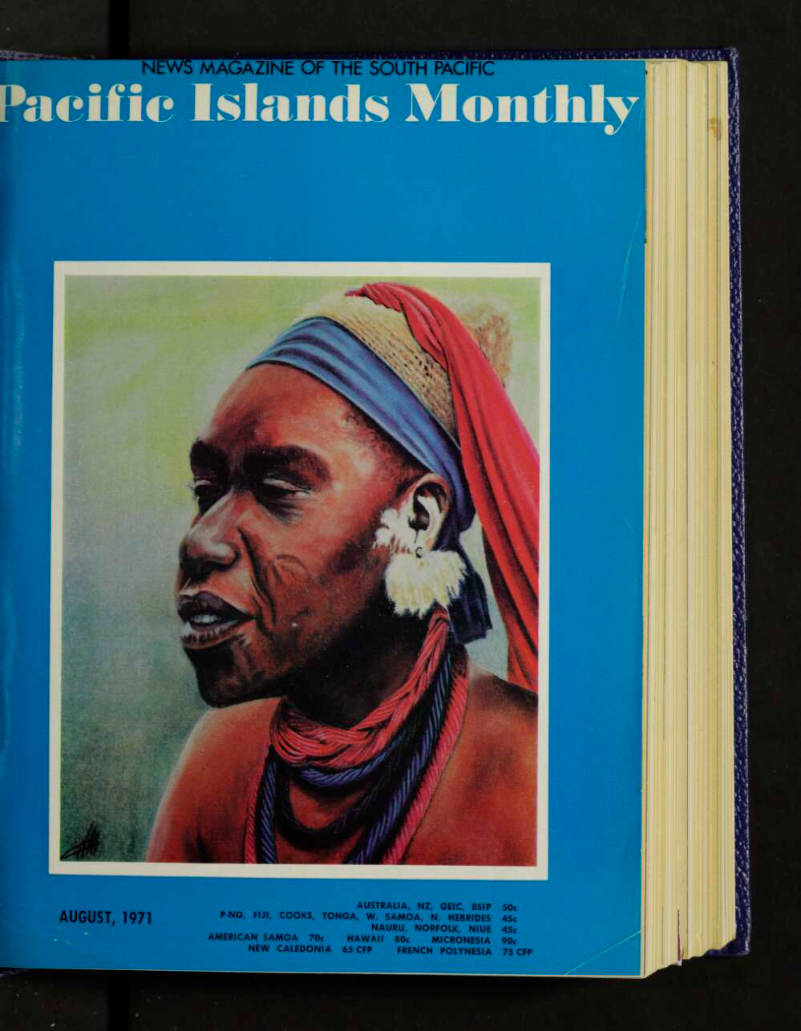 1
1 2
2 3
3 4
4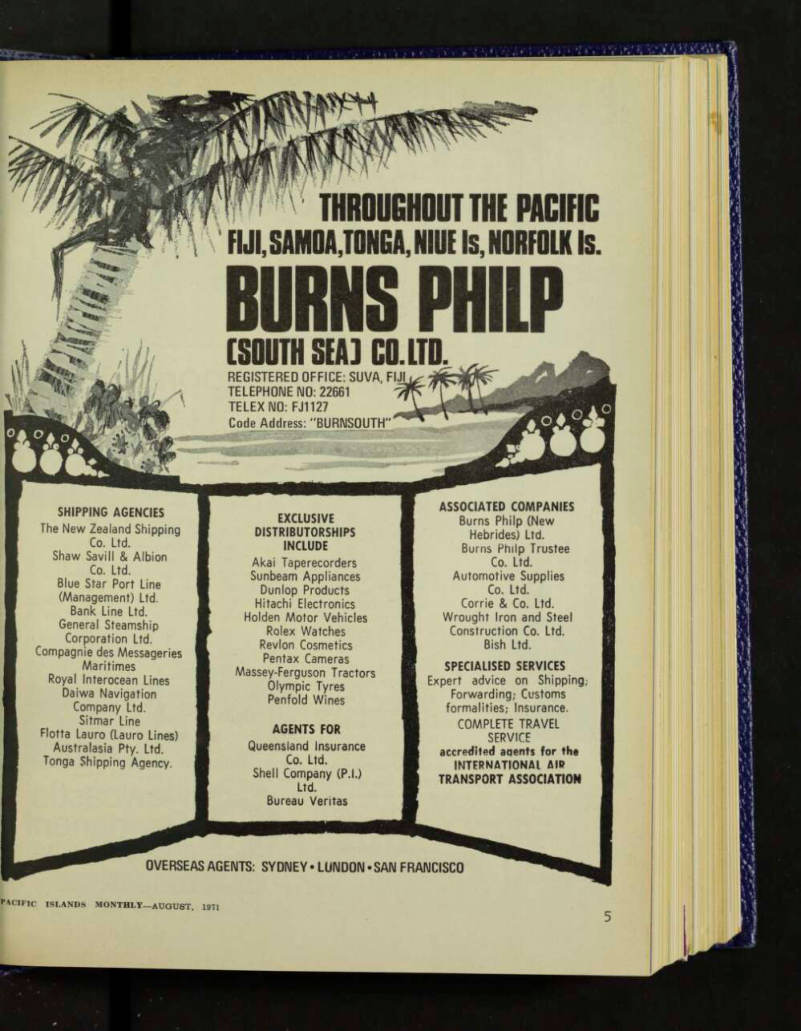 5
5 6
6 7
7 8
8 9
9 10
10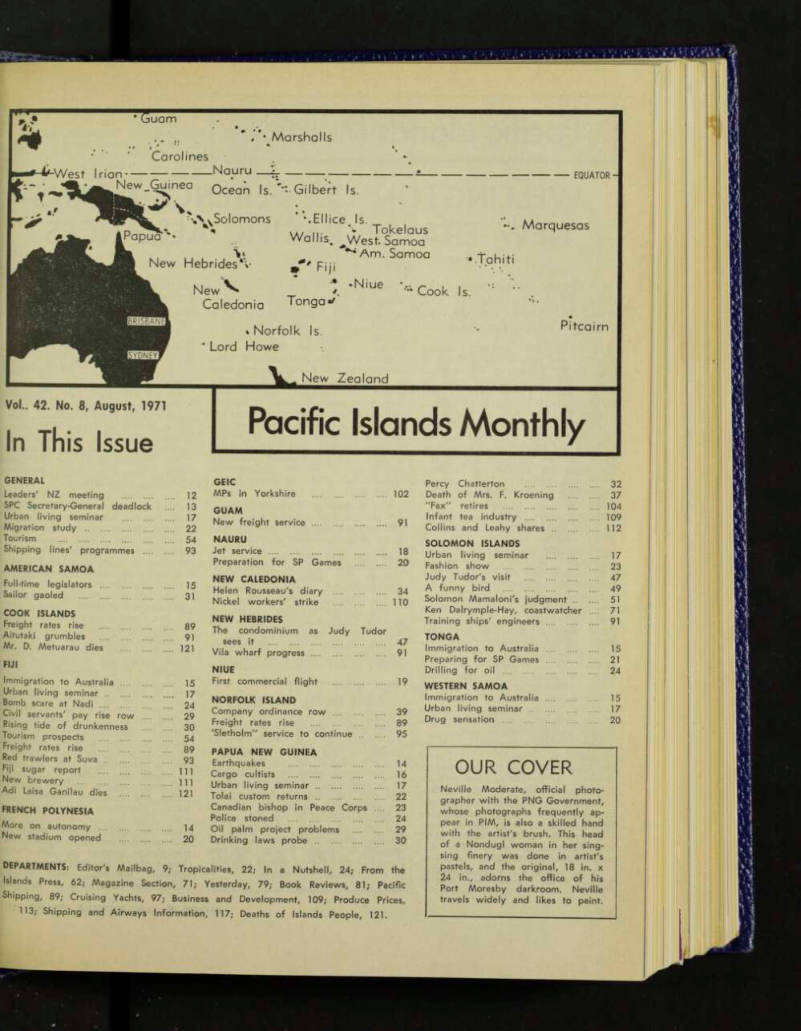 11
11 12
12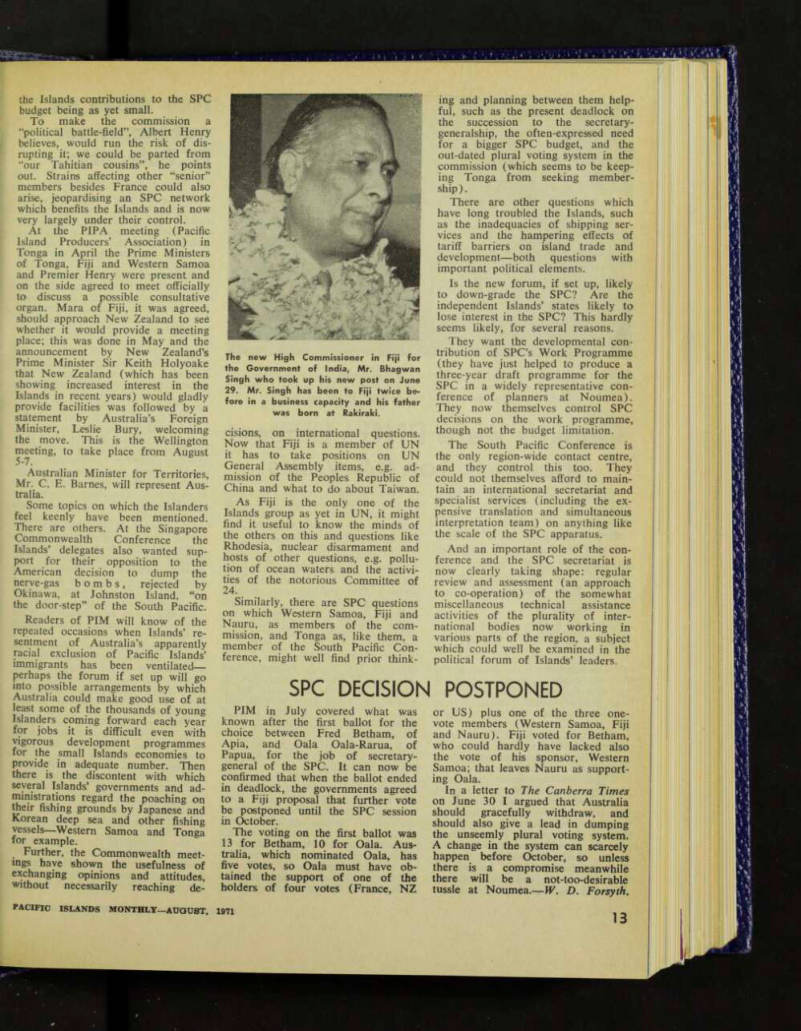 13
13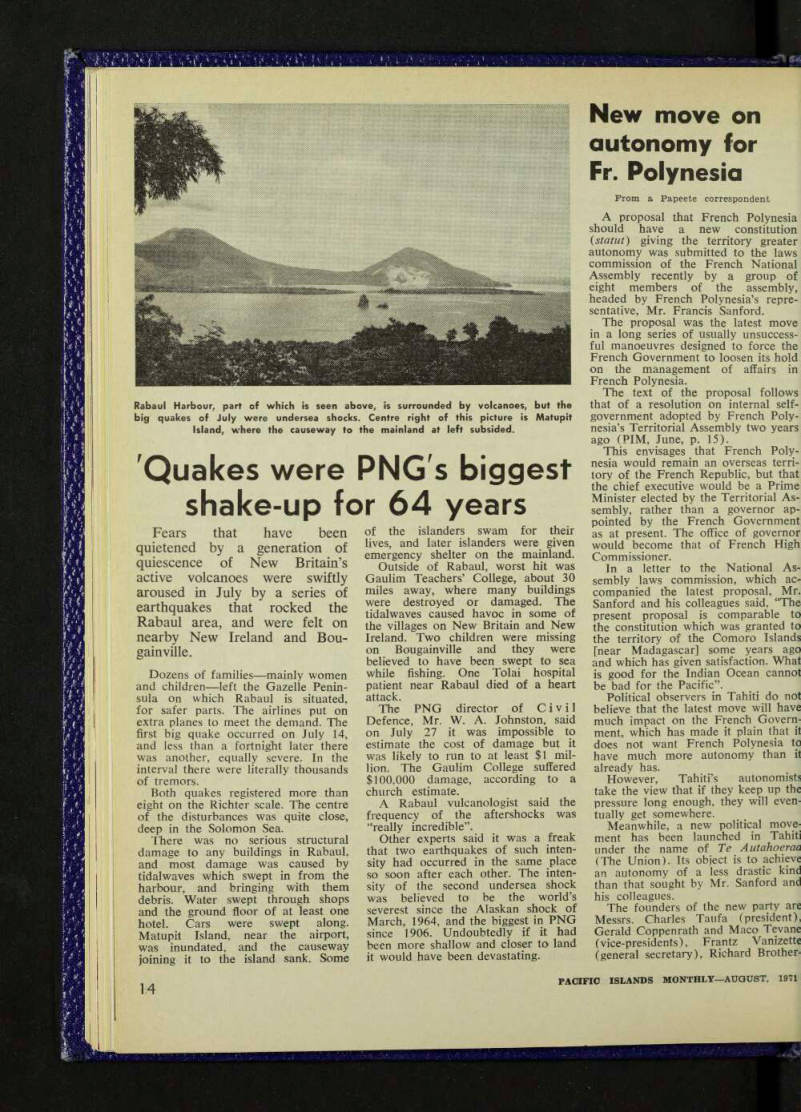 14
14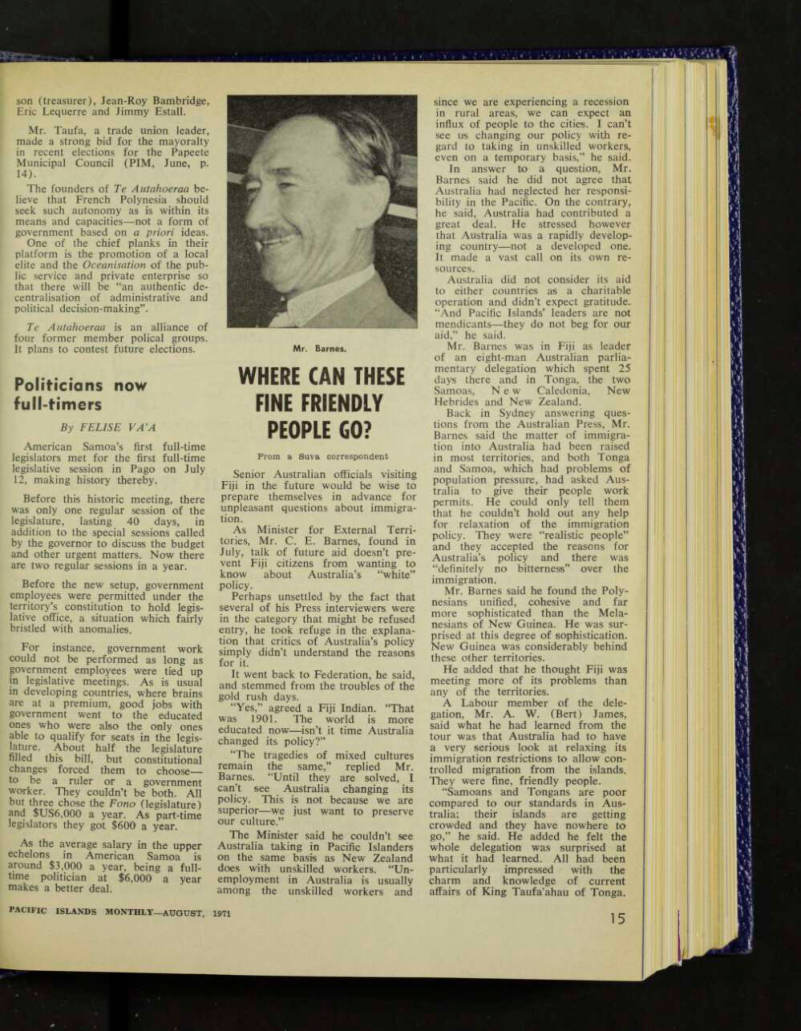 15
15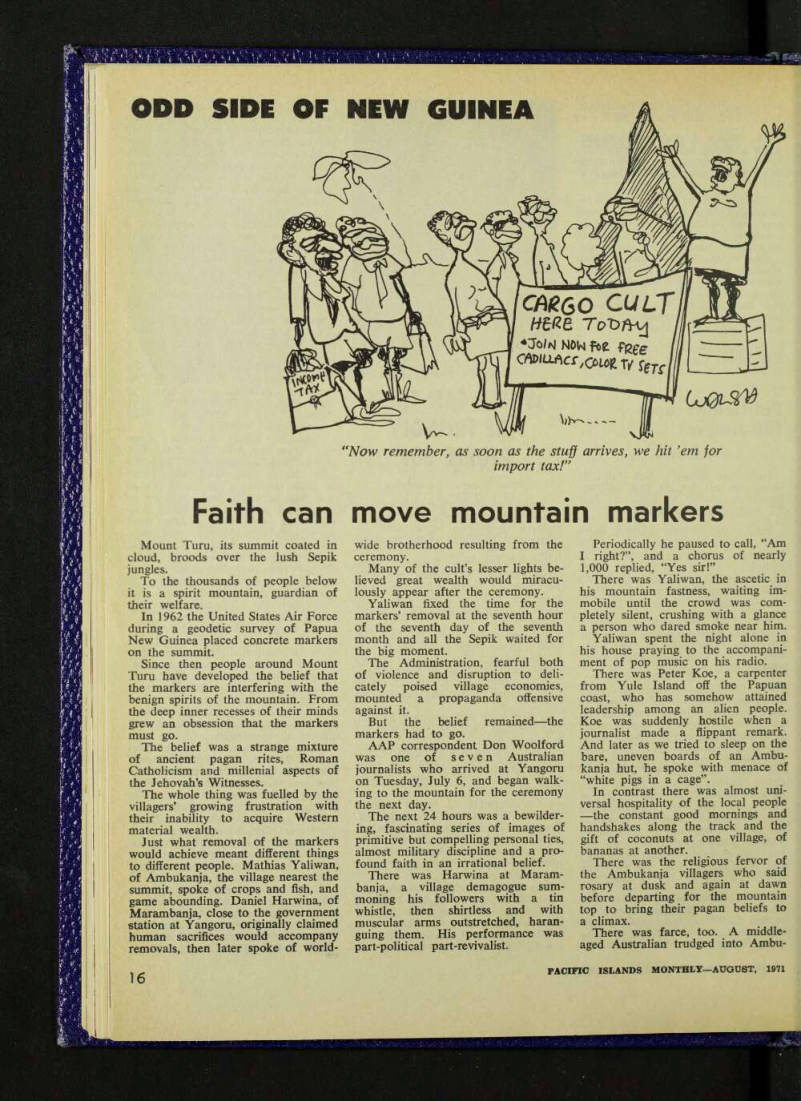 16
16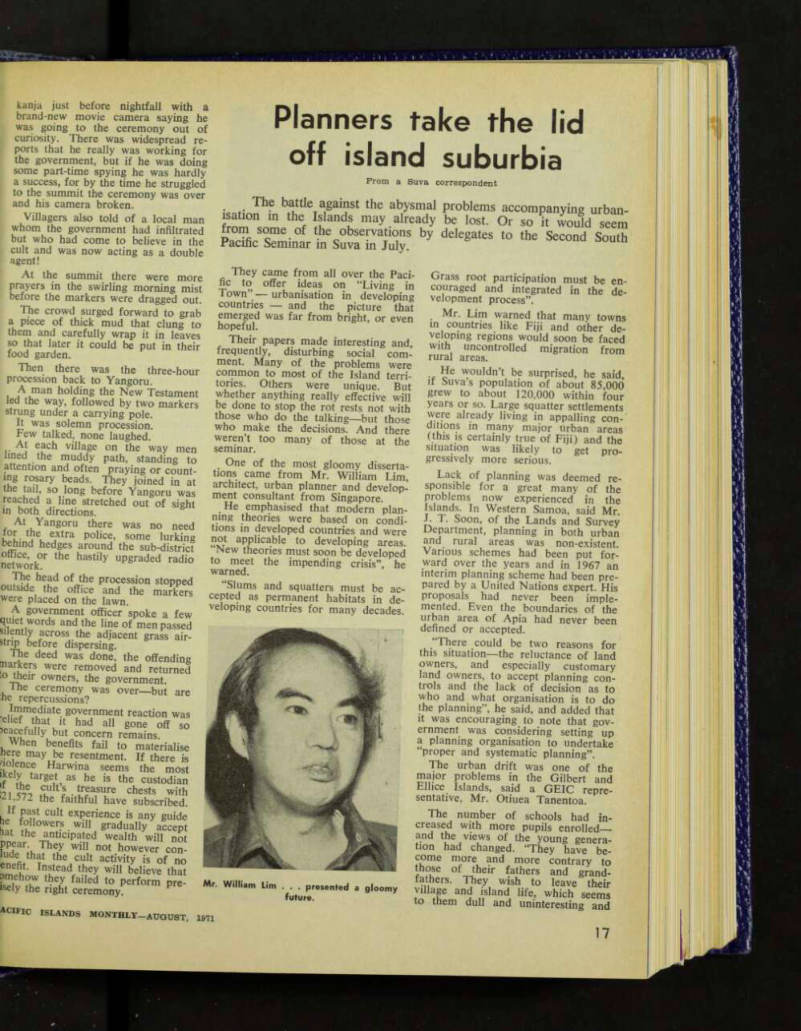 17
17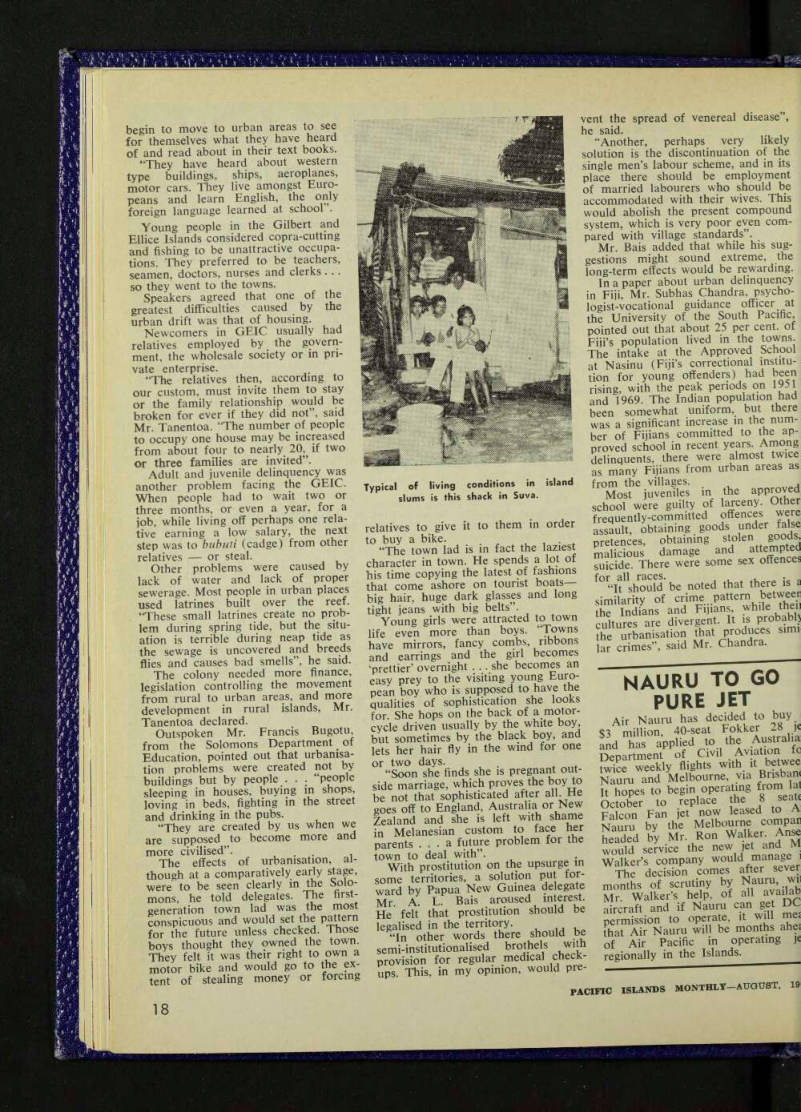 18
18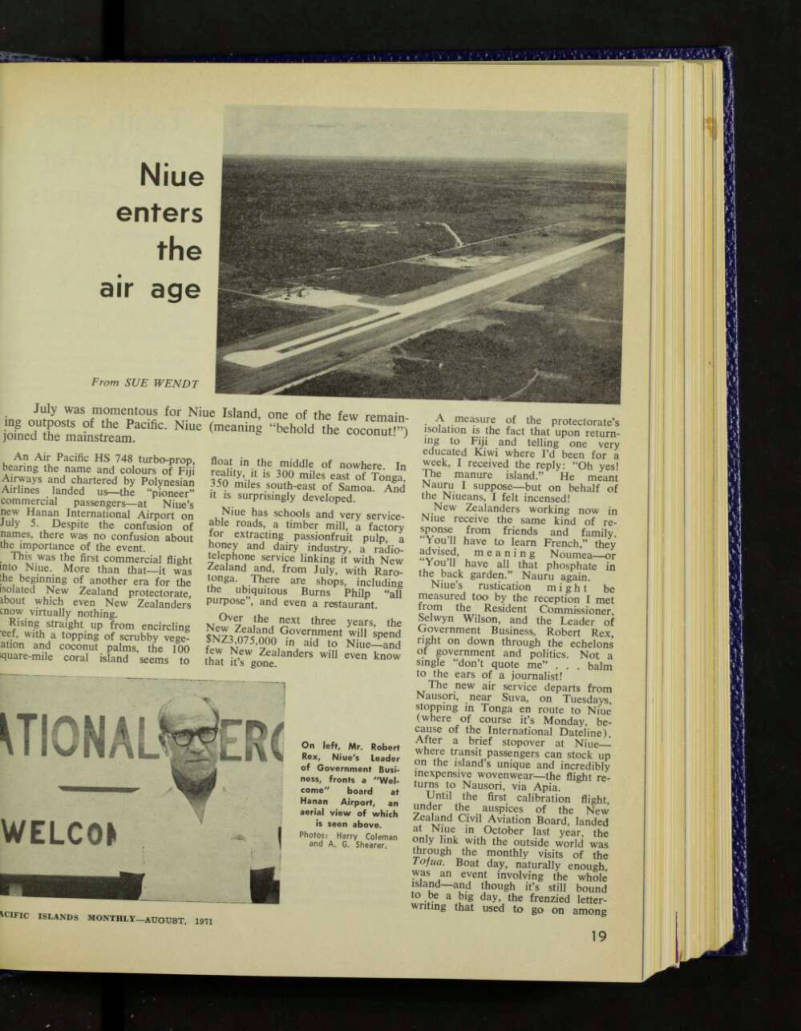 19
19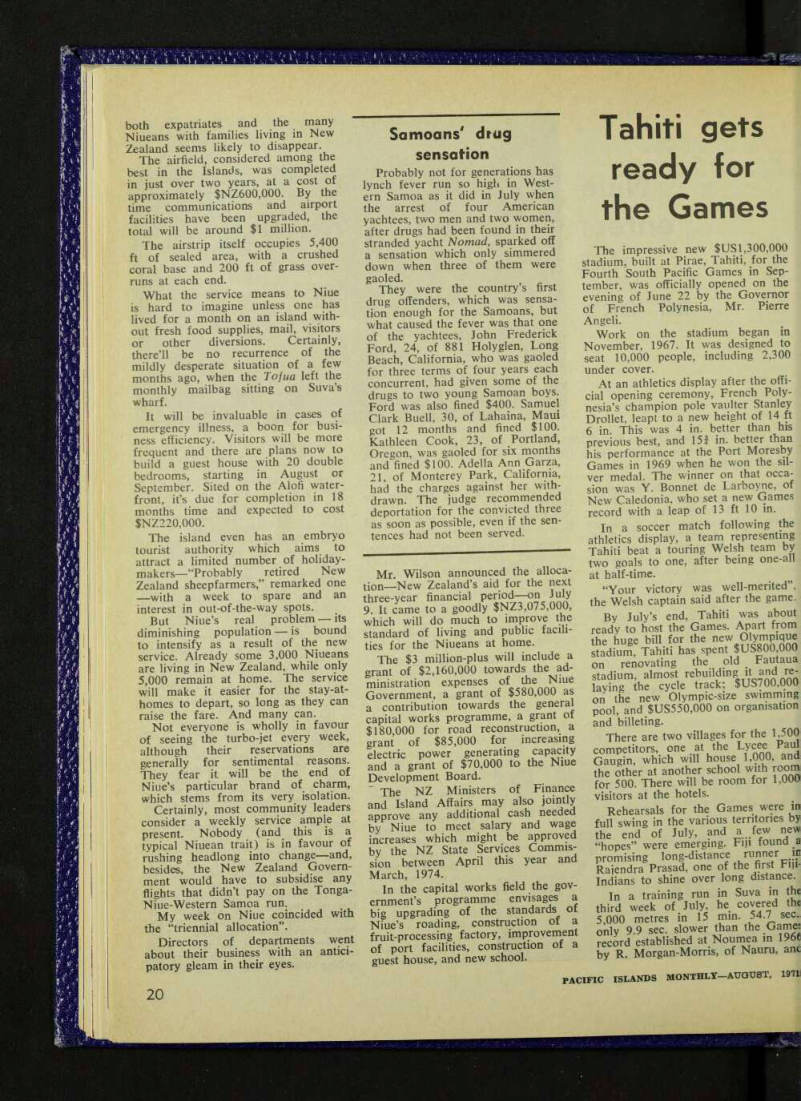 20
20 21
21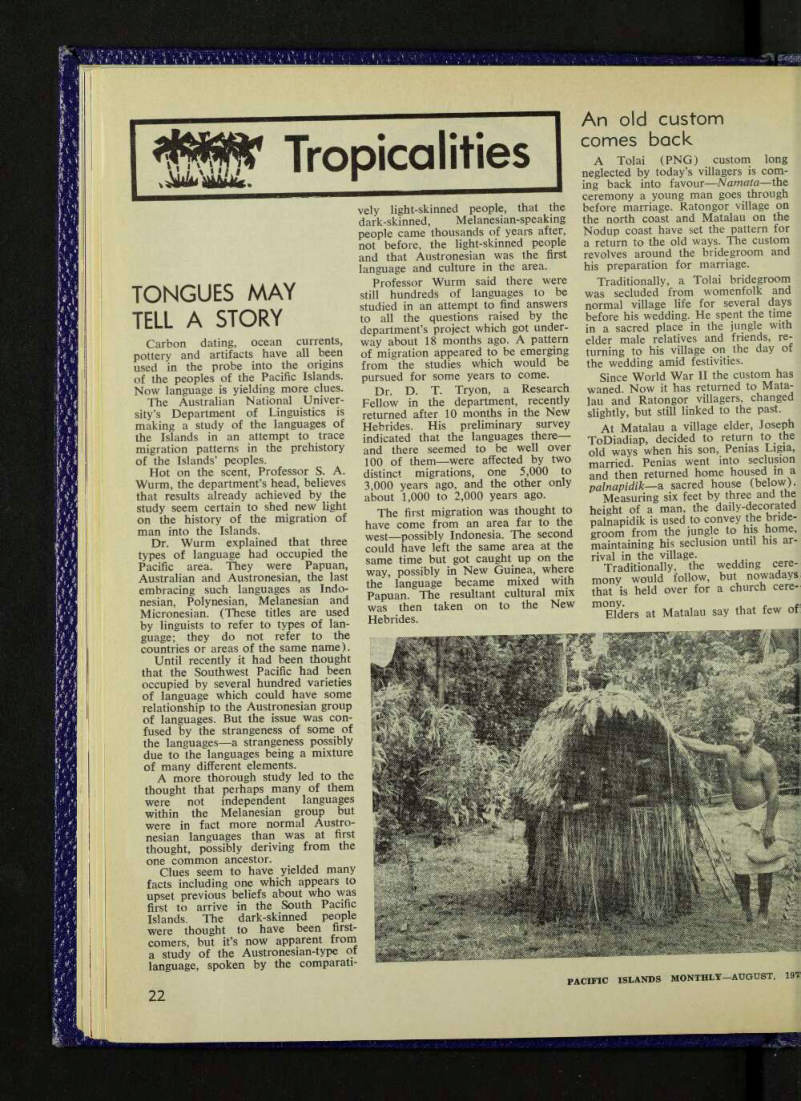 22
22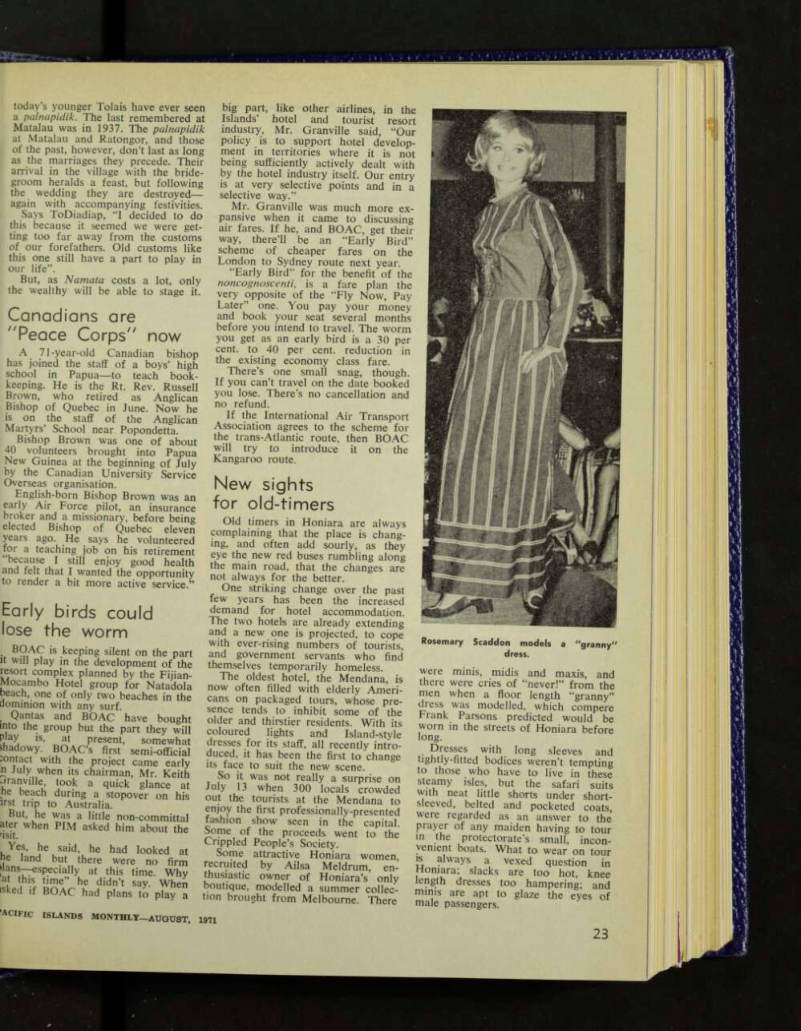 23
23 24
24 25
25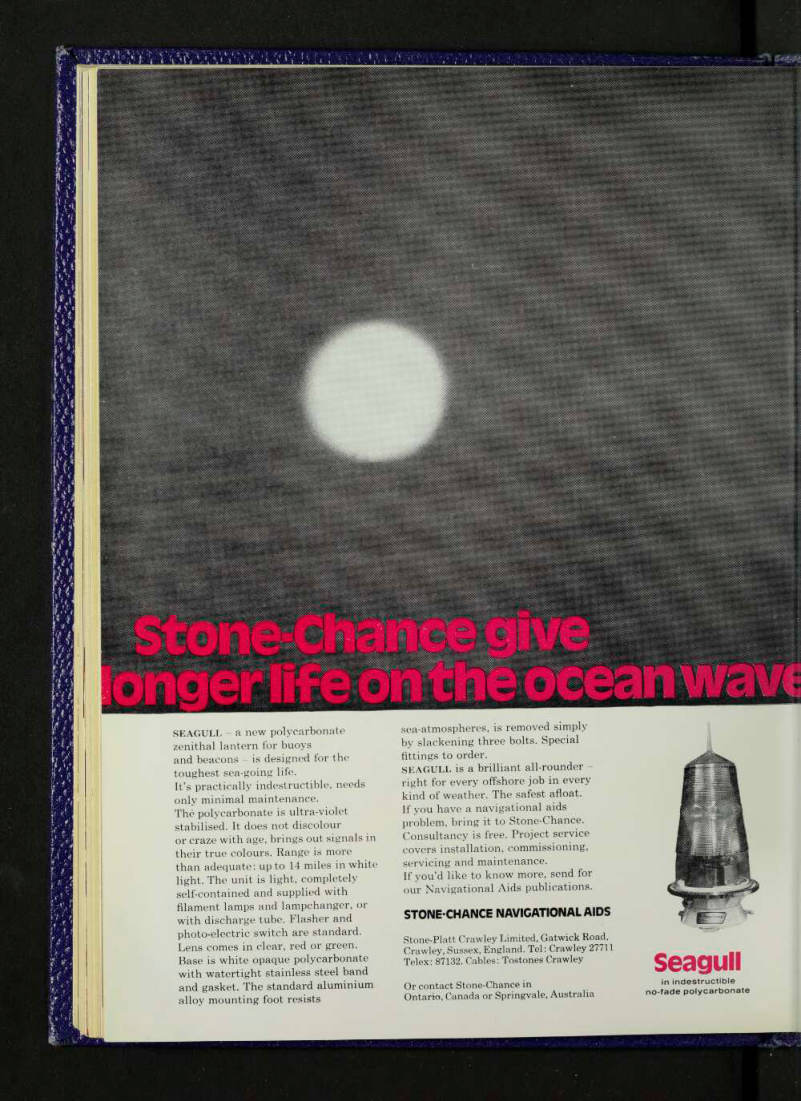 26
26 27
27 28
28 29
29 30
30 31
31 32
32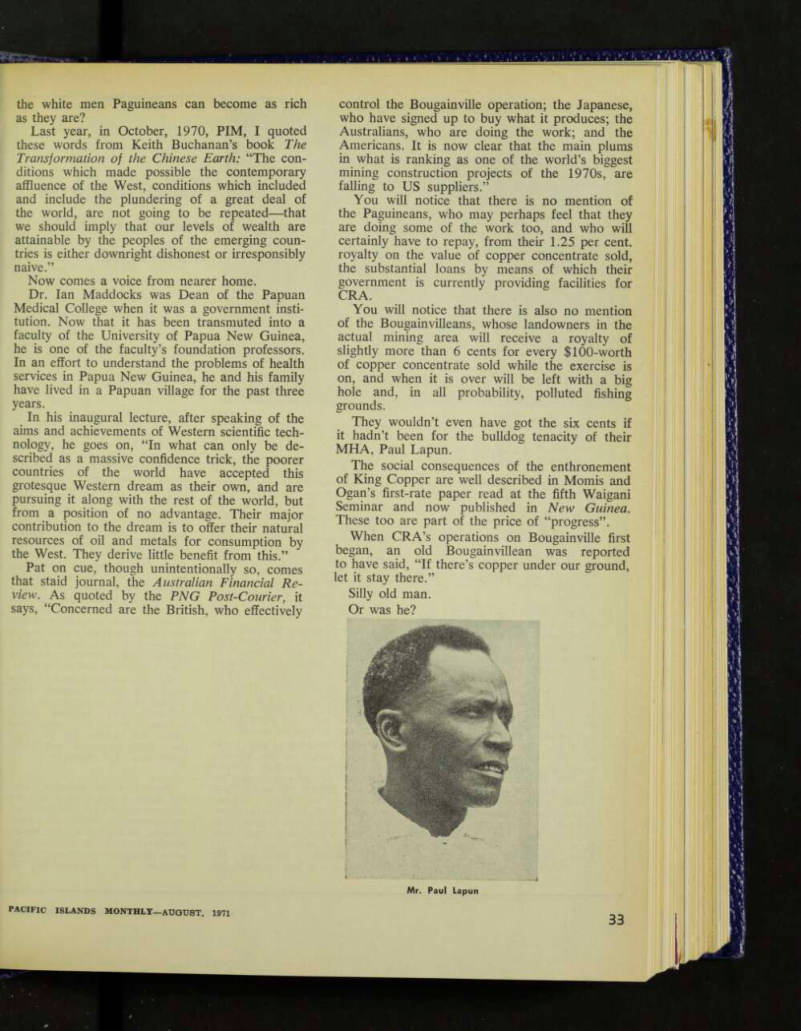 33
33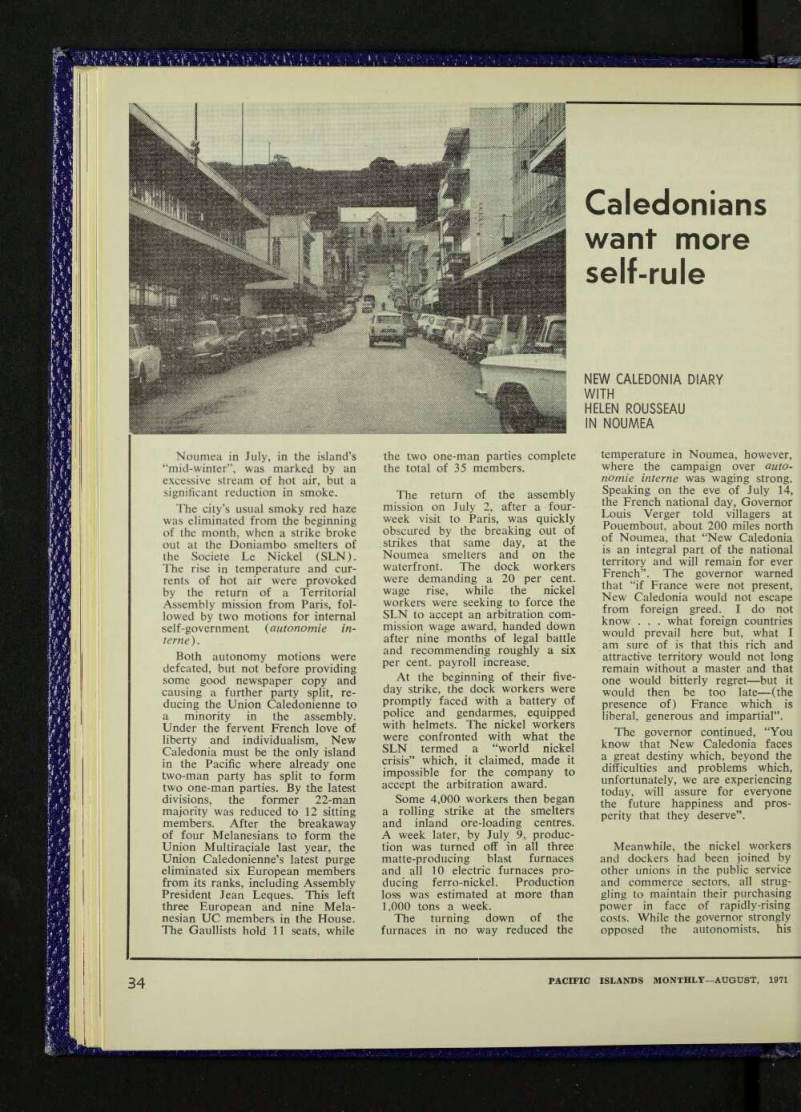 34
34 35
35 36
36 37
37 38
38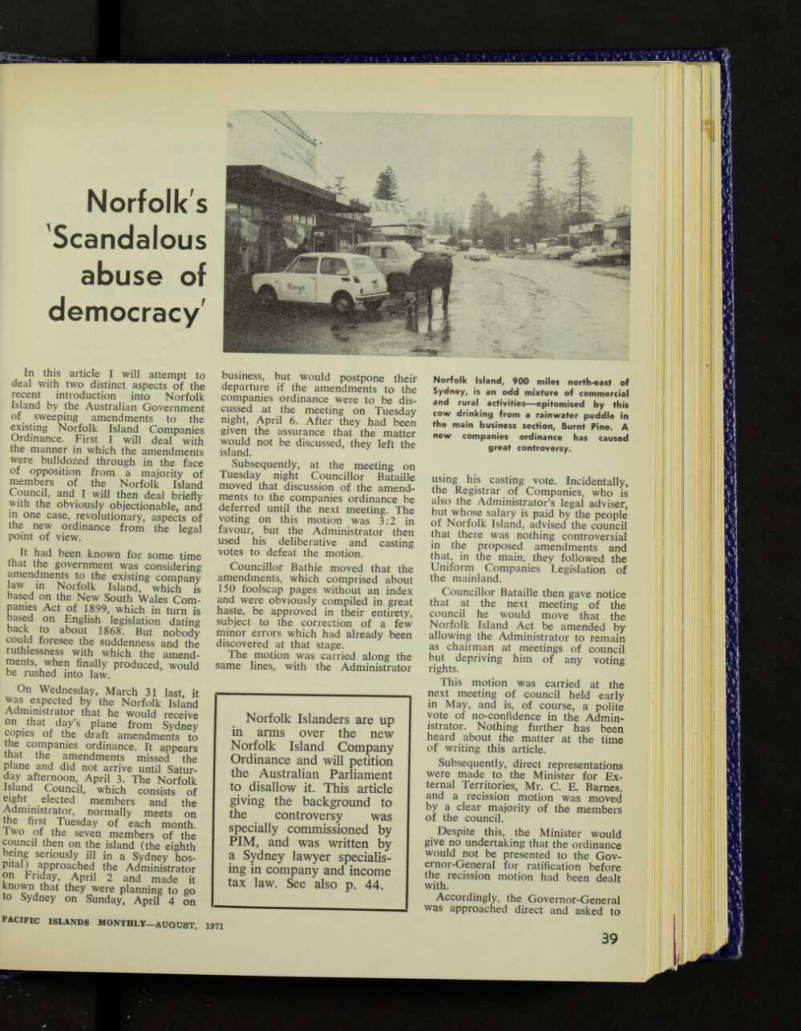 39
39 40
40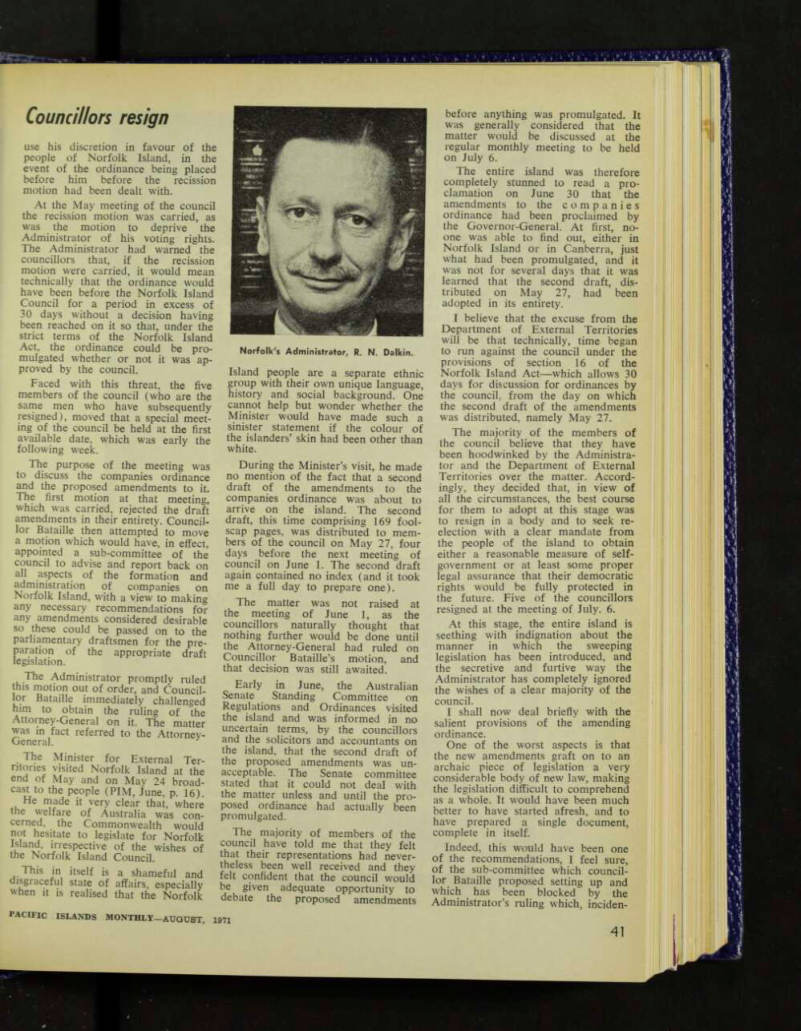 41
41 42
42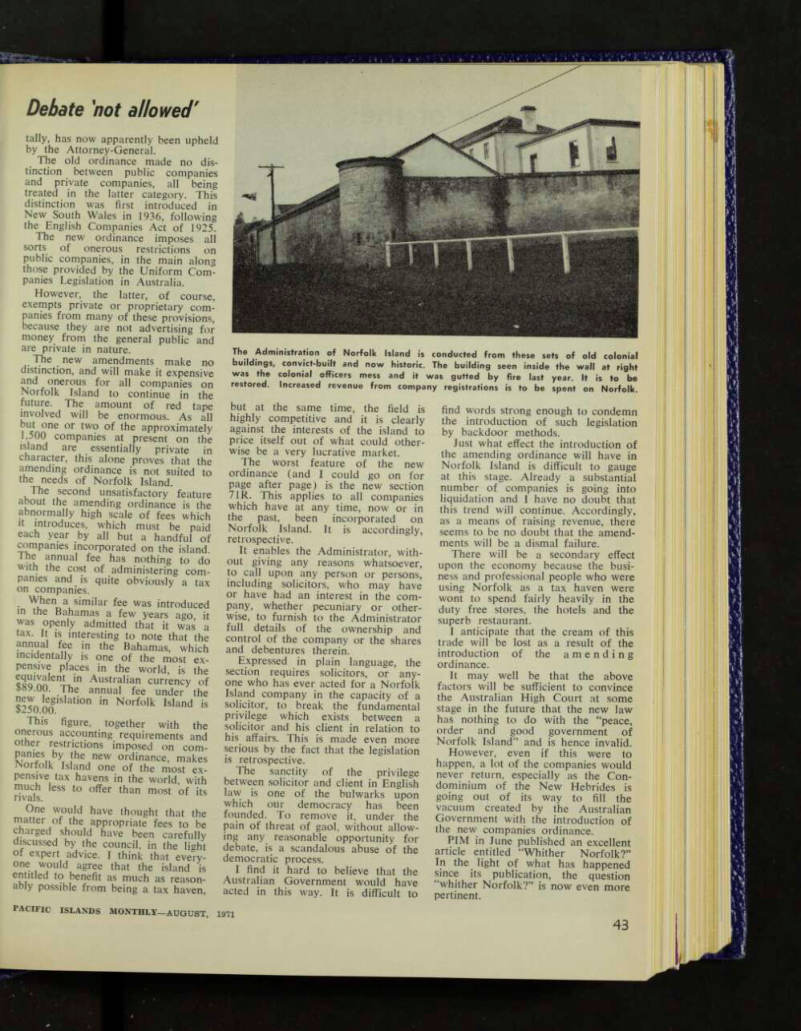 43
43 44
44 45
45 46
46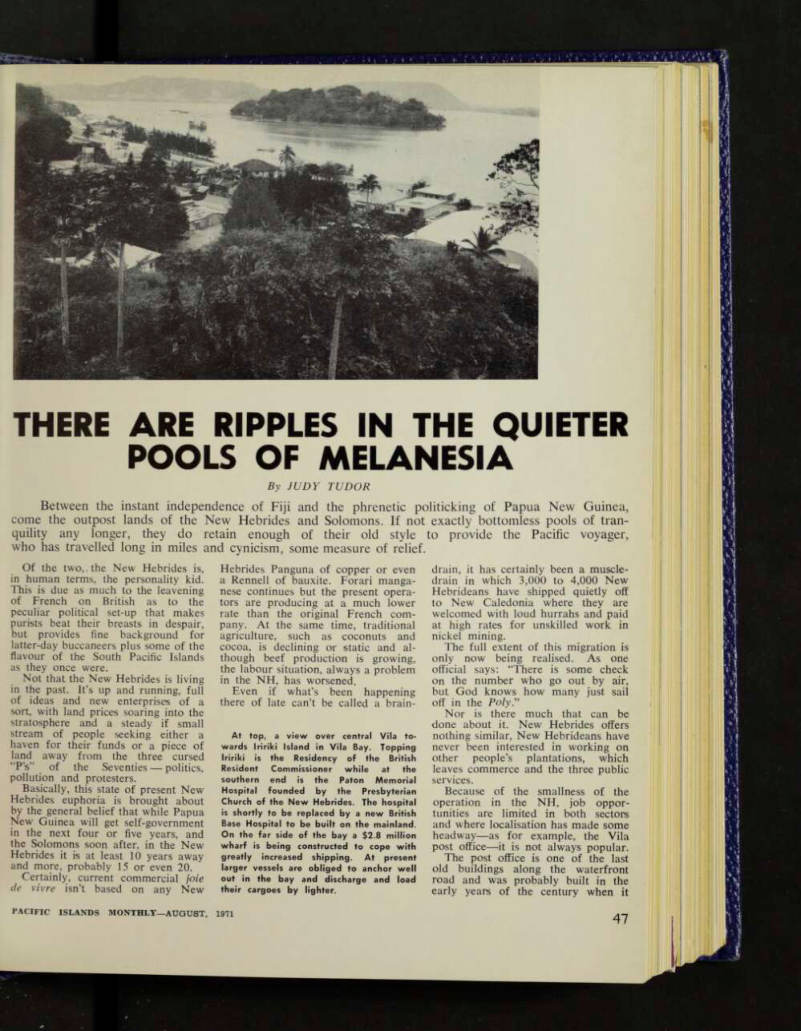 47
47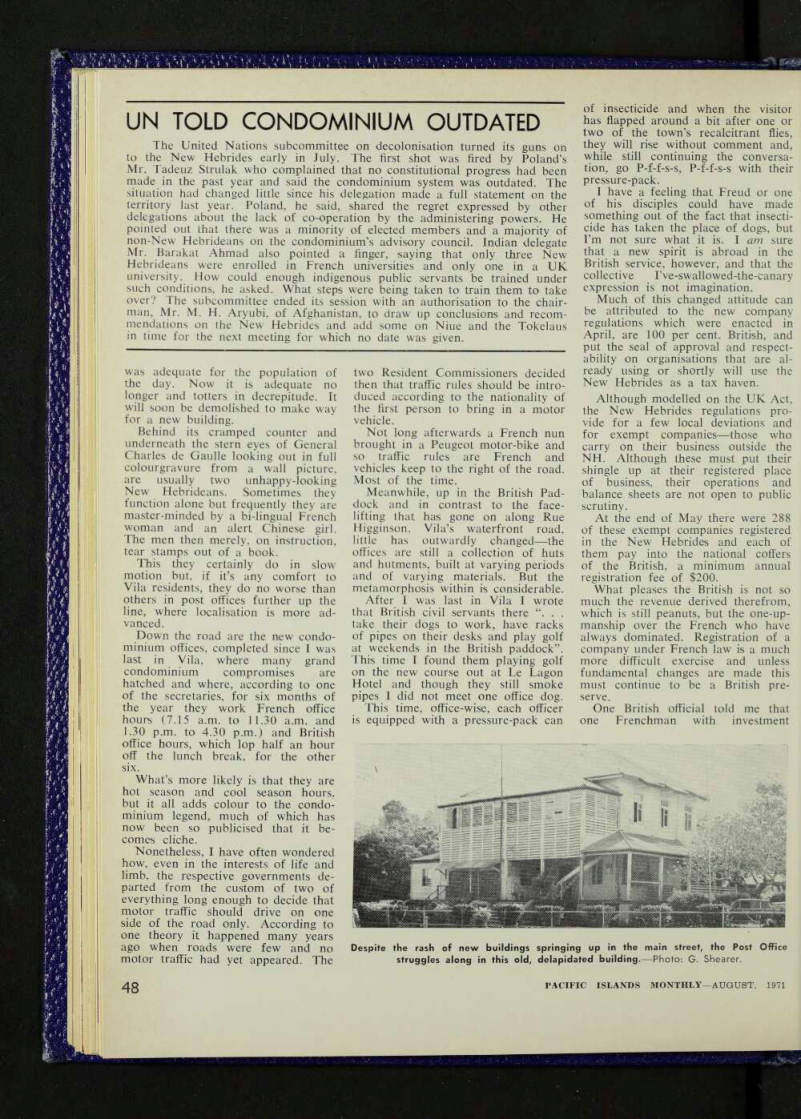 48
48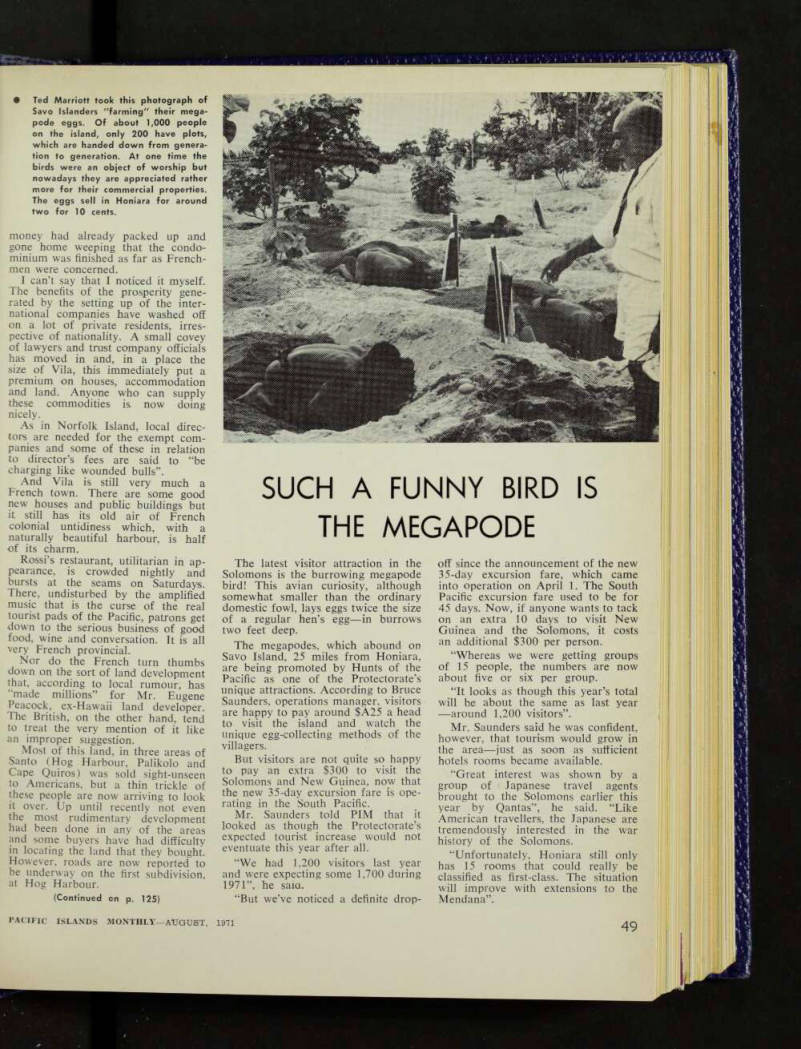 49
49 50
50 51
51 52
52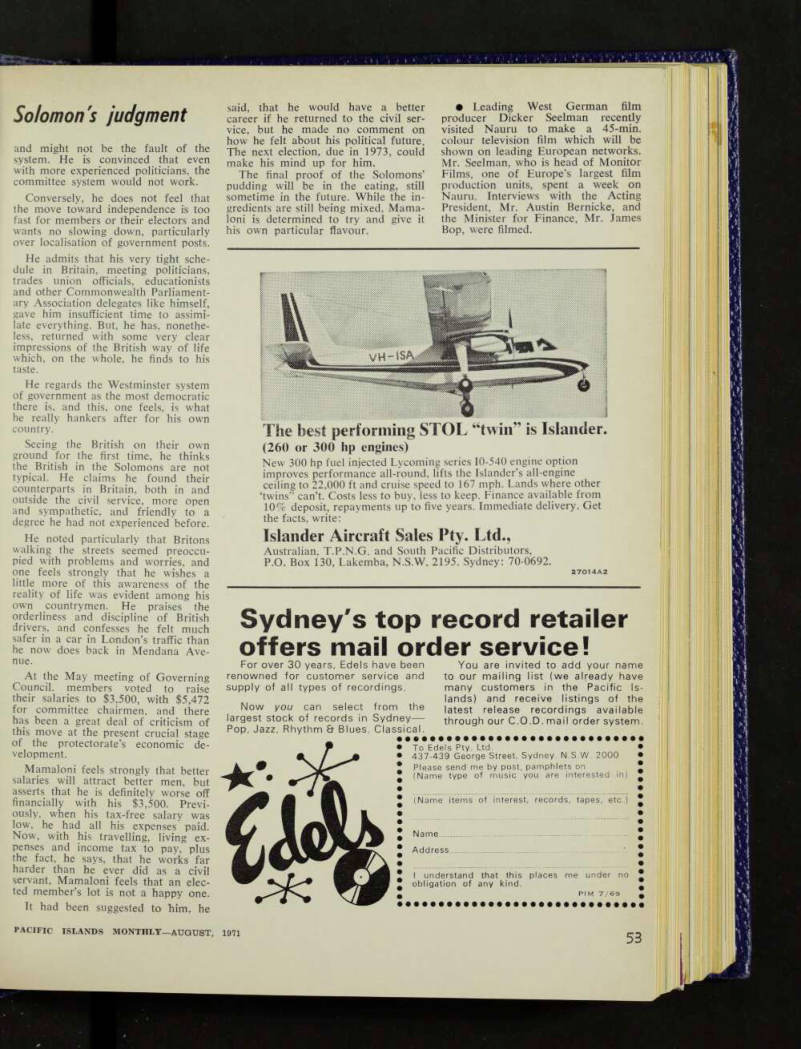 53
53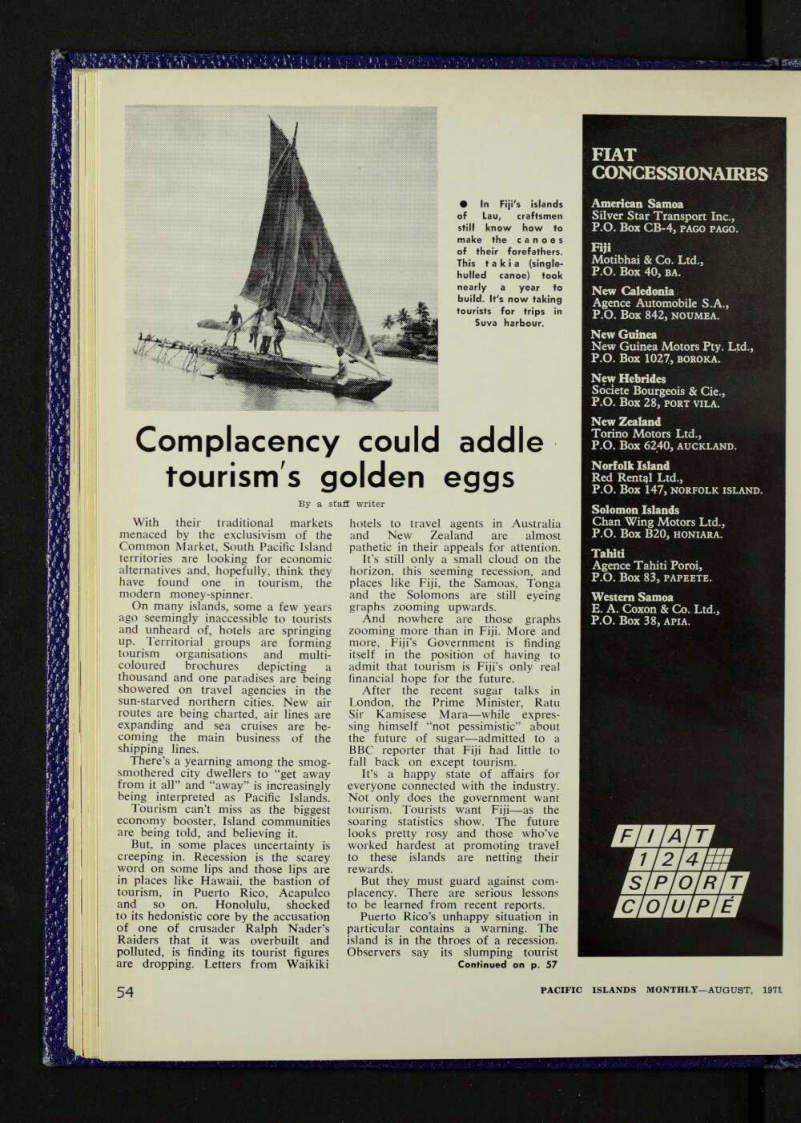 54
54 55
55 56
56 57
57 58
58 59
59 60
60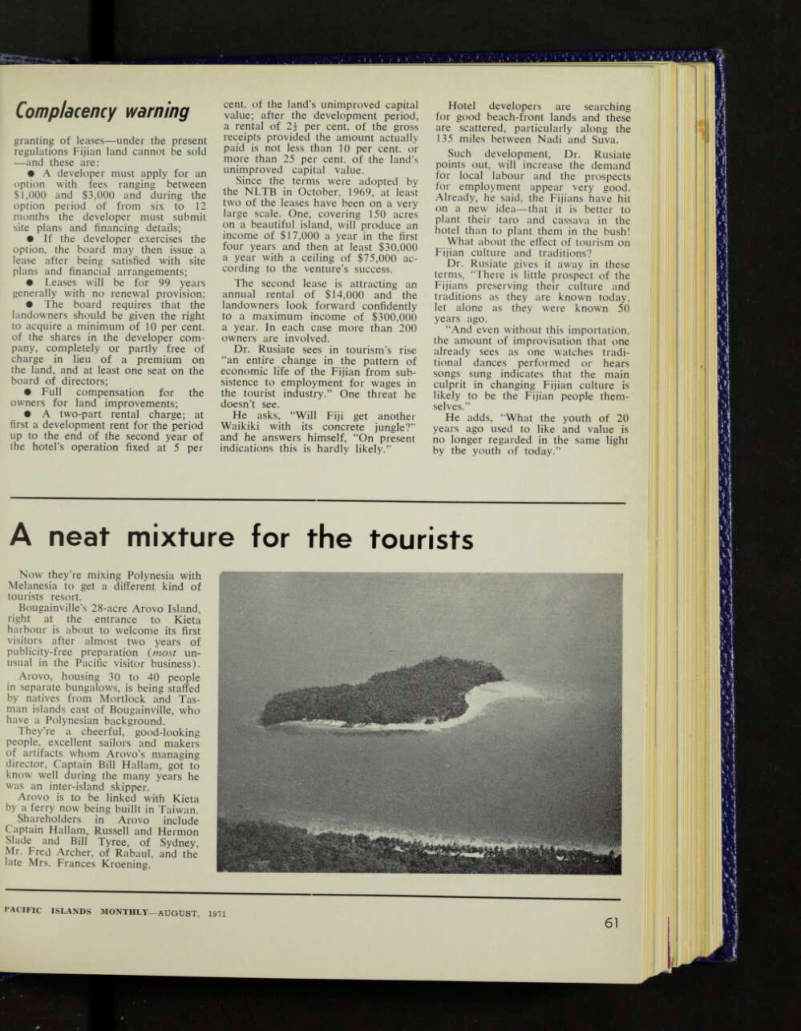 61
61 62
62 63
63 64
64 65
65 66
66 67
67 68
68 69
69 70
70 71
71 72
72 73
73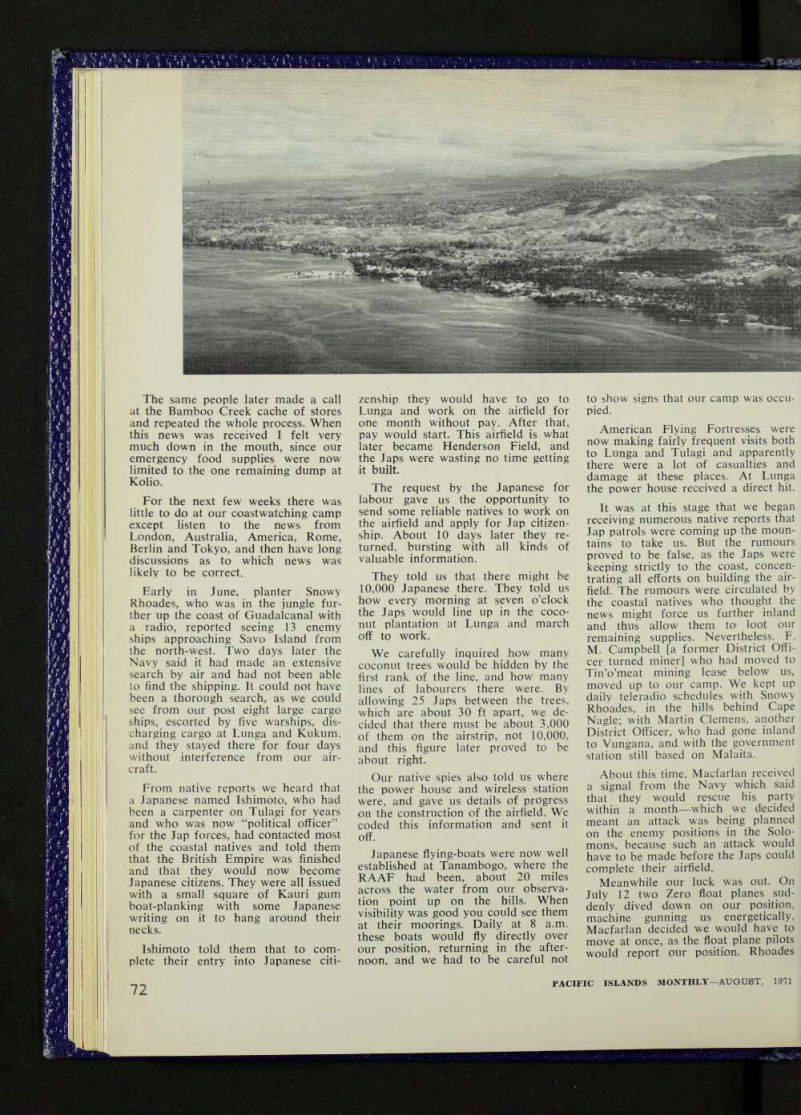 74
74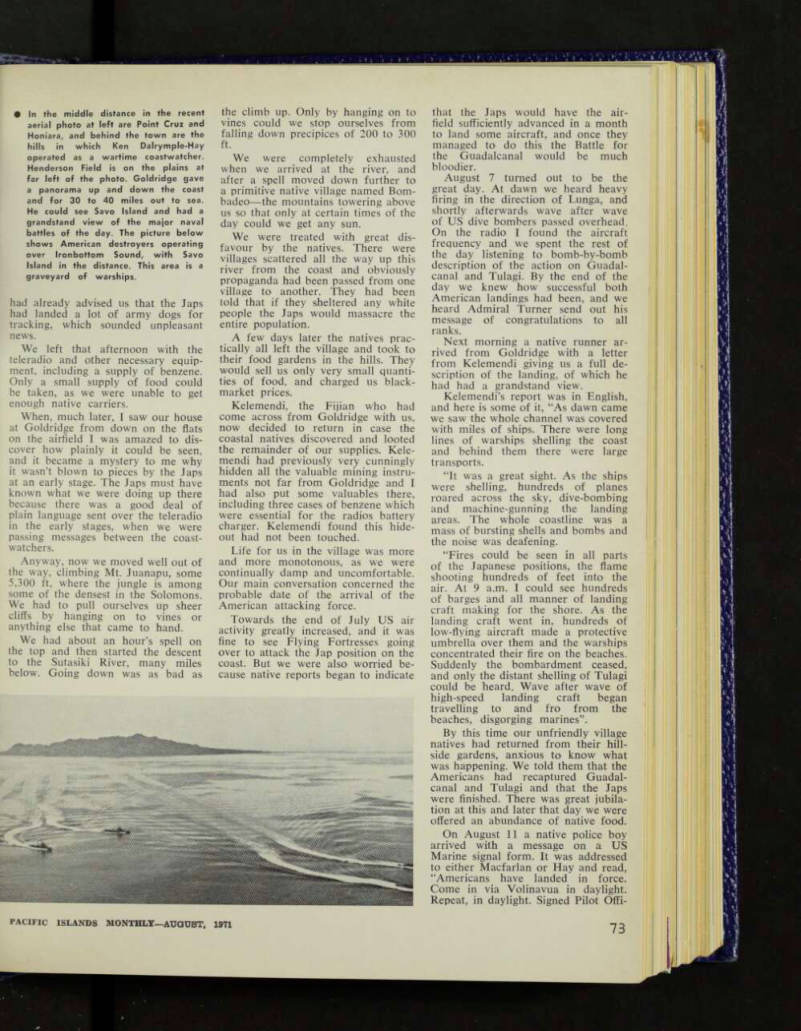 75
75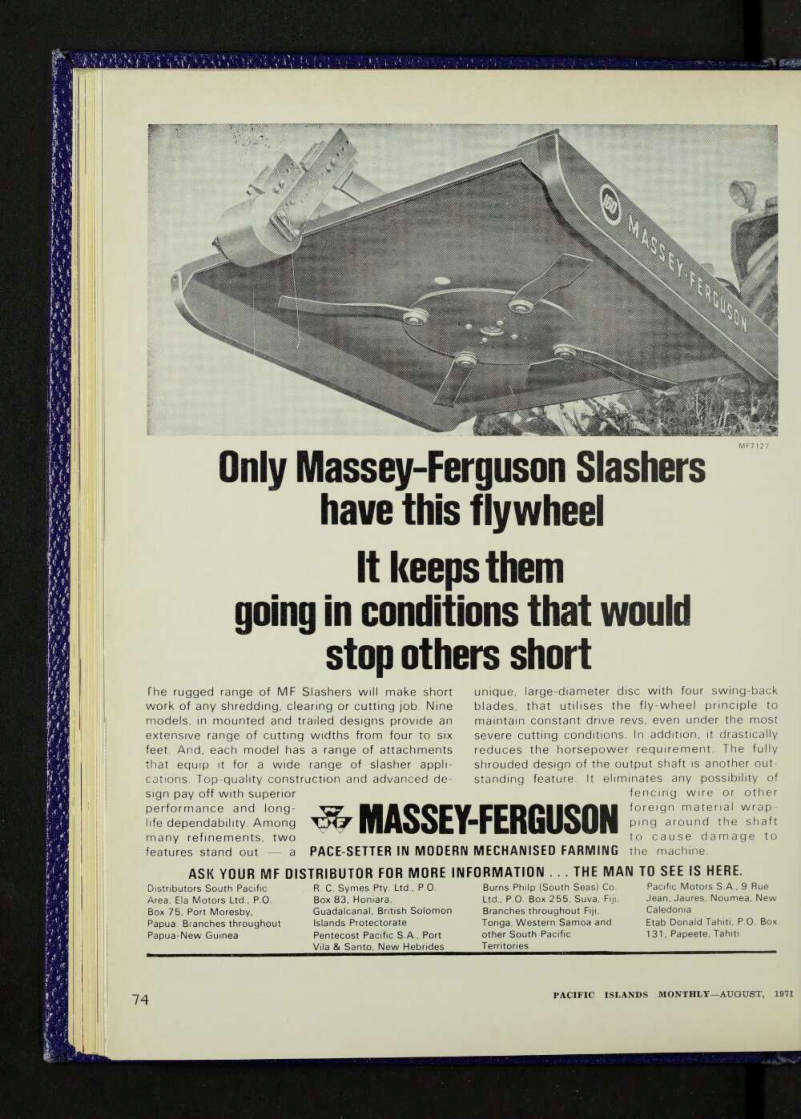 76
76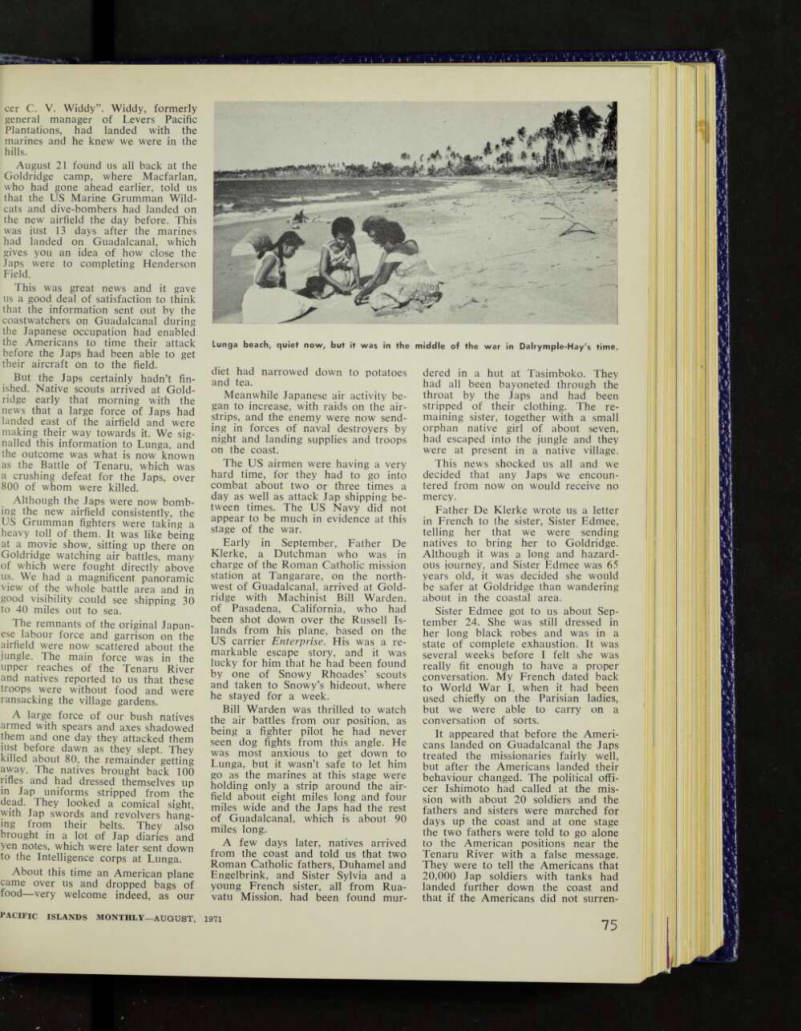 77
77 78
78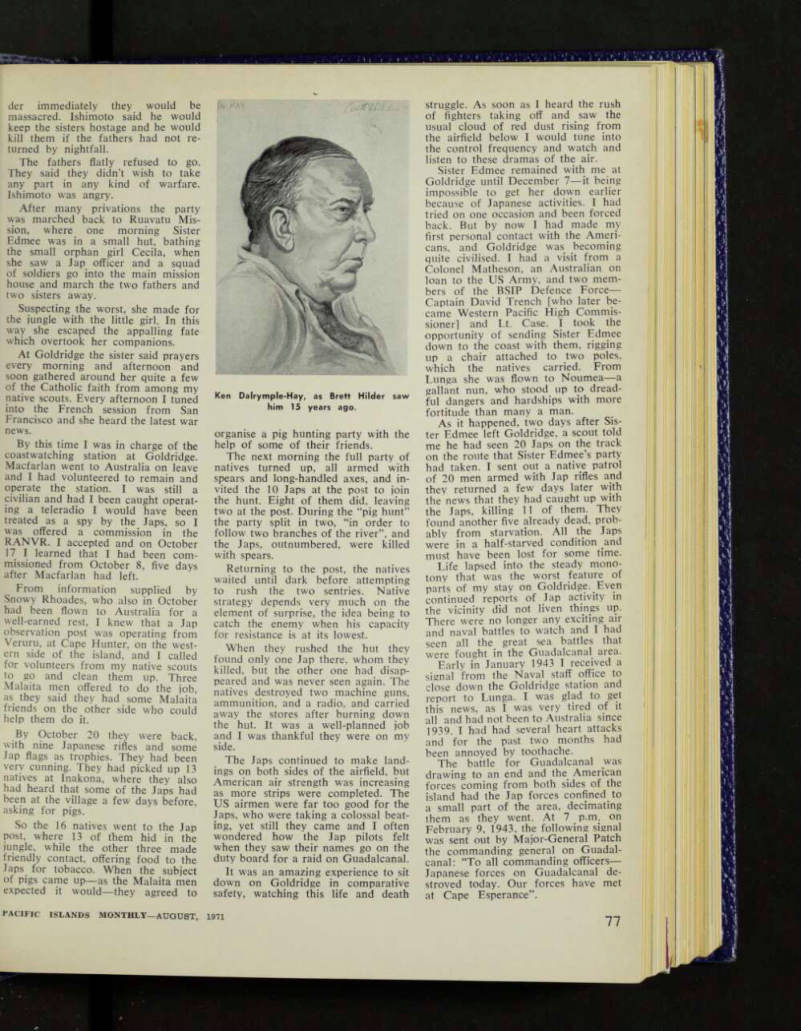 79
79 80
80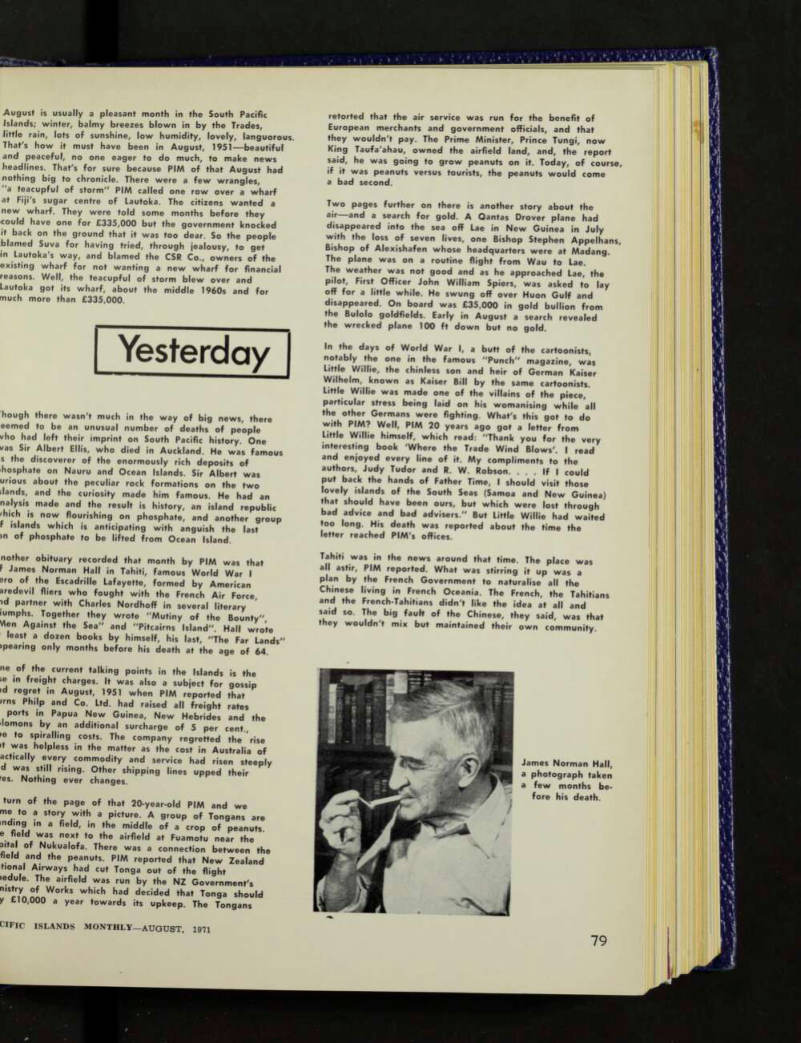 81
81 82
82 83
83 84
84 85
85 86
86 87
87 88
88 89
89 90
90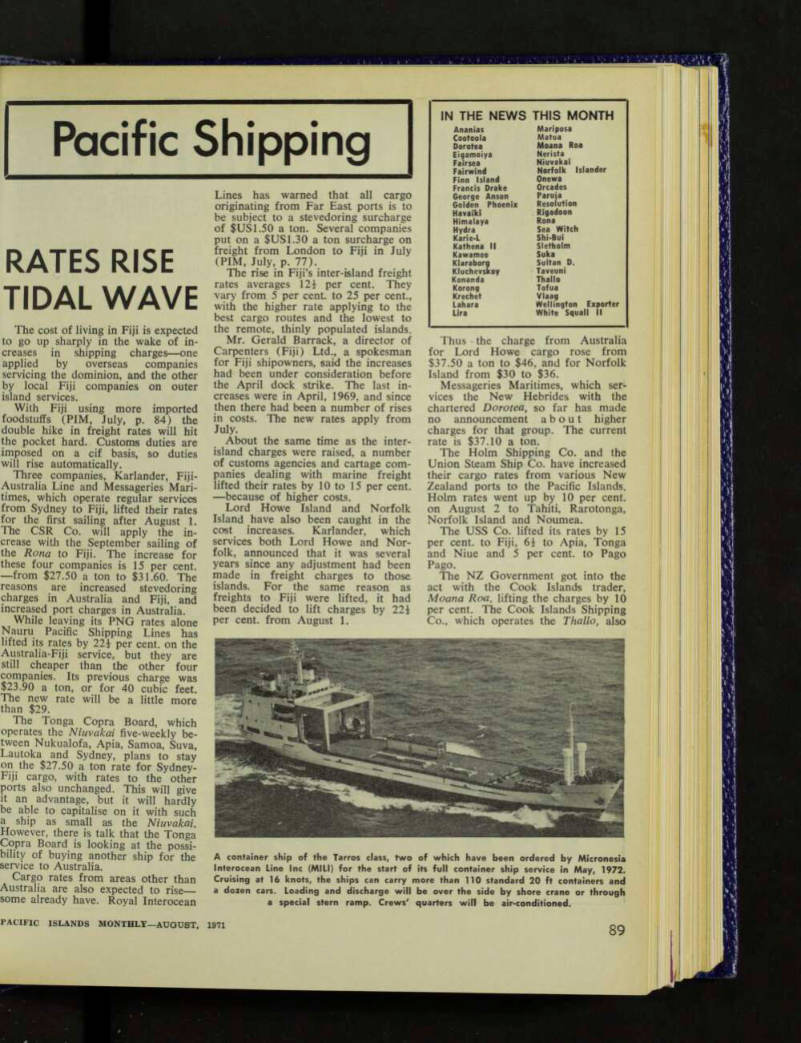 91
91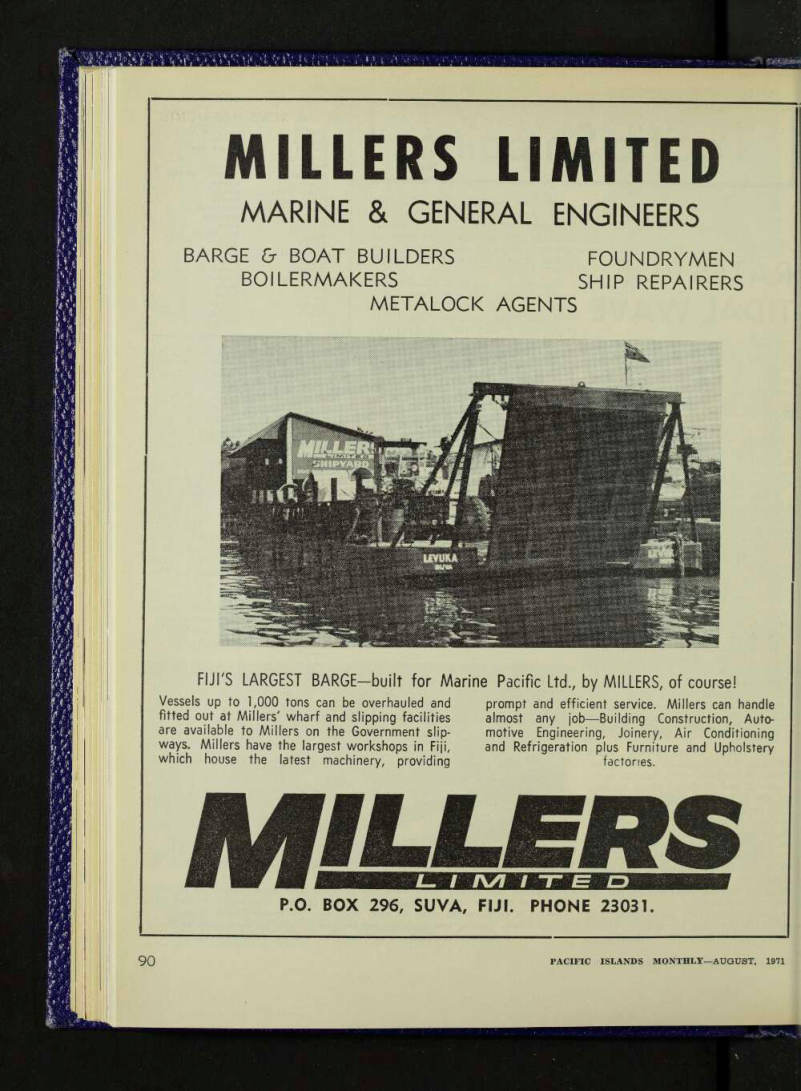 92
92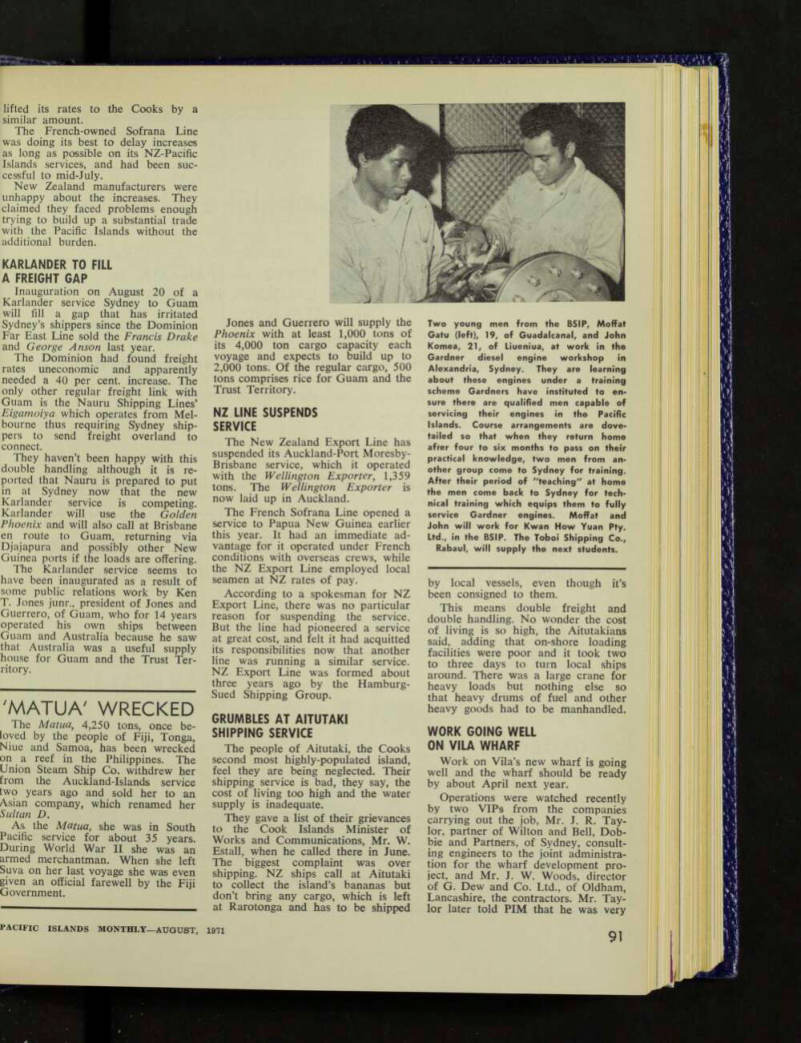 93
93 94
94 95
95 96
96 97
97 98
98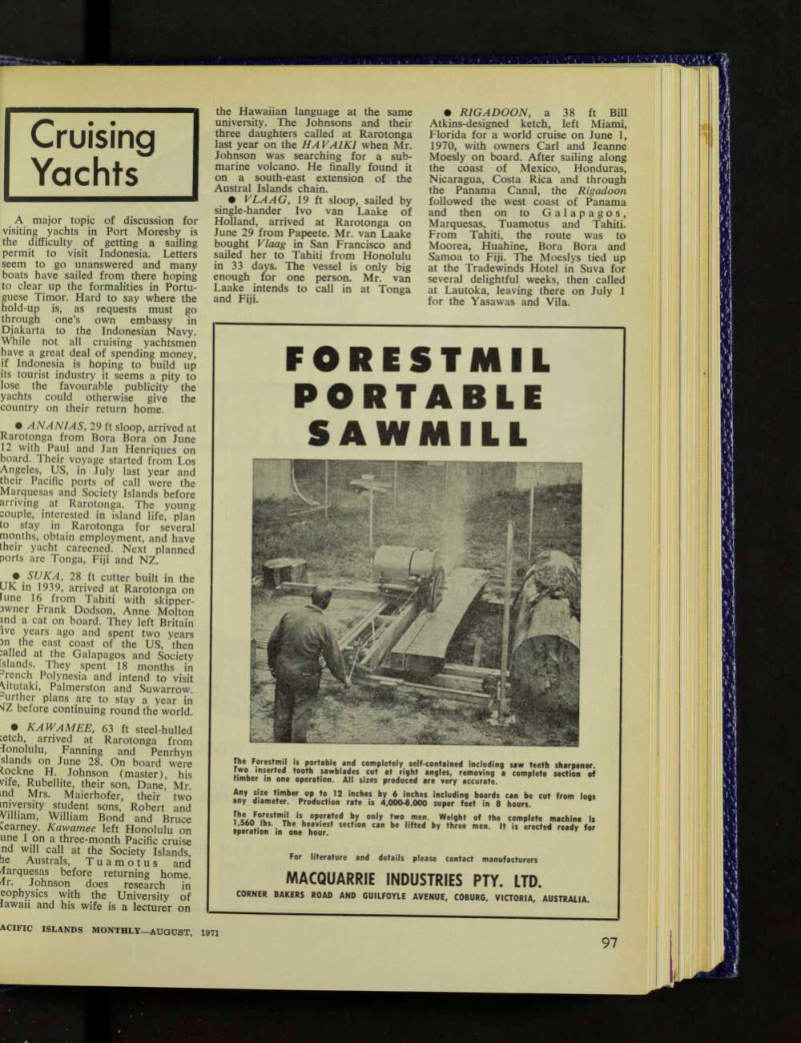 99
99 100
100 101
101 102
102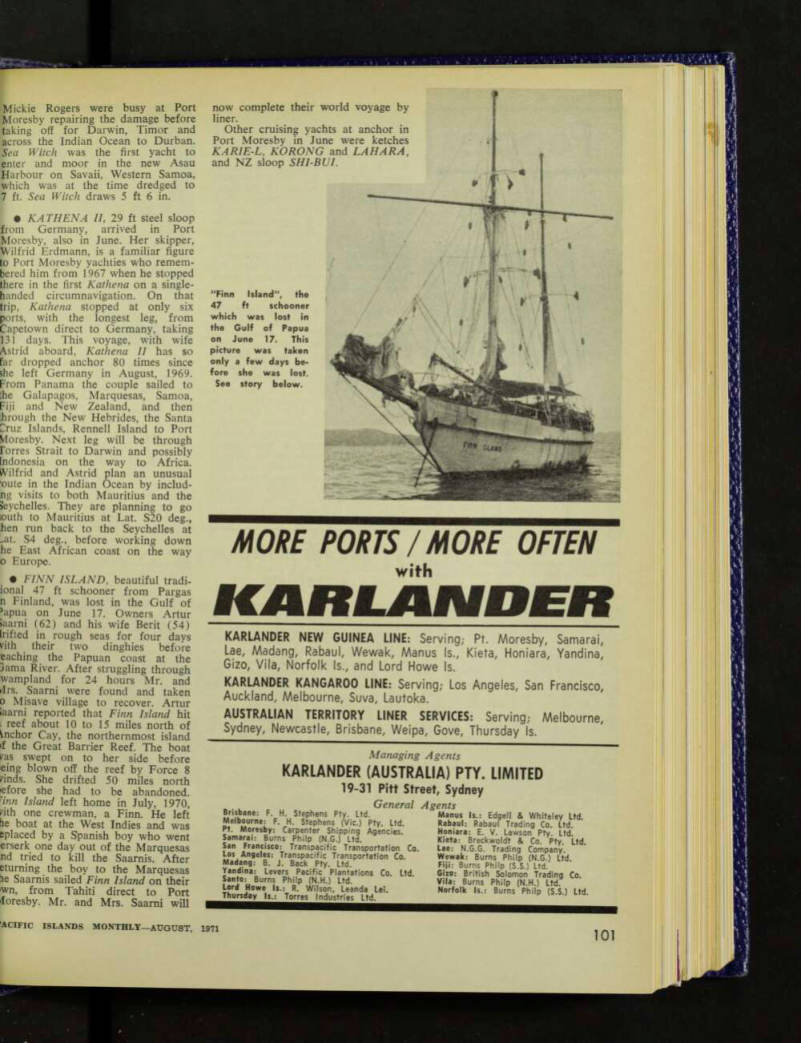 103
103 104
104 105
105 106
106 107
107 108
108 109
109 110
110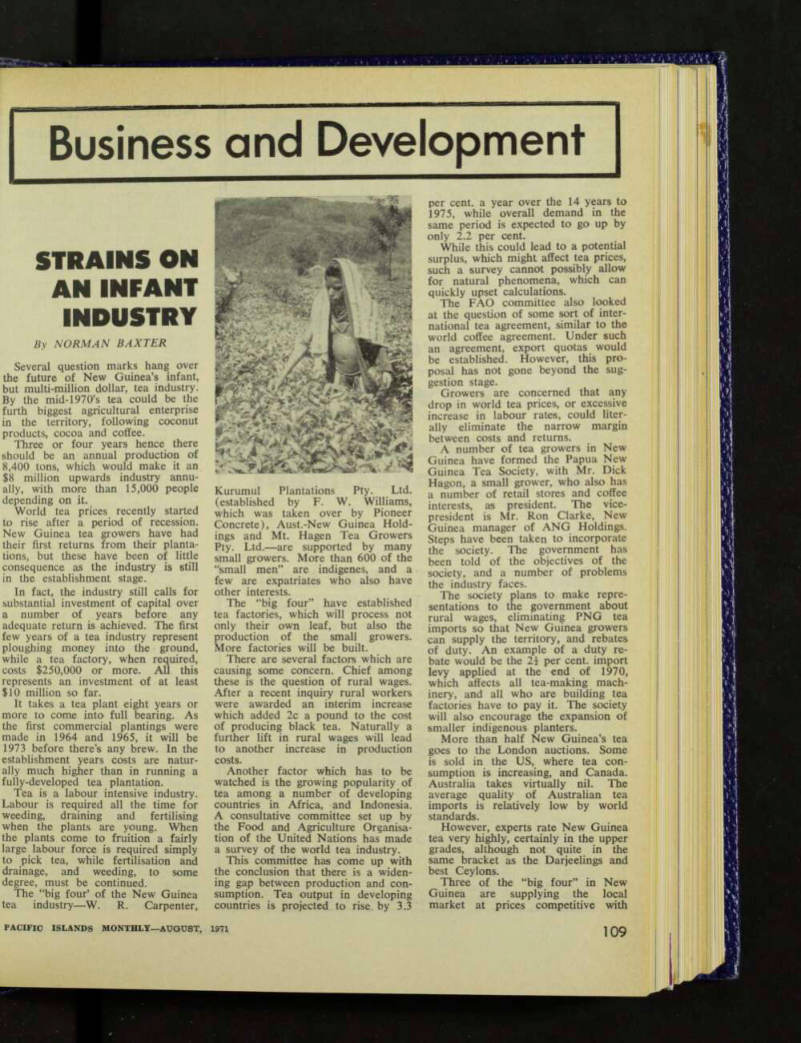 111
111 112
112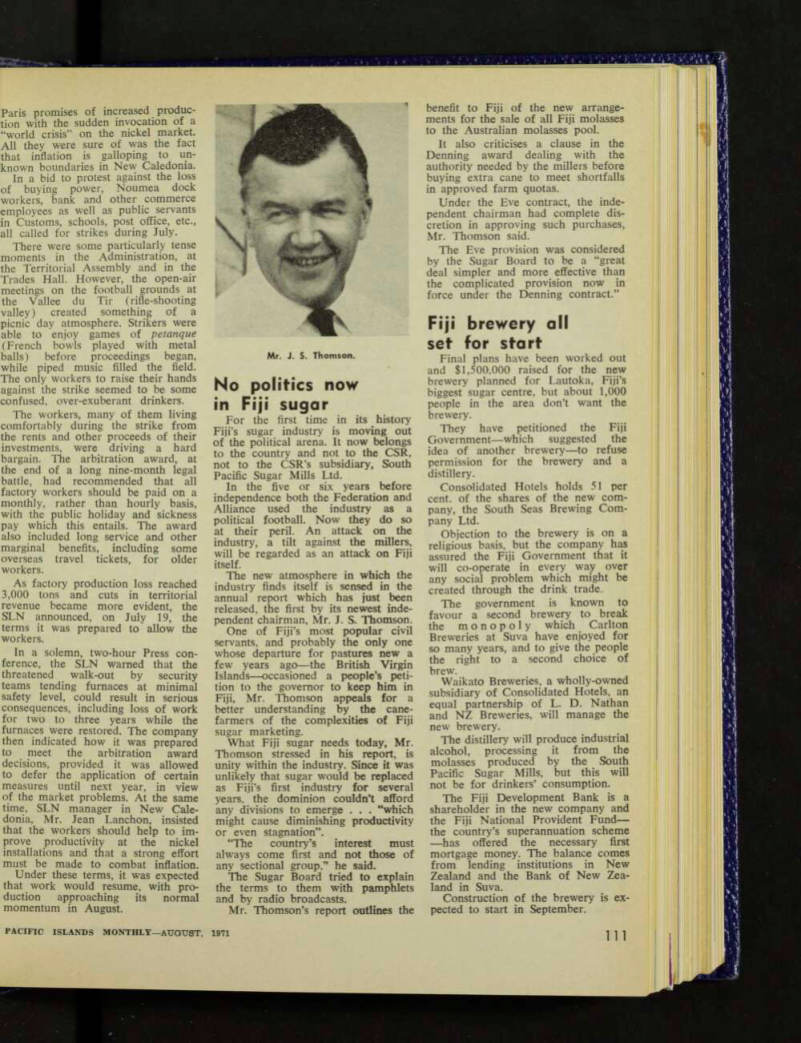 113
113 114
114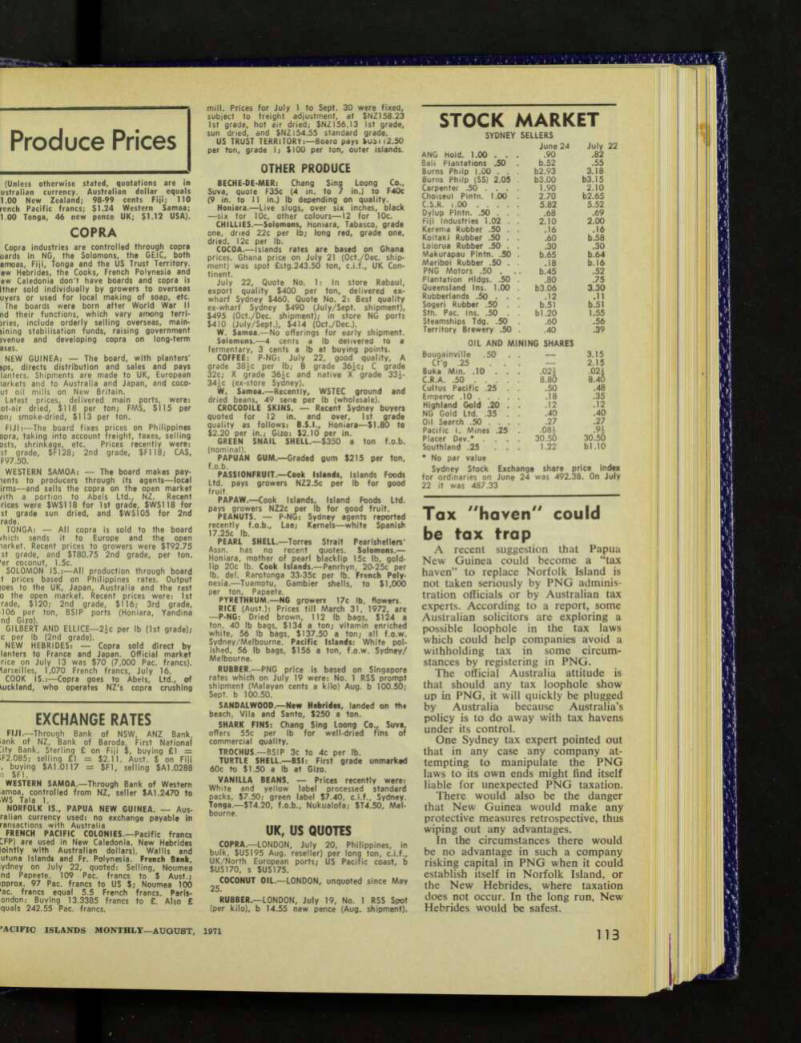 115
115 116
116 117
117 118
118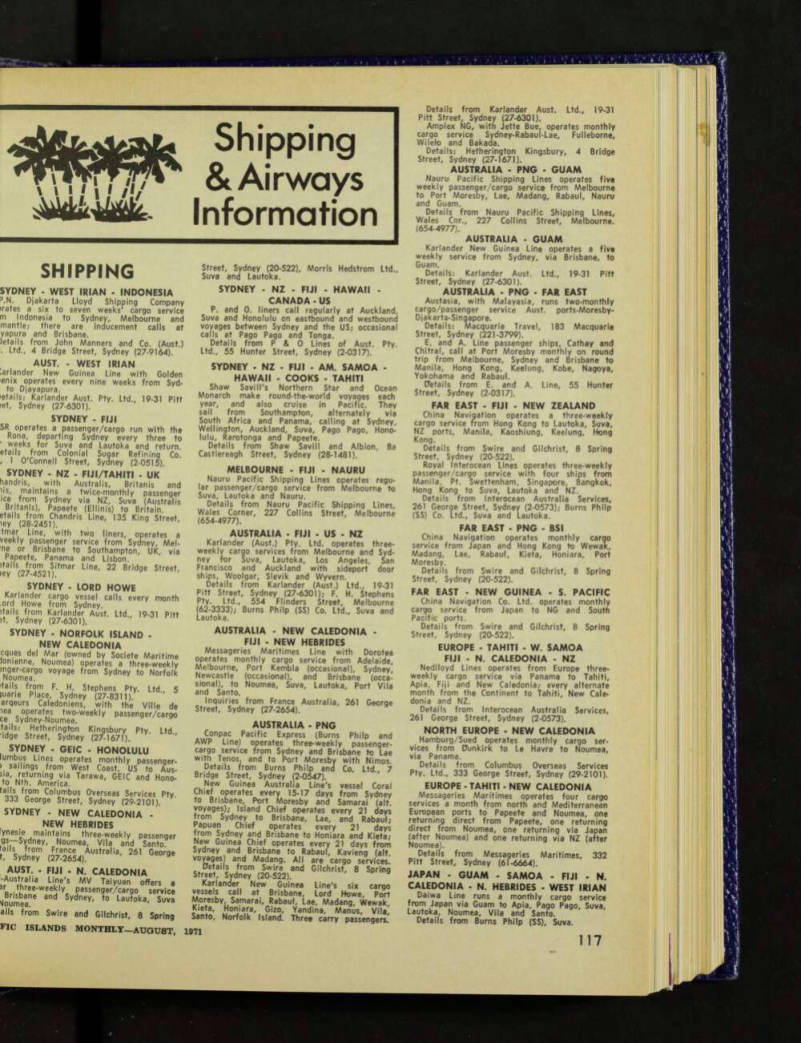 119
119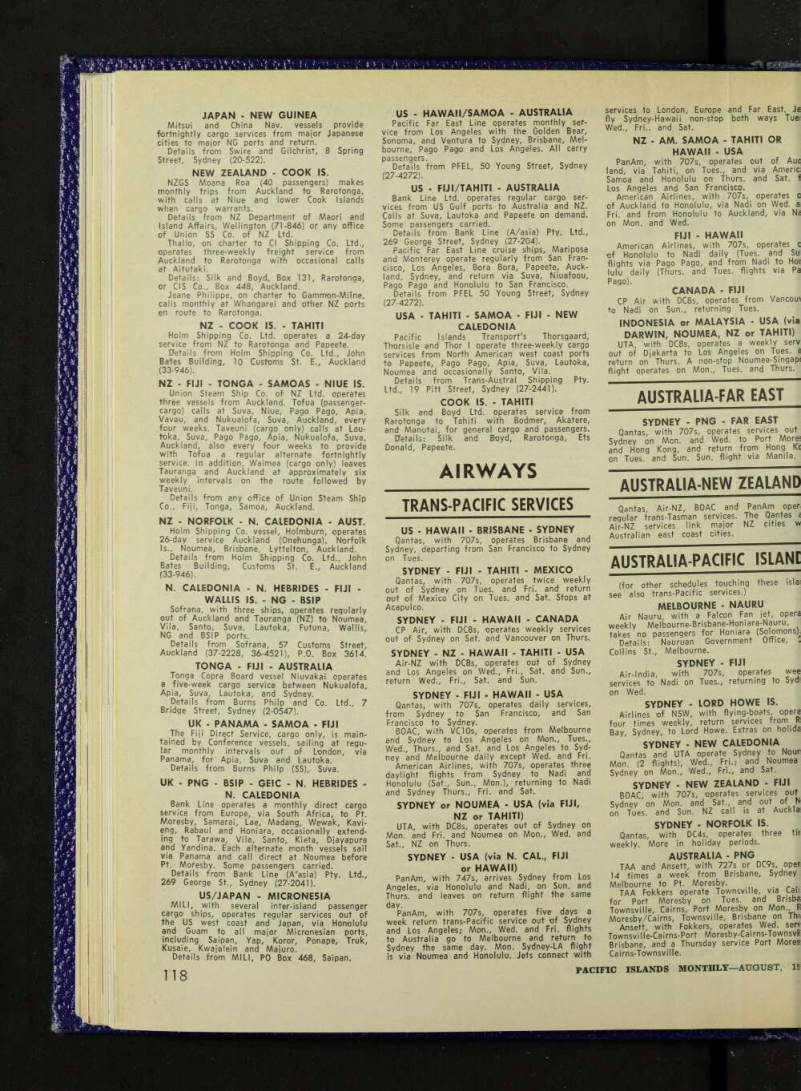 120
120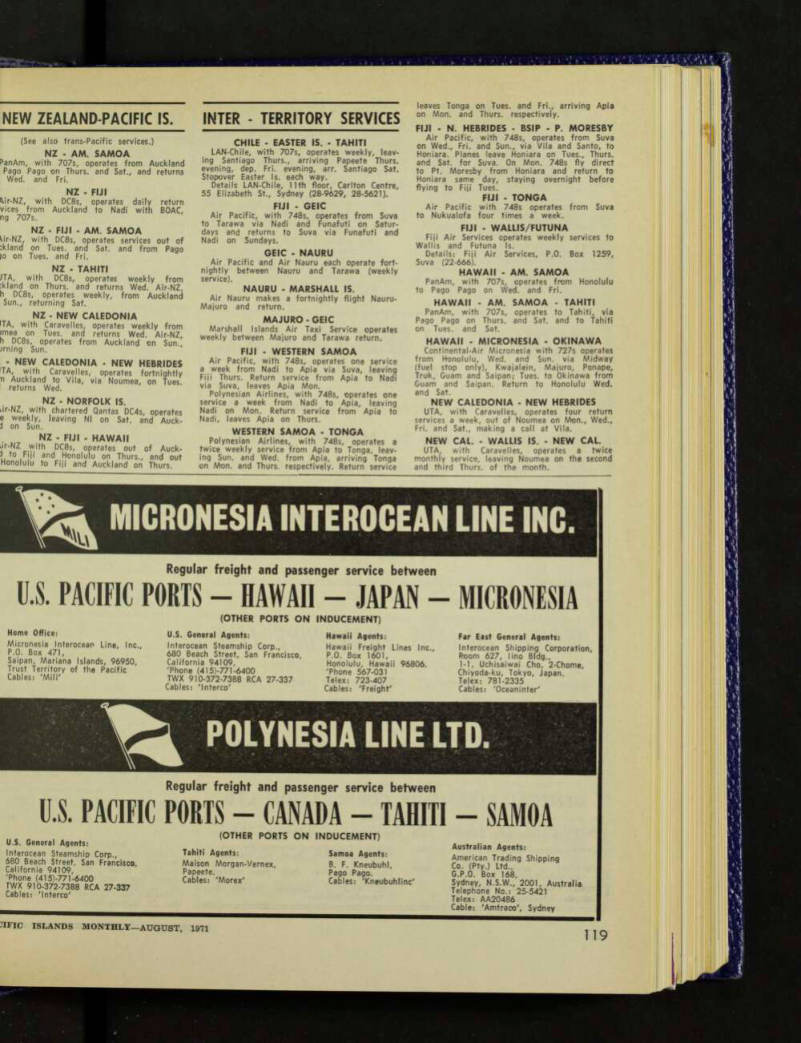 121
121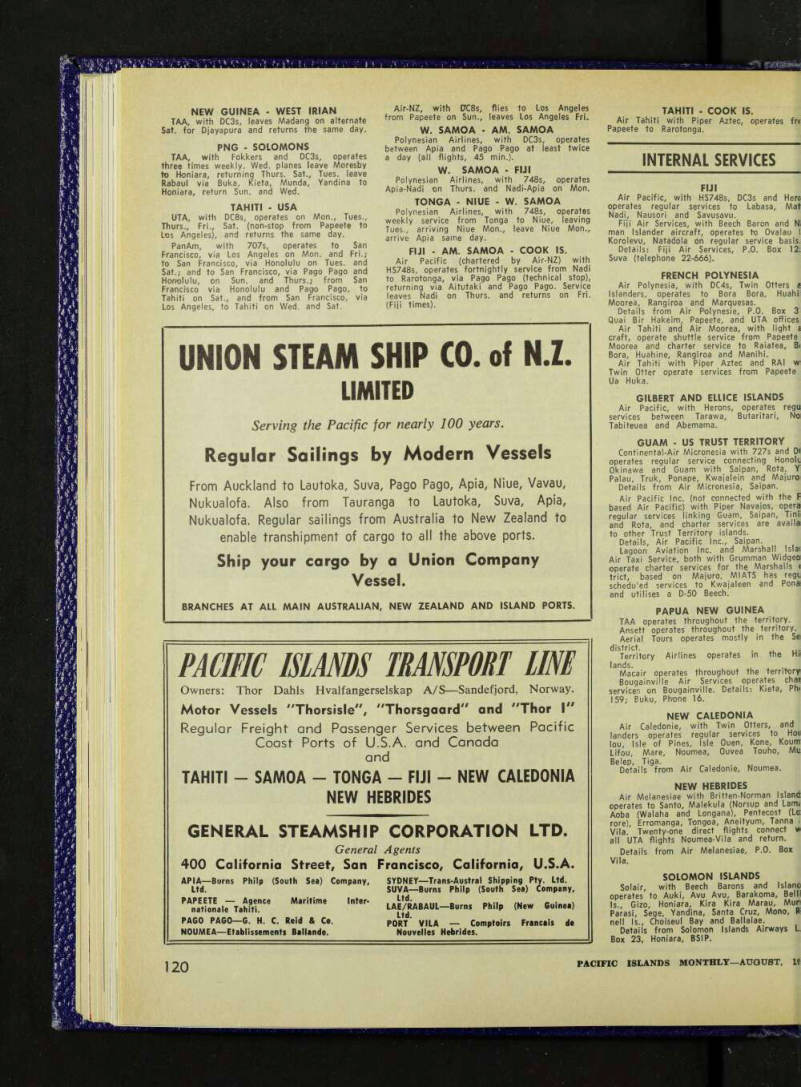 122
122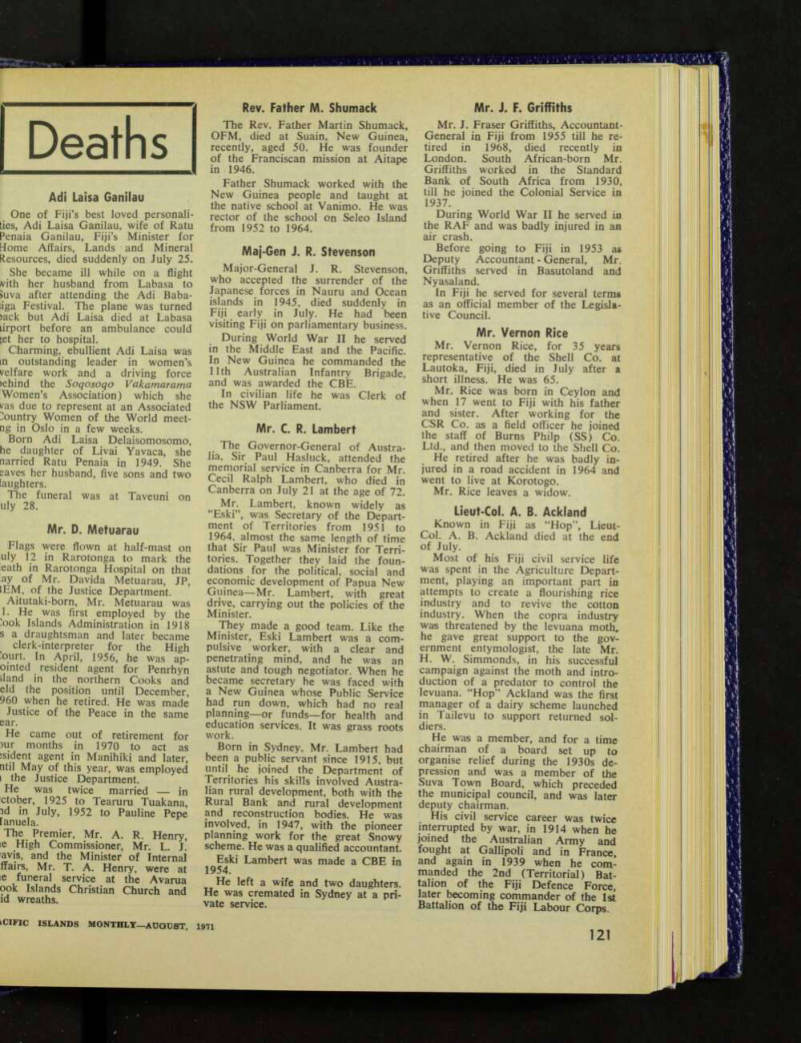 123
123 124
124 125
125 126
126 127
127 128
128 129
129 130
130 131
131 132
132 133
133 134
134 135
135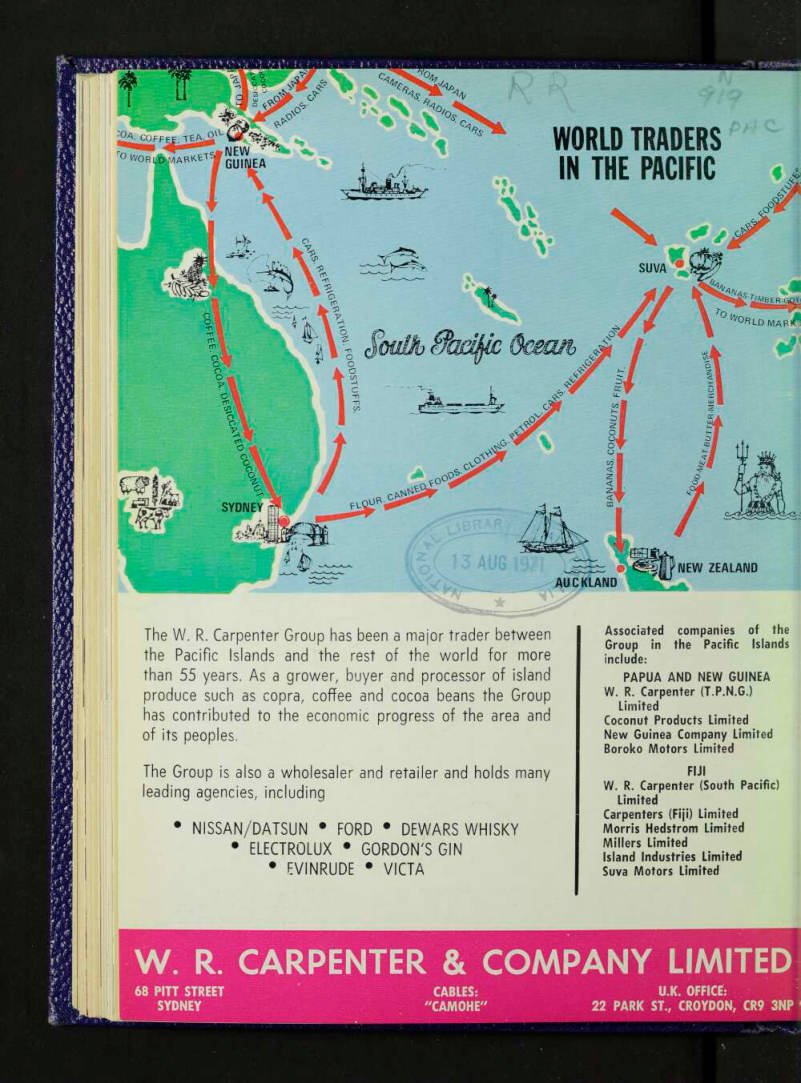 136
136