Pacific Islands Monthly
News Magazine Of The South Pacific
June, 1971
Australia, Nz, Geic, Bsip 50C
P-NG, FIJI, COOKS, TONGA, W. SAMOA, N. HEBRIDES 45c
Nauru, Norfolk, Niue 45C
AMERICAN SAMOA 70c HAWAII 80c MICRONESIA 90c NEW CALEDONIA 65 CFP FRENCH POLYNESIA 75 CFP
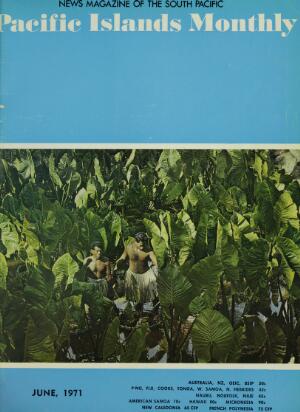
Our Cover
No, it's not a jungle, although two men appear to be dwarfed by the leaves. It's a much more prosaic affair —a taro patch in the Gilberts onto which Bruce Adams turned his camera. Growing anything on coral atolls can be difficult when there is little soil, so the produce gardeners, like these fellows, dig a pit in the coral, fill it with soil, sow the seeds and, presto, giant-sized taro.
Advertisements & other items, pp. 2-10 (2 items)
June, 1971-Pacific Islands Monthl
No.l-the friendly one
50 centres throughout Papua and New Guinea on a 10,000 mile network. 100 centres in Australia. TAA links the lot.
Across the Territory we give you more flights to pick from.
More cargo space. More seats.
Including daily Friendship
services between Moresby and all major centres. Plus daily ‘Bird of Paradise’ T-Jet flights
connecting Brisbane, Sydney,
Melbourne, Adelaide and Perth with the Territory.
If you plan to take off soon, keep our big link-up in mind.
And call your Travel Agent or
TAA.
Port Moresby 2101, Lae 3191, Madang 2478, Rabaul 2567, Goroka 8, Mt. Hagen 4 or 301, Wewak 103.
TAA
AIRLINES OF NEW GUINEA
No.l-the friendly one
Ly\
' THROUGHOUT THE PACIFIC
FIJI,SAMOA,TONGA,NIUE Is,NORFOLK Is.
BURNS PHIIP
[SOUTH SEA] CO. LTD.
REGISTERED OFFICE: SUVA, FIJI.
TELEPHONE NO: 22661
TELEX NO: FJ1127
Code Address: "BURNSOUTH' Hi - i g
SHIPPING AGENCIES
The New Zealand Shipping Co. Ltd.
Shaw Savill & Albion Co. Ltd.
Blue Star Port Line (Management) Ltd.
Bank Line Ltd.
General Steamship Corporation Ltd.
Compagnie des Messageries Maritimes Royal Interocean Lines Daiwa Navigation Company Ltd.
Sitmar Line Flotta Lauro (Lauro Lines) Australasia Pty. Ltd.
Tonga Shipping Agency.
EXCLUSIVE
DISTRIBUTORSHIPS
INCLUDE
Akai Taperecorders Sunbeam Appliances Dunlop Products Hitachi Electronics Holden Motor Vehicles Rolex Watches Revlon Cosmetics Pentax Cameras Massey-Ferguson Tractors Olympic Tyres Penfold Wines
AGENTS FOR
Queensland Insurance Co. Ltd.
Shell Company (P. 1.) Ltd.
Bureau Veritas
ASSOCIATED COMPANIES
Burns Philp (New Hebrides) Ltd.
Burns Philp Trustee Co. Ltd.
Automotive Supplies Co. Ltd.
Corrie & Co. Ltd.
Wrought Iron and Steel Construction Co. Ltd.
Bish Ltd.
SPECIALISED SERVICES
Expert advice on Shipping; Forwarding; Customs formalities; Insurance.
COMPLETE TRAVEL
SERVICE
accredited agents for the
INTERNATIONAL AIR
TRANSPORT ASSOCIATION
OVERSEAS AGENTS; SYDNEY • LUNDON • SAN FRANCISCO
Good morning- C
Z&d- Go “ d morning! rn -
G ooA^odmomW^_ 8 . >*'
A You’ll get just as many good mornings out of the new-look Weet-Bix pack as you got out of the old one.
And a hearty helping of 100% whole grain Weet-Bix natural wheat goodness.
So you see, nothing important has changed.
SANITARIUM HEALTH FOOD CO., SYDNEY, AUSTRALIA.
/ m - a * mm m a When you need to communicate— You need the new A.W.A. single sideband teleradio SS-70.
The new high-frequency SS-70 gives you instant, reliable, two-way voice communications. It is fully solid-state employing no valves or high internal voltages, thus making it completely safe for all types of use and, although a very small unit, the SS-70 is most accessible and cool to handle because of the low operating temperature.
Housed in a durable metal case, which is dust and splash proof, the unit has a high impact moulded plastic front panel and is designed to be operated from a 12 volt battery source. Alternatively, it can be used in conjunction with the A.W.A. Regulated Power Supply, type IH63848, for operation from the 240 volt a.c. mains supply. Also kits are available which enable the Teleradio SS-70 to be adapted for remote control operation, or for mobile and portable applications.
If you would like more detailed information please write to the agent for your Country or Amalgamated Wireless (Australasia) Limited, Export Department, P.O. Box 96, North Ryde, N.S.W. 2113, Australia.
Australia's National Wireless Organisation
If you have dentures to keep clean, aches and pains to stop, C Q O » as gsmsmss cuts and scratches to heal i trust us.
For Trade Enquiries: Reckitt & Colman Pty. Limited, Wharf Road, West Ryde, N.S.W, Australia.
Cables: Reckitts Sydney.
HP227
Today, the major components
for low-cost buildings
are made by...
r Hr V * 0 Your Brownbuilt distributor is now a one-stop shop for your industrial building and housing needs. Brownbuilt don’t just make one or two building components . . . they make the lot.
Ready painted wall cladding, roofing and insulation, steel building and roof frames, ceiling, soffit and fascia systems, feature gutters and all accessories. And they’re all made for each other.
Brownbuilt
LIMITED
Building Products Division
6 Brunker Road Chullora NSW 2190 Designed to fit together quickly and easily.
So your building’s up fast.
And remember, only Brownbuilt offers the protection of Colorarmor.
So next time you’re thinking of building ... or extending, think of Brownbuilt. See your local distributor or post coupon for more information. r 1 I Please send me further details I I on i Name Address i
BB:P33PIM
1
Kodak makes it even easier
mm (P* Kodak J*
New Kodak Insiamatic'X’cobr cameras
take flash pictures without batteries
Here’s the new Kodak X-flash system that gives you positive surefire flash every time! The new Kodak Instamatic ‘X’ cameras are the only Kodak cameras specifically designed to work with the amazing new self-powered Magicube.
No batteries are needed. The flash fires mechanically the instant you press the shutter release to take the picture. There’s no risk of flash failure caused by flat batteries. No missed pictures or wasted film. Each Magicube gives 4 sure-fire flashes, and a signal in the viewfinder tells you when a new cube is needed.
Ask your Kodak dealer to show you the three new Kodak Instamatic ‘X’ color outfits. Each outfit contains Kodacolor Film and a Magicube for taking beautiful color pictures by flash. All Instamatic ‘X’ cameras also take great color pictures by daylight. You can also have the exciting new Kodak Duo Print pictures. See your dealer now.
©dak
KODAK (Australasia) PTY. LTD.. Kodak dealers everywhere. ’Kodak’, ’lnstamatic' and ’Kodacolor’ are registered trademarks of Kodak (Australasia) Pty. Ltd. ksi zee «
ii
SOME OF THE FIRMS
WE REPRESENT ARE:
S. E. TATHAM
& Co. Pty. Ltd.
MELBOURNE, AUSTRALIA
G.P.O. Box 8, Cables ''SET* Telephone 60-1125
EXPORT AGENTS
PACIFIC (SUNOS
AGENTS
A. W. Allens (Confectionery) Sunshine Biscuits Sunrise (Confectionery) Flamenco (Instant Coffee) Cremota (Quaker Oats, Jets Pet Foods) Merchants (Canned Soft Drinks) Highness (Canned Vegetables, Canned Fruit Drinks) Lunchtime (Honey) South Pacific Canneries (Scallops, Abalone) Safcol (Canned Tuna, Salmon) Hancock's (Spaghetti, Cereals) Melbourne Canning (Jams, Bleach) Water Wheel (Flour, Sharps, Wheat) General Food Corporation (Twisties, Twirlies) Edward Zorn (Margarine, Cooking Fats) Robert Timms (New Guinea Gold Coffees, Teas) Bx Plastics (Sandals) Homy Peds (Sandals) Magnet (Mattresses) Esteel (Cookwear) Teco (Cafe Bars) Mitchell's (Abrasives) Regent (Swiss Watches) Gainsborough (Furniture) Tamco (Melanie Crockery, Nylon Hardware) Elmaco (Plastic Household Goods, Electrical Fittings) Brownbuilt (Pre-fabricated Houses) Ryline (Fluorescent Lights) Chargemaster (Fluorescent Lamps) Franklite (Light Fittings) Electronic Industries (Electrical Household Appliances) Jex (Steel Wool) Austramax (Pressure Lamps) Preservene (Soap Products) Charles Tims (School Requisites) Ascow and Philadelphian (Shirts) Lawn Chair and Tubco (Garden Furniture) Sunrise Lustretone (S.S. Sinks, Plumbers' Supplies) Kerex (Kerosene Burners) Arena (Football Boots) Ferrari (Men's Shoes)
Australian buying
and shipping agents for the Gilbert and Ellice islands Colony Wholesale Society
DIRECT ENQUIRIES WELCOMED
Associate Company
S. E. TATHAM (FIJI) LTD.
Suva, G.P.O. Box 671.
Lautoka, P.O. Box 366.
SINCE 1924
-v -*? o yO /O O Cy A/ O A/ ** :>
Lunch size, snack size
SAO biscuits
are the right size!
Crisp, fresh Arnott’s Sao biscuits . . . right size to satisfy, right size for snack foods, too! Cheese for lunch? A big slice fits just right on Sao. So does a slice of ham or salami.
Prefer jam or spread? Or how about tomato? Simply serve with Sao —the right-size biscuit that makes all the crisp difference to lunches at home and at school or outof-doors. The triple-wrapped pack keeps the biscuits crisp and fresh.
Qrnott's/<™™ s Biscuits
There is no Substitute for Quality
Up Front
with the Editor
Some places I visit often, and others escape me for years at a time. Norfolk Island is a place that has escaped me in recent years. Around 1960 I made three visits one after another, but when I went back the other day it was my first visit in six years.
In 1964 I wrote, “Tourism here is about to hit the big time and there is a bright future ahead. The greatest land interest lately has been in the business area of Burnt Pine, which only a couple of years ago was barely recognisable as a business centre”.
As we all know, the boom boomed with a very loud noise and (see p. 16) the development of the last six years has now brought the island to a turning point.
Poor Norfolk. It has always been pushed or shuffled from one crisis to another as it struggles to find an identity for itself.
The present crisis is certainly of greater financial concern for some of the mainlanders than for most of the islanders. Under present tax haven arrangements, overseas groups form companies which lend each other money, on paper, and pay out profits on the transactions. Large sums, on paper, go through the island in both directions, because it’s free of all taxes, including a withholding tax.
These locally registered companies must have local directors, mostly nominal, and local shareholders, again nominal. Solicitors and accountants abound on the island to handle all this company work, and this is where the big money is.
Incorporation of a company costs the client something like $l,OOO, plus registration fees.
Then there are director’s fees. The professionals charge from $lOO to $l,OOO a year as directors, a common fee being $5OO. Islanders, or “amateurs”, whose names are needed as directors, are paid anything from $2O to $lOO per directorship.
There are about six professionals who divide the majority of director ships between them, and of these one or two might have over 200 director ships, and most professionals would probably have at least 100.
Probably only about 20 amateurs are getting regular director’s fees, and
they would have anything from 10 to 50 companies.
A minimum number of subscribers are also needed to hold shares in each company, and probably about 30 islanders make a practice of holding these shares. At one time there were about 100, but last year the local authorities launched a series of prosecutions on companies which had not been operating according to Hoyle, and this scared off many of the real amateurs who realised they were also expected to have a respon sibility, and didn’t much like it. These subscribers are paid anything from $lO to $3O for the use of their names. (Incidentally there is a new development on shareholder arrange ments. Some shareholders now actually pay for their shares, and are promised, and no doubt get, regular dividends to make it worth their while.) All this money is tax free.
There is a lot of envy on the island of the professionals who have such lucrative perks, but as a would-be capitalist myself, my only complaint is that I haven’t the professional qualifications or the opportunity to share in the booty. There is nothing illegal about it and so long as Norfolk Island continues to be a tax haven, God bless those who can profit from it.
These views, of course, do not take into account what the islanders want. I don’t know what the islanders want, and I don’t think the islanders do when faced with the complicated issues brought about by tax havens.
The islanders certainly want pros perity, good medical services and a good education for their children.
They also want to live in the pleasant, unhurried atmosphere that Norfolk has enjoyed since Pitcairn days.
Are they to get all these things if Norfolk continues as a tax haven?
I suspect not, and they suspect not too. (Continued p. 10)
It’s just too simple to advocate that Norfolk Island be allowed to return to that period of only 10 or 15 years ago, when nothing much was happening and the islanders were fretting no less about their lack of future than they are today.
The present crisis indicates, surely, that Norfolk Island has to do some serious thinking about just where it is headed. What is to be its political status?
Does it want to remain attached to Australia for rations and quarters, run paternalistically, or otherwise, by an Administrator appointed by the Commonwealth; does it want respon sible local government (such as it rejected 10 years ago?) Does it want virtual statehood, with the kind of internal self-government that Niue and the Cook Islands have? Does it want to be fully absorbed into an Australian state, like Lord Howe Island is, or by the Australian Capital Territory, with the same rights and responsibilities as all other Australian citizens (which means taxation, but also social service handouts)? Does it want to be unique, with some recipe of its own?
And what, anyway, is the Common wealth prepared to do for Norfolk Island?
Has the Commonwealth thought through the political problems as sociated with Norfolk Island? Has it already drawn a line over which it is not prepared to allow Norfolk Island to step? Does it intend eventually to absorb Norfolk Island into the Aus tralian tax structure?
The islanders still talk of the pos sibility of the island becoming independent, “as it once was”. It never really was, of course, unless you can call being neglected indepen dent. I thought that ghost was laid on Norfolk in 1965 in the legal case, Newbery v. The Crown, but anyway we will be hearing some more on the subject later this year when the Australian High Court hears the case of Esquire Nominees v. the Federal Commissioner for Taxation.
This is a test case in which both the tax haven professionals and the Taxation Commissioner want to find out whether the Commissioner is entitled to tax Norfolk Island.
I believe one of the submissions will be that Australia is not entitled to legislate for Norfolk Island for the benefit of the Commonwealth —that it is restricted to legislation only for the peace, order and good govern ment of Norfolk Island.
Meanwhile, of course, the Norfolk Islanders are losing their identity, and maybe it is already too late for them
to recover it.
Stuart Inder
Islands
Pacific
Monthly
Established 1930: 41st Year of Publication.
Owned And Published By
Pacific Publications (Aust.) Pty. Ltd.,
29 Alberta St., Sydney, N.S.W., 2000.
Postal Address: G.P.O. BOX 3408, SYDNEY,
N.S.W., 2001.
Telegraphic Address: PACPUB, Sydney.
Telephones: 61-9197, 61-7101, 61-4569.
Chief Executives: Managing Director: R. W. Robson.
Executive Director/Publisher: Judy Tudor.
Executive Director/Business Manager: Selwyn Hughes.
Executive Director/Chief Editor: Stuart Inder.
Pacific Islands Monthly
Editor: Stuart Inder.
Advertising Manager: W. A. Gasnier.
Branch Offices
Fiji: Pacific Publications (Fiji) Ltd., Fiji Times Building, 20 Gordon Street, Suva. Tel.: 25601.
Fiji Times Office, Mayfair Building, Namoli Ave., LAUTOKA. Telex: 1144. Tel.: 60-422.
Papua-New Guinea: PORT MORESBY, P.O.
Box 16; LAE, P.O. Box 227; RABAUL, Mr.
Steve Simpson, P.O. Box 433 (c/- Rabaul Photographic, Tel.: 2677).
Representatives
Victoria: Advertising—Wilke & Co. Ltd., 37 Brown's Road, Clayton, Vic., 3168. Tel.s 544-8222.
Queensland; Advertising—Beale Media Services, 232 St. Paul's Terrace, Fortitude Valley, Qld., 4006. Tel.: 51-5827.
New Zealand: Mrs. E. M. Fisher, C.P.O. Box 2229, Queen St., Auckland. Tel.: 485-155.
United Kingdom: S. R. Warman, Park House, 22 Park Street, Croydon, CR9 3NP. Tel.i 01-6884177.
Overseas Newspapers (Agencies) Ltd., Cromwell House, Fulwood Place, London, W.C.I. Tel.: 01-242-0661. Cables: WESNEWS, London, DS4.
Japan; Advertising—Universal Media Corpora tion, C.P.O. Box 46, Tokyo. Tel.; 666-3036.
Agents
All main trading firms and stores in the Pacific Islands.
Pacific Publications Pty. Ltd. is the Australian agent for THE FIJI TIMES.
Subscription Rates:
"Pacific Islands Monthly" is air-freighted to all subscribers and agents in the Pacific Islands; copies to other areas go by surface mail.
Australia (including Lord Howe and Thursday Is.), 8.5.1. P., Gilbert and Ellice Is.: $5.50 Aust.; Papua-New Guinea, Norfolk Island, Nauru, Tonga and New Hebrides: $5.00 Aust.; New Zealand: $5.50 NZ; Fiji, Cook Islands, Niue and Western Samoa: $5.00 (local currency); American Samoa: $B.OO US; U.S. Mainland, Micronesia (including Guam); $lO.OO US; Hawaii: $9.00 US; New Caledonia: 750 French Pacific francs; Tahiti and French Polynesia: 850 French Pacific francs; United Kingdom and elsewhere: £3.25.
Copyright (c), 1971,
Pacific Publications (Aust.) Pty. Ltd.
Advertisements & other items, p. 12 (1 item)
Cadbury
< m When you buy chocolate
always say—M want Cadbury’s’
Nothing else has got that Cadbury taste because there is a glass and a half of pure, fresh, full-cream milk in every half-pound of Cadbury Dairy Milk Chocolate.
Look for the famous purple wrapper.
CADBURY
DAIRY MILK CHOCOLATE
the biggest selling Nock chocolate in Australia
MDB/SS/a
In This Issue
General
Fencing in the tourist 49 Around Western Pacific islands ... 81 TNT-Columbus shipping tie-up 101 BP boss retiring 115 Aust.-US airline row 116 Chilean Airline's ambition 117 Regional trade talks in Noumea ... 117
American Samoa
Samoans move closer 33 Shrine for William Willis 77 Governor's rough tour 93 Flag Day celebrations televised live .. 95
Cook Islands
Water in petrol 24 Avatiu Harbour blasting 103 Hotel plans 113
Fiji
Immigration Bill debated 17 Coalition government suggested ... 22 Witchdoctors, good and bad 22 How young offenders fare 23 Secret anti-missile stations 24 Birth-rate drops 24 Dock strike ends 29 Strike's aftermath 31 Mara's Australian visit 32 Police hunt man smugglers 33 Concern over drunkenness 35 Strike's effect on shipping 99 Korean ship on reef 101 Hotel building boom 113
Southland's mining operation 115 Islands leaders' NZ meeting 127 Ministerial changes 127
French Polynesia
Autonomists' election win 14 Self-government fears 14 How self-government would work ... 15
Gilbert And Ellice Islands
Dr. Turner's 1878 tour 73 Centenarian dies 127
Nauru
New appointment 125
New Caledonia
Helen Rousseau's diary 20 Pechiney's moves in mining 114
New Hebrides
Civilisation's impact on Nambas ... 54 Moutouh's exhibition in Sydney ... 86 One-day dock strike 101 Vila's new wharf 101
Niue
Teacher retires 86 Air service likely 117 Credit restrictions 118
Norfolk Island
Company legislation 9-16
Papua New Guinea
UN 1 mission report 19 Cargo cult causing concern 22
Sydney centre opened 23
Price of a bride 24 Percy Chatterton 36 Survey of an old fleet 97 Bougainville mining shares 114 Shift system for schools 127 Urban lawlessness growing 127
Solomon Islands
Council debates development 12 School teacher back from the dead .. 17 Mining agreement with Japanese ... 127
Tonga
Passports run out 13 Tourist boom ... 64
United States Trust Territory
Critical period for Micronesia 18
Western Samoa
NZ community centre planned 22 Two Samoas move closer 33 Hotel plans 113 Death sentences commuted 127
DEPARTMENTS: Up Front with the Editor, 9; Tropicalities, 22; Editor's Mailbag, 38; From the Islands Press, 63; Magazine Section, 73; Yesterday, 79; Book Reviews, 81; People, 86; Pacific Shipping, 97; Cruising Yachts, 105; Business and Development, 113; Produce Prices, 119; Shipping and Airways Information, 121; In a Nutshell, 127; Deaths of Island People, 127.
Song of the Solomons: Self
Pacific Islands Monthly
Song of the Solomons: Self government costs more
Prom a Honiara correspondent The Solomons’ Governing Council members got down to some hard work in May, paving the way to prosperity. The job in hand was the long-awaited Sixth Development Plan which will cover the period 1971-4.
Though there were no fireworks, members demonstrated that they had no intention of being just rubber stamps, and at the end of the first week they were barely halfway through the committee stage.
In the main, however, they seemed to approve the plan which had con stituted their homework for several weeks before the meeting.
Financial Secretary John Smith, who is a comparative newcomer to the House, was warmly applauded for his introduction of the plan in a lengthy but concise speech in which he paraded his priorities—and his hopes.
Development meant balanced growth, he said, and that was what he was planning for. The goal was a better quality of life for everyone in the Solomons.
He explained that planning was largely concerned with deciding priorities which were dominated by the unusually high dependence of the Solomons on external aid.
The first priority was to encourage internal growth by developing agri culture, forestry and mining.
Here he mentioned the very favour able agreement signed with the Mitsui Mining Company in Japan recently over the bauxite deposits on Rennell.
He said that trial mining was to begin in the first half of next year.
The government team had also signed an agreement with the Taiyo Fishing Company in Japan, for an 18-month survey of fishing potential in the Solomons. The company, one of the biggest in the world, would report every two months to govern ment. (See stories, pp. 118, 127.) The second priority was to de velop manpower.
He warned members that only by keeping strictly to the plan could the Solomons be well on the way to complete economic viability by the end of the decade.
Overall public expenditure was estimated at about $16.5m and 510.25 m of this was for productive investment, with agriculture taking more than $2.5m.
He anticipated substantial private investment in timber, mining and agriculture.
In the development sector nearly ssm would provide for basic com munications and public utilities infrastructure. Half of this sum would be devoted to roads. Social services had been allocated $4.5m and administration $ 1.75 m.
Capital funds for the plan would come mostly from the UK, where the Overseas Development Adminis tration had already indicated en dorsement of the general emphasis of the plan, and aid would be sought from the UN Development Pro gramme.
He had hopes too, he said, of aid from the Asian Development Bank, as a result of their associate mem bership of ECAFE. He hoped associ-
ations with the Australian South Pacific Aid Programme and the vol unteer programmes of New Zealand and USA would also continue.
Capital expenditure would result in new commitments and increased recurrent expenditure, and he was determined to find those increased costs from Solomons’ revenue, and also progressively reduce during the decade the dependence of the coun try on budgetary aid.
The writing seems to be on the wall for increased taxation in the next budget, as he went on to tell the House that he wanted to ensure that all sectors of the community played their fair role in the raising of the revenue.
He then described what he called “the sting in the tail” of his speech —some adjustments to the customs tariff.
The increases, which he said rep resented an increase in the cost of leisure and not in the cost of living, were: • From 20 per cent, to 35 per cent, on passenger cars with engine capacity of more than 1,500 cc; • A 20 per cent, preferential duty on ships and boats not exceed ing 15 tons; • From 20 per cent, to 35 per per cent, preferential duty on cameras, projectors, photographic materials, gramophones and tape re corders; • From 20 per cent, to 30 per cent, on clocks and watches; • From 20 per cent, to 25 per cent, on gramophones and tapes, and, • From 25 per cent, to 50 per cent, on jewellery.
Stressing that the Solomons rice industry needed sufficient protection in the near future to make sure it did not fail, he announced an in crease of 2c a pound in the prefer
Gordon Siama, BSIP Communications and Works.
ential duty on rice, bringing it up to 3c.
When the country was required to stand on its own feet as far as a monetary system was concerned, said the Financial Secretary, it must be ensured that foodstuffs were not im ported unnecessarily. (Australian rice will now retail in Honiara at about $7 a sack, compared with the locally grown at about $4.50).
Although there was general ap proval in the debate which followed, members were worried about some schemes, and many deplored the omis sion of another government second ary school from the plan.
Several too were suspicious of the change of policy of giving grants to church secondary schools to make up for the omission.
There was also concern by many that the education system was geared too much to the mere production of manpower.
Peter Thompson, in particular, spoke eloquently about the dangers of exclusive education.
Alfred Maeke was supported by several of his colleagues when he called for the seven years primary schooling to be raised to 10 years for all children, whether bright or dull, poor or rich.
Agriculture came in for some knocks, and Joe Bryan, himself a plantation owner, described this sec tion as being written by “desk farm ers” who had clearly never had to earn their living on the land.
Chief Secretary Tom Russell aroused laughter later when, admitting to being one of the “desk farmers”, he said he ploughed the fields and scattered development plans and white papers on the land.
Money allocated for agriculture re search came under fire too, particu
larly the provision for a new experi mental farm on the Guadalcanal Plains.
Localisation was brought up seve ral times by Peter Salaka, who de scribed it as his favourite subject. He was concerned that there was no de tailed firm localisation programme in the plan, and nobody appointed to carry it out.
He had the support of many of the elected members in this, but the Chief Secretary warned that a Civil Service could not be run efficiently without a certain amount of continuity and ex perience.
Graduates fresh from university would not necessarily be as efficient for some years as the older and more experienced men they sought to re place, and a service with impaired efficiency could slow down the plan’s implementation.
The Financial Secretary said a localisation plan should be ready for submission to the House before the end of 1971.
To the observer, members on both sides of the House seemed to be more into the swing of the committee sys tem, and there were fewer issues be ing thrashed out on the floor which should have been brought up in com mittee.
The four Solomon Islander chair men are obviously learning by experi ence.
One could pick out, particularly, Gordon Siama of Communications and Works. He defended with courage and some spirit his committee’s deci sion to raise fares and freight charges on government vessels.
Fresh from his visit to Japan with the government team, David Kausi mae of Natural Resources, also proved steadfast and he kept his cool when his committee was called to task.
Joe Bryan, attending his second sit ting, brought in 11 of the 14 private members’ motions on the second day.
He did manage to get five through, but four of these had to be amended before the House said “Aye” to them.
Certainly one can detect that most elected members realise that there can be no progress without some sacri fice and hard work, and most appre ciate too their responsibility to inter pret the more unpopular sacrifices to their constituents.
By May 17, the last day of the meeting, the Development Plan had been approved in principle by mem bers who did not seem to need the Financial Secretary’s warning that the Plan priorities must be rigidly adhered to.
They realised the way ahead was hard, and some were clearly daunted by the need to keep strictly to the narrow path of economy, however un-
popular with their constituents, if economic viability was to be in sight in the 19705.
Pet schemes in a number of consti tuencies had to go by the board in favour of overall economic planning, and some members found it hard to accept that some poor areas, which had hoped for help to develop, would have to be abandoned for areas with higher potential.
This was particularly evident among the elected members for the bush areas of Malaita and Santa Ysabel. Jonathan Fifi’i pleaded elo quently for what he called his “back ground people” of Central Malaita, and Willie Betu was bitter about the neglect of his constituents on Santa Ysabel. But to no avail.
Other business on the last day in cluded the approval of some special warrants for additional expenditure.
One item of recurrent expenditure was an increase in salaries of Governing Council members. In the past elected members have received a low salary, but a number of tax-free allowances for items like sitting fees, free trans port and accommodation and enter tainment. The new, fully-taxable salary for the four Solomon Islander chairmen of committees is $5,427, comparable with the salary of a deputy director of a large government department like Public Works. Mem bers’ salary is now $3,400.
There will be no allowances.
Elected members occupying houses will be charged rent, and those occu pying the Governing Council rest house will be charged for accommo dation except during sittings.
Before the House adjourned, several elected members paid tribute to Jack Spencer, Director of Agriculture, who retires next month after 11 years.
David Kausimae, BSIP Natural Resources.
No Passports
From Paradise
• Some Tongans who want to go overseas on holiday have had to stay at home. The kingdom has run out of passports.
When the Immigration Depart ment found itself out of stock, it placed an order for more with the Government Printer but found that his department was snowed under with other government and commer cial orders.
Immigration Officer Inspector ’Ahome’e said 741 passports had been issued so far this year and stocks were exhausted.
Meanwhile, more than 50 would-be travellers, the majority bound for New Zealand for a holiday, are wait ing with their bags packed.
Advertisements & other items, p. 15 (1 item)
13
PACIFIC ISLANDS M O N T H L Y - J U N E , 1971
Despite The French,
Autonomists Romp In
From a Papeete correspondent Despite strenuous efforts by the French Administration of French Polynesia to achieve a contrary result, members of the territory’s two pro-self-govemment parties won all 27 seats in elec tions for the Papeete municipal council at the beginning of May.
The French made use of their resources of propaganda, directed the coalition of two anti-autonomist parties, and enrolled numerous French troops as voters in their efforts to defeat the autonomists. But the autonomists still romped in with 55 per cent, of the votes.
According to Mr. Jean Millaud, who has just retired as president of the Territorial Assembly, some of the French troops enrolled as voters had only just arrived in the territory by plane, and virtually none of the troops had, or was ever likely to have, any stake in the territory.
The autonomists hailed the election result as “a severe defeat” for the French Government’s “colonialist and centralist policy” towards French Polynesia, and called for a dialogue between the government and the ter ritory’s political leaders on the political future of the territory.
“To refuse this dialogue,” Mr.
Millaud said in an address to the Governor, Mr. Pierre Angeli, at the opening of the Territorial Assembly’s administrative session on May 13, “is a negative attitude which will not suppress the problem and will not lead to any solution.”
The Papeete elections were held at the same time as elections in French Polynesia’s three other com munes (municipalities)—Faaa and Pirae (Tahiti) and Uturoa (Raiatea).
They resulted in the return to office of all four outgoing mayors— Mr. Georges “Tetua” Pambrun (Papeete), Mr. Francis Sanford (Faaa), Mr. Gaston Flosse (Pirae) and Mr. Philippe Brotherson (Uturoa).
Three of the mayors, Messrs.
Pambrun, Sanford and Brotherson, are strong supporters of the move ment for internal self-government for the territory, an issue which generally overshadowed parish pump problems during the election cam paign.
Mr. Henri Bouvier, a spokesman for the autonomists, claimed during the campaign that the opponents of internal self-government were deliberately misrepresenting what the
autonomists aimed to achieve, and were thereby trying to panic electors into voting against them. (See panel).
After the election, Mr. Bouvier also claimed that the Governor’s office had been “transformed into an electoral office” since February and that “certain services of police” had been employed “in the lowest work of propaganda” to help the anti autonomist cause.
Twenty-seven council seats were contested in Papeete, Faaa and Pirae and 21 in Uturoa.
Four teams of candidates of varying political colours battled for the Papeete seats, three for Faaa, and two each for Pirae and Uturoa.
In Faaa, Pirae and Uturoa, all seats were decided in the first round of elections of May 1. But in Papeete a second round was needed to deter mine the composition of the full council.
Teams composed of members of the Here Ai’a and E’a Api, the two autonomist parties which form the majority coalition in the Territorial Assembly, were opposed to each other in Faaa and Uturoa.
Broadly speaking, the E’a Api (New Ways Party) draws its fol lowers from the part-Tahitian, part- European urban residents and “white collar” workers, while the strength of the Here Ai’a (Patriot’s Party) springs from the rural Polynesians, In urban Faaa, Mr. Sanford (E’a Api) led his team to an easy victory with 77 per cent, of the votes to 6 per cent, for the Here Ai’a team and 16 per cent, for a team led by Mr.
Francis Fuller. Mr. Sanford has been mayor of Faaa since it became a commune in 1965. He is also a lead ing member of the Territorial As sembly and deputy for French Polynesia in the French Parliament.
In the Uturoa election, the team led by Mr. Brotherson (Here Ai’a) gained 80 per cent, of the votes against the team of Mr. Roger Amiot (E’a Api).
Neither the Here Ai’a nor E’a Api fielded a team in Pirae, where many French troops are stationed, and Mr.
Flosse, an opponent of internal self-government, led his team to an easy victory with 85 per cent, of the votes.
In the four-sided Papeete election, only three candidates in the 27-man team headed by Mr. Pambrun gained the required 50 per cent, of votes in the first round of the election to win their seats. So a run-off poll had to be held the following week. Mr. Pam brun’s team included members ol both the Here Ai’a and E’a Api.
A feature of the first round was the dismal defeat of a team led by Senator Alfred Poroi, a former mayor, who was attempting to win back the mayoralty after a lapse ol five years.
Senator Poroi, a fervent supporter
Mr. Sanford —re-elected mayor.
of “la presence Francaise” and a member of the UDR (the party of President Pompidou), was mayor of Papeete for 24 years until Mr.
Pambrun beat him at the last election in 1966 (PIM, Nov., 1966, p. 12).
Mr. Pambrun then had the support of Mr. Charles Taufa, a prominent, 34-year-old trade union leader. But this time Mr. Taufa, who also favours “la presence Francaise,” led one of the opposing teams.
The fourth team in the election was headed by Mr. J. B. Ceran- Jerusalemy, a veteran radical leader, whose political career has been on the skids in recent years.
Only 65 per cent, of the electorate registered votes in the first round, when the leaders of the four teams polled as follows:
Pambrun 3,520 Taufa 2,111 Poroi 1,411 Ceran-Jerusalemy 208 About 200 additional electors, bringing the total to 67.4 per cent, of the electorate, went to the polls for the second round. They included, ap parently, some newly-arrived French troops.
The remaining 24 members of Mr.
Pambrun’s team gained an average of about 4,050 votes each to about 3,050 for their opponents, and so won the 24 outstanding seats.
The outcome of the municipal elections will almost certainly cost Senator Poroi his seat in the French Senate.
Senator Poroi’s term in the Senate,
which began in 1962, is due to expire this month (June). It will then be the task of an electoral college, designated by the territory’s elected representatives municipal council lors, Territorial Assemblymen, and members of the Chambers of Com merce and Agriculture to choose a senator for a new term.
As the autonomists, through their successes in the municipal elections, control a majority of votes in the electoral college, there is little doubt that the new senator will be a man of their own political persuasion.
French Polynesia’s two represen tatives in the French Parliament would thus both be autonomists, a situation not likely to appeal to the French Government.
What Some Fear
Internal self-government Polynesia would inevitably lead to independence, according to Mr. Charles Taufa, the 34-year-old trade union leader, who gave Mr. Pambrun the strongest run for his money in the Papeete munici pal elections in May.
Mr. Taufa, who strongly supports “a presence Francaise”, said this in an interview with he Journal de Tahiti, just before the second round of the elections.
“Self-government and the effective management of [the territory’s] fin ances”, he said, “would bring with it new expenses and therefore budget ary difficulties.
“If the metropolitan government granted self-government it would not be to support the financial conse quences of that autonomy.
“Therefore, for us, there is good reason for not demanding indepen dence”.
How self-governing
system would work
Under the system of internal self-government envisaged by French Polynesia’s autonomists, the office of Governor of the terri tory would be converted into that of French High Commissioner and the chief executive be a Prime Minister elected by the Ter ritorial Assembly.
These details were given in a statement made in April by Mr.
Henri Bouvier, a spokesman for the autonomists, when he claimed during the municipal election cam paign that the aims of the autono mists were being deliberately mis represented by their political op ponents.
Mr. Bouvier is a leading mem ber of the autonomist coalition in the Territorial Assembly. He said that the full text of the system of government proposed by the auto nomists was contained in a 43-page document presented to the Gover nor by the Territorial Assembly in February, 1969.
The document proposed that French Polynesia would be an overseas territory of the French Republic with legal individuality and internal autonomy.
The institutions of the territory would be: • A Governing Council. • A Territorial Assembly.
• An Economic and Social Council. • A Joint [Franco-Polynesian] Council.
The Governing Council would be made up of a president, with the title of Prime Minister, a vice president; and five to seven coun cillors, all of whom would be ministers of the territory.
The Prime Minister would be elected by the Territorial As sembly after outlining his policy before it. The ministers would be chosen by the Prime Minister.
The powers of the Prime Minis ter would be those now exercised by the Governor.
The functions of the Governing Council would be collegial in the general administration of the terri tory’s internal affairs and indi vidual in the running of those territorial services placed under the charge of each minister.
The Territorial Assembly would be composed, as now, of 30 mem bers who would carry the title of “territorial delegates”.
Bearing in mind the powers of the Governing Council, the Terri torial Assembly would deliberate on all matters which were not the responsibility of the [French] State.
The ministers of the territory would be responsible before the Territorial Assembly both collegi ally and individually.
The Economic and Social Coun cil would be composed of council lors chosen democratically by the social, professional and cultural organisations of the territory. The council would have advisory powers on economic, social and cultural matters.
The Joint Council would be an advisory body of 12 members— six representing the State and six representing the territory.
The representatives of the State would be the High Commissioner, the Deputy High Commissioner and four officials of the High Commission designated by the High Commissioner.
The representatives of the terri tory would be the Prime Minister, two other ministers, the president of the Territorial Assembly, and two territorial delegates.
The Joint Council would express opinions on matters which were on the borderline of the compe tence of the State and the terri tory, and would find ways of con ciliating conflicting points of view.
As in the Comoro Islands and Djibouti, the State would be repre sented in French Polynesia by a High Commissioner nominated by the Central Government, and as sisted by a Deputy High Commis sioner. The High Commissioner would be the depository of the powers of the Republic and would exercise the powers of the State in the territory.
Whither Norfolk? A cloudy future
for a profitable tax haven
By Stuart Inder
New companies legislation which is to be applied at any moment to Norfolk Island will, in the long term, close down the island as a tax haven, or “capital refuge”. When that happens the econo mic boom that the island has experienced in recent years will burst.
Are these statements true or false?
There are opposing views.
The answer seems to be that no body knows for sure what effect Nor folk’s new company legislation is go ing to have, and only one thing is certain: Norfolk will get the legisla tion whether it likes it or not.
The new legislation was approved by the Norfolk Island Council (an advisory body) in April, and in May at a special meeting the council re scinded approval on the ground that not all councillors had been present at the earlier meeting, and that the councillors needed further time, and expert advice, to make a decision. The recission motion was objected to by the council chairman, Norfolk’s Ad ministrator, Air Commodore R. N, Dalkin.
The council is currently getting the expert advice in Sydney, but it will probably come too late to do it any good.
The draft ordinance is a fat and technical document. Its main provi sions are based on the Australian Uniform Company Legislation, and it seeks among other things to have companies file returns showing direc tors, share allotments, etc.; it lays down requirements of a prospectus; gives the Norfolk registrar powers to strike a company off the register; lays down audit requirements for com panies and makes provision for the inspection of books if shareholders request an investigation; and it fixes an annual filing fee of $250 for every company on filing a return (which in cludes a balance sheet). Companies defined as “local” such as companies carrying on business as shopkeepers and tradesmen on the island, need pay only $5O filing fee, but must file profit and loss accounts to prove their bona fides.
The audit and require ments have caused alarm in some quarters on Norfolk, coming as they do upon recent request by the Aus tralian Taxation Department for some Norfolk companies to supply tax re turns. There is no income tax on Nor folk Island, which is an Australian territory 900 miles north-east of Syd ney, and the Australian High Court
currently has listed for hearing a case in which a Norfolk-registered com pany, Esquire Nominees, will argue that the Australian Government is not
entitled to tax the islanders (PIM, Apr., p. 97). In May this application was further put over until later in the year. Norfolk Islanders are frightened that the new Company Ordinance will be used as a weapon to introduce in come tax on Norfolk.
In late May the Australian Minis ter for External Territories, Mr. C. E.
Barnes, made a visit to Norfolk and had talks with councillors and local businessmen about the ordinance.
Before his departure Mr. Bames personally put the government’s point of view over the Norfolk Island radio, and at a news conference on the island.
In his broadcast Mr. Barnes said that in the eight years he had been Minister, no ordinance had been made affecting Norfolk Island contrary to the wishes of the council, and he was greatly concerned at the difference of opinion between the government and some councillors over the Norfolk Island Company Ordinance.
The government was not bound to accept the advice of the council, and he could not accept that the govern ment ought never to legislate against the wishes of the council, especially where an ordinance affected the island’s relationship with Australia and with other countries.
“I think the proposed ordinance comes into this class, he said. “It affects the island’s financial dependence upon the Commonwealth. It affects the Australian system of company regulation since companies can avoid some of the provisions of that legisla tion under the present Norfolk Island legislation.
“The proposed ordinance mainly affects companies that do not have any substantial trading connection with Norfolk. You all know that seven years ago only about 20 companies were registered in Norfolk Island; to day there are over 1,500 and it is acknowledged that a large proportion of these have Australian or overseas connections.
“Through this increase in company registrations the island is abandoning its traditional isolation and becoming
(Continued on p. 125)
Fiji is becoming quite the fashion conscious centre of the South Pacific! Not to be outdone by the rest of the world, local designer Cherie Whiteside came up with this Islands version of the outfit known far and wide as hotpants. Raewyn Trafford, of New Zealand, modelled the masi (tapa) patterned outfit during a recent Suva fashion parade.
Photo: Vimal Sharma.
closely involved with the Australian financial structure. With the registra tion of these companies it must be expected that Australia must extend some control here”.
Mr. Barnes said that contrary to some views he had heard, the Com monwealth Taxation Department had had nothing to do with the prepara tion of the ordinance. It was not true that all companies would need to be audited, and he saw no reason why audit fees should be high. Genuine Norfolk Island companies would not have to pay the annual filing fee of $250.
The main purpose of this increase in fees (from $l3) was to get in creased revenue for the island. Under the present company operations on Norfolk only a few people benefited from company registration, and the government’s proposal was “aimed at benefiting the island as a whole”.
Norfolk urgently needed extra revenue, otherwise expenditure would have to be cut on various capital projects.
It had been said that the bigger fees would drive overseas companies away from Norfolk, but there had been no suggestion from the company representatives that the companies could not pay the increased fees, and one might ask oneself whether companies which had sought “the sub stantial financial advantages of incor poration on Norfolk would be driven away by a fee of $250”.
Mr. Barnes said there had been complaints that there had not been sufficient time to consider the ordin ance. But the council had first decided to adopt provisions based on the Uni form Company Legislation in March, 1968; the draft had been considered at three recent council meetings and it had been extensively discussed by company representatives with officers of his department. Every month that went by without the new fees saw a loss of revenue which the island sorely needed, Mr. Bames said, add ing: “I think that what I have said has made my opinions upon the pro posed ordinance fairly clear”.
Just in case there was any doubt about the clarity, Mr. Barnes gave more information at his news confer ence.
He said Australia was the “top in vestment country in the world today”, and Australia was going to attract in vestment capital “whether it comes via Norfolk Island or not”. Funds came in through Norfolk because this avenue was of financial benefit to the
people who provided the funds, and not to Australia.
A tax haven was something the islanders didn’t want, “and certainly something Australia doesn’t want”.
Should the proposed ordinance dis courage the present financial opera tions on Norfolk, Australia would benefit, to a minor degree.
Asked whether the ordinance “had been designed to deter companies from using Norfolk Island as a tax haven”, Mr. Barnes said that as the Minister it was a matter of concern to him that company registrations had grown on the island, yet the island people were not profiting to any degree. It was only reasonable that the companies should make a contri bution.
He was not aware of what the tax ation department thought about it, but any prudent person must realise that if things went to extremes the tax ation department must consider some sort of action.
While he did not anticipate that companies would remove themselves from the island as a result of the ordinance, the government had gone into the legislation deliberately, and was prepared for whatever conse quences there might be, Mr. Barnes added.
After all these statements by the Minister it is obvious that the Com monwealth Government won’t lose any sleep if Norfolk Island is closed down as a tax haven.
I don’t believe that the Department of Territories thinks that it will be closed down. I think it genuinely be lieves the ordinance will mean more money for the island, and improved legislation.
But the ordinance is such a mixture of legislation that it might operate in a way contrary to that intended. And there are some sections of it which have made some company experts query the expressed motives of its draughtsmen.
Referring to it as an “abomina tion”, one Sydney solicitor said the ordinance gave the government powers to have solicitors reveal con fidential company information. It also required companies to disclose whether they had granted options for others to take up shares in the future, and this was both a unique and dan gerous requirement. It would have been better, he said, if the Australian Uniform Company Legislation had been adopted in toto, rather “than the present mish-mash”.
There is clearly great confusion as
to the effects of some of the provi sions of the ordinance. The Norfolk Island Administration believes that of the 1,500 companies registered on Norfolk, only from 50 to 100 will require an audit under the regulations, and that most of the tax haven com panies will not be affected. The local professionals believe that most com panies will have to be audited.
The confusion about this and other provisions points to lack of real com munication between the government and the business community. Copies of the draft legislation, for instance, have been scarce as rubber coconuts.
As a whole, Norfolk Island resi dents do not understand the ordin ance. The present agitation centres around the councillors and local busi nessmen, particularly the professional people—solicitors and accountants — who are operating the machinery of company incorporation on the island.
For them, the island’s present tax-free status is extraordinarily lucrative.
Only a small proportion of the islanders benefit directly, through directors’ fees and other payments from the 1,500 companies registered there, most of them for the purpose of tax avoidance. Each company must have at least two local directors.
But undoubtedly the rise of the is land as a tax haven has improved the island economy generally. Business men arrive on every plane for com pany meetings or to inspect the situ ation, and hotels, shops and small local industries benefit from the new money. Present company fees bring the Administration something like $50,000 a year, and customs receipts are rising—currently they are worth almost $130,000 a year, not including profit on liquor—all of which is im ported and sold by the government.
This prosperity is the reason why the council as a body is not now in agreement with the ordinance it asked for three years ago. In the interval some of the members have personally come to appreciate the value of tax haven status. • See "Up Front with the Editor", p. 9.
The Rights Of
New Guinea And
Fiji Citizens
What are to be the rights of citizen ship in an independent Papua New Guinea? Obviously nobody has any right to decide until it is known what constitutional arrangements an inde pendent New Guinea will have, but the Administrator’s Executive Coun cil, or Cabinet, decided in May that now was a good time at least to get an expression of opinion. So we can expect to have the matter discussed by the House of Assembly soon.
Official spokesman for the council, Mr. Tom Leahy, said in Wau in May, where the AEC met, that the council had been discussing the rights of Aus tralians and other expatriates living in the territory.
He himself felt that it was a good idea for the Assembly to set out citi zenship requirements before next year’s elections—which will bring self-government closer—because this would prevent a newly independent government introducing legislation “in what might be a strongly emotional or even racial atmosphere”.
Mr. Leahy said there should be either a select committee or a White Paper on the question of citizenship.
Some of the issues to be decided were whether all racial groups should be eligible, the length of the qualifying period and whether children born in the territory should be eligible for citizenship. He personally favoured a residential period of 10 to 15 years, because a citizen should have a good grounding in local society and this could not be achieved in a shorter period.
Mr. Leahy added that citizenship proposals would make expatriate busi nessmen feel more secure, as most fears held by expatriate businessmen were due to instability.
Women’s rights in Fiji were strongly defended in May by out spoken senator, Dr. Felix Emberson, who declared in a Senate debate that Fiji’s Citizenship Bill was exercising “blatant discrimination” against females.
He claimed that Fiji’s women had diminished privileges.
“There are politicians who will not admit that there now exist in Fiji different classes of citizenship with varying privileges,” said Senator Emberson.
A male citizen could marry almost indiscriminately, he declared, with every assurance that he would have
(Continued on p. 128)
immigration and citizenship favours for his new bride.
Women could not do this. If she married a man from abroad, a woman was submitted to difficult tests.
Part-Europeans tended to go abroad more than other races. Be cause of this fact, they were penal ised more than other people. (He was referring to the fact that part- European women sometimes went abroad and married outsiders).
Then Senate’s only woman mem ber, Senator Anaseini Qionibaravi, disagreed with Senator Emberson, spying that she didn’t believe that Fiji should open its doors to “foreign husbands of Fiji women”.
She suggested that the opening of the doors could lead to increasing unemployment among local people.
The bill protected innocent women who might be exploited by foreign men marrying them for their own convenience.
Senator M. T. Khan felt that the whole situation was one that needed “quiet diplomacy” and work in the background, rather than “bombastic speeches in this House”.
“To say that because we do not allow women of this country to bring in their husbands freely here and settle, we are creating different classes of citizenship, in my respect ful view is far from the truth,” he said.
Debating the Citizenship Bill in the Upper House, the senators seemed to agree that Fiji was justified in its strict laws relating to entry permits for outsiders.
Senator Livai Volavola urged even tighter control, saying that if out siders were allowed to make Fiji their home, there would be an ac celeration in the growth of popula tion. This would make “my Fiji, our Fiji, not a heaven but a hell for future generations.”
The senator claimed that if tighter control was not introduced on the immigration of Asians, who had the highest birthrate in the world, then the door was open for them to enter and increase Fiji’s birthrate.
“The future generations of this country would reap the fruit of our negligence— poverty, unemployment, bloodshed and so on,” he said.
“Fiji is already afraid of over population because of the rate of births.”
Senator Volavola disagreed with opinions that professional and busi nessmen should be allowed to stay
so long as their services were required.
He argued: “When their term has expired, they should go and should leave their businesses and professions to the local people, who could con tinue the good work. All not bora here who wish to be citizens should go through the legal procedure.”
So far as Senator Ratu Mosese Varesekete was concerned the heart of the matter was for Fijians to be able to hold their own against other races—not in numerical terms but in terms of ability, professionalism and contributions to the country.
He praised his people for the peace ful way in which they had accepted and accommodated races from many parts of the world and stressed that there could have been “endless bickering” in other circumstances.
“The Fijian people have displayed a great sense of justice and humanity in turning their backs on narrow minded policies as regards citizenship and have thrown in their lot with the other great races which have settled in Fiji,” he said.
“We have agreed on citizenship without any of the warring and bloodshed which has been experienced in some other parts of the world.”
What’s sauce for the goose isn’t always sauce for the gander as the worthy senators set out to demonstrate when they discussed Australia’s im migration policies.
Speaking on a motion welcoming the Prime Minister’s proposed visit to Australia—postponed because of the dock strike—some of the senators had harsh comments on Australia’s policies.
Senator Kapadia was one who urged a more liberal attitude by Aus tralia.
Complaining of the “great difficulty in obtaining visas from the Australian High Commission, even to go to Aus tralia on a temporary basis,” he said Fiji people did not want to dictate to others what their policies should be, but, “if we have friends, it is my personal view, let them be sincere friends. I for one do not like hypocrisy.”
Senator Ratu Tuisawau was one who said he could see Australia’s point of view on permanent immigra tion, because any country which opened its doors to unlimited im migration could suffer grave social consequences.
He hoped, however, that the Prime Minister’s visit would result in seasonal labour being absorbed from Fiji into Australia.
He added that to a lot of people who supported the idea of the British Commonwealth of Nations, it seemed inconsistent that Australia allowed un restricted immigration from non-Com monwealth countries.
At the same time there were very stringent rules against some people within the Commonwealth (such as Fiji).
“Some of the applications of these rules border on the ludicrous in that some of those that we have fought against as aliens or enemies in the Second World War, are able to come in unchecked and thrive in this Com monwealth of Australia,” said Senator Tuisawau. • Deported from Australia on March 4 this year, 23-year-old Dewan Chand, of Fiji, attempted to enter the country two months later with another man’s passport. Chand, who pleaded guilty in a special Federal Court on May 11 to attempt ing to gain illegal entry into Aus tralia, was gaoled for three months.
The court was told Chand admitted obtaining the passport from Sohan Lai in Fiji on the pretence of getting a permit for Lai to enter Australia.
He used the passport to book a pass age for himself as a tourist in the Taiyuan but was detected after the ship had called at Brisbane before sailing for Sydney.
Schoolteacher Christine
Is Back From
A ”Watery Grave"
Attractive, blonde 24-year-old schoolteacher Christine Bertaut returned from the dead in May. Christine had been given up for lost when she had been missing for almost a month in the remote Santa Cruz group of the Solomons. She had drifted off from Pigeon Island, in the Reef Islands, after falling asleep in a canoe, and four days later had ended up safely on Utupua, 75 miles to the south east. The islanders’ radio was out of order and nobody could tell the authorities where she was. The official search for her was abandoned after a week. When she was eventually found, her mother, Mrs. L. K. Bertaut, of Putaruru, New Zealand, who had been receiving hundreds of letters of sympathy, said, “It’s a miracle!”
Christine has been on Pigeon Island, in the Reefs, for two years, as governess for the children of Tom and Diana Hepworth, of Pigeon Island Traders. The Hepworths, from the UK, for many years sailed through the Pacific and the pages of PIM in their converted trawler Arthur Rogers, and 11 years ago settled on Pigeon Island, gradually transforming it from a lump of coral covered in bush into a pleasant homestead. Tom is storekeeper, bookkeeper, maintenance engineer, postal agent, savings bank officer, etc.
Christine originally came for a year, but liked it so much that she stayed on. The Hepworth children spend the mornings and after noons with her in her “schoolroom”, which is part of her leaf house “residence”. And she spends a lot of time with them “out of school”.
The photograph above, shows her in the schoolroom with the children Ross, Tasha and Bressin. Dress is pretty informal for schoolteachers on Pigeon Island—as is life generally.
Micronesian disunity will be
worse before it s better
Prom a Honolulu correspondent The announcement by Mr. Peter Coleman, Deputy High Com missioner of the US Trust Territory, that he won’t accept nomination for the post of secretary-general of the South Pacific Commission, raises speculation—not about the future of the South Pacific Com mission but about the future of the US Trust Territory of Micro nesia.
The former Republican Governor of American Samoa, Peter Coleman would have been a popular choice for the post of secretary-general, now held in an acting capacity by fellow American John de Young, who has decided to sever his activities in the Pacific and retire to Europe in 1972.
In most circles Coleman’s decision to turn down the offer was a surprise, as the post of Deputy High Com missioner doesn’t call for any great responsibility, and his talents are being wasted here.
But Coleman has explained: “This is a very critical period in the history of Micronesia and I feel my 10 years of experience here can contribute to the political, economic and social development of Micronesia”. For that reason, he said, he wouldn’t want to leave Micronesia for a least three years but if then, he indicated, the job of secretary-general was open to him, he might be interested.
Samoa-born Coleman is known to have high-level Republican connec tions in Washington and Hawaii and it could be that somebody has some thing else in mind for him.
US policy for Micronesia could undergo a radical change soon and it is quite possible that the US might try to establish a separate admin istration of the Northern Marianas.
If so, Peter Coleman could be the first appointed Governor of the 12 islands making up the Marianas. And since a separate administration would be established as first phase in the development in the Marianas as a Commonwealth, a more important Governorship could be just around the corner for Coleman.
Coleman would be one of the few qualified American Administrators who would be acceptable to both the Marianas people and the US Govern ment. As District Administrator for the Marianas District for four years between 1965-69, Coleman main tained very friendly relations with all political and ethnic groups in the Marianas, particularly with the leader ship of the Popular and Territorial political parties.
Coleman has always felt that “Island people should solve Island problems” and maybe history will prove him right. Perpetuation of a US style bureaucracy in Micronesia, with all its attendant, highly centra lised financial and programme con trols, is slowly being changed as de centralisation of central government activities transfers from Saipan head quarters to the District Administra tors of each of the six districts.
The Marianas District, of course, wants to secede. It wants Common wealth status with the US, and the Marianas District Legislature has said that it will secede by “force of arms if necessary”.
Probably from 55 to 65 per cent, of the people on the Marianas agree with their legislature in this, allhough a plebiscite might give another figure.
The others want the status quo.
Although official US policy is that there should be no fragmentation of the six districts of Micronesia, it seems likely that the Marianas Legislature will become more and more hostile to America over its demands, and although the Washing ton executive might not want to give in, the Micronesian Congress will.
While the more conservative Trust Territory politicians would like the Marianas to remain as a sixth district, the rest of them probably have so much contempt for the Marianas people that they will be inclined to say to hell with them—five districts will do.
After being burnt out of its build ing on Saipan in February, it looks now that the Congress of Micronesia will never go back to Saipan. Its permanent home is likely to be at Palakir, about eight miles from Kolonia town on Ponape.
Meanwhile Congress had its first full meeting, since the House’s de struction, on May 5 at Moen Island in Truk—using the facilities of the Truk district Legislature. The five Marianas members of Congress weren’t in attendance. They boycotted the meeting. The boycotters included
Olympic Boja, who is a Territorial Party member, a party which at least stands for the status quo. The other four all represent the Popular Party, which supports the Marianas District Legislature, favouring secession. The Territorial Party had some doubts about it all and later sent two people as observers.
The Marianas delegation announced that the decision to boycott the ses sion was taken partly because of the resolution in February to secede.
Surprisingly, the Marianas decision got the support of US Congresswoman Patsy Mink who is a member of the Sub-committee on Interior and Insular Affairs. She said if the Marianas delegates were sincere in their desire to secede from the Trust Territory then it was right that they should not attend the Congress ses sion. The Marianas secession move will probably be aimed at Congress men, as the Washington Administra tion is treating them very coolly.
Meanwhile there has been an interesting sidelight in Hawaii, with the establishment of a group called the Micronesian Independence Advocates. This organisation has been established by Micronesian students in Hawaii, led by Francisco Uludong.
The platform and programme of the Advocates describe the organisa tion “as a nationalistic, political organisation dedicated to work towards the independence of all Micronesia from the United States of America.”
The Advocates say they have “as a political base, the young people of
Mr. Peter Coleman.
Micronesia, including Micronesian students abroad, and we support all organisations and political leaders who want independence for Micro nesia and share our goals”.
But their 12-point platform includes ‘‘unity of all Micronesia”, and the students don’t care for the Marianas’ breakaway movement. The platform says that a “united indepen dent Micronesia is more powerful than six divided and separate indepen dent districts”.
The other planks in the platform ask for sovereignty to be acknow ledged; traditions and customs of Micronesia to be preserved; Micro nesian lands to be returned to the people; a national constitution; “a government that gives power to the people”; an education system “relevant to Micronesia”; Micronesia to con trol its own economy.
The Advocates also stand for non violence. “Micronesia is too small and has a very small population. We do not hold that liberation and independence of Micronesia can be won through means other than non violence,” the Advocates say. “We value every Micronesian life to afford its destruction for our cause or any other cause.”
Independence for Micronesians does not only include Trust Territory Micronesians, according to point number 10 in the platform. This says, “We consider Guamanians and Gilbertese as fellow brothers and sisters. We support their fight to break their respective colonial bon dages and want them to join us in a united, independent Micronesia”.
Francisco Uludong also edits a monthly paper published on behalf of Micronesian students in Hawaii, called The Young Micronesian —the April issue of which publishes ex tracts from a report on Micronesia made for the US Government in 1963 by a team whose chairman was Anthony M. Solomon.
Some of the Solomon Report was published at the time but The Young Micronesian purports to publish extracts which were restricted.
It quotes the report as proposing a master plan to make Micronesia a US territory, even though this “would be moving counter to the anti colonial movement that has just com pleted sweeping the world”. To achieve this, the report suggested that the US “might have to decide to proceed with a series of actions that would make the trusteeship agree ment a dead issue”. The US never put into effect this part of the Solomon report, although it did pro ceed on some other proposals.
Advertisements & other items, p. 20 (1 item)
18
JUNE, 1971 PACIFIC ISLANDS MONTH IV
Sound UN report on PNG
Intelligent, good sense, sound, useful. These are the words that best describe the report of the UN Visiting Mission to Papua New Guinea earlier this year, released in New York in late May.
The mission, led by Sir Denis Allen (UK), with Mr. Paul Blanc (France), Mr. Adnan Raouf (Iraq) and Mr. Charles Wyse (Sierra Leone), is critical but fair.
It paid tribute to Australia s work, !t said the territory was advancing rapidly with a vigorous and a gifted population , basically happy.
The mission said it would be realistic to plan for Papua New Guinea independence between 1976 and 1980, after the life of the next Assembly. It rejected suggestions that Papua be declared a UN trust territory, like New Guinea, and said the two territories should go forward together with single citizenship. The majority of people wanted a strong central government. An eventual union between PNG and the Solomons might be a solution to Bougainville secessionism.
The report recommended establishment of a PNG Reserve Bank, and a territory currency fully backed by the Australian dollar and convertible.
Although the transfer of powers to Ministerial office-holders was working well, there were important fields in the Public Service where localisation was too slow. The proportion of expatriates in higher positions was exceptionally high for a country moving towards selfgovernment.
The House of Assembly took its duties seriously but there was too much regionalism and no political parties had developed nationally, Expatriates also needed political education; they had to reflect today’s social attitudes and business methods, or else become an alien economic enclave. t-u * ... . , . . fc Tl ? e government was criticised for i‘ s hf.sfncy m undertaking major 5 > * h ‘ ch oontnbu ed “as as - geography , to the lack of communications.
Primary education—in good pro portion on a territory wide basis— was disproportionate in remote areas an d th* B should be accelerated. Efforts should also be made to clear the bottleneck which prevented 60 per ce / , t. of those who finished primary school from going to secondary school. Teachers should be recruited from other countries, such as the Philippines, on contract. A Pacific language should be taught in the schools in addition to English, The mission criticised the “all per vasive” Australian presence in the territory and said many expatriates tended to assume Australian standards were the only valid ones. Everywhere the disparity between the expatriate and indigenous standards of living was marked.
The Korean fishing ship "Nam Hae 238", pictured hard aground on Minerva Reef, has been declared abandoned by her owners, the Korea Marine Industry Development Corporation. See p. 101.
Diary
New Caledonia Diary
With
Helen Rousseau,
In Noumea
Life in Noumea these days is full of amazing contrasts. One evening you may be drinking champagne with the Baron Guy de Rothschild, celebrating the fact that this year the Societe Le Nickel plans to sell more than 60,000 tons of nickel metal from New Caledonia; then half an hour later you may be driving home through the streets of Noumea, driving in first gear, because your unsealed road has come to resemble an open-cut mine, so numerous are the deep pot-holes.
The Baron has been quite egalitarian about his cocktail.
Among his guests you can meet Gilbert Drayton, leader of the nickel factory workers in the island’s most powerful union, the
Soenc.
Gilbert has been listening during the afternoon to the lengthy assurances and promises of the top men flown out from the SLN in Paris. Their confident predictions for projects in Caledonian nickel serve to reinforce the union leader in his current eight month battle for higher wages for nickel workers.
For the sprightly, 61-year-old Baron it has been a busy day.
On the eve of assuming the presidency of the SLN, he has made his first visit to Noumea.
On the morning of May 10, he has donned a protective helmet and led a party of more than 50
personalities from Paris, USA and Noumea to climb up and down the giant two new Demag 33,000 kw electric furnaces as well as through the impressive new Alsthom power plant with its three units of 37,000 kw each.
This visit marks the inaugura tion of extensions to the Doniambo smelting works. Here, with the aid of the Kaiser Aluminium and Chemical Corporation, the SLN is now equipped to raise its 1966 production of 35,000 tons to 65,000 and later to 85,000 tons, once further projects are corn plete.
The Baron’s second official visit is to Nepoui, the SLN’s newest mining centre, on the west coast of the island. Here a pleasant town has been built, some 400 homes and other amenities con structed from New Zealand timber, To bring the nickel ore from the mountains to the coast, a cable system operates over the highest section. Then a straight-line con veyor belt, the longest one-piece conveyor belt in the world, brings the ore eight miles, at four metres a second, down to the port. There the ore can be loaded for shipping to the Noumea smelters.
Last July, Nepoui produced 30,000 tons of ore. By July, 1971, the centre is scheduled to reach a monthly output of 200,000 tons, The SLN has invited the Euro pean Press and radio to inspect
these impressive achievements. At the same time, Baron Rothschild is anxious to assure the Cale donians that other promises made by the SLN will be eventually realised, even if they are already behind schedule in being started.
The Baron refers to the local “disenchantment” and “scepticism” over projects promised by Paris.
The Caledonian Press is already speaking of the “malaise” and “sapping away of optimism” in the territory as 1971 shows little chance of fulfilling the hopes and promises of 1969/70.
Discussing the project for Poum, in the north of the island, the Baron is still unable to report success in obtaining the necessary finance.
This project was announced in late 1969, with production intended to begin in 1972, but the Japanese have still not agreed to the re quested loan of US$l2O million to help finance the $320 million fac tory.
Companies involved are the SLN (51 per cent.) Patino Mining Cor poration (30 per cent.) and Cale donian interests (19 per cent.).
As for the Penarroya-Amax project for the south of the island, the Baron states that this could now be expected to start around 1975-76.
The Baron has no interest in the SAMIPAC-INCO project, also in the south of the island, but here
The nickel works In Noumea.
too time has been lost, as the French side has been unable to raise its share of the finance to build a factory.
On the promise of what was to be realised, however, many French workers have already migrated to Noumea, incited by the reports of the new “Colorado” and “Kuwait” of the Pacific. Some make their fortune, others return completely disenchanted that the opprotunities they sought simply do not exist, “New Caledonia is a rich c o u n t r y”, the Administration repeats to the Caledonians. But, as the Baron de Rothschild flies over his wealthy domains, the water is cut off for the Cale donians in Noumea.
“Much effort and sacrifice must be made by all” . . . “From 1975, New Caledonian nickel should be earning over US$3OO million an nually in foreign currency for France” . . .
While preparing for this, it’s certainly not very encouraging, just when you are about to bath your baby and prepare her bottle, to find that the water has been cut off for the day, as the Noumea pipeline has burst again.
Of course this has been no rare problem in Noumea over the past few years. You have already provided your home with two bathrooms, to overcome some of this inconvenience. Since then you have invested in a water tank (minimum size $180) and electric pump ($250).
You then only hope that the electricity is not cut off at the same time as the water. When the water does come, there is no time for it all to pass through the full filtration system, so you have invested in your own private filtering apparatus ($3B), As you stand syphoning out the precious drops, you ask yourself, “Wouldn’t it perhaps be easier to do what most of Noumea is now doing and buy mineral water, im ported from France at 38 cents the litre bottle (1.8 pints)?”
Of course, the “boom” has brought much more to Noumea than water and power cuts and over-worked roads: it is bringing lots of visitors, lots of cash and many more ways to spend it.
Visitors to Noumea have been inclined to complain that there is not much to interest them here by way of what the French call “spectacles”. However, they should
realise that, by a bit of investigat ing, they may now expect to dis cover a wider variety of planned activity.
The month of May, for example, began with a magnificent regatta on the lagoon, involving over 50 yachts, including some of the 47 New Zealand crews that had com peted in the Whangarei-Noumea yacht race in April. (The race was won by Chico on corrected time, skippered by Lin Carmichael, followed by Ted Buchanan com manding Kishmul, which won line honours).
The month of May also brought a visit to the territory of the Margand String Quartet. This young musical group was spon sored by the Jeunesses Musicales de France, a youth organisation whose regional representative is Mme. Simone Drouard.
For art lovers, there were two main exhibitions during the month.
At the Museum, which has dis appointed many Caledonians and overseas visitors by still not being open with permanent exhibits, there was an exposition by French painter, Mme. Josette Herard- Marlin. Prospective buyers usually need a generous cheque book at Noumea art shows these days.
Some artists have no oils to offer at less than $l5O.
At the same time, Max Shekle ton was showing lithographs among the antique furniture at his Galerie Ad Lib, next to the Lantana Hotel, on Anse Vata beach.
Behind the Lantana and the South Pacific Commission, by the way, Georges Lavoi has a team of 43 Fijian workmen from W. C.
Hines of Suva, working hard to
try to finish his 64-room hotel, the Isle de France, by August.
An increasing number of journalists and other writers are now coming to Noumea, and among such visitors last month was French historian, Mr. Robert Lacour-Gajet. This writer had just spent two months in Australia, preparing to write the first history of that continent in French. It is scheduled to be published by the Fayard publishing house in Mav. 1973.
Regional trade in the South Pacific was discussed at the South Pacific Commission in May, with 38 delegates coming from nine South Pacific Island groups and from various international aid agencies.
From the list of recommenda tions made at the end of the meeting, it appeared that the Islanders were still asking the commission for the same details on trade statistics, governmental regulations and general market advice as they had sought at the 1967 trade meetings.
Among the delegates most con cerned at this lack of follow up was Tongan representative, Mr.
John Kite, Assistant Secretary to Government in Nukualofa.
Mr. Kite told me he was dis tressed at “the S'PC failing even to attempt to implement some of the 1967 recommendations”.
He referred particularly to the 1967 proposal concerning the establishment by the SPC of a market advisory service to survey the region, see what various ter ritories were capable of producing, then attempt to establish sound markets.
Mr. Kite, who graduated just a few years ago in Arts with a Diploma of Education at Sydney’s University of New South Wales, urged that qualified, experienced indigenous people be placed in responsible posts within the SPC.
But he admitted that it would be hard to have such people released from their territories.
He felt that more emotional in volvement was required between SPC staff and the territorial pro jects they are engaged on.
Mr. Kite felt the Press should have been admitted to the May trade conference, to let the public at large know what was going on at the SPC.
More reactions were required
(Continued on p. 119)
In Noumea, with something to say: Tonga's John Kite.
from the territories to keep the SPC sensitive to their problems.
In view of the inadequate action taken since the 1967 trade con ference, Islanders at this latest meeting recommended that an ad ditional economist on trade matters should be appointed to the com mission staff in 1972.
It is interesting to note, in this regard, that at the 1969 Ninth South Pacific Conference, in Noumea, the commission recom mended in its budget that the eco nomist at that time could be re placed, when his contract expired at the end of that year, by a person on a lower salary scale.
This replacement officer did not arrive till five months later, in May, 1970, and already the Islanders are pointing out that more strength is required in this field.
In view of the recent chain of departures of personnel from the SPC, one is tempted to ask, “What happens to the keen initiative dis played bv most new staff arriving at the SPC?”
Tropicalities
There are pressures building up in Fiji towards establishment of a coalition government. The idea isn’t new, but it is becom
ing acceptable.
The Prime Minister, Ratu Sir Kamisese Mara, thinks it will work, but 12 months ago, certainly two years ago, everyone except perhaps Ratu Mara would have thought it impossible.
Now, Ratu Mara, whose ideal is a united Fiji with racial barriers swept away, has set people thinking by putting forward his support of the coalition system.
He stressed that he would not attempt to force his views on the Alliance Party, of which he is president.
He is believed to favour the Swiss form of government where the various cantons, which are divided by race, each send representatives to the central government.
Mr. S. M. Koya, the Opposition Leader, is not personally in favour of coalition.
He said it would have to be dis cussed at rank-and-file level and the National Federation would have to give him a very clear direction about any move towards coalition.
The NFP was expected to discuss
Coalition!
Would
It Work?
the subject at its annual convention at Lautoka on June 4.
Mr. E. J. Beddoes, president of the General Electors Association, said in May that he supported coali tion for “an interim period”.
“Personally, I think that one advantage of coalition would be that capable men, who belong to the Opposition, could then qualify to become members of the government,” he said.
He added that the matter had not been formally discussed by his party.
During times of crisis, notably during World War 11, Britain has had coalition governments.
Other countries have attempted it, but in some cases what began as a coalition government ended with one party government, with those in power suppressing their opponents.
What about the Fiji Liberal Party?
Would Dr. Verrier go along with it?
If the NFP joined with the govern ment to form a coalition, we might be treated to the Gilbertian situation of the worthy doctor forming an Opposition all by himself, with, of course, the salary which goes with the post.
Of cargo cults
and witchcraft
A New Guinea cargo cult was causing New Guinea officialdom genuine concern in May. Yaliwan Matthias, about 40, a former catechist, announced to his followers in the Wewak area of the Sepik that he in tended to sacrifice himself, and maybe one or two others, on July 7, on Mount Turum, 50 miles from Wewak.
Last year Yaliwan and 20 followers were gaoled for nine months for try ing to remove a concrete survey marker on Mount Turum. After his release Yaliwan announced that he had a vision of cargo being placed under the marker and the vision ordered him to spill his blood. The marker would then be removed, and
money and cargo would be found under it. Two days later he would rise to enjoy the fruits of his sacri fice. House of Assembly member for Wewak, Beige Yembanda, and his two wives, are among the initiates of the cult. In May, senior government offi cers were attempting to control the situation. And Yembanda announced he was leaving the cult.
Fiji, in May, also heard about cult problems—witchcraft.
Although witchcraft is banned by law in Fiji, it is on the increase but “good” witchdoctors outnumber the bad.
Mrs. Lorini Tevi told this to delegates at a meeting of the Pacific Conference of Churches in Fiji last month.
Most of the practising witchdoctors were Christians, she said, but many were not regular churchgoers.
According to Mrs, Tevi, there is at least one school of witchcraft in Fiji and probably many smaller ones scattered over the dominion.
There were three conditions for enrolment of a sorcerer—declared loyalty to the profession and its secrets, willingness to heal or kill when necessary for the sake of the profession and readiness to perform sacrifices.
Mrs. Tevi added: “Those of us who have heard or seen some proof of the ability and influence of witch craft do not doubt its influential power.
“They heal the sick; they can do other things that are difficult to believe such as describing in detail a place they have not visited before.
Some do evil.”
Islanders plan
community centres
Aided by the Western Samoa Gov ernment, the large Samoan commun ity in Auckland is planning a com munity centre, a nine-storey building to be called Samoa House. Total cost will be s2m.
Opening date is expected to be Samoan Independence Day, 1973._ Driving force behind the project is the Chiefs, Orators and People of Samoa Inc., an organisation created by Auckland-dwelling Sampans. Its president, Tofa Mau’u Alofi Pereira, said the scheme would help all Samoans living in NZ.
“We are from a communal life, always wanting to do things to gether”, he said. “For the last 20 years, since Samoans have been coming to NZ, we have had this in mind. Lack of finance is why the scheme was not done a long time aß The centre, which will be self-
Mr. Koya ... not personally in favour.
supporting, with revenue coming from commercial office space in the building, will include a large hall to seat 2,500, a coffee bar and other facilities. The top floor will be used by the Western Samoa Government which is underwriting the scheme.
Profits will help new Samoan arrivals, provide care for the elderly, finance educational projects and assist with housing problems.
Standing on a site in Karangahape Road, the inner city’s No. 2 shopping street, the centre is near the major Samoan-populated suburbs of Grey Lynn and Ponsonby.
Support for the centre was promised by several Island groups when they combined in April to stage the Pon sonby Festival which brought to gether Maoris, Samoans, Cook Is landers, Tongans, Niueans, Tahitians and Fijians.
Meeting for the first time in Auck land at the festival, some Cook Islands groups decided to form an organisation, the United Cook Islands Groups. And they also want their own centre.
Said chairman of the group, Mr.
George Crummer: “This will be the beginning of a big co-operation. We will be doing all the necessary things to help our children, and we need a community centre”.
New Guineans in Australia have now got a centre —1,200 square feet of space in the YMCA’s HQ in Pitt Street, Sydney.
The centre, intended as a perman ent meeting place, mainly for students and trainees, was opened on May 14.
Accommodation includes a main meeting room, a kitchen, recreation room and administration office.
“The centre’s definitely going to fill an important need in Sydney”, said Bob Ashcroft, its director.
How to handle
young offenders
The plight of children who get into trouble with the courts, which have no place to send them but gaol, made news in May.
A Papuan boy who the court was told was aged nine appeared before a Port Moresby magistrate on four charges of breaking and entering, and
was sentenced to two years gaol. The magistrate, Mr. A. H. Germain, said this would have to be served at Bomana Gaol, Port Moresby, because there was no other institution he could be sent to.
Mr. Germain was obviously un happy about the situation, and so was the Australian public when the story was publicised.
As a result, the boy was made a ward of the Director of Child Welfare and transferred to a Roman Catho lic mission establishment at Wewak.
It was later found he was 11, not nine.
The New Guinea situation drew comment in Fiji, where there are pro per provisions for child offenders, and where a nine-year-old offender cannot in any case be gaoled, but would be placed on probation.
In Fiji, in very severe cases, where probation has failed for boys over the age of 10, the Approved School at Nasinu is the next step. It houses boys to the age of 18—although not all of them are offenders.
During 10 years in Fiji, Australian social worker Miss Ruth Lechte—who is national executive director of the YWCA—has become thoroughly familiar with the local probation and disciplinary system.
“In comparison with the New Guinea incident, Fiji is doing very well”, she told PIM. “However, the New Guinea issue was probably one of those situations where you’ve got to meet the problem head-on before you find there’s a fault in the law.
There may never have been any need to arrest a nine-year-old before this occasion.
“Certainly, no nine-year-old would go to gaol—or even the approved
school—in Fiji. The minimum entry age at Nasinu is 10 years. The lowest age for gaol is 18. Fiji law says that children under the age of 10 have no criminal responsibility”.
But Fiji still has its difficulties. The problem at Nasinu, which is Fiji’s only approved school, is that all ages and types of offenders mix together.
“This problem is heightened by the fact that boys desperately in need of care may be sent there although they are not offenders”, Miss Lechte ex plained. “There are no welfare homes for boys, although there are two for girls.
“It’s obviously not desirable for those who haven’t committed a crime to be in with the offenders. Fortu nately, the Methodist Church is in the process of planning a welfare farm school for boys near Ba. It’ll be for boys in need of care—and possibly for first offenders”.
The home was to be built along the lines of the Tally Ho Boys’ Village in Melbourne, Australia, Miss Lechte said.
At the approved school at Nasinu, the boys are educated up to class 8 (14 or 15 years) and they are taught farming techniques. They grow their own food and bake their own bread.
“This might seem as though the offender is getting a better deal than the child of a very poor home—but it doesn’t work out that way”, said Miss Lechte.
“The average offender is from an urban situation and he will return to it. Nine times out of 10 he will not take up farming. Because it has been learned in an institution, farming is the last chore he’d choose to do”.
Nasinu, she said, could be described as a closed Borstal. Although it was
Examining a model of Samoa House are, from left: Joseph Fuimaono, vice-president and adviser of the organisation Chiefs, Orators and People of Samoa Inc.; Mau'u Alofi Pereira 'seated', the organisation's president; Chief Asiata Semu; Sofi losefa Pua, the secretary, and Mr. Pat Hanbury, of Charles Belton Ltd., the real estate agents who negotiated purchase of the site, which can be seen through the window. The shops will be demolished.
“a remedial institution, the boys were in fact incarcerated there.
“Obviously, a child in need of care and love should be in an orphanage or welfare home, rather than an ap proved school. Ideally too, Fiji should have corrective institutions where older boys could be kept apart from young first offenders”.
Miss Lechte and others would like to see the minimum entry age raised for Nasinu—but this may have to wait until there are more welfare homes.
The former colonial government in Fiji deserves criticism, she feels, for not doing more in the area of pre ventive services for youth. The drift to the cities and the crowded urban situation made crime inevitable.
“The attitude of the present ad ministration towards social problems and welfare within the community is magnificent”, she said. “Naturally though, economic strictures are im posed on developing countries. Re sources are limited—and one has to face up to it”. . . .
At Nasinu, a reformative training centre is planned for 1974. It will be the final project in a programme to provide better segregation of types of prisoners.
Who pays what
for whom
The question of bride price con tinues to be a controversial one in Papua-New Guinea. There are debates and arguments on what is a fair price, and in what circumstances a price should be paid now that old customs are continually under pressure.
In a recent issue of Our News, put out by the P-NG Administration and read mostly by young people, a correspondent, Joseph D. Jubuliant asks in a letter to the editor for some information on what happens about bride price should a European man marry a New Guinea girl, or a New Guinea man marry a European girl.
Moresby resident Mahuru Rarua- Rarua supplies him with the following answer: “In cases where a European man wants to marry a native girl, the man will first ask the parents if they will allow the marriage to take place.
They may ask the man to pay bride price. If the man agrees to pay it, then he does so and there is no more talk about it.
“In the case of a native man want ing to marry a European girl, there is no question of a bride price being paid. In the Australian society a man will ask the girl’s parents if he may marry her and if the parents agree, the marriage takes place. There used to be a custom where the parents of the bride would give a gift of
money, a house or land, to the newly wed couple. This was called a dowry.
This custom has mostly stopped be cause most people do not have enough money or land to be able to do this any more.”
Watered petrol
points a moral
A Cook Islands motorist has ac cused a petrol supplier of watering his gas, but the supplier blames the presence of any water in the petrol on the high humidity. There is a moral to it for other islands The motorist, writing to the Cook Islands News, said the situation was “shocking, especially with the high cost of repairs required due to water in the petrol.”
The petrol station manager denied there was any water in his petrol, which he said was tested regularly for water content with special equip ment. Anyone, could see the inspec tion carried out.
He pointed out that air in the tropics had a high moisture content and when a car’s petrol tank was not full, the moisture condensed in the air space in the tank.
“Many people never fill their tanks completely,” he said. “Some have badly fitted petrol caps and others have a piece of rag in place of a proper petrol cap. The rag acts like a wick and deposits moisture from the air into the petrol tank. All cars in the tropics should be fitted with filters to prevent condensed moisture mixing with the petrol.”
Fijian birth rate up,
Indian down
Although Fiji’s population in creased by more than 10,000 people during 1970, recent figures issued by the government Public Relations Office record a slight drop in the overall birth rate. The population at the end of 1970 was 524,457 —10,740 more than at the end of 1969.
There were 225,102 Fijians, 266,189 Indians, 5,286 Europeans, 9,523 part-Furopeans, 6,512 Rotu mans, 6,837 other Pacific Islanders and 5,008 Chinese.
The Fijian birth rate was 28.60, compared with 27 per 1,000 in 1969.
The Indian birth rate was 30.47, compared with 32.23 per 1,000. The overall birth rate per 1,000 was 29.64, compared with 29.71 in 1969.
A government spokesman said these figures indicated the success of the Family Planning Campaign in Fiji.
Those mysterious
antennae
Our story in April (p. 25), of how the United States is using Canton Island to direct its experiments with nuclear anti-missiles, interested at least one of our readers, Mr. Owen Wilkes, of Christchurch, New Zea land —a university student.
Especially the sentence we tacked onto the end of our story referring to the RNZAF base at Woodbourne, near Blenheim in the South Island of New Zealand, and commenting that a recent visit by students to this base had “revealed nothing military”.
Mr. Wilkes has apparently been in terested for some years in the Wood bourne base and has sent us a long roneoed report, with references.
It claims that the installation at Woodbourne, known as Project Long bank, is for monitoring nuclear ex plosions, “probably determining energy, yield, height, fireball tempera ture and type of bomb”, and that it does this to ensure Russia’s compli ance with the 1963 Partial Test Ban Treaty.
It has underground antennae to help it to do its job, and punched tape and records are regularly sent back to the United States.
But the interesting thing about Mr.
Wilkes’ report is that he says Long bank is merely part of a network which includes similar installations at Nadi in Fiji, Easter Island, Norfolk Island and other places.
Mr. Wilkes comments in his in teresting report that the function of the network “hardly seems to demand the sort of secrecy surrounding it”.
We know he’s right about the sec recy because we have made an effort ourselves from time to time to look into the operations at Norfolk Island and at Nadi, without success.
The Fiji installation is there as a result of an agreement signed by the British Government (before Fiji independence on October 10 last year) and the US Government.
Subsequent requests for information by the Press to Mr. Charles Stinson, Fiji’s Communications and Works Minister, resulted in Charlie clamming up, a most unusual procedure for that voluble and efficient personality.
A visiting Fiji reporter about three years ago asked questions in the Pen tagon about the Nadi installation and was very gently shuffled around from one brass-hat to another with a pat on the shoulder and the advice, “We’d like to help you but we don’t know anything; go and see so and so”.
There were so many of the so-and sos, it would have taken months —as the so-and-sos knew.
Advertisements & other items, pp. 27-30 (1 item)
Filter Cigarettes.
m n> is ;i] The House of Dunhill, the most distinguished tobacco house in the world
takes pride in presenting
Dunhill King Size
Filter Cigarettes.
unm
LONDON PARIS NEW YORK
The most distinguished tobacco house in the world.
NAURU PACIFIC SHIPPING LINES
HEAD OFFICE: NAURU, CENTRAL PACIFIC
Melbourne Agency Office: Woles Corner, 227 Collins Street, Melbourne.
Cables: "Deimanu", Melbourne. Telex: 31158. Telephones: 654-4977, 63-2481.
FLEET
M.V. EIGAMOIYA
M.V. ROSIE D
M.V. ENNA G
5,700 tons D.W.T. 12 Passengers 15 Knots. 11,993 tons D.W.T. 48 Passengers 14 Knots. 7,763 tons D.W.T. 11l Passengers 16 Knots.
Q >5 Sr' C 5 'P. x ro i
FUI^
TO ■
SERVICES
NAURU MELBOURNE PORT MORESBY LAE RABAUL
KIETA NAURU MELBOURNE SUVA LAUTOKA
NUKUALOFA APIA
Other South Pacific Ports subject to inducement.
AGENTS:
Carpenter Shipping Agencies Ltd. (Port Moresby, Lae, Rabaul). Carpenters Fiji Limited (Suva). Morris Hedstrom Ltd. (Lautoka). Tonga Shipping Agency (Nukualofa). 0. S. Nelson & Co. Ltd. (Apia). Russell & Sommers Ltd. (Auckland). Toei Kaiun Sangyo Kaisha Ltd. (Tokyo). Wallem & Co. (Philippines) Ltd. (Manila).
For all particulars apply:
NAURU LOCAL GOVERNMENT COUNCIL
227 COLLINS STREET, MELBOURNE, 3000.
SEAGULL - a new polycarbonate zenithal lantern for buoys and beacons - is designed for the toughest sea-going life.
It’s practically indestructible, needs only minimal maintenance.
The polycarbonate is ultra-violet stabilised. It does not discolour or craze with age, brings out signals in their true colours. Range is more than adequate: up to 14 miles in white light. The unit is light, completely self-contained and supplied with filament lamps and lampchanger, or with discharge tube. Flasher and photo-electric switch are standard.
Lens comes in clear, red or green.
Base is white opaque polycarbonate with watertight stainless steel band and gasket. The standard aluminium alloy mounting foot resists sea-atmospheres, is removed simply by slackening three bolts. Special fittings to order.
SEAGULL is a brilliant all-rounder right for every offshore job in every kind of weather. The safest afloat.
If you have a navigational aids problem, bring it to Stone-Chance.
Consultancy is free. Project service covers installation, commissioning, servicing and maintenance.
If you’d like to know more, send for our Navigational Aids publications.
STONE-CHANCE NAVIGATIONAL AIDS
Stone-Platt Crawley Limited, Gatwick Road, Crawley, Sussex, England. Tel: Crawley 27711 Telex: 87132. Cables; Tostones Crawley Or contact Stone-Chance in Ontario, Canada or Springvale, Australia V.
Seagull
in indestructible no-fade polycarbonate
Milk and cream
all rolled Into one
It whips into thick, creamy toppings ideal for desserts, fruit pies !
It pours straight from the can into tea or coffee, over cereals, whenever you cook !
It stores without refrigeration protected in its gold-lined can !
Ideal
EVAPORATED
MILK
net 14Vi OZ AUSTRALIA
NESTLES
Ideal
Evaporated milk
NLS9I7B
Stocktaking after The Big Strike
Prom a Suva correspondent The day the bread supply dried up, Fiji’s month-long dock strike ended. On the advice of the Prime Minister, the nation’s dock workers accepted an increase of 10c an hour and returned, quite cheerfully, to work on May 7.
By refusing to load or unload ships, they had kept Fiji’s wharves at a standstill for 28 days.
Produce rotted in ships’ holds and important supplies were rerouted to places like Tonga and Noumea.
Tinned food, flour, sharps and ghee disappeared from the stores and factories stopped production. Drugs for hospitals were denied entrance.
Local cruise vessels were stopped from carrying tourists to island re sorts because food could not be loaded and villagers in outer islands returned to the old ways of living off the land.
The strike did more. It held up the business of government.
The Prime Minister, Ratu Sir Kamisese Mara, was forced to post pone his long-awaited, official visit to Australia, saying he could not “in good conscience” leave the country at such a time.
The Minister of Finance, Mr. W.
M. Barrett, and the Minister for Communications, Works and Tour ism, Mr. C. A. Stinson, postponed very important journeys overseas for negotiations on loans and financial aid for Fiji which has lost hundreds of thousands of dollars through the strike.
Price control measures were intro duced because, as the Minister for Commerce, Mr. Vijay R. Singh, said, the government had become increas ingly concerned at the rate at which prices of imported and local products had been rising.
Price control had become all the more necessary because of the short age of goods caused by the strike.
Price control caused some early confusion. Storekeepers complained that prices for certain goods listed in the government’s first price control order early in May were too low.
There were reports of salad oil— to be sold at 38c a bottle in Viti
Levu and 40c in other areas—being removed from supermarket shelves, leaving only the more expensive oils for sale.
But the situation was sorted out in short time by the price controller, Mr. Sharda Nand.
Salad oil was later raised to 39c and 42c a bottle and prices for several other food items were also adjusted.
That helped strike propaganda, for the strikers themselves welcomed the price controls, declaring that their wage claims had been brought about by the high cost of food and other effects of inflation.
“Inflation was here in Fiji long before we went on strike and the high prices in the shops are not our doing,” said one union leader.
One dockworker claimed that some shops raised the prices of imported goods every time there was a new shipment.
He argued that, as the father of five children he could not maintain a reasonable standard of living on the 32c an hour paid by the shipping companies.
It was an argument with which
NERVE CENTRE: The shipping tie-up, centred on Suva, had almost paralysed Fiji by month's end, and its ramifications were felt in other Island territories. This unusual aerial view of Suva Point, on which Suva spreads itself, was taken by Captain Gordon Shearer.
Fiji’s low-wage workers were in complete agreement—as their support of the strikers showed. And there’ll be repercussions.
The strike began on April 8 when deadlock was reached on a log of claims presented by the Dockworkers and Seamen’s Union, Among other things, the union demanded an in crease in minimum pay rates from 32c to 62ic an hour.
A Board of Inquiry into the dis pute, in an interim report, said the demand for a 95 per cent, increase was unrealistic, a view generally held by those familiar with the economic implications of such a rise.
The board felt that the shipping companies’ offer of an 18.7 per cent, increase—which exceeded all other offers made to Fiji unions this year—appeared to be the maxi mum the dockworkers could expect, “To ask for more is to demand special consideration over and above their fellow workers,” the report ob served.
After discussions held when and if union members, led by husky Taniela Veitata, turned up at the appointed time—which didn’t always happen— the employers offered to pay attend ance money guaranteeing 24 hours pay a week for each registered dock worker in Suva who reported for work as required, even if no work was available.
They also offered a minimum rate of 38c an hour and agreed to arbi tration provided there was an im mediate return to work.
They agreed to pay winchmen an extra 2c an hour, making a total increase of 8c an hour, and continue negotiations on other outstanding claims.
Later the union reported that mem bers had refused to accept the offer but would return to work for 50c an hour.
The employers replied that they were prepared to resume collective bargaining but were not “prepared voluntarily to agree to demands” which, in their opinion, would have the greatest repercussions on the Fiji economy.
Finally, with the strike about to enter its fifth week, the Prime Minister was approached by union members and employers’ representa tives and asked to adjudicate.
In a broadcast afterwards, Ratu Mara—who only a few days later was reported to have collapsed from exhaustion and been ordered to rest —said he had asked both sides to agree on an award of 42c per hour and take to arbitration in due course the balance of their unsettled claims, including finalisation of the wage issue.
“This has perhaps been our first real test as an independent country,” said the Prime Minister. “And to me, the most impressive aspect of the dispute has been the determination of all sides that the situation should be handled calmly and peacefully.
These are the reactions of a mature people and a mature country.
“But the cost of the strike has been high already. We shall all be paying for it for some time, and if we do not learn its lesson and govern ourselves accordingly, we may find ourselves paying for it for a very long time to come . . .
“Frankly, a wage rise of 3U per cent, is more than this country can afford if it is to progress fast economically, and fully implement Development Plan Six.”
He warned: “Increased handling charges must mean increased freights, and in due course, increased prices.
So workers may find that their weekly pay packet can still buy the same amount of goods or even less”.
Though he made no reference to it, the Prime Minister must have felt stongly about a New Zealand union leader’s intervention in the strike.
Mr. Bill Martin, president of the New Zealand Seamen’s Union, osten sibly in Fiji to meet the Waimate’s crew who had refused to sail, spoke to Ratu Mara about the economic problems facing dockworkers and also acted as their spokesman in a Meet the Press exercise.
During the closing stages of the
strike, two leading New Zealand trade unionists contacted Veitata, giving him advice on the moves to make.
Veitata said the president of the New Zealand Federation of Labour, Mr. Tom Skinner, had told him that New Zealand waterside workers were not handling Fiji cargo or working ships carrying Fiji cargo until they were instructed.
Seamen’s Union president Bill Martin had been right, said Veitata, in predicting that the strike would finish during the first week in May.
“If Mr. Martin had said it would be settled next week, it would have been next week,” he added.
Despite their support of the strikers —with food and money—many Fijians were not happy about the im plications of outside interference in the new self-governing dominion.
“I can’t understand what the Prime Minister means when he says the country cannot afford to pay the dockworkers more wages—Fijians who’ve worked in New Caledonia told me they get four times as much as here,” said one Fijian who earns $ll a week in maintenance work.
“We support the dockworkers, but we didn’t know the union was send ing messages to New Zealand.
“We were surprised when we heard it. I do not think we need outsiders to settle our affairs.”
Obviously, this particular Fijian did not understand the sad fact that very high wages—as in New Cale donia—bring with them a very high cost of living. But he certainly was not happy about outside “advisers”.
Editorially, the Fiji Times com mented: “At a time when Fiji is seeking to follow its political inde pendence with a greater amount of economic independence, it would be ironic if the Fiji union movement became dependent on overseas trade unions and stood less on its own feet . . . Fiji must ensure that out side interests, who do not contribute to its economy and its way of life, are not allowed to direct its affairs, which it must settle itself if its inde pendence is to be fully meaningful.”
Many wondered why the govern ment stayed out of the dispute so long.
Midway through the strike, the Minister for Labour, Ratu Sir Edward Cakobau, appealed to the strikers to return to work. The bid failed.
There was talk too of the Royal Fiji Military Forces being mobilised to unload ships in port, but Taniela Veitata seemed unperturbed by the possibility.
“If the government does this, I still have a few hidden buttons to press,” he said. “When I say this.
General secretary of the Fiji Dockworkers and Seamen's Union, Mr. Taniela Veitata . . . has emerged as a strong union leader.
I’m not only thinking of what I can do in Fiji, but of the international links my union has.”
The Liberal Party leader. Dr.
Lindsay Verrier, criticised the gov ernment’s handling of the strike and said Parliament should have been called.
He pushed for legislation to be enacted, providing for necessary arbi tration and a 90-day “cooling off” period such as existed in the United States.
Senator R. I. Kapadia suggested the establishment of an industrial court to adjudicate in disputes be tween trade unions and employers, presided over by a Supreme Court judge.
It will take months to untangle the knots caused by the month-long holdup of ships in Fiji and the bill for the additional handling and re shipping, not forgetting pilfering, won’t leave much change out of $600,000.
There are about 16,000 tons of Fiji-bound cargo unloaded at Aus tralian and other Pacific Islands ports to come back to Fiji.
Reshipment of cargo is bound to cause complications with shipping documents.
The Union Steam Ship Co. put the cat among the pigeons towards the end of the month by announcing that it would introduce a surcharge of $4 a ton on Fiji cargo to recoup losses incurred through the strike.
Announcing this, Mr. C. E.
Peagram, the company’s Pacific Islands services manager in Welling ton, said the surcharges would not necessarily be permanent. The situation would be reviewed regularly.
It brought swift reaction from Fiji’s traders. Mr. Chimanlal R.
Narsey, president of the Suva Indian Chamber of Commerce, said Fiji might have to consider seeking sup plies from countries other than New Zealand. The surcharges would put a 17 per cent, increase on NZ freight rates.
He added: “The chamber considers the USS Co. to be taking undue advantage against the interests of the people of Fiji because of its monopolistic service in the area.”
This view was also expressed by Mr. Bruce Lawlor, chairman of the Suva Chamber of Commerce to which the big Australian-owned companies belong.
Mr. Lawlor said the surcharge would be stopped within weeks if there was competition on the NZ- Fiji shipping route.
A Ministry of Commerce and Industry spokesman said the govern ment was studying the situation.
many have-nots
Lesson One: Fiji has too many have-nots
From a Suva correspondent What is the significance of the long Fiji shipping strike? What, if any, lessons have been learned from it?
The strike has taught Fiji that her low-paid workers are restless. It has taught her too that she cannot afford future prolonged stoppages.
No country can, of course, but Fiji is smaller and newer—and perhaps has a chance to avoid some of the disastrous mistakes made elsewhere.
Despite some criticism about its handling of the dispute—or, rather, the fact that it didn’t step in earlier, instead of waiting to be invited— the Fiji Government and the Prime Minister, in particular, emerged well from the strike.
Ratu Mara found a solution acceptable to both sides. The country couldn’t afford a wage rise of 3U per cent., he said, but this had to be weighed against the possibility of even worse inroads into the economy if the strike continued.
He had sympathy too for the plight of people attempting to maintain a reasonable standard of living in the face of Fiji’s rising costs.
It is this ability to seem to see and understand both sides of a ques-
tion that has emerged so strongly about Fiji’s PM in recent months. He never emerges, in public anyway, as a man to make high-handed, impetu ous decisions, Because of this he has an image of dependability and statesmanship, The strike situation proved again that he can be depended upon to make considered and wise decisions, The Prime Minister pointed out that much remains to be done to prevent similar strikes in the future.
Nationalising stevedoring might be one solution, though he didn’t say it, since, under the present system of employment on the wharves, there must inevitably be a conflict of in terests. The companies importing goods are also concerned in steve doring, What the Prime Minister has said is, that government is “studying ways and means whereby this vital service could best be organised for the bene f t of the country”.
The Samoa Times, in an editorial, urged Western Samoa “to learn the
Gallons of yaqona were consumed by Suva more pay. They were good-humoured and received thousands of dollars in donations
dockers as they sat out the strike for patient. They were reported to have from other unions and sympathisers.
lesson Fiji has been taught the hard way by the dockworkers’ strike.”
Echoing Ratu Mara’s statement that it was unrealistic to expect trade unions to exercise restraint in wage claims unless an attempt was made to control prices also, the editorial said the lesson for Western Samoa was that there must be a very close watch kept on the balance between prices and wages.
It quoted a recent example where increased prices of goods were passed on to a “section of the community that is already suffering enough” and warned, “Samoa has no unions at present. This happy situation won’t be enjoyed for ever.”
Visiting Australian trade union leader —Mr. J. R. Grenville, assist ant secretary of the important Vic torian Trades Hall Council, also had a say about the strike.
Emphasising that he was comment ing “only as an observer”, Mr. Gren ville, holidaying in Suva, declared that Fiji’s trade unions should not be shackled with arbitrative pro cedures.
Ratu Sir Kamisese Mara
Mara's Australian tour
VIP treatment for Ratu Mara's Australian tour
But for the dock strike, the middle of May would have seen the completion of the official tour of Australia by Fiji's Prime Minister, Ratu Sir Kamisese Mara.
With so much real and potential trouble oi his hands, he decided to postpone his visit. When the strike was over, his medical advisers also made a decision—to send him to bed for a rest.
Ratu Mara acted as referee for the strikers and the shipping companies and then, his job done, he collapsed through exhaustion.
A short holiday was next on his list after which, no doubt, he would make his 11-day tour of Australia.
A provisional programme was drawn up at the end of March for his visit and, probably, it will be little changed when the visit comes off.
After his arrival at Sydney Airport, he was to have been whisked away to Canberra in an RAAF VIP aircraft.
The Prime Minister of Australia, Mr.
McMahon, and Mrs. McMahon would meet him at the RAAF’s Fair bairn base where Ratu Mara would inspect a guard of honour.
It was to have been an arduous first day with a call on the Governor- General, Sir Paul Hasluck, lunch at the Australian National University, official discussions with the Prime
Minister and “selected” Cabinet Ministers, a talk with Mr. Gough Whitlam, Leader of the Labour Op position, and a dinner party at Gov ernment House.
When the visit does come off the ? ate p m j sh ‘ - with Vf?
Whhll might have to dedde be" ‘ween Ratu Mara and Chairman Mao.
Ratu Maras second day m Can berra was to have been taken up with a sightseeing tour, a parliamentary luncheon, a reception by Fiji s High Commissioner, Mr. Raman Nair and a dinner at Mr. McMahons official residence, The Lodge.
Queensland was the next destination with visits to Mount Isa mine and then Townsville and a fishing trip to the Barrier Reef.
With the tour eight days old, he would have been in Melbourne, flown over an off-shore oil rig in Bass Strait and then, for the rest of the trip, taken in Griffith and the Murrum bidgee irrigation area, the Snowy Mountains scheme and Sydney Har hour (where he was to look at ship yards).
“One strike, even though in an essential industry, should not mean the trade union movement in this country has an arbitration system imposed on it,” he said.
“As an outside observer, I would say it is far better for you to foster a system of responsible collective bargaining in Fiji.
“This would lead to a far better state of understanding between the parties.
“You have all the prospects here to develop something quite different and something new because you are a new country,”
The system, he said, was too often concerned with trying to impose an overall solution rather than one tailor-made to a particular problem.
He stressed again that he was commenting only as an observer, adding, “I have no intention of emu lating one or two outsiders in terms of their interference in the Fiji trade union movement.”
Mr. Grenville was, of course, fol lowing a line which has emerged on the Australian industrial scene over the past few months with some of the unions attacking the whole machinery of conciliation.
The Communist Party of Australia, at its last annual meeting, decided to campaign against the system which has made Australia the envy of countries like the United States, the United Kingdom and Scandinavia.
Communists run some of Australia’s most powerful unions.
No-one will be surprised if there’s a spate of demands for more wages by every union in Fiji now.
First to climb on the band wagon is the Fiji Sugar and Genera’
Workers’ Union which warned early in May that it would be asking for a basic wage of 50c an hour, an in crease of 27c over the present rate of 23c What are their chances? Pretty siim in the light of Ratu Maras comment wnen adjudicating on the dockworkers’ claim, “A wage rise of 31i per cent, is more than this country can afford”.
The sugarworkers want more than 100 per cent.
The union is also seeking increased rates for skilled and semi-skilled workers; more holiday leave; long service leave changes and redun dancy money.
Its log of claims is already in.
The Fiji Transport Workers Union has also given notice of its intention to ask for a 20c an hour wage rise to a basic rate of 50c. Members were told they would be supported in their demands by the 20,000-strong Fiji Trades Union Congress.
Police out to smash Fiji
man smuggling' racket
By staff reporter JOHN CARTER
Australian Commonwealth Police are staging a massive crack down on illegal immigrants from the Islands. Ihey are following a trail which may uncover a “man smuggling” racket operating between Fiji and Australia.
The police believe there are scores of Fiji-born Indians on the loose in Sydney and other cities after gaining illegal entry. The numbers are mounting so steadily that police suspect there could be an under ground organisation, a clearing house, for these illegal immigrants— that their entry is being master-minded, for cash, by others who are in Australia on legal visas.
Both the police and the Immigration Department were pleased in May when one Fiji national, Dewan Chand, was picked up on board ship between Brisbane and Sydney while attempting to enter the country on a fake passport. They believe that his gaol sentence of three months will act as a warning to others planning to “gate crash”.
But Chand’s method of entry was not along the lines of the main stream of illegal immigrants, who are using more subtle methods. One racket is being worked through the airlines by young Fiji-Indians able to afford a return air ticket from Fiji to Noumea via Sydney.
The cheapest and shortest route from Fiji to Noumea is, of course, the direct route, but these travellers are not interested in Noumea.
They choose a plane from Nadi to Sydney which has no immediate connection in Sydney with the service on to Noumea. They are then entitled to a 72-hour transit visa at Sydney Airport. Armed with that, they leave the airport and simply vanish.
Until recently there has been no check on whether transit visa passengers have caught their aircraft. In any case, once a determined passenger leaves the airport, he’s in the country for good unless he does something to draw attention to his existence. Police believe many of these “visitors” have had friends to meet then, find them accom modation and ultimately find them a job. Probably all for a fee.
This method of entry is now closed. Immigration officials are making detailed checks of Islanders on transit visas.
Officials admit, however, that their action in close-questioning plane passengers in transit can be misconstrued.
One officer said, “We might be accused of carrying out a racial policy, but it’s nothing like that. All we are interested in is stopping illegal entry, from anywhere.” One couple picked up, by accident, in Sydney in the middle of May were found to have been in Australia since January and both had jobs in a factory.
Another racket is being worked through the cruise ships. Would-be illegal immigrants are booking cabins in ships calling at Australian and New Zealand ports.
When the ship arrives at one of the ports, the illegal immigrant goes ashore for a look around. He doesn’t come back.
The attention of the Fiji Police has been drawn to the rackets.
The Fiji Commissioner of Police, Mr. R. T. M. Henry, said on May 17 that he had been in touch with police in Sydney over the use of false passports by people of Fiji citizenship to gain entry into Australia.
As well as imprisonment in Australia, illegal immigrants could face more trouble from the law when returning to Fiji. When leaving Fiji, a passenger has to fill up an embarkation form for the Immigration Department, and there are penalties for false entry.
There’s another interesting facet to this business of illegal immigrants which is giving headaches to police in Australia and New Zealand.
Some of Australia’s criminal fraternity have welcomed the arrange ment between Australia and NZ whereby passports are not needed for entry from one country to another. You don’t have to give your correct name to buy an airline ticket.
The crooks are flying to New Zealand for the weekend, lifting jewellery or some other portable valuables, and are back in town by Monday!
The two
Samoas move closer
From a Pago Pago correspondent Top officials from the govern ments of America and Western Samoa are putting their heads to gether in an attempt to iron out mutual problems and cure a few
joint headaches, notably one
caused by illegal aliens in Ameri can Samoa.
A recent talk between the govern ments on immigration problems re vealed that there are about 1,800 illegal aliens in American Samoa, most of them from Western Samoa.
American Samoa Attorney-General Donald Williams said his government had instructions from Washington to reduce the number of aliens, mainly because many of them were holding jobs which could be done by Ameri can Samoans.
But, he stressed, there was no in tention to reduce the number of aliens by mass deportation.
He was obviously treading softly because the problem of illegal Samoan immigrants could become a very big headache for both govern ments.
Racially they are the one people.
Some Samoans in both countries fret over the existence of a boundary be tween them. Some have relations in both countries.
Another subject which has created envy in Western Samoa and which was dealt with by the two groups is that of the community college in American Samoa.
According to American Samoa’s Education Director, Mr, Milton DeMello, there are 700 students en rolled in the college’s 100 courses.
There are, as yet, no places for students from Western Samoa because present policy prevents their admis sion as the school is federally fin anced by the United States Govern ment.
There is a precedent, of course, for allowing Western Samoan students to enter the college. Students from all over the world study on scholarships awarded by the US Government at the East-West Center of the Univers ity of Hawaii.
American Samoa Governor Hay don said some might be admitted when the college can handle them,
but that a nominal tuition fee will have to be charged them.
One phase of co-operation between the two governments already has made progress.
Western Samoa’s Harbourmaster, Mr. Peter Plowman, told the confer ence that the Joint Marine Board had held three meetings and completed regulations governing inter-island vessels. The regulations will be pre sented to the law-making bodies of both Western and American Samoa with the request that they be made uniform laws.
Mr. William Meredith, Director of Agriculture of Western Samoa, raised the question of the decline in export of taro from his country to American Samoa.
Lieutenant-Governor Frank Mock ler replied that many American Samoans are being forced to switch to rice or potatoes by the high price of taro.
But both sides agreed that a co-operative effort should be made to balance an exchange of food products and Mockler said that American Samoa might well import Western Samoan beef when it is available if it meets US inspection standards.
Western Samoa raised the question of fish poaching in her waters by “Oriental fishing vessels” based on American Samoa.
Governor Haydon ducked that one by pointing out that the fishing vessels were not under American Samoa’s jurisdic ion when outside the terri tory’s waters.
He suggested that Western Samoa might curb the poaching by arrest ing and fining crews of vessels caught poaching.
The possibility of raising funds to send entries to the South Pacific Arts Festival in Fiji next year was dis cussed. Efforts may be made to send separate groups which would be able to combine and present massed Samoan singing and dancing.
The two areas are now without air taxi service and Governor Haydon said that American Samoa would not object if Western Samoa negotiated with the US State Department for a Western Samoan carrier to provide such service.
Praising the “efforts being made by the two leaders to meet in a social and casual atmosphere and at least get to know each other”, the Samoa Times said the conference was the first step towards airing grievances, finding solutions to them and then pro ceeding to “unravel the spider’s web”.
Advertisements & other items, p. 36 (1 item)
family down
Don't let your
You've worked hard to give them a home, schooling and security. Don't let that hard-won security erode away because you continued to overlook making out a Will. With a properly planned Will, you can be certain in the knowledge that your property will eventually pass to the people you specify, and also that your Estate will be as large as possible after probate and duties. In this regard, we invite you to take advantage of the advisory service we provide, entirely free of
obligation. Our specialists in Estate Planning
will be delighted to help you plan your Will most efficiently, or to discuss it fully with your solicitor or accountant.
THE
BURNS PHILP TRUSTEE
COMPANY LIMITED
Fiji Office: Mr. A. W, Cooper, Resident Manager, Rodwell Road, Suva Telephone: 2 4661 Also Registered Offices at Port Morseby (Papua) and Vila (New Hebrides) Head Office: 51 Pitt Street, SYDNEY 2000 Telephone: 241 1021. Telegrams: "BURNSTRUST," Sydney BPI 3 A holiday in Fiji is not complete without a stay at
KOROLEVU BEACH HOTEL
Korolevu, the Sooth Pacific's most famous resort, is a must for all visitors to Fiji. Situated on the beautiful Coral Coast of Viti Levu, Korolevu is a holiday-maker's dream. The beautiful curving white sand beaches and the shimmering palm fronds make a stay at Korolevu a truly memorable occasion.
Other Northern Hotels at Suva, Sigatoka, Nadi, Lautoka, Sa and Tavua.
KOROLEVU BEACH HOTEL,
KOROIEVU-I-WAI, NADROGA, FIJI.
Sales Representative: Shaul International, Hotel Representatives, 34th Floor, Australia Square, Sydney, N.S.W., 2000, Australia.
Telephone; 27-4601. Cable; ''Repholel", Sydney Shaul International, 6th Floor, 330 Collins Street, Melbourne, 3000, Victoria, Australia.
The alien beverage'
under attack
Concern over drunkenness in Fiji, especially among younger people, has led to some public soul-searching on the subject of Fiji’s drinking habits.
Suva people in particular are growing increasingly disgusted by the familiar sight of staggering, brawling drunks pouring out of the public bars at closing time.
Dozens of arrests are made at weekends.
So bad is the situation that the Senate unanimously expressed concern recently at the incidence of drunken ness, disorderliness and petty crimes in urban areas.
Senator Kapadia stressed that the problem was basically a social one, involving the responsibility of the whole of the community. Unemployment, the impact of tourism and the lack of leisure-time facilities were among the causes, he said.
Senator Felix Emberson said he was appalled at the behaviour of young people in the streets, which were over-crowded with drunks and loiterers at weekends.
He complained that the alcoholic content of Fiji beer was too high and should be reduced. He called as well for increased police activity and an expanded youth movement.
From Senator Ratu Volavola came a suggestion that hotels should be closed from 4 to 6 p.m. on Fridays, so that wage packets could be taken home instead of to the hotels.
In the House of Representatives, the Minister for Social Services, Mr. Jonati Mavoa expressed his own concern about the problem and emphasised that it had special significance in developing countries. “The local population must evolve a pattern and habit of liquor consumption that will avoid serious social con sequences,” he said.
“This is a process which entails considerable adjust ment to the use of an alien beverage, designed primarily as a means of socialisation and social lubrication in Western society, from where it originated.
He said the exercise also involved the assessment of the alcoholic content of local beer, Fiji’s local brew is on a par with Australian beer, containing 8.7 per cent, proof spirit. New Zealand beer is 6,5 per cent, of proof spirit. Some of the beers im ported into Fiji are stronger than the local product.
But they cost more than the 40 to 50 cents charged for a large bottle of Fiji beer.
At present Carlton Brewery (Fiji) Ltd. is the only brewery in Fiji, but a second one—with a production capacity of two million gallons “Australian-type” beer a year—is to be established by the Fiji-registered South Seas Brewing Co. Ltd. during 1972.
Around the time Carlton Brewery was establishing its Suva brewery, more than a decade ago, a liquor commission was reviewing the liquor legislation of the day.
Observing that an 8 oz glass of Australian or Fiji beer contained approximately the same amount of alcohol as an hotel “tot” of whisky or gin, and for less money, the committee raised the question of the alcoholic content of local beer with Carlton Brewery.
The company opposed the idea of reducing the strength of Fiji beer, saying that if such a move was forced on the local brewery without prohibiting the import of high-strength beer, the local industry would go out of business.
The company said also that in Fiji’s tropical climate the high alcoholic content must be maintained, especially
for draught beer, in order to keep it in good con dition.
Members of the liquor committee commented in their report that they were not convinced that the Fiji climate ruled out the possibility of manufacturing a lower-strength beer. They recommended further investigation.
While there is all this discussion about beer, another beverage has made its appearance on the Fiji scene— Fiji wine.
In a former printing shop in the Suva suburb of Flagstaff, two Peace Corps volunteers and three local businessmen are busily turning out this newest home grown product.
Concocted from a combination of limes, ginger, yeast and cane sugar, the wine—a potent, pleasant drink—is selling in local department stores and hotel bottle departments for around 95c a bottle. It is labelled “Takia”.
The company, Wines of Fiji Ltd—with 11 local and four overseas shareholders—is currently producing the lime and ginger wine in batches of 56 dozen bottles, twice a month.
There are plans to make similar wines from passion fruit, mangoes, bananas, pineapples, cumquats, currants and sultanas.
Directors of the company are geologist Andy Stras fogel, lawyer Howard Eslien, both Peace Corps volun teers in Fiji, and three locals, Patrick Cheer, Dennis Williams and Kimble Chung. They forked out a total of $450 to get the business underway.
“We aim eventually to export,” explained Andy Strasfogel. He was the instigator of this burgeoning new industry, having started making the wine as a hobby soon after arriving in Fiji.
“We have government and health department ap proval of course, and, at present, there is no excise duty to be paid on local wines. I guess no-one ever thought of it before”.
Mr. Strasfogel calculates that the alcoholic content is between 12 and 14 per cent,, which is much stronger than many of the imported wines available in Fiji.
The wine seems very adaptable and it could prove to be a rewarding revenue-earner for Fiji. But there may be a problem in ensuring that since it’s both potent and cheap, the new product doesn’t prove too much for the local populace to handle.
Fiji now has a home-grown wine. Directors of Wines of Fiji Ltd., Kimble Chung, Howard Eslien, Patrick Cheer and Andy Strasfogel, sample their own product. Photo: Dennis Fong.
Footnotes
on the heels of the March meeting of the House of Assembly, a parliamentary dele gation, led by the Speaker, Dr. John Guise, left for a week’s visit to Indonesia, at the invitation of Dr. Guise’s opposite number in the Indonesian parliament, and as its guests. Of the deplorable bickering which accompanied the selection of the members of the delegation, the less said the better.
The visit itself turned out to be a very success ful exercise in ping-pong diplomacy. Dr. Guise was at his suavest, and repeatedly stressed that the visit was a goodwill mission. All contentious issues were avoided, and both sides were almost exaggeratedly anxious not to tread on any corns.
Indonesia’s Adam Malik, after an early slip of the tongue in which he referred to “East Irian”, was careful to speak of “Papua New Guinea”.
Papua New Guinea’s John Guise not only avoided
the solecism of referring to In donesia’s New Guinean citizens on the other side of 141st meridian as “West Papuans”, but even eschewed the surely innocuous “West Irianese”, and with what was perhaps an ex cess of bending over back wards spoke of “Indonesians from West Irian” when referring to some West Irianese encoun tered in Java.
It is true, of course, that
there are some “Indonesians from West Irian” in the more westerly parts of Indonesia. There also seems to be a heck of a lot of Indonesians from other parts of Indonesia in West Irian. An Australian business man has told me that, when he visited West Irian, he was astounded to find Indonesians from other parts of the republic doing not only the skilled jobs but pick and shovel work too. And I have been told that unemployed Javanese who can raise the fare are able to travel to and enter West Irian without let or hindrance in search of employment.
It seems not unduly cynical to suspect that they receive some measure of preference in job alloca tion, since they can’t be sent back to their villages as easily as the locals.
But let’s get back to the ping-pong. What the astute John Guise really thought about it all is known only to John Guise, and he’s not likelv to tell us. But the VIP treatment they received
Suburban Ideas
Versus Teaching
Of Indonesian
and the friendliness and hospitality of their Indo nesian hosts clearly made a great impression on the less sophisticated members of the delegation, and they came home thoroughly convinced that Papua New Guinea has nothing to fear from Indonesian territorial ambitions.
They may be right. I hope that they are right.
But I think they’re being a bit naive if they sup pose that they can form a worthwhile judgment
on such an issue after a week
of hand-shaking and junketing.
We in Papua New Guinea often sneer at “ten day tourists” who go back to their homes and set themselves up as authorities on the affairs of our country. Let us not fall into the same trap.
But having said that I would say that I heartily agree with almost all of what Dr. Guise said on his return.
The views I expressed at
the time in this column about the Indo nesian take-over of West Irian and the so-called “act of free choice” remain un changed. But Papua New Guinea would be very foolish if it imitated in its relations with the Republic of Indonesia the intransigent attitude of Australia in its relations with the Republic of China, merely because we don’t like some of the things it has done.
For good or ill a Communist regime is in effect ive control of mainland China, and it seems un likely that in the foreseeable future this situation will be changed.
Rightly or wrongly (as I think wrongly) West Irian has been incorporated into the Republic of Indonesia, and it seems unlikely that in the fore seeable future this situation will be changed.
Dr. Guise is absolutely right when he says that we must try to establish and maintain ties of friendship with the people of Indonesia, and that
With Percy Chatterton
in Port Moresby
there must be frequent social and cultural ex changes between the two countries. Nothing but good can come of such exchanges.
Dr. Guise is also right in saying that we should be encouraging Papuans and New Guineans to leam Indonesia’s national language. Bahasa Indo nesia is practically identical with modern Malay, and Malay ranks fifth amongst the world’s languages in respect of the number of people who speak it. It is the major language of the South East Asian region, towards which Papua New Guinea will almost certainly become in creasingly orientated. It is also a member of the “Austronesian” family of languages to which many of the coastal languages of Papua New Guinea, including Papua’s lingua franca Motu, belong. Even those West Irianese nationalists who have fled their country rather than remain under Indonesian rule do not disdain to use it as their lingua franca.
In this matter the Australian Broadcasting Commission has done Papua New Guinea a great disservice.
In 1970 the ABC in Australia broadcast a series of 15 minute programmes called “Learn Indonesian”. I was one of a number of people who urged the ABC in Papua New Guinea to take these programmes, but our plea was rejected.
Listening to them, as far as I was able through the crash of static, from a Queensland station, I found them to be a simple and excellently planned series of lessons. Accompanied as they were by a “book of words” and a set of eight records put out at the incredibly low price of $2 a set, any Papuans or New Guineans who were receiving or had received a high school education would have had no difficulty in following them, and in deed many who had received only primary schooling could have done so.
At the end of the year, I made another plea that they should be broadcast in Papua New Guinea during 1971, but was met by another refusal.
On both occasions the reason given for refusal was that the programme would only appeal to a small section of the listening public. 1 am not convinced that this is true. I understand that the response of the Australian listening public in terms of sales of booklets and records exceeded all expectations.
But even if it is true, so what? There are other programmes broadcast by the ABC in Papua New Guinea which only appeal to a limited listening audience. How about the Aus tralian stock market reports? For that matter, how about “Blue Hills”, which, however large its listening audience in Australia may be, in Papua New Guinea appeals almost exclusively to an ex patriate, and therefore to a minority, audience.
So here we have an organisation whose an nouncers describe it as “the ABC in Papua New Guinea” which inflicts on us 15 minutes per day of Australian stock exchange reports and 15 minutes per day of “Blue Hills”, but will not de vote 15 minutes per week to an attempt to interest Papuan and New Guinean listeners in the major language of the region of which their country will become increasingly a part as the years go by.
If it is worthwhile to encourage Australians to learn Indonesian, surely it is much more worth while to encourage Papuans and New Guineans to do so.
Even if the attempt failed, it would have been
worth making.
I do not think it would fail.
A slice of Port Moresby suburbia. On the radio they follow "Blue Hills" and the Australian stock exchange prices.
The Editor's Mailbag
Those happy, Ha'apai days
Sir, —It was interesting, I am sure, to many old hands to read of Henry Krone’s memories of old happy days in Ha’apai (PIM, Mar., p. 123).
Wtih regard to the Makamaile, the late Walter Murley told me she was Ralph Stock’s “dream ship”—l did not know she was Jack London’s Snark, but as Henry has been aboard her, he ought to know. I have three pictures of her, one at Vavau wharf, and two when she was wrecked in Ha’apai. Perhaps someone else knows more about this. I met a man in Queensland last year whose uncle sailed with Ralph Stock in The Dream Ship and he asked me for a picture.
I knew most of the people Henry mentions, and a lot of colourful char acters they were—but then only colourful characters would have been brought up in a place like Ha’apai, Tonga Islands, at that time.
Darky George, the West Indian negro he mentions, had a very high pitched squeaky voice, and always called himself a white man. He was, in point of law, right, for there was no category for persons of his descent, so he was tossed in with the Euro peans.
Darky was eventually gathered to his (foster) fathers, and his daughter, Sarah, reigned in his stead in the bakehouse. Sarah married in Ha’apai, and their descendants are probably there to this day.
Darky went to Tonga once, and a trader going down the wharf met him on his return and asked: “Any white men come up from Tonga, George?”, and Darky squeaked, “No, only me!”
There were countless tales about him.
Then there was the stately and well loved Captain Frank Cunningham, the harbourmaster, who tried to live up to his grandiose and honorific titles, that Henry mentions, and certainly cut a great dash with visiting ships.
Frankie was very particular about ceremony, and everything had to be just right. When he had to go out to visiting vessels he would dress up in his uniform, very stiffly starched (this had a utilitarian purpose), his boys meanwhile having had the launch scrubbed and polished and shining like a naval pinnace, and when every thing was ready Frankie would issue forth, with all his insignia dazzling,
shoot his cuffs, and go aboard like an admiral boarding his flagship.
The hospitality on those ships was very generous, and when the time came to go, Frank would stand up, full of dignity and the captain’s hos pitality, shoot his cuffs again, and go off home in his launch, his duty done for another month or two.
One of those captains once told me how impressed he was with all this panoply and said he felt it was an honour to himself and his ship for, in Australia, for instance, officials came out in civilian clothes, and often scruffy ones at that. So Frank not only brought honour to the visiting ship, but also to himself and to Tonga.
Eventually time caught up with Frankie, and he passed away sud denly. It was then discovered that there was no suitable minister on the beach, and the good Patele Etuate (Father Edward) was pressed into service; so poor Patele Etuate not only had the unhappy duty of con signing his old friend to his Maker, but also of threading his way through the (at that time) unfamiliar English ritual.
Mourners present said how well everything was done, which would have pleased Frankie, a stickler for punctilio and the fitness of things. I sometimes think of Frankie (rever ently, I hope) confronting St. Peter and looking around to see that all the trumpets were gleaming, and all the harps shined and polished. We may never see his like again.
The good Patele Etuate was Father Edward Tremblay, S.M., and he was a character in his own right, for he was a man out of time in Tonga at that period. He belonged to an earlier age like St. Paul with his tent making, or the worker priests of to day, for he was a man very clever with his hands, being a carpenter, stonemason, bricklayer, builder —you name it.
I came upon him once, clad in an old singlet and a pair of khaki pants, underneath the church, and with his abundant black hair full of shavings and sawdust, engaged in building a boat. This was quite a feat, for there was practically no material available for such a purpose on a flat island
Continued on p. 40
like Lifuka, and he had either to make it himself, import it. or go with out.
This vessel was eventually com pleted after a great many delays, and as the Fetu*iTmoana (Star of the Deep Blue Sea) —a Ha’apai name—she served him for many years, bringing supplies and visiting outlying islands, until in the course of time the reefs caught up with her, too.
Another claim to fame that Patele Etuate had was that he was one of that fortunate (or unfortunate) band who, along with Mr. Aidney and Mr.
Hettig, was aboard the sailing ship Melrose when that vessel, under the skilful Captain Fred Klebingat, got away from the fateful Hakau’fisi Reef before the gale which drove them for three weeks before it, until they found themselves at the Kermadecs, north of New Zealand.
They were lost for a month and we all thought they were gone for good, as the Melrose had no radio, and no one knew what had happened until they eventually beat back to Ha’apai.
They were going to Niuafo’ou (Tin Can Island), but nearly finished up in New Zealand.
About a month later the Mesna packed up on the Hakau’fisi Reef— a beautiful white Swedish ship. Every body was very sorry about that, for apart from the loss of the vessel, the captain was a very young man, and it was his first command.
Another character of note was old Ned Sandys, of Nomuka, a place made famous as the island from which the Bounty men were cast adrift and from whence they began their incredible voyage to Timor.
Ned was a direct descendant of a 16th or 17th century Archbishop of York, and had a family tree to prove it. He brought in this document one day, very tattered by this time and with many illustrious names upon it, for me to make a fresh copy. I thought it worth while to get a sheet of parchment from the Government Printer for it, and fixed it up in style.
Ned was very pleased about this, and went forth gallantly carrying this scroll before him like a shield.
Ned used to come to Tonga and Ha’apai now and then to get fresh goods and a new supply of money, for besides being a trader, he was also the banker. The money was mostly in 1/- and 2/- pieces, as notes soon wore out, and as the money went off to other islands in cutters or for goods, Ned had always to find a fresh supply. He would come in and draw say £4OO in this silver, carrying it in canvas bags—two to each hand, and then go off for a celebration at the Tonga Club. We would see Ned later weaving a course along the road with his cronies, and my boss would
turn to me and say, “I hope Ned doesn’t lose that money—he’s sailing at five o’clock with the tide”.
But Ned never lost any money, for it was not the fashion at that time in Tonga to rob one’s friends, and everybody was Ned’s friend. He would rouse his boys up at daylight next morning, and get the cutter under way for Nomuka—and another stint at trading. There is another story there somewhere if we could find it. He had all that background —and yet he fetched up on Nomuka.
Another character well-known at that time was the trader from another group, who had the good wife behind the counter at the store and the re puted 36 children, I only met him once, a very courteous, calm, quiet, open-faced man, you’d think butter wouldn’t melt in his mouth—so no one can blame the women.
He came to town very rarely, and we would see him going up the street followed by his particular family at that place and, like an Eastern potentate, distributing largesse on the way. This was really a wise plan for the times, for it was a built-in insur ance against old age—and he certainly had something, for life may have been humdrum in many ways, but it was never dull.
Another glowing personality at that time who would be well-known to Henry Krone was Miss Coo Baker, the last remaining daughter of Shirley Waldemar Baker, once Premier of Tonga. Her sister, Beatrice, who was injured in the attempt on Shirley Baker’s life, must at that time already have passed away for I never met her.
Miss Coo Baker was a sparkling person, full of vim and zest, and still a good tennis player when in her late
forties. I asked her once why she did not publish something of her father’s life and times to counteract some of the wealth of material published by his traducers from Basil Thomson down, but she told me that all the papers she had were lost in a fire when their house was burned down.
This was a disaster, for it would have given us the other side of the picture.
There is a statue and memorial to Shirley Baker in Ha’apai, but he does not need it, for his memory is endur ing and enshrined in the Tonga people, for he secured to them for all time their greatest asset and heri tage, their land. No one can buy land in Tonga.
Miss Baker at that time did not have much resources and did some teaching, but towards the end of her life she was entirely without re sources and, according to records at that time, her Tongan people looked after her until her death. So much for the thousands of pounds Shirley Baker was supposed to have hidden away in Auckland banks. Miss Baker did not want to talk about those sad times when I knew her and no doubt she would not have written anything anyway, for she was such a gentle person, forward-looking, and not dwelling on past glories.
As Henry tells of those old times it is easy to see why they are attrac tive and nostalgic today, with no wars, no politics, no vjolence, no hippies, no inflation, but with beer by the case in every house (they used to keep it down the well for coolness), and—it makes one’s mouth water today— J.D.K.Z. at 4/6d a bottle. Yet no one was ever drunk, and master’s time was never wasted.
We seem to have lost something on
the way.
(Miss) M. H. Free.
Suva, Fiji.
Sir, —I am sorry to have to tell Henry Krone that the Makamaile is not the Snark and does not resemble the Snark in the least.
The Makamaile is a former Norwegian pilot cutter, a one-masted vessel double ended. Her stern looks the same and is built nearly the same as the bow. She was owned by a man by the name of Ralph Stock, who wrote a book about this vessel called, The Cruise of the Dream Ship. Seemingly South Sea cruising was not all that it is drummed up to be, and he sold the vessel in Tonga at a very handsome profit.
In 1924 while skipper of the Ame rican four-masted schooner Melrose I used the Makamaile as a tender at Niuafou in the Tongas. She carried copra for me, from Futu on the leeward side of the island, to Angaha, where I was anchored with the
Melrose. A year previous to my visit, the sister ship of the Melrose, named Alert, had been lost at Futu. The Makamaile had no engine then.
With me at that time was the Rev.
Father Edward Tremblay, who was stationed at Pangai, Ha’apai and also the Rev. Father Mase. Sad to say, the Rev. Father Tremblay is a patient at the St. Catherine’s Home about a mile from the place where I am now writing. My own doctor is his doctor too, and I spoke to Dr.
Quinn yesterday. He told me that Father Tremblay was in a bad shape due to a series of strokes.
Back to Makamaile : Mr. Krone may have a photo of the Makamaile; he can compare it with the photos of the Snark, and he will be con vinced that the two vessels could not be identical.
Fred K. Klebingat.
Coos Bay, Oregon.
That Racist Cover
Sir, —It was with increasing disbelief and wonder that I read further into the disjointed ramblings of J. S. Sau nana (Editor’s Mailbag, PIM, Apr.).
I got out my November, 1970, issue and took another look at the cover.
With the aid of a strong magnifying glass and enough imagination to fill in the indistinct and hazy background, I finally saw “ ... at first glance the phenomenal contrast between the white child and her light-com plexioned playmate, and the darker, crudely clothed Melanesian boys in the background”. (Of course, maybe the background of the cover on Mr.
Saunana’s copy was printed more clearly than it was on my copy.) Mr. Saunana wants us to believe he is a patriotic racist. Any idiot can be patriotic, but it takes genuine intelli gence (misguided though it may be) to be a successful racist. It is obvious that Mr. Saunana cannot be a success ful racist, patriotic as he is.
It takes a man of small intelli gence to observe a photograph, com pletely ignore the subject matter, and write a long, rambling, inane letter based on the imagined racist implica tions of a background which only in cidentally shows one of the most com mon sights in the Pacific Islands: Three boys standing around talking and planning their next activity. I fail to see any connection between two little girls, and Melanesians “being in the background” of anything.
Three young Micronesian boys live in the same house as myself, not as servants, but as full-fledged members of the household. They share the meals, the cleaning, laundry, enter tainment, trials and tribulations, etc., with myself and others. In short, they
are constantly in the background of the household. That is not to say they are ignored. They definitely are not.
However, no one has ever tried to make a race issue out of these boys being in the background. No one has ever suggested that these boys should control the household and direct its activities and destiny.
In subverting for racist purposes a photograph of two little girls, Mr.
Saunana is showing the inherent ig norance of all those who espouse the extremist “isms” of the world, i.e., Hitlerism, Stalinism, Maoism, racism and the other “hate-isms”.
Mr. Saunana, by his address, indi cates he is a student. I wonder if his closed and narrow viewpoint will allow him to grow academically and, more important, human-loving; or will it confine him to the misery of hate for hate’s sake.
J. P. Jones.
Majuro, Marshall Islands.
Bsip Census
According to his letter to the BSIP News Sheet (PIM, Apr., p. 39) Mr.
James Ofaga is concerned about the quality of the BSIP Census of 1970.
He remarks that the population of the Malaita District apparently has declined and is now smaller than that of Central District.
He cannot believe this and blames the Census enumerators for unsatis factory work. I do not think this is a fair comment.
Whatever the source of Mr.
Ofaga’s pre-1970 data, I am con vinced that they followed the 1959 Census definition and showed de jure figures, i.e., a population classified by place of usual residence or —in prac tice —by home island. The 1970 Census, however, was a de facto enumeration, i.e., the population was classified according to where the people happened to be on the night of the Census.
It was found that at that point in time, out of the 59,118 persons who were born in Malaita, 9,414 (this is 16 per cent.) were enumerated elsewhere, while only few people born in other districts were enumerated in Malaita.
As almost 80 per cent, of all those who had (temporarily) left Malaita were enumerated in Central District (4,201 in Honiara alone) I think Mr.
Ofaga’s queries can be explained without questioning the accuracy of the Census data.
It is probably just a matter of a difference in definition and classifica
tion.
K. Groenewegen.
Demographer, South Pacific Commission.
• More letters on p. 131.
Advertisements & other items, pp. 40-50 (1 item)
anaa
FIAT
CONCESSIONAIRES
American Samoa Silver Star Transport Inc.,
P.O. Box CB-4, PAGO PAGO.
Fiji Motibhai & Co. Ltd., P.O. Box 40, ba.
New Caledonia Agence Automobile S.A.,
P.O. BOX 842, NOUMEA.
New Guinea New Guinea Motors Pty. Ltd.,
P.O. Box 1027, BOROKA.
New Hebrides Societe Bourgeois & Cie.,
P.O. BOX 28, PORT VILA.
New Zealand Torino Motors Ltd.,
P.O. Box 6240, AUCKLAND.
Norfolk Island Red Rental Ltd.,
P.O. Box 147, NORFOLK ISLAND.
Solomon Islands Chan Wing Motors Ltd.,
P.O. BOX 820, HONIARA.
Tahiti Agence Tahiti Poroi,
P.O. BOX 83, PAPEETE.
Western Samoa E. A. Coxon & Co. Ltd.,
P.O. Box 38, APIA.
anaa
% t % m /i % * m I m m m \ f arise \ A
Eveiyone should have at least
one Italian love affair.
(With a Rat.)
Of all the cars in your life, you will always remember your Fiat.
Made in Italy for people who love their cars.
Fast, beautiful and responsive.
When will your Italian love affair begin?
Fiat 125:4 cylinder, 1608 cc, twin overhead camshaft, 90 bhp, 100 mph, disc brakes on all 4 wheels, 4 speed synchro gears, heater/demister.
anna
63W
a perfect new heart
for your present hi-fi systm
II m AU999
AUBBB
AU666
AUIOI
AUSSSA
v / \ AU999: SANSUI's top-of-the-line in its distinguished solidstate control amplifier series. A dazzling 180 watts of music power, with total distortion less than 0.4%. 10 to 30,000 Hz power bandwidth. Triple tone control. Separately useable pre- and main amplifier sections. Accommodates 3 sets of speaker systems, 2-tape decks, and 2 turntables.
AUBBB:Offers a full-bodied 140 watts of music power. 10 to 40,000 Hz power bandwidth, with distortion kept to 0.4% or less. Triple tone controls. Separable pre- and power amplifier sections. Accommodates 3 sets of speaker systems, 2-tape decks, and 2 turntables. AU666-Probably the most advanced control amplifier in the medium-tohigh power range. 10 to 40,000 Hz power bandwidth, with distortion no more than 0.5%. 100 watts of music power.
Triple tone controls. Exceptional tone quality. Separately useable pre- and main amplifier sections. Accommodates 2 sets of speaker systems simultaneously. AUSSSA:One of the best buys in the medium power range. A rousing cuits 85 watts of music power. 20 to 40,000 Hz power bandwidth, with distortion less than 0.5%. Independently useable pre- and power amplifier sections. 2 speaker switches, 5 outputs, and 7 inputs. AU101: Offers professional features out of proportion to its modest price tag. 50 watts of music power. 25 to 40,000 Hz power bandwidth, with distortion limited to less than 0.8%. Complete accessory cir- QS-1 4-Channel Synthesizer Decoder ; Creates fantastic'Mive sound field" from2-channel sources. To expand your present stereo set into a complete 4-channel system, all you need are the QS-1, a second set of speakers, and a second power amplifier. fr £ J A The Symbol of SANSUI 4-Channel Sound PRABHY BROTHERS LTD. P.O. Box 183, Nadi, Fiji Islands Tel. 70183/SERVONNAT Rue des Polius, Tahitiens Pateete, Tahiti.'Tel. 03-29/OCEANIA INDENT AGENCY P.O Box 5518, Boroko, Port Moresby, Papua & New Guinea. Tel. 56406/CHIN H. MEEN & SONS P/L Tabari Place, P.O. Box 1106, Boroko Tel. 56546/Kametere St., P.O. Box 224, Rabaul.
Tel. 2462/PAUL MOW & CO. 9th St., P.O. Box 449, Lae. Tel. 2954/MICHAEL CHOW & CO. P/L Okari St., P.O. Box 1106, Boroko Tel. 56338/SEETO KONG & SONS P/L Taurama Road, P.O. Box 1218, Boroko Tel. 56445/PINGS (MT HAGEN) P/L P.O. Box 165, Mt Hagen. Tel, 385/BOUCAINVILLE COPPER Canteen, Panguna/ PHOTOSONIC P.O. Box 519, Madang. Tel. 2503/SANSUI ELECTRIC CO., LTD. 14-1, 2-chome, Izumi, Suginami-ku, Tokyo, Japan
t ♦ ♦ mm it -?7 jk. « ST mm sr i- m 9f I mm £ Heinz made the world’s first rich, thick, full cream soups. So full of cream you only add water.
Homogenized by an exclusive process so the flavour goes right through.
This is just one of the examples of Heinz leadership in product research and development.
In being first to create products to suit all tastes-satisfy all needs.
Try any Heinz product and enjoy the taste that makes them leaders.
HELLABY’S
CANNED MEATS
ff
CROWN
" PACIFIC
"ARROW
◄ *RO *■» £ ill
CORWO^t
RAMBLER'S GUIDE
TO NORFOLK ISLAND
A visitor's guide to historic Norfolk Island by an island resident, Mrs. Merval Hoare, who takes the reader with maps and charts on a stimulating tour of every point of interest on this second-oldest British settlement in the South Seas. Price $l.OO Aust., plus 18c posted.
Available from:
PACIFIC PUBLICATIONS (AUST.) PTY. LTD.
Postal Address: Box 3408, G.P.0., Sydney, N.S.W. 2001.
We floored them
attheHotel
Inter-Continental
in Pago Pago
(Maybe we can do the \
same thing for you /
The decor of the Hotel Intercontinental in Pago Pago is impressive from floor to ceiling. But we’re particularly proud of the floors. We laid them with our
Super Poly-Flor-a vinyl flooring which
is unequalled for appearance and practicality in tropical climates.
Super Poly-Flor remains flexible whatever the climatic conditions. It resists permanent indentations and because it is homogenous Super Poly-Flor never shows wear, beautifully retaining its colour and quality of surface finish.
It is resistant to stains (even mild acids) and is clean, hygenic and easily maintained. Super Poly-Flor cushions sound and reduces traffic noises to a minimum.
Super Poly-Flor is available in 4ft. 6" wide sheets and 12" square tiles of
varying thicknesses.
SPECIAL FEATURE
CAN SAVE LABOUR COSTS AND
ELIMINATE ADHESIVE PROBLEMS
Super Poly-Flor tiles can come with the adhesive ready applied. The savings in labour costs are obvious. The tiles are laid quickly and easily. The problems of conventional adhesives which dry out tod rapidly in tropical climates are also overcome.
Super Poly-Flor sheet vinyl and Self-
Adhesive Tiles solve the flooring problems of the tropics. And do it
beautifully.
Send in the coupon below for further information.
The Export Manager, Poly-Flor Products (N.Z.) Ltd., PO. Box 2184, Wellington, NEW ZEALAND.
NAME
ADDRESS
Please send me additional information on Super Poly-Flor and the special self-adhesive techniques.
Poly-Flor Products (N.Z.) Ltd. all
A Member of the James Halstead Group ■■ I
REFRESH YOURSELF!
ORANGE
WITH ALL THE
FLAVOUR OF
ORANGES:
One pack makes a great big pint. Available at all food stores, in Orange, Pineapple, Pine-Orange and Grapefruit flavours. (Orange and Pineapple also available in big economy 12 oz. cans.) Ijlt Ha w
ORANGE HEALTH DRINK
WITH VITAMINS A&C
MAKES 1 PINT
* ■m ; -
u a a
The
.cargo .
short-cut
Instead of having your cargo lifted up, over, then down into the hold, why not play safe and simply have it go straight in and down? That’s side-port unit-loading —the fast, safe way to load and unload cargo.
Side-port loading is standard procedure in the “Island Chief,” “Coral Chief” and “Papuan Chief.” These three vessels provide regular, scheduled services between Sydney, Brisbane and Port Moresby, Samarai, Lae, Madang, Rabaul, Kavieng and Honiara in Papua-New Guinea and The British Solomon Islands.
If you would like to know more about how to cut down your cargo costs, tell the New Guinea Australia Line that you want to see the 20-minute film ‘Cargo Revolution.’ This shows you how —and more!
For specialised assistance, please contact:
T 1 New Guinea Australia Line
MEMBER OF THE SWIRE GROUP PTY. LTD. eneral Agents: PORT MORESBY—Steamships Trading Co. Ltd. SYDNEY—Swire & Gilchrist Pty. Ltd. gents at: BRISBANE—WiIIs, Gilchrist & Sanderson Pty. Ltd. NEW GUlNEA—Steamships Trading Co. (For “Papuan Chief” —Burns Philp (N.G.) Ltd.) 918
3*2 :: •>*; PK u-i :
The Stylish Seventies
Let's face it, looks are important. When a new car comes out, body styling is the first thing you notice. Note the graceful wave-form body lines of the all-new CAPELLA 1600 Sedan. It's styled for the seventies. Just the right amount of chrome.
But when you have to decide what car is for you, performance, comfort and safety all play a part. Concealed in this stylish family sedan is a quiet 4cylinder OHC powerplant that puts out 104 hp at 6,000 rpm. Effortless ball and nut steering system and a surprising 4.7 meter turning radius make driving a dream. Specially designed seats to fit every driver or passenger, two independent ventilating systems and plenty of leg and shoulder room add up to luxurious comfort.
For safety's sake, you get power-assisted brakes all round with discs up front, laminated safety windshield, hazard warning flasher, padded dash, collapsible interior fixtures. Seat belts (opt.).
All this at a price competitive in its class from the world's first mass producer of the revolutionary rotary engine. /
CAPELLA 1600 SEDAN
From the world's most malm• automaker Toyo Kogvo Ca.Lld., Hiroshima. Japan New Zealand/CHAMPION MOTORS LTD. Durham Street.
Christchurch. P 0 Box 1344. Tel 60-783 Papua/PNG MOTORS LTD. P 0 Box 1394, Boroko Western Samoa/H. & J. RETZLAFF P O Box 195. Apia American Samoa/MAX HELECK INCORPORATED Pago Pago. American Samoa 96920 Fiji/NIRANJAN’S AUTO PORT LTD. G P O Box 450. Suva ''The trademark MAZDA in this advertisement stands for AUTOMOBILES MAZDA as far as France and her territories are concerned."
Gel the PHILADELPHIA idea
PHILADELPHIA
% m
CREAM CHEESE
PASTEURISES
I'M
KRA
m m m i - K * -/ f .
PHILADELPHIA. BRAND* Cream
Cheese gives you a new idea on cheese cakes, savouries, dips, desserts, snacks and main course dishes.
And because it’s made from rich farm cream, PHILADELPHIA is a sheer delight to spread. Always so marvellously smooth. Try our luscious No- Bake Lemon Cheese Cake and get the PHILADELPHIA idea.
NO-BAKE LEMON CHEESE CAKE
Crumb Crust: 2 cups sweet biscuit crumbs 4 oz. butter, melted Filling: 1 packet lemon jelly crystals % cup boiling water 1 dessertspoon grated lemon rind V* cup lemon juice 12 oz. can evaporated milk, well chilled
8 oz. PHILADELPHIA BRAND Cream
Cheese, softened at room temperature 1 cup castor sugar 1 teaspoon vanilla essence Whipped cream or strawberries Crumb Crust: Combine biscuit crumbs and melted butter. Press onto bottom and sides of a buttered 9 inch cake tin with removable base. Bake in a moderate oven (350°F Gas, 375°F Electric) for 10 minutes. Cool and chill. essence and beaten evaporated milk.
Fold in the warm jelly mixture. Pour into prepared crumb crust and chill for several hours or overnight. Decorate with whipped cream or strawberries. 10 to 12 servings.
FREE colour recipe booklet “44 ways with PHILLY’’
For more ideas with PHILADELPHIA BRAND Cream Cheese, just write to us: Dept. P., Kraft Foods Limited, Box 5065, G.P.0., Melbourne. 3001.
Filling: Dissolve jelly crystals in boiling water, add lemon rind and lemon juice: cool slightly. Beat evaporated milk until thick. Beat the PHILA- DELPHIA BRAND Cream Cheese until smooth, blend in sugar, vanilla More good food ideas from
KRAFT
*reg’d trade mark 059 - P -163
Fence
DO
Them
IN!
Since the rest of the world discovered the South Seas and aircraft annihilated distance, the Islanders have been looking over their shoulders at the increasing tide of tourists and asking: “Is our culture in danger?”
It is. It couldn’t miss. By a pro cess as subtle as osmosis, by rub bing shoulders with the outsider, by imitation and a-hundred-and-one other processes, the Islander, be he Fijian, Tongan, Samoan or what have-you, is going to absorb some of the foreign culture at the expense of his own. He absorbs some of the vices of the foreigner. So why not some of the culture! It happened in Hawaii. It’s inevitable, but tourism’s impact can be cushioned.
Fence ’em in. Like in Hawaii, for instance.
Recently Pan American, American Airlines, the Hawaii Visitors Bureau and the United States Travel Service combined to organise several seven day educational tours of Hawaii for tour agents from Australia, and I was invited too. And jolly good tours they were.
They mirrored to perfection the American art of installing the Ameri can way of life—the gilt-edged var iety—anywhere on earth and veneer ing it with a spot of local colour and culture.
That way, you can enjoy the thrill of visiting new lands and seeing new peoples without getting homesick— or catching a disease.
And that’s not knocking tourism in Hawaii. There they’ve brought it to a fine art. They’ve got palatial, well-run hotels all over the place; beautiful white, yellow and black beaches—some of them home-made, like Waikiki—fine entertainment of every sort; good air communications and, what’s maybe the most import ant thing, good value for money.
You can get a 17-day air tour from Sydney to Hawaii, taking in resorts on several islands in the group, for a few cents under $6OO.
If you don’t like being shepherded, you can make your own travel plan and stay at any one of the opulent piles in Honolulu before taking rea sonably-priced air trips to Hawaii Island, or Maui, or Kauai.
At most of the hotels, including famous names like the Ala Moana, the Halekulani, the Ilikai and the Royal Aloha in Honolulu, the Kona Inn and the Kona Hilton on Hawaii, the Maui Hilton and the Sheraton Maui on Maui and hundreds of others, there is five-star accommo dation for, in most cases, as low as SUSIS a day for a double room.
Three of you in the room will cost only about another $4, Meals are
reasonably priced and almost always good, and there’s nothing tatty about the entertainment.
Of course, you can pay more. The Kahala Hilton, which admittedly hasn’t got a peer in the whole of the South Pacific, has suites at SUS24B a day!
It all adds up to one of the finest tourist centres in the world. And there is a lesson in it for the South Pacific.
Those who are scared of tourism blighting the cultures of the Islands invariably quote Hawaii as the tragic example of what happens to a people’s culture when the tourist, aided and abetted by the giant finan cial corporations, sets foot in an island paradise.
They say that, when the rubber necking visitor comes in through the door, culture, like love, flies out the window.
Which isn’t strictly true. It’s an over-simplification.
There is little left of the original Hawaiian and the only culture the
Staff writer John Carter, after a look at Hawaii, suggests to Pacific Islanders who might be appre hensive of the influx of tourists . . .
Above, self-contained, the Ala Moana Hotel in Honolulu can fence in the tourist admirably.
Hawaii's charm
tourist sees that is genuine Hawaiian is that preserved by the Bishop Museum, or contained in tiny oases on the fringe of the tourist resorts and existing for the tourist’s benefit.
Maybe, without the tourist, those oases would dry up!
But it can be argued that tourism didn’t kill Hawaiian culture. Integra tion did.
One of the great charms of Hawaii is its multi-racial character. There are Hawaiians, Japanese, Chinese, Americans (and Americans are a mixed lot anyway) and others from the Polynesian communities over which waves the Stars and Stripes, There may be Eskimos as well.
Now they’ve intermarried so that, today, most families have relatives in a dozen different countries. On the surface, at any rate, there are no racist undertones in Hawaii, but, on the other hand, there are few pure Hawaiians. The removal of barriers of race and blood has prevented the worm of racism from eating its way into the Hawaiian apple, but at what cost? Hawaiian culture! Few people of mixed race, busy with the job of daily living, would exert themselves to keep a culture belonging to, may be, only a quarter of their families.
It could in fact, be argued that tourism has managed to preserve the little that remains of Hawaii’s native culture by featuring examples of it in its tourist attractions.
Take the island of Kauwai. On the Wailua River there is a small wharf and from that wharf 40, nay, 50 times a day there depart large launches holding anywhere up to 150 camera-toting, chattering tourists.
The river cruise was started after World War II by a local by the name of Smith. He was more romantic than his name. His launch crews, in the main, Hawaiians, entertain the passengers with romantic Hawaiian songs, and there’s usually a hula thrown in, though the hip and ventre convolutions don’t look so good in a dress or jeans.
The destination is the thing, though—the Fern Grotto in the mid dle of a forest of tropical ferns. No matter that it’s approached along a concrete path edged with kerosene flares and you are herded in pro cession—it’s still romantic, especially if you come from Hoboken or Bos ton, Mass.
As you stand in the grotto, your crew, well below you, sings the hauntingly beautiful Hawaiian Wed ding Song. It’s guaranteed to melt the hardest heart and you come away with the feeling that you’ve penetrat-
A back-scratcher
ed the heart of Hawaii. You haven’t, of course, they’ve merely fenced you in.
Then again, most resorts are mas sive complexes; two or three big hotels, houses for the help, curio shops, clothing, jewellery shops, steakhouses —and blue Pacific rollers which break upon lovely beaches.
What could be more romantic. At night there’s entertainment in the hotels—the hula by experts, Hawai ian songs, guitars, Hawaiian food and a drink called a maitai, a con coction of three types of rum, with fruit juices, a slice of pineapple, a glaced cherry and, once, a back scratcher—honest!
But the tourist enjoys it all and goes home to tell his neighbours and clubmates that he has seen the real Hawaii and absorbed some Hawaiian culture. Not for a moment does he realise he was fenced in. He didn’t see the real locals in their village up the road, and most of the locals didn’t see him either.
Perhaps that was all to the good.
Maybe the tourist’s habits didn’t rub off, even the minutest particle, onto the local.
Meanwhile, the South Pacific Islanders are still worried about their tourist boom.
Nowhere is it expected to boom more than in Fiji. Her rulers, how ever, are determined to make the in dustry their handmaid and not their master.
Fiji’s Prime Minister, Ratu Sir Kamisese Mara, said recently: “We are very much aware of the develop ment of tourism in Hawaii which seems to have run away from their control and is determined mainly by booking agencies on the mainland, and this is what we are afraid may happen in Fiji.
“While there is so much variety of scenery and culture in Fiji, we would like the development of these to be under the control of local people rather than importing over seas agencies to do it for us.”
Tamasese Lealofi, Western Samoa’s Prime Minister, said much the same thing at the same time.
“We realise that the tourist in dustry could help us,” he said. “We like tourist money but we also feel we must go slow in this matter and be careful that the on-rush of tour ism does not over-run and spoil our culture and way of life too quickly,”
All very reasonable. But if tour ism in the South Pacific does look like getting out of hand, the Island ers might like to take a closer look at Hawaii’s method. Fence ’em in and keep everybody happy.
Advertisements & other items, pp. 52-55 (1 item)
It's nice to know the service
doesn't stop with the plane.
O.K. the flight's over. But if you're on Qantas, the ■service isn't. We don't leave you stranded in a pile of luggage at a strange airport.
We have a crew on the ground as good as the one in the air. They’re local people who are there whenever a Qantas plane lands. They'll get you a porter or a connecting flight, look after the kids and show you where to go. They're there because you're there. And that's nice to know.
These are the things that only time can teach and we've been flying a long time; fifty years.
We've flown more people between Australia and the USA than anyone else.
We know what you want from an airline. We know we have to be better at it than anyone else. And we’ve got just the people to do it. Your kind of people. 3 % %
Your kind of people
QANTAS, with AIR NEW ZEALAND and BOAC JW1.0508
Picture Yourself in a Go Anywhere Lake Amphibian 3 high performance, 4 seat, models to choose from. 1,135 lbs useful load and 150 mph cruising speeds. Ruggedly constructed and corrosion proofed for salt water operation. For full details or a demonstration contact:
LAKE AIRCRAFT SALES PTY. LTD.
154 INGLEBURN ROAD, INGLEBURN, N.S.W. 2565, AUSTRALIA.
Phone Sydney 605-1478. Australasian & South Pacific Distributor.
MORE SERVICE/MORE
MORE OFTEN
CARGOES WITH
l€A HLJUVD
Services to and from: Sydney • Brisbane • Port Moresby • Rabaul • Lae • Samarai • Madang • Wewak • Vanimo • Manus Is. • Buka • Kieta • Kavieng • Honiara • Vila • Santo • Norfolk Island • Lord Howe Island.
KARLANDER NEW GUINEA LINE LTD.
MANAGING AGENTS: KARLANDER (AUSTRALIA) PTY. LTD.
19-31 Pitt St. (3rd Floor), Sydney, N.S.W., Australia. Tel.: 27 6301.
Brisbane: F. H. Stephens Pty. Ltd., 30 Albert St. Tel.: 31 1476.
Agents: Port Moresby—New Guinea Co. Ltd.
Samarai—Burns Philp (N.G.) Ltd.
Kieta—Breckwoldt & Co. (N.G.) Pty. Ltd.
Wewak—Burns Philp (N.G.) Ltd.
Rabaul—Rabaul Trading Co. Pty. Ltd.
Madang — B. J. Back Pty. Ltd.
Lae — N.G.G. Trading Company.
Honiara — E. V. Lawson Pty. Ltd.
FURUNO
r*7Wm
s § * % Model F-860 MK-II Series Fish finder with 6-inch dry paper. For every types of fishing boats.
Let FURUNO
take the
next watch
Model VF-25N 25W VHF/FM
2-way radio. 6 channels in 132-1 74 MHz. For automobile, pleasure craft and fishing boats. r~ Antenna Unit FR-151-TR Mark-11 Indicator Unit Transistorized, high performance marine radar. 1/2 to 32 miles 10 KW transmitter. 1" PPL Automatic headingup 0
FURUNO ELECTRIC CO., LTD.
9-52, Ashihara-cho, Nishinomiya City, Japan
Ask for FOUREX—the dear sparkling amber beer...
available in BOTTLES, CANS and STUBBIES
The Popular
‘lts Quality Never Varies’
Wholesale Distributors:
C. SULLIVAN
(NEW GUINEA) PTY. LTD.,
Port Moresby, Lae, Mt. Hagen, Rabaul, Kieta, Lautoka and Suva, Fiji.
AGENCIES:
R. Bensley—Madang. Ping Shee & Co. —Wewak. F:. V. Lawson Pty. Ltd.— Honiara, British Solomon Islands.
iASTLEMAIHf
(tsruwij
xxxx
■OCXS
Fitter
SE7'
WIUMJINE .EBKINS
sat Brewed from the finest Ingredients by Castlemaine Perkins Limited, Brisbane, Queensland, Australia.
TATTERSALL’S
introduce the
MILLION
DOLLAR
GRAND NATIONAL
HURDLE Consultation
$250,000
FIRST PRIZE
Another great Million Dollar Sweep from Tattersall’s The Million Dollar Grand National Hurdle Consultation. Your chance to win $250,000 Ist prize or any of the other 4465 prizes totalling $350,000. 200,000 tickets at $5 each. Race to be run at Flemington, Vic., on Saturday, July 3rd.
TATTERSALL’S SWEEP CONSULTATION
c/o Geo. Adams, 244 Flinders St., Melb. 3000 Australia Office use only Please allot tickets @ $5 (Aust.) ea. Herewith $ (Add postage or send 2 stamped addressed envelopes for return of tickets and result slips)
SYNDICATE NAME (OPTIONAL)
NAME: Mr., Mrs., Miss
ADDRESS
big time
Big Nambas are moving into the big time
People who have heard of the New Hebrides (but haven’t been there) tend to imagine the place as a kind of living museum of primitive Melanesia—in which the Big Nambas of Malekula are the prime exhibit. Few have heard of the Small Nambas.
During the heyday of the Big Nambas, when warfare was serious, they were publicised in popular books and articles by daring explorers.
Armchair explorers thrilled to photos of mysterious cannibal smiles.
More recently, their publicity has come from daring tourists, who still bring back reports of cannibal smiles, and from travel agents who promise that while the Big Nambas are still as primitive as ever, they’re really perfectly harmless.
Travel agents present the Big Nambas as perhaps the only group in the New Hebrides to have success fully resisted European culture. They are advertised as being friendly to Europeans now, but nonetheless as keeping to their own timeless Mela nesian ways, complete with exotic costumes, exotic dances, exotic rituals tambus.
One seemingly logical question is never raised: how could they have kept their society intact, given the influence not only of tourists but of missions, government and money?
They couldn’t have, of course—and they haven’t.
The popular image is not entirely false, just somewhat outdated. The
Big Nambas have indeed resisted ac culturation for scores of years. But now that resistance has become super ficial.
Most Big Nambas still wear their big nambas at home (a good thing for tourists, who are often interested only in the decorative trappings of Mela-
Charlene Gourguechon, mem ber of a film-making and writing team that has spent the last two years in the New Hebrides, here reports on the changing ways of the Big Nambas people of the New Hebrides—probably the con dominium's most widely publicised "primitive" group.
But she also tells of the least publicised group, the Small Nambas, who inhabit the same island, and who are more than content to remain in the back ground.
nesian culture, anyway), but they prefer shorts and a shirt for a walk to the Norsup plantation.
They still drink kava, but at least as much for the physical effect as for the old religious reasons. They still have sorcerers, but go down to the dispensary on the coast when they are ill. They make traditional carv ings now as often for sale as for traditional purposes.
The tambus that still exist are be coming soft around the edges. Though the important ceremonies and dances remain, much of what they used to represent has been lost. Only disparate fragments are left. They are no longer the parts of a whole.
The rules have been relaxed even with regard to women. Women should never remove their wigs in the pre sence of men; they do. Theoretically, women are supposed to crouch down low and cover their faces when they encounter a man along a footpath; they don’t—and younger women prob ably don’t even know that they’re sup posed to.
Not only are traditions disintegrat ing, but so is the group itself.
Kali, regent during the youth of
Primitive maybe, but Virambat and his family of Big Nambas have American magazines and a portable record player among their possessions.
Photo: Kal Muller,
the present chief, Virambat, and his uncle as well, set an example which many others have been following. A redoubtable ruler in his day, Kali has since gone down to the coast, turned Christian, and now runs a co-opera tive store. When he goes back to Amok to visit his nephew, he keeps his shorts on, though he isn’t above indulging in a bit of kava drinking away from the mission.
Every year now, people leave the plateau and tradition for the coast and missions or plantations. Some come back and go down again, nambas to shorts and shorts to nambas. But each trip brings them closer to a final break from the old life.
Virambat is trying to hold things together in Amok, the main Big Nambas village, but he realises that certain compromises must be made.
If he is too traditional, he will lose his authority, because people have new ideas, new doubts and new desires. If he is too modern, he will lose his authority, too, because it rests on the fact that he is a hereditary chief.
He has already lost a good deal of his personal influence over the last few years, and the fact that he knows it is making him far less forceful than he used to be.
He has a healthy respect for gov ernment, because it is obvious that well-placed government officials have more power than he has. British and French district agents have been vying for his favour, a competition which has served to bolster his self-confi dence a bit.
The British official (whom Viram bat seems to like) wanted to start a school on the plateau. No, said the chief, the plateau must remain a place “belong custom”. But so that his “no” might seem a little less negative, he offered to send one of his sons to the British school on the other side of the island.
The British district agent proceeded to suggest the building of a road up to Amok as a means of keeping the pop ulation from descending to the coast.
With a road, a cash crop could be planted and transported; people could earn money without leaving home. At the same time the French delegue suggested opening a co-operative store in Amok; if people can buy anything they want in the village itself, they won’t go down to the coast.
The French official (whom Viram bat seems not to like, but whose idea he found more glamorous) won. The co-operative has been inaugurated.
How long it will last and what good it will do is anybody’s guess, con sidering the problem of transporting cargo from the coast with no road and considering the fact that money with which to buy things at the store still must be earned at the coast— where there are stores, too.
The mission influence is less direct, but it exists. Though Christianity has not yet been officially accepted at Amok, most of the Big Nambas who set out to seek their fortunes become Christian. Naturally, they carry the message back home.
The Big Nambas are less impressed by mission teachings than by the mis sion authority they have come to respect.
Virambat recently sat in judgment, as chief, over a dispute regarding compensation for a murder. When did the murder take place, I asked him.
Long time little bit now. One year?
Two years? No, 18 years ago, it turned out—truly a traditional kind of dispute.
But Virambat was not capable of resolving it in the traditional way.
Neither side would accept his deci sion. So, a mission teacher (who, like Virambat, holds the honorific govern ment title of assessor) was summoned from the coast to act as associate judge.
But the effects of government and missions have been accumulating for many years. What is undermining the society more efficiently at present is the growing desire for things that only money can buy. There are a good number of bush knives, axes, sauce-
One of Virambat's wives pre paring lap-lap, a traditional New Hebridean dish.
Photo: Kal Muller.
Bride-price
pans, tobacco sticks, tins of meat and fish, kerosene lamps and torchlights, blankets and bits of calico to be seen around Amok.
A little whisky, or a few cart ridges, are most desirable; cartridges being illegal without a firearms licence and hard liquor being illegal in any case, a fair amount of hard cash is necessary to satisfy these desires.
Virambat, being human, is quite as taken with material goods as the others and, being chief, possesses even more. He proudly brings out a small transistor radio and tunes in Noumea or Australia. Then, because the re ception isn’t what it might be, he proudly brings out a large transistor radio.
Money is replacing pigs in many traditional dealings, though often there is still a combination of both.
Virambat is asking 10 tusked pigs and $5OO as bride-price for his eldest daughter, but if offered a thick roll of bank notes, he would probably forego the pigs.
The girl, Witarambat, is certainly worth more than most brides. Besides being the custom chiefs number one daughter, she is easily the prettiest girl in north Malekula. (She’s so bored by tourists wanting to photo graph her that she usually turns a sullen face towards the camera. The tourists don’t notice. It isn’t her face they focus on.) Witarambat should have been mar ried at least two years ago. Her younger sister was married last year.
But $5OO is a lot of money to raise.
It means quite a number of days of sacrifice to plantation work. Or, pos sibly, it means a troupe of tourists with bulging billfolds who will pay $5O for a hastily-carved femwood figure, $25 for a poor but authentic pig’s jaw, $l6 for a round-trip guide, the same for a porter, and anything for a photo, depending on how much they want one.
The Big Nambas are ambivalent about tourism. They like the idea of the money, but they don’t much like the idea of having the tourists around.
They charge too much and give too little in return, not because they want to discourage tourists, but because they know nothing about the advan tages or disadvantages of tourism and don’t know how to handle the situ ation. But they are mercenary.
The mercenary sense is becoming so acute that an unprecedented act has
Dim future
finally taken place: thievery. A visitor recently left $BO in Amok’s guest house and returned to find the money missing.
The honesty of Virambat is always unquestionable. It was he who put his finger on the thief and forced him to confess, justice being justice even though the culprit was Virambat’s own brother. Ten dollars were re covered; the other 70 had somehow been spent.
The future of the Big Nambas as a viable society is very dim indeed. Try as Virambat may to live up to his rank—descendant of powerful chiefs, son of Nisai, grandson of Tusai— there is little he can do. He is also a nephew of Kali, who realised early that the old forces could not com pete with the new.
Only the picturesque veneer of tra ditional culture, the costumes and dances and carvings, are likely to re main, if tourism makes them profit able enough.
Advertisements & other items, pp. 58-60 (1 item)
The best rule to work to
THE BIG FLAVOURS COME TO THE
SOUTH PACIFIC
p
I §inger<M
The red hibiscus symbol proudly marks the introduction of some of New Zealand's most popular soft drinks by Island Bottlers of Fiji Ltd., from their new modern factory.
In Apia in Western Samoa the same flavourful range is produced by the Apia Bottling Company and people everywhere are asking for these famous names -
LEMON and PAEROA, TARTAN DRY GINGER
ALE and the colourful fruity range of JU'CY
SOFT DRINKS.
They're yours to enjoy . . . time after time.
Manufactured under franchise to Innes Tartan Ltd., Auckland, New Zealand by-
B ISLAND BOTTLERS OF FIJI LTD.
*B* APIA BOTTLING COMPANY LTD.
The best rule to work to
Is the one you cant break
Here's good news for carpenters. Rabone Chesterman now introduce the 1300 Longlife Rule madefrom revolutionary 'Makrolon' - the closest yet to the unbreakable rule.
Because this unique material has the highest safety factors of rigidity and flexibility, the 1300 Longlife Rule springs backunharmed fromtheroughest handling and calmly survives most on-site accidents.
Added to which you get some very unique features. Like a bevel edge along the entire length of the rule making for easier and more accurate measurements.
Black markings againsta white background give the best possible legibility. Special patented knuckle joints cannot become floppy under normal usage and graduations in £ ths and is ths from both ends means you can work instantly, anyway up.
The centre joints are in satin steel chrome and like the knuckle joints, they are selflubricating. We've probably had more experience in making carpenter's rules than anybody else; 185 years to date. So when we make a new one it's right for the job. And thistime we might have gone too far-after all, you may never have to buy another rule again.
kii
Rabone Chesterman
Rabone Chesterman Ltd. Whitmore St. Birmingham 18. England.
Good health.
Happiness.
Australian
Dairy Foods.
They go together—
naturally.
Australian Dairy Foods provide you with the body-building goodness that you and your children need.
Concentrated energy from Australian butter. Vital protein and calcium from Australian cheese.
Australian Dairy Foods contain the natural health and strength giving properties that all of us need — every day.
Always the best. Australian Dairy Food products include: Butter, Ghee, Cheese, Full Cream, Skimmed and Malted Milk Powders, Baby Food and Invalid Food. m R m f.m
AUSTRALIA
For good health . . . look for the word 'Australia' on the label.
CON 20.87
Two vital commodities in building the Territory.
Caterpillar Tractors and fresh meat. . . typical examples of the variety of cargo which Conpac carries from Australia to Papua/New Guinea. Conpac is equipped to carry all kinds of cargo safely and surely.
From refrigerators to precious pottery . . . galvanised iron to steel girders. Conpac offers you the safety, convenience and flexibility of containers, refrigerated containers, pallets or flats. Why not try Conpac next time you import cargo from Australia. Contact your local Conpac Agent for details of sailing dates.
Conpac’s regular sailing schedule from Australia:
M.V. TENOS M.V. NIMOS M.V. DELOS
Sydney, Brisbane to Sydney, Brisbane, Adelaide, Melbourne, Port Moresby every to Lae every Sydney to Lae and 18 days. 19 days. Madang every 44 days.
CO NTRINERS pacific EXPRESS LINE
A joint enterprise of Burns Philp and Australia West Pacific Line.
SYDNEY: 7 Bridge Street, Telephone 2 0547.
BRISBANE: 133 Mary Street, Telephone 31 0391.
MELBOURNE: 340 Collins Street, Telephone 67 894 ADELAIDE: Dalgety Australia Ltd., 35 Baker Street, Pt. Adelaide. Telephone 47 5655.
PORT MORESBY: Musgrave Street, Telephone 2369.
LAE: Macdhui Street, Telephone 2269.
MADANG: Coastwatchers Avenue, Telephone 2023.
The Small Nambas
couldn't care less
All that the Big Nambas are supposed to be, the Small Nambas of south central Malekula come far closer to actually being. Travel agents always talk Big, but it’s not necessarily preference. They have to settle for what they can get.
“Small Namba” is a general term on Malekula, and those in some areas are indistinguishable from any other modern, missionised New Hebrideans.
But inland from the southwest coast of the island, the Small Nambas still have only sporadic contacts with Europeans.
In 1968 we were, I believe, the first Europeans to visit the remotest of the villages, including Lendomb wey, the largest. Although the men had seen Europeans before, most of the women and children had not.
It was not until 1969 that a gov ernment administrator followed our traces. No European missionary has been there yet. Tourists will probably never go.
Whereas the Big Nambas village of Amok is a relatively easy four hour walk from the coast, it takes
two days to reach Lendombwey— two days of interminable climbs and treacherous muddy descents, with ill defined footpaths at best. To go from village to village, and the tiny ham lets are scattered over some 35 miles, is a constant vertical trek.
From time to time a few of the men descend to the Lamongo planta tion on the coast. They work long enough to buy a few trade goods, and then return. Only axes and bush knives are considered important.
Not only does the traditional cul ture survive, but it is undoubtedly the most picturesque in the New Hebrides.
Regardless of what boasts are made about the Big, the Small are probably the best artists in the archipelago.
Here, because nothing is made for sale, there is no shoddy workmanship based on the belief that the tourists
won’t know the difference. The spirits will know.
Some pieces are sold eventually, but only after their original purposes have been served. Some are never sold. It is tambu for them to leave the village, or even to be seen by out siders.
The Big Nambas have nothing at all to compare with the most spec tacular Small Nambas art object, the rambaramb, a larger than life-sized funerary effigy, containing the actual skull of the deceased.
Because the Small Nambas still believe in ancestral spirits and in their powers over the lives of their descend ants, tambus are serious, with regard to people both inside and outside the system. We were allowed to see most ceremonies, but not the rehearsals for them, not the pre-ceremonial rituals,
Deep in the bush, the Small Namba's most spectacular art object, the rambaramb, a larger than life funerary effigy containing the actual skull of the deceased, pictured here outside its hut.
Feared death
the carving and painting of sacred objects, the fabrication of the cos tumes.
Each time a certain whistling noise was sounded, we were to return at once to our huts. On one occasion we didn’t, or not promptly enough, dragging our feet for the sake of curi osity. We thereby aroused the wrath of Metak, the man “responsible” for us (being the only one who spoke a fair Pidgin). Metak, trembling, shouted that if we did not risk being killed over the breaking of the tambu, he did risk being killed on our account.
Whether he feared death through the intermediary of the spirits or another Small Namba was not clear, but the fear was real.
The Small Nambas still administer justice as they see fit, despite a half hearted government attempt to intro duce condominium law. Punishment may be a fine of a given number of pigs, or it may be a musket shot from a convenient ambush.
One man on the coast told us, when we were recruiting porters, that although he came from the bush, he didn’t dare to return. By way of ex planation, he held up his right hand.
The two fingers missing had been shot off. He had received a shoulder wound as well, and was afraid his attackers might be more accurate the next time.
Even if tourists were willing and able to make the inland trek, it wouldn’t do them much good. The Small Nambas do not want guests, sensing that the presence of outsiders is a threat to their way of life.
No physical danger to Europeans would be likely—everyone knows about government power—but no co operation would be likely, either, in the form of shelter, water, food, porters or guides.
There is a small, steady movement to the coast these days, as there is from the Big Nambas plateau, but not for the same reasons. While the Small Nambas society remains compara tively solid, it is becoming unbalanced.
There are not enough women to go round. And the only way a “man bush” can marry a coastal (meaning mission) girl is by becoming a mis sion man.
Perhaps, through the force of things, the Small Nambas too will one day be performing their dances and making their sculptures for the tourists. But, for the moment, every thing they have is their own.
Advertisements & other items, pp. 62-64 (1 item)
today
COLEMAN
ALSO MAKES THESE
WORLD FAMOUS PRODUCTS;
3
The Coleman
Cold Makers
Coleman Air Conditioners have special “Tropical capacity" coils, Tecumseh compressors, (5 year warranty) for reliable heavy duty performance. They dehumidify, filter out dust, dirt and pollen. Coleman Air Conditioners will keep you cooler and more comfortable than you've ever been.
They operate safely, efficiently and quietly year after year.
EXPORT DIVISION
The Canadian Coleman Company Limited, 9 Davies Avenue, Toronto, Ontario, Canada-
a car account at the. Commonwealth tafcesthe n pain out op paymg » open one
today
6 0 Get with the Strength urn comovmiiH
BIG strength—LlGHT weight
THE FINEST ALL-PURPOSE PLYWOOD
KLINKII
• High tensile strength for light weight • Bends and shapes easily • No core voids—defect free • Straight even grain—smooth face • Cuts maintenance costs Available from: New Guinea Co. Ltd. ... oil branches Burns Philp (New Guinea] Limited ... ... all branches Steamship Trading Company Limited all branches Island Products Limited ... port Moresby Collins and Leahy Pty, Ltd „ Goroka Arshak C. Galstaun Angoram Waso Limited Wapenamanda
Your living room, kitchen, bedroom, bathroom. Even your office or factory.
Sisalation can make them all a lot more comfortable, by making them 15° cooler. Here's how. Sisalation is top quality reinforced aluminium foil.
When installed (simply and economically) beneath the roof, inside the walls and under the floors, it provides cooling, reflective insulation that gives you permanent sun-control. It also acts as a second roof, so should your roof be damaged, you're automatically protected against rain, damp or storms.
For your protection, the name is branded on the surfaces of
SISALATION 420 and SISALATION 450
(which is fire-resistant, too). Accept nothing less than branded Sisalation.
It costs you no more.
Sisalation s™ *pi
GOOD INSULATION - FOR GOOD “rt V I Indonesia: M.T.C. Marketing Djakarta. Malaysia: Sime Darby (Malaysia) Ltd, Kuala Lumpur. New Caledonia: Maison Barrau, Noumea.
Philippines: Australasian Trading (Philippines) Inc, Manila. Singapore: Sime Darby (Singapore) Ltd. Hong Kong: Mackinnon Mackenzie (Hong Kong) Ltd, Kowloon. Thailand: Diethelm & Co Ltd, Bangkok. South Africa: Amalgamated Packaging Industries Limited Distributors throughout the Territory of Papua & New Guinea; Burns Philp (NG) Ltd, W. R. Carpenter and Steamships Trading Co.
Australia: St Regis-ACI Pty Ltd, 186 Blues Point Road, North Sydney. NSW 2060 Australia. ©Registered Traderr
From the Islands Press
Item in 'The Tonga Chronicle': The “loop” is at present the most popular method of effective contraception in Tonga, says a Family Planning spokesman. This is in contrast to the overall world situation where the pill is the most used method, as reported in the Chronicle. The second most popular method in Tonga is the condom, to which increasing numbers of couples are turning.
The pill is now number three in usage. A fourth method, rhythm, or more exactly ovulation determination, is being studied in a select group of specially instructed, highly motivated women who, for moral reasons, cannot accept any other method.
Item in the 'British Newsletter', New Hebrides: A large shark, which had been worrying the people of Havannah Harbour and Leleppa in West Efate was caught by the French police and local people. . . .
During the hunt, which began on April 23, the shark was twice hooked on a rig attached to an oil drum. The second time it straightened the hook and was so angry it attacked the oil drum leaving a large dent in it. It was thought to have escaped but was evidently exhausted because the next morning it was found washed up on a Leleppa beach. It was hauled ashore and found to contain 34 baby sharks.
News item in the 'American Samoan News Bulletin': American Samoa’s traffic accident problem is getting worse. . . . Public Safety Commissioner Barney Issel said his department has a number of new patrol cars on order and that patrols will be increased as rapidly as possible. He also plans to order radar machines to strengthen cases
against speedsters.
Extract from a news report in 'The Fiji Times': Two Lautoka men were given a 15-month suspended prison sentence after they pleaded guilty to committing unnatural sex offences . . . The magistrate said he did not propose to send either to gaol because once their offences became known, it would upset the prison routine and would expose them to invitations.
Letter from Percy Chatterton, MHA, in
the Port Moresby 'Post-Courier': I would like to record my horror and disgust on discovering that the ABC has succumbed to the revolting custom of pronouncing “indigenes” as a word of three syllables. Indijeans, forsooth! What are they? Some Asian form of hot pants, perhaps.
As a Pommie, I am filled with shame to learn that this barbarous concatenation of sounds originated in my homeland. Whatever the ABC may choose to do, I intend to go on saying “indigenes” in four rich, rolling syllables, and I call on all right-minded citizens to join me.
Extract from a letter in 'The Tonga Chronicle'
defending police officers who had "indiscriminately
belted school pupils on their heads with a stick": This is merely a parental punishment and is not severe in nature. This is the type of punishment parents usually give to their children when they misbehave. ... It must be borne in mind that school pupils of today are unpredictable in their behaviour.
Announcement in 'Colony Information Notes', Tarawa: Six dogs who remained in the custody of the Bairiki Police for one day, unclaimed by owners, were executed today after a warrant, made out to the effect, was issued. The dogs have been a nuisance in Bairiki for the last few weeks, attacking stray pigs at the western end of Bairiki and fighting dogs who are well looked after.
A warning is given that the same fate awaits other dogs of similar descriptions.
Official Papua-New Guinea Press release: Two local government councils in the Highlands, Mendi and Dei, have recently passed rules to regulate customary marriage settlements. Maximum bride price for a single girl in the Mendi Council area will be $lOO in cash, four pigs and four pearl shells. For a divorced woman or widow with no children the maximum settlement payable will be $5O, three pigs and three pearl shells and for a divorcee or widow with one or more children the maximum settlement payable will be $3O, two pigs and two pearl shells. In the Dei Council area the bride price for a single woman must not exceed $3OO.
For a woman who has previously been married, the bride price must not be more than $BO. If a woman marries for a third time there need be no payment.
Item in the Methodist 'Missionary Review': There are strong indications that the new govern ment (of Fiji) and its leaders are giving much more emphasis to spiritual and moral values than has been the case under the expatriate administra tors of the past. This is not to ignore the integrity with which most of their work was done. Yet the secularist outlook of the colonial servant has only occasionally taken proper account of the sense of the numinous which characterises the Fijian, the Indian and the other Pacific Islanders who make up the
overwhelming majority of the dominion's population.
Extract from a letter in the 'Norfolk Islander': Although I have been away from Norfolk Island for 50 odd years, I was born and bred here and have returned on three occasions. . . . After a stay of six months this time I am very concerned with the way the island is going. Grog and the dollar are becoming the god today. The island is slowly but surely being taken over by mainlanders who are only interested in a quick dollar, and my fellow Norfolk Islanders don’t seem to realise what is taking place. The people are losing their identity and the island its character.
Tourism More
Tonga To Take
Seriously
With a new hotel rising on V avail, plus a new company dedicated to the promotion of tourism, extensions to Tongatapu’s airport and the doubling of accommodation at Nukualofa's 100-bed International Dateline Hotel, Tonga’s tourist industry may start to boom.
For years, Tonga has regarded the tourist as an evil necessary to keep up the image of the kingdom as the Friendly Isles. But that idea is going by the board.
Tourists can be as valuable as oil and with the arrival a few months ago of Mr. Peter Wallis, tourist pro motion adviser from the United Kingdom, to open a tourist office for the government, things have got moving.
A new company, the Tonga Tour ist and Development Company Ltd., a title which speaks for itself, looks like playing a big part in the growth of the industry in Tonga.
Recently, it held its first meeting, at Neiafu on Vavau, and its principal shareholders were able to see the progress which has been made with the construction of their first ven ture, the Port-of-Refuge International Hotel.
The first stage, costing $500,000, will provide accommodation for 110 guests, and the second stage, also for $500,000, will include air-condition ing throughout and two large swim ming pools.
Even now, the hotel is bringing $5OO a week to workers on Vavau and this is likely to increase greatly when staff is engaged and the hotel opens for business.
The company is casting around for sites for more hotels. Already it has secured a block on Nukualofa’s waterfront and is negotiating with the government over a hotel on the site.
Tongatapu’s grassed runways, one 7,000 ft and the other 5,000 ft, are to be extended by another 5,000 ft to take Tonga into the jet age. Vavau, ’Eua and Ha’apai are to get airstrips.
To open up the islands in the groups outside Tongatapu is a wise move. Places like Vavau and ’Eua are likely to impress as the tourist’s idea of a South Seas paradise.
Advertisements & other items, pp. 66-74 (2 items)
Product!
r«*Of MARX «£o!Srt»| D
CONDENSED
l^nsi
tE N£ p
CREAM
SWEE
NEW
CARNATION
PRODUCT!
Now you can enjoy Peacock Full Cream Sweetened Condensed Milk... a top quality condensed milk made by the producers of Carnation Evaporated Milk. It’s on sale at your local store at a value-for-money price.
Mitsubishi
I* *■ Pick either the sleek hardtop or stylish sedan and you are a winner.DYNA-WEDGE lines and luxurious appointments blend beautifully with the Colt Galant's snappy sports car performance. Add to these elegant features, comfort, safety, economy—and you know what owning the Colt Galant is all about. £ m r - V f
MOTORS CORPORATION
O VE*
50
yfA* S
•*** T«t ' f |.ot> B
rAH d
Clf |C
Kl* h0 Si
(jilleApie
m
HOR
ANCHOR
FLOUR
MAINTOP HIGH PROTEIN
BISCUIT FLOURS AND WHEATMEALS
Gillespie flours are milled from selected high quality Australian wheats and are entoleted for purity. Their consistent high quality has made them the best-known, most asked-for, brands of flour in the Islands. (Entoletion is a special purification process which reduces the risk of insect infection.)
GILLESPIE BROS. PTY. LTD
HEAD OFFICE;
52 Union St., Pyrmont, Sydney, N S W (G.P 0 Box 2518, Sydney, 2001).
Phone; 660-4933
CABLE ADDRESS
"GILLESPIE",
Sydney and Brisbane
BRISBANE OFFICE:
Albion, Brisbane, Queensland. (P.O. Box 8, Albion, Brisbane, 4010).
Phone: 6-1121
Real action,
Real fact
They go together.
New tiger'paw traction Front Wheel Drive.
Dashing space*capsule styling.
Fully independent 4-wheel suspensions.
Swift acceleration tol4okm/h speeds.
Long 2,335 mm wheelbase.
Disc brakes, tachometer available. 7 \ You ask: Where’s the action?
You ask: How to get with it?
Available at: BOROKO MOTORS LTD. Port Moresby, Lae, Madang, Mt. Hagen. RABAUL GARAGE LTD. Raba PACIFIC S.A. Port Vila, Santo. R.C. SYMES PTY. LTD. Honiara B.F. KNEUBUHL. Pago Pago. SIRIUS SERVICE
Here’s the new car that meshes man and machine more perfectly than ever before!
Just consider these facts: Room for everybody: more room than any car in its class according to the ► international roominess index. Easily seats you and the wife up front, three growing children in the back.
Tested, powerful engine: Full IOOOcc displacement, 59 horses and 140km/h speeds. Very efficient. —Very economical.
Front Wheel Drive: Newly designed for top traction over snow, rain, slippery pavements.
Total cornering control at all times.
Independent 4-wheel suspensions: the very same kind the world’s most expensive cars have. Safe. Smooth. Top road holding.
Sporty options: includes disc brakes combined with tandem master cylinder dual-brake system, fully reclining front buckets, high speed tires, one-lever control integrated ventilation system, tachometer.
And lots more.
DATSUN NISSAN MOTOR CO., LTD.
A MOTORS LTD. Suva, Lautoka. MORRIS HEDSTROM LTD. Apia. E.D. PENTECOST. Noumea PENTECOST N. Norfolk. SOCIEDADE AGRICOLA PATRIA E TRABALHO LDA. Dili. JACOB ENTERPRISES. Nauru.
r
It’s an old custom
shipping goods by
the China Navigation Company
The China Navigation Company commenced operations in 1872 with two paddle steamers, the ‘Glengyle’ (above) and the Tunsin,’ serving the Yangtze River trade.
Today, the Company has a fleet of twenty-six ships serving over forty ports, with an area of operation extending from Japan to New Zealand, and from the U.S.A. to the Malay Peninsula.
The China Navigation Company—the name that has become synonymous with experience . . . reliability . . . speed .
The China Navigation Company carries (on a regular liner basis) over a million tons of cargo every year. Live cargoes, refrigerated cargoes, bulk liquids, ore and grain are carried by ships that are custom-built for the trades they serve. service.
For further details and all enquiries there are Agents at the following ports: Melbourne: P. & 0. Lines of Australia Pty. Ltd.
Brisbane; Wills, Gilchrist & Sanderson Pty. Ltd.
Papua and New Guinea: Steamships Trading Co. Ltd., Port Moresby, Samarai, Lae, Madang, Rabaul, Kieta.
CN co WewaK: Kavieng: Burns Philp (New Guinea) Ltd.
Fiji: Morris Hedstrom Ltd., Suva, Lautoka.
Western Samoa: Morris Hedstrom Ltd., Apia.
Tonga: Morris Hedstrom Ltd., Nukualofa and Vava’u.
Tahiti: Etablissements Donald, Papeete.
Japan: Swire McKinnon, Tokyo, Yokohama, Osaka, Kobe and Nagoya.
Eastern Managers: Butterfield & Swire, 9 Connaught Rd., Central, Hong Kong.
New Caledonia: Etablissements Ballande, Noumea. 8.5.1. P.: British Solomons Trading Co. Ltd., Honiara.
New Hebrides: Les Comptoirs Francais des Nouvelles-Hebrides, Vila and Santo.
SWIRE & GILCHRIST PTY. LTD.,
General Agents in Australia, 8 Spring Street, Sydney. Phone: 2-0522
THE CHINA NAVIGATION CO LTD
921/FP
mm - .
K fl X ' b B £
pit *%
hM "T*
«wgo scorrs
FINEST *
« 53 m
ESS*
rOMEt
ii
DNEV AUSTRAUA
r: % m mm
Flour that’s milled fresh
when called for by your shipping agent.
Milled fresh—when called for—then packed in clean, strong sacks or drums. That's the reason why Mungo Scott's have the largest output of any mill in Australia.
Mungo Scott's skilled laboratory staff put to practice every modern method to ensure you receive the finest quality entoleted flour.
Since 1894 . . . Mungo Scott "a good firm to do business with". We pride ourselves on documentation.
BAKERS FLOUR • SHARPS • MEALS
CAKE FLOUR • BISCUIT FLOUR O SPONGE FLOUR
MUNGO SCOTT -
FLOUR MILLERS
A DIVISION OF ALLIED MILLS INDUSTRIES PTY. LTD.
Summer Hill, N.S.W., Australia Cable & Telegraphic SUPERB Sydney Phone: 797-8333
ISUPERBI
Come to where the flavour
/ 1 f ' I I .
Bp a i r ! ' i mm : ■
Magazine Section
IT WAS A LONG JOURNEY HOME FOR
Gilbertese Blackbirding Victims
By Robert Langdon
In May, 1878, when Dr. G. A. Turner, of the London Missionary Society, was on his way from Samoa in the ship "John Williams" for a tour of the Tokelau, Ellice and Gilbert Islands, he had the unusual experience of seeing large quantities of pumice floating on the surface of the sea.
The pumice was first noticed when the John Williams was about 120 miles east of Nukulaelae, one of the southerly islands of the Ellice Group; and it was subsequently found that the shores of all the Ellice Islands from Nukulaelae to Niutao were thickly covered with it.
On some islands, stumps of trees and thick bamboos had also been thrown up.
At Vaitupu, a week or two before the John Williams arrived there, the Sydney brig Isabelle, Captain Evers, had left the news that a volcanic eruption had occurred in the Society Islands, and that Raiatea and Bora Bora had been destroyed with the loss of 2,000 lives.
“We hope to get news at Apia, as to the truth or otherwise of this,”
Dr. Turner wrote in his journal.
“Meantime, the islands to which the pumice stone has been drifted and the time of its arrival there will be interesting to those who study the question of ocean currents.
“We have also passed, while beat ing back between Nukulaelae and Fakaofo, one malili tree about 80 feet long, one coconut tree, and four other large trees —all evidently proof that the story of Capt. Evers is probably only too true.
“The pumice stone began to arrive on the Ellice Islands about the middle of April and continued till the middle of June. There is no trace of it in the Gilbert Group nor in the Union [Tokelau] Group.
“At Peru [Bern Island in the Gilberts] however, I found on inquiry that pumice stone was thrown up there about August, 1877.
Could this have been from the subterranean explosions in South America in May of that year? It was only in small quantity, not like the enormous quantities thrown up in the Ellice Group this year.”
The journal from which the above information was taken is one of two such documents contained in an exercise book which was recently lent to the Pacific Manuscripts Bureau for copying by the Rev. J. M. Stuckey, general secretary of the Australian Presbyterian Board of Missions in Sydney.
The first journal covers a voyage which Dr. Turner made to the Tokelau, Ellice and Gilbert Groups from May 26 to August 2, 1874; the other covers a similar voyage from May 11 to July 21, 1878. Both were made in the LMS mission vessel John Williams.
Dr. Turner (son of the Rev. Dr.
George Turner, author of Samoa A Hundred Years Ago and Long Before,
"ln 1863, 247 men, women and children were kidnapped by the Peruvian slavers. . . .
Only one has returned from Peru. He died some time after of consumption, and from his reports of cruelty, disease and death the Tokelau people do not expect ever to see any more of them/'
London, 1884) was a medical mis sionary in Samoa from 1868 to 1879.
The two voyages described in his journals were tours of inspection of the mission stations which the LMS, using Samoan pastors and teachers, had established in the Tokelaus, Ellice and Gilberts over the preceding dozen or so years.
Much of the material in the journals is exclusively on mission matters, but every now and then there are snip pets of information, a few lines or even a page or two on other topics.
For example, on his first voyage, Dr. Turner called at Swain’s Island (then called Quiros’ Island, and now part of American Samoa) where he met Eli Jennings, a New Yorker, who had settled there with a Samoan wife in 1856.
The local LMS teacher told Turner that Jennings, his wife, two daughters and one of his sons-in-law had long been candidates for admission to the church and that he could confidently recommend all of them.
However, when Turner talked to Jennings about this he declined to join for the time being.
“He seems a sincere Christian,*’
Turner noted in his journal, “but very diffident and afraid he might fall again, and thus be a stumbling block to others.”
On leaving Swain’s Island, Dr.
Turner called at Fakaofo and Atafu, two of the three islands in the Tokelaus. Of these islands he wrote: “In 1863, 247 men, women and children were kidnapped by the Peruvian slavers. . . , Only one has returned from Peru.
“He died some time after of con-
Fakaofo was 'the group's Jerusalem'
sumption and from his reports of cruelty, disease and death the Tokelau people do not expect ever to see any more of them. . . .
“Fakaofo is triangular—3o islets— population live on one of the smaller ones abt. 20 ft high and 500 yds. in diameter. F. was the Jerusalem of the group, and to it Nukunono [the third island in the group] and Atafu used to congregate for circumcision and offerings to the god Tuitokelau.
“There is a king on each of the Tokelau islets whose rule is regulated by his brother chiefs.
“Atafu—pop. increased 70 since slavers—no old men or women: all that generation kidnapped. 20 islets in a triangular shape 15 to 20 ft high.
Tradition says the first man sprang from a stone. His name was Vase fanua. He made an earth model of a woman and inserted one of his ribs —hence the first woman.”
On going on to the Ellice Islands, Dr. Turner called at Nukulaelae, Funafuti, Vaitupu, Nugufetau and Niutao.
At Nukulaelae, he learned that the LMS teacher had left the island seven months earlier in Captain Bully Hayes’ vessel Leonora; and at Funa futi he discovered that “Mr. Thomson, Capt. Hayes’ agent” had 7,335 coco nuts which local church members had contributed to the LMS, and which the agent was to pay for in cash when Hayes next visited the island.
In a note on Nukulaelae, Dr.
Turner said that 250 people had been kidnapped by the Peruvians and that only 65 had escaped.
Christianity had been introduced to the island by a man from Manihiki, Cook Islands, who had drifted 1,200 miles on a canoe voyage of nine weeks.
Writing of Niutao, Dr. Turner said: “Abt. 22 years ago when all were heathen, 2 white men with 2 native wives each and a Peru [Bern] islander and wife—B in all, were put ashore from a vessel.
“They were armed with guns, pistols, swords, etc. and virtually took possession of the island. They demanded pigs, fowls, taro and c-nuts —took such things off to sell when a vessel came in sight—washed their clothes in the drinking water, fired guns among a crowd met to pray to the gods, and told them to come with offerings to them.
“The natives bore it for 5 mos. and then laid their plot. The leader was first struck senseless, and he with all the rest were bound hand and foot, weighted with heavy stones and thrown outside the reef.
“Some white men abt. 15 years ago, who had heard the story, frightened the Niutao people and made them pay 60 large casks of C.nut oil.
“The people were a few years ago again alarmed by a report that one of H.M’s vessels was coming to investigate and punish. But if H.M’s High Com. does look into the matter the issue will doubtless be only the marvel that the people bore with such rascals 5 mos. instead of 5 days.”
In the Gilbert Islands, the John Williams called at Arorae, Nikunau, Bern, Onotoa and Tamana and returned to Samoa via Nanumea and Nui in the Ellice Group.
Arorae, Dr. Turner found, was just recovering from a severe drought
"All the Christian party are now clothed. All heathen cus toms have been given up.
Schools are held morning and afternoon at which men, women and children attend.
Those who still cling to heathen practices only wor ship their deities in secret."
which had resulted in famine and many deaths. Houses seemed to out number people by 10 to one.
The return of better times had been ascribed by many of the people to their return to the old gods, and this, with the “evil influence” of returned labourers from Fiji, Tahiti and Samoa, had caused a “retrograde movement among the majority of the inhabitants,” according to Dr. Turner.
In writing of Onotoa, Dr. Turner provided a tantalising snippet that would have been of interest to A. C.
Haddon and James Hornell for their celebrated study, Canoes of Oceania.
“The canoes of this island,” he wrote, “are superior to those of any of the rest of the islands of this group that we visit, and their speed and the ease with which the natives handle them is amazing.”
Dr. Turner arrived at Nanumea on July 7, 1874—only a few weeks after a major event had occurred there.
“The two kings, eleven of the rulers and about half the population have embraced Christianity,” he wrote.
“In the month of May last the principal idols were destroyed by the teachers and over 200 skulls (formerly worshipped) were buried.
“All the Christian party are now clothed. All heathen customs have been given up. Schools are held morning and afternoon at which men, women and children attend. Those who still cling to heathen practices only worship their deities in secret . .
Dr. Turner said that, formerly, canoes used often to go from Nanumea to Nanumaga, the next atoll to the SSW. However, this practice had been abandoned because many canoes had drifted away and were lost. As a result, the Nanumea people had not fulfilled their part of a pact with those of Nanumaga, which was to inform them, as soon as possible, if they adopted Christ ianity.
In the circumstances, Dr. Turner proposed that a strong deputation from the island should go immediately to Nanumaga in the John Williams to carry the glad tidings.
This proposal was at first agreed to enthusiastically by the Christian party on the island, but on thinking it over they decided against it because they feared that, during their absence, “the heathen party might pluck up courage and be induced to cause fresh trouble.”
Following this decision, one of the Christian chiefs presented Turner with what Turner described as “a great curosity”—“the tootoo [staff of office] of the father of the Nanu means.”
“According to their tradition,”
Turner wrote, “they are sprung from a man called Folasa, a Samoan, who was drifted away from his home and reached Nanumea.
“Shortly afterwards a party of Tongans, who had also drifted away, reached the island. Folasa married one of the Tongan women and hence the mixed race and language.
“They say the present generation is the 31st from Folasa. The said tootoo is like a regular Samoan tulafale’s [village chiefs] tootoo and is made of toa, a wood which does not exist on Nanumea. It is very much decayed and has been partially patched.”
On his second voyage to the Tokelau, Ellice and Gilbert Islands
in 1878, Dr. Turner recorded some especially useful information on Fakaofo, Tamana and Onotoa.
“In the course of a talk I had with the chiefs [of Fakaofo],” he wrote, “I accidentally discovered that a portion of the inhabitants . . . are descended from a party who drifted here many years ago from Nanumaga.
“This is a good illustration how people have been drifted many hundred miles right in the teeth of the prevailing winds,”
Writing of Tamana, Dr. Turner said that the island presented a great contrast to what it did when he had last seen it. Then everything had been “brown and dried up”; now it was fresh and green.
Even so, 216 people had died of starvation during the previous year, while 121 had left the island to work in Samoa or Fiji or had shipped out on whaling vessels. Thus, in the course of 1877, the population had been reduced by 337 to 282.
In his report on Onotoa, Dr. Turner added an appendix to a little-known episode in Pacific history—the kidnap ping and transportation to Tahiti in 1869 of several hundred islanders from the southern Gilbert Islands to work on a cotton plantation run by an Irishman, William Stewart.
The plantation collapsed in Sep tember, 1873, after the death of Stewart, who had been declared bankrupt; and the Gilbertese who
had laboured for him had no means of getting home.
It was not until February, 1878, that a French warship, Le Limier, was ordered to return the Gilbertese to their homes. Miss Constance Gordon Gumming, who was in Tahiti at the time of Le Limier’s departure, recorded details of that episode in her book A Lady’s Cruise in a French Man of War.
She said that when the Gilbertese saw how big Le Limier was, some refused to go in her for fear that “so large a ship would not dare to risk the dangerous navigation between their little isles”.
Those who did go—about 200— were “huddled together on the main deck,” each labourer with his trade box containing a few clothes, a good deal of tobacco and some cheap toys, the only fruit of “nine years of ceaseless toil in a far country.”
But what happened at the other end? It is here that Dr. Turner takes up the story.
Writing on June 19, 1878, he said: “When we were at Tamana, Arorae and Peru, we heard of a lot of natives having been brought in the early part of the year from Tahiti in a French ship-of-war and landed on Onotoa.
“The people belonged to the various islands of this group, and we had requests from the people of the above mentioned islands to take their people home. When we arrived at Onotoa
we found that over 200 people were landed in Febry. last belonging to Tamana (37), Peru (25), Arorae (26), Nikunau (4), Nuitao (5), Tapiteuea, Nonouti, Kora [Kuria] and Onotoa (abt, 100).
“They were all put ashore at Ono toa and told to apply to the J.W. when she arrived to take them home!
This, too, by a big steam ship which had passed close to Arorae!
“When we arrived these people came from all directions with their boxes, evidently expecting that we would take them home; and even offering to pay us in money if we would do so. Of course, we could only give them the same answer that we did to the requests of their friends previously made to us on Arorae, etc. that we bring them home, viz:—that it was quite impossible to finish the work which the French ship had left undone. . . .”
This is the end of the story as far as Dr. Turner’s journal is con cerned, which leaves us wondering if those Gilbertese ever did get home, and, if so, how.
As for those who refused to sail in Le Limier, they apparently re mained in Tahiti permanently.
This is Tekeman village on Tabiteuea, in the Gilberts, as it is today. Some of the Tabiteuea people were blackbirded.
Photo: A. G. Shearer.
Advertisements & other items, p. 78 (1 item)
project need
Our Brushless Alternator power plant
series provides a model for every power
Dunlite offers a choice from the largest range of power plants manufactured in Australia . . . over 200 models, wind-driven and engine-driven, from 1 to 150 KVA ... all available with the superior brushless alternator. Moreover, enginedriven units are supplied with a choice of more than 10 alternative makes of engine.
What makes the Dunlite Brushless Alternator so superior? Because its modern design and safety features have made all others completely out of date and expensive to maintain. With absence of contact brushes the only moving part in the alternator is the heavy duty ball-race. The design is simple, construction rugged and completely self-contained (no separate control panel or switchboard necessary). This Dunlite Brushless Alternator is self exciting, self regulating, self protecting! . . . it's tropic-proofed and is a ready-to-run package unit with no special installation requirements.
What other AC power
plant gives you all this
as STANDARD equipment?
★ ENGINE HOUR METER—indicates when to carry out maintenance and oil changes. ★ SINGLE UNIT DESIGN-guaranteeing longer plant life and safer operation.
★ OIL PRESSURE SAFETY SHUT DOWN
—to prevent costly breakdowns.
★ AUTOMOTIVE TYPE STARTER—
eliminates decompressor solenoids, linkages, etc.
★ SIMPLIFIED CONTROL PANELS—for
easy installation. ★ NO D.C. WlNDlNGS—banishes commutator and brush gear problems.
★ STATIC VOLTAGE CONTROL—main-
tains voltage within close limits.
For further proof of Dunlite Brushless Alternator superiority see your nearest distributor—he knows!
★ 0.8 POWER FACTOR ALTERNATOR
—eliminates costly power factor correction condensers.
DUNLITE ELECTRICAL CO PTY LTD
A MEMBER OF THE Q GROUP OF COMPANIES 21-27 Frome St., Adelaide, Sth. Aust., 5000 Cables/Telegrams: “Dunliteco”, Adelaide. © Rural Services Pty. Ltd., 65 Ipswich Road, 9 New Britain Electrical Co., Rabaul.
Distributed by: Woollongabba, Brisbane. © Colyer Watson (N.G.) Ltd., Goroka. ® N.G.G. Trading Company Ltd., Lae. 9 Radio Electric, Vila, New Hebrides.
'ageless adventurer'
Samoan shrine tor the 'ageless adventurer'
Raftman William Willis, who completed in his 60's and 70's two solo voyages across thousands of miles of the Pacific and then disappeared from his raft while attempting an Atlantic crossing, now has his own niche in the new museum in Pago Pago—the canoe which was his "lifeboat" on the "Seven Little Sisters" raft. Sadly, the raft itself is not there, and this story tells why.
A German who became a nationalised American, William Willis had been a “cowboy” in Texas, a cartoonist in New York and San Francisco, a lumberjack in Washington State and an odd-job man in Alaska before, at the age of 61, he embarked on his first raft voyage across the Pacific.
On June 22, 1954, Willis left Calloa, Peru, on a 35 ft balsa log raft which he called Seven Little Sisters. His only crewmen were a cat named Mickey and a parrot named Ickey. They confidently listed their destination as Pago Pago, 6,500 miles to the west.
One hundred and fifteen days later the balsa raft, rigged with a bowsprit, mainmast and aftermast, was spotted in the Samoan Islands. American Samoa Governor Richard Lowe led the search which located the Seven Little Sisters and towed her into Pago Pago Harbour on October 14.
Only an ironic twist of fate dampened the enthusiasm of Willis for the tumultuous welcome he received. The three-way companion ship which had endured 112 days of hardship and loneliness came to a tragic end when Mickey killed Ickey within sight of the lush green hills of Tutuila.
Nine years later, on July 4, 1963, Willis left Peru again, “to show that a man past 65 is still in the running, if he wants to be.” He was then 71.
This voyage was plagued by hard ship and near-tragedy from the begin-
ning, but Willis and his Age Un limited put into Western Samoa in 130 days. The raft was battered, and the ageing adventurer was seriously injured.
He was flown to San Francisco where doctors recommended an operation for severe hernia, but Willis declined, returned to Samoa, and cast off again.
Seventy-four days later, after a
two-part voyage of just less than 11,000 miles, he completed his trip on the Queensland Coast, 1,150 miles north of Brisbane.
He started his third voyage, this time across the Atlantic, at the age of 75—but he never finished it. His raft, along with his passport and other personal belongings, was found drifting in the ocean. Of Willis, there was no trace.
Although the second voyage was far more spectacular, the first trip and the Seven Little Sisters were Willis’ sentimental favourites. Gov ernor Lowe and the chiefs of Ameri can Samoa suggested that his original raft be housed in a Samoan museum, which would be created especially for it. Willis agreed enthusiastically.
“It seems to me appropriate that the Seven Little Sisters, the balsa log raft that carried me so far, should remain in Samoa, where she success fully ended the one journey she had been designed to make,” he said at that time.
But, it seems that enthusiasm, like the fame which comes with fantastic accomplishment, is a fleeting thing.
When Mrs. John M. Haydon, wife of the present Governor of American Samoa, started the Government House Museum a year ago—l 6 years after the Willis voyage—a search for the Seven Little Sisters began.
Pago librarian Betty Lunnon checked with a retired naval officer, who served with the Navy admin istration of American Samoa in 1954.
He recalled that the raft was stored in a former water tank in the village of Fagatogo.
An attendant at the tank, which was tom down last year, said some of the balsa logs were given away years ago. The others had deteriorated in the tropical climate. All that re mained was a 20 ft canoe of Peruvian cedar, which Willis had kept lashed to the deck of his raft.
That canoe now holds an honoured spot in Government House Museum —as a shrine to an ageless adventurer who was claimed, probably with reluctance and respect, by a sea which he had eluded so many times before.
If Samoa had had its museum earlier, no doubt the famous raft itself would have survived.
William Willis
Mrs. John M. Haydon, wife of the Governor of American Samoa, who helped to establish the museum, doing in months what others were unable to do in 70 years.
Advertisements & other items, p. 80 (1 item)
Groupe
OUVea
LIFOV
Nmm
howeuz-cen&POMe
ILF
ves pins
GROUPE
GROUPE PENTECOST
34, RUE DE L'ALMA.
TELEPHONE: 21 14/NOUMEA.
•AGENCE ALMA / 2, rue de I'Alma—Tel. 30 02 / Distributor for: Citroen Nissan Jeep Willys Vespa Velosolex Clark r°vi Deere Evinrude Topper Craft General Tire Dymo CRC etc. ... • AGENCE CALEDONIENNE DE G.F.A, / 34, rue de • Tel. 28 65 / Insurance Agents: fire, accident, burglary, motor, transport—Marine and Life insurance arranged. • AGENCE MARI- TIME PENTECOST / Shipping Agents / 26, rue Georges Clemenceau Tel. 21 14 / Agents for: Nedlloyd Lines Mitsubishi Shipping Co. Shinwa Kaiun Kaisha Daiwa Navigation Co. Ltd. Lloyd Triestino Flotta Lauro Royal Inter Ocean Line Holm Co.
Ltd. • CALTRAC /7& 9, rue Jean Jaures—Tel. 34 60 / Caterpillar dealer. • CLAUDE FRANCE / 34, rue de I'Alma—Tel. 34 51 / Everything from Paris French perfumes Fashionwear for Ladies, Children and Babies Garment Lux lingerie Christofle glassware Novelties. • C. 0.8.5. CINE OPTIC BUREAU SERVICE / 24, rue de I'Alma—Tel. 38 14 / Distributor for: Japy and Hermes typewriters—Facit—Friden—3M— Gestetner—Kodak—Zeiss Ikon Rollei —Gillette —Werk —Bolex. • ELECTRIC RADIO / 35, rue de I'Alma —Tel. 48 24 / Everything dealing with radio and TV—Electric supplies—Fittings—lnstallations and repairs / Distributors for: Norge Sanyo Ray-O-Vac Onan Ignis Calor Silex etc. ... • ESTATE DEPARTMENT / 34, rue de I'Alma—Tel. 21 14 / Real estate—Builders and Contractors. • LIBRAIRIE PENTECOST / 34, rue de I'Alma—Tel. 21 14 / Magazines—Books—School and office requisites—Stationery. • L'UTILE ET L'AGREABLE / 33, rue de I'Alma J Tel. 29 76 / Complete kitchenware—Crockery—Cutlery—Plated ware—Pottery Ornamental brass ware—Garden furniture —Elna sewing machines. • METO / 2 & 5, rue de I'Alma—Tel. 34 84 / Repair workshops—Motor cars—Tractors —Boat engines / Distributors for: Mercedes—Auto Union —Daf—Hyster— Dunlop—Subaru—Bosch—etc. ... • MINING, GROUPE MINIER PENTECOST / 34, rue de I'Alma—Tel. 21 14 / Nickel—Chrome Manganese—Tungstene—Copper—etc.—Exportation of Nickel ore to Japan—Agents of Mitsubishi Shoji Kaisha Ltd. (Tokyo) and of Sumitomo Shoji Kaisha Ltd. (Tokyo). • PACIFIC MOTORS S.A. /9, rue Jean Jaures —Tel. 34 75 / Distributor for: Chrysler—Massey-Ferguson—Kohler— Hyster—Johnson—''Lawn Boy"—Rust—Oleum—Feather Craft—De Havilland boats—etc. • PENTECOST AVIATION / Magenta Airport—Tel. 41 19 / Cessna distributor—Cessna 150, 172, 185, 206, 310 D, 310 P—Aircrafts for hire. • SCAT. SERVICE CALEDONIEN D'ACCONAGE ET DE TRANS- PORTS / 4, rue de la Republique—Tel. 27 91 / Stevedoring—Transport on the whole territory—Cartage. o VOYAGENCE, PENTECOST TRAVEL SERVICE / 26, rue Georges Clemenceau—Tel. 20 85 / Travel agents: UTA —Air France—Air Caledonie—Air New-Zealand—Qantas—Pan American Airways—Air India—etc.—Passenger sales agents. • PENTECOST PACIFIC S.A. / In Port—Vila and Santo —New Hebrides. • SAT NUI.
SOCIETE D'ACCONAGE TAHITIEN / 613, rue des Remparts—Papeete, Tahiti / Stevedoring—Transport on the whole territory—Cartage.
PENTECOST §
Yesterday
What with wars, rumours of wars, pollution and student demonstrations, the world these days is trying to get away from itself to some island paradise. But islands are at more of a premium these days than they were 20 years ago this month. PIM of June, 1951, reported that Tupai, in the Society Islands, was for sale. With 2,000 acres of cultivable land, an output of 1,000 tons of copra a year and lots of sunshine, it seemed to be a bargain at £160,000, because there was also supposed to be buried treasure. However, the small print showed that the owners reserved for themselves any treasure discovered on the island.
"So far as we know, this is the first time a ruler or heir apparent of Tonga has visited the headquarters of the Empire."
This was PIM for June, 1951, recording the visit to London of Prince Tungi, Crown Prince of Tonga, a guest of the British Government at the Festival of Britain. Well, Prince Tungi, now King Taufa'ahau Tupou IV, has been there several times since. His first visit was followed by that of his mother, Queen Salote, who made world headlines in 1953 as a guest at the coronation of Queen Elizabeth 11.
A headline 20 years ago announced that Sir Brian Freeston, the then Governor of Fiji, was to be secretary-general of the South Pacific Commission. His job as governor was to end in January, 1952. He was succeeding Mr. W. D.
Forsyth, who was resigning as secretary-general to rejoin the Commonwealth Public Service. After several diplomatic jobs including that of Ambassador to Vietnam, Mr. Forsyth returned to Noumea in 1961 as secretary-general.
The position is vacant today following the sudden death of Afioga Misimoa in February.
That familiar Islands ship "Tofua" is 20 years old this year.
PIM reported in June, 1951, that she had been launched in Dumbarton, Scotland, a few weeks before and would be completed by the end of September. It was forecast that residents of the South Pacific would see the new ship by the end of the year. But PIM had doubts about that and added the proviso that "Tofua" would make her appearance if waterfront shipping troubles were cleared up.
Times never alter!
June 2, 1951, is a date which looms large in the annals of Morris Hedstrom Limited. It was the date, recorded by PIM in a two-page story, of the death of Sir John Maynard Hedstrom, in his sleep at his Suva home at the age of 79. Sir Maynard founded the firm on capital of £2O borrowed from the father of a girl he used to take home from church in Levuka where he was born. He himself recorded this fact and added, "In view of this relationship, the lender generously charged me only 10 per cent, per annum interest". R. W. Robson wrote of him "Hundreds, especially in his beloved Fiji, will mourn the passing of one whose achievements were great, whose sympathies were wide, and who, despite honours and riches, bore himself always with modesty and kindness".
Another death reported that month was of Mr. John Graham-Taylor, of Udu Kacu, Taveuni. He was described as one of Fiji's oldest (74), best-known and most successful coconut planters, a notable sportsman, a good horseman, good shot and a practised pugilist. One correspondent referred to him as "Hurricane Jack".
Shipping at the Buka-Bougainville end of New Guinea was bad said one of PlM's special correspondents.
"The ships just can't handle the copra being produced and it is piling up in every copra shed in Bougainville and Buka," he said. "It is estimated that there are about 50,000 bags on the coast now. Some plantations have ceased production because of lack of room, food shortages and shortages of essential supplies." The report said that because of lack of shipping a Kieta man, who had 40 new recruits from New Guinea held up in Rabaul, had had to foot a bill for £4OO for "their sustenance, and two months of their time gone". A New Guinea planter, however, said the copra producers were not "happy about the plan to give control of the coastal shipping into the hands of the Big Firms. They think that, as the Big Firms themselves own plantations and have favourites among the planters, the routing of the ships may be arranged to take care of particular rather than general interests."
It was boom time in New Caledonia. RIM reported that "war and the threat of war have added much value to certain metals, and New Caledonia, the French South Pacific colony, with hugh reserves of nickel and chrome, is booming". Pointing out what minerals were doing for New Caledonia, PIM said that from 1944, when the colony did not trade with France, to 1950 exports to the mother country had grown to 679,913,000 francs.
In the same year, 1950, New Caledonia exported goods worth 80,575,000 francs to the United States and goods worth 12,757,000 francs to Australia.
There was talk in 1951 of the Australian Government taking over British responsibility in the New Hebrides.
Osmar White of the "Melbourne Herald" didn't think much of the idea. According to PIM, White said Australia would be "buying a pup for appearance sake", and used up nearly all the available adjectives on the Condominium Government. It was, said White, "the most expensive, cumbersome, contradictory, ridiculous, comic opera type of government ever devised by politicians".
"Tahiti's isolation is ended" PIM told its readers.
The comment was over a report that Tasman Empire Airways, TEAL, now Air New Zealand, would inaugurate a fortnightly service between Sydney and Tahiti. The new schedule would represent an extension of the Auckland-Suva service, via W. Samoa and Cook Islands, to Papeete. "Already TEAL has four Solent flying-boats, which are about the roomiest and most comfortable craft of their type in the world," said PIM. On another page it was reported that the regular air service connecting Tonga with Suva and Auckland would cease from June 30.
Sir Brian Freeston 20 years ago Governor of Fiji. He was to be next secretary-general of the South Pacific Commission.
Advertisements & other items, p. 82 (1 item)
the Maharajah
invites you aboard
his giant new
Palace in the Sky.
There’s a new way to cross the world. Join us at Nadi, or
Singapore, or Sydney, and
Air-India’s Maharajah service is
yours as always. And then
from Bombay fly on to Europe and
London (and New York if you
wish) in Air-India’s giant new 747
. . . big, beautiful, uniquely
magnificent and the first of its
kind between India and Europe. The
Air-India 747 is truly a Palace
in the Sky. Ask any Travel Agent. treats you like a Maharajah worldwide.
TAKE A BREAK - HALFWAY TO EUROPE Modern India is one of the world’s great travel bargains. You can see a whole lot of India on your way to or from Europe at no extra air fare . . . the colour, the contrast, the excitement of a country that stretches from the snow-capped Himalaya to the fringed beaches of the South. On your' way to Europe, take a break. Take a tour in India - at no extra air fare.
DELHI
IT A
DM BAY
/ : ■ 25204 A 327.86
Book Reviews
Round The Neglected Western Pacific
A long debate in the House of Lords on Britain’s colonial territories earlier this year was mostly notable for the ignorance the noble lords had of Britain’s islands in the Western Pacific. The honourable gentlemen were well at sea during the debate, but as painful as their performance was, those members of the British public interested enough to follow it, at least obtained more informa tion than they are ever likely to get from any speech in the House of Commons, where such odd exotica as the Western Pacific Islands simply don’t get mentioned at all.
Where else, then, can the British public learn about the British Solo mon Islands, the Condominium of the New Hebrides and the Gilbert and Ellice Islands Colony, without access to the Pacific Islands Year Book? Where, in fact, can the noble lords and politicians obtain their in formation?
These islands have been badly served in the way of up-to-date litera ture that is at the same time factual and readable. Or for that matter, any useful literature at all apart from oc casional magazine or newspaper articles.
Ask your local librarian for some thing on the Gilbert and Ellice and she’ll undoubtedly refer you to Grimble. For the New Hebrides you might get Tom Harrisson. For the Solomons she will probably look blank (or come up triumphant with Hector MacQuarrie’s Vouza).
Austin Coates’ Western Pacific Islands is thus destined to make everybody happy—peers, politicians, public and librarians. It’s as up-to date as we can expect a book to be in this quickly-changing region, it’s got facts mixed with travel talk, his tory, personalities, maps and pictures.
And we’re probably lucky to have it at all, because it just managed to sneak in as the final book in the Corona Library Series that series on dependent territories sponsored by the British Government to fill the gap between official Blue Books and
the writings of occasional visitors.
The Corona books were designed to be both authoritative and read able, and Western Pacific Islands is the 13th and last of them for the simple reason that the British col onial empire has ceased to exist. Hap pily, it is both authoritative and readable.
London-born Coates is an estab lished author, son of the composer Eric Coates. His book is a nicely balanced mixture of fact and per sonal observation, which avoids deep discussion of what might be serious matters of contention such as the
future of the New Hebrides as seen by British and French, or the pres ent attitude of the Banabans of Ocean Island to their bad royalty deal. In what, after all, is an official publi cation it’s probably too much to ex pect anything else, and in any case the omissions do not detract from the value of the story. Coates does very well what he set out to do.
Coates does not interpret history anew, but he selects the significant events and makes the reading of it painless. He adds some up-to-date history, such as his description of the work of, and his meeting with, Silas Eto, the Holy Mama (father), of the breakaway Christian Fellow ship Church of the Solomons, and he is perceptive in his observations on Islands life.
His perception will probably be missed by the lords and the poli ticians, but they should find his facts useful.—Sl.
(Western Pacific Islands. Her
Majesty’s Stationery Office, London, $1.50 in the UK).
Sunday morning in Vila, the con gregation, some in Mother Hubbards, gathering outside the Raton Memorial Church. Photo: Qantas.
Advertisements & other items, p. 84 (1 item)
An MF Tractor loader Backhoe Rig
■ , V:. ... ' • 1 mmmmm w S'-
outclasses the best of the rest
Here’s a money-making, money-saving industrial outfit that’s built to outclass the best of the rest. In digging depth ... on the job performance . . . availability.
Take your choice from two power sizes MF4O with 39.5 flywheel hp and MFSO with 53 flywheel hp. Both models are available with standard 6 forward speeds or instant Reverse Torque Converter transmissions.
MF Backhoes feature POWR- SLIDE positioning which enables the operator to shift the boom hydraulically for central or offset digging. The extreme right or left positions allow genuine flush digging alongside walls or fences. Slew control seat mounting above the boom gives the operator a superb view of his work.
MF4O Loader comes with % or 1 cu. yd. buckets MFSO with %, 1, 1 1 /2 and Drott 4-in-1 buckets. It takes only a demonstration to prove the superior performance of MF rigs, so before you settle for any other see what an MF rig can do for you. You’ll see what makes them the world’s best sellers.
MP ASK YOUR MF INDUSTRIAL AND CONSTRUCTION MACHINERY DEALER FOR MORE DETAILS
THE MAN TO SEE IS HERE
ELA MOTORS LIMITED
PORT MORESBY. PAPUA. P.O. BOX 75
Branches throughout Papua and New Guinea
BURNS PHILP (SOUTH SEA) CO. LTD.
LAUTOKA, FIJI. P.O. BOX 61
Branches throughout Fiji, Tonga, Western Samoa and other South Pacific territories
SOCIETE COMMERCIALE DE EQUIPMENT
MECANIQUE S.A.
NOUMEA, NEW CALEDONIA B.P. 33
(Construction Machinery only)
R. C. SYMES PTY. LTD.
HONIARA. GUADALCANAL
BRITISH SOLOMON ISLANDS
PROTECTORATE
PACIFIC MOTORS S.A.
B.P. 41 NOUMEA, NEW CALEDONIA
(Light Industrial Wheeled Tractors only)
HENRI LOMBARD
PAPEETE, TAHITI. P.O. BOX 36
PENTECOST PACIFIC S.A.
PORT VILA & SANTO, NEW HEBRIDES
(Light Industrial Wheeled Tractors only)
Big, New, Updated Australia
Round And Round The
It’s not true, after all, that the best travel books are written after the briefest acquaintance with the place. It seems it’s possible to know a country well—even to have been born in it—and write a highly readable account of it for both visitors and locals.
Colin Simpson’s The New Aus tralia does it in 600 pages including a generous ration of colour pictures, and his just reward will come with the sales he’ll get.
Simpson, of course, has been at the travel writing business for a long time. He’s a real pro who has taken us to Spain, Russia, Greece and large lumps of Europe; to Katmandu, to Japan and Asia’s bright balconies; and to other assorted destinations such as Greenland and the Mela nesian isles. And he’s made the trips worthwhile because of his reporter’s eye for the facts and a writer’s abil ity to clothe them.
It was probably time he came home to look at the new Australia— the one that has been developing these last 10 years since the mineral boom. It’s good news that despite his closeness to his subject, he hasn’t lost his sense of the significant and his ability to entertain en route, surely the two vital requisites of any worthwhile travel writer.
The New Australia underlines, in case we had forgotten it, that Simp son is a very skilful writer, as much at ease with a light-hearted passage as with a serious one. And he pro gresses through the whole range of human reaction to environment in this guided tour of every Australian state, telling us what to see and where to stay when we get there.
Simpson describing the Queensland city of Surfers Paradise: “The brassy blonde that is Surfers piles up a high hair-do of signs, advertising every thing from sun-cream to restaurants.
What has begun to happen here has happened, long since and large scale, from Kings Cross in Sydney to Times Square and Piccadilly Circus, and Tokyo’s Ginza and Paris’ Place Pigalle. Vulgarity, when its voltage becomes sufficient, generates vitality.
Commercialism, with its clutter of signboards and coloured neons at night, creates visual animation which excites the uncritical eye. A sort of sub-culture is created, in which music is something that comes from a carousel, the advertiser and the shop
keeper provide the art gallery, and the lurid paperback takes the place of literature—and not only for the holiday-making hedonist. This city of 60,000 permanent residents didn’t even have a public library. (In a civilised country such as Denmark, the council would be required by law to provide one).”
Simpson in the Tasmanian capital of Hobart: “There is a new smell in the Hobart air. The city’s distinctive aroma has been a blend of hops be coming beer at the Cascade Brewery and raspberries boiling into conserve at the Jones jam factory. Hobartians returning from the mainland or other places overseas are said to prefer this balmy fragrance of their home place to Chanel No. 5. The new smell is of money, tourist money— and not just the accommodation dol lars or the dollars spent in antique shops at Battery Point. . . . The nose twitchings are in anticipation of the Big Dollar, the heady scent of millions . . .”
Simpson, after completing his
35,000 mile tour of Australia: “What is distinctive about the Australian scene is that so much of what is eye worthy is Nature-made, not Man made. ... It must be an odd ex perience for a European or a Japan ese tourist to travel a country where nothing, absolutely nothing, was built by Man until less than 200 years ago.
Although Man had been here for thousands of years he made virtually no mark on the country except some incising of rocks and paintings in caves.”
NANCY Phelan in Some Came Early, Some Came Late, dis covers a different New Australia to Colin Simpson’s, although both are Dinkum Aussies.
Hers is the Australia transplanted from a score of different countries, Estonia, Poland, Italy, Greece, Turkey, Germany, Yugoslavia, and the rest of the countries from which this old sub-continent is drawing its new strength.
Simpson writes of places and things, Nancy Phelan of people, the New Australians who have migrated from non-English speaking countries.
Nancy Phelan has been wandering around the rest of the world for years but like Simpson she is able to bring a new approach to the job of reporting on her own country.
She writes almost as one seeing places for the first time. Often she probably was. The places she visits are the old places made new by New Australians—the Barossa Valley, the rural areas round Adelaide, Thirl mere near Sydney and other areas where so-called foreign cultures have taken root.
But the New Australians don’t fill the whole of the 219 pages. She un covers a new Cornwall created by some who came early, and an old England around Cobbitty, and makes a coach tour from Sydney into Queensland and, in that way, strays a little into Colin Simpson country.
But Some Came Early, Some Came Late is really a necklace of cameos,
pen portraits of people. There are the Tscharkes at Nuriootpa; old Pastor Reuther; Mr. Streuver, who plans to open a bottle museum; Mrs. Steike and Mrs. Kurtz; Johnny da Costa and Francesco, who revealed where all the old mangles go—New Australians buy them for crushing grapes; Mr. Trenwith, obviously Cornish; and Mr. Urm, president of the Estonian Relief Committee.
“Bloody Dagoes stick together— not meex.” That comment from Giulio, whose memories of his Northern Italian home have dimmed after 47 years as an Australian.
He’s now a meexer. Many are not, but Australia is learning to become a community of peoples of different cultures, all with something of value to contribute, and that’s what Nancy Phelan’s Australia is all about.
R. M. YOUNGER’S Australia is different again. His Australia and the Australians is not a travel book. It is sub-titled, “A new and concise history”, although with nearly 900 large pages of small print and a weight of 3i lb, concise is not precisely the word.
Ron Younger is also an Australian, like Simpson for many years a jour nalist, but most of his later years have been spent in America as an official and effective publicist for Australia.
He has displayed equal competence in compiling this detailed record of Australia from discovery to the present. The result, clearly the work of many devoted years of reading and research, is not, intended for the bedside table, or for your airline bag.
It’s a work of reference, to be con sulted according to need.
It would in fact be daunting if not for the author’s well-planned in troductions to each section, designed to be a resume of each stage of Aus tralia’s development. These sum maries, plus the detailed index, allow the reader to get a fairly quick ap praisal of the whole picture or a detailed look at any particular aspect
of development.-
SC.
(THE NEW AUSTRALIA, Angus and Robertson, $7.95, SOME CAME EARLY, SOME CAME LATE, Macmillan, $4.50.
Australia And The Australians,
Rigby Ltd., $10.95). • The Commonwealth Archives Office in Melbourne is to hold all the records of the British Phosphate Commission. The records, which in clude those taken over from the Pacific Phosphate Company, BPC’s predecessor, mirror much of the South Pacific’s history over the last 75 years.
Old Hawaii Revisited
Captain James Cook had been dead about 50 years when an American missionary, the Rev. C. S. Stewart, landed with his wife in the Sandwich Islands, better known today as the islands of Hawaii.
His journal, compiled during his three years there in the 1820 s, be came a classic for students of an thropology, travel and the Pacific. But it’s long been out of print.
The University of Hawaii Press has now done a good turn for those wanting a copy of Journal of a Resi dence in the Sandwich Islands by pub lishing for Friends of the Library of Hawaii a facsimile reproduction of the third edition of 1830. It is a neat printing, complete with the original dustcover displaying a woodcut of the Valley of Ua on Oahu, but it has an index added.
The price is USS6.SO.
Advertisements & other items, pp. 86-87 (1 item)
International Farm Equipment
The International 434 has proved itself on farms in the tropics from Queensland to Papua and New Guinea.
It’s got the power to plough and haul and the extra big tyres give you a lot of extra traction when the ground is soft.
Gears and transmission are right for the conditions around you. You’ll find the International 434 will beat all the others both in the better equipment it offers and the better performance it gives. Why buy anything else? None of the others come anywhere near the 434 for value.
Just ask for a demonstration.
INTERNATIONAL FARM EQUIPMENT
INTERNATIONAL HARVESTER COMPANY OF AUSTRALIA PTY. LTD.
Details available
from:
FIJI: Niranjan's Auto Port, Suva and Lautoka.
NEW GUINEA: N.G.G. Trading Co., Lae.
Steamships Trading Co. Ltd., Rabaul.
New Guinea Goldfields Ltd., Wau.
Wewak Engineers, Wewak.
Govt. Council, Mt. Hagen.
NEW CALEDONIA; Marine Agricole Electrique, Noumea.
TAHITI: Produits Shelltex, Papeete.
PAPUA: Steamships Trading Co. Ltd., Port Moresby.
SOLOMON ISLANDS: Solomon Motors Ltd., Honiara.
NEW HEBRIDES: Kerr Bros. Pty. Ltd., Sydney.
5673/EX/FP
Nothing can tempt you away... once you experience the unique flavour and distinctive aroma
of ERINMORE
I FINE
TOBACCOS
m SINCE 1810
RAY
V MU
People
• The exploits of the late Errol Flynn in New Guinea, before he hit the big time on the silver screen, are currently the subject of research by Dr. John H. Moore, Senior Lec turer in History at Macquarie Univer sity, Sydney, who plans to do a long paper on Flynn in the Islands. Among old Territorians who have been able to pass on reminiscences of Flynn to Dr. Moore are Mrs, Alice Innes, now of Sydney, and Mrs. Lillian Barclay- Millar, now of Surfers Paradise, and Dr. Moore is looking for others who knew Flynn in New Guinea and who can help him. • The University of the South Pacific, at Suva, is planning to establish a series of university centres in various Islands groups to help regionalise the work of the university.
Attractive, alert Sydney girl Rose mary Cameron, B.Agr., M.Ed., in May was appointed to take charge in the Gilbert and Ellice Islands. She will be based in Tarawa with the post of Lecturer at the University Centre, GEIC. She will organise extension courses among other things. • Tongan athlete Peni Tuipulotu, winner of two golds for hurdling at the South Pacific Games at Port Moresby in 1969, has left Tonga for Utah, USA. He will spend the next six months on a training course at the Brigham Young University in Salt Lake City. Peni broke two Games records to win his golds. • A school teacher for 32 years, Mrs. Rangi Viliko, of Niue, has retired. She was given a grand sendoff by top government brass and all the teachers on Niue at a magnificent kai which ended with singing and dancing.
Born in Apia, Mrs. Viliko went to Niue at the age of 10 and became a student teacher in 1938. She was appointed Infant Organiser in 1951 and held that position until her retirement. In 1954 she became the first teacher from Niue to go to New Zealand, where she stayed for six months. During her career she has seen four schools built on Niue— Natalave, Liolau, Halavai and Lia langi. She has also shared in the writing of a series of Niuean readers for use in infant classes. Mrs. Viliko worked closely with her uncle, the late Malama Head MBE, and has also been a member of the Public Service Association executive.
• Mr. Norman McDonald, a vice president of the Amateur Swimming Association of Fiji, has been appointed manager of Fiji’s swimming team at the South Pacific Games in Tahiti in September. Mr. Bob Kennedy will be the coach. • The great, great-grandson of the Rev. Walter Lawry, first Wesleyan missionary to land in Tonga, Mr.
R. C. Lawry, of Nelson in New Zea land, was in the kingdom for a few days recently. He is the chairman of the Scripture Union of New Zealand and had been with his wife to a union conference in Singapore. The Rev. Walter Lawry, a Cornishman, arrived in Australia in 1818 as chaplain aboard a convict ship. He went to Tonga in 1822, establishing the first Methodist missionary station at the village of Mua. • Dr. D. K. Dixit, an international lawyer on loan from the Government of India, has arrived in Tonga with his family. His job for the next six months is to overhaul Tonga’s mari time laws. Seconded by his govern ment to work for the United Nations’
Inter-Governmental Maritime Con sultative Organisation, Dr. Dixit did most of his studying in the United States. He holds a master’s degree from the Harvard Law School and a doctorate from the Northeastern University of Boston. After lecturing at Chicago’s Northwestern University, he set up in private practice in New Delhi and later joined the Indian Government service. His wife, Usha, is also a scholar and holds masters’ degrees in philosophy and psychology.
They have two sons, Govind, aged 8, and Puishottam, 5.
• An American Samoan working in California has been given a medal award for “promoting American ideals”. The medal, awarded by the Freedoms Foundation, of Valley Forge, Pennsylvania, goes to Sano Fa’apouli, principal of Bon View School in Ontario, California. The foundation, which aims to “perpetuate the American way of life”, gave Fa’apouli the medal for his work as a community leader among minority racial groups. Nominating him for the award, District Superintendent Homer F. Briggs said Fa’apouli “has been adept at enlisting the loyal sup port of successful Mexican-Americans and Negroes and then placing them in positions of leadership and counsel. . . . He was an outstanding teacher, a fine administrator and community leader in an area where racial minorities combine for a majority.” A member of a prominent Samoan family, he is a musician and author of a book of children’s stories, My Days Are Made of Butterflies, which has been chosen in Samoa for elementary classroom work. • A few years before Ho Chi Minh and his comrades booted the French out of Indo China, a young man with a French father and a Vietnamese mother passed his time in the army painting murals for the officers’ mess. Today, that same young man, Marcel Moutouh, a 40year-old who looks half that, is still painting. But not for officers and not in Vietnam. From his studio in Santo, New Hebrides, he is reaching out to the world. Already he had held exhibitions in Paris, Marseilles, Santo, Honiara, Vila, Manila and Tokyo. His latest ran for three
The Dixit family, who will be in Tonga for the next six months.
weeks in May at the Sebert Art Gal leries in Sydney’s Rocks area, an ex hibition of 30 paintings in oil. Marcel has two strings to his bow—or brush.
He paints primitives and abstracts which, not surprisingly, show a Mela nesian background. What perhaps is surprising, at least to the Philistine who thinks all abstract stuff is nuts, is that his abstracts do seem to make sense. Especially those which began in his mind as ceremonial masks fav oured by the peoples of his adopted country. A self-educated artist, Mar cel has painted with some of the up and-coming moderns, Dominique Braun in Paris, Roger San Miguel in Manila and Taro Okamoto of Japan.
In two years’ time he hopes to open his own art gallery in Santo because, he told PIM, “I want to try to cultivate artistic talents which exist among the Pacific Islanders.”
He expects to hold an exhibition in Canberra, probably in December, and later in Noumea, It’s a hobby, he says, which his friends are pressurising. More than once they’ve locked him in his studio in an attempt to increase production.
But it’s not the money, he says. He loves to paint. But as a hobby it’s a worthwhile one. He can polish off a painting in an hour. Sometimes, he has four or five on the go at the same time, and at $l5O and $2OO each, that’s not bad going. • Mr. Apisai Tora, former Fiji trade union leader, has returned to Fiji from Australia. Since 1969 he has been studying trade unionism under the Australian left-wing poli tician Dr, Jim Cairns in Canberra.
He is expected to resume his position as an organiser with the National Federation Party. • Mr. Rangi Moekaa, head of the English department at the Cook Islands Tereora College, will leave Rarotonga on June 3 for Suva, where he will spend two weeks at the Uni versity of the South Pacific studying the work of the United Nations’ Cur riculum Development team, which prepares work schemes for schools in the forms 1 to 4 area. • Mr. Les Williams, District Com missioner for New Ireland, has retired from the P-NG Administration after 33 years service. The New Ireland post has been taken by Mr. lan Holmes. Mr. Harry West has relin quished his post as District Com
missioner East New Britain, which includes Rabaul, and is replaced by Mr. Jack Emmanuel. • St. Andrew's School in Nukua lofa is to have a new headmaster, Mr. John Conolly, of New Zealand, who has been appointed to the post by the Bishop in Polynesia, the Rt.
Rev. J. T. Holland. Mr. Conolly, who is on the diocesan staff, was head master of the John McGlashan College, Dunedin, from 1945 to 1950 and headmaster of Dilworth School, Auckland, from 1951 to 1966. For three years in the 1960 s he was a lay canon of Auckland Cathedral. • A member of the New Hebrides Condominium public service for the past 21 years, Mr. Bill Bryce has left the condominium for good. He has taken a job with a Sydney firm. Bill played a large part over 21 years in the development of sport in the con dominium and in 1969 was manager of the New Hebrides team to the South Pacific Games in Port Moresby. • Semesa Sikivou, Fiji’s repre sentative at the United Nations in New York, has been appointed the dominion’s first High Commissioner to Canada. Semesa Sikivou, accom panied by the first secretary to the Fiji mission in New York, Mr. S. N.
Nandan, visited Ottawa in May to present his letters of commission to the Canadian Prime Minister, Mr.
Pierre Trudeau. His appointment follows the accreditation to Suva last year of the Canadian High Commis
sioner in Canberra, Mr. A. R.
Menzies. • Fijian leader and Member of Parliament Ratu William Toganivalu will be chairman of Fiji’s 11th annual tourism convention, to be held at the Tradewinds Hotel, Suva, October 26- 29.
An interesting speaker promises to be Western Samoa’s Mrs. Masiofo Fetaui Mata’afa, who is Pro- Chancellor for the University of the South Pacific, who will talk to dele gates on the subject of “Regional Trade and Tourism within the Pacific Islands”.
Keynote speaker will be Mr.
Charles Stinson, Fiji’s Minister for Tourism. Mr. Thomas A. Keesling, incoming president of the American Society of Travel Agents, will also address the convention en route to the ASTA convention during the first week of November. • Specialist writer on South Pacific affairs, John Carter, has joined PlM’s editorial staff in Sydney. For nine years Carter was with The Fiji Times, Suva’s daily, where he was news editor until 18 months ago, when he came to Sydney as associate editor of a Sydney publishing group. Carter has particularly wide experience in reporting developments in Fiji and the “Polynesian triangle” islands, and has friends all over. • Fred and Dorothy Harges heimer, who left Minnesota last year to help develop further the Airmen’s
Marcel Moutouh with one of his abstracts in the backround.
Memorial School and Hospital at Ewasse, New Britain—the complex which Fred got started as a practical gesture to the people who saved his life during World War ll—report that they are enjoying their work even more than they expected, despite the inevitable frustrations. It would be no surprise if they decided to ex tend their stay for another 12 months. • Port Moresby journalist and public relations man Denis Fisk is back in his home town, Sydney, after a second round of a love-hate re lationship with Papua-New Guinea.
He says he probably hasn’t turned his back on the territory permanently.
As a going-away present his wife, Suzanne, presented him with a son, Jason, who was born on the same day, March 31, as was their daughter three years previously. • Mr. David Eakins, after 20 years with the State Electricity Commission of Victoria has been appointed Commissioner of the Papua-New Guinea Electricity Commission. He succeeds Mr. J. A. Y. Rutter, who retires in June. • Dr. Darrell Tryon and his family returned to Australia from Vila in late April after having spent nine months in the group during which Dr. Tryon headed a research project into the 100 or so New Hebrides languages. He hopes that the work will enable him to map the paths of early migration and settlement in the New Hebrides. He will make a preliminary report by the end of the year, but final results won’t be avail able until next year. Dr. Tryon, a New Zealander, is a Research Fellow in Linguistics at the Research School of Pacific Studies at the ANU, Canberra, and has published gram mars and dictionaries of the languages of New Caledonia and the Loyalty Islands, and recently published an introduction to Tahitian, titled Con versation Tahitian. • Bishop Ravu Henao, of the United Churches of Papua-New Guinea, spent a fortnight on Raro tonga in April as guest of the Cook Islands Christian Church. During that time he visited all the island’s churches, gave talks, played cricket and went fishing with the locals. The Bishop is a keen fisherman and earned his living as a fisherman in his younger days. He was prompted to visit the Cooks because Cook Islands’ missionaries took the gospel to Papua over a century ago, and, he said in Rarotonga the Papuans regard the Cook Islands Christian Church as their parent church.
Advertisements & other items, pp. 90-94 (1 item)
Buy and sell the world
h h t
with one phone call
Overseas trips to secure new markets or to investigate new trends may be beyond the financial resources of some companies ... yet the price of a local phone call can put you in touch with the world.
ANZ Banking Group will give you general or specific information about any country ... it’s yours for the asking.
Get the facts on trade. Currency. Credit. Regulations and Legal Matters. Business transactions. Introductions.
Get through to the world through ANZ.
All enquiries to ANZ Bank, Administrative Headquarters, 351 Collins Street, Melbourne, Australia, 3000, telephone 61 2011, or to any ANZ branch in Fiji, Papua and New Guinea, British Solomon Islands and New Hebrides.
A Bft Ui AUSTRALIA AIMED NEW ZEALAND
jHjk jWk WBi BANKING GROUP LIMITED
w/WM INCORPORATING ANZ BANK AND ES4A BANK
ANZS64
W hen only the best will d 0... and isn't that all the time?
The finest Flours and Sharps
in the South Pacific.'^^ /X
k w »* % Seafoam Mills at Brisbane, Toowoomba, Roma, Maryborough, Rockhampton
SEAFOAM FLOUR MILLS
Queensland's Largest Flour Milling Organisation a division of
The Queensland Co-op Milling Assn. Limited
Head office—Box 7 P 0. South Brisbane, Old. Cable Address: "Seafoam", Brisbane. manufacturers of High Quality Products from Queensland Hard Wheats SEAFOAM (high protein baker's flour) TOPIC (protein rich) EXCELSIOR and
SILVERSPRAY (export flours) SHARPS and MEALS
All products packed under Agents brands Flours and sharps manufactured to suit your requirements—Enquiries welcome.
The new beauty
of the Mark II
Face the beautiful truth.
The Toyota Corona Mark II underwent a face lift.
The center of the grille now juts forward.
Then there are the new contoured body lines. Handsome, yes. But designed like an airplane. To zip you through the wind.
Yet you get more fresh air. Thanks to more ventilation louvre directions.
If you like, you also get a new improved four speed transmission.
And because it is a Toyota you get more of everything.
More roomy cushioned comfort. More economical power. More good looks.
Without reaching deep into your savings.
Beautiful!
runs
deep
S : DISTRIBUTORS: TERRITORY OF PAPUA & NEW GUINEA: ELA MOTORS LIMITED: Burns Philp House, Musgrave Street, Port Moresby, Papua / U.S, TRUST TERRITORY MICROL CORPORATION: P.O. Box 234, Saipan, Mariana Islands, Trust Territory of the Pacific Islands / FIJI ISLAND: AUTOMOTIVE SUPPLIES CO., LTD., P.O. Box 355, Suva / AMERICAN SAMOA: BURNS PHILP (SOUTH SEA) CO., LTD., Pago Pago / WESTERN SAMOA BURNS PHILP (SOUTH SEA) LTD., Apia / GUAM RICKY'S AUTO CO., P.O. Box 1458, Agana / NEW HEBRIDES BURNS PHILP (N.H.) LTD., Vila / SOLOMON ISLANDS. ZEPHYR SERVICE STATION PTY LTD., Honiara / NEW CALEDONIA: SOCIETE D'IMPORTATION AUTOMOBILE DU PACIFIC. Noumea / TAHITI ETABLISSEMENTS EMILE A MARTIN & FILS. B.P. 61 Papeete
Instant on-site
accommodation!
END ROOF PANEL
ROOF JOINT FLASHING
INTERMEDIATE METAL ROOF
PANEL
ROOF COVER BRACKET
END ROOF PANEL
CORNER COVER
DOOR PANEL+" /
LOCK UP DOOR'
AWNING WINDOW PANELS
FLOOR PANEL
CORNER BRACKET
WALL PANEL
PRE ' F fIoor ATED Exploded view of
FRAMES
CORNER COVER
typical unit
Pillarbilt Demountable Units—erected
in 4% hours by unskilled labour
It’s true!
Pillarbilt Demountable Units can be erected by anyone.
A basic 9’ x 9’ unit can be easily erected by two men in 4V2 hours.
You don’t need power tools.
You don’t need screws and nails. These great units simply bolt together. Or. . . for transport ... unbolt easily to be taken to the next site.
Fourteen standard sizes to choose from. All wall panels are standard sized and interchangeable for easy re-arrangement. Panel sizes are 8’ high, 3’ and 4’ in width.
Roofing: Profiled zinc coated metal roofing, pre-finished with thermo setting white vinyl paint. Features exclusive wide over-hanging eaves.
Wall Panels; Corrosion resistant steel framing with exterior cladding of flexible asbestos cement or galvanized crimp steel.
Flooring: Optional. Factory finished hardwood drop-in floor panels.
Ceiling: Optional. Drop-in asbestos panels with or without insulation.
Assembly: Complete easy to follow assembly instructions are issued with all kits.
Packs are complete with all brackets, bolts, cover strips, cover plates and door locks.
For further information please write to: n Please send details on Pillarbilt Units Please tick sizes (floor area) applicable to you □ 9’x 9’□ 9’xlB’ n 10’x12’ □ 10’x18’ □ 12’x15’ ■ □ 9’xl2’ □ 10’x 9’ a 10’x15’ □ 12’x12’ □ 12’x24’ « Enquiries to:
PILLAR NACO
PTY. LIMITED
G.P.O. BOX 715, BRISBANE. 4001.
AUSTRALIA.
Name Address
naco
Fagamalo Trail
Life Is For
Real Along The
Governor John M. Haydon of American Samoa made a “periodic inspection” of some Samoan villages the other week. Ed Engledow, the government informa tion officer, went along with him. He wished he hadn’t, and here he explains why.
I took a walk the other day the like of which I damn well guarantee I’ll never take again.
Letting loyalty override judgment, and following the theory that if my boss will put out an extra effort for a good cause then I should do the same, I agreed to accompany Governor John M. Haydon and some of his staff members on one of his visits to remote Samoan villages where he talks with the people about their needs and problems, most of which are pretty basic.
The first leg was a pleasant bus ride to Poloa, a picturesque village on the extreme northwest shore of Tutuila. It offers a view of blue, endless ocean which makes Diamond Head second-rate.
There was the traditional and inevitable kava ceremony, despite the Governor’s advance pleas that such visits be informal and that the villagers forget their traditional hospitality and just talk about their problems.
For Poloa, the Governor had some good news. A contract for a school will be let in August. Their cross island road is scheduled for improvements this summer.
He’ll try to find $2,000 for repairs to the village seawall.
Then the Governor’s party straggled out on what is called, with a great stretch of the imagination, a trail, which runs from Poloa eastwards along the north shore to the villages of Fagalii and Fagamalo.
The trail is rocky and at times just clings to the side of the cliff and the walker feels that he is dangling over the lacy surf which pounds the rocky shore maybe 50 ft below.
There are some level stretches which are not too bad.
But the trail is laced with small, rocky streams which bob up all too often. Thirty years of desk work, three packs of cigarettes a day, uncountable vodka tonics, compounded by loafer-type shoes and bifocals do not combine for safe passage on such terrain.
First fall: A real back-buster when my feet went 90 deg. forward and I slithered seaward only to be stopped by a massive boulder. If I had been agile enough to fight it I probably would have ended up in the sea. Result: A puncture wound in the left forearm, a badly bruised left shoulder.
Second fall: A real belly-buster on the slick, white volcanic rock floor of another stream. Result: Skinned knees and elbows.
One of the greatest Samoan traits is devotion to your friends. Shortly after that mishap I looked up to find Fa’alepo Fa’alepo, Jr., our government photographer, waiting by the trail. He had been leading the pack, became worried about me and turned back.
Fa’alepo, who has the strength of a bull, made sure
I didn’t fall again, despite the fact that he was loaded with camera gear.
We struggled through the quiet village of Fagalii which was sort of slumbering in the early afternoon.
Then came the shocker. The alleged trail literally went straight up a sheer, 600 ft jungle-covered cliff.
And it took a lot of looking even to find it. The thick vegetation was wet and slippery.
A third of the way up Fa’alepo was dragging me like a rag doll and at one time even wanted to carry me piggy-back. My heart was pounding, I wasn’t breathing.
I was gasping.
Half-way up we stumbled onto Public Works Director Jerry Clark and Internal Auditor Ambrose Oderman who had met Tuese Tali, a rugged Samoan teacher at Fagamalo, on his way back to Poloa.
I lay on my back on the trail, continued to gasp and thought about a couple of friends who recently had suffered coronaries and decided to let them worry about what to do with me.
I went through the act of a feeble protest and then consented to have Tuese and Fa’alepo rag-doll me back down the cliff to Fagalii. Clark would use the Fagamalo radio to contact the government launch Manusina, which was to pick up the Governor’s party later in the afternoon. It would pick me up at Fagalii, Tuese dribbled me like a basketball across the last stream and dropped me at the home of the Reverend Simati Sunia, the Fagalii village pastor.
That kind man proved to be one of action. He stretched me out in a comfortable chair and produced an endless stream of pitchers of ice water. His wife boiled water, cleansed and dressed my wounds.
I sat back and looked at the ocean, listened to the sounds of the village and couldn’t have cared less if the Manusina never came.
But she did arrive after about an hour and a couple
This is Tutuila terrain of the kind that brought Ed to his knees. Some Governors are tougher.
of dozen delightful Samoan kids, who had appeared from nowhere helped me totter down to the rock-strewn beach, screaming and laughing with (not at) the fat, crippled palagi.
Half a dozen rugged teenagers put me in a small paopao, and swam behind it to push me over the reef to the Manusina in which there were cold drinks and bunks. I put them to good use for two hours before the Governor finished his visit to Fagamalo and boarded for the return trip to Pago Pago.
The rest of the party did the route and most of them looked it.
They told me that Fagamalo’s basic problem is a lack of potable water and it can’t be solved in the normal fashion because most of the young men of the village have had to leave and take jobs in the Bay area because the trail is just too rough for day-to-day com muting.
So there’s no local labour to build a water tank to replace an ancient catchment built in Navy-government days. The Governor arranged to provide government materials and prison labour to build a new water tank.
So far as a road to Fagamalo is concerned, he could only tell them that an aerial survey is being made now which may determine where it should run. He said that every other village has similar problems and in spite of an increased federal budget American Samoa is years away from solving many of them.
And he promised the villagers they would continue to receive the best boat service the government can provide.
At his next staff meeting, Governor Haydon announced that the village visits will continue as often as possible but that he’s not about to try another one the hard way.
Even if he does, he probably will not invite me.
He has an aversion to dead staff members.
Advertisements & other items, p. 96 (1 item)
Co*
v: Established 1890 offering merchants In the Pacific, buying service giving prompt, careful and expert attention to all requirements.
For that service with a difference, cable "Success", Sydney Sole Distributors in the Pacific for; Tilley lamps, Plastevic antifouling paints, Fulda tyres, Success & Tiara footwear, 4711 Eau de Cologne, Hilite batteries, Woodcemair prefab houses, Ross frozen foods, Balgay jams, Success canned fish, kerosene refrigerators, jute sacks, ice cream, torches, textiles, furniture, electric appliances.
HIGHEST PRICES OBTAINED ON WORLD MARKETS
FOR YOUR
SHELL - COCOA - COFFEE - COPRA - ETC.
31 MACQUARIE PLACE, SYDNEY, N.S.W. 2000,
G.P.O. BOX 5315, SYDNEY, 2001.
SUCCESS'—Sydney
CABLE ADDRESSES
'TAlTCO'—Sydney
Samoa
American Samoa gets it live
From a Pago correspondent
American Samoa celebrated Flag Day (April 17), one of the South Pacific's most colourful annual observances, with a new twist which took the festival into thousands of homes and enabled people on other islands to see the events as they happened.
The key to the new twist was live television mixed with a lot of inno vations, determination and hard work by more than 50 employees of the educational television system operated by the Department of Education.
Station KVZK-TV already had gone for coverage of “spectaculars” on a small scale, taping the visits of two teams of astronauts and Pope Paul for delayed telecasting. But nothing had been done live.
KVZK has no remote telecasting equipment. So the Flag Day decision meant that some would have to be flown in from Honolulu and Pan American agreed to bring it down free.
The equipment arrived on April 12, and only three days before the celebration was scheduled to open
engineers discovered one piece was defective. Pan American flew in a replacement.
Throughout the Flag Day celebra tions the television team ranged around and brought to the screen the first arts and crafts festival ever held in American Samoa, the junketings in the Lee Auditorium, the dedication of the newly-refurbished Library of American Samoa, which features a Pacific Room of Polynesian books and publications—probably second only to the one in Hawaii—the sports and the traditional Flag Day parade at the Fagatogo Malae.
Through it all, Rick Bates of the KVZK staff served as overall director, switching the coverage from one event to another and the operation continued to run smoothly.
, TV viewers included people nort h s^lore Tutuila, in the Manu as and even Western Samoa, The station was flooded with com pliments and demands for re-runs and the following week station manager Grayson Gibbs selected 15 hours of the 27 hours which had been taped and operated a special channel. A three-hour film of the celebration was repeated each night.
A sales representative who brought the remote equipment from Honolulu said that it would have cost a US national TV network well over $lOO,OOO to have staged the same production.
“It’s certainly not the type of thing you would expect to find in the remote South Pacific,” he said.
Samoan technicians played inmportant roles in the full-scale television coverage of American Samoa's Flag Day celebrations, bringing it to thousands who could not attend.
Advertisements & other items, p. 98 (1 item)
Lightweight
NEW WORLD
CHAMPION
IN THE MARINE DIESEL CLASS
CUMMINS DIESEL
A a m m Length 611" Height 30|' Width 32*'
CUMMINS
VB-185M
185 bhp ... at 3300 rpm . . . from 1750 lb woa* For pleasure craft or workboats, this new V engine is the naval architect's dream — a marine diesel without a weight problem!
Cummins logged 2,000,000 hours of service with the VB-185 before it was released to marine users, and it's under warranty for two years or 3600 hours, cm is
Pacific Shipping
Hard New Look At
An Old Fleet
A major study of the likely composition of the Papua New Guinea Administration shipping fleet for several years ahead is being undertaken by a prominent Sydney naval architect, Mr. Warwick Hood, with the help of consultants with expertise in marine and transport matters. Mr. Hood designed Dame Pattie, Australia’s challenger in the 1967 America’s Cup series, and a number of vessels for territories in the Pacific Islands.
It is possible that a start may be made on the first of a number of new ships before the end of the next fin ancial year.
In March and April, Mr. Hood and two associates, carried out an exten sive survey of the 14 coastal and islands administrative districts of P-NG. They talked to district com missioners, users of coastal ships and officers from the various depart ments which use coastal vessels. In May, Mr. Hood returned to P-NG for a further in-depth study.
The P-NG Administration at pre sent operates a fleet of 73 coastal craft, classified as trawlers and work boats, ranging from 30 to 70 ft over all length. The need for such a big fleet rises from the great length of coastline, the number of large and small islands, the lack of coastal roads and the concentration of popu lation along the coasts.
The Administration also operates many smaller craft, but for the most part they were not included in Mr.
Hood’s study.
The boats are required to carry out a variety of functions such as trans porting malaria control and medical teams, staff on transfer and leave, government stores, patrols, and in spections and surveys. Journeys may entail absence from the home port for hours or weeks. When they are away for weeks the vessels have to be used for living accommodation.
The class of passenger ranges from
Administration officers to labourers and their families.
Many ships in the existing fleet were built before 1950, and are ready to be scrapped.
Mr. Hood expects the study will reveal there is need for “60 odd’ boats. How long it would take to build them would depend on the fin ancial position of P-NG. Mr. Hood is not firm at present on the likely future number of vessels.
For example, malaria control operates only in a few of the mari time areas at present and the number of vessels required is not as high as
it would become as malaria control was extended.
Similarly, the number of vessels re quired for educational, agricultural and fisheries projects was likely to be higher several years ahead, than at present.
Mr. Hood and his associates have a tremendous amount of information and data to evaluate. In this they are being assisted by transport economists from the University of NSW.
The question of detailed design for the vessels does not rise yet. That will come after Mr. Hood’s report is dealt with by the Administration.
P-NG shipyards will be used to build as many vessels as possible, par-
Administration shipping is the backbone of PNG's maritime services but many of the ships are old and replacements are needed. Here's a typical scene in Madang port on almost any day.
ticularly those of wooden construction Mr. Hood is required to weigh up the suitability of existing designs and methods of propulsion in light of re cent developments, such as air cushion craft, let engines and new hull forms, materials and speeds.
These are the points which will be examined: • The economics of operating the existing fleet, including running costs, manning, maintenance, depreciation, overheads, etc., in relation to the work performed; • Whether the present allocation of vessels meets the needs of the 14 coastal and islands districts and whether they are being used to the best advantage; • Current survey and mainten ance procedures, standardisation and holdings of stores and replacement parts, accounting and cost control procedures, and manning schedules; • The division and responsibility for the operation and administration of the fleet; • The annual allocation of Treas ury funds for each type of craft for operating and maintenance; • The terms and conditions of ser vice of crews as far as they relate to efficient operation and maximum use of vessels.
The Administration requires speci fic recommendations on these points: • The most suitable types of ves sels for use in the coastal and island districts, and the numbers needed. • The scheduling of vessels in each district and allocation of particular routes, tasks, and the manning of them. • Stores, maintenance, cost con trol, and accounting procedures, and the administrative and operational re sponsibility for the fleet. • A programme of forward finan cial commitments against which funds could be provided on a yearly basis. • A programme of replacements for vessels nearing the end of their economic lives. • Any interim measures which might be necessary to improve the efficiency of operations before the implementation of the principal re commendations.
Dock Strike Will
Cost A Fortune
The month-long dock strike in Fiji netted stevedores an extra 10c an hour, with the possibility of further gains through arbitration. But the strike will cost a fortune according to the shipping manager of a big Islands trading firm in Sydney.
It is likely to be months, perhaps even years, before the full effects can be assessed.
Shipping lines which service Fiji
were forced to take advantage of the let-out provision in the bills of lading for cargo, so cargo consigned to Fiji was abandoned in Sydney, Townsville, Noumea, Santo, Vila, Apia and Nuku alofa.
One big Sydney storage shed was reported to be “bulging at the seams’’ with Fiji cargo. Consignees became responsible for all abandoned cargo and costs involved. Re-sorting this cargo in a number of ports was a heart-breaking problem.
Most of this cargo had been to Fiji at least once, so at a minimum there was a double freight charge in volved. The freight charge between Sydney and Suva is $27.50 a ton. It was open to consignees to abandon cargo left at other ports and try to recover the cost from their insurers.
Some of the ships which called at Fiji and sailed away without dis charging cargo are: Otaki, Foyle bank, Thorsisle, Slevik, Imperial Star, Niuvakai, Straat Chatham, Loire Lloyd, Erwin Schroeder, Capitaine Wallis, Yochow and Hupeh.
The USS Co’s Waimate, was at Lautoka for most of the strike be cause the NZ seamen on board went on strike in sympathy with the steve dores.
While Fiji suffered from a severe shortage of many essential supplies, they were not alone in this respect.
Suva is one of the main ports in the South Pacific for re-exports, and while the strike was on nothing was re exported to several smaller groups.
When the strike was over these groups had to wait till supplies reached Suva, and then for onward shipping.
Santo Had A
Dock Strike Too
Fiji was not the only South Pacific group to experience a dock strike re cently. Dockers at Santo in the New
Hebrides went out for a day late in April. The Santo stevedores claimed pay equal to that of the Vila coun terparts.
Because of a strike the Polynesie was unable to load. Another ship was also held up.
An agreement was reached under which the stevedores will receive a temporary increase of 30c a ton. The agreement was to last for one month, pending a negotiated settlement.
Little Hope For
Reef-Bound Ship
A Korean fishing ship from Pago Pago, the Nam Hae 238, went hard aground on Minerva Reef, about 500 miles south of Fiji, early on May 8.
A RNZAF Orion, on a routine train ing flight from Auckland, picked up an SOS call from the ship and flew 1,000 miles to check the position.
It then directed another Korean fishing ship, the Nam Hae 265, to the reef. The rescue ship picked up the crew of 21 men and took them to Suva.
Reports four days later said the Nam Hae 238 was lying holed and water-logged on the reef.
Mr. Pyung Kwon Choy, of Levuka, manager of the Korea Marine Indus try Co-operative, described possible salvage as a “pretty hopeless case”.
However, he was waiting for word about this from his company’s head quarters in Seoul. He said the ship was insured for $270,000 for total loss. If his company undertook to salvage her, it would have to pay the cost of salvage, and also the repair bill.
Vila's New Wharf
Is Taking Shape
The new wharf being built at Vila, New Hebrides, is expected to be com pleted about April next year.
Construction is about one-third finished, with 40 per cent, of the piles having been driven.
The original estimate of the amount of earth to be excavated is way out. So far, 80,000 cu. yds have been shifted. This is somewhere near the figure for the whole job, but nearly as much again has to come out.
Some Tongans are included in the work force. They were recruited be cause of a shortage of skilled labour in the New Hebrides. They include tradesmen such as surveyors and welders, and some have valuable ex perience gained while working on the Nukualofa wharf.
When finished, the Vila wharf will hold two medium-sized cargo ships, or one vessel of up to 30,000 tons.
No News Yet Of
Tnt-Columbus Tie-Up
No announcements are likely before August about the rumoured partnership between Thomas Nation wide Transport Ltd., of Sydney, and the German-owned Columbus Line.
T’NT are the new owners of the Union Steam Ship Co. of New Zea land.
Columbus was an admirer of some aspects of the USS operations, and had considered previously making a tentative bid for USS.
One sidelight of the USS takeover is Holm Shipping Company. While
An overall view of construction on the new Vila wharf site. Work is about one-third completed.
Holm had long maintained USS was but a minor shareholder in its capital, it now comes to light that USS con trolled Holm.
TNT, in turn, will play a part in Holm. Not to be forgotten, Holm was Columbus’ most virulent critic when Columbus set up its wholly-owned NZ Export Line, to operate from NZ to the New Hebrides and New Caledonia over two years ago.
The expected big increase of traffic in NZ goods to these islands hasn’t eventuated, according to Columbus.
Nor have big exports of German manufactured equipment to Bougain ville.
Columbus, however, says it has done well out of European exports to New Caledonia, which, of course, come under the European Common Market trade agreement. New Cale donia is an associated “developing”
French territory.
Farewell To These Ships
The passenger-cargo ship, Cale donien, will sail from Sydney on her
last voyage to France on July 9. Her owners Messagenes Maritimes, will not replace her, nor will they replace their other passenger-cargo ship, the Tahitien, which operates over a similar route (PIM, Jan., p. 87). The Tahitien will leave Sydney on her last September 14.
Each ship earned about 1,000 tons cargo . to Tahiti on each voyage.
Messagenes Maritimes will send a cargo . shlp , to s V d ney every two months to take over this cargo trade.
The ship will probably be the one which operates between European ports and Noumea. Instead of return ing direct from Noumea, the ship will be diverted to Sydney and Papeete The Erwin Schroeder has been re turned to her owners in Germany Messageries Maritimes had char tered the ship for six months to operate a cargo service from several Australian ports to Noumea, Suva, Lautoka, Vila and Santo.
To replace the Erwin Schroeder,
The Pacific Far East's "Golden Bear", a
Mariner-type cargo
ship, which was added to PFEL's South Pacific service in May.
The ports serviced by the "Golden Bear" are Vancouver, Port land, San Francisco, Papeete, Pago Pago, Sydney, Melbourne, Burnie, Brisbane and Auckland.
Messageries Maritimes have chartered a Swedish ship, the Dorotea, from Rederi ab Frederika, of Stockholm, for six to eight months.
The Shaw Savill Albion liner, Southern Cross, 20,000 tons, will be withdrawn from service later this year. Since her first voyage 16 years ago she has become particularly well known in the South Pacific. The Southern Cross will leave England for the last time on September 2 for Sydney, vit South Africa. She will leave Sydney on October 10 to return to Southampton. Pacific ports of call on the last voyage will be Suva, Rarotonga and Papeete. She is being withdrawn because, even with a 1,000 passenger capacity, costs exceed revenue.
They're Carving
Up The "Tagua"
The Tagua is being removed, piece by piece, from the reef near the Mangaia harbour entrance. A team of four salvage men and two labourers, employed by Silk and Boyd, in early May, were cutting up the Tagua, which operated in the Cooks as an inter-island trader.
The authorities feared that heavy seas would sweep the wreck into the channel of the harbour and block the entrance. The bridge, captain’s sleep ing quarters, funnel, rails, propeller shaft and equipment on the upper deck were removed. It was planned to dump the stem in the sea.
Some of the salvaged material will be offered to local people to use in bridge construction. The mast boom and winch will be installed on the wharf for use as a heavy derrick.
Blasting Out
A Harbour
Activity is building up in Avatiu harbour, Rarotonga.
Blasting and dredging has deepened the harbour so that it can now take at the same time two of the biggest of the Island traders and the smaller oil tankers.
The MV Jean Philippe was able to berth at the eastern wharf recently and she was followed in by the 228 ft long Thallo, which has a cargo capacity of 1,000 tons and draws 11 ft 7 in.
Divers with explosives have been working for several months in the harbour in an attempt to deepen it to at least 16 ft.
O The Vila-registered Craestar will be renamed Ratna Sumatera. The change follows transfer of the ship from CRA and Conzinc Riotinto of Malaysia to the Malaysian branch of the company. Vila, however, will re main the ship’s home port.
In The News This Month
Andromeda Beachcomber Bounty Caledonien Capitaine Wallis Dorotea Edwin Schroeder Flamingo Foylebank Gemini Golden Bear Nine Moss Honnalee Hupeh Imperial Star Jean Philippe Joshua S Kaholo Kai Kiyu Korong Ladv Stirling Lualan
Maggie May Malulu Nam Hae 238 Niuvakai Otaki Polynesie Puruwai Resolution Sea Lion Shi Bui Slevik Southern Cross Spirit of Barbery Tagua Tahitien Thallo Thorisle Waimate Westward Yankee Yochow
Advertisements & other items, pp. 100-106 (1 item)
Millers
LIMITED
MARINE & GENERAL ENGINEERS
BARGE & BOAT BUILDERS
BOILERMAKERS
FOUNDRYMEN
SHIP REPAIRERS
METALOCK AGENTS
f if m ,JI" lariau Warn.
FIJI'S LARGEST BARGE—built for Marine Pacific Ltd., by MILLERS, of course!
Vessels up to 1,000 tons can be overhauled and fitted out at Millers' wharf and slipping facilities are available to Millers on the Government slipways. Millers have the largest workshops in Fiji, which house the latest machinery, providing prompt and efficient service. Millers can handle almost any job—Building Construction, Automotive Engineering, Joinery, Air Conditioning and Refrigeration plus Furniture and Upholstery factories.
MILLERS
P.O. BOX 296, SUVA, FIJI. PHONE 23031.
Marine Accessories Co. Pty. ltd.
"MAKO" MARINE PRODUCTS
EXPORTERS THROUGHOUT THE ISLANDS
"MAKO" NYLON, POLYETHELENE,
KURALON FISH NETS
"ARALDITE" BOAT SHEATHING KITS
"FERROPRO" RUST CONVERTOR
"FERROPRO" COLD GALVANISING
"FERROPRO" META SEAL N.F.
"FERROPRO" LAQUER COATING FOR
BRASS, ALUMINIUM, COPPER, CHROME
"FERROPRO" ANTI-FUNGICIDAL AND
FLUORESCENT PAINTS
"ALSAFE" LIFEJACKETS, BUOYANCY VESTS
"SOILAX" BILGE CLEANERS
AZLON NYLON FISHING LINES
"CHANDLERY" ALL YACHT, PLEASURE CRAFT,
AND SHIPS CHANDLERY
Please write and we will forward you our full catalogue on all stocks available.
Marine Accessories Co. Pty. ltd.
c/- P.O. BOX 112, GLEBE, N.S.W., 2037
CABLE ADDRESS: "MAKO" SYDNEY
TABATA SKIN & SCUBA
I A 3K
NEW
ZEALAND
Agents
NORFOLK
ISLAND
Agents Allan Mitchell Norfolk Island Centre Sp rtmg Ltd Ltd The TABATA line offers the importer a complete range of RUBBER
SKIN & SCUBA DIVING
EQUIPMENT and ACC-
ESSORIES for both the professional and amateur. Years of specialized manufacturing experience has established our line's
REPUTATION FOR QU-
ALITY, ATTRACTIVE
and PRACTICAL DESI-
GNS and VERY COMP-
ETITIVE PRICES. We a-
Iso offer a varied line of rubber sundries for golfing, skiing and other popular sports.
For full particulars on our lines, write to:
TABATA CO., LTD.
Manufacturers c * 10, Nlhonba shi .Chuo-ku,Tokyo CabIe:"EASTABA"Tokyo TELEX:2S2 *2806 EASTABATA TOK Tei; (663)8651 -5 m u
Fibreglass Islander 43' and Karitane 29'
especially designed for tropical conditions
Satisfied Customers in the whole of clean. Both boats are built to a Lloyds the South Pacific have proven the moulding specification. The construcsuitability of “Islander 43” and tion is heavy duty fibreglass laminate “Karitane 29” for tropical conditions, equal in strength to an equivalent Their fibreglass construction is highly steel boat. resistant to weathering, rot, corrosion, ISLANDER 43 marine organisms etc., and is easy to Length: 42ft. 6in. Beam: 12ft.
Draught: sft. Displacement 16 tons.
KARITANE 29
Length: 29ft. Beam: 9ft.
Draught: 2ft. 7in.
Displacement 4} tons.
For further information (including lines drawings) contact:
GEORGE & ASHTON
P.O. Box 2056, South Dunedin, New Zealand. Phones 54-108 & 54-109 or George & Ashton (P. 1.) Ltd., Suva, Fiji. P.O. Box 296. Phone 26-249.
BIG SIGNAL! MARINA 150 X
the top 150 watt power
iiiiiiiiiiiTii
[[HHiiiiiij, ~e
0 P* R
transceiver
for V.l.P's
* PERFORMANCE
TRANSMISSION: Maximum transmitter power and range with 150 watt input. Delivers genuine 5 x 5 signals over hundreds of miles.
RECEPTION; EXTRA LONG
RANGE with its 18 transistor, 3 band receiver now using the latest design F.E.T. tuned R.F. stage.
* RELIABILITY
Exhaustively tested and approved by the P.M.G. Department under specification RB2OB and the send for full dfta„ * Navigation (Radio) Regulations. ■ ?erris Bros P?v Ltantn Designed and built by FERRIS— I T 752 PlUwate ? Road Rmn a Hawker Siddeley Company. " 752 Plt,water Road - Bro °
MARINA 30
Popular and efficient 60 watt ■ power for local use. ■
MARINA KINGFISHER 65
The powerful 60 watt transceiver, very popular in Australian waters.
Jfik fM%|
TRANSCEIVERS
RIM 5/71
Brookvale, N.S.W. Australia 2100.
NAME
PHONE
ADDRESS
FOR DEMONSTRATION:
Sydney, 93-0221; Melbourne, 387-1899; Brisbane, 68-4344; Adelaide, 57-8153; Townsville, 3444; Rockhampton, 2-4041; Canberra, 95-0325; Perth, Tedco Pty. Ltd., 21-2561; Tasmania, C. H Smith & Co., Hobart, 2-4813, Launceston, 2-2271; W. & G. Genders Pty. Ltd., Hobart, 34-4311, Launceston, 31-2511; T.P.N.G. (including New Britain), Taurama Sound Centre, Port Moresby, 5-6037; New Caledonia, Tahiti, Ballande (Aust.) Pty. Ltd., Sydney, 27-1682; New Hebrides, Electronic Service, Santo; Western Samoa, C. Bartley & Sons, Apia, 102; 8.5.1. P., Solomon Radio, Taroniara; Singapore, Ferris Industries (Malaysia), 664-665; Hong Kong, Wicklow & Co. Ltd. Sales and Service through franchised retailers throughout the Commonwealth and Pacific Islands.
MANUFACTURED BY:
FERRIS BROS. PTY. LTD.
" POSTCODE
A Hawker Siddeley Company F85774/870
mex
FOR ALL WHO DESIRE BETTER COATINGS
AND SURFACES
brmlne*
r r K
GLOSS
NEW! FORMARINE
Anti-Fouling
FORMINEX POLYURETHANE COATINGS:
Give a luxurious finish to all types of surface interiors, timber floors, furniture, kitchen cupboards, cement floors, fibreglass, FORMARINE: For boats, swimming pools, skis, homes, etc SPECIAL INDUSTRIAL COATINGS; For all industries. In clear and 20 attractive colours FORMINEX FORLINYL: For vinyl and lino floors—never needs polishing. Also available in complete floorcare packs.
FORMINEX PAINT STRIPPER: 100% effective on any paint surface.
FORMINEX BRUSH KLEEN: Removes all paint from any brush.
FORMINEX DEWAXER Floor cleanser and concentrated dewaxer.
FORMINEX THINNERS: Specially formulated and recommended for use with Forminex coatings FORMARINE VARNISH: In clear and timber shades.
Available throughout the South Pacific from .
BROWN & WOOD LTD., BURNS PHILP & CO. LTD., NELSON & ROBERTSON PTY. LTD., STEAMSHIPS TRADING CO. LTD., W. R. CARPENTER & CO LTD.
ISLAND PRODUCTS PTY. LTD., NEW GUINEA CO. LTD., MORRIS HEDSTROM LTD., THEO. THOMAS & CO. PTY. LTD., W.S.T. (SALES) PTY LTD.
♦ SULLIVAN EXPOR SERVICE
C. SULLIVAN (EXPORT) PTY. LTD.
4th Floor, Kemblo Building,
60 MARGARET STREET, SYDNEY, 2000, N.S.W.
Telephone: 29-8144 (6 lines). Telegrams and Cables: CHASULL. Sydney
MELBOURNE
C. SULLIVAN (EXPORT)
PTY. LTD.
59 William Street, Melbourne, 3000, Vic.
Telephone: 62-6600.
Cables and Telegrams: CHASULL, Melbourne.
BRISBANE
C. SULLIVAN (Q'LAND)
PTY. LTD.
Empire House, cnr. Queen & Wharf Sts., Brisbane. 4000 (G.P.O. Box 1697 V, Brisbane, 4001.)
NEW ZEALAND
C. SULLIVAN (N.Z.)
LTD.
levein Building, cnr. Paul & Airdale Sts., Auckland, I.
Telephone: 36-0472.
Cables and Telegrams: CHASULL, Auckland.
LONDON • SAN FRANCISCO
Also at; PORT MORESBY • LAE • RABAUL • SUVA • LAUTOKA •
OFFERING A COMPREHENSIVE BUYING SERVICE
TO ISLANDS CLIENTS
Telephone: 24958.
Cables and Telegrams: CHASULL, Brisbane.
nedlloyd Koninklijke Nedlloyd nv
REGULAR SAILINGS BY FAST, MODERN, CARGO VESSELS
from CONTINENTAL PORTS via PANAMA to
PAPEETE, APIA, SUVA, LAUTOKA, NOUMEA and
NEW ZEALAND
other ports called at subject to sufficient inducement
heavy-lift facilities—refrigerated space—cargo deeptanks
For further particulars apply to agents Ets. Donald Tahiti, Russell & Sommers (Wellington) Carpenter's Fiji Ltd., Interocean Australia Services Papeete. Ltd., Wellington, N.Z. Suva. Pty. Ltd., Sydney.
Morris Hedstrom & Co. Ltd., O. F. Nelson & Co. Ltd., Agence Maritime Pentecost, Lautoka. Apia. Noumea.
Cruising
Yachts
e GEMINI, a yacht, arrived at Rarotonga on April 27 from Whan garei. New Zealand. On board were her master. Robert A. Haughwout, of Stockton, California. Terry Guntert, of the same city, and Mark Spooner.
She left two days later for Tahiti. • ANDROMEDA, 42 ft ketch rigged trimaran on a voyage round the world with caplain-owner Dr. H.
H. Tiemroth and his family, was also in Rarotonga in the middle of April.
Since leaving San Diego, Andromeda has anchored in Hawaii and all but one of the Society Islands. Plans are to visit Samoa, Tonga and Fiji, and Captain Tiemroth expects to be home in from three to five years’ time.
Andromeda sailed on April 29. • SEA LION, 28 ft gaff-rigged cutter, arrived at Rarotonga from the Marquesas, Tuamotus and Tahiti, April 6, with skipper-owner William R. Corry, his four-year-old daughter, Briewfn, and Kenneth C. Patterson.
Mr. Patterson joined the yacht in
Tahiti. Sea Lion moored in silted-up Ngatangaiia lagoon for three weeks, an unusual procedure for visiting yachts, and when she sailed out she struck the reef. Damage appeared to be minor, but the vessel returned to Avatiu harbour on April 27 and was lifted on to the wharf for inspection and repairs. Plans were to visit some of the other Cook Islands, Fiji, and “carry on sailing west”. e RESOLUTION, 40 ft yacht, on her way to Brisbane from Vancouver, called at Norfolk Island on April 20
for fuel. Canadian captain Mr. Stur gess and his wife left the yacht by dinghy, but found the choppy waters of Cemetery Bay far from their liking.
The dinghy overturned, but the Sturgesses were able to keep afloat.
Resolution left for Brisbane without the fuel. (over)
The wave-battered hulk of the brig "Yankee" which has become part of the beach scene at Rarotonga. Seven years have washed over her but she is still recognisable. Photo: Gordon Shearer.
• HINEMOSS 11, Japanese yacht, spent a short time in Port Moresby in April before leaving for Thursday Island, Darwin and Africa, Hiroshi Hayashi, Teruo Honjo and Mitsuhiro Kunishige left Japan six months ago on the start of an ambitious five-year plan to sail around the world. They hope to sail from Capetown up the coast of America, across the North Atlantic to Europe, back down and around Cape Horn, up the West Coast of America and finally back across the Pacific to Japan. Hinemoss II is designed after Eric Hiscock’s Wan derer HI, although a little shorter and with more beam. She’s carvel con struction, and beautifully fitted out for the trip. The boys don’t plan to go hungry—they have 1,500 tins of food on board, as well as 150 lb each of rice and flour. • Port Moresby yachties also said goodbye to gaff-rigged cutter SPIRIT OF BARB ARY, owned and skippered by Jock and Bern Watt, which set out in late April to sail round to Rabaul. Jock and Bern were hoping the weather would allow them a look at the Louisiard Archipelago on the way. • Lying at Port Moresby, waiting for enough wind, enough money, or both, in May, were: KORONG, ferro-cement ketch from Southport; M A LULU, steel sloop from Sydney; SHI BUI, ferro-cement New Zealand sloop; FLAMINGO, sloop from NZ. • New Zealanders John and David Glennie, who, as PIM reported in April, had sold their 35 ft lodestar design trimaran and gone to Brisbane
to build two more tris —one each — are back in Sydney. They didn’t like Brisbane. They’ve had some good offers of places in Sydney where they can build. But, they’re changing their minds about tris and will probably build cats. John told PIM: “Lock Crowther, the multi-hull designer, is building a 45 ft cat of fibreglass sand wich construction, using a plug and mould. I think we’ll build to Lock’s design. It’ll be bigger than the tri 1 planned and with four cabins could be used as a charter craft. This way, I wouldn’t have to work”. John added that he and his brother had been joined by six other would-be cat builders, all eager to build off Lock’s mould. It will be about two years before John can hope to sail again in his own craft unless, as he said, “I can find a rich woman”. • JOSHUA S, yacht, is in Nou mea after a leisurely cruise from Vila, calling at Uvea, in the Loyalties, and the east coast of New Caledonia. On board on arrival were owner Gavin Marks, wife Diane and baby Gavin, with original crew member Bill Kittle.
Four friends from Vila, Ron Smith, Gilles Gatinie, Rawyn Brookes and Gillian Benson, came for the trip.
Joshua S is a replica of Slocum’s SPRAY, and was built in the Bay of Islands, New Zealand, in 1964, by Canadian Gordon Grady. After leav ing NZ in May, 1970, Joshua S spent six months in Fiji, where baby Gavin was born, and six months in the New Hebrides. Plans are to spend several months in Noumea. • KAHOLO KAI, 37 ft trimiran with Richard Corder, Ken Rasura and Ingrid Cruz on board, arrived at
Rarotonga late in April and left soon after. The two men met in Hawaii where Mr. Corder, a South Califor nian, has been living for the last five years as an escapee from the “rat race”. They sailed their sloop-rigged Kaholo Kai from Honolulu to Tahiti where they were joined by Miss Cruz for the trip to Rarotonga. Mr. Corder and Mr. Rasura planned to visit other islands in the Cooks and then sail to Samoa, Fiji and the New Hebrides.
Mr. Corder has a job waiting for him in the condominium. • HONNALEE, a 37 ft yacht, custom built in Vancouver, Canada, was in Rarotonga in April with Cana dians Roy and Rika Gingell on board.
Crew includes a 16 lb cat, Brutus.
Honnalee started a global cruise in 1968, since when she has been to Alaska, the US mainland, Mexico and French Polynesia, She is a diesel powered fibreglass spencer ketch de signed by the Gingells to be “as much like home as possible”. Samoa and Tonga are next on the list and the Gingells hope to spend Christmas in Fiji. • PURUWAI, 28 ft sloop, Matangi type with Perkins 4107 motor, arrived in Nukualofa from Tauranga, NZ May 5. Owner-skipper Brian Hall and crew Ross Whiteman, Jim Cleghom, Les Caitheon, Barry Miln, Richard Hill and Stephen Western. Puruwai is seven years old, built in Tauranga, and though she has cruised NZ waters this is her first overseas trip. Three days out from Tauranga she struck a two-day storm when a large wave damaged some decking. Brian Hall has crewed in LADY STIRLING and BOUNTY on overseas trips. Com menting on facilities for yachtsmen in Tonga, he said the fact that no water was laid on at the yacht anchorage at Faua was a distinct dis
The "Westward", Hawaii's Oceanic Foundation's schooner at Rarotonga.
Aboard her are six marine biologists and archaeologists who are studying the effect of the depredations of the crown of thorns starfish on the reefs.
"JOSHUA S" tied up at Vila for the hurricane season. She's just moved off to Noumea.
advantage, as water was normally available in most islands. • LUALAN, 36 ft gaff-rigged ketch with skipper Jack Hardy, wife Francis and sons Robert, 14, and David, 13, arrived Nukualofa May 8 from Whangarei, where they spent the hurricane season and the boys went to school. The normal eight-day trip took 16 days as they were struck by the same storm experienced by Puruwai and were battered for five days. They lost their outboard motor, dinghy and the storm plate was broken. Last year they spent five months in Vavau where they experienced no problems, allthough other visitors were not so fortunate. Lualan was to sail May 16 for Ha’apai and Vavau, and then home to Hawaii via Pago Pago. • MAGGIE MAY, 30 ft British fibreglass ketch with Perkins diesel 38 hp motor, arrived Nukualofa from Rarotonga on May 18, with skipper Simon Holmes-a-Court and crewman Ron Wink. Run from Rarotonga took 25 days; they were becalmed six days, then experienced every wind but the required SE trades. Maggie May left Southampton in October, 1969, following the usual route via Panama to the Pacific. Spent six months in Curacao, three in Gala pagos and one month in Tahiti. They have been making a movie film of the voyage. They’re headed for Fiji, where they intend staying for several months to do their first underwater
photography.
• BEACHCOMBER, which left Germany last July on a world trip, was lost between Panama and the Marquesas when rammed by a whale in early April. The three Germans aboard escaped in a 7 ft dinghy and a rubber life raft. After 24 days and a drift of about 700 miles they were picked up by the Russian line Shota Rustaveli, about 350 miles off the Marquesas, and taken to Balboa, Panama, in early May. Erich Neid hart, 41, Wolfgang Stoetling, 30, and Ziegfried Schweighoefer, 31, said they survived by eating oatmeal, black bread and prunes. They fended off a shark attack with a screwdriver and a paddle. The trio estimated they each lost 35 lb in weight. • KIYU, 33 ft Bermuda-rigged cutter, was believed to have foun dered in Bass Strait recently, with her three crew missing. They were all Sydney men. An upturned dinghy was found 45 miles north-east of Flinders Island, in early May. Ships and planes in the area have been alerted to watch out for Kiyu.
Advertisements & other items, pp. 107-114 (1 item)
at its best...
For
RUM
say
OVERPROOF AND UNDERPROOF
In 5 oz. and 13 oz. flasks and 26 oz. and 40 oz. bottles BLENDED AND BOTTLED BY JOHN WALKER & SONS LIMITED. 33 V*
IWO7M
you can’t afford to
have a slacker at
the end of the line
a Terex72-51 log loader will cut
transfer time, increase profitability
The 72-51 is powerful—able to lift a straight- Terex Pivot-Steer design give added ahead load of 27,200 lbs. and a full turn load manoeuvrability and faster cycling times of 24,700 lbs. A single-lever powershift con- under all conditions. Check out the 72-51 or trol, full-power steering plus the exclusive any of the five Terex log loader models. f <Fi m A aF & W\ u i i Jt i w m * v* 9 v «* * 2* Sydney * Melbourne • Brisbane * Adelaide • Perth Hobart • Grafton (NSW) • Darwin (NT) • Mt. Isa Townsville (Old.) • Ft. Hedland (WA) • Lae (TPNG) Devonport (TAS) • Port Moresby (TPNG)
TEREX
GM
BLACKWOOD
HODG
I 8HT129
Otis cater for increasing demands with a fully equipped Fiji office serving the complete Pacific area. Lifts or escalators.
Dumbwaiters or preventive maintenance. Whatever your demands in vertical transportation - demand Otis, fm ■ □ G. B. Mari Building, 14 Pier Street, Suva. Phone 25-485. l||| jj
Up! Goes the
demand for Otis
□ □ 0T.33
SAUCES FOR COURSES.
I o o o hUdit o -
steals
sauce
icy
urt sauce .-frusta « sane Put a little excitement into all your meals. 1. Fountain Steak Sauce: An exciting blend of tastes for grills, barbecues, casseroles. 2. Fountain Mint Sauce: A high quality Mint Sauce to be served with roast lamb, lamb chops, vegetables. 3. Fountain Soy Sauce: Ideal with all Chinese courses.
Adds a delightfully piquant flavour to casseroles. 4. Fountain Mustard Sauce: A sweet mustard sauce that adds so much to corned beef, ham, etc. 5. Fountain Spicy Red Sauce: A perfect companion to seafood courses meat, salad dishes too. 6. Fountain Worcestershire Sauce: A great all rounder, but particularly suitable for grills, stews and casseroles.
mm Will Braybon
MIKMARV POWER UMTS
; gr. ■«':*
TpKs
:: r 5* 31 a « Three new Australian-designed and built giant landing barges for operation in the S.-W. Pacific area are equipped with Braybon Auxiliary Power
Units. THESE NEW 70kW CUMMINGS-DIESEI
POWERED ALTERNATORS ALSO HAVE MANY
INDUSTRIAL APPLICATIONS ON LAND.
fc - Jt V.
Illustrated above is the engine room of one of the three barges showing the alternators in situ.
We design and manufacture a complete range of diesel alternating sets for industrial, marine and domestic applications up to 100 kVA capacity. BOTH MOBILE AND
STATIONARY UNITS ARE AVAILABLE.
DEAL DIRECT WITH THE MANUFACTURERS
Write for fully illustrated literature and obligation-free quotation.
BRAYBON SERVICE EXTENDS
THROUGHOUT THE S.-W.
PACIFIC AREA
Braybon Bros
PTY. LTD.,
2 ROTHWELL AVENUE, CONCORD WEST 2138.
Tel.: 73-3246. 886032/1170
Music In Vbur Life
ith Kenwood
The Good Life” is inconceivable without music. And the pleasures can be increased many fold when the music j comes from a Kenwood high fidelity sound system.
Iv:L%» \ * I *
»*\\ l 1 1 - * * iirvv»| : ik \ \
I*V 4 T *
U' Vll. • •
*l\ 1 1 1 : 1 *\' * ' Vu • le compact Kenwood KA- Stereo Amplifier delivers (IHF) of low-low distorhi-fi music. Linked to the >OBO Damped Pipe Duct ly 5-Speaker System, it Is a music system cher by music lovers the over.
Good Life” can be better nth Kenwood. mm i I * * * n nu KL-5080
@ KENWOOD
KA-400
TRIO ELECTRONICS, INC.
•: * % :: 'it ,i,,,i M » » ‘ * I \ 'I \ \ ll*** 5 * *IM* II I * * 1 * n\ \ ’n * i i * "* I mmmm nm wa ;
A I %
Wrfiß
The worlds great rum: With Bacardi rum do your own thing, tonic ... soda ... dry ... Coke; One jigger of Bacardi and they all become something else. i L? - , ... W . -t /:/ ■
Business and Development
Forever
Upwards! The
Hotel Boom
Important new moves in Pacific hotel building were announced in May.
Operator of three Fiji hotels, Naviti Investments Ltd. is planning to form a company with the Western Samoa Government to build a 100-room hotel on the old Casino Hotel site in Apia, and will hold 25 per cent, of the shares.
Honiara is also in Naviti’s sights.
The company has agreed to take a half-interest in the 30-room Mendana Hotel, owned and operated by Gua dalcanal Plains Ltd., which announced in April (PIM, May, p. 28) plans for a $500,000 expansion programme giv ing the hotel 102 rooms. Work is ex pected to begin in August on the first stage of 36 new rooms.
Naviti has agreed to operate the hotel and is also planning another in Fiji —at Votualailai, near Korolevu.
Travelodge has encountered a hitch in its plans to build a hotel on Rarotonga, Cook Islands.
The land, which had been ear marked for the hotel, is not available but approaches may be made to Cook Islands Holdings Ltd., the Invercargill, NZ, company which plans to build a 200-bed hotel on white sand beach at Aroa, Arorangi.
The Cook Islands Premier, Mr.
Henry, has had talks with senior Travelodge executives in New Zea land, and was told that Travelodge and the Invercargill company planned discussions over the Aroa site.
Developments are imminent on the long-shelved Natadola resort com plex. The Fijian-Mocambo Hotel group will announce a hotel resort to be built on freehold land owned by one of the company’s directors, Mr.
Pete Slimmer.
Mr. Slimmer bought the land several years ago from Mr. David Ragg, of Fiji’s Northern Hotels.
Development of it has so far been inhibited by owners of adjacent holdings.
But with Qantas and BOAC air lines now having a minority interest in the Fijian-Mocambo group, finance is more readily available and the
Five years ago, none of these Fiji hotels existed, even on paper. But they are in the vanguard of a hotel building boom which heralds Fiji's arrival in the forefront of world tourism. At the top is the turtle-shaped Isa Lei on the Queens Road at Lami, outside Suva which has been taken over by Naviti Investments, a Fiji-based company which is spreading to Western Samoa and the Solomons. Middle is the Savusavu Travelodge and at bottom the new Nadi Travelodge. Photos: Captain A. G. Shearer.
government is more likely to agree to propositions.
A project at Natadola could encourage other hotel investors to come in to adjacent areas. The Travelodge Group, is looking at an option on land on nearby Davo Island.
Meantime, a few miles up the coast of northwest Viti Levu, Pan American Airlines is the owner of 11 acres on the Nadi Bay beachfront. PanAm paid over $F40,000 an acre for the land early this year.
Now plans are afoot for Pan Am’s wholly-owned subsidiary, Intercon tinental Hotels, to build a 300-room hotel on the site on Wailoaloa Beach.
An agreement has been signed by the hotel chain and Consolidated In dustries (Roadwork and Civil) Ltd. of Fiji, which owns more than 100 acres on Nadi Bay.
Mr. Ed. Swofford, the airline’s regional vice-president in charge of Pacific sales, told PIM that the hotel would probably be in operation in 1973. A team from Intercontinental would be in Fiji by month-end to start planning.
The hotel will be Intercontinental’s 11th hotel in the Pacific. More are expected—in Hawaii and Sydney.
Mr, Swofford said PanAm “planned to grow with Fiji”. It was highly probable that increased frequencies would be added through Nadi.
“We are certainly hoping to have additional frequencies, particularly with the 747, into Australia, he stressed.
“The 747 has proved a very attrac tive airplane in the South Pacific. It’s a beautiful machine.
“As the pioneer airline for the 747, we suffered reputationwise be cause of our growing pains. But we’ve solved most of those now and we’re expecting it to start paying off soon.
“Last April our on-time schedule was 28 per cent—April this year the schedule was 83 per cent, on time.”
Mr. Swofford said he didn’t believe the state of the US dollar would affect Intercontinental’s plans to build in Fiji. Nor did he believe Fiji was in danger of losing tourists to Bali, which has been much touted of late as a competitor for the Pacific islands.
“While Fiji remains the least costly of the Pacific holiday spots and while the people here retain their attitude of wanting to keep visitors happy, Fiji won’t lose visitors,” he said.
Intercontinental, has long been reluctant to build a hotel in Fiji. It has examined Fiji hotel prospects
three times since 1963, always deciding “no”, on various grounds, not the least of which was Pan Am’s tendency to overfly Fiji on Sydney- Hawaii hops And m Honiara in May, the travelodge Group of Australia finally came out in the open about their plans for a Solomons hotel and were having talks with the government about development of a two-acre beach front site at Honiara on which they plan to build a hotel worth Sim.
Travelodge (Solomon Islands) Ltd. has already been registered.
Pechiney to widen
Caledonian interests
Diversified French miner and in vestor, Pechiney, is fast getting into gear its plan to join Australian-based Southland Mining Ltd. in a ferro nickel mining and smelting operation in New Caledonia. Recently, Messrs.
Jean-Loup Dherse, Pechiney’s chief manager of American-Middle East- Pacific departments, and Gerald Decoster, visited Noumea. Mr.
Decoster set up a Pechiney office in
Noumea, to handle company interests.
His aim is not confined to the Southland arrangement. He is to advise Pechiney how to participate more extensively in the development of the territory’s mineral resources and to look for possible investments in other sectors of the Caledonian economy relating to Pechiney’s activities.
Southland, with Pechiney, Etab lissements Miniers and Mr. George Montagnat, of Caledonia (holder of tenements of 50,000 acres) has formed a company to investigate a nickel operation.
Southland has received Australian exchange control permission to take up a 30 per cent, interest in the venture and is awaiting authorisation of the project from the French Government. Meantime, a technical team is preparing a drilling pro gramme to determine reserves on Montagnat’s tenements.
In its quarterly report, Southland has revealed details of its Fiji and New Hebrides operations.
Its associated Hebrides company, Le Manganese De Vate, shipped 19,170 tons of washed manganese ore to Japan in the three months to March 31 this year.
Mining operations in Fiji were badly affected for the same period, owing to wet spells. To March 31, 2,634 long tons of manganese were produced, compared with 4,486 long tons in the same period last year.
Stage one of a magnetic sands ex ploration project at Sigatoka (75 per cent, equity) was completed and evaluated. Drilling of one section resulted in proven reserves of 20 mil lion cubic yards with a grade of 6.7 per cent, magnetite.
Free gold values evidenced are currently being tested to establish recovery rates.
Southland’s final net profit for the year ending December 31, 1970, multiplied over five times to $354,196, compared with $61,079 in 1969.
In May, the company’s shares, listed on Australian stock exchanges, rose to nearly $2.
Common market
Britain’s proposed entry into the Common Market brought to London towards the end of May Fiji’s Prime Minister, Ratu Sir Kamisese Mara, and Papua New Guinea’s trade director, Mr. N. J. Thomson. They were on similar errands, Ratu Mara wanting details of the sugar formula worked out in connection with the Commonwealth sugar-producing countries and the Common Market countries, and Mr. Thomson wanting guarantees that PNG’s plantation owners and primary producers will be protected.
The Bougainville bonanza
The Bougainville Mining Ltd. share issue announced on May 11, means there will be more than slm. to be made overnight in Papua New Guinea.
But many individuals probably won’t be able to share in the bonanza.
The company is making a million shares available at $1.55 to eligible territory institutions for New Guineans and long-term expatriate residents.
On the first day of trading in Aus tralia the rights reached a high point of $3, making the effective issue price $4.55 for a 50c share, before easing to about $2.60 the following day and closing at $2.50 for the week.
It is expected, however, that the Papua New Guinea allocation will be so over-subscribed that few indivi duals will have a chance to obtain any.
The Bougainville prospectus was issued on May 11.
While allocation is at the discre tion of the company. Administration officials believe institutions will be given the first opportunity to take them up.
Local government councils, missions and hospitals can apply for up to 10,000 shares each.
As there are about 150 councils in the territory, if all exercised their rights the full issue would be 50 per cent, over-subscribed. In addition, tribal groups are entitled to 2,500 shares —and anthropologists estimate there are about 700 in the territory, although some are very small and not integrated into cash economy.
If any of the allocation is left, in dividuals will then be able to buy up to 200 each, with, the Administration expects, New Guineans being given priority over others.
But relatively few New Guineans are expected to be able to afford to
buy full entitlement—not at least without loans. According to the Re serve Bank there are 360,000 indi genous savings bank accounts with an average of 5395 in Papua and $453 in New Guinea.
But these averages are pushed up by the fact that the substantial num ber of accounts are for native enter prises or clan groups.
Some bankers doubt if the average New Guinean has more than $2O saved. The Public Service Association has estimated that its 12,000 indigen ous members have average savings of no more than $4O. In addition, there is a substantial amount, mainly in coins buried in the Highlands. The Reserve Bank has estimated this “buried treasure” at more than s2m., but the cautious hoarders have re sisted numerous appeals to bank their money and it is doubtful if they are prepared to dig it up, even for so apparently certain a winner as Bougainville Mining shares.
There was a doubt whether public servants could hold shares in Bougain ville Mining, but the Administrator, Mr. L. W. Johnson, resolved this in May, saying that there was no reason why they should not. He added, how ever, that officers should keep in mind the possibility of a conflict of interest.
A regulation prohibits public ser vants from holding shares in any com pany operating in the territory except with the Administrator’s consent, Bougainville Mining expects to pay 20c on each share with the first payment in October, 1973, Produc tion from the Panguna mine is ex pected to start in mid-1972, barely 12 months away. Dividend forecast is based on an assumed average copper price of US5Oc a lb, equal to the London Metal Exchange’s 10 year average.
gracefully
He'll be bowing out gracefully
By Ken Mcgregor
One afternoon, later this year—he won’t say exactly when —the sprightly septuagenarian will pick up his modest briefcase, glance quietly and swiftly around the roomy old fashioned office, and depart for good.
Departing also with Mr. P. T. W.
Black, loyal and successful employee of Bums Philp and Co. Ltd. for the past 53 years, will be Mr. Black’s story.
Basically a commercial saga of the Big Firm’s expansion and ups and downs since World War I, the tale will very probably never see print.
It’s a shame, however, as BP’s top two executives of this century, Mr.
Black and the late and legendary Joe Mitchell, through BP’s innumerable and many-sided interests, played sig nificant hands in myriad decisions and ventures in all but a very few Pacific islands.
Until his appointment as general manager, succeeding Mr. Mitchell (in July, 1966), Mr. Black spent much of his business life as Number Two to his indomitable superior, A shrewd, modest and determined man, Mr. Black gave no quarter to maritime unions, who, finally, were more to blame than all the Islands reefs for finishing off BP’s ships. There was a quieter, humorous side to the straight-backed executive of the “old school”, but only his closest friends saw him in this light.
He made no apologies for any con troversial decisions BPs made, never courted a “public image” and prob
ably suffered unfairly for this attitude.
Never, however, was his integrity questioned and it is he to a great extent BPs have to thank for sus tained profits, and bonus shares in recent years.
Mr. Black also can easily lay claim to many of the company’s diversifica tion investments in recent years, moves which have consolidated BPs as one of Australia’s soundest and biggest groups.
Mr. Black’s father, the late P. G.
Black, joined BPs in the 1880 s, and before he died in his 60s in 1921, he too was appointed general manager.
Now, Mr. Black’s bachelor son, Charles, a director of Bums Philp (South Sea) Ltd., is representing a third generation Black family interest in BPs.
Mr. Black, jnr., has specialised in Tonga, Western Samoa and Fiji, and it’s likely he will head the South Sea company, with bigger things also very feasible.
Mr, P. T. W. Black joined BP’s in spection department in 1917, follow ing a successful education at Sydney’s private Knox College and the Uni versity of Sydney.
Like many of BP’s present-day exe cutives (including chairman, David Burns), he then put in several years as an assistant purser aboard the com pany’s old steamers, around the New Hebrides, Solomons and New Guinea.
It was an active job. Mr. Black would go ashore in landing boats off the steamers in remote islands.
He would check for quality the copra or whatever produce was avail able, weigh it and pay the local Islanders or traders.
Mr. Black became closely associ ated with the South Sea company fol-
Mr. P. T. W. Black
Mr. F. M. Osborne, a new BP director.
lowing its incorporation in 1920. For this company he made two trips to Europe and the US, as well as regu larly visiting Islands branches.
He was appointed a director of South Sea in June, 1942, and ap pointed to the board of BP’s parent company in March, 1947. Numerous other directorships of BP subsidiaries followed.
In April this year he relinquished his seat on Burns Philp and Co. Ltd’s board. When he retires later this year he will relinquish all his other BP directorships.
Burns Philp has appointed another director to its parent board. He is Mr. Frederick Meares Osborne, chair man of British Aircraft Corporation (Australia) Pty. Ltd. and a director of Mauri Brothers and Thomson Ltd.
BAC has recently sold two BAC One Eleven 475 jets to Fiji Airways Ltd. Mauri Brothers is one of BP’s biggest single shareholders.
• Editorial Footnote: Al
though there has been no announce ment about who will replace Mr.
Black as general manager, it’s com mon knowledge in the Big Firm that it will be Mr. M. O’Connor, a director of the parent company, and also of Burns Philp (SS) Co. Ltd.
Catch-As-Catch-Can Skyways
Accusations were flying across the Pacific in May over the air traffic between Australia and the United States.
The US Civil Aeronautics Board threatened to cut Qantas flights to America because Australia had re fused American Airlines two flights a week to Melbourne.
Australia’s Minister for Civil Avi ation, Senator Robert Cotton, coun tered CAB’s allegation that Australia had taken “unwarranted, unilateral restrictive action” by accusing the US of ignoring Australian warnings that “an excess-capacity situation was de veloping across the South Pacific”.
At CAB’s request Qantas filed com plete schedules of its flights to and from the US, and CAB explained that such an order put the board in a position to approve or disapprove schedules for Qantas services.
It complained that the Australian Government had limited American Airlines to three flights weekly to Sydney, allowed none to Melbourne and had reduced Pam Am’s frequency of flights to Australia.
CAB described its order as a move
“to defend the rights of US air car riers to operate to Australia”.
Senator Cotton said the Australian Government was deeply concerned about US applications for extra flights. If approved, the applications would intensify the over-capacity situ ation which was already resulting in poor passenger loads for the airlines.
Observers of the international air travel scene don’t see any need for a “flap” over the exchanges and expect, when the dust has cleared, that it will be seen that the US has just been “trying it on”.
LAN-Chile has
wider horizons
With ambitions to capture a big slice of the Pacific travel cake, Chile’s national airline, LAN-Chile, h** inaugurated a weekly service from Tahiti to Frankfurt in Germany via Easter Island, Santiago (Chile), Rio de Janeiro, Madrid and Paris, and also hopes to double its weekly jet service from Santiago to Papeete by August.
The Tahiti-Frankfurt service is the first direct service to Europe from the South Pacific via South America.
At present, LAN-Chile has two weekly flights between Frankfurt and Santiago but only one between Santiago and Tahiti. But LAN-Chile has asked the French authorities to allow it to make a second Santiago- Tahiti-Santiago flight which would connect with the second service to Frankfurt.
The airline hopes to take delivery of a third Boeing 707 shortly. It re placed its aged DC6Bs on the Santiago-Papeete run in February last year and claims to have an 80 per cent, seat occupancy on the Papeete- Santiago run and a 90 per cent, load ing on the return.
LAN-Chile’s ambitions in the Pacific remain two through routes from Chile. One route would be to South-east Asia (probably Japan) via Tahiti, possibly New Caledonia and another stopover (Manila?).
The other route would be to Aus tralia. Early this year the airline’s new president, Mr. Aliaga, suggested a route via the Antarctic to New Zealand—a hope which received much publicity in the Chilean Press, but little credence by the overseas travel industry.
In Australia, LAN-Chile now claims to be the most successful offline air line operator. Mr. Juan Federer, sales manager, Australia, told PIM demand was particularly high from people who were after a “different” trip to Europe, via Chile.
Things haven’t been so rosy for the airline on Easter Island, however.
Less than 10 per cent, of travellers
are stopping more than a week on the island. The rest make a dusty bus trip around the island while their jet refuels.
A Chilean Government hotel group has completed construction of a 60 air-conditioned unit hotel at Hangaroa.
Moves for local
Niue air service
Niue Island’s first airstrip is now in operation and will be officially opened this year. And there seems a possibility that the island may be served eventually by an Air Norfolk type of airline.
Air Norfolk is a one-plane affair on Norfolk Island, owned and totally operated by a New Zealander, Ben Morice. The Air Norfolk Cessna is available for training, joyriding by qualified pilots, photo-surveys and so on.
Although looked on at the start by some as a gamble, Air Norfolk has proved itself a successful venture.
Main income is from scenic flights and pilot training.
Niue Island’s situation and size are similar to Norfolk’s and as tourism develops the need for a local air service will intensify. An Auckland based group of people, including some who have already been involved in South Pacific aviation, is now investigating the possibility of start ing an air service on Niue. • UTA, reported to be toying with the idea of putting a DC9 jet on a Noumea-Tahiti run, has boosted its pure-jet Caravelle Noumea-Vila run from three to four a week. UTA is convinced the Hebrides are going to boom, and has also introduced a flight from Auckland to Vila, via Noumea; it is also opening offices in Vila.
Priority one is
inter-island trade
Shipping problems and lack of in formation on market possibilities are among major obstacles to inter-island trade in the South Pacific, according to delegates who met at the South Pacific Commission in Noumea in May, to discuss regional trade.
The talks centred on trying to de termine products, particularly food stuffs, which the Islanders could trade among themselves and common pro ducts, such as copra and handicrafts, which they could handle and market on a co-operative basis.
Islanders said they have a great need for market advice, concerning customs procedures, protective tariffs, quarantine rules and licensing systems operated by the various governments in the area. It was thus felt that with the co-operation of these governments, the SPC could help promote regional trade by circulating such data among traders.
Largest delegation to the conference was the seven-man team from Fiji, led by the Assistant Minister for Commerce, Industries and Co-opera tives, Mr. Emosi Vuakatagane. Rep resenting New Caledonia and France was a band of seven metropolitan French public servants, contrasting with the three-man delegation from Tahiti which was led by a Polynesian, departmental chief Mr. Edouard Vin cent. Spokesman for Papua-New Guinea was Mr. Angmai Bilas, Minis terial Member for Trade and In dustry.
Islanders supplied the conference with details of what they need to im port each year, and suggestions were made as to how much more of such imports could possibly be obtained within the region, rather than resort ing to supplies from further afield.
Groups such as Fiji, Papua-New Guinea and New Caledonia are build ing up important local industries, par ticularly in the mining field, and offered many openings to goods from other islands, provided shipping was available.
The Tongans were among the dele gates most interested in these possi bilities, especially in building up ship ping services and supplying foodstuffs.
Mr. John Kite, from Nukualofa, felt real headway was made in the talks when, he said, the French delegate for New Caledonia told him that Ton gan vegetables such as cucumbers, tomatoes, water melon and capsicum would be accepted on the Caledonian market, provided Tonga could secure satisfactory transport.
Such islands as Guam and Fiji,
First production BAC One-Eleven 475 jet makes its first take-off from BAC's UK plant in April—three weeks ahead of schedule. Fiji Airways will be acquiring the BAC for the Pacific.
both with a growing tourist industry, were also seen as worthwhile outlets for fruit and vegetable sales from other islands. In addition, French Polynesia and Fiji both indicated possibilities for other islands to sup ply them with rice.
At the end of the two-week con ference, delegates made six principal recommendations which they thought would best help promote trade in the South Pacific region. They were aimed mainly at obtaining supplies of information related to market pos sibilities and trade procedures in the area.
The conference also urged that the UNDP team (represented in Noumea by Mr. E. G. Russell), which will shortly undertake a regional survey of transport needs around the islands, should pay particular attention to shipping facilities.
"Fruit salad
specials" pay
Qantas freight operations between Sydney and Noumea are a bright spot in what otherwise is a tale of falling revenue and belt-tightening for the big Australian airline.
Since last December Qantas has shipped more than 500 tons of freight on this sector, 2f-hour run by Boeing 707. These flights don’t have flight numbers any more; they are now called the “Fruit Salad Specials”, as 90 per cent, of all loadings are foodstuffs, mainly fresh vegetables.
Qantas’ weekly 707 trans-Pacific freighter is now regularly diverted via Noumea. In May it carried the biggest-ever load hauled by a Qantas plane—4l tons, all to Noumea.
Offloading operations at Tontouta Airport are hectic, workers swarm over the jet when it arrives to com plete unloading during a limited H hour stopover.
Qantas is charging from 22 cents a kilo to 55 cents a kilo for Sydney- Noumea cargo, depending on the size consignees offer.
Two Sydney providores, John Antico and Ernest Pardy and Sons, are preparing produce through Islands agents, W. S. Tait, C. Sullivan, Ballande Australia and A. U. Riette.
Major Noumea importers are Prisunic, Maison Barrau, L.U.C. and Berrard.
Fiji sugar timetable
South Pacific Sugar Mills Ltd., the almost completely-owned CSR Co.
Ltd. subsidiary in Fiji, will remain responsible for dealing with Fiji crops, financially and otherwise, in cluding marketing, for three seasons— -1970, 1971 and 1972—under present ownership. SPSM’s responsibility as
a CSR Co. subsidiary will end on March 31, 1973, just a few weeks before the start of the harvest for that year.
Ownership of SPSM will then pass to the Fiji Government. The govern ment has accepted the CSR Co. offer to supply SPSM salaried staff for production, technical and other services. The CSR Co. will continue to market sugar for SPSM and will continue to buy molasses from SPSM. (See PIM, Apr., p. 99, May, p. 85).
Credit restrictions
on Niue
Since April 1, it has been illegal for any trader on the island of Niue to supply a customer with goods on credit without the customer having first paid a prescribed minimum cash deposit.
The regulations came into force with the passing of the new Credit Restriction Ordinance which also lays down the maximum period for which credit is allowed.
This has been fixed at two years from the date of purchase.
Consumer goods, furniture and building materials are not covered by the restrictions.
Minimum deposits of the retail prices have been fixed as: motor vehicles, including motor cycles, 66-2/3 per cent., refrigerators and deep freezers, electric washing machines, radiograms, outboard motors and any other non-consum able goods exceeding $2OO in value 50 per cent, and tape recorders 66-2/3 per cent.
The trader has to record details of a sale on deposits and the book entry has to be signed by the customer and the trader.
Interest of 6 per cent, a year can be charged for money owing.
Copra prices drift
Mr. K. G. Oliver, general manager of the PNG Copra Marketing Board, reported on May 20:— Prices for copra continued to drift lower during the first days of May and the easing is still continuing. It has been mainly the result of con tinued selling pressures from origin with plentiful supplies available in leading world markets.
Some strengthening in the markets became apparent during the recent currency crisis, but as new measures to control this began taking effect, the drift in prices went on to further lows.
June shipment from Philippines/ Indonesia was sold at down to SUSI 92 a ton cif UK/Continent and July shipment at down to SUSI 93 a
ton. Some dealer activity took place during the second week of the month within narrow margins, but these were all restricted at around current levels.
Fishery survey
may help BSIP
Depending on the existence of large quantities of bonito and squid in Solo mon Islands waters, a new fishing in dustry may be opened in the Protec torate.
The search for the fish will be made by a Japanese fishing fleet of two 500-ton refrigeration vessels and four 40-ton catcher boats due to arrive in the Solomons this month.
The fleet belongs to the Taiyo Fish ery Company Limited, one of the world’s biggest fishing companies and acknowledged experts in the industry.
The company agreed to make an 18month survey after talks in Tokyo between its representatives and two BSIP Government representatives, David Kausimae, chairman of the Natural Resources Committee, and John Smith, the Financial Secretary, who were in Japan for negotiations connected with the Rennell bauxite deposits.
The Taiyo Company will submit progress reports to the Solomons Gov ernment every two months.
David Kausimae said the survey could be a most beneficial develop ment for the Protectorate.
Trade briefs
• Overseas companies with branches in the Cook Islands must register with the Cook Islands Registrar of Companies under the new Companies Act which came into force on April 1. All overseas com panies will have to acquire an annual licence similar to the one required in New Zealand.
Overseas companies carrying on business principally in the Cook Islands may apply to be re-in corporated, but application must be made before September 30. • Two Papuan rubber growers, Rubberlands and Kerema, suffered a decline in profit in 1970, compared with 1969, and will not pay dividends.
Kerema’s profit for 1970 was $14,843 ($39,324 in 1969), and that of Rubberland was $8,056 ($24,220).
Mr. H. D. Underwood, chairman of both companies, said that Kerema’s prospects for 1971 were not good, for the realisation price of rubber was at its lowest for some time and was about cost. Referring to Rubber lands, he said the board was very concerned about an increase in costs, the effect of which would become ap parent this year.
Advertisements & other items, p. 118 (1 item)
Sfitwf&K Australia’S Foremost
§]>JZ££A GLASS MERCHANTS AND
MIRROR MANUFACTURERS
• SHEET, FIGURED ROLLED & PLATE
GLASS
• “ARMOURPLATE” GLASS
• ANTI-GLARE & HEAT ABSORBING
GLASS
• LAMINATED & TOUGHENED
AUTOMOTIVE GLASS
• GLASS LOUVRE BLADES
• GLASS BENDING
• GLAZING BARS
• "COPPERBAK” MIRROR—
CUT-TO-SIZE & STOCK SIZES
• FRAMED & UNFRAMED
DECORATIVE WALL MIRRORS
• CHEVAL MIRRORS
• VANITY TABLE MIRRORS
• ONE-WAY VISION MIRRORS
• SHOP FRONTS
• METAL MOULDINGS
• “KAWNEER” ALUMINIUM SECTIONS
• ENTRANCE DOORS & SCREENS
• "ARMOURPLATE” DOORS
• “AQUALITE” SHOWER SCREENS
• MODULAR PARTITIONING
• "U-RECT-IT” STORE EQUIPMENT
• GLASS & SHOP FITTING TRADE
TOOLS. HARDWARE & SUPPLIES
• “COWDROY” & "LIDCO” SLIDING
GLASS DOORS & WINDOWS
• CARD KEY SECURITY SYSTEMS
ORDERS AND ENQUIRIES THROUGH THE GENERAL MERCHANTS IN YOUR AREA
Catalogues and Price Lists Available
FRANK G. O'BRIEN LTD
223 Botany Rd„ Waterloo, N.S.W. 2017—Telegrams: FOBRON, Sydney
TELEPHONE SYDNEY 69 0466
Produce Prices
(Unless otherwise stated, quotations are in Australian currency. Australian dollar equals $l.OO New Zealand; 98-99 cents Fiji; 110 French Pacific francs; $1.24 Western Samoa; $l.OO Tonga; 46 new pence UK; $1.12 USA).
Copra
Copra industries are controlled through copra boards in NG, the Solomons, the GEIC, both Samoas, Fiji, Tonga and the US Trust Territory.
New Hebrides, the Cooks, French Polynesia and New Caledonia don't have boards and copra is either sold individually by growers to overseas buyers or used for local making of soap, etc.
The boards were born after World War II and their functions, which vary among terri tories, include orderly selling overseas, main taining stabilisation funds, raising government revenue and developing copra on long-term bases , .
NEW GUINEA: The board, with planters reps, directs distribution and sales and pays planters. Shipments are made to UK, European markets and to Australia and Japan, and coco nut oil mills on New Britain.
Latest prices, delivered main ports, were: hot-air dried, $123 per ton; FMS, $l2O per ton; smoke-dried, $llB per ton.
FIJI:—The board fixes prices on Philippines copra, taking into account freight, taxes, selling costs, shrinkage, etc. Prices recently were: Ist grade, $F124.50; 2nd grade, $F114.50;
Cas, $F95.50.
WESTERN SAMOA: The board makes pay ments to producers through its agents—local fj rms —and sells the copra on the open market with a portion to Abels Ltd., NZ. Recent prices were SWSIIB for Ist grade, SWSIIB for Ist grade sun dried, and SWSIOS for 2nd grade.
TONGA: All copra is sold to the board which sends it to Europe and the open market. Recent prices to growers were $T100.60 Ist grade, and $T88.60 2nd grade, per ton.
Per coconut, 1.5 c.
SOLOMON IS.:—All production through board at prices based on Philippines rates. Output goes to the UK, Japan, Australia and the rest to the open market. Recent prices were: Ist grade, $130; 2nd grade, $126; 3rd grade, $ll6 per ton, BSIP ports (Honiara, Yandina and Gizo).
GILBERT AND ELLICE—Board pays co-op. societies $103.60 (Ist grade) and $92.40 (2nd grade); co-op. societies pay producers $89.60 (Ist grade) and $78.40 (2nd grade).
NEW HEBRIDES: Copra sold direct by planters to France and Japan. Official market price on May 18 was $69 (6,900 Pac. francs).
Marseilles, 1,035 French francs. May 14.
COOK IS.: —Copra goes to Abels, Ltd., of Auckland, who operates NZ's copra crushing
Exchange Rates
FlJl,—Through Bank of NSW, ANZ Bank, Bank of NZ, Bank of Baroda. Sterling £ on Fiji $, buying £1 = $F2.085; selling £1 = $2.11. Aust. $ on Fiji $, buying $A1.0288 = SFI, selling $A1.0177 = SFI.
WESTERN SAMOA —Through Bank of Western Samoa, controlled from NZ, seller $A1.2470 to SWS Tala 1.
Norfolk Is.. Papua-New Guinea Aus
tralian currency used: no exchange payable in transactions with Australia.
FRENCH PACIFIC COLONIES—Pacific francs (CFP) are used in New Caledonia, New Hebrides (jointly with Australian dollars), Wallis and Futuna Islands and Fr. Polynesia, French Bank Sydney on May 25, quoted: Selling, Noumea and Papeete, 109 Pac. francs to $ Aust.; approx. 97 Pac. francs to US $; Noumea 100 Pac. francs equal 5.5 French francs. Paris- London: Buying 13.365 francs to £. Also £ equals 243.70 Pac. francs.
mill. Prices for April 1 to June 30 were fixed, subject to freight adjustment, at $NZ179.25 Ist grade, hot air dried; $NZ177.18 Ist grade, sun dried, and $NZ175.60 standard grade.
US TRUST TERRITORY:—Board pays $U5112.50 per ton, grade 1; $lOO per ton, outer islands.
Other Produce
BECHE-DE-MER: Chang Sing Loong Co., Suva, quote F3sc (4 in. to 7 in.) to F4oc (9 in. to 11 in.) lb depending on quality.
Honiara.—Live slugs, over six inches, black —six for 10c, other colours —12 for 10c.
CHILLIES. — Solomons, Honiara, Tabasco, grade one, dried 22c per lb; long red, grade one, dried, 12c per lb.
COCOA.—lslands rates are based on Ghana prices. Ghana price on May 24 (June/July shipment) was spot £204.50 ton, c.i.f., UK Continent Spot.
May 25, Quote No. 1: In store Rabaul, export quality $360 per ton, delivered ex wharf Sydney $420. Quote No. 2: Best quality ex-wharf Sydney $440, in store NG ports $378 (for immediate UK, Continent and USA ship ments).
W. Samoa. —Nominal quotation for May 25 was Ist grade, £Stg.3lo; 2nd grade, £Stg.29o, f.o.b. per ton.
Solomons. —4 cents a lb delivered to a fermentary, 3 cents a lb at buying points.
COFFEE: P-NG: May 25, good quality, A grade 4l£c-42c per lb; B grade 40c; C grade 37c; X grade 40c and native X grade 37£c (ex-store Sydney).
W. Samoa.—Recently, WSTEC ground and dried beans, 49 sene per lb (wholesale).
CROCODILE SKINS. Recent Sydney buyers quoted for 12 in. and over, Ist grade quality as follows; 8.5.1., Honiara —$1.80 to $2.20 per in.; Gizo: $2.10 per in.
Green Snail Shell.—S3So A Ton F.O.B.
(nomnai).
PAPUAN GUM.—Graded gum $215 per ton, f.o.b.
PA SSI ON FRUIT.— Cook Islands, Islands Foods Ltd. pays growers NZ2.5c per lb for good fruit PAPAW. —Cook Islands, Island Foods Ltd. pays growers NZ2c per lb for good fruit.
PEANUTS. P-NG: Sydney agents reported recently f.0.b., Lae; Kernels —white Spanish 17.25 c lb.
PEARL SHELL.—Torres Strait Pearlshellers' Assn, has no recent quotes. Solomons. — Honiara, mother of pearl blacklip 15c lb, gold lip 20c lb. Cook Islands. —Penrhyn, 20-25 c per lb, del. Rarotonga 33-35 c per lb. French Poly nesia.—Tuamotu, Gambier shells, to $l,OOO per ton, Papeete.
PYRETHRUM —NG growers 17c lb, flowers RICE (Aust.): Prices till March 31, 1972, are —P-NG: Dried brown, 112 lb bags, $124 a ton, 40 lb bags, $134 a ton; vitamin enriched white, 56 lb bags, $137.50 a ton; all f.o.w.
Sydney/Melbourne. Pacific Islands: White pol ished, 56 lb bags, $156 a ton, f.o.w. Sydney/ Melbourne.
RUBBER—P-NG price is based on Singapore rates which on May 25 were: No. RSS prompt shipment (Malayan cents a kilo) b 114.75, s 115.57; July, b 118 c, s 118.25.
SANDALWOOD—New Hebrides, landed on th» beach. Vila and Santo, $250 a ton.
SHARK FINS: Chang Sing Loong Co., Suva offers 55c per lb for well-dried fins of commercial quality.
TROCHUS.—BSIP and NG.—slso-$l7O a ton (nominal).
TURTLE SHELL— BSI: First grade unmarked 60c to $1.50 a 1b at Gizo.
VANILLA BEANS. Prices recently were; White and yellow label processed standard packs, $7.50; green label $7.40, c.i.f., Sydney Tonga.—sT4.2o, f.0.b., Nukualofa; $14.50, Mel bourne.
Uk, Us Quotes
COPRA—LONDON, May 21, Philippines, in bulk, SUSI 92 (June reseller) per long ton, c.i.f., UK/North European ports; US Pacific coast, b
Susisb, S Susi6O.
Coconut Oil.—London, May 21, £Stg.L43.
Rubber.—London, May 25, No. 1 Rss
Spot (per kilo), b 16.10 new pence (June ship ment).
Stock Market
k][kl
['P;Lsydney
Sellers
Apr. 27 May 25 ANG Hold. 1.00 . . .90 .90 Bali Plantations .50 .52 .54 Burns Philp 1.00 2.80 2.85 Burns Philp (SS) 2.05 b2.90 3.05 Carpenter .50 bl .78 1.90 Choiseul Plntn. 1.00 2.40 2.70
C.S.R. 1.00 ... .
5.98 5.70 Dylup Plntn. .50 . . b.58 .70 Fiji Industries 1.02 . 2.30 2.10 Kerema Rubber .50 . .19 .18 Koitaki Rubber .50 . .59 .60 Lolorua Rubber .50 . .30 .30 Makurapau Plntn. .50 .65 .70 Mariboi Rubber .50 . .19 .18 P-NG Motors .50 .51 .51 Plantation Hldqs. .50 .70 .85 Queensland Ins. 1.00 2.95 3.05 Rubberlands .50 . . .14 .13 Sogeri Rubber .50 .53 .53 Sth. Pac. Ins. .50 1.30 bl .21 Steamships Tdg. .50 .60 .62 Territory Brewery .50 .46 .46
Oil And Mining Shares
Bougainville rts. — 2.55 Buka Min. .10 . . .04 .03
C.R.A. .50 .
11.10 9.10 Cultus Pacific .25 . .32 b. 15 Emperor .10 .34 .40 Highland Gold .20 . b.l 2 .14 NG Gold Ltd. .35 . .33 — Oil Search .50 . . . .28 .22 Pacific 1. Mines .25 .12 .09* Placer Dev.* . . 33.60 34.00 Southland .25 * No par value 2.24 1.62 Svdnev Stock Exchange share i price index for ordinaries on April May 25 it was 496.56, 27 was 501.75. On
Advertisements & other items, pp. 121-122 (2 items)
N. Caledonia diary
119
N. Caledonia diary (Continued from p. 21)
PACIFIC ISLANDS MONTHLY JUNE, 1971
Direct
THE BANK LINE
MONTHLY SERVICES
U.K., CONTINENT to PAPUA-NEW GUINEA & SOLOMON ISLANDS PAPUA, NEW GUINEA to NORTH AMERICA & U.K., CONTINENT SOLOMON ISLANDS, FIJI, TONGA, SAMOA AND TARAWA to U.K.,
CONTINENT
☆ U.S. GULF/AUSTRALASIA VESSELS CALL AT FIJI WHEN REQUIRED & X
FOR PARTICULARS APPLY:
THE BANK LINE (AUSTRALASIA) PTY. LTD., SYDNEY, N.S.W.
FIJI
DIRECT
SERVICE
The cargo link with the U.K.
Sailings every four weeks
LONDON
To APiA (W. SAMOA) SUVA & LAUTOKA Also cargo at through rates with transhipment in Suva for Levuka, Labasa, Nukualofa, Vavau, Niue and Pago Pago.
BETHELL, GWYN & CO. LTD.,
Beaufort House, St. Botolph Street, London, E.C.3., England.
BURNS PHILP
(SOUTH SEA) CO. LTD
Suva, Fiji.
Shipping
& Airways Information
Sydney - West Irian - Indonesia
P.N. Djakarta Lloyd Shipping Company operates a six to seven weeks' cargo service from Indonesia to Sydney, Melbourne and Fremantle; there are inducement calls at Djayapura and Brisbane.
Details from John Manners and Co. (Aust.) Pty. Ltd., 4 Bridge Street, Sydney (27-9164).
Sydney • Fiji
CSR operates a passenger/cargo run with the MV Rona, departing Sydney every three to four weeks for Suva and Lautoka and return.
Details from Colonial Sugar Refining Co.
Ltd., 1 O'Connell Street, Sydney (2-0515).
SYDNEY - NZ - FIJI/TAHITI - UK Chandris, with Australis, Britanis and Ell inis, maintain a two-monthly passenger service from Sydney via NZ, Suva (Australis and Britanis), Papeete (Ellinis) to Britain.
Details from Chandris Line, 135 King Street, Sydney (28-2451).
Sitmar Line, with two liners, operates a six-weekly passenger service from Sydney, Mel bourne or Brisbane to Southampton, UK, via NZ, Papeete, Panama and Lisbon.
Details from Sitmar Line, 22 Bridge Street, Sydney (27-4521).
Sydney - Lord Howe
A Karlander vessel calls every month at Lord Howe from Sydney.
Details from Karlander Aust. Ltd., 19-31 Pitt Street, Sydney (27-6301).
Sydney - Norfolk Island -
New Caledonia
Jacques del Mar (owned by Societe Maritime Caledonienne, Noumea) operates a three-weekly passenger-cargo voyage from Sydney to Norfolk and Noumea.
Details from F. H. Stephens Pty. Ltd., 5 Macquarie Place, Sydney (27-8311).
Charqeurs Caledoniens, with the Ville de Noumea operates three-weekly Sydney-Noumea.
Details: Hetherington Kingsbury Pty. Ltd., 4 Bridge Street, Sydney (27-1671).
Sydney - Geic - Honolulu
Columbus Lines operate monthly passenger cargo sailings from West Coast, US to Aus tralasia, returning via Tarawa, GEIC and Hono lulu to Nth. America.
Details from Columbus Overseas Services Pty.
Ltd., 333 George Street, Sydney (29-2101).
Sydney - New Caledonia - New
Hebrides - French Polynesia
Messageries Maritimes Line oassenqer-carqo vessel, Tahitien, from Marseilles, via West Indies and Panama, calls at Papeete, Taiohae (Marquesas Group), Vila, Noumea and Sydney, and returns to France via Panama (last voyage Sept.-Oct.).
Polynesie maintains three-weekly passenger sailings—Sydney, Noumea, Vila and Santo.
Details from France Australia, 261 George Street, Sydney (27-2654).
Aust. - Fiji - N. Caledonia
Fiii-Australia Line's MV Taiyuan offers a regular three-weeklv service from Brisbane and Sydney to Lautoka, Suva and Noumea.
Details from Swire and Gilchrist, 8 Spring Street, Sydney (20-522), Morris Hedstrom Ltd., Suva and Lautoka.
SYDNEY - NZ - FIJI • HAWAII
Canada - Uk
P. and 0. liners call regularly at Auckland, Suva and Honolulu on eastbound and westbound voyages between Sydney and the US; occasional calls at Pago Pago and Tonga.
Details from P & 0 Lines of Aust. Pty.
Ltd., 55 Hunter Street, Sydney (2-0317).
SYDNEY - NZ - FIJI - AM. SAMOA -
Hawaii - Cooks - Tahiti
Shaw Savill's Northern Star, Southern Cross and Ocean Monarch make seven round-the-world voyages each year, and also cruise in Pacific.
They sail from Southampton, alternately via South Africa and Panama, calling at Sydney, Wellington, Auckland, Suva, Pago Pago, Hono lulu, Rarotonga and Papeete.
Details from Shaw Savill and Albion, 8a Castlereagh Street, Sydney (28-1481).
MELBOURNE - FIJI - W. SAMOA -
Tonga - Nauru
Nauru Pacific Shipping Lines operates regu larly from Melbourne to Suva, Lautoka, Apia, Tonga and Nauru.
Details from Nauru Pacific Shipping Lines, Wales Corner, 227 Collins Street, Melbourne (654-4977).
AUSTRALIA - FIJI - US ■ NZ Karlander (Aust.) Pty. Ltd. operates three weekly cargo services from Melbourne and Syd ney for Suva, Lautoka, Los Angeles, San Francisco and Auckland with sideport door ships, Woolgar, Slevik and Wyvern.
Details from Karlander (Aust.) Ltd., 19-31 Pitt Street, Sydney (27-6301); F. H. Stephens Pty. Ltd., 554 Flinders Street, Melbourne (62-3333); Burns Philp (SS) Co. Ltd., Suva and Lautoka.
Australia - New Caledonia -
Fiji - New Hebrides
Messageries Maritimes Line with Dorotea operates monthly service from Adelaide, Mel bourne, Port Kembla (occasional), Sydney, New castle (occasional), and Brisbane (occasional), to Noumea, Suva, Lautoka, Port Vila and Santo.
Inquiries from France Australia, 261 George Street, Sydney (27-2654).
Australia - P-Ng
Conpac Pacific Express (Burns Philp and AWP Line) operates three-weekly passenger cargo service from Sydney and Brisbane to Lae with Nimos, and to Port Moresby with Tenos, every six weeks from Adelaide, Melbourne and Sydney to Lae and Madanq with Delos.
Details from Burns Philp and Co. Ltd., 7 Bridge Street, Sydney (2-0547).
New Guinea Australia Line's vessel Coral Chief operates every 15-17 days from Sydney to Brisbane, Port Moresby and Samarai (alt. voyages); Island Chief operates every 21 days from Sydney to Brisbane, Lae, Madang and Rabaul; Papuan Chief operates every 21 days from Sydney and Brisbane to Rabaul, and alt. voyages to Honiara and Kavieng.
Details from Swire and Gilchrist, 8 Spring Street, Sydney, (20-522).
Karlander New Guinea Line's six cargo vessels call at Brisbane, Lord Howe, Port Moresby, Samara?, Rabaul, Lae, Madang, Wewak, Kieta, Honiara, Gizo, Yandina, Manus, Vila, Santo, Norfolk Island. Three carry passengers.
Details from Karlander Aust. Ltd., 19-31 Pitt Street, Sydney (27-6301).
Amplex NG, with Jette Bue, operates monthly
Sydney-Rabaul-Lae, Fulleborn, Wilelo and Bakada.
Details: Hetherington Kingsbury, 4 Bridge Street, Sydney (27-1671).
Australia - P-Ng ■ Guam
Nauru Pacific Shipping Lines operates five weekly from Melbourne to Port Moresby, Lae, Madang, Rabaul, Nauru and Guam, Details from Nauru Pacific Shipping Lines, Wales Cnr., 227 Collins Street, Melbourne.
Australia • P-Ng - Far East
Austasia, with Malaysia, runs two-monthly Aust. ports Moresby - Djakarta - Singapore.
Details: Macquarie Travel, 183 Macquarie Street, Sydney (221-3799).
E. and A. Line passenger ships, Cathay and Chitral, call at Port Moresby monthly on round trip from Melbourne, Sydney and Brisbane to Manila, Hong Kong, Keelung, Kobe, Nagoya, Yokohama and Rabaul.
Details from E. and A. Line, 55 Hunter Street, Sydney (2-0317).
FAR EAST - FIJI - NEW ZEALAND China Navigation operates a three-weekly cargo service from Hong Kong to Lautoka, Suva, NZ ports, Manila, Kaoshiung, Keelung, Hong Kong.
Details from Swire and Gilchrist, 8 Spring Street, Sydney (20-522).
Royal Interocean Lines operates three-weekly with four ships from Manila, Pt. Swettenham, Singapore, Bangkok, Hong Kong to Suva, Lautoka and NZ.
Details from Royal Interocean Lines, 261 George Street, Sydney (2-0573); Burns Phi Ip (SS) Co. Ltd., Suva and Lautoka.
Far East - P-Ng - Bsi
China Navigation operates monthly from Japan and Hong Kong to Wewak, Madang, Lae, Rabaul, Kieta, Honiara, Port Moresby.
Details from Swire and Gilchrist, 8 Spring Street, Sydney (20-522).
Far East - New Guinea -
South Pacific
China Navigation Co. Ltd. operates monthly from Japan to NG and South Pacific ports.
Details from Swire and Gilchrist, 8 Spring Street, Sydney (20-522).
Europe - Tahiti - W. Samoa
Fiji - N. Caledonia - Nz
Nedlloyd Lines operates from Europe three weekly via Panama to Tahiti, Apia, Fiji and New Caledonia; every alternate month from the Continent to Tahiti, New Caledonia and NZ.
Details from Interocean Australia Services, 261 George Street, Sydney (2-0573).
North Europe - New Caledonia
Hamburg/Sued operates monthly services from Dunkirk and Le Havre to Noumea, via Panama.
Details from Columbus Overseas Services Pty. Ltd., 333 George Street, Sydney (29-2101).
Europe - Tahiti - New Caledonia
Messageries Maritimes operate four services a month from north and Mediterranean Euro pean ports to Papeete and Noumea, one return ing direct from Papeete, one returning direct from Noumea, one returning via Japan (after Noumea) and one returning via NZ (after Noumea).
Details from Messageries Maritimes, 332 Pitt Street, Sydney (61-6664).
JAPAN - GUAM - SAMOA - FIJI -
N. Caledonia - N. Hebrides -
West Irian
Daiwa Line runs a monthly cargo service from Japan via Guam to Apia, Pago Pago, Suva, Lautoka, Noumea, Vila, Santo, Djayapura, Biak and Sarong.
Details from Burns Philo (SSI, Suva.
Japan - New Guinea
Mitsui and China Nav. vessels provide fortnightly services from major Japanese cities to major NG ports, and return.
Details from Swire and Gilchrist, 8 Spring Street, Sydney (20-522).
New Zealand - Cook Is
NZOS Moana Roa (40 passengers) makes monthly trips from Auckland to Rarotonga,
with calls at Niue and lower Cook Islands with cargo warrants. . ■ Det J ai llr from Nz Department of Maori and Island Affairs, Wellington (71-846) or any office of Union SS Co. of NZ, Ltd.
Thallo, on charter to Cl Govt., operates three-weekly freight service from Auckland to Rarotonga with call at Aitutaki.
Details: Silk and Boyd, Rarotonga.
Jeane Philippe, on charter to Gammon-Milne, calls monthly at Whangarei and other NZ ports en route to Rarotonga,
Nz - Cook Is. - Tahiti
Holm Shipping Co. Ltd. operate a 24-day service from NZ to Rarotonga and Papeete Details from Holm Shipping Co. Ltd., ’ John ?o a o te o S J u,ld,ng ' 10 Customs St. E., Auckland (00-y4o).
NZ - FIJI - TONGA - SAMOAS -
And Niue Is.
Union Steam Ship Co. of NZ Ltd, operates three vessels from Auckland. Tofua (passenger cargo) calls at Suva, Niue, Pago Pago, Apia Vavau, and Nukualofa, Suva, Auckland, every four weeks. Taveuni (cargo only) calls at Lau 1° Su . va ' . Pa9 ° Pa 9°' A P‘ a ' Nukualofa, Suva, Auckland, also every four weeks to provide with Tofua a regular alternate fortnightly service. In addition, Waimate (cargo only) leaves Tauranga and Auckland at approximately six weekly intervals on the route followed by Taveuni.
Details from any office of Union Steam Ship Co., Fiji, Tonga, Samoa, Auckland.
Nz - Bsip - Ng
NZ Export Line operates a 5-6 weeks' service from Auckland to Honiara, Kieta, Rabaul, Lae, Port Moresby, Brisbane, and return.
Details from Maritimes Services Ltd., 14-18 Customs St. E., Auckland.
NZ - NORFOLK IS. - N. CALEDONIA -
Australia
Holm Shipping Co. vessel, Holmburn, operates 26-day service Auckland (Onehunga), Norfolk Is., Noumea, Brisbane, Lyttelton, Auckland.
Details from Holm Shipping Co, Ltd., John Bates Building, Customs St. E., Auckland (33-946).
NZ - NEW GUINEA - BSIP - NEW
Caledonia - New Hebrides - Fiji
Sofrana, with three ships, operates regularly out of Auckland to Tauranga (NZ), Noumea, Vila. Santo, Suva, Futuna, Lautoka, Wallis NG, ports and BSIP return.
Details from Sofrana, 57 Customs Street, Auckland (37-2228, 36-4521).
Tonga - Fiji - Australia
Tonga Copra Board vessel Niuvakai operates a five-week cargo service from Nukualofa, Apia, Suva, Lautoka, and Sydney.
Details from burns Phiip and Co. Ltd,, 7 Bridge Street, Sydney (2-0547)
Uk Panama Samoa - Fiji
The Fiji Direct Service is maintained by Conference vessels, sailing at regular monthly intervals out of London, via Panama, for Apia, Suva and Lautoka Details from Burns Phi Ip (SS), Suva UK - PAPUA - NG - BSI Bank Line operates a monthly direct service from Europe, via South Africa, to Pt. Moresby, Samarai, Lae, Madang, Wewak, Kavieng, Rabaul and Honiara, occasionally extending to Tarawa, Vila, Santo, Kieta, Djayapura and Yandina. Each alternate month vessels sail via Panama and call direct at Noumea before Pt. Moresby.
Details from Bank Line (A'asia) Pty. Ltd., 269 George St., Sydney (27-2041).
Us/Japan - Micronesia
Ml LI, with several inter-island passenger cargo ships, operates regular services out of the US west coast and Japan, via Honolulu and Guam, to all major Micronesian ports, Including Saipan, Yap, Koror, Ponape, Truk, Kusaie, Kwaielein, and Majuro Details from American Trading, Box 168, GPO, Sydney (25-5421).
Us - Hawaii/Samoa - Australia
Pacific Far East Line operates monthly ser
vice from Los Angeles with the Golden Bear Sonoma, and Ventura to Sydney, Brisbane, Mel bourne, Pago Pago and Los Angeles. {27 4272) fr ° m PFEL ' 50 Y ° Un9 Street ' Sydney
Us . Fiji/Tahiti - Australia
Bank Line Ltd., operates regular services from US Gulf ports to Australia and NZ.
Calls at Suva, Lautoka and Papeete on demand Details from Bank Line (A/asia.) Pty. Ltd 269 George Street, Sydney (27-2041).
Pacific Far East Line Mariposa and Mon terey operate regularly from San Francisco, Los Angeles, Bora Bora, Papeete, Auckland, Sydney, and return via Suva, Niuafoou, Pago Pago and Honolulu to San Francisco.
Details from PFEL, 50 Young Street, Sydney (27-4272).
USA - TAHITI - SAMOA - FIJI - NEW
Caledonia
Pacific Islands Transport's Thorsgaard, Thorsisle and Thor I operate three-weekly from West Coast Nth. American ports to Papeete, Pago Pago, Apia, Suva, Lautoka, Noumea, and occasionally Santo, Vila.
Details from Trans-Austral Shipping Pty Ltd., 19 Pitt Street, Sydney (27-2441).
Cook Is. - Tahiti
Silk and Boyd Ltd. operates infrequent ser vice from Rarotonga to Tahiti with Bodmer and Akatere to pick up fertiliser.
Details: Silk and Boyd, Rarotonga.
Airways
Trans Pacific Services
US - HAWAII - BRISBANE - SYDNEY Qantas, with 707's, operates Brisbane and Sydney, departing from San Francisco to Sydney on Tues.
SYDNEY - FIJI - TAHITI . MEXICO Qantas, with 707's, operates twice weekly out of Sydney on Tues. and Fri. and return out of Mexico City on Tues. and Sat. Stops at Acapulco.
SYDNEY - FIJI - HAWAII - CANADA CP Air, with DCB's, operates weekly services out of Sydney on Sat. and Vancouver on Thurs.
SYDNEY - NZ - HAWAII or TAHITI - USA Air-NZ, with DCB's, operates out of Sydney and Los Angeles on Wed., Fri., Sat. and Sun , return Wed., Fri., Sat. and Sun.
SYDNEY - FIJI - HAWAII - USA Qantas, with 707's, operates daily services, from Sydney to San Francisco, and San Francisco to Sydney.
BOAC, with VC 10's, operates from Sydne* to Los Angeles on Mon., Tues., Wed., Thurs and Sat., and Los Angeles to Sydney daily except Wed. and Fri.
American Airlines, with 7075, operates three daylight flights from Sydney to Nadi and Honolulu (Sat., Sun., Mon.), returning to Nadi and Sydney Thurs., Fri. and Sat.
SYDNEY or NOUMEA - USA (via FIJI
Nz Or Tahiti)
UTA, with DCB's, operates out of Sydney on Mon. and Fri. and Noumea on Mon., Wed. and Sat., NZ on Thurs.
SYDNEY - USA (VIA N. CAL., FIJI
Or Hawaii)
PanAm, with 747'5, arrive Sydney from Los Angeles, via Honolulu and Nadi, on Sun. and Thurs., and leave on return flight the same day.
PanAm, with 707's, operates five days a week return trans-Pacific service out of Sydney and Los Angeles; Mon., Wed. and Fri. flights to Australia go to Melbourne and return to Sydney the same day. Mon. Sydney-LA flight is via Noumea and Honolulu. Jets connect with services to London, Europe and Far East. Jets fly Sydney-Hawaii non-stop both ways Tues., Wed., Fri. and Sat.
NZ - AM. SAMOA - TAHITI OR
Hawaii - Usa
PanAm, with 707's, operates out of Auck land, via Tahiti, on Tues., and via American Samoa and Honolulu on Thurs. and Sat for Los Angeles and San Francisco.
American Airlines, with 7075, operates out of Auckland to Honolulu, via Nadi on Wed. and Fn. and from Honolulu to Auckland, via Nadi on Mon. and Wed.
Fiji - Hawaii
American Airlines, with 7075, operates out of Honolulu to Nadi daily (Tues. and Sun.) flights via Pago Pago), and from Nadi to Hono lulu daily (Thurs. and Tues. flights via Pago Pago).
Canada - Fiji
CP Air with DCBs, operates from Vancouver fo Nadi on Sun., returning Tues.
Indonesia Or Malaysia - Usa (Via
Darwin, Noumea, Nz Or Tahiti)
UTA, with DCB's, operates a weekly service out of Djakarta to Los Angeles on Tues. and return on Thurs. A non-stop Noumea-Singapore flight operates on Mon., Tues. and Thurs.
Australia-Far East
Sydney - P-Ng - Far East
Qantas, with 707's, operates services out of Sydney on Mon. and Wed. to Port Moresby and Hong Kong, and return from Hong Kong on Tues. and Sun. Sun. flight via Manila.
Australia-New Zealand
Qantas, Air-NZ, BOAC and PanAm operate regular trans-Tasman services. The Qantas aad Air-NZ services link major NZ cities with Australian east coast cities.
Australia-Pacific Islands
(For other schedules touching these Islands see also trans-Pacific services.)
Melbourne - Nauru
Air Nauru, with a Falcon Fan jet, operates weekly Melbourne-Brisbane-Honiara-Nauru but takes no passengers for Honiara (Solomons).
Details: Nauruan Government Office, 227 Collins St., Melbourne.
Sydney - Fiji
Air-lndia, with 707's, operates weekly services to Nadi on lues., returning to Sydney on Wed.
Sydney - Lord Howe Is.
Airlines of NSW, with flying-boats, operates four times weekly, return services from Rose Bay, Sydney, to Lord Howe. Extras on holidays.
Sydney . New Caledonia
Qantas and UTA operate Sydney to Noumea Mon. (2 flights), Wed., Fri.; and Noumea to Sydney on Mon., Wed., Fri., and Sat.
Sydney New Zealand - Fiji
BOAC, with 707's, operates services out of Sydney on Mon. and Sat., and out of Nadi on lues, and Sun. NZ call is at Auckland.
Sydney - Norfolk Is
Qantas, with DC4's, operates three times weekly. More in holiday periods.
Australia - P Ng
TAA and Ansett, with 727's or DC9's, operate 14 times a week from Brisbane, Sydney or Melbourne to Pt. Moresby.
TAA Fokkers operate Townsville, via Cairns, for Port Moresby on Tues. and Brisbane, Townsville, Cairns, Port Moresby on Mon., Port Moresby, Cairns, Townsville on Mon. and Port Moresby, Cairns, Townsville, Brisbane on Fri.
An,..., with Fokkerc, operates Wed. service Townsvilie-Cairns-Port Moresby-Cairns-Towns ville-Brisbane, and a Thursday service Port Moresby-Cairns-Townsville.
New Zealand-Pacific Is.
(For other schedules touching these islands see also trans-Pacific services.)
Nz - Am. Samoa
PanAm, with 707's, operates from Auckland to Pago Pago on Thurs. and Sat., and returns on Wed. and Fri,
Nz • Fiji
Air-NZ, with DCB's, operates daily return services from Auckland to Nadi with BOAC, using 707's.
Nz • Fiji - Am. Samoa
Air-NZ, with DCB's, operates services out of Auckland on Tues. and Sat. and from Pago Pago on Tues. and Fri.
Nz - Tahiti
UTA, with DCB's, operates weekly from Auckland on Thurs. and returns Wed. Air-NZ, with DCB's, operates weekly, Auckland on Sun., returning Sat.
Nz - New Caledonia
UTA, with Caravelles, operates weekly from Noumea on Tues. and returns Wed. Air-NZ, with DCB's, operates from Auckland on Sun., returning Sun.
NZ - NEW CALEDONIA - NEW HEBRIDES UTA, with Caravelles, operates fortnightly from Auckland to Vila, via Noumea, on Tue. and returns Wed.
Nz - Norfolk Is.
Air-NZ, with chartered Qantas DC4's, operates once weekly, leaving Nl on Sat. and Auck land on Sun.
Nz - Fiji - Hawaii
Air-NZ, with DC8's, operates out of Auck land to Fiji and Honolulu on Thurs., and out of Honolulu to Fiji and Auckland on Thurs.
Inter ■ Territory Services
Chile - Easter Is. - Tahiti
LAN-Chile, with 707's, operates weekly, leav ing Santiago Thurs., arriving Papeete Fri. (re turning to Santiago Sat.). Stopover Easter Is. each way.
Details LAN-Chile, 11th floor, Carlton Centre, 55 Elizabeth St„ Sydney (28-9629, 28-5621).
Fiji - Geic
Fiji Airways, with 7485, operates from Suva to Tarawa via Nadi and Funafuti on Satur days and returns to Suva via Funafuti and Nadi on Sundays.
Geic - Nauru
Fiji Airways and Air Nauru each operate fortnightly between Nauru and Tarawa (weekly service).
Nauru - Marshall Is.
Air Nauru makes a fortnightly flight Nauru- Majuro and return.
Fiji - Western Samoa
Fiji Airways, with 7485, operates one service a week from Nadi to Apia via Suva, leaving Fiji Thurs. Return service from Apia to Nadi via Suva, leaves Apia Mon.
Polynesian Airlines, with 7485, operates one service a week from Nadi to Apia, leaving Nadi on Mon. Return service from Apia to Nadi, leaves Apia on Thurs.
Western Samoa - Tonga
Polynesian Airlines, with 7485, operates a twice weekly service from Apia to Tonga, leaving
Sun. and Wed. from Apia, arriving Tonga on Mon. and Thurs. respectively. Return service leaves Tonga on Tues. and Fri., arriving Apia on Mon. and Thurs. respectively.
FIJI - NEW HEBRIDES • BSIP -
Port Moresby
Fiji Airways, with 748's, operates from Suva on Wed., Fri. and Sun., via Vila and Santo, to Honiara. Planes leave Honiara on Tues., Thurs. and Sat. for Suva. On Mon. 748's fly direct to Pt. Moresby from Honiara and return to Honiara same day; staying overnight before flying to Fiji Tues.
Fiji - Tonga
Fiji Airways, with 7485. operates from Suva to Nukualofa four times a week.
Fiji - Wallis/Futuna
Fiji Air Services operates weekly services to Wallis and Futuna Is.
Details: Fiji Air Services, P.O. Box 1259, Suva (22-666).
Hawaii - Am. Samoa
PanAm, with 707's, operates from Honolulu to Pago Pago on Wed. and Fri.
Hawaii - Am. Samoa - Tahiti
PanAm, with 707'%, operates to Tahiti, via Pago Pago on Thurs. and Sat. and to Tahiti on Tues. and Sat.
Hawaii - Micronesia - Okinawa
Continental-Air Micronesia with 727 s operates from Honolulu, Wed. and Sun. via Midway (fuel stop only), Kwajalein, Majuro, Ponape, Truk, Guam and Saipan; Tues. to Okinawa from Guam and Saipan. Raturn to Honolulu Wed. and Sat.
New Caledonia - New Hebrides
UTA, with Caravelles, operates four return services a week, out of Noumea on Mon., Wed., Fri. and Sat., making a call at Vila.
NEW CAL. - WALLIS IS. - NEW CAL.
UTA, with Caravelles, operates a twice monthly service, leaving Noumea on the second and third Thurs. of the month.
New Guinea - West Irian
TAA, with DC3's, leaves Madang on alternate Sat. for Djayapura and returns the same day.
P-Ng - Solomons
TAA, with Fokkers and DC3's, operates three times weekly. Wed. planes leave Moresby to Honiara, returning Thurs. Sat., Tues. leave Rabaul via Buka, Kieta, Munda, Yandina to Honiara, return Sun. and Wed.
Tahiti - Usa
UTA, with DCB's, operates on Mon., Tues., Thurs., Fri. (Sat. non-stop from Papeete to Los Angeles, and return the same day.
PanAm, with 707's, operates to San Francisco, via Los Angeles on Mon. and Fri.; to San Francisco, via Honolulu on Tues. and Sat.,- and to San Francisco, via Pago Pago and
Honolulu on Sun, and Thurs.; from San Francisco via Honolulu and Pago Pago, to Tahiti on Sat., and from San Francisco, via Los Angeles, to Tahiti on Wed. and Sat.
Air-NZ, with DCB's, flies to Los Angeles from Papeete on Sun., leaves Los Angeles Fri.
W. Samoa - Am. Samoa
Polynesian Airlines, with DC3's, operates between Apia and Pago Pago at least twice a day (all flights, 45 min.).
W. Samoa - Fiji
Polynesian Airlines, with 748's, operates Apia-Nadi on Thurs. and Nadi-Apia on Mon.
FIJI - AM. SAMOA - COOK IS.
Fiji Airways (chartered by Air-NZ) with HS74B's, operates fortnightly service from Nadi to Rarotonga, via Pago Pago (technical stop), returning via Aitutaki and Pago Pago. Service leaves Nadi on Thurs. and returns on Fri. (Fiji time).
Tahiti - Cook Is.
Air Tahiti with Piper Aztec, operates from Papeete to Rarotonga.
Internal Services
Fiji
Fiji Airways, with HS74B's, DC3's and Herons operates regular services to Labasa, Matei, Nadi, Nausori and Savusavu.
Details: Qantas, BOAC or Air-NZ.
Fiji Air Services, with Beech Baron and Nor man Islander aircraft, operates to Ovalau Is., Korolevu, Natadola on regular service basis.
Details: Fiji Air Services, P.O. Box 1259, Suva (telephone 22-666).
French Polynesia
Air Polynesia, with DC4's, Twin Otters and a Bermuda flying-boat, operates to Bora Bora, Huahine, Moorea, Papeete, Raiatea and Rangiroa.
Details from RAI, Quai Bir Hakeim, Papeete, or any UTA office.
Air Tahiti and Air Moorea, with light air craft, operate shuttle service from Papeete to Moorea and charter service to Raiatea, Bora Bora, Huahine, Rangiroa and Manihi.
Air Tahiti with Piper Aztec and RAI with Twin Otter operate services from Papeete to Ua Huka.
Gilbert And Ellice Islands
Fiji Airways, with Herons, operates regular services between Tarawa, Butaritari, North Tabiteuea and Abemama.
Guam - Us Trust Territory
Continental-Air Micronesia with 727 s and DC6s operates regular service connecting Honolulu, Okinawa and Guam with Saipan, Rota, Yap, Palau, Truk, Ponape, Kwajalein and Majuro.
Details from Air Micronesia, Saipan and Honolulu.
Air Pacific, with Piper Navajos, operates regular services linking Guam, Saipan, Tinian, and Rota, and charter services are available to other Trust Territory islands.
Details, Air Pacific Inc., Saipan.
Lagoon Aviation Inc. and Marshall Islands Air Taxi Service, both with Grumman Widgeons, operate charter services for the Marshalls dis trict, based on Majuro.
Papua - New Guinea
TAA operates throughout the territory.
Ansett operates throughout the territory.
Papuan Airlines operates in Papua and to some NG airfields.
Aerial Tours operates mostly in the Sepik district.
Territory Airlines operates in the High lands.
Macair Charters operates throughout the ter ritory.
Bougainville Air Services Ltd. operates char ter services on Bougainville.
New Caledonia
Air Caledonie, with Twin Otters, and Is landers operates regular services to Houai lou. Isle of Pines, Isle Ouen, Kone, Koumac, Lifou, Mare, Noumea, Ouvea, Touho, Mueo, Belep, Tiga.
Details from Air Caledonie, Noumea.
New Hebrides
Air Melanesiae with Britten-Norman Islanders operates to Santo, Malekula (Norsup and Lamap), Aoba (Walaha and Longana), Pentecost (Lono rore), Erromanga, Tongoa, Aneityum, Tanna and Vila. Twenty-one direct flights connect with all UTA flights Noumea-Vila and return.
Details from Air Melanesiae, PO Box 72, Vila.
Solomon Islands
Solair, with Beech Barons and Islanders operates to Auki, Avu Avu, Barakoma, Gizo, Honiara, Kira Kira, Marau, Munda, Parasi, Sege, Yandina, Santa Cruz, Mono, Rennell Is. and Choiseul Bay.
Details from Solomon Islands Airways Ltd., Box 23, Honiara, BSIP.
Advertisements & other items, pp. 125-126 (1 item)
Micronesia Interocean Line Inc
Regular freight and passenger service between
U.S. PACIFIC PORTS - HAWAII - JAPAN - MICRONESIA
(OTHER PORTS ON INDUCEMENT)
Home Office; Micronesia Interocean Line, Inc.
P.O. Box 471, Saipan, Mariana Islands, 96950, Trust Territory of the Pacific Cables: 'Mili' U S. General Agents: Interocean Steamship Corp., 680 Beach Street, San Francisco, California 94109, 'Phone (415)-771-6400
TWX 910-372-7388 RCA 27-337
Cables: 'lnterco' Hawaii Agents; Hawaii Freight Lines Inc.
P.O. Box 1601, Honolulu, Hawaii 96806.
'Phone 567-031 Telex: 723-407 Cables: 'Freight' Far East General Agents: Interocean Shipping Corporation, Room 627, lino Bldg,, 1-1, Uchisaiwai Cho, 2-Chome, Chiyoda-ku, Tokyo, Japan.
Telex: 781-2335 Cables: 'Oceaninter'
POLYNESIA LINE LTD.
Regular freight and passenger service between
U.S. PACIFIC PORTS - CANADA - TAHITI - SAMOA U.S. General Agents: Interocean Steamship Corp., 680 Beach Street, San Francisco, California 94109, 'Phone (415)-771-6400
TWX 910-372-7388 RCA 27-337
Cables: 'lnterco'
(OTHER PORTS ON INDUCEMENT)
Tahiti Agents; Maison Morgan-Vernex, Papeete.
Cables: 'Morex' Samoa Agents: B. F. Kneubuhl, Pago Pago.
Cables: 'Kneubuhlinc' Australian Agents: American Trading Shipping Co. (Pty.) Ltd., G.P.O. Box 168, Sydney, N.S.W., 2001, Australia Telephone No.: 25-5421 Telex: AA20486 Cable: 'Amtraco', Sydney
UNION STEAM SHIP CO. of N.Z.
LIMITED
Serving the Pacific for nearly 100 years.
Regular Sailings by Modern Vessels
From Auckland to Lautoka, Suva, Pago Pago, Apia, Niue, Vavau, Nukualofa. Also from Tauranga to Lautoka, Suva, Apia, Nukualofa. Regular sailings from Australia to New Zealand to enable transhipment of cargo to all the above ports.
Ship your cargo by a Union Company Vessel.
BRANCHES AT ALL MAIN AUSTRALIAN, NEW ZEALAND AND ISLAND PORTS.
PACIFIC ISLANDS TRANSPORT UNE
Owners: Thor Dahls Hvalfangerselskap A/S—Sandefjord, Norway.
Motor Vessels "Thorsisle", "Thorsgaard" and “Thor 1“ Regular Freight and Passenger Services between Pacific
Coast Ports of U.S.A. and Canada
and
TAHITI - SAMOA - TONGA - FIJI - NEW CALEDONIA
NEW HEBRIDES
GENERAL STEAMSHIP CORPORATION LTD.
General Agents
400 California Street, San Francisco, California, U.S.A.
APlA—Burns Philp (South Sea) Company, Ltd.
PAPEETE Agence Maritime Internationale Tahiti.
PAGO PAGO— G. H. C. Reid & Co.
NOUMEA—Etablissements Ballande.
SYDNEY—Trans-Austral Shipping Pty. Ltd.
SUVA —Burns Philp (Sooth Sea) Company, Ltd.
LAE/RABAUL —Burns Philp (New Guinea) Ltd.
PORT VILA Comptoirs Francais de Nouvelles Hebrides.
New Nauruan Appointment
Mr. Barry Connell, 42, sub-dean of the Faculty of Law at Monash University, Melbourne, has been ap pointed Chief Secretary of the Republic of Nauru. He will not take up his post until September. Nauru has had no permanent Chief Secretary since Mr. Q, V. L. Weston relin quished the position and was ap pointed Nauru Representative in Lon don some time ago. An announcement is expected soon on the name of the Nauru Representative to Tokyo, who is expected to be a Nauruan.
Advertisements & other items, pp. 127-128 (2 items)
Cloudy Future For Norfolk I.
125
PACIFIC ISLANDS MONTHLY JUNE, 1971
(Continued from p. 16)
in Fiji looking
Classified Advertisements
Per line, 95c Aust.; Minimum rate, 4 lines.
TRADE ENQUIRIES
NEEDING A RELIABLE SYDNEY
MERCHANT? Then contact GUY FAIRFAX whose organisation will give prompt and individual attention to your inquiry, 30 years dealing with every conceivable type of merchandise through manufacturers and wholesalers.
Furniture, Furnishings, all Machinery and Spares, Hardware, Pre-fab. buildings, etc.
Both trade and personal inquiries welcome Guy Fairfax & Co., Suite 5, Dymock’s Block, 430 George Street, Sydney, 2000.
EDUCATIONAL
BUDDHIST view of life and basic human problems, their cause and remedy. Free literature: Buddhist Society, Box 61, Kandy, Ceylon. Seamall free; airmail enclose postage.
ACCOMMODATION
ACE CARAVAN HIRE SERVICE, 11 Euree
St., Kenmore, Brisbane. Modern aluminium vans, annexes, etc. Special rates for long bookings.
PARK VIEW MOTEL—BRISBANE
Quiet location—opp. Botanic Gardens.
Single, double, family suites, all with refrig., air conditioning, phone, TV, radio, tea making facilities, from $lO. Pool and restaurant.
Phone 31-2695—Telex 40270.
Write for coloured brochure— Park View Motel, 128 Alice St, BRISBANE, Old., 4000.
VISITING BRISBANE?
Stay at TOWER MILL MOTEL First class air-conditioned accommodation, T.V., private bathroom and verandah with a delightful view Two restaurants.
From $lO.OO per day Book through your Travel Agent or Airline office or direct to 239, Wickham Terrace Brisbane Telephone 31-1421
BOOKS, MAGAZINES, ETC.
ALL BOOKS AND JOURNALS ON AUS-
TRALASIA AND THE PACIFIC BOUGHT
AND SOLD. Catalogues issued and sent free on application. Correspondence invited. Berkelouw, 114 King St., Sydney. 8000. Telephone: 28-7874.
BODEN’S BOAT DESIGNS PTY. LTD.,
685 George St., Sydney, 2000. Get your Bodens Boat Designs and Boat Building Book from newsagents everywhere. Posted direct $A2.20 surface mall.
APRS
INVEST AT
6 P.A.
IN THE
AUSTRALASIAN
PERMANENT BUILDING
SOCIETY LIMITED
NORFOLK ISLAND, SOUTH PACIFIC
For further details and Application Forms please complete this coupon.
Name Address and mail to P.O. Box 150, Norfolk Island. (PIAA)
FOR SALE
54 FT. HEAVY DUTY CAKVEL, under
construction, suitable cargo or general purpose, delivery 3 months. All types island vessels, plans and quotes. Deliveries our specialty. Capricorn Charters, P.O.
Box 189, Maryborough, Qld., 4650.
FLEETS. Beamy 60 ft steel trawler, bit. 1970, sold with survey passed, 240 h.p. diesel installed new, 2 way radio, sounder, etc. Make excellent tug $57,500. Fleets, Rowe’s Bldg., Edward St., Brisbane.
Cable: Fleets, Brisbane.
NEW HEBRIDES REAL ESTATE COM-
PANY offers land in subdivisions, in town lots, several businesses as going concerns in the New Hebrides. For further information write: New Hebrides Real Estate Company, P.O. Box 149, Vila, New Hebrides.
FERRO-CONCRETE BOAT, built as pearl shell carrier September, 1969. 55 ft x 15 ft x 6.5 ft, 25.25 tons displacement, 6LX Gardiner 3.1 reduction engine, 300 gallon fuel tank capacity, complete with two-way radio, winch and carrying tank, sleeps 5. Presently Thursday Island waters. Excellent condition. Will consider charter. Barrier Pearls Pty. Ltd., c/o K.
R. Lucas & Co. Pty. Ltd., 10 Northcote St., St. Leonards, NSW 2065. Tel. 43-2793.
CONCRETE BLOCK MACHINE. Makes
blocks, flags, edgings, screen-blocks, garden stools—up to 8 at once and 96 an hour. SAIO7 c.l.f. main ports. Send for leaflets. Forest Farm Research, Londonderry, N.S.W., 2753.
WANTED
WANTED TO BUY TRADE STORE. Any-
where in South Pacific. Please reply; “G. 8.”, c/- Box 3408, G.P.0., Sydney, 2000.
I WILL PURCHASE STAMPS on envelopes postally used anywhere in the South Pacific Islands. Write to: Peters, P.O. Box 3272, Honolulu, Hawaii.
EDUCATIONAL
THE RAPID RESULTS COLLEGE. World
famous postal tuition for G.C.E., School Certificate, Accountancy, Banking, Insurance, Law, Marketing, Secretaryship, etc. Our Airmail Service gives you the full benefit of expert London tuition without delay. Write to-day for your FREE copy of “Your Career” to the
Principal, THE RAPID RESULTS COL-
LEGE, Dept. ZDI Tuition House, London, S.W. 19, England.
When you’re
in Fiji looking
for new markets
and every second
counts
You’ve never enough time, have you?
Make your stay in Fiji easier with Avis.
Simply book through your nearest Avis office and a car of your choice will be waiting for you in Fiji. It leaves you extra time to spend beside the pool.
Call Avis today.
Avis-we rent cars
RAMBLER'S GUIDE TO
NORFOLK ISLAND
$l.OO at bookstalls or from Pacific Publications (Aust.) Pty. Ltd., Box 3408, G.P.0., Sydney (plus 18c postage).
Nutshell
DEATH robbed the Gilbert and Ellice Islands Colony of its old est centenarian—and possibly the oldest man in the Pacific—on May 9.
He was Ten Tebao Kabure, of Kuria, in the Northern Gilberts, who claimed to be 115 years old. • The conference of Pacific Is lands leaders, which was agreed on at the Pacific Islands Producers’
Association’s meeting in Nukualofa in April, will take place in New Zea land later this year. Sir Keith Holy oake, the NZ Prime Minister, said on May 24 that his government had agreed to a request from Fiji’s Prime Minister, Ratu Sir Kamisese Mara, that the NZ Government should host the conference. The Pacific Islands leaders hope to discuss matters of joint interest and their relations with Australia and New Zealand. • Papua New Guinea may have to double the size of its police force “to keep lawlessness within tolerable bounds”. Dr. John Guise, Speaker of the House of Assembly, warned in Mount Hagen recently. Increase in urban lawlessness was growing, he said, but “even sadder is the growing awareness by many leaders in the ter ritory that the unwritten traditional customary law, which governs our village society and constrains law lessness is beginning to crumble be fore the onslaught of urbanisation and industrial revolution”. • Monsignor Hendrick Joseph Cornelius Maria de Cocq, Roman Catholic Bishop of Rarotonga, is to retire. His resignation has been ac cepted by Pope Paul, who has ap pointed Bishop Rodgers, of Tonga, to be apostolic administrator of Rarotonga until a new bishop takes over. The Pope has also named Monsignor Felix Berto Comacho Flores as Bishop of Agana, Guam, succeeding Bishop Baumgartner, who died last December. • The title of Fiji’s Minister of Defence, Ratu Penaia Ganilau, has been changed to Minister for Home Affairs, Land and Mineral Resources.
His former title has been scrapped.
Land and mineral resources were formerly the responsibility of the Minister for Natural Resources, Mr.
Doug Brown, whose ministry has also been renamed. He is now known as Minister for Agriculture, Fisheries and Forests. A new Ministry of Youth, Sport and Rural Develop ment has also been established. The Minister is Jone Naisara, formerly
Assistant Minister to Mr. Brown.
Ratu William Toganivalu has been appointed Assistant Minister to the Minister for Home Affairs, Land and Mineral Resources, Ratu Penaia.
Announcing the changes, Prime Minister Ratu Sir Kamisese Mara said the new Ministry of Youth, Sport and Rural Development would not have an army of civil servants.
It was intended to work through a number of voluntary youth and welfare services which were already in existence, but which needed financial help, guidance and coordination from the government. The establishment of a National Youth Council would be a priority task for the new Ministry, he said. • Four men and a woman, sentenced to death in Western Samoa for murder, have had their sentences commuted by the Head of State, Malietoa Tanumafili 11, to life imprisonment. Announcing this, the Secretary for Justice, Su’a Leituposa Thomsen, recalled that after the last execution—on April 1, 1952—n0 murders were committeed in Western
Samoa for almost four years. “It would appear that there is some de terrent value in capital punishment”. he said. He added that the next mur der was on Christmas Eve, 1955, and the death sentence was commuted.
Since then a conservative estimate would place the murder average at five a year.
Agreement in principle has been reac h e d beween the Solomon Islands Government and the Mitsui Mining and Smelting Company, of Japan, for th e t r j a mining of bauxite on Rennell i s i and . The Mitsui Company, one of th e j a rgest mining companies in the world with interests in the United states, South America, Australia, Thailand and the Pacific as well as in Japan, was in competition with other international companies for the con tract. Final mining trials are expected to start shortly. Bauxite ore reserves on Rennell are estimated at about 30m dry metric tons with an exceptionally low silica content. The BSIP Govern ment will hold a substantial number of shares in Mitsui’s local subsidiary company.
Deaths Of Islands People
Mr. Ken Dalrymple-Hay Leading Solomons businessman and former wartime Coastwatcher, Mr.
Ken Houston Dalrymple-Hay, OBE, died in Sydney on May 30, as this issue of PIM went to press. A de tailed tribute will appear in the next issue.
Marie Mariterangi
Marie Mariterangi, a highly popu lar Tahitian singer, died in Papeete on April 27 at the age of 44.
For nearly 20 years, Marie Mari terangi was “one of the queens of the Tahitian nights, the symbol of a joie de vivre” —to quote the Papeete newspaper, Le Journal de Tahiti.
She sang in all the hotels and dance halls from lowly Quinn’s to the Royal Tahitien and Royal Papeete; toured Hawaii, California, Germany and elsewhere; and recorded more songs on disc and tape than any other Tahitian singer.
Miss Mariterangi accompanied her self either with the guitar or ukelele and specialised in Tuamotuan folk music. She was a gay performer with a keen sense of humour, A large crowd followed her funeral cortege to Papeete’s Uranie cemetery.
Mrs. Poupouare Harry
Mrs. Poupouare Harry, of Mangaia in the Southern Cooks, has died at the age of 79.
Mr. G. F. W. Zimmer Resident Magistrate in the Papuan Administration 40 years ago, Mr.
George F. W. Zimmer died at his home in Hull, Yorkshire on March 31 in his 82nd year.
Mr. Zimmer had a life full of adventures, many of which he related in special articles in PIM, his last being in the July, 1970 issue, when he told of one of his many expeditions in pursuit of Papuan headhunters.
Born in England, Mr. Zimmer flew with the RAF in World War I and distinguished himself in many air sorties, being awarded the DFC and the French Croix de Guerre. He reached the rank of squadron leader.
The war over, he went to Papua as a patrol officer in a country which had then been little explored.
He carried out many important patrols, especially in the Kukukuku country and in the Western District.
He was regarded by the then Lieut* Governor, Sir Hubert Murray, as one of his best “outside” men.
Later, he became Resident Magistrate, retiring in 1935 and joining the staff of one of the oil companies with field headquarters at Dam.
Mr. Zimmer wore the RAF uniform a second time with the outbreak of World War II and served throughout as a squadron-leader.
He is survived by his wife, Nan.
Tailevu Princess
The subject of women's freedom wouldn't be worrying 15-year-old Adi Vasitivi Tikocata (pictured) although she's wearing a crown. Adi Vasitivi was crowned Adi Tailevu (Tailevu Princess) at the Tailevu Festival in May. The festival raised $15,000 for a new junior secondary school. Another coronation on Viti Levu during the month was that of 18-year-old Agnes Maureen Mitchell, who was crowned Lautoka's Hospital Week Queen.
Photo: Bindar Pal.
Advertisements & other items, pp. 130-132 (2 items)
Citizensh[p rights
128
JUNE, 1971 PACIFIC ISLANDS MONTHLY
Citizensh[p rights (Continued from p. 17)
Hedstrom
MORRIS
LIMITED
HEAD OFFICE: SUVA, FIJI
• GENERAL MERCHANTS
• PRODUCE BUYERS
• IMPORTERS AND
EXPORTERS
• PLANTATION OWNERS
• COMMISSION AND
INSURANCE AGENTS
LONDON OFFICE:
MORRIS HEDSTROM LTD.,
Park House, 22 Park Street, Croydon,
CR9 BNP
AUSTRALIAN
REPRESENTATIVE:
W. R. CARPENTER & CO. LTD.,
(Merchandise Division) The A. & N.Z. Building, 68 Pitt Street, Sydney, 2000.
Registered Cable Addresses: • DEUBA SUVA • CAMOHE —SYDNEY • SUVAMARK —LONDON • MORRISCO—NUKU'ALOFA
• DEUBA—APIA • CODES: ALL.
AGENTS AND DISTRIBUTORS FOR:
• Bacardi International • China Navigation Co. • Crittall Hope Export • John Dewar & Sons Ltd. • Electrolux Limited • Elizabeth Arden • Evinrude Outboard Motors • Ford Motor Co. • Glaxo Laboratories • Goodyear Tyre & Rubber Co. • Guinness Exports Ltd. • Jas Hennessy & Co. • Imperial Chemical Industries • Mobil Oil Australia Ltd. • Max Factor & Co. Inc. • McWilliams Wines Pty.
Ltd. • Napier Bros. Ltd. • Parker Pen Company • Proctor & Gamble • Rootes Ltd. • Ronson Products Ltd. • Rowntree & Co. Ltd. • Tanqueray Gordon & Co.
Ltd. • Taubmans Ltd. • Viners of Sheffield • Yorkshire Imperial Metals Ltd.
Morris Hedstrom Ltd. are LLOYD'S AGENTS in
FIJI and WESTERN SAMOA.
For friendly service and complete satisfaction it's Morris Hedstrom Ltd. in
FIJI - WESTERN SAMOA - TONGA
BREWO BUSH KNIVES No. 625
SUPERIOR
qualit:/ .
Ck
1 INSUPERABLE
TWO LION BRAND
exclusively sold by
Breclrwoldt & Co. (N.G.) Pty. ltd.
P.O. Box 222,
RABAUL
P.O. Box 72,
KIETA.
P.O. Box 1549, Boroko,
PORT MORESBY.
P.O. Box 185,
MADANG.
P.O. Box 237,
MT. HAGEN.
BRECKWOLDT & CO.
P.O. Box 47, APIA.
P.O. Box 557,
LAE.
P.O. Box 178,
WEWAK.
BRECKWOLDT & CO. (5.1.) LTD.
P.O. Box C 5, HONIARA.
J / / * /
HANOI
I
'pefro/ IRON
/ Avitriln i best selling non-electric Ironl For reliability, ease of handling, and excellence of quality at a low price, you can't beat •ennSS? 1, i,self t 0 operate—NO PUMPING IS RtQLI RED MPn?? B c rn nwc dcii i rue mn t.hix i • cnii nen .tc,. nT.r„. y ,TseiT T 0 operate—NO PUMPING IS * EQ U REO ,T ' S IMPOSSIBLE TO OVERFILL THE FUEL TANK and one filling does approximately 2 hours effortless ironing. Attractively finished in nickel plate. Spare parts always available THE PORTABLE OUTDOORS COOKER bt a sensible price!
Twin independent burners for fast cooking. Twin tanks for double capacity Steel case, when opened, acts as triple-wind shield. Rustproof. Noisy or silent burners as required. Small or large porcelain £?. a . n ??L 0, ? n ? also available separately. HANOl—the lowest priced QUALITY Twin Burner Portablei Compo Rd., Salisbury North, Ph. 47 2121
BRISBANE, QUEENSLAND, AUSTRALIA
Letters
Bully The Christian
Sir, —I could not agree more with 2 statement in the recent PIM view (Jan., p. 77) of “Captain illy Hayes, Blackbirder and gamist”, that: “Chine has done story a service by emphasising his nclusion that Bully Hayes was not bad as he has been painted”. From y knowledge of Kusaie and a study the period which Bully Hayes and mis Becke spent there when the ?onora was wrecked, I arrived at e same conclusion; for that period least, and that time in 1874 looms rge in any account of Bully’s rimes”.
I do not wish to go into this general bject here, but rather to clear up r the record what Bully Hayes tually did when he fled from Kusaie an open boat on the night of Sep mber 27, 1874. Clune, in line with riters generally, with one exception bich I shall come to presently, says at Bully headed northward that ght, stopped at islands in the [arshalls and the Carolines, was eked up by the whale ship Arctic, hich eventually landed him at Guam i February 28, 1875.
Bully did no such thing. He was ick in Kusaie on October 9, 12 days iter he left, and strangely—but very mveniently for Bully—only a few ours after the departure of the osario that morning. I suspect that ully had returned to Kusaie days efore, never dreaming that Com lander Dupuis with his 145 officers nd men would hang around Kusaie :>r 12 days after the bird they had ome to investigate had flown. On le remote southwestern coast of tusaie, practically uninhabited at that me, there were many places well :reened by the mangroves, some dth long navigable channels even at 3W tide, where Bully could have idden his boat. There he could have otten food from his followers at Jtwe as well as the information that tie Rosario was leaving on the aorning of October 9.
As soon as the Rosario left, Bully ppeared. Dupuis was gone, but Bully new that the Rev. Benjamin Snow /as still on hand to greet him. Even hough nothing very substantial had urned up during the investigation, ►now had plenty of reason for dis iking Bully. Three years before, for ixample, in a conversation with Snow n Kusaie, Bully told him that he lad just persuaded the King of
ingelap to enter into a written agree lent with him not to allow any mis ionaries to land at Pingelap for 10 ears. Bully said he did not want lem interfering with his trading in il there. As if that was not enough 3 raise Snow’s hackles, Bully went n to declare that he did not believe lere was a single Christian in all the D-called converts in the North and outh Seas.
Snow was a formidable adversary s whaling captains and crewmen had iscovered over the years. Bully hrewdly decided that the quickest /ay to disarm him was to return as penitent sinner, and he went into ction the moment he hit the beach.
Ie came ashore a praying man, with dramatic tale of running into terrible quails which he and his companion »nly survived because God answered lully’s prayers.
Bully was the answer to any mis ionary’s prayer. He prayed twice a lay, and at breakfast at Snow’s house le said grace. He even stopped wearing or at least had his men eport to Snow that he had. And vhen Captain Jos. Slocum arrived, Jully would not accept money for he load of bananas he provided. He isked for and got Slocum’s Bible, explaining that he had used his Bible >o much, he had worn it out.
He gulled Snow as thoroughly as le was to gull the Bishop, the Gov ernor and the whole establishment at Manila with a similar performance less ;han two years later. In both camps Bully’s deportment was flawless. He wore his Bible out in Congregationa list Kusaie, and in the streets of Catholic Manila he was at the head
of the religious procession carrying
the tallest candle.
Slocum described Bully as a “con vert” when he visited him at Utwe.
Hayes told him that the bones of the Leonora lay yonder, and that he wanted a new ship and was looking for some way to get to Samoa where he thought he could find one. In order to leave Kusaie his plan at that time was to borrow the king’s dug out which weighed 10 or 15 tons.
Bully said grace aboard Slocum’s ship, and while they were eating a note arrived from Snow which referred to Bully as “dear brother”.
Slocum’s account which appeared in the March 1906 issue of Outing has never been believed by writers who noticed it. He incorrectly gave the date as 1873 and none of the incidents he described appeared to be possible regarding Bully. Besides, everyone was sure that when Bully left Kusaie
fiat night in September, he was picked up by the Arctic and landed in Guam. But Slocum’s statements ring true. Bully was in Kusaie and he was on “dear brother” terms with Snow. In his note asking Bully to come (to settle a row between a white beachcomber and his native wife) to “my village”, Snow used this expression because he was staying at Lele and Bully was at Utwe 10 miles away.
Bully was still in Kusaie on Nov ember 6 when Snow wrote a report concerning the deposition of the Tokushaw, Nesalik 11, and the elec tion of his successor in the church on November 2, which was published in the Missionary Herald, Vol. 71, 1875. In it he stated, “Captain Hayes was present when the votes were taken”. Although it does not appear in the published part of his report, when they came out of the church, Snow confided to Bully that it had been a bloodless revolution and one in which he truly greatly rejoiced in.
Bully was also still there in December when the mission ship, the Morning Star, returned, probably to take Snow back to the Marshall Islands. A missionary aboard the ship in a letter, dated December 22, wrote that they “reached Strong’s Island (Kusaie) Friday night” and spent it ashore with Snow. They found the mission’s work prospering, and Bully “professedly a changed man, a pray ing man”.
When Bully subsequently got out of Kusaie is not known, but as soon as he did, he stopped what for him was rather bizarre behaviour. As Snow put it, as soon as he got to Ponape he cast off all pretence of piety.
Snow probably learned about this from his missionary colleagues stationed in Ponape.
James L. Lewis.
New York.
Information On Moresby
Sir, —I am doing research on life in Port Moresby in the twenties and thirties and wonder if any of your readers who lived there at the time might be able to help me.
I would like to hear from any one who could give me any informa tion on the events leading to the passage of the White Women’s Protection Ordinance, 1926, and on the two cases (one in 1930, the other in 1934) which caused such a sensa tion at the time.
Mrs. Amirah Inglis.
28 Nardoo Cres., O’Connor, A.C.T., 2601.
Advertisements & other items, pp. 133-136 (2 items)
131
ACIFIC ISLANDS MONTHLY JUNE, 1971
Turners Supply Company Limited
IS
MICK SIMMONS LTD.
THE MODERN HOME OF SPORT
adidas ROME
A strong very good looking shoe end for a long time our best seller.
Oxhide white upper, adidas Arch support, toe cap and reinforced heel counter. Now fitted with our newest patent, the "Achilles Protector 1 /.
Padded tongue and white non-slip Olympia sole. Excellent for outdoor training and competition.
PRICE $11.95
SPECIAL ATTENTION GIVEN ALL MAIL ORDERS
ORDERS AND ENQUIRIES TO MICK SIMMONS,
720 GEORGE STREET, HAYMARKET, N.S.W. 2000, AUSTRALIA
SPECIALIST EXPORTERS
POTATOES ONIONS
GARLIC BLUEPEAS
FRESH FRUIT AND VEGETABLES
N.Z. DAIRY BOARD GHEE
GERRARD WIRE TYING EQUIPMENT
GENERAL MERCHANDISE COOLER
FREEZER
Current Quotations from:
Turners Supply Company Limited
P.O. Box 1370, AUCKLAND. Cables "TUSCO" Auckland.
PACIFIC EXPORT DIVISION of TURNERS & GROWERS LTD. Wholesale Fruit and Produce Merchants, Auckland, New Zealand.
a® *'S $
SOUTHERN PACIFIC INSURANCE
COMPANY LIMITED
Head Office: Equitable Life Building, 80 Alfred Street, AAilsons Point, N.S.W., 2061.
Specialising in Pacific Island Insurance requirements for over 30 years. • FIRE • FIRE AND VOLCANIC ERUPTION • HOUSEHOLD COMPREHENSIVE • MOTOR VEHICLE • COMPULSORY THIRD PARTY • COMPULSORY WORKERS' COMPENSATION
• PUBLIC LIABILITY • MARINE
Enquiries invited for all classes of insurance from special representatives at» RABAUL: Jack T. Ray—Manager for Papua & New Guinea, Mango Avenue. P.O. Box 123.
LAE; Alex B. Barker—Manager at Lae, Kam Hong's Building, Central Avenue. P.O. Box 758. PORT MORESBY; H. A. K. McKee—Manager at Port Moresby, Maloney's Building, Cuthbertson Street. P.O. Box 136. SUVA-FIJI: L, M. Rolls —Manager for Fiji, McGowan's Building, Margaret Street. P.O. Box 521.
W. H. GROVE & SONS LTD
Established 1896
EXPORTERS
P.O. Box 490, Auckland, New Zealand.
Telegraphic and Cable Address: 'Grove' Auckland. • Entrust your requirements to the firm with more than 70 years' practical experience in exporting to the Pacific Islands.
Accredited Agents for The New Zealand Dairy Board, The New Zealand Apple and Pear Marketing Board and exporters of all classes of New Zealand manufactured goods and produce. • IN FIJI as W. H. GROVE & SONS (FIJI) LTD.
FOR CONSISTENT HIGH QUALITY
I 0 '4 A I DDI lUTOIU / m DTV I Terr Y Road, Dulwich Hill, N.S.W. 2203 PKVH I vrl V«v. rl I. LI U, Cables; "Beacon and Brunton". Phone; 56-1448.
Established 1868 Australia’s oldest export millers.
FROM 85 YEARS N
OF INSURANCE EXPERIENCE
QUEENSLAND
INSURANCE
Company Limited
(INCORPORATED 1886 IN AUSTRALIA)
HEAD OFFICE; 82 Pitt Street, Sydney FIJI —Branch Office, Suva, Manager for Fiji: K. Galloway.
LAUTOKA, BA, LEVUKA, LABASA—Bums Phi Ip
(South Sea) Co. Limited. District Manager at Lautoka: U. Singh.
PAPUA & NEW GUlNEA—Branch Office, Port Moresby: Manager for Papua & New Guinea; D. J. Granter.
SAMARAI, LAE, MADANG, RABAUL, KAVIENG,
MT. HAGEN —Bums Philp (New Guinea) Limited District Manager at Rabaul: J. S. Bell. District Manager at Lae: J. D. Mac Lean. District Manager at Mt. Hagen: G. F. Donnelly.
HONLARA (b.s.i.p.) —Breckwoldt & Company (s.i.) Pty. Limited.
NOUMEA—T. A. Hagen, Ste W.A. Johnston S.A.R.L.
VILA —Bums Philp (New Hebrides) Limited.
SANTO—Bums Philp (New Hebrides) Limited.
NORFOLK ISLAND —Bums Philp (South Sea) Co. Limned OTHER SOUTH SEA ISLANDS—Bums Philp (South Sea) Co. Limited.
Assets exceed $A65,000,000 Q 303
SADDLERY AND RIDING EQUIPMENT
Send for FREE illustrated catalogue of:— Saddlery Horse rugs Breaking-in-gear Whips (Stock and riding) Yarding canes (sheep and cattle) Riding clothing Riding boots (elastic-side and Polo) Polo equipment Driza-bone raincoats Pony Club and Hunting Caps
HOME TANNING OUTFITS
For tanning all kinds of skins. Kangaroo, rabbit, sheep, crocodile, bullock hides, etc.
Price $3.50 Post FREE.
JOHN CHARLTON Cr CO. PTY. LTD.
168-170 PACIFIC HIGHWAY, ST. LEONARDS, N S W., 2065 Phones: 43-1010, 43-6087. After Hours: 451-4718.
Telegraphic & Cable Address; "CHARLTONS”, Sydney.
Wenger Swiss Army
unique in precision
Sole Importers:
PETER FISHER
TRADING PTY.LTD.
321 Pitt Street
SYDNEY
Telephone 26 1109 a
Knives,
and efficiency
WENGER
D apua new guinea
printing co. ply. ltd.
Supplying the Territory with:
• COMMERCIAL JOB PRINTING
• PAPER RULING
• STATIONERY REQUIREMENTS
• RUBBER STAMPS
Mail Orders Invited P.O. Box 633, Port Moresby Cables & Telegrams: P.O. Box 759, Lae Printer Port Moresby P-0. Box 30, Mount Hagen and Lae
THE
YORKSHIRE INSURANCE
CO. LTD.
(Incorporated in England)
A MEMBER OF THE GENERAL ACCIDENT GROUP OF COMPANIES
ALL CLASSES OF INSURANCE
AUSTRALIAN HEAD OFFICE: 10-12 Spring Street, Sydney.
Group Manager for Australia: R. M. Trotter.
PAPUA AND NEW GUINEA BRANCH: Douglas Street, Port Moresby.
Manager; H. M. Harvey.
.. CHIEF ISLAND REPRESENTATIVES
IM u°l!i Sby ' J u, me cA ervices « Pty - L & ; .p abaul ' A - s - p - ( N - G -) Ltd - L »e> Radio Cabs (Lae) Pty.
Ltd.,- Madang W. Stokes; Manus, Edgell & Whiteley Ltd.; Honiara, 8.5.1. P., E. V. Lawson Ltd.; Suva, Williams & Gosling Ltd.; Noumea, R. Laubreaux; Norfolk Island, Martin's Agencies; Apia, E. A. Coxon & Co.
I need rest
baby's exhausted, too— What would you do?
I've tried to be an attentive mother but so many times I've felt at a loss to know just how to comfort my little one.
Baby, having arrived so much later than Tim and Jen, I'd really forgotten the distressing symptoms that come with teething troubles.
Then, in desperation I remembered Fisher's Teething Powder.
You'd be amazed what an effective and soothing aid they are to baby's sore gums, digestive dis turbances and intestinal upsets which are natural teething dis orders.
Another great virtue of Fisher's Teething Powders is their safety.
They do not contain Calomel, Opiates, Bromides or any harmful substances. Even if the baby by mischance should eat several, they could do no harm.
By giving your baby a Fisher's Teething Powder as needed, you not only keep the little one happy and well, but save yourself all those upsets and nervous tensions that beset a mother when her baby suffers distress. Be sure to get a supply of Fisher's Teething Powders from your chemist or store. Only 30 cents for 20 powders, write direct to Fisher & Co., Manufacturing Chemists, 17 May St., St. Peters, N.S.W. Post code 2044.
Advertisements & other items, pp. 136-140 (3 items)
Planning a trip to Honiara,
Guadalcanal, Solomon Islands?
STAY AT BLUMS HOMETEL
Situated in the heart of Honiara. • Featuring modern self-contained rooms $6.00 single, $9,00 double. ® Cafe service available all hours. • Hire cars.
Cable BLUM HONIARA or write to Box 39, Honiara, for further information.
7/Af£ TO
GRASS
INTO LAWN!
A model available to suit all conditions and every purpose.
Obtainable from:
SUVA MOTORS LTD.
Suva, Lautoka.
ISLAND PRODUCTS LTD.
Port Moresby.
NEW GUINEA CO. LTD.
Rabaul, Madang, Lae, Mount Hagen, Minj, Goroka.
YOUR NEXT LEAVE
Modern up to the minute homes at Palm Beach, Avalon, Newport, Church Point, Mona Vale, etc., available to Island Residents for Holidays. Write for information
J. T. STAPLETON PTY. LTD.
ESTATE AGENTS,
133 PSTT STREET, SYDNEY, 2000. 25-5305, 25-1737 also Box 32, P. 0., Avalon Beach, Sydney 2107. 918-2221.
A
great bunch
of flours
Robert Hutchinson makes the greatest bunch of flours in the Pacific. Bakers’ flour.
Superlite cake and sponge flours.
Biscuit flour and cracker flour.
Wheaten sharps and vvheaten meal.
We’re particularly proud of our bunch of flours. So we have a technical advisory service to help you use them properly.
So next time you see a Robert Hutchinson flour (or even one of our Hutmill stock feeds), remember it’s just one of the bunch ■ m d
ROBERT
HUTCHINSON
LIMITED
the flour people
Hartington Street, Glenroy, Victoria, Australia. 3046. Telephone Melbourne 306 7261 rhio2
BURNS PHILP
NEW GUINEA LTD.
SHIPPING & CUSTOMS AGENTS.
Head Office: PORT MORESBY/PAPUA
Cable: BURPHIL
Subsidiary Companies
Ela Motors Ltd.
The 8.1M.G. Trading Co. Ltd.
The Port Moresby Freezing Co. Ltd.
Agents for
Burns Philp Trustee C*o. Ltd.
Queensland Insurance Co. Ltd.
Lloyds of London Stewarts & Lloyds Dist. Pty. Ltd.
Shell Company (Pacific Islands) Ltd.
Overseas Agents Burns Philp & Co., all Aust. States Burns Philp & Co., London Burns Philp Co. of San Francisco Inc.
Trade inquiries invited.
Shipping Agents for
Bank Line Ltd.
Burns Philp & Co. Ltd.
Cogedar Line Campagnie Des Messageries Maritimes Chandris Line Cunard Steamships Co. Ltd.
Nederland-Line Royal Dutch Mail P & 0 Orient Line Royal Rotterdam Lloyd The Indo-China Steam Navigation Co. Ltd.
Union Steamship Co. of N.Z. Ltd.
Airline Agents for Ansett A.N.A.
Trans-Australia Airlines Qantas Empire Airways International Air Transport Representatives
Travel Department
Consult our experienced personnel for planning world wide travel.
Distributorships include
British Paints Buckingham & Carnatic Textiles Byford Products Citizen Watches "CeCoCo" Machinery Conditionaire Air Curtain Doors Hardie's Building Products Heuga Tile Floor Coverings Jean Patou Parfums "John” Valves Johnson Ceramic Tiles Kienzle Clocks Marcel Rochas Parfums Mikimoto Pearls National Radios & Appliances Noritake Chinaware Rolex Watches Ronson Products Rover Power Mowers Sunbeam Appliances, Mowers & Rural Products
Exporters of
Coffee & Cocoa Beans, Peanuts, Rubber Branches & Shopping Centres Papua: Port Moresby, Boroko, Daru, Samarai and Popondetta.
New Guinea; Rabaul, Kokopo, Kavieng, Lae, Wewak, Madang, Goroka, Wau, Bulolo, Kainantu, Mt. Hagen and Kieta.
BURNS PHILP
NEW GUINEA LTD
Head Office —Port Moresby. Telex PM 116 Telegrams all centres —‘Burphil’
FOR SERVICE AND VALUE
817 3330
COFFE
'VORLD MAB^ tTS ,
WORLD TRADERS
IN THE PACIFIC
MEW
GUIIM
SUVA
tr 4W /j Y 0 H'Ofii.o , 1 I =4 \ FY m
SYDNEY
$
NEW ZEALAND
AUCKLAND
The W. R. Carpenter Group has been a major trader between the Pacific Islands and the rest of the world for more than 55 years. As a grower, buyer and processor of island produce such as copra, coffee and cocoa beans the Group has contributed to the economic progress of the area and of its peoples.
Associated companies of Group in the Pacific Isla include:
PAPUA AND NEW GUINE/S
W. R. Carpenter (T.P.N.G.) Limited Coconut Products Limited New Guinea Company Limite Boroko Motors Limited The Group is also a wholesaler and retailer and holds many
leading agencies, including
• NISSAN/DATSUN • FORD • DEWARS WHISKY
• ELECTROLUX • GORDON'S GIN
• EVINRUDE • VICTA
FIJI
W. R. Carpenter (South Pacif Limited Carpenters (Fiji) Limited Morris Hedstrom Limited Millers Limited Island Industries Limited Suva Motors Limited
W R CARPENTER & COMPANY LIMITI
TABLES- U K. OFFICE:
i n nirr CTDCCT LAbLti. ...» Tn/\vnnU
135
P A C I FT C ISLANDS M O N T H L Y J U N E , 1971*
Letters
Published by PACIFIC PUBLICATIONS (AUST.) PTY. LTD., 29 Alberta Street. Sydney, 2000. (Telephone: 61-9197). Wholly get up
and printed In Australia by The Sydney and Melbourne Publishing Co. Pty. Ltd., 29 Alberta Street, Sydney. 2000.
REGISTERED AT THE QPO SYDNEY FOR TRANSMISSION BY POST AS A NEWSPAPER CATEGORY B.
Page scans (140)
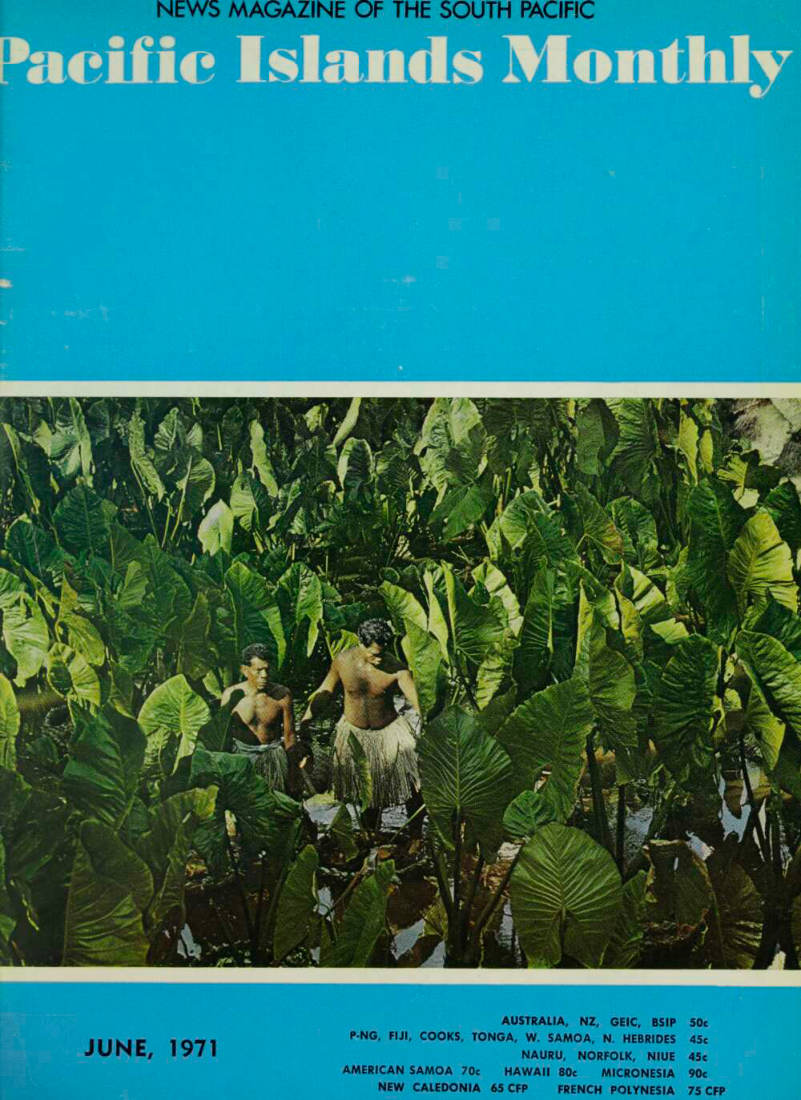 1
1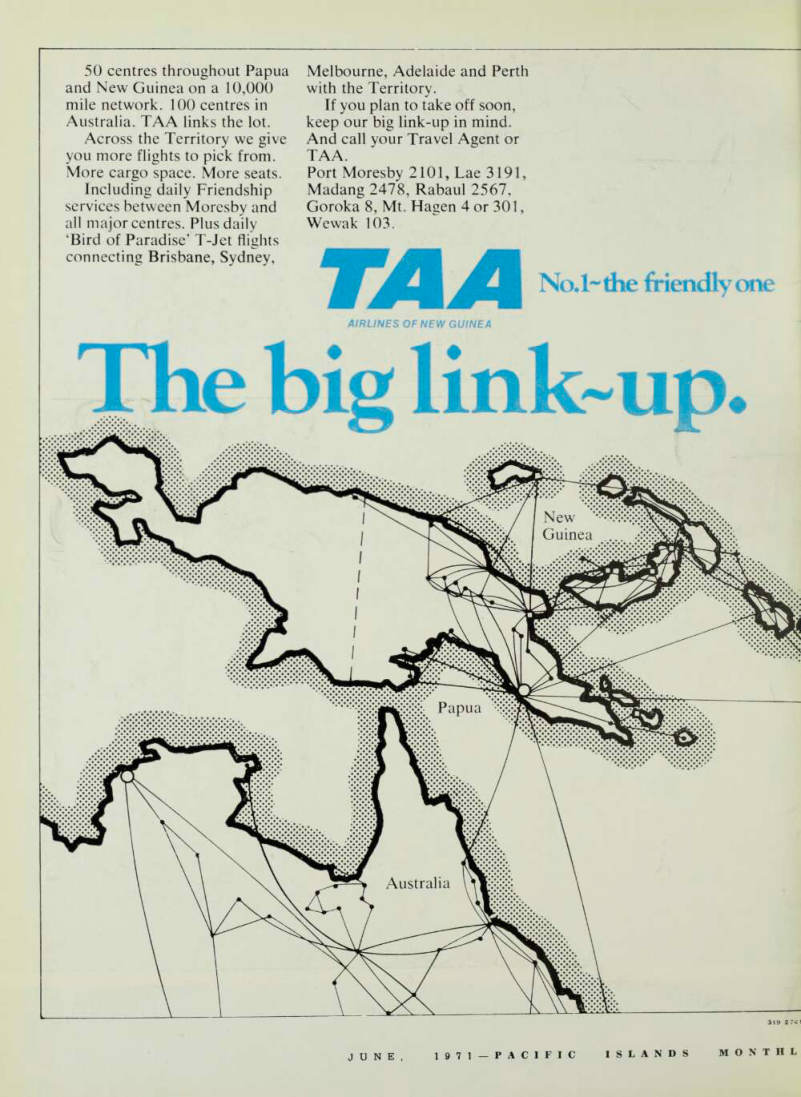 2
2 3
3 4
4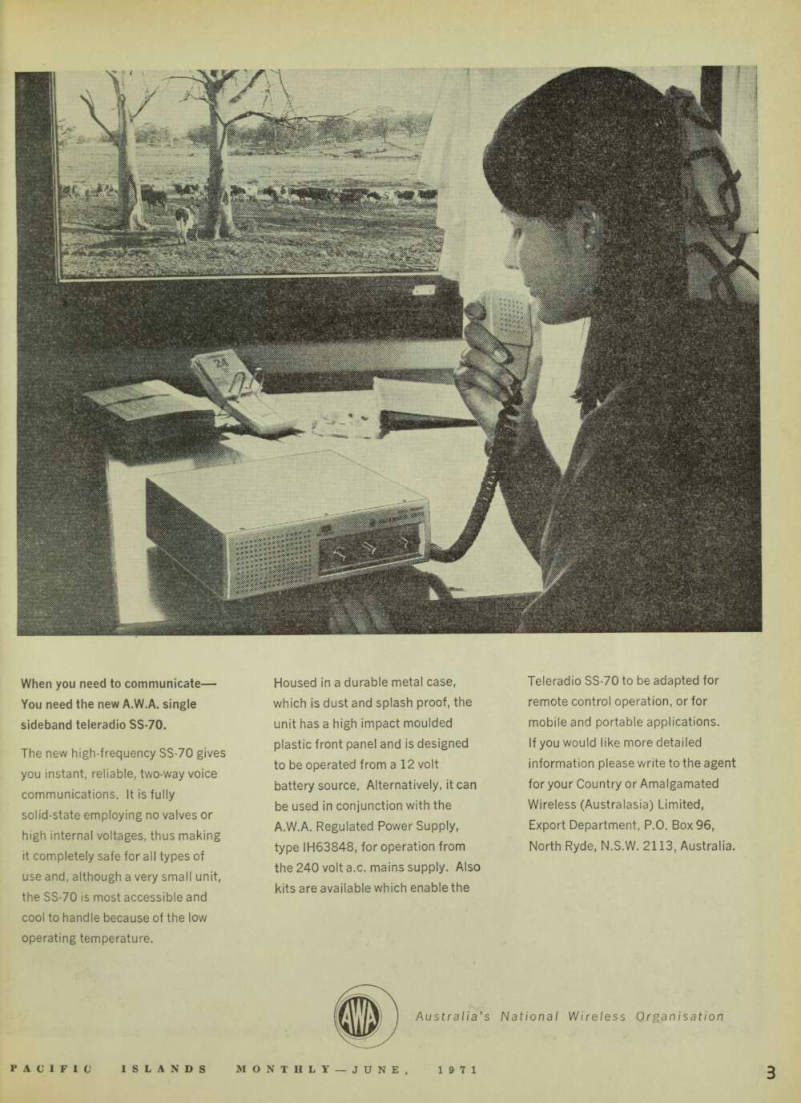 5
5 6
6 7
7 8
8 9
9 10
10 11
11 12
12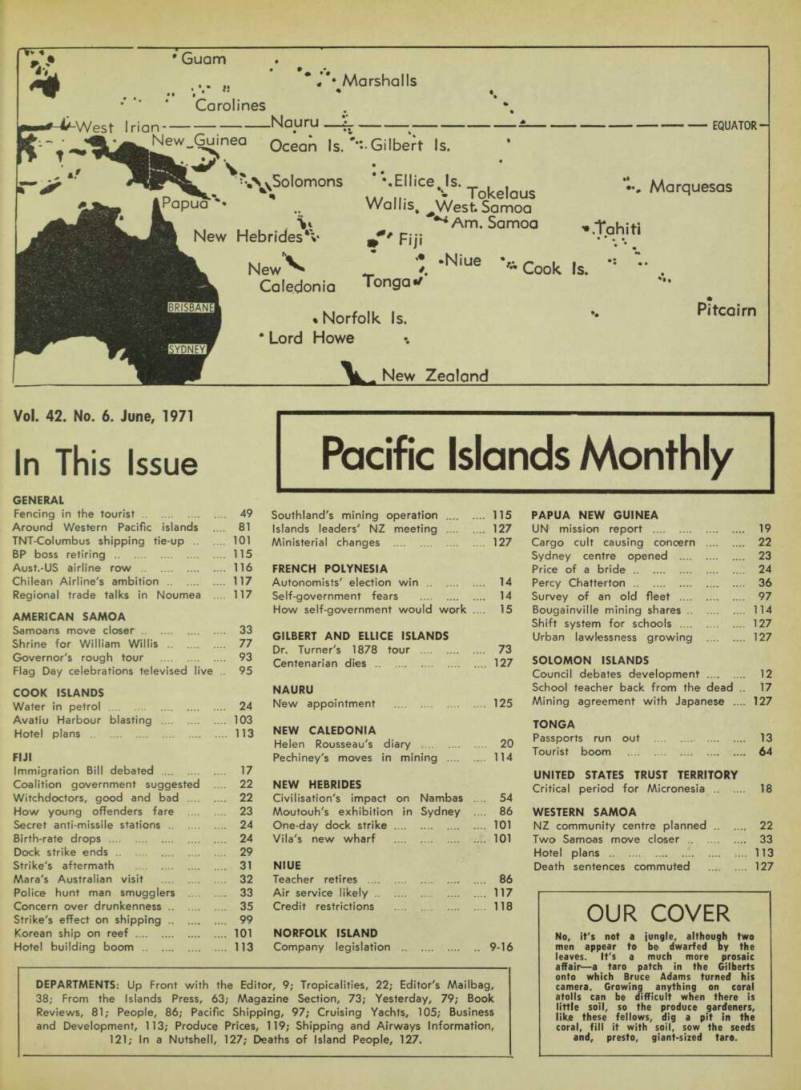 13
13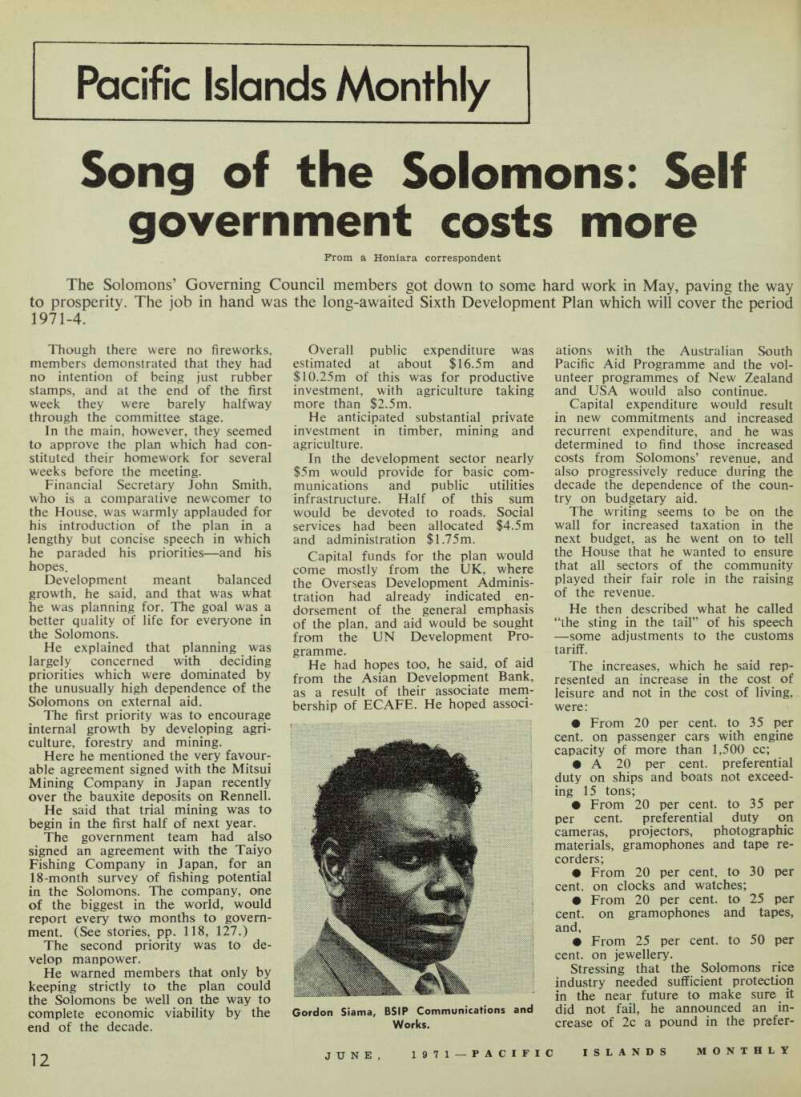 14
14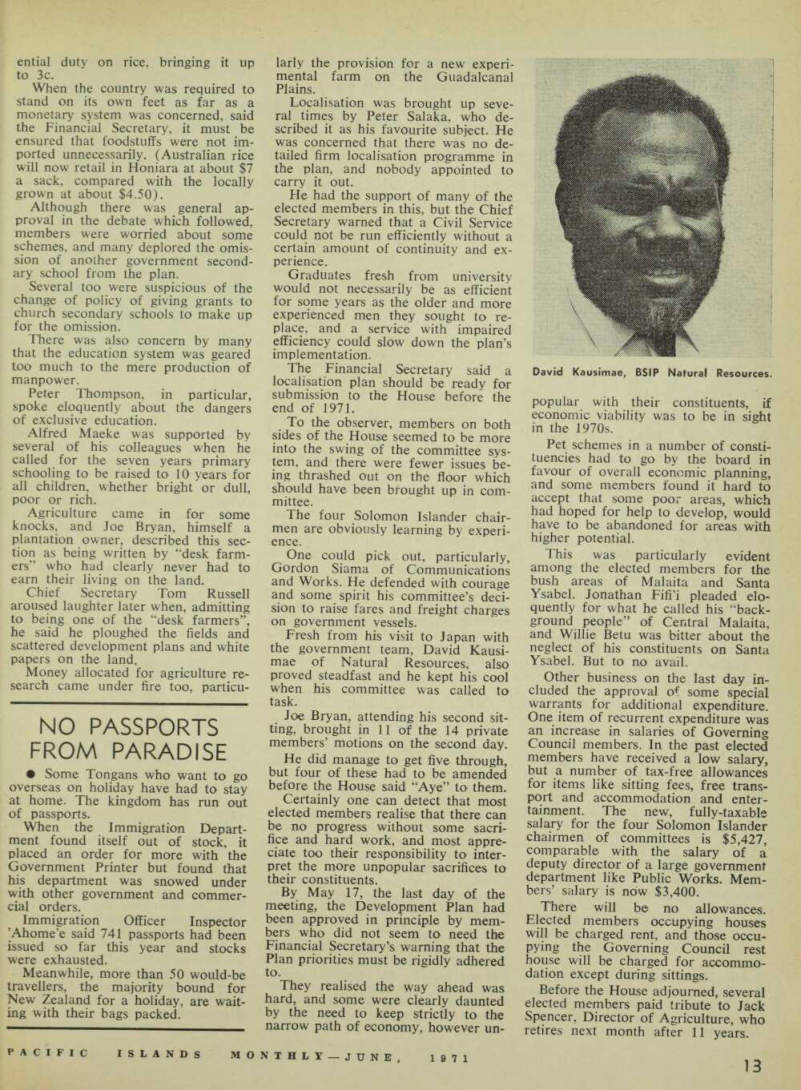 15
15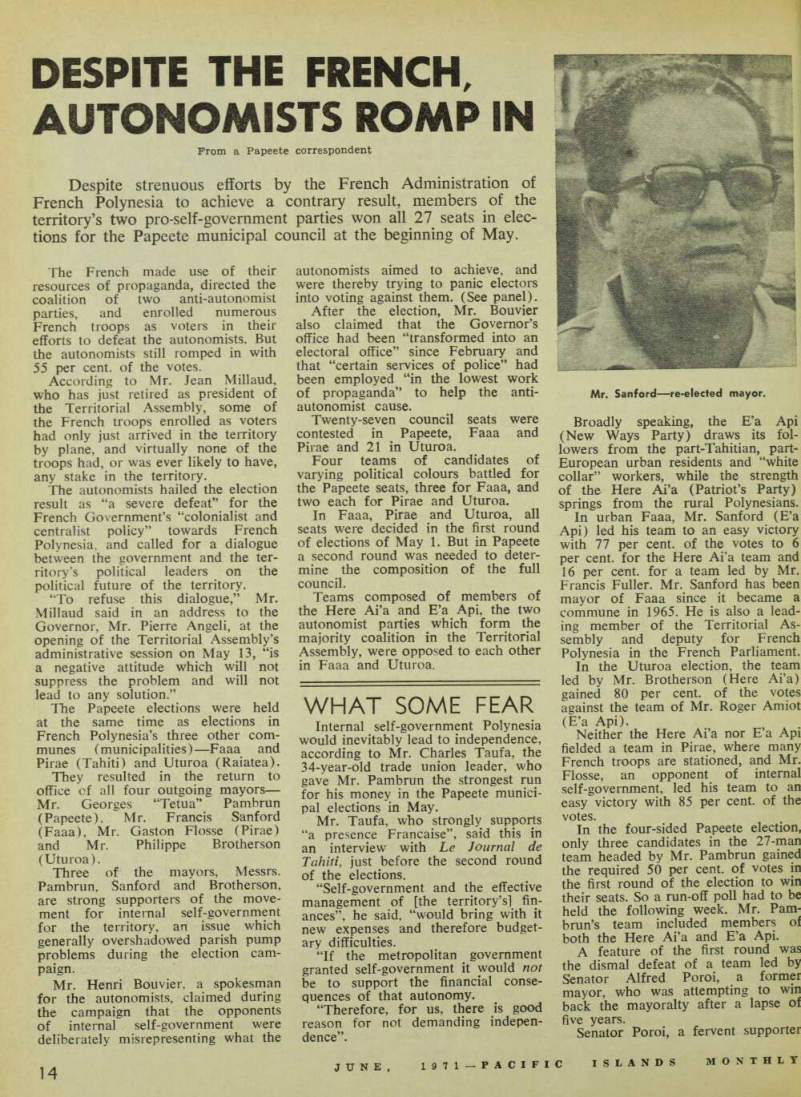 16
16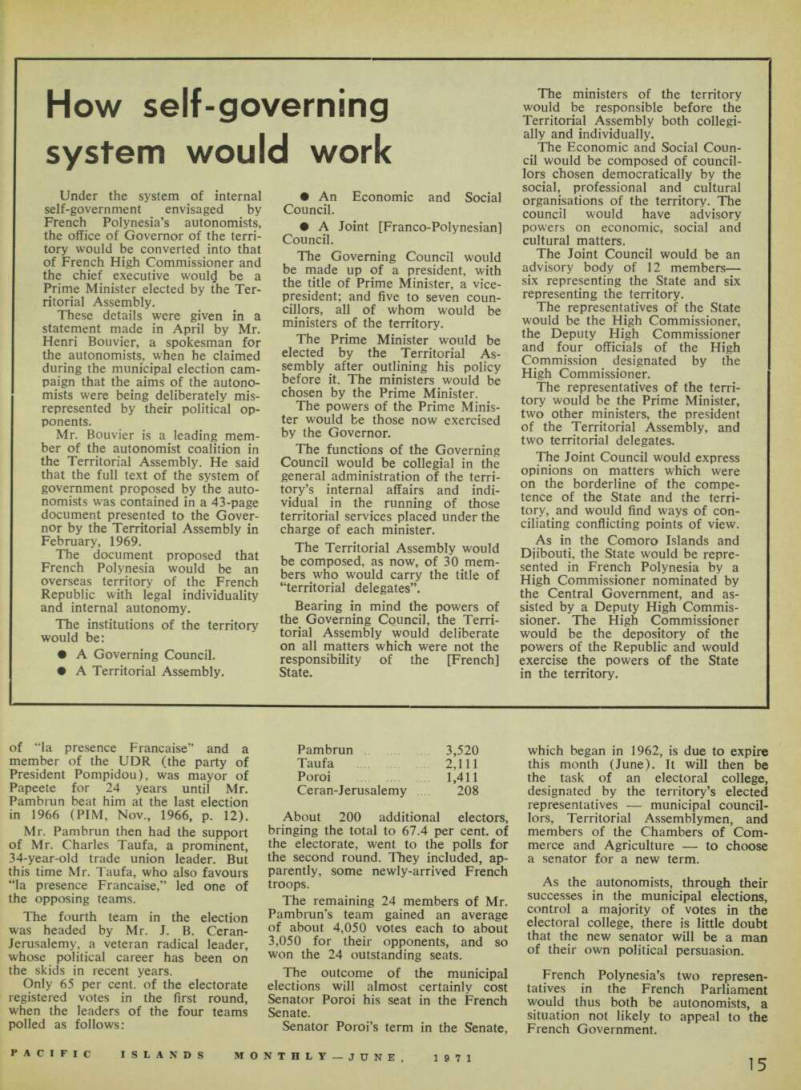 17
17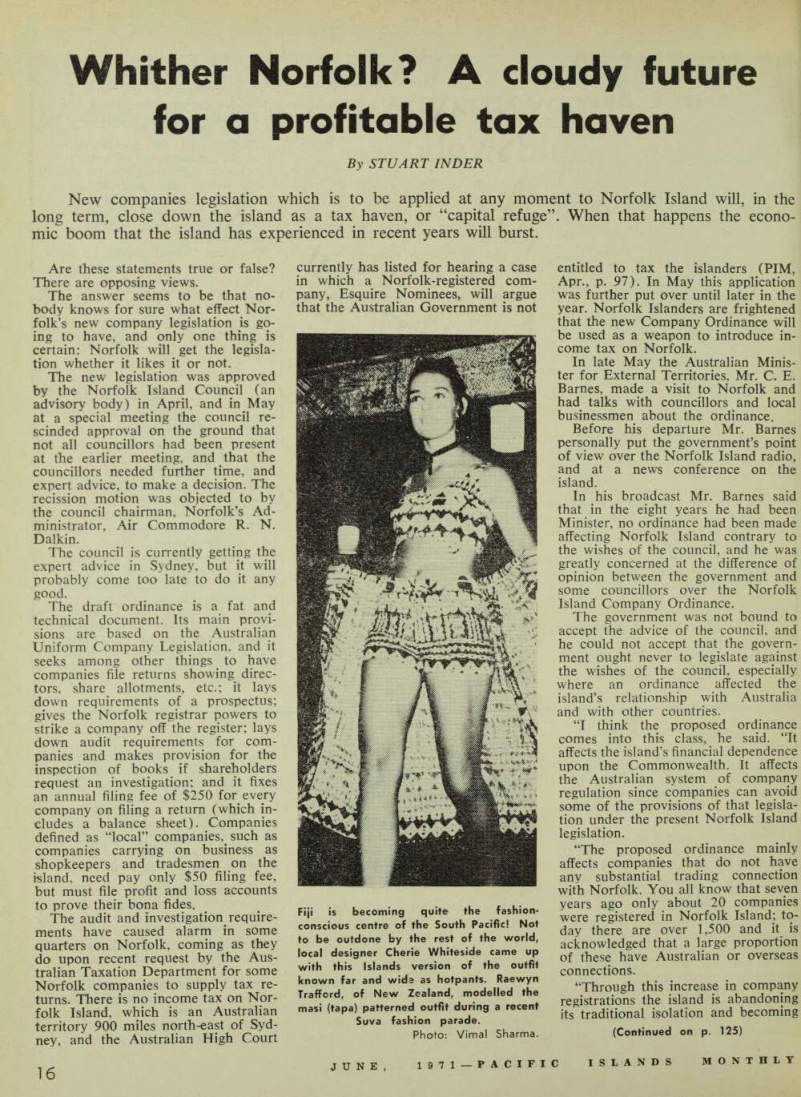 18
18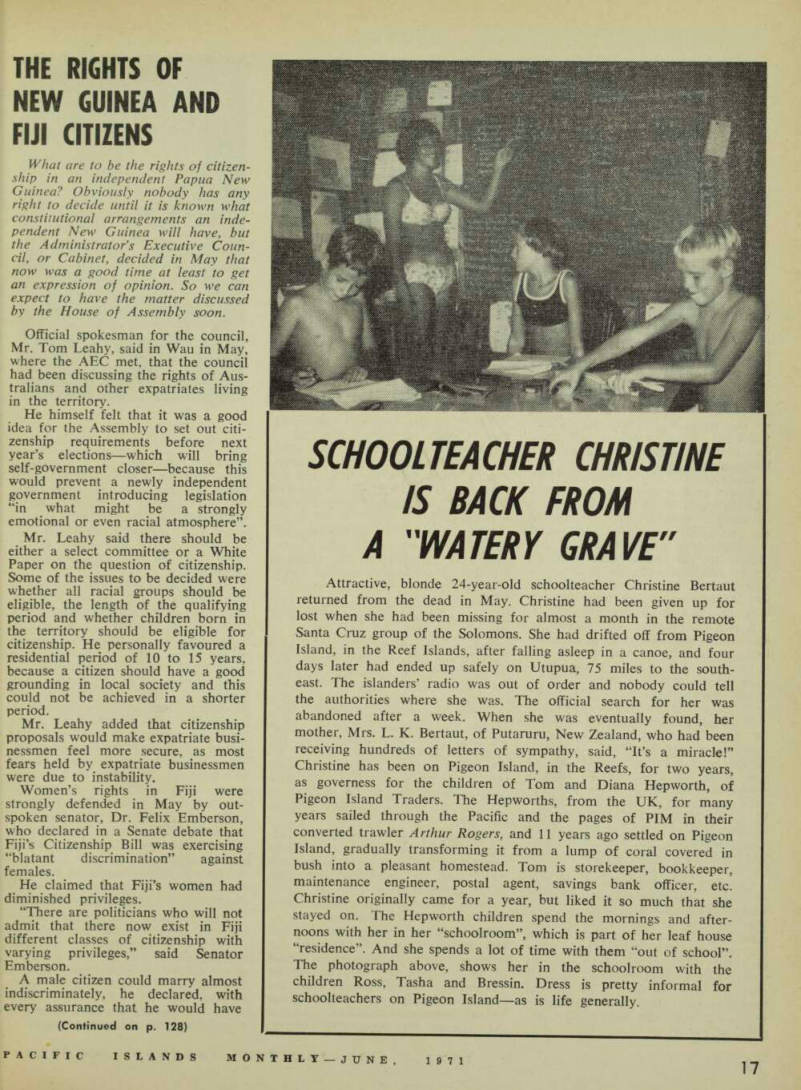 19
19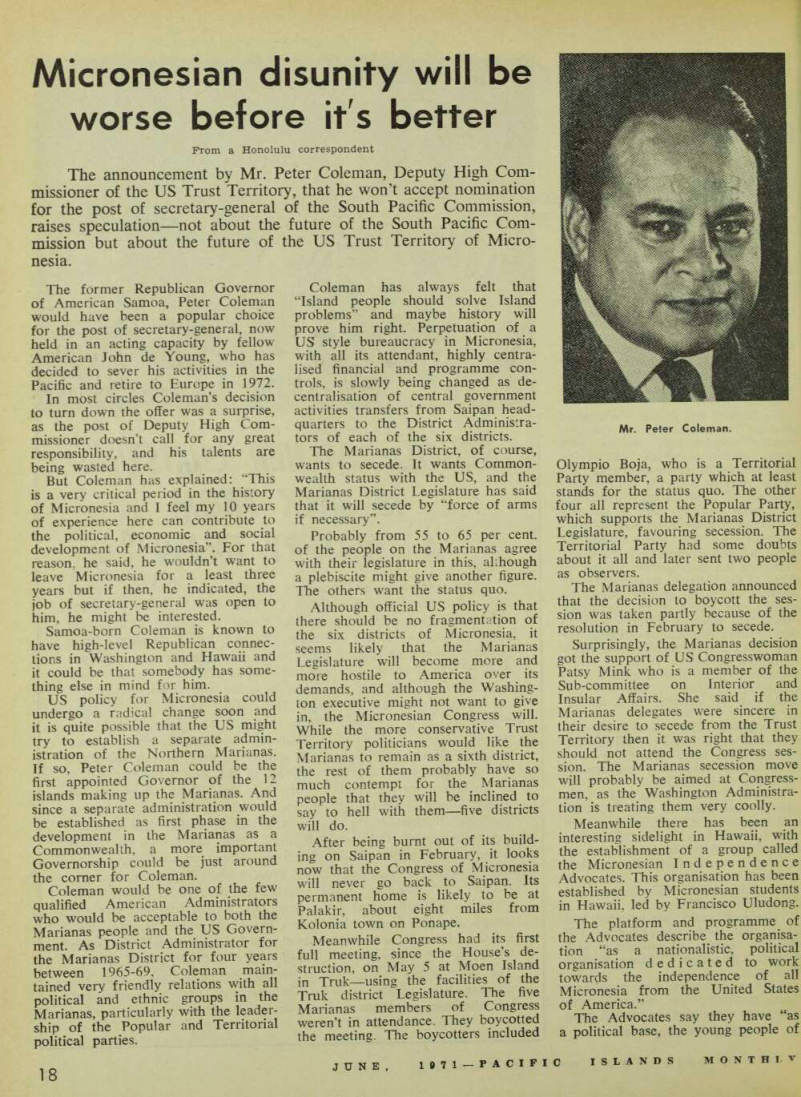 20
20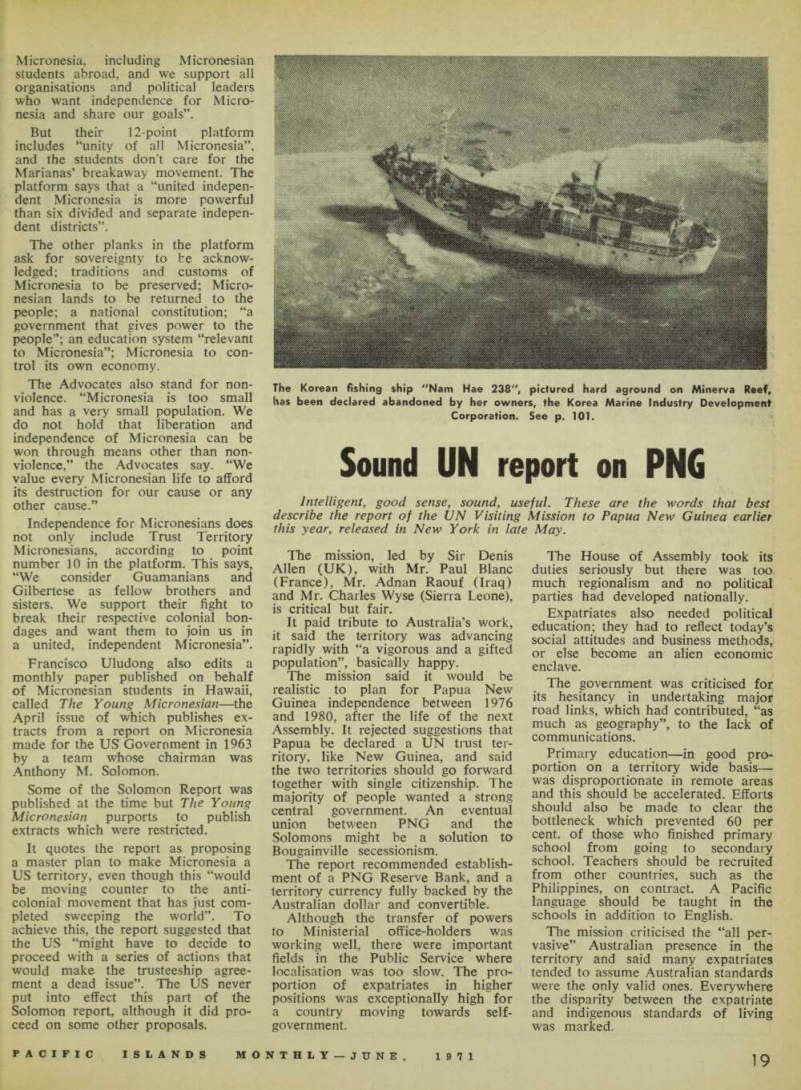 21
21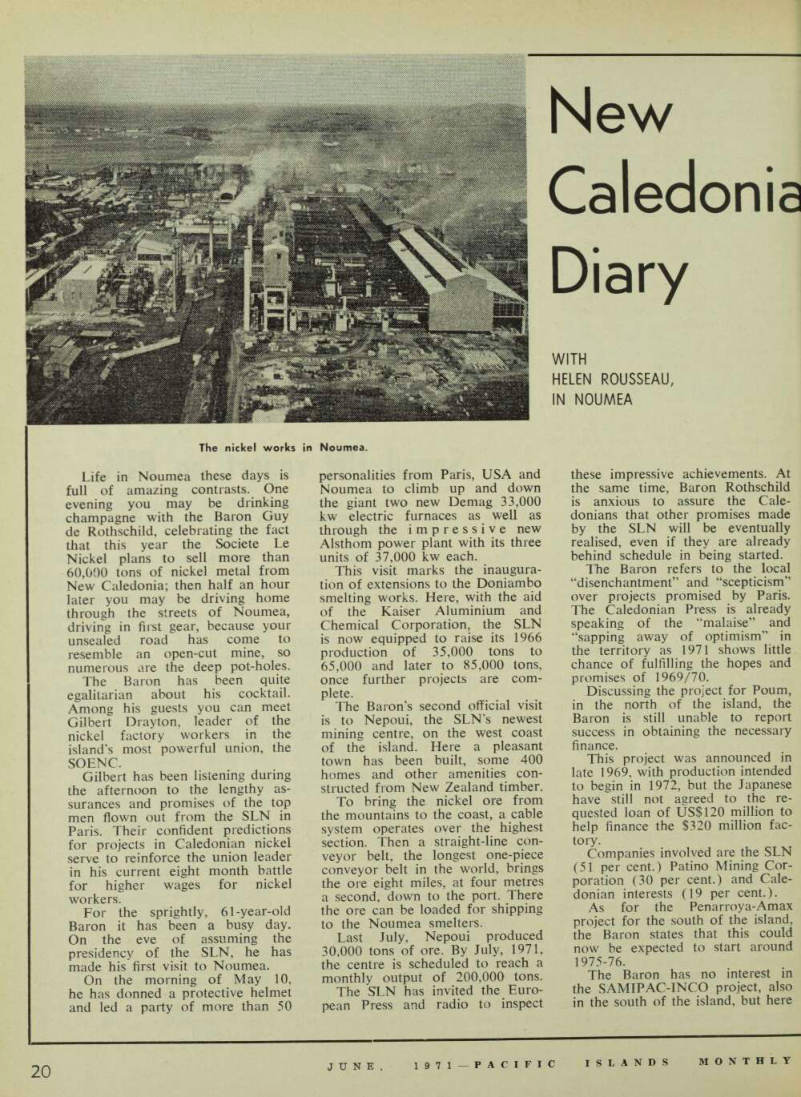 22
22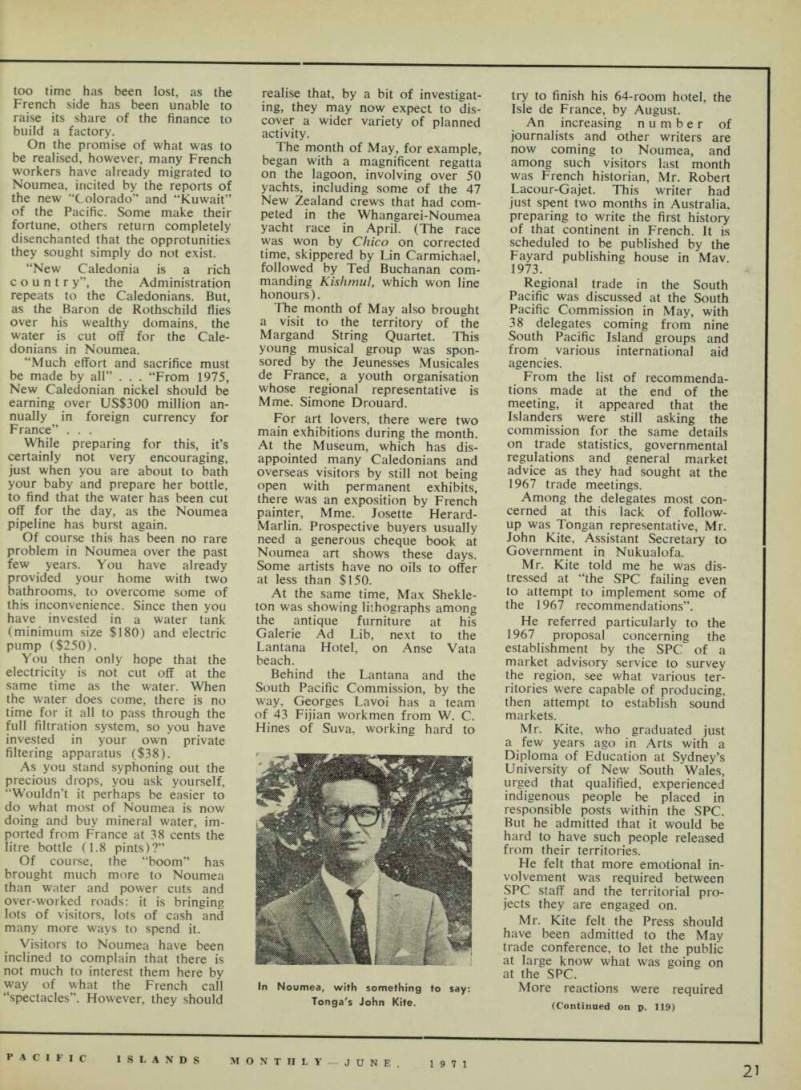 23
23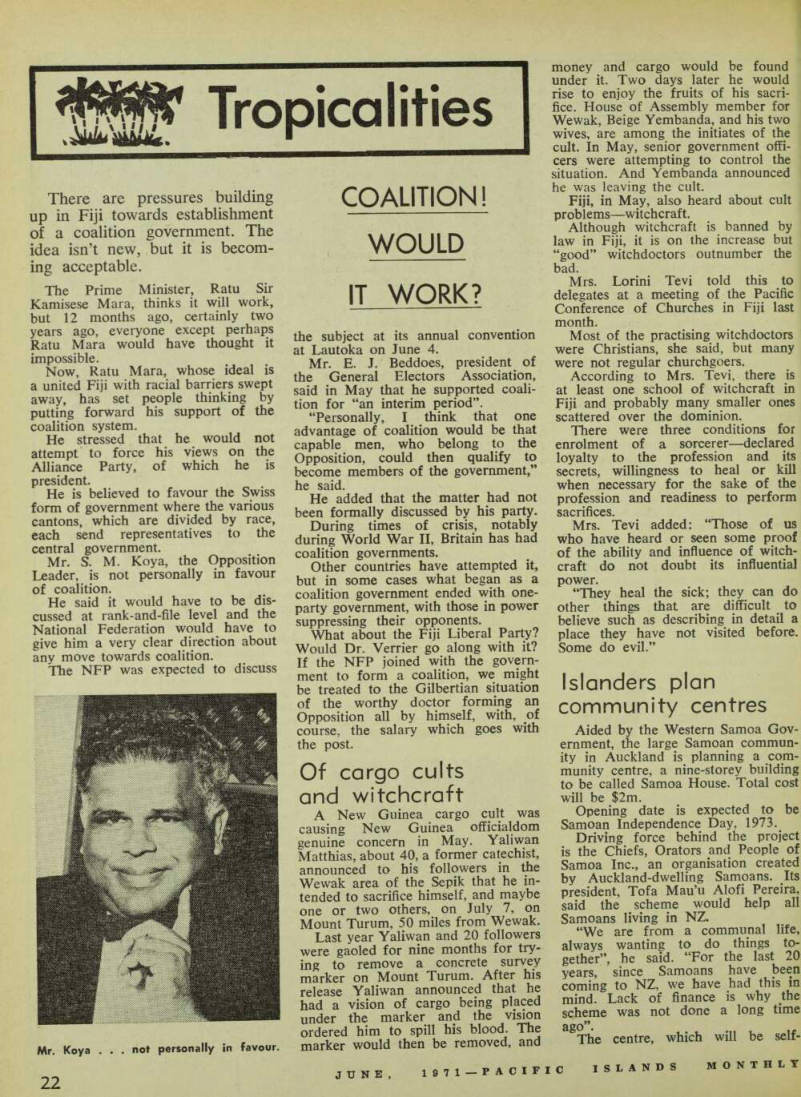 24
24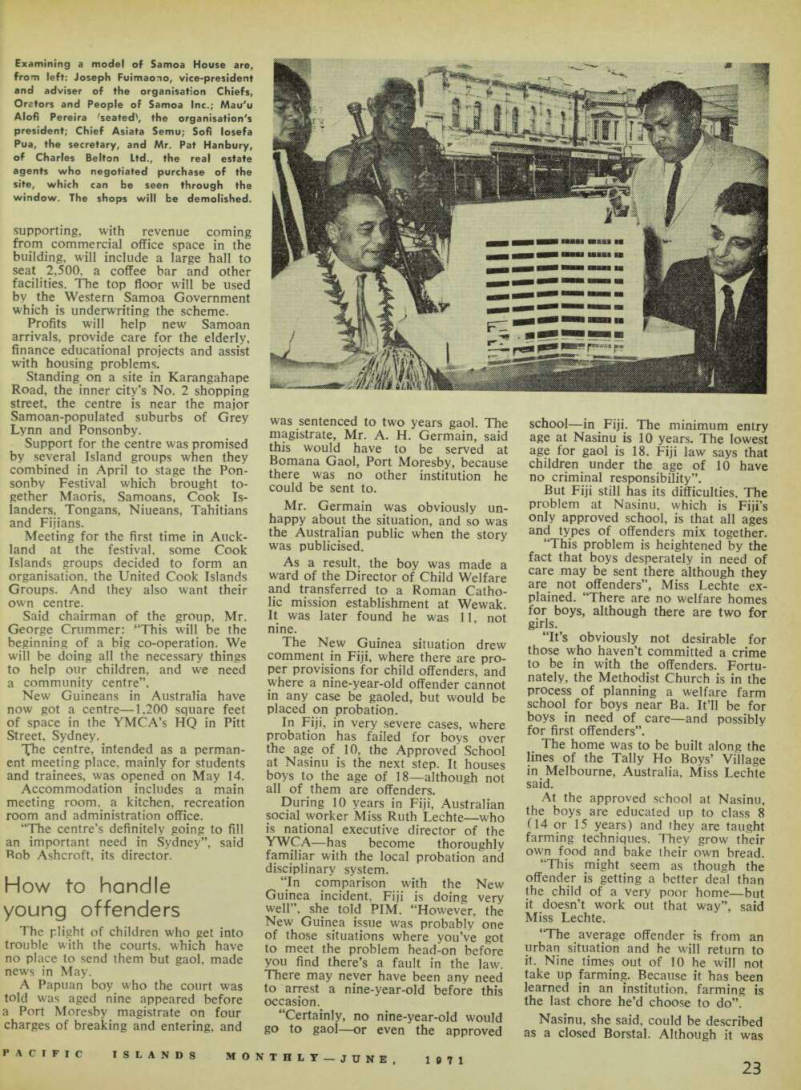 25
25 26
26 27
27 28
28 29
29 30
30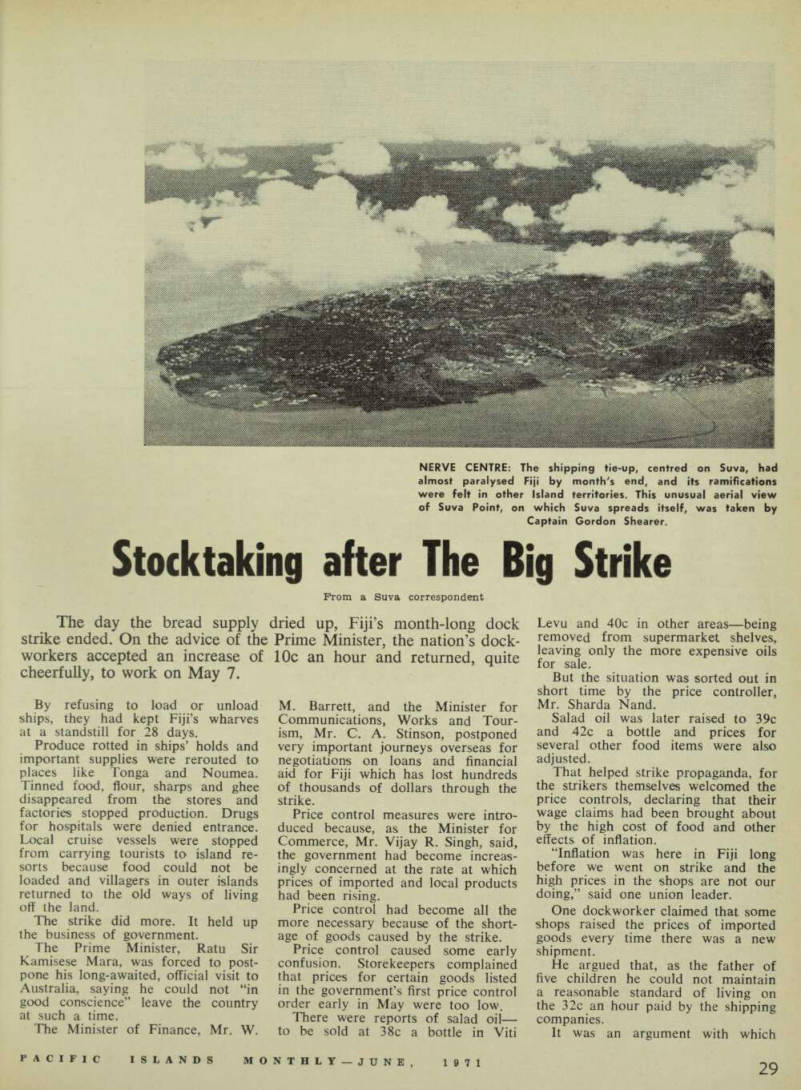 31
31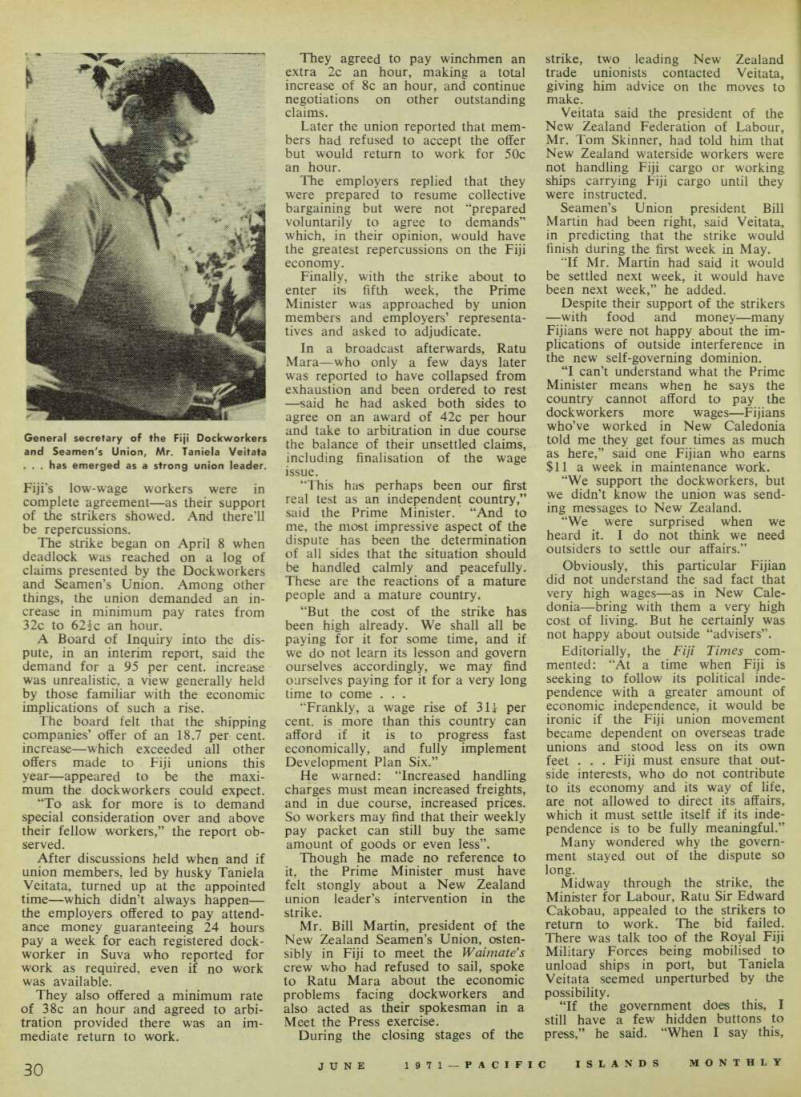 32
32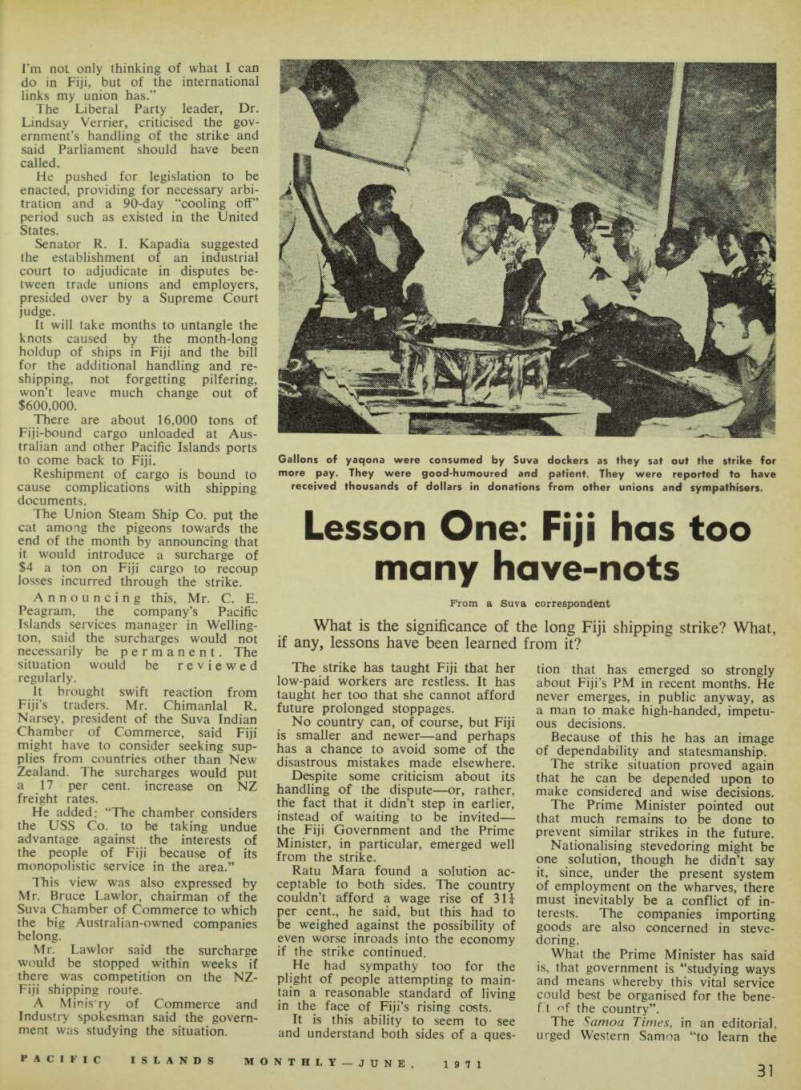 33
33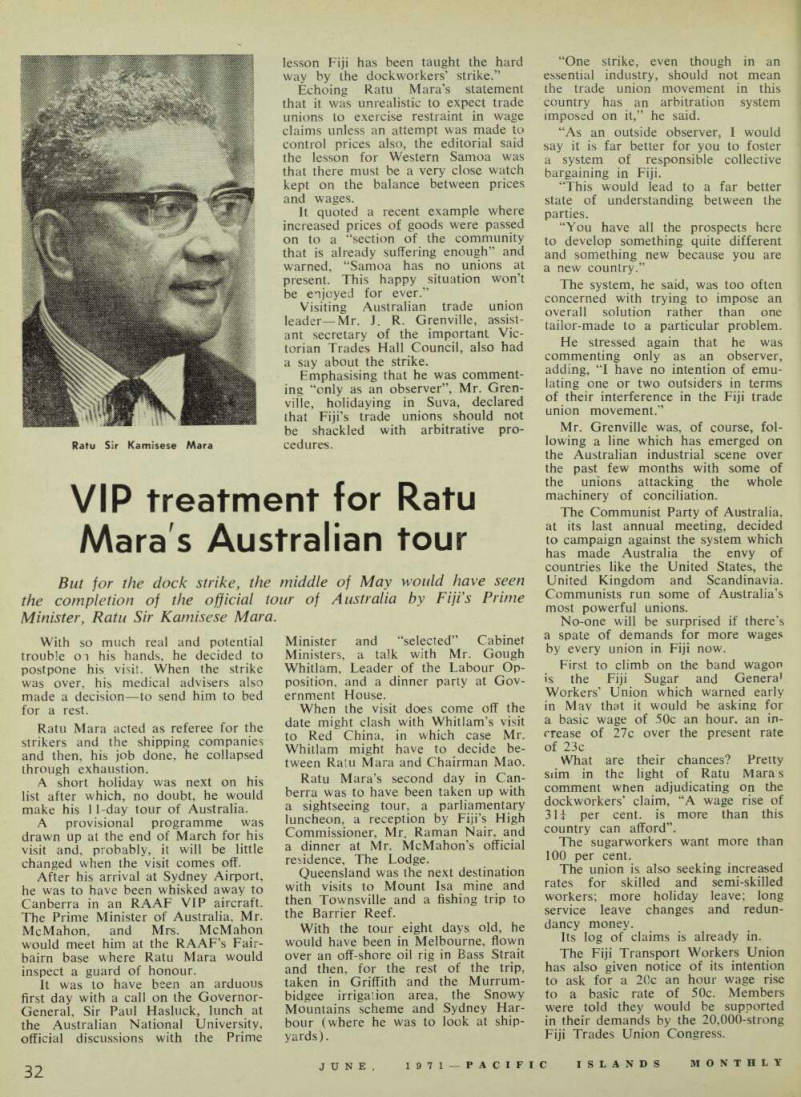 34
34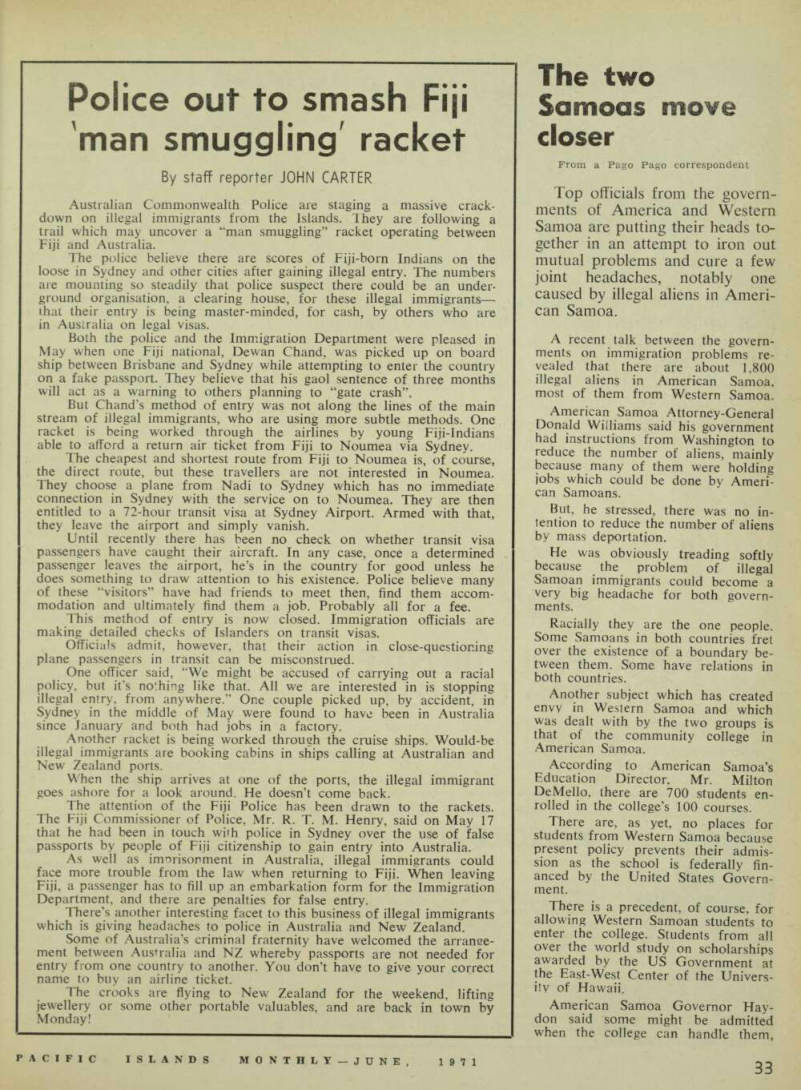 35
35 36
36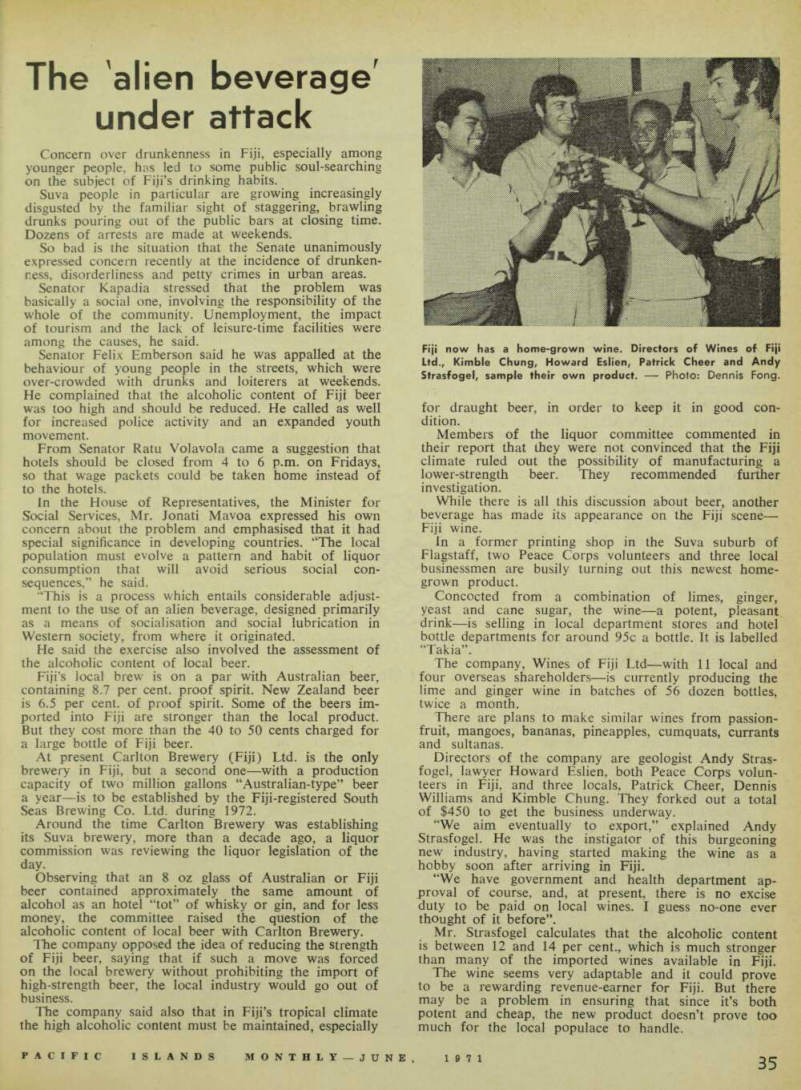 37
37 38
38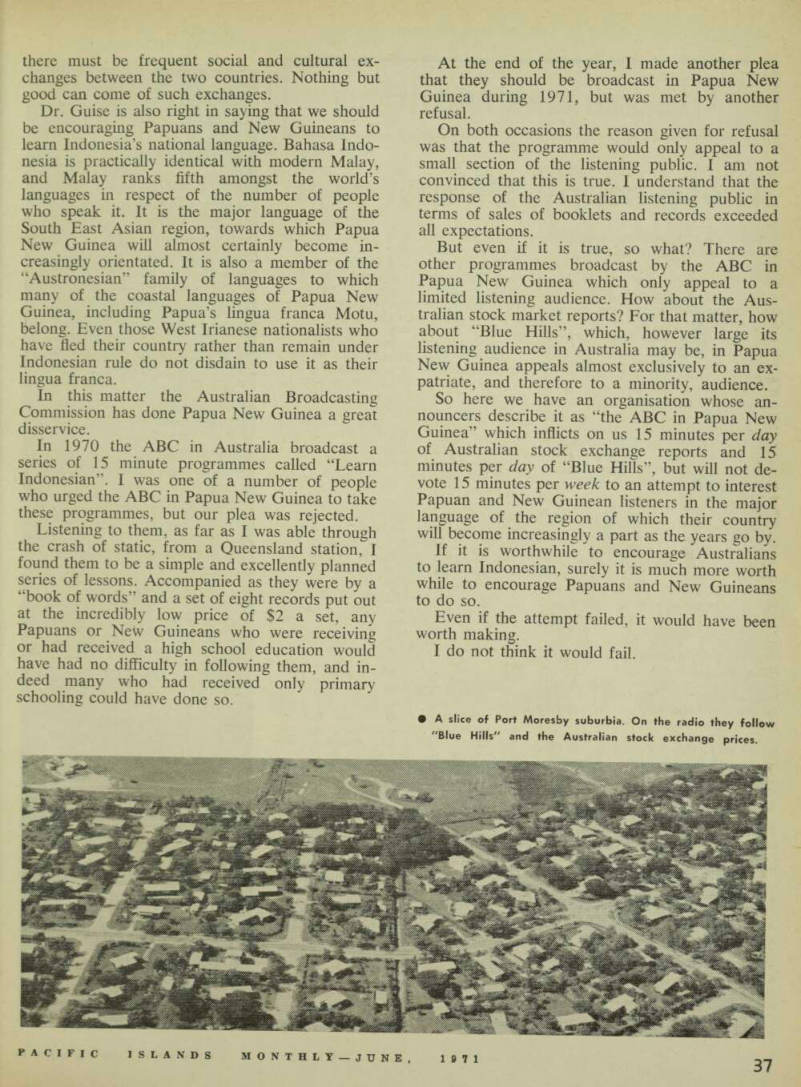 39
39 40
40 41
41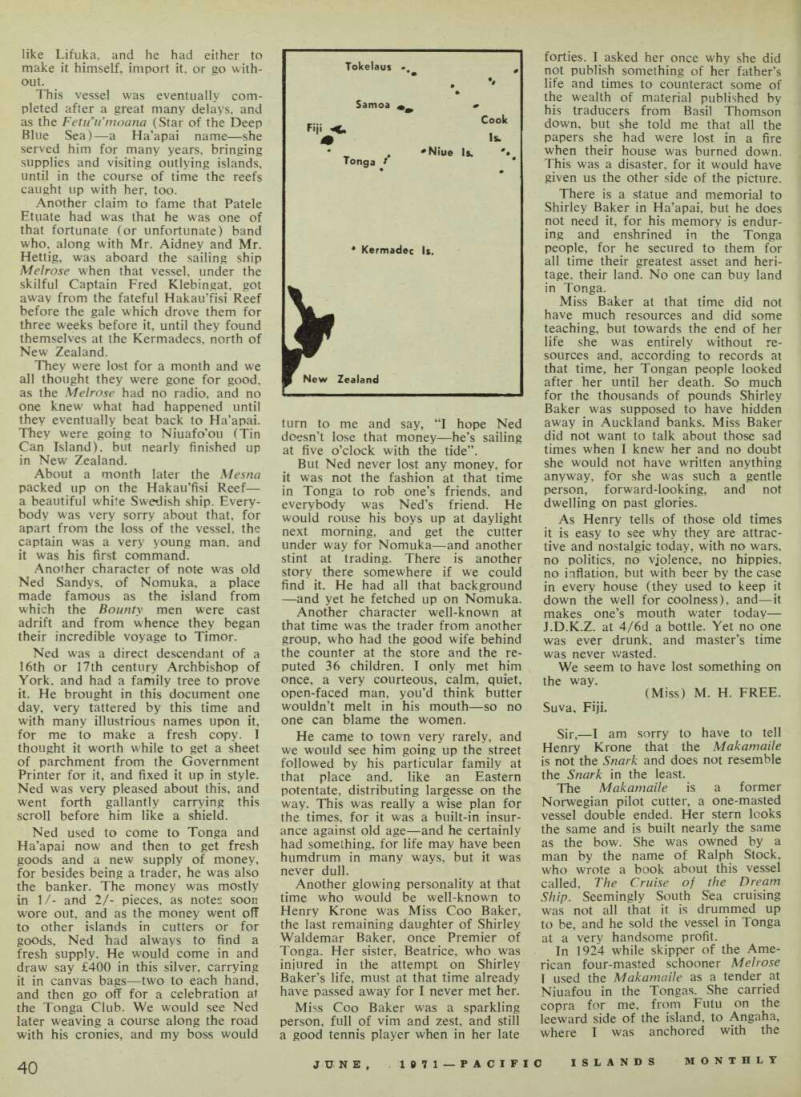 42
42 43
43 44
44 45
45 46
46 47
47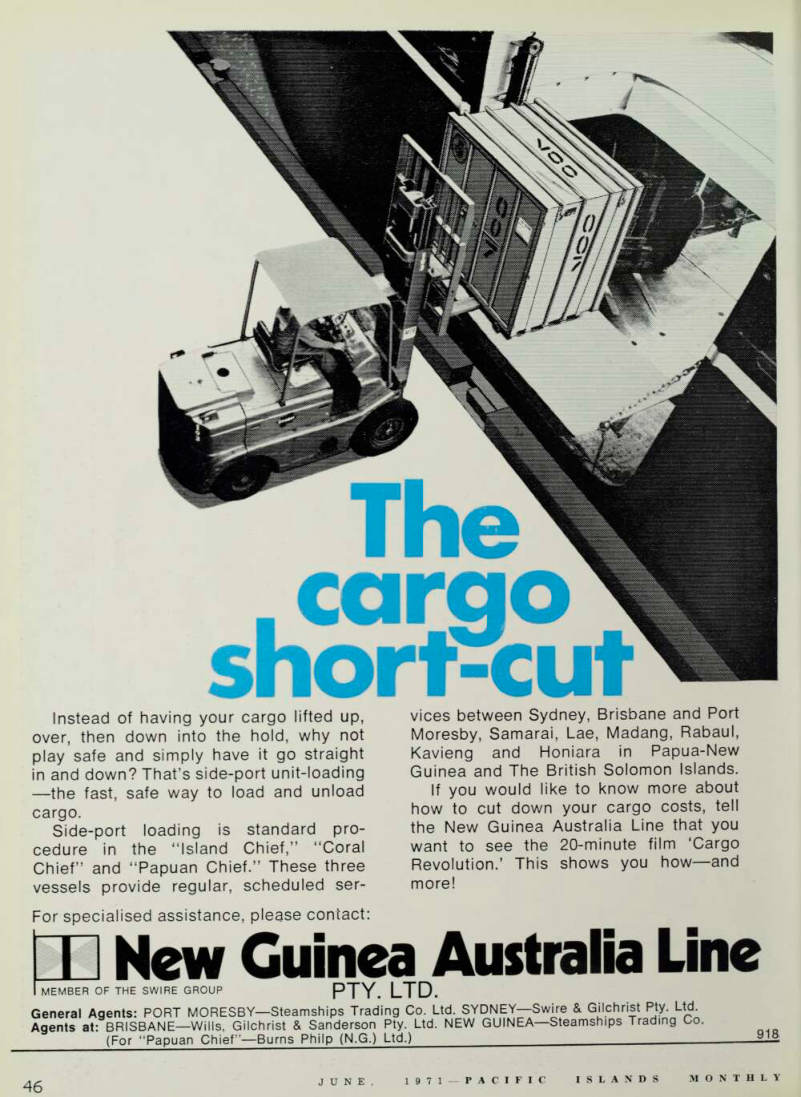 48
48 49
49 50
50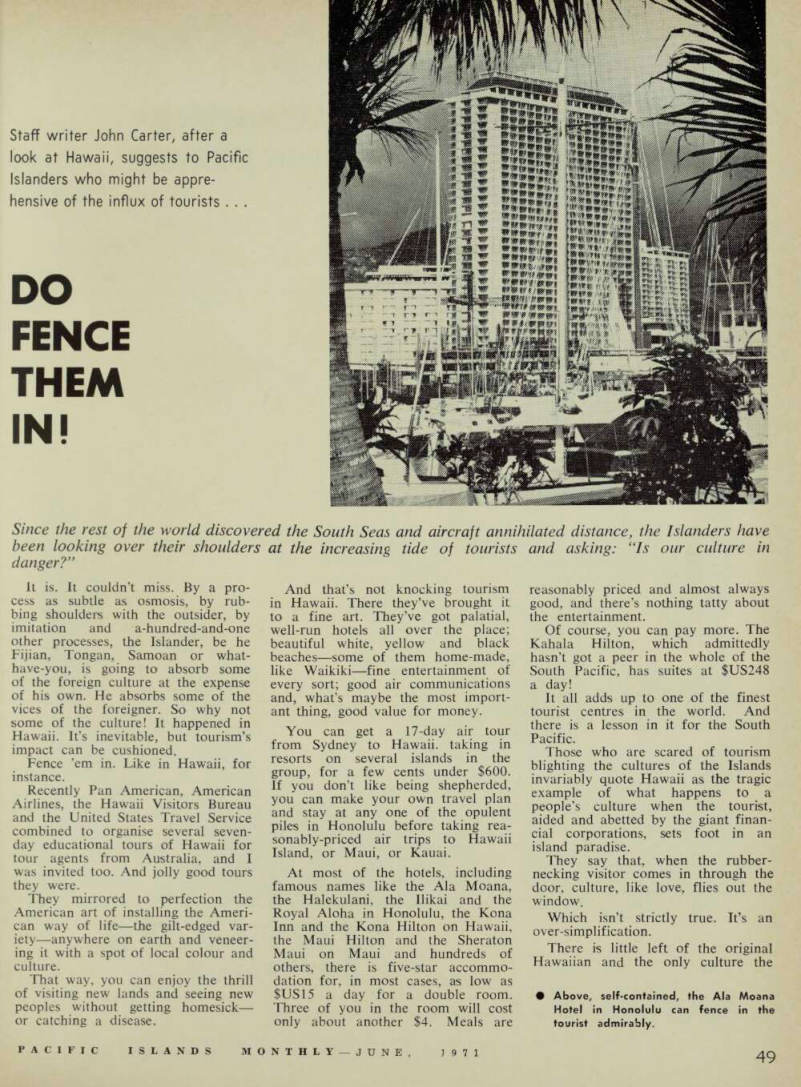 51
51 52
52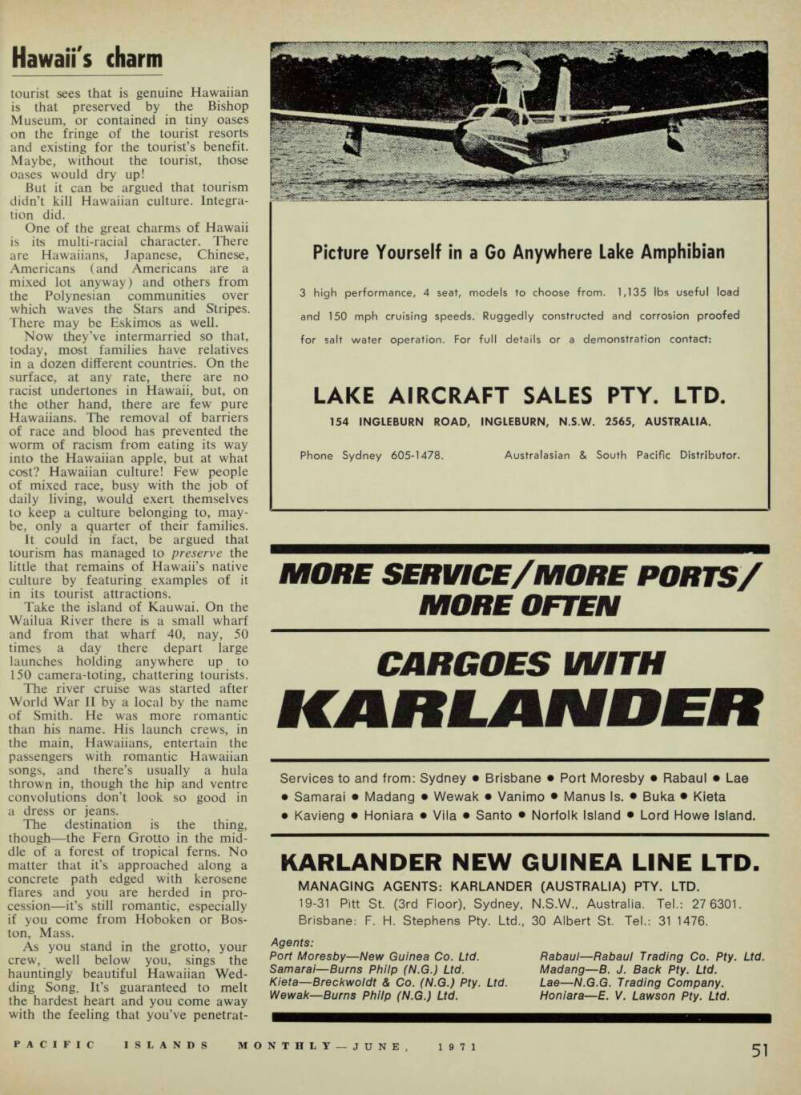 53
53 54
54 55
55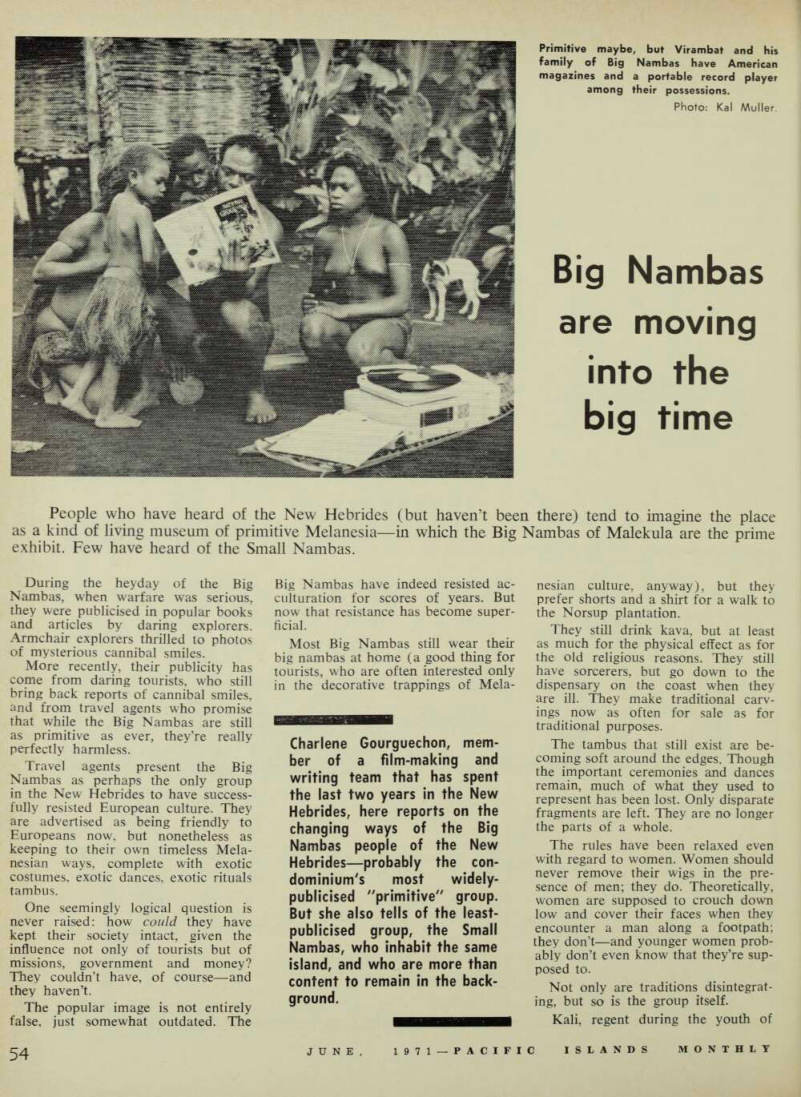 56
56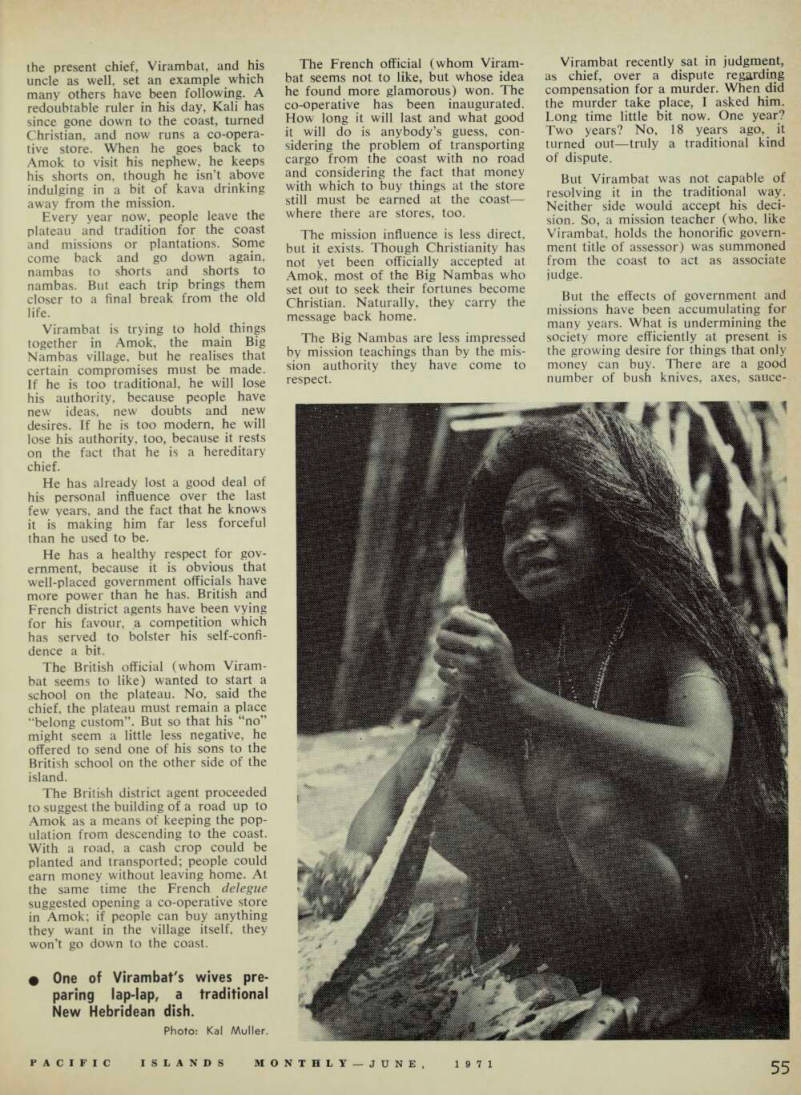 57
57 58
58 59
59 60
60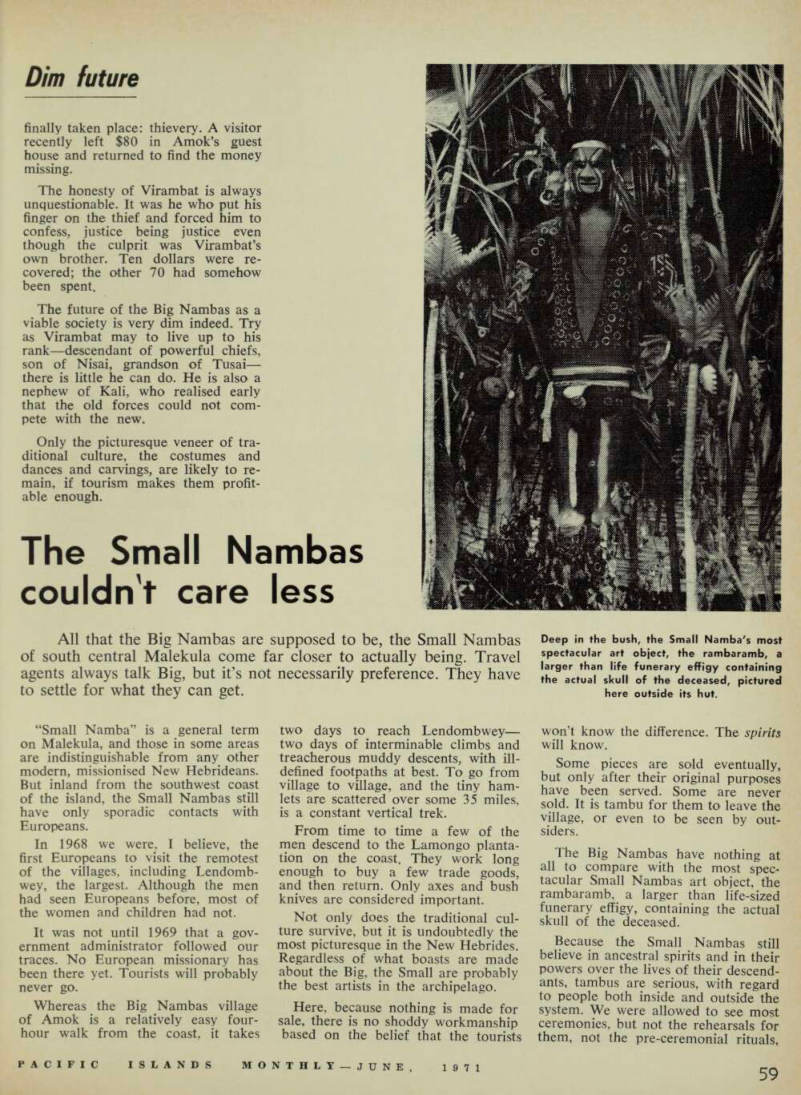 61
61 62
62 63
63 64
64 65
65 66
66 67
67 68
68 69
69 70
70 71
71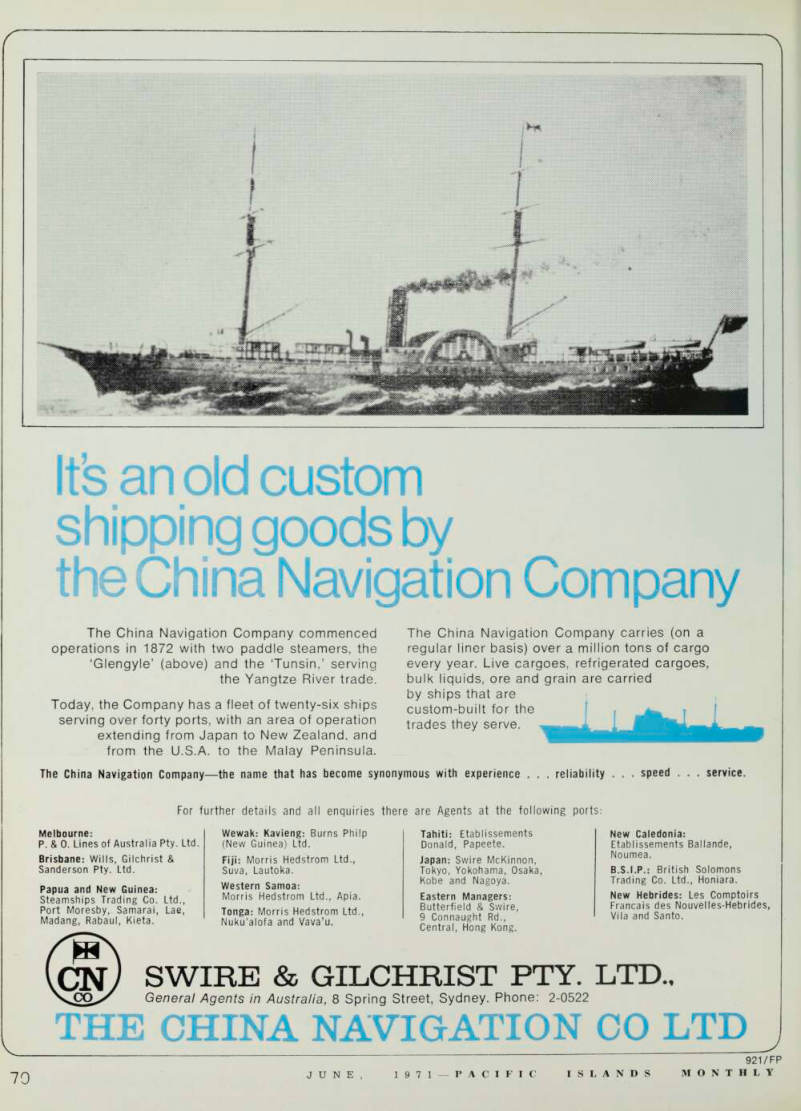 72
72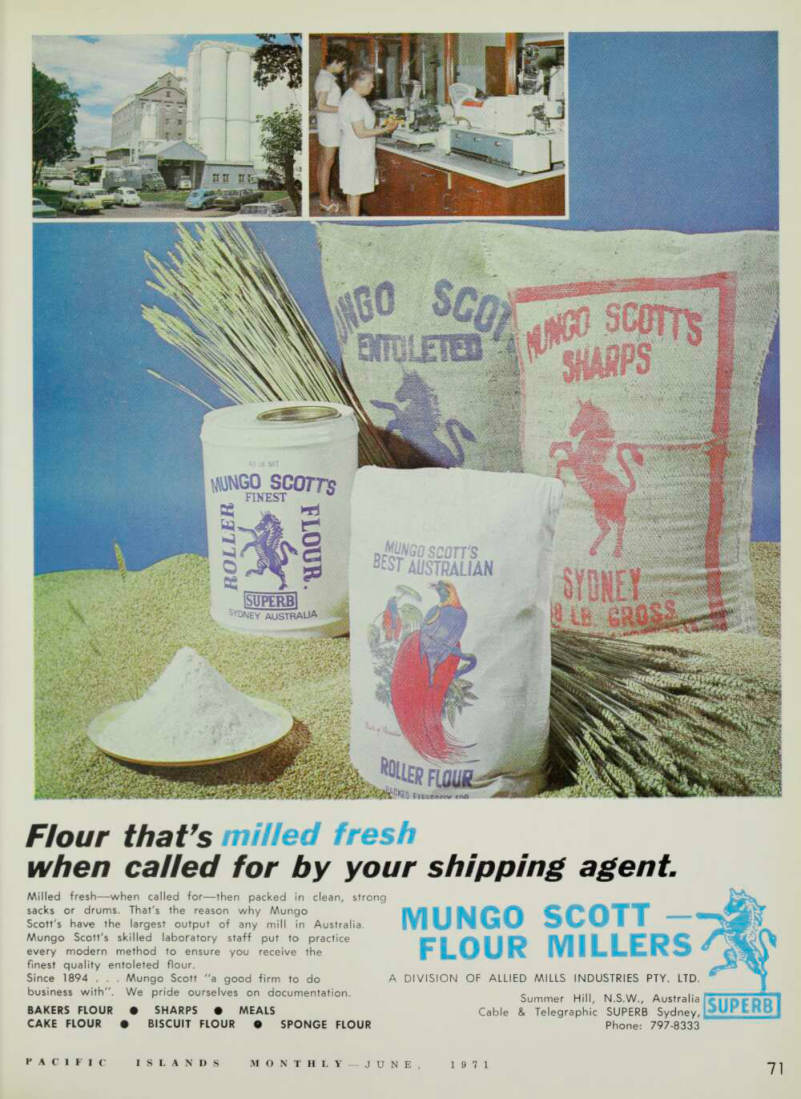 73
73 74
74 75
75 76
76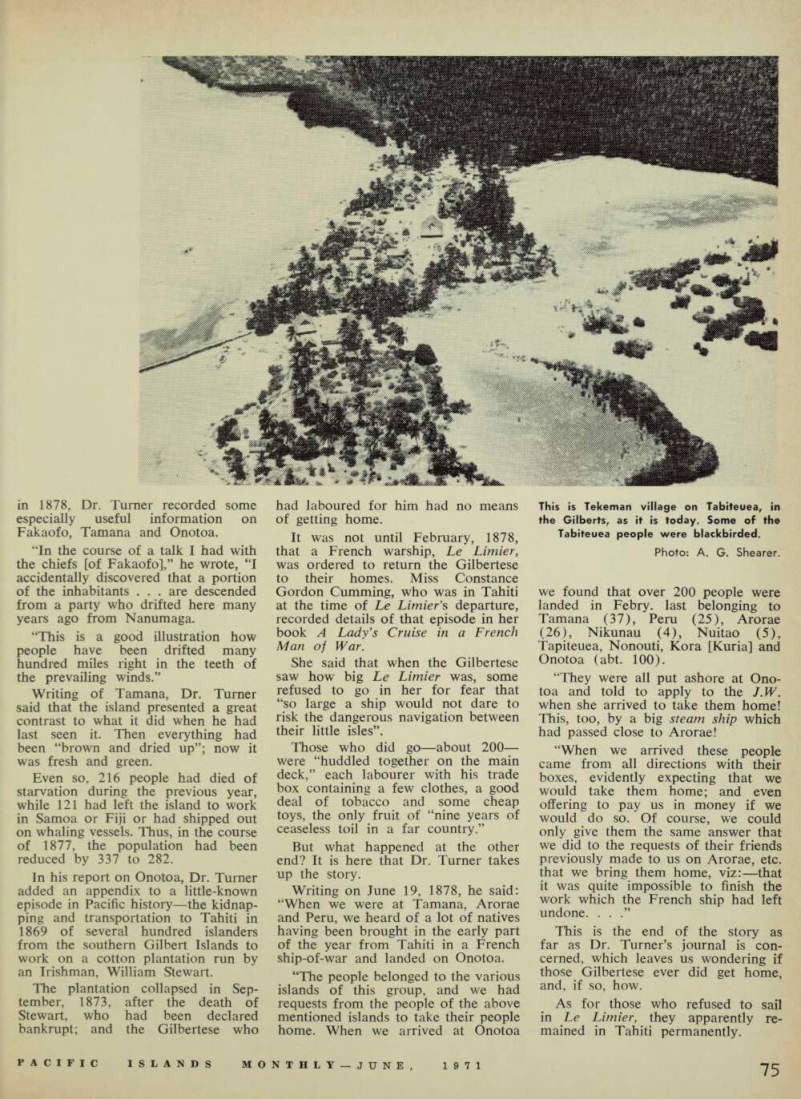 77
77 78
78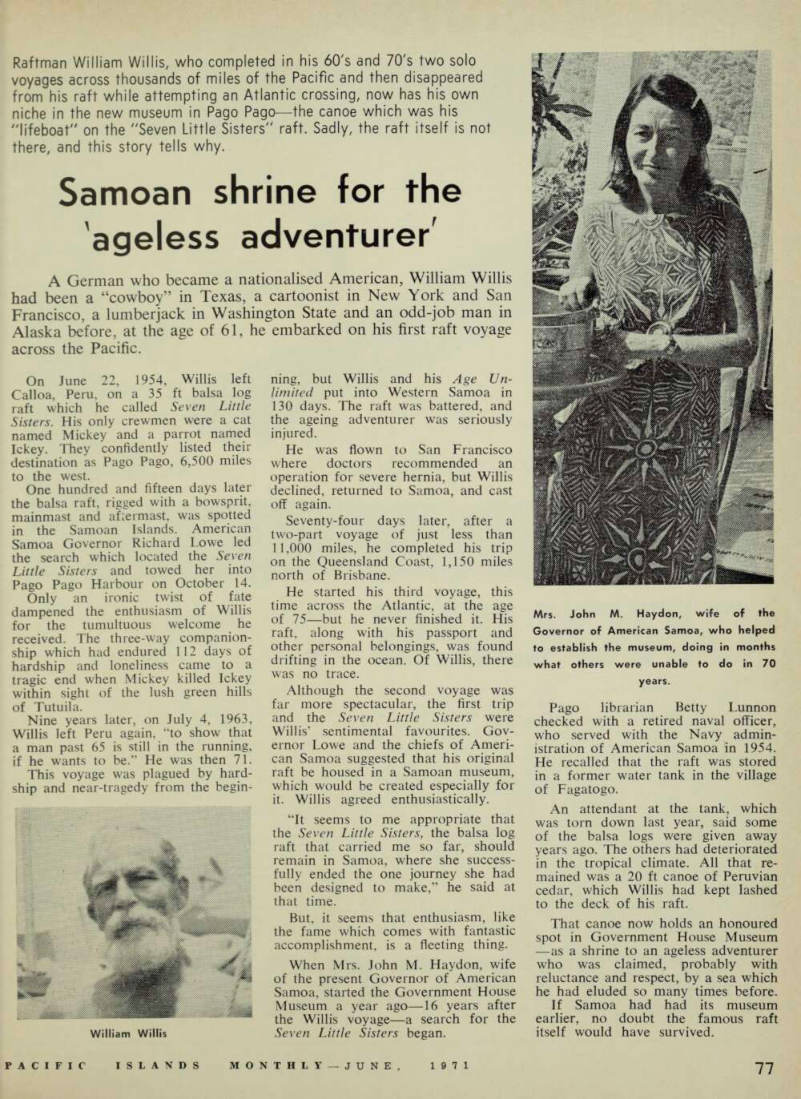 79
79 80
80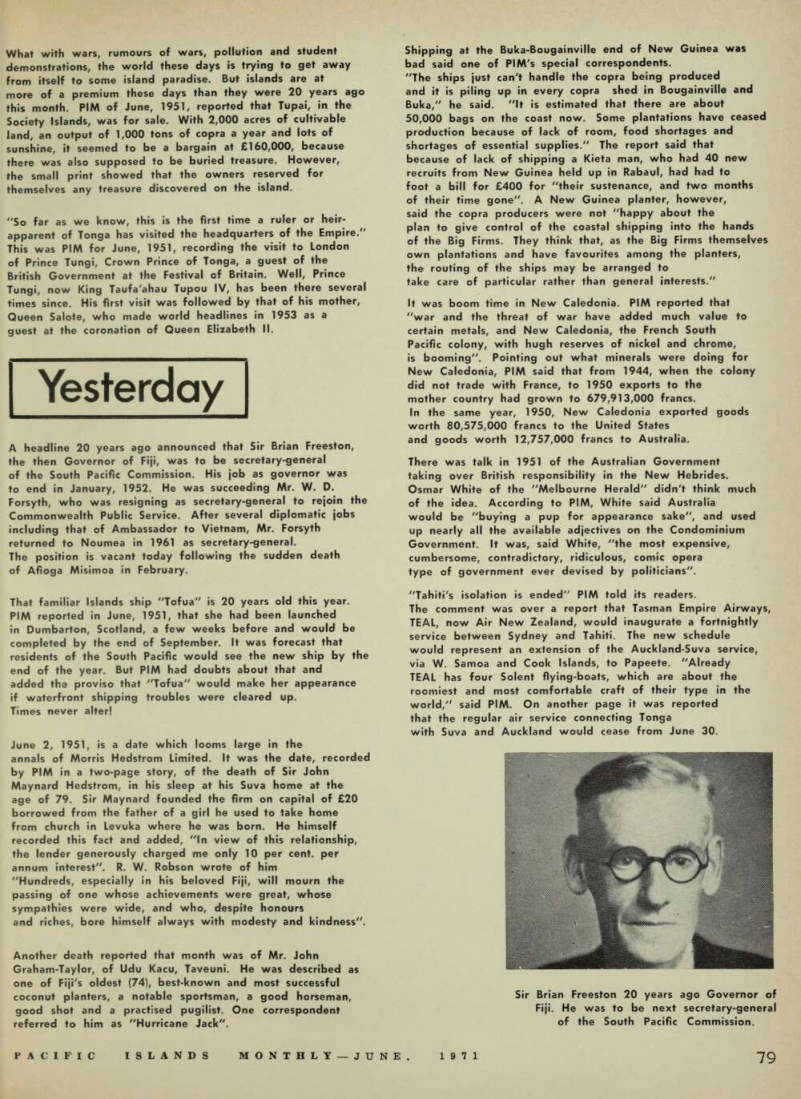 81
81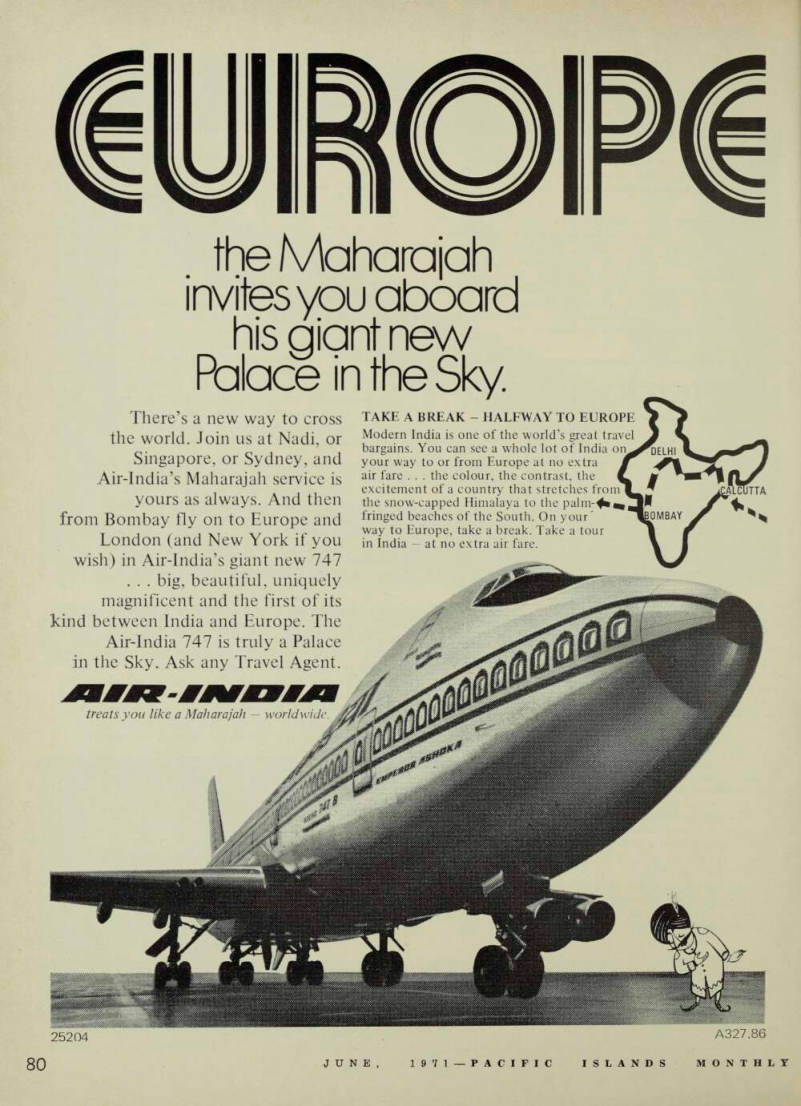 82
82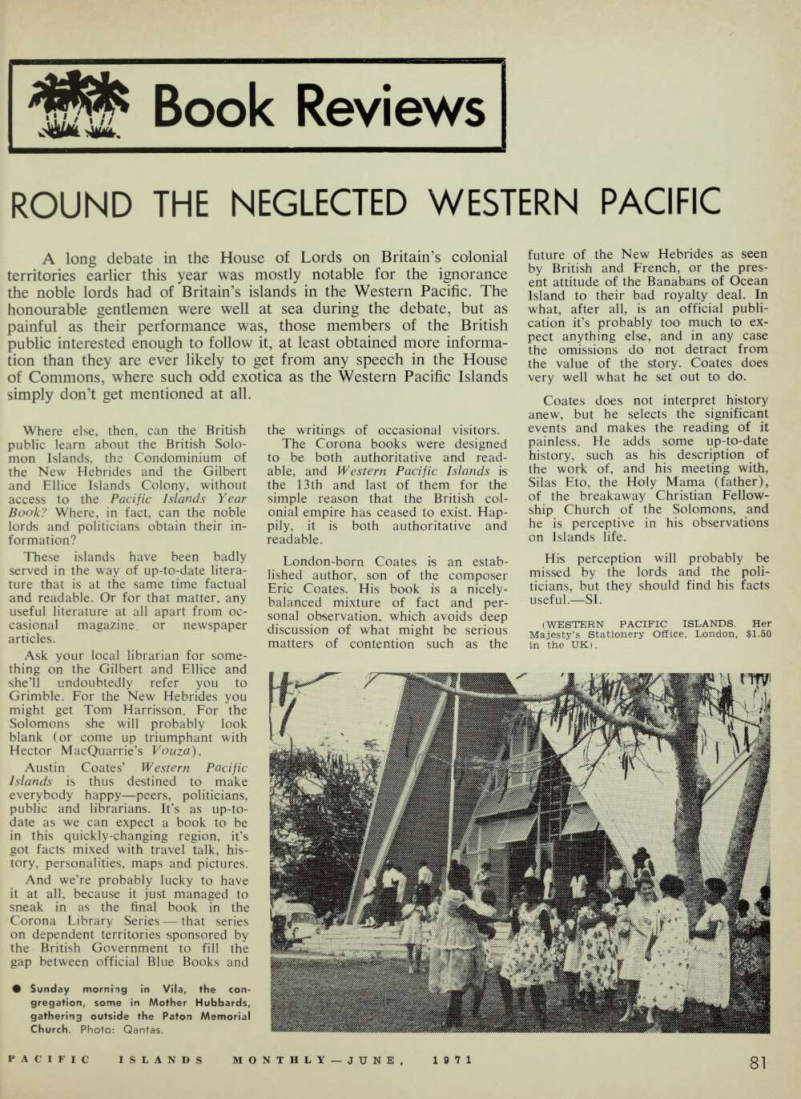 83
83 84
84 85
85 86
86 87
87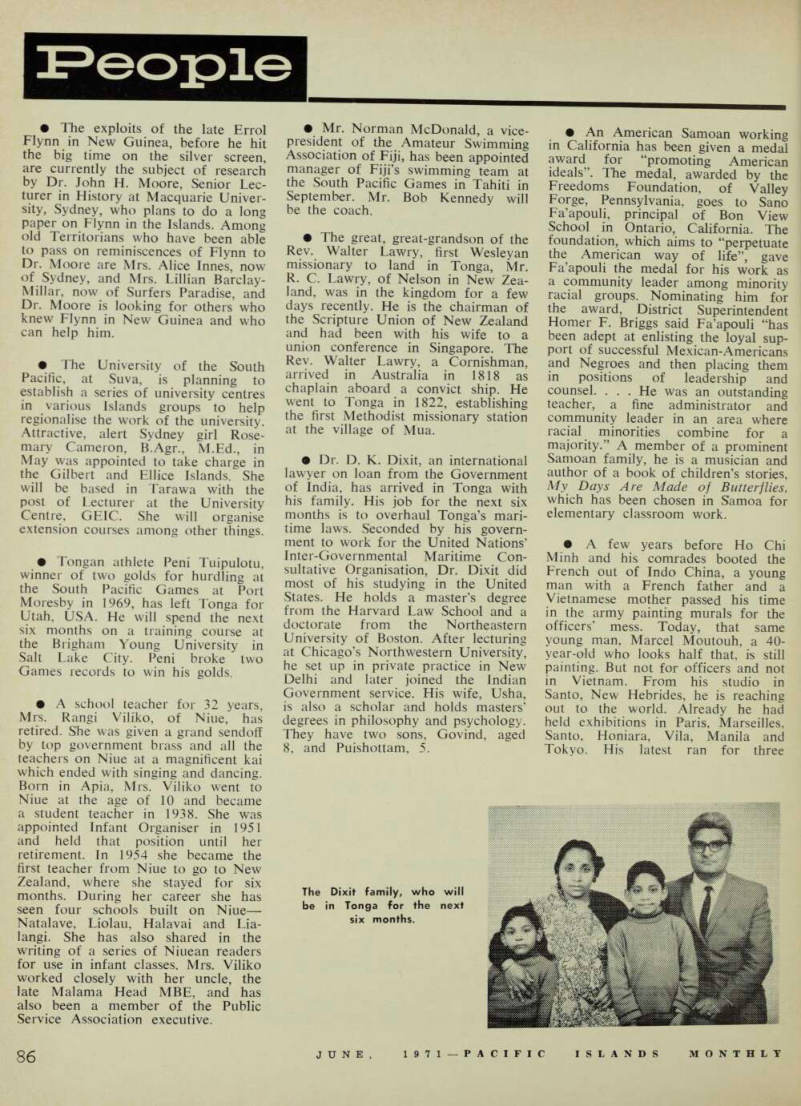 88
88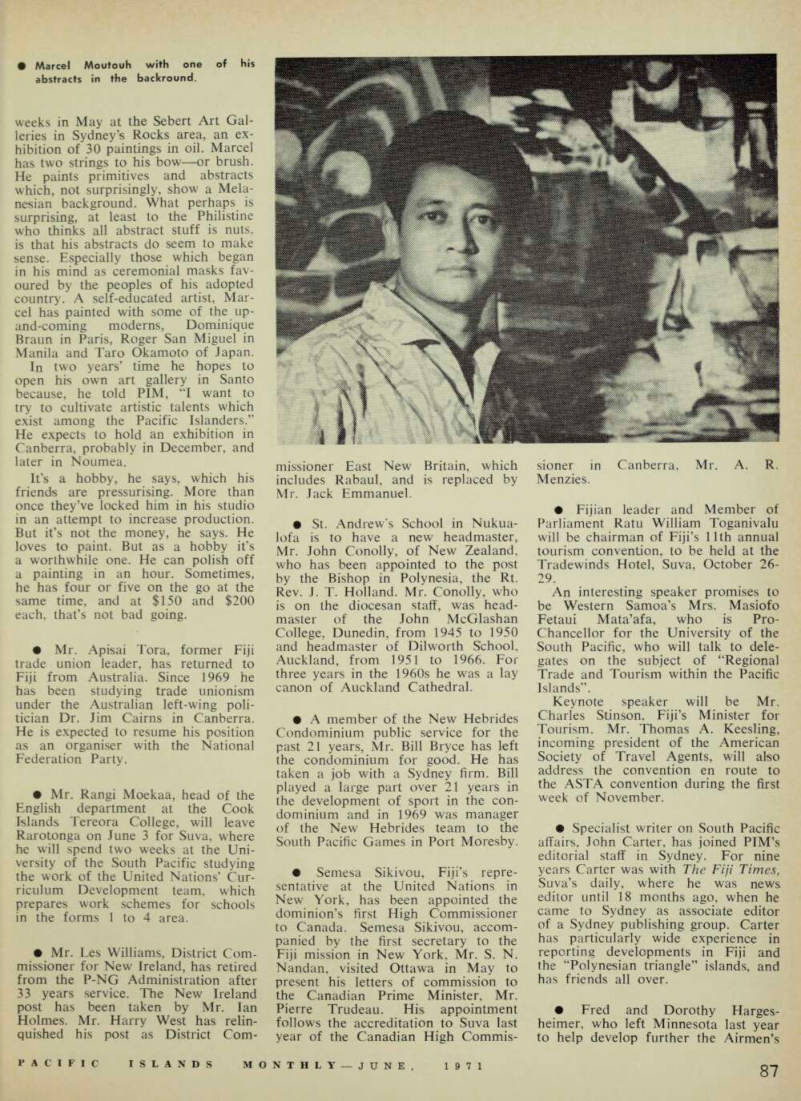 89
89 90
90 91
91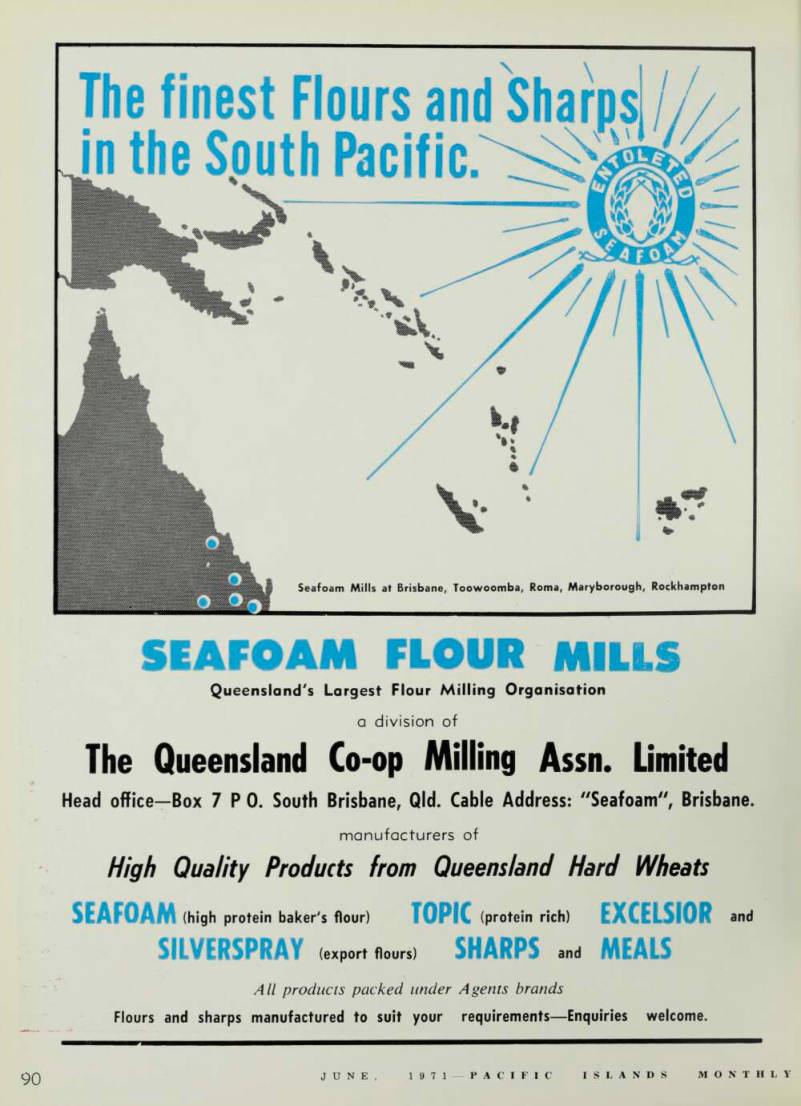 92
92 93
93 94
94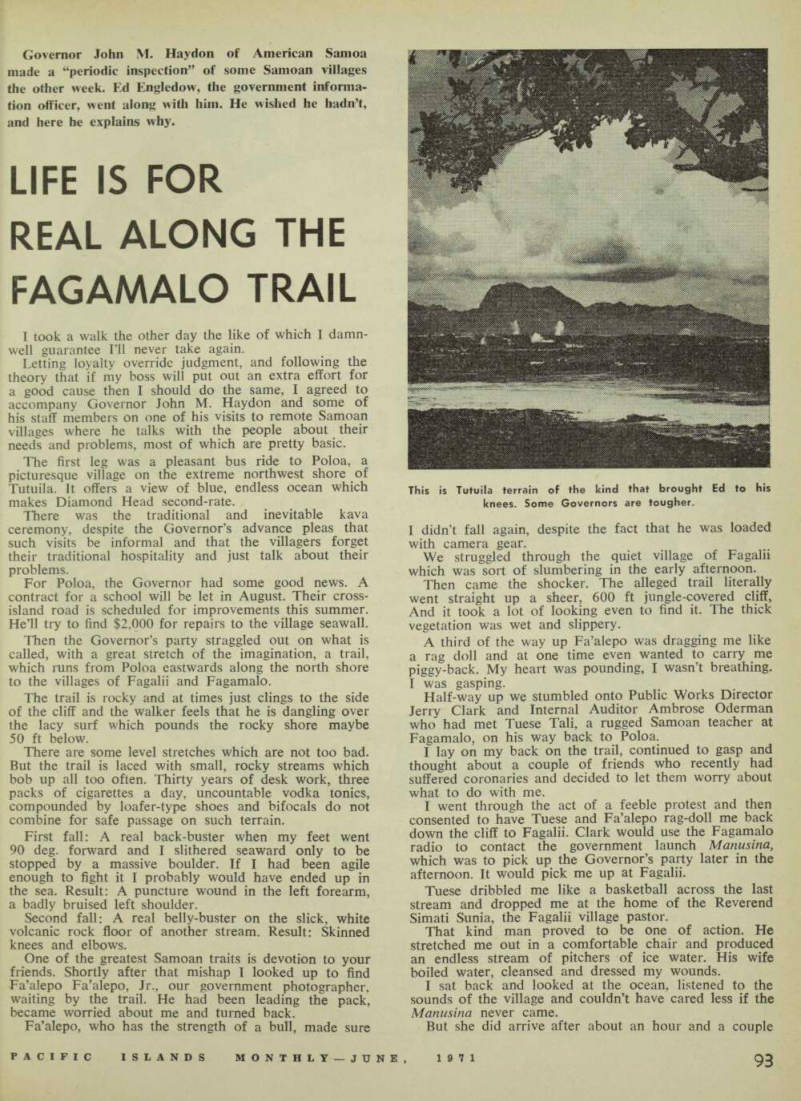 95
95 96
96 97
97 98
98 99
99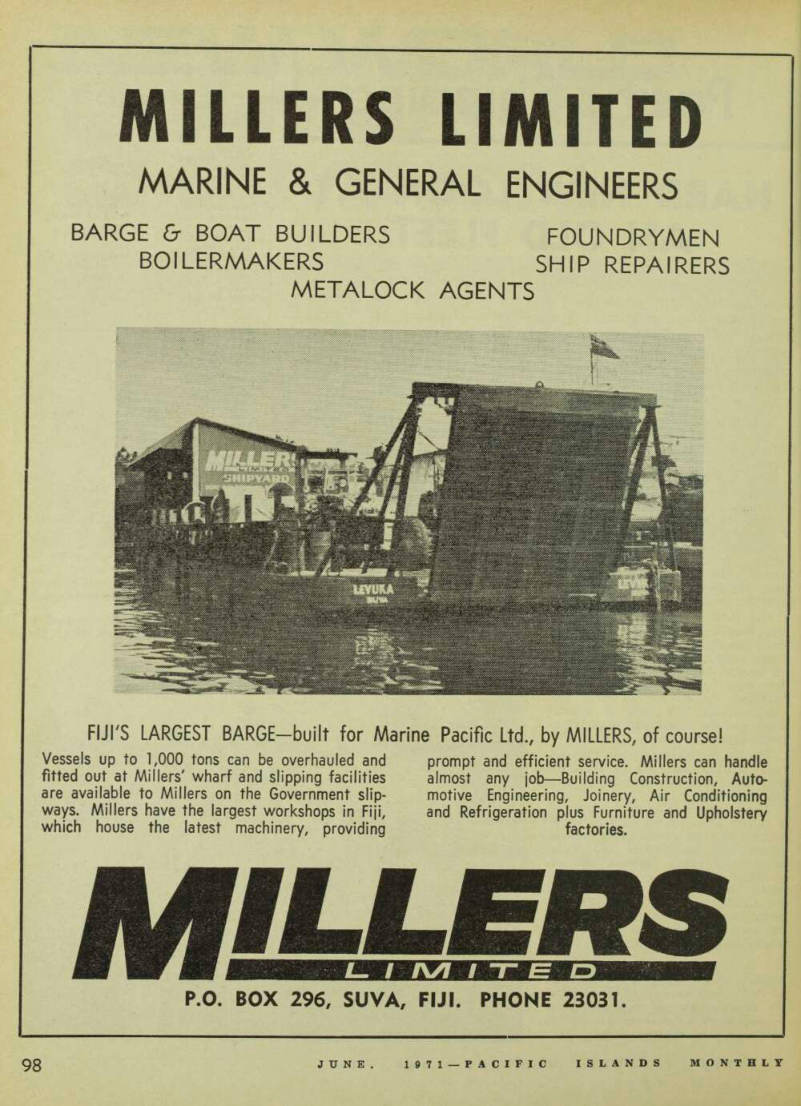 100
100 101
101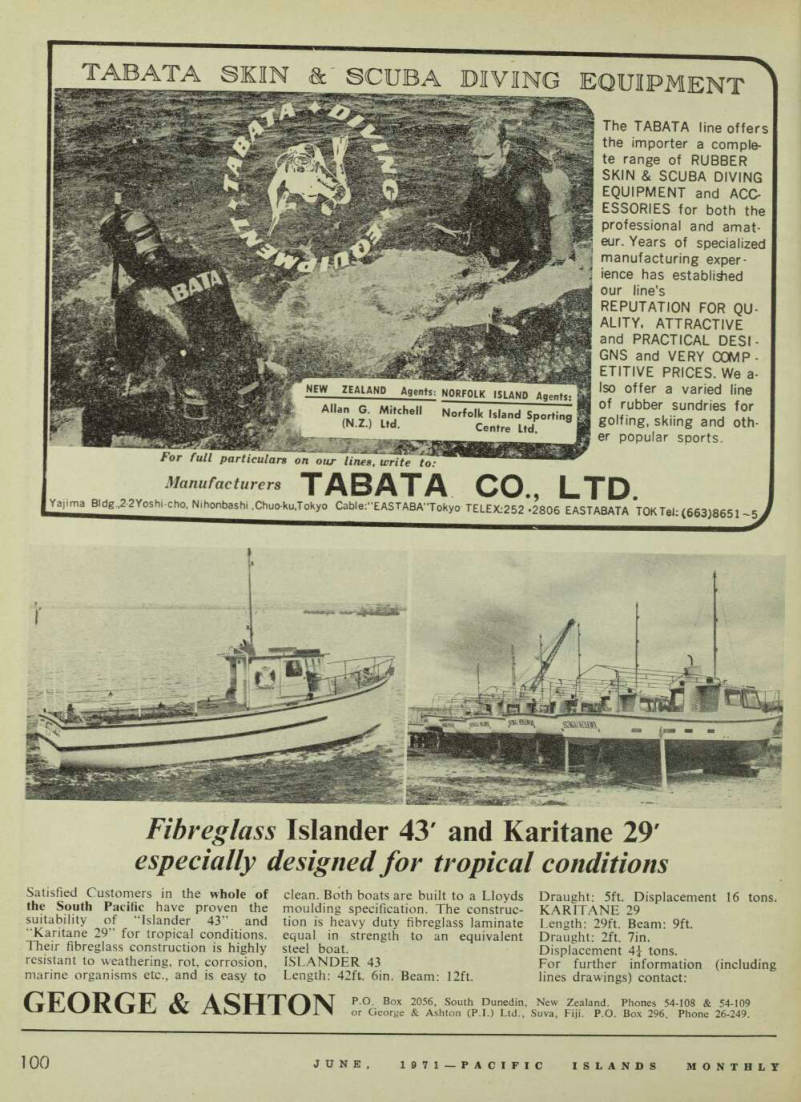 102
102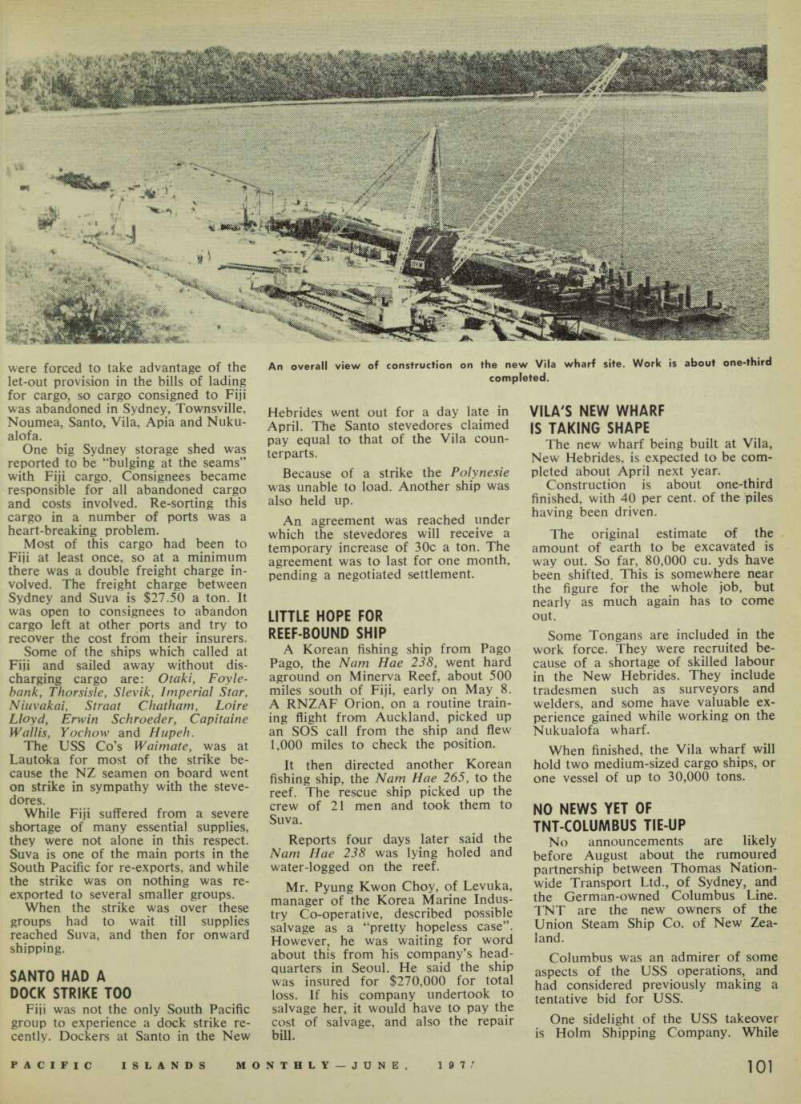 103
103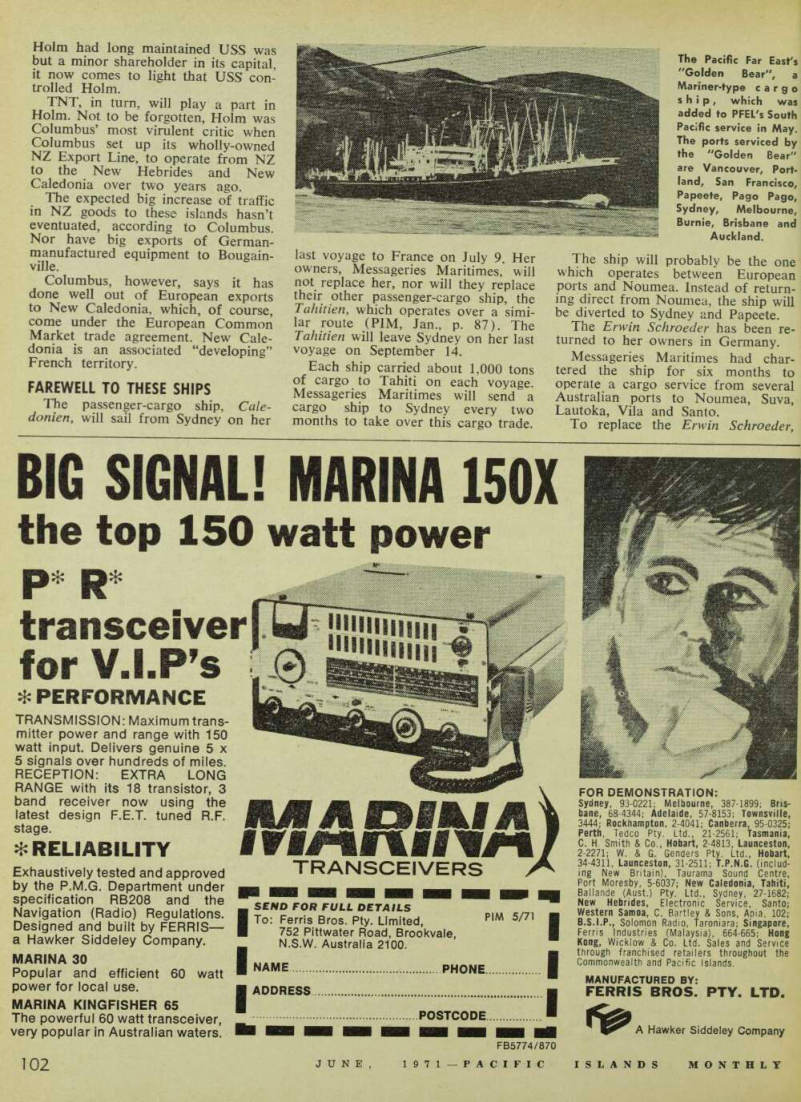 104
104 105
105 106
106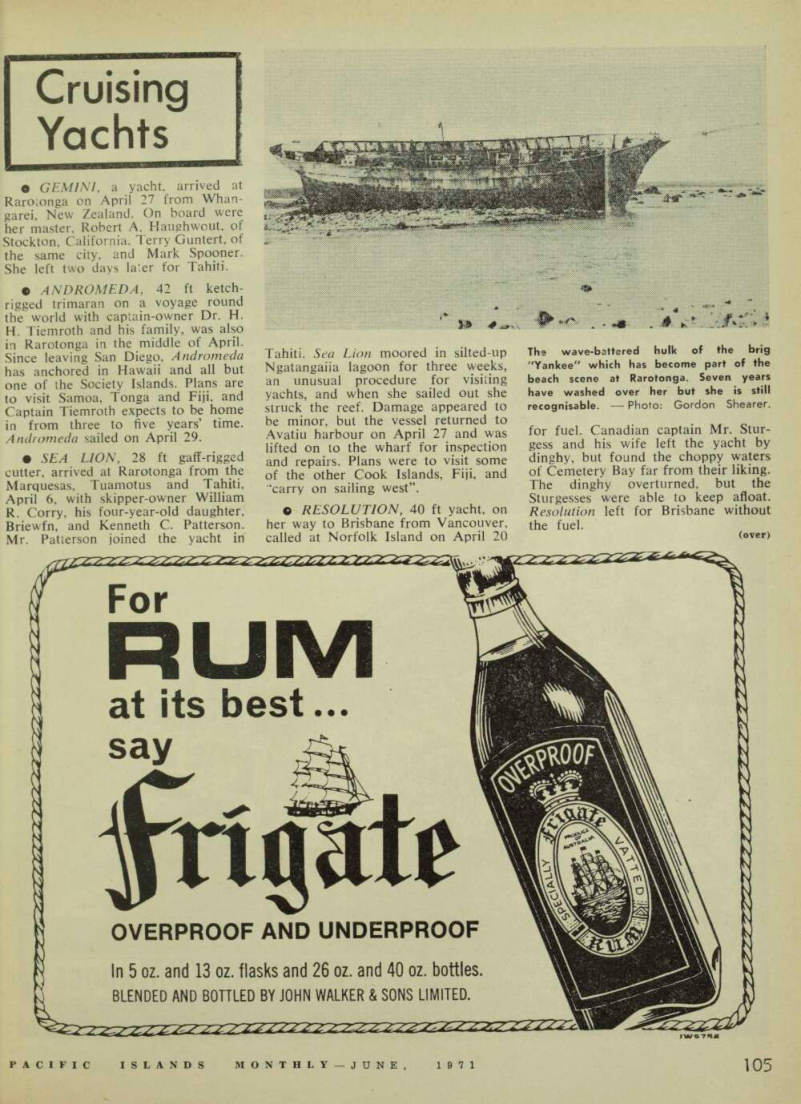 107
107 108
108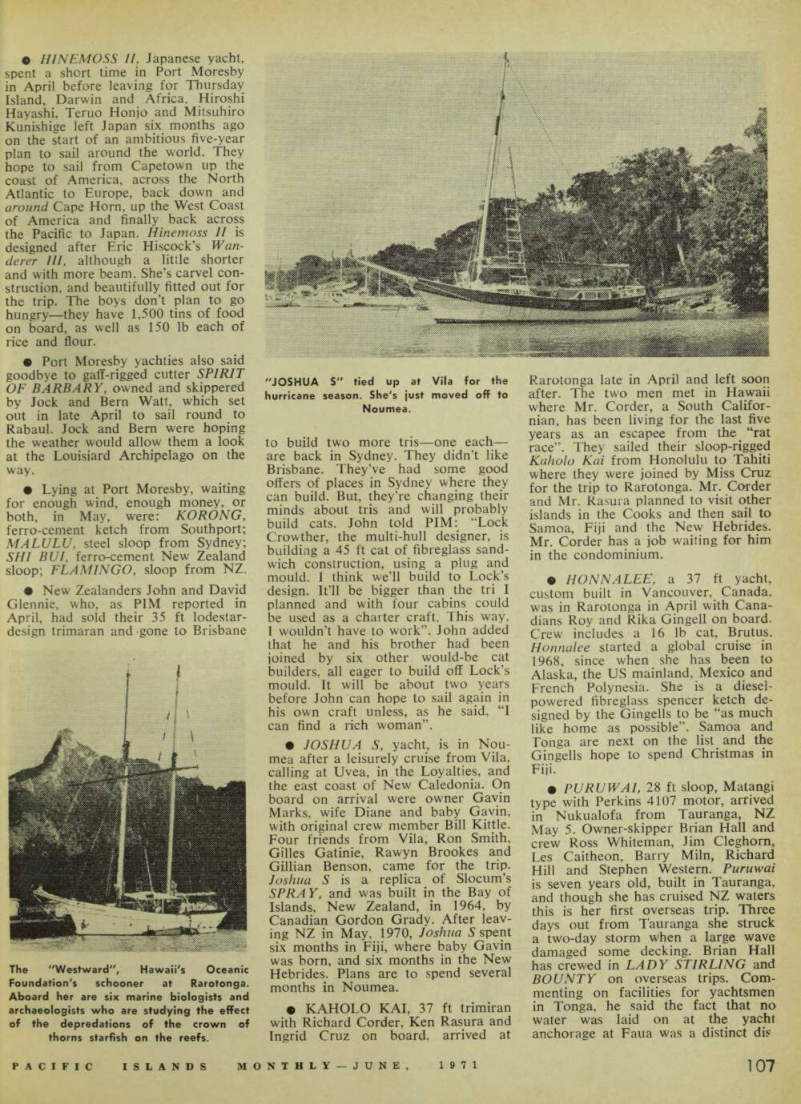 109
109 110
110 111
111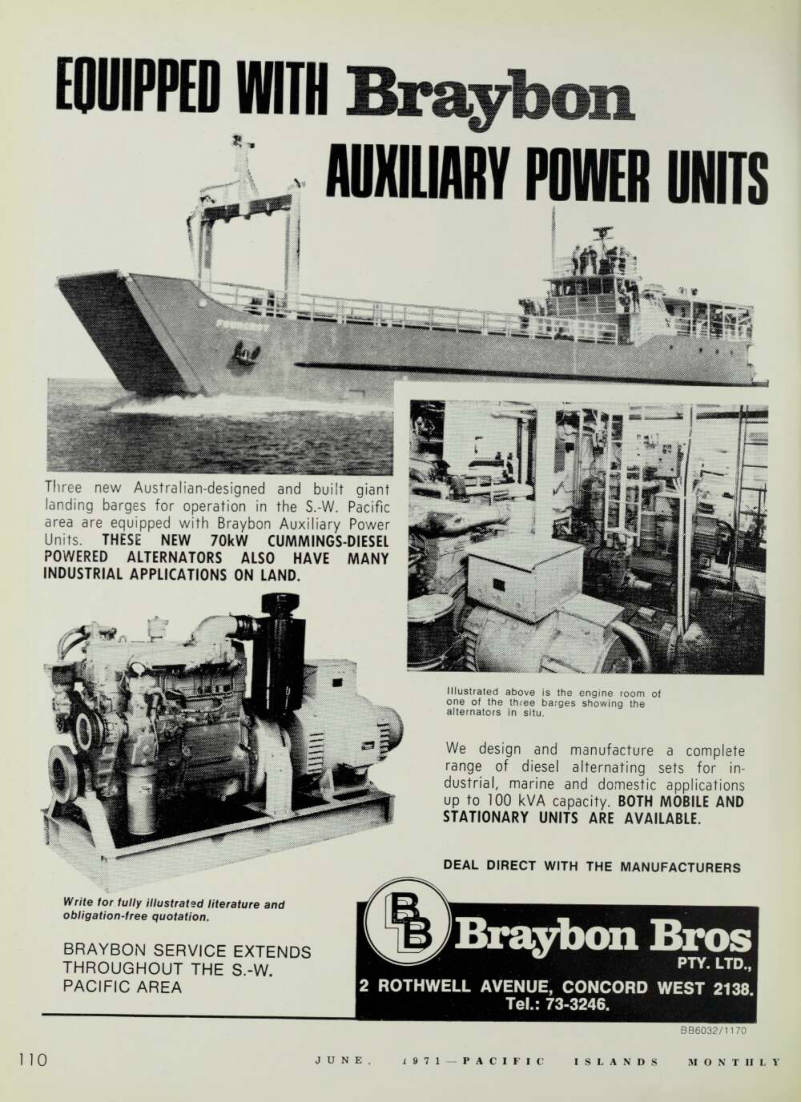 112
112 113
113 114
114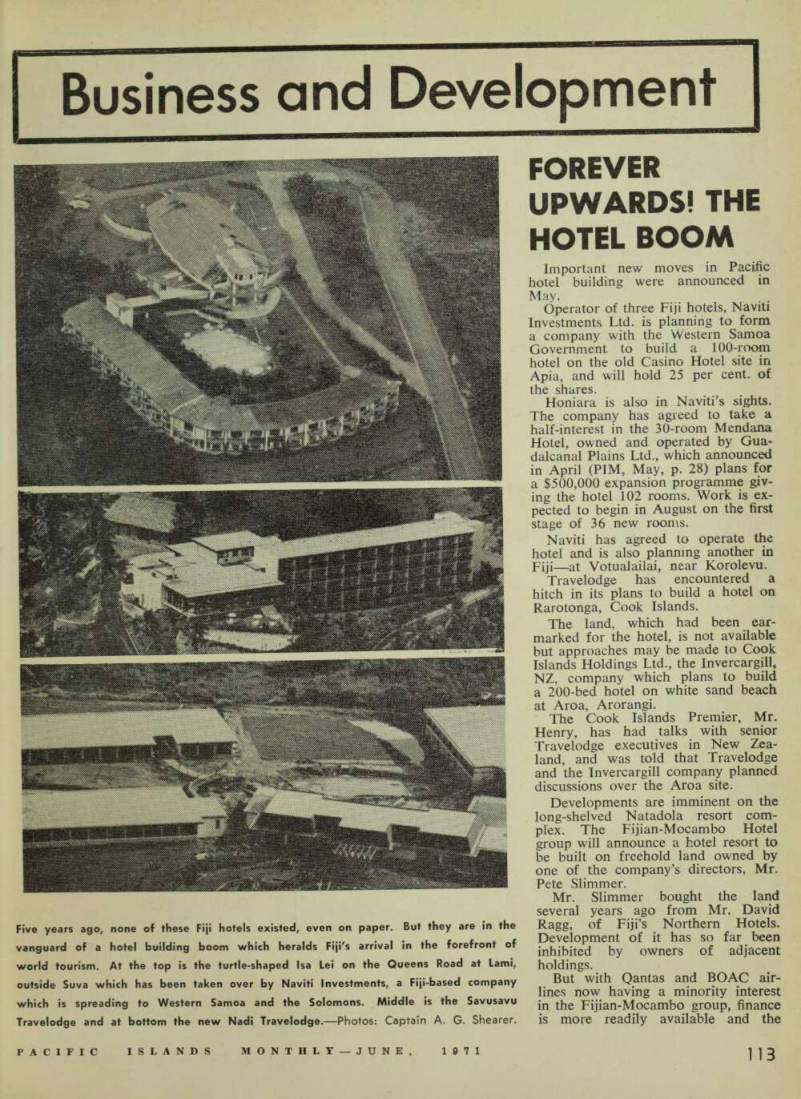 115
115 116
116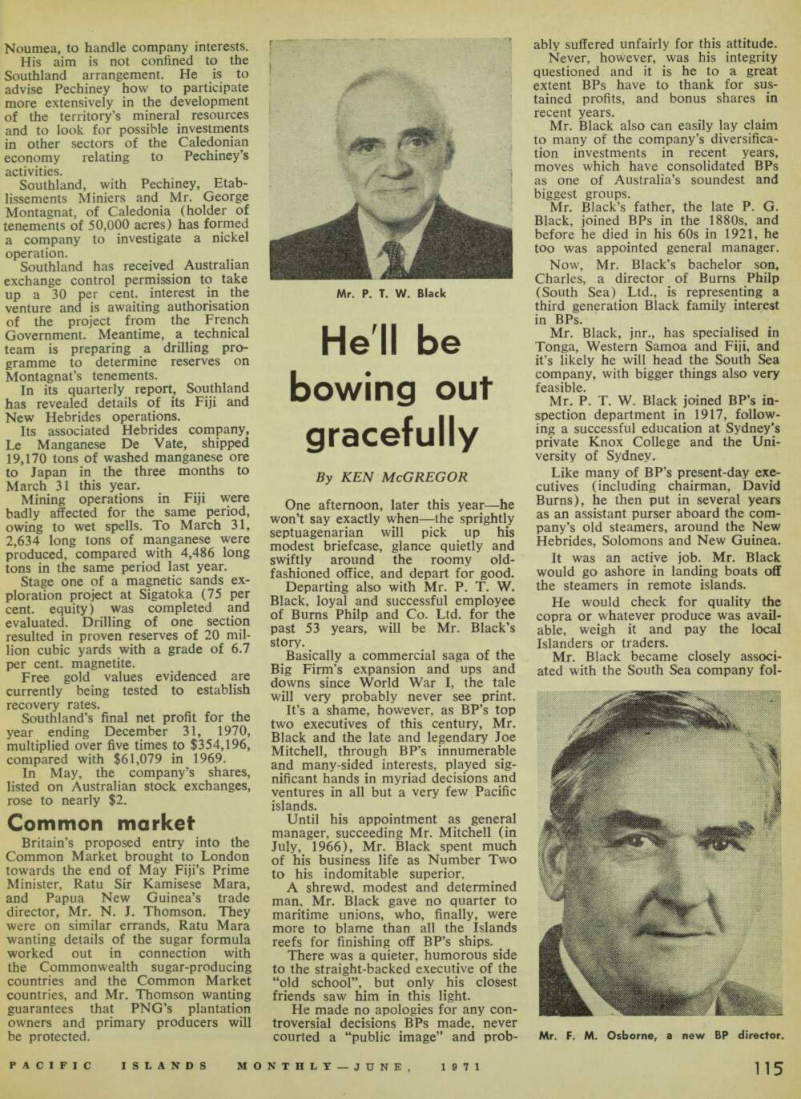 117
117 118
118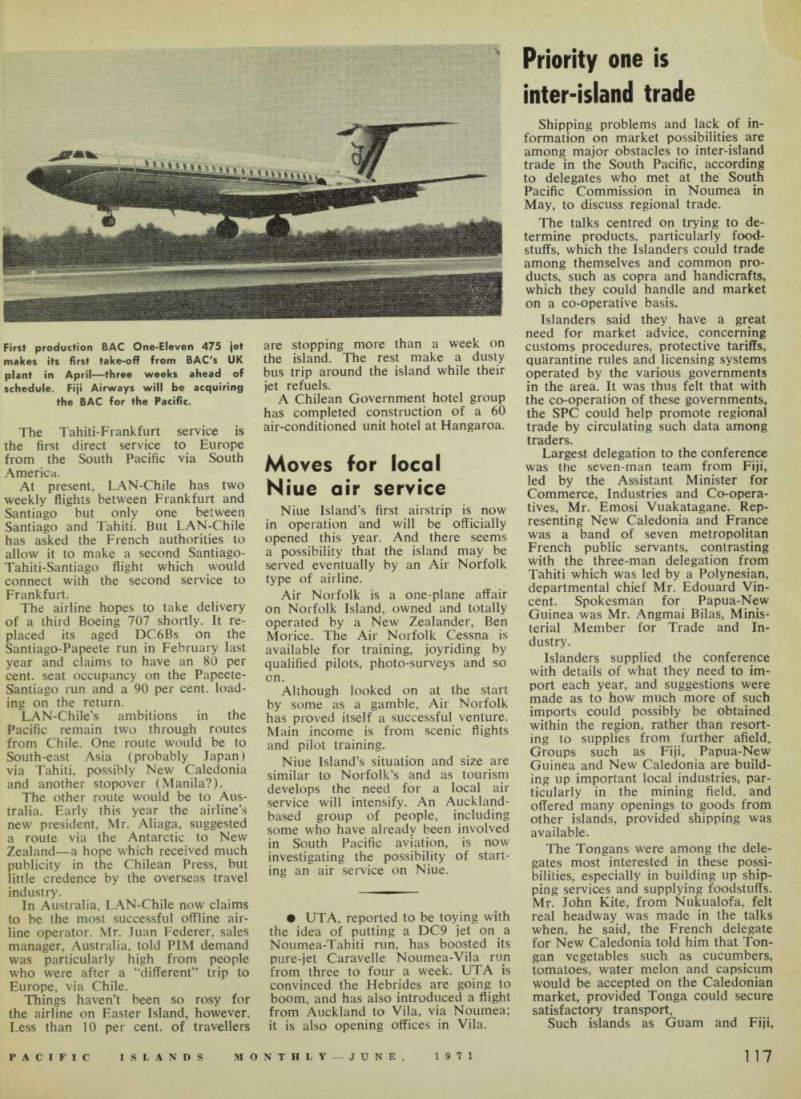 119
119 120
120 121
121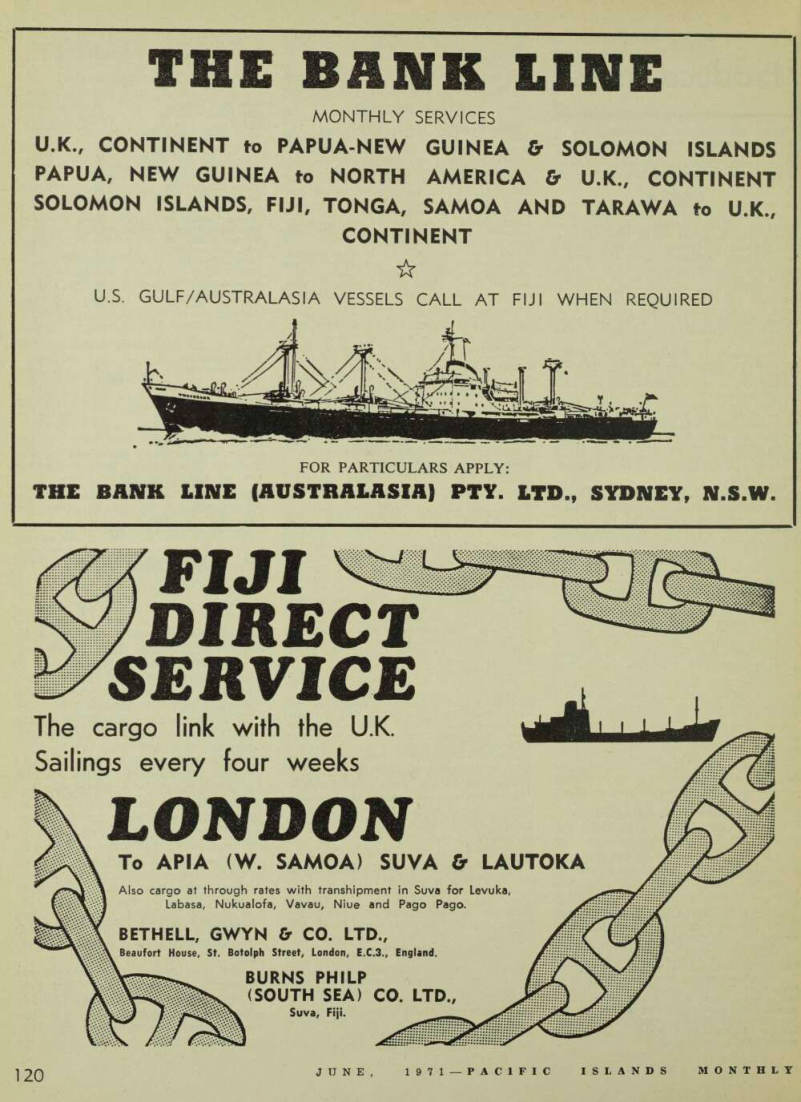 122
122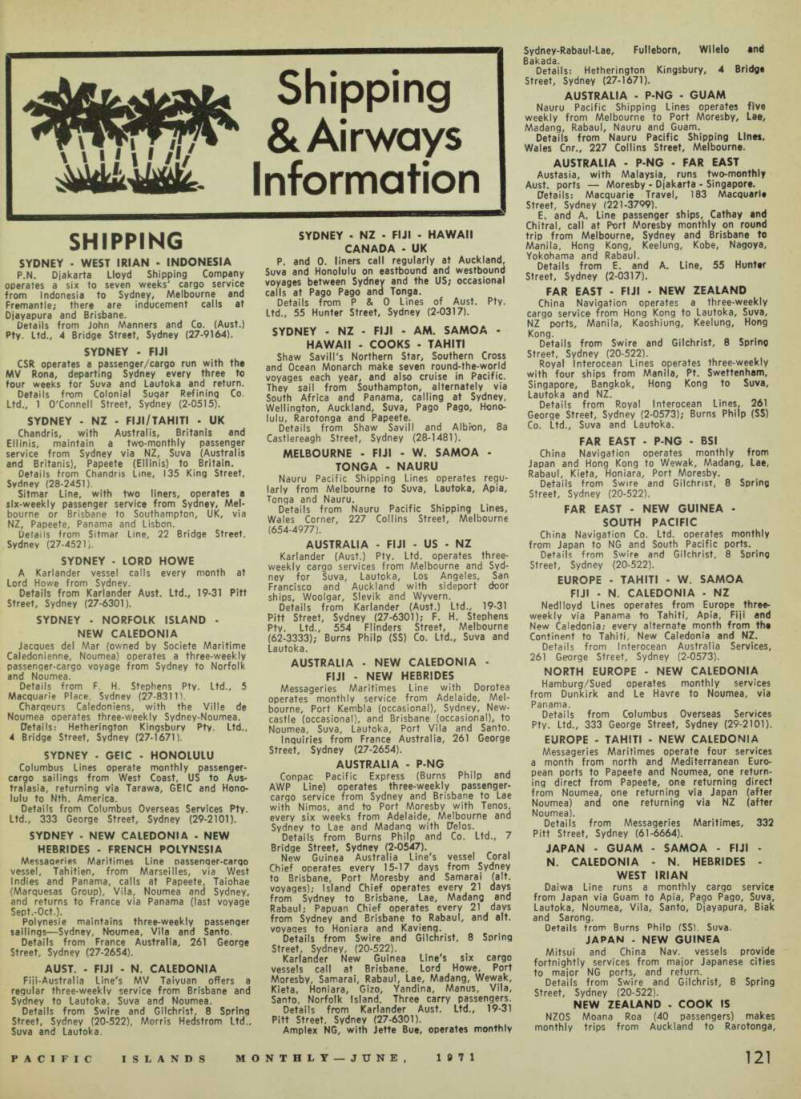 123
123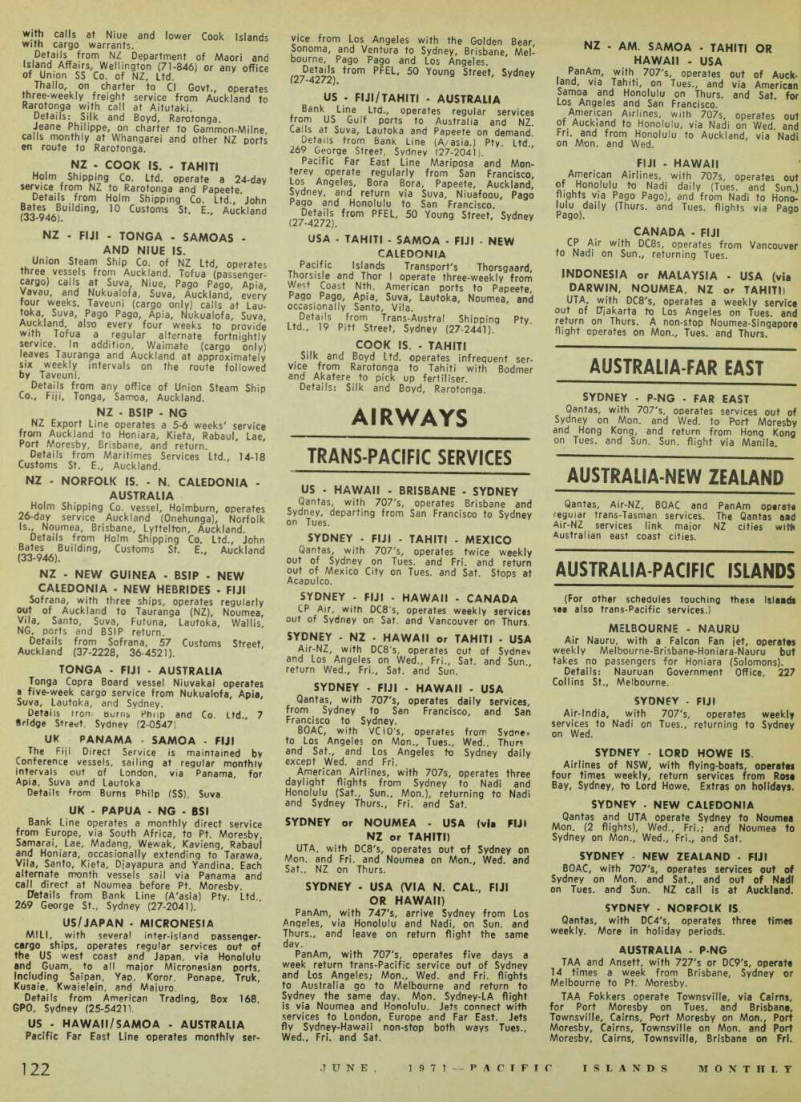 124
124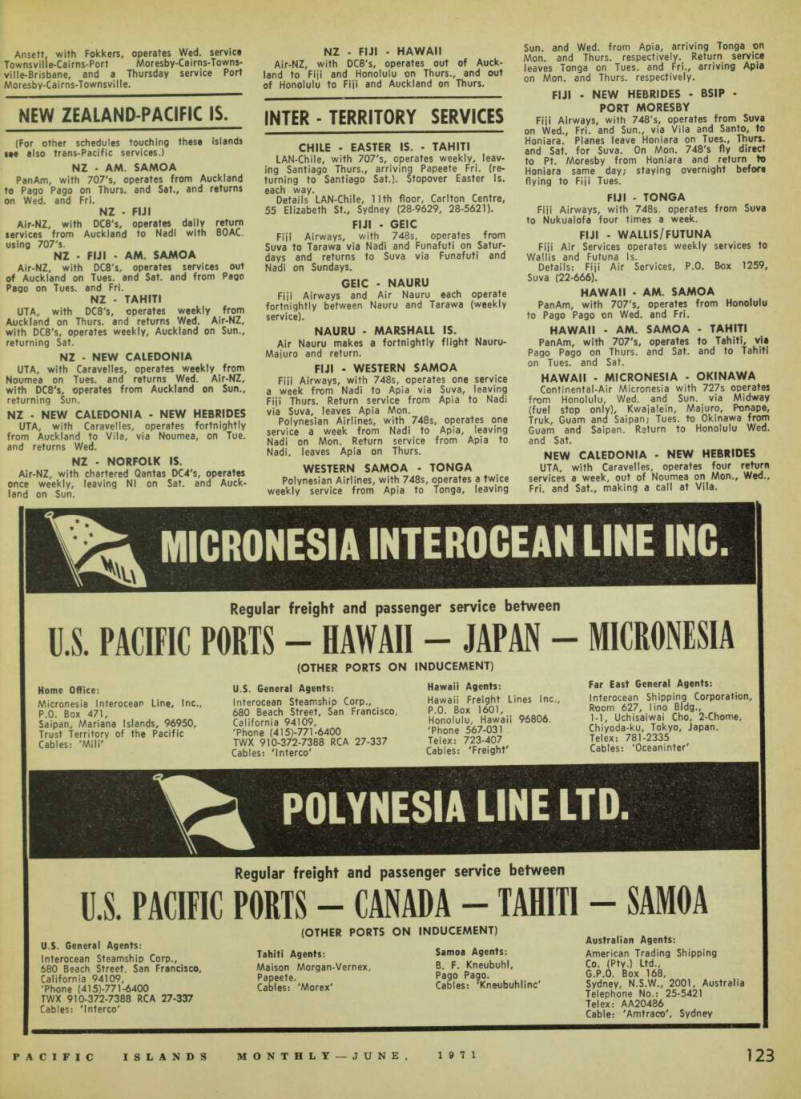 125
125 126
126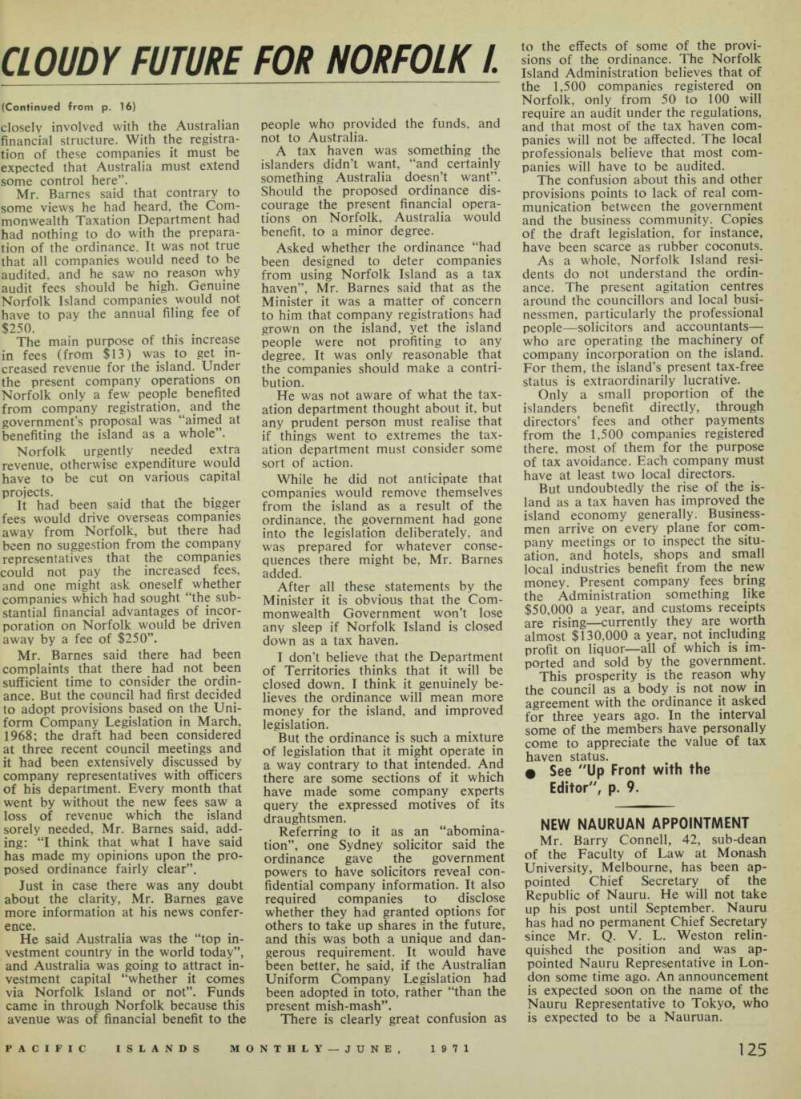 127
127 128
128 129
129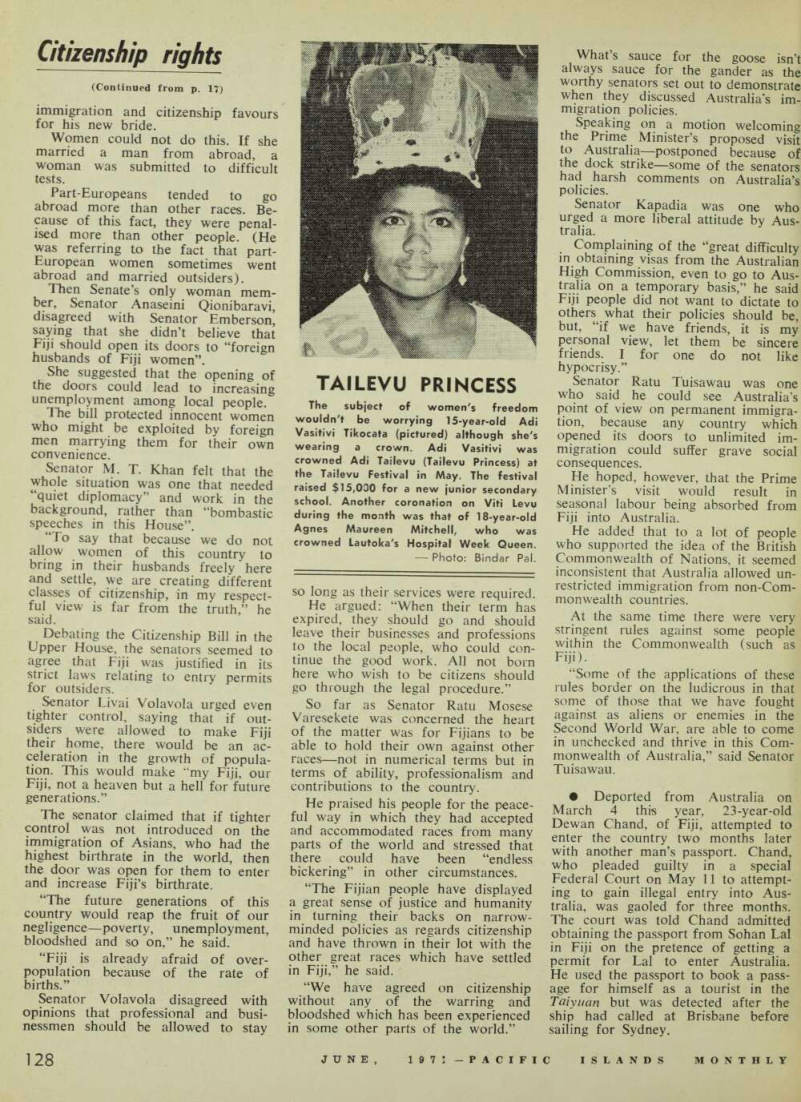 130
130 131
131 132
132 133
133 134
134 135
135 136
136 137
137 138
138 139
139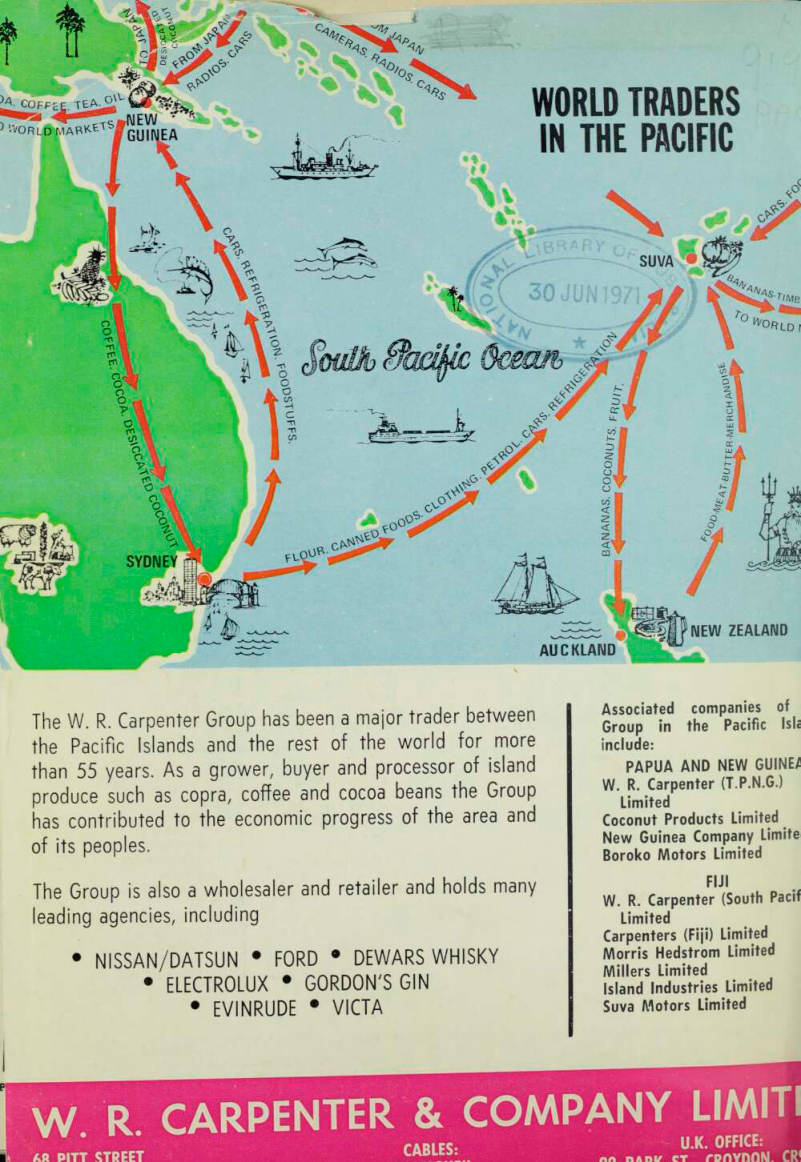 140
140