Pacific Islands Monthly


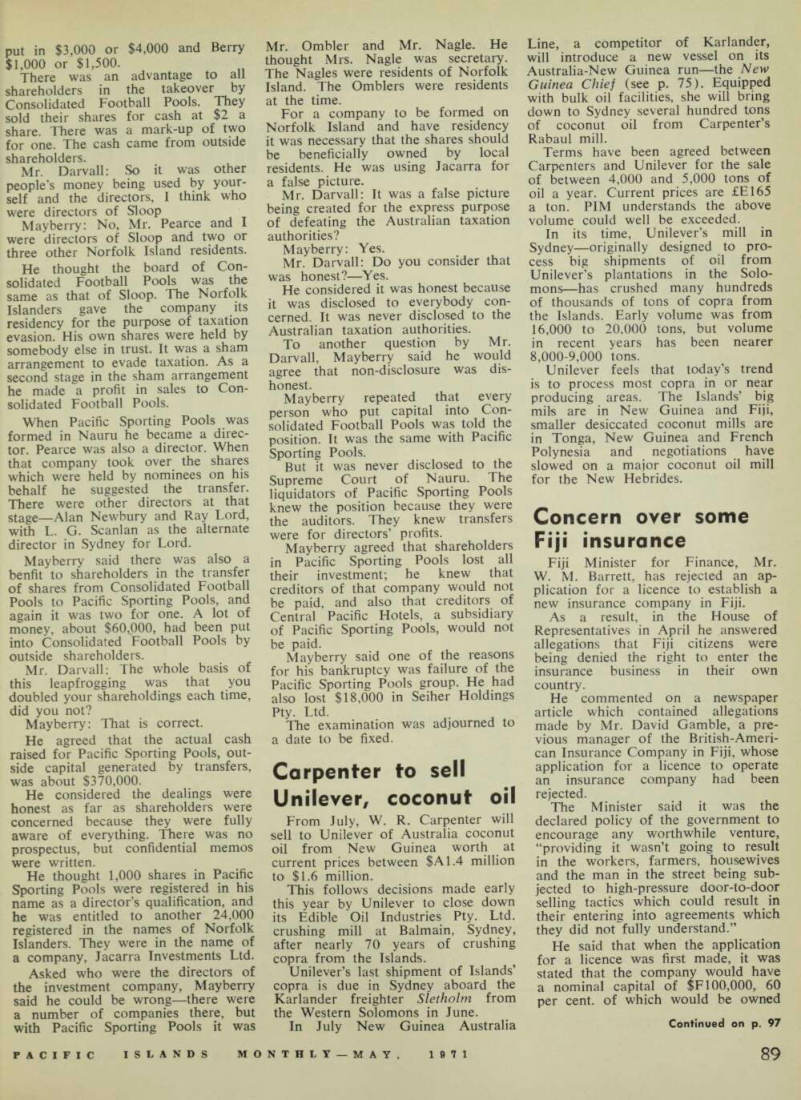
News Magazine Of The South Pacific
May, 1971
Australia, Nz, Geic, Bsip 50C
P NG, FIJI, COOKS, TONGA, W. SAMOA, N. HEBRIDES 45c
Nauru, Norfolk, Niue 45C
AMERICAN SAMOA 70c HAWAII 80c MICRONESIA 90c NEW rALEDONIA AS f*CD EDEMru b/mvuccia tc cm
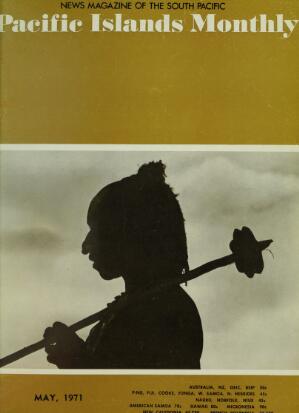
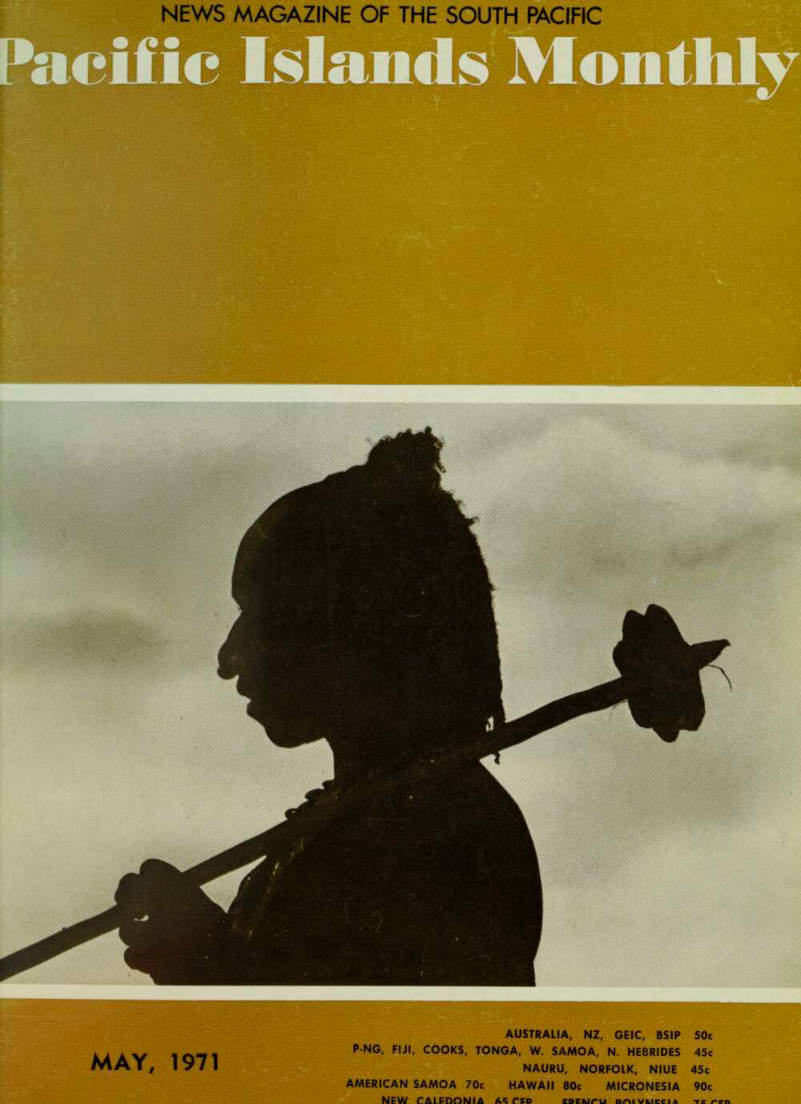
Our Cover
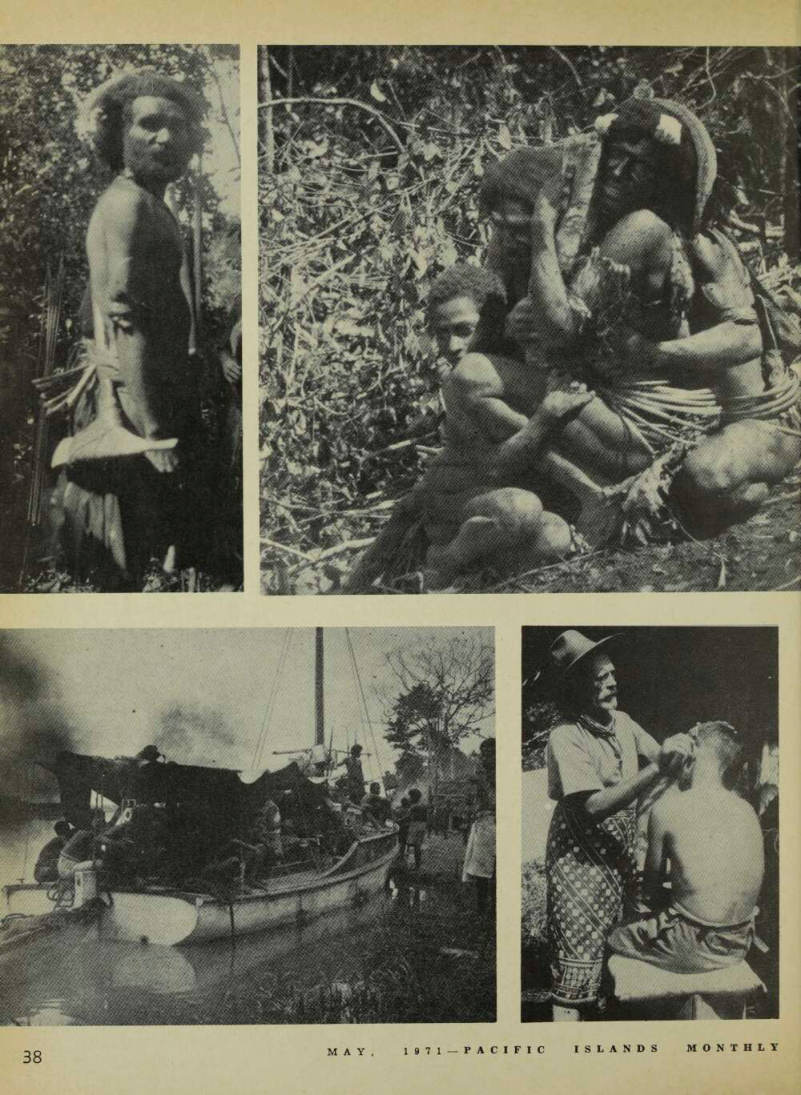
It's a slow process in some parts of New Guinea —this matter of moving from stone to steel. The Biami people of Western Papua still use stone and are still can nibals —some of them. Neville Moderate, of the P-NG Information Department, captured this warrior with his stone club in silhouette, and on pp. 82-83 his camera depicts more of the life of these
primitive people.
Advertisements & other items, pp. 2-16 (4 items)
May, 1971 Pacific Islands Month L
Mitsubishi
Pick either the sleek hardtop or stylish sedan and you are a winner.DYNA-WEDGE lines and luxurious appointments blend beautifully with the Colt Galant's snappy sports car performance. Add tothese elegant features, comfort, safety, economy—and you know what owning the Colt Galant is all about. r f a / * f
MOTORS CORPORATION
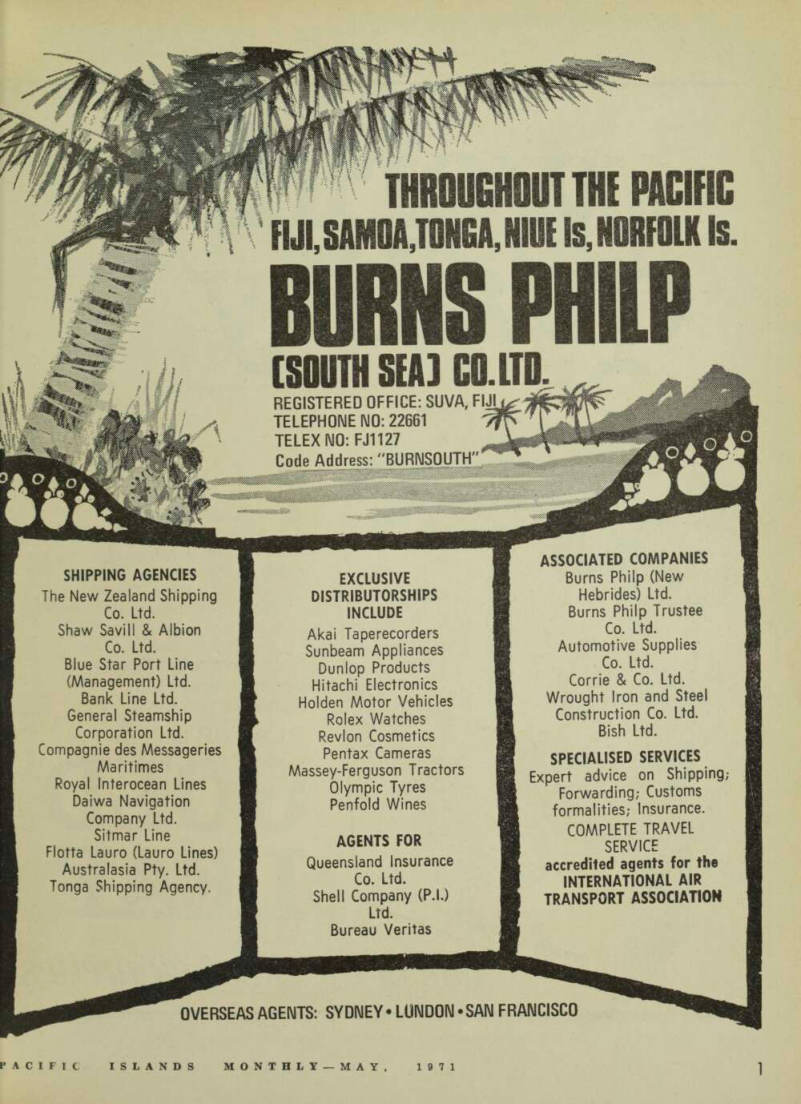
THROUGHOUT THE
NIUE IS
SAMOA.TONGA
J
■PACIFIC
NORFOLK IS.
L/\
[SOUTH SEA] CO. LTD.
REGISTERED OFFICE: SUVA, FIJJL
TELEPHONE NO: 22661
TELEX NO: FJ1127
Code Address: "BURJ^OUTTr ••
SHIPPING AGENCIES
The New Zealand Shipping Co. Ltd.
Shaw Savill & Albion Co. Ltd.
Blue Star Port Line (Management) Ltd.
Bank Line Ltd.
General Steamship Corporation Ltd.
Compagnie des Messageries Maritimes Royal Interocean Lines Daiwa Navigation Company Ltd.
Sitmar Line Flotta Lauro (Lauro Lines) Australasia Pty. Ltd.
Tonga Shipping Agency.
EXCLUSIVE
DISTRIBUTORSHIPS
INCLUDE
Akai Taperecorders Sunbeam Appliances Dunlop Products Hitachi Electronics Holden Motor Vehicles Rolex Watches Revlon Cosmetics Pentax Cameras Massey-Ferguson Tractors Olympic Tyres Penfold Wines
AGENTS FOR
Queensland Insurance Co. Ltd.
Shell Company (P. 1.) Ltd.
Bureau Veritas
ASSOCIATED COMPANIES
Burns Philp (New Hebrides) Ltd.
Burns Philp Trustee Co. Ltd.
Automotive Supplies Co. Ltd.
Corrie & Co. Ltd.
Wrought Iron and Steel Construction Co. Ltd.
Bish Ltd.
SPECIALISED SERVICES
Expert advice on Shipping,- Forwarding; Customs formalities; Insurance.
COMPLETE TRAVEL
SERVICE
accredited agents for the
INTERNATIONAL AIR
TRANSPORT ASSOCIATION
OVERSEAS AGENTS: SYDNEY • LONDON • SAN FRANCISCO
world
quality
m m. m r M m ’O u* ft si
one
Only the world’s finest Virginia tobaccos are blended to produce ...
PLAYER’S
GOLD
LEAF
of the great cigarettes
8593/2/70
A
great bunch
of flours.
Robert Hutchinson makes the greatest bunch of flours in the Pacific. Bakers’ flour.
Superlite cake and sponge flours.
Biscuit flour and cracker flour.
Wheaten sharps and wheaten meal.
We’re particularly proud of our bunch of flours. So we have a technical advisory service to help you use them properly.
So next time you see a Robert Hutchinson flour (or even one of our Hutmill stock feeds), remember it’s just one of the bunch WM.
ROBERT
HUTCHINSON
LIMITED
(he flour people
Hartington Street, Glenroy, Victoria, Australia. 3046. Telephone Melbourne 306 7261 rhio2
Adding up
Bougainville Copper.
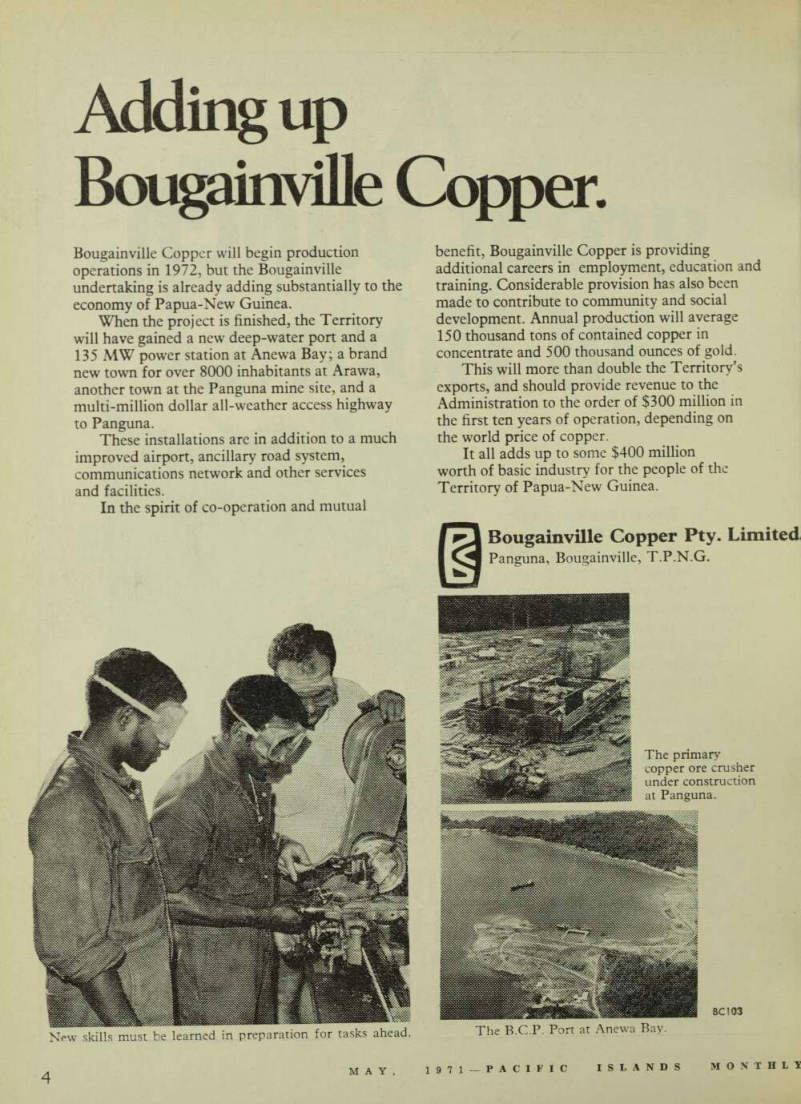
Bougainville Copper will begin production operations in 1972, but the Bougainville undertaking is already adding substantially to the economy of Papua-New Guinea.
When the project is finished, the Territory will have gained a new deep-water port and a 135 MW power station at Anewa Bay; a brand new town for over 8000 inhabitants at Arawa, another town at the Panguna mine site, and a multi-million dollar all-weather access highway to Panguna.
These installations are in addition to a much improved airport, ancillary road system, communications network and other services and facilities.
In the spirit of co-operation and mutual benefit, Bougainville Copper is providing additional careers in employment, education and training. Considerable provision has also been made to contribute to community and social development. Annual production will average 150 thousand tons of contained copper in concentrate and 500 thousand ounces of gold.
This will more than double the Territory’s exports, and should provide revenue to the Administration to the order of $3OO million in the first ten years of operation, depending on the world price of copper.
It all adds up to some $4OO million worth of basic industry for the people of the Territory of Papua-New Guinea.
Bougainville Copper Pty. Limited
Panguna, Bougainville, T.P.N.G. m * Pi The primary copper ore crusher under construction at Panguna.
BCIO3
New skills must be learned in preparation for tasks ahead.
The B.C.P. Port at Anewa Bay.
ir the big-mouthed
arge they specified
JMMINS POWER!
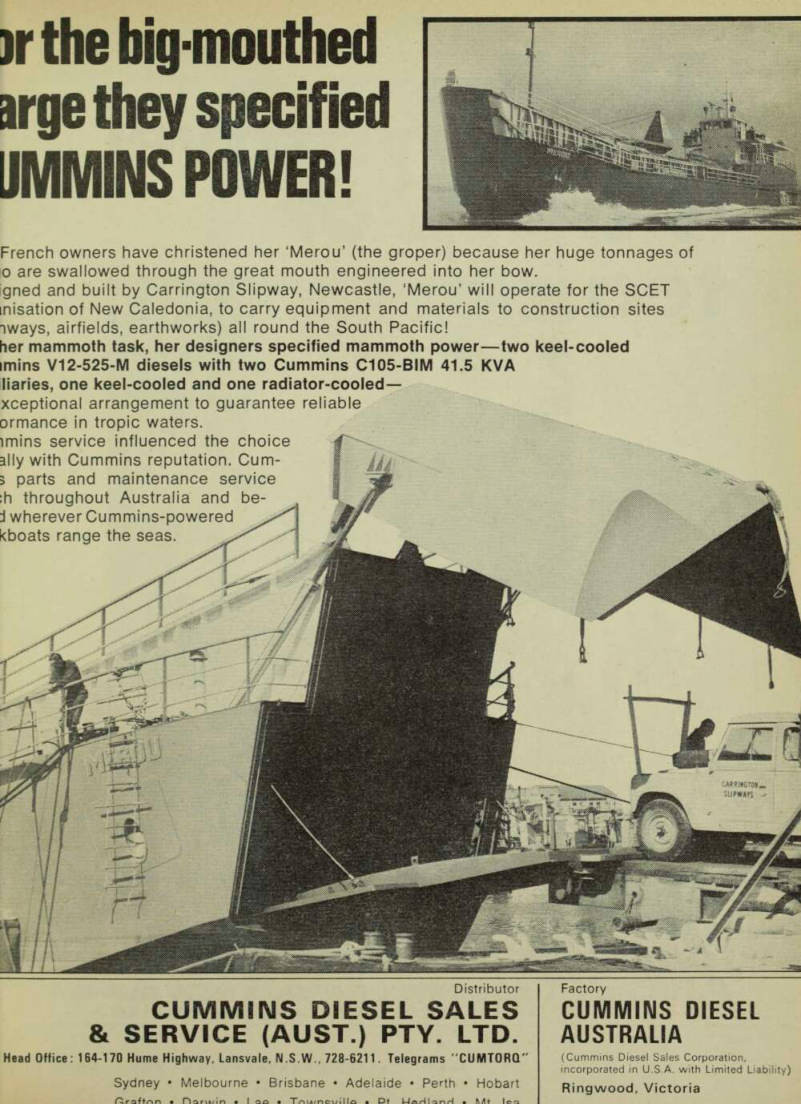
k im French owners have christened her ‘Merou’ (the groper) because her huge tonnages of o are swallowed through the great mouth engineered into her bow. igned and built by Carrington Slipway, Newcastle, ‘Merou’ will operate for the SCET misation of New Caledonia, to carry equipment and materials to construction sites iways, airfields, earthworks) all round the South Pacific! her mammoth task, her designers specified mammoth power—two keel-cooled imins Vl2-525-M diesels with two Cummins ClO5-BIM 41.5 KVA liaries, one keel-cooled and one radiator-cooled— xceptional arrangement to guarantee reliable ormance in tropic waters, imins service influenced the choice ally with Cummins reputation. Cum- parts and maintenance service :h throughout Australia and bell wherever Cummins-powered kboats range the seas.
T~ 'ZZ~ m f -
Territory travel
is a cup of
tea
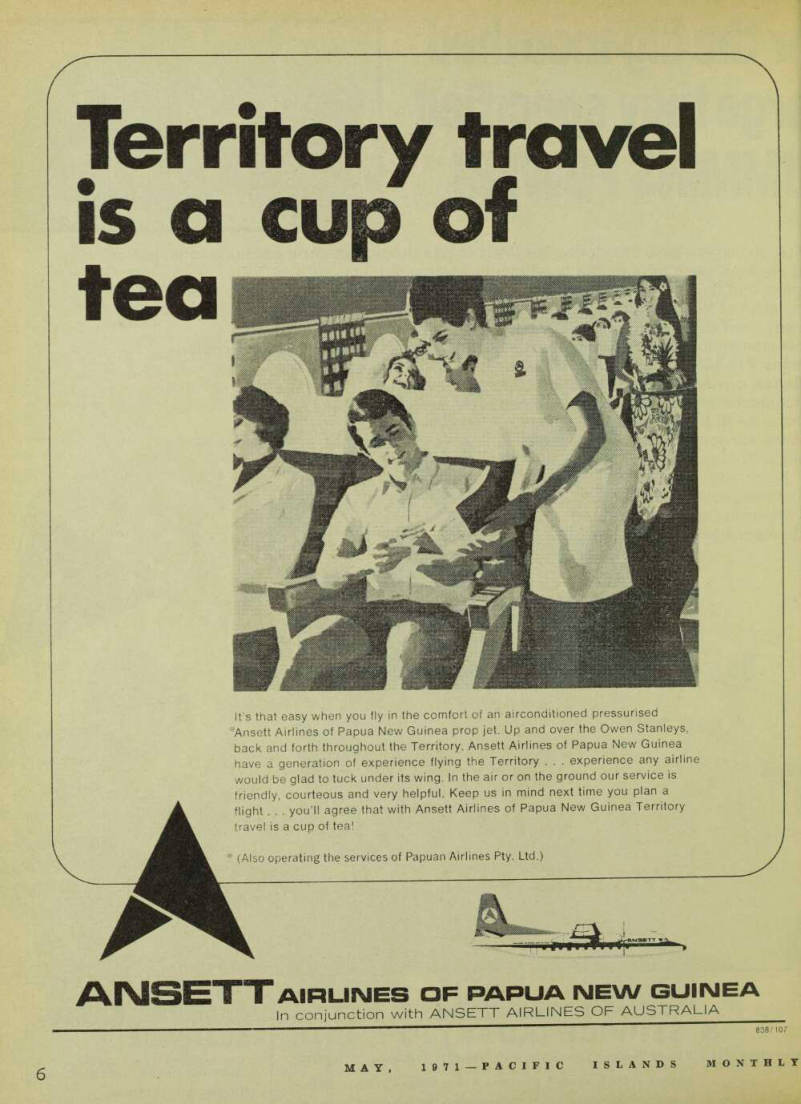
P m m- ■ V f «'*• ■ It s that easy when you fly in the comfort of an airconditioned pressurised Ansett Airlines of Papua New Guinea prop jet. Up and over the Owen Stanleys, back and forth throughout the Territory. Ansett Airlines of Papua New Guinea have a generation of experience flying the Territory . . . experience any airline would be glad to tuck under its wing. In the air or on the ground our service is friendly, courteous and very helpful. Keep us in mind next time you plan a flight . . . you’ll agree that with Ansett Airlines of Papua New Guinea Territory travel is a cup of tea! * (Also operating the services of Papuan Airlines Pty. Ltd.)
ANSETT AIRLINES OF PAPUA NEW GUINEA
In conjunction with ANSETT AIRLINES OF AUSTRALIA 838/107
AV CXHMTENTS 50 MADE IN AUSTRALIA
Brymay
Waterproof matches
sill - :
mmm'm
Bright new label
and still the only matches in
the world that light when wet.
Greenlites are made for your part of the world.
They’re tropical matches —waterproof matches.
Ask for them.
MADE IN AUSTRALIA BY BRYANT & MAY • M23P
TABATA SKIN & SCUBA DIVING EQUIPMENT
Jl A ?#■■■ 1
NORFOLK ISLAND Agents;
Norfolk Island Sporting Centre Ltd.
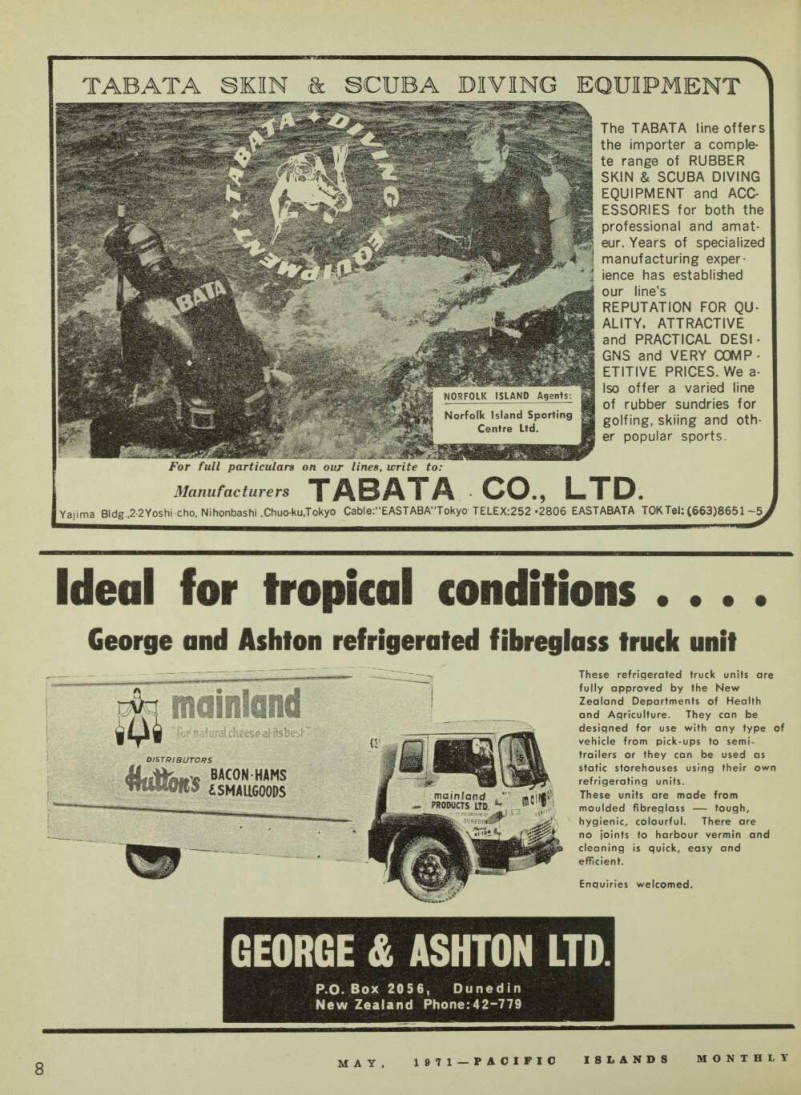
The TABATA line offers the importer a complete range of RUBBER
SKIN & SCUBA DIVING
EQUIPMENT and ACC-
ESSORIES for both the professional and amateur. Years of specialized manufacturing experience has establidied our line’s
REPUTATION FOR QU-
ALITY. ATTRACTIVE
and PRACTICAL DESI-
GNS and VERY COMP-
ETITIVE PRICES. We a-
Iso offer a varied line of rubber sundries for golfing, skiing and other popular sports.
For full particulars on our lines, write to:
Manufacturers TABATA CO., LTD.
Yajima 81dg.,2-2Yoshi-cho. Nihonbashi ,Chuo-ku,Tokyo Cable;" EAST ABA’ Tokyo' TELEX:2S2 *2806 EASTABATA TOKTeI: (663)8651 —sj
Ideal for tropical conditions . . . .
George and Ashton refrigerated fibreglass truck unit
‘•for* natural cheese at ilsbesF- '
DISTRIBUTORS
&SMMLGOODS
mainland "
PRODUCTS LTD. W 5 *
These refrigerated truck units are fully approved by the New Zealand Departments of Health and Agriculture. They can be designed for use with any type of vehicle from pick-ups to semitrailers or they can be used as static storehouses using their own refrigerating units.
These units are made from moulded fibreglass tough, hygienic, colourful. There are no joints to harbour vermin and cleaning is guick, easy and efficient.
Enguiries welcomed.
GEORGE & ASHTON LTD.
P.O. Box 2056, Dunedin New Zealand Phone:42-779
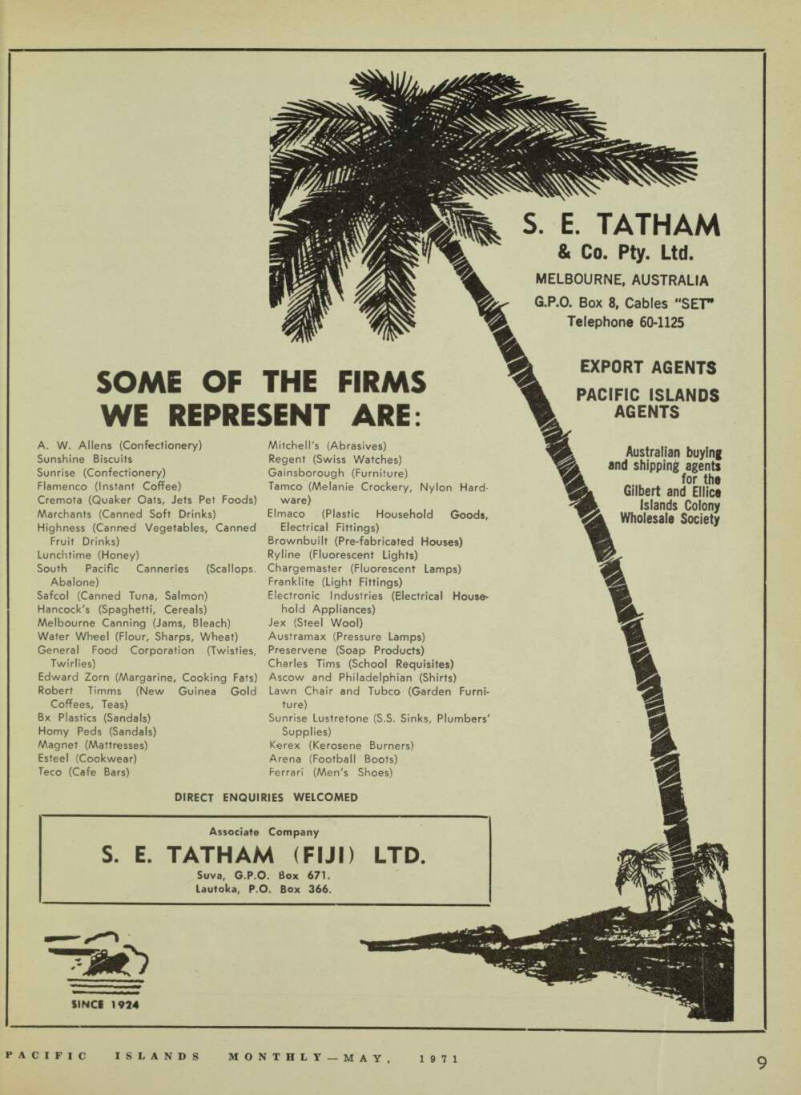
SOME OF THE FIRMS
WE REPRESENT ARE:
A. W. Allens (Confectionery) Sunshine Biscuits Sunrise (Confectionery) Flamenco (Instant Coffee) Cremota (Quaker Oats, Jets Pet Foods) AAarchants (Canned Soft Drinks) Highness (Canned Vegetables, Canned Fruit Drinks) Lunchtime (Honey) South Pacific Canneries (Scallops.
Abalone) Safcol (Canned Tuna, Salmon) Hancock's (Spaghetti, Cereals) Melbourne Canning (Jams, Bleach) Water Wheel (Flour, Sharps, Wheat) General Food Corporation (Twisties, Twirlies) Edward Zorn (Margarine, Cooking Fats) Robert Timms (New Guinea Gold Coffees, Teas) Bx Plastics (Sandals) Homy Peds (Sandals) Magnet (Mattresses) Esteel (Cookwear) Teco (Cafe Bars) Mitchell's (Abrasives) Regent (Swiss Watches) Gainsborough (Furniture) Tamco (Melanie Crockery, Nylon Hardware) Elmaco (Plastic Household Goods, Electrical Fittings) Brownbuilt (Pre-fabricated Houses) Ryline (Fluorescent Lights) Chargemaster (Fluorescent Lamps) Franklite (Light Fittings) Electronic Industries (Electrical Household Appliances) Jex (Steel Wool) Austramax (Pressure Lamps) Preservene (Soap Products) Charles Tims (School Requisites) Ascow and Philadelphian (Shirts) Lawn Chair and Tubco (Garden Furniture) Sunrise Lustretone (S.S. Sinks, Plumbers' Supplies) Kerex (Kerosene Burners) Arena (Football Boots) Ferrari (Men's Shoes)
S. E. TATHAM
& Co. Pty. Ltd.
MELBOURNE, AUSTRALIA
G.P.O. Box 8, Cables “SET Telephone 60-1125
EXPORT AGENTS
PACIFIC ISLANDS
AGENTS
Australian buying and shipping agents . for the Gilbert and Ellice — > Islands Colony yak Wholesale Society i i
DIRECT ENQUIRIES WELCOMED
Associate Company
S. E. TATHAM (FIJI) LTD,
Suva, G.P.O. Box 671.
Lautoka, P.O. Box 366.
SINCE 1924
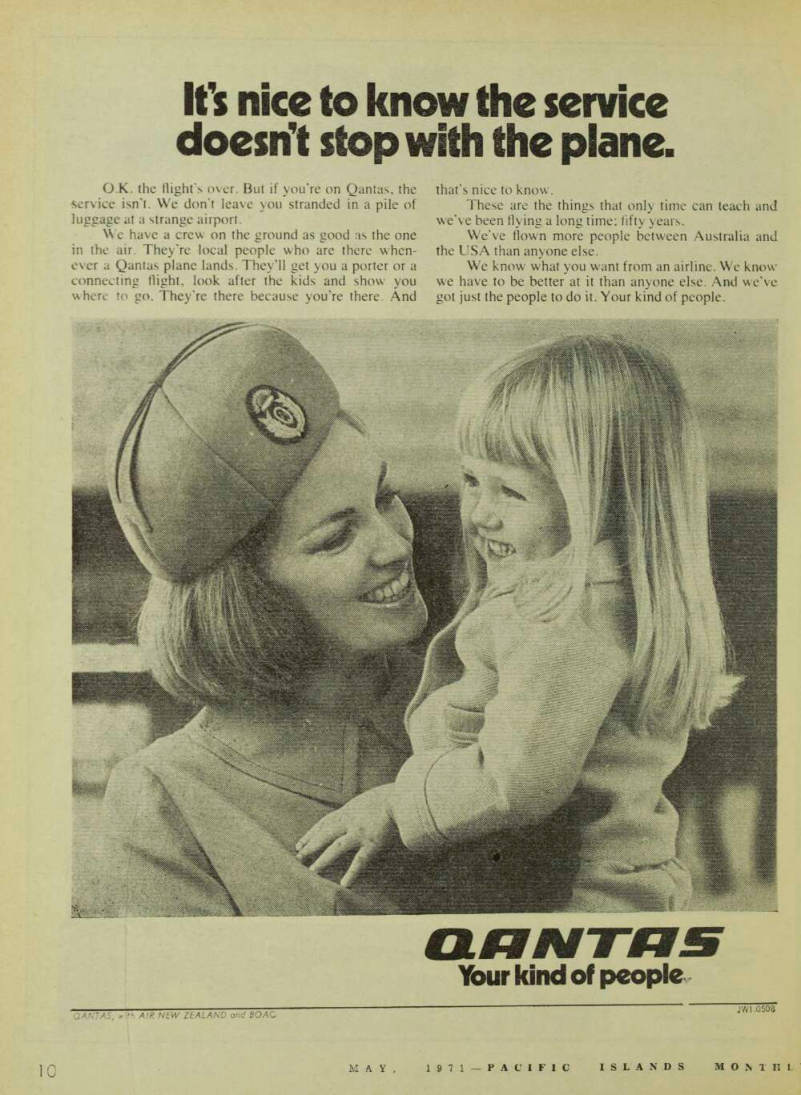
It's nice to know die service
doesn't stop with the plane.
O.K. the flight's over. But if you're on Qantas, the service isn't. We don't leave you stranded in a pile of luggage at a strange airport.
We have a crew on the ground as good as the one in the air. They're local people who are there whenever a Qantas plane lands. They’ll get you a porter or a connecting flight, look after the kids and show you where to go. They're there because you’re there. And that's nice to know.
These are the things that only time can teach and we've been flying a long time; fifty years.
We've flown more people between Australia and the USA than anyone else.
We know what you want from an airline. We know' we have to be better at it than anyone else. And we've got just the people to do it. Your kind of people. % s i ■bp*?
I ma
Your kind of people
QANTAS. AIR NEW ZEALAND and BOAC
JW 1,0508
- R
MFE7ISS
To keep cultivating costs down you need
to buy products that stand up
Like our MFI3S tractor and 1V1F34 harrow All over the world, farmers buy more MFl3s’s than any other tractor in its class. And, the reason is quite simple. On any size farm, the MFI3S does more work, more economically because it has the best power-to-weight ratio in its class a powerful high-torque engine that delivers plenty of power with economy and the advanced
Ferguson System, that
puts the finest implement control plus tremendous power at your fingertips (more than enough to lift 2,850 lbs.). Hitch up the MF34 Disc Harrow on the linkage and you make up a most versatile, hard-working combination that is unbeatable in any field. Choose the MF34 in 12, 16, 20 disc sizes with 20" or 22" plain or scalloped discs. You can offset this disc harrow to the right or left of the tractor and extend the rear gang an additional 20f " left or right.
MASSEY-FERGUSON
WORLD’S LARGEST MANUFACTURER OF TRACTORS
ASK YOUR MASSEY-FERGUSON DISTRIBUTOR FOR COMPLETE DETAILS ... THE MAN TO SEE IS HERE
• To Islands Cordial-makers . . . Pastrycooks . . . Confectioners . . .Canners . . .
FOLLOW THE EXAMPLE OF
AUSTRALIA'S LEADING FOOD PROCESSORS
WHO FOR 30 YEARS HAVE CONSISTENTLY USED
GOLD BADGE
FINE QUALITY
BRAND nr
II
AND
ESSENCES and EDIBLE COLOURS
Samples are available jar manufacturers We are Flavouring Specialists producing highly concentrated soluble essences for the food industries and invite your enquiries, either direct or through your usual buying channels.
KEITH HARRIS & CO. LTD.
Sefton Road, Thornleigh, N.S.W.
Cables: Kehar, Sydney 1015 Ann Street, Valley N.l, Qld.
Cables: Keharbris, Brisbane
Ask for FOUREX—the clear sparkling amber beer...
available in BOTTLES, CANS and STUBBIES
The Popular
O ‘lts Quality Never ’
Wholesale Distributors:
C. SULLIVAN
(NEW GUINEA) PTY, LTD.,
Port Moresby, Lae, Mt. Hagen, Rabaul, Kieta, Lautolca and Suva, Fiji.
AGENCIES:
R. Bensley—Madang. Ping Shee & Co. —Wewak. E. V. Lawson Pty. Ltd.— Honiara, British Solomon Islands. rtSTUNUIi; mm ((sniwil
xxxx
Brewed from the finest Ingredients by Castlemaine Perkins Limited, Brisbane, Queensland, Austral
m m
S.C.E.G.G.S.
Sydney Church of England Girls’ Grammar School Moss Vale Day and Boarding School for girls from Kindergarten to Higher School Certificate—Matriculation.
Annual Scholarship
Examination, 1971
S.C.E.G.G.S. Council offers Scholarships ranging from those which cover full tuition fees and part boarding fees to Scholarships covering part tuition fees.
Applicants must be under 13 years of age on December 31,1971. The Scholarships will be awarded on the results of an examination to be held on July 31, 1971 for entry into Form 1 (Secondary School).
A scholarship will also be awarded for entry into Fifth Form. The award will be made after consideration of School Certificate and Commonwealth Scholarship results.
Entries close May 31, 1971 —application forms and further information may be obtained from the Headmistress.
Miss V. Horniman, b.a., m.ed., (Phone: Moss Vale 222) S.C.E.G.G.S., Suttor Road, Moss Vale. N.S.W. 2577.
All enquiries—whether by phone or letter—should quote the following reference code: PIM.
'V Z> /C> O Cy -V «■ % s -\. ** <s> ' *
Lunch size, snack size
SAO biscuits
are the right size!
Crisp, fresh Arnott’s Sao biscuits . . . right size to satisfy, right size for snack foods, too! Cheese for lunch? A big slice fits just right on Sao. So does a slice of ham or salami.
Prefer jam or spread? Or how about tomato? Simply serve with Sao—the right-size biscuit that makes all the crisp difference to lunches at home and at school or outof-doors. The triple-wrapped pack keeps the biscuits crisp and fresh.
Qrnott's/«™>«s Biscuits
There is no Substitute for Quality
2
MAY, 1971 PACIFIC ISLANDS MONTHLI
10
MAY, 1971 PACIFIC ISLANDS MONIHL
Up Front

with the Editor
Part of the satisfaction of publishing PIM is being able to record from time to time facets of Pacific Islands history that nobody knew about, or that we knew about but didn’t expect to see recorded. Our letters columns sometimes provide excellent examples of the “didn’t expect to get” variety—as for instance when somebody who has made a little Islands history, as perhaps a notable adminis trator, writes to give his version of events he helped shape.
A good example of the “nobody knew about it” kind was our report last month (there are also some pic tures in this issue) of the details of the Akmana expedition into the New Guinea Highlands 40 years ago. That story came right out of the blue.
Nobody had suspected that the late Bill MacGregor’s Highlands wanderings of 1929/30 had gone as far as they did or that they had been undertaken as part of a well-organised gold prospecting expedition. And that three of the five Europeans in the party were still on deck to tell at first hand about their first contact with the wigmen.
Now that we do know about it, the historians—in this case from the University of Papua-New Guinea— have already gone to work to gather every scrap of information while it’s still to be got. (One wonders, incidentally, when we will be in a position to properly tap similar material from native sources).
Luckily the three European sur vivors are literate, intelligent men and this will make the historians’ job easier. Reg Beazley, one of the three, wrote some of his adventures in book form, as yet unpublished. Ernie Shepherd has a retentive memory, is a stickler for accuracy, and has an enthusiastic interest in getting the ex pedition’s work recorded now that he knows others are interested.
“Pontey” Seale, at 84 the eldest of the survivors, is a delightful old boy to whom we owe a debt for having kept in good condition these last 40 years the negatives of the many pic tures he took of those wigmen and
their mountains. “Pontey” also retained, right up to two years ago, a journal of the expedition showing dates, camps and heights (he was the mining engineer). He burned it when he and his wife were moving to a smaller home, because as he told me sadly, “I thought everybody else on that patrol was dead, and who else would want to read it?”
But we will get worthwhile infor mation on Akmana because, as I said, the survivors are the kind of people who are capable of giving us the facts coherently.
There is a widely held but erro neous belief that anybody who has had an adventurous life has a book in him, or at least a series of colour ful magazine articles. The fact is that the inveterate doers of this world are often unable to express themselves on paper, with or without assistance.
Perhaps many of them despise the pen as the tool of charlatans who prefer to scribble theories than meet life head-on.
The alternative to getting the doers to write their story is, of course, getting them to speak it, but this, too, is never as easy or rewarding as popular opinion believes.
“Put a bottle of rum and a tape recorder in front of Old Bill and you’ll get a valuable piece of living history before it’s too late,” is what I am frequently told on my travels.
Those with the patience to put it to the test will find when they commit the tape to paper that Old Bill seldom completes a thought, can’t remem ber dates, has scornful disregard for spellings of people and places.
and will remember best and at length those events of least impor tance to the proper assessment of history. (But it will be a relaxing, boozy evening in the company of a colourful, and probably irreverent, character and thus not entirely wasted.) Tommy Grahamslaw, former Chief Collector of Customs in New Guinea, whose account of the Aus tralian New Guinea Administrative Unit in wartime Papua has been running in PIM recently (the last of the three parts is in this issue), is one of those coherent people able to tell a good story straight—pro viding both colour and fact. Other people shared some of Tommy’s adventures, but it was Tommy who gave us the word picture and that is the vital difference.
Keith McCarthy is another doer also able to use words to good pur pose, as we saw in the story of his New Guinea years, Patrol Into Yesterday. Apsley Cherry-Garrard played a minor part in Scott’s last expedition, but his ability with words has, in his The Worst Journey in the World, kept ever green that moving episode of An tarctic history. There are never enough first-hand reporters of facts, in my view.
The most efficient method of tracking down unreported history is to deliberately go searching for it.
Bob Langdon, executive officer of the Pacific Manuscripts Bureau, attached to the Australian National University, Canberra, does this very successfully. The bureau was set up for just this purpose, but Bob has uncovered an extraordinary amount of material by painstakingly follow ing up all kinds of clues.
Gavin Souter followed the same path when writing New Guinea: The Last Unknown, the book which has become a basic text on the history of New Guinea exploration.
The reason that book contains such a wealth of new material is that whenever Gavin found in his read ing of published works a story that specially interested him he wrote to the man concerned, if he was still alive, or to any surviving relatives or friends he could trace. Relatives sometimes had letters or other material they were delighted to learn still held interest for someone.
The luck, of course, is to uncover the material before it gets burned like Pontey’s journal, “because everybody’s dead and who else cares?”
Stuart Inder
Pacific Islands
Monthly
Established 1930: 41st Year of Publication.
Owned And Published By
Pacific Publications (Aust.) Pty. Ltd.,
29 Alberta St., Sydney, N.S.W., 2000.
Postal Address; G.P.O. BOX 3408, SYDNEY,
N.S.W., 2001.
Telegraphic Address: PACPUB, Sydney.
Telephones: 61-9197, 61-7101, 61-4569.
Chief Executives: Managing Director: R. W. Robson.
Executive Director/Publisher: Judy Tudor.
Executive Director/Business Manager: Selwyn Hughes.
Executive Director/Chief Editor: Stuart Inder.
Pacific Islands Monthly
Editor: Stuart Inder.
Advertising Manager: W. A. Gasnier.
Branch Offices
Fiji: Pacific Publications (Fiji) Ltd., Fiji Times Building, 20 Gordon Street, Suva. Tel.: 25601.
Fiji Times Office, Mayfair Building, Namoli Ave., LAUTOKA. Telex: 1144. Tel.: 60-422.
Papua-New Guinea: PORT MORESBY, P.O.
Box 16; LAE, P.O. Box 227; RABAUL, Mr.
Steve Simpson, P.O. Box 433 (c/- Rabaul Photographic. Tel.: 2677).
Representatives
Victoria: Advertising—Wilke & Co. Ltd., 37 Brown's Road, Clayton, Vic., 3168. Tel.; 544-8222.
Queensland: Advertising—Beale Media Services, 232 St. Paul's Terrace, Fortitude Valley, Qld„ 4006. Tel.: 51-5827.
New Zealand: General. —Mrs. E. M. Fisher, C.P.O. Box 2229, Queen St., Auckland. Ttl.i 456056.
United Kingdom: S. R. Warman, Park House, 22 Park Street, Croydon, CR9 3NP. Tel.: 01-6884177.
Overseas Newspapers (Agencies) Ltd., Cromwell House, Fulwood Place, London, W.C.I. Tel.: 01-242-0661. Cables: WESNEWS, London, DS4.
Japan: Advertising—Universal Media Corpora tion, C.P.O. Box 46, Tokyo. Tel.; 666-3036.
Agents
All main trading firms and stores in the Pacific Islands.
Pacific Publications Pty. Ltd. is the Australian agent for THE FIJI TIMES.
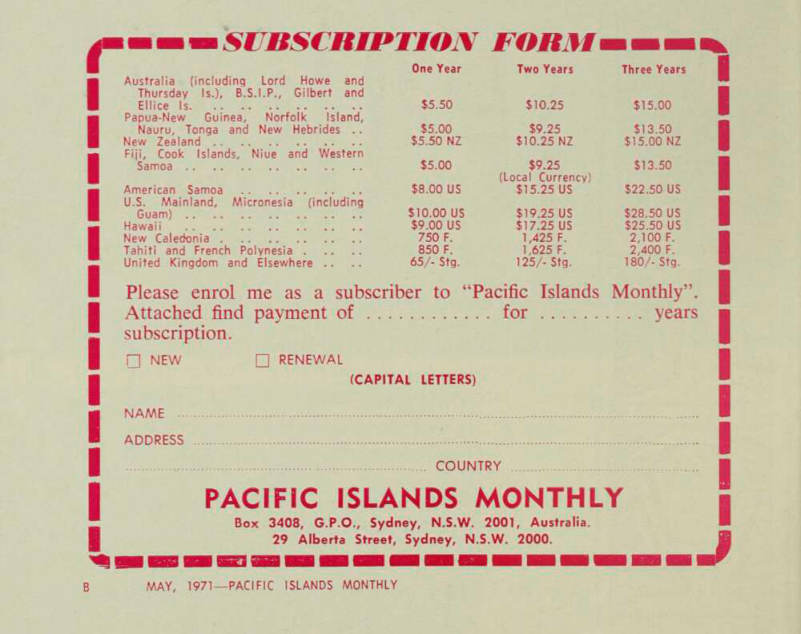
Subscription Rates:
"Pacific Islands Monthly" is air-freighted to all subscribers and agents in the Pacific Islands; copies to other areas go by surface mail.
Australia (including Lord Howe and Thursday Is.). 8.5.1. P., Gilbert and Ellice Is.: $5.50 Aust.; Papua-New Guinea, Norfolk Island, Nauru, Tonga and New Hebrides: $5.00 Aust.; New Zealand: $5.50 NZ; Fiji, Cook Islands, Niue and Western Samoa: $5.00 (local currency); American Samoa: $B.OO US; U.S. Mainland, Micronesia (including Guam); $lO.OO US; Hawaii: $9.00 US; New Caledonia: 750 French Pacific francs; Tahiti and French Polynesia: 850 French Pacific francs; United Kingdom and elsewhere: £3/5/- Stg.
JL
Copyright (C), 1971,
-bureau of- Pacific Publications CIRCULATION S A ( AuSt .) Rfy. Ltd.
Advertisements & other items, pp. 18-22 (1 item)
Happiness.
Good health.
Dairy Foods.
They go together—
naturally.
Australian Dairy Foods provide you with the body-building goodness , that you and your children need. ; Concentrated energy from Australian butter. Vital protein and calcium from Australian cheese.
Australian Dairy Foods contain the natural health and strength giving oroperties that all of us need — ?very day.
Always the best. Australian Dairy Food products include: Butter, Ghee, Cheese, Full Cream, Skimmed and Malted Milk Powders, Baby Food and Invalid Food. / - V* m b For good health . . . look for the word 'Australia' on the label.
Is % ye
Sr i ■ mm. 0 / Come over to Consulate, Wf enjoy the rich inviting flavour of choice Virginia tobaccos enhanced by a touch of refreshing menthol.
People who know the best insist on Consulate—the world’s first Virginia menthol cigarette.
COOL CLEAN CONSULATE
For that surprising extra it gives you
FILTER TIPPED CIGARETTES
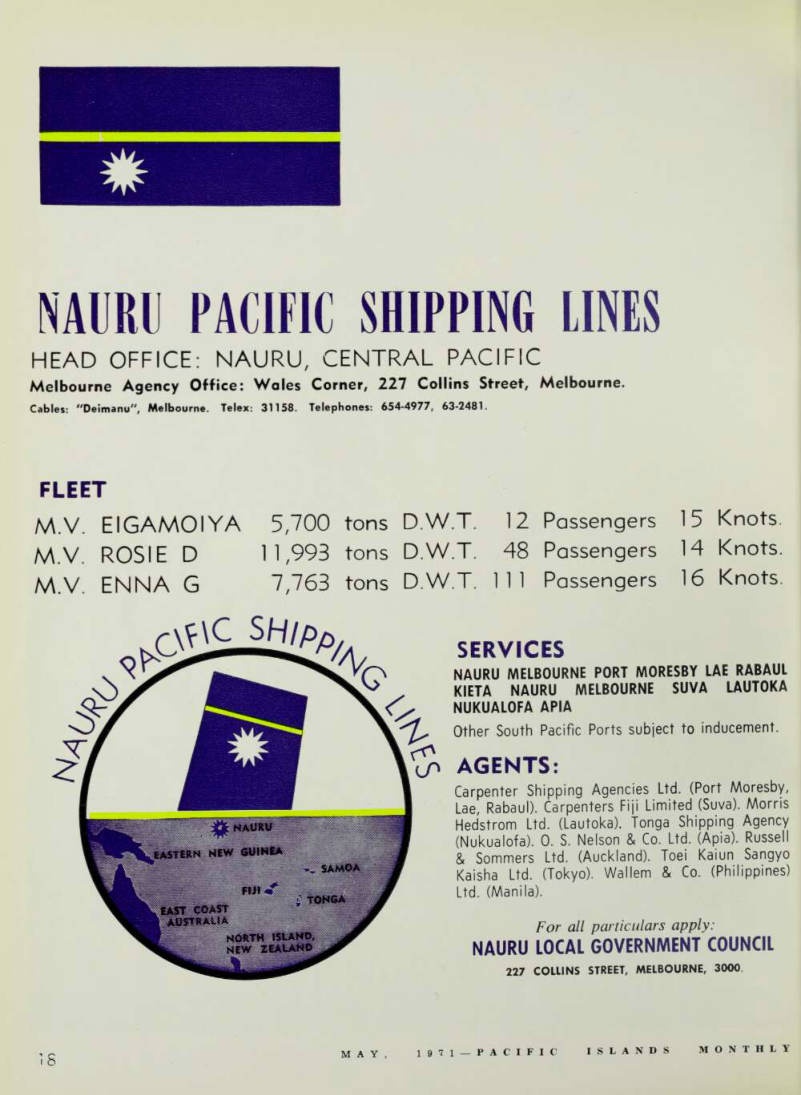
NAURU PACIFIC SHIPPING LINES
HEAD OFFICE; NAURU, CENTRAL PACIFIC
Melbourne Agency Office: Woles Corner, 227 Collins Street, Melbourne.
Cables: "Deimanu", Melbourne. Telex: 31158. Telephones: 654-4977, 63-2481.
FLEET
M.V. EIGAMOIYA
M.V. ROSIE D
M.V. ENNA G
5,700 tons D.W.T. 1 1,993 tons D.W.T. 7,763 tons D.W.T. 12 Passengers 48 Passengers 11 1 Passengers 15 Knots. 14 Knots. 16 Knots. oh Q X) h SH O x ro i ajw GUINEA Fu»«r *
NEW
SERVICES
NAURU MELBOURNE PORT MORESBY LAE RABAUL
KIETA NAURU MELBOURNE SUVA LAUTOKA
NUKUALOFA APIA
Other South Pacific Ports subject to inducement.
AGENTS:
Carpenter Shipping Agencies Ltd. (Port Moresby, Lae, Rabaul). Carpenters Fiji Limited (Suva). Morris Hedstrom Ltd. (Lautoka). Tonga Shipping Agency (Nukualofa). 0. S. Nelson & Co. Ltd. (Apia). Russell & Sommers Ltd. (Auckland). Toei Kaiun Sangyo Kaisha Ltd. (Tokyo). Wallem & Co. (Philippines) Ltd. (Manila).
For all particulars apply:
NAURU LOCAL GOVERNMENT COUNCIL
227 COLLINS STREET, MELBOURNE, 3000
What’s
the Stout got that the
Land Cruiser and
these other Toyotas
9 Quality and guts.
got
The TOYOTA LAND CRUISER has got it. 4-wheel drive. 6-cylinder 155 HP engine.
Fantastic gear combinations of six forward speeds and two reverse. It doubles as a versatile family fun car, too.
Then there’s the big horse pickup, TOYOTA STOUT. The front and rear axles, suspension and powerful brakes feature the stoutness of those used in heavier duty trucks. Plus it packs a 1 06HP engine. Big cab and cargo box.
Plenty of legroom in front and space in back.
And the split bench seat m r» s \
TOVota
OOA
STOUT
-Ji
-Xffi
* has cushion comfort.
You get power, safety, economy and stoutness, too.
But you may like the dual rear wheel TOYOTA DYNA. You can choose a heavy duty pickup. Or a bigger payload platform truck.
Even a double cab and delivery van. With either a husky 106 HP gasoline engine or an economical 70HP diesel job.
Or you may want the big one.
The TOYOTA TRUCK. Six big models built to take the rough and tough.
With 130 HP diesel or 155 HP regular fuel engines under an alligator bonnet.
Got room for a Toyota?
TOOA TRUCK
TOOACVNA
ISTRIBUTORS: TERRITORY Of PAPUA & NEW GUINEA. ELA MOTORS LIMITED: Burns PNIp House. Musgrove Street. Port Moresby 3Puo IU S. TRUST TERRITORY MICROL CORPORATION: P O Box 234, So.pan. Mor.ono Islands Trust Terr.lory o( the Pacific Islands / Jl ISLAND AUTOMOTIVE SUPPLIES CO , LTD., P O Box 355. Suva / AMERICAN SAMOA BURNS PHILP (SOUTH SEA) CO . LTD., Pago ago / WESTERN SAMOA BURNS PHILP (SOUTH SEA) LTD.. Ap,o / GUAM RICKY’S AUTO CO., P O Box 1458. Agona / NEW HEBRi ES BURNS PHILP (N.H.) LTD., Vila / SOLOMON ISLANDS ZEPHYR SERVICE STATION PTY LTD.. Honiara / NEW CALEDONIA SOCI- TE D IMPORTATION AUTOMOBILE DU PACIFIC, Noumea /TAHITI iTABLISSEMENTS £mILE A MARTIN & FILS, B P 61 Papeete
TOYOTA
if?
New chunky
capture all the
natural flavour
of choice
coffee beans
Nescafe has developed completely new kind You can see the difference. Ne\* Nescafe takes all the flavour of those famous 43 beans and turns them into instant coffe granules big chunky granules that melt instantly your cup to give you the biggest coffee flavour coffiest coffee you’ve ever tasted. mu mm ■ es ee. n mm CO ■* <. - -
In This Issue
General
PI PA conference 22-23 Regional shipping will work 22 Games news 32 Regional shipping won't work 71
Cook Islands
PI PA conference 22 Death from lightning 28 Games help 33 Immigration bill 34
Ship replacements 77
Airport plans 84
Fiji
PIPA conference 22 Dock strike 27 Rugby news 29 Tourism news 34 Death penalty decision 35 Where to build boat 76 Sugar payment 85 Concern over insurance 89
French Polynesia
Diving favourites 33 New air services 35
Gilbert And Ellice Islands
New Legislature meets 24 Small Games team 33 Coconut palm saga 67
Nauru
Expansion plans 25 Art of string figure making 49
Pools man in court 88
New Caledonia
Customs strike 28 Host to sportsmen 32 Nickel news 87 Exports and imports 87 Unionists refused entry 88
New Hebrides
Duke's visit 36, 81
Norfolk Island
Airport news 84
Papua-New Guinea
Political future 26 Localisation should speed up 28 Percy Chatterton 30 No Rugby at Games 32 Church relations 35 'Akmana' photo feature 37 -40 'Papua at War' (part three) 41 Latest books 56 People in the news 80 The Duke's visit 81 Photos of Biami people 82-83
Pitcairn Island
Valuable stamp issue 35 Tom loses big toe 80
Solomon Islands
Hotel expansion 28 Tribute to Dominic Otuana 66
Duke's visit 81 Athlete dies 100
Tokelaus
Fewer for NZ 28
Tonga
PI PA conference 22 Hanging decision 35 'Ekiaki' will do well 76
United States Trust Territory
Finance legislation 29
Shipping changes 73
Western Samoa
Betham for SPC? 23 Cabinet reshuffle 28 Clubs close midnight 28 Educationalist dies 99
DEPARTMENTS: Up Front with the Editor, 15; In a Nutshell, 28; Tropicalities, 34; Magazine Section, 41; Yesterday, 47; Book Reviews, 49; From the Islands Press, 65; Editor's Mailbag, 66; Pacific Shipping, 71; Cruising Yachts, 78; People, 80; Business and Development, 85; Produce Prices, 91; Shipping and Airways Information, 93; Deaths of Islands People, 99.
Pacific Islands Monthly
Pacific Leaders Make Nukualofa
A Get-Together To Remember
History may record that a meeting of Pacific Islands leaders held in Nukualofa in April was the most significant in the last decade. And yet the meeting took place under the auspices of nothing more exciting than the Pacific Islands Producers Association a dull-sounding organisation if ever there was. But don’t be misled by the title.
PIPA has grown from the needs of some of the major Pacific territories to compare notes on common prob lems and speak in one voice on trade matters that affect them, thus counter ing the pressures that can be brought to bear by those who trade with the Islands.
Its beginnings go back to 1964 when Fiji’s present Prime Minister, Ratu Sir Kamisese Mara, was negoti ating a sensitive banana contract with New Zealand and realised the neces sity of islands sticking together for a better deal.
The first official meeting of what was then called the Pacific Islands Producers Secretariat was held in Apia in 1965, with Fiji, Tonga and Western Samoa taking part. The Cooks and Niue joined later, PIPS was changed to PIPA, a full-time executive secretary was employed, with headquarters in Suva, and the organisation assumed a more dynamic role, with Ratu Mara its president.
The secret of its dynamism is that PIPA is an organisation conceived and operated by Islanders for Islanders—and thus it draws not a little of its strength from national istic pride. As Cooks Premier Albert Henry said in Nukualofa in April, “for 200 years the white man has been exploiting the resources of the Pacific, but now Polynesians are working together for Polynesians”.
Ratu Mara has from the start seen the organisation as being more effec tive than the South Pacific Commis sion, and has worked to give it an ever-widening base.
PIPA began as a commercial pres sure group. We can expect it to be come more and more involved with political questions, for the good reason that politics are closely in volved with international trade.
The April meeting, the sixth, was the largest yet held. More than 60 delegates and observers attended, in cluding a delegation from the Gilbert
and Ellice Islands. The GEIC was admitted to PIPA, as its sixth mem ber.
It was announced that the consti tution of PIPA had been registered with the UN, and it was decided to elect as president for the next two years, in succession to Ratu Mara, the Prime Minister of Western Samoa, Tamasese Lealofi. Tamasese was one of the big four Islands leaders who were present, the others being Ratu Mara, Albert Henry and Prince Tui’pelehake, Premier of Tonga, • After hearing a frightening re port on the state of the Islands banana market, the meeting resolved to improve production, quality, disease control, and packing of bananas so as to protect the trade.
The conference was told that a banana scarcity existed in the South Pacific.
Samoa was the leading producer in 1970 with 200,000 cases, while Fiji was the smallest, with 87,000.
Tonga and the Cook Islands each exported 130,000 cases.
All were exported to New Zea land, which had to supplement its requirements from Central America.
Heads of State from the rour territories joined in discussions on the banana situation and were ad vised of the extreme dangers facing the industry due to the prevalence of weakening diseases which the territories find difficult and expen sive to control.
Constant increases in shipping costs and rising production costs also assisted in making the industry un economic.
The managing director of New Zealand Fruit Importers Ltd., Ross Walker, told the conference that un less the disease problem could be solved and the quality of fruit con sistently improved, New Zealand consumers would find that Pacific
Islands bananas would be too ex pensive. • The meeting heard arguments for the Islands to speak as one voice on the copra trade (an early dream of Ratu Mara’s), and PIPA is to look into the possibility of establishing its own copra crushing mill, “with pro ducer participation”. PIPA is also to investigate regional membership of the Asian Coconut Community on behalf of those territories not want ing individual membership (Tonga and Western Samoa are applying for individual membership of ACC).
This decision was made as a result of one of the resolutions at a regional coconut conference held in Nukualofa the previous week, attended by delegates from the same territories plus the Trust Territory of Micro nesia. The coconut conference was concerned that tariffs would be im posed on coconut products if Britain joined the EEC, and decided to in vestigate alternative markets for copra in Asia and the Pacific Basin, parti cularly the US. • The meeting set up a working committee to investigate formation of a regional shipping line to serve the Islands and overseas ports. It was proposed that the shipping line utilise and develop the fleet of the Tonga Shipping Agency, already in operation. The conference heard argument on the difficulties of operat ing a regional service (see p. 71 for one recent view), but members, on the other hand, were unhappy at in creasing freight rates imposed by foreign-owned ships. The turning point came when Ratu Mara re minded delegates that Fiji Airways had started as a purely local venture and developed into a regionally owned airline.
Mr. Henry, who has his eyes on extending Cook Islands shipping, agreed with the proposal “in prin ciple”. But what Nauru thought of the proposal nobody knew, for Nauru
was not represented at the conference, although Nauru now has a national shipping line that rivals Tonga’s, and has only recently asked the various territories to support the Nauru line.
The absence of Nauru’s views does ¥here Tre many Pin o g iher matters raised in Nukualofa, but these were the main decisions that could be described as “purely PI PA decisions”.
Some others, even more important, were taken as a result of the Islands leaders finding themselves in close proximity, although these matters won’t show up on the PIPA conference record.
The four leaders in Nukualofa held exploratory talks about establishing a regional political forum outside of the SPC—as the SPC is not supposed to be political. As a starter they want to organise a top level —r with New Zealand ” (as Ratu Mara P ut 11 )• The Heads of State would submit suggestions for discussion m advance, and special papers would be drawn up by experts to assist the leaders in their discussions. The leaders see this top level exchange of views as an annual event, held m different tern tones.
In an interview over Tonga radio, Mr. Henry said the territories faced population pressures and growing un employment, and the time had come when Australia and NZ “couldn’t dodge the issue”. These countries had to divert more of their financial aid to the Pacific territories, and lower immigration barriers.
The four leaders also compared notes on a possible successor to the late Afioga Afoafouvale Misimoa, who died in February, as secretary general of the South Pacific Commis sion. The West Samoan Prime Minis ter asked for support for another West Samoan nomination, Mr. Fred Betham, and it looks as if he will get it (see separate story).
Cooks Premier Albert Henry, who usually can be depended upon to be controversial (see “Still down on his neck,” p. 34) was visiting NZ before his arrival at the PIPA conference.
There newsmen set upon him to ask him about rumours that the Cook Islands were seeking complete inde pendence from NZ. He denied them as being “something put around down here, and I don’t know why”.
He said he intended to seek more financial aid from NZ. And on this question he got support from Maon members of the NZ Parliament.
Labour Party spokesman on Maori and Island Affairs, Mr. M. Rata, called for a parliamentary study of NZ aid to the Cook Islands, making it clear that the Labour Party thought not nearly enough was being done for the Cooks.
Mr. Rata said Mr. Henry’s “angry and bitter views” on the shortage of money from NZ, which he had ex pressed in introducing the Cooks Budget earlier in the year (PIM, Apr., p. 101) had obviously “not been made lightly”.
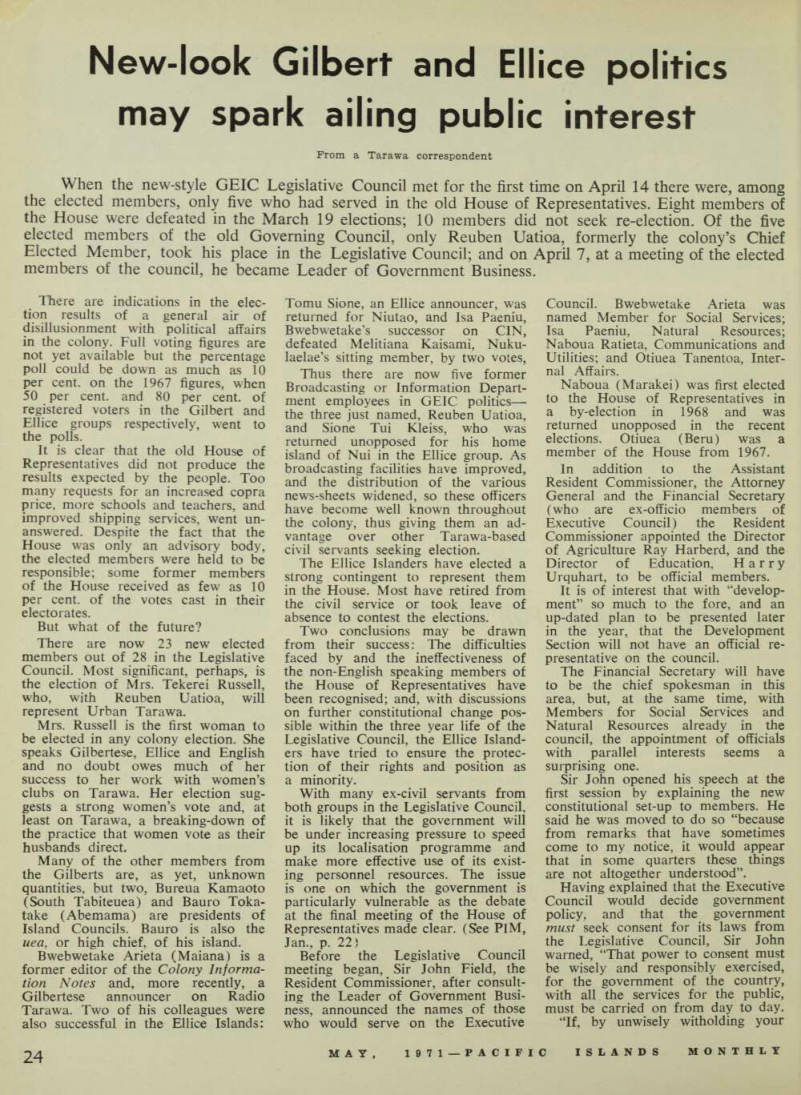
Delegates to the sixth Pacific Islands Producers Association conference, in Nukualofa in April. In the front row, centre, sit the Big Four Pacific leaders.
Another Starter For The Spc Stakes
Mr. Fred Betham, Western Samoan Member of Parliament and for eight years Minister foi Finance until the Mataafa Gov ernment lost support at the last elections, has been nominated by Western Samoa as next secretary general of the South Pacific Com mission.
If his nomination succeeds, he would take the post from another Samoan, Afioga Misimoa, who died in office in February. The West Samoan Government takes the view that Samoa should be entitled to nominate a man to “finish the term”, and nobody is likely to seriously argue against this. Especially as Mr. Betham is a competent and popular admin istrator, well-known in the Pacific.
And he is an Islander, and that status has developed into a prere quisite for the secretary-general’s post since Misimoa’s appointment.
Australia has put forward a Papuan, Gala Oala-Rarua, As
sistant Ministerial Member for the P-NG Treasury, as her nomina tion, and other names mentioned are Pago Pago-born Peter Cole man, who is former Governor of American Samoa and now Deputy High Commissioner of the US Trust Territory of Micronesia, and J. C. Guerrero, a former Gov ernor of Guam. It is understood, however, that neither of these men is interested in the post.
Fred Betham, at the end of April, appeared The Most Likely to Succeed.
Born in Apia, he was 56 in April. He is married to Olive, daughter of the celebrated O. F.
Nelson. He has the OBE.
A decision on the next sec retary-general will be made in Noumea in September, unless member governments can agree in the interim. Fiji, although now independent, has not yet been admitted to the SPC as a member government.
may spark ailing public interest
New-look Gilbert and Ellice politics may spark ailing public interest
From a Tarawa correspondent When the new-style GEIC Legislative Council met for the first time on April 14 there were, among the elected members, only five who had served in the old House of Representatives. Eight members of the House were defeated in the March 19 elections; 10 members did not seek re-election. Of the five elected members of the old Governing Council, only Reuben Uatioa, formerly the colony’s Chief Elected Member, took his place in the Legislative Council; and on April 7, at a meeting of the elected members of the council, he became Leader of Government Business.
There are indications in the elec tion results of a general air of disillusionment with political affairs in the colony. Full voting figures are not yet available but the percentage poll could be down as much as 10 per cent, on the 1967 figures, when 50 per cent, and 80 per cent, of registered voters in the Gilbert and Ellice groups respectively, went to the polls.
It is clear that the old House of Representatives did not produce the results expected by the people. Too many requests for an increased copra price, more schools and teachers, and improved shipping services, went un answered. Despite the fact that the House was only an advisory body, the elected members were held to be responsible; some former members of the House received as few as 10 per cent, of the votes cast in their electorates.
But what of the future?
There are now 23 new elected members out of 28 in the Legislative Council. Most significant, perhaps, is the election of Mrs. Tekerei Russell, who, with Reuben Uatioa, will represent Urban Tarawa.
Mrs. Russell is the first woman to be elected in any colony election. She speaks Gilbertese, Ellice and English and no doubt owes much of her success to her work with women’s clubs on Tarawa. Her election sug gests a strong women’s vote and, at least on Tarawa, a breaking-down of the practice that women vote as their husbands direct.
Many of the other members from the Gilberts are, as yet, unknown quantities, but two, Bureua Kamaoto (South Tabiteuea) and Bauro Toka take (Abemama) are presidents of Island Councils. Bauro is also the uea, or high chief, of his island.
Bwebwetake Arieta (Maiana) is a former editor of the Colony Informa tion Notes and, more recently, a Gilbertese announcer on Radio Tarawa. Two of his colleagues were also successful in the Ellice Islands:
Tomu Sione, an Ellice announcer, was returned for Niutao, and Isa Paeniu, Bwebwetake’s successor on CIN, defeated Melitiana Kaisami, Nuku laelae’s sitting member, by two votes, Thus there are now five former Broadcasting or Information Depart ment employees in GEIC politics— the three just named, Reuben Uatioa, and Sione Tui Kleiss, who was returned unopposed for his home island of Nui in the Ellice group. As broadcasting facilities have improved, and the distribution of the various news-sheets widened, so these officers have become well known throughout the colony, thus giving them an ad vantage over other Tarawa-based civil servants seeking election.
The Ellice Islanders have elected a strong contingent to represent them in the House. Most have retired from the civil service or took leave of absence to contest the elections.
Two conclusions may be drawn from their success: The difficulties faced by and the ineffectiveness of the non-English speaking members of the House of Representatives have been recognised; and, with discussions on further constitutional change pos sible within the three year life of the Legislative Council, the Ellice Island ers have tried to ensure the protec tion of their rights and position as a minority.
With many ex-civil servants from both groups in the Legislative Council, it is likely that the government will be under increasing pressure to speed up its localisation programme and make more effective use of its exist ing personnel resources. The issue is one on which the government is particularly vulnerable as the debate at the final meeting of the House of Representatives made clear. (See PIM, Jan., p. 22) Before the Legislative Council meeting began, Sir John Field, the Resident Commissioner, after consult ing the Leader of Government Busi ness, announced the names of those who would serve on the Executive
Council. Bwebwetake Arieta was named Member for Social Services; Isa Paeniu, Natural Resources; Naboua Ratieta, Communications and Utilities; and Otiuea Tanentoa, Inter nal Affairs.
Naboua (Marakei) was first elected to the House of Representatives in a by-election in 1968 and was returned unopposed in the recent elections. Otiuea (Bern) was a member of the House from 1967.
In addition to the Assistant Resident Commissioner, the Attorney General and the Financial Secretary (who are ex-officio members of Executive Council) the Resident Commissioner appointed the Director of Agriculture Ray Harberd, and the Director of Education, Harry Urquhart, to be official members.
It is of interest that with “develop ment” so much to the fore, and an up-dated plan to be presented later in the year, that the Development Section will not have an official re presentative on the council.
The Financial Secretary will have to be the chief spokesman in this area, but, at the same time, with Members for Social Services and Natural Resources already in the council, the appointment of officials with parallel interests seems a surprising one.
Sir John opened his speech at the first session by explaining the new constitutional set-up to members. He said he was moved to do so “because from remarks that have sometimes come to my notice, it would appear that in some quarters these things are not altogether understood”.
Having explained that the Executive Council would decide government policy, and that the government must seek consent for its laws from the Legislative Council, Sir John warned, “That power to consent must be wisely and responsibly exercised, for the government of the country, with all the services for the public, must be carried on from day to day.
“If, by unwisely witholding your
consent to the government’s measures, you brought the government to a stop, the people who sent you here to represent them would be the first to suffer. Your function, then, is not to make the governing of the country difficult, but to do your best to ensure that it is good government— that the laws that are passed are wise and necessary and that the government of the country is carried on efficiently, to meet the real needs of the people without unnecessary expense.”
Of the present constitution, Sir John Field said: “With the new responsibilities that it places on the unofficial members of the Executive Council and on this House it is the first instalment of the transfer of real power to the people and we are, indeed now laying the foundations on which the final constitutional structure will be built.
The speed of further progress will depend on how well you can make the present arrangement work. If they work badly, much time will be lost looking for alternative arrangements.
If they work well, the way is now open to a steady advance towards full
ministerial responsibility.”
Britain has formally agreed that the Gilbert and Ellice Islands Colony be separated from the High Commis sion for the Western Pacific, but she announced in April that the legal and administrative steps to the separation would inevitably take some time, but are now in hand. Western Pacific High Commissioner is Sir Michael Gass, at Honiara. His responsibilities after the separation will be the British Solomons and the British side of the New Hebrides Condominium. He is not likely to complain about shedding the problem child that comprises the Gilbert and Ellice.
Political Changes
In American Samoa
The United States has agreed to changes in the legislature of American Samoa, which will enable the legis lature to undertake a preliminary re view of the budget. The legislature will also be empowered to meet in two sessions a year, and its members cannot comprise, in future, full-time government employees. Members who are at present employed by the gov ernment have to decide whether to resign either from the public service or the legislature.
The changes are seen as an im portant step towards political maturity in American Samoa.
her wings
Nauru's all set to spread her wings
There is likely to be a big in crease in visitors to Nauru if Nauru Government’s plans to in crease the capacity of Air Nauru come to fruition.
Air Nauru commenced a fort nightly service between Australia and the island in February last year and increased the frequency to weekly in June the same year.
The airline is using a modern but small (eight-seater) Falcon jet chartered from the Australian company, Business Jets, and de spite the greater frequency is often embarrassed for lack of space. The small cargo carrying capacity of the French jet is a particular defi ciency as far as the Nauruans are concerned.
Several full size jets have been under study, and it seems likely that the government will soon de cide to purchase a Boeing 727 or similar aircraft. The island airstrip is adequate to take a Boeing with modified landing gear, and Air Micronesia in fact operated such an aircraft to Nauru for some time last year.
The Nauruans see a great poten tial in inter-island air cargo traffic as well as passengers, and would probably decide on a 50/50 pas senger/cargo configuration.
The government is also proceed ing with plans to build up the strip to the standard required for heavier aircraft. It also intends to extend the runway length from the present 5,300 ft to 5,800 ft, by building out over the reef. The additional length would enable Air Nauru with larger aircraft to reach any point in the Pacific where the government is ever likely to want to fly. ...
At present, an air terminal being built beside the strip is due to be completed by about September.
Stage one of Nauru’s first hotel is expected to be completed by Constitution Day—May 17.
To be called the Naoero—the old name for Nauru —the hotel will have 32 rooms, each with bath, shower and telephone. It will be of international standard, and facilities will include bar, restaur ant and swimming pool, function room and souvenir shop. There will be 24-hour room service.
The hotel has two VIP suites to accommodate visiting notables. It is being built in one of the most picturesque spots on the island, overlooking Anibare Bay.
The hotel, which will have a staff of 16, mostly Nauruan, is be ing built by the Nauru Local Gov ernment Council. The council ac quired the site after liquidation of the Central Pacific Pools company, and it is expected to be completed fully by August.
Councillor James Bop, who is in charge of the project said that erection of the hotel would enable Nauru to accommodate passengers transiting on the island to and from Tarawa and Majuro.
At present, visitors to the island must be privately accommodated in either government or Nauru Phosphate Commission houses.
While the government is not actively pursuing a policy of at tracting tourists, it is nevertheless anxious that visitors to the island be properly accommodated.
Nauru is spreading its wings, figuratively speaking, in other directions as well.
The republic will open its third overseas office in Tokyo soon (the others are in Melbourne and Lon don). The Tokyo office will be the first one to be staffed by a Nauruan, but no announcement regarding the appointment has yet been made.
The office will also be the first Nauruan diplomatic post abroad, and will be at consular level. Both the Melbourne and London offices are presided over by Australian and British nationals respectively, who have the title of Nauru Rep resentative.
It is understood that the Japan ese plan to have reciprocal diplo matic representation on Nauru.
The only country directly repre sented on the island is Australia, which maintains Mr. Richard Gate, who is known as the Austra lian Representative. He also looks after the affairs of the New Zea land and UK Governments on request.
The closer diplomatic ties with Japan underline the growing business connections between the two countries. Japan is currently the only country outside of Aus tralia and NZ to be a customer for Nauruan phosphate, and the Nauruans chose a Japanese ship yard to build their first bulk car rier, a 30.000 ton vessel now under construction.
A timetable for New Guinea
From a Canberra correspondent The Australian Government in late April began first moves which will virtually put into effect a timetable for self-government in Papua-New Guinea. The government accepted the recommendations of the P-NG House of Assembly’s select committee on constitutional development, as passed by the assembly in March (PIM Apr p. 22).
Minister for External Territories, Mr. C. E. Barnes, introduced into Federal Parliament on April 29, a bill which will enlarge the next P-NG House of Assembly from its present 84 elected members to 100 elected members. The bill will increase the number of open electorates from 69 to 82 and the number of regional electorates from 15 to 18. Elections for the 1972-76 assembly will begin next March/April.
Mr. Barnes said that further changes in the legislature recom mended by the committee will be embodied in legislation to be put before Federal Parliament later this year. These changes will involve creation of up to three nominated members of the House to represent special groups; the reduction of the number of official members from 10, as at present, to four; the abolition of the titles of Ministerial Member and Assistant Ministerial Member and the creation of up to 17 titles of Minister; and a change in the com position of the Administrator’s Executive Council so that it would comprise the Administrator, three official members and 10 ministers.
There would also be a change in the name of the territory, which will be called simply “Papua New Guinea”, and not the “Territory of Papua and New Guinea”.
When all these changes eventually go through Federal Parliament, the House of Assembly will be em powered to have a total of 100 elected members, four official members and up to three nominated members. The decision to include nominated mem bers is a reversion to the old days of the Legislative Council; there have been no nominated members in recent P-NG parliaments. It is intended that one of the nominated members be a woman should no woman be elected by the general voters.
These moves in Federal Parliament are all routine and expected. What is interesting is the statement on con stitutional development made by Mr.
Barnes in the House on April 27, when foreshadowing the legislation.
He pointed out that the select committee had asked that the territory “be geared to prepare for internal self-government in the period 1972/76, during the life of the next Assembly”. He said Federal Government in accepting what was in fact an approximate timetable would “adopt a flexible attitude”. It would prepare a programme for movement to full self-government in 1972-76 “but the execution of that programme will have regard to the state of
opinion as it develops after the 1972 Assembly elections and to the policies of the political leaders who then emerge”.
This is a sensible attitude in view of the fact that the present assembly is not itself in agreement about the pace of self-government.
Mr. Barnes promised that mean while localisation, particulary in the public service, will be stepped up but “positive action” will also be taken to maintain sufficient expatriate officers, “not only by recruitment but also by ensuring confidence in a rewarding career to serving officers”.
A new five-year development pro gramme would be weighted towards indigenisation, he added.
• See "Political ABC", p. 30.
Politically, Micronesia moving again
Political developments in US Micronesia are moving again, after the rather stunned calm that followed the burning down of the Congress of Micronesia on Saipan on February 20.
Unknown arsonists were responsible—and it’s still believed that the fire had a lot to do with the fact that the Marianas District objected to a bill which sought to put a three per cent, income tax on all TT incomes from July 1, and the additional fact that the Marianas District legislature had just decided that the district should secede from the Trust Territory “by force of arms if necessary”. (PIM, Mar., p. 23).
The tax bill will come into force notwithstanding. It was signed into law by High Commissioner Edward Johnston in March, without further fireworks.
Meanwhile, the United States has agreed to continue talks on Micronesia’s future political status, and Dr. Franklin Haydn Williams has been named as President Nixon’s personal representative for the negotiations. Dr. Williams served as Deputy Assistant Secretary of Defence from 1958-62, a fact which has not gone unnoticed. His talks will be with the Congress of Micronesia’s new Joint Committee on Future Status, just set up under Senator Lazarus Sali (PIM, Apr., p. 24).
The question of Marianas secession will, of course, have to come up.
The Marianas attitude, which is not new, is now regarded as more pressing by both the Micronesian Congress and the Washington admin istration. The longer the administration takes to sort out the political future for the TT, the greater the danger of there being a permanent split within the TT. Some observers are now looking at the possibility of a TT without the Marianas, although this does not appear to be what most Micronesians want.
The Marianas have been having talks on the subject with admin istration officials both in Saipan and Washington. On Saipan in March they spoke with US Ambassador-at-Large David Kennedy at a closed meeting, and in April delegates were in Washington.
In early May the homeless Congress of Micronesia will hold its first meeting away from Saipan—in Truk.
Fiji's dock
strike —a test for Mara
The strike by Fiji stevedores in April provided the first real test for Ratu Sir Kamisese Mara s Alliance Government since maependence on October 10. The stevedores went on strike in Suva on April 8 demanding an increase in basic pay from 32c an hour to 62ic, and improved conditions. It soon spread to Fiji’s other major port, Lautoka.
A board of inquiry heard evidence from shipowners and the stevedores, and held its decision. But it did issue an interim report, just after the owners offered an across-the-board increase of 6c an hour. The board described the strikers’ demands as unrealistic and said that the shipowners offer of an 18.5 per cent. rise seemed to be the maximum they could expect.
Ratu Sir Kamisese Mara postponed an official visit to Australia, scheduled to start on April 26, becr.use of the strike, saying he felt he could not leave the country at such a time.
The strike was called by the Fiji Seamen’s and Dockworkers’ Union after earlier negotiations for an increase had broken down. Union secretary Taniela Veitata said the union would not negotiate with shipowners until the board released its findings.
Veitata said that living standards of his members were extremely low.
An economist told the inquiry that a big increase, of the amount sought, would have a fairly heavy impact on the Fiji economy as a whole and might increase the retail price of goods by one per cent.
Veitata said the dispute was with
the “big companies only”. But the big companies operate the major in ternal services in the dominion, and therefore food supplies for many of the outer islands were quickly cut.
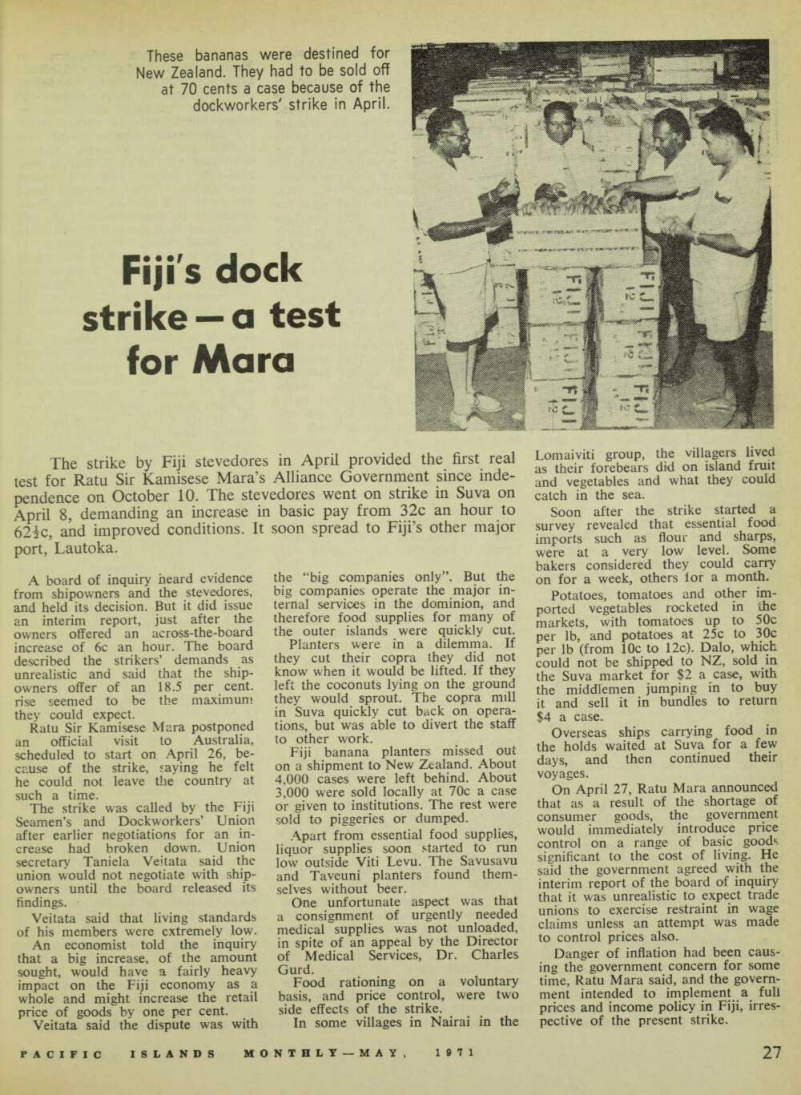
Planters were m a dilemma. If they cut their copra they did not know when it would be lifted. If they left the coconuts lying on the ground they would sprout. The copra mill in Suva quickly cut back on opera lions but was able to divert the staff to other work. . , Fiji banana planters missed out on a shipment to New Zealand. About 4,000 cases were left behind. About 3,000 were sold locally at 70c a case or given to institutions. The rest were sold to piggeries or dumped.
Apart from essential food supplies, liquor supplies soon started to run l ow outside Viti Levu. The Savusavu an d Taveuni planters found them selves without beer.
One unfortunate aspect was that a consignment of urgently needed medical supplies was not unloaded, in spite of an appeal by the Director of Medical Services, Dr. Charles Gurd.
Food rationing on a voluntary basis, and price control, were two side effects of the strike.
In some villages in Nairai in the
Jn tlaud fraft
and vegeta bi e s a nd what they could catc h in the sea. soon after the strike started a survey revealed $ were at a very low level. Some bakers considered they could carry on f or a week, others lor a month, Potatoes, tomatoes and other inl ported vegetables rocketed in the marke ts, with tomatoes up to 50c lb and potat oes at 25c to 30c * lb (from 10c to 12c). Dalo, which £ ould nQt be shippe <i to NZ, sold in the Suva market for $2 a case, with tbe middlemen jumping in to buy i( . and sell it in bundles to return $4 a case Qverseas ships carrying {ood in t u p bolds waited at Suva for a few tben con tinued their voyages.
On April 27, Ratu Mara announced that as a result of the shortage ot consumer goods the would immediately intro P c o nt Tpl on a F f ,• • ® H the cost of living. He . the government agree re P° r ‘ TS that>t was unrealistic to expect trade unions to e e ss a n made . , nrices also to control prices also, Danger of inflation had been caus ing the government concern for some time, Ratu Mara said, and the govern ment intended to implement a lull prices and income policy in Fiji, irres pective of the present strike.
These bananas were destined for New Zealand. They had to be sold off at 70 cents a case because of the dockworkers' strike in April.
Nutshell
In a Nutshell
• Western Samoa’s police, using a 1961 ordinance, have shut down public entertainment after 12 mid night. This follows complaints by residents of noisy clubs and rowdy behaviour up to four in the morning.
Permits for public entertainment are now issued on condition that entertainment ends at midnight unless otherwise authorised. The new permits became effective in early April and almost immediately it was obvious that one person’s poison is another's freedom.
Critics said individual freedom was threatened by the decision and that tourists would want to continue after midnight. • “It will be the last,” they keep saying about New Guinea’s Mt.
Hagen Show. “It will become too civilised and it’ll die”. It isn’t dead yet, and the 1971 Hagen Show is scheduled for August. • Dr. M. Y. Ali, who has held teaching posts in universities in the US, Sudan and Singapore, and is cur rently Senior Lecturer in Pathology at the University of Tasmania, has been appointed Professor of Pathology at the University of Papua and New Guinea. • Norfolk Island’s Kingfisher Airtel was virtually destroyed by fire in late March. Thirteen people stay ing at the hotel escaped injury but the fire brigade was unable to stop the blaze from engulfing the com plex. The hotel site is part of Norfolk’s history. It was a station for the Pacific cable link built early in the century. • The huge Bougainville copper project has finally attracted a surfeit of labourers. New Guineans who have been making their way there in their hundreds, attracted by the good wages and conditions, are not now welcome unless they are skilled, be cause the construction phase of the project is now near completion. • Speaker of the P-NG House of Assembly, Dr. John Guise, said in Port Moresby in April that the pace of localisation in the territory should be speeded up, as it had been in Indonesia. He made his statement after having led a parliamentary
delegation to Indonesia in early April.
He said he hoped there would be further visits between the adjoining territories soon, and that he hoped Papua-New Guinea would include the study of Bahasa-Indonesia in its teaching syllabus. Dr. Guise said the visit, which was a most successful goodwill tour, made him more con fident about Indonesian-P-NG rela tions. The Indonesians had seen for themselves that New Guineans had the future of the territory in their own hands and that independence for P-NG was inevitable. The mission had shown the Indonesians that both P-NG and Australia were friendly to Indonesia. Dr. Guise added that he was proud to have led the first P-NG delegation to another country.
A member of the delegation, Mr.
Patik Nimabot, said in Port Moresby that before his visit he had felt that densely-populated Indonesia might one day take over P-NG, but Indo nesians during his visit had not ex pressed any ill-feelings towards the territory. • Mr. I. W. Weeden was visiting Papua-New Guinea in April to col lect facts to enable him to report on the future of the Australian School of Pacific Administration. He has been commissioned by the Common wealth to make the investigation. • Mrs. Makitinopara Moeareone was found dead in bed in her Mangaian home, Cook Islands, after the house was struck by lightning on April 20. None of the other oc cupants of the house was hurt, and an inquest found she had died of acute heart failure and shock. • A lightning strike in the Noumea Customs Department at the end of March brought a speedy reaction from Paris.
The striking Customs employees demanded an increase in their depart ment’s budget, to cope with the ever increasing imports handled through Noumea—and they got it. (The Noumea Chamber of Commerce last year began paying the salaries of two extra employees in the Customs Department because the State had not provided the finance).
In addition, the Customs Depart ment workers demanded opportunities for Caledonians to be promoted into the top grade of their department, and this request was also met by Paris. Until now, all top division posts in the Customs Department have been occupied by Metropolitan French. The successful strike lasted four days.
• The Hotel Mendana in Honiara is to undergo a $500,000 expansion, starting July. Additions will be built in three stages; the immediate erection of a three storey block with 36 rooms front ing the beach, together with new kitchen and dining room, and a swimming pool. The further accom modation blocks with 60 rooms then follow. The completed hotel will total 102 bedrooms, and a new company, Mendana Hotels Ltd., will shortly be incorporated to carry out the development. Participation in the equity capital will be offered to BSIP residents, while a substantial minority holding will be taken by an “international hotel group”, as yet unnamed, • New Zealand’s Minister of Maori and Island Affairs, Mr. Duncan Maclntyre, in April completed a 14 day trip to the Tokelaus during which he discussed the setting up of a pearl industry and turtle farming.
On his return to NZ he said the gov ernment now felt it better that the Tokelauans should help themselves rather than come to NZ; for that reason only 15 secondary school-age children would come to NZ each year from now on, instead of whole families. • Few people in Apia in April knew why the Western Samoan Cabinet had undergone a major reshuffle. Prime Minister, Tupua Tamasese Lealofi, was generally tight lipped about the changes and the Samoa Times was left to comment, “it is generally taken that they [the changes] have resulted in a better allocation of duties”.
First indication of the reshuffle came in late March when Minister of Post Office and Radio, Fatialofa Momo’e, resigned without public ex planation. It was announced he was to be replaced by Vaai Kolone, representative for Vaisigano, and brother of Lesatele Rapi, Minister of Works in Mataafa’s old cabinet.
Instead, Kolone became Minister of Health in the place of Fuimaono Moasope, who became Minister of Post Office and Radio.
Tuala Paulo then moved from the Justice Department to the Education Ministry, having changed places with Amoa Tausilia, while the rest of the ministers retained their portfolios. • The Fiji Rugby Union has been urged to seek more major inter national matches and visits by leading overseas sides. This follows a series of losses on overseas tours, culminat ing with a $3,000 loss on last year’s tour of New Zealand. The Fiji Rugby
Union secretary Derek Robinson told the union’s annual meeting in Suva recently that the international tours agreement was working against Fiji.
The agreement provides for the home country to take all profits from tours and is based on the supposition that return tours over the years would even expenses out. Mr. Robinson said that over recent years Fiji played 128 games overseas and had two major internationals (Wales and NZ) and four NZ Maori team tours in return.
He said last season’s loss had only been offset by the generosity of the Hawkes Bay Rugby Union of NZ.
A tour by its Saracens side had given the union more than $6OO. Sir Maurice Scott, stepped down after 23 years as president of the union, and is succeeded by Ratu Penaia Ganilau, Fiji’s Minister for Defence and manager of Fiji touring teams in NZ in 1957 and England and Wales this year. • Legislation designed to improve the economic development of the Trust Territory of the Pacific Islands was approved in April by the US Senate Interior Committee. Among other things, the bill would imple ment a US-Japanese agreement to provide $5 million by each country to compensate inhabitants of the islands who suffered damages during World War 11. It would also set up a Micronesian Claims Commission to handle such claims, and increase from $1 million to $5 million an existing authorisation for funds to assist the area’s economic develop ment. • The Marshall Islanders are counting the days until the new
SUS 2 million-plus Majuro airfield will
be operational reports the Micronitor, published in Majuro. Future plans call for the extension of the runway to 10,000 ft to accommodate larger jets, including the Jumbo 7475. Mean while the construction site is a hub of activity where man and machines are clawing the landscape. • This year’s Town and Country Planning Overseas summer school, to be held at Southampton University, UK, in September, will discuss “management in the planning process”. Those interested in plan ning problems in developing countries can get further information from Mr. P. R. Rathbone, Town and Country Planning Summer School, c/o Town Planning Institute, 26, Portland Place, London WIN 4BE. • The Australasian Petroleum Company in April announced plans to drill an oil well in the Southern Highlands of Papua. The well, the
27th drilled by the company in the territory, will be on the Mananda anticline some eight miles south of the Komo-Mananda patrol post and airstrip. A base camp has been set up at Komo and areas of ground are being prepared for storage of materials, helicopter pads and for the eventual camps for the personnel who will live at Komo during the drilling operation. • A Sydney-based mining com pany, Southland Mining Ltd., has been granted permission to apply for prospecting licences and mining leases in the New Hebrides. The three-year old company is interested in manga nese production and minerals explora tion. It already has an interest in the French company mining at Forari, Le Manganese de Vate. The authorisation does not aply to Tanna, which is not open to prospecting for the time being. • George Barley, a Fiji representa tive Rugby player, has signed up in the cash ranks with the Balmain (Sydney) Rugby League team. Bar ley, a part-European, started his career with the Cadets club in the Suva European competition, and from there graduated to top rank in the Army. More than a decade ago, Fiji Rugby writer, the late Frank Ryan, tipped Barley as one who would have a successful career. He toured England and Wales with Fijian teams, and in April was one of two Fiji players chosen to go to England to take part in the Rugby Union centen ary celebrations. He has signed a con tract to play for Balmain for three years. • A new terminal has been com pleted at Bauerfield airport, Vila, and its facilities are already being used by overseas carriers, UTA and Pacific Islands Airways. • The senior New Guinean officer in the Australian Army, Captain E. D. Diro, has been promoted to the rank of major. He is now com manding officer of C Company, First Battalion, Pacific Islands Regiment, the first New Guinean to be a com pany commander. • Sixty-one Tongans will arrive in New Zealand in May to work in Wellington’s Hutt Valley industrial area. They are all aged between 21 and 45, and they are the first under a new scheme to give Tongans employment in NZ. • Papua-New Guinea has become a full member of the Asian Develop ment Bank and the Assistant Ministerial Member for the Territory,
Mr. Oala Oala Rama, has been ap pointed territory governor of the bank. The bank will provide tech nical assistance and access to soft loans at an interest rate as low as H per cent., as well as loans at com mercial rates. In April Mr. Rama spoke at the ADB annual meeting in Singapore and said PNG people realised that political independence must be accompanied by economic and financial self-reliance. He added that as local resources of capital and skilled manpower were scarce, economic development would depend heavily on continuing investment.
Seventy-five per cent, of the people were still involved in subsistence pro duction, but agricultural production for export was still the basic monetary activity, he said. • An influenza outbreak over Easter filled the Nukualofa hospital.
Although there were no deaths, the public were told there was no room for further admissions. • Papua-New Guinea’s new national flag, approved by the House of Assembly at its March sitting, made its international debut in Singapore in April, when it flew alongside flags of other nations at a meeting of the Asian Development Bank, attended by P-NG delegates.
The flag has been flown publicly in P-NG for some weeks, alongside the Australian flag. • The New Zealand Leper’s Tmst Board in April gave a record SNZ 188,000 for the relief of leprosy and other tropical diseases in the South Pacific. Among the grants was $3,000 for occupation therapy facilities at the P. J. Twomey leper hospital in Fiji and $40,000 for a new lecture theatre at the Fiji School of Medicine.
They're Rowing
The Pacific
John Fairfax, the 3 3-year-old English adventurer, and a com panion, Sylvia Cook, were due to leave San Francisco on April 25 to row 7,000 miles across the Pacific to Australia. Fairfax, last year, became the first man to row solo across the Atlantic, and now is hoping for a Pacific “first” to row the Pacific. In their 35 ft rowing boat, Britannia 11, they started with 1,300 lb of food and water—two-thirds of what they will need. They expect to fish the balance from the sea in the 10 month row.
Footnotes
TN Papua-New Guinea, whose House of Assembly has now decided against both “Pagini” and “Niugini” and has put off inde finitely a decision on a new name, political parties come and go and change their names overnight in a most bewildering fashion.
At the March meeting of the House the air cleared a little, and it may clear more at the June meeting if proposals to re-arrange seating so as to allow party members to sit together come to fruition. At the moment it is still not quite clear which and how many members each party can claim.
As predicted in this column, the prolonged ges tation of the so-called Independent Group, formed in 1968 to oppose the mildly radical Pangu Party but with no publicly avowed positive platform, has produced two parties, one led by Tei Abal of the Western Highlands and the other by Julius
Chan of New Ireland.
Mr. Abal’s party, which first called itself the Compass Party but has now changed its name to the United Party, may be re garded as located in the far right of the political spectrum. It is in the main a Highlands party, and indeed has its origin in part in a social organisation called the Brothers Four Movement (the four brothers being the four Highlands districts) and in part
in a political programme propounded by John Watts, member for the Western Highlands Regional electorate.
The United Party is at present trying to shed two embarrassing images, that of a regional party and that of an expatriate dominated one. Its anxiety to do this no doubt accounts for its adop tion of the rather insipid name United Party in place of the much more evocative label Compass Party.
Mr. Chan’s party, which has named itself the People’s Progress Party, may perhaps be best described as a right centre party. At present it is playing things quietly (Julius Chan is by nature a quiet man), and by so doing is at least avoiding the faux pas which are being made by the more vocal parties. At present the PPP appears to com prise mainly New Guinea islands and coastal mainland members.
On the political left is Pangu (Papua and New
Abc Of P-Ng's
Parliamentary
Politics
Guinea Union), which was formed prior to the 1968 national elections and has since received a generous measure of publicity both in Papua-New Guinea and overseas.
Its parliamentary leader, Michael Somare, young, energetic and forceful in debate, heads a small, rather uneven and sometimes unpredictable team. Pangu has been the target of a lot of abuse and has encountered plenty of frustration since
1968, but has recently had the
inspiring experience of doing
very well indeed in elections for the newly established urban local government councils in Port Moresby, Lae and Madang. Its successes include the election of its national secretary, Albert Maori Kiki, to the Port Moresby Council.
Whether this success presages success in next year’s national elections remains to be seen. We
may expect that the conservatives will use it to bolster their oft repeated claim that radicalism is an urban phenomenon, against the conservatism of the rural areas.
That incredible figure, young Thomas Kavali, the radical Highlander, has formed his own party, the Papua New Guinea National Party. Definitely a party of the left, though how far left does not yet appear. This mini-party does not number more than two or three in the House, but could form the rallying point for a younger generation of less conservative Highlanders at the next elec tions.
The fifth party somewhat tenuously present in the House is the Sepik based Christian Demo cratic Party (or United Democratic Party as it sometimes cadis itself) to which three or four MHAs claim to adhere. But what can one say of a party which announces its impending amalga mation at one moment with left-wing Pangu and
With Percy Chatterton
in Port Moresby
at another with right-wing United Party, except that it seems unlikely to have any future.
When the air clears, if it does clear, in June, the United Party will probably be able to muster be tween 40 and 50 members, that is, either just under or just over an absolute majority, and the other two main parties, Pangu and the PPP, about a dozen each. If these guesses are correct, between 10 and 20 of the House’s 84 elected members are still uncommitted, and this group includes a substantial proportion of Papuan mem bers who are not yet attracted by any of the existing parties. This is probably due to the fact that the problem of Papua qua Papua is still unresolved, and has roots in history and econo mics as well as in geography.
Papuans themselves are divided on this issue.
Some like to think of themselves as Papuan nationalists, though possibly they are not quite sure what they mean and Elbia Olewale’s pro posed Papua Action Group doesn’t seem to have succeeded in getting off the ground. Others show signs of becoming more New Guinean than the New Guineans. Said one young Papuan student recently, “I am a Papuan but I think of myself as a New Guinean”. This sounds fine and probably goes down well on the campus. But I can think of some places in New Guinea where, if he put that one across, he would be told, “You’re not a Guinean, you’re a b Papuan.”
Between these two extremes there are many Papuans who regard Papua-New Guinea unity as inevitable and vaguely beneficial, but have their qualms about it.
The March meeting of the House brought to the surface regional and racial animosities of un precedented bitterness, and it is superficial to suggest that these fireworks were no more than symptoms of tiredness and irritation at the end of a long meeting.
It has been pointed out rather acidly that Papuans and New Guineans from different regions get on with one another well enough in the army, the police and the university. This is true and I think it brings out a very important point, namely that the animosities which erupted recently in parliament are basically political, not tribal or social. Papuans and New Guineans, even members of the House of Assembly, can get on very well together until they start discussing poli tics.
It is at least possible that the slanging match which marred the last meeting of the House was not unconnected with the hard line taken by Messrs. Gorton and Whitlam on the political future of Paoua-New Guinea. They made it clear that both the maior Australian political parties intend to adhere rigidly to the 1 ex-colony = 1
nation formula which has caused so much suffer ing and bloodshed in Africa.
To the threat of compulsory unity some Papuans and New Guineans have reacted in a very human way, and the situation has been made more tense by the support given to the Gorton- Whitlam closed mind line by the PNG Adminis tration and by some indigenous politicians who aspire to be big fish in a big, big pond.
Be this as it may, the cause of unity is certainly at a very low ebb. Perhaps our best chance of rescuing it would be to leave future political options as open as possible while we concentrate on the job of building up mutual understanding, mutual tolerance and mutual goodwill in personal and social relationships at all levels. If our National Day celebrations achieve this they will not have been wasted even if we don’t end up as a single nation.
On March 22, HRH the Duke of Edinburgh, spoke at the Hubert Murray Stadium in Port Moresby, a mile or so away from the spot on which in 1884 Commodore Erskine, RN, hoisted the Union Jack and declared south-eastern New Guinea a British Protectorate, Prince Philip used these words: “It is most important to get priori ties right. It is vital to realise that public adminis tration, health, education, economic growth and industrial employment are all means to an end not ends in themselves. All these things exist so that individual people, families and social groups can live in freedom to enjoy a life style and a culture of their own choice. No development, political or industrial, is justified if it threatens to destroy this freedom.”
That was well said, and very relevant to our present situation in Papua-New Guinea.
Albert Maori Kiki (left) and Julius Chan.
New Caledonia
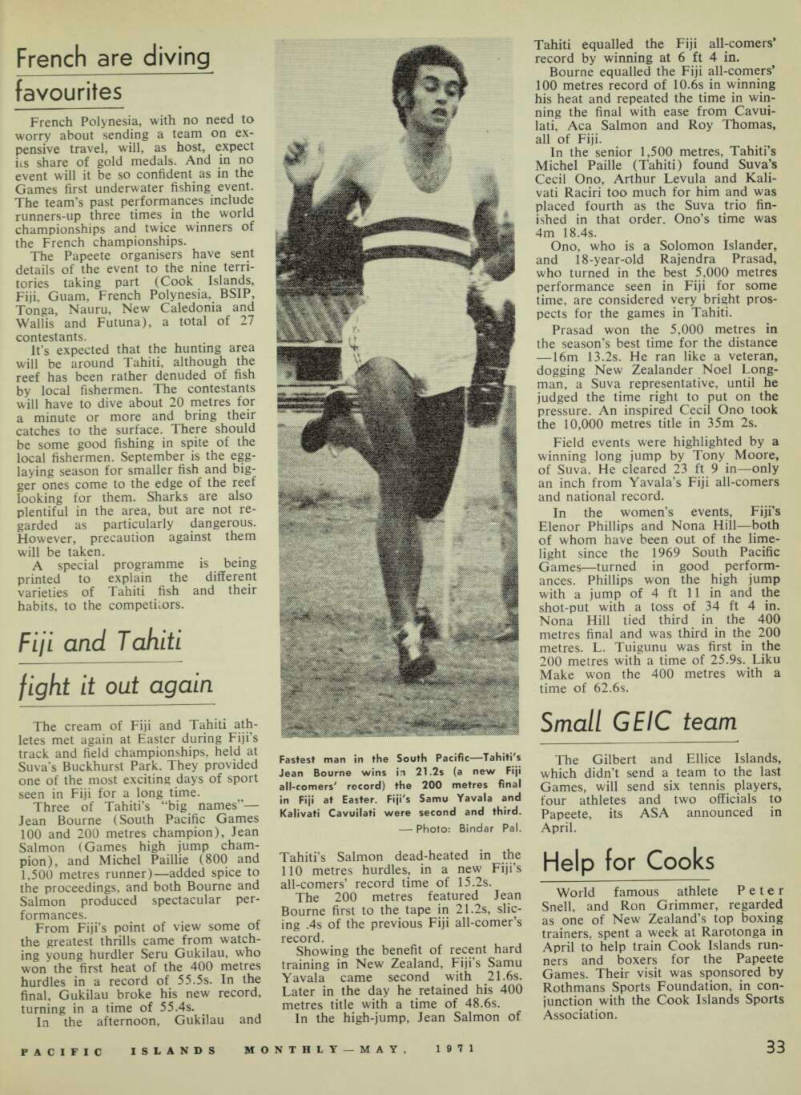
hosts the islands
Just four months to go to the South Pacific Games in Papeete in Septem ber and Islands territories are either hard at work holding their own cham pionships, or sending the cream of their athletes to perform “overseas”.
For instance, the New Caledonians in April matched themselves against boxers from Fiji, Rugbymen and weightlifters from Tahiti and yachts men from New Zealand.
The Fijians starred in an interna tional boxing evening on April 3, organised by the Le Nickel company’s sports club. The Fijians contested 10 amateur bouts against the locals, while middleweight gold medallist from the Port Moresby Games, Ali pate Korovou, fought a professional bout against Australian Dick Blair.
The Fijians won three of the amateur bouts: Alipate Ledua (super lightweight), Sefanaia Vakacequ (middleweight) and Eminohi Harada (flyweight). The locals won four: Emmanuel Tonhoueri (lightweight), Mitra Kaloi (welterweight), Noel Hmae alias Kautche and Wallisian Sosefo Lie as superwelters. Three bouts were drawn.
In his professional match, Korovou won a points victory over the Austra lian, Blair. The Fijian champion has been working a year in New Cale donia and was keenly supported by 2,000 spectators in the Noumea in door stadium.
The Fijian boxers were followed by the Tahiti Rugbymen and weight lifters. Rugby has not been a tradi tionally strong sport among the Pacific French and the Tahitians claimed to have been only playing about one year. The rivalry was nevertheless keen; New Caledonia won both matches at the Magenta stadium, 9-3 and 12-6.
In the weightlifting, Tahiti won three out of five categories. Best re sults by the Tahitians were: A. Mar tin (lightweight) with 539 lb; Andre Chung (middleweight) with 627 lb, and Eric Smith (light-heavyweight) defeated Port Moresby gold medal list Selefen, with 73 H lb. Caledonian winners were Gutuhau Soane (feather weight silver medallist at Port Moresby) with 539 lb, and Martial Bone (heavyweight) with 726 lb.
Caledonian sporting interest then turned to yachting, when the territory was represented in the NZ yacht race from Whangarei to Noumea. It was the third time this event had been
organised, but more significant for the Caledonians, they were competing for the first time aboard the “Dame de Corail” (Coral Maid.) Line honours were taken on April 25 by NZ sloop Kismul with, second, 31 ft yacht, Chico; Chico was un official winner on corrected times.
Coral Maid was not among the leaders at the finish,
PNG withdraws from
Rugby, volleyball
The New Caledonians will send 240 to the Games.
Papua-New Guinea announced in April it would send a team of 164 a considerable cut in numbers follow ing a decision not to be represented in Rugby or volleyball.
The Rugby withdrawal came as no surprise as the PNG association was faced with a difficult fund raising effort, and the team had already com pleted a tour of North Queensland.
Volleyball was different; the game is increasing in popularity in the terri tory and there was some dismay when volleyball administrators announced they wanted to spend funds on home facilities rather than an overseas trip.
The team will sport a new look.
Hats are gone for both sexes. The men will wear bottle-green shorts, long white socks, and green slip on shirts bearing a pattern similar to the Games tiara flower emblem. The women will wear pant suits.
New Guinea’s preparations are reaching fever pitch as final and pre liminary trials are held, and sporting bodies frantically raise funds to reach a target of at least $60,000. A sub sidy has been promised by PNG’s government, but it’s contingent on what is raised by public subscription.
Marathon trials in Port Moresby nearly ended in tragedy when Solo mon Island runner Andrew Dakatia was knocked down by a car and seri ously injured. At last report he was
recovering, but had been sent to Bris bane for further treatment.
Athletes around PNG are faced with the problem—as in other years —of a lack of good coaches, and to make matters worse the team that won a good share of gold medals at the third Games has been scattered to many centres and some top ath letes complain of lack of competition.
Woman athlete Salitia Pipit, who won the 800 metres at Port Moresby, is regarded as one of the best pros pects. At last year’s championships she easily won all titles from 100 to 800 metres.
PNG’s swimmers seem certain again to give a good account of them selves. A training squad was chosen early this year and training is inten sive. At least 12 swimmers will make the trip and they will include gold medallist Nigel Cluer, Max Mowen and Charlie Martin, who since the last Games has broken both butterfly and backstroke records over 100 metres. Women swimmers Anne Pini and Tiko Mae from last Games, and Helen Burns, are the lady stars and these “veterans” will be backed by promising young swimmers appearing for their first Games.
PNG basketball teams seem sure to figure in the finals again at Papeete.
The women will be out to repeat their gold medal win of the third Games, while the men will try to turn their silver from those Games into gold.
There is a new lineup of boxers on the scene. Three centres have been holding regular tournaments and competition for places in the boxing squad will be keen.
A Port Moresby club soccer team recently made a most successful tour of North Queensland, winning all its matches. This has revived hopes that PNG might at last break into the “big” final at the Games. Adminis trative problems have plagued this popular sport for two years, but offi cials are now hopeful that funds will be forthcoming for the Games team.
Weightlifters should again win their share of the medals with old stars like the Seeto brothers going.
Champion yachtsman Dobbs has announced he will not be available this year and there’s keen competi tion from “Fireball” men in Lae, Madang, Rabaul and Port Moresby for places in the team. Trials are to be held in Lae in June.
With archery being staged for the first time at the Games it’s anybody’s guess how the competition will go.
PNG cyclists will face stiff competi tion from the experienced wheel men of New Caledonia.
Amateur Sports Federation secre tary, Jack Pini, will manage the team.
Mr. Pini was swimming manager at Port Moresby.
French are diving favourites
French Polynesia, with no need to worry about sending a team on ex pensive travel, will, as host, expect its share of gold medals. And in no event will it be so confident as in the Games first underwater fishing event.
The team’s past performances include runners-up three times in the world championships and twice winners of the French championships.
The Papeete organisers have sent details of the event to the nine terri tories taking part (Cook Islands, Fiji, Guam, French Polynesia, BSIP, Tonga, Nauru, New Caledonia and Wallis and Futuna), a total of 27 contestants.
It’s expected that the hunting area will be around Tahiti, although the reef has been rather denuded of fish by local fishermen. The contestants will have to dive about 20 metres for a minute or more and bring their catches to the surface. There should be some good fishing in spite of the local fishermen. September is the egg laying season for smaller fish and big ger ones come to the edge of the reef looking for them. Sharks are also plentiful in the area, but are not re garded as particularly dangerous.
However, precaution against them will be taken.
A special programme is being printed to explain the different varieties of Tahiti fish and their habits, to the competitors.
Fiji and Tahiti
fight it out again
The cream of Fiji and Tahiti ath letes met again at Easter during Fiji’s track and field championships, held at Suva’s Buckhurst Park. They provided one of the most exciting days of sport seen in Fiji for a long time.
Three of Tahiti’s “big names” — Jean Bourne (South Pacific Games 100 and 200 metres champion), Jean Salmon (Games high jump cham pion), and Michel Paillie (800 and 1,500 metres runner) —added spice to the proceedings, and both Bourne and Salmon produced spectacular per formances.
From Fiji’s point of view some of the greatest thrills came from watch ing young hurdler Seru Gukilau, who won the first heat of the 400 metres hurdles in a record of 55.55. In the final, Gukilau broke his new record, turning in a time of 55.45.
In the afternoon, Gukilau and
Tahiti’s Salmon dead-heated in the 110 metres hurdles, in a new Fiji’s all-comers’ record time of 15.25.
The 200 metres featured Jean Bourne first to the tape in 21.25, slic ing .4s of the previous Fiji all-comer’s record.
Showing the benefit of recent hard training in New Zealand, Fiji’s Samu Yavala came second with 21.65.
Later in the day he retained his 400 metres title with a time of 48.65.
In the high-jump, Jean Salmon of
Tahiti equalled the Fiji all-comers’ record by winning at 6 ft 4 in.
Bourne equalled the Fiji all-comers’ 100 metres record of 10.6 s in winning his heat and repeated the time in win ning the final with ease from Cavui lati, Aca Salmon and Roy Thomas, all of Fiji.
In the senior 1,500 metres, Tahiti’s Michel Faille (Tahiti) found Suva’s Cecil Ono, Arthur Levula and Kali vati Raciri too much for him and was placed fourth as the Suva trio fin ished in that order. Ono’s time was 4m 18.45.
Ono, who is a Solomon Islander, and 18-year-old Rajendra Prasad, who turned in the best 5,000 metres performance seen in Fiji for some time, are considered very bright pros pects for the games in Tahiti.
Prasad won the 5,000 metres in the season’s best time for the distance —l6m 13.25. He ran like a veteran, dogging New Zealander Noel Long man, a Suva representative, until he judged the time right to put on the pressure. An inspired Cecil Ono took the 10,000 metres title in 35m 2s.
Field events were highlighted by a winning long jump by Tony Moore, of Suva. He cleared 23 ft 9 in—only an inch from Yavala’s Fiji all-comers and national record.
In the women’s events, Fiji’s Elenor Phillips and Nona Hill —both of whom have been out of the lime light since the 1969 South Pacific Games—turned in good perform ances. Phillips won the high jump with a jump of 4 ft 11 in and the shot-put with a toss of 34 ft 4 in.
Nona Hill tied third in the 400 metres final and was third in the 200 metres. L. Tuigunu was first in the 200 metres with a time of 25.95. Liku Make won the 400 metres with a time of 62.65.
Small GEIC team
The Gilbert and Ellice Islands, which didn’t send a team to the last Games, will send six tennis players, four athletes and two officials to Papeete, its ASA announced in April.
Help for Cooks
World famous athlete Peter Snell, and Ron Grimmer, regarded as one of New Zealand’s top boxing trainers, spent a week at Rarotonga in April to help train Cook Islands run ners and boxers for the Papeete Games. Their visit was sponsored by Rothmans Sports Foundation, in con junction with the Cook Islands Sports Association.
Fastest man in the South Pacific —Tahiti's Jean Bourne wins in 21.2s (a new Fiji all-comers' record) the 200 metres final in Fiji at Easter. Fiji's Samu Yavala and Kalivati Cavuilati were second and third. -Photo: Bindar Pal.
Tropicalities
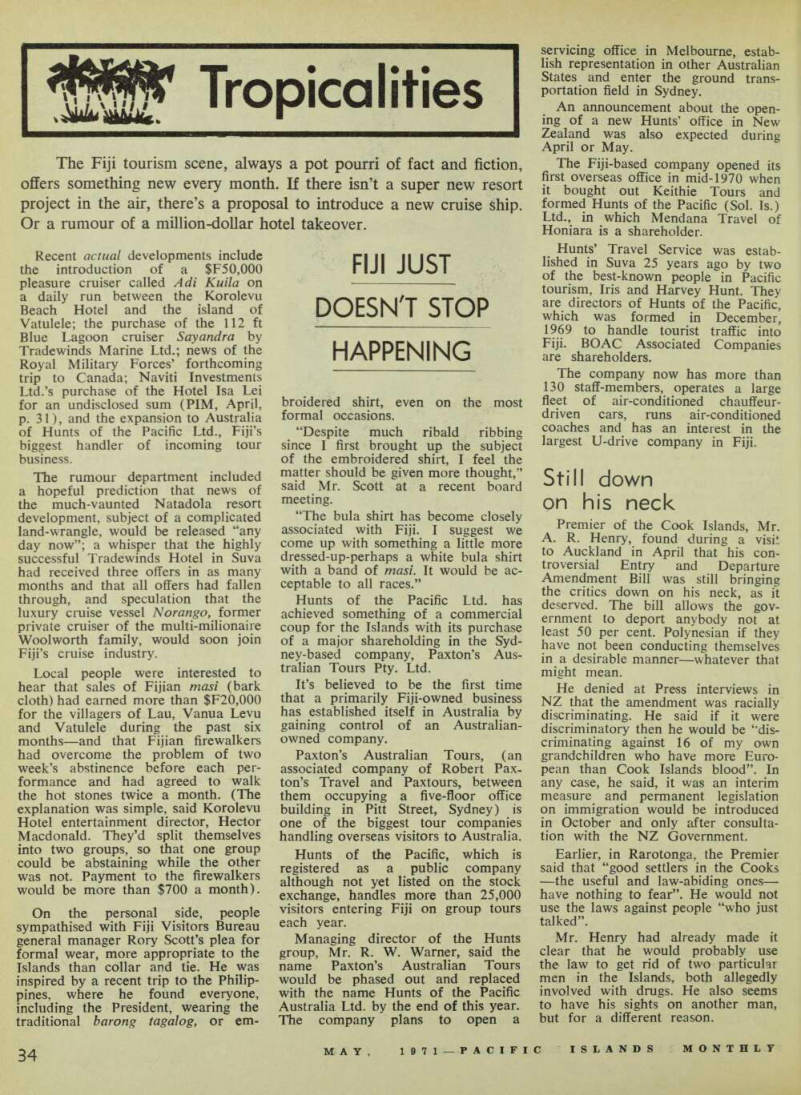
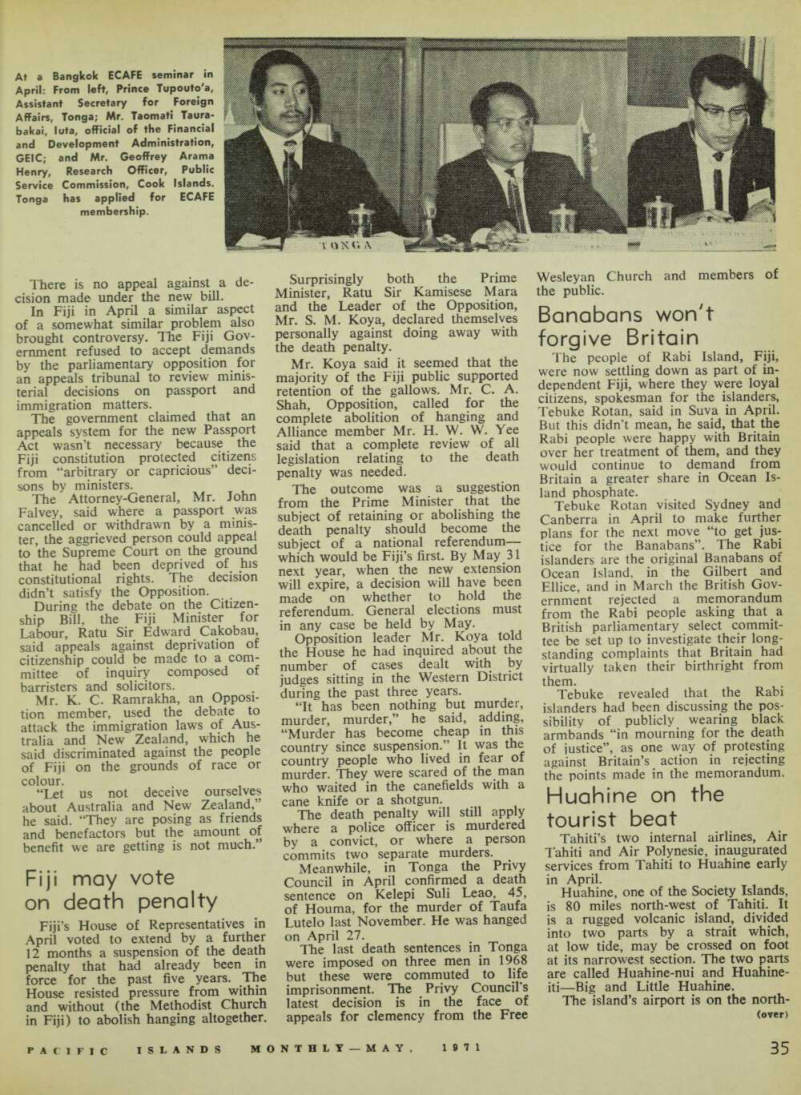
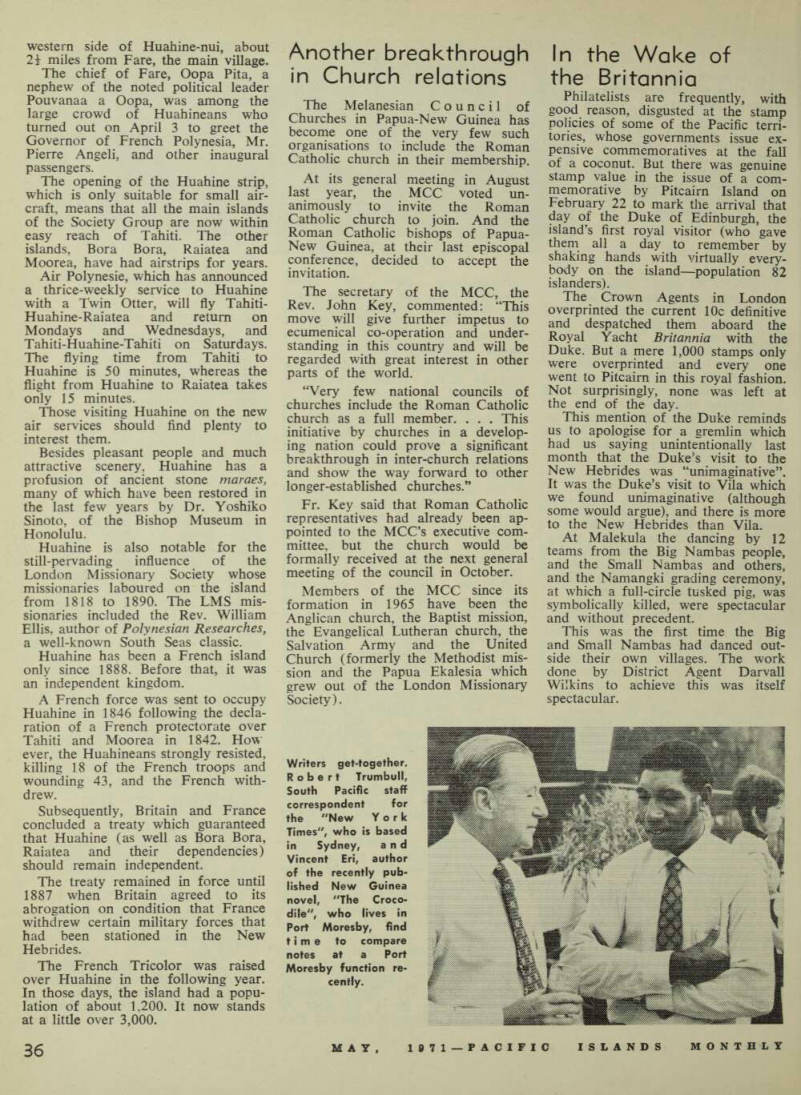
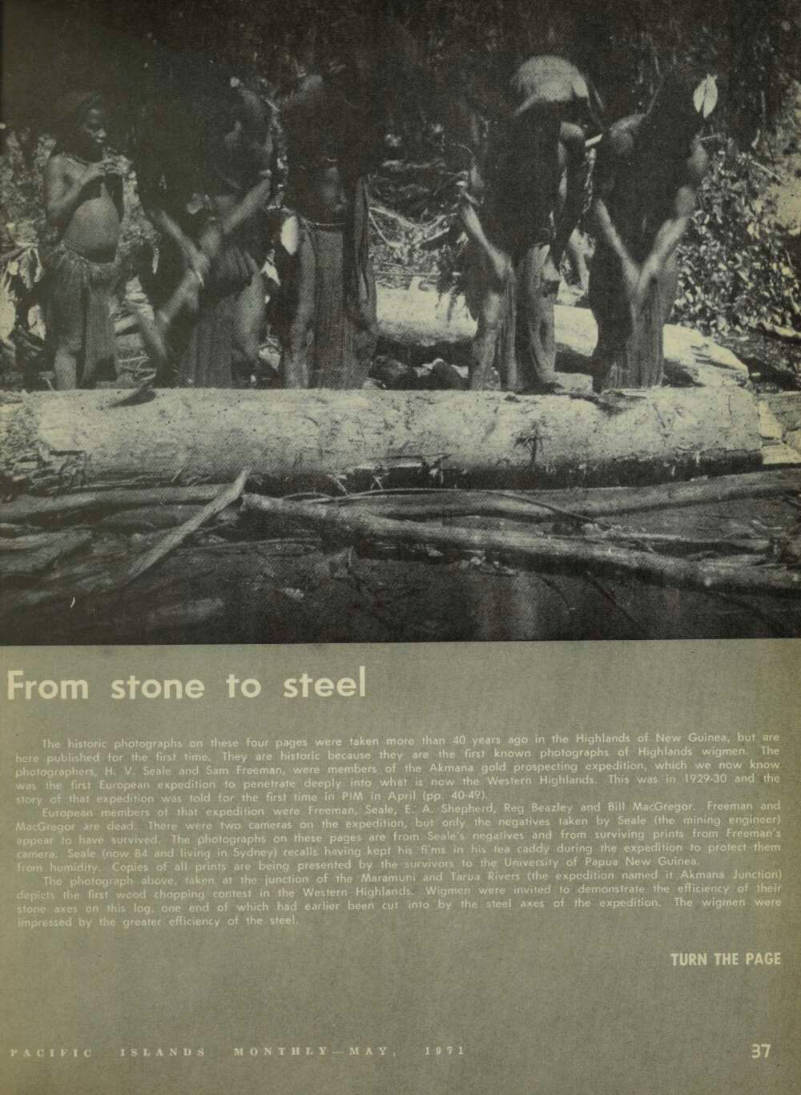
The Fiji tourism scene, always a pot pourri of fact and fiction, offers something new every month. If there isn’t a super new resort project in the air, there’s a proposal to introduce a new cruise ship.
Or a rumour of a million-dollar hotel takeover.
Recent actual developments include the introduction of a $F50,000 pleasure cruiser called Adi Kuila on a daily run between the Korolevu Beach Hotel and the island of Vatulele; the purchase of the 112 ft Blue Lagoon cruiser Sayandra by Tradewinds Marine Ltd.; news of the Royal Military Forces’ forthcoming trip to Canada; Naviti Investments Ltd.’s purchase of the Hotel Isa Lei for an undisclosed sum (PIM, April, p. 31), and the expansion to Australia of Hunts of the Pacific Ltd., Fiji’s biggest handler of incoming tour business.
The rumour department included a hopeful prediction that news of the much-vaunted Natadola resort development, subject of a complicated land-wrangle, would be released “any day now”; a whisper that the highly successful Tradewinds Hotel in Suva had received three offers in as many months and that all offers had fallen through, and speculation that the luxury cruise vessel Norango, former private cruiser of the multi-milionaire Woolworth family, would soon join Fiji’s cruise industry.
Local people were interested to hear that sales of Fijian masi (bark cloth) had earned more than $F20,000 for the villagers of Lau, Vanua Levu and Vatulele during the past six months—and that Fijian firewalkers had overcome the problem of two week’s abstinence before each per formance and had agreed to walk the hot stones twice a month. (The explanation was simple, said Korolevu Hotel entertainment director, Hector Macdonald. They’d split themselves into two groups, so that one group could be abstaining while the other was not. Payment to the firewalkers would be more than $7OO a month).
On the personal side, people sympathised with Fiji Visitors Bureau general manager Rory Scott’s plea for formal wear, more appropriate to the Islands than collar and tie. He was inspired by a recent trip to the Philip pines, where he found everyone, including the President, wearing the traditional barong tagalog, or em-
Fiji Just
Doesn't Stop
Happening
broidered shirt, even on the most formal occasions.
“Despite much ribald ribbing since I first brought up the subject of the embroidered shirt, I feel the matter should be given more thought,” said Mr. Scott at a recent board meeting.
“The bula shirt has become closely associated with Fiji. I suggest we come up with something a little more dressed-up-perhaps a white bula shirt with a band of masi. It would be ac ceptable to all races.”
Hunts of the Pacific Ltd. has achieved something of a commercial coup for the Islands with its purchase of a major shareholding in the Syd ney-based company, Paxton’s Aus tralian Tours Pty. Ltd.
It’s believed to be the first time that a primarily Fiji-owned business has established itself in Australia by gaining control of an Australian owned company.
Paxton’s Australian Tours, (an associated company of Robert Pax ton’s Travel and Paxtours, between them occupying a five-floor office building in Pitt Street, Sydney) is one of the biggest tour companies handling overseas visitors to Australia.
Hunts of the Pacific, which is registered as a public company although not yet listed on the stock exchange, handles more than 25,000 visitors entering Fiji on group tours each year.
Managing director of the Hunts group, Mr. R. W. Warner, said the name Paxton’s Australian Tours would be phased out and replaced with the name Hunts of the Pacific Australia Ltd. by the end of this year.
The company plans to open a
servicing office in Melbourne, estab lish representation in other Australian States and enter the ground trans portation field in Sydney.
An announcement about the open ing of a new Hunts’ office in New Zealand was also expected during April or May.
The Fiji-based company opened its first overseas office in mid-1970 when it bought out Keithie Tours and formed Hunts of the Pacific (Sol. Is.) Ltd., in which Mendana Travel of Honiara is a shareholder.
Hunts’ Travel Service was estab lished in Suva 25 years ago by two of the best-known people in Pacific tourism, Iris and Harvey Hunt. They are directors of Hunts of the Pacific, which was formed in December, 1969 to handle tourist traffic into Fiji. BO AC Associated Companies are shareholders.
The company now has more than 130 staff-members, operates a large fleet of air-conditioned chauffeur driven cars, runs air-conditioned coaches and has an interest in the largest U-drive company in Fiji.
Still down
on his neck
Premier of the Cook Islands, Mr.
A. R. Henry, found during a visit to Auckland in April that his con troversial Entry and Departure Amendment Bill was still bringing the critics down on his neck, as it deserved. The bill allows the gov ernment to deport anybody not at least 50 per cent. Polynesian if they have not been conducting themselves in a desirable manner—whatever that might mean.
He denied at Press interviews in NZ that the amendment was racially discriminating. He said if it were discriminatory then he would be ‘‘dis criminating against 16 of my own grandchildren who have more Euro pean than Cook Islands blood”. In any case, he said, it was an interim measure and permanent legislation on immigration would be introduced in October and only after consulta tion with the NZ Government.
Earlier, in Rarotonga, the Premier said that “good settlers in the Cooks —the useful and law-abiding ones— have nothing to fear”. He would not use the laws against people “who just talked”.
Mr. Henry had already made it clear that he would probably use the law to get rid of two particular men in the Islands, both allegedly involved with drugs. He also seems to have his sights on another man, but for a different reason.
There is no appeal against a de cision made under the new bill.
In Fiji in April a similar aspect of a somewhat similar problem also brought controversy. ITie Fiji Gov ernment refused to accept demands by the parliamentary opposition for an appeals tribunal to review minis terial decisions on passport and immigration matters.
The government claimed that an appeals system for the new Passport Act wasn’t necessary because the Fiji constitution protected citizens from “arbitrary or capricious” deci sons by ministers.
The Attorney-General, Mr. John Falvey, said where a passport was cancelled or withdrawn by a minis ter, the aggrieved person could appeal to the Supreme Court on the ground that he had been deprived of his constitutional rights. The decision didn’t satisfy the Opposition.
During the debate on the Citizen ship Bill, the Fiji Minister for Labour, Ratu Sir Edward Cakobau, said appeals against deprivation of citizenship could be made to a com mittee of inquiry composed of barristers and solicitors.
Mr. K. C. Ramrakha, an Opposi tion member, used the debate to attack the immigration laws of Aus tralia and New Zealand, which he said discriminated against the people of Fiji on the grounds of race or colour.
“Let us not deceive ourselves about Australia and New Zealand,” he said. “They are posing as friends and benefactors but the amount of benefit we are getting is not much.”
Fiji may vote
on death penalty
Fiji’s House of Representatives in April voted to extend by a further 12 months a suspension of the death penalty that had already been in force for the past five years. The House resisted pressure from within and without (the Methodist Church in Fiji) to abolish hanging altogether.
Surprisingly both the Prime Minister, Ratu Sir Kamisese Mara and the Leader of the Opposition, Mr. S. M. Koya, declared themselves personally against doing away with the death penalty.
Mr. Koya said it seemed that the majority of the Fiji public supported retention of the gallows. Mr. C. A.
Shah, Opposition, called for the complete abolition of hanging and Alliance member Mr. H. W. W. Yee said that a complete review of all legislation relating to the death penalty was needed.
The outcome was a suggestion from the Prime Minister that the subject of retaining or abolishing the death penalty should become the subject of a national referendum — which would be Fiji’s first. By May 31 next year, when the new extension will expire, a decision will have been made on whether to hold the referendum. General elections must in any case be held by May.
Opposition leader Mr. Koya told the House he had inquired about the number of cases dealt with by judges sitting in the Western District during the past three years.
“It has been nothing but murder, murder, murder,” he said, adding, “Murder has become cheap in this country since suspension.” It was the country people who lived in fear of murder. They were scared of the man who waited in the canefields with a cane knife or a shotgun.
The death penalty will still apply where a police officer is murdered by a convict, or where a person commits two separate murders.
Meanwhile, in Tonga the Privy Council in April confirmed a death sentence on Kelepi Suli Leao, 45, of Houma, for the murder of Taufa Lutelo last November. He was hanged on April 27.
The last death sentences in Tonga were imposed on three men in 1968 but these were commuted to life imprisonment. The Privy Council’s latest decision is in the face of appeals for clemency from the Free
Wesleyan Church and members of the public.
Banabans won't
forgive Britain
The people of Rabi Island, Fiji, were now settling down as part of in dependent Fiji, where they were loyal citizens, spokesman for the islanders, Tebuke Rotan, said in Suva in April.
But this didn’t mean, he said, that the Rabi people were happy with Britain over her treatment of them, and they would continue to demand from Britain a greater share in Ocean Is land phosphate.
Tebuke Rotan visited Sydney and Canberra in April to make further plans for the next move “to get jus : tice for the Banabans”. The Rabi islanders are the original Banabans of Ocean Island, in the Gilbert and Ellice, and in March the British Gov ernment rejected a memorandum from the Rabi people asking that a British parliamentary select commit tee be set up to investigate their long standing complaints that Britain had virtually taken their birthright from them.
Tebuke revealed that the Rabi islanders had been discussing the pos sibility of publicly wearing black armbands “in mourning for the death of justice”, as one way of protesting against Britain’s action in rejecting the points made in the memorandum.
Huahine on the
tourist beat
Tahiti’s two internal airlines, Air Tahiti and Air Polynesie, inaugurated services from Tahiti to Huahine early in April.
Huahine, one of the Society Islands, is 80 miles north-west of Tahiti. It is a rugged volcanic island, divided into two parts by a strait which, at low tide, may be crossed on foot at its narrowest section. The two parts are called Huahine-nui and Huahine iti—Big and Little Huahine.
The island’s airport is on the north (over)
At a Bangkok ECAFE seminar in April: From left, Prince Tupouto'a, Assistant Secretary for Foreign Affairs, Tonga; Mr. Taomati Taura bakai, luta, official of the Financial and Development Administration, GEIC; and Mr. Geoffrey Arama Henry, Research Officer, Public Service Commission, Cook Islands.
Tonga has applied for ECAFE membership.
western side of Huahine-nui, about 2i miles from Fare, the main village.
The chief of Fare, Oopa Pita, a nephew of the noted political leader Pouvanaa a Oopa, was among the large crowd of Huahineans who turned out on April 3 to greet the Governor of French Polynesia, Mr.
Pierre Angeli, and other inaugural passengers.
The opening of the Huahine strip, which is only suitable for small air craft, means that all the main islands of the Society Group are now within easy reach of Tahiti. The other islands, Bora Bora, Raiatea and Moorea, have had airstrips for years.
Air Polynesie, which has announced a thrice-weekly service to Huahine with a Twin Otter, will fly Tahiti- Huahine-Raiatea and return on Mondays and Wednesdays, and Tahiti-Huahine-Tahiti on Saturdays.
The flying time from Tahiti to Huahine is 50 minutes, whereas the flight from Huahine to Raiatea takes only 15 minutes.
Those visiting Huahine on the new air services should find plenty to interest them.
Besides pleasant people and much attractive scenery, Huahine has a profusion of ancient stone maraes, many of which have been restored in the last few years by Dr. Yoshiko Sinoto, of the Bishop Museum in Honolulu.
Huahine is also notable for the still-pervading influence of the London Missionary Society whose missionaries laboured on the island from 1818 to 1890. The LMS mis sionaries included the Rev. William Ellis, author of Polynesian Researches, a well-known South Seas classic.
Huahine has been a French island only since 1888. Before that, it was an independent kingdom.
A French force was sent to occupy Huahine in 1846 following the decla ration of a French protectorate over Tahiti and Moorea in 1842. How ever, the Huahineans strongly resisted, killing 18 of the French troops and wounding 43, and the French with drew.
Subsequently, Britain and France concluded a treaty which guaranteed that Huahine (as well as Bora Bora, Raiatea and their dependencies) should remain independent.
The treaty remained in force until 1887 when Britain agreed to its abrogation on condition that France withdrew certain military forces that had been stationed in the New Hebrides.
The French Tricolor was raised over Huahine in the following year.
In those days, the island had a popu lation of about 1.200. It now stands at a little over 3,000.
Another breakthrough
in Church relations
The Melanesian Council of Churches in Papua-New Guinea has become one of the very few such organisations to include the Roman Catholic church in their membership.
At its general meeting in August last year, the MCC voted un animously to invite the Roman Catholic church to join. And the Roman Catholic bishops of Papua- New Guinea, at their last episcopal conference, decided to accept the invitation.
The secretary of the MCC, the Rev. John Key, commented: “This move will give further impetus to ecumenical co-operation and under standing in this country and will be regarded with great interest in other parts of the world.
“Very few national councils of churches include the Roman Catholic church as a full member. . . . This initiative by churches in a develop ing nation could prove a significant breakthrough in inter-church relations and show the way forward to other longer-established churches.”
Fr. Key said that Roman Catholic representatives had already been ap pointed to the MCC’s executive com mittee, but the church would be formally received at the next general meeting of the council in October.
Members of the MCC since its formation in 1965 have been the Anglican church, the Baptist mission, the Evangelical Lutheran church, the Salvation Army and the United Church (formerly the Methodist mis sion and the Papua Ekalesia which grew out of the London Missionary Society).
In the Wake of
the Britannia
Philatelists are frequently, with good reason, disgusted at the stamp policies of some of the Pacific terri tories, whose governments issue ex pensive commemoratives at the fall of a coconut. But there was genuine stamp value in the issue of a com memorative by Pitcairn Island on February 22 to mark the arrival that day of the Duke of Edinburgh, the island’s first royal visitor (who gave them all a day to remember by shaking hands with virtually every body on the island—population 82 islanders).
The Crown Agents in London overprinted the current 10c definitive and despatched them aboard the Royal Yacht Britannia with the Duke. But a mere 1,000 stamps only were overprinted and every one went to Pitcairn in this royal fashion.
Not surprisingly, none was left at the end of the day.
This mention of the Duke reminds us to apologise for a gremlin which had us saying unintentionally last month that the Duke’s visit to the New Hebrides was “unimaginative”.
It was the Duke’s visit to Vila which we found unimaginative (although some would argue), and there is more to the New Hebrides than Vila.
At Malekula the dancing by 12 teams from the Big Nambas people, and the Small Nambas and others, and the Namangki grading ceremony, at which a full-circle tusked pig, was symbolically killed, were spectacular and without precedent.
This was the first time the Big and Small Nambas had danced out side their own villages. The work done by District Agent Darvall Wilkins to achieve this was itself spectacular.
Writers get-together.
Robert Trumbull, South Pacific staff
correspondent for
the "New York Times", who is based in Sydney, and Vincent Eri, author of the recently pub lished New Guinea novel, "The Croco dile", who lives in Port Moresby, find time to compare notes at a Port Moresby function re cently.
From stone to steel
RThe historic photographs on these four pages were taken more than 40 years ago in the Highlands of New Guinea, but are iere published for the first time. They are historic because they are the first known photographs of Highlands w.gmen The photographers, H. V. Seale and Sam Freeman, were members of the Akmana gold prospecting expedition, which we now know was the first European expedition to penetrate deeply into what is now the Western Highlands. This was in 1929-30 and the story of that expedition was told for the first time in PIAA in April (pp. 40-49). , European members of that expedition were Freeman, Seale, E. A. Shepherd, Reg Beazley and 6,11 MacGregor. Freeman and MacGregor are dead. There were two cameras on the expedition, but only the negatives taken by Seale <the mining engineer) appear to have survived. The photographs on these pages are from Seale's negatives and from surviving prints from Freeman s camera. Seale (now 84 and living in Sydney) recalls having kept his ferns in his tea caddy during the expedition to protect them from humidity. Copies of all prints are being presented by the survivors to the University of Papua New Guinea.
The photograph above, taken at the junction of the Maramuni and Tarua Rivers (the expedition named it Akmana Junction) depicts the first wood chopping contest in the Western Highlands. Wigmen were invited to demonstrate the efficiency of their stone axes on this log, one end of which had earlier been cut into by the steel axes of the expedition. The w.gmen were impressed by the greater efficiency of the steel.
Turn The Page
. . . Akmana,
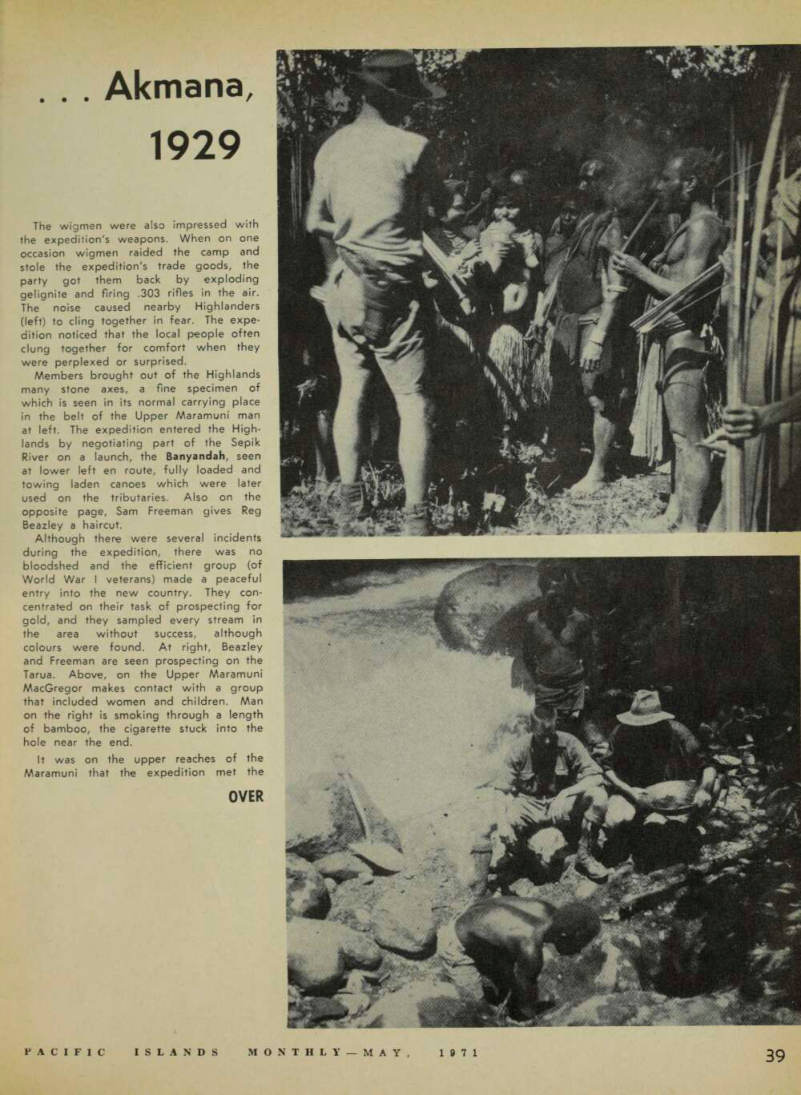

1929
The wigmen were also impressed with the expedition's weapons. When on one occasion wigmen raided the camp and stole the expedition's trade goods, the party got them back by exploding gelignite and firing .303 rifles in the air.
The noise caused nearby Highlanders (left) to cling together in fear. The expe dition noticed that the local people often clung together for comfort when they
were perplexed or surprised.
Members brought out of the Highlands many stone axes, a fine specimen of which is seen in its normal carrying place in the belt of the Upper Maramuni man at left. The expedition entered the High lands by negotiating part of the Sepik River on a launch, the Banyandah, seen at lower left en route, fully loaded and towing laden canoes which were later used on the tributaries. Also on the opposite page, Sam Freeman gives Reg Beazley a haircut.
Although there were several incidents during the expedition, there was no bloodshed and the efficient group (of World War I veterans) made a peaceful entry into the new country. They con centrated on their task of prospecting for gold, and they sampled every stream in the area without success, although colours were found. At right, Beazley and Freeman are seen prospecting on the Tarua. Above, on the Upper Maramuni MacGregor makes contact with a group that included women and children. Man on the right is smoking through a length of bamboo, the cigarette stuck into the hole near the end.
It was on the upper reaches of the Maramuni that the expedition met the
Over
... The little people'
"little people". They were of pygmy height, but among the group were people of normal height, as can be seen in the picture above. (People who are well pro portioned and whose height falls below 4 ft 11 in. are usually termed pygmies.) There are a number of groups in Papua New Guinea that can be described as pygmy, one of them being on the Jimmi River, not far from the eastern extremity of the route taken by the Akmana ex pedition of 40 years ago. — Stuart Inder.
Advertisements & other items, pp. 43-44 (1 item)
News magazine of the South Pacific
(FDR®
. . . with concise reporting on the significant news of the South Pacific, penetrating background stories, bright informative magazine articles, big picture features, Pacific travel, profiles of Pacific personalities, a cruising yachtsman's department. Islands' business and development, reviews of the latest books and a special section for planters.
Take out a subscription and dip yourself each month into the real South Pacific.
USE THE FORM OVERLEAF TO BECOME A REGULAR READER
Australia (including Lord Howe and Thursday Is.), B.S.I.P., Gilbert and Ellice Is Papua-New Guinea, Norfolk Island, Nauru, Tonga and New Hebrides ..
New Zealand Fiji, Cook Islands, Niue and Western Samoa American Samoa U.S. Mainland, Micronesia (including Guam) Hawaii New Caledonia Tahiti and French Polynesia United Kingdom and Elsewhere Please enrol me as a subscriber to
Attached find payment of for
subscription.
□ NEW □ RENEWAL
(CAPITAL LETTERS)
Pacific Islands Monthly”.
years
NAME
ADDRESS
COUNTRY
Box 3408, G.P.O., 29
PACIFIC ISLANDS MONTHLY !
108, G.P.O., Sydney, N.S.W. 2001, Australia. 9 Alberta Street, Sydney, N.S.W. 2000.
MAY, 1971—PACIFIC ISLANDS MONTHLY
Magazine Section
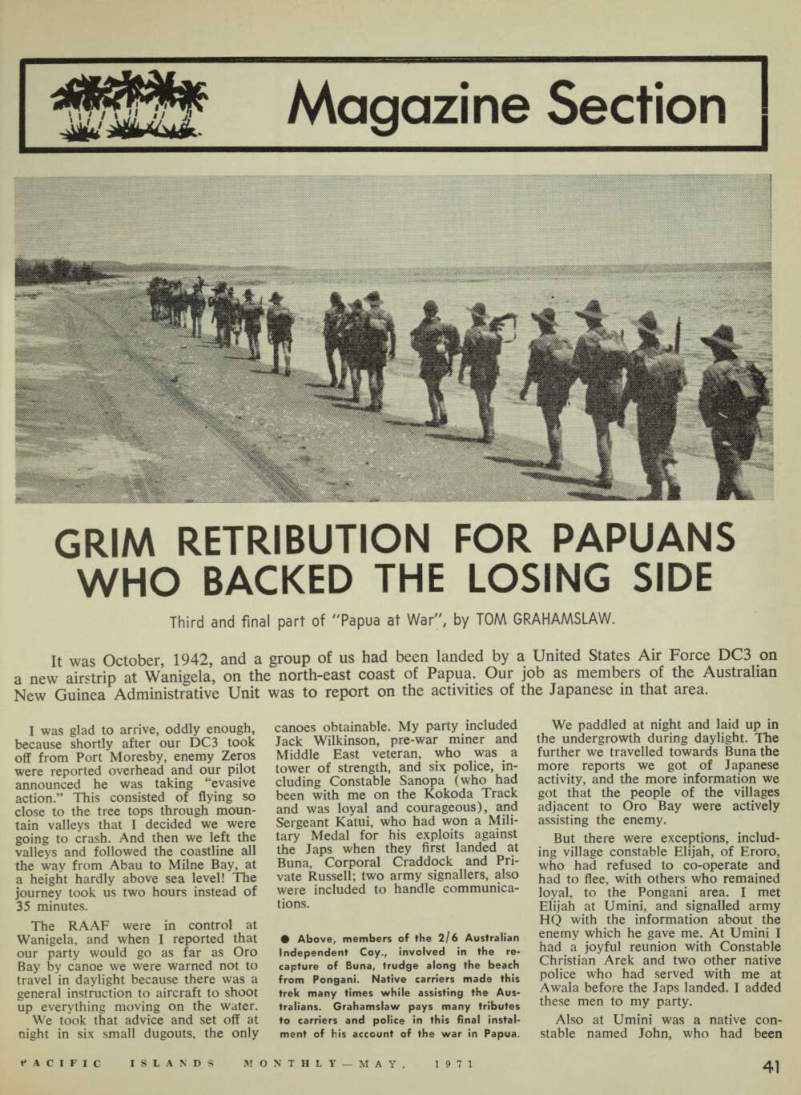
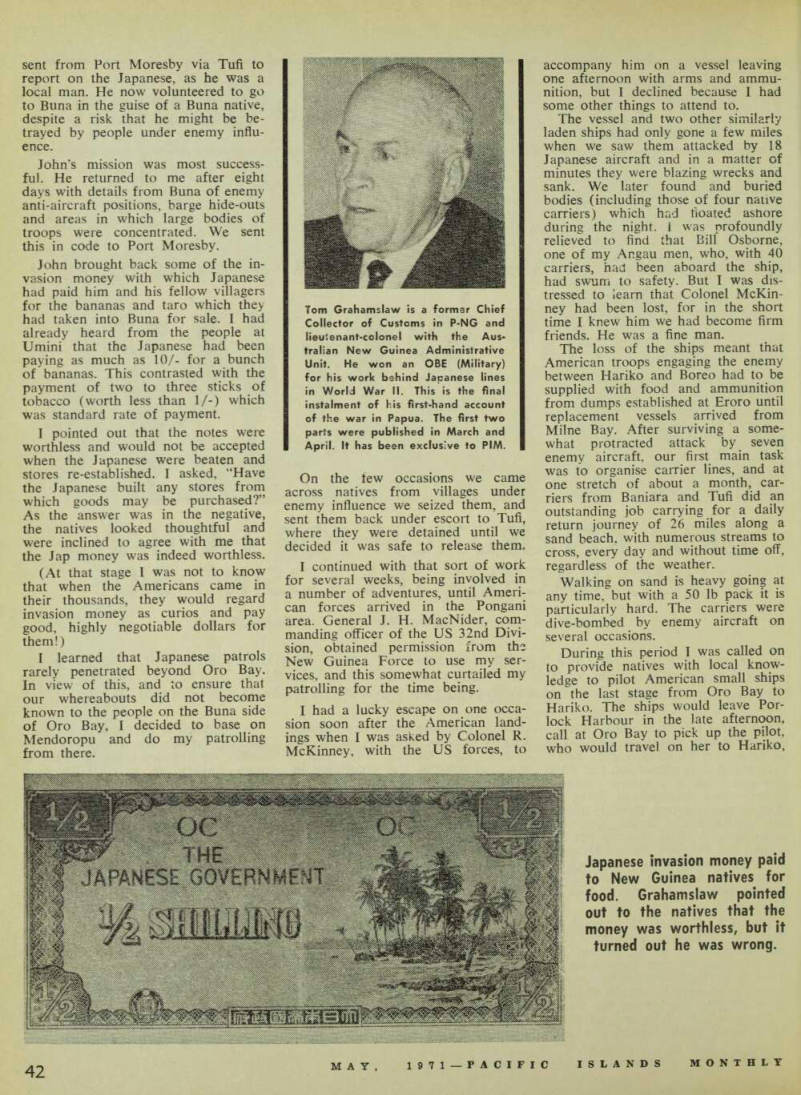
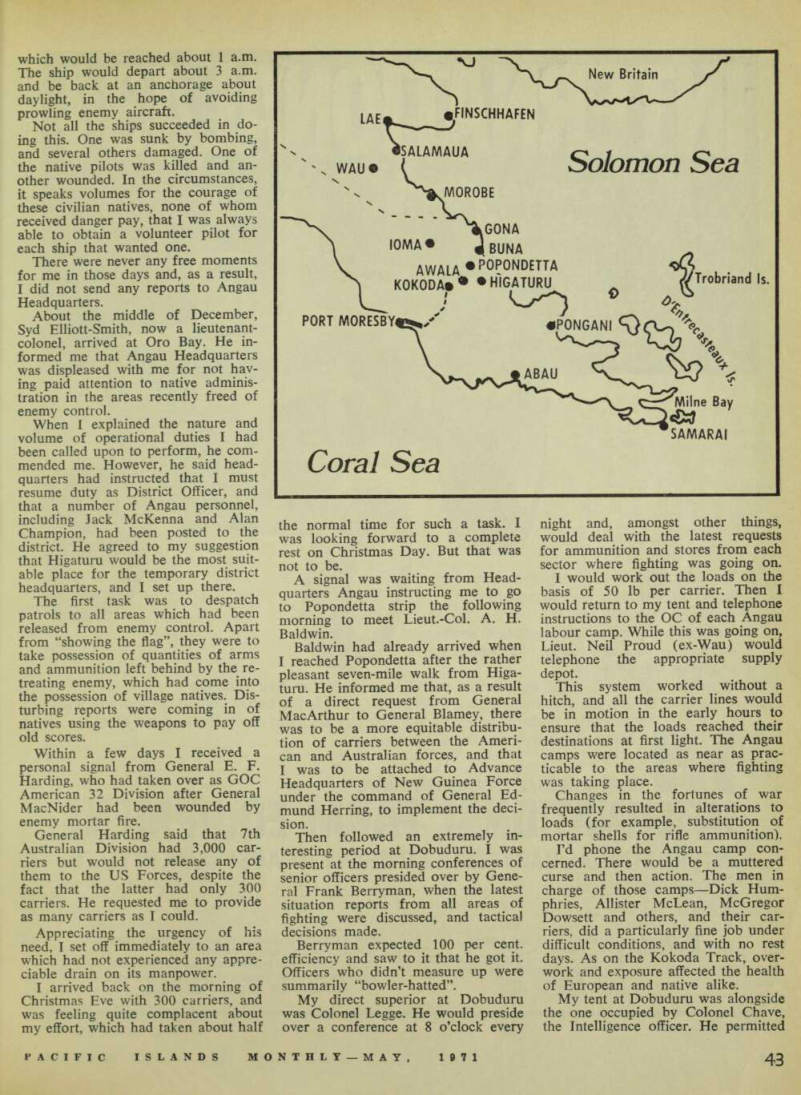

Grim Retribution For Papuans
Who Backed The Losing Side
Third and final part of "Papua at War", by TOM GRAHAMSLAW.
It was October, 1942, and a group of us had been landed by a United States Air Force DCS on a new airstrip at Wanigela, on the north-east coast of Papua. Our job as members of the Australian New Guinea Administrative Unit was to report on the activities of the Japanese in that area.
I was glad to arrive, oddly enough, because shortly after our DC3 took off from Port Moresby, enemy Zeros were reported overhead and our pilot announced he was taking “evasive action” This consisted of flying so close to the tree tops through mountain valleys that I decided we were going to crash. And then we left the valleys and followed the coastline all the way from Abau to Milne Bay, at a height hardly above sea level! The journey took us two hours instead of 35 minutes.
The RAAF were in control at Wanigela, and when I reported that our party would go as far as Oro Bay by canoe we were warned not to travel in daylight because there was a general instruction to aircraft to shoot up everything moving on the water.
We took that advice and set off at night in six small dugouts, the only
canoes obtainable. My party included Jack Wilkinson, pre-war miner and Middle East veteran, who was a tower of strength, and six police, ineluding Constable Sanopa (who had been with me on the Kokoda Track and was loyal and courageous), and Sergeant Katui, who had won a Military Medal for his exploits against the Japs when they first landed at Buna, Corporal Craddock and Frivate Russell; two army signallers, also were included to handle commumcations.
• Above, members of the 2/6 Australian Independent Coy., involved in the re capture of Buna, trudge along the beach from Pongani. Native carriers made this trek many times while assisting the Aus tralians. Grahamslaw pays many tributes to carriers and police in this final instal ment of his account of the war in Papua.
We paddled at night and laid up in the undergrowth during daylight. The further we travelled towards Buna the more reports we got of Japanese activity, and the more information we got that the people of the villages adjacent to Oro Bay were actively assisting the enemy, But there were exceptions, includj n g v in a g e constable Elijah, of Eroro, w g o re f usec i to co-operate and j ia( j t 0 fl e6j w i t h others who remained loyal, to the Pongani area. I met Elijah at Umini, and signalled army H Q withthe information about the enemy which he gave me. At Ummi I had a .joyful reunion with Constable Christian Arek and two other native police who had served with me at Awala before the Japs landed. I added these men to my party.
Also at Umini was a native con stable named John, who had been
sent from Port Moresby via Tufi to report on the Japanese, as he was a local man. He now volunteered to go to Buna in the guise of a Buna native, despite a risk that he might be be trayed by people under enemy influ ence.
John's mission was most success ful. He returned to me after eight days with details from Buna of enemy anti-aircraft positions, barge hide-outs and areas in which large bodies of troops were concentrated. We sent this in code to Port Moresby.
John brought back some of the in vasion money with which Japanese had paid him and his fellow villagers for the bananas and taro which they had taken into Buna for sale, I had already heard from the people at Umini that the Japanese had been paying as much as 10/- for a bunch of bananas. This contrasted with the payment of two to three sticks of tobacco (worth less than 1/-) which was standard rate of payment.
I pointed out that the notes were worthless and would not be accepted when the Japanese were beaten and stores re-established. I asked, “Have the Japanese built any stores from which goods may be purchased?”
As the answer was in the negative, the natives looked thoughtful and were inclined to agree with me that the Jap money was indeed worthless. (At that stage I was not to know that when the Americans came in their thousands, they would regard invasion money as curios and pay good, highly negotiable dollars for them!) I learned that Japanese patrols rarely penetrated beyond Oro Bay.
In view of this, and to ensure that our whereabouts did not become known to the people on the Buna side of Oro Bay, I decided to base on Mendoropu and do my patrolling from there.
On the few occasions we came across natives from villages under enemy influence we seized them, and sent them back under escort to Tufi, where they were detained until we decided it was safe to release them.
I continued with that sort of work for several weeks, being involved in a number of adventures, until Ameri can forces arrived in the Pongani area. General J. H. MacNider, com manding officer of the US 32nd Divi sion, obtained permission from the New Guinea Force to use my ser vices, and this somewhat curtailed my patrolling for the time being.
I had a lucky escape on one occa sion soon after the American land ings when I was asked by Colonel R.
McKinney, with the US forces, to
accompany him on a vessel leaving one afternoon with arms and ammu nition, but I declined because I had some other things to attend to.
The vessel and two other similarly laden ships had only gone a few miles when we saw them attacked by 18 Japanese aircraft and in a matter of minutes they were blazing wrecks and sank. We later found and buried bodies (including those of four native carriers) which had hoated ashore during the night. 1 was profoundly relieved to find that Bill Osborne, one of my Angau men, who, with 40 carriers, had been aboard the ship, had swum to safety. But I was dis tressed to learn that Colonel McKin ney had been lost, for in the short time I knew him we had become firm friends. He was a fine man.
The loss of the ships meant that American troops engaging the enemy between Hariko and Boreo had to be supplied with food and ammunition from dumps established at Eroro until replacement vessels arrived from Milne Bay. After surviving a some what protracted attack by seven enemy aircraft, our first main task was to organise carrier lines, and at one stretch of about a month, car riers from Baniara and Tufi did an outstanding job carrying for a daily return journey of 26 miles along a sand beach, with numerous streams to cross, every day and without time off, regardless of the weather.
Walking on sand is heavy going at any time, but with a 50 lb pack it is particularly hard. The carriers were dive-bombed by enemy aircraft on several occasions.
During this period I was called on to provide natives with local know ledge to pilot American small ships on the last stage from Oro Bay to Hariko. The ships would leave Por lock Harbour in the late afternoon, call at Oro Bay to pick up the pilot, who would travel on her to Hariko,
Tom Grahamslaw is a former Chief Collector of Customs in P-NG and lieutenant-colonel with the Aus tralian New Guinea Administrative Unit. He won an OBE (Military) for his work behind Japanese lines in World War II. This is the final instalment of his first-hand account of the war in Papua. The first two parts were published in March and April. It has been exclusive to PIM.
Japanese invasion money paid to New Guinea natives for food. Grahamslaw pointed out to the natives that the money was worthless, but it turned out he was wrong.
which would be reached about 1 a.m.
The ship would depart about 3 a.m. and be back at an anchorage about daylight, in the hope of avoiding prowling enemy aircraft.
Not all the ships succeeded in do ing this. One was sunk by bombing, and several others damaged. One of the native pilots was killed and an other wounded. In the circumstances, it speaks volumes for the courage of these civilian natives, none of whom received danger pay, that I was always able to obtain a volunteer pilot for each ship that wanted one.
There were never any free moments for me in those days and, as a result, I did not send any reports to Angau Headquarters.
About the middle of December, Syd Elliott-Smith, now a lieutenant colonel, arrived at Oro Bay. He in formed me that Angau Headquarters was displeased with me for not hav ing paid attention to native adminis tration in the areas recently freed of enemy control.
When I explained the nature and volume of operational duties I had been called upon to perform, he com mended me. However, he said head quarters had instructed that I must resume duty as District Officer, and that a number of Angau personnel, including Jack McKenna and Alan Champion, had been posted to the district. He agreed to my suggestion that Higaturu would be the most suit able place for the temporary district headquarters, and I set up there.
The first task was to despatch patrols to all areas which had been released from enemy control. Apart from “showing the flag”, they were to take possession of quantities of arms and ammunition left behind by the re treating enemy, which had come into the possession of village natives. Dis turbing reports were coming in of natives using the weapons to pay off old scores.
Within a few days I received a personal signal from General E. F.
Harding, who had taken over as GOC American 32 Division after General MacNider had been wounded by enemy mortar fire.
General Harding said that 7th Australian Division had 3,000 car riers but would not release any of them to the US Forces, despite the fact that the latter had only 300 carriers. He requested me to provide as many carriers as I could.
Appreciating the urgency of his need, I set off immediately to an area which had not experienced any appre ciable drain on its manpower.
I arrived back on the morning of Christmas Eve with 300 carriers, and was feeling quite complacent about my effort, which had taken about half
the normal time for such a task. I was looking forward to a complete rest on Christmas Day. But that was not to be.
A signal was waiting from Headquarters Angau instructing me to go to Popondetta strip the following morning to meet Lieut.-Col. A. H.
Baldwin.
Baldwin had already arrived when I reached Popondetta after the rather pleasant seven-mile walk from Higaturn. He informed me that, as a result of a direct request from General MacArthur to General Blarney, there was to be a more equitable distribution of carriers between the American and Australian forces, and that I was to be attached to Advance Headquarters of New Guinea Force under the command of General Edmund Herring, to implement the decision.
Then followed an extremely interesting period at Dobuduru. I was present at the morning conferences of senior officers presided over by General Frank Berryman, when the latest situation reports from all areas of fighting were discussed, and tactical decisions made.
Berryman expected 100 per cent, efficiency and saw to it that he got it.
Officers who didn’t measure up were summarily “bowler-hatted”.
My direct superior at Dobuduru was Colonel Legge. He would preside over a conference at 8 o’clock every
night and, amongst other things, would deal with the latest requests for ammunition and stores from each sector where fighting was going on.
I would work out the loads on the basis of 50 lb per carrier. Then I would return to my tent and telephone instructions to the OC of each Angau labour camp. While this was going on, Lieut. Neil Proud (ex-Wau) would telephone the appropriate supply depot.
This system worked without a hitch, and all the carrier lines would be in motion in the early hours to ensure that the loads reached their destinations at first light. The Angau camps were located as near as prac ticable to the areas where fighting was taking place, Changes in the fortunes of war frequently resulted in alterations to loads (for example, substitution of mortar shells for rifle ammunition), I’d phone the Angau camp con cerned. There would be a muttered curse and then action. The men in charge of those camps—Dick Hum phries, Allister McLean, McGregor Dowsett and others, and their car riers, did a particularly fine job under difficult conditions, and with no rest days. As on the Kokoda Track, over work and exposure affected the health of European and native alike.
My tent at Dobuduru was alongside the one occupied by Colonel Chave, the Intelligence officer. He permitted
me to read the translations of Japan ese diaries, totalling over 100, which had been recovered from the bodies of enemy dead. These made fascinat ing reading, depicting as they did the experiences, hopes and fears of the writers.
It was while reading the transcrip tion of one of these diaries that I obtained the first authentic knowledge of the fate of Captain L. Austen and his party. I had left Austen when we had got away from the Jap land ings at Buna. Garbled accounts had already been received from native sources which indicated that the party had been wiped out by Japanese, after betrayal by certain natives.
The diary in question made two separate references to Austen’s party.
The first entry recorded that natives brought in nine Australian prisoners, comprising five men, three women and one child. The writer was most im pressed by the beauty of one of the women, Louise Artango. Louise was part-Filipino and part-Papuan. The other two women were Miss Lashmar and Miss Brenchley, of Sangara Mis sion.
The second entry in the diary, made on the day after the party was handed over, stated that the nine Australian prisoners had been shot and beheaded. The writer said that when the time came for the beheading of Louise Artango he felt quite sick.
He made only a passing reference to the killing of the others.
I also found a mention of Austen’s party in the transcription of another Japanese diary. This particular Japan ese had served in a number of areas —Hong Kong, Singapore, Java, Rabaul and Buna, before meeting his end at Milne Bay. One of the interest ing things mentioned in his diary was that his countrymen had established a shrine near one of the volcanoes at Rabaul, where they went to pray.
His diary made two references to Austen’s party. The first entry re corded the date (which coincided with that shown in the other diary), and the number and sex of Australians brought in to the Japanese at Sinemi; the second entry made a brief com ment of the shooting and beheading of the nine prisoners on the following day. It all made sad reading.
During this period of my work, sizeable numbers of New Guinea natives who had been brought from Rabaul to carry for the Japanese, had either escaped or been released by our troops as the enemy fell back to their last remaining strongholds at Buna and Gona. These natives, after convalescing in the hospital-cum convalescent camp run by Dr. Vemon at Popondetta, very willingly joined our Angau carrier lines.
I now received a report that about 500 New Guinea carriers had escaped early in the campaign and had made their way to the Waria region, where they were being fed by the local people. A patrol was despatched to fetch them in. They were in good fettle on arrival at Dobuduru, and were put to work immediately in the carrier lines, a task which they under took with gusto.
One of my duties, on behalf of Army Intelligence, was to interrogate New Guinea natives recently released from the Japs. Although reasonably fluent at Motu, which is the lingua franca of Papua, my knowledge of Pidgin was extremely limited. I was making heavy weather of it one morn ing when I received a visit from G.
A. V. Stanley (well-known Terri torial, who was staging through Dobuduru at the time. Stanley, who was serving in a hush-hush unit, spoke Pidgin almost as well as he did Motu, which is saying a lot. I gratefully ac cepted his offer to take over from me.
The majority of natives employed before the war in Rabaul and on plan tations in New Britain came from other districts, such as the Sepik, Mad ang, Bougainville, etc. These natives farmed themselves amongst the Tolai villages when the Japanese occupied Rabaul.
Several months later, the Japs had sent out word that if these “foreign” natives came into Rabaul they
would be sent back to their own vil lages. The natives fell for the offer, and something like 2,000 reported to Rabaul for “repatriation”. Instead, they found themselves transported to Buna to work as carriers.
These carriers had an exceedingly bad time. After the first day in from Buna the Japs compelled them to forage for their own food. This in volved raiding village gardens, which did not endear them to the owners of the gardens. In point of fact, a number of unfortunate New Guinea carriers were speared and killed by Papuans when caught raiding gardens.
Jap stragglers who raided gardens also met with the same fate.
Within a few days of my arrival at Dobuduru I commenced to receive visits from officials of native villages, ranging as far back as Bofu. All of them had stories of hardships result ing from the enemy occupation.
However, the answers they gave to my questions convinced me that the Japanese had treated them reasonably well. Apart from demands for food stuff, which was paid for in invasion money, about the only other pressure exerted by the Japanese was for car riers and guides, and this was mainly in the early stages of the invasion.
The Japanese made it clear to the natives that, if they assisted the Aus tralians and Americans in any way, they would be severely punished.
However, with the exception of a few isolated instances, the Japanese left their womenfolk alone.
It was not long before I received disturbing reports that several of the village constables, now eager to be of service, had taken a major part in the betrayal and killings of the
Continued on p. 105
• Warrant Officer Wilkinson (left) and Captain Grahamslaw supervise the un loading of a radio set on the north-east coast of Papua late in October, 1942, in order to transfer a spotting station closer to the Japanese at Oro Bay.— Photo: Aus tralian War Memorial.
Anglican missionaries, Australian soldiers and American airmen whose aircraft had been shot down or had made forced landings. I duly noted the reports, but decided not to take any action until our troops had achieved victory. In any case, because of my operational duties and lack of field personnel, I was not in a posi tion to conduct an investigation.
The Orakaiva natives could never understand why we treated Japanese prisoners so well. There were times when an instruction to carriers to act as stretcher bearers for sick or wounded Japanese prisoners almost met with open rebellion.
I happened to be passing an Ameri can dressing station one morning when I heard a hullabaloo centred around a group of Orakaiva stretcher bearers. The American medical officer and several of his men were shouting at the Papuans, who were shouting back.
The cause of the commotion was a dead Japanese lying on a stretcher. It seemed he had been very much alive when the stretcher party departed from the American forward lines, and the MO suspected foul play. He drew my attention to a large recent lump on the side of the Jap’s head. The carriers strenuously denied the MO’s accusations.
Knowing my Papuans, I dispensed
with preliminaries.
“Why did you kill him?” I said.
“He tried to get off the stretcher and run away, so we gave him a little hit with a stick to keep him quiet”, was the virtuous reply.
From then on, whenever it was necessary to carry a Japanese patient, a police constable accompanied the stretcher to ensure the safe arrival of its occupant.
But later however, I ran into an old friend, Captain Lea Ashton, who was a member of Commander Eric Feldt’s coastwatchers and who was in charge of a small party of native police which had been engaged on a reconnaisance mission in the Buna area, similar to the one I had carried out.
Lea’s party penetrated as far as Inonda. It had already passed through country where the attitude of the natives was far from friendly, but it was not until he reached Inonda that his party encountered open hostility.
Several of his police were attacked by local natives and had to fight their way out of trouble.
As it was obviously impossible for Lea to obtain any information of military significance, he joined up with Australian troops and was awaiting his next posting when I met him.
Organised enemy resistance in the Buna area ceased on January 26, 1943. Advance New Guinea Force folded up and I found myself at tached to the American 41st Divi sion, which was entrusted with the task of mopping up the remaining Japanese troops, estimated to be about 2,000.
I received a request from the American command for Angau per sonnel to act as guides for mopping up parties. As this meant combat duty I decided to call for volunteers from the seven Angau labour camps, ranging between Soputa and Oro Bay.
Many of the men in these camps had served in AIF units in the Middle East and Greece, and had been trans ferred to Angau after the Japanese invasion of the territory. Some of them complained to me that they had enlisted to fight, and not to be con demned to mostly non-combatant duties required by Angau.
My invitation met with the desired response, and the Angau volunteers, supplemented by volunteers from my native police, were duly attached to American patrols.
Lieutenant Fred Bannigan (.pre war Wau identity) was, perhaps, the most reckless soldier under my com mand. He accompanied several American patrols and had hand to hand encounters with the enemy. By the time fighting finished, Fred had an enviable collection of Japanese souvenirs, from swords to watches, which he had acquired the hard way.
Unfortunately, two of our police were killed in one engagement near the mouth of the Giruwa River. The Angau warrant officer with them man aged to escape by swimming the river under enemy fire.
Before his departure, General G. A.
Vasey decided to commemorate the work done by the carriers who had accompanied his troops across the Kokoda Track by presenting 10 of them with Loyal Service Medals. As I was the senior Angau officer in the area, I was instructed to translate his speech.
I reported to Colonel Canet, of 7th Aust. Division, and sought advice as to the nature of the speech. Canet in formed me that it was his job to write the speech, and that he would be doing it that afternoon. He sug gested that meanwhile I join the offi cial party of Australian and Amen can generals and other high-ranking officers who were about to make their first inspection of Sanananda after its capture. Accompanied by an Ameri can major. T ioined the official party.
Heavy fighting had taken place in
Captain Grahamslaw gives instructions to his native police before they go out on reconnaissance in the Oro Bay area.
A man needed a strong stomach
this area, and the bodies of enemy troops, some of whom had been dead for weeks, and others who had been killed a day or two before, littered the track. The stench was indescrib able. The last stretch of seven or eight miles had to be traversed on foot, and a man needed a strong stomach to avoid being sick.
The official party was protected by a strong guard, which was necessary because pockets of the enemy re mained on both sides of the track.
When I got back to 7th Division
Headquarters, Colonel Canet had just completed the general’s speech. It was a very good one. It praised the car riers for their loyalty and meritorious contribution to the war effort and it conveyed the thanks of the sovereign.
The only part that worried me was where the general said that his troops would be returning to Australia to re cuperate, and his speech finished with the wish that the carriers would also be sent home for a well-earned rest.
I knew that there was not the slight est possibility of us being able to release the carriers for some consider able time.
The general duly made his speech to more than 3,000 carriers, and hun dreds of Australian troops. Then fol lowed my translation, which was listened to in complete silence. It was a faithful translation until I got to the part where the general wished the carriers could be sent home to rest.
My rendition was that the Austra lian soldiers, who had fought with great loss of life to preserve Papua and its native people, were going home to recuperate so that they could come back and resume fighting until the enemy was beaten, and that in the meantime it was necessary for the carriers and people like myself, who belonged to the territory, to re main at our posts.
I had some doubts as to the re ception that would be accorded to my concluding words, and it was an enor mous relief when the natives broke into cheers and yells of approbation.
I was released from operational duties towards the end of March, 1943. After 24 days leave in Austra lia I resumed duty as District Officer, Mambare District.
There was much to be done in a district which had suffered severely from the ravages of war.
Headquarters Angau gave the dis trict priority in staff, and capable and experienced officers such as Claude and Alan Champion, and Jack McKenna, together with keen new comers like Peter Kaad and Ron Galloway, who later made names for themselves in the post-war administra tion, were posted to the district.
Intensive patrolling became the order of the day, and within a few months the whole of the district had been covered by our patrols.
We learned that the propaganda carried out by Angau officials prior to the enemy landing at Buna, paid dividends. The bulk of the native population, including most of the offi cials, had heeded our talk, and accord-
Some went over
ingly refrained, as far as they were able, from giving assistance to the enemy.
As was to be expected, a number of natives did go over to the enemy.
The Europeans in the district were few in number —not more than 40— and the enemy came in their thous ands. It was natural that people would soon be convinced that there was a new master in the land, and it was understandable that those with a grudge against the government or against Europeans generally, would flock to the service of the enemy.
Then there were the opportunists who thought they saw a chance to obtain positions of power and authority for themselves.
One of the first things the Japan ese did in the Buna area was to ap point a representative in each village.
The representative was accorded the rank of captain. All Japanese orders went through him, and the Japanese punished those who did not obey his instructions. Some of the “captains behaved like autocrats during their few months in office. Others had ac cepted office with reluctance, and only because the Japs insisted on having a representative in each village.
Shortly after native administration was re-established in the district, and the people were satisfied that the Japs had been defeated, they seized the captains and brought them to Higa turu for punishment.
My problem was how to mete out justice to these men to the satisfaction of the village people. They could possibly have been charged with an act of treason under the Criminal Code. However, I did not think it would be right to attempt to apply this law to people who had no know ledge of its existence.
The captains were taken into pro tective custody to shield them from the wrath of their people, while I re ferred the matter to HQ Angau for decision.
A reply came from headquarters to the effect that my reasoning was cor rect and the captains should be re leased.
My quandary was that the village people were adamant that the men should be punished. In a number of instances they asserted that, if the government did not act, they would mete out punishment themselves.
After much deliberation, I thought 1 had the answer. I assembled the captains, about 40 in number, and suggested to them that an honourable way to make amends for their treach-
Death by hanging
ery would be by signing on to work for the army for two years.
My suggestion was seized upon with relief. These men had been ex pecting some dire form of punish ment, and they were glad of the op portunity to get away from the wrath of their people, and allow time to cover up the scars, as it were.
The erstwhile captains were signed on and went overland to Port Moresby to work for the army as car riers, etc., in the forward area.
Shortly after restoration of native administration, Angau officials ar rested an ex-village constable named Embogi, and a number of his com patriots, for the betrayal and killings of the Ambasi spotters named Hanna and Holyoak, the Gona Mission teachers Miss Hay man and Miss Parkinson, two European members of the PIB, and several American air men.
Embogi and four other natives from the Sangar area were sentenced to death.
One morning the ADO, Captain Frank Moy, and myself, were in our newly constructed office at Higaturu preparing reports for headquarters when a jeep arrived from the airstrip at Popondetta, carrying a passenger with the rank of captain.
The new arrival introduced himself as an officer of Royal Papuan Con stabulary HQ. He produced copies of warrants for the execution by hanging of Embogi and the other four con demned men.
He wanted to know if we had a gallows. I replied “No,” and at the same time pointed out that a gallows couldn’t be constructed at short notice, as the only tools on the station were one hammer and one hand saw.
We had no nails.
The hangman then announced that a tree would have to do. Accom panied by Captain W. R. Humphries, who at the time was conducting in vestigations into major crimes com mitted during the period of enemy occupation, he went in search for a suitable tree. They arrived back a couple of hours later, sweating, but successful.
The constabulary man was anxious to get the job over and done with, but I informed him that, firstly, I would not act until the originals of the warrants had been received, and secondly, the condemned men would have to be given the opportunity to bid farewell to their relatives.
The hangings took place several days later, in the presence of thous ands of people from nearby villages.
I addressed the multitude in Motu,
‘Just punishment’
which a number understood, explain ing fully why the men were being executed and to make sure that the words sank in, the station interpreter repeated what I said.
It was a grim experience which 1 shall never forget.
Each man was given a chance to speak and each elected to do so.
Embogi’s speech had a profound effect on all of us. He had a sonor ous voice, and was obviously a gifted orator. The gist of his speech was that he went wrong because he was uneducated and did not know better.
He freely admitted his crimes and said that the punishment he was about to receive was just. He concluded by enjoining his people to heed what the government said and to obey its laws.
Embogi had been one of the first people to report to me after our troops re-entered the Buna area, and I had taken a liking to him. How ever, it was not long before I had heard whispers that he had been on friendly relations with the Japanese, had played a major part in the be trayals of the Europeans, and had actually participated in the killing of the PIB lieutenant and others.
The other four also spoke up like men. They admitted their guilt, and said they were prepared to pay with their lives.
I lay awake most of that night listening to the drums beating, and the wailing of the mourners in the villages adjacent to Higaturu, and re living the events of the day.
I had seen death in various forms during the preceding 12 months, but nothing affected me as deeply as the hangings of Embogi and his fellow murderers.
Perhaps it was the courage they displayed when the time came for them to die. Be that as it may, the punishment meted out to them was in accordance with their own tribal code of “an eye for an eye . . .
In this first half of 1943 there were many trials of natives charged with the murders of Europeans during the period of five months following the Japanese landing at Buna on July 21. Those murdered included several Australian soldiers who had been separated from the main body of troops. Others were American airmen who had parachuted to earth after their planes had been shot down in aerial combat with Japanese air craft.
The pattern of murder was usually the same. In the first place, the sol diers or airmen, after having made contact with the natives, would be taken to a central place in the vil-
Built the gallows
lage, usually a rest house, where they would be given food and drink. Then, as they were relaxing in the belief that they were amongst friendly people, they would be attacked from behind and killed.
Within a few months of resumption of civil administration in the district, we had particulars of the majority of murders committed during the enemy occupation. In a number of instances the murders were reported to us by village officials.
There were other cases where officials and people deliberately with held information, but there was usually someone who surreptiti ously passed the word to the authori ties. In one instance, a patrol officer got a lead on the murder of an American airman when he noticed a small child in a village playing with American notes of large de nominations.
I was on patrol one day when a messenger arrived from Claude Champion at Higatum, advising that instructions had been received from Port Moresby to construct a gallows. Claude also said he had been sent warrants for the execution of 17 natives convicted of wilful murder.
I replied telling Claude to go ahead and build the gallows, and at the same time I fixed a date for the exe cutions, which would allow sufficient time for the relatives and fellow vil lagers of the condemned men to reach Higatum.
By the time I returned to Higa turu, Claude, with the able assistance of the station clerk, Nansen Kaisa, had constructed a gallows with two trapdoors from bush materials, in accordance with the specifications received from headquarters. It was a very good job, although not a labour of love. With good reason they regarded it as a disagreeable duty.
The gallows were situated in the centre of what could be described as a natural amphitheatre, several miles below Higatum. Higatum and its environs was crowded with natives from as far afield as the mountain country above Kokoda.
News of the approaching execu tions had reached the American forces in the Dobudum-Oro Bay area, of whom there were about 20,000. Fearing that there would be an influx of Americans wishing to see the spectacle, I got their com manding general to place our area out of bounds to his troops.
The day before the hangings, rela tives and friends of the condemned
Gashed cheeks
men trooped through Higaturu, wail ing and beating drums. These groups included women who had gashed their foreheads and cheeks with stones until the blood welled.
As a group reached the flagpole near the office, their wailing would suddenly cease, and they would pound the earth in unison with their feet. These exhibitions of grief accen tuated the feeling of depression which permeated station personnel, Euro peans and natives.
On the morning of the executions the hillsides surrounding the gallows were packed with thousands of natives, and there was a hushed silence as we appeared.
The procedure was as follows: The condemned men would be led, two at a time, from the station to the gallows. I would then mount the gallows and inform the multitude of the crimes the men were being pun ished for. The men would then be asked if they wished to speak.
With but two exceptions they elected to do so. On conclusion of the speeches, the men would mount the gallows, where they would be blind folded before being led on to the trapdoors. The trapdoors would then be released and the bodies would dis appear.
I might explain here that the gal lows were built on posts about 10 ft high. These posts were surrounded by hessian to ensure that the dangling bodies could not be seen.
The detailed instructions from headquarters, based on old English rules, provided that each body had to hang for 30 minutes, after which it was examined by a medical officer, who had to declare that life was ex tinct before it was cut down.
The bodies would be removed out of sight before the next lot of two condemned men were led down. In some instances, where the relatives wanted it. the bodies were handed to them for burial. Otherwise, they were buried in the station cemetery.
With one exception the condemned men who spoke recanted their evil ways when addressing their people.
One of these attributed his acts to his lack of education, and the fact that he was not a Christian. He called upon his people, and the village councillors in particular, to ensure that thereafter the children were brought up as Christians and that all went to school.
The exception was a man who had been a village constable. His speech was short and to the point. He said,
Hanged herself
“The government is about to kill me.
My wives must follow me.”
The whole grisly job lasted from about 8 a.m. until the late afternoon.
When it was over, Jack McKenna and I moved around the village people.
“Do you agree that everything is square now?” we enquired. “Yes, we agree,” they replied.
I spoke to the two wives who had been instructed by their husband on the gallows to kill themselves. One was elderly, and the other quite young.
“He was a bad man who has been made to pay for his crimes, and you should take no notice of his talk,” I said.
I then spoke to the village con stable and to the village elders, re questing them to watch the women to make sure they did not kill them selves.
Some time later I received word that the young woman had hanged herself. The village elders had kept an eye on her for about a week and then relaxed in the belief that the danger period was over. It turned out that there was no need for con cern about the older woman. She made it clear that she regarded his execution as good riddance.
Late in 1943 I received a list from Angau headquarters with the names of five Orakaiva natives who were re quired to give evidence concerning Japanese atrocities to the War Atroci ties Commission, then sitting in Mareeba, North Queensland, under the Chief Justice of Queensland, Sir William Webb. Included in my party was Captain H. T. Kienzle, who had done so much on the Kokoda Track, and Warrant Officer Robinson, one of the survivors of the Japanese massacre of Australian soldiers at Tol Plantation, New Britain.
Kienzle and I took it in turns to translate the evidence given by the native members of our party. We had to be particularly careful with our rendition, as the only evidence ad missible was what had actually been seen by the witness.
Perhaps the most harrowing evi dence was that given by a native from Kakendatta (near Popondetta) concerning the killings of the Aus tralian missionaries, Miss May Hay man and Miss Mavis Parkinson, soon after the fall of Buna.
This man was lying in the under growth near the coffee buildings at Popondetta observing the movements of Japanese troops stationed there, when he saw the two European women being led out from one of
How they died
the coffee buildings. As I recall it, the witness said that the women had been in the building for a full day and night. He saw a number of Japan ese enter and depart.
When the women came out, a Japanese stepped forward and seized Miss Parkinson and started to hug her. She pushed him away. He there upon drew a bayonet or dagger from his scabbard and stabbed her in the throat. She gave a slight scream and dropped dead.
Another Japanese, who was stand ing near Miss Hayman, drew a hand kerchief from his pocket and handed it to her, indicating at the same time that she was to blindfold herself.
She did so and then stood with head upright facing the Jap, and with out speaking. The Jap then bayoneted her in the breast and she fell dead.
The bodies were buried in a shallow grave at Popondetta.
This, to the best of my knowledge, was the only factual eyewitness ac count of the deaths of those two dedi cated and courageous young Austra lian women.
Angau continued to function in New Guinea until June 24, 1946, when Major-General Morris, who had commanded it very ably from the very beginning, folded up its activi ties.
During a period of more than four years, the men of Angau had taken part in every Allied campaign, rang ing from Milne Bay and the Kokoda Trail to Manus and Bougainville.
They led patrols deep into enemy occupied territory and became the eyes and ears of the Allied forces.
They accompanied task forces as guides, interpreters and scouts, and took over control of the native popu lation. Their responsibilities included the rehabilitation of large numbers of natives left homeless and without food by the effects of war.
The men who served in Angau came from the pre-war administra tions of Papua and the Mandated Territory of New Guinea, together with civilians from those territories who had enlisted in the Australian Military Forces. They were supple mented by volunteers who transferred from various units of the AMF.
Collated in detail and presented as a comprehensive picture, the record of Angau’s achievements would un doubtedly be one of the epic stories of World War 11. It is to be hoped that the story, still to be written, will find a historian to do it justice.
Advertisements & other items, pp. 48-50 (1 item)
International 434
...the"doeverything”
tractor that’s got
everything you
want! ML fm
The International 434 has proved itself on farms in the tropics from Queensland to Papua and New Guinea.
It’s got the power to plough and haul and the extra big tyres give you a lot of extra traction when the ground is soft.
Gears and transmission are right for the conditions around you. You’ll find the International 434 will beat all the others both in the better equipment it offers and the better performance it gives. Why buy anything else? None of the others come anywhere near the 434 for value.
Just ask for a demonstration.
INTERNATIONAL FARM EQUIPMENT
INTERNATIONAL HARVESTER COMPANY OF AUSTRALIA PTY. LTD.
Details available
from:
FIJI: Niranjan's Auto Port, Suva and Lautoka.
NEW GUINEA: N.G.G. Trading Co., Lae.
Steamships Trading Co. Ltd., Rabaul.
New Guinea Goldfields Ltd., Wau.
Wewak Engineers, Wewak.
Govt. Council, Mt. Hagen.
NEW CALEDONIA: Marine Agricole Electrique, Noumea.
TAHITI: Produits Shelltex, Papeete.
PAPUA: Steamships Trading Co. Ltd., Port Moresby.
SOLOMON ISLANDS: Solomon Motors Ltd., Honiara.
NEW HEBRIDES: Kerr Bros. Pty. Ltd., Sydney. 5668/EX/49
why no
visit the
neighbours
We have an awful lot in common. Yet we visit each other so seldom. Times are changing fast It’s possible to travel round the islands quickly and comfortably these days in 40-seater jetprop aircraft. Get a Timetable and Fares folder from Fiji Airways, or your travel agent Fiji Airways, P.O.
Box 112, Suva. General Sales Agent for
BOAC, Q ANT AS
and TAA in East Fiji and Tonga.
Also General Sales Agent for BOAC, Q ANT AS and Air New Zealand in British Solomon Islands Protectorate, New Hebrides, Gilbert and Ellice Islands Colony and Nauru.
□ a D
nauru
i □
SOLOMON
k ISLES
a o
NEW
GUINEA
samoa
nnf JD
new
hebrides
3 •sacs' o?
O N
wem m
o 5,000 00c: mr COVERING 4,500,000 SQUARE MILES OF THE SOUTH B^CIRC
Yesterday
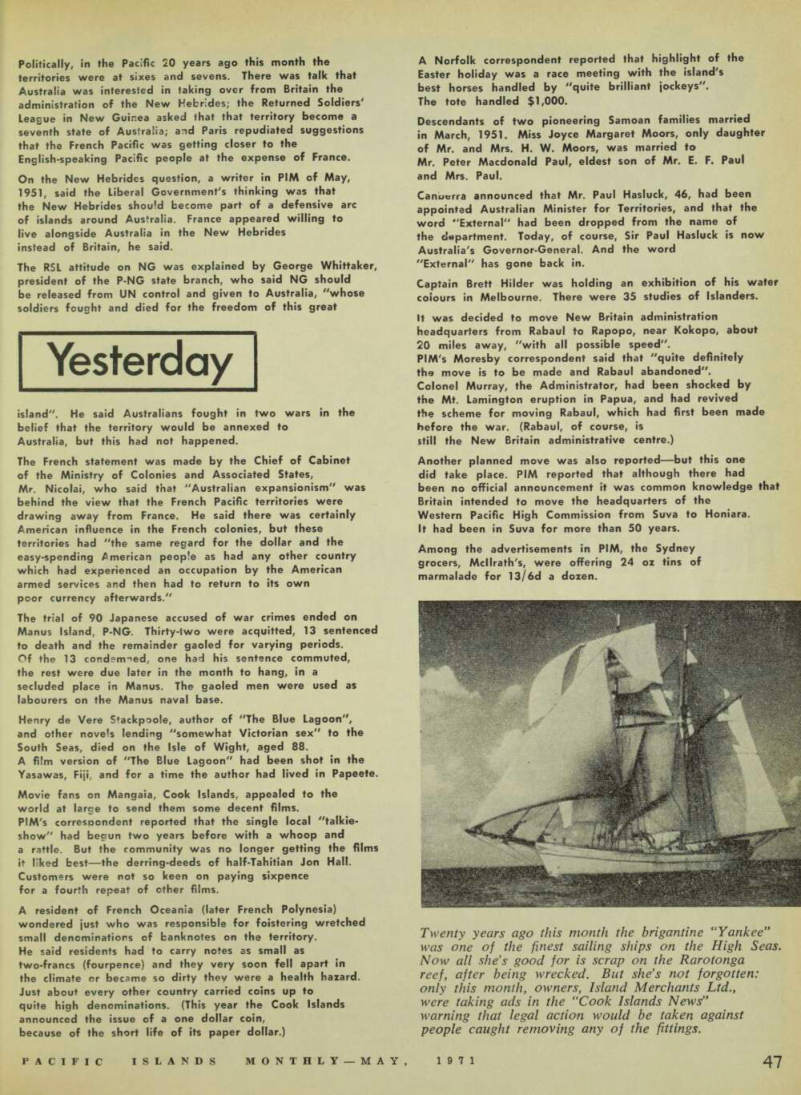
Politically, in the Pacific 20 years ago this month the territories were at sixes and sevens. There was talk that Australia was interested in taking over from Britain the administration of the New Hebrides; the Returned Soldiers' League in New Guinea asked that that territory become a seventh state of Australia; and Paris repudiated suggestions that the French Pacific was getting closer to the English-speaking Pacific people at the expense of France, On the New Hebrides question, a writer in PIM of May, 1951, said the Liberal Government's thinking was that the New Hebrides should become part of a defensive arc of islands around Australia. France appeared willing to live alongside Australia in the New Hebrides instead of Britain, he said.
The RSL attitude on NG was explained by George Whittaker, president of the P-NG state branch, who said NG should be released from UN control and given to Australia, "whose soldiers fought and died for the freedom of this great
island". He said Australians fought in two wars in the belief that the territory would be annexed to Australia, but this had not happened.
The French statement was made by the Chief of Cabinet of the Ministry of Colonies and Associated States, Mr. Nicolai, who said that "Australian expansionism" was behind the view that the French Pacific territories were drawing away from France. He said there was certainly American influence in the French colonies, but these territories had "the same regard for the dollar and the easy-spending American people as had any other country which had experienced an occupation by the American armed services and then had to return to its own poor currency afterwards."
The trial of 90 Japanese accused of war crimes ended on Manus Island, P-NG. Thirty-two were acquitted, 13 sentenced to death and the remainder gaoled for varying periods.
Of the 13 condemned, one had his sentence commuted, the rest were due later in the month to hang, in a secluded place in Manus. The gaoled men were used as labourers on the Manus naval base.
Henry de Vere Stackpoole, author of "The Blue Lagoon", and other novels lending "somewhat Victorian sex" to the South Seas, died on the Isle of Wight, aged 88.
A film version of "The Blue Lagoon" had been shot in the Yasawas, Fiji, and for a time the author had lived in Papeete.
Movie fans on Mangaia, Cook Islands, appealed to the world at large to send them some decent films.
PlM's corresoondent reported that the single local "talkie show" had begun two years before with a whoop and a rattle. But the community was no longer getting the films it liked best—the derring-deeds of half-Tahitian Jon Hall.
Customers were not so keen on paying sixpence for a fourth repeat of other films.
A resident of French Oceania (later French Polynesia) wondered just who was responsible for foistering wretched small denominations of banknotes on the territory.
He said residents had to carry notes as small as two-francs (fourpence) and they very soon fell apart in the climate or became so dirty they were a health hazard.
Just about every other country carried coins up to quite high denominations. (This year the Cook Islands announced the issue of a one dollar coin, because of the short life of its paper dollar.)
A Norfolk correspondent reported that highlight of the Easter holiday was a race meeting with the island's best horses handled by "quite brilliant jockeys".
The tote handled $l,OOO.
Descendants of two pioneering Samoan families married in March, 1951. Miss Joyce Margaret Moors, only daughter of Mr. and Mrs. H. W. Moors, was married to Mr. Peter Macdonald Paul, eldest son of Mr. E. F. Paul and Mrs. Paul.
Canuerra announced that Mr. Paul Hasluck, 46, had been appointed Australian Minister for Territories, and that the word "External" had been dropped from the name of the department. Today, of course, Sir Paul Hasluck is now Australia's Governor-General. And the word "External" has gone back in.
Captain Brett Milder was holding an exhibition of his water colours in Melbourne. There were 35 studies of Islanders.
It was decided to move New Britain administration headquarters from Rabaul to Rapopo, near Kokopo, about 20 miles away, "with all possible speed".
PlM's Moresby correspondent said that "quite definitely the move is to be made and Rabaul abandoned".
Colonel Murray, the Administrator, had been shocked by the Mt. Lamington eruption in Papua, and had revived the scheme for moving Rabaul, which had first been made before the war. (Rabaul, of course, is still the New Britain administrative centre.) Another planned move was also reported—but this one did take place. PIM reported that although there had been no official announcement it was common knowledge that Britain intended to move the headquarters of the Western Pacific High Commission from Suva to Honiara.
It had been in Suva for more than 50 years.
Among the advertisements in PIM, the Sydney grocers, Mcllrath's, were offering 24 oz tins of marmalade for 13/6d a dozen.
Twenty years ago this month the brigantine “Yankee” was one of the finest sailing ships on the High Seas.
Now all she’s good for is scrap on the Rarotonga reef, after being wrecked. But she’s not forgotten: only this month, owners, Island Merchants Ltd., were taking ads in the “Cook Islands News” warning that legal action would be taken against people caught removing any of the fittings.
Advertisements & other items, p. 52 (1 item)
The fans
i « "* * ■ i n x
nence
The biggest breakthrough in Hi-Fi musical reproduction since the development of stereo Sansui's amazing QS-1 Quadphonic Synthesizer, which creates electrifying 4-channel stereo from 2channel sources, such as stereo records and tapes.
You experience an uncanny concert-hall presence that must be heard to be believed.
To adaptthe surprisingly inexpensive QS-1 to your present HI-FI system, all you need are a second set of speakers and a second power amplifier. For an ideal QS-1 system, Sansui recommends: AU-555A 85W control amplifier. Speaker SP-1000 for the front channels; AU-101 50W control amplifier.
Speaker SP-70 for the rear channels; SD-7000 tape deck and SR2OSOC turn- Sansui's QS-1 quadphon- HBBSHHjH )(y\ ic system - for an audio E22Z529 experience of a lifetime. The Symbol of Quadphonic Sound PRABHY BROTHERS LTD. P.O. Box 183, Nadi, Fiji Islands Tel. 70183/SERVONNAT Rue des Polius, Tahitiens Pateete, Tahiti. Tel. 03-29/OCEANIA INDENT AGENCY P.O Box 5518, Boroko, Port Moresby, Papua & New Guinea. Tel. 56406/CHIN H. MEEN * SONS P/L Tabari Place, P.O. Box 1106, Boroko Tel. 56546/Kametere St., P.O. Box 224, Rabaui; Tel. 2462/PAUL MOW & CO. 9th St., P.O. Box 449, Lae. Tel. 2954/MICHAEL CHOW & CO. P/L Okari St., P.O. Box 1106, Boroko Tel. 56338/SEETO KONG & SONS P/L Taurama Road, P.O. Box 1218, Boroko. Tel. 56445/PINGS (MT HAGEN) P/L P.O. Box 165, Mt Hagen. Tel. 385/BOUGAINVILLE COPPER Canteen, Panguna/ PHOTOSONIC P.O. Box 519, Madang, Tel. 2503/SANSUI ELECTRIC CO., LTD. 14-1, 2-chome, Izumi, Suginami-kO, Tokyo, Japan
Book Reviews
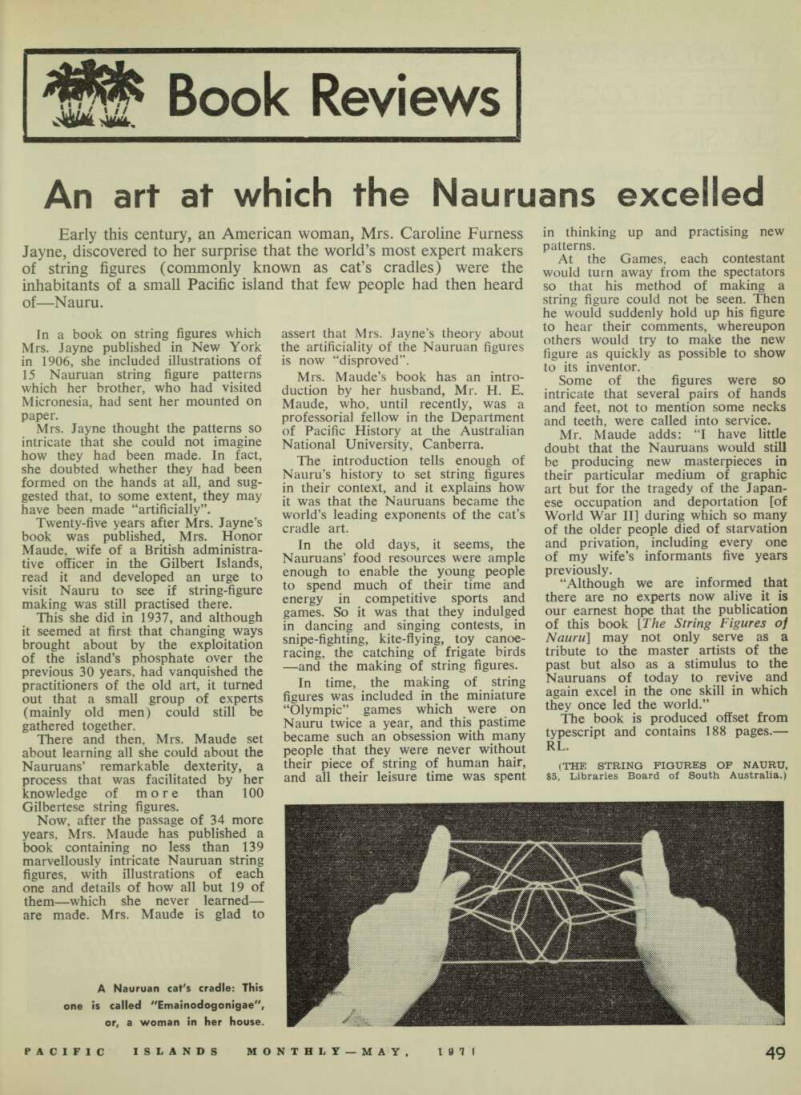
An art at which the Nauruans excelled
Early this century, an American woman, Mrs. Caroline Furness Jayne, discovered to her surprise that the world’s most expert makers of string figures (commonly known as cat’s cradles) were the inhabitants of a small Pacific island that few people had then heard of—Nauru.
In a book on string figures which Mrs. Jayne published in New York in 1906, she included illustrations of 15 Nauruan string figure patterns which her brother, who had visited Micronesia, had sent her mounted on paper.
Mrs. Jayne thought the patterns so intricate that she could not imagine how they had been made. In fact, she doubted whether they had been formed on the hands at all, and sug gested that, to some extent, they may have been made “artificially”.
Twenty-five years after Mrs. Jayne’s book was published, Mrs. Honor Maude, wife of a British administra tive officer in the Gilbert Islands, read it and developed an urge to visit Nauru to see if string-figure making was still practised there.
This she did in 1937, and although it seemed at first- that changing ways brought about by the exploitation of the island’s phosphate over the previous 30 years, had vanquished the practitioners of the old art, it turned out that a small group of experts (mainly old men) could still be gathered together.
There and then, Mrs. Maude set about learning all she could about the Nauruans’ remarkable dexterity, a process that was facilitated by her knowledge of more than 100 Gilbertese string figures.
Now, after the passage of 34 more years, Mrs. Maude has published a book containing no less than 139 marvellously intricate Nauruan string figures, with illustrations of each one and details of how all but 19 of them—which she never learned — are made. Mrs. Maude is glad to
assert that Mrs. Jayne’s theory about the artificiality of the Nauruan figures is now “disproved”.
Mrs. Maude’s book has an intro duction by her husband, Mr. H. E.
Maude, who, until recently, was a professorial fellow in the Department of Pacific History at the Australian National University, Canberra.
The introduction tells enough of Nauru’s history to set string figures in their context, and it explains how it was that the Nauruans became the world’s leading exponents of the cat’s cradle art.
In the old days, it seems, the Nauruans’ food resources were ample enough to enable the young people to spend much of their time and energy in competitive sports and games. So it was that they indulged in dancing and singing contests, in snipe-fighting, kite-flying, toy canoe racing, the catching of frigate birds —and the making of string figures.
In time, the making of string figures was included in the miniature “Olympic” games which were on Nauru twice a year, and this pastime became such an obsession with many people that they were never without their piece of string of human hair, and all their leisure time was spent
in thinking up and practising new patterns.
At the Games, each contestant would turn away from the spectators so that his method of making a string figure could not be seen. Then he would suddenly hold up his figure to hear their comments, whereupon others would try to make the new figure as quickly as possible to show to its inventor.
Some of the figures were so intricate that several pairs of hands and feet, not to mention some necks and teeth, were called into service.
Mr. Maude adds; “I have little doubt that the Nauruans would still be producing new masterpieces in their particular medium of graphic art but for the tragedy of the Japan ese occupation and deportation [of World War ll] during which so many of the older people died of starvation and privation, including every one of my wife’s informants five years previously.
“Although we are informed that there are no experts now alive it is our earnest hope that the publication of this book [The String Figures of Nauru] may not only serve as a tribute to the master artists of the past but also as a stimulus to the Nauruans of today to revive and again excel in the one skill in which they once led the world.”
The book is produced offset from typescript and contains 188 pages.— RL.
(The String Figures Of Nauru,
$5, Libraries Board of South Australia.)
A Nauruan cat's cradle: This one is called "Emainodogonigae", or, a woman in her house.
Of The Pre-Cook


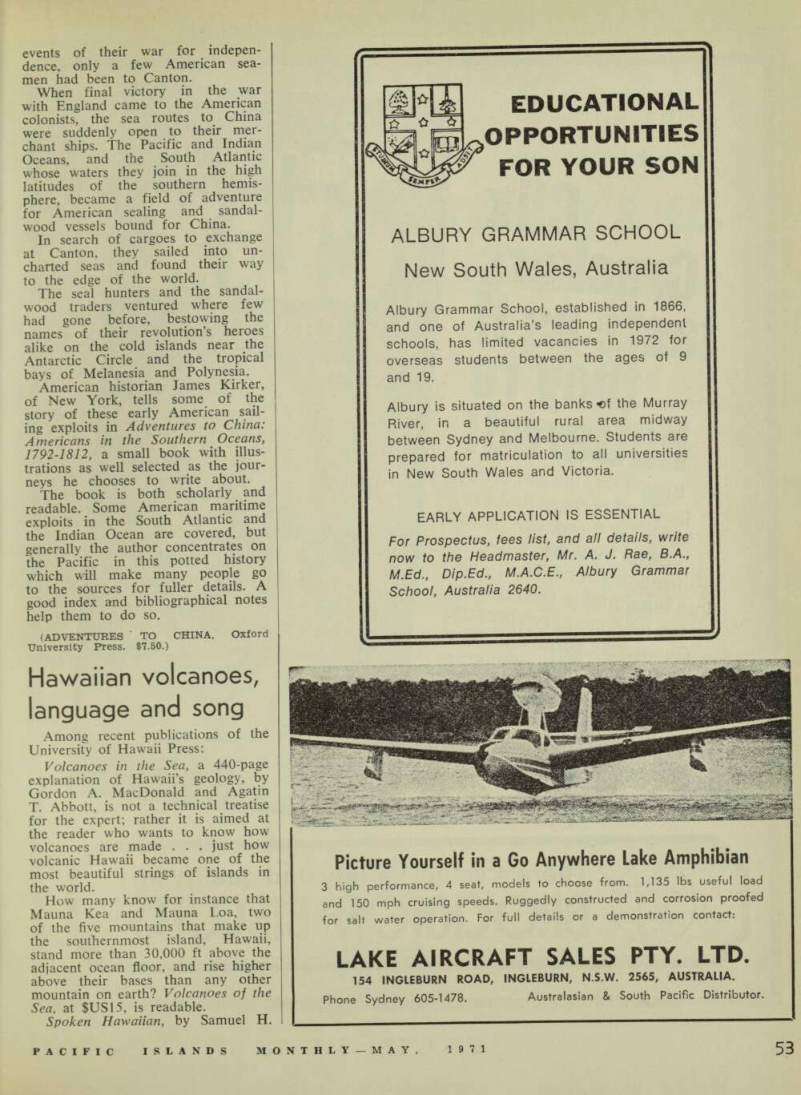
At Last, The Last
Classics
The Dutch navigator Jacob Roggeveen is famous in the annals of the Pacific as the Euro pean discoverer of Easter Island and most of the islands of Samoa. Yet it has taken almost exactly centuries for his own account of his voyage to be trans lated into English and published.
The translation is the work of the New Zealand scholar Andrew Sharp, who has also supplied a valuable introduction, an epilogue and notes to Roggeveen’s journal.
Roggeveen’s voyage, which took place in 1721-22, grew out of a pro posal put forward by his father in 1675 to seek lands in the South Seas with which trade could be conducted.
Roggeveen had three ships provided by the Dutch West India Company— Arend, Tienhoven and Afrikaansche Galei (known in English as the African Galley).
The ships rounded Cape Horn in January, 1722, touched at Juan Fernandez, and then steered WNW in search of Davis’ Land, an island reported in 1687 by an English buc caneer of that name, and said to lie about 600 miles west of the Chilean port of Copiago.
No land answering Davis’ descrip tion could be found, but Roggeveen did find an island which he named Paasch Eylandt (Easter Island) because the day of its discovery was Easter Day, 1722. He stayed at the island for five days and made one excursion ashore.
The Dutch expedition then sailed westward through the little-known Tuamotu Archipelago, losing the African Galley on the reef of Taka poto Atoll, together with five men who got drunk and decided to stay behind.
The next significant landfall was the upraised island of Makatea where some refreshments were obtained for the scurvy-ridden crews of the two remaining ships at the cost of several native lives.
Roggeveen and his officers then agreed that they had failed to find an island mentioned in their instruc tions, and that they should head for the East Indies with all possible speed to join the fleet that sailed an nually for Holland.
As a result, the expedition did not
trouble to investigate two high islands. Bora Bora and Maupiti, that they saw three days after leaving Makatea, nor did they spend more than a few hours among the Samoan Islands—Rose Island, Ta’u, Tutuila and Upolu—which they were the first Europeans to see.
Three months later, having sighted New Ireland, and sailed along the north coast of New Guinea, Rogge veen reached Java. By then sickness and death had ravaged his crews and only nine or 10 men were still fit for work.
The decimated survivors were sent home in a ship of the Dutch East India Company. Roggeveen died six years later. More than a century then passed before Roggeveen’s journal was discovered in the archives of the Dutch West India Company and pub lished in Holland in the original Dutch. A second Dutch edition ap peared in 1911.
The publication of the present English edition means that scholars now have easy access to reliable ac counts in English of all the European voyages to the South Pacific before Cook’s first voyage in 1769.
Because of the hasty nature of Roggeveen’s voyage, his accounts of his encounters with the Easter Islanders, Makateans and Samoans leave much to be desired. But scholars will undoubtedly find them useful.
Incidentally, the translator and editor does not mention what appears to have been the most important out come of Roggeveen’s voyage. This was that the wreck of the African Galley provided the Tahitians with a source of iron more than 40 years before Europeans discovered their island.—RL.
(The Journal Op Jacob Rogge
VEEN. Oxford University Press. $7.80.)
Americans In
The Pacific
Before the American Revolution, vessels from the 13 American colo nies did not sail eastward beyond Capetown or westward round the stormy Horn. The Indian and Paci fic Oceans were closed to the mer chantmen of England’s possessions; their wealth was the monopoly of the East India Company and the South Sea Company.
The merchants of New England, whose ships ploughed the Atlantic and the seas of Europe, had no per sonal knowledge of the trade of the Orient. And even though the teas of China figured in one of the early Continued on p. 53
events of their war for indepen dence, only a few American sea men had been to Canton.
When final victory in the war with England came to the American colonists, the sea routes to China were suddenly open to their mer chant ships. The Pacific and Indian Oceans, and the South Atlantic whose waters they join in the high latitudes of the southern hemis phere, became a field of adventure for American sealing and sandal wood vessels bound for China.
In search of cargoes to exchange at Canton, they sailed into un charted seas and found their way to the edge of the world.
The seal hunters and the sandal wood traders ventured where few had gone before, bestowing the names of their revolution’s heroes alike on the cold islands near the Antarctic Circle and the tropical bays of Melanesia and Polynesia.
American historian James Kirker, of New York, tells some of the story of these early American sail ing exploits in Adventures to China: Americans in the Southern Oceans, 1792-1812, a small book with illus trations as well selected as the jour neys he chooses to write about.
The book is both scholarly and readable. Some American maritime exploits in the South Atlantic and the Indian Ocean are covered, but generally the author concentrates on the Pacific in this potted history which will make many people go to the sources for fuller details. A good index and bibliographical notes help them to do so.
(Adventures ’To China, Oxford
University Press. $7.50.)
Hawaiian volcanoes,
language and song
Among recent publications of the University of Hawaii Press: Volcanoes in the Sea, a 440-page explanation of Hawaii’s geology, by Gordon A. MacDonald and Agatin T. Abbott, is not a technical treatise for the expert; rather it is aimed at the reader who wants to know how volcanoes are made . . . just how volcanic Hawaii became one of the most beautiful strings of islands in the world.
How many know for instance that Mauna Kea and Mauna Loa, two of the five mountains that make up the southernmost island, Hawaii, stand more than 30,000 ft above the adjacent ocean floor, and rise higher above their bases than any other mountain on earth? Volcanoes of the Sea, at SUSIS, is readable.
Spoken Hawaiian, by Samuel H.
Elbert, opens with the assertion that Hawaiian is far from dead, even in Honolulu. And to judge by the num ber of people under 20 already fluent in the language, it will be around for a long time.
The book encourages pupils to learn the language by hearing Hawaiian. Its exercises come in ques tion and answer form, the idea being that the patterns constituting the language are memorised.
Na Mele o Hawaii Nei (101 Hawaiian Songs) is a selection of Hawaiian songs, all post-missionary and therefore derived from missionary hymns. Apologies are given for the fact that melodies of the songs are not included—“a considerable task as many of the songs have never been transcribed in musical notation”.
Collectors, Samuel H. Elbert and Noelani Mahoe, end their introduc tion to the SUS 2 booklet, with a point relevant to other Islands territories: “Formerly there was much interest in the words and stories in these songs, as there is, for example, in traditional Western American folk songs. Today the melody and the beauty of the dancers, rather than the story, are of paramount interest, and the words of some of the more recent songs, not included in this collection, are simple
and artless”.-
Jse.
ALL the Time-Life national cooking books are a delight to read, even for non-cooks, and The Cooking of Germany, by Nika Standen Hazelton is no exception.
To learn about the food of a region is to learn something about the people—at any rate, if the region is European. In Europe they appear to have lost fewer of their national characteristics in food and in cook ing than we have in our English speaking world. These days you can travel all the way from New Zealand and Australia, through the tourist Pacific Islands, across the United States and Canada to the United Kingdom and, in the culinary sense, might never have left home.
The author says that in the last 50 years Germany has changed physically and in other ways more than any other nation in Western Europe, yet it has remained un mistakably German, There has, she says, been the same historical con tinuity where food is concerned although foods in modern Germany are produced in much the same way as elsewhere. Yet they remain different.
Recipes for the hearty food encoun tered all over Germany are provided in the main book but for those who like to separate the practical business
of cooking from the pleasures of look ing and reading, the recipes are re peated in a smaller, kitchen-sized book that comes along as part of the package deal. —IT.
(The Cooking Of Germany. Dis
tributed by Angus & Robertson. $6.50).
THE last of the useful series of books put out under the name of the Corona Library by the UK Central Office of Information has now appeared. It’s Austin Coates’
Western Pacific Islands, dealing with the Western Pacific High Commission area. This 13th volume in the series is the last because the colonial empire of the British Foreign and
Commonwealth Office has dis appeared. Publishers are Her Majesty’s Stationery Office, and the UK price is £1.50. A review will appear in our next issue.
THE seventh edition of the Golden Guide to South and East Asia has been published by the Far Eastern Economic Review based in Hong Kong. It’s still a treasure-house of information for any offbeat traveller in Asia; and just the job for whiling away the hours while waiting to cross your next frontier.
Price varies around the SA3 mark, depending on the country of pur chase.
AN Illustrated History of New Guinea, arranged by June Whittaker and Noel Gash, of the History Department of the Australian School of Pacific Administration, Sydney, is to appear shortly under the Jacaranda imprint. Meant pri marily for schools, it comprises photos and maps with detailed cap tions. And by the end of the year a group of four compilers, Mrs.
Whittaker, Mr. Gash, with John Hookey and Rod Lacey, expect to have published, again by Jacaranda, volume one of Readings and Source Material in New Guinea History.
It is a big book of 900 pages, re porting oral history and giving de tailed written source material on New Guinea up to 1886. Later volumes are planned to bring the material up to date. The book will be illustrated.
JQ'IJI ISLANDS is the simple title of the latest picture book on the dominion, designed mainly for the tourist trade. There’s hardly a ter ritory left which hasn’t one or more of this kind of thing extolling its virtues, and Hank Curth, who was the organiser and photographer, has a similar book to his credit about New Guinea. In colour and black and white, we get a competent run-down on the people, scenery, etc., all dis played in a small format sensibly chosen to make it convenient for packing or posting. What lifts Fiji Islands a little above the norm for this kind of book is the intelligent, text by Sue Wendt, which doesn’t talk down. It’s published by Nelson, at $5.95.
ANEW, beautifully produced story about the stamps of Papua-New Guinea and its forerunners, German New Guinea, Mandated Territory of New Guinea, British New Guinea and Papua, will delight the growing num ber of collectors who are being en couraged by the philatelically-minded postal authorities in Papua-New Guinea.
The colour plates in Franklin’s Guide to the Stamps of Papua and New Guinea deserve special praise, and so do illustrations of items such as the German 1914 airship expedi tion issue (not postally used because of World War I) and the Papuan postcard of 1920, which are not listed in popular stamp catalogues.
Mr. M. Franklin’s main theme is the connection of stamps with his tory. Read in conjunction with an authoritative stamp catalogue, the book (A. H. and A. W. Reed, $3.95) gives collectors and potential col lectors the kind of knowledge that makes their hobby even more enjoy able.— HHJ.
Advertisements & other items, pp. 54-68 (2 items)
bbbbb
FIAT
CONCESSIONAIRES
American Samoa Silver Star Transport Inc.,
P.O. Box CB-4, PAGO PAGO.
Fiji Motibhai & Co. Ltd., P.O. Box 40, ba.
New Caledonia Agence Automobile S.A.,
P.O. Box 842, NOUMEA.
New Guinea New Guinea Motors Pty. Ltd., P.O. Box 1027, boroka.
New Hebrides Societe Bourgeois & Cie.,
P.O. Box 28, PORT VILA.
New Zealand Torino Motors Ltd.,
P.O. BOX 6240, AUCKLAND.
Norfolk Island Red Rental Ltd.,
P.O. Box 147, NORFOLK ISLAND.
Solomon Islands Chan Wing Motors Ltd.,
P.O. BOX 820, HONIARA.
Tahiti Agence Tahiti Poroi,
P.O. BOX 83, PAPEETE.
Western Samoa E. A. Coxon & Co. Ltd.,
P.O. Box 38, APIA.
bbbbb
Now you can
fall in |pve
all over again.
Rat introduce a new 124 Sport Coupe You know how it is when you’ve been in love a long time. And you hardly notice you re in love anymore. Then suddenly she changes. Just a little. And all the old magic returns.
Our 124 Sport Coupe has changed too. See the difference? The bonnet has new curving lines. There are four headlights, with quartz iodine bulbs that would light a landing strip.
Larger stop lights a wise precaution with a new twin circuit, four disc, brake system.
And the reversing light has moved under the bumper out of harms way.
Inside, our bucket seats are now trimmed with cloth, which is cooler.
Passengers have individual ventilation, which could be hotter or cooler. And the dash looks even more aeronautical.
When will your Italian Love Affair begin? Again.
< r- . m I mm m m d W- ■ $ m I H a ,'f; ■
CON 20.87
Two vital commodities in building the Territory.
Caterpillar Tractors and fresh meat... typical examples of the variety of cargo which Conpac carries from Australia to Papua/New Guinea. Conpac is equipped to carry ail kinds of cargo safely and surely.
From refrigerators to precious pottery . . . galvanised iron to steel girders. Conpac offers you the safety, convenience and flexibility of containers, refrigerated containers, pallets or flats. Why not try Conpac next time you import cargo from Australia. Contact your local Conpac Agent for details of sailing dates.
Conpac’s regular sailing schedule from Australia:
M.V. TENOS M.V. NIMOS M.V. DELOS
Sydney, Brisbane to Sydney, Brisbane, Adelaide, Melbourne, Port Moresby every to Lae every Sydney to Lae and 18 days. 19 days. Madang every 44 days.
CONTAINERS PRUFIC EXPRESS LINE
A joint enterprise of Burns Philp and Australia West Pacific Line.
SYDNEY: 7 Bridge Street, Telephone 2 0547.
BRISBANE: 133 Mary Street, Telephone 31 0391.
MELBOURNE: 340 Collins Street, Telephone 67 8941.
ADELAIDE: Dalgety Australia Ltd., 35 Baker Street, Pt. Adelaide. Telephone 4 1191.
PORT MORESBY; Musgrave Street, Telephone 2369.
LAE: Macdhui Street, Telephone 2269.
MADANG: Coastwatchers Avenue, Telephone 2023.
EDUCATIONAL
OPPORTUNITIES
FOR YOUR SON
ALBURY GRAMMAR SCHOOL
New South Wales, Australia
Albury Grammar School, established in 1866, and one of Australia’s leading independent schools, has limited vacancies in 1972 for overseas students between the ages of 9 and 19.
Albury is situated on the banks of the Murray River, in a beautiful rural area midway between Sydney and Melbourne. Students are prepared for matriculation to all universities in New South Wales and Victoria.
EARLY APPLICATION IS ESSENTIAL
For Prospectus, fees list, and all details, write now to the Headmaster, Mr. A. J. Rae, 8.A., M.Ed., Dip. Ed., M.A.C.E., Albury Grammar School, Australia 2640.
Picture Yourself in a Go Anywhere Lake Amphibian 3 high performance, 4 seat, models to choose from. 1,135 lbs useful load and 150 mph cruising speeds. Ruggedly constructed and corrosion proofed for salt water operation. For full details or a demonstration contact:
LAKE AIRCRAFT SALES PTY. LTD.
154 INGLEBURN ROAD, INGLEBURN, N.S.W. 2565, AUSTRALIA.
Phone Sydney 605-1478. Australasian & South Pacific Distributor.
Clix
Crackers
taste as it
thevre
butteredl
Btockhott Clix are onsp, JU * Nip tresn 'Tibbie with drinks into dips, n ’ sprea ds. or top w> th sa Rrnc y k hotf Clix :£.s> m There’s value, variety and quality in
BROCKHOFF BISCUITS
6441/8 X 6V*
EXPORTERS
to the Pacific Islands!
BRECKWOLDT & CO.
PTY. LTD.
276 Pitt Street, Sydney 2000 Box 5027, G.P.0., Sydney. Cable Address: "BREWO", Sydnoy.
Pacific-Islands Branches:
P.O. Box 222, RABAUL.
P.O. Box 1549, Boroko, PORT MORESBY.
P.O. Box 185, MADANG.
P.O. Box 557, LAE.
P.O. Box 72, KIETA.
P.O. Box 237, MT. HAGEN.
P.O. Box 178, WEWAK.
BRECKWOLDT & CO.
P.O. Box 47, APIA.
BRECKWOLDT & CO. (5.1.) LTD.
P.O. Box C 5, HONIARA.
Head Office:
BRECKWOLDT & CO., HAMBURG/GERMANY.
Offices at: Milan, London, Antwerp, Kuala Lumpur, Bangkok, Hong Kong.
Enquiries from Australian Manufacturers invited.
BRECKWOLDT & CO.
(N.G.) PTY. LTD.
I:M4VIiF
A holiday in
Fiji is not complete without a stay at
KOROLEVU BEACH HOTEL
Korolevu, the South Pacific's most famous resort, is a must for all visitors to Fiji. Situated on the beautiful Coral Coast of Viti Levu, Korolevu is a holiday-maker's dream. The beautiful curving white sand beaches and the shimmering palm fronds make a stay at Korolevu a truly memorable occasion.
Other Northern Hotels at Suva, Sigatoka, Nadi, Lautoka, Ba and Tavua.
KOROLEVU BEACH HOTEL,
KOROLEVU-I-WAI, NADROGA, FIJI.
Sales Representative: Shaul International, Hotel Representatives, 34th Floor, Australia Square, Sydney, N.S.W., 2000, Australia.
Telephone: 27-4601. Cable: "Rephotel", Sydney.
Shaul International, 6th Floor, 330 Collins Street, Melbourne, 3000, Victoria, Australia.
BENEFIT FROM 85 YEARS
OF INSURANCE EXPERIENCE
Company Limited
(INCORPORATED 1886 IN AUSTRALIA)
HEAD OFFICE; 82 Pitt Street, Sydney FIJI —Branch Office, Suva, Manager for Fiji: K. Galloway.
LAUTOKA, BA, LEVUKA, LAB AS A—Bums Philp (South Sea) Co. Limited. District Manager at Lautoka: U. Singh.
PAPUA & NEW GUlNEA—Branch Office, Port Moresby: Manager for Papua & New Guinea: D. J. Granter.
SAMARAI, LAE, MADANG, RABAUL, KAVIENG,
MT. HAGEN—Bums Philp (New Guinea) Limited, District Manager at Rabaul: J. S. Bell. District Manager at Lac: J. D. Mac Lean. District Manager at Mt. Hagen; G. F. Donnelly.
HONIARA (b.s.i.p.) —Breckwoldt & Company (sj.) Pty. Limited.
NOUMEA—T. A Hagen, Ste W.A. Johnston SA.RX.
VlLA—Bums Philp (New Hebrides) Limited.
SANTO—Bums Philp (New Hebrides) Limited.
NORFOLK ISLAND—Bums Philp (South Sea) Co. Limited.
OTHER SOUTH SEA ISLANDS—Bums Philp (South Sea) Co. Limited.
QUEENSLAND
INSURANCE
Assets exceed $A65,000,000
S'
The Stylish Seventies
Let's face it, looks are important. When a new car comes out, body styling is the first thing you notice. Note the graceful wave-form body lines of the all-new CAPELLA* 1600 Sedan. It's styled for the seventies. Just the right amount of chrome.
But when you have to decide what car is for you, performance, comfort and safety all play a part. Concealed in this stylish family sedan is a quiet 4cylinder OHC powerplant that puts out 104 hp at 6,000 rpm. Effortless ball and nut steering system and a surprising 4.7 meter turning radius make driving a dream. Specially designed seats to fit every driver or passenger, two independent ventilating systems and plenty of leg and shoulder room add up to luxurious comfort.
For safety's sake, you get power-assisted brakes all round with discs up front, laminated safety windshield, hazard warning flasher, padded dash, collapsible interior fixtures. Seat belts (opt.).
All this at a price competitive in its class from the world's first mass producer of the revolutionary rotary engine. *v J *
LAri
<-l I T I I
i 1600 SEDAH
® MAZD
From the world's most creative automaker Toyo Kogyo Ca.Lld.. Hiroshima. Japan New Zealand/CHAMPION MOTORS LTD. Durham Street.
Christchurch. P.O. Box 1344. Tel: 60-783 Papua/PNG MOTORS LTD. P.O. Box 1394. Boroko Western Samoa/H. & J. RETZLAFF P.O. Box 195. Apia American Samoa/MAX HELECK INCORPORATED Pago Pago. American Samoa 96920 Fiji/NIRANJAN'S AUTO PORT LTD. G P.O. Box 450. Suva "The trademark MAZDA in this advertisement stands for AUTOMOBILES MAZDA as far as France and her territories are concerned."
pssL.take
the side
entrance
□□ m m <b o No offence meant, of course! We’re talking of side-port unit-loading —the fast, safe way to load and unload your cargo.
Side-port loading is standard procedure in the “Island Chief,” the “Coral Chief” and the “Papuan Chief.” These three vessels provide regular and efficient services between Sydney, Brisbane and Port Moresby, Samarai, Lae, Madang and Rabaul, Kavieng and Honiara in Papua New Guinea and The British Solomon Islands.
So, if you would like to know more about how to cut down your inventories, tell the New Guinea-Australia Line that you want to see the twenty-minute film ‘Cargo Revolution.’ This will tell you how to get your exports from A to B the fast, safe way.
For specialised assistance, please contact:
□ New Guinea Australia Line
MEMBER OF THE SWIRE GROUP
PTY. LTD.
General Agents: PORT MORESBY —Steamships Trading Co. Ltd. SYDNEY—Swire & Gilchrist Pty. Ltd.
Agents at: BRISBANE—WiIIs, Gilchrist & Sanderson Pty. Ltd. NEW GUlNEA—Steamships Trading Co. (For “Papuan Chief’’ —Burns Philp (N.G.) Ltd.)
c tasty vintage
(LPO
Sr
KRA F i
KRAFT
KRAFT
Cream Wse SprcO
S«UNK STYII
?=* kraft 3400* <K««ri> m ••
HERE’S to
GOOD EATING
Wherever you find good eating, you’ll find foods, fresh from Kraft, Australia. CKRAF' ♦Reg’d Trade Mark 059-P-164
ii * • : «=* „-■* 4. m . ■ fm m *■■■ m . w : ■+.'■■ .i H \ i I, i
t :V .*■•- ' •; *.w %' v* si® ; S-v
DATSUN
demonstrators!
They're peaceful people who know what motoring is really all about. People so pleased with DATSUN they’re ready to tell the world.
In fact, motorists of all ages in over 126 nations back them up. They know about the new DATSUN 1600’s great OHC engine that zips them up to lOOmph. The independent 4-wheel suspensions. The very safe, very luxurious interiors. And extras like healthy fresh air ventilation. Anything else? And how!
Just ask any DATSUN demonstrator. He’ll be proud to demonstrate for you.
(Sg) NISSAN MOTOR CO., LTD.
Available at:
BOROKO MOTORS LTD.
Port Moresby, Lae, Madang, Mt. Hagen.
RABAUL GARAGE LTD. Rabaul.
SUVA MOTORS LTD. Suva, Lautoka.
MORRIS HEDSTROM LTD. Apia.
E.D. PENTECOST. Noumea.
PENTECOST PACIFIC S.A. Port Vila, Santo.
R.C. SYMES PTY. LTD. Honiara.
B.F. KNEUBUHL. Pago Pago.
SIRIUS SERVICE STATION Norfolk.
SOCIEDADE AGRICOLA Timor
PATRIA E TRABALHO LDA. Dili.
JACOB ENTERPRISES Nauru.
A rather remarkable sporty family
sedan... DATSUN1600 by Nissan
50
years
i
oVE R tR uSTE D ,
'? f » OS, .«D l«
niiß bRAH i aNDS*—
, sl »» . *
(jilleipie J
ANC
nOR
ANCHOR
FLOUR
MAINTOP HIGH PROTEIN
BISCUIT FLOURS AND WHEATMEALS
Gillespie flours are milled from selected high quality Australian wheats and are entoleted for purity. Their consistent high quality has made them the best-known, most asked-for, brands of flour in the Islands. (Entoletion is a special purification process which reduces the risk of insect infection.)
GILLESPIE BROS. PTY. LTD
HEAD OFFICE:
52 Union St., Pyrmont, Sydney, N.S.W (G.P.O. Box 2518, Sydney, 2001).
Phone: 660-4933
CABLE ADDRESS:
"GILLESPIE",
Sydney and Brisbane
BRISBANE OFFICE;
Albion, Brisbane, Queensland. (P.O. Box 8, Albion, Brisbane, Phone: 6-1121 4010).
r
This man
was thinking
about your cargo problems
back in 1872
% John Samuel Swire, Gentleman and founder of Butterfield and Swire and the China Navigation
Company.
In 1872 he was organising the transportation of cargo along the Yangtze River. Today, almost one hundred years later, the China Navigation Company he founded provides the most extensive network of cargo routes within the area bordered by Japan, Tahiti, New Zealand, Australia and the Malay Peninsula.
Twenty-six ships, custom-built for the trades they serve, carry over one million tons of cargo to over forty ports c western rim Pacific. n the of the The China Navigation Company—the name that has become synonymous with experience . . . reliability . . . speed . . . service.
For further details and all enquiries there are Agents at the following ports; i V Melbourne: P. & 0. Lines of Australia Pty. Ltd.
Brisbane: Wills, Gilchrist & Sanderson Pty. Ltd.
Papua and New Guinea: Steamships Trading Co. Ltd., Port Moresby, Samarai, Lae, Madang, Rabaul, Kieta.
Wewak: Kavieng: Burns Philp (New Guinea) Ltd.
Fiji: Morris Hedstrom Ltd., Suva, Lautoka.
Western Samoa: Morris Hedstrom Ltd., Apia.
Tonga: Morris Hedstrom Ltd., Nukualofa and Vava’u.
Tahiti: Etablissements Donald, Papeete.
Japan: Swire McKinnon, Tokyo, Yokohama, Osaka, Kobe and Nagoya.
Eastern Managers: Butterfield & Swire, 9 Connaught Rd., Central, Hong Kong.
VCN ) SWIRE & GILCHRIST PTY.
XCO/ General Agents in Australia, 8 Spring Street, Sydney. Phone: 2-0522 New Caledonia: Etablissements Ballande, Noumea. 8.5.1. P.: British Solomons Trading Co. Ltd., Honiara.
New Hebrides: Les Comptoirs Francais des Nouvelles-Hebrides, Vila and Santo.
LTD.,
THE CHINA NAVIGATION CO LTD
922/FP
There are no
short cuts to Heinz
i
kind of quality.
PROTEIN
high
■V .'•'■'A • "111 M m
IMP
* h^S 0*
HEINZ
JUNIO* 1
glS£ f
V * t hah npte
Heinz
Drained -*
Ihick^j
? |GETABt£ S i
■>; \NG e We believe that food should be as pure, as fresh and as tasty as possible. And at Heinz we strive for this kind of quality everytime.
Take our unique Baby Food Peak-Nutrition cooking Process.
By this method we capture all the goodness, proteins, vitamins and minerals that are lost in other ordinary cooking methods.
And the care we take in preparing Baby Food we take in all our products.
So when you buy Heinz you know you are getting a product that for taste, freshness, quality and price has absolutely no equal.
57
I'ACIFIC ISLANDS MONTHLY MAY, 1971
From the Islands Press
Item in GEIC 'lnformation Notes', Tarawa: Members of the general public on South Tarawa are advised that it is now illegal to bury the dead in Bairiki or Nanikai, and prosecution will result from burials taking place in government leased land. The reasons for this step are that the cemetery at the end of Bairiki and the other at Rurubao are both sur rounded by inhabited dwellings, and disposal of bodies at Nanikai has an effect on the earthing system of the radio mast. The District Administration is at present engaged in finding a suitable site for a cemetery, but, in the meantime, all bodies must be buried in the Bikenibeu cemetery. Transport will be provided at government expense and it will be available on request to PWD.
Letter in the 'Cook Islands News': Let's take a lesson from the gay informality of the Duke's visit and commemorate it as the day the Cook Islands finally realised that they were in the tropics and that tropical and colourful clothes are far more appropriate to the climate, and appealing to the senses, than the stiff formal regalia we have been so dedicated to in the past.
Which do people associate more with the South Pacific Islands—colourful "pareu", or black trousers and ties?
Do we want to look like we enjoy life or that we are going to a funeral?
Letter in the 'Tonga Chronicle': I am surprised to note that once again the International Dateline Hotel is becoming the meeting house for procurers and ladies of tinted repute.
A business friend of mine was swimming in the pool during his recent visit and one of these ladies sat on the edge of the pool, feet dangling in the water, endeavouring to make a sale. The oldest profession in the world is commendable in its place, but is the International Dateline Hotel the right venue for this practice? Yet another sad image of Tonga for our visitors.
Item in 'The Fiji Times': People will keep on insisting, "The harlot's life is an unhappy one." Speaking purely for ourselves, we are not convinced of the truth of this viewpoint.
It does not check with the chuckles, giggles, fashionable clothing and general air of well-being of the girls who tumble in and out of the premises just around the corner from us morning, noon and
night.
Advertisement in the 'Samoa Times', Pago edition, from an American living in San Diego: American man, age 49, with no bad habits, with good home and job would like to get married to a Samoan girl with one little girl. Please send
picture.
Item in BSIP news sheet, Honiara: An old man hunting in the Haununu district of Makira recently almost died of fright when the wild pig he was chasing with his dogs collapsed and died without
being touched. The old man prodded the pig to make sure it was really dead, and then ran with his dogs back to the village where, recovering from his shock, he told the story. Villagers decided not to eat the mysterious pig, but when later they found a large dead fish about 12 ft long on the beach, they were reluctant to miss another tasty meal. Encouraged by the old man, they threw caution to the wind and ate the fish, and are still alive to tell the tale.
News report in 'Samoa Times', Apia:
In his farewell speech last Friday, the Commissioner of Police, Mr. Alfonso Philipp, said the work of the police was made considerably easy because of the Matai system. He urged that steps be taken to ensure the continuation and strengthening of the system if the country’s stability is to be maintained.
“This is the only newly independent country that has not had any trouble,” Mr. Philipp said, “since it became independent” . . . after the first 3i hours of the 6.30-8 p.m. cocktails, the Prime Minister, Tupua Tamasese, gave an address and paid tribute to Mr. Philipp’s long and faithful service and expressed the government’s appreciation of his dedication to duty. The loud declaration, “On this happy occasion”, by the interpreter, nearly went unnoticed in the mumbling, swaying room.
Sad extract of letter from H. S. Newbery to 'The Norfolk Islander 7 : What worries me is not the inflated cost to travel, because I don't and prefer to walk, but the inflated cost of "Valiant"[a brand of rum] from 7/6 to $1.95 a bottle, and I hear it is going up again, or what is the same thing, the value of my dollar is about to fall again. Therefore I must change from "Nelson's blood" to Norfolk's polluted water. Anyway the scientists say everything is polluted nowadays, including the air over which Norfolk's polluted music (that makes me sick) comes when I'm having breakfast. . . .
Item in 'Tohi Tala Niue': The Kaloama season is here again. At this time each year Kaloama, which is a small fish about 3 in. long, is plentiful round the western coast of the island. The fish are fried or baked or eaten whole. This year there are many different kinds of edible fish round the coast.
It is a common practice that people are not allowed to go hunting at night down to the sea, as the brightness of the torches at night might scare the Kaloama away.
Extract from item in defence of mini-skirts by A. Fegeta, of San Cristobal, in 'The Kakamora
Reporter', Honiara:
We Solomon Islanders should learn that we are part of a society, and not divided partners . . . Mini-skirts beautify our Melanesian girls, and add to their natural beauty. I think it is our turn to respect things and not to merely look at the girls' thighs. Also it is more sensible to look at the face than the thighs, so that you know who is coming or going.
The Editor's Mailbag
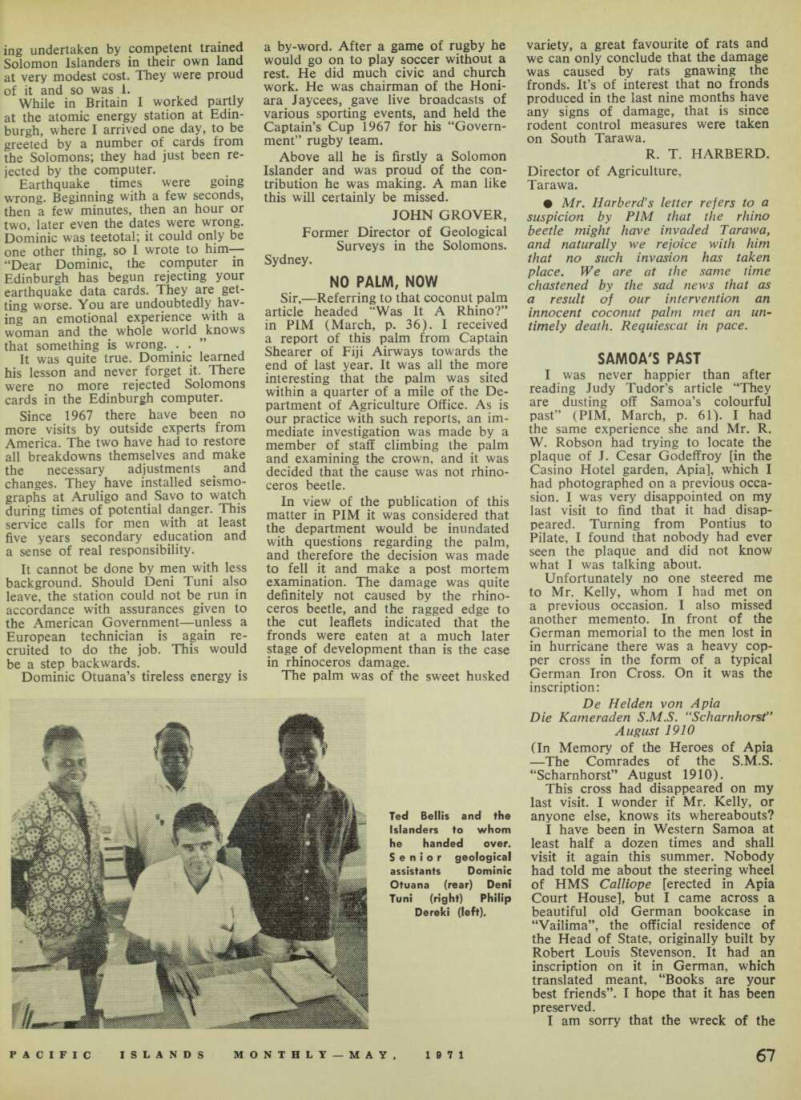

The French Presence
Sir, —Allow me, as a subscriber, to express my continued surprise at the apparent ignorance displayed by PlM’s editorial writers as regards the French publications of the South Pacific.
True, this attitude corresponds to the general outlook of those (all too numerous) Anglo-Saxons who have no time for people of other countries where the native languages differ from English.
However, within the South Pacific area, a French Press does exist, with an importance and circulation worth quoting. It consists of four daily newspapers, 11 weeklies (one of which is published in Sydney), several fortnightlies and at least four regular monthlies. In the territories covered by those publications, there live approximately 280,000 persons whose vernacular is the French lan guage.
Yet I do not remember of late years many instances, if indeed any at all, where PIM has quoted the French Press of the Pacific.
I believe that you currently have two permanent correspondents, one located in Noumea and the other in Papeete. Only their opinions can but present your readers with per sonal appreciations of the facts. Too often it has happened that the infor mation you published did not reflect a balanced view of events, particu larly with regard to Tahiti.
In the course of contemporary history we are unfortunately apt to find that a monumental incompre hension has loomed large at times between the English-speaking and the French-speaking peoples. Concili atory efforts—in both directions— being insufficient, have so far re sulted in an indifferent relationship, when it has not been a sheer refusal to understand one another, therefore negating mutual esteem. PIM, surely, could have contributed more.
To deny a French presence in the South Pacific through a refusal to acknowledge the French language would, incidentally, explain simply what is happening to French Quebec within Canada. Seven million French Canadians are tired of the contempt that confronts them in their own country . . . Can you blame them?
If you do not wish to see the ad vent of a similar situation in our region of the world, then I hope
you will agree that a major effort towards mutual understanding must be promoted, in the first place on the part of those whose duty it is to inform public opinion.
Should PIM fail to concur, and thereby refuse to acknowledge a French presence in the South Pacific, then your publication in fairness should change its name for such a one as “English Pacific Islands Monthly”.
The Commonwealth Government’s commercial services have discovered (recently, it seems) that there exist in fact in our area 280,000 persons who are French-speaking and whose standard of living is well above that of many Islanders where English is spoken. New Zealand, for its part, is now adapting so well as to supply goods carrying French-worded labels to New Caledonia and Tahiti. Re grettably, Australia has not yet seen fit to follow suit!
Daniel Tardieu.
Noumea and Sydney. • Of course PIM is aware that a French Press exists in the South Pacific, and it quite frequently quotes from it. But PIM is published in English, for readers of the English language, and prefers to rely on French-speaking correspondents in French territories to express a balanced view of events. This in fact is how we also cover the “American presence” in the South Pacific, the West Samoan presence, the Fiji presence, the New Zealand presence, the Nauruan presence, et cetera.
Our yardstick is whether a develop ment, in any territory anywhere, is of interest and of significance to the wide cross section of people inside and outside the Pacific who want an overall Pacific picture and depend on us for it. Those people interested in detailed news of the French Pacific, or of big territories such as New Guinea and Fiji for that matter, have to refer to the local press. We don’t claim to do their job for them. Our method works for the French ter ritories as for others, because last August PIM published a letter of congratulations on its coverage of Caledonian problems from the Vice- President of the New Caledonian Territorial Assembly. We hope that Mr. Tardieu, a settler in the Pacific from Europe and ex-owner of
Noumea’s “Le Journal Caledonien” (which he sold to Senator Lafleur) will understand our position.
Dominic Otuana
Sir, —So Dominic Otuana has left the Solomons Department of Geo logical Surveys. His cheerful sense of responsibility was such that any org anisation or community must be the poorer for his going.
My sense of disappointment is not so much due to his leaving as to what must be a failure to appreciate his potential and encourage him. His sound and sensible background and specialised training will make him difficult to replace [lt’s understood he has not yet taken a new job].
Many years ago Dominic and I met in a dugout canoe in the Shortland Islands, his homeland. He was train ing to be a priest. I said to him as we parted that, should he not quite make the grade as a priest, I hoped he would join me in the Geological Survey Branch. A decade or so later he came, in February, 1964. We were glad to have him in because he had an education to matriculation stand ard and a character to go with it.
Dominic and Deni Tuni had a simi lar background with different churches—they trained under seismo logical technician led Beilis, learning how to operate the World Standard Seismological Station HNR. which was a free gift to the Solomons people from the American Govern ment.
The Solomon Islanders kept the sta tion going and marked cards with earthquake times of arrival. These later were processed by computers in Edinburgh, Scotland, at the Interna tional Seismological Centre.
Then Dominic went to the Philip pines for several months in 1966 to do seismological training under the Jesuit Fathers at the observatory. Visiting him there, en route to Japan, I found that he had created a great impres sion on many students, teaching them to play soccer among other things.
He was referred to by the students as “our Englishman”.
Two chartered busloads came to see him off when he returned by plane to the Solomons. (We then sent E)eni Tuni to New Zealand to finish his seismological education.) A small ceremony in 1967 marked the formal handover of responsibility from the outgoing European techni cian to Dominic Otuana and Deni Tuni. They operated the station and recorded the data for American, Bri tish and world-wide information centres on earthquakes. Their accur acy was noted overseas, and I re ceived favourable comments when I arrived in Edinburgh later in 1967.
Thus an efficient operation was be
ing undertaken by competent trained Solomon Islanders in their own land at very modest cost. They were proud of it and so was 1.
While in Britain I worked partly at the atomic energy station at Edinburgh, where I arrived one day, to be greeted by a number of cards from the Solomons; they had just been rejected by the computer.
Earthquake times were going wrong. Beginning with a few seconds, then a few minutes, then an hour or two, later even the dates were wrong.
Dominic was teetotal; it could only be one other thing, so I wrote to him— “ Dear Dominic, the computer in Edinburgh has begun rejecting your earthquake data undoubtedly havting worse m Yoii areartic mg an ®™° tl °" al w^P erl ®“fd Tnowt woman and the wholeworld .knows that something IS wrong. . .
It was quite true. Dominic learned , . , j There his lesson ne jj were no more rejected Salomons cards in the Edinburgh computer.
Since 1967 there have been no more visits by outside experts from America. The two have had to restore all breakdowns themselves and make the necessary adjustments and changes. They have installed seismographs at Aruligo and Savo to wajxh during times of potential danger. This service calls for men with at least five years secondary education and a sense of real responsibility.
It cannot be done by men with less background. Should Deni Tuni also leave, the station could not be run in accordance with assurances given to the American Government—unless a European technician is again recruited to do the job. This would be a step backwards.
Dominic Otuana’s tireless energy is
a by-word. After a game of rugby he would go on to play soccer without a rest. He did much civic and church work. He was chairman of the Honi ara Jaycees, gave live broadcasts of various sporting events, and held the Captain’s Cup 1967 for his “Govern ment” rugby team, Above all he is firstly a Solomon Islander and was proud of the con tribution he was making. A man like this will certainly be missed,
John Grover,
Former Director of Geological Surveys in the Solomons.
Sydney.
No Palm, Now
Sir, —Referring to that coconut palm article headed “Was It A Rhino?” in PIM (March, p. 36). I received a report of this palm from Captain Shearer of Fiji Airways towards the end of last year. It was all the more interesting that the palm was sited within a quarter of a mile of the De partment of Agriculture Office. As is our practice with such reports, an im mediate investigation was made by a member of staff climbing the palm and examining the crown, and it was decided that the cause was not rhino ceros beetle.
In view of the publication of this matter in PIM it was considered that the department would be inundated with questions regarding the palm, and therefore the decision was made to fell it and make a post mortem examination. The damage was quite definitely not caused by the rhino ceros beetle, and the ragged edge to the cut leaflets indicated that the fronds were eaten at a much later stage of development than is the case in rhinoceros damage.
The palm was of the sweet husked
variety, a great favourite of rats and we can only conclude that the damage was caused by rats gnawing the fronds. It’s of interest that no fronds produced in the last nine months have any signs of damage, that is since rodent control measures were taken on South Tarawa.
R. T. Harberd.
Director of Agriculture, Tarawa. • Mr. Harberd’s letter refers to a suspicion by PIM that the rhino beetle might have invaded Tarawa, and naturally we rejoice with him that no such invasion has taken place. We are at the same time chastened by the sad news that as a result of our intervention an innocent coconut palm met an un timely death. Requiescat in pace.
Samoa's Past
I was never happier than after reading Judy Tudor’s article “They are dusting off Samoa’s colourful past” (PIM, March, p. 61). I had the same experience she and Mr. R.
W. Robson had trying to locate the plaque of J. Cesar Godeffroy [in the Casino Hotel garden, Apia], which I had photographed on a previous occa sion. I was very disappointed on my last visit to find that it had disap peared. Turning from Pontius to Pilate, I found that nobody had ever seen the plaque and did not know what I was talking about.
Unfortunately no one steered me to Mr. Kelly, whom I had met on a previous occasion. I also missed another memento. In front of the German memorial to the men lost in in hurricane there was a heavy cop per cross in the form of a typical German Iron Cross. On it was the inscription: De Helden von Apia Die Kameraden S.M.S. “Scharnhorsf * August 1910 (In Memory of the Heroes of Apia —The Comrades of the S.M.S.
“Scharnhorst” August 1910).
This cross had disappeared on my last visit. I wonder if Mr. Kelly, or anyone else, knows its whereabouts?
I have been in Western Samoa at least half a dozen times and shall visit it again this summer. Nobody had told me about the steering wheel of HMS Calliope [erected in Apia Court House], but I came across a beautiful old German bookcase in “Vailima”, the official residence of the Head of State, originally built by Robert Louis Stevenson. It had an inscription on it in German, which translated meant, “Books are your best friends”. I hope that it has been preserved.
I am sorry that the wreck of the
Ted Beilis and the Islanders to whom he handed over.
Senior geological
assistants Dominic Otuana (rear) Deni Tuni (right) Philip Dereki (left).
German Adler, which could be seen until the recent reclamation of that part of the harbour, has also been completely forgotten. I think that if there were no other way of financing it, the German Government would be prepared to foot the bill for a simple marker and inscription directly above the now buried wreck.
It might be of interest to know that John Cesar Godeffroy’s mansion is still standing in my hometown of Blankenese on the River Elbe, near Hamburg. It is considered one of the most beautiful homes in the whole area. A street in Blankenese, Godef froy Strasse, still bears the name of the one-time King of the South Seas.
Herbert Stein.
Staten Is., New York.
Judy Tudor comments: • Mr. Stein is editor/publisher of the German language weekly Platt dutsche Post, in Staten Island. He would like to know what happened to that German cross and so would we. If any reader has any clues about this or about any other hidden his torical relics of the 19th and early 20th centuries in Western Samoa, let’s know about them. Some present in habitants short-sightedly believe that such reminders of the past are best forgotten. But visitors are interested in the past as well as the present and as Western Samoa is in the market for the honest tourist dollar, anything that will make the visitor’s stay more interesting is worth preserving.
Sir, —In Judy Tudor’s article about the WS Trust Estates, it says that only 11 men had sat in the front office, and gives their names; but I sat in that office, first as Receiver, then Liquidator, of the D.H. & P.G., from 1915 to early 1918 when I resigned and returned to New Zea land to re-enlist in the NZEF. I was followed by my accountant Mr. P. E.
Pattrick, who came from Wellington and was there when the Spanish ’flu epidemic hit Samoa. He in turn, was followed by another New Zealander, whose name eludes me.
My connection with Western Samoa commenced with my arrival in Apia in August, 1914, as a sergeant in the sth Wellington Regt. When the Ger man officials refused to carry on their jobs, a number of men in the NZEF were appointed, and, I was one of those. The office I took on was that of the Chinese Commissioner, and later I had the assistance of another from our regiment namely John Pye- Smith.
In 1915, along with Wilfred Sim, now Sir Wilfred Sim, QC, who was Crown Prosecutor and Commissioner of Police, we resigned and returned to NZ where we again enlisted and
I was posted to the 9th Reinforcement NCO’s for extra training in Trentham Camp. While there I was sent for by the NZ Minister of Defence, Sir James Allan, and asked to return to Samoa as Receiver for the D.H. & P.G. He said that the British Govern ment wanted this to be done, and I decided to take on the job.
Since then I have always been very interested in South Pacific affairs and have been a regular reader of your monthly, which I get posted to me to my home in the Highlands of Scotland, where I now officially reside, though I come out to NZ every other year to see the bowls and dodge a UK winter. I should add that it is through the kindness of my sister-in-law, Mrs. Farquhar Matheson of Vava’u, Tonga, that I get your monthly.
W. M. Matheson.
Auckland, NZ.
The War Returns
Sir, —For me the article in PIM (Jan., p. 45) entitled “The War Re turns To Bougainville” proved most interesting; and it was also of interest to find my old station correctly spelled as Kihili, and not as people following map errors call it, Kahili.
There is much in the jungles of Buin surrounding Kihili that could prove of interest to the war museum.
One error crept into the article, where it stated that “Siwai is the home of the wrongly named ‘Buka’ baskets”. Actually Buin was originally the home of such—and in particular the south-eastern end of Buin. Mrs.
Voyce learned the art of weaving the simple forms of Buin basketry, and taught it to the school at Tonu in the early 19305. From then on the Siwai people have taken it up, and today are equally good at weaving all types of elaborate basketware, as are the Buin people.
It may be of interest to record that at Kihili, there was dedicated on Anzac Day, 1958, a war memorial, which in itself is something of a war museum. Part of the Japanese airfield built on Kihili was set apart and dedi cated as a memorial field, and planted with gardens. In this area was un veiled the actual memorial—a large prostrate concrete cross, with an in scription in shells: Lest We Forget The Fallen. From the centre of that cross there rises an upright cross of remembrance.
At the base of the cross, and sepa rated from it, there is a concrete slab inscribed again with shells; In Memo riam—Natives And Civilians, Armed Forces, Aust., NZ, Fiji, USA, Japan; Prisoners, British, Indian, Korean.
Rev. A. H. Voyce.
Auckland,
Advertisements & other items, pp. 72-74 (1 item)
Million
TATTERSALL’S
introduce the
DOLLAR
GRAND NATIONAL
HURDLE Consultation
$250,000
FIRST PRIZE
Another great Million Dollar Sweep from Tattersall’s The Million Dollar Grand National Hurdle Consultation. Your chance to win $250,000 Ist prize or any of the other 4465 prizes totalling $350,000. 200,000 tickets at $5 each. Race to be run at Flemington, Vic., on Saturday, July 3rd.
TATTERSALL’S SWEEP CONSULTATION Office use only
c/o Geo. Adams, 244 Flinders St., Melb. 3000 Australia f'® ase al J ot tickets @s s (Aust.) ea, Herewith $ results Ups) 6 ° r S6nd 2 stamped addressed envelopes for return of tickets and
SYNDICATE NAME (OPTIONAL)
NAME: Mr., Mrs., Miss
ADDRESS
J /:,■ rv U End the problem of diy skin
the natural oil and moisture balance of the skin.
Beauty, the glow of a healthy complexion and protection of your skin from dryness are yours when you use this unique tropical oil regularly.
Beauty skin specialists are also recommending that the oil of Ulan should be smoothed over the face last thing at night before retiring to give your skin the added benefit of night-time nourishment.
Unless you take particular care harsh weather can easily rob your complexion of the precious moist oils quicker than the oil ducts of the skin can replace it, thus resulting in dry skin and the foundation of wrinkles.
A little extra attention should be taken at this time of the year by smoothing oil of Ulan over the face and neck daily before applying makeup. Oil of Ulan is recommended because of its special isotonic properties that help nature to maintain
MILLERS LIMITED
MARINE & GENERAL ENGINEERS
BARGE & BOAT BUILDERS
BOILERMAKERS
FOUNDRYMEN
SHIP REPAIRERS
METALOCK AGENTS
FIJI'S LARGEST BARGE—built for Marine Pacific Ltd., by MILLERS, of course!
Vessels up to 1,000 tons can be overhauled and fitted out at Millers' wharf and slipping facilities are available to Millers on the Government slipways. Millers have the largest workshops in Fiji, which house the latest machinery, providing prompt and efficient service. Millers can handle almost any job—Building Construction, Automotive Engineering, Joinery, Air Conditioning and Refrigeration plus Furniture and Upholstery factories.
MILLERS
P.O. BOX 296, SUVA, FIJI. PHONE 23031
Pacific Shipping
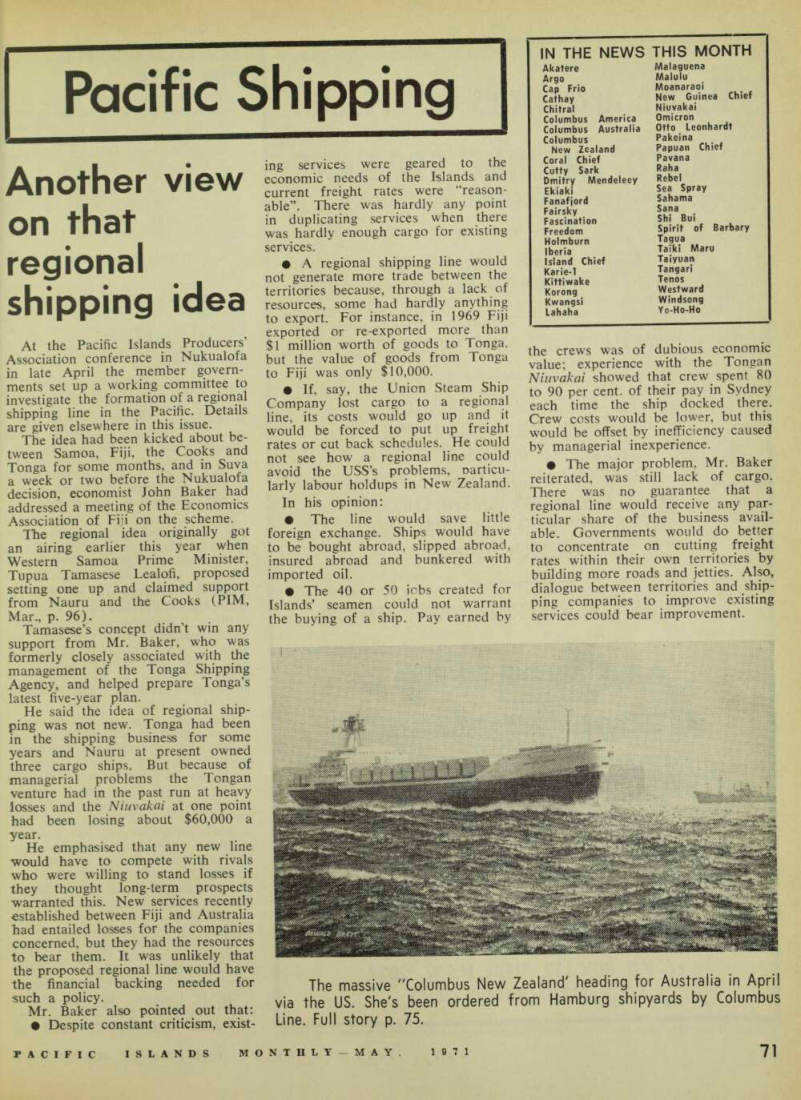
Another view on that regional shipping idea
At the Pacific Islands Producers’
Association conference in Nukualofa in late April the member govern ments set up a working committee to investigate the formation of a regional shipping line in the Pacific. Details are given elsewhere in this issue.
The idea had been kicked about be tween Samoa, Fiji, the Cooks and Tonga for some months, and in Suva a week or two before the Nukualofa decision, economist John Baker had addressed a meeting of the Economics Association of Fiji on the scheme.
The regional idea originally got an airing earlier this year when Western Samoa Prime Minister, Tupua Tamasese Lealofi, proposed setting one up and claimed support from Nauru and the Cooks (PIM, Mar., p. 96).
Tamasese’s concept didn’t win any support from Mr. Baker, who was formerly closely associated with the management of the Tonga Shipping Agency, and helped prepare Tonga’s latest five-year plan.
He said the idea of regional ship ping was not new. Tonga had been in the shipping business for some years and Nauru at present owned three cargo ships. But because of managerial problems the Tongan venture had in the past run at heavy losses and the Niuvakai at one point had been losing about $60,000 a year.
He emphasised that any new line would have to compete with rivals who were willing to stand losses if they thought long-term prospects warranted this. New services recently established between Fiji and Australia had entailed losses for the companies concerned, but they had the resources to bear them. It was unlikely that the proposed regional line would have the financial backing needed for such a policy.
Mr. Baker also pointed out that: • Despite constant criticism, exist
ing services were geared to the economic needs of the Islands and current freight rates were “reason able”. There was hardly any point in duplicating services when there was hardly enough cargo for existing services. • A regional shipping line would not generate more trade between the territories because, through a lack of resources, some had hardly anything to export. For instance, in 1969 Fiji exported or re-exported more than Si million worth of goods to Tonga, but the value of goods from Tonga to Fiji was only $lO,OOO. • If, say, the Union Steam Ship Company lost cargo to a regional line, its costs would go up and it would be forced to put up freight rates or cut back schedules. He could not see how a regional line could avoid the USS’s problems, oarticu larly labour holdups in New Zealand.
In his opinion: • The line would save little foreign exchange. Ships would have to be bought abroad, slipped abroad, insured abroad and bunkered with imported oil. • The 40 or 50 jobs created for Islands’ seamen could not warrant the buying of a ship. Pay earned by
crews was of dubious economic va , ue; experience with the Tongan Niuvakai showed that crew spent 80 to per cen t. of their pay in Sydney eacb t j me tbe s hip docked there, Crew costs would be lower, but this WO uld be offset by inefficiency caused by mana g e rial inexperience.
' . bl Mr Baker regional line would receive any par ticular share of the business avail able. Governments would do better to concentrate on cutting freight ra tes within their own territories by building more roads and jetties. Also, dialogue between territories and ship ping companies to improve existing services could bear improvement.
The massive "Columbus New Zealand' heading for Australia in April via the US. She's been ordered from Hamburg shipyards by Columbus Line. Full story p. 75.
Just Everybody Will
Own Uss Co.
Thomas Nationwide Transport of Sydney, and a New Zealand consor tium yet to be organised, will def initely take over the Union Steam Ship Co. of New Zealand, following NZ Government approval of the deal on April 6.
And in April it was also confirm ed by a TNT spokesman that the company was negotiating a tie-up with the German-owned Columbus Line.
A joint interest between TNT and the German firm would give TNT a comprehensive road and sea trans port network in the South Pacific.
Columbus (see article, p. 75), has extensive Pacific interests, while TNT has land transport interests in NZ and similar connections in the US and Canada.
TNT’s takeover of the USS Co. has certain conditions imposed by the NZ Government. The company is not to be split up in three parts, as TNT originally envisaged. No changes must be made in USS ship ping services for the first 12 months of the takeover, and TNT will give the NZ Government advance notice should it decide to terminate a ser vice.
TNT also plans to sell a number of ships of the USS fleet and re place them with modern vessels.
Placer May Sell Its
Karlander Interests
Placer Development Ltd is con sidering selling its 45 per cent, in terest in Karlander New Guinea Line Ltd, because of Karlander’s plans to invest in new ships for Australian Territory Liner Services Pty Ltd.
Karlander owns a 50 per cent, share in ATLS, and the other half is owned by Swiss Aluminium (Aust.) Pty Ltd. Placer’s share in Karlander is worth about $500,000.
The Placer Development annual report says that Karlander’s 50 per cent, share in ATLS has been rea sonably successful and has supplied a much needed service to the alu minium projects in which Swiss Alu minium is a major participant.
It would be some years before Swiss Aluminium could develop a cash flow to Placer. Karlander New Guinea was originally formed to ship plywood from New Guinea to Australian markets. Now, other shipping could provide an equally effective and competitive service.
Mr. H, Costello, managing direc tor of Karlander New Guinea Line, said Placer had decided to pull out
now because it did not wish to be come involved in the large invest ment needed for the new ATLS ships. ATLS operates services cov ering Melbourne, Sydney, Brisbane, Weipa and Gove.
The Placer holding in Karlander New Guinea Line will first have to be offered to the other shareholder, Karlander Oslo. Should Karlander Oslo take up these shares it will own 90 per cent, of Karlander New Guinea Line. The remaining 10 per cent, is held by New Guinea Gold fields Ltd.
Tt Loses A Link,
And Gains One
The US Trust Territory has lost one shipping link to Australia, but may gain one to New Zealand. The GEIC Wholesale Society vessel, Moanaraoi, which used to call regularly at Sydney and every 12 weeks at Majuro, no longer visits Australian ports.
The Moanaraoi has not called at Sydney since Christmas and the Wholesale Society’s Sydney agents said in April they had no information to indicate when the service would be resumed.
The Trust Territory market is at present dominated by Japan and the US, and Australian businessmen already find it difficult to supply the area because of a dearth of shipping.
MILTs board of directors discussed possibility of a direct run from Auckland/Sydney to Truk/Ponape last June (PIM, July, p. 101). At that time they were well aware that a growing number of businessmen in Australia and NZ would like to serve the TT market.
No definite decision has been made on the proposed new service to NZ.
Initial thinking is that the service will operate bi-monthly from NZ ports to Majuro-Ponape-Truk-Koror, with in ducement calls at Suva, Tarawa, Kwajalein and Yap. There is also a possibility of inducement calls to Sydney.
On the voyage to NZ the ship would load cargo and bunkers at Davao for Truk-Ponape-Majuro, and if there was an inducement there would be calls at Tarawa and Pago Pago.
The time allowed for the voyage would be 70 days, but if all space was not taken the time could be reduced to 60 days.
MILI will make a feasibility study with the Fanafjord, which will leave Mt. Maunganui, NZ, about June 1.
The Fanafjord has 500-ton dry cargo
space, and 20,000 cubic feet of reefer space Mr. George Kiskaddon, chairman of MILI, said five or six voyages a year would more than triple refrigerated food deliveries. That would fundamentally change a TT tincan economy to one of fresh food consumption.
The success of the venture will depend on greatly increased reefer storage facilities.
WT tt U U 0 cll u MILI has been operated as a subsidiary of Marine Chartering Co. Inc. of San Francisco since 1968. It also has a substantial number of Micronesian investors. The company charters all its vessels, mostly 2-3,000 tonners of the conventional variety, although there was a whisper in Sydney in April that the company might get a sideport loader. , .
Other news of the Trust Territory; • MILTs overall freight charges have gone up about 15.5 per cent.
The new tariffs—some increased, some decreased—have been approved by the Water Transportation Review B oar( i Primary reasonsfor the increases, says hef |QfiR P sfi ner
cent.’^ise^in°sea-going labour coL;
labour costs' and' the" necessity S 'of providing a reliable fleet to serve TT' ports within the terms of MILTs water transportation contract.
“The average net increase in retail cost of consumer goods which should result from these rate adjustments is calculated to be about one cent per
dollar for imported merchandise,” added the board spokesman. • The TT Government has sub mitted its capital improvement pro gramme for docks, harbours and warehouses for the next six years, to the Water Transportation Review Board.
According to Micronesia Shipping News, 1973-77 will see the con tinuation of a long range programme to improve and upgrade the existing harbours and warehousing facilities total estimated cost of SUS 6 1 .
A programme of improving ware houses in both district centres and outer islands, begun a year ago, will be continued, providing storage areas for contract carriers and govemment owned ships. While the programme goes on, a special government- owned ship with beaching ability is pro viding service to the islands which do not have adequate port facilities, j n co . ope ration with the US Coast Guard, navigational aids are being installed or replaced as needed, F • An improved service allowing . ports initiated; and direct westbound service
"to "apan 5 and"the fTeSS
will be continued, said Shipping Ne W s. MILI board of directors have a g re ed to explore possibilities for j Q i nt ventures with Micronesian in vestors in stevedoring and terminal operations in Majuro, Ponape and Koror, where MILI operates such services itself.
In The News This Month
Akatere Argo Cap Frio Cathay Chitral Columbus America Columbus Australia Columbus New Zealand Coral Chief Cutty Sark Dmitry Mendeleey Ekiaki Fanafjord Fairsky Fascination Freedom Holmburn Iberia Island Chief Karie-1 Kittiwake Korong Kwangsi Lahaha
Malaguena Malulu Moanaraoi New Guinea Chief Niuvakai Omicron Otto Leonhardt Pakeina Papuan Chief Pavana Raha Rebel Sea Spray Sahama
Sana •
Shi Bui Spirit of Barbary J a ? ua Taiki Maru Taiyuan Tangan Tenos Westward Windsong Yo-Ho-Ho
Advertisements & other items, pp. 76-78 (1 item)
Marine Accessories Co. Pty. ltd.
"MAKO" MARINE PRODUCTS
EXPORTERS THROUGHOUT THE ISLANDS
"MAKO" NYLON, POLYETHELENE,
KURALON FISH NETS
"ARALDITE" BOAT SHEATHING KITS
"FERROPRO" RUST CONVERTOR
"FERROPRO" COLD GALVANISING
"FERROPRO" META SEAL N.F.
"FERROPRO" LAQUER COATING FOR
BRASS, ALUMINIUM, COPPER, CHROME
"FERROPRO" ANTI-FUNGICIDAL AND
FLUORESCENT PAINTS
"ALSAFE" LIFEJACKETS, BUOYANCY VESTS
"SOILAX" BILGE CLEANERS
AZLON NYLON FISHING LINES
"CHANDLERY" ALL YACHT, PLEASURE CRAFT,
AND SHIPS CHANDLERY
Please write and we will forward you our full catalogue on all stocks available.
Marine Accessories Co. Pty. ltd.
c/- P.O. BOX 112, GLEBE, N.S.W., 2037
CABLE ADDRESS: "MAKO" SYDNEY
FOR SALE OR CHARTER
LST "MAGELLAN"
2700 t.d.w.
317 ft length with G.M. diesel engines and with operable bow doors, capable of beaching in areas where suitable docking facilities not available.
For specifications and other information contact:
UNIVERSAL CHARTERERS PTY. LTD.,
Sydney. Phone 27-8971. Cables: "Unichart".
£ m O e in £ M
Ml MWI COASTER
BUILT IN FERRO CEMENT
DESIGN ED BY WELL KNOWN AUST. NAVAL ARCHITECT FOR ISLAND SERVICE. BUILT UNDER RIGID SUPERVISION BY C'WEALTH OF AUST DEPT, OF SHIPPING & TRANSPORT (HULL & ENGINE SURVEY) Enquiries also welcome about our FERRO 40 FT.
DIESEL WORK BOAT
FOR A LIFETIME LOW COST VESSEL WRITE TO:
MARINE FURNISHING BUNDABERG PTY. LTD
P.O. Box 69, BUNDABERG, Q. 4670 Phone 72 1260
FOR ALL YOUR SHIP REPAIRS
t: ■ m ■■ f Q wm. n ■A-
CABLES:
"BISHLIMITED"
G.P.O. BOX 172,
SUVA. FIJI ISLANDS.
BISH LIMITED
Works phone. 23021, 23022, 22668, 22669, 22660.
H29BL
(ESTABLISHED 1906)
A/H Workshop; 23021, Manager: 23739, Asst. Man.: 23739
Wide organisational
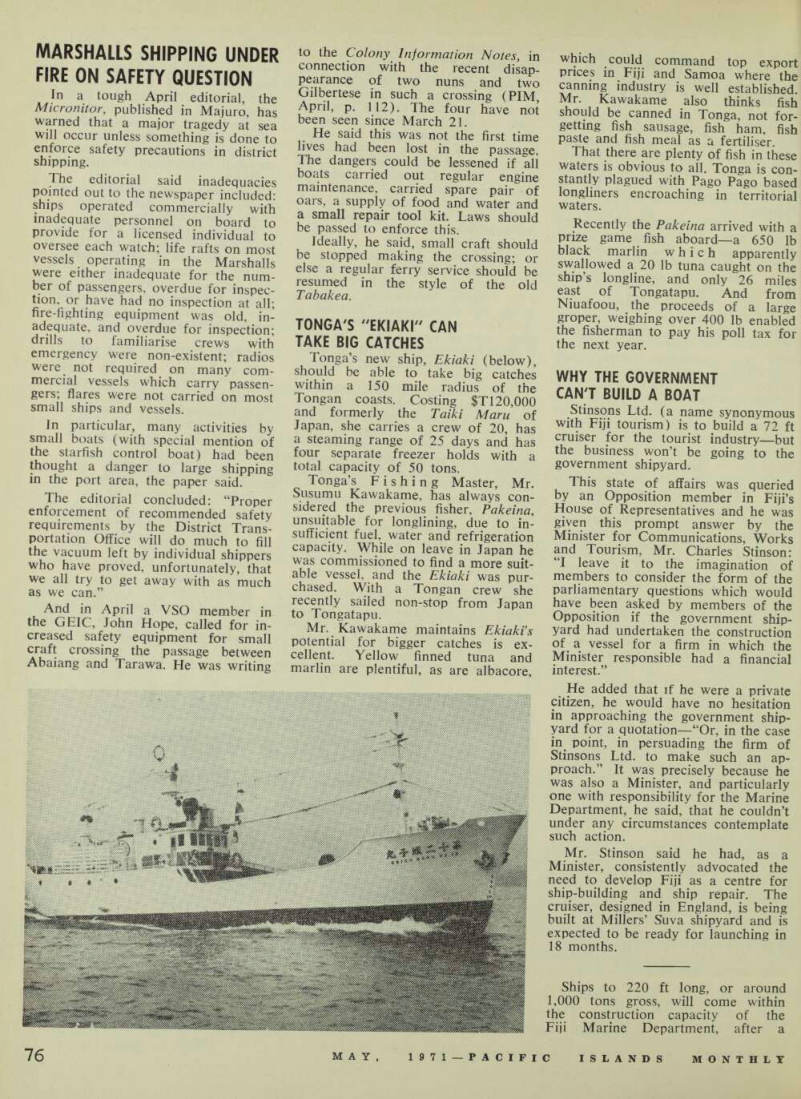
changes for P&O
The P & O group has made a num ber of changes. It is reorganising its operating and management structure and radio communications and has appointed Burns Philp (NG) Ltd. as general passenger agents in New Guinea.
The group’s reorganisation plans involve some 150 companies being co-ordinated under five new operating divisions. Each division is responsible in its field for commercial and ship management functions, and worldwide investigation of business opportunities.
P & O, through its 12 major ship owning subsidiaries, controls a fleet of about 240 ships ranging from trawlers to passenger liners; from conventional cargo ships to con tainers, giant tankers and bulk carriers. About 40,000 people are employed by the group, which at present has on order its largest ever consignment of 30 new ships—some $3OO million worth—ll of which will be in service this year.
The new operating divisions with their chief executives are: Bulk ship ping, A. B. Marshall; general cargo shipping, R. B. Adams; passenger shipping, P. E. Parry; special shipping, H. T. Beazley; European and air transport, Lord Geddes.
Five new central staff divisions, providing services to the board and the operating divisions, comprise: Finance, J. Mitchell; international affairs, F. T. Bird; technical services, D. W. Kerr; personnel services, F. H.
Thomasson; planning, yet to be ap pointed.
The new radio communications set up is called GTZU, a system whereby P & O’s 240 ships can radio each other for aid anywhere in the world, by means of a collective call sign.
Formerly the ships kept in touch by using individual call signs.
Bums Philp (NG) Ltd., has been port agent for P & O in a number of areas, but has never been general passenger agent.
The appointment follows the intro duction in February of monthly calls to the territory of the liners Cathay and Chitral —operated by E & A, a member of the P & O group. Each calls at Port Moresby from Mel bourne, Sydney, Brisbane on the way to Hong Kong and Japan, and at Rabaul on the southward leg. Port Moresby, Rabaul and now Vila, are also visited by P & O on cmises.
When the Iberia arrived at Vila in April, it was the first time P & O liners had visited there since before World War I.
"Columbus New Zealand"
miutDiuAV
On Hek Way
Columbus Line’s Columbus New Zealand was due in Melbourne May 13 after a maiden voyage from her Hamburg shipyards, via the US where she was due to have her crane mounted and to take on cargo. She is the first of three container ships (other two, Columbus Australia, Columbus America ) which will run the first fully-container service between the east coast US and Australia/New Zealand, not stopping at South Pacific ports.
A Columbus representative told PIM in April that the line intended replacing all its trans-Pacific ships with “similar type vessels”, starting at the end of this year. This means that Tarawa, one of the two Pacific ports serviced by the line (the other is Honolulu) may have to be modifled to handle some kind of container Sh GEIC seamen will man the three new containers (they already man Columbus s present Pacific sh ?P s^® ril 5 1 W iota the Ship They areworking in a general purpose capacity which means all but one have to hold an AB certificate. Bosun F. Ams, who has been running a GEIC able-seaman course left with them.
In command of the Columbus New The vessel is as modern as a container can be. She has a cruising speed of 22 knots, dead weight capacity of 21,200 tons and can carry
1.1*7 containers, 454 of which are insulated for frozen and chilled cargo.
Portable clip-on refrigeration units may be to the containers for movement overland or at a terminal/ depot wb ii e awaiting loading. A un i que feature is an on-board gantry crane , able to handle 80 per cent, of tbc sb ip’s containers, which can make the ship independent of shore-based facilities.
Columbus Line is wholly owned by Hamburg Sud, which celebrates its 100th anniversary this year.
Another GEIC crew left the colony i n April, this time to man the MV ofto L eon hardt, a 40,000 ton bulk carrier carrying iron ore, grain and coal between Norway, Brazil, South Africa, Venezuela and the Continent, Tbe fa seamen are all graduates of the Marine Training School,
Amqther Ship For Nga Line
New Guinea Australia Line> a Sw're company from Rab g au i to Australia, the 5,500 ton gross Chief was formerly the Kwangsi on a Far East r .
A side-port loader, she will carry special oil tanks for the new service and should be ready by the middle of the. year. The company’s three other ade-prat e/-run Another . Swire company, . Fiji Australia Line, charters the Taiyuan from China Navigation to run Suva- Lautoka-Noumea-Sydney.
Marshalls Shipping Under
Fire On Safety Question
In a tough April editorial, the Micronitor , published in Majuro, has warned that a major tragedy at sea will occur unless something is done to enforce safety precautions in district shipping.
The editorial said inadequacies pointed out to the newspaper included: ships operated commercially with inadequate personnel on board to provide for a licensed individual to oversee each watch; life rafts on most vessels operating in the Marshalls were either inadequate for the num ber of passengers, overdue for inspec tion, or have had no inspection at all; fire-fighting equipment was old, in adequate, and overdue for inspection; drills to familiarise crews with emergency were non-existent; radios were not required on many com mercial vessels which carry passen gers; flares were not carried on most small ships and vessels.
In particular, many activities by small boats (with special mention of the starfish control boat) had been thought a danger to large shipping in the port area, the paper said.
The editorial concluded: “Proper enforcement of recommended safety requirements by the District Trans portation Office will do much to fill the vacuum left by individual shippers who have proved, unfortunately, that we all try to get away with as much as we can.”
And in April a VSO member in the GEIC, John Hope, called for in creased safety equipment for small craft crossing the passage between Abaiang and Tarawa. He was writing
to the Colony Information Notes, in connection with the recent disap pearance of two nuns and two Gilbertese in such a crossing (PIM April, p. 112). The four have not been seen since March 21.
He said this was not the first time lives had been lost in the passage.
The dangers could be lessened if all boats carried out regular engine maintenance, carried spare pair of oars, a supply of food and water and a small repair tool kit. Laws should be passed to enforce this.
Ideally, he said, small craft should be stopped making the crossing; or else a regular ferry service should be resumed in the style of the old Tabakea.
Tonga's "Ekiaki" Can
Take Big Catches
Tonga’s new ship, Ekiaki (below), should be able to take big catches within a 150 mile radius of the Tongan coasts. Costing $T120,000 and formerly the Taiki Maru of Japan, she carries a crew of 20, has a steaming range of 25 days and has four separate freezer holds with a total capacity of 50 tons.
Tonga’s Fishing Master, Mr.
Susumu Kawakame, has always con sidered the previous fisher, Pakeina, unsuitable for longlining, due to in sufficient fuel, water and refrigeration capacity. While on leave in Japan he was commissioned to find a more suit able vessel, and the Ekiaki was pur chased. With a Tongan crew she recently sailed non-stop from Japan to Tongatapu.
Mr. Kawakame maintains Ekiaki’s potential for bigger catches is ex cellent. Yellow finned tuna and marlin are plentiful, as are albacore.
which could command top export prices in Fiji and Samoa where the canning industry is well established.
Mr. Kawakame also thinks fish should be canned in Tonga, not for getting fish sausage, fish ham, fish paste and fish meal as a fertiliser.
That there are plenty of fish in these waters is obvious to all. Tonga is con stantly plagued with Pago Pago based longliners encroaching in territorial waters.
Recently the Pakeina arrived with a prize game fish aboard—a 650 lb black marlin which apparently swallowed a 20 lb tuna caught on the ship’s longline, and only 26 miles east of Tongatapu. And from Niuafoou, the proceeds of a large groper, weighing over 400 lb enabled the fisherman to pay his poll tax for the next year.
Why The Government
can't build a boat Stinsons Ltd. (a name synonymous with Fiji tourism) is to build a 72 ft cruiser for the tourist industry—but the business won’t be going to the government shipyard.
This state of affairs was queried by an Opposition member in Fiji’s House of Representatives and he was given this prompt answer by the Minister for Communications, Works and Tourism, Mr. Charles Stinson: “I leave it to the imagination of members to consider the form of the parliamentary questions which would have been asked by members of the Opposition if the government ship yard had undertaken the construction of a vessel for a firm in which the Minister responsible had a financial interest.”
He added that if he were a private citizen, he would have no hesitation in approaching the government ship yard for a quotation—“Or, in the case in point, in persuading the firm of Stinsons Ltd. to make such an ap proach.” It was precisely because he was also a Minister, and particularly one with responsibility for the Marine Department, he said, that he couldn’t under any circumstances contemplate such action.
Mr. Stinson said he had, as a Minister, consistently advocated the need to develop Fiji as a centre for ship-building and ship repair. The cruiser, designed in England, is being built at Millers’ Suva shipyard and is expected to be ready for launching in 18 months.
Ships to 220 ft long, or around 1,000 tons gross, will come within the construction capacity of the Fiji Marine Department, after a
5F200,000 expansion programme for its shipyard at Walu Bay, Suva.
Giving details, Mr. Stinson said in April the expansion would make Suva a ship-building centre of the South Pacific with potential to win orders from Australia and New Zealand.
The size of the present yard limits shipbuilding to 150 ft or less. Its redesign has been planned by United Nations shipping expert, Mr.
Arne Sannegren, and Marine De partment staff. The first phase of work, due to start this year, will cost $50,000. The whole project, over three years, calls for the re moval of two steel sheds, the ex tension of No. 1 building, erection of a 35 ton gantry crane and mod ernisation of the boilershop.
Two New Replacements
For Cooks Shipping
Silk and Boyd Ltd. of Rarotonga is searching for vessels to replace two of its three-ship inter-island fleet of motor vessels.
The 169 tons gross Tagua, stranded on Mangaia Island’s reef last Decem ber, has been declared a total loss and will be replaced by a larger vessel. She will be cut up and sold as scrap. In March-April Don Silk was overseas looking for a second hand ship with a speed of around 10 knots.
Also to be replaced is the slow and ageing 201 tons Akatere, probably by a steel hulled motor vessel of 200 tons, with a speed of nine knots and capable of carrying 18 cabin passen gers as well as general cargo.
This ship will probably be built in Taiwan and is expected to be in service next year. Both replacement vessels will employ Cook Islanders as crew.
Shipping briefs
• Sitmar Line is to make Raro tonga one of its ports of call in 1972. The company, which carried European migrants to Australia until its contract ran out in June last year, is now concentrating on normal liner services from Europe to New Zealand and Australia via the Panama Canal. Sitmar, which also calls at Papeete and Suva, will make its first Rarotonga call on April 7, 1972, with Fairsky. • The Fiji cruise boat, Sea Spray , ran on a reef at Kadavu Lailai on April 16 and stayed there over an hour before refloating under her own power. • The twin deck, 6,500 ton dwt Tenos left Sydney on April 5 on her first voyage for Conpac Pacific Line, stopping Brisbane-Port Moresby and
back. She had just completed a rough delivery crossing of the Pacific. With a Swedish crew and captain, she was carrying 2,000 tons of cargo (PIM, April, p. 87) and was due back in Sydney 16 days later. • The Holm Shipping Company increased its freight rates by about $4 a ton on New Caledonian freight from New Zealand on April 5. In a letter to customers the company said the latest financial results indicated substantial losses on this route which the company was unable to absorb.
Holm runs the Holmburn fortnightly from Auckland to Noumea. • An unexpected call was made at Rarotonga on March 31 by the
Russian scientific research vessel, Dmitry Mendeleey, from Honolulu.
On board were Captain MikhailSobo velesky, 90 crew, and 70 scientific personnel.
The 6,800 ton vessel is equipped with several laboratories, equipment that can recover specimens from depths of 7,000 metres, and a com puter that can make 5,000 calcula tions per second and can transmit data to Moscow for further process ing.
This four-months’ research cruise of the Pacific is the fifth voyage the two-years-old Dmitry Mendeleey has made. Pacific ports of call on the current voyage being the Galapagos Islands, Honolulu and Rarotonga.
Advertisements & other items, pp. 79-82 (2 items)
"David Lawrence"
FOR SALE BY TENDER
STEEL HULL REFRIGERATED TRAWLER
L O A 60'0" Beam 17'3" Draught 7'o" Fuel Capacity 3,000 Power- 5 -— BV7I G.AA. 250 HP Fresh Water Keel Cooled Refrigeration Powered by Auxiliary 3 Phase 40 K.V.A. Diesel Driven Unit. .. .
Auto Pilot, Sonar, Radio, 6 Bunks, Galley, Full Sixe Portagas Stove, Hot Water System, Shower, Toilet.
Vessel is 2\ years old, in first class order and is in survey.
Tenders close AAay 10, 1971. Highest Tender not necessarily accepted.
Enquiries for inspection should be made to.
L. P. SMART MARQUAND & CO.,
51 QUEEN STREET, MELBOURNE, 3000.
c p m
HELLABY’S
CANNED MEATS
ff
CROWN
" PACIFIC
ARROW
*Ro m Nt: fft Pi HliUa? .•'i min IL
HANDY CONTAINER COASTERS
B - * ms • Flushdecker, built 1963, converted into container vessel 1967. • Class Bureau Veritas + 1 3/3 L. 1.1. "ice", special survey 1/10/71. • 417 mtons deadweight on summerfreeboard, draft 2.64 mtr—B' 8". • 450.95/321.18 tons Gross/Net. • 30 089/29.779 cbft grain/bale. • Length o.a. 51.90 mtr., between p.p. 47.90 mtr., breadth 70.20 mtr. • ONE HATCH of 28.31 x 5.20 mtr = 92' 102" x 17' 2". • ONE HOLD (same size) now used for 72 containers of 2.50 x 2.50 x 1.52, • 8' 2\" xB' 2\" x 4' 112" which is in fact \ the size of a standard container of 20' x 8' x 8' of which 16 can be loaded underdeck. • Four electric fans on cargohold, airchanges 20/hr. • Two unrigged masts for navigation lights. • Main engine: 350 h.p. Brons, reduced to 225 h.p., type 5 G.B. No. 14531 fully automatic and bridge-controlled. • Consumption 1000 Ltr gasoil per 24 hrs, speed abt 9£ knots, bunkers 29.44 mtons, freshwater 8.38 mtons, waterbalast 148.35 mtons. • One hydraulic anchorwinch.
Auxiliaries: 1 Armstrong Siddely type A.S. 1 of 10 h.p., 1 Armstrong Siddely type AS. 3 of 30 h.p. • Two general service pumps "Borga" type PDK-L or 30 m 3. • One auxiliary compressor "Hatlappa" LHO 10, 1 auxiliary generator 6 KW type Hansa 412/2, 1 shaft generator and harbour set of same type, 110 V. d.c. • Vessel is fitted with: Oecca Radar, R/T, OF, ESD, VHF, Sharp automat pilot and electrichydraulic steering gear. All cabins insulated. • Flushdecker, built 1962, converted into container vessel 1967. • Class Bureau Veritas -f 1 3/3 L. 1.1. ACP, special survey Nov. 1974. • 456 m.tons deadweight on summerfreeboard, draft 2.72 mtr—B' 10". • 499.47/326.78 tons Gross/Net. • 33.024/32.572 cbft Grain/Bale. • Length o.a. 56.83 mtr, between p.p. 51.93 mtr, breadth 7.746 mtr. • ONE HATCH of 29.73 x 5.20 mtr = 97' 6£" x 17' 2": • ONE HOLD (same size) now used for 76 containers of 2.50 x 2.50 x 1.52 = 8' x " x 4' 112"/ which is in fact \ the size of a standard container of 20 x 8' x 8' of which 16 can be loaded underdeck. • Four electric fans on cargohold, airchanges 20/hr. • Two unrigged masts for navigation lights. • Main engine: 450 h.p. M.W.M., reduced to 395, type R.H. 348 S.U. fully automatic and bridge-controlled. • Consumption 1950 Ltr gasoil per 24 hrs, speed abt knots bunkers 45.61 mtons, freshwater 12.04 mtons, waterballast 191.88 mtons. • One anchorwinch. Auxiliaries; 1 Lister, type 4 JPM of 46 h.p., 1 Lister type 3 JPM or 35 h.p. both 1200 revs/min. One hydraulic pump of 30 h.p. type G 156 and one hydraulic pump of 20 h.p. type G 3. Two general service pumps make "Borga" 45 m 3 P.M.K.L. One auxialiary compressor (D & 0) 18 m 3 /hr T.K.70. one auxiliary generator 12 KW Hansa type 415/2, one shaft generator same type and one harbour set 5 KW Hansa type 411/2, 110 V. d.c. • Vessel is fitted with: Decca Radar, R/T, DF, ESD, VHF, Sharp autom pilot and electric-hydraulic steering gear. All cabins insulated.
Both vessels, including 200 containers, are available end April, 1971, FOR SALE OR TIME CHARTER. The containers described above are open, which means 4 sides only, and are ideal for palletized cargoes. All items can be purchased separately but, owners prefer to sell the two ships and containers "en bloc" for which the asking price is $A275,000, or near offer.
FURTHER LISTINGS
• 195 ft cargo vessel, flushdecker, Lloyds + 100 A 1, $A150,000. • 142 ft ocean going tug, 1350 h.p. Lloyds + 100 A 1, $A200,000. • 130 ft twin screw prawn trawler/workboat, 70T freezer, $A55,000. • 75 ft trading ketch, $A50,000. • 72 ft twin screw charter vessel, $A40,000. • 64 ft tug, 520 h.p. G.M., $A70,000. • 60 ft double rigged prawn trawler, $A50,000. • 59 ft workboat or G.P., twin screw, $A45,000. • 52 ft diesel pilot launch, suitable survey work, $A19,000. • 50 ft twin diesel, charter vessel, $A26,000.
CAPTAIN VAN GELDER & CO.
P.O. BOX 17, NEUTRAL BAY, SYDNEY, N.S.W. 2089.
PHONES: 92-4387, 929-6992. CABLES: "GELDER", SYDNEY.
76
MAY, 1971 P ACIFIC ISLANDS MONTHLY
Cruising
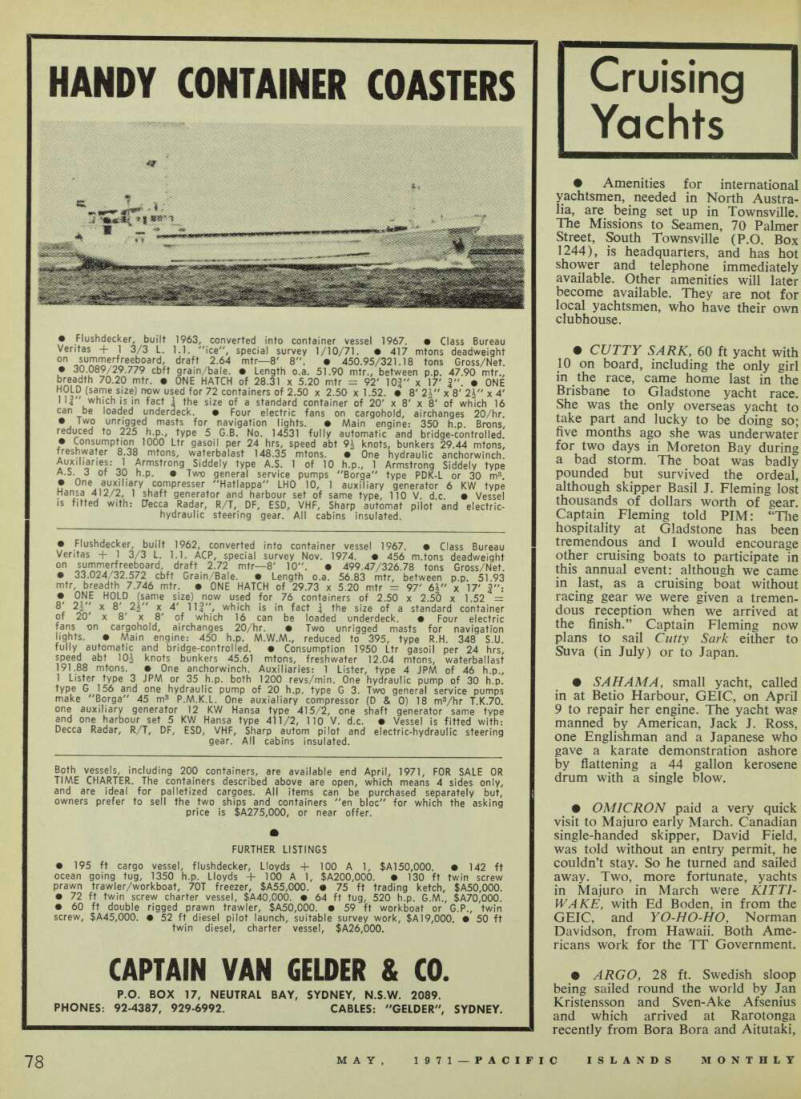

Yachts
• Amenities for international yachtsmen, needed in North Austra lia, are being set up in Townsville.
The Missions to Seamen, 70 Palmer Street, South Townsville (P.O. Box 1244), is headquarters, and has hot shower and telephone immediately available. Other amenities will later become available. They are not for local yachtsmen, who have their own clubhouse. • CUTTY SARK, 60 ft yacht with 10 on board, including the only girl in the race, came home last in the Brisbane to Gladstone yacht race.
She was the only overseas yacht to take part and lucky to be doing so; five months ago she was underwater for two days in Moreton Bay during a bad storm. The boat was badly pounded but survived the ordeal, although skipper Basil J. Fleming lost thousands of dollars worth of gear.
Captain Fleming told PIM: “The hospitality at Gladstone has been tremendous and I would encourage other cruising boats to participate In this annual event: although we came in last, as a cruising boat without racing gear we were given a tremen dous reception when we arrived at the finish.” Captain Fleming now plans to sail Cutty Sark either to Suva (in July) or to Japan. • SAH AM A, small yacht, called in at Betio Harbour, GEIC, on April 9 to repair her engine. The yacht was manned by American, Jack J. Ross, one Englishman and a Japanese who gave a karate demonstration ashore by flattening a 44 gallon kerosene drum with a single blow. • OMICRON paid a very quick visit to Majuro early March. Canadian single-handed skipper, David Field, was told without an entry permit, he couldn’t stay. So he turned and sailed away. Two, more fortunate, yachts in Majuro in March were KITTI WAKE, with Ed Boden, in from the GEIC, and YO-HO-HO, Norman Davidson, from Hawaii, Both Ame ricans work for the TT Government. • ARGO, 28 ft. Swedish sloop being sailed round the world by Jan Kristensson and Sven-Ake Afsenius and which arrived at Rarotonga recently from Bora Bora and Aitutaki,
was hauled out of Avatiu harbour in March for careening. Both men, have obtained jobs as schoolteachers, Jan at the Teachers Training College and Sven at Tereora College. They intend to stay in Rarotonga for a few months. e RAH A, small sloop, arrived Rarotonga March 31 from Tahiti with English lone-hander Richard S.
Taylor. She was en route to Tauranga, New Zealand on a delivery voyage for her owner who bought Raha in the UK. • MALAGUENA, 26 ft sloop with lone-hander David Thomas on board arrived Rarotonga April 4 from Tahiti and Bora Bora. Mr. Thomas, who visited Rarotonga and Aitutaki in 1968 in Malaguena, is currently researching child rearing in Polynesia and Melanesia. A New Zealander, he is a student at the University of Queensland, and plans to visit Samoa, Tonga, Fiji, New Hebrides and the Solomons, returning to Brisbane in December. • WESTWARD, 99 ft schooner of the Oceanic Foundation, Hawaii, arrived Rarotonga March 4 from Rarutu with six marine biologists and archaeologists on board. Previous calls were Line Islands, Starbuck, Vostock, Caroline, Pitcairn, Henderson, Ducie, Rapa, Bass, Mangareva and Oeno Islands. At Aitutaki biologists found four miles of dead reef, and crown of thorns starfish were seen feeding on live coral (see elsewhere). West ward left Rarotonga March 13 for Bora Bora, Tahiti and the Marquesas. • US trimaran REBEL is anchored near Kieta on Bougainville where owner Marvin Glenn is working on the copper project, • Carl and Loys Fristrom in wish bone ketch SANA, from Caloundra, are in Rabaul after a cruise from Brisbane through the Barrier Reef, across to Samarai and through the Trobriand Islands. They plan a cruise to the British Solomons next north west season. • KORONG, 39 ft concrete ketch from Southport, Qld., with John and Vicky Holmes, is anchored in Port Moresby for the south-east season.
John and Vicky will cruise throueh the Milne Bay islands to Madang in November. • SHI BUI, concrete NZ sloop, Shi Bui competed in the 1969 Sydney and Allan Wallis, son Robert and daughter Linda are back at work and school after their year-long cruise north along the Australian coast after Shi-Bui competed in the 1969 Sydney- Hobart race.
• Tahiti Ketch TANGARI, with owner Eric Kraak and crew Jeannie Wraight, left Port Moresby recently to sail back to home port, Sydney.
Also on the way back to Sydney and on to NZ is single-hander Bob Vernon
In Fascination.
• Other cruising yachts in Port Moresby in April include gaff ketch KARIE-L, ketch LAHARA, schooner PA VAN A and sloop MALULU. Off to SA soon are Steve and Karen Zador and baby son Zolan, in 32 ft Woolacott cutter
Windsong From Nz.
• FAI SIN, a 50 ft yacht with a crew of four, arrived in Papeete from Hong Kong early in April. The crew comprises Ted Harmer (owner-skip per), Bob Mehner, Kevin Kirk and Alan Thompson. The first two are Americans; the others, Australians.
Fai Sin left Hong Kong in July, 1970, and visited the Philippines, New Guinea, the Solomons and Samoa before reaching Tahiti, where the crew intend to stay for several months. Their plans are to go on to the Marquesas, Galapagos, Panama, Honduras, Jamaica and St. Thomas.
Advertisements & other items, p. 83 (1 item)
family down
Don't let your
You've worked hard to give them a home, schooling and security. Don't let that hard-won security erode away because you continued to overlook making out a Will. With a properly planned Will, you can be certain in the knowledge that your property will eventually pass to the people you specify, and also that your Estate will be as large as possible after probate and duties. In this regard, we invite you to take advantage of the advisory service we provide, entirely free of obligation. Our specialists in Estate Planning will be delighted to help you plan your Will most efficiently, or to discuss it fully with your solicitor or accountant. that the.
BURNS PHILP TRUSTEE
COMPANY LIMITED
Fiji Office: Mr. A. W. Cooper, Resident Manager, Rodwell Road, Suva Telephone: 2 4661 Also Registered Offices at Port Morseby (Papua) and Vila (New Hebrides) Head Office: 51 Pitt Street, SYDNEY 2000 Telephone; 241 1021. Telegrams: "BURNSTRUST," Sydney BPI 3
People
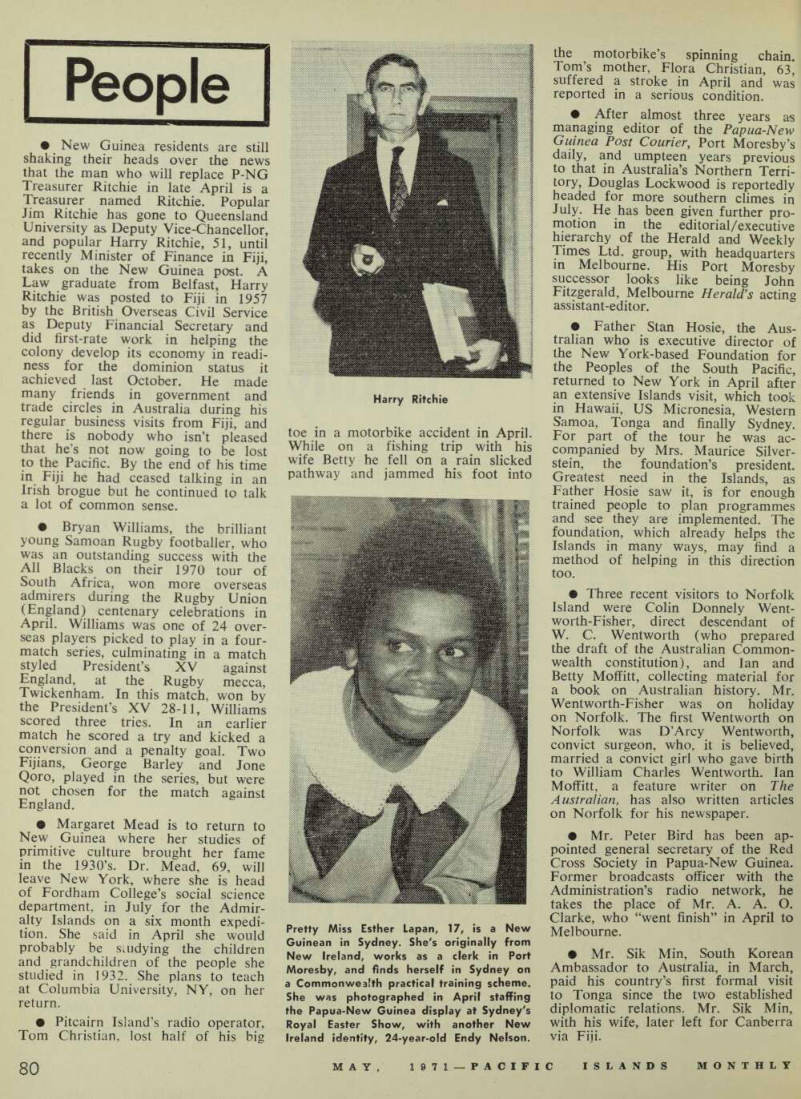
• New Guinea residents are still shaking their heads over the news that the man who will replace P-NG Treasurer Ritchie in late April is a Treasurer named Ritchie. Popular Jim Ritchie has gone to Queensland University as Deputy Vice-Chancellor, and popular Harry Ritchie, 51, until recently Minister of Finance in Fiji, takes on the New Guinea post. A Law graduate from Belfast, Harry Ritchie was posted to Fiji in 1957 by the British Overseas Civil Service as Deputy Financial Secretary and did first-rate work in helping the colony develop its economy in readi ness for the dominion status it achieved last October. He made many friends in government and trade circles in Australia during his regular business visits from Fiji, and there is nobody who isn’t pleased that he’s not now going to be lost t° the Pacific. By the end of his time in Fiji he had ceased talking in an Irish brogue but he continued to talk a lot of common sense. • Bryan Williams, the brilliant young Samoan Rugby footballer, who was an outstanding success with the All Blacks on their 1970 tour of South Africa, won more overseas admirers during the Rugby Union (England) centenary celebrations in April. Williams was one of 24 over seas players picked to play in a four match series, culminating in a match styled President’s XV against England, at the Rugby mecca, Twickenham. In this match, won by the President’s XV 28-11, Williams scored three tries. In an earlier match he scored a try and kicked a conversion and a penalty goal. Two Fijians, George Barley and Jone Qoro, played in the series, but were not chosen for the match against England. • Margaret Mead is to return to New Guinea where her studies of primitive culture brought her fame in the 1930’5. Dr. Mead, 69, will leave New York, where she is head of Fordham College’s social science department, in July for the Admir alty Islands on a six month expedi tion. She said in April she would probably be studying the children and grandchildren of the people she studied in 1932. She plans to teach at Columbia University, NY, on her return. • Pitcairn Island’s radio operator, Tom Christian, lost half of his big
toe in a motorbike accident in April.
While on a fishing trip with his wife Betty he fell on a rain slicked pathway and jammed his foot into
the motorbike’s spinning chain.
Tom’s mother, Flora Christian, 63, suffered a stroke in April and was reported in a serious condition. • After almost three years as managing editor of the Papua-New Guinea Post Courier, Port Moresby’s daily, and umpteen years previous to that in Australia’s Northern Terri tory, Douglas Lockwood is reportedly headed for more southern climes in July. He has been given further pro motion in the editorial/executive hierarchy of the Herald and Weekly Times Ltd. group, with headquarters in Melbourne. His Port Moresby successor looks like being John Fitzgerald, Melbourne Herald’s acting assistant-editor. • Father Stan Hosie, the Aus tralian who is executive director of the New York-based Foundation for the Peoples of the South Pacific, returned to New York in April after an extensive Islands visit, which took in Hawaii, US Micronesia, Western Samoa, Tonga and finally Sydney.
For part of the tour he was ac companied by Mrs. Maurice Silver stein, the foundation’s president.
Greatest need in the Islands, as Father Hosie saw it, is for enough trained people to plan programmes and see they are implemented. The foundation, which already helps the Islands in many ways, may find a method of helping in this direction too. • Three recent visitors to Norfolk Island were Colin Donnely Went worth-Fisher, direct descendant of W. C. Wentworth (who prepared the draft of the Australian Common wealth constitution), and lan and Betty Moffitt, collecting material for a book on Australian history. Mr.
Wentworth-Fisher was on holiday on Norfolk. The first Wentworth on Norfolk was D’Arcy Wentworth, convict surgeon, who, it is believed, married a convict girl who gave birth to William Charles Wentworth. lan Moffitt, a feature writer on The Australian, has also written articles on Norfolk for his newspaper. • Mr. Peter Bird has been ap pointed general secretary of the Red Cross Society in Papua-New Guinea.
Former broadcasts officer with the Administration’s radio network, he takes the place of Mr. A. A. O.
Clarke, who “went finish” in April to Melbourne. • Mr. Sik Min, South Korean Ambassador to Australia, in March, paid his country’s first formal visit to Tonga since the two established diplomatic relations. Mr. Sik Min, with his wife, later left for Canberra via Fiji.
Harry Ritchie
Pretty Miss Esther Lapan, 17, is a New Guinean in Sydney. She's originally from New Ireland, works as a clerk in Port Moresby, and finds herself in Sydney on a Commonwealth practical training scheme.
She was photographed in April staffing the Papua-New Guinea display at Sydney's Royal Easter Show, with another New Ireland identity, 24-year-old Endy Nelson.
the girls
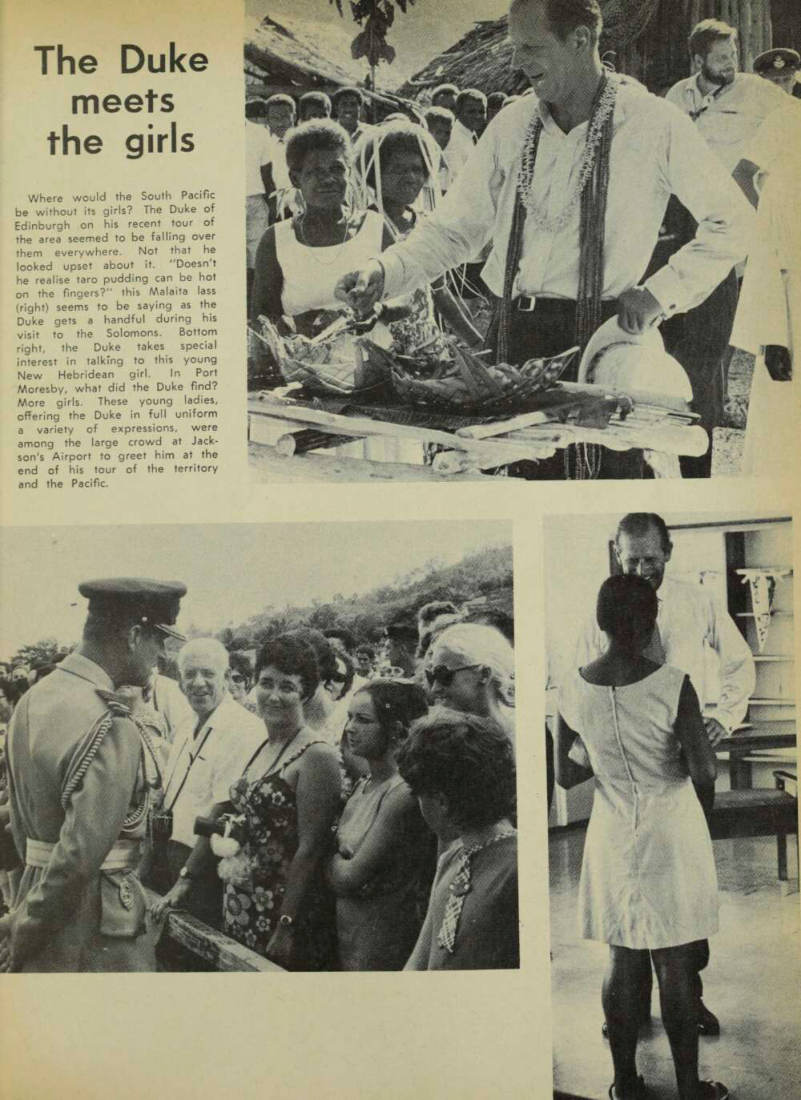
The Duke meets the girls
Where would the South Pacific be without its girls? The Duke of Edinburgh on his recent tour of the area seemed to be falling over them everywhere. Not that he looked upset about it. "Doesn't he realise taro pudding can be hot on the fingers?" this Malaita lass (right) seems to be saying as the Duke gets a handful during his visit to the Solomons. Bottom right, the Duke takes special interest in talking to this young New Hebridean girl. In Port Moresby, what did the Duke find?
More girls. These young ladies, offering the Duke in full uniform a variety of expressions, were among the large crowd at Jack son's Airport to greet him at the end of his tour of the territory and the Pacific.
War and death among
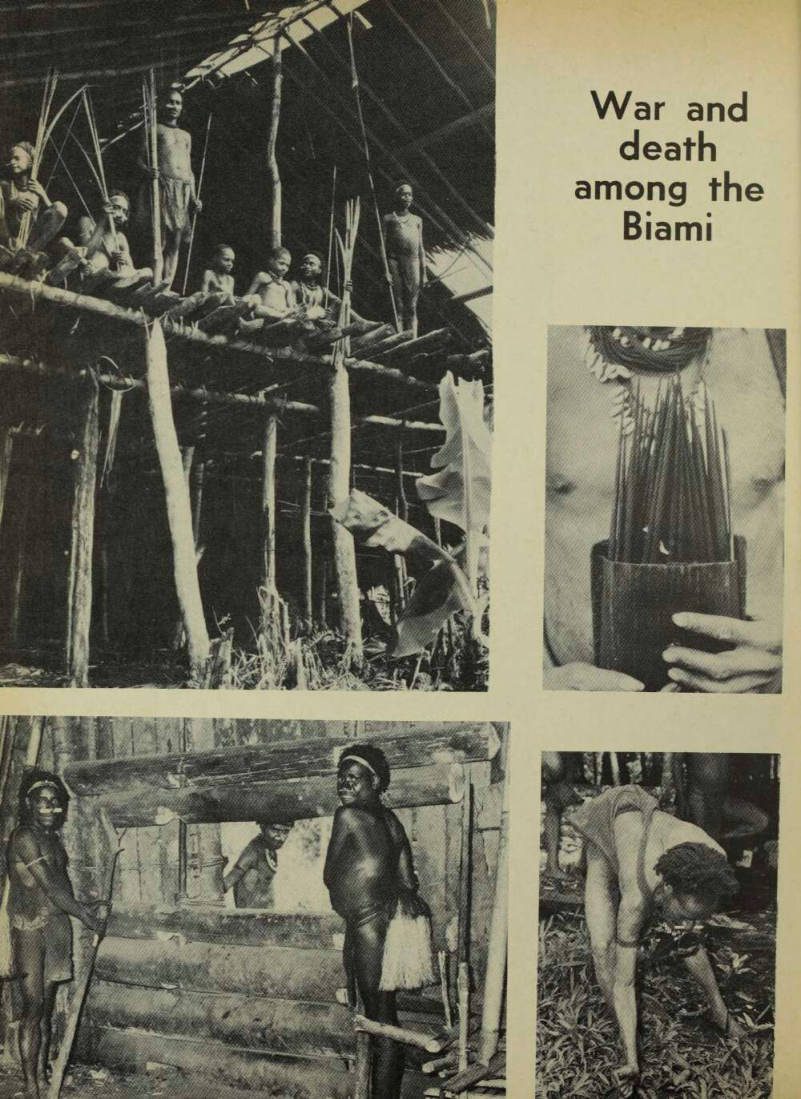
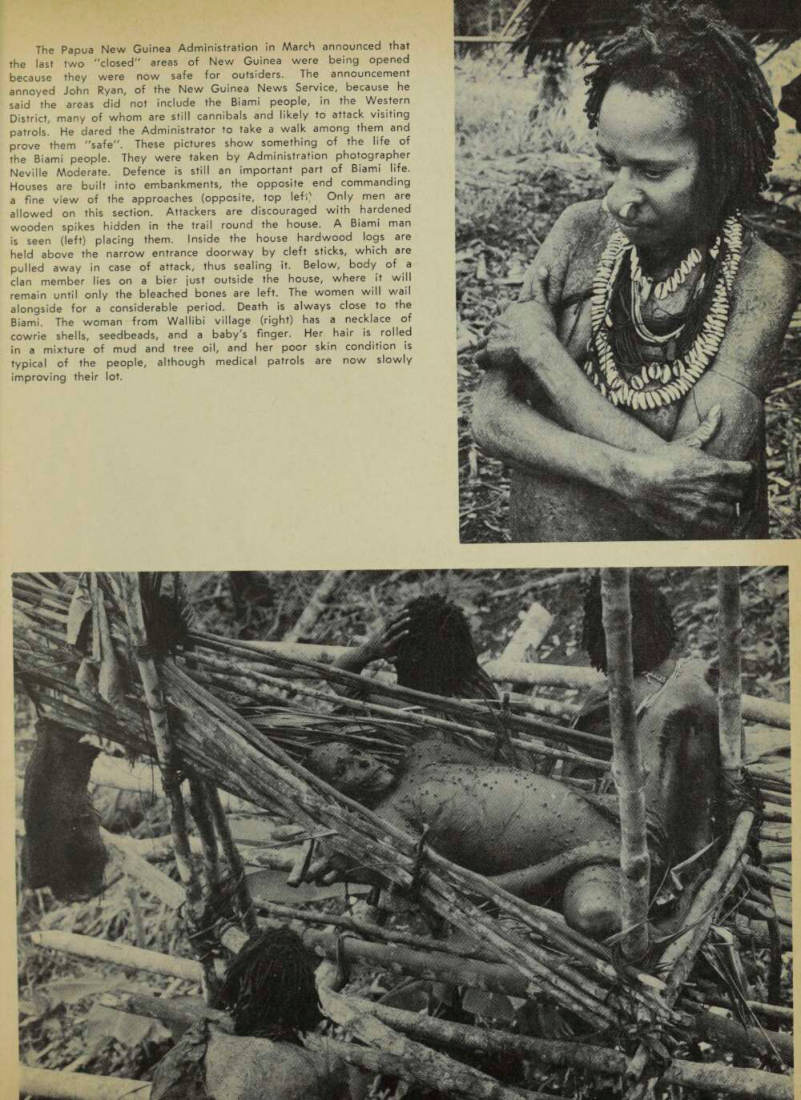
death among the Biami
The Papua New Guinea Administration in March announced that the last two "closed" areas of New Guinea were being opened because they were now safe for outsiders. The announcement annoyed John Ryan, of the New Guinea News Service, because he said the areas did not include the Biami people, in the Western District, many of whom are still cannibals and likely to attack visiting patrols. He dared the Administrator to take a walk among them and prove them "safe". These pictures show something of the life of the Biami people. They were taken by Administration photographer Neville Moderate. Defence is still an important part of Biami life.
Houses are built into embankments, the opposite end commanding a fine view of the approaches (opposite, top left' Only men are allowed on this section. Attackers are discouraged with hardened wooden spikes hidden in the trail round the house. A Biami man is seen (left) placing them. Inside the house hardwood logs are held above the narrow entrance doorway by cleft sticks, which are pulled away in case of attack, thus sealing it. Below, body of a clan member lies on a bier just outside the house, where it will remain until only the bleached bones are left. The women will wail alongside for a considerable period. Death is always close to the Biami. The woman from Wallibi village (right) has a necklace of cowrie shells, seedbeads, and a baby's finger. Her hair is rolled in a mixture of mud and tree oil, and her poor skin condition is typical of the people, although medical patrols are now slowly improving their lot.
Airstrips in
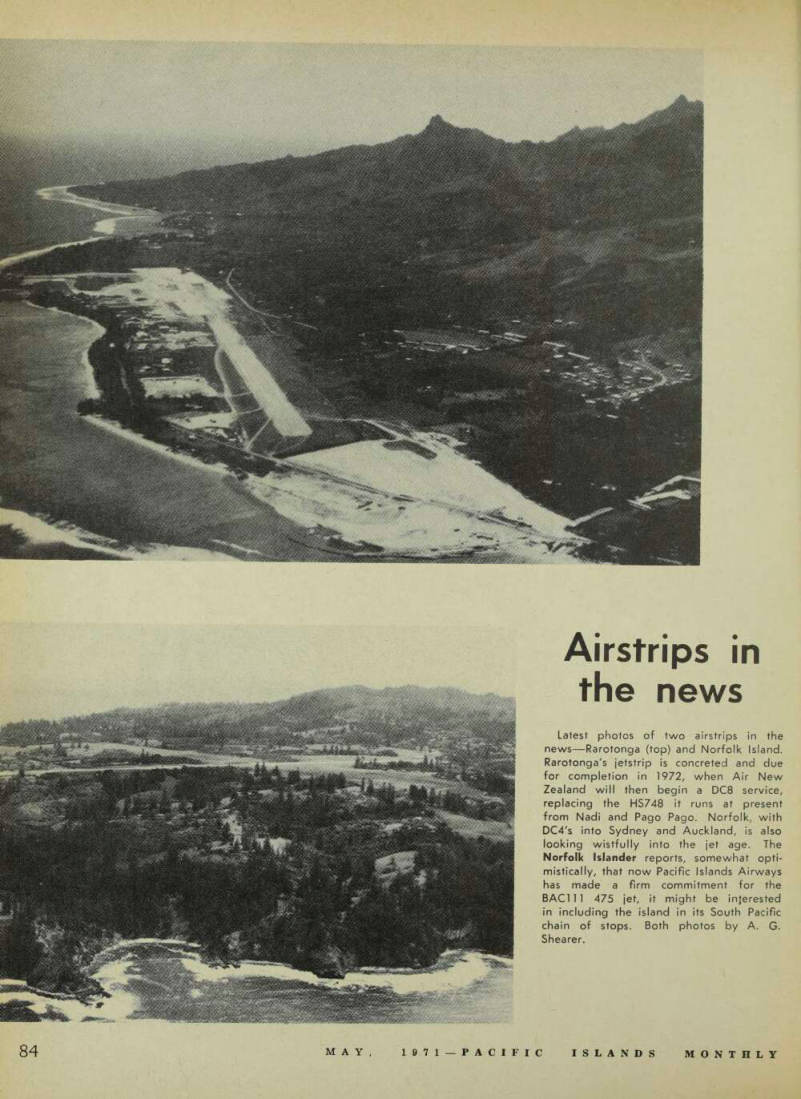
the news
Latest photos of two airstrips in the news—Rarotonga (top) and Norfolk Island.
Rarotonga's jetstrip is concreted and due for completion in 1972, when Air New Zealand will then begin a DCS service, replacing the HS74B it runs at present from Nadi and Pago Pago. Norfolk, with DC4's into Sydney and Auckland, is also looking wistfully into the jet age. The Norfolk Islander reports, somewhat opti mistically, that now Pacific Islands Airways has made a firm commitment for the BACIII 475 jet, it might be interested in including the island in its South Pacific chain of stops. Both photos by A. G.
Shearer.
Business and Development
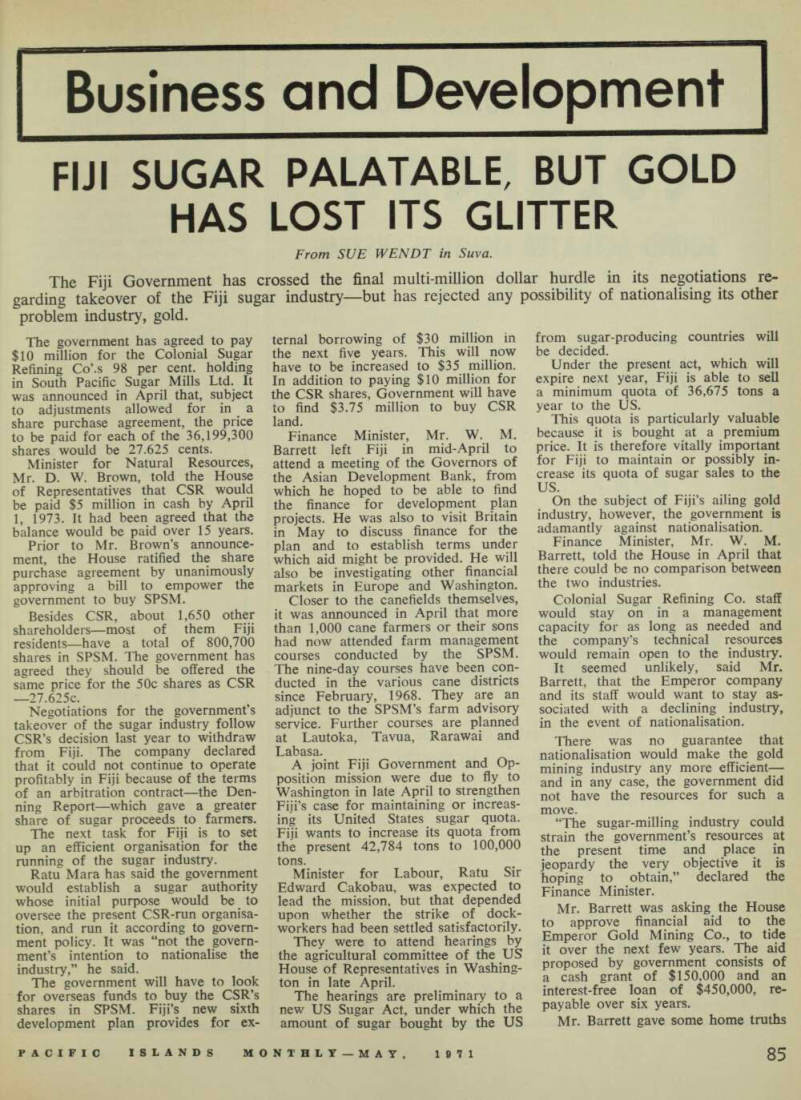

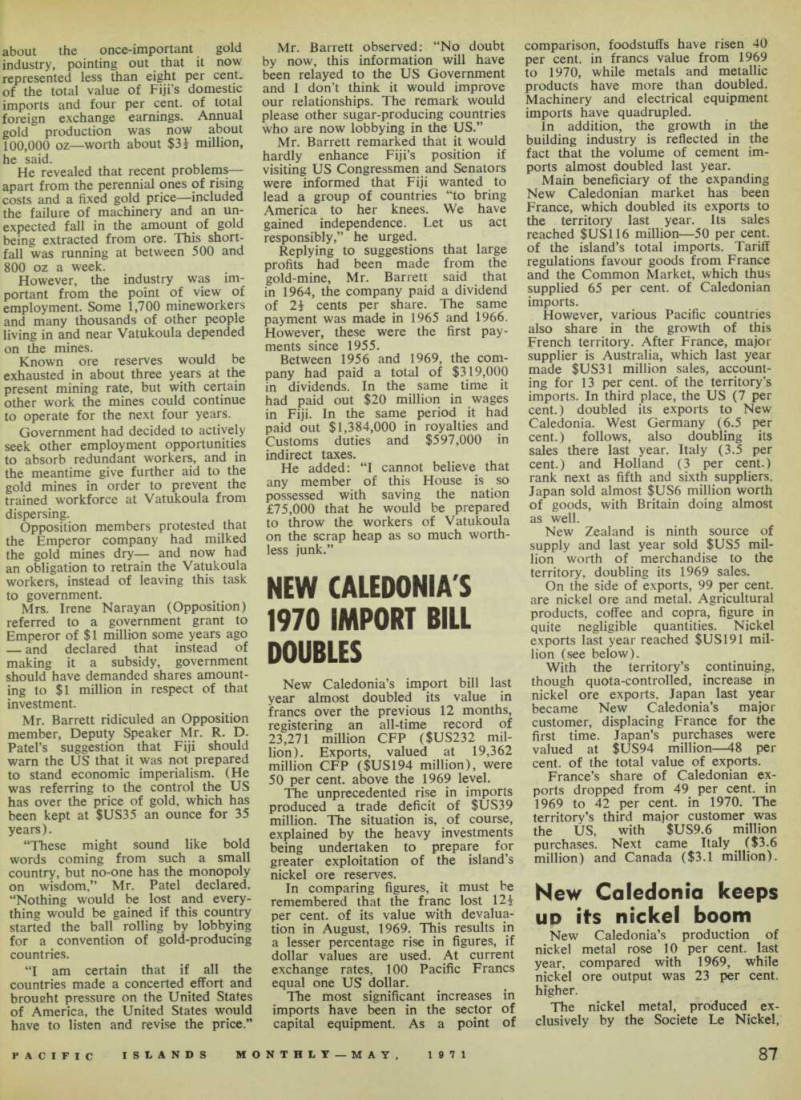
Fiji Sugar Palatable, But Gold
Has Lost Its Glitter
From SUE WENDT in Suva.
The Fiji Government has crossed the final multi-million dollar hurdle in its negotiations re garding takeover of the Fiji sugar industry—but has rejected any possibility of nationalising its other problem industry, gold.
The government has agreed to pay $lO million for the Colonial Sugar Refining Co’.s 98 per cent, holding in South Pacific Sugar Mills Ltd. It was announced in April that, subject to adjustments allowed for in a share purchase agreement, the price to be paid for each of the 36,199,300 shares would be 27.625 cents.
Minister for Natural Resources, Mr. D. W. Brown, told the House of Representatives that CSR would be paid $5 million in cash by April 1, 1973. It had been agreed that the balance would be paid over 15 years.
Prior to Mr. Brown’s announce ment, the House ratified the share purchase agreement by unanimously approving a bill to empower the government to buy SPSM.
Besides CSR, about 1,650 other shareholders —most of them Fiji residents—have a total of 800,700 shares in SPSM. The government has agreed they should be offered the same price for the 50c shares as CSR —27.625 c.
Negotiations for the government’s takeover of the sugar industry follow CSR’s decision last year to withdraw from Fiji. The company declared that it could not continue to operate profitably in Fiji because of the terms of an arbitration contract—the Den ning Report—which gave a greater share of sugar proceeds to farmers.
The next task for Fiji is to set up an efficient organisation for the running of the sugar industry.
Ratu Mara has said the government would establish a sugar authority whose initial purpose would be to oversee the present CSR-run organisa tion, and run it according to govern ment policy. It was “not the govern ment’s intention to nationalise the industry,” he said.
The government will have to look for overseas funds to buy the CSR’s shares in SPSM. Fiji’s new sixth development plan provides for ex
ternal borrowing of $3O million in the next five years. This will now have to be increased to $35 million.
In addition to paying $lO million for the CSR shares, Government will have to find $3.75 million to buy CSR land.
Finance Minister, Mr. W. M.
Barrett left Fiji in mid-April to attend a meeting of the Governors of the Asian Development Bank, from which he hoped to be able to find the finance for development plan projects. He was also to visit Britain in May to discuss finance for the plan and to establish terms under which aid might be provided. He will also be investigating other financial markets in Europe and Washington.
Closer to the canefields themselves, it was announced in April that more than 1,000 cane farmers or their sons had now attended farm management courses conducted by the SPSM.
The nine-day courses have been con ducted in the various cane districts since February, 1968. They are an adjunct to the SPSM’s farm advisory service. Further courses are planned at Lautoka, Tavua, Rarawai and Labasa.
A joint Fiji Government and Op position mission were due to fly to Washington in late April to strengthen Fiji’s case for maintaining or increas ing its United States sugar quota.
Fiji wants to increase its quota from the present 42,784 tons to 100,000 tons.
Minister for Labour, Ratu Sir Edward Cakobau, was expected to lead the mission, but that depended upon whether the strike of dock workers had been settled satisfactorily.
They were to attend hearings by the agricultural committee of the US House of Representatives in Washing ton in late April.
The hearings are preliminary to a new US Sugar Act, under which the amount of sugar bought by the US
from sugar-producing countries will be decided.
Under the present act, which will expire next year, Fiji is able to sell a minimum quota of 36,675 tons a year to the US.
This quota is particularly valuable because it is bought at a premium price. It is therefore vitally important for Fiji to maintain or possibly in crease its quota of sugar sales to the US.
On the subject of Fiji’s ailing gold industry, however, the government is adamantly against nationalisation.
Finance Minister, Mr. W. M.
Barrett, told the House in April that there could be no comparison between the two industries.
Colonial Sugar Refining Co. staff would stay on in a management capacity for as long as needed and the company’s technical resources would remain open to the industry.
It seemed unlikely, said Mr.
Barrett, that the Emperor company and its staff would want to stay as sociated with a declining industry, in the event of nationalisation.
There was no guarantee that nationalisation would make the gold mining industry any more efficient— and in any case, the government did not have the resources for such a move.
“The sugar-milling industry could strain the government’s resources at the present time and place in jeopardy the very objective it is hoping to obtain,” declared the Finance Minister.
Mr. Barrett was asking the House to approve financial aid to the Emperor Gold Mining Co., to tide it over the next few years. The aid proposed by government consists of a cash grant of $150,000 and an interest-free loan of $450,000, re payable over six years.
Mr. Barrett gave some home truths
about the once-important gold industry, pointing out that it now represented less than eight per cent, of the total value of Fiji’s domestic imports and four per cent, of total foreign exchange earnings. Annual gold production was now about 100,000 oz —worth about s3± million, he said.
He revealed that recent problems— apart from the perennial ones of rising costs and a fixed gold price—included the failure of machinery and an un expected fall in the amount of gold being extracted from ore. This short fall was running at between 500 and 800 oz a week.
However, the industry was im portant from the point of view of employment. Some 1,700 mineworkers and many thousands of other people living in and near Vatukoula depended on the mines.
Known ore reserves would be exhausted in about three years at the present mining rate, but with certain other work the mines could continue to operate for the next four years.
Government had decided to actively seek other employment opportunities to absorb redundant workers, and in the meantime give further aid to the gold mines in order to prevent the trained workforce at Vatukoula from dispersing.
Opposition members protested that the Emperor company had milked the gold mines dry— and now had an obligation to retrain the Vatukoula workers, instead of leaving this task to government.
Mrs. Irene Narayan (Opposition) referred to a government grant to Emperor of $1 million some years ago and declared that instead of making it a subsidy, government should have demanded shares amount ing to $1 million in respect of that investment.
Mr. Barrett ridiculed an Opposition member, Deputy Speaker Mr. R. D.
Patel’s suggestion that Fiji should warn the US that it was not prepared to stand economic imperialism. (He was referring to the control the US has over the price of gold, which has been kept at SUS3S an ounce for 35 years).
“These might sound like bold words coming from such a small country, but no-one has the monopoly on wisdom,” Mr. Patel declared.
“Nothing would be lost and every thing would be gained if this country started the ball rolling by lobbying for a convention of gold-producing countries.
“I am certain that if all the countries made a concerted effort and broueht pressure on the United States of America, the United States would have to listen and revise the price.”
Mr. Barrett observed; “No doubt by now, this information will have been relayed to the US Government and 1 don’t think it would improve our relationships. The remark would please other sugar-producing countries who are now lobbying in the US.”
Mr. Barrett remarked that it would hardly enhance Fiji’s position if visiting US Congressmen and Senators were informed that Fiji wanted to lead a group of countries “to bring America to her knees. We have gained independence. Let us act responsibly,” he urged.
Replying to suggestions that large profits had been made from the gold-mine, Mr. Barrett said that in 1964, the company paid a dividend of 2i cents per share. The same payment was made in 1965 and 1966.
However, these were the first pay ments since 1955.
Between 1956 and 1969, the com pany had paid a total of $319,000 in dividends. In the same time it had paid out $2O million in wages in Fiji. In the same period it had paid out $1,384,000 in royalties and Customs duties and $597,000 in indirect taxes.
He added: “I cannot believe that any member of this House is so possessed with saving the nation £75,000 that he would be prepared to throw the workers of Vatukoula on the scrap heap as so much worth less junk.”
New Caledonia's
1970 Import Bill
Doubles
New Caledonia’s import bill last year almost doubled its value in francs over the previous 12 months, registering an all-time record of 23,271 million CFP (SUS 232 mil lion). Exports, valued at 19,362 million CFP (SUSI 94 million), were 50 per cent, above the 1969 level.
The unprecedented rise in imports produced a trade deficit of SUS 39 million. The situation is, of course, explained by the heavy investments being undertaken to prepare for greater exploitation of the island’s nickel ore reserves.
In comparing figures, it must be remembered that the franc lost 12i per cent, of its value with devalua tion in August, 1969. This results in a lesser percentage rise in figures, if dollar values are used. At current exchange rates, 100 Pacific Francs equal one US dollar.
The most significant increases in imports have been in the sector of capital equipment. As a point of
comparison, foodstuffs have risen 40 per cent, in francs value from 1969 to 1970, while metals and metallic products have more than doubled.
Machinery and electrical equipment imports have quadrupled.
In addition, the growth in the building industry is reflected in the fact that the volume of cement im ports almost doubled last year.
Main beneficiary of the expanding New Caledonian market has been France, which doubled its exports to the territory last year. Its sales reached SUSII6 million—so per cent, of the island’s total imports. Tariff regulations favour goods from France and the Common Market, which thus supplied 65 per cent, of Caledonian imports.
However, various Pacific countries also share in the growth of this French territory. After France, major supplier is Australia, which last year made SUS3I million sales, account ing for 13 per cent, of the territory’s imports. In third place, the US (7 per cent.) doubled its exports to New Caledonia. West Germany (6.5 per cent.) follows, also doubling its sales there last year. Italy (3.5 per cent.) and Holland (3 per cent.) rank next as fifth and sixth suppliers.
Japan sold almost SUS 6 million worth of goods, with Britain doing almost as well.
New Zealand is ninth source of supply and last year sold SUSS mil lion worth of merchandise to the territory, doubling its 1969 sales.
On the side of exports, 99 per cent, are nickel ore and metal. Agricultural products, coffee and copra, figure in quite negligible quantities. Nickel exports last year reached SUSI9I mil lion (see below).
With the territory’s continuing, though quota-controlled, increase in nickel ore exports, Japan last year became New Caledonia’s major customer, displacing France for the first time. Japan’s purchases were valued at SUS 94 million—4B per cent, of the total value of exports.
France’s share of Caledonian ex ports dropped from 49 per cent, in 1969 to 42 per cent, in 1970. The territory’s third major customer was the US, with SUS 9.6 million purchases. Next came Italy (53.6 million) and Canada ($3.1 million).
New Caledonia keeps
ud its nickel boom
New Caledonia’s production of nickel metal rose 10 per cent, last year, compared with 1969, while nickel ore output was 23 per cent, higher.
The nickel metal, produced ex clusively by the Societe Le Nickel,
wkh h 39 7lwlfti ri %fto nS M C? n ared ith 39,795 tons in 1969. Nickel ore °«P“‘ 7 s “P to 6,8 million tons, compared with 5.5 million tons m ’ .
Le Nickel is currently engaged upon an expansion plan at its Domambo smelting works near Noumea. This resulted in ferronickel production registering 27,964 tons, while nickel matte remained stationary at 15,856 tons Of the total 43,613 tons exported, 31,103 tons went to France. The remaining 12,510 tons were destined for foreign markets. Main clients were the US, taking 3,682 tons ferronickel, with Japan and Canada buying 5,948 and 1,451 tons of mattes respectively. Among other lesser customers, Australia purchased 359 tons of ferro-nickel. , . , 8 c t 0 h U - SUa .?r eatl °? °* stockpiles and the imposition of ex- 1C t k ? OI J ? P0 « S Fe “ fnH f d cH n otal . 11 9 r0duct ; 0 ° fi § ures and reached 4.1 million wet tons, one to ns
d hlri 196l 969 ‘ Last
ntfnt 9 ra ® e mc * el + cobalt content of 2.5 per cent. The average price FOB per wet ton was SUSI 6, transported from the terntory m 310 shiploads.
Leading exporters were the Societe
Le Nickel (1 million tons > mg 24 per cent, of the territory’s ore
exports, and leading independent
Caledonian miner Edouard Pentecost (934,301 tons) selling 23 per cent. of total ore shipments. Main customer is, of course, Japan which purchased just over 4 million tons.
' i
Unionists refused
entry' to Caledonia
T „ • ,9 Canadian trade union offi vl als hav f , be ? n refused entry into :/ ew Caledonia, following a visit tbe . re ! ate las ! V ea r of Meyer Bern stem international affairs director of Jm Ar Un T lted Ste eJworkers of America J^ n j p - 96 )- Ml \ Dayton, secretary general of New Caledonia s largest trade union, the SOENC, said in April a complaint had been lodged with Governor Louis Verger con cerning the Administration’s refusal to allow the Canadian unionists into the territory The two ' French-speaking Cana- Messrs. Vallee and Seguin, were obliged to fly on by the same plane to New Zealand. Their ex pected arrival in Noumea had been announced at a trade union congress held j n December, at the west coast town of Bourail. Unionists were then
told that the two Canadian experts could be expected to train the Cale donians in financial and administra tive organisation of trade unions.
The interest of North American unionists in New Caledonia has been heightened by the operations here of the International Nickel Company of Canada (a partner in the COFIMPAC project) and the Kaiser Aluminium and Chemical Corp., which is working with the French company Le Nickel.
Nauru Pools man
in bankruptcy court
An echo of the failure of Pacific Sporting Pools was heard in Sydney early in April when the Registrar in Bankruptcy, Mr. V. D. Summerhays, started a public examination into the bankruptcy of William Maurice Mayberry, one of the promoters of the scheme. The plan was to conduct football pools from Nauru.
Mayberry was made bankrupt on December 1, 1970, on his own petition. He then had assets of 5A24.59 in cash, and two horses.
Against that were liabilities of $33,657 owing to unsecured creditors; a contingent liability for Seiher Cocoa Estates Pty. Ltd.; $22,500, plus interest on what he described as a secured debt owing to the Bank of NSW; and $29,000 or $30,000 owing to trusts for his children.
He had also received $15,000 from his wife over the years, but she did not want the money back. Altogether there was a deficiency of about $90,000. He was at present earning $lOO a week as a liaison officer for Gem Prospecting and Development Pty. Ltd.
Mayberry told the Registrar that he had $2,000 to $3,000 in Sloop Ltd., which was registered in Norfolk Is. That company was taken over by Consolidated Football Pools Ltd., also registered in Norfolk Island in August, 1968. Consolidated Football Pools, in turn, was taken over by a Nauru-registered Pacific Sporting Pools Ltd. in November, 1968.
Mayberry, in reply to a question by Mr. C. Darvall, who appeared for the Official Receiver, said he had invested more than $2,000 to $3,000 in cash or kind in Sloop Ltd. The money referred to was a reimburse ment for travelling expenses. The amount he invested in Sloop was more than $7,000.
His shares in Sloop were for past services. Apart from himself and Mr. George Pearce, who was on the same basis as himself, the other shareholders in Sloop were Mr. L. G.
Scanlan and Mr. D. Berry, Scanlan
put in $3,000 or $4,000 and Berry $l,OOO or $1,500.
There was an advantage to all shareholders in the takeover by Consolidated Football Pools. They sold their shares for cash at $2 a share. There was a mark-up of two for one. The cash came from outside shareholders.
Mr. Darvall: So it was other people’s money being used by your self and the directors, I think who were directors of Sloop Mayberry: No, Mr. Pearce and I were directors of Sloop and two or three other Norfolk Island residents.
He thought the board of Con solidated Football Pools was the same as that of Sloop. The Norfolk Islanders gave the company its residency for the purpose of taxation evasion. His own shares were held by somebody else in trust. It was a sham arrangement to evade taxation. As a second stage in the sham arrangement he made a profit in sales to Con solidated Football Pools.
When Pacific Sporting Pools was formed in Nauru he became a direc tor. Pearce was also a director. When that company took over the shares which were held by nominees on his behalf he suggested the transfer.
There were other directors at that stage—Alan Newbury and Ray Lord, with L. G. Scanlan as the alternate director in Sydney for Lord.
Mayberry said there was also a benfit to shareholders in the transfer of shares from Consolidated Football Pools to Pacific Sporting Pools, and again it was two for one. A lot of money, about $60,.000, had been put into Consolidated Football Pools by outside shareholders.
Mr. Darvall: The whole basis of this leapfrogging was that you doubled your shareholdings each time, did you not?
Mayberry: That is correct.
He agreed that the actual cash raised for Pacific Sporting Pools, out side capital generated by transfers, was about $370,000.
He considered the dealings were honest as far as shareholders were concerned because they were fully aware of everything. There was no prospectus, but confidential memos were written.
He thought 1,000 shares in Pacific Sporting Pools were registered in his name as a director’s qualification, and he was entitled to another 24,000 registered in the names of Norfolk Islanders. They were in the name of a company, Jacarra Investments Ltd.
Asked who were the directors of the investment company, Mayberry said he could be wrong—there were a number of companies there, but with Pacific Sporting Pools it was
Mr. Ombler and Mr. Nagle. He thought Mrs. Nagle was secretary.
The Nagles were residents of Norfolk Island. The Omblers were residents at the time.
For a company to be formed on Norfolk Island and have residency it was necessary that the shares should be beneficially owned by local residents. He was using Jacarra for a false picture.
Mr. Darvall: It was a false picture being created for the express purpose of defeating the Australian taxation authorities?
Mayberry: Yes.
Mr. Darvall: Do you consider that was honest? —Yes.
He considered it was honest because it was disclosed to everybody con cerned. It was never disclosed to the Australian taxation authorities.
To another question by Mr.
Darvall, Mayberry said he would agree that non-disclosure was dis honest.
Mayberry repeated that every person who put capital into Con solidated Football Pools was told the position. It was the same with Pacific Sporting Pools.
But it was never disclosed to the Supreme Court of Nauru. The liquidators of Pacific Sporting Pools knew the position because they were the auditors. They knew transfers were for directors’ profits.
Mayberry agreed that shareholders in Pacific Sporting Pools lost all their investment; he knew that creditors of that company would not be paid, and also that creditors of Central Pacific Hotels, a subsidiary of Pacific Sporting Pools, would not be paid.
Mayberry said one of the reasons for his bankruptcy was failure of the Pacific Sporting Pools group. He had also lost $lB,OOO in Seiher Holdings Pty. Ltd.
The examination was adjourned to a date to be fixed.
Carpenter to sell
Unilever, coconut oil
From July, W. R. Carpenter will sell to Unilever of Australia coconut oil from New Guinea worth at current prices between SAI.4 million to $1.6 million.
This follows decisions made early this year by Unilever to close down its Edible Oil Industries Pty. Ltd. crushing mill at Balmain, Sydney, after nearly 70 years of crushing copra from the Islands.
Unilever’s last shipment of Islands’ copra is due in Sydney aboard the Karlander freighter Sletholm from the Western Solomons in June.
In July New Guinea Australia
Line, a competitor of Karlander, will introduce a new vessel on its Australia-New Guinea run—the New Guinea Chief (see p. 75). Equipped with bulk oil facilities, she will bring down to Sydney several hundred tons of coconut oil from Carpenter’s Rabaul mill.
Terms have been agreed between Carpenters and Unilever for the sale of between 4,000 and 5,000 tons of oil a year. Current prices are £EI6S a ton. PIM understands the above volume could well be exceeded.
In its time, Unilever’s mill in Sydney—originally designed to pro cess big shipments of oil from Unilever’s plantations in the Solo mons—has crushed many hundreds of thousands of tons of copra from the Islands. Early volume was from 16,000 to 20,000 tons, but volume in recent years has been nearer 8,000-9,000 tons.
Unilever feels that today’s trend is to process most copra in or near producing areas. The Islands’ big mils are in New Guinea and Fiji, smaller desiccated coconut mills are in Tonga, New Guinea and French Polynesia and negotiations have slowed on a major coconut oil mill for the New Hebrides.
Concern over some
Fiji insurance
Fiji Minister for Finance, Mr.
W. M. Barrett, has rejected an ap plication for a licence to establish a new insurance company in Fiji.
As a result, in the House of Representatives in April he answered allegations that Fiji citizens were being denied the right to enter the insurance business in their own country.
He commented on a newspaper article which contained allegations made by Mr. David Gamble, a pre vious manager of the British-Ameri can Insurance Company in Fiji, whose application for a licence to operate an insurance company had been rejected.
The Minister said it was the declared policy of the government to encourage any worthwhile venture, “providing it wasn’t going to result in the workers, farmers, housewives and the man in the street being sub jected to high-pressure door-to-door selling tactics which could result in their entering into agreements which they did not fully understand.”
He said that when the application for a licence was first made, it was stated that the company would have a nominal capital of $F 100,000, 60 per cent, of which would be owned
Continued on p. 97
by investors domiciled in Bermuda.
Of the remaining 40 per cent., $24,000 worth of shares would have been offered locally with $16,000 on call.
In the meantime, Mr. Gamble obtained a residential permit for Fiji.
Mr. Barrett said he understood the reason he gave for wanting to reside here was to buy or build a tourist motel and operate it.
Last November, Mr. Gamble was advised that his application had been “most carefully and sympathetically” considered, but the government was not prepared for the time being to authorise the establishment of further insurance companies in Fiji. He was told that this was a decision of policy taken before his application.
In January, a further submission was made from Mr. Gamble’s solicitors stating that his second ap plication was supported by a group of local citizens. They included Messrs. Y. P. and R. S. Reddy of Reddy Construction Company Ltd., Mr. Harvey Hunt, of Hunts of the Pacific, Mr. R. F. Burness of the Fiji Development Company, Mr. R.
N. Patel, Dr. Ali Asgar and Mrs.
J. B. Kantilal Jina.
Mr. Barrett told the House that door-to-door selling—which was the form that industrial sickness and accident insurance, etc., took—was highly lucrative for the owners or shareholders of a company.
In 1969, he said, non-life insurance companies, which were generally known as general insurance com panies, collected premiums on per sonal accident, sickness, medical and hospital insurance policies amounting to $250,000. However, they paid out claims of only $BO,OOO.
The life companies authorising this type of insurance collected premiums amounting to $364,000 but paid out a mere $57,000 in claims.
“Our people generally are not a sophisticated group,” Mr. Barrett said.
“The workers in particular are trust ing and susceptible to high pressure door-to-door salesmanship.
“Unable to resist, they buy policies which are in force so long as the policy holders pay their premiums weekly or monthly. Once a policy holder is unable to meet his com mitments because of unemployment or some other financial emergency, the policy lapses. In 1969, some 16,000 policies were surrendered as lapsed policies.”
Mr. Barrett added: “Government is looking closely at the area of insurance not controlled by the Assurance Ordinance and which enabled substantial sums of money to flow out of the dominion un resticted.”
Advertisements & other items, pp. 90-94 (1 item)
Colorgan
THE BEST OF BOTH WORLDS
SOUND ACTUATED LIGHTING SYSTEM
MUSK
YOU CAN
SEE!
/ Operates from any sound system stereo tape recorder, etc.
Background, Gain and Delay Controls.
All solid state construction.
Cristallux display spheres, complete with lamps cable and Atlas stand.
Coloured Music is a delight to watch. You and your friends will be amazed at the instant response to the Colour to Sound similarity.
Made in Australia—fully guaranteed.
TRANSLATOR ENTERPRISES
CHEGWYN ST., BOTANY, N.S.W. 2019 AUSTRALIA
CATTLE AND
HORSES
All breeds and types selected for export Healthy good quality cattle and horses of all grades and classes are selected and supplied to meet description and price stipulated by the purchaser and sold either through Reg. Stock Agents or on guarantee by vendor.
Transit, agistment, veterinary services, or freight can be arranged and supervised on request.
All types of other animals can also be obtained at best current prices in Australia. We specialise in animals suitable for tropical environments.
NETHERBY DOWNS
P.O. BOX 166, MILSON'S POINT,
SYDNEY, 2061.
ARBS
INVEST AT
6*% P.A.
IN THE
AUSTRALASIAN
PERMANENT BUILDING
SOCIETY LIMITED
NORFOLK ISLAND, SOUTH PACIFIC
For further details and Application Forms please complete this coupon.
Name Address and mail to P.O. Box 150, Norfolk Island. (PIM)
MORE SERVICE/MORE PORTS/
MORE OFTEN
CARGOES WITH
KA RL/UMDER
Services to and from: Sydney • Brisbane • Port Moresby • Rabaul • Lae • Samarai • Madang • Wewak • Vanimo • Manus Is. • Buka • Kieta • Kavieng • Honiara • Vila • Santo • Norfolk Island • Lord Howe Island.
KARLANDER NEW GUINEA LINE LTD.
MANAGING AGENTS: KARLANDER (AUSTRALIA) PTY. LTD.
19-31 Pitt St. (3rd Floor), Sydney, N.S.W., Australia. Tel.: 27 6301.
Brisbane: F. H. Stephens Pty. Ltd., 30 Albert St. Tel.: 31 1476.
Agents: Port Moresby—New Guinea Co. Ltd.
Samarai—Burns Phi ip (N.G.) Ltd.
Kieta—Breckwoldt & Co. (N.G.) Pty. Ltd.
Wewak —Burns Philp (N.G.) Ltd.
Rabaul—Rabaul Trading Co. Pty. Ltd.
Madang — B. J. Back Pty. Ltd.
Lae — N.G.G. Trading Company.
Honiara — E. V. Lawson Pty. Ltd.
mm WITH Braybon
ADXILURV POWDI UNITS
-r i i * ■:
liill
m m V s s « 3BS mm m r-w- -* Three new Australian-designed and built giant landing barges for operation in the S.-W. Pacific area are equipped with Braybon Auxiliary Power Units. These new 70 kW Cummins-Diesel powered alternators also have many industrial applications on land. r—fe vi Ams&r K Illustrated above is the engine room of one of the three barges showing the alternators in situ.
Write tor fully illustrated literature and obligation-free quotation.
BRAYBON SERVICE EXTENDS
THROUGHOUT THE S.-W.
PACIFIC AREA
We design and manufacture a complete range of diesel alternating sets for industrial, marine and domestic applications up to 100 kVA capacity. Both mobile and stationary units are available.
DEAL DIRECT WITH THE MANUFACTURERS
Braybon Bros
V PTY. LTD.,
2 ROTHWELL AVENUE, CONCORD WEST 2138.
Tel.: 73-3246. 886032/1170
Produce Prices
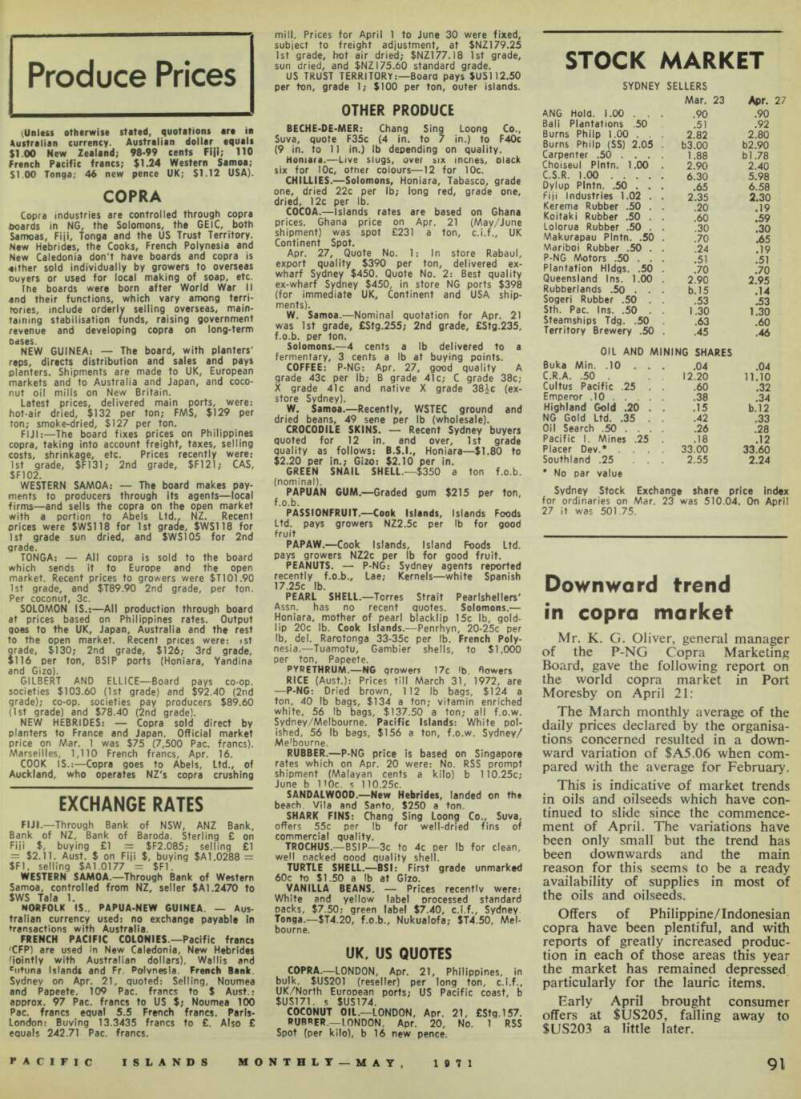
(Unless otherwise stated, quotations are in Australian currency. Australian dollar equals $l.OO New Zealand; 98-99 cents Fiji; 110 French Pacific francs; $1.24 Western Samoa; $l.OO Tonga; 46 new pence UK; $1.12 USA).
Copra
Copra industries are controlled through copra boards in NG, the Solomons, the 6EIC, both Samoas, Fiji, Tonga and the US Trust Territory.
New Hebrides, the Cooks, French Polynesia and New Caledonia don't have boards and copra is either sold individually by growers to overseas buyers or used for local making of soap, etc. fhe boards were born after World War II and their functions, which vary among terri tories, include orderly selling overseas, main taining stabilisation funds, raising government revenue and developing copra on long-term oases.
NEW GUINEA: The board, with planters' reps, directs distribution and sales and pays planters. Shipments are made to UK, European markets and to Australia and Japan, and coco nut oil mills on New Britain.
Latest prices, delivered main ports, were: hot-air dried, $132 per ton; FMS, $129 per ton; smoke-dried, $127 per ton.
FIJI; —The board fixes prices on Philippines copra, taking into account freight, taxes, selling costs, shrinkage, etc. Prices recently were: Ist grade, SFI3I; 2nd grade, SFI2I; CAS,
Sfio2.
WESTERN SAMOA: The board makes pay ments to producers through its agents—local firms—and sells the copra on the open market with a portion to Abels Ltd., NZ. Recent prices were SWSIIB for Ist grade, SWSIIB for Ist grade sun dried, and SWSIOS for 2nd grade.
TONGA: All copra is sold to the board which sends it to Europe and the open market. Recent prices to growers were $T101.90 Ist grade, and $T89.90 2nd grade, per ton.
Per coconut, 3c.
SOLOMON IS.; —All production through board at prices based on Philippines rates. Output goes to the UK, Japan, Australia and the rest to the open market. Recent prices were: ist grade, $130; 2nd grade, $126; 3rd grade, $ll6 per ton, BSIP ports (Honiara, Yandina and Gizo).
GILBERT AND ELLICE—Board pays co-op. societies $103.60 (Ist grade) and $92.40 (2nd grade); co-op. societies pay producers $89.60 (Ist grade) and $78.40 (2nd grade).
NEW HEBRIDES: Copra sold direct by planters to France and Japan. Official market price on Mar. 1 was $75 (7,500 Pac. francs).
Marseilles, 1,110 French francs, Apr. 16.
COOK IS.:—Copra goes to Abels, Ltd., of Auckland, who operates NZ's copra crushing
mill. Prices for April 1 to June 30 were fixed, subject to freight adjustment, at $NZ179.25 Ist grade, hot air dried; $NZ177.18 Ist grade, sun dried, and $NZ175.60 standard grade.
US TRUST TERRITORY;—Board pays $U5112.50 per ton, grade 1; $lOO per ton, outer islands.
Other Produce
BECHE-DE-MER: Chang Sing Loong Co., Suva, quote F3sc (4 in. to 7 in.) to F4oc (9 in. to 11 in.) lb depending on quality.
Honiara. —Live slugs, over six mcnes, olack six for 10c, other colours—l2 for 10c.
CHILLIES. —Solomons, Honiara, Tabasco, grade one, dried 22c per lb; long red, grade one, dried, 12c per lb.
COCOA.—lslands rates are based on Ghana prices. Ghana price on Apr. 21 (May/June shipment) was spot £231 a ton, c.i.f., UK Continent Spot.
Apr. 27, Quote No. 1; In store Rabaul, export quality $390 per ton, delivered ex wharf Sydney $450. Quote No. 2: Best quality ex-wharf Sydney $450, in store NG ports $398 (for immediate UK, Continent and USA ship ments).
W. Samoa.—Nominal quotation for Apr. 21 was Ist grade, £Stg.2ss; 2nd grade, £Stg.23s, f.o.b. per ton.
Solomons.—4 cents a lb delivered to a fermentary, 3 cents a lb at buying points.
COFFEE: P-NG: Apr. 27, good quality A grade 43c per lb; B grade 41 c; C grade 38c; X grade 41c and native X grade (ex store Sydney).
W. Samoa.—Recently, WSTEC ground and dried beans, 49 sene per lb (wholesale).
CROCODILE SKINS. Recent Sydney buyers quoted for 12 in. and over, Ist grade quality as follows: 8.5.1., Honiara—sl.Bo to $2.20 per in.; Gizo: $2.10 per in.
Green Snail Shell.—S3So A Ton F.O.B.
(nominal).
PAPUAN GUM. —Graded gum $215 per ton, f.o.b.
PASSIONFRUIT.—Cook Islands, Islands Foods Ltd. pays growers NZ2.5c per lb for good fruit PAPAW.—Cook Islands, Island Foods Ltd. pays growers NZ2c per lb for good fruit.
PEANUTS. P-NG: Sydney agents reported recently f.0.b., Lae; Kernels —white Spanish 17.25 c lb.
PEARL SHELL.—Torres Strait Pearlshellers' Assn, has no recent quotes. Solomons.— Honiara, mother of pearl blacklip 15c lb, gold lip 20c lb. Cook Islands.—Penrhyn, 20-25 c per lb, del. Rarotonga 33-35 c per lb. French Poly nesia.—Tuamotu, Gambler shells, to $l,OOO per ton, Papeete.
PYRETHRUM.—NG growers 17c lb, Bowers RICE (Aust.): Prices till March 31, 1972, are —P-NG: Dried brown, 112 lb bags, $124 a ton, 40 lb bags, $134 a ton; vitamin enriched white, 56 lb bags, $137.50 a ton; all f.o.w.
Sydney/Melbourne. Pacific Islands; White pol ished, 56 lb bags, $156 a ton, f.o.w. Sydney/ Melbourne.
RUBBER.—P-NG price is based on Singapore rates which on Apr. 20 were: No. RSS prompt shipment (Malayan cents a kilo) b 110.25 c; June b HOC. s 110.25 c.
SANDALWOOD.—New Hebrides, landed on the beach, Vila and Santo, $250 a ton.
SHARK FINS: Chang Sing Loong Co., Suva, offers 55c per lb for well-dried fins of commercial quality.
TROCHUS.—BSIP—3c to 4c per lb for clean, well oacked oood quality shell.
TURTLE SHELL.—BSI: First grade unmarked 60c to $1.50 a lb at Gizo.
VANILLA BEANS. Prices recently were: White and yellow label processed standard packs, $7.50; green label $7.40, c.i.f., Sydney.
Tonga.—sl4.2o, f.0.b., Nukualofa; $T4.50, Mel bourne.
Uk, Us Quotes
COPRA.—LONDON, Apr. 21, Philippines, in bulk, SUS2OI (reseller) per long ton, c.i.f., UK/North European ports; US Pacific coast, b
Susi7I, S Susi 74.
Coconut Oil.—London, Apr. 21, £Stg.Ls7.
Rubber.—London, Apr. 20, No. 1 Rss
Spot (per kilo), b 16 new pence.
Exchange Rates
FlJl.—Through Bank of NSW, ANZ Bank, Bank of NZ, Bank of Baroda. Sterling £ on Fiji $, buying £1 = $F2.085; selling £1 = $2.11. Aust. $ on Fiji $, buying $A1.0288 = SFI, selling $A1.0177 = SFI.
WESTERN SAMOA.—Through Bank of Western Samoa, controlled from NZ, seller $A1.2470 to SWS Tala 1.
Norfolk Is., Papua-New Guinea. Aus
tralian currency used; no exchange payable in transactions with Australia.
FRENCH PACIFIC COLONIES.—Pacific francs 'CFP) are used in New Caledonia, New Hebrides (jointly with Australian dollars), Wallis and e utuna Islands and Fr. Polynesia. French Bank.
Sydney on Apr. 21, quoted: Selling, Noumea and Papeete, 109 Pac. francs to $ Aust.; approx. 97 Pac. francs to US $; Noumea 100 Pac. francs equal 5.5 French francs. Paris- London: Buying 13.3435 francs to £. Also £ equals 242.71 Pac. francs.
Stock Market
Sydney Sellers
Sydney Stock Exchange share price index for ordinaries on Mar. 23 was 510.04. On April 27 it was 501.75.
Mar. 23 Apr. 27 ANG Hold. 1.00 . . . .90 .90 Bali Plantations .50 .51 .92 Burns Philp 1.00 . . . 2.82 2.80 Burns Philp (SS) 2.05 . b3.00 b2.90 Carpenter .50 ... . 1.88 bl .78 Choiseul Plntn. 1.00 2.90 2.40
C.S.R. 1.00
6.30 5.98 Dylup Plntn. .50 . . . .65 6.58 Fiji Industries 1.02 . . 2.35 2.30 Kerema Rubber .50 . . .20 .19 Koitaki Rubber .50 . . .60 .59 Lolorua Rubber .50 . . .30 .30 Makurapau Plntn. .50 . .70 .65 Mariboi Rubber .50 . . .24 .19 P-NG Motors .50 . . . .51 .51 Plantation Hldgs. .50 . .70 .70 Queensland Ins. 1.00 . 2.90 2.95 Rubberlands .50 . . . b. 15 .14 Sogeri Rubber .50 . . .53 .53 Sth. Pac. Ins. .50 . . 1.30 1.30 Steamships Tdg. .50 .63 .60 Territory Brewery .50 . .45 .46
Oil And Mining Shares
Buka Min. .10 . . . .04 .04
C.R.A. .50 .
12.20 11.10 Cultus Pacific .25 . . .60 .32 Emperor .10 .38 .34
Highland Gold .20 . .
.15 b. 12 NG Gold Ltd. .35 . . .42 .33 Oil Search .50 ... . .26 .28 Pacific 1. Mines .25 .18 .12 Placer Dev.* . . , . 33.00 33.60 Southland .25 . . . * No par value 2.55 2.24
Downward trend
in copra market
Mr. K. G. Oliver, general manager of the P-NG Copra Marketing Board, gave the following report on the world copra market in Port Moresby on April 21: The March monthly average of the daily prices declared by the organisa tions concerned resulted in a down ward variation of 5A5.06 when com pared with the average for February.
This is indicative of market trends in oils and oilseeds which have con tinued to slide since the commence ment of April. The variations have been only small but the trend has been downwards and the main reason for this seems to be a ready availability of supplies in most of the oils and oilseeds.
Offers of Philippine/Indonesian copra have been plentiful, and with reports of greatly increased produc tion in each of those areas this year the market has remained depressed particularly for the lauric items.
Early April brought consumer offers at SUS2OS, falling away to SUS2O3 a little later.
Advertisements & other items, p. 96 (1 item)
The Bank Line
MONTHLY SERVICES
U.K., CONTINENT to PAPUA-NEW GUINEA & SOLOMON ISLANDS PAPUA, NEW GUINEA to NORTH AMERICA & U.K., CONTINENT SOLOMON ISLANDS, FIJI, TONGA, SAMOA AND TARAWA to U.K.,
CONTINENT
☆ U.S. GULF/AUSTRALASIA VESSELS CALL AT FIJI WHEN REQUIRED &
FOR PARTICULARS APPLY:
BANK LINE (AUSTRALASIA) PTY. LTD., SYDNEY, N.S.W.
BOUGAINVILLE MARINE PTY. LTD.
P.O. BOX 277, KIETA, NEW GUINEA
Also Agents For: CLARK ALUMINIUM BOATS • NIHON DIVING EQUIPMENT
SWIFTCRAFT • PACIFIC DIVING SALVAGE CONTRACTORS
& Airways
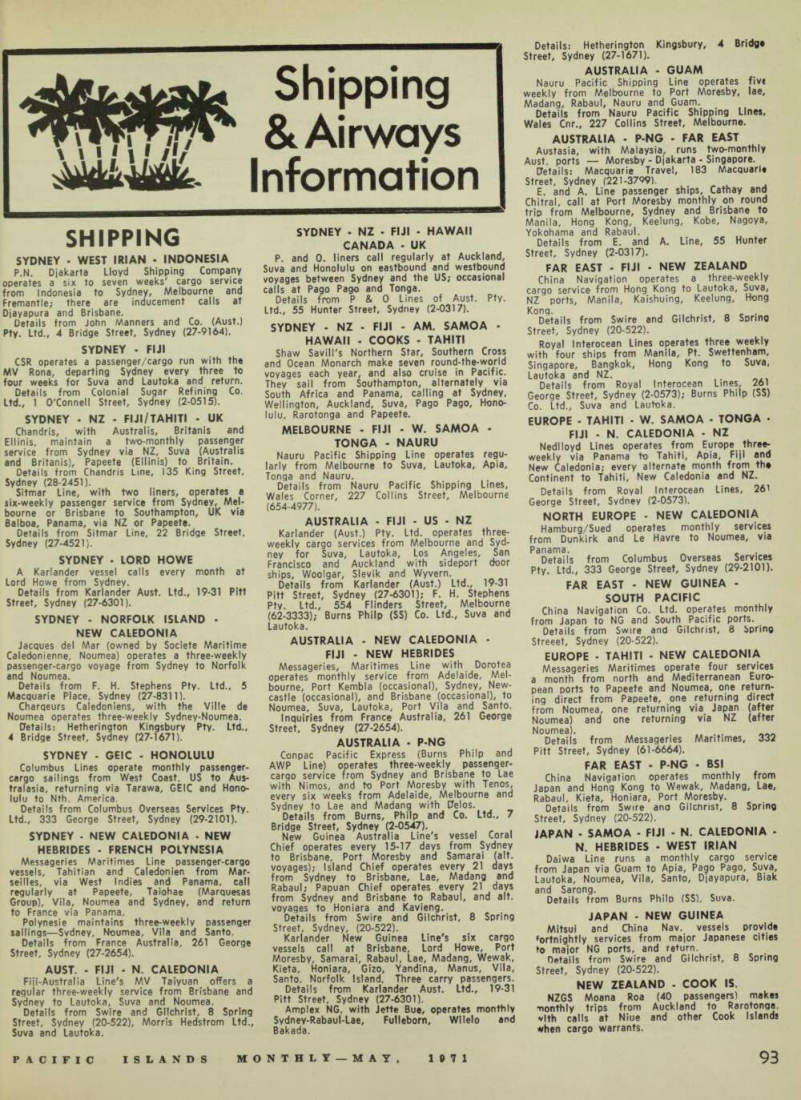
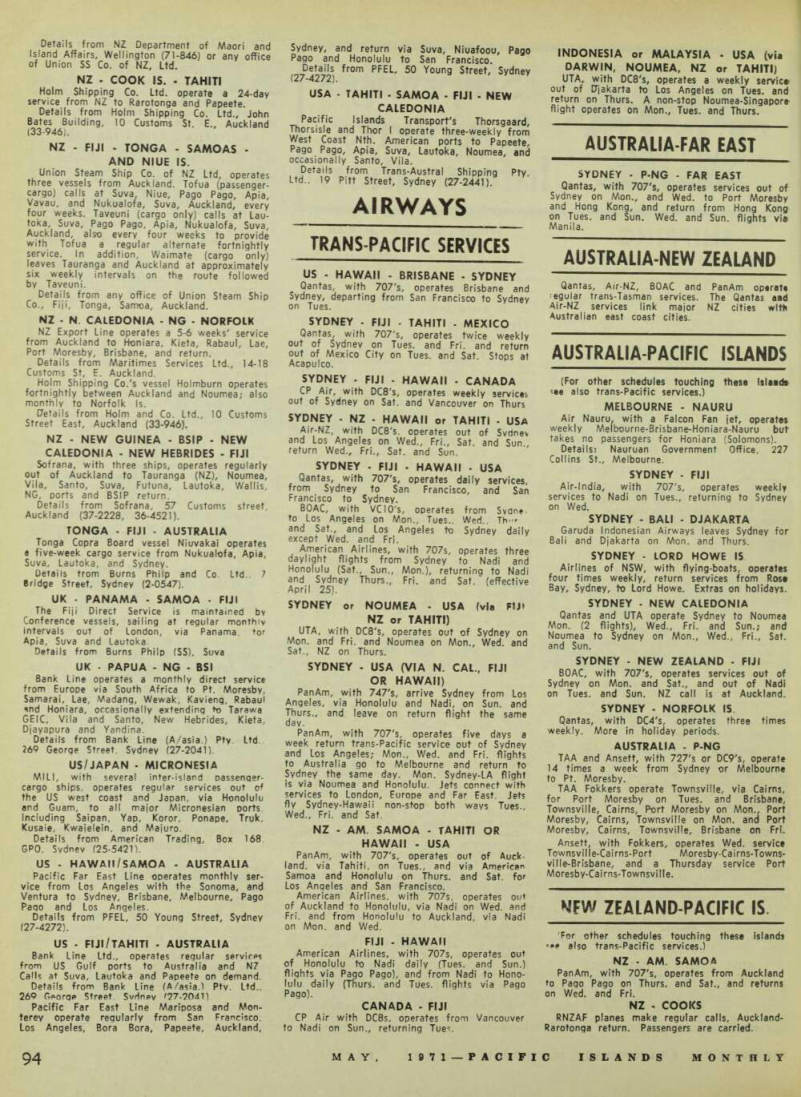
Shipping
& Airways Information
Shipping
Sydney - West Irian • Indonesia
P.N. Djakarta Lloyd Shipping Company operates a six to seven weeks' cargo service from Indonesia to Sydney, Melbourne and Fremantle; there are inducement calls at Djayapura and Brisbane.
Details from John Manners and Co. (Aust.) Pty. Ltd., 4 Bridge Street, Sydney (27-9164).
Sydney - Fiji
CSR operates a passenger/cargo run with the MV Rona, departing Sydney every three to four weeks for Suva and Lautoka and return.
Details from Colonial Sugar Refining Co.
Ltd., 1 O'Connell Street, Sydney (2-0515).
SYDNEY - NZ - FIJI/TAHITI - UK Chandris, with Australis, Britanis and Ell inis, maintain a two-monthly passenger service from Sydney via NZ, Suva (Australis and Britanis), Papeete (Ellinis) to Britain.
Details from Chandris Line, 135 King Street, Sydney (28-2451).
Sitmar Line, with two liners, operates a six-weekly passenger service from Sydney, Mel bourne or Brisbane to Southampton, UK via Balboa, Panama, via NZ or Papeete.
Details from Sitmar Line, 22 Bridge Street, Sydney (27-4521).
Sydney - Lord Howe
A Karlander vessel calls every month at Lord Howe from Sydney.
Details from Karlander Aust. Ltd., 19-31 Pitt Street, Sydney (27-6301).
Sydney - Norfolk Island -
New Caledonia
Jacques del Mar (owned by Societe Maritime Caledonienne, Noumea) operates a three-weekly passenger-cargo voyage from Sydney to Norfolk and Noumea.
Details from F. H. Stephens Pty. Ltd., 5 Macquarie Place, Sydney (27-8311).
Charqeurs Caledoniens, with the Ville de Noumea operates three-weekly Sydney-Noumea.
Details: Hetherington Kingsbury Pty. Ltd., 4 Bridge Street, Sydney (27-1671).
Sydney - Geic - Honolulu
Columbus Lines operate monthly passenger cargo sailings from West Coast, US to Aus tralasia, returning via Tarawa, GEIC and Hono lulu to Nth. America.
Details from Columbus Overseas Services Pty.
Ltd., 333 George Street, Sydney (29-2101).
Sydney - New Caledonia - New
Hebrides ■ French Polynesia
Messageries Maritimes Line passenger-cargo vessels, Tahitian and Caledonien from Mar seilles, via West Indies and Panama, call regularly at Papeete, Taiohae (Marquesas Group), Vila, Noumea and Sydney, and return to France via Panama.
Polynesie maintains three-weekly passenger sailings—Sydney, Noumea, Vila and Santo.
Details from France Australia, 261 George Street, Sydney (27-2654).
Aust. - Fiji - N. Caledonia
Fiji-Australia Line's MV Taiyuan offers a regular three-weekly service from Brisbane and Sydney to Lautoka, Suva and Noumea.
Details from Swire and Gilchrist, 8 Spring Street, Sydney (20-522), Morris Hedstrom Ltd., Suva and Lautoka.
SYDNEY - NZ - FIJI • HAWAII
Canada - Uk
P. and 0. liners call regularly at Auckland, Suva and Honolulu on eastbound and westbound voyages between Sydney and the US; occasional calls at Pago Pago and Tonga.
Details from P & 0 Lines of Aust. Pty.
Ltd., 55 Hunter Street, Sydney (2-0317).
SYDNEY • NZ - FIJI - AM. SAMOA -
Hawaii - Cooks - Tahiti
Shaw Savill's Northern Star, Southern Cross and Ocean Monarch make seven round-the-world voyages each year, and also cruise in Pacific.
They sail from Southampton, alternately via South Africa and Panama, calling at Sydney, Wellington, Auckland, Suva, Pago Pago, Hono lulu, Rarotonga and Papeete.
MELBOURNE - FIJI - W. SAMOA -
Tonga - Nauru
Nauru Pacific Shipping Line operates regu larly from Melbourne to Suva, Lautoka, Apia, Tonga and Nauru.
Details from Nauru Pacific Shipping Lines, Wales Corner, 227 Collins Street, Melbourne (654-4977).
AUSTRALIA - FIJI - US - NZ Karlander (Aust.) Pty. Ltd. operates three weekly cargo services from Melbourne and Syd ney for Suva, Lautoka, Los Angeles, San Francisco and Auckland with sideport door ships, Woolgar, Slevik and Wyvern.
Details from Karlander (Aust.) Ltd., 19-31 Pitt Street, Sydney (27-6301); F. H. Stephens Pty. Ltd., 554 Flinders Street, Melbourne (62-3333); Burns Philp (SS) Co. Ltd., Suva and Lautoka.
Australia - New Caledonia -
Fiji - New Hebrides
Messageries, Maritimes Line with Dorotea operates monthly service from Adelaide, Mel bourne, Port Kembla (occasional), Sydney, New castle (occasional), and Brisbane (occasional), to Noumea, Suva, Lautoka, Port Vila and Santo.
Inquiries from France Australia, 261 George Street, Sydney (27-2654).
Australia - P-Ng
Conpac Pacific Express (Burns Philp and AWP Line) operates three-weekly passenger cargo service from Sydney and Brisbane to Lae with Nimos, and to Port Moresby with Tenos, every six weeks from Adelaide, Melbourne and Sydney to Lae and Madang with Delos.
Details from Burns, Philp and Co. Ltd., 7 Bridge Street, Sydney (2-0547).
New Guinea Australia Line's vessel Coral Chief operates every 15-17 days from Sydney to Brisbane, Port Moresby and Samarai (alt. voyages); Island Chief operates every 21 days from Sydney to Brisbane, Lae, Madang and Rabaul; Papuan Chief operates every 21 days from Sydney and Brisbane to Rabaul, and alt. voyages to Honiara and Kavieng.
Details from Swire and Gilchrist, 8 Spring Street, Sydney, (20-522).
Karlander New Guinea Line's six cargo vessels call at Brisbane, Lord Howe, Port Moresby, Samarai, Rabaul, Lae, Madang, Wewak, Kieta, Honiara, Gizo, Yandina, Manus, Vila, Santo, Norfolk Island. Three carry passengers.
Details from Karlander Aust. Ltd., 19-31 Pitt Street, Sydney (27-6301).
Amplex NG, with Jette Bue, operates monthly Sydney-Rabaul-Lae, Fulleborn, Wilelo and Bakada.
Details: Hetherington Kingsbury, 4 Bridge Street, Sydney (27-1671).
Australia - Guam
Nauru Pacific Shipping Line operates five weekly from Melbourne to Port Moresby, lae, Madang, Rabaul, Nauru and Guam.
Details from Nauru Pacific Shipping Lines, Wales Cnr., 227 Collins Street, Melbourne.
AUSTRALIA - P NG - FAR EAST Austasia, with Malaysia, runs two-monthly Aust. ports Moresby - Djakarta - Singapore.
Details: Macquarie Travel, 183 Macquarie Street, Sydney (221-3799).
E. and A. Line passenger ships, Cathay and Chitral, call at Port Moresby monthly on round trip from Melbourne, Sydney and Brisbane to Manila, Hong Kong, Keelung, Kobe, Nagoya, Yokohama and Rabaul.
Details from E. and A. Line, 55 Hunter Street, Sydney (2-0317).
FAR EAST - FIJI - NEW ZEALAND China Navigation operates a three-weekly cargo service from Hong Kong to Lautoka, Suva, NZ ports, Manila, Kaishuing, Keelung, Hong Details from Swire and Gilchrist, 8 Spring Street, Sydney (20-522).
Royal Interocean Lines operates three weekly with four ships from Manila, Pt. Swettenham, Singapore, Bangkok, Hong Kong to Suva, Lautoka and NZ.
Details from Royal Interocean Lines, 261 George Street, Sydney (2-0573); Burns Philp (SS) Co. Ltd., Suva and Lautoka.
EUROPE - TAHITI - W. SAMOA ■ TONGA •
Fiji ■ N. Caledonia - Nz
Nedlloyd Lines operates from Europe three weekly via Panama to Tahiti, Apia, Fiji and New Caledonia; every alternate month from the Continent to Tahiti, New Caledonia and NZ.
Details from Royal Interocean Lines, 261 George Street, Svdney (2-0573).
North Europe ■ New Caledonia
Hamburg/Sued operates monthly services from Dunkirk and Le Havre to Noumea, via Panama.
Details from Columbus Overseas Services Pty. Ltd., 333 George Street, Sydney (29-2101).
Far East ■ New Guinea -
South Pacific
China Navigation Co. Ltd. operates monthly from Japan to NG and South Pacific ports.
Details from Swire and Gilchrist, 8 Spring Streeet, Sydney (20-522).
Europe - Tahiti - New Caledonia
Messageries Maritimes operate four services a month from north and Mediterranean Euro pean ports to Papeete and Noumea, one return ing direct from Papeete, one returning direct from Noumea, one returning via Japan (after Noumea) and one returning via NZ (after Noumea). . .
Details from Messageries Maritimes, 332 Pitt Street, Sydney (61-6664).
Far East - P-Ng - Bsi
China Navigation operates monthly from Japan and Hong Kong to Wewak, Madang, Lae, Rabaul. Kieta, Honiara, Port Moresby.
Details from Swire and Gilchrist, 8 Spring Street, Sydney (20-522).
JAPAN - SAMOA - FIJI • N. CALEDONIA -
N. Hebrides ■ West Irian
Daiwa Line runs a monthly cargo service from Japan via Guam to Apia, Pago Pago, Suva, Lautoka, Noumea, Vila, Santo, Djayapura, Biak and Sarong.
Details from Burns Philp (SS), Suva.
Japan • New Guinea
Mitsui and China Nav. vessels provide f ortnightly services from major Japanese cities to major NG ports, and return.
Details from Swire and Gilchrist, 8 Spring Street, Sydney (20-522).
New Zealand - Cook Is.
NZGS Moana Roa (40 passengers) makes monthly trips from Auckland to Rarotonga, vith calls at Niue and other Cook Islands when cargo warrants.
Details from NZ Department of Maori and Island Affairs, Wellington (71-846) or any office of Union SS Co. of NZ, Ltd.
Nz - Cook Is. - Tahiti
Holm Shipping Co. Ltd. operate a 24-day service from NZ to Rarotonga and Papeete.
Details from Holm Shipping Co. Ltd., John Bates Building, 10 Customs St. E., Auckland (33-946).
NZ - FIJI - TONGA - SAMOAS -
And Niue Is.
Union Steam Ship Co. of NZ Ltd, operates three vessels from Auckland. Tofua (passenger cargo) calls at Suva, Niue, Pago Pago, Apia, Vavau, and Nukualofa, Suva, Auckland, every four weeks. Taveuni (cargo only) calls at Lau toka, Suva, Pago Pago, Apia, Nukualofa, Suva, Auckland, also every four weeks to provide with Tofua a regular alternate fortnightly service. In addition, Waimate (cargo only) leaves Tauranga and Auckland at approximately six weekly intervals on the route followed by Taveuni.
Details from any office of Union Steam Ship Co., Fiji, Tonga, Samoa, Auckland.
NZ ■ N. CALEDONIA • NG • NORFOLK NZ Export Line operates a 5-6 weeks' service from Auckland to Honiara, Kieta, Rabaul, Lae, Port Moresby, Brisbane, and return.
Details from Maritimes Services Ltd., 14-18 Customs St, E. Auckland.
Holm Shipping Co.'s vessel Holmburn operates fortnightly between Auckland and Noumea; also monthly to Norfolk Is.
Details from Holm and Co. Ltd., 10 Customs Street East, Auckland (33-946).
NZ - NEW GUINEA - BSIP - NEW
Caledonia - New Hebrides ■ Fiji
Sofrana, with three ships, operates regularly out of Auckland to Tauranga (NZ), Noumea, Vila, Santo, Suva, Futuna, Lautoka, Wallis, NG, ports and BSIP return.
Details from Sofrana, 57 Customs street, Auckland (37-2228, 36-4521).
Tonga ■ Fiji - Australia
Tonga Copra Board vessel Niuvakai operates a five-week cargo service from Nukualofa, Apia, Suva, Lautoka, and Sydney.
Derails from Burns Philp and Co. Ltd. 7 Bridge Street, Sydney (2-0547).
UK - PANAMA - SAMOA - FIJI The Fiji Direct Service is maintained by Conference vessels, sailing at regular monthiv intervals out of London, via Panama, tor Apia, Suva and Lautoka.
Details from Burns Philp (SS), Suva UK - PAPUA - NG • BSI Bank Line operates a monthly direct service from Europe via South Africa to Pt. Moresby, Samarai, Lae, Madang, Wewak, Kavieng, Rabaul snd Honiara, occasionally extending to Tarawa GEIC, Vila and Santo, New Hebrides, Kieta, Djayapura and Yandina.
Details from Bank Line (A/asia.) Pty. Ltd 269 George Street, Sydney (27-2041).
Us/Japan - Micronesia
Ml LI, with several inter-island passenger cargo ships, operates regular services out of the US west coast and Japan, via Honolulu and Guam, to all major Micronesian ports including Saipan, Yap, Koror, Ponape, Truk, Kusaie, Kwajelein, and Majuro.
Details from American Trading, Box 168 GPO. Svdnev (25-5421).
Us - Hawaii/Samoa - Australia
Pacific Far East Line operates monthly ser vice from Los Angeles with the Sonoma, and Ventura to Sydney, Brisbane, Melbourne, Pago Pago and Los Angeles.
Details from PFEL, 50 Young Street, Sydney (27-4272).
Us - Fiji /Tahiti - Australia
Bank Line Ltd., operates regular services from US Gulf ports to Australia and NZ Calls at Suva, Lautoka and Papeete on demand.
Details from Bank Line (A/asia.) Ptv. Ltd., 269 George Street Svdnev Pacific Far East Line Mariposa and Mon terey operate regularly from San Francisco, Los Angeles, Bora Bora, Papeete, Auckland,
Sydney, and return via Suva, Niuafoou, Pago Pago and Honolulu to San Francisco.
Details from PFEL. 50 Young Street, Sydney (27-4272).
USA ■ TAHITI - SAMOA - FIJI - NEW
Caledonia
Pacific Islands Transport's Thorsgaard, Thorsisle and Thor I operate three-weekly from West Coast Nth. American ports to Papeete, Pago Pago, Apia, Suva, Lautoka, Noumea, and occasionally Santo, Vila.
Details from Trans-Austral Shipping Pty.
Ltd.. 19 Pitt Street, Sydney (27-2441).
Airways
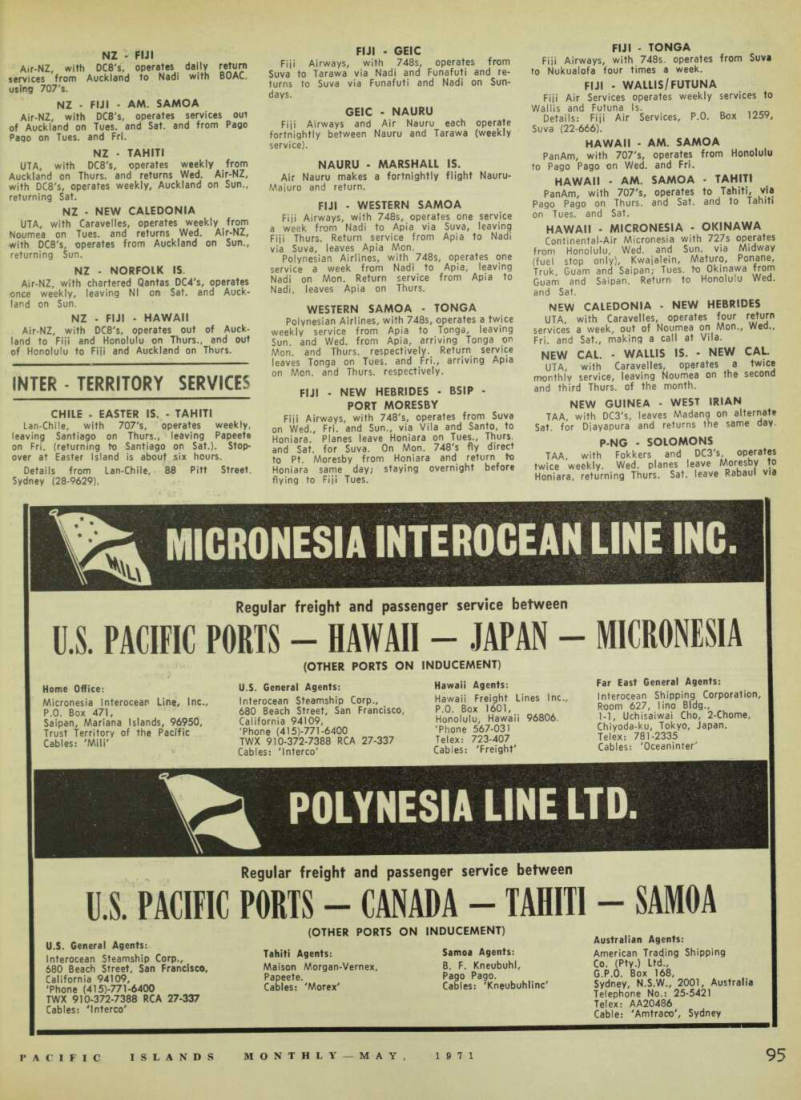
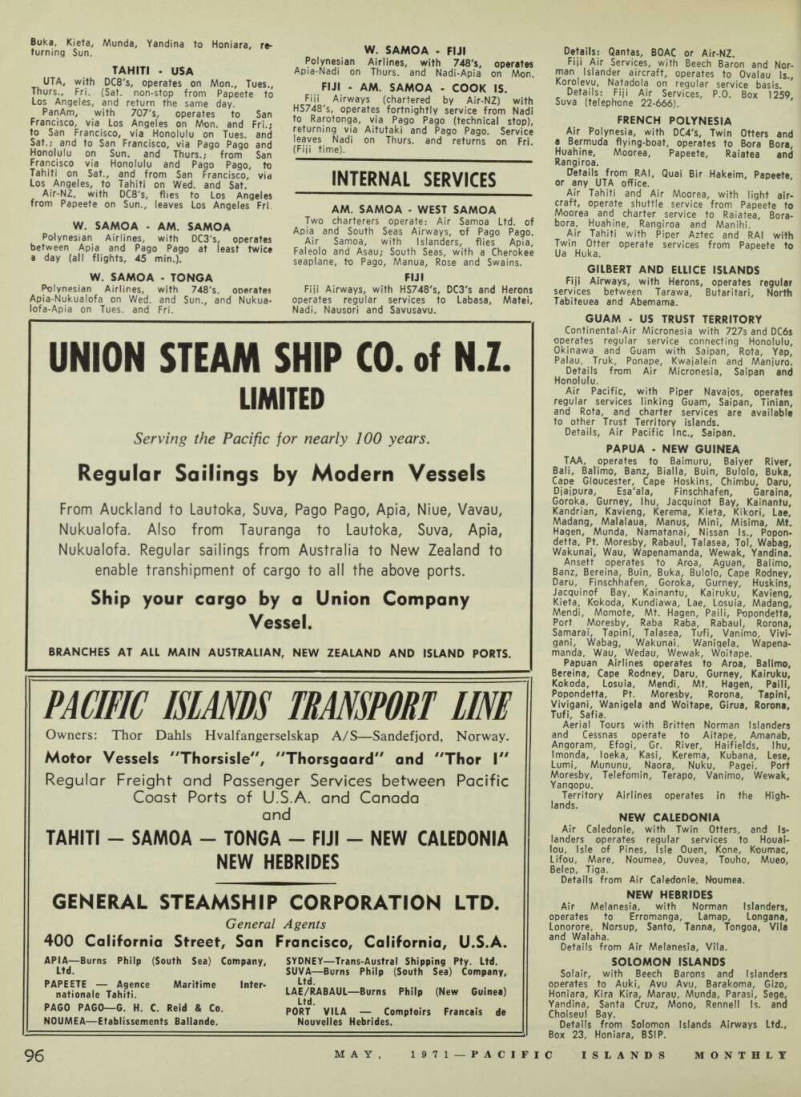
Trans Pacific Services
US - HAWAII ■ BRISBANE - SYDNEY Qantas, with 707's, operates Brisbane and Sydney, departing from San Francisco to Sydney on Tues.
SYDNEY - FIJI - TAHITI - MEXICO Qantas, with 707's, operates twice weekly out of Sydney on Tues. and Fri. and return out of Mexico City on Tues. and Sat. Stops at Acapulco.
SYDNEY - FIJI - HAWAII - CANADA CP Air, with DCB's, operates weekly services out of Sydney on Sat. and Vancouver on Thurs SYDNEY - NZ - HAWAII or TAHITI - USA Air-NZ, with DCB's. operates out of Svdnev and Los Angeles on Wed., Fri., Sat. and Sun return Wed., Fri., Sat. and Sun.
SYDNEY - FIJI - HAWAII - USA Qantas, with 707's, operates daily services, from Sydney to San Francisco, and San Francisco to Sydney.
BOAC, with VClO's, operates from Sydn*. to Los Angeles on Mon., Tues., Wed., Th"' and Sat., and Los Angeles to Sydney daily except Wed. and Fri.
American Airlines, with 7075, operates three daylight flights from Sydney to Nadi and Honolulu (Sat., Sun., Mon.), returning to Nadi and Sydney Thurs., Fri. and Sat. (effective April 25).
SYDNEY or NOUMEA - USA (via FU»
Nz Or Tahiti)
UTA, with DCB's, operates out of Sydney on Mon. and Fri. and Noumea on Mon., Wed. and Sat., NZ on Thurs.
SYDNEY - USA (VIA N. CAL., FIJI
Or Hawaii)
PanAm, with 747'5, arrive Sydney from Los Angeles, via Honolulu and Nadi, on Sun. and Thurs., and leave on return flight the same day.
PanAm, with 707's, operates five days a week return trans-Pacific service out of Sydney and Los Angeles; Mon., Wed. and Fri. flights to Australia go to Melbourne and return to Sydney the same day. Mon. Sydney-LA flight is via Noumea and Honolulu. Jets connect with services to London, Europe and Far East. Jets fly Sydney-Hawaii non-stop both ways Tues., Wed., Fri. and Sat.
NZ - AM. SAMOA - TAHITI OR
Hawaii - Usa
PanAm, with 707's, operates out of Auck land, via Tahiti, on Tues., and via American Samoa and Honolulu on Thurs. and Sat. for Los Angeles and San Francisco.
American Airlines, with 7075, operates out of Auckland to Honolulu, via Nadi on Wed. and Fri. and from Honolulu to Auckland, via Nadi on Mon. and Wed.
Fiji - Hawaii
American Airlines, with 7075, operates out of Honolulu to Nadi daily (Tues. and Sun.) flights via Pago Pago), and from Nadi to Hono lulu daily (Thurs. and Tues. flights via Pago Pago).
Canada - Fiji
CP Air with DCBs, operates from Vancouver to Nadi on Sun., returning Tue*.
Indonesia Or Malaysia • Usa (Via
Darwin, Noumea, Nz Or Tahiti)
UTA, with DCB's, operates a weekly service? out of Djakarta to Los Angeles on Tues. and return on Thurs. A non-stop Noumea-Singapore flight operates on Mon,, Tues. and Thurs.
Australia-Far East
Sydney - P-Ng - Far East
Qantas, with 707's, operates services out of Sydney on Mon., and Wed. to Port Moresby and Hong Kong, and return from Hong Kong on Tues. and Sun. Wed. and Sun. flights via* Manila.
Australia-New Zealand
Qantas, Air-NZ, BOAC and PanAm operate egular trans-Tasman services. The Qantas aad Air-NZ services link major NZ cities with Australian east coast cities.
Australia-Pacific Islands
(For other schedules touching these Islaeds =ee also trans-Pacific services.)
Melbourne - Nauru
Air Nauru, with a Falcon Fan jet, operates weekly Melbourne-Brisbane-Honiara-Nauru but takes no passengers for Honiara (Solomons).
Details: Nauruan Government Office, 227 Collins St., Melbourne.
Sydney - Fiji
Air-lndia, with 707's, operates weekly services to Nadi on Tues., returning to Sydney on Wed.
Sydney - Bali - Djakarta
Garuda Indonesian Airways leaves Sydney for Bali and Djakarta on Mon. and Thurs.
Sydney - Lord Howe Is
Airlines of NSW, with flying-boats, operates four times weekly, return services from Rose Bay, Sydney, to Lord Howe. Extras on holidays.
Sydney - New Caledonia
Qantas and UTA operate Sydney to Noumea Mon. (2 flights). Wed., Fri. and Sun.; and Noumea to Sydney on Mon., Wed., Fri., Sat. and Sun.
Sydney • New Zealand - Fiji
BOAC, with 707's, operates services out of Sydney on Mon. and Sat., and out of Nadi on Tues. and Sun. NZ call is at Auckland.
Sydney ■ Norfolk Is
Qantas, with DC4's, operates three times weekly. More in holiday periods.
Australia - P-Ng
TAA and Ansett, with 727's or DC9's, operate 14 times a week from Sydney or Melbourne to Pt. Moresby.
TAA Fokkers operate Townsville, via Cairns, for Port Moresby on Tues. and Brisbane, Townsville, Cairns, Port Moresby on Mon., Port Moresby, Cairns, Townsville on Mon. and Port Moresby, Cairns, Townsville, Brisbane on Fri.
Ansett, with Fokkers, operates Wed. service Townsville-Cairns-Port Moresby-Cairns-Towns vilie-Brisbane, and a Thursday service Port Moresby-Cairns-Townsviile.
Ww Zealand-Pacific Is
'For other schedules touching these islands ••e also trans-Pacific services.)
Nz - Am Samoa
PanAm, with 707'%, operates from Auckland to Pago Pago on Thurs. and Sat., and returns on Wed. and Fri.
Nz - Cooks
RNZAF planes make regular calls, Auckland- Rarotonga return. Passengers are carried.
Nz • Fiji
Air-NZ, with DCB's, operates daily return services from Auckland to Nadi with BOAC, using 707's.
Nz - Fiji • Am. Samoa
Air-NZ, with DCB's, operates services out of Auckland on Tues. and Sat. and from Pago Pago on Tues. and Fri.
Nz - Tahiti
UTA, with DCB's, operates weekly from Auckland on Thurs. and returns Wed. Air-NZ, with DCB's, operates weekly, Auckland on Sun., returning Sat.
Nz - New Caledonia
UTA, with Caravelles, operates weekly from Noumea on Tues. and returns Wed. Air-NZ, with DCB's, operates from Auckland on Sun., returning Sun.
Nz - Norfolk Is
Air-NZ, with chartered Qantas DC4's, operates once weekly, leaving Nl on Sat. and Auck land on Sun.
Nz - Fiji - Hawaii
Air-NZ, with DCB's, operates out of Auck land to Fiji and Honolulu on Thurs., and out of Honolulu to Fiji and Auckland on Thurs.
Inter - Territory Services
Chile - Easter Is. - Tahiti
Lan-Chile, with 707's, operates weekly, leaving Santiago on Thurs., leaving Papeete on Fri. (returning to Santiago on Sat.). Stop over at Easter Island is about six hours.
Details from Lan-Chile, 88 Pitt Street, Sydney (28-9629).
Fiji - Geic
Fiji Airways, with 7485, operates from Suva to Tarawa via Nadi and Funafuti and re turns to Suva via Funafuti and Nadi on Sun days.
Geic • Nauru
Fiji Airways and Air Nauru each operate fortnightly between Nauru and Tarawa (weekly service).
Nauru - Marshall Is.
Air Nauru makes a fortnightly flight Nauru- Majuro and return.
Fiji - Western Samoa
Fiji Airways, with 7485, operates one service a week from Nadi to Apia via Suva, leaving Fiji Thurs. Return service from Apia to Nadi via Suva, leaves Apia Mon.
Polynesian Airlines, with 7485, operates one service a week from Nadi to Apia, leaving Nadi on Mon. Return service from Apia to Nadi, leaves Apia on Thurs.
Western Samoa - Tonga
Polynesian Airlines, with 7485, operates a twice weekly service from Apia to Tonga, leaving Sun and Wed. from Apia, arriving Tonga on Mon. and Thurs. respectively. Return service leaves Tonga on Tues. and Fri., arriving Apia on Mon. and Thurs. respectively.
FIJI ■ NEW HEBRIDES - BSIP ■
Port Moresby
Fiji Airways, with 748's, operates from Suva on Wed., Fri. and Sun., via Vila and Santo, to Honiara. Planes leave Honiara on Tues., Thurs. and Sat. for Suva. On Mon. 748's fly direct to Pt. Moresby from Honiara and return to Honiara same day; staying overnight before flying to Fiji Tues.
Fiji - Tonga
Fiji Airways, with 7485. operates from Suva to Nukualofa four times a week.
Fiji ■ Wallis/Futuna
Fiji Air Services operates weekly services to Wallis and Futuna Is. „ Details: Fiji Air Services, P.O. Box 1259, Suva (22-666).
Hawaii - Am. Samoa
PanAm, with 707's, operates from Honolulu to Pago Pago on Wed. and Fri.
Hawaii - Am. Samoa - Tahiti
PanAm, with 707's, operates to Tahiti, via Pago Pago on Thurs. and Sat. and to Tahiti on Tues. and Sat.
Hawaii - Micronesia - Okinawa
Continental-Air Micronesia with 727 s operates from Honolulu, Wed. and Sun. via Midway (fuel stop only), Kwajalein, Mature, Ponane, Truk, Guam and Saipan; Tues. to Okinawa from Guam and Saipan. Return to Honolulu Wed. and Sat.
New Caledonia • New Hebrides
UTA, with Caravelles, operates four return services a week, out of Noumea on Mon., Wed., Fri. and Sat., making a call at Vila.
NEW CAL. - WALLIS IS. - NEW CAL.
UTA, with Caravelles, operates a twice monthly service, leaving Noumea on the second and third Thurs. of the month.
New Guinea - West Irian
TAA, with DC3's, leaves Madang on alternate Sat. for Djayapura and returns the same day.
P Ng - Solomons
TAA, with Fokkers and DC3's, operates twice weekly. Wed. planes leave Moresby to Honiara, returning Thurs. Sat. leave Rabaul via
Buka, Kieta, Munda, Yandina to Honiara, re turning Sun.
Tahiti - Usa
UTA, with DCB's, operates on Mon., Tues., Thurs., Fri. (Sat. non-stop from Papeete to Los Angeles, and return the same day.
PanAm, with 707's, operates to San Francisco, via Los Angeles on Mon. and Fri.; to San Francisco, via Honolulu on Tues. and Sat.; and to San Francisco, via Pago Pago and Honolulu on Sun, and Thurs.; from San Francisco via Honolulu and Pago Pago, to Tahiti on Sat., and from San Francisco, via Los Angeles, to Tahiti on Wed. and Sat.
Air-NZ, with DCB's, flies to Los Angeles from Papeete on Sun., leaves Los Angeles Fri.
W. Samoa - Am. Samoa
Polynesian Airlines, with oC3's, operates between Apia and Pago Pago at least twice a day (all flights, 45 min.).
W. Samoa - Tonga
Polynesian Airlines, with 748's, ©Derates Apia-Nukualofa on Wed. and Sun., and Nukua lofa-Apia on Tues. and Fri.
W. Samoa - Fiji
Polynesian Airlines, with 748's, operates Apia-Nadi on Thurs. and Nadi-Apia on Mon.
FIJI - AM. SAMOA - COOK IS.
Fiji Airways (chartered by Air-NZ) with HS74B's, operates fortnightly service from Nadi to Rarotonga, via Pago Pago (technical stop), returning via Aitutaki and Pago Pago. Service leaves Nadi on Thurs. and returns on Fri. (Fiji time).
Internal Services
Am. Samoa - West Samoa
Two charterers operate: Air Samoa Ltd. of Apia and South Seas Airways, of Pago Pago.
Air Samoa, with Islanders, flies Apia, Faleolo and Asau; South Seas, with a Cherokee seaplane, to Pago, Manua, Rose and Swains.
Fiji
Fiji Airways, with HS74B's, DC3's and Herons operates regular services to Labasa, Matei, Nadi, Nausori and Savusavu.
Details: Qantas, BOAC or Air-NZ.
Fiji Air Services, with Beech Baron and Nor man Islander aircraft, operates to Ovalau Is., Korolevu, Natadola on regular service basis.
Details; Fiji Air Services, P.O. Box 1259.
Suva (telephone 22-666).
French Polynesia
Air Polynesia, with DC4's, Twin Otters and a Bermuda flying-boat, operates to Bora Bora, Huahine, AAoorea, Papeete, Raiatea and Rangiroa.
Details from RAI, Quai Bir Hakeim, Papeete, or any UTA office.
Air Tahiti and Air Moorea, with light air craft, operate shuttle service from Papeete to Moorea and charter service to Raiatea, Bora bora, Huahine, Rangiroa and Manihi.
Air Tahiti with Piper Aztec and RAI with Twin Otter operate services from Papeete to Ua Huka.
Gilbert And Ellice Islands
Fiji Airways, with Herons, operates regular services between Tarawa, Butaritari, North Tabiteuea and Abemama.
Guam - Us Trust Territory
Continental-Air Micronesia with 727 s and DC6s operates regular service connecting Honolulu, Okinawa and Guam with Saipan, Rota, Yap, Palau, Truk, Ponape, Kwajalein and Manjuro.
Details from Air Micronesia, Saipan and Honolulu.
Air Pacific, with Piper Navajos, operates regular services linking Guam, Saipan, Tinian, and Rota, and charter services are available to other Trust Territory islands.
Details, Air Pacific Inc., Saipan.
Papua - New Guinea
TAA, operates to Baimuru, Baiyer River, Bali, Balimo, Banz, Bialla, Buin, Bulolo, Buka, Cape Gloucester, Cape Hoskins, Chimbu, Daru, Djajpura, Esa'ala, Finschhafen, Garaina, Goroka, Gurney, Ihu, Jacquinot Bay, Kainantu, Kandrian, Kavieng, Kerema, Kieta, Kikori, Lae, Madang, Malalaua, Manus, Mini, Misima, Mt.
Hagen, Munda, Namatanai, Nissan Is., Popon detta, Pt. Moresby, Rabaul, Talasea, Tol, Wabag, Wakunai, Wau, Wapenamanda, Wewak, Yandina.
Ansett operates to Aroa, Aguan, Balimo, Banz, Bereina, Buin, Buka, Bulolo, Cape Rodney, Daru, Finschhafen, Goroka, Gurney, Huskins, Jacquinof Bay, Kainantu, Kairuku, Kavieng, Kieta, Kokoda, Kundiawa, Lae, Losuia, Madang, Mendi, Momote, Mt. Hagen, Paili, Popondetta, Port Moresby, Raba Raba, Rabaul, Rorona, Samarai, Tapini, Talasea, Tufi, Vanimo, Vivi gani, Wabag, Wakunai, Wanigela, Wapena manda, Wau, Wedau, Wewak, Woitape.
Papuan Airlines operates to Aroa, Balimo, Bereina, Cape Rodney, Daru, Gurney, Kairuku, Kokoda, Losuia, Mendi, Mt. Hagen, Paili, Popondetta, Pt. Moresby, Rorona, Tapini, Vivigani, Wanigela and Woitape, Girua, Rorona, Tufi, Safia.
Aerial Tours with Britten Norman Islanders and Cessnas operate to Aitape, Amanab, Angoram, Efogi, Gr. River, Haifields, Ihu, Imonda, loeka, Kasi, Kerema, Kubana, Lese, Lumi, Mununu, Naora, Nuku, Pagei, Port Moresby, Telefomin, Terapo, Vanimo, Wewak, Yanqopu.
Territory Airlines operates in the High lands.
New Caledonia
Air Caledonie, with Twin Otters, and Is landers operates regular services to Houai lou. Isle of Pines, Isle Ouen, Kone, Koumac, Lifou, Mare, Noumea, Ouvea, Touho, Mueo, Belep, Tiga.
Details from Air Caledonie, Noumea.
New Hebrides
Air Melanesia, with Norman Islanders, operates to Erromanga, Lamap, Longana, Lonorore, Norsup, Santo, Tanna, Tongoa, Vila and Walaha.
Details from Air Melanesia, Vila.
Solomon Islands
Solair, with Beech Barons and Islanders operates to Auki, Avu Avu, Barakoma, Gizo, Honiara, Kira Kira, Marau, Munda, Parasi, Sege, Yandina, Santa Cruz, Mono, Rennell Is. and Choiseul Bay.
Details from Solomon Islands Airways Ltd., Box 23, Honiara, BSIP.
Advertisements & other items, pp. 99-100 (1 item)
Polynesia Line Ltd.
Regular freight and passenger service between
U.S. PACIFIC PORTS - HAWAII - JAPAN - MICRONESIA Home Office: Micronesia Interocean Line, Inc., P.O. Box 471, Saipan, Mariana Islands, 96950, Trust Territory of the Pacific Cables: 'Mili'
(OTHER PORTS ON
U.S. General Agents: Interocean Steamship Corp., 680 Beach Street, San Francisco, California 94109, 'Phone (415)-771 -6400
TWX 910-372-7388 RCA 27-337
Cables: 'Interco'
INDUCEMENT)
Hawaii Agents: Hawaii Freight Lines Inc., P.O. Box 1601, Honolulu, Hawaii 96806.
'Phone 567-031 Telex: 723-407 Cables: 'Freight' Far East General Agents: Interocean Shipping Corporation, Room 627, lino Bldg., 1-1, Uchisaiwai Cho, 2-Chome, Chiyoda-ku, Tokyo, Japan.
Telex: 781-2335 Cables: 'Oceaninter'
POLYNESIA LINE LTD.
Regular freight and passenger service between
U.S. PACIFIC PORTS - CANADA - TAHITI - SAMOA U.S. General Agents: Interocean Steamship Corp., 680 Beach Street, San Francisco, California 94109, 'Phone (415)-771-6400
TWX 910-372-7388 RCA 27-337
Cables; 'Interco'
(OTHER PORTS ON INDUCEMENT)
Tahiti Agents: Maison Morgan-Vernex, Papeete.
Cables: 'Morex' Samoa Agents: B. F. Kneubuhl, Pago Pago.
Cables: 'Kneubuhlinc' Australian Agents: American Trading Shipping Co. (Pty.) Ltd., G.P.O. Box 168, Sydney, N.S.W., 2001, Australia Telephone No.: 25-5421 Telex: AA20486 Cable: 'Amtraco', Sydney
UNION STEAM SHIP CO. of N.Z.
LIMITED
Serving the Pacific for nearly 100 years.
Regular Sailings by Modern Vessels
From Auckland to Lautoka, Suva, Pago Pago, Apia, Niue, Vavau, Nukualofa. Also from Tauranga to Lautoka, Suva, Apia, Nukualofa. Regular sailings from Australia to New Zealand to enable transhipment of cargo to all the above ports.
Ship your cargo by a Union Company Vessel.
BRANCHES AT ALL MAIN AUSTRALIAN, NEW ZEALAND AND ISLAND PORTS.
PACIFIC ISLANDS TRANSPORT LINE
Owners: Thor Dahls Hvalfangerselskap A/S —Sandefjord, Norway.
Motor Vessels “Thorsisle", “Thorsgaard" and “Thor V Regular Freight and Passenger Services between Pacific
Coast Ports of U.S.A. and Canada
and
TAHITI - SAMOA - TONGA - FIJI - NEW CALEDONIA
NEW HEBRIDES
GENERAL STEAMSHIP CORPORATION LTD.
General Agents
400 California Street, San Francisco, California, U.S.A.
APIA —Burns Philp (South Sea) Company, SYDNEY—Trans-Austral Shipping Pty. Ltd.
Ltd.
PAPEETE Agence Maritime Inter- SUVA —Burns Philp (South Sea) Company, Ltd.
LIU.
LAE/RABAUL—Burns Philp (New Guinea) Ltd. nationale Tahiti.
PAGO PAGO—G. H. C. Reid & Co.
NOUMEA —Efablissements Ballande.
PORT VILA Comptoirs Francais de Nouvelles Hebrides.
Vuda, Fiji
In Tahiti The
"In" Word Is
Nodule
Lay your hands on the nearest dic tionary and the chances are that it won’t say much about the word “nodule” other than “a little lump, knot or node”.
But go to Tahiti and you’ll find that “nodule” (or, at least, “nodules”) has recently acquired a more precise meaning, and that, to be brief, it means treasure —underwater treasure.
It is a word that could loom large in the economic future of French Polynesia—if a means is ever found of exploiting the vast deposits of nodules that apparently exist in the vicinity of the Tuamotu Archipelago.
Nodules, it seems, are pebbles, generally about the size and shape of turkeys’ eggs, but sometimes much larger, which are found on the ocean floor.
They are dark in colour and are composed of mineral salts—mangan ese, iron, aluminium, nickel, copper, cobalt and titanium (to put them in their order of importance). The salts are absolutely pure, which makes them of great interest to industrialists.
According to a recent article in the Papeete newspaper, Le Journal de Tahiti, the French vessel Coquille, which was in the Tuamotus in late December and early January, dis covered an abundance of nodules near those islands, using underwater cameras and a dredge at a depth of 3,000 metres.
The only trouble, Le Journal says, is that it would be necessary to mine about 4,000 tons of nodules a day to make the industry economic, and as yet the means of mining such things are virtually non-existent.
Furthermore, nodules are found in depths of from 1,000 to 6,000 metres, and at present “there is no question of going below 3,000 metres”.
“But,” Le Journal goes on, “all these problems will be resolved within five years, the specialists say. Satis factory results have already been obtained in the harvesting field. The Americans have a kind of giant aspirator which sucks the sea bed, and the Japanese have a dredge with multiple buckets which they tested successfully last year off the north and east coasts of Tahiti.”
Le Journal says that as the Tuamotus are not on a continental shelf, the nodules on the sea bed around them “belong to anyone who comes to get them”.
It believes, however, that anyone who does come—and only the Ame ricans and Japanese could do so —
would find it convenient to stock pile and treat their nodules on one of the islands of French Polynesia.
In which case, French Polynesia could enter a period of economic stabilisation, rather than recession, after the French nuclear testing pro gramme is completed in the next few years.
Oil refinery at
Vuda, Fiji
A $lO million oil refinery is to be established in Fiji by an American company, Global Refining and Ex ploration Co. Ltd., of Houston, Texas.
Official government approval has been given to the project; the first news of the huge refinery came in an official government statement in April.
The Prime Minister, Ratu Sir Kamisese Mara, commented that about 500 people would be employed during construction of the refinery, near Vuda, north west Viti Levu.
Between 80 and 100 people would be employed there when the factory was in operation.
The company is presently moving to acquire land at Vuda and the refinery is expected to be operating within two years of its acquisition.
Under its agreement with govern ment, the company is obliged to offer up to 20 per cent, of the equity capital to local investors and any
government-nominated institutions.
Crude oil will be brought to Fiji for refining. Products will include motor gasoline, kerosene, diesoline, industrial diesel oil, aviation turbine fuel, liquefied petroleum gas and asphalt. The plant will be capable of processing more than 7,500 barrels of crude oil a day.
Minister for Commerce, Industry and Co-operatives, Mr. Vijay R.
Singh, said the government would have access to all information relating to the purchasing price of crude oil and to the whole refinery operation.
The refinery would sell its products at prices no less favourable than the cost of imported products.
“We do not want the refinery to become a distributor as well,” the minister said. “They will be obliged to supply to the existing oil-dis tributing companies.” • The Tongan cabinet has agreed in principle to set up a company to breed bees for honey; Tongans would hold 52 per cent, of shares and New Zealanders 48 per cent. Only three members of the public turned up to a meeting to discuss the investment in April, but it was thought that more support would come later.
Advertisements & other items, pp. 101-102 (2 items)
Fiji Insurance (From P. 89)
Gigantic Aircraft Auction
Classified Advertisements
Per line, 95c Aust.; Minimum rate. 4 lines.
TRADE ENQUIRIES
MAIL ORDER. Whatever you might want from Hong Kong (Photographic and Cine Equipment, Transistor Radios, Household Appliances, Chinese Brocades. Plastic Flowers, Cultured Pearls, etc.) we can supply you. Right prices and personal care assured. Please write us for quotations. Film© Depot Ltd,. 313 Marina House, Hong Kong. Established in Hong Kong since 1936.
NEEDING A RELIABLE SYDNEY
MERCHANT? Then contact GUY FAIRFAX whose organisation will give prompt and individual attention to your inquiry, 30 years dealing with every conceivable type of merchandise through manufacturers and wholesalers.
Furniture, Furnishings, all Machinery and Spares, Hardware, Pre-fab. buildings, etc.
Both trade and personal inquiries welcome Guy Fairfax & Co., Suite 5, Dymock’s Block, 430 George Street, Sydney, 2000.
WANTED
WANTED TO BUY TRADE STORE. Any-
where in South Pacific. Please reply; “G. 8.”, c/- Box 3408, G.P.0., Sydney, 2000.
LAND WANTED, suitable small holiday resort. Sheltered cove or mini-island close to airfield, town, etc. Prefer 8.5.1. P.
Visiting area June, 1971. Write fully with photo to; Mr. K., 22 Rigby Ave., Ormond, Vic., 3204.
EDUCATIONAL
THE RAPID RESULTS COLLEGE. World
famous postal tuition for Q.C.E., School Certificate, Accountancy, Banking, Insurance, Law, Marketing, Secretaryship, etc. Our Airmail Service gives you the full benefit of expert London tuition without delay. Write to-day for your FREE copy of “Your Career” to the
Principal, THE RAPID RESULTS COL-
LEGE, Dept. ZDI Tuition House, London, S.W. 19, England.
INDUSTRIAL - VOCATIONAL TEACHER,
22 years experienced organising and teaching machine shop, welding, carpentry, drafting, building design, audio-visual and stage management at secondary level (ages 15-19), Wishes to correspond with school authorities or remote communities needing vocational facilities. Could establish shops on covered barge or hull serving several areas. Will train local teaching cadre to perpetuate learning skills. Will upgrade equipt. and techniques annually. Gates, 22942 Dolorosa St., Woodland Hills, Calif., 91364, U.S.A.
PEN FRIENDS
NAURU. Male 40/50 group (ex. Lord Howe Island) would like to correspond with male or female in Nauru, same age group. Please write: R. Alderton, South Arm, Tasmania, 7022.
FOR SALE
BODEN’S BOAT DESIGNS PTT. LTD.,
695 George St., Sydney, 2000. Get your Bodens Boat Designs and Boat Building Book from newsagents everywhere. Posted direct $A2.20 surface mall.
CONCRETE BLOCK MACHINE. Makes
blocks, flags, edgings, screen-blocks, garden stools—up to 8 at once and 06 an hour. SAIO7 c.l.f. main ports. Send for leaflets. Forest Farm Research. Londonderry, N.S.W., 2753 SEAPLANE, 1969, 7-passenger Cherokee Six. Nearly new, excellent maintenance.
Being sold to phase out water operation.
Contact; South Seas Airways, Inc., Box 987, Pago Pago, American Samoa, 96920.
FLEETS. 98 ft x 30 ft x 6 ft (loaded) steel bulk carrying barge, bit. 1967, in survey, marine diesels. $70,000. Fleets, Rowe’s Bldg., Edward St., Brisbane. Cable- Fleets Brisbane
JBOOKS, MAGAZINES, ETC.
ALL BOOKS AND JOURNALS ON AUS-
TRALASIA AND THE PACIFIC BOUGHT
AND SOLD. Catalogues Issued and sent free on application. Correspondence invited. Berkelouw, 114 King St., Sydney 2000. Telephone: 28-7874.
THE SACRED HENS. 45 fascinating legends. Soft cover. Equiv. $U.5.2.25 post paid, M.O. or cheque. G Wright, Box 587, W. Samoa.
ACCOMMODATION
ACE CARAVAN HIRE SERVICE, 11 Euree
St., Kenmore, Brisbane. Modern aluminium vans, annexes, etc. Special rates for long bookings.
METROPOLITAN MOTEL. Cnr. Leichhardt and Little Edward Streets, Brisbane, Qld., 4000. Quiet, old established, moderately priced. Self-contained suites including telephone, TV, air-conditioning, radio, frig, tea making facilities. Licensed Restaurant Tel.: 21-6000. Brochures available. Telex 40099
WANTED
FREEHOLD LAND
Am interested in buying a large tract of freehold land in the South Pacific. Might pay cash.
Please write: "PAM", c/• Box 3408, G.P.0., Sydney 2000, Australia.
GIGANTIC AIRCRAFT AUCTION
FOREST HILL AIRPORT, WAGGA WAGGA, N.S.W.
SATURDAY, 29TH MAY, 1971
30 AIRCRAFT ALREADY
BOOKED 30
CATALOGUES PRINTED END APRIL
' Independent Engineers and Financial Institutions in Attendance Further Entries Invited To Auctioneers:
RICHARD BOWEN PTY. LTD.,
Phone 3438 or P.O. Box 190, South Wagga, N.S.W., 2650 or to Technical Advisers:
PREMIAIR AVIATION PTY. LTD.,
Forest Hill Airport, Wagga. Phone 7293.
PARK VIEW MOTEL—BRISBANE
Quiet location—opp. Botanic Gardens.
Single, double, family suites, all with refrig., air conditioning, phone, TV, radio, tea making facilities, from $lO, Pool and restaurant.
Phone 31-2695—Telex 40270.
Write for coloured brochure— Park View Motel, 128 Alice St, BRISBANE, Qld., 4000.
VISITING BRISBANE?
Stay at TOWER MILL MOTEL. First class air-conditioned accommodation, T.V., private bathroom and verandah with a delightful view. Two restaurants.
From $lO.OO per day.
Book through your Travel Agent or Airline office or direct to 239, Wickham Terrace, Brisbane. Telephone 31-1421.
Islands People
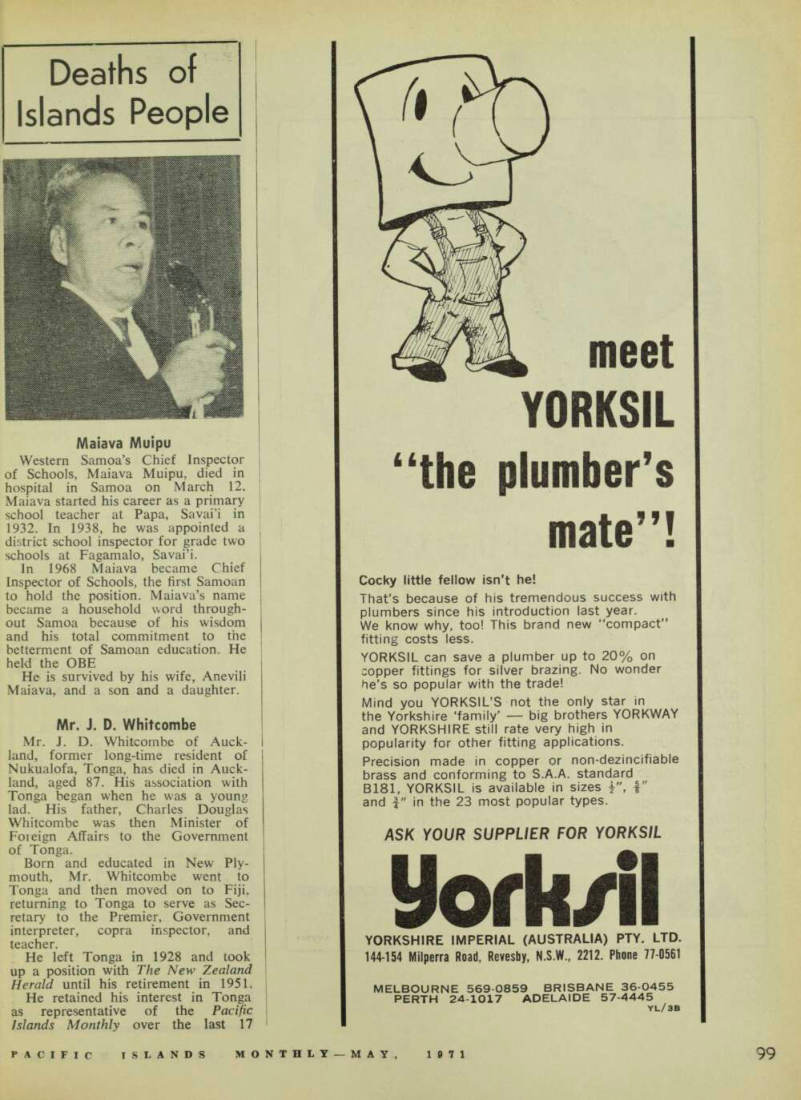

Deaths of Islands People
Maiava Muipu
Western Samoa’s Chief Inspector of Schools, Maiava Muipu, died in hospital in Samoa on March 12.
Maiava started his career as a primary school teacher at Papa, Savai’i in 1932. In 1938, he was appointed a district school inspector for grade two schools at Fagamalo, Savai’i.
In 1968 Maiava became Chief Inspector of Schools, the first Samoan to hold the position. Maiava’s name became a household word through out Samoa because of his wisdom and his total commitment to the betterment of Samoan education. He held the QBE He is survived by his wife, Anevili Maiava, and a son and a daughter.
Mr. J. D. Whitcombe Mr. J. D. Whitcombe of Auck land, former long-time resident of Nukualofa, Tonga, has died in Auck land, aged 87. His association with Tonga began when he was a young lad. His father, Charles Douglas Whitcombe was then Minister of Foreign Affairs to the Government of Tonga.
Born and educated in New Ply mouth, Mr. Whitcombe went to Tonga and then moved on to Fiji, returning to Tonga to serve as Sec retary to the Premier, Government interpreter, copra inspector, and teacher.
He left Tonga in 1928 and took up a position with The New Zealand Herald until his retirement in 1951.
He retained his interest in Tonga as representative of the Pacific Islands Monthly over the last 17
years, and was a frequent contri butor of historical articles.
His knowledge of the Tongan language was always of great in terest to his many friends and for some years he had been working on a revised Tongan-English dictionary and vocabulary.
He is survived by two sons and four daughters.
Vincent Biri Alisae Solomons bronze medallist at the 1966 South Pacific Games, Vincent Biri Alisae, died recently in New Zealand. Together with George Top ping, he was the first Solomon Islander to win a medal at the Games. His death came after a long illness which had taken him to hospital twice and which cut short a bright sporting and academic career.
Mr. J. D. Whitcombe.
Advertisements & other items, pp. 103-110 (2 items)
yorh/il
i I
meet
YORKSIL
“the plumber’s
mate”!
Cocky little fellow isn’t he!
That's because of his tremendous success with plumbers since his introduction last year.
We know why, too! This brand new “compact” fitting costs less.
YORKSIL can save a plumber up to 20% on copper fittings for silver brazing. No wonder he’s so popular with the trade!
Mind you YORKSIL’S not the only star in the Yorkshire ‘family’ big brothers YORKWAY and YORKSHIRE still rate very high in popularity for other fitting applications.
Precision made in copper or non-dezincifiable brass and conforming to S.A.A. standard 8181, YORKSIL is available in sizes i", and in the 23 most popular types.
ASK YOUR SUPPLIER FOR YORKSIL
yorh/il
YORKSHIRE IMPERIAL (AUSTRALIA) PTY. LTD.
144-154 Milperra Road, Revesby, N.S.W., 2212. Phone 77-0561
MELBOURNE 569-0859 BRISBANE 36-0455
PERTH 24-1017 ADELAIDE 57-4445
YL/3B
wu tA
Buy and sell the world
with one phone call
Overseas trips to secure new markets or to investigate new trends may be beyond the financial resources of some companies ... yet the price of a local phone call can put you in touch with the world.
ANZ Banking Group will give you general or specific Information about any country ... it’s yours for the asking.
Get the facts on trade. Currency. Credit. Regulations and Legal Matters. Business transactions. Introductions.
Get through to the world through ANZ.
All enquiries to ANZ Bank, Administrative Headquarters, 351 Collins Street, Melbourne, Australia, 3000, telephone 61 2011, or to any ANZ branch in Fiji, Papua and New Guinea, British Solomon Islands and New Hebrides.
A FJB AUSTRALIA ANO NEW ZEALAND
JVi BANKING GROUP LIMITED
HvJI INCORPORATING ANZ BANK AND ESi A BANK
ANZS64
THERE IS A GOD
Free Booklet
TEN HOME STUDY LESSONS
Topics 9 There IS a God! • God Revealed in Animal Life • God Revealed in Man • The Creator's Wisdom 9 God's Eternal Justice • The Creator's Love • Our All- Seeing God • God Hears and Cares • The Almighty God • The Glory of God.
DAWN BIBLE STUDENTS,
P.O. Box 1358, Auckland, N.Z.
Please send me, without obligation, "Ten Home Study Lessons".
NAME
ADDRESS
Carnation
coffee.
zr Try it. Watch how Carnation blends right in like it belongs.
It makes a good cup of coffee a great cup of coffee. All you do is punch and pour. Carnation your coffee.
Everybody’s doing it. *1 L * S \l Carnation-from contented cows’
The
office, bank, schoolroom, casualty station, clinic,
X-ray unit, laboratory, shop, library, showroom,
caravan (or you name it)
that floats.
i I f , n I Built around a basic 24 ft x 8 ft full-flotation hull, the all-aluminium de Havilland “Hydravan” can be fitted out for your individual use, or as complete accommodation for six people. Alternatively, the decked hull can be supplied separately or with insulated cabin (18 ft x 8 ft) erected to lock-up stage.
The “Hydravan” can be trailed if necessary and has every modern convenience available: lighting, refrigeration, gas cooking, hot water, shower and lavatory (chemical treatment unit). Propulsion is by remote control outboard motor.
For more information, please mail this coupon.
de Havilland
MARINE
Division of Hawker de Havilland Australia Pty. Limited
P.O. Box 30,
Bankstown, N.S.W. 2200, Australia.
A HAWKER SIDDELEY COMPANY
Mail to Hawker de Havilland Australia Pty. Limited.
Please send prices and information on the de Havilland “Hydravan.”
NAME
ADDRESS
(Please attach details of special requirements)
d Life”
"The
With Kenwood
> I s Uf ill - : ■ ■ I ; - ;!
Life without music is certainly possible. But it’s hard to envision ‘The Good Life” without good music.
But good music immediately conjures up visions of lavish high-fidelity sound systems.
Kenwood feels that such an image is all wrong.
Our stereo amplifiers are extremely compact (13' / Wx4-5/8 // Hx9-7/16 // D, to be exact) and deliver absolutely top-level performance.
Choose Kenwood. Join the ranks of music lovers who refuse to settle for mere “good music” and insist on the “best”.
KA-4002: SOW ll HF)Stereo Amp with low-low distortion, top performance KA-2002: 46 W (I H F)Stereo Amp; 2 PHONO input jacks; ideal for limited space the sound approach to quality
® KENWOOD
TRIO ELECTRONICS, INC.
Instant on-site
accommodation!
END ROOF PANEL
ROOF JOINT FLASHING
- INTERMEDIATE METAL ROOF
PANEL
ROOF COVER BRACKET
END ROOF PANEL
DOOR PANEL+" /
LOCK UP DOOR
AWNING WINDOW PANELS
FLOOR PANEL
CORNER COVER
CORNER BRACKET
WALL PANEL
FLOOIT CORNER I^^LOO Ex P View Of
bracket 1 1 frames typical unit
'CORNER COVER
Pillarbilt Demountable Units—erected
in 4% hours by unskilled labour
It’s true!
Pillarbilt Demountable Units can be erected by anyone.
A basic 9’ x 9’ unit can be easily erected by two men in 41/2 hours.
You don’t need power tools.
You don’t need screws and nails. These great units simply bolt together. Or. . . for transport . . . unbolt easily to be taken to the next site.
Fourteen standard sizes to choose from. All wall panels are standard sized and interchangeable for easy re-arrangement. Panel sizes are 8’ high, 3’ and 4’ in width.
Roofing: Profiled zinc coated metal roofing, pre-finished with thermo setting white vinyl paint. Features exclusive wide over-hanging eaves.
Wall Panels: Corrosion resistant steel framing with exterior cladding of flexible asbestos cement or galvanized crimp steel.
Flooring: Optional. Factory finished hardwood drop-in floor panels.
Ceiling: Optional. Drop-in asbestos panels with or without insulation.
Assembly: Complete easy to follow assembly instructions are issued with all kits.
Packs are complete with all brackets, bolts, cover strips, cover plates and door locks.
For further information please write to: Please send details on Pillarbilt Units Please tick sizes (floor area) applicable to you D 9’x 9’ □ 9’xlB’ □ 10’x12’ □ 10’x18’ □ 12’x15’ □ 9’xl2’ □ 10’x 9’ □ 10’x15’ □ 12’x12’ □ 12’x24’
Enquiries to:
PILLAR NACO
PTY. LIMITED
Name Address
naco
C 9 Established 1890 offering merchants in the Pacific, buying service giving prompt, careful and expert attention to all requirements.
For that service with a difference, cable "Success", Sydney l Sole Distributors in the Pacific for: Tilley lamps, Plastevic antifouling paints, Fulda tyres, Success & Tiara footwear, 4711 Eau de Cologne, Hilite batteries, Woodcemair prefab houses, Ross frozen foods, Balgay jams, Success canned fish, kerosene refrigerators, jute sacks, ice cream, torches, textiles, furniture, electric appliances.
HIGHEST PRICES OBTAINED ON WORLD MARKETS
FOR YOUR
SHELL - COCOA - COFFEE - COPRA - ETC.
'SUCCESS—Sydney
31 MACQUARIE PUCE, SYDNEY, N.S.W. 2000.
G.P.O. BOX 5315, SYDNEY, 2001.
CABLE ADDRESSES
'TAlTCO'—Sydney
Grajiamslaw’s
105
PACIFIC ISLANDS MONTHLY MAY, 1971
Grajiamslaw’s story Continued from p. 45
I need rest—
baby's exhausted, too — What would you do?
I've tried to be an attentive mother but so many times I've felt at a loss to know just how to comfort my little one.
Baby, having arrived so much later than Tim and Jen, I'd really forgotten the distressing symptoms that come with teething troubles.
Then, in desperation I remembered Fisher's Teething Powder.
You'd be amazed what an effective and soothing aid they are to baby's sore gums, digestive dis turbances and intestinal upsets which are natural teething dis orders.
Another great virtue of Fisher's Teething Powders is their safety.
They do not contain Calomel, Opiates, Bromides or any harmful substances. Even if the baby by mischance should eat several, they could do no harm.
By giving your baby a Fisher's Teething Powder as needed, you not only keep the little one happy and well, but save yourself all those upsets and nervous tensions that beset a mother when her baby suffers distress. Be sure to get a supply of Fisher's Teething Powders from your chemist or store. Only 30 cents for 20 powders, write direct to Fisher & Co., Manufacturing Chemists, 17 May St., St. Peters, N.S.W. Post code 2044.
Advertisements & other items, pp. 111-122 (3 items)
scons
the
"BIG" Challenger
THE
"GIANT"
IN
FLY SPRAYS
50%
STRONGER—
-50% SAFER
Fly
kills flies
mosquito#
Net 16 ot
100% better—that's Scotts Fly Spray. The new "GIANT" (16 oz) destroyer of disease-carrying flies, mosquitoes and all other household pests.
Scotts Fly Spray contains no harmful substances to "burn" or damage your family's delicate nasal or lung tissues . . . completely safe to spray near children, food and pets. The scientific formula of Scotts assures you the strongest, yet safest insecticide against filthy flies.
And Scotts Fly Spray is so economical . . . just a short spray of the super fine mist is all you need for a complete "killing" job . . . and the super fine spray won't mark your furniture or clothes.
Another nice thing about Scotts Fly Spray is its pleasant perfume ... a delightfully fresh citrus tang that breathes the freshness of summer into your home, right through the year.
So, when your family's health and happiness depends upon the insecticide you use. Mum— demand the best—SCOTTS FLY SPRAY—SO%, stronger—so% safer—loo% BETTER.
Look for the
"GIANT" SIZE (16 02.) CAN
A product of:
SCOTTS DETERGENTS
(A/ASIA.) PTY. LTD.,
P.O, Box 22, Botany, N.S.W., Australia.
W. H. GROVE & SONS LTD.
Established 1896
Island Merchants
16-18 FANSHAWE STREET, AUCKLAND
Telegraphic anti Cable Address; “Grore”, Auckland. P.O. Box 490, Auckland, New Zealand Entrust your requirements to the firm with some 75 years' practical experience in exporting the Island trade.
REPRESENTING MANUFACTURERS
THROUGHOUT FIJI, SAMOA, TONGA, NEW HEBRIDES, NEW CALEDONIA SOLOMON ISLANDS, SOCIETY ISLANDS, COOK ISLANDS, NIUE, PAPUA
NEW GUINEA, ETC.
SHIPPERS OF ALL CLASSES OF NEW ZEALAND MANUFACTURES AND PRODUCE SPECIALLY PREPARED FOR THE ISLAND TRADE IN FIJI as: W. H. GROVE & SONS (FIJI) LIMITED
Make light work of it!
S s
OTHER HANOI PRODUCTS!
'Handi' range of quality products also includes: a portable Twin-Burner Stovette and 'Handi' Pumpless Petrol Iron.
Keep a
HANOI handy!
No need to fumble and fume! Throw light on the subject with a 'Handi'. It's twice as bright as electric light. Completely stormproof. Simple and safe to use.
PRESSURE OPERATED
One filling gives 12 hours of brilliant 300 candle-power lighting. Built to last, with chromed, rust-proofed finish. Petrol or Kerosene models.
Ask for Handi! Everywhere!
HANOI WORKS PTY. LTD.
Compo Rd., Salisbury North - Ph. 472122
BRISBANE, QUEENSLAND, AUSTRALIA
o
TIME TO TURN
GRASS
INTO LAWN!
A model available to suit all conditions and every purpose.
Obtainable from:
SUVA MOTORS LTD.
Suva, Lautoka.
ISLAND PRODUCTS LTD.
Port Moresby.
NEW GUINEA CO. LTD.
Rabaul, Madang, Lae, Mount Hagen, Minj, Goroka.
YOUR NEXT LEAVE
Modern up to the minute homes at Palm Beach, Avalon, Newport, Church Point, Mona Vale, etc., available to Island Residents for Holidays. Write for information
J. T. STAPLETON PTY. LTD.
ESTATE AGENTS,
133 PITT STREET, SYDNEY, 2000. 25-5305, 25-1737 also Box 32, P. 0., Avalon Beach, Sydney 2107. 918-2221.
f 4 P
SHEET. FIGURED ROLLED & PLATE
GLASS
“ARMOURPLATE” GLASS
ANTI-GLARE & HEAT ABSORBING
GLASS
LAMINATED & TOUGHENED
AUTOMOTIVE GLASS
GLASS LOUVRE BLADES
GLASS BENDING
GLAZING BARS
AUSTRALIA’S FOREMOST
GLASS MERCHANTS AND
MIRROR MANUFACTURERS
'‘COPPERBAK” MIRROR—
CUT-TO-SIZE & STOCK SIZES
FRAMED & UNFRAMED
DECORATIVE WALL MIRRORS
CHEVAL MIRRORS
VANITY TABLE MIRRORS
ONE-WAY VISION MIRRORS
SHOP FRONTS
METAL MOULDINGS
"KAWNEER” ALUMINIUM SECTIONS
ENTRANCE DOORS & SCREENS
"ARMOURPLATE” DOORS
"AQUALITE" SHOWER SCREENS
MODULAR PARTITIONING
"U-RECT-IT” STORE EQUIPMENT
GLASS & SHOP FITTING TRADE
TOOLS. HARDWARE & SUPPLIES
"COWDROY” & "LIDCO” SLIDING
GLASS DOORS & WINDOWS
CARD KEY SECURITY SYSTEMS
ORDERS AND ENQUIRIES THROUGH THE GENERAL MERCHANTS IN YOUR AREA Catalogues and Price Lists Available 223 Botany Rd., Waterloo, N.S.W. 2017-Telegrams: FOBRON, Sydney
TELEPHONE SYDNEY 69 0466
FRANK G. O’BRIEN LTD.
FG21.44
FOR CONSISTENT HIGH QUALITY
USE
FLOUR
DDIIMTAM X- rA DTV ITO Terry Rood ' Dulwich Hill, N.S.W. 2203 DIC V I OL ■ I I • LI * Cables: "Beacon and Brunton". Phone: 56-1448 Established 1868 Australia’s oldest export flour millers.
m
MICK SIMMONS LTD.
THE MODERN HOME OF SPORT
adidas ROME
A strong very good looking shoe and for a long time our best seller.
Oxhide white upper, adidas Arch support, toe cap and reinforced heel counter. Now fitted with our newest patent, the "Achilles Protector".
Padded tongue and white non-slip Olympia sole. Excellent for outdoor training and competition.
PRICE $11.95
SPECIAL ATTENTION GIVEN All MAIL ORDERS
ORDERS AND ENQUIRIES TO MICK SIMMONS,
720 GEORGE STREET, HAYMARKET, N.S.W. 2000, AUSTRALIA
Established Cable Address:
1870 “ WEYSEAS . SYDNEY'
Place yourselves in the hands of Specialists for your requirements in
FRESH FRUIT & VEGETABLES
POTATOES & ONIONS
★ We invite your enquiries WEYMARK & SON (Overseas) Pty. Ltd.,
14-18 STEAMMILI STREET, SYDNEY, N.S.W. 2000
THE
YORKSHIRE INSURANCE
CO. LTD.
(Incorporated in England)
A MEMBER OF THE GENERAL ACCIDENT GROUP OF COMPANIES
ALL CLASSES OF INSURANCE
AUSTRALIAN HEAD OFFICE; 10-12 Spring Street, Sydney.
Group Manager for Australia: R. M. Trotter.
PAPUA AND NEW GUINEA BRANCH: Douglas Street, Port Moresby.
Manager: H. M. Harvey.
CHIEF ISLAND REPRESENTATIVES
Port Moresby, James Services Pty. Ltd.; Rabaul, A.S.P. (N.G.) Ltd.; Lae, Radio Cabs (Lae) Pty Ltd.; Madang, W. Stokes; Manus, Edgell & Whiteley Ltd.; Honiara, 8.5.1. P., E. V. Lawson, Ltd.; Suva, Williams & Gosling Ltd.; Noumea, R. Laubreaux; Norfolk Island, Martin's Agencies, Apia, E. A. Coxon & Co.
MORRIS
HEDSTROM
LIMITED
HEAD OFFICE: SUVA, FIJI
• GENERAL MERCHANTS
• PRODUCE BUYERS
• IMPORTERS AND
EXPORTERS
• PLANTATION OWNERS
• COMMISSION AND
INSURANCE AGENTS
LONDON OFFICE:
MORRIS HEDSTROM LTD.,
Park House, 22 Park Street, Croydon,
CR9 3NP
AUSTRALIAN
REPRESENTATIVE:
W. R. CARPENTER & CO. LTD.,
(Merchandise Division) The A. & N.Z. Building, 68 Pitt Street, Sydney, 2000.
Registered Cable Addresses: • DEUBA—SUVA • CAMOHE—SYDNEY • SUVAMARK—LONDON • MORRISCO—NUKU'ALOFA
• DEUBA—APIA • CODES: ALL.
AGENTS AND DISTRIBUTORS FOR:
• Bacardi International • China Navigation Co. • Crittall Hope Export • John Dewar & Sons Ltd. • Electrolux Limited • Elizabeth Arden • Evinrude Outboard Motors • Ford Motor Co. • Glaxo Laboratories • Goodyear Tyre Gr Rubber Co. • Guinness Exports Ltd. • Jas Hennessy & Co. • Imperial Chemical Industries • Mobil Oil Australia Ltd. • Max Factor & Co. Inc. • McWilliams Wines Pty.
Ltd. • Napier Bros. Ltd. • Parker Pen Company • Proctor £r Gamble • Rootes Ltd. e Ronson Products Ltd. • Rowntree Gr Co. Ltd. • Tanqueray Gordon Gr Co.
Ltd. • Taubmans Ltd. • Viners of Sheffield • Yorkshire Imperial Metals Ltd.
Morris Hedstrom Ltd. are LLOYD'S AGENTS in
FIJI and WESTERN SAMOA.
For friendly service and complete satisfaction it's Morris Hedstrom Ltd. in
FIJI - WESTERN SAMOA - TONGA
&'mmt CadomifA
$ want (kdSu/ufJL
SwmtCadSmtfA
&a/atctCadia/tifJi
o *r It’s worth saying over and over again because there’s a glass and a half of pure, fresh, full-cream milk in every half-pound of Cadbury Dairy Milk Chocolate. No other chocolate can possibly give you that creamy, creamy Cadbury taste. Look for the famous purple wrapper.
CADBURY
DAIRY MILK CHOCOLATE
the biggest selling block chocolate in Australia M 04/32/0
SWISO
, ..THE NEW LONGER-LIFE
KNIVES THAT HAVE THE EDGE
OVER ALL OTHERS
Swiss design and manufacture
OBTAINABLE
FROM THE
LEADING
BUTCHER
SUPPLIERS
Sole Importers:
PETER FISHER
TRADING PTY.LTD,
321 Pitt Street
SYDNEY
Telephone 26 1109
1 apui
new guinea
printing co. ply. ltd.
Supplying the Territory with:
• COMMERCIAL JOB PRINTING
• PAPER RULING
• STATIONERY REQUIREMENTS
• RUBBER STAMPS
Mail Orders Invited P-0. Box 633, Port Moresby Cables & Telegrams: P.O. Box 759, Lae Printer Port Moresby P.O. Box 30, Mount Hagen and Lae
FIRE
VEHICLE
SOUTHERN PACIFIC INSURANCE
COMPANY LIMITED
Head Office: Equitable Life Building, 80 Alfred Street, AAilsons Point, N.S.W., 2061.
Specialising in Pacific Island Insurance requirements for over 30 years.
FIRE AND VOLCANIC ERUPTION • HOUSEHOLD COMPREHENSIVE • MOTOR > COMPULSORY THIRD PARTY • COMPULSORY WORKERS' COMPENSATION
• PUBLIC LIABILITY • MARINE
Enquiries invited for all classes of insurance from special representatives at: RABAUL: Jack T. Ray—Manager for Papua & New Guinea, Mango Avenue. P.O. Box 123.
LAE: Alex B. Barker—Manager at Lae, Kam Hong's Building, Central Avenue. P.O. Box 758. PORT MORESBY: H. A. K. McKee—Manager at Port Moresby, Maloney's Building, Cuthbertson Street. P.O Box 136. SUVA-FIJI: L. M. Rolls—Manager for Fiji, McGowan's Building, Margaret Street. P.O, Box 521.
Only Pea-Ben Insecticide
guarantees to kill a|l
insect pests... FAST!
KJU3
* g
Pea-Beu is the strongest insecticide
available today
A recent survey, which included laboratory testing, conclusively proved that Pea-Beu aerosol insecticide contained the highest concentration of the world’s most powerful insect-killing ingredients.
Flies, mosquitoes, in fact no insect can survive its powerful fume action. Powerful Pea-Beu penetrates to all corners with devastating effect to all flying and crawling insect pests, even seeking out and destroying those hiding in inaccessible places. Because of its strong concentration, Pea-Beu aerosol insecticide is very economical. You need only short bursts in a room to ensure complete protection from all disease-carrying insect pests.
Pea-Beu kills al[ insects
The dangers of diseases spread by insect pests cannot be stressed enough, especially to mothers of young children. Pea-Beu is the only insecticide that will kill all insect pests, even the hardy cockroach Regular spraying with powerful Pea-Beu aerosol insecticide will eradicate insect pests such as flies, mosquitoes, cockroaches, fleas, ants, moths and silverfish and all insect pests that bring the dangers of disease into your home.
Always remember the health of your family depends on your choice of insecticide. Powerful Pea-Beu is guaranteed to kill all diseasecarrying insect pests before they have a chance to bring illness into your home.
Powerful Pea-Beu—guaranteed the strongest, most
powerful insecticide available today.
nedlloyd Koninklijke Nedlloyd nv
REGULAR SAILINGS BY FAST, MODERN, CARGO VESSELS
from CONTINENTAL PORTS via PANAMA to
PAPEETE, APIA, SUVA, LAUTOKA, NOUMEA and
NEW ZEALAND
other ports called at subject to sufficient inducement
heavy-lift facilities—refrigerated space—cargo deeptanks
For further particulars apply to agents
Ets. Donald Tahiti, Papeete.
Morris Hedstrom & Co. Ltd., Lautoka.
Russell & Sommers (Wellington) Ltd., Wellington, N.Z.
O. F. Nelson & Co. Ltd., Apia.
Agence Maritime Pentecost, Noumea.
Carpenter's Fiji Ltd., Suva.
Interocean Australia Services Pty. Ltd., Sydney.
♦ SULLIVAN EXPORT SERVICE *
C. SULLIVAN (EXPORT) PTY. LTD.
4th Floor, Kemble Building,
60 MARGARET STREET, SYDNEY, 2000, N.S.W.
Telephone: 29-8144 (6 lines). Telegrams and Cables; CHASULL, Sydney
MELBOURNE
C SULLIVAN (EXPORT)
PTY. LTD.
59 William Street, Melbourne, 3000, Vic.
Telephone: 62-6600.
Cables and Telegrams: CHASULL, Melbourne
BRISBANE
C. SULLIVAN (Q'LAND)
PTY. LTD.
Empire House, cnr. Queen & Wharf Sts., Brisbane. 4000 (G.P.O. Box 1697 V, Brisbane, 4001.)
NEW ZEALAND
C. SULLIVAN (N.Z.)
LTD.
Levein Building, cnr. Paul & Alrdale Sts., Auckland, 1.
Telephone: 36-0472.
Cables and Telegrams: CHASULL, Auckland.
• LONDON • SAN FRANCISCO
Also at; PORT MORESBY • LAE • RABAUL • SUVA • LAUTOKA
OFFERING A COMPREHENSIVE BUYING SERVICE
TO ISLANDS CLIENTS
Telephone: 24958.
Cables and Telegrams: CHASULL, Brisbane.
PIGS FOR PROFIT!
consult
JAKE PIGGERIES
(between Coofamundra and Temora)
SPRINGDALE, N.S.W. 2695, AUSTRALIA
Specialists in supplying: • Breeding animals for export • Designing tropical piggeries and equipment • Consultants and trouble shooters in all matters relating to pig husbandry.
TELEPHONE: SPRINGDALE 28U
(After hours: Combaning South 48)
CARINIA RECORDS
Record and Cassette Manufacturers and Distributors of:
TELEFUNKEN • GERMAN DECCA • BARCLAY
MELODIA • C.N.R. • TURNABOUT
Budget Cassettes also a large selection of other classical, Continental and popular records.
Free Catalogues: 2 NORTHCOTE STREET, ST. LEONARDS, N.S.W. 2065
SADDLERY AND RIDING EQUIPMENT
Send for FREE illustrated catalogue of: Saddlery Horse rugs Breaking-in-gear Whips (Stock and riding) Yarding canes (sheep and cattle) Riding clothing Riding boots (elastic-side and Polo) Polo equipment Driza-bone raincoats Pony Club and Hunting Caps
HOME TANNING OUTFITS
For tanning all kinds of skins. Kangaroo, rabbit, sheep, crocodile, bullock hides, etc Price $3.50 Post FREE.
JOHN CHARLTON Cr CO. PTY. LTD.
168-170 PACIFIC HIGHWAY, ST, LEONARDS, N S W., 2065 Phones: 43-1010, 43-6087. After Hours: 451-4718.
Telegraphic & Cable Address; "CHARLTONS", Sydney.
"AH over Australia"
MARSON
HP-4 HAND RIVETTIN6 FLIER
1
TEST SPECIFICATIONS
80 TONS . . ultimate tensile 2,000 lbs. approx, net effective at pulling jaws
JAW HARDNESS ss eo Rc .
CAPACITY 3/32",. 1/8", 5/32", 3/1-6"
KLIKFAST RIVETS
Weight, 1.25 lbs.; length overall, 9.75"
Craftsmanship—material—performance
COMPLETELY GUARANTEED BY
MARSON PRODUCTS (AUSTRALIA) PTY. LTD.
102 May Street, St Peters, N.S.W. 51-2285
SPECIALIST EXPORTERS
POTATOES ONIONS
GARLIC BLUEPEAS
FRESH FRUIT AND VEGETABLES
N.Z. DAIRY BOARD GHEE
GERRARD WIRE TYING EQUIPMENT
GENERAL MERCHANDISE COOLER
FREEZER
Current Quotations from:
Turners Supply Company Limited
P.O. Box 1370, AUCKLAND. Cables "TUSCO" Auckland.
PACIFIC EXPORT DIVISION of TURNERS & GROWERS LTD. Wholesale Fruit and Produce Merchants, Auckland, New Zealand.
115
p A C i I V L ISLANDS MONTHLY MAY, 1971
118
MAY, 1971 PACIFIC ISLANDS MONTHLT
be political?
Should the New Guinea church be political?
The Anglican church in Papua-New Guinea has been involved in another controversy about whether or not the church should concern itself with political matters.
The argument this time arose from the reported comments of two assist ant bishops—the Rt. Rev. George Ambo. who has oversight of the church’s Northern Papua Region, and the Rt. Rev. Henry Kendall, in charge of the Eastern Papua Region. Appar ently both of them spoke against early self-government for Papua-New Guinea during interviews with the territory’s Select Committee on Con stitutional Development, This provoked vice-president of the Cape Nelson Council, Mr. Gladstone Ned, into declaring that Anglican missionaries should concern them selves with church matters and not with politics. He said the Anglican church was intruding too far into politics, and that religion and politics should not be mixed.
Commenting on the content of the bishops’ remarks, Mr. Ned made the valid point that the Anglican church itself was already self-governing and had a target date for “independence” (a reference to the church’s 1980 tar get date for completing indigenisa tion).
However, the issue was not whether the bishops were right or wrong in what they said, but whether it was in order for them to speak at all.
In reply to Mr. Ned, an Anglican spokesman said that, in the view of the church, everything in life was the concern of God and therefore of the church. This meant that religion and politics could not be divorced and that the church had a duty as well as a right to speak out on political matters.
The Anglican church in the terri tory has a reputation for making sug gestions and pronouncements of a political nature. But the last time it got involved in a really big “church and politics” controversy was 18 months ago, when the Bishop of Papua-New Guinea, the Rt. Rev.
David Hand, called for the replace ment of the Minister for External Territories, Mr. Barnes. • New Guinea primitive art was selling at rock-bottom prices in Sydney during April when the Paulian As sociation put on a sale at Cusa House in aid of their mission and secular work in the territory and elsewhere.
Advertisements & other items, pp. 123-126 (2 items)
Klinkii
DOORS
Retain their original shape and size* even in hot and humid conditions! * Klinkii Placard doors are permanently stable and rigid—resist warping, twisting or swelling in any climate! * Klinkii Placard doors are guaranteed extra strong yet light in weight. * The lock-block frame and panels maintain exact dimensions —withstand temperature extremes.
DISTRIBUTORS: New Guinea Co. Ltd.
Burns Philp (New Guinea) Limited Steamship Trading Company Limited Island Products Limited Collins and Leahy Pfy. Ltd.
Arshak C. Galstaun Waso Limited * Available in standard sizes.
PIM/2
all branches . all branches all branches Port Moresby Goroka Angoram Wapenamanda
Made by COMMONWEALTH NEW GUINEA
TIMBERS LTD., BULOLO, N.G.
The only name
you'll ever need
for electric power
generating
equipment...
DUNLITE
Why?
Because the Dunlite policy of continuous research and development, prolonged field testing under the most adverse conditions, coupled with strict control over every manufacturing process and the use of very specialised machinery has produced features that guarantee accurate regulation, long operating, trouble-free life with extreme ease of maintenance.
Every Dunlite A.C. plant incorporates as standard equipment such features as engine hour
DUNLITE ELECTRICAL CO. PTY. LTD.
* MEMBER Of THE GROUP Of COMPANIES 21-27 Frame St., Adelaide, Sth. Aust., 5000 Cables/Telegrams: “ Adelaide. • Rural Services Pfy. ltd., 65 Ipswich Road, • New Britain Electrical Co„ Rabaul.
Distributed by: Woollongabba, Brisbane. * Co|yer Wa)son (NG) l(d Goroka • N.G.G. Trading Company Ltd., Lae. meter—oil pressure safety shut down—automotive type starter —0.8 power factor alternator— static voltage control—simplified control panel.
Furthermore all Dunlite power plants are thoroughly run-in, tropic proofed, and are com-
pletely ready-to-operate package
units with no special installation requirements.
Is it any wonder Dunlite are Australia's largest manufacturers of electric power plants.
And there are over 200 models.
One is just right for your needs.
And it will save you money!
BURNS PHILP
NEW GUINEA LTD.
SHIPPING & CUSTOMS AGENTS.
Head Office: PORT MORESBY/PAPUA
Cable: BURPHIL.
Subsidiary Companies
Ela Motors Ltd.
The 8.1M.G. Trading Co. Ltd.
The Port Moresby Freezing Co. Ltd.
v Agents for Burns Philp Trustee Co. Ltd.
Queensland Insurance Co. Ltd.
Lloyds of London Stewarts & Lloyds Dist. Pty. Ltd.
Shell Company (Pacific Islands) Ltd.
Overseas Agents Burns Philp & Co., all Aust. States Burns Philp & Co., London Burns Philp Co. of San Francisco Inc.
Trade inquiries invited.
Shipping Agents for Bank Line Ltd.
Burns Philp & Co. Ltd.
Cogedar Line Campagnie Des Messageries Maritimes Chandris Line Cunard Steamships Co. Ltd.
Nederland Line Royal Dutch Mail P & 0 Orient Line Royal Rotterdam Lloyd The Indo-China Steam Navigation Co. Ltd, Union Steamship Co. of N.Z. Ltd.
Airline Agents for Ansett A.N.A.
Trans-Australia Airlines Qantas Empire Airways International Air Transport Representatives
Travel Department
Consult our experienced personnel for planning world wide travel.
Distributorships include British Paints Buckingham & Carnatic Textiles Byford Products Citizen Watches "CeCoCo" Machinery Conditionaire Air Curtain Doors Hardie's Building Products Heuga Tile Floor Coverings Jean Patou Parfums "John" Valves Johnson Ceramic Tiles Kienzle Clocks Marcel Rochas Parfums Mikimoto Pearls National Radios & Appliances Noritake Chinaware Rolex Watches Ronson Products Rover Power Mowers Sunbeam Appliances, Mowers & Rural Products
Exporters of
Coffee & Cocoa Beans, Peanuts, Rubber Branches & Shopping Centres Papua: Port Moresby, Boroko, Daru, Samarai and Popondetta.
New Guinea; Rabaul, Kokopo, Kavieng, Lae, Wewak, Madang, Goroka, Wau, Bulolo, Kainantu, Mt. Hagen and Kieta.
BURNS PHILP
FOR SERVICE AND VALUE
NEW GUINEA LTD
Head Office —Port Moresby. Telex PM 116 Telegrams all centres —‘Burphil’
L 14° 'l* if* N X \ I S vX
WORLD TRADERS
IN THE PACIFIC
TEA
NEW 7
GUINEA
WORLjk/IARKETS
\ • t \ M \ W.) /
SUVA
7 ' / 'WBER-%OT
MARK!
Jib
nf°° ut°J_ ; fL oOW
SYDNEY
*/■ c^>
AUCKLAND
£ £ i
NEW ZEALAND
The W. R. Carpenter Group has been a major trader between the Pacific Islands and the rest of the world for more than 55 years. As a grower, buyer and processor of island produce such as copra, coffee and cocoa beans the Group has contributed to the economic progress of the area and of its peoples.
Associated companies of the Group in the Pacific Islands include:
PAPUA AND NEW GUINEA
W. R. Carpenter (T.P.N.G.) Limited Coconut Products Limited New Guinea Company Limited Boroko Motors Limited The Group is also a wholesaler and retailer and holds many
leading agencies, including
• NISSAN/DATSUN • FORD • DEWARS WHISKY
• ELECTROLUX • GORDON'S GIN
• EVINRUDE • VICTA
FIJI
W. R. Carpenter (South Pacific) Limited Carpenters (Fiji) Limited Morris Hedstrom Limited Millers Limited Island Industries Limited Suva Motors Limited
W. R. CARPENTER & COMPANY LIMITED
68 PITT STREET CABLES: U.K. OFFICE:
SYDNFY "rAMftUC" OO DAD!/ CT rDAvnmt rnn oun
Published by PACIFIC PUBLICATIONS iAUST.t PTY LTD.. 29 Alberta Street. Sydney, 2000. (Telephone: 61-9197). Wholly set up
and printed in Australia hv The Pvdnev and Melbourne Publishing Co Ptv. Ltd . 29 Alberto Pvdnev 2000 REGISTERED AT THE GPO SYDNEY FOR TRANSMISSION BY POST AS A NEWSPAPER - CATEGORY B.