Pacific
Islands
Monthly
Vol. Vi I. No. 8
MVrc h 23, 19 3 7
th f G P '°" Sydney ’ /or transmission by post as a newspaper.!
8d
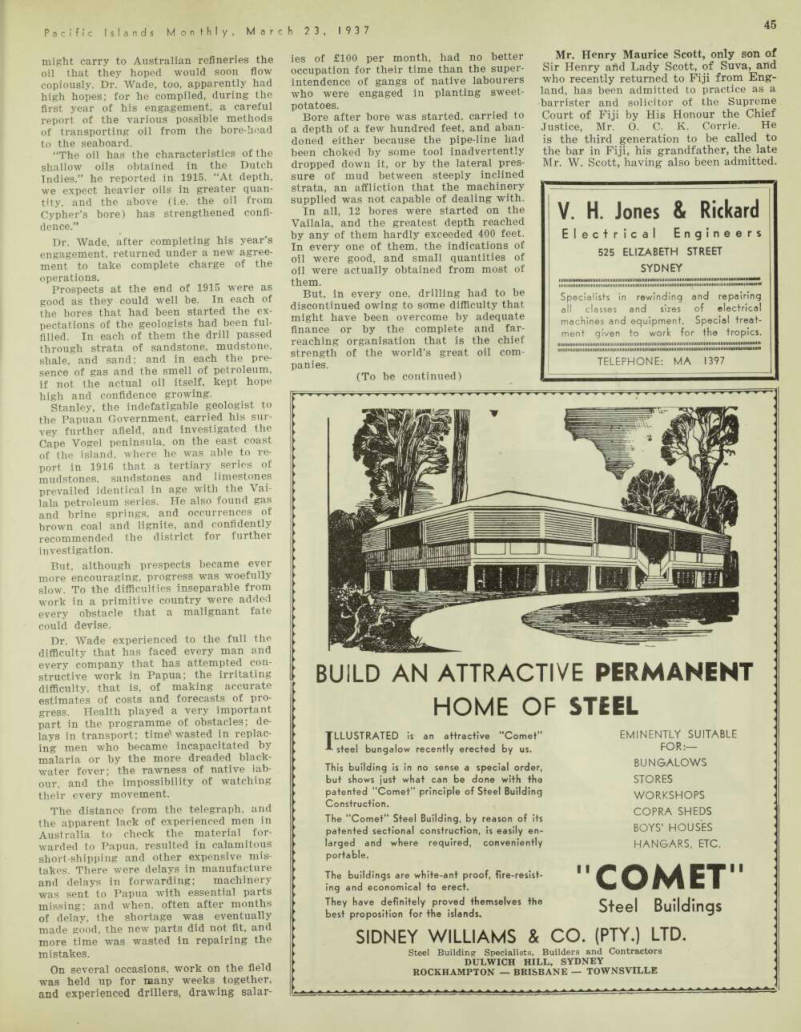
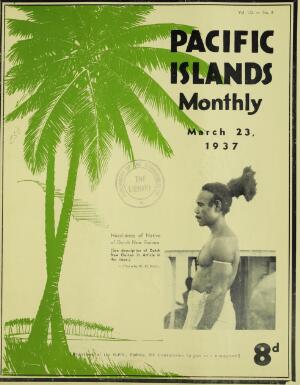
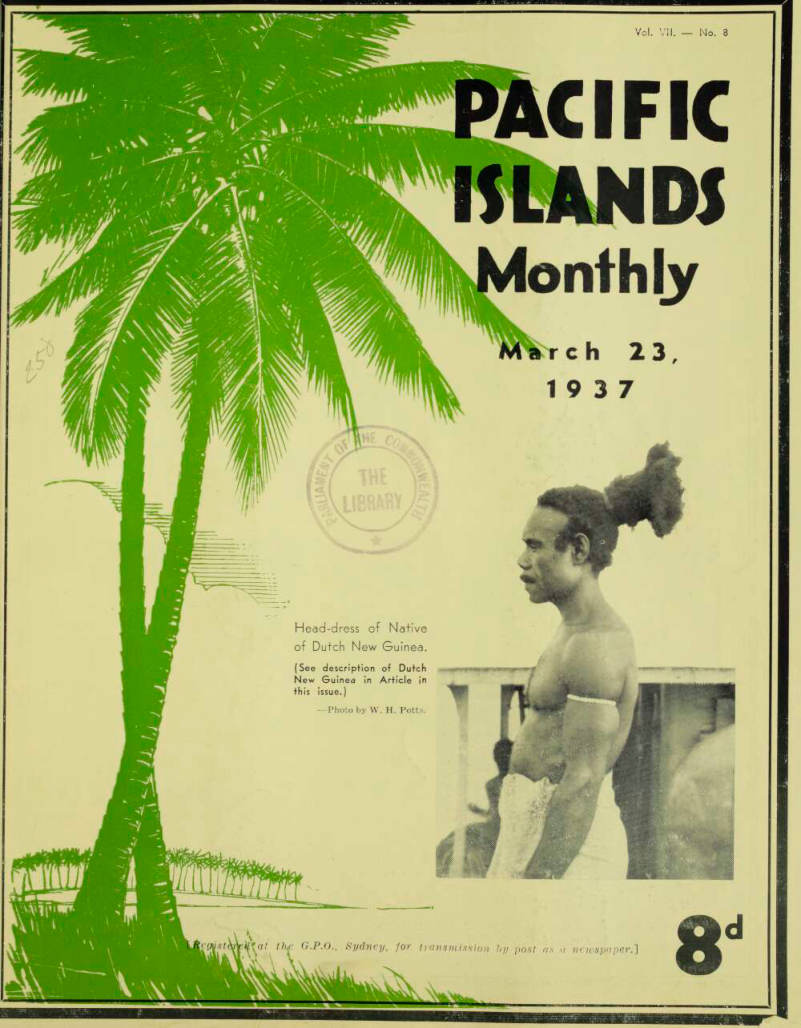
Head-dress of Native of Dutch New Guinea. (See description of Dutch New Guinea in Article in this Issue.) —Photo by W. H. Potts.
Advertisements & other items, p. 2 (1 item)
Direct Shipping Service
BETWEEN THE
PACIFIC TERRITORIES AND EUROPE
In addition to operating General Stores, Trading Stations, Plantations, Inter-Islands Shipping Services, Aerial Transport Services, Etc., in the Pacific Territories, W. R. Carpenter & Co. Ltd. have established a Direct Shipping Service between New Guinea, Solomons, Fiji, Gilbert and Ellice Islands, and European Ports.
C AL . LS . are made as required at the Main Ports of Fiji, G. and E. Colony, Solomons and New Guinea.
There is comfortable accommodation for a limited number of saloon passengers on these vessels at special rates; but early application for Berths is recommended.
Details of Freight Rates, Passenger Fares, Timetables, etc., supplied on application at any of our Branches.
THE W. R. C. LINE
Two Twin-Screw Motor-Vessels are now carrying on a Ten-Weekly Service on a Regular Schedule,
namely:—
M. V. RABAUL - - - 5613 Tons
M. V. SALAMAUA - 6754 Tons
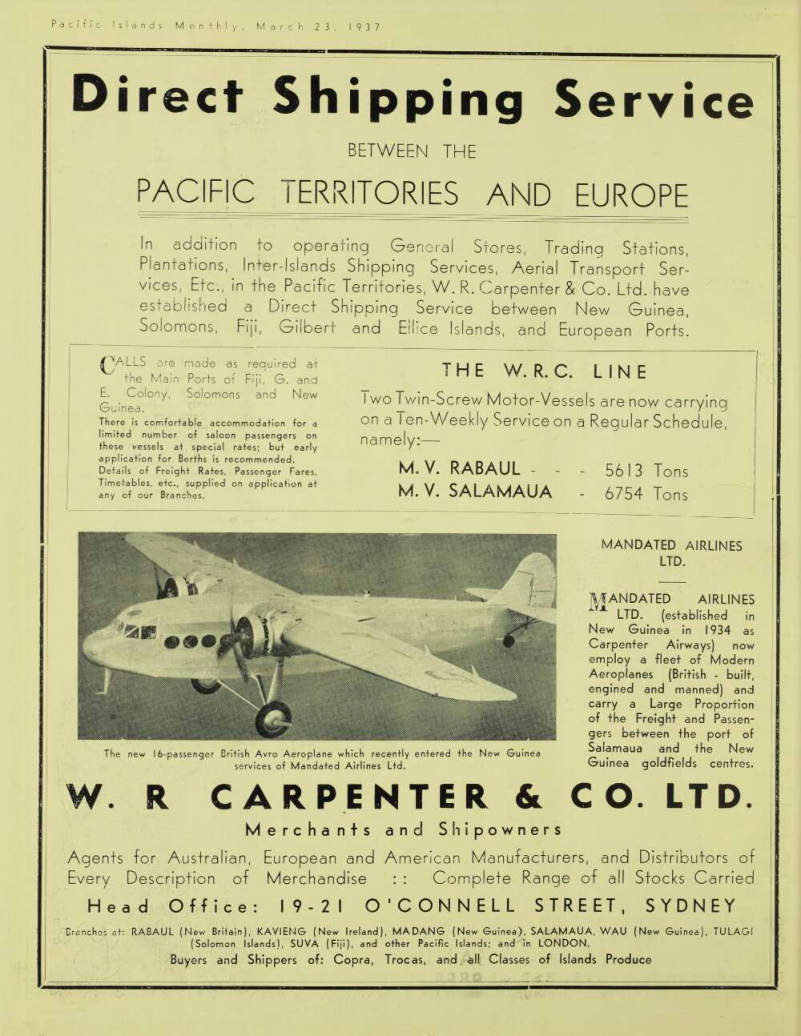
K 1 mm The new 16-passenger British Avro Aeroplane which recently entered the New Guinea services of Mandated Airlines Ltd.
MANDATED AIRLINES
LTD.
MANDATED AIRLINES
JL LTD. (established in New Guinea in 1934 as Carpenter Airways) now employ a fleet of Modern Aeroplanes (British - built, engined and manned) and carry a Large Proportion of the Freight and Passengers between the port of Salamaua and the New Guinea goldfields centres.
W. R CARPENTER & CO. LTD.
Merchants and Shipowners Agents for Australian, European and American Manufacturers, and Distributors of Every Description of Merchandise : : Complete Range of all Stocks Carried
Head Office: 19-21 O'CONNELL STREET, SYDNEY
Branches at: RABAUL (New Britain), KAVIENG (New Ireland), MADANG (New Guinea), SALAMAUA, WAU (New Guinea), TULAGI (Solomon islands), SUVA (Fiji), and other Pacific Islands; and in LONDON.
Buyers and Shippers of: Copra, Trocas, and all Classes of Islands Produce
Pacific Islands Travellers
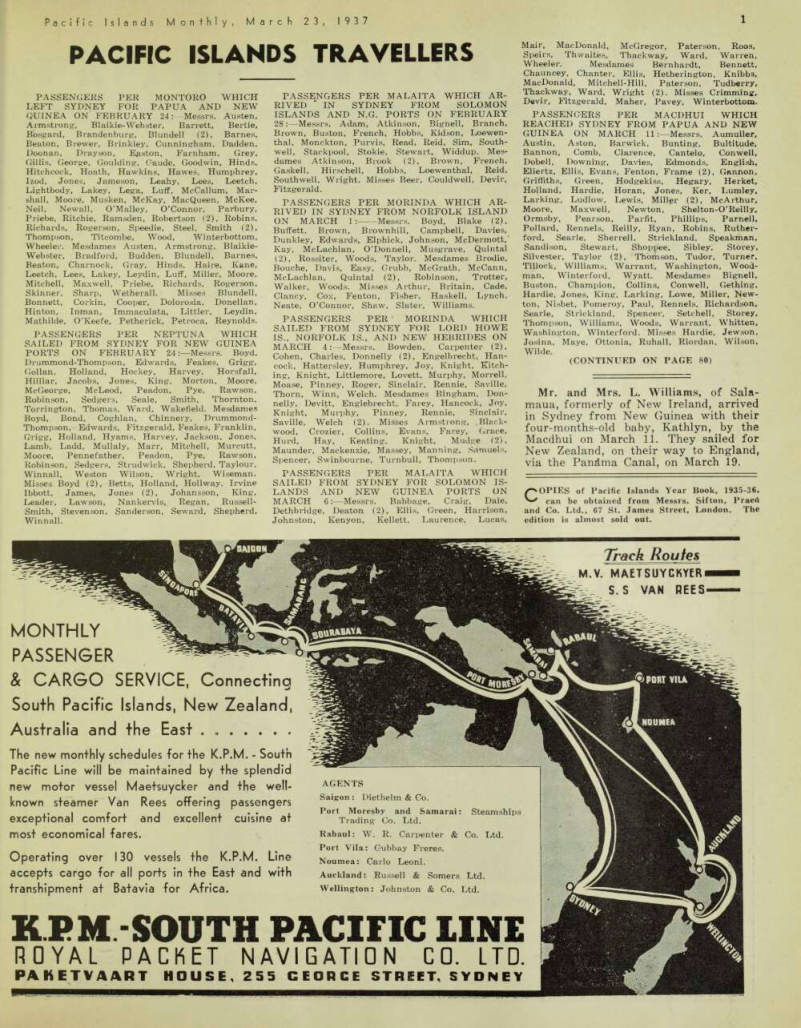
Passengers Per Montoro Which
Left Sydney For Papua And New
GUINEA ON FEBRUARY 24Messrs. Austen.
Armstrong, Blaikie-Webster, Barrett, Bertie, Bbsgard, Brandenburg, Blundell (2), Barnes, Beaton, Brewer, Brinkley, Cunningham, Dadden, Doonan, Drayson, Easton, Farnham, Grey, Gillis, George, Goulding, Gaude, Goodwin, Hinds, Hitchcock, Hoath, Hawkins, Hawes, Humphrey, Izod, Jones, Jameson, Leahy, Lees, Leetch, Lightbody, Lakey, Lega, Luff, McCallum, Mar shall, Moore, Musken, McKay, Mac Queen, McKee, Neil, Newall, O’Malley, O’Connor, Parbury, Priebe, Ritchie, Ramsden, Robertson (2), Robins, Richards, Rogerson, Speedie, Steel, Smith (2), Thompson, Titcombe, Wood, Winterbottom, Wheeler. Mesdames Austen, Armstrong, Blaikie- Webster, Bradford, Budden, Blundell, Barnes, Beaton, Charnock, Gray, Hinds, Haire, Kane, Leetch, Lees, Lakey, Leydin, Luff, Miller, Moore, Mitchell, Maxwell, Priebe, Richards, Rogerson, Skinner, Sharp, Wetherall. Misses Blundell, Bonnett, Corkin, Cooper, Dolorosia, Donellan, Hinton, Inman, Immaculata, Littler, Leydin, Mathilde, O’Keefe, Petherick, Petroca, Reynolds.
Passengers Per Neptuna Which
Sailed From Sydney For New Guinea
PORTS ON FEBRUARY 24:—Messrs. Boyd, Drummond-Thompson, Edwards, Feakes, Grigg, Gollan, Holland, Hockey, Harvey, Horsfall, Hilliar, Jacobs, Jones, King, Morton, Moore, McGeorge, McLeod, Peadon, Pye, Rawson, Robinson, Sedgers, Seale, Smith, Thornton, Torrington, Thomas, Ward, Wakefield. Mesdames Boyd, Bond, Coghlan, Chinnery, Drummond- Thompson, Edwards, Fitzgerald, Feakes, Franklin, G'rigg, Holland, Hyams, Harvey, Jackson, Jones, Lamb, Ladd, Mullaly, Marr, Mitchell, Murcutt, Moore, Pennefather, Peadon, Pye, Rawson, Robinson, Sedgers, Strudwick, Shepherd, Taylour, Winnall, Weston Wilson, Wright, Wiseman.
Misses Boyd (2), Betts, Holland, Hollway, Irvine Ibbott, James, Jones (2), Johansson, King, Leader, Lawson, Nankervis, Regan, Russell- Smith, Stevenson, Sanderson, Seward, Shepherd, Winnall.
Passengers Per Malaita Which Ar
Rived ‘ In Sydney From Solomon
Islands And N.G. Ports On February
28: —Messrs. Adam, Atkinson, Bignell, Branch, Brown, Buston, French, Hobbs, Kidson, Loewen thal, Monckton, Purvis, Read, Reid, Sim, South well, Stackpool, Stokie, Stewart, Widdup. Mes dames Atkinson, Brook (2), Brown, French, Gaskell, Hirschell, Hobbs, Loewenthal, Reid, Southwell, Wright. Misses Beer, Couldwell, Devir, Fitzgerald.
Passengers Per Morinda Which Ar
Rived In Sydney From Norfolk Island
ON MARCH 1: Messrs. Boyd, Blake (2), Buffett, Brown, Brownhill, Campbell, Davies, Dunkley, Edwards, Elphick, Johnson, McDermott,' Kay, McLachlan, O’Donnell, Musgrave, Quintal (2), Rossiter, Woods, Taylor. Mesdames Brodie, Bouche, Davis, Easy, Grubb, McGrath, McCann, McLachlan, Quintal (2), Robinson, Trotter, Walker, Woods. Misses Arthur, Britain, Cade, Clancy, Cox, Fenton, Fisher, Haskell, Lynch, Neate, O’Connor, Shaw, Slater, Williams.
Passengers Per ' Morinda Which
Sailed From Sydney For Lord Howe
IS.. NORFOLK IS., AND NEW HEBRIDES ON MARCH 4; —Messrs. Bowden, Carpenter (2), Cohen, Charles, Donnelly (2), Engelbrecht, Han cock, Hattersley, Humphrey, Joy, Knight, Kitch ing, Knight, Littlemore, Lovett, Murphy, Morrell, Moase, Pinney, Roger, Sinclair, Rennie, Saville, Thorn, Winn, Welch. Mesdames Bingham, Don nelly, Devitt, Englebrecht, Farey, Hancock, Joy, Knight, Murphy, Pinney, Rennie, Sinclair, Saville, Welch (2). Misses Armstrong, Black wood, Crozier, Collins, Evans, Farey, Grace, Hurd, Hay, Keating, Knight, Mudge (2), Maunder, Mackenzie, Massey, Manning, Samuels, Spencer, Swinbourne, Turnbull, Thompson,
Passengers Per Malaita Which
Sailed From Sydney For Solomon Is
Lands And New Guinea Ports On
MARCH 6: —Messrs. Babbage, Craig, Dale, Dethbridge, Deaton (2), Ellis, Green, Harrison, Johnston, Kenyon, Kellett, Laurence, Lucas,
Mair, MacDonald, McGregor, Paterson, Roos, Speirs, Thwaites, Thackway, Ward, Warren, Wheeler. Mesdames Bernhardt, Bennett.
Chauncey, Chanter, Ellis, Hetherington, Knibbs, MacDonald, Mitchell-Hill, Paterson, Tudberry, Thackway, Ward, Wright (2). Misses Crimming, Devir, Fitzgerald, Maher, Pavey, Winterbottom.
Passengers Per Macdhui Which
Reached Sydney From Papua And New
GUINEA ON MARCH 11: —Messrs. Aumuller, Austin, Aston, Barwick, Bunting, Bultitude, Bannon, Comb, Clarence, Cantelo, Conwell, Dobell, Downing, Davies, Edmonds, English.
Eliertz, Ellis, Evans, Fenton, Frame (2), Gannon, Griffiths, Green, Hodgekiss, Hegary, Herket, Holland, Hardie, Horan, Jones, Ker, Lumley, Larking, Ludlow, Lewis, Miller (2), McArthur, Moore, Maxwell, Newton, Shelton-O’Reilly, Ormsby, Pearson. Parfit, Phillips, Parnell, Pollard, Rennels, Reilly. Ryan, Robins, Ruther ford, Searle, Sherrell, Strickland, Speakman, Sandison, Stewart, Shoppee, Sibley, Storey, Silvester, Taylor (2). Thomson, Tudor, Turner.
Tillock, Williams, Warrant, Washington, Wood man, Winterford, Wyatt. Mesdames Bignell, Buston, Champion, Collins, Conwell, Gething, Hardie, Jones, King, Larking, Lowe, Miller, New ton, Nisbet, Pomeroy, Paul, Rennels, Richardson.
Searle, Strickland, Spencer, Setchell, Storey, Thompson, Williams, Woods, Warrant, Whitten, Washington, Winterford. Misses Hardie, Jewson, Josina, Maye, Ottonia, Ruhall, Riordan, Wilson, Wilde.
(Continued On Page 80)
Mr. and Mrs. L. Williams, of Sala maua, formerly of New Ireland, arrived in Sydney from New Guinea with their four-months-old baby, Kathlyn, by the Macdhui on March 11. They sailed for New Zealand, on their way to England, via the Pandma Canal, on March 19.
Passengers Per Niagara Which Ar
RIVED IN SYDNEY FROM SUVA. FIJI, ON MARCH 13: —Miss M. E. Browne, Mr. and Mrs.
H. B. Bowen, A. S. Burton, J. R. Dupre, J. R.
Donaldson, A. S. Farebrother, K. Graham, Mrs.
M. C. Hawkins, Mrs. E. M. Hawkes, A. C. Heron, Mr. and Mrs. C. O. Handley, Master K. R.
Handley, Mrs. M. M. Horsfield, E. J. Harding, Mrs. P. M. Harding, Major C. B. Joske, Mrs. and Mr. E. G. Keyte, Masters F. K. and R. C.
Keyte, Master D. Lyons, Mrs. E. R. Mumford, Master A. Mumford, Mr. and Mrs. J. H. Millett, Master E. and Miss L. D. Millett, E. Mulliken, E. J. Pratt, Mr. and Mrs. G. R. Robertson, Mr. and Mrs. G. L. Robley, Mr. and Mrs. R. S.
Southey, W. F. White, Mrs. P. E. Waters, Mr. and Mrs. G. A. Zillman, Master R. Zillman, Major and Mrs. R. N. Caldwell, Misses M. and P. Caldwell, Master D. Caldwell, Mr. and Mrs, B. Griffiths, Mrs. F. Ginn, Mrs. M. Johnson, E. E.
Mumford, Mrs. M. L. McConnell, Miss M. A.
Mackay, F. L. Nunn, Miss R. E. Phillips, Sister M. Philibert, Mrs. S. Vicary, Misses C. and P- Vicary, Mrs. Waring, Miss D. E. Singh, J. Col ledge, W. Leslee, J. H. Edwards, Ratu Joseva Sukuna, Ratu Edward Cakobau.
Passengers Per Macdhui Which
Sailed From Sydney For Papua And
NEW GUINEA ON MARCH 17Messrs. Austin, Ashwell, Adamson, Burke, Buckow, Bushe, Barrie, Caddow, Carpenter, Coote, Courtney, Clark, Coghlan, Callaghan, Cruickshank, Dickson, Ellis, Eglinton, Einsiedel, Ethell, Edwards, Foldo, Frost, Filan, Gay, Goodwin (2), Gremaud, Hardy, Harris, Heath, Hoyle, Joycey, James, Jones, Klotz, Kalbfell, Koch, Lefurgey, Moates, Murcutt, Mclntyre, McCarthy, Oldham, O’Connor, Petter son. Parry, Parer, Ryan, Rich, Rose, Render, Shoppee, Simpson, Silia, Sands, Shields, Slattery, Saker, Sowberry, Spencer, Stehr, Schultze, Smith (2), Saddler, Schafer, Thompson (4), Uechtritz, Wenn, Walsh, Wolfcarius, Walshe, Whitehead, Mesdames Carpenter, Courtney, Coote, Davis, Dunning, Dickson, Eglinton, Frost, Gay, Jones, Loudon, Macadam, Mclntyre, McQueen, Rich, Rigby, Shaw, Silk, Stehr, Smith, Stevens, Wood ward, Wallace, Weatherall, Walshe, Woodhouse, Ashton. Misses Coote, Demians, Frewin, Gahan, Loudon, Lievering, McGregor, Prosser, Riley, Schwarzbach, Shields, Solange, Savage, Turnbull.
Mr. W. W. Froggatt, famous entomo logist, died in Sydney on March 18, aged 78. His son is Government Entomologist in New Guinea.
Rev. Dr. J. Flierl, D.D., who pioneered the Lutheran Mission work in New Guinea, sailed from Australia for Ger many by the Mosel early in March.
Advertisements & other items, p. 3 (1 item)
K.Em -South Pacific Line
COPIES of Pacific Islands Year Book. 1935-36, can be obtained from Messrs. Sifton, Praed and Co. Ltd., 67 St. James Street, London. The edition is almost sold out.
MONTHLY
PASSENGER
& CARGO SERVICE, Connecting
South Pacific Islands, New Zealand,
Australia and the East .
The new monthly schedules for the K.P.M. - South Pacific Line will be maintained by the splendid new motor vessel Maetsuycker and the wellknown steamer Van Rees offering passengers exceptional comfort and excellent cuisine at most economical fares.
Operating over 130 vessels the K.P.M. Line accepts cargo for all ports in the East and with transhipment at Batavia for Africa.
Track Routes
M. V. MAET SUYCKYER i
S.S VAN REES-
AGENTS
Saigon : Diethelm & Co.
Port Moresby and Samarai: Steamships Trading Co. Ltd, Kabaul: W. R. Carpenter & Co. Ltd.
Port Vila: Gubbay Freres.
Noumea: Carlo Leoni.
Auckland: Russell & Somers Ltd.
Wellington: Johnston & Co. Ltd,
K.EM -SOUTH PACIFIC LINE
ROYAL PACKET NAVIGATION CO. LTD.
PAKETVAART HOUSE. 255 GEORGE STREET. SYDNEY
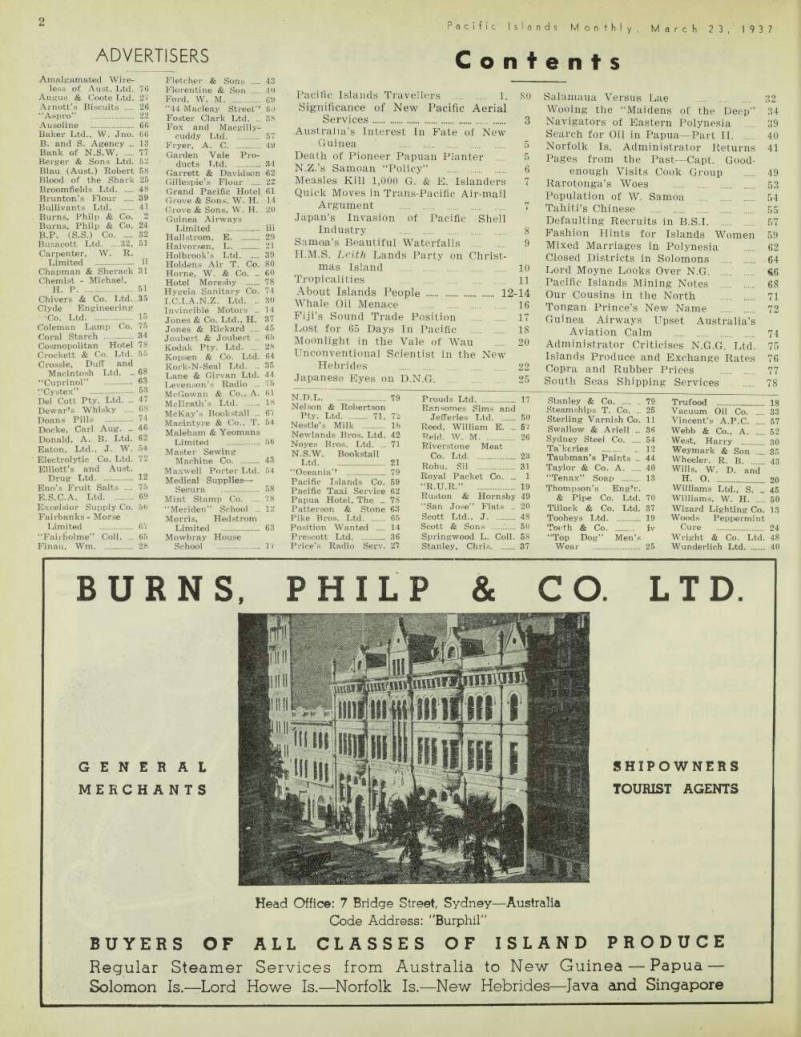
Advertisers
Amalgamated Wire less of Aust. Ltd. 76 Angus & Coote Ltd. 27 Arnott’s Biscuits 26 ■“A-spro” 22 Ausoline 66 Baker Ltd., W. Jno. 66 B. and S. Agency .. 13 Bank of N.S.W 77 Berger & Sons Ltd. 52 Blau (Aust.) Robert 58 Blood of the Shark 25 Broomfields Ltd 48 Brunton’s Flour ... 39 Bullivants Ltd 41 Burns, Philp & Co. 2 Burns, Philp & Co. 24
B.P. (S.S.) Co 32
Buzacott Ltd 32, 51 Carpenter, W. R.
Limited ii Chapman & Sherack 31 Chemist - Michael, H. P 51 Chivers & Co. Ltd., 35 Clyde Engineering Co. Ltd 15 Coleman Lamp Co. 75 Coral Starch 34 Cosmopolitan Hotel 78 Crockett & Co. Ltd. 55 Crossle, Duff and Macintosh Ltd. ... 68 “Cuprinol” 63 “Cystex” 53 Del Cott Pty. Ltd. ... 47 Dewar’s Whisky 68 Doans Pills 74 Docke, Carl Aug. ... 46 Donald, A. B. Ltd. 62 Eaton, Ltd., J- W. 54 Electrolytic Co. Ltd. 72 Elliott’s and Aust.
Drug Ltd - 12 Eno’s Fruit Salts ... 75
E.S.C.A. Ltd 69
Excelsior Supply Co. 56 Fairbanks - Morse Limited 67 “Fairliolme” Coll. ... 65 Finau, Wm 28
Fletcher & Sons ... 43 Florentine & Son 40 Ford, W. M 69 “44 Macleay Street’’ 60 Foster Clark Ltd. ... 38 Fox and Macgilly cuddy Ltd 57 Fryer, A. C 49 Garden Vale Pro ducts Ltd 34 Garrett & Davidson 62 Gillespie’s Flour 22 Grand Pacific Hotel 61 Grove & Sons, W. H. 14 Grove & Sons, W. H. 20 Guinea Airways Limited lii Hallstrom, E 29 Halvorsen, L 21 Holbrook’s Ltd 39 Holdens Air T. Co. 80 Horne. W. & Co. ... 60 Hotel Moresby 78 Hygeia Sanitary Co. 74
1.C.1.A.N.Z. Ltd. ... 30
Invincible Motors ... 14 Jones & Co. Ltd., H. 37 Jones & Rickard 45 Joubert & Joubert ... 65 Kodak Pty. Ltd 28 Kopsen & Co. Ltd. 64 Kork-N-Seal Ltd. ... 35 Lane & Girvan Ltd. 44 Levenson’s Radio ... 75 McGowan & Co., A. 61 Mcllrath’s Ltd 18 McKay’s Bookstall ... 67 Macintyre & Co., T. 54 Maleham & Yeomans Limited 56 Master Sewing Machine Co 43 Maxwell Porter Ltd. 54 Medical Supplies— Secura 58 Mint Stamp Co 78 “Meriden” School ... 12 Morris, Hedstrom Limited 63 Mowbray House School 1 17
N.D.L 79
Nelson & Robertson Pty. Ltd 71, 72 Nestle’s Milk lb Newlands Bros. Ltd. 42 Noyes Bros. Ltd. ... 71 N.S.W. Bookstall Ltd 21 “Oceania’’ 79 Pacific Islands Co. 59 Pacific Taxi Service 62 Papua Hotel, The ... 78 Patterson & Stone 63 Pike Bros. Ltd 65 Position Wanted 14 Prescott Ltd „ 36 Price’s Radio Serv, 27
Prouds Ltd 17 Ransomes Sims and Jefferies Ltd 50 Reed, William E. ... 57 Reid. W. M 26 Riverstone Meat Co. Ltd 23 Rohu, Sil 31 Royal Packet Co. ... 1
“R.U.R.” 19
Ruston & Hornsby 49 “San Jose” Flats ... 20 Scott Ltd., J 48 Scott & Sons 50 Springwood L. Coll. 58 Stanley, Chris 37
Stanley & Co. 79 Steamships T. Co. ... 25 Sterling Varnish Co. 11 Swallow & Ariell ... 36 Sydney Steel Co 54 Ta'ktries 12 Taubman’s Paints ... 44 Taylor & Co. A 40 “Tenax” Soap 13 Thompson’s Eng’r. & Pipe Co. Ltd. 70 Tillock & Co. Ltd. 37 Tooheys Ltd 19 Tooth & Co iv “Top Dog” Men’s Wear 25
Trufood 18 Vacuum Oil Co 33 Vincent’s A.P.C 57 Webb & Co., A 52 West, Harry 30 Weymark & Son 35 Wheeler, R. B. .. 43 Wills. W. D. and H. 0 20 Williams Ltd., S. ... 45 Williams, W. H 50 Wizard Lighting Co. 13 Woods Peppermint Cure 24 Wright & Co. Ltd. 48 Wunderlich Ltd. 40
Contents
Pacific Islands Travellers 1. 80 Significance of New Pacific Aerial Services 3 Australia’s Interest In Fate of New Guinea 5 Death of Pioneer Papuan Planter 5 N.Z.’s Samoan “Policy” 6 Measles Kill 1,000 G. &E. Islanders 7 Quick Moves in Trans-Pacific Air-mail Argument 7 Japan’s Invasion of Pacific Shell Industry 8 Samoa’s Beautiful Waterfalls 9 H.M.S. Leith Lands Party on Christ mas Island 10 Tropicalities 11 About Islands People 12-14 Whale Oil Menace 16 Fiji’s Sound Trade Position 17 Lost for 65 Days In Pacific 18 Moonlight in the Vale of Wau 20 Unconventional Scientist in the New Hebrides 22 Japanese Eyes on D.N.G 25
Salamaua Versus Lae 32 Wooing the “Maidens of the Deep” 24 Navigators of Eastern Polynesia 39 Search for Oil in Papua—Part II 40 Norfolk Is. Administrator Returns 41 Pages from the Past —Capt. Good enough Visits Cook Group 49 Rarotonga’s Woes 53 Population of W. Samoa 54 Tahiti’s Chinese 55 Defaulting Recruits in 8.5.1 57 Fashion Hints for Islands Women 59 Mixed Marriages in Polynesia 62 Closed Districts in Solomons 64 Lord Moyne Looks Over N.G 616 Pacific Islands Mining Notes 68 Our Cousins in the North 71 Tongan Prince’s New Name 72 Guinea Airways Upset Australia’s Aviation Calm 74 Administrator Criticises N.G.G. Ltd. 75 Islands Produce and Exchange Rates 76 Copra and Rubber Prices 77 South Seas Shipping Services 78
Advertisements & other items, p. 4 (1 item)
Burns, Philp & Co. Ltd.
GENERAL
MERCHANTS
IDE
w 111 mm
llil
mm HI m
SHIPOWNERS
TOURIST AGENTS
Head Office: 7 Bridge Street, Sydney— Australia Code Address: "Burphil"
BUYERS OF ALL CLASSES OF ISLAND PRODUCE Regular Steamer Services from Australia to New Guinea Papua Solomon Is.—Lord Howe Is. —Norfolk Is. —New Hebrides — lava and Singapore
Pacific Islands Monthly
The Newspaper-Magazine of the South Seas [Registered at the G.P,0., Sydney for transmission by post as a newspaper .]
Published Once Each Month and Circulated in Australia and New Zealand and in the following* Pacific Territories and Islands Groups:
Crown Colony of Fiji.
Australian Territory of Papua.
Mandated Territory (Australia) of New Guinea, Bismarck Archipelago and Northern Solomon Islands.
Mandated Territory (Japan) of Marshall, Caroline and Marianna Islands.
French Territory of New Caledonia.
British and French Condominium of New Hebrides.
American Territory of Eastern Samoa.
American Territory of Guam.
Mandated Territory of Nauru.
British Crown "Colony of Gilbert and Ellice Islands.
Mandated Territory (New Zealand) of Samoa.
British Solomon Islands Protectorate.
British Protectorate of Tongan Islands.
New Zealand Territory of Cook Islands.
Australian Territory of Norfolk Island.
French Colony of Oceania (Tahiti, etc.).
American Territory of Hawaiian Islands.
Owned and Produced by Pacific Publications Ltd., Union House, 247 George Street, Sydney
Telephone Bw 5037
P.O. Box 3408 R
Registered Address of Telegrams, Radiograms, and Cables: “Pacpub,” Sydney.
Contributions
Articles, Stories, and Photographs dealing with Pacific Islands subjects are invited, and will be paid for on publication at usual rates.
Subscription Rates
Per Annum, within British Empire, Prepaid, Post Free 8/- Per Annum, elsewhere, prepaid. Post Free 107- Single Copies Bd.
Editor and Publisher:
R. W. Robson. F.R.G.S.
Advertisements
Advertising rates furnished on application.
Colours, etc. by Arrangement Process Blocks made at Advertiser’s expense when required. Screen, 100.
Changes of Advertising Copy should reach this Office by Bth of each month, otherwise previous advertisement may be repeated.
Agents
The following are authorised to receive subscrip tions for the Pacific Islands Monthly:— Islands Branches of Burns, Philp & Co. Ltd., and Burns Philp (South Sea) Co., Ltd.
Islands Branches of W. R. Carpenter & Co., Ltd.
All Branches of Morris, Hedstrom & Co., Ltd.
Q. Thomas & Co., Rabaul, New Guinea.
Whitten Bros., Ltd., Samarai, Papua.
Steamships Trading Co., Papua. All Branches.
P. Costello, Suva, Fiji.
J. Muir, Suva, Fiji.
All Branches and Representatives of W. H. Grove and Sons, Ltd., Auckland, New Zealand.
Cook Islands Trading Co., Rarotonga, Cook Is.
W. H. Watson, Rarotonga. Cook Is.
A. C. Rowland, Papeete, Tahiti.
Representative in London: W. C. HARVEY, Coronation Building. 4 Lloyds Avenue, London, E.C.2. from whom may be obtained copies of Pacific Islands Monthly, Pacific Islands Year Book, advertising schedules, etc.
Vol. VIL, No. 8.
Sydney, March 23, 1937.
PnVp ( Bd> Per Copy r I ICC ( Prepaid: 8/- p.a.
Political and Economic Significance of New Pacific Aerial Services
New Pacific Aerial Services
THERE is something of great signifi cance for all Pacific Territories in the month’s developments in aviation.
The first steps have been taken in the establishment of services which must profoundly affect life in the Pacific Is lands; and an understanding apparent y has been reached between Britain and the United States which yet may change the political face of the Pacific.
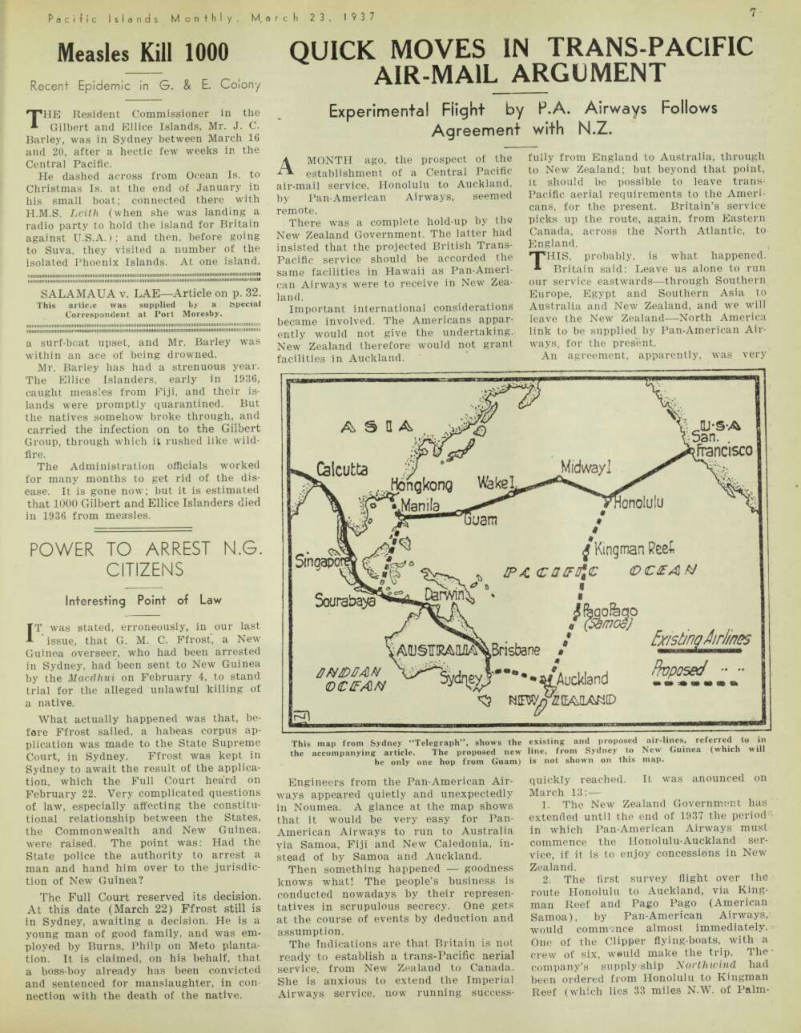
Great 4-engined Martin Clippers, oper ated by Pan-American Airways, now fly weekly across the North Pacific (’Frisco Honolulu Midway Wake Guam —Manila—Hong Kong). Under an agree ment, reached in Auckland on March 12, between the N.Z. Government and Pan- American Airways, another line of Clip pers will run south from Honolulu to Auckland, the route being Honolulu to Kingman Reef (1000 miles); Kingman to Pago Pago, American Samoa (1700 miles) ; Pago Pago to Auckland (2000 miles).
A P.A.A. Sikorsky flying-boat left ’Frisco on March 17 to survey the route to Auckland, and was expected in Auck
land within a week.
A regular service—fortnightly at first, but coming presently to weekly— may start within six months. Some reports say Boeing flying-boats will be used others say Martin aeroplanes. In any event, they are huge, 4-engined machines, carrying a crew of about seven, and from 40 to 48 passengers.
The Dutch air-lines are putting in a service which will run from Sourabaya (Java) to connect with the P.A.A. North Pacific service at Manila. The new Sydney—New Guinea service almost cer tainly will go one hop further, and con nect with the P.A.A. North Pacific ser vice at Guam.
These developments have occurred in the midst of warring polities, both eco nomic and international. But, whatever the circumstances of their appearance, the fact remains that within a very few years they will wholly change the tempo of life — commercial, industrial, social and political-—in the Pacific.
There was a long hold-up, while British influences stubbornly resisted the Amer
leans’ attempt to establish the Honolulu —N.Z. —Australian air-service. Imperial Airways (which in the ultimate analysis is an association of the British Govern ment with the British shipping combine) wanted the way left clear for an exten sion of their service from Australia ac ross the Pacific to Canada. H.M.S. Leith slipped quietly away from Suva, in Janu ary, and formally occupied Christmas Is , which the Americans apparently needed.
Then, quite suddenly, the British resis tance disappeared, and the agreement was announced with the proviso that the P.A.A. service should terminate in Auckland, and not come to Australia.
What happened, no one knows; but it is possible to make a shrewd guess.
P.A.A., barred from New Zealand, was getting ready to run to Australia via the non-British islands of Pago Pago and New Caledonia. That brought both the British and N.Z. Governments sharply to attention, and they in turn forced Im perial Airways to accept a compromise— P.A.A. to have the Pacific to themselves, for the present, but to keep away from Australia. A bleating protest from the Commonwealth Government, that the Auckland agreement was made without its knowledge, bears out our theory. The Commonwealth Government is powerfully
influenced by the British Shipping Com bine; but the latter is anathema to the N.Z. Labour Government.
It nnll he found, however, that the Americans made a concession. The British air-lines may use Honolulu as a port, when they are ready to enter the Pacific trade.
All this may have a bearing upon the Pacific shipping position. The three Governments concerned (Britain, Austra lia, N.Z.) still are merely toying with the idea of subsidising the Union Line against the American ships. The long delay almost certainly is due to the N.Z.
Government’s hatred of the British Ship ping Combine.
Are we now to see a new development —namely, British interests, influenced by New Zealand, abandoning the Pacific transport industry to American interests, on the understanding that it is now pos
"Guinea Airways Upset Australia's Aviation Calm."—See article on page 74.
sible to get an Anglo-American agree ment to maintain the status quo in the Pacific against the ever-growing power of Japan? Internationally considered, the'thing has logic in it; Australia and New Zealand could not pay too high a price for American friendship and Ameri can co-operation with Britain in the Pacific. But, from the political-Socialists’ viewpoint, the thing is absurd. Why sacrifice the British shipping combine, which at least is subject to some control by democratic institutions and by human itarians, to the Americans, when Ameri can combines notoriously are the last word in ruthlessness and inhumanity?
However, amid all the complications caused by these international considera tions, commercial rivalries and contests between politico-social systems, the fact remains that the Pacific territories are to get aerial transport systems much more quickly than ever was anticipated; and they should prepare accordingly.
Incidentally, Fiji should get busy. It would be a calamitous thing if the P.A.A.
Clippers, flying direct from Pago Pago to Auckland, merely buzzed along Fiji’s eastern horizon. If P.A.A. are to be left alone in the Pacific, they should give some consideration to the British coun tries there, and Fiji is big enough to expect some sort of attention from the Central Pacific air-mail service.
Mr. D. Stewart, sales manager for Messrs. Holbrooks (A/asia) Ltd., will make a business visit to Papua and New Guinea in May and June. He will make the round trip by the Montoro, leaving on May 15.
Mr. C. J. Black, of Pacific Cable Board
staff, accompanied by Mrs. Black, left
Sydney in March for Honolulu, en route for the cable-station at Fanning Island.
They will be two years on Fanning Island,
"Citizens" & "Subjects"
Curious Position of French Oceania Natives
From Our Own Correspondent
Papeete, Feb. 26.
'T'HE law relative to the recruitment of * natives of French Oceania for labour service outside the colony, promulgated in July, 1936, has been revised.
It reads now as follows:—“All engage ment of subjects of France for enter prises or exploitations situated on foreign territories, is prohibited. The organisa tion of stations of recruitment of native labourers for the colonies or foreign lands, wherever they may be, is inter dicted in the colony.”
The earlier law was so worded that the prohibition included citizens. It is now changed to apply only to subjects.
The rather curious condition existing in French Oceania divides the native inhabitants into citizens and subjects.
The inhabitants of Tahiti, Moorea, and the Tuamotu Archipelago, are citizens of France. The natives of the Leeward Society Islands, Austral Islands, and Marquesas Islands, not having been ad mitted to the privilege of citizenship, are classed as subjects.
Unfounded Report Causes
Stir In Papua
THERE was a stir in Port Moresby on March 15, when radio receivers picked up a voice coming apparently from a remote transmitter in the Papuan jungle—which announced that a party on or near the Strickland River, consisting of two white men, with police and car riers, had been massacred.
Then there was silence. Every effort to locate or identify the mysterious voice failed.
The Administration made a very rapid check up on parties in the west. It found that only two parties in the Strick land region were not accounted for-an outlying Ward Williams party, and the party sent out by Investors Ltd., led by Messrs. Jack Hides and Dave Lyall.
Later, it was found that the message actually came from Jack Hides’s camp on the Strickland, and was based merely on a report received through native chan nels. No confirmation whatever of the report could be obtained.
Mr. W. Wise, Director of Public Works in Fiji, returned to Suva from England by the Waipawa recently. He was accom panied by Mrs. Wise.
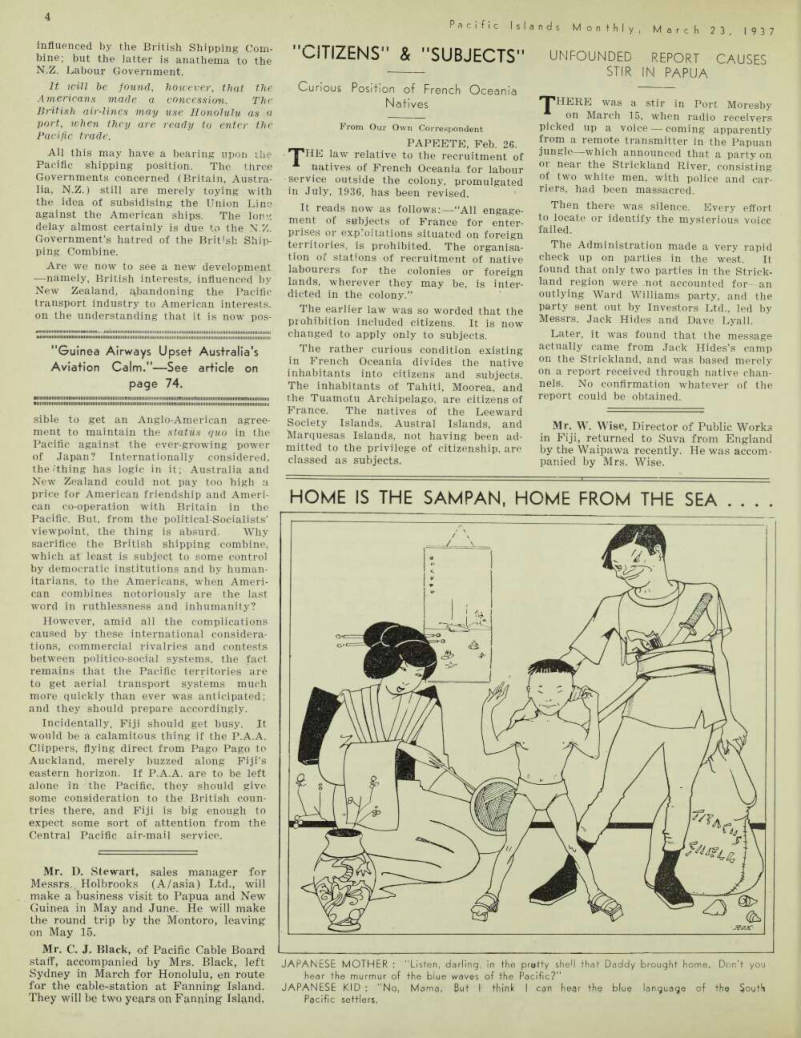
Home Is The Sampan. Home From The Sea ....
HOME IS THE SAMPAN. HOME FROM THE SEA ...
JAPANESE MOTHER: "Listen, darling, in the pretty shell that Daddy brought home. Don't you hear the murmur of the blue waves of the Pacific?"
JAPANESE KID: "No, Mama. But I think I can hear the blue language of the South Pacific settlers.
Arrack Banned
Effort To Wipe Out "Coconut Booze" in Tahiti
From Our Own Correspondent
Papeete, Mar. 1.
STRINGENT laws carrying heavy pen alties have been enacted by the Gov ernment of French Oceania against the manufacture, sale, possession, and even the drinking of Arrack. Arrack —as is well-known is the product resulting from the distillation of fermented sap of the coconut tree, obtained by tapping the stalk of the blossom before the nut is formed.
As a matter of fact, there has been surprisingly little Arrack made in these islands, except in the Marquesas. The laws are very rigid against the sale or supplying cf spirits to natives on islands other than Tahiti and Moorea.
Aware that tapping the coconut blos som stalk injures the tree, the thrifty Tuamotu native provides himself with good cheer by other and more crafty methods. There have been many five gallon kerosene tins properly labelled and apparently in the condition in which they left the refinery—that have miracu lously metamorphosed their contents, in transit to the Tuamotu Islands, into high proof rum. Then some wily merchant discovered that tinned Hawaiian pine apple, when boiled and the mixture fer mented, could be made into a beverage of potent authority. On the high islands, orange beer and orange rum are the stan dard “moonshine” beverages.
It is a melancholy but well-known fact that alcoholic liquors have played a major role in the decimation of the Polynesians.
Round-World Flight
Amelia Earhart Crashes On Round-World Flight
A FTER months of careful preparation, Amelia Earhart, famous American airwoman, left San Francisco on March 17 in a Lockheed-Electra ’plane to fly around the world (27,000 miles), via Hawaii, Howland Is., Lae (New Guinea), East Indies, India, Central Africa, South America, and Central America.
With three companions, Messrs. Paul Mantz, Fred Noonan, and Harry Man ning, she made a record crossing to Hawaii.
While trying to take off from Honolulu on March 21 for Howland Island, the machine crashed and was so badly dam aged that the round-the-world flight had to be abandoned. The three occupants —Amelia Earhart (otherwise Mrs George Putnam, wife of the well-known Ameri can publisher) and Messrs. Noonan and Manning (navigators) escaped injury.
They are returning to U.S.A. by steamer.
Mrs. Earhart Putnam expressed deter mination to attempt the round-the-world flight again later.
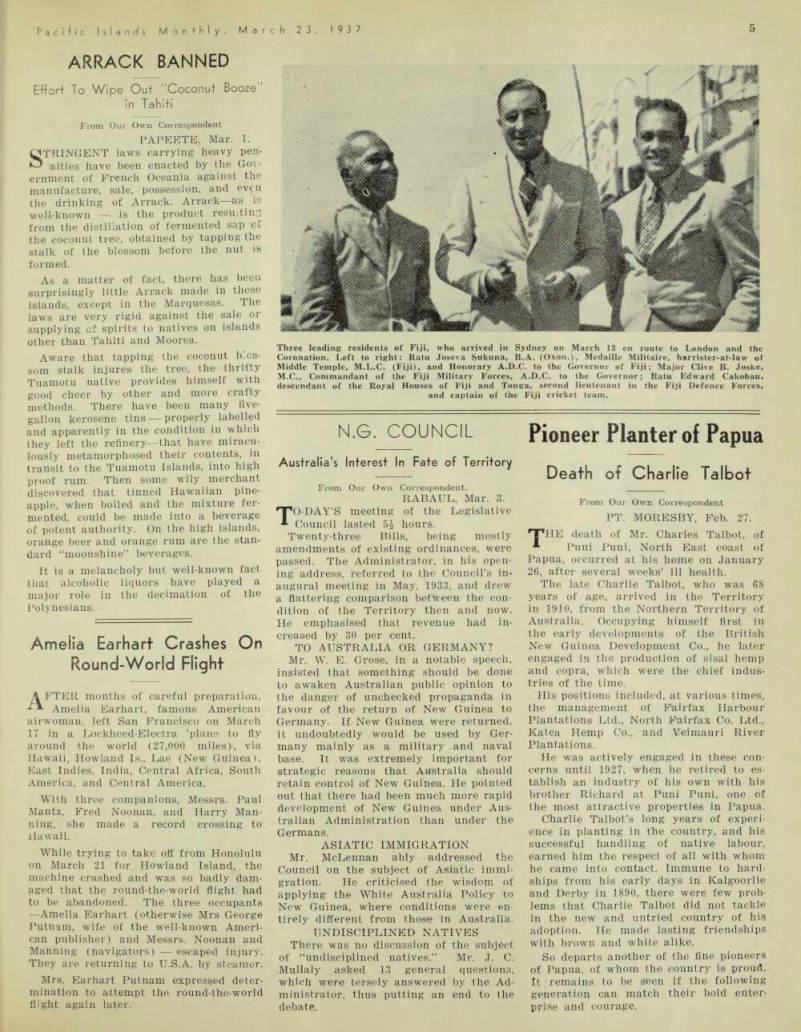
Three leading residents of Fiji, who arrived in Sydney on March 13 en route to London and the Coronation. Left to right: Ratu Joseva Sukuna, B.A. (Oxon.), Mcdaille Militaire, barrister-at-law of Middle Temple, M.L.C. (Fiji), and Honorary A.D.C. to the Governor of Fiji; Major Clive B. Joske, M.C., Commandant of the Fiji Military Forces, A.D.C. to the Governor; Ratu Edward Cakobau, descendant of the Royal Houses of Fiji and Tonga, second lieutenant in the Fiji Defence Forces, and captain of the Fiji cricket team.
N.G. Council
Australia's Interest In Fate of Territory
From Our Own Correspondent.
Rabaul, Mar. 3.
TO-DAY’S meeting of the Legislative Council lasted 5g hours.
Twenty-three Bills, being mostly amendments of existing ordinances, were passed. The Administrator, in his open ing address, referred to the Council’s in augural meeting in May, 1933, and drew a flattering comparison between the con dition of the Territory then and now.
He emphasised that revenue had in creased by 30 per cent.
To Australia Or Germany?
Mr. W. E. Grose, in a notable speech, insisted that something should be done to awaken Australian public opinion to the danger of unchecked propaganda in favour of the return of New Guinea to Germany. If New Guinea were returned, it undoubtedly would be used by Ger many mainly as a military and naval base. It was extremely important for strategic reasons that Australia should retain control of New Guinea. He pointed out that there had been much more rapid development of New Guinea under Aus tralian Administration than under the Germans.
Asiatic Immigration
Mr. McLennan ably addressed the Council on the subject of Asiatic immi gration. He criticised the wisdom of applying the White Australia Policy to New Guinea, where conditions were en tirely different from those in Australia.
Undisciplined Natives
There was no discussion of the subject of “undisciplined natives.” Mr. J. C.
Mullaly asked 13 general questions, which were tersely answered by the Ad ministrator, thus putting an end to the debate.
Pioneer Planter of Papua
Death of Charlie Talbot
From Our Own Correspondent
Pt. Moresby, Feb. 27.
THE death of Mr. Charles Talbot, of * Puni Puni, North East coast of Papua, occurred at his home on January 26, after several weeks’ ill health.
The late Charlie Talbot, who was 68 years of age, arrived in the Territory in 1910, from the Northern Territory of Australia. Occupying himself first in the early developments of the British New Guinea Development Co., he later engaged in the production of sisal hemp and copra, which were the chief indus tries of the time.
His positions included, at various times, the management of Fairfax Harbour Plantations Ltd., North Fairfax Co. Ltd., Katea Hemp Co., and Veimauri River Plantations.
He was actively engaged in these con cerns until 1927, when he retired to es tablish an industry of his own with his brother Richard at Puni Puni, one of the most attractive properties in Papua.
Charlie Talbot’s long years of experi ence in planting in the country, and his successful handling of native labour, earned him the respect of all with whom he came into contact. Immune to hard ships from his early days in Kalgoorlie and Derby in 1890, there were few prob lems that Charlie Talbot did not tackle in the new and untried country of his adoption. He made lasting friendships with brown and white alike.
So departs another of the fine pioneers of Papua, of whom the country is proud.
It remains to be seen if the following generation can match their bold enter prise and courage.
Samoan “Policy”
N.Z. Minister Resents Being Nagged At In Geneva
From Our Own Correspondent.
Auckland, Mar. 10
THE N.Z. Minister, Mr. W. A. Nash. when before the League of Nations Council in Geneva in January, expressed resentment at the manner in which he had been cross-examined about Samoa by the Mandates Commission.
Mr. Nash said the new N.Z. Govern ment sent a Cabinet Minister and a private member to Samoa to find the best way of rectifying native grievances. The Government then formulated a policy, which it submitted to the Mandates Com mission. But, instead of accepting that as an indication of N.Z.’s intentions, the Commission proceeded to cross-examine the N.Z. representative as if it were dis satisfied with what had been done, and proposed.
A member of the Commission said there had been no cross-examination only a full and friendly discussion. Some of the members of the Commission were ready to express surprise, not on any point of policy, but at the manner in which the new policy and the reasons for the change had been announced to the natives. It was felt in some quarters that possibly the exhilaration of victory in New Zealand had led to misunder standing.
EDITORIAL NOTE, The Minister’s quaint assumption that the “Goodwill Mission’s” visit to Samoa, and the N.Z. Government’s Samoan pol icy, could not deserve anything but praise, is typical of the politician. It must be very irri tating to such a man to find that the Mandates Commission, will give consideration to information received from other quarters. Everyone knows what the “Goodwill Mission” achieved • no use flogging that poor horse again. But it is inter esting to learn that the N.Z. Government has a Samoan policy. Has anyone seen it? What is it object? Samoa for the Samoans, we presume.
Woman Missionary Killed
By Dog
From a Special Correspondent
Samarai, Mar. 10.
BADLY mauled by a dog, Miss Nellie Hullett, a South Australian member of the Anglican Mission at Dogifra, East ern Papua, since 1910, had to face a 100-miles sea trip in a small launch to reach medical aid. She died shortly after being admitted to Samara! Hospital.
An old favourite pet, the dog went into Miss Hullett’s room early in the morning and put his forelegs on the bed. Miss Hullett pushed him off, and he seized her forearm. She caught his ears with her free hand, and called for help.
A mission teacher rushed to her aid, but she refused to let the dog go lest someone else should be hurt. Snarling, the animal broke free and caught her other arm. Both arms were badly torn from wrist to shoulder.
Copra Store Destroyed In
Suva Fire
From Our Own Correspondent.
Suva, Mar. 18.
THE concrete copra store of Messrs.
Morris Hedstrom Ltd., in Suva, was destroyed by fire on March 13. About 300 tons of copra were lost. The adjoining oilworks, operated by the Union Soap Company, was saved. The southern wall of this building will probably need re constructing.
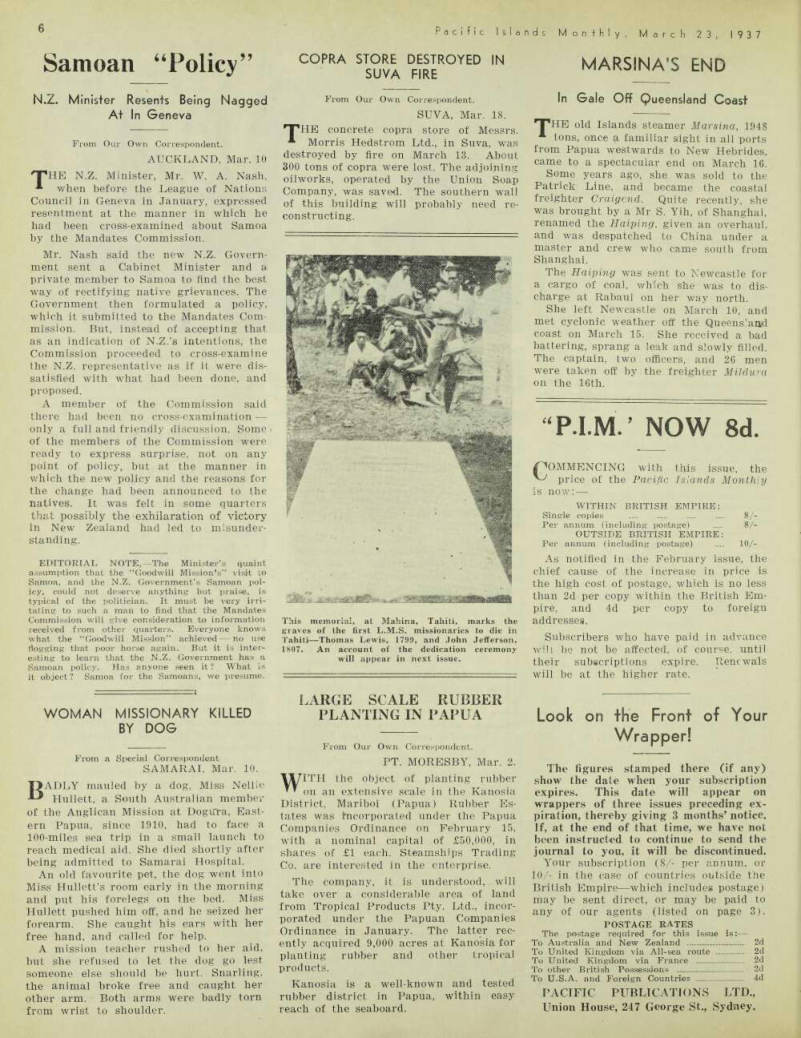
This memorial, at Mahina, Tahiti, marks the graves of the first L.M.S. missionaries to die in Tahiti—Thomas Lewis, 1799, and John Jefferson, 1807. An account of the dedication ceremony will appear in next issue.
Large Scale Rubber
Planting In Papua
From Our Own Correspondent.
Pt. Moresby, Mar. 2.
117ITH the object of planting rubber ** on an extensive scale in the Kanosia District, Mariboi (Papua) Rubber Es tates was tncorporated under the Papua Companies Ordinance on February 15, with a nominal capital of £50,000, in shares of £1 each. Steamships Trading Co. are interested in the enterprise.
The company, it is understood, will take over a considerable area of land from Tropical Products Pty. Ltd., incor porated under the Papuan Companies Ordinance in January. The latter rec ently acquired 9,000 acres at Kanosia for planting rubber and other tropical products.
Kanosia is a well-known and tested rubber district in Papua, within easy reach of the seaboard.
Marsina's End
In Gale Off Queensland Coast
'THE old Islands steamer Marsina, 1948 * tons, once a familiar sight in all ports from Papua westwards to New Hebrides, came to a spectacular end on March 16.
Some years ago, she was sold to the Patrick Line, and became the coastal freighter Craigend. Quite recently, she was brought by a Mr S. Yih, of Shanghai, renamed the Haiping , given an overhaul, and was despatched to China under a master and crew who came south from Shanghai, The Haiping was sent to Newcastle for a cargo of coal, which she was to dis charge at Rabaul on her way north.
She left Newcastle on March 10, and met cyclonic weather off the Queensland coast on March 15. She received a bad battering, sprang a leak and slowly filled.
The captain, two officers, and 26 men were taken off by the freighter Mildura on the 16th.
“P.I.M. ’ Now 8D.
COMMENCING with this issue, the price of the Pacific Islands Monthly is now:
Within British Empire:
Single copies 8/- Per annum (including postage) 87-
Outside British Empire:
Per annum (including postage) 10/- As notified in the February issue, the chief cause of the increase in price is the high cost of postage, which is no less than 2d per copy within the British Em pire, and 4d per copy to foreign addresses.
Subscribers who have paid in advance will be not be affected, of course, until their subscriptions expire. Renewals will be at the higher rate.
Wrapper!
Look on the Front of Your Wrapper!
The figures stamped there (if any) show the date when your subscription expires. This date will appear on wrappers of three issues preceding ex piration, thereby giving 3 months’ notice.
If, at the end of that time, we have not been instructed to continue to send the journal to you, it will be discontinued.
Your subscription (8/- per annum, or 10/- in the case of countries outside the British Empire—which includes postage) may be sent direct, or may be paid to any of our agents (listed on page 3).
Postage Rates
The postage required for this issue is:- To Australia and New Zealand 2d To United Kingdom via All-sea route 2d To United Kingdom via France 2d To other British Possessions 2d To U.S.A. and Foreign Countries 4d
Pacific Publications Ltd.,
Union House, 247 George St., Sydney.
Measles Kill 1000
Recent Epidemic in G. & E. Colony
THE Resident Commissioner in the Gilbert and Ellice Islands, Mr. J. C.
Barley, was in Sydney between March 16 and 20, after a hectic few weeks in the Central Pacific.
He dashed across from Ocean Is. to Christmas Is. at the end of January in his small boat; connected there with H.M.S. Leith (when she was landing a radio party to hold the island for Britain against U.S.A.); and then, before going to Suva, they visited a number of the isolated Phoenix Islands. At one island,
SALAMAUA v. LAE —Article on p. 32.
This article was supplied by a bpecial Correspondent at Port Moresby.
a surf-beat upset, and Mr. Barley was within an ace of being drowned.
Mr. Barley has had a strenuous year.
The Ellice Islanders, early in 1936, caught measles from Fiji, and their is lands were promptly quarantined. But the natives somehow broke through, and carried the infection on to the Gilbert Group, through which it rushed like wild fire.
The Administration officials worked for many months to get rid of the dis ease. It is gone now; but it is estimated that 1000 Gilbert and Ellice Islanders died in 1936 from measles.
Citizens
Power To Arrest N.G.
Interesting Point of Law
IT was stated, erroneously, in our last ’ issue, that G. M. C. Ffrost, a New Guinea overseer, who had been arrested in Sydney, had been sent to New Guinea by the Macdhui on February 4, to stand trial for the alleged unlawful killing of a native.
What actually happened was that, be fore Ffrost sailed, a habeas corpus ap plication was made to the State Supreme Court, in Sydney. Ffrost was kept in Sydney to await the result of the applica tion, which the Full Court heard on February 22. Very complicated questions of law, especially affecting the constitu tional relationship between the States, the Commonwealth and New Guinea, were raised. The point was: Had the State police the authority to arrest a man and hand him over to the jurisdic tion of New Guinea?
The Full Court reserved its decision.
At this date (March 22) Ffrost still is in Sydney, awaiting a decision. He is a young man of good family, and was em ployed by Burns, Philp on Meto planta tion. It is claimed, on his behalf, that a boss-boy already has been convicted and sentenced for manslaughter, in con nection with the death of the native.
Quick Moves In Trans-Pacific
Air-Mail Argument
Experimental Flight by P.A. Airways Follows Agreement with N.Z.
A MONTH ago, the prospect of the establishment of a Central Pacific air-mail service, Honolulu to Auckland, by Pan-American Airways, seemed remote There was a complete hold-up by the New Zealand Government. The latter had insisted that the projected British Trans- Pacific service should be accorded the same facilities in Hawaii as Pan-American Airways were to receive in New Zeaj an( j Important international considerations became involved. The Americans apparently would not give the undertaking, New Zealand therefore would not grant facilities in Auckland.
Engineers from the Pan-American Airways appeared quietly and unexpectedly in Noumea. A glance at the map shows that it would be very easy for Pan- American Airways to run to Australia yia Samoa, Fiji and New Caledonia, instead of by Samoa and Auckland.
Then something happened goodness knows what! The people’s business is conducted nowadays by their representatives in scrupulous secrecy. One gets at the course of events by deduction and assumption.
The Indications are that Britain is not ready to establish a trans-Pacific aerial service, from New Zealand to Canada.
She is anxious to extend the Imperial Airways service, now running success-
fully from England to Australia, through to New Zealand; but beyond that point, it should be possible to leave trans- Pacific aerial requirements to the Amen cans, for the present. Britain’s service picks up the route, again, from Eastern Canada, across the North Atlantic, to England.
'THIS, probably, is what happened, 1 Britain said: Leave us alone to run our service eastwards—through Southern Europe, Egypt and Southern Asia to Australia and New Zealand, and we will leave the New Zealand—North America link to be supplied by Pan-American Air ways, for the present, An agreement, apparently, was very
quickly reached. It was anounced on March 13: 1. The New Zealand Government has extended until the end of 1937 the period in which Pan-American Airways must commence the Honolulu-Auckland ser vice, if it is to enjoy concessions in New Zealand, 2. The first survey flight over the route Honolulu to Auckland, via King man Reef and Pago Pago (American Samoa), by Pan-American Airways, would commence almost immediately.
One of the Clipper flying-boats, with a crew of six, would make the trip. Ihe company’s supply-ship Northwind had been ordered from Honolulu to Kingman Reef (which lies 33 miles N.W. of Palm
This map from Sydney “Telegraph”, shows the existing and proposed air-lines, referred to in the accompanying article. The proposed new line, from Sydney to New Guinea (which will be only one hop from Guam) is not shown on this map.
yra, is 9J miles by 5 miles, and is simply a half-submerged coral reef enclosing an area of sheltered water). 3. The air-mail service between Aus tralia and New Zealand, representing the extension to New Zealand of the Imperial Airways service, will be controlled by a commission or board, on which the Gov ernments of Britain, Australia, and New Zealand will be represented.
On March 17, the original China Clipper, commanded by Captain Edwin Musick, took off from San Francisco on the first stage of the survey flight to New Zealand. The giant Sikorsky flying boat is due in Auckland on March 25.
TTHESE announcements seemed to make * the position quite clear. But there was a protest from Canberra, which said that “a trans-Pacific air service is one of contemplated major extensions of the Empire air routes”; that Australian traffic would be conserved for this ser vice; and that it knew nothing of any new agreement between New Zealand and Pan-American Airways. Which suggested that Canberra was either well behind the times, as usual; «r that the N.Z. Govern ment had taken action of a very impor tant character entirely on its own ac count.
When the curious history of these early preparations for a trans-Pacific service, north to south comes to be writ ten, a tribute will be paid to the work of Harold Gatty, champion airman and Australasian representative of Pan-Amer ican Airways. He has spent most of the past two years in New Zealand negoti ating very patiently and skilfully for the removal of scores of difficulties created by Governments and bureaucra cies. There are many practical difficul ties in the track of the proposed new service the provision of moorings, spares, workshops and accommodation; the need for regular weather data; the problem of radio stations, etc. — but Mr.
Gatty probably will say that they are as nothing in comparison with the obstacles created by Governments.
'THE rapid development of the Pan- American North Pacific service (’Frisco Hawaii —Guam —Manila —China) has given a new importance to the proposed Sydney—New Guinea service (see article on page 74).
The Dutch East Indies Airline have just completed an arrangement to run regular planes between Sourabaya and Manila, where they will connect with the Pan-American service. From Sourabaya, passengers and mails can connect with the Anglo-Australian service.
But the Sydney—New Guinea service may provide Australia with a quicker route. A plane, flying north from New Guinea, could easily reach Guam in one hop, and connect there with the Pan- American service. In other words, a modern plane could fly southwards from Guam to Sydney, via New Guinea, in two days.
Mr. R. A. Derrick, of the Methodist Mission’s Technical Institution at Davui levu, Fiji, left Sydney in February.
Japan's Invasion Of Pacific Shell Industry
A N increasing amount of alarmed atten tion is being given in Australia to the penetration and capture of the Aus tralian pearling industry by the Japanese.
The matter probably will attain inter national importance presently. By that time, the industry will be irrevocably Japanese. It is two-thirds Japanese now.
The development is in two phases. In the first phase, the Japanese invaded the northern Australian pearl-shelling indus try (which has its centres in the north west towns—Derby, Broome, Wyndham, Darwin, etc.) and, by their skill and in dustry, and their temperamental suitable ness as divers, they pushed out most of the Malays, Koepangers and Filipinos, and virtually staffed the industry. Then they proceeded to supplant the Europeans and to own and direct the industry. That is the position to-day. The whole story is told, in detail, in lon Idriess’s new book, Forty Fathoms Deep.
The second phase is just as serious.
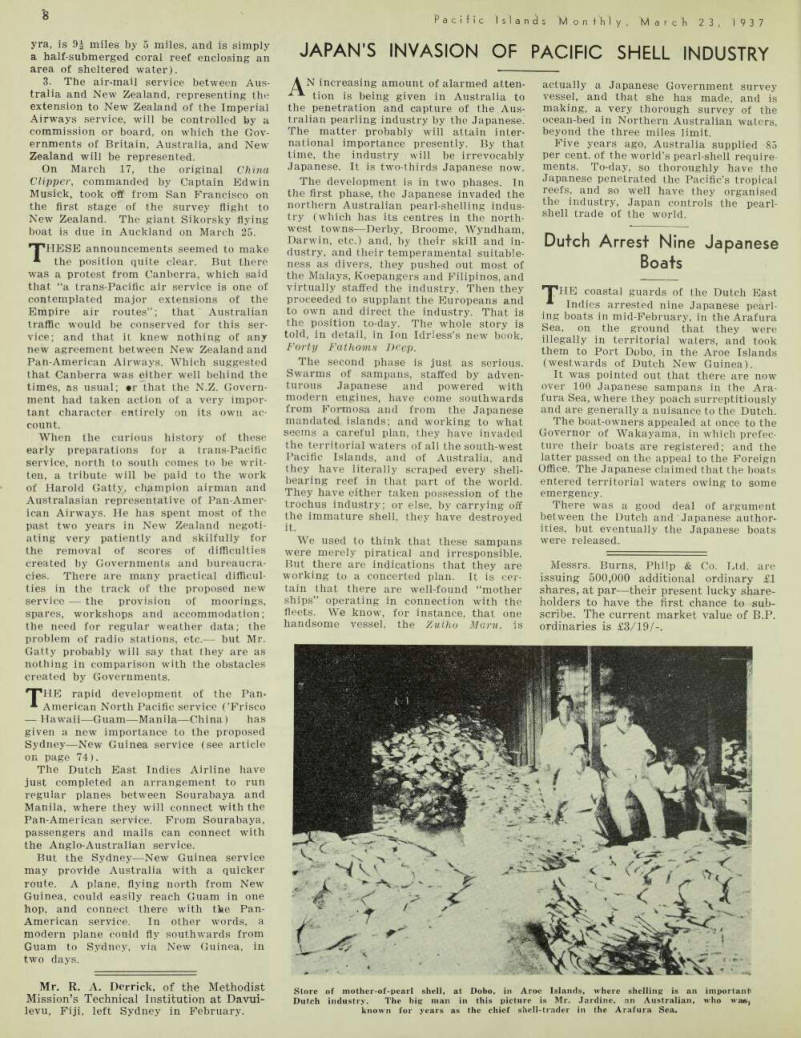
Swarms of sampans, staffed by adven turous Japanese and powered with modern engines, have come southwards from Formosa and from the Japanese mandated islands; and working to what seems a careful plan, they have invaded the territorial waters of all the south-west Pacific Islands, and of Australia, and they have literally scraped every shell bearing reef in that part of the world.
They have either taken possession of the trochus industry: or else, by carrying off the immature shell, they have destroyed it.
We used to think that these sampans were merely piratical and irresponsible.
But there are indications that they are working to a concerted plan. It is cer tain that there are well-found “mother ships” operating in connection with the fleets. We know, for instance, that one handsome vessel, the Zuiho Maru, is
actually a Japanese Government survey vessel, and that she has made, and is making, a very thorough survey of the ocean-bed in Northern Australian waters, beyond the three miles limit.
Five years ago, Australia supplied 85 per cent, of the world’s pearl-shell require ments. To-day, so thoroughly have the Japanese penetrated the Pacific’s tropical reefs, and so well have they organised the industry, Japan controls the pearl shell trade of the world.
Dutch Arrest Nine Japanese
Boats
The coastal guards of the Dutch East ■*' Indies arrested nine Japanese pearl ing boats in mid-February, in the Arafura Sea, on the ground that they were illegally in territorial waters, and took them to Port Dobo, in the Aroe Islands (westwards of Dutch New Guinea).
It was pointed out that there are now over 100 Japanese sampans in the Ara fura Sea, where they poach surreptitiously and are generally a nuisance to the Dutch.
The boat-owners appealed at once to the Governor of Wakayama, in which prefec ture their boats are registered; and the latter passed on the appeal to the Foreign Office. The Japanese claimed that the boats entered territorial waters owing to some emergency.
There was a good deal of argument between the Dutch and Japanese author ities, but eventually the Japanese boats were released.
Messrs. Burns, Philp & Co. Ltd. are
issuing 500,000 additional ordinary £1
shares, at par—their present lucky share
holders to have the first chance to sub scribe. The current market value of B.P, ordinaries is £3/19/-.
Store of mother-of-pearl shell, at Dobo, in Aroe Islands, where shelling is an important Dutch industry. The big man in this picture is Mr. Jardinc, an Australian, who was, known for years as the chief shell-trader in the Arafura Sea.
Unknown N. Guinea
Young Explorers Plan to Penetrate British and Dutch Territories
SUPPORTED by the Royal Geographical Society, an expedition is being or ganised in England by Mr A. J. Marshall, a Sydney zoologist, to explore Papua and the British and Dutch sections of New Guinea in 1938.
The party will sail from London for Papua in November next. Though their actual route is at present indefinite, they hope to go up the Fly River, in the West ern Division, and across the watershed, through primitive country, to the north coast of the Mandated Territory of New Guinea. Then they will seek to penetrate Dutch New Guinea.
Members of the expedition will include Gandar Dower, an international tennis player; Mr. Tom Harrisson, a member of the Oxford Expedition to the New Hebri des in 1933; and Mr. Humphrey Spender, a surveyor and photographer. The oldest member of the party will be Mr. Dower, who is 26 years of age.
Mr. Marshall has already completed a preliminary reconnaissance of portion of the country through which the expedition will travel. He visited the area behind the Torricelli Mountains in North East New Guinea and then crossed over into the Dutch territory, returning to Hum boldt Bay, the Dutch settlement near the border.
The English committee, which is as sisting in the work of making prepara tions for the expedition, consists of Pro fessor A. C. Haddon, the eminent ethno logist; Mr. Julian Huxley, secretary of the Zoological Society; Admiral Good enough, a former president of the Royal Geographical Society; and Mr. H. G.
Wells, the prominent writer.
The "Muliama"
B.P.'s New Inter-Island Vessel Will Be Ready in July
NOW undergoing construction, the new vessel ordered for Mesrs. Burns, Philp and Co. Ltd. for the inter-island trade in New Guinea will be put into commission in July. She will be named the Muliama.
There will be cabin accommodation for eight passengers, as well as a dining saloon and comfortable lounge. She is being fitted with Diesel engines which will give her a speed of just over 10 knots. Her dimensions will be: length 165 feet, and beam 31 feet.
The steamer will have a capacity for 400 to 500 tons of general cargo. Ample space will be provided for refrigerated goods.
Mr. Peter Rassmussen, of Tufuiopa, Western Samoa, married Miss Anna Celestina Bet ham, of Vaimea, at Apia Protestant Church on February 6.
Samoa's Beautiful
Waterfalls
Re-discovery of "Schultz's Shower
IT is worthy of note that an organi sation of Apia citizens, under the presidency of Mr. A. G. Smyth, named the Town Planning Committee, is taking steps to open up the numerous waterfalls for the use and pleasure of citizens and tourists.
These waterfalls of Upolu, Western Samoa, are almost unique. They come pouring down off the tableland, at many places along the littoral; and, buried in the cool jungle, they provide shower-
baths and bathing-pools about which poets and similarly romantic people have raved for 50 years.
Some of these delightful waterfalls have been allowed to return to the primitive jungle; but the new committee is now planning to make most of them readily accessible.
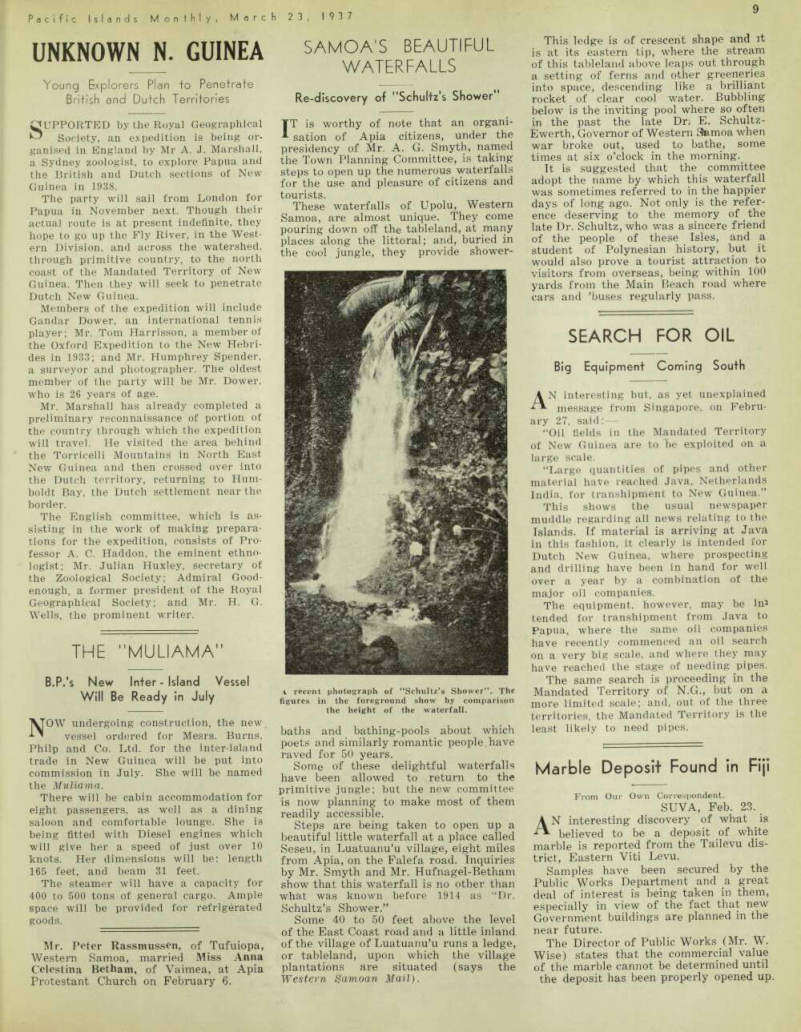
Steps are being taken to open up a beautiful little waterfall at a place called Seseu, in Luatuanu’u village, eight miles from Apia, on the Falefa road. Inquiries by Mr. Smyth and Mr. Hufnagel-Betham show that this waterfall is no other than what was known before 1914 as “Dr.
Schultz’s Shower.”
Some 40 to 50 feet above the level of the East Coast road and a little inland of the village of Luatuanu’u runs a ledge, or tableland, upon which the village plantations are situated (says the Western Samoan Mail).
This ledge is of crescent shape and it is at its eastern tip, where the stream of this tableland above leaps out through a setting of ferns and other greeneries into space, descending like a brilliant rocket of clear cool water. Bubbling below is the inviting pool where so often in the past the late Dr. E. Schultz- Ewerth, Governor of Western Samoa when war broke out, used to bathe, some times at six o’clock in the morning.
It is suggested that the committee adopt the name by which this waterfall was sometimes referred to in the happier days of long ago. Not only is the refer ence deserving to the memory of the late Dr, Schultz, who was a sincere friend of the people of these Isles, and a student of Polynesian history, but it would also prove a tourist attraction to visitors from overseas, being within 100 yards from the Main Beach road where cars and ’buses regularly pass.
recent photograph of “Schultz’s Shower”. The figures in the foreground show by comparison the height of the waterfall.
Search For Oil
Big Equipment Coming South
AN interesting but, as yet unexplained message from Singapore, on Febru ary 27, said; “Oil fields in the Mandated Territory of New Guinea are to be exploited on a large scale.
“Large quantities of pipes and other material have reached Java, Netherlands India, for transhipment to New Guinea.”
This shows the usual newspaper muddle regarding all news relating to the Islands. If material is arriving at Java in this fashion, it clearly is intended for Dutch New Guinea, where prospecting and drilling have been in hand for well over a year by a combination of the major oil companies.
The equipment, however, may be In* tended for transhipment from Java to Papua, where the same oil companies have recently commenced an oil search on a very big scale, and where they may have reached the stage of needing pipes.
The same search is proceeding in the Mandated Territory of N.G., but on a more limited scale; and, out of the three territories, the Mandated Territory is the least likely to need pipes.
Marble Deposit Found in Fiji
From Our Own Correspondent.
Suva, Feb. 23.
AN interesting discovery of what is believed to be a deposit of white marble is reported from the Tailevu dis trict, Eastern Viti Levu.
Samples have been secured by the Public Works Department and a great deal of interest is being taken in them, especially in view of the fact that new Government buildings are planned in the near future.
The Director of Public Works (Mr. W.
Wise) states that the commercial value of the marble cannot be determined until the deposit has been properly opened up
Christmas Is.
Sloop Leith Lands Fiji Radio Operator and Party
XHE mystery of the cruise of the * British sloop, H.M.S. Leith, has been cleared up to some extent by a report from Fiji that the vessel landed a wire less operator and seven men as a garri son on Christmas Island, in the Gilbert and Ellice group.
The High Commissioner for the West ern Pacific and the officers of the Leith refused to give any definite information regarding the voyage, but it was freely stated in Suva and confirmed by some of the personnel of the Leith that she visited several islands, and finally landed Mr. Oscar Barrack on Christmas' Island.
Mr. Barrack is a wireless officer of the Fijian Government, recently seconded to the High Commission.
He had with him a wireless plant and all necessary kit, and provisions for six months. Besides Mr. Barrack, the Leith landed a detail of seven men to keep him company and act as a sort of garrison of the island.
It is reported that after the Leith left the island, the operator’s messages were clearly picked up. Then, after a tempor ary break, the messages were heard all the way to Suva.
Presumably, Mr. Barrack is to act as an Assistant Commissioner, and keep headquarters in Fiji informed of any thing that may develop in the Anglo- American competition for the possession of certain Central Pacific Islands along the projected trans-Pacific airmail route.
Who Owns Christmas Island?
'THE action taken by the authorities * to consolidate Britain’s claim to Christmas Island focusses attention to the fact that for nearly 100 years owner ship of the island has not been clearly defined.
Hitherto, Britain and America, the in terested parties for its sovereignty, have regarded it as an almost insignificant speck on the map. With the advent of aeroplane services across the Pacific, Christmas Island, in common with a dozen other dots of land previously looked upon as more or less worthless, has assumed international importance.
United States, last year, took posses sion of Howland, Baker and Jarvis Is lands (formerly regarded as British pos sessions) and Congress appropriated 35,000 dollars for the purpose. Since then American parties have been down among the other equatorial islands —Christmas, Fanning, Pukapuka, etc.
There is no doubt that America has cast covetous eyes upon Christmas Is land. It has a big lagoon that might provide a harbour for naval surface ships as well as aircraft. While some informed quarters professed belief in December that no move regarding Christmas Is. was planned, a State Department official in Washington told the newspapers flatly
that “the United States does not recog nise British sovereignty there.’’
Reports which reached the Interior and State Departments in December said British, Japanese and French ships had visited isolated Howland, Baker and Jar vis in the previous few months, without landing.
The formal acquisition of those three uninhabited dots on the map was a mere matter of raising the flag and establish ing four youthful Hawaiian pioneers on each, but officials said that reassertion of American claims to Christmas Island would have to be through diplomatic channels.
The island, including the very large lagoon, is about 100 miles around, and contains about 60,000 acres, devoted to coconuts. It was taken over by Great Britain in Queen Victoria’s reign. The United States merely “reserved all ques tions” in 1888 upon learning that the Union Jack had been hoisted by Admiral Wiseman, of H.M.S. Caroline, “and since then the matter of sovereignty has been slumbering.”
One of the world’s largest coral atolls, the island was dubbed Christmas by Captain Cook, who discovered it in his ship, the Resolution, on Christmas Eve of 1777.
The United States claim dates from its “rediscovery” by Captain John Stetson, of New Haven, “prior to 1857.”
The island is occupied now by two Europeans and 20 or more Tahitians.
The British deputy resident at Fanning Island is its governor.
Mr. and Mrs. H. W. Rogerson, who have been residents of Papua for nearly 10 years, returned to Woodlark Island, in the South-Eastern Division, where Mr.
Rogerson is Collector of Customs, by the Montoro from Sydney on February 24.
Bishop Henry Newton
Retirement After 35 Years in Papua
From Our Own Correspondent
Bpt. Moresby, Mar. 5.
Y the Macdhui, which left Samarai yesterday, Bishop Henry Newton, D.D., who was succeeded in January last by Bishop Warrington Strong, sailed for Australia to live in retirement after 41 years’ service in the tropics, 35 of which were spent in Papua.
Bishop Newton has been seriously ill for many months and it is with great relief that residents of the territory learn of his health improving sufficiently to enable his departure after so many long years of faithful service in the country. It is hoped that his health will continue to grow better, enabling him to enjoy the rest he so richly deserves.
Dr. Newton succeeded the Right Rev.
Sharp as Bishop of New Guinea in 1922.
Previously he had been Bishop of Car pentaria since 1916, having been appoin ted after 20 years’ service in Papua. He first entered the mission field in 1896, when the Anglican Mission, headecj by Rev. Copeland King, was labouring under the disadvantage of insufficient personnel, and before the Mission had been able to extend its stations along the N.E. coast, north of Cape Vogel.
As the Macdhui passed through Port Moresby from Samarai, a deputation of church members called on His Lordship to render their last service to their be loved bishop. They made a presentation to him as a memento of his long years of service in the territory.
Mr. Albert F. Ellis, British Phosphate Commissioner in New Zealand, arrived in Sydney from Auckland on March 13.
Peanut Crop On Norfolk Is.
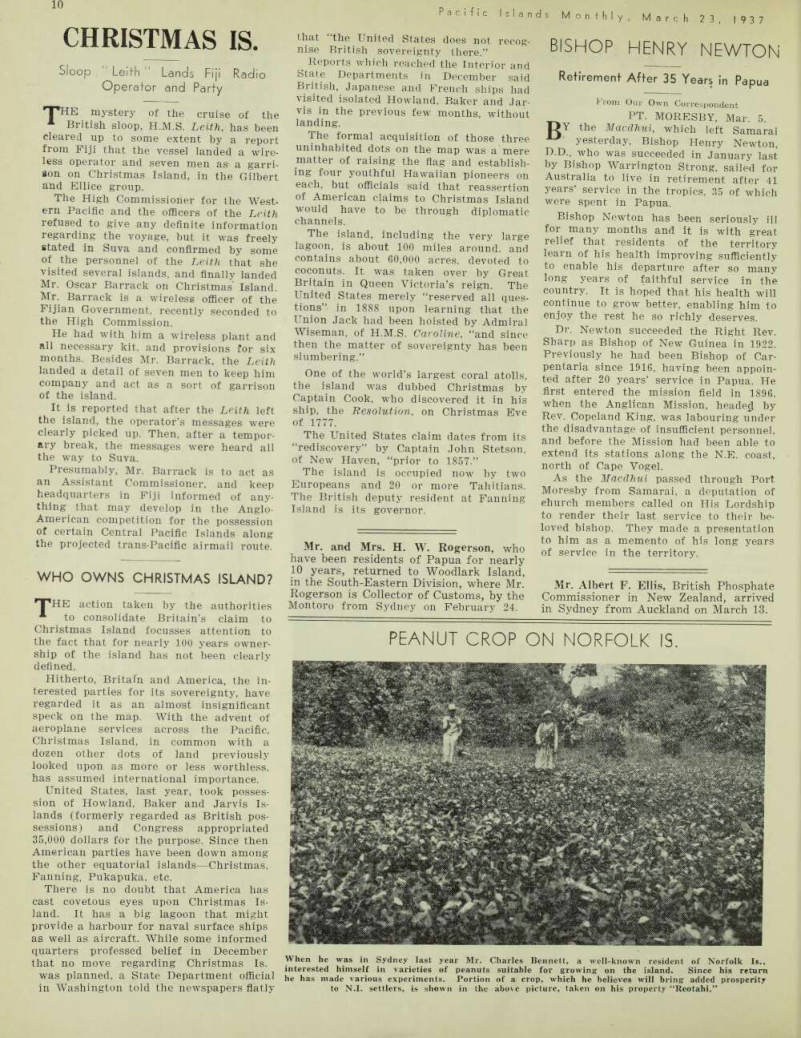
When he was in Sydney last year Mr. Charles Bennett, a well-known resident of Norfolk Is., interested himself in varieties of peanuts suitable for growing on the island. Since his return he has made various experiments. Portion of a crop, which he believes will bring added prosperity to N.I. settlers, is shown in the above picture, taken on his property “Reotahi.”
Teopicalities
THE suggestion put forward in this journal two or three years ago, that Australia might be glad to see Germany in New Guinea, to assist her in holding the South Seas against the thrusting power of Japan, has been advanced by several commentators recently. But the whole situation has been changed in the past year owing to the completion of a secret alliance or understanding between Germany and Japan. Defence is now the paramount consideration of British Im perial politics, and defence demands that New Guinea shall be very strongly held by Britain, and preferably, by Australia.
Its possible economic value to Germany is as nothing to its tremendous strategic importance to Australia.
Incidentally, German residents of Pacific Mandated Territories would be wise to guard their tongues more care fully. Some who have returned recently from Germany to New Guinea and Samoa have chattered very unwisely about “the future of the former German colonies.”
There is not an ounce of hostility for Germany remaining in British countries —on the contrary, one finds everywhere a growing wish for a closer relationship and very real admiration for Germany’s national spirit; but that does not mean that there is any future for those former German islands except under the British flag. It is simply a matter of self-pre servation. The things that are happen ing in the Pacific to-day—the internat ional manoeuvring for place and power— outweigh all such sentimental considera tions as whether the Swastika flag shall fly over a few coconut trees in places where, until 1914, the Kaiser was the prevailing toast. * ♦ ♦ IT has been announced that Hurricane, the story written by Charles B, Nord hoff and James Norman Hall soon after the completion of their Bounty trilogy, is to be filmed in colour by Metro- Goldwyn-Mayer, which made such a suc cess of the film Mutiny on the Bounty.
It is indicated that the star probably will be Merle Oberon. It is stated that Sam Goldwyn paid Messrs. Nordhoff and Hall £12,000 for the film rights of Hurricane. * * * WHERE is the statue of King Kame hameha, of Hawaii?
As the Hawaiian Islands are celebra ting the 200th birthday anniversary of the great Hawaiian hero, the question is a legitimate one. However, if you put that question to almost any visitor or resident in Hawaii the answer undoub tedly will be that it is in front of the Judiciary building in Honolulu’s palace square.
But this statue is just a replica. The original stands at Kohala, island of Hawaii, which district is said to be the birthplace of the “Napoleon of the Pacific.”
Both statues were the work of Thomas R. Gould, an American artist who lived in Florence, Italy. The first statue ordered by the Hawaiian legislature in 1878, was being shipped on the German barque G. F. Handel, which was burned at sea and sank off the Falkland Islands.
The statue was insured and a replica was purchased and erected in Honolulu.
In the meantime a seafaring adven turer, Captain Jarvis, wandering ashore at Port Stanley, in the Falklands, was amazed to see a Polynesian statue, and soon identified it as a Sandwich Island king. As a gamble, he purchased it from the Falkland Islanders and brought Kamehameha —the original statue —to Hawaii, where he sold it for a slight profit: It still stands at Kohala, which is an interesting off-the-beaten-track section (the northern tip) of the Big Island. * * * MRS. BAYNES, widow of Captain H.
C. A. Baynes, R.N., who hoisted the British flag in Rarotonga when the Cook Islands were annexed to New Zealand in June, 1901, passed through Sydney recently from New Zealand on her way back to England. Because of the distin guished services of her husband, also those of her father, Admiral Sir Joseph Nias, K.C.8., the King has permitted Mrs. Baynes to reside in an apartment in Hampton Court Palace —an honour accorded to only a few.
Mrs. Baynes was in Sydney with her husband in 1901, when he received sealed orders to depart for the Pacific in H.M.S.
Mildura. At that time it was considered that the French had designs upon Raro tonga which had been under British pro tection since 1880. Following a visit In 1900 by the New Zealand Premier, Mr.
Seddon, it was decided, in consultation with the Imperial authorities, to make the Cook Islands a dependency of New Zealand. For some years a section of foreign residents on Rarotonga had clamoured for annexation.
Mrs. Baynes had still another link with the Pacific. Captain Nias, her father, was in command of H.M.S. Herald, the vessel on which Captain William Hobson, R.N., left Sydney early in 1840 to proclaim British sovereignty at the Bay of Islands, N.Z. Unfortunately, their personal rela tions were marred by several unfortun ate incidents. It does seem extraordinary that the daughter of a man who wit nessed the signing of the Treaty of Waitangi should still be living. The explanation is that Nias married a wo man 35 years his junior when he was more than 60 years old himself.—E.R.
Fijian Chiefly Families United
From Our Own Correspondent
Suva, Mar. 1.
A WEDDING of great interest to the Fijian people was quietly celebrated at the Jubilee Methodist Church on Feb ruary 18, when Ratu Edward Tuivanua vou Cakobau was married to Adi Vase mace Tuiburelevu. The native minister Rev. Aminisitai Tora performed the cere mony.
The bride and bridegroom both are members of chiefly families of Bau. After the wedding there were the usual native presentations associated with marriage from members of both clans.
Ratu Edward leaves this month for England where he will be one of the representatives of the Fiji Defence Force at the Coronation.
Mr. J. Burston, of Messrs. Burns, Philp & Co. Ltd., arrived in Sydney from Rabaul, New Guinea, by the Malaita in
February.
Advertisements & other items, pp. 13-14 (1 item)
11/- per gallon
FLAT OIL
FINISH
WATERPROOF
DRIES INHAtF HOUR
CREAM
Write for a Colour Card . . .
STERLING VARNISH CO.
Dries in half an hour on plaster walls, ceilings, cement, fibro, wood and iron.
Also Excellent as an Undercoat tor lacquers, paints and enamels.
11/- per gallon
HIGHLY DURABLE
Alexandria, N.S.W.
RECORDS
Packed Free and sent C.O.D. without extra charges.
H.M. Voice Slightly-used Portables, delivered straight to your nearest port for £3/15/-
SEND FOR LATEST RECORD LISTS
Talkeries Music Stores
451 Queen Victoria Buildings
SYDNEY
11
MERIDEN
I > Church of England GRAMMAR SCHOOL for GIRLS
REDMYRE ROAD. STRATHFIELD, N.S.W.
-5- Boarding and Day School. Beautiful Surroundings.
Within 15 minutes of City by Electric Train Service.
KINDERGARTEN TO LEAVING CERTIFICATE.
Prospectus on application to Principal; MISS GRACE OVERT, BA., Th.L.
TERM COMMENCES Bth JUNE, 1937.
First Thing in the
Morn ing . . . !
« c/ > *v V\
take ELLIOTT S FRUIT SALINE
Two teaspoonsfuls of ELLIOTT’S FRUIT SALINE in a tumbler of water as soon as you wake will make the morning a really “good morning” for you. This pleasant, bubbling, health drink quickly cools the blood, clears the head, and really peps you up.
ELLIOTT’S FRUIT SALINE acts also as a gentle, but efficient asperient relieving all Stomach and Liver ailments. It may be taken by young or old with safety. mr §*•
GET
OTTLE TO-DAY!
About Islands People
Mr. M. Laborde, editor of La Franc* Australe at Noumea, arrived in Sydney from New Caledonia by the Pierre Loti on February 8.
Mr. A. McKenzie, education officer in Rarotonga, Cook Islands, has been ap pointed to the position of Director of Education in Western Samoa, in succes sion to Mr. D. A. J. Rutherford.
Mr. Charles Lumley, a well-known pearl-buyer, of the Trobriand Islands, Eastern Papua, has been seriously ill for some time.
Mr. R. D. Blandy, Assistant British Resident Commissioner in the New Heb rides, arrived in Sydney in February by the Pierre Loti on his way to England on seven months’ leave.
Mr. C. B. B. Hill, planter of Labasa, hij! who arrived in Sydney recently on short furlough by the Fiona, returned to Suva by the February Aorangi. It was his first visit to Sydney in 34 years.
I atrol Officer C. J. Adamson, who ac companied Mr. Ivan Champion on his recent long and difficult trek through the mtenor of Western Papua, left Port Moresby in March by the Van Rees for the East and England. He has been granted three months’ special leave and this, added to his furlough alreadv due, will enable him to make an extended visit land h ° me countr y in Devonshire, Eng 1, M /‘ and D. R. McDonald, former y of Suva. Fiji, sailed from Brisbane for Tulagi, 8.5.1., by the Malaita on March 6. Having been Deputy Registrar of the ■"D* Supreme Court for some years, Mr.
McDonald has now been transferred to the Solomon Islands to be Chief Magis trate and Legal Adviser.
Mr. James Norman Hall, the American author now resident in Tahiti, who has won fame with the “Bounty” trilogy written in collaboration with Mr. Charles B Nordhoff, returned to Papeete at the end of February by the Hauraki, after a visit to the United States and Canada He was accompanied by his wife and two children.
Captain J. F. Thompson, master of the Burns, Philp inter-island steamer Mai wara, arrived in Sydney from Rabaul, New Guinea, on long leave by the March Macdhui. He was accompanied by his small son Grant.
Mr. W. E. Hancock, Fiji manager of the Union Steam Ship Co., sailed from Suva early in March for America on furlough. Until he returns at the end of May, Mr. Hancock is being relieved by Mr. D. A. Butler, manager of the Union Co.’s office at Apia, Western Samoa.
Monsieur Doley, councillor to the Court of Appeal in the French colony of Reunion, has been appointed judge of the Mixed Tribunal of the Condominium of the New Hebrides. He is replacing M.
Janvier, who has been seconded to the Magisterial Service in French Indo- China.
Mrs. E. H. Chester, wife of the assistant manager at Lolorua Plantation, Kairuku District, Papua, died suddenly at her home on February 2. She had been in the Territory for a number of years, having arrived as a young girl with her parents, the late well-known Mr. H. H.
Harbord and Mrs. Harbord.
Mrs. V. B. Pennefather, of Tokua Plantation, Kokopo, New Guinea, sailed from Sydney for Rabaul by the Neptuna on February 24, She was accompanied by her mother, Mrs. J. W. Lamb, of Cess nock, N.S.W.
Mr. Ellis H. Davies, chief engineer of Chas. Ruwolt Pty. Ltd., Melbourne, de parted from Sydney for Fiji by the Monterey early in March. He will spend a week or so on the Tavua goldfield inspecting the installation of machinery and plant at the Emperor and Loloma mines, to which he is consulting engineer.
Rev. A. S. Jones, who has charge of the Methodist Mission’s Kabakada Cir cuit in New Britain, married Miss Hazel Carr in Sydney on March 6. With his bride, he returned to Rabaul by the Macdhui on March 17.
Monsieur Sautot, who has been Acting Governor of French Oceania for some time, departed from Papeete en route to Vila by the Ville de Verdun on March 18 to take the post of French Resident Commissioner in the New Hebrides.
Captain F. C. Rennels, of the New Guinea Mission’s schooner Maclaren King, reached Sydney from Samarai, Papua, by the Macdhui in the middle of March.
His wife and child arrived by the same vessel.
Rev. Father Boch, a Marist missionary who has been working at Kieta, Bougain ville, New Guinea, for many years, arrived in Australia by the Van Rees during February.
Miss Ivy Lapthorne, of Cheltenham, Victoria, sailed from Sydney by the Monterey on March 5 for Suva, Fiji.
Formerly a missionary teacher, she has rejoined the staff of the Methodist Mission.
Mr. J. Pollard, who has been prospect ing for gold during recent months in the new area near Wewak, North-east New Guinea, arrived in Sydney by the Macdhui on March 11. He said that there are now more than 200 men opening up the new goldfield.
Miss Norma Winterbottom, who re cently completed a course of nursing at the Australian Board of Mission’s train ing hostel for women at Epping, N.S.W., departed from Sydney on March 6 by the Malaita for the Solomon Islands. She will be attached to the Melanesian Mis sion’s hospital staff at Fauabu, on the island of Malaita.
Dr. C. M. Dawson, who is the only private medical practitioner in Samoa, probably will be appointed eye specialist and consulting surgeon at the Apia Government Hospital. Dr. Dawson en joys the confidence of the European and native population and is a popular and successful surgeon, of great experience.
Miss I. Emert, of Chatswood, N.S.W., sailed from Sydney by the February Aorangi to take up duties as a voluntary teacher at the Methodist Mission’s Ballan tine Memorial School for Girls at Suva, Fiji.
Mr. Norman Draper, formerly mine accountant of Cuthbert’s Misima Gold mine Ltd. at Misima Island, Eastern Papua, has been appointed local secre tary of the company.
Mr. G. A. Loudon, president of the Planters’ Association of Papua, arrived in Sydney from the territory by the Van Rees on February 23, to make repre sentations to the Federal Government on behalf of Papuan rubber-growers.
Mr. Frederick E. Johnson, Treasurer and Collector of Customs in the British Solomon Islands, left Sydney for Tulagi after furlough by the Malaita on March 6.
Mr. A. C. Hancock sailed from Sydney for Lord Howe Island by the Morinda on March 4. He is secretary of the Gower Wilson Memorial Committee and will
(Continued On Next Page)
select a site for an operating theatre and surgery which will stand as a memorial to Mr. Gower Wilson. A well-known identity of Lord Howe, Mr. Wilson was lost at sea about four months ago with his son and four companions on a voyage
from Sydney to the island in the launch Viking.
Mr. W. J. Craig, Inspector for Messrs.
Burns, Philp & Co. Ltd., departed from Sydney by the Malaita on March 6 on a three months’ visit of inspection to the Solomon Islands.
Madame Chatenay, accompanied by her daughter and son, reached Sydney by the Pierre Loti from New Caledonia in February to spend three months’ holiday before returning to their home at Noumea.
Dr. Allan Rutter has been designated by the New Zealand Methodist Church as the Mission’s new doctor in the Solo mon Islands field.
Mr. W. H. Carpenter, Islands manager for W. R. Carpenter & Co. Ltd., arrived in Sydney by the Chansrte on March 3, after a business visit to Thursday Island.
Mr. Walter F. Smith, of Bulolo Gold Dredging Ltd., New Guinea, sailed from Salamaua by the Neptuna early in March for China. He will then go on to America to spend furlough in California.
Mr. H. W. Hardy, Registrar of the Central Court at Port Moresby, Papua, is at present spending nine months’ leave in Australia.
Rev. Wallace Deane, M.A., 8.D., was elected president of the New South Wales Methodist Conference held in Sydney in February. He is well known in Islands mission circles, having served in Fiji from 1907 until 1916, during three years of which he was principal of the Teachers’ Training College at Davuilevu.
In collaboration with Rev. J. W. Burton (General Secretary of the Methodist Mis sion), Mr. Deane recently published the book, “A Hundred Years in Fiji.” Other Pacific books written by him include “Fijian Society” and “The Strange Ad ventures of a Whale’s Tooth.” Mr. Deane edited the autobiography of the late Rev.
Benjamin Danks, published in 1933 under the title of “In Wild New Britain.” Mrs.
Deane is the daughter of the late Mr.
Danks, who served primitive New Britain for the Methodist Mission from 1878 until 1886.
Archdeacon and Mrs. R. de Voil, of the Melanesian Mission, departed from Rabaul, New Guinea, at the end of February on their way to England to spend eight months’ vacation. Rev.
James Burge is acting' as Anglican minister at St. George’s Church, Rabaul, during their absence.
Mr. Walter (“Pat”) Blane Burston, who for several years was a well-known and popular resident of Rabaul, New Guinea, where he was a clerk with Messrs. W. R. Carpenter & Co. Ltd., died in Sydney in February, at the age of 33.
Mr. J. C. Barley, Resident Commis sioner of the Gilbert and Ellice Islands Colony, arrived in Suva from the Gilberts by H.M.S, Leith in February. He had been summoned to Fiji by the High Com missioner for the Western Pacific (Sir Arthur Richards) to confer with Mr. A.
Gaye, of the British Board of Phosphate Commissioners.
Mr. David Riley, a well-known half caste resident of Levuka, died on Feb ruary 2 at the age of 77. Mr. Riley was an agriculturist, and for many years con ducted a plantation on Naigani Island.
Mr. Ernest Whitehouse, Senior Medi cal Assistant in the service of the Papuan Administration, who recently was sta tioned at Misima Island, is now on long leave in Australia with his wife and daughter. After a visit to South Aus tralia, they were spending holidays in Melbourne in mid-March. Mr. White house was formerly in the Trobriand Islands for 10 years in a magisterial capacity. Mrs. Whitehouse was at one time a missionary sister in the service of the Methodist Church in Papua.
Advertisements & other items, pp. 14-18 (2 items)
12
acl *' c Islands Monthly, March 23, 1937
Tenax
Is your house a home or merely a shelter?
To be a home it must have a definite standard of comfort,
GOOD LIGHT IS ESSENTIAL
and is easily procured even in districts remote from the conveniences of the city.
For many years . . .
WIZARD CAS
has been supplying ideal light to every part of Australia.
SIMPLE, SAFE. CHEAP
both to buy and to burn.
Wizard Lamps (140 candlepower) light with a taper and burn for 60 hours on a gallon of petrol.
Wizard Stoves boil, bake and grill to perfection. Home lighting sets from £l4.
Stoves, lamps & lanterns for all purposes.
Wizard Lighting Co.
283 d GEORGE STREET, SYDNEY
T I . Established 1914.
Table Lamps 65/- F. 0.8. We stock the very best mantles and spare parts for your lights.
TrrrjJSSjfc
f W\ V** \
GUARD AGAINST
INFECTION h/wiing
Tropical Diseases
Hold No Terrors
—if you use TENAX Daily
The germs of Diphtheria, Malaria, Dhobie Itch, Tinea and Surfer’s Foot, cannot harm you if you are protected by the rich “Ti-trol” lather of TENAX.
TENAX is the ONLY soap containing: oil distilled and marketed by Australian Essential Oils, Ltd., under the registered trade-mark ot “Ti-Trol,” eleven times quicker than carbolic as a germicide, but NON-POISONOUS and
NON-IRRITANT.
“The Medical Journal of Australia,” official organ of the 8.M.A., says: “TENAX is a satisfactory germicidal soap which may be recommended with confidence.”
A PRODUCT OF AUSTRALIAN SOAPS
LIMITED
TENAX
Okc tymuirteuf &e/cmieicCojL-
TOILET SOAP
B. & S. Estate Agency
I ROSEVILLE, SYDNEY
Specialising in Flat reservations, any suburb, for Island Residents visiting Sydney. Correspondence invited, ’Phone J 5269.
Proprietor - - Campbell M. Smith
DOCTOR'S WIDOW (27), would like occupation as GOVERNESS, or NUR SERY GOVERNESS. Travelled extensively. Lived in tropics. Healthy. Fluent German, French and English. Medical experience. Highest credentials. Four year old daughter.
Please write: H.J.W., C/o Pacific Islands Monthly, 247 George Street, Sydney.
INVINCIBLE
Illustrating the Baby of the Family:
3 H.P. Model "R" INVINCIBLE
Single Cylinder Four Cycle
ROWBOAT MOTOR
3g" Bore, Sj" Stroke, 900 R.P.M.
Weight, 85lbs.
Fully guaranteed for 5 years. o
THE 1937 LINE OF
S& MARINE MOTORS
20 MODELS: 3 TO 100 HORSEPOWER
PETROL KEROSENE CRUDE OIL
Invincible Marine Engines have now been on the market for more than 30 YEARS; thousands are in satisfactory service all over the world and the ever-increasing sales prove beyond doubt that Invincible Engines are equal to the world’s best in all the fine qualities good Marine Engines should possess.
OUR NEW CATALOGUES, giving detailed descriptions of the various sizes listed on these two pages, will be furnished without charge.
Write to-day and learn the moderate cost of an Invincible Power Plant. Give essential details—length, type of craft, speed desired, or horsepower needed.
Invincible Motors Limited, 53 North George St., Sydney And at Chicago, 111., U.S.A.
W. H. GROVE & SONS, LTD.
Island Traders, P.O. Box 490, Auckland, N.Z.
Telegraphic & Cable Address: "Grove," Auckland Shippers of all classes of New Zealand Products, specially prepared for the Island Trade Representing ;
BURRELL & CO. LTD.
Head Office and Works :
BURRELL'S WHARF, MILLWALL, LONDON, E. 14
Manufacturers of all kinds of Paints.
FERROCENE
their special tropica! paint PREVENTS CORROSION. Made in
RED, GREY, and GREEN.
m 8
3 CLYDE
m BATTERIES
for ALL Power Requirements
CLYDE HOME LIGHTING
CLYDE BATTERIES
for Cars, Trucks,
Buses, Motor
Cycles and Radio
are available in
types to suit all
conditions.
MORE POWER
TO YOU
BATTERIES
A Range of Types
for all Lighting and
Power Needs
.-V I - ■ . - A complete 32 volt Plante Type Home Lighting and Power Battery. . . . bring all the comfort and convenience of electricity to those living away from power lines. Clear, brilliant light in any room; ample power for irons, fans, radio, vacuum cleaner, sewing machine, refrigerator or any other electrical appliance you may wish to use.
Clyde Home Lighting Batteries are designed and built to combine electrical efficiency with mechanical strength— only the finest materials obtainable are used in the construction of every part. With very little attention, these long-life Batteries will give you all the power you want for many years.
Send for fully illustrated Brochure featuring the complete range of Clyde Batteries.
'M" type Home Lighting Cell.
The Clyde Engineering Co. Ltd.
GRANVILLE - - - N.S.W.
Main Sales and Service Division: 61-65 WENTWORTH AVENUE, SYDNEY Obtainable through the Islands Branches of BURNS PHILP & CO. LTD. .. . W. R. CARPENTER & CO. LTD. . . . A. J. PEADON, RABAUL . . . and in FIJI from MORRIS HEDSTROM LIMITED . . . and from ail of whom full particulars are available on request.
NESTLE S MILK
cannot sour
while unopened
Thousands of gallons of rich, creamy milk come info Nestle's Condenseries every day; every batch is carefully analysed to ensure uniform high quality in the finished product. In every stage of preparation, Nestle's Milk is fully protected—firstly by a hygienic manufacturing process, and then by the hermetically sealed tin, which prevents any possibility of contamination or souring while it remains unopened. That is why you can always rely on Nestle's Milk—it never varies.
NESTLES
FULL CREAM
MILK
BEST, THEREFORE CHEAPEST
Menace of Whale Oil
Antarctic Whales Soon Will Be Wiped Out
T'HE significance of what is happening * in the Antarctic should not be lost sight of in the tropical Pacific.
The chief factor in bringing copra prices tumbling down by £3 or £4 per ton recently was a well founded report that Japanese and German whaling expe ditions had secured huge quantities of whale oil in the Antarctic; and the buyers of copra used this information effectively against sellers, for a few days.
British and Norwegian whalers made an agreement, last year, to try to restrict killing and save the Antarctic whales; but the Japanese have not accepted any such consideration, and their expeditions are now very active in the south. Ger many also is planning a big expansion of her whale oil production next season and it was reported during the month that she is trying to buy two British steamers for conversion into floating oil factories.
This thing definitely threatens the stability of the copra market; but it will not last very long. It was reported from Melbourne in February that Captain J. K.
Davis, Commonwealth Director of Naviga tion, who has been a member of many expeditions to Antarctica, predicted the almost complete extinction of whales in the Antarctic within a few years, because of unrestricted killing by Japanese fleets.
Captain Davis was commenting on a message from Japan, stating that a Japan ese whaling firm had placed an order for a whaling factory ship of 21,000 tons, and a fleet of chasers to supplement the large squadron of Japanese whalers now operat ing in the Southern Ocean.
“To preserve the whaling grounds of the world 28 British and Norwegian whaling companies formed an agreement to protect the industry through the regu lation of catches and of seasons,” said Captain Davis. “The Japanese and Ger man companies disregard this agreement, and operate when and how they pldase.
At present, a large fleet of Japanese craft is operating in the Southern Ocean, and there is little doubt that whales in Antarc tic waters will be almost extinct within a few years. The whaling industry is doomed already. The northern grounds have been fished out because of this un restricted killing, and the southern grounds will soon follow.
“Any suggestion that Australia should enter now into the Antarctic whaling industry is ridiculous,” Captain Davis con tinued. “If Australia had realised the potentialities 15 years ago, it would have been wise to do so then. Now it is too late.”
Mr. J. K. Twycross, manager at Rabaul
for Amalgamated Wireless (A’sia) Ltd.,
departed from Sydney for New Britain by the Nankin in mid-February. He was accompanied by his wife and children.
Rev. C. W. Whonsbon-Aston, formerly of Levuka, Fiji, who is now an Anglican missionary in Eastern Papua, arrived in Sydney by the Macdhui on March 11.
"Pierre Loti" Held Up By Strike
At Noumea
THE Messageries Maritimes Company’s steamer Pierre Loti was held up at Noumea, New Caledonia, at the end of February by a shipping strike which lasted six days.
The strike was a protest against the position of 22 New Caledonian sailors, which was inferior to that of the French sailors of the same ship despite the fact that all members of the crew were under the jurisdiction of the same marine board in France. The French seamen on board the Pierre Loti struck in support of the New Caledonians.
On February 25 an agreement was reached in Paris between the M.M. Com pany and the Marseilles Sailors’
Syndicate which declared that the sailors on the Pierre Loti had only the right to a local contract. The vessel sailed for Sydney the following night, omitting her voyage to the New Hebrides.
Typhoid In Samoa
From Our Own Correspondent
Apia, Feb. 19.
A NUMBER of cases of typhoid fever are at present under treatment at the Apia Government Hospital. All these cases come from the locality of Vailima and Papauta.
In this connection an urgent request has been submitted to the Administration to install immediately a proper filter system in the Apia water supply, in order to safeguard public health. The request is supported by the United Progressive Party and the European elected members of the Legislative Council.
Mr. A. E. Howard, District Commis sioner of Taveuni, Fiji, has been trans ferred to Lautoka.
Fiji's Sound Trade Position
Turnover Increased By Half Million
From Our Own Correspondent.
Suva, Feb. 16.
AN extremely sound position is dis closed by the trade figures of Fiji for 1936, recently published in the Royal Gazette. The trade of the Colony for 1936 exceeded that of 1935 by £559.598.
Increases were accounted for princi pally by rises in the exports of copra, bananas, sugar, and molasses. An in crease of £77,675 in the value of gold ex
ported helped materially to improve the
trade position. Incidentally, the rise in gold production serves to show the steady progress that has been made by ihe main operating concern on the Tavua goldfield —namely, Emperor Goldmining Co. Ltd.
The principal trade figures were as follows: —
Exports
Exports for 1936 (with 1935 figures shown in parentheses), were:— Sugar: 140,864 tons (135,638 tons) : £1,331,701 (£1,314.128).
Copra: 34.582 tons (27.296 tons) ; £406,393 (£230,263). . .
Bananas: 19,849 bunches (16,137 bunches) : 150,147 cases (143,495 cases) ; £84,548 (£66,863).
Molasses: 22,576 tops (16,545 tons) ; £22.576 <£ fiold: (6,9230 z.) ; £131,684 (£54,009).
Trochus shell: 185 tons (298 tons); £14.305 (£20,226).
Other articles: £144,220 (£118,362).
Total; £2.135,427 (£1.820.396).
Total Trade
1935 1936 £ £ Imports 1,257,287 1,501,854 Exports 1,820,396 2,135,427 3,077.683 3,637.281
Imports
1935 1936 £ £ Value 1,257,287 1,501.854 Duty 357.215 418,757 Wharfage 10.317 12,684 Tonnage duty 2,963 3,207
Advertisements & other items, pp. 19-20 (1 item)
Prouds Ltd.
Chromium Finish
owes its great popularity to its refined appearance and non-tarnishable nature. It is an excellent wearing surface and peculiarly adapted for good quality brushes for which a long life may be expected.
S3—Chromium-plated Military Brush and Comb, in Case, 30/-.
S 2 Gentleman’s Chromium-plated Travel Set, in Leather Case, with Zipp Fastening, £3/3/-.
Si —Superior Quality Military Brushes and Comb, in case. Chromium, £3/5/-.
Sterling Silver, £5.
CATALOGUE SENT POST FREE
ON PARLE FRANCAIS
PROUDS Ltd.
THE GIFT STORE
Cr. King & Pitt Sts., Sydney
Mowbray House School
CHATSWOOD, SYDNEY, N.S.W.
(Established in 1906) A Boarding School for Boys. Surrounded by Spacious playing fields, on hights of the North Shore Line. • The School Offers: A Home Atmosphere —An Unrivalled Health Record A Sound Physical, Mental, and Moral Training. 0 The curriculum extends from the earliest stages to the Intermediate Examination, and provides a specially designed course of COMMERCIAL EDUCATION for boys entering a business career or work on the land.
Special provision is made to meet the requirements of boys from THE ISLANDS, which Includes facilities for spending School Vacations at the School Country House.
Applications for enrolment in 1937 are now being received.
Illustrated Prospectus on Application. HEADMASTER: L. BAVIN
Get your
COPY
the
mm of
NEW TRUFOOD
RECIPE BOOK
69 specially tested recipes—all kinds of new ideas for attractive things to cook cakes, pastry, puddings, custards, desserts, savour es, sauces, etc. ‘ Recipe Department/' c/- Box 3j22TT G.P.O.
Sydney.
Please send me POST FREE, a copy of The Trufood Book of 69 Tempting Recipes Name
(BLOCK LETTERS)
Address
ATTRACTIVE POOD
FOR THE TROPICS
M?ILRATH’S
TXL" Best Assorted Jam, 24-oz. tins (4 doz.) 10/3 doz., 33/- case "Rosa" Full Cream Condensed Milk (4 doz.) 7/3 doz., 26/- case "St. George" Assorted Meats, 7-oz. (6 doz.) 9/9 doz., 52/6 case "Red Feather" Camp Pie, 12-oz. tin tin, 6/3 doz.
"St. George" Vegetable Salad, l-Ib. tin I/l tin, 12/6 doz.
"IXL" Green Peas and Potatoes, 30-oz. tin I/ tin. 13/- doz.
Canadian Pilchards, 5-oz. tin 4d. tin. 3/6 doz.
Local Dutch Cheese, 3-Ib. ball I/l lb.
"Rosa" Pears in Syrup, 30-oz. tin lOd. tin, 9/6 doz.
"Rosa" Peaches in Syrup, 30-oz. tin tin, 9/3 doz.
"Selmore" Pineapple Cubes, 30-oz. tin I/l tin, 12/6 doz.
Pressed Turkish Figs, loose 1/2 lb., 12/- doz.
New Season's Khadrawi Dates, loose 4d. Ib., 3/9 doz.
"Rosa" Pure Ground Coffee, l-Ib. tin 2/4 tin, 26/6 doz.
"Yoga" Tea, Choice Ceylon Blend, l-Ib I/l I pkt„ 2/3 tin "Kia-ora" Lemon Cordial, 25-oz. bot 1/4 bot., 15/6 doz.
Tooth's Pure Lemon Squash, 26-oz. bot l/9j bot., 20/6 doz.
I Prince's Reserve Port, 26-oz. bot 3/9 bot., 43/6 doz. ® ial Vintage Dry Sherry, 26-oz. bot* 2/6 bot., 29/6 doz I Kg f 5
ila
Starch, 5-lb,
PRICES
M? I LRQTU’S LTD
• • * -EXPORT DCPAftTMCNT • • •
202 PITT STREET, SYDNEY
NEW SOOTH WALES, AUSTRALIA,
Japanese In New Caledonia
\ SYDNEY resident who recently visited New Caledonia says that the manner in which the Japanese are taking possession of the retail trades there is alarming. Japanese goods are pouring into the French colony, and Japanese retailers are growing in numbers and are taking an ever-increasing proportion of the distributing business from the Euro peans.
Some time ago, the French captured three Japanese sampans who were poach ing shell, and brought them to Noumea.
They are still in Noumea, and so are their crews, and as neither the French nor Japanese Governments will accept respon sibility for the repatriation of the latter, it appears as if the Japanese crews are to be added to the Japanese community in New Caledonia.
Radio listeners in the Solomon Islands report good daylight reception from for merly inadequate sets since the new ser vice from Station 4QN, Queensland, has been available.
Privations on Schooner
Lost in Pacific for 65 Days
of the terrible privations ex perienced by 27 men, women, and children aboard a trading schooner which was lost in the Pacific for more than two months, reached Melbourne recently through the British Phosnhate Commis sioners’ station at Nauru.
The Regina , a Japanese fore-and-aft schooner of 75 tons, left Kwajalong Island with passengers and cargo bound for Wotho Atoll, 100 miles distant. The journey should have taken little more than 12 hours, as a large portion of it could have been accomplished within sight of land.
The captain, however, lost his bearings, and for weeks the schooner drifted help lessly, out of sight of land. The cargo consisted of rice, and while passengers and crew used this for food, the water supply became short. All hands were*in danger of death by thirst, when water was caught in the sails during a rain squall. After that, men, women, and children existed for days on scanty rations.
After drifting for more than six weeks the Regina was caught in a typhoon, and under storm canvas she was blown miles out of her course.
After she had been at sea for 65 days the craft drifted past Nauru, an island in the Gilbert Group. A boat was sent out to investigate and on boarding the schooner the crew found 27 persons lying on the deck exhausted or unconscious.
The Regina was towed to moorings at Nauru, and thanks to the care of the staff of the British Phosphate Commis sioners, all survived.
Murder In Fiji
Woman Killed With Axe Blow
From Our Own Correspondent.
Suva, Feb. 16.
Ty/fRS RENTE BRERETON, the 48-years old wife of Mr. James Brereton, aged 84, of Tivi Island, near Labasa, was murdered late in January. Her head was split open by a blow from an axe.
Mrs. Brereton, who was of Indian ex traction, lived alone on the island with her husband. When Mr. Brereton re turned to the house on January 27, he found that his wife was missing. After a search he discovered her body, and set out immediately for Labasa for assis tance. On his return, Mr. Brereton found that the house had been ransacked and a sum of money stolen.
The police took the matter in hand, and an 18-years-old Indian named Ramasamy has since been arrested and charged with the crime.
Mr. H. J. Topal, who has been doing medical patrol duties in New Guinea, arrived in Sydney on leave by the Mon toro in mid-February. He was accom
panied by his seven-years-old son David,
who now will attend school in Australia.
Tribal Markings Of Dutch
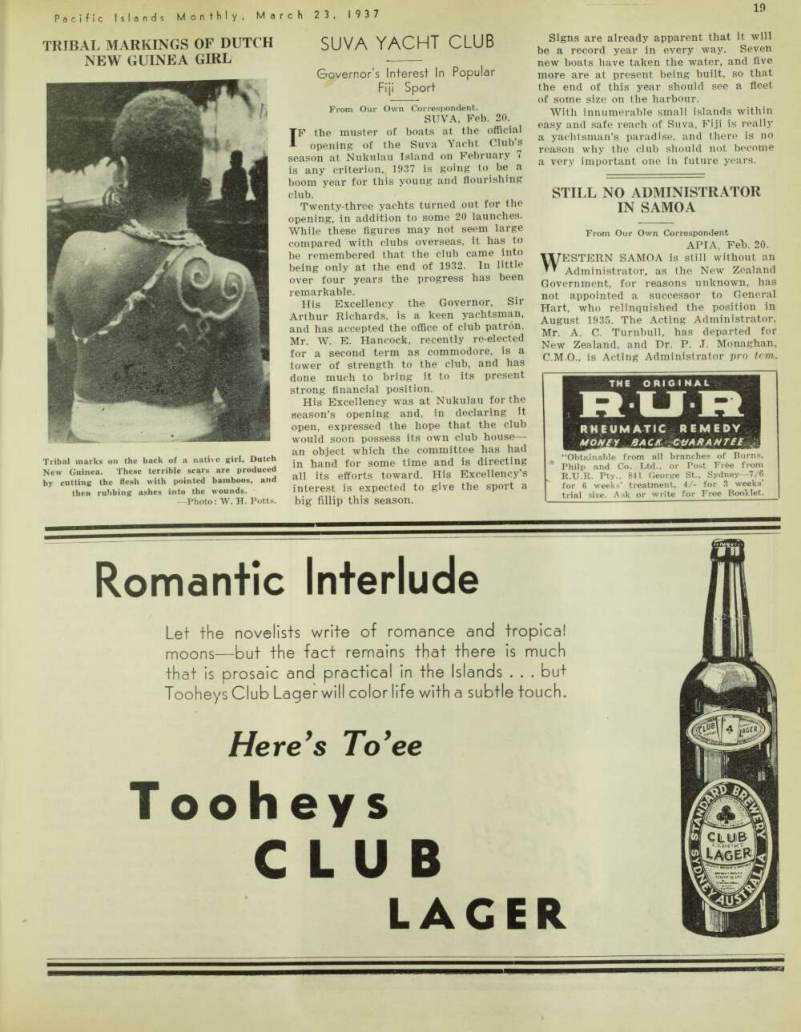
New Guinea Girl
Tribal marks on the back of a native girl, Dutch New Guinea. These terrible scars are produced by cutting the flesh with pointed bamboos, and then rubbing ashes into the wounds. —Photo: W. H. Potts.
Suva Yacht Club
Governor's Interest In Popular Fiji Sport
From Our Own Correspondent.
Suva, Feb. 20.
IF the muster of boats at the official opening of the Suva Yacht Club s season at Nukulau Island on February 7 is any criterion, 1937 is going to be a boom year for this young and flourishing club.
Twenty-three yachts turned out for the opening, in addition to some 20 launches.
While these figures may not seem large compared with clubs overseas, it has to be remembered that the club came into being only at the end of 1932. In little over four years the progress has been remarkable.
His Excellency the Governor, Sir Arthur Richards, is a keen yachtsman, and has accepted the office of club patron.
Mr. W. B. Hancock, recently re-elected for a second term as commodore, is a tower of strength to the club, and has done much to bring it to its present strong financial position.
His Excellency was at Nukulau for the season’s opening and, in declaring it open, expressed the hope that the club would soon possess its own club house — an object which the committee has had in hand for some time and is directing all its efforts toward. His Excellency’s interest is expected to give the sport a
big fillip this season.
Signs are already apparent that it will be a record year in every way. Seven new boats have taken the water, and five more are at present being built, so that the end of this year should see a fleet of some size on the harbour.
With innumerable small islands within easy and safe reach of Suva, Fiji is really a yachtsman’s paradise, and there is no reason why the club should not become a very important one in future years.
Still No Administrator
In Samoa
From Our Own Correspondent
Apia, Feb. 20.
WESTERN SAMOA is still without an Administrator, as the New Zealand Government, for reasons unknown, has not appointed a successor to General Hart, who relinquished the position in August 1935. The Acting Administrator, Mr. A. C. Turnbull, has departed for New Zealand, and Dr. P. J. Monaghan, C.M.0., is Acting Administrator pro tem.
Mr. R. W. Walshe, of Domara Planta tion, Kauru, Papua, arrived in Sydney with his wife by the February Montoro.
Captain N. S. 1». Kidson, Secretary to the Solomon Is. Administration, who re cently has been Acting Resident Com missioner at Tulagi, arrived in Sydney by the Malaita on February 28. He was on his way to England on furlough.
Advertisements & other items, pp. 21-22 (1 item)
Tooheys
RHEUMATIC REMEDY
MONCY BACK GUARANTEE V J
“Obtainable from all branches of Burns, Philp and Co. Ltd., or Post Free from R.U.R. Pty.. 841 Ceorpre St.. Sydney— 7/6 for 6 weeks’ treatment, 4/- for 3 weeks’ trial size. Ask or write for Free Booklet.
Romantic Interlude
Let the novelists write of romance and tropica! moons —but the fact remains that there is much that is prosaic and practical in the Islands . . . bu+ Tooheys Club Lager will color life with a subtle touch.
Here’s To’ee
Tooheys
CLUB
LAGER
“ San
19 KELLETT STREET
KING’S CROSS, SYDNEY
|F you are looking for a COMFORTABLE FLAT when in Sydney . . , Apply fo the above address ... or 'Phone to F 1413.
W. H. GROVE & Sons Ltd
AUCKLAND
Islands Traders p.o. box 490 Telegraphic and Cable Address: “Grove,” Auckland.
Shippers of all classes of New Zealand Products, specially prepared for the Island trade.
Representing “AGFA’' Photographic Corporation, of Berlin.
Burrell & Co. Ltd., Millwall, London, E. 14, All classes of Paints.
J. Blair King, of London. World-famed Shirts.
Parhury Henty & Co. Pty. Ltd of Sydney and Kobe.
Rylands & Sons (Col.) Ltd of London and Manchester. (Including the famous “Dacca” Mills Products.)
m
XKVS
CAPSTAN
CIGARETTES
CORK-TiPPED
OK PL A I N
llW 1
CAPSTAN
NAVY CUT TOBA(
madtfftcm the
(finest
PST
* » j
“ Inverbank’S ” Fire
From Our Own Correspondent .
Apia, Feb. 20.
A RECORD auction sale of damaged merchandise, landed at Apia from the S.S. Inverhank, which caught fire in December last when on the way to Nukualofa (Tonga) was held here on February 5 and 6. The goods, mostly in fairly good condition, realised exception ally high prices.
The Inverhank was reported to have got on fire a second time, after leaving Apia. She carried large cargoes of copra and cocoabeans, shipped from Apia.
Mr. P. Drayson, manager of Dylup Plantation, returned to Madang, New
Guinea, by the February Montoro.
Moonlight In The Vale
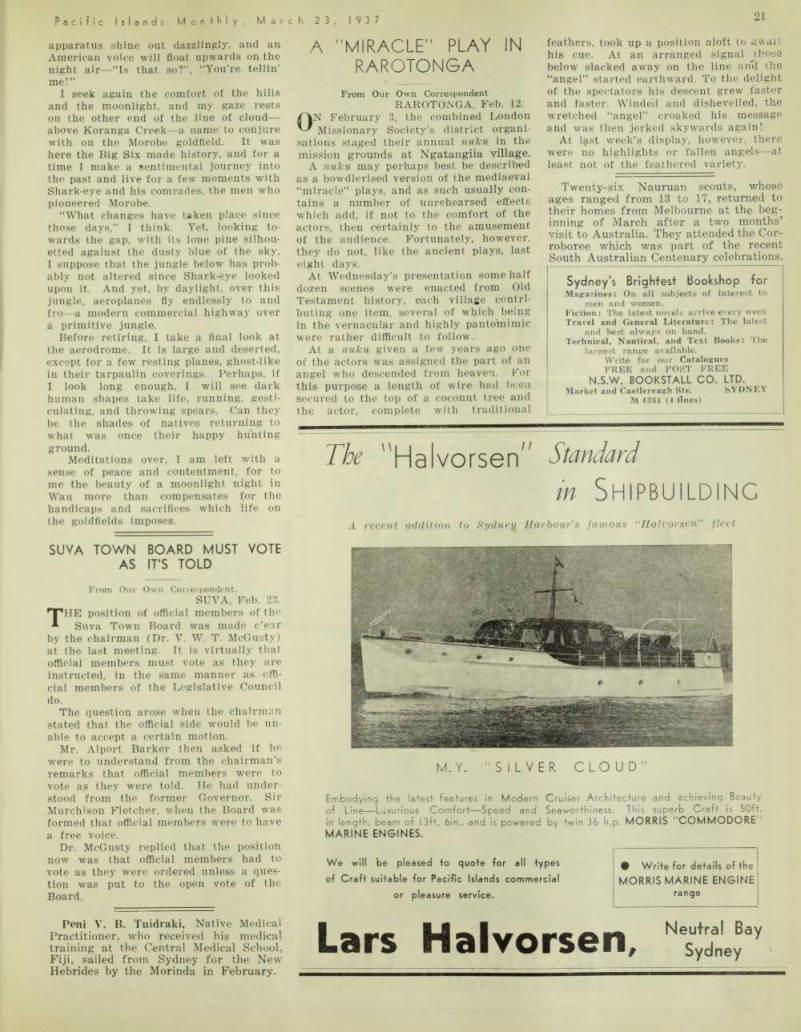
Of Wau
Some Reflections By "Mowgli"
117 E all have heard of the Edie Creek ** miner who entered Ushers’, trailing behind him a tiger on a leash. He ordered a neat “metho,” with a dash of nails; and, later, becoming maudlin, he began to weep. When asked the reason for his sorrow He replied that he had been refused the cameraderie of Edie Creek because of his effeminate nature.
The moral of the tale is that Edie Creek is a tough spot, where only the toughest survive.
There, and on the goldfields generally, any marked expression of sentiment is a violation of the miners’ unwritten code, and a sign of weakness. Should an un thinking newcomer make the remark: “What a beautiful sunset!”, the scornful reply (if any) would probably be “an other bibody hot day tomorrow!”
It has been said that there is at least five per cent of good in the worst of us and, by the same argument, I maintain that there is at least five per cent of sentiment and appreciation of beauty in the hardest-boiled miner in Morobe, des pite his grim exterior. But he would rather die than admit it.
If I am found out. I shall soon be breasting the bar at Ushers’ with our effeminate friend. It seems that I have considerably more than my five per cent of sentiment, for I never look upon the Vale of Wau by moonlight, but I indulge myself in a fantasy of dreaming and re flection. Lady Moon spreads her un earthly radiance all around and, as though in appreciation, myriads of in sects double the volume of their chirp ings. The voice of Nature otherwise is muted; all is quiet and still;, not even the rustle of a night breeze in the kunai grass.
Across the valley a few scattered lights are twinkling, and for a little while my thoughts dwell with those lonely people who have cut themselves off from con ventional life. Below their camps, a line of fleecy cloud hangs motionless over the waters of the Bulolo River, running the full length of the valley. Faintly, I can hear the river’s low lullaby. My eye follows the band of cloud, and loses it in the shadowy ridges towards the east, where nestle a number of native villages whose inhabitants live the same primi tive existence as their fore-fathers in spite of the nearness of modern Euro peans and their achievements.
Strains of music arise suddenly from Wau, to smother the sweeter voice of the river. The houses and buildings appear so close that I could throw a stone on to many of the roofs. The hotels, theatres, and dwellings are ablaze with light and, taken as a whole, look for all the world like brilliant gems resting on a black velvet ground. The music is from a gramophone, and the tune one of “Bing’s” latest. Occasionally, like forked lightning, the arcs of the talkie-picture
apparatus shine out dazzlingly, and an American voice will float upwards on the night air—“ls that so?”, “You’re tellin’ me!”
I seek again the comfort of the hills and the moonlight, and my gaze rests on the other end of the line of cloud— above Koranga Creek —a name to conjure with on the Morobe goldfield. It was here the Big Six made history, and for a time I make a sentimental journey into the past and live for a few moments with Shark-eye and his comrades, the men who pioneered Morobe.
“What changes have taken place since those days,” I think. Yet, looking to wards the gap, with its lone pine silhou etted against the dusty blue of the sky, I suppose that the jungle below has prob ably not altered since Shark-eye looked upon it. And yet, by daylight, over this jungle, aeroplanes fly endlessly to and fro —a modern commercial highway over a primitive jungle.
Before retiring, I take a final look at the aerodrome. It is large and deserted, except for a few resting planes, ghost-like in their tarpaulin coverings. Perhaps, if I look long enough, I will see dark human shapes take life, running, gesti culating, and throwing spears. Can they be the shades of natives returning to what was once their happy hunting
ground.
Meditations over, I am left with a sense of peace and contentment, for to me the beauty of a moonlight night in Wau more than compensates for the handicaps and sacrifices which life on the goldfields imposes.
Suva Town Board Must Vote
As It's Told
From Our Own Correspondent.
Suva, Feb. 23.
THE position of official members of the Suva Town Board was made c’ear by the chairman (Dr. V. W. T. McGusty) at the last meeting. It is virtually that official members must vote as they are instructed, in the same manner as offi cial members of the Legislative Council do.
The question arose when the chairman stated that the official side would be un able to accept a certain motion.
Mr. Alport Barker then asked if he were to understand from the chairman’s remarks that official members were to vote as they were told. He had under stood from the former Governor. Sir Murchison Fletcher, when the Board was formed that official members were to have a free voice.
Dr. McGusty replied that the position now was that official members had to vote as they were ordered unless a ques tion was put to the open vote of the Board.
Peni V. B. Tuidraki, Native Medical Practitioner, who received his medical training at the Central Medical School, Fiji, sailed from Sydney for the New Hebrides by the Morinda in February.
Rarotonga
A "Miracle" Play In
From Our Own Correspondent
Rarotonga, Feb. 12.
ON February 3, the combined London Missionary Society’s district organi sations staged their annual nuku in the
mission grounds at Ngatangiia village.
A nuku may perhaps best be described as a bowdlerised version of the mediaeval “miracle” plays, and as such usually con tains a number of unrehearsed effects which add, if not to the comfort of the actors, then certainly to the amusement of the audience. Fortunately, however, they do not, like the ancient plays, last eight days.
At Wednesday’s presentation some half dozen scenes were enacted from Old Testament history, each village contri buting one item, several of which being in the vernacular and highly pantomimic were rather difficult to follow.
At a nuku given a few years ago one of the actors was assigned the part of an angel who descended from heaven. For this purpose a length of wire had been secured to the top of a coconut tree and the actor, complete with traditional
feathers, took up a position aloft to await his cue. At an arranged signal jr.hose below slacked away on the line ami the “angel” started earthward. To the delight of the spectators his descent grew faster and faster. Winded and dishevelled, the wretched “angel” croaked his message and was then jerked skywards again!
At last week’s display, however, there were no highlights or fallen angels—at least not of the feathered variety.
Twenty-six Nauruan scouts, whose ages ranged from 13 to 17, returned to their homes from Melbourne at the beg inning of March after a two months’ visit to Australia. They attended the Cor roboree which was part of the recent South Australian Centenary celebrations.
Advertisements & other items, p. 23 (1 item)
Lars Halvorsen, Ne s “Xy ay
Sydney's Brightest Bookshop for
Magazines: On all subjects of interest to men and women.
Fiction : The latest novels arrive every week Travel and General Literature: The latest and best always on hand.
Technical, Nautical, and Text Books: The largest range available.
Write for our Catalogues
FREE and POST FREE
N.S.W. BOOKSTALL CO. LTD.
Market and Castlercagh Sts. SYDNEY M 4361 (4 lines)
The "Halvorsen" Standard
Shipbuilding
A recent addition to Sydney Harbours famous ‘ Halvorsen ” fleet k m
M.Y. "SILVER CLOUD"
Embodying the latest features in Modern Cruiser Architecture and achieving Beauty of Line—Luxurious Comfort—Speed and Seaworthiness. This superb Craft Is 50ft. in length, beam of 13ft. 6in., and is powered by twin 36 h.p. MORRIS "COMMODORE
MARINE ENGINES.
We will be pleased to quote for all types of Craft suitable for Pacific Islands commercial or pleasure service. • Write for details of the i
MORRIS MARINE ENGINE;
range
Lars Halvorsen, Ne s “Xy ay
Melanesian Missionary Lost
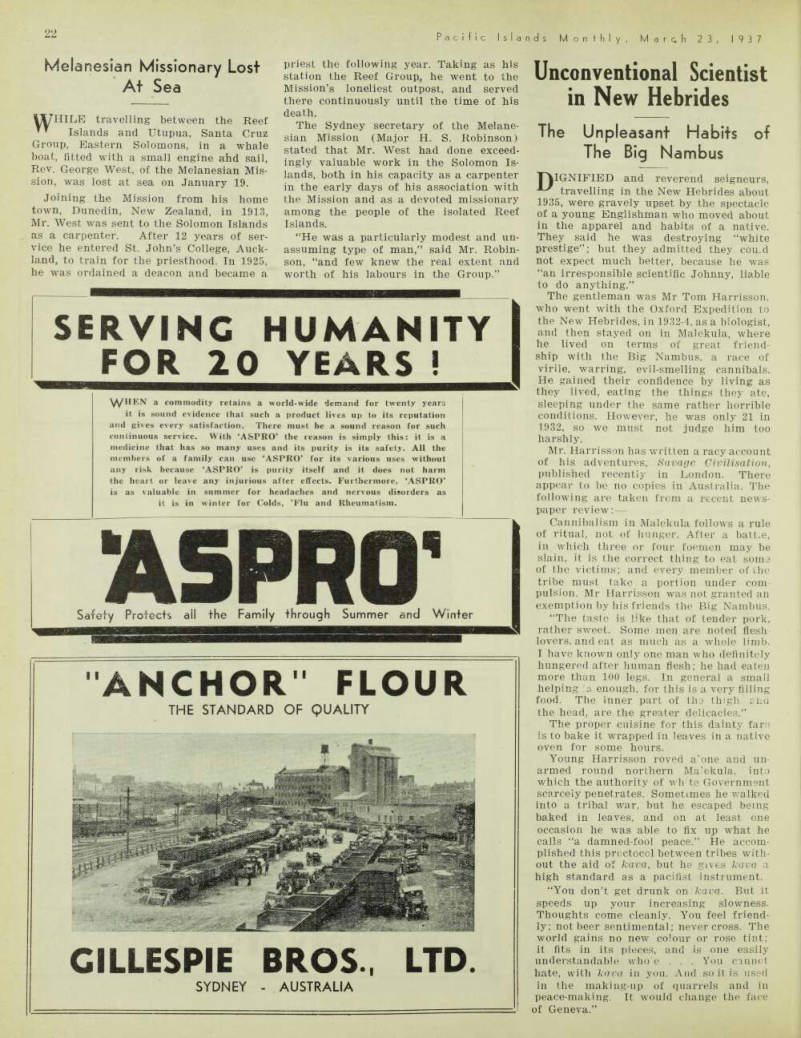
At Sea
VI/'HILE travelling between the Reef ** Islands and Utupua, Santa Cruz Group, Eastern Solomons, in a whale boat, fitted with a small engine and sail, Rev. George West, of the Melanesian Mis sion, was lost at sea on January 19.
Joining the Mission from his home town, Dunedin, New Zealand, in 1913, Mr. West was sent to the Solomon Islands as a carpenter. After 12 years of ser vice he entered St. John’s College, Auck land, to train for the priesthood. In 1925, he was ordained a deacon and became a
priest the following year. Taking as his station the Reef Group, he went to the Mission’s loneliest outpost, and served there continuously until the time of his death.
The Sydney secretary of the Melane sian Mission (Major H. S. Robinson) stated that Mr. West had done exceed ingly valuable work in the Solomon Is lands, both in his capacity as a carpenter in the early days of his association with the Mission and as a devoted missionary among the people of the isolated Reef Islands, “He was a particularly modest and un assuming type of man,” said Mr. Robin son, “and few knew the real extent and worth of his labours in the Group.”
Unconventional Scientist
in New Hebrides The Unpleasant Habits of The Big Nambus
and reverend seigneurs, travelling in the New Hebrides about 1935, were gravely upset by the spectacle of a young Englishman who moved about in the apparel and habits of a native.
They said he was destroying “white prestige”; but they admitted they cou-d not expect much better, because he was “an irresponsible scientific Johnny, liable to do anything.”
The gentleman was Mr Tom Harrisson, who went with the Oxford Expedition to the New Hebrides, in 1932-4, as a biologist, and then stayed on in Malekula, where he lived on terms of great friend ship with the Big Nambus, a race of virile, warring, evil-smelling cannibals.
He gained their confidence by living as they lived, eating the things they ate, sleeping under the same rather horrible conditions. However, he was only 21 in 1932, so we must not judge him too harshly, Mr. Harrisson has written a racy account of his adventures, Savage Civilisation, published recently in London. There appear to be no copies in Australia. The following are taken from a recent news paper review: Cannibalism in Malekula follows a rule of ritual, not of hunger. After a battle, in which three or four foemen may be slain, it is the correct thing to eat soma of the victims; and every member of the tribe must take a portion under com pulsion, Mr Harrisson was not granted an exemption by his friends the Big Nambus.
“The taste is like that of tender pork, rather sweet. Some men are noted flesh lovers, and eat as much as a whole limb.
I have known only one man who definitely hungered after human flesh; he had eaten more than 100 legs. In general a small helping is enough, for this is a very filling food. The inner part of the thigh ana the head, are the greater delicacies.”
The proper cuisine for this dainty faro is to bake it wrapped in leaves in a native oven for some hours.
Young Harrisson roved a’one and un armed round northern Malekula, into which the authority of wh te Government scarcely penetrates. Sometimes he walked into a tribal war, but he escaped being baked in leaves, and on at least one occasion he was able to fix up what he calls “a damned-fool peace.” He accom plished this prcctocol between tribes with out the aid of kava , but he gives kava a high standard as a pacifist instrument.
“You don’t get drunk on kava. But it speeds up your increasing slowness.
Thoughts come cleanly. You feel friend ly; not beer sentimental; never cross. The world gains no new colour or rose tint; it fits in its pieces, and is one easily understandable who e . . . You cannot hate, with kava in you. And so it is used in the making-up of quarrels and in peace-making. It would change the face of Geneva.”
Tom grew a year’s beard on his chin, but became more remarkable for the shock of unshorn hair which fell round his shoulders. He was in this condition when he travelled on the inter-island steamer, and caused something of a sen sation. This hirsute glory fascinated the Big Nambus women. Their head-dress, which they never remove, is made of purple-stained matting, with unplaited ends falling in a purple cascade of arti ficial hair down shoulders and back, as far as the waist.
“A sure wow for me was to jerk my head to and fro, sending hair to cover all my face and then clear it again. The women would go half crazy with interest until their jealous husbands got too jealous. There are bits of my hair, yanked suddenly out of my scalp, all over the plateau, maybe still being worn by some romantic maidens, next to their woolly, lousy heads.”
This part of the book is crammed, of course, with close observations. The morals of Malekula are not those of Mos man. A page is written concerning the gross rites which initiate youths into manhood. At the culmination “this night is the one for the women. Let go!
They have the right to rape, or anything else, every man in that place. They do just that.” Savage vices combine the pleasures of Solomon with those of A'ci biades. Nesai, chieftain of Amok, has 40 wives and six ephebes.
Advertisements & other items, p. 24 (1 item)
'Aspro'
Safely Protects all the Family through Summer and Winter
"ANCHOR" FLOUR
THE STANDARD OF QUALITY
% : I US m m m m I o>.
I mSßmmmm
GILLESPIE BROS., LTD
SYDNEY - AUSTRALIA
Pioneer Of The Gilberts
From Our Own Correspondent
Apia, Feb. 16.
MANY residents of Western Samoa were grieved to learn of the death recently of Mr. G. M. Murdoch, of the Gilbert and Ellice Group, announced in the December P.I.M. He had many friends in this territory, his closest being Cap tain C. Doughty, Mr. Paul Hoeflich, Mr.
H. N. Newton, and Mr. G. E. L. West brook. Mr. Murdoch was born at Dal
bettie, Scotland, in 1860.
Mr. Murdoch had resided in the Gil berts since the 80’s, having been a trader and,* later, a Government official.
Thoroughly conversant with the lan guage, he was a keen student of native folklore and history.
Mr. Hoeflich, of Apia, who hvd regu larly corresponded with Mr. Murdoch during the past 25 years, was at one time in partnership with him in a trad ing venture in the Gilbert Group.
Double Tragedy In Fiji
From Our Own Correspondent
Suva, Feb. 8.
A DOUBLE tragedy occurred recently at Ra, on the northern side of Viti Levu.
Abel Ramchandra, 27, an Indian school master at Wairuku, and the wife of an Indian named Rupnarayan Maharaj, were found dead from gunshot wounds.
The police state that Ramchandra was discovered dead in his bed and that the body of the woman was found near a well in the neighbourhood of Wairuku School.
Fiji’S Governor On
The Job
From Our Own Correspondent.
Suva, Feb. 22.
HIS Excellency the Governor, Sir Arthur Richards, has not wasted any time in becoming acquainted with the main centres of the Colony. During the last few weeks, he has spent a strenuous time visiting centres on Viti Levu.
Accompanied by the Secretary for In dian Affairs (Dr. V. W. T. McGusty),and the Acting Secretary for Native Affairs (Mr. H. C. Monckton), His Excellency visited the Northern and Western Dis tricts, covering Ba, Lautoka, Nadi, Siga toka, and Nadarivatu. Nearer home, he
paid a visit along the new road to Navua, and has also officially called at Nausori and the Naduruloulou Govern ment station.
At all points His Excellency has been welcomed by representative gatherings of Europeans, Fijians, and Indians, and on each occasion he has addressed the gathering.
It is presumed that only the fact that the Government yacht Pioneer is on the slip undergoing an extensive overhaul and survey prevents His Excellency visiting other islands of the Group, Dr. A. H. B. Pearce, Director of Medi cal Services in Fiji, returned to Suva recently after a short health trip to New Zea’and.
Advertisements & other items, p. 25 (1 item)
Imperial GOOD FOOD
Prepared for YOU !
DELICIOUS
FLAVOUR SEALED MEATS
Taste any of the delicious "Imperial" dishes and prepare yourself for a glorious surprise.
We have blended the finest selected meats and cooked them in vacuum so that all the precious flavour carriers and valuable mineral salts ara sealed in the can. We call the process "flavour sealing," for nothing else so well describes it.
No one could serve a more delicious, wholesome dish.
Get some of these tenderized ' Imperial" meats to-day—serve them to your family, and see how they enjoy the rich, satisfying flavour no one else can match.
Imperial CORNED BEEF LOAF
Mild-cured, corned, prime, selected beef, packed in aspic jelly. Slice it finely for service at table or spread it on sandwiches.
Tasty Crustiess CHEDDAR CHEESE
Another Delightful " Imperial " Product.
Adds a wonderful flavour to salads, egg dishes, macaroni and potatoes. Give it to your children for lunch, or try it toasted.
ORNED BEEF
loaf Ozs c
Try Also "Imperial" Smallgoods \
Pork Fritz, Pork Sausages, Frankfurts, Devon Sausage, Pork Garlic, and Imperial Rindless Bacon.
IMPERIAL FOODS ARE STOCKED BY ALL LEADING STORES
B.S.I. Copra Shipments Delayed
From Our Own Correspondent
Tulagi, Feb. 14.
1 jCHE slight fall in the price of copra , bas not disheartened planters as it might have, as medium prices had come to bg regarded almost as normal. The recent few weeks of almost soaring prices gave a decided lift to Solomon planters, as much mental as actual.
The pity of it is that quite a lot of copra could not be shipped when prices were high, owing to inclement weather.
Much of it is still lying on the beach, depreciating in weight, and, if the present trend continues, depreciating in market price value every Monday morning.
Training Sailors
An Inland Nation Is Training Sailors
From Our Own Correspondent
Papeete, Feb. 2.
nPHE Polish training ship Bar Pomorza *• arrived at Papeete from Honolulu early in January and departed on Janu ary 15 for Buenos Aires, via Cape Horn.
This vessel —a three-masted square rigged sailing ship carries about 200 cadets who are being trained for the merchant service after the old manner of instruction in sail. Poland, like Fin land, evidently believes that sailing ves sels are not yet obsolete and that the way to make mariners is to train them in the old methods of navigation.
Dad's Journey
I NEVER growled and never fussed, but lived ' here calm an’ still.
For 70 years I lived here on the hill in Wombatville.
“Don’t live here like a snail,” said Dave, “within yer small shell curled.
“I’ll pay yer fare to Nauru Isle, an’ let yer see the world."
An’ so I got on board the ship an’ whirled off like a breeze.
But all I see upon the trip was dirt and ropes n’ grease; Sea-water, rocks, an’ sich-like things, sometimes a bird an’ hill.
Sez I to Dave, “All these ’ere things I see in Wombatville.”
We saw the Canterlever, that caused so much loud moot, An* saw a mess er phosphate kinder tumbling from a shoot; “If you spill some sugar from a spoon,” sez I to Dave, sez I, “Tis ’zactly the same principle,” as Dave could not deny.
We walked along the Topside an’ Dave said, “1 call this grand.”
“They’re nought,” sez I, “but great big hunks of rock an’ dirt an’ sand.”
We then came to the harbour, an’ it made Dave look perfound.
But I sez, “I don’t see nothin’ but some water sloshing round,”
We went to several villages--there’s nothin’ there to see.
But just er mess er houses an’ some folks like you an’ me; An’ last we see the wireless mast. Sez Dave, “How’s this for high?”
Sez I, “It’s jest like Wombatville—the same ol’ thing,” sez I.
Nauru
F.H.D,
Fijian Bandsmen Win Trophies
From Our Own Correspondent.
Suva, Feb. 22.
T'O encourage members of the Fijian * Defence Force Band in efficiency a cup was presented last year by Mr David Riemenschneider, proprietor of the Hotel Metropole, for the best all-round bands man.
The competition evoked great interest among the Fijians and was keen throughout. The winner was Bandsman Vilitate Vavaitamana, with 214 points, and the runner-up Corporal Jokatama Tuikaba, only one point behind.
Announcing the result, Major C. B.
Joske, Acting Commandant of the De fence Force, announced he would give a special trophy to the bandsman who had the best attendance during the year. This was won by R. Saimone, who had at tended on every one of the 140 occasions on which the band had practised or paraded.
Mr. Dutchie Low, son of Captain and Mrs. Low, of Suva. Fiji, married Miss Emily Barrett at the Sacred Heart
Cathedral, Suva, in February. They sailed
later by the Tui Cakau on a honeymoon trip to the Lau Group.
Mr. A. A. Ragg, Assistant Director of Public Works in Fiji, arrived in Sydney from Suva by the Esperance Bay in the middle of February en route to England on leave.
Advertisements & other items, p. 26 (1 item)
B.P. Magazine
wm h
(•AIR
Woods’
For With the fearless few, Study mankind in a Birdseye view, Trust the care of a knight of the air, Seeing the world as a vista fair.
Travel by air! but provide for chill, Carry the treatment that "always will,”
Trust to the aid which will ease assure— Cough-proof Woods’ Great Peppermint Cure.
Great Peppermint Cure, Coughs and Colds, never fails.
READ THE
B.P. MAGAZINE
AUTUMN NUMBER
NOW ON SALE
A
ONE SHILLING PER COPY
ON SALE AT ALL NEWSAGENTS AND BOOKSELLERS
MAGAZINE
Japanese Eyes On Dutch New Guinea
Leasing Plan Not Well Received In Holland
THE following newspaper despatches tell their own story.
The following, from Tokio, was published in Sydney on March 1: “It was suggested in Parliament that Japan should conclude a non-aggression pact with Holland.
“It was also suggested that Japan should approach Holland for permission to lease Dutch New Guinea.
“The Premier (General Hayashi) replied that the matter would be studied. adding that Japan had no territorial ambitions in the Dutch East Indies.”
The following was published in Sydney on March 3: — The correspondent of The Times at The Hague states: “Tf the fox preaches religion the farmer should protect his geese,’ is a Dutch proverb summarising the attitude of the local newspapers towards the Japanese suggestion that Japan should lease Dutch New Guinea for settlement. The suggestion has aroused indignation throughout the country.
“Newspapers angrily declare that the discussion of the lease of Dutch territory is out of the question. ‘Moreover,’ it is added, ‘the Japanese are untrustworthy, and will use every method, even the most secret and crooked, in the pursuit of their aims.’
“The Telegraff declares that Dutch New Guinea is of no commercial value to the Japanese, and that the only Japan ese settlement there is a failure.
“The newspapers are unanimous that the only value Dutch New Guinea has for Japan is military. Its peaceful pene tration would eventually create a situa tion intolerable to Britain and the United States, the newspapers declare.”
According to a message from The Hague, received in London on March 2, it ig authoritatively stated that a pact between the Netherlands and Japan is not in line with Dutch policy, and that the granting of land concessions in Dutch New Guinea will only be considered in (jividually and not collectively,
Minister’S Visit To Batavia
rpjjE following was despatched from 1 Tokio on March The Asahi says: “The proposals to lease Dutch New Guinea and to achieve the colonisation and economic penetra tion of the Dutch East Indies await the return the Mr. Kuwashima, the new Japanese Minister to Holland, who is now going to Batavia to discuss the situ ation with Government officers; and, it is reported, to allay fears of Japanese
aggression.”
Dutch New Guinea As It Is To-Day
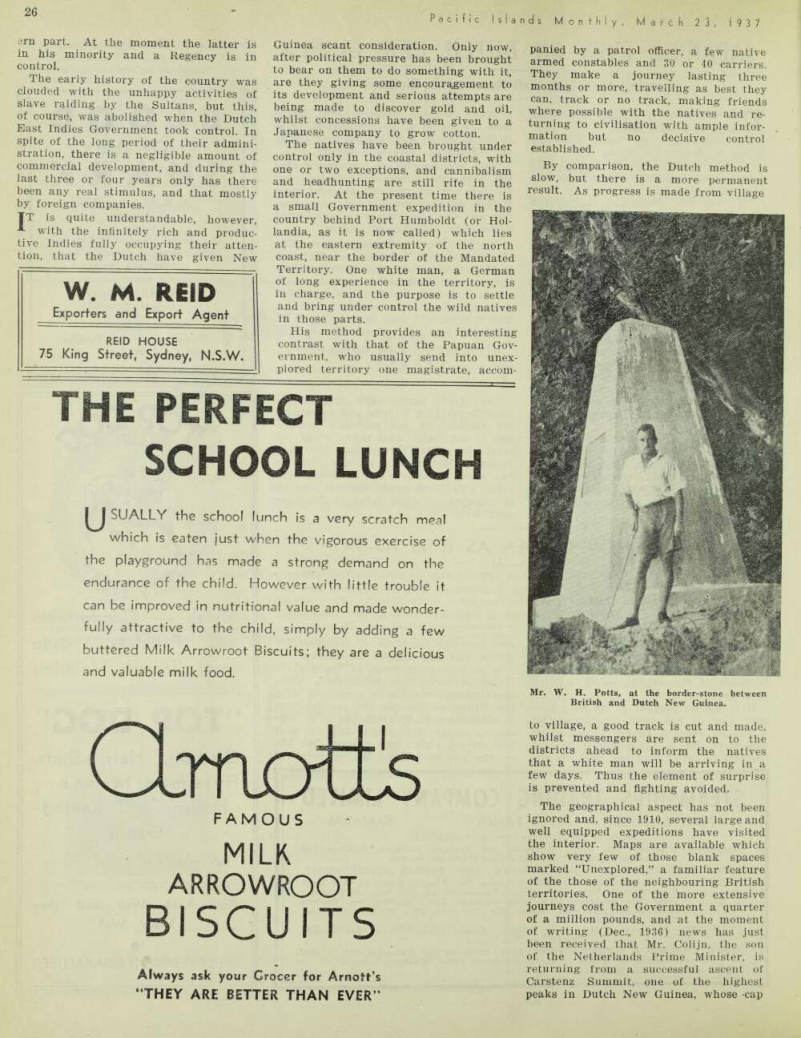
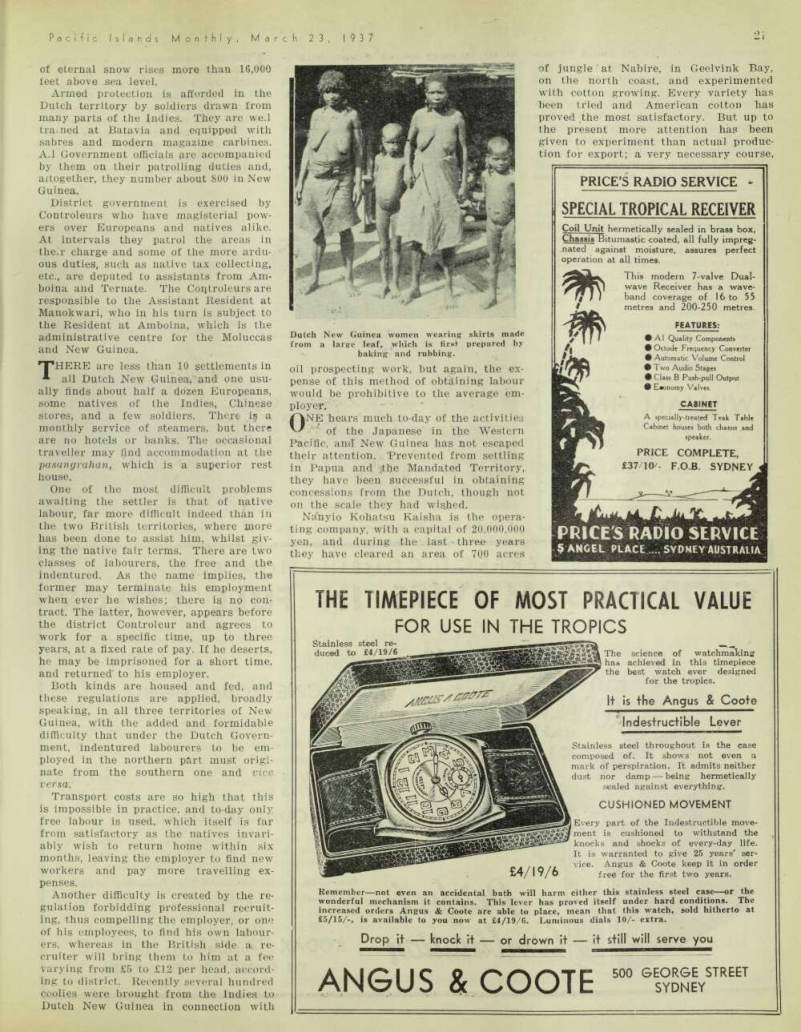

THE following article was written for the “Pacific Islands Monthly,” in January lust, hy Mr. William H. Potts, a young Englishman, mho left Sydney late last year with the American, Dwight Long, in the ketch “Idle Hour”. They parted company in Papua, and Mr. Potts subsequently wandered through the Trobriands, New Guinea and Dutch New Guinea.
IN modern times, when wireless has al most annihilated distance, there still remains a land which is a closed book to much of the outside world Dutch New Guinea.
It is not on account of its size, how ever, that it has been overlooked, for it has an area of 120,000 square miles and more; but it has provided its own barriers to man’s invasion, with its un
compromising landscape of impenetrable jungle and snow-capped mountains.
It is now more than 80 years since Dutch authority was established, when negotiations were finally completed with the Sultan of Ternate for the transfer of his suzerainty of north and west New Guinea to the Netherlands flag. He still has certain rights and powers, but ’ his actions are subject to the approval of
the Government. A similar position ex ists in respect of the Sultan of Tidore, whose suzerainty extends over the south
ern part. At the moment the latter is in his minority and a Regency is in control.
The early history of the country was clouded with the unhappy activities of slave raiding by the Sultans, but this, of course, was abolished when the Dutch East Indies Government took control. In spite of the long period of their admini stration, there is a negligible amount of commercial development, and during the last three or four years only has there been any real stimulus, and that mostly by foreign companies.
TT is quite understandable, however, A with the infinitely rich and produc tive Indies fully occupying their atten tion, that the Dutch have given New
Guinea scant consideration. Only now, after political pressure has been brought to bear on them to do something with it, are they giving some encouragement to its development and serious attempts are being made to discover gold and oil, whilst concessions have been given to a Japanese company to grow cotton.
The natives have been brought under control only in the coastal districts, with one or two exceptions, and cannibalism and headhunting are still rife in the interior. At the present time there is a small Government expedition in the country behind Port Humboldt (or Hol landia, as it is now called) which lies at the eastern extremity of the north coast, near the border of the Mandated Territory. One white man, a German of long experience in the territory, is in charge, and the purpose is to settle and bring under control the wild natives in those parts.
His method provides an interesting contrast with that of the Papuan Gov ernment, who usually send into unex plored territory one magistrate, accom
panied by a patrol officer, a few native armed constables and 30 or 40 carriers.
They make a journey lasting three months or more, travelling as best they can, track or no track, making friends where possible with the natives and re turning to civilisation with ample infor mation but no decisive control established.
By comparison, the Dutch method is slow, but there is a more permanent result. As progress is made from village
to village, a good track is cut and made, whilst messengers are sent on to the districts ahead to inform the natives that a white man will be arriving in a few days. Thus the element of surprise is prevented and fighting avoided.
The geographical aspect has not been ignored and, since 1910, several large and well equipped expeditions have visited the interior. Maps are available which show very few of those blank spaces marked “Unexplored,” a familiar feature of the those of the neighbouring British territories. One of the more extensive journeys cost the Government a quarter of a million pounds, and at the moment of writing (Dec., 1936) news has just been received that Mr. Colijn, the son of the Netherlands Prime Minister, is returning from a successful ascent of Carstenz Summit, one of the highest peaks in Dutch New Guinea, whose cap
Mr. W. H. Potts, at the border-stone between British and Dutch New Guinea.
of eternal snow rises more than 16,000 feet above sea level.
Armed protection is afforded in the Dutch territory by soldiers drawn from many parts of the Indies. They are weJ trained at Batavia and equipped with sabres and modern magazine carbines.
A.l Government officials are accompanied by them on their patrolling duties and, altogether, they number about 800 in New Guinea.
District government is exercised by Controleurs who have magisterial pow ers over Europeans and natives alike.
At intervals they patrol the areas in their charge and some of the more ardu ous duties, such as native tax collecting, etc., are deputed to assistants from Am boina and Ternate. The Controleurs are responsible to the Assistant Resident at Manokwari, who in his turn is subject to the Resident at Amboina, which is the administrative centre for the Moluccas and New Guinea.
HTHERE are less than 10 settlements in * all Dutch New Guinea, and one usu ally finds about half a dozen Europeans, some natives of the Indies, Chipese stores, and a few soldiers. There is a monthly service of steamers, but there are no hotels or banks. The occasional traveller may find accommodation at the pasangrahan, which is a superior rest house.
One of the most difficult problems awaiting the settler is that of native labour, far more difficult indeed than in the two British territories, where more has been done to assist him, whilst giv ing the native fair terms. There are two classes of labourers, the free and the indentured. As the name implies, the former may terminate his employment when ever he wishes; there is no con tract. The latter, however, appears before the district Controleur and agrees to work for a specific time, up to three years, at a fixed rate of pay. If he deserts, he may be imprisoned for a short time, and returned' to his employer.
Both kinds are housed and fed, and these regulations are applied, broadly speaking, in all three territories of New Guinea, with the added and formidable difficulty that under the Dutch Govern ment, indentured labourers to be em ployed in the northern part must origi nate from the southern one and vice versa.
Transport costs are so high that this is impossible in practice, and to-day only free labour is used, which itself is far from satisfactory as the natives invari ably wish to return home within six months, leaving the employer to find new workers and pay more travelling ex penses.
Another difficulty is created by the re gulation forbidding professional recruit ing, thus compelling the employer, or one of his employees, to find his own labour ers, whereas in the British side a re cruiter will bring them to him at a fee varying from £5 to £l2 per head, accord ing to district. Recently several hundred coolies were brought from the Indies to Dutch New Guinea in connection with
oil prospecting work, but again, the ex pense of this method of obtaining labour would be prohibitive to the average em ployer. hears much to-day of the activities " of the Japanese in the Western Pacific, and New Guinea has not escaped their attention. Prevented from settling in Papua and jthe Mandated Territory, they have been Successful in obtaining concessions from the Dutch, though not on the scale they had wished.
Nanyio Kohatsu Kaisha is the opera ting company, with a capital of 20,000,000 yen, and during the last - three years they have cleared an area of 7QO acres
of jungle at Nabire, in Geelvink Bay, on the north coast, and experimented with cotton growing. Every variety has been tried and American cotton has proved the most satisfactory. But up to the present more attention has been given to experiment than actual produc tion for export; a very necessary course,
Dutch New Guinea women wearing skirts made from a large leaf, which is first prepared by baking and rubbing.
as the available data on cotton produc tion in New Guinea is negligible.
Further clearing is in progress and they hope to have about 1,400 acres in production during the next few months.
The colossal task of converting New Guinea forest to open agricultural land has called for an army of native labour ers, numbering 1,200 at times and mostly from Biak Island. There are 17 Japanese in residence, some with wives and families.
They have another concession at Momi, within a few hours’ steamer run of Na bire, where they have cut a rough track, 25 miles long, which leads into the moun tains. There they have built houses for the native labourers who collect dammar and bring it to the coast, whence it is shipped to Japan. A few acres of kapok are cultivated, in addition, on a small coastal clearing.
There are no individual Japanese settlers in Dutch New Guinea.
The spiritual welfare of the natives has not been neglected and there is a mission
school in every settled village, with a teacher from the Indies who imnarts elementary education in addition to religious instruction. A small subsidy is granted by the Government.
Dutch Protestant missions operate in the northern half of the territory, and Catholic ones in the southern division, Unlike those in the British territories, they do not engage in any form of trade,
THE natives themselves have learned J, , , .
neighbour™ in the^Stish'°part
cotfon and "nLriof tobacco are found in manv districts alone: the north ma^t On the Island of Japen in Geelvink Bay they collect dammar and cut teak, and on arrival of the steamer it is a quite remarkable event to see the heavy trunks of timber dragged by an excited crowd
Starting life again in Dutch New Guinea—the home of a colonist at Manokwari,
of natives from the beach on to huge rafts, which are then slowly paddled to the boat. A large quantity of these native productions are purchased by Chinese merchants, who travel on the steamer for that purpose.
The incentive to this activity on the part of the natives may be looked for in the imposition of an annual tax of three guilders and thirty-six cents, which is equivalent to about ten Australian shil lings at the present rate of exchange. It is payable by all male natives in con trolled areas, except those who are infirm or too young to work.
SOME years have passed since the large trade in the export of bird of para dise plumes was stopped by the Govern ment. Another great development is afoot, namely, oil production. It is too early yet to say what the future may hold in that respect, but very large con cessions have been granted to Nederland sche Nieuw Guinea Petroleum Maatschap pij, an offspring of the Shell and Stan dard Oil Companies. Large bases have been established in the McClure Gulf, at Babo, and at the western extremity, near Sorong.
Most of the area involved lies in the flat country, and aeroplanes h?,ve been used, from which a complete photographic survey has been made during the last few months and the most promising ground will now be prospected in the usual manner. Already a quarter of a million pounds has been expended in what is probably the most difficult country in the world for any kind of prospecting.
IT will be recalled that only during the last 15 years an immensely rich de posit of gold has been discovered in the Mandated Territory of New Guinea, and many hold the opinion that a large quan tity may be found on the Dutch side. / The opportunities which arose in the former country for the individual pros pector will not be available in Dutch New Guinea, however, as all the ground likely to bear gold has been leased to one company, Nederlandsche Nieuw Goud Maats., which is sponsored by the Oro ville and Billiton Companies and the firm of Erdman and Sielken, Prospecting is in progress but, so far, without substan tial result.
OF less ambitious character financially, but none the less interesting, are the Communist camp at Tanahmerah. 250 miles up the Digoel River, on the south coast; and the colonisation of a number of unemployed men from the Indies on land at Manokwari and Sabron.
The Tanahmerah camp was established by the Government some years ago, and about 1,200 malcontents from the Indies were taken there, housed and given all the necessary agricultural implements and land to enable them to realise that earthly paradise about which they had talked so much. The only stipulation was that they should remain there and a garrison of soldiers was sent to ensure that they did so. Like other similar attempts, however, it has failed and the
Communists are not even self-supporting.
The Government is obliged to send a boatload of food at regular intervals.
Occasionally one or two escape, but they are usually devoured by the cannibals who roam between the Digoel and Fly Rivers.
THE scheme of unemployed colonisa tion is of more particular interest as it represents the attempt of a Govern ment, harassed by its supporters, to deal with the problem of unemployment.
Drawn from the ranks of unemployed native and half-caste clerks, shop assis tants, etc., from Java and Sumatra, the
first detachment of colonisers, many with wives and children, sailed for New Guinea in 1928 and an association was formed, Stichting Immigratie Koloni satie Nieuw Guinea, to conduct the enter prise at Manokwari and dispose of the agricultural produce, giving each colon -Ist living necessaries to the value of the credit of his output. It has not yet proved a profitable undertaking and much of the deficit is made good by charitable public subscription in the Indies, The scheme makes it possible, however, for a penniless man to obtain a small
financial assistance from the Govern ment, spread over three years and de creasing annually, build a simple house and clear two and a half acres of jungle.
But even the most industrious man in the colony has only eight acres in pro duction and makes a bare existence; though, as he said, it was better than selling pencils in the streets of Surabaya.
Up to the present day there has been only a trifling export production, in spite of the fact that there are 200 working colonists, but this is partly accounted for by the colony consuming much of its own produce.
There are only about 30 colonists at Sabron, which is near Hollandia, and this section there is a different as sociation. The district is somewhat un healthy and financial assistance is not available, but a newcomer may earn a little by working for the association for a part' of his time. Nevertheless the results have been very disappointing there.
At both centres, the principal items grown are cassava, maize, cocoa, rice, and cotton.
It may be gathered, therefore, that this creditable attempt is not likely to have much effect on the number of un employed in the Indies and a few colon ists have abandoned their holdings and returned. Very few of them are of an
agricultural or labouring class and, nat urally, they find the work of extending their production very arduous, whilst shortage of money prevents them -from employing sufficient native labour to ac complish the task, sd for the time being it seems to be case of stalemate.
AS to the future of Dutch New Guinea, one might perhaps turn to Papua and the Mandated Territory, where de-
velopment has been in progress for a much longer period. Apart from gold, the only large exports from there have been copra, with rubber in addition from the former. They have been produced and exported under infinitely more fav ourable conditions than could be found in the Dutch Territory, and even if lab our regulations were eased a little in favour of the employer (and there is good authority for saying that the Dutch Government is unwilling to do this) there still remains the obstacle of ex ceedingly high freight charges by the steamship line which has the monopoly of the inter-Indies business. On the British side, ships call at the main ports and take copra direct to Europe, but the exports from Dutch New Guinea will have to be increased many times before such as opportunity arises there.
It is rather to the valuable products, oil and gold, that one must look to give the country the li£e blood which it needs-
Natives loading logs of teak on to a steamer at Japen Island, Dutch New Guinea.
Advertisements & other items, pp. 27-32 (1 item)
"Top Doc"
BLOOD
OF THE
SHARK
By Beatrice Ayer Patton, of Honolulu A Powerful Novel of Old Hawaii.
With Polynesian Totemism As Its Underlying Theme.
Price 12/- Prepaid (Includes Postage) Publishers: Paradise of the Pacific, Honolulu - Hawaii - U.S.A.
Q
REGD
Wl n Stylish Comfortable and Faithfully Made from Tested Materials
"TOP DOC"
Clothing, Hats, Shirts, Pyjamas, Mercery Hosiery and Knitted Goods will give full satisfaction They Look Well and They Wear Well •
EVERY GARMENT GUARANTEED
STEAMSHIPS TRADING COMPANY LIMITED
PORT MORESBY PAPUA SAMARAI
Chairman and Managing Director: A. S. FITCH.
Shipowners, Wholesale and Retail Merchants and Traders; Shipping, Customs and Insurance Agents; Copra and Rubber Plantation Owners.
MAIL CONTRACTORS TO COMMONWEALTH AND PAPUAN GOVERNMENTS.
AGENCIES:—At Port Moresby; Coral Sea Insurance Co.; Phoenix Insurance Co.; Delta Sawmills, Ltd.; Acme Bakery Co. ; Vacuum Oil Co. Pty. Ltd. At Samarai: Coral Sea Insurance Co. : Delta Sawmills, Ltd. ; Bankers and Traders Insurance Co. ; National Mutual Life Insurance Co. ; Kularo Shipyards; Mamai Plantations.
BRANCHES:—In Papua: Hanuabada, Sivitoi, Aroma, Koki, Hula, Ela Beach, Duga Duga, Yule Island.
SYDNEY: NELSON & ROBERTSON PTY. LTD., 12 Spring St.; Melbourne, 396 Flinders Lane; London, E. Whiteaway & Co., 7 Chiswell Street, Finsbury, London.
Cable Address: “STEAMSHIPS.” Code; Bentley’s.
W. M. REID
Exporters and Export Agent
REID HOUSE
75 King Street, Sydney, N.S.W.
THE PERFECT
SCHOOL LUNCH
(J SUALLY the school lunch is a very scratch meal which is eaten just when the vigorous exercise of the playground has made a strong demand on the endurance of the child. However with little trouble it can be improved in nutritional value and made wonderfully attractive to the child, simply by adding a few buttered Milk Arrowroot Biscuits; they are a delicious and valuable milk food.
CLmotts
FAMOUS
MILK
ARROWROOT
BISCUITS
Always ask your Grocer for Arnoft’s
“THEY ARE BETTER THAN EVER"
PRICE’S RADIO SERVICE *
SPECIAL TROPICAL RECEIVER
Coil Unit hermetically sealed in brass box, Chassis Bitumastic coated, all fully impregnated against moisture, assures perfect operation at all times. fa This modern 7-valve Dualwave Receiver has a wavecoverage band coverage of 16 to 55 metres and 200-250 metres.
FEATURES:
#AI Quality Components Oclode Frequency Converter Automatic Volume Control Two Audio Stages 0 Class B Push-pull Output Economy Valves.
CABINET
A specially-treated Teak Table Cabinet houses both chassis and speaker.
PRICE COMPLETE,
£37/10/- F. 0.8. SYDNEY
r L* nr
PRICE'S RADIO SERVICE
5 ANCEL PLACE ... SYDNEY'AUSTRALIA
THE TIMEPIECE OF MOST PRACTICAL VALUE
FOR USE IN THE TROPICS
Stainless steel reduced to £4/19/6 SB j n e=a m £4/19/6 The science of watchmaking has achieved in this timepiece the best watch ever designed for the tropics.
It is the Angus & Coote
Indestructible Lever
Stainless steel throughout is the case composed of. It shows not even a mark of perspiration. It admits neither dust nor damp being hermetically sealed against everything,
CUSHIONED MOVEMENT
1 Every part of the Indestructible movement is cushioned to withstand the knocks and shocks of every-day life.
It is warranted to give 25 years’ service. Angus & Coote keep it in order free for the first two years.
Remember—not even an accidental bath will harm either this stainless steel case—or the wonderful mechanism it contains. This lever has proved itself under hard conditions. The increased orders Angus & Coote are able to place, mean that this watch, sold hitherto at £5/15/-, is available to you now at £4/19/6. Luminous dials 10/- extra.
Drop it knock it or drown it it still will serve you
ANGUS & COOTE
500 GEORGE STREET
SYDNEY
WILLIAM FINAU
PHOTOGRAPHER
FRIENDLY ISLANDS, OCEANIA
Send 5/6 for Interesting views and native life scenes from Tonga. Your money back if unsatisfied. Simple Information: 5/6. More Important information and photographic data: 10/6
THE PERFECT COMBINATION FOR
GLORIOUS MOVIES IN FULL COLOR
jam
fix-
P&kci
C&nimoliOM
Utilises the new Eight principle. An achievement of the highest ingenuity maintaining standards of quality that are absolutely astonishing.
CINE-KODAK EIGHT
In spite of its low running costs will give you screen results that are truly magnificent. Features include built-in exposure guide; eye-level finder; accurate footage indicator; and precision construction throughout.
Model 20, with f/1.9 lens £l7/18/6 Model 20, with t/3.5 lens £ll/19/6
KODACHROME FILM
A totally new kind of colour film. Gives you every scene in full, brilliant colour, clear in detail, revolutionary in clarity. No special apparatus for taking or projecting—the colour is in the film.
Price—2sft. reel for Cine-Kodak Eight (equivalent to 100ftreel 16mm) includes processing £l/2/6 Of all Kodak Dealers throughout the Islands and KODAK (Australasia) PTY. LTD.
379 GEORGE STREET, SYDNEY
BURNS PHiLP
(SOUTH SEA) CO. LTD.
INCORPORATED IN FIJI
Island Traders and Shipowners Also Branches at: Office:
SUVA
FIJI
Fiji: Levuka, Lautoka, Labasa, Ba, Sigatoka, Rofuma.
Tonga: Nukualofa, Haapai, Vavau. \ Samoa: Apia, Pago Pago (American Samoa).
Solomons: Makambo, Gizo, Faisi.
New Hebrides: Vila.
Code Address: Gilberts: Tarawa.
"Burnsouth." Norfolk Is. Niue. Wallis Is. Futuna Is.
SUL
KEROSENE OPERATED...
StfOfTi REFRIGERATORS
ANNOUNCE NEW EXPORT POLICY
AND THE BEST REFRIGERATOR VALUE EVER OFFERED To enable us to obtain Full Advantage from the enormous Output Capacity of the new Hallstrom Manufacturing Plant, covering 20 acres and including the finest machinery of its type in Australia, we have decided on a policy of More Sales at Lower Prices We now offer the Model as illustrated at £3l-10-0 F. 0.8. Sydney. m This ever popular Hallstrom model has, over a number of years, stood all tests under all conditions, and may be ordered direct from the factory, or is obtainable, at the new price, from all branches of Burns, Philp & Co. Ltd. and W. R. Carpenter & Co. Ltd.
E. HALLSTROM. Willoughby. Sydney
SYDNEY'S LEADING
SAILMAKER
and RIGGER
Also Manufacturer of all Canvas and Rope Work ISLANDS WORK a Speciality
HARRY WEST
Balmain East, SYDNEY Tel. WIIOS
Be Certain
that your choice of ammuni tion is RlGHT—that EVERY cartridge can be relied upon for absolute accuracy in performance. are the preference of the keenest sportsmen out after clucks or any other game.
Both these "1.C.1." Brands are loaded with "NEOFLAK" Powder —acknowledged as the world's foremost shot gun propellant.
No Excessive
Pressure
Or Recoil
The Onion Returns
Short-lived Joy of Tahitian Garlic-Haters
From Our Own Correspondent
Papeete, Feb. 15.
A LUSTY chorus of hallelujahs and praises to Allah echoed to the firma ment when the S.S. Cape Rom arrived at Papeete bearing a goodly supply of sound, fresh onions and garlic.
The exhaustion of many food staples and the threatened deprivation of others —due to the maritime strike —had been viewed with equanimity and philosophic calm.
But when the last onion and garlic disappeared consternation stalked in nearly every household and the air trembled with ululations of despair. Food had lost its savour; had become Dead Sea fruit, and as dust and ashes to the palate.
And what made matters worse was the Tantalus torture of seeing boxes and bar rels labelled onions and garlic brought ashore from the Hauraki, only to find the contents decayed and ruined by the long voyage through the tropics.
On the contrary there has been great rejoicing and unholy glee among the small band of onion and garlic haters, whose olfactory senses have been out raged—since time immemorial —by the foul odours haunting Papeete during the cooking hour For the first time in many years the highways and byways of the town have been fragrant and wholesome, free from the reek of frying onions, the ghastly fumes of boiling garlic as well as the stale shadows of dead and gone onions of many generations.
But that happy period of abeyance has passed and the atmosphere of Papeete has resumed its normal flavour.
Organising A Buying Agency
From Our Own Correspondent
Rarotonga, Feb. 12.
MR. “VIRI” WATSON, who has been trading in Rarotonga for the past six years, and is at present on a visit to New Zealand, has established head quarters in Auckland, where he has joined un with the National Traders’ Associa tion. His intention is to organise a buy ing agency for small retailers and in dividuals requiring purchases made on behalf in the Dominion. “Viri”
Watson has always been known as a shrewd buyer.
In the meanwhile, his business in Raro tonga will continue under the manage ment of Mr. D. Odegard—until lately, A. B. Donald’s branch manager on Penrhyn Island.
Mr. Dan Leahy left Cairns, Queensland, by the Montoro at the end of February on his way back to Mount Hagen, New Guinea, after completing a tour of the world.
World Tourists At Apia
And Suva
From Our Own Correspondent
Apia, Feb. 20.
HTHE Norwegian tourist cruiser Stella * Polaris paid her sixth annual visit to Apia on February 19. She had 124 tourists on board, who, favoured by clear and sunny weather, much enjoyed the elaborate programme of excursions and dances on board. As usual, a large num ber of prominent persons were making
the famous world cruise, under the aus pices of the Raymond-Whitcomb organi sation.
She left after a visit of only eight hours, for Suva.
Mr. J. Blaikie-Webster, chairman of directors of New Guinea Goldfields Limited, sailed from Brisbane for Port Moresby, en route to the Morobe gold fields, New Guinea, by the Montoro at the end of February. He was accom panied by his wife.
Advertisements & other items, p. 33 (1 item)
Chapman P^
"Fishing Tackle to Tackle Fishing."
IT IS FALSE ECONOMY TO PURCHASE BIS GAME FISHING GEAR BECAUSE OF IT'S CHEAPNESS—QUALITY MUST BE
THE KEYNOTE.
You spend a lot of time waiting for the bite and with cheap gear your thoughts are, “Will it stand the strain,” but with proved quality equipment this thought will never enter your head.
Why take the risk?
SPECIAL BIG GAME RODS:
Solid Indian Cane £4/5/0 Quality Hickory, heavy £B/5/0 Double built cane £lO/0/0 Treble built cane £l2/0/0 Bullen “Atlanta” ... £lB/18/0 Hardy Bros. No. 6 £lB/10/0
Sll ROHU
Sil Rohu’s years of practical experience in big Game Fishing is behind all the quality Fishing Gear we stock.
SPECIALITIES:
Swordfish Anti-kink and Line Connector 5/- The “S.R.” New Compensating Big Game Harness, does not creek. Holds reel very steady 45/- “S.R.” head gaff 57/6 “S.R.” Zane Grey Chrome Teasers. A wonderful worker continually reflecting light 32/6 Quality Firearms and Fishing Tackle. 143 Elizabeth Street, SYDNEY (near Market Street)
CHAPMAN p^
-spa*/
s<?
JIYe/sjS Oi£ur / to dc u&tM t&ivuia' yao* ivu/uu/
CHAPMAN PUP ENGINES
are World-famed as power plant for MOTOR LAUNCHES.
Thousands in use throughout Australasia. Owners from all parts continually writing praising their astounding simplicity, reliability and Economy. Built in a number of different sizes from h.p. to 10 h.p. Write for leaflets and all information direct to the manufacturers —
CHAPMAN & SHERACK
ENGINE MANUFACTURERS AND LAUNCH BUILDERS
ERSKINEVILLE, N.S.W., AUSTRALIA
Ready For Hurricanes
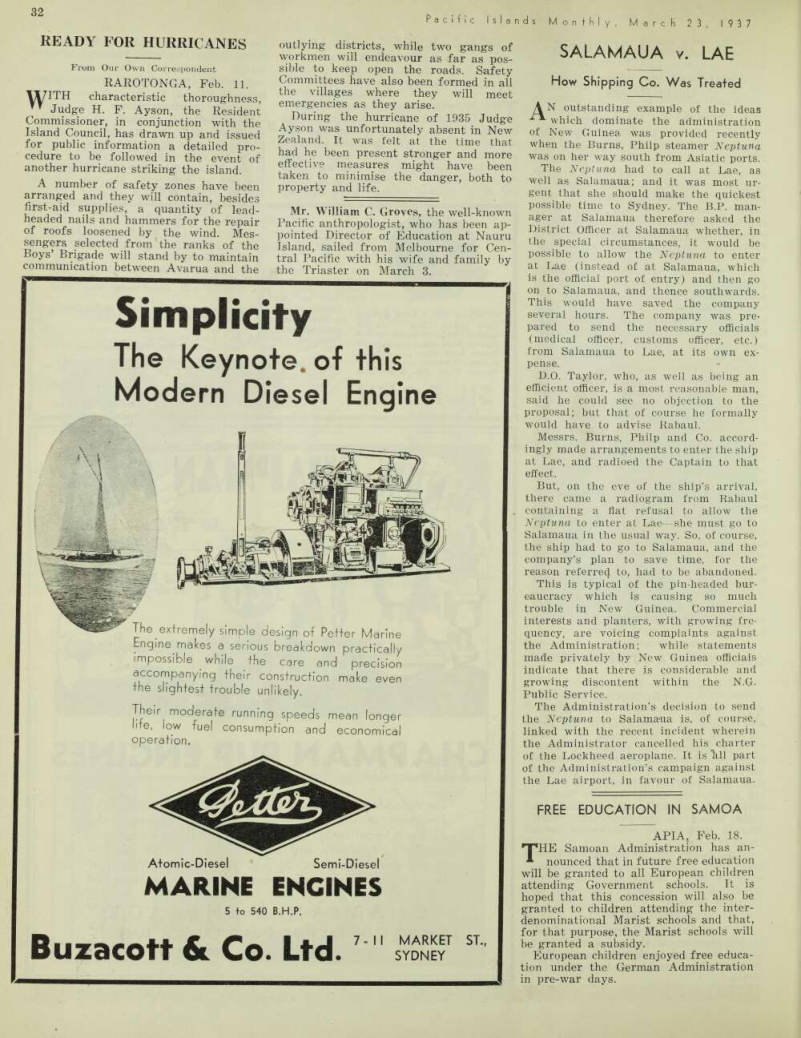
From Our Own Correspondent
Rarotonga, Feb. 11.
VA/ITH characteristic thoroughness, ” Judge H. F. Ayson, the Resident Commissioner, in conjunction with the Island Council, has drawn up and issued for public information a detailed pro cedure to be followed in the event of another hurricane striking the island.
A number of safety zones have been arranged and they will contain, besides first-aid supplies, a quantity of lead headed nails and hammers for the repair of roofs loosened by the wind. Mes sengers selected from the ranks of the Boys’ Brigade will stand by to maintain communication between Avarua and the
outlying districts, while two gangs of workmen will endeavour as far as pos sible to keep open the roads. Safety Committees have also been formed in all the villages where they will meet emergencies as they arise.
During the hurricane of 1935 Judge Ayson was unfortunately absent in New Zealand. It was felt at the time that had he been present stronger and more effective measures might have been taken to minimise the danger, both to property and life.
Mr. William C. Groves, the well-known Pacific anthropologist, who has been ap pointed Director of Education at Nauru Island, sailed from Melbourne for Cen tral Pacific with his wife and family by the Triaster on March 3.
Salamaua V. Lae
How Shipping Co. Was Treated
AN outstanding example of the ideas which dominate the administration of New Guinea was provided recently when the Burns, Philp steamer Neptuna was on her way south from Asiatic ports.
The Neptuna had to call at Lae, as well as Salamaua; and it was most ur gent that she should make the quickest possible time to Sydney. The B.P. man ager at Salamaua therefore asked the District Officer at Salamaua whether, in the special circumstances, it would be possible to allow the Neptuna to enter at Lae (instead of at Salamaua, which is the official port of entry) and then go on to Salamaua, and thence southwards.
This would have saved the company several hours. The company was pre pared to send the necessary officials (medical officer, customs officer, etc.) from Salamaua to Lae, at its own ex pense.
D.O. Taylor, who, as well as being an efficient officer, is a most reasonable man, said he could see no objection to the proposal; but that of course he formally would have to advise Rabaul.
Messrs. Burns, Philp and Co. accord ingly made arrangements to enter the ship at Lae, and radioed the Captain to that effect.
But, on the eve of the ship’s arrival, there came a radiogram from Rabaul containing a flat refusal to allow the Neptuna to enter at Lae —she must go to Salamaua in the usual way. So, of course, the ship had to go to Salamaua, and the company’s plan to save time, for the reason referred to, had to be abandoned.
This is typical of the pin-headed bur eaucracy which is causing so much trouble in New Guinea. Commercial interests and planters, with growing fre quency, are voicing complaints against the Administration; while statements made privately by New Guinea officials indicate that there is considerable and growing discontent within the N.G.
Public Service.
The Administration’s decision to send the Neptuna to Salama-ua is, of course, linked with the recent incident wherein the Administrator cancelled his charter of the Lockheed aeroplane. It is lill part of the Administration’s campaign against the Lae airport, in favour of Salamaua.
Free Education In Samoa
Apia, Feb. 18.
THE Samoan Administration has an nounced that in future free education will be granted to all European children attending Government schools. It is hoped that this concession will also be granted to children attending the inter denominational Marist schools and that, for that purpose, the Marist schools will be granted a subsidy.
European children enjoyed free educa tion under the German Administration in pre-war days.
Mr. F. A. Campbell, surveyor at the Emperor goldmine, Tavua, Fiji, married Miss R. Barling. M.A., Dip. Ed., of Mel bourne, at Davuilevu early in February.
Rev. Cyril Cato performed the ceremony.
Advertisements & other items, pp. 34-36 (2 items)
Simplicity
The Keynote, of this
Modern Diesel Engine
7 - ’ ■ The extremely simple design of Petter Marine Engine makes a serious breakdown practically impossible while the care and precision accompanying their construction make even the slightest trouble unlikely.
Their moderate running speeds mean longer lite, low fuel consumption and economical operation. / Atomic-Diesel Semi-Diesel
MARINE ENGINES
5 to 540 B.H.P.
Buzacott & Co. Ltd
7-
MARKET ST.,
SYDNEY
Mmtm
Mms
CONVERTS YOU QUICKER
THAN
mm tmum
VACUUM OIL COMPANY PTY. LTD.
PURE RICE
STARCH
Always ask for • . .
"CORAL" Brand
100% PURE
Noted for its
QUALITY
and
WHITENESS
Goes Farthest and gives Lasting Finish
WILL NOT
STICK TO
IRON
Obtainable from Leading Island Stores Manufactured by *
AUSTRALIAN RICE LTD.
Sydney, N.S.W.
CORAL BRAND
RICE STARCH
s;
CORAL STARCH LTD.
Australia’s Choicest Products Brussels Sprouts White Turnip* Sweet Corn Tomato Puree Tomato Sauce Tomato Soup Tutti Fruit Sauce Green Peas French Beans Cauliflower Beetroot Spinach Cabbage Carrots Parsnips Celery m sm
GARDEN VALE
MANUFACTURE)
\ BY
S PRODUCTS LIMITED
' 2-4 BROWN STB-E-ET, NEWTOWN
SYDN-EY. AUSTRALIA
L Always . . . . make sure you have at hand an ample Reserve of these
Delicious . .
Garden
Vale
Ready-to-
serve Vegetables
Wooing The "Maidens Of The Deep"
A Tongan Missionary Goes Shark Fishing
VI JHEN Rev. Father Boussit, curate at the Catholic Mission, Haapai, Tonga , went on a shark fishing expedition rec ently in the Mission yacht “ Fetuu Moana”, he met with such success that he elatedly wrote of his adventures to his former class-mates at La Seyne-sur mer, in France. His charming little story, adapted from the French tty Rev.
Father E. Tremblay, is printed below.
OINCE my arrival in Tonga I had heard so many fantastic tales about shark fishing that I was longing to have a chance to sample the sport myself. The opportunity came sooner than I had hoped for.
There was hard work being done on our Mission compound, but owing to hard times there was a scarcity of tinned beef.
The work lagged, and sometimes the men did not even show up. Then the pastor got a brain-wave: why not let the Fetuu Moana (Star of the Deep) go out to catch some shark meat?
Came Sunday afternoon, and with a number of shark “experts”—for shark fishing is a “fine art” handed down from father to son—l boarded our home-built
schooner. What paraphernalia greeted us! Empty kerosene tins, sticks and clubs (drums and drum-sticks), and.sets of fago fago (half-coconut shells strung on a green stick the ends of which are bent back in the shape of a horseshoe and tied together). The latter is a sort of rattle for underwater use and is sup posed to call the sharks. Then, of course, there were conch shells of various sizes, with a small hole drilled in the narrow end. When they are blown by strong natives these miniature fog horns pro duce an unearthly base note that can be heard for several miles.
We recited our three Hail Marys, sang a few* verses of the Ave Maris Stella . . .* and then we were off. If this shark fishing business has anything to do with devils —and there are many Tongans who think so — surely these prayers scared them off!
What a beautiful sea! What sweet, pure air! How good it felt to enjoy the cool of the eventide after the terrific heat of day. After the Angelus, the chief shark “expert” informed me that I alone might take some refreshment; for woe betide the expedition should anyone else dare to eat “on the sly”—no shark would come near the ship.
Soon we were far out en the deep. The shining frills of the white-fringed reefs had long since been left behind. Most of the natives were asleep, save the two “experts.” They simply could not keep quiet.
Suddenly one of them began to yell at the top of his voice, “broadcasting” as it were to the sharks. “Beautiful girls of the briny deep,” he cried, “come from your nice villages; come over with some of your friends. Come over and see our new boat, a boat with an engine in it.
Come over and let us see your beautiful
The Mission yacht “Fetuu Moana”, which took Rev. Boussit and a party of Tongans on the shark-fishing expedition described in the accompanying article.
eyes; come on board and we will give you a great feast. Come and let us put this sweet-scented necklace (a lasso) round your neck . .
But in spite of all these tender and alluring words not a single shark ap peared. None came near even after the pandemonium of tin-cans, fago fago rattles, conch shell blasts, screams, and war-whoops let loose on the stroke of midnight.
Then from sheer weariness everyone dropped to rest. Silence reigned. It was dead calm on the dark deep—l could hear only the gentle lapping of the wavelets on the prow of the ship. Some of the Tongans were gazing intently into the water, but all they could see was like a sprinkling of phosphorescent stars bobbing up and down like liquid fire-flies.
This is a common sight in the South Seas at night.
How fine it felt to lie in the cool on one’s back and “star-dream.” Orion was sinking slowly westward. Away out to wards the east, the Scorpion began to creep across the heavens. Southwards, very high up, face to face with the Hun ter, shone the Southern Cross. What a splendid night!
I tried to sleep, but rest was soon dis turbed by a second frantic “broadcast” of clanging noises making a thundering racket. And yet still not a single shark was wooed.
A faint tinge of dawn heralded the coming of a new day. Night, the best time to catch sharks, would soon be over.
My Tongan friends seemed pathetically down-hearted as they began to think that our first shark expedition with the Fetuu Moana would prove a “washout”.
At dawn I said Mass down below —a Mass offered up for all our Marist Mis sionaries who have been lost at sea. It was deeply impressive, this first Mass ever to have been said on board the little schooner on the vast ocean. I added a wee prayer for those fishermen who had caught nothing . . .
Then, during breakfast, a joyful shout brought me scampering on deck. “ Malie!
MalieT (Fine! Fine!), I heard them cry
ing. At last a shark had stirred and was swimming slowly around the ship, A lon le the en(l of which wa3 baited with a chunk o£ pork, was held
Another photograph of the “Fetuu Moana”, taken in 1933 just after she had been built at the Catholic Mission Station, Haapai, by natives under the supervision of Rev. Father E. Tremblay.
out over the water. All the beautiful Tongan love-language was soulfully re cited over and over again. But no; the monster was in no hurry. Tired of wait ing, I went below to resume breakfast.
Up on deck again, I saw this time that the shark was much nearer. Sud denly it spied the tempting meat, and its wicked little eyes sparkled with drunken hunger. It seemed hypnotised. Then,
forgetful of all danger, it wheeled quickly, darted forward, and turned over, opening a trap-like mouth with gleaming rows of sharp, terrible teeth. As the pole was drawn closer and closer to the ship, so higher and higher out of the water rose the shark, until it was right along side the ship, half out of the sea in a grasping effort to tear off the bait.
The psychological moment had come.
Gently the lasso was slipped around its head behind the gills. A swift strong jerk and the monster was pinned along the gunwale. A pair of muscular arms swung high a club to dash its brain out, and soon it had ceased to struggle and squirm.
Wildly delighted, the natives hauled the huge fish on board, all the while insulting it with all the bad names they could think of. Then, in its honour, a little “tune” of conch shells, tin-can music, drums, and water-rattles was played. Everyone was happy now—the Mass had not brought bad luck, as some had secretly though it would, but per haps sharks after all are only mere fish and not devils.
We sailed a little further on. Soon three more 7ft. sharks were caught in the same manner, and honoured with the same “tunes.” We sailed still further and another was lured aboard. The sixth one to appear was a veteran mon ster. In vain the Tongans tried all the tricks of the game; but the shark was too wise. It declined to come too near, although it succeeded in making off with a large junk of pork. So we gave it up and decided to sail home.
We were but a few miles from the shore when again the natives began a deafening “broadcast” of conch music.
Our expedition had been a success, so tell the world! Excited, they agreed to give the Governor and a big chief a shark each, in accordance with Tongan custom. Then, with smiles on every face, we arrived at the Mission compound, as the conch shell blasts grew stronger and stronger and wilder and wilder.
As we sampled a huge bowl of cooling kava, the whole story of the trip was related with much laughter and gesture.
Next day the entire Catholic popula tion —and other denominations as well- — came to work at the Mission. It was a terrifically hot morning, but they worked tirelessly and unceasingly. What a dif ference to the previous week! There was strength in every pair of arms, and joy ful peals of song and laughter from every throat, as the work of levelling the com pound proceeded.
Why did they work with such gusto?
Why were they singing and happv?
Why? Because, over there, across the way, beneath a smouldering mound, the Tongan “fireless cooker” was baking brown and crisp hundreds of pounds of shark and native vegetables. The very thought of the sumptuous feast to follow was enough to make anybody work with a will!
Advertisements & other items, pp. 37-38 (1 item)
Chiv E R S
Kork-N-Seal
FOR HOME USE
Hand Applied Airtight Pressure Proof
FOR ALL HOME BOTTLING
—THE LITTLE CAP THAT
Re - seal 1.000 Ti
mes KORK - N - SEAL (Aust.) LTD.
106 COMMONWEALTH STREET
SYDNEY, AUSTRALIA
We are Specialists . . .
\ ’Phones; MA 3612 (4 lines) Cable Address: “Weymarkson”
Codes— Bentleys Private Let us have your confidence. Sixty years is our record of supplying the leading Houses throughout the World in ... .
FRESH FRUIT VEGETABLES PRODUCE
WEYMARK & SON LTD.
FRUIT AND PRODUCE MERCHANTS
14-18 STEAMMILL STREET - - SYDNEY
CHIV E R S
FAMOUS ENGLISH PRODUCTS
CANNED ENGLISH VEGETABLES
CANNED ENGLISH FRUITS
OLDE ENGLISH MARMALADE
GOLD MEDAL JAMS
JELLY CRYSTALS, ETC.
Obtainable from all leading Grocery Stores
WRITE TO DEPARTMENT "A”
CHIVERS & SONS LTD.
Hlston, Cambs., Eng.
FOR ATTRACTIVE RECIPE BOOK
Tm on LU
CHIVERS
ca LD
ST^MD/IR d
FRESH
ENGLISH
II
PEAS
•'Ck( .Hi)
PRESCOTT L T J? I U y S E n X e S^ Q7 c e sole wholesale afyenis /d?^
PINEAPPLE BACON & HANS
DAISY BRAND BUTTER
LEA & PERRINS' H P. Sauce
LEA & PERRINS'
and Most other Super-Quality Lines of the Trade
Swallow & Ariel!
LIMITED
PORT MELBOURNE :: AUSTRALIA
Manufacturers Since 1854 of
HIGH QUALITY
Ship and ~]
Cabin Biscuits
CABIN (INCLUDING SMALL CABIN)
PACIFIC CABIN
CABIN CRACKERS
BREAKFAST BISCUITS
NAVY & PILOT BREAD
PACKED EXPRESSLY FOR EXPORT IN TINS UP TO 50LBS.
Finding Your Way Around
Sydney
A TOURIST map of Sydney and suburbs, which shonM nro ,r e verv helpful to Tslande»'« spend ing furlousrh in N.S.W., has published by Kenneth Craigie and Co.. 16 Bridge St.. Sydney.
Printed clearly in black on heavy white paper, the map extends on the nor f h to T' /r t. Ku-rina'-gai and Newport, on the south to Port Hacking, Waterfall and Campbelltown. and on the west to Riverstone, Rooty Hill and Kenny Hill. A speci ally prepared index of over 460 suburbs, localities, pleasure resorts, and where to find them is printed at the foot of the map. The size is 30 by 40 ins., folded in cover 8 by 6 ins. The price is 1/6. **♦
A Country Ballad
Concerning a Free Library in Fiji
live in a quiet country place And natural bumpkins be; So why should Council or Government Pay heed to such as we ?
We know all this deep in our hearts.
And feel humility ; • Yet the spirit of rebels and fighting men Comes even to such as we.
Of rates and taxes we pay our share, As high as the town’s, they be; Yet our roads and tracks are a howling shame — But suffice for such as we.
Brothers and sisters come they all, From cities, poor us to see; They eat our salt, and drink our beer.
And marvel at such as we.
They say, “You must come and call.
Some day when life is free; And admire our gorgeous homes and streets’’ — Kind words for such as we.
We think of their words what they think of our beer—- Whicu is ambiguity!
I’m much afraid that the call’s riot paid— Know better than that, do we.
And among our many hardships.
Is lack of a library.
And we long for lots of papers and books, But they’re not for such as we.
In Suva Town there is a place Given by Carnegie, Crammed to the door, with books galore.
But not for such as we.
We cannot choose our fiction; Not even a list can we see— But they DOUBLE the darned subscription For people such as we.
On top of the sub. we also pay— Shall we tell Carnegie?— Fourpence in stamps for every book Posted to such as we.
The only available catalogue Is kept in the library.
In vain we try a copy to buy— » It’s not for such as we.
We have to take what they send us, No matter what book it be.
They will not be faced with the personal taste Of country clods like we.
The fate of the papers and journals old Is a dreadful mystery.
They may be lent —but they’re never sent To outback folks like we.
Only to-day we opened Our books excitedly— They were both by Bertha Ruck, sir.
And NOT for such as we.
But the P.M. grabbed our eightpence. (Oh, that such things should be!) And City folk keep battening On country mugs like we.
Fiji.
Kai Viti.
N.G. Goldfields Theft
» From Our Own Correspondent WAU, Feb. 16. \ T the Circuit Court, William C. Abbie was sentenced to 21 months’ gaol, with hard labour, and Eric Hylton Stacey to one year’s gaol, with hard labour, for gold stealing. D. Parker was sentenced to 18 months for receiving.
Mrs. Amy Madeline Gatward, wife of Mr. W. T, Gatward, a pioneer of the Tailevu District, Fiji, died in the Colonial War Memorial Hospital at Suva in
February.
“Mystical Papua”
THE Sydney Sun of February 22 is * responsible for the following piece of bilge.
The Swedish film company Svensk Filmindustri proposes to send an expedi tion of film directors, photographers, technicians, etc., to make films of the “dangerous regions of New Guinea.” It proposes to go to places “inhabited by cannibals and not yet explored by any white expedition. By means of native canoes propelled by detachable motors they will penetrate along the rivers into the mystical Papua to film the famous headhunters. It is hoped that the travel lers will be assisted by British patrols.”
By the time the expedition gets past the New Guinea and Papua ordinances which forbid entry into the uncontrolled areas, and has entered “mystical Papua” and the district of the headhunters, very large quantities of water will have flowed under innumerable bridges.
Mr. R. A. Vivian, Resident Magistrate
at Kerema, Gulf Division, Papua, arrived
in Sydney on leave by the Montoro on February 18. Mr. C. H. Karius, formerly at Cape Nelson, is now relieving at Kerema until Mr. Vivian comes back.
Advertisements & other items, pp. 39-40 (2 items)
37
Pacific Islands Mon+lify, March 23, (937
M A Ry's
H.JONES e-co
AUSTRALIA'S BEST
H. JONES & CO., LTD.
Darlington, Sydney Hobart, Tas.
For— Fresh Fruit, r 4tft€ff<€€M«fffff/rfsyssssssssssssssssssss/sssssssssss/A'SSSS/SS//SSS/SSSS/Z.
Vegetables, and Produce Islands Residents can rely on the old-established Shipping Providers:
ST A
Island Agents Only Address: 421 Sussex Street, SYDNEY All Orders Promptly Attended
NELSON & ROBERTSON LTD.
• A new, simple lid for your convenience; a new patented parchment seal fo ensure perfect freshness.
AUNT
M A RY'S
BAKING POWDER
) 3 M
FUCK
iii oJI /
PRESS
fV • Send I/- plus 2d. postage to Tillock and Co.
Ltd., Sydney, for "Aunt Mary's" Cookery Book.
It's the best.
Daddy
there's
Creamy
custard
* i f
today
Grown-ups like custard
too!
vanilla
FREE RECIPE BOOK
Write for Elizabeth Craig’s Recipe Book to Foster Clark (Australia) Ltd., Dept. R. 8..
Redfern, N.S.W. Enclose Id. stamp for postage.
Daddy and little daughter both demand lots of Custard. No wonder—when it’s Foster Clark’s world-famous creamy Custard. That’s one sweet which appeals to people of all ages.
Foster Clark’s is the creamiest, most flavoursome and most dependable Custard you can make. Serve it often. It’s full of nourishment, and very economical. There are so many quick and interesting ways of serving it, too.
Try the dishes in Elizabeth Craig’s Recipe Book, and serve Foster Clark’s Custard with stewed fruit, puddings and pies. It increases their food value and brings out their flavour. Always ask for Foster Clark’s Custard, and refuse cheap imitations.
FSI39
Foster Clark's
creamy CUSTARD
Eclipse
To Observe Rare Solar
Two Expeditions Will Visit Lonely Phoenix Group
JOINTLY sponsored by the United States Navy Department and the National Geographical Society, an expe dition will leave America shortly for the Phoenix Islands, north of Western Samoa, to make observations of an eclipse of the sun which will occur on June 8. The eclipse will be the most remarkable and of the longest duration for 1200 years.
Plans have also been completed for a party from the New Zealand Astronomi cal Society to visit the Phoenix Group in one of the N.Z. warships to view the eclipse. It is reported that a number of Australian astronomers will probably join the N.Z. expedition.
The lonely Phoenix Group, comprising about a dozen small islands, are just south of the equator in mid-Pacific, and are on the direct route between Hawaii and Fiji. They will provide the only specks of land from which the total phase of the eclipse will be visible.
A New Industry For Wau
From Our Own Correspondent
Wait, Feb. 16.
IT has long been advocated that steps should be taken to foster the growing of marketable agricultural products in Morobe so that should gold production fall below economic levels, Wau would not, like “Sweet Auburn,” become a de serted village.
For some time coffee, grown by Mr.
C. L. B. Wilde, has been obtainable from local stores, but only in limited quanti ties, unworthy of what is considered to be a very fine product. Mr. Wilde has cleared a large area of his property near Wau for this purpose, and what may be the starting point of another primary industry for Morobe, will be watched with interest.
After The Coronation
ISLANDERS who are visiting England this..year to witness the Coronation ceremonies will be able also to attend the famous International Trade Fair, held at Paris during the whole of May. After the Coronation thousands of busi ness executives and sightseers will cross over to France and transact business at, and see the exhibits of, this gigantic Fair. Due to these extra visitors and the immense volume of exhibits, the Fair will be Open for a month, and thus the full range of world manufactures can be seen at leisure.
First commenced in a small way in 1904, this Fair has now assumed such importance in the world as to be recognised as the event at which the latest developments in international manu facture will be on view. Always cosmopolitan, Paris at the time of the Fair is brighter, more varied, more interesting than ever. It is possible to meet and to observe the tastes and needs of individuals of every nationality, and every class in life.
The Trade Commissioner for France, Wynyard Street, Sydney, can furnish further particulars to South Seas residents who anticipate being in England or on the Continent dui'ing May. ***
Navigators Of Eastern
Polynesia
Old and New Methods
From Our Own Correspondent
Papeete, Jan. 27.
TF the American maritime strike con tinues much longer the mariners of this part of the South Seas will have to go back to sail.
Copra is gathered into Papeete from widely scattered islands by schooners powered with Diesel engines. At the present writing, supplies of Diesel oil are nearly exhausted and, until the strike be settled, there is no prospect of any fresh arrival of this product.
One wonders how the present genera tion of young skippers will react to the necessity for navigating by sail after so many years of motor transport. In the days of sail most of our old schooner captains had a very sketchy knowledge of the science of navigation.
One was particularly famous for ar riving at his destination by instinct rather than calculation. Usually his chronometers were out of order or he forgot to use them. He could calculate latitude and he would navigate his schooner to the latitude of the island for which he was heading and then sail east along the parallel. If, after two or three days, the island did not turn up he would know it was in the west. So he would turn his ship around and sail west on the parallel—and always arrived at his destination.
Even to this day, native skippers voy aging to the Tuamotus make for the atoll Anaa, directly east of Tahiti. They can hold their course by the sun.
Anaa has the peculiarity of possessing a shallow lagoon which reflects a faint green colour patch on the overhanging clouds. This is visible at a long dis tance. Native skippers watch for this and even if they have drifted consider ably out of their course, this faint green glow on the clouds in the distance will set them right.
Once at Anaa, the rest is easy. From there, east or north-east, a schooner is bound to sight island after island. If the island sighted is the wrong one, the navigator can soon get his bearings by finding out which island it is, and even tually arrive at the haven he is seeking.
The natives of the Austral Islands (south of Tahiti) where such new fangled things as Diesel engines have not been introduced, have not lost the art of sailing. Recently, the Rurutu schooner Manureva made a record voyage from that island to Papeete before a smart southern gale. She had her lee scuppers under water the whole of the way, and shed chicken coops, pigs and other items of deck cargo into the sea, while her passengers held on to ropes and any pro jecting tackle to keep themselves from following.
But, as a European who was on board bears witness, her crew handled her like master mariners sailing a yacht in an international cup race.
S.D.A. Training Centre
A CONFERENCE of Seventh Day Ad ventists in Melbourne during Feb ruary, was informed by Pastor A. G.
Stewart that it was proposed to open a new training school presumably for S.D.A. mission teachers —at a spot about 28 miles from Rabaul, in New Guinea.
The period of training would be from three to five years.
Pastor Stewart said that the Seventh Day Adventist missions are now opera ting in most of the Pacific Islands —from Pitcairn Island in the east to Northern New Guinea in the west.
Captain L. E. Austin, manager of tht Papuan Government’s coffee plantation at Sangara, Eastern Papua, who has been spending a couple of months’ furlough in Australia, returned to Papua by the Montoro at the end of February. Mrs.
Austin, who has been abroad, is still in indifferent health and probably will re main in Australia for some time.
Advertisements & other items, pp. 41-42 (1 item)
Flour
HOLBROOKS
ANCHOVY
PASTE
The House of . . .
HOLBROOK
Packs in dainty jars a delicious paste made from finest Gorgona Anchovies.
It will keep in any climate and is a wonderful stand-by for the concoction of many delightful luncheon and supper savories.
Try it spread lightly on hot buttered toast, or for a more substantial meal serve it on toast with a poached or scrambled egg.
Other varieties of Fish and Meat Pastes : Holbrooks Bloater, Salmon, Salmon & Shrimp, Chicken & Ham, Ham & Tongue, Veal & Tongue, and Turkey & Tongue.
Holbrooks
(Australasia) LTD.
WATERLOO - NEW SOUTH WALES
PRODUCING UNIFORM GOOD RESULTS SINCE 1868
Flour
ALWAYS ASK FOR IT
Konkrete Paint
For EVERY SURFACE where Permanence is Imperative--! <p Adaptability for the varying climatic conditions of the Pacific Islands has been abundantly proved by users.
KONKRETE Standard Gloss and Flat Colours for brick, fibre, cement, iron, and stone.
KONKRETE PAINT IS
THE SOLUTION
Complete price list and colour card from sole wholesale distributors for N.S.W. and Pacific Islands.
H. Florentine and Son
321 Pitt Street, Sydney, N.S.W.
Allen Taylor & Co. Ltd
SYDNEY
Sawmillers and Wholesale Suppliers of Hardwoods for Constructional Purposes GIRDERS . . . PILES . . . POLES . . . SLEEPERS, Etc.
EXPORTING TO PACIFIC ISLANDS SINCE 1893
Cables: Tuxedo, Sydney
ASBESTOS CEMENT BUILDING SHEETS
Low cost with good appearance and endurance is assured when you specify Durabestos for walls and ceilings in new buildings or for additions or repairs to existing structures.
Write for literature illustrating the new horizontal application of Durabestos, in modern .buildings.
WUNDERLICH LTD.,
Crown and Cleveland Sts., Redfern SYDNEY
Search For Oil In Papua

The Muddling of the Federal Government
Part 11.
\ NUMBER of expeditions, hacked by powerful companies and subsidised liberally by British Governments, are now seeking an oilfield in Papua■ — and, probably, will succeed. This article, the second of a series written by a resident of Papua, tells the story of the discovery of petroleum in the Territory, and of the subsequent attempts at development.
THE partners got to work promptly, secured Powers of Attorney from their friends, and proceeded to peg out as many claims as they could in what seemed to them the most likely spots.
But they no longer had the field to themselves. A few individual specula tors, with little or no knowledge of the district or of the locality of the indica tions pegged out claims haphazard with out much reference to geography or to one another. But their operations were
orderly and sane in comparison with the delegates of the British New Guinea Company, which sent out men well equipped with stores and means of trans port, but very much more at home be hind a store-counter or an office-desk tnan in the barbaric surroundings of the Papuan jungle.
These men went to work fiercely, their only method to drive as many pegs as possible. They seemed to have no idea even of the working of a compass. Their imaginary lines crossed one another and those of other prospectors.
In one instance, they drove no fewer than five datum pegs within a circle of a hundred yards radius, and registered claims to two and a half square miles of land on an area of rather less than one square mile! If, in their rather frigh tened rush through the scrub, they hap pened to see a peg that had been driven by another man, they promptly pulled it up and substituted one of their own. The result, when plotted out on a map of the district, was a complicated network of intersecting lines and superimposed rectangles that covered, several times over, most of the land to about twelve miles from the coast, but that never departed more than half a mile from the bank of the river.
Exactly what method a harassed War den could have adopted to solve such a puzzle it would be hard to say. Fortun ately for him, unfortunately for Port Moresby solicitors who might have scored heavily over the litigation of rival claims, the matter was never put to the test.
This rather fevered activity was at its height when Mr. J. E. Came, a well known New South Wales geologist, ar rived on the Vailala River for a preli minary investigation of the field. His investigations did not go very far, for he was merely putting in time owing to a delay in the arrangements for his in spection of the coal deposits reported on the Purari River by Messrs. Little and Mackay in 1909. But he saw the indica tions first discovered, and he saw the oil seeping slowly from the sandstone 20 miles up the river; and, although the question as to volume of supply remained unsolved, he went away fully convinced as to the occurrence of petroleum. r T T HE partners had pegged out claims to include the actual occurrence of oil; and, with a few Powers of Attorney in hand, they tried to discover, in more remote parts of the jungle, a series of signs as good as those up the river.
It was on one such expedition that Thomas collapsed with a sudden attack of blackwater fever. His condition was serious from the first onset of the dreaded disease, and the conditions at the rough camp, many miles from the nearest settlement, and among very pri
mitlve natives, were as adverse as they could well be.’
To add to the difficulties of the position rain fell heavily and incessantly.
The whole of the countryside was flooded knee-deep and the tracks were invisible; and the local natives, scared by the illness of a white man for which they imagined, illogically, that they might be held responsible, retired to remote huts and shelters in the depths of the bush.
But, somehow, he was carried out. The same fear that drove the bush people to hiding inspired the indentured labour-
ers, so that they worked obediently, if sullenly. A stretcher was rigged, with an inadequate awning to protect the sick man from the pitiless rain; and he was borne stumblingly, clumsily,, jerkily, through the yielding mud and halfsubmerged forest to the river bank, and thence by canoe for 10 miles to the coast, and another 10 miles along the beach to the nearest mission station.
Being blessed with a strong constitution and a healthy body, he survived the agonising ordeal, and after a few days of crisis began to recover slowly.
Lett returned to his prospecting; but he was not allowed to carry it on un disturbed. Jealousy raised its ugly head and spat venom at him and his absent partner. Counter-claims to the discovery were made by men who had never been in the bush until the report of oil roused cupidity to smother their fear of it. Pro tests were lodged against the claims that the partners had pegged, and against the Powers of Attorney that they held; and commercial oppression was openly threatened by a local company that had failed to gain control of their interests.
Thomas returned to the plantation, weak and emaciated, but alive; and at the first opportunity the two men left by steamer for Port Moresby and went on to Thursday Island, where they might use the cable in an attempt to negotiate their rights.
Papuan Government geologist, Evan R. Stanley, began an exhaustive examination of the oil-bearing country, and extended it to cover a great deal of territory where no indications had yet been seen. J. E. Came resumed his investigations after a disappointing and arduous trip to the Purari coal-beds. He confirmed Stanley’s observations, and left for an extensive examination of the Borneo and Java oilfields, to compare the conditions there with what he had seen in Papua.
The investigations of Lett and Thomas resulted in the disclosure of two more sets of oil indications: one near the little village of Aro-Aro, where Thomas had gone down with blackwater fever, and the other at the base of the le hills, about 15 miles east of the Vailala River; while the series that contained the actual flow of oil had been extended some miles across the river to the east.
The discoveries having been made in spite of their opposition, the natives of the district began to come forward with Information as to further “shows;’’ and by the end of June, 1912, surface indica tions had been seen over an area of more than 500 square miles.
By that time the partners had done all that they could do, and nothing remained but to await the result of their negotia
tions. They had an agreement with the British New Guinea Development Co. to hand over to the company four of their claims in return for a cash payment of £lO,OOO as soon as their applications were granted. But the granting of applica tions was held up pending the passing of legislation to deal with oil lands; and such legislation must be preluded by more detailed instructions from the Com monwealth as to the form of control that would be acceptable.
They began to devote some attention to their young plantation, which had been almost entirely neglected since the first discovery, nearly a year earlier.
Weeds had grown up in the interval; a lush tangled growth that is inevitable on rich soil in a wet, tropical climate.
Most of the young nuts that had been planted were strangled by the twining vines, or their tender roots smothered by the encroachment of lalang grass. Fallen timber had been left to lie too long, and was past hope of burning by a running fire, so that hundreds of tons of half rotten debris would have to be stacked and burned at the cost of almost infinite labour; and seed nuts, laid out in orderly rows in the nursery beds, had grown leggy and weak, and practically useless for planting. Thomas was incapable of further hard physical work; and his part ner was debilitated by almost continuous attacks of malaria and by the long-drawn physical strain.
TN mid-July, 1912, a bag of mail was * brought to them by a native constable from Kerema. Among the letters was one from the Warden of the Division.
It stated in cold official language that the policy of the Commonwealth Govern ment had been changed. The Common wealth itself would develop the field. No leases would be granted. The question of a reward to the discoverers would be further considered when the value of the field became known.
There were also letters from financiers in Sydney and Melbourne, making cauti ously tentative offers; and three from representatives of big and firmly estab lished companies in England and Amer ica, hinting at the staggering sums that they were prepared to pay in exchange for the supposed rights of the discover ers.
At that point, the partners fade out of the story. Thomas went down with a second attack of blackwater in October, 1912, and had to leave the country; and he died from a third attack that devel oped in Sydney in April of the following year. His partner survived to pay off gradually the accumulated load of debt that the partnership had incurred; and he is still waiting, after 24 years, for his share of the promised reward!
TN 1912 the competition between the •*“ world’s great oil companies for new sources of supply was very keen; and the news of the discovery of a possible new field in Papua aroused lively interest.
Two courses were open to the Com monwealth Government. They might either develop the field themselves, a course that implied very heavy expen diture and the use of hired experts who might be influenced by alien interests;
or they might permit the work to be done by established companies, keeping in their own hands full control of the oil produced, and imposing any condi t.ons that might seem necessary for the safeguarding of their interest and the guarantee of adequate productive work.
Of these two courses, after mature consideration, they chose the first. But it would appear that in so doing they had no very full idea of the enormous cost involved, or of the many difficulties that must stand in their way.
The British New Guinea Development Company, on making application for prospecting areas in Papua, did not wait for the granting of their applications, but took immediate steps to start work.
Through their London office, they en gaged the services of F. C. Grebin, M.I.M.E. (Freiburg) ; and when the de cision of the Commonwealth Government not to grant leases was made public, he was already on his way out to Papua with A. Voinitz, an Austrian, as his assistant, and with a small boring plant capable of putting down test bores to a depth of about 700 feet.
Grebin arrived in Melbourne en route to Papua; and the Commonwealth Gov ernment, to avoid inflicting hardship on the company that had engaged him, took over his services in spite of the fact that they had themselves engaged a man and placed an order for a larger plant. Grebin reached the Vailala River on October 20, 1912, and immediately set about making a preliminary survey of the surrounding country. Satisfied as to the prospects, he ascended the river and landed at a spot opposite the oil seepage on December 4.
THERE was a good deal of preliminary work to be done. Land had to be cleared, houses built, machinery and stores landed, and a derrick rigged, be fore actual boring could begin; but he started boring on Jan. 18, 1913, and on May 8 he struck a small flow of oil in black sand and shale at a depth of 228 feet.
Not satisfied with this, he continued bor ing until, when a depth of 242 feet had been reached, in oil-bearing sandstone, on May 19, a big tree fell on his derrick, completely wrecking it and forcing him to abandon the bore.
A new derrick had to be constructed of timber, and this delayed the work until June 16, when a second bore was started on the same anticline and within about 100 yards of the first bore.
By the end of June, 1913, he was down to 133 feet in the second bore, and had begun the construction of reservoirs be tween the steep ridges, intended to con tain the oil that he confidently expected to strike at a shallow depth.
On January 10, 1913, J. H. Locke, an Australian driller of considerable experi ence, arrived on the field. The known oil-bearing country had then been divided into two sections, separated by the Vai lala River; and the policy was to con duct the search on the two areas simul taneously.
Locke landed his heavy plant on the east bank of the river, opposite Grebin, got through his preliminary work, and •tarted boring on April 15. He, like
Grebin, found the strata very favourable, consisting of sandstone, shale, and sand, alternating with narrow bands of grey limestone; but early in June he was troubled by mud-pressure at a depth of 262 feet, and found a great deal of diffi culty in keeping his hole vertical under the strong lateral pressure of it.
Already, there was a good deal of trouble with the machinery supplied.
Grebin’s plant was intended only for com paratively shallow boring, and neither it nor the much heavier plant that Locke was using was equipped to deal with the many difficulties that present themselves in drilling for oil in this district.
A sample of oil from Grebin’s first bore was sent to Melbourne, where it was dealt with by Mr. W. P. Wilkinson, the Federal analyst, who divided the sample into two parts. The first of these he subjected to analysis, and after separa
tion and filtering, the following charac teristics were noted:- Odour,—Of crude petroleum.
Colour.—Pale (cinnamon) brown.
Fluorescence.—Bluish green.
Specific Gravity at 60 deg. F.—0.8082.
Flash Point.—At air temperature, 51.8 deg. F.
Refractive Index at 20 deg. C.—1.4485.
Sulphur Compounds.—Almost completely absent Polarization.—Practically nil.
The crude filtered oil was allowed to stand for a few hours, and deposited 3.4 per cent of crystalline waxy matter simi lar to paraffin.
The second portion of the sample was distilled in the standard Engler appara tus, giving the following data:
Mr. Wilkinson mentioned in his report that the data obtained from distillation showed the oil to contain relatively large quantities of spirit and burning oils, with smaller proportions of lubricating oils; and remarked that the sample was closely similar to the oil obtained in Borneo, Sumatra, and the adjacent is lands. At the same time, he pointed out that the crude oil obtained during the
first flow in boring operations is not always a guide to the character of what will come later as the flow continues.
THE Commonwealth Government, in
* the meantime, had been looking for an expert in oil-geology who might make a complete survey of the field, which Stanley’s efforts had now extended from the Kikori River to Kerema and for 40 miles inland—an area of not less than 2000 square miles. They found whom they wanted in the person of Dr. Arthur Wade, who had enjoyed a good deal of experience in Egypt, both in the matter of geological survey and also in the practical working of petroleum fields.
Dr. Wade arrived on the Vailala River on October 15, 1913, to make a survey and to select sites for boring, taking over from Grebin, whose agreement had ex pired. In the bores that Grebin had put down the signs continued favourable; and his results so impressed Dr. Wade that, after making a survey of the coas tal belt from the Kikori to Yule Island, he still considered that the area chosen on the Vailala River was the most promi s ng of all that he had seen.
Locke continued to experience difficul ties with lateral mud pressure, and had to abandon his first bore without increas ing its depth. He started a second bore within 100 yards of the first, but met with the same trouble again and, under Wade’s instructions moved his heavy plant across the river to a new site near Grebin’s bores. Thus the idea of pros pecting two areas simultaneously was abandoned, and for the next few years the efforts of Dr. Wade and his staff were confined to the small area on the right bank of the river that had been cleared by Grebin.
A CANADIAN driller, named Moure, arrived on the river on June 18, 1913, and left again on the 30th with a load of malarial germs that would last him for many years. Another Canadian, Cypher by name, took his place a few months later, bringing with him a more power ful plant than Grebin had been using; and he drilled to a depth of 390 feet, bottoming in mudstone and blaclt sand, before his agreement also expired, and he left the field on November 18, 1914.
Water collected in the abandoned bore; and it was not until the arrival of an other driller in May, 1915, that the accu mulated water was shut off and oil began to flow. Cypher had struck this small flow oi oil at 250 feet; but, expecting* a better flow at depth, had drilled past it; and from the greater depth water percolated in considerable volume. When once this was shut off, oil began to flow slowly but steadily. A hundred gallons seeped to the bore-head during the first week; then the intrusion of mud checked the flow, and in the second week the amount of escaping oil was reduced to 50 gal lons.
THE results achieved so promptly had their effect on the Commonwealth .
Government, and Lieut. Jones was sent, in charge of H.M.A.S. Stuart, to make a marine survey of the coast with a view to finding harbourage for ships that
Temp. Vol. of Sp. G. Flash Refrac.
C. distillate at 60 F. point Index 20C. 108 to 130 10 p.c. 0.749 under 60 F 1 417 130 to 150 15 p.c. 0.757 ,, 60 F. 1*423 150 to 200 24 p.c. 0.775 ,, 63 F. 1.4335 200 to 250 17 p.c. 0.807 122 F. 1.4505 250 to 300 16 p.c. 0.839 196 F. 1.4655
might carry to Australian refineries the oil that they hoped would soon flow copiously. Dr. Wade, too, apparently had high hopes; for he compiled, during the first year of his engagement, a careful report of the various possible methods of transporting oil from the bore-head to the seaboard.
“The oil has the characteristics of the shallow oils obtained in the Dutch Indies,” he reported in 1915. “At depth, we expect heavier oils in greater quan tity, and the above (i.e. the oil from Cypher’s bore) has strengthened confi dence.”
Dr. Wade, after completing his year’s engagement, returned under a new agree ment to take complete charge of the operations.
Prospects at the end of 1915 were as good as they could well be. In each of the bores that had been started the ex pectations of the geologists had been ful filled. In each of them the drill passed through strata of sandstone, mudstone, shale, and sand; and in each the pre sence of gas and the smell of petroleum, if not the actual oil itself, kept hope high and confidence growing.
Stanley, the indefatigable geologist to the Papuan Government, carried his sur vey further afield, and investigated the Cape Vogel peninsula, on the east coast of the island, where he was able to re port in 1916 that a tertiary series of mudstones, sandstones and limestones prevailed identical in age with the Vai lala petroleum series. He also found gas and brine springs, and occurrences of brown coal and lignite, and confidently recommended the district for further investigation.
But, although prespects became ever more encouraging, progress was woefully slow. To the difficulties inseparable from work in a primitive country were added every obstacle that a malignant fate could devise.
Dr. Wade experienced to the full the difficulty that has faced every man and every company that has attempted con structive work in Papua; the irritating difficulty, that is, of making accurate estimates of costs and forecasts of pro gress. Health played a very important part in the programme of obstacles; de lays in transport; time''wasted in replac ing men who became incapacitated by malaria or by the more dreaded black water fever; the rawness of native lab our, and the impossibility of watching their every movement.
The distance from the telegraph, and the apparent lack of experienced men in Australia to check the material for warded to Papua, resulted in calamitous short-shipping and other expensive mis takes. There were delays in manufacture and delays in forwarding; machinery was sent to Papua with essential parts missing; and when, often after months of delay, the shortage was eventually made good, the new parts did not fit, and more time was wasted in repairing the mistakes.
On several occasions, work on the field was held up for many weeks together, and experienced drillers, drawing salar
ies of £lOO per month, had no better occupation for their time than the super intendence of gangs of native labourers who were engaged in planting sweet potatoes.
Bore after bore was started, carried to a depth of a few hundred feet, and aban doned either because the pipe-line had been choked by some tool inadvertently dropped down it, or by the lateral pres sure of mud between steeply inclined strata, an affliction that the machinery supplied was not capable of dealing with.
In all, 12 bores were started on the Vailala, and the greatest depth reached by any of them hardly exceeded 400 feet.
In every one of them, the indications of oil were good, and small quantities of oil were actually obtained from most of them.
But, in every one, drilling had to be discontinued owing to some difficulty that might have been overcome by adequate finance or by the complete and far reaching organisation that is the chief strength of the world’s great oil com panies. (To be continued)
Mr. Henry Maurice Scott, only son of Sir Henry and Lady Scott, of Suva, and who recently returned to Fiji from Eng land, has been admitted to practice as a barrister and solicitor of the Supreme Court of Fiji by His Honour the Chief Justice, Mr. O. C. K. Corrie. He is the third generation to be called to the bar in Fiji, his grandfather, the late Mr. W. Scott, having also been admitted.
Norfolk Island Administrator And His Family
'X'HE Administrator of Norfolk Island • (Captain C. R. Pinney, M.C.), who recently arrived in Sydney with his wife and family by the Morinda to spend two months furlough in New South Wales, returned to Norfolk Is. in March. Mrs.
Pinney, who underwent a severe opera tion recently, is now very much improved in health.
“Norfolk Island is looking forward to a prosperous season,” said Captain Pin
ney, “and the outlook is more hopeful than for some years. One of the biggest factors was the opening in January of a passion-fruit pulp factory, which will mean a great deal to the Island. Pros pects for the season are good and it is expected that a hundred tons of pulp will be produced. Next season this quan tity may be doubled.
“There is no market now for N.I. bananas,” he continued. “The settlers
growing them have let their plantations go in favour of the passion-fruit crop.”
Mrs. Pinney is a daughter of the Lieu tenant-Governor of Papua (Sir Hubert Murray), and she and her husband are well-known in that Territory, where for some years Captain Pinney was Commis sioner for Lands and Director of Agri culture before being appointed to take charge of affairs at Norfolk Island.
Captain and Mrs. C. R. Finney , and their children, Miss Maura Finney (left) and Master Peter Finney.
Advertisements & other items, pp. 43-47 (1 item)
Bollivants' Wire Ropes 4*
mm, w
THE WORLD'S STANDARD
LARGEST STOCKS IN AUSTRALASIA :: :: FOR ALL PURPOSES Also Blocks, Hooks, Shackles, Thimbles, Strand, Seizing, Aircraft Cord, etc.
Attention! Efficient Service!! Complete Satisfaction!!!
BULLIVANTS 1 Australian Co. Pty., Ltd.
Letters: Incorporated in Victoria.
Box 1298 J. G.P.O. 331 KENT STREET, SYDNEY “Bullivants Ltd.' Telegrams: Sydney
STEEL BEDSTEADS
WIRE MATTRESSES
"MORNING GLORY" BEDDING
TUBULAR STEEL FURNITURE
" LISTER " HOSPITAL EQUIPMENT
SHIPS' ALL METAL BERTHS
WE WILL GLADLY
FORWARD OUR
COMPLETE SETS‘OF CATALOGUES
Produced in Australia by
Newlands Brothers Ltd.
RILEY STREET :: SYDNEY, N.S.W.
Australia's Largest Manufacturers of Modern Sleeping Equipment.
Cable Address “Newlandbed, Sydney
9 ISLAND SHIPPING
Freight, Forwarding and Customs Service. Import and Export.
B. R. WHEELER
17-19 Bridge St., SYDNEY Correspondence Invited. Tel.: B 5396
Master Sewing
Machine Co.
Established for 23 Years Reconditioned
SEWING MACHINES
For Industrial and Household Use.
All Types for Sale, from £3 each.
Every Machine Guaranteed Mechanically Perfect.
We have the most complete range of Sewing Machines in New South Wales.
Repairs promptly attended to by Competent Mechanics.
No delays. All Goods Carefully Packed.
MASTER SEWING MACHINE CO.
15 Enmore Road, Newtown, Sydney
ALL TYPES FOR SALE
From £3 each.
Let us know your requirements. We will be pleased to quote by return mail.
Over 30 Years Ago..
The first Younger Stove was exported to the Pacific Islands. Ruggedly strong in construction, highly efficient and economical in fuel, has made them the most popular stove in the South Seas.
The illustration shows a Younger Single Stove. Special stoves, with cast iron ovens for Island requirements made to order.
Write us for quotations for special sizes and catalogue of double and single oven stoves.
G. Fletcher & Son
50 OXFORD STREET, SYDNEY
The
"Caledonia Dover"
A COOKING STOVE guaranteed to give complete satisfaction and now recognised as THE BEST on the market.
Suitable for coal, coke, or wood fuel.
Illustrated Catalogue on request.
LANE & GIRVAN, LTD.
BONNY BRIDGE, SCOTLAND
1 m aggg m
RECOMMENDED!
"SUN” Brand Paint on your Home means
definite PROTECTION against tropical
sun and sea-moist air.
Sun Proof and Rain Proof on every Surface
PAINT
W. R. CARPENTER & CO., LTD.
NEW GUINEA, SOLOMON ISLANDS
all other South Sea Islands.
V. H. Jones & Rickard
Electrical Engineers
525 ELIZABETH STREET
SYDNEY
Specialists in rewinding and repairing all classes and sizes of electrical machines and equipment. Special treatment given to work for the tropics.
TELEPHONE: MA 1397
pfH»
BUILD AN ATTRACTIVE PERMANENT
HOME OF STEEL
ILLUSTRATED is an attractive "Comet" steel bungalow recently erected by us.
This building Is in no sense a special order, but shows just what can be done with the patented "Comet" principle of Steel Building Construction.
The "Comet" Steel Building, by reason of Its patented sectional construction, is easily enlarged and where required, conveniently portable.
The buildings are white-ant proof, fire-resist- Ing and economical to erect.
They have definitely proved themselves the best proposition for the islands.
EMINENTLY SUITABLE
FOR:—
BUNGALOWS
STORES
WORKSHOPS
COPRA SHEDS
BOYS’ HOUSES
HANGARS, ETC.
COMET"
Steel Buildings
SIDNEY WILLIAMS & CO. (PTY.) LTD.
Steel Building Specialists, Builders and Contractors
DULWICH HILL, SYDNEY
ROCKHAMPTON BRISBANE TOWNSVILLE
Education Burden
Carried By Missions
From Our N.Z, Correspondent
Auckland, Feb. 20.
/CRITICISM of the educational policy of the authorities in the Solomons, both _that part administered by the Colonial Office and that mandated to Aus tralia, was given by Rev. J. F. Goldie, pioneer Methodist missionary of the group, on his arrival here recently.
Practically all the education work was left to the missions, yet they did not receive co-operation and assistance. “A native wants more than mere protection,” he said. “Unless he is developed men tally and morally, a slave mentality is created, and the natives become an un natural, unbalanced type.”
Missionaries did not interfere with
native customs and tabus, and make natives wear European clothes and eat European foods. They sought rather to adapt old native customs and give them a new meaning. The missionary to-day was usually a keen anthropologist. It was time the old idea of him as a well intentioned, misguided fellow, forcing a religion on unwilling natives and des troying their culture, was dispelled.
Mrs. Lucy Grey, wife of Mr. Elijah Grey, died early in February at the War Memorial Hospital in Suva, Fiji, at the age of 33. She had been on a visit to Penang, Northern Viti Levu, when she became ill and was taken into Suva for treatment. Mrs. Grey, who had been married only two years, was a daughter of Mr. and Mrs. O. F. Nelson, of Western Samoa.
Manus-Built Pinnace
THIS smart-looking boat was built by * a Manus (New Guinea) planter, Mr.
H. 0. Fletcher, using only native labour and native material—namely, quila. It is 29 feet long, and its Invincible engine will drive it along at 10 knots. It has done 14 knots under sail only, with fav ourable conditions. Mr. Fletcher and his natives were two years on this building job.
N.G. Public Service
QTAFF movements in the New Guinea Public Service announced in February were:—
Transfers:
Govt. Secretary’s Dept.: C. W. Hams, clerk, Public Health Dept, to Stores Branch, Treasury Dept.
Public Health Dept.: C. M. McArthur, medical assistant, Rabaul to Madang, District Services Dept.: W. J. Read. Assistant District Officer, Rabaul to Madang ; F. H. Moy, cadet, Kieta to Rabaul ; Mrs. T. Broadbent, typiste, Registrar-General’s Branch (Govt. Secre tary’s Dept.) to District Services Dept.
Dept, of Agriculture: W. McG. Pestell, inspec tor and instructor, Rabaul to Morobe District.
Lands Dept.: N. H. Fisher, geologist, Rabaul to Wewak.
Public Works Dept.: D. M. Marr, mechanic, Rabaul to Salamaua.
Police Force: R. C. Clammer, Warrant Officer, Rabaul to Wau.
Engagements:
Public Works Dept.: G. A. Ogg, roadmaster, Sepik District; C. E. Atkin, roadmaster, Morobe District; A. B. P. Field, roadmaster, Morobe District.
Dept, of Agriculture: C. F. R, Gilbert, inspec tor and instructor.
Advertisements & other items, p. 48 (2 items)
Increase In Fiji Customs
Revenue from Customs in 1935 and 1936 was:
1935. 1936, Import Duties 1353,378 £418,757 Port and Customs Service Tax 87,605 44.202 Total £390,883 £462,959
Hpeuerhanp*
HURRICANE
LANTERNS (UC\) %
> c 1 ii £ 5* k' S and many other types of varied shape and style!
Sole Agent for the South Sea and New Guinea: CARL AUG. DOCKE bremen/germany Exporter of all goods, suitable for the Islands trade Importer of any kind of Island Produce Correspondence invited
Hundred
Five Against Five
How King's Medal Winner Arrested 100 Papuan Raiders
From Our Own Correspondent
Pt. Moresby. Feb. 12
TTOW five native police arrested 100 raiders without bloodshed is recalled by the recent award of the King’s Police Medal to Sergeant Gaiberi of the Papuan Native Armed Constabulary.
Gaiberi was recruited in 1896 from Kiwai Island, and has served continu ously for 40 years in the Police Service, for the last 28 being Senior Sergeant.
His service has been marked by consis tently good conduct, rather than by sen sational achievements.
Early in 1930 he was at Tufi when news came that a party of bushmen from the interior had been drowned when the canoe in which their coastal friends were carrying them had struck a rock and sank. The tribe to which the drowned men belonged scornfully refused to be lieve the story of the accident.
No Papuan believes in accidental death; and any fatality that occurs is attributed to violence or to sorcery.
The bush tribe concluded that the coast people were to blame for the deaths and they got together a war party of 500 men. Marching down to the coast,
they destroyed all the gardens of the coastal tribe, and murdered two women.
Before they could carry their revenge further the news reached Gaiberi at the Government station. The white officer was away on patrol, so Gaiberi took mat ters into his own hands.
With four constables and all the hand cuffs on the station he set cut to meet the 500 raiders, and ordered them to sur render.
The raiders laughed. ‘‘You are five,” they jeered, “and we are many. What can you do to us?”
“I can do this,” said Gaiberi, and snapped handcuffs on the wrists of the leader.
“If you do not come with me now.” he shouted above the confusion, ‘T will come *o your villages with many men and many guns. There will be sorrow among you, and many dead men, and women crying.”
The raiders thought matters over. They
knew the power of the Government, and they knew Gaiberi. In the end they threw down their spears. Gaiberi selected 100 of them and marched back to the station, where he locked them up.
Since then there has been no raiding in that district, and Gaiberi’s reputation is greater than ever.
Died Before Receiving Medal
From Our Own Correspondent.
Pt. Moresby, Mar. 5.
SENIOR Sergeant Gaiberi, the Papuan policeman who was awarded the King’s Police Medal, in the New Year Honour’s List in February, has died at Cape Nelson, in the North Eastern Divi sion, before the medal was presented.
Tahiti's Trade
Doubled Last Year
From Our Own Correspondent
Papeete, Jan. 27.
\ NNOUNCEMENT of the exports frcm and the imports into French Oceania, covering the first nine months of 1936, as compared with the same period of 1935 reveal the following:
All copra exported in 1936 was sent to France.
Phosphates from the rich island of Makatea (within the colony—l2s miles north-east of Tahiti) were exported to Japan and Sweden —81,890 tons to Japan, and 12,802 tons to Sweden.
Exports
1935 1936 Met. tons Francs Met. tons. Francs Copra 13,791 7,701,000 16,156 14,548,00 Phosphate 95,961 — 101,092 ■— Vanilla 614* 1,374,000 624* 2,673,000 Shell — — 501* 124,000 * Metric hundredweight.
Imports
1935 1936 From Francs Francs France 3,366,000 9,329,000 Colonies 202.000 190.000 Foreign 13.409.000 17.370.000
Advertisements & other items, p. 49 (1 item)
Herbert Del Cott Pty. Ltd.
"A. E. C."
ELECTRICAL
EQUIPMENT
FREE ELECTRICITY !
with “AEG” Turbinamos
A "Turbinamo" working from a stream generates sufficient electricity for households, plantations or communities.
Simple to Instal Reliable Supply No Running Costs Looks After Itself Sizes 0.5 kv to 40 kw.
Write for particulars - - State head of water available and Electricity output required.
Cables "Voltage"
116 QUEEN STREET, MELBOURNE
Phone: Central 10488
DEU T Z
DIESEL
ENGINES
Deutz Engines used Internationally since 1864
MARINE DIESEL "OM" TYPE
Range from 10 to 140 B.H.P.
Full Information obtainable from the Agents
Herbert Del Cott Pty. Ltd.
15 CASTLEREAGH STREET, SYDNEY
Phone: 83135
Fiji’S New Bridge
From Our Own Correspondent
Suva, Feb. 12.
progress continues to be made '“J with the construction of the bridge across the Rewa River, 12 miles from Suva, one of the biggest engineering works undertaken in the colony. Work is now proceeding on the last two piers of the structure.
Its completion will do away with the
cumbersome and inconvenient pontoon, which has served for many years, and which has to suspend operations nearly every time there is a fresh in the river.
Had the original borings proved ac curate, the work would probably have proceeded faster. But in the case of the last two piers, though it was calculated that bottom would be found at 75 feet, a solid foundation had not been reached at a depth of 145 feet.
"Hector The Mexican"
Unusual Companion for Americans on Pacific Cruise
r>AY KAUFFMAN and Gerry Mefferd, the young Americans, who sailed across the Pacific in the ketch Hurricane , were distressed to learn on arrival at Sydney of the death in Colombo of “Timi,” the Bora Bora lad who accom panied Dwight Long on his adventurous cruise.
Twelve months ago their trim little craft was at anchor in the shadow of
towering Tai-manu, Bora Bora’s majestic
landmark. There was much excitement in the village of Vaitape as Madame, who conducts the one hostelry, had received a mail from her son, “Timi.” The N.Z. newspaper clippings included a picture of “Timi” seated on an elephant in the Auckland Zoo. But “Timi” declined to accept Long’s offer to return to Bora Bora from New Zealand, and he sailed on to find a lonely grave in Ceylon.
The two Americans, however, have an equally interesting companion with them —“Hector,” a young Mexican. “When hear us calling him 'Hector,’ ” explained Kauffman before the Hurricane left Sydney in February for Lord Howe Island, en route to New Guinea, Java, Capetown and Europe, “they imagine it to be some kind of a joke. But ‘Hector’ he has always been and ‘Hector’ he will remain.”
“Hector” comes from the Yucatan, where many famous ruins have been dis covered within recent years: he is of mixed Maya and Spanish descent. When he joined the Americans he could not speak one word of English. Like poor “Timi” had “Hector” now, however, has a broad American accent, Kauffman and his companion left Florida, in April, 1935, sailed down the American coast to Panama, then crossed to the Galapagos, and later spent some time in the Marquesas and the Leeward Islands. From Tahiti, they followed Dwight- Long’s tracks to Penrhyn, then sailed by way of Samoa and Fiji to Sydney.
Suva Bowling Club
Suva. Feb. 20
AFTER a very successful year, the Suva Bow ling Club held its annual meeting on February 11. Mr. J. H. H. Millett was again elected president for the 1937 season.
Other office bearers elected included: Patron, Sir Henry Marks; vice-presidents, Messrs. M. M.
Brodie and A, P. Matthews; committee, Messrs.
W. G'. Garnett, A. Goodfellow, J. Pederson, H.
Adcock, W. E. McGowan, R. Steward and Dr.
E. B. Buckeridge; secretary, Mr. C. C. Clark ; treasurer, Mr. M. M. Brodie; auditor, Mr. A.
Lewis.
Mr. James Daly, a prominent French man in New Caledonia, reached Sydney by the Pierre Loti on February 8. He is a director of the firm of Barrau which has several branches in the French colony and also in the New Hebrides. Mr. Daly is vice-president of the Conseil-General at Noumea, which corresponds with the
Executive Council under British law.
Advertisements & other items, p. 50 (1 item)
Cordage and
Woven Wire for all Industry
COPRA DRYING TRAYS, FLOORS, Etc.
FRUIT DRYING TRAYS. MINING SCREENS
Heavy Mosquito Gauze in Phosphor Bronze and other Metals Impervious to Salt Sea Air WIRE DOOR MATS AND GENERAL WIRE WORKS
E. WRIGHT & CO. LTD.
Office and Works: 148-152 Cleveland Street, Sydney, N.S.W.
Telegraphic Address: “Wrightmake.” Chippendale
Ship Chandlery Hardware
[ Write for Ship Chandlery Catalogue ]
BROOMFIELD'S LIMITED
152 SUSSEX STREET :: :: :• SYDNEY Cables "Boom," Sydney Special "In Bond" Prices Large and Complete Stocks of for all Islands enquiries SHIP CHANDLERY quoted on application. IRONMONGERY OF ALL KINDS, PAINTS.
WHITE LEAD AND OILS
Sole Agents for: P. H. MUNTZ & CO.'S 3-CROWN BRAND METAL SHEATHING.
PEACOCK & BUCHANS' ENGLISH READY - MIXED PAINTS.
Scott s Renown Brand Rope
Cordage and
Binder
Twine
Cable Address Ropeyard, Sydney
of Every
Description
MANUFACTURED AT
MASCOT. N.S.W.
J. Scott Ltd.
Head Office and Store:
163 CLARENCE STREET,
SYDNEY
N.S.W.
Pages From The Past
By Julian Hillas
Captain Goodenough Visits
Rarotonga
THE credit for being the first white man to land on Rarotonga, in the Cook Group, is generally given to the L.M.S. missionary John Williams, to whom the approximate position had been supplied by converts in Aitutaki, 140 miles to the north.
To be strictly accurate, Williams was the third European known to have sighted the island —and the second to make a landing. The first and earliest was McCoy, one of the mutineers on the Bounty. Mention is made of this visit by the native pastor Maretu in his diaries, translated by Dr. Wyatt Gill.
“In that year (1788) there came here a very large ship, but the people did not land. Two canoes went off and bartered some goods, purchasing these with fowls, coconuts, and bananas. Makare (McCoy) was the name of the captain.”
On this ocasion, with characteristic op portunism, the Rarotongans managed to get away with a box containing among other novelties orange and pumpkin seeds, both of which were grown success fully on the island, so that the founda tions of the fruit trade which developed
a century later may really be ascribed to this fleeting visit of the Bounty.
THE second arrival, Goodenough, was a wandering trader. Little is known about him and such meagre information as has filtered down to us hardly re dounds to his credit. To posterity his sole claim for remembrance is that he was undoubtedly the first European to land and spend some time on Rarotonga.
In 1820, Goodenough’s vessel appeared off Ngatangiia and came to anchor in side the reef passage at Vai-kokopu. She must have been a somewhat larger ship than was usually engaged among the Islands, since her crew con sisted of six whites, including Good enough and his mate Stevens, two New Zealand Maoris, a couple of Tahitians, and a brace of blackmoors. There were also four white women on board, bring ing the ship’s company to a total of 16.
Sandalwood was ostensibly their ob ject, but in this they displayed a singular ■ lack of knowledge, and within a few days had set 60 native men on to digging up the nono shrub (Morinda citi'ifolia) under an impression that it was what they sought.
Trouble, however, was soon started by local natives, who encouraged the visi tors to take pigs, coconuts, and women
belonging to neighbouring tribes. In this they were probably actuated by a desire to work off old scores at somebody else’s expense and, in all fairness to Good enough’s men, it is equally probable that they were under the hoary and persis tent fallacy that everything in the South Seas is simply there to be taken away without payment by the first stranger who takes a fancy to it.
Bad feeling was also caused by the native women showing a marked prefer ence for the whites and being in turn carried on board the ship by them, a state of affairs which goes a long way to disprove the early missionaries’ con tention that Europeans were wholly res ponsible for the regrettable absence of morality in these places.
VERETINI, one of the two N.Z. Maoris, distinguished himself by alternately preaching the word of God and. in his more strenuous moments, leading the Ngatangiia people against their heredi tary enemies at Arorangi. In this latter and livelier work he was assisted by the Tahitian, Te Are, and together, on their initial outing, they accounted for four
of the Arorangi men who, being totally unfamiliar with the properties of the musket, had obligingly allowed them selves to be shot at short range.
Meanwhile Tupe, the remaining New Zealander, had been indulging in a some
what more dangerous intrigue. Living ashore with a son of the local chief, he concocted a feasible little plot by which the white members of the crew might all be killed, although for what reason is not known. Unfortunately for his plans, a relation of the chief disclosed the whole scheme to the ship’s officers.
The following morning a party from the vessel entered the village where he was staying and called him by name.
On his appearance outside the house they promptly caught and killed him before returning on board their schooner One would thought that at this stage Goodenough might have come to the conclusion it was time to leave Raro tonga, but neither discretion nor tact seems to have been his strong point.
With an almost insane temerity he now began cutting the nono which g'ew on the great sacred marae near Ngata ngiia. The desecration of their sacrificial and burial ground was in itself sufficient to invite reprisals on the part of the natives. But, apparently not content with what he had already done, Goodenough gave orders that a large store of coco nuts belonging to the chief were to be brought on board the ship.
Vl/’HILST this was being done, Rupe, ** a brother of the outraged chief, pursued the thieves and, overtaking them with their plunder, at Titama, informed them that two of their number would be killed in expiation of their defilement of the marae. Continuing on h’s way. Rupe borrowed an axe from the family which had sheltered the late Tupe and, armed
with this, set out seriously to find vic tims.
Passing through the district of Avana he came upon Veretini seated in the door way of a house. He was very drunk, and two Rarotongan women were busy clean ing his head of lice, a favourite occupa tion with the frailer sex, who, to this day, rather than use a hair comb, prefer the simpler and more lethal method of cracking the insects between their teeth!
Into this domestic picture Rupe the Avenger brought a discordant note. Cal ling Veritini, he waited until the stupi fied man turned to look at him and then struck off his head at a single blow.
Scarcely had he bundled the body back into the house when Stevens, the mate, accompanied by another European, ar rived on the scene. Rupe, taking the latter by surprise, cut him down without resistance. The mate meanwhile made off as fast as his legs could carry him and, reaching the beach a short lap in front of his pursuer, escaped in the ship’s boat.
The natives working on the vessel now became thoroughly alarmed lest they all be killed in revenge, but it must be placed to Goodenough’s credit that no harm befell any of them.
From Ngatangiia, Rupe went on to Matavera, where he found a third Euro pean whom he killed in the same manner as Veretini. At Pouara, he came upon a fourth and served him likewise. The bodies of both these men were subse quently cooked and eaten.
MEWS of this wholesale butchery came to the ears of another native, Moe itiki-oki, who immediately slaughtered the white woman Nati, at that time a guest in his house. By eating the body, he conferred on her the dubious distinc tion of being the first and last white wo man to figure on a local bill of fare.
That evening, the surviving Europeans came ashore in force prepared to fight, but, hearing of their approach, the Nga tangiia and Avarua people fled to the hills where they remained six days, tak ing with them their family gods and more portable property. At the end of this period, the high chiefs descended with peace offerings and, these having been accepted, the customary ceremony of nose-rubbing was gone through, after which the whites returned to the ship, paid off their labour and, with a comple ment reduced from 16 to 10, made pre parations for an immediate departure.
With the sailing of his vessel, Good enough reverted to the obscurity from which he originally came. History knows him not again. Like an echo from the past his solitary note rings once in the great symphony of Time and is heard no more.
Mr. and Mrs. F. Russell and their three sons, Trevor, John, and Phillip, of Nehone, New Caledonia, who arrived by the February Pierre Loti, are at present
spending two months’ holiday in Sydney.
Mr. Russell is an accountant with the American concern which is developing the chrome mine at Nehone.
Advertisements & other items, pp. 51-52 (1 item)
Ruston
Huon Pine Boat Planks
Practically Borer Proof and Everlasting, also Spotted Gum Timbers—Prices Right. a r- 110 Miller St., A. l PyGP Pyrmont, N.S.W.
• Absolute reliability. • Low fuel costs. • No fire risk. • Low upkeep costs.
THESE are a few of the reasons for the popularity of the RUSTON Marine Oil Engine.
Why not investigate these economies?
Only one type of Ruston Marine Engine is shown above—our complete catalogue shows them all—may we send you a copy?
RUSTON
MARINE OIL ENGINES
RUSTON & HORNSBY (AUST.) PTY. LTD. Melbourne Branches at Sydney, Brisbane & Adelaide. Sole Agents, Mandated Territory; Burns, Philp & Co. Ltd., Rabaul, N.G.
FIND OUT WHAT’S INSIDE
before you buy a low-priced Saddle.
THE KING OF 'EM ALL
-Safer” NARROW Saddle and Offers Sensational Advantages Being built on a Galvanised Tree, heavily bar plated, and strained with English web, riders are assured of its genuine foundation. Its soft, pliant kip flaps are hard-wearing, while the sweepy seat gives superb riding comfort.
Fitted with Best Leather, rp/ r / Folded Girth, Stirrups t/0/D/“ Freight Free With Capped Pads 15/- extra Write for Catalogue P. 1935.
SYDNEY’S HIGH-CLASS SADDLER
NEWMARKET SADDLERY
W. H. Williams for M Safer” Saddles
18-20 WILSON ST.. NEWTOWN, N.S.W.
Copra Mats and Matting . . .
Send your enquiries to us for Woven Wire Mesh in Rolls or framed for Copra Drying and all Screening purposes, Bird Cages, Sieves and Riddles, Builder’s Gravel Screens, Rat Traps, Door Mats, Garden Arches. Chain Wire Mesh, Crimped Wire Mesh for Window Guards etc.
SCOTT AND SONS
WIREWORKS: RAILWAY PARADE AND MURRAY STREET MARRICKVILLE
Best for every-
cane grower
Many years' study of the requirements of cane growers enables us to offer to-day Ploughs and Implements to meet all needs; from light Single-
furrow Ploughs like the "Victory" (illus-
trated), about 80lbs. in weight, to the "Shugadisc" weighing about 3 tons.
Write for illustrated literature to :
MORRIS,
HEDSTROM
LTD.
Suva, Lautoka and 9 m mm m
No German Broadcast
Flat Denial From Samoa
From Our Own Correspondent
Apia, Feb. 20.
ACCORDING to press reports, a New Zealander, who has arrived recently in London, has stated in the Daily Herald that British rule is fiercely attacked in broadcasts to the natives of Samoa and New Guinea, emanating from German stations.
This statement is completely without foundations, so far as Samoa is con cerned. No such broadcasts have been received in Samoa.
Apart from this, not a single Samoan native is in possession of a radio receiv ing outfit at the present time —though it is quite possible that the Samoans, with increasing prosperity, will become radio fans in the near future.
Rabaul's Young Chinese
Rabaul, Feb. 10.
TT is interesting to note how progres- A sive the Chinese residents of Rabaul are becoming.
Two Chinese boys, sons of local mer chants, recently left for Melbourne where they will enter Wesley College as hoar ders. It is expected that the two scholars will matriculate and pass on to the Uni versity to graduate into one of the pro fessions.
Both of them are ex-pupils of the Overseas Chinese School, at Rabaul, run by the Methodist Mission, where they received instruction in English and other subjects, which will fit them for life in an Australian school.
Samoa’S Mails
From Our Own Correspondent
Apia, Feb. 21.
A FTER a four months' interval, due to the American shipping strike, the first Matson liner, the Monterey has ar rived at Pago Pago (American Samoa).
The mail communications of Western Samoa with U.S.A. and Europe have been completely cut off for several weeks, and the mails of November, December, Janu ary, and February are floating about somewhere in the Pacific.
"John Bolton" On B.S.I. Reef
From Our Own Correspondent
Tulagi, Feb. 14.
SHORTLY after the departure of the Malaita for Sydney, the so-called “Nor-West season” set in. For practically a fortnight shipping and most other ac tivities were held up, the breeze coming, with ample rain, chiefly from the sou west and west.
So far as is known, the bad weather was merciful to shipping, or perhaps ow ners were more careful or luckier than usual. The only incident approaching disaster was the grounding on January 28 of the M.S. John Boston at Hamerai, one of Messrs. W. R. Carpenter and Co.’s plantations in the Morovo Lagoon.
The vessel was on the reef for 17 hours and several hundred bags of copra had to be landed to enable the ship to be refloated. However, no harm was done except to the false keel, which is a de vice to take the brunt of these occur rences, inevitable in Solomon Islands navigation.
After she got off the reef, having been assisted by her own pinnace and the Marovo Estates’ auxiliary vessel, Annie, she carried on her scheduled trip to Roviana and Tulagi.
For the six months ended December 31, 1936, gold production from the Morobe district, New Guinea, was ap proximately 192,345 ounces, valued at £A1,057,122.
Advertisements & other items, p. 53 (2 items)
51
Paci« f I c Islands Monthly, March 23, 1937
Drag Saw
The Buzacott
I i
The saw that makes land clearing easy and profitable —that cuts up the hardest, thickest logs in the shortest time.
It is a one man machine, light and easy to handle and practically
fool-proof.
If the blade jambs it cannot break—the engine runs free till the saw is cleared.
L ; m
Buzacott & Co. Ltd
7-11 Market Street, SYDNEY
LOST VITALITY
quickly and safely restored by taking the
famous DR. HENRI’S NU-VIGOR VITAL-
ITY PILLS, giving wonderful results for Loss of Power and Nervous Exhaustion.
Week’s trial 3/6; month’s supply 10/6 (posted free). Extra-Strong Prescription for obstinate cases 7/6 and 21/-. Stimulates the vital forces. All communications strictly confidential. Call or write for FREE ADVICE and literature to
H. P. MICHAEL. Chemist
MICHAEL’S BUILDINGS,
COR. ELIZABETH & LONSDALE STS.,
MELBOURNE
Ask for Free Catalogue and Price List of Medical Goods, etc. All lines stocked.
Lepers From Samoa
From Our Own Correspondent Tapia, Feb. 17.
HE auxiliary schooner Makoa (Messrs.
Burns, Philp and Co.), which left Apia on February 13 for Suva (Fiji), where she will be overhauled, had six lepers on board, being sent to the Mako gai Leper Station, in Fiji. Among the
lepers are one Niue Islander, one China man, and one Melanesian, with three Samoan women. It appears that of late the dread malady is on the decline in this territory.
Mr. F. H. Luff, manager of Dugumur Plantation, Madang, returned to New Guinea with his wife by the Montoro from Sydney on February 24.
Rise In Copra Price
Encourages Thefts of Plantation Nuts in B.S.I.
From Our Own Correspondent
Ttulagi, Feb. 14.
RADERS in the Solomons have been paying up to and even over £1 a bag for copra. As a consequence, where vil lages are handy to plantations or areas where constant oversight is not possible, natives have been suspected of augment ing their own copra with purloined pro duce from estates. A few months ago they would not bother picking up nuts or cleaning their own groves.
A few successful prosecutions, if they could be managed, would nip this ten dency to steal nuts in the bud.
One plantation owner has living on his boundary a native of slave descent, who is not entitled to own coconut trees.
This native has lately sold several parcels of copra, of about 2000 nuts at a time, to Chinese traders. The trader is not to blame, for he does not know whether or not a native has trees. Even so, natives who do not possess trees fre quently cook for others (in which case the owner of the trees can bear witness) on shares or other arrangements; but the plantation alongside is always corres pondingly short of output.
Natives are the first to complain if a plantation labourer or any unauthorised native gets away wPh so much as one nut. Howei cr, natives will not “pimp” on one of their own clan, even of slave descent, and convictions are hard to get.
The penalty should be correspondingly severe. When a native owning no grove sells copra, but cannot state where he got it from, he should be under suspicion, to say the least.
Radio For Tahitian Festivities
Papeete, Feb. 15.
HPO accumulate funds for the colony’s * contribution to the memorial to Marshal Foch, now being erected at Paris, France, a soiree was held at Papeete’s Cinema Theatre on February 10, and field sports and horse racing at the race track on February 11. Both were under the presidency of His Excellency Monsieur Sautot, Governor of French Oceania.
The soiree consisted of native chorus singing and vaudeville by local amateurs of real talent. This was followed by dancing, which continued until sunrise.
At the racecourse our local radio in stalled (for the first time) an apparatus to broadcast the description of the races and the band music to listeners about Tahiti and on the distant islands of the colony. At the leper stations on Tahiti, and on the remote Tuamotu island of Reao, the Government has placed radio receiving sets which bring much pleasure to the unfortunates living there.
Mr. Raymond Penny, leader of the only jazz dance band on the Morobe gold field, arrived in Sydney from New Guinea by the Montoro in mid-February.
Advertisements & other items, p. 54 (1 item)
A. Webb & Company (Manchester) Ltd.
Full Gioss Super Finish
for everything that travels/
AGENTS THROUGHOUT THE ISLANDS
Buy Direct from Manchester !
Pacific Traders can save money and obtain High Quality Goods and Dependable Service by writing to us for Quotations. We are manufacturers of—
GREY, WHITE AND COLOURED TEXTILES
Rami materials of every description.
Para Reds.
White and Blue Drills.
Grey and White Calicos.
Super Drill.
Ecru Tussore.
Dyed Poplins.
Woven-striped Poplins, Table Cloths.
Serviettes.
Sheets.
Pillow Cases.
Quilts.
Bedspreads.
Art Silk Piece Goods.
Bath Wraps.
Glass Cloths.
Sweat Rags.
Bias Binding.
Braids.
Printed Calicos.
Poplins.
Woven Coloured Ginghams, etc. • It will be to your interest,
in the end, to Buy and
Distribute British - made
goods.
Extract from a letter sent to us by an Islands storekeeper who recently retired: — Milne Bay . Papua , 1/10/34.
“ ... a success due—in a great measure—to the excellent service rendered for so many years hy your firm. Yours faithfully,
H. DEXTER .”
A. Webb & Company (Manchester) Ltd.
86 GEORGE STREET - - MANCHESTER
Contractors to H.M. and Foreign Governments. Bentley's Code, and ABC Code ith and sth Editions. Telegraphic Address: * 'WASTOGKManchester.
Rarotonga’S
Woes
Politicians’ Promises and the New Steamer Service
From Our Own Correspondent
Rarotonga, Feb. 12.
THE Resident Commissioner, Judge H. F. Ayson, C.M.G., leaves by the Matua tomorrow for New Zealand where he is expected to remain at least a month.
Among the many matters which will occupy his attention there is the pro posed erection of a combined cold stor age plant and central packing-shed for the Island’s fruit crop, a project which is now before the Government.
Despite the astonishing fulsome delega tion who recently visited the Cook Group, and the no less amazing panegyrics with which they regaled Parliament on their return to the Dominion, the fruit in dustry here remains in exactly the same parlous condition as it was prior to their arrival last July.
The ability to say beautiful things beautifully, and in such a manner that any or no meaning at all may be at tached to them, seems an outstanding quality of present-day politicians. With fine phrases and an appropriately fruity delivery, the Parliamentary Committee succeeded in painting the local future in rainbow hues, without once making any definite statement that the sombre and drab grey of previous Governments would not be again used when it actu ally came to getting on with the job.
The Prime Minister —to quote Hansard —promised that action would be under taken before Christmas. It is already the middle of February.
The long-looked-forward-to service by the Matua has so far proved of less bene fit than that provided by the old mail vessels which, at least, had the advan tage of being a direct one, whereas the new itinerary includes three other ports of call after leaving Rarotonga.
Furthermore, shipments from here by the Matua arrive simultaneously in Auck land with fruit, brought on the same ship, from Samoa and Fiji. Distribution, too, instead of being, as formerly, fairly evenly spread between Wellington and Auckland, is now centralised in the latter to the benefit of those interests to whom a glut on the market means a peculiarly juicy killing.
Obviously, something will have to be be done about this, unless the fruit in dustry of the Cook Islands is to sink yet lower. That, in view of the depths to which it has already sunk, would be ruinous to those engaged in it at this end. In 1924, orange exports totalled 176,369, and bananas 78,453 cases. In 1935 these had shrivelled to 48,260 and 22,539 cases respectively.
And this in the face of the Cook Islands having been, and being, admini
stered by officials who, to quote the honourable member for Christchurch North, are marvellous people, carrying on uncomplainingly on salaries not com mensurate with their work. Departmental experts and Resident Agents who have sacrificed profitable careers to render valuable service to the Dominion . . . delightful people one and all, moving gracefully and usefully among a native race whose state of bliss is beyond des cription—but is due largely to the fine free-handed generosity of a trading ele ment which has maintained the highest traditions of good British commercialism.
From this effusion one might infer that Mr. Holland found the Cook Islands the last hiding-place on earth where
brotherly love and human felicity meet on a common age of material prosperity.
Unfortunately for his Utopian dreams, Mr. Holland spent only a month on Raro tonga and, even in politicians, a little knowledge is a dangerous possession.
Turtles Are Welcome!
From Our Own Correspondent
Apia, Feb. 16.
late, turtles have made their appearance as rare but welcome guests in Apia Harbour. A member of the crew of the schooner Makoa recently caught no less than three large turtles, in one morning, when angling from the ship’s boat, using ripe bananas as bait.
Advertisements & other items, pp. 55-56 (1 item)
Kidneys Usually to Blame
Acid In Your Blood Kills Health and Vigour Kidneys Usually to Blame
There is nothing that can so quickly undermine your health, strength and energy as an excess of Acid in your Blood. Every time you move your hand, take a step, or use even the slightest amount of energy, cells are broken down in the body and create Acids. This process goes on even when you are asleep.
Fortunately, nature has provided an automatic method of getting rid of these excess Acids. To get rid of these Acids nature provides that your blood circulate 200 times an hour through 9 million tiny, delicate tubes, or filters, in your Kidneys. It is the function of the Kidneys to filter out these healthdestroying Acids, and to purify the blood so that it can take energy and vitality to every part of your body.
But if your Kidneys slow down and do not function properly, and remove approximately 3 pints of Acids, Poisons, and liquids from your blood every 24 hours, then there is a gradual accumulation of these Acids and Wastes, and slowly but surely your system becomes poisoned, making you feel old before your time, run-down, and worn-out.
Causes Many Diseases
If Kidney troubles cause you to suffer from Acidity, Getting Up Nights, Nervousness, Leg Pains, Dizziness, Frequent Headaches, Rheumatism, Swollen Ankles, Circles Under Eyes. Backache, Loss of Vitality, or Burning. Itching and Smarting, don’t waste time worrying and waiting. The natural thing to do is to help your Kidneys with the doctor’s special Kidney prescription called Cystex (pronounced Siss-Tex). Cystex works directly on the Kidneys and Bladder, and helps the Kidneys in their function of washing impurities and Acids from the system and in maintaining the purity of the blood.
Don’t try to overcome Acidity in your blood by taking medicines to offset the Acidity. The only way you can really get rid of the Acidity is by helping your Kidneys to function properly and thus remove the Acid from your system. The Acid is bound to stay there unless the Kidneys Dr. G. B. Knight function properly. m
Chemists and doctors in over 51 different countries throughout the world recommend Cystex for its purity and prompt action as a Kidney medicine. For instance. Dr. Geo. B. Knight, Physician of Camden, N.J., recently wrote; “Cystex is an excellent prescription to help overcome Kidney troubles. It is assimilated by the system in short order and starts its beneficial action almost immediately, yet Cystex contains no harmful or injurious ingredients.” Dr. C. Z.
Rendelle, another widely-known physician and Medical Examiner, of San Francisco, recently said: “Since the Kidneys purify the blood, the poisons collect in these organs and must be promptly flushed from the system, otherwise they re-enter the blood stream and create a toxic condition.- I can truthfully recommend the use
of Cystex.”
£ 2,000
Money-Back Bond
If you feel older than you are or suffer from any of the dangerous symptoms mentioned, your Kidneys may be the real cause of your trouble.
Get the doctor’s prescription Cystex today. Put it to the test and see the great good it can do in your own particular case. Cystex is offered under a written money-back guarantee that by helping your Kidneys it will make you feel Younger, Stronger, and more Vigorous and satisfy you completely and thoroughly in 8 days, or you merely return the empty package and your money is refunded immediately.
Your word is final. This written money-back guarantee is backed by a fund of £2,000 deposited by the Knox Drug Company, manufacturers of Cystex, with the leading banks of the world, such as English, Scottish and Australian Bank, Melbourne; Bank of New South Wales, Sydney; Westminster Bank Limited (Gray’s Inn Branch), London. You can’t afford to endanger your Health—you cannot afford to waste time —and you can’t afford to take chances with cheap, drastic, irritating drugs, which might injure your delicate Kidneys. Get the doctor’s prescription Cystex from your chemist today, under the written money-back guarantee that it must make you feel well and strong and satisfy in every way or cost nothing.
Timber, Joinery
ETC.
PREPARED BUILDINGS ready for erection a speciality.
SHIP AND BOAT BUILDING.
TIMBERS specially catered for.
FIBROLITE, PLYWOODS, GALVANISED
IRON, CANEC.
CONSIGNMENTS shipped
by RETURN STEAMERS
to the Islands.
John W. Eaton
LTD.
WEST CRESCENT STREET
NORTH SYDNEY
TELEPHONES: X 5051 (5 lines)
WE DID THE WHOLE CONTRACT
Your confidence in our ser'vice will not he misplaced
NEW OVERHAUL
SHOP
AND STORE AT LAE
for
! GUINEA AIRWAYS
1 LiD ‘
TN few undertakings do reliability, expedition, and efficient service count more than in Structural Steel contracts.
Cbe Sydney Steel Company Dd.
Steel Merchants and Structural Engineers
PAINT . . .
HORSE SHOE BRAND
IN PASTE OR READY
MIXED FORM
Made in Scotland — ft
THOMAS MACINTYRE & CO. LTD.,
WHITE LEAD, WHITE ZINC
AND ALL COLOURS
—therefore Reliable! - - Glasgow, Scotland
BUUMENOID ROOFING
MADE IN AUSTRALIA
Bitumenoid Roofings, Dampcourse and Insulating Felts are made from the world’s best raw materials. Warranted to stand the most rigid tests.
BITUMENOID THE BEST
Roofing, 1,2, 3-ply; Flooring, Waterproof Materials; Saturated Felt; Resilient Road Jointing; Natural Asphalt Dampcourse ; 2 and 3-ply Dampcourse; l-21b. Lead-core Dampcourse; Roofing Cement; Asphalt Paints; Roofing Compound.
SAMPLES AND PRICE LISTS ON APPLICATION
MAXWELL PORTER & SON LTD.
ESTABLISHED 1888. BUILDERS’ SUPPLIES
107 REDFERN ST., REDFERN, SYDNEY, N.S.W. ’Phone, M 3157. Cables Bitumenoid
Population Of W. Samoa
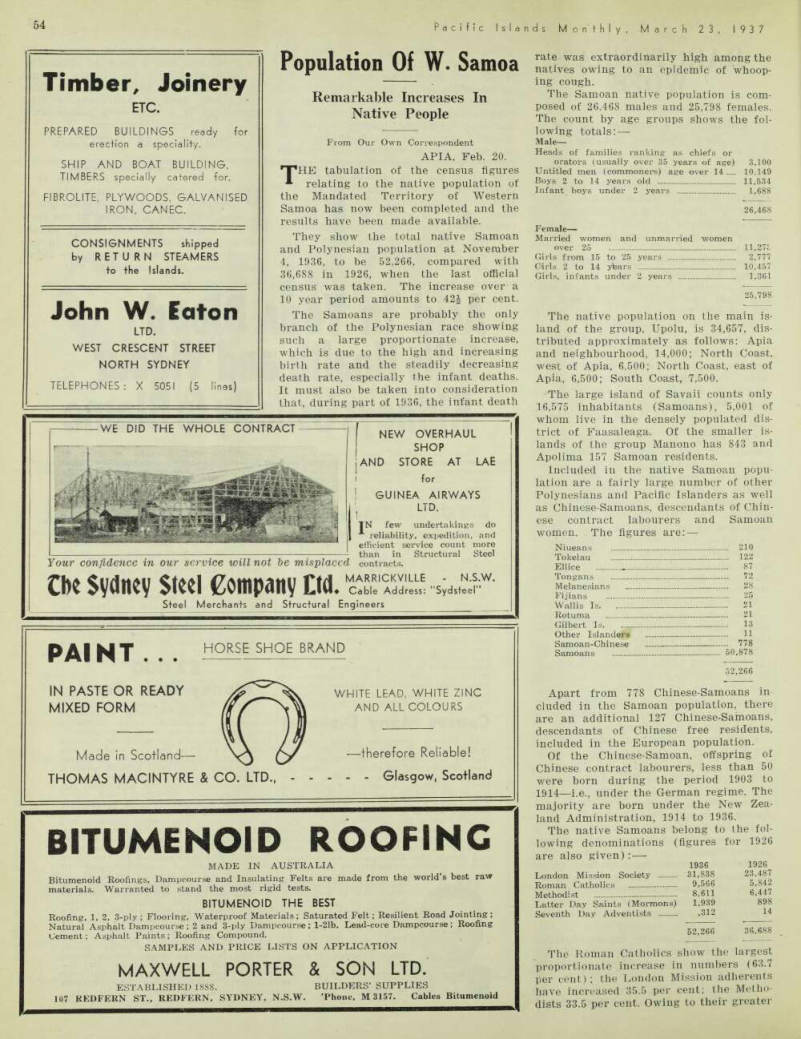
Remarkable Increases In Native People
From Our Own Correspondent
Apia, Feb. 20.
npHE tabulation of the census figures * relating to the native population of the Mandated Territory of Western Samoa has now been completed and the results have been made available.
They show the total native Samoan and Polynesian population at November 4, 1936, to be 52,266, compared with 36,688 in 1926, when the last official census was taken. The increase over a 10 year period amounts to per cent.
The Samoans are probably the only branch of the Polynesian race showing such a large proportionate increase, which is due to the high and increasing birth rate and the steadily decreasing death rate, especially the infant deaths.
It must also be taken into consideration that, during part of 1936, the infant death
rate was extraordinarily high among the natives owing to an epidemic of whoop ing cough.
The Samoan native population is com posed of 26,468 males and 25,798 females.
The count by age groups shows the fol
lowing totals:—
Male- Heads of families ranking as chiefs or orators (usually over 35 years of age) 3,100 Untitled men (commoners) age over 14 10,149 Boys 2 to 14 years old 11,534 Infant boys under 2 years 1,688 26,468 Female— Married women and unmarried women over 25 11,273 Girls from 15 to 25 years 2,777 Girls 2 to 14 yfears 10,457 Girls, infants under 2 years 1,361 25,798 The native population on the main is land of the group, Upolu, is 34,657, dis tributed approximately as follows: Apia and neighbourhood, 14,000; North Coast, west of Apia, 6,500; North Coast, east of Apia, 6,500; South Coast, 7,500.
The large island of Savaii counts only 16,575 inhabitants (Samoans), 5,001 of whom live in the densely populated dis trict of Faasaleaga. Of the smaller is lands of the group Manono has 843 and Apolima 157 Samoan residents.
Included in the native Samoan popu lation are a fairly large number of other Polynesians and Pacific Islanders as well as Chinese-Samoans, descendants of Chin ese contract labourers and Samoan women. The figures are: — Niueans 210 Tokelau ; 122 Ellice ... 87 Tongans 72 Melanesians .,— 28 Fijians 25 Wallis Is. .. 21 Rotuma 21 Gilbert Is 13 Other Islanders - 11 Samoan-Chinese 778 Samoans 50,878 52,266 Apart from 778 Chinese-Samoans in eluded in the Samoan population, there are an additional 127 Chinese-Samoans, descendants of Chinese free residents, included in the European population.
Of the Chinese-Samoan, offspring of Chinese contract labourers, less than 50 were born during the period 1903 to 1914 —i.e., under the German regime. The majority are born under the New Zea land Administration, 1914 to 1936.
The native Samoans belong to the fol lowing denominations (figures for 1926 are also given): —
The Roman Catholics show the largest proportionate increase in numbers (68.7 per cent) ; the London Mission adherents have increased 35.5 per cent; the Metho dists 33.5 per cent. Owing to their greater
London Mission Society 1936 31,838 1926 23.487 Roman Catholics - 9,566 5,842 Methodist 8,611 6,447 Latter Day Saints (Mormons) 1,939 898 Seventh Day Adventists —— ,312 14 52.266 36,688
activity, the smaller sects, Mormons and Seventh Day Adventists, have also made large gains during the last 10 years.
There are altogether 1,001 native Samoans in remunerative employment, working for a livelihood, 447 of whom are plantation workers on European or Government plantations. A total of 2,049 Samoans are living on European proper ties, mainly in Apia and neighbourhood.
The total population of the territory, European and native, as counted in the census is now composed as follows: Native Samoans 62,266 Europeans ... 3,095 Chinese and Melanesian labourers 585 Total population ... 55,946 For the purpose of comparison it is interesting to quote the corresponding figures of the 1926 census and of the last German count taken in 1913. —
The small increase shown in 1926 against former counts is mainly due to the heavy mortality caused by the 1918- 1919 influenza epidemic.
Dr. W. M. Ramsay, Fiji District Medi cal Officer, arrived in Sydney by the Esperance Bay in February on leave prior to retirement from the Civil Service.
N.Z. German Census Census 1926 1913 Native Samoans . 36,688 34,065 Europeans 2,291 1,582 Chinese and Melanesians 1,043 2,452 40,022 38,099
Tahiti Chinese
Fierce Storm But No Ripple On Surface
From Our Own Correspondent
Papeete, Feb. 10.
Chinese colony in French Oceania, * like Chinese colonies everywhere, while physically and economically in the place of its habitat, is mentally and poli tically resident in China.
The complexion of the local community has closely followed the political changes of Southern China. At one time, there were sharply divided monarchical and republican divisions. But as the Kuomin tang developed ascendency at Nankin, that organisation at Tahiti has drawn into its allegiance all but a few die-hards.
The average Chinaman is garrulous enough about things in general, through the medium of pidgin Tahitian or (in the case of the educated) of French and English. When it comes to political and community affairs, however, everything is transacted behind the wall of the Chinese language, and very little of what is going on leaks out to alien ears.
The Kuomintang has erected a hand some building in the heart of Papeete.
The lower floor is used for school rooms to instruct Chinese children. The upper apartments are executive offices and club rooms. Until recently this institution
has been in receipt of an annual sub sidy from the Nankin Kuomintang.
From its inception, the Tahiti Kuomin tang has been controlled by the directors of Kong Ah and Co. and their allies When that widely-spread commercial cor poration came to grief, an investigation, forced by the anti-Kong Ah members of the Kuomintang, disclosed the practically total disappearance of the very consider able treasury funds of the association.
Then ensued a battle royal for control.
The situation, reported to Nankin, re sulted in the discontinuance of the sub sidy until the matter should be cleared up.
After a strenuous campaign the oppo sition to the Kong Ah control has won a sweeping victory, and a special delegate has been despatched to China to expose to the higher authorities the situation and to plead for the resumption of the subsidy.
All this has transpired without the least ripple on the surface of Chinese life in the islands that could be detected by an outsider.
Dr. A. M. Reid, who was formerly geologist to the Tasmanian Government, returned to Sydney from Noumea by the Pierre Loti in February after carrying out a survey for Chrome Alluvials Ltd., of Melbourne. Having
closely inspected the properties in the
south of the group which the company has under option, he recommended that Chrome Alluvials take up the leases.
The steam-yacht Corsair, the property of Mr. J. P. Morgan, the internationally known United States banker, arrived at Papeete on February 8, 1937. The yacht navigated among the dangerous Tuamotu Islands calling at Fakarava before going to Tahiti. From there the voyage was continued to Moorea, and on to the Lee ward Society Islands and thence to Suva, Fiji. The Corsair is one of the world’s largest and most costly sea-going yachts.
Advertisements & other items, p. 57 (1 item)
For Cool, Quiet,
BUILD
COMFORT
COOLNESS
INTO YOUR HOME
WITH
•ir O The British Insulating Sound-Absorbing Building Board The Colour, Figure and Texture of TEN/TEST provide the BEAUTY. The Heat-resisting and Sound-absorbina qualities of TEN/TEST provide the COOLNESS, QUIET. COMFORT, and CLEANLINESS.
TEN/TEST
is by far the most beautiful and the strongest and densest board made. It has by far the highest resistance to moisture and the greatest sound absorption—just twice the moisture resistance of the American boards, and sixty per cent, more sound absorption, and, in addition,
TEN/TEST
can be cleaned, kept clean and refreshed always by brushing with a stiff brush without showing any trace. Ten-test is unique in this. No other board can be so treated again and again—their prepared surfaces are destroyed by it, painting becomes necessary, and painting destroys the sound absorbing surface by filling in the sound absorbing pores.
Agents for New Guinea: Sheets l/2in. thick, 3 and 4 feet wide, 5,6, 7,8, 9, 10, 11, 12 and 14 feet long. Price 30/per 100 square feet.
F. 0.8. Sydney.
W. R.
LTD.
CARPENTER & CO.
Rabaul and Salamaua Applications for Agencies invited from all other Islands
For COOL, QUIET,
CLEAN,i COMFORT.
BEAUTY AND
PERMANENCE
CROCKETT & CO. LTD., 379 Kent St., Sydney Cables; "Pinetree."
Radio Transmitters For Torres
Strait Islands
THE Chief Protector of the Aboriginals * in Queensland has evolved a scheme to provide wireless communication be tween a central radio station on Thurs day Island and a number of the Torres Strait Islands. Fifteen mission stations and Government posts will be equipped almost immediately, as well as the Gov ernment ketch Melhidir.
Amalgamated Wireless (Australasia) Ltd. has accepted a contract for the in stallations. As some of the islands in the network are as far as 300 miles from T. 1., it has been decided, in the interests of economy, to equip the stations with low-powered transmitting equipment de riving power from small engine-driven generators.
Miss Olga Macco arrived in Sydney from Rabaul, New Guinea, by the Mon toro on February 18, en route to Germany to be married. Older residents of the territory will remember her parents, who were well-known planters in New Ireland before the Great War.
Still No Decision!
Chinese Labourers In Samoa
From Our Own Correspondent
Apia, Feb. 19.
T'HE matter of the repatriation of the Chinese plantation labourers, whose contracts expire in August of this year, is still causing much agitation among the European planters.
No decision has been made by the N.Z.
Government so far, though a number of petitions have been forwarded to New Zealand protesting against the threatened measure, which would mean the ruin of the plantation industry.
The natives are enjoying a period of prosperity at present, and it has become increasingly difficult for planters, even at increased wages, to obtain Samoans for casual employment on their plantations.
The wages of Chinese plantation labourers have recently been raised from 1/9 to 2/- per day.
An intimation that the Socialist Govern ment planned to repatriate the Chinese was given first by the “Goodwill Mission” in June, 1936—nearly nine months ago.
For Ministry
Papuans To Be Trained For Ministry
r THE first two Papuans to be accepted for the Christian ministry were admitted as candidates for training at the Annual Conference of the Methodist Church in Sydney in February. They are two native catechists, Inosi Ugwaluba and Kelebi Toginitu.
Matters of interest concerning the Pacific Islands fields of the Methodist Mission were present to the Conference by Rev. J. W. Burton (General Secre tary). He pointed out that during 1936 the accumulated deficit of £17,053 was reduced by £5,352, and is now the lowest for very many years.
Requests to the Conference from un married missionaries for permission to marry were granted to Revs. D. F. Boor man (Fiji), A. S. Jones, T. N. Simpson, and H. J. Pearson (New Britain).
The Conference agreed to the follow ing transfers:— Rev. F. L. Nunn, Lautoka, Fiji, to Victoria.
Rev. L. A. McArthur, 8.A., Vunairima, New Britain, to Western Australia.
Rev. A. H. Wood, Nukualofa, Tonga, to New South Wales.
Rev. H. Chambers, Davuilevu, Fiji, to Victoria.
Rev. C. M. Churchward, M.A., Rotuma, Fiji, to New South Wales.
Rev. Maurice G. Wilmshurst, M.A., South Australia, to Ba, Fiji.
Rev. G. J. Flatten, Western Australia, to Vunairima, New Britain.
Rev. Stanley G. Cowled, New South Wales (formerly of Papua), to Fiji.
Rev. Ronald S. Walker, New South Wales (formerly of Papua), to Fiji.
Mr. W. Fowler, District Officer in the Solomon Islands, has been transferred to Nigeria, West Africa.
Advertisements & other items, p. 58 (1 item)
Excelsior Supply Co. Ltd.
Maleham & Yeomans
LIMITED
BOWDEN STREET, SHEFFIELD, ENG.
Manufacturers of all kinds of Butchers', Sticking and Sheath Knives Razors and Scissors Specialty Hairdresser Scissors
PRICE LIST ON APPLICATION
EXCELSIOR SUPPLY CO. LTD.
The most extensive Manufacturers in the British Empire of
RUBBER STAMPS,
INKS, STENCILS.
Marking Devices.
ACME STAMP PADS
We have a big range of Special
FRUIT CASE MARKING SETS
OwJ
We also Manufacture or Supply a complete line of
Spraying Machines
for aU purposes.
Let us know your requirements and we will quote you by return. Ask for our Big Catalogue.
Sole Australasian Distributors of the World Famous SHEAFFER FOUNTAIN
PENS and PENCILS.
EXCELSIOR SUPPLY CO. LTD.
Head Office :
160 BROADWAY, SYDNEY, N.S.W.
Defaulting Recruits In Solomons
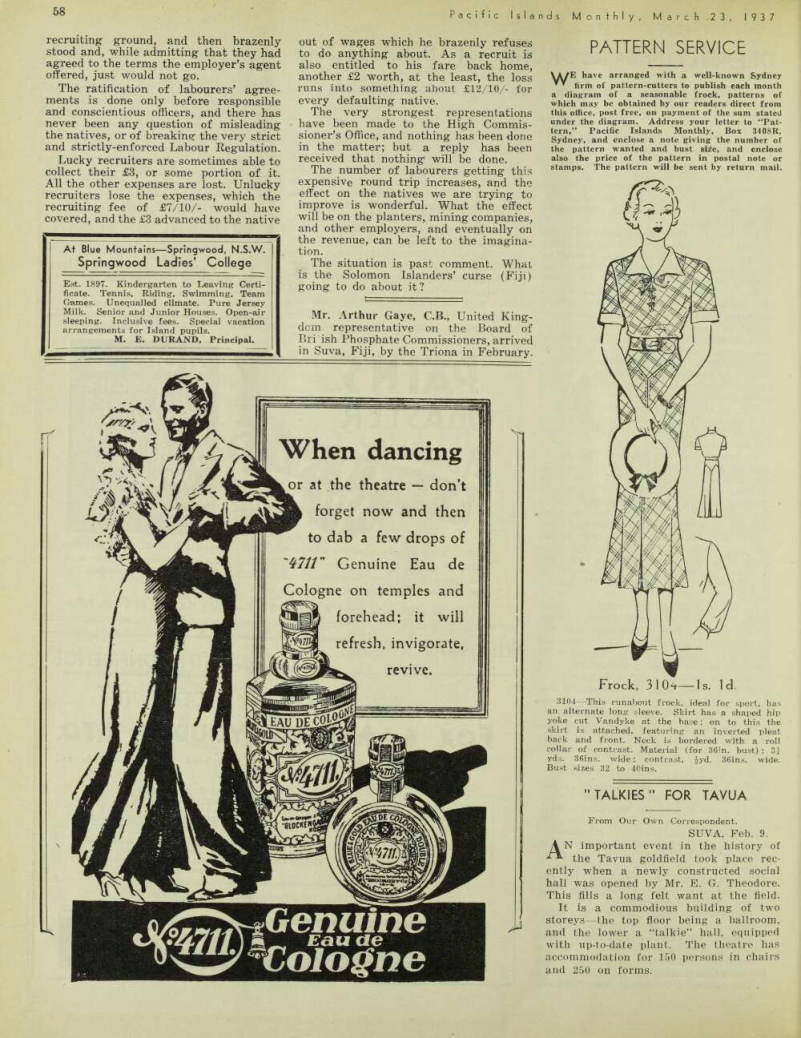
Fiji's Strange Indifference To Very Serious Problem
From a Special Correspondent
Tulagi, Feb. 19.
the last two years, considerable loss and anxiety have been experi enced by recruiters, and through them by every industry in the Solomons, owing to a situation which has its origin in Fiji’s apparent indifference to the welfare of the Solomons.
To realize the seriousness of the matter, it is necessary to explain the system under which any native needing employment overcomes the difficulty of getting in touch with a job.
For a start, one can set aside fables and adventure-stories, and a lot of the romance that popular imagination in vests’ in anything pertaining to the savage isles and so forth. The fact is, that most plantations are situated in comparatively thinly-populated islands, where, by reason of the scarcity of popu lation, land has been available for development.
But, on the other hand, natives in need of jobs are living on thickly populated islands where land has not been available for development.
To bridge the gap between the native seeking a job, and the employer needing the native’s services, there has been evolved the “recruiter.” He is simply running an employment bureau, taking the place of a “Situations vacant”, column. But he has also to provide the native with sustenance till he gets to his job, and transport to his job, and some form of advance to enable his relatives to carry on while he is away working.
It can be seen that “overhead” is pretty heavy.
In the old days, the relatives were given a present of goods (money being of no use to them); the applicant for employment signed on the licensed recruiter’s book; and the native was brought in for medical inspection, and to have his contract ratified by an official, who would see that the agreement be tween native and recruiter was above board. Unless a native were medically unfit, too young, or otherwise disqualified, he had his contract ratified, and his wages started from the date of ratifica tion.
It is to be observed that the employer, through his agent the recruiter, main tained and transported the native from the time he signed the recruiter’s book, until his arrival on the plantation. The employer also maintains the labourer for the term of his employment, and, further, after he has worked for the stipulated period until he arrives at his home, to which transport is provided by the employer—the recruiter doing the land ing of the returned labourer.
It can be understood that all this main tenance and transport, which requires a ship and crew, and a responsible licensed ship’s master, costs money. This is allowed for in the recruiting fee; and so the recruiter makes his living.
The present situation is that, with the
march of progress, the old-fashioned and ethically-wrong gift to the relatives has been replaced by an advance of the native’s wages (if he wishes it—and he always does) which in the first place is found by the recruiter (unless he makes special arrangements witli the employer).
This usually amounts to £3.
A ship’s expenses vary, but they are so heavy that, recently, several recruiters have had to abandon recruiting, as the fee of £7/10/- is too low to afford them a living, unless they are having con tinually successful trips. At festival times, and when native food is plentiful, successful trips may be very rare. This
is in addition to the £3 advance, which, if provided by the recruiter, is refunded by the employer, being part of the em ployee’s wages.
Now, for the last two years, through a mis-wording or a misinterpretation of the regulation, and in any case through the indifference of Fiji to the strong representations of those who have any knowledge of the situation, natives have repeatedly accepted advances, signed with the licensed recruiter, been main tained for the period of the trip to the
recruiting ground, and then brazenly stood and, while admitting that they had agreed to the terms the employer’s agent offered, just would not go.
The ratification of labourers’ agree ments is done only before responsible and conscientious officers, and there has never been any question of misleading the natives, or of breaking the very strict and strictly-enforced Labour Regulation.
Lucky recruiters are sometimes able to collect their £3, or some portion of it.
All the other expenses are lost. Unlucky recruiters lose the expenses, which the recruiting fee of £7/10/- would have covered, and the £3 advanced to the native
out of wages which he brazenly refuses to do anything about. As a recruit is also entitled to his fare back home, another £2 worth, at the least, the loss runs into something about £l2/10/- for every defaulting native.
The very strongest representations have been made to the High Commis sioner’s Office, and nothing has been done in the matter; but a reply has been received that nothing l will be done.
The number of labourers getting this expensive round trip increases, and the effect on the natives we are trying to improve is wonderful. What the effect will be on the planters, mining companies, and other employers, and eventually on the revenue, can be left to the imagina tion.
The situation is past comment. Whai is the Solomon Islanders’ curse (Fiji) going to do about it?
Mr. Arthur Gaye, C. 8., United King dom representative on the Board of Bri ish Phosphate Commissioners, arrived in Suva, Fiji, by the Triona in February.
Advertisements & other items, pp. 59-60 (1 item)
Pai Ns
TO PLANTERS AND TRADERS
William if. Reed
(Established 1913) Union House, 247 George St., Sydney For all Island Requirements.
Island produce sold.
Prices right. Enquiries welcomed.
PAI NS
MASTER
Vl
POWDERS &
TABLETS
1/6 AND 2/6.
SINGLES2d.ea.
STOPS SAFELY
HEADACHE
’FLU & COLDS
RHEUMATISM
NEURALGIA
SCIATICA
NEURITIS
LUMBAGO
AND All NERVE AND
MUSCULAR PAINS
Reduce temperature and relieve feverishness with Vincent’s A.P.C. It diminishes the likelihood of complications and leaves no after effects. Doctors recommend it because it is prepared on the scientific hospital formula and has stood the test of experience for over 16 years. Keep a packet of Vincent’s A.P.C. always at hand.
FOR SAFETY’S SAKE, SAY "VINCENT’S A. P. C.”
WHY TAKE A RISK?
,VWWW*A/WN/NAAAA/V/W/VV*AAAA/VVN/V/%AA/WVW>
YOU CAN WITH CONFIDENCE
PLACE YOUR RADIO ORDERS WITH
Fox & Maccillycuddy Ltd.
The Oldest Established Radio Distributors of Completed Receivers Parts and Accessories in Australia.
We specialise in all sets as described by “ Wireless Weekly,” and full stocks of parts are always on hand. We will be pleased to quote you by return mail.
9 EVERREADY BATTERIES •
EVERREADY BATTERIES ALWAYS IN STOCK
SUPERDYNE HEAVY DUTY LIGHT DUTY
“C” BIAS “A” BATTERIES AND TORCH REFILLS All brands of Radio Valves always in stock, including Radiotron, Philips, Kenrad, Mullard, National Union, Osram. Each Valve is carefully tested before despatch.
QUALITY RADIO— PROMPT SERVICP RELIABILITY
YORK
SYDNEY.
At Blue Mountains—Springwood, N.S.W.
Springwood Ladies' College
Est. 1897. Kindergarten to Leaving Certificate. Tennis, Riding, Swimming, Team Games. Unequalled climate. Pure Jersey Milk. Senior and Junior Houses. Open-air sleeping. Inclusive fees. Special vacation arrangements for Island pupils.
M. E. DURAND, Principal.
'SS/T>
777/1
When dancing
or at the theatre don’t forget now and then to dab a few drops of "4711” Genuine Eau de Cologne on temples and forehead; it will BWD refresh, invigorate, revive. iO El mm
Genuine
i Eau de
Cologne
Pattern Service
\A/E have arranged with a well-known Sydney * * firm of pattern-cutters to publish each month a diagram of a seasonable frock, patterns of which may be obtained by our readers direct from this office, post free, on payment of the sum stated under the diagram. Address your letter to “Pat tern,” Pacific Islands Monthly, Box 3408 R, Sydney, and enclose a note giving the number of the pattern wanted and bust size, and enclose also the price of the pattern in postal note or stamps. The pattern will be sent by return mail.
3104 —This runabout frock, ideal for sport, has an alternate long sleeve. Skirt has a shaped hip yoke cut Vandyke at the base; on to this the skirt is attached, featuring an inverted pleat back and front. Neck is bordered with a roll collar of contrast. Material (for 36in. bust) : 3i yds. 36ins. wide; contrast, £yd. 36ins. wide.
Bust sizes 32 to 40ins.
Frock, 3104—1s. 1d.
"Talkies" For Tavua
From Our Own Correspondent.
Suva, Feb. 9.
A N important event in the history of the Tavua goldfield took place rec ently when a newly constructed social hall was opened by Mr. E. G. Theodore.
This fills a long felt want at the field.
It is a commodious building of two storeys—the top floor being a ballroom, and the lower a “talkie” hall, equipped with up-to-date plant. The theatre has accommodation for 150 persons in chairs and 250 on forms.
Fashion Hints for Islands Women
By Therese
PERFECTION lies in little things, and so the craze for novel accessories continues.
Little white dogs march in solemn pro cession across the front of a halo hat of navy taffeta. Little red dogs of ferocious mien keep guard on the lapel of a jacket.
Delicate trifles of lace go to the making
of fascinating fans. Glittering gold and
silver kid makes evening bags, belts, and most attractive flowers. Scintillating buckles and clips in exquisite designs trim evening gowns.
Gloves are both short and long. Eight button gloves are becoming with the three-quarter or push-up sleeve. White gloves hold their own and are always smart. Suede gloves are discreetly decor ated with metal motifs. Almost indis tinguishable from the real thing, suede fabric gloves come in a variety of colours.
Flowers in suede and leather add a striking touch to daytime clothes. Belts are worn to match them. Scarves are more intriguing than ever. Spots, stripes and jig-saw designs gay the dullest dress.
Hats are chic and amusing. Narrow and medium brims are popular, as are no brims at all. Brimless hats sporC stif fened veils, standing out like brims, and the very newest veils fly out from the back. Crowns soar or squash as flat as any pancake. Either style is in accor dance with fashion’s decree.
All the chic of the hat depends on the angle at which it is worn. Usually a tilt to the right eye and slightly forward creates the greatest degree of chic, though the enchanting Mary Queen of Scots’ bonnet is won off the face and is full of charm.
The new materials for evening wear are little short of heavenly—cloth of gold rich and supple with never a metal thread to dim its brightness; rhinestone studded crepe; satins embossed with sil ver and gold; floral lacquered satins; and sequin scattered georgettes. Black spangled net floats like a cloud over shin ing sheaths of brilliantly coloured satin.
Many evening gowns are high of neck, with low decolletage. Most important of all, sleeves, whether short or long are the dernier cri. Fashion is very varied in her evening mood. G9wns are gayed with brilliant touches of colour, or glitter and sparkle with every movement.
A vivid green brace’et catches the green of the sash on the black cloque gown which buttons to the neck with myriads of buttons.
A gold lame dress sheathing the figure adds crimson velvet epaulettes. A panel buckled to the waist sweeps to the floor.
Voluminous net floats over the skirt of a slim satin evening gown. It is detachable, to give service as a cape.
Shirred and flaring out like a lamp shade, a gold taffeta evening dress ex udes Victorian charm. The hips are slim, and the shirs run from the hipline to the hem.
A black satin dinner gown is romance itself with its stiffened puff sleeves
springing from a net yoke. The skirt sweeps back into heavy folds.
The Russian influence continues to sway us. Tunics are definitely to the fore, and evolved in lace, lacquered satin, lames and brightly floral taffetas, art delightful for festive occasions. In most instances the skirt beneath is column slim, the more daring, slit to reveal a well turned nether limb.
A Tsigany sash of scarlet and green,
ties round the waist of a navy lace frock and endows it with charm.
Lovely beyond belief, a dinner dress of gold cloth sweeps out from moulded hips. Its sleeves, shirred at the. shoul ders are three-quarter length. The bodice swathes high at the neck line.
Organza makes the sweetest and most ethereal of dresses for the ingenue, and a gown of misty grey swathes itself with pink, like the first pale flush of dawn.
The swathing ties in a sash, which reaches to the floor.
The line for day clothes is straight and youthful. Skirts are short and some times the shorter skirt mode is adopted
tor evening wear with varied success.
Shoulders are broad, though more roun ded than squared.
White is most favoured for trimming especially with black and all shades of blue. Off wdiite is definitely better with brown giving a softer contrast.
With this the natural chamois glove is perfection.
Black with blackberry is one of the chic combinations the new season offers.
Black hat, shoes, and a black belt worn with a double breasted cardigan is chic personified. Through a tab at the neck, a fringed scarf of palest lavender is slotted. A slim black skirt completes the ensemble.
Sports clothes show a trend towards novel details about the neck and shoul
der line. Skirts are short, either flared or pleated.
A white linen jacket suit outlined with dahlia red fringe pins a two-tore posy on its lapel.
A large black straw hat tops a haze blue georgette frock, printed with clus ters of pink chrysanthemums. One large bloom trims the hat.
Pin tucks are well in use on plain coloured frocks and form a delightful trimming note.
Paisley dresses, blouses and scarves are really charming, the soft mellow col ours toning wdth almost every colour.
Striped cotton dresses add brilliant cowboy scarves and a gay sombero is added for beach wear. The übiquitous sandal accompanies it.
Advertisements & other items, pp. 61-62 (1 item)
Measure You
mw
MAIL THIS NOW
Kindly forward by return mail a copy of your LATEST 1937 CATALOGUE, the cover of which is illustrated above.
Pacific Islands Co.,
728 GRACE BUILDINGS,
77 YORK STREET, SYDNEY
AUSTRALIA
(Block letters] Address
WHEN SPENDING YOUR VACATION IN SYDNEY YOUR CHOICE OF RESIDENCE IS A MATTER SO VITAL TO YOUR ENJOYMENT!
May we commend to you for All-round Excellence
SYDNEY'S MOST EXCLUSIVE PRIVATE HOTEL
"44 MACLEAY STREET"
Here for you await unrivalled Service and Cuisine—Suites with Private Baths— H. & C. Water and Telephones in all rooms—Magnificent Harbour Views Roof Garden Sun Rooms Spacious Lounges and Smoke Rooms and every modern convenience All under Personal Supervision of the Proprietress,
MISS M. E. BURROWS
TArTffl R^^r~£3/37^
per week inclusive.
Radios:
"FORTYFOR”
Sydney.
Telephone: FL 2641 m Hi & J 9 0
Your Tropical Kit
When you visit the Pacific Islands, whether on Business or Pleasure, you need Special Equipment—Light Suits of Correct Style, which fit welTand launder easily; Tunic Shirts Silk Shirts, Light Underwear, White Shoes, etc.
WALTER HORNE & CO. LTD., established in 1885, specialise in this Service. Skilled Tailors make your Suits from First-class material within 24 hours. Complete equipment can be supplied from our Large Stocks at Reasonable, Moderate Prices.
BUY FROM THE FIRM WHICH UNDERSTANDS
DRESSES YOU CORRECTLY
WALTER HORNE & CO. LTD., carry a Full Range of Drapery of all kinds; also Frocks, Millinery, Foundations and Lingerie, Hosiery, Shoes and Sandals. Ribbons and Laces, Household Drapery.
Ladies' Hairdressing and Manicuring
YOUR NEEDS AND
Men resident in any of the Pacific Territories can he supplied with Suitable Clothes.
Write to us and Describe you r Requirements.
WALTER HORNE & Co. Ltd
Drapers and Men's Wear Specialists
SUVA. FIJI
Notable Wedding
Marriage of Daughter of Papua's Oldest Resident
From Our Own Correspondent
Opt. Moresby, Mar. 5.
F great interest to all residents of Papua was the marriage of Mr.
Frederick Godson, of Itikinumu Planta tion, Sogeri, and Miss Gladys English, youngest daughter of Mr. and Mrs.- A. C.
English, of Rigo, which took place at Ela Pi otestant Church, Port Moresby, on March 3.
The ceremony was performed by Rev.
D E. Ure, of the London Missionary Society. The bride and bridegroom were supported by the sister of the bride, Miss Margery English (bridesmaid), and Messrs. E. -J. Frame and Stanley A.
Greenland (best man and groomsman).
After the ceremony, Mr. and Mrs.
English entertained 60 guests at the In stitute Hall. Among those present were: His Excellency Sir Hubert Murray (Lieu tenant-Governor), Hon. H. W. Champion and Mrs. Champion, His Honour Mr. Jus tice Gore and Mrs. Gore, Hon. A. P.
Lyons and Mrs. Lyons, and Mr. and Mrs.
S. A. Greenland.
Following the bride and bridegroom’s toast, Sir Hubert Murray proposed tae toast of the bride’s parents. He remarked upon his many years of continued friend ship with Mr. A. C. English, who had already been a resident in Papua for more than 20 years when he first took office in 1904. Mr. English, said His
Excellency, knew the very early days
when Papua was a Protectorate and known then as British New Guinea. Sir Plubert laid stfess on the dangerous state of the colony at that time, and the hard ships and privations endured by Mr.
English, and later Mrs. English, when the demands made upon civil servants and settlers were such as are difficult to realise in these settled times.
Mr. English landed at Kerepuna in 1883, when there was no settlement what ever and the natives, except for the con trol of two white missionaries, were left to their bloodthirsty devices. At that time the coastline was visited only by traders, with occasional excursions by blackbirding schooners; but apart from these the country was practically un known.
He first interested himself in making valuable collections of Natural History specimens and of native curios. Later, in 1889, on account of his knowledge of the natives and the country, he was ap pointed Acting Government Agent for Rigo by Sir William MacGregor. Resign ing from the Government in 1907, Ml’.
English settled in the district, and en gaged in planting and trading, within a few miles of where he first landed 54 years ago, and where he now resides with his wife and family.
Mr, C. R. Bignell, of Fulakora Planta tion, Ysabel Island, British Solomon Is lands, arrived in Sydney by the Malaita on February 28.
Valuable Plants of Fiji
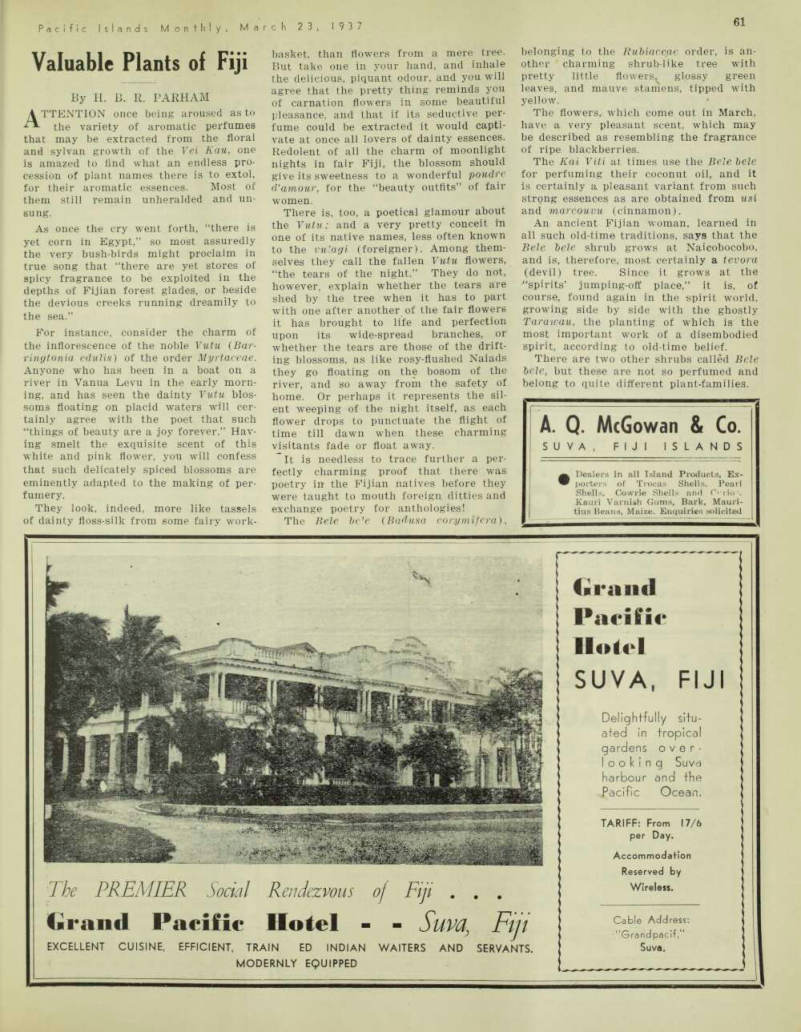
By H. B. R. Parham
ATTENTION once being aroused as to the variety of aromatic perfumes that may be extracted from the floral and sylvan growth of the Vei Kau, one is amazed to find what an endless pro cession of plant names there is to extol, for their aromatic essences. Most of them still remain unheralded and un sung.
As once the cry went forth, “there is yet corn in Egypt,” so most assuredly the very bush-birds might proclaim in true song that “there are yet stores of spicy fragrance to be exploited in the depths of Fijian forest glades, or beside the devious creeks running dreamily to the sea.”
For instance, consider the charm of the inflorescence of the noble Vutu (Bar ringtonia edulis) of the order Myrtaceae.
Anyone who has been in a boat on a river in Vanua Levu in the early morn ing, and has seen the dainty Vutu blos soms floating on placid waters will cer tainly agree with the poet that such “things of beauty are a joy forever.” Hav ing smelt the exquisite scent of this white and pink flower, you will confess that such delicately spiced blossoms are eminently adapted to the making of per fumery.
They look, indeed, more like tassels of dainty floss-silk from some fairy work
basket, than flowers from a mere tree.
But take one in your hand, and inhale the delicious, piquant odour, and you will agree that the pretty thing reminds you of carnation flowers in some beautiful pleasance, and that if its seductive per fume could be extracted it would capti vate at once all lovers of dainty essences.
Redolent of all the charm of moonlight nights in fair Fiji, the blossom should give its sweetness to a wonderful poudre d’amour, for the “beauty outfits” of fair women.
There is, too, a poetical glamour about the Vutu; and a very pretty conceit in one of its native names, less often known to the vulagi (foreigner). Among them selves they call the fallen Vutu flowers, “the tears of the night.” They do not, however, explain whether the tears are shed by the tree when it has to part with one after another of the fair flowers it has brought to life and perfection upon its wide-spread branches, or whether the tears are those of the drift ing blossoms, as like rosy-flushed Naiads they go floating on the bosom of the river, and so away from the safety of home. Or perhaps it represents the sil ent weeping of the night itself, as each flower drops to punctuate the flight of time till dawn when these charming visitants fade or float away. ~lt is needless to trace further a per fectly charming proof that there was poetry in the Fijian natives before they were taught to mouth foreign ditties and exchange poetry for anthologies!
The Bele be'e (Badusa corymifera),
belonging to the Rubiaceae order, is an other charming shrub-like tree with pretty little flowers, glossy green leaves, and mauve stamens, tipped with yellow.
The flowers, which come out in March, have a very pleasant scent, which may be described as resembling the fragrance of ripe blackberries.
The Kai Viti at times use the Bele bele for perfuming their coconut oil, and it is certainly a pleasant variant from such strong essences as are obtained from usi and marcouvu (cinnamon).
An ancient Fijian woman, learned in all such old-time traditions, says that the Bele bele shrub grows at Naicobocobo, and is, therefore, most certainly a tevora (devil) tree. Since it grows at the “spirits’ jumping-off place,” it is, of course, found again in the spirit world, growing side by side with the ghostly Tarawau, the planting of which is the most important work of a disembodied spirit, according to old-time belief.
There are two other shrubs called Bele bele, but these are not so perfumed and belong to quite different plant-families.
Advertisements & other items, pp. 63-64 (1 item)
Suva, Fiji
A. Q. McGowan & Co.
SUVA, FIJI ISLANDS
• Dealers in all Island Products, Exporters of Trocas Shells, Pearl Shells, Cowrie Shells and Olio'.
Kauri Varnish Gums, Bark, Mauritius Beans, Maize. Enquiries solicited
N fa m m m The PREMIER Social Rendezvous of Fiji . . Grand Pacific Hotel - - Suva, Fiji EXCELLENT CUISINE, EFFICIENT. TRAIN ED INDIAN WAITERS AND SERVANTS.
MODERNLY EQUIPPED
Grand
Pacific
Hotel
SUVA, FIJI
Delightfully situ-
ated in tropical gardens overlooking Suva harbour and the Pacific Ocean.
TARIFF: From 17/6
per Day.
Accommodation Reserved by Wireless.
Cable Address; "Grandpacif,"
Suva.
PACIFIC TAXI
GARAGE o o
(Vincent Brothers, Suva, Fiji) Day and night service ... Most modern hire service In Suva . . . .
Excellent drivers.
Our special trips embrace Rewa Valley and Sugar Mill, River Scenery, Lami, Suva Point, and Native Kings' Town oF Bau. • Trips can be arranged on Trans-Island road to Ellington, Tavua, Ba, Lautoka, and Sigatoka.
Cables: "Vincent," Suva. 'Phone 33.
Australia's Clearing House tor the Precious Metals
BUYERS OF
COLD
OSMIRIDIUM, PLATINUM, SILVER, &c.
GARRETT & DAVIDSON, LTD.
ASSAYERS, BULLION MERCHANTS, METALLURGISTS
Bank of N.S.W. Buildings - - Regent Street, Sydney
A. B. DONALD LTD.
AUCKLAND
ISLAND TRADERS :: GENERAL MERCHANTS
P. O. Box 1509 Cables and Telegrams: "Kingdom," Auckland Branches at Rarotonga and throughout the Cook Islands At Papeete and throughout the Society, Marquesas and Paumotu Islands trading as " ETABLISSEMENTS DONALD. TAHITI "
At Fiji: Trading as "Dominion Fruit C 0.," Suva
Mixed Marriages In Polynesia
Unions Made By Many Europeans With Attractive Daughters of Samoa
By H. Charles Reed, Of Apia.
"VTEWCOMERS in these attractive is lands of the Samoan Group appear to have considerable interest in the is land ways of love and marriage—especi ally mixed marriages, which, from their intimate nature, are a subject rarely broached in print.
This writer has personally known, in Western Samoa, a great many highly respected men of gentle birth and of edu cation who, in former days, chose to marry fair daughters of the island chiefs, or girls of part-European parentage, who are called “European-born” in Samoa.
Among those men who chose to make Samoa their residence and adopted home w r ere quite a number of professional men, including lawyers, doctors, dentists, sur veyors, chemists, merchants and traders,
master-mariners, schoolmasters, mana gers of plantations, and gentlemen of means . . .
It has often been said that there is a subtle charm and attractiveness about the comely daughters of the chiefly fami lies of Samoa. That they can lay claim to an amiable disposition is true. “The Samoans certainly have learned the way to live and love,” the author of a well known book, once remarked. R. L.
Stevenson said, “I love Samoa —its people are a glad race.”
But in choosing a consort from among the light-skinned Polynesian daughters of Samoan chiefs, or from among the lighter-hued European-born girls, there are certain pros and cons that will need to be carefully weighed. A knowledge of Samoa, and an understanding or know ledge by residence of local conditions of the country and its people, are requisite.
All things being equal it must not be imagined that the most vivacious nymph will provide the best alliance. Milk and coffee need to be carefully blended. A sacred contract, such as marriage is con sidered to be, needs careful forethought, and that careful thought should be the responsibility of the man, in the writer’s opinion.
Most of the daughters of Samoan chiefs, as also the fair maidens of the European-born community, are fitted by reason of modern schooling advantages to more than hold their own in a con versation in English. They will, in gen eral, have a pretty good insight of house keeping and of domestic economy. The Samoans really do excel in the art of cake-making. With the sewing machine, as with the needle, the girls of these islands are adepts, and they usually cut and make their own costumes or frocks.
But when it comes to a discussion of the art and crafts of European origin one cannot expect a people whose environ ment, in most cases, has been that of the Islands from childhood maybe, to have even an understanding, far less a sym pathetic, interest in such subjects.
They may be called illogical. Yet how can they appear otherwise? How can a people, whose parents in some cases, have but little evolved from the later Stone Age, have an intimate understanding of outside world matters, except, of course, those more fortunate girls who have travelled. Many young people of Samoa have visited New Zealand, Aus tralia, and Europe.
The more versatile among the young women of Samoa will play tunefully on the piano, guitar, or ukelele. They are vivacious, and fond of the dance, the “talkies,” and the lagoon. But in this, per haps they are not alone. They have beautiful voices and, with training, often
become good singers. A poetical sense is theirs, while they are keen on music.
The Island-born girls do not suffer the health shortcomings, such as white women usually experience, soon after residence in Samoa, and which frequently necessitate their leaving the islands at short notice, under a doctor’s advice.
Since the New Zealand occupation of Western Samoa, under Mandate (1914), mixed marriages in Samoa have been sternly frowned upon by officialdom: and those of the residents who have taken a stake in the country, or married a fair daughter of Samoa, in order to make this territory their home, by choice and adop tion —these are, for most part, men who are engaged in planting, or shipping, or in the trade —are quietly, but callously, ostracised, by some unwritten law.
Mr. Stephan Savage has written on this topic as follows: “The colour bar and prejudice which exist to-day in these islands was virtually non-existant or un known until very recent years.”
Mr. F. M. Keesing. in his scholarly work, Modem Samoa . page 458. says: “With the passing of frontier conditions, a growing number of white women, mainly the wives of officials, are coming to the islands, allowing the dev'e’opment of family and social life, from which, to greater and greater extent, Europeans married in the country, tend to be ex cluded.
“Sentiment against the half-caste (European-born, is the modern term) is manifested more openly. The visitor can hear in Samoa, to-day, stories to prove him ‘dishonest,’ ‘unreliable,’ ‘intellectu ally-inferior,’ etc. An increasing discrimi nation is being shown against all except the few who are in an unassailable posi tion, because of their economic status.”
Editorial Note
TI/fR. REED, in the opinion of this ITI wr iter. has not dealt boldly enough with his subject—he seems to be afraid of giving offence to snuffy officialdom.
During a few weeks spent in Western Samoa, in 1936, I had the opportunity of meeting many European-Samoans. old and young and of both sexes; and I can say without hesitation that in beautv. in telligence and moral worth those “half castes” will compare favourably with nny equal number of people taken at random out of a European community. The young women especially are attractive— are almost all beautiful and vivacious, and what they lack in worldly knowledge they more than make up in amiability.
Smug people in Samoa, considering the “European-born” as a community, will probably find several reasons for dis couraging marriage with Europeans: but if tbev would search out the truthful history of European-Samoan girls who have married Europeans and then left Samoa for the more tolerant communi ties of Australia and New Zealand, they
would find, in almost every case, a re cord of a successful marriage and of happy motherhood. One visit to a social gathering arranged by the Polynesian Club, in Sydney, would supply interesting and reassuring evidence about such marriages.
There is a scientific explanation. The racial base of the pure Polynesian con tains perhaps 30 per cent of Caucasian blood. Thus, a European-Samoan half caste is much more than a half-caste, and other things being equal future alliances of this racial product with Europeans need not be contemplated with alarm.—R. W. ROBSON.
Dr. S. M. Lambert, representative of the Rockefeller Foundation in the West ern Pacific, left Fiji for New Zealand recently by the Matua to report on the health conditions of the Maori race for the N.Z. Government.
Advertisements & other items, p. 65 (1 item)
Cuprinol
LEATHER BELTS
Cor NATIVES
/ 7Han ufadurert & Specialists
PATTERSON & STONE, CRICHTON WORKS.
WALSALL, ENGLAND.
Prevent Canvas Decay with
CUPRINOL
In tropical climates all canvas work should be treated with Cuprinol to preserve it from destruction by mould and mildew. Cuprinol is insoluble in water so protective salts remain permanently in the fibres of the fabric and absolutely prevent rot. Canvas treated with Cuprinol can be stowed wet
without risk of deterioration.
The Director,
THE NAVAL DEFENCE RESEARCH STATION,
Copenhagen, sth March, 1934.
A/S Kymeia, Glentevej 61, N.
After the experiments made by the Naval Defence Research Station, on which a report was sent you on the 25th August. 1930, some of the Cuprinol-Treated pieces of sail-cloth were kept in the testing well, mentioned in the report.
On the 16th January, 1934, the said pieces of sail-cloth were inspected and were all found to be in a perfect state, having lost nothing of their durability.
We have not conducted tensile strength tests, as the samples were too small.
Pieces of unimpregnated sail-cloth, which had been plreed in the testing well at the same time, had rotted away long before. (Signed) K. T. A. JENSEN.
MORRIS, HEDSTROM, Ltd.
FIJI
Sole Agents in Fiji for . . .
Vacuum Oil Company (P+y.) Limited
Imperial Chemical Industries Limited
Nobel (Australasia) Pty. Ltd. Explosives
Full Stocks of
MINERS AND PROSPECTORS'
REQUISITES
Also SODIUM CYANIDE, ZINC
DUST, Etc., Etc.
Sydney Office: DALTON HOUSE - - 115 PITT STREET. SYDNEY Branches throughout the gold hearing areas Lautoka, Ba, Tavua, Penang, Nadi, and Slgatoka
the Solomons
Closed Districts" in the Solomons Rennell and Bellona
AN issue of the Gazette of the Western Pacific Commission of February 15 brought the “Closed District Regulation. 1937” (British Solomon Islands), into operation. The scope and purpose of the new law is thus described by the High Commissioner (Sir Arthur Richards): — Owing to isolation, difficulty of access, and absence of inducement to traders to operate there, the native inhabitants of the Islands of Rennell and Bellona had not, until recent years, been brought into contact to any appreciable extent with visitors from beyond the confines of their home islands. They had therefore large ly retained their primitive character and customs and had avoided infection with many diseases which have taken such heavy toll of native lives throughout the Pacific Islands. In consequence they have not developed any immunity from, or resistance to, such diseases.
In recent years, as a result of visits of scientific and other expeditions, know ledge of the primitive conditions existing in the two islands has gradually spread and attracted other oversea expeditions and yachting parties. Missionary bodies are also taking a lively interest in the
two islands. In consequence the visits of vessels are becoming frequent, and the introduction of infection, with heavy mortality amongst the natives, has de monstrated the urgent necessity, in the interests of the health and lives of these people, of Government control of oversea contact with the two islands.
The Closed District Regulation 1937 has therefore been enacted to give the Administration the necessary powers of control. Under the Regulation the High Commissioner may declare any area to be a closed district, and entrance into a closed district is prohibited, except in certain specified cases, without a permit issued by the Resident Commissioner.
It is proposed to declare the Islands of Rennell and Bellona to be a closed dis trict under the Regulation, and, until health conditions in those islands are satisfactory, it is proposed to issue per mits very sparingly, under strict condi tions, and only to responsible and ap proved persons. Such permits will auth orise a single visit only' of limited dura tion, and the conditions of issue will pro vide, amongst other things, that no nat ives shall be removed from a closed dis trict without the Resident Commission er’s permission.
Such permission will normally be limited to a small specified number of male natives and will be given only when the Resident Commissioner is satisfied that such removal is in the best interests of the natives concerned or of the native community and for an approved purpose
such as education at an approved educa tional institution with a definite object.
The permit in such cases will require that all such natives shall be brought before a Deputy Commissioner or other specified officer for examination to en sure that they fully understand the pur pose for which they have been taken from their islands; that they shall be medically examined and, if not certified as fit, that they shall be repatriated forthwith or after medical attention as the Resident Commissioner may direct; and that they shall be repatriated at any time they so desire.
Medical examination will be required of all applicants for permits and of every person on board the ship in which the visit is to be made, including any native of a closed district who is being repatri ated, and permits will not be issued if the medical examination shows any indi cation of infectious disease. The ship will be inspected to ensure that it is in a sanitary condition, and a period of quarantine before the visit is made may be imposed.
It is not proposed at present to declare any areas in the Solomons Group other than the Islands of Rennell and Bellona to be closed districts.
Inspector A. E. Meredith, Officer-in-
Charge of the Nabouwalu district, Fiji,
was recently transferred to Suva. Mr.
Alan G. Rcay has been appointed to Nabouwalu.
Advertisements & other items, p. 66 (1 item)
Tilley
One Lamp for every purpose In or Outdoors E.X. 4.
"ALL-PURPOSE" LAMP
Light of 300 c.p. 6 hours for Id. - Burns Ordinary Kerosene This Lamp is designed for general all-round service. It is the cheapest Vapour Lamp on the market, but at the same time highly efficient in every detail and simple! to operate. Can be carried about as Storm Lantern in the fiercest gale; used as a Hangby fitting 12ins. Reflector which slides on to the Suspension Wire; or turned into a Table Lamp by just detaching the Suspension Wire! The light is perfectly steady and unaffected by draughts, however severe. Lamp is strongly made of polished brass, with no parts to rust, corrode or get out of order. Burner hood enamelled in bright colours. Reflector is enamelled white. Get rid of all antiquated devices and use this up-to-date All-British Tilley Lamp.
Obtainable throughout the Pacific Islands from the Branches of;
BURNS PHILP & CO., LTD., and
BURNS PHILP (SOUTH SEAS) CO.. LTD.
Spare Parts and Lamps also obtainable from— W. KOPSEN & CO. LTD., CLARENCE STREET, SYDNEY.
If any difficulty, please write direct to; THE TILLEY LAMP CO. (Dept. P.M.) HENDON, LONDON, N.W.4
Blow At Usury
New and Drastic Law In French Oceania
From Our Own Correspondent
Papeete. Jan. 27
TX the official Journal of December 15, * 1936, notice is given of the promulga tion of a law against usury. This law is embodied in a decree by the President of France “relative to the repression of usury in the colonies, protectorates and territories under mandate.”
The decree specifies as follows: — Article I.—All acts, under private sig nature, constituting loans of money, must be submitted to the visa (or endorse ment) of a qualified official appointed to this duty by order of the Chief of the Colony. This visa will have for its ob ject the certifying that, in the presence of this qualified official: (1) The signa tures have been exchanged; (2) the cash money has been counted; 13) thfe sum so transferred is exact—without any re serve for commission—equal to that men tioned in the act under the private signa tures creating the obligation.
Article 2. —All conventions not fur nished with the visa (as provided in Article 1) are null and void by absolute law.
This nullity is a public mandate. It str kes equally all operations of which the object will be the conversion into a loan of money under a different form to evade the prescriptions of Article 1 of the present decree.
Article 7. —The conventions executed before the publication*©! this decree must on penalty of nullification prescribed in Article 2, be submitted, within a period of six months, to a visa special by quali fied officials appointed for that purpose.
This salutary decree will, it is hoped, bring to an end in French Oceania, a state of affairs which has been cruel, ruinous and scandalous.
The exaction of usurious rates of in terest was one of the contributing causes of the failure of Kong Ah and Company.
Its trail of hardship, ruin and suffering extends back through many years in the history of the colony, and gratitude to the authorities for enacting this law will be deep-seated and universal among all except the usurers themselves.
Handcuffs Are Tabu In
Samoa
From Our Own Correspondent
Apia, Feb. 20.
\I7HEN a number of cases were heard ** before Apia High Court, in which natives, caught by the recently-appointed ranger of the N.Z. Reparation Estates, were charged with trespassing and steal ing breadfruit on Government planta tions, the Commissioner of the Court (Mr. R. V. Kay) took occasion to ad monish severely the ranger for using handcuffs and ropes on Samoan offend ers. He said that this practice was strongly resented by the natives and might easily lead to serious trouble.
Torres Strait News
From Our Own Correspondent
Thursday Is.. Mar. 1.
"THE j>earling luggers have commenced to move * off for their first drift this year, but many have been held up through the lack of foodstuffs on the island. This is due to considerable short shipping of cargo during the past few months, Darwin being favoured instead of T.I.
The local branch of the Returned Sailors and Soldiers’ League is urging the Government auth orities to arrange for an additional line of steam ers to call regularly at Thursday Island. The existing services are frequerttly unable to deal with all our passengers and cargoes.
Thursday Island State School now has Mr.
Robert W. Elmes as its assistant teacher. He was transferred from Rockhampton.
Constable Galagher, of the local Police Force, has proceeded to Brisbane on recreation leave.
Messrs. A. T. Shields and M. R. Peters have come from Brisbane to join the staff of ship wrights at the Port Kennedy Shipyards, which are experiencing a busy season.
After a sojourn here of several months amongst their old friends, during which they witnessed the marriage of their eldest daughter, Gladys, Mr. and Mrs. Ernest J. Hennessey returned by the Marella to Southport, Southern Queensland.
Mr. Leslie White, Jnr., of the Port Kennedy Shipyards, left for Brisbane by the last Marella.
Pilot MacDonald recently made another flight from Cairns bringing Mr. Schwabe, of Innisfail, North Queensland, to take up duties as the new engineer-manager for the T.I. Electric Authority, replacing Mr. Partridge.
Mr. and Mrs. D. C. J. Fell returned to T.I. by the February Merkur. They are attached to the local Quarantine Station.
Di. D. A. Dowling, who has been here for some three years as Chief Quarantine Officer, has been transferred to Sydney. Dr. O’Connor has arrived in his place.
Mr. and Mrs. Wust have been appointed by the Queensland Government Aboriginal Department to the charge of Poid Village on Moa Island.
Torres Strait.
Mr. Frusner has taken charge of Badu Island School until the return of Mrs. Zahel. when he will be given the permanent headship of another Torres Strait school.
Monsieur Chastenet de Gery, who re
cently was appointed Governor of the
French Settlements of Oceania, arrived
at Papeete, Tahiti, by the Ville d’Amiens
on March 17.
Mr. H. E. Hallam has resigned from the position of manager of Mandated Alluvials NX., of Papua.
Advertisements & other items, pp. 67-68 (1 item)
Crgne
AVOID INERT CREAMS
What woman does not sigh after this radiant freshness, this juvenile tint that excites admiration? CREME SIMON makes the skin lovely, —it is always active and is delicately perfumed.
For Perfect Beauty use
CREME SIMON
poudrVsimon
(7 Shades), and
SIMON SOAP
$
CRGNE
SiMON
PARIS
Obtainable Chemist* and Stores Sole Agents: Joubert&» Joubert Ply.Ltd.,Melbourne
Idea! Summer Headwear The Genuine
CALCUTTA’
INDIAN PITH HELMET
PRICE 22/6
PIKE BROTHERS LTD.
QUEEN STREET. BRISBANE
"FAIRHOLME"
A Mountain School for Girls
Dormitory Wing and Staff Residence
PRESBYTERIAN GIRLS' COLLEGE, Toowoomba, <?Td.
Principal : MISS D. E. CULPIN, B.A.
ASSISTED BY A STAFF OF UNIVERSITY GRADUATES.
ACADEMIC, HOME SCIENCE & COMMERCIAL COURSES
N.B.—Next Term commences 2nd February, 1937 Prospectus on application to the Secretary : Mr. R. T. Phelps, F.A.A., 491 Ruthven St., Toowoomba
SPEYING OUTFIT
FOR CATTLE
complete E6l0 7 -
POSTAGE 2/- EXTRA
Contains
DISTENDER
(as illustration)
SPEYING
SCISSOR
BRASS
SYRINGE
SPEYING
KNIFE
all made of the best Material.
Send for Illustrated Catalogue of Veterinary Instruments
W. JNO. BAKER
LIMITED
3 Hunter Street, Sydney
N.S.W.
IT ATTRACTS
OVING
THEY EAT IT THEY DIE!
USOLINE
NEVER
KNOWN
TO FAIL!
A USOLINE CO
314 CROWN STREET, SYDNEY
(Established 1919)
COCKROACH
DESTROYER
IT'S A PASTE!
PRICES:
Mb. 5/- . . . 3lbs. 10/- Postage Extra.
Remit Cash with Order.
Obtainable also from Islands stores of:
t* URNS, PHILP & Co. Ltd.
VV. R. CARPENTER & Co. Ltd.
Lord Moyne Finds Much To Criticise
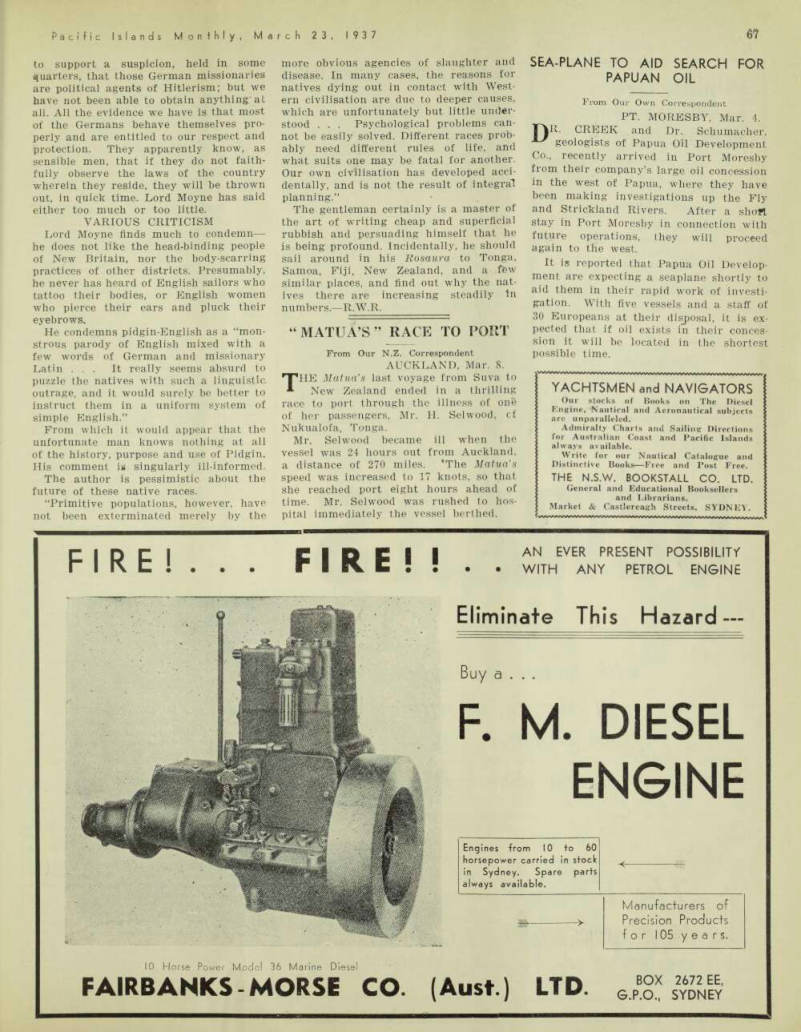
Singularly Ill-informed Comment By Rich Yachtsman In New Guinea
VV E have not been supplied with a ** review copy of Walkabout, a new book by Lord Moyne, and we are not pre pared to pay 34/- Australian for one; so we must be content to base our criticism of the book on a lengthy and generous review which was published in the Mel bourne Herald.
Lord Moyne is a wealthy gentleman who, over a year ago, visited the East Indies, Northern Australia and New Guinea in his yacht, Rosaura. He has tried to write learnedly and authorita tively about the condition of native peoples in these several territories; but one unfortunately gets an impression of snap judgments, inadequately based, and of superficiality. He is very ready to criticise and condemn, on purely hearsay evidence. He seems to be eager for re cognition as a savant, without having the savant’s equipment—a failing common enough among rich men. Money cannot buy brains, thank God!
Those Pygmies
We need not accompany Lord Moyne through the East Indies and Australia; but New Guinea may be interested in the result of his investigations thereabout.
He claims to be the discoverer of a race of pygmies in New Guinea, among the Aiome mountains. The average height of the males is 4ft. 6iins., and they were shy, friendly, and indescribably filthy.
Certain well-known missionaries have challenged this claim; they say that these pygmies were found and scientifi cally described long before Lord Moyne was heard of in the South Seas.
Attack On Missionaries
Like dozens of other uninstructed and therefore mischievous scribblers about the Pacific Islands, Lord Moyne is highly critical of the missionary system. He makes the astonishing discovery that the
uprooting of old customs and their re placement by doctrines entirely alien to the native mind in their origin and character appears wrong. He fears that, “although the missionaries were able to destroy the old beliefs, it was doubtful whether they succeeded in putting any real conviction in their place.”
He also resents the destruction of nat ive art by the missionaries, which is, he declares, not only a loss to ethnology but inflicts material change on the native craftsman; and he was glad to find that General McNicoll, the Administrator of Mandated Territory, takes an enlightened view of this matter. The natives under his control are encouraged to retain all such of their old customs as are neither cruel nor unhealthy. “I often heard the opinion in the Mandated Territory,” ob serves Lord Moyne, “that missions deli berately set about destroying the colour and gaiety of native life, thinking that they may thus drive the people to church as the only escape from their drab exis tence.” Which is typical of many silly observations in the book.
Of course, the mission system is full of weaknesses, which had been described in a much more convincing fashion by clergymen themselves long before this amateur author came upon the scene.
Lord Moyne may be interested to know that Sydney’s fiercest critic of the present missionary system is a missionary who is himself actively in harness.
The trouble is to devise a system that will work better. The present system with all its faults does at least bring some better social organisation among the natives, and some idea of hygiene, and it introduces standards of moral con duct and simple methods of education where otherwise there would be nothing.
Without the missions the condition of the natives in contact with Europeans would be calamitous indeed. But can the interests affected be got together and persuaded to remove the defects of the mission system, any more, than Lord Moyne’s financial and commercial mono polists can be persuaded to reform their system? Destructive criticism is very easy.
Germans In New Guinea
“What I learnt about German mission ary effort in the Mandated Territory has greatly increased my uneasiness,” he writes. “The newly arrived young Ger man missionaries who are pouring into the country are said to be full of resent ment against the Administration which has replaced the former German rule, and are often active propagandists for a return of the old regime. They also adopt a more fanatical hostility to the native traditions and culture than older and wiser men.”
This, it is to be feared, also is un soundly based. For over a year, we have been on the look-out for evidence
to support a suspicion, held in some quarters, that those German missionaries are political agents of Hitlerism; but we have not been able to obtain anything'at all. All the evidence we have is that most of the Germans behave themselves pro perly and are entitled to our respect and protection. They apparently know, as sensible men, that if they do not faith fully observe the laws of the country wherein they reside, they will be thrown out, in quick time. Lord Moyne has said either too much or too little.
Various Criticism
Lord Moyne finds much to condemn — he does not like the head-binding people of New Britain, nor the body-scarring practices of other districts. Presumably, he never has heard of English sailors who tattoo their bodies, or English women who pierce their ears and pluck their eyebrows.
He condemns pidgin-English as a ‘‘mon strous parody of English mixed with a few words of German and missionary Latin ... It really seems absurd to puzzle the natives with such a linguistic, outrage, and it would surely be better to instruct them in a uniform system of simple English.”
From which it would appear that the unfortunate man knows nothing at all of the history, purpose and use of Pidgin.
His comment is singularly ill-informed.
The author is pessimistic about the future of these native races. ‘‘Primitive populations, however, have not been exterminated merely by the
more obvious agencies of slaughter and disease. In many cases, the reasons for natives dying out in contact with West ern civilisation are due to deeper causes, which are unfortunately but little under stood . . , Psychological problems can not be easily solved. Different races prob ably need different rules of life, and what suits one may be fatal for another.
Our own civilisation has developed acci dentally, and is not the result of integral planning.”
The gentleman certainly is a master of the art of writing cheap and superficial rubbish and persuading himself that he is being profound. Incidentally, he should sail around in his Rosaura to Tonga, Samoa, Fiji, New Zealand, and a ffew similar places, and find out why the nat ives there are increasing steadily in numbers. —R.W.R.
“Matua’S” Race To Port
From Our N.Z. Correspondent
Auckland, Mar. 8.
THE Matua’s last voyage from Suva to New Zealand ended in a thrilling race to port through the illness of one of her passengers, Mr. H. Selwood, cf Nukualofa, Tonga.
Mr. Selwood became ill when the vessel was 24 hours out from Auckland, a distance of 270 miles. *The Matua's speed was increased to 17 knots, so that she reached port eight hours ahead of time. Mr. Selwood was rushed to hos pital immediately the vessel berthed.
Sea-Plane To Aid Search For
Papuan Oil
From Our Own Correspondent
Pt. Moresby, Mar. 4.
TT\R. CREEK and Dr. Schumacher, geologists of Papua Oil Development Co., recently arrived in Port Moresby from their company’s large oil concession in the west of Papua, where they have been making investigations up the Fly and Strickland Rivers. After a shoft stay in Port Moresby in connection with future operations, they will proceed again to the west.
It is reported that Papua Oil Develop ment are expecting a seaplane shortly to aid them in their rapid work of investi gation. With five vessels and a staff of 30 Europeans at their disposal, it is ex pected that if oil exists in their conces sion it will be located in the shortest possible time.
Advertisements & other items, pp. 69-70 (1 item)
F. M. Diesel
YACHTSMEN and NAVIGATORS
Our stocks of Books on The Diesel Engine, Nautical and Aeronautical subjects are unparalleled.
Admiralty Charts and Sailing Directions for Australian Coast and Pacific Islands always available.
Write for our Nautical Catalogue and Distinctive Books—Free and Post Free.
THE N.S.W. BOOKSTALL CO. LTD.
General and Educational Booksellers and Librarians.
Market & Castlcreagh Streets, SYDNEY.
Finri C I D C I I AN EVER PRESENT possibility IK L ! . . . rIBV C . . . . WITH ANY PETROL ENGINE 10 Horse Power Model 36 Marine Diesel
FAIRBANKS-MORSE CO
Eliminate This Hazard
Buy a . . .
F. M. DIESEL
ENGINE
Engines -from 10 to 60 horsepower carried in stock in Sydney. Spare parts always available.
Manufacturers of Precision Products for 105 years.
(Aust.) LTD
BOX 2672 EE.
G.P.0., SYDNEY
Mining Ore
Treatment
Machi fiery
COMPLETE CYANIDE
PLANTS SUPPLIED
Dorr Classifiers Dorr Thickeners Dorr Agitators Oliver Filters Merril Crowe Zinc Dust Gold Precipitation Richardson Mine Fans
FANS AND AIR HEATERS
For Ventilation, Copra Drying Rooms, etc. • Enquire from
CROSSLE, DUFF AND
MACINTOSH LTD.
52 Bridge Street, SYDNEY
DEWAR'S
with lemon and soda —off the ice, or with plain ice-water . . , A real refresher!
The Famous
SCOTCH Whisky
Pacific Islands Mining Notes
From Fiji
loloma gold mines n.l.
AS? RESSING shareholders of Loloma Gold Mines N.L Tavua, Fiji, at the annual meeting Dec ® mb ® r last year, the chairman of directors (Mr. P. Cody) pointed out that it might be necessary, early in 1937, for the board to give consideration to the best means of arranging further finance by making a call of 1/- a share on the contributing shares, or by some other satisfactory method.
The directors have now decided not to make a call, but to issue 75,000 shares of 5/- each, paid to i/e, on payment of .€1 a share. Shareholders will be given the opportunity of subscribing to the new issue pro rata to their holdings, on the basis of one new share fof every' ten shares held.
The management reports that since the general meeting a vigorous developmental and prospecting policy has been carried out including the sinking of the main shaft a further lift of 100 ft. to the 220 ft. level. Preparations of the adits and the equipment of the main shaft to supply full ore requirements for the new treatment plant is now in hand.
In addition to the company’s financial obliga tions for the above programme there will be the outlay to complete the erection of the company’s treatment plant, together with its share of capital expenditure to be incurred by Tavua Power pty.
Ltd. For these reasons, more capital than was
originally estimated will be needed. By making this new issue of shares, the directors consider that when production operations commence the company should be free of all financial obliga tions for plant and other expenditure.
As the development work at the mine at Tavua, hiji, has been curtailed, and the principal work now being carried on consists of the sinking of the main shaft and the stripping and timbering of No. 1 adit in preparation for ore production for the new plant, the directors have decided to discontinue the fortnightly cabled reports for the next few months. In future, monthly mine and construction reports will be mailed to the Mel bourne office by the general manager in Fiji,
Emperor Mines Limited
The mine of Emperor Mines Ltd., Tavua, Fiji, is being opened up, and the plant is also ’being assembled in preparation for the output required when the new mill is in operation. Heavy rains hampered work for the period ended February 20.
Returns for the last three periods are compared in the following table:
Pacific Gold. N.L.
Results of diamond drilling carried out by Pacific Gold N.L., on the property at Wainevisi, Fiji, are contained in a circular issued to shareholders.
The first bore, which was expected to intercept the lode at 134 ft, was continued to 271 ft without result, and the bore was eventually abandoned owing to broken ground. No. 2 bore was com menced at the entrance of No. 2 adit*, and apart from about six feet of soft lode, formation carry ing a little blende and copper pyrites oncountered at 136 ft, this borehole also gave negative results.
From 136 to 220 ft, where boring ceased, the country was in unaltered andesite.
A two months’ free extension of the option over the property having been secured, a third bore has been started at a point approved by the late inspector of mines in Fiji, at a bearing of 150 deg., 214 ft from No. 2 adit, the angle of the hole being 75 deg., bearing 360 deg. with the object of testing the likelihood of the lode being in floors.
Mount Kasi Mines Ltd.
Output of Mount Kasi Mines Limited. Fiji, for the last four months has been:—
*Dec. 19 Jan. 23 Feb. 20 Ore (dry weight), tons 1957 2080 2102 Fine gold, oz 787.4 1027.7 997.6 Head value, dwt 8.04 10| 10 3 * Three weeks.
Nov. 6J Dec. 4* Jan. 28f Feb. 25 Ore, tons 1,627 1,500 1,853 2,359 Bullion, oz 452 487 352 365 Value, £A 3,550 3,600 2,773 3,194 rjlMill stopped five days for engine overhaul. :: Mill stopped 5i days owing to engine breakdown.
Mill closed down during December for overhaul and repairs, and resumed crushing January 6. fTwenty-one days’ run.
From New Guinea
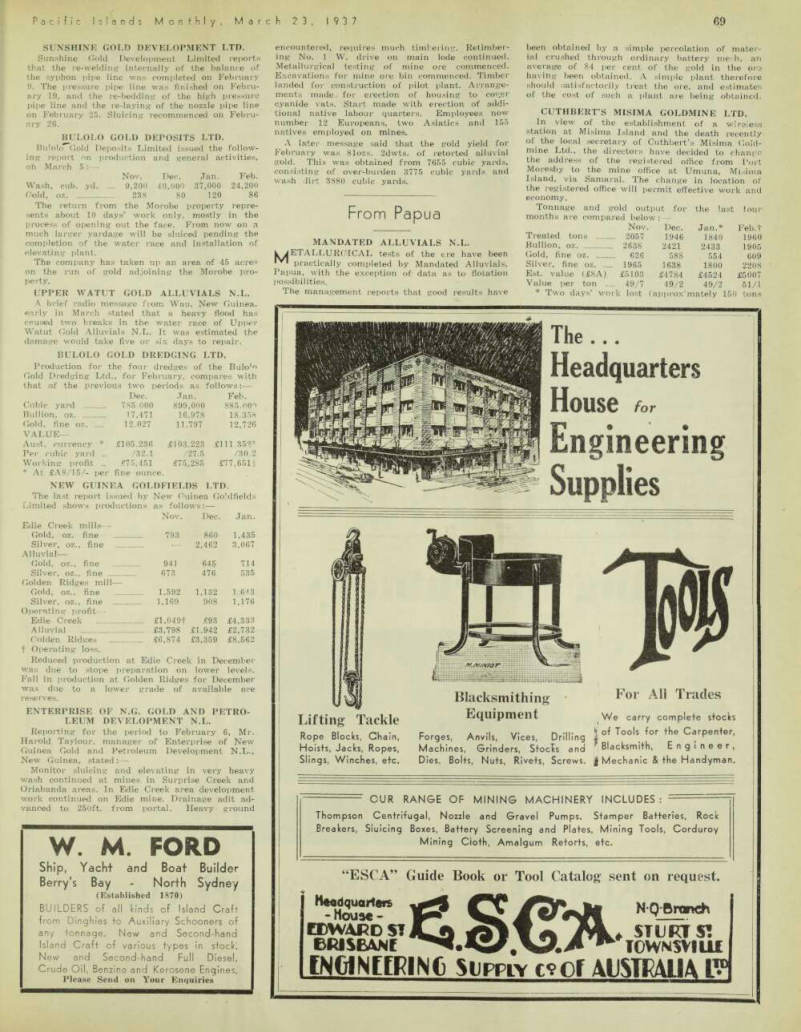
Sandy Ck. Gold Sluicing Ltd.
PREPARATIONS are being made by Sandy ' Creek Gold Sluicing Limited, New Guinea, for the installation of a second hydraulic sluicing and elevating plant. The new plant will be located on the Poverty Creek area, and is expected to be in operation before the end of May.
To provide a thoroughly satisfactory water supply with which to operate the plant, use is being made of the company’s water right on Coldwater Creek. Two water races will be neces sary, one to bring water from Coldwater Creek to the company’s property, and the other, in the vicinity of Poverty Creek, to carry water to the site of operations. Both races are under construc tion.
The estimated total cost of the races, the new plant and everything necessary to allow the plant to reach the stage of production, is well within the company’s available funds.
Preliminary testing operations recently carried out on the breccia deposit were considered by Mr.
R. J. Winters, consulting geologist, to warrant further prospecting. Arrangements have been made for him to carry out further testing opera tions on this deposit. Mr. Winters is now on the property.
Yields for the last three months are compared in the following table: —
Dec. Jan. Feb.
Cubic yards 11,890 7,345 9.420 Gold, oz 311 139 219 Average, cub. yd 3/11 2/10 3/52
Sunshine Gold Development Ltd.
Sunshine Gold Development Limited reports that the re-welding internally of the balance of the syphon pipe line was completed on February 9. The pressure pipe line was finished on Febru ary 19, and the re-bedding of the high pressure pipe line and the re-laying of the nozzle pipe line on February 25. Sluicing recommenced on Febru ary 26.
Bulolo Gold Deposits Ltd.
Bulolo~~Gold Deposits Limited issued the follow ing report on production and general activities, oh March s: Nov. Dec, Jan. Feb.
Wash. cub. yd. 9.200 40.000 37.000 24,200 Cold, oz 238 80 120 86 The return from the Morobe property repre sents about 10 days’ work only, mostly in the process of opening out the face. From now on a much larger yardage will be sluiced pending the completion of the water race and installation of elevating plant.
The company has taken up an area of 45 acres on the run of gold adjoining the Morobe pro perty.
Upper Watut Gold Alluvials N.L.
A brief radio message from Wau, New Guinea, early in March stated that a heavy flood has caused two breaks in the water race of Upper Watut Gold Alluvials N.L. It was estimated the damage would take five or six days to repair.
Bulolo Gold Dredging Ltd.
Production for the four dredges of the Bulo'o Gold Dredging Ltd., for February, compares with that of the previous two periods as follows:
New Guinea Goldfields Ltd.
The last report issued by New Guinea Goldfields Limited shows productions as follows: —
Reduced production at Edie Creek in December was due to stope preparation on lower levels.
Fall in production at Golden Ridges for December was due to a lower grade of available ore reserves.
Enterprise Of N.G. Gold And Petro
Leum Development N.L.
Reporting for the period to February 6, Mr.
Harold Taylour, manager of Enterprise of New Guinea Gold and Petroleum Development N.L., New Guinea, stated: —- Monitor sluicing and elevating in very heavy wash continued at mines in Surprise Creek and Oriabanda areas. In Edie Creek area development work continued on Edie mine. Drainage adit ad vanced to 250 ft. from portal. Heavy ground
encountered, requires much timbering. Retimber ing No. 1 W. drive on main lode continued.
Metallurgical testing of mine ore commenced.
Excavations for mine ore bin commenced. Timber landed for construction of pilot plant. Arrange ments made for erection of housing to cover cyanide vats. Start made with erection of addi tional native labour quarters. Employees now number 12 Europeans, two Asiatics and 155 natives employed on mines.
A later message said that the gold yield for February was 81ozs. 2dwts. of retorted alluvial gold. This was obtained from 7655 cubic yai’ds, consisting of over-burden 3775 cubic yards and wash dirt 3880 cubic yards.
Dec. Tan. Feb.
Cubic yard 785 000 899.000 885.00"* Bullion, oz 17,471 16.978 18.358 Gold, fine oz 12,027 11,797 12,726
Value—
Aust, currency * £105.236 £103.223 £111.352* Per cubic yard ... /32.1 /27.5 /30.2 Workimr profit ... £75.451 £75,285 £77,6511 * At £A8/15/- per fine ounce.
Nov.
Dec.
Jan.
Edie Creek mills— Gold. oz. fine 793 860 1,435 Silver, oz., fine 2,462 3,067 Alluvial— Gold, oz., fine 941 645 714 Silver, oz., fine 673 476 535 Golden Ridges mill — Gold, oz., fine 1.592 1,132 1.643 Silver, oz., fine 1,169 908 1,176 Operating profit— Edie Creek £1.049f £93 £4,333 Alluvial £3,798 £1.942 £2,732 Golden Ridges £6,874 £3,359 £8,562 t Operating loss.
From Papua
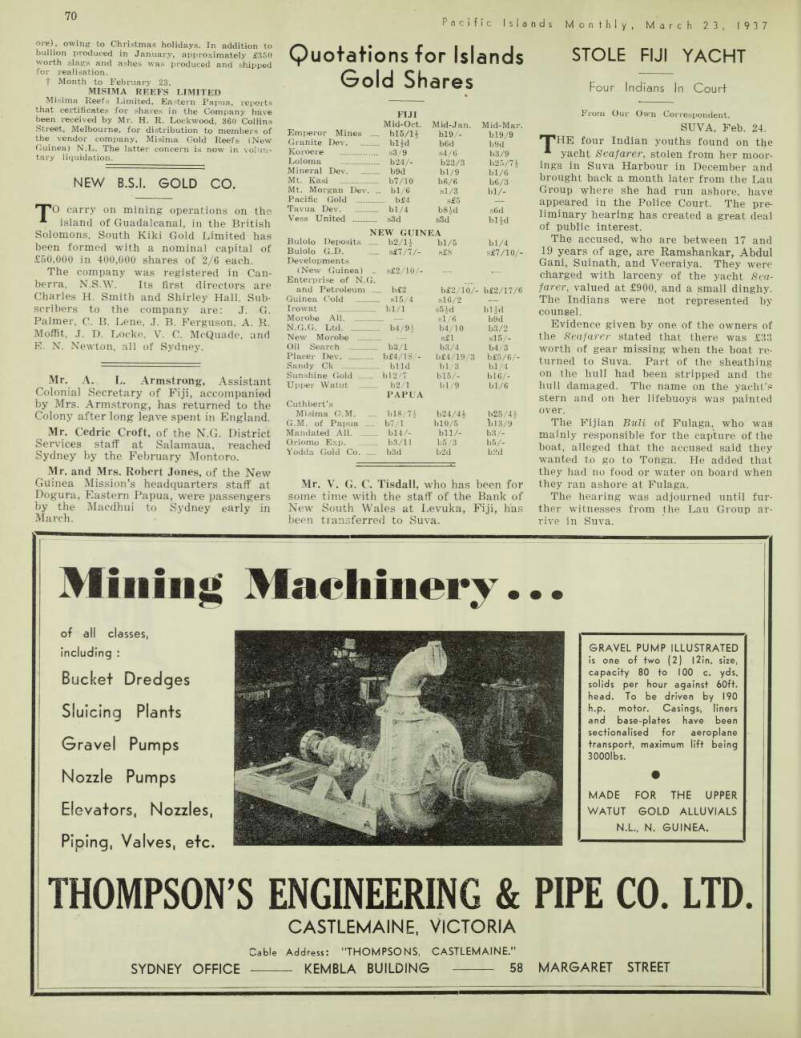
Mandated Alluvials N.L.
ki ETALLURCICAL tests of the ere have been practically completed by Mandated Alluvials, Papua, with the exception of data as to flotation possibilities.
The management reports that good results have
been obtained by a simple percolation of mater ial crushed through ordinary battery mesh, an average of 84 per cent of the gold in the ore having been obtained. A simple plant therefore should satisfactorily treat the ore, and estimates of the cost of such a plant are being obtained.
Cuthbert’S Misima Goldmine Ltd.
In view of the establishment of a wireless station at Misima Island and the death recently of the local secretary of Cuthbert’s Misima Gold mine Ltd., the directors have decided to change the address of the registered office from Port Moresby to the mine office at Umuna, Misima Island, via Samarai. The change in location of the registered office will permit effective work and economy.
Tonnage and gold output for the last four months are compared below:— Nov Dec.
Jan.’"
Feb.t Treated tons 2057 1946 1840 1960 Bullion, oz 2638 2421 2433 1905 Gold, fine oz. 626 588 554 609 Silver, fine oz 1965 1638 1800 2208 Est. value (£8A) £5103 £4784 £4524 £5007 Value per ton 49/7 49/2 49/2 51/1 * Two days’ work lost (approximately 150 tons
ore) , owing to Christmas holidays. In addition to bullion produced in January, approximately £350 worth slags and ashes was produced and shipped for realisation. t Month to February 23.
Misima Reefs Limited
Misima Reefs Limited, Eastern Papua, reports that certificates for shares in the Company have been received by Mr. H. R. Lockwood, 860 Collins Street, Melbourne, for distribution to members of the vendor company, Misima Gold Reefs (New Guinea) N.L. The latter concern is now in volun tary liquidation.
Advertisements & other items, p. 71 (2 items)
Engineering
Iff ■ m m ir->r sa w./H/wor
The ...
Headquarters
House for
Engineering
Supplies
For All Tracies Lifting Tackle Rope Blocks, Chain, Hoists, Jacks, Ropes, Slings, Winches, etc.
Blacksmithing
Equipment We carry complete stocks r a -i \r n *ii* \of Tools for the Carpenter, Forges, Anvils, Vices, Drilling i .
Machines, Grinders, StocTs and Blacksmith, Engineer, Dies, Bolts, Nuts, Rivets, Screws. Mechanic & the Handyman.
CUR RANGE OF MINING MACHINERY INCLUDES:
Thompson Centrifugal, Nozzle and Gravel Pumps. Stamper Batteries, Rock Breakers, Sluicing Boxes, Battery Screening and Plates, Mining Tools, Corduroy Mining Cloth, Amalgum Retorts, etc.
“ESCA” Guide Book or Tool Catalog sent on request.
Headquarter*
- House -
EDWARD ST
BRISBANE
S.S(?A
NQBronch
STURTS?
lOWNSVIUE
CNOINEERINf) Sumy c?of AUSTEAIM I?
W. M. Ford
Ship, Yacht and Boat Builder
Berry's Bay - North Sydney
(Established 1870) BUILDERS of all kinds of Island Craft from Dinghies to Auxiliary Schooners of any tonnage. New and Second-hand Island Craft of various types in stock.
New and Second-hand Full Diesel, Crude Oil, Benzine and Kerosene Engines.
Please Send on Your Enquiries
New B.S.I. Gold Co.
TO carry on mining operations on the * island of Guadalcanal, in the British Solomons, South Kiki Gold Limited has been formed with a nominal capital of £50,000 in 400,000 shares of 2/6 each.
The company was registered in Can berra, N.S.W. Its first directors are Charles H. Smith and Shirley Hall. Sub scribers to the company are: J. G.
Palmer, C. B. Lene, J. B. Ferguson. A. R.
Moffit, J. D. Locke, V. C. McQuade, and E. N. Newton, all of Sydney.
Mr. A. L. Armstrong, Assistant Colonial Secretary of Fiji, accompanied by Mrs. Armstrong, has returned to the Colony after long legve spent in England.
Mr. Cedric Croft, of the N.G. District Services staff at Salamaua, reached Sydney by the February Montoro.
Mr. and Mrs. Robert Jones, of the New Guinea Mission’s headquarters staff at Dogura, Eastern Papua, were passengers by the Macdhui to Sydney early in March.
Quotations for Islands
Gold Shares
Mr. V. G. C. Tisdall, who has been for some time with the staff of the Bank of New South Wales at Levuka, Fiji, has been transferred to Suva.
Fiji
Mid-Oct.
Mid-Jan.
Mid-Mar.
Emperor Mines bl5/l| b!9/b!9/9 Granite Dev bUd b6d b9d Koroere s3/9 s4/6 b3/9 Loloma b24/b23/3 b25/7£ Mineral Dev b9d bl/9 bl/G Mt. Kasi b7/10 b6/6 b6/3 Mt. Morgan Dev. ... bl/6 sl/3 bl/- Pacific Gold .. b£4 s£5 Tavua Dev bl/4 b81d s6d Vess United s3d s3d blid
New Guinea
Bulolo Deposits b2/lj bl/5 bl/4 Bulolo G.D s£7/7/s£8 s£7/10/- Developments (New Guinea) .. s£2/10/- Enterprise of N.G. and Petroleum b£2 b£2/10/b£2/17/6 Guinea Cold s!5/4 s!6/2 Irowat bl/1 s5id bUd Morobe All. , — sl/6 b9d N.G.G. Ltd b4/91 b4/10 b3/2 New Morobe — s£l sl5/- Oil Search b3/l b3/4 b4/3 Placer Dev b£4/18/b£4/19/3 b£5/6/- Sandy Ck blld bl/3 bl/4 Sunshine Gold b!2/7 b!5/bl6/- Upper Watut b2/l bl/9 bl/6 Cuthbert's Misima G'.M.
Papua
b!8/7i b24/4J b25/4t G.M. of Papua b7/l blO/5 1)13/9 Mandated All bl4/bll/b3/- Oriomo Exp. b3/ll b5/3 b5/- Yodda Gold Co b3d b2d b2d
Stole Fiji Yacht
Four Indians In Court
From Our Own Correspondent.
Suva, Feb. 24.
"THE four Indian youths found on the 1 yacht Seafarer, stolen from her moor ings in Suva Harbour in December and brought back a month later from the Lau Group where she had run ashore, have appeared in the Police Court. The pre liminary hearing has created a great deal of public interest.
The accused, who are between 17 and 19 years of age, are Ramshankar, Abdul Gani, Suinath, and Veeraiya. They were charged with larceny of the yacht Sea farer, valued at £9OO, and a small dinghy.
The Indians were not represented by counsel.
Evidence given by one of the owners of the Seafarer stated that there was £33 worth of gear missing when the boat re turned to Suva. Part of the sheathing on the hull had been stripped and the hull damaged. The name on the yacht’s stern and on her lifebuoys was painted over.
The Fijian Buli of Fulaga, who was mainly responsible for the capture of the boat, alleged that the accused said they wanted to go to Tonga. He added that they had no food or water on board when they ran ashore at Fulaga.
The hearing was adjourned until fur ther witnesses from the Lau Group ar rive in Suva.
Advertisements & other items, p. 72 (1 item)
Mining Machinery...
of all classes,
including :
Bucket Dredges
Sluicing Plants
Gravel Pumps
Nozzle Pumps
Elevators, Nozzles,
Piping, Valves, etc.
k
GRAVEL PUMP ILLUSTRATED
is one of two (2) |2in. size, capacity 80 to 100 c. yds. solids per hour against 60ft. head. To be driven by 190 h.p. motor. Casings, liners and base-plates have been sectionalised for aeroplane transport, maximum lift being 3000 lbs.
MADE FOR THE UPPER
WATUT GOLD ALLUVIALS
N.L., N. GUINEA.
THOMPSON’S ENGINEERING & PIPE CO. LTD.
CASTLEMAINE, VICTORIA
Cable Address: "THOMPSONS, CASTLEMAINE."
SYDNEY OFFICE KEMBLA BUILDING 58 MARGARET STREET
North
Our Cousins In The
Fine New Novel Gives South Seas a Chance to Read Fascinating Story of Old Hawaii
OY some freak of Nature, Hawaii is located north of the Equator. In tradition, history, outlook, racial associa tions, as in vegetation, colourfulness and manner of life, Hawaii belongs south of the Line.
The Philippines, Borneo, the East In dies are classed generally as “Pacific Islands;” but in races, fauna and flora, they seem a part of Asia. Hawaii is dif ferent. Hawaii, somehow, is linked with the heart and soul of Polynesia. Hawaii, Tahiti, the Marquesas, the Cook Islands, the Gilbert and Ellice, Fiji, Samoa, Tonga—they recognise many different flags and are governed by a multitude of economic systems; but the politics which divide them are as nothing in comparison with the fundamental things which unite them.
All lovers of Polynesia hope to see the growth of stronger bonds with Hawaii.
We people here in the South Seas want to hear more, and oftener, about our cousins in the northern group. The story of what is happening to the Hawaiians under North American and Asiatic in fluences is of great interest and im mense political significance to all the territories south of the Line. Somehow, we do not get half enough news about Hawaii and the Hawaiian.
These reflections arise as we read Blood of the Shark . a novel by Mrs. Beat rice Patton, just published at two and a half dollars by Paradise of the Pacific, publishers, of Honolulu. It is an his torical romance and, considered as a novel, it is attractively written, quick moving and eminently readable.
But it is as an historical document that we find its special charm. Here is a vivid chapter in the life of Old Hawaii, and characters famous in the little king dom between 1800 and 1830 play a part in Mrs. Patton’s story.
Adam Gordon, an English officer of good family, leaves Vancouver’s ship in Hawaii; marries a Hawaiian girl of ex ceptional beauty, courage and intelli gence: and is caught up in the fierce and dramatic politics of King Kamehameha’s reign. Mrs. Patton is a true historian— while weaving her story very cleverly among the outstanding events and people of that rollicking period of wars and intrigues, pestilences and tragic roman ces, she has faithfully preserved the historical background.
Thus, we who live in the South Seas, and ask for something about the fascina ting story of Hawaii, may get it here in a most acceptable form—as an epic love story. together with a faithful presenta tion of life as it was lived in the beautiful group a hundred years ago, and with a very careful picture of the amazing poli tical intrigues of that time.
Some of the high peaks of the narfa
tive: The luau (Hawaiian feast) at which Adam inadvertently becomes a husband; the character portrayals of Vancouver, Marin, Kamehameha; the Nuuanu Valley victory that made Kame hameha the Napoleon of the Pacific; Kilohana’s killing of a shark in Pearl Harbour; the cholera epidemic that swept the islands in 1804; old Spanish days in California when gay caballeros roped grizzly bears; the Skippers’ Race from Monterey to Honolulu between the fore-and-aft Lucy and the square-rigged Lily Bird. And towering above all in gloomy grandeur and dramatic force the tremendous chapter that tells of the crazed and dying sorceress hag, Ahia, in whom the blood of Awini was strong, weaving the magic net in which she her self became entangled—the net that was to sink the hated white men’s ships.
Dr. Peter H. Buck (Te Rangi Hiroa), himself a Polynesian and director of Ber nice P. Bishop Museum. Honolulu, in the foreword, testifies that the novel is one of those rare books that depict the soul as well as the dress of a people.
The book gets its title, Blood of the Shark, from the study of the old Hawai ian totemism which the authoress makes in developing the character of her hero ine (Adam Gordon’s wife). We see her influenced in extraordinary fashion by the ancient superstitions of her race; and then we see her horror-struck hus band recognising that after all there is little fundamental difference between the things which he sees his wife doing, and the time-worn superstitions observed as a matter of course by his own old people back in England.
Every man who knows Polynesia, and has been distressed by certain psycholo gical misunderstandings between the Europeans and the brown folk with whom they have allied themselves, should read Mrs. Patton’s clever story. They
“will see a little clearer, and judge less harshly where they cannot see.”
But the chief value of the book is in its history. Here is a chance for the South Seas to read the astonishing story
of early Hawaii.
R.W.R.
Hon. J. T. O’Malley, Commissioner for Native Affairs in Papua, sailed from Sydney for Port Moresby by the Montoro on February 24.
Mrs. S. G. C. Knibbs, wife of the Commissioner of Lands in the British Solomon Islands, departed from Sydney for Tulagi by the Malaita on March 6.
Mrs. Catherine Robinson, wife of Mr.
Richard Robinson, of Levuka, Fiji, died at Levuka on February 19, at the age of 71. She went to the Colony from New Zealand over 50 years ago.
Advertisements & other items, pp. 73-74 (1 item)
Beebe (B.B.)
PORTABLE HAND WINCHES
2 Ton Capacity ' 5 Ton Capacity Weight 66 lbs. Weight NO lbs.
Excellent for loading heavy machinery —erecting pipe lines—bridge building— moving boulders from alluvial workings —and for all mining purposes. * BEEBE HOISTS cannot be broken by men in hand use.
Prices and Particulars
Nelson & Robertson Pty. Ltd.
SYDNEY
MINING and ROAD.
MAKING EQUIPMENT
Manufactured by the Cardner-Denver Co.
DRIFTING DRILL MODEL D 79
The D 79 is a 3 bore Drifter following the streamline design first conceived by Sardner-Denver engineers. By fitting a Spring Handle this drill can be quickly converted for use as a Sinker.
Orders have recently been received from Broken Hill Pty.
Co. Ltd., Bendigo Mines Ltd., etc.
Write for full information of Gardner-Denver Products The Gardner-Denver Model 555 Hand-held Drill Perfectly balanced and embodies the greatest drilling capacity at which the qualities of easy riding and conservative air consumption are maintained.
NOYES BROS. (Sydney) LTD
115 CLARENCE STREET, SYDNEY
BRANCHES AT NEWCASTLE AND BRISBANE
UMPMOBIL
LIGHT AND PORTABLE
MOTOR PUMP
F Comp'cte Plant’s weight, 140 lbs. Capacity up to 12,0C0 gallons per hour.
All heads from 10 to 115 feet.
Fuel consumption, 1 gallon per hour.
Pressure 551 b. square inch.
Especially suitable prospecting and all Sluicing Requirements.
NELSON & ROBERTSON PTY. LTD
12 SPRING STREET
SYDNEY
COLD
HIGHEST PRICES, PROMPT
SETTLEMENT. ACCURATE
WEIGHTS AND ASSAYS.
are assured to producers and sellers of gold bullion who forward their consignments to The Electrolytic Refining and Smelting Co. of Aust. Ltd. for treatment and realisation, RECORD PRICE.—On 6th March, 1935, this company paid to Its clients at the rate of £9/4/6 net per fine ounce, which is the highest price ever paid for gold in Australia.
SPECIALLY ORGANISED SER-
VICE is available to clients in New Guinea, Fiji and other Pacific Island centres.
Address consignments from outside Australia to the Company’s Sydney office. 1 Weighing a Pacific Islands consignment of gold bullion at an E.R. & S. receiving office.
The Electrolytic Refining & Smelting Co.
OF AUSTRALIA LIMITED
Melbourne: Works: Sydney; Collins House. Port Kembla, N.S.W. 25 O'Connell Street.
PURCHASERS AND REFINERS OF GOLD. SILVER. COPPER IN ANY FORM BANKERS: —The English, Scottish and Australian Bank Ltd. ,
Tongan Prince's
New Name
Story of Tui Kanokubolu
JN future, the young Crowm Prince of Tonga, now officially of age and a stud ent at the University of Sydney, will be known as Prince Tubouto’a instead of Prince Taufa’ahau, The bestowing of this distinguished name, borne by an ancestor who was head of the famous Tui Kanokubolu line, is an interesting survival of Tongan cus tom. An essentially ceremonious people, and sticklers for etiquette, the Tongans are perhaps the least influenced by Euro pean culture in such matters. The bes towal of this name is a happy augury for the future reign of this enlightened young Prince, whose aim to. to combine the learning of the Europeans with the wisdom of his own people, In all Polynesia, none can boast more distinguished descent than Prince Tubouto’a. In his veins runs the blood of the two great lines of ancient Tonga, a people who claim the gods themselves as ancestors, Of course, for that matter, so do the Tahitians, the Maoris, the Sam oans, and other branches of the wide spread Polynesian family. But the Ton gan line has been kept essentially pure.
The Crown Prince is 22nd in descent from Gata, who was Tui Kanokubolu about 1610, and fifth in line from the first Tubouto’a.
The first Tubouto’a figured prominently in the history of his period as a warrior.
According to one Tongan account Ulaki, Tubouto’a’s elder brother, should have succeeded to the office of Tui Kano
kubolu: he actually put forward his claim at ’Uiha and was prepared to act upon it.
“But owing to some of the proper chiefs not having been consulted,” (says Rev.
A. H. Wood, ex-principal of Tubou Col lege in his History of Tonga, published in 1932, and the latest work on the king dom) “he was not regarded as validly chosen and was not installed at Bagai, the official place of appointment.” How ever, it is apparent that Tubo.uto’a often led the warriors of Haapai in attacks on Tongatabu, both before and after 1812.
The effect was a continuation of the misery that the people suffered in the time of Finau Ulukalala.
The illustrious Taufa’ahau (1797-1893) was the son of Tubouto’a. At the time of his father’s death he was about 23 years old. But no attempt was made to appoint either Taufa’ahau or anyone else Tui Kanokubolu. The objection to the future ruler of all Tonga at that time was that he was far too energetic a person to please the rebellious chiefs of Tongatabu, who were principally responsible for the then divided conditions in those islands.
The position of Tui Kanokubolu, there fore, was left vacant from 1820, on the death of Tubouto’a, until 1826, when Aleamotu’a or Jiosaia Tubou, (another son of Mumui), was appointed. Taufa’a hau then succeeded and held office until his death in 1893, being succeeded by Jiaoji Tubou 11. (George II.), who died in 1918. Queen Salote Mafile’o Veiogo, D.8.E., the present Queen, is, of course, the present head of that noble line, and in the ordinary course of events her son, the new Tubouto’a, will succeed as Tui Kanokubolu, as well as King of Tonga.
The story of Taufa’ahau, or King George 1., is too well known to relate here. Appropriately enough, he has been called “the Maker of Modern Tonga.”
Prom 1810 until 1893, Taufa’ahau wit nessed the transformation of his country from a divided non-Christian state to the model Christian kingdom we now know.
His name was conferred upon him be cause he was supposed to have been cured of an illness by the god Taufa of ’Ahau.
As a young man he is said to have ex celled all others in manly sports and fighting. Many stories of his athletic prowess still survive. In the Crown Prince he has a descendant worthy of his great name, for the new Prince Tubouto’a has won a reputation, both in Tonga and in Australia, as an athlete.
The Prince also is keenly interested in the history, traditions, and lore of his people. Not long before he left Sydney in December for Tonga, he spent some time in the Mitchell Library, He was intensely interested in the drawings made in Tonga 150 years ago by Cook’s artists, and he found several representa tions of head-dresses and other ornamen tation which can no longer be found in the kingdom. But what interested him most of all were some sketches of his own ancestral estate as it was in Cook’s day.
The Prince is a member of the Po Iy nesian Club of Sydney, and he has prom ised to deliver a lecture on the customs
of his people.
“Eriki”
Advertisements & other items, p. 75 (1 item)
'Radiomoderne'
Just cv.
POKER DICE
/***• 4
X > OwT
H o m
N9I0a
Put & Take, 5 dice roll, 6/6 (5 dice mounted on roll). 2-dice game, 3/6.
I 3 dice roll, 3/9. (3 dice ! mounted on roll).
English electric hair brushes.
Gents 15/-, Ladies 17/6.
Combs, hangbag or pocket type 12/6. Ladies’ type with handle 17/6.
All standard batteries.
Microphones for speech or music, just plug into pick-up terminals of your set, fitted with flexible battery leads, batteryless model, 25/-.
THE GREATEST RADIO OF ITS TYPE EVER
INTRODUCED
A Most Excellent Type of 1937-38 Radio.
The “Like-a-Flash” Batteryless 6-valve Radio. A wonder ful set, compact in metal cabinet, runs off 6-volt accu mulator, no dry batteries. A beautiful modern set that will give 100 per cent satisfaction —range wonderful.
Amplion Speaker. Remote control or Vernier Tuning Dial as required. Ideal for home, plane, launch, ship, etc., £14/15/-. 180 amps hour 6-volt Accumulator, £4 extra.
'RADIOMODERNE'
m 1111 The Assembled Chassis ——£22/10/- Just designed for 100 per cent service in the Pacific Islands. Pay cash and save at least 33 1-3. Radio Moderne is the newest,finest and most up-to-the moment 5-valve battery-operated superhet. ever introduced for the Pacific Islands. That’s a sweeping statement, but we stand behind every word of it. Hear all Australasian stations, plus London, Paris, Berlin, Moscow, Tokyo.
New York, etc., etc.
Radio Moderne, Exclusively Built to suit Pacific Islands conditions, Humidity, etc. Not a Mass Production Product, each Set individually Built by Senior Mechanics, Tuned Up, and Air Tested before despatch.
Radio Moderne incorporates every wanted, technically correct improvement, all latest type Philips valves, S Like-a-Flash triple duty B batteries, best grade 100 amp. 2 volt accumulator, automatic volume control, late Ampion permagnetic speaker. Perfect tone, equal to any electric set. Latest calibrated aero dial, showing Australian and overseas stations, extraordinarily lew “B” battery consumption, approximately 10 to 22 ma. “A” battery (accumulator) consumption .65 amps. Selectivity and Sensitively 100 per cent. Packing 6/6 extra, plus freight, 12 months’ guarantee all parts and speaker. 90 days’ valves £22/10/- Send for Levenson’s Radio Bargain Bulletin, 8d, post free. Also Levenson’s Radio Buyer’s Guide and Assembly Chart Handbook, 2/-, post free.
Magic Slates, —very handy.
Write your note or message, pull slide and clean off all marks, 1/-; 3 for 2/6.
Job’s Patience. The greatest pastime pocket game ever introduced. Whiles away hours and hours. Any child can play it, 2/6 and 3/6.
Gramophone pick-up heads, British, fit any standard gramophone tone arm, 11/6.
De Luxe Models, 19/6.
"Like-a-Flash” P.M.G. type Heavy Brass fitting Sounders, 35/-.
We guarantee a better price for all replacement valves and component parts. Just send along your order. Price and 100% service guaranteed English Radio Meters. Just arrived. AC/DC Universal type, reads everything in radio. Volts up to 240, and milliamps, 25/-. Bench type, with leads. Pocket type, bakelite case, 3 readings, volts, and m/a., 10/6. 2 readings volts, for low and high tension batteries. 7/6.
Hand-winding Gramophone Motor, with turntable and all fittings, 25/-. Tone Arms 1/6, 2/6. Speakers, 2/6, 3/C.
Back-number Records, all popular tunes, 12/- doz.
Experimental Microscopes, fountain pen type, 2/6.
Others for students, 4/6, 6/6 and 7/6.
Revenson upright Roulette Spinning Wheel, 21/ with full instructions and betting cloth—two games in one.
“Totem,” the newest game for home, club, picnic or party 21/-.
“ Odds and Evens,” a new Head and Tail spin game 21/ Both designed as reproductions, Push lever and away they go. 1
■JINS
m Pyrex type uiass insulators: 3in., 1/- 4in., 3/6, dOanS) 5in., 6/6.
Egg type 3 for 1/-. 7*in.
Genuine Pyrex 30/- Genuine Pyrex,
COSMOCORD'
25 “Cosmocord” 25/- “Cosmocord” De Luxe 32/6 “Cosmocord” Super de Luxe 45/-.
Amplion (English) 28/6.
Gramophone Pickups. B.T.H.
Bakelite Models 32/6 “Clarion” English all-Bakelite Pick - up, with volume control, 22/6.
Now ready — “ The Sydney Cup” spinning wheel—a wonderful gambling game. Back your fancy, spin the wheel, the finishing point shows the winner and the price. Complete with betting cloth, 63/-.
English Bell shape, bakelite moulded lightning arrestors, reliable and ultra safe. Easy to fit. 6/- Send for full P.st of Radio Books: Now ready, “The Wireless Constructor’s Encyclopedia by Camra 7/6 Nearly 400 pages.
Fully illustrated.
“The Book of Practical Radio,” by Scott Taggart, over 300 pages. A splendid publication. 163 diagrams, 63 plates.
Airplane type glass Insulators, 3 for 1/- Ormond Eng lish high grade adjustable cone speak ers, in handsome polished mahogany cabinet 35/- Cone Speaker units, 15 different makes, now 15/-, chassis to suit 10/ “Pix” Wave Traps 7/6 for eliminating inter-station cross talk.
English make Utility Short Wave Vernier Dials, the world’s best. 10/6 “Like-a-Flash” de luxe Morse code keys, adjustable every way. Long or short tappers, 12/6 ; P.M.G. type all brass fittings, 19/6 ; Junior models, 9/6, 10/6. High grade buzzers, 7/6.
CtncssoV
HEAD
IONIS
PROFESSIONAL i
4000 ohms Electric battery torch, 1500 ft. beam, 5 cells, 6/6. Small electric reading lamp for hanging or carrying, 4/6.
Electric illuminated writing pencil, 4/6, all standard replaceable batteries used.
Dry Batteries Now Reduced Like-a-flash Radio B Batteries ; Extra heavy duty, 10/6, triple duty. 12/6; light duty, 7/3; 4$ or 9v.
C batteries, 2/ The “Air Patrol” 2 valve all wave battery set. Covers from 15.5 to 835 metres — £11/17/1 complete with speaker, ’phones and all accessories, a midget in name only, but a giant in performance. Receives local, interstate and overseas broadcasts.
Like-a-flash ‘Eliminoise’
Aerial Kit, for short or dual wave sets.
Aerial Pyrex type
OUST®
Insulators, transposi t ion blocks and 200 ft. aerial coil, 22/6. Eliminates unwanted aerial and hideous electrical noises from your dual-wave or short-wave set.
Copper ball aerials, add to your present aerial system, improves reception, 6/6.
Metal earth tubes with percolating chemical earthing salts, 4/6. Ideal for conditions in the islands.
Large size hydrometers, for testing accumulators, 2/6.
MMU
Just arrived, 8/6 per copy.
N e w n e s “Television and Short Wave Handbook,” by F. J. Camm. A lavishly illustrated book, simply written, dealing with all branches of television, short wave reception. 255 pages. Includes a useful dictionary of Television terms. 50fl 26 tOOflV Double Clad Insulated Rubber Aerial, 30 strands: 50ft. 2/6, 100ft. 5/-. “Man-o-War” aerial. 40 strands: 50ft. 5/6, 100ft. 10/-.
Write for Punch Board Leaflets
LEVENSON S RADIO
Evens Leaflets Write for Pin-Game,
226P.I. PITT STREET, SYDNEY
Branches: Radio Cheapside, 240a Pitt St.
N.S.W., AUSTRALIA
’Phones, M 2525 and M 2526. Cable address, “Leveradioh.” Goods forwarded V.P.P. or Sight Draft. Satisfaction and Service Guaranteed. We can supply by mail all General Merchandise at a Better Price. Quotations with pleasure. Please add freight and packing.
Lighting Plants For Pacific
POURING the past_2o years, sweeping changes have taken place in the South Seas. Islands centres, once isolated outposts, have been caught up in the onward march of civilisation. Radio, aviation, and electricity have each contributed to the amenities of life in the Pacific as it is lived to-day.
Unfortunately, these blessings are mostly con fined to the main centres, and the remoter settle ments and plantations still lack radio communi cation and a general electricity supply. Electrical storage batteries, however, have more than made up for the loss of the latter. In this connection, it is worth noting that the Clyde Engineering Co. Ltd. (whose advertisement appears on page 15) manufactures a storage-battery home-lighting plant that is particularly suitable for the Islands.
Clyde Engineering Co. was the pioneer of mass battery production, and during the past 14 years its batteries have assumed a national signi ficance. The Royal Australian Navy, the Postal Dept., and Federal and State Governments place large contracts with Clyde each year.
Clyde lighting sets make it possible for Islands residents of average means to enjoy electrical home life. Combining efficiency with mechanical strength and durability, Clyde products have built up an enviable reputation for sound work manship and faultless construction. Into its batteries and home-lighting plants Clyde puts the same skill and conscientiousness as it does into its largest locomotives, trams, heavy class machinery, etc., manufactured at its huge factory at Granville, N.S.W. ***
Guinea Airways Upset Australia’S
Aviation Calm
Existing Interests Are Re-aligned and Powerful Co.'s Inferentially Declare War
THERE have been some rapid moves in the situation that developed, in February, when Guinea Airways Ltd. inau gurated the new Adelaide-Darwin weekly service with surplus plant from New Guinea.
Guinea Airways did not advertise their plan. The Lockheed flew south, from Lae to Adelaide; underwent a brief over haul; and then rose into the blue and headed north. It arrived next day at Dar win and announced the beginning of the new service. There was talk, also, of a new direct service between Adelaide and Sydney. A 3-engined Ford flew south from New Guinea to Adelaide ready for use.
The news produced astonishing convul sions. There was much running around on the part of the existing Australian aviation companies.
All the chief Australian concerns inter ested in aerial transport, after intermin able patient organisation, had just settled down into three groups, or combines— Qantas Empire Airways (Queensland inland services and the Australian sec tion of the Anglo-Australian service); Airlines of Australia (all services be tween Sydney and Townsville); and Aus tralian National Airways (running all the chief services southwards and west wards of Sydney, and in which the com bined shipping companies have a large holding). The three concerns claimed to be quite independent; but there was an interlocking of capital, and it was clear that each intended to keep off the other’s territory.
The swoop of Guinea Airways Ltd. caused great perturbation. True, G.A. were not butting in on any existing ser vice, and were pioneering a new line (Adelaide-Darwin); but the ‘big three’ did not like the newcomer at all. Everything had been moving so comfortably towards a combine. This outlaw from New Guinea might upset all that. But perhaps it also would be combine-minded. An examina tion of the situation disclosed interesting angles.
The Commonwealth was inviting ten ders for the Sydney—New Guinea air mail, closing March 31. This new ser vice might be regarded as “belonging” to Guinea Airways. But Qantas and Air lines of Australia had been getting ready to tender. Thereupon, Guinea Airways had extended quietly to Australia.
The Australian companies gnawed their finger-nails. Was a bit of bargain ing and a compromise indicated? Guinea Airways, say, to withdraw from Australia and the Australian companies to refrain from tendering for the New Guinea ser vice?
NO one will tell what happened; but it is certainly a fact that the directors of Guinea Airways came from Adelaide to Sydney about the end of February; that representatives of the three major Australian aviation companies were in Sydney at the same time, and that con versations took place between the two groups.
It is equally certain that nothing came of it. The Guinea Airways folk went quietly back to Adelaide, and carried on.
But the three Australian companies showed their hand. They announced, on March 9, that they had made an agree ment “for the complete co-ordination of all major aerial services within the Com monwealth;” and that “this new associa tion will be in a position to tender for all Government services extending from Perth to New Guinea.”
Mr. G. A. Robinson (Airlines of Aus tralia) said: “A satisfactory arrange arrangement was decided upon . . . for the possible inclusion of a service to New Guinea in the existing system.”
The position is clear enough. Guinea Airways are operating in Australia, but they are not asking for trouble and they are keeping well clear of existing ser vices. The Australian companies, eager to monopolise the Australian field, do not like the newcomer, however, and threaten to retaliate by running a line to New
Guinea. Their new agreement or asso ciation equips them to tender for the New Guinea service.
Meanwhile, what of Bums, Phiip and Co. and W. R. Carpenter and Co.?
They cannot be indifferent to these de velopments, and they, especially, are in terested in the proposed new air-mail service to New Guinea.
Burns, Phiip and Co. are wise and far seeing. Having just completed the new contract for the Islands steamer services, they are not going to sit back and sleep.
They are not unaware of what aerial transport may mean presently to steamer services. Just as the other shipping com panies have obtained powerful interests in the Australian and New Zealand avia tion services, B. P. & Co, may be expected to seek some protecting share in Islands aviation services which are likely to com pete with their steamers.
Messrs. Burns, Phiip & Co. and Guinea Airways hitherto have worked together in apparent harmony. It is reasonable to suppose that they have discussed this matter of the Sydney—New Guinea ser vice. But not one word has been pub lished to show where B. P. stand, in this matter. Apparently all is well between them.
There is one piquant element in this situation. Australian National Airways are a member of the anti-Guinea Airways association. Chief owners of National Airways include the principal Australian shipping companies, and the Union Com pany, with which Burns, Phiip and Co. now operate in complete harmony and understanding.
The position of Carpenter and Co. is equally interesting. That firm recently formed Mandated Airlines Ltd., to oper ate services in New Guinea, and the latter are the chief competitors of Guinea Air ways Ltd. It is known that the Carpenter interests would like to operate the Sydney—New Guinea service, and they are likely to put in a strong tender.
There has been no indication, however, of any move by the Carpenter interests to link up with any of the other interests.
Sir Walter Carpenter usually plays a lone hand—and usually to his own profit.
Presumably, the position will not be clarified until tenders have closed on March 31. After that, there may be rapid developments.
Direct Route Is Accepted
MEANWHILE, all aviation interests were busily attacking the route laid down by the desk-wallahs of the aviation department in Australia for the proposed Sydney New Guinea service. It was pointed out that owing to the almost ceaseless rain and low clouds over the trackless jungles and ranges of western and central Papua, the route by Cape York and Daru to New Guinea (which missed Port Moresby, and Papua’s valu able freights, mails, etc.) is much more dangerous than the usual route, via Cooktown and Port Moresby, even with its 450 miles of waterhop included.
Papuan interests have supported this protest. A useful contribution to the dis
(Continued At Foot Of Next Column)
cussion was made by Mr. G. A. Loudon, president of the Papuan Planters’ Asso ciation, who was in Australia in February.
It was officially announced, on March 12, that the C. York route had been adan doned, and that tenders would be accep ted for the direct Cooktown—Pt. Moresby —Salamaua route.
Advertisements & other items, p. 76 (2 items)
Doan’S
Poisons in
the Blood
caused by weak kidney action.
Backache, rheumatic pains and bladder weakness cause acute distress, especially during the night-time. What with the scalding urine, pains across the small of the back or dizzy attacks, kidney trouble destroys both peace and comfort.
Delay makes matters worse —just so long as the kidneys fail to filter the blood properly you cannot hope to be well. Stimulate your kidneys to renewed activity with Doan’s Backache Kidney Pills.
This special Kidney tonic has achieved great success throughout the world. “Thanks to Doan’s Pills all my kidney troubles have vanished,”
“I wish I had used them earlier,”
“I know now that much of my rheumatism was needless,” are eloquent tributes to the success of Doan’s Pills in relieving urinary disorder's, backache, rheumatism, lumbago, sciatica, renal dropsy and gravel.
DOAN’S
BACKACHE KIDNEY PILLS
All-Chemists and Stores.
A Self Contained Sanitary System
The Hygeia Dissolvenator Approved by Health Authorities
Easily and cheaply installed. Guaranteed.
NO WATER SUPPLY REQUIRED
No odours, germs, flies or other insect pests.
A caustic soda solution turns the excrement and paper into aij innocuous solution which runs off and is absorbed by the soil.
Gives thoroughly efficient, long, care-free service.
O The Shell Oil Co. alone has given 52 repeat orders.
HYGEIA SANITARY COMPANY
26 BRIDGE STREET, SYDNEY.
Suitable for Use Indoors.
Price, F. 0.8. Sydney, £l5/10/-
Sharp Answer
N.G. Administrator to N.G.
Goldfields Chairman
From Our Own Correspondent.
Rabaul, Mar. 3.
S~TATEMENTS made by the chairman (Mr. Blaikie Webster) at the annual meeting of New Guinea Goldfields Ltd. in Sydney in February, were referred to by the Administrator of New Guinea (Brigadier-General W. Ramsay McNicoll) at the opening of the Legislative Council to-day.
“I would not be doing justice to this Council if I refrained from referring to this matter.” said the Administrator. ‘‘One realises that the chairman was faced with difficulties in explaining to the shareholders the absence of a divi dend for the second successive year; but one cannot accept his reiterated state ment that the whole fault lies at the door of the Administration.”
Continuing, the Administrator pointed out that the Council had passed mining ordinances in 1935, prepared by mining experts. Later these had been submitted to all mining managers for comments and suggestions, which, where possible, had been embodied. The ordinance made pro vision for the protection of human life.
It was significant that the company had been recently twice fined for breaches of the ordinance. In each case a native had been fatally injured.
The Administrator referred to the very
low rate of royalty charged on gold ex ports—namely, five per cent. He was sure that the Council would agree with him in expressing regret at the tone of the report.
Mr. W. E. Grose strongly endorsed the remarks of the Administrator. He sug gested that an investigation should be made into the actions of New Guinea Goldfields Ltd.
Advertisements & other items, p. 77 (1 item)
Fruit
WORK
TIME
MONEY
Coleman
SELF-HEATING IRON
LIGHTS INSTANTLY
r r'’S easy and pleasant to iron with a Coleman. It saves your strength.
You do better ironing easier and quicker at less cost. This modern Coleman Iron lights instantly ... no generating with match or torch ... no waiting.
Saves you more time and work than a $lOO washing machine. Do a whole ironing with one iron.
Coleman Lamp & Stove Co. Ltd.
TORONTO, CANADA
500 Kent Street, Sydney
f,
FRUIT
SALT
rr IQ aisils n ((she ■words Gno and "tyruit Salt” are registered trade marks.
Islands Produce
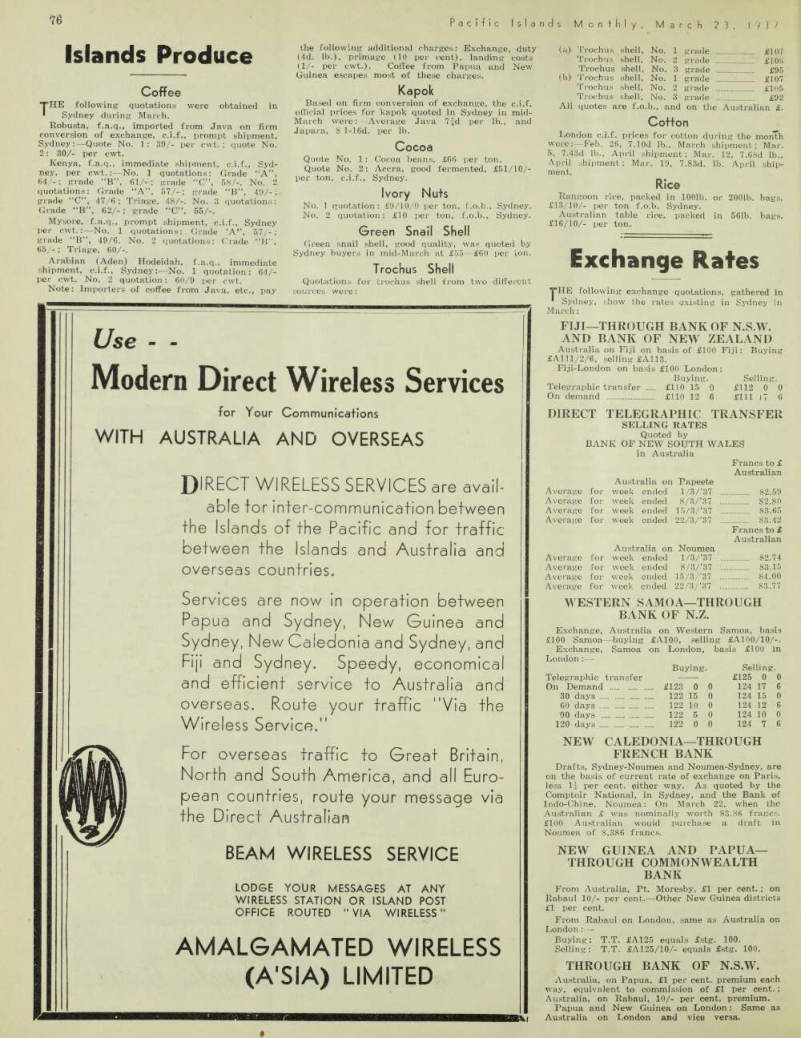
Coffee
■THE following quotations were obtained in • Sydney during March.
Robusta, f.a.q., imported from Java on firm conversion of exchange, c.i.f., prompt shipment, Sydney:—Quote No. 1: 39/- per cwt.; quote No. 2: 30/- per cwt.
Kenya, f.a.q., immediate shipment, c.i.f., Syd ney, per cwt.: —No. 1 quotations: Grade “A”, 64/-; grade "B”, 61/-; grade “C”, 58/-. No. 2 quotations: Grade “A”, 57/-; grade “B”, 49/-; grade “C”, 47/6; Triage, 48/-. No. 3 quotations: Grade “B”, 62/-; grade “C”. 55/-.
Mysore, f.a.q., prompt shipment, c.i.f., Sydney per cwt.: —No. 1 quotations: Grade ‘A’’, 57/-; grade “B”, 49/6. No. 2 quotations: Grade “B”, 65/-; Triage. 60/-.
Arabian (Aden) Hodeidah, f.a.q., immediate shipment, c.i.f., Sydney:—No. 1 quotation: 64/per cwt. No. 2 quotation: 60/9 per cwt.
Note: Importers of coffee from Java, etc., pay
the following additional charges: Exchange, duty (4d. lb.), primage (10 per cent), landing costs (1/- per cwt.). Coffee from Papua and New Guinea escapes most of these charges.
Kapok
Based on firm conversion of exchange, the c.i.f. official prices for kapok quoted in Sydney in mid- March were:—Average Java 7|d per lb., and Japara, 8 l-16d. per lb.
Cocoa
Quote No. 1: Cocoa beans, £66 per ton.
Quote No. 2: Accra, good fermented, £5l/10/per ton, c.i.f., Sydney.
Ivory Nuts
No. 1 quotation: £9/10/0 per ton, f.0.b., Sydney.
No. 2 quotation: £lO per ton, f.0.b., Sydney.
Green Snail Shell
Green snail shell, good quality, was quoted by Sydney buyers in mid-March at £55 —£60 per ton.
Trochus Shell
Quotations for trochus shell from two different sources were:
Cotton
London c.i.f. prices for cotton during the moriTh were:—Feb. 26, 7.10 d lb., March shipment; Mar. 5,7.43 d lb., April shipment; Mar. 12, 7.68 d lb., April shipment; Mar. 19, 7.83 d. lb. April ship ment.
Rice
Rangoon rice, packed in 1001 b. or 2001 b. bags, £l3/10/- per ton f.o.b. Sydney.
Australian table rice, packed in 561 b. bags, £l6/10/- per ton.
(a) Trochus shell, No. 1 grade .. £107 Trochus shell, No. 2 grade .. £105 Trochus shell.
No. 3 grade £95 (b) Trochus shell, No. 1 grade .. £107 Trochus shell, No. 2 grade ... £105 Trochus shell, No. 3 grade .. £92 All quotes are f.o.b., and on the Australian f.
Exchange Rates
THE following exchange quotations, gathered in 1 Sydney, show the rates existing in Sydney in March:
Fiji—Through Bank Of N.S.W.
And Bank Of New Zealand
Australia on Fiji on basis of £lOO Fiji: Buying £Alll/2/6, selling £AII3.
Fiji-London on basis £lOO London:
Direct Telegraphic Transfer
Selling Rates
Quoted by
Bank Of New South Wales
Western Samoa—Through
Bank Of N.Z.
Exchange, Australia on Western Samoa, basis £lOO Samoa—buying £AIOO, selling £AIOO/10/-.
Exchange, Samoa on London, basis £lOO in London:—-
New Caledonia—Through
French Bank
Drafts, Sydney-Noumea and Noumea-Sydney, are on the basis of current rate of exchange on Paris, less 1J per cent, either way. As quoted by the Comptoir National, in Sydney, and the Bank of Indo-Chine, Noumea: On March 22, when the Australian £ was nominally worth 83.86 francs. £lOO Australian would purchase a draft in Noumea of 8,386 francs.
New Guinea And Papua
Through Commonwealth
Bank
From Australia, Pt. Moresby, £1 per cent.; on Rabaul 10/- per cent. —Other New Guinea districts £1 per cent.
From Rabaul on London, same as Australia on London:— Buying: T.T. £AI2S equals £stg. 100.
Selling: T.T. £AI2S/10/- equals £stg. 100.
Through Bank Of N.S.W.
Australia, on Papua, £1 per cent, premium each way, equivalent to commission of £1 per cent. ; Australia, on Rabaul, 10/- per cent, premium.
Papua and New Guinea on London: Same as Australia on London and vice versa.
Buying.
Selling.
Telegraphic transfer £110 15 0 £112 0 0 On demand £110 12 6 £111 j 7 6
in Australia Average Australia on for week ended Papeete l/3/’37 .
Francs to £ Australian 82.59 Average for week ended 8/3/’37 . 82.80 Average for week ended 15/3/’37 . 83.65 Average for week ended 22/3/’37 . 83.42 Average Australia on for week ended Noumea l/3/’37 , Francs to £ Australian 82.74 Average for week ended 8/3/’37 , 83.15 Average for week ended 15/3/’37 . 84.00 Average for week ended 22/3/’37 . 83.77
Buying. Selling.
Telegraphic transfer £125 0 0 On Demand £123 0 0 124 17 6 30 days 122 15 0 124 15 0 60 days 122 10 0 124 12 6 90 days ... ... 122 5 0 124 10 0 120 days 122 0 0 124 7 6
Advertisements & other items, p. 78 (1 item)
Modern Direct Wireless Services
Use - -
for Your Communications
WITH AUSTRALIA AND OVERSEAS
DIRECT wireless services are available tor inter-communication between the Islands of the Pacific and for traffic between the Islands and Australia and overseas countries.
Services are now in operation between Papua and Sydney, New Guinea and Sydney, New Caledonia and Sydney, and Fiji and Sydney. Speedy, economical and efficient service to Australia and overseas. Route your traffic "Via the Wireless Service."
For overseas traffic to Great Britain, North and South America, and all European countries, route your message via the Direct Australian
BEAM WIRELESS SERVICE
LODGE YOUR MESSAGES AT ANY
WIRELESS STATION OR ISLAND POST
OFFICE ROUTED "VIA WIRELESS"
AMALGAMATED WIRELESS
(A'SIA) LIMITED
Market Quotations
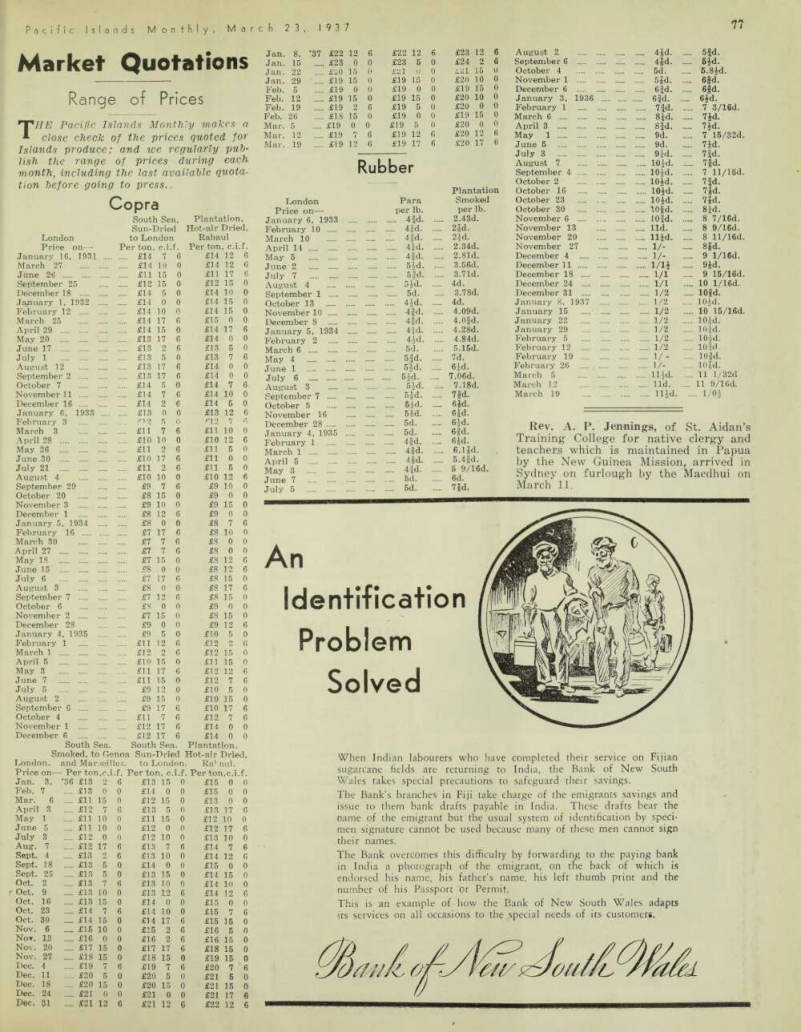
Range of Prices
THE Pacific Islands Monthly makes a close check of the prices quoted for Islands produce; and we regularly pub lish the range of prices during each month, including the last available quota tion before going to press..
Rev. A. P. Jennings, of St. Aidan’s Training College for native clergy and teachers which is maintained in Papua by the New Guinea Mission, arrived in Sydney on furlough by the Macdhui on March 11.
August 2 „ ... , „, J m. 5fd.
September 6 ... ... 4gd. 5id.
October 4 5d. 5.8id.
November 1 — ... 5*d. 6fd.
December 6 ... 63d. 6|d.
January 3, 1936 ... 6gd. 6id.
February 1 7gd. 7 3/16d.
March 6 ... 8id. 7id.
April 3 — ... ... 8gd. 7id.
May 1 ... ... 9d. 7 15/32d.
June 5 ... 9d. 7}d.
July 3 ...«. 9Jd. ... 73d.
August 7 lOJd. 7 fid.
September 4 lOJd. ... 7 ll/16d.
October 2 ... ... 10id. ... 73d.
October 16 ... 10id. 7gd.
October 23 ... 10id. 7|d.
October 30 ...^ lOfd. 8Jd.
November 6 — ... „ ... 103d. 8 7/16d.
November 13 ... lid. 8 9/16d.
November 20 ... ...— lljd. 8 ll/16d.
November 27 1/- 8gd.
December 4 1 /- 9 l/16d.
December 11 ... 1/li 9Jd.
December 18 ... . 1/1 9 15/16d.
December 24 — ... 1/1 ... 10 l/16d.
December 31 ... 1/2 ... lOgd.
January 8. 1937 1/2 ... 10id.
January 15 ~..~ 1/2 ...~ 10 15/16d.
January 22 1/2 10gd.
January 29 ... 1/2 lOjd.
February 5 1/2 lOid.
February 12 1/2 103d February 19 ... ...
VlOgd.
February 26 1/lOgd.
March 5 11 id. 11 l/32d March 12 lid. ... 11 9/16d.
March 19 . Hid. • i/oi
Jan. 8, ’37 £22 12 6 £22 12 6 £23 12 6 Jan. 15 £23 0 0 £23 5 0 £24 2 6 Jan. 22 £20 15 0 £21 u 0 £21 15 0 Jan. 29 £19 15 0 £19 15 0 £20 10 0 Feb. 5 £19 0 0 £19 0 0 £19 15 0 Feb. 12 ... £19 15 0 £19 15 0 £20 10 0 Feb. 19 ... £19 2 6 £19 5 0 £20 0 0 Feb. 26 ... £18 15 0 £19 0 0 £19 15 0 Mar. 5 £19 0 0 £19 5 0 £20 0 0 Mar. 12 £19 7 6 £19 12 G £20 12 6 Mar. 19 £19 12 6 £19 17 6 £20 17 6
Rubber
London Price on — Para per lb.
Plantation Smoked per lb.
January 6, 1933 4fd. 2.43d.
February 10 4Jd. 2|d.
March 10 - 4fd. 2id.
April 14 . 4Jd. 2.34d.
May 5 — 4id. 2,81d.
June 2 - ...
Sid. 3.56d.
July 7 5|d. 3.71d.
August 4 — — 5jd. 4d.
September 1 5d. — 3.78d.
October 13 4Jd. 4d.
November 10 ... — — 4fd. 4.09d.
December 8 — — — 4gd. 4.0|d.
January 5, 1934 — — 4id. 4.28d.
February 2 — — — 4jd. 4.84d.
March 6 — — — — 5cl. 5.1Bd.
May 4 — — — 53d. 7d.
June 1 — — — — 5|d. 61d.
July 6 — — — — Bid. 7.06d.
August 3 — — — Bid. — 7.18d.
September 7 — — 5Jd. — 7§d.
October 5 — — — Bid. 6|d.
November 16 — — Bid. — 6}d.
December 28 - — 5d. 6jd.
January 4, 1935 — — Bd. 6|d.
February 1 — — — 4fd. 6id.
March 1 — — ... m. ..._ 6.1Jd.
April 5 - — m. 5.4|d.
May 3 — — — — 43d. 5 9/16d.
June 7 Bd. 6d.
July 5 — — — Bd. — 7|d.
London Price on—
Copra
South Sea, Sun-Dried to London Per ton, c.i.f.
Plantation, Hot-air Dried, Rabaul Per ton, c.i.f.
January 16, 1931 £14 7 6 £14 12 6 March 27 £14 10 0 £14 12 6 June 26 £11 15 0 £11 17 6 September 25 £12 15 0 £12 15 0 December 18 £14 5 0 £14 10 0 January 1, 1932 ... £14 0 0 £14 15 0 February 12 £14 10 0 £14 15 0 March 25 £14 17 6 £15 0 0 April 29 ... £14 15 0 £14 17 6 May 20 £13 17 6 £14 0 0 June 17 £13 2 6 £13 5 0 July 1 £13 5 0 £13 7 6 August 12 £13 17 6 £14 0 0 September 2 £13 17 6 £14 0 0 October 7 £14 5 0 £14 7 6 November 11 £14 7 6 £14 10 0 December 16 £14 2 6 £14 5 0 January 6, 1933 £13 0 0 £13 12 6 February 3 ci 2 5 0 n 2 7 6 March 3 £11 7 6 £11 10 0 April 28 £10 10 0 £10 12 6 May 26 ... £11 2 6 £11 5 0 June 30 ... £10 17 6 £11 0 0 July 21 £11 2 6 £11 5 0 August 4 £10 10 0 £10 12 6 September 29 £9 7 6 £9 10 0 October 20 £8 15 0 £9 0 0 November 3 £9 10 0 £9 15 0 December 1 ... £8 12 6 £9 0 0 January 5, 1934 ... £8 0 0 £8 7 6 February 16 £7 17 6 £8 10 0 March 30 ... ... £7 7 6 £8 0 0 April 27 „ ... £7 7 6 £8 0 0 May 18 ... £7 15 0 £8 12 6 June 15 £8 0 0 £8 12 6 July 6 £7 17 6 £8 15 0 August 3 ... £8 0 0 £8 17 6 September 7 £7 12 6 £8 15 0 October 6 £S 0 0 £9 0 0 November 2 £7 15 0 £8 15 0 December 28 £9 0 0 £9 12 6 January 4, 1935 £9 5 0 £10 5 0 February 1 £11 12 6 £12 2 6 March 1 £12 2 6 £12 15 0 April 5 £10 15 0 £11 15 0 May 3 £11 17 6 £12 12 6 June 7 ... £11 15 0 £12 7 6 July 5 ... £9 12 0 £10 5 0 August 2 £9 15 0 £10 15 0 September 6 £9 17 6 £10 17 6 October 4 £11 7 6 £12 7 6 November 1 £12 17 6 £14 0 0 December 6 £12 17 6 £14 0 0 South Sea.
Smoked, to Genoa South Sea. Plantation. , Sun-Dried Hot-air Dried, London, and Marseilles. to London.
Ra 1 aul.
Price on— Per ton,c. i.f. Per ton. c. i.f.
Per ton.c.i. f.
Jan. 3, *36 £13 2 6 £13 15 0 £15 0 0 Feb. 7 £13 0 0 £14 0 0 £15 0 0 Mar. 6 £11 15 0 £12 15 0 £13 0 0 April 3 £12 7 6 £13 5 0 £13 17 G May 1 £11 10 0 £11 15 0 £12 10 0 June 5 £11 10 0 £12 0 0 £12 17 6 July 3 £12 0 0 £12 10 0 £13 10 0 Aug. 7 £12 17 6 £13 7 6 £14 7 6 Sept. 4 £13 2 6 £13 10 0 £14 12 6 Sept. 18 ... £13 5 0 £14 0 0 £15 0 0 Sept. 25 £13 5 0 £13 15 0 £14 15 0 Oct. 2 £13 7 6 £13 10 0 £14 10 0 Oct. 9 £13 10 0 £13 12 6 £14 12 6 Oct. 16 ... £13 15 0 £14 0 0 £15 0 0 Oct. 23 £14 7 6 £14 10 0 £15 7 6 Oct. 30 £14 15 0 £14 17 6 £15 15 0 Nov. 6 £15 10 0 £15 2 6 £16 5 0 Nor. 13 £16 0 0 £16 2 6 £16 15 0 Nov. 20 £17 15 0 £17 17 6 £18 16 0 Nov. 27 ... £18 15 0 £18 15 0 £19 15 0 6 Dec. 4 £19 7 6 £19 7 6 £20 7 Dec. 11 £20 5 0 £20 5 0 £21 5 0 Dec. 18 ...„. £20 15 0 £20 15 0 £21 15 0 Dec. 24 £21 0 0 £21 0 0 £21 17 6 Dec. 31 £31 12 6 £21 12 6 £22 12 6
Advertisements & other items, p. 79 (1 item)
Problem
An
Identification
Solved
\ r When Indian labourers who have completed their service on Fijian sugarcane fields are returning to India, the Bank of New South Wales takes special precautions to safeguard their savings.
The Bank’s branches in Fiji take charge of the emigrants savings and issue to them bank drafts payable in India. These drafts bear the name of the emigrant but the usual system of identification by specimen signature cannot be used because many of these men cannot sign their names.
The Bank overcomes this difficulty by forwarding to the paying bank in India a photograph of the emigrant, on the back of which is endorsed his name, his father’s name, his left thumb print and the number of his Passport or Permit.
This is an example of how the Bank of New South Wales adapts its services on all occasions to the special needs of its customers. ’d on/ o
Oil
L
Shipping Services in the Pacific
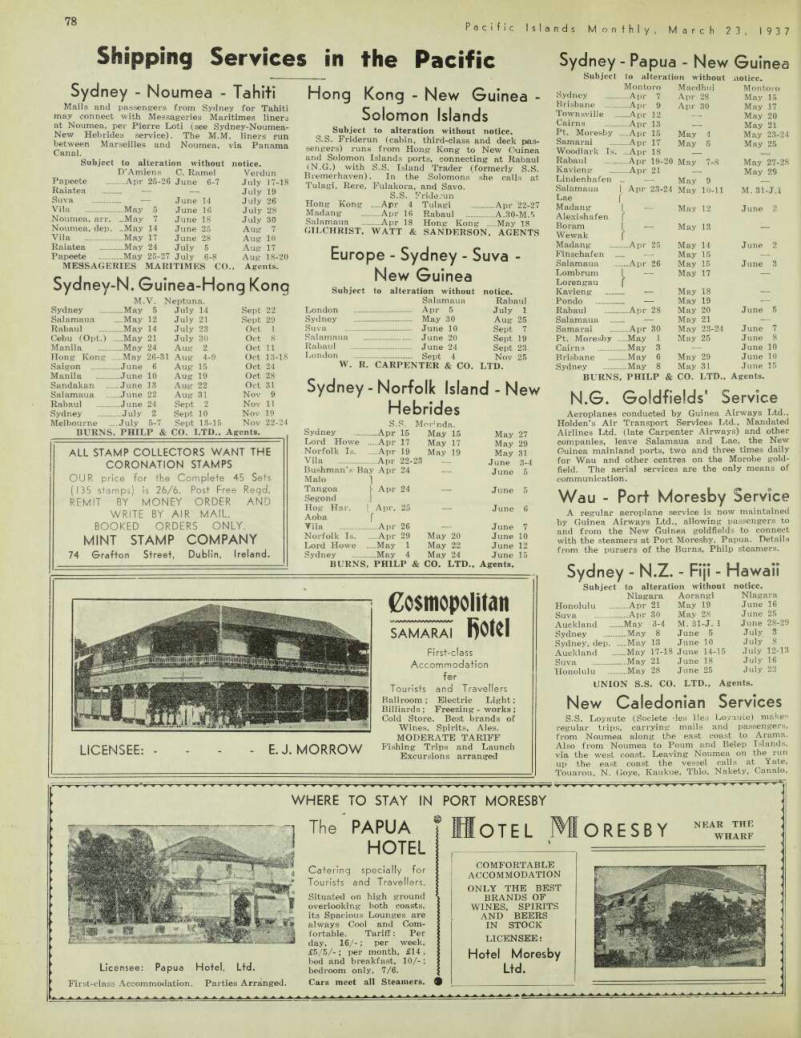
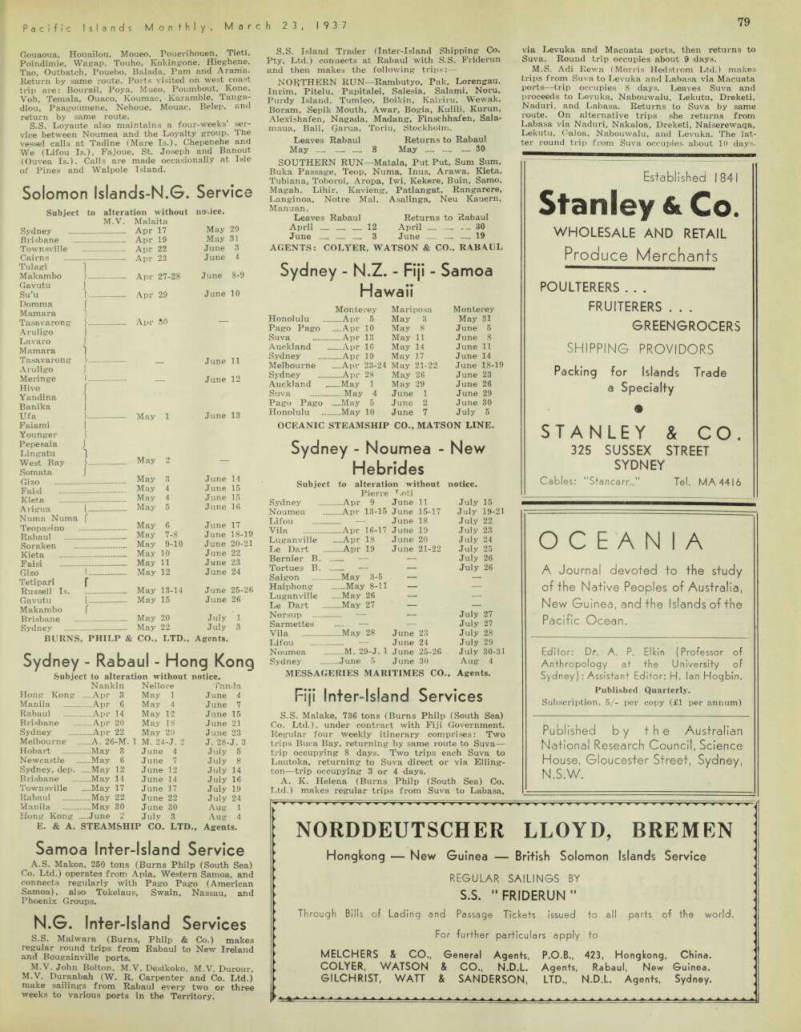
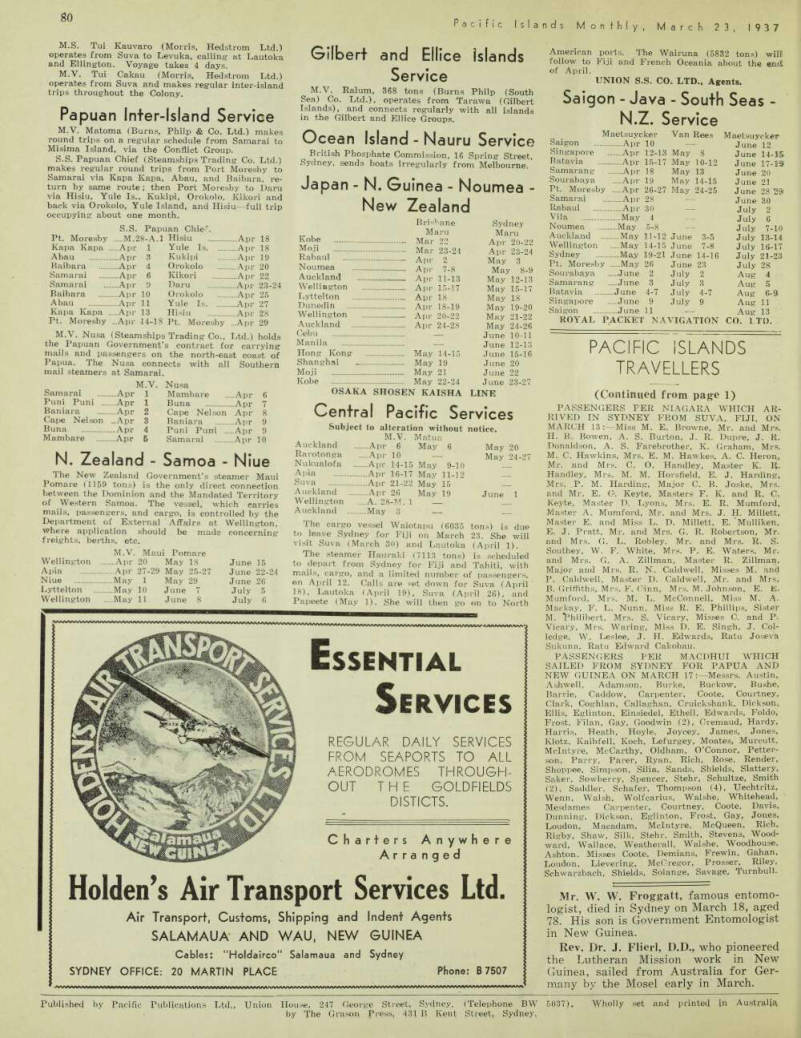
Sydney - Noumea - Tahiti
Mails and passengers from Sydney for Tahiti may connect with Messageries Maritimes liners at Noumea, per Pierre Loti (see Sydney-Noumea- New Hebrides service). The M.M. liners run between Marseilles and Noumea, via Panama Canal.
Subject to alteration without notice.
Sydney-N. Guinea-Hong Kong
Hong Kong - New Guinea -
Solomon Islands
Subject to alteration without notice.
S.S. Friderun (cabin, third-class and deck pas sengers) runs from Hong Kong to New Guinea and Solomon Islands ports, connecting at Rabaul (N.G.) with S.S. Island Trader (formerly S.S.
Bremerhaven). In the Solomons she calls at Tulagi, Rere, Fulakora, and Savo.
S.S. Friderun Hong Kong Apr 4 Tulagi Apr 22-27 Madang Apr 16 Rabaul A.30-MA Salamaua Apr 18 Hong Kong May 18
Gilchrist, Watt & Sanderson, Agents
Europe - Sydney - Suva -
New Guinea
Subject to alteration without notice.
Sydney - Norfolk Island - New Hebrides
Sydney - Papua - New Guinea Subject to alteration without notice.
N.G. Goldfields' Service
Aeroplanes conducted by Guinea Airways Ltd., Holden’s Air Transport Services Ltd., Mandated Airlines Ltd. (late Carpenter Airways) and other companies, leave Salamaua and Lae, the New Guinea mainland ports, two and three times daily for Wau and other centres on the Morobe gold field. The aerial services are the only means of communication.
Wau - Port Moresby Service
A regular aeroplane service is now maintained by Guinea Airways Ltd,, allowing passengers to and from the New Guinea goldfields to connect with the steamers at Port Moresby, Papua. Details from the pursers of the Burns, Philp steamers.
Sydney - N.Z. - Fiji - Hawaii Subject to alteration without notice.
New Caledonian Services
S.S. Loyaute (Societe des lies Loyaute) makes regular trips, carrying mails and passengers, from Noumea along the east coast to Arama.
Also from Noumea to Poum and Belep Islands, via the west coast. Leaving Noumea on the run up the east coast the vessel calls at Yate, Touarou, N. Goye, Kaukue, Thio, Nakety, Canalo,
D’Amiens C. Ramel Verdun Papeete Apr 25-26 June 6-7 July 17-18 Raiatea — — July 19 Suva — June 14 July 26 Vila May 5 June 16 July 28 Noumea, arr. -May 7 June 18 July 30 Noumea, dep. ...May 14 June 25 Aug 7 Vila May 17 June 28 Aug 10 Raiatea May 24 July 5 Aug 17 Papeete May 25-27 July 6-8 Aug 18-20
Messageries Maritimes Co.,
Agents.
M.V. Neptuna.
Sydney May 5 July 14 Sept 22 Salamaua May 12 July 21 Sept 29 Rabaul July 23 Oct 1 Cebu (Opt.) May 21 July 30 Oct 8 Manila May 24 Aug 2 Oct 11 Hong Kong . . May 26-31 Aug 4-9 Oct 13-18 Saigon ...June 6 Aug 15 Oct 24 Manila ...June 10 Aug 19 Oct 28 Sandakan ..June 13 Aug 22 Oct 31 Salamaua ...June 22 Aug 31 Nov 9 Rabaul ...June 24 Sept 2 Nov 11 Sydney -..July 2 Sept 10 Nov 19 Melbourne ...July 5-7 Sept 13-15 Nov 22-24
Burns
. Philp & Co. Ltd..
Agents. l
Salamaua Rabaul London Apr 5 July 1 Sydney May 30 Aug 25 Suva June 10 Sept 7 Salamaua June 20 Sept 19 Rabaul June 24 Sept 23 London Sept 4 Nov 25 W.
R. Carpenter & Co.
Ltd.
s.s.
Mornda.
Sydney Apr 15 May 15 May 27 Lord Howe Apr 17 May 17 May 29 Norfolk Is.
Apr 19 May 19 May 31 Vila Apr 22-23 June 3-4 Bushman’s Bay Apr 24 June 5 Malo 1 Tangoa J- Apr 24 — June 5 Segond J Hog Har.
I Apr. 25 — June 6 Aoba f Vila Apr 26 — June 7 Norfolk Is.
Apr 29 May 20 June 10 Lord Howe May 1 May 22 June 12 Sydney May 4 May 24 June 15
Burns,
, Ph1Lp
& Co. Ltd..
, Agents.
Montoro Macdhui Montoro Sydney Apr 7 Apr 28 May 15 Brisbane Apr 9 Apr 30 May 17 Townsville — May 20 Cairns Apr 13 — May 21 Pt. Moresby Apr 15 May 4 May 23-24 Samarai Apr 17 May 5 May 25 Woodlark Is. ...Apr 18 Rabaul Apr 19-20 May 7-8 May 27-28 Kavieng Apr 21 May 29 Lindenhafen — May 9 Salamaua I Apr 23-24 May 10-11 M. 31-J.l Lae Madang r I - May 12 June 2 Alexishafen Boram f I - May 13 Wewak Madang r Apr 25 May 14 June 2 Finschafen — May 15 — Salamaua Apr 26 May 15 June 3 Lombrum I - May 17 — Lorengau Kavieng f May 18 Pondo — May 19 — Rabaul Apr 28 May 20 June 5 Salamaua — May 21 — Samarai Apr 30 May 23-24 June 7 Pt. Moresby May 1 May 25 June 8 Cairns May 3 — June 10 Brisbane May 6 May 29 June 10 Sydney May 8 May 31 June 15
Burns
, Philp &
Co. Ltd.,
Agents.
Niagara Aorangi Niagara Honolulu Apr 21 May 19 June 16 Suva Apr 30 May 28 June 25 Auckland ...May 3-4 M. 31-J. 1 June 28-29 Sydney May 8 June 5 July 3 Sydney, dep.
May 13 June 10 July 8 Auckland May 17-18 June 14- 15 July 12-13 Suva May 21 June 18 July 16 Honolulu May 28 June 25 July 23
Union S.S. Co.
, Ltd.,
Agents.
Gouaoua, Houailou, Moueo, Pouerihouen, Tieti, Poindimie, Wagap, Touho, Kokingone, Hieghene, Tao, Outbatch, Pouebo, Balada, Pam and Arairia.
Return by same route. Ports visited oh west coast ti-ip are: Bourail, Poya, Mueo, Poumbout, Kone, Voh, Temala, Ouaco, Koumac, Karamble, Tanga diou, Paagoumene, Nehoue, Mouac, Belep, and return by same route.
S.S. Loyaute also maintains a four-weeks’ ser vice between Noumea and the Loyalty group. The vessel calls at Tadine (Mare Is.), Chepenehe and We (Lifou Is.), Fajoue, St. Joseph and Banout (Ouvea Is.). Calls are made occasionally at Isle of Pines and Walpole Island.
Solomon Islands-N.G. Service
Subject to alteration without novice.
Sydney - Rabaul - Hong Kong Subject to alteration without notice.
Samoa Inter-Island Service
A.S. Makoa, 250 tons (Burns Philp (South Sea) Co. Ltd.) operates from Apia, Western Samoa, and connects regularly with Pago Pago (American Samoa), also Tokelaus, Swain, Nassau, and Phoenix Groups.
N.G. Inter-Island Services
S.S. Maiwara (Burns, Philp & Co.) makes regular round trips from Rabaul to New Ireland and Bougainville ports.
M.V. John Bolton, M.V. Desikoko, M.V. Durour, M.V. Duranbah (W. R. Carpenter and Co. Ltd.) make sailings from Rabaul every two or three weeks to various ports in the Territory.
S.S. Island Trader (Inter-Island Shipping Co.
Pty. Ltd.) connects at Rabaul with S.S. Friderun and then makes the following trips:— NORTHERN RUN—Rambutyo, Pak, Lorengau.
Inrim, Pitelu, Papitalei, Salesia, Salami, Noru, Purdy Island, Tumleo, Boikin, Kairiru, Wewak, Boram, Sepik Mouth, Awar, Bogia, Kulili, Kurun, Alexishafen, Nagada, Madang, Finschhafen, Sala maua, Bali, Garua, Toriu, Stockholm.
Leaves Rabaul Returns to Rabaul May ... 8 May - 30 SOUTHERN RUN—Matala, Put Put. Sum Sum, Buka Passage, Teop, Numa, Inus, Arawa, Kieta, Tubiana, Toboroi, Aropa, Iwi, Kekere, Buin, Samo, Magah, Lihir, Kavieng, Patlangat, Rangarere, Langinoa, Notre Mai, Asalinga, Neu Kauern, Manuan, Leaves Rabaul Returns to Rabaul April 12 April ... —.— 30 June 3 June 19
Agents: Colyer, Watson & Co., Rabaul
Sydney - N.Z. - Fiji - Samoa
Hawaii
Sydney - Noumea - New Hebrides Subject to alteration without notice.
Fiji Inter-Island Services
S.S. Malake, 736 tons (Burns Philp (South Sea) Co. Ltd.), under contract with Fiji Government.
Regular four weekly itinerary comprises: Two trips Buca Bay, returning by same route to Suva — trip occupying 8 days. Two trips each Suva to Lautoka, returning to Suva direct or via Elling ton—trip occupying 3 or 4 days.
A. K. Helena (Burns Philp (South Sea) Co.
Ltd.) makes regular trips from Suva to Labasa,
via Levuka and Macuata ports, then returns to Suva. Round trip occupies about 9 days.
M.S. Adi Rewa (Morris Hedstrom Ltd.) makes trips from Suva to Levuka and Labasa via Macuata ports—trip occupies 8 days. Leaves Suva and proceeds to Levuka, Nabouwalu, Lekutu, Dreketi, Naduri, and Labasa. Returns to Suva by same route. On alternative trips she returns from Labasa via Naduri, Nakaloa, Dreketi, Naiserewaqa, Lekutu, Galoa, Nabouwalu, and Levuka. The lat ter round trip from Suva occupies about 10 days.
M.V. Malaita Sydney Apr 17 May 29 Brisbane Apr 19 May 31 Townsville Apr 22 June 3 Cairns Apr 23 June 4 Tulagi 1 Makambo [ - Apr 27-28 June 8-9 Gavutu J Su’u I Apr 29 June 10 Domma r Mamara 1 Tasavarong }■ Apr SO — Aruligo 1 Lavaro ) Mamara 1 Tasavarong June 11 Aruligo J Meringe June 12 Hivo [ Yandina 1 Banika 1 Ufa 1- May 1 June 13 Faiami 1 Younger 1 Pepesala J Lingatu 1 West Bay May 2 Somata J Gizo May 3 June 14 Faisi May 4 June 15 Kieta May 4 June 15 Arigua I May 5 June 16 Numa Numa f Teopasino May 6 June 17 Rabaul May 7-8 June 18-19 Soraken May 9-10 June 20-21 Kieta May 10 June 22 Faisi May 11 June 23 Gizo 1 May 12 June 24 Tetipari f Russell Is.
May 13-14 June 25-26 Gavutu L May 15 June 26 Makambo r Brisbane May 20 July 1 Sydney May 22 July 3
Burns
, Philp & Co.. Ltd.,
Agents.
Monterey Mariposa Monterey Honolulu Apr 5 May 3 May 31 Pago Pago Apr 10 May 8 June 5 Suva Apr 13 May 11 June 8 Auckland Apr 16 May 14 June 11 Sydney Apr 19 May 17 June 14 Melbourne Apr 23-24 May 21-22 June 18-19 Sydney Apr 28 May 26 June 23 Auckland May 1 May 29 June 26 Suva May 4 June 1 June 29 Pago Pago May 5 June 2 June 30 Honolulu ..May 10 June 7 July 5
Oceanic Steamship
Co., Matson Line.
Pierre T .oti Sydney Apr 9 June 11 July 15 Noumea Apr 13-15 June 15-17 July 19-21 Lifou — June 18 July 22 Vila Apr 16-17 June 19 July 23 Luganville Apr 18 June 20 July 24 Le Dart Apr 19 June 21-22 July 25 Bernier B. — — July 26 Tortues B. — July 26 Saigon May 3-5 — — Haiphong May 8-11 — — Luganville May 26 — — Le Dart „.May 27 — — Norsup ... — — July 27 Sarmettes — — July 27 Vila May 28 June 23 July 28 Lifou ... — June 24 July 29 Noumea M. 29-J. 1 June 25-26 July 30-31 Sydney June 5 June 30 Aug 4
Mes&Ageries Maritimes Co.,
Agents.
Nankin Nellore Panda Hong Kong Apr 3 May 1 June 4 Manila Apr 6 May 4 June 7 Rabaul Apr 14 May 12 June 15 Brisbane Apr 20 May 18 June 21 Sydney Apr 22 May 20 June 23 Melbourne A. 26-M. 1 M. 24-J. 2 J. 28-J. 3 Hobart May 3 June 4 July 5 Newcastle May 6 June 7 July 8 Sydney, dep. ...May 12 June 12 July 14 Brisbane May 14 June 14 July 16 Townsville May 17 June 17 July 19 Rabaul May 22 June 22 July 24 Manila May 30 June 30 Aug 1 Hong Kong ...June * July 3 Aug 4 E. & A.
Steamship Co. Ltd.,
Agents.
M.S. Tui Kauvaro (Morris, Hedstrom Ltd.) operates from Suva to Levuka, calling at Lautoka and Ellington. Voyage takes 4 days.
M.V. Tui Cakau (Morris, Hedstrom Ltd.) operates from Suva and makes regular inter-island trips throughout the Colony.
Papuan Inter-Island Service
M.V. Matoma (Burns, Philp & Co. Ltd.) makes round trips on a regular schedule from Samarai to Misima Island, via the Conflict Group.
S.S. Papuan Chief (Steamships Trading Co. Ltd.) makes regular round trips from Port Moresby to Samarai via Kapa Kapa, Abau, and Baibara, re turn by same route ; then Port Moresby to Daru via Hisiu, Yule Is., Kukipi, Orokolo, Kikori and back via Orokolo, Yule Island, and Hisiu—full trip occupying about one month.
S.S. Papuan Chief.
Pt. Moresby M.28-A.l Hisiu Apr 18 Kapa Kapa Apr 1 Yule Is Apr 18 Abau Apr 3 Kukipi Apr 19 Baibara Apr 4 Orokolo Apr 20 Samarai Apr 6 Kikori Apr 22 Samarai Apr 9 Daru Apr 23-24 Baibara Apr 10 Orokolo Apr 25 Abau Apr 11 Yule Is Apr 27 Kapa Kapa Apr 13 Hisiu Apr 28 Pt. Moresby ...Apr 44-18 Pt. Moresby ...Apr 29 M. Nusa (Steamships Trading Co., Ltd.) holds the Papuan Government’s contract for carrying mails and passengers on the north-east coast of Papua, The Nusa connects with all Southern mail steamers at Samarai.
M.V. Nusa Samarai Apr 1 Mambare Apr 6 Puni Puni Apr 1 Buna Apr 7 Baniara Apr 2 Cape Nelson Apr 8 Cape Nelson -Apr 3 Baniara Apr 9 Puna „.Apr 4 Puni Puni Apr 9 Mambare Apr 5 Samarai Apr 10
N. Zealand - Samoa - Niue
The New Zealand Government’s steamer Maui Pomare (1159 tons) is the only direct connection between the Dominion and the Mandated Territory of Western Samoa. The vessel, which carries mails, passengers, and cargo, is controlled by the Department of External Affairs at Wellington, where application should be made concerning freights, berths, etc.
M.V. Maui Pomare Wellington Apr 20 May 18 June 15 Apia Apr 27-29 May 25-27 June 22-24 Niue May 1 May 29 June 26 Lyttelton May 10 June 7 July 5 Wellington May 11 June 8 July 6
Gilbert and Ellice islands
Service
M.V. Ralum, 368 tons (Burns Philp (South Sea) Co. Ltd.), operates from Tarawa (Gilbert Islands), and connects regularly with all islands in the Gilbert and Ellice Groups.
Ocean Island - Nauru Service
British Phosphate Commission, 16 Spring Street, Sydney, sends boats irregularly from Melbourne.
Japan - N. Guinea - Noumea -
New Zealand
Central Pacific Services Subject to alteration without notice.
The cargo vessel Waiotapu (6035 tons) is due to leave Sydney for Fiji on March 23, She will visit Suva (March 30) and Lautoka (April 1).
The steamer Hauraki (7113 tons) is scheduled to depart from Sydney for Fiji and Tahiti, with mails, cargo, and a limited number of passengers, ©n April 12. Calls are set down for Suva (April 18). Lautoka (April 19), Suva (April 26), and Papeete (May 1). She will then go on to North
American ports. The Wairuna (5832 tons) will follow to Fiji and French Oceania about the end of April.
Union S.S. Co. Ltd., Agents.
Saigon - Java - South Seas -
N.Z. Service
Bri Sydney Maru Maru Kobe Mar 22 Apr 20-22 Moji - — Mar 23-24 Apr 23-24 Rabaul Apr 2 May 3 Noumea Apr 7-8 May 8-9 Auckland Apr 11-13 May 12-13 Wellington Apr 15-17 May 15-17 Lyttelton Apr 18 May 18 Dunedin Apr 18-19 May 19-20 Wellington Apr 20-22 May 21-22 Auckland Apr 24-28 May 24-26 Cebu — June 10-11 Manila — June 12-13 Hong Kong May 14-15 June 15-16 Shanghai May 19 June 20 Moji May 21 June 22 Kobe May 22-24 June 23-27
Osaka
Shosen Kaisha
Line
M.V. Matua Auckland Apr 6 May 6 May 20 Rarotonga Apr 10 — May 24-27 Nukualofa Apr 14-15 May 9-10 Apr 16-17 May 11-12 — Suva Apr 21-22 May 15 Auckland Apr 26 May 19 June 1 Wellington A. 28-M. 1 — Auckland May 3
Maetsuycker Van Rees Maetsuycker Saigon Apr 10 June 12 Singapore Apr 12-13 May 8 June 14-15 Batavia Apr 15-17 May 10-12 June 17-19 Samarang Apr 18 May 13 June 20 Sourabaya Apr 19 May 14-15 June 21 Pt. Moresby Apr 26-27 May 24-25 June 28 29i Samarai Apr 28 June 30 Rabaul Apr 30 July 2 Vila May 4 July 6 Noumea May 5-8 July 7-10 Auckland May 11-12 June 3-5 July 13-14 Wellington May 14-15 June 7-8 July 16-17 Sydney May 19-21 June 14-16 July 21-23 Pt. Moresby May 26 June 23 July 28 Sourabaya June 2 July 2 Aug 4 Samarang June 3 July 3 Aug 5 Batavia June 4-7 July 4-7 Aug 6-9 Singapore June 9 July 9 Aug 11 Saigon 11 Aug 13
Royal
Packet Navigation
Co. 1 To.
Advertisements & other items, pp. 80-84 (2 items)
Cosmopolitan
ALL STAMP COLLECTORS WANT THE
CORONATION STAMPS
OUR price for the Complete 45 Sets (135 stamps) is 26/6. Post Free Regd.
REMIT BY MONEY ORDER AND
WRITE BY AIR MAIL.
BOOKED ORDERS ONLY.
MINT STAMP COMPANY
74 Grafton Street, Dublin, Ireland.
LICENSEE:
E. J. MORROW
Cosmopolitan
>rwWWWWWWWV ■ 7* * A 1
SAMARAI nOICI
First-class Accommodation for Tourists and Travellers Ballroom ; Electric Light; Billiards; Freezing - works ; Cold Store. Best brands of Wines, Spirits, Ales.
MODERATE TARIFF
Fishing Trips and Launch Excursions arranged
WHERE TO STAY IN PORT MORESBY
Licensee: Papua Hotel, Ltd.
First-class Accommodation. Parties Arranged.
The ' PAPUA ?
HOTEL
Catering specially for
Tourists and Travellers.
Situated on high ground , overlooking both coasts, ; its Spacious Lounges are ! always Cool and Com- \ fortable. Tariff: Per i day, 16/-; per week, ; £5/5/-; per month, £l4, bed and breakfast, 10/-; bedroom only, 7/6.
Cars meet all Steamers. O
Hotel Moresby
.ft
NEAR THE
WHARF
COMFORTABLE
ACCOMMODATION
ONLY THE BEST
BRANDS OF
WINES, SPIRITS
AND BEERS
IN STOCK
LICENSEE:
Hotel Moresby
Ltd.
Established 1841
Stanley & Co.
WHOLESALE AND RETAIL
Produce Merchants
POULTERERS . . .
FRUITERERS . . .
GREENGROCERS
SHIPPING PROVIDORS
Packing for Islands Trade
a Specialty
STANLEY & CO,
325 SUSSEX STREET
SYDNEY
Cables: "Sfancarr.," Tel, MA4416
OCEANIA
A Journal devoted to the study of the Native Peoples of Australia, New Guinea, and the Islands of the Pacific Ocean.
Editor: Dr. A. P. Elldn (Professor of Anthropology at the University of Sydney); Assistant Editor: H. lan Hogbin.
Published Quarterly.
Subscription, 5/- per copy (£1 per annum) Published by the Australian National Research Council, Science House, Gloucester Street, Sydney,
N.S.W.
NORDDEUTSCHER LLOYD, BREMEN
Hongkong New Guinea British Solomon Islands Service
REGULAR SAILINGS BY
S.S. " FRIDERUN "
Through Bills of Lading and Passage Tickets issued to all parts of the world.
For further particulars apply to MELCHERS & CO., General Agents, P. 0.8., 423, Hongkong, China.
COLYER, WATSON & CO., N.D.L. Agents, Rabaul, New Guinea.
GILCHRIST, WATT & SANDERSON. LTD., N.D.L. Agents, Sydney.
,' ' m %
Essential
Services
REGULAR DAILY SERVICES
FROM SEAPORTS TO ALL
AERODROMES THROUGH-
OUT THE GOLDFIELDS
DISTICTS.
Charters Anywhere
Arranged
Holden’s Air Transport Services Ltd.
Air Transport, Customs, Shipping and Indent Agents
SALAMAUA AND WAU, NEW GUINEA
Cables: "Holdairco" Salamaua and Sydney SYDNEY OFFICE: 20 MARTIN PLACE Phone: B 7507
AERIAL TRANSPORT ESTABLISHED
NEW GUINEA COLD INDUSTRY
S INCE 1927, when the development of the Mcrobe Goldfield commenced, the European population of the Territory has been trebled. The new industry has increased the Empire's gold production by nearly £2,000,000 per annum, and has added enormously to the trade turnover of New Guinea.
Only Aerial Transport makes this possible. There is no road between the Goldfields and the coast. Aeroplanes, running on Regular Schedules, without Difficulty or Delay, carry in Dredges, Crushing Mills, Cyanidinq Plants, Motor Vehicles, Hydro - Electric Machinery, Thousands of Passengers, and every kind of goods needed by a largo and growing European community.
O UINEA AIRWAYS LTD. were
established in 1927; and they have grown in the following way, until they are to-day the largest freightcarrying service in the world: -it* t V'i Every kind of cargo, frozen meat to hydro-electric machinery, Is carried In to th goldfield centres by Guinea Airways machines. In this photograph, taken in Decern a motor-car Is shown, while being unloaded on the Wau Aerodrome.
Guinea Airways Ltd. operate regular air services in New Guinea and Papua they use over 50 Aerodromes and Landing-grounds in the two Territories, e Morobe ber, 1936,
GUINEA AIRWAYS L T S
LAE - SALAMAUA
HEAD OFFICE: NEW GUINEA OFFICE:
BROOKMAN BUILDINGS LAE
GRENFELL STREET MANDATED TERRITORY OF
ADELAIDE, S.A. NEW GUINEA
BRANCH OFFICES AND AGENTS AT WAU, SALAMAUA, PORT MORESBY, AND SYDNEY
SCHIS
& c &d* Ptl > ER ( s 1 1 i Bj i i % 5‘ S
fc<T 1 ‘i
s>. .W 4 <r, m *5? fcv **i iP
WELCOME CARGO
"'Lower away” —and what a welcome cargo it is!
Resch’s Pilsener—in the famous long bottle—the drink which eases the white man’s burden!
Call for a bottle to-night and relish its malt and
hop flavour.
RESCH'S
LONG BOTTLE
PILSENER
**S "HsV.Hisr
Pacific Islands
80
Pacific Islands Monthly, March 23, 1937
TRAVELLERS
(Continued from page 1)
Published by Pacific Publications Ltd.. Union House, 247 George Street, Sydney. (Telephone BW 5037), Wholly set and printed in Australia by The Grason Press, 431 B Kent Streeti Sydney,