Islands

Pacific
Monthly
Vol. Vii. No. 7
F e%r u ary 24, 19 3 7
af dhe G.P.0., Sydney, for transmission hy post ns n newspaper.']
6 d
An Example For
Wives
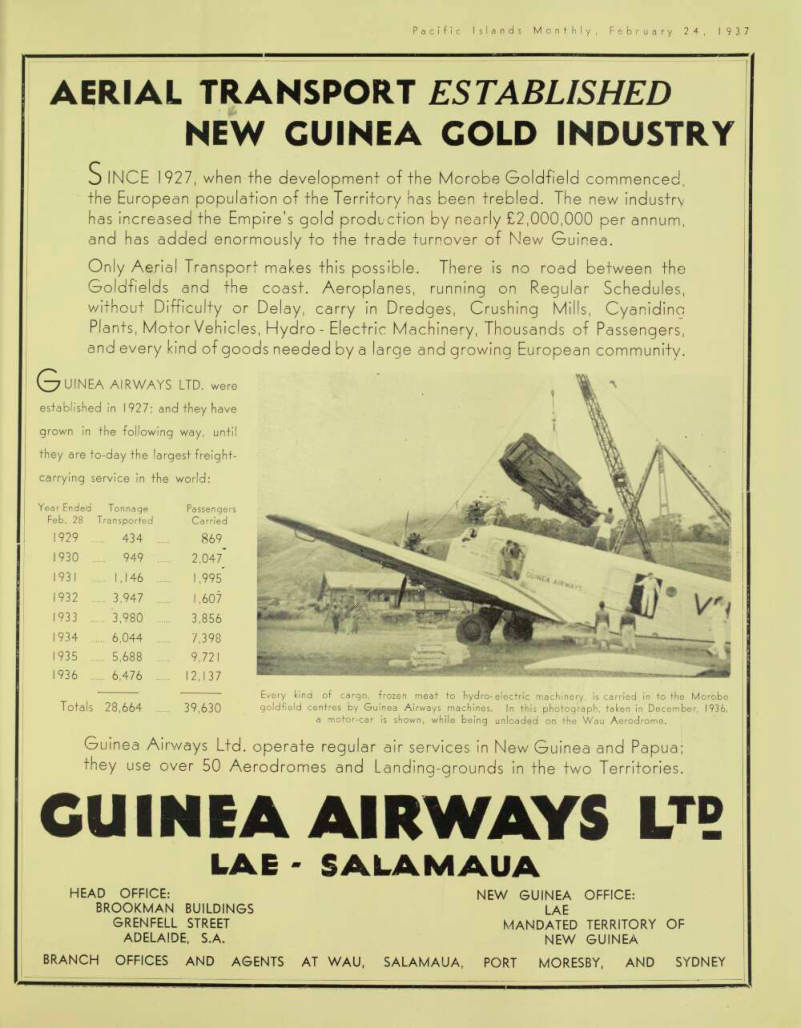
This woman, photographed by Patrol Officer D. C.
Bates, in the Garfuka River district, near the head waters of the Upper Purari, New Guinea, Is a widow.
Her husband was killed in war; and she, according to custom, removed his head from his body, "cleaned" it, and now carries it in a string bag, slung round her neck. This is a sign of real mourning. (Picture by courtesy of Melanesian Mission.)
Advertisements & other items, p. 2 (1 item)
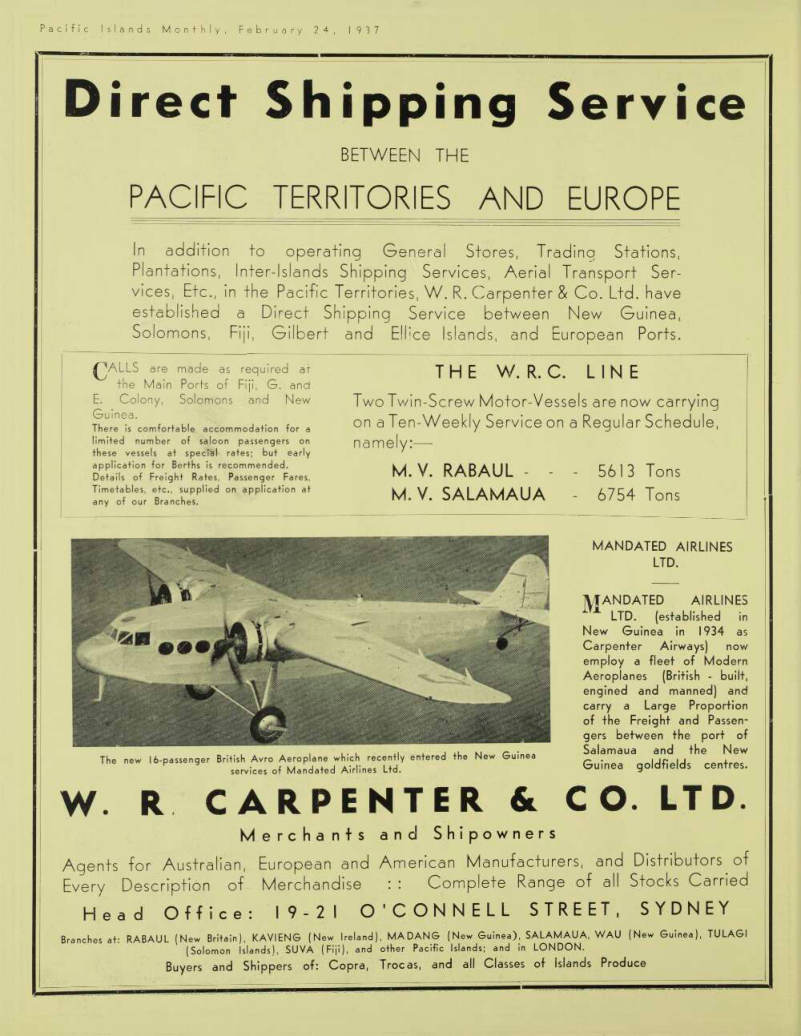
Direct Shipping Service
BETWEEN THE
PACIFIC TERRITORIES AND EUROPE
In addition to operating General Stores, Trading Stations, Plantations, Inter-Islands Shipping Services, Aerial Transport Services, Etc., in the Pacific Territories, W. R. Carpenter & Co. Ltd. have established a Direct Shipping Service between New Guinea, Solomons, Fiji, Gilbert and Ellice Islands, and European Ports.
C A^ LS , are made as required at the Main Ports of Fiji, G. and E. Colony, Solomons and New Guinea.
There is comfortable accommodation for a limited number of saloon passengers on these vessels at special rates; but early application for Berths Is recommended.
Details of Freight Rates, Passenger Fares, Timetables, etc., supplied on application at any of our Branches.
THE W. R. C. LINE
Two Twin-Screw Motor-Vessels are now carrying
on a Ten-Weekly Service on a Regular Schedule,
namely:—
M.V. RABAUL - - - 5613 Tons
M. V. SALAMAUA - 6754 Tons
MANDATED AIRLINES
LTD.
IVIANDATED AIRLINES
LTD. (established in New Guinea in 1934 as Carpenter Airways) now employ a fleet of Modern Aeroplanes (British - built, engined and manned) and carry a Large Proportion of the Freight and Passengers between the port of Salamaua and the New Guinea goldfields centres.
W. R CARPENTER & CO. LTD.
Merchants and Shipowners
Agents for Australian, European and American Manufacturers, and Distributors of Every Description of Merchandise : : Complete Range of all Stocks Carried
Head Office: 19-21 O'CONNELL STREET, SYDNEY
Branches at: RABAUL (New Britain], KAVIENG (New Ireland), MADANG (New Guinea). SALAMAUA, WAU (New Guinea), TULAGI (Solomon Islands), SUVA (Fiji), and other Pacific Islands; and in LONDON.
Buyers and Shippers of: Copra, Trocas, and all Classes of islands Produce m The new 16-passenger British Avro Aeroplane which recently entered the New Guinea services of Mandated Airlines Ltd.
Pacific Islands Travellers
Passengers Per Morinda Which Left
SYDNEY FOR LORD HOWE IS., NORFOLK IS.
AND NEW HERBIDES ON JANUARY 21 : Messrs. Bennett, Beveridge, Bridgens, Brownhill, Clyne, Croudace, Delandro, Evans, Holt, Hyde, Harkness (2), Hines, Joy, Jukes, Leong, Young, Le Sueur, Lloyd, Miller, Moverly, Mills, McDermott, Nott, O’Donnell, Dale, Sainsbury, Tuffnell (2), Weedon, Woods, Ward. Mesdames Bell, Beveridge, Corbett, Dunlop, Evans, Fox, Morell, Moverly, Perryman, Smith, Stephenson, Tuffnell, Whittle, Ward, Young. Misses Blunden, Beveridge, Bingley, Corbett, Clarke, Dunlop, Erickson, Fox, Hines, Hedges, Lingard, Morell, Middleton, Newton, Parry, Paterson, Robinson, Scobie, Thompson. Williams.
Passengers Per Aorangi Which Ar
RIVED IN SYDNEY FROM SUVA, FIJI, ON JANUARY 23: Mrs. I. C. Allard, Master Allard, Master E. Allman, Master R. A. Aspinall, Mrs.
E. M. Barker, Mrs. J. P. Bailey, Mr. and Mrs.
Beiers, Miss H. M. Berry, Mrs. V. Cozens, Misses Cozens (2), Mr. and Mrs. F. G. Exton, Major G.
Graves, Mrs. Hobbs, Master Hobbs, Master and Miss Howell, Mr. and Mrs. I. L. Hunt, Mrs.
F. E. L. Kaeppel, Master C. R. Leith, Mr. and Mrs. R. Lowell, Mrs. M. E. Major, Mr. and Mrs.
B. H. Marks, Mrs. E. Millard. Mrs. D. Millard, Miss Millard, Miss M. Morrison, Mrs. and Miss Mime, Mrs. M. L. McCullagh, Mrs. E. E. Nich olls. Miss E. Pratt, Mrs. L. L. De Roy, D. Rie menschneider, Mrs. M. A. Seymour, Messrs. A. and J. Snodgrass, O. W. Stevenson, Mrs. and Master Taylor, Mrs. L. Tarte, Master P. H. Van Gel deren, Mrs. A. Widlake, Master Widlake, Master B. Young, Mr. and Mrs. Aidnev, Misses J. and E. Allman, Miss F. M. Blackett. V. G. Clark.
Mrs. Costello, Miss Costello, Mr. and Mrs. T. R.
Curry, Mr. and Mrs. T. M. Davidson, H. S.
Debbage. Mrs. M. Elliott, Mr. and Mrs. C. P.
Farquhar, Mr. and Mrs. D. Ferrier-Watson, W.
S. Fong, Mr. and Mrs. G. W. Garnett, Miss D.
Hill, Miss N. L. Hunter, Y. P. Joong, C. Ken nedy, Mr. and Mrs. A, King, D. C. McKean, Mrs. Potts, Miss M. Rogers, Master P. and R.
Rogers, Mr. and Mrs. S. Snowsil, Mr. and Mrs.
O. N. Spiers, Miss V. Stevenson, Mrs. D. War den, Mr. and Mrs. J. Williams, Mrs. White, Mrs. M. E. Wisdom, Mr. and Mrs. A. Yeats, Master Yeats, Mr. and Mrs. A. Aiono, Rev. C. and Mrs. Churchward, L. A, Crisp, Rev. W. J. and Mrs, Chambers, Mrs. H. Costello, N. R.
Cummings, F. H. Halford, Miss A. L. Hicks, R. C. Henrick, N. G. Latimer, Mr. and Mrs. J.
Motley, W. J. McGuffin, Miss K. Naoco, J. L, Neale, Miss A. J. Quinn, J. T. Rowe, P. Tuid raki, H. Wheatley, J. Winterbottom, J, F. Wood.
Passengers Per Malaita Which
Sailed From Sydney For N.G. And
Solomon Islands Ports On January 23:
Messrs, Ashley, Brown, Blackett, Buckley, Colley, Chauncey, Deane, De Theye, Darlington, Ellis, Fitzgerald, Gunner, Hetherington, Hill, Johnson, Kroening (2), Ludlow, Loewenthal. Quintal, Reid, Robins, Smith, Storey, Southwell. Stewart, Sim, Stuyvenberg, Thompson, Warwick. Wheatley, Widdup. Mesdames Brown, Brook. Buckley, Colley, Herschel, Harkins, Koehn, Loewenthal, Reid, Rixon, Southwell. Storey, Train. Misses Beer, Brook, Bourke, Brown, Couldwell, Devir, Fitzgerald, Neylan, Southwell (2).
Passengers Per Macdhui Which
Arrived In Sydney From Papua And
New Guinea On January 29; Messrs.
Arnold, Allen, Atkinson, Austin, Batich, Bennett, Bignold, Bridge, Boto, Burchett, Burrell.
Bonwick, Bourke, Carlson, Clay, Corke, Clifford, Connors, Corrigan. Doile, Dudgeon, Edwards, Ellis, Fletcher, Fryer, Giblin, Gordon, Guy, Goad, Grace, Gundelach. Haslam. Helm, Hitchcock.
Hallam, Jones, Looney, Mackay, Maguire, MacGregor, McClemens,, McLennan, McMickling, Monteith, Munster, Proud, Parkinson, Ross, Reed, Richardson, Ritchie, Sexton, Smith, Stephens.
Symons, Tudor, Walsh, Walshe. Watson, Wurth.
Mesdames Adams, Allan, Bradley, Blanch, Brewster, Burchett, Corke, Cook, Corrigan, Couz ens, Ellis, Goad, Grace, Haslam, Hallam, Horan, Ifould, Jones, Loudon, MacGregor, McLennan, Malcolm, Maxwell, Mitchell, Munster, Ross, Smith, Sexton, Thomson, Tudor, Wurth, Watson, Weston, Walshe. Misses Abramovich, Aluay, Allan, Buckingham, Cattell, Chester, Clarke, Couzens, Callaghan, Frewin, Humphries (2), Kennedy, Leeder, Loebel, Lock, Mathews, Murison, Maxwell, Pearson, Potts, Royal, Shar rock, Smith, Stansfield, Solange, Waghorn. Wotf.
Passengers Per Macdhui Which De
Parted From Sydney For Papua And
New Guinea On February 4Messrs.
Atkinson, Anderson (2), Bates, Bloxham, Barne witz, Brown, Ball, Carson, Crisp, Champion, Chiantore, Chester, Qlarke, Cram, Clarke, Cox, Dishon, Dickson, Doherty. De Hesselle, De Russett, Erickson, Elwyn, Freeman, Fletcher, Gannon, Gray, Hildebrand, Hope, Hill, Hems worth, Head, Hay, Hutton, Innes, Jacobsen, Jones, Jacobs, Keinzle, Laverick, Leydin (2), Middleton, McManus, Nisbet, O’Neill, Oates, Jones, Jacobs, Keinzle, Laverick, Leydin (2) Lyttle Lennox, Macauley, Maloney, Murray, McMillan, O’Donnell, Orr, Powell, Parrott, Pike, Pickering, Parker, Pemberton, Sinclair, Smith, Saunders, Sutherland, Stevenson, Simpson, Taylor, Theck ston, Tee, Turner, Wells, Walmsley, Wood, Minters, Malton, Wild, Wilmot, Mylde, Youdale, Willis, Zoffman. Mesdames Anderson, Bates, Boileau, Bellhouse, Bartlett, Carson, Chiantore, Caldwell, Cummings, Doherty, Fell, Farow, Gray, Hyde, Hope, Herbert, Jacobs (2), Kennedy, Lock hart, Lowe, Leydin, Laws, Lennox, Murray, McLaughlan, Oates, Osborne, Pemberton, Swan son (2), Sutherland, Scanned, Whybrow, Willis.
Misses Clemens, Craig, Evans, Frewin, Gee, Johnston, Klein, Laws, McGuigan, Nibloe, Osborne, Swift, Sherwin.
Passengers Per Morinda Which Ar
Rived In Sydney From New Hebrides.
NORFOLK IS., AND LORD HOWE IS. ON FEBRUARY 12. —Messrs. Adams, Beveridge, Clyne, Croudace, Currey, Creer, Dale, Evans, Gregerson, Hyder, Harkness, Jukes, Lloyd, Miller, Mills, Moverley, Nott, Sainsbury, Sanders, Smyth, Tucker, Tuffnell, Ward, Weedon, Warren. Mes dames Buffett, Beveridge, Creer, Currey, Dunlop, Harford. Moi’ell, Mills, Moverley, Perryman, Sanders, Tuffnell, Turnbull, Ward, Whitehead, Whittle. Misses Adams, Blunden, Buffett, Dunlop, Dupertius, Erickson, Gordon, Hedges, Johnston, Killen (2), Lingard, McLenaghlan, Martin, Morell, Newton, Parry, Paterson, Playle, Robert son, Turnbull.
Passengers Per Aorangi Which
SAILED FROM SYDNEY FOR SUVA. FIJI, ON FEBRUARY 18.—A. J. Allen, J. M. Aitken, Mrs. J. M. Allard. Mrs. E. V. Cozens, Miss A.
Cozens, Mrs. F. V. Dunstan, Master Dunstan, F. H. Ellerton, H. D. Fowler, R. H. Guy, Miss E. Hawkes, Mr. Hudson. A. C. Heron, C. W. I.
Johnson, Dr. and Mrs. F. E. Keep, Master M. E.
Keep, Mr. and Mrs. C. S. Lynch, Misses P. and S. Lynch, R. H. Mcßurney, Mrs. J. C. Rutter, Mrs. Taylor, Mr. and Mrs. H. G’. Williams, Misses M. and B. Williams, Master K. Williams, Mr. Beiess, Mr. Derrick, Masters Derrick (2), R. J. Douglas, W. R. Deacon, Miss A, Ellis, Miss Emert, J. Gillies, Mrs. G. Huntley, C. B.
Hill, G. Hutchings, Miss K. D. and Master D.
Millikin, A. McArthur, Miss O. R. Strickland, W. Thompson, Mr. and Mrs. W. P. Wright, Masters L. P. and I. C. Wright, M. Whan, H.
Whitney, A. W. Yeats, Mr. and Mrs. J. S.
Hislop, N. Keshav, A. L. Peak.
Passengers Per Montoro Which
Reached Sydney From Papua And N.G.
ON FEBRUARY 18. Messrs. Adamson, Bayer, Bennett, Blue. Clark, Clifton, Croft. Currie, Cox (2), Denton, Dodsworth (2), Edwards, England, Ford, Fitch, Gore. Gow, Grant, Gribben, Hopfield, Hardy, Henry, Ingold. Kenrick, MacDonald, McHugh, McEwan, Mather, McWilliam, Mason, Normoyle, Obst, Purvis, Officer, Ostrom, Penny, Pierce, Roberts, Rose, Samaways, Sansun, Sparrow, Swanson, Thompson, Topal, Upton, Veale, Vernon, Vivien, Walshe, Waterhouse, Whiteman, Williams, Yard. Mesdames Bensley, Crooks, Denton, Gazzard, Higgins, Healy, James, Johnson, Lewis, Kiernan, Obst, Noonan, Nor moyle, Paulini, Pennyfather, Robbins, Schmidt, Sparrow, Swanson. Vieusseux, Walshe, Williams, Whiteman, Wyborn, Ward. Misses Bock, Brien, Blue, Cooper, Franklin, Grose, Humphries, Kessell, Lamb, Ford, James, Lyons, Lumley, Matthews, McKenna, Macco, MacGregor, Penny father, Rowe, Rutledge, Sefton.
The Japanese steamer Shousing, 4920 tons, carying phosphate from Ocean Is land to Melbourne, broke her rudder while fighting a cyclone off the northern Queensland coast. She sent an S.O.S. signal; but succeeded in making tempor ary repairs and eventually got out of danger on February 15.
Advertisements & other items, p. 3 (1 item)
Salt
Smoke "BOLBEC” English TOBACCO.
Now reduced from 3/3 to 2/9 Tin.
A Good Companion—a “Bolbec” Pipe.
Price 4/6.
PIKE BROTHERS LTD.
IN QUEEN STREET - - BRISBANE
iOS
FRUIT
SALT
Au. 5) Known for over 60 years as a non-habitforming corrective as* ff ‘Xphe •words &no and "'tfrmt Salt” are registered trade marks.
Advertisers
Page Amalgamated Wire less of Aust. Ltd. 76 Angus & Coote Ltd. 41 Arnott’s Biscuits 26 “Aspro” 52 Ausoline 66 B. and S. Agency ... 13 Bank of N.S.W 77 Berger & Sons Ltd. 50 Blau (Aust.) Robert 58 Blood of the Shark 23 Broomfields Ltd. 48 Brunton’s Flour 39 Budge & Co. Ltd. 69 Bullivants Ltd 79 Burns. Philp & Co. 2 Burns, Philp & Co. 24
B.P. (S.S.) Co. 32
Buzacott Ltd _. 28 Carpenter, W. R.
Limited ii Chapman & Sherack 31 Chemist - Michael, H. P. 71 Chivers & Co. Ltd.. 35 Coleman Lamp Co. 66 Coral Starch 34 Cosmopolitan Hotel 78 Crockett & Co. Ltd. 57 Crossle, Duff and Macintosh Ltd. ... 68 “Cuprinol” 63 “Cystex” 73 Del Cott Pty. Ltd. 72 Dewar’s Whisky 27 Doans Pills 54 Docke, Carl Aug. ... 46 Donald, A. B. Ltd. 62 Eaton, Ltd., J. W. 56 Electrolytic Co. Ltd. 68 Elliott’s and Aust.
Drug Ltd 12 Eno’s Fruit Salts 1
E.S.C.A. Ltd. 71
Fairbanks - Morse Limited ..„ 65 “Fairholme” Coll. ... 24 Finau, Wm. 25 Fletcher & Son 43 Florentine & Son 47 Ford, W. M 70
Page Ford Sherington Limited 33 “44 Macleay Street” 13 Foster Clark Ltd. ... 38 Fox and Macgilly cuddy Ltd 20 Fryer, A. C 22 Garden Vale Pro ducts Ltd 34 Garrett & Davidson 62 Gillespie’s Flour 52 Goats For Sale 65 Grand Pacific Hotel 61 Grove & Sons, W. H. 14 Guinea Airways Limited iii Hallstrom, E. 29 Halvorsen, L 21 Hardie & Co. Ltd., Jas 47 Harper, M 30 Holbrook’s Ltd 39 Holdens Air T. Co. 80 Holmes & Co. W. L. 14 Horne, W. & Co. ... 60 Hotel Moresby 78 Hygeia Sanitary Co. 56
1.C.1.A.N.Z. Ltd. ... 73
Jones & Co. Ltd., H. 37 Jones & Rickard 45 Kerr Bros. Ltd 50 Kodak Pty. Ltd. 25 Kopsen & Co. Ltd. 22 Kork-N-Seal Ltd. ... 35 Lane & Girvan Ltd. 44 Levenson’s Radio ... 55 McGowan & Co., A. 60 Mcllraith’s Ltd 18 McKay’s Bookstall ... 16 Maclntyre & Co., T. 56 Maleham & Yeomans Limited 33 Master Sewing Machine Co _... 43 Maxwell Porter Ltd. 56 Medical Supplies— Secura 58 Morris, Hedstrom Limited 63 Mowbray House School 12 Mungo Scott Ltd. ... 32
Pa"e
N.D.L 79
Nelson & Robertson Pty. Ltd 69. 70 Nestle’s Milk 40 Newlands Bros. Ltd. 42 Noyes Bros. Ltd. 29 N.S.W. Bookstall Ltd 21 “Oceania” 27 Pacific Islands Co. 59 Pacific Taxi Service 62 Pacific Year Book _. 75 Papua Hotel, The .-78 Paris Trade Fair _. 17 Patterson & Stone 63 Pike Bros. Ltd. 1 Prescott Ltd. 36
Page Price’s Radio Serv. 41 Prouds Ltd 17 Ransomes Sims and Jefferies Ltd €4 Reed, William E. ... 16 Reid, W. M 26 Riverstone Meat Co. Ltd 53 Rohu, Sil 31 Royal Packet Co. ... 15 Royalty Traders 67 Ruston & Hornesby 74 Scots College, The 29 Scott Ltd., J. 48 Scott & Sons 64 Shell Oil Co. Ltd. 51 Smyth Ltd., J. H. 12
Page Springwood L. Coll. 58 Stanley, Chris 37 Stanley & Co 79 Steamships T. Co. ... 70 Sterling Varnish Co. 11 Swallow & Ariell ... 36 Sydney Steel Co 68 Ta'keries 12 Taubman’s Paints ... 44 Taylor & Co., A 47 “Tenax” Soap 16 Tilley Lamp Co. ... 49 Tillock & Co. Ltd. 37 Tooheys Ltd 19 Tooth & Co iv “Top Dog” Men’s Wear 23 Trufood 18
Page Vincent’s A.P.C 75 Warburton, Franki Ltd 30 Watson Victor Ltd. 16 West, Harry 72 Weymark & Son ... 35 Wheeler, B. R 14 Wills, W. H. and H. O 20 Williams Ltd., S. _. 45 Williams, W. H 64 Wizard Lighting Co. 13 Wright & Co 54 Wright & Co. Ltd.
E 48 Wunderlich Ltd 66 Yorkshire Insurance 60
Contents
Pacific Islands Travellers 1 Tropical Administration and Austra lia’s “Ragtag” System 3 Dutch Line Extends to N.Z 4 Mysterious Moves in Central Pacific 5 Solomon Is. Goldfield 6 New B.P. Ship 6 Samoa in Grip of Mau 7 Sydney—N.G. Air Service 7 Copra Market 7 Guinea Airways Extend to Australia 8 N.G.G. Shareholders ask Questions 9, 73 8.5.1. Off Track of Air Services 10 New Caledonian Shipping Services 10 Tropicalities 11 About Islands People 12 Bounty for Papuan Rubber 14 Passion Fruit Rescues Norfolk Is 16 Resources of Dutch and Australian New Guinea Compared 17 Japanese Poaching Grows Worse 22 Transforming “Disappointed War riors” into Useful Men in Papua 25
Better Compensation Urged for N.G.
Field Officers 28 Australia’s Native Policy in N.G. 30 Fiji in the Good Old Bad Days 33 Future of N.G. Copra Industry 36 Soya Beans as an Islands Crop 39 The Uncontrolled Rai Coast (N.GD 42 B.P. Services Renewed until 1943 44 First Crossing of Na Viti Levu 45 Search for Oil in Papua 49 Bounties for Islands Products 56 A Letter from Morobe 57 Islands Fashion Hints 59 Retirement of Rev. Wood (Tonga) 61 Stolen Yacht Found in Lau Group 63 Misima’s Gold 64 Cook Is. Notes - 65 Pacific Islands Mining Notes 68 Future of Europeans in Samoa 71 Threat of N.G.G. Ltd 74 Romance of Pearling 75 Produce and Exchange Rates 76 Copra and Rubber Quotes 77 Pacific Shipping Timetables 78
Advertisements & other items, p. 4 (1 item)
Burns, Philp & Co. Ltd.
GENERAL
MERCHANTS
UB nua HI m hi 1111 in m H
SHIPOWNERS
TOURIST AGENTS
Head Office: 7 Bridge Street, Sydney—Australia Code Address: "Burphil"
BUYERS OF ALL CLASSES OF ISLAND PRODUCE Regular Steamer Services from Australia to New Guinea Papua Solomon Is. —Lord Howe Is.—Norfolk Is. —New Hebrides —Java and Singapore
Pacific Islands Monthly
The Newspaper-Magazine of the South Seas [Registered at the G.P.0., Sydney for transmission by post as a newspaper .]
Published Once Each Month and Circulated in Australia and New Zealand and in the following Pacific Territories and Island Groups :
Crown Colony of Fiji.
Australian Territory of Papua.
Mandated Territory (Australia) of New Goiinea, Bismarck Archipelago and Northern Solomon Islands.
Mandated Territory (Japan) of Marshall, Caroline and Marianna Islands.
French Territory of New Caledonia.
British and French Condominium of New Hebrides.
American Territory of Eastern Samoa.
American Territory of Guam.
Mandated Territory of Nauru.
British Crown Colony of Gilbert and Ellice Islands.
Mandated Territory (New Zealand) of Samoa.
British Solomon Islands Protectorate.
British Protectorate of Tongan Islands.
New Zealand Territory of Cook Islands.
Australian Territory of Norfolk Island.
French Colony of Oceania (Tahiti, etc.).
American Territory of Hawaiian Islands.
Owned and Produced by Pacific Publications Ltd., Union House, 247 George Street, Sydney
Telephone Bw 5037
P.O. Box 3408 R
Registered Address of Telegrams, Radiograms, and Cables: “Pacpub,” Sydney.
Contributions
Articles, Stories, and Photographs dealing with Pacific Islands subjects are invited, and will be paid for on publication at usual rates.
Subscription Rates
Per Annum, within British Empire, Prepaid, Post Free 6/- Per Annum, elsewhere, prepaid. Post Free 87- Single Copies 6d.
Editor and Publisher:
R. W. Robson, F.R.G.S.
Advertisements
Advertising rates furnished on application.
Colours, etc by Arrangement Process Blocks made at Advertiser’s expense when required. Screen, 100.
Changes of Advertising Copy should reach this Office by Bth of each month, otherwise previous advertisement may be repeated.
Agents
The following are authorised to receive subscrip tions for the Pacific Islands Monthly:— Islands Branches of Burns, Philp & Co. Ltd., and Burns Philp (South Sea) Co.. Ltd.
Islands Branches of W. R. Carpenter & Co.. Ltd.
All Branches of Morris, Hedstrom & Co., Ltd. (i. Thomas & Co., Rabaul, New Guinea.
Whitten Bros., Ltd., Samarai, Papua.
Steamships Trading Co., Ltd., Papua. All Branches.
P. Costello, Suva, Fiji.
J. Muir, Suva, Fiji.
All Branches and Representatives of W. H. G rove and Sons, Ltd.. Auckland, New Zealand, Cook Islands Trading Co.. Rarotonga, Cook Is.
W. H. Watson, Rarotonga, Cook Is.
Representative in London: W. C. HARVEY, Coronation Building, 4 Lloyds Avenue, London, E.C.2. from whom may be obtained copies of Pacific Islands Monthly. Pacific Islands Year Book, advertising schedules, etc.
Vol. VIL, No. 7.
Sydney, February 24, 1937
( 6d - Per Copy.
X 1 ICC ( Prepaid: 6/- p.a.
"Ragtag" System
Tropical Administration and Australia's "Ragtag" System
AUSTRALIA, at the Imperial Conference in May, will move for a revision of the position of the New Hebrides Condominium, in relation to Australian interests. If this means that Australia, at long last, is about to take a statesmanlike interest in her Pacific Islands associations and obligations, a few thousand people in the Territories will scarce forebear to cheer.
We have pointed out often that the fringe of islands north-east of Australia are of the utmost strategic importance.
Papua, New Guinea, New Britain, New Ireland, the Solomons, the New Hebrides, New Caledonia, and Norfolk Island lie in a continuous chain across the Pacific, providing a natural barrier between Australia and Asia. Even if Australia were not interested in those Territories for economic reasons and their economic value is very high—she must be interested for reasons of defence. Australia already controls all the islaflds named, except Solomons (British Colonial Office), New Hebrides (France and British Colonial Office), and New Galedonia ((French colony).
There is no need to think about New Caledonia. It is 100 per cent French; and Australians feel for the French al most the same trusting friendship as they do for the Americans.
But there are obvious reasons why the British Administration in the Solomons and New Hebrides should be taken over by Australia. Control over those groups should be an essential part of Austra lia’s defence plan. Ninety per cent of the economic structure in the Solomons, and in the British part of the New Hebrides already is Australian. Australian currency, rather than sterling, is the accepted British currency in both places.
The Condominium is a cumbersome, expensive thing. JBoth France and Britain must recognise that it should be ter minated and the group handed over to either Britain or France. In ordinary circumstances, it should go to France, because French interests there are now far in excess of British. But, because of the special circumstances—the need for strengthening Australian defences it may be that the group, with its large, deep harbours, should come under Aus
tralian control. That is a matter that can be left to the Imperial Conference and Whitehall.
The point of interest now is whetfier Australia is competent to administer these tropical territories properly. Is her record, to date, such that Britain will be ready to hand over new responsibilities, in the shape of the Solomons and New Hebrides?
The answer is in doubt. Papua, in an administrative sense, is a credit to Aus tralia; but that is because Australia had the good luck to find Sir Hubert Murray.
Australia is responsible for four other tropical regions Northern Territory, New Guinea, Nauru, and Norfolk Island.
The two latter are well administered, but are so small as scarcely to count.
The history and present condition of Northern Territory and New Guinea are not a recommendation for the Australian brand of administration. The Northern Territory is a dismal, disheartened place —the result of being, for 40 years, the plaything of politicians. Australian political circles, even now, are convulsed because of the Federal Government’s evident determination to appoint as Administrator, a politician without any special qualification for the job.
The record in New Guinea is better, certainly. But there has been much
restlessness there, and growing criticism of the Administration, and it can be all traced back to Canberra interference, and to Canberra’s policy of appointing, as Administrators, politicians and ex politicians who, whatever their merits as citizens and soldiers, are without the special knowledge and experience which are essential if a man is to make a per sonal success of tropical administration.
A few years ago, when Sir Charles Marr was Minister for the Territories he tried to introduce a “tropical administra tion service;” but he was defeated by fossilised politicians and public service bureaucrats who let the difficulties of detail obscure the principle. All the ex isting Territory services (New Guinea, Papua, Northern Territory, Nauru, Nor folk Is.) would have been thrown into one; men would have been carefully trained in the various Territories and in due course promoted to senior positions, in whatever Territory they fell vacant; and, when an Administratorship was to be filled, there would have been a num ber of tried and trained men to choose from. The plan, of course, was modelled on the admirable British Colonial Ser vice.
The plan was rejected. To-day, we see the Australian Territory services held, traditionless, in watertight compart ments; first-class senior men hopelessly occupying positions which they outgrew long ago; hungry politicians and ageing military officers, without any tropical experience, clamouring at Canberra for Administratorships; and ex-politicans trying to carry on in administrative jobs for which they never had one day’s training.
So long as the Australian system of administering tropical territories is in this condition of “ragtag and bobtail,”
Australia’s representations regarding the well-governed British groups are not likely to be treated with great respect.
Sydney Liners And N.G.
Subsidiary Ports
FOLLOWING upon the completion of the new contract for the New Guinea and Papua services (see page 44), Messrs Burns, Philp and Co. have issued new timetables.
These show that all the important sub sidiary ports, except Lombrum (Manus) remain in the Macdhui and Montoro schedules. This will allay fears in such ports as Kavieng, Wewak and Madang, where it was thought that, following a wide reorganisation, travellers would be dependant on the inter-island ships.
Lombrum is to be omitted. Already, we have a protest from a Manus resident, who points out that 18 first-class passen gers joined the Macdhui there on her last call. But it looks as if Manus will be sacrificed for the general good.
The export of gold from Fiji in 1936 amounted to 16,972 oz., which is ap proximately double the output of 1935.
About two-thirds came from the Em peror mine.
Invaluable Book
Treasures of The Mitchell Library
person or institution interested in the history of the South Seas should procure a copy of The Mitchell Library Historical and Descriptive Notes, compiled by the Librarian (Miss I. Leeson) and published by Angus and Robertson Ltd., Sydney, at 10/6. The edition is only 1,000 copies.
Within the Mitchell Library are 170,- 000 volumes, covering the history of the Pacific Islands, Australia and New Zea land. There are many priceless manu scripts and very ancient books, dealing with the voyages of the first Europeans to enter the Pacific. Because a great deal of this material cannot be found else where, an increasing number of students, historians and writers are coming to Sydney, to visit the Library. Everything in the famous institution is carefully in dexed, and well bound and cared Tor.
This new book (which is copiously illustrated with photographs of the Lib rary’s treasures) describes the contents of the Library, and' shows how closely its records are linked with the fascina ting history of all countries which border the Pacific.
New Slip For Pt. Moresby
*THE Papuan Government has leased *• land on the foreshore at Paga Point, near the main wharf, Port Moresby, to Steamships Trading Company, and the latter company immediately will con struct there a slipway capable of hand ling any of their vessels.
Service
New Western Pacific
Dutch Line Extended To New Zealand
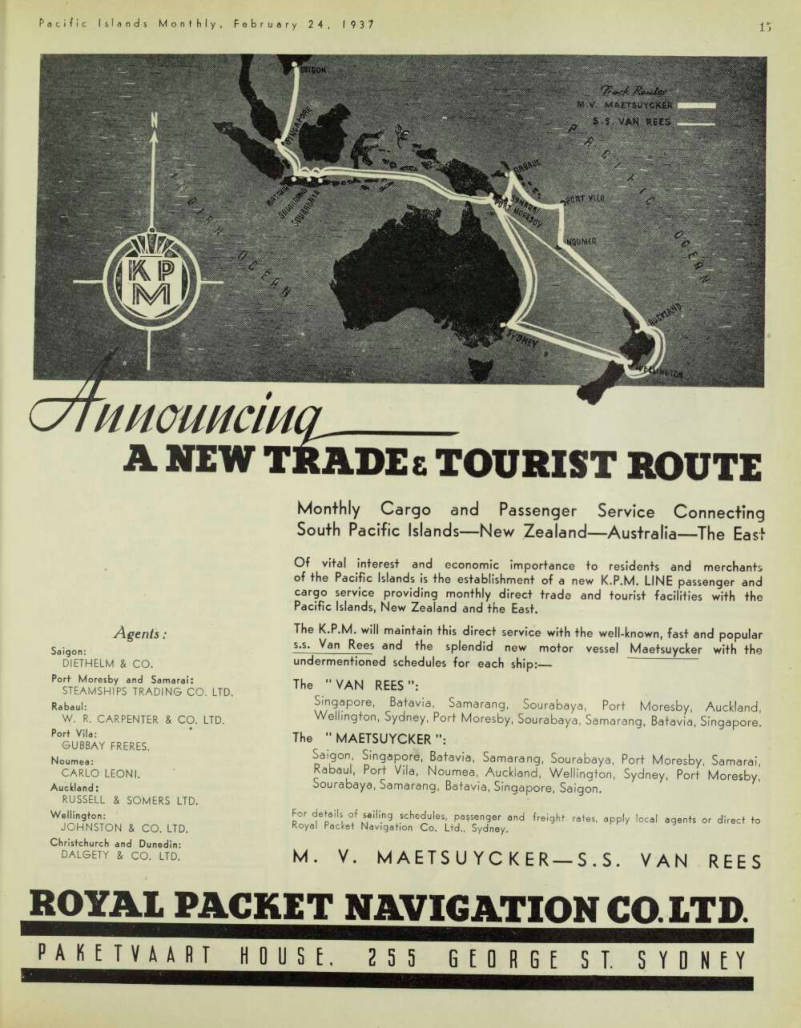
AN addition to the Central Pacific shipping services is announced.
For some years the Royal Packet Navi gation Co. has been running the steamer Van Rees on a schedule by which, after coming southwards from the Dutch East Indies, she visited Port Moresby and Samarai (Papua), Rabaul (New Guinea), Vila (New Hebrides), and Noumea (New Caledonia) and thence to Sydney.
It is now announced that the Van Rees will be joined by another ship—the new motor vessel Maetsuycker, 4000 tons— and the two ships will carry on this ser vice with an extension to New Zealand.
After leaving Noumea, instead of pro ceeding direct to Sydney, they will go to Auckland and Wellington and thence to Sydney. The new service will be known as the South Pacific Line.
The two vessels will commence this service when the Maetsuycker leaves Saigon shortly for the Dutch East Indies —proceeding then to Papua, New Guinea, New Hebrides, New Caledonia, and N.Z. ports, on the new schedule.
The two vessels will carry cargo and passengers on the round trip, but they will not enter the transport trade be tween New Zealand and Australia.
From March onwards the Van Rees and the Maetsuycker will carry on a regular monthly service, so arranged that they will connect at Sydney with the Nieuw Holland and the Nieuw Zee land to give a fortnightly service be tween Sydney and East Indies ports.
Advertisements & other items, p. 6 (1 item)
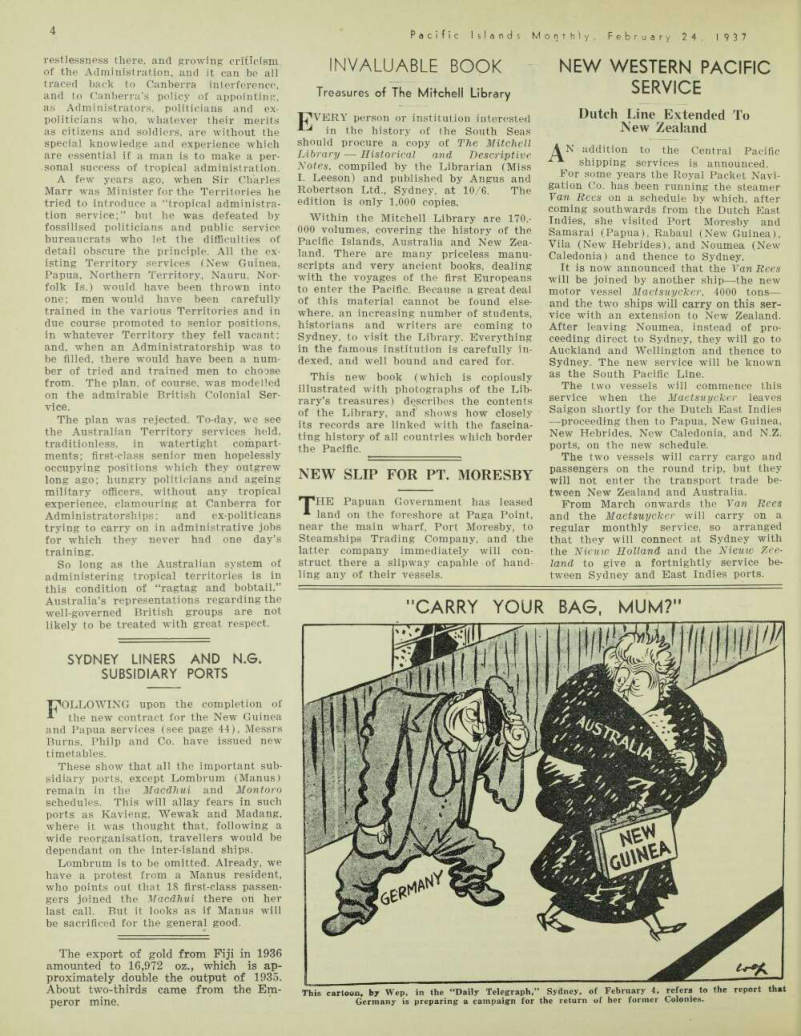
"Carry Your Bag. Mum?"
This cartoon, by Wep, in the “Daily Telegraph,” Sydney, of February 4, refers to the report that Germany is preparing a campaign for the return of her former Colonies.
Mysterious Moves In Central
Pacific
How British and Americans Are Preparing For Trans-Pacific Air Service
THERE has been much mysterious * movement during the month, in con nection with the Pan-American Airways project of an airmail service across the Central Pacific, between Hawaii and Zealand.
It was reported, last month, that a French schooner L'Oiseau des lies, had left Suva early in January with a Pan- American Airways party for an unknown destination—probably to inspect and map islands along the projected airmail route.
On January 25, H.M.S. Leith, a British war-sloop from the New Zealand station, appeared in Suva, received instructions from the Governor of Fiji, took aboard a radio operator and six months’ supplies, and that evening disappeared into the unknown. None of her personnel were given shore-leave. There is no doubt that her mission is connected with the Anglo- American competition for the possession of certain Central Pacific Islands along the projected airmail route.
The radio officer, who joined the Leith, is Mr. A. O. Barrack, a senior man in the service of the Fiji Government. He was given sealed orders to be opened at sea. It was noted that the Leith had a quantity of timber stowed on her decks.
The following other points have been noted: It is reported, but not officially con firmed, that negotiations between New Zealand and Pan-American Airways for provision of a suitable aviation base in Auckland have broken down, and that Pan-American Airways now are seeking
an alternative Central Pacific route to Australia.
Mr. Philipovitch, an engineer repres enting Pan-American Airways arrived in Noumea, New Caledonia, in January and, we believe, is still there. This gives colour to the belief that the P.A.A. route may now be Hawaii —Samoa—Fiji—New Caledonia—Australia. This would give almost a direct route, and would cut out the two long hops from Fiji to New Zealand, and New Zealand to Australia.
British interest in the project is due to the fact that Imperial Airways are determined to have a British service en circling the globe. This means that Im perial Airways flying-boats must soon seek a route from Australia to New Zea land, and thence, via the Central Pacific islands and Hawaii, to North America.
It is probable that the Pan-American Airways hold-up has been caused by New Zealand, acting in co-operation with Whitehall, seeking from the Americans the same facilities regarding Hawaii and the Imperial Airways service, as the Americans want for the P.A.A. service in Auckland. A glance at the map will show that the situation of Hawaii, in relation to North America, is in an air ways sense almost identical with the situation of New Zealand in relation to Australia.
It has been repeatedly but unofficially reported that the P.A.A.’s China Clipper , under Captain Edwin Musick, will make soon an exploratory flight from Hawaii to Auckland.
Future Of New Hebrides
A Move By Australia
TT has been officially announced that at the Imperial Conference in London in May and June Australia will raise the question of the future administration of the New Hebrides.
Details of Australia’s wishes have been kept secret, but it is believed that Aus tralia will press for concessions in trad ing and settlement.
Under the Condominium system (bfteh referred to as the “Pandemonium” sys tem), established in 1906, British inter ests have steadily dwindled in compari son with French interests; but little real progress has been made in the Group for 30 years.
Australia’s main interest in the Group is connected with defence. The position is dealt with in our main article on page three.
Cuthbert’s Mis!ma Goldmine Ltd., has declared an interim dividend of 6d. per
share, payable February 27.
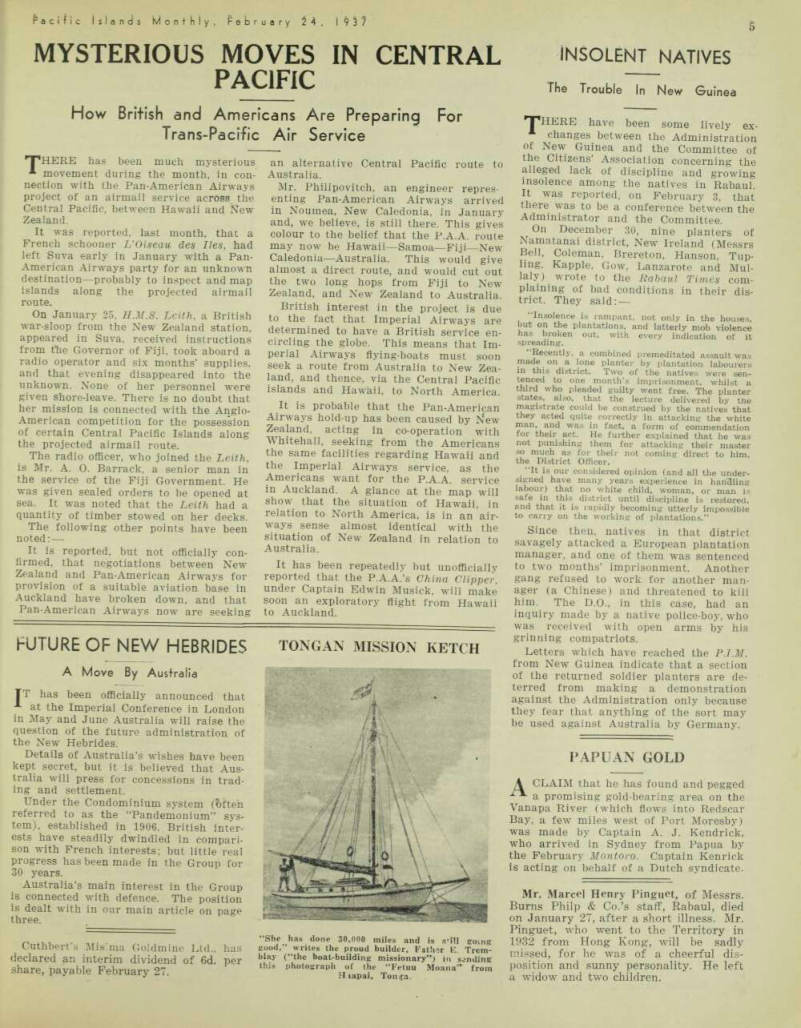
Tongan Mission Ketch
“She has done 30,000 miles and is still going good,” writes the proud builder. Father E. Trem blay (“the boat-building missionary”) in sending this photograph of the “Fetuu Moana" from Haapai, Tonga.
Insolent Natives
The Trouble In New Guinea
THERE have been some lively ex changes between the Administration of New Guinea and the Committee of the Citizens’ Association concerning the alleged lack of discipline and growing insolence among the natives in Rabaul.
It was reported, on February 3, that there was to be a conference between the Administrator and the Committee.
On December 30, nine planters of Namatanai district, New Ireland (Messrs Bell, Coleman, Brereton, Hanson, Tup ling. Kapple, Gow, Lanzarote and Mul laly) wrote to the Rabaul Times com plaining of bad conditions in their dis trict. They said: — ‘‘Insolence is rampant, not only in the houses, but on the plantations, and latterly mob violence has broken out, with every indication of it spreading.
Recently, a combined premeditated assault was made on a lone planter by plantation labourers in this district. Two of the natives were sen fenced to one month’s imprisonment, whilst a third who pleaded guilty went free. The planter states, also, that the lecture delivered by the magistrate could be construed by the natives that they acted quite correctly in attacking the white man, and was in fact, a form of commendation for their act. He further explained that he was not punishing them for attacking their master so much as for their not coming direct to him, the District Officer.
“It is our considered opinion (and all the under signed have many years experience in handling labour) that no white child, woman, or man is safe in this district until discipline is restored, and that it is rapidly becoming utterly impossible to carry on the working of plantations.”
Since then, natives in that district savagely attacked a European plantation manager, and one of them was sentenced to two months’ imprisonment. Another gang refused to work for another man ager (a Chinese) and threatened to kill him. The D.O., in this case, had an inquiry made by a native police-boy, who was received with open arms by his grinning compatriots.
Letters which have reached the P.I.M. from New Guinea indicate that a section of the returned soldier planters are de terred from making a demonstration against the Administration only because they fear that anything of the sort may be used against Australia by Germany.
Papuan Gold
\ CLAIM that he has found and pegged a promising gold-bearing area on the Vanapa River (which flows into Redscar Bay, a few miles west of Port Moresby) was made by Captain A. J. Kendrick, who arrived in Sydney from Papua by the February Montoro. Captain Kenrick is acting on behalf of a Dutch syndicate.
Mr. Marcel Henry Pinguet, of Messrs.
Burns Philp & Co.’s staff, Rabaul, died on January 27, after a short illness. Mr.
Pinguet, who went to the Territory in 1932 from Hong Kong, will be sadly missed, for he was of a cheerful dis position and sunny personality. He left a widow and two children.
Solomon Islands' New
Goldfields Company Floated For Big-Scale Sluicing
THE prospectus of Solomon Islands * Gold Sluicing Limited, which is of fering 200,000 5/- shares to the public, was published on February 17 in Sydney Bulletin and other journals.
The nominal capital of the company is £lOO,OOO in 400,000 5/- shares. 100,000 shares are to be allotted to “the ven dors,” Solomon Islands Gold Develop ment Ltd., and 100,000 are held in reserve. The directors of the new com pany are: Dr. William Wood, Mr. W. N.
Harding (taxation specialist), Mr. A. M.
Turnbull (company director), and Mr.
E. A. Laurence (solicitor), all of Sydney.
This development follows 18 months of intensive investigation by Mr, H. J.
Ault, who will be in charge of the sluic ing operations which are to be under taken immediately by the new company.
If the leases are only half as rich as Mr. Ault says they are, Guadalcanal will be a new Bulolo.
Thus the Solomon Islands at long last are to get their established goldfield. The new company has the earmarks of an efficient organisation, and all that is known of Mr. Ault is good. He is re garded as a real mining man and not a promoter of “wild cats.”
Mr. F. Kajeweski, an Australian botanist, came across gold in the Berande district of Guadalcanal in 1930. Guadal canal Prospecting Syndicate was there upon formed and carried out much pion eering work in trackless jungle. The Syndicate later became Chuba Ltd. and Guadalcanal Ltd.; and then Pioneer Syndicate N.L. vas formed to carry out further investigation. It was then that Mr. Ault came into the picture. The results were very encouraging, and Solo mon Islands Gold Development Ltd. was then formed: and the latter concern has completed the investigation and put the enterprise into shape for selling to Solo mon Islands Gold Sluicing Ltd.
Thus we have a succession of five com panies which presumably are to benefit from the 100,000 vendor shares issued by the new concern. The shareholders in those early companies also have a prior right to buy 40,000 out of the 200.000 ordinaries, before the latter are actually offered to the public.
The new company will operate upon four prospecting licenses, covering about 2,000 acres on the central Sorvohio River, on the large island of Guadal canal. A motor transport road from the coast to the foothills, 14 miles away, has been constructed, and a system of radio communication has been established be tween the various depots on the field and Tulagi. A special system of sluicing to meet local conditions has been
designed.
January output of dry rubber from the Papuan plantations of Koitaki Para Rubber Estates Ltd., was 36,612 lb.
New B.P. Ship
Modern 6000-Tonner To Replace "Montoro"
THOLLOWING ~the completion of con tracts between the Commonwealth Government and Messrs. Burns, Philp and Co. Ltd., for the Western Pacific services, a new motor vessel of about 6,000 tons has been ordered from Bar clay, Curie and Co., of Glasgow.
The vessel will be 390 feet long, with a beam of 56 feet. Passenger accommo dation, including several single and two berth cabins, will provide for 200 first class travellers and 16 second-class.
Special appointments in the ship will in clude a swimming pool, glass-screened promenade deck, and spacious lounge, with radio and motion picture equip ment.
She will be fitted with twin-screw diesel single-acting engines. These will enable her to maintain a service speed of 15 knots.
The construction of the new motorship will be under the supervision of Mr.
W. G. R. Snellgrove, B.P.’s superinten ding engineer, who is already on his way to Scotland to keep a watchful eye on the work, which will take 18 months.
Mr. Snellgrove, who knows from experi ence what tropical boats should be like, supervised the building of the Macdhui and the Malaita.
Xmas Is Not Sunday
£10 Fine For Rabaul Licensees
THE New Guinea hotels may sell liquor between noon and 1 p.m., and 5.30 and 7 p.m., on Sundays.
On Christmas Day, two Rabual hotels naturally opened their doors during the stipulated hours. A third licensee did not open; but, instead, complained to the police.
The two licensees, who opened, were prosecuted. The magistrate said he thought they had acted in ignorance—as was most obvious. But he fined each of them £lO. As Christmas Day is treated as a Sunday in most other licensing sys tems, and as the provision nad clearly been left out of the N.G. Ordinance in error, and as the licensees had acted in good faith, a warning or a very nominal fine should have sufficed. £lO, presumably, was the minimum fine provided for.
However, if this kind of asinine f hing did not happen frequently in New Guinea the place would lose its atmosphere and reputation.
Articles Held Over
ARTICLES of interest, unavoidably held over until March issue include: “Blood of the Shark”—A review of a fascinating new book. See advt. on page 23 Japanese poachers in Arafura Sea arrested by Dutch.
The lack of European hotel or boarding house at Tulagi is causing serious em barrassment in the Solomons.
Mr. Jack Hides
THE prospecting party, equipped by 1 Investors-Ltd., of Sydney, and led by Mr. Jack Hides, left Port Moresby for the Fly River region, Western Papua, on the Royal Endeavour on February 7.
Mr Hides recruited some first-class men as carriers, etc., in the Samarai district, and no expense has been spared regard ing equipment. He is accompanied by Mr. D. Lyall, a young miner who is well known in the Edie Creek district.
Increase In Price Of "Pacific Is
"Pacific Is. Monthly"
/COMMENCING with the next (March) issue, the price of the Pacific Islands Monthly will be:
Within British Empire:
Single copies ... Bd.
Per annum (including postage) 87-
Outside British Empire:
Per annum (including postage) 10/- The chief reason for the increase in price is the high postage rate charged in Australia, which is about double that charged in other countries. The cost of postage on individual copies of the formerly Id, is now 2d per copy when addressed to places within the British Dominions; and no less than 4d per copy to subscribers in non-British
countries, such as U.S.A., Hawaii, and
the colonies of France.
As we thus are faced with a small average loss on each copy distributed, and as the circu lation of the P.I.M. (nearly all distributed by post) is increasing steadily, month by month, we ha\ e been compelled to increase the price.
We make this change with reluctance; and, so that ample notice may be given, readers are advised that they may subscribe, for one year in advance, at the old rates, until the publication ot the March issue. We shall accept subscriptions, at the old rates, provided the envelopes bear postmarks not later than March 25. After that, the new rates must apply.
Readers will note that, commencing with this issue, a larger type and a heavier and costlier paper have been introduced. It is our object to make the P.I.M. worthily represent the large and growing Territories of the South and Central Pacific.
Wrapper!
Look on the Front of Your Wrapper!
The figures stamped there (if any) show the date when your subscription expires. This date will appear on wrappers of three issues preceding ex piration, thereby giving 3 months’ notice.
If, at the end of that time, we have not been instructed to continue to send the journal to you, it will be discontinued.
Your subscription (6/- per annum, or 8/- in the case of countries outside the British Empire—which includes postage) may be sent direct, or may be paid to any of our agents (listed on page 3).
Postage Rates
The postage required for this issue is:— To Australia and New Zealand 2d To United Kingdom via All-sea route 2d To United Kingdom via France 2d To other British Possessions - 2d To U.S.A. and Foreign Countries 4tl
Pacific Publications Ltd.,
Union House, 247 George St., Sydney
In The Grip Of
The Mau
Amusing Disclosures In W. Samoa
TTHERE has been an amusing news * paper war in Western Samoa.
A Mr. F. Godinet was active in form ing ‘‘the Labour Party of Western Samoa,” which came hurriedly into exis tence when it was known that the N.Z.
Labour Government was to send a “good will mission.” Its banner was very pro minent at the mission’s official landing.
Some time ago, Mr. Godinet wrote to a Mr. Slipper, in Auckland, describing the new conditions created in Samoa by the “goodwill mission.” Mr. Slipper un expectedly sent the letter to the Prime Minister, and the letter was published in a Labour journal. It was copied into the Western Samoa Mail, on January 9, and caused a sensation. Mr. Godinet, inter alia, said: “Mr. Turnbull, the Acting-Administrator, is now referring everything to the Mau.”
“Yesterday Tamasese and Ainu’u (representing Mau) commenced overseeing the official inspec tion of export bananas on the wharf. They were not there so much to inspect the bananas as to see if Mr. Newton, agricultural inspector, was doing his job rightly.”
“I believe the police department will be re organised again and that the European police, including the present inspector, will be dispensed with and their places filled with Samoans.”
“The Chinese labour question does upset the planters, and they come to us (Labour Party) and the Mau asking for support . . . These damned planters have been running the country long enough.”
“May God bless Mr. Savage and his (Labour) Party. May God spare their lives so that they may remain rulers of N.Z. for the rest of their lifetime.”
The reference to the planters naturally stirred up the Planters’ Association, and the secretary (Mr. A. M. Gurau) wrote to the Samoa Mail of January 16, and described Mr. Godinet’s letter as “an astounding product of an uneducated and mischievous mind,” and a “tissue of malicious lies.” Mr. Gurau declared that his Association never at any time sought the support of the Mau or the Labour Party. He described what “the damned planters” have done for Western Samoa; and he referred to Mr. Godinet and his friends as a “handful of trouble mongers.”
On January 23, Mr. Godinet, in a long letter, demanded public apologies from Mr. Gurau, the Samoa Mail, and the Planters’ Association, otherwise he would take legal proceedings for libel.
The reply of the persons concerned was “Go your hardest!” or words to that effect.
Meet Mr. Leron!
THE Daily Telegraph, of Sydney, is responsible for the statement that “A. Leron, a river native, has been ar rested on suspicion of the murder of Patrol-Officer Hough!”
It appears that a native from the Leron River, where Mr. Hough was fat ally wounded by an arrow in his lung, has been arrested and taken to Salamaua.
Air Companies To
Protest
Bureaucrats Specify Dangerous Cape York Route To Dodge 450 Miles Water-Hop
A VIATION interests are preparing their tenders (which close on March 31) for the new Sydney—New Guinea air service, but present indications are that the conditions imposed by the Federal Government are viewed by prac tical airmen with no enthusiasm.
The trouble lies in the route which has been stipulated—namely, up the eastern coast of Australia to Cape York, across to Western Papua and thence across the Central Papua jungles and the Central New Guinea mountains to Wau.
This route has been stubbornly insisted upon by the Federal authority, as against the usual route, by which aeroplanes leave the Australian coast near Cook town and hop off across 450 miles of open sea to the coast of Papua near Port Moresby.
This latter route represents an almost straight line from Sydney to Wau and Lae, taking in Port Moresby. But for some reason the civil aviation gentlemen in Australia got an attack of the horrors whenever they contemplated that water hop, and so they plan to send the mail carrying aeroplanes round by Cape York.
They apparently are quite ignorant of the prevailing weather conditions be tween Cape York and Wau, otherwise they would have preferred the direct route and the water-hop. From Cape York across Torres Strait and through western and central Papua to Wau there are very few emergency landing-grounds; little or no white settlement; incredible stretches of wild tropical jungle; and a rainfall belt where the rain registration is phenomenal. Any man who knows the country will say that the Cape York — Western Papua route, with its prevailing misty and rainy weather, and its absence of landing grounds, is much more dan gerous for aeroplanes, than the direct route via Cooktown and Port Moresby.
Every aeroplane of any size, which has flown between Australia and New Guinea, has used the direct route and the water hop without accident. The Anglo-Austra lian airmail machines have been flying over a wider expanse of sea between Timor and Darwin for a long time now, without mishap.
Indications are that prospective ten derers for the Sydney—New Guinea air mail service will protest very strongly against the route which the Federal Government is trying to force upon them.
The people of Papua (who, of course, will get no direct benefit from the ser vice as planned by the Federal Govern ment) are also making a strong protest.
Mr. C. T. Wurth, Commissioner for
Lands in Papua, accompanied by Mrs.
and Miss Wurth, arrived in Australia by the Macdhui in January.
Copra
Market Does a Jazz Turn
THE copra market has been engaged in a most interesting jazz during recent weeks.
From the end of October to mid-Janu ary it rose nearly £lO per ton. The ris:' from mid-December to mid-January was sensational—about £3 per ton.
The rise was due to a variety of causes —namely, world-wide economic recovery, an increasing demand for war material, the dislocation of the olive-oil industry by Mediterranean events, an apparent future shortage of animal and vegetable oils in America, and the abandonment of the gold standard by France and Italy.
Then, in mid-January, the price jazzed the other way, and fell £4 within three weeks. Detailed figures will be seen on page 77.
Reasons for the decline are generally vague—“a settling-down of the market,” said the experts. But one important factor had developed. Radio advices from the numerous whaling expeditions in the Antarctic indicated an exception ally good catch —an unknown but very large quantity of whale oil is due in the northern hemisphere within the next three or four months. Copra buyers used this fact with great gusto in ham mering down the market.
No one is depressed, however. All copra interests are certain that the price will settle down at between £lB and £2O per ton, c.i.f., London and, at that rate, coconut growers in the South Seas can carry on comfortably.
Bulolo's No. 5 Dredge Delayed
By Strike
effect of the Pacific coast mari time strike in America has been a delay in the completion of Bulolo Gold Dredging Ltd.’s No. 5 dredge. This is the first of the two deep-digging dredges designed to reach the rich lower levels discovered under the present dredging area, in New Guinea.
Instead of being shipped from San Francisco, the bulk of the parts for the new dredge were sent to Vancourver and put on the motor vessel Noumea, due in New Guinea about the middle of March.
Other material, sent from New York, will travel via the Panama Canal and
Sydney.
Originally, it had been expected that this huge dredge would be operating by the end of July. Now, it is hoped that it will be assembled by about the begin ning of September. As with the com pany’s other four dredges, the parts are being freighted in to Bulolo by Guinea Airways from their headquarters at Lae.
No. 5 dredge will dig to a depth of 80ft. below water level and will carry a bank of 40ft., giving a total digging depth of 120 ft. It was so designed that the largest piece (the tumbler shaft) to be carried in by air would not weigh more than 3J tons. The completed dredge will weigh 1,500 tens.
Australia
Guinea Airways Extend To
New Continental Services Started With Surplus Plant From New Guinea
AN announcement on February 15 that Guinea Airways’ Lockheed Electra aeroplane had arrived in Darwin the previous day, to inaugurate a new weekly service between Adelaide and Darwin, caused surpirse. It was the first intima tion that Australia had had that the big New Guinea transport company had ex tended its operations to the mainland.
It is a development that has been under consideration by Guinea Airways Ltd. for a long time, however.
Transport conditions on the New Guinea goldfield, in a sense, have flat tened out. The period during which huge quantities of machinery, building mater ial, food, etc., had to be taken in, is ended. The present mining period is one of operation, and fewer aeroplanes can take care of the transport. In conse quence, Guinea Airways found itself with a lot of surplus plant on its hands.
The decision to start the Adelaide to Darwin service was taken some time ago; but, on account of the intense competi tion in this new aviation industry, the decision was kept secret Another Lockheed will arrive shortly.
It was ordered from U.S.A. many months ago, but was held up by the strike. Two Ford aeroplanes—mostv excellent and re liable general utility machines—are com ing from New Guinea to be used in the new services based on Adelaide.
It is understood that there will be a weekly service, both ways, between Ade laide and Darwin, with calls at Central Australian places, like Alice Springs and Tennant’s Creek; and that <:here will also be a new direct service between Adelaide and Sydney. It is known that these pos sibilities are being energetically ex plored; but the main difficulty seems to be that of finding suitable and safe land ing grounds.
Guinea Airways are anxious that it should not be thought that they are with drawing from New Guinea. They em phasise the point that they'still have in the Territory ample plant, on both the
flying and the workshop side, to take care of all requirements there.
EDITORIAL NOTE.—It is'a matter for great regret that, owing to the New Guinea Administration’s inertia and lack of a comprehensive development policy, the full resources ,of Guinea Air ways Limited are not being used for the opening up of the Territory. It has been urged, in season and out, in this journal, that the rich gold industry (the happiest accident in the history of New Guinea) should be used to develop the agricultural and pastoral resources of the Territory.
Transport is vital to development. The gold industry is rich enough to maintain the highly efficient but expensive aviation services. An Administration with any vision would have used those aviation services (already established) for the development of the whole of the Terri tory.
The present Administration seems to have made no plans along those lines.
Its most noteworthy recent achievement is a squabble with the aviation compan ies concerning the relative merits of the Lae and Salamaua aerodromes—in the course of which a very prominent offi cial made rather an exhibition of him self. It appears that he had chartered the Guinea Airways Lockheed to bring him to Sydney in a hurry; but, because Guinea Airways would not risk thffir valuable new machine on Salamaua ’drome—which is notoriously a dirty and dangerous ’drome—the gentleman be came peeved, cancelled the charter, and travelled in a small and slower aero plane.
This is typical of the Administration.
Prominent officials apparently consider it much more important to make full use of a chance to “cock a snook” at Guinea Airways, than to make use of that suc cessful aviation company’s wide experi ence and magnificent equipment in de veloping New Guinea quickly for the good of Australian commerce and the credit of the Australian people.
Hebrides
Ketch Burned In New
'The trading ketch Enomis, owned by 1 M. Marinace, of the New Hebrides, caught fire in January as a result of flames reaching the carburetter, and was destroyed. Commanded by M. Dubain, she was five miles from Pt. Sandwich, Malekula, on her way from Ambrym, when the blaze occurred.
Two passengers, M. Goodgne and M.
Montaigne, were burnt slightly by the flames. A large sum in English and money, and a quantity of merchandise, were destroyed.
Planters Honour Their Leader
From Our Own Correspondent
Rabaul, Feb. 3.
jl/TEMBERS of the Planters’ Association A A gathered in Kavieng in December to show their appreciation of the ser vices of Hon. W. E. Grose. M.L.C.
Mr. Chadderton made a presentation to Mr. Grose and, in a happy speech, recounted many of Mr. Grose’s innumer able services to the planting community.
All those present supported Mr. Chadder ton’s remarks, and warmly praised the unremitting work of their leader.
Fear Of Epidemic
Calm Fiji and Panicky Samoa
From Our Own Correspondent
Apia, Jan. 24.
LJIGID quarantine regulations, which AV mean that passengers and crew may not laud at all, are still being enforced against all vessels from ports in New Zealand (where there is an epidemic of infantile paralysis). Cargo is being handled. Mails are fumigated for three hours.
SUVA, Feb.ls.
Children from N.Z. ports, 16 and under, may land here, under surveillance.
Children booked through to North Amer ica are expected to remain aboard the ships. There is no restriction on the movements of adults.
Japanese Trader In Rabaul
VIfHEN M. Toyama arrived in Rabaul, 11 T.N.G., recently, and began to trade as a “commercial traveller,” no official objection was raised. He was entitled to remain there, and trade, for six months.
But when M. Toyama affixed to his door a sign, “Branch store of Nanyl Boyeki Kaishi, Ltd., of Tokio,” and began to buy copra for shipment by a Japanese steamer, coming in via the Caroline Is lands (Japanese mandate), and prepared to sell goods from Japan, there was a stir.
No company can locate itself in New Guinea, and operate there, unless 75 per cent of its capital is British. It appears as if M. Toyama has found a breach in the law. Canberra now is giving the matter its serious attention.
We cannot ignore the insistent south wards thrust of Japan. Once let these isolated traders become established, and the whole of these islands soon will be come Japanese. No European trader can settle in the Marshall and Caroline Is lands, where Japan rules.
Japanese Poachers In
New Guinea
From Our Own Correspondent
Rabaul, Feb. 3.
JAPANESE shell poachers are again actively engaged in denuding our reefs of trochus shell.
They are carrying out operations in the outlying groups of Tasman and Mort lock, which are situated north-east of Bougainville.
A schooner, believed to be the Kiyoo Maru, arrived from Ontong Java (Solo mon Islands) and anchored in an iso lated part of the Tasman Group, where the Japanese commenced operations.
Later they moved to the Mortlock Group.
The B.P. steamer Morinda , on her re turn voyage from the New Hebrides in February, was delayed at Norfolk Island by a cyclone. As a result, 50 tourists were stranded on Lord Howe Island.
Some returned to Australia by the Tai ping. visiting Lord Howe on a cruise.
N.G.G. Shareholders Ask Many Questions
Chairman Blames Administration For Absence of Dividends
r PHE annual meeting of New Guinea Goldfields Ltd. was held in Sydney on February 11, It was preceded and ac companied by rumblings indicating un rest and unhappiness.
Two directors, Major Harrison and Mr A. M, Hemsley, resigned in January, and Senator Foil and Mr. Norman Cowper were appointed in their places.
A few days later, the chairman of the Company, Mr. J. P. Blaikie Webster, dis tributed the director’s annual report for the year ended September 30. It showed that the profit for the year, compared with other years, was £113,303, as follows:
The chairman, for the second year in succession, announced that there would be no dividend.
Shareholders went along to the meet ing with bitter memories of the events of the last seven years, within which the capital has been expanded to £4,472,332, by the issue of fully paid up shares in the purchase of all sorts and conditions of leases; and then written down to £1,118,083.
The chairman (Mr. Webster) was a harassed man before the termination of the proceedings. Ranged before the direc torial table were some 60 shareholders, and amongst them were many who had come to ask pointed questions.
The chairman’s long, and apparently, very complete report, was criticised, as “dealing largely with generalities, and deficient in definite information relating to proposed capital expenditure and pos sible earning to result therefrom.”
Under the bombardment of questions, the chairman stood his ground well, and was able in many instances to amplify and explain matters referred to in his report. He was given opportunities, of which he took full advantage, to voice his several grievances against the Administration The climax came in a determined at tempt to defeat the usual motion, pro posed and seconded by members of the Board, for the adoption of the accounts.
Advocates of a poll only abandoned their attack when it was revealed that the chairman held proxies on behalf of hol ders of 300,000 shares, and was the reg istered holder of a further 80,000 in his own name. Faced with this heavy artil lery, the opposition collapsed.
Regarding the unanimous recommen dation of the Board, that no dividend be paid, the chairman drew attention to the circumstance that during the past two years capital expenditure has actu ally slightly exceeded the amount of pro fits earned. Up to a few months ago, he had hoped that some distribution might be made; but. with the probability of
the company having to undertake the equipment of the Wau—Bulolo Alluvials and the alterations to Golden Ridges Mill, he since had realised that this would be most inadvisable.
Sharp Criticism
For a time proceedings became some what noisy and the Board had perforce to sit and listen to a running fire of commentary interspersed with remarks such as, “fiddling about like a pack of old women;” “the company is becoming a miniature civil service, with dead heads and unnecessary officials living on it;” “the mining industry is being bur dened with professional directors who are as bad as the professional politici ans;” and “what about a new board?”
Questions as to why, in view of the chairman’s statements, the company did not have aeroplanes of its own, and the amount of directors’ travelling and other expenses included in the admini strative expense item of £12,049, re mained unanswered.
The Alluvials
The announcement that the company’s alluvial areas on the Edie are almost worked out came as no surprise to those who have kept in touch with its operations. Shareholders showed more concern about the Wau property,, now in pros pecting stage, and about the Bulolo section, where in the past the company spent a great amount of money, and was reported to have proved over
a million cubic yards of gravels worth 4/- per yard.
In explanation, the chairman pointed out that the Bulolo property is being allowed to be dor mant until such time as developments at Wau enable Mr. E. A. Lang, the expert in charge of these operations, to report upon the possibility of working both properties under one compre hensive scheme.
Concerning the Wau alluvials he explained that prospecting is now proceeding by means of shafts and drives on an area shown by keystone drilling to extend for 1700 feet in length by 650 feet in width. So far, the deepest shaft (180 feet) had reyealed average values of 31$d. per yard, this being a considerable improvement on those shown by the drill : while a second shaft (down 110 feet) gave values of 20d. per yard, or slightly less than the figure arrived at by boring tests. Mr. Lang would not be in a position to complete this report for a further four months, when shareholders would be notified immediately at to the results and the board’s intentions. To equip such a show would mean heavy capital outlay.
Upper Ridges
The ore deposits at Golden Ridges being now virtually exhausted, the chairman explained that the mill may have to be adapted, by the pro vision of additional plant, to treat ore from Upper Ridges, probably by a flotation process, this ore having different characteristics to that for which the mill was originally designed. Pros pecting at Upper Ridges is proceeding by means of diamond drilling and underground work, five holes at intervals of 100 feet having revealed ore deposits up to 18 feet wide, averaging 7 dwts. per ton. Ore of lower grade, said Mr. Webster, is being successfully treated at Wiluna and at the Big Bell mine at Cue, W.A. ; and 7 dwts. would be highly profitable to the company but, for local conditions, most detrimental of which is the heavy percentage exacted by the Admini stration.
Disabilities Alleged
Throughout the chairman’s speech, and in the subsequent questioning, there were continually recurring references to the “disabilities” under
(Continued on page 73)
Year ending Distributed to September 30 Net Profit Shareholders 1932 ... — £84,906 — 1933 £130,279 £164,640 1934 ..._ £180,090 £171,362 1935 £152,020 — 1936 £113,303 — £660,598 £336,002
which the company is operating, and among these precedence might be accorded to the heavy taxa tion and hampering regulations imposed by the N.G. Administration.
In 1928, said the chairman, the Administration undertook the work of constructing a road to the Edie Plateau, and, to provide funds, it raised the gold royalty from one per cent to five per cent. Subsequently construction of the road was abandoned but the five per cent royalty remained.
This, together with the 10 per cent impost on mining machinery, had up to date cost the company £200,000. Overtures by the board, seek ing a refund of the over-paid four per cent royalty, together with permission to complete the road itself, had been unsuccessful, as also had all appeals to the Federal Government for more equitable treatment. Through the absence of access by road the enterprise had paiu away in aerial freights approximately £200,000 that would otherwise have gone into profits, and the company continued to be so penalised to the extent of £20,000 per annum.
Including the heavy imposts of the Government, the cost of mining and treating ore on the field was not less than 50/- per ton, a figure which rendered 7dwt. stone unprofitable, said the chair man. It had for some time been realised that the company might be obliged to curtail operations in order to conserve its ore reserves until condi tions are altered, as some 40 per cent of the developed ore is of lower value than 7dwts. and obviously it was of no benefit to shareholders to continue producing gold merely to hand over the entire profit to the Administration.
A further cause for anxiety was the hamper ing regulations, introduced since the company started operations, relating to native labour. For example, the prospecting at Wau had been de layed through an edict preventing trained native miners working the hoists. White labour had to be employed instead and, during the year, had proved in some instances both expensive and troublesome. When trouble of this kind occurred no help was obtainable from the Administration, and its effect upon the native workmen was very serious. On one occasion, when the company sought to bring in trained native miners from Papua, officials imposed on them a dictation test, the object of excluding them from the Territory. Fortunately this was ultimately set right. Native labourers cost the company from £4B to £5O per year, and many of them, under conditions existing on the company’s property, became highly intelligent, skilled miners. Ham pering red-tape, however, prevented them from being employed in many directions, where their employment would be quite permissible in other parts of the Empire—the Rand, for example.
Amidst the gloom appeared one bright ray when the chairman guardedly hinted that certain mat ters were developing, and the position of the enterprise would be very different if taxation was assessed on profits instead of on gold pro duced as at present.
London .Conspiracy!
A shareholder electrified the meeting
by informing it that he had information from a “London mining magnate” that there would be no dividends from New Guinea Goldfield Ltd. until a syndicate now operating in London had secured the bulk of the shares at its own price.
With this in view the syndicate Would “bear” the shares until its objective is attained. He asserted that his informant was too important a person in the min ing world to spin idle yarns, and for that reason he wanted the board and the shareholders present to hear the story.
The tale was, of course, laughed aside; but its recital brought forth the infor mation that 80 per cent of the shares are on London register, there having been no appreciable alteration in the Australian/English proportions during the past three years.
The retiring directors, Senator H. S.
Foil and Mr. D. P. Mitchell, were elected unopposed.
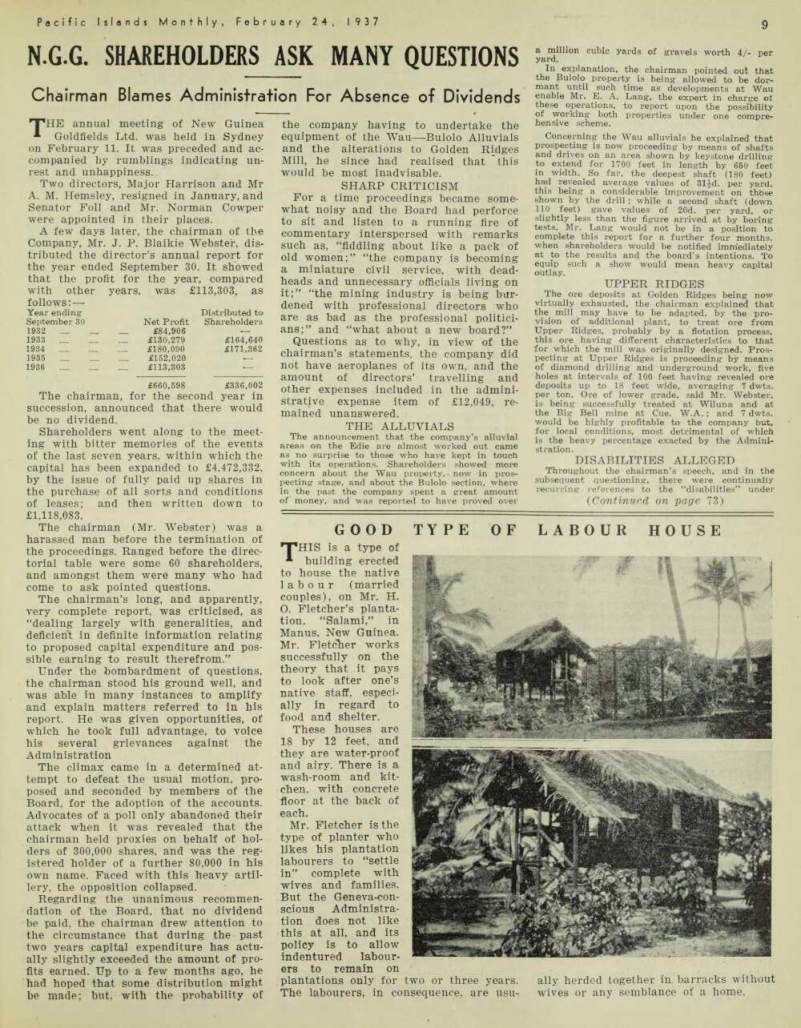
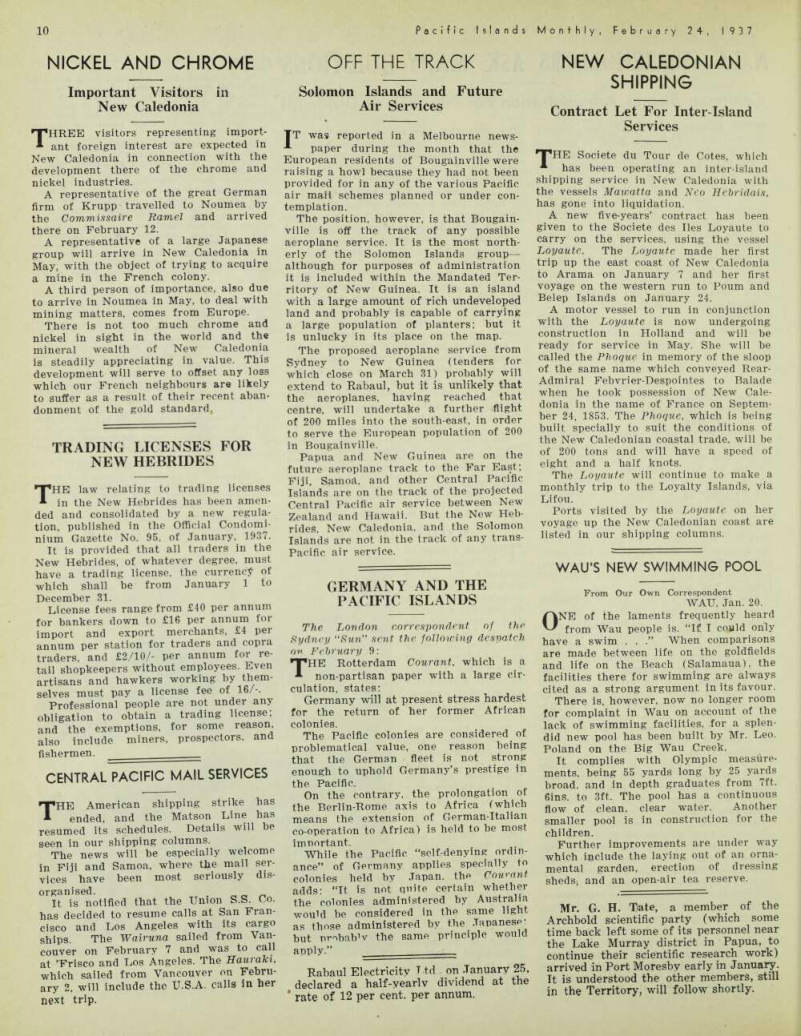
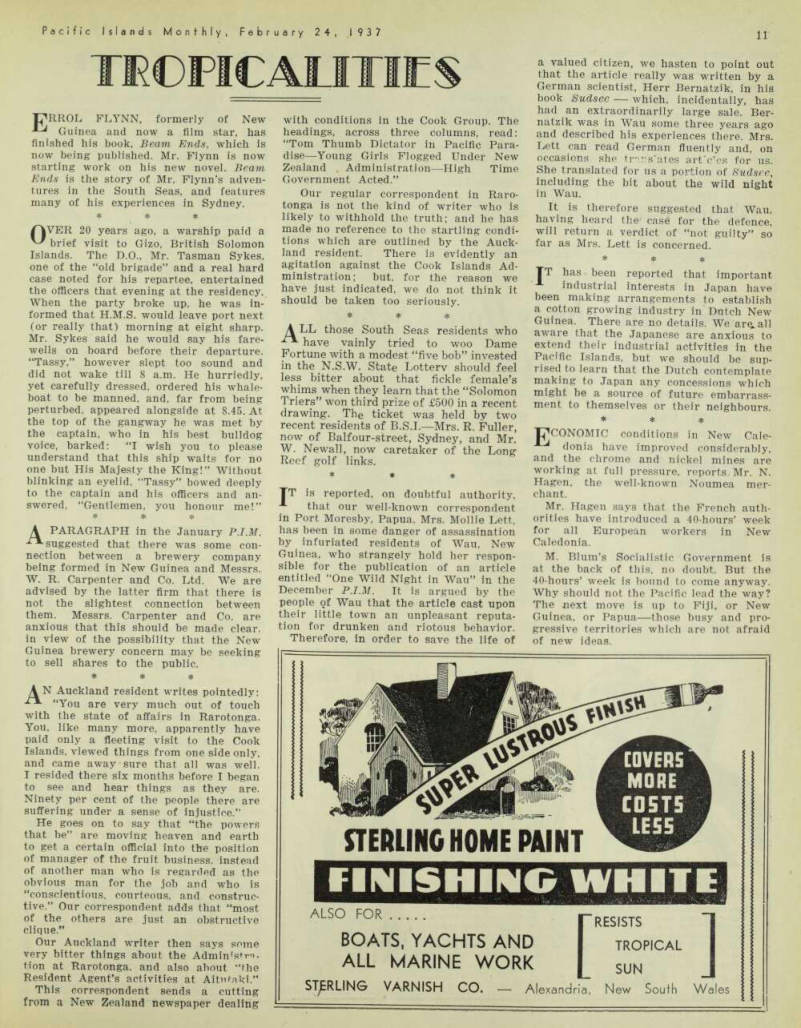
Good Type Of Labour House
is a type of building erected to house the native labour (married couples), on Mr. H. 0. Fletcher’s planta tion, “Salami,” in Manus, New Guinea.
Mr. Fletcher works successfully on the theory that it pays to look after one’s native staff, especi ally in regard to food and shelter.
These houses are 18 by 12 feet, and they are water-proof and airy. There is a wash-room and kit chen, with concrete floor at the back of each.
Mr. Fletcher is the type of planter who likes his plantation labourers to “settle in” complete with wives and families.
But the Geneva-con scious Administra tion does not like this at all, and its policy is to allow indentured labour ers to remain on
plantations only for two or three years.
The labourers, in consequence, are usu
ally herded together in barracks without wives or any semblance of a home.
Nickel And Chrome
Important Visitors in New Caledonia
THREE visitors representing import ant foreign interest are expected in New Caledonia in connection with the development there of the chrome and nickel industries.
A representative of the great German firm of Krupp travelled to Noumea by the Commissaire Ramel and arrived there on February 12.
A representative of a large Japanese group will arrive in New Caledonia in May, with the object of trying to acquire a mine in the French colony.
A third person of importance, also due to arrive in Noumea in May, to deal with mining matters, comes from Europe.
There is not too much chrome and nickel in sight in the world and the mineral wealth of New Caledonia is steadily appreciating in value. This development will serve to offset any loss which our French neighbours are likely to suffer as a result of their recent aban donment of the gold standard.
Trading Licenses For
New Hebrides
THE law relating to trading licenses in the New Hebrides has been amen ded and consolidated by a new regula tion, published in the Official Condomi nium Gazette No. 95, of January. 1937.
It is provided that all traders in the New Hebrides, of whatever degree, must have a trading license, the currency of which shall be from January 1 to December 31.
License fees range from £4O per annum for bankers down to £l6 per annum for import and export merchants, £4 per annum per station for traders and copra traders, and £2/10/- per annum for re tail shopkeepers without employees. Even artisans and hawkers working by them selves must pay a license fee of 16/-.
Professional people are not under any obligation to obtain a trading license; and the exemptions, for some reason also include miners, prospectors, and fishermen.
Central Pacific Mail Services
THE American shipping strike has ended, and the Matson Line has resumed its schedules. Details will be seen in our shipping columns.
The news will be especially welcome in Fiji and Samoa, where the mail ser vices have been most seriously dis organised. . „ It is notified that the Union S.S. Co. has decided to resume calls at San Fran cisco and Los Angeles with its cargo ships. The Wairuna sailed from Van couver on February 7 and was to call at ’Frisco and Los Angeles. The Hauraki, which sailed from Vancouver on Febru ary 2, will include the U.S.A. calls in her
next trip.
Off The Track
Solomon Islands and Future Air Services
TT was reported in a Melbourne news * paper during the month that the European residents of Bougainville were raising a howl because they had not been provided for in any of the various Pacific air mail schemes planned or under con templation.
The position, however, is that Bougain ville is off the track of any possible aeroplane service. It is the most north erly of the Solomon Islands group— although for purposes of administration it is included within the Mandated Ter ritory of New Guinea. It is an island with a large amount of rich undeveloped land and probably is capable of carrying a large population of planters; but it is unlucky in its place on the map.
The proposed aeroplane service from Sydney to New Guinea (tenders for which close on March 31) probably will extend to Rabaul, but it is unlikely that the aeroplanes, having reached that centre, will undertake a further flight of 200 miles into the south-east, in order to serve the European population of 200 in Bougainville.
Papua and New Guinea are on the future aeroplane track to the Far East; Fiji, Samoa, and other Central Pacific Islands are on the track of the projected Central Pacific air service between New Zealand and Hawaii. But the New Heb rides, New Caledonia, and the Solomon Islands are not in the track of any trans pacific air service.
Germany And The
Pacific Islands
The London correspondent of the Sydney “Sun” sent the following despatch on February 9; THE Rotterdam Courant, which is a non-partisan paper with a large cir culation, states: Germany will at present stress hardest for the return of her former African colonies.
The Pacific colonies are considered of problematical value, one reason being that the German fleet is not strong enough to uphold Germany’s prestige in the Pacific.
On the contrary, the prolongation of the Berlin-Rome axis to Africa (which means the extension of German-Italian co-operation to Africa) is held to be most imnortant.
While the Pacific “self-denying ordin ance” of Germany applies specially to colonies held by Japan, the Courant adds: “It is not quite certain whether the colonies administered by Australia would be considered in the same light as those administered by the Japanese but nrobabW the same principle would apply.” === Rabaul Electricity Ltd- on January 25, declared a half-yearly dividend at the * rate of 12 per cent, per annum,
New Caledonian
Shipping
Contract Let For Inter-Island Services
THE Societe du Tour de Cotes, which * has been operating an inter-island shipping service in New Caledonia with the vessels Mawatta and Neo Hebridais, has gone into liquidation.
A new five-years’ contract has been given to the Societe des lies Loyaute to carry on the services, using the vessel Loyaute. The Loyaute made her first trip up the east coast of New Caledonia to Arama on January 7 and her first voyage on the western run to Poum and Belep Islands on January 24, A motor vessel to run in conjunction with the Loyaute is now undergoing construction in Holland and will be ready for service in May. She will be called the Phoque in memory of the sloop of the same name which conveyed Rear- Admiral Febvrier-Despointes to Balade when he took possession of New Cale donia in the name of France on Septem ber 24, 1853. The Phoque, which is being built specially to suit the conditions of the New Caledonian coastal trade, will be of 200 tons and will have a speed of eight and a half knots.
The Loyaute will continue to make a monthly trip to the Loyalty Islands, via Lifou.
Ports visited by the Loyaute on her voyage up the New Caledonian coast are listed in our shipping columns.
Wau's New Swimming Pool
From Our Own Correspondent WAU, Jan. 20.
ONE of the laments frequently heard from Wau people is. “If I could only have a swim . . When comparisons are made between life on the goldfields and life on the Beach (Salamaua), the facilities there for swimming are always cited as a strong argument in its favour.
There is, however, now no longer room for complaint in Wau on account of the lack of swimming facilities, for a splen did new pool has been built by Mr. Leo.
Poland on the Big Wau Creek.
It complies with Olympic measure ments, being 55 yards long by 25 yards broad, and in depth graduates from 7ft.
Bins, to 3ft. The pool has a continuous flow of clean, clear water. Another smaller pool is in construction for the children.
Further improvements are under way which include the laying out of an orna mental garden, erection of dressing sheds, and an open-air tea reserve.
Mr. G. H. T/ate, a member of the Archbold scientific party (which some time back left some of its personnel near the Lake Murray district in Papua, to continue their scientific research work) arrived in Port Moresby early in January.
It is understood the other members, still in the Territory, will follow shortly.
Tropicalities
FLYNN, formerly of New Guinea and now a film star, has finished his book, Beam Ends, which is now being published. Mr. Flynn is now starting work on his new novel. Beam Ends is the story of Mr. Flynn’s adven tures in the South Seas, and features many of his experiences in Sydney. * * * /AVER 20 years ago, a warship paid a brief visit to Gizo, British Solomon Islands. The D. 0., Mr. Tasman Sykes, one of the “old brigade” and a real hard case noted for his repartee, entertained the officers that evening at the residency.
When the party broke up, he was in formed that H.M.S. would leave port next (or really that) morning at eight sharp.
Mr. Sykes said he would say his fare wells on board before their departure.
“Tassy,” however slept too sound and did not wake till 8 a.m. He hurriedly, yet carefully dressed, ordered his whale boat to be manned, and, far from being perturbed, appeared alongside at 8.45. At the top of the gangway he was met by the captain, who in his best bulldog voice, barked: “I wish you to please understand that this ship waits for no one but His Majesty the King!” Without blinking an eyelid. “Tassy” bowed deeply to the captain and his officers and an swered, “Gentlemen, you honour me!” * * * A PARAGRAPH in the January P.I.M. that there was some con nection between a brewery company being formed in New Guinea and Messrs.
W. R. Carpenter and Co. Ltd. We are advised by the latter firm that there is not the slightest connection between them. Messrs. Carpenter and Co. are anxious that this should be made clear, in view of the possibility that the New Guinea brewery concern may be seeking to sell shares to the public. * * * AN Auckland resident writes pointedly: “You are very much out of touch with the state of affairs in Rarotonga.
You, like many more, apparently have paid only a fleeting visit to the Cook Islands, viewed things from one side only, and came away sure that all was well.
I resided there six months before I began to see and hear things as they are.
Ninety per cent of the people there are suffering under a sense of injustice.”
He goes on to say that “the powers that be” are moving heaven and earth to get a certain official into the position of manager of the fruit business, instead of another man who is regarded as the obvious man for the job and who is “conscientious, courteous, and construc tive.” Our correspondent adds that “most of the others are just an obstructive clique.”
Our Auckland writer then says some very bitter things about the Admims*r*. tion at Rarotonga, and also about “Hie Resident Agent’s activities at Aitutaki.”
This correspondent sends a cutting from a New Zealand newspaper dealing
with conditions in the Cook Group. The headings, across three columns, read: “Tom Thumb Dictator in Pacific Para dise —Young Girls Flogged Under New Zealand Administration—High Time Government Acted.”
Our regular correspondent in Raro tonga is not the kind of writer who is likely to withhold the truth; and he has made no reference to the startling condi tions which are outlined by the Auck land resident. There is evidently an agitation against the Cook Islands Ad ministration: but. for the reason we have just indicated, we do not think it should be taken too seriously. * * * A LL those South Seas residents who have vainly tried to woo Dame Fortune with a modest “five bob” invested in the N.S.W. Slate Lottery should feel less bitter about that fickle female’s whims when they learn that the “Solomon Triers” won third prize of £5OO in a recent drawing. The ticket was held by two recent residents of B.S.l.—Mrs. R. Fuller, now of Balfour-slreet, Sydney, and Mr.
W. Newall, now caretaker of the Long Reef golf links. * ♦ ♦ TT is reported, on doubtful authority, that our well-known correspondent in Port Moresby, Papua, Mrs. Mollie Lett, has been in some danger of assassination by infuriated residents of Wau, New Guinea, who strangely hold her respon sible for the publication of an article entitled “One Wild Night in Wau” in the December P.I.M. It is argued by the people of Wau that the article cast upon their little town an unpleasant reputa tion for drunken and riotous behavior.
Therefore, in order to save the life of
a valued citizen, we hasten to point out that the article really was written by a German scientist, Herr Bernatzik, in his book Sudsee which, incidentally, has had an extraordinarily large sale. Ber natzik was in Wau some three years ago and described his experiences there. Mrs.
Lett can read German fluently and, on occasions she art c’es for us.
She translated for us a portion of Sudsee, including the bit about the wild night in Wau.
It is therefore suggested that Wau, having heard the case for the defence, will return a verdict of “not guilty” so far as Mrs. Lett is concerned. * * * TT has been reported that important industrial interests in Japan have been making arrangements to establish a cotton growing industry in Dutch New Guinea. There are no details. We argali aware that the Japanese are anxious to extend their industrial activities in the Pacific Islands, but we should be sup rised to learn that the Dutch contemplate making to Japan any concessions which might be a source of future embarrass ment to themselves or their neighbours. ♦ * * conditions in New Caledonia have improved considerably, and the chrome and nickel mines are working at full pressure, reports Mr. N.
Hagen, the well-known Noumea mer chant.
Mr. Hagen says that the French auth orities have introduced a 40-hours’ week for all European workers in New Caledonia.
M. Blum’s Socialistic Government is at the back of this, no doubt. But the 40-hours’ week is bound to come anyway.
Why should not the Pacific lead the way?
The next move is up to Fiji, or New Guinea, or Papua—those busy and pro gressive territories which are not afraid of new ideas.
Advertisements & other items, pp. 13-14 (1 item)
Ffinishino White
STERLING HOME PAINT
ALSO FOR
BOATS, YACHTS AND
ALL MARINE WORK
STIRLING VARNISH CO. Alexandria [
RESISTS
TROPICAL
SUN
New South Wales
RECORDS
Packed Free and sent C.O.D. without extra charges.
H.M. Voice Slightly-used Portables, delivered straight to your nearest port for £3/15/-
SEND FOR LATEST RECORD LISTS
Talkeries Music Stores
451 Queen Victoria Buildings
SYDNEY
Mowbray //ouse School
CHATSWOOD, SYDNEY. N.S.W.
(Established in 1906) A Boarding School for Boys. Surrounded by Spacious playing fields, on high+s of fhe North Shore Line. • The School Offers: A Home Atmosphere —An Unrivalled Health Record A Sound Physical, Mental, and Moral Training.
The curriculum extends from the earliest stages to the Intermediate Examination, and provides a specially designed course of COMMERCIAL EDUCATION for boys entering a business career or work on the land.
Special provision Is made to meet the requirements of boys from THE ISLANDS, which includes facilities for spending School Vacations at the School Country House.
Applications for enrolment in 1937 are now being received.
Illustrated Prospectus on Application. HEADMASTER: L. BAVIN O 5m r Tc*o£c
First Thing in the
Morn ing
f A v\\
take ELLIOTT'S FRUIT SALINE
Two teaspoonsfuls of ELLIOTT’S FRUIT SALINE in a tumbler of water as soon as you wake will make the morning a really “good morning” for you. This pleasant, bubbling, health drink quickly cools the blood, clears the head, and really peps you up.
ELLIOTT’S FRUIT SALINE acts also as a gentle, but efficient asperient relieving all Stomach and Liver ailments. It may be taken by young or old with safety.
GET A BOTTLE TO-DAY!
RliSg
About Islands People
Mr. and Mrs. C. W. Aidney left Fiji by the Aorangi in January on leave. Mr.
Aidney, who has been manager of the well-known Suva firm of Sturt, Ogilvie, Ltd., for some years, is joining the firm of Williams and Gosling, Ltd., on his return, owing to the liquidation of Sturt, Ogilvie, Ltd.
Mr. D. C. Bates, Patrol Officer in the N.G. Service, sailed from Sydney for Rabaul after leave by the Macdhui on February 4. He was accompanied by his wife.
Rev. Father Bourdier, of the Roman Catholic Mission, died at Suva on January 16. Father Bourdier, who would have been 80 on January 30, was bom at Nevers, France, and went to the Colony many years ago as a layman. He later entered the priesthood, and was ordained in 1906. In his early life he was a civil engineer, and his knowledge in this direc tion was of great value to the mission, and many churches, schools, convents and presbyteries, including the Sacred Heart Cathedral in Suva, stand as testi monials to his work.
Miss A. Mac Alpine, secretary to Mr.
R. D. Bertie, of Port Moresby, Papua, died suddenly on January 13. She was a popular member of Port Moresby’s ‘‘Younger Set” and will be greatly missed in the community. Her father, the late Mr. A. Mac Alpine, was formerly a planter and plantation inspector for the British New Guinea Development Company.
Mr. N. G. Imlay, of the Papuan Treasury Department, is at present spending long leave in Australia with his wife. At the expiration of his furlough h e will retire from the Public Service on superannuation after over 20 years’ ser vice in the territory.
Mr. and Mrs. Fred Fenner arrived in Sydney in January with their daughter Barbara, after -completing a world tour.
They are at present holidaying at Bowral, N.S.W., and will return to their home at Rarawai, Fiji, in March.
Rev. F. G. Lewis, Chairman of the Methodist Missionary Society in New Britain, arrived in Sydney by the Nankin in January to attend the Annual Meeting of the Methodist Mission. Early in Feb ruary he became suddenly ill and is at present in the War Memorial Hospital, Waverley.
Rev. R. Godfrey, who spent some years at Lolowai, New Hebrides, for the Melanesian Mission, has accepted an appointment to the parish of Aramoho.
Wanganui, New Zealand. He made many friends in Southern Melanesia but was compelled to resign his Archdeaconry on account of eye trouble, and recently has been residing in Australia.
Miss A. E. Samuels, of the Melanesian Mission, who has been on furlough to her home at Ashburton, New Zealand, will sail from Sydney for the New Hebrides by the March Morinda. Before being transferred recently to Lolowai, on Aoba Island, she was for 12 months at the native girls’ school at Torgil, in the Banks Group.
Rev. C. W. Churchward, M.A., accom panied by his wife and their four children, arrived in Sydney from Suva by the Aorangi on January 23. He has been 16 years in Fiji, lately being stationed at Rotuma Island, and has now come to Australia to take up residence in New South Wales.
Mr. E. B. Bignold, Crown Law Officer and Registrar of the Central Court in Papua, arrived in Australia at the end of January on three months’ furlough.
Mr. F. N. Ashley, Resident Commis sioner in the British Solomon Islands, returned to Tulagi by the Malaita from Sydney on January 23, after spending furlough in Great Britain.
Mrs. Morris McCullagh, of Rarawai, Fiji, reached Sydney by the January Aorangi to spend holidays with her father, Mr. M. Duncan MacDonald, of Edgecliff, Sydney.
Mr. Frederick Schaml, of Rabaul, New Guinea, arrived in Sydney by the January Montoro. After being translator with the Lands, Surveys, Forests, and Titles Department for some years, he had now resigned from the N.G. Administration.
Mr. J. R. Clay, of Messrs. J. R. Clay and Co. Ltd., a well-known Papuan firm of traders and merchants, arrived in Sydney by the Macdhui on January 28 to join his family on a holiday visit.
Mrs. E. M. Zahel, who has held the position of Government Superintendent of Badu Island, Torres Strait, for 28 years, is at present staying in Sydney at the Hotel Australia, after a visit to New Zealand.
Mr. and Mrs. C. G. Lennox and Mr. and Mrs. C. E. Pemberton, Canadian entomo logists, sailed from Sydnev for Rabaul by the Macdhui on February 4 to carry out scientific work in New Guinea.
Miss L. M. Lea, Matron at the Colonial War Memorial Hospital, left Suva by the Aorangi on January 15 on vacation leave.
Mr. A. B. Thomas, manager of the Suva branch of the Bank of New South Wales, will leave the Colony in March, on leave, prior to transfer.
Mr. W. Heritage, who during recent years has been manager of the Tulagi branch of Messrs. W. R. Carpenter & Co. (Solomon Is.) Ltd., has been transferred to W. R. Carpenter & Co.’s London office as assistant manager.
Monsieur Chazalon, of the New Galedonia Gendarmerie, who has just returned from leave in France, has been appointed to Ouvea Island, replacing Monsieur Cosseron, who will sail for Marseilles on furlough in April.
Rev. and Mrs. A. J. Thompson, who went to England some two years ago after serving at Wanigela, Papua, for the New Guinea Mission, will return to the territory this year for further work.
Sir Henry and Lady Marks, accom panied by Mr. and Mrs. B. H. Marks, left Fiji in January by the Aorangi on holiday.
Mr. E. W. Bonwick, consulting mining engineer, who has been inspecting pro perties on the Astrolabe goldfield in Papua, returned to Sydney in January.
Mrs. Alport Barker, wife of the Hon.
Alport Barker, of Suva, arrived in Syd ney by the Aorangi in January for a short holiday.
Dr. Hj S. Evans, of the Fiji Govern ment medical service, returned to the Colony from leave on January 14.
Advertisements & other items, pp. 14-15 (1 item)
Pacific Islands Stamps
Sent on approval on receipt of reference.
Send for free lists and specimen copy, "Australian Stamp Journal."
Collections and Loose Lots Bought
J. H. SMYTH LTD.
114 CASTLEREAGH STREET, SYDNEY
Just as Kerosene ousted Whaleoii so Wizard Gas has ousted Kerosene !
The march of progress cannot be ignored. If you stand still you are left behind. Good modern lighting is a reasonable demand even in remote districts. It promotes "eye" health, a desire for study, and pleasant entertainment.
GOOD MODERN LIGHTING IS A
REASONABLE DEMAND
WIZARD CAS
SIMPLE. SAFE and CHEAP
BOTH TO BUY AND TO BURN
has been supplying ideal We stock the very best mantles and spare parts for your lights light to every part of Australia for many years.
Wizard Lamps (140 Candlepower) light with a taper and burn tor 60 hours on a gallon of petrol.
Wizard Stoves cook to perfection. Prices from £7/10/-.
Home Lighting Sets from £l4/-/-.
Stoves, Lamps and Lanterns for all purposes.
WIZARD LIGHTING CO.
283 GEORGE STREET, SYDNEY
Established 1914.
Storm 70/ Lantern, F. 0.8.
WHEN SPENDING YOUR VACATION IN SYDNEY YOUR CHOICE OF RESIDENCE IS A MATTER SO VITAL TO YOUR ENJOYMENT!
May we commend to you for All-round Excellence
SYDNEY'S MOST EXCLUSIVE PRIVATE HOTEL
"44 MACLEAY STREET"
Here for you await unrivalled Service and Cuisine—Suites with Private Baths— H. & C. Water and Telephones in all rooms—Magnificent Harbour Views Roof Garden Sun Rooms d Spacious Lounges and Smoke Rooms and every modern convenience All under Personal Supervision of the Proprietress,
MISS M. E. BURROWS
3 U3*m
TARIFF: From £3/3/-
per week inclusive.
Radios:
■FORTYFOR”
Sydney.
Telephone: FL 2641
B. & S. Estate Agency
111 ROSEVILLE, SYDNEY
* Specialising in Flat reservations, ! any suburb, for Island Residents visiting Sydney. Correspondence invited. ’Phone J 5269.
Proprietor - - Campbell M. Smith
Lugger Founders Near Daru
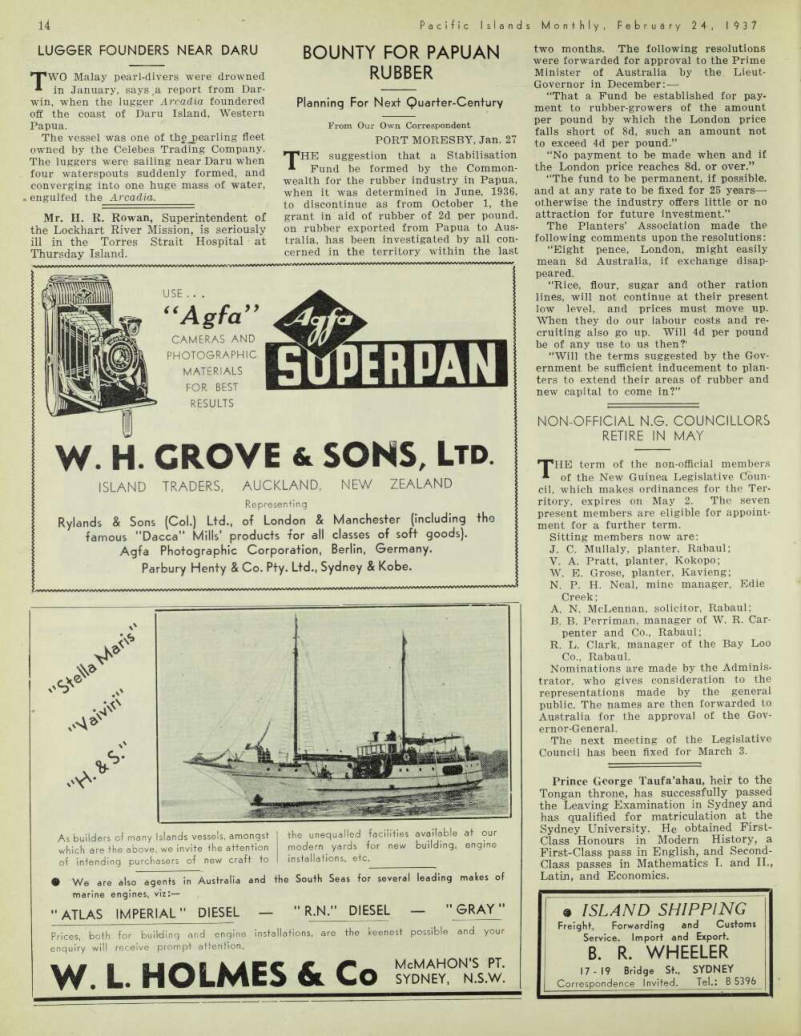
Malay pearl-divers were drowned * in January, says,a report from Dar win, when the lugger Arcadia foundered off the coast of Daru Island, Western Papua.
The vessel was one of thejoearling fleet owned by the Celebes Trading Company.
The luggers were sailing near Daru when four waterspouts suddenly formed, and converging into one huge mass of water, engulfed the Arcadia.
Mr. H. R. Rowan, Superintendent of the Lockhart River Mission, is seriously ill in the Torres Strait Hospital at Thursday Island.
Bounty For Papuan
Rubber
Planning For Next Quarter-Century
From Our Own Correspondent
Port Moresby, Jan. 27
THE suggestion that a Stabilisation Fund be formed by the Common wealth for the rubber industry in Papua, when it was determined in June, 1936, to discontinue as from October 1, the grant in aid of rubber of 2d per pound, on rubber exported from Papua to Aus tralia, has been investigated by all con cerned in the territory within the last
two months. The following resolutions were forwarded for approval to the Prime Minister of Australia by the Lieut- Governor in December: — “That a Fund be established for pay ment to rubber-growers of the amount per pound by which the London price falls short of Bd, such an amount not to exceed 4d per pound.”
“No payment to be made when and if the London price reaches Bd. or over.”
“The fund to be permanent, if possible, and at any rate to be fixed for 25 years— otherwise the industry offers little or no attraction for future investment.”
The Planters’ Association made the following comments upon the resolutions: “Eight pence, London, might easily mean 8d Australia, if exchange disap peared.
“Rice, flour, sugar and other ration lines, will not continue at their present low level, and prices must move up.
When they do our labour costs and re cruiting also go up. Will 4d per pound be of any use to us then?' “Will the terms suggested by the Gov ernment be sufficient inducement to plan ters to extend their areas of rubber and new capital to come in?”
Non-Official N.G. Councillors
Retire In May
THE term of the non-official members of the New Guinea Legislative Coun cil, which makes ordinances for the Ter ritory, expires on May 2. The seven present members are eligible for appoint ment for a further term.
Sitting members now are: J. C. Mullaly, planter, Rabaul; V. A. Pratt, planter, Kokopo; W. E. Grose, planter, Kavieng; N. P. H. Neal, mine manager, Edie Creek; A. N. McLennan, solicitor, Rabaul; B. B. Perriman, manager of W. R. Car penter and Co., Rabaul; R. L. Clark, manager of the Bay Loo Co., Rabaul.
Nominations are made by the Adminis trator, who gives consideration to the representations made by the general public. The names are then forwarded to Australia for the approval of the Gov ernor-General.
The next meeting of the Legislative Council has been fixed for March 3.
Prince George Taufa’ahau, heir to the Tongan throne, has successfully passed the Leaving Examination in Sydney and has qualified for matriculation at the Sydney University. He obtained First- Class Honours in Modern History, a First-Class pass in English, and Second- Class passes in Mathematics I. and 11., Latin, and Economics.
Advertisements & other items, pp. 16-18 (1 item)
W. H. Grove & Sons, Ltd
Mm “ A sf a ”
m a
USE .
CAMERAS AND
PHOTOGRAPHIC
MATERIALS
FOR BEST
RESULTS
W. H. GROVE & SONS, Ltd
ISLAND TRADERS, AUCKLAND, NEW ZEALAND
Representing Rylands & Sons (Col.) Ltd., of London & Manchester (including the famous "Dacca" Mills' products for all classes of soft goods).
Agfa Photographic Corporation, Berlin, Germany.
Parbury Henty & Co. Pty. Ltd., Sydney & Kobe.
A v o>V* As builders of many Islands vessels, amongst which are the above, we invite the attention of intending purchasers of new craft to the unequalled facilities available at our modern yards for new building, engine installations, etc. • We are also agents in Australia and the South Seas for several leading makes of marine engines, viz:— "ATLAS IMPERIAL" DIESEL " R.N." DIESEL "GRAY"
Prices, both for building and engine Installations, are the keenest possible and your enquiry will receive prompt attention.
W. L. HOLMES & Co
9 ISLAND SHIPPING
Freight, Forwarding and Customs Service. Import and Export.
B. R. WHEELER
17-19 Bridge SK, SYDNEY Correspondence Invited. Tel.l B 5396
m p S.S.VAN Mts|» 4 ji «***• * -< A *nESfc 'V ' ; ■ ■ ( *V % m m
in p>
Wi
CTTnncimciu
A NEW TRADE c TOURIST ROUTE
Agents:
Saigon:
DIETHELM & CO.
Port Moresby and Samara!:
STEAMSHIPS TRADING CO. LTD.
Rabaul:
W. R. CARPENTER & CO. LTD.
Port Vila:
GUBBAY FRERES.
Noumea:
CARLO LEONI.
Auckland;
RUSSELL & SOMERS LTD.
Wellington:
JOHNSTON & CO. LTD.
Christchurch and Dunedin:
DALGETY & CO. LTD.
Monthly Cargo and Passenger Service Connecting
South Pacific Islands—New Zealand—Australia—The East
Of vital interest and economic importance to residents and merchants of the Pacific Islands is the establishment of a new K.P.M. LINE passenger and cargo service providing monthly direct trade and tourist facilities with the Pacific Islands, New Zealand and the East.
The K.P.M. will maintain this direct service with the well-known, fast and popular s.s. Van Rees and the splendid new motor vessel Maetsuycker with the undermentioned schedules for each ship:—
The "VAN REES":
Singapore, Batavia, Samarang. Sourabay a, Port Moresby, Auckland.
Wellington, Sydney. Port Moresby, Sourabaya, Samarang, Batavia, Singapore.
The "MAETSUYCKER":
Saig°n, Singapore, Batavia, Samarang, Sourabaya, Port Moresby, Samarai, Kabaul, Port Vila, Noumea, Auckland, Wellington, Sydney, Port Moresby, Sourabaya, Samarang, Batavia, Singapore, Saigon.
For details of sailing schedules, passenger and Royal Packet Navigation Co. Ltd., Sydney. freight rates, apply local agents or direct to M. V. MAETS UYC KER —S.S. VAN REES
ROTAIPACKETN^IGATIONCOITD
PAKETVAART HOUSE. 25 5 GEORGE ST. SYDNEY
Books the Islands' Man
Should Have!
The Modern Diesel, 228 pages 6/ - Petrol and Oil Engines, 176 p 4/ - Motor Repairs Manual (vehicles) 4/6 Turners and Fitters Handbook, 172 p. 7/6 Motor Cyclists Workshop, 136 p. 3/6 The Book of Practical Radio 10/ - All profusely illustrated All prices include postage We specialise in selecting reading matter for those unable to choose personally.
Send for our price list and full particulars of this unusual service for Islands residents
McKAY'S BOOKSTALL
ROYAL ARCADE - - - SYDNEY
u
THE CONTROL AND TRANSFORMER
UNIT READY FOR CARRYING . . . .
10l WOTOi.
WATSON HOUSE
9-13 BLIGH STREET. SYDNEY, N.S.W.
BRANCHES IN ALL STATES OF
AUSTRALIA and NEW ZEALAND
The WAT SON
"CP." Portable
X - Ray Apparatus
THE CONTROL
enables you to select Any Milliamperage I to 30 Any Kilovoltage 42 to 84 (12 steps are incorporated reading directly in K.V.P.) The Unit Operates on any 50 cycle alternating current supply from 140 to 250 volts. A Technique Chart is included also pre-reading Voltmeter, Milliamperemeter & filament control.
Genuinely
Germicidial
PREVENTION
is better than
cure
Disease germs such as those of Diphtheria, Malaria, Dhobie Itch, Tinea or Surfer’s Foot cannot live under the lather of TEN A X. Besides which TEN A X, used constantly, will cure Tropical Skin Diseases.
T E N A X is the only soap containing oil distilled and marketed by Australian Essential Oils Ltd., under the registered trade-mark of “Ti-Trol,” eleven times quicker than carbolic as a germicide, but MON-POISONOUS and NON-IRRITANT. „ XT . v . o “The Medical Journal of Australia,” official organ of the 8.M.A., says: ; IENAA is a satisfactory germicidal soap which may be recommended with confidence. m •m.
Containing
Ti-Trol
NAX
Q/ti C/mMndu
TOILET SOAP
A PRODUCT OF AUSTRALIAN SOAPS LIMITED
TO PLANTERS AND TRADERS
William E. Reed
(Established 1913) Union House, 247 George St., Sydney For all Island Requirements.
Island produce sold.
Prices right. Enquiries welcomed.
Passion Fruit Rescues
Norfolk Is.
New Factory Is In Operation
TT appears as if the enterprise of Mr.
G. A. Flack, of the Manly Vale Pro ducts Company, has given Norfolk Island a new lease of economic life.
A factory for canning passion fruit, which was established on Norfolk by Mr. Flack last year, commenced opera tions early in January, and regular ship ments of the product are now being made.
Passion fruit grows most profusely on Norfolk Island. Mr. Flack has made con tracts with the residents for the supply of the fruit on a basis ranging from l|d to 2d per lb. This will provide a large proportion of the residents with a source of regular income.
The process is interesting. The passion fruit is brought to the factory and given into a receiving room, where it is quickly sorted over and rubbish removed. It is then weighed. Then the fruit is auto matically conveyed to a washing room.
Thence it goes automatically to tables, where the shells are sliced open by girls.
The sliced shells are carried along by a moving table to other girls who press the half-fruit down on to spinning domes which extract the pulp. The shells are thrown away and the pulp runs down into large containers.
The pulp is then carried along to an other room, where it is brought to a high temperature. Thence it moves into the canning room, where the usual can ning process is employed. The cans in which the pulp is exported are each of about a gallon capacity. It is reported that Australian confectioners will take all the pulp that N.I. can produce.
Norfolk Island is also regaining its trade in French Beans, once a staple industry. The Administration has in stalled a plant for properly fumigating the beans, so that there may be no ob jection taken to them in Australia. It has introduced also a strict system of grading. The result is that the beans have found their way back to the Sydney market, at prices that return a good profit to the N.I. grower.
It is reported that certain well-known agitators on the island are trying to break down the regulations, which de mand a high standard of grading, evi dently with the idea of getting lower standard of beans accepted for shipment to Australia. This move is not likely to succeed, as any lowering of the standard would almost certainly kill the market.
Secured German Flag
In New Guinea
THE soldier who secured the German flag during the capture of Rabaul in 1914 died early in February at Mar rickville, Sydney. He was John J. Casey, and was 58 years old.
An Irishman, Casey went to Australia at an early age, and later enlisted as a sergeant in the Expeditionary Forces.
He was promoted to the rank of lieuten ant while on active service. He left with the first troopship for New Guinea and was prominent in the taking of the Ger man territory. The flag, which he took from the Germans, now lies in the Aus tralian War Museum.
Dutch And Australian New Guinea
Interesting Comparison of Development and Resources
A VERY complete investigation of the economic condition and resources of the large island of New Guinea was made in 1935 by Dr. W. C. Klein, who is well known as the secretary of the New Guinea Committee which was established in The Hague, Holland, a few years ago to direct and encourage the development of Dutch New Guinea. Dr. Klein, as a result of his eight months’ work, has produced a lengthy and comprehensive report for the information and guidance of persons who may be interested in the future of this important territory.
Dr. Klein spent a certain amount of his time in each of the three divisions of New Guinea namely, Dutch New Guinea, the Mandated Territory, and Papua; and he very cleverly assembled all the available data relating to the development of the Mandated Territory and Papua as a guide to those who might be planning developmental operations in Dutch New Guinea.
He says, in his report, that the New Guinea Committee intends to en courage the exchange of experiences be tween Australia’s tropical territories and the Dutch East Indies on a much larger scale than has been the case hitherto.
Dr. Klein’s report has taken the f"rm of a book on tropical economics. It is entitled New Guinea and is in three volumes, the first of which has just been published by the Molukken Institute, Amsterdam.
Dr. Klein takes seriatim a list of products of the three territories and deals with each of them in relation to the productive capacity of each of the three territories.
In regard to forest products exported in 1934-35 he shows this position;
Dr. Klein expresses surprise that the Australian territories, although their forests are similar to Dutch New Guinea, do not export forest products to any ex tent, although there is c’ear'y a market for them. He is inclined to think it is
because the Dutch encourage Chinese traders to come into their territory and buy these forest products, whereas this traffic is mostly in the hands of Euro pean traders in the other sections of New Guinea, “As to timbers,” says Dr. Klein, “the situation is very puzzling to me. Both Australian territories imported in 1934- 35 many thousands of pounds worth of timber, in spite of an import duty of 10 per cent. Timber for the mines is even imported from Oregon, U.S.A.” He could not understand why the good native tim bers produced at the mission saw-mills at Finschhafen and Sek could not replace the timbers so extensively imported.
“It is also remarkable,” says Dr, Klein, “that the total of freight and import duty charged by Australia upon timber from Papua is higher than on timber from America.”
With regard to plantation products.
Dr. Klein comments that, with the soli tary exception of Papuan rubber, both Australian territories have “all their eggs in one basket” and are depending almost wholly upon copra. Kapok and cotton for some reason are not produced for export; and he regards it as “curious” that the attractive bounty upon the production of cocoa and the valuable scientific services available have not resulted in a consid erable volume of cocoa for export from the Mandated Territory.
Dr. Klein thinks that the difficulty of training kanaka labour, as compared with the more intelligent Accra negroes, is probably responsible for the compara tive lack of success of cocoa culture in Dutch and Australian New Guinea.
With regard to rubber, Dr. Klein points out that the international restriction prevents the establishment of rubber plantations in Dutch New Guinea. He thinks that Papua, being free of restric tions, should have developed its rubber industry more rapidly, but thinks that one reason for the slow development is lack of a good road leading to the best rubber district (Sogeri). He notes that Papua’s rubber export was 100 tons in 1917, about 500 tons in 1924, and over 1 000 tons in 1934.
In regard to copra production, Dr.
Klein notes that the Australian territor
Dutch Australian N.G.
N.G.
Tons.
Tons.
Gumcopal and other gums 1636 49 Timber 445 138 Massoi and other bark 68 60 Rattan 2 Nutmeg and mace 574
ies are far ahead not only in volume of production but in quality. The bulk of the Australian production comes from large well-managed plantations; much of the Dutch export is trade copra. Dr.
Klein gives four reasons for the better copra position in the Australian terri tories namely, a more reliable labour supply (he refers to the indentured lab our system); the big areas planted by the Germans, of which the Australians obtained the advantage; better shipping facilities; and the close proximity of Australia as a non-tropical territory con suming tropical products.
Dr. Klein notes that the system of mar keting copra is entirely different in the two territories. In the Dutch territory the successive stages of the disposal of the native copra are; (1) The Chinese trader on the New Guinea coast. (2) The Chinese firm in Macassar. (3) The European firm in Macassar.
In the Australian territory the stages of the sale of copra are; (1) Purchase of copra by European trader or European planter with trading license.
(2) Sale to the big European firms operating in the territory.
There is no equivalent in the Austra lian territories to Number 2 in the Dutch territory. Furthermore there is inspec tion and grading of copra in the Austra lian territories and none in Dutch New Guinea.
The ships that carry Dutch territory copra to Europe nearly all belong to the Batavia Freight Conference. But on Die Australian side, tramp-steamers play a much bigger role.
Dr. Klein comments that coffee produc tion, while small, is growing in Papua, and that sisal hemp production was kill ed by the Australian shipping monopoly.
Neither crop is produced in Dutch New Guinea. He refers to desiccated coconut as “the only example of a successful artificial creation of an industry in Aus tralian N.G. by means of a protective tariff in Australia.”
Regarding sea products, Dr. Klein gives the following comparison, the figures referring to 1934-35: —
The Dutch N.G. figures include ex ports from the Aru Islands, which means that the exports from the territory itself are comparatively small.
Dr. Klein mentions that the Australian shell output is practically incapable of being increased. Exhaustion of the reefs was feared in German times, but they have held up very well.
Commenting on the gold industry, Dr.
Klein says that while British New Guinea’s output is worth nearly £2,000,000 annually, serious prospecting for gold is only just now commencing in Dutch New Guinea.
Dealing with imports, Dr. Klein points out that in 1934-35 Australian New Guinea imported 8837 tons of rice against Dutch New Guinea’s 1262 "ons.
As Australian New Guinea employs about 40,000 indentured labourers, against none in Dutch New Guinea, it is surprising that D.N.G. imported so much rice.
He points out that rice carried in to the N.G. goldfields by aeroplane is enor mously expensive, and wonders why rice growing has not been tried out in the Morobe district on a more extensive scale. He notes that repeated attempts to produce rice in the lowlands of Aus tralian New Guinea led nowhere, except that about 175 tons have been produced at Mekeo in Papua.
About £50,000 worth of meat and fish, mostly canned, are imported annually into Australian N.G., mainly for the in dentured labourers. There is no corres ponding import in D.N.G.
Dr. Klein was much interested fn the tobacco imports—D.N.G., 87J tons a year; Australian N.G., 126 tons. A great pro portion of this comprises the so-called “twist sticks” for trade tobacco. The tobacco in the Dutch possession comes from Java and that in the Australian territory from America. He suggests that if the recently-established factory in Rabaul does not succeed in producing ac ceptable trade tobacco, the Dutch mer
Dutch Australian N.G.
N.G.
Tons.
Tons.
M.O.P., trocus, and other shells .„ ..._ 609 505 Trepang ... 61 98
chants in the East Indies should go after this trade. He mentions that the D.N.G. native smokes much more tobacco than his neighbour in ' Australian territory.
Dr. Klein, dealing with textile imports, notes that more textiles are bought per head in Dutch New Guinea than in Aus tralian New Guinea. He says this is due to the fact that in Australian N.G. the majority of natives under Government control are not allowed to wear clothing above the waist.
Dealing generally with imports, Dr.
Klein notes an increase in quantity in Japanese textiles in Australian New Guinea —probably as a result of the intro duction of new Japanese lines of ship ping—but he thinks that this develop ment is not so noticeable in the case of ironware and machinery. “I find the kanaka, like the more intelligent nat ives of the Molukkas, Fiji, Samoa, etc., dislikes Japanese tools and knives. I saw Japanese nails and roofing iron in Dutch New Guinea, but in Australian New Guinea they are lacking entirely.”
Taking the total volume of trade in the respective territories, Dr. Klein says that in the period of about 30 years, between 1905 and the present time, the total vol ume of Dutch trade increased about 70 per cent, whereas in the Australian terri tories the increase has been about 1,000 per cent. The increase in the case of the Mandated Territory was 1,600 per cent, but in Papua it was about 300 per cent.
“Much more significant is the export surplus,” concludes Dr. Klein. “On our side it was big and positive in 1905, and still bigger but negative in 1934. The other two territories show the more nor
mal change from a negative to a positive surplus. If the Dutch had put money in Dutch N.G. in the past instead of drawing benefits from it, we might have had the same normal course of affairs, as is shown by the Australian territories.
“Fortunately from the comparison of the years 1934 and 1935 the reader can learn for the Dutch part that we now put every year increasing amounts of money into this country. If we had the statistics for 1936 available this would come out still more’ clearly, as in that year Gov ernment and oil and gold companies all started to spend big sums on this terri tory, the former to equip some five new European and some 25 new native Gov ernment stations, the latter to bring in aeroplanes, drilling machinery, etc., to explore the mineral wealth.
“It would not surprise the writer if the total volume of trade in the next 10 years approached that of the Australian part. This of course depends much on the result of the oil and gold explora tions, as forests and agriculture alone, even if strongly pursued, could not make the difference.”
Mr. Martin Johnson, the famous ex
plorer, who had travelled, made movies,
and written in and about the South Seas, died in January from injuries received in a ’plane crash at Burbank, U.S.A. He was 56 years of age. Johnson and his wife, accompanied Jack London in the yacht Snark, which sailed around the world. Mr. and Mrs. Johnson had several exciting experiences in the New Hebrides when filming scenes of life among the savage head-hunters.
Advertisements & other items, pp. 19-20 (1 item)
Prouds Ltd.
Random
Selections
•from our Eighty pages coloured Catalogue, a copy of which will be sent post free on application.
A high precision English Aneroid Barometer and Thermometer Combination, dial 3fin. dlam.
This instrument will be despatched correctly adjusted to the altitude of its destination, and complete with printed weather forecasting rules. 40/-.
Other models of Aneroids at 21/-, 25/-, 32/6, 45/-, 52/C.
“Swing the Prop”— a novel Airplane Table Lighter, in Chrome, 8/6.
“ Buttner ” Patent Cigarette Holder, cool and pleasant smoking, complete with 10 refills, 6/6. ©
ON PARLE FRANCAIS
PROUDS Ltd.
Cr. King & Pitt Sts., Sydney
After the Coronation Visit In May
THE PARIS INTERNATIONAL TRADE FAIR
Every man going "Home" this year should cross the Channel and visit this worldfamous Pans Fair.
Here are exhibits of all the latest developments in all branches of manufacture, gathered from all Nations.
Here meet on friendly fields all the business magnates of the world—a meeting that this year will be far greater and more representative than ever before.
Dont fail to see this gigantic exposition of the Modern Art of Manufacture.
For full particulars apply to the Trade Commissioner for France, Wynyard St., Sydney
Get your
Umg copy
of the
NEW TRUFOOD
RECIPE BOOK
69 specially tested recipes—all kinds of new ideas for attractive things to cook cakes, pastry, puddings, custards, desserts, savoures, sauces, etc. post, this coupqiiiiiii safe- % y Recipe Department c/- Box ei.P.O.
Sydney Please send me POST FREE, a copy of The Trufood Book of 69 Tempting Recipes Name
(BLOCK LETTERS)
Address
FOR FINER FOOD—
send to McILRATH'S
We've a Special Staff to Handle Island Orders "Rosa" Full Cream Condensed Milk (4 doz.) 7/3 doz., 25/- case "St. George" Assorted Meats (4 doz.) 14 oz, 15/- doz., 56/- case Australian I.A. Sugar, 70lb. bags 13/6 bag Australian I.A. Sugar, 3 bag lots 13/- bag Nestles Pure Cream, 4-oz. tins 4d. tin, 3/9 doz.
"Rosa" or "IXL" Bartlett Pears, 30-oz. tins I Id. tin, 10/9 doz.
Puliar's Prunes in Syrup, 30-oz. tins 9jd. tin, 9/3 doz.
"Rosa" Custard Powder, 16-oz. pkts lid. pkt., 10/6 doz.
Arnott's Thin Captain Biscuits, No. 2 tins 1/9 tin, 20/6 doz.
"Roman" Loaf Cheese, each 1/1 lb.
"Rex" Luncheon Cheese, 2-oz. tins tin, 4/- doz.
"Selmore" Choice Red Salmon, tins 1/1 tin, 12/6 doz.
Prices f.o.b. Anchovies in Oil with Capers. 2-oz, tins tin, 8/3 doz.
Sydney. FI S h Cocktaits, 3-oz. jars 2/3 jar, 25/- doz. ic e Lists "Kia-Ora" Orange Cup, 26-oz. bots i/5 bot., 16/6 doz. available. Ovaltine, 18-oz. tins 4/4 tin, 49/- doz.
Nestles Malted Milk, 16-oz. tins 2/6 rin, 29/- doz.
"IXL" Riced Potatoes, 6-lb. tins (equals 36-lb. fresh) 1/6 lb.
"Gem" Razors, complete with case and blade, 6d. each, 5/6 doz.
Special "Ration" Tea, 66-lb. chests rb.
McILRATH'S LTD.
EXPORT DEPARTMENT
202 PITT STREET
SYDNEY - N.S.W.
AUSTRALIA
Champion Patrol
Explorer at Work on Report
ly/fR- IVAN CHAMPION, having re turned safely from his successful patrol through the unknown north-west ern region of Papua, is now engaged in preparing a detailed report and in draw ing a map of the districts which he traversed.
This map should be extremely valu able, as Mr. Champion has a practical knowledge of surveying and knows how to take longitude and latitude. He car ried with him a small radio receiving set and, with this, he was able to nick up the time signals sent out by A.W.A., Port Moresby, each day at noon exactly.
The batteries for the receiving set lasted out the trip.
An interesting point that will be brought out in Mr. Champion’s official report will be the complete fear lessness and friendliness of the various and numerous natives met with. Mr.
Champion has said that, so impressed was he by the friendliness of the natives, he frequently did not post a single guard when his patrol was camped in strange villages.
Mr. H. S. Charnley, a resident of Fiji for the last 16 years, died in Suva on January 18. Mr. Charnley, who was born in England 53 years ago, worked at vari ous times for Morris, Hedstrom. Ltd., A. M. Brodziak, Ltd., and latterly for
Marlows, Ltd.
Advertisements & other items, p. 21 (1 item)
kjlk
A Labour Party Goes Out
From Our Own Correspondent
Rarotonga, Jan. 18.
*"pHE branch of the N.Z. Labour Party * inaugurated here last July, during the visit of Messrs. Robertson and Hun ter, Labour M.P.’s attached to the Parlia mentary Fruit Trade Enquiry, has now ceased to function.
The branch which, together with its affiliated district centres, numbered close upon 1000 members, was on the eve of issuing the first copy of a local news paper when the secretary received radio notification from the National Executive that the branch had been suspended.
Members, amongst whom are several Europeans of considerable standing in
the community, feel this “let down” very keenly, particularly as they have been recently put to relatively heavy expend!ture over the purchase of printing mater membership badges, etc., all of which have at one stroke been rendered useless. . nnnil , QV i , Nee<lle f s t° in as “Labour has slumped in Rarotonga as a result o£ this arbltrary aetl on, where simple suspension of certain branch offlclals P would jn a n probability have sufflcien t to soothe the delicate sus tibilities o( the National Executive, Nevertheless, one’s hat comes on to those whose Machiavellian policies have succeeded in terminating what was, after all, a discordant note in the “bee-loud glades of Innisfree.”
Better Copra
How Depression Has Benefited Papua
From Our Own Correspondent
Pt. Moresby, Jan 24.
SATISFACTION is felt by planters con cerning the recent Ordinance passed by the Government to amend the Cus toms (Export) Tariff in relation to the export duty on copra, which comes into operation in the Territory on the London price exceeding £2O a ton.
The new Ordinance provides that the “London price” shall be gazetted in grades—Sun-dried, Smoke-dried, and Hot air Dried—and duty shall be paid accor ding to the value of the grade exported.
Previously, duty was paid at the rate of 10 per cent on the amount by which the “London price” exceeded £2O a ton, such price being gazetted from time to time, and being arrived at by averaging the price of two grades, South Seas sun dried and Smoke-dried.
Attention has been given in the Ter ritory to the quality of copra exported, and every effort is being made to attain the highest standard. In May, 1934, when the Administration assisted copra grow ers to the extent of £B,OOO in one year, when the market price dropped as low as £7/5/-, insistence on quality was main tained, and all copra eligible for the bonus was subject to inspection and marked “Papuan Plantation,” which in sured that only the best quality was shipped.
This high standard insisted upon by the Government has done much to raise the value of copra produced in the Ter ritory for no assistance was given to any shipments containing “copra undried, imperfectly dried, sweated, rotten, con taining grit, dust, or other foregn sub stance.” These conditions naturally did not affect well organised plantations, and were merely means to maintain general supervision, with one object in view— namely, to raise the standard of Papuan copra.
The export values of copra, on which duty is to be assessed from January 1 until further notice, are as follows: Hot air Dried, £22/12/6: Sun-dried, £2l/12/6; Smoke-dried. £2l/12/6.
Japanese Training Ship In Suva
From Our Own Correspondent
Suva, Jan. 28.
THE four-masted auxiliary steel barque Taisei Maru , 2,438 tons gross, a train ing vessel belonging to the Tokio Higher Nautical School, arrived in Suva direct from Tokio after a 45 days’ voyage on January 26.
She has 45 cadets on board, in training for the Japanese mercantile marine.
Captain Shinji Oba, who is in command, and eight of his officers, are Japanese naval reservists.
The Taisei Maru is to sail for the Mar shall and Caroline Islands on January 31,
Advertisements & other items, p. 22 (1 item)
Fox & Maccillycuddy Ltd.
WHY TAKE A RISK?
YOU CAN WITH CONFIDENCE
PLACE YOUR RADIO ORDERS WITH
Fox & Maccillycuddy Ltd.
The Oldest Established Radio Distributors of Completed Receivers — Parts and Accessories in Australia.
We specialise in all sets as described by “ Wireless Weekly,” and full stocks of parts are always on hand. We will be pleased to quote you by return mail.
9 EVERREADY BATTERIES 9
EVERREADY BATTERIES ALWAYS IN STOCK
SUPERDYNE HEAVY DUTY LIGHT DUTY
“C” BIAS “A” BATTERIES AND TORCH REFILLS All brands of Radio Valves always in stock, including Radiotron, Philips, Kenrad, Mullard, National Union, Osrain. Each Valve is carefully tested before despatch.
QUALITY RADIO — PROMPT SERVICE — RELIABILITY
■A
CAPSTAN
CIGARETTES
ORK-TIPPED
OR. PLA I N
' ■ ’» ■ k k ,
PST
lillK I
CAPSTAN
NAVY CUT TOBAi
9 liiii iiliii
"Timi"
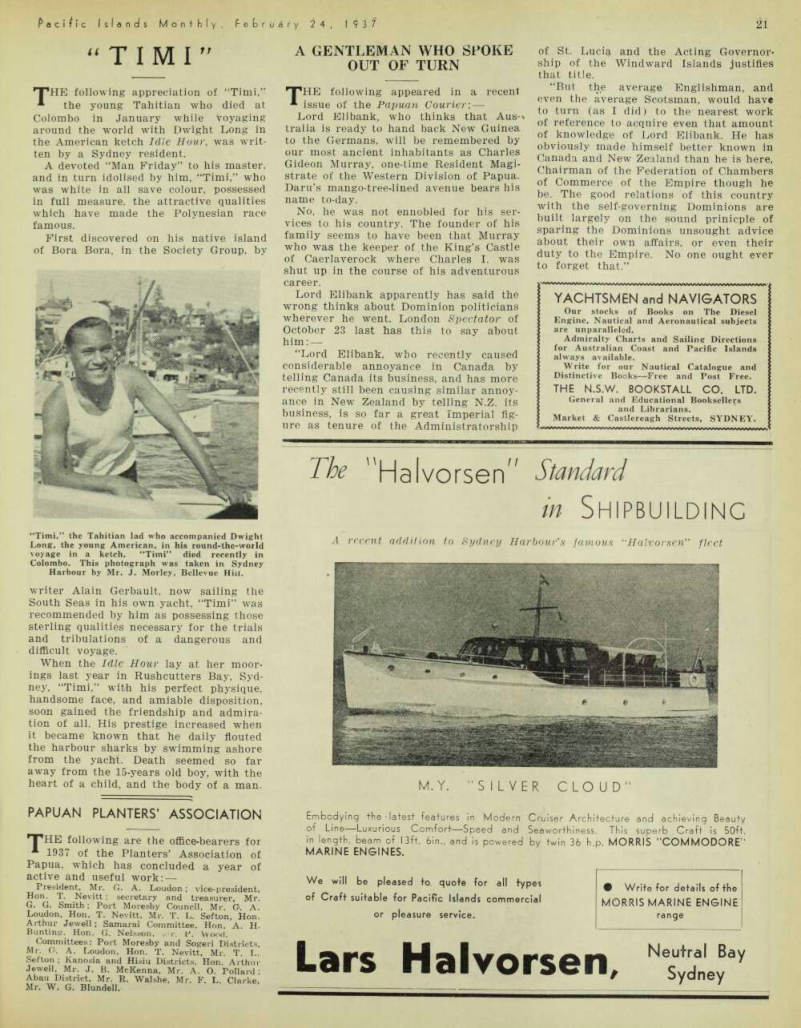
THE following appreciation of “Timi,” the young Tahitian who died at Colombo in January while voyaging around the w r orld with Dwight Long in the American ketch Idle Hour, was writ ten by a Sydney resident.
A devoted “Man Friday” to his master, and in turn idolised by him, “Timi,” who was white in all save colour, possessed in full measure, the attractive qualities which have made the Polynesian race famous.
First discovered on his native island of Bora Bora, in the Society Group, by
writer Alain Gerbault, now sailing the South Seas in his own yacht, “Timi” was recommended by him as possessing those sterling qualities necessary for the trials and tribulations of a dangerous and difficult voyage.
When the Idle Hour lay at her moor ings last year in Rushcutters Bay, Syd ney, “Timi,” with his perfect physique, handsome face, and amiable disposition, soon gained the friendship and admira tion of all. His prestige increased when it became known that he daily flouted the harbour sharks by swimming ashore from the yacht. Death seemed so far away from the 15-years old boy, with the heart of a child, and the body of a man.
“Timi,” the Tahitian lad who accompanied Dwight Long, the young American, in his round-the-world voyage in a ketch. “Timi” died recently in Colombo. This photograph was taken in Sydney Harbour by Mr. J. Morley, Bellevue Hill.
Papuan Planters' Association
THE following are the office-bearers for
* 1937 of the Planters’ Association of Papua, which has concluded a year of active and useful work; President, Mr. G. A. Loudon ; vice-president, Hon. T. Nevitt: secretary and treasurer, Mr.
G. G. Smith ; Port Moresby Council, Mr. G'. A.
Loudon, Hon. T. Nevitt. Mr. T. L. Sefton, Hon.
Arthur Jewell ; Samarai Committee, Hon, A. H.
Bunting. Hon. G. Nelsson. , r. F. \vood.
Committees: Port Moresby and Sogeri Districts, Mr. G>. A. Loudon. Hon. T. Nevitt, Mr. T. L.
Sefton: Kanosia and Hisiu Districts, Hon. Arthur Jewell. Mr. J. B. McKenna, Mr. A. O. Pollard ; Abau District, Mr. R. Walshe, Mr. F. L. Clarke, Mr. W. G. Blundell.
A Gentleman Who Spoke
Out Of Turn
TTHE following appeared in a recent issue of the Papuan Courier ; — Lord Elibank, who thinks that Aus-* tralia is ready to hand back New Guinea to the Germans, will be remembered by our most ancient inhabitants as Charles Gideon Murray, one-time Resident Magi strate of the Western Division of Papua.
Darn’s mango-tree-lined avenue bears his name to-day.
No, he was not ennobled for his ser vices to his country. The founder of his family seems to have been that Murray who was the keeper of the King’s Castle of Caerlaverock where Charles I. was shut up in the course of his adventurous career.
Lord Elibank apparently has said the wrong thinks about Dominion politicians wherever he went. London Spectator of October 23 last has this to say about him: “Lord Elibank, who recently caused considerable annoyance in Canada by telling Canada its business, and has more recently still been causing similar annoy ance in New Zealand by telling N.Z. its business, is so far a great Imperial fig ure as tenure of the Administratorship
of St. Lucig, and the Acting Governor ship of the Windward Islands justifies that title.
“But the average Englishman, and even the average Scotsman, would have to turn (as I did) to the nearest work of reference to acquire even that amount of knowledge of Lord Elibank. He has obviously made himself better known in Canada and New Zealand than he is here, Chairman of the Federation of Chambers of Commerce of the Empire though he be. The good relations of this country with the self-governing Dominions are built largely on the sound prinicple of sparing the Dominions unsought advice about their own affairs, or even their duty to the Empire. No one ought ever to forget that.”
Advertisements & other items, p. 23 (1 item)
Lars Halvorsen, Ne s “Xy ay
YACHTSMEN and NAVIGATORS
Our stocks of Books on The Diesel Engine, Nautical and Aeronautical subjects are unparalleled.
Admiralty Charts and Sailing Directions for Australian Coast and Pacific Islands always available.
Write for our Nautical Catalogue and Distinctive Books—Free and Post Free.
THE N.S.W. BOOKSTALL CO. LTD.
General and Educational Booksellers and Librarians.
Market & Castlereagh Streets, SYDNEY.
The "Halvorsen" Standard
m Shipbuilding
A recent addition to Sydney Harbour's famous “ Halvorsen ” fleet V.
M.Y. "SILVER CLOUD
Embodying the-latest features In Modern Cruiser Architecture and achieving Beauty of Line—Luxurious Comfort—Speed and Seaworthiness. This superb Craft is 50ft.
In length, beam of 13ft. 6in„ and is powered by twin 36 h.p. MORRIS "COMMODORE"
MARINE ENGINES.
We will be pleased to quote for all types of Craft suitable for Pacific Islands commercial or pleasure service.
Lars Halvorsen, Ne s “Xy ay
• Write for details of the
MORRIS MARINE ENGINE
range
Japanese Poachers
Position Bad, and Growing Worse
AN accumulated mass of reports indi cates that the activities of Japanese fishing and pearling luggers along the northern coast of Australia, and on the coast of some of the Western Pacific Islands, are growing in volume and be coming more daring in character.
It is beyond doubt that sooner or later there will be a clash. The Japanese are invading Australian territorial waters and, under the very noses of Australians, are taking possession of maritime indus tries which hitherto had been worked by Australians.
There is persistent evidence to show that Japanese, who are resident in Aus tralian towns such as Thursday Island, are co-operating with their countrymen in poaching activities. The local Japanese and the aborigines maintain a first-class intelligence service, with a system of signals, so that it is practically impos sible for the two or three Australian patrol vessels to catch a poacher at work.
It was pointed out in the North Queensland Register on January 2 that
the Australian patrol vessel Larrahia, a fast 45ft. motor-boat based on Darwin, finds her task an impossible one. Her progress along the coast, seeking Japan ese poachers, is signalled ahead by abori gines, using smoke fires, The N.Q. Register says: “The Japanese employed on Australian luggers fraternise freely on the pearling ground with their compatriots in the crews of the 85 oversea Japanese that have been working the beds off the Aus tralian coast during the season just com pleted. It is believed that many of these oversea divers tranship to the Australian luggers for a brief holiday when the local vessels run in to the mainland to replenish oil supplies.”
A well-known resident of Thursday Island, writing to us on January 12, said; “The patrol work required is far beyond the resources now provided by the Commonwealth Government.”
There has been a significant develop ment at Thursday Island. When the pearling luggers are ready to leave the harbour for a drift, they are inspected by the harbour master, acting in his capacity of inspector of shipping. To show that they are ready to leave, the Japanese captains usually hoist the Japanese flag at the masthead. The in spector of shipping has announced that in future .he will not recognise the Japanese flag as a signal that the captain is ready to have his vessel examined and passed as sea-worthy. They must use some other flag or signal. The Japanese are said to have resented these instruc tions, but are complying with them.
New Rubber Companies In
Papua
in January, two rubber com panies were incorporated under the Papuan Companies Ordinance in Port Moresby. They are: — Tropical Products Proprietary Ltd., with a capital of £5,000, in shares of £1 each, which has taken up a large area of land in the Kanosia district, amount ing to 9,000 acres, solely, it is under stood, for the purpose of planting rubber.
Rubberlands Limited with a nominal capital of £20,000, divided into shares of 5/- each, with the principal object of developing a rubber industry. Extensive areas, amounting to 5,000 acres, have been taken near the foothills of Kanosia, and already the initial work of erecting houses and preparing nurseries is well under way, under European supervision.
Steamships Trading Co. Ltd. are man aging agents for both enterprises, which lie in a well-known rubber district, and within easy distance along the sea-board, 30 miles west of Port Moresby. The regi stered office of both companies is the office of Mr. W. B. Molloy, Port Moresby.
Captain Arthur Tange, skipper of the 23-ton lugger Amy, who has been trochus fishing out of Samarai and Thursday Is land for years, arrived in Sydney from T.I. by the Taiping recently. He com plained bitterly of the wa* T in which the Japanese have “skinned” the shell reefs in northern waters.
Advertisements & other items, p. 24 (2 items)
22
Pacific Islands Monthly, hebr u a f y 24 , 1937
Tilley
Huon Pine Boat Planks
Practically Borer Proof and Everlasting, also Spotted Gum Timbers —Prices Right. r MO Miller St., A. w. rryer pyrmont, n.s.w.
Kerosene Pressure Lamps Lanterns and Radiators.
Write or Ring for New Catalogue of Lamps and Spare Parts.
Models to suit every purpose and every pocket.
TILLEY —'-The Most Satisfactory 300 c.p. Kerosene Lamp. © Penta KI I
Single Cylinder
bm
RENTA
MARINE ENGINES
OUTBOARDS 4-18 H.P.
INBOARDS 3-100 H.P.
Precision Built and Absolutely Free from Vibration.
Deliveries from Stock at Under Bond Prices.
Write for Complete Catalogue and also Particulars of the Penta - Hesselman Engine, running on Heavy Oil Fuel P£NTA The World's Leading Marine Engine
No Longer Lonesome
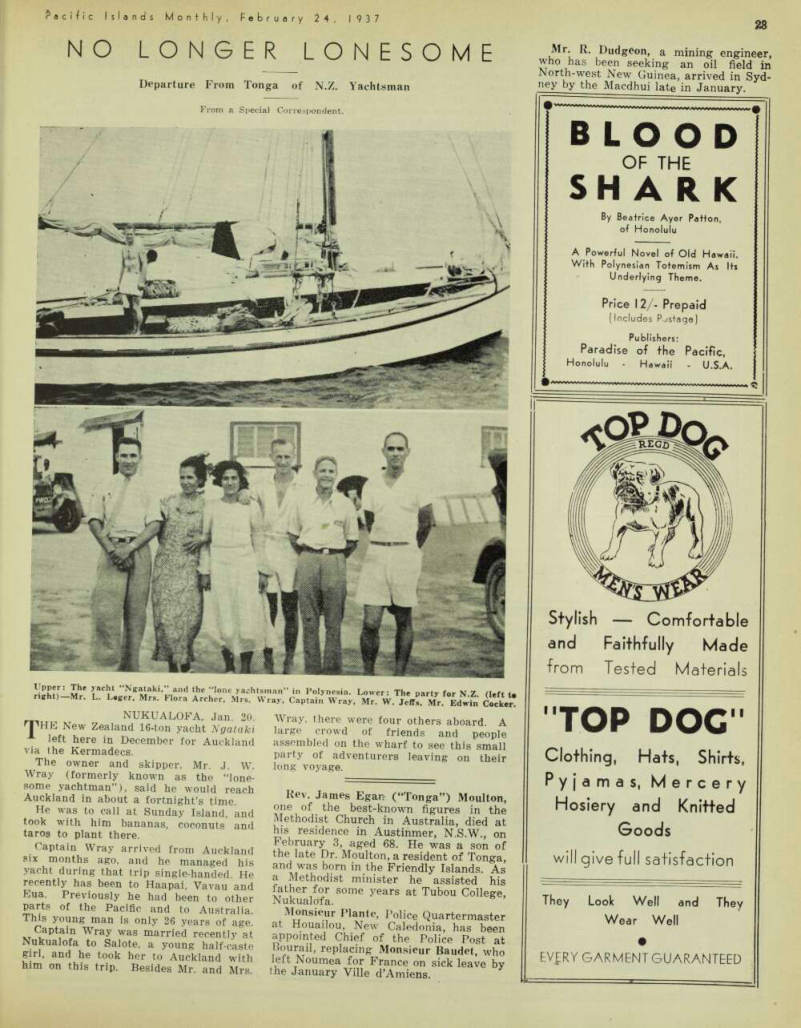
Departure From Tonga of N.Z. Yachtsman From a Special Correspondent.
Nukualofa, Jan. 20.
nPHE New Zealand 16-ton yacht Ngataki left here in December for Auckland via the Kermadecs.
The owner and skipper, Mr. J. W.
Wray (formerly known as the “lone some yachtman”), said he would reach Auckland in about a fortnight’s time.
He was to call at Sunday Island, and took with him bananas, coconuts and taros to plant there.
Captain Wray arrived from Auckland six months ago, and he managed his yacht during that trip single-handed. He recently has been to Haapai, Vavau and Eua. Previously he had been to other parts of the Pacific and to Australia.
This young man is only 26 years of age.
Captain Wray was married recently at Nukualofa to Salote, a young half-caste girl, and he took her to Auckland with him on this trip. Besides Mr. and Mrs.
Wray, there were four others aboard. A large crowd of friends and people assembled on the wharf to see this small party of adventurers leaving on their long voyage.
Rev. James Egan (“Tonga”) Moulton, one of the best-known figures in the Methodist Church in Australia, died at his residence in Austinmer, N.S.W., on February 3, aged 68. He was a son of the late Dr. Moulton, a resident of Tonga, and was born in the Friendly Islands. As a Methodist minister he assisted his father for some years at Tubou College, Nukualofa.
Monsieur Plante, Police Quartermaster at Houailou, New Caledonia, has been appointed Chief of the Police Post at Bourail, replacing Monsieur Baudel, who left Noumea for France on sick leave by the January Ville d’Amiens.
Mr R. Dudgeon, a mining engineer, who has been seeking an oil field in North-west New Guinea, arrived in Syd ney by the Macdhui late in January.
Upper: The yacht "Ngataki," and the "lone yachts" in Polynesia. Lower: The party for N.Z. (leftto rigt)-Mr. L. Leger, Mrs. Flora Archer, Mrs, Wray, Captain Wraym, Mr. W Jeffs, Me. Edein Cocker.
Advertisements & other items, p. 25 (1 item)
Blood
OF THE
SHARK
By Beatrice Ayer Patton, of Honolulu A Powerful Novel of Old Hawaii.
With Polynesian Totemism As Its Underlying Theme.
Price 12/- Prepaid (Includes Postage) Publishers: Paradise of the Pacific, Honolulu - Hawaii - U.S.A.
o
REGZ)
s*w»A Stylish Comfortable and Faithfully Made from Tested Materials
"TOP DOC"
Clothing, Hats, Shirts, Pyjamas, Mercery Hosiery and Knitted Goods will give full satisfaction They Look Well and They Wear Well •
EVf RY GARMENT GUARANTEED
Noumea Casino
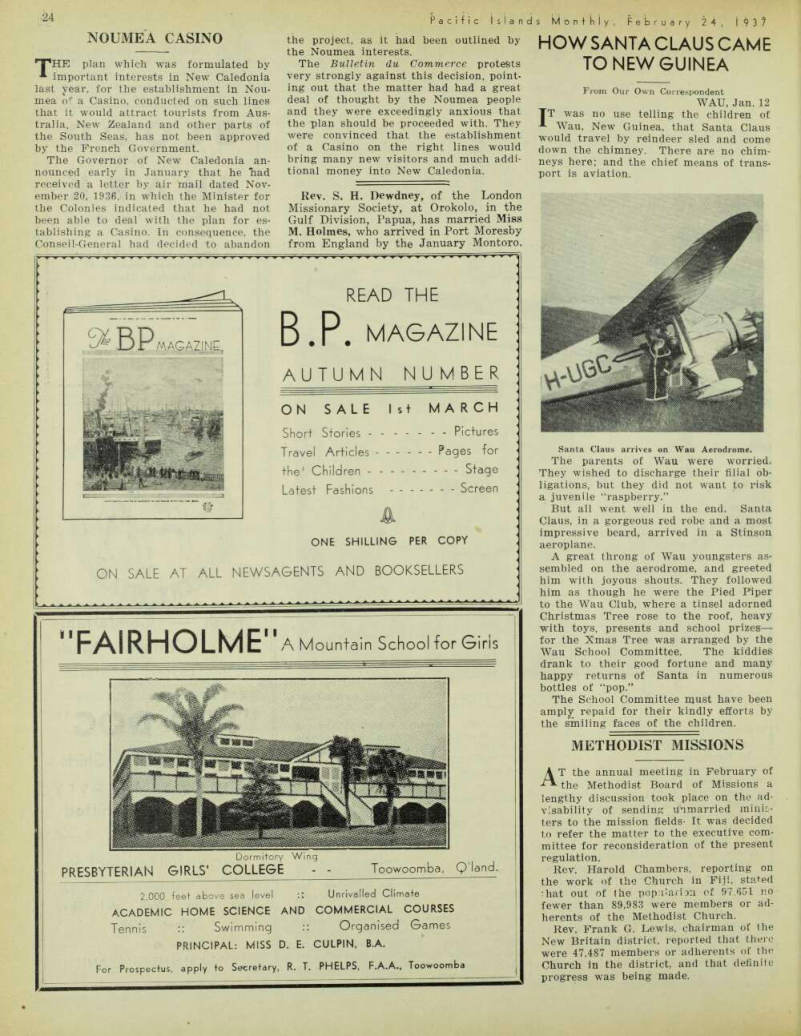
plan which was formulated by * important interests in New Caledonia last year, for the establishment in Nou mea of a Casino, conducted on such lines that it would attract tourists from Aus tralia, New Zealand and other parts of the South Seas, has not been approved by the French Government.
The Governor of New Caledonia an nounced early in January that he had received a letter by air mail dated Nov ember 20, 1936, in which the Minister for the Colonies indicated that he had not been able to deal with the plan for es tablishing a Casino. In consequence, the Conseil-General had decided to abandon
the project, as it had been outlined by the Noumea interests.
The Bulletin du Commerce protests very strongly against this decision, point ing out that the matter had had a great deal of thought by the Noumea people and they were exceedingly anxious that the plan should be proceeded with. They were convinced that the establishment of a Casino on the right lines would bring many new visitors and much addi tional money into New Caledonia.
Rev. S. H. Dewdney, of the London Missionary Society, at Orokolo, in the Gulf Division, Papua, has married Miss M. Holmes, who arrived in Port Moresby
from England by the January Montoro.
How Santa Claus Came
To New Guinea
From Our Own Corx-espondent WAU, Jan. 12 TT was no use telling the children of Wau, New Guinea, that Santa Claus would travel by reindeer sled and come down the chimney. There are no chim neys here; and the chief means of trans port is aviation.
Santa Claus arrives on Wau Aerodrome.
The parents of Wau were worried.
They wished to discharge their filial ob ligations, but they did not want to risk a juvenile “raspberry.”
But all went well in the end. Santa Claus, in a gorgeous red robe and a most impressive beard, arrived in a Stinson aeroplane.
A great throng of Wau youngsters as sembled on the aerodrome, and greeted him with joyous shouts. They followed him as though he were the Pied Piper to the Wau Club, where a tinsel adorned Christmas Tree rose to the roof, heavy with toys, presents and school prizes— for the Xmas Tree was arranged by the Wau School Committee, The kiddies drank to their good fortune and many happy returns of Santa in numerous bottles of “pop.”
The School Committee must have been amply repaid for their kindly efforts by the smiling faces of the children.
Methodist Missions
AT the annual meeting in February of the Methodist Board of Missions a lengthy discussion took place on the ad visability of sending dhmarried minis ters to the mission fields- It was decided to refer the matter to the executive com mittee for reconsideration of the present regulation.
Rev. Harold Chambers, reporting on the work of the Church in Fiji, stated that out of the population of 97.651 no fewer than 89,983 were members or ad herents of the Methodist Church.
Rev. Frank G. Lewis, chairman of the New Britain district, reported that there were 47,487 members or adherents of the Church in the district, and that definite progress was being made.
Advertisements & other items, p. 26 (1 item)
B.P. Magazine
READ THE
AUTUMN NUMBER
ON SALE Ist MARCH
Short Stories --- Pictures Travel Articles Pages for the' Children Stagi Latest Fashions Screen
ONE SHILLING PER COPY
ON SALE AT ALL NEWSAGENTS AND BOOKSELLERS BP !.. % -2* il
"FAIRHOLME" A Mountain School for Girls
m mm Dormitory Wing PRESBYTERIAN GIRLS' COLLEGE - - Toowoomba. Q'land. 2,000 feet above sea level :: Unrivalled Climate
ACADEMIC HOME SCIENCE AND COMMERCIAL COURSES
Tennis :: Swimming :: Organised Games
PRINCIPAL: MISS D. E. CULPIN. B.A.
For Prospectus, apply to Secretary, R. T. PHELPS. F.A.A.. Toowoomba
Transforming “Disappointed Warriors”
Into Useful Men
How Sir Hubert Murray Has Co-operated with Missions in Establishing an Apparently Successful Education System in Papua.
By Mollie Lett
TI/JTJCH thought has been given in the last decade to the education of native people in the Pacific, and to the best methods of adapting them to quickly changing conditions. With this end in view, each Administration adopts the best methods at its command, which are shaped not only by finance and native policy, but by the economic development of the country and the stage of advance ment reached by the natives who live in it.
In Papua, where the policy of the Ad ministration has always been firmly fixed upon the need of raising the nat ives to the highest state they are cap able of attaining, the methods of educa tion were considered as far back as 1911, but postponed until the more important work of pacification had been extended.
Education was left in the hands of the various missions, who had undertaken the work without assistance since the first entry of European settlers.
By 1916 —H Government influence had been so extended that education on more advanced lines was again considered. But the Administration was faced with the usual dismal obstacle —inadequate funds.
The provision of even the simplest medical attention for the many tribes under control already required more money than the revenue could supply, and it became obvious that the extension of education services was beyond the el asticity of the Territory’s severely strained finance.
Finally, the problem was solved by the imposition of the Native Tax, and the establishment of a special fund. The Native Taxation Fund is a fund held in trust for the natives of Papua, to be ex pended solely on their general and tech nical education and “for such purposes having for their object the direct benefit of the natives of Papua as may be pre scribed,”
THE Native Taxes Ordinance came in * to force on January 1, 1919, and taxes became payable in July the same year.
Its object was fully explained to nat ives throughout the settled areas before and after its imposition, and those liable to taxation, instead of showing resent ment—as might have been expected— not only grasped the reasons for taxation but appreciated its promised benefits and paid cheerfully. They regarded the pay
ment as conferring some distinction upon their race, and a sign of the Government’s interest in their welfare.
Indeed, one village, which the Govern ment thought fit to exempt, loudly pro tested to the astonished tax collector, and ndignantly inquired what wrong they had done, to be so slighted, TN view of the educational work already undertaken by the missions for so many years without Government support and the special part they had played in native village life in close co-operation with the Government and its native pol icy, the Administration decided that the money thus made available would go further and produce better results if used to subsidise missions, rather than if it were expended on the construction and maintenance of Government schools.
The missions approving, a small grant was paid at first to each mission for every pupil passing either of two elemen tary standards of English education, to gether with an allowance for school mat erials. But, as more money became avail able, in addition to this grant, a further
sum of £l,OOO per annum was offered in 1920 to each mission, on condition that they became prepared to undertake addi tional educational facilities.
The Regulations provided for the es tablishment of Assisted Primary Schools, the schools in all respects to be under the management and control of the mis sions to which they belonged, but subject to inspection and examination by an ex aminer appointed by the Lt.-Governor; and the subsidies were granted towards the cost of the natives’ education, condi tional upon English being taught.
T>Y 1922, 4 the mission bodies had taken -■-* advantage of this offer and had widely extended their educational work.
Trained teachers were engaged, and further grants were made by the Govern ment for special educational schemes in which it was stipulated that technical education must be given. And as no resi dents were more alive than the mission aries to the urgency of using the most effectual means for giving the natives suitable occupation, they immediately set about preparing the natives for an industrial career as shown by the tech nical institutions at Kwato and Fyfe Bay. in the East end; in the Delta, at Aird Hill; and in the D’Entrecasteau Islands —all of which have been established for many years past.
Inspections were carried out by the school master from Port Moresby until 1927 when a charge was made and an nual visits were paid to the territory by an inspector of the Queensland Depart ment of Public Instruction. The change gave much satisfaction to the missions.
TN 1928, the Government, finding that the school books issued to Papuan pupils were on the whole more suitable
for English and Australian children than Papuan, and that they lacked local col our, published an Illustrated Papuan School Reader . written by the Rev. W. J.
Saville, of the L.M.S., which helped to give Papuan children not only a simple working kowledge of English but an in telligent interest in their own country.
This was impossible when books were used dealing with snow and ice, hedge rows, nightingales and meadows. More over, it became apparent that a common reader, and one that should appeal to the Papuan, would be more practical than a variety of books issued by each mission.
Other Readers followed in 1932. Papuan Junior Readers , No. 1,2, and 3, compiled by the L.M.S. in collaboration with Col onel Hooper and Mr. Fox, were issued as it became obvious that the first Reader proved too difficult for all but the ad vanced pupils.
These Readers , whose lessons ranged from the most elementary ones in read ing and spelling, based on illustrated ob jects of daily use, to those on incidents of native village life, such as hunting and fishing, were received with much ap preciation by the Missions, who reported immediate improvement, and the stand ard of reading in English and of under standing, were raised.
A fourth Reader followed shortly, in continuation of the series, constructed on the same progressive plan, with lessons adapted from Papuan folk lore and fairy tales of other countries.
This year, Papuan Reader No. 5 will make its appearance which with the Papuan Villager fan illustrated news paper dealing in the very simplest Eng lish with matters of local interest, and edited by the Government Anthropolo gist. Mr. F. E. Williams, solely for Papuans) it is hoped will create even tually a love of reading and an interest in their own country amongst the more advanced pupils and those who have left school.
The Papuan Villager has been in cir culation for over seven years, and native contributions appear every month, deal ing with native customs, feasts, legends and any outstanding events of village life. Correspondents in outlying parts, such as Buna. Cape* Nelson and Kairuku. smrnly news of their districts and show intelligent interest in their paper and an understanding of its objects.
Besides the curriculum in English, which brings the advanced pupils up to Grade 5 of the Queensland standard, attention has been paid by the Missions to vernacular teaching, and to the estab lishment of imnroved social conditions, such as the formation of a Boy Scout Troup, Girl Guides and Rovers. Social Clubs, and Cricket and Football teams, throughout the settled areas, with the object of fostering a spirit of fair play and friendly rivalry and comradeship, and exercising energies expended before in tribal warfare and raiding.
By these measures, and the encourage ment of habits of industry, shown bv the establishment of Technical Schools Gov ernment Work Shops, and Native Planta tions. both the Administration and the Missionaries hope to raise the standard of the Papuan, and to assist him in his
rapid transit from the Stone Age to the conditions, iu which he finds himself to day.
To a great extent, this is being accom plished in Papua, through the close co operation and understanding that always have existed between the various mis sion bodies and the Government.
The Missions’ continuity of method and effort precludes disjointed work. Nothing confuses primitive natives more than dif ferently applied methods. Their minds must become gradually accustomed to acquired ideas, before they are capable of applying them, and it is only by confi dence and continuity of purpose that this can be achieved.
P>APUANS are by no means an unintel ligent people. For many years they have been employed as clerks, motor drivers, telephonists, carpenters, and plumbers, in the more settled districts, with remarkable success. Wallace, in his Malay Archipelago . rated their intelli gence somewhat higher than that of the Malay, and a few years previously, in 1852, a Dutch authority (Bruijn Kops) in referring to the natives of Port Dorey. boldly asserted; “It must always be taken into consideration that the Pap uans are beyond all comparison superior in vigour, both mental and physical, to those tribes of the brown race with whom they are brought into contact.”
So it seems that the foundation upon which the Administration is working of fers every encouragement to the task of educating the natives “to raise them selves to the highest state of civilisation which they are capable of attaining.”
SUGGESTIONS have been made quite recently of the need to give recogni tion to certain elements of native life and culture in formulating educational schemes, and the wisdom of incorpora ting these elements, on the plea of pro tecting native people from aggressive European contacts that disorganise their social life.
These suggestions present many ob stacles and dfficmtles not obvious to the non-educationalist; and it is only when put into practice that the difficulties be come apparent. It is quite easy to lay down broad schemes for native education.
It is quite another matter to translate them into school curriculum.
No aggressive methods of education disorganise native life in Papua.
Native education is built on a founda tion of village life from the early begin ings; vernacular teaching is carried on through the lower and middle classes from the ages of five to 10 years, in pro gressive stages, in lessons dealing with incidents in daily village life and customs.
It has been found that before natives can be taught English, they must be trained to think and use their minds, and this can only be done by means of their own language. And it is upon this foundation that the Missions have been able to bring education in English un to its present standard without disturbing native social life or disorganising those customs that seem indispensable to their Avelfare and progress.
Advertisements & other items, pp. 27-28 (1 item)
Such Value
WILLIAM FINAU
PHOTOGRAPHER
FRIENDLY ISLANDS, OCEANIA
Send 5/6 for interesting views and native life scenes from Tonga. Your money back If unsatisfied. Simple Information: 5/6, More important information and photographic data: 10/6
A magnificent opportunity to bring your photography up-to-date. Has twelve features for better pictures, viz.: Anastigmat Lens f 8.8; Finger-tip focussing; 2 snapshot speeds also T. & B.; Action front—instant opening: absolute rigidity; two View-finders; Quick easy loading: Red-window Safety-cover; Two Tripod Sockets: Cable Release; Compact handy size, modern design and outstanding excellence of workmanship.
SUCH VALUE
r Place your order now for the
PHOTOSCOP ELECTRIC EXPOSURE
METER the very latest and astonishing value at £3/10/- I K % The world's
most popular
folding Kodak
Six - 20 KODAK JUNIOR
with f/8.8 Anastigmat Lens
You must see it for yourself. For pictures x inches. Price 39/9.
Of all Kodak Dealers throughout the Islands and KODAK (A/asia) PTY. LiD.
379 GEORGE STREET, SYDNEY
W. M. REID
Exporters and Export Agent
REID HOUSE
75 King Street, Sydney, N.S.W.
BRIGHT FEATURES
OF EVERY PICNIC
ISE housewives will soon say farewell for ever to the tedious unpleasant job of preparing cooking and packing a hundred things for the picnic; the new idea is to take a few packets of Arnott’s Sao Biscuits and serve them in a hundred ways; with butter or cheese, fresh or stewed fruit, ham or paste; in fact any way your fancy suggests. They are always temptingly crisp, delicious and convenient to carry.
ARNOTTS
FAMOUS
SAO
BISCUITS
RE O D
R E O D.
Always ask your Grocer for Arnott’t
‘THEY ARE BETTER THAN EVER*’
Higher Returns
N.G. Cocoa on English Market
jDECENT experiments by Messrs. Nel son and Robertson Limited, of Syd ney, indicate that cocoa-growers in New Guinea may receive good returns in Eng land.
Two parcels of cocoa-beans from a New Britain plantation were made up—one for Sydney and the other for London.
From Australian buyers Nelson and Robertson received in addition to the Commonwealth Government’s £l2 bounty, £46 per ton. The English return was £62, plus £l5/10/- for exchange, or £77/10/- Australian.
Receiving £62, together with an ex change bonus of 25 per cent., is decidedly a better proposition than getting a re turn of only £5B from Australian sources.
Messrs. Nelson and Robertson point out that the freight to London from New Guinea is about £2/10/- per ton higher than to Sydney. Even allowing for this,
the return from England is still about £l7 more than that received on the ship ment consigned to the Australian market.
Advertisements & other items, p. 29 (1 item)
Dewars
OCEANIA
A Journal devoted to the study of the Native Peoples of Australia, New Guinea, and the Islands of the Pacific Ocean.
Editor: Dr. A. P. Elkin (Professor of Anthropology at the University of Sydney); Assistant Editor: H. lan Hogbin.
Published Quarterly, Subscription, 5/- per copy (£1 per annum) Published by the Australian National Research Council, Science House. Gloucester Street, Sydney,
N.S.W.
that comes down to us from the past is of a quality that can be described only as truly rare DEWAR'S Is the classic Instance among whiskies.
DEWARS
~2/ce
SCOTCH WHISKY
KIMB
Port Moresby's Fathers
Receive Annual Hiding
Pt. Moresby, Jan. 23
TTHE fathers of Port Moresby have taken their annual hiding in good spirit. Juvenile honour is satisfied, the people of Port Moresby have enjoyed the annual cricket match, and all is well.
Every year numerous sons come from Australia to Port Moresby to spend their annual school holidays with their par ents, and the practice has grown up of forming two cricket elevens—Fathers v.
Sons. Among the fathers there are some cricketers of experience but, in this annual match, experience somehow does not seem to count. The sons point jubi J lantly to the score as the only thing that matters: and everyone ignores the
bitter plea that the sons have little else to do all the year except practise cricket, while the poor fathers are very busy ear
ning a livelihood and getting shockingly
out of form.
This kind-hearted correspondent will not publish the full scores of the 1937 match (held on January 15) but here is a bit of it: FATHERS—Second Innings Williams, b Gore 20 Dupain, c Ryerson, b Rosser 1 Wyatt, c Clark, b Munro 11 Boileau, run out — - 0 Clarke, not out — - 10 Champion, run out 1 Bland, run out - 0 Bignold, run out — 12 Gore, b Foley - 0 Lockhart, b Foley 0 de Groen, c Clarke, b Gore 2 Sundries 15 Total - —■ 81
Better Compensation Urged
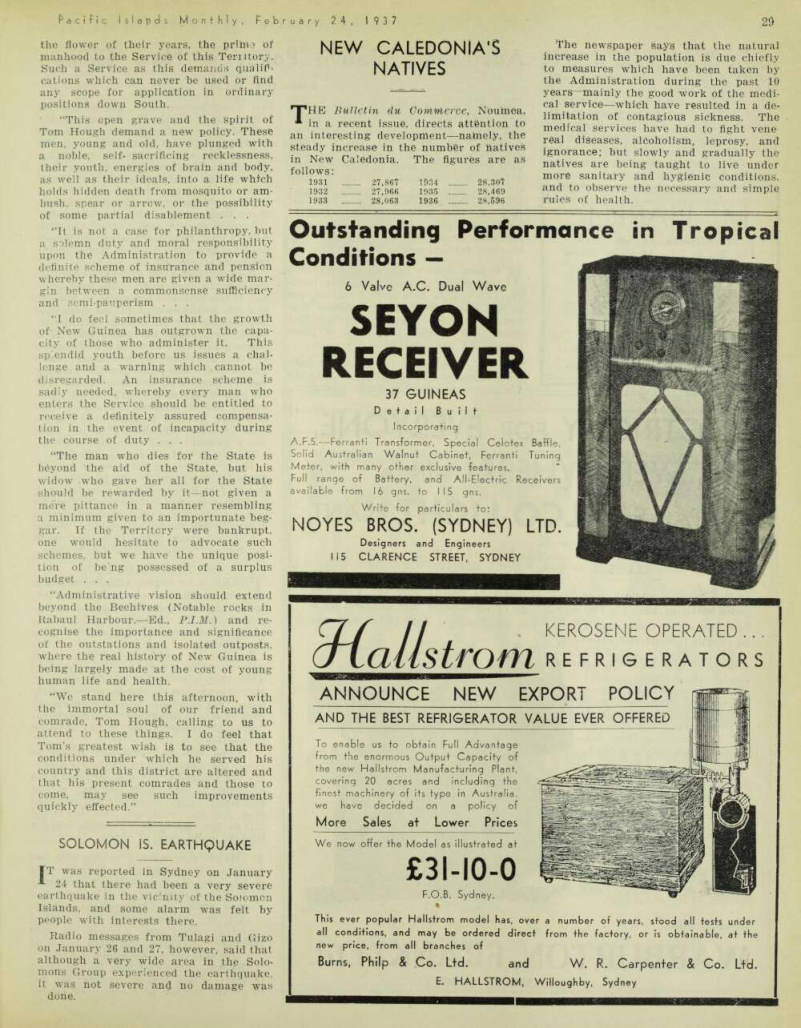
N.G.'S "Outside Men"
Better Compensation Urged For Patrol Risks
From a Special Correspondent
Salamaua, Jan. 12.
'T'HERE was a sad scene here on Dec ember 20 when fellow-officers of Patrol Officer T. A. Hough, who died from wounds received while on a patrol in the Markham River country, assem bled from remote outposts to pay their last respects to a comrade.
A feature of the funeral was the guard of-honour comprised of native members of the New Guinea Police and the Papuan Armed Constabulary. The latter were then on the goldfield prior to set ting out with the Champion relief party into Central New Guinea, In a moving address, Rev. V. H. Sher win paid tribute to Thomas Hough, who was a very promising officer of the N.G.
Service and was held in high esteem by his superiors, who hoped great things of him. Padre Sherwin stressed the need for adequate provision and compensation for field officers who run the risks of disablement while engaged in their haz ardous duties.
The following is part of Mr. Sherwin’s sermon: “I do not as a rule add to the poig nancy of a funeral by speaking at the graveside, but the present occasion and the circumstances associated with this tragedy, compel one to bring to the sur face certain aspects that conscientiously demand an airing. They may come under two headings: First, the personal and sentimental appeal; secondly, the appeal of our friend to remedy existing condi tions, that are little short of scandalous for men in the field.
“Before us is a terse inscription, which because of its simplicity of wording, is a monument to one of the saddest trage dies in the history of the Administration:
Thomas Hough, Age 23.
“You probably know his sterling quali ties as an officer in the Administration better than I do, but I have no hesitation in saying without fear of contradiction that he was among the ablest of our young officers in the field.
“I feel that his mortal remains before ns bear silent witness to the cost of the field service of the Administration in New Guinea a cost that has steadily been mounting up over the past few years.
“His spirit lays a solemn charge upon those in authority, to face a definite moral responsibility that has been too long and far too lethargically neglected —the adequate provision for those young men of his generation, as well as for those who are yet to follow on, who run the risks of partial or total disablement in the course of duty. The same also applies to those men who have grown, or are growing, old in the Service. The stress of fever, responsibility, and hard conditions in the bush make them worn, tired, and old before their time. Such men are giving, or have already given.
the flower of their years, the prime of manhood to the Service of this Territory.
Such a Service as this demands qualifi cations which can never be used or find any scope for application in ordinary positions down South.
“This open grave and the spirit of Tom Hough demand a new policy. These men, young and old, have plunged with a noble, self- sacrificing recklessness, their youth, energies of brain and body, as well as their ideals, into a life which holds hidden death from mosquito or am bush, spear or arrow, or the possibility of some partial disablement . . .
“It is not a case for philanthropy, but a solemn duty and moral responsibility upon the Administration to provide a definite scheme of insurance and pension whereby these men are given a wide mar gin between a commonsense sufficiency and semi-pauperism . . .
“I do feel sometimes that the growth of New Guinea has outgrown the capa city of those who administer it. This spendid youth before us issues a chal lenge and a warning which cannot be disregarded. An insurance scheme is sadly needed, whereby every man who enters the Service should be entitled to receive a definitely assured compensa tion in the event of incapacity during the course of duty . . .
“The man who dies for the State is beyond the aid of the State, but his widow who gave her all for the State should be rewarded by it —not given a mere pittance in a manner resembling a minimum given to an importunate beg gar. If the Territory were bankrupt, one would hesitate to advocate such schemes, but we have the unique posi tion of be ng possessed of a surplus budget . . .
“Administrative vision should extend beyond the Beehives (Notable rocks in Rabaul Harbour. —Ed., P.1.M.) and re cognise the importance and significance of the outstations and isolated outposts, where the real history of New Guinea is being largely made at the cost of young human life and health.
“We stand here this afternoon, with the immortal soul of our friend and comrade, Tom Hough, calling to us to attend to these things. I do feel that Tom’s greatest wish is to see that the conditions under which he served his country and this district are altered and that his present comrades and those to come, may see such improvements quickly effected.”
Advertisements & other items, p. 30 (1 item)
Smooth Power
fej
The moderate speeds of the "Fetter" Diesel Marine Engines and their simplicity of design assure a constant supply of smooth power over years of trouble free, economical operation.
The extreme simplicity makes a breakdown most improbable and the moderate speeds mean less wear, long life and low operating cost.
Put in a "Fetter"—the popular engine for all types of craft. f
ATOMIC-DIESEL - SEMI-DIESEL
MARINE ENGINES
5 to 540 B.H.P.
Buzacott&Co. Ltd
7-11 MARKET STREET
SYDNEY
Solomon Is. Earthquake
FT was reported in Sydney on January * 24 that there had been a very severe earthquake in the vicinity of the Solomon Islands, and some alarm was felt by people with interests there.
Radio messages from Tulagi and Gizo on January 26 and 27, however, said that although a very wide area in the Solo mons Group experienced the earthquake, it was not severe and no damage was done.
New Caledonia's
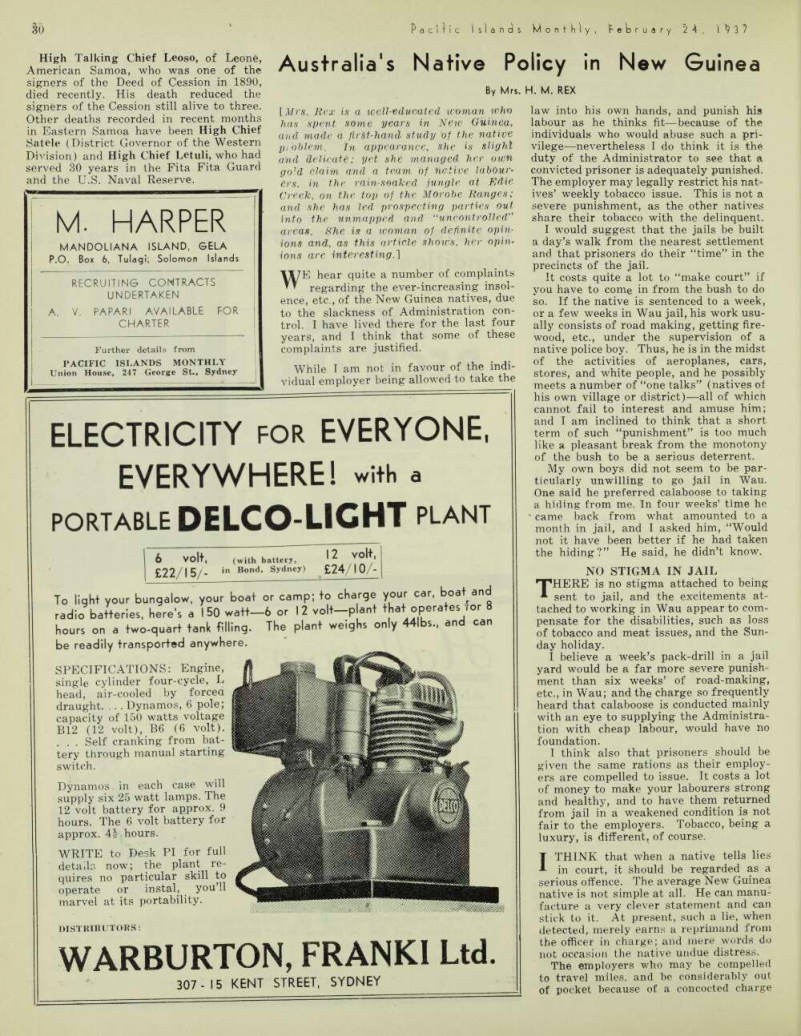
Natives
TTHE Bulletin clu Gonitoierce, Noumea, * in a recent issue, directs attention to an interesting development—namely, the steady increase in the number of natives in New Caledonia. The figures are as follows: 1931 27,867 1934 28,307 1932 27,966 1935 28,469 1933 28,063 1936 28,596
The newspaper Says that the natural increase in the population is due chiefly to measures which have been taken by the Administration during the past 10 years—mainly the good work of the medi cal service—which have resulted in a de limitation of contagious sickness. The medical services have had to fight vene real diseases, alcoholism, leprosy, and ignorance; but slowly and gradually the natives are being taught to live under more sanitary and hygienic conditions, and to observe the necessary and simple rules of health.
High Talking Chief Leoso, of Leone, American Samoa, who was one of the signers of the Deed of Cession in 1890, died recently. His death reduced the signers of the Cession still alive to three.
Other deaths recorded in recent months in Eastern Samoa have been High Chief Satele (District Governor of the Western Division) and High Chief Letuli, who had served 30 years in the Fita Fita Guard and the U.S. Naval Reserve.
Advertisements & other items, pp. 31-32 (1 item)
uialL
Outstanding Performance in Tropical
Conditions
6 Valve A.C. Dual Wave
SEYON
RECEIVER
37 GUINEAS
Detail Built Incorporating A.F.5. —Ferranti Transformer, Special Celotex Baffle, Solid Australian Walnut Cabinet, Ferranti Tuning Meter, with many other exclusive features.
Full range of Battery, and All-Electric Receivers available from 16 gns. to 115 gns.
Write for particulars to:
NOYES BROS. (SYDNEY) LTD.
Designers and Engineers
115 CLARENCE STREET. SYDNEY
mm
uialL
. KEROSENE OPERATED ..
StfOm REFRIGERATORS
ANNOUNCE NEW EXPORT POLICY
AND THE BEST REFRIGERATOR VALUE EVER OFFERED To enable us to obtain Full Advantage from the enormous Output Capacity of the new Hallstrom Manufacturing Plant, covering 20 acres and including the finest machinery of its type in Australia, we have decided on a policy of More Sales at Lower Prices We now offer the Model as illustrated at £3l-10-0 F. 0.8. Sydney. % This ever popular Hallstrom model has, over a number of years, stood all tests under all conditions, and may be ordered direct from the factory, or Is obtainable, at the new price, from all branches of Burns, Philp & Co. Ltd. and W. R. Carpenter & Co. Ltd.
E. HALLSTROM, Willoughby, Sydney --- "...
ilfe
M. HARPER
MANDOLIANA ISLAND, GELA
P.O. Box 6, Tulagr, Solomon Islands
RECRUITING CONTRACTS
UNDERTAKEN
A. V. PAPARI AVAILABLE FOR
CHARTER
Further details from
PACIFIC ISLANDS MONTHLY
Union House, 247 George SL, Sydney
ELECTRICITY for EVERYONE,
EVERYWHERE! with a
PORTABLE DELCO-LICHT plant
6 volt, £22/15/- (with battery, in Bond, Sydney) 12 volt, £24/10/- To light your bungalow, your boat or camp; to charge your car, boat and radio batteries, here's a 150 watt_6 or 12 volt-p ant that operates for 8 hours on a two-quart tank filling. The plant weighs only 441b5., and can
be readily transported anywhere.
SPECIFICATIONS: Engine,
single cylinder four-cycle, L head, air-cooled by forced draught. .. . Dynamos, 6 pole; capacity of 150 watts voltage 812 (12 volt), B 6 (6 volt). . . . Self cranking from battery through manual starting switch.
Dynamos in each case will supply six 25 watt lamps. The 12 volt battery for approx. 9 hours. The 6 volt battery for approx. 4i hours.
WRITE to Desk PI for full details now; the plant requires no particular skill to operate or instal, you’ll marvel at its portability.
DISTRIBUTORS;
WARBURTON, FRANKI Ltd
307 -15 KENT STREET, SYDNEY
Australia's Native Policy in New Guinea
By Mrs. H. M. Rex
[Mrs. Rex is a well-educated woman who has spent some years in New Guinea, and made a first-hand study ! of the native pioblem. In appearance, she is slight and delicate; yet she managed her own go 7 d claim and a team of native labour ers. in the rain-soaked jungle at Edie Creek, on the top of the Morobe Ranges; and she has led prospecting parties out into the unmapped and “ uncontrolled ” areas. She is a woman of definite opin ions and, as this article shows, her opin ions are interesting .] WE hear quite a number of complaints regarding the ever-increasing insol ence, etc., of the New Guinea natives, due to the slackness of Administration con trol. I have lived there for the last four years, and I think that some of these complaints are justified.
While I am not in favour of the indi vidual employer being allowed to take the
law into his own hands, and punish his labour as he thinks fit—because of the individuals who would abuse such a pri vilege—nevertheless I do think it is the duty of the Administrator to see that a convicted prisoner is adequately punished.
The employer may legally restrict his nat ives’ weekly tobacco issue. This is not a severe punishment, as the other natives share their tobacco with the delinquent, I would suggest that the jails be built a day’s walk from the nearest settlement and that prisoners do their “time” in the precincts of the jail.
It costs quite a lot to “make court” if you have to come in from the bush to do so. If the native is sentenced to a week, or a few weeks in Wau jail, his work usu ally consists of road making, getting fire wood, etc,, under the supervision of a native police boy. Thus, he is in the midst of the activities of aeroplanes, cars, stores, and white people, and he possibly meets a number of “one talks” (natives of his own village or district) —all of which cannot fail to interest and amuse him; and I am inclined to think that a short term of such “punishment” is too much like a pleasant break from the monotony of the bush to be a serious deterrent.
My own boys did not seem to be par ticularly unwilling to go jail in Wau.
One said he preferred calaboose to taking a hiding from me. In four weeks’ time he ■ came back from what amounted to a month in jail, and I asked him, “Would not it have been better if he had taken the hiding?” He said, he didn’t know.
No Stigma In Jail
THERE is no stigma attached to being sent to jail, and the excitements at tached to working in Wau appear to com pensate for the disabilities, such as loss of tobacco and meat issues, and the Sun day holiday.
I believe a week’s pack-drill in a jail yard would be a far more severe punish ment than six weeks’ of road-making, etc., in Wau; and the charge so frequently heard that calaboose is conducted mainly with an eye to supplying the Administra tion with cheap labour, would have no foundation.
I think also that prisoners should be given the same rations as their employ ers are compelled to issue. It costs a lot of money to make your labourers strong and healthy, and to have them returned from jail in a weakened condition is not fair to the employers. Tobacco, being a luxury, is different, of course.
I THINK that when a native tells lies in court, it should be regarded as a serious offence. The average New Guinea native is not simple at all. He can manu facture a very clever statement and can stick to it. At present, such a lie, when detected, merely earns a reprimand from the officer in charge; and mere words do not occasion the native undue distress.
The employers who may be compelled to travel miles, and be considerably out of pocket because of a concocted charge
he must answer, has no redress, and I am of the opinion that the prestige of the white man is considerably lowered by such cases going unpunished. I do think the native loses respect for all authority when he is not punished for something which he knows he should take it in the neck for. That earns his contempt—and justly, too.
IpROM my cook-boy I hear that the * gangs of prisoners who are road-mak ing., etc., are becoming a menace to other natives passing by. So detour has to be made, to avoid a fight. The reason given is that passing natives give or may give cheek to the working prisoners.
According to the cook-boy: “Man belong calaboose ’e got big feller work.
Now bel belong him not belong this feller work. Nother feller man ’e walk about nothing—’e got plenty to much sass. Al right, calaboose ’e like fight ’im!”
So, if this is usual, either a white police master should always be in control of a gang of prisoners or, better still, the pri soners should be punished by being given pack-drill in the prison yards. Natives do not like unconstructive work—it causes them to feel humiliated —so pack-drill should be a genuine punishment. jC'OR criminal offences against females -*■ without any mitigating circumstances, I would hang the native—the white man, also.
In districts not yet under control, or only recently brought under control, I would be very lenient with a killer. It must be very easy to revert to what has been the usual custom for generations, when in heat of anger.
I would under no circumstances take an accused man to Rabaul for trial, or native witnesses. So many natives want to go there, and I think they would possibly commit perjury to have such a trip.
I would class alluvial mining as gen eral labour, providing it is not night work, and I would not permit work on Saturday afternoons.
P>OLICE MASTERS in New Guinea should be about the best men in the force. Theirs is not an ordinary police man’s job.
I should think it would be better for everyone concerned if their social status was raised. Could not a tropical police force be built up with a cadet system.?
Character Of Natives
T FOUND the natives I dealt with, on * the whole, very well-mannered, not only to me, but to each other. When at work, they would warn each other con tinually of any pending fall of earth or splash of water. They would always offer to carry anything I might have in my hand, and proffer a helping hand or word of warning should we come to a difficult or dangerous place.
They are inveterate thieves and liars, and they are not at all embarrassed at being found out —very quick with ingeni ous excuses for themselves yet they retain the manners of gentlemen.
Once they learn that it is not regarded by the whites as cornme il faut to expose the person in public, they rather go to
the other extreme and become somewhat prudish 1 have bathed with native women m the place set apart for the women to wash; and not one of them would remove their grass skirts, although they were delighted with a cube of soap, and used W^ n £ toW them they couldn t get clean like that, I understood one to say that it wasn’t the “fashion belong mission to entirely disrobe. This was some distance up the Markham River.
I have seen a number of boys and men, after they have had a swim, all with wet laptops— presumably they thought it im modest to strip and hop in, as most of our own lads would do This self-consciousness is to be regret ted. I went a good way up the Sepik River once where neither the men nor women wore any clothes. I was told they were a most moral people. It would seem that the more we seek to hide our bodies
the better it would be to hide what is in our minds.
Religious Instruction
TT is deplorable that mission activities should be allowed to continue in the present fashion. The animosity the dif ferent sects have for each other, apart from damaging the prestige of the white race, is certain to be passed on to their respective converts.
Surely we Australians can summon up enough courage and commonsense to pro tect the natives in our Mandate from be coming participants in the endless and utterly futile controversies raging around the theories of transubstantiation; effi cacy of total immersion as against other forms of baptism; or whether keeping the sixth or the seventh day as a day of religious observance is vital to eternal salvation; whether those who do not ac
cept certain particular gods will “perish everlastingly”; and so on. Even if we are too cowardly to take steps to protect our own children from being intimidated by these endless and useless arguments, surely we should not allow these stone age natives to become involved in such discreditable controversies.
The Administration is not at all remiss in seeing that nowadays the native is not exploited by his employer. lam hoping that Public Opinion will bring sufficient pressure to bear upon the Administration to compel it to protect the native against the trouble-making activities of the mis sions.
The old days of fighting and raiding are practically over for the native, and so, in the areas now under control, much of his interest in life has gone. When he re turns to his village after finishing his
labour contract, there is little to amuse or interest him.
I would suggest that the time is ripe for the introduction of some small schools in the largest of the native villages. I would like to see school-masters chosen for their commonsense and proficiency in sport. The natives might be taught reading, writing and arithmetic, what team work in sport means, and they could be taught a number of other sensible and practical things also, such as personal hygiene, village sanita tion, road-making, bridge-building, cook ing, raising crops, etc.
I would like to see the school the social centre of village life, as the House Tam boran used to be, and, as now, in places, the mission is.
I would like to give the native the op portunity of acquiring material know ledge, healthy amusement and construc tive occupation, and of being education ally fitted to, in time, hold his own with the whites.
As we are going to occupy their country we must, in decency, give them the op portunity to raise themselves to our stan dard of what we call civilisation, equip their children to meet ours on a 50-50 basis.
Superiority does not lie in the colour of one’s skin, but in behaviour. We may hot always be the black man’s “master.” Let us so educate him that we may not fear for our children, should the pendulum swing the other way.
Advertisements & other items, pp. 33-34 (1 item)
Chapman
as
Fishing Tackle to Tackle Fishing."
IT IS FALSE ECONOMY TO PURCHASE BIG GAME FISHING GEAR BECAUSE OF IT'S CHEAPNESS—QUALITY MUST BE
THE KEYNOTE.
You spend a lot of time waiting for the bite and with cheap gear your, thoughts are, Will it stand the strain,” but with px - oved quality equipment this thought will never enter your head.
Why take the risk?
SPECIAL BIG GAME RODS:
Solid Indian Cane £4/5/0 Quality Hickory, heavy £B/5/0 Double built cane £lO/0/0 Treble built cane £l2/0/0 Bullen “Atlanta” £lB/18/0 Hardy Bros, No. 6 £lB/10/0
SIL ROHU
Sil Rohu’s years of practical experience in big Game Fishing is behind all the quality Fishing Gear we stock.
SPECIALITIES:
Swordfish Anti-kink and Line Connector . 5/_ The “S.R.” New Compensating Big Game Harness, does not creek. Holds reel very steady 45/- “S.R.” Detachable head gaff 57/6 S.R. Zane Grey Chrome Teasers. A wonderful worker continually reflecting light 32/6 Quality Firearms aiiu Fishing Tackle. 143 Elizabeth Street, SYDNEY (near Market Street!
rw
CHAPMAN
fa muej so fZUotv / Uu ]T uteirdd Ouur A to dr yruA trwuuf Sfc a" pl*i
CHAPMAN PUP ENGINES
are World-famed as power plant for MOTOR LAUNCHES.
Thousands in use throughout Australasia. Owners from all parts continually writing praising their astounding simplicity, reliability and Economy. Built in a number of different sizes from h.p. to 10 h.p. Write for leaflets and all information direct to the manufacturers—
CHAPMAN & SHERACK
ENGINE MANUFACTURERS AND LAUNCH BUILDERS
ERSKINEVILLE. N.S.W., AUSTRALIA
MUNGO SCOTT PTY. LTD
EXPORTERS OF
SUPERB FLOUR
FOR 38 YEARS
ISUPERB
RELIABILITY
AND PROMPT
SHIPMENT
SUMMER HILL SYDNEY AUSTRALIA
BURNS PHiLP
(SOUTH SEA) CO. LTD.
INCORPORATED IN FIJI
Island Traders and Shipowners
Also Branches at: Registered Office:
SUVA
FIJI
\ Code Address: "Burnsouth."
Fiji: Levuka, Lautoka, Labasa, Ba, Sigafoka, Tonga: Nukualofa, Haapai, Vavau.
Samoa: Apia, Pago Pago (American Samoa).
Solomons: Makambo, Glzo, Falsi.
New Hebrides: Vila.
Gilberts: Tarawa.
Norfolk Is. Niue. Wallis Is. Futuna Is.
Rotuma.
The Mau And Infantile
Paralysis
Fi’om Our Own Correspondent
Apia, Jan. 21.
IT was owing to the representations of ■ the Samoan Man that a number of European permanent residents of the ritory, returning to their homes on the Matua, were not allowed to land or to be placed in quarantine on shore, and had, to their great indignation, to return to Fiji or New Zealand.
The attitude 6f the Samoan authorities regarding the prevalence of infantile paralysis in New Zealand is in marked contrast to the practice in all other ports touched at by the Matua, (Rarotonga, Tonga and Fiji) where passengers and crew were allowed ashore without diffi culty.
Editorial Note
It is becoming clear that, since the “Goodwill Mission” brought practical Socialism to Samoa, the Mau (the political organisation representing about 60 per cent, of the natives) has been given extraordinary powers in Administrative affairs.
The foregoing is a good example of what is going on. Incidentally, it explains what appeared to be cruelty and callousness on the part of the Apia officials, in driving away five residents of Apia who were returning to their homes. Apparently, the officials were only carrying out the orders of their masters of the Mau. And the slogan of th.e Man could be written thus: “Samoa for the Samoans! Out with all Europeans!”
Mr. G. V. Maunsell-Turner, Stipendiary
Magistrate at Rabaul, arrived in Sydney
from New Guinea on leave by the Malaita on January 15.
In The Good Old Bad Days
Jackson's Adventures in Fiji 100 Years Ago
By Julian Hillas-Part 2.
TOURING one of the raids made by -■-ABonavidongo’s people on enemy tribes, a number of prisoners having been taken, the bodies were as usual prepared for food.
At the same time as the human flesh was being cooked, a second group were busy dressing turtle, cutting up the meat in exactly the same sized pieces as the other.
The natives, knowing Jackson’s aver sion to the former, but ascribing this to his ignorance of its excellence, now in cluded a package of the human flesh among those set before him. Fortunately he was in the habit of examining all his food carefully and, noticing that some of the meat was darker than usual, he threw it all away and dined solely upon vegetables! of the main advantages of having a white man about was his ability to mend and keep in order the muskets, of which the natives knew nothing, be yond their use. It was in connection with this work that Jackson acquired his second wife—and also lost her again.
A tributary town had been attacked, and the people of Nateva sent a detach ment to its defence. During the fighting that ensued many of the muskets became clogged with dirt and rust and, as usual, were brought to Jackson, but he, being in a disagreeable mood and dissatisfied with life in general refused to attend to them.
The cause of his ill-temper was his in ability to have a young girl upon whom his eye had fallen, and who was engaged to a cripple whom she cordially disliked.
Mutual affection had sprung up between her and Jackson and she proposed that they ran away together. But he, unwill ing to risk a venture into strange terri tory, offered instead to take her back to Nateva. With this in view, he approached the old men of the town to enquire by what means he might obtain her. Greatly to his chagrin, they derided his request, informing him that she was a maramei or “chief girl” and consequently far above his reach.
Returning alone, he told the girl to wait patiently, and all would be well.
In a short time, these same people wanted him to go back and repair the’r muskets, which were now in very bad order indeed. Jackson again refused de manding a monetary payment which they were unable to make. Finally, however, he consented on condition they gave him the maramei as his wife.
After a long consultation, this was agreed to, and the girl and the muskets were brought to Nateva.
A number of the muskets required fresh mainsprings. Jackson, whose only tools were an old knife, a sail-needle and a flat stone, was in a quandary. It was manifestly impossible to weld a main spring with such appliances as he had. yet at the same time it was equally cer
tain that permanent possession of the maramei depended upon the successful repair of the guns.
The problem suddenly solved itself.
Peeling hungry, one night, Jackson visited the tribal temple and there carved himself a generous helping from one of the cooked pigs dedicated to the god. He threw the remainder away, and was on the point of leaving when he noticed a row of muskets likewise dedicated to the same service. It was but the work of minutes to unscrew the locks and remove the mainsprings, taking care not to dis turb the cobwebs that were interwoven between the guns.
The following morning there was great excitement among the natives, who dis covered to their amazement that the god had swallowed a whole hog. The priest, wishing to turn such a unique event to
his own advantage, claimed that he had even seen and conversed with the deity.
This same pig was ultimately the cause of the death of Jackson’s two wives and very nearly of his own.
Soon afterwards, a number of hogs were again offered to the god and there was much speculation as to whether he would consume another, in similar
fashion. Jackson, not wishing to strengthen the original error, and believing himself firmly established in the community, told them that it was he who had eaten the first pig.
The result of this confession was disastrous.
An hour or so later he was attacked and pushed down the steps of his house.
Picking himself up, he fled towards the beach, pursued by the whole settlement.
Fortunately, it was dark, and in the con fusion he managed to steal off in the direction of Somo Somo, he learned of the death of both his wives, who, in accordance with custom, had been strangled as sub stitutes for himself.
FINDING his way to a village further along the coast, Jackson fell in with a party going to Bau, then the principal town in Fiji and the capital of the all powerful chief Thakombau.
At Bau. he was asked to cast a thou sand balls of lead—a task which he ac complished so well that the king begged him to make his home at Bau, from whence, under the royal protection he could visit almost any part of the Group.
On one such tour, Jackson accompanied Thakombau’s brother. Revelita and, call ing at the island of Batiki, witnessed an unusual demonstration of the abject fear in which the Chiefs of Bau were held.
The Batiki people, on first sighting their visitors, commenced the prepara tion of food. But. owing to the speed of the canoe, there was not sufficient time for this to be nronerly cooked before their arrival. At this. Revelita flew into a pas sion and. calling the Batiki natives to gether. abused them roundly.
One of his courtiers, noting that the
beach on which they were sitting was covered with pumice stone, observed that it would be less hardship for their hosts to make a hearty meal from the pumice stone than it would be for a Ban chief to eat underdone pork.
“Well thought of!” said Revelita, and immediately commanded them to begin.
Their terror was so great that they ate so large a quantity of pumice that, although the beach was thirty or forty yards long, the number of stones visibly diminished. /~|N another occasion Jackson visited ”Rewa as the guest of Thakonauto who, with his two brothers, governed the dis trict and kept in subjection the Drekete people formerly rulers of Rewa. So greatly had this tribe been reduced that —they were now literally, and in their own persons, regarded as the principal food supply of public occasion!
At the time of Jackson’s visit, Thako nauto’s elder brother was building a new palace and, in keeping with national custom, he caused a Drekete man to be buried alive at each corner post, super stition being that if a king’s dwelling was not supported in this manner it could not be expected to stand for long.
"OUT it was reserved for the township of Na ara Bale to furnish the most fiendish example of barbaric cruelty which Jackson had as yet seen. This place was an isthmus, joining two islands and there, by dragging a canoe half a mile across land, a lengthy sea voyage might be avoided.
On their arrival here, the Ban people surprised and captured upwards of 40 natives of a disobedient tribe, whom they had for some time been intending to discipline. Their method of doing this was as expedient as it was revolting. It consisted of using these unfortunate men instead of the wooden rollers over which the canoes were to be hauled.
To keep the bodies in a straight posi tion, two banana stems—chosen on account of the spongy texture were lashed the full length of the body, back and front. The screams of the first few who were crushed were lost in the de moniacal laughter of their captors; but, as the latter wearied, the piercing shreiks could be distinctly heard, even at a great distance.
The round bottoms of the heavy double-canoes were dragged over the victims—who lay face upward—in such a manner as to fit into the soft part of the body between the breast and the crutch. Needless to relate, they all died.
A T this point, Jackson’s narrative ter minates abruptly.
The only information we have of him again is a footnote annended to Erskine’s Western Pacific, in which it is mentioned that, after a short stay in the New Heb rides. where he was engaged in the sandalwood trade. Jackson came to Syd ney in TT.M.B. Fly in 1850.
The amazing part is not so much the adventures which befell him as that he should have survived to ten of them.
Daying down the record, one a sense of completion. Jackson set out with the expressed intention of seeing “foreign countries and strange manners” and no one, I think, will suggest that he failed!
Advertisements & other items, pp. 35-36 (1 item)
Inexpensive TRAVEL CASES
Maleham & Yeomans
LIMITED
BOWDEN STREET, SHEFFIELD, ENG.
Manufacturers of all kinds of Butchers', Sticking and Sheath Knives Razors and Scissors Specialty Hairdresser Scissors
PRICE LIST ON APPLICATION
Inexpensive TRAVEL CASES
r 12”
N 9 8B > 18" 20 r 2 2 24 N? 77 26 All sizes from 12-inch attaches to 28-inch travel cases. These cases are made with strong lids, with edges metal bound. The corners are reinforced, the handles stoutly riveted. Each case is fitted with two
nickel-plated English
locks and keys.
Ask your storekeeper to show you these lightweight, economy cases. At the price, they offer value unsurpassed.
Traders are invited to write for full particulars of all travel and leather goods.
FORD, SHERINGTON LTD.
MANUFACTURERS (Wholesale Only)
KIPPAX STREET, SYDNEY
PURE RICE
STARCH
Always ask for . . .
CORAL" Brand
100% PURE
Noted for its
QUALITY
and
WHITENESS
Goes Farthest and gives Lasting Finish
WILL NOT
STICK TO
IRON
Obtainable from Leading Island Stores Manufactured by
AUSTRALIAN RICE LTD.
Sydney, N.S.W. $
P MMuMI « ■ »•
CORAL BRAND
RICE STARCH
s;
Australia's Choicest Products: Green Peas French Beans Cauliflower
r'CARDCN VALE
v PRODUCTS UNITED
. 2-4 BROWN STR-E-CT, N-EWTOWN
fYDN-EY. AUSTRALIA
New Guinea
German Propaganda In
j\fß. E. J. WAUCHOPE, of Madang, New Guinea, told the Melbourne Herald —and the Herald published it “with bells on”—that there is much propaganda in New Guinea and in Aus tralia in favour of the return of New Guinea to Germany.
“German propaganda for the return of her New Guinea colonies is filtering through New Guinea and Australia,” said Mr. Wauchope. “I was surprised at its extent in the Commonwealth, where I am repeatedly asked, ‘What are you go ing to do when Germany gets her colonies back.’
“For some time the native boys have been saying to planters, ‘Master, Germans close up.’ They meant that Germans were soon to take over the colony, and believed that Australians there now would have to leave. ‘The boys said they heard this from the German missions. I have formed the impression that the young German missionaries, who have come to New Guinea in large numbers in recent years, are responsible.
“The missions deny responsibility, and the older Germans are good, tolerant men, but it is certain that the boys get the propaganda from the coloured mis sionaries.
“Officers on German boats calling at New Guinea have openly advised me to learn German, saying that New Guinea would belong to Germany again.”
Mr. Wauchope advocated migration of Australians with capital to take up the large area of suitable country still avail able for copra production.
Increased Spending Power
From Our Own Correspondent
Apia, Jan. 18.
WITH better business all round, high ** copra and cocoa prices and brighter prospects for the new year, the festive season was visibly enjoyed by the resi dents of Western Samoa.. Numerous parties, picnics and dances were held during the holidays.
The Apia stores, unprepared for the large increase in the spending power of Europeans and natives, sold out many lines especially foodstuffs, like canned meats, sugar and (owing to a shortage of flour) bread. The shortage was re lieved by the arrival of new supplies by the Matua on December 25, the Maui Pomare on December 31, and the Wai runa on January 2.
The Matua and the Maui Pomare took away full loads of over 7000 cases of bananas each for the New Zealand markets. There still is an abundance of bananas, and planters are unable to ship all their fruit. It is hoped that under the new year’s banana contract, the Samoan quotas will be increased especi ally as the demand for the Samoan bananas has considerably improved.
The cocoa crop is practically over and has been a very good one. Copra also is coming in freely at the higher prices for the product now ruling.
Samoan Notes
From Our Own Correspondent
Apia, Jan. 21.
THE sudden and unexpected death of * Mr. Neil M. Caldwell, a popular mem ber of the staff of Messrs. Burns Philp (S.S.) Co. Ltd., and a resident of Apia for the last 16 years, was received by Apia residents with regret and sympathy.
Mr. Caldwell was only 34 years old. He was an Australian, and had taken a prominent part in social and sporting ac tivities, and made many friends through his never-failing courtesy and devotion to duty. His death was caused by internal haemorrhage, the result of injury to his leg when struck by a cricket ball several months ago. The funeral at Magiagi on December 28 was attended by a large and representative gathering—it included the Acting Administrator.
Their Spell At Liberty
Five Somaon prisoners, who several weeks ago escaped from Vaimea prison, and roamed the country and enjoyed their dearly-won freedom, have now been re captured. They will appear before the court, when their dash for liberty will obtain them additional prison sentences.
The Mcllraith, McEacharn passenger liner Katoomba will leave Sydney on March 27 for a 16-day Easter cruise to the Pacific Islands. She'will call at Norfolk Island, Suva (Fiji), Vila (New Hebrides), and Noumea (New Cale donia). The vessel is due to return to Sydney on April 12.
Mr. George Glutton, an old resident of Fiji, died in the Colonial War Memorial Hospital, Suva, on January 11, after a prolonged illness. He went to the Group many years ago as a bricklayer in the employ of the Colonial Sugar Refining Co., and had worked at the C.S.R. mills in different parts of the Colony.
Advertisements & other items, pp. 37-38 (1 item)
V E Ii S
Kork-N-Seal
FOR HOME USE
Hand Applied Airtight Pressure Proof
FOR ALL HOME BOTTLING
—THE LITTLE CAP THAT
will Re - seal 1,000 Times
KORK - N - SEAL (Aust.) LTD.
106 COMMONWEALTH STREET
SYDNEY, AUSTRALIA
We are Specialists . . .
\ ’Phones: MA 3612 (4 lines) Cable Address; “Weymarkson”
Codes —Bentleys Private Let us have your confidence. Sixty years is our record of supplying the leading Houses throughout the World in ... .
FRESH FRUIT VEGETABLES PRODUCE
WEYMARK & SON LTD.
FRUIT AND PRODUCE MERCHANTS
14-18 STEAMMILL STREET - . SYDNEY
€ II 1
V E II S
I* I It E
eoo n s
GOLD MEDAL JAMS
CANNED ENGLISH FRUITS
CANNED ENGLISH VEGETABLES
CUSTARD POWDER
OLD ENGLISH MARMALADE
JELLY CRYSTALS, ETC.
Obtainable from all Leading Grocery Stores Write to Department A., Chivers and Sons Ltd., Histon, Cambridge, England, for attractive Recipe Book.
E. 76
PRESCOTT L T i> Iy S dpJe S y ar-<$ sole wholesale agents'
PINEAPPLE BACON s HANS
DAISY BRAND BUTTER
LEA & PERRINS' H. P. Sauce
LEA &. PERRINS'
and Most other Super-Quality Lines of the Trade
SWALLOW
& ARIELL'S
PLUM
PUDDINGS
-lb. -lb.! 15-lbs. : 2-lbs. b and 3-lbs.
Renowned for Quality Manufactured at Port Melbourne, Australia
Valuable Official Compilation
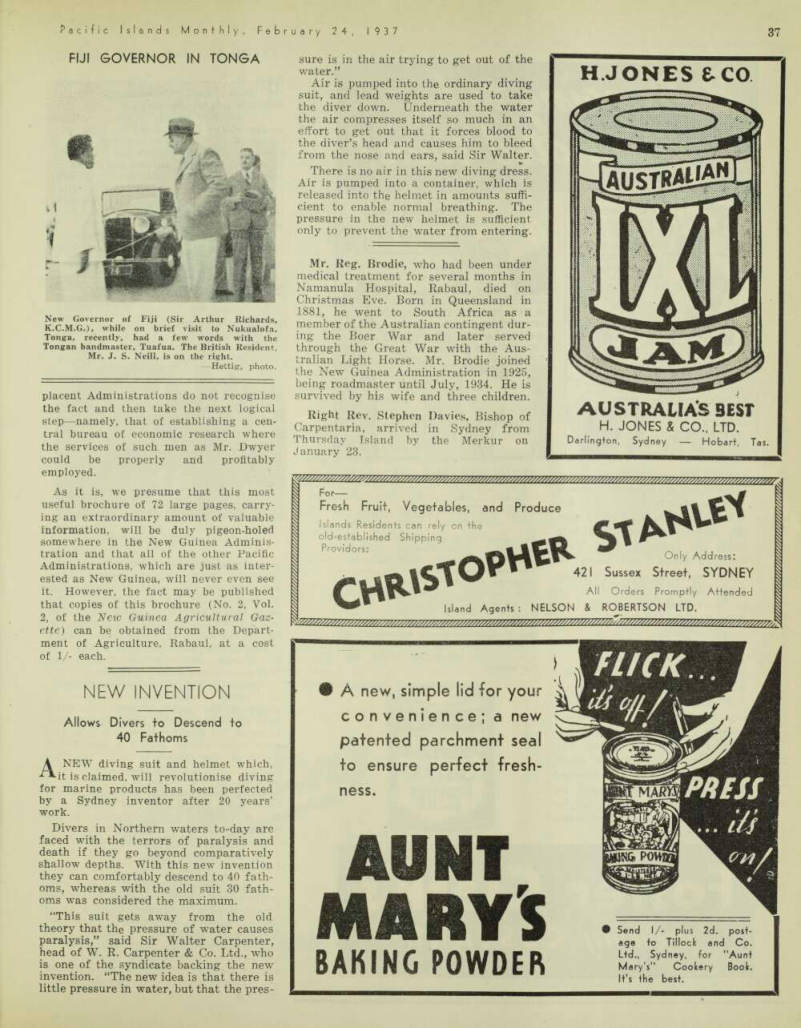
Future Of N.S. Copra
Industry
\ BROCHURE which we are inclined to describe as the most valuable com pilation ever made in connection with the copra industry was published in the October issue of the New Guinea Agri cultural Gazette. It is entitled “A Sur vey of the Coconut Industry in New Guinea” and it is by Mr. R. E. P. Dwyer, H.D.A., H.D.D., B.Sc., who is the Eco nomic Botanist employed by the Depart ment of Agriculture in N.G.
Mr. Dwyer has not confined his com pilation to New Guinea. He has rightly taken the view that in order that he may write authoritatively about the future of the N.G. copra industry, he must make a survey of the copra industry of the world —and this has involved researches re garding the present and possible future use of coconut oil, the prospects of in creased production, the method of world distribution, and the possibility of coco nut oil being supplanted by other vege table and mineral oils.
As well as the world aspect, Mr. Dwyer has dealt very fully with the local as pects under the sub-titles of ‘‘lmportance of the Copra Industry as Affected by the rise in Gold Production,” ‘‘Production of Shredded and Desiccated Coconut,” ‘‘Quality of N.G. Copra,” “Fluctuations in Average Values of N.G. Copra,” “Effect of Copra Inspection on the Premium ob tained for Rabaul Hot-Air Dried,”
“Manufacturers’ Requirements,” “Copra Driers,” “Accounting Methods on Planta tions,” “Administration Ordinances.”
In his conclusions, Mr. Dwyer says that coconut production is likely to be the main feature of the planting industry in New Guinea for many years. The industry has not received the attention in various directions which its economic importance merits—especially as the pro duction per acre has a tendency to dec line. He apparently takes the view—ex pressed many times in the P.I.M. —that the gold industry has been permitted to overshadow New Guinea copra in dustry and that the authorities have not used the rich revenues derived from gold sources as they might have done to build up and stimulate the planting industry.
Mr. Dwyer points out that the older planting areas in N.G. are definitely be yond their stage of maximum production and there has not been a sufficient co ordinated effort to establish new coconut plantations. He acknowledges, however, that conditions during the depression period, with its calamitously low copra prices, may have been largely responsible for this.
“The need for an organised scheme of research dealing with copra and coconut production in this territory is very evi dent,” says Mr. Dwyer. It is very evi dent in every coconut growing territory in the South Seas. The amazing thing is that all these self-centred and com-
placent Administrations do not recognise the fact and then take the next logical step—namely, that of establishing a cen tral bureau of economic research where the services of such men as Mr. Dwyer could be properly and profitably employed.
As it is, we presume that this most useful brochure of 72 large pages, carry ing an extraordinary amount of valuable information, will be duly pigeon-holed somewhere in the New Guinea Adminis tration and that all of the other Pacific Administrations, which are just as inter ested as New Guinea, will never even see it. However, the fact may be published that copies of this brochure (No. 2, Vol. 2, of the New Guinea Agricultural Gaz ette) can be obtained from the Depart ment of Agriculture, Rabaul, at a cost of 1/- each.
Fiji Governor In Tonga
New Governor of Fiji (Sir Arthur Richards, K.C.M.G.), while on brief visit to Nukualofa, Tonga, recently, had a few words with the Tongan bandmaster, Tuafua. The British Resident, Mr. J. S. Neill, is on the right.
Hettig, photo.
New Invention
Allows Divers to Descend to 40 Fathoms
A NEW diving suit and helmet which, is claimed, will revolutionise diving for marine products has been perfected by a Sydney inventor after 20 years’ work.
Divers in Northern waters to-day are faced with the terrors of paralysis and death if they go beyond comparatively shallow depths. With this new invention they can comfortably descend to 40 fath oms, whereas with the old suit 30 fath oms was considered the maximum.
“This suit gets away from the old theory that the pressure of water causes paralysis,” said Sir Walter Carpenter, head of W. R. Carpenter & Co. Ltd., who is one of the syndicate backing the new invention. “The new idea is that there is little pressure in water, but that the pres
sure is in the air trying to get out of the water.”
Air is pumped into the ordinary diving suit, and lead weights are used to take the diver down. Underneath the water the air compresses itself so much in an effort to get out that it forces blood to the diver’s head and causes him to bleed from the nose and ears, said Sir Walter.
There is no air in this new diving dress.
Air is pumped into a container, which is released into the helmet in amounts suffi cient to enable normal breathing. The pressure in the new helmet is sufficient only to prevent the water from entering.
Mr. Reg. Brodie, who had been under medical treatment for several months in Namanula Hospital, Rabaul, died on Christmas Eve. Born in Queensland in 1881, he went to South Africa as a member of the Australian contingent dur ing the Boer War and later served through the Great War with the Aus tralian Light Horse. Mr. Brodie joined the New Guinea Administration in 1925, being roadmaster until July, 1934. He is survived by his wife and three children.
Right Rev. Stephen Davies, Bishop of Carpentaria, arrived in Sydney from Thursday Island by the Merkur on January 23.
Advertisements & other items, pp. 39-40 (1 item)
Mary's
H.JONES fcCO
Q
AUSTRALIA’S BEST
H. JONES & CO., LTD.
Darlington, Sydney Hobart. Tas.
For— Fresh Fruit Vegetables, and Produce Islands Residents can rely on the old-established Shipping Providers:
ch*» s !
ST A
Island Agents Only Address: 421 Sussex Street, SYDNEY All Orders Promptly Attended
NELSON & ROBERTSON LTD.
® A new, simple lid for your convenience; a new
patented parchment seal
to ensure perfect freshness.
AUNT
MARY'S
BAKING POWDER
PRESS
.. u w m* f"/ • Send I/- plus 2d. postage to Tillock and Co.
Ltd., Sydney, for "Aunt Mary’s" Cookery Book.
It’s the best.
fM
WHAT AM IGOING TO
DO? BOB'S'PHONED TO
SAY HIS CHIEF & WIFE
ARE COMING TO BRIDGE
TO-NIGHT & THERE'S
r ~T simply nothing
IN THE HOUSE
IT'S BEENA
DELIGHTFUL EVENING.
YOU MUST BOTH COME
AND SEE US VERY
) SOON.
JTTI
i 4 CJ 0 \
THANKS SO MUCH, WE'D LOVE TO
.V THE WAY, I'VE COPIED OUT THE LEMON TARTLET RECIPE FOR YOU. MIND YOU T
USE FOSTER CLARK'S CREAMY CUSTARDjI/
3^
IT MAKES ALL THE
DIFFERENCE
. . I KNOW YOU KEEP
FOSTER CLARK'S CUSTARD
THERE ARE HEAPS OF r-
LOVELY THINGS YOU
CAN MAKE WITH IT — (
LEMON TARTLETS FOR J
INSTANCE . .
A m Foster Clark’s world-famous creamy Custard may not bring promotion to every woman’s husband —but it does promote a hearty appetite! Especially when it is used in delightful dishes like Lemon Tartlets. You’ll find this recipe and nearly 100 others—in Elizabeth Craig’s Recipe Book. Write for your FREE copy to Foster Dark (Aust.) Ltd., Dept.
R. 8., Redfern, N.S.W. Enclose Id. stamp for postage.
Health Value.
Remember, Foster Clark’s Custard is more than a delicious dish. It is a nourishing food, prepared from pure, wholesome ingredients, and natural flavours . . . finest Vanilla Beans, choicest Lemons and selected Valencia Almonds. Take your choice from these three, or the Standard flavouring, and serve Custard for dinner to-morrow. Always ask for Foster Clark’s Custard, and refuse cheap imitations.
RECIPE FOR LEMON TARTLETS
lb. Short Crust Raspberry Jam 2 ozs. Almonds
1 pt. FOSTER CLARK’S LEMON
CUSTARD
Turn pastry on to a lightly floured board and roll to Finch thickness. With a pastry cutter, cut pastry into rounds, and line tartlet tins evenly with the rounds.
Prick the bottom of each with a fork.
Bake in a quick oven till crisp, then cool on a cake rack. When required, place a teaspoon of jam in the bottom of each tartlet and almost fill with the custard.
Blanch, split, and brown the almonds in a little butter. They can be fried or baked. Spike the custard fillings with the almonds. sa
WlTAtl?
vanilla
FSI43
Foster Clark's
creamy CUSTARD
Praise For The W.R.C. Line
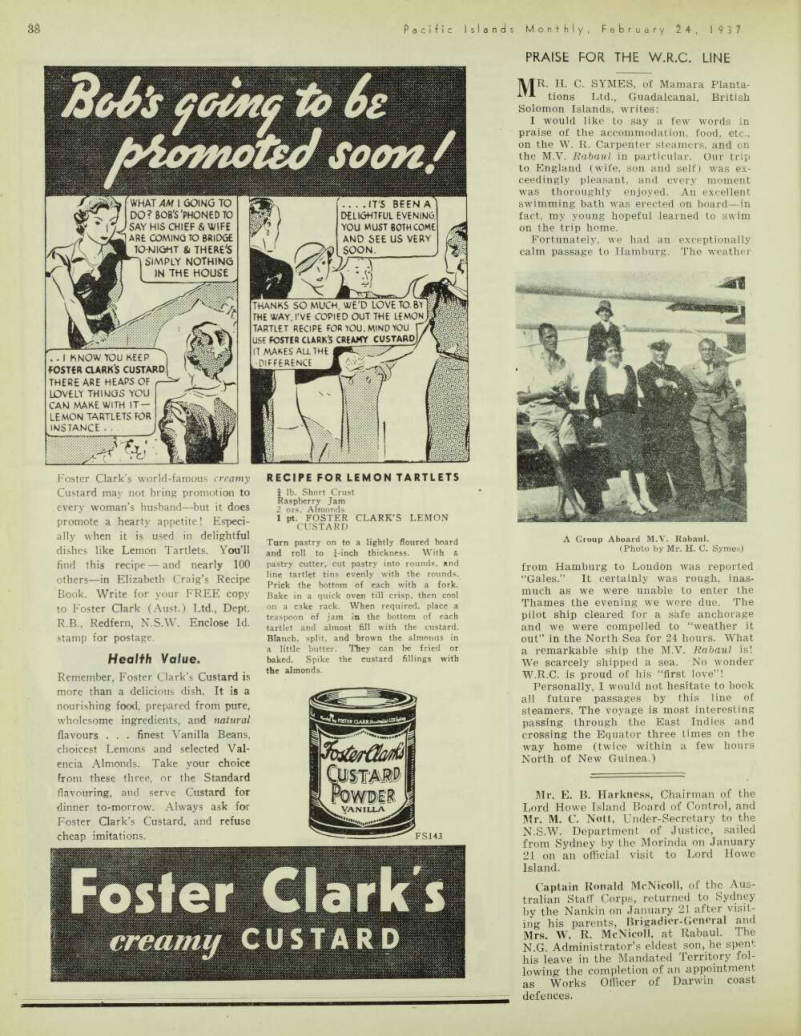
TV/fR. H. C. SYMES, of Mamara Planta •L*-*- tions Ltd., Guadalcanal, British Solomon Islands, writes; I would like to say a few words in praise of the accommodation, food, etc., on the W. R. Carpenter steamers, and on the M.V. Rabaul in particular. Our trip to England (wife, son and self) was ex ceedingly pleasant, and every moment was thoroughly enjoyed. An excellent swimming bath was erected on board—in fact, my young hopeful learned to swim on the trip home.
Fortunately, we had an exceptionally calm passage to Hamburg. The weather
from Hamburg to London was reported “Gales.” It certainly was rough, inas much as we were unable to enter the Thames the evening we were due. The pilot ship cleared for a safe anchorage and we were compelled to “weather it out” in the North Sea for 24 hours. What a remarkable ship the M.V. Rabaul is!
We scarcely shipped a sea. No wonder W.R.C. is proud of his “first love”!
Personally, I would not hesitate to book all future passages by this line of steamers. The voyage is most interesting passing through the East Indies and crossing the Equator three times on the way home (twice within a few hours North of New Guinea.) Dir. E. B. Harkness, Chairman of the Lord Howe Island Board of Control, and Mr. M. C. Nott, Under-Secretary to the N.S.W. Department of Justice, sailed from Sydney by the Morinda on January 21 on an official visit to Lord Howe Island.
Captain Ronald McNicoll, of the Aus tralian Staff Corps, returned to Sydney by the Nankin on January 21 after visit ing his parents, Brigadier-General and Mrs. W. R. McNicoll, at Rabaul. The N.G. Administrator’s eldest son, he spent his leave in the Mandated Territory fol lowing the completion of an appointment as Works Officer of Darwin coast defences.
A Group Aboard M.V. Rabaul. (Photo by Mr. H. C. Symes)
Soya Beans
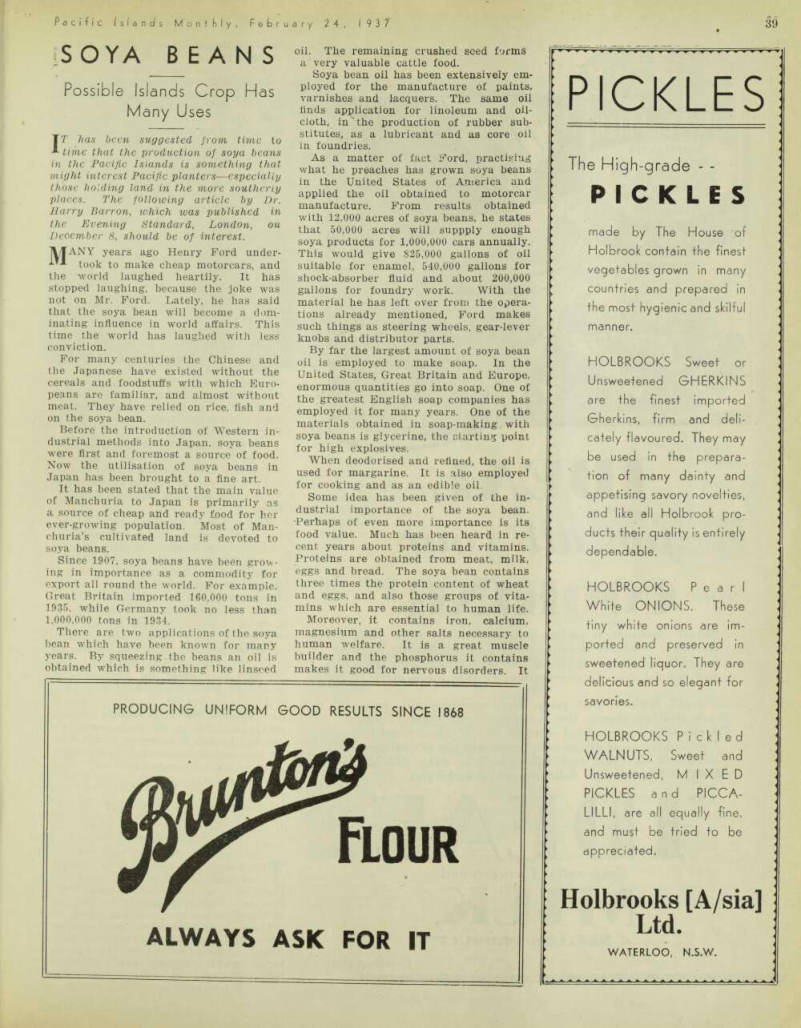

Possible Islands Crop Has Many Uses
JT has been suggested pom time to time that the production of soya beans in the Pacific Islands is something that might interest Pacific planters—especially those holding land in the more southerly places. The following article by Dr.
Harry Barron, which was published in the Evening Standard, London, on December 8, should be of interest. 11/fANY years ago Henry Ford under took to make cheap motorcars, and the world laughed heartily. It has stopped laughing, because the joke was not on Mr. Ford. Lately, he has said that the soya bean will become a dom inating influence in world affairs. This time the world has laughed with less conviction.
For many centuries the Chinese and the Japanese have existed without the cereals and foodstuffs with which Euro peans are familiar, and almost without meat. They have relied on rice, fish and on the soya bean.
Before the introduction of Western in dustrial methods into Japan, soya beans were first and foremost a source of food.
Now the utilisation of soya beans in Japan has been brought to a fine art.
It has been stated that the main value of Manchuria to Japan is primarily as a source of cheap and ready food for her ever-growing population. Most of Man churia’s cultivated land is devoted to soya beans.
Since 1907, soya beans have been grow ing in importance as a commodity for export all round the world. For example.
Great Britain imported 160,000 tons in 1935. while Germany took no less than 1,000,000 tons in 1934.
There are two applications of the soya bean which have been known for many years. By squeezing the beans an oil is obtained which is something like linseed
oil. The remaining crushed seed forms a very valuable cattle food.
Soya bean oil has been extensively em ployed for the manufacture of paints, varnishes and lacquers. The same oil finds application for linoleum and oil cloth, in the production of rubber sub stitutes, as a lubricant and as core oil in foundries.
As a matter of fact Ford, practising what he preaches has grown soya beans in the United States of America and applied the oil obtained to motorcar manufacture. From results obtained with 12,000 acres of soya beans, he states that 50,000 acres will suppply enough soya products for 1,000,000 cars annually.
This would give 825,000 gallons of oil suitable for enamel, 540,000 gallons for shock-absorber fluid and about 200,000 gallons for foundry work. With the material he has left over from the opera tions already mentioned, Ford makes such things as steering wheels, gear-lever knobs and distributor parts.
By far the largest amount of soya bean oil is employed to make soap. In the United States, Great Britain and Europe, enormous quantities go into soap. One of the greatest English soap companies has employed it for many years. One of the materials obtained in soap-making with soya beans is glycerine, the starting point for high explosives.
When deodorised and refined, the oil is used for margarine. It is also employed for cooking and as an edible oil.
Some idea has been given of the in dustrial importance of the soya bean.
Perhaps of even more importance is its food value. Much has been heard in re cent years about proteins and vitamins.
Proteins are obtained from meat, milk, eggs and bread. The soya bean contains three times the protein content of wheat and eggs, and also those groups of vita mins which are essential to human life.
Moreover, it contains iron, calcium, magnesium and other salts necessary to human welfare. It is a great muscle builder and the phosphorus it contains makes it good for nervous disorders. It
could be the most useful and by far the cheapest method of fighting malnutrition.
In the United States where an area ex ceeding 5,000,000 acres is already planted with soya beans, there has been much activity with the preparation of foods from home-grown soya beans. They make margarine, lard substitute, mayonnaise and salad oils. The beans suitably treated and ground, go into cocoa, drinks of all sorts, swbets, chocolates, cakes, cheese, sausages and bread. Milled into flour, they are used in breakfast foods, beverages, infant and invalid foods.
For many years the flour has been largely used for diabetic sufferers be cause it contains little starch, a lot of protein, and vitamins A, B, D and E. In America, too, special varieties of soya bean plants yield a green vegetable which has taken its place with the standard vegetables. The beans themselves are used in very much the same way as hari cot or butter beans.
The United States is already an ex porter of soya beans mainly to Europe.
Europe has slowly followed suit. In Great Britain many soya bean products are obtainable, although the part played by the bean is not made public. Several well-known sauces have always had it as a principal ingredient.
The soya bean will not grow anywhere.
At one time the idea that it could be grown in England was ridiculed. Thanks to the efforts of an English agriculturist, North, this has been proved to be pos sible.
The soya bean requires a light, dry soil and a hot summer. The great question is whether the English summer is hot enough for it.
Germany has been trying for years to grow soya beans but without success.
The seeds just will not take. Hitler would give anything for Germany to grow soya beans, because all the food troubles would be ended. In England, if we do not like soya bean foods, we don’t buy them. But in Germany, if Hit ler says soya beans are good for you, well, soya beans are good for you.
At present, while Germany imports vast amounts. Russia is already growing large quantities in the lands near Man churia. Canada is following in the steps of the United States and has already some 50,000 acres cultivated.
Advertisements & other items, pp. 41-42 (2 items)
39
Pacific fsfanJs Monthly, February 24, (937
Flour
PICKLES
The High-grade - -
PICKLES
made by The House of Holbrook contain the finest vegetables grown in many countries and prepared in the most hygienic and skilful manner.
HOLBROOKS Sweet or Unsweetened GHERKINS are the finest imported Gherkins, firm and deli-
cately flavoured. They may
be used in the preparation of many dainty and appetising savory novelties, and like all Holbrook products their quality is entirely dependable.
HOLBROOKS Pearl
White ONIONS. These tiny white onions are imported and preserved in
sweetened liquor. They are
delicious and so elegant for savories.
HOLBROOKS Pickled WALNUTS, Sweet and Unsweetened, MIXED
PICKLES an d PICCA-
LILLI, are all equally fine, and must be tried to be appreciated.
Holbrooks [A/sia]
Ltd.
WATERLOO, N.S.W.
PRODUCING UNIFORM GOOD RESULTS SINCE 1868
Flour
ALWAYS ASK FOR IT
EVAPORATED
Sa-" n*II .-■■■ > V3*. hJL VfflSSr r-^if I
IDEAL
for all your
COOKING
“Ideal” because it is the purest, freshest milk you can buy. “Ideal” because of the added flavour and nourishment it gives. “Ideal” because it is always safe and cannot become contaminated while unopened.
“Ideal” Milk is just pure, rich country milk com centrated to almost the consistency of cream. No preservatives are added—only water is taken from it.
For cooking, just dilute with water and use as ordinary milk. With fruit and other sweets, serve “Ideal”
Milk undiluted—it’s delicious and nourishing. tt
ID EAL
Evaporated Unsweetened
MILK
A NESTLE’S PRODUCT
Copyright 1142
Swimming Pool
Rabaul Soon To Have Its Swimming Pool
From Our Own Correspondent
Rabaul. Jan. 11.
THE energetic committee of the Rabaul swimming pool building fund are about to have their dream realised. Ten ders are to be called shortly for the con struction of the new swimming pool.
Their efforts have indeed been untiring when it is remembered that the first donations were received only in Septem ber of last year, and now nearly £9OO has been collected.
Loyalty Of Protectorate Of Tonga
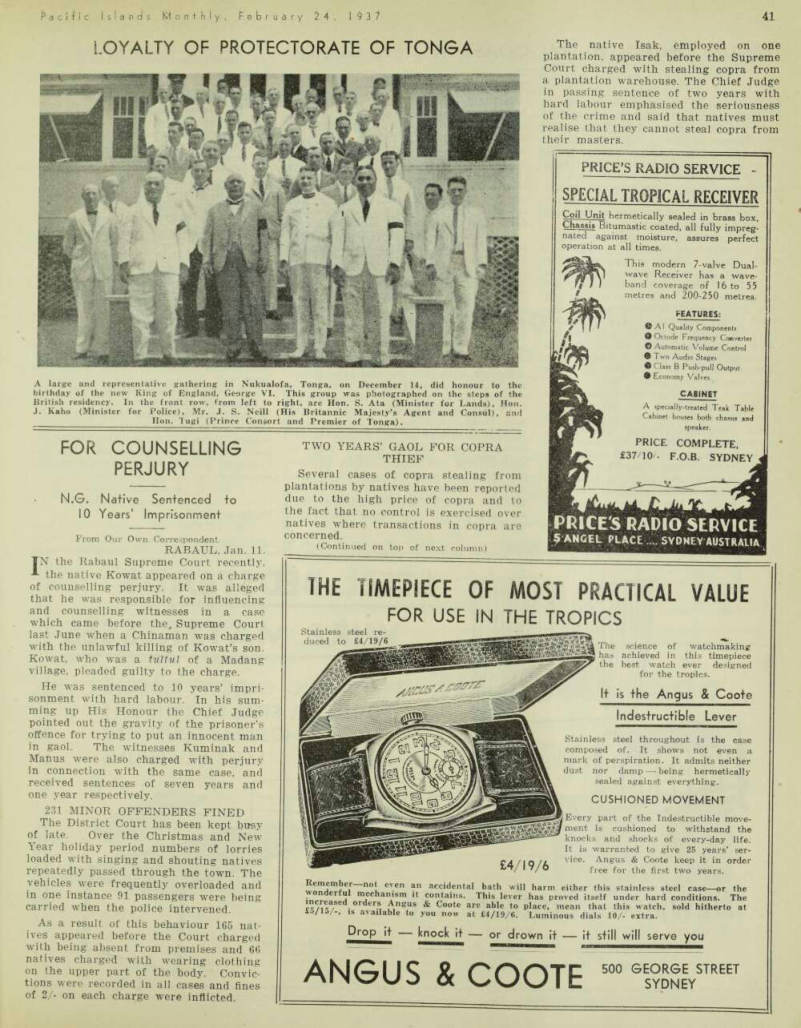
A large and representative gathering in Nukualofa, Tonga, on December 14, did honour to the birthday of the new King of England, George VI. This group was photographed on the steps of the British residency. In the front row, from left to right, are Hon. S. Ata (Minister for Lands), Hon.
J. Kaho (Minister for Police), Mr. J. S. Neill (His Britannic Majesty’s Agent and Consul), and Hon, Tugi (Prince Consort and Premier of Tonga).
For Counselling
Perjury
N.G. Native Sentenced to 10 Years' Imprisonment
From Our Own Correspondent
Rabaul, Jan. 11.
TN the Rabaul Supreme Court recently, the native Kowat appeared on a charge of counselling perjury. It was alleged that he was responsible for influencing and counselling witnesses in a case which came before the. Supreme Court last June when a Chinaman was charged with the unlawful killing of Kowat’s son.
Kowat, who was a tultul of a Madang village, pleaded guilty to the charge.
He was sentenced to 10 years’ impri sonment with hard labour. In his sum ming up His Honour the Chief Judge pointed out the gravity of the prisoner’s offence for trying to put an innocent man in gaol. The witnesses Kuminak and Manus were also charged with perjury in connection with the same case, and received sentences of seven years and one year respectively.
231 Minor Offenders Fined
The District Court has been kept busy of late. Over the Christmas and New Year holiday period numbers of lorries loaded with singing and shouting natives repeatedly passed through the town. The vehicles were frequently overloaded and in one instance 91 passengers were being carried when the police intervened.
As a result of this behaviour 165 nat ives appeared before the Court charged with being absent from premises and 66 natives charged with wearing clothing on the upper part of the body. Convic tions were recorded in all cases and fines of 2/- on each charge were inflicted.
Two Years’ Gaol For Copra
Thief
Several cases of copra stealing from plantations by natives have been reported due to the high price of copra and to the fact that no control is exercised over natives where transactions in copra are concerned. (Continued on top of next column)
The native Isak, employed on one plantation, appeared before the Supreme Court charged with stealing copra from a plantation warehouse. The Chief Judge in passing sentence of two years with hard labour emphasised the seriousness of the crime and said that natives must realise that they cannot steal copra from their masters.
Advertisements & other items, p. 43 (1 item)
Angus & Coote
PRICE’S RADIO SERVICE -
SPECIAL TROPICAL RECEIVER
Coil Unit hermetically sealed in brass box, Chassis Bitumastic coated, all fully impregnated against moisture, assures perfect operation at all times. m At This modern 7-valve Dualwave Receiver has a waveband coverage of 16 to 55 metres and 200-250 metres.
FEATURES:
®AI Quality Components © Octode Frequency Converter © Automatic Volume Control © Two Audio Stages • Class B Push-pull Output © Economy Valves
CABINET
A specially-treated Teak Table Cabinet houses both chassis and speaker.
PRICE COMPLETE,
£37/10/- F. 0.8. SYDNEY
Y DNEYj
4
PRICE'S RADIO SERVICE
$ ANGEL PLACE ... SYDNEY AUSTRALIA
THE TIMEPIECE OF MOST PRACTICAL VALUE
Stainless steel re duced to £4/19/6
FOR USE IN THE TROPICS
c/zptz & m m £4/19/6 The science of watchmaking has achieved in this timepiece the best watch ever designed for the tropics.
If is the Angus & Coofe
Indestructible Lever
Stainless steel throughout is the case composed of. It shows not even mark of perspiration. It admits neither dust nor damp being hermetically sealed against everything.
CUSHIONED MOVEMENT
(Every part of the Indestructible movement is cushioned to withstand the knocks and shocks of every-day life.
It is warranted to give 25 years’ service. Angus & Coote keep it in order free for the first two years.
Remember not even an accidental bath will harm either this stainless steel case—or the • Cr a n \ ec * ianism contains. This lever has proved itself under hard conditions. The K/it/ .° rder M Angus & Coote are able to place, mean that this watch, sold hitherto at £5/15/-, is available to you now at £4/19/6. Luminous dials 10/- extra. knockit or drown it it still will serve you
ANGUS & COOTE
500 GEORGE STREET
SYDNEY
The Uncontrolled Rai Coast In New Guinea
Letter to the Editor
REFERENCE has been made many times to the natives of the Rai Coast, south of Madang, in the Territory of iNjew Guinea.
They have come into prominence again recently in connection with the attacks upon a patrol, under the control of A. D.
O. Nurton. As has been recorded in the one of these attacks was the cause of this official being badly wounded, and having his leg amputated.
Several causes have been suggested in the Pacific Is.ands Monthly , in regard to Lhese attacks. First, it was stated by some that the cause had been religious fanaticism. This is ridiculous, as the natives concerned with these attacks had very little contact with missions, if any at all. Although this “wave of fanati cism” had peculiar results, and was the cause of much unrest on the plantations adjoining the Rai Coast, it has nothing whatever to do with attacks upon the
police party.
Later, it was reported that the native police on patrol with Mr. Nurton were badly disciplined, and had more or less caused discontent amongst the natives, by interference with their women. To one having any experience of natives, the cause of trouble can always be found in pigs or women. We all know how hard it is to control native police when on patrol, and. this theory may be near the truth.
But as one who has lived on the Rai
Coast, and ciaims to have quite an ex tensive Knowledge of tne wnoie of this area, l oiten wonder when the Admini stration win really arrive at the trutn, and study me make-up or tnese natives a littie more closeiy. The Kai Coast nat ives have, as long as we can remember, been a ferocious and warlike people, and are not the type to come readily under control. The only law they know is the spear, and force is to be met wuth force.
There has been a Government Patrol to the Rai Coast periodically, and several of our best officers have been stationed there; but, as yet, we can safely say that half the Rai Coast is not under control.
These officials have been tied by the ad ministrative heads in Rabaul, and the opening up of the Rai Coast has been governed by the “go-slow” and peaceful policy.
Is it not time that the Administration did away with this peaceful penetration policy, and displayed a little more force and the strong hand? If they continue with their present policy, it can be safely said that it will be long before those thousands of natives on this Coast are brought under control, and it may be with further loss to limb or life. The Ad ministration have the men fit for the job.
The patrol officer there, Mr. G. Great head, is an ideal man, and there could not be a keener. Let him go ahead and open the country up.
Unless contact is made with the white man, these natives will never be brought under control, as, like all natives, they will not go to the white man. He must come to them and force contact.
At the present time, except for an odd recruiter who, after scaling a 2000 feet climb, arrives in a village to find that the inhabitants have beat it for the bush, and an odd patrol officer, who finds much the same thing, their present contact with the outside world is nil. It appears that at the present time they resent any intrusion into their domain; therefore, a little force and determination in one area, may have a sobering effect on all the others.
Again, in order to discourage any fur ther attacks upon patrolling parties, it is the duty of the Administration to al low an example to be made upon any natives offering resistance. When all is said and done, as fighting is part of the natives’ everyday life, and comes next in importance to eating, no harm can be done to future relations with these peo ples by meeting their resistance with force.
The blame for these attacks upon A. i). 0. Nurton’s party cannot be put down to “religious fanaticism” or solely to in terference with the native women, but simply to the Rai Coast native being m his natural state, and resenting an in vader, as his forefathers have done for centuries.
I am, etc.,
Quartpot.
Madang, T.N.G. 27/12/1936.
Advertisements & other items, p. 44 (1 item)
Newlands Brothers Ltd
STEEL BEDSTEADS
WIRE MATTRESSES
" MORNING GLORY " BEDDING
TU BULA R STEEL FURNITURE
" LISTER " HOSPITAL EQUIPMENT
SHIPS' ALL METAL BERTHS
WE WILL GLADLY
- FORWARD OUR
COMPLETE SETS OF CATALOGUES
Produced in Australia by
Newlands Brothers Ltd
RILEY STREET :: SYDNEY, N.S.W.
Australia's Largest Manufacturers of Modern Sleeping Equipment.
Cable Address <? Newlandbed,’
Sydney
Native Education
Discussion at N.Z. Science Conference
THE Australian and New Zealand * Association for the Advancement of Science met in conference at Auckland, l\ew Zeaiand, in January when a wide variety of subjects were discussed.
The Anthropological Section, in which a number of well-known Islands men and women took part in the proceedings, dealt mainly with the question of edu cating native races.
Professor A. P. Elkin, of Sydney, said that the problems of the racial clash were not understood, and not a little damage had been done sometimes through cal lousness. The failure of primitive peoples to adjust themselves to the impact of another culture had been due to the un due speed with which the new culture had advanced on them. An effort should be made to enable the native to evaluate the worth of the new culture, and thus prevent a feeling of inferiority.
In another paper on the return of some native peoples to their old faith, especi ally in magic and regarding health, sick ness, life and death after a period of con tact with the white man, Professor Elkin stated that the aborigines in Eastern Australia tended to return to their old secret beliefs, because they sought a re treat from hard facts. They were con vinced that they had nothing to gain from Christianity, because the Euro peans had failed to impart an adequate understanding of it. What they needed was a Christian faith into which the best elements of their old faith were in cluded.
Mr. F. E. Williams, Government An thropologist in Papua, urged that the in terest of native races should be revived in their own arts.
Mr. W. C. Groves, speaking on the “concept of nativisation in education.” pointed out that an education which aimed to secure permanent and stable adjustment of native social life under the new conditions arising from the intro duction of European civilisation must be based upon the natives’ own institutions and practices.
N.Z. Assists Fiji Lepers
From Our New Zealand Correspondent
Auckland, Jan. 24.
THE response of New Zealand to an appeal for funds to supply Christmas comforts to leper patients on Makogai Island. Fiji, has been acknowledged by the medical superintendent of the sta tion.
“Any expression of thanks for the mag nificent gift of £lOOO is bound to be totally inadequate.” stated Dr. C. J. Austin. “The gift enabled us to assist the patients on a scale never hitherto possible and they realise and are thankful that the in creased comforts are due to the gener osity of the people of New Zealand.”
Aerodromes To Be Improved
Sydney-N.G. Air Route
THE preparation of a terminal landing * ground in New Guinea, as part of the scheme for the establishment of a weekly air-mail between Sydney and N.G., will be one of the first tasks of the first permanent works director appointed to the Mandated Territory.
For six years this post has been filled by an inspector of the Commonwealth Works Department, but, following his appointment to a post in Australia, a permanent position has been created in New Guinea. The Federal Works De
partment has made several recommenda tions from among its technical officers, and these are now being considered by the Minister in Charge of Territories (Sir George Pearce).
Extensive alterations to aerodromes and landing grounds between Brisbane and Thursday Island will be carried out before the end of the present financial year.
Right Rev. Philip Nigel Warrington
Strong, the recently-appointed Bishop of
New Guinea, arrived at Samarai, Papua,
by the Montoro on January 23. He was enthroned at the head station of the New Guinea Mission at Dogura on
January 25.
Advertisements & other items, p. 45 (1 item)
Over 30 Years Ago..
Master Sewing
Machine Co.
Established for 23 Years Reconditioned
SEWING MACHINES
For Industrial and Household Use.
All Types for Sale, from £3 each.
Every Machine Guaranteed Mechanically Perfect.
We have the most complete range of Sewing Machines in New South Wales.
Repairs promptly attended to by Competent Mechanics.
No delays. All Goods Carefully Packed.
MASTER SEWING MACHINE CO
15 En more Road, Newtown, Sydney
ALL TYPES FOR SALE*
From £3 ea ch.
Let us know your requirements. We will be pleased to quote by return mail.
Over 30 Years Ago..
The first Younger Stove was exported to the Pacific Islands. Ruggedly strong in construction, highly efficient and economical in fuel, has made them the most popular stove in the South Seas.
The illustration shows a Younger Single Stove. Special stoves, with cast iron ovens for Island requirements made to order. • Write us for quotations for special sizes and catalogue of double and single oven stoves.
G. Fletcher & Son
50 OXFORD STREET, SYDNEY
r
B.P. Services Renewed Until 1943
New Modern Ship Will Replace Montoro on Jan. 1, 1939
DETAILS of the new contract made between the Commonwealth Government and Messrs. Burns, Philp & Co. Ltd. for the continuance of the mail and steamer services between Australia and the territories of Papua, New Guinea, Solomon Islands, New Hebrides, Norfolk Island and Lord Howe Island, were published late in January, just after the P.I.M. had gone to press.
The new contract operates from April 1, 1937, to December 31, 1943.
The duration of the voyage of steam ers trading between Sydney and the ter ritories of Papua and New Guinea will be reduced, from April 1. A five-and-a half weekly service will be introduced instead of the present six-weekly service.
To supplement the shipping facilities to New Guinea, calls at Salamaua and
Rabaul will be made by the Burns, Philp steamer Neptuna, which trades between Sydney and Hong Kong. If it is neces sary, arrangements will be made by Burns, Philp for the Marella and Merkur , wdiich trade between Melbourne and Sin gapore, by way of Thursday Island, to be diverted to the territories during the Christmas and other rush periods.
The fares charged between territory ports are framed generally on a basis of £3 for the first day, and £1 for each succeeding day. A reduction will be made in this rate from April 1 to £2 for the first day and £1 for each addi tional day.
From January 1, 1939, a new vessel will be in commission to replace the Montoro. This vessel will be the largest and most convenient that has ever been in the island service. When the vessel is in commission the subsidy will be in creased to £52,500 a year.
Arrangements have been made for a continuance of the calls by the subsi dised steamers at Brisbane and North Queensland ports, and both steamers en gaged in the Papua-New Guinea service will continue to call at Rabaul before going to Salamaua.
Sir George Pearce stated it had been decided that it would not be necessary or desirable to subsidise an inter-island service in the territory. The inter-island service would be more efficient and up to date because the former Norddeut scher Lloyd vessel Bremerhaven had been purchased by an Australian com pany, and transferred to the British reg ister, to trade between ports in New Guinea, and a new vessel, in course of construction for Burns, Philp and Co., Ltd., would be placed in commission in July. It would trade solely between the islands in New Guinea.
Freight rates from Australia to New Guinea would be generally 60/- a ton, with special rates for: Cement and coal, 20/-; flour and sugar. 25/-; copra sacks, 30/-; aerated waters, beer, biscuits, bran, pollard, sharps, salt and tinned meats, tinned fish, and tinned milk, 45/-.
Staff Movements In N.G.
Public Service
THE following transfers and engagements in connection with the staff of the New Guinea Administration were announced in Rabaul on January 8: —
Transfers
District Services Dept.: E. W. Oakley, District Officer, Rabaul to Madang; J. H. McDonald, Assistant District Officer, Madang to Manus; L.
A. Considine, Clerk, Rabaul to Salamaua.
Dept, of Agriculture: F. C. Henderson, Inspec tor and Instructor, Rabaul to Keravat Demon stration Plantation.
Lands and Surveys Dept.: E. G. Sheldon, Sur veyor. Madang to Rabaul ; A. Montgomery, Chain man, Madang to Rabaul.
Public Health Dept.: Miss B. D. Meares, Nurse, Rabaul to Wau.
Police Force: W. E. Allen, Warrant Officer, 2nd Class, Rabaul to Wau.
Engagements
Public Works Dept.: W. G'. Staley, Roadmaster, New Britain : E. Wood, Roadmaster, Rabaul; N. R. Beck, Roadmaster, Wau.
Dept, of Agriculture: E. T. Caulfield Kelly, Copra Inspector.
Advertisements & other items, p. 46 (1 item)
paint
''v
The
"Caledonia Dover"
A COOKING STOVE guaranteed to give complete satisfaction and now recognised as THE BEST on the market.
Suitable for coal, coke, or wood fuel.
Illustrated Catalogue on request.
LANE & GIRVAN, LTD.
BONNY BRIDGE, SCOTLAND
BUMP
OK3 5E
tia. m
RECOMMENDED!
"SUN” Brand Paint on your Home means
definite PROTECTION against tropical
sun and sea-moist air.
Sun Proof and Rain Proof on every Surface
paint
W. R. CARPENTER & CO., LTD.
NEW GUINEA, SOLOMON ISLANDS
and all other South Sea Islands.
The First Crossing Of Na Viti Levi
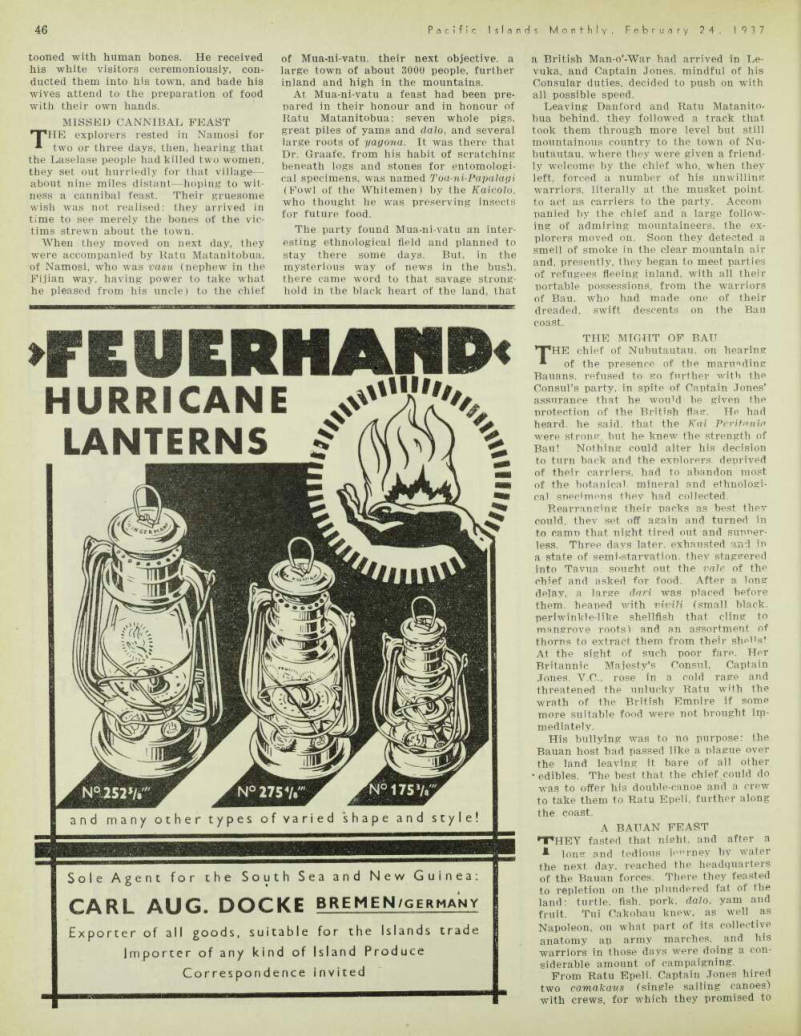
By Erie Wilson
1 i 'HERE may still be one or two “old hands” alive in Fiji whose memories go back to the days when Levuka was the capital of the group and the interior of Na Viti Levu was not so well known to the Papalagi as—through the explora tion of Messrs. Taylor, Leahy and Fox— the Bena Bena-Wahgi territory in New Guinea is to us to-day.
Time was when the centre of Fiji’s big island was thought by many to be a huge plateau, but, owing to the fierce and sus tained hostility of the Kaicolo (mountain people) full 15 years elapsed between the first attempt at inland exploration—by an expedition from Captain Wilkes’ squadron in 1840—and the first success ful crossing of the island in 1865 by a party under the British Consul, Captain Henry M. Jones, V.C.
Four Europeans made up the party: Captain Jones, Mr. F. Hennings (trader), Mr. J. Boyd (planter) and Dr. Graafe (naturalist, of Hamburg). With them, in the capacity of servant to the Consul, went Charlie Lailai (Little Charlie), a half-caste son of an “old hand” named Charlie Pickering.
They set out from Levuka in the whale-boat of “Spanish Frank,” shot the reef at Naitasi, and proceeded up the Rewa River to Nukumoto Island, spend ing the night at Mr. Storck’s plantation.
Moving on next day, they reached Davis’ store on the Wai-ni-bokasi where John Humphrey Danford (“Harry the Jew”) joined them as guide and interpreter.
The third day saw them pulling through Suva Bay, in all its natural beauty, before any white settlement had been made. One can imagine the scene: wisps of blue wood-smoke rising from the native town of Uluvatu, half-hidden among the rich greenery on the summit of the great rock that rises sheer from dark mangroves skirting Walu Bay. West ward, Joske’s Peak showing against the mass of jungle-covered inland ranges, Shark Fin Hill standing out clearly against the blue of the sky and, looming over all, the great, sheltering bulk of Kbrobaba.
In Ransacked Namosi Village
nPHAT night was spent on the island * of Qara, at Eggerton’s cotton planta tion, and next day they entered the Lohau River. Some miles up. they made their camp among the blackened ruins of a Namosi vilage which had been but re cently sacked by the Serua people. Un deterred by this unpleasant evidence of the disturbed state of the country into which they were about to penetrate, Cap tain Jones dismissed “Spanish Frank” and his crew, and, under the guidance of “Harry the Jew,” the five men turned their faces resolutely towards the un known interior.
At first their way lay through a wide swamp at the foot of the ranges, where, in grilling heat, they toiled through mud and slime, tormented by myriad insects and sweating heavily beneath the weight of their unaccustomed packs. Presently, the ground began to rise and the miasma
shrouded swamp gave place to dense, primeval jungle where occasional bird cries were the only sounds to break the heavy stillness. They were without water and to allay thirst were reduced to lick ing moisture from hanging mosses that covered the boles of the trees.
Word of their coming had gone ahead by bush telegraph, and, late in the after noon, runners sent by Ratu Kuruduadua, of Namosi —their objective, deep in the mountains—met them with a supply of cooked food, smoked oranges, and— water!
That night they slept the sleep of ex haustion in the company of the warriors of Ratu Kuruduadua. Dawn saw them afoot and toiling on once more through the silence of the thick forest. They were stiff and sore from the previous day’s labours and would have made little head way in that up-ended, jungle-smothered country had not their Fijian escort re
lieved them of their packs. Once more, at evening, they were met by runners carrying provisions from their thought ful host-to-be, away ahead.
Next afternoon found them clamber ing down into the beautiful Namosi Valley, through which flows the crystal clear Waidina. Ratu Kuruduadua awaited them on the riverbank, outside the war-fence, in the shade of an ancient shaddock tree whose branches were fes
tooned with human bones. He received his white visitors ceremoniously, con ducted them into his town, and bade his wives attend to the preparation of food with their own hands.
Missed Cannibal Feast
explorers rested in Namosi for *• two or three days, then, hearing that the Laselase people had killed two women, they set out hurriedly for that village— about nine miles distant—hoping to wit ness a cannibal feast. Their gruesome wish was not realised: they arrived in time to see merely the bones of the vic tims strewn about the town.
When they moved on next day, they were accompanied by Ratu Matanitobua, of Namosi, who was vasu (nephew in the Fijian way, having power to take what he pleased from his uncle) to the chief
of Mua-ni-vatu, their next objective, a large town of about 3000 people, further inland and high in the mountains.
At Mua-ni-vatu a feast had been pre pared in their honour and in honour of Ratu Matanitobua: seven whole pigs, great piles of yams and dalo, and several large roots of yagona. It was there that Dr. Graafe, from his habit of scratching beneath logs and stones for entomologi cal specimens, was named Toa-ni-Papalagi (Fowl of the Whitemen) by the Kaicolo, who thought he was preserving insects for future food.
The party found Mua-ni-vatu an inter esting ethnological field and planned to stay there some days. But, in the mysterious way of news in the bush, there came word to that savage strong hold in the black heart of the land, that
a British Man-o’-War had arrived in Le vuka, and Captain Jones, mindful of his Consular duties, decided to push on with all possible speed.
Leaving Danford and Ratu Matanito bua behind, they followed a track that took them through more level but still mountainous country to the town of Nu butautau, where they were given a friend ly welcome by the chief who, when they left, forced a number of his unwilling warriors, literally at the musket point, to act as carriers to the party. Accom panied by the chief and a large follow ing of admiring mountaineers, the ex plorers moved on. Soon they detected a smell of smoke in the clear mountain air and, presently, they began to meet parties of refugees fleeing inland, with all their portable possessions, from the warriors of Bau, who had made one of their dreaded, swift descents on the Bau coast.
The Might Of Bau
nTHE chief of Nubutautau, on hearing of the presence of the manmding Bauans, refused to go further with the Consul’s party, in spite of Captain Jones’ assurance that he wou l d be given the protection of the British flag. He had heard, he said, that the Kai Perifnnin were strong, but he knew the strength of Bau! Nothing could alter his decision to turn back and the explorers, deprived of their carriers, had to abandon most of the botanical, mineral and ethnologi cal specimens thev had collected.
Rearranging their packs as best thev could, thev set off again and turned in to camp that night tired out and supuer less. Three days later, exhausted and in a state of semi-starvation, they staggered into Tavua. sought out the vale of the chief and asked for food. After a long delay, a large dart was placed before them, heaped with vivili (small black, periwinkle-like shellfish that cling to mangrove roots') and an assortment of thorns to extract them from their At the sight of such poor fare. Her Britannic Majesty’s Consul, Captain Jones, V.C., rose in a cold rage and threatened the unlucky Ratu with the wrath of the British Empire if some more suitable food were not brought iip mediately.
His bullying was to no purpose: the Bauan host had passed like a plague over the land leaving it bare of all other * edibles. The best that the chief could do was to offer his double-canoe and a crew to take them to Ratu Epeli, further along the coast.
A Bauan Feast
HTHEY fasted that night, and after a long and tedious journey by water the next day, reached the headquarters of the Bauan forces. There they feasted to repletion on the plundered fat of the land: turtle, fish, pork, dalo, yam and fruit. Tui Cakobau knew, as well as Napoleon, on what part of its collective anatomy ap army marches, and his warriors in those days were doing a con siderable amount of campaigning.
From Ratu Epeli. Captain Jones hired two camakaus (single sailing canoes) with crews, for which they promised to
pay a keg each of powder and bullets, and the last leg of their journey took on the nature of a race, with Captain Jones, Dr. Graafe and Charlie Lailai in one canoe and Hennings and Boyd in the other. Reaching Rukuruku on Ovalau. they disembarked and walked the rest of the way to Levuka.
A considerable amount of money changed hands on their arrival, for numerous bets had been made by their fellow-residents on the expedition’s chances and the odds against their re turn had been high. They had been ab sent nearly a month and were the first Europeans to cross Na Viti Levu from coast to coast.
Perhaps the presence of Captain Jones (Turaga Levu), the Consul of the Kai Peritania in the party is the explanation of their peaceful reception in country where others, equally conversant with native ways, met only implacable hos tility and, sometimes, death: but. in any case they had achieved their object in determining the nature of that pre viously unknown interior.
Advertisements & other items, pp. 47-48 (1 item)
"Comet"
V. H. Jones & Rickard
Electrical Engineers
525 ELIZABETH STREET
SYDNEY
iHMiIIIMIIIiIiM'ifIUIMIIIIIiIIIIIIIIIIimiIMIIIIHIIIIIIIIIIIHIUIIMIIIIMIIIIMMIIIIIIIIIIIIIIIHIIIIIIIHU
Specialists in rewinding and repairing all classes and sizes of electrical machines and equipment. Special treatment given to work for the tropics.
TELEPHONE: MA 1397
m Mr-
BUILD AN ATTRACTIVE PERMANENT
HOME OF STEEL
TLLUSTRATED is an attractive "Comet" steel bungalow recently erected by us.
This building is in no sense a special order, but shows just what can be done with the patented "Comet" principle of Steel Building Construction.
The "Comet" Steel Building, by reason of its patented sectional construction, is easily enlarged and where required, conveniently portable.
The buildings are white-ant proof, fire-resisting and economical to erect.
They have definitely proved themselves the best proposition for the islands.
EMINENTLY SUITABLE
FOR:—
BUNGALOWS
STORES
WORKSHOPS
COPRA SHEDS
BOYS' HOUSES
HANGARS, ETC.
"COMET"
Steel Buildings
SIDNEY WILLIAMS & CO. (PTY.) LTD.
Steel Building Specialists, Builders and Contractors
DULWICH HILL, SYDNEY
ROCKHAMPTON BRISBANE TOWNSVILLE
>FEIIERHAIIP<
HURRICANE
LANTERNS A
s *6l * 1 H 5: * m S and many other types of varied shape and style! ■ Sole Agent for the South Sea and New Guinea: CARL AUG. DOCKE bremen/germany Exporter of all goods, suitable for the Islands trade Importer of any kind of Island Produce Correspondence invited
Passing Of Great Man
Mr. A. J, Vogan: A In the ’twenties of this century I lived near the family circle of the Till yard’s and I was astounded at the amount of accuracy of the entomological work being carried out by the head of that family of highly-cultured persons.
Although a small-sized, and delicate man, Dr. Robin J. Tillyard. when not doing microscopic investigations, or writ ing articles, was away exploring the more or less dangerous and difficult gullies near Hornsby—where few white men had been, and no scientists. He was always adding to the list of microscopic lepidop tera, or finding something previously un known about their life-history. Then he tackled his The Insects of Australia and Netv Zealand, for which his equally won derful wife did the thousands of ex quisitely-drawn illustrations. How they found the time to do what they did always astounded me, for they carried on their social life at the same time.
Dr. Tillyard was a member of all the British and foreign scientific societies worth belonging to, as well as being F.R.S.. whose famous motto: “NulHus in verba .” was so characteristic of this accurate and painstaking man, who rose to the highest scientific nositions known in this part of the world. Those famous words of Euripides rise to the mind upon reading of his sad death, in a motor accident in N.S.W. in January: “To die. is no doubt painful to him that dies, but if with glory to the living, it is a pride and glory to his family.*' Mr. Dan Leahy, youngest brother of the famous New Guinea prospecting and exploring family, returned to Australia by the Aorangi at the end of January from a world tour. After visiting his relatives in Toowoomba he will return to New Guinea to continue work on his alluvial gold claim near Mount Hagen.
Plan To Conserve N.G
Forests
r THE Commonwealth Government has * decided to embark on a policy of forest conservation and development in New Guinea, it was announced in Can berra in January. This is one of the be lated results of a report submitted to the Federal Government about two years ago by the Inspector-General of Forests (Mr.
C. E. Lane-Poole).
Mr. Lane-Poole’s investigation indi cated that the existing and potential tim ber resources of the Mandated Territory are of great economic value.
It was stated on January 21 that a conservator of forests will shortly be appointed in New Guinea, and that dis trict forestry officers will be appointed to assist him. Applications for the vacant positions have been invited by the Prime Minister’s Department at Canberra.
Dr. P. Monaghan, Chief Medical Officer, is acting as Administrator of Western Samoa during the absence on short fur
lough of the Acting-Administrator (Mr.
A. C. Turnbull).
Advertisements & other items, p. 49 (1 item)
Fibrolite
Konkrete Paint
For EVERY SURFACE where Permanence is Imperative--! (h s «r v Adaptability for the varying climatic conditions of the Pacific Islands has been abundantly proved by users.
KONKRETE Standard Gloss and Flat Colours for brick, fibro, cement, iron, and stone.
KONKRETE PAINT IS
THE SOLUTION
Complete price list and colour card from sole wholesale distributors for N.S.W. and Pacific Islands.
H. Florentine and Son 321 Pitt Street, Sydney, N.S.W.
Allen Taylor & Co. Ltd.
SYDNEY
Sawmillers and Wholesale Suppliers of Hardwoods for Constructional Purposes GIRDERS . . . PILES . . . POLES . . . SLEEPERS. Etc.
EXPORTING TO PACIFIC ISLANDS SINCE 1893
Cables: Tuxedo, Sydney
BUILD WITH
Fibrolite
ASBESTOS CEMENT SHEETS
By using this Economical, Fire Retardant and White Ant Proof building materia! for External and Internal Walls and Ceilings, you can build a comfortable and durable Bungalow Home— AT LOW COST! Supplied in big, sturdy building sheets In 44 handy stock sizes, FIBROLITE ' is easily and quickly erected. No waste.
Less labour. No painting.
For full information, write for illustrated "Fibrolite" Booklet F.6—FREE AND POST FREE!
JAMES HARDIE & COY. LTD.
ASBESTOS HOUSE. YORK ST., SYDNEY, N.S.W.
(Box 3935 V., G'.P.O., Sydney)
Wrongly Charted
Vanikoro Island Reported To Be Wrongly Charted
THE High Commissioner for the West ern Pacific recently directed attention in the official Gazette to reports from two different sources alleging that an error had been made in the charted posi tion of Vanikoro Island in the Santa Cruz District of the Solomon Islands.
It was stated that the second officer of the Japanese steamer Juyo Maru reported in 1935 that Vanikoro was approximately two miles out of the position shown on Chart No. 17. This statement is sup ported, added the Gazette, by the master of the Melanesian Mission’s yacht South ern Cross, who notified the authorities in September last year that his observa tions showed a similar error in the charted position of the island.
Real Old-Timers
Some Residents of Samoa
From Our Own Correspondent
Apia, Jan. 21.
TIIGH Chief Tuimalealiifano, the well known friend of Robert Louis Steven son, Fautua (Adviser) of the Samoan Administration, and a famous figure in Samoan politics for the last half century, has sent out invitations to celebrate his “centenary,” or 100th birthday, on January 27.
The aged chief, like most Samoans, is probably mistaken about his age, as in old Samoa there did not exist any regis tration of births, and there are no docu ments proving his assertion. He probably is between 80 and 90 years old.
Census returns reVeal that there is only one old Samoan, who claims to have reached an age over 100 years. This is a man named Faatonu, in the village of Fusi, Safata, South Upolu. Even his claim is doubtful.
Of Europeans, there are quite a num ber of whites and a few local-born who are over 80. Of the few Chinese resi dents, one, Ah Yen, is 90 years old; an other, Ah Kiau, is 86 years old. Both have resided over 50 years in Samoa.
The local photographer, Mr. A. J. Tat tersall, who only recently celebrated his 70th birthday, is now able to celebrate the 50th anniversary of his arrival in Samoa from Auckland by the three-mas ted schooner Maile, Mr. Tattersall, a well known and respected identity in the social life of Apia, can remember the colourful and exciting days of old Samoa, with their native wars and struggles be tween political parties.
There are altogether 10 Europeans and Chinese residents here who can claim to a residence in Western Samoa of 50 years or over.
1170 People In Tokelau Group
From Our Own Correspondent
Apia, Jan. 21.
CENSUS returns for the Tokelau (or Union) Islands, administered by the Samoan Administration from Apia, but not Included in the Mandate, show a population on November 4, 1936, of 1170, composed of 568 males and 602 females.
The increase since the last census in 1926 amounts to about 150, or 13 per cent.
The Tokelau Islands, only about 300 miles north of Samoa, lie away from all steamer routes and are only occasionally visited by a warship or a trading schooner from Apia. Apart from about a dozen people of mixed descent, there are no Europeans living in the group. There are now two wireless stations, at Faka ofo and Nukunono, in operation, which are worked by natives.
The Islanders are mostly adherents of the London Mission Society, though about 400 of them are Roman Catholics. Both Missions maintain schools for native children.
Advertisements & other items, p. 50 (1 item)
Cordage and
Woven Wire for all Industry
COPRA DRYING TRAYS, FLOORS. Etc.
FRUIT DRYING TRAYS, MINING SCREENS
Heavy Mosquito Gauze In Phosphor Bronze and other Metals Impervious to Salt Sea Air WIRE DOOR MATS AND GENERAL WIRE WORKS
E. WRIGHT & CO. LTD.
Office and Works: 148-152 Cleveland Street, Sydney, N.S.W.
Telegraphic Address: “Wrightmake,” Chippendale
Ship Chandlery Hardware
/ Write for Ship Chandlery Catalogue 1 Special "In Bond" Prices for all Islands enquiries quoted on application.
BROOMFIELD'S LIMITED
152 SUSSEX STREET ::
Cables "Boom," Sydney Large and Complete Stocks of
SHIP CHANDLERY
IRONMONGERY OF ALL KINDS,
WHITE LEAD AND OILS
SYDNEY
PAINTS,
Sole Agents for: P. H. MUNTZ & CO.'S 3-CROWN BRAND METAL SHEATHING.
PEACOCK & BUCHANS' ENGLISH READY - MIXED PAINTS.
Scott s Renown Brand Rope,
Cordage and
Binder
Twine
Cable Address; Ropey ard, Sydney 5* s
of Every
Description
MANUFACTURED AT
MASCOT, N.S.W.
By
J. Scott Ltd.
Head Office and Store:
163 CLARENCE STREET,
SYDNEY
N.S.W.
Search For Oil In Papua
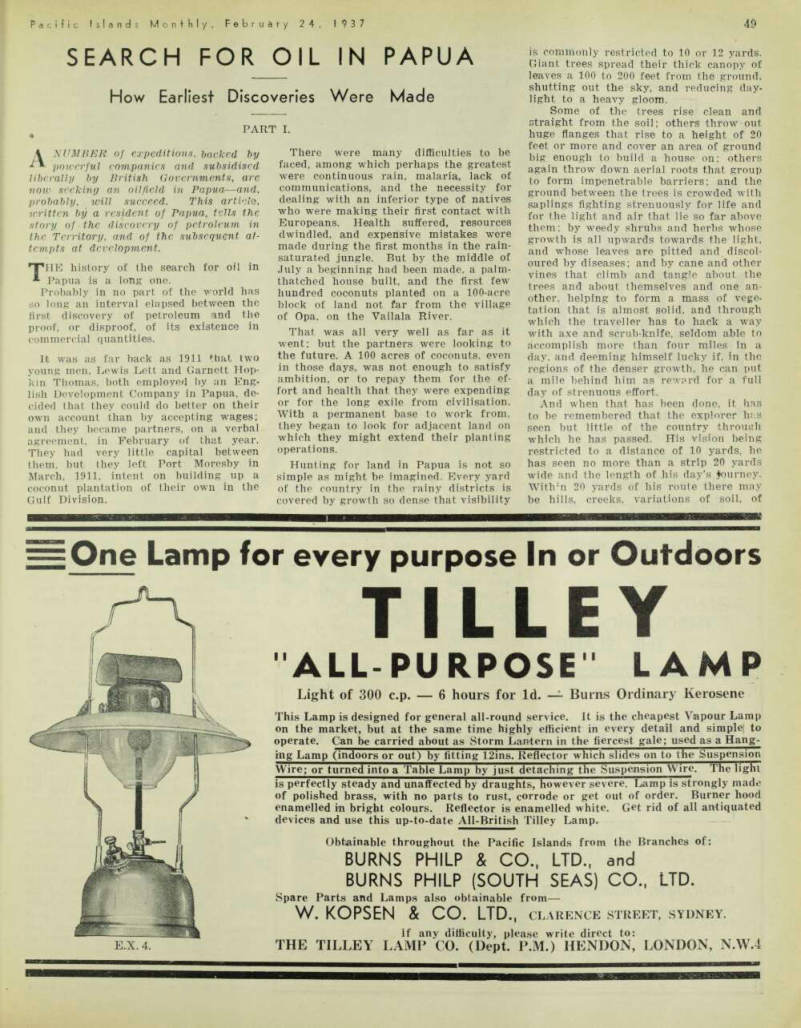

How Earliest Discoveries Were Made
Part I.
A NUMBER of expeditions, hacked by powerful companies and subsidised liberally by British Governments, are now seeking an oilfield in Papua — and, probably, will succeed. This article, written by a resident of Papua, tells the story of the discovery of petroleum in the Territory, and of the subsequent at tempts at development. r T , tIE history of the search for oil in *• Papua is a long one.
Probably in no part of the world has so long an interval elapsed between the first discovery of petroleum and the proof, or disproof, of its existence in commercial quantities.
It was as far back as 1911 that two young men, Lewis Lett and Garnett Hop kin Thomas, both employed by an Eng lish Development Company in Papua, de cided that they could do better on their own account than by accepting wages; and they became partners, on a verbal agreement, in February of that year.
They had very little capital between them, but they left Port Moresby in March, 1911, intent on building up a coconut plantation of their own in the Gulf Division.
There were many difficulties to be faced, among which perhaps the greatest were continuous rain, malaria, lack of communications, and the necessity for dealing with an inferior type of natives who were making their first contact with Europeans. Health suffered, resources dwindled, and expensive mistakes were made during the first months in the rain saturated jungle. But by the middle of July a beginning had been made, a palm thatched house built, and the first few hundred coconuts planted on a 100-acre block of land not far from the village of Opa. on the Yailala River.
That was all very well as far as it went; but the partners were looking to the future. A 100 acres of coconuts, even in those days, was not enough to satisfy ambition, or to repay them for the ef fort and health that they were expending or for the long exile from civilisation.
With a permanent base to work from, they began to look for adjacent land on which they might extend their planting operations.
Hunting for land in Papua is not so simple as might be imagined. Every yard of the country in the rainy districts is covered by growth so dense that visibility
is commonly restricted to 10 or 12 yards.
Giant trees spread their thick canopy of leaves a 100 to 200 feet from the ground, shutting out the sky, and reducing day light to a heavy gloom.
Some of the trees rise clean and straight from the soil; others throw out huge flanges that rise to a height of 20 feet or more and cover an area of ground big enough to build a house on; others again throw down aerial roots that group to form impenetrable barriers; and the ground between the trees is crowded with saplings fighting strenuously for life and for the light and air that lie so far above them: by weedy shrubs and herbs whose growth is all upwards towards the light, and whose leaves are pitted and discol oured by diseases; and by cane and other vines that climb and tangle about the trees and about themselves and one an other, helping to form a mass of vege tation that is almost solid, and through which the traveller has to hack a way with axe and scrub-knife, seldom able to accomplish more than four miles In a day. and deeming himself lucky if. in the regions of the denser growth, he can put a mile behind him as reword for a full day of strenuous effort.
And when that has been done, it has to be remembered that the explorer Ims seen but little of the country through which he has passed. His vision being restricted to a distance of 10 yards, he has seen no more than a strip 20 yards wide and the length of his day’s .tourney.
Witlr'n 20 yards of his route there may be hills, creeks, variations of soil, of
which his day’s effort has told him nothing. There may be outcrops of rock or of sticky clay; or water-logged ground
that leads gradually downwards to an area of swamp.
ON a certain Sunday towards the end of July, 1911, the partners were not examining the land in small detail, but were maKing a running traverse thac would tell them whether the land they were covering was likeiy to repay closer examination. They were travelling as quickly as possible, in smgie file, follow ed only by their cook-boy, who carried their billy and packet of sandwiches, and cutting only so much of the mdergiowth as would enable them to push between the crowding saplings.
It was near time when the leader found himself in a section of the scrub that was strangely clear of under growth. The ground had an appearance of sourness, of sterility, as though some element in the soil refused to vegetable life the sustenance essential to its growth. Such few shrubs as grew there were weedy and stunted; the clay soil appeared greasy and of a greyish tinge; and the air was tainted by a strange scent not common to the Papuan jungle.
A tiny creek of fresh water suggested that this was a suitable place for lunch.
The soil being what it was, the two men felt no further interest in it. Even the strange scent failed to impress them; for the scrub is full of scents, mostly of an unpleasant nature. They waited pas sively until the water was boiling and their tea ready.
The tea, when it came, tasted of kero sene. The natural procedure was to blame the cook; and this the partners did with vim and point. They were well accustomed to his denials and excuses; but there was some quality in his pro tests this time that was less unconvin cing than usual.
They went to the bank of the creek and tested the water there. It tasted strongly of something akin to kerosene; and the slight foreign sugestion in its flavour aroused their curiosity.
And so the first indications of petro leum were found in Papua.
A little farther up the bank of the creek a slow flood of grey mud oozed
into the water. Following this up, a spot was found a few yards away where a slight mound was crowned by a small lake of grey mud with its surface a quiver. Round the edges of the lake was a thin deposit of brownish slime; and the surface of the pool was in tre mulous movement, like simmering water.
As they looked, a tiny eruption took* place in the centre of the pool. A quan tity of gas rose from the surface, lifting the surrounding mud with it in an en closing cone that burst and liberated the gas; and the cone of liquid mud fell back to agitate the surface anew. Again and again eruptions occurred, never twice in quite the same place, but all of ap proximate equal strength.
A lighted torch soon proved that the liberated gas was inflammable. The gruesome task of tasting the mud proved that it carried the same flavour as the water of the creek, but much stronger, more oily, and generally loathsome. And in addition to its oiliness it carried a distinct flavour of salt.
That was all that there was to go on, and it was not very much for men who had no special knowledge of petroleum.
But it was enough to set their imagina tion on fire, and to start them on a ser ies of investigations that was to occupy them for months, cost one of them his life, and involve the other in financial and other difficulties that were to last over many years.
But of such things the partners knew nothing as yet. What they did know was that they had discovered something that they believed to be. petroleum.
But they had discovered it under con ditions that gave them no certainty. Mud, eruptions of marsh-gas, and a smell of petroleum, could not be expected to con vince anybody that oil was present in quantities; and if the find was to be worth anything at all to them, they must first secure evidence much more definite and concrete.
They spent a good deal of time in care fully collecting the oily scum from the surface of the mud-pool; but the deposit was so thin that ten gallons of it, col lected in tins and allowed to settle, yielded only a thin film of something like enough to oil to confirm their own opin ion, but too impure and too meagre in quantity to convince any analyst. The rest was mud, unavoidably picked up with the oil film; slimy grey mud that smelt of petroleum, but that carried no proof in itself, and did little to support the theory that they built upon the greenish-brown film of oil and upon the certainty that possessed their own minds.
THE obvious first step was to find out whether other similar indications existed. Perhaps somewhere beneath the dense carpet of tree-tops that covered the country for thousands of square miles about them there might be a richer show, an outcrop of rock, a jet of gas from the rock itself instead of this inter mittent bubbling through a lake of mud that obscured the origin of the gas; pos sibly even a small seepage of pure oil itself under conditions where it could be collected and preserved.
Native information would have told them most of what they wanted to know,
and it would at least have led them dir ectly to other spots in which similar phenomena existed.
But native information was witheld.
As has happened so often in savage countries, the fear of the native popula tion was aroused that the arrival of white settlement might spell the end of native independence. Areas of jungle might be cleared, hunting grounds des troyed, and the freedom and stability of native life and the unquestioned author ity of the older men be threatened by this invasion of new customs, by the dazzle ment of new and fascinating trade goods, and by the attraction that is offered in every part of the world by the present ment of something hitherto unknown.
In any case, hative information was witheld. Talk, bribes, the promise of re ward, all in turn failed to shake the determination of the older men to pre serve the happy status that had been known to them all through their lives, and to their fathers and grandfathers before them. The only course that re mained open to the partners was to find out for themselves.
It was no light task. As has been pointed out, a thorough examination of the Papuan bush is a matter for much time, patience and labour. A great deal of each might be saved by noting the dip and strike of the rock at the site of the first discovery: and they devoted a couple of days to clearing the overburden
from the underlying rock, and noting as exactly as possible the dip and strike at different points. These coincided closely, and the two men were able to begin the long search.
Not only did the local natives withold all information, but they also did their best to withhold labour; and in the end the two white men were reduced to cut ting their own lines through the dense scrub on compass bearings that agreed with the strike, hacking a way hour after hour and day after day through the dense tangle of shrub and thorn and knotted vine, making frequent excursions from the line to examine the country on either side of it; while far behind each of them lagged a group of unwilling carriers, re luctantly bringing up the stores and cam ping gear to the end of each day’s newly cut line.
The men worked independently, one following the line of strike towards the west and south, the other working north wards in the direction of the dip in the hope of finding the outcrop of another stratum in that direction.
TT was a miserable job. At dawn, they rose from their stretchers and emerged from the suffocation of close-mesh mos quito nets to a strident drone of myriad mosquitoes, dragged on damp c'otlrng and began the dreary day’s cutting in the wet gloom of the jungle.
An hour later, there was a break for an unhappy meal of tea and damper flav oured by whatever tinned atrocity hap pened to be handiest; then a resumption of the monotonous slashing through undergrowth that dr’pped moisture in cessantly.
In the dank atmosphere of the satur ated bush sweat remforced the vapour that rose from the soaked ground, and clothes hung heavy and clammy. Lungs ached from the continuous inhaling of the steamy air; limbs ached from the unremitting effort; eyes ached from con tinuous straining in the dim light, ren dered dimmer by the clouds that hung overhead incessantly and dropped their burden of moisture dismally upon the oozing clay that formed the surface.
Inevitably, health suffered under con ditions so onerous; malarial fever seem ed to leave no intervals; chill, exhaus tion, impaired sleep, malnutrition, all played their part; and when the partners met again after more than a month of the devitalising work, they were out wardly not much more than emaciated skeletons, yellow, gaunt, and bent; but still burning inwardly with a fever of ambition that would give them no rest. *"pHE results were not very startling to date. To the south-west, two more sets of indications had been found; one a few miles inland from the big village of Oro kolo, five miles from the starting point, and the other 12 miles away, near the most easterly mouth of the Purari River, and some four miles from the coast. But. although the gas-jets were vigorous, the smell pronounced, and the same film of oily scum in evidence as at the first site, they still offered nothing mord definite than had been found before.
To the north. Thomas had penetrated
for 20 miles, and had found nothing more than an outcrop of sandstone with mud stone inclusions on the bank of the Vail ala River itself. As these rocks were similar to those at the site of the first discovery, the partners decided to make the outcrop the starting point for a sec ond search.
The journey up river by canoe was comparatively pleasant. The sun shone warm and strong, and, if its heat was excessive, it was at least a welcome change from the deadly wetness of the last few weeks.
The outcrop itself did not tell them much, except that the series of rocks that they believed to be oil-bearing spread over an area of country satisfac torily wide. They camped a hundred yards below it, on the bank of the river, and on the following morning cut into the .scrub immediately behind the camp.
'T'IIEY had not far to go. In less than * an hour they recognised the now familiar smell. Almost simultaneously, the undergrowth began to thin, and the soil to take on the greasy appearance that they knew so well. In the silence of the bush, a queer bubbling sound made itself heard, and a moment later a pool of grey mud came into view.
It was similar to what they had seen before, but longer and wider. There was the same green-brown scum round its edges, the same uneasy quivering of the surface. But, in place of the one gas-jet that spouted intermittently and moved from place to place, there were four distinct fountains of gas that flowed steadily, making oily bubbles and waves of viscous mud that moved outwards in rings so that the whole surface of the poll quivered continuously.
But still, tantalisingly, there was no cleared evidence of oil than the other discoveries had given. They collected samples of the mud and of the scum that ringed the pool, and moved on.
A little creek ran near the pool, cas cading its way from higher ground down towards the river, and they followed its course. It was a succession of diminutive falls and quiet pools, some four feet wide and with sandstone rock appearing in many places. In one such pool, where a fallen tree lay rotting:, there were wavering lines of prismatic colours. To the obsessed minds of the two men this hinted at oil.
They stopped and looked carefully round, and at last they had it.
From a tiny crevice in the sandstone oil seeped slowly, spread over the face of the rock for a few square inches, and slid quietly on to the surface of the water.
The real thing! And in surroundings that justified to the full the conviction that had siezed them at their first sight of the grey mud pool near the plantation. Oil on the surface of the creek. Oil seeping from the rock above it. And there, on the opposite bank, was a jet of gas coming clean and Unimpeded by mud, from the dry soil above the creek.
The evidence was not to be doubted.
But the quantity of the flow was incred ibly small. In four hours no more than a few drops had been collected; and throughout the whole of the next day an amount accumulated that could hardly overflow a teaspoon.
But the oil was there —not enough for analysis, certainly not enough for any sort of chemical test, but enough to es tablish a claim and to prove, short of the endorsement of chemists, that the discovery of oil in Papua was something more than a dream.
With something definite to report, one of the partners walked the 30 miles to the nearest Government station, at Ker ema, to report the occurrence of oil, and to claim protection and whatever rights they might possess as discoverers.
TT was disconcerting to find that the mining laws of Papua held no pro vision for petroleum, and that beyond registering their claim there was nothing to be done. The matter could not be permitted to rest there; and Lett went on to Port Moresby, leaving Thomas to extend his prospecting to new areas.
Reporting at Port Moresby had little more effect than reporting at Kerema.
There was no sort of legislation that could cover the discovery of oil, and it was made plain that no law would be passed in so important a matter until the wishes of the Commonwealth Govern ment had been clearly expressed.
There was nothing to be done but to go on to Melbourne. The slender re sources of the partnership had been
severely taxed, but hints of the discovery had already leaked out, and it was a simple matter to borrow funds for the journey, and also to arrange credit with the Port Moresby firms for carrying on the work on the Vailala River.
But even in Melbourne there was no provision for the control of petroleum either in Papua or in Australia itself.
There were even Cabinet Ministers who looked vacant when petroleum was men tioned, and one highly-respected Senator
wanted to know whether the oil was ob tained from the ground or from trees.
The Hon. Josiah Thomas, who was Minister for External Affairs in that pre war Cabinet, was quite frank about his complete ignorance on the subject, and in reply to the discoverer’s suggestion that the sole rights to prospect for oil in Papua should be reserved to him and his partner for a period of two years, the Minister protested that in Cornwall, England, where he had passed his youth, men were mining for tin on claitns of a quarter of an acre each!
The disparity between the two esti mates was reduced by degrees, but, since all the eagerness for compromise was felt by the Minister, who also held all the cards, the result could not be anything but disappointing to the dis coverers.
After a month of waiting, Lett left Melbourne with a forecast of the legisla tion that would be passed by the Com monwealth. This provided that licenses over prospecting areas not exceeding half a square mile might be applied for. and that if oil were found in commercial quantities on such an area, leases of five acres each might be granted to the licensees for the purpose of boring, the lessees paying to the Commonwealth Government a royalty of five per cent on the value of the oil won.
The conditions were, of course, absurd.
But it has to be remembered that the time was short. The Labour Govern ment, under Andrew Fisber. made full allowance for the value of time to men who had an independent living to make, and within the short period of one month it was not possible to take reliable ad vice on the subject of mining for oil. The Question of granting a reward claim to the discoverers was reserved for later decision.
Bad as the conditions were, they at least gave a basis for working and a legal right to claims, and it was fairly obvious that, from their very inadequacy, the terms could only be temporary. (To be continued)
Advertisements & other items, pp. 51-56 (2 items)
Tilley
= One Lamp for every purpose In or Outdoors E.X. 4.
"ALL-PURPOSE 1 LAMP
Light of 300 c.p. 6 hours for Id. - Burns Ordinary Kerosene This Lamp is designed for general all-round service. It is the cheapest Vapour Lamp on the market, but at the same time highly efficient in every detail and simple) to operate. Can be carried about as Storm Lantern in the fiercest gale; used as a Hanging Lamp (indoors or out) by fitting 12ms. Reflector which slides on to the Suspension Wire; or turned into a Table Lamp by just detaching the Suspension Wire. The light is perfectly steady and unaffected by draughts, however severe. Lamp is strongly made of polished brass, with no parts to rust, corrode or get out of order. Burner hood enamelled in bright colours. Reflector is enamelled white. Get rid of all antiquated devices and use this up-to-date All-British Tilley Lamp.
Obtainable throughout the Pacific Islands from the Branches of:
BURNS PHILP & CO.. LTD., and
BURNS PHILP (SOUTH SEAS) CO., LTD.
Spare Parts and Lamps also obtainable from— W. KOPSEN & CO. LTD., CLARENCE STREET, SYDNEY.
If any difficulty, please write direct to: THE TILLEY LAMP CO. (Dept. P.M.) HENDON, LONDON, N.W.4
m
WET EDGE
• The flat, oil, wall finish that leaves no brushmarks.
Made in lovely pastel tints and warm neutral shades all fadeless and washable.
AGENTS
THROUGHOUT
THE ISLANDS
Established N.H. 1894
Kerr Brothers Limited
ISLAND MERCHANTS AND AGENTS
Assembly Hall Building
I JAMIESON STREET - - SYDNEY
PRODUCE:
Cacao, Coffee, Copra., Peanuts, Shell: Ship to us for best returns. Produce shipped overseas on behalf of clients and may be drawn on.
PLANTATION REQUIREMENTS:
We have over 40 years' experience to help you. Agents for Cacao, Coffee and Castor Seed Machinery; Agricultural Implements and Power Cultivators: Tractors and Trailers: Paints; Marine, Fire and Earthquake Insurance.
MERCHANDISE PURCHASED AT BEST PRICES AND ORIGINAL
INVOICES SUPPLIED
0.P.0. Box 3838 T Cable Address!
"CARE, SYDNEY"
me^ If you put your hand in treacle the treacle clings and sticks. The same happens to your pistons if you use a dragging” oil. The useful part of a lubricant is its “oiliness,” the useless part is its “drag."
Shell chemists have succeeded in cutting out the 'drag,” leaving nothing but the “oiliness” in Shell Motor Oil.
Prove to yourself how much more easily your engine starts and runs - and on less petrol - when you change to the “drag-free” lubricant.
SHELL.,,
MOTOR UIL
0& oV* *
diol
LO7OE
FIVE MINUTES for RELIEF
There is nothing indefinite about " ASPRO.
Its service is QUICK safe, effective, and definite. It gives you relief in 5 to 10 minutes, and then goes on to dispel or dissolve the cause of the pain, allowing Nature to effect the desired relief. Furthermore, you get no harmful after effects from " ASPRO," as it is speedily eliminated from the system a few hours after being taken. It neither dopes, deadens, nor drugs. 4
ASPRO
DOES NOT HARM THE HEART
ANCHOR" FLOUR
THE STANDARD OF QUALITY
m m
GILLESPIE BROS.. LTD
SYDNEY - AUSTRALIA
JUST TRY THESE
delicious
Imperial
FOODS
Try any one of these "Imperial" dishes and prepare yourself for a glorious surprise. We have blended the finest selected meats and cooked them in Vacuum. We call the process "flavour-sealing" because all the precious flavour carriers and valuable mineral salts are sealed in the can. • Imperial SHEEP TONGUES Prime, selected new season's tongues cooked by the new tenderizing process. • Imperial CORNED BEEF LOAF Delightfully flavoured, mild cured corned beef, ready to eat from the can.
• Imperial BEEF STEAK PUDDING
Selected Beef Steak with Rich Gravy, topped off with Devonshire Pudding.
Ini pt»riu I SM ALLGOODS
PORK SAUSAGES, FRANKFURTS, PORK
FRITZ, DEVON SAUSAGE, PORK GARLIC
You’ll enjoy all of these "Imperial" treats, but for added zest serve them with Imperial Mango & PaPaw
CHUTNEY
Another delightful Imperial product Crustless O m in 4 oz. & 8 oz. Pkts.
Imperial Cheddar Cheese LOOK FOR THIS SIGN OF QUALITY FOODS
Stocked by
All Leading Stores
Imperial
Stocked by
All Leading Stores
KIDNEY
STRAIN
Every
Throbbing
BACKACHE and
sharp twinges when you stoop warn you of kidney strain. So do rheumatic twinges, urinary disorders, disturbed nights and dizzy attacks. Relieve these troubles at their source by taking Doan’s Backache Kidney Pills. For forty years this special kidney medicine has been overcoming rheumatism, lumbago, sciatica and bladder weakness.
BACKACHE CURED
Mr. Lewis Williams, 614 Botany Rd., Botany, Sydney, says: “I was a great sufferer with my back and the pain was at times so bad that I had to leave my work and go home. I used various preparations but only got slight relief. Reading of cures effected by Doan’s Backache Kidney Pills I decided to try them. One bottle eased the pain and the second completed the cure.”
Be sure to insist upon
Doan's
Backache Kidney
Pills
52
PacLfic Islands Monthly, February, 24 1937
Companies' Activities
From Our Own Correspondent
Port Moresby. Jan. 20.
members of the staff of the J. Muir (chief geologist), N. Osborne and
W. Chawner (assistant geologists), and E. Lius (accountant) —left Port Moresby on December 2 by the vessel Maira for Daru. The Maira has recently been char tered by the company for transport work on their concessions in the west, together with another vessel already at work, and in use by Messrs. H. Prentice and E.
O’Driscoll (the two geologists who some time back arrived on the field).
It is understood that the company have already commenced oil prospecting on Concession or Permit No. 3. an area of 9,062 sq. miles to the N.W. of Daru, and that Messrs. Muir, Osborne and Lius are proceeding to Concession No. 4, an area of 10,711 sq. miles on the Upper Fly, where work is progressing. Concession No. 2. an area of 1,577 sq. miles, which includes the waterways of the Turuma, is to have immediate attention. These three widely senarated areas occupy ap proximately 21.000 sq. miles in the West ern Division of Papua.
The total staff, to date, of Island Ex ploration Co., working in Papua, number eight Europeans. The Company besides holding these concessions in Papua, have further areas in the Mandated Territory of New Guinea, and, by the last Macdhui from Australia. Messrs. H. Lumus and B. Jones passed through to commence work on these areas.
Oriomo Oil Co.
Messrs. K. McKinnon and J. C. and M.
Pratt, additional members of the staff of the Oriomo Oil Co., who arrived in the Territory on December 30, left for Kikori, tbe company’s base depot, by the vessel Olive on January 5 to commence work on the company’s concession in the west, which extends from the west of Kikori (in tbo Delta Division) through the Gulf to St. Joseph’s River in tbe Central Division; an area of approxi mately 12,000 sq. miles.
Mr. Hakon Mielche, the famous Danish artist, who was in the Pacific with the Monsunen expedition in 1934, writes that he has completed his wanderings in Tierra del Fuego, Chile and Peru; and that the book he wrote, based on his journey, was published in December and is enjoying an excellent sale. Mr. Mielche says he still has “that South Sea feeling.’’ so we can expect to see him here again under the palm trees fairly soon.
Advertisements & other items, pp. 56-58 (1 item)
Insist On A Im@M
Monel shafts are as strong as steel, and so tough that they resist blows that would hopelessly spring shafts of other materials. They cannot rust, are unaffected by salt or fresh water, and will not pit or corrode.
Moreover, Monel develops a glass-like surface so that
WRIGHT & COMPANY, 81
• MONEL is a Registered Trade Mark.
|(l PROPELLER SHAFT
wear in the bearings is almost nil. In short, Monel shafts are rigid, rugged and reliable—facts which ensure years of hard and dependable service. Further information on this rich Nickel alloy will gladly be
supplied by . . .
Clarence St., Sydney, N.S.W.
Cables: "Cornright," Sydney
OS K
POKER DICE
A* Put & Take, 2-dice game, 3/6. 5 dice roll, 6/6 (5 dice I 3 dice roll, 3/9 mounted on roll). i (3 dice mounted on roll).
English electric hair brushes, Gents 15/-, Ladies 17/6.
Combs, hangbag or pocket type 12/6. Ladies’ type with handle 17/6.
All standard batteries.
Microphones for speech or music, just plug into pick-ui terminals of your set, fitted with flexible battery lead batteryless model, 25/-. \l \0 $ <b w 'S
JOBS PATIENCE
Introducing Job’
Patience.
A new fasc i n ating game, the rage abroad. 16 spaces, 15 n u m bers You have to place the 15 plates in numerical order sliding only one at each move, 3/6. The best 3/6 ever spent.
'RADIO ITIODERNE
R if The Assembled Chassis ~~—£22/10/- Just designed for 100 per cent service in the Pacific Islands. Pay cash and save at least 33 1-3. Radio Moderne is the newest,finest and most up-to-the moment 5-valve battery-operated superhet. ever introduced for the Pacific Islands. That’s a sweeping statement, but we stand behind every word of it. Hear all Australasian stations, plus London, Paris, Berlin, Moscow, Tokyo, New York, etc., etc.
Radio Moderne, Exclusively Built to suit Pacific Islands conditions. Humidity, etc. Not a Mass Production Product, each Set individually Built by Senior Mechanics, Tuned Up, and Air Tested before despatch.
Radio Moderne incorporates every wanted, technically correct improvement, all latest type Philips valves, 3 Like-a-Flash triple duty B batteries, best grade 100 amp. 2 volt accumulator, automatic volume control, latest Ampion permagnetic speaker. Perfect tone, equal to any electric set. Latest calibrated aero dial, showing Australian and overseas stations, extrabrdinarily low “B” battery consumption, approximately 10 to 22 ma. “A" battery (accumulator) consumption .65 amps. Selectivity and Sensitively 100 per cent. Packing 6/6 extra, plus frieght, 12 months’ guarantee all parts and speaker. 90 days’ valves £22/10/- Send for Levenson’s Radio Bargain Bulletin, Bd, post free. Also Levenson’s Radio Buyer’s Guide and Assembly Chart Handbook, 2/-, post free. $ New, tested, charged 12 months’ guarantee. ( Add 1/6 packing plus freight a. 100 35 60 85 35 60 15/- 16/3 18/9 27/9 22/6 23/9 We guarantee a better price for all replacement valves and component parts. Just send along your order. Price and 100% service guaranteed English Radio Meters. Just arrived. AC/DC Universal type, reads everything in radio. Volts up to 240, and milliamps, 25/-. Bench type, with leads. Pocket type, bakelite case, 3 readings, volts, and m/a., 10/6. 2 readings volts, for low and high tension batteries, 7/6.
Electric Klaxton Horn, with all fittings and push as// , ■ button
I 11- 4% 7/6. Fit-
» ted in a jiffy.
Splendid for autos, shops, offices and stores.
“Totem,” the newest game for home, club, picnic or party 21/-.
“ Odds . and Evens,” a new Head and Tail spin game 21/ Both designed as reproductions. Push lever and av/ay they go. >r.
Pyrex type Glass Insulators. 3in., 1/- 4in., 3/6, sin., 6/6.
Egg type 3 for 1/-. 7£in.
Genuine Pyrex 30/ooatns) 3 ins
4 INS
SJfflßg) 5, NS
COSMOCORD*
25 Amplion (English) 28/6.
Gramophone Pickups. B.T.H.
Bakelite Model 32/6 “Cosmocord” 25/- “Cosmocord” De Luxe 32/6 “Cosmocord” Super de Luxe 45/-.
“Clarion” English all-Bakelite Pick - up, with volume control. 22/6.
Now ready “ The Sydney Cup” spinning wheel-—a wonderful gambling game. Back your fancy, spin the wheel, the finishing point shows the winner and the price. Complete with betting cloth, 63/-.
English Bell shape, bakelite moulded lightning arrestors, reliable and ultra safe. Easy to fit. 6/- Send for full P.st of Radio Books: Now ready, “The Wireless Constructor’s Encyclopedia by Camm 7/6 Nearly 400 pages.
Fully illustrated.
“The Book of Practical Radio,” by Scott Taggart, over 300 pages. A splendid publication. 163 diagrams, 63 plates.
Airplane type glass Insulators, 3 for 1/- Ormond Eng lish high grade adjustable cone speak ers, in handsome polished mahogany cabinet 35/- Cone Speaker units 15 different makes now 15/-, chassis to suit 10/- “Pix” Wave Traps 4/6, for eliminating inter-station cross ♦alk.
English make Utility Short Wave Vernier Dials, the world’s best. 12/6.
“Like-a-Flash” de luxe Morse code keys, adjustable every way. Long or short tappers, 12/6 : P.M.G. type all brass fittings, 19/6; Junior models, 9/6, 10/6. High grade buzzers, 7/6.
tmcssoti
HEAD
moMS i
PROHUIOMAL*
4000 ohms Electric battery torch, 1500 ft. beam, 5 cells, 6/6. Small electric leading lamp for hanging or carrying, 4/6.
Electric illuminated writing pencil. 4/6, all standard batteries.
Like-a-flash Radio B Batteries ; Extra heavy duty. 11/9; triple duty, 14/6: light duty, 7/3; 4£ or 9v.
C batteries, 2/-. i wf The “Air Patrol” 2 valve all wave battery set. Covers from 15.5 to 835 metres — £ll/17/1 complete with speaker, ’phones and all accessories, a midget in name only, but a giant in performance. Receives local, interstate and overseas broadcasts. ©Kins® ©CGCSai) r - Like-a-flash Eliminoise’
Aerial Kit, for short or dual wave sets.
Aerial Pyrex type Insulators, transposition blocks and 200 ft. aerial coil, 22/-. Eliminates unwanted aerial and hideous electrical noises from your dual-wave or short-wave set.
Copper ball aerials, add to your present aerial system, improves reception, 6/6.
Metal earth tubes with percolating chemical earthing salts, 4/6. Ideal for conditions in the islands.
Large size hydrometers, for testing accumulators, 2/6. sort 2tt OOfli* Double Clad Insulated Rubber Aerial, 30 strands: 50ft. 2/6, 100 ft. 5/-. 40 strands: 50ft. 5/6, 100 ft. 10/-.
Just arrived, 8/6 per copy.
New n e s “Television and Short Wave Handbook,” by F. J. Camm. A lavishly illustrated book, simply written, dealing with all branches of television, short wave reception. 255 pages. Includes a useful dictionary of TelexTicinn form a Write for Punch Board Leaflets
LEVENSON S RADIO
226P1- Pin STREET, SYDNEY
Branches: Radio Cheapside, 240 a Pitt St.
N.S.W., AUSTRALIA
Write for Pin-Game, Totem and Odds and Evens Leaflets ’Phones, M 2525 and M 2526. Cable address. “Leveradioh.” Goods forwarded V.P.P. or Sight Draft. Satisfaction and Service Guaranteed. We can supply by mail all General Merchandise at a Better Price. Quotations with pleasure. Please add freight and packing.
Timber, Joinery
ETC.
PREPARED BUILDINGS ready for erection a speciality.
SHIP AND BOAT BUILDING.
TIMBERS specially catered for.
FIBROLITE, PLYWOODS, GALVANISED
IRON, CANEC.
CONSIGNMENTS shipped
by RETURN STEAMERS
to the Islands.
John W. Eaton
LTD.
WEST CRESCENT STREET
NORTH SYDNEY
TELEPHONES: X 5051 (5 lines)
PAINT . . .
IN PASTE OR READY
MIXED FORM
Made in Scotland —
THOMAS MACINTYRE
HORSE SHOE BRAND
f(
& CO. LTD.,
WHITE LEAD, WHITE ZINC
AND ALL COLOURS
—therefore Reliable! - - Glasgow, Scotland
BITUMENOID ROOFING
MADE IN AUSTRALIA
Bitumenoid Roofings, Dampcourse and Insulating Felts are made from the world’s best raw materials. Warranted to stand the most rigid tests.
BITUMENOID THE BEST
Roofing, 1,2, 3-ply; Flooring, Waterproof Materials; Saturated Felt; Resilient Road Jointing: Natural Asphalt Dampcourse: 2 and 3-ply Dampcourse: l-21b. Lead-core Dampcourse; Roofing Cement; Asphalt Paints; Roofing Compound.
SAMPLES AND PRICE LISTS ON APPLICATION
MAXWELL PORTER & SON LTD.
ESTABLISHED 1888. BUILDERS’ SUPPLIES
107 REDFERN ST., REDFERN, SYDNEY. N.S.W. ’Phone, M 3157. Cables Bitumenoid
The Hygeia Dissolvenafor Approved .by Health Authorities
A Self Contained Sanitary System
Easily and cheaply installed. Guaranteed.
NO WATER SUPPLY REQUIRED
No odours, germs, flies or other insect pests.
A caustic soda solution turns the excrement and paper into an innocuous solution which runs off and is absorbed by the soil.
Gives thoroughly efficient, long, care-free service. The Shell Oil Co, alone has given 52 repeat orders.
HYGEIA SANITARY COMPANY
26 BRIDGE STREET, SYDNEY.
Suitable for Use Indoors.
Price, P. 0.8. Sydney, £l'4/16/-
Products
Bounties For Territory
Renewal For One Year!
PRACTICALLY all the products of Papua and New Guinea now enter the Commonwealth free of duty. The only exceptions are bananas, pyrites, motor spirit and tea. That announce ment was made recently by the Austra lian Minister for Customs.
The Papua and New Guinea Bounties Act of 1926 expired on December 31. The Planters’ Associations in both territories urged its renewal “for a further long period.” It was renewed until the end of 1937!
Sugar Is Tabu!
The Papuan Planters’ Association notes that sugar is not among the products for which a bounty is offered, and com ments: — “If this had been provided for in the schedule, it would have been a reasonable and fair concession to Papua and New Guinea, as the Sangara Sugar Co. Ltd.
had no intention of competing with Aus tralian grown sugar.
“Papua’s sugar was intended for the markets of Great Britain and the only possible competition might have been with the Australian surplus, which is sold on the London market, probably below the cost of production.
“Australia’s highly subsidised sugar growing industry should fill Australia’s requirements and no more, for it cannot compete in cost production with the rest of the world. Whereas, Papuan-grown sugar could have held its own in com petition with the rest of the world.
“It would look as if Australia intends to follow the Imperial Government in their treatment of Jamaica and the West Indies. Jamaica, once the largest sugar producing colony in the world, is now, owing to the Imperial Government’s as sistance to bounty-fed competitors, a poor man’s country, but gradually is getting on its feet as a result of the foresight and push of Canada and the United States.”
The Lieut-Governor of Papua, Sir Hubert Murray, comments interestingly in a letter to the Planters’ Association on the subject of bounties.
Putting it briefly, His Excellency looks forward to: (1) a development of exten sive cultures, especially rubber; (2) a general increase of prosperity and im provement of conditions: and (3) a de velopment of scheduled “goods” by a number of planters on a small scale.
“We are all of us alive to the advan tages to be derived from a variety of cultures: but w r e consider that the larger industries, such as rubber, must be es tablished first.”
For many reasons Sir Hubert regrets that the Bounties Act was only extended for one year; for it is quite impossible that any appreciable result can be shown in so short an interval. No one, sure’y would invest money in a culture which wou’d take, say, two years to come into bearing, on the strength of a bounty which came to an end in one year. An extension for ten years would probably show a result, but not for any shorter time.
It must also be remembered in connec tion with bounties, says Sir Hubert, that the bounty is only payable upon “goods” imported into the Commonwealth for “home ‘ consumption,” and that the amount consumed in Australia is in some cases limited.
Mr. W. G. R. Snellgrove, superintendent engineer of Burns, Philp and Co. Ltd., left Sydney by the Ormonde on January 28 for London to supervise the construc tion of a 6,000 ton motor ship for the Western Pacific trade.
Dr, Peter Buck, the Maori anthro pologist, who is director of the Bishop
Museum, Honolulu, and visiting professor
of anthropology to Yale University, U.S.A., has had the honorary degree of Doctor of Science conferred upon him by the Senate of the University of New Zealand. Dr. Buck, who took his medical degree at the Otago University, N.Z., was formerly Minister representing the Maori race in the New Zealand Cabinet.
A Letter From Morobe

of the Pacific, greetings!
May we have all the luck we’d like this year—we’ll probably need it.
Despite companies, hard times and rushes to supposed gold-strikes, there are still a few independent miners left on Morobe Goldfield.
One of the old hands passed out down here a few weeks ago—“ Budge” Beckett.
He came up as a pilot in the early days but soon switched to “chasing the weight.” “Budge” chased it unsuccess fully for years and had a very “rough spin.” * ♦ ♦ Even more tragic was the death of Tom Hough, who died after getting an arrow in the lung. A fine young man and a great scout—we in the bush are very sorry to lose him.
Perhaps you people don’t know that the Administration of this prosperous territory, although compelling us to in sure our “boys” when in uncontrolled areas, yet allows its white officers to carry on their o'ften hazardous occupa tion without making any provision for them in case of injury. In fact, officers wounded whilst carrying out their work have been called on to pay for their sustenance while in hospital! * * * Wewak has been getting a lot of at tention and many men have left this
field to go there. But it must be borne in mind that for the “small” man Mor obe is, for the present anyway, about finished, and any change is an improve ment. People going to Wewak should consider the venture purely as a pros pecting one and not a certain road to fortune. Gold is seldom easy to find.
Guinea Airways established an out station at the new field some months ago, and it is reported that there are already several ’dromes in the area, which, by the way, has not yet been officially de clared a gold-field. The Acting-Warden considers that results to date do not war rant it. Gold, like copra, is “up” and the price seems steady. My last return •bowed a premium of 107.8 per cent. * * * There was quite a stir round here when we learned that the Administrator had chartered the Lockheed for a trip to Australia and that he was coming over from Rabaul by chartered schooner. One section was sure that “wars and rum ours of wars” was the cause. Anyway things on the Beach (Salamaua) and Lae moved with a rush. The Lockheed, soused to the eyes with benzine and ready for a non-stop flight to Australia (which would save two hours for refuel ing at Port Moresby), was ticking over at Lae, with the pilot standing by, on the fateful morning. As Airways did not want to risk a take-off from Salamaua
'drome in the Lockheed, with a full load of juice (anyone knowing Salamaua 'drome will know why), the Ford, a three-engined machine, was ready to take the passenger to Lae immediately he arrived—a 10 minutes’ flight.
At 4 a.m. everything was in readiness, but the schooner had not arrived. When
it did, things immediately started to
happen. The Administrator wisnta leave direct from Salamaua in the Lock heed and, after refusing to fly to Lae, ended up by leaving next morning in a Mandated Airlines Dragon after it had been fitted with extra fuel tanks.
It seems strange that the Admin'stra tor should have disregarded the arrange ments made for him, in such a drastic manner, but it has been suggested in some quarters that had he consented to leave from Lae his action would have had an adverse effect on the Administra tion’s policy of aerodrome maintainence, as it would have been an admission that Salamaua 'drome is not safe for all types of aircraft in New Guinea. Evidently they do not wish to bear the expense of maintaining Lae ’drome. Salamaua 'drome in the wet season is like a west ern Queensland bog, and how they put those big machines down there without mishaps is a mystery to the layman, and also a frightening experience. Anyway it seems that there was not the urgency everyone supposed. ♦ * * It looks as if the compulsory aviation merger has not died a natural death, as we were led to believe. Just what the
Canberra autocrats want it for, ho dhe seems to know; but they seem deter mined to carry it through in the face of almost universal opposition. Really, there seems to be more freedom in Ger many than Australia these days!
Many months ago, Sir George Pearce sent us a circular letter, putting up a very feeble case for the merger and ask ing our opinion on the subject. He cer tainly got them, and reasons too, but I wonder if he were bothered to read our letters. The Government’s ignorance of modern air transport is amply demon strated in its handling of the prepara tions for the flying-boat service to Aus tralia. We doubt their capacity to run anything successfully.
Ye Gods! The Administration has in vented another form. There is a fee too, of course. It is an application for a per mit to employ natives. Separate permits —and fees—for alluvial and underground work. One has to get a testimonial as to sobriety—but that is all right—our mates daren’t refuse us one. Someone suggested that the Government, by mak ing use of this clause, could at any time drive us all off the field. That may be.
Anyway, it would be a more direct method than has been used so far.
Well, folks, cheerio! I hope you have enjoyed this great Australian moan as much as I have.
Peter Prospect.
Watut River., T.N.G.
Mr. A. K. Edwards, geologist, and Mr.
H. A. Fryer, surveyor, who have been in New Guinea preparing maps for the guidance of Oil Search Ltd. in the selec tion of bore sites, returned to Australia by the Macdhui at the end of January, Mr. Dave Riemenschneider, of the Hotel Metropole, Suva, reached Sydney by the last Aorangi.
Advertisements & other items, pp. 59-60 (1 item)
For Cool, Quiet,
o
BUILD
COMFORT NTO your home
COOLNESS WITH
BEAUTY
The British Insulating Sound-Absorbing Building Board The Colour, Figure and Texture of TEN/TEST provide the BEAUTY. The Heat-resisting and Sound-absorbino qualities of TEN/TEST provide the COOLNESS, QUIET, COMFORT, and CLEANLINESS.
TEN/TEST
is by far the most beautiful and the strongest and densest board made. It has by far the highest resistance to moisture and the greatest sound absorption—just twice the moisture resistance of the American boards, and sixty per cent, more sound absorption, and, in addition,
TEN/TEST
can be cleaned, kept clean and refreshed always by brushing with a stiff brush without showing any trace. Ten-test is unique in this. No other board can be so treated again and again—their prepared surfaces are destroyed by it. painting becomes necessary, and painting destroys the sound absorbing surface by filling in the sound absorbing pores.
Agents for New Guinea:
W. R. CARPENTER & CO. LTD.
Rabaul and Salamaua Applications for Agencies invited from all other Islands Sheets l/2ln. thick, 3 and 4 feet wide. 5. 6. 7. 8,9, 10, 11, 12 and 14 feet long. Price 30/per 100 square feet.
F. 0.8. Sydney.
For COOL, QUIET,
CLEAN, COMFORT,
BEAUTY AND
PERMANENCE
Sydney
CROCKETT & CO. LTD., 379 Kent St Cables: "Pinetree."
At Blue Mountains—Springwood, N.S.W,
Springwood Ladies' College
Est. 1897. Kindergarten to Leaving Certificate. Tennis, Riding, Swimming, Team Games. Unequalled climate. Pure Jersey Milk. Senior and Junior Houses. Open-air sleeping. Inclusive fees. Special vacation arrangements for Island pupils.
M. E. DURAND, Principal.
Ya
tso
ott sp r iVvc P , a rva Veep ltesV . ne^ ie « , 471 - Gcv" 1 , b at o-
. ° t fcot*
;uh^ eC * * _. \o^ e ' \o r>a Co oce Aab t*aS ta
cVv^
aUC AO A** hea the tot e te\ ot t‘\sts VO** thete 7, Representative:
ROBERT BLAU (Aust.),
A.C.A. Building, Cnr. King & York Street*,
SYDNEY.
COM
tNSIEAL) DE
TP i m ms&m C; clock t«S* m.
Pattern Service
\A/E have arranged with a well-known Sydney * * firm of pattern-cutters to publish each month a diagram of a seasonable frock, patterns of which may be obtained by our readers direct from this office, post free, on payment of the sum stated under the diagram. Address your letter to “Pat tern,” Pacific Islands Monthly, Box 3408 R, Sydney, and enclose a note giving the number of the pattern wanted and bust size, and enclose also the price of the pattern in postal note or stamps. The pattern will be sent by return mail.
3100 —A charming frock that can be worn with or without the cape. Note the new “off the shoulder” effect carried out by tiny gathers on the cape. The frock favours yoke and sleeves cut in one; panelled skirt has fulness below the hips. A bright note is added by the contrasting collar. Material (for 36in. bust) : 4jyds. 36ins. wide; contrast, £yd. 36ins. wide. Bust sizes 32 to 40 inches.
Cape Frock, 3100—1s. 1d.
Advertisements & other items, p. 60 (1 item)
Medical Goods
Ml our MEDICAL GOODS are sold with
our GUARANTEE OF MONEY BACK if
not satisfied: best quality, lowest prices.
Call or write for FREE "BOOK Or KNOWLEDGE," Price List & Catalogue of Medical Goods, etc., and FREE
CONFIDENTIAL ADVICE. All these
goods POST FREE in plain wrapper from
SECURA CHEMISTS,
Dept. P.
269 ELIZABETH ST., MELBOURNE
LADIES.—Let the SECURA NURSE advise you in the selection of your medical requirements.
Fashion Hints for Islands Women
By Therese
TTARASSED by the question, ‘‘What shall we wear?” the tropical dweller seizes with avidity the fashion headlines, “Tub frocks for day and even ing.”
Delightful tub frocks, too easy to launder, and so crisp and cool looking— of organdie, voile or ginghams in the most enchanting designs, lovely pastel tonings or colourful checks and stripes.
Gingham sashes in bold combinations of colours add a dash of verve to the frock of white or coloured linen. Ging ham is ideal morning wear, too, and a simple gingham frock with white collar and quaintly puffed sleeves is a happy possession.
Uncrushable voiles, sprigged or plain, are really lovely for afternoon wear.
Tucked, shirred, or pleated, their success is assured. Seersuckers hold their own for beach or sports wear delightful crinkled materials in gay colourings.
Pique deservedly takes pride of place.
Cool and crisp, it goes to the making of evening frocks that reach the zenith of perfection. Little jacket suits of it are ideal, and colourful blouses add further charm.
Cool beyond belief is the navy voile pin spotted in white, with crisp white collar.
Its gathered bodice .and puff sleeves have a feminine softness, and navy and white shoes continue the attractive story.
Frock designs are simple to make and easy to wear, and moderation in clothes is the keynote of distinction. The exag gerated or revolutionary types of clothes are for the ultra-minded only.
A cleverly designed envelope frock is but two pieces buttoned together at the shoulders. A contrasting band outlines the gathered bodice and wide shoulders and a belt of contrast bands the slim waist.
Blouses of every type are extremely popular. There is such variety of design that the most exacting of women must find something to charm. Trim sports blouses are made of seersucker and look equally well with suits. Lingerie blouses with tailored suits have frilled or pleated jabots. Taffeta blouses in the grand dame manner are worn with plain skirts.
Blouses of the sheerest chiffon have their fulness pleated into the finest pleats imaginable. Printed blouses of floral design are worn with plain coloured skirts.
A white skirt dons a scarlet blouse and boldly adds a royal blue cowboy scarf, and red, white and blue belt.
Royal blue allies itself to white in the crepe satin blouse and is a delightful accompaniment to the white crepe coat and skirt, Knoppe linen makes a smart summer suit with which a navy spotted blouse is worn. The white and navy combination is ideal.
Almost aJways blouses take fulness unto themselves in pleats, gathers, and shirrings. Skirts are slim at the hipline
and vary in width. Flared, pleated, or gored, the smartest length is just above the calf. Knee-length skirts and full blouses give a top heavy appearance which should be avoided at all costs. All fashions, whether for day or evening, tuck in at the waist.
A pale blue starched chiffon with puf fed sleeves, quaint basque, and full skirt, adds a “little-girl” sash of cherry taffeta.
thereby achieving a charm that is un deniable.
From beneath a gown of black taffeta a white lace petticoat peeps out and sweeps to the back to form a train.
Bringing joy to all and sundry, an in formal dinner gown is evolved in navy crepe and made on shirtmaker lines. Red belt, red scarf at neckline, and red and blue slave bangles form a contrast that is striking and attractive.
With wide collar and slim hips a sprigged batiste adds a white band to its spreading skirt and tucks a flower in the waistline with studied carelessness.
An enormously full skirt of black and silver fouille taffeta is held aloft by a suntan bodice and gleaming jewelled shoulder straps.
An ingenue’s dream come true is the frock of stiffened net which swirls voluminously at its ruched hemline. The decolletege is outlined with ruching and slender straps do duty at the shoulder li ne - Evening fashions are varied as a woman’s whims, and the princess line appears frequently. Charming indeed is the princess line of a moire taffeta frock which opens down the front right to its tiptllted hem, and fastens itself with fascmating rhinestone studded bows.
Lacquered taffeta .is thrilling news, and j r P l^C(^ oure d tunic of this novel and delightful material takes unto itself a
black skirt which emphasises its many colours.
A cire satin gown is gold star scattered and darlingly adds gold cuffs—gauntlet effect—which are worn on bare arms. A gold quaker collar adorns the high neck line.
Bowing to Fashion’s decree of colour contrast, gadgets of bright colours swish out front and back of the column slim gown of black crepe.
The whole character of a simple foun dation evening frock is changed by a detachable over-skirt, which flares out hour-glass fashion.
Dinner jackets, the darlings of the svelte sophisticated woman, call for per fection in every detail. Always they are well tailored but vary in length and choice of material. They top slim tailored skirts.
Accessories are more charming than ever. Belts are made of every conceivable thing. Coloured beads make belts of lovely flower designs and bags match up.
Lipstick and powder-puff holders attach themselves to the ring fastening of an intriguing belt of leather, made link fashion.
Gloves are particularly attractive and are made in all varieties of materials.
They match up or contrast with your frock with equal success.
Sandal shoes are increasing in popu larity, which is very understandable when one considers their cool-making qualities.
Hats soar heavenwards, fall to earth, and then renew their heavenly aspira tions by an ingeniously twisted piece of ribbon perched aloft. Poke bonnets are young and charming for the chosen few, but, alas, how few! Sailors continue on their jaunty way, the fitting accompani ment to sports and tailored frocks. Cart wheel varieties grace afternoon hours and help keep that schoolgirl complexion.
Advertisements & other items, pp. 61-62 (2 items)
59
Pacific Islahds Monthly, February 24, 1937
off £R
THE PACIFIC ISLANDS CO. are happily
at your service to supply you with anything you may require.
WE
off £R
YOU
—•SERVICE •
Holbrooks Best Assorted Jams 240 z. tins, 8/3 doz., 27/- case (4 doz.) Holbrooks Best Assorted Jams, Boz. tins, 3/9 doz., 20/6 case (6 doz.) Heinz Soups: Cream Tomato,
LADIES’ FULL FASHION HOSE—
Lustre “Dullbloom” Sheer Weight 7/11 pair Lustre “Ivory Line X ’ and "Ivory Line” 6/11 pair Lustre “No. 511” and “No. 511 X” 5/11 pair Lustre “No. 411” and “No. 411 X” 4/11 pair “Beau Monde” Art and Pure Silk Mixture Hose, 2/11, 3/11, 5/11 pair “Beau Monde” Pure Silk Full Fashioned Hose- — 5/11, 6/11, 7/11, 8/11, 9/11 and 12/11 pair “Beau Monde” Greenasheer Hose 16/11 pair “Beau Monde” Lyalsheer Fashioned Lisle Hose 6/11 and 7/lTpair “Beau Monde” Lisle Hose 3/6 pair “Beau Monde” Lisle Hose 3 pairs for 9/9 “Beau Monde” High Grade Lisle Hose, full fashioned 4/11 pair White Lisle Hose 1/3 and 1/6 pair N.B.—Please state whether sheer, medium, or service weight is required
•MEASURE YOUR VALUE® —
H Mail a request for our Catalogue at once
PACIFIC ISLANDS CO.
7th Floor, Grace Building
77 York Street, Sydney
Prices F. 0.8, Sydney AUSTRALIA
A. Q. McGowan & Co.
SUVA. FIJI ISLANDS
• Dealers in all Island Products, Exporters of Trocas Shells, Pearl Shells, Cowrie Shells and Cvrios, Kauri Varnish Gums, Bark, Mauritius Beans, Maize. Enquiries solicited
The Yorkshire Insurance Coy. Ltd.
ESTABLISHED IN YORK 1824
Agents and Attorneys throughout the Pacific Islands SUVA A. Q. McGowan & Co.
SALAMAUA A. Innes
KAVIENG F. V. Saunders
PAPUA
Port Moresby E. A. James Samarai E. J. Morrow
NEW GUINEA BRANCH: Parle St.. RABAUL
Fire
Accident
Marine
Total Assets Exceed £15,000,000.
E. G. MacADAM, Manager
Your Tropical Kit
When you visit the Pacific Islands, whether on Business or Pleasure, you need Special Equipment—Light Suits of Correct Style, which fit well and launder easily; Tunic Shirts Silk Shirts, Light Underwear, White Shoes, etc.
WALTER HORNE & CO. LTD., established in 1885, specialise in this Service. Skilled Tailors make your Suits from First-class material within 24 hours. Complete equipment can be supplied from our Large Stocks at Reasonable, Moderate Prices.
BUY FROM THE
FIRM WHICH UNDERSTANDS
DRESSES YOU CORRECTLY
WALTER HORNE & CO. LTD., carry a Full Range of Drapery of all kinds; also Frocks, Millinery, Foundations and Lingerie, Hosiery, Shoes and Sandals, Laces, Household Drapery.
Ribbons and
Ladies' Hairdressing and Manicuring
YOUR NEEDS AND
Men resident in ¥ any of the Pacific Territories can be supplied with Suitable Clothes.
Write to us and Describe y o u r Requirements.
WALTER HORNE & Co. Ltd
Drapers and Men's Wear Specialists
SUVA. FIJI
Carpenter Ships
Transfer To Fiji Registry
From Our Own Correspondent
Suva, Jan. 24.
A DEVELOPMENT of interest in circles is the transfer of the Carpenter Line motor vessels Rahaul and Salamaua, formerly registered in London to the Fiji registry.
The details of the transfer of the Sala maua were completed during the vessel’s last visit to Suva, a short time before Christmas, and the final formalities in connection with the transfer of the Rabaul will be completed when that ves sel arrives in March.
These are the first large overseas ships to be placed on the Fiji registry, and, for official purposes, Major C. B.
Joske now becomes the manager of the two ships.
Application is being made for an Ad miralty warrant for a suitable design for a flag for the vessels, under their new registry.
Fiji Defence Force
From Our Own Correspondent
Suva, Jan. 26.
A PARADE of the units of the Fiji Defence Force, Constabulary and the Band was held on January 23 at the re quest of the new Governor, Sir Arthur Richards, who inspected the troops.
Displays of company drill and rifle ex ercises were given by the Fijian and European and Indian companies of the Force, and the Constabulary detachment also gave a display 1 of company drill, fol lowing which the whole parade took part in a march past, His Excellency taking the salute- The Acting Commandant (Major C. A.
B. Joske, 0.8. E., M.C., E.D.) was in com mand of the parade. Many favourable comments were heard among spectators concerning the steadiness of the troops and the precision of their movements, especially that of the Fijians- The Fijian Defence Force and the band appeared in their review uniforms, with scarlet jack ets and with sulus: the police in dark blue jackets with a scarlet sash and white sulus; and the European and In dian troops in khaki.
Good Work In Tonga
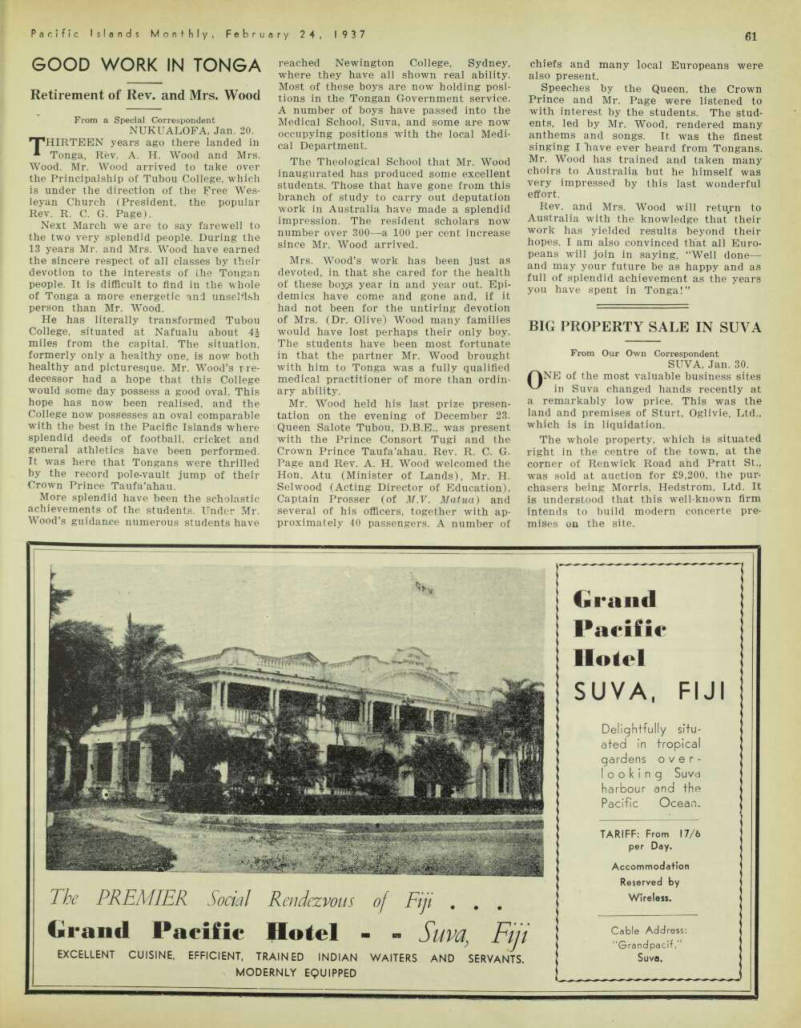
Retirement of Rev. and Mrs. Wood
From a Special Correspondent
Nukualofa, Jan. 20.
nPHIRTEEN years ago there landed in Tonga, Rev. A. H. Wood and Mrs.
Wood. Mr. Wood arrived to take over the Principalship of Tubou College, which is under the direction of the Free Wes leyan Church (President, the popular Rev. R. C. G. Page).
Next March we are to say farewell to the two very splendid people. During the 13 years Mr. and Mrs. Wood have earned the sincere respect of all classes by their devotion to the interests of the Tongan people. It is difficult to find in the whole of Tonga a more energetic and unselfish person than Mr. Wood.
He has literally transformed Tubou College, situated at Nafualu about 4| miles from the capital. The situation, formerly only a healthy one, is now both healthy and picturesque. Mr. Wood’s pre decessor had a hope that this College would some day possess a good oval. This hope has now been realised, and the College now possesses an oval comparable with the best in the Pacific Islands where splendid deeds of football, cricket and general athletics have been performed.
It was here that Tongans were thrilled by the record pole-vault jump of their Crown Prince Taufa’ahau.
More splendid have been the scholastic achievements of the students. Under Mr.
Wood’s guidance numerous students have
reached Newington College, Sydney, where they have all shown real ability.
Most of these boys are now holding posi tions in the Tongan Government service.
A number of boys have passed into the Medical School, Suva, and some are now occupying positions with the local Medi cal Department.
The Theological School that Mr. Wood inaugurated has produced some excellent students. Those that have gone from this branch of study to carry out deputation work in Australia have made a splendid impression. The resident scholars now number over 300—a 100 per cent increase since Mr. Wood arrived.
Mrs. Wood’s work has been just as devoted, in that she cared for the health of these boys year in and year out. Epi demics have come and gone and, if it had not been for the untiring devotion of Mrs. (Dr. Olive) Wood many families would have lost perhaps their only boy.
The students have been most fortunate in that the partner Mr. Wood brought with him to Tonga was a fully qualified medical practitioner of more than ordin ary ability.
Mr. Wood held his last prize presen tation on the evening of December 23.
Queen Salote Tubou, D.8.E., was present with the Prince Consort Tugi and the Crown Prince Taufa’ahau. Rev. R. C. G.
Page and Rev. A. H. Wood welcomed the Hon. Atu (Minister of Lands), Mr. H.
Selwood (Acting Director of Education), Captain Prosser (of M.V. Matua ) and several of his officers, together with ap proximately 40 passengers. A number of
chiefs and many local Europeans were also present.
Speeches by the Queen, the Crown Prince and Mr. Page were listened to with interest by the students. The stud ents, led by Mr. Wood, rendered many anthems and songs. It was the finest singing I “have ever heard from Tongans.
Mr. Wood has trained and taken many choirs to Australia but he himself was very impressed by this last wonderful effort.
Rev. and Mrs. Wood will return to Australia with the knowledge that their work has yielded results beyond their hopes. I am also convinced that all Euro peans will join in saying, “Well done— and may your future be as happy and as full of splendid achievement as the years you have spent in Tonga!”
Big Property Sale In Suva
From Our Own Correspondent
Suva, Jan. 30.
/"|NE of the most valuable business sites in Suva changed hands recently at a remarkably low price. This was the land and premises of Sturt, Oglivie, Ltd., which is in liquidation.
The whole property, which is situated right in the centre of the town, at the corner of Renwick Road and Pratt St., was sold at auction for £9,200, the pur chasers being Morris, Hedstrom, Ltd. It is understood that this well-known firm intends to build modern concerte pre mises on the site.
Advertisements & other items, pp. 63-64 (1 item)
Suva, Fiji
* * » '■ 0 m The PREMIER Social Rendezvous of Fiji , . .
Grand Pacific Hotel - - Fiji
EXCELLENT CUISINE, EFFICIENT. TRAINED INDIAN WAITERS AND SERVANTS.
MODERNLY EQUIPPED
Grand
Pacific
Hotel
SUVA, FIJI
Delightfully situ-
ated in tropical gardens overlooking Suva harbour and the Pacific Ocean.
TARIFF: From 17/6
per Day.
Accommodation Reserved by Wireless.
Cable Address: "Grandpacif Suva.
PACIFIC TAXI
CARACE o o
(Vincent Brothers, Suva, Fiji) Day end night service ... Most modern hire service in Suva .
Excellent drivers. • Our special trips embrace Rewa Valley and Sugar Mill, River Scenery, Lami, Suva Point, and Native Kings' Town of Bau. • Trips can be arranged on Trans-Island road to Ellington, Tavua, Ba. Lautolca, and Sigatolca.
Cables: "Vincent." Suva. 'Phone 33.
Australia's Clearing House for the Precious Metals
BUYERS OF
COLD
OSMIRIDIUM, PLATINUM. SILVER, &c.
GARRETT & DAVIDSON, LTD.
ASSAYERS, BULLION MERCHANTS, METALLURGISTS
Bank of N.S.W. Buildings - - Regent Street, Sydney
A. B. DONALD LTD.
AUCKLAND
ISLAND TRADERS :: GENERAL MERCHANTS
P. O. Box 1509 Cables and TeJegrams: "Kingdom," Auckland : branches at Rarotonga and throughout the Cook Islands At Papeete and throughout the Society, Marquesas and Paumotu Islands trading as " ETABLISSEMENTS DONALD. TAHITI M At Fiji: Trading as "Dominion Fruit C 0.," Suva
Wild Dogs
Suva’s Latest Curse
From Our Own Correspondent
Suva, Jan. 27.
■"PHE latest nuisance in Suva, and one * that is assuming rather alarming proportions, is the hordes of wild dogs which frequent the suburbs.
These ownerless creatures seem to hunt in packs and have been playing havoc in many poultry yards for some time past, seeming to kill from pure destruc tive instincts rather than for food.
Many valuable birds have been lost by poultry owners, and in some cases cal ves have been worried to death. But the most serious case yet concerns four stud Romney Marsh rams, imported by Mr.
G. C. Foulis, of Tavua. These were in the animal quarantine station at Suva, when wild dogs broke in and killed three of them.
The police have been shooting a good many stray dogs around the town. House holders are keeping pea rifles handy.
Fiji's Coronation
Representatives
From Our Own Correspondent
Suva, Jan. 30.
purs official representatives at the -*• Coronation will be the Hon. Sir Henry Scott, K.C., M.L.C., and Hon. Ratu J. L.
V. Sukuna, M.L.C.
Major C. A. B. Joske, 0.8. E., M.C., E.D.. and Second Lieutenant Ratu Edward T.
Cakobau, will represent the Fiji Defence Force as a military delegation.
Sir Henry and Lady Scott are travel ling Home via Canada, but the other three representatives will leave Suva by the Niagara on March 5, and join a P. and 0. liner leaving Sydney on March 13.
Sir Henry Scott has a long record of public service to his credit in Fiji, hav ing been a member of the Legislative Council for many years, as well as occu pying the Mayoral chair in the days of the old Municipal Council for several terms.
Ratu Sukuna is one of the best known chiefs of the Colony, having been a nomi nated member of the Legislative for some years. He was educated at Wanganui Collegiate School, New Zealand, and at Oxford University, where he took the degree of Bachelor of Arts. He is also a Barrister at Law. and at present is a District Commissioner in the Fiji Gov ernment service- He served in the French Foreign Legion during part of the war, and won the Medaille Militalre.
Major C. A. B. Joske, managing direc tor of the old established firm of Brown and Joske Ltd., recently taken over by W. R. Carpenter and Co-, is a well-known Fiji resident. He is at present acting Commandant of the Fiji Defence Force, and was recently awarded the Efficiency Decoration for 20 years’ commissioned service in the Force.
Ratu Edward Cakobau is one of the younger chiefs of the Colony, and is also a blood relation of the royal house of Tonga. He was educated at Wanganui Technical College and at the Auckland Training College. For some years he was attached to the local Education Depart ment, and is at present a clerk in the Native Affairs Department.
Does Germany Want
New Guinea?
WHEN Mr. C. Munster, of Manus, New Guinea, arrived in Sydney with his wife and family on six months’ furlough at the end of January, he was inter viewed by reporters and made a state ment that was given a front-page posi tion in the newspapers.
Mr. Munster said: “Germany does not want New Guinea. She could do nothing with it because it is so far away. Its distance from Germany would make it very hard to defend.”
Mr. Munster became a naturalised British subject in 1904 and he has lived in Manus since 1912.
Yacht " Seafarer "
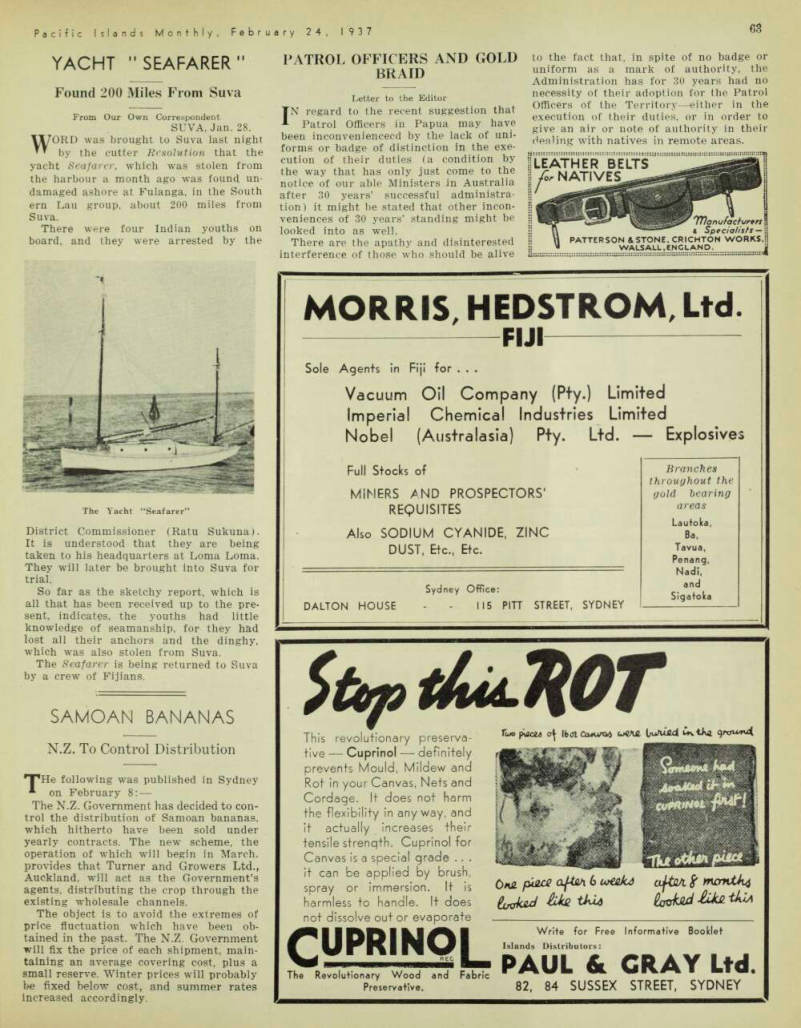
Found 200 Miles From Suva
From Our Own Correspondent
Suva, Jan. 28.
WORD was brought to Suva last night by the cutter Resolution that the yacht Seafarer , which was stolen from the harbour a month ago was found un damaged ashore at Fulanga, in the South ern Lau group, about 200 miles from Suva.
There were four Indian youths on board, and they were arrested by the
District Commissioner (Ratu Sukuna).
It is understood that they are being taken to his headquarters at Loma Loma.
They will later be brought into Suva for trial.
So far as the sketchy report, which is all that has been received up to the pre sent, indicates, the youths had little knowledge of seamanship, for they had lost all their anchors and the dinghy, which was also stolen from Suva.
The Seafarer is being returned to Suva by a crew of Fijians.
The Yacht “Seafarer”
Samoan Bananas
N.Z. To Control Distribution
THe following was published in Sydney * on February 8: The N.Z. Government has decided to con trol the distribution of Samoan bananas, which hitherto have been sold under yearly contracts. The new scheme, the operation of which will begin in March, provides that Turner and Growers Ltd., Auckland, will act as the Government’s agents, distributing the crop through the existing wholesale channels.
The object is to avoid the extremes of price fluctuation which have been ob tained in the past. The N.Z. Government will fix the price of each shipment, main taining an average covering cost, plus a small reserve. Winter prices will probably be fixed below cost, and summer rates increased accordingly.
Patrol Officers And Gold
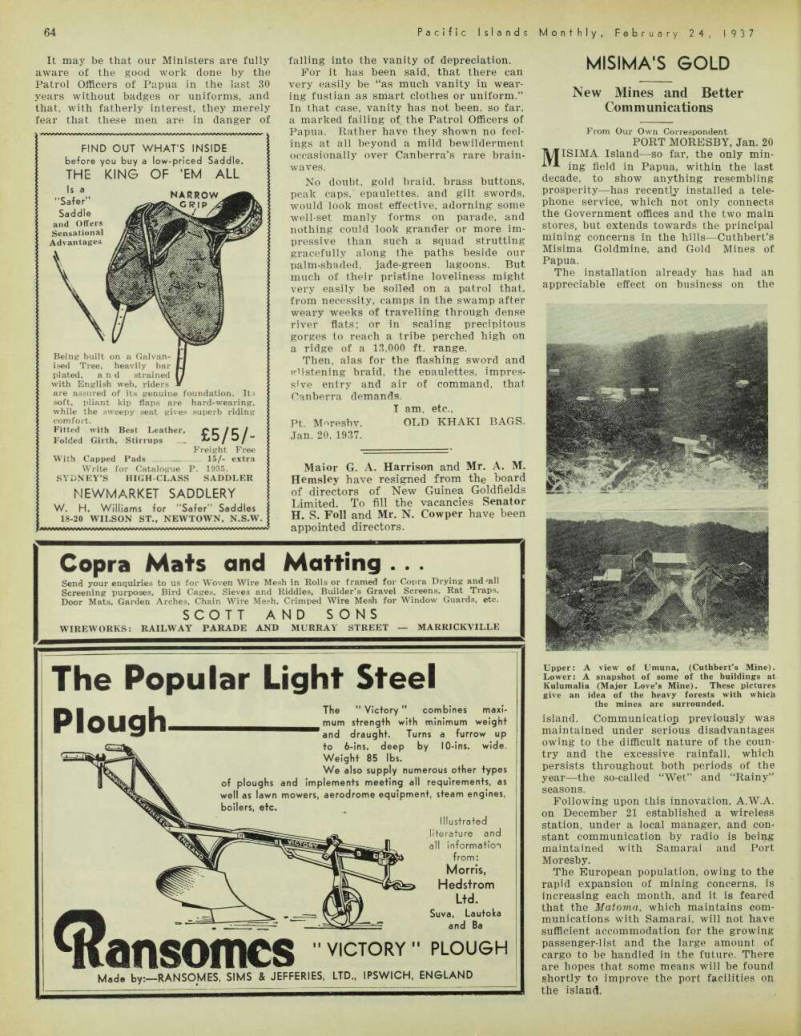
Braid
Letter to the Editor IN regard to the recent suggestion that Patrol Officers in Papua may have been inconveniencecd by the lack of uni forms or badge of distinction in the exe cution of their duties (a condition by the way that has only just come to the notice of our able Ministers in Australia after 30 years’ successful administra tion) it might be stated that other incon veniences of 30 years’ standing might be looked into as well.
There are the apathy and disinterested interference of those who should be alive
to the fact that, in spite of no badge or uniform as a mark of authority, the Administration has for 30 years had no necessity of their adoption for the Patrol Officers of the Territory—either in the execution of their duties, or in order to give an air or note of authority in their dealing with natives in remote areas.
It may be that our Ministers are fully aware of the good work done by the Patrol Officers of Papua in the last 30 years without badges or uniforms, and that, with fatherly interest, they merely fear that these men are in danger of
falling into the vanity of depreciation.
For it has been said, that there can very easily be “as much vanity in wear ing fustian as smart clothes or uniform.”
In that case, vanity has not been, so far, a marked failing of the Patrol Officers of Papua. Rather have they shown no feel ings at all beyond a mild bewilderment occasionally over Canberra’s rare brain waves.
No doubt, gold braid, brass buttons, peak caps, epaulettes, and gilt swords, would look most effective, adorning some well-set manly forms on parade, and nothing could look grander or more im pressive than such a squad strutting gracefully along the paths beside our palm-shaded, jade-green lagoons. But much of their pristine loveliness might very easily be soiled on a patrol that, from necessity, camps in the swamp after weary weeks of travelling through dense river flats; or in scaling precipitous gorges to reach a tribe perched high on a ridge of a 13,000 ft. range.
Then, alas for the flashing sword and p-iistening braid, the epaulettes, impres sive entry and air of command, that Canberra demands.
I am, etc., Pt. Moresby. OLD KHAKI BAGS.
Jan. 20, 1937.
Maior G. A. Harrison and Mr. A. M.
Hemsley have resigned from the board of directors of New Guinea Goldfields Limited. To fill the vacancies Senator H. S. Foil and Mr. N. Cowper have been
appointed directors.
Advertisements & other items, pp. 65-66 (1 item)
Step tunor
LEATHER BELTS
Cor NATIVES
7770 mufacturert A Specialists
PATTERSON A STONE. CRICHTON WORKS.
WALSALL, ENGL AND.
MORRIS, HEDSTROM, Ltd.
FIJI
Sole Agents in Fiji for . . .
Vacuum Oil Company (P+y.) Limited
Imperial Chemical Industries Limited
Nobel (Australasia) Pty. Ltd. Explosives
Full Stocks of
MINERS AND PROSPECTORS'
REQUISITES
Also SODIUM CYANIDE, ZINC
DUST, Etc., Etc.
Sydney Office: DALTON HOUSE - - 115 PITT STREET. SYDNEY Branches throughout the gold hearing areas Lautoka, Ba, Tavua, Penang, Nadi, and Sigatoka
Step tunor
This revolutionary preservative Cuprinol definitely prevents Mould, Mildew and Rot in your Canvas, Nets and Cordage. It does not harm the flexibility in anyway, and It actually increases their tensile strength. Cuprinol for Canvas Is a special grade .. . it can be applied by brush, spray or Immersion. It is harmless to handle. It does not dissolve out or evaporate
rUPRINQI
Tljo lbtfl CatWQ4 ( oV\JL OuAtfld UvtAft grcru^c( The Revolutionary Wood Preservative. and Fabric 0 *jL puace aftvx 6 ureda) ofta/i % montkj
bJoJ liketki*
Write for Free Informative Booklet Islands Distributors:
PAUL & CRAY Ltd.
82, 84 SUSSEX STREET, SYDNEY
Is a "Safer"
Saddle and Offers Sensational Advantages
FIND OUT WHAT'S INSIDE
before you buy a low-priced Saddle.
THE KING OF 'EM ALL
NARROW
t’:,.
Being built on a Galvanised Tree, heavily bar plated, and strained with English web, riders are assured of its genuine foundation. Its soft, pliant kip flaps are hard-wearing, while the sweepy seat gives superb riding comfort.
Fitted with Best Leather, rr/ r / Folded Girth, Stirrups Freight Free With Capped Pads 15/- extra Write for Catalogue P. 1935.
SYDNEY’S HIGH-CLASS SADDLER
NEWMARKET SADDLERY
W. H. Williams for "Safer" Saddles
18-20 WILSON ST., NEWTOWN, N.S.W
Copra Mats and Matting . . .
Send your enquiries to us for Woven Wire Mesh in Rolls or framed for Copra Drying and-all Screening purposes, Bird Cages, Sieves and Riddles, Builder’s Gravel Screens, Rat Traps, Door Mats, Garden Arches, Chain Wire Mesh, Crimped Wire Mesh for Window Guards, etc.
SCOTT AND SONS
WIKEWORKS: RAILWAY PARADE AND MURRAY STREET MARRICKVILLE
The Popular Light Steel
Plough
The " Victory" combines maximum strength with minimum weight and draught. Turns a furrow up to 6-ins. deep by 10-ins. wide.
Weight 85 lbs.
We also supply numerous other types of ploughs and Implements meeting all requirements, as well as lawn mowers, aerodrome equipment, steam engines, boilers, etc.
Illustrated literature and all information from: Morris, Heds+rom L+d.
Suva, Lautolca and Ba
fisomcs "VICTORY" PLOUGH
Made by:—RANSOMES, SIMS & JEFFERIES, LTD., IPSWICH, ENGLAND
Misima's Gold
New Mines and Better Communications
From Our Own Correspondent
Port Moresby, Jan. 20
IVITSIMA Island —so far, the only min ing field in Papua, within the last decade, to show anything resembling prosperity—has recently installed a tele phone service, which not only connects the Government offices and the two main stores, but extends towards the principal mining concerns in the hills—Cuthbert’s Misima Goldmine, and Gold Mines of Papua.
The installation already has had an appreciable effect on business on the
Upper: A view of Umuna, (Cuthbert’s Mine).
Lower: A snapshot of some of the buildings at Kulumalia (Major Love’s Mine). These pictures give an idea of the heavy forests with which the mines are surrounded. island. Communication previously was maintained under serious disadvantages owing to the difficult nature of the coun try and the excessive rainfall, which persists throughout both periods of the year—the so-called “Wet” and “Rainy” seasons.
Following upon this innovation, A.W.A. on December 21 established a wireless station, under a local manager, and con stant communication by radio is being maintained with Samarai and Port Moresby.
The European population, owing to the rapid expansion of mining concerns, is increasing each month, and it is feared that the Matoma , which maintains com munications with Samarai, will not have sufficient accommodation for the growing passenger-list and the large amount of cargo to be handled in the future. There are hopes that some means will be found shortly to improve the port facilities on the island.
Cook Is. Notes
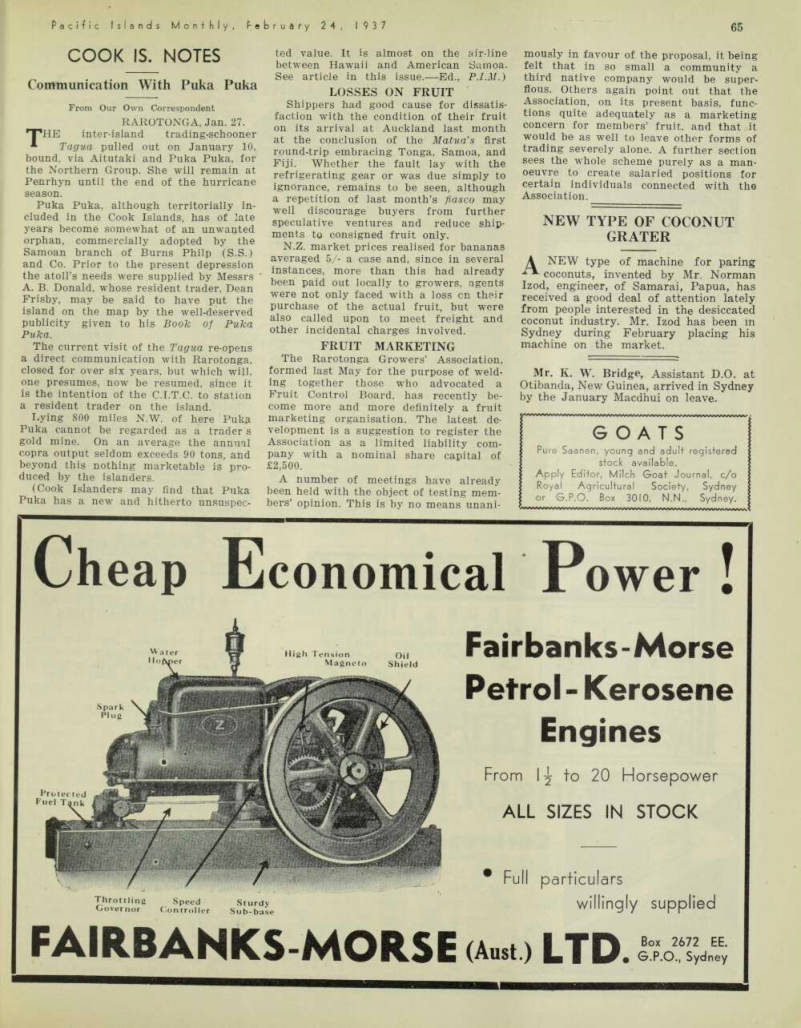
Communication With Puka Puka
From Our Own Correspondent
Rarotonga, Jan. 27.
*TPHE inter-island trading-schooner * Tagua pulled out on January 10, bound, via Aitutaki and Puka Puka, for the Northern Group. She will remain at Penrhyn until the end of the hurricane season, Puka Puka, although territorially in cluded in the Cook Islands, has of late years become somewhat of an unwanted orphan, commercially adopted by the Samoan branch of Burns Philp (S.S.) and Co. Prior to the present depression the atoll’s needs were supplied by Messrs A. B. Donald, whose resident trader, Dean Frisby, may be said to have put the island on the map by the well-deserved publicity given to his Book of Puka Puka.
The current visit of the Tagua re-opens a direct communication with Rarotonga, closed for over six years, but which will, one presumes, now be resumed, since it is the intention of the C.I.T.C. to station a resident trader on the island.
Lying 800 miles N.W. of here Puka Puka cannot be regarded as a trader s gold mine. On an average the annual copra output seldom exceeds 90 tons, and beyond this nothing marketable is pro duced by the islanders. (Cook Islanders may find that Puka Puka has a new and hitherto unsuspec
ted value. It is almost on the air-line between Hawaii and American Samoa.
See article in this issue.—Ed., P.1.M.)
Losses On Fruit
Shippers had good cause for dissatis faction with the condition of their fruit on its arrival at Auckland last month at the conclusion of the Matua’s first round-trip embracing Tonga, Samoa, and Fiji. Whether the fault lay with the refrigerating gear or was due simply to ignorance, remains to be seen, although a repetition of last month’s fiasco may well discourage buyers from further speculative ventures and reduce ship ments to consigned fruit only.
N.Z. market prices realised for bananas averaged 5/- a case and, since in several instances, more than this had already been paid out locally to growers, agents were not only faced with a loss on their purchase of the actual fruit, but were also called upon to meet freight and other incidental charges involved.
Fruit Marketing
The Rarotonga Growers’ Association, formed last May for the purpose of weld ing together those who advocated a Fruit Control Board, has recently be come more and more definitely a fruit marketing organisation. The latest de velopment is a suggestion to register the Association as a limited liability com pany with a nominal share capital of £2,500.
A number of meetings have already been held with the object of testing mem bers’ opinion. This is by no means unani
mously in favour of the proposal, it being felt that in so small a community a third native company would be super flous. Others again point out that the Association, on its present basis, func tions quite adequately as a marketing concern for members’ fruit, and that it would be as well to leave other forms of trading severely alone. A further section sees the whole scheme purely as a man oeuvre to create salaried positions for certain individuals connected with the Association.
New Type Of Coconut
Grater
A NEW type of machine for paring coconuts, invented by Mr. Norman Izod, engineer, of Samarai, Papua, has received a good deal of attention lately from people interested in the desiccated coconut industry. Mr. Izod has been m Sydney during February placing his machine on the market.
Mr. K. W. Bridge, Assistant D.O. at Otibanda, New Guinea, arrived in Sydney by the January Macdhui on leave.
With over 400 passengers on board the steamer Katoomha visited Suva in a tour ist cruise from Sydney, via Norfolk Is land and Nukualofa, on January 4. She was the first tourist ship to visit Lau toka, much to the delight of residents of that district. Many of the visitors tra velled overland from Suva to Lautoka.
Advertisements & other items, pp. 67-68 (1 item)
Cheap Economical Power !
GOATS
Pure Saanen, young and adult registered stock available.
Apply Editor, Milch Goat Journal, c/o Royal Agricultural Society, Sydney or G.P.O. Box 3010, N.N., Sydney.
Cheap Economical Power !
Spark Plug High Tension Oil Magneto Shield Protected Fuel T Throttling Speed Sturdy Governor Controller Sub-base
Fairbanks-Morse
Petrol - Kerosene
Engines
From 1 to 20 Horsepower
ALL SIZES IN STOCK
Full particulars
willingly supplied
FAIRBANKS-MORSE (Aust.) LTD.
Box 2672 EE.
G.P.0., Sydney
u 3 00 Calndlepower "Live”
Pressure Light
fTHIS two-mantle Coleman Kerosene Mantle Lamp burns 96% air and 4% kerosene (coal oil). It’s a pressure lamp that produces 300 candlepower of "live”, eyesaving brilliance... gives more and better light at less cost. A worthy companion to the famous Coleman Gasoline Pressure Lamps. Safe... the fuel fount is madeof brass and steel... no glass to break. Clean...no greasy wicks to trim; no smoky chimneys to wash. Finished in twotone Indian Bronze with attractive Parchment Shade.
COLEMAN LAMPS now fitted with Genuine Clear Glass Pyrex Globes, protecting Mantles and Shades and giving the whole brilliance to the Room.
Coleman Kerosene Lamps will burn Benzine equally as well.
Unaffected by draughts—the Coleman just continues to Shine.
Coleman Lamp & Stove Co. Ltd.
TORONTO. CANADA
500 Kent Street, Sydney.
WUNDERLICH
m nr r
DURA T I L E
These asbestos cement sheets give walls a tiled appearance at less cost. See examples in our showrooms or write for leaflet.
WUNDERLICH LTD.
Crown & Cleveland Sts., Redfern, Sydney
REMEMBER THE NAME
DIC4TIIE
US
OVING
c« 3 1 4
USOLINE
Never Known to Fail!
Cockroach Destroyer
Attracts They Eat It They Die AUSOLINE CO. Established 1919.
CROWN STREET, SYDNEY
PRICES: 11b. 5/-, 31bs. 10/- Postage extra.
Remit Cash with Order.
Obtainable also at Islands Stores of Burns, Philp and Co. Ltd., W. R. Carpenter and Co. Ltd. /
IT'S A
PASTE !
Torres Strait News
From Our Own Correspondent
Thursday Is.. Feb. 1.
January 30, Gladys, the eldest daughter of Mr. and Mrs. Ernest J. Hennessey was married to Mr. William Cadzow, manager of the local branch of Messrs. Burns, Philp & Co.
Mr. H. J. Richardson has taken up duties as Town Clerk of Thursday Island, replacing Mr.
Cecil Done, who is now in a similar position at Kingaroy, Queensland.
Rev. P. J. Thomas, of the Australian Inland Mission, has been appointed as the Presbyterian Minister for Thursday Island district, and has already commenced his ministry.
Rev. William Burvill, 8.A., sub-dean of the T.I. Cathedral, has become the Administrator of the Anglican Diocese of Carpentaria. The last missionary to hold this position was Rev. W. H.
MacFarlane, who is now rector of Scotsdale, Tasmania.
Four out of the six candidates for the recent State Scholarships have passed, all being pupils of the local Convent School managed by the Sisters of the Sacred Heart Mission. Their names are John Chee Quee, Francis Clark, Veronica McGrath, and Daisy Chee Quee.
Beneficial rains have been falling during Janu ary with a total of about 29 inches. This is a welcome change. In the same month last year the domestic water problem was an extremely serious one.
The engagement is announced of Miss Joan Burvill, elder daughter of the Anglican Vicar of Thursday Island, to Mr. William F. G. Ross, school teacher, of Herberton, North Queensland.
News has been received from Brisbane of the death of Mr. Ernest E. Slaughter, aged 72, a former resident of Thursday Island. For many years he was an Alderman, and was in business with Mr, Arthur D. Herring.
When the “Marella” arrived at the anchorage outside the harbour for her January visit the weather conditions were very rough. The vessel had only three tons of cargo. Passengers for Thursday Island were lowered in baskets to the launch below, two of them being Mr. and Mrs.
Stipswitch, of the local radio station.
The Goode Island lighthouse, at the entrance to T.I. harbour, is to be converted into an unattended light with automatic machinery. The lightkeeper will remain there owing to essential signalling duties.
Liquor Licenses In
New Guinea
TT is notified in the New Guinea Gazette that publican’s licenses have been re newed as follows: — Cosmopolitan Hotel, Rabaul, R. C. Will mott (transferred from M. J. Willmott).
Hotel Pacific, Rabaul, L. E. Banks.
Madang Hotel, P. K. Lewis.
Hotel Bulolo, Wau, F. S. Stewart.
Hotel Cecil, Lae, K. C. Baldie.
Hotel Wau, Wau, Walter Corden (transferred from J. A. Parer).
Salamaua Hotel, Salamaua Trading Co.
Ltd.
Edie Creek Hotel, R. J. Franklin.
Rabaul Hotel, E. C. Monck (transferred from Ivan Nelson).
Kavieng Hotel, Tsang Sang (transfer red from Ah Tam’s successors).
Club Licenses.
The following club licenses have been renewed: — Kavieng-, Kavieng Wau - Wau New Guinea Rabaul Rabaul Rabaul Kokopo Kokopo
Storekeepers’ Licenses.
The following storekeepers have been granted licenses to sell liquor in pres cribed quantities: — Burns, Philp and Co. Ltd.: Salamaua, Wau, Rabaul, Kavieng, Kieta, Lae, Lombrum, Madang.
Ernest John Ifould: Boram.
Tee Cee Wee: Rabaul.
Ah Young: Kavieng.
Bulolo Gold Dredging Ltd.: Bulwa, Bulolo.
W. R. Carpenter and Co.: Wau. Salamaua, Madang, Kavieng, Rabaul.
Arthur Thompson: Wau.
Charles Arthur Thompson: Sunshine, Aerodrome Ella Elizabeth White: Upper Watut and Sur prise Creek.
Harry Donald: Edie Creek.
Lionel McGilvery: Edie Creek.
Alois Akun and Co.: Rabaul and Kokopo.
Joseph Thomas Kenny; Namatanai, Greenwood and Laws Ltd.: Wau, Edie Creek, Lae.
Papuan Natives As
Coffee Planters
THE nine-year-old plantation scheme under which the Papuan Administra tion has been trying to educate the natives of Sangara, in Eastern Papua, to grow crops for export is beginning to show results.
The main experimental plantation, which is 30 miles inland, is in charge of Captain L. E. Austin. In the beginning, experiments were made with cotton and cocoa, but when Captain Austin took charge four years ago attention was devoted mainly to the growing of coffee.
All the natives in the district are under an obligation to carry out the work of cultivating and gathering: the coffee crop, and it is understood that they shall receive half the proceeds therefrom. For a considerable time there was no profit in the work, but last year the plantation began to give returns and about 50 tons were produced and sold. As a result, it is reported that the natives of the dis trict will divide about £l,OOO as their share of the enterprise.
This is an interesting aspect of the policy of the Murray Administration, which has been consistently directed towards establishing peasant planters among the native population.
Advertisements & other items, pp. 69-70 (1 item)
Royalty Traders
A SMALL SELECTION FROM OUR LATEST CATALOGUE
INCREASE YOUR
HEIGHT AND
STRENGTH.
1!
Runt ' / Complete 10 weeks’ course, with ino.. -ck guarantee. Fully illustrated, as sold in England, £4/4/-.
Our price, 10/- only, with moneyback guarantee. Send stamp for particulars.
MIDGET BIBLE!
Great
CURIOSITY.
Smallest Bible in the world. Size of a postage stamp. Wonderfully clear prln-t- Welght under half an ounce. A genuine work of art.
Must be seen to be appreciated.
Said to be very lucky 2/- Midget Magnifying Glass 6d. extra. ing, 224 pages.
QUEEN MARY KIT.
181 n. Scale model, ready formed hull, absolutely complete in every detail.
Price, 12/6. Ready to assemble. 6in. Kits of 12 other famous ships of all kinds, 3/- each. Illustrations included in Aero Catalogue at 6d.
FROM PARIS.
triguing Pocket Mirror, with intriguing nudist camp scene, 6d.
SWAY OTHERS AT
WILL.
Be a master of men. Increase your willpower. Have control over
HYPNOTISM
yourself and others. Be a leaderpopular, successful. A knowledge of this magic mental force improve? all. Price now only 3/6.
VICTORY 300 ft.
FLYER.
Monoplane ready to fly, I6in. w.ru span, 5/-.
MODEL AERO KITS.
12in.-151n. flying models, 2/9; 6ii solid scale models, 1/3 and 2/9 12in. solid scale and flying models 5/-; Boeing P-26a Flying Model 2Uln., 17/6; Stinson Reliant 321 u flying model, 25/-. Over 100 models complete illustrated catalogue, 6d
MIDGET TELES-
COPES WITH
VIEWS.
3. Ten Commandments. 1/6 each. 3 for 4/-.
AN ELECTRIC
MOTOR FOR 2/-
ELECTRIC MOTOR S °unds almost instructions for assembling. No trouble at all putting it together—it is PUN. Takes but a few minutes.
And, OH, BOY! Isn’t it speedy I Runs on a No. 6 or similar dry battery. You can learn more about a motor in 30 minutes than by hours of study. Perform many novel and interesting experiments with it Price, 2/-. 3 kinds available : 1. Bathing Beauties. 2. Lord’s Prayer. u n b e lievable, but it is perfectly true.
We send all the parts packed in a heat box, with full
NEWEST
a LATEST
CRAZE
Neckties illustrated and funnily worded Vest covers illustration, but when tie is taken out, then some fun. Excellent quality.
Price 2/6
AUTO SCARE BOMBS
(or “Car Protector”) These are attached to / two spark plugs of a car. When anyone attempts to start car the bomb yells like a siren and then makes a report like a gun. Price 2/- each.
WATER SQUIRT
ROSES
Place one in lapel.
Ask someone to smell glorious perfume, when out will squirt a spray of water.
Price 1/-.
A L- A loaded golf ball, exactly as any good quality ball, but when driven or putted it behaves in an eccentric manner, going in every direction but the right one. Have fun on the green. Price 2/6.
SURPRISE BOXES
Each is a neat and attractive box cleverly worded which explains the contents.
However, when the box is opened something entirely unexpected and amusing is discovered.
“Cure for Insomnia,”
“World’s Smallest Receiver”
“Chamber of Horrors”
“A Pair of Black Kids”
“A Piece of Tail”
“Relief for Henpecked”
“For Men Only”
“For Ladies Only” 1/6 1/6 1/3
A CAWTFA.RV
GOLFBAIL
A CHEMICAL
NOVELTY
“Snake in Hat”— When a match is applied to top of hat a “snake” 6ft long will slowly emerge.
Price 9d per pair. &
Do not faii to send 6d for 1937 catalogue. This page gives only an indication of the great variety of goods available.
RUBBER DANCING
PICTURES
A rubber sheet illustrated and mounted on a cardboard frame.
When the rubber is moved by finger .at back a funny animated scene takes place. Six different kinds. Price 1/3 each.
Intriguing, beautifully bound books with titles that will cause anyone to pick up book. When book is opened it releases a spring that causes a loud explosion.
Price 2/3 with caps.
Books each of 48 beau tiful nude studies.
“Sunbathers,”
“Beauty of the Female Form,”
“Nudes of all Nations,” 8/6
WONDER BOXING
BOOK.
194 PAGES.
Complete rin records of ovei 100 . famous boxers. Fully illustrated wit! phot ograph* and drawings stories, articles. etc., 2/-.
Learn wrestling, Ju-Jitsu, and muscle building; abridged, fully illustrated and described. 12 lessons for I/. 50 „ 3/. 100 „ 5/-
NOISY NOSE
BLOWER.
Conceal one of these in your handkerchief and blow. Creates more noise than a steam 9d.
LORD’S PRAYER
LUCKY
CHARM.
Size of 6d. Has every word of the Lord’s Prayer embossed on it In readable size. Price I/-.
THESE
WANTED BOOKS
JUST ARRIVED!
Read Character from the Hand. 2/-
ASTROLOGY MADE EASY.
What the Stars foretell. 2/-.
HOW TO DANCE.
A complete guide to old and new steps. 2/-.
Something every Book-lover should have!
MIDGET VOLUMES OF
SHAKESPEARE.
2in. x lV£in. Leather bound. Every word easily readable with naked eye.
Each volume comprises a complete Shakespearean play. Forty different plays available. 1/6 each. engine. Price
SEND NOW FOR
LATEST 1937 CATALOGUE
The most interesting Catalogue printed. Illustration of hundreds of new and novel lines that cannot foe bought in any shop. Also contains pages of interesting and instructive reading matter Price 6d Also Aeroplane and Ship Kit Catalogue 6d.
Also Magical Goods and Tricks Catalogue 6d.
Prompt
attention
IAT(SI.
CATAIOC
to Mail Orders.
Royalty Traders
80xT.38791, G.P.0., Sydney Room 40T, 3 Castlereagh Street, Sydney, Aus.
Mining Ore
Treatment
Machinery
COMPLETE CYANIDE
PLANTS SUPPLIED
Dorr Classifiers Dorr Thickeners Dorr Agitators Oliver Filters Merril Crowe Zinc Dust Gold Precipitation Richardson Mine Fans ®
FANS AND AIR HEATERS
For Ventilation, Copra Drying Rooms, etc. • Enquire from
CROSSLE. DUFF AND
MACINTOSH LTD.
52 Bridge Street, SYDNEY
WE DID THE WHOLE CONTRACT
Your confidence in our service will not he misplaced
NEW OVERHAUL
SHOP
AND STORE AT LAE
for
GUINEA AIRWAYS
LTD.
TN few undertakings do reliability, expedition, and efficient service count more than in Structural Steel contracts.
Cite Sydney Steel Company CM. SSTSK
Steel Merchants and Structural Engineers
COLD...
HIGHEST PRICES. PROMPT
SETTLEMENT, ACCURATE
WEIGHTS AND ASSAYS.
are assured to producers and sellers of gold bullion who forward their consignments to The Electrolytic Refining and Smelting Co. of Aust. Ltd. for treatment and realisation.
RECORD PRICE.—On 6th March, 1935, this company paid to its clients at the rate of £9/4/6 net per fine ounce, which is the highest price ever paid for gold in Australia.
SPECIALLY ORGANISED SER-
VICE is available to clients in New Guinea, Fiji and other Pacific Island centres.
Address consignments from outside Australia to the Company’s . Weighing a Pacific Islands consignment of Sydney office. gold bullion at an E.R. & S. receiving office.
The Electrolytic Refining & Smelting Co.
OF AUSTRALIA LIMITED
Melbourne: Works: Sydney: Collins House. Port Kembla, N.S.W. 25 O'Connell Street.
PURCHASERS AND REFINERS OF GOLD. SILVER. COPPER IN ANY FORM BANKERS: —The English, Scottish and Australian Bank Ltd, 1
Pacific Islands Mining Notes
From Fiji
Emperor Goldmining Co. Ltd.
r\EVELOPMENT work of Emperor Gold Mining Co. Ltd., Tavua, Fiji, has practically been discontinued in order to concentrate upon pre paration of the mine for ore production on the larger scale necessary for the new treatment plant. The directors have therefore decided to discontinue the fortnightly cabled report for_ the next few months. Monthly reports on the mine and progress of the new treatment plant will be forwarded by the mine superintendent, and these will be published when received.
Good progress is being maintained with the manufacture of equipment for the new treatment plant in Australia and overseas, and preliminary work on the site is well advanced.
In their first annual report, the directors advised that the capacity of the mill is being brought up to 12,000 tons of ore a month. The new plant is due to be in commission by Sep tember next.
Returns for the last three periods compare as follows:
Loloma (Fiji) Gold Mines N.L.
Loloma (Fiji) Gold Mines N.L.. Tavua, Fiji, issued on February 1 the following progress re
port on the erection of the treatment plant;— Lower half of head frame assembly practically completed. Work stopped temporarily to allow main shaft sinking to proceed without interrup tion. Brace and gantry frames and legs ready for erection. Mill building foundations completed.
Crude ore bin timber work ready for erection.
Jaw crusher foundations completed. Excavations for foundations to main storage bin, also No. 3 conveyor, well in hand. Foundations for both dryers completed. Excavations for crushing rolls foundations in hand. Retaining concrete wall for roaster and dust chamber completed. Excavations for concrete base of roaster stack completed.
Manufacture of primary crusher, crushing rolls, ball mills, driers, classifier, completed. Most of iron work for roaster completed and shipped to Fiji.
Tavua Power Pty. Ltd.
Tavua Power Pty. Ltd. reports that No. 3 electric generating set was started on February 10. The whole installation, comprising a Diesel air compressor set and three Beilis and Morcom Diesel generating sets each of 525 k.w., is now completed. The company was formed to supply electrical energy and compressed air, principally to the Emperor and Loloma mines, on the Tavua goldfield. All shares in the comapny are held by Emperor Mines Ltd. and Loloma (Fiji) Gold Mines, N.L.
Pacific Gold N.L.
The directors of Pacific Gold, N.L., have secured for the company a two-months’ free extension of the option over the property at Wainevisi, Fiji. The first diamond drilling bore, which was expected to intercept the lode at 134 ft, was continued to 271 ft without result, and the bore was abandoned owing to broken ground. No. 2 bore was commenced at the entrance of No. 2 adit and apart from about 6ft of soft lode formation carrying a little blende and copper pyrites, encountered at 136 ft, this bore gave negative results. A third bore has been started 214 ft from plug at No. 2 adit.
Mount Kasi Mines Ltd.
Production figures for Mount Kasi Mines Ltd., Fiji, are compared in the following table: — Four weeks ended
Koroere Gold N.L.
Directors of Koroere Gold N.L. have received a written report from the mine manager (Mr.
G. O. Ramsay), dated January 12, in which he estimated that the tonnage of ore available on the Cardigan area at Tavua, Fiji, would be 30,000 tons, giving a value of 15,0000 z. of fine gold. He also estimated that in the Koroere Hill section there would be an additional 70,000 tons of ore, which should show a milling profit of £1 a ton.
Nov. 28 *Dec. 19 Jan. 23 Ore (dry weight), tons ... 2215 1957 2080 Fine gold, oz ... 1036.9 787.4 1027.7 Head value, dwt. - 10i 8.04 10^ * Three weeks
Oct. 9f Nov. &t Dec. 4*"Jan. 28"
Ore, tons 1,590 1,627 1,500 1,853 Bullion, oz 318 452 487 352 Value, £A. ... 2,525 3,550 3,600 2,773 f Mill stopped six days for repairs to water supply. t Mill stopped five days for engine overhaul.
"" Mill stopped 54 days owing to engine breakdown. Mill closed down during December for overhaul and repairs, and resumed crushing Jan. 6. * Twenty-one days’ run. Since clean-up tailings have been reduced to less than Idwt. Manager expects better results in near future.
From New Guinea
Upper Watut Gold Alluvials N.L.
NOW that operations have been commenced by Upper Watut Gold Alluvials N.L., Wau, New Guinea, and major difficulties have been surmounted. The directors confidently expect that before the end of February the company will be sluicing full time with both pontoons, and will be showing adequate margins over working costs.
Sluicing operations were commenced on August 5, but the first clean up of gold did not take place until the end of September. Expenditure for the six months ended August 31 exceeded the revenue by £4330. At the close of the half year current assets amounted to £11,190, and liabilities to £39,556. Expenditure on plant and constructional work has considerably exceeded estimates. This was due partly to the extremely difficult condi tions in the territory and partly to the fact that delay in the delivery of certain items of plant, caused by the precedence given to the manufac ture of rearmament orders, entailed excessive expenditure. The services of expert workmen sent to New Guinea at considerable expense had to be retained until all items of plant were delivered.
The directors added that they have made arrange ments for the provision of extra finance neces sary to enable the company to commence opera tions. During the period the option taken by Bulolo Gold Dredging Limited over the company's unissued shares was relinquished.
Bulolo Gold Deposits Ltd.
Bulolo Gold Deposits Ltd. advises that a clean up for the four weeks ended February 1 resulted in a recovery of 120 oz. from approximately 37,000 yards. The area treated was mainly terrace ground. This yield compares with December clean up of 80oz. from 40,000 cub. yds and 2380 z. from 9,200 cub. yds in November.
Sandy Creek Gold Sluicing Ltd.
The mine manager of Sandy Creek Gold Sluic ing Ltd. reported on February 2, that the Janu ary production compared with previous months as under:—
Sunshine Gold Development Ltd.
Sunshine Gold Development Ltd. reports that the clean-up for the period from January 1 to 20, including four days lost for repairs, yielded 3970 z.
The plant was closed down on January 20 for re-welding internally the balance of the pipe line, which, it is estimated, will take three to four weeks.
New Guinea Goldfields Ltd.
Production statements of New Guinea Gold fields Limited compare as under:—
Production for the Edie Creek mill was re duced through stope preparations on the lower levels. Output for January should improve. The decline in production from Golden Ridge was due to a reduction in the grade of available ore reserves.
Enterprise Of N.G. Gold And Petro
Leum Development N.L.
From December 21 to January 18 sluicing was carried on by Enterprise of New Guinea Gold and Petroleum Development Ltd. on the Surprise Creek alluvial mine. For December 520 z. of un refined retorted gold was recovered from 8300 cubic yards, consisting of 4325 cubic yards of wash and 3975 cubic yards of overburden. On the Oriabanda alluvial property, sluicing on a small scale was under way. Very little sluicing was car ried out on the Oriabanda property during Dec ember. The clean-up to December 31 yielded lOoz. 17dwt. of unrt fined retorted gold from 450 cubic yards of wash put through the sluice boxes. The development programme on the Edie Creek ore mine was continued, but owing to difficult condi tions being met in the underground workings progress was considerably delayed. At December 15 the drainage adit had been advanced to 206 ft from the portal. Retimbering the No. 1 W drive on the main lode continued. Surveys and the
preparation of mine plans proceeded without interruption. The equipment of the metallurgical laboratory was completed and testing work on the mine ore commenced. Work was commenced on a pilot plant to treat 500 tons of ore a month.
An engine was landed on the mine, and will be used to drive a crusher now on order in Australia.
A later report stated that production from all sources for January w’as 720 z. 9 dwt. from 11,400 cubic yards, consisting of 5230 cubic yards of wash dirt and 6170 cubic yards of oyer-burden.
Bulolo Gold Dredging Ltd.
Production for the four dredges of Bulolo Gold Dredging Ltd., for January, compares with that of the previous two periods as follows: —
Irowat Gold Alluvials N.L.
A working loss of £4657 was sustained by Irowat Gold Alluvials N.L. for the year to September 30. Gold returned £5933. Sluicing com menced on May 26, 1936, and from then to September 30 last 128,910 cubic yards were treated for a yield of 10670 z. gold, while from September to December last 3360 z. gold were recovered from 46,456 cubic yards. The directors say that as a result of these disappointing re turns it was decided to suspend sluicing for the time being and to carry out an intensive pros pecting campaign to test further the runs of the more highly payable sections of the property.
This testing is proceeding continuously. It is hoped to announce at an early date that opera tions have been recommended on the areas proved.
Mr. J. H. McColl has been appointed a director and has made a trip recently to the company's property. Mr. D. J. McClelland, a director, did not seek re-election. Arrangements have been made for the finance necessary to enable the company to function until results of testing are known. When the books closed the company had £3Bl in cash. Debtors owed £1760 and creditors were owed £13,724.
Criticism was expressed by shareholders at the first annual meeting in Melbourne on February 5 that Irowat interests had been subjugated to its associate company, Upper Watut Gold Allu vials. A shareholder said that plant worth £3,000 had been moved from Irowat’s property to Upper Watut and that the latter was using Irowat’s labourers. Another pointed out Upper Watut acted as purchasing agent for Irowat and made a sur charge of 10 per cent on all buying.
The directors replied that both properties are the Watut River, and plant is continually being moved from one to another to save buyyig new. Labourers might also go from one to an other, but account of any such transfer is rigidly kept and credited in the particular company’s books. By purchasing on a bulk scale materials could be brought considerably cheaper and the 10 per cent charge by Upper Watut was definitely not a surcharge but purely a charge for handling.
A motion that the meeting be adjourned for a month was carried, and a committee of three shareholders was appointed to meet the directors and discuss the affairs of the company prior to the next meeting. This was done to enable the preparation of a list of questions concerning fin ance and administration to be answered at the meeting.
Oct.
Nov.
Dec.
Jan.
Yards ... 9,121 9,870 11,890 7,345 Cold, oz 281 288 311 139 Value, c. yd. 4/7* 4/4* 3/11 2/10
Oct.
Nov.
Dec.
Alluvial— Fine gold, oz 1313 941 645 Fine silver, oz 901 673 476 Golden Ridge Mill — Fine gold, oz 1633 1592 1132 Fine silver, oz. 1355 1169 908 Edie Creek Mill- Tons 2739 -— -— Fine gold, oz. 793 774 860 Silver — — 2462 Alluvial profit £4705 £3798 £1942 G. Ridge Mill, profit £7426 £6874 £3359 Edie Creek, profit £921 *£1049 £93 * Loss.
Nov.
Dec.
Jan.
Cubic yard 956,200 785,000 899,000 Bullion, oz. 17,724 17,471 16,978 Gold, fine oz. 12,318 12,027 11,797
Value—
Aust. currency* ... £107,782* £105,236 £103.223 Per cubic yard /27.0 /32.1 /27.5 Working profit £75,880 £75,451 £75,285 * At £8/15/- per fine ounce.
From Papua
Mandated Alluvials N.L.
AS a result of a boring campaign, which '' explored 800 feet of ground, the consulting engineer of Mandated Alluvials, N.L. (Mr. E. W.
Bonwick) states that the mine has payable ore only in Nos. 6 and 7 territories, together with the Moresby King mass. The first contains 7765 tons, of a value of £52,824, with only a small percentage of copper, the latter 6867 tons of ore containing a high percentage of copper, with a value of £27,434.
Metallurgical tests to determine treatment will proceed forthwith, and possible percentage ex traction is, therefore, not yet known. Assuming an 80 per cent extraction for safety purposes, seeing that treatment may present difficulties, and a total cost of £2/10/- per ton, a quite safe figure, there are possibilities of a treatment
plant yielding a profit of £27,626. On a basis of five heads of stamps, 50 tons per day should be treated, giving the mine a life of 300 days, which will be extended by mining the small lodes north of No. 7 to perhaps 18 months.
Various schemes to meet the circumstances have been discussed with directors, but final decision must await metallurgical investigation, followed by close estimation of cost of necessary plant.
Mr. Bonwick adds that the ore-body does not occupy a syncline, as was at first supposed, the basin-like structure being due to a well-defined fault, which causes the ore-body, after a brief existence as a shallow bed, to drop some 70ft, the depressed portion consisting of unpayable sulphides. These sulphides continue almost hori zontally to the west, finally merging into a contact zone, where the sedimentaries meet igneous rock. In addition to this, developments at surface northward from No. 7 adit have been disappointing, and have not disclosed any im portant ore-occurrences.
The directors have decided to proceed for the metallurgical treatment, and intend to place the whole situation before shareholders as soon as the result makes it possible.
Cuthbert’S Misima Goldmine Ltd.
Cuthbert’s Misima Goldmine Limited, Papua, shows a net profit of £31,094 for the period from October 14, 1935, to December 31, 1936, covering the first operations of the present company. Three divi dends of 6d per share (totalling 15 per cent) require £22,500. After writing £1459 off prelimin ary expenses and placing £2OOO to special reserve, a balance of £5134 is carried forward. Bullion realised on and in transit was valued at £57,484.
Capital expenditure, including new plant, amoun ted to £22,966. The mill crushed 21.707 tons ore for 26,1500 z. bullion, containing 63750 z. gold and 19,0000 z. silver, the average value being 6dwt. 12gr. gold and 530 z. silver per ton, and average realisation 48/1. Mining costs, including develop ment, were 13/1.2 and treatment costs 7/4.4 per ton.
The present plant is treating at the rate of 23.000 tons per annum. Enlargement of the plant to treat 40,000 tons per annum is well in hand. Ore reserves (oxidised in the southern section only) are stated as positive 145,500 tons, and “probable” 107,200 tons, a total of 252,700 tons, with the contents above No. 9 level not determined. In the mine manager’s opinion, about 300.000 tons ore exist in the oxidised zone of the northern section. The directors anticipate profit able operation for many years from the oxidised ore alone. In addition they point to the possi bilities in the sulphide zone below present water level.
Cash balances at December 31 were £15,653.
Flotation expenses stood at £14,000.
Output of , November, December and January compared as follows:
Sapphire Ck. (Papua) Development
Syndicate N.L.
Sapphire Creek (Papua) Development Syndi cate N.L. has acquired an option over a tin property of 50 acres at West Zeehan (Victoria).
Capital of the company is £lO,OOO in 5000 shares of £2 each. The company is at present develop
ing leases at Sapphire Creek, Papua, adjacent to the properties of Mandated Alluvials, N.L.
Misima Gold Reefs (N.G.) N.L.
Owing to an insufficient number of proxies being received a meeting of Misima Gold Reefs (New Guinea) N.L., to consider the voluntary winding up of the company on January 28, was adjourned for fourteen days. The chairman of directors (Mr. W. Blewett) announced that a telegram had been received from the secretary of Misima Reefs Ltd., stating that scrip was in the hands of the company and would be forwarded to Melbourne for distribution to shareholders of Misima Gold Reefs.
On February 11, shareholders attended the meeting in full force, and a motion to wind up the company voluntarily was agreed to.
Astrolabe Goldfield. Papua
Port Moresby. Jan. 20.
Three goldmining leases were granted to Man dated Alluvials, N.L. for 21 years on December 29 by the Warden (Mr. W. R. Humphries) at Port Moresby. They were leases No. 21, “Sap phire,” of 20 acres: No. 23, “Moresby King,” of 50 acres; and lease No. 24, “Moresby King, No. 3,” of 15 acres. All three leases are situated near Sapphire Creek in the Astrolabe mineral field.
On January 5, three goldmining leases were granted by the Warden, subject to the Mining Act and Regulations: No. 25, “Moresby King East,” of 50 acres, near Sapphire Creek, to J. W.
Hinks; No. 26, “Mt. Cook East,” of 10 acres, near Mt. Cook, to E. Evans; and No. 27, “Hom bron,” of 10 acres near Hombron Bluff, to E.
Evans.
The following goldmining and mineral leases on the Astrolabe field were surrendered on December 29: No. 19, G.M. Lease, “Gagiberi,” E. P.
Hitchcock; No. 136, M. Lease, “Maia Koiani,”
F. A. Roberg; No. 138, M. Lease, “Naumakala No. 3,” T. L. Sefton.
Dominion Gold Ltd. took over the following leases on the Astrolabe field recently—namely, “Laloki,” “Mt, Cook,” “Nance,” “Ruth,” and “Bomana.” They propose working on the “Laloki” as a beginning. Three Europeans and a large labour force have already been engaged in open ing up the lease, under Mr. A. Christie, the recently-appointed manager, and steady progress will lead shortly to further development.
Nov. Dec. Jan.* Treated, tons 2057 1946 1840 Bullion, oz 2638 2421 2433 Gold, fine oz. — 626 588 554 Silver, fine oz. 1965 1638 1800 Est. value (£8 A) £5103 £4784 £4524 Value per ton 49/7 49/2 49/2 * Two days’ work lost (approximately 150 tons ore) owing to Christmas holidays. In addition to bullion produced in January, approximately £350 worth slags and ashes was produced and shipped for realisation.
Advertisements & other items, pp. 71-72 (1 item)
Tpumpmobil
HL LIGHT AND PORTABLE
MOTOR PUMP
Complete Plant’s weight, • 140 lbs. Capacity up to 12,000 gallons per hour.
All heads from 10 to 115 feet.
Fuel consumption, £ gallon per hour.
Pressure 551 b. square inch.
Especially suitable prospecting and ail Sluicing Requirements.
NELSON & ROBERTSON PTY. LTD
12 SPRING STREET SYDNEY
o 4 m ■
JAMES BUDGE LTD
REFRIGERATION
"BUDGE" Automatic or Manually-controlled Refrigeration and Ice-making Plants, with or without insulated Cabinets or Rooms, ranging from 4 cubic feet to 1000 cubic feet or larger, using ammonia in the large and sulphur dioxide (SO2) in the small units.
Where electricity is not available, crude oil engines may be utilised for driving the larger plants and petrol engines for driving the smaller machines. The accompanying illustration Is of a petrol engine driven SO2 unit. Enquirers please state power available (if any), size of cabinet and amount of Ice required per day.
JAMES BUDGE LIMITED
REFRIGERATION AND GENERAL ENGINEERS
McEvoy and Harley Streets ALEXANDR I A S Y D N E Y Established 1890
ENGINEERING WORKSHOPS
ALL CLASSES OF MACHINES MADE AND RECONDITIONED
W. M. FORD
Ship, Yacht and Boat Builder
Berry's Bay - North Sydney
(Established 1870) BUILDERS of all kinds of Island Craft from Dinghies to Auxiliary Schooners of any tonnage. New and Second-hand Island Craft of various types in stock.
New and Second-hand Full Diesel, Crude Oil, Benzine and Kerosene Engines.
Please Send on Your Enquiries
Beebe (B.B.)
PORTABLE HAND WINCHES
2 Ton Capacity 1 5 Ton Capacity Weight 66 lbs. Weight 110 lbs.
Excellent for loading heavy machinery —erecting pipe lines—bridge building— moving boulders from alluvial workings —and for all mining purposes. * BEEBE HOISTS cannot be broken by men in hand use.
Prices and Particulars
Nelson & Robertson Pty. Ltd.
SYDNEY
STEAMSHIPS TRADING COMPANY LIMITED
PORT MORESBY
PAPUA
SAMARAI
Chairman and Managing Director: A. S. FITCH.
Shipowners, Wholesale and Retail Merchants and Traders; Shipping. Customs and Insurance Agents; Copra and Rubber Plantation Owners.
MAIL CONTRACTORS TO COMMONWEALTH AND PAPUAN GOVERNMENTS.
AGENCIES: —At Port Moresby; Coi;al Sea Insurance Co.; Phoenix Insurance Co. ; Delta Sawmills, Ltd.; Acme Bakery Co.; Vacuum Oil Co. Pty. Ltd. At Samarai • Coral Sea Insurance Co. ; Delta Sawmills, Ltd. ; Bankers and Traders Insurance Co. ; National Mutual Life Insurance Co.; Kularo Shipyards; Mamai Plantations.
BRANCHES: —In Papua: ' Hanuabada, Sivitoi, Aroma, Koki, Hula, Ela Beach, Duga Duga, Yule Island.
SYDNEY: NELSON & ROBERTSON PTY. LTD., 12 Spring St.: Melbourne, 396 Flinders Lane; London. E. Whiteaway & Co.. 7 Chiswell Street. Finsbury, London.
Cable Address: “STEAMSHIPS." r ° de: Bentley’s
Quotations for Islands
Gold Shares
Mr. F. Mote, Deputy Superintendent of the Suva Fire Brigade, returned to Fiji in January after leave spent in England.
Fiji
Mid-Sept.
Mid-Dec.
Mid-Feb.
Emperor Mines ... b!5/3 b!9/li b20/9 Granite Dev b2d b8£d bl/- Koroere b4/b2/6 b4/9 Loloma b24/3 b23/b24/lj Mineral Dev ... b8d bll£d bl/9 Mt. Kasi b7/10 s7/6 b5/6 Mt. Morgan Dev. bl/5 bl/6 b8d Pacific Gold b£5 s£5 s£4 Tavua Dev sl/6 b6d b7d Vatu Kasi a — s3/6 — Vees United ... b4d s6d s3d
New Guinea
Mid-Sept.
Mid-Dec.
Mid-Feb.
Bulolo Deposits bl/9 b2/bl/4 Bulolo G.D s£7/10/b£7/12/s£7/15/- Developments (New Guinea) b£2/5/- — — Enterprise of N.G>. & Petroleum , — b£2/5/b£2/10/- Guinea Gold —
JZ s!4/-
s!7/3 sl6 /- I row at b2/b5d s3d Morobe All b7d b9d b9d N.G.G. Ltd b4/10 b5/3 b3/9i New Morobe — blO/bl5 /- Oil Search b3/4 b3/b3/5J Placer Dev s£5/2/b£4/17/3 b£5 Sandy Ck. . b9.d bl/2* bl/5 Sunshine Gold bll/9 bl6/lj bl4/10 Upper Watut ... h2'6h bl/6 bl/7
Papua
Mid-Sept.
Mid-Dec.
Mid-Feb.
Cuthbert’s Misima G.M. b!3/b24/9 b25/6 G.M. of Papua sl(U9 b9/ll bl2/10 Mandated All. b32/9 bl3/ll V3/n Oriomo Exp b2/8 b4/l b5/ll Sapphii-e Ck — b22/6 s25/- Yodda Gold Co. 3d' b2d b2d
Overseer To Face Killing
Charge In N. Guinea
THE Sydney Central Court on January * 25 ordered that Galfred Mervyn Col lins Ffrost, 24, an N.G. overseer, who had been arrested in Sydney, should be returned to Rabaul to stand trial for the unlawful killing of a native, Mulmul.
With Warrant Officer H. J. Stevenson, of the N.G. Police Force, as escort, Ffrost departed by the Macdhui on February 4.
Ffrost, who was employed in New Guinea on Meto Plantation, claimed that his boss-boy Bonri had been convicted of the offence. The magistrate said it was alleged that Bonri had poked the ferrule of an umbrella into Mulmul’s eye. causing his death, but that Ffrost had flogged Mulmul with a ficus root while he lay dying on a concrete floor and that had accelerated Mulmul’s death.
The boss-boy Bonri was sentenced to three years’ imprisonment with hard labour in the Rabaul Supreme Court on January 8 by Judge Wanliss. The charge was manslaughter.
Air Service From Cairns
To Thursday Is.
From Our Own Correspondent
Thursday Is., Feb. 2.
North Queensland airways PTY. LTD. has decided to commence a regular weekly air service between Thursday Island and Cairns (North Queensland), calling at Port Doucrlas, Cooktown, Lockhart River, and Portland Roads.
During January, Pilot MacDonald in a Percival Gull aeroplane arrived here with four passengers on the round trip, after a flight under tricky weather conditions.
Mr. and Mrs. Newman Pusey, of the Radio Station, left by the ’plane for Cairns on furlough and subsequent transfer to Svdnev.
The Percival Gull made a second flight later, taking South Mr. J. F. Partridge, head electrician of the Municipal Power house, to commence duties at Monto, Queensland. He was accompanied by his wife and Miss Jean Lambert.
The other passengers by air to Cairns were Mr. H. H. E. Broadbent (a candi date for St. Francis’ Theological College, Brisbane), Mr. Harrv Mills, Miss Sybil Armbrust, and Rev. W. McLelland, of the Mapoon Presbyterian Mission, Gulf of Carpentaria, on furlough.
Future Of Europeans
In Samoa
Letter to the Editor T HAVE been asked by several factions in Samoa to correct some misleading remarks in the long reports which ap peared in your issue of November.
A leading chief of the Malietoa line, Papalii Lafo, voluntarily called on me on New Year’s Eve to ask me to say that there was no political party known as the Malietoa Party; that neither Malie toa Tanumafili nor any of the other chiefs of the Malietoa line has been in sulted by the Mau, of which most of them are loyal adherents. This was de monstrated by Malietoa himself attend ing the memorial service to the late
Tamasese Lealofi and his compatriots who were killed on Black Saturday, seven years ago. The Mau made no protest against Malietoa holding his seat on the Legislative Council, by appointment of the N.Z. Government, without prejudice to the four elected representatives of the Samoans on that Council.
The Chairman of the new Fono of Faipule (Alipia, of Leulumoega) asked me to protest on behalf of the Faipule against references in your paper to the recent session of the Fomo in regard to the remits placed by the Faipule before the Government, all of which according to the Faipule . were in keeping with the assurances of the Goodwill Mission and in no way were they defiant of the authority of the Government.
(Continued Overleaf)
I am also asked to deny the formation of a new National Political Party of the Samoans, and can vouch for the fact that no such Party is in existence.
The Planters’ Association is not a new organisation, but is an old one, started long before the last world war, to protect the interests of the white planters. It has never been a political organisation, though it would be quite within its pro vince to make representations to the Government on behalf of the white plan ters in respect of what they consider are essentials for the cocoa industry, such as Chinese coolie labour, which the Lab our Government has definitely announced its disagreement with in principle.
The Planters’ Association was instru mental in the formation of the new Pro gressive Party of European residents, the main plank in the platform of which seems to be the objection to the repatria tion of Chinese coolie labour from Samoa. Other than the rather uncompro
mising speeches made by its leaders at the inauguration of that Party, there has been no open clash between it and the Samoans or the Samoa-born Labour Party in any way.
It is Incorrect to say that, “Mr. Nelson is in a difficult position . . . He is very perturbed because the new European party refused to meet him and other Mau leaders to discuss the Chinese question;” or that there was any reason to say that “the new party does not intend to make any compromising relationships just at present” or at any other time, so far as I or the Mau are concerned.
Other than the moral principle invol ved by the presence of the Chinese coolies in Samoa, the Mau are not in any way interested in the Chinese at all. The Samoa-born Labour Party would have no interest in the Chinese coolies so soon as they were confined to unskilled plan tation labour, so neither the Samoans in the Mau nor the Samoa-born Labour Party have anything to gain by meeting the white planters. But the latter, ac cording to their own demands, have everything to lose if the Chinese are sent away.
My own position was fully explained in another article, which also appeared in your November issue, and I am sorry that your correspondents’ unduly alarm ing reports should cause you to say that “Western Samoa is in a ferment again;” and the headings, “Insult to Malietoa;”
“Samoans form t a National Party;” “A Hornet’s Nest,” etc.
Whether or not one is in agreement with the whole of the N.Z. Labour Gov ernment’s platform in New Zealand or
Samoa, it seems regrettable that respon sible white residents of Western Samoa should so openly deprecate every effort which nas been made by the new Govern ment and the Samoans to come together again, after so many years of bitter con troversy.
If the interests of the white planters clash so seriously with those of the Sam oans that they cannot be reconciled in some way, the question must soon arise as to which section must go. Surely, not the Samoans, who now and always will comprise over 90 per cent of the popula tion of Western Samoa! Moderate-minded people must believe there is room for both and the question should never arise.
But alarming reports such as appear in your paper from time to time will bring matters to a head sooner or later. May the blame for such fall on the proper quarter!
Apia, Samoa, I am, etc.,
Jan. 22, 1937.
O. F. Nelson.
Advertisements & other items, pp. 73-74 (2 items)
Mining
♦» If WPfiC
J-InSHi
ww
The ...
Headquarters
for
Mining
Machinery
Thompson’s Centrifugal, Nozzle and Gravel Pumps
Noted for their Reliability, Good Efficiency, Accessibility of Inspection and Repair. Particularly designed for dealing with Alluvial Deposits of Gravel, Sand, etc.
Ingersoll Rand Air Compressors and Pneumatic Tools; Stamper Batteries, Rock Breakers; Sluicing Boxes, Battery Screenings and Plates, Wire Rope, Mining Steel, Lifting Tackle, Mining Tools, Picks, Shovels, Corduroy Mining Cloth, Amalgum Retorts, etc.
FOR QUICK DELIVERY ORDER YOUR SUPPLIES FROM Headquarters - House -
EDWARD SI
BRISBANE
&84S& NQ Branch
STURTS!
TOWNSVILU
INWNHRINC Supply r?rf AUSIPAUA BP
SYDNEY'S LEADING
SAILMAKER
and RIGGER
Also Manufacturer of all Canvas and Rope Work ISLANDS WORK a Speciality
HARRY WEST
Balmain East, SYDNEY Tel. W 1105
DEU T Z
DIESEL
ENGINES
Deutz Engines used Internationally since 1864
MARINE DIESEL "OM" TYPE
v m r,
EUT
1481 Range from I 0 to 1 40 B.H.P.
Full information obtainable from the Agents
Herbert Del Cott Pty. Ltd.
15 CASTLEREAGH STREET, SYDNEY
Phone: 83135
"A. E. C."
ELECTRICAL
EQUIPMENT
FREE ELECTRICITY !
with “A E G” Turbinamos
A " Turbinamo " working from a stream generates sufficient electricity for households, plantations or communities.
Simple to Instal Reliable Supply No Running Costs Looks After Itself Sizes 0.5 kv to 40 kw.
Write for particulars - - State head of water available and Electricity output required.
Cables "Voltage 11
116 QUEEN STREET, MELBOURNE
Phone: Central 10488
Lost Vitality
quickly and safely restored by taking the
famous DR. HENRI’S NU-VIGOR VITAL-
ITY PILLS, giving wonderful results for Loss of Power and Nervous Exhaustion.
Week’s trial 3/6 ; month’s supply 10/6 (posted free), Extra-Strong Prescription for obstinate cases 7/6 and 21/-. Stimulates the vital forces. All communications strictly confidential. Call or write for FREE ADVICE and literature to
H. P. MICHAEL Chemist
MICHAEL’S BUILDINGS,
COR. ELIZABETH & LONSDALE STS..
MELBOURNE
Ask for Free Catalogue and Price List of Medical Goods, etc. All lines stocked.
N.G. Copra Exports
Rabaul, Jan. 30.
COPRA exported from New Guinea during January amounted to 7,737 tons, the major portion of which (3,000 tons) was carried by the Nome to Mexico.
The Weirbank took away 1,403 tons to Denmark and 1,310 to the United King dom. The Macdhui shipped 819 tons to Australia and the Montoro took 319 tons also for Australia.
Famous Woman Aviator
To Visit Lae
MRS. EARHART PUTNAM, the famous American aviator, intends to leave California early in March on a flight round the world, her route being mostly through the tropics. She will fly via Honolulu, Howland Island (in the Phoe nix group, right on the Equator), Lae (New Guinea), and Northern Australia —thence via the East Indies to India.
The hop from Howland Island to Lae, 2550 miles, will be her longest non-stop flight. The plane’s cruising range is 4,000 miles. The entire flight will be 27,000 miles. Mrs. Putnam will be accompanied by Capt. Manning, a veteran American merchant marine officer. The plane will carry a rubber raft, and two-way Morse and telephonic radio.
Socialists And Subsidies
From Our N.Z, Correspondent
Auckland, Feb. 2.
"DEFORE the N.Z. Government can provide a subsidy to help British shipping in the Pacific it wants to be sure that conditions on the ships are reasonable for the crews, as well as the passengers,” said the Prime Minister (Mr. M. J. Savage) in commenting on recent cable messages. ‘‘We are anxious that British shipping should have a place in the Pacific. We naturally want to do anything in our power to see that that is made possible. At the same time we are concerned that conditions on the ships should be satisfactory and we want to know what we are expected to sub sidise.”
EDITORIAL NOTE.—It never seems to occur to these Socialist politicians that it is not so much a question of providing luxurious trimmings for seamen’s jobs, as of retaining the jobs them selves. If British ships are not subsidised, they will go out, and the crews with them. Time enough to talk about “conditions” after the ship ping line is saved from extinction.
Posed As Wealthy N.G. Man
TN the Central Police Court, Sydney, * on Jauary 27, Reginald Claude Cald well, 42, carpenter, was sentenced to six months’ imprisonment on a charge of stealing articles valued at £47 from a city firm.
Though he had only a few pounds in the bank. Caldwell represented that he had assets worth £23,000 in New Guinea.
On the strength of this, he obtained the goods.
Advertisements & other items, p. 75 (2 items)
Annual Meeting
73
N. G. G.’s Stormy Annual Meeting
(CONTINUED FROM PAGE 9)
Pacific Islands Monthly, February 24, 1937
Help Kidneys
DUXBAC'and
"ICIL SPECIAL"
WATERPROOF cartridges 4* & 0 ft 'o & Absolute reliability and certainty in performance—under all conditions have firmly established them as The Most Popular of ALL With the Keenest Sportsmen Loaded with “Neoflak” Powder— the most modern and most successful of all shot gun propellants— both these brands combine High Velocity and Hard Hitting at Long Range. i ozs. Shot in 2±-in. Shells Without Excessive Pressure or Recoil.
Obtainable
Everywhere
Popular Prices
USO DUXBAC £ ICIL SPECIAL- Wet Makes No Difference
Help Kidneys
Don’t Take Drastic Drugs
Yosir kidneys have nine million tiny tubes or filters which are endangered by neglect or dr a* tic, irritating drugs. Beware! If Kidney trouble or Bladder weakness makes you suffer from Getting Up Nights, Leg Pains, Nervousness, Dizziness, Stiffness, Rheumatism, Lumbago, Circles Under Eyes, Swollen Ankles, Neuralgia, Burning, Itching, Smarting, Acidity or Loss of Vigour, don’t delay.
Try the Doctor’s new discovery called Cystex (Siss-tex). Soothes, tones, cleans, and heals sick kidneys. Starts work in 15 minutes. Brings new health, youth and vitality in 48 hours. Cystex costs little and is guaranteed to end your troubles is 8 days or money back. Price 4/-, all Stores and Chemists. SCHAFFER & CO.. 189 Claroncs Street, Sydney.
Remarkable Threat Of N.G.
Goldfields Ltd.
History of Co. Which Is Demanding Concessions
IT is evident, from a report of New Guinea Goldfields Ltd. annual meeting (published elsewhere) that the Co.’s chairman (Mr. J. P. Blaikie Webster) believes that the N.G. Administration is about to reduce the gold royalty; and presumably, to impose, in place of the royalty, a tax on income.
It would be a very unfortunate thing if the Administration were hypnotised by the howling of Mr. Blaikie Webster into doing anything so damaging to the Ter ritory; but, with politicians, all things are possible.
Before the N.G. Administration takes serious notice of Mr, Blaikie Webster, and his attempt to fasten upon the Ad ministration the blame for his Co.’s dis mal situation, it should examine the his tory of N.G.G.’s connection with Morobe, and the character and reputation of Mr.
Blaikie Webster.
It will be found that for years the humorists of Wau have been telling funny stories about the wasteful mudd ling of certain N.G.G. engineers: that it was the greedy land-grabbing of this con cern which got it into such a mess that it had to write down its huge capital of £4,472,000 by 75 per cent; and that Mr.
Blaikie Webster has on other occasions
made public statements blaming Govern ments and corporations for the difficulties of his mining organisations.
Mr. Blaikie Webster is demanding all sorts of things from the Government. He wants a reduction in gold royalty and import duties; a new r road, from the coast to the gbldfield; a relaxation in native labour regulations; and various other things. The suggestion is that, if the Government will not comply, N.G.G. will adopt a kind of “go slow” policy in New Guinea.
If the Administration has got this matter into correct focus, it will deal with this Mining Trust offshoot in the manner it deserves. It will remind N.G.G. that it ipduced large numbers of pioneer miners to part with their leases in re turn for N.G.G. £1 shares and then wrote down the £1 shares to 5/-. It will direct pointed attention to the fact that, although N.G.G. has been operating on this rich goldfield for at least seven years it has paid its shareholders only two dividends of 4 per cent. It will consider the further fact that N.G.G. has been squatting for years on some of the most promising country around Wau, and doing nothing with it.
As a matter of right and justice, the
Administration should consider whether the time has come to withdraw the pro tection it so generously gave to N.G.G., under which the latter was allowed to lump together all its expenditure, of whatever nature, as a set-off to its obliga tion to spend a certain amount each year upon each of its leases. Instead of being bluffed by the howling of Mr. Blaikie Webster, the Administration should make N.G.G. either develop its big tract of valuable country, or get out, and so give others a chance to win the gold.
In view of the history of N.G.G., there is only impudence in the threat of Mr.
Blaikie Webster, as reported in the Sydney Morning Herald : “Whilst still hopeful that these matters may be satis factorily adjusted, prudence demands that we should be in a position, if neces sary, to restrict production until the advent of more normal conditions.”
R.W.R.
Fiji Athlete
WHEN the Niagara leaves Suva, Fiji, on March 5 it will have as a pas senger, Mr. J. A. (Tony) Moore, who will be on his way to Stawell, Victoria, to compete in the Stawell Easter Gift.
This race, held annually, is open to pro fessionals only. It is over a distance of 130 yards and the winner receives a prize of £5OO. Mr. Moore, who is a well known athlete and has represented Fiji in both football and hockey, has won the European 100-yards championship for the last five years.
Advertisements & other items, p. 76 (1 item)
Ruston
MARINE DIESEL ENGINES
A COMPLETE
RANGE
OF MARINE DIESEL ENGINES
FROM 7 B.H.P. UPWARDS
All over the world, aboard both pleasure and commercial craft, Ruston Marine Diesel engines are to be founo These engines are built to withstand the arduous conditions necessary, in such vessels as fishing boats and other working craft, while their quiet, vibrationless running makes them equally suitable for passenger or pleasure vessels.
MAY WE SEND YOU OUR CATALOGUE?
RUSTON & HORNSBY (AUST.) PTY. LTD. Melbourne Branches at Sydney, Brisbane & Adelaide. Sole Agents, Mandated Territory: Burns, Philp & Co. Ltd., Rabaul, N.G.
The Romance Of
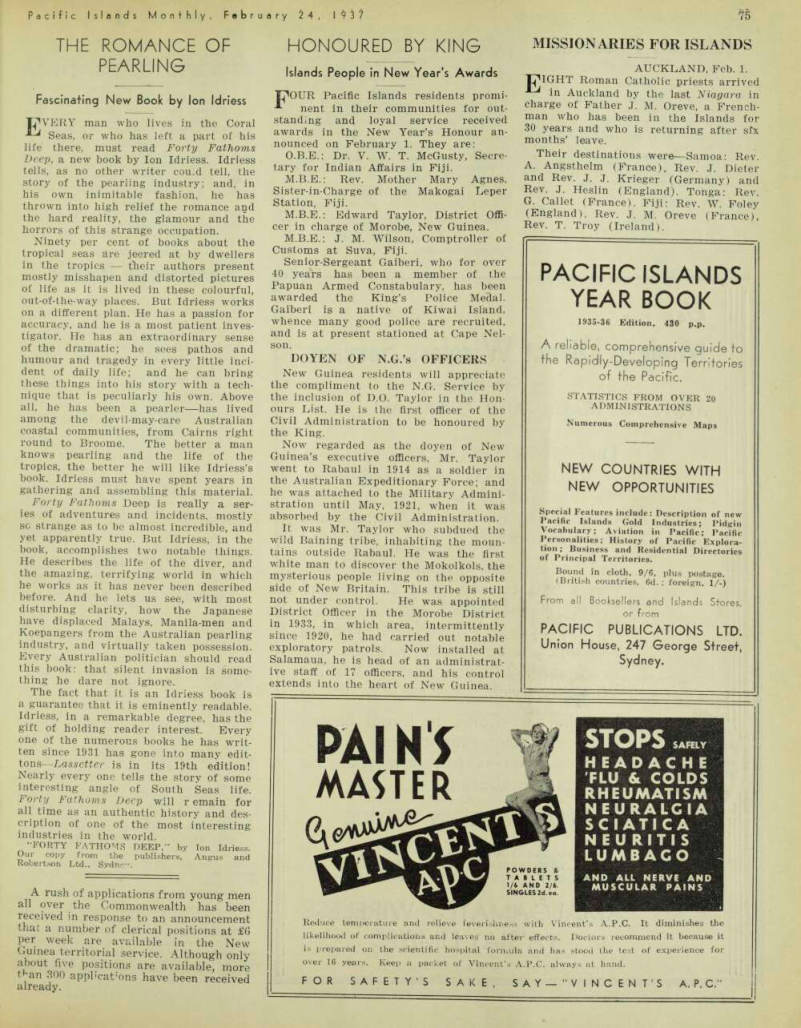
Pearling
Fascinating New Book by lon Idriess
man who lives in the Coral Seas, or who has left a part of his life there, must read Forty Fathoms Deep, a new book by Ion Idriess. Idriess tells, as no other writer cou.d tell, the story of the pearling industry; and, in his own inimitable fashion, he has thrown into high relief the romance and the hard reality, the glamour and the horrors of this strange occupation.
Ninety per cent of books about the tropical seas are jeered at by dwellers in the tropics — their authors present mostly misshapen and distorted pictures of life as it is lived in these colourful, out-of-the-way places. But Idriess works on a different plan. He has a passion for accuracy, and he is a most patient inves tigator. He has an extraordinary sense of the dramatic; he sees pathos and humour and tragedy in every little inci dent of daily life; and he can bring these things into his story with a tech nique that is peculiarly his own. Above all, he has been a pearler—has lived among the devil-may-care Australian coastal communities, from Cairns right round to Broome. The better a man knows pearling and the life of the tropics, the better he will like Idriess’s book. Idriess must have spent years in gathering and assembling this material.
Forty Fathoms Deep is really a ser ies of adventures and incidents, mostly sc strange as to be almost incredible, and yet apparently true. But Idriess, in the book, accomplishes two notable things.
He describes the life of the diver, and the amazing, terrifying world in which he works as it has never been described before. And he lets us see, with most disturbing clarity, how the Japanese have displaced Malays, Manila-men and Koepangers from the Australian pearling industry, and virtually taken possession.
Every Australian politician should read this book: that silent invasion is some thing he dare not ignore.
The fact that it is an Idriess book is a guarantee that it is eminently readable.
Idriess, in a remarkable degree, has the gift of holding reader interest. Every one of the numerous books he has writ ten since 1931 has gone into many edit tons— Lassetter is in its 19th edition!
Nearly every one tells the story of some interesting angle of South Seas life.
Forty Fathoms Deep will r emain for all time as an authentic history and des cription of one of the most interesting industries in the world. -FORTY FATHOMS DEEP,” by Ion Idriess.
Our copy from the publishers, Angus and Robertson Ltd., Sydnc'.
A rush of applications from young men all over the Commonwealth has been received in response to an announcement that a number of clerical positions at £6 per week are available in the New Guinea territorial service. Although only about five positions are available, more t an 300 apphcat'ons have been received
already.
Honoured By King
Islands People in New Year's Awards
Pacific Islands residents prominent in their communities for out standing and loyal service received awards in the New Year’s Honour an nounced on February 1, They are: 0.8. E.: Dr. V. W. T. McGusty, Secre tary for Indian Affairs in Fiji.
M.8.E.: Rev. Mother Mary Agnes, Sister-in-Charge of the Makogai Leper Station, Fiji.
M.8.E.: Edward Taylor, District Offi cer in charge of Morobe, New Guinea.
M.8.E.: J. M. Wilson, Comptroller of Customs at Suva, Fiji.
Senior-Sergeant Gaiberi, who for over 40 years has been a member of the Papuan Armed Constabulary, has been awarded the King’s Police Medal.
Gaiberi is a native of Kiwai Island, whence many good police are recruited, and is at present stationed at Cape Nel son,
Doyen Of N.G.’S Officers
New Guinea residents will appreciate the compliment to the N.G. Service by the inclusion of D.O. Taylor in the Hon ours List. He is the first officer of the Civil Administration to be honoured by the King.
Now regarded as the doyen of New Guinea’s executive officers, Mr. Taylor went to Rabaul in 1914 as a soldier in the Australian Expeditionary Force; and he was attached to the Military Admini stration until May, 1921, when it was absorbed by the Civil Administration.
It was Mr. Taylor who subdued the wild Baining tribe, inhabiting the moun tains outside Rabaul. He was the first white man to discover the Mokolkols, the mysterious people living on the opposite side of New Britain. This tribe is still not under control. He was appointed District Officer in the Morobe District in 1933, in which area, intermittently since 1920, he had carried out notable exploratory patrols. Now installed at Salamaua, he is head of an administrat ive staff of 17 officers, and his control extends into the heart of New Guinea.
Missionaries For Islands
Auckland, Feb. 1.
LMGHT Roman Catholic priests arrived in Auckland by the last Niagara in charge of Father J. M. Oreve, a French man who has been in the Islands for 30 years and who is returning after sfx months’ leave.
Their destinations were—Samoa: Rev.
A. Angsthelm (France), Rev. J. Dieter and Rev, J. J. Krieger (Germany) and Rev. J. Heslin (England). Tonga: Rev.
G. Callet (France). Fiji: Rev. W. Foley (England), Rev. J. M. Oreve (France), Rev. T. Troy (Ireland).
Advertisements & other items, p. 77 (1 item)
Pains
PACIFIC ISLANDS
YEAR BOOK
1935-36 Edition, 430 p.p.
A reliable, comprehensive guide to
the Rapidly-Developing Territories of the Pacific.
STATISTICS FROM OVER 20
ADMINISTRATIONS
Numerous Comprehensive Maps
NEW COUNTRIES WITH
NEW OPPORTUNITIES
Special Features include: Description of new Pacific Islands Gold Industries; Pidgin Vocabulary; Aviation in Pacific; Pacific Personalities; History of Pacific Exploration ; Business and Residential Directories of Principal Territories.
Bound in cloth, 9/6, plus postage. (British countries, 6d. ; foreign, 1/-) From all Booksellers and Islands Stores, or from
PACIFIC PUBLICATIONS LTD.
Union House, 247 George Street,
Sydney.
PAINS
MASTER
POWDERS &
TABLETS
1/6 AND 2/6.
SINGLES 2d. ea.
STOPS SAFELY
HEADACHE
FLU & COLDS
RHEUMATISM
NEURALGIA
SC I ATI C A
NEURITIS
LUMBAGO
AND ALL NERVE AND
MUSCULAR PAINS
Reduce temperature and relieve feverishness with Vincent’s A.P.C. It diminishes the likelihood of complications and leaves no after effects. Doctors recommend it because it is prepared on the scientific hospital formula and has stood the test of experience for over 16 years. Keep a packet of Vincent's A.P.C. always at hand.
FOR SAFETY'S SAKE. SAY —"V INC EN T'S A.P.C."
islands Produce
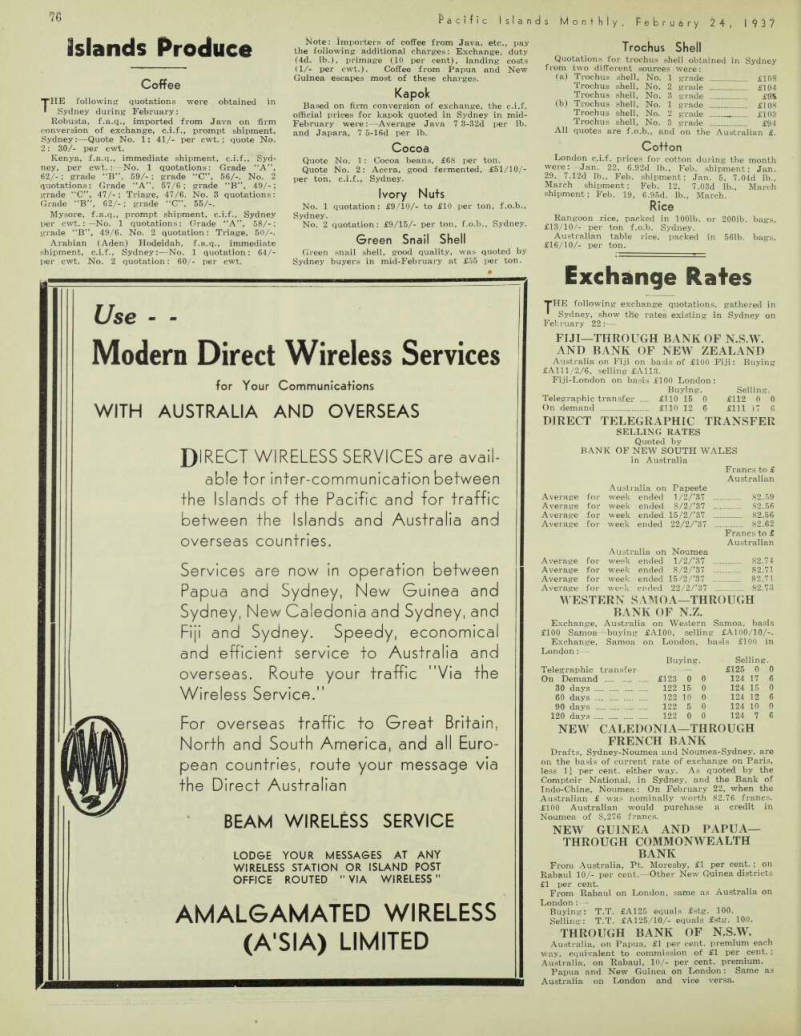
Coffee
THE following quotations were obtained in ' Sydney during February: Robusta, f.a.q., imported from Java on firm conversion of exchange, c.i.f., prompt shipment, Sydney:—Quote No. 1: 41/- per cwt.; quote No. 2: 30/- per cwt.
Kenya, f.a.q., immediate shipment, c.i.f., Syd ney, per cwt.: —No. 1 quotations: Grade “A”, 62/-; grade “B”, 59/-; grade “C”, 56/-. No. 2 quotations: Grade “A”, 57/6; grade “B”, 49/-; grade “C”, 47/-; Triage, 47/6. No. 3 quotations: Grade “B”, 62/-; grade “C”, 55/-.
Mysore, f.a.q., prompt shipment, c.i.f., Sydney per cwt.:—No. 1 quotations: Grade “A”, 58/-; grade “B”, 49/6. No. 2 quotation: Triage, 50/-.
Arabian (Aden) Hodeidah, f.a.q., immediate shipment, c.i.f., Sydney:—No. 1 quotation; 64/per cwt. No. 2 quotation: 60/- per cwt.
Note: Importers of coffee from Java, etc., pay the following additional charges: Exchange, duty (4d. lb.), primage (10 per cent), landing costs (1/- per cwt.). Coffee from Papua and New Guinea escapes most of these charges.
Kapok
Based on firm conversion of exchange, the c.i.f. official prices for kapok quoted in Sydney in mid- February were: —Average Java 7 3-32 d per lb. and Japara, 7 5-16 d per lb.
Cocoa
Quote No. 1: Cocoa beans, £6B per ton.
Quote No. 2: Accra, good fermented, £5l/10/per ton, c.i.f., Sydney.
Ivory Nuts
No. 1 quotation; £9/10/- to £lO per ton, f.0.b., Sydney.
No. 2 quotation: £9/15/- per ton, f.0.b., Sydney.
Green Snail Shell
Green snail shell, good quality, was quoted by Sydney buyers in mid-February at £55 per ton.
Trochus Shell
Quotations for trochus shell obtained in Sydney from two different sources were: (a) Trochus shell, No. 1 grade .'. £lOB Trochus shell, No. 2 grade £lO4 Trochus shell, No. 3 grade £95 (b) Trochus shell, No. 1 grade £lOB Trochus shell. No. 2 grade £lO3 Trochus shell. No. 3 grade £94 All quotes are f.0.b., and on the Australian £.
Cotton
London c.i.f. prices for cotton during the month were: Jan. 22, 6.92 d lb., Feb. shipment: Jan. 29, 7.12 d lb,, Feb. shipment; Jan. 5,7.04 d lb., March shipment; Feb. 12, 7.03 d lb., March shipment; Feb. 19. 6.95 d. lb., March,
Rice
Rangoon rice, packed in 1001 b. or 2001 b. bags, £l3/10/- per ton f.o.b. Sydney.
Australian table rice, packed in 561 b. bags, £l6/10/- per ton.
Exchange Rates
THE following exchange quotations, gathered in Sydney, show the rates existing in Sydney on February 22:
Fiji—Through Bank Of N.S.W.
And Bank Of New Zealand
Australia on Fiji on basis of £lOO Fiji: Buying £Alll/2/6, selling £AII3.
Fiji-London on basis £lOO London:
Direct Telegraphic Transfer
Selling Rates
Quoted by
Bank Of New South Wales
in Australia
Western Samoa—Through
Bank Of N.Z.
Exchange, Australia on Western Samoa, basis £lOO Samoa —buying £AIOO, selling fAIOO/10/-.
Exchange, Samoa on London, basis £lOO in London; —-
New Caledonia—Through
French Bank
Drafts, Sydney-Noumea and Noumea-Sydney, are on the basis of current rate of exchange on Paris, less 1J per cent, either way. As quoted by the Comptoir National, in Sydney, and the Bank of Indo-Chine, Noumea: On February 22, when the Australian f was nominally worth 82.76 francs. £lOO Australian would purchase a credit in Noumea of 8,276 francs.
New Guinea And Papua
Through Commonwealth
Bank
From Australia, Pt. Moresby, f 1 per cent. ; on Rabaul 10/- per cent. —Other New Guinea districts £1 per cent.
From Rabaul on London, same as Australia on London: — Buying: T.T. £AI2S equals fstg. 100.
Selling: T.T. £AI2S/10/- equals £stg. 100.
Through Bank Of N.S.W.
Australia, on Papua, £1 per cent, premium each way, equivalent to commission of £1 per cent.; Australia, on Rabaul, 10/- per cent, premium.
Papua and New Guinea on London: Same as Australia on London and vice versa.
Buying. Selling.
Telegraphic transfer £110 15 0 £112 0 0 On demand £110 12 6 £111 17 6
Average for Australia on week ended Papeete l/2/’37 .
Francs to £ Australian 82.59 Average for week ended 8/2/’87 , 82.56 Average for week ended 15/2/’37 82.56 Average for week ended 22/2/’37 82.62 Average for Australia on week ended Noumea l/2/’37 .
Francs to £ Australian 82.74 Average for week ended 8/2/’37 , 82.71 Average for week ended 15/2/’37 . 82.71 Average for week ended 22/2/’37 82.73
Buying. Selling.
Telegraphic transfer £125 0 0 On Demand £123 0 0 124 17 6 30 days 122 15 0 124 15 0 60 days 122 10 0 124 12 6 90 days 122 5 0 124 10 0 120 days 122 0 0 124 7 6
Advertisements & other items, p. 78 (1 item)
Modern Direct Wireless Services
Use - -
for Your Communications
WITH AUSTRALIA AND OVERSEAS
DIRECT WIRELESS SERVICES are avail-
able tor inter-communication between the Islands of the Pacific and for traffic between the Islands and Australia and overseas countries.
Services are now in operation between Papua and Sydney, New Guinea and Sydney, New Caledonia and Sydney, and Fiji and Sydney. Speedy, economical and efficient service to Australia and overseas. Route your traffic "Via the Wireless Service."
For overseas traffic to Great Britain, North and South America, and all European countries, route your message via the Direct Australian
BEAM WIRELESS SERVICE
LODGE YOUR MESSAGES AT ANY
WIRELESS STATION OR ISLAND POST
OFFICE ROUTED " VIA WIRELESS ”
AMALGAMATED WIRELESS
(A'SIA) LIMITED
Market Quotations
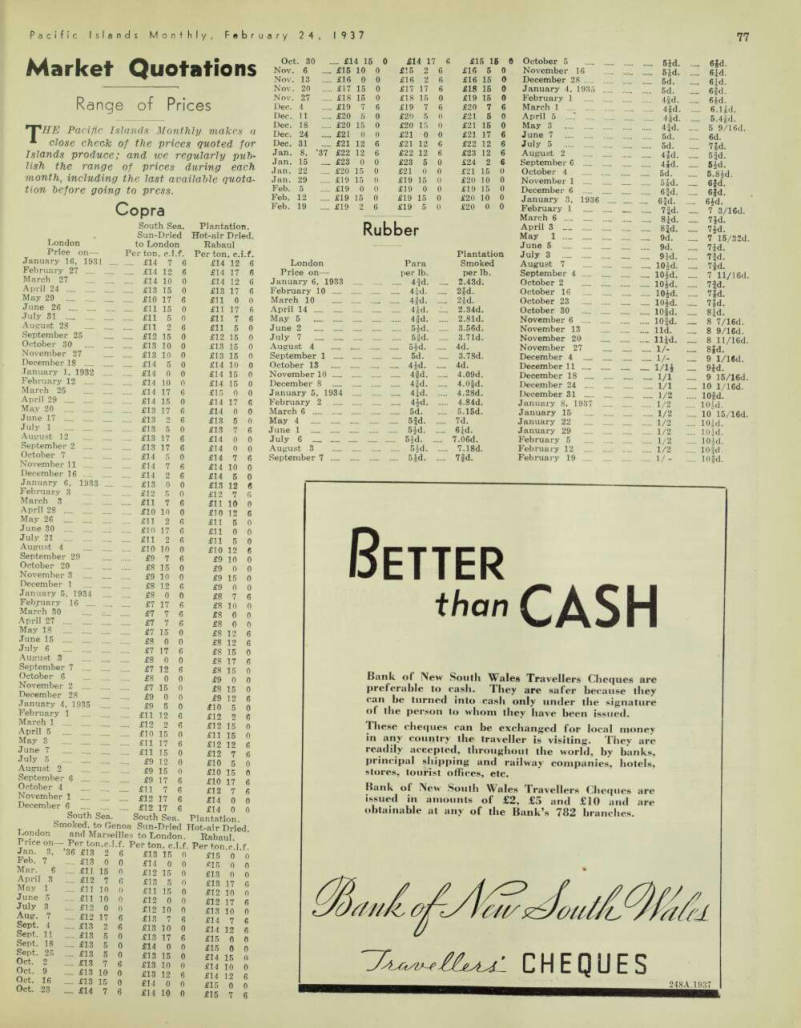
Range of Prices
T *HE Pacific Islands Monthly makes a * close check of the prices quoted for Islands produce; and we regularly pub lish the range of prices during each month, including the last available quota tion before going to press.
Oct. 30 £14 15 0 £14 17 6 £15 16 0 Nov. 6 £15 10 0 £15 2 6 £16 5 0 Nov. 13 ... £16 0 0 £16 2 6 £16 15 0 Nov. 20 £17 15 0 £17 17 6 £18 15 0 Nov. 27 £18 15 0 £18 15 0 £19 15 0 Dec. 4 ... £19 7 6 £19 7 6 £20 7 6 Dec. 11 ... £20 5 0 £20 5 0 £21 5 0 Dec. 18 ... £20 15 0 £20 15 0 £21 15 0 Dec. 24 £21 0 0 £21 0 0 £21 17 6 Dec. 31 £21 12 6 £21 12 6 £22 12 6 Jan, 8, ' 37 £22 12 6 £22 12 6 £23 12 6 Jan. 15 £23 0 0 £23 5 0 £24 2 6 Jan, 22 £20 15 0 £21 0 0 £21 15 0 Jan. 29 £19 15 0 £19 15 0 £20 10 0 Feb. 5 £19 0 0 £19 0 0 £19 15 0 Feb. 12 £19 15 0 £19 15 0 £20 10 0 Feb. 19 £19 2 6 £19 5 0 £20 0 0
Rubber
London Para Plantation Smoked Price on— per lb. per lb.
January 6, 1933 4fd. ... 2.43d.
February 10 ... 4Jd. 2|d.
March 10 ..._ ... 4fd. - 2id.
April 14 ... ... ... ... 4id. ... 2.34d.
May 5 .._ 4gd. 2.81d.
June 2 ... 5 id. 3.56d.
July 7 ... 5 gd- 3.7 Id.
August 4 5id. ... 4d.
September 1 ... 5d. 3.78d.
October 13 ... 4 id. 4d.
November 10 4fd. ... 4.09d.
December 8 ... ... 4id. ... 4.0|d.
January 5, 1934 ... 4 id. 4.28d.
February 2 ... 4id. — 4.84d.
March 6 5d. — 5.15d.
May 4 . ... 5|d. 7d.
June 1 ... 5id. 6 id.
July 6 — 5id. ..„ 7.06d.
August 3 „... 5 id. 7.18d.
September 7 5 id. — 7fd.
October 5 5Jd. 6|d.
November 16 — 5Jd. 6|d.
December 28 — 5d. 6id.
January 4, 1935 ... — 5d. 6|d.
February 1 4|d. 6*d.
March 1 4|d. 6.lid.
April 5 4 |d. 5.4id.
May 3 ... 4 Jd. 5 9/16d.
June 7 5d. 6d.
July 5 5d. 7Jd.
August 2 ... — 4|d. 5id.
September 6 ... 4*d. 6*d.
October 4 ... ..._ 5d. 5.8*d.
November 1 — 5Jd. 6Jd.
December 6 — 6Jd. 6Jd.
January 3, 1936 ,,, — 6 id. 6*d.
February 1 — 7id, 7 3/16d.
March 6 ... ... 8 id. 7*d.
April 3 8 id. 7*d.
May 1 — 9d. 7 15/32d.
June 5 — 9d. 7id.
July 3 — 9 id. 7id.
August 7 ... 10id. 7fd.
September 4 ..„ 10*d. 7 ll/16d.
October 2 ... ... 10*d. 7|d.
October 16 ... 10*d. 7|d.
October 23 ...„ ... 10*d. 7Jd.
October 30 — 10fd. 8id.
November 6 ... 10 |d. 8 7/16d.
November 13 — lid. 8 9/16d.
November 20 — Hid. 8 ll/16d.
November 27 — 1/- 8|d.
December 4 ri . 1/- 9 l/16d.
December 11 1/1* 9|d.
December 18 - 1/1 9 15/16d.
December 24 .._ 1/1 10 l/16d.
December 31 — 1/2 lOfd.
January 8, 1937 ... 1/2 10Jd.
January 15 1/2 10 15/16d.
January 22 ... 1/2 10Jd, January 29 „.. 1/2 10id.
February 5 ... 1/2 lOid.
February 12 1/2 10 id.
February 19 1/- — 10?d.
Copra
South Sea, Plantation, Sun-Dried Hot-air Dried.
London to London Rabaul Price on— Per ton. c.i.f.
Per ton. c.i.f.
January 16, 1931 ... £14 7 6 £14 12 6 February 27 £14 12 6 £14 17 6 March 27 ... £14 10 0 £14 12 6 April 24 „ £13 15 0 £13 17 6 May 29 £10 17 6 £11 0 0 June 26 ... £11 15 0 £11 17 6 July 31 ..._ £11 5 0 £11 7 6 August 28 £11 2 6 £11 5 0 September 25 £12 15 0 £12 15 0 October 30 £13 10 0 £13 15 0 November 27 £13 10 0 £13 15 0 December 18 £14 5 0 £14 10 0 January 1, 1932 £14 0 0 £14 15 0 February 12 £14 10 0 £14 15 0 March 25 £14 17 6 £15 0 0 April 29 ... £14 15 0 £14 17 6 May 20 £13 17 6 £14 0 0 June 17 £13 2 6 £13 5 0 July 1 £13 5 0 £13 7 6 August 12 £13 17 6 £14 0 0 September 2 £13 17 6 £14 0 0 October 7 ... £14 5 0 £14 7 6 November 11 £14 7 6 £14 10 0 December 16 £14 2 6 £14 5 o January 6, 1933 ... £13 0 0 £13 12 6 February 3 £12 5 0 £12 7 6 March 3 ... £11 7 6 £11 10 0 April 28 ... £10 10 0 £10 12 6 May 26 ._. £11 2 6 £11 5 0 June 30 £10 17 6 £11 0 0 July 21 ... £11 2 6 £11 5 0 August 4 £10 10 0 £10 12 6 September 29 £9 7 6 £9 10 0 October 20 £8 15 0 £9 0 0 November 3 £9 10 0 £9 15 o December 1 £8 12 6 £9 0 o January 5, 1934 £8 0 0 £8 7 6 February 16 ... £7 17 6 £8 10 0 March 30 £7 7 6 £8 0 0 April 27 ... £7 7 6 £8 0 0 May 18 ... £7 15 0 £8 12 6 June 15 £8 0 0 £8 12 6 July 6 £7 17 6 £8 15 0 August 3 £8 0 0 £8 17 6 September 7 £7 12 6 £8 15 0 October 6 £8 0 0 £9 0 o November 2 £7 15 0 £8 15 o December 28 £9 0 0 £9 12 g January 4, 1935 £9 5 0 £10 5 o February 1 £11 12 6 £12 2 6 March 1 ... — ... £12 2 6 £12 15 0 April 5 — £10 15 0 £11 15 0 May 3 — £11 17 6 £12 12 6 June 7 , £11 15 0 £12 7 6 July 5 £9 12 0 £10 5 o August 2 September 6 October 4 November 1 - — £9 15 £9 17 £11 7 £12 17 0 6 6 6 £10 15 £10 17 £12 7 £14 0 0 6 6 o December 6 £12 17 6 £14 0 o South Sea.
South Sea.
Plantation.
Smoked, to Genoa Sun-Dried Hot-air Drlf>r?
London and Marseilles to London.
Rabaul. .Trice on— Per ton.c.i.f. Per ton. c. i.f.
Per ton.c.i. f.
Jan. 3, ’36 £13 2 6 £13 15 0 £15 0 o Feb, 7 £13 0 0 £14 0 0 £15 0 o Mar. 6 £11 15 0 £12 15 0 £13 0 o April 3 £12 7 6 £13 5 0 £13 17 G May 1 £11 10 0 £11 15 0 £12 10 0 June 5 £11 10 0 £12 0 0 £12 17 6 July 3 £12 0 0 £12 10 0 £13 10 0 Aug, 7 £12 17 6 £13 7 6 £14 7 6 Sept. 4 £13 2 6 £13 10 0 £14 12 6 Sept. 11 £13 5 0 £13 17 6 £15 0 o Sept. 18 £13 5 0 £14 0 0 £15 0 0 Sept. 25 £13 5 0 £13 15 0 £14 15 0 Oct. 2 Oct. 9 Oct. 16 ...
Oct. 23 .„ £13 £13 £13 £14 7 10 15 7 6 0 0 6 £13 10 £13 12 £14 0 £14 10 0 6 0 0 £14 10 £14 12 £15 0 £15 7 0 6 0 6
Advertisements & other items, p. 79 (1 item)
Better
t/ionCASH
Bank of New South Wales Travellers Cheques are preferable to cash. They are safer because they can be turned into cash only under the signature of the person to whom they have been issued.
These cheques can be exchanged for local money in any country the traveller is visiting. They are readily accepted, throughout the world, by banks, principal shipping and railway companies, hotels, stores, tourist offices, etc.
Bank of New South Wales Travellers Cheques are issued in amounts of £2, £5 and £lO and are obtainable at any of the Bank’s 782 branches. /// a MV
o/u/v/ri
CHEQUES
Shipping Services in the Pacific
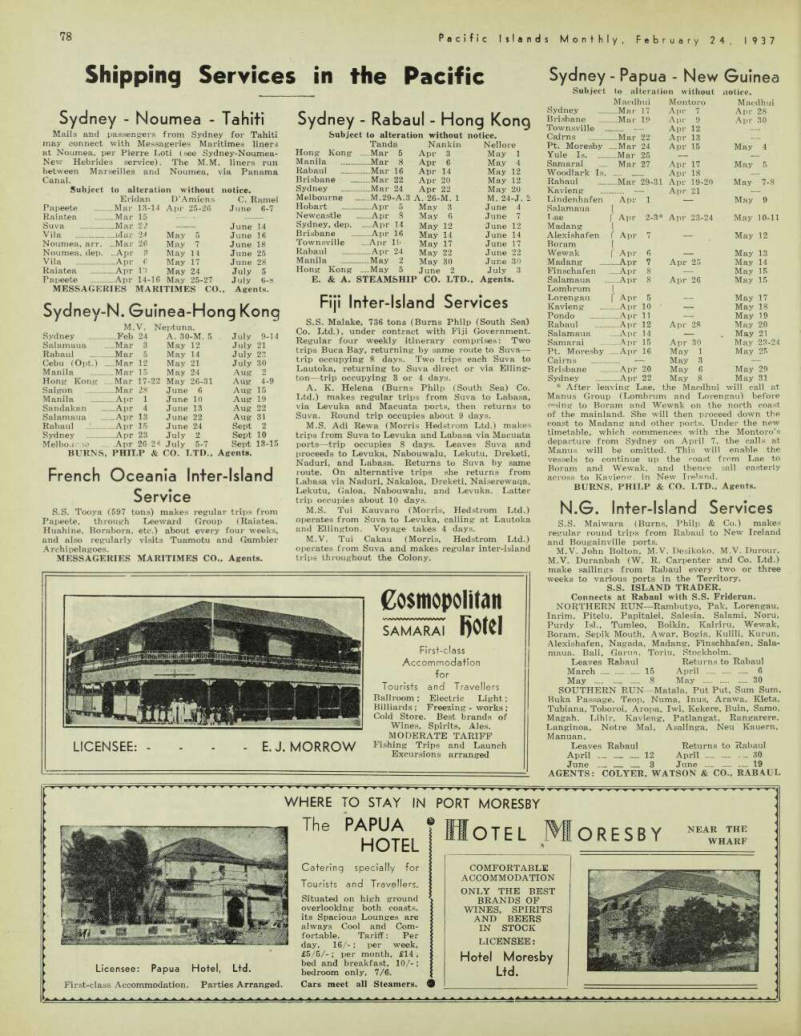
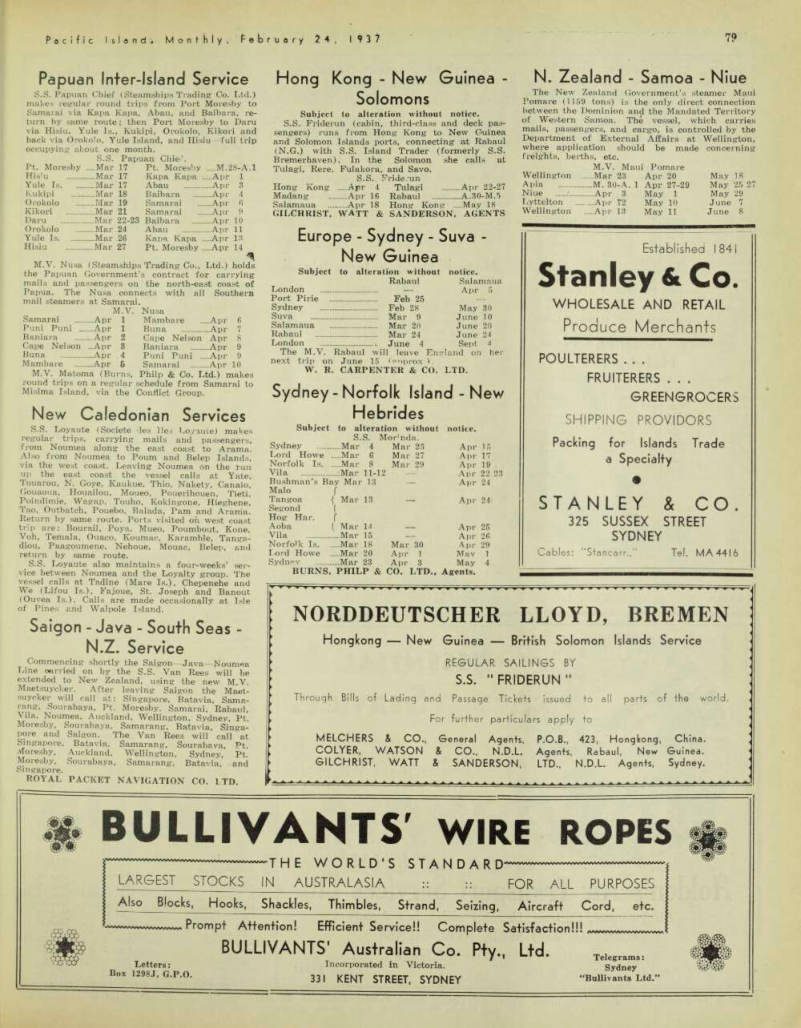
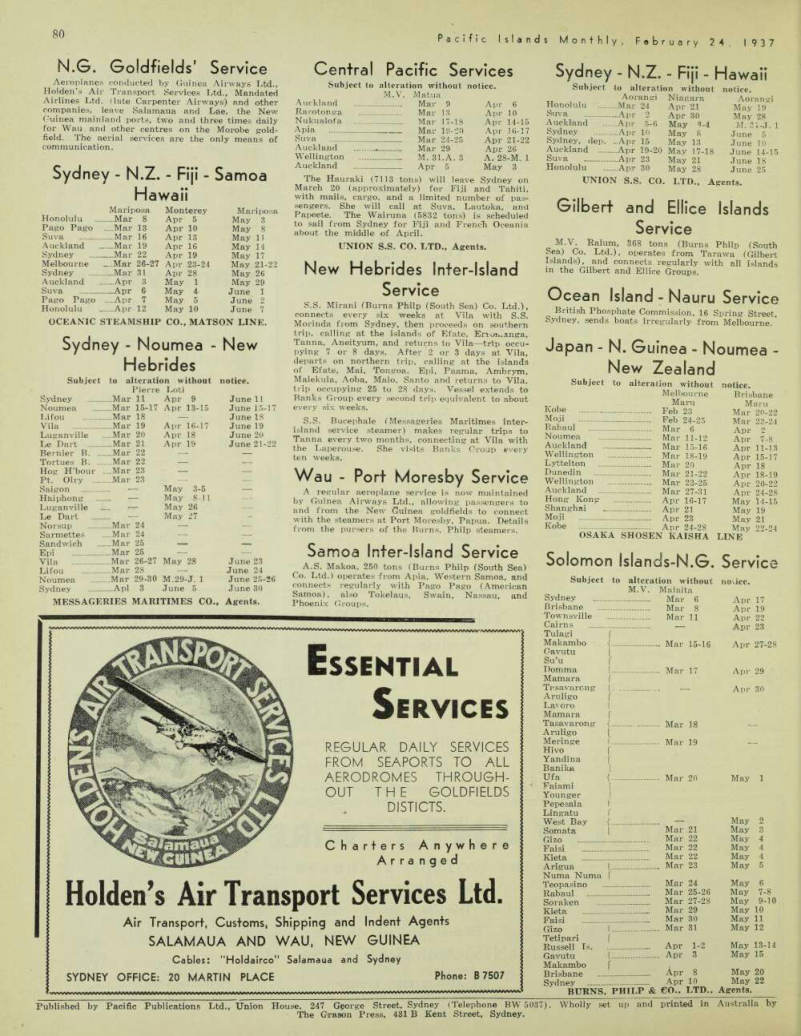
Sydney - Noumea - Tahiti
Mails and passengers from Sydney for Tahiti may connect with Messageries Maritimes liners at Noumea, per Pierre Loti (see Sydney-Noumea- New Hebrides service). The M.M. liners run between Marseilles and Noumea, via Panama Canal.
Sydney-N. Guinea-Hong Kong
French Oceania Inter-Island
Service
S.S. Tooya (597 tons) makes regular trips from Papeete, through Leeward Group (Raiatea, Huahine, Borabora, etc.) about every four weeks, and also regularly visits Tuamotu and Gambler Archipelagoes.
Messageries Maritimes Co., Agents.
Sydney - Rabaul - Hong Kong Subject to alteration without notice.
Fiji Inter-Island Services
S.S. Malake, 736 tons (Burns Philp (South Sea) Co. Ltd.), under contract with Fiji Government.
Regular four weekly itinerary comprises: Two trips Buca Bay, returning by same route to Suva — trip occupying 8 days. Two trips each Suva to Lautoka, returning to Suva direct or via Elling ton —trip occupying 3 or 4 days.
A. K. Helena (Burns Philp (South Sea) Co.
Ltd.) makes regular trips from Suva to Labasa, via Levuka and Macuata ports, then returns to Suva. Round trip occupies about 9 days.
M.S. Adi Rewa (Morris Hedstrom Ltd.) makes trips from Suva to Levuka and Labasa via Macuata ports—trip occupies 8 days. Leaves Suva and proceeds to Levuka, Nabouwalu, Lekutu, Dreketi, Naduri, and Labasa. Returns to Suva by same route. On alternative trips she returns from Labasa via Naduri, Nakaloa, Dreketi, Naiserewaqa, Lekutu, Galoa, Nabouwalu, and Levuka. Latter trip occupies about 10 days.
M.S. Tui Kauvaro (Morris, Hedstrom Ltd.) operates from Suva to Levuka, calling at Lautoka and Ellington. Voyage takes 4 days.
M.V. Tui Cakau (Morris, Hedstrom Ltd.) operates from Suva and makes regular inter-island trips throughout the Colony.
Sydney - Papua - New Guinea Subject to alteration without notice.
* After leaving Lae, the Macdhui will call at Manus Group (Lombrum and Lorengau) before coing to Boram and Wewak on the north coast of the mainland. She will then proceed down the coast to Madang and other ports. Under the new timetable, which commences with the Montoro’s departure from Sydney on April 7. the calls at Manus will be omitted. This will enable the vessels to continue up the coast from Lae to Boram and Wewak, and thence sail easterly across to Kaviene - . in New Ireland.
Burns, Philp & Co. Ltd., Agents.
N.G. Inter-Island Services
S.S. Maiwara (Burns, Philp & Co.) makes regular round trips from Rabaul to New Ireland and Bougainville ports.
M.V. John Bolton, M.V. Desikoko, M.V. Durour, M.V. Duranbah (W. R. Carpenter and Co. Ltd.) make sailings from Rabaul every two or three weeks to various ports in the Territory.
S.S. Island Trader.
Connects at Rabaul with S.S. Friderun.
NORTHERN RUN—Rambutyo, Pak, Lorengau.
Inrim, Pitelu, Papitalei, Salesia, Salami, Noru, Purdy Isl., Tumleo, Boikin, Kairiru, Wewak, Boram, Sepik Mouth, Awar, Bogia, Kulili, Kurun, Alexishafen, Nagada, Madang, Finschhafen, Sala maua. Bali, Garua, Toriu, Stockholm.
SOUTHERN RUN Matala, Put Put, Sum Sum.
Buka Passage, Teop, Numa, Inus, Arawa, Kieta, Tubiana, Toboroi, Aropa, Iwi, Kekere, Buin, Same, Magah, Lihir, Kavieng, Patlangat, Rangarere, Langinoa, Notre Mai, Asalinga, Neu Kauern, Manuan.
Subject to alteration without notice.
Eridan D’Amiens C. Ramel Papeete Mar 13-14 Apr 25-26 June 6-7 Raiatea Mar 15 Suva „Mar 22 June 14 Vila Mar 24 May 5 June 16 Noumea, arr. ...Mar 26 May 7 June 18 Noumea, dep. ...Apr 3 May 14 June 25 Vila Apr 6 May 17 June 28 Raiatea Apr 1'; May 24 July 5 Papeete Apr 14-16 May 25-27 July 6-»
Messageries Maritimes Co.. Agents.
M.V. Neptuna.
Sydney Feb 24 A. 30-M. 5 July 9-14 Salamaua ...Mar 3 May 12 July 21 Rabaul .. Mar 5 May 14 July 22 Cebu (Opt.) ... .Mar 12 May 21 July 30 Manila Mar 15 May 24 Aug 2 Hong Kong ...
Mar 17-22 May 26-31 Aug 4-9 Saigon Mar 28 June 6 Aug 15 Manila ...Apr 1 June 10 Aug 19 Sandakan 4 June 13 Aug 22 Salamaua June 22 Aug 31 Rabaul ...Apr 15 June 24 Sept 2 Sydney ...Apr 23 July 2 Sept 10 Melbourne .Apr 26 28 July 5-7 Sept 13-15
Burns,
Philp &
Co. Ltd.,
Agents.
Tanda Nankin Nellore Hong Kong Mar 5 Apr 3 May 1 Manila Mar 8 Apr 6 May 4 Rabaul Mar 16 Apr 14 May 12 Brisbane - Mar 22 Apr 20 May 12 Sydney Mar 24 Apr 22 May 20 Melbourne
M.29-A.3 A. 26-M. 1
M. 24-J. 2 Hobart Apr 5 May 3 June 4 Newcastle Apr 8 May 6 June 7 Sydney, dep.
Apr 14 May 12 June 12 Brisbane Apr 16 May 14 June 14 Townsville Apr IS- May 17 June 17 Rabaul Apr 24 May 22 June 22 Manila May 2 May 30 June 30 Hong Kong May 5 June 2 July 3 E. & A.
Steamship Co. Ltd.,
Agents.
Sydney Macdhui Mar 17 Montoro Apr 7 Macdhui Apr 28 Brisbane Mai - IP Apr 9 Apr 30 Townsville — Apr 12 Cairns Mar 22 Apr 13 — Pt. Moresby Mar 24 Apr 15 May 4 Yule Is Samarai Mar 27 Apr 17 May 5 Woodlark Is.
Apr 18 Rabaul Mar 29-31 Apr 19-20 May 7-8 Kavieng — Apr 21 — Lindenhafen Apr 1 May 9 Salamaua T.ae I f Apr 2-3* Apr 23-24 May 10-11 Madang Alexishafen \ f Apr 7 May 12 Boram Wewak I f Apr 6 May 13 Madang Apr 7 Apr 25 May 14 Finschafen Apr 8 — May 15 Salamaua Apr 8 Apr 26 May 15 Lombrum Lorengau f Apr 5 May 17 Kavieng Apr 10 ' — May 18 Pondo Apr 11 — May 19 Rabaul Apr 12 Apr 28 May 20 Salamaua Apr 14 — May 21 Samarai Apr 15 Apr 30 May 23-24 Pt. Moresby Apr 16 May 1 May 25 Cairns — May 3 — Brisbane Apr 20 May 6 May 29 Sydney — Apr 22 May 8 May 31
Leaves Rabaul Returns to Rabaul March — 15 April 6 May 8 May — 30
Leaves Rabaul Returns to Rabaul April 12 April — . 30 June 3 June 19
Agents: Colter, Watson & Co., Rabaul
Papuan In+er-lsland Service
S.S. Papuan Chief (Steamships Trading Co. Ltd.) makes regular round trips from Port Moresby to Samarai via Kapa Kapa, Abau, and Baibara, re turn by same route ; then Port Moresby to Daru via Hisiu, Yule Is., Kukipi, Orokolo, Kikori and back via Orokolo, Yule Island, and Hisiu —full trip occupying about one month.
M.V. Nusa (Steamships Trading Co,, Ltd.) holds the Papuan Government’s contract for carrying mails and passengers on the north-east coast of Papua. The Nusa connects with all Southern mail steamers at Samarai.
M.V. Matoma (Burns, Philp & Co. Ltd.) makes round trips on a regular schedule from Samarai to Misima Island, via the Conflict Group.
New Caledonian Services
5.5. Loyaute (Societe des lies Loyaute) makes regular trips, carrying mails and passengers, from Noumea along the east coast to Arama.
Also from Noumea to Poum and Belep Islands, via the west coast. Leaving Noumea on the run up the east coast the vessel calls at Yate, Touarou. N. Goye, Kaukue, Thio, Nakety, Canalo, Gouaoua, Houailou, Moueo, Pouerihouen, Tieti, Poindimie, Wagap, Touho, Kokingone. Hieghene, Tao, Outbatch, Pouebo, Balada, Pam and Arama.
Return by same route. Ports visited oh west coast trip are: Bourail, Poya, Mueo, Poumbout, Kone, Voh, Temala, Ouaco, Koumac, Karamble, Tanga diou, Paagoumene, Nehoue, Mouac, Belep, and return by same route. 5.5. Loyaute also maintains a four-weeks’ ser vice between Noumea and the Loyalty group. The vessel calls at Tadine (Mare Is.), Chepenehe and We (Lifou Is.), Fajoue, St. Joseph and Banout (Ouvea Is.). Calls are made occasionally at Isle of Pines and Walpole Island.
Saigon - Java - South Seas -
N.Z. Service
Commencing shortly the Saigon—Java—Noumea Line oarried on by the S.S. Van Rees will be extended to New Zealand, using the new M.V.
Maetsuycker. After leaving Saigon the Maet suycker will call at: Singapore. Batavia. Sama rang. Sourabaya. Pt. Moresby, Samarai. Rabaul.
Vila, Noumea, Auckland, Wellington, Sydney. Pt.
Moresby, Sourabaya, Samarang, Batavia, Singa pore and Saigon. The Van Rees will call at Singapore, Batavia. Samarang, Sourabava, Pt.
Moresby, Auckland. Wellington, Sydney, Pt.
Moresby, Sourabaya, Samarang, Batavia, and Singapore.
Royal Packet Navigation Co. Ltd.
Hong Kong - New Guinea -
Solomons
Subject to alteration without notice.
S.S. Friderun (cabin, third-class and deck pas sengers) runs from Hong Kong to New Guinea and Solomon Islands ports, connecting at Rabaul (N.G.) with S.S. Island Trader (formerly S.S.
Bremerhaven). In the Solomon she calls at Tulagi, Rere, Fulakora, and Savo.
Europe - Sydney - Suva - New Guinea Subject to alteration without notice.
The M.V. Rabaul will leave England on her next trip on June 15 fnnprox L
W. R. Carpenter & Co. Ltd.
Sydney - Norfolk Island - New
Hebrides
Subject to alteration without notice.
N. Zealand - Samoa - Niue
The New Zealand Government’s steamer Maui Pomare (1159 tons) is the only direct connection between the Dominion and the Mandated Territory of Western Samoa. The vessel, which carries mails, passengers, and cargo, is controlled by the Department of External Affairs at Wellington, where application should be made concerning freights, berths, etc.
S.S. Papuan Clue?, Pt. Moresby Mar 17 Pt. Moresby M.28-A.1 His ; u Mar 17 Kapa Kapa .. ...Apr 1 Yule Is.
Mar 17 Abau ...Apr 3 Kukipi Mar 18 Baibara ...Apr 4 Orokolo Mar 19 Samara! ...Apr 6 Kikori Mar 21 Samara! ...Apr 9 Daru Mar 22-23 Baibara ...Apr 10 Orokolo Mar 24 Abau ...Apr 11 Yule Is Mar 26 Kapa Kapa .. ...Apr 13 Hisiu ...
Mar 27 Pt. Moresby .. ...Apr 14
M.V. Nusa Samarai _.Apr 1 Mambare Apr 6 Puni Puni Apr 1 Buna Apr 7 Baniara Apr 2 Cape Nelson Apr 8 Cape Nelson ...Apr 8 Baniara Apr 9 Buna Apr 4 Puni Puni Apr 9 Mambare -Apr 5 Samarai Apr 10
S.S. Fride-'un Hong Kong Apr 4 Tulagi Apr 22-27 Madang Apr 16 Rabaul A-SO-M. 1 Salamaua Apr 18 Hong Kong May 18
Gilchrist, Watt & Sanderson, Agents
Rabaul Salamaua London Apr 5 Port Pirie Feb 25 Sydney Feb 2S May 30 Suva Mar 9 June 10 Salamaua Mar 20 June 20 Rabaul Mar 24 June 24 London June 4 Sept 4
S.S.
Mor'nda.
Sydney Mar 4 Mar 28 Apr 15 Lord Howe Mar 6 Mar 27 Apr 17 Norfolk Is.
Mar 8 Mar 29 Apr 19 Vila Mar 11- 12 — Apr 22 23 Bushman’s Bay Mar 13 Apr 24 Malo f Tan proa -! Mar 13 Apr 24 Second 1 Hog- Har. r Aoba [ Mar 14 Apr 25 Vila Mar 15 Apr 26 Norfolk Is.
Mar 18 Mar 30 Apr 29 l ord Howe Mar 20 Apr 1 Mav 1 Sydney Mar 23 Apr 3 May 4
Burns
. Philp & Co. Ltd.,
i Agents.
M.V. Maui i Pomare Wellington Mar 23 Apr 20 May 18 Apia M. 30-A. 1 Apr 27-29 May 25 27 Niue May 1 May 29 Lyttelton Apr 1*2 May 10 June 7 Wellington Apr 13 May 11 June 8
N.G. Goldfields' Service
Aeroplanes conducted by Guinea Airways Ltd., Holden’s Air Transport Services Ltd., Mandated Airlines Ltd. (late Carpenter Airways) and other companies, leave Salamaua and Lae. the New Guinea mainland ports, fwo and three times daily for Wau and other centres on the Morobe gold field. The aerial services are the only means of communication.
Sydney - N.Z. - Fiji - Samoa
Hawaii
Oceanic Steamship Co., Matson Line.
Sydney - Noumea - New Hebrides Subject to alteration without notice.
Central Pacific Services Subject to alteration without notice.
The Hauraki (7113 tons) will leave Sydney on March 20 (approximately) for Fiji and Tahiti, with mails, cargo, and a limited number of pas sengers. She will call at Suva, Lautoka, and Papeete. The Wairuna (5832 tons) is scheduled to sail from Sydney for Fiji and FrencTi Oceania about the middle of April.
Union S.S. Co. Ltd., Agents.
New Hebrides Infer-lsland
Service
5.5. Mirani (Burns Philp (South Sea) Co. Ltd.), connects every six weeks at Vila with S.S.
Morinda from Sydney, then proceeds on southern trip, calling at the islands of Efate, Erton.anga, Tanna, Aneityum, and returns to Vila—trip occu pying 7 or 8 days. After 2 or 3 days at Vila, departs on northern trip, calling at the islands of Efate, Mai, Tongoa, Epi, Paama, Ambrym, Malekula, Aoba, Malo, Santo and returns to Vila, trip occupying 25 to 28 days. Vessel extends to Banks Group every second trip equivalent to about every six weeks. 5.5. Bucephale (Messageries Maritimes inter island service steamer) makes regular trips to Tanna every two months, connecting at Vila with the Laperouse. She visits Banks Croup every ten weeks.
Wau - Port Moresby Service
A regular aeroplane service is now maintained by Guinea Airways Ltd., allowing passengers to and from the New Guinea goldfields to connect with the steamers at Port Moresby, Papua. Details from the pursers of the Burns, Philp steamers.
Samoa Infer-lsland Service
A.S. Makoa, 250 tons (Burns Philp (South Sea) Co. Ltd.) operates from Apia, Western Samoa, and connects regularly with Pago Pago (American Samoa), also Tokelaus, Swain, Nassau, and Phoenix Groups.
Sydney - N.Z, - Fiji - Hawaii Subject to alteration without notice.
Union S.S. Co. Ltd., Agents.
Gilbert and Ellice Islands
Service
M.V. Ralum. 368 tons (Burns Philp (South Sea) Co. Ltd.), operates from Tarawa (Gilbert Islands), and connects regularly with all islands in the Gilbert and Ellice Groups.
Ocean Island - Nauru Service
British Phosphate Commission, 16 Spring Street, Sydney, sends boats irregularly from Melbourne.
Japan - N. Guinea - Noumea -
New Zealand
Subject to alteration without notice.
Osaka Shosen Kaisha Line
Solomon Islands-N.G. Service
Subject to alteration without novice.
Mariposa Monterey Mariposa Honolulu Mar 8 Apr 5 May 3 Pago Pago Mar 13 Apr 10 May 8 Suva Mar 16 Apr 13 May 11 Auckland Mar 19 Apr 16 May 14 Sydney „..Mar 22 Apr 19 May 17 Melbourne _...Mar 26-27 Apr 23-24 May 21-22 Sydney Mar 31 Apr 28 May 26 Auckland Apr 3 May 1 May 29 Suva _.Apr 6 May 4 June 1 Pago Pago Apr 7 May 5 June 2 Honolulu Apr 12 May 10 June 7
Pierre Loti Sydney 11 Apr 9 June 11 Noumea 15-17 Apr 13-15 June 15-17 Lifou Mar 18 — June 18 Vila 19 Apr 16-17 June 19 Luganville Mar 20 Apr 18 June 20 Le Dart 21 Apr 19 June 21-22 Bernier B.
Mar 22 — — Tortues B.
Mar 22 — — Hog H’bour Mar 23 — — Pt. 01 ry Mar 23 — — Saigon - May 3-5 — Haiphong - May 8-11 — Luganville , , — May 26 — Le Dart May 27 - - Norsup Mar 24 — ' — Sarmettes Mar 24 — — Sandwich Mar 25 — — Epi Mar 25 — — Vila Mar 26-27 May 28 June 23 Lifou Mar 28 — June 24 Noumea Mar 29-30 M.29-J. 1 June 25-26 Sydney Apl 3 June 5 June 30
Messageries Maritimes Co.,
Agents.
M,V. Matua Auckland Mar 9 Apr 6 Rarotonga Mar 13 Apr 10 Nukualofa Mar 17- 18 Apr 14- 15 Apia — Mar 19- 20 Apr 16- 17 Suva Mar 24- 25 Apr 21- 22 Auckland — -— Mar 29 Apr 26 Wellington M, 31.A . 3 A. 28-M . 1 Auckland — — Apr 5 May 3
Aorangi Niagara Aorangi Honolulu Mar 24 Apr 21 May 19 Suva Apr 2 Apr 30 May 28 Auckland Apr 5-6 May *i-4 M. 31-J. 1 Sydney Apr 10 May 8 June 5 Sydney, dep. ...Apr 15 May 13 June 10 Auckland Apr 19-20 May 17-18 June 14-15 Suva Apr 23 May 21 June 18 Honolulu Apr 30 May 28 June 25
Kobe Melbourne Maru Feb 23 Brisbane Maru Mar 20-22 Mar 23-24 Apr 2 Apr 7-8 Moji Rabaul Noumea Feb 24-25 Mar 6 Mar 11-12 Auckland Wellington Lyttelton Dunedin Mar 15-16 Mar 18-19 - Mar 20 Mar 21-22 Apr 11-13 Apr 15-17 Apr 18 Apr 18-19 Apr 20-22 Apr 24-28 May 14-15 May 19 May 21 May 22-24 Wellington Auckland Hong Kong Shanghai Moji - - Mar 23-25 — — Mar 27-31 Apr 16-17 Apr 21 Apr 23 Kobe — Apr 24-28
Sydney M.V. Malaita Mar 6 Apr 17 Brisbane Mar 8 Apr 19 Townsville Mar 11 Apr 22 Cairns Apr 23 Tulagi Makambo L - Mar 15-16 Apr 27-28 Gavutu Su’u Domma I f 1 Apr 29 Mamara Tasavarcng 1 U • Apr 30 Aruligo Lavoro Mamara Tasavarong [ 1 r Mar 18 Aruligo Meringe i i Mar 19 Hivo Yandina Banika Ufa i i i May 1 Faiami Younger Pepesala Lingatu West Bay i i i r 4 May 2 Somata l Mar 21 May 3 Gizo Mar 22 May 4 Faisi Mar 22 May 4 Kieta Mar 22 May 4 Arigua TI Mar 23 May 5 Numa Numa Teopasino r Mar 24 May 6 Rabaul Mar 25-26 May 7-8 Soraken Mar 27-28 May 9-10 Kieta Mar 29 May 10 Faisi Mar 30 May 11 Gizo TI Mar 31 May 12 Tetipari Russell Is, r Apr 1-2 May 13-14 Gavutu TZ Apr 3 May 15 Makambo Brisbane r Apr 8 May 20 Sydney Apr 10 May 22
Burns
. Philp & Co., Ltd.,
Agents,
Advertisements & other items, pp. 80-84 (3 items)
Cosmopolitan
u
LICENSEE:
E. J. MORROW
Cosmopolitan
'I'VWVWWWWWW ¥? ▲ i A I
SAMARAI l)vlvl
First-class Accommodation for Tourists and Travellers Ballroom; Electric Light: Billiards ; Freezing - works ; Cold Store. Best brands of Wines, Spirits, Ales.
MODERATE TARIFF
Fishing Trips and Launch Excursions arranged
WHERE TO STAY IN PORT MORESBY
Licensee: Papua Hotel, Ltd.
First-class Accommodation. Parties Arranged.
The PAPUA 6
HOTEL
Catering specially for
Tourists and Travellers.
Situated on high ground 1 overlooking both coasts, its Spacious Lounges are always Cool and Comfortable. Tariff; Per day, 16/-; per week, £5/5/-; per month, £14 ; bed and breakfast, 10/-; bedroom only, 7/6.
Cars meet all Steamers. 9
Hotel Moresby
M
NEAR THE
WHARF
COMFORTABLE
ACCOMMODATION
ONLY THE BEST
BRANDS OF
WINES, SPIRITS
AND BEERS
IN STOCK
LICENSEE:
Hofei Moresby
Ltd.
Established 1841
Stanley & Co.
WHOLESALE AND RETAIL
Produce Merchants
POULTERERS . . .
FRUITERERS . . .
GREENGROCERS
SHIPPING PROVIDORS
Packing for Islands Trade
a Specialty
STANLEY & CO.
325 SUSSEX STREET
SYDNEY
Cables: "Sfancarr.," Tel. MA4416
NORDDEUTSCHER LLOYD, BREMEN
Hongkong New Guinea British Solomon Islands Service
REGULAR SAILINGS BY
S.S. " FRIDERUN "
Through Bills of Lading and Passage Tickets Issued to all parts of the world.
For further particulars apply to MELCHERS & CO., General Agents, P. 0.8., 423, Hongkong, China.
COLYER, WATSON & CO., N.D.L. Agents, Rabaul, New Guinea.
GILCHRIST, WATT & SANDERSON. LTD., N.D.L. Agents. Sydney.
BULLIVANTS' WIRE ROPES $
>*' aaaaaaaa/saaaaa/>aaaa/v^vwwvv%aaaaa MAAAAAAM T LJ C \A/ n I r\ • C C T a ki r\ a n
'' A/VV THE WORLD'S STANDARD'
IN AUSTRALASIA ::
LARGEST STOCKS
FOR ALL PURPOSES
so Blocks, Hooks, Shackles, Thimbles, Strand, Seizing, Aircraft Cord, etc.
Letters:
Box 1298 J, G.P.O.
Prompt Attention! Efficient Service!! Complete Satisfaction!!!
BULLIVANTS 1 Australian Co. Pty., Ltd.
Incorporated in Victoria.
331 KENT STREET, SYDNEY
Telegrams: Sydney Bullivants Ltd.’
i wk 0 %
Essential
Services
REGULAR DAILY SERVICES
FROM SEAPORTS TO ALL
AERODROMES THROUGH-
OUT THE GOLDFIELDS
DISTICTS.
Charters Anywhere Arranged
Holden’s Air Transport Services Ltd.
Air Transport, Customs, Shipping and Indent Agents
SALAMAUA AND WAU, NEW GUINEA
Cables: "Holdairco" Salamaua and Sydney SYDNEY OFFICE: 20 MARTIN PLACE Phone: B 7507
AERIAL TRANSPORT ESTABLISHED
NEW GUINEA COLD INDUSTRY
S INCE 1927, when the development of the Mcrobe Goldfield commenced, the European population of the Territory has been trebled. The new industry has increased the Empire's gold production by nearly £2,000,000 per annum, and has added enormously to the trade turnover of New Guinea.
Only Aerial Transport makes this possible. There is no road between the Goldfields and the coast. Aeroplanes, running on Regular Schedules, without Difficulty or Delay, carry in Dredges, Crushing Mills, Cyanidina Plants, Motor Vehicles, Hydro - Electric Machinery, Thousands of Passengers, and every kind of goods needed by a large and growing European community.
G
UINEA AIRWAYS LTD. were
established in 1927; and they have grown in the following way, until they are to-day the largest freightcarrying service In the world: Passengers Carried 869 2,047* 1,995 1,607 3,856 7,398 9,721 '4 J
V r t
Every kind of cargo, frozen meat to hydro-electric machinery, is carried in to the Morobe goldfield centres by Guinea Airways machines. In this photograph, taken in December, 1936, a motor-car Is shown, while being unloaded on the Wau Aerodrome.
Guinea Airways Ltd. operate regular air services in New Guinea and Papua; they use over 50 Aerodromes and Landing-grounds in the two Territories.
CUIHEA AIRWAYS L T B
LAE - SALAMAUA
HEAD OFFICE:
BROOKMAN BUILDINGS
GRENFELL STREET
ADELAIDE, S.A.
NEW GUINEA OFFICE:
LAE
mandated territory of
NEW GUINEA
BRANCH OFFICES AND AGENTS AT WAU, SALAMAUA, PORT MORESBY, AND SYDNEY
A Tropical Thirst
demands a Satisfying Drink
that's why K.B • is so popular
south of “the 99
I ill
IKI A COOL
PL Ac
STRAU^
REW£ 0 0NI;y from the finest ) AND bottled by > TOO Th & CO.. LlMlfl Sydney. Australia?
All through the tropics, wherever there are men who like good beer, you'll always find K.B. It's the drink that men appreciate —a drink just made to satisfy a tropical thirst!
TOOTHS
KB
LAGER.
79
Pacific Island. Monthly, February 24. 1932
80
Pacific Islands Monthly, February 2 4 19 3 7
Published by Pacific Publications Ltd., Union House, 247 George Street, Sydney (Telephone BW 5037). Wholly set up and printed in Australia by The Grason Press, 431 B Kent Street, Sydney.