Advertisements & other items, pp. 1-3 (5 items)
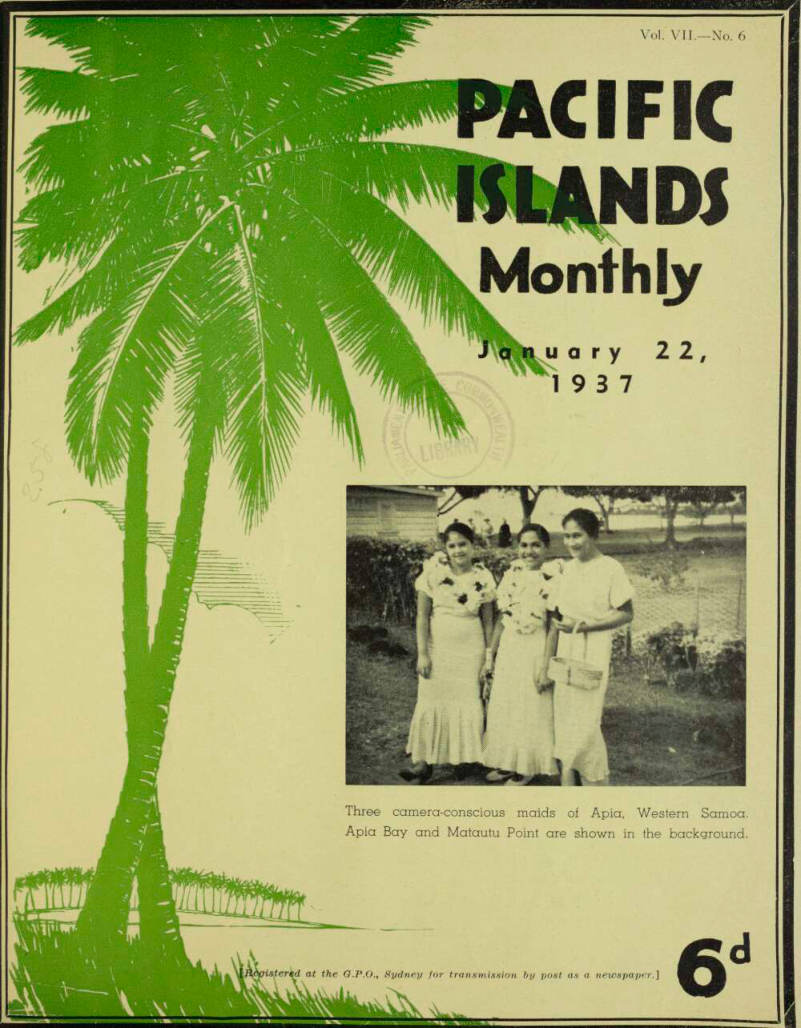
[Cover Photo and Masthead]
ISLANDS Monthly Vol. VII.—No. 6 January 22, 19 3 7 fipgistertd at the 0.P.0., Sydney for transmission hy post as a newspaper .]
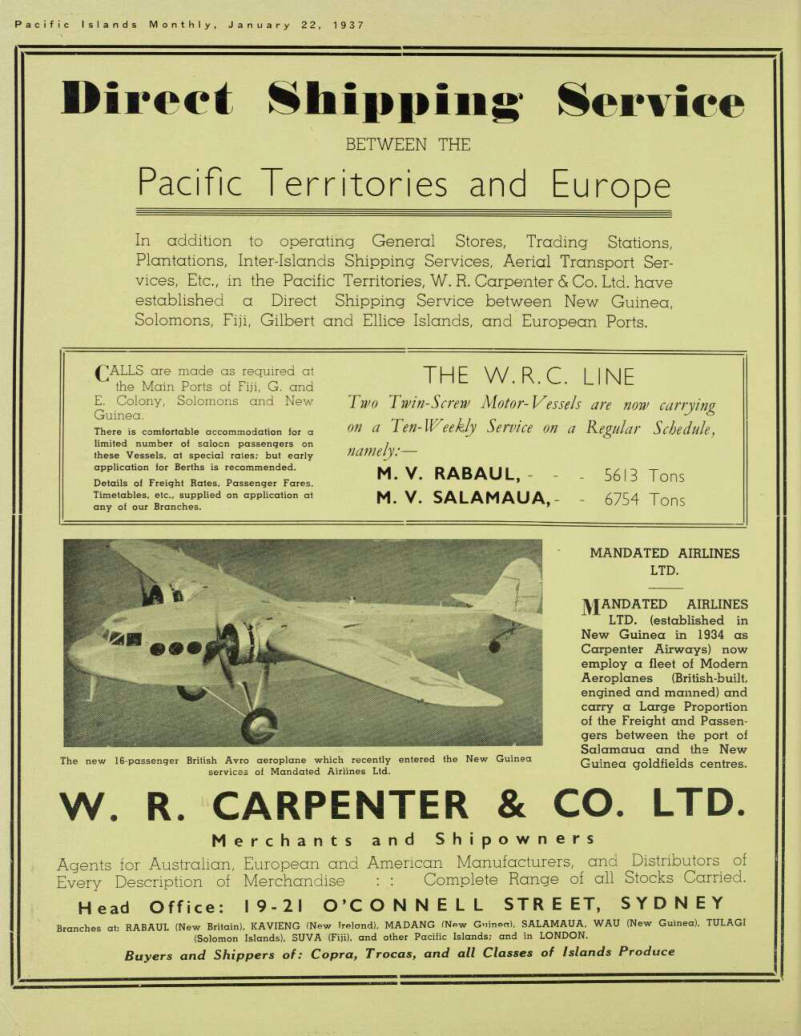
W. R. Carpenter & Co. Shipping and Airlines Advertisement
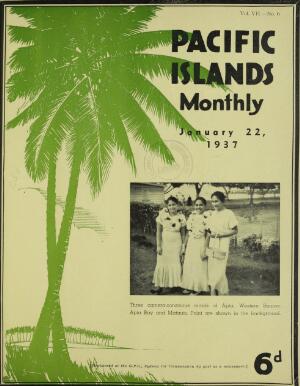
Apia Bay and Matautu Point are shown in the background Direct Shipping Service
BETWEEN THE
Pacific Territories and Europe In addition to operating General Stores, Trading Stations, Plantations, Inter-Islands Shipping Services, Aerial Transport Services, Etc., in the Pacific Territories, W. R. Carpenter & Co. Ltd. have established a Direct Shipping Service between New Guinea, Solomons, Fiji, Gilbert and Ellice Islands, and European Ports. are made as required at the Main Ports of Fiji, G. and E. Colony, Solomons and New Guinea.
There is comfortable accommodation for a limited number of saloon passengers on these Vessels, at special rates; but early application for Berths is recommended.
Details of Freight Rates. Passenger Fares, Timetables, etc., supplied on application at any of our Branches.
THE W. R. C. LINE Two Twin-Screw Motor-Vessels are now carrying on a Ten-Weekly Service on a Tegular Schedule, namely: — M. V. RABAUL, . 5613 Tons M. V. SALAMAUA, - 6754 Tons fH ’ft .
MANDATED AIRLINES
LTD.
The new 16-passenger British Avro aeroplane which recently entered the New Guinea services of Mandated Airlines Ltd.
yjANDATED AIRLINES
LTD. (established in New Guinea in 1934 as Carpenter Airways) now employ a fleet of Modern Aeroplanes (British-built, engined and manned) and carry a Large Proportion of the Freight and Passengers between the port of Salamaua and the New Guinea goldfields centres.
W. R. CARPENTER & CO. LTD.
Merchants and Shipowners Agents for Australian, European and American Manufacturers, and Distributor of Every Description of Merchandise : : Complete Range of all Stocks Carried.
Head Office: 19-21 O’CONNELL STREET, SYDNEY
Trinity Grammar School Advertisement
Buyers and Shippers of: Copra , Trocas , and all Classes of Islands Produce Pacific Islands Monthly, January 22, 1937
TRINITY GRAMMAR SCHOOL
KEW, VICTORIA
President of Council: Headmaster: A. O. HENTY, Esq. FRANK SHANN, M.A., Dip. Ed.
The School is well equipped and splendidly situated. Its present size (about 40 boarders and 230 day boys) makes it possible for every boy to come into personal touch with the Head Master and a staff of 10 experienced and successful masters (including seven University Graduates). The general life of the school is very varied and full of vigour. The Head Master will be pleased to send the Illustrated Year Book for 1936-7 on application, and to give full information about the school, which is approved by the University of Melbourne as a Class ‘A” School for the Intermediate and School Leaving Examinations. Two Preparatory Schools —Charles Street, Kew, for boarders and day boys; and St. Hilary’s Hall, John Street,
Royal Packet Navigation Co. (K.P.M. Line) Advertisement
Term dates for 1937 : February 9, June 1, September 14.
Postal Address: Kew, E A, Victoria. Telephone: Hawthorn 412
SAIGON—BATAVIA—SAMARANC—PORT MORESBY
SAMARAI-RABAUL- PORT VILA-NOUMEA
SYDNEY - PORT MORESBY - BATAVIA - SAIGON
bi-monthly by the "VAN REES"
You will enjoy travelling by this popular, fast and modern steamer of the K.P.M., noted for its comfort, excellent cuisine, and economical fares.
ROYAL PACKET
With a fleet of over 130 vessel* the K.P.M. Line is in a position to accept cargo for all port* in Netherlands India, and with transhipment at Batavia for Africa.
NAVIGATION CO.
Paketvaart House, 255 George Street, Sydney
Pacific Islands Travellers
Samarai; W. R. Carpenter & Co. Ltd., Rabaul; Gubbay Freres, Port Vila; Carlo Leoni, Noumea.
PACIFIC ISLANDS TRAVELLERS
PASSENGERS PER MACDHUI WHICH DE-
PARTED FROM SYDNEY FOR PAPUA AND
NEW GUINEA ON DECEMBER 22: Messrs.: Avenall, Burgess, Blue, Blakey, Barwick, Buckland, Bonwick, Cavalieri, Clark, Curtain, Cridland, Christie (2), Davis, Eldred, Edwards, Fisher, Fenton, Froggatt, Goddard, Fallin, Griffiths, Hides, Haydon, Henry, Haydon, Hurley, Isenbert, Jones, Kennedy, Kendrick, Lyall, Lowe, Matley, Macka, Marr, Miller, McKinnon, McKee, Mc- Lennan, Nelson, O’Hara, Proud, Pratt (2), Read, Rosser, Strachan, Spence, Thomas, Thresher, Taylor, Vesper, Wilde, Wurst, Watkins, Wakeford, Thurston, Wiltshire, Tobin; Mesdames: Cavalieri, Champion, Cridland, Devlin, Eldred, Froggatt, Hailes, Higgs, Irwin, Isenbert, Kennedy, Lee, Lilley, Hannah, Mylonas, McKee, Palmer, Pauli, Read, Selwood, Sutcliffe (2), Turner, Watkins, Thomas; Misses: Abramovich, Buckingham, Callaghan, Crane, Duncan, Frewin, Gladder, Grahamslaw, Holden, Hunt, Humphries, Leeder, Pot, Stevens, Tickle, Waghorn, Woff, Clarke, Ellson, Graham.
PASSENGERS PER NIAGARA WHICH
ARRIVED IN SYDNEY FROM SUVA, FIJI, ON DECEMBER 26:—Mrs. H. M. Askey, N. P.
Kirby, Mr. and Mrs. R. Law, Mrs. R. V. Rutter, Mrs. L. Spence, Mrs. O. Stevenson, Misses J. and M. Stevenson, J. M. Aitken, A. Askew, Mrs.
J. Beddoes, A. L. Baker, Master E. H. Barratt, W. Colquhoun, Miss R. M. Chapman, Miss M.
J. Donald, R. D. H. Ellis, Mr. and Mrs. H. S.
Everist, Miss M. C. Evans, G. G. H. D. Fowler, Mrs. R. I. Green, Miss Green, Master Green, Miss H. S. Gale. R. H. Guy, Mrs. C. H. Halstead.
Mr. and Mrs. F. H. Ellerton, Miss Ellerton, Mr. and Mrs. C. H. Donaldson, Mr. and Mrs. Jullian, Master Jullian, Miss D. M. Lucas, Miss L. I.
Lawrence, G. R. Morgan, R. H. Mcßurney, C. H.
Pickering, Mrs. M. H. Ragg, Mrs. Rowley, Misses M. and J. Rowley, J. A. Ryrie, Miss R. M. Sabben, Miss M. Whitcombe, H. G. Williams, F. E. Feast, F. C. Beddoes, J. A. McMichan, Mrs. K. Ronayne, R. E. Smith, J. Walker, R. Wright.
PASSENGERS' PER TANDA WHICH
ARRIVED IN SYDNEY FROM RABAUL, NEW
GUINEA, ON DECEMBER 23: Messrs. Brinston, Perriman, Hay, Geynther, Bennis. Mesdames Brinston, Perry, Evans. Miss Orwin.
PASSENGERS PER MORINDA WHICH AR- RIVED IN SYDNEY FROM NEW HEBRIDES, NORFOLK ISLAND, AND LORD HOWE IS.
ON DECEMBER 30: —Messrs.: Ainsworth, Arnott, Blackler, Brennan, Bigelow, Butler, Banner, Chapman, Cruyl, Dillon, Flynn, Gilbert, Hines, Joy, James, Muller, Middleton, Pinner, Perry, Thurlow, Wilson; Mesdames: Bailey, Banner, Burcher, Brennan, Cooke, Everett, Flynn, Joy, James, Middleton, Pinney, Pratt, Perry, Quintal, Stevenson; Misses; Butler, Fitch, McArthur, Pettiford. Quintal, Treblico, Weiss.
PASSENGERS PER MORINDA WHICH
SAILED FROM SYDNEY FOR LORD ISLAND
AND NORFOLK ISLAND ON JANUARY 7
Messrs. Buckingham, Berne, Bolger, Dunk ley, Evans, Gregerson, Gilholme, Greenwood, Ipkendans, Johnson, McLeod (2), Nicholson, Pliyle, Redfern, Watt; Mesdames: Buckingham, B’odie, Bloomfield, Keed, Radcliffe, Trotter, Whit'head.
Woods; Misses: Barclay, Bloomfield, B affett, Crozier, Christian (3), Gordon, Hunt, Keed, Lanyon, McLenaghan, Playle, Trotter, Waiting, Woods.
PASSENGERS PER MONTORO WHICH
REACHED SYDNEY FROM NEW C UINEA
AND PAPUA ON JANUARY 7:—Mess/*.: Anderson, Ashwell, Bain, Baines, Brown, Yarnet, Bruchhauser, Carter, Coutts, Cram, Ddaney, Dumbrell, Frost, Grigg, Harvey, Henley, Hinds, Hillier, Imlay, King, Laffan, Lord, Mc- Intyre, Monaghan, Murray, McMurtie Nash, Robins, Rogerson, Rankin, Fairfax-Ross, itobey, Schmahl, Seale, Sainsbury, Thomson (2), Thompson (2), Walsh, Watson, Wooff, Wallace, Wightman, Williams, Tabrett;'Mesdames: Baiens, Bannon, Bellhouse, Clarke, Clay, Carter, Drewe, Earl, Frost, Hyde, Imlay, Lees, McDonald, Rogerson, Gossner, Rankin, Sainsbury, Thomson, Walsh, Wooff. Wallace. Woodward; Misses: Beck, Cooper, Cox, Craig, Daish, Ellis, Fairhall, Gossner, Hoyles, Milton, MacGregor, Sewell.
PASSENGERS PER MONTORO WHICH
SAILED FROM SYDNEY FOR PAPUA AND
NEW GUINEA ON JANUARY 13;—Messrs.
Ashcroft, Austin, Allen, Armstrong, Babbington, Boehn Barker (2), Baillie, Budden, Bain, Benson. Comb, Carroll, Clancy, Cranstoun, Cairnes, Dix, Doig, Day, Daly, Evenett, Edgell, Fitton, Faulkner, Anderson, Fader, Ford. Gallagher, Gunther. Garvey. Henderson, Hopefield, Haviland.
Kilner, Luff, Laws, Lockhart, Mackinnon, Max- ?el . Mason, Muddell, Mcßobert, McCann, Mahon, Mulholland, McPherson, Osborne, Hewlett. Obst.
Passlow, Priestly, Page, Rutherford, Ross. Sibley.
Speakman, Stathers, Strong, Villiers, Wilson, Wilkie, Waterhouse, Wood, Wilson, Williams, Ward- Williams, Zimmer; Mesdames: Anderson, Armstrong, Balmain, Boehn, Edged, Gunther, Haviland, Higgs, Harvey, King, Luff, Mackinnon, Maxwell, Noonan, Naulty, Obst, Phillips, Ross, Williams; Misses: Brown, Corkin, Cooper, Clarke, Ford, Holmes, Hales, Harford, Harris, Inman, Kessell, Leahy, McGregor, McMillan, Noonan, Page, Seacombe, Stewart.
PASSENGERS PER MALAITA WHICH AR- RIVED IN SYDNEY FROM SOLOMON IS- LANDS AND NEW GUINEA PORTS ON JAN- UARY 15:—Messrs.: Andrews, Ashwin, Atkins, Baxter, Bengough, Bewick, Caulton, Daniels, Davis, Francis, Glenn, Goodland, Hauser, Jarman, Hetherington, Henderson, Kennon, Lucas, Mathieson, Maunsell-Turner, Pieraccini, Price, Seaton, Ryan, Spiers, Simon, Thomson, Webeck; Mesdames: Alley, Atkinson, Atkins, Caulton, Coates, Fruhen, Hart, Hetherington, Henderson, Mitchell- Hill, Nibloe, Price, Rankin, Train, Wells; Misses: Bott, Cannon, Fitzgerald, Ferguson, James, Kroening, Kennon, Macdonald, Nicholas, Smith, Strickland, Waite, Scott.
PASSENGERS PER TANDA WHICH
SAILED FOR RABAUL. NEW GUINEA, ON
JANUARY 15: Brigadier-General W. R. Mc- Nicoll, Messrs. Townsend, Ollerenshaw, Evans, Perriman, Dobbie, Monger, Cameron, Anderson, Gilmore, Kelly, Tracey, Sinclair. Mesdames Cameron, Anderson, Sinclair, Ollerenshaw, Evans, Taylor. Miss Doering.
PASSENGERS PER MORINDA WHICH AR-
RIVED IN SYDNEY FROM NORFOLK ISLAND
AND LORD HOWE ISLAND ON JANUARY 17: Messrs.: Arnott, Arthur, Bestic, Bolger, Blundell, Buckingham, Christian, Cooke, Easy, Evans, Flack, Gilhome, Gray, Hutchens, Harvidge, Ipkendanz, Johnson, Johnson, Mason (2), McDonald, McGhee (2), Meares, Thompson, Watt; Mesdames: Arnott, Arthur, Bloomfield, Blundell, Buckingham, Geary, Ipkendanz, Johnson (2), Keed, McGhee, Minchin, Freddie, Radcliffe, Riches, Stopp, Thompson; Misses: Barclay, Bloomfield,
Stone Age Relics from New Guinea
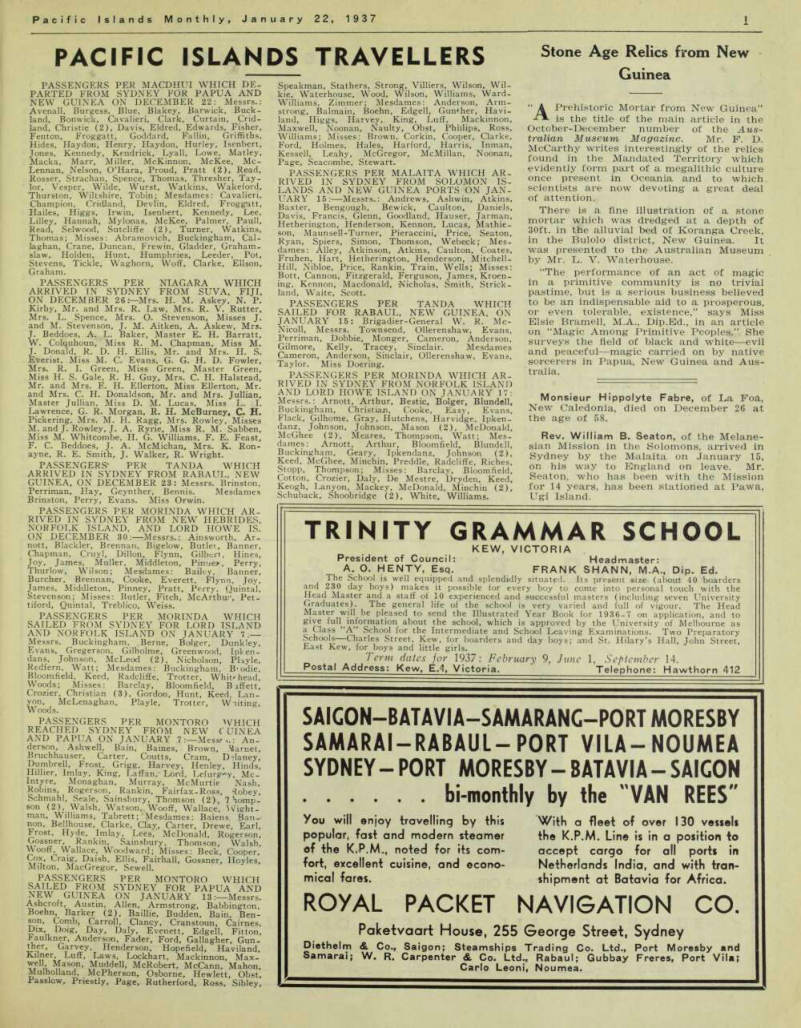
Stone Age Relics from New Guinea • A Prehistoric Mortar from New Guinea” is the title of the main article in the October-December number of the Australian Museum Magazine. Mr. P. D.
McCarthy writes interestingly of the relics found in the Mandated Territory which evidently form part of a megalithic culture once present in Oceania and to which scientists are now devoting a great deal of attention.
There is a fine illustration of a stone mortar which was dredged at a depth of 30ft. in the alluvial bed of Koranga Creek, in the Bulolo district, New Guinea. It was presented to the Australian Museum by Mr. L. V. Waterhouse. ‘‘The performance of an act of magic in a primitive community is no trivial pastime, but is a serious business believed to be an indispensable aid to a prosperous, or even tolerable, existence,” says Miss Elsie Bramell, M.A., Dip. Ed., in an article on ‘‘Magic Among Primitive Peoples.” She surveys the field of black and white—evil and peaceful—magic carried on by native sorcerers in Papua, New Guinea and Australia.
Monsieur Hippolyte Fabre, of La Foa, New Caledonia, died on December 26 at the age of 58.
Rev. William B. Seaton, of the Melanesian Mission in the Solomons, arrived in Sydney by the Malaita on January 15, on his way to England on leave. Mr.
Advertisements & other items, pp. 3-5 (4 items)
Burns, Philp & Co. Ltd. Advertisement
Pacific Islands Monthly, January 22, 1937 BURNS, PHILP & CO. LTD.
GENERAL MERCHANTS mm mm it H sss I II 111 Butt SHIPOWNERS
TOURIST AGENTS
Head Office: 7 Bridge Street, Sydney—Australia Code Address: "Burphil"
Advertisers Index
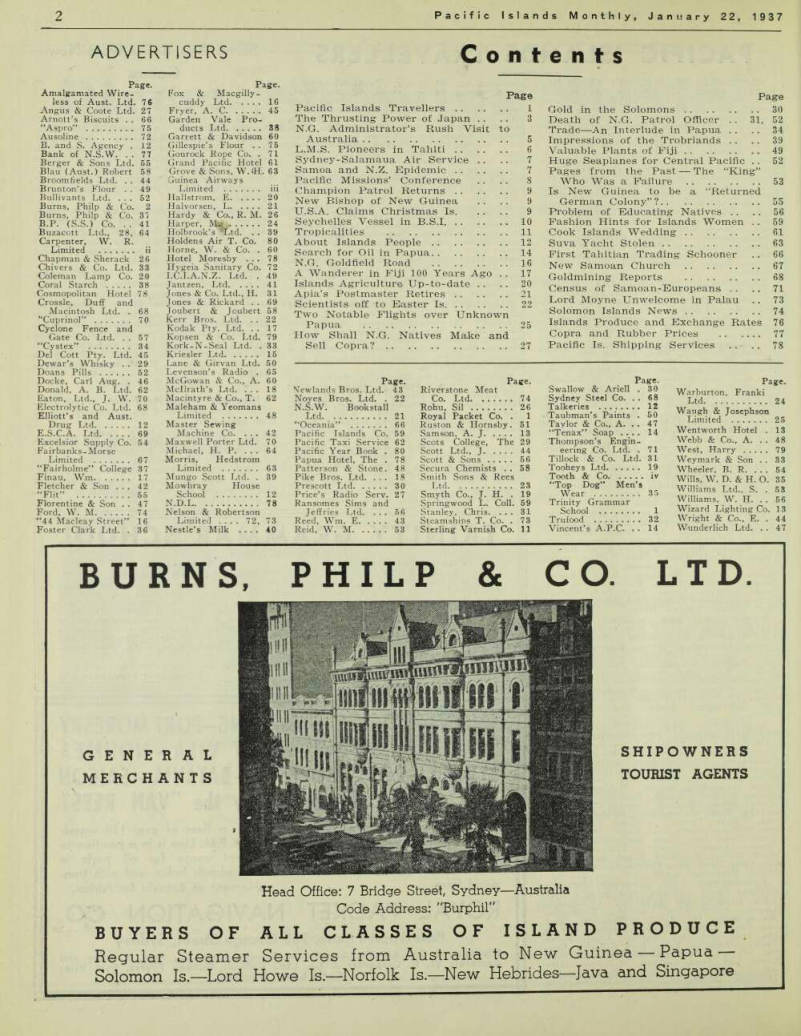
ADVERTISERS Page.
Amalgamated Wireless of Aust. Ltd. 76 Angus & Coote Ltd. 27 Arnott’s Biscuits . . 66 “Aspro” 75 Ausoline 72 B. and S. Agency . 12 Bank of N.S.W. . . 77 Berger & Sons Ltd. 55 Blau (Aust.) Robert 58 Broomfields Ltd. . . 44 Brunton’s Flour . . 49 Bullivants Ltd. ... 52 Burns, Philp & Co. 2 Burns, Philp & Co. 31 B.P. (S.S.) Co. . . 41 Buzacott Ltd., 28, 64 Carpenter, W. R.
Limited ii Chapman & Sherack 26 Chivers & Co. Ltd. 33 Coleman Lamp Co. 20 Coral Starch 38 Cosmopolitan Hotel 78 Crossle, Duff and Macintosh Ltd. . 68 “Cuprinol” 70 Cyclone Fence and Gate Co. Ltd. . . 57 “Cystex” 34 Del Cott Pty. Ltd. 45 Dewar’s Whisky . . 29 Doans Pills 52 Docke, Carl Aug. . 46 Donald, A. B. Ltd. 62 Eaton, Ltd., J. W. 70 Electrolytic Co. Ltd. 68 Elliott’s and Aust.
Drug Ltd 12 E.S.C.A. Ltd 69 Excelsior Supply Co. 54 Fairbanks-Morse Limited 67 “Fairholme” College 37 Finau, Wm 17 Fletcher & Son ... 42 “Flit” 55 Florentine & Son . . 47 Ford. W. M 74 “44 Macleay Street” 16 Foster Clark Ltd. . 36 Page.
Fox & Macgillycuddy Ltd 16 Fryer, A. C 45 Garden Vale Products Ltd 38 Garrett & Davidson 60 Gillespie’s Flour . . 75 Gourock Rope Co. . 71 Grand Pacific Hotel 61 Grove & Sons, W. <H. 63 Guinea Airways Limited iii Hallstrom, E 20 Halvorsen, L. .... 21 Hardy & Co., R. M. 26 Harper, 24 Holbrook’s uLtd. . . 39 Holdens Air T. Co. 80 Horne, W. & Co. . 60 Hotel Moresby ... 78 Hygeia Sanitary Co. 72 1.C.1.A.N.Z. Ltd. . 49 Jantzen, Ltd 41 Jones & Co. Ltd., H. 31 Jones & Rickard . . 69 Joubert & Joubert 58 Kerr Bros. Ltd. . . 22 Kodak Pty. Ltd. . . 17 Kopsen & Co. Ltd. 79 Kork-N-Seal Ltd. . 33 Kriesler Ltd 15 Lane & Girvan Ltd. 50 Levenson’s Radio . 65 McGowan & Co., A. 60 Mcllrath’s Ltd. ... 18 Macintyre & Co., T. 62 Maleham & Yeomans Limited 48 Master Sewing Machine Co. ... 42 Maxwell Porter Ltd. 70 Michael, H. P. ... 64 Morris, Hedstrom Limited 63 Mungo Scott Ltd. . 39 Mowbray House School 12 N.D.L 78 Nelson & Robertson Limited .... 72, 73 Nestle’s Milk .... 40 Page.
Newlands Bros. Ltd. 43 Noyes Bros. Ltd. . 22 N.S.W. Bookstall Ltd 21 “Oceania” 66 Pacific Islands Co. 59 Pacific Taxi Service 62 Pacific Year Book . 80 Papua Hotel, The . 78 Patterson & Stone. 48 Pike Bros. Ltd. ... 18 Prescott Ltd 30 Price’s Radio Serv. 27 Ransomes Sims and Jeffries Ltd. ... 56 Reed, Wm. E 43 Reid, W. M 53 Page.
Riverstone Meat Co. Ltd 74 Rohu, Sil 26 Royal Packet Co. . 1 Ruston & Hornsby. 51 Samson, A. J 13 Scots College, The 29 Scott Ltd., J 44 Scott & Sons 56 Secura Chemists . . 58 Smith Sons & Rees Ltd 23 Smyth Co., J. H. . 19 Springwood L. Coll. 59 Stanley, Chris. ... 31 Steamships T. Co. . 73 Sterling Varnish Co. 11 Page.
Swallow & Ariell . 30 Sydney Steel Co. • . 68 Talkeries ........ 12 Taubman’s Paints . 50 Taylor & Co., A. . • 47 “Tenax” Soap .... 14 Thompson’s Engineering Co. Ltd. . 71 Tillock & Co. Ltd. 31 Tooheys Ltd 19 Tooth & Co iv “Top Dog” Men’s Wear 35 Trinity Grammar School 1 Trufood 32 Vincent’s A.P.C. . . 14 Page.
Warburton, Franki Ltd 24 Waugh & Josephson Limited 25 Wentworth Hotel . 13 Webb & Co., A. . . 48 West, Harry 79 Weymark & Son . . 33 Wheeler, B. R. ... 54 Wills, W. D. & H. O. 35 Williams Ltd., S. . 53 Williams, W. H. . . 56
Contents
Wunderlich Ltd. . . 47 Contents Page Pacific Islands Travellers 1 The Thrusting Power of Japan . . . . 3 N.G. Administrator’s Rush Visit to Australia 5 L.M.S. Pioneers in Tahiti 6 Sydney-Salamaua Air Service .. .. 7 Samoa and N.Z. Epidemic 7 Pacific Missions’ Conference .. .. 8 Champion Patrol Returns 9 New Bishop of New Guinea .. .. 9 U.S.A. Claims Christmas Is 9 Seychelles Vessel in 8.5.1 10 Tropicalities 11 About Islands People 12 Search for Oil in Papua 14 N.G. Goldfield Road 16 A Wanderer in Fiji 100 Years Ago .. 17 Islands Agriculture Up-to-date .. .. 20 Apia’s Postmaster Retires 21 Scientists off to Easter Is 22 Two Notable Flights over Unknown Papua 25 How Shall N.G. Natives Make and Sell Copra? 27 Page Gold in the Solomons 30 Death of N.G. Patrol Officer .. 31, 52 Trade —An Interlude in Papua .. .. 34 Impressions of the Trobriands .. .. 39 Valuable Plants of Fiji 49 Huge Seaplanes for Central Pacific .. 52 Pages from the Past The “King”
Who Was a Failure 53 Is New Guinea to be a “Returned German Colony”? 55 Problem of Educating Natives .. .. 56 Fashion Hints for Islands Women .. 59 Cook Islands Wedding 81 Suva Yacht Stolen 63 First Tahitian Trading Schooner . . 66 New Samoan Church 67 Goldmining Reports 68 Census of Samoan-Europeans .. .. 71 Lord Moyne Unwelcome in Palau .. 73 Solomon Islands News 74
Masthead and Publication Details
2 Pacific Islands Monthly, January 22, 1937 Pacific Ilan ds monthly The Newspaper-Magazine of the South Seas [Registered at the G.P.O., Sydney for transmission ~by post as a newspaper .] Published Once Each Month and Circulated in Australia and New Zealand and in the following Pacific Territories and Island Groups: Crown Colony of Fiji.
Australian Territory of Papua.
Mandated Territory (Australia) of New Guinea, Bismarck Archipelago and Northern Solomon Islands.
Mandated Territory (Japan) of Marshall, Caroline and Marianna Islands.
French Territory of New Caledonia.
British and French Condominium of New Hebrides.
American Territory of Eastern Samoa.
American Territory of Guam.
Mandated Territory of Nauru.
British Crown Colony of Gilbert and Ellice Islands.
Mandated Territory (New Zealand) of Samoa.
British Solomon Islands Protectorate.
British Protectorate of Tongan Islands.
New Zealand Territory of Cook Islands.
Australian Territory of Norfolk Island.
French Colony of Oceania (Tahiti, etc.).
American Territory of Hawaiian Islands.
Owned and Produced by Pacific Publications Ltd., Union House, 247 George Street, Sydney TELEPHONE BW 5037 P.O. BOX 3408 R Registered Address of Telegrams, Radiograms, and Cables; “PACPUB,” Sydney.
Contributions Articles, Stories, and Photographs dealing with Pacific Islands subjects are invited, and will be paid for on publication at usual rates.
Subscription Rates Per Annum, within British Empire, Prepaid, Post Free 6/- Per Annum, elsewhere, prepaid. Post Free 8/- Single Copies 6d.
Editor and Publisher: R. W. ROBSON, F.R.G.S.
ADVERTISEMENTS Advertising rates furnished on application.
Colours, etc by Arrangement.
Process Blocks made at Advertiser’s expense when required. Screen, 100.
Changes of Advertising Copy should reach" this Office by Bth of each month, otherwise previous advertisement may be repeated.
AGENTS The following are authorised to receive subscriptions for the Pacific Islands Monthly:— Islands Branches of Burns, Philp & Cos. Ltd., and Burns Philp (South Sea) Cos., Ltd.
Islands Branches of W. R. Carpenter & Cos., Ltd.
All Branches of Morris, Hedstrom & Cos., Ltd.
G. Thomas & Cos., Rabaul, New Guinea.
Whitten Bros., Ltd., Samarai, Papua.
P. Costello, Suva, Fiji.
J. Muir, Suva, Fiji.
All Branches and Representatives of W. H. Grove and Sons, Ltd., Auckland, New Zealand.
Cook Islands Trading Cos., Rarotonga Cook Is.
W. H. Watson, Rarotonga, Cook Is.
Representative in London: W. C. HARVEY, Coronation Building, 4 Lloyds Avenue, London, E.C.2. from whom may be obtained copies of Pacific Islands Monthly, Pacific Islands Year Book, advertising sthedules, etc.
Vol. VIL, No. 6
The Thrusting Power of Japan
Prir#» I 6d - Per c °vy- I I ICC I Prepaid: 6/- p.a.
The Thrusting Power Of Japan
OEOPLE who live in the tropical islands and territories of the Central Pacific are personally and vitally affected by recent international developments events which show up the Anglo-American-Japanese situation with disturbing clarity.
That situation is well known, and may be briefly stated.
There are now 100,000,000 people in the small country of Japan. They cannot produce their own food—they must manufacture, sell their goods abroad, and thus buy foodstuffs. Japan wants additional territory and trade. Great Britain and U.S.A. are vitally concerned with the future of the Pacific, where their interests are as great as those of Japan—U.S.A., because their western seaboard, and Hawaii, are in the Northern Pacific; Britain, because of the situation of Canada in the North Pacific, and of Australia, New Zealand, and other dependencies in the South Pacific.
On December 31, there expired the Washington Naval. Treaty, one section of which provided that the parties (Britain, U.S.A. and Japan) should not build fortifications on islands 500 miles or more distant from their shores. Britain wanted to renew that pact. Japan, definitely, and U.S.A., inferentially, would not renew. Both professed eagerness for “the establishment of peace machinery and the maintenance of the status quo in the Pacific”; but both had reservations to make. Japan asked why she should be restricted to that 500 miles limit, when U.S.A. had been allowed to place the enormous Pearl Harbour fortifications in Hawaii, 2,400 miles from the American coast. Washington indicated an eagerness to “regain complete freedom of naval action.”
The discussion is still going on, perfunctorily; but the position is that the Treaty has expired, and the three nations have complete freedom to place fortifications where they wish. Building will start any day.
To better understand the situation, it is necessary to consider all that has happened since the Washington Treaty was signed in 1922 and renewed (by the London Treaty) in 1930.
Japan has become a great industrial nation, and her merchants and her shipping lines are increasingly reaching out for Pacific trade, to the serious embarrassment of Britain and U.S.A.—especially Britain.
Although Japan has withdrawn from the League of Nations, she holds on to the Marshall and Caroline Islands (entrusted to her under mandate by the League) and Japanese men and money have been poured into those groups—to such a degree that we can say that Japan now extends southwards to the equator, only a few hundred miles from New Guinea. Agents of the new Japanese South Sea Company, a trading and development enterprise, are busy, not only in Japanese territory, but also in the Philippines, East Indies, Borneo and Dutch New Guinea. Japanese sampans, gathering sea-products wherever they can find them, are swarming along the coasts of North Australia, New Guinea, Solomons, New Hebrides and Fiji—that fringe of islands that almost certainly is destined to protect Australia and New Zealand against the ruthless hand of Asia.
Since 1922, U.S.A. has built up the Pearl Harbour naval base, transferred her mighty navy to the Pacific Coast, and has established the world’s most notable aeroplane service, across the North Pacific, from ’Frisco to Manila. The Americans have given freedom and independence to the Philippines, and they have pledged their national honour that that independence shall not be interfered with.
Since 1922, Great Britain has further developed her dominions and colonies in the South Pacific, and has established the powerful Singapore base.
Look at a map of the Pacific; and, in the light of these things, the situation is terribly plain. Great Britain and the United States, by the simple logic of inescapable facts, have become the guardians of the status quo in the Pacific. Singapore, in the north-west, and Pearl Harbour, in the north-east, are the plain manifestations of that policy. Japan is hemmed in in the North-west Pacific. If she seeks territory or special privileges in any direction except westwards, she inevitably will be in conflict with the British, the 3 Pacific Islands Monthly, January 22, 1937 Dutch (who, in this matter, make common cause with Britain) or the Americans. She can go westwards, to China; but even China, these days, is aggressively on the defensive.
The Japanese, a proud and clever people, recognise the situation quite clearly. Sooner or later, their expanding population will compel them to fight for more territory.
The school of thought which dominates Japanese government at present would throw Japan immediately into a war against either Britain or U.S.A., alone, but any attempt by Japan to-day to seize new lands in the Pacific would immediately bring into the field against her Britain, U.S.A., the Netherlands and, probably, France. And so she holds her hand.
These are plain and simple facts, apparent to anyone who has watched events in the Pacific for the past two decades, and seen the logic of the incidents which attended the expiry of the Washington Treaty.
Britain and America, like Japan, are under no delusions. They understand the cruel problem which confronts Japanese statesmen. But what can they do? They cannot give up their already well-populated territories to Japan, and they cannot admit Japanese as settlers. If they were Europeans, the difficulty might be adjusted, but it is apparent that races so far apart as Japanese and North Europeans cannot live together as one happy, homogeneous community. The Anglo-Saxon nations are sincerely and anxiously ready to co-operate with Japan in creating a peaceful atmosphere (that is, in maintaining the status quo ) ; but if, as is likely, the non-fortification pact is not renewed, the significance of the development will be perfectly clear. It will mean, simply, that Japan believes that sooner or later she must fight for greater privileges in the Pacific, and Britain and U.S.A. must prepare accordingly.
The trade position, no less than the naval position, is bad and is tending to get worse.
Despite the natural determination of the British to hold their trade, Japanese goods and Japanese ships are being pushed into Britain’s South Seas territories. Uneasiness and friction are growing—it would be foolish to ignore the fact. Only the other day, the old-established E. and A. Line, running from Australia through Rabaul to Japan, announced that it was now being systematically deprived of freight by the Japanese, and could not continue without assistance.
We are safe enough, so long as Britain and U.S.A. make common cause in the Pacific. But, if there should be a breach
[Islands People Notes]
between the two great Anglo-Saxon nations, God help the British communities in the South Seas!
Dr. and Mrs. C. E. M. Gunther sailed from Sydney for New Guinea by the Montoro on January 13. He is chief medical officer for Bulolo Gold Dredging Limited at Bulolo, on the New Guinea goldfields.
Rev. Sydney G. Caulton, of the Melanesian Mission, at Gela, Solomon Islands, arrived in Sydney with Mrs. Caulton on long leave by the Malaita on January 15. They will leave shortly for New Zealand.
Captain C. R. Pinney, M.C., Administrator of Norfolk Island, arrived in Sydney with his wife by the Morinda on December 30 to spend two months’ fur-
Hawaii-Samoa: Pan-American Airways Inspection Proceeding
Hawaii-Samoa
Pan-American Airways Inspection Proceeding T3AN - AMERICAN Airways, with characteristic American thoroughness, appear to be proceeding steadily with the formulation of their plans for a trans-Pacific service between ’Frisco and Sydney.
The three-masted schooner L’oiseau des Isles was chartered from the French Oceanic Phosphates Commission, Papeete, and arrived in Suva on December 19.
She sailed early in January with representatives of Pan-American Airways, to
[Islands People Notes]
posed route of the air-service; between Hawaii and Samoa.
Dr. Herivaux, who has been appointed Chief of the Health Serviced in New Hebrides, arrived at Vila by the Ville d’Amiens on December 30.
Captain A. Campbell, of the Burns, Philp motorship Macdhui, is at present making a holiday tour of Victoria and
Unknown Papua: Embargo Remains on Uncontrolled Areas
Unknown Papua
Embargo Remains on Uncontrolled Areas NO relaxation of the Government ordinance declaring the Tarifuroro Valley an uncontrolled area is likely because of the successful patrol carried out by Mr.
Ivan Champion, said the Papuan Government Secretary (Mr. Leonard Murray) in a statement published early in January.
He said the area was likely to remain closed until the Administration could establish permanent police posts, which would probably be within two years.
Champion’s patrol had not entered the Tarifuroro, where Mr. Jack Hides earlier had found a big population, and had encountered persistent hostility. It was considered essential to accustom the natives to the European viewpoint before introducing civilian parties.
The ordinance was made last July, following an announcement by Mr, Hides that he was organising a prospecting expedition into country he had passed through during his patrol. Access to the area was forbidden to all save natives or
Advertisements & other items, p. 6 (1 item)
[Cartoon: This Tourist Traffic]
sion was made for the issue of permits to enter the uncontrolled area.
THIS TOURIST TRAFFIC
Shade of Old-Time Islands Belle to Shade of Old- Time Missionary: “There!
N.G. Affairs: Administrator's Rush Visit to Canberra
N.G. AFFAIRS Administrator’s Rush Visit To Canberra THERE was a good deal of speculation about the sudden visit to Canberra in January of Brigadier-General W. R.
McNicoll, Administrator of New Guinea.
The latter was in Canberra only in mid-November. The newspapers, naturally, wanted to know what had happened in the meantime to justify a special aeroplane visit only seven weeks later. No official explanation was given.
Some newspapers insisted that a demand by Germany for the return to her of the Bismarck Archipelago was involved; but that can be washed out. It is not yet a major issue.
Some day, when the archives give up their dead, it will be found that the following matters were dealt with during the Administrator’s visit: The mail and shipping services between Australia and the Western Pacific groups, now being carried on by Burns, Philp and Co. Ltd. under a temporary arrangement. (The tenders for a new contract, which closed on December 31, are complicated by some new factors, including the new shipping law in New Guinea, the decision to establish a weekly air-mail service between Sydney and New Guinea, and the appearance of a would-be competitor in a field which B.P hitherto have had practically to themselves.) No finality was reached —discussions are still going on.
The conditions of the proposed new contract for a weekly air-mail service, Sydney-New Guinea.
Territory finances, especially in relation to the planters’ old debts to the Government, and the extent to which those debts can be liquidated now by the sharp rise in copra prices.
Various matters of policy and administration, including the agitation about the “two-miles” trading limit, the Wanliss- Hogan incident, the Rabaul outcry against undisciplined natives, the future control of civil aviation, and criticism of the administration by various interests.
Decisions were reached concerning quite a number of matters; but we can only guess at their character. Nothing was published. The newspaper which has the temerity to criticise the bureaucrats
Captain "Bunny" Hammond Leaves New Guinea
ever.
Captain “Bunny” Hammond
Leaves New Guinea
APT AIN “Bunny” Hammond and Mrs.
Hammond, well-known in New Guinea (where Captain Hammond was one of the best known air pilots) have settled down in Melbourne, The Sydney Telegraph has this note: “Captain Hammond has dodged streams of tracer in France, has barn-stormed all over Australia, and skimmed Papuan jungles with freights of high explosive. He has a record of over 20 years’ continuous flying, and is (surely) on© of the few pilots of 1916 days who are still flying without celestial aid.”
Mr. W. H. Carpenter, Islands manager
Salamaua-Sydney: Notable Trip in Small Plane
Guinea, by the Nankin on January 21.
Salamaua-Sydney
Notable Trip in Small Plane A NOTABLE flight was made by Pilots R. O. Mant and M. Allen who, on behalf of Mandated Airlines Ltd., brought the Administrator of New Guinea, (Brigadier General W. Ramsay McNicoll), and the Treasurer (Mr. H.
O. Townsend) from New Guinea to Sydney in a Dragon Moth aeroplane.
The party left Salamaua at 5 a.m. on Monday, January 4, and flew over to the Papuan coast, near Port Moresby. The weather ahead looked so bad that it was decided to avoid the direct seacrossing to Australia of 450 miles. Instead, the pilots turned westwards, flew around the top of the Gulf of Papua, thence across Torres Strait at its narrowest point to Cape York, and down the Australian coast to Townsville, reached at 7 p.m.—l4 hours of rough, hard flying.
The next day, they flew to Sydney.
The Administrator had arranged to fly from Salamaua to Sydney in Guinea Airways’ new Lockheed aeroplane, which could have made the trip in one day; but, for some unexplained reason, he changed his mind when he arrived in Salamaua, and travelled per Dragon Moth instead.
He returned by the E. & A. steamer Tanda, leaving Sydney on January 15.
Messrs. Mant and Allen left Sydney on January 10 and flew the Dragon back to New Guinea.
Monsieur H. Martinet, president of the
B.P. Mail Contract
Sydney from Noumea on January 19 by the Pierre Loti, en route to France.
B. P. Mail Contract CANBERRA, Jan. 21.
NEGOTIATIONS for the renewal of the 1 Burns, Philp steamer and mail contract with the Western Pacific islands are practically completed on the basis of the tender launched in December.
G.O.M. of the Pacific
modification of the existing arrangements, but no details are available yet.
G.O.M. of the PacifiC THE Lieutenant-Governor of Papua, Sir Hubert Murray, received congratulations from all over the world on December 29, when he attained the age of 75 years.
Sir Hubert is one of the most remarkable old men in the South Seas. Physically and mentally, he is more like a man of 40 or 45. He remembers every detail of Papuan administration, and is quick in summary and decision. He is a friend of youth, and eagerly encourages the young men of his service. Almost every day, he goes out riding—no sedate jogtrotting along quiet lanes, but hell-forleather across country. He is intensely interested in his work, and the natives respect and love him.
His best birthday present, received that day, was news of the safety of the Champion expedition.
Mr. and Mrs. E. Boehn, of the Seventh
The Talkies Come to Tonga
from Sydney for Port Moresby, Papua, by the Montoro on January 13.
The Talkies Come To Tonga
IV/TR- W. BRIGGS (proprietor of Briggs’
Pictures, Nukualofa, Tonga) after facing much expense in fitting up machinery and hall, including a visit by an Auckland expert, presented a talkie programme for the first time in Tonga on November 28. Prince John Gu formally declared the entertainment open, and congratulated Mr. Briggs on his enterprise.
Eager to see and hear what this invention of the white man was like, crowds of Tongans (as well as Burod°° n .a delighted, and the talkie is the talk of the town now, from one end of the
Advertisements & other items, p. 8 (2 items)
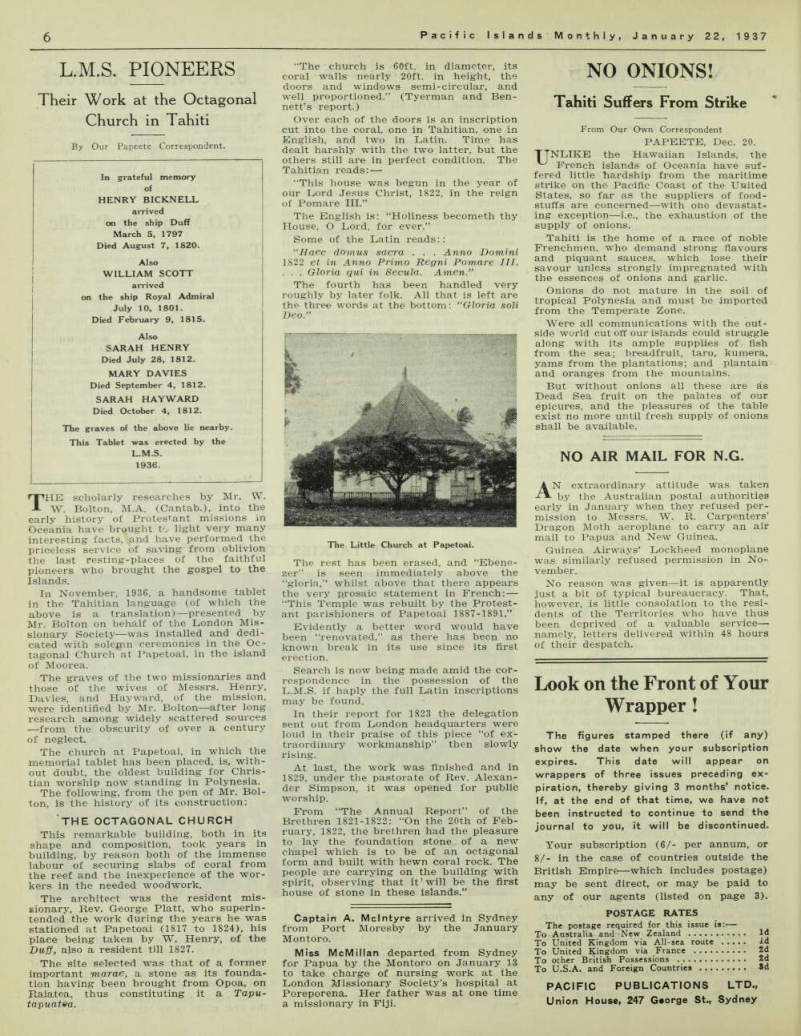
In Grateful Memory (L.M.S. Memorial Tablet)
In grateful memory of
HENRY BICKNELL
arrived on the ship Duff March 5, 1797 Died August 7, 1820.
Also
WILLIAM SCOTT
arrived on the ship Royal Admiral July 10, 1801.
Died February 9, 1815.
Also
SARAH HENRY
Died July 28, 1812.
MARY DAVIES
Died September 4, 1812.
SARAH HAYWARD
Died October 4, 1812.
The graves of the above lie nearby.
Look on the Front of Your Wrapper!
1936.
Look on the Front of Your Wrapper!
The figures stamped there (if any) show the date when your subscription expires. This date will appear on wrappers of three issues preceding expiration, thereby giving 3 months’ notice.
If, at the end of that time, we have not been instructed to continue to send the journal to you, it will be discontinued.
Your subscription (6/- per annum, or 8/- in the case of countries outside the British Empire—which includes postage) may be sent direct, or may be paid to any of our agents (listed on page 3).
POSTAGE RATES
The postage required for this issue is:— To Australia and New Zealand Id To United Kingdom via All-sea route id To United Kingdom via France 2d To other British Possessions 2d
L.M.S. Pioneers: Their Work at the Octagonal Church in Tahiti
PACIFIC PUBLICATIONS LTD., Union House, 247 George St., Sydney L.M.S. PIONEERS Their Work at the Octagonal Church in Tahiti By Our Papeete Correspondent.
THE scholarly researches by Mr. W.
W. Bolton, M.A. (Cantab.), into the early history of Protestant missions in Oceania have brought to light very many interesting facts, and have performed the priceless service of saving from oblivion the last resting-places of the faithful pioneers who brought the gospel to the Islands.
In November, 1936, a handsome tablet in the Tahitian language (of which the above is a translation) —presented by Mr. Bolton on behalf of the London Missionary Society—was installed and dedicated with solejnn ceremonies in the Octagonal Church at Papetoai, in the island of Moorea.
The graves of the two missionaries and those of the wives of Messrs. Henry, Davies, and Hayward, of the mission, were identified by Mr. Bolton —after long research among widely scattered sources —from the obscurity of over a century of neglect.
The church at Papetoai, in which the memorial tablet has been placed, is, without doubt, the oldest building for Christian worship now standing in Polynesia.
The following, from the pen of Mr. Bolton, is the history of its construction:
The Octagonal Church
This remarkable building, both in its shape and composition, took years in building, by reason both of the immense labour of securing slabs of coral from the reef and the inexperience of the workers in the needed woodwork.
The architect was the resident missionary, Rev. George Platt, who superintended the work during the years he was stationed at Papetoai (1817 to 1824), his place being taken by W. Henry, of the Duff, also a resident till 1827.
The site selected was that of a former important marae, a stone as its foundation having been brought from Opoa, on Raiatea, thus constituting it a Taputapuatea.
“The church is 60ft. in diameter, its coral walls nearly 20ft. in height, the doors and windows semi-circular, and well proportioned.” (Tyerman and Bennett’s report.) Over each of the doors is an inscription cut into the coral, one in Tahitian, one in English, and two in Latin. Time has dealt harshly with the two latter, but the others still are in perfect condition. The Tahitian reads: “This house was begun in the year of our Lord Jesus Christ, 1822, in the reign of Pomare HI.”
The English is: “Holiness becometh thy House, O Lord, for ever.”
Some of the Latin reads:: “Haec domus sacra . . . Anno Domini 1822 et in Anno Primo Regni Pomare 111. . . . Gloria qui in Secula. Amen The fourth has been handled very roughly by later folk. All that is left are the three words at the bottom; "Gloria soli Deo"
The rest has been erased, and “Ebenezer” is seen immediately above the “gloria,” whilst above that there appears the very prosaic statement in French: “This Temple was rebuilt by the Protestant parishioners of Papetoai 1887-1891.”
Evidently a better word would have been “renovated,” as there has been no known break in its use since its first erection.
Search is now being made amid the correspondence in the possession of the L.M.S. if haply the full Latin inscriptions may be found.
In their report for 1823 the delegation sent out from London headquarters were loud in their praise of this piece “of extraordinary workmanship” then slowly rising.
At last, the work was finished and in 1829, under the pastorate of Rev. Alexander Simpson, it was opened for public worship.
From “The Annual Report” of the Brethren 1821-1822; “On the 20th of February, 1822, the brethren had the pleasure to lay the foundation stone of a new chapel which is to be of an octagonal form and built with hewn coral rock. The
[Islands People Notes]
spirit, observing that it'will be the first house of stone in these islands.”
Captain A. Mclntyre arrived in Sydney from Port Moresby by the January Montoro.
Miss McMillan departed from Sydney for Papua by the Montoro on January 13 to take charge of nursing work at the
No Onions!: Tahiti Suffers From Strike
a missionary in Fiji.
No Onions!
Tahiti Suffers From Strike From Our Own Correspondent PAPEETE, Dec. 20.
TTNLIKE the Hawaiian Islands, the French islands of Oceania have suffered little hardship from the maritime strike on the Pacific Coast of the United States, so far as the suppliers of foodstuffs are concerned —with one devastating exception—i.e., the exhaustion of the supply of onions.
Tahiti is the home of a race of noble Frenchmen, who demand strong flavours and piquant sauces, which lose their savour unless strongly impregnated with the essences of onions and garlic.
Onions do not mature in the soil of tropical Polynesia and must be imported from the Temperate Zone.
Were all communications with the outside world cut off our islands could struggle along with its ample supplies of fish from the sea; breadfruit, taro, kumera, yams from the plantations; and plantain and oranges from the mountains.
But without onions all these are as Dead Sea fruit on the palates of our
No Air Mail for N.G.
exist no more until fresh supply of onions shall be available.
No Air Mail For N.G.
AN extraordinary attitude was taken by the Australian postal authorities early in January when they refused permission to Messrs. W. R. Carpenters’
Dragon Moth aeroplane to carry an air mail to Papua and New Guinea.
Guinea Airways’ Lockheed monoplane was similarly refused permission in November.
No reason was given—it is apparently just a bit of typical bureaucracy. That, however, is little consolation to the residents of the Territories who have thus
Advertisements & other items, p. 8 (1 item)
[Photo Caption: The Little Church at Papetoai]
been deprived of a valuable service—
Sydney-Salamaua Air Service: Tenders for Contract Invited
Pacific Islands Monthly, January 22, 1937
Sydney-Salamaua
Air Service
Tenders for Contract Invited /~iN January 16, the Commonwealth Department of Defence invited tenders for the new air-mail service between New Guinea and Sydney. The advertisement was as follows: TENDERS will be received by the Secretary, Contract Board, Department of Defence, Melbourne. until Wednesday, March 31, 1937, for the establishment and maintenance of an Aeroplane Service, weekly in each direction, between:— (a) SYDNEY, New South Wales, and SALAMAUA, New Guinea; or alternatively— (b) SYDNEY, New South Wales, and RABAUL, New Guinea; over the route Sydney-Brisbane-Rockhampton, Townsville - Cairns - Cooktown - Thursday Island (Horn Island)-Wau-Salamaua.
Tenderers may tender for a Sydney-Salamaua or a Sydney-Rabaul service, but a separate tender form is to be completed in respect of each and every offer the Tenderers desire to submit. . Tenders must be submitted on the forms provided for the purpose. These forms, including Conditions of Contract, etc., are obtainable at the office of the Secretary, District Contract Board, Circular Quay West, Sydney.
It is officially announced that the ’planes must be capable of carrying six passengers, mails and freight. They must be multi-engined, have a cruising speed of at least 140 miles per hour, and fuel capacity for a cruising range of 500 miles, against a headwind of 30 m.p.h.
It will be seen that the Commonwealth has stuck to its decision that the ’planes must go to the tip of Cape York, and cross to New Guinea by the shortest route (80 miles). Thence they will fly over many hundreds of miles of useless jungle, in Western and Central Papua, to Wau.
All the aerial traffic between New Guinea and Australia, up to date—and it has been considerable—has taken the other route—Townsville, Port Douglas thence across 450 miles of ocean to the Papuan Coast, Port Moresby and Wau. It seems to be just as safe and practicable a route as that between Darwin and the East Indies, via the Timor Sea. But no ordinary man can understand the working of the bureaucratic mind.
The Commonwealth has decided upon the Thursday Island route, and that is the end of it. Port Moresby—in fact, all the settled and developed part of Papua— is cut out from the direct benefit of the new service. Passengers and mails for Papua, presumably, will go to Wau, and thence will be taken, in a feeder service, southwards across the mountains to Port Moresby.
In view of the controversy in the past about the relative merits of the Lae and Salamaua aerodromes, it is interesting to note that Salamaua is stipulated and not Lae. It is obvious that if Guinea Airways are the successful tenderers for this service, they must use their Lockheed; and the contract says that the machines used must be put down on Salamaua. Bureaucracy rides high in the saddle these days. The Administrator knows very well that G.A. do not wish to risk their £30,000 Lockheed machine on the Salamaua aerodrome.
It will be surprising if the new service includes, at the beginning, the 400 miles stretch between Salamaua and Rabaul, along the practically undeveloped Southern coast of New Britain. It seems more likely that, for obvious economic reasons,
Yacht for French Commissioner in New Hebrides
come later.
Yacht for French Commissioner in New Hebrides A YACHT has been purchased in Australia by the High Commissioner for France in the Pacific for the use of the French Resident Commissioner at Vila, in the New Hebrides.
Not possessing an official vessel, the Resident Commissioner hitherto has had
[Islands People Notes]
to reply upon the uncertain inter-island trading vessels when he wished to visit the scattered islands of the Group, Mr. B. W. Taylor, headmaster of the Provincial School at Taveuni, Fiji, has
"Clear Out!": How Samoa, in Panic Over Epidemic, Treated Five Apia Residents
Nadi, after nine years’ service at the former institution.
“Clear Out!”
How Samoa, In Panic Over Epidemic, Treated Five Apia Residents TN New Zealand’s long record of stupid 1 and muddling mismanagement in Samoa, the case of the Matua’s Christmas passengers probably will stand unique.
The Matua arrived in Apia on Christmas Eve. She carried a number of roundtrippers, and five persons booked for Apia.
The latter were: Miss Betty Dawson, daughter of Dr.
Dawson—a school-girl, on a visit to her parents from New Zealand.
Miss Mabel Yandell, an Apia resident, returning home after a holiday visit to Australia.
Mr. W. Links, an executive of Messrs Burns Philp (S.S.) Ltd., Apia, returning home from leave spent in Australia.
Messrs. G. Stoeckicht and A. Matthes, two German residents of Samoa, returning to Apia after a visit to Germany.
These five people learned by radio, when half way to Apia, that there might be difficulties regarding quarantine in Apia, owing to the outbreak of infantile paralysis in New Zealand. But they had been allowed ashore freely in Nukualofa and Barotonga, so they did not worry over much.
Miss Yandell and Mr. Links did not worry at all. They had gone from Sydney to Auckland in the Aioatea, and transferred immediately to the waiting Matua, which sailed a few hours later. They had spent an hour or two in Auckland streets but they felt that their connection with New Zealand was nil.
They calculated without Samoa’s famous Old Granny Government.
The decision of the authorities, announced in Apia, was that no one could land from the Matua. The round-trippers growled, but submitted. The five Apia people protested, and pleaded that at least they be allowed to go ashore, in quarantine: but officialdom simply did nothing.
No European passengers were allowed ashore—they were allowed only to hold 7900 lbs., being Tumbler shaft for 7 Pacific Islands Monthly, January 22, 1937 distant converse with their friends, who circled around the ship in boats —but there was no restriction upon the Samoan cargo-workers from the shore. Over 100 Samoans, on two occasions, came aboard, mingled with the crew, and worked the cargo, which also was allowed ashore without restriction.
The Apia five, armed with piles of Christmas presents, watched the Apia shore hungrily during Christmas Eve and the whole of Christmas Day. Their friends came near, and shouted and gesticulated.
Mr. Links, using glasses, had the doubtful pleasure of watching a Christmas party in progress at his own house.
Finally, it dawned upon the hapless five that the Administration meant it —they were to be chased away from their home.
Then, through Mr. Links, they appealed most urgently to the Acting-Administrator. They asked: Where were they to go? When might they come back? How were they to live in the meantime? Why could they not land and be placed in quarantine—especially in view of the fact that hundreds of natives had been allowed aboard the ship?
Officialdom simply shrugged its shoulders and said it did not know.
A few minutes before the Matua sailed for Suva the Captain was officially informed that the passengers must remain away for a month and then they could not return by any vessel which had called at a N.Z. port.
Messrs. Stoeckicht and Matthes left the Matua at Suva, and are still there, awaiting some way of getting home. Miss Dawson returned to Auckland.
Mr. Links and Miss Yandell returned to Sydney, in order to catch a copra-steamer, the Tolken, which is due in Samoa some time in March.
Round-trippers on the Matua, on their return to New Zealand, told the newspapers there that the proceedings aboard the vessel at Apia were a priceless farce.
They said that the Samoan officials at first made the ship’s company wear masks; but no masks were worn by the
Editorial Note (on the Matua Epidemic Incident)
sently were abandoned, and the natives mixed freely with the ship’s company.
Editorial Note
ONLY the Samoan officials acted in this manner. The port authorities at Suva, Rarotonga and Nukualofa placed no restriction upon the Matua’s passengers.
To get this Apia farce into the correct focus, it should be remembered that no one knows how infantile paralysis is carried —the way in which the germs of the disease are spread is completely a mystery.
The accommodation of 150 cargoworkers from the shore on a ship crowded with New Zealand residents, would be just as likely to transfer the disease from ship to shore, as would the arrival in Apia of Mr. Links who, on his way home from Sydney, spent an hour or so in Auckland streets.
New Zealand has never been forgiven for introducing pneumonic ’flu into Samoa, where tens of thousands of natives were killed. This has made the N.Z. authorities very sensitive on the matter of epidemics; and one can at least understand the fussiness of officials who have never, in any event, been conspicuous for strength of judgment.
The thing which has made such a bad impression is the indifference and callousness of officialdom towards those five residents of Samoa who, through no fault of theirs, suddenly found themselves isolated aboard of the Matua. They were not strangers —they were well-known residents, and their homes and relations and resources were all in or near Apia. In a case like this, officialdom surely should have taken some responsibility for its own people, and advised them what to do and helped them to do it. Instead, it simply barred them out, and left them to shift for themselves.
The most charitable view is that it was
For Gallantry: Fiji Resident Awarded R.H.S. Silver Medal
lack of initiative, characteristics of the New Zealand regime in Samoa.
For Gallantry
Fiji Resident Awarded R.H.S.
Silver Medal From Our Own Correspondent SUVA, Jan. 2.
THERE was an echo of the wreck of the M.V. Derek, in a hurricane at Komo Island in February last year, when the Governor (Sir Arthur Richards) at a ceremony in December at the Public Works Department yards, presented Mr.
Henry Cross, who was engineer on the Derek, with the silver medal and certificate of the Royal Humane Society, in recognition of his saving the life of Captain E. W. G. Twentyman, retired Harbourmaster of Suva.
Congratulating Mr. Cross on his brave deed, His Excellency briefly outlined the circumstances that led up to the award.
When the Derek was being abandoned, it was a case of every man for himself.
Captain Twentyman, who is an old man, was lowering himself over the side by means of hand ropes when his grip was broken and he was thrown into the boiling surf. Sucked under the vessel, which was rolling badly at the time, he was in imminent danger of being crushed to death when she rolled back again.
Mr. Cross, with no thought to his own danger and at considerable risk to his life, jumped overboard and succeeded in dragging Captain Twentyman clear of the ship and into shallow water, from which he was assisted ashore. Captain Twenty-
Mr. Turnbull's Visit to N.Z.
Mr. Cross, he must have lost his life.
Mr. Turnbull’S Visit
To N.Z.
From Our N.Z. Correspondent AUCKLAND, Jan 12.
THE Prime Minister, Mr. M. J. Savage, states that no special significance attaches to the visit of the Acting- Administrator of Samoa. Mr. A. C. Turnbull, to New Zealand.
He was merely in the Dominion on furlough, Mr. Savage said, and his visit was not connected with the appointment of an
[Islands People Notes]
Administrator, although he would discuss the Samoan position with him while he was here.
Mr. Andrew Kelly, Rabaul solicitor, returned to New Guinea by the Tanda from Sydney on January 15, after spending Christmas holidays in Australia.
Mr. B. B. Perriman, M.L.C., manager of
Pacific Missions' Conference: In Sydney Next April
Guinea by the January Tanda.
Pacific Missions’
CONFERENCE In Sydney Next April \ MISSIONARY conference has been arranged by the National Missionary Council of Australia, to be held in Sydney over four days, from April 5 next.
The discussions of the conference will be divided into three groups: Pacific, Aborigines, and Home Base.
The various missionary societies working in the South Seas will be represented on the basis of three times their present membership on the Council, after taking into consideration the number of fields in which they are working. Thus each society will be ensured of adequate presentation of its views, and it is confidently hoped that the result of the conference will be a forward movement in the activities of Pacific missionary bodies.
An outline of the enquiries to be made concerning Islands missions is as follows: A Survey of Spheres of Operations. —Can any profitable adjustments be made? Can travel be simplified? Is any co-operation possible in the interests of efficiency and economy? Are any arrangements made for the transfer of native church members who leave their homes for other parts, to the church in their new place of abode?
Attitude to Native Customs, etc. —What is the attitude of missions to native customs? What is the attitude of the Christian church to mission trading? What improvements are possible in each of these matters? What is the relationship of missions with Governments? Is this relationship satisfactory? If not, what can be done to improve it ?
Education, Evangelism, and Medical Work. —ln the programme of missions, which of these, if any, should receive greatest emphasis? What is the relationship between education, evangelism, and medical work, in the missionary work of the churches ?
Building the Indigenous Church. —Can anything be done to encourage the development of the indigenous church ? If so, what is the course that should be pursued? Is it possible to develop more rapidly than at present, the fellowship between the church in the Pacific and in Australia?
What are the more grave problems and the hopeful features of the life of tne indigenous church in the Pacific?
Training- of Missionaries. —ls the training at present being given missionaries adequate in every way? If not, in what ways can it be improved?
N.G. Overseer Arrested in Sydney
lough ?
N.G. Overseer Arrested
IN SYDNEY G. M. C. FFROST, 24, overseer, was charged at the Central Court, in Sydney, on January 11 with having at Meto Plantation, New Guinea, on October 28, 1936, unlawfully killed Mulmul, a native.
The police said that a wireless message from Rabaul stated that a warrant had been issued for Ffrost’s arrest. Ffrost had been employed by Burns, Philp and Co. in New Guinea, and left by steamer on November 12. He was arrested at his home at Enfield. He -Was a single man, and was well thought of by Burns, Philp and Co., by which firm he was paid off on January 8.
Mr. McMasters, for Ffrost, applied for bail. He said that another party had been convicted of the offence. Therefore, the charge against Ffrost was not so bad
Champion Patrol Successfully Crosses Unknown Papua
£ iOO bail.
Champion Patrol Successfully
Crosses Unknown Papua
Paddles in from Wilds as Extensive Search in Progress THE keen anxiety felt for the safety of the Champion expedition, which left Port Moresby last April on a perilous trek through unknown Western and Central Papua, vanished on December 29, when a message came through from Port Romilly that the party was safe, and was paddling down the Purari River in native canoes.
This heartening news reached Port Moresby in the midst of one of the best organised searches by land, sea, and air that had ever been undertaken in the history of Papua.
The patrol was a complete success. The expedition made friends with all the native tribes encountered and was received cordially everywhere. Not a single shot was fired in warning or defence.
Intense satisfaction has been expressed in official quarters at the peaceful penetration of what, it had been feared, was hostile country. Sir George Pearce (Minister for Territories) described the crossing as “another feather in the cap of the Papuan Service.”
The Patrol
SAILING from Pt. Moresby by the Vailala on April 1, Assistant Resident Magistrate Ivan Champion, with Patrol Officer C. T. Adamson, 12 native armed constables, and 27 carriers, set out for the Strickland-Purari region, penetrated a few months earlier by Mr. Jack Hides, with the object of examining the country further west, obtaining additional information about Mr, Hides’s Furoro districts, and making contact with the natives.
Daru, in Western Papua, was left behind on April 25, and the party ascended the Bamu River to the Leonard Murray Mountains. Stores were relayed across the ranges and progress was painfully slow —it took five months to go 90 miles.
Traversing a great plateau, they came to the Upper Kikori River. Twenty-six days were spent in scouting for a place to wade through this mighty roaring stream, racing at 13 miles an hour through gorges 2,000 ft. deep.
Lake Kutubu, set among rugged mountains, 2,600 ft. up, was reached on October 18. The patrol spent a week on the shores of this deep, clear lake, making friends with the natives, who sold them foodstuffs.
Thickly Populated Valleys
Continuing northwards across grass valleys, thickly populated, they came to the Augu Valley, crossed an 8,000ft. limestone range (Mount Champion), and descended into the Wage Valley, five miles below Mr. Hides’s crossing. Marching through well-populated valleys, they went S.E. to the Erewa River, then N.N.E. into the Kawuku Valley and over into Mendi Valley, west of Mt. Giluwe (near the border of Papua and New Guinea). Giluwe, a 20,000ft. landmark, was reached after trekking through the Pivia Plateau. The party spent an uncomfortable night on Giluwe, at 11,400ft. where the water froze in the buckets.
Descending into the Kagoli Valley, south of Mt. Hagen (in the Mandated Territory), they set out in a southeasterly direction, reaching Poru Plateau, near Mt. lalibu, after travelling through uninhabited country. Wili River, at the lower end of Kagoli Valley, greeted them on December 1. To cross this stream, a canoe was built by the police.
Across The Limestone Barrier
Native guides led the party southwards across the Tu River and over the Karimiu Plateau into the dreaded limestone country. Following native tracks, a successful crossing was accomplished, though one of the carriers severely injured his leg and had to be carried over the last 10 miles.
Two days before Christmas, they reached the Purari River and, obtaining canoes, rafted downstream to Port Romilly, arriving on December 29. The Government vessel Yailala took the party aboard and on January 3 drew into Port Moresby wharf, where the explorers were welcomed by the Official Secretary (Mr.
Leonard Murray) and Mr. H. W. Champion (Government Secretary), the father of Mr. Ivan Champion, and a large number of townspeople,
No Exciting Adventures
In his official report, Mr. Ivan Champion said that the party had no exciting adventures, and except that the two Europeans were reduced to living almost entirely on sweet potatoes for three months they were never short of food.
Throughout the patrol, no trouble was experienced with the natives and friends were made in every tribe. In keeping with the Government’s policy of peaceful penetration, no shots were fired and no lives were lost.
Patrol Officer Adamson, who is an experienced prospector, found no colours of gold, though he examined every river and creek. The patrol’s position was always known with exactness, as astronomical observations were made throughout the trip. Time signals were sent out daily by A.W.A., Port Moresby, and picked up by the patrol on a small receiving set.
Success Due To Carriers
Paying a tribute to the 27 volunteer prisoners from Pt. Moresby gaol, MT.
Champion said: “They were splendid. I have never seen a finer band of carriers, and the whole success of the patrol is due to their efforts.” Two natives from the Karimiu Plateau and four from the Pio River returned to Port Moresby with the patrol to become police.
The Search
VVTHEN, at the end of November, the Papuan Administration had received no word of the whereabouts of the Champion expedition, grave fears for its safety were expressed in many quarters.
Anxiety became acute when a Lysol tin and abandoned rafts, thought to have been used by the party, were found floating down the Purari.
A launch party, under Mr. S. H.
Chance, A.R.M., proceeded far up the ber 28 last. —Block by courtesy of the Australian Board of Missions. 9 Pacific Islands Monthly, January 22, 1937 covered, however, and Mr. Chance returned to Port Moresby.
The Administration then arranged with Guinea Airways Limited for two flights to be made over the country in the vicinity of the Purari headwaters.
Though much valuable data concerning this region was obtained, no signs of the Champion party were seen.
Report From Mt. Hagen
On December 25, reports through native channels came to the ears of a missionary at Mount Hagen, in New Guinea, that two Europeans had reached Mt. lalibu, across the border. It was stated that they were without food, had little trade goods, and were breaking up the remainder of their pearl-shell to buy provisions. The reports indicated that the men had come from the south-west and were travelling to the south-east.
This report, as it turned out, was based on fact.
Acting on the assumption that the two men were Champion and Adamson, the Lieutenant-Governor (Sir Hubert Murray) ordered a relief party to set out immediately for Mt. lalibu. The party, consisting of Mr. R. G. Speedie, A.R.M., and Mr. S. G. Middleton, A.R.M. (both of whom took part in the aerial search), 15 native police, and 32 carriers, was flown in a Guinea, Airways machine from Pt. Moresby to Mt. Hagen. Mr. C. E.
Searle, of Amalgamated Wireless (Australasia) Ltd., accompanied them with a radio transmitting and receiving set weighing only 801bs., which had been specially built by A.W.A.’s local manager, Mr. K. Frank.
To Follow Tracks From Bamu
In the meantime, a second patrol was being assembled in Pt. Moresby to go up the Bamu River, in the Western Division, and to follow Mr. Champion’s tracks from the commencement of the patrol.
This party was to be led by Mr. S. H, Chance, with Mr. Alan Champion, the missing patrol leader’s brother, as his assistant. They were to be accompanied by Rev. B. T. Butcher, of the L.M.S., and another missionary.
Just as the party at Mt. Hagen was preparing to leave on a forced march to lalibu, word was received from the Police Camp at Bevan Island, Purari River, that the expedition was safe and on its way down to the coast.
COST £5,000 It is estimated that the cost of fitting out the search parties and the chartering of Guinea Airways’ plane for the aerial reconnaissance flights was about £5,000.
It was necessary expenditure, however. The patrol was long overdue and some effort had to be made in case the lives of the tw T o explorers were in danger. The aerial flights proved of great use to the Administration in giving them
New Bishop of New Guinea
river in the hope of finding some trace of the expedition. Nothing was dis-
New Bishop Of New Guinea
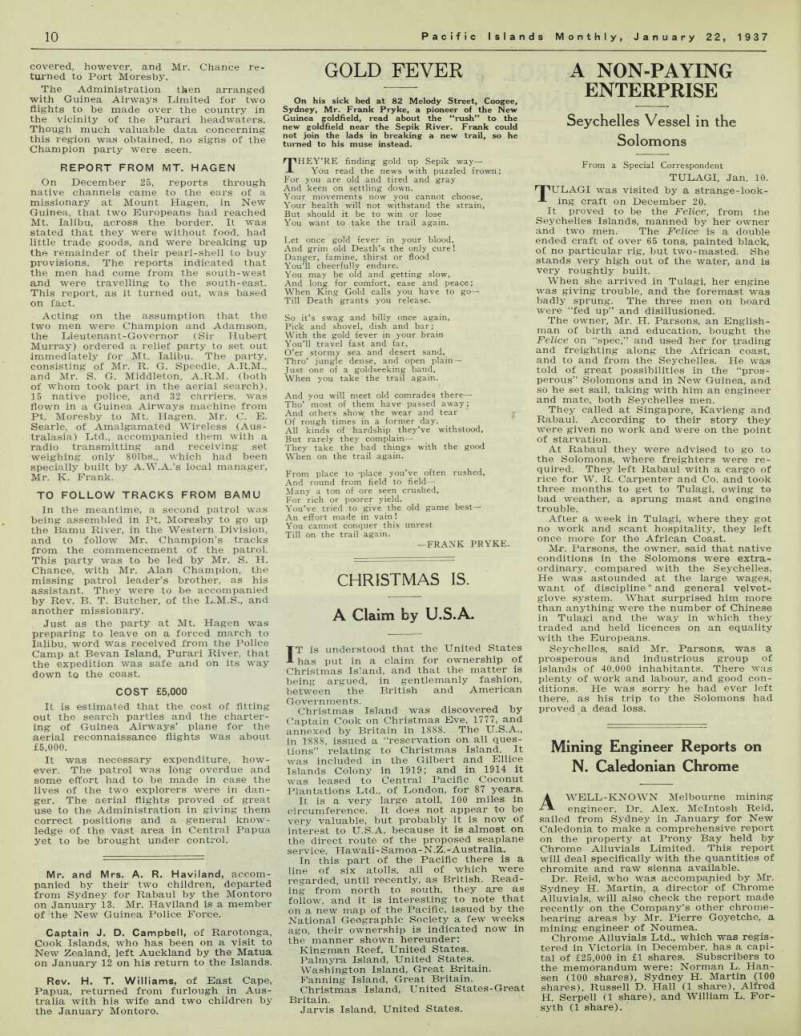
THE newly- appointed Bishop of New Guinea, in the Anglican diocese of Papua, the Right Rev. Philip Nigel Warrington Strong, reached Australia from England early in January and sailed from Brisbane for Samarai, Papua, by the Montoro on January 15.
Bishop Strong is taking over from Bishop Henry Newton, D.D., who is 70 years of age and in failing health. As soon as he is well enough to travel, Dr. Newton will return to Australia.
Only 37 years old, the new Bishop is a graduate of Selwyn College, Cambridge, and he received his theological training at Bishop’s College, Cheshunt. During the Great War he served as a second lieutenant in the Royal Engineer Signal Service.
Before his appointment to Papua, he was Vicar of St.
Ignatius’, Sunderland, Durham, for six years. During the early part of his Church career, he was curate at St.
Mary’s, Tyne Dock, and later was Vicar of Christ Church, Leeds, for five years. He was consecrated in St. Paul’s Cathedral, London, on Octo-
[Islands People Notes]
correct positions and a general knowledge of the vast area in Central Papua yet to be brought under control.
Mr. and Mrs. A. R. Haviland, accompanied by their two children, departed from Sydney for Rabaul by the Montoro on January 13. Mr. Haviland is a member of the New Guinea Police Force.
Captain J. D. Campbell, of Rarotonga, Cook Islands, who has been on a visit to New Zealand, left Auckland by the Matua on January 12 on his return to the Islands.
Rev. H. T. Williams, of East Cape,
Advertisements & other items, p. 12 (1 item)
Gold Fever (Poem by Frank Pryke)
tralia with his wife and two children by the January Montoro.
Christmas Is.: A Claim by U.S.A.
Frank Pryke.
Christmas Is.
A Claim by U.S.A.
IT is understood that the United States has put in a claim for ownership of Christmas Is’and, and that the matter is being argued, in gentlemanly fashion, between the British and American Governments.
Christmas Island was discovered by Captain Cook on Christmas Eve, 1777, and annexed by Britain in 1888. The U.S.A., in 1888, issued a “reservation on all questions” relating to Christmas Island. It was included in the Gilbert and Ellice Islands Colony in 1919; and in 1914 it was leased to Central Pacific Coconut Plantations Ltd., of London, for 87 years.
It is a very large atoll, 100 miles in circumference. It does not appear to be very valuable, but probably it is now of interest to U.S.A, because it is almost on the direct route of the proposed seaplane service, Hawaii-Samoa-N.Z.-Australia.
In this part of the Pacific there is a line of six atolls, all of which were regarded, until recently, as British. Reading from north to south, they are as follow, and it is interesting to note that on a new map of the Pacific, issued by the National Geographic Society a few weeks ago, their ownership is indicated now in the manner shown hereunder: Kingman Reef, United States.
Palmyra Island, United States.
Washington Island, Great Britain.
Fanning Island, Great Britain.
A Non-Paying Enterprise: Seychelles Vessel in the Solomons
Jarvis Island, United States.
A Non-Paying
ENTERPRISE Seychelles Vessel in the Solomons From a Special Correspondent TULAGI, Jan. 10. was visited by a strange-looking craft on December 20.
It proved to be the Felice, from the Seychelles Islands, manned by her owner and two men. The Felice is a double ended craft of over 65 tons, painted black, of no particular rig, but two-masted. She stands very high out of the water, and is very roughtly built.
When she arrived in Tulagi, her engine was giving trouble, and the foremast was badly sprung. The three men on board were “fed up” and disillusioned.
The owner, Mr. H. Parsons, an Englishman of birth and education, bought the Felice on “spec,” and used her for trading and freighting along the African coast, and to and from the Seychelles. He was told of great possibilities in the “prosperous” Solomons and in New Guinea, and so he set sail, taking with him an engineer and mate, both Seychelles men.
They called at Singapore, Kavieng and Rabaul. According to their story they were given no work and were on the point of starvation.
At Rabaul they were advised to go to the Solomons, where freighters were required. They left Rabaul with a cargo of rice for W. R. Carpenter and Co. and took three months to get to Tulagi, owing to bad weather, a sprung mast and engine trouble.
After a week in Tulagi, where they got no work and scant hospitality, they left once more for the African Coast.
Mr. Parsons, the owner, said that native conditions in the Solomons were extraordinary, compared with the Seychelles.
He was astounded at the large wages, want of discipline * and general velvetglove system. What surprised him more than anything were the number of Chinese in Tulagi and the way in which they traded and held licences on an equality with the Europeans.
Seychelles, said Mr. Parsons, was a prosperous and industrious group of islands of 40,000 inhabitants. There was plenty of work and labour, and good con-
Mining Engineer Reports on N. Caledonian Chrome
proved a dead loss.
Mining Engineer Reports on N. Caledonian Chrome A WELL-KNOWN Melbourne mining engineer, Dr. Alex. Mclntosh Reid, sailed from Sydney in January for New Caledonia to make a comprehensive report on the property at Prony Bay held by Chrome Alluvials Limited. This report will deal specifically with the quantities of chromite and raw sienna available.
Dr. Reid, who was accompanied by Mr.
Sydney H. Martin, a director’ of Chrome Alluvials, will also check the report made recently on the Company’s other chromebearing areas by Mr. Pierre Goyetche, a mining engineer of Noumea.
Chrome Alluvials Ltd., which was registered in Victoria in December, has a capital of £25,000 in £1 shares. Subscribers to the memorandum were: Norman L. Hansen (100 shares), Sydney H. Martin (100
Advertisements & other items, p. 13 (1 item)
Sterling Home Paint Advertisement
STERLING HOME
PAINT
FIMISHIMC WHITE
ALSO FOR...
BOATS, YACHTS AND
ALL MARINE WORK
RESISTS
Tropicalities
STERLING VARNISH CO., Alexandria, New South Wales TROPICAUTITIES WANDERING in the Mediterranean, American journalist Marc T. Greene met Alexander Hume Ford, the G.O.M. of Honolulu and the Pan-Pacific Union. Mr.
Greene says that Ford, although 69, has been prowling around in out-of-the-way places for the last five or six years. He went to Kabul by bus, from Peshawar, using a vise from the Afghan Minister in Tokio as a set-off to an interdict by the British in India. Ford later spent some time in Greece and then, quite recently, made for Palma, in Majorca. The Spanish war has chased all the tourist traffic out of the Balearic Islands, and the thoyght of it attracted Ford, so he settled down for a time in Majorca. • ♦ • ERROL FLYNN, who has become one of the star actors of filmdom, has told friends in Hollywood that he intends to visit his copra plantation in New Guinea on his pending trip to the South Seas. The trees, which are eight years old now, will be in full bearing in two more years. Then he expects to settle down on the plantation, never to return to picture making. Mr. Flynn made an outstanding success of the name part in the 1936 fllry, “Captain Blood.” * * • WE have taken a mean advantage of a Rosicrucian who lives in the Lower Watut, New Guinea. Rosicrucians specialise in prediction; and this gentleman kindly wrote us at the beginning of 1936, giving a forecast of the leading events of the year. The P.I.M. does not believe in prophecies—although the Rosicrucians claim nothing supernatural, but only “a scientific tabulation of human and economic tendencies.”
We kept our friend’s letter until the end of 1936; and now look back on his predictions, in the light of 1936 events. He predicted: “Gold will begin its final bow as the traditional medium of exchange, giving way to a predecessor that will be decided upon by the major nations.”—No sign of it yet.
“Real estate will boom in U.S.A,”—We have not heard of anything startling.
“War will rage throughout the Far East.” —Sorry; a complete miss. * * * TPHE British Solomon Islands Protectorate is in a happy financial position.
It has an excess of assets over liabilities of £68,000, and it has most of the excess in cash. According to a recent statement, £2475 was in the Treasury, £9325 in the bank, £3636’ in the hands of the High Commissioner, £3759 in the hands of Sydney agents, and just on £40,000 in fixed deposits. ♦ * * A BOUT a dozen residents of New Guinea have written to us about the article we published in November, “Journalistic Ethics, Judge Wanliss, and Mr. Mullaly.” Most of the writers are eager to “have a go” at Mr. Mullaly; so we hope they will forgive us if we do not publish their statements. We do not wish to carry on a campaign against Judge Wanliss or Mr. Mullaly. In attacking the judicial system in New Guinea, and the grave weaknesses which are apparent in it under Judge Wanliss, we believe we have expressed the opinion of 90 per cent, of the non-official residents of New Guinea, We can do no more. Reform in New Guinea can come only through a change at Canberra —and we can expect nothing from the present flabby control.
But the Federal general election this year will almost certainly bring about a change of Government, and out of that there may come some new policies and sound realignments in regard to Australia’s tropical territories.
A Kavieng resident, writing under a worn de plume, makes statements typical of all the letters we refer to: “I think that the administration of justice in this Territory is a menace to peace and good government. I am not going to sign my name to this. I am not game to do so. I think the majority will agree with me that if one is not a M.L.C. or something of the sort one is foolish to take chances. Trivial offences in this Territory have become dastardly crimes, without any reason that one can see. As for the Judge not being able to defend himself, I can say that some of the unfortunate prisoners whom he has bullied have been in the same plight.” ♦ * * THAT American “will o’ the wisp” newspaper man, Marc T. Greene, of whom we heard recently in South America and in Roumania, is now in Central Africa.
He wrote in November from “an oasis somewhere in the Sahara,” and he says he is glad to get away from the horrors of European civilisation —“wars, suffering and semi-starvation everywhere with nobody trying to do anything about it.”
“True, the desert has certain disadvantages,” he goes on. “The sun is hot, the nights are cold, flies are thick, and the habits of the Arabs leave something to be desired. But they are friendly enough, here in southern Algeria, where the French have ruled for 80 or 90 years. The dancing-girls, called the Ouled Noels, are not devoid of charm, having a certain resemblance to the Tahitiennes both in appearance and characteristics; and you can have all the dates you want for the asking (I mean, of course, dates of the fruit sort—in this oasis alone there are several hundred thousand bearing trees).
But it rains here about once a year and then only a spatter. The water from the springs and wells is so thick with magnesia that it tastes like a blend of the Dead Sea and the American Great Salt Lake. So maybe a European would get tired of it in time.”
Mr. Greene thought he would continue by camel—though, as he points out, the French now run motor-buses right through to Timbuctoo, and thence along the Niger 1800 miles to Fort Lamy, on the southern shore of Lake Tchad.
The Prehistoric Pacific
well-known archaelogical friend, Mr. Arthur J. Vogan, on January 12, addressed a crowded meeting under the auspices of “John o’ London’s Literary Circle,” Sydney, and described some of his discoveries in the Pacific Islands.
“I have never yet visited a new island,” he said, “without discovering something new to science. Thousands of these exquisite gems that stud the royal-purple of the Pacific are quite unknown beyond their immediate coastal-parts. I have found great figure-groups, cave-temples, ' carved human-heads and figures, ciselures of note, including a Buddha’s foot and several vastly ancient sun-dials; and inscriptions at least a thousand years old.”
The lecturer explained how the New Zealand Ma-oris (not “Mowry,” which means in their language: “Faint-hearted”) had, for ancestors, the great Ma-uria communities of Bengal, whose leader, Chandragupta, sent Buddhist missionaries into part of the Pacific about 300 8.C.; and how the Fijians came originally from Tanganyika, on the east coast of Africa, being employed by Arab traders, who were trading through the Pacific over a thousand years ago.
The well-known Boer War veteran, Colonel Jones, C.M.G., presided, and moved a vote of thanks to the lecturer. Mr.
Vogan, although nearly 78 years of age,
Advertisements & other items, pp. 13-14 (4 items)
Talkeries Music Stores Advertisement
11 Pacific Islands Monthly, January 22, 1937 RECORDS Packed Free and sent C.O.D. without extra charges.
H.M. Voice Slightly-used Portables, delivered straight to your nearest port for £3/15/- Send for Latest Record Lists
Elliott's Fruit Saline Advertisement
451 Queen Victoria Buildings SYDNEY First Thing in the Morning . . . ! f A v\ take ELLIOTT'S FRUIT SALINE Two teaspooniuls of ELLIOTT'S FRUIT SALINE in a tumbler of water as soon as you wake will make the morning a really "good morning" for you. This pleasant, bubbling, health drink quickly cools the blood, clears the head, and really peps you up.
ELLIOTT'S FRUIT SALINE acts also as a gentle, but efficient aperient relieving all Stomach and Liver ailments. It may be taken by young or old with safety.
GET
Mowbray House School Advertisement
TO- DAY . 9 Mowbray House School CHATSWOOD, SYDNEY, N.S.W. (Established in 1906.) A Boarding School for Boys. Surrounded by Spacious playing fields, on heights of the North Shore Line.
V The School Offers: A Home Atmosphere An Unrivalled Health Record A Sound Physical Mental and Moral Training.
The curriculum extends from the earliest stages to the Intermediate Examination, and provides a specially designed course of COMMERCIAL EDUCATION for boys entering a business career or work on the land.
Special provision is made to meet the requirements of boys from THE ISLANDS,
B. & S. Estate Agency Advertisement
Applications for enrolment in 1937 are now being received.
Illustrated Prospectus on Application. HEADMASTER; L. BAVIN.
B. & S. Estate Agency
| ROSEVILLE, SYDNEY
Specialising in Flat reservations, any suburb, for Island Residents
About Islands People
invited. ’Phone J 5269.
Proprietor - - Campbell M. Smith
About Islands People
Mr. A. T. Acton, who during recent years has been manager of the Levuka branch of Messrs. Burns Philp (South Sea) Co. Ltd., has been transferred to the head office of the firm in Suva. Having resided in Levuka for five years, he had done much splendid work as secretary of the Levuka Chamber of Commerce and as a committee-man of the local Bowling Club.
Towera, a London Missionary Society worker, who has been 13 years in Papua, arrived in Sydney by the January Montoro en route to his home in the Ellice Islands.
Miss C. G. Fairhall, of the London Missionary Society’s Hospital at Port Moresby, Papua, is at present spending leave in Sydney.
Mr. D. C. Harman, has been appointed secretary of the Torres Strait Hospital, succeeding Miss G. Hennessey who has resigned.
Mr. Frank Keys, of the Commonwealth Bank staff at Rabaul, New Britain, sailed for the East on holidays by the Nellore at the end of December, Rev. J. Berlin, of the Marist mission, returned to Australia in December after an inspectional visit to the Mission’s stations in Samoa, Tonga, and Fiji.
High Chief Faumuina Fiame, leader of the Samoan Mau, took up duties as Supervisor of Native Police at Apia in December.
Senor Bosch Barrett, a Spanish lawyer, arrived in Sydney from Vila, New Hebrides, by the Pierre Loti on December 27.
He is President of the Joint Court of the Condominium.
Mr. J. C. H. Perry, Seventh Day Adventist missionary at Aoba, arrived in Sydney from the New Hebrides’by the Morinda at the end of December.
Pastor F. Otto Theile, Director of the Lutheran Mission in New Guinea, returned to his home in Brisbane in December after a visit to Europe and the United States. He will shortly make a tour of the Mission’s stations in New Guinea.
Mrs. L. D. Doughty, an old resident of Fiji, died in Suva on December 23. Mrs.
Doughty, who went to Fiji from England many years ago, had lived for a long time in the lonely Yasawa Group where, since the death of her husband, she carried on a copra plantation.
Captain G. F. Zimmer, who was at one time a member of the Papuan Service and who now is goldmining on the Tiveri headwaters, returned to Port Moresby from Sydney by the Montoro on January 13, after three months’ holiday in Australia.
Mr. H. Beilby Evans, of Rabaul, returned to New Guinea in January by the Tanda. Mr. Evans is now running his own plantation on the Bainings, and is residing in Rabaul. In recent years, he has obtained practically a monopoly of the business of exporting whole coconuts to Australia.
Mrs. E. Knox, of Rabaul, arrived in Sydney from New Guinea by the Tanda on December 23 to make her home permanently in Australia. Her husband, Hon. E. Knox, Director of Public Works in New Guinea, has resigned from the Public Service and will in future be
Advertisements & other items, pp. 14-15 (3 items)
Wizard Lighting Co. Advertisement
ment in Sydney. Mr. Knox arrived in Australia by the January Nankin.
For Comfort— your home must be well lighted both by day and by night...
To those living in the tropics and deprived of city electrical facilities
WIZARD GAS
for lighting and cooking, supplies the ideal answer to a vexed problem.
SIMPLE. SAFE. CHEAP
both to buy and to bum.
Wizard Lamps (140 Candle power) light with a taper and burn for 60 hours on a gallon of petrol.
Wizard Stoves boil, bake and grill to perfection.
Home Lighting Sets from £. 14/-/-.
Stoves, Lamps and Lanterns for all purposes.
WIZARD LIGHTING CO. 283 George Street, Sydney
Wentworth Hotel Advertisement
from 61/6, F.0.b., Sydney “ The Wentworth
CHURCH HILL,SYDNEY
’Phone: BW (10 Lines) Telegraphic Address; “Mum,” Sydney Sydney’s Exclusive Hofei m Situated only two minutes from the General Post Office, Railway Station, and leading theatres. All rooms Steam-heated in Winter and Air-cooled in Summer, and equipped with Telephone, and Hot and Cold Water.
Wheeny Creek Farm (Kurrajong) Advertisement
Tariff: Room and Breakfast, from 10/8 per day; Inclusive from 18/- per day.
For full particulars apply to The Manager.
KURRAJONG . Ph _
WHEENY CREEK FARM K’jong 42 Forty-five miles from Sydney . . .
Superior modern accommodation, abundance of cream, eggs, and poultry, 5 acres orchard. Tennis, etc.
Tariff Double, £2/2/- each;
About Islands People
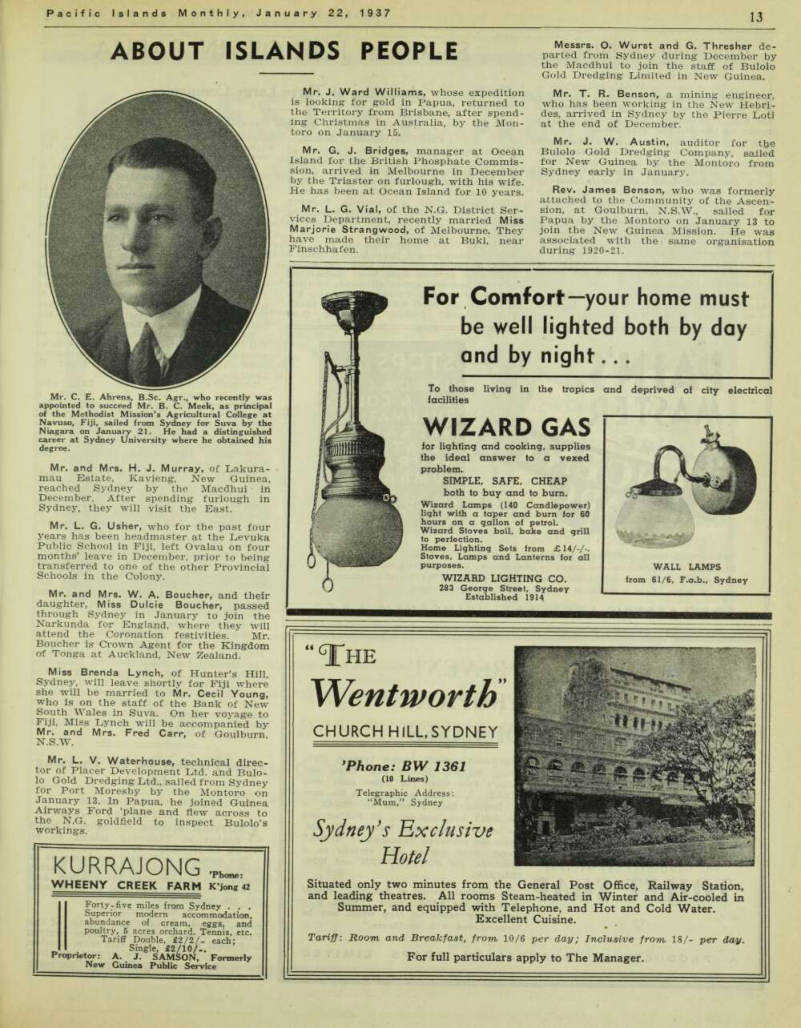
Proprietor: A. J. SAMSON, Formerly New Guinea Public Service
About Islands People
Mr. and Mrs. H. J. Murray, of Lakuramau Estate, Kavieng, New Guinea, reached Sydney by the Macdhui in December. After spending furlough in Sydney, they will visit the East.
Mr. L. G. Usher, who for the past four years has been headmaster at the Levuka Public School in Fiji, left Ovalau on four months’ leave in December, prior to being transferred to one of the other Provincial Schools in the Colony.
Mr. and Mrs. W. A. Boucher, and their daughter, Miss Dulcie Boucher, passed through Sydney in January to join the Narkunda for England, where they will attend the Coronation festivities. Mr.
Boucher is Crown Agent for the Kingdom of Tonga at Auckland, New Zealand.
Miss Brenda Lynch, of Hunter’s Hill, Sydney, will leave shortly for Fiji where she will be married to Mr. Cecil Young, who is on the staff of the Bank of New South Wales in Suva. On her voyage to Fiji, Miss Lynch will be accompanied by Mr. and Mrs. Fred Carr, of Goulburn, N.S.W.
Mr. L. V. Waterhouse, technical director of Placer Development Ltd. and Bulolo Gold Dredging Ltd., sailed from Sydney for Port Moresby by the Montoro on January 13. In Papua, he joined Guinea Airways Ford ’plane and flew across to the N.G. goldfield to inspect Bulolo’s workings.
Mr. J. Ward Williams, whose expedition is looking for gold in Papua, returned to the Territory from Brisbane, after spending Christmas in Australia, by the Montoro on January 15.
Mr. G. J. Bridges, manager at Ocean Island for the British Phosphate Commission, arrived in Melbourne in December by the Triaster on furlough, with his wife.
He has been at Ocean Island for 10 years.
Mr. L. G. Vial, of the N.G. District Services Department, recently married Miss Marjorie Strangwood, of Melbourne. They have made their home at Buki, near Finschhafen.
Messrs. O. Wurst and G. Thresher departed from Sydney during December by the Macdhui to join the staff of Bulolo Gold Dredging Limited in New Guinea.
Mr. T. R. Benson, a mining engineer, who has been working in the New Hebrides, arrived in Sydney by the Pierre Loti at the end of December.
Mr. J. W. Austin, auditor for tfce Bulolo Gold Dredging Company, sailed for New Guinea by the Montoro from Sydney early in January.
Rev. James Benson, who was formerly attached to the Community of the Ascension, at Goulburn, N.S.W., sailed for Papua by the Montoro on January 13 to join the New Guinea Mission. He was associated with the same organisation during 1920-21.
Mr. C. E. Ahrens, B.Sc. Agr., who recently was appointed to succeed Mr. B. C. Meek, as principal of the Methodist Mission’s Agricultural College at Navuso, Fiji, sailed from Sydney for Suva by the
Advertisements & other items, p. 16 (2 items)
Vincent's A.P.C. Advertisement
PA I MS MASTER Q\e*££fSi POWDERS & TABLETS 1/6 AND 2/6.
SINGLES 2d. eo.
STOPS SAFELY
HEADACHE
'FLU & COLDS
RHEUMATISM NEURALGIA
SC I ATI C A
NEURITIS LUMBAGO
AND ALL NERVE AND
MUSCULAR PAINS
Reduce temperature and relieve feverishness with Vincent's A.P.C. It diminishes the likelihood of complications and leaves no after effects. Doctors recommend it because it
Tenax Soap Advertisement
€, TENAX
THE GENUINELY GERMICIDAL
TOILET SOAP
PREVENT TROPICAL DISEASES You guard yourself against Typhoid, Diphtheria. Malaria, Dhobie Itch, Tinea and Surfer's Foot when you lather daily with TENAX. It is also invaluable in the cure of Tropical Skin Diseases, for TENAX is the ONLY soap containing oil distilled and marketed by Australian Essential Oils Ltd. under the registered trade-mark of "Ti-Trol." eleven times quicker than carbolic as a germicide, but NON-POISONOUS and NON- IRRITANT.
"The Medical Journal of Australia," official organ of the 8.M.A., says: "TENAX is a
Wau Roads Improved
recommended with confidence."
A Product Of Australian Soaps Limited
Wau Roads Improved
From Our Own Correspondent.
WAU, January 3.
IVIUCH praise is due to Acting Assistant Engineer Harslett and his staff, for the high standard of the town and district roads on the Morobe goldfield. , Within the past six months first-class roads have taken the place of erstwhile native pads and bridle tracks, which were for so long the bane of residents, as well as a detraction from the town’s natural beauty. Encouragement is now given for householders to follow suit with their properties.
At first doubts were expressed as to the durability of the road surfaces in view of the heavy rains 'experienced at Wau.
These, however, have proved groundless, and appreciation is heard on all sides of the application and keenness of Mr. Harslett and his fellow workers.
Search for Oil in Papua: Activities of Three Large Companies
tration will permit Mr. Harslett’s services to be retained in the Wau district.
Search For Oil In Papua
Activities of Three Large Companies From Our Own Correspondent PORT MORESBY, Jan. 1.
THE west of Papua, with its port of Daru, has become within the last few months a busy and important place, due to the active enterprise of the three oil companies which recently acquired large prospecting concessions between the Fly and the Vailala rivers, extending from the Gulf, through the Delta, to the Western Division.
Papuan Oil Development Co. Ltd., the first company to get busy, have already a large European staff at their command.
Surveying parties have been despatched by land, sea and air to all points of their concession, which extends from the Fly to the Purari, each with their radio plant.
The company besides operating their vessels, the Palma, Angas, and Midas, are expecting another shortly for work in western waters.
Recent additions to the staff include a surveyor and a radio engineer who arrived by the Montoro on December 11; and Messrs. P. D. Radcliffe, A. H. Baldwin, and V. W. Maxwell, who have had many years of experience in the Papuan bush. The latter are to supervise native labour, and general transport work.
By the Shell Company’s vessel Pinna, the company received on December 20, 900 drums and 300 cases of diesel fuel for the use of their ships—one of the largest cargoes of fuel to enter the port for many years. For future consignments, it is understood the Papuan Government are improving the Daru jetty, to enable the handling of cargo at that port, Mr. E. M, Bland, general manager of P.O.D’s operations in the Territory is at present in the capital, and his company’s head office has been established in Douglas Street, Port Moresby.
Island Explorations Pty. Ltd., also operating from Daru, have already a number of Europeans at work. The company has chartered the vessel Veimauri for use in connection with work up the Fly river, which lies to the north of the Papuan Oil Development Co.’s concession, and further east, to the Vailala river.
Oriomo Oil Co. Ltd. are busy at their bage camp at Kikori, and their staff of Europeans are daily extending their operations. Transport is being carried out by means of the Olive, imported to the Territory for the company’s enterprise.
That oil exists in Papua in commercial quantities has been considered a possibility for many long years, and several attempts have been made to find it on quite an extensive scale —but never before on a scale approaching the present activities. It is ardently hoped that these activities will soon be rewarded with the success they deserve.
The late Sir Edward David in an article on “The Imperial Geo-physical Experimental Survey” in the Journal of the Council for Scientific and Industrial Research for May, 1931, referring to the “vast alluvial plains of the Fly River and other rivers in Papua,” stated emphatically: “There can be little doubt that
New Pearling Co. for Thursday Island
be payable oilfields.”
New Pearling Co. for Thursday Island From Our Own Correspondent THURSDAY IS., Jan. 6.
ANOTHER pearling company is being floated at Thursday Island, to be known as Harman’s Proprietary Limited.
The concern will carry on business in mother-of-pearl shell and other marine
[Islands People Notes]
produce. The capital is £lO,OOO, and Messrs. D. C. Harman and P. H. Mendis are the principals.
Mr. Ragnar Hyne, Chief Justice of the Friendly Islands, and Mrs. Hyne arrived in Sydney by the Largs Bay from London
Advertisements & other items, pp. 16-18 (3 items)
Kriesler Radio Advertisement
14 Pacific Islands Monthly, January 22, 1937
K n IPC | CD CONCLUSIVELY
KIESLER PROVES THE
ECONOMY OF Dry-Batteryless RADIO CbmparaHve Operating C°ost \ Z&z TF&F. Z&tdrLir, fmcci Cn \ patCeAsf &ZjcUo SojtfgAjui Jhcoe\, f/O VoLtsCfP /S sn 3 *4Ajvi cUi.i.jU/ ■ batt&Juy /ife -4-sTttAj> (s>£Z/8 O = £9/40 ft*. yeaJv ■■■■! £-Jsats&wo 1 C OaXteHusS e- 3 A' 4ec/u&£i*h 4- to ° 4-^ KO/ESUQ. rfy-eoJtofojless „ Qodio oncP a f*ee P/dn KRIESU* k^i* / never 1 REALISED "B"battery REPLACEMENTS A, BatUAd JLiMaIIecL oju/eA f<yt y<*j*ec @ ■ 2/<t, f-er VC3S y ye-arS 7oCjJ n/e cost so much v- ~J
tV/TU THE DRY BATTERY y"”
TYPE OF RAO/O /I
YES Considering the cost
of REPLACEMENTS
YOU PAY OVER THE cost SET OF TUE AG A/A!
RRIESLfR,
ORT-BATTFRYLESS RADIO
.fS * SAVES YOU ALL T/HS AND GIVES GREATER.
POWER all TIME THE No more costly replacements but long hours of trouble-free and inexpensive radio entertainment.
Get the full facts about this new and sensational Kriesler development ... the Kriesler "Free" Windcharger plan ... the Kriesler "Make Good or Money Back" Policy . . . a handsome brochure and full particulars mailed you on request.
TWO NEW DRY-BATTERYLESS MODELS
460 Broadcast 470 Dual Wave
BACKED BY THE KRIESLER THREE YEARS' GUARANTEE
KRIESLER AUSTRALASIA Ltd, Cnr. Pine, Myrtle and Beaumont Streets,
CHIPPENDALE, SYDNEY
Thone M 4391 Please send me full particulars of Kriesler Dry- Batteryless Radio.
Name
Fox & Macgillycuddy Ltd Advertisement
15 Pacific Islands Monthly, January 22, 1937
WHY TAKE A RISK >
YOU CAN WITH CONFIDENCE
PLACE YOUR RADIO ORDERS WITH
Fox & Macgillycuddy Ltd The Oldest Established Radio Distributors of Completed Receivers—Parts and Accessories in Australia.
We specialise in ell sets as described by "Wireless Weekly" and full stocks of parts are always on hand. We will be pleased to quote you by return mail.
• EVERREADY BATTERIES 9
EVERREADY BATTERIES ALWAYS IN STOCK.
SUPERDYNE HEAVY DUTY LIGHT DUTY
"C" BIAS "A" BATTERIES AND TORCH REFILLS
All brands of Radio Valves always in stock, including Radiotron, Philips, Kenrad, Mullard, National
"44 Macleay Street" Private Hotel Advertisement
of residence is a matter so vital to your enjoyment!
May we commend to you for All-round Excellence . . .
SYDNEY’S MOST EXCLUSIVE PRIVATE HOTEL
"44 MACLEAY STREET" vJ Here for you awaits unrivalled Service and Cuisine —Suites with Private Baths H. & C. Water and Telephones in all rooms—Magnificent Harbour Views—Roof Garden Sun Rooms Spacious Lounges and ~ Smoke Rooms —and every S&3S:..V. (sf\ modern convenience All under Personal Supervision of the Proprietress,
MISS M. BURROWS
TARIFF; From £3.3.0 per week inclusive RADIOS: “FORTYFOR”
Farewell to the Sea: Viggo Rasmussen Retires
0
Farewell To The Sea
Viggo Rasmussen Retires From Our Own Correspondent RAROTONGA, Dec. 15.
CAPTAIN VIGGO RASMUSSEN, admirable Crichton of schooner captains, has sailed with Mrs. Viggo as a passenger on board his old command, the Tiare Taporo, bound for Penrhyn Island, where he will take up the duties of Resident Agent.
On December 11 a social evening was arranged in Captain and Mrs. Rasmussen’s honour, and in spite of the bad weather tliere was a large attendance.
During the evening Judge Ayson, C.M.G., on behalf of the Captain’s numerous friends, presented him with a cheque; and Mr. S. Bennett, representing Messrs.
A. B. Donald and Co., in which firm Captain Rasmussen has served for the past 30 years, presented a second cheque, for £l5O.
A big crowd was present on the jetty at Avatiu where the Tiare Taporo pulled out for the Northern Group, and the unanimous good wishes of the community, native and European, go with Cap-
[Islands People Notes]
tain Rasmussen into his new sphere of activity as an official of the Administration.
N.G. Goldfield Road: Would It Reduce Transport Costs?
Department in Western Samoa in December.
N.G. Goldfield Road
Would It Reduce Transport Costs?
FOR years now the construction of a road from Wau to Salamaua has been under discussion.
Parts of the road location were surveyed years ago and, as recently as twelve months ago, a graded mule track was taken out as far as the Black Cat by a Government party. There the matter rested, as far as the public were concerned, until it was learned recently that another survey on the Wau-Salamaua location had been completed.
This has given rise to speculation as to the possibility of a road being made after all. Many think that road transport would under no circumstances be able to compete with the already low aerial freight rate of a little over 2d. per pound. Others maintain that road transport would pay at as low a figure as Jd. per lb., in view of the fact that the road is alleged to be no more than 52 miles in length and the grade not exceeding one foot in eleven.
The newly-formed Morobe Chamber of Mines circularised its members early in January, and urged, “as the only means to reduce transport costs,” the construction of a vehicular road between Wau and Salamaua; and it suggested that representations be made to the Administration.
A well-known resident of New Guinea, and one of the biggest individual purchasers of freight, was in Sydney in January, and was shown the Chamber of Mines’ circular.
“A road will be a waste of public money,” he declared. “I am buying freight from -the aeroplane companies at a shade over 2d. per pound. My stuff is handled safely, and very quickly. The aerial transport companies cannot operate for less than present rates and, in any event, we cannot carry on without them.
“We want the lowest possible transport costs: but we must be fair and reasonable.
Twopence per pound is the lowest we can expect.
“I know that some of them will work it out that a road will allow goods to be brought in for a half-penny to a penny per pound. That is a delusion.
“The cost of constructing a road will be very high; and the cost of maintenance in that country will be enormous. The community will have to pay, in some shape or form, for both capital cost and maintenance. Motor transport also will itself be costly, and, in comparison with aerial transport, it will be slow and will represent much extra handling.
“If a road had been put in in the beginning, it might have given us some advantage in transport. But, with aerial transport now stabilised and giving us cheap
[Islands People Notes]
rates, there is really no need for imposing this heavy expenditure upon the community.”
Mr. R. A. L. Brown, Officer-in -Charge of the Motor Transport section of the New Guinea Administration, has been in Sydney spending Christmas furlough.
Mr. Grahame Dickson, until recently acting-manager for the Union Steam Ship Co. at Rarotonga, Cook Islands, and well and popularly known as purser on the
Advertisements & other items, pp. 18-19 (2 items)
William Finau Photographer Advertisement
Pacific Islands Monthly, January 22, 1937
WILLIAM FINAU
PHOTOGRAPHER,
FRIENDLY ISLANDS, OCEANIA
Send 5/6 for interesting views and native life scenes from Tonga.
Your money back if unsatisfied.
Kodak Advertisement
important information and photographic data: 10/6.
KO DAK No matter what kind of pictures you want, you’ll find there’s a Kodak exactly suited to your needs.
Newly released models embody so many improvements that picture-making becomes real sport now.
You’ll get such wonderfully better results, especially if you load with the new Kodak Films—Verichrome, Panatomic, and Super-Sensitive Panchromatic. 6.20 Kodak Juniors—quite the latest!
Featuring instant-opening action-front, quick sighting, and simple loading.
Amazing values f/8.8 Anastigmat Lens model with 12 special features only 39/9
WRITE FOR BOOKLETS
Of all Kodak Dealers throughout the Islands, and KODAK (Australasia) Pty. Ltd. 379 GEORGE ST., SYDNEY And all States.
Newest electric exposure meters! Illustrated above is the Sixtus—newest and smallest of modern meters. Covers apertures from f/1.4 to f/45, and lengths of exposures from 4 minutes to l/500th second. Price £6/6/- Other electric meters from .... £3/10/- *! # Just arrived from London—above NEW BOOK.
"Photography,” by Dr. Kenneth Mees!
This famous scientist covers the history
In the Good Old Bad Days: A Wanderer in Fiji a Hundred Years Ago
fascinating way. Magnificently illustrated.
Price ... 8/6
In The Good Old Bad Days
A Wanderer in Fiji a Hundred Years Ago
By Julian Hillas
ALMOST a hundred years to a day have passed since John Jackson, the son of a yeoman farmer of Ardleigh, in Sussex, sailed away from London Docks, being, in his own words, desirous of seeing “foreign countries and strange manners ."
That these modest ivishes were more than amply fulfilled appears plainly from the record of his adventures, written at the request of Captain Erskine, R.N., when employed as an interpreter on board H.M.B. Havannah in 1850.
AT the beginning of 1840, whilst cruising off the coast of Samoa, Jackson — then one of the crew of a whaling vessel— was sent ashore with a party in search of fresh provisions. Here, although hospitably treated by the natives, he was forcibly restrained from rejoining his ship, since, as the islanders explained, they wished to have a white man reside among them.
In Manua, Jackson quickly became a great favourite with the king, until on one occasion, finding a piece of meat set before him in an offensive state, he flung it away in disgust. The king at once told him that he was also pua alo or “stinking pig.”
Jackson, bent on making a day of it, slapped the Royal chops, and was only saved from instant death by the monarch himself tying a strip of sacred tapa cloth around the young man’s neck.
Shortly before his own arrival, two missionaries from Rarotonga had settled at Manua, and the work of converting the Samoans was proceeding apace. Incredible numbers of pigs were killed at the opening festivities of the new churches.
At Fitiuta, 1050 hogs were slaughtered in a single day. As a distinguished guest, Jackson’s share of these amounted to 30 hogs, with vegetables in proportion.
He was by now becoming resigned, and even fairly contented with his fate, going so far as to contemplate setting up for himself as a trader. But these notions of respectability were rapidly dissolved by the missionaries refusing to marry him to a young girl of his choice, and, discouraged by this, he tramped over the mountains to Pago Pago, where the presence of a brig had been reported.
Gaining passage on this vessel —which mounted 12 guns—he left Samoa bound for the Fiji Group. But, following the overtaking and boarding of a strange schooner that turned out to be the Mission-ship Triton, Jackson grew suspicious of the true character of the craft on which he had embarked, and, believing her to be a pirate, decided to desert at the first opportunity.
His chance came when the ship anchored off Somo Somo, in Fiji. Taking with him a clasp knife and two suits of ducks, he slid down the hawser and swam ashore, intending to remain hidden until the vessel sailed. Walking inland along the bank of a small stream, he awaited daylight and then bathed.
Whilst thus engaged, he was approached by an elderly and fierce-looking man who perfunctorily demanded his clothes. After a short argument, which terminated with Jackson leaving his knife in the old gentleman’s stomach, the former retraced his steps to the coast, where he threw himself on the hospitality of King Tuithakau, who begged him to remain at Somo Somo.
T'UITHAKAU was soon after visited by a renowned chief named Bonavidongo, or “Stinking Mahgrove,” so called on account of the great number of bodies with which he had strewn a certain mangrove swamp. Bonavidongo came to solicit Tuithakau’s help in an expedition to quell a disturbance between the people of Male, an island off the coast of Vanua Levu, and the neighbouring district of Mouta.
The king consenting, forty canoes, containing upwards of 2000 warriors, left Somo Somo. Halting for a night at the island of Rampe, they were here supplied with fresh stores, including two hundred bushels of crabs, ready cooked and strung on sticks.
On arrival at Mouta, an up-river settle- 17 Pacific Islands Monthly, January 22, 1 937 Leave
Your Personal
MEASUREMENTS for future use.
When passing through Brisbane be sure and call in at Pike Brothers—the Store for Men and their Sons since 1885. Pikes will be pleased to record your measurements which will then be useful for future requirements in made to metsure clothing.
Pike Brothers
LIMITED in Queen Street, Brisbane.
You Can Obtain . . .
ATTRACTIVE FOOD for the TROPICS from Mcl L R AT H f S
And Save Money Too
"IXL" Best Assorted Jams, 24-oz. tins (4 Doz.) 9/9 doz., 31/- case Hardman's Navy Bread (including tins and crate) 31/6 per lOOlbs.
Australian I.A. Sugar, 701 b. bags 13/- bag Australian I.A. Sugar, 3-bag lots 12/6 bag Best Fine Salt, lewt. bags 7/- bag Pyramid Fine Salt, lewt. bags 5/3 bag Best Coarse Salt, 1861 b. sacks 8/9 sack Australian Edam Cheese, 4-lb. balls 1/3 lb.
O.T. Chillie Cordial, large bots bot., 17/- doz.
"Selmore" Pineapple Cubes, 30-oz. tins ... 1/1 tin, 12/6 doz.
Saunders' Extract of Malt, 16-oz. tins 1/- tin, 11/6 doz.
Gartsides Sweet Corn, 10-oz. tins tin, 6/- doz.
"Globex” Beef Extract, 8-oz. tins 2/1 tin, 24/- doz.
Smoked Sardines, Single Layer, £-lb. tins ... tin, 4/3 doz.
Bisto Gravy Maker, 16-oz. tins tin, 16/- doz.
Write for "Globe" Ox Tongues, tins 2/9 tin, 30/- doz.
Special * Export Price "IXL" Tomato Soup, 16-oz. tins Bd, tin, 7/9 doz.
List, post free "IXL" Tomato Sauce, 10-oz. bots bot., doz.
Special Vintage Invalid Port, 26-oz. bots. .. 2/6 bot., 29/6 doz.
"Yoga" Tea, Choice Ceylon Blend, 6-lb. tins 12/- tin Prices f.o.b. Sydney
Export Department
McILRATH'S LTD. ment, they were reinforced by further allies, and a day or so later all set off together for Male.
The people of Male lived on top of a sugar-loaf mountain, to which the only means of access was a narrow path, easily defended by the inhabitants. Down this, three of the Male men now rashly ventured, dancing and hurling insults at the attackers, who promptly fired upon them with their muskets, killing all three.
The bodies were immediately collected and borne back to Mouta, each one hove into a sitting position at the bow of a war canoe. On being landed, they were painted with vermilion and soot, and placed in front of the king’s house. The tribal orator then approached and, laying his hand on their heads, asked each in turn whether he was not ashamed at finding himself in such a predicament?
Working gradually to a fine pitch of fury, the orator ended by kicking the bodies down from their formal postures.
This was the signal for the general public to rush forward and drag the corpses higgledy-piggledy over the rocks, and bushes to the temple of their chief deity.
Here dwelt an old and bearded priest who took his meals off a little table constructed from human bones. The walls of the temple were decorated with long broad strips of coloured tapa, which gave the place a serious and sacred air.
While the bodies were being dissected and prepared for the ovens, the king of Mouta, growing impatient, ordered that the ends of the noses be sliced off and, when this was done, he placed them carefully on the hot stones to cook. The first he scarcely allowed time to heat through, but the second was better done.
When he was about to eat the third, now cooked to a turn, he caught sight of Jackson looking at him, and, mistaking his glance for one of longing, generously offered him the nose-tip! Quite unconvinced by the European’s repugnance the king merely replied “different countries, different fashions,” and despatched the rejected morsel himself.
On the return of the party to Somo Somo, Jackson obtained Tuithakau’s permission to spend several months with Bonavidongo at Nateva.
IN comparison with his fellow chiefs, Bonavidongo was a moderate and enlightened man, having little use himself for the practice of cannibalism. His capital, Nateva, situated on the coast, was well fortified with wood and stone walls, outside which was an embankment almost twelve feet high and surrounded by a deep moat.
The entire top of the palace was constructed like a huge loft, and here were stored hundreds of bales of fine tapa cloth, specially woven and kept in readiness for diplomatic gifts to neighbouring chiefs.
At Nateva there was none of the ceremonial noticeable at Somo Somo, and the king lived almost as simply as any of his subjects.
Soon after his arrival Jackson accompanied Bonavidongo to collect tributary property from among the inland tribes.
At Wace Wace, a large town on their route, they were entertained lavishly, a vast heap of raw provisions being gathered immediately the visitors appeared.
Going out to inspect this, Jackson noticed a young and pretty virgin seated on the top of a great pile of yams. Her body was heavily oiled and her face painted.
But, knowing something by now of the customs of the country, he at once realised that she was destined to be cooked along with the vegetables on which she perched so gracefully.
Thereupon he began to upbraid the people, swearing at them and threatening to shoot the first who attempted to butcher the girl. Turning to Bonavidongo, he explained that it was more than he could stand “to see them eating nice young women who were so desirable alive.” At this the assembled people laughed and called out to one another that the “white man” wanted a wife.
Their remarks so exasperated Jackson that, throwing discretion to the wind, he rushed up to the heap of yams and hauling the girl down, stood with her against a nearby tree, promising to shoot any man who approached. The people, however, only laughed more loudly, adding that he had no cause to put himself in such a rage, as he was welcome enough to the girl.
On the return of Bonavidongo’s party to Nateva, Jackson carried his new wife along: and it is satisfactory to relate
[Islands People Notes]
that she proved herself both faithful and grateful to her protector. (To be concluded.) Dr. Reo Fortune, who has on several occasions carried out anthropological research in New Guinea, passed through Sydney in January to join the Tanda for Hong Kong. He has been appointed to
Advertisements & other items, pp. 20-21 (1 item)
Tooheys Pilsener Advertisement
Pacific Islands Monthly, January 22, 1 937 advt Island Idyll
Tahiti's Isolation: Vain Plea to Matson Line
Pilsener To’Ee”
Tahiti’S Isolation
Vain Plea to Matson Line From Our Own Correspondent PAPEETE, Dec. 20.
CO far as present indications disclose there is little prospect for the fulfilment of the hopes of many in Tahiti for a new passenger service between Papeete and the Pacific C oast of North America.
Tahiti once had an ideal service. The steamer Mariposa of the Oceanic (now the Matson) Line came from San Francisco to Papeete every month; remained from four to six days; and then returned to San Francisco.
When the Union S.S. Company instituted its through passenger service to the Coast, the brilliant intellects on the beach at Papeete sent the Mariposa home in ballast. When the Mariposa reached San Francisco, Mr. Spreckels (President of the Line) withdrew the vessel from the run and, it is said, took an oath that so long as the company might be in business, no ship under its flag would ever again go to Tahiti.
The said brilliant intellects lived to repent at leisure and with much gnashing of teeth. But that is another story.
Recently, the Matson Line was approached with the view of interesting it in a passenger service from San Francisco to Honolulu, thence to Tahiti, and return via Honolulu.
The reply by the Matson officials, as reported, indicates that Mr. Spreckel’s vow of 25 years ago has not fallen into desuetude.
There were bright hopes at one time that Papeete would be the “Crossroads £ S„ e no^i‘ fic i n tunate truth is that the “great circle” route from Panama to Austrklasia runs 1,300 miles south and that to the Orient far tQ the north Qf Tahiti . between' thf main Trade^routlTof thS Pacific. By grace of the Government of f™"rles ,T “S and excellent passenger to Panama and France to the East and
N.G. Airman Forced Down on Beach
Orient.
N.G. Airman Forced Down
ON BEACH From Our Own Correspondent.
WAU, January 4.
SEARCH planes went out to locate Pilot “Nobby” Clarke, of Mandated Airlines Ltd., on December 24, when he failed to return from a fight to Juni ’drome.
Inquiries at Juni indicated that he had left for Salamaua by way of the Morobe coast on the previous afternoon. As nothing had been seen of him at Salamaua a search was made of the coast.
Without much trouble, Clarke and the machine were located on December 25, on a stretch of beach. He had been forced down by engine trouble caused by choked jets, and when found by Pilot R. O. Mant. was quietly waiting for the tide to recede to permit a safe take-off.
Dutch Mountaineers' Feat in New Guinea
after the return of the rescue machine.
Dutch Mountaineers’
Feat In New Guinea
A little Dutch expedition on the remotest fringes of Holland’s great Colonial Empire, with an area 56 times that of the Netherlands (730,000 square miles against 13,214) and a population between six and seven times as great (53 millions compared with 8 millions) has just achieved a remarkable feat.
Led by Dr. A. H. Colijn, son of the Prime Minister (who had himself a distinguished career in Sumatra and elsewhere in the Indies), it has just climbed Mt. Carstens in the Snow Mountains of Dutch New Guinea.
Mt. Carstens is 16,400 feet high and takes its name from Carstens-Zoon, the Dutch navigator who was the first of Europeans, as far as we know, to see these mountains.
An English expedition under Dr. Wollaston tried to climb the range in 1912 and made friends with the Tapiro pigmies, who live on the southern slope. The attempt on the peak failed.
Dr. Colijn had the advantage of the knowledge gained by an air reconnaissance. It was, however, a fine feat, and the climb was made by men from a
Advertisements & other items, p. 22 (2 items)
Coleman Lantern Advertisement
VJ Coleman LANTERN THIS is the little Coleman Lantern with tne big brilliance. It lights instantly and is always ready for any lighting job, in any weather.
Jnst the light you need for every outdoor use on the farm, for hunting, fishing, outdoor sporti.
Has genuine Pyre?: bulge-type globe, porcelain ventilator top, nickel-plated fount, built-in pump. Like Coleman Lamps, it makes and bums its owq gas from regular gasoline. It’s a big value with years of dependable lighting service COLEMAN supplies vou with equipment to LIGHT YOUR HOME with Soft Full Radiance.
COLEMAN turns night hours for outside work into Light Hours; with kerosene or Benzine Lanterns.
COLEMAN gives the housewife added leisure when the COLEMAN IRON does the Laundry Work.
Hallstrom Refrigerators Advertisement
500 Kent St., Sydney.
KEROSENE OPERATED... allstrom refrigerators
ANNOUNCE NEW EXPORT POLICY
To enable us to obtain Full Advantage from the enormous Output Capacity of the new Hallstrom Manufacturing Plant, covering 20 acres and including the finest machinery of its type in Australia, we have decided on a policy of More Sales at Lower Prices We now offer the Model as Illustrated at £3l-10-0 F. 0.8. Sydney.
This ever popular Hallstrom model has, over a number of years, stood all tests under all conditions, and may be ordered direct from the factory, or is obtainable at the
[Islands People Notes]
new price from all branches of Burns, Philp & Co. Ltd., and W. R. Carpenter & Co. Ltd.
E. HALLSTROM, Willoughby, Sydney Mr. Edward Neil Bovill, of Tavua, Fiji (formerly of Tasmania), married Miss Sophie Joan Molloy, daughter of Mr, and Mrs. J. P. Molloy, of Suva, at the Sacred Heart Cathedral, Suva, on December 25.
Mr. V. R. Robb, New Zealand manager of the British Phosphate Commission (which works and controls the phosphate industry on Nauru Island) arrived in Sydney by the Maunganui on January
Islands Agriculture Up-to-date
mission, to confer with other executives.
Islands Agriculture Up-to-date THE following information and suggestions are offered for the guidance of planters and gardeners:
Vegetable Seeds
If little black ants run away with seeds before germination rub the seeds in your hand with a little kerosene before sowing.
Mauritius Beans
Two years ago, I warned Island growers in these columns of the possibility of not finding a market for this product. My own entire crop lay in Cairns for a year before a buyer came along and the price was very unsatisfactory.
On enquiry, I now discover that Torres Strait Mauritius Beans are selling at 16/per bushel, much less than the 1933 price, which has not been reached since, and the prospects for Island growers are not very good, as substitutes are becoming more popular. The chief of these is Giant Cow Pea, which fetches a high price—but this plant may not thrive in the tropics.
Castor Oil
A hand machine for seeding and winnowing this product is now obtainable in London at a reasonable price, and is being tried on a plantation in Papua. Without mechanical aid of this sort, it is impossible to market satisfactorily the Castor Seed, as natural de-husking in the sun is not effective.
PEANUTS There appears to be some confusion in parts of Australia about permitting peaputs to enter the country.
Recently, I proposed to ship a small consignment into a minor Australian port, but cancelled it on the advice of the Customs Department, who informed me that an embargo on oversea nuts was in existence. On referring the matter to Canberra, word came that peanuts from Papua would be admitted duty free, so, Island Planter, if you feel inclined to tackle the Australian market, there is nothing in Customs regulations to stop you.
There is another side to the question, however. I took my samples to Sydney, where a business friend commented favourably on their size and flavour. He submitted them to a crushing factory, which declined them on the grounds that, like all Islands nuts, they were mouldy.
As no mould could be seen, my friend and I compounded by referring to it as “Invisible Mould”; so allow for this in your calculations.
Avocado Pear
Reference to a recent work on tropical agriculture indicates that a great future lies before this little-known fruit, and the author appears to think that before long it will almost rival the banana in popularity and mass sales.
A tree is now fruiting on the Tambourine Mountains, in South Queensland, so there should be no difficulty in growing it in the Islands. But transport will, as usual, probably be the chief difficulty in marketing.
At present the fruit seems to be rarely offered for sale in Sydney; but, in view of the fact that a much discussed lady of the English press needs one for breakfast every morning, a greater demand may arise.
My authority states that the tree grows equally well in clay or sand, and at high or low elevations. A curious feature of the tree is that its flowers are male in the morning and female in the afternoon, or vice versa, and a judicious mixing of the two varieties must be made. This phenomenon is referred to as “Sex Reversal”; and even Kraft-Ebing has not reported a human being with the same propensities.
KAPOK Anyone interested in the difference between the price the planter gets and what the consumer pays should study the market price of kapok, which will be found in the back pages of this magazine.
Information about kapok growing appears to be lacking, and anyone embarking on its culture in Australasian tropics has to learn its idiosyncrasies by personal experience, and not from books. Certainly I have never struck anyone in Papua who really knew anything about it.
The tree appears to be particular in its choice of soil and it certainly requires a lot of moisture. As so many villages in Papua have a few specimens growing nearby, would-be growers might learn a lot by travelling round and observing in what sort of soil the best bearing trees are growing, with a view to obtaining similar conditions for their own plantation.
This is the latest thing I have heard about kapok: A young relative of mine in Australia, whose husband is a sheep-farmer in a district where nothing but sheep are ever considered, was told that the writer was ‘Going in for kapok.” Quite innocently, she remarked, “Why, has Uncle So-and-So
[Islands People Notes]
got sheep on his place in New Guinea, too?”
G.H.V. (Daru).
Mr. R. Metzger, a New Hebrides coffee planter, reached Sydney on December 27 by the Pierre Loti, on a holiday visit.
Mr. J. G. Boileau, Supervisor of Telephones at Port Moresby, has entered upon long leave prior to retirement from the
Advertisements & other items, pp. 22-23 (2 items)
N.S.W. Bookstall Co. Advertisement
Pacific Islands Monthly, January 22, 1937
YACHTSMEN AND
NAVIGATORS Our stocks of Books on The Diesel Engine, Nautical and Aeronautical subjects, are unparalleled.
Admiralty Charts and Sailing Directions for Australian Coast and Pacific Islands always available.
Write for our Nautical Catalogue and Distinctive Books—Free and Post Free.
THE N.S.W. BOOKSTALL CO. LTD.
Halvorsen Shipbuilding Advertisement
Librarians.
Market & Castlereagh Streets, SYDNEY.
J The “Halvorsen” Standard j in Shipbuilding w ) ) -V * I | Embodying the latest features in Modern Cruiser Architecture and achieving Beauty lof Line—Luxurious Comfort, Speed and Seaworthiness. This superb Craft is 50ft. in length, beam of 13ft. 6in.. and is powered by twin 36 h.p. Morris "Commodore"
Marine Engines.
We will be pleased to quote fop all types of Craft suitable for Pacific Islands commercial or pleasure service. r Write for details the renowned
MORRIS MARINE
ENGINE range of
Postmaster for 23 Years: Mr. E. E. Dunwoodie Leaves Apia
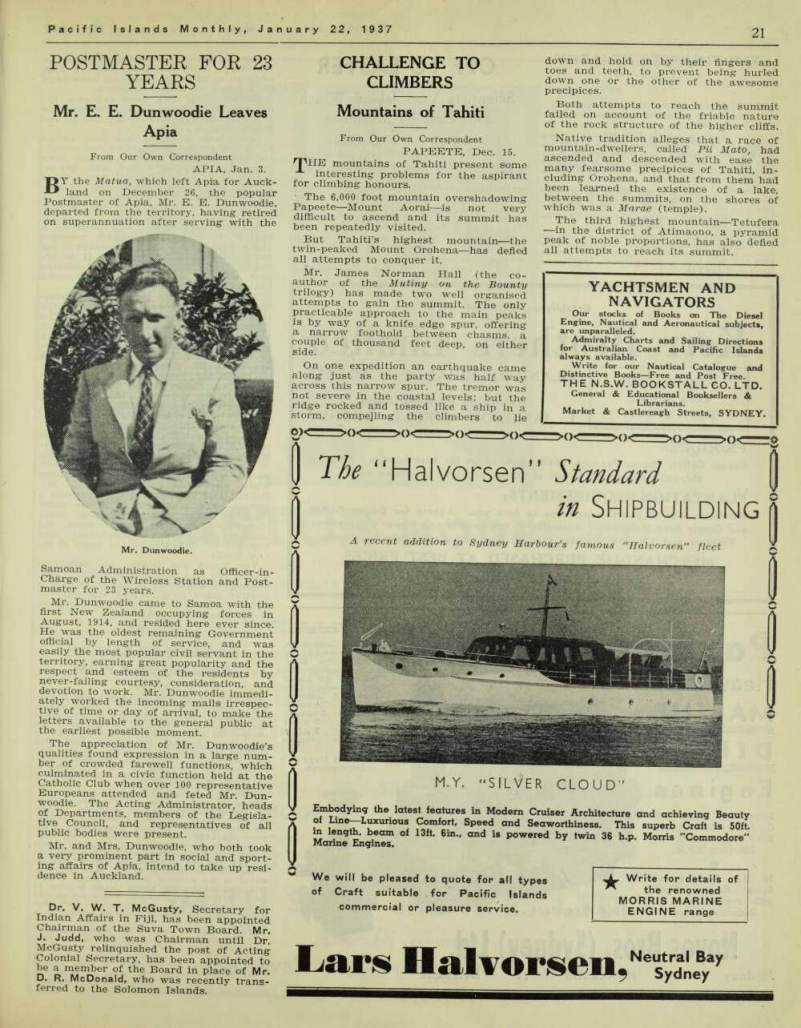
Laris Halvorsen, 1 POSTMASTER FOR 23 YEARS Mr. E. E. Dunwoodie Leaves Apia From Our Own Correspondent APIA, Jan. 3.
BY the Matua, which left Apia for Auckland on December 26, the popular Postmaster of Apia, Mr. E. E. Dunwoodie, departed from the territory, having retired on superannuation after serving with the Samoan Administration as Officer-in- Charge of the Wireless Station and Postmaster for 23 years.
Mr. Dunwoodie came to Samoa with the first New Zealand occupying forces in August, 1914, and resided here ever since.
He was the oldest remaining Government official by length of service, and was easily the most popular civil servant in the territory, earning great popularity and the respect and esteem of the residents by never-failing courtesy, consideration, and devotion to work. Mr. Dunwoodie immediately worked the incoming mails irrespective of time or day of arrival, to make the letters available to the general public at the earliest possible moment.
The appreciation of Mr. Dunwoodie’s qualities found expression in a large number of crowded farewell functions, which Catholic Club when over 100 representative Europeans attended and feted Mr. Dunwoodie. The Acting Administrator, heads of Departments, members of the Legislative Council, and representatives of all public bodies were present.
Mr. and Mrs. Dunwoodie, who both took
[Islands People Notes]
a very prominent part in social and sporting affairs of Apia, intend to take up residence in Auckland.
Dr. V. W. T. McGusty, Secretary for Indian Affairs in Fiji, has been appointed Chairman of the Suva Town Board. Mr.
J. Judd, who was Chairman until Dr.
McGusty relinquished the post of Acting Colonial Secretary, has been appointed to
Challenge to Climbers: Mountains of Tahiti
Challenge To
CLIMBERS Mountains of Tahiti From Our Own Correspondent PAPEETE, Dec. 15.
THE mountains of Tahiti present some interesting problems for the aspirant for climbing honours.
The 6,000 foot mountain overshadowing Papeete—Mount Aorai —is not very difficult to ascend and its summit has been repeatedly visited.
But Tahiti's highest mountain —the twin-peaked Mount Orohena —has defied all attempts to conquer it.
Mr. James Norman Hall (the coauthor of the Mutiny on the Bounty trilogy) has made two well organised attempts to gain the summit. The only practicable approach to the main peaks is by way of a knife edge spur, offering a narrow foothold between chasms, a couple of thousand feet deep, on either side.
On one expedition an earthquake came along just as the party was half way across this narrow spur. The tremor was not severe in the coastal levels; but the ridge rocked and tossed like a ship in a storm, compejling the climbers to lie down and hold on by their fingers and toes and teeth, to prevent being hurled down one or the other of the awesome precipices.
Both attempts to reach the summit failed on account of the friable nature of the rock structure of the higher cliffs.
Native tradition alleges that a race of mountain-dwellers, called Pii Mato, had ascended and descended with ease the many fearsome precipices of Tahiti, including Orohena, and that from them had been learned the existence of a lake, between the summits, on the shores of which was a Mnrae (temple).
The third highest mountain—Tetufera
Advertisements & other items, pp. 23-24 (3 items)
[Photo Caption: Mr. Dunwoodie]
culminated in a civic function held at the
Kerr Brothers Limited Advertisement
Pacific Islands Monthly, January 22, 1937 Established N.H. 1894 Kerr Brothers Limited PRODUCE: Cacao, Coffee, Copra, Peanuts, Shell: Ship to us for best returns. Produce shipped overseas on behalf of clients and may be drawn on.
PLANTATION REQUIREMENTS: We have over 40 years’ experience to help you. Agents for Cacao, Coffee and Castor Seed Machinery; Agricultural implements and Power Cultivators; Tractors and Trailers; Paints; Marine, Fire and Earthquake Insurance.
MERCHANDISE PURCHASED AT BEST PRICES
AND ORIGINAL INVOICES SUPPLIED
G.P.O. Box 3838 T Cable Address:
‘CARE, SYDNEY”
Noyes Bros. (Paxman Diesel) Advertisement
Heavy Duty MARINE DIESEL Ricardo Special Features Engines Range of Sizes; 1-8 Cylinders. 2|/400 B.H.P. at speeds of 300/1000 R.P.M. 30 H.P. High Speed Diesel Engine, fitted with reverse and 2:1 Reduction Gears.
"COMET” Combustion Chamber, providing Great Flexibility. Easy Starting. Invisible Exhaust at all Loads and Speeds. Low Fuel and Lubricating Oil Consumption. Big Overload capacity. O u i e t Running. Fully automatic Lubrication.
Sole Agents Noyes Bros. (Sydney) Ltd Built to Lloyd's Requirements. •*1 ■
Fiji Finances Healthy
Newcastle Brisbane
Fiji Finances Healthy
Suva, Jan. 2.
CUSTOMS revenue for 11 months ended November 30, shows an increase of £67,791 on the estimate.
Import duties brought in £376,942 —an increase of £61,150; Port and Customs service import tax totalled £25,233, an increase of £6,900. The only decrease was £259 in the Port and Customs service export tax. Total revenue was £416,583, an increase of £68,050.
Although the Colony’s expenditure has exceeded the figures for the same period of 1935 by £41,561, details of the balance of revenue over expenditure for the nine months ended September 30 show that this amounted to £83,944.
The largest item of revenue was from Customs —£332,994, compared with £283,590. Total
Off to Easter: Scientists Visit Island Which Has Lost Its Mysteries
£535,195 from January to September, 1935, a net increase of £44,144.
Off Toeaster
Scientists Visit Island Which Has Lost Its Mysteries From Our Own Correspondent PAPEETE, December 20, ANE of the largest schooners at Tahiti ” has been chartered to transport an expedition of scientists to Easter Island.
The ignorant but cynical layman pre'sumes to wonder what they will accomplish when they arrive in that “Island of Mystery.’’
The South Seas have been inundated with scientists, in small and large parties, during the past 20 years and (with the notable exception of the distinguished achievements of the Bishop Museum of Honolulu) there has been little, if any, addition to the sum of human knowledge as a result of their researches.
Easter Island has been explored, inspected, and ransacked as thoroughly as has been any locality of its size in the Seven Seas.
Everything moveable has been carted away and lodged in museums and private collections. The gigantic images have been photographed behind and before, measured in terms of millimetres, stared at, and prayed over, and reams of paper and oceans of ink have been used to record the lucubrations of the learned explorers.
The language—when it existed as a spoken tongue—was thoroughly recorded and analysed by William Churchill in his work on Polynesian dialects. It is reported that the remnant of Polynesians now existing on Easter Island speak Chilean Spanish.
The generation of elders who remembered the legends and traditions of the race has passed into the Beyond. The tablets inscribed with hieroglyphs have long since been spirited away and are available for study in various museums of Europe and America. There would appear to be, therefore, more material for scientific research and meditation away from Easter Island than on it.
We forget, however, that scientists, like myriads of lesser folk, are human.
The stuffy offices and bleak corridors of museums become monotonous.
Mr. George Follansbee Babbitt —the wealthy and generous patron of the institution —can easily be persuaded that an unknown beetle on a Polynesian island will bring fame and headlines when discovered and classified. Mr.
Babbitt also is human. He is promised a special museum bulletin, with his name in large letters on the title page, some paragraphs in the press about the Babbitt Exploration Expedition; and Coleopterus Bahbittus as the name of the new beetle.
The South Sea islands are delightful places for rest and refreshment. And, anyway, science will be advanced; for a
Growth of Famous English Jam Firm
the mysteries of the unknown.
Growth Of Famous
English Jam Firm
AWAY back in 1806 a family named Chivers commenced as farmers in a small way in Histon, the centre of the Cambridgeshire farming industry. Years of farming depression changed the family’s policy and fruit-growing was undertaken. By 1873, Mr. Stephen Chivers had extended the estate to 150 acres. It was then that his son put forward the jam-making proposition. The first boil of jam was made in a barn which still stands near Chivers’ Orchard Factory.
When the coming-of-age was reached in 1894, 400 people were employed and the floor space of the factory had increased to 60,000 sq. ft., and the farm acreage to 500. From then onwards, the firm has been growing tremendously every year. In 1923 over 2,000 employees were entertained at Cambridge, to celebrate the firm’s . jubilee, and an even greater celebration was held in 1933, the year of the firm’s Diamond Jubilee.
The Orchard Factory, as the name suggests, stands in the midst of acres and acres of fruit orchards, and the fruit grown therein is taken to the factory in fresh condition, sorted and cleaned in ideal surroundings, and in a very short time is being made into one of the firm’s world-famous products. . , Messrs. Chivers, who are the largest individual firm of fruit-growers in Great Britain, now employ 3,000 workers and the acreage has extended to over 8,000. It is their particular pleasure to state that they are purveyors _of jams, canned
Advertisements & other items, pp. 25-26 (3 items)
Astor Model 77 Radio (Smith Sons and Rees) Advertisement
Homes Without Electricity Only an ordinary car Accumulator required to | operate the I NO ‘B’ or ‘C BATTERIES ASTOR MODEL 77 (For Homes without Electric Supply) ALL ELECTRIC RADIO RESULTS WITH A CURRENT DRAIN OF ONLY 1.1 AMPS.
NO B or ‘C BATTERIES
Replacements costing 50/- each time now avoided. Ordinary battery sets use about 135 volts. An altogether new power system builds up the current from an ordinary car accumulator to high voltage (200 volts) to provide a ‘B’ and ‘C’ supply equal to that of an all-electric radio.
ALL-Electric TONE, VOLUME,
SELECTIVITY and DISTANCE
‘ FERROCART ’ IRON CORE COUPLING
SYSTEM Selectivity equal to finest 7-valve receivers. Distant stations easily separated from strong local stations.
Delayed Automatic Volume Control . . Illuminated Dial with stations marked—automatically switched off when not tuning, thereby saving battery current . . . Tone Control . . . Magnificent Cabinet of latest design with Inclined Tuning Panel.
MODEL 77 30 Gns. - MODEL 77 DW (Dual Wave) 35 Gns.
MANTEL MODEL (Broadcast Band Only) £22/10/0 (All Models complete with 6 volt Accumulator and quoted F. 0.8. Sydney) These Models are particularly suitable for Island homes. Send for illustrated leaflets.
Full range of A.C. operated receivers also available. Prices ranging from 10 to 40 guineas.
M. Harper Recruiting and Charter Advertisement
23 Pacific Islands Monthly, January 22, 1937 M. HARPER
MAN DOLI AN A ISLAND, GELA
P.O. Box 6, Tulagi, Solomon Islands
RECRUITING CONTRACTS
UNDERTAKEN
A. V. PAPARI AVAILABLE FOR
CHARTER
Delco-Light Plant (Warburton, Franki) Advertisement
PACIFIC ISLANDS MONTHLY
Union House, 247 George St., Sydney Electricity for everyone/ everywhere! with a
PORTABLE DELCO-LIGHT PLANT
F 6 Volt, (with battery, *2 Volt, 1 1_ £22/15/ in Bond, Sydney) £24/10/J To light your bungalow, your boat or camp; to charge your car, boat and radio batteries, here's a 150 watt — 6 or 12 volt—plant that operates for 8 hours on a twoquart tank filling. The plant weighs only 441b5., and can be readily transported anywhere.
SPECIFICATIONS: Engine, single cylinder four-cycle, L head, air-cooled by forced draught. . . . Dynamos, 6 pole; capacity 150 watts, voltage 812 (12 volt), B 6 (6 volt). ... Self cranking from battery through manual starting switch.
Dynamos in, each case will supply six 25 watt lamps. The 12 volt battery for approx. 9 hours. The 6 volt battery for approx. hours.
WRITE to Desk PI for full details now; the plant requires no particular skill to operate or instal, you'll marvel at its portability. *0 ft v o o Q * O o.
Cf OF CEH
[Islands People Notes]
Distributors: WARBURTON, FRANKI Ltd. 307-15 KENT STREET, SYDNEY Mr. Percy Chadderton, who has worked for the London Missionary Society at Port Moresby for many years, was recently elected chairman of the Papuan District of the L.M.S. at the Annual Assembly.
Mr. N. J. Bruchhouse, who has been a pilot with Guinea Airways Ltd. at Lae,
A Glad Good-bye to Undesirable Tourists: Tahiti's Future Based on Agriculture
position, by the Montoro on January 7.
A Glad Good-bye to Undesirable Tourists Tahiti’s Future Based on Agriculture From Our Own Correspondent PAPEETE, December 20. rise in the price of copra at Marseilles during the past two months has greatly heartened the planters in the colonies of France in the Pacific.
During the long period of low prices for copra and vanilla and the practical extinction of demand for mother-of-pearl shell, the only future for the colony of French Oceania appeared to be a development of tourist traffic from the United States and Australasia.
This had been well under way when it was suddenly extinguished by the withdrawal of the passenger steamers voyaging over the Sydney-San Francisco route.
And, at the same moment, the devaluation of the franc increased the cost of wares and foodstuffs from the usual sources of supply.
These factors have compelled a radical readjustment of the commerce of the islands. Fortunately the excellent service by the steamers of the Messageries Maritimes links the colony with the Home Country which offers—and has offered during the difficult years—the most favourable market for its products.
Credit established in France by virtue of exclusive export to that country of Island products, will tend more and more to divert buying requirements toward French merchandise. Hitherto the lower values of foreign currencies in relation to the franc have permitted imports at costs greatly under those of French manufactures.
Should the prices for copra and vanilla be maintained, and the development of the pineapple canning industry eventuate in accordance with the hopes and expectations of its directors, the colony may look with confidence to a happier future, based on its agriculture rather than on the elusive traffic from tourists.
As a matter of truth, the major number
Taxes Abolished: Important Ordinances Passed in Samoa
were of a quality that their passing can be viewed with equanimity.
Taxes Abolished
Important Ordinances Passed in Samoa From Our Own Correspondent APIA, Dec. 26.
AT a recent meeting of the Western Samoan Legislative Council, presided over by the Acting Administrator (Mr.
A. C, Turnbull), several important ordinances were submitted. Two newlyelected representatives of the Samoans, Hon. Tamasese and Hon. Tuala, took their seats on the Council for the first time.
The new Samoan representatives submitted a large number of questions referring mainly to the promised changes and concessions granted during the visit of the N.Z. Government’s “Goodwill Mission.” Answers to the questions were supplied by the Administration.
The most important features of the six new ordinances passed were the abolition of personal taxes for both Europeans and natives; the repeal of the “Samoan Offenders’ Ordinance,” dealing with political offences due to the previous unrest m the territory; the “Revenue Amendment Ordinance, 1936,” revising business license fees and reducing same in a number of instances, also making provision for the payment of fees in instalments; the prohibition of the sale and purchase of coconuts to prevent plantation thefts.
The meeting, which proceeded smoothly and in which the new Samoan representatives took an active and prominent part, concluded on December 16.
The Acting Administrator, in reply to an enquiry, stated that a further meeting would be called early in the next year to discuss various important matters now under consideration.
Mr. A. Francis (meteorologist), Mr. W.
T. Jarboe (radio expert), and Mr. M. M.
Thompson (ground engineer) are at present in New Zealand on behalf of Pan- American Airways in connection with the
Advertisements & other items, pp. 26-27 (1 item)
Waugh & Josephson (Crossley Diesel) Advertisement
24 Pacific Islands Monthly, January 22, 1937 F7* ■ in Performance 1 irSt in Preference
"CROSSLEY" DIESEL ENGINES
“CROSSLEY” DIESEL ENGINES are
manufactured in sizes to suit all requirements ranging from 5 to 2,000 B.H.P.— Vertical and Horizontal—Stationary or Marine. In purchasing “CROSSLEY” you purchase quality at its best.
Why not have the latest low cost prime mover available?
Waugh & Josephson Ltd. 311 CASTLEREAGH ST. MELBOURNE ST.,
SYDNEY STH. BRISBANE
’Phone L 3321 (8 lines) ’Phone J 1456 (4 lines) me.
Over Unknown Papua: Two Notable Aeroplane Journeys Provide Valuable Geographical Information
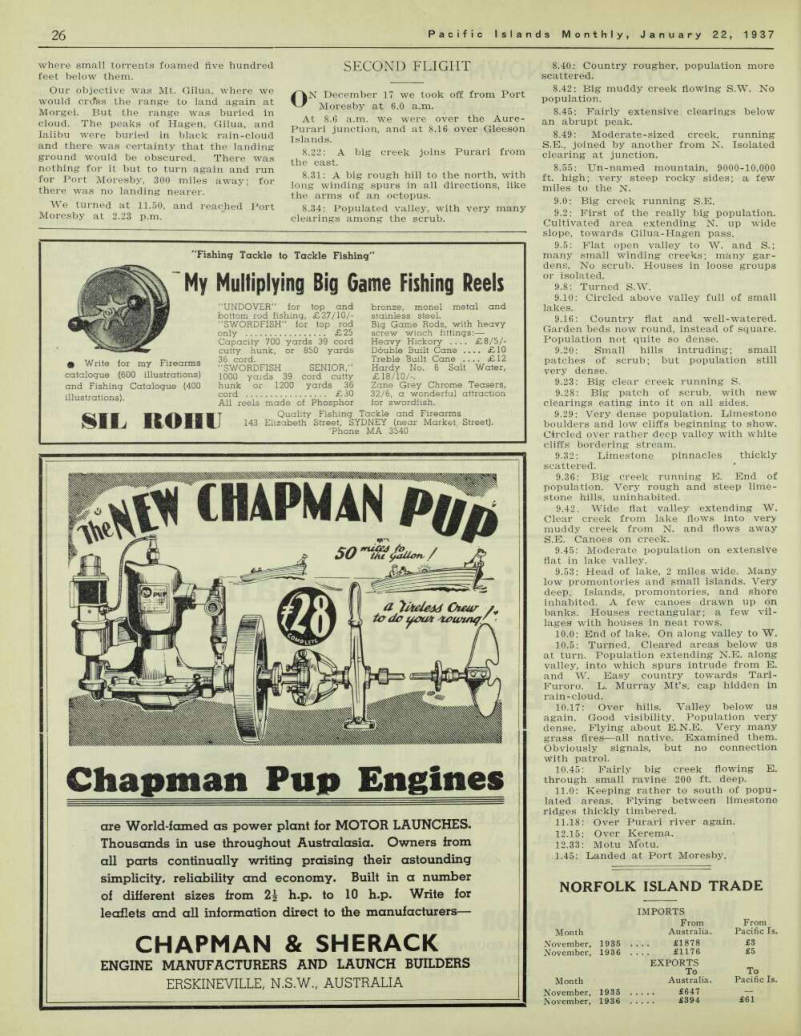
‘Crossley” Scavenge Pump Diesel MODEL DRS
Over Unknown Papua
Two Notable Aeroplane Journeys Provide Valuable Geographical Information IN the course of the search in northwest Papua, in December, for the patrol led by Messrs. Ivan Champion and Adamson, a 3-engined Ford aeroplane, owned by Guinea Airways Ltd., was employed; and two flights were made which deserve a place in the history of tropical aviation.
In the first, on December 15, the plane was continuously in the air from 9.34 a.m. to 2.23 p.m.; and in the second, on December 17, from 6 a.m. to 1.45 p.m.
These flights were over wild, unexplored country, where there was no emergency landing-ground within hundreds of miles.
Their successful completion is a tribute to G.A. pilots and mechanical staff.
Much credit for the flights must be accorded Mr. L. H. Ross, the skilful young pilot in charge. With him on the ’plane were the Papuan officers, Messrs. Speedie and Middleton (examining the country through which they expected to lead a search party) and Mr. Lewis Lett, an observer.
The data gathered on the two flights has great geographical value, as it should assist the Papuan authorities very much in filling in their maps of this rich, thickly-populated and unknown region.
The following notes of the flights have been supplied to bur Port Moresby correspondent.
First Flight
WE took off from Morgei aerodrome (near Mt. Hagen) at 9.34 a.m. on Monday, December 15.
The Ford 3-engined ’plane was very heavily loaded with a ton of extra fuel and oil in addition to the pilot and mechanic and three passengers. But she rose from the rather soft surface of the ’drome with a score of yards to spare, circled and climbed, and at 9.40 was on her course at 141 degrees (S.E.S.).
We were over the hills that rise slightly to the west of the landing ground. Houses and gardens were below us, but these gave way within the first five minutes to rugged hills, thickly covered with scrub, and a very scattered population living in small clearings on the rough hill-sides.
At 9.55 we crossed a large creek running N.E. towards the Wahgi valley.
Country rather* lessi rough, but uninhabited, and jungle very dense.
At 10.0 a.m. we crossed the border into Papua; and at 10.5 saw below us a big stream of very muddy water running S.W. through a deep gash in the line of hills.
At 10.7 a big group of steep, timbered ridges, gashed and scored with vertical gorges a thousand feet deep, showed to the south and at 10.10 open grass country opened out to the south-east.
By 10.12 we were above it. A wide and shallow valley extending round two sides of a mass of steep hills that rose to 8000 feet. A big population, living in separate houses, each in its own plot of cultivated land.
We flew to the north of the hills, still over inhabited country, till 10.20 when the populated area ceased abruptly in very rough country. At 10.22 we saw below us a big stream flowing N.E., and followed it among precipitous hills to its junction with the Purari.
Following the river down, we passed over Gleeson Islands at 10.35.
Bevan Island was reached at 10.50, and we flew very low and circled twice, searching for Chance’s camp. There was no sign of it, and we turned back towards the valleys.
Then we saw Chance’s camp on the hillside above the river, and on the river itself we saw a canoe, and dropped quickly to examine it. It contained four police and half a dozen paddlers—obviously Chance’s men returning from a reconnaissance upstream.
For half an hour we flew over the river and beyond it to the west, over extremely rough country, which culminated in a fantastic group of hills 8000 feet high, and cut up into pinnacles and sheer ravines many hundreds of feet deep.
Four minutes later we were over populated country again—the same valley that we had crossed at its northern end during the outward trip. At five-minute intervals we passed over four more valleys where the population was very thick; the last of them being in extremely steep country where the gardens were cleared on the sides of sharp spurs and on ridges 25 Pacific Islands Monthly, January 22, 1 937 Month IMPORTS 1936 Quality Fishing Tackle and Firearms 143 Elizabeth Street, SYDNEY (near Market, Street).
Chapman & Sherack
Engine Manufacturers And Launch Builders
Erskineville, N.S.W., Australia
where small torrents foamed five hundred feet below them.
Our objective was Mt. Gilua, where we would crcfss the range to land again at Morgei. But the range was buried in cloud. The peaks of Hagen, Gilua, and lalibu were buried in black rain-cloud and there was certainty that the landing ground would be obscured. There was nothing for it but to turn again and run for Port Moresby, 300 miles away; for there was no landing nearer.
We turned at 11.50, and reached Port Moresby at 2.23 p.m.
Second Flight
ON December 17 we took off from Port Moresby at 6.0 a.m.
At 8.6 a.m. \ye were over the Aure- Purari junction, and at 8.16 over Gleeson Islands. 8.22; A big creek joins Purari from the east. 8.31: A big rough hill to the north, with long winding spurs in all directions, like the arms of an octopus. 8.34: Populated valley, with very many clearings among the scrub. 8.40: Country rougher, population more scattered. 8.42: Big muddy creek flowing S.W. No population. 8.45: Fairly extensive clearings below an abrupt peak. 8.49: Moderate-sized creek, running S.E., joined by another from N. Isolated clearing at junction. 8.55: Un-named mountain, 9000-10,000 ft. high; very steep rocky sides; a few miles to the N. 9.0: Big creek running S.E. 9.2: First of the really big population.
Cultivated area extending N. up wide slope, towards Gilua-Hagen pass. 9.5: Flat open valley to W. and S.; many small winding creeks; many gardens. No scrub. Houses in loose groups or isolated. 9.8: Turned S.W. 9.10: Circled above valley full of small lakes. 9.16: Country flat and well-watered.
Garden beds now round, instead of square.
Population not quite so dense. 9.20: Small hills intruding; small patches of scrub; but population still very dense. 9.23: Big clear creek running S. 9.28: Big patch of scrub, with new clearings eating into it on all sides, 9.29; Very dense population. Limestone boulders and low cliffs beginning to show.
Circled over rather deep valley with white cliffs bordering stream. 9.32: Limestone pinnacles thickly scattered. 9.36: Big creek running E. End of population. Very rough and steep limestone hills, uninhabited. 9.42. Wide flat valley extending W.
Clear creek from lake flows into very muddy creek from N. and flows away S.E. Canoes on creek. 9.45: Moderate population on extensive flat in lake valley. 9.53; Head of lake, 2 miles wide. Many low promontories and small islands. Very deep. Islands, promontories, and shore inhabited. A few canoes drawn up on banks. Houses rectangular; a few villages with houses in neat rows. 10.0: End of lake. On along valley to W. 10.5: Turned, Cleared areas below us at turn. Population extending N.E. along valley, into which spurs intrude from E. and W. Easy country towards Tari- Furoro. L. Murray Mt’s. cap hidden in rain-cloud. 10.17: Over hills. Valley below us again. Good visibility. Population very dense. Flying about E.N.E. Very many grass fires —all native. Examined them.
Obviously signals, but no connection With patrol. 10.45: Fairly big creek flowing E. through small ravine 200 ft. deep. 11.0: Keeping rather to south of populated areas. Flying between limestone ridges thickly timbered. 11.18: Over Purari river again.
Advertisements & other items, pp. 28-29 (6 items)
[Trade Statistics Table]
From Australia.
From Pacific Is.
November, 1935 £1878 £3 November, 1936 . ... £1176 £5 Month EXPORTS To Australia.
To Pacific Is.
November, 1935 £647 — November,
Rohu (Fishing Tackle) Advertisement
£394 £61 "Fishing Tackle to Tackle Fishing" • Write for my Firearms catalogue (600 illustrations) and Fishing Catalogue (400 illustrations).
Multiplying Big Game Fishing Reels "UNDOVER" for top and bottom rod fishing, £27/10/- "SWORDFISH" for top rod only £25 Capacity 700 yards 39 cord cutty hunk, or 850 yards 36 cord.
"SWORDFISH SENIOR,"
1000 yards 39 cord cutty hunk or 1200 yards 36 cord £3O All reels made of Phosphor bronze, monel metal and stainless steel.
Big Game Rods, with heavy screw winch fittings:— Heavy Hickory £B/5/- Double Built Cane —. £lO Treble Built Cane £l2 Hardy No. 6 Salt Water, £lB/10/-.
Zane Grey Chrome Teasers, 32/6, a wonderful attraction for swordfish.
SIL IftOIIU
Chapman & Sherack Engines Advertisement
'Phone MA 3540 CHAPMAN SO’^&Un./ A Utefak! Oi£W /„ to dc you* sunvuu/ ' Chapman Pnp Engines are World-famed as power plant for MOTOR LAUNCHES.
Thousands in use throughout Australasia. Owners from all parts continually writing praising their astounding simplicity, reliability and economy. Built in a number of different sizes from h.p. to 10 h.p. Write for leaflets and all information direct to the manufacturers —
[Heading Fragment: Norfolk Island Trade]
12.15: Over Kerema.
Price's Radio Service Advertisement
26 Pacific Islands Monthly, January 22, 1937 PRICE'S RADIO SERVICE -
SPECIAL TROPICAL RECEIVER
Coil Unit hermetically sealed in brass box, Chassis Bitumastic coated, all fully impregnated against moisture, assures perfect operation at all times.
This modern 7-valve Dualwave Receiver has a waveband coverage of 16 to 55 metres and 200-250 metres.
FEATURES: ft •AI Quality Components # Octode Frequency Converter # Automatic Volume Control • Two Audio Stages # Class B Push-pull Output • Economy Valves.
CABINET A specially-treated Teak Table Cabinet houses both chassis and speaker.
PRICE COMPLETE, £37/10/- F. 0.8. SYDNEY iLuIM f
Angus & Coote Watch Advertisement
PRICE'S RADIO SERVICE
$ ANGEL PLACE .... SYDNEY AUSTRALIA
THE TIMEPIECE OF MOST PRACTICAL VALUE
FOR USE IN THE TROPICS
Stainless steel reduced to £4/19/6 £4/19/6 The science of watchmaking has achieved in this timepiece the best watch ever designed for the tropics.
It is the Angus <& Coote Indestructible Lever Stainless steel throughout is the case composed of. It shows not even a (nark of perspiration. It admits neither dust nor damp—being hermetically sealed against everything.
CUSHIONED MOVEMENT
Every part of the Indestructible movement is cushioned to withstand the knocks and shocks of every-day life.
It is warranted to give 25 years' service. Angus & Coote keep it in order free for the first two years.
Remember—not even an accidental bath will harm either this stainless steel case—or the wonderful mechanism it contains. This lever has proved itself under hard conditions. The • order ?, An< J us & Coote are able to place, mean that this watch, sold hitherto at **s/15/-, is available to you now at £4/19/6. Luminous dials 10/- extra.
How Shall New Guinea Natives Make and Sell Copra? (Letter to the Editor)
Angus & Coote Soo
George St., Sydney
How Shall New Guinea Natives Make
And Sell Copra?
Outspoken Statement by Rabaul Resident Letter to the Editor IN your recent article on the “Two Mile Limit” of Rabaul, T.N.G., it seems to me that the full facts of the trouble there are not stated. The kernel of the matter is that the natives in that area are drying their own copra and marketing it at the full market price in Rabaul. Hence these tears.
Let me begin at the beginning. The various high chiefs around Rabaul have told me that, when the missionaries first went to New Guinea, the native chiefs were not very deeply impressed with the talk of a new religion; but they realised that the white man’s ways were more conducive to comfort than were the dark man’s ways. They liked the white men’s houses, their food, their talk; thereforefor the sake of their children, whom the missionaries promised to bring up in the white man’s way, the chiefs agreed to be peaceful and accept the new civilization.
The Germans took control. Later, under directions from the then German Administrator, Dr. Hahl, a wise and kindly man, the natives in the Rabaul district cleared large portions of their land, and planted the ground with coconuts. These coconuts they watched and tended until the trees were in full bearing, hoping, as Dr. Hahl had promised them, that the produce of the palms would be the means of their civil advancement.
In 1914 the Australians took control.
Our representatives at Geneva solemnly swore to “uphold the moral and material welfare of the natives.” It is fashionable nowadays to laugh at this “scrap of paper”; nevertheless these promises were solemnly undertaken.
About 1926, the ex-German plantations were sold to the highest bidder on very easy terms, which were, to returned soldiers, five per cent, deposit, a further 10 per cent, on taking possession, and the balance spread over 20 years. Certain German freehold trading stations were also sold at this time; the majority in the Rabaul district being bought by a certain trading firm at prices ranging from a few pounds upwards. Then was introduced the two-mile limit, which meant that, within a radius of two miles in every direction of a plantation, other trading stations were closed and the native planters were forced to accept for their nuts whatever miserable trade goods the planter cared to fling to them. This in spite of the fact that under Australian law the native is the freehold owner of his ground.
In 1933 political pressure was brought to bear, and another regulation was passed, that not only tvas there to be a two-mile limit in the case of plantations, but that the two-mile limit was also to apply to the freehold trading stations, the majority of which were held by the big trading firms. This infamous regulation automatically shut down all the leasehold stations, the owners of which (returned soldiers for the most part) were turned away to starve, and the natives were denied even the wretched advantage that they had had when there was free competition for their coconuts.
The north coast of the Rabaul district was practically divided up between four planters. The trade of the Kokopo Road was virtually monopolised by one big trading firm. One of these men made it an open boast that he was clearing £BOOO a year from the trade copra—and this was during the copra depression. (There are about 5000 tons of copra from native nuts in the Rabaul district alone.) The poor natives, who should have been receiving a total income of from £ 60,000 to £BO,OOO a year for their produce, had great difficulty in finding the ten shillings head tax for the Administration. Here is one instance: At Christmas, 1935, the high chief Tingai, of Toliligap, was thrown ten sticks of tobacco (manufactured in the dens of Chinatown) and one cup of rice as payment for himself and his 13 under chiefs for thousands of coconuts. The despoiled natives began to murmur, and talked openly of cutting down their coconut palms, which were now of no value to them, onlv an encumbrance, as they were forced under penalties to cut the grass under the trees and keep the pests out. They felt their position all the more when they saw that on the white man’s plantations the kunai grass was nearly as high as the coconut palms.
At this time certain independent white people, who had always kept in close touch with native thought, advised the natives not to take such drastic action as to cut down the palms, but to build their own hot-air dryers on their own land, dry their own coconuts and market their own copra to the best advantage, that is, with Rabaul copra-buyers. The natives replied that they had no money to build dryers.
So these white residents gave them sufficient materials to erect small dryers capable of producing up to three tons of copra a week. The natives built their 27 Pacific Islands Monthly, January 22, 1937 THE REASONS WHY '"v INCE ever men have made things, this or that manufacturer or merchant has claimed that his particular product is the best for some reason or other—This is just what we claim for Fetter Marine Engines. It remains for the prospective buyer to analyse the reasons for these claims and that is why we give you here the reasons for Fetters proven superiority.
Their simplicity of design renders serious and complicated breakdowns impossible while their robust construction and great dependability make even the slightest trouble unlikely.
The moderate speeds mean less wear, longer life, and low fuel consumption with consequent economy in operation.
These are the REASONS WHY we can give you no better advice than this;— Buy a Fetter Marine Engim craft. -the popular Engine for all types of Buzacoff & Co. Ltd. 7-11 Market Street, SYDNEY 191 Sh ■ i 11 / Atomic-Diesel Semi-Diesel
Marine Engines
5 to 540 B.H.P. hot-air dryers and are now producing copra which is consistently graded by the C ? Pr S + in ? pector “ “first quality Rabaul hot-air copra. This meant that the natives at once leaped of pauperism to one of independence, as they now receive from £ 30 a week from each dryer.
When the remainder of the native planters saw undreamt-of wealth flowing into the lap-laps of the owners of the dryers, they promptly killed the pig, ta7)ihu-ed the white men’s trading stores and commenced building dryers of their own, also borrowing the money for materlal from the ow ners of the existing dryers.
The white planters and traders, now realising that their day was done, went from dryer to dryer threatening the nafives with calaboose, abusing and even striking them to force them to close down their dryers. These men were met by the natives with the blank non-co-operative policy of the tamhu. infuriated, the planters and traders appealed to General McNicoll. His Honour the Administrator inspected the dryers personally, inquired into the financing, appreciated the propriety with which the natives were behaving, and refused to interfere with the natives’ work. The high chiefs tell that this action of General McNicoll’s marks the first step forward the natives have been permitted to make since the German Administration of Dr.
Hs,hl.
Next, the natives began to say, and they had bitter reason to say so, that they had as much right to demand a two-mile limit around their plantations as did the white nominal owners of the ex-German plantations. They pointed out that, while the black men had flogging and gaol (punishments that can be compared only with those of the old penal settlements of Tasmania), pack-drill, and dozens of other things to prevent them from stealing the white men’s coconuts, the white men had had their coconuts for many years.
Then the infuriated planters and traders appealed to Canberra, spattering the name of General McNicoll with mud, but by this time the big Missions had awakened to the position and were ranging their influence behind the natives.
Canberra refused to interfere —without endangering the rights of private property Canberra cannot interfere. The native owns his ground. The white planter owns 5 per cent, of his, if he is lucky; the next greatest equity of 10 per cent, is with the big firms; and the other 85 per cent, belongs to the Australian taxpayers.
The next move of the disgruntled traders is to whip up the colour question.
There is talk of the “protection of our women and children.” Every white person who has lived in the Territory knows the silly “peeping Tom” tricks of halfgrown kanaka lads. Only an hysterical, crazy woman could stretch these sillinesses to mean “assault with criminal intent,” but for these offences the lads are flo r —ed in calaboose till their backs are lumps of bleeding flesh. I venture to say that not one in a hundred such offenders would, on such flimsy evidence, be convicted in an Australian or British Court of law. Shall I mention white men’s attacks on black women—white men with a heritage of two thousand years of civilization to strengthen their morality?
In conclusion may I point out that in this matter of the native coconut gardens lies Australia’s opportunity to prevent a repetition of the tragedy of the Australian aboriginals. Is it not better to see the New Guinea natives strong, well-fed and housed as decent self-respecting citizens, than to see them turned into poor cadging loafers begging for a tickapen from a white man? The high chiefs have kiwunged (met in council) and decided to build decent houses, buy decent food and build schools with their surplus funds.
I hope to see within the next few years the more intelligent of the natives being trained as doctors, lawyers and schoolteachers. All this is possible if the natives are allowed to receive the full market value for their produce. In the name of common humanity is this not better than to see the natives drift into a condition of apathy and degeneration, all to please a few selfish white men who have already been pampered by moratoriums and kept afloat by financing until they are far too big for their boots.
Editorial Note (Response to Dorothy Fay's Letter)
Dorothy Fay.
Walaur, Rabaul, 4/l/’37.
Editorial Note.
MRS. FAY makes a number of statements that are open to serious challenge; but she has had the courage to write over her own name, and therefore we must give her the opportunity of making her contribution to this very important discussion.
The weakness of Mrs. Fay’s case—and it is almost a fatal weakness —is her assumption that practically every planter and trader is trying to exploit the natives, and that all traders are in a kind of conspiracy to keep the dark people in ignorance and subjection. This definitely is not a fact. The great majority of planters and traders in New Guinea are men of good type, with enough vision in public affairs to realise that there rests upon them an obligation to assist the Admin- 28 Pacific Islands Monthly, January 22, 1 937
The Scots College
Bellevue Hill, Sydney
Boys' Boarding and Day College (Presbyterian) with Preparatory School.
Principal: A. K. ANDERSON, M.A.
A Great Public School of N.S.W. Staffed with nineteen Masters. Professional, Commercial and Pastoral Courses.
Prospectus on application to Principal or Bursar. |Vj UCH that comes down to us from the past is of a quality that can be described only as truly rare DEWAR’S is the classic instance among whiskies.
Dewars Lae
Scotch Whisky
K 8998 istration in every way to raise the standard of living among the natives.
That there has been exploitation of the New Guinea natives, in both commerce and industry, is beyond doubt. They have been, on occasions, tricked out of their copra, fobbed off with outrageous rubbish as trade goods, and literally enslaved as labourers on plantations and mines. But the men responsible for those outrages are not numerous —the great majority of traders and employers conduct themselves with some sense of decency.
The Administration is to blame, first, in permitting rather too many rogues and sadists to remain in the country, in contact with the natives; and, further, in not having sought or secured from planters and traders a much larger measure of co-operation in regulating trading conditions between whites and blacks, and in preventing exploitation.
Mrs. Fay’s letter is valuable because it so clearly and forcefully sets forth the case for the natives. Its presentation may be fatally coloured by prejudice and a lop-sided vision; but, nevertheless, one must give homage to people, whether they are right or wrong, who fight on the side of the down-trodden.
Notes from the Cook Islands
constant watchfulness can do no harm.
Notes From The Cook
ISLANDS From Our Own Correspondent RAROTONGA, Dec. 10. /CLAIMS arising out of the fruit abandoned last September at Atiu and Mauke, when the Matua was obliged to return hurriedly to New Zealand without visiting those islands, have been settled reasonably, and even generously, by the trading firms concerned.
Fruit in the outer islands is bought strictly subject to shipment. Thus, in the present case, the traders would have been well within their legal rights in refusing all or any payment to the local growers who, had their fruit been shipped, would have been entitled to receive 2/- per case.
As it is, the traders have offered payment at the rate of 1/- for the fruit, plus cost of cartage and other labour charges. In addition, a number of growers have obtained employment in emptying the abandoned cases into the sea.
According to information supplied by the two companies involved, direct losses amount to well over £l,OOO, being at the rate of 3/9 a case, of which the Auckland Fruit Merchants have borne a share to the extent of 2/- per case.
Penrhyn And Manihiki
After five weeks’ absence in the Northern Group, the Resident Commissioner recently returned to Rarotonga by the Tiare Taporo.
Judge Ayson reports that sites for the new leper isolation camp and wireless station in Penrhyn have been selected and that work on them will begin immediately.
At Manihiki the erection of the wireless station will be in the hands of Mr. L. H.
Trenn, who has just taken up his duties as Resident Agent there.
“Anti-Cohabitation"
Unofficially reported was a statement by one of the schooner’s crew to the effect that a body, representative of local church interests, approached Judge Ayson with a view to securing for Penrhyn similar anti-cohabitation” laws as now exist in some of the Lower Group islands.
If this was so, it is to be hoped that a careful enquiry will be made, to ascertain whether the desire for such a law is unanimous, or simply the wish of a small but organised minority.
Two Parties Of Eighty
During November two large teres, or parties of visitors, reached Rarotonga.
Each consisting of approximately equal numbers they were, however, both in their objective and behaviour the antithesis of one another.
Eighty-six young Aitutakians, members of the C.l.’s Sports Association, arrived almost simultaneously with eighty sober Seventh Day Adventists—representatives from that denomination’s churches throughout the Group. To house them, an enormous kikau or palm-thatch tabernacle had been erected at Titikaveka and, during the ensuing week, services were held in this thrice daily, interspersed with illustrated lectures and other serious entertainment—since all forms of dancing, a great deal of food and most sports are actively discouraged.
Meanwhile, each district vied with its neighbours in welcoming the Aitutaki visitors who, after playing matches during the day, feasted and danced at night.
The Sports Party returned home last Saturday with the very material satisfaction of having beaten their hosts in both the Rugby Football and Cricket Test Matches.
An Artist At Work
Visitors to Rarotonga will no longer be able to complain that our lovely views can only be carried away in photographic form. Mr. “Alepha” Ulfsby, a young Norwegian with seven years’ experience as a trader in the Group, is now devoting his full-time to water-colour paintings of local scenery.
His work is characterised by a distinction of detail and a veracity of colouring which come as a pleasing relief after the
Lea & Perrins' 7T C Jti
LEA & PERRINS' H.P. Sauce Each Cake is Enclosed, by special process, in air-tight tin, and is warranted to keep its condition for a considerable period “blaub and daub” surrealists whose conception of a South Sea Island often ap-
Advertisements & other items, pp. 31-32 (2 items)
Prescott Ltd Advertisement
29 Pacific Islands Monthly, January 22, 1937 PRESCOTT LtP syd^ney * Q7 l <s sole wholesale
PINEAPPLE BACON & HANS
DAISY BRAND BUTTER
Swallow & Ariell's Canterbury Cakes Advertisement
and iMost other Super-Quality Lines of the Trade Swallow Cr Ariell's
WORLD RENOWNED
Canterbury Cakes
[Islands People Notes]
pears to the uninitiated uncommonly like a row of fantastic feather-dusters upended in a sand bank.
Mr. W. Smith, who was admitted to Wau Hospital suffering from blackwater fever, died on December 19.
On her annual extended cruise for training purposes, the California State, operated by the California Nautical School under the California and United States governments, arrived in New Zealand on December 21, via Papeete,
Gold in the Solomons: New Mining Laws Open Way for New Industry
San Francisco.
Gold In The
SOLOMONS New Mining Laws Open Way For New Industry NEW mining regulations for the British Solomon Islands were published at the end of November, and it is now expected that there will be fairly rapid developments in the gold mining industry there.
Gold has been found in various localities in the Solomons for many years, but special interest has been centred during the past three years in the gold-bearing region around Berande, on the northern coast of Guadalcanal.
A local syndicate, which included most of the leading traders in the group, carried out prospecting operations in the Berande district some two or three years ago. Then the syndicate merged its interests in the Pioneer Expedition N.L., which has its headquarters in Sydney.
An engineer, Mr. A. J. Ault, of the Pioneer Company, has been at work in the Berande district for a considerable time, and he appears to have great confidence in the field. A good deal of developmental work has been done —a road for motor trucks has been constructed from Berande for some miles inland.
The absence of necessary mining laws has held up the operations of the Pioneer Company; but the recent gazettal of the new regulations paves the way for greater activity. It is understood that a good deal of machinery is already on the way, or ordered.
If the gold industry is to be established in the Solomons it should mean a good deal to this Cinderella among the Pacific territories. Hitherto the Solomons have been merely a copra-producing group— and, seemingly, a place where pessimistic planters sat and called down maledictions upon the heads of omnipotent officials who, they point out, never had their salaries reduced even during the depths of the depression. As a matter of fact, the depression wiped out a large number of independent planters, their plantations being surrendered to the big trading firms which had advanced money on them.
The establishment of a mining field at Berande would offer a unique opportunity to some enterprising person to provide a hotel at Tulagi. There has been no hotel there since the old hostelry was destroyed by fire a couple of years ago. Tulagi is 21 miles by sea from Berande. It is suggested in some quarters that the hotel should be built at Berande.
[Islands People Notes]
If the field fulfils its promise, however, there will be plenty of room for new hotels at both Tulagi and Berande.
Mr. J. A. Thurston and Mr. M. P.
Curtain, Australian mining engineers, who have been prospecting in the Wewak area, Northern New Guinea, returned to the Territory to continue their activities by the Macdhui from Sydney on December 22.
Mr. L. D. Hopfield, of Oaklands, U.S.A., who has been in New Guinea for some time supervising the erection of Bulolo Gold Dredging Limited’s new dredges,
Advertisements & other items, p. 33 (1 item)
H. Jones & Co. Advertisement
Darlington, Sydney Hobart, Ta*.
For— Fresh Fruit, Vegetables, and Produce Islands Residents can rely on the old-established Shipping Providers: CVW' S Only Address: 421 Sussex St., SYDNEY All Orders Promptly Attended.
Islands Agents NELSON & ROBERTSON LTD. % A new, simple lid for your convenience; a new ; patented parchment seal to ensure perfect freshness.
AUNT MARY'S
BAKING POWDER
T MAR PO Send 1/- plus 2d. postage to Tillock and Co.
Death of N.G. Patrol Officer: Result of Arrow Wound in Lung
It’s the best.
Death Of N.G.
Patrol Officer
Result of Arrow Wound in Lung THOMAS Alfred Hough, a Patrol Officer in the New Guinea Administration, who was admitted to Salamaua Hospital on December 11 with an arrow in his right lung, died on December 20.
He was 23 years of age.
Hough, with a party of native police, was seeking a native murderer in the semi-controlled country near the Leron River, in the Markham River district. On December 7 a large body of natives ambushed the party. In driving off the attack the Patrol Officer was severely wounded by an arrow and by spears. Four hostile natives were shot.
His police “boys” carried Mr. Hough to the Lutheran Mission station where the missionaries took him in their aeroplane to Salamaua Hospital.
A well-equipped police party under D.
O. Taylor and A. D. O. Roberts was sent out to the Leron area to arrest the savages connected with the murderous attack.
Early in January, Mr. Roberts returned to Salamaua with a native alleged to be
Vale, "Tommy" Hough!
again for Leron to escort other natives said to have been implicated in the affray.
Vale, “Tommy” Hough!
By W.C.G.
EARLY in 1933, while I was doing ethnographic work at Tatau, in the Tabar Islands group of the Mandated Territory of New Guinea, I received a letter from a young teacher in Queensland.
A recent graduate of the Teachers’
College at Brisbane, the lad told me of his ambition to take up life amongst the natives of New Guinea, and enquired of me (because of some articles of mine which he had recently read) how he might set about preparing himself for a possible opportunity.
The characteristic note of the letter was one of sincerity, and I pictured the lad as a clean-minded, decent fellow prepared to work earnestly and assiduously towards furthering his ambitions.
The letter bore the signature “T. A.
Hough.”
I lost no time in sending him a wellconsidered reply, advising him to seek an administrative cadetship when applications were again called, and suggesting certain literature dealing with the Territory and its people which he might immediately read. Subsequent occasional correspondence with the lad showed his interest in the native to be ever widening, and I was not surprised to learn of his being one of the 1200 applicants for cadetships in 1933.
Twelve were selected, and Hough, being placed about number 18 on the list, was disappointed. But not for long! For my next letter from him, received while I was camped at Buki, near Finschhafen, told me of his success.
Soon after his arrival in the Territory with Cadet T. Aitchison, he called at Buki in the Government schooner Wandera about the middle of 1934, to find me away down the coast. My “boy” told me about the visit of this “long fella master, ’e young fella Kiap; good fella man too much.”
I was not to meet “Tommy” Hough until May, 1936, when the cadet group was present at some lectures I gave to the anthropology course at Sydney University. And I was not disappointed at meeting him. He turned out to be a clean-cut, tall, keen young gentleman, a fine type of the Australian secondaryschool product.
We spent an hour or two together in my room, while he told me of his interesting experiences around the Morobe hinterland, and showed me some of his excellent photographs of native life.
When I came away, to return to Melbourne he was at the train to see me off, and I could not but feel then that Thomas Hough would always prove worthy of the high standard and fine tradition that characterises the New Guinea service of to-day.
He returned to the Territory in August —straight to the hinterland from the lights of Sydney. And now comes the stark announcement of his death from a treacherous native arrow within a few short months of our parting.
[Islands People Notes]
Adieu, “Tommy”; like so many other good fellows you have answered New Guinea’s insistent call.
Mr. H. Brown, chief inspector of Government electrical undertakings at Suva,
Advertisements & other items, p. 34 (2 items)
Trufood Recipe Book Advertisement
Get your COPY the
NEW TRUFOOD
RECIPE BOOK
•9 specially tested recipes— all kinds of new ideas for attractive things to cook cakes, pastry, puddings, custards, desserts, savouries, sauces, etc.
POST THIS COUPON TODAY
Recipe Department*’ c/- Box 4267 Y, G.P.0., Sydney.
Please send me POST FREE, a copy of The Tm/ood Book ef 99 Tempting Recipes
R.M. Hardy's Indigestion Remedy Advertisement
Address {MU of Plane Falls Lives Lost “No apparent mechanical faults found.”
Could the Pilot have been paralysed with the gripping, agonising pains of stomach disorder?
Read This: Colonel J. Stacey 31 Erskine Street Sydney, N.S.W.
Dated February 10, 1933.
Mr. R. M. Hardy, Hardy’s Chambers, 5 Hunter Street, Sydney, N.S.W.
Dear Sir,—Some three months ago I was very ill caused by severe ’Flu and Nervous Breakdown. I suffered intense pains in the stomach, my condition was serious for over a month and getting worse.
I was advised to try your Indigestion and Stomach Remedy, and after ten days’ treatment all pains were gone and my nerves became normal.
I regained my health, and feel that your Remedy is all you claim for it.
Yours truly,
CO LO N E lT" JSTAGEY
■y c \
WHY RISK YOUR LIFE?
take R.M. Hardy’s Indigestion and Ulcerated Stomach Remedy Obtainable at All Burns, Philp & Co. Store*.
"Closed Districts" in G. and E.
Pains
“Closed Districts” In
G. And E.
A GAZETTE issued in Suva in December contained a new ordinance to provide for the declaration of closed districts in the Gilbert and Ellice Islands Colony.
It has been enacted that the High Commissioner for the Western Pacific may by proclamation declare any part of the Gilbert and Ellice Islands to be a closed district, and no person may enter a closed district except natives of that district; Government officials acting under orders; and licensees.
The Resident Commissioner of the Gilbert and Ellice Group has authority to grant licenses to persons to enter closed districts under conditions which he may lay down.
[Islands People Notes]
The purpose of the new law is not clear from the terms of the ordinance as published, Hon. F. R. Charlton, Commissioner of Lands in Fiji, and a member of the Legislative Council, arrived in Auck-
Rearrangement of N.D.L. Shipping: New Guinea and Solomons
Dominion on a holiday and business visit.
Rearrangement Of
N.D.L. SHIPPING New Guinea and Solomons TOURING the month, Messrs. Gilchrist, Watt and Sanderson Limited, Sydney agents for the Norddeutscher Lloyd shipping company, issued a new timetable, which shows the new arrangements for carrying on the N.D.L. shipping service between Hong Kong and New Guinea and the Solomon Islands.
Formerly, two steamships, the Bremerinaven and the Friderun, ran between Hong Kong and numerous New Guinea and Solomon Islands ports on a regular schedule. The new shipping law in New Guinea, however, forbids oversea ships to call at small ports in New Guinea—they are restricted to “proclaimed” ports (see P.I.M. of December). This made a reorganisation of the service necessary.
The Bremerhaven has been taken over from the N.D.L. by interests connected with Messrs. Colyer, Watson and Company of Rabaul, and a company for this purpose has been formed under the name of Inter-Island Shipping Co. (Pty.), Limited.
The vessel has been placed under the British flag and registered as the Island Trader. She will operate only between New Guinea ports in future and will connect regularly with the Friderun at Rabaul.
The Friderun will maintain a sevenweekly service between Hong Kong, the “proclaimed” ports of New Guinea (where she will connect with the Island Trader), and Tulagi and a number of small ports in the Solomon Islands.
The Friderun will leave Hong Kong on the new service on February 13 and the Island Trader will commence her new inter-island service when she sails out of
The Missions in Papua (Letter to the Editor)
Details of the new timetables are published in our shipping columns.
The Missions In Papua
Letter to the Editor I READ with interest “Old Trader’s” re-' marks about the operations of the missions in Papua. I would like to say that although I have been in Papua for over 20 years, I have yet to learn that the Roman Catholic Church does what he says. Even supposing such be the case, it would be in order, because it is done by other missionaries. This I can verify.
My own experience of the Roman Catholic Missions is that they do not run after the natives. If the natives go to the missionaries they are more than welcome; and, then, perhaps, they are told that it is the only true mission. Everyone thinks his own crow is the blackest.
My experience is that it is the different day of worship that is the cause of most of the little differences.
You will notice I don’t use a nom de plume.
I am, etc.,
[Islands People Notes]
A. W. Miles.
Aroma,, Papua.
Dec. 13, 1936.
A party of six Fijian scouts and six Indian scouts from Fiji arrived in New Zealand by the Niagara on December 21.
Representing six troops they will spend a month in New Zealand touring and
Advertisements & other items, pp. 34-35 (3 items)
Kork-N-Seal Advertisement
Pacific Islands Monthly, January 22, 1 937 Kork-N-Seal
FOR HOME USE
FOR ALL HOME BOTTLING
—THE LITTLE CAP THAT
will Re-seal 1,000 Times
Weymark & Son Advertisement
Applied Airtight Pressure Proof We are \ ’Phones: MA 3612 (4 lines) Cable Address: “Weymarkson”
Codes—Bentleys Private Specialists...
Let us have your confidence. Sixty years is our record of supplying the leading Houses throughout the World in ... .
FRESH FRUIT, VEGETABLES, PRODUCE
Chivers & Sons Advertisement
14-18 STEAMMILL STREET SYDNEY CHIVERS
FAMOUS ENGLISH PRODUCTS
CANNED ENGLISH VEGETABLES
CANNED ENGLISH FRUITS
OLDE ENGLISH MARMALADE
GOLD MEDAL JAMS
JELLY CRYSTALS, ETC.
Obtainable from all leading Grocery Stores
WRITE TO DEPARTMENT “A”
CHIVERS & SONS LTD.
Histon, Cambs., Eng.
FOR ATTRACTIVE RECIPE BOOK
c<. mi iCHWER* CO LD standard PRESH s,\\ ENGLISH Sa\ PEAS m m
Monument to a French Soldier
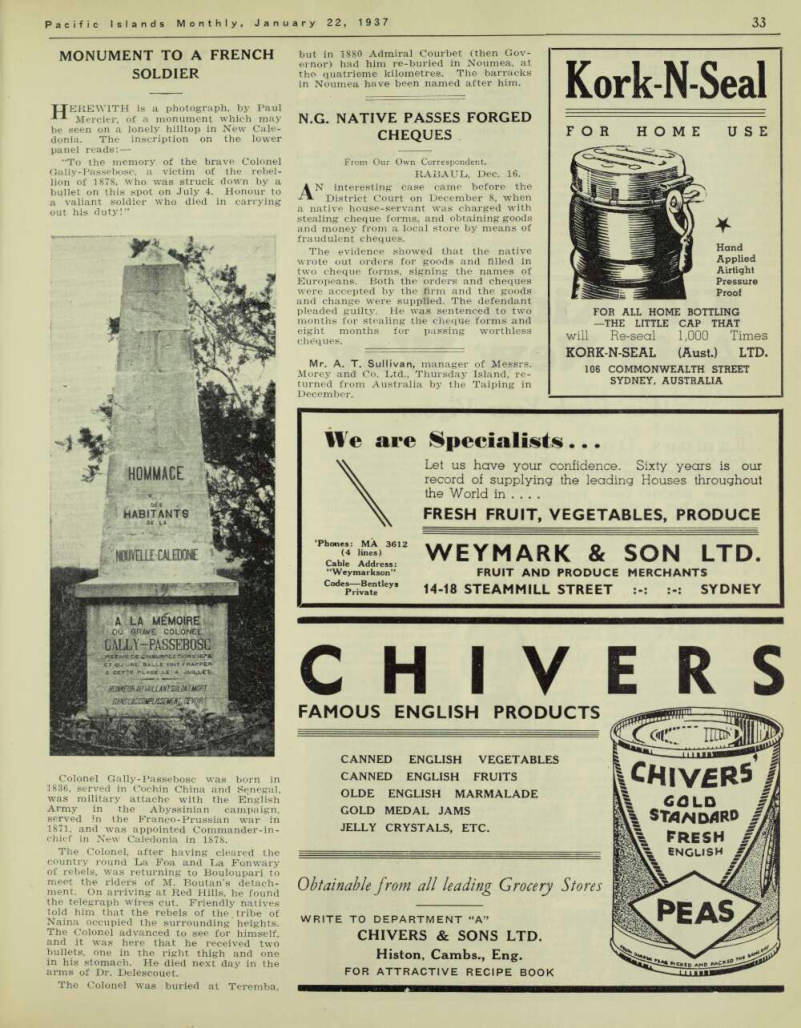
and pa£K*£
Monument To A French
SOLDIER lIEREWITH is a photograph, by Paul Mercier, of a monument which may be seen on a lonely hilltop in New Caledonia. The inscription on the lower panel reads: “To the memory of the brave Colonel Gally-Passebosc, a victim of the rebellion of 1878, who was struck down by a bullet on this spot on July 4. Honour to a valiant soldier who died in carrying out his duty!”
Colonel Gally-Passebosc was born in 1836, served in Cochin China and Senegal, was military attache with the English Army in the Abyssinian campaign, served in the Franco-Prussian war in 1871, and was appointed Commander-inchief in New Caledonia in 1878.
The Colonel, after having cleared the country round La Foa and La Fonwary of rebels, was returning to Bouloupari to meet the riders of M. Boutan’s detachment. On arriving at Red Hills, he found the telegraph wires cut. Friendly natives told him that the rebels of the,tribe of Naina occupied the surrounding heights.
The Colonel advanced to see for himself, and it was here that he received two bullets, one in the right thigh and one in his stomach. H© died next day in the arms of Dr. Delescouet.
The Colonel was buried at Teremba, but in 1880 Admiral Courbet (then Gov-
N.G. Native Passes Forged Cheques
in Noumea have been named after him.
N.G. Native Passes Forged
CHEQUES From Our Own Correspondent.
Rabaul, Dec. 16.
AN interesting case came before the District Court on December 8, when a native house-servant was charged with stealing cheque forms, and obtaining goods and money from a local store by means of fraudulent cheques.
The evidence showed that the native wrote out orders for goods and filled in two cheque forms, signing the names of Europeans. Both the orders and cheques were accepted by the firm and the goods and change were supplied. The defendant pleaded guilty. He was sentenced to two
[Islands People Notes]
months for stealing the cheque forms and eight months for passing worthless cheques.
Mr. A. T. Sullivan, manager of Messrs.
Advertisements & other items, pp. 35-36 (1 item)
Cystex Advertisement
Pacific Islands Monthly, January 22, 1937 Kill Kidney Acid New Way Win Back Your Vigour Famous Doctors Tell About Successful Prescription That is Ending Kidney and Bladder Troubles and Making Men and Women Feel 10 Years Younger Through New Health and Vigour Brought by Gleaning Out the Kidneys.
You need not suffer another day from Kidney troubles and Bladder weakness, thanks to a remarkably successful prescription prepared especially to end these troubles, and which now may be obtained at any chemist’s.
Doctors and scientists say that there are nine million tiny, delicate tubes or biters in your Kidneys which must work every minute of the night and day, cleaning out Acids, Disease, Poisons, Germs, and Waste from your blood, or slowly but surely your body becomes poisoned and you can’t possibly feel well. Your blood circulates through your kidneys 200 times an hour and if your Kidneys and Bladder do not do their work you are certain to feel old before your time. Tired, Run-Down, Nervous, and suffer from Getting Up Nights, Rheumatism, and many other troubles.
If Kidney troubles or Bladder weakness cause you to suffer from serious symptoms such as Loss of Vigour, Getting Up Nights, Backache, Leg Pains, Nervousness, Lumbago, Stiffness, Neuralgia, Sciatica, Rheumatism, Dizziness, Dark Circles Under Eyes, Headaches, Frequent Colds, Burning, Smarting or Itching, Acidity, you can’t afford to waste a minute and take chances with dangerous delay. You should start taking the Doctor’s prescription called Cystex (pronounced Siss-tex) and see for yourself how q uickly it helps nature correct these troubles.
Cystex is not an experiment—it is a Doctor’s discovery—quick and sure in action —it has been tested and proved in millions of cases throughout the world and thousands of Doctors recommend it daily. For r»r t* I Rasfpin instance. Dr. T. J. Rastelli, Dr. I. J. Kastell > m.D..8.5c., 0f Kensington, i 4 * London, England, writes : ‘‘Cystex Is one of the finest remedies I have ever met with in my long years of medical practice. Any fair-minded physician will at once recommend it for its definite benefits in the treatment of many common kidney and bladder disorders. Cystex counteracts the excess acidity, relieving the uncomfortable sensations within a very short time. It flushes out the kidneys and bladder and is safe and harmless.” Cystex is the prescription of a doctor with nearly 40 years of experience, and is prepared especially for Kidney and Bladder troubles. It starts work in 15 minutes to tone, soothe, and heal raw, sore Kidneys and Bladder, and brings a new feeling of health, youth, and vigour in 48 hours.
Doctors throughout the world praise the merits of Cystex. For instance. Dr.
C. Van Straubenzee, noted specialist, of London, recently made the following writtenstatementPoisons taken from the blood are deposited in the Kidneys, They must be removed promptly or irritations are set up which annoy the system. I consider Cystex one of the most meritorious Dr. Van Straubenzee formulas of its kind and recommend it most highly when such a prescription is required.
Because of its amazing and world-wide success, the Doctor’s discovery known as Cystex is offered to sufferers from Kidney troubles and Bladder weakness under the fair-play guarantee to end your troubles to your complete satisfaction or money back on return of empty package. It costs only a few pence a day. Ask your Chemist for Cystex to-day and see for yourself how much younger, stronger, and healthier you will feel by using this special prescription for Kidneys and Bladder. Cystex must do the work to your entire satisfaction in 8 days or cost you nothing under themoney-back guarantee.
Get Cystex (pronounced Siss-tex) to-day from any chemist. Beware of substitutes. Cystex is a doctor’s prescription specially prepared and guaranteed for Kidney troubles. Price 4/- from all Stores and Chemists or from Schaffer & Co., 189 Clarence St., Sydney
Rabaul's New Club Building
Krssss
Rabaul’S New Club
BUILDING From Our Own Correspondent RABAUL, Dec. 10.
A NOTHER worthy addition to the new buildings in Rabaul is the new New Guinea Club building, which is nearing completion by the contractors, Messrs.
Bay Loo Company.
The exterior appearance is most impressive. An elaborate porte cochere leads into a spacious, well-ventilated lounge.
Through an archway is a small readingroom specially lighted. The dining-room will seat about 60. The visitors’ room has an unusual decorative scheme, in the form of a frieze of pastel shades. The kitchen, which is a model of cleanliness, has the most modern labour-saving devices. The bar is perhaps the most picturesque room in the building; it is finished in brownstained panelling, with a frieze motif of autumn tints, and the bar itself consists of inlaid local timbers.
The club is fitted with every modern
[Islands People Notes]
comfort and convenience, and is perhaps the finest edifice of its kind in the Southern Pacific.
Mr. and Mrs. A. E. Cridland, of East Cape, in the Eastern Division of Papua, returned to Samarai with their baby daughter by the Macdhui from Sydney on December 22. They spent their furlough at Manly, New South Wales, Hon. J. T. O’Malley, Commissioner for Native Affairs in Papua, arrived in
Trade (Anecdote)
six months’ leave in the middle of December.
TRADE TTE was a brown brother and I a missionary.
My typewriter was working- at top speed in getting through reports and necessary correspondence when he arrived. From the office chair I could see him and his grass-clothed consort, and he could see me. For a while he stood about invitingly and I did not stop.
Then he coughed politely to draw my attention, so I stopped the rattle of the keys and said, “Yes, what?” I was new to the district and did not know the vernacular.
He spread out a piece of paper and said the one word, “Money.”
I confirmed his statement, “Yes!”
Then he again caressed it and straightened it out and held it so that I might clearly see that it was a ten-shilling note, and again said “Money.”
I gathered that he wanted to say something more about it, but, language was a difficulty. So I said, “What for?” Said he again “Money” and then “Store.” Said I, “No.”
There was a trader’s store within reach, and the established rule is that we do not interfere with his business. The brown brother knew that, and he also knew I had just arrived and might respond to a “try-on.” But, I did not.
The sequel came out on a visit to the trader. I had met him before and we were friends, I asked him whether the native had gone to him with his money.
“What?” he said, “That cow! Yes, he came all right. This is what happened.
I was just about shutting up when he arrived and started to stare about and to take stock of the place. I served all the other ‘boys’ and he was still staring. ‘Here, come along if you want anything,’
I said, and the dolt stood there and spread out his ten-shilling note and said ‘Money.’ ‘So I see,’ said I, ‘and what about it?’
“ ‘Money,’ he said, ‘change!’
“Of course, that’s part of the routine, you know; they get their money changed first and then buy. So I gave him two florins and six single shillings for it. ‘Now!’ I said.
“‘Money, Taubada, change!’ he said, and held out a shilling, for which I gave him two sixpences.
“ ‘Now, hurry up and say what you want!’ said I.
“ ‘Fissk.’
“ ‘What?’
“ ‘Fissk. ’Ook.’
“ ‘Big one?’
“ ‘Little bit big, Taubada.’
“But, I was out of medium hooks and told him so.
“ ‘Big feller then, Taubada.’ That was sixpence, “ ‘Anything else?’
“ ‘Yes, Taubada, change.’ And he produced a florin. I gave him a shilling and two sixpences for it.
“ ‘That’s the last change I give you; I’ve been on my feet all day!’
“ ‘Sixpen’ sugar, Taubada.’ I weighed it out and gave it to him.
“ ‘Yes?’
“ ‘Rice, Taubada.’
“‘How much?’
“ ‘Shilling, Taubada —no, sixpen’.’ So I gave him the sixpen-orth of rice, and I tell you I was getting tired.
Q They Look Well and They Wear Well £rery Cjarment guaranteed CIGARETTES esH
Cork-Tipped
* t ft R, N PST “‘Now, quick, any more?’
“ ‘Yes, Taubada, sixpen’ kuku (tobacco).’ I gave him that.
“‘Now, come; I want to close the store,’ I said.
“ ‘No, Taubada. Taubada you wait one minute I You want buy 'im nosebone along store?’
“‘No; they’re no use here, miles from anywhere. Come on. I’m going to close!’
“‘No. One minute, Taubada!’ And, like a fool I stayed.
“ ‘Taubada, you buy ’im shell along boy?’
“ ‘Of course I do, and you needn’t ask me that and keep the store open only for that. Get on out quick!’
“ ‘No, Taubada, wait wait . . . ' “ ‘Wait, nothing! I’m through, and the store is being closed NOW! So, hop it!’
And I shepherded him out still talking.
“And when he got outside, do you know what he did? He vilified me in some of the choicest English I have ever heard from a native and with some of the Australian slanguage thrown in. I ran him off the place, the cow!”
Advertisements & other items, p. 37 (2 items)
"Top Dog" Men's Wear Advertisement
REC£> \ /
STYLISH-COMFORTABLE
AND FAITHFULLY MADE
from Tested Materials “TOP DOG”
Clothing, Hats, Shirts, Pyjamas, Mercery, Hosiery and Knitted Goods r will give full satisfaction
Capstan Navy Cut Tobacco Advertisement
kw l CAPSTAN
NAVY CUT TOBACCO
made f'icm (finest I A PS TAN
The Mote in N.Z.'s Eye!: Asiatic Labour in Samoa and New Zealand
to the trader.
Owen G.
The Mote In N.Z.’S Eye!
Asiatic Labour in Samoa and New Zealand From Our Own Correspondent.
APIA, Dec. 23. \ S the New Zealand Government are apparently determined to stick to their intention to repatriate the vitally necessary Chinese plantation labourers from Samoa, thus destroying the European plantation industry, the European settlers have decided to fight for their existence, and against the shortsighted policy of the N.Z. Labour Government, with all means at their disposal.
It has been pointed out by the Europeans that, while the New Zealand public may not be much interested in the Chinese problem in Western Samoa, there is an Asiatic problem in New Zealand which has a Chinese and Hindu population of over 5000. While the N.Z. Government propose to deprive the planters of Samoa of their Chinese plantation labour, for which no substitute is available, they allow the numerous Asiatics in New Zealand to monopolize the market gardening and laundry business, as well as the fruit trade, and thus to deprive many white New Zealanders of a livelihood.
The question is asked here; If the N.Z.
Government are so anxious to solve the “Asiatic problem” by doing away with
[Islands People Notes]
Asiatic labour, why do they not start to clean up New Zealand, where Asiatic labour thrives under their very noses?
Mr. E. V. Stevens, managing director of F’razer and Company Ltd., Tokio, arrived in Sydney on December 17 from Japan by the Komo Maru, en route to Noumea. In New Caledonia, he will investigate the possibility of importing nickel and chrome for refining in Japan.
Hon. W. G. Bagnall, Treasurer of the Government of Tonga, arrived in Sydney in December with his wife and son, on
Royal Families of Polynesia: Interesting Marriage Next May
on his way back to Nukualofa in April,
Royal Families Of
POLYNESIA Interesting Marriage Next May From Our Own Correspondent * PAPEETE, Dec. 5.
A MARRIAGE has been arranged between Tekao Tinirau Makea, cousin and adopted son of Tinirau Makea, the head of the ancient Makea family, who have been the paramount high chiefs (Ariki) of Rarotonga and the Cook Islands since time immemorial: and Noeline Titaua Teuarii i Matahihae.
The latter is the great-great granddaughter of Queen Pomare IV. of Tahiti, great grand-daughter of Tamatoa, the brother of King Pomare V., the last King, and grand-daughter of Teriivaetua (daughter of Tamatoa) and her husband, Norman Teriitua Brander.
This marriage will link the old royal
Advertisements & other items, p. 37 (1 item)
N.G. Public Service (Staff Movements)
appointed to take place at Rarotonga during the month of May, 1937.
N.G. PUBLIC SERVICE
STAFF movements in the New Guinea Public Service announced on December 11 were as follows: TRANSFERS District Services Dept.: J. R. Rigby, Assistant District Officer, Rabaul to Sepik; G. G. T. Wells, Clerk, Rabaul to Madang; M. R. Jones, Clerk, Wau to Wewak.
Dept, of Agriculture: R. E. P. Dwyer, Economic Botanist, Rabaul to Kavieng and Namatanai; W.
M. Pestell, Inspector and Instructor, Salamaua to Rabaul.
Public Health Dept.: Miss C. Laurie, Nurse, Rabaul to Wau.
Lands and Survey Dept.: R. W. Rogers, Chainman, Rabaul to Kieta.
Police Force: W. E. Allen, Warrant Officer, 2nd Class, Wau to Rabaul.
ENGAGEMENTS Public Health Dept.: Mrs. T. Price, Nurse,
[Islands People Notes]
Kieta.
Lands and Survey Dept.: Miss M. Hawnt, Typiste, Rabaul.
Mr. B. B. Perriman, M.L.C., who is manager of Messrs. W. R. Carpenter and
Advertisements & other items, pp. 37-38 (1 item)
Foster Clark's Custard Advertisement
Pacific Islands Monthly, January 22, 1937 Daddy, there’s Creamy custard today "
Grown-ups like custard too!
Daddy and little daughter both demand lots of Custard. No wonder—when it’s Foster Clark’s world-famous creamy Custard. That’s one sweet which appeals to people of all ages.
Foster Clark’s is the creamiest, most flavoursome and most dependable Custard you can make. Serve it often. It’s full of nourishment, and very economical. There are so many quick and interesting ways of serving it, too.
Try the dishes in Elizabeth Craig’s Recipe Book, and serve Foster Clark’s Custard with stewed fruit, puddings and pies. It increases their food value and brings out their flavour. Always ask for Foster Clark’s Custard, and refuse cheap imitations.
FSI39 Foster Clark's • «*»« • • <fojfe/rCfa/rfi I us vanilla
FREE RECIPE BOOK
Write for Elizabeth Craig’s Recipe Book to Foster Clark
Rarotonga's Howl: Few Berths and High Fares
Redfern, N.S.W. Enclose Id. stamp for postage.
Rarotonga’S Howl
Few Berths and High Fares From Our Own Correspondent RAROTONGA, Dec. 10.
AFTER a paean in praise of the fine appointments, speed and comfort of the Union Company’s new motor-ship Matua, Rarotongans are now indulging in a choral grievance directed against the preferential treatment which they consider has been accorded to the other ports of call on the vessel’s route.
With the cessation of the Sydney-San Francisco mail run, passenger facilities between Rarotonga and the Dominion are now restricted to the accommodation available on the Matua and, not unreasonably, residents here feel that their claims merit priority of attention.
The Matua has accommodation for 39 passengers. Of this, a certain proportion will generally be occupied by those “round trip” tourists to whom the voyage offers a programme of exceptional variety.
But —and this is where the trouble comes in—persons living in other Central Pacific Groups, wishing to cross to New Zealand, can always do so—those in Fiji by the Auckland-Honolulu mail steamers or, in the case of the Samoans, by the Government-owned Maui Pomare. Unlike the Rarotongans, they are not wholly dependent upon the Matua.
In these circumstances local opinion is incensed by the Union Company’s explanation that, owing to the majority of the berths being already reserved for Samoan, Tongan and Fijian passengers, a number of would-be travellers from here cannot be carried either on the December or January trips. In several cases this has entailed a great deal of inconvenience, some of those who had intended leaving in December being obliged to hurriedly catch the November steamer.
The situation is further aggravated by the rise in fares. A return ticket from Rarotonga to Auckland now costs a trifle less than £4O. Since the vessel carries only one class, there is no alternative— beyond remaining at home, which is what very probably will happen to many not in
Relic of Marquis de Rays Expedition
paid en famille.
Relic Of Marquis De Rays
EXPEDITION From Our Own Correspondent.
Rabaul, Dec. 21.
A N interesting historical object was brought to Rabaul recently by His Honour the Administrator (Brigadier- General W. R. McNicoll), who made a visit to Breton Harbour on New Ireland, the site of the settlement of the ill-fated Marquis de Rays expedition.
A huge granite mill-stone was, with great difficulty, transported from the bush to the water’s edge where a suitable raft of logs and oil drums was constructed.
The work was carried out under the supervision of Commander C. J. R. Webb.
The stone weighs over two tons, and was successfully towed to Rabaul by the Gov-
[Islands People Notes]
ernment schooner.
It is intended to place this relic in front of the local post office.
Mr. F. P. Brewer recently joined the
Advertisements & other items, p. 39 (3 items)
B.P. Magazine Advertisement
BP ■ ■ READ THE B.P. MAGAZINE
SUMMER NUMBER
ON SALE Ist DECEMBER
Short Stories .... Pictures Travel Articles. . . Pages for the Children Stage Latest Fashions .... Screen
"Fairholme" College Advertisement
V
ONE SHILLING PER COPY
ON SALE AT ALL NEWSAGENTS AND BOOKSELLERS
"FAIRHOLME" -A. Mountain School for Girls. mmmm » Dormitory Wing and Staff Residence PRESBYTERIAN GIRLS’ COLLEGE, Toowoomba, Q’ld, Principal: MISS D. E. CULPIN, B.A.
ASSISTED BY A STAFIf OF UNIVERSITY GRADUATES.
ACADEMIC, HOME SCIENCE & COMMERCIAL COURSES
Canned Beer (Humour Column)
Prospectus on application to the Secretary: Mr. R. T. Phelps, F.A.A., 491 Rulhven St., Toowoomba
CANNED BEER
CANNED beer has come to the Islands.
Just think of it —beer in tins! Why didn’t we think of it years ago? We can go and become comfortably blotto, now. without the fear of a broken-off bottle being pushed into our face.
How justly righteous we feel when we come home late to explain to the wife that we loitered to purchase a few tins of salmon. (We find fish glue best for re-sticking the labels, as it also helps to evade close inspection.) We have been getting through quite a lot of salmon lately. Funny, how we acquire a taste for a thing like that. One time we couldn’t look at it. Now we take two tins in our lunch every day, and often polish off one after work.
The wife thinks there’s something wrong with us, and suggests having us examined by a doctor. However, it seems to have come in epidemic form, and has attacked several of our leading practitioners. With some of the patients it is tinned oysters.
What a field of invention this has opened up. Next we shall have tinopeners deftly concealed in tooth-picks, pen-knives, and other articles of men’s most necessary equipment. Why not whisky-filled cigars, brandy in hat-bands, and creme de menthe in the thermometer?
Then there’s the ideal pick-me-up—beer in lobsters.
Just a minute! Something is going on in the kitchen. The cook-boy seems to have had an overdose of betel nut.
Oh Lord; that’s torn it! I remember
New Oil Station in Tahiti
L.H.W.
New Oil Station In
TAHITI From Our Own Correspondent PAPEETE, Dec. 5.
THE increasing requirements by pass- -1 - ing motor ships, visiting yachts, the fleet of inter-island vessels and the works at the phosphate island of Makatea have made necessary the establishment of a storage station for fuel oil, suitable for diesel engines, at Papeete.
Hitherto, the islands have been supplied by the clumsy method of sending hundreds of empty steel drums to the Pacific Coast by mail steamer, to be returned, filled, by a freight vessel two or three months later.
Any extraordinary demand diminished supplies on hand to the vanishing point.
Yachts and larger sea-going vessels, planning to visit Tahiti found it prudent to send ahead their own supplies of diesel oil.
The new storage station is in the compound of the Papeete offices of the Compagnie Prancaise des Phosphates de I’Oceanie. Three cargo steel storage tanks, connected by suitable piping with the company’s private wharf, are near completion. Arrangements have been perfected to expand the capacity should necessity warrant.
[Islands People Notes]
It is expected that the station will be equipped to deliver oil within the next two or three months.
Mrs. N. H. White, wife of Mr. N. H.
White, Melbourne mining engineer, who has been in New Guinea in recent years, was in Victoria in December with her
Tahitian Pineapples
and Mrs. White and Miss White live at Upper Watut—l2 miles from Wau.
Tahitian Pineapples
From Our Own Correspondent PAPEETE, December 10.
THE possibility of creating abroad a market for tinned pineapples grown in French Oceania, has long been under discussion.
The attempt was once made in the Leeward Islands of the Society Group, but the times were not propitious and the prices the canners were enabled to offer were not satisfactory to the growers, so the project was abandoned.
At the present time, new experiments are being made in Tahiti. Samples of tinned sliced pineapple have been submitted to France and the favourable reports of quality and acceptability in that market have stimulated the promoters (Messrs. Bambridge and Brown) to expand the undertaking.
It is said that an initial consignment of 400 cases will be despatched per the S.B. Ville d& Strasbourg, sailing for France this month.
Should this be successful, measures will
[Islands People Notes]
be taken to establish a manufactory sufficient in capacity to supply a growing demand.
Mr. C. E, Cleveland, of Messrs. Cleveland and Vidgen Ltd., Thursday Island, left Sydney for T.I. by the Taiping on December 17.
Captain E. C. Vellenoweth, Resident Government Agent at Mauke, in the
Advertisements & other items, pp. 39-40 (2 items)
Coral Starch Advertisement
Pacific Islands Monthly, January 22, 1937 PURE RICE STARCH Always ask for . . .
“CORAL” Brand
Garden Vale Products Advertisement
Green Peas French Beans Cauliflower SS Wufi IB g a ftenV33p K 3, §1 ohdm t V-ARI-CTI-E5 J Australia s Choicest Products: VALE
n PRODUCTS LIMITED
’*sA '2-4 BROWN STR-E'ET, NEWTOWN
* SYDN-EY. AUSTRALIA
Always .. make sure you have at hand an ample Reserve of these Delicious . .
Garden Vale
[Islands People Notes]
Ready-toserve Vegetables Mr. C. J. Kendrick, a South African mining engineer, sailed for Port Moresby, Papua, by the Macdhui at the end of
Advertisements & other items, p. 40 (1 item)
Reef Fishing (Humour Column)
dicate, he will carry out investigations* in the Territory for nine months.
REEF FISHING
REEF fishing in the Islands is one of our main pastimes.
We are not referring to our mining ventures but to real fishing, on our coral reefs. You pleasure-seekers from southern climes don’t know what you miss when you take your holidays out to some river and chase rainbow trout up and down stream.
We remember the last trip we went fishing—which, incidentally, nearly ended in tragedy, as we lost half a case of good Sydney ale overboard, and had a job to catch up with the launch afterwards.
We left the port at daylight with all provisions aboard—and the bait. All of us were high-spirited, and so was the bait. In fact, the bait was so much so that we had to put it out aft, in the dinghy, for fear some denizen of the depths would leap aboard in chase of it.
However, we had no trouble until we reached the open sea. Then, of course, the old complaint came back and the engine’s exhaust was as a drop in the ocean to the ghastly gurgling noises we produced.
We’re always like that. We stand on the shore, look at the sea, and say, “Oh, to be out on the ocean wave.” When we’re out on that ocean wave we look back at the shore and say, “Why did I ever leave mother earth!”
However, we were heading into the breeze and we were not game to turn back on account of the bait being behind us.
We reached a little calm water in the lee. of a sheltering reef, and looked round for some place to cast our anchor. It was about the only thing we hadn’t cast.
We found a good spot in about five fathoms, and started in to bait our lines.
There’s an art in baiting a line with this bait. The main thing is to wear rubber gloves and a handkerchief over the nose.
We got a nibble and pulled, or heaved —I forget the nautical term. A yell from behind told that the man opposite also had a bite.
Well, we each played his fish for half an hour, and then decided to haul him in after having laid a few bob on his length against the chap’s on the starboard side. He proved pretty solid, and we had to get help.
Anyhow, we pulled the starboard chap clean under the launch and up, before we found out our lines had become entangled.
It almost led to a mutiny, which was narrowly averted by the production of lunch in liquid form. We always carry a bottle now, in case of accident.
We did catch a fish, later, and on measuring up it was found to be six inches long, with a total girth of four and a half inches.
We opened a couple of tins of salmon wherewith to flavour him, and had him for dinner. However, on the return journey we decided he was too small, so threw him back.
No More Tahitian Labour: Reform Affects Three Mid-Pacific Islands
L.H.W.
No More Tahitian
LABOUR Reform Affects Three Mid-Pacific Islands From Our Own Correspondent PAPEETE, Dec. 5.
ANEW regulation forbidding the recruiting of labour in French Oceania for service outside the limits of the colony has compelled the proprietors of Christmas, Flint, and Caroline Islands to reorganise their working staffs.
These islands —adjacent to French Oceania but under the British flag—have been managed, hitherto, from Papeete, and operated with indentured labour from the French islands.
It is reported that Christmas Island has been turned over by its French owners to Messrs. Burns, Philp and Company. The Tahitian workers are to be returned to Papeete, and the Christmas Island plantations will be worked by labourers from the Gilbert Islands.
The conditions at Christmas Island have been under criticism for a long time. It
[Islands People Notes]
is believed that because of these criticisms the regulation against future recruiting has been issued.
Mr. E. J. Coote has joined the board of directors of Mount Kasi Mines Limited, Fiji.
Mr. E. W. Bonwick, consulting engineer to Mandated Alluvials N.L., sailed from Cairns, North Queensland, for Port Moresby, Papua, by the Macdhui at the end of December.
Capt. A. A. Luckham, C.8.E., resident agent at Aitutaki, Cook Group, arrived in New Zealand by the December Makura on furlough.
Mr. and Mrs. J. L. Froggatt, of Rabaul, returned to New Britain, by the December
Advertisements & other items, p. 41 (1 item)
Jantzen Swimsuit Advertisement
u m .
Jantzen’s famous fabric—scientifically tested for permanent elasticity —makes Jantzens the perfect suits for tropical wear. Jantzen smartness lasts! And there are designs to suit all uses—one of the most practical being the convertible Sun Suit here shown. The top can be detached from those slick welltailored trunks.
The Wo.id s Favourite
Impressions of the Trobriands: Hospitable People, With Many Strange Customs

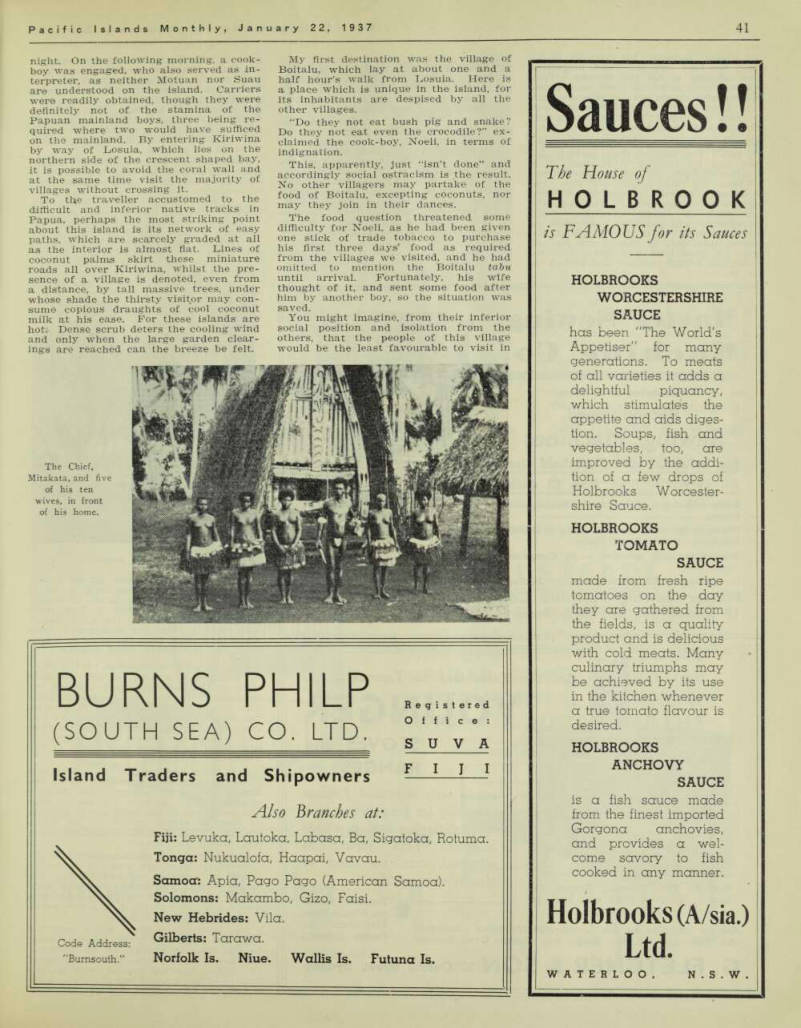
Made In Australia advt
Impressions Of The Trobriands
Hospitable People, With Many Strange Customs By W. H. POTTS was only a temporary stopping place for me, where a boat might might be found which was going to the Trobriand Islands.
Lying about 15o’miles north of Samarai, this picturesque group has many interesting customs and legends, which are unlike any others on the mainland of Papua, and are still observed with almost the same particularity as in the pre-government and mission period.
After a few days, a boat was scheduled to make her six-weekly visit there and early one morning, before anyone else was astir, we cast off and sailed quietly away through China Straits.
We anchored in I>obu Passage on the first night and set off again at daybreak, passing the mountain, Koyatabu on Pergusson Island, which towered thousands of feet above us on our port side. As the sun rose higher, the Amphlett group came into view, that cluster of steep little islands where an extensive native pottery manufacture is still practised.
After some hours’ sailing through coral strewn waters, a long, low island appeared, tinged with the faint blue haze of distance. Absolutely flat, without even a solitary relieving hill, it stretched for many miles athwart our course, with several smaller outlying islands at its north-western extremity. These constituted the Trobriand Group, real coral islands, of which the principal one is Kiriwina. Though only 30 miles long and 12 miles wide at its broadest part, it supports a native population of about gOOO.
As we drew closer, the mid-western shore appeared as one large crescentshaped bay, whilst its shallow waters were enclosed by coral reefs which gave shelter to a lagoon of that emerald green shade, so familiar and pleasing to every traveller in coral seas.
THAT evening, an anchorage was found at a small island called Muwo. which lies off the south point of the crescent.
Here is a coconut plantation which is operated by a well-known identity of New Guinea, Mr. E. Auerbach, who, as far back as 1911, made a notable gold-prospecting journey with Jim Preston and Shark-eye Park up the Markham River in what was then German New Guinea, eventually reaching the Watut River, when the first indications of gold came to light in those remote places.
Fish in abundance are found at Muwo, and all night long phosphorescent shapes gleamed in the dark waters, whilst occasionally a huge glowing form would encircle the boat, telling us that we were indeed among the sharks, After taking on copra here, we sailed on Bau which is on Kiriwina and is the p or £ f or Losuia, the Government station—jf a clearing in the forest with a copra-store shed can be called a port. The water off Losuia is only deep enough to rece ive boats up to ten or fifteen tons, and most of the cargo is transhipped to more suitable craft at Bau . „ , Jrobnand native is a keen fellow f 9 r !' rad€ ;’ and when 1-he news of our arrlJai had been spread, many canoes put from the shore and soon our decks w 9 re swarming with a chattering horde, o climbed all over the cargo peered tf® engine-room and poked their heads through the port holes. With them they brought fish, fowls, eggs, yams, Potatoes, pumpkins and pawpaws, y ° u were more aesthetically mclmed, they would offer you unique carvin&s °f A n ® workmanship. Smaller pieces were mostly of ebony, whilst the larger ones were of a native brown wood, of a v . ery P le asmg tint. Pigs, dogs and bowls seemed to be their favourite subjects; and some weeks later, when I visprincipal carving village, I was *° see them at work on massive tables, Their canoes are similar to the Papuan outrigger type, having the customary hollowed-out tree-trunk, which varies in length from six to twenty feet.
When the time came to continue our cks . cleared , of . t i ies .® • p€ ° ple ’ Wlth basket of fruit carvings and they scrambled ° the many cano-es which lay arouna us- (Continued overleaf) 39 Pacific Islands Monthly, January 22, 1 937 MILK
Best, Therefore Cheapest
Copyright A257c COON we were passing along the coast, around the northern end of Kiriwina en route to the island of Kitava, which lies to the east of the Trobriand Group.
As the boat punched her way into the rising wind, it was noticed that a solid wall of coral, capped by fairly thick timber, barred all entry to the interior of Kiriwina and stood out even to the water’s edge; at rare intervals a small stretch of sand appeared where a break in the rock had occurred.
After some hours, we dropped anchor in the small straits between Nurutu and Kitava Islands. Here was water of a deep shade of transparent blue, unlike any other in these seas. Silvery sand bounded the narrow coastal flat, whilst masses of coral towered above all, forming- a high inland plateau.
The natives on this island closely resemble those on the main one. They have similar customs and dances, live in the same type of house and cultivate extensive gardens. There is, however, only one white man living there and he has reigned supreme for a quarter of a century, with his house on top of the hill and his coconut trees stretching for several miles along the coast. If you want to buy some yams from the natives, or carvings, or any kind of trade, then you go to him and he will arrange it for you; nothing can be done except through him, so well do the natives trust and regard him.
The boat’s visit was the first for three mfonths; and soon we saw hfs spare figure striding through the lines of palm trees; his dinghy put off and was soon bumping alongside. With a battered old felt hat, red handkerchief around his neck and his knife thrust inside his stocking in true Scottish fashion, this timehonoured inhabitant of the South Seas fook hold of a stay and came abroad.
Next morning, the copra was loaded, and regretfully I went on board as the anchor was heaved up. Laughing girls swam playfully around, others called out good-bye from the beach while my kind host waved the same old hat.
WE returned to Bau, and I took a short passage in a launch to Losuia, Where the Magistrate kindly entertained me for the Dancers, of Boitalu. 40 Pacific Islands Monthly, January 22, 1937 Ltd.
WATERLOO New Hebrides: Vila, code Address: Gilberts: Tarawa.
"Bumsouth. Norfolk Is. Niue. Wallis Is. Futuna Is. night. On the following morning, a cookboy was engaged, who also served as interpreter, as neither Motuan nor Suau are understood on the island. Carriers were readily obtained, though they were definitely not of the stamina of the Papuan mainland boys, three being required. where two would have sufficed on the mainland. By entering Kiriwina by way of Dosuia, which lies on the northern side of the crescent shaped bay, it is possible to avoid the coral wall and at the same time visit the majority of villages without crossing it.
To thje traveller accustomed to the difficult and inferior native tracks in Papua, perhaps the most striking point about this island is its network of easy paths, which are scarcely graded at all as the interior is almost flat. Lines of coconut palms skirt these miniature roads all over Kiriwina, whilst the presence of a village is denoted, even from a distance, by tall massive trees, under whose shade the thirsty visitor may consume copious draughts of cool coconut milk at his ease. For these islands are hot. Dense scrub deters the cooling wind and only when the large garden clearings are reached can the breeze be felt.
My first destination was the village of Boitalu, which lay at about one and a half hour’s walk from Losuia. Here is a place which is unique in the island, for its inhabitants are despised by all the other villages.
“Do they not eat bush pig and snake?
Do they not eat even the crocodile?” exclaimed the cook-boy, Noeli, in terms of indignation.
This, apparently, just “isn’t done” and accordingly social ostracism is the result.
No other villagers may partake of the food of Boitalu, excepting coconuts, nor may they join in their dances.
The food question threatened some difficulty for Noeli, as he had been given one stick of trade tobacco to purchase his first three days’ food as required from the villages we visited, and he had omitted to mention the Boitalu tabu until arrival. Fortunately, his wife thought of it, and sent some food after him by another boy, so the situation was saved.
You might imagine, from their inferior social position and isolation from the others, that the people of this village would be the least favourable to visit in The Chief, Mitakata, and five of his ten wives, in front of his home. 41 Let us know your requirements. We will be pleased are Widely Used Throughout the Pacific Islands. the island. Actually, the contrary is the case, for they are the most hospitable and obliging of all the natives. They will ask you to watch their dances and nothing gives them greater pleasure than your acceptance. They will fetch water ofegS’ ayTe^a y we S With amoUnt g ‘ THEY always like a smoke, however A small th© service they perform for you, and by trading with them it is possible to avoid all us© of tinned meat.
Ther© are set prices all over the Trobriands, which are carefully observed by the white residents. For instance, one stick of tobacco (costing about threepence) will purchase four eggs, or two pineapples, or thirty pounds of potatoes, yams, etc., or enough fish for two days. A good fowl will cost you three sticks, and a bush pig may also be had for that price.
Whenever they receive tobacco they will always ask insistently for “pwairp” —or so it sounds. Actually, it is a piece of newspaper they want in which to roll their cigarettes, as a change from the eternal pandanus leaf All the Kiriwlna villages resemble each other in the well populated northern area, and quite the most noticeable thing on entering one is the yam houses. Each family has its own garden, and at the end of each harvest the yams are carefully stored in an airy structure which is rai sed two or three feet off the ground and is usually about twelve feet high, three feet wide and ten long. Lengths °f tree trunks, about four inches in diameter, form the floor and walls, which are so built up that ample ventilation is provided, which is essential if the yams are to last until next harvest, The living houses are all set on the ground, with the roof slightly curved in one long sweep and combining roof and wall in one. The whole structure is a framework of thin sticks, thatched with pandanus leaves and without any opening except the doorway. There is one family in each house and a narrow platform is fixed at the entrance, on which the native may sit and chew betel-nut, if he is so minded.
That the benefits of a structure raised from the ground are known to them is obvious from their yam houses, and enquiry as to their reason for not building their own houses similarly, revealed at once their fear and belief in magic.
They are convinced that if they raise the level of their floors, the witch doctor will make a little fire underneath them while they sleep, from the effect of which they will die within three months.
ON the following morning, shortly after sunrise, a number of the villagers came to the rest-house and, through my interpreter, invited me to watch their dance, which was about to commence.
The Kaydebu is the most common one and they spend about one hour in dressing for it, and sometimes much longer, if they paint their faces very much, as the women on Kitava do.
Both men and women take part and circle around the drummers, who are usually joined by several other natives singing softly. A slow rhythm is used and variations in the steps are introduced as they go slowly round, all the while holding a long piece of skinned pandanus leaf, which they shake.
Less known, but more beautiful, is the Cassowaga dance, for which a miniature drum is provided in addition to the others; they are beaten in rapid time whilst all eyes are on three men who give a graceful exhibition of a love scene of threa birds.
No more entrancing scene can be imagined than that which presents itself to the traveller’s gaze, as he suddenly emerges from the bush into full view of the village dancing ground, with all the natives sitting around two and three deep, and shafts of sunlight, finding their way The Kaydebu dance.
For all Island requirements.
Cable Address: "NEWLANDBED,' Sydney through the fronds of the palm trees, flashing on the bright headgear of the dancers, in vivid contrast to their dark bodies, like spotlights on a theatre stage.
At the end of the harvest, there is dancing in almost every village and at that time it is continued for longer periods, sometimes all through the night, with feasting.
IN Boitalu are carved all those attractive articles of furniture, which are found in almost every Papuan home and never fail to draw the admiration of newcomers to the territory; many even find their way to Australia and England.
The accompanying illustration of a table in a half-finished state shows a typical example of the more massive productions.
In this particular case the supporting pieces will take the form of men, but quite often they are carved to the image of animals resembling large lizards; the whol6 piece is cut from the solid trunk of a tree and may be finished in four or five days by an experienced hand.
Another design which is equally popular embodies a large bowl instead of a table top, whilst there are infinite varieties of both styles. In addition, there are numerous single pieces representing various animals, and there is a curious example in the possession of a trader of a carving, about eighteen inches long, which was first shaped like a goat owned by him. The goat died before its “sittings” were completed, and the native forgot what it looked like: but, unwilling to discard a half-finished article, he decided to convert it to a pig, and the result would certainly puzzle a naturalist, if it were alive.
The tools most commonly used to-day are small adzes and penknives; whilst intricate work, such as one finds on native hair combs are executed with a dog’s tooth, firmly tied into the split end of a small stick.
There are here perhaps the most comely young women of the island, though they quickly deteriorate after marriage, which takes place when they are between fourteen and sixteen years old, as a rule. The men of this island are inferior to those found on the Papuan mainland coasts and their features are softer; their height rarely exceeds 5 feet 6 inches. It is more than sixty years since tribal fighting took place on the island, but in earlier times it was prevalent. To-day the skulls and bones of the vanquished remain in the caves, which abound in the coral wall, together with some ancient forms of pottery, doubtless the one-time property of the victims.
There are also traces of an earlier race, beyond the ken of the present natives, and hug'e stone slabs, up to twelve feet high, have recently been discovered in a position to suggest either a large tomb or house. The existence of a race using stone buildings was unsuspected in Kiriwina until this discovery.
When walking from village to village it is found that the surrounding bush is rarely more than a few feet high, for the population is so large that almost the whole interior has been under cultivation. When a harvest is finished, the garden is left for five years before it is used again, thus permitting the scrub to grow. A new area is selected, the bush cut down and burnt, then the yams, taro, sweet potatoes, sugar cane, etc. are set by the men.
Each individual’s garden is marked off A Boitalu boy, carving a table.
E. Wright & Co. Ltd.
Office and Works: 148-152 Cleveland Street, Sydney. N.S.W.
Telegraphic Address: "Wrightmake,'' Chippendale Address Ropeyard, 163 CLARENCE STREET, SYDNEY N.S.W. from its neighbour by a boundary of sticks or stones and later is kept free of weeds by women. In the southern part of the island this latter performance takes place during January and February, when all the gardens are weeded at the same time; and woe betide any man, white or black, who intrudes there while they are at work, for he will be pursued and, if he is caught, he will be treated in a manner unfit for public description—but not actually injured.
On one occasion, a former resident magistrate was chased but fortunately he escaped. The last record of a case of this pursuit took place about three years ago, when a native narrowly missed this unique ceremony. It is so well-known, however, that no intelligent boy will ever venture near.
A FEW more miles in a north-easterly direction from Boitalu, lies the village of Omerakana, where Mitakata reigns, the paramount chief of Kiriwina. When he is sitting outside his house, every native in sight must walk, bent double and the greatest respect is shown to him in all ways. He has ten wives (whereas all other men have only one) and each of them has her own living and yam houses.
Mitakata’s house is much larger than the average, and over the entrance there are numerous designs in blue and red on a background of white. These are also found on his two massive yam houses, which stand high above all others.
Whenever these coloured designs are found, they denote the dwelling of a chief.
In addition to Mitakata, there are several other chiefs in different villages, but of lesser importance. tie receives an allowance of several pounds of tobacco monthly from the government, and also a substantial contribution of yams from his subjects, so that he need never work. At one time it was the custom for all the men in the chief’s village to appear before him each morning and receive any special instructions he might give, but to-day this practice has ceased. Succession to this high rank is always through the maternal relations.
Hence, the present chief’s sons will not take his place. At the moment, the heir is his maternal uncle.
This inversion of our own custom is due to the natives’ ignorance of fatherhood. They believe that on the death of one of them, the spirit will go to the little island of Tuma, on the north-west coast of Kiriwina, and at certain times of the year these spirits travel back across the water and are re-born.
THERE is a most interesting ceremony in connection with this belief, called Milamala. Shortly after the end of each annual harvest, all the spirits of Tuma come back to their respective villages for a few hours; food is put out for them on small platforms and the villagers dance and sing all night. But the spirits must not linger after daybreak and, at that time, the whole village attempts to chase them away back to Tuma, with as much noise as possible.
The coastal villages provide the most remarkable scenes when three or four hundred natives gather on the water’s edge, looking out to sea, and waving their The chief, Mitakata, in front of his yam house. also Spotted Gum Timbers—Prices Right A C Frvpr 110 Miller St., v*. rryer Pyrmont> N .s.w.
Herbert Del Cott Pty. Ltd.
Cables "Voltage" 116 QUEEN STREET. MELBOURNE 'Phone: Central 10488 farewells, some with tears streaming down their faces, as they remember their lost ones. “Kaion” they cry, “Kaion” (goodbye, good-bye). The word is pronounced “kaioon”; and, when uttered in their plaintive way, one feels that it is indeed a sad departure.
An increasing acquaintance with these attractive people shows an outstanding devotion to their gardens and, so early do they leave their villages to go to them, that when carriers are required, it is necessary to send for them at daybreak.
There is an additional occupation, which is confined to the villages on the shores of the lagoon on the west coast; that is diving for pearls. A small lapi oyster is common in these waters and produces a pearl which, though slightly inferior compared with that from better-known areas, is none-the-less a valuable product of the island and, during the last twentyfive years, approximately £300,000 worth has been bought by traders from the natives. The latter have absolute right in the best areas and no white man or half-caste may dive for pearls, but must content himself with buying them from the natives. To do this he must obtain a buyer’s licence from the government at a cost of £5O per annum.
The oyster itself is inferior to the common edible one when uncooked, but if it is put into the fire and roasted in its shell it is delicious.
One evening, I tried a bush pig, also cooked in the native way, but it was not very tasty. This latter method is performed by digging a hole in the ground a few inches deep and about a yard across (for smaller pigs), lighting a wood fire in it and placing pieces of rock or coral on top of it. When the fire has burnt itself out, the pig is placed on the hot stones, covered with large leaves, then smothered with soil and left for some hours. Yams, etc. are often cooked in this manner but of course require only a short time.
Although the Trobriands are selfsupporting, as far as food is concerned, they are obliged to import earthenware, for a considerable amount of cooking is done in large clay pots, which they buy from the Amphlett Islands, in exchange for yams and other produce which is lacking there.
PERHAPS the most remarkable of all their customs is that known as Kula, which is practised not only in the Trobriands but in almost all the islands of Eastern Papua. With this is bound up a tremendous trade route which never varies, yet is separate from Kula, which itself is a reminder of those not very distant days when natives visiting another island for trading purposes did so at a considerable risk. If, however, they could each find partners in that island, then they would be safe for future expeditions, and assured of food and lodging for the duration of their stay.
So was the Kula evolved and it embraced the following islands; Trobriands, Marshall, Bennett, Woodlark, Laughlin, Misima, Panayati, Tubetube, Wari, Sariba, Sidea, Basilisk, Rogea, Ncrmanby, Fergusson and Amphletts. This is not an exhaustive list but is the main route followed and is roughly circular.
The ceremony is conducted by the exchange of armshells ( mvoali ) and red spondylus discs ( soulava ) between the partners on adjoining islands on the route. These tokens are never held for more than a few months, and never become private property, but are handed on year after year, completely travelling round the Kula route, with the distinction that the mwali always travel in an anticlockwise direction whilst the soulava go in the reverse direction.
When setting out on Kula expeditions, canoes are used which are much larger than the usual coasting type, for sometimes fifty miles or more of open sea have to be covered, and usually many articles of trade are carried at the same time. There may be ten or more of these large canoes in a group, and it is a fine sight to see them arriving under sail, with often a dozen occupants, and loaded high with goods for barter.
Advertisements & other items, pp. 42-47 (13 items)
Nestle's Milk Advertisement
i MUST BE
YOUR FIRST
CONSIDERATION /I SWEETENED cone® VULI ; *«-gd Irad« Condensed MiSO®® SYDNEY
NESTLE S MILK
remains PURE and FRESH under all climatic conditions You cannot afford to take risks with milk . . . only the best is good enough . . . that's why you should always use Nestle's Milk. It is made from the finest full cream country milk. From start to finish every process of manufacture is carried out under the strictest supervision. It will never become contaminated while unopened, and it is fully guaranteed to stand up to ANY climatic conditions. To protect your own health and the health of your family always insist on Nestle’s— the safest, most nourishing and most economical milk you can buy.
NESTLES
FULL CREAM
Holbrook's Sauces Advertisement
Sauces!!
The House of HOLBROOK is FAMOUS for its Sauces HOLBROOKS WORCESTERSHIRE SAUCE has been "The World's Appetiser" for many generations. To meats of all varieties it adds a delightful piquancy, which stimulates the appetite and aids digestion. Soups, fish and vegetables, too, are improved by the addition of a few drops of Holbrooks Worcestershire Sauce.
HOLBROOKS TOMATO SAUCE made from fresh ripe tomatoes on the day they are gathered from the fields, is a quality product and is delicious with cold meats. Many culinary triumphs may be achieved by its use in the kitchen whenever a true tomato flavour is desired.
HOLBROOKS ANCHOVY SAUCE is a fish sauce made from the finest imported Gorgona anchovies, and provides a welcome savory to fish cooked in any manner. * Holbrooks (A/sia.)
Burns Philp (South Sea) Co. Ltd. Advertisement
N.S . W .
BURNS PHILP
(SOUTH SEA) CO. LTD.
Island Traders and Shipowners Registered Office: SUVA FIJI Also branches at: Fiji: Levuka, Lautoka, Labasa, Ba, Sigatoka, Rotuma. \ Tonga: Nukualofa, Haapai, Vavau.
Samoa: Apia, Pago Pago (American Samoa).
Solomons: Makambo, Gizo, Faisi.
Master Sewing Machine Co. Advertisement
Pacific Islands Monthly, January 22, 1937 Master Sewing Machine Co.
Established for 23 Years Reconditioned Sewing Machines For Industrial and Household Use.
All Types for Sale, from £3 each.
Every Machine Guaranteed Mechanically Perfect.
We have the most complete range of Sewing Machines in New South Wales.
Repairs promptly attended to by Competent Mechanics.
No Delays. All Goods Carefully Packed.
Master Sewing Machine Co. 15 Enmore Rd., Newtown, Sydney m
ALL TYPES FOR S*LE
From £3 each.
G. Fletcher & Son (Younger Stoves) Advertisement
to quote by return mail. mm*' Do You Know that the Famous . . .
YOUNGER STOVES and RANGES made with extended Firebox specially for long Wood fuel, are Self-Setting and, provided sufficient Flue Piping is attached, can be used in almost any position?
The No. 7W "Younger" Ranger can now be supplied fitted with Legs, as per illustration.
Ask for quotation for this Range, also Illustrated Catalogue and Price List for both Single and Double Oven Stoves.
G. FLETCHER & SON 50 Oxford Street, Sydney Younger Stoves
William E. Reed Advertisement
42 Pacific Islands Monthly, January 22, 1937
TO PLANTERS AND TRADERS
William E. Reed (Established 1913) Union House, 247 George St., Sydney
Newlands Brothers Ltd. Advertisement
Island produce sold.
Prices right. Enquiries welcomed. ill STEEL BEDSTEADS
WIRE MATTRESSES
“MORNING GLORY” BEDDING
TUBULAR STEEL FURNITURE
“LISTER” HOSPITAL EQUIPMENT
SHIPS’ ALL METAL BERTHS
WE WILL GLADLY FORWARD OUR
COMPLETE SETS OF CATALOGUES
Produced in Australia by Newlands Brothers Ltd.
RILEY STREET :: SYDNEY, N.S.W.
Australia’s Largest Manufacturers of Modern Sleeping Equipment.
E. Wright & Co. Ltd. Advertisement
43 Pacific Islands Monthly, January 22, 1937 Woven Wire for AH Industry COPRA DRYING TRAYS, FLOORS, Etc.
FRUIT DRYING TRAYS, MINING SCREENS
Heavy Mosquito Gauze in Phosphor Bronze and Other Metals Impervious to Salt Sea Air
WIRE DOOR MATS AND GENERAL WIRE WORKS
Broomfields Ltd. Advertisement
4? £ so Ship Chandlery—Hardware /Write for / Ship Chandlery / Catalogue J Special “In Bond” Prices for all Islands enquiries quoted on application.
BROOM FIELDS LIMITED
152 SUSSEX STREET :: :: SYDNEY Cables: “BOOM,” Sydney Large and Complete Stocks of
SHIP CHANDLERY
IRONMONGERY OF ALL KINDS, PAINTS,
WHITE LEAD AND OILS
Sole Agents for: P. H. MUNTZ & CO.’S 3-CROWN BRAND METAL SHEATHING.
PEACOCK & BUCHANS’ ENGLISH READY-MIXED PAINTS.
Cable
J. Scott Ltd. (Rope and Cordage) Advertisement
Sydney Scott’s Renown Brand Rope, Cordage and Binder Twine of Every Description
MANUFACTURED AT
MASCOT, N.S.W, By J. Scott Ltd.
Head Office and Store:
A. C. Fryer (Huon Pine) Advertisement
44 Pacific Islands Monthly, January 22, 1937 Huon Pine Boat Planks Practically Borer Proof and Everlasting,
Herbert Del Cott (Deutz Diesel) Advertisement
DEUTZ DIESEL ENGINES c Deutz Engines usedlnternationally since 1864
MARINE DIESEL “OM” TYPE
EUI Range from 10 to 140 B.H.P.
Full information obtainable from the Agents
A.E.G. Electrical Equipment (Turbinamo) Advertisement
15 CASTLEREAGH STREET. SYDNEY
'Phone; B 3135 <* A p ’ELECTRICAL r\» C* Vj • EQUIPMENT
FREE ELECTRICITY!
with “A E G” Turbinamos A "Turbinamo" working from a stream generates sufficient electricity for households, plantations or communities.
Simple to Instal Reliable Supply No Running Costs Looks After Itself A Sizes 0.5 kw. to 40 kw.
Write for particulars State head of water available and Electricity output required
[Islands People Notes]
Much ceremony and time are spent over the exchange of the tokens and it may be several days before they depart.
Mr. and Mrs. J. N. Nicholson, of Kokebagu Plantation, Kemp Welch, in the Central Division of Papua, arrived in Australia on several months’ holiday by the Macdhui in mid-December.
Mrs. F. G. Lewis, wife of the Chairman of the New Britain District of the Methodist Missionary Society of Australasia, arrived in Sydney from Rabaul with her young son by the Neptuna on December 15. She left immediately for Melbourne to spend a long vacation with her other
Advertisements & other items, pp. 47-48 (1 item)
Carl Aug. Docke (Feuerhand Hurricane Lanterns) Advertisement
Pacific Islands Monthly, January 22, 1937 >FEUERHAND< HURRICANE LANTERNS £ s * > *6t € Gf &«** 1 Tb L< 5* &« a m m S and many other types of varied shape and style!
Sole Agent for the South Sea and New Guinea: CARL AUG. DOCKE BREMEN/germany
Samoan Jail-Breakers
Importer of any kind of Island Produce Correspondence invited
Samoan Jail-Breakers
From Our Own Correspondent.
APIA, December 10. two occasions recently prisoners undergoing sentences at Vaimea prison, near Apia, have escaped; and, of the five men who got away, only one has been recaptured.
Three of the prisoners, Samuelu, Tomasi and Sefo, were considered dangerous men and habitual criminals, as they had escaped on previous occasions. They made a dash for freedom when out for exercise in the prison yard, and saw an open door in the prison wall.
Samuelu, the leader of the escapees, is serving a term for rape. Tomasi is the well-known and feared “cat-burglar,” who has made the stealing of watches and clocks in unguarded homes his specialty.
Samuelu appeared shortly after his escape at a small plantation in the hills, where only a few women were present, and asked for food. By the time the police were informed by telephone, and arrived on the spot, he had become suspicious and disappeared.
It is suggested that the warders at
[Islands People Notes]
Vaimea prison should in future be armed, to discourage attempts at jail-breaking by dangerous prisoners Mr. Alfred Hunt Simpson, of Misima Island, married Miss Alice Marie Campbell, youngest daughter of Mr. and Mrs.
D. Campbell, of Samarai, Eastern Papua,
Attack on "Local-Born" Problem: Samoan Land for 10 Young Men
honeymoon at Milne Bay.
Attack on “Local-born”
Problem Samoan Land for 10 Young Men From Our Own Correspondent.
Apia, Dec. 13.
TEN local-born (European-Samoan) young men have been selected as the successful applicants for ten 50-acre blocks of land made available by the Land Settlement Board. They are to be taken shortly to their respective new holdings at Saleimoa, and shown over the place.
The actual work on the settlement is to start in the spring of next year, when 10 acres of each plot will be cleared and planted in bananas. Water by then will be laid onto the settlement, and road communication will be completed.
Quick Detective Work in Rarotonga
erected on each plot immediately.
Quick Detective Work in Rarotonga From Our Own Correspondent RAROTONGA, Dec. 10.
ON the evening of Sunday, October 11, Tainitu Orani, a Tahitian living in Rarotonga, carried out a daring robbery at the Avarua premises of Messrs. Jaggerand Hervey Ltd.
Thirty-six hours later he was apprehended by Mr. A. Carlyon, chief of police, to whom much credit is due for his quick, accurate deductions from the most slender of clues.
First breaking into the manager’s private residence, the thief secured the keys of the store and, mounting his bicycle, rode rapidly away. His speed attracted the attention of Mr, Carlyon, who happened to be passing at the time. The latter, flashing a torch on the man’s back, observed that his coat was marked by yellowish stains.
The following morning it was found that £54, together with a small quantity of goods, had been stolen from the store, the doors of which, as well as the office safe, did not appear to have been tampered with.
A search of various suspects’ houses revealed the coat with the yellow stains — which corresponded exactly with the water-paint used on the manager’s outer walls. From here the chase led to a village seven miles away, where the owner of the coat swore that he had spent the evening in question. Here, the police made a thorough search of the accused’s premises, with the result that the entire amount, less 6/4, was recovered from various hiding places.
There remained only the missing bunch of keys; and these the thief now confessed to having thrown into the managerial “privvy.” With poetic justice, he was sent down this to retrieve them!
Tried before Judge Ayson, Tainitu was
[Islands People Notes]
sentenced to five years’ hard labour, to be followed by a further period of ten years’ banishment from the Cook Islands.
Hon. Dr. A. H. Pearce, Director of Medical Services in Fiji, and a member of the Legislative Council, arrived at Auckland by the December Niagara. He
Advertisements & other items, pp. 48-49 (3 items)
Konkrete Paint (H. Florentine and Son) Advertisement
46 Pacific Islands Monthly, January 22, 1937 Konkrete Paint For EVERY SURFACE where Permanence is Imperative--!
Adaptability for the varying climatic conditions of the Pacific Islands has been abundantly proved by users.
KONKRETE Standard Gloss and Flat Colours for wood, brick, fibro, cement, iron and stone.
KONKRETE PAINT IS
THE SOLUTION
Complete price list and colour card from sole wholesale distributors for N.S.W. and
Allen Taylor & Co. Ltd. Advertisement
321 Pitt Street, Sydney, N.S.W.
Allen Taylor & Co. Ltd.
SYDNEY Sawmillers and Wholesale Suppliers of Hardwoods for Constructional Purposes
Wunderlich Ltd. (Durabestos) Advertisement
EXPORTING TO PACIFIC ISLANDS SINCE 1893 Cables: Tuxedo, Sydney
BUILD A MODERN HOME WITH
I!▼110 H 3 S I CM SI DUPABEST€S
ASBESTOS CEMENT BUILDING SHEETS
Low cost with good appearance and endurance is assured when you specify Durabestos tor walls and ceilings in new buildings or for additions or repairs to existing structures.
Write for literature illustrating the new horizontal application of Durabestos, in modern buildings.
WUNDERLICH LTD., Crown and Cleveland Sts., Redfern SYDNEY Durabestos does not require skilled labour to erect, and is
Ghastly Murder in Tahiti: Prominent Resident Under Arrest
16.DS
Ghastly Murder In
TAHITI Prominent Resident Under Arrest From Our Own Correspondent.
Papeete, Dec. 18.
IITAJOR crime is of very rare occurrence in the islands of French Oceania—particularly among the Polynesian inhabitants. Indeed, as compared with many other countries, Tahiti and its dependent islands may be said to be remarkably law-abiding.
It was a great shock, then, to the community when a ghastly murder was committed within the borders of Papeete some months ago.
The headless body of a native woman was discovered in a lonely spot within the city limits. The severed head was later found buried in the sand of the beach, nearby.
Clever detective work by the police led to the arrest of a white man who, for several years, had been wandering about the islands supporting himself by caring for gardens and collecting miscellaneous curios and other objects for sale to tourists. When confronted with the evidence, the culprit broke down and made full confession of his guilt.
The mystery was, therefore, considered as having been solved. But a new and sensational development of the case occurred in the second week of November, when a very prominent and, perhaps, the most worthy French resident, of Tahiti, was arrested and placed in solitary confinement on the charge of having instigated the murder.
As the matter of guilt or innocence is in process of judicial inquiry, nothing definite is known as to the character of the evidence.
It would be unfair, therefore, to disclose the identity of the accused man
Drought in the Marquesas
the arrest has been made.
Drought In The
MARQUESAS From Our Own Correspondent PAPEETE, Dec. 5. ”0 EPORTS from the Marquesas Islands tell of a severe drought which has now lasted eight months.
Intense heat added to the want of rain has dried up the watercourses and parched the vegetation until the islands appear burned and desolate. Cattle and horses are dying for want of forage.
These islands, lying between 7.50 degrees and 10.33 degrees South and longitude 140.45 and 143.05 West, are subject to great irregularities of climate.
During some seasons rain will cease for over a period of more than a year, while at other times there will b 6 excessive rainfall. These conditions, coupled with the
[Islands People Notes]
difficulty of finding sufficient labour, have held back the development of agriculture in that archipelago.
Mr. C. C. Judd, formerly manager of the Expropriation Board of the Mandated Territory of New Guinea, has been
Samoan Personal Notes
Watut Gold Alluvials N.L., operating on the Morobe goldfield.
Samoan Personal Notes
From Our Own Correspondent- APIA, December 23.
A N epidemic of weddings has broken out in Apia, where within a few days half a dozen “tie-ups” have been celebrated.
A very popular wedding was solemnised, when Mr. C. E. H. Quin, eldest son of Mr, and Mrs. H. M. Quin, of Otorohanga, New Zealand, was married to Audrey Mary, second daughter of Mrs. J.
O’Neill, of Pukengahu, Stratford, New Zealand, at Apia Cathedral. The bride had just arrived from New Zealand by the Matua. The bridegroom is the Assistant Secretary of the Samoan Administration, and is well-liked, both as a man and an official.
Mr. J. Fisher, a well-known Labourite and Douglas Credit adherent, has paid an extended visit to the territory and has renewed old friendships and made new ones. Mr. Fisher, who hails from Christchurch, was a member of the Samoan relief force during the Great War, He took a very active part in fighting the influenza epidemic in Samoa in 1918/19, which took a terrible toll of life amongst the natives. Though now over 80 years of age, Jack Fisher is remarkably hale and hearty and, while wandering about 47
86 George Street - - Manchester
Contractors to H.M. and Foreign Governments. Bentley's Code, and ABC Code & Specialists \ PATTERSON & STONE, CRICHTON WORKS,; WALSALL, ENGLAND. among plantations and natives and European homes in all parts of the islands, he has walked long distances over lava and bad roads in sweltering heat —a feat which, a much younger man would shun.
He has acquired a first-hand knowledge of Samoan conditions and problems.
Amongst recent departures is the Director of Education, Mr. D. A. J. Rutherford, who after 17 years of service here, retires on superannuation. Mr. Rutherford, who is very popular among both his European and Samoan pupils, has been the guest of honour at numerous farewell functions during the last few days, and at a Samoan to’alolo (dance feast) by the boys and girls of the Government Samoan schools. He has also received numerous valuable gifts and souvenirs, given in true Samoan fashion.
Various younger officials of the Administration —Messrs. L. C. Sutton of the Police Department, W. H. Roberts of the Customs, J. W. Prout of Apia Post Office —left by the December Maui Pomare, after having completed their respective terms of service. All of them were popular, and they were duly farewelled and feted by their numerous friends.
Mr. Mclver, from Wellington, is replacing Mr. J. W. Prout at the Apia Post Office. Mr. Prout goes to the Napier Post Office.
Mr. E. G. Theodore, managing director of Emperor Mines Limited, arrived in Fiji after a visit to Australia by the Aorangi on December 11.
Mr. W. H. Thompson, A.R.M. at Kairuku, in the Central Division of Papua, arrived in Australia by the December Macdhui on three months’ leave.
Dr. M. N. Ansari arrived in Suva on December 11 by the Aorangi. He intends to practise in Fiji.
Mr. Norman Izod, of Samarai, arrived in Sydney by the Macdhui on holidays on December 16.
Mr. Johnny Wray, Auckland’s Pacific wanderer, returned home just before Christmas in his yacht Ngataki, in which he has made many voyaaes in the Pacific.
In his latest venture, which lasted over five months, he took his tiny vessel to Sunday Island, and Tonga, where extended cruising interspersed with deep-sea fishing occupied several months. Mr.
Advertisements & other items, pp. 49-50 (3 items)
Maleham & Yeomans Limited Advertisement
Pacific Islands Monthly, January 22, 1937 Maleham & Yeomans LIMITED BOWDON ST., SHEFFIELD, ENG.
Manufacturers of all kinds of Butchers’, Sticking and Sheath Knives Razors and Scissors Specialty
A. Webb & Company (Manchester) Ltd. Advertisement
Hairdresser Scissors Price List on Application Buy Direct from Manchester!
Pacific Traders can save money and obtain High Quality Goods and Dependable Service by writing to us for Quotations. We are manufacturers of—
GREY, WHITE AND COLOURED TEXTILES
Rami materials of every description.
Para Reds.
White and Blue Drills.
Grey and White Calicos.
Super Drill.
Ecru Tussore.
Dyed Poplins.
Woven-striped Poplins.
Table Cloths.
Serviettes.
Sheets.
Pillow Cases.
Quilts.
Bedspreads.
Art Silk Piece Goods.
Bath Wraps.
Glass Cloths.
Sweat Rags.
Bias Binding.
Braids.
Printed Calicos.
Poplins.
Woven Coloured Ginghams, etc. # It will be to your interest, in the end, to Buy and Distribute British - made goods.
Extract from a letter sent to us by an Islands storekeeper who recently retired: Milne Bay, Papua. 1/10/34.
". . .a success due —in a great measure—to the excellent service rendered for so many years hy your firm. Yours faithfully, H. DEXTER.”
A. Webb & Company (Manchester) Ltd.
Patterson & Stone (Leather Belts) Advertisement
4th and sth Editions. Telegraphic Address : “WASTOCK” Manchester.
■ LEATHER BELTS
| jor NATIVES 'Ttlan ufacturers j
53,000 Samoans: 45 Per Cent. Increase in Ten Years
adventures, will make another cruise shortly. 53,000 SAMOANS 45 Per Cent. Increase In Ten Years From Our Own Correspondent.
APIA, December 23.
AS a result of the preliminary count in the Samoan census taken on November 4, the number of Samoan natives is computed at over 53,000, while the total population of the territory is approximately 57,000.
This shows a large increase in the Samoan natives and Europeans of mixed blood since the taking of the previous census in 1926.
Native Crime in New Guinea
cent, of Samoan natives and 52 per cent, of the mixed-blood population.
Native Crime in New Guinea From Our Own Correspondent RABAUL, Dec. 10. r INHERE have been quite a number of cases of assault and attempted assault before the courts of late, and recently a native of the Markham district appeared before Judge Phillips for sentence in the Supreme Court charged with being on a dwelling with intent to indecently assault a European female on June 22, 1934.
The native originally came before the court in August, charged under Section 420 of the Queensland Criminal Code, with being in a dwelling house in the night time with intent to commit a crime, but the case was dismissed, as reported in the P.I.M. in October.
The offender, however, appeared again before the District Court and was charged with intent to indecently assault, under Section 5 of the Q.C.C. Amendment Ordinance. The accused pleaded guilty, and his Honour, in reviewing the evidence, said that though the offence occurred over two years ago it was perfectly obvious that the offence was deliberate. Accused was sentenced to one year’s imprisonment with hard labour, and two private whippings, with a cane, of fifteen strokes each.
The local native, who was employed as a mail sorter in the Rabaul Post Office, and was sentenced to two years’ imprisonment on November 9, appeared before the Court again, charged with stealing 10 letters. In sentencing him to three years’ imprisonment, with hard labour to be served concurrently, his Honour said that the native appeared to be the catspaw for the receiver, and weakly agreed to a suggestion made to him. The receiver of the
[Islands People Notes]
stolen letters was sentenced to imprisonment with hard labour for four years, sentence to be concurrent.
Rev. J. F. Goldie, Chairman of the Methodist Mission’s Solomon Islands Dis-
Advertisements & other items, pp. 50-51 (1 item)
I.C.I.A.N.Z. Ltd. (Rim Fire Ammunition) Advertisement
Pacific Islands Monthly, January 22, 1937 Outstanding Performance And Absolute Reliability —they are the factors that have achieved such wonderful popularity for . . .
IM FIRE* The "Rim Fires" with the Largest Sales in Australia —Exceeding Those of All Other Makes Combined No smoke, no rust, and longer life for the rifle barrel because of absence of residues are other features that,combined with sureness and swiftness, have gained for 1.C.1. .22’s foremost place in public favor.
Obtainable Everywhere HOLLOW POINT Popular Prices R.F.4178 M AX Ba
Valuable Plants of Fiji: There is Wealth Waiting in Perfumed Trees and Flowers
Producing Uniform Good Results Since 1868
Always Ask For It
Valuable Plants Of Fiji
There Is Wealth Waiting in Perfumed Trees and Flowers BY H. B. R. PARHAM THE perfumes of the Vei Kau have a most alluring grace of their own, and have challenged those who breathe in their sweetness to expatiate thereupon; and, better still, to draw to them the attention of others more fitted to make use of their beautiful fragrance, and to adapt such sweet scents to the list of possible byproducts of these still little-known Fijian forests and upland slopes!
Therefore, I have gathered together a few notes concerning these scented floral growths; as it seems to me quite possible that something of commercial value may lie perdu in the wilderness; and there may be a hidden mine of wealth for some industrious experimenter in the exquisite art of the perfumer-chemist, and of the distiller of sweet essences.
Merely regarded as a possible interest, for more prosaic planters, some of these hints may prove of advantage; and surely ladies in the backblocks should welcome a new way of making a little money—out of their town acquaintances!
An excellent way to make perfume in small quantities, and therefore not suggested as a trade process, is as follow; Take a perfectly clean, large-mouthed, glass jar, and in the bottom sprinkle salt, in small quantities. Then put in a layer of scented petals; entire blossoms; or leaves, taking care in the case of leaves to bruise them well before putting them in the jar. The flowers, etc., should be gathered before the heat of the day, but not after heavy dew or rain.
Get ready some rounds of wadding the size of the jar (or, if cotton is used, small wads of cotton just large enough to take the place of the wadding) and pour over them sufficient good lucca oil to saturate thoroughly the cotton or wadding. This can be done in a pie-dish or soup plate. For an ordinary 2 or 31b jam-jar, 10 or 12 of these rounds will be needed.
Now put one of the rounds on top of the layer of petals, etc., sprinkle again with salt, and add more scented petals, then another oil-soaked round of wadding, and go on in the same way, alternating salt, petals, and wadding, till the jar is full.
It is a good thing to press the wadding down in order that the packing together may be fairly close.
To exclude the air, a bung may be used, or an air-tight cover. If neither is available, tie a piece of parchment or grease-proof paper over the top.
In England and other temperate climates, one has to choose a sunny place for the jar. In Fiji, it is hardly so necessary to enforce the need of sunshine, and yet it is the warmth that draws the fragrance from the flowers, and is essential to the making of the perfume.
In about 10 days or a fortnight the oil should be sufficiently scented, and will require straining through fine muslin. First, however, the wadding should be pressed with a spoon in order to squeeze out the oil.
The scent of the oil should be more powerful than that of the usual trade perfume. Indeed, as the fragrance will prove delightfully strong and lasting, unlike what one might call shop scents, very little will go a long way.
The list, of scented bush plants, is wellnigh endless, though, of course, many of these would be totally unfit for perfumery.
It would be a very interesting subject for further research, and one that would eventually prove of great value to Fiji, Everything that adds to the stock-in-trade, so to speak, of a country is of supreme importance.
In Europe fortunes have been made in the perfumery business. Who has not heard of the violet fields of La Grasse, in the S. o£ France, and the big population that is there kept busy and happy, preparing violet perfumery? Most unfortunately the introduction of synthetic perfumery has seriously interfered of late with the prosperity of these happily-employed people.
It is very regrettable that the desire for dainty things should hot also be accompanied by the sense to know the difference between a clever imitation and a real perfume from charming natural flowers. The use of imitation perfumery is almost as paltry as the wearing of sham jewels.
Fijians are themselves very fond of perfumes and nearly always add some scent to the coconut oil they use on their persons. The bush supplies them with a variety of strong or sweet-smelling leaves and barks.
THIRST and foremost among native trees is the sandalwood. Though comparatively rare now, it still holds its paramount place on all festive occasions. It is the great desideratum of all Fijian gatherings, being used in the form of powder on their over-heated skins. Indeed it is one of the most appreciated native perfumes. Its local name is yasi, and it is known by botanists as santalum yasi or santalum alia.
There is a ready sale for the grated wood among the natives themselves.
In Hawaii the precious wood is called Iliahi.
There is an element of thrilling romance about the old-time stories of the sandalwood traders, and the dangers they brought on themselves, as they had such an unfortunate way of rousing the ire of savage natives.
These early-comers left very little sandalwood uncut, when they gave up the trade, and Yasi is now a rare tree, even in Bua Bay—once known as Sandalwood Bay.
The Yasi is now, happily, protected by Government.
By some the Yasi is supposed to be the famous aiming tree, the wood of which was used in the building of Solomon’s Temple!
THEN there is the MoTcosoi (Canaga odorata) which belongs to the Anonaceae.
(Continued On Next Page)
49 Pacific Islands Monthly, January 22, 1937 ■ // Illustrated Catalogue on request.
Lane & Girvan, Ltd.
Bonny Bridge, Scotland
W. R. Carpenter & Co., Ltd.
New Guinea, Solomon Islands
and all other South Sea Islands.
Like the perfume of Yasi, that of the Mokosoi is much admired by the Fijians, and justly so, for it has certainly a most entrancing odour. With careful preparation, this delicate perfume should prove a valuable addition to the scents already in common use—and with its fine and alluring bouquet should speedily make friends for itself among those who value something distinguished in perfumery, as it has a cachet quite its own.
The flowers of the Mokosoi are yellow, or perhaps it would be more correct to say greenish-yellow, and are very fragrant in their natural state. Each blossom has six petals and only three sepals; the inflorescence is axillary, but many flowers grow together in a cluster, or umbel.
These sweet flowers grow on fair-sized trees, which are not without value as timber.
It is thought that the Mokosoi may have come from Sumatra, but as it grows freely in many parts of Fiji, I think we may consider it to be indigenous. A similar tree is known in the East as Ylang Ylang, and in the Philippines, Java, etc., is in great repute for its essential oil and perfume, which is distilled from the flowers.
In this connection we may with advantage quote the following from Tropical Agriculture (Nicholl and Holland) as it gives a hint as to the best method of cultivating the plant for commercial purposes: “The Canaga can be propagated by seeds, in nursery beds; the young plants are ready for transplanting when about Ift. high.
“In the plantation, they require a space of from 15ft. to 20ft. apart.” (This means from 193 to 109 trees per acre.) “It is advisable to keep the trees topped to a height of from six to ten feet, to encourage branching and to ensure a good supply of flowers. Tne trees begin to flower when about five years old; two crops a year being obtainable, amounting to about 120 lbs. It takes 350 kilograms, or approximately 750 lbs. of flowers, to produce a kelog. of oil.”
The best oil is distilled in Manila. Recent quotations for Canaga oil from Java have been 15/- to 19/- per lb. spot. On these figures one certainly cannot promise that the Mokosoi grower will reap any big profits from his venture; but viewed merely in the light of a sideline, and that it would be using indigenous plants to advantage, there is reason to consider that this sweet-smelling flower might be encouraged to grow by planters who have suitable areas for a small nursery, and who having labour would need no extra men to plant, or harvest, the fragrant crops.
In Fiji the natives use the Mokosoi to scent their coconut oil. ,The Mokosoi flowers in December and January, and so on to May and June, in the Bua Province.
In Samoa the Mokosoi is called the Moso’oi, and it is said that its time of flowering is one of the signs that the Palolo (Fijian Balolo ) are near.
Doves are very partial to the olive-like seeds.
This further note (which is taken from Wilcox’s Tropical Agriculture ) will certainly be of considerable interest. He says: “One of the most delicate and evanescent perfumes known in the whole perfume industry, is Ylang Ylang (cananga odorata ). It is a rapid-growing tree. . . .
It is graceful and ornamental and attains a height of 60-75 feet.
“The finest Ylang oil comes from Manila. Handsome, greenish-yellow flowers appear every month. Petals from fullyopened flowers, in May and June, yield the highest grade of oil. In preparing the oil the petals are carefully distilled,” and furthermore that “it has been found from experience with this material, that 300- 350 pounds of flowers will yield 1 lb. of oil.” (This is a slightly less conservative estimate than the one given by the other authority, but it is near enough for average calculation.) “Ylang Ylang oil is easily damaged, and that to a serious extent, by exposure to light and air.
“It is also extremely volatile and the perfume will readily escape, unless it is kept in very tightly stoppered bottles.
Manila exports about 4500 lbs. of Ylang Ylang oil annually. The perfume, which is sold under the name of Ylang Ylang, commonly contains cologne water (eau de cologne), essence of rose, tincture of vanilla, tincture of tolu, and oil of neroli, to which only a minute quantity of Ylang Ylang oil is added.”
An excellent quality of this oil is produced in the French island of Reunion, where the yield is reported as being frequently as high as 2 per cent, of the flower petals, by weight.
Good samples of Ylang Ylang have also been received from Comoro Island, but the oil received from Mauritius is said to be of inferior aroma. Madagascar has also given considerable attention to the production of this oil.
Naturally, after reading all these reports of the exploitation of the canaga odorata —many of which have proved successful for the most part—the question must be asked, “Why is not Fiji also in the running? Why should not the Fiji forests be equally productive?”
The indigenous variety known as Mokosoi is very highly perfumed, and could be grown easily in right situations.
If all these other places where it grows have made experiments, is it not time that Fiji should fall into line?
There is possibility that the oil pro- 50 Pty. Ltd.
ADELAIDE “Rustons" duced here might be equally as good as that of Reunion.
THE perfume from these trees by no means exhausts the possibilities for obtaining dainty perfumery in Fiji.
There is a vine, for instance, notable in the Bua Province for its sweet fragrance. The Kai Viti cut up these widespreading lianes and then, in a primitive way, express the juice that is in them in order to scent their oil.
As it is highly perfumed this vine should be worth exploiting, as it may prove to be of value in that department of chemical research. This vine is called Babalevyale, and another vine, belonging to the Alyxia family, with the native name of Kau loa, has very sweetly scented blossoms. This creeper is to be found among the tiri (mangrove) and flowers about March.
ANOTHER species of Apocyaceae, with the native name, Vono (Alyxia bractelosa) deserves mention. This species of Vono is sometimes given the classical name Alyxia gymopogon, and in common with many of the Alyxias, the leaves are very sweet-scented. Like the Kau loa, it is a creeping vine, and in that similar to A. scandens.
The whole plant is held in high esteem among the Fijians, who frequently wear garlands and wreaths of it round their necks and heads. They have a clever way of stripping the leaves from the stem, so that these hang together, being connected by the outside bark. In this fashion a very elegant and sweet-scented salu (garland) is made.
The Alyxia bractelosa grows best on the fringe of the bush, and has fruits much the shape of olives. It flowers in January and following months.
The Vono lailai or matani lailai (little Vono) is the Alyxia stellata of botanists.
It grows well on open “flats,” as a small shrub; and the flowers smell very much like vanilla.
There are many other varieties of Alyxia, and besides these the jasmine, with its fragrant blossoms, adorns many a bank near the sea or clambers over some rough hillside.
It seems probable that some economic value may be inherent in these highly perfumed leaves, stems and blossoms. A new kind of scent is always attractive and the fragrance of Vono, etc., is quite “distinguished because uncommon.”
AS is well known to those in this sort of business, a great deal of nice judgment must be exercised in the blending of various perfumes, and it is as blends, that the fragrance of the Fiji bush should come into its own.
The due admixture, however, will not be come at by hasty experimenting. It is. an art, and should be approached with befitting seriousness.
In this direction it may be suggested that the would-be perfumer would be well advised to test also chips of many of the native woods, which are really remarkable for their alluring smells. Sandalwood has been exploited over and over again, almost one is tempted to write ad nauseam, but the Cevua (“savoo”), Vavaea amicorum (order Meliaceae ) is not so well known, and has not been laid under tribute, I think, as yet, in this direction.
These are only very fugitive notes, and the Remarks made are no more than passing hints of what may prove a big field of enterprise.
The African veldt has enriched perfumery stores for many years. Why should
Advertisements & other items, pp. 52-53 (3 items)
Lane & Girvan Ltd. (Caledonia Dover Stove) Advertisement
The Caledonia Dover // A COOKING STOVE guaranteed to give complete satisfaction and now recognised as THE BEST on the market. Suitable for coal, coke, or wood fuel.
W. R. Carpenter & Co. (Sun Brand Paint) Advertisement
I ya RECOMMENDED!
"SUN” Brand Paint on your Home means definite PROTECTION against tropical sun and sea-moist air.
Sun Proof and Rain Proof on every Surface
Ruston & Hornsby Advertisement
Pacific Islands Monthly, January 22, 1937
CHEAPEST POWER
for all Purposes Thousands of Ruston Airless Injection Cold Starting Oil Engines —the most economical Prime Movers known—are generating cheapest electricity in municipal and private power stations or driving industrial and mining machinery where cheap power is demanded. This Oil Engine is an entirely British Production and is a development of the original Akroyd-Stuart patent. Users of the RUSTON Engine secure all the benefits of the Builders' unrivalled experience and resources.
LOW FUEL CONSUMPTION IS
GUARANTEED and MAINTAINED
K" 01 S From 7o B.H.P. to 300 B.H.P.
Good Stocks of Representative Sizes always on hand available for immediate delivery For information on Power Problems, which will be supplied without obligation, write to — Ruston & Hornsby (Australia) ENGINEERS
MELBOURNE SYDNEY BRISBANE
Cables: “Hornsbys" “Rusthorn” “Ruston Hornsby"
Sole Agents for Mandated Territory: Burns Philp & Co., Rabaul
N. Hebrides Resident Commissioner in Australia
N. Hebrides Resident
Commissioner In
AUSTRALIA THE Condominium of the New Hebrides has balanced its budget this year for the first time in four years, said the British Resident Commissioner at Vila (Mr. G. A. Joy) when he arrived in Sydney on December 30 in the Morinda on brief leave.
[Islands People Notes]
Increased copra prices were responsible.
British and French planters were now in a much better position, he said.
Mr. and Mrs. Joy visited their son in Hobart and returned to the New Hebrides in January.
Mr. L. S. Tracey, of the Audit Department of the N.G. Administration, Rabaul, who has been on a holiday trip to China and Japan, spent the remainder ,of his vacation in Victoria in January.
Rev. P. J. Thomas, of the Australian Inland Mission, sailed from Sydney for Thursday Island by the Changte on January 9.
Mr. Gilbert Renton, the well-known cordial manufacturer of Rabaul, returned to New Guinea late in December by the Nellore from a seven months’ around-theworld tour. He was accompanied by his wife and young son.
Miss Sheila Gale, wfio for two years has been in charge of a school at Penang, Northern Viti Levu, arrived in Sydney by the Niagara on December 26.
Advertisements & other items, p. 54 (2 items)
Doan's Backache Kidney Pills Advertisement
£nd that Backache!
T\ Vi I 'Every Picture tells a Story."
ACTIVE AND WELL!
Don’t endure backache, dizzy attacks, renal dropsy, rheumatism, sciatica, lumbago, urinary disorders, gravel, stone, unnatural drowsiness, and bladder weakness!
These symptoms tell you that the kidneys are weak —that you urgently need Doan’s Backache Kidney Pills. Delay only makes matters worse —uric acid and other harmful impurities are being allowed to collect in the blood, setting up mischief in every vulnerable part of the body.
Get right to the cause of the trouble the weakened kidneys.
Strengthen them by taking Doan’s Pills, the special kidney tonic, and you will be amazed how quickly you will feel yourself again.
Be sure to insist upon
Bullivants' Wire Ropes Advertisement
# » BULLIVANTS' wire ropes £ THE WORLD’S STANDARD , LARGEST STOCKS IN AUSTRALASIA :: :: FOR ALL PURPOSES Also Blocks, Hooks, Shackles, Thimbles, Strand, Seizing, Aircraft Cord, etc.
Prompt Attention! Efficient Service!! Complete Satisfaction!!!
BULLIVANTS’ Australian Co. Pty., Ltd • Telegrams: Incorporated in Victoria. Sydney
Huge Seaplanes for Central Pacific: Pan-American Airways Plan Service to Australia in 1938
Box 1298 J, G.P.O.
Huge Seaplanes for Central Pacific Pan-American Airways Plan Service to Australia in 1938 /piANT flying clippers are likely to be used in 1938 on a trans-Pacific air service between America and Australia.
These will be the largest and fastest flying boats in the world.
Six of the new air giants are being built simultaneously for Pan-American Airways by the Boeing Aircraft Company.
They will be twice the size of Imperial Airways’ flying boats. It is understood that two of them are earmarked for the Australian run, which Pan-American Airways intends to operate on lines similar to its service from San Francisco to Manila.
The Boeing clippers will be all-metal high-wing flying boats with stub-wing stabilisers to ride rough seas. They will be 109 feet long and 28 feet high. Speed will be in excess of 200 miles an hour.
They will accommodate 60 passengers, and gross weight will be more than 37 tons.
The craft will comprise two full decks.
The upper deck will carry the control cabin, crew’s quarters and baggage compartment. Below this will be the passengers’ accommodation with dressing rooms, kitchen and luxurious lounges.
The wings, 152 feet in span, will be so large that walkways will be provided to the engines, which can b© inspected in flight.
It is expected that the first of the clippers will be ready for maiden flights late in 1937.
The rout© to b© followed by Pan- American Airways to Australia is still a matter of negotiation, over the latter stages, with the New Zealand Government. Whether or not N.Z. agrees to allow the American line to operate through Auckland will not materially affect Pan-American plans to run to Australia. Operating between San Francisco and Sydney, the first stage will be to Honolulu, thence to Jarvis or Howland
[Islands People Notes]
Island, or Kingman Reef, and Samoa, The through fare between Australia and America is likely to be about £225.
Mr. Sydney W. Ford, a mining engineer, arrived in Australia by the Niagara on December 26 on his way to the Solomon Islands to inspect a gold property. He is connected with New Consolidated Gold-
Could Not Land at Apia: Passengers and Infantile Paralysis Panic
ested in the dredging possibilities of the 8.5.1 area.
Could Not Land At Apia
Passengers and Infantile Paralysis Panic 'piVE passengers who left Auckland on A December 15 on the Matua for Apia, in Western Samoa, were refused permission to land there because of the infantile paralysis outbreak in New Zealand.
Two disembarked at Suva, and the others, who returned to Auckland on January 4, expressed dissatisfaction with the Apia restrictions.
They stated that before they reached Apia they were allowed to land at Rarotonga and Nukualofa, but were not allowed to land at Apia. Nevertheless, native labourers were allowed aboard to work the ship in Apia and returned to their homes at night.
Passengers who were residents at Apia and desired to land were denied the opportunity of going into quarantine ashore.
One of the passengers questioned the doctor, who replied that quarantine was useless for infantile paralysis. When he was further questioned regarding the labourers, the doctor said that they were in the fresh air and would not be affected.
Loss to New Guinea Service
issue.
Loss To New Guinea
. SERVICE From Our Own Correspondent WAU, January 2. r 1 1 HE death of Tom Hough at Salamaua in December, as the result of an arrow wound, has caused a deep sense of loss to all who knew him.
He was a wholesome type of young man of which the Territory was justly proud.
Taken in the prime of his manhood at the age of 23, a promising career was brought to an untimely close.
The late Mr. Hough joined the New Guinea Service about 2\ years ago, from the Queensland Education Department, and during his first term with the Adrm istration was stationed at various posts in the Morobe District. He had not long returned from leave, when he met with the fatal mishap.
Deepest sympathy is felt by all for his
[Islands People Notes]
bereaved mother. (References to Mr, Hough’s death also on page 31.) Mr. J. F. Williams, of Dunedin, New Zealand, has been appointed Official Dentist in Western Samoa under the N.Z.
Government’s subsidised scheme.
Mr. H. W. Rogerson, Collector of Customs at Woodlark Island, Eastern Papua, arrived in Sydney by the Montoro on January 7 with his wife and two daughters, Vera and Phyllis. Before returning to Papua, where they have spent nine years, Mr. and Mrs, Rogerson will visit relatives in Victoria during their
Pages from the Past: The "King" Who Was a Failure
Dulwich Hill, Sydney
Rockhampton—Brisbane—Townsville
Pages From The Past
By Eric Ramsden
The “King” Who Was a Failure OP all the strange adventurers, dreamers of dreams, who have traversed the bosom of the Pacific, none had a more ignominious end than Charles, Baron de Thierry, the self-styled “King of Nukuheva.”
A century ago, when British and French interests were striving for supremacy in the Pacific, de Thierry might easily have applied the spark that would have resulted in war. As it was, however, the British offered no opposition to the Anglo-Frenchman’s ambitious project for establishing himself as Sovereign Chief in the northern part of New Zealand, and the flame burned itself out. De Thierry ended his days as a teacher of the piano in the Colonial town of Auckland.
Why the Baron should have chosen Nukuheva, the second largest island in the Marquesas, (Eastern Polynesia) for his titular kingdom, is difficult to explain.
There is no evidence that he ever visited it again after 1835 when he called there on his way from South America to Tahiti in July of that year.
Definite evidence has come to light of late which establishes the date on which de Thierry entered into what was really one of the most extraordinary treaties ever concluded with a Polynesian people.
On July 22, 1835, in the presence of the leading chiefs, chieftainesses, and priests, de Thierry solemnly accepted the sovereignty of the island, and his flag was raised in the port of Anna Maria. The European witnesses were J. A. Phipps, master of the barque Active, of Salem, U.S.A. and one Major Edward Fergus, a member of the Baron’s suite.
A Mysterious Figure.
'p'ERGUS is a somewhat mysterious figure in Pacific history, and what his end was no one appears to know. He was with de Thierry during the latter’s lengthy stay in Tahiti, and not so long ago I came across a letter from him to the editor of the Sydney Herald dated September 15, 1835 —written within two months of the ceremony at Nukuheva.
The writer believed it to be a matter of interest to the Sydney Herald that the Baron de Thierry, then about to leave Tahiti to establish a government in New Zealand, had “declared his independence to the principal governments of Europe and the United States, requesting from the Kings of Great Britain and France ships of war and troops for the protection of his territories.”
“On his way to Otaheite the Baron was proclaimed King of the island of Nukuheva,” wrote Major Fergus (who, incidentally, had been promoted “Colonel” by the Baron), “and he is only waiting at this place (Papeete) the return of a ship which he has sent back to Panama for part of his suite, to proceed to New Zealand . . . .”
Two years later the Baron was still protesting that the natives of Nukuheva remained faithful to their allegiance. “For two years past my flag has been on that island,” he informed Governor Bourke on August 7, 1837, “and the four masters of ships who came by the Draco can attest that fact.”
The Baron In Tahiti.
T>UT the intervening period in Tahiti had been one of great difficulty for the Baron. The missionaries, naturally enough, looked upon him with considerable suspicion as an agent of the French.
Funds were low, and promises of help did not materialise.
To make matters worse d© Thierry was insulted by Captain Robert Fitzßoy, commander of the Beagle. Curiously enough, years after the Baron had settled in New Zealand and his colonizing plans had come to nought, Fitzßoy was appointed Governor of that Colony—one of the most unfortunate selections in its history.
From a perusal of certain important letters that have recently been made available, It is evident that Captain Fitz- Roy knew a good deal more concerning de Thierry’s antecedents than the Baron either anticipated or cared for. De Thierry considered the naval officer’s conduct highly unbecoming an officer and a gentleman and threatened him with the displeasure of the British Admiralty, If Fitzßoy had been a man with a little more humour he might well have laughed at the Baron’s feeble pretensions. After all, his plight in Tahiti was pathetic in the extreme.
However, nothing daunted, the “King of Nukuheva” eventually succeeded in obtaining a passage for his wife and young children to Sydney.
It is now apparent that the Baron was equally willing to play off either French or British Government against the other.
Obviously, as his letters prove, he had dealings with the French. When in Sydney in August, 1837, he told Bourke: “I come here . . . with no newly acquired dignity, if being king of a savage island can be called on© . . . An Englishman now claims the protection of your Excellency.”
I- is significant, however, that when Bishop Pompallier, a French subject, arrived in New Zealand later, he was directed to the Baron by the French authorities.
Whether Fergus accompanied de Thierry to Australia is uncertain. The probability is that funds were so low that he remained in Tahiti. It has been suggested that when his ambitious plan 53 Pacific Islands Monthly, January 22, 1 937
• Island Shipping
Freight, Forwarding and Customs Service. Import and Export.
B. R. WHEELER 17-19 Bridge St., SYDNEY Correspondence Invited. Tel.: B 5396 EXCELSIOR SUPPLY CO. LTD.
The most extensive Manufacturers in the British Empire of RUBBER STAMPS, INKS, STENCILS.
Marking Devices.
Acme Stamp Pads
We have a big range of Special
Fruit Case Marking Sets
We also Manufacture or Supply a complete line of Spraying Machines for all purposes.
Let us know your requirements and we will quote you by return. Ask for our Big Catalogue.
Sole Australasian Distributors of the World Famous SHEAFFER FOUNTAIN PENS and PENCILS.
Excelsior Supply Co. Ltd.
Head Olfice 160 BROADWAY, SYDNEY. N.S.W. in New Zealand failed, the Baron sent him back to Tahiti to secure French support for his claim to the sovereignty of Nukuheva. It is true that Major Fergus was living in Papeete when the French were fighting the Tahitians in the 40’s: his name appears in newspaper accounts published in Sydney at that time. After that Fergus disappeared into obscurity.
Serious Crisis Averted
/~\N arrival in New Zealand, where he settled in the Hokianga district, de Thierry met with carefully organised opposition. James Busby, the British Resident, had banded together certain of the chiefs and obtained their signatures to a Declaration of Independence. That document was obtained by a real fear of de Thierry’s possible influence. The Baron based his claim in New Zealand upon lands allegedly purchased for a few axes from chiefs who were in England in 1820; but the Maoris disputed the claim. Tamati Waka Nene, one of the leading chiefs, permitted the Baron to occupy a fraction of the 40,000 acres he declared had been bought.
But de Thierry might well have precipitated a serious crisis.
Busby’s grip on the Maoris was insecure: there was every possibility of an outbreak between the forces of Waikato, a chief who had signed de Thierry’s deed, and chiefs who were loyal to Busby. Besides, the Resident believed, with justification, that if the Baron played his cards properly, France might come out into the open and support his claims with French cannons.
However, the Resident acted with caution, banded the majority of the chiefs against de Thierry, and covered him with ridicule —his most effective weapon under the circumstances.
“King” de Thierry was deserted by the artisans he had brought from Sydney, and in a short time Busby was able to declare: “The Baron has been deserted by all of his people save three or four, and has sunk to a very low level indeed, having nothing, they say, to purchase the most common necessities save rum.” A few months later the “King of Nukuheva” was selling rum by the gallon! When a missionary came to visit the de Thierry family he found the Baroness seated on a brandy cask.
STRANDED ON PITCAIRN. years the Baron struggled on, ineffectually, declaiming against his treatment and pressing his claims upon successive Governors. In the 50’s he visited California, and en route was stranded on Pitcairn Island for a short period. In his pocket was a tuning fork, and it is said that he put his time to good profit by teaching the islanders to sing.
De Thierry reached the American coast ahead of the vessel that had left him at Pitcairn—a faster ship having put in there soon after the other had departed.
De Thierry left descendants both Maori and Pakeha in New Zealand. Some years ago I met an old woman in Auckland, who called herself the Baroness Mary Jane de Thierry, an illiterate Irishwoman who, in earlier years, had followed the British troops as a washerwoman. The Baroness Mary Jane was the “King’s” daughter-in-law rightly enough, and lived the life of a semi-recluse in a little house not a stone’s throw from where de Thierry is buried in Grafton Gully.
The life of the Baron de Thierry is at last being written, and the events of a century ago will again live in the pages of Robin Hyde’s book. Madman or genius —who can say for certain what type of man de Thierry really was? An adventurer, yes, but a man of considerable culture and refinement, and a courageous one withal. Perhaps if he had arrived in the Pacific half a century earlier history might have been written differently.
"Timi" Is Dead: Dwight Long's Companion on World Voyage
And the world is never sympathetic towards failures.
“Timi” Is Dead
Dwight Long’s Companion on World Voyage “'T'IMI,” the young Tahitian who was A accompanying Dwight Long, an American student, on a world cruise in the ketch Idle Hour, died at Colombo early in January.
He had been with the Idle Hour since the beginning of last year when the yacht picked him up at Bora Bora Island, in French Oceania, and sailed through the South Sea Islands to Australia, en route to England.
In a message published in the Sydney Daily Telegraph, on January 7, Mr. Long wrote: “Tragedy has overtaken us at Colombo: ‘Timi,’ the Tahitian lad is dead.
“The Idle Hour was ready to sail for Aden when ‘Timi’ went down with malaria, his fifth attack in three months. The attack, which caught him in a weakened state, developed into congestion of the lungs, and nothing could save him. He was given oxygen for five days, 18 hours a day.
“Thousands of miles from home, I feel very sad without ‘Timi.’ I loved him like a brother. We had been through thick and thin together. He was my man Friday.
“The Idle Hour seems lonely without the Tahitian boy singing his native chants.
[Islands People Notes]
“I am looking for someone to accompany me, but here in Ceylon I know I shall not find anybody to fill ‘Timi’s’ shoes.”
Mr. James Burns, chairman of Messrs.
Burns, Philp and Co. Ltd., and his family who have been visiting Europe, sailed
Advertisements & other items, p. 57 (2 items)
"Cuprinol" Wood Stain Advertisement
STAIN SILVE R CLEAR for renewing woodwork and furniture easily and quickly.
"Flit" Insect Spray Advertisement
4 HOURS s never failsit kills insects KilU 4
The Fate of New Guinea: Is It to Be a "Returned German Colony"?
FLlT—the only insect spray that REALLY kills
The Fate Of New
GUINEA Is it to be a “Returned German Colony”?
THE demand for the return of her former colonies to Germany again received much prominence during the month. This is of paramount interest and importance to Australia in view of the possibility of the “handing back” of New Guinea to Germany.
In a letter to the London Times, Viscount Elibank, who paid a brief visit to Australia recently said he believed that if European peace was at stake Australia would not feel very strongly about the return of New Guinea.
This statement obviously caused embarrassment to the Commonwealth Government, for the Minister in Charge of Territories (Sir George Pearce) on January 6 sharply rebuked Lord Elibank and made it quite clear that Australia has no intention of surrendering New Guinea.
“During Viscount Elibank’s short stay he certainly did not obtain an accurate view of Australian opinion on this question,” said Sir George. “It is incorrect to say that Australia would not feel very strongly about the return of German New Guinea.
I am confident that opinion here is definitely and absolutely against the return of the Territory.”
Two or three gentlemen in Sydney who quite obviously know nothing about the position took the opportunity of proclaiming their opinions in the Sydney Morning Herald of January 7. Some thought that the return of New Guinea to Germany was inevitable. Others thought that Australia’s control should be retained. The mark of blank ignorance, however, was over all their statements.
The most interesting contribution to the discussion was made by that famous man, Lord Lugard, who probably is the world’s leading authority on problems of colonisation. Addressing a gathering under the auspices of the Royal Empire Society in London recently, and referring to the demand by certain Powers which did not possess colonies for a share in their control, and also to Germany’s recent demand for colonies, he said: “We feel that British honour is deeply involved. That we should declare ourselves ready to share any economic advantages accruing from our colonies is an honourable gesture of goodwill. To hand over on demand, as though they were slaves or cattle, peoples to whom we have pledged our protection is neither consistent with our national honour, nor, in the long run, would such a surrender make for peace.”
The crux of the question has not been referred to by Australian commentators.
Hundreds of Australians having confidence in the good faith of British institutions have invested their money and at least 15 years of their lives in New Guinea enterprises—plantations, stores, shipping companies, etc. Furthermore, thousands of people in Australia, Europe, and America, with equal confidence in the good faith of Great Britain, have become shareholders in the great mining and transport companies which have established the gold mining industry in New Guinea. How are these matters to be reconciled with the vague proposal that “New Guinea should be returned to Germany” ?
The economic position in 1914 when New Guinea was occupied by Australian forces is vastly different from the position in 1937.
The suggestion that New Guinea should be returned to Germany and the argument on the point does not, as a matter of fact, emanate from Germany. The subject which is a very thorny one has been stirred up by a number of gentlemen who
"Pierre Loti" Takes Up Running
described as “old women.”
“Pierre Loti” Takes Up
RUNNING THE French liner Pierre Loti (5,114 tons) arrived in Sydney from Indo-China on December 27 on her first voyage in the Pacific. She has replaced the Layerov.se, which has been sold to Japanese interests, on the monthly Sydney-Noumean-New Hebrides run.
The Pierre Loti has had a varied career.
As the Russian steamer Emperor Nicholas I. she figured prominently in the evacuation of Sebastopol during the Russian Revolution in 1920. The vessel was confiscated by the French Government at Bizerta (Northern Africa) while assisting in transporting Russian refugees.
Taken over by the Messageries Maritimes in 1921, she was renamed the Pierre Loti, after the French author of Tahitian fame.
To Replace "Van Rees"
the Mediterranean trade. Her master now is Captain H. Paoli.
To Replace “Van Rees”
NEARING completion in the Dutch shipyards, the new Royal Mail Packet liner, Maetsuycher, of 4000 tons, will arrive next April to take over the Java- Noumea-Sydney service from the Van Rees.
The name of the new vessel is in honour of a former governor of the Dutch East
[Islands People Notes]
Indies. She will call at Saigon, Java, Papua, New Guinea, New Hebrides, New Caledonia, and Australia.
Hon. E. P. Holmes, M.L.C., of the Department of Lands, Surveys, Mines, Forests, and Titles, New Guinea, arrived
Advertisements & other items, pp. 57-58 (3 items)
Newmarket Saddlery Advertisement
55 Pacific Islands Monthly, January 22, 1937
FIND OUT WHAT'S INSIDE
before you buy a low-priced Saddle.
THE KING OF 'EM ALL
NARROW Safer"
Saddle and Offers Sensational Advantages Being built on a Galvanised Tree, heavily bar plated, and strained -with English web, riders are assured of its genuine foundation. Its soft, pliant kip flaps are hard-wearing, while the sweepy seat gives superb riding comfort.
Fitted with Best Leather, Opf/ p* / Folded Girth, Stirrups . . / %J / Freight Free With Capped Pads 15/- extra Write for Catalogue P, 1935.
SYDNEY'S HIGH-CLASS SADDLER
Scott and Sons (Wire Mesh) Advertisement
W. H. Williams for "Safer" Saddles 18-20 WILSON ST., NEWTOWN, N.S.W.
Copra Matts and Matting . . .
Send your enquiries to us for Woven Wire Mesh in Rolls or framed for Copra Drying and all Screening purposes. Bird Cages, Sieves and Riddles, Builders’ Gravel Screens, Rat Traps,
Ransomes, Sims & Jefferies (Cub Ploughs) Advertisement
SCOTT AND SONS
WIREWORKS: RAILWAY PARADE AND MURRAY STREET MARRICKVILLE MADE IN 5 WIDTHS . . .
CUB"PLOUGHS
/I 7-in., 8-in., 9-in., 10. in. and 11 -in. cut.
These ploughs will do good work in new or ol< * lanci - Ample clearance is provided H CaP M H lor ploughing in thick surface growth.
Write for illustrated catalogues and all information.
[Islands People Notes]
Agents For Fiji, Samoa And Tonga
MORRIS. HEDSTROM LTD., Suva, Lautoka <S Ba Made by RANSOMES, SIMS & JEFFERIES, LTD., Ipswich, England Mr. Paul Cruyl, Acting President of the Condominium Court at Vila, arrived in Sydney from the New Hebrides by the
Problem of Educating Natives: Value of Anthropology
with a British and a French judge.
Problem Of Educating
NATIVES Value of Anthropology THE value of the application of anthro- -**- pological methods to problems of native affairs has come to be recognised in Colonial circles generally.
This is demonstrated, as far as Australia is concerned, by the existence of an official anthropologist in Papua (Mr. F. E. Williams, whose publications are widely known), and, nominally at any rate, in the adjacent Mandated Territory; also by the provision, with Commonwealth funds, of a course in social anthropology and related subjects at Sydney University.
There are still many Islands residents, however, keen observers of native affairs administration, who are unable to see any real value in much of the soi-called anthropological work being carried out in the Territories concerned. This is no doubt due to the number of casual “anthropologists” who arrive in the Territories, remain in one region for some months, and take their departure without apparently attempting to make available for practical purposes the data and conclusions of their research.
The truth is that anthropologists to-day represent two different outlooks: those whe are concerned with primitive sociology on the purely academic and theoretical side; and those whose real interest is in the application of their studies to practical problems of native affairs. It is in the training of the latter type that the Commonwealth is specially interested; and the course at Sydney is pointed towards that end, Professor A. P. Elkin himself being a recognized authority upon the problems of the Australian aborigine.
In this connection, it is interesting to note that the mandated little island of Nauru has been alive to the possibilities of such an anthropological approach to its native administration programme. Miss Camilla Wedgwood, of Sydney University, carried out a comprehensive survey of the European-native contact situation on the island last year, and a further step has been taken in the appointment of Mr.
William C. Groves to the position of Director of Education on the island for the next year or two.
Mr. Groves, who was one of the Australian delegates to the Carnegie conference on Education in Pacific Countries held at Honolulu in 1936, and who has been on leave from the Education Department of Victoria for the last few years, working under the Australian National Research Council’s Rockefeller grant for anthropological research, has been invited by the Nauruan Administration to survey its native education programme with a view to placing it on a “nativistic” or distinctly- Nauruan foundation, as far as the present situation will permit. The project is one which will be watched with interest by all who look with concern on the problem of adjusting native culture to modern conditions of life under European influence.
It has been arranged that Mr. Groves, with his w r ife and family, shall leave for Nauru by the Triona in February.
Nauru has pursued a very progressive native policy since the inauguration of the mandatory regime under Brigadier-General T. Griffiths in 1921. A number of natives have undergone higher schooling in Australia; one or two are at the Native Medical School at Suva; and six are at present undergoing various courses at the Technical School at Geelong (Victoria).
The present administrator, Commander
Rat-Catching as an Industry
under his care.
Rat-Catching As An
INDUSTRY From a Special Correspondent LORD HOWE IS., Jan. 1.
THE gathering- of Kentia palm-seeds, which is the principal industry of this inland, will take place in March. The crop is only a fair one, compared with last year’s, which was one of the best for some years past.
Rat-catching is the next industry in importance. The total number of tails handed in for the October-December quarter was 4,370, the highest individual tally being 865. Tails are paid for at 4d each.
Lest any mainlander get the idea of coming here and trying his hand at ratcatching, let me say that the tails are only purchased from bona-fide islanders. About 15,000 are handed in each year.
The rats do much damage, chiefly by eating the palm-seeds.
The arrangements recently made by the Board of Control to provide for a succession of doctors to visit the island is greatly appreciated by the islanders. Dr. Alan Plashman, of Sydney, has completed his
[Islands People Notes]
term and returned. Dr. Dearberg, who is to serve a four-months’ term, arrives tomorrow.
Rev. R. Rankin, of Saroa, Papua, arrived in Sydney from Port Moresby by the Montoro on January 7. He is a member of the staff of the London Missionary
Advertisements & other items, pp. 58-59 (2 items)
[Photo Credit: M. Harper, Tulagi]
56 Pacific Islands Monthly, January 22, 1 937
Cyclone Fence & Gate Co. Advertisement
Solomon Islands. 66 Well That Stretch Is there for GOOD”
If a stretch is fenced with “CYCLONE ” it will never let stock escape or break through—will never need maintenance or repair.
“CYCLONE” is made entirely of HARD Steel Wire.
“CYCLONE” possesses the RING-LOCK JOINT which is so Wear-and-Weather-Proof as to be practically everlasting.
Ring-Lock FENCE CYCLONE FENCE & GATE CO. PTY. LTD.
The Grace Bldg., 77 York St, Sydney And at Melbourne, Adelaide, Perth.
Please send me by return mail your free, illustrated and priced Catalogue of Cyclone Metal Gates and Ring-lock Fences, and comparison of costs.
Future of Primitive Men in New Guinea: An Appeal by a Wise Old Missionary
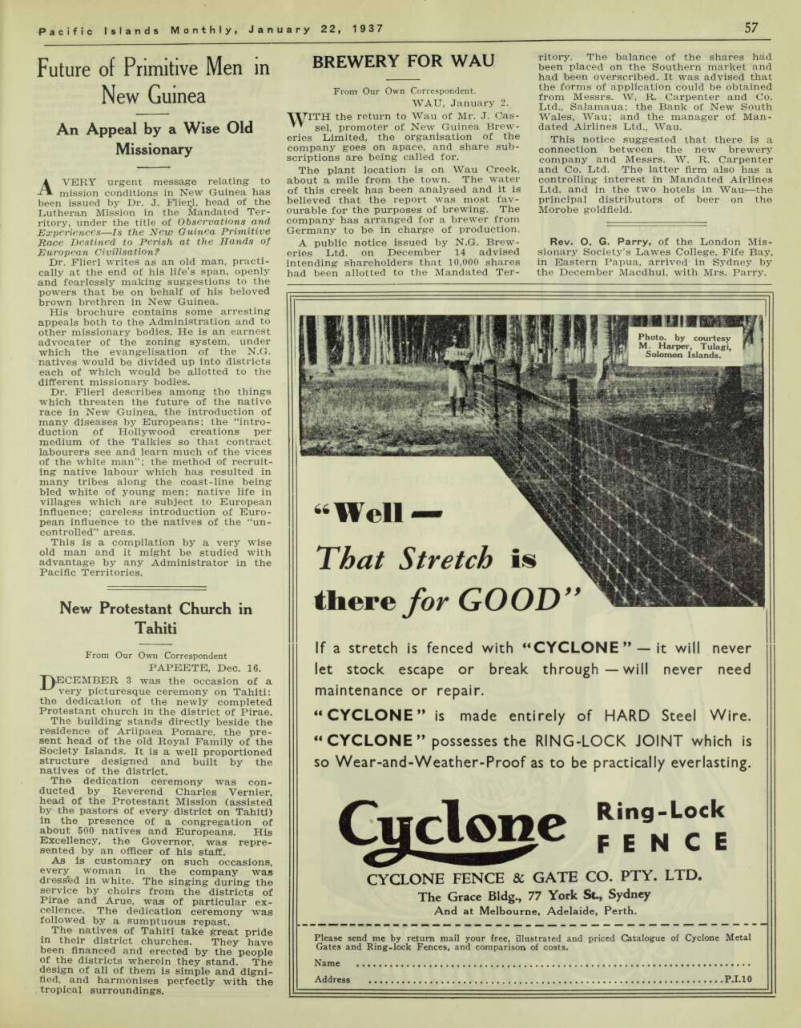
Address P. 1.10 Future of Primitive Men in New Guinea An Appeal by a Wise Old Missionary AVERY urgent message relating to mission conditions in New Guinea has been issued by Dr. J. Flierl, head of the Lutheran Mission in the Mandated Territory, under the title of Observations and Experiences—ls the New Guinea Primitive Race Destined to Perish at the Hands of European Civilisation?
Dr. Flierl writes as an old man, practically at the end of his life’s span, openly and fearlessly making suggestions to the powers that be on behalf of his beloved brown brethren in New Guinea.
His brochure contains some arresting appeals both to the Administration and to other missionary bodies. He is an earnest advocater of the zoning system, under which the evangelisation of the N.G. natives would be divided up into districts each of which would be allotted to the different missionary bodies.
Dr. Flierl describes among the things which threaten the future of the native race in New Guinea, the introduction of many diseases by Europeans; the “introduction of Hollywood creations per medium of the Talkies so that contract labourers see and learn much of the vices of the white man”; the method of recruiting native labour which has resulted in many tribes along the coast-line being bled white of young men; native life in villages which are subject to European influence; careless introduction of European influence to the natives of the “uncontrolled” areas.
This is a compilation by a very wise
New Protestant Church in Tahiti
Pacific Territories.
New Protestant Church in Tahiti From Our Own Correspondent PAPEETE, Dec. 16.
"TVECEMBER 3 was the occasion of a very picturesque ceremony on Tahiti: the dedication of the newly completed Protestant church in the district of Pirae.
The building stands directly beside the residence of Ariipaea Pomare, the present head of the old Royal Family of the Society Islands. It is a well proportioned structure designed and built by the natives of the district.
The dedication ceremony was conducted by Reverend Charles Vernier, head of the Protestant Mission (assisted by the pastors of every district on Tahiti) in the presence of a congregation of about 500 natives and Europeans. His Excellency, the Governor, was represented by an officer of his staff.
As is customary on such occasions, every woman in the company was in white. The singing during the service by choirs from the districts of Pirae and Arue, was of particular excellence. The dedication ceremony was followed by a sumptuous repast.
The natives of Tahiti take great pride in their district churches. They have been financed and erected by the people of the districts wherein they stand. The
Brewery for Wau
fied, and harmonises perfectly with the tropical surroundings.
Brewery For Wau
From Our Own Correspondent.
WAU, January 2.
TVriTH the return to Wau of Mr. J. Cas- ’’ sel, promoter of New Guinea Breweries Limited, the organisation of the company goes on apace, and share subscriptions are being called for.
The plant location is on Wau Creek, about a mile from the town. The water of this creek has been analysed and it is believed that the report was most favourable for the purposes of brewing. The company has arranged for a brewer from Germany to be in charge of production.
A public notice issued by N.G. Breweries Ltd. on December 14 advised intending shareholders that 10,000 shares had been allotted to the Mandated Territory. The balance of the shares had been placed on the Southern market and had been overscribed. It was advised that the forms of application could be obtained from Messrs. W. R. Carpenter and Co.
Ltd., Salamaua; the Bank of New South Wales, Wau; and the manager of Mandated Airlines Ltd., Wau.
This notice suggested that there is a connection between the new brewery company and Messrs. W. R. Carpenter and Co. Ltd. The latter firm also has a controlling interest in Mandated Airlines
[Islands People Notes]
Ltd. and in the two hotels in Wau —the principal distributors of beer on the Morobe goldfield.
Rev. O. G. Parry, of the London Mis-
Advertisements & other items, pp. 59-60 (3 items)
Creme Simon Advertisement
57 Pacific Islands Monthly, January 22, 1 937
AVOID INERT CREAMS
What woman does not sigh after this radiant freshness, this juvenile tint that excites admiration? CREME SIMON makes the skin lovely, —it is always active and is delicately perfumed.
For Perfect Beauty use
CREME SIMON
poudrVsimon (7 Shades), and
SIMON SOAP
SIMON
"4711" Eau de Cologne (Robert Blau) Advertisement
/ y , / When dancing or at the theatre don’t forget now and then to
Secura Chemists (Medical Goods) Advertisement
Eau de Cologne
MEDICAL GOODS
All our MEDICAL GOODS are sold with our GUARANTEE OF MONEY BACK if not satisfied; best quality, lowest prices.
Call or write for FREE "BOOK OF KNOWLEDGE." Price List & Catalogue of Medical Goods, etc., and FREE CON- FIDENTIAL ADVICE. All these goods POST FREE in plain wrapper from SECURA CHEMISTS, Dept. P, 269 ELIZABETH ST., MELBOURNE.
New Judge for Samoa
you in the selection of your medical requirements. ,
New Judge For Samoa
From Our N.Z. Correspondent AUCKLAND, Jan. 6.
IVTR. J. Morling, of Napier, will leave Auckland on February 9 to take up the position of Chief Judge of Western Samoa. He qualified as a solicitor in 1907 and as a barrister in 1909 and is now a member of the legal firm of Kennedy, Lusk, Morling and Willis. He is looked on as a man of outstanding personality.
Now a keen golfer, Mr. Morling was at one time a regular Rugby player. He is a prominent Freemason.
Mr. Morling’s appointment as permanent Chief Judge in Samoa marks a change in the policy that has been followed of
[Islands People Notes]
recent years of sending N.Z. magistrates to the Mandated Territory for short terms.
Mr. James Norman Hall, the American novelist who has long been resident in Tahiti, was in San Francisco when the last mail left, owing to the serious illness of his only son who has been an inmate of
Advertisements & other items, pp. 60-61 (3 items)
Pattern Service (Fashion Pattern Notice)
hope was experienced for the survival of the child.
PATTERN SERVICE
WE have arranged with a well-known Sydney firm of pattern-cutters to publish each month a diagram of a seasonable frock, patterns of which may be obtained by our readers direct from this office, post free, on payment of the sum stated under the diagram. Address your letter to “Pattern,” Pacific Islands Monthly, Box 3408 R, Sydney, and enclose a note giving the number of the pattern wanted and bust size, and enclose also the price of the pattern in postal note or stamps. The pattern will be sent by return mail. 3074 —Allover designs are first favourites in this season’s fabrics. The piece blouse has raglan sleeves, fitted with a dart on the shoulders, and threaded with elastic at the elbows. The new collar ripples softly in the front and finishes with points at the back where it opens. Skirt has a centre panel. Material (for 36 in. bust) : 31 yds. 36 ins. wide; contrast, | yd. 36 ins. wide. Bust
Springwood Ladies' College Advertisement
58 Pacific Islands Monthly, January 22, 1 937 At Blue Mountains— Springwood, N.S.W.
Springwood Ladies* College Est. 1897. Kindergarten to Leaving Certificate. Tennis, Riding, Swimming, Team Games. Unequalled climate. Pure Jersey Milk. Senior and Junior Houses. Open-air
Pacific Islands Co. Advertisement
M. E. DURAND, Principal. r THE PACIFIC BUNDS (0. at your service to supply you with anything you may require. #• —•SERVICE •
FOR THE WET SEASON
A Full Range of Dunlop-Perdriau, Barnet Glass and Hardie Rubber Company’s Products available in all sizes—Women’s and Maid’s, Men’s and Boys’.
LADIES’ RAINCOATS; Hardie’s Leatherette, black, brown, blue, red, green . . 15/6 each Hardie’s Art Silk, red, navy, brown, green, grey, ivory, black 28/- each Hardie’s Parchment Piped, black, brown, red, green blue 22/9 each GENT’S RAINCOATS: Hardie’s Reversible Raglans, black, brown, black and brown Tweed 24/- each Hardie’s S.B. Raglans Indiana, navy, fawn, brown, grey, putty, slate 23/- each Hardie’s S.B. Raglans (no belt), navy, black, brown.
Art Silk 34/- each Hardie’s D.B. Raglans, full loose lined, Indiana, navy, fawn, brown, grey, putty, slate 38/6 each Dunlop Perdriau’s “Monsoon” heavy service, caped, storm proof front, guaranteed 2 years 49/- each Dunlop Perdriau’s Waterproof Suits 34/- each Dunlop Perdriau Waterproof Trousers 14/- pair Dunlop Perdriau Waders (Boots and Legs, one piece)
ANY TIME IS TEA-TIME
Griffiths, Golden Tips . . . .
Griffiths, Selected Griffiths, Special Ceylon Griffiths, Special Blend . . . .
Griffiths, Ceylon & Indian Blend Griffiths, Afternoon Tea, Highly Flavoured Blend (Especially Recommended) Bushell’s Blue Label Bushell’s Blue Label, 61b. Tins 64/- & 84/- pair
YOUR VALUE £
_____ Mail a request for our Catalogue at once PACIFIC ISLANDS CO.
Fashion Hints for Islands Women
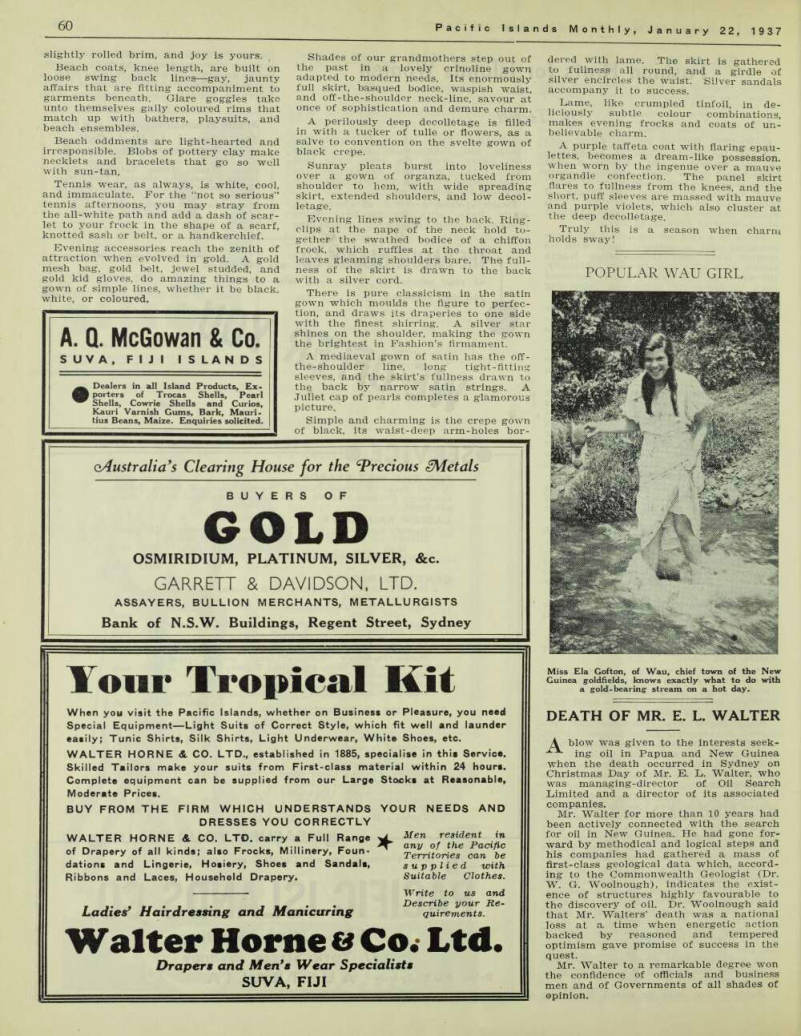
77 York Street, Sydney Prices F.O.B. Sydney AUSTRALIA Fashion Hints for Islands Women By Therese A SUIT? But, of course, since suits are the most delightful possessions in the wardrobe. In choosing a skirt and jacket or a frock and coat —both come under the modern category of “suit” —be careful to choose the length of jacket most becoming to your type. This should not be a difficult task, as there are jackets of infinite variety.
There is a reckless air about the loose swinging coat of oatmeal linen, with its spotted scarf, and three-quarter length sleeve, with wide, spotted cuffs. Actually, the sleeve is full length, but is buttoned back to show its lining—an intriguing and novel idea.
Colour schemes are exciting; but the wise woman keeps tight rein on her enthusiasms, and walks gingerly along this path so full of pitfalls for the unwary.
If a three-colour scheme is your ambition, one colour must be practical, so that accessories may match, rather than contrast.
Let your predominating colour be dark —brown, black, blue, etc. —and have gloves, bag, shoes, and hat in your particular choice of colour. Top the frock with a lighter coat, and add a third colour sparingly—a posy in your lapel, a flower in your hat, a gay handkerchief in the pocket, or a simple blouse. You will be charmed with the result.
A bright blue coat goes over a black frock, or the same bright blue allies itself to a dull green and tucks a primrose in its neckline.
A rose-pink frock trims itself with green buttons and boasts pigskin accessories. Pigskin accessories are something to boast about. Though unsuited for tropic climes, worn when the ship is Southward bound, they are most enviable possessions.
A bold spread of white forms the revers on a well-cut afternoon frock of dull crepe, full of bodice and slim of skirt.
A na#y dress ties its neck with a pink cravat, and is topped by stiffened hat of coarse pink linen.
Pink posies in varying shades scatter themselves over an afternoon frock for formal wear. A pleated front, rolled neckline, and flat elbow pleats lined with white are its highlights.
Since tunics are enthusiastically received, a reversible satin utilises its Dr.
Jekyll and Mr. Hyde personalities with great glee. A wide belt encircles the waist of the shining tunic which tops the dull skirt, and the coat, also dull, flows in gracious lines.
All sorts of fascinating tricks are played with shoulders, sleeves and bodice, around which all the interest of the frock centres. The skirt is usually plain, with pleats, or slight flare; but always wellcut and slim, the fullness of the bodice accentuating slim hips and waist.
Scarves are lovely things, either as a medium for contrast or because of their own particular charm as an accessory.
They appear so varied in their ways.
Long floating draperies cascading about the shoulders are delightful for evening wear. A small square is knotted at the front of the neck, cowboy fashion, or ties behind, halter effect. A yardlong strip will knot about your neck and leave generous ends, or it may float gaily in the breeze.
Scarves are held in check by those fascinating little pins of inestimable charm but infinitesimal cost. Fishes that never swam the sea; birds that never took wing; and beasts such as never roamed even the wildest jungle, can be yours for a mere song.
Beach clothes are full of charm. A white linen with butcher-blue spots makes a most attractive sun-baking frock. A three-cornered scarf slots through the shoulders and holds up the halter front. Gird your middle with a matching blue belt in macrame; blue macrame sandals and a sombrero with BUYERS OF GARRETT & DAVIDSON. LTD.
Walter Horne & Co.- Ltd.
Drapers and Men f s Wear Specialists
Suva, Fiji
slightly rolled brim, and joy is yours.
Beach coats, knee length, are built on loose swing back lines—gay, jaunty affairs that are fitting accompaniment to garments beneath. Glare goggles take unto themselves gaily coloured rims that match up with bathers, playsuits, and beach ensembles.
Beach oddments are light-hearted and irresponsible. Blobs of pottery clay make necklets and bracelets that go so well with sun-tan.
Tennis wear, as always, is white, cool, and immaculate. For the “not so serious” tennis afternoons, you may stray from the all-white path and add a dash of scarlet to your frock in the shape of a scarf, knotted sash or belt, or a handkerchief.
Evening accessories reach the zenith of attraction when evolved in gold. A gold mesh bag, gold belt, jewel studded, and gold kid gloves, do amazing things to a gown of simple lines, whether it be black, white, or coloured.
Shades of our grandmothers step out of the past in a lovely crinoline gown adapted to modern needs. Its enormously full skirt, basqued bodice, waspish waist, and off-the-shoulder neck-line, savour at once of sophistication and demure charm.
A perilously deep decolletage is filled in with a tucker of tulle or flowers, as a salve to convention on the svelte gown of black crepe.
Sunray pleats burst into loveliness over a gown of organza, tucked from shoulder to hem, with wide spreading skirt, extended shoulders, and low decolletage.
Evening lines swing to the back. Ringclips at the nape of the neck hold together the swathed bodice of a chiffon frock, which ruffles at the throat and leaves gleaming shoulders bare. The fullness of the skirt is drawn to the back with a silver cord.
There is pure classicism in the satin gown which moulds the figure to perfection, and draws its draperies to one side with the finest shirring. A silver star shines on the shoulder, making the gown the brightest in Fashion’s firmament.
A mediaeval gown of satin has the offthe-shoulder line, long tight-fitting sleeves, and the skirt’s fullness drawn to the back by narrow satin strings. A Juliet cap of pearls completes a glamorous picture.
Simple and charming is the crepe gown of black, its waist-deep arm-holes bordered with lame. The skirt is gathered to fullness all round, and a girdle of silver encircles the waist. Silver sandals accompany it to success.
Lame, like crumpled tinfoil, in deliciously subtle colour combinations, makes evening frocks and coats of unbelievable charm.
A purple taffeta coat with flaring epaulettes, becomes a dream-like possession, when worn by the ingenue over a mauve organdie confection. The panel skirt flares to fullness from the knees, and the short, puff sleeves are massed with mauve and purple violets, which also cluster at
Advertisements & other items, pp. 61-62 (4 items)
A. Q. McGowan & Co. Advertisement
59 Pacific Islands Monthly, January 22, 1937 A. Q. McGowan & Co.
SUVA, FIJI ISLANDS
• Dealers in all Island Products, Exporters of Trocas Shells, Pearl Shells, Cowrie Shells and Curios, Kauri Varnish Gums, Bark, Mauritius Beans, Maize. Enquiries solicited. oAustralia’s Clearing House for the Precious
Garrett & Davidson Ltd. Advertisement
GOLD OSMIRIDIUM, PLATINUM, SILVER, &c.
Walter Horne & Co. Advertisement
ASSAYERS, BULLION MERCHANTS, METALLURGISTS
Bank of N.S.W. Buildings, Regent Street, Sydney l our Tropical Kit When you visit the Pacific Islands, whether on Business op Pleasure, you need Special Equipment—Light Suits of Correct Style, which fit well and launder easily; Tunic Shirts, Silk Shirts, Light Underwear, White Shoes, etc.
WALTER HORNE & CO. LTD., established in 1885, specialise in this Service.
Skilled Tailors make your suits from First-class material within 24 hours.
Complete equipment can be supplied from our Large Stocks at Reasonable, Moderate Prices.
BUY FROM THE FIRM WHICH UNDERSTANDS YOUR NEEDS AND
DRESSES YOU CORRECTLY
WALTER HORNE & CO. LTD. carry a Full Range yL Men resident in of Drapery of all kinds; also Frocks, Millinery, Foun- territories can he dations and Lingerie, Hosiery, Shoes and Sandals, supplied with Ribbons and Laces, Household Drapery. Suitable Clothes.
Write to us and r «. , ww • j . j • • Describe your Re- Ladies Hairdressing and Manicuring quirements.
[Photo Caption: Popular Wau Girl]
the deep decolletage.
Truly this is a season when charm the confidence of officials and business men and of Governments of all shades of opinion.
Death of Mr. E. L. Walter
holds sway!
Popular Wau Girl
Death Of Mr. E. L. Walter
A blow was given to the interests seeking oil in Papua and New Guinea when the death occurred in Sydney on Christmas Day of Mr. E. L. Walter, who was managing-director of Oil Search Limited and a director of its associated companies.
Mr. Walter for more than 10 years had been actively connected with the search for oil in New Guinea. He had gone forward by methodical and logical steps and his companies had gathered a mass of first-class geological data which, according to the Commonwealth Geologist (Dr.
W. G. Woolnough), indicates the existence of structures highly favourable to the discovery of oil. Dr. Woolnough said that Mr. Walters’ death was a national loss at a time when energetic action backed by reasoned and tempered optimism gave promise of success in the quest.
Mr. Walter to a remarkable degree won
Advertisements & other items, pp. 62-63 (1 item)
Grand Pacific Hotel Advertisement
Pacific Islands Monthly, January 22, 1 937 *1 ■ The PREMIER Social Rendezvous of Fiji . . .
Grand Pacific Hotel - - Suva, Fiji EXCELLENT CUISINE. EFFICIENT TRAINED INDIAN WAITERS AND SERVANTS.
MODERNLY EQUIPPED.
Grand Pacific Hotel
SUVA, FIJI
Delightfully situated in tropical gardens overlooking Suva harbour and the Pacific Ocean.
TARIFF: From 17/6 per Day.
Accommodation Reserved by Wireless.
Cook Island Notes
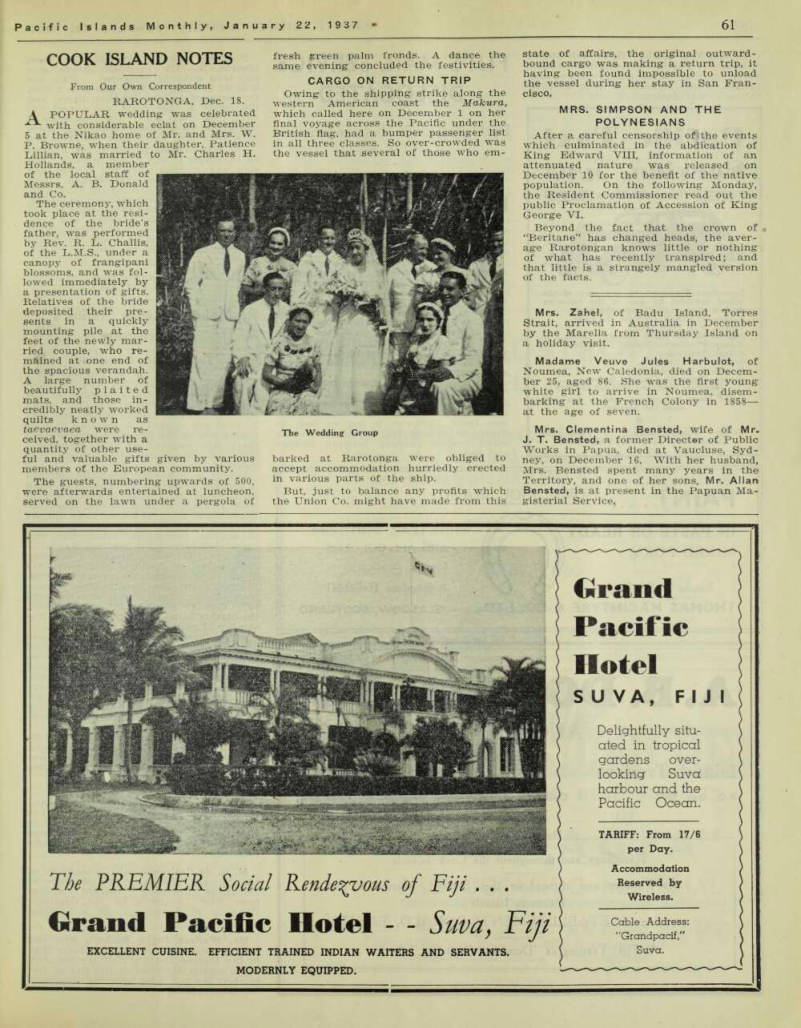
"Grandpacif,"
Suva.
Cook Island Notes
From Our Own Correspondent RAROTONGA, Dec. 18.
A POPULAR wedding was celebrated with considerable eclat on December 5 at the Nikao home of Mr. and Mrs. W.
P. Browne, when their daughter, Patience Lillian, was married to Mr. Charles H.
Hollands, a member of the local staff of Messrs, A. B. Donald and Co.
The ceremony, which took place at the residence of the bride’s father, was performed by Rev. R. L. Challis, of the L.M.S., under a canopy of frangipani blossoms, and was followed immediately by a presentation of gifts.
Relatives of the bride deposited their presents in a quickly mounting pile at the feet of the newly married couple, who remained at one end of the spacious verandah.
A large number of beautifully plaited mats, and those incredibly neatly worked quilts known as taevaevaea were received, together with a quantity of other useful and valuable gifts given by various members of the European community.
The guests, numbering upwards of 500, were afterwards entertained at luncheon,
Cargo on Return Trip
fresh green palm fronds. A dance the same evening concluded the festivities.
Cargo On Return Trip
Owing to the shipping strike along the western American coast the Makura, which called here on December 1 on her final voyage across the Pacific under the British flag, had a bumper passenger list in all three classes. So over-crowded was the vessel that several of those who embarked at Rarotonga were obliged to accept accommodation hurriedly erected in various parts of the ship.
But, just to balance any profits which the Union Co. might have made from this state of affairs, the original outwardbound cargo was making a return trip, it
Mrs. Simpson and the Polynesians
cisco.
Mrs. Simpson And The
POLYNESIANS After a careful censorship of the events which culminated in the abdication of King Edward VIII, information of an attenuated nature was released on December 10 for the benefit of the native population. On the following Monday, the Resident Commissioner read out the public Proclamation of Accession of King George VI..
Beyond the fact that the crown of “Beritane” has changed heads, the average Rarotongan knows little or nothing
[Islands People Notes]
of what has recently transpired: and that little is a strangely mangled version of the facts.
Mrs. Zahel, of Badu Island, Torres Strait, arrived in Australia in December by the Marella from Thursday Island on a holiday visit.
Madame Veuve Jules Harbulot, of Noumea, New Caledonia, died on December 25, aged 86. She was the first young white girl to arrive in Noumea, disembarking at the French Colony in 1858 — at the age of seven.
Mrs. Clementina Bensted, wife of Mr.
J. T. Bensted, a former Director of Public Works in Papua, died at Vaucluse, Sydney, on December 16. With her husband, Mrs. Bensted spent many years in the
Advertisements & other items, pp. 63-64 (4 items)
[Photo Caption: The Wedding Group]
Territory, and one of her sons, Mr. Allan
Pacific Taxi Service Advertisement
Pacific Islands Monthly, January 22, 1 937 Pacific Taxi Service, Vincent Brothers : □a A Immediate Transport to any part of the Island provided by any of the following modem Cars (all latest models): — 7-pass. Plymouth-Chrysler De Luxe. 7-pass. V-8 Ford Sedan. 7-pass. Master Buick Tourer. 4-pass. Plymouth-Chrvsler De Luxe. 4-pass. Studebaker. 4-pass. Nash Lafayett. 4-pass. V-8 Ford Sedan. 4-pass. Plymouth-Chrysler Sedan.
Moderate Charges—Efficient Drivers Radio your instructions, and a car will
Thomas Macintyre & Co. (Horse Shoe Brand Paint) Advertisement
Cables: “Vincent, Suva.” ’Phone: 33 Garage Next to Bums, Philp Store
PAINT HORSE SHOE BRAND
IN PASTE OR READY
MIXED FORM
Made in Scotland— ft
WHITE LEAD. WHITE ZINC
A. B. Donald Ltd. Advertisement
THOMAS MACINTYRE & CO. LTD., -GLASGOW, SCOTLAND
A. B. DONALD Ltd.
AUCKLAND Island Traders General Merchants P.O. Box 1509 :: Cables and Telegrams: “Kingdom/’ Auckland Branches at Rarotonga and throughout the Cook Islands At Papeete and throughout the Society, Marquesas and
[Islands People Notes]
Paumotu Islands trading as “ETABLISSEMENTS DONALD. TAHITI”
At Fiji: Trading as “Dominion Fruit C 0.,” Suva Mr. and Mrs. Eastham Guild, well-known residents of Tahiti, have returned to their
Fiji's Mail Service Dislocated: By Union Co.'s Rearrangements and U.S. Strike
native United States.
Fiji's Mail Service
DISLOCATED By Union Co.’s Rearrangements and U.S. Strike From Our Own Correspondent SUVA, Jan. 3.
IT is indeed unfortunate that the change in the timetable of the Canadian Australian liners, due to the cessation of the San Francisco-Sydney service of the Union Line, has come before the American maritime strike is settled.
The last northbound liner was the Aorangi on December 11, and now instead of coming on January 8, as would have been the case with the old schedule, the Niagara has been held back until January 28, giving a break of seven weeks between boats, as there are no Matson liners running at the present time to fill the gap.
The southbound Aorangi will arrive here on January 14, and then there will be a break in the southbound service of seven weeks, until March 5.
This is proving most inconvenient so far as the mail service to and from New Zealand is concerned, for there is only the Matua once a month otherwise. The service from Australia is not so bad, as there are always the Union and other cargo vessels running between Sydney and Suva.
Not only has the mail service been affected, but the passenger trade has also been seriously hampered. With the hold up in America, there has been a rush for passages on the Canadian liners, and the result is that boats are almost full when they reach Suva. The local office of the Union Co. cannot guarantee passages until after their liners have left Honolulu.
The last southbound trip of the Niagara on December 18 was a case in point. The ship was crowded when she arrived, and only a mere handful disembarked. Over 170 passengers left here by the same ship, and the crowding on board was excessive.
Two berth cabins had four people packed into them, and four berthers had six.
25 Years: Makogai Leper Station's Anniversary
steerage in order to get away. 25 YEARS Makogai Leper Station’s Anniversary From Our Own Correspondent SUVA, Dec. 20.
FRIDAY, November 27, was the 25th anniversary of the opening of the Makogai Leper Station, in Fiji, where lepers from many Pacific Islands and New Zealand are treated. A message of congratulation on the fine work accomplished there was received by the Government from the Secretary of State for the Colonies.
Lepers in Fiji were originally confined in an area below the old hospital in Walu Bay, Suva, but public agitation led to their removal to Beqa Island, famed as the home of the flrewalkers. Beqa did not prove satisfactory, as it was impossible to acquire the whole island —this was considered essential if isolation was to be complete. Therefore, in 1909, the pretty little island of Makogai 'was purchased by the Government from private interests.
Financial stringency and other causes gave rise to delays, and it was not until 1911 that 40 patients were transferred, the station being officially opened on November 27 of that year.
Since then wonderful work has been done by the resident medical staff and the Roman Catholic nursing sisters, whose sacrificial devotion to their self-imposed task has won the admiration of all creeds.
Makogai has recorded a high percentage of complete cures, and has often been described by visiting authorities on leprosy as one of the finest stations they have ever visited.
The record of achievement in the cure and alleviation of the terrible complaint
[Islands People Notes]
over the past 25 years is one that all concerned with the conduct of the station can well be proud.
Dr. Raymond Firth, Professor of Anthropology at the London University, has written a book entitled “Art and Life in New Guinea.” The volume has just been published in England by The Studio Limited.
M. G. de Creisquer, who is manager of the Noumea branch of the Messageries Maritimes Company, reached Sydney from New Caledonia by the Capitaine Illiaquer on January 7, on a business visit.
Mr. Wallace Inglis Beckett, who had been prospecting for gold for some time in the Morobe district, New Guinea, died
Advertisements & other items, pp. 64-65 (2 items)
Morris, Hedstrom Ltd. Advertisement
Pacific Islands Monthly, January 22, 1937 MORRIS, HEDSTROM, Ltd.
FIJI Sole Agents in Fiji for . . .
Vacuum Oil Company (Pty.) Limited Imperial Chemical Industries Limited Nobel (Australasia) Pty Ltd.—Explosives Full Stocks of
MINERS AND PROSPECTORS’
REQUISITES
Also SODIUM CYANIDE. ZINC
DUST. Etc.. Etc.
Sydney Office:
DALTON HOUSE, 115 PITT ST., SYDNEY
Branches throughout the gold hearing areas Lautoka, Ba.
Tavua, Penang,
W. H. Grove & Sons Ltd. (Agfa Photographic) Advertisement
*5 ISOCHROM
FOR BEST RESULTS
USE “AGFA”
Suva Yacht Stolen: "Seafarer" and Four Indians Disappear
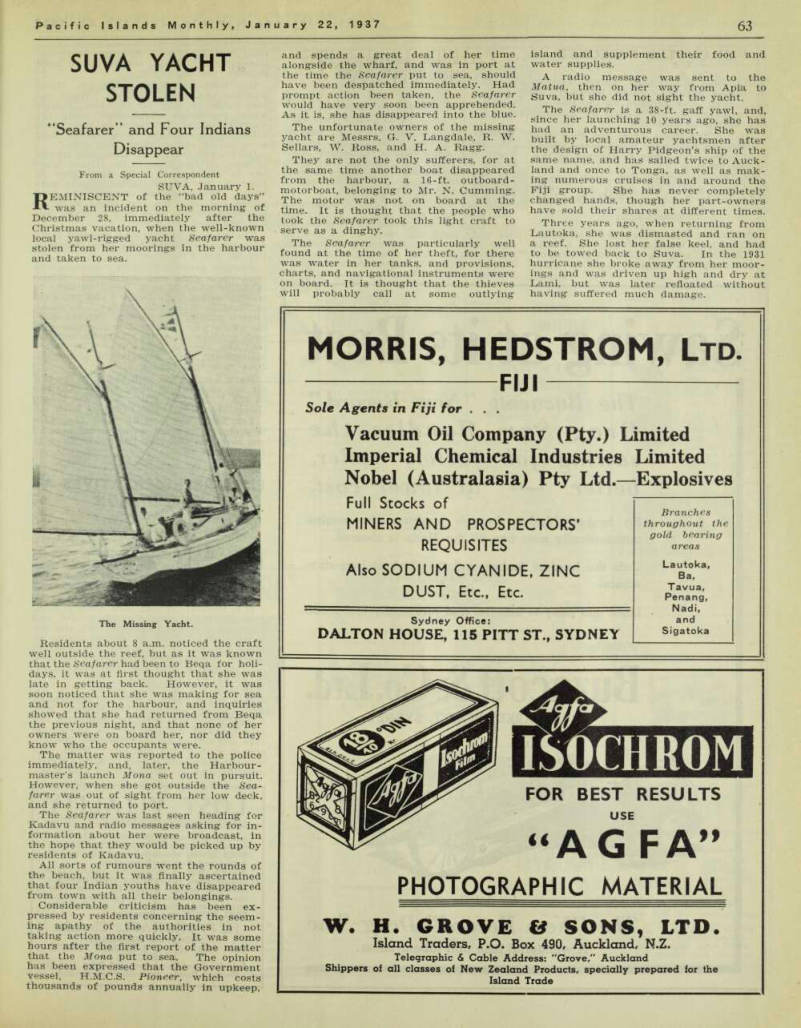
Island Trade
Suva Yacht
STOLEN “Seafarer” and Four Indians Disappear From a Special Correspondent SUVA, January 1.
Reminiscent of the “bad old days” was an incident on the morning of December 28, immediately after the Christmas vacation, when the well-known local yawl-rigged yacht Seafarer was stolen from her moorings in the harbour and taken to sea.
Residents about 8 a.m. noticed the craft well outside the reef, but as it was known that the Seafarer had been to Beqa for holidays, it was at first thought that she was late in getting back. However, it was soon noticed that she was making for sea and not for the harbour, and inquiries showed that she had returned from Beqa the previous night, and that none of her owners were on board her, nor did they know who the occupants were.
The matter was reported to the police immediately, and, later, the Harbourmaster’s launch Mona set out in pursuit.
However, when she got outside the Seafarer was out of sight from her low deck, and she returned to port.
The Seafarer was last seen heading for Kadavu and radio messages asking for information about her were broadcast, in the hope that they would be picked up by residents of Kadavu.
All sorts of rumours went the rounds of the beach, but it was finally ascertained that four Indian youths have disappeared from town with all their belongings.
Considerable criticism has been expressed by residents concerning the seeming apathy of the authorities in not taking action more quickly. It was some hours after the first report of the matter that the Mona put to sea. The opinion has been expressed that the Government vessel, H.M.C.S. Pioneer, which costs thousands of pounds annually in upkeep, and spends a great deal of her time alongside the wharf, and was in port at the time the Seafarer put to sea, should have been despatched immediately. Had prompt action been taken, the Seafarer As it is, she has disappeared into the blue.
The unfortunate owners of the missing yacht are Messrs. G. V. Langdale, R. W.
Sellars, W. Ross, and H. A. Ragg.
They are not the only sufferers, for at the same time another boat disappeared from the harbour, a 16-ft. outboardmotorboat, belonging to Mr. N. Gumming.
The motor was not on board at the time. It is thought that the people who took the Seafarer took this light craft to serve as a dinghy.
The Seafarer was particularly well found at the time of her theft, for there was water in her tanks, and provisions, charts, and navigational instruments were on board. It is thought that the thieves will probably call at some outlying island and supplement their food and water supplies.
A radio message was sent to the Matua, then on her way from Apia to Suva, but she did not sight the yacht.
The Seafarer is a 38-ft. gaff yawl, and, since her launching 10 years ago, she has had an adventurous career. She was built by local amateur yachtsmen after the design of Harry Pidgeon’s ship of the same name, and has sailed twice to Auckland and once to Tonga, as well as making numerous cruises in and around the Fiji group. She has never completely changed hands, though her part-owners have sold their shares at different times.
Three years ago, when returning from Lautoka, she was dismasted and ran on a reef. She lost her false keel, and had to be towed back to Suva. In the 1931 hurricane she broke away from her moor-
Advertisements & other items, pp. 65-66 (3 items)
[Photo Caption: The Missing Yacht]
would have very soon been apprehended.
Buzacott & Co. (Drag Saw) Advertisement
63 Pacific Islands Monthly, January 22, 1 937 Sawing at its Best The Buzacott "New Drag Saw Handles the sawing job , , better at lower cost.
No broken blades through jambing—the engine automatically runs free till the Blade is cleared.
Cuts the hardest timber and the thickest logs anywhere.
Light and easy to handle, and practically fool-proof.
Write to; — Buzacott & Co. Ltd. 7-11 MARKET STREET, SYDNEY y
Dr. Henri's Nu-Vigor Vitality Pills Advertisement
The "New Record 99 Drag Saw A wonderful time and labour saver.
LOST VITALITY
quickly and safely restored by taking the famous DR. HENRI'S NU-VIGOR VITALITY PILLS, giving wonderful results for Loss of Power and Nervous Exhaustion.
Week's trial 3/6; month's supply 10/6 (posted free). Extra-Strong Prescription for obstinate cases 7/6 and 21/- Stimulates the vital forces. All communications strictly confidential. Call or write for FREE ADVICE and literature to H. P. MICHAEL, Chemist MICHAEL'S BUILDINGS, COR. ELIZABETH & LONSDALE STREETS,
Fiji Cutter Wrecked
Ask for Free Catalogue and Price List of Medical Goods, etc.—All lines stocked.
Fiji Cutter Wrecked
r I ’HE 10-tons auxiliary cutter Lennie, owned by Mr. David Simpson, *of Savu Savu, was wrecked on the reef off Wakaya Island, north-east of Levuka, Fiji, during December.
After a hazardous swim, the crew and a European passenger reached the shore.
They were later taken to Levuka in the launch Venture.
[Islands People Notes]
The Lennie, which had only recently been fitted with a new diesel engine, was not insured. Ten tons of copra were lost.
Mr. W. M. Middleton, planter of Kulili, Madang, New Guinea, who is on a visit
Tahiti Loses Its "Boat-Day"
ary.
Tahiti Loses Its
“Boat-Day”
From a Special Correspondent PAPEETE, Dec. 12.
WITH tears in their eyes, all Papeete watched the Makura, last of the Union S.S. Co.’s regular passenger boats to call at Tahiti pass through the lagoon and around Moorea into the swelling Pacific. With her, goes a happy phase of life as lived in Tahiti.
The old traditional and oft-described “Boat-day” will be no longer. True, regular sailings of cargo steamers are promised, but what thrill can there be in meeting these boats? —they carry only a dozen or so passengers. How can that be compared with the past and bygone days when the Makura or the Maunganui came into port from San Francisco, carrying 50 to 100 passengers for Tahiti, besides 200 or more through passengers?
On “Boat-day” Tahiti woke up. Great was the excitement in town. When the boat made its way to the pier, Tahiti’s whole population congregated along the waterfront —the Tahitians in their most colourful apparel, the foreigners in their most daring and exposing “sun suits.”
Old friends to welcome back, new friends to meet, strange faces in the streets, tourists to take around to see the sights of Papeete. No wonder the inhabitants were busy. When in the evening the boat pulled out, and the last paper streamer had been thrown from ship to shore, Tahiti was tired, but happy.
The whole procedure was repeated three days later, when the boat from Australia left for San Francisco.
Another great institution, “catching the mail,” now goes into the discard. Those of Tahiti’s inhabitants lucky enough to receive letters from America had two days in which to mail their answers. As usual, human nature, and perhaps Tahiti’s dolce far niente ways induced a postponement of such arduous duties till the last minute, so that the Papeete Post Office, just before mail-closing time, experienced a tremendous rush of business.
Many a letter has been posted in the bag for late mail, which hung at the gangway of the Union Go’s boats, a second before the sailing of an outward-bound boat.
Yes, Tahiti will miss its “Boat-day.” Life
Fiji's Representatives at Coronation
those hectic days.
Fiji’S Representatives At
CORONATION From Our Own Correspondent SUVA, January 12.
Hon. sir henry scott, m.1.c., K.C., of Suva, has been appointed to be one of Fiji’s representatives at the Coronation ceremonies in England in May.
It is understood that Hon. Ratu J. L. V.
Sukuna, M.L.C., Major C. B. Joske, and Lieutenant Edward Cakobau, will also represent the Colony at the crowning of
[Islands People Notes]
King George VI. However, Government sources report that no definite decision on this matter has yet been reached.
Mrs. Clara Tarte, a very old resident of Fiji, died at Taveuni on December 3. Mrs.
Tarte, who went from Ballarat with her late husband, arrived in the Colony in 1870 and settled on the island of Taveuni,
Advertisements & other items, pp. 67-68 (3 items)
Levenson's Radio (Games, Radio Parts and Accessories) Advertisement
POKER DICE
♦ ♦t now Horn N9!Oa Put & Take, 2-dice game, 3/6. 5 dice roll, 6/6 (5 dice 1 3-dice roll. 3/9. (3 dies mounted on roll). I mounted on roll).
The Sydney Cup Race Game, a spinning wheel De Luxe with betting cloth, 63/-. Spin determines the winner and the winner’s price. A handsome game. Ideal for Homes, Hotels, Clubs, etc. 14in. high. \l <? \o s <y \h /O e o ft w A? \°> 'S 4 Introducing Job Patience. A new fas c i n a tin; game, all the rage abroad. 16 spaces, 15 n u m bers.
You have to place the 15
JOBS PATIENCE
plates in numerical order sliding only one at each move, 3/6. The best 3/6 you ever spent.
RADIOmODERNE The Assembled Chassis £22/10/ Just designed for 100 per cent, service in the Pacific Islands. Pay cash and save at least 33 1-3%. Radio Moderne is the newest, finest and most up-to-the moment 5-valve battery-operated superhet. ever introduced for the Pacific Islands. That’s a sweeping statement, but we stand behind every word of it.
Hear all Australasian stations, plus London, Paris, Berlin, Moscow, Tokyo, New York, etc., etc.
Radio Modeme, Exclusively Built to suit Pacific Islands conditions. Humidity, etc. Not a Mass Production Product, each Set individually Built by Senior Mechanics, Tuned Up, and Air Tested before despatch.
Radio Moderne incorporates every wanted, technically correct improvement, all latest type Philips valves, 3 Like-a-Flash triple duty B batteries, best grade 100 amp. 2 volt accumulator, automatic volume control, latest Amplion permagnetic speaker. Perfect tone, equal to any electric set. Latest calibrated aero dial, showing Australian and overseas stations, extraordinarily low “B” battery consumption, approximately 10 to 12 m a. “A” battery (accumulator) consumption .65 amps. Selectivity and Sensitivity 100 per cent. Packing 6/6 extra, plus freight, 12 months’ guarantee all parts and speaker. 90 days' valves £22/10/- Send for Levenson’s Radio Bargain Bulletin, 120 pages, Bd, post free. Also Levenson’s Radio Buyer’s Guide and Assembly Chart Handbook. 2/-, post free.
New, tested, charged 12 months’ guarantee.
Add 1/6 packing plus freight 100 15/- 35 16/3 60 18/9 85 27/9 35 22/6 60 23/9 We guarantee a better price for all replacement valves and component parts. Just send along your order. Price and 100% service guaranteed English Radio Meters. Just arrived. AC/DC Universal type, reads everything in radio. Volts up to 240, and milliamps, 25/-. Bench type, with leads. Pocket type, bakelite case, 3 readings, volts, and m/a., 10/6. 2 readings volts, for low and high tension batteries, 7/6. offices and stores.
Electric Klaxon Horn, with all fittings and push button. 7/6. Fitted in a jiffy, autos, shops.
“Totem,” the newest game for home, club, picnic or party 21/-.
“Odds and Evens,” a new Head and Tail spin game, 21/ Both designed as reproduction, Press knob and away they go.
Pyrex type Glass Insulators. 3 in., 1/-, 4in., 3/6, sin., 6/6.
Egg type 3 for 1/-. 7 Jin.
Genuine Pyrex, 30/- (SJUlfia) 3INS gSOGK®) «<ns SINS COSMOCOCD 4 25 Amplion (English) 28/6.
Gramophone Pickups. B.T.H.
Bakelite Model 32/6.
“Cosmocord” 25/-.
“Cosmocord” De Luxe 32/6.
“Cosmocord” Super de luxe 45/-.
“Clarion” English all-Bakelite Pick-up, with volume control, 22/6. yumowm wMderone IDE TIE f m The greatest little battery - operated Radio ever introduced. Build it yourself or buy it ready assembled.
Easiway Charts, Free with Kit.
All-world reception. All Parts, 36/4. Valve, 16/. 100 amp. hr. 2v.
A c c u m u 1 ator, 15/- 60v. Light Duty B Battery, 9/6. ’Phones, 10/6, or 22/- line, now 18/-, or Ericsson professional type 28/6.
Cost of assembling by us, 12/6, if required.
“Like-a-flash” de luxe Morse code keys, adjustable every way. Long or short tappers, 12/6; P.M.G. type all brass fittings, 19/6; Junior models, 9/6, 10/6. Buzzers 2/6, 3/6, 7/6.
P.M.G. type all brass fittings post office sounders, 63/ value, now 35/. icssonT HEAD &utLdo PROFESSIONAL.
Like-a-flash Radio B Batteries; Extra heavy duty, 11/9; triple duty, 14/6; light duty, 7/3; 4J or 9v.
C batteries, 2/-.
Portable Gramophones, leading makeis. Samples always in stock. Brand new. We select for you and guarantee. 45/ -, 48/6, 55/-. 100 per cent, satisfaction. m CPK2E® "T 3 ocCo© O' Trade-in relonditioned as new, floor model Gramophones, leading makes, 35/-, 42/-. and 45/-.
Packing 5/6 plus freight.
Guaran teed perfect in working condition.
Like-a-flash “Eliminoise”
Aerial Kit, for short or dual wave sets. Aerial Pyrex type Insulators, transposition blocks and 200 ft. Rubber Clad Aerial, 22/.
Eliminates unwanted aerial and hideous electrical noises from your dual-wave or short-wave set.
Like-a-flash copper ball aerials add range when hooked up to ordinary aerial, 6/- ea. /wrt 2* loons* Double Clad Insulated Rubber Aerial, 30 strands: 50ft. 2/6, 100 ft. 5/-. 40 strands; 50ft. 5/6, 100 ft. 10/-.
Copper Aerials—3 wires, 3/20; 50ft. 1/-, 80ft., 1/4, 100 ft. 1/8. 7 wires, 7/20; 50ft. 1/9, 80ft. 2/9. 100 ft. 3/6.
“Ormond” 3in. geared slow motion front panel dials, 8/6.
“Man - o’ - War” Rubber Clad 40 strand Tinned Copper Supersensitive Aerial, 50ft., 5/6; 100 ft., 10/-. 11111111111111111 l Write for Punch Board Leaflets
IEVENSON’S RADIO
11111111111111111 l 11111111111111111 l Write for Pin-Game, 226 P I- PITT ST., SYDNEY N.S.W., AUSTRALIA l3£u Branch: Radio Cheapside, 240 a Pitt St. 11111111111111111 l ’Phones, M 2525 and M 2526. Cable address, “Leveradioh.” Good*
Oceania (Journal) Notice
65 Pacific Islands Monthly, January 22, 1937 OCEANIA A Journal devoted to the study of the Native Peoples of Australia, New Guinea, and the Islands of the Pacific Ocean.
Editor: Dr. A. P. Elkin (Professor of Anthropology at the University of Sydney); Assistant Editor : H. Ian Hogbin.
Published Quarterly.
Subscription, 5/- per copy (£1 per annum) Published by the Australian
Arnott's Milk Arrowroot Biscuits Advertisement
N.S.W.
THE PERFECT
SCHOOL LUNCH
SUALLY the school lunch is a very scratch meal which is eaten just when the vigorous exercise of the playground has made a strong demand on the endurance of the child. However with little trouble it
[Islands People Notes]
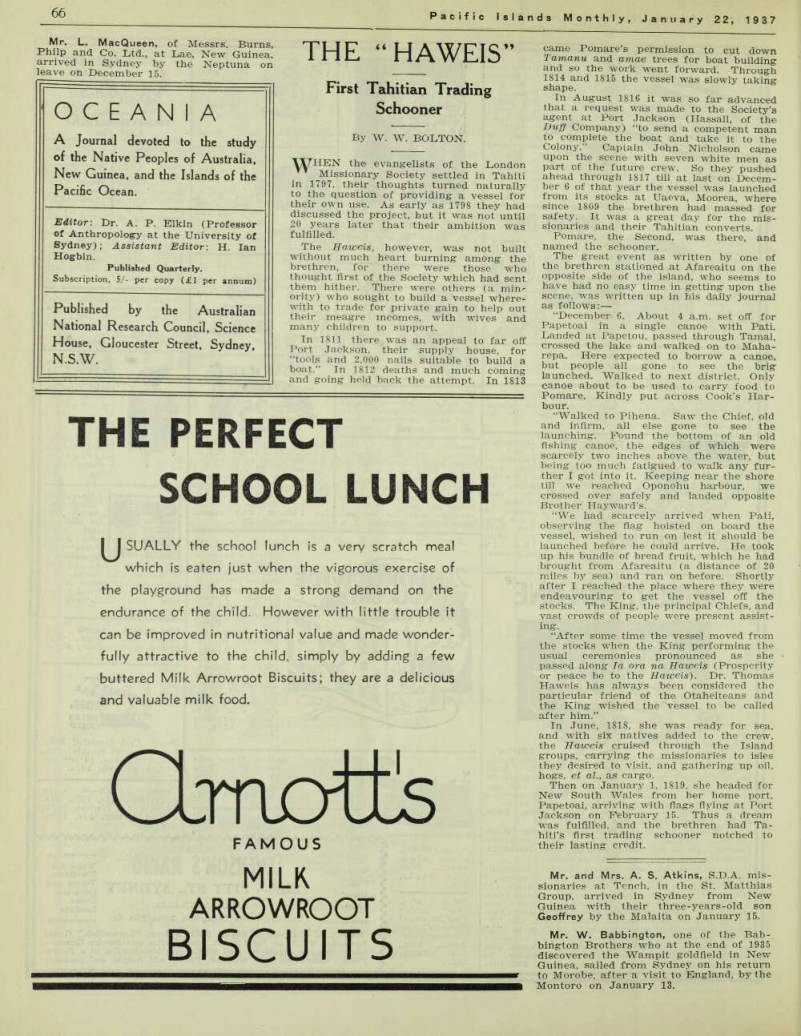
MILK ARROWROOT BISCUITS Mr. L. Mac Queen, of Messrs. Burns,
The "Haweis": First Tahitian Trading Schooner
leave on December 15.
The “Haweis”
First Tahitian Trading Schooner By W. W. BOLTON.
WHEN the evangelists of the London T Missionary Society settled in Tahiti in 1797, their thoughts turned naturally to the question of providing a vessel for their own use. As early as 1798 they had discussed the project, but it was not until 20 years later that their ambition was fulfilled.
The Haweis, however, was not built without much heart burning among the brethren, for there were those who thought first of the Society which had sent them hither. There were others (a minority) who sought to build a vessel wherewith to trade for private gain to help out their meagre incomes, with wives and many children to support.
In 1811 there was an appeal to far off Port Jackson, their supply house, for “tools and 2,000 nails suitable to build a boat.” In 1812 deaths and much coming and going held back the attempt. In 1813 came Pomare’s permission to cut down Tamanu and amae trees for boat building and so the work went forward. Through 1814 and 1815 the vessel was slowly taking shape.
In August 1816 it was so far advanced that a request was made to the Society’s agent at Port Jackson (Hassall, of the Duff Company) “to send a competent man to complete the boat and take it to the Colony.” Captain John Nicholson came upon the scene with seven white men as part of the future crew. So they pushed ahead through 1817 till at last on December 6 of that year the vessel was launched from its stocks at Uaeva, Moorea, where since 1809 the brethren had massed for safety. It was a great day for the missionaries and their Tahitian converts.
Pomare, the Second, was there, and named the schooner.
The great event as written by one of the brethren stationed at Afareaitu on the opposite side of the island, who seems to have had no easy time in getting upon the scene, was written up in his daily journal as follows: “December 6. About 4 a.m. set off for Papetoai in a single canoe with Pati.
Landed at Papetou, passed through Tamai, crossed the lake and walked on to Maharepa. Here expected to borrow a canoe, but people all gone to see the brig launched. Walked to next district. Only canoe about to be used to carry food to Pomare. Kindly put across Cook’s Harbour.
“Walked to Pihena. Saw the Chief, old and infirm, all else gone to see the launching. Pound the bottom of an old fishing canoe, the edges of which were scarcely two inches above the water, but being too much fatigued to walk any further I got into it. Keeping near the shore till we reached Oponohu harbour, we crossed over safely and landed opposite Brother Hayward’s.
“We had scarcely arrived when Pati, observing the flag hoisted on board the vessel, wished to run on lest it should be launched before he could arrive. He took up his bundle of bread fruit, which he had brought from Afareaitu (a distance of 20 miles by sea) and ran on before. Shortly after I reached the place where they were endeavouring to get the vessel off the stocks. The King, the principal Chiefs, and vast crowds of people were present assisting.
“After some time the vessel moved from the stocks when the King performing the usual ceremonies pronounced as she passed along la ora na Haweis (Prosperity or peace be to the Haweis). Dr. Thomas Haweis has always been considered the particular friend of the Otaheiteans and the King wished the vessel to be called after him.”
In June, 1818, she was ready for sea, and with six natives added to the crew, the Haweis cruised through the Island groups, carrying the missionaries to isles they desired to visit, and gathering up oil, hogs, et ah, as cargo.
Then on January 1, 1819, she headed for New South Wales from her home port, Papetoai, arriving with flags flying at Port Jackson on February 15. Thus a dream
[Islands People Notes]
was fulfilled, and the brethren had Tahiti’s first trading schooner notched to their lasting credit.
Mr. and Mrs. A. S. Atkins, S.D.A. missionaries at Tench, in the St. Matthias Group, arrived in Sydney from New Guinea with their three-years-old son Geoffrey by the Malaita on January 15.
Mr. W. Babbington, one of the Babbington Brothers who at the end of 1935 discovered the Wampit goldfield in New
Advertisements & other items, pp. 68-69 (1 item)
Fairbanks-Morse (Conservador Refrigerator) Advertisement
66 Pacific Islands Monthly, January 22, 1937 The Penalty of the Open Door is gone if you use a "CONSERYADOR REFRIGERATOR A Product of
FAIRBANKS-MORSE
the World's Largest Manufacturers of DIESEL ENGINES.™, full ’ particulars
A New Church in Samoa: How It Was Built

* ** oize d o
A New Church In Samoa
How It Was Built THE new Catholic Church at Safotu, in Upolu, Western Samoa, took years to build —a labour of love by the village people. In his mission magazine Father Deihl describes the huge task. They saved up £l,OO0 —and then they worked, and worked.
“There was the preparation of lime.
Coral blocks were lifted from the reefs and rafted ashore; trees were felled and logs of suitable lengths prepared; deep pits were dug and into them went the logs and above were piled high the coral blocks. Deep down in the pits, through shafts, fire brands were pushed and the coral, under a slo\f fire for many days, gave up its pure lime.
“How many pits, how much coral, how many trees —no one counted it all, but well over 160 tons of lime were prepared for the work at Safotu.
“And how many cubic yards of stone, large and small, were gathered in—who knows? But within a radius of three hundred yards of the Church site there was not left a stone upon a stone, where, before, volcanic boulders and loose rock disputed every footstep.
“And the sand that the women and children brought up from the seashore — the beach was stripped clean again and again—four thousand barrels were filled with it —little wonder that the Protestants of the village, also engaged in church building, thought themselves justified in voicing a complaint.
“There were times in the gathering of coral and sand that tides conspired to disrupt the labour. But, merrily, the work would go on with a will at the ebb of the tides, and many moonlit nights, when no native ever likes to go to bed, the pace was only quickened and often carried beyond midnight far unto the stretch of dawn.
“The hardest work was yet to be. Every square foot of lime sand, stone, cement that went into the massive fo u ndation and that built up those towering walls, earthquake-proof and hurricane - resisting, was hand-mixed.
“Painfully, measure by measure, stupefying in the deadly routine of it, the forms Were filled; then raised to a new level, and again the same slow, monotonous progression: round and round, foot by foot, up and up, inch by inch.
“But how did human nature endure such an ordeal? Ah! That spirit of pride which so dominates the Samoan! To what heights may it not carry him when controlled and sublimated! And let us be fair to the Samoan as a Christian, let us not fail to recognise in him that sense of working for God, of building God’s House; that spiritual understanding of the beauty of labour consecrated to God in the things of God. Transcendent, indeed, and sublime the Nunc Dimittis of that ageing chief who rendered thanks to God that he had lived unto the day when he
[Islands People Notes]
was able to bend his back and to give the service of his hands to this last labour of love for God!”
Monsieur Pia, a Magistrate in the
Advertisements & other items, pp. 69-72 (6 items)
[Photo Caption: The New Church at Safotu]
French Colonial Service at Noumea,
[Mining Production Table]
67 Pacific Islands Monthly, January 22, 1 937 Oct. 31. Nov. 28. •Dec. 19.
Ore (dry weight). tons 2136 2215 1957 Fine gold, oz 1057.1 1036.9 787.4 Head values, dwt. 10.7 10| 8.04 •Three weeks.
Oct. Nov. Dec.* Milled, tons 1908 2057 1946 Bullion, oz 2202 2638 2421 Gold, fine oz 571 626 588 Silver, fine Oz 1563 1965 1638 Estimated Value (Gold at £A8 per oz) £4642 £5103 £4784 Per ton of ore 48/8 49/7d 49/2d ■“Includes 320oz, bullion obtained from change-
Crossle, Duff and Macintosh Ltd. Advertisement
Mining; Ore Treatment Machinery
COMPLETE CYANIDE
PLANTS SUPPLIED
Dorr Classifiers.
Dorr ThicKeners.
Dorr Agitators Oliver Filters.
Merril Crowe Zinc Dust Gold Precipitation.
Richardson Mine Fans. •
FANS AND AIR HEATERS
For Ventilation, Copra Drying Rooms, etc. • Enquire from
Sydney Steel Company Advertisement
52 Bridge Street. SYDNEY
WE DID THE WHOLE CONTRACT
NT Your confidence in our service will not he misplaced.
NEW OVERHAUL
SHOP
AND STORE AT LAE
for
GUINEA AIRWAYS
LTD.
IN few undertakings do reliability, expedition, and efficient service count more than in Structural Steel con-
Electrolytic Refining & Smelting Co. Advertisement
Steel Merchants and Structural Engineers GOLD...
HIGHEST PRICES
PROMPT SETTLEMENTS
ACCURATE WEIGHTS AND
ASSAYS are assured to producers and sellers of gold bullion who forward their consignments to The Electrolytic Refining and Smelting Co. of Aust. Ltd. for treatment and realisation.
RECORD PRICE.—On 6th March. 1935. this company paid to its clients at the rate of £9/4/6 net per fine ounce, which is the highest price ever paid for gold in Australia.
SPECIALLY ORGANISED SER- VICE is available to clients in New Guinea, Fiji and other Pacific Island centres.
Address consignments from outside Australia to the Company's Sydney office.
The Electrolytic Refining & Smelting Co.
OF AUSTRALIA LIMITED
Melbourne: Works: Sydney; Collins House. Port Kembla, N.S.W. 25 O'Connell Street.
PURCHASERS AND REFINERS OF GOLD. SILVER. COPPER IN ANY FORM
Pacific Islands Mining Notes and Goldmining Reports
Weighing a Pacific Islands consignment of gold bullion at an E.R. & S. receiving office.
Pacific Islands Mining Notes From Fiji MOUNT KASI MINES LTD.
CABLED advice was received in December from Mr. A. J. PetersOn, a director of Mount Kasi Mines Ltd., who was making an extended visit to the mine, that with the provision of an additional 100-ton crushed ore bin, and the completion of the two 3g-feet thickeners, all materials for which are on the site, he estimated 2000 tons of ore could be treated monthly. He was of opinion that drawing ore from the south open cut a recovery of 5 dwt. minimum could be maintained. He estimated that an expenditure of £2,500 monthly would be necessary, exclusive of capital charges.
PACIFIC GOLD N.L.
Prospecting work carried out by Pacific Gold N.L. has not yet given the results desired, the chairman of directors (Mr. H. C. Cornforth) informed shareholders at the first annual meeting recently. He said the Tavua properties in Fiji had been abandoned after extensive prospecting and drilling. An option was taken over a promising area in Wainivesi, and efforts had been concentrated on its development. This work had not proceeded as was expected, but there was a large ore body, and the directors were hopeful that good results would be obtained. Negotiations concerning other properties that showed signs of prospective value were proceeding.
EMPEROR MINES LTD.
Output for Emperor Mines Limited, operating on the Tavua goldfield, Fiji, compared as follows for the last three periods:— MINERAL DEVELOPMENTS (FIJI) LTD.
Mineral Developments (Fiji) Ltd. reported on January 11 that No. 3 prospecting bore, which was put down to prove the southern continuation of the lode, cut the lode at 230 feet. The lode is 30 feet wide, but assay results were disappointing.
The lode is heavily fractured, and it was impossible to obtain a fair percentage of core.
TAVUA GOLD DEVELOPMENTS
The directors of Tavua Gold Developments Limited, Fiji, announced early in January that they had relinquished the options held on prospecting licenses 219 and 222 (Homeward Bound) at Tavua on the advice of the company’s technical advisers. # KOROERE GOLD DEVELOPMENT N.L.
Dense ore was being worked by Koroere Gold Development N.L., Tova Tava, Fiji, stated a message from Tavua on January 5. According to the management’s report at the Cardigan lode, the south drive from 192 feet to 202 feet showed 3 dwt. of gold. Prospecting at the shaft from 25 feet to 32 feet showed 2 dwt., from 32 feet to 40 feet 27 dwt., and from 40 feet to 42 feet 2 dwts. The ore was reported to be very dense. The shaft was being stopped at 45 feet.
From Papua
SAPPHIRE CREEK (PAPUA)
DEVELOPMENT SYNDICATE, N.L.
THE management of Sapphire Creek (Papua) Development Syndicate N.L. advises that Mr.
W. Cash, field superintendent, reports that the necessary native labour has been indentured. The European staff quarters have been completed and the native compound is in course of erection.
On account of having to concentrate all labour on erecting houses, work on the Gagibega lease was temporarily stopped for some time. Results so far must be considered satisfactory.
The report on development is as follows: Sapphire King Lease.—At about 130 feet No. 1 costean shaft sunk to 40ft., struck water level.
Crosscutting to reef in progress in 14ft., hard slate. No. 3 costean, 400 ft. north No. 1 costean, adit started; face now 27ft. from portal. Gagibega Lease: 256 ft. of costeaning been done, and lode exposed on surface over length 70ft. Average width sft. 6in., assay values average 15 dwt. 2 grs. Merrie England: To date not been possible to do much work, but prospecting results encouraging.
CUTHBERT’S MISIMA GOLDMINE LTD.
The production at the mine on Misima Island, Eastern Papua, owned and worked by Cuthbert’s Misima Goldmine Limited, has been as follows for the past three months:— DEVELOPMENTS (N.G.) N.L.
The areas under option north and south of the properties of the Mandated Alluvial N.L. at Port Moresby, Papua, have been abandoned by Developments (New Guinea) N.L. A report to hand early in January stated that assays of samples taken from the areas were unpayabl’e. The areas have been abandoned, and the company’s engineer has been recalled.
From New Guinea SUNSHINE GOLD DEVELOPMENT LTD.
WHEN full production is achieved in February net profit of Sunshine Gold Development, Ltd., should be about £30,000 per annum on ' a gross turnover of £54,000, said the chairman (Mr. F. W. Torrington) at the annual meeting 68 Pacific Islands Monthly, January 22, 1 937 Oct. Nov. Dec.
Cubic yards 9121 9870 11.890 machines and equipment. Special treatment oiven to work for the tropic TELEPHONE: MA 1397 EDWARD ST JLj> All Aik* STURT ST
BRISBANE fOVVNSVIUI
[NdNtrriNt SUPPLY C9of AUSTRALIA Pi in Sydney on December 21. Mr. Torrington added that costs would be reduced to about /9 per yard when full production is reached.
With work proceeding at its present rate the board expects to make an important announcement regarding dividends in March or April.
Commenting upon the chairman’s explanation that an item of £4OO in the accounts was for the brokerage on 800 shares, a shareholder said that the action of the broker in taking up the shares had saved the company. He condemned the actions and administration of the board, saying that they had spent £lO,OOO at the Sydney office, which he considered unjustified.
In reply, the broker, who is also a shareholder, pointed out that his action had been a complete vindication of the board. He said that the money was required urgently; he took up the shares, not only for himself, but for his clients.
Another shareholder supported the actions of the board, pointing out that the chairman had been instrumental in saving the company at least £5OOO, and when it was in financial difficulties he had loaned it £2500.
Replying to a question, the chairman explained that owing to unavoidable delays complete reports were not available, but he assured the meeting that complete figures would be made known shortly.
The field manager’s report in January stated: — Sluicing operations to December 31 yielded 440 oz. of gold. As several minor stoppages have recently occurred through defective pipes, the contractors have agreed to reweld internally the balance of the pipe line. The work will be commenced towards the end of January. A supplementary report for November shows an additional 66 oz. of gold recovered from magnetic sand and amalgam.
BULOLO GOLD DEPOSITS LTD.
A loss of £l3BB is reported by Bulolo Gold Deposits Ltd., New Guinea, for the twelve months ended June 30. At the close of the year sundry creditors were owed £945, and current assets were set down at £7450. Production was 741 oz., which realised £3916. During the year £lO,OOO was received from Placer Development Ltd. for the sale of one of the company’s leases. Since June 30, the directors report, production has shown a marked improvement. With the object of securing further yardage the company is testing the Wau terraces and Lower Flat Creek areas.
The whole of the New Guinea assets of New Morobe have been purchased for £3500. As the company’s water race runs through the New Morobe area it is considered that costs will be low. The company has also acquired an option ever a large dredging area at Gray town, Victoria.
The company’s representative in New Guinea reported on January 11 that the clean-up for five weeks ended January 4 amounted to 80oz., from approximately 40,000 cubic yards. The area treated was mostly terrace ground. Production from the Morobe area has been held up during the construction of the tail race.
WEWAK GOLD ESTATES N.L.
Wewak Gold Estates No Liability has applied in Melbourne for registration as a public company. The nominal capital is listed as £lO,OOO in 40,000 shares of 5/- each. The company is interested in an area in the vicinity of the Parchee and Hamuka Rivers, in New Guinea. The legal manager of the concern is Mr. R. V. Wilson, of 360 Collins-street, Melbourne, Victoria.
SANDY CK. GOLD SLUICING LTD.
Sandy Creek Gold Sluicing Limited reports that the production for October, November, and December was as follow: NEW GUINEA GOLDFIELDS, LTD.
According to a progress report for the month of October issued at the end of December on behalf of New Guinea Goldfields Ltd., estimated operating profit of the Edie Creek mill for October was £921, and the estimated operating loss for November, £1049. The production for November was 774 oz. fine gold. The loss for the month of November was due to the stoppage for repairs to the timbering of the main hoisting shaft previously reported.
Owing to a change in the form of cabled reports, which from now on will give results for the calendar month, there is an overlap in the production figures which have already been published up to November 14. The estimated operating profit of alluvial for October was £4705, and the estimated operating profit for November was £6874. The production for November was 1592 oz. fine gold and 1169 oz. silver.
IROWAT GOLD ALLUVIALS, N.L.
During December, Irowat Gold Alluvials N.L. treated 5,950 cubic yards for a return of 23 oz. gold. This compares with production for November of 99 ounces from 12,006 cubic yards, and 214 ounces from 28,500 cubic yards in October.
UPPER WATUT GOLD ALLUVIALS, N.L.
Advice was received in January by the management of Upper Watut Gold Alluvials NX., New Guinea, that the clean-up from No. 1 pontoon yielded 66 oz. from 5657 yards treated. A large proportion of the yardage, it is reported, was put through during preliminary operations, whilst adjustments to the race line syphon pipes were being made.
MOROBE ALLUVIALS NX.
In answer to a shareholder, who expressed the opinion that the unreliable yardage estimates, values, &c., contained in the company’s prospectus, appeared to be a matter for investigation, the chairman of Morobe Alluvials N.L. (Mr. R. M. V.
Blakemore), at the annual meeting of shareholders in Melbourne on December 14, said the directors had obtained expert legal opinion on the subject, and had found that no action could be taken.
The directors, after full consideration, had decided to sell the company’s property, which had not lived up to expectations, to Bulolo Gold Deposits Ltd., a Sydney company, which had an adjoining property, and was anxious to obtain the Morobe company’s water rights. The price received was £3500, which had been paid by the purchasing company.
After a full discussion of the contentious matter & SSSSttaTSS? proposition. The company had *ll.OOO in hand. 69 Pacific Islands Monthly, January 22, 1 937 Oct. Nov. Dec.
Cubic yard . . 962,200 956,200 785.000 Bullion, oz. . . 18,172 17,724 17,471 Gold. fine. oz. . . 12,606 12,318 12,027 VALUE— Aust. currency*. £110,3021 £107,7821 £105,236 Per cubic yard.. /27.5 /27.0 /32.1 Working profit . £76,265 £75,880 £75,451 * At A £8/15/- per fine ounce.
FIJI Mid-July Mid-Nov.
Mid-Jan.
Emperor Mines . . bl '5/6 b!6/6 bl9/- Granite Dev. . . . .. bl|d slid b6d Koroere . . b5/s4/6 s4/6 Loloma . . b23/7| b21/6 b23/3 Mineral Dev. . . . . blOd bl/bl/9 Mt. Kasi . . b9/l b7/b6/6 Mt Morgan Developments .. b3/bl/5 sl/3 Pacific Gold . . . .. b£5/10/ - b£4/15/. - s£5 Tavua Dev. . . . . . s£14 b9id b8|d Vatu Kasia . . . . — bl/b2/6 Vees United . . . . . bl/4 b4d s3d
NEW GUINEA
Bulolo Deposits . . b9d bl/9 bl/5 Bulolo G.D. . . . .. b£7/5/b£7/3/s£8 Developments (New Guinea) . b£2/15/. - b£l/10/- Enterprise of N.G. & Petroleum . b£3/12/6 b£l/15/- . b£2/10/ Guinea Gold . . . . . s!6/3 sl6/9 sl6/2 Irowat .. b3/9 bl/OJ s5 Jd Morobe All — — sl/6 N.G.G. Ltd . b5/4 b4/5 b4/10 New Morobe . . . . — — s£l Oil Search . . . . , . . s3/9| b3/10| b3/4 Placer Dev , b£5/4/b£4/17/b£4/19/3 Sandy Ck , . b9|d bl/0| bl/3 Sunshine Gold . . . bll/9 bl3/6 bl5/- Up. Watut . b6/4 b2/bl/9 Cuthbert’s Misima G.M. .
PAPUA . bll/8 b20/4J b24/4J G.M. of Papua . . . s9/b9/4 blO/5 Mandated All. . . . b7/8 bl6/7| bll/- Oriomo Exp. . . . . bl/1 b4/10| WEST CRESCENT ST.,
NORTH SYDNEY
SON LTD.
BUILDERS’ SUPPLIES
Island Distributors.
PAUL GRAY LTD. 82-84 SUSSEX STREET, SYDNEY The property sold to Bulolo Deposits is 80 chains long by 10 chains wide, and is on the lower section of Little Wau Creek, the top end adjoining the property of New Guinea Goldfields Ltd.
ENTERPRISE OF NEW GUINEA GOLD AND
PETROLEUM DEVELOPMENT, N.L.
Reporting on operations for the period November 15 to December 8, Mr. H. Taylour, General Manager of Enterprise of New Guinea Gold and Petroleum Development N.L., New Guinea, advises that at the hydraulicking mine, in the Surprise Creek area, sluicing was carried out on three shifts with two monitors. The clean up for November yielded 57 oz. 12 dwt. of unrefined retorted gold, having an approximate fineness of 830. The put through amounted to 10,420 cubic yards, consisting of 4360 yards of overburden and 6060 yards of wash. Arrangements are well ahead for opening up an additional face, where a hydraulic elevator will be installed. The sawmilling programme was completed, and sufficient sawn timber is on hand to meet requirements for some time.
At the ore mine, at Edie Creek, the drainage adit was advanced to 54 feet from the portal.
Additional shifts are being employed in this adit, with a view to greater progress. Repair work was advanced another stage in No. 1 west drive on the main lode. Additional miners have commenced work in this drive, and will considerably speed up repairs, after which driving on the lode will commence.
Road and mine surveys were pushed ahead, and considerable progress made in spite of heavy rains.
A large quantity of steel rails, galvanised iron and other equipment was carried by natives from the vehicular road terminus to the mine. Prospecting was suspended, but alluvial mining resumed in the Oriabanda area. At December 8, 15 Europeans, two Asiatics, and 175 natives were employed on the mines.
A further report, covering operations from December 9 to 28 stated Development confined to driving drainage adit, which by 24th advanced to 153 ft. from portal; and to re-timbering portions of the No. 1 W. drive on the main lode. Construction of additional European and native quarters commenced. Alluvial mining carried out by one European and forty natives on Oriabanda property. This work delayed somewhat by floods.
Bullion production from the Surprise Creek area for December was 52 oz. A total of 3975 cubic yards of overburden were removed, and 4325 cubic yards of wash dirt were treated. The company has applied for a petroleum permit with the Mines Department, at Rabaul.
BULOLO GOLD DREDGING, LTD.
From June 1 to October 31 the dredges of Bulolo Gold Dredging Limited handled 4,910,200 cubic yards for a recovery of 61,853 oz. fine gold valued at 2,164,855 dollars (Canadian), said Mr.
C. A. Banks, in his address at the annual meeting in Vancouver recently. He said that as dredges Nos. 5,6, and 7 came into production, there would be a gradual increase in the yardage handled and when all were operating, an annual profit of between 4i and 5 million dollars, and some increase in dividend be expected, though the increase in profit was not expected to he proportional to the increased yardage, as with more dredges in operation, ground of lower average value would be treated.
Mr. Banks said that the original object of the amortisation fund, shown in the balance-sheet at 745,109 dollars, was to establish a fund in order that the par value of the issued shares (five dollars) could be repaid from time to time as a return of capital. The directors were now considering whether the company could more advantageously invest these funds, as opportunity offered, in other suitable mining business.
Production for the company’s four dredges for December, compares with that of the previous two
[Islands People Notes]
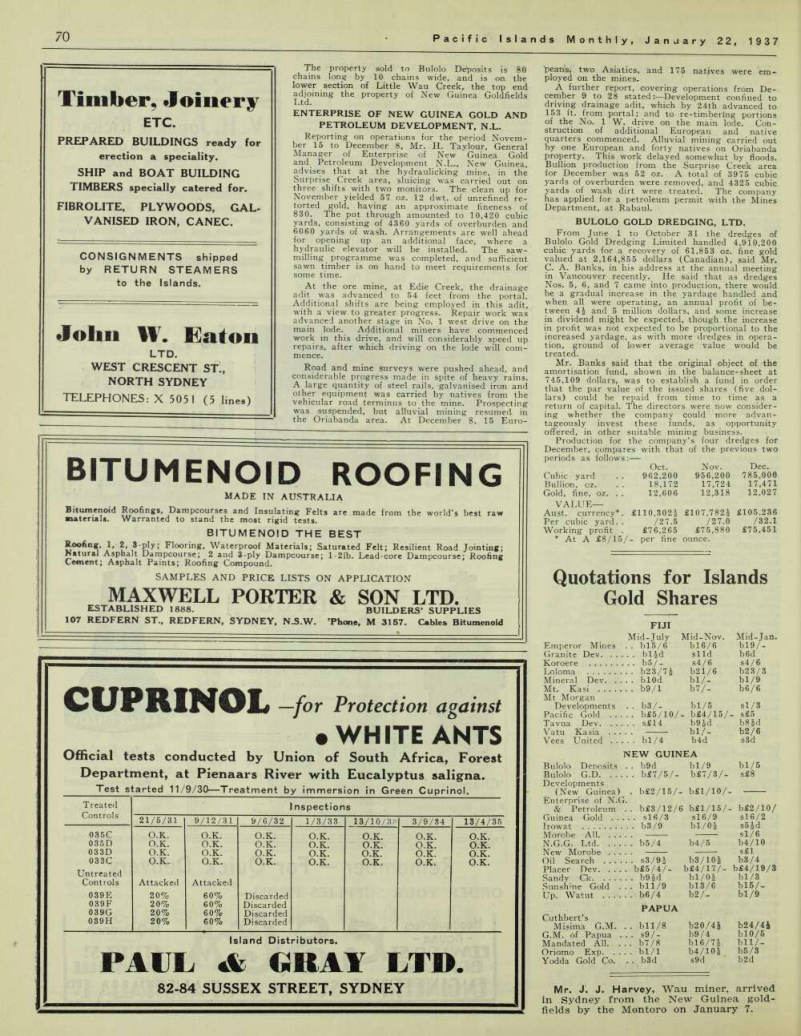
periods as follows: Quotations for Islands Gold Shares
Advertisements & other items, pp. 71-73 (7 items)
V. H. Jones & Rickard Advertisement
Gold, oz 281 288 311 Per cubic yard .... 4/7£ 4/4J 3/11 V. H. Jones & Rickard Electrical Engineers 525 ELIZABETH STREET SYDNEY Specialists in rewinding and repairing all classes and sizes of electrical
Industrial Supply Co. Advertisement
tw&e *TI tsc* ijf CT|W Ti mmmmm The...
Headquarters House for Motor Accessories Garage Equipment Machine Tools Engineers Supplies and Electrical Requirements i ‘Champion’
The Spark Plug engineers use for better engine performance.
TRADE MARK The new BRICO PATENT HEAT FORMED PISTON RINGS—A process which relieves all strains and Imparts permanent shape and tension — : Also 1 Warren & Brown Valve Tools.
Van Dorn Vibro Centric High- Speed Valve Grinders 12,000 r.p.m.
Leggett’s products.
Apac Garage Equipment.
Nason’s Lacquers & Enamels.
Brake Lining Silver Edge for Passenger Cars Gold Edge for Heavy Vehicles Semi Rigid for Internal Brakes Remember For Quick Delivery
ORDER YOUR SUPPLIES FROM—
"!ISS£“ C
John W. Eaton Ltd. (Timber) Advertisement
b5/3 Yodda Gold Co. . . b3d s9d b2d Timber, Joinery ETC.
PREPARED BUILDINGS ready for erection a speciality.
SHIP and BOAT BUILDING TIMBEIRS specially catered for.
FIBROLITE, PLYWOODS, GAL- VANISED IRON, CANEC.
CONSIGNMENTS shipped
by RETURN STEAMERS
to the Islands.
John W. Eaton LTD.
Maxwell Porter & Son (Bitumenoid Roofing) Advertisement
TELEPHONES: X 5051 (5 lines)
BITUMENOID ROOFING
MADE IN AUSTRALIA
Bitumenoid Roofings. Dampcourses and Insulating Felts are made from the world’s best raw materials. Warranted to stand the most rigid tests.
BITUMENOID THE BEST
Roofing, 1,2, 3-ply; Flooring, Waterproof Materials; Saturated Felt; Resilient Road Jointing; Natural Asphalt Dampcourse; 2 and 3-ply Dampcourse; l-21b. Lead-core Dampcourse; Roofing Cement; Asphalt Paints; Roofing Compound.
SAMPLES AND PRICE LISTS ON APPLICATION
MAXWELL PORTER &
ESTABLISHED 1888. 107 REDFERN ST.. REDFERN, SYDNEY, N.S.W.
Paul Gray Ltd. (Cuprinol) Advertisement
Phone, M 3157. Cables Bitumenoid CUPRINOL —for Protection against
• WHITE ANTS
Official tests conducted by Union of South Africa, Forest Department, at Pienaars River with Eucalyptus saligna.
Test started 11/9/30 —Treatment by immersion in Green Cuprinol.
Gourock Rope Co. (Birkmyre's Waterproof Canvas) Advertisement
Pacific Islands Monthly, January 22, 1 937 BIRKMYRE’S
WATERPROOF CANVAS
• The Original and Best for all purposes where a thoroughly waterproof covering is required.
SAILCLOTHS, DUCKS, &c. of FLAX, HEMP and COTTON.
FISHING NETS, LINES and TWINES Extensive Stocks carried, Ensuring prompt despatch.
Thompson's Engineering & Pipe Co. Advertisement
LIMITED 397 KENT ST., SYDNEY, N.S.W.
Mining llacli I a aery. of all classes, including: Bucket Dredges Sluicing Plants Gravel Pumps Nozzle Pumps Elevators, Nozzles, Piping, Valves, etc. fl WrrTF GRAVEL PUMP ILLUS- TRATED is one of two (2) 12in. size, capacity 80 to 100 c. yds. solids pep hour against 60ft. head. To be driven by 190 h.p. motor.
Casings, liners and baseplates have been sectionalised for aeroplane transport, maximum lift being SOOOIbs. •
MADE FOR THE UPPER
WATUT GOLD ALLU- VIALS N.L., N. GUINEA.
THOMPSON’S ENGINEERING & PIPE CO. LTD.
Census of Samoan-Europeans: Interesting Facts Disclosed by Census
Cable Address; “THOMPSONS, CASTLEMAINE.”
SYDNEY OFFICE KEMBLA BUILDING 58 MARGARET STREET
Samoan-Europeans
Interesting Facts Disclosed by Census From Our Own Correspondent APIA, Dec. 31.
THE census of the population of Western Samoa, taken on November 4, was divided between Europeans and Natives.
Owing to the smaller number of Europeans, the results of the European census have already been published, while the Native census has not been completed in detail, though a preliminary count has been made.
In 1926, when the last official census was taken, native Samoans numbered 36,688.
Preliminary figures for 1936 show a Samoan population of over 52,000, an increase of over 40 per cent, in 10 years.
The European census shows 3095 persons classed as Europeans, while 249 Samoan women are legally married to Europeans, and a further 14 Samoans have legally acquired European status. Of the 3095 Europeans, 367 are whites, 20 are full Chinese free residents, and 2708 are of mixed blood, including 2588 European- Samoans and European-Polynesians, and 120 Samoan and Polynesian Chinese (descendants of free Chinese settlers and Samoan or Polynesian women).
Corresponding figures for the categories mentioned above in the 1926 census are: Total of Europeans, 2572, of whom 446 were whites and 2126 of mixed blood, including 1722 European-Samoans and European-Polynesians, and 123 Chinese-Polynesians or Chinese-white-Polynesians, While the number of whites has decreased since 1926 by over 17 per cent., and is the lowest figure recorded since the German census of 1903, the mixed blood population has increased even more rapidly than the full-blood Samoans, viz., by over 45 per cent.
The number of Chinese-Samoans, descendants of Chinese imported labourers, is shown in the Native census, for which final figures have not been compiled. It has, however, been found impossible to enumerate separately a large majority of the Chinese-Samoans as the latter have been completely absorbed by the Samoan population—thus conclusively disproving the argument that the Chinese-Samoan element constitutes a danger to the Samoan race.
Of the 3358 persons classified as Europeans (including Samoan wives and Samoans of European legal status) 1683 are males and 1675 females.
Children of mixed blood, up to 12 years of age, were counted as 1270 (689 male and 581 female); from 12 years upwards, 2088 (994 male and 1094 female). Married, widowed, etc., were 954; single, 2404.
According to country of birth, 2735 of these persons were born in Western Samoa, 256 in other Pacific Islands, 128 in New Zealand, 50 in Australia, 60 in the British Isles, 37 in Germany, 31 in U.S.A., and 19 in France. Of the Europeans born outside of Western Samoa, not less than 149 have resided in the territory for from 20 to 66 years.
Over 1960 Europeans gave their national status as British; a further 260 as British protected persons; 536 as German; 282 as American: 88 as French; 82 Swedish; 68 Danish; 38 Swiss; 25 Chinese, and 10 Portuguese.
Of the Europeans, 265 follow commercial pursuits, 179 are planters or plantation employees, 178 are artisans, 116 are in the professions or are missionaries or teachers, 70 are Government officials, 99 labourers and domestics, and 16 are seamen, etc.
Nearly one half of those Europeans who have declared their religious beliefs are Roman Catholics (1424); 209 are Church of England or Anglican, 497 belong to the London Mission Society, 48 are Presbyterians, 159 Methodists, 176 Protestants, 66 Seventh Day Adventists, 348 Mormons, 72 Congregational, and 49 Lutheran.
Eight Europeans have rendered war services in the Boer War and 55 in the Great War.
Of the two main islands, Upolu accounts for 3026 Europeans and Savaii 332 Europeans.
The large increase in the mixed-blood population explains one of the most difficult problems of the country—to find a place and means of existence for these people in the economic life of the com- 71 Pacific Islands Monthly, January 22, 1937 IP M UMPMOBIL LIGHT and PORTABLE
Motor Pump
PUMPMOBIL Complete Plant’s weight, 140 lbs. Capacity up to 12,000 gallons per hour.
All heads from 10 to 115 feet.
Fuel consumption, £ gallon per hour.
Pressure 551 b. square inch Especially suitable prospecting and all Sluicing Requirements.
Nelson & Robertson Ltd.
12 Spring Street, Sydney
The Hygeia Dissolvenator. Approved by Health Authorities A Self Contained Sanitary System Easily and cheaply installed. Guaranteed. Su :± ~ LI r
No Water Supply Required. U
A caustic soda solution turns the excrement and paper into an innocuous solution which runs off and is absorbed by the soil.
Gives thoroughly efficient, long, care-free service. • The Shell Oil Co. alone has given 52 No odours, germs, flies or other insect pests.
Hygeia Sanitary Company 26 Bridge Street, Sydney. repeat orders.
Price, F.Q.B. Sydney, £l5/10/0 ► °r*NGieQ V3&£ USOLINE Never Known to Fail!
Cockroach Destroyer It Attracts—They Eat It—They Die AUSOLINE CO. 314 CROWN STREET, SYDNEY Established 1919.
PRICES: 11b. 5/-, 3lb*. 10/- Postage extra.
Remit Cash with Order.
Obtainable also at Islands Stores of Burns, Philp and Co. Ltd., W. R. Carpenter and Co. Ltd.
IT’S A PASTE! munity. The majority of the mixedbloods will, however, gradually be absorbed by the full Samoans, as they can find no possibility of maintaining themselves as Europeans.
The gradual decrease in the numbers of white residents may be ascribed to the passing away of many of the old white pioneer settlers, the decrease in the number of white New Zealand officials and the complete lack of any immigration whatever, due not only to the stringent immigration laws, but mainly to the absence of economic possibilities for white settlers and the strong economic competition of the large mixed-blood section of the European community.
Among the mixed-blood population there is a growing tendency, among the young men, to marry full-blood Samoan women, thus hastening the gradual absorption of the mixed blood element into the full-blood Samoan majority.
The division of the European population into age groups shows that the males exceed the females considerably in the group up to 12 years, owing to the higher male birth rate, while in the groups over 12 years of age females preponderate, owing to their lower mortality.
It is interesting to note that the mixed blood community, as it exists to-day, are mostly the descendants, in the third and fourth generation, of comparatively few families. The Stowers family, for instance, counts not less than 104 descendants; the Hunt family 81; the Fruean family 65; the Crichton family 59; and the Godinet family 51; while 30 families count between 21 and 50 members each. A total of 35 mixedblood families have altogether 1275 mem-
[Islands People Notes]
bers, an average of 36 per family, and constituting about 47 per cent, of the total mixed-blood population.
Mr. T. Stuart Gum’s book, “The Third String,” dealing with the antagonism between missionary and trader in the South Seas, has just been published by Messrs.
Angus and Robertson Ltd., Sydney. The locale of the story is in the New Hebrides, Inspector Malcolm MacLeod, of the Fiji Constabulary, who has been stationed at Rewa, left Suva by the Niagara in De-
Bitter Thoughts of a White Solomon Islands Planter and Trader
Sub-Inspector A. J. Chichester has now taken charge of the Rewa district.
Bitter Thoughts of a White Solomon Islands Planter and Trader ISEE in the P.I.M. that there has been some discussion as to whether the Solomons should be called the British Solomon Islands, or just simply the Solomon Islands, writes a 8.5.1. planter.
I think —and there are many more of the same opinion—that they should be called the Chinese Solomon Islands, for to make progress in the Solomons in these days it seems necessary to have a Chinese lineage.
This is no exaggeration. The Chinese, assisted by the Government, have made great headway in the last five years, at the expense of the white settlers who pioneered these islands.
Why, those “Pan Pipes” that are being played outside remind me of my Malaita days. To think that I risked my neck, many a time, up some of the rivers and in the mangroves, for money I needed to start my plantation—and, when that was expended, then off recruiting again! What a fool I was to put my money in a plantation —I should have done the same as the Chinese do now, and gene trading.
But who could have foreseen events?
There was only one Chinese in Tulagi then, and he was a tailor.
To think of and Makambo in Woodford’s time, and the congregation of vessels that would assemble to meet the old Mindina. There were not many Government men living at Tulagi then —quite different from now. Nowadays, if one does not possess that so necessary Mongolian connection, one needs an old school tie to wear.
If some of the old-timers could see things as they are to-day it would make them turn in their graves. They speak of Hitler and Germany. He, at least, does believe in Germany for the Germans. But our dictators believe in the Solomon Islands for the Chinese. I did assist my country in the last war—then surely 1 have a greater right than an Asiatic to
New Goldfield in New Guinea
go well —it might console me down a little!
New Goldfield In New
GUINEA SINCE 1934, 6000 ounces of gold, valued at £50,000, has been reported from Wewak Goldfield, New Guinea — most of it in recent months.
Although 100 men and six women are working, the field has not been declared a goldfield by the Administration, as the wash is shallow and not yet regarded as permanent. During the past six months a number of miners have migrated there from Morobe goldfields.
There were typographical screams of excitement in the Australian newspapers in January, when some bright lad discovered the existence of “a new goldfield in Wewak,” and “a rush of miners to the new El Dorado.” The development of the new field was reported at length in this
[Islands People Notes]
and other journals, months ago—but little things like that do not matter during the journalistic “silly season.”
Mr. and Mrs. H. Adams, of Patlangat
Advertisements & other items, pp. 74-75 (2 items)
Beebe (B.B.) Portable Hand Winches Advertisement
Pacific Islands Monthly, January 22, 1 937 Beebe (B.B.)
PORTABLE HAND WINCHES
2 Ton Capacity Weight 66 lbs. 5 Ton Capacity Weight 110 lbs.
Excellent for loading heavy machinery —erecting pipe lines —bridge building— moving boulders from alluvial workings —and all mining purposes. * BEEBE HOISTS cannot be broken by men in hand use.
Steamships Trading Company Limited Advertisement
Nelson & Robertson Ltd.
SYDNEY
STEAMSHIPS TRADING COMPANY LIMITED
PORT MORESBY PAPUA SAMARAI
Chairman and Managing Director: A. S. FITCH.
Shipowners, Wholesale and Retail Merchants and Traders; Shipping, Customs and Insurance Agents; Copra and Rubber Plantation Owners.
Contractors to Commonwealth and Papuan Governments.
AGENCIES:—At Port Moresby: Coral Sea Insurance Co.; Phoenix Insurance Co.; Delta Sawmills, Ltd.; Acme Bakery Co.; Vacuum Oil Co. Pty., Ltd. At Samarai: Coral Sea Insurance Co.; Delta Sawmills, Ltd.; Bankers and Traders' Insurance Co.; National Mutual Life Insurance Co.; Kularo Shipyards; Mamai Plantations.
BRANCHES.—In Papua: Hanuabada, Sivitoi, Aroma, Koki, Hula, Ela Beach, Duga Duga, Yule Island.
Sydney to Thursday Is. in the "Pup": Fine Achievement of 2½ H.P. Launch
Flinders Lane; London, E. Whiteaway & Co., 7 Chiswell Street, Finsbury.
Cable Address: “STEAMSHIPS." Code: Bentley's.
Sydney To Thursday Is.
In The “Pup”
Fine Achievement of 2½ h.p.
Launch HAVING completed a 2240 miles journey from Sydney to Thursday Island in the Pug, a 16ft. launch fitted with a Chapman 2\ h.p. engine, Mr. Walter Pankhurst returned by the Marella on December 23.
He came back by steamer because a two weeks’ spell in Torres Strait Hospital delayed him until after the start of the “bad” season.
This world’s record voyage was made without a mishap and must be included in the record of adventurous journeys of all times, Pankhurst began life as a sailor, secured an officer’s certificate, tried a spell ashore, and finally returned to the sea, making the hazardous trip alone. That he had unbounded confidence in himself and his little craft, with its Chapman’s “Pup” engine, was proved by the fact that he did not carry any emergency gear, such as a mast and sail.
The voyage to T.I. added another fine performance to the list of achievements of Chapman and Sherack’s famous little marine engine. Apart from the sturdiness and quality of construction, the mechanical simplicity of the “Pup” engine is responsible for its remarkable performance and reliability. There are no valves, cams, springs, tappets, carburettor parts and such, to get out of order, yet it functions with perfect efficiency.
Hundreds of launch and boat owners throughout the South Seas pin their faith to the “Pup” engine for inter-plantation
Justice in New Guinea (Letter to the Editor)
most backward native labourer can operate the tiny engine.
Justice In New Guinea
Letter to the Editor.
T HAVE just read in your columns the effusion by our Mr. Mullaly and your reply thereto. Mr. Mullaly appears to be the leader of a little coterie in Rabaul, and cannot speak for the people outside.
To take up the attitude that a judge can do no wrong is both childish and illogical, as history shows. In our juryless courts, it is only a matter of being charged; and the odds are 99 to 1 that you are convicted, as a review of the cases tried will prove. This is a bad enough state in a British community, as there must be an element of doubt sometimes; but the prisoner seldom gets the benefit of it, and the sentences meted out to some unfortunates make certain famous judges of previous centuries turn green with envy.
As a resident of this country for several years I have spoken to many, and they are unanimous in endorsing your attitude toward Judge Wanliss. Even if they do not agree with you, I feel that every broadminded man will commend you for courage, as there are few journals courageous enough to criticise a judge, even when he does wrong.
I am, etc.,
[Islands People Notes]
Morobe.
Edie Creek, N.G. 24/12/36.
Mrs. Emma Jane Cuthbert, wife of Mr.
Not Welcome: Lord Moyne's Visit to Palau, in Western Carolines
Colonial War Memorial Hospital on December 23.
Not Welcome
Lord Moyne’s Visit to Palau, in Western Carolines A STRANGE account of a visit to the island of Palau, in the western part of the Caroline Group, in the North-west Pacific, now held by the Japanese under mandate from the League of Nations, is given by Lord Moyne, says an article in the Morning Post.
Lord Moyne, with a party of friends, was on a voyage of exploration to New Guinea, Borneo, and other neighbouring territories early in 1936. Hoping to visit these mandated islands, Lord Moyne had secured facilities in advance from the Japanese Embassy before leaving London.
Yet when his yacht Rosaura arrived off Palau, he was refused permission Xo enter the harbour.
“In due course,” he stated, “a launchload of officials arrived, accompanied by an interpreter. They told me very politely that landing was not allowed. They knew nothing of the letter written three months previously, but when I produced a copy in Japanese, they said they would go in and ask for instructions . .
Followed a wait of about six hours, and then the party was allowed to go ashore by launch.
“We were clearly not intended to see anything of any more serious harbour works,” Lord Moyne continued, “as on landing we were taken into the town along a new embankment in motors which were awaiting us.
“The town seemed brand new, with wellkept gardens round the Government buildings, and along the newly-made roads were trim hedges and banks cut into neat grass steps. We were impressed by the size of the Government buildings and also by the well-stocked shops, and the large number of men of the Japanese Navy in the streets.”
The party were absolutely forbidden to take photographs, and, although treated with great courtesy, they were not encouraged to stay.
“We were puzzled by the attitude of the Japanese authorities,” Lord Moyne concluded. “They are too intelligent a people to make mysteries about nothing, and their
Advertisements & other items, p. 75 (1 item)
[Brief Note: Developments (New Guinea) Ltd Share Quotation]
attitude was well designed to make us wonder just what it is that they wish to hide.”
Official quotation was granted by the
A Lighting Plant for Your Bungalow
2500 contributing shares of £5, paid to £3, in Developments (New Guinea) Ltd.
A Lighting Plant For Your
BUNGALOW VI7IZARD Lighting Systems, an advertisement ▼ ▼ for which appears on page 13 of this issue, are particularly suited to tropical conditions. They are completely self-contained and of the highest quality standard. They have been on the market for many years in Australia and New Zealand, where country people testify to their efficiency.
In addition to the complete lighting sets, there
[Islands People Notes]
are stoves, individual bracket and table lamps, and stormproof lanterns, giving brilliant, safe and economical light.*** Mr. and Mrs. H. W. G. Brinston, of Rabaul, reached Brisbane by the Tanda in December and travelled on to Sydney by
Advertisements & other items, p. 76 (2 items)
I.C.I.A.N.Z. (Imperial Foods) Advertisement
JUST TRY THESE
DELICIOUS FOODS Try any one of these "Imperial" dishes and prepare yourself for a glorious surprise. We have blended the finest selected meats and cooked them in Vacuum. We call the process "flavour-sealing" because all the precious flavour carriers and valuable mineral salts are sealed in the can. • Imperial SHEEP TONGUES Prime, selected new season's tongues cooked by the new tenderizing process. • Imperial CORNED BEEF LOAF Delightfully flavoured, mild cured corned beef, ready to eat from the can. 9 Imperial BEEF STEAK PUDDING Selected Beef Steak with Rich Gravy, topped off with Devonshire Pudding.
Imperial SMALL GOODS
PORK SAUSAGES, FRANKFURTS. PORK
FRITZ, DEVON SAUSAGE, PORK GARLIC
you'll enjoy all of these "Imperial" treats, but for added zest serve them with Imperial Mango & PaPaw CHUTNEY Another delightful Imperial o product Crustless Imperial Cheddar Cheese
LOOK FOR THIS SIGN _ OF QUALITY FOODS
in 4 oz.
W. M. Ford (Ship Builder) Advertisement
Stocked by All Leading Stores W. M. FORD Ship, Yacht & Boat Builder Berry's Bay, North Sydney (Established 1870) BUILDERS of all kinds of Island Craft from Dinghies to Auxiliary Schooners of any tonnage. New and Second-hand Island Craft of various types in stock.
Solomon Islands: Native Wages and Recruiting
Crude Oil, Benzine <S Kerosene Engines.
Please Send on Your Enquiries
Solomon Islands
Native Wages and Recruiting From Our Own Correspondent TULAGI, Jan. 2.
IVTOW copra has risen, plantation owners think there may be revision of the wages rate. Whether this should be the case or not, it is hoped that recruiters will get a little better recompense for their work. This is the time for the advancement of recruiting fees to a payable rate.
How recruiters have managed to carry on for the last three years on the low fee of £7/10/- is one of the mysteries of the times. Now that copra is up, planters may allow recruiters a living wage. That plantation people realise the present fee is insufficient, is shown by the fact that no firm in the Group now runs its own recruiting ships. All have tried and all found it a losing proposition.
Our natives are progressing. I called at the emporium of a newly established Chinese trader out in the wilds, where the luxuries of life have not always abounded, and asked for a loaf of bread. Lee Chung replied, “No makee bread. Boy he say, spose gottem butter alright, kai kai bread!
Bread nothing, no good.” So he makes “cakes,” with a dash of sugar in them, to satisfy the demands of these exacting customers.
Since its beginning, our little capital has been no City of Churches. Special services have been held from time to time in the Court House, and religious consolation has been provided by devout persons to the denizens of His Majesty's Prison, but there has been no place of worship in Tulagi. Now rumour has it that not only the Church of England, but also another powerful denomination, is to erect a church.
The last Bremerhaven brought back Mr.
Henry Kuper from what must have been a most enjoyable tour of the East.
The Bolton has arrived, bringing with her the Barlus, Captain Elder’s new command, which is to gather in the nowprecious copra for W. R. Carpenter and Co, in the Solomons.
The present price of copra has assisted navigation! Ships approaching land are, far out to sea, made aware of the distant villages by the smell of cooking copra wafted out over the ocean from every grove—a perfume unfamiliar for a long time. It is the best Christmas box most people have had for many years. In view of the fact that there are undoubted signs of something definite being done by the Pioneer Company in connection with their gold leases on Guadalcanal, there is still hope of prosperity for the New Year.
The month of November seems to be the season for snakes to be abroad in the Solomons. An unusually large number were seen or killed all over the islands at that time. If this mild plague of serpents repeats itself annually at this season, the fact should be of interest to students of natural history.
The P.I.M. travels far, as is proved from time to time. A resident, whose name appeared in this paper a few issues ago, received Christmas greetings from a member of the crew of the Joseph Conrad, who had seen the magazine in New York, and so was reminded of friends he met on his visit here.
The first of the wireless transmitting sets which the Government is experimenting with, has arrived, and it is hoped this will be the beginning of better communication generally through the Group. The first set is being sent to Mala District.
The Japanese taken on the poaching sampan are still held at Tulagi. Their sampan also is here. Local people are hoping that a few more will be captured and taxation reduced.
There is every reason to believe that the gold industry will be established here.
Apart from the Pioneer Company, very promising results are now showing from other prospects, some not far from the Pioneer holdings. Great interest is being
Advertisements & other items, pp. 76-77 (3 items)
[Trade Statistics Table]
Pacific Islands Monthly, January 22, 1937 IMPORTS From From Month Australia. Pacific Is.
December, 1935 . . . . £945 — December, 1936 . . £4114 £7 EXPORTS To To
"Aspro" Advertisement
December, 1935 . . . . £238 £10 December, 1936 . . £284 £63
HOW TO STOP FEVER
BEFORE IT GETS YOU DOWN ... are many forms of fever—Dengue—Malaria—Five Days Fever, etc. All are characterized by high body temperature—thirst—loss of strength, etc. Fever may develop from a chill. A quick, safe and effective method of combating fever is to take “ASPRO” according to the directions on the leaflet in each packet as soon as you develop a temperature. “ASPRO” reduces temperature and fever conditions because, after ingestion in the system, it is anti-pyretic or fever reducing, and is an antiseptic, anti-periodic and anti-fermentative. It is also a powerful germicide. You take no risk with “ASPRO” because it is pure medicine in tablet form. “ASPRO” conforms to the standard of purity laid down by the British Pharmacopoeia
Gillespie Bros. (Anchor Flour) Advertisement
heart and is much preferable to quinine. There are no injurious after effects.
NIPS FEVER IN THE BUD
ANCHOR"FLOUR
THE STANDARD OF QUALITY
» m
M.V. "Malaita" at Tulagi
Sydney Australia
M.V. “Malaita” At Tulagi
From Our Own Correspondent TULAGI, Jan. 2.
ALTHOUGH the M.V. Malaita was a day late in arrival at Tulagi, so that Christmas holidays were very close, arrangements had been made whereby the Customs and the Makambo staff were able to get most consignees supplied with their cargo and away from Makambo wharf before the steamer left Gavutu.
Considering that a number of the Treasury officials, and members of other Government Departments are away on leave, the prompt and satisfactory handling of this cargo, which could not have
A Batteryless Radio Set for the Islands
been on the job was much appreciated by residents.
A Batteryless Radio Set For The
ISLANDS \ N important step forward in catering for Islands broadcast listeners is announced in this issue by Messrs. Kriesler A’sia. Ltd.
For out-of-the-way plantations and centres where electricity is unavailable, an apparatus known as the “Wincharger” can be used to supply current for both high and low tension purposes.
This eliminates the necessity for the costly “B” batteries and the inconvenience of frequently servicing the “A” batteries.
The “Wincharger,” as the name suggests, is operated on the principle of a windmill turned by the breeze. It is simple to install, needs practically no attention thereafter, and supplies without further cost all the current necessary for an “All Electric” radio.
To purchasers of their Dual Wave Models No, 460 and 470, Messrs. Kriesler give a cheque for six pounds—thus with the help of this attractive offer it is possible to buy a 21 guineas “Wincharger” for £l5. This includes sales tax, freight,
Torres Straits News
Kriesler set »is backed with a three years’ guarantee against all breakdowns.***
Torres Straits News
From Our Own Correspondent THURSDAY IS., Jan. 5.
WELCOME relief has come to Thursday Island ▼▼ by the breaking of the weather. Nearly a foot of ram has fallen, so that tanks have been replenished and the vegetation revived. Conditions fishing are so good that most of the luggers are still remaining out pearling before coming in to dismantle their vessels for the annual “lay-up.”
At the last meeting of the Thursday Is. branch of the Royal Geographical Society, Mr. E. Sareanalis gave an excellent lecture on “The Origin of the Pearl.” Several diagrams and a series of lantern slides showing sections of pearls were used.
The Queensland Government has sanctioned the installation of wireless apparatus for the use of the Mission stations on Cape York Peninsula, and of the teachers on Torres Strait Islands.
Small transmitters and receiving sets are to be supplied to each of the stations and large islands. . Owing to the influx of refrigerators and the installation of electric stoves on Thursday Island, the electric authority is considering the question of purchasing an additional engine. There are now nearly 200 consumers.
The Taiping brought back to T.I. Mr. and Mrs. Charles Cleveland with their new car after a long motor tour in Australia. Mr. Arthur Sullivan also returned at the conclusion of a business visit to Sydney.
Mr. Glenville Massey, of Brisbane, has been here on business connected with the Fresh Food Co. whose premises were completely destroyed last August.
Miss Ethel Burgess and Mr. D. Kropp, of the Court House staff, have gone to Australia on recreation leave.
Mrs. Partridge has returned to her T.I. home with her new infant daughter.
Alderman George Asange has returned from Sydney after escorting his brother Jack there for the purpose of medical attention.
Matron Fisher has returned to Torres Strait Hospital, after a visit to Queensland. Much sympathy is felt by her many friends at her recent bereavement.
Rev. Mother Adrian, of the Sacred Heart Mission Convent, has returned after a long sojourn in Sydney.
Mrs. J. I. Dunwoodie has come back to her home after holidays in Brisbane. Miss E. Mills has also returned after touring in Australia, with relatives.
Lieut. Commander Oom and Lieut. Rankyn, together with the sailors of the Moresby survey party, returned to Australia by the Marella having completed the season’s work in the adjacent waters.
Mr. and Mrs. E. J. Hennessey, of Southport (Queensland) have paid a visit to their old
Advertisements & other items, p. 77 (1 item)
[Heading Fragment: Norfolk Island Trade]
environment. They spent a few days with their
[Islands People Notes]
daughter, Mrs. Darke, at St. Paul’s Mission, Moa, Torres Strait.
Norfolk Island Trade Captain G. B. Hoddinott, wharf superintendent for the Union Steam Ship Co. at Suva, arrived at Auckland from Fiji by
Advertisements & other items, pp. 77-84 (16 items)
Islands Produce and Exchange Rates
months’ furlough in New Zealand. 75 Pacific Islands Monthly, January 22, 1937 (a) Trochus shell. No. 1 grade £108 Trochus shell. No. 2 grade £104 Trochus shell. No. 3 grade £95, (b) Trochus shell. No. 1 grade £107 Trochus shell. No. 2 grade £106 Trochus shell. No. 3 grade £94/10/- All quotes are f.o.b. and on the Australian £.
Buying.
Selling.
Telegraphic transfer . . £110 15 0 £112 0 0 On demand . £110 12 6 £111 17 € Average for week ended 21/12/36 Francs to £ Australian 82.59 Average for week ended 28/12/36 82.60 Average for week ended 4/ 1 /37 82.59 Average for week ended 11/ 1 /37 82.59 Average for week ended 18/ 1 /37 82.59 Average for Australia on Noumea week ended 21/12/36 Francs to £ Australian 82.74 Average for week ended 28/12/36 82.75 Average for week ended 4/ 1 /37 82.74 Average for week ended 11/ 1 /37 82.74 Average for week ended 18/ 1 /37 82.74 Buying. Selling.
Telegraphic transfer £125 0 0 On Demand .. .. £123 0 0 124 17 < 30 days .... 122 15 0 124 15 0 60 days 122 10 0 124 12 i 90 days 122 5 0 124 10 0
OFFICE ROUTED “VIA WIRELESS”
AMALGAMATED WIRELESS
(A’SIA) LIMITED
Islands Produce Coffee The following quotations were obtained on January 20: Robusta, f.a.q., imported from Java on firm conversion of exchange, c.i.f., prompt shipment, Sydney: Quote No. 1: 40/- per cwt.; quote No. 2: 27/- per cwt.
Kenya, f.a.q., immediate shipment, c.i.f., Sydney, per cwt.:—No. 1 quotations: Grade “A,” 58/-; grade “B,” 55/-; grade “C,” 52/-. No. 2 quotations: Grade “A,” 58/-; grade “B,” 52/-; grade “C,” 47/6; Triage, 47/6. No. 3 quotations: Grade “B,” 58/-; grade “C,” 52/-.
Mysore, f.a.q., prompt shipment, c.i.f., Sydney, per cwt.;—No. 1 quotations: Grade “A.” 57/6 grade “B" 49/-. No. 2 quotation: Grade Triage.
Arabian (Aden), Hodeidah, f.a.q., immediate shipment, c.i.f., Sydney. Quotation (a); No. 1, pure, 64/- per cwt. Quotation (b): 65/- per cwt.
Note; Importers of coffee from Java, etc., pay the following additional charges: Exchange, duty (4d. lb primage (10 per cen t.), i anding costs (i/. per cwt.). Coffee from Papua and New Guinea escapes most of these charges.
Kapok _ r Based on firm conversion of exchange, the c.i.f. official prices for kapok quoted in Sydney in mid- January were:—Average Java 7 3-32 d per lb. and Japara, 7 5-16 d per lb.
V^OCOJI.
Quote No. 1: Cocoa beans, £56/10/- per ton.
Quote No. 2: Accra, good fermented, £49 per ton, c.i.f., Sydney, _ _ IvOrV NlltS i ’ . i.* A n / * c u c j No. 1 quotation; £9/10/- per ton, f.0.b., Sydney, Syd^' y 2 quotatlon: f9/15/ - P er ton > C__;l \jrooll Oilo.ll 00011 Green snail shell, good quality, was quoted by Sydney buyers in mid-January at £55 per ton.
Trochus Shell Quotations for trochus shell obtained in Sydney from two different sources were: Cotton London c.i.f. prices for cotton during the month were: —Dec. 18, 6.88 d lb., Jan. shipment; Dec. 24, 6.70 d lb., Jan. shipment: Dec. 31, 6.85 d lb., Feb. shipment; Jan. 8,6.86 d lb., Feb. shipment; Jan. 15, 6.93 d. lb., Feb. shipment.
Rice Rangoon rice, packed in 1001 b. or 2001 b. bags, £l3/10/- per ton f.o.b. Sydney.
Australian table rice, packed in 561 b. bags, £l6/10/- per ton.
Exchange Rates The following exchange quotations, gathered ia Sydney, show the rates existing in Sydney oa January 20; — FIJI—THROUGH BANK OF N.S.W.
AND BANK OF NEW ZEALAND
Australia on Fiji on basis of £100 Fiji: Buying £A111/2/6, selling £A113.
Fiji-London on basis £100 London:
DIRECT TELEGRAPHIC TRANSFER
SELLING RATES
Quoted by
BANK OF NEW SOUTH WALES
in Australia Australia on Papeete
WESTERN SAMOA—THROUGH
BANK OF N.Z.
Exchange, Australia on Western Samoa, basis £100 Samoa —buying £A100, selling £A100/10/-.
Exchange, Samoa on London, basis £100 ia London: —
NEW CALEDONIA—THROUGH
FRENCH BANK
Drafts, Sydney-Noumea and Noumea-Sydney, are on the basis of current rate of exchange on Paris, less li per cent, either way. As quoted by the Comptoir National, in Sydney, and the Bank of Indo-Chine, Noumea: On January 21, when the Australian £ was nominally worth 82.94 francs, £100 Australian would purchase a credit in Noumea of 8,294 francs.
NEW GUINEA AND PAPUA-
THROUGH COMMONWEALTH
BANK From Australia, Pt. Moresby, £1 per cent.; on Rabaul 10/- pet cent. —Other New Guinea districts £1 per cent.
From Rabaul on London, same as Australia on London: — Buying: T.T. £A125 equals £stg. 100.
Selling: T.T. £A125/10/- equals £stg. 100.
THROUGH BANK OF N.8.W.
Australia, on Papua, £1 per cent, premium each way, equivalent to commission of £1 per cent.;
Amalgamated Wireless (A'sia) Ltd. Advertisement
120 days 122 0 0 124 7 4 Use-- Modern Direct Wireless Services for Your Communications
WITH AUSTRALIA AND OVERSEAS
DIRECT WIRELESS SERVICES are available for inter-communication between the Islands of the Pacific and for traffic between the Islands and Australia and overseas countries.
Services are now in operation between Papua and Sydney, New Guinea and Sydney, New Caledonia and Sydney, and Fiji and Sydney. Speedy, economical and efficient service to Australia and overseas.
Route your traffic “Via the Wireless Service.*’
For overseas traffic to Great Britain, North and South America, and all European countries, route your message via the Direct Australian
BEAM WIRELESS SERVICE
LODGE YOUR MESSAGES AT ANY
WIRELESS STATION OR ISLAND POST
Copra and Rubber Prices (Historical Price Tables)
Pacific Islands Monthly, January 22, 1937 May 4 53d. 7d.
June 1 5|d. 63d.
July 6 5 Jd. 7.06d.
August 3 6id. 7.18d.
September 7 5*d. 7gd.
October 5 . . 53d. 6|d.
November 16 5|d. 64d.
December 28 5d. 6|d.
January 4, 1935 5d. 6gd.
February 1 4gd. 6Jd.
March 1 4gd. 6.1id.
April 5 4|d. 5.4gd.
May 3 43d. 5 9/16d.
June 7 5d. 6d.
July 5 5d. 7 id.
August 2 . . 4id. 53d.
September 6 4id. 5£d.
October 4 5d. 5.8 Jd.
November 1 5id. 63d.
December 6 63d. 6gd.
January 3, 1936 '« ’ 63d. 6|d.
February 1 73d. 7 3/16d.
March 6 83d. 7 |d.
April 3 83d. 7id.
May 1 9d. 7 15/32d.
June 5 . . 9d. 73d.
July 3 . 93 d. 73d.
July 31 . . 103d. 7 1 l/16d.
August 7 . , lOJd. 7 id.
August 28 . lOJd. 7 ll/16d.
September 4 lOJd. 7 ll/16d.
September 11 lOJd. 7 ll/16d.
September 18 10 id. 7 ll/16d.
September 25 10 id. 7 3d.
October 2 . lOJd. 73d.
October 9 . 10id. 7 id.
October 16 . 10id. 7 id.
October 23 . lOJd. 7 id.
October 30 . lOgd. 83d.
November 6 103d. 8 7/16d.
November 13 lid. 8 9/16d.
November 20 lljd. 8 11/16d.
November 27 1/- 8id.
December 4 1/- 9 l/16d.
December 11 1/14 9|d.
December 18 1/1 9 15/16d.
December 24 1/1 10 l/16d.
December 31 1/2 103d.
January 8, 1937 1/2 10 Jd.
January 16 1/2 . . 10 15/16d.
Aug. 7 . £12 17 6 £13 7 6 £14 7 6 Aug. 14 . £13 0 0 £13 10 0 £14 10 0 Aug. 21 . £13 5 0 £13 15 0 £14 17 6 Aug. 28 . £13 5 0 £13 15 0 £15 0 0 Sept. 4 . £13 2 6 £13 10 0 £14 12 6 Sept. 11 . £13 5 0 £13 17 6 £15 0 0 Sept. 18 . £13 5 0 £14 0 0 £15 0 0 Sept. 25 . £13 5 0 £13 15 0 £14 15 0 Oct. 2 £13 7 6 £13 10 0 £14 10 0 Oct. 9 £13 10 0 £13 12 6 £14 12 6 Oct. 16 . £13 15 0 £14 0 0 £15 0 0 Oct. 23 . £14 7 6 £14 10 0 £15 7 6 Oct. 30 . £14 15 0 £14 17 6 £15 15 0 Nov. 6 . £15 10 0 £15 2 6 £16 5 0 Nov. 13 . £16 0 0 £16 2 6 £16 15 0 Nov. 20 . £17 15 0 £17 17 6 £18 15 0 Nov. 27 . £18 15 0 £18 15 0 £19 15 0 Dec. 4 . £19 7 6 £19 7 6 £20 7 6 Dec. 11 . £20 5 0 £20 5 0 £21 6 0 Dec. 18 . £20 15 0 £20 15 0 £21 15 0 Dec. 24 . £21 0 0 £21 0 0 £21 17 6 Dec. 31 . £21 12 6 £21 12 6 £22 12 6 Jan. 8. ’37 £22 12 6 £22 12 6 £23 12 6 Jan. 15 . . £23 0 0 £23 5 0 £24 2 6 Rubber London Price on— January 6, 1933 Para per lb. 4|d.
Plantation Smoked per lb. 2.43d.
February 10 4Jd. 2|d.
March 10 . . 4gd. 2Jd.
April 14 4 id. 2.34d.
May 5 . . 43d. 2.81d.
June 2 53d. 3.56d.
July 7 . . 53d. 3.71d.
August 4 bid. 4d.
September 1 5d. 3.78d.
October 13 .
Aid. 4d.
November 10 43d. 4.09d.
December 8 . . 43d. 4.Old.
January 5, 1934 43d. 4.28d.
February 2 . . 43d. 4.84d.
March 6 5d. 5.15d.
Copra South Sea Plantation, Sun-Dried Hot-air Dried, London to London Rabaul Price on— Per ton, c.i.f.
Per ton, c.i .f.
January 16, 1931 , _ £14 7 6 £14 12 6 February 27 £14 12 6 £14 17 6 March 27 . £14 10 0 £14 12 6 April 24 . . £13 15 0 £13 17 6 May 29 . . £10 17 6 £11 0 0 June 26 . . £11 15 0 £11 17 6 July 31 . . £11 5 0 £11 7 6 August 28 £11 2 6 £11 5 0 September 25 £12 15 0 £12 16 0 October 30 . £13 10 0 £13 15 0 November 27 £13 10 0 £13 15 0 December 18 £14 5 0 £14 10 0 January 1, 1932 £14 0 0 £14 15 0 February 12 £14 10 0 £14 15 0 March 25 . £14 17 6 £15 0 0 April 29 £14 15 0 £14 17 6 May 20 . . £13 17 6 £14 0 0 June 17 . . £13 2 6 £13 6 0 July 1 . . £13 5 0 £13 7 6 August 12 . £13 17 6 £14 0 0 September 2 £13 17 6 £14 0 0 October 7 . £14 5 0 £14 7 6 November 11 £14 7 6 £14 10 0 December 16 £14 2 6 £14 5 0 January 6, 1933 £13 0 0 £13 12 6 February 3 £12 6 0 £12 7 6 March 3 . . £11 7 6 £11 10 0 April 28 . , £10 10 0 £10 12 6 May 26 . . £11 2 6 £11 5 0 June 30 . . £10 17 6 £11 0 0 July 21 .. .. £11 2 6 £11 5 0 August 4 £10 10 0 £10 12 6 September 29 £9 7 6 £9 10 0 October 20 £8 15 0 £9 0 0 November 3 . . £9 10 0 £9 15 0 December 1 £8 12 6 £9 0 0 January 5, 1934 £8 0 0 £8 7 6 February 16 £7 17 6 £8 10 0 March 30 . £7 7 6 £8 0 0 April 27 . . £7 7 6 £8 0 0 May 18 £7 15 0 £8 12 6 June 15 . . £8 0 0 £8 12 6 July 6 £7 17 6 £8 15 0 August 3 . . £8 0 0 £8 17 6 September 7 £7 12 6 £8 15 0 October 5 £8 0 0 £9 0 0 November 2 £7 15 0 £8 15 0 December 28 £9 0 0 £9 12 6 January 4, 1935 £9 5 0 £10 5 0 February 1 £11 12 6 £12 2 6 March 1 . . £12 2 6 £12 15 0 April 5 £10 15 0 £11 16 0 May 3 . . £11 17 6 £12 12 6 June 7 £11 15 0 £12 7 6 July 5 £9 12 0 £10 5 0 August 2 . . £9 15 0 £10 15 0 September 6 £9 17 6 £10 17 6 October 4 . £11 7 6 £12 7 6 November 1 £12 17 6 £14 0 0 December 6 £12 17 6 £14 0 0 South Sea.
South Sea.
Plantation.
Smoked, to Genoa Sun -Dried Hot-air Dried.
London and Marseilles to London.
Rabaul.
Price on— Per ton, c.Lf.
Per ton, c.i.f.
Per ton, c. i.f.
Jan. 3. ’36 £13 2 6 £13 15 0 £15 0 0 Feb. 7 . . £13 0 0 £14 0 0 £15 0 0 Mar. 6 . . £11 15 0 £12 15 0 £13 0 0 Mar. 27 . £12 5 0 £13 5 0 £13 17 6 April 3 . £12 7 6 £13 5 0 £13 17 6 May 1 . . £11 10 0 £1] . 15 0 £12 10 0 May 22 . £11 15 0 £12 15 0 £13 0 0 June 5 .. £11 10 0 £12 1 0 0 £12 17 6 June 12 . £11 10 0 £12 1 0 0 £13 0 0 June 19 . £11 15 0 £12 : 5 0 £13 6 0 June 26 . £12 2 6 £12 : io 0 £13 12 6 July 3 . . £12 0 0 £12 : io 0 £13 10 0 July 10 . £12 10 0 £12 : 15 0 £13 15 0 July 17 . £12 12 6 £13 2 6 £14 2 6 July 24 . £12 15 0 £13 5 0 £14 5 0 July 31 . £12 10 0 £13 0 0 £13 of the Bank arc always available to advise customers on matters relating to overseas money transactions.
C throughout the WORLD Market 1 Quotations Range of Prices The Pacific Islands Monthly makes a close check of the prices quoted for Islands produce; and it regularly publishes the range
Bank of New South Wales (Money Transfers) Advertisement
17 6
MONEY TRANSFERS
The Bank of New South Wales makes complete facilities available for the transaction of banking business throughout Australasia and between Australia and all other parts of the world.
The Bank establishes commercial credits by mail or by cable. It issues drafts and makes money transfers by letter or telegraph. It negotiates and collects Bills of Exchange and issues, for the convenience of travellers, Letters of Credit and Travellers’ Cheques, available all over the world. Exchange quotations direct on all countries are issued daily and trained officers
Cosmopolitan Samarai Hotel Advertisement
GILCHRIST, WATT A SANDERSON, LTD., N.D.L. Agent*, Sydney. f m man
LICENSEE: E. J. MORROW
Cosmopolitan •samara! Hotel First-class Accommodation for Tourists and Travellers Ball-room; Electric Light; Billiards; Freezing - works; Cold Store. Best brands of Wines, Spirits, Ales.
Papua Hotel Advertisement
Fishing Trips and Launch Excursions arranged
WHERE TO STAY IN PORT MORESBY
Licensee: Papua Hotel, Ltd.
First-class Accommodation. Parties Arranged.
The PAPUA HOTEL Catering specially for Tourists and Travellers Situated on high ground overlooking both coasts, its Spacious Lounges are always Cool and Comfortable. Tariff: Per Day, 16/-; per week, £5/5/-; per month, £l4; bed and
Hotel Moresby Advertisement
otel Moresby COMFORTABLE ACCOMMODATION
ONLY THE BEST
BRANDS OF
WINES, SPIRITS
AND BEERS IN STOCK LICENSEE: Hotel Moresby
Pacific Islands Shipping Services (Timetables and Route Notes)
C.
Ramel Eridan D’Amiens Papeete Jan 31-F 1 Mar 13-14 Apr 25-26 Raiatea Mar 15 Suva ....
Feb 8 Mar 22 Vila Feb 10 Mar 24 May 5 Noumea, arr.
Feb 12 Mar 26 May 7 Noumea, dep.
Feb 19 Apr 3 May 14 Vila Feb 22 Apr 6 May 17 Raiatea Mar 1 Apr 13 May 24 Papeete Mar 2-4 Apr 14-16 May 25-27 MESSAGERIES MARITIMES CO. , Agent*.
Pt. Moresby S.S. Papuan Chief Feb 9-13 Pt. Moresby Feb 24-28 Hisiu ....
Feb 13 Kapa Kapa Feb 28 Yule Is. . .
Feb 13 Abau ....
Mar 2 Kukipi . . .
Feb 14 . .
Samarai Mar 3 Orokolo Feb 15 Mar 5-8 Kikori Feb 17 Baibara Mar 9 Daru ....
Feb 18-19 Abau ....
Mar 10 Orokolo . .
Feb 20 Kapa Kapa Mar 12 Yule Is. . .
Hisiu ....
Feb 22 Feb 23 Pt. Moresby Mar 13-17 S.S. Van Rees.
Batavia . . Jan 20 Vila Feb 9 Samarang . Jan 21 Noumea . Feb 11-13 Pt. Moresby Jan 30 Sydney . . Feb 17-19 Samarai . . Feb 1 Pt. Moresby Feb 26 Rabaul * . . Feb 3-4 Batavia . . Mar 9 ROYAL PACKET NAVIGATION CO. LTD.
Sydney M.V.
Neptuna. .Feb 19 -24 A. 30-M. 5 July 9- -14 Salamaua .Mar 3 May 12 July 21 Rabaul .Mar 5 May 14 July 23 Cebu (Opt.) Mar 12 May 21 July 30 Manila .Mar 15 May 24 Aug 2 Hong Kong. .Mar 17- -22 May 26-31 Aug 4- ■9 Saigon . . . . • Mar 28 June 6 Aug 15 Manila . . . .Apr 1 June 10 Aug 19 Sandakan .Apr 4 June 13 Aug 22 Salamaua .Apr 13 June 22 Aug 31 Rabaul .Apr 15 June 24 Sept 2 Sydney .Apr 23 July 2 Sept 10 Melbourne .Apr 26- •28 July 5-7 Sept 13- 15 BURNS, PHILP & CO. LTD., Agents.
M.V. Rabaul London . . . Suva Mar 9 Port Pirie Feb 21 Salamaua . Mar 20 Sydney . . . Feb 28 Rabaul . . . Mar 24 Brisbane . London . . June 4 Melbourne Brisbane Maru.
Maru.
Kobe Mar 20-22 Moji Mar 23-24 Rabaul Apr 2 Noumea Mar 11-12 Apr 7-8 Auckland Apr 11-13 Wellington Mar 18-19 Apr 15-17 Lyttelton . . . .
Apr 18 Dunedin . . . .
Apr 18-19 Wellington Apr 20-22 Auckland . . . . .. . . . Mar 27-31 Apr 24-28 Hong Kong .
May 14-15 Shanghai Apr 21 May 19 Moji Apr 23 May 21 Kobe Apr 24-28 May 22-24 OSAKA
SHOSEN KAISHA
LINE Subject to Alteration Without Notice S.S. Morlnda.
Sydney Feb 20 Mar 4 Mar 25 Lord Howe . . .
Feb 22 Mar 6 Mar 27 Norfolk Is Vila Feb 24 Mar 8 Mar 11-12 Mar 13 Mar 29 Bushman’s Bay Male I Tangoa Segond Hog Harbour | \ f Mar 13 Aoba f — Mar 14 Vila ....
Mar 15 Mar 18 Norfolk Is ....
Feb 25 Mar 30 Lord Howe ....
Feb 27 Mar 20 Apr 1 Sydney Mar 1 Mar 23 Apr 3 BURNS. PHILP & CO., LTD., Agents.
NORDDEUTSCHER LLOYD, BREMEN
Hongkong, New Guinea, British Solomon Islands Service
REGULAR SAILINGS BY
S.S. “FRIDERUN”
Through Bills of Lading and Passage Tickets issued to all parts of the world For further particulars apply to MELCHERB <t CO., General Agent*, P. 0.8., 423, Hongkong, China.
COLYER, WATSON A CO., N.D.L. Agents, New Guinea, Rabaul.
MODERATE TARIFF
breakfast, 10/-; bedroom only, 7/6.
Cars meet all steamers.
Ltd.
NEAR THE WHARF Shipping Services in the Pacific Sydney—Noumea—T ahiti Mails and passengers from Sydney for Tahiti may connect with Messageries Maritimes liners at Noumea, per Pierre Loti (see Sydney- Noumea-New Hebrides service). The M.M. liners run between Marseilles and Noumea, via Panama Canal.
Subject to alteration without notice.
Papuan Inter-Island Service S.S. Papuan Chief (Steamships Trading Co., Ltd.) makes regular round trips from Port Moresby to Samarai via Kapa Kapa, Abau, and Baibara, return by same route; then Port Moresby to Daru via Hisiu, Yule Is., Kukipi, Orokolo, Kikori and ■back via Orokolo, Yule Island, and Hisiu —full trip occupying about one month.
M.V. Nusa (Steamships Trading Co., Ltd.) holds the Papuan Government’s contract for carrying mails and passengers on the north-east coast of Papua. The Nusa connects with all Southern mail steamers at Samarai.
M.V. Matoma (Burns, Philp & Co. Ltd.) makes round trips on a regular schedule from Samarai to Misima Island, via the Conflict Group.
Saigon—Java—Noumea Line Subject to Alteration Without Notice Sydney-N. Guinea-Hong Kong Subject to Alteration Without Notice.
Europe—Sydney—Suva— New Guinea Subject to Alteration Without Notice The M.V. Salamaua will leave London for Australian, Fiji, and New Guinea ports on March 27.
W. R. CARPENTER & CO., LTD.
Japan—N. Guinea—Noumea— New Zealand Subject to Alteration Without Notice Sydney—Norfolk Island—New Hebrides 78 Pacific Islands Monthly, January 22, 1937 Macdhui Montoro Macdhui ....
Feb 4 Feb 24 Feb 2 6 Mar 1 Mar 2 Mar 17 Brisbane . . .
Townsville Cairns Feb 6 Mar 19 Mar 22 Pt. Moresby . Feb 11 V.,U Tc Mar 4 Mar 24 Mar 25 Mar 27 Samarai . ..
Woodlark Is Rabaul ....
Feb 13 Mar 6 Mar 7 16 Mar 9- Feb 15lOMar 29-31 Apr 1 Lindenhafen Kavieng Finschafen . .
Feb 17 Mar 11 Mar 12 19 Mar 13 Salamaua Lae Feb 18- -15 Apr 2-3 Apr 5 Lombrum Lorengau . . J Boram ] Feb 21 Wejvak . .. j Madang . . . . j Alexishafen . J Finschafen Salamaua . . .
Kavieng . . . .
Pondo * Feb 22 j Feb 23 , Feb 24 Feb 24 Feb 26 . Feb 27 Mar 1 Mar 3 Mar 4 . Mar 5 Mar 16 Mar 18 Apr 6 Apr 7 Apr 8 Apr 8 Apr 10 Apr 11 Apr 12 Apr 14 Apr 15 Apr 16 Rabaul Mar 20 Salamaua . . .
Samarai . . . .
Pt. Moresby , Cairns Mar 22 Mai< 24 Mar 25 Mar 27 Mar 30 Apr 1 Brisbane . . . .
Sydney . ...
Mar 9 Mar 11 Apr 20 Apr 22
BURNS, PHILP &
CO., LTD..
Agents.
Sydney . .
M.V. Malaita Mar 6 Brisbane .
Mar 8 Townsville Mar 11 Tulagi Makambo Mar 15-16 Gavutu Su’u Domma Mar 17 Mamara Tasavarong Aruligo J- ’ * ' Feb 4 Lavoro Mamara Tasavarong Mar 18 Aruligo Meringe Hivo Mar 19 Yandina Banika Ufa Faiami Mar 20 Younger Pepesala Lingatu West Bay Somata Gizo Faisi Kieta Arigua Numa Numa Feb 9 Mar Mar Mar Mar 21 22 22 23 Teopasino Mar 24 Rabaul Soraken ...
Mar Mar 25-26 27-28 Kieta Faisi Gizo ) Tetipari ] Mar Mar Mar 29 30 31 Russell Is.
Gavutu ) Apr 1-2 Makambo J ‘ Feb 19 Apr 3 Brisbane . .
Apr 8 Sydney . . .
Apr 10 BURNS, PHILP & CO., LTD..
Agents.
Wellington . Feb 23 Mar 23 Apr 20 Apia Mar 2-4 Mar 30-Ap 1 Apr 27-29 Niue • .... Mar 6 Apr 3 May 1 Lvttelton . . Mar 15 Apr 12 May 10 Wellington Mar 16 Apr 13 May 11 ISLANDS WORK a Speciality
HARRY WEST
Balmain East. SYDNEY Tel WIIOS Equipment.
70 CLARENCE STREET, SYDNEY
Write for Complete Catalogue and also Particulars of the Penta-Hesselman Engine, running on Heavy Oil Fuel PENTA—The World's Leading Marine Engine Sydney—Papua—New Guinea Subject to Alteration Without Notice.
Ocean Island—Nauru Service British Phosphate Commission, 16 Spring Street, Sydney, sends boats irregularly from Melbourne.
N.G. Goldfields’ Service Aeroplanes conducted by Guinea Airways Ltd., Holden’s Air Transport Services Ltd., Mandated Airlines Ltd. (late Carpenter Airways) and other companies, leave Salamaua and Lae two and three times daily for Wau and other centres on the Morobe goldfields. The aerial services are the only means of communiction.
Solomon Islands—N.G. Service Subject to Alteration Without Notice New Hebrides Inter-Island S.S. Mirani (Burns Philp (.South Sea) Co.
Etd.), connects every six weeks at Vila with S.S.
Morinda from Sydney, then proceeds on southern trip, calling at the islands of Efate, Erromanga, Tanna, Aneityum, and returns to Vila—trip occupying 7or 8 days. After 2or 3 days at Vila, departs on northern trip, calling at the islands of Efate, Mai, Tongoa, Epi, Paama, Ambrym, Malekula, Aoba, Malo, Santo and returns to Vila, trip occupying 25 to 28 days. Vessel extends to Banks Group every second trip equivalent to about every six weeks.
S.S. Bucephale (Messageries Maritimes interisland service steamer) makes regular trips to Tanna every two months, connecting at Vila with the Laperouse.
N. Zealand—Samoa—Niue The New Zealand Government’s steamer Maui Pomare (1159 tons) is the only direct connection between the Dominion and the Mandated Territory of Western Samoa. The vessel, carrying mails, passengers, and cargo, is controlled by the Department of External Affairs at Wellington, where application should be made concerning freights, berths, etc.
M.V. Maui Pomare. 79 Pacific Islands Monthly, January 22, 1937 Pierre Loti.
Sydney Feb 5 ■Mar 11 Apr 9 Noumea Feb 9-11 Mar 15- 17 Apr 13-15 Lifou Feb 12 Mar 18 Vila Feb 13 Mar 19 Apr 16-17 Luganville Feb 14 Mar 20 Apr 18 Le Dart . .
Feb 15-16 Mar 21 Apr 19 Bernier B. — Mar 22 Tortues B. — Mar 22 Hog H’bonr — Mar 23 Pt. Olry . . — M£r 23 Saigon . . . — Mar 3- 5 Haiphong — • Mar 8- 11 Luganville — Mar 26 — Le Dart . . — Mar 27 — fjorsup — Mar 24 — Sarmettes — Mar 24 — Sandwich — Mar 25 — Epi — Mar 25 — Vila Feb 17 Mar 26 -27 May 28 Lifou . Feb 18 Mar 28 — Noumea . .
Feb 19-20 Mar 29 -30 M 29-Jn 1 Sydney Feb 24 Apl 3 June 6
MESSACERIES MARITIMES
CO .. Ainli Hong Kong . . . .
Feb 13 Apr 4 Madang Feb 25 Apr 16 Salamaua Feb 27 Apr 18 Tulagi Apr 22-27 Rabaul A.30 -M.B Hong Kong . . . . . . . Mar 28 May 18 Niagara Aorangi Niagara Honolulu . . Feb 24 Mar 24 Apr 21 Suva Mar 5 Apr 2 Apr 30 Auckland . Mar 8-9 Apr 5-6 'May 3-4 Sydney ...Mar 13 Apr 10 May 8 Sydney, depMar 18 Apr 15 May 13 Auckland . Mar 22-23 Apr 19-20 May 17-18 Suva Mar 26 Apr 23 Mav 21 Honolulu . . Apr 2 Apr 30 May 28 UNION S.S. CO., LTD., Agents.
M.V.
Matua (4166 tons) Auckland . Feb 9 Mar 9 Apr 6 Rarotonga . Feb 13 Mar 13 Apr 10 Nukualofa . Feb 17-18 Mar 17-18 Apr 14-15 Apia . . . . . Feb 24-25 Mar 24-25 Apr 16-17 Suva .... . Feb 24-25 Mar 24-25 Apr 21-22 Auckland . Mar 1 Mar 29 Apr 26 Wellington Mar 3-6 M.31 -A.3 A.28 -M.l Auckland . Mar 8 Apr 5 May 3 Nellore Tanda Nankin Hong Kong Jan 30 Mar 5 Apr 3 Manila Feb 2 Mar 8 Apr 6 Rabaul . . .
Feb 10 Mar 16 Apr 14 Brisbane Feb 16 Mar 22 Apr 20 Sydney . . .
Feb 18 Mar 24 Apr 22 Melbourne .
F.22-M.3 M.29-A.3 A. 26-M. 1 Hobart . . .
Mar 5 Apr 5 May 3 Newcastle .
Mar 8 Apr 8 May 6 Sydney, dep.
Mar 13 Apr 14 May 12 Brisbane Mar 15 Apr 16 May 14 Townsville, op Mar 18 Apr 19 Mayl7 Rabaul Mar 23 Apr 24 May 22 Manila . . .
Mar 31 May 2 May 30 Hong Kong Apr 3 May 5 June 2 E. & A.
STEAMSHIP CO. LTD., Agent*.
Leaves Rabaul Returns to Rabaul March 15 April 6 May 8 May . 30 Leaves Rabaul Returns April 12 April June 3 Tune to Rabaul 30 19
AGENTS: COLYER, WATSON &
LTD.
Union House, 247 George St., Sydney. wlm
SALAMAUA AND WAU, NEW GUINEA
Cables: “Holdairco” Salamaua and Sydney SYDNEY OFFICE: 20 MARTIN PLACE. Phone: B 7507 Wau-Port Moresby Service v A regular aeroplane service is now maintained by Guinea Airways Ltd., allowing passengers to and from the goldfields to connect with the steamers at Port Moresby. Details from the pursers of the Burns, Philp steamers.
French Oceania Inter-Island S.S. Tooya (597 tons) makes regular trips from Papeete, through Leeward Group (Raiatea, Huahinc, Borabora, etc.) about every four weeks, and also regularly visits Tuamotu and Gambier Archipelagoes.
MESSAGERIES MARITIMES CO., Agents.
Sydney—N.Z.—Fiji—Samoa— Hawaii Owing to the American maritime strike, the Monterey and Mariposa have been held up in San Francisco. Their departure has been postponed indefinitely.
OCEANIC STEAMSHIP CO., MATSON LINE.
Sydney—N oumea—N e w Hebrides Subject to alteration without notics.
Hong Kong—N. Guinea — Solomons S.S. Friderun (cabin, third-class and deck passengers) runs from Hong Kong to New Guinea and Solomon Islands ports, connecting at Rabaul (N.G.) with S.S. Island Trader (formerly S.S.
Bremerhaven). In the Solomons, calls at Tulagi, Rere, Fulakora, and Savo.
S. S. FRIDERUN.
Sydney—N.Z.—Fiji—Hawaii Subject to alteration without notice.
Central Pacific Services Subject to alteration without notice The chartered vessel Limerick will leave Sydney for Fiji, Samoa, and Tahiti on February 13, with cargo, mails, and a limited number of passengers.
Calls are scheduled to be made at Suva (Feb. 19), Lautoka (Feb. 20), Suva (Feb. 27), Apia (Mar. 1), Papeete (Mar. 8). The Hauraki (7113 tons) is due to leave Australia in the second week in March for Fiji, Samoa, and Tahiti.
UNION S.S. CO. LTD., Agents.
Sydney—Rabaul—Hong Kong Subject to alteration without notice.
New Guinea Inter-Island Service S.S. Maiwara (Burns, Philp & Co.) makes regular round trips from Rabaul to New Ireland and Bougainville ports.
M.V. John Bolton, M.V. Desikoko, S.S. Durour M.V. (W. R. Carpenter and Co. Ltd.) make sailings from Rabaul every two or three weeks to various ports in the Territory.
S.S. ISLAND TRADER.
Connects at Rabaul with S.S. Friderun.
NORTHERN RUN—Rambutyo, Pak, Lorengau, Inrim, Pitelu, Papitalei, Salesia, Salami, Noru, Purdy Isl., Tumleo, Boikin, Kairiru, Wewak, Bdram, Sepik Mouth, Awar, Bogia, Kulili, Kurun, Alexishafen, Nagada, Madang, Finschhafen, Salamaua, Bali, Garua, Toriu, Stockholm.
SOUTHERN RUN—Matala, Put Put, Sum Sum, Buka Passage, Teop, Numa Numa, Inus, Arawa, Kieta, Tubiana, Toboroi, Aropa, Iwi, Kekere,
Harry West (Sailmaker) Advertisement
Sydney's Leading SAILMAKER and RIGGER Also Manufacturer of all Canvas and Rope Work
W. Kopsen & Co. Ltd. Advertisement
TILLEY Kerosene Pressure Lamps Lanterns and Radiators.
Write or Ring for New Catalogue of Lamps and Spare Parts.
Models to suit every purpose and every pocket.
TILLEY—The Most Satisfactory 300 c.p. Kerosene Lamp.
W. KOPSEN & CO. LTD.
Xhipchandlers & Hardware Merchants largest manufacturers of ash boat
OARS AND TOOL HANDLES IN THE SOUTHERN
HEMISPHERE Large Stocks of Metal Sheathing and Nails, Oakum, Ropes, Anchors and Chains, Copper Pomte, Blocks, Canvas, etc.
All Classes of Boating, Miners' and Prospectors'
Penta Marine Engines Advertisement
Cables: Kopsen, Sydney. 'Phone: Bw ul f (3 ljnes) o Penta Kll Single Cylinder Write for New 40-page Catalogue Penta U2l Outboard PENTA
MARINE ENGINES
OUTBOARDS . . 4-18 H.P.
INBOARDS .... 3-100 H.P.
Precision Built and Absolutely Free from Vibration.
Deliveries from Stock at Under Bond Prices.
Pacific Islands Year Book Advertisement
CO., RABAUL
PACIFIC ISLANDS
YEAR BOOK 1935-36 Edition, 430 pp.
A reliable, comprehensive guide to the Rapidly-Developing Territories of the Pacific.
STATISTICS FROM OVER 20
ADMINISTRATIONS Numerous Comprehensive Maps
NEW COUNTRIES WITH
NEW OPPORTUNITIES
Special Features include: Description of new Pacific Islands Gold Industries; Pidgin Vocabulary; Aviation in Pacific; Pacific Personalities; History of Pacific Exploration; Business and Residential Directories of Principal Territories.
Bound in cloth, 9/6, plus postage. (British countries, 6d; foreign, 1/-) From all Booksellers and Islands Stores, or from
PACIFIC PUBLICATIONS
Holden's Air Transport Services Ltd. Advertisement
SJ: ■» Essential Services REGULAR DAILY SER-
VICES FROM SEAPORTS
TO ALL AERODROMES
THROUGH OUT THE
GOLDFIELDS DISTRICTS.
Charters Anywhere Arranged Holden’s Air Transport Services Ltd.
Air Transport, Customs, Shipping and Indent Agents
[Publisher's Colophon]
Kauern, Manuan. 80
Guinea Airways Ltd. Advertisement (Aerial Transport Established New Guinea Gold Industry)
Published by Pacific Publications Ltd., Union House, 247 George Street, Sydney (Telephone BW 5037). Wholly set up and printed in Australia by The Land Newspaper Ltd., 59 Regent Street, Sydney. (8190)
AERIAL TRANSPORT ESTABLISHED
NEW GUINEA GOLD INDUSTRY
S INCE 1927, when the development of the Morobe Goldfield commenced, the European population of the Territory has been trebled.
The new industry has increased the Empire's gold production by nearly £2,000,000 per annum, and has added enormously to the trade turnover of New Guinea.
Only Aerial Transport makes this possible. There is no road between the Goldfields and the coast. Aeroplanes, running on Regular Schedules, without Difficulty or Delay, carry in Dredges, Crushing Mills, Cyaniding Plants, Motor Vehicles, Hydro - Electric Machinery, Thousands of Passengers, and Every Kind of Goods needed by a large and Growing European Community.
CjUINEA AIRWAYS LTD. were established in 1927; and they have grown in the following way, until they are to-day the largest freight-carrying service in the world: J AIRWAY m i A typical load landed from one of Guinea Airways' giant freight-carrying aeroplanes. This big G-31 Junkers machine carried from Lae, on the coast, to the aerodrome at Wau, the goldfields centre in the interior, a Baby Austin motor car, an office safe, and 38 bags of rice—a total weight of nearly two and a half tons.
Guinea Airways Ltd. operate regular air services in New Guinea and Papua; they use over 50 Aerodromes and Landing-grounds in the two Territories.
GUINEA AIRWAYS L™
LAE • SALAMAUA
HEAD OFFICE:
BROOKMAN BUILDINGS
GRENFELL STREET
ADELAIDE, S.A.
NEW GUINEA OFFICE: LAE
Tooth & Co. Ltd. (Waverley Brewery) Advertisement
BRANCH OFFICES AND AGENTS AT WAU, SALAMAUA, PORT MORESBY, AND SYDNEY Pacific Islands Monthly, January 22, 1937
TOOTH 4CO LIMITED
waver iey brewery k «,YoN*> A K E 21 V mr . -A wAvuar iuwut ensures a
PERFECT DRINK
am/ Af>otd
PRESERVES THE FLAVOUR
When ordering lager, first look for the Diamondshaped Label —that is your guarantee of quality.