Isiands
Pacific
Monthly
Vol. VII.—No. 5
De <• ember 31, 1030
at the G.P.0., Sydney for transmission hy post as a newspaper .]
6 d
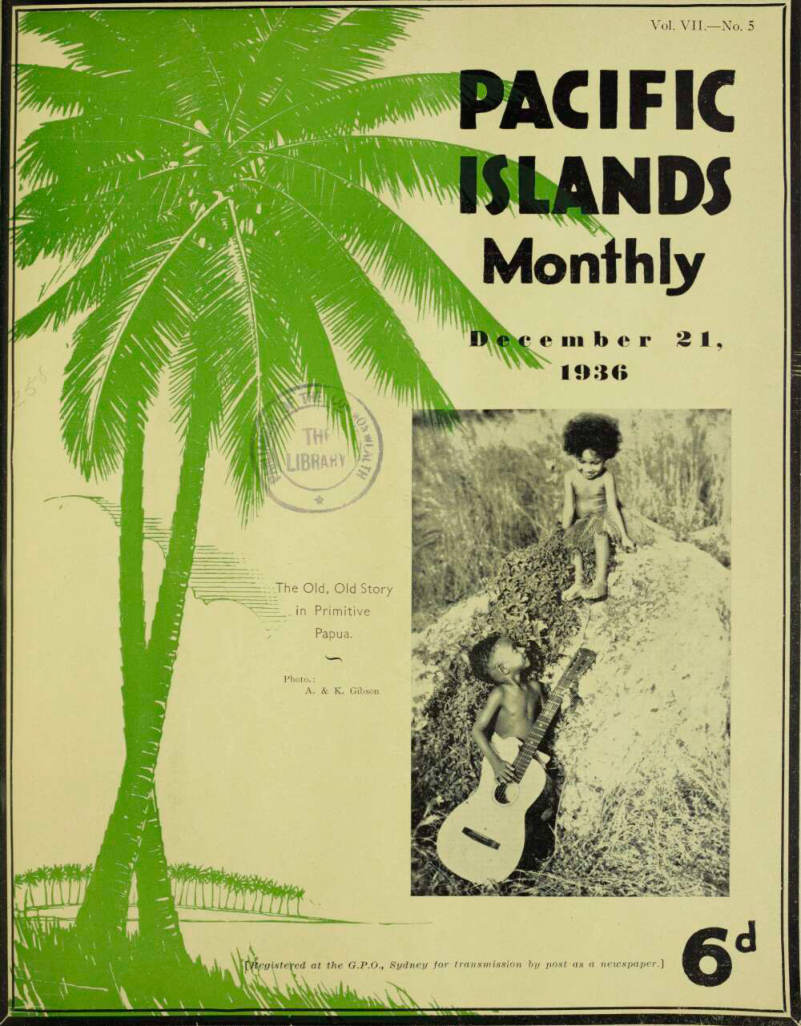
The Old, Old Story in Primitive Papua.
Photo.: A. & K. Gibson
Advertisements & other items, p. 2 (1 item)
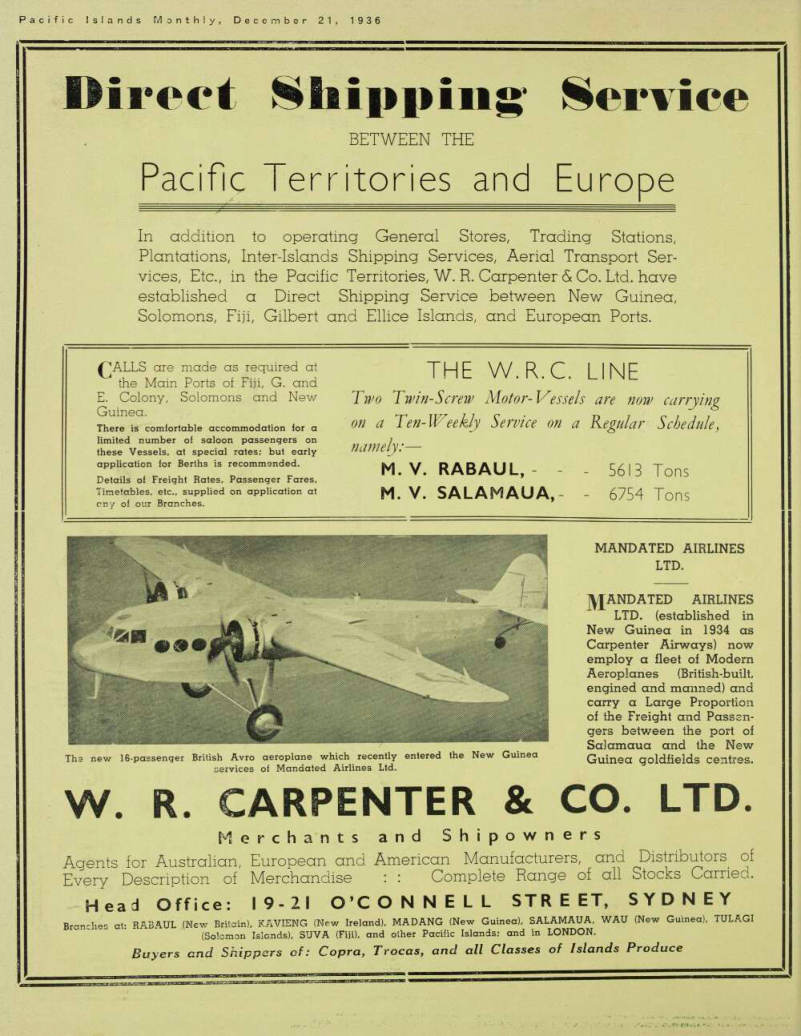
Ilireet Shipping' Service
BETWEEN THE
Pacific Territories and Europe
In addition to operating General Stores, Trading Stations, Plantations, Inter-Islands Shipping Services, Aerial Transport Services, Etc., in the Pacific Territories, W. R. Carpenter & Co. Ltd. have established a Direct Shipping Service between New Guinea, Solomons, Fiji, Gilbert and Ellice Islands, and European Ports. £ALLS are made as required at the Main Ports of Fiji, G. and E. Colony, Solomons and New Guinea.
There is comfortable accommodation for a limited number of saloon passengers on these Vessels, at special rates; but early application for Berths is recommended.
Details of Freight Rates. Passenger Fares, Timetables, etc., supplied on application at cny of our Branches.
THE W.R.C. LINE
Two Twin-Screw Motor-Vessels are now currying
on a Ten-Weekly Service on a Regular Schedule,
namely: —
M.V. RABAUL, - - - 5613 Tons
M. V. SALAMAUA, - 6754 Tons
w\ -, i ■
tarn
■ mm
MANDATED AIRLINES
LTD.
The new 16-passenger British Avro aeroplane which recently entered the New Guinea cervices of Mandated Airlines Ltd.
MANDATED AIRLINES
LTD. (established in New Guinea in 1934 as Carpenter Airways) now employ a fleet of Modern Aeroplanes (British-built, engined and manned) and carry a Large Proportion of the Freight and Passengers between the port of Salamaua and the New Guinea goldfields centres.
W. R. CARPENTER & CO. LTD.
Merchants and Shipowners
Agents for Australian, European and American Manufacturers, and Distributor of Every Description of Merchandise : : Complete Range of all Stocks Carried.
Head Office: 19-21 O’CONNELL STREET, SYDNEY
Bran-hes at; RABAUL (New Britain). KAVIENG (New Ireland), MADANG (New Guinea). SALAMAUA, WAU (New Guinea), TULAGI (Solomon Islands). SUVA (Fiji), and other Pacific Islands; and in LONDON.
Buyers end Shippers of: Copra , Trocas , and all Classes of Islands Produce
Pacific Islands Travellers
Passengers Per Montoro Which Ar
RIVED IN SYDNEY FROM PAPUA AND NEW GUINEA ON NOVEMBER 24: Messrs. Austin, Allman, Appleton, Allnutt, Beebe, Barnes, Bertie.
Brown, Bell, Baskett, Davies, Evennett, Eldred, Flower, Frost, Gossner, Gibson, Gerard, Hutton, Hodgson, Hawes, Howell, Jamieson, Jay, Jones (2), Kruttschnitt, Koschade Luff, Lundin, Mc- Aulay, McManus, McKee, Molony, Munro, Orrell, Palmer, Robson, Saunders, Taylor, Titcombe, Tun stall, Wakefield, Wauchope, Wiilson, Webgter, Zoffman; Mesdames Aumuller, Allnutt, Baskett, Beebe, Bonnell, Davies, Evenson, Frame, Gabriel, Grieves, Hardy, Hawes, Hilder, Nason-Jones, Jones, Koschade, Kruttschnitt, Luff, Lambton, Mc- Intyre, Peacock, Schmidt, Sinclair, Wakefield, Wauchope: Misses Bunting, Beebe, Corbett, Cooper, Fitzgerald, Henderson, MacGregor, Stock.
Passengers Per Aorangi Which Ar
RIVED IN SYDNEY FROM SUVA, FIJI, ON NOVEMBER 30: Mr. and Mrs. J. R. Baird, Mrs.
I. Dunstan, Mrs. E. E. Hayes, Miss R. M. Hall, G. D. Hill, Miss M. J. Joynton-Smith, Mr. and Mrs. D. R. McDonald, Master D. J. McDonald, Miss J. McDonald, Mr. and Mrs. W. McLeod, Mr. and Mrs. J. O’Neill, Mr. and Mrs. J. J.
Palmer, Mr. and Mrs. F. Pinkerton, Miss Pin kerton, Mrs. A. K. Rae, G. Saxton, Miss H. M.
M. Scott. Mr. and Mrs. W. A, C. Service. Mr. and Mrs. R. Twentyman, Misses M. and J.
Twentyman, Mrs. M. Upton, Mr. and Mrs. R. C.
Wallace, Mrs. Derrick, Misses Derrick (3), Mas ters Derrick (2), R. J. R. Douglas, A. T. Grainger, Mrs. D. M. Mason, J. R. Herrington, Mrs. J. E.
Morrison, Miss R. Mune, Miss E. M. McKindlay, T. E. Nelmes, A. N. Plant, Miss O. H. Russell.
C. W. Tucker, Mr. and Mrs. W. Wright, F. A.
Bradshaw, Miss W. L. Cuthbert, Miss J. Cleary, H. F. McKay. S. P. Stanley. R. E. Withnell.
Passengers Per Montoro Which
Sailed From Sydney For Papua And
New Guinea On December 2 :-Messrs.
Arnold, Burns, Bangarten, Braithwaite, Blood, Brown, Burgess, Cooper, Callanan, Carlson, Cook, Dudley, Doon, Fisher, Fraser, Garden, Giblin (2), Goddard, Gearin, Gribben, Grace, Gray, Har vey, Hill, Harris, Johnson, Jackson, Sparkes, Logan, Livingstone, Lumley, Lidgate, Lord, McEwan, McEncroe, McArthur, Mitchell, Mc- Dougall, Munro, McDonald, Officer, O’Farrell, Pritchard, Rollinson, Ray, Smith, Simpson, Seale, Simcocks, Sibbett, Sainsbury, Talbot, Thomas, Waugh, Wenn. Mesdames Braithwaite, Blood, Fraser, Gazzard, Grace, ' Geddes, Gray, Hallam, Hartley, Hendra, Ingold, Lyall, Logan, Maxwell, Ray, Simpson, Spence, Sainsbury, Williams, Wil kinson, Brown. Misses Arnold, Brien, Bock, Chester, Coleman, Catell, Cooper, Ewen, Gleeson, Grose, Gray, Humphries (2), Hart (2), James, Lyons, Loudon, Lumley, Leetch, Lamb, Mulhol land, Matthews (3), McKenna, Murison, March, Pearson, Stubbington, Sefton, Voysey, Ward.
Passengers Per Aorangi Which Sail
ED FROM SYDNEY FOR SUVA, FIJI, ON DECEMBER 3: Misses J. and B. Allman, Mas ters R. A. and R. Aspinall, Miss N. Brown, V. J.
Costello, Miss M. H. Dietrich, Mr. and Mrs. H.
S. Everist, Miss M. Elliott, M. Howell, Miss N.
Hunter, Miss J. Howell, Mr. Law, Master D.
Lyons, Messrs. R. and J. Leith, Mrs. R. E.
Mount Stephens, Misses R. and J. Mount Stephens, Dr. M. Naim, Miss M, Rogers, Messrs. R. T., and P. J. Rogers, E. S. G. Ruthven, Capt. T.
Scott, Miss M. Snodgrass, Masters J. and N.
Snodgrass, Miss B. Sherwood, E. R. Tanner, Mas ter R. D. Trewenack, Master P. W. Van Gel deren, B. Young, Sister L. Bouquet, Mr. and Mrs.
J. W. Clarkson and infant. Master J. M. Gark son, Mr. and Mrs. R. Giles and infant. Misses J. and H. Grahame, B. G. Honson, F. A. Harper, T. F. King, Miss D. Leard, Mrs. C. Leembruggen, D. V. Melville, Sister L. Nelson, Miss S. Tip pett, Sister B. Witcombe, A. Smoothey.
Passengers Per Malaita Which
Arrived In Sydney From Solomon
Islands And Rabaul (N.G.) On Decem
BER 3 Messrs. Babbage, Birrell, Clarkson, Cas bolt, Corry, Campbell, Deane, Darlington, Goldie, Green, Harrison, Hill, Jennings, Johnson, Lever, McCarthy, Ottawa, Pilcher, Quintall, Smith, Thom son, Wood, Witts, Waterhouse, Wache, Young.
Mesdames Boye, Casbolt, Campbell, Corry, Geach, Hill, Johnson, Middleton, Murray, Tudberry, Thomson (2), Wilson. Misses Devir, Fitzgerald, Henderson, Lindeman, Sanders, Tynan.
Passengers Per Morinda Which
Sailed From Sydney For Lord Howe
IS., NORFOLK IS., AND NEW HEBRIDES ON DECEMBER 10:—Messrs. Arnott, Blundell, Ban ner, Buffet, Bestic (2), Benson, Bigelow, Black, Butler, Campbell, Currey, Dillon, Douglass, Flynn, Flashman, Halligan, Hutchens, Hall, Harbridge, James, King, Middleton, Muller, McDonald (2), Stanford,, Smith, Troughton, Thurlow, Warren,
Wilson. Mesdames Adams, Blundell, Banner, Blair, Benson, Flynn, Halligan, Harford, James, King, Middleton, Mills, McDonald, Temple. Misses Blacker, Benson, Blair, Butler, Cotton, Dupertuis, Dixon, Fitch, Fenton, Greenwood, Martin, Mc- Donald, Pettiford, Slater, Smith, Trebilco, Weiss, Wilson, White.
Passengers Per Nellore, Which
Sailed From Sydney For Rabaul, New
GUINEA, ON DECEMBER 12: V. G. Smith, Mr. and Mrg Q Renton and child> Miss j Penne father> Master K. Pennefather, Miss J. Lamb, Master G . R> Melrose, Mrs. M. F. Cunningham.
M isses D.. G., and J. Cunningham, C. H. Maclean.
Miss M j sherry, R. D. Pye, Miss B. A. Bren nan Ma J sters j. and M . Hore .Lacy. G. H.
Briggs> L A . Considine. Mr. and Mrs. Anderson.
Mrs £ M . Youlden, Master N. Youlden, Miss V.
Youlden, Miss J. K. Harris. Mrs. E. E. Walker, Miss P. Rowe, Miss D. Kennedy, Miss Scott, Misses N. and M. Smith.
Passengers Per Malaita, Which De
Parted From Sydney For Solomon
Islands And N.G. Ports. On December
12: Messrs. Ault, Alday. Bewick. Coates. Craig, C ropp. Campbell. Dickie. Everett, Fluet, Good ]and Henderson, Hitchcock, Kennon, Knibbs, Kohn ’ Laycock ’ Lamarre, Milner. Meadley, McLaughlin. Newell, Osborne. Prince. Rixon, heH™ He M t esd n. mes Cr t C t mP j iA Kenderson Hitchcock, lurner Whitehead, Wells. Misses Alday, Bott, Deck (2), Ferguson, James ’ Nicholls, Scott, Strickland, vvnson.
Passengers Per Neptuna Which
Arrived In Sydney From New
Guinea Ports On December 15: Messrs.
Arvidson, Adams, Barker, Benson, Clark, Courtney, Coote, Cutler. Dickson, Edwards, Furl ey ’ C°o dwm > Gollan Gouldmg Hill, Hope. a T es ’ T Joyne [* K,ley ’ Kroenm M g ’ Lakey, Light body’n Len ™ n ’ Macqueen Mirow, McColl. McDonell Ollerenshaxv, Pangrazio, ? aul ’ Peedon, Parker. Richards Rose, M dg , ers ’ Sy T? n , S ’ l S ewer A b J’ Tayl ° r > Whitehead, Mesdames Adelskold, Adams. Courtney Ed i^n^ 8 ’ Harri \r n L-- HopC iv/r r?° C^n y ’ i?i eWIS ’ £ ow , e ’ M;acAdam Makms, McDonell, Moore.
Peedon « Rex - Smith, Theobald, White.
Passengers Per Macdhui, Which
Arrived In Sydney From Papua And
New Guinea On December 16:—Messrs.
Austin, Anderson, Barnett, Brain, Brown, Cramp ton> Coghlan, Caddow, Carter, Drayson, Dick, Evensen, Ferguson, Frankel, Filan, Farnham, Grylls, Gaude, Heath, Head, Hall, Hancock, Hall, Izod, Bowen-Jones, Price-Jones, Jones, Keeling, Kelly, Lang, Luff, Longoni, Lees, Leech, Moore, Milne, Murray, Milne, McGaghey, Minogue, Nic holson, O’Malley, Pollard, Parry, Provis, Penning ton > Parry, Robertson, Robinson, Ramsden, Suth rla£d’ St^ ele ’, S .P en^ er ’ Steh D Swinfield, Smeeton. wit y S Juv.Vr’-, Turm \ r i Thompson. Uechtritz.
White Wilmot Mesdames Brain, Carter, Farnham, Grylls Guy. Heath, Kelly, Luff, Mur y’ Mmope, Nicholson, Osborne, Pollard (2). c ■ V P en ™ n gton, Ryan, Scott, Spencer, Mehr> win field, Smeeton.
Advertisements & other items, p. 3 (1 item)
Salt"
5
FRUIT
For that morning after” feeling 91 53 ■ ■ Ic* Au6l The words Eno and “Fruit Salt ' ore registered trade marks.
SAICON-BATAVIA-SAMARANC-PORT MORESBY
SAMARAI-RABAUL- PORT VILA-NOUMEA
SYDNEY - PORT MORESBY - BATAVIA - SAIGON
bi-monthly by the "VAN REES"
You will enjoy travelling by this popular, fast and modern steamer of the K.P.M., noted for its comfort, excellent cuisine, and economical fares.
With a fleet of over 130 vessels the K.P.M. Line is in a position to accept cargo for all ports in Netherlands India, and with transhipment at Batavia for Africa.
ROYAL PACKET NAVIGATION CO.
Paketvaart House, 255 George Street, Sydney
Diethelm & Co., Saigon; Steamships Trading Co. Ltd., Port Moresby and Samarai; W. R. Carpenter & Co. Ltd., Rabaui; Gubbay Freres, Port Vila; Carlo Leoni, Noumea.
Advertisers
Page.
Alois Akun & Co. . 32 Amalgamated Wire less of Aust. Ltd. 76 Anglewood School . 12 Angus & Coote Ltd. 41 Arnott’s Biscuits . . 72 “Aspro” 16 Ausoline 70 B. and S. Agency . 52 Baker, W. Jno. ... 75 Bank of N.S.W. . . 77 Berger & Sons Ltd. 74 Blau (Aust.) Robert 52 Broomfields Ltd. . . 45 Brunton’s Flour . . 38 Budge & Co. Ltd., J. 46 Bulhvants Ltd. ... 75 Burns, Philp & Co. 2 Burns, Philp & Co. 34
B.P. (S.S.) Co. .. 39
Buzacott Ltd 31 Carpenter, W. R.
Limited ii Cent. Q’land Meat Co. Ltd 36 Chapman & Sherack 28 Chi vers & Co. Ltd. 16 Coleman Lamp Co. 74 Coral Starch 42 Cosmopolitan Hotel 78 Crossle, Duff and Macintoch Ltd. . 68 “Cuprinol” 70 Cyclone Fence and Gate Co. Ltd. . . 65 “Cystex” 57 Del Cott Pty. Ltd.. 42 Dewar’s Whisky . . 23 Doans Pills 54 Docke, Carl Aug. . 56 Donald, A. B. Ltd.. 61 Doyle, T. G 62 Eaton, Ltd., J. W. 70 Electrolytic Co. Ltd. 68 Elliott’s and Aust.
Drug Ltd 14 Eno’s Fruit Salt . . 1
E.S.C.A. Ltd 69
Fairbanks-Morse Limited 79 Faithfull, D 20
Page.
“Faxrholme” College 34 Finau, Wm 21 Fletcher & Son ... 43 “Flit” 54 Florentine & Son . . 47 Ford, W. M 50 Ford, Sherington Ltd 57 “44 Macleay Street” 13 Foster Clark Ltd. . 35 Fryer, A. C 31 Garden Vale Pro ducts Ltd 38 Garrett & Davidson 60 Gillespie’s Flour . . 73 Grand Pacific Hotel 59 Guinea Airways Limited iii Hallstrom, E 15 Halvorsen, L 71 Hardie & Co., J. . 47 Hardy & Co.. R. M. 26 Harper, M 48 Holbrook’s Ltd. ... 39 Holdens Air T. Co. 80 Horne, W. & Co. . 58 Hotel Moresby ... 78 Hygeia Sanitary Co. 64
Lc.La.N.Z. Ltd. . 71
Jantzen, Ltd 20 Jones & Co. Ltd., H. 25 Jones & Rickard . . 4 6 Kambala School . . 41 Kerr Bros. Ltd. ... 73 Kodak Pty. Ltd. . . 21 Kopsen & Co. Ltd. 66 Kork-N-Seal Ltd. . 37 Lane & Girvan Ltd. 50 Levenson’s Radio . 49 McGowan & Co., A. 58 Mcllrath’s Ltd. ... 18 McKay, D 52 Macintyre & Co., T. 62 Maleham & Yeomans Limited 57 Master Sewing Machine Co. ... 43 Maxwell Porter Ltd. 64 Morris, Hedstrom Limited 61 Mungo Scott Ltd. . 36
Page.
Mowbray House School 17
N.D.L 78
Nelson & Robertson Limited ... 60,66 Nestle’s Milk ... 40 Newington College 15 Newlands Bros. Ltd. 42 Noyes Bros. Ltd. . . 14 N.S.W. Bookstall Ltd 23 Pacific Islands Co. 53 Pacific Taxi Service 60 Pacific Year Book . 80 Papua Hotel, The . 78 Patterson & Stone. 56 Paul & Gray Ltd. . 62 Peel & Sons, H. . . 37 Pike Bros. Ltd. ... 18
Page.
Plantation for sale. 61 Prescott Ltd 24 Price’s Radio Serv. 22 Prouds Ltd 17 Ransomes Sims and Jeffries Ltd. ... 63 Reed, Wm. E 44 Reid, W. M 72 Rohu, Sil 28 Royal Packet Co. . 1 Ruston & Hornsby. 51 St. Ignatius’ College 22 Samson, A. J 12 Scots College, The . 30 Scott Ltd., J 45 Scott & Sons 63 Shell Oil Co. Ltd. . 55 Smyth Co., J. H. . . 15 Springwood L. Coll. 53
Page.
Stanley, Chris 25 Steamships T. Co. . 73 Sterling Varnish Co. 11 Swallow & Ariell . 24 Sydney Steel Co. . . 68 Talkeries 12 Taubman’s Paints . 50 Taylor & Co., A. . . 47 “Tenax” Soap ... 13 Tilley Lamp Co. . . 30 Tillock & Co. Ltd. 25 Tisdalls Ltd 58 Tooheys Ltd 19 Tooth & Co iv To Let 13 “Top Dog” Men’s Wear 33 Trufood 26 Tudor Hotel 13
Page.
Vacuum Oil Co. Ltd. 29 Vincent’s A.P.C. . . 19 Warburton, Franki Ltd 32 Watson & Sons, W. 12 Waugh & Josephson Limited 27 West, Harry ... 74 Weymark & Son . . 37 Wheeler, B. R. ... 43 White Star Taxis . 59 Wills. W. D. & H. O. 33 Williams Ltd., S. . 48 Williams, W. H. . . 63 Wright & Co 64 Wright & Co., E. . 46 Wunderlich Ltd. . . 64 Yacht for sale ... 67 Yorkshire Insurance 45
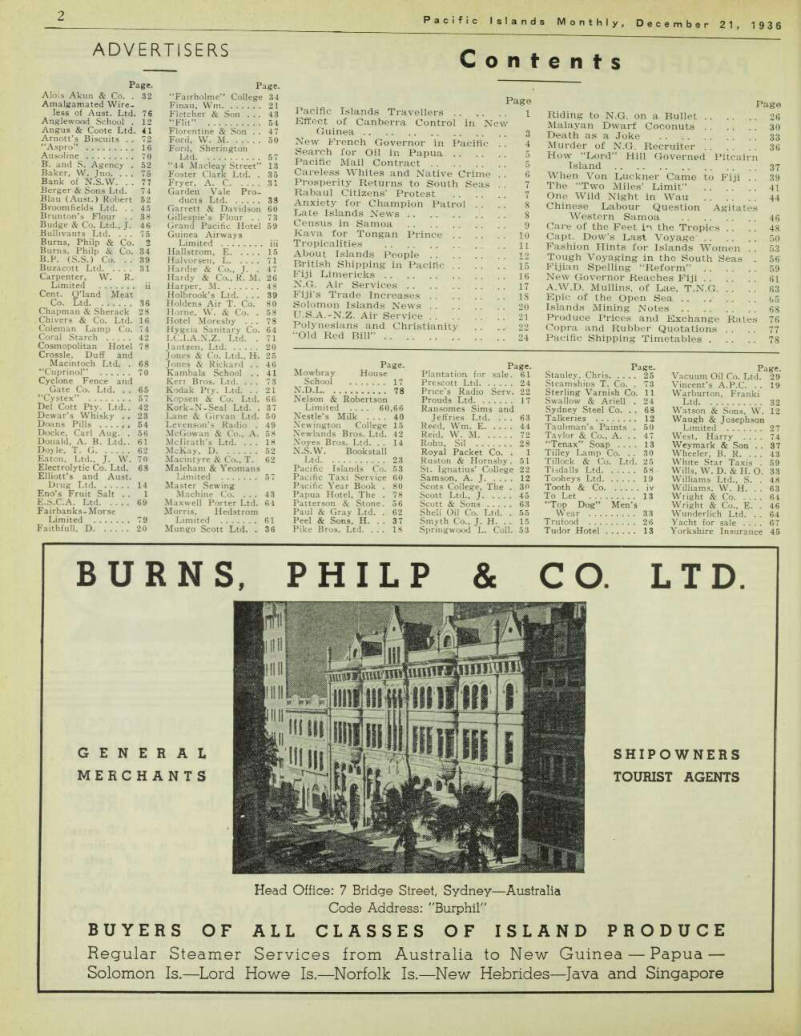
Contents
Page Pacific Islands Travellers 1 Effect of Canberra Control in New Guinea 3 New French Governor in Pacific . . 4 Search for Oil in Papua 5 Pacific Mail Contract 5 Careless Whites and Native Crime !! 6 Prosperity Returns to South Seas . . 7 Rabaul Citizens’ Protest 7 Anxiety for Champion Patrol . . . . 8 Late Islands News 8 Census in Samoa 9 Kava for Tongan Prince 10 Tropicalities n About Islands People 12 British Shipping in Pacific 15 Fiji Limericks 16 N.G. Air Services 17 Fiji’s Trade Increases is Solomon Islands News 20 U.S.A.-N.Z. Air Service 21 Polynesians and Christianity .. .. 22 “Old Red Bill” 2 4
Page Riding to N.G. on a Bullet .. .. .. 26 Malayan Dwarf Coconuts 30 Death as a Joke 33 Murder of N.G. Recruiter 36 How “Lord” Hill Governed Pitcairn Island , 37 When Von Luckner Came to Fiji .. 39 The “Two Miles’ Limit” 41 One Wild Night in Wau 44 Chinese Labour Question Agitates Western Samoa 46 Care of the Feet i*A the Tropics .. .. 48 Capt. Dow’s Last Voyage 50 Fashion Hints for Islands Women . . 53 Tough Voyaging in the South Seas . 56 Fijian Spelling “Reform” 59 New Governor Reaches Fiji 61 A.W.D. Mullins, of Lae, T.N.G 63 Epic of the Open Sea .. , s .. . . 65 Islands Mining Notes 68 Produce Prices and Exchange Rates 76 Copra and Rubber Quotations . . . . 77 Pacific Shipping Timetables 78
Advertisements & other items, p. 4 (1 item)
Burns, Philp & Co. Ltd
GENERAL
MERCHANTS
ill iiiiviiiii 111 l isisfSZ HI
lUIV
II I i -
SI! HI
HI n
SHIPOWNERS
TOURIST AGENTS
Head Office: 7 Bridge Street, Sydney—Australia Code Address: "Burphil"
BUYERS OF ALL CLASSES OF ISLAND PRODUCE Regular Steamer Services from Australia to New Guinea Papua Solomon Is. —Lord Howe Is. —Norfolk Is. —New Hebrides —lava and Singapore
Pacific Islands Monthly
The Newspaper-Magazine of the South Seas [Registered at the G.P.O. Sydney, for transmission by post as a newspaper. ]
Published Once Each Month and Circulated in Australia and New Zealand and in the following’ Pacific Territories and Island Groups:
Crown Colony of Fiji.
Australian Territory of Papua.
Mandated Territory (Australia) of New Guinea, Bismarck Archipelago and Northern Solomon Islands.
Mandated Territory (Japan) of Marshall, Caroline and Marianna Islands.
French Territory of New Caledonia.
British and French Condominium of New Hebrides.
American Territory of Eastern Samoa.
American Territory of Guam.
Mandated Territory of Nauru.
British Crown Colony of Gilbert and Ellice Islands.
Mandated Territory (New Zealand) of Samoa.
British Solomon Islands Protectorate.
British Protectorate of Tongan Islands.
New Zealand Territory of Cook Islands.
Australian Territory of Norfolk Island.
French Colony of Oceania (Tahiti, etc.), American Territory of Hawaiian Islands.
Owned and Produced by Pacific Publications Ltd., Union House, 247 George Street, Sydney
Telephone Bw 5037
P.O. Box 3408 R
Registered Address of Telegrams, Radiograms, and Cables: "PACPUB,” Sydney.
Contributions Articles, Stories, and Photographs dealing with Pacific Islands subjects are invited, and will be paid for on publication at usual rates.
Subscription Rates
Per Annum, within British Empire, Prepaid, Post Free 6/- Per Annum, elsewhere, prepaid. Post Free 8/- S ingle Copies 6d.
Editor and Publisher:
R. W. Robson. F.R.G.S.
Advertisements
Advertising rates furnished on application.
Colours, etc by Arrangement.
Process Blocks made at Advertiser’s expense when required. Screen, 100.
Changes of Advertising Copy should reach this Office by Bth of each month, otherwise previous advertisement may be repeated.
Agents
The following are authorised to receive subscrip tions for the Pacific Islands Monthly:— Islands Branches of Burns, Philp & Co., Ltd., and Burns Philp (South Sea) Co., Ltd.
Islands Branches of W. R. Carpenter & Co., Ltd.
All Branches of Morris, Hedstrom & Co., Ltd.
G. Thomas & Co., Rabaul, New Guinea.
Whitten Bros., Ltd., Samarai, Papua.
P. Costello, Suva, Fiji.
J. Muir, Suva, Fiji.
All Branches and Representatives of W. H. Grove and Sons, Ltd., Auckland, New Zealand.
Cook Islands Trading Co., Rarotonga, Cook la.
W. H. Watson, Rarotonga, Cook Is.
Representative in London: W. C. HARVEY, Coronation Building, 4 Lloyds Avenue, London, E.C.2. from whom may be obtained copies of Pacific Islands Monthly, Pacific Islands Year Book, advertising schedules, etc.
Vol. VII., No. 5.
Sydney, December 21, 1936
Prire I 6d - Per Copy -1 lice \ Prepaid; 6/- p.a.
Effect Of Canberra Control
In New Guinea
'T'HERE is a growing feeling that
Australia is not efficiently discharg-
ing her responsibility for the adminis-
tration ot me Mandated territory of
New Guinea. There is discontent,
more or less outspoken, in connection
with the following matters :
(a) The Administration appears to have no set oolicv for controlling rHrootino- an d stimulating the development of the Territory’s enormously rich resources. (b) it is difficult to discern any connected and intelligent policy for connatives—in tion is giving the native people little if y h wtte n rn“fat?o e n 3 TM S deficiency is especially noticeable in connection with the education of native children—the Administrations shortcomings in this direction are outspokenly condemned in D n ecembe C i e 2. in the Sydney Bulletin of (O There appears to be something wrong with the administration of justice.
Excessive jury less Supreme Court in New Guinea.
Another and more serious aspect is the
apparent failure of the Department of PeMy ° rime amons <a) There seems to be no policy under which medical work is controlled and directed, other Territories have sue-
SlSo„°e™d
Papuans, Solomon islanders and other a ? e - d *° lr l? go £ d ™, ork ’ 1 he New Guinea Administration has done ? othing ’ beyond imparting a little medical Tefrit° natlVe hospital assistants in e erri ° ry ' A recent development—a meeting of European residents of Rabaul to pro
test against dangerous conditions
among; natives in that area-was given scare-headings m the Sydney news papers on December 3. The headings c j •
u V^^y e Mornmg
H . erald CnmeS by NativeS mst Women mid Children a, U? m ew Guinea ; those in the m “* abaul Native 1 ienace Meeting Deplores Crimes
Against European Women—Alleged
Growing Lack of Discipline.” Criticism of conditions in New Guinea has rattled in vain, for a long time past, against the deadwood in Canberra; hut even Canberra, we imagine, will he compelled to take notice of that kind of agitation.
In an economic sense, New Guinea has had extraordinary luck. The ad ministrative deficiencies to which we refer existed in New Guinea in the period prior to 1930; but New Guinea received so high a price for its pro ducts, especially copra, that it was able to show a reasonably good financial condition from year to year, and so Canberra closed its ears against vari ous attacks. Then came the Depres sion; and Pacific Territories which were entirely dependent on copra found themselves in desperate finan cial straits. But, in the meantime, a gold industry had been established in New Guinea, and the N.G. Adminis tration received so substantial a revenue from gold royalties and from , import duties which it imposed upon the huge and expensive equipment re quired for goldmining and transport,
that it escaped serious embarrassment.
If it had not been for the courage and enterprise of British, Australian, and American investors in establishing the gold industry in the face of colossal natural difficulties, the New Guinea Administration would have been in a serious condition between 1930 and 1935—and probably, as a consequence, it would have been brought under the analytical examination that is so long overdue.
The Administration’s failure to use its considerable revenues to stimulate the development of the Territory’s rich natural resources, is conspicuous.
It maintains a large and apparently
efficient Department of Agriculture:
but that valuable organisation has not been used noticeably in extending the
planting industry. The experimental
plantations at Wau and Lae have been closed up. There has been agricultural and pastoral activity of a remarkable character in the Bulolo Valley, near Wau; but experiments there have been carried out at their own expense by Mr. Wilde, Mr. Barker, and others, and not by the Administration. Years ago—about 1931—expert advice was obtained about copra grading; the planters were assembled and consulted; far-reaching amendments of the Copra Ordinance were formulated and agreed to —and nothing further was done.
The same old Copra Ordinance is in existence to-day —and N.G. producers of high-grade copra continue to receive a price which is from £1 to £2 per ton less than what it ought to be. At this moment, as an article in this issue shows, the planters of N.G. are up in arms against the present Administra tor’s proposal to wipe out the zone trading system, which was introduced some three years ago, after very care ful inquiry, as a policy designed to remove certain difficulties surrounding native trading, and to encourage agri
cultural development.
In our opinion, the trouble in New Guinea does not lie in the rank and file of the Public Service. One of the best things about the N.G. adminis trative system is the method of select ing young men for appointment to the service. The result is seen in the rank and file of officialdom, which in educa tion, personality, and efficiency, will compare very favourably with any other tropical administration in the world.
The trouble lies in sheer fatheadedness, and lack of vision and imagination, among the departmental chiefs in the Territory; and this administrative dis ability is aggravated and made worse by
a similar fatheadedness and lack of vision in Canberra. Departmental heads in New Guinea seem to be incapable either of formulating policies, or of standing consistently by policies when they are inaugurated. rj ,, . r i » j . • The capacity of the Administrator, of course, matters a great deal When Bngadier-General Thomas Griffiths was appointed m 1932, Australia was given an opportunity in New Guinea ef establishing a regime that would have reflected great credit upon the Commonwealth in the realm of tropical administration. General Griffiths, within a remarkably short time, introduced policies in New Guinea which provided for the proper economic development of the Territory, and especially for influencing and controlling the native population during that critical period of change from primitive barbarism to European methods of life. General Griffiths showed vision and wisdom in seeking the help of the best elements among the planters and missionaries; and, literally within a few months, he had secured their genuine co-operation.
But, within two years, this experi- , , enced and capable Administrator was dnven out of New Guinea by the stupidity and incapacity of departmentalism at Canberra. He resigned and, like a good soldier, he uttered not one word of complaint or explanation. No
one has heard from his lips any ex planation of why he abandoned the task which he had taken up with so much enthusiasm in New Guinea. But it soon became clear, through infor mation derived from other reliable sources, that General Griffiths could not endure a system under which prac tically every decision of his was sub ject to “office-boy review” in Canberra.
Of the present Administrator, Bri gadier-General W. R. McNicoll, little can be said. He has been there only two years and he has been confronted with a task of great difficulty— especially as he was without experience in any phase of tropical administration.
It is possible that his hands, also, are being tied by Canberra interference.
All that has happened in the last year or two suggests that the Rabaul bureaucrats are again in charge of New Guinea affairs, and the result cannot be other than bad. Some of the reforms and new policies introduced by General Griffiths—especially in connection with native education and native affairs — have been swept away.
Some people believe that within six months the Commonwealth Govern ment will appoint the usual fatuous and useless Royal Commission to investi gate affairs in New Guinea. Thus, in competent officialdom will escape its responsibility for a year or so, while in the meantime the administrative
(Continued At Foot Of Next Column)
conditions in the Mandated Territory will just drift on.
It is deplorable that there should be troubles of this description in New Guinea and Western Samoa, which are both administered under mandate by British Dominions. The present troubles are due directly, in each case, to democracy’s curse—namely control of administrations by muddling and in experienced politicians. “Office-boy interference” in Canberra drove out the only Administrator who seemed likely to make an outstanding success of New Guinea; while the N.Z. “goodwill mis sion’s” attempted application of social istic principles in Samoa has started a glorious political row in that territory.
This muddling will go on indefinitely —that is the British way. It would be amusing, perhaps, if it were not for the tragic fact that these Administra tive failures under the Mandates sys tem sooner or later will receive pointed attention in foreign countries.
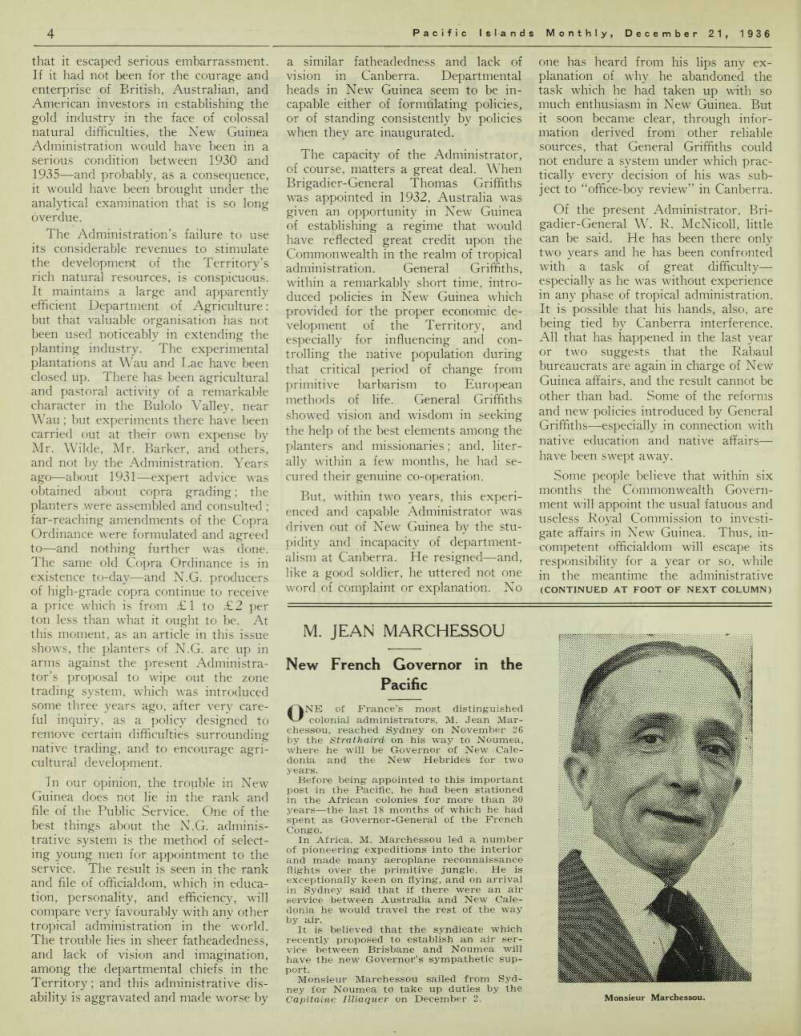
M. Jean Marchessou
New French Governor in the Pacific
ONE of France’s most distinguished colonial administrators, M. Jean Mar chessou, reached Sydney on November 26 by the Strathaird on his way to Noumea, where he will be Governor of New Cale donia and the New Hebrides for two years.
Before being appointed to this important post in the Pacific, he had been stationed in the African colonies for more than 30 years—the last 18 months of which he had spent as Governor-General of the French Congo.
In Africa, M. Marchessou led a number of pioneering expeditions into the interior and made many aeroplane reconnaissance flights over the primitive jungle. He is exceptionally keen on flying, and on arrival in Sydney said that if there were an air service between Australia and New Cale donia he would travel the rest of the way by air.
It is believed that the syndicate which recently proposed to establish an air ser vice between Brisbane and Noumea will have the new Governor’s sympathetic sup port.
Monsieur Marchessou sailed from Syd ney for Noumea to take up duties by the Capitaine Illiaquer on December 2.
Monsieur Marchessou.
Operations of Three Companies
Search For Oil In Papua
From Our Own Correspondent
Pt. Moresby, Dec. 10.
Representatives of the three on companies, holding - large concessions in the west of Papua, have been actively engaged in the preliminary work of the search.
On November 18, the Papuan Oil De velopment Co.’s vessel Angas arrived from Sarawak, Borneo, in charge of Captain Rendall and a Malay crew, and sailed for Daru on December 8 with Dr, C. Schu macher (assistant geologist).
On December 7 a Guinea Airways Junker, fitted with floats alighted in the harbour. It is understood that the ’plane has been engaged by Papuan Oil Development Co. for two or three weeks’ aerial survey over their large concession in the west, over the waterways of the Fly River. The ’plane left for the Fly River and Daru on December 10, with Dr.
C. W. Creek (chief geologist).
The Oriomo Oil Co.’s vessel the Olive, arrived in Port Moresby on November 25 in charge of Captain Kingdon. It is to be used for transport work on the com pany’s oil concession in the west. The first base camp will be near the Kikori River and the Olive left on November 28 with the first party—Messrs. J. N. Mont gomery (chief geologist), S. W. Carey, W.
P. Wilson, and B. C. Hides. It is under stood that the company will be actively engaged for some time up the waterways of the Kikori.
Representatives of Island Exploration Co. (Messrs. N. Osborne. S. P. O’Driscoli, and H. Prentice) left for Daru on Novem ber 28 by the Royal Endeavour. Messrs.
Miller and Reed are already there. It is understood that the company is expecting a vessel shortly to do transport work over their large concession.
Mr. Leigh Lightbody, of Messrs. Burns, Philp and Co. Ltd., Rabaul, arrived in Sydney from New Guinea by the Neptuna in the middle of December.
ILy That the Senleva was ITtouf sea-
Stormy Debate
Over New Fijian Vessel
THERE was some lively debate in the Fiji Legislative Council recently when the official estimates were under consideration.
Hon. Alport Barker referred to the amount of £3OOO set down as the cost of a new vessel for the Lau Islands. He dedared that the Seniceva which was built in Fiji for that purpose and launched last year was found to be unsuitable owing to defects in her design.
He expressed the opinion that the Director of Public Works (Hon. W. Wise) was not competent to design a vessel—he might be a first-class civil engineer, but naval architecture was a profession by itself The Acting Director of Public Works retorted that he had travelled in Fiji waters sinoe a bov and hp was r<aadv tn ILy That the Senleva was ITtouf seaworthy vessel. He said that many points raised by Mr. Barker did not exist in fact.
Defending Mr. Wise, Mr. Ragg pointed out that in him they had the most efficient and cleverest Commissioner of Works who had ever set foot in Fiji. . . .. , After further stormy discussion, the Colonial Secretary said that although no final decision had been made as to the plans for altering the Seniceva, the vessel was not going to be used for Lau, as she was definitely unsuited for conditions there. Before any structural changes were made in her for use elsewhere, a naval architect would be consulted.
Contract
Pacific Mail
No Decision Yet—B.P. Carry On
ALTHOUGH tenders closed for the Pacific Islands mail contract on Sep tember 30, a contract has not yet been let by the Commonwealth Government.
The Pacific Islands mail steamers are continuing to run, under a temporary arrangement made between the Govern ment and Messrs. Burns, Philp & Co. Ltd.
This affects the lines running between Sydney and Papua, New Guinea, Solomon Islands and New Hebrides.
We understand that two tenders were submitted —one by Messrs. Burns, Philp & Co. Ltd., and the other by an English firm, Messrs. Nelson and Co.
New Guinea Inter-Island Ships
Tenders for the carriage of mails by the inter-island steamers, in New Guinea, were invited, and closed on December 15, and it is likely that a contract will be made without delay.
A proclamation by the Administrator, gazetted on December 15, proclaims Rabaul, Salamaua, Dae, Kavieng, Madang, Kieta, Wewak, Boram and Lorengau as ports at which oversea vessels may take on or discharge passengers or cargo.
Under the shipping Ordinance it is an offence for oversea vessels to trade between these ports without licence.
There had been many protests against this new law, because it automatically shuts out, from small-port trading, the two ships of the N.D.L. Line, Bremer haven and Friderun, which have been running for years between Hong Kong and the New Guinea ports.
It is reported that this difficulty will be removed by the sale of the Bremer haven to Messrs. Colyer Watson and Co., who are agents in New Guinea for N.D.L.
The Bremerhaven, it is stated, will be transferred to the British register, with European officers and, probably, a native crew (instead of Chinese); and she is expected to run only between New Guinea ports large and small; while the Friderun will continue her present ser vice between Hong Kong and main New Guinea ports, where she will connect with the Bremerhaven.
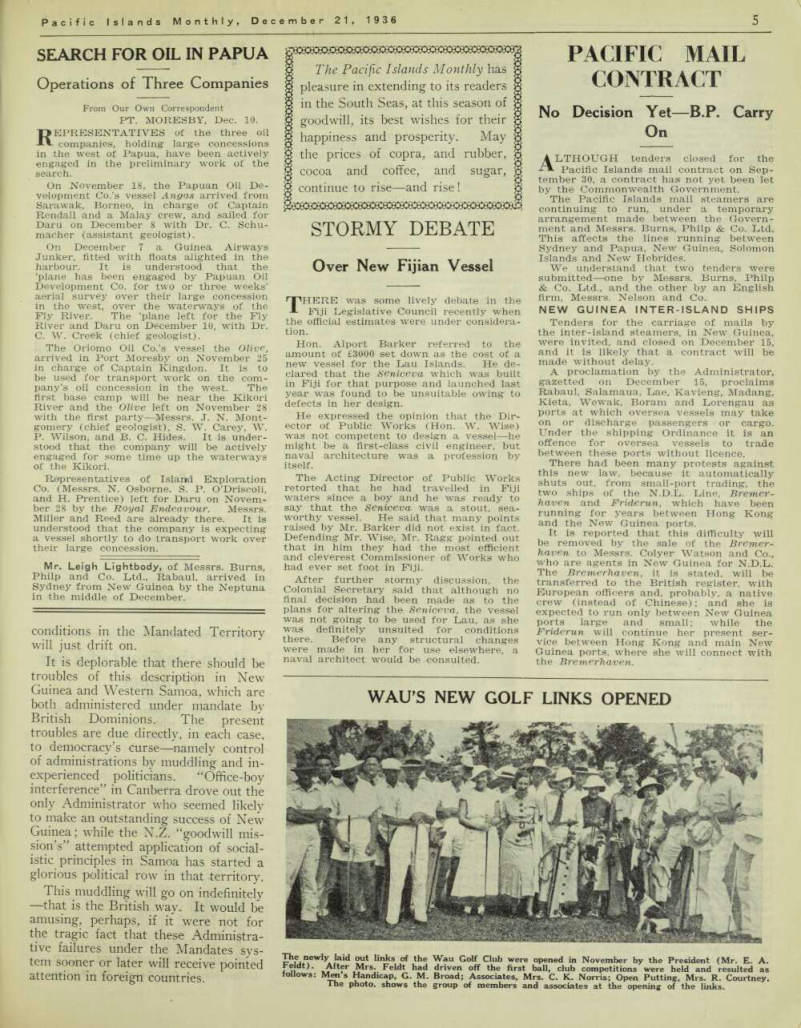
Wau’S New Golf Links Opened
The newly laid out links of the Wau Golf Club were opened in November by the President (Mr. E. A.
Feldt). After Mrs. Feldt had driven off the first ball, club competitions were held and resulted as follows: Men s Handicap, G. M. Broad; Associates, Mrs. C. K. Norris; Open Putting, Mrs. R. Courtney.
The photo, shows the group of members and associates at the opening of the links.
Advertisements & other items, p. 7 (1 item)
The Pacific Islands Monthly has
pleasure in extending to its readers in the South Seas, at this season of goodwill, its best wishes for their happiness and prosperity. May the prices of copra, and rubber, cocoa and coffee, and sugar, continue to rise—and rise!
Primitive Natives
Careless Whites and Primitive Natives
[Elsewhere, there are published references to the meeting held recently in Rabaul, where the European community expressed alarm about the growing cheekiness and lack of discipline among natives in and near the town.
The followmg is part of a letter, written by a leading resident of Rabaul, who puts the case for the natives. All our information is to the effect that the native menace in Rabaul is more serious than our correspondent admits, and our sympathies are with the Europeans who held the meeting.
Nevertheless, there is something to be said for the natives. Our correspondent is perfectly correct when he directs attention to the vicious practice— permitted by the Administration over long years— of assembling hundreds of primitive men in “labour lines,” far removed from their villages and womenfolk, and expecting them to behave like docile, unsexed animals. He is not so correct when he charges the Rabaul Europeans with drunkenness and profligacy. The great majority of Rabaul householders behave with proper re straint before natives.]
Letter To The Editor.
fTVHE thinly-disguised purpose of the meeting was manifest to all.
In spite of previous failures, one more attempt is to be made to bring pressure on the Administration, and perhaps on Canberra, to re-introduce the barbarity of permitting the white man to flog the native, under the so-called pretext of “firmness and kindness.” This is, or is thought to be, the panacea of all evils, real or imaginary.
What are the true facts of the case?
Isolated cases, deplorable in themselves, have been collected and clumsily pieced together in order to create the erroneous impression that the present Administra tion is either inert or incompetent, and that this Territory is unsafe for European women. Undue prominence is given to what natives are alleged to have at tempted against whites. Yet dead silence shrouds the sins of the European against the native.
In Rabaul and its environs to-day there are 805 Europeans, and, besides numer ous Asiatics and half-castes, between 3000 and 4000 natives. Large numbers of these natives have been drawn from distant and widely different parts of the Terri tory. They are suddenly introduced into a form of life with which they are en tirely unacquainted. Naturally, they do not know the white man’s language and he is ignorant of their's, so the only medium of communication is the nebulous “pidgin,” Unfortunately, numbers of these native servants are married men separ ated from their wives, and this is a per petual temptation to incontinency, solely through the white man’s mismanagement.
In Rabaul, native servants are dis tributed according to the master’s salary.
Some homes have two, others three, while the “nobility” can usually retain four—a cook boy, a house boy, a wash boy, and a boy for, the grounds.
The first duty of the cook boy is to bring morning tea to the bedside of the yawning master and mistress. Next, pre pare the bath. In many households, the occupants are not overscrupulous as to how they are attired in going to and from the bathroom. Again, a boy is often sent to a bedroom, while persons are still in bed. Husbands often censure their wives for want of proper care before native ser vants, and wives likewise blame husbands, but still the practice continues.
Entertaining—cocktail parties during the day and beer parties at night—is a part of the artificial tropical life, where the natives’ services cannot be dispensed with. Native servants in some house holds not infrequently witness most irre
sponsible behaviour among Europeans, This is no more than the bare truth—l have seen it during long years in Rabaul.
Temptations largely of the Europeans’ making are perpetually placed before natives. With what result? If a native stares twice at a female, displaying a large area of fleshly charms, or even if she merely imagines he stares, the in discretion, magnified beyond all propor tion, is told from one end of Rabaul to another. The next process is that the offender is hurried to the District Office, charged with what he .does not under stand, and interrogated according to the usual fashion: “’E true, ’e no true?” If the native answers, even without under standing it, “’E true,” another piece of evidence has been secured that the Terri tory is not safe for European women.
No one interested in native welfare can ignore the exhibitions of drunkenness, im morality, concubinage and other indis cretions too frequently displayed before the natives. Little wonder they are so often perplexed, and sum up the white man’s vaunted civilisation as a huge lie.
If the group recently formed to advo cate certain measures against the de fenceless native changed its name and ideal into a League of Public Decency, and demanded a higher standard of pro priety from Europeans, then something might be accomplished which would benefit black as well as white. Example is the best teacher.
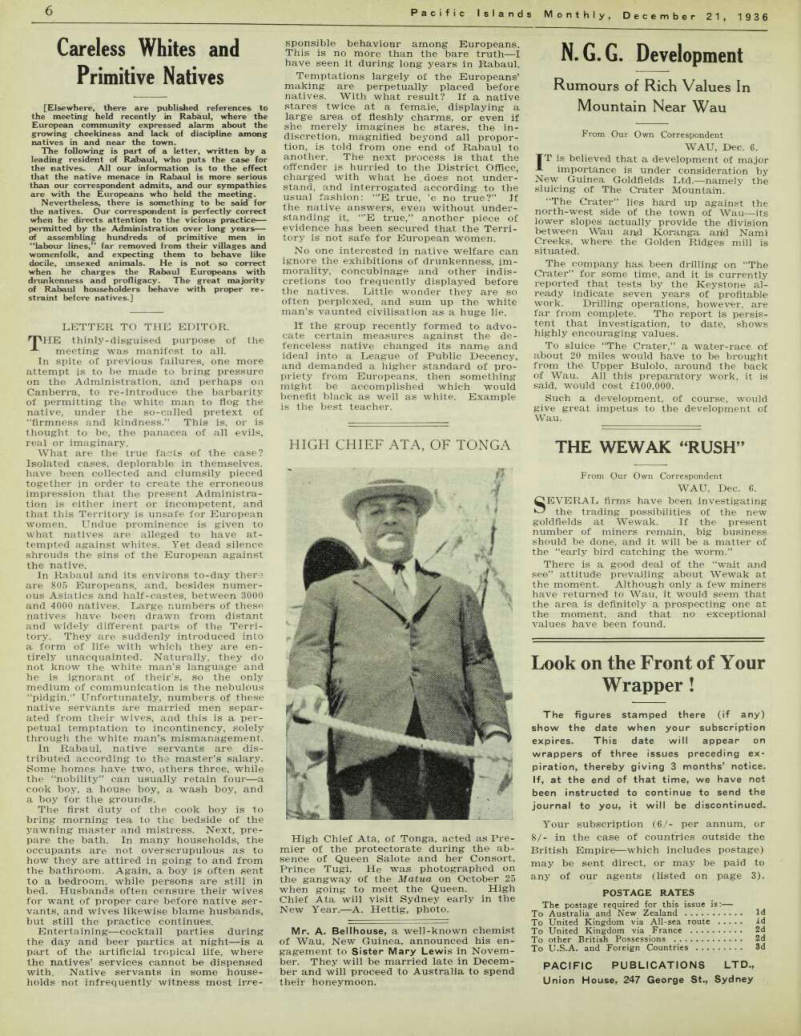
High Chief Ata, Of Tonga
Mr. A. Bellhouse, a well-known chemist of Wau, New Guinea, announced his en gagement to Sister Mary Lewis in Novem ber. They will be married late in Decem ber and will proceed to Australia to spend their honeymoon.
High Chief Ata, of Tonga, acted as Pre mier of the protectorate during the ab sence of Queen Salote and her Consort, Prince Tugi. He was photographed on the gangway of the Matua on October 25 when going to meet the Queen. High Chief Ata will visit Sydney early in the New Year. —A. Hettig, photo.
N.G.G. Development
Rumours of Rich Values In Mountain Near Wau
From Our Own Correspondent WAU, Dec. 6.
TT is believed that a development of major importance is under consideration by New Guinea Goldfields Ltd.—namely the sluicing of The Crater Mountain.
“The Crater” lies hard up against the north-west side of the town of Wau—its lower slopes actually provide the division between Wau and Koranga arid Nami Creeks, where the Golden Ridges mill is situated.
The company has been drilling on “The Crater” for some time, and it is currently reported that tests by the Keystone al ready indicate seven years of profitable work. Drilling operations, however, are far from complete. The report is persis tent that investigation, to date, shows highly encouraging values.
To sluice “The Crater,” a water-race of about 20 miles would have to be brought from the Upper Bulolo, around the back of Wau. All this preparatory work, it is said, would cost £lOO,OOO.
Such a development, of course, would give great impetus to the development of Wau.
The Wewak “Rush”
From Our Own Correspondent WAU, Dec. 6.
SEVERAL firms have been investigating the trading possibilities of the new goldfields at Wewak. If the present number of miners remain, big business should be done, and it will be a matter of the “early bird catching the worm.”
There is a good deal of the “wait and see” attitude prevailing about Wewak at the moment. Although only a few miners have returned to Wau, it would seem that the area is definitely a prospecting one at the moment, and that no exceptional values have been found.
Advertisements & other items, p. 8 (1 item)
Wrapper!
Look on the Front of Your
The figures stamped there (if any) show the date when your subscription expires. This date will appear on wrappers of three issues preceding expiration, thereby giving 3 months’ notice.
If, at the end of that time, we have not been instructed to continue to send the Journal to you, it will be discontinued.
Your subscription (6/- per annum, or 8/- in the case of countries outside the British Empire—which includes postage) may be sent direct, or may be paid to any of our agents (listed on page 3).
The postage required for this issue is:—
PACIFIC PUBLICATIONS LTD.,
Union House, 247 George St., Sydney
POSTAGE RATES
To Australia and New Zealand To United Kingdom via All-sea route To United Kingdom via France ...
To other British Possessions To U.S.A. and Foreign Countries . ..
Id Id 2d 2d 3d
Prosperity Returns To South Seas
What Rise in Copra Prices Means to Planters and Traders
nPHERE was jubilation in Pacific Islands planting- and trading circles during the month when news .was received from Lon don that the copra quotation had risen again, the London price, c.i.f., for what is known as “Hot-air Dried, Rabaul” grade being now well over £2O per ton. (See de tails on page 77). Both of the lower grades (South Sea Smoked and South Sea Sun- Dried) have risen in proportion.
Those planters who work on Australian and New Zealand currencies are enjoying also an exchange premium of 25 per cent.
Coconut planters must go back to the middle of 1930 to find quotations equal to those ruling to-day.
A New Guinea planter now in Sydney, who produces a high grade of Hot-air Dried copra, said that the latest prices, converted into Australian currency, meant that his copra was worth over £2O to him on the beach at his plantation near Madang. He said that to appreciate what this meant one need only remember that some three years ago he had been forced to accept £3/10/- per ton for the same copra at the same place—and he could not get his stores off the boat until he had delivered an equivalent value in copra.
Copra prices have been rising steadily month by month since the middle of 1935; but in the first week of October they began to jump in sensational fashion. Since Octo ber 2, the London quotation for Rabaul Hot-air Dried copra has risen from £l4/10/ per ton to £2l/5/- per ton on December 11—which, with exchange added, is equal to a rise of well over £8 per ton in Austra lian currency.
Students of the market are inclined to think that the rise over the past ten weeks has been too rapid to be permanent; yet they admit that some of the factors which have brought about the rapid change in the market are plainly in sight—such as a shortage of fats in America caused by drought: a marked reduction in world stocks of vegetable oils and fats; and especially a growing freedom in inter national trade brought about recently by the devaluation of French and Italian cur rency.
The London c.i.f. price for high grade copra in 1924-1925 was almost constant at
£3O per ton, c.i.f. For 1926 and until the middle of 1928 the price was in the vicinity of £2B per ton; but from that point it de dined until in April, 1934, it had reached the calamitous level of £8 per ton.
South Seas planting interests do not expect prices to return to the 1924-28 levels; but they appear to be well satis fied with the prospect of the present prices being held p Already,' as a result of the new level of copra prices, economic conditions in the South Seas have greatly improved and there have been a number of inquiries received from prospective purchasers of coconut plantations rcnasers Other South Seas products have similarly improved in value. The London onota tion for Plantation Smoked rubber was at 6|d per lb. a year ago is nowabound 9d per lb This has sn „ nomic outlook of Papua that it was an nounced last month by the Commonwealth Government that the 2d per lb bountv that had been paid to Papuan Vuhher growers for some years was now beimr event « “e Sn* ” ,h 6 A , , , * lauing again, , . & ° od deal o f coffee and cocoa is now Pdng" Produced in Papua and New Guinea, ?; n<l the prices of both those commodities aave , advanced considerably in recent ™ onths v Recent advices from Western Ghe P rin cipal cocoa producer in the ~f stated that cocoa was then worth £6O per ton on the beach in Apia, compared with less than £3O per ton a couple of years ago, and that Samoan P. tecs were seeking labour in every dire ction in order to harvest a particularly large crop of cocoabeans.
The effect of the depression in the South Seas was to wipe out a considerable num ber of non-economic plantations which were over-capitalised or inefficiently oper ated; and it is claimed to-day that as a result of this, combined with the present profitable level of prices, economi C Pcondi tions in all the territories in the South Pacific are better than they have been for two or three decades.
Copra Records Over 50 Years
piFTT years ago, when the late W. E.
Reed 'founded his Islands trading firm (which is now carried on by his sons) he began to keep an exact record of copra prices, which he transferred to graphs.
Mr. Reed has been dead these several years, but those graphs still adorn the walls of his offices, and are a source of interest and information to many people The following figures have been copied from the graphs.
It should be noted that the price given is the price of sun-dried copra, in bags, f.0.b., Sydney; whereas the price usually quoted nowadays is the London, c.i.f. price
It is well worth noting that copra always has risen, when there has been war, or threats of war, and has fallen when the international horizon has been clear.
1885 . .
Highest
Per ton
f.o.b., Sydney
Lowest Per ton,
f.o.b., Sydney
et o n 1886 11 15 0 10 yj 10 15 10 g \J A 1887 . . 15 0 10 U A 1888 5 0 9 u A 1889 10 0 0 ... 8 U o 1890 10 o i n A A 1891 10 o Q U 10 10 10 0 u A 1892 0 o Q U A 1898 5 o 1 A 0 A 1894 11 15 0 . . .
U 0
1901 1902 To 1900—About 14 0 15 10 the same as 0 0 1894. 10 5 i o n 0 1903 13 0 o ii 13 14 15 16 13 15 20 17 21 24 14 14 19 26 22 18 34 V 10 0 A 0 1904 15 0 0 0 A 1905 14 15 0 u A 1906 21 10 0 U c U 0 1907 22 15 o D n 1908 16 10 0 If r 0 A 1909 21 0 0 O 10 u 0 0 A 1910 24 5 o 1911 23 10 o U c 1912 23 0 o O A 0 A 1913 27 10 o If 15 0 10 0 A If A 1914 1915 26 23 5 10 0 o If 0 A 1916 1917 26 27 15 5 0 o U 0 A 1918 1919 28 36 10 15 0 0 o u 0 U 0 1920 44 o U 15 A 0 A 1921 28 15 o 17 18 20 21 If A 1922 26 0 0 U 0 10 15 U A 1923 26 0 o U A 1924 25 5 0 U 0
Rabaul Citizens’
Protest
Against Growing Incidence of Native Crime
Rabaul, Dec. 2.
CONVENED by Mr. J. C. Mullaly, M.L.C., a public meeting- of nearly 250 local residents, of whom 50 per cent, were women, last night adopted a resolution “viewing with alarm the growing incidence of crimes and attempted crimes by natives against European women and children.”
The meeting urged the New Guinea Ad ministration “to introduce the most drastic measures, if necessary by amendment of legislation, to combat the menace.”
Expressing apprehension at the con tinued lack of discipline among natives in their attitude towards Europeans, the gathering deplored “the present inadequate methods of the Administration in dealing in particular with charges laid against natives for minor offences.”
The following committee was appointed to investigate and draw up recommenda tions: J. C. Mullaly, Dr. N. Watch, G.
Thomas, G. Furter, R. D. Clark, F. O.
Greenwood, H. J. Washington, D. S. Hore- Lacy, J. T. Allan, J. Edwards, V. Penne father and Capt, Duncan.
It subsequently decided to form a “Citi zens’ Association of New Guinea,” and to make certain recommendations to the Administration.
These recommendations include “the appointment of a thoroughly qualified expert from the British Colonial Service to take control of the Native Affairs Department of the N.G. Public Service and lay down a comprehensive native policy for the Territory; the appointment of a police magistrate, conversant with native customs and language, to replace the present office of Stipendiary Magistrate to deal with native court cases in the Rabaul District; the banishment to an isolated area for 10 years of any native convicted of crimes and offences against European females; the introduction of more drastic punishments against such offenders; provision for whippings ordered by judges against these offenders to be carried out in public in the presence of other natives; greater discretionary powers than at present for District Offi cers and police officers in their investiga tion and punishment of minor offences committed by natives; and the rigid en forcement of pack drill, and of regulations relative to ‘loitering’ by natives within township boundaries.”
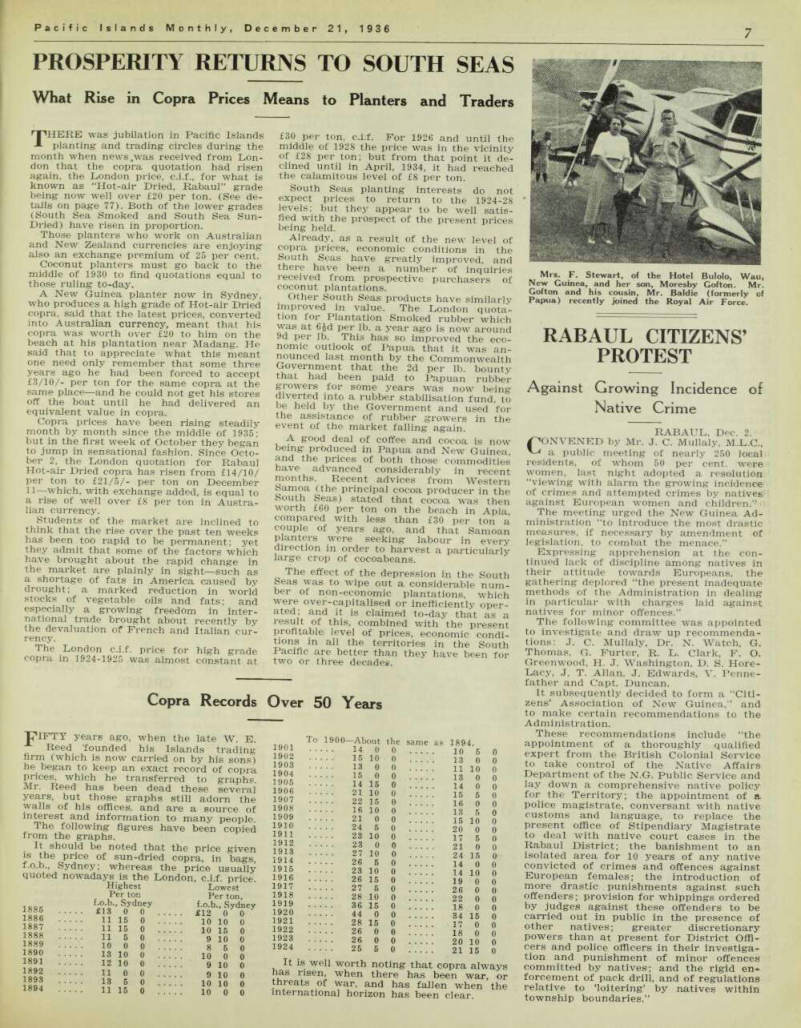
Mrs. F. Stewart, of the Hotel Bulolo, Wau, New Guinea, and her son, Moresby Gofton. Mr.
Gofton and his cousin, Mr. Baldie (formerly of Papua) recently joined the Royal Air Force.
Papua’S Search
Anxiety for Champion Party
From Our Own Correspondent
Pt. Moresby, Dec. 11.
ANXIETY is being felt for the safety of the Bamu-Purari expedition, in charge of Assistant Resident Magistrate Ivan Champion, who left Daru on May 1 accompanied by Patrol Officer C. T. J.
Adamson, 12 native police and 30 carriers, to explore the unknown regions of West ern Papua, with the object of ascertaining what population existed in the large valley systems to the north of the headwaters of the Bamu River (south of the border of Papua and the Mandated Territory).
Their route lay from the headwaters of the Bamu, westward to the Leonard Murray Mountains, thence N.E. across the waterways of the Upper Kikori (Ryan); across the limestone ranges diagonally to the recentlv discovered lake (seen from the air by the Government aerial survey in February last, and named Lake Mar guerite) ; and thence across the Waga Furari valley (discovered by Mr. Jack Hides last year), to Mt. Gilua, on the border, where their intention was to strike east to the headwaters of the Purari, and eventually make their way south to the coast.
Ivan Champion expected to reach the headwaters of the Purari, either at the end of September or October: for in his last dispatch, dated May 25, from the slopes of the Leonard Murray Mts., Wawoi River (tributary of the Bamu), he stated that there would be no need for anxiety if his party did not put in an appearance at the end of September or even October, and that if it were possible for his party to secure ample supplies of native foodstuffs, he would stay in the district as long as possible in order to get in touch with the natives and to make a thorough patrol of the surrounding country.
The party, at that date, were 190 miles up stream, with 100 days’ full rations in hand for two white men, 12 police and 30 carriers. Surplus carriers, picked up from Bamu, were being sent down to the coast under police escort, further river transport being impracticable owing to rapids and gorges.
Lysol Tin As Clue
From May to November no further news was received. There was some concern when the Administration received a wire less message from the manager of Port Romilly Saw-mills (Mr. C. McKinnon), on the Wame River, on November 21, to say that a Lysol tin had been picked up on the Doai River by a shooting boy on November 20, similar to those issued by the Govern ment; and that it undoubtedly had floated down from the Upper Purari. The tin suggested that the party had somewhere reached the headwaters of the Purari, and that they had struck trouble, either in the rapids, or in Hathor Gorge, at the junc tion of the Erewa and the Purari; or else that they were making overland from some point above-stream.
Mr. McKinnon, getting into touch im mediately with the Government station at Kikori, where the Lysol tin was recognised as a Government issue, dispatched canoes up the main branches of the Purari to search for further floating goods or for any signs of the returning party. On November 28 he reported by wireless that a police built raft had been picked up 25 miles up the Ivo-Purari, which on exam ination appeared to be of recent construc tion and European design.
The Government then made immediate
arrangements, on December 1, for a launch to proceed up the Purari as far as possible, in charge of Mr. S. H, Chance, A.R.M., with police and stores, with in structions to work overland on foot if the party were not encountered.
The launch which was equipped with a wireless telephone receiving and trans mitting set, by the courtesy of Amalga mated Wireless Ltd. and operated by Mr.
McKinnon (who accompanied the party) reached Be van Island on December 6, ap proximately 150 miles up stream, where Mr. Chance noticed similar rafts to the one found floating down-stream on November 28, among the villages near the island. He considered the possibility of its being of native construction and, upon investiga tion, came to the conclusion that this was so and that they were following a false clue.
Aerial Search Arranged
In view of this, the Government at once decided to extend the search and, getting in touch with Guinea Airways, made ar rangements on December 7 for flights to be made over the headwaters of the Purari from Mt. Hagen in the Mandated Territory. Mr. R. G. Speedie, A.R.M. and Mr. S. G. Middleton, A.R.M. were to go on the flights and immediately on the com pletion of the flights would proceed on a relief expedition from Mt. Hagen, if no signs of the Champion party were seen.
The two flights are to be undertaken, both from Mt. Hagen, the first in the direction and over Lake Marguerite, where Ivan Champion intended an extensive patrol, and the second, south, over the Waga Furari, down the Purari as far as Gleeson Islands, above Bevan Island, and approximately above Mr. Chance’s opera tions up-stream from Port Romilly.
Mr. Speedie, who was stationed at Kai ruku, Yule Island, arrived in Port Moresby by plane on December 7, and, completing his arrangements for the relief party, left for Wau on December 11 by Guinea Air ways Ford, accompanied by Mr. Middleton for their flights from Mt. Hagen.
That no signs of the Champion expedi tion may be seen from the air is considered likely but, the chance is worth consider ing: moreover, flights over this vast area will greatly assist Mr. Speedie, not only in deciding upon his best possible route, but in showing him the character of the country through which he will have to push with the greatest possible speed.
In the meantime, Mr. Chance is work ing up the Purari in canoes, as far as possible, and he will strike overland on foot, to above Hathor Gorge, hoping to get in touch with the returning party be fore Mr. Speedie sets forth from the Man dated Territory on his long journey south into Papua.
the search by air
(By Radio—Our Own Correspondent)
Pt. Moresby, Dec. 15.
MESSRS. SPEEDIE and Middleton, ac companied by Mr. Lett, to-day, in a Guinea Airways Ford aeroplane, flew from Mt. Hagen, in the Mandated Territory.
They searched the headwaters of the Purari River, as far south as Bevan Island, but without result.
Increasing rain and cloud over the mountains then forced the party to fly south-eastwards, over Central Papua, to Port Moresby. They propose, to-morrow, to return to the search, and examine areas further to the westward.
M. Charles Legras, a municipal coun cillor of Noumea, New Caledonia, visited Sydney in December, en route to New Zealand.
Late News in Brief
ALTHOUGH Commonwealth Govern ment in 1926 provided £250,000 as bounties for producers of cocoa, manila coir and sisal fibre, sago, vanilla, kapok, unground spices, bamboos, and rattans in New Guinea and Papua, only £8783 has been claimed. A committee, representing Australia, New Guinea -and Papua, will examine the position.
The murder of a native woman in Pa peete, Tahiti, some months ago, led even tually to the arrest of a white man, a wandering gardener. A great sensation has now been caused by the arrest of one of the most prominent and wealthy French residents of Tahiti on a charge of having instigated the murder.
Messrs. George Bambridge and Charlie Brown, of Papeete, have established a pineapple plantation and cannery in Ta hiti; and 10,000 shoots have been planted.
A new law forbids Europeans to stay more than 48 hours in Maiao, Rapa, and the Marquesas Islands (French Oceania).
Nuka Hiva and Hiva Oa are excepted.
The Queen of Tonga, Dame Salote Tu bou, returned to Tonga at the end of October, after a visit to Australia. She is now much improved in health.
The Marquesas Islands are suffering a severe drought—no rain for eight months.
Commonwealth Government announces that any tea grown in Papua will be ad mitted under duty of only Id. per lb., in stead of 3d.
Police Chief Carlyon, of Rarotonga, Cook Is., by clever detective work, dis covered that a Tahitian had entered dag ger and Hervey’s store and stolen £54.
Money recovered; thief got five years.
A tablet in memory of the early mis sionaries of Tahiti, presented by Mr. W.
W. Bolton, was installed and dedicated in Moorea, in November. (Report in next issue.)
Proposed Central Pacific
Cruise
THE Methodist Missionary Society of Australasia has issued a prospectus for a special cruise in the Central Pacific next year. It is proposed that T. 8.8.
Katoomba shall sail from - Melbourne on May 12, Sydney on May 15, and visit Nukualofa and Vavau (Tonga), Apia (Western Samoa), Suva (Fiji), and return to Sydney on June 4.
The proposed round-trip fare, from Syd ney, ranges from £24 to £3B according to cabins. The organising secretary Is Rev.
Richard Piper, 139 Castlereagh Street, Sydney.
Mr. W. M. Reid, Islands merchant of Sydney, returned to Australia after a business visit to Tahiti by the Makura on December 12. He was accompanied by his wife.
Mr. M. B. Blake, who spent the last couple of years on the Morobe goldfield, New- Guinea, returned last month to his home on Norfolk Island. There are indi cations that Norfolk Island’s economic troubles are coming to an end.
Samoan Census
Fewer Europeans, but Many More Samoan-Europeans and Natives
From Our Own Correspondent.
Apia, Nov. 24.
A CENSUS of the whole population of the Mandated Territory of Western Samoa was taken on November 4, and pre liminary figures relating to the European population are now available: 1986 1926 Europeans ... . . . . . . 382 446 Europeans of mixed blood (includ ing Chinese-Samoans) . . . . 3051 1845 3433 2291 The Europeans, 382, include 264 males and 118 females. The Europeans of mixed blood include Samoan wives, Samoans of European status and Chinese-Samoans, and there are 1542 males and 1509 females, a total of 3051. The total population of European status thus amounts to 3433.
While the white population (with which is included a small number of 16 Chinese residents) shows a comparatively large decrease against the last census (446 in 1926), owing mainly to mortality amongst the old white residents, lack of new immi gration, and a reduction in the number of white Government officials, there is a large increase in the mixed-blood class. Even if Samoan wives and Samoans of European status are deducted, the remaining figure of 2754 shows an increase of nearly 50 per cent, over the 1926 figures.
The results of the native Samoan census are pot yet available, though a large in crease of the native population may be confidently predicted.
There are about 500 Chinese labourers and 80 Melanesian labourers in the Terri tory at present.
The census of April, 1921, showed Euro pean population (which evidently included Samoan-Europeans), 2066; native Sa moans, 33,336; indentured Chinese, 1290; indentured Pacific Islanders, 465.
It is believed that the native Samoarts now number 50,000.
—Photo: Tattersall’s Studio, Apia.
Capital, £L00,000
Papuan Trading Co.’s New Issue
THE issued capital of Steamships Trad ing Co. Ltd., Papua, is being raised to £lOO,OOO by the issue, to the public, of 28,189 7 per cent, cumulative preference shares and 25,635 ordinary shares. The prefs. are being offered at 28/- and the ordinaries at 30/-, representing premiums of 8/- and 10/- respectively.
The issued capital of the Company (who are general merchants, shipowners, plant ers, carriers, general agents) was £54,176 (in 28,811 prefs. and 24,365 ordinaries) and it is disclosed that in the year ended June 30 last, the profits were equal to 14.5 per cent, on the total capital employed. The directors are Captain A. S. Fitch, Mr. L.
Tracey, and Mr. E. V. Crisp, all of whom are active executive heads in the rapidly growing business.
What with higher prices for copra, rub ber and coffee, the development of the gold industry on Misima, and the expenditure of a very large sum in the search for oil (which very possibly will be discovered), Papua’s economic outlook is vastly im proved. There should be a bright future for Steamships Trading Co. Ltd. which, under good management, actually improved and strengthened its position during the depression.
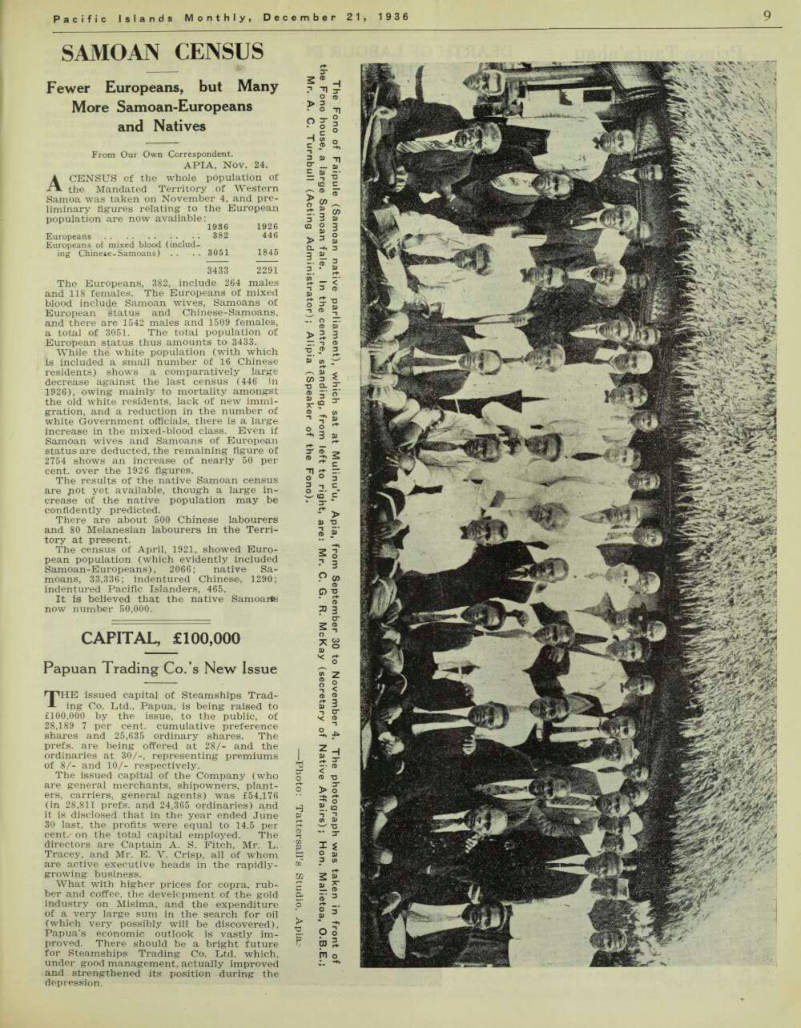
The Fon o of Faipule (Samoan native parliament), which sat at Mulinu’u, Apia, from September 30 to November 4. The photograph was taken in front of the Fono house, a large Samoan fale. In the centre, standing, from left to right, are: Mr. C. G. R. McKay (secretary of Native Affairs); Hon. Maliet oa, O.B.E.; Mr. A. C. Turnbull (Acting Administrator); Alipia (Speaker of the Fono).
—Photo: Tattersall’s Studio, Apia.
Prince Taufa’ahau
Honoured Kava Ceremony in Sydney
ORIOR to his departure for Tonga, in A December, Crown Prince George Taufa’ahau was the guest of the Poly nesian Club of Sydney at a gathering in his honour. Kava was made with the appropriate Samoan ritual by the chief tainess Lefagaoalii (Mrs. Alfred Page) and presented to the Prince (who, on his return to Sydney, will enter the Uni versity as a law student). Others to whom the ancient drink was given were: Captain Gerhard Heyen. formerly of Buta ritari, who spoke on the Gilbert Islands: Mr. R. W. Robson, editor of the Pacific Islands Monthly; and Messrs. L. J. Moran (president) and Eric Ramsden, executive members of the club.
The president (Mr. Moran) briefly wel comed the Prince, and wished him a happy stay in Tonga during his holidays.
In his reply, Prince Taufa’ahau empha sised the importance of preserving what is best in the traditions of the Polynesian people. “I am proud of my ancestry, and I am sure,” he said to club members, “that you are proud of yours, too.” For that reason it was essential that Polynesians resident in Sydney should meet and ex change ideas. “I am particularly happv to be here,” the Crown Prince concluded, “because this club represents an ideal!”
The Prince promised to convey the club’s greetings to Queen Salote (who holds the post of patroness), and he also agreed to nomination as a member.
Captain Heyen, in the course of one of the most interesting addresses club members have heard since its foundation, traced the history of the Gilbert Islands from native traditions, through the early whaling phase, touched upon the first mis sionary associations, “blackbirding opera tions,” and finally their proclamation as a British colony (after a period as a Pro tectorate) in 1915. The inhabitants he described as “honest and likeable,” and the language, though the roots were of Malay origin, was similar to the Poly nesian tongues.
The president accepted with thanks several weapons from the Gilbert Group which Captain Heyen presented to the club.
With Prince Taufa’ahau were Mr. and Mrs. B. Lamacraft (the father of the latter was at one time British Consul in Tonga), Mr. Harold Rabone (whose grand father was one of the pioneer Wesleyan missionaries in the kingdom), Mrs. Heyen, and Miss Dora Busby (great-niece of Mr.
James Busby, one time British Resident at the Bay of Islands, N.Z.), Also present were Mr. and Mrs. Walter Petch, and members of their family. Mr.
Fetch was at one time schoolmaster on Pitcairn Island, and Mrs. Petch is a de scendant of Fletcher Christian, of Bounty fame.
Abgut 160 people attended the gathering, which will be the last of the year. The club has met with so much success that members now have their own clubroom in Jamieson Street, Sydney. Visitors from the Islands who desire to attend club meetings are requested to communicate with the president, care of the Pacific Islands Monthly, Union House, Sydney.
Mr. H. Alday, of the New Guinea Pub lic Service, returned to Rabaul in De cember by the Malaita. He is a member of the District Services and Native Affairs’ Department.
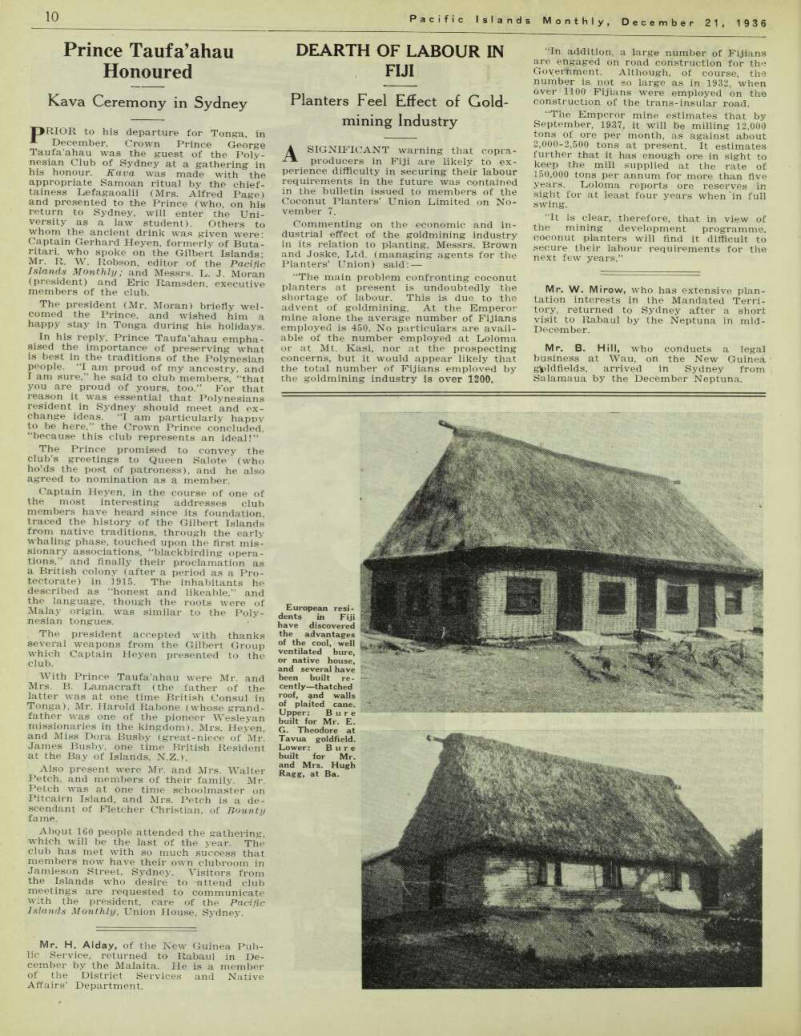
European resi dents in Fiji have discovered the advantages of the cool, well ventilated bure, or native house, and several have been built re cently—thatched roof, walls of plaited cane.
Upper: Bure built for Mr. E.
G. Theodore at Tavua goldfield.
Lower: Bure built for Mr. and Mrs. Hugh Ragg, at Ba.
mining Industry
Dearth Of Labour In
Fiji
Planters Feel Effect of Gold mining Industry
A SIGNIFICANT warning that copra producers in Fiji are likely to ex perience difficulty in securing their labour requirements in the future was contained in the bulletin issued to members of the Coconut Planters’ Union Limited on No vember 7.
Commenting on the economic and in dustrial effect of the goldmining industry in its relation to planting, Messrs. Brown and Joske, Ltd. (managing agents for the Planters’ Union) said: “The main problem confronting coconut planters at present is undoubtedly the shortage of labour. This is due to the advent of goldmining. At the Emperor mine alone the average number of Fijians employed is 450. No particulars are avail able of the number employed at Loloma or at Mt. Kasi, nor at the prospecting concerns, but it would appear likely that the total number of Fijians emploved by the goldmining industry is over 1200.
“In addition, a large number of Fijians are engaged on road construction for the Goyerhment. Although, of course, the number is not so large as in 1932, when over 1100‘ Fijians were employed on the construction of the trans-insular road.
“The Emperor mine estimates that by September, 1937, it will be milling 12,000 tons of ore per month, as against about 2,000-2,500 tons at present. It estimates further that it has enough ore in sight to keep the mill supplied at the rate of 150,000 tons per annum for more than five years. Loloma reports ore reserves in sight for at least four years when ‘in full swing.
“It is clear, therefore, that in view of the mining development programme, coconut planters will find it difficult to secure their labour requirements for the next few years.”
Mr. W. Mi row, who has extensive plan tation interests in the Mandated Terri tory, returned to Sydney after a short visit to Rabaul by the Neptuna in mid- December.
Mr. B. Hill, who conducts a legal business at Wau, on the New Guinea goldfields, arrived in Sydney from Salamaua by the December Neptuna.
Tropicalities
SCENE: Lounge of s.s. Montoro.
November, 1936.
Wide-eyed young thing from Mel bourne, who has completed round trip to New Guinea and Papua: “Oh, Captain, you do have a wonderful life! How you must love it—sailing around in this dear old ship in those beautiful tropical seas!”
Captain “Sandy” Campbell (who is finishing a voyage which included a fire among cargo; sundry clawings among New Guinea’s half-charted coral growths; a “scrape” on the Barrier Reef when try ing to find the passage to Cairns in a dead calm; a miraculous escape from being blown ashore in a southerly buster in the Brisbane River; and a little dirty weather off Byron Bay): Iphm! (Which is the only way in which a lowly Sassenach can spell a Scottish snarl.) —R.W.R. ♦ ♦ ♦ A MONG those who were presented to the Crown Prince of Tonga at the Polynesian Club’s reception in December was Madame Yvonne Despres, writer and traveller, and examiner in her native language. One of her first questions to Prince Taufa’ahau was whether he was acquainted with French. “Oh, some what,” replied the Prince. “I have just been sitting for my entrance examination to the University.” It was subsequently discovered that the Prince’s French paper was one of those corrected by Madame Despres! The future King of Tonga is determined, not only to become thoroughly acquainted with the customs and tradi tions of his own land but, in order to bring a scientifically trained mind to bear upon them, to study anthropology when he enters Sydney University.—“Eriki.” * * * THE Germans who remained in New Guinea after the war, and the Austra lians now in occupation of the country, have become very good friends. That is not surprising. The Germans are good pioneers. There are few better Australians in Australia than the descendants of the German colonists who settled in Victoria and South Australia.
Conditions in New Guinea have quaint repercussions, sometimes. They tell of an Australian and a German who were en gaged in a convivial argument in Sala maua.
Finally, the Australian, quite forgetting he was talking to an ex-enemy, burst out with: “Gorstruth, I’m one of the blokes wot went to the war so that you blokes could stay at ’ome and ’ang on to your bleedin’ jobs!”
The German, who had served in the German line in France, stared in amaze ment, and then shouted: “Vot! And you say dot to me!” ♦ ♦ * WITHIN the f£,ded folds of early Colo nial newspapers lie many a forgotten Story of Pacific adventure. Readers of the Sydney Herald learned towards the close of 1831 of the experience of a young man named John Mathews on the island of Malaita. Even within recent years Malaita has been regarded as one of the most savage and barbarous islands in the Solomons: among a population of 40,000 natives, the Church of England can only claim 1,600 converts.
Mathews was a member of the crew of the whaler Alfred when the vessel was fishing off Malaita in 1830. A dispute arose with the natives, a result of which was
the death of the commander and several of his crew. Mathews was wounded, and captured alive. The following year he was able to send a message cut on a piece of bamboo to another vessel. Captain Har wood, of the Hashmy, later reported in Sydney that an attempt would be made “to purchase this unhappy fellow from the natives.” Eventually, the schooner New Zealander arrived at Sydney with a let ter from Mathews; it had been enclosed in a carved coconut and sent to the vessel.
Poor Mathews was then in sore straits.
“Be kind to the natives as my life is in their hands,” he wrote. “They keep me close and will not let me come near the ship.” He advised his countrymen to make the bearer of the letter a present. “Some thing showy,” he said. “Be careful of the natives; they are forming a plan to take the ship. Do not come on shore without firearms. They are cannibals!” Mathews added a postscript: “If you will send me a shirt and a pair of trowsers I will be much obliged. I am in a state of nature 99 r Whether efforts to secure his liberty were successful or not, history does not relate. —“Eriki.” * • * IV|R. W. H. CAPORN, now a resident of Sydney, tells how one day when he was a trader in the New Hebrides he gave a native a lesson in manners. A native houseboy brought in a coconut from a neighbour, dumped it down on the table and said, very abruptly: “Master send you this coconut!” Mr. Caporn rose and said: “I think I must teach you better manners.
You sit down in my chair, and I will bring in the coconut and show you how a mes sage should be delivered.” The boy sat in the chair; and Mr. Caporn came through the door, stopped at a respectful distance, made a low bow, and said: “Sir, my master presents his compliments, hopes you are well, and requests your acceptance of a small present.”
“Give your master my thanks.” replied the boy unexpectedly. “There is 2/- for yourself, and tell him also that I am now ready to buy his coconuts.” Mr. Caporn
saw the humour in the situation, gave the boy his 2/-, and thereafter took an interest in him; with the result that he now is himself a successful trader in the Islands. * * * A N interesting link with the history of Samoa has been secured for the Auckland War Memorial Museum by the Mayor, Mr. Ernest Davis. One of the steering wheels of H.M.S. Calliope, which steamed out of Apia harbour during the great hurricane of March 16,1889, has been through the Mayor’s efforts, obtained from the Admirality, and entrusted to the safe keeping of the citizens of Auck land. New Zeaianders have always felt a sense of pride in the achievement of H.M.S. Calliope, as she was using West port coal at the time.
Cheered by the crew of the United States doomed war-vessel, Trenton, the Calliope steamed out in the teeth of the gale, with but a few feet to spare, and passed through the narrow reef to safety and the open sea, where she rode out the storm. Other vessels that were lost at that time included the U.S.S. Trenton, Vandalia, and Nipsic, and the German Adler, Eber and Olga. The iron hull of the Adler, high on the reef, defying sea, time and charges of dynamite, is still the most conspicuous object on the water front at Apia.—E.R.
AN ecclesiastic dignitary, well known in the Solomons, tells a good story of how, some years ago, an attack of gastric malaria caused him to lie up—or down — at a planter’s house. It happened to be “steamer day” at one of the usual ports of call. At a very early hour next morning, a gentleman, whose head was not in very good condition, strolled into the dignitary’s bedroom by mistake. Observing a patient in bed. and violently ill, he exclaimed: “It’s —hie —alright, brother! Just carry on! We all get the same after steamer day! ” —A.M.A.
Mr. J. B. C. Bramell, son of Mr. B. W.
Bramell, a former Commissioner for Native Affairs in Papua, joined the Papuan Public Service in November as a Patrol Officer. He has been sent to the Government station at Kerema, in the Gulf Division.
Advertisements & other items, pp. 13-14 (1 item)
Finishino White
o^s v*
STERLING HOME PAINT
ALSO FOR...
BOATS, YACHTS AND
ALL MARINE WORK
STERLING VARNISH CO., Alexandria I
RESISTS
TROPICAL
SUN
New South Wales i
RECORDS
Packed Free and sent C.O.D. without extra charges.
H.M. Voice Slightly-used Portables, delivered straight to your nearest Port for £3/15/- Send for Latest Record Lists
Talkeries Music Stores
451 Queen Victoria Buildings
SYDNEY
THE CONTROL AND TRANSFORMER
UNIT READY FOR CARRYING . . . . < ST. < £Hatj&m6- I £>on i a 05.
WATSON HOUSE
9-13 BLIGH STREET, SYDNEY, N.S.W.
BRANCHES IN ALL STATES OF
AUSTRALIA and NEW ZEALAND
The WATSON
4 C.P.’Portable
X-ISay Apparatus
The Control
enables you to select. .
Any Milliamperage 1 to 30 Any Kilovoltage 42 to 84 (12 steps are incorporated reading directly in K.V.P.) The Unit Operates on any 50
cycle alternating current supply
from 140 to 250 volts. ATechnique Chart is included also pre-reading Voltmeter, Milliamperemeter and filament control.
Anglewood School , Bowral, %SW.
Boarding
School for &
BOYS
- Ideal Climate and conditions for Islands Boys. 16 acres Playing Fields.
Swimming Primary and Secondary Courses; English-trained Teachers.
Why send your boys to England?
Headmaster: T. O. KNOX. 8.A.. M.R.S.T., Trinity Coll., Dublin.
About Islands People
Mr. Arthur Milner sailed from Sydney for Pawa, Ugi, Solomon Islands, by the December Malaita. He is a worker for the Melanesian Mission.' Mr. R. C. Laycock, a well-known resi dent of the Solomon Islands, sailed from Sydney for Tulagi by the Malaita on December 12.
Mr. and Mrs. J. R. Haliigan sailed from Sydney by the Morinda in December for Norfolk Island, where Mr, Haliigan, who is Officer-in-Charge of the Territories Branch of the Prime Minister’s Dept., will be Acting-Administrator for several
months. Mrs. Haliigan, prior to marriage in November was Miss Marjorie Grosvenor, confidential typiste to the Prime Minister.
Mr. W. E. Links, one of the most popu lar members of the staff of Burns Philp (S.S.) Co. Ltd., who recently was acting manager in Apia, returned to Samoa in mid-December after a furlough in Sydney.
A good deal of his time (and money) was spent in Macquarie Street, where modern surgery made a remarkably successful job in supplying what was virtually a new jaw.
Dislocation of steamer services, due to the American strike, made it necessary for Mr.
Links to chop some three weeks off his leave.
Mr. and Mrs. R. Bruce, of Melbourne, and formerly residents of the New Hebrides, have taken over a well-known guest house, namely, “Glencoe House,” at Cowes, on Phillip Island, Victoria. This is an ideal holiday resort, in a cool situation, and it may be of interest to Islands residents who come to Australia for a restful holiday.
Mr. D. A. J. Rutherford has completed his term of office as superintendent of schools in Western Samoa, and has re turned to New Zealand. Mr. Rutherford was an enthusiast in all matters relating to the education of Samoans and local born Europeans, and the work he did in the Territory was exceedingly valuable.
He was personally very popular, and his departure was a source of regret to a very large circle of friends, Mr. Ken Garden, the youngest flying instructor in Australia—he is only 21 years of age—left Sydney by the Montoro on December 2 for Port Moresby, Papua.
He will join Mr. Ward Williams’ gold seeking expedition in Western Papua as pilot of one of the party’s two ’planes.
Miss Edith Carr, who had lived for many years in the Ba District, Fiji, died suddenly in Auckland, New Zealand, on November 3. Affectionately known as “Aunt Edie” by her many friends on Viti Levu, she was the last surviving member of the Carr family who went to Fiji 40 years ago.
Mr. John L. Froggatt, entomologist of the Department of Agriculture, New Guinea, arrived in Sydney from Europe early in December and will sail for Rabaul on December 22. Mr. Froggatt has spent his nine months furlough very profitably in visiting several European countries where he secured much infor mation about the latest methods, tech nique, and apparatus in the science of entomology. Mr. and Mrs. Froggatt re turned to Australia via the Panama Canal and New Zealand.
Miss Camilla Wedgwood, of the Univer sity of Sydney, who has carried out scientific investigation of the native races in Nauru and New Guinea, will be one of the Australian delegates to the Ad vancement of Science Congress in Auck land, New Zealand, next January. Her particular interest will be the anthropo logical section. Two other delegates who have Islands connections will be Miss Elsie Brammell, M.A., assistant ethnolo gist at the Australian Museum, Sydney, whose father was a prominent member of the New Guinea Public Service Until his retirement some years ago, and Dr. H. lan Hog bin, who is well-known for his re searches on Ontong Java. Dr. Hogbin is now engaged on a new book which will deal with the clash of religions in the Solomon Islands, and notably on Malaita, where he was for some time.
About Islands People
Mr. G. L. Beebe arrived in Sydney with his wife and daughter from Port Moresby by the Montoro on November 24. Mr.
Beebe has been in Papua for some time as Chief Commonwealth Auditor and has now been transferred to Canberra, his post in the Territory having been taken over by Mr. R. Mackay.
Dr. Jacques Simon Cramer, who gained his professional training in Scotland, arrived in Fiji recently to be a District Medical Officer, Mr. Joseph Christian, a descendant of Fletcher Christian, leader of the famous Bounty mutiny in 1789, arrived in New Zealand recently from Pitcairn Island by the Remuera. He intends to remain in the Dominion for six months.
Mr. S. G. C. Knibbs, Commissioner of Lands and Crown Surveyor in the Solo mon Islands, returned to Tulagi from leave by the Malaita from Sydney on De cember 12.
Mr. and Mrs. V. Koschade, of the Lutheran Mission Society, arrived in Sydney from New Guinea by the Nov ember Montoro. They later went on to South Australia to spend Christmas with their people at Callington.
Rev. W. A. Dickie, who has been in the Solomon Islands since he joined the Melanesian Mission in 1934, left Sydney on his return to the Group, after fur lough by the December Malaita.
Mr. J. Ward Williams, leader of an ex pedition seeking gold in Western Papua, arrived in Port Moresby from the base camp on the Upper Fly River by his company’s Sikorsky amphibian on December 1. He joined the Macdhui for Australia on December 11. The Sikorsky left Pt. Moresby on December 4 for Lae, New Guinea, to receive an overhaul be fore returning to the Fly base in Papua.
Mr. Roy Vicary, of Cuthbert’s Misima Goldmine Ltd., Misima Island, Eastern Papua, who last year sailed from Vic toria to Papua via Lord Howe Island, with a companion Mr. R. Moffat, in their self-designed and self-built yawl Gitana 11, has become engaged to Miss Norma Russell, of Brighton, Victoria.
Mr. J. H. L. Waterhouse, of the New Guinea Education Department, arrived in Sydney from Rabaul by the Malaita on December 3. Mr. Waterhouse has for some time carried out much excellent work at the native school at Nodup.
Mr. H. G. Carter, director and con sulting engineer of the Rabaul Electricity Limited, returned to Sydney from New Guinea after a business visit to New Britain by the Macdhui on December 16.
Mr. Philip Coote, manager of Messrs.
Burns, Philp and Co. Ltd., Rabaul, arrived in Sydney from New Guinea by the Neptuna on December 15. During his absence Mr. L. N. Tribolet is acting as B.P.’s Rabaul Manager.
Mr. D. F. M. Rutledge, Patrol Officer in the Papuan Service, has been ap pointed officer-in-charge of the polite escort attached to Mr. Ward Williams’ mining party in Western Papua. He has relieved Mr. M. J. Healy, who has now been transferred to Kerema, in the Gulf Division.
Mr. R. J. Lever, an .English entomolo gist, who is attached to the 8.5.1. official staff as field research worker, arrived in Sydney in December on furlough by the Malaita.
Mr. J. O. Smith, of Wunawutung Plan tation, outside Rabaul, New Guinea, arrived in Sydney to spend Christmas with his family by the Malaita on December 3.
Advertisements & other items, p. 15 (1 item)
Tenax
TO LET on LEASE
RABAUL, T.N.G.
Approximately 1 200 sq. ft. floor space, adjoining Rabaul Hotel, suitable sample rooms, store, or could be subdivided into offices for professional gentlemen. Apply: Nelson & Robertson Ltd., Sydney.
When spending your vacation in Sydney your choice of residence is a matter so vital to your enjoyment!
May we commend to you for All-round Excellence . . .
SYDNEY’S MOST EXCLUSIVE PRIVATE HOTEL
44 MACLEAY STREET
// Here for you awaits unrivalled Service and Cuisine—Suites with Private Baths— Water and Telephones in all rooms—Magnificent Harbour Views—Roof Garden Sun Rooms Spacious Lounges and Smoke Rooms—and every modern convenience All under Personal Supervision of the Proprietress,
MISS M. BURROWS
TARIFF:
From £3.3.0 per week inclusive 3 i O m a
RADIOS:
FORTYFOR”
Sydney.
Telephone: FL 2641.
V m IK\ w m \ »w i /
GUARD AGAINST
INFECTION ildUlXj
Tropical Diseases
Hold Mo Terrors
—if you use TEN AX Daily
The germs of Diphtheria, Malaria, Dhobie Itch, Tinea and Surfer's Foot cannot harm you if you are protected by the rich "Ti-Trol" lather of TENAX.
TENAX is the ONLY soap containing oil distilled and marketed by Australian Essential Oils Ltd., under the registered trade-mark of “Ti-Trol." eleven times quicker than carbolic as a germicide, but NON-POISONOUS and
NON-IRRITANT.
"The Medical Journal of Australia." official organ of the 8.M.A., says: "TENAX is a satisfactory germicidal soap which may be recommended with confidence."
A PRODUCT OF AUSTRALIAN SOAPS
LIMITED
TENAX
fyuuuste/u ,
TOILET SOAP
TUDOR
HOTEL
BW 2788 One minute from G.P.O.
Room Only Rate, 5/- per day. Meals a la Carte Accommodation for 100 Guests.
127 PHILLIP STREET :: SYDNEY
Next Door to Martin Place
Report That Japanese
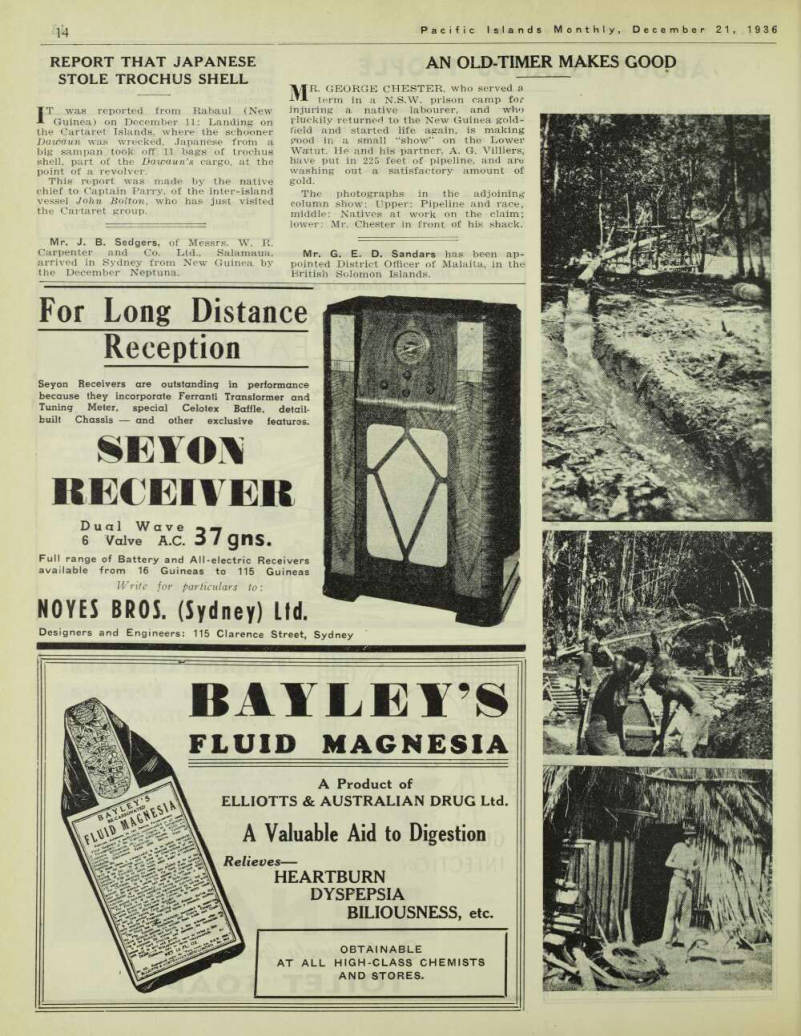
Stole Trochus Shell
IT was reported from Rabaul (New Guinea) on December 11: Landing on the Cartaret Islands, where the schooner Dawaun was wrecked, Japanese from a big sampan took off 11 bags of trochus shell, part of the Dawaun’s cargo, at the point of a revolver.
This report was made by the native chief to Captain Parry, of the inter-island vessel John Bolton, who has just visited the Cartaret group.
Mr. J. B. Ssdgers, of Messrs. W. R.
Carpenter and Co. Ltd., Salamaua, arrived in Sydney from New Guinea by the December Neptuna.
An Old-Timer Makes Good
MR. GEORGE CHESTER, who served a term in a N.S.W. prison camp for injuring a native labourer, and who pluckily returned to the New Guinea gold field and started life again, is making good in a small “show” on the Lower Watut. He and his partner, A. G. Villiers, have put in 225 feet of pipeline, and are washing out a satisfactory amount of gold.
The photographs in the adjoining column show: Upper: Pipeline and race, middle: Natives at work on the claim; lower; Mr. Chester in front of his shack.
Mr. G. E. D. Sandars has been ap pointed District Officer of Malaita, in the British Solomon Islands.
Advertisements & other items, p. 16 (1 item)
Bailbfb
For Long Distance
Reception
Seyon Receivers are outstanding in performance because they incorporate Ferranti Transformer and Tuning Meter, special Celotex Baffle, detailbuilt Chassis and other exclusive features.
SElO\
RECEIVER
Dual Wave *5 >• 6 Valve A.C. J / QHS.
Full range of Battery and All-electric Receivers available from 16 Guineas to 115 Guineas Write for particulars to:
MOVES BROS. (Sydney) Lid.
Designers and Engineers: 115 Clarence Street, Sydney
sv .V t SfcS <>- . * - •*t> SSr
BAILBFB
FLUID MAGNESIA
A Product of
ELLIOTTS & AUSTRALIAN DRUG Ltd.
A Valuable Aid to Digestion
Relieves —
HEARTBURN
DYSPEPSIA
BILIOUSNESS, etc.
OBTAINABLE
AT ALL HIGH-CLASS CHEMISTS
AND STORES.
25,000 Tons
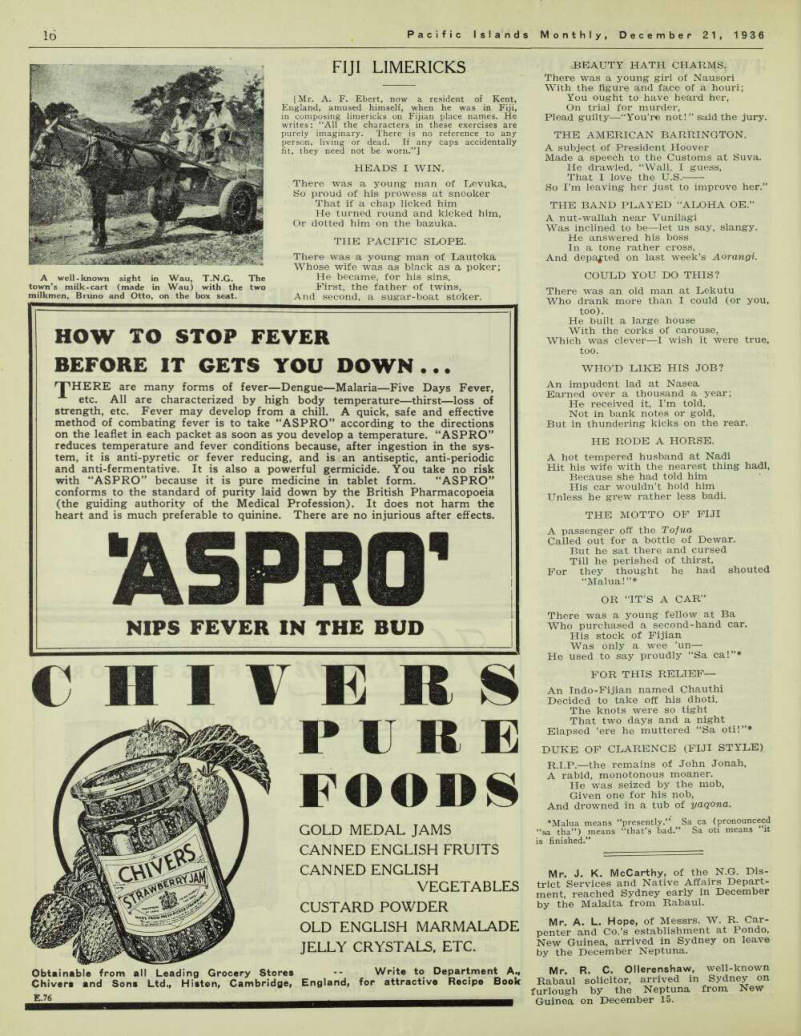
Two New Ships Of
Suggested for Sydney-N.Z.- Suva-Vancouver Run
AFTER discussions and arguments ex tending over five weary years, the Governments of Australia and New Zea land (and, presumably, Fiji) are at grips at last with a plan for meeting American competition in sea-borne transport in the Pacific.
The Union line, between Sydney and ’Frisco, via Wellington and Tahiti, has been discontinued, but it is proposed to use very modern liners on the other run (Sydney- Auckland- Suva- Honolulu-Van couver) to compete with the Matson liners Monterey and Mariposa.
The Imperial Shipping Committee’s re port, which was made available in Decem ber, suggests the building of two fast modern liners, of 25,000 tons, with accom modation for 750 or more passengers, and costing about £1,250,000 each.
While the committee does not make any specific recommendation regarding subsi dies, it reports exhaustively on the matter of costs and the probable repercussions of steps that might be taken to establish a modern British shipping service in the Pacific.
The Commonwealth Government will “carefully consider” the report of the committee, and there will be consultations between the Governments regarding the policy to be determined. The committee was asked to report as a result of discus sions between the Empire Governments concerned after the Canadian-Australasian Line had applied for financial assistance to enable it to continue the Trans-Pacific service with modern vessels.
The committee reported that the two fast luxury liners Mariposa and Monterey, with which the Matson Line replaced its older vessels in 1932, were built with the assistance of the United States Govern ment. Mail payments to the Matson Line had averaged more than 1,000,000 dollars annually during the three years 1932 to 1935, compared with only 135,000 which would have been payable on the poundage rate. For construction purposes, the Oceanic Steamship Company, which owns the Matson Line, was advanced approxi mately three-quarters of the cost. The advances were 5,850,000 dollars for the Mariposa, at two per cent, interest, and 5,827,000 dollars for the Monterey, at less than 1 per cent, interest.
Lines affected by the Matson competi tion, stated the report, were the Canadian- Australasian Line (Sydney to Vancouver, via New Zealand), with the Aorangi (17,500 tons, launched in 1924) and the Niagara (13,500 tons, launched in 1913), and the Union Royal Mail Service (Syd ney to San Francisco, via New Zealand).
This line, owned by the Union Steamship Co. of New Zealand Ltd., had the Maknra (8,000 tons, launched in 1908) and the Maunganui (7,500 tons), launched in 1911).
In estimating the possibilities of future passenger traffic, the committee assumed that the Union Royal Mail Line would be discontinued and that the Canadian- Australasian Line would be equipped with two vessels equal in speed and amenity to the two Matson ships. The two pro posed new ships would be built to carry approximately 350 to 375 first-class pas sengers, 250 cabin class, and 150 to 175 third-class. They would have a minimum deadweight cargo capacity of 4,000 tons with a cubic capacity of 7,000 tons, at 50 cubic feet to the ton, including 1,500 tons of refrigerated space, which would be cap
able of extension to 2,000 tons. The ships would be comparable with the existing Matson Line vessels, and the total cost would be about £2,500,000 or more. Each ship would sail once a month on a schedule based somewhat on the follow ing: From Vancouver and Victoria to San Francisco, Honolulu, Suva, Auckland, Sydney, and Melbourne, returning via the same ports, excluding San Francisco.
“An increase in the passenger traffic necessary to occupy the four vessels to the extent to which the Matson liners were occupied in 1935 is not unlikely,’’ states the committee. “In arriving at this conclusion the committee has not over looked the development of air transport.’’
The committee anticipates that the re covery in the cargo quantity and revenue
of the Canadian-Australasian Line of the past few years will continue in harmony with the growth of Empire trade. There should be no difficulty in securing a rea sonable amount of cargo southward, but on the northward voyage there is expected to be a deficiency for a long time.
A well-known sight in Wau, T.N.G. The town’s milk-cart (made in Wau) with the two milkmen, Bruno and Otto, on the box seat.
Advertisements & other items, p. 17 (1 item)
&(alls from
Pacific Island Stamps
BOUGHT AND SOLD
Stamps sent on approval on receipt of reference. Send for free lists and specimen copy, "Australian Stamp Journal."
J. H. SMYTH CO. LTD.
121 A CASTLEREAGH ST., SYDNEY
Education Recreation Character-building New term commences February 9
NEWINGTON (OLLEGE
STANMORE. SYDNEY. N.S.W.
ESTABLISHED 1863
For Parents in the Islands, Newington offers the ideal Home-School for Boys of all ages. • Unexcelled facilities for Boarders.
Prospectus from:
P. R. LE COUTEUR. M.A. (Oxon.)
Headmaster
&(alls from
KEROSENE OPERATED...
R E FRIG ERATO RS
ANNOUNCE NEW EXPORT POLICY
To enable us to obtain Full Advantage from the enormous Output Capacity of the new Hallstrom Manufacturing Plant, covering 20 acres and including the finest machinery of its type in Australia, we have decided on a policy of More Sales at Lower Prices We now offer the Model as Illustrated at £3l-10-0 F. 0.8. Sydney.
This ever popular Hallstrom model has. over a number of years, stood all tests under all conditions, and may be ordered direct from the factory, or is obtainable at the new price from all branches of Burns, Philp & Co. Ltd., and W. R. Carpenter & Co. Ltd.
E. HALLSTROM, Willoughby, Sydney
Fiji Limericks
[Mr. A. F, Ebert, now a resident of Kent, England, amused himself, when he was in Fiji, in composing limericks on Fijian place names. He writes: “All the characters in these exercises are purely imaginary. There is no reference to any person, living or dead. If any caps accidentally fit, they need not be worn.”]
Heads I Win.
There was a young man of Levuka, So proud of his prowess at snooker That if a chap licked him He turned round and kicked him, Or dotted him on the bazuka.
The Pacific Slope.
There was a young man of Lautoka Whose wife was as black as a poker; He became, for his sins, First, the father of twins, And second, a sugar-boat stoker.
Beauty Hath Charms.
There was a young girl of Nausori With the figure and face of a houri; You ought to have heard her, On trial for murder, Plead guilty—“ You’re not!” said the jury.
The American Barrington.
A subject of President Hoover Made a speech to the Customs at Suva.
He drawled, “Wall, I guess, That I love the U.S.
So I’m leaving her just to improve her.”
The Band Played “Aloha Oe.”
A nut-wallah near Vunilagi Was inclined to be —let us say, slangy.
He answered his boss In a tone rather cross, And departed on last week’s Aorangi .
Could You Do This?
There was an old man at Lekutu Who drank more than I could (or you, too).
He built a large house With the corks of carouse, Which was clever —I wish it were true, too.
Who’D Like His Job?
An impudent lad at Nasea Earned over a thousand a year; He received it, I’m told, Not in bank notes or gold, But in thundering kicks on the rear.
He Rode A Horse.
A hot tempered husband at Nadi Hit his wife with the nearest thing hadl, Because she had told him His car wouldn’t hold him Unless he grew rather less badi.
The Motto Of Fiji
A passenger off the Tofua Called out for a bottle of Dewar, But he sat there and cursed Till he perished of thirst, For they thought he had shouted “Malua!”*
Or “It’S A Car”
There was a young fellow at Ba Who purchased a second-hand car.
His stock of Fijian Was only a wee ’un — He used to say proudly “Sa ca!”*
For This Relief—
An Indo-Fijian named Chauthi Decided to take off his dhoti.
The knots were so tight That two days and a night Elapsed ’ere he muttered “Sa oti!”*
Duke Of Clarence (Fiji Style)
R.I.P. —the remains of John Jonah, A rabid, monotonous moaner.
He was seized by the mob, Given one for his nob, And drowned in a tub of yaqona. *Malua means “presently.”' Sa ca (pronouncecd “sa tha”) means “that’s bad.” Sa oti means it is finished.”
Mr. J. K. McCarthy, of the N.G. Dis trict Services and Native Affairs Depart ment, reached Sydney early in December by the Malaita from Rabaul.
Mr. A. L. Hope, of Messrs. W. R. Car penter and Co.’s establishment at Pondo, New Guinea, arrived in Sydney on leave by the December Neptuna.
Mr. R. C. Ollerenshaw, well-known Rabaul solicitor, arrived in Sydney on furlough by the Neptuna from New Guinea on December 15.
Advertisements & other items, p. 18 (1 item)
Chiv E B S
HOW TO STOP FEVER
BEFORE IT GETS YOU DOWN...
HPHERE are many forms of fever—Dengue—Malaria—Five Days Fever, etc. All are characterized by high body temperature—thirst—loss of strength, etc. Fever may develop from a chill. A quick, safe and effective method of combating fever is to take “ASPRO” according to the directions on the leaflet in each packet as soon as you develop a temperature. “ASPRO” reduces temperature and fever conditions because, after ingestion in the system, it is anti-pyretic or fever reducing, and is an antiseptic, anti-periodic and anti-fermentative. It is also a powerful germicide. You take no risk with “ASPRO” because it is pure medicine in tablet form. “ASPRO” conforms to the standard of purity laid down by the British Pharmacopoeia (the guiding authority of the Medical Profession). It does not harm the heart and is much preferable to quinine. There are no injurious after effects.
NIPS FEVER IN THE BUD
CHIV E B S
ft m m it Obtainable from all Leading Grocery Stores Chivers and Sons Ltd., Histon, Cambridge, E. 76
PURE
FOODS
GOLD MEDAL JAMS
CANNED ENGLISH FRUITS
CANNED ENGLISH
VEGETABLES
CUSTARD POWDER
OLD ENGLISH MARMALADE
JELLY CRYSTALS, ETC.
Write to Department A., England, for attractive Recipe Book
Services
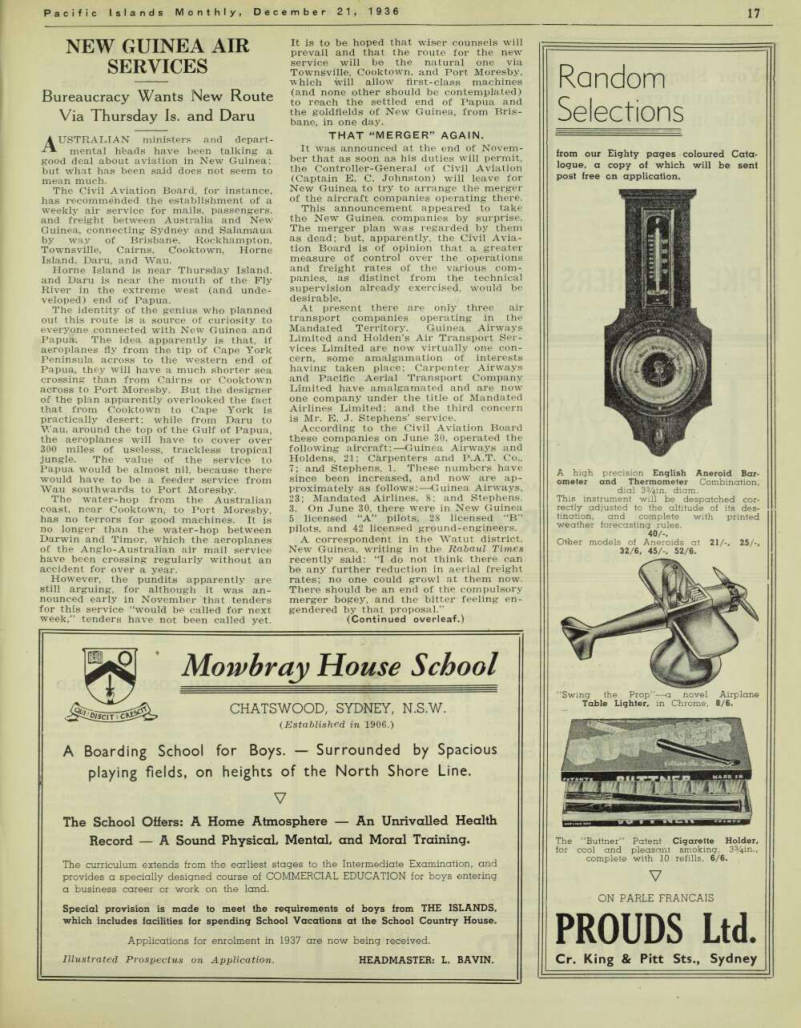
New Guinea Air
Bureaucracy Wants New Route Via Thursday Is. and Daru
AUSTRALIAN ministers and depart mental hfeads have been talking a good deal about aviation in New Guinea; but what has been said does not seem to mean much.
The Civil Aviation Board, for instance, has recommended the establishment of a weekly air service for mails, passengers, and freight between Australia and New Guinea, connecting Sydney and Salamaua by way of Brisbane, Rockhampton, Townsville, Cairns, Cooktown, Horne Island, Daru, and Wau.
Horne Island is near Thursday Island, and Daru is near the mouth of the Fly River in the extreme west (and unde veloped) end of Papua.
The identity of the genius who planned out this route is a source of curiosity to everyone connected with New Guinea and Papua. The idea apparently is that, if aeroplanes fly from the tip of Cape York Peninsula across to the western end of Papua, they will have a much shorter sea crossing than from Cairns or Cooktown across to Port Moresby. But the designer of the plan apparently overlooked the fact that from Cooktown to Cape York is practically desert; while from Daru to Wau, around the top of the Gulf of Papua, the aeroplanes will have to cover over 300 miles of useless, trackless tropical jungle. The value of the service to Papua would be almost nil, because there would have to be a feeder service from Wau southwards to Port Moresby.
The water-hop from the Australian coast, near Cooktown, to Port Moresby, has no terrors for good machines. It is no longer than the water-hop between Darwin and Timor, which the aeroplanes of the Anglo-Australian air mail service have been crossing regularly without an accident for over a year.
However, the pundits apparently are still arguing, for although it was an nounced early in November that tenders for this service “would be called for next week,” tenders have not been called yet.
It is to be hoped that wiser counsels will prevail and that the route for the new service will be the natural one via Townsville, Cooktown, and Port Moresby, which will allow first-class machines (and none other should be contemplated) to reach the settled end of Papua and the goldfields of New Guinea, from Bris bane, in one day.
That “Merger” Again.
It was announced at the end of Novem ber that as soon as his duties will permit, the Controller-General of Civil Aviation (Captain E. C. Johnston) will leave for New Guinea to try to arrange the merger of the aircraft companies operating there.
This announcement appeared to take the New Guinea companies by surprise.
The merger plan was regarded by them as dead; but, apparently, the Civil Avia tion Board is of opinion that a greater measure of control over the operations and freight rates of the various com panies, as distinct from the technical supervision already exercised, would be desirable.
At present there are only three air transport companies operating in the Mandated Territory. Guinea Airways Limited and Holden’s Air Transport Ser vices Limited are now virtually one con cern, some amalgamation of interests having taken place; Carpenter Airways and Pacific Aerial Transport Company Limited have amalgamated and are now one company under the title of Mandated Airlines Limited; and the third concern is Mr, E. J. Stephens’ service.
According to the Civil Aviation Board these companies on June 30, operated the following aircraft: —Guinea Airways and Holdens, 21; Carpenters and P.A.T, Co., 7; and Stephens, 1. These numbers have since been increased, and now are ap proximately as follows: —Guinea Airways, 23; Mandated Airlines, 8; and Stephens, 3. On June 30, there were in New Guinea 5 licensed “A” pilots, 28 licensed “B” pilots, and 42 licensed ground-engineers.
A correspondent in the Watut district, New Guinea, writing in the Rabaul Times recently said: “I do not think there can be any further reduction in aerial freight rates; no one could growl at them now.
There should be an end of the compulsory merger bogey, and the bitter feeling en gendered by that proposal.”
(Continued overleaf.)
Sydney To Wau.
During the month two interesting flights from Australia to New Guinea were made by aeroplanes operated by the two major aviation companies concerned with the proposed Sydney-Salamaua air service.
On November 28, Pilot T. O’Dea and Assistant Pilot L. H. Ross, with two pas sengers, took off from Brisbane at 4.15 a.m. in Guinea Airways’ Lockheed Electra monoplane for the N.G. goldfield. Travel ling via Townsville, Cooktown, Port Moresby, Wau, and Salamaua the party landed at Lae (G.A’s headquarters) at 3.15 p.m., averaging 180 miles an hour for the 1,800 miles. This flight established a record between Brisbane and Port Moresby of 9 hours 20 minutes.
Flying the largest British machine yet seen in Australia, Mr. Richard Mant, chief pilot for Mandated Airlines Ltd. left Sydney on December 1 for New Guinea in the Avro 642 monoplane recently as sembled at Mascot for Messrs. W. R. Car penter and Co. Ltd. With his wife and 10-months-old son, Gordon, as passengers, Mr. Mant made the flight in easy stages, arriving at Wau on December 3, after calls at Brisbane, Rockhampton, Townsville, Pt.
Douglas and Pt. Moresby.
Advertisements & other items, pp. 19-20 (1 item)
Prouds Ltd.
Random
Selections
from our Eighty pages coloured Catalogue. a copy of which will be sent post free on application.
A high precision English Aneroid Barometer and Thermometer Combination dial diam.
This instrument will be despatched correctly adjusted to the altitude of its de tination, and complete with printed weather forecasting rules. 40/-.
Other models of Aneroids at 21/-, 25/-, 32/6, 45/-, 52/6.
"Swing the Prop"-—a novel Airplane Table Lighter, in Chrome, 8/6.
The "Buttner" Patent Cigarette Holder, for cool and pleasant smoking, 3 3 /4in., complete with 10 refills, 6/6.
ON PARLE FRANCAIS
PROUDS Ltd.
Cr. King & Pitt Sts., Sydney
Mowbray House School
CHATSWOOD, SYDNEY, N.S.W.
(Established in 1906.) A Boarding School for Boys. Surrounded by Spacious playing fields, on heights of the North Shore Line.
V The School Offers: A Home Atmosphere An Unrivalled Health Record A Sound Physical, Mental, and Moral Training.
The curriculum extends from the earliest stages to the Intermediate Examination, and provides a specially designed course of COMMERCIAL EDUCATION for boys entering a business career or work on the land.
Special provision is made to meet the requirements of boys from THE ISLANDS, which includes facilities for spending School Vacations at the School Country House.
Applications for enrolment in 1937 are now being received.
Illustrated Prospectus on Application. HEADMASTER: L. BAVIN. o w
Your Shopping
Headquarters
while in Brisbane
T RAVELLERS from the Islands make Pike Brothers their headquarters, because it is a store that renders a service of particular value to men.
Whatever your personal dress requirements, etc., be sure to visit Pike Brothers.
PIKE BROTHERS
LIMITED
In Queen Street, Brisbane
ECONOMY
WITHOUT HARDSHIP
= BEST ACHIEVED AT ■ =
Me I L R AT H'S
WHERE BETTER FOOD COSTS LESS
McILRATH'S LTD. I
AUSTRALIA
Fiji’S Trade
Substantial Increase In Nine Months’ Turnover
From Our Own Correspondent.
Suva, Nov 28.
AN increase of £265,227 in the trade of Fiji for the nine months ended Sep tember 30, compared with the same period last year, is shown in returns just issued.
The total trade for the period was £2,448,668, compared with £2,183,441 up to September 30, 1935.
The figures were: 1935 1936 Imports 911,805 1,099,697 Exports 1,271,636 1,348,971 Total 2,183,441 2,448,668 The balance of trade in favour of the Colony is therefore £249,274. It is antici pated that there will be a big export of sugar in the last quarter so that the favourable balance should be greatly in creased by December 31.
Figures in connection with imports were as follows: 1935 1936 £ £ Value 911,805 1,099,697 Duty 256,879 302,897 Wharfage 7,406 9,237 Tonnage Duty 2,228 2,414 The increase in the value of imports is due, no doubt, to the large quantities of valuable mining machinery brought into the Colony by the big companies operating on the Tavua goldfield.
Export Figures are as follows: Sugar.—l 936, 80,382 tons (1935, 91,085); value: 1936, £808,211 (1935, £903,787).
Copra.—l 936, 24,013 tons (1935, 20,589): value: 1936, £266,170 (1935, £172,441).
Bananas.—l 936, 114,640 cases (1935, 105,468) 1936, 14,920 bunches (1935, 8,383); value, 1936, £63,526 (1935, £44,974).
Molasses.—l 936 16,012 tons (1935, 10,521); value: 1936, £16,012 (1935, £10,521).
G01d.—1936, 12.007 ounces (1935, 3,958); value: 1936, £92,205 (1935, £31,150).
Trochus.—l936 162 tons (1935, 239); value: 1936, £12,443 (1935, £16,090).
Other Articles.—Value, 1936, £90,314 (1935, £92,673).
Totals.—Value: 1936, £1,348,971 (1935, £1,271,636).
“Joseph Conrad” Sold
THE tiny full-rigged ship Joseph Conrad which sailed through the South Seas earlier in the year and which endeared herself to the hearts of all ship-lovers in the Islands, has been sold in New York.
The beautiful little sailer was purchased by Mr. Huntingdon Hartford, 23-year-old son of the founder of the Atlantic and Pacific Tea Company. He will convert hex' into a yacht with more.power for private cruising.
Alan Villiers, owner-master of the Conrad, is now writing a book describing the ship’s adventurous voyage around the world. He says that after a lecture tour in the United States he will return to Polynesia.
Mr. William Albert Robinson, the young American writer, who has made his home in Tahiti, was a passenger in November, by the Orama as far as Colombo, where, it is believed, he will commence another open boat voyage. Mr.
Robinson’s latest book “Voyage to Gala pagos” has met with considerable success.
Waits Only Church
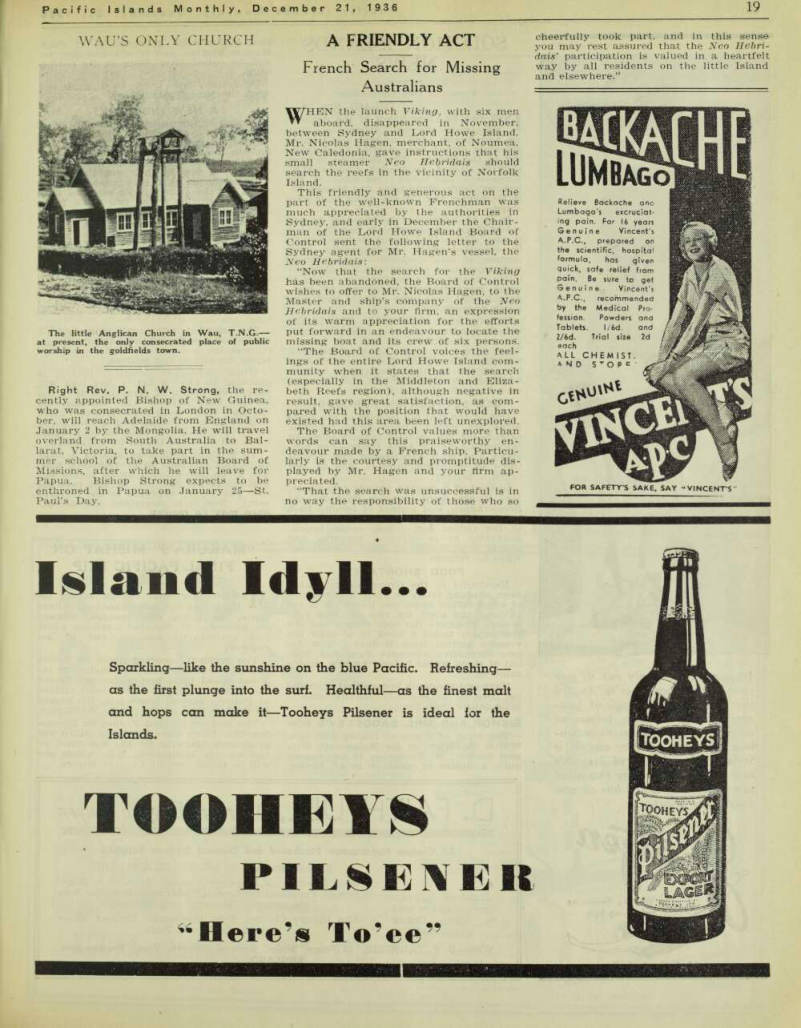
Right Rev. P. N, W. Strong, the re cently appointed Bishop of New Guinea, who was consecrated in London in Octo ber, will reach Adelaide from England on January 2 by the Mongolia. He will travel overland from South Australia to Bal larat, Victoria, to take part in the sum mer school of the Australian Board of Missions, after which he will leave for Papua. Bishop Strong expects to be enthroned in Papua on January 25 —St.
Paul’s Day.
The little Anglican Church in Wau, T.N.G. — at present, the only consecrated place of public worship in the goldfields town.
A Friendly Act
French Search for Missing Australians
WHEN the launch Viking, with six men aboard, disappeared in November, between Sydney and Lord Howe Island.
Mr. Nicolas Hagen, merchant, of Noumea, New Caledonia, gave instructions that his small steamer Neo Hebridais should search the reefs in the vicinity of Norfolk Island.
This friendly and generous act on the part of the well-known Frenchman was much appreciated by the authorities in Sydney, and early in December the Chair man of the Lord Howe Island Board of Control sent the following letter to the Sydney agent for Mr. Hagen’s vessel, the Neo Hebridais : “Now that the search for the Viking has been abandoned, the Board of Control wishes to offer to Mr. Nicolas Hagen, to the Master and ship’s company of the Neo Hebridais and to your firm, an expression of its warm appreciation for the efforts put forward in an endeavour to locate the missing boat and its crew of six persons.
“The Board of Control voices the feel ings of the entire Lord Howe Island com munity when it states that the search (especially in the Middleton and Eliza beth Reefs region), although negative in result, gave great satisfaction, as com pared with the position that would have existed had this area been left unexplored.
The Board of Control values more than words can say this praiseworthy en deavour made by a French ship. Particu larly is the courtesy and promptitude dis played by Mr. Hagen and your firm ap preciated.
“That the search was unsuccessful is in no way the responsibility of those who so
cheerfully took part, and in this sense you may rest assured that the Neo Hebri dais’ participation is valued in a heartfelt way by all residents on the little Island and elsewhere.”
Advertisements & other items, pp. 21-22 (1 item)
Tooheys
LUMbag
Relieve Backache ano Lumbago's excruciating pain. For 16 years Genuine Vincent's A.P.C., prepared on the scientific, hospital formula, has given quick, safe relief from pain. Be sure to get Genuine Vincent's A.P.C., recommended by the Medical Profession. Powders and Tablets. l/6d and 2/6d. Trial size 2d each
ALL CHEM IST.
AND S T OP c
vjvH*
FOR SAFETY’S SAKE. SAY “VINCENTS’
Island 1dy11...
Sparkling—like the sunshine on the blue Pacific. Refreshing— as the first plunge into the surf. Healthful—as the finest malt and hops can make it —Tooheys Pilsener is ideal for the Islands.
TOOHEYS
PILSENBB
“Here’s To’ee”
•if
TOOHEvi
LAGC*
r' v-m m dM Jantzens are not only cut to give you lovely lines—they’re knitted that way, too! The magic of Jantzen-Stitch gives them permanent elasticity—and that means seasonlong smartness. Above, centre, is Style 37, done in one of Jantzen’s new fabrics. There are two other new fancy fabrics and lots of new designs and colors.
The World s Favourite Swimming Suit Made in Australia
Solomon Islands
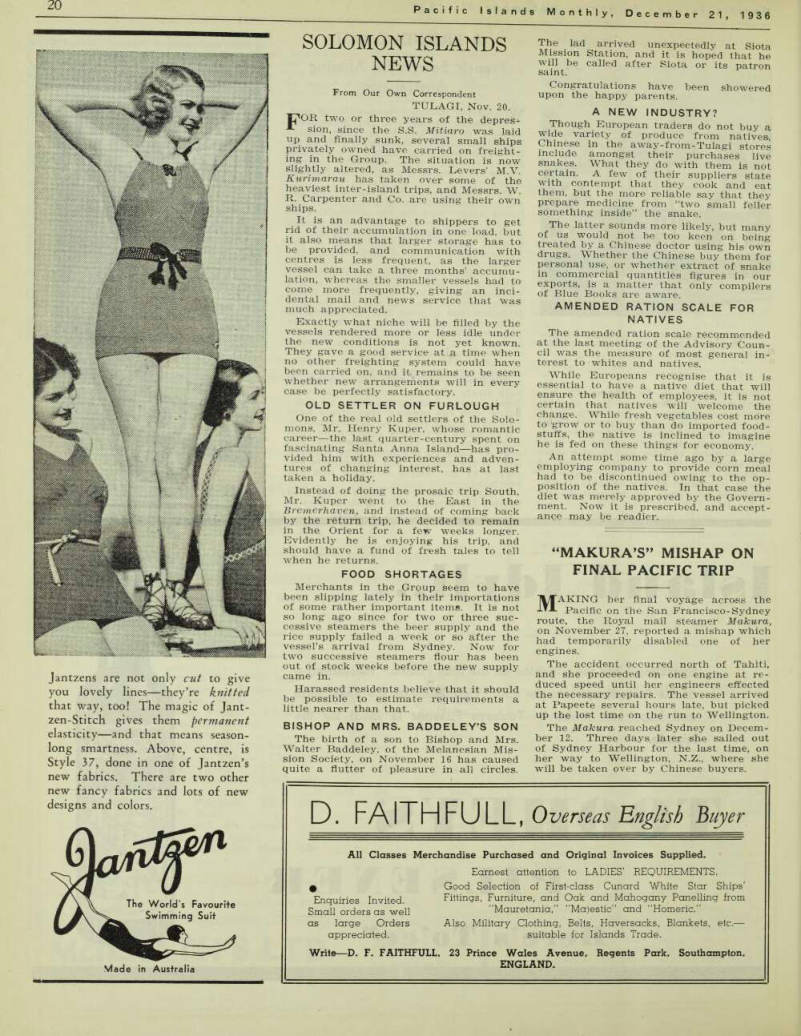
News
From Our Own Correspondent
Tulagi, Nov. 20.
‘C’OR two or three years of the depres sion, since the S.S. Mitiaro was laid up and finally sunk, several small ships privately owned have carried on freight ing in the Group. The situation is now slightly altered, as Messrs. Levers’ M.V.
Kurimarau has taken over some of the heaviest inter-island trips, and Messrs. W.
R. Carpenter and Co. are using their own ships.
It is an advantage to shippers to get rid of their accumulation in one load, but it also means that larger storage has to be provided, and communication with centres is less frequent, as the larger vessel can take a three months’ accumu lation, whereas the smaller vessels had to come more frequently, giving an inci dental mail and news service that was much appreciated.
Exactly what niche will be filled by the vessels rendered more or less idle under the new conditions is not yet known.
They gave a good service at a time when no other freighting system could have been carried on, and it remains to be seen whether new arrangements will in every case be perfectly satisfactory.
Old Settler On Furlough
One of the real old settlers of the Solo mons, Mr. Henry Kuper, whose romantic career—the last quarter-century spent on fascinating Santa Anna Island—has pro vided him with experiences and adven tures of changing interest, has at last taken a holiday.
Instead of doing the prosaic trip South, Mr. Kuper went to the East in the Bremerhaven, and instead of coming back by the return trip, he decided to remain in the Orient for a few weeks longer.
Evidently he is enjoying his trip, and should have a fund of fresh tales to tell when he returns.
Food Shortages
Merchants in the Group seem to have been slipping lately in their importations of some rather important items. It is not so long ago since for two or three suc cessive steamers the beer supply and the rice supply failed a week or so after the vessel’s arrival from Sydney. Now for two successive steamers flour has been out of stock weeks before the new supply came in.
Harassed residents believe that it should be possible to estimate requirements a little nearer than that.
Bishop And Mrs. Baddeley’S Son
The birth of a son to Bishop and Mrs.
Walter Baddeley, of the Melanesian Mis sion Society, on November 16 has caused quite a flutter of pleasure in all circles.
The lad arrived unexpectedly at Siota Mission Station, and it is hoped that he will be called after Siota or its patron saint.
Congratulations have been showered upon the happy parents,
A New Industry?
Though European traders do not buy a wide variety of produce from natives, Chinese in the away-from-Tulagi stores include amongst their purchases live snakes. What they do with them is not certain. A few of their suppliers state with contempt that they cook and eat them, but the more reliable say that they prepare medicine from “two small feller something inside” the snake.
The latter sounds more likely, but many of us would not be too keen on being treated by a Chinese doctor using his own drugs. Whether the Chinese buy them for personal use, or whether extract of snake in commercial quantities figures in our exports, is a matter that only compilers of Blue Books are aware.
Amended Ration Scale For
Natives
The amended ration scale recommended at the last meeting of the Advisory Coun cil was the measure of most general in terest to whites and natives.
While Europeans recognise that it is essential to have a native diet that will ensure the health of employees, it is not certain that natives will welcome the change. While fresh vegetables cost more to grow or to buy than do imported food stuffs, the native is inclined to imagine he is fed on these things for economy.
An attempt some time ago by a large employing company to provide corn meal had to be discontinued owing to the op position of the natives. In that case the diet was merely approved by the Govern ment. Now it is prescribed, and accept ance may be readier.
“Makura’S” Mishap On
Final Pacific Trip
MAKING her final voyage across the Pacific on the San Francisco-Sydney route, the Royal mail steamer Makura, on November 27, reported a mishap which had temporarily disabled one of her engines.
The accident occurred north of Tahiti, and she proceeded on one engine at re duced speed until her engineers effected the necessary repairs. The vessel arrived at Papeete several hours late, but picked up the lost time on the run to Wellington.
The Makura reached Sydney on Decem ber 12. Three days later she sailed out of Sydney Harbour for the last time, on her way to Wellington. N.Z., where she will be taken over by Chinese buyers.
Advertisements & other items, p. 22 (1 item)
D. FAITHFULL, Overseas English Buyer
All Classes Merchandise Purchased and Original Invoices Supplied. • Enquiries Invited.
Small orders as well as large Orders appreciated.
Earnest attention to LADIES’ REQUIREMENTS.
Good Selection of First-class Cunard White Star Ships' Fittings, Furniture, and Oak and Mahogany Panelling from ''Mauretania,' 1 "Majestic" and "Homeric."
Also Military Clothing, Belts, Haversacks, Blankets, etc. — suitable for Islands Trade.
Write—D. F. FAITHFULL. 23 Prince Wales Avenue, Regents Park. Southampton,
ENGLAND.
U.S.A. and N.Z. by Air
Hitch in Plan to Link
Reciprocity Clause in Agreement Delays New Pacific Service
From Our N.Z. Correspondent
Auckland, Dec. 1.
IVI ORE than a year has now elapsed since the signing of an agreement be tween Pan-American Airways and the New Zealand Government for a trans pacific air service, but no indication of an early commencement of the line has so far been given.
Under the terms of the agreement, the service is to be in operation not later than the end of December, although the Minis ter for Transport is empowered to extend the starting time a year should any un foreseen difficulties be encountered.
In the absence of detailed surveys of the southern portion of the route, which the agreement lays down as between Sar Francisco and Auckland, it is certain that the service cannot be started before the end of this year. No announcement has yet been made of any application for an extension.
The original agreement provided the company with facilities and the right to operate an air service between the two countries, for 10 years, with at least two machines from each terminal each month.
It was agreed that no discriminatory tariff would be imposed on aircraft of the company landing at Auckland during the period.
British rights were safeguarded by a reciprocity clause, which has since been the subject of lengthy negotiations. This
provided that if a British company should fail to obtain similar facilities from the United States Government for a trans pacific service, the Pan-American agree ment could be cancelled after 12 months’ notice.
P.-A. Airways subsequently objected to certain of the terms of the agreement, especially the reciprocity clause, and the matter has been discussed between its representative, Mr. Harold Gatty, and the N.Z. Government.
There are grounds for believing that the British Government and the former N.Z.
Government did not see eye to eye on the reciprocity clause, and that Britain jumped at the chance of renewing its representa tions when, after the matter had appar ently been closed, it was re-opened through the new Labour Government referring to it again over the reciprocity clause.
The whole question was discussed, it is understood, during the recent conference at Wellington between representatives of New Zealand, Great Britain, and Australia on air matters.
New Zealand
U.S. Experts on Way to Fiji and New Zealand
Honolulu, Dec. 9.
THE Niagara, which arrived to-day, has on board Pan-American Airways’ technical experts and equipment for in stallation at Suva and Auckland, in pre paration for experimental flights between New Zealand and the United States.
Twenty-nine cases of equipment have been unloaded for trans-shipment to King man Reef, and will be picked up by the Pan-American Airways freighter, North wind.
Officials of the air line hope that a start will be made early next year.
Easier Now For Rabaul’S
Drivers
From a Special Correspondent
Rabaul, Nov. 10.
A FURTHER 90 chains of bituminous sealing were recently completed on the roads of Rabaul. Altogether this sur face extends for over 250 chains, and has met with much approval by local residents and car drivers.
The roadways of Rabaul have always been one of the town’s chief attractions — for mile upon mile they circle the sea shore and branch off inland at different points to reach some place of interest or beauty. The new road to Toma, in the hills, which gives direct access from Rabaul, has also been improved. This road leads to the proposed new aerodrome, running through beautiful country.
Mr. D. R. McDonald, who has been in Fiji for some years as Deputy Registrar- General of the Supreme Court, sailed from Sydney for Tulagi, British Solomon Islands, by the Malaita on December 12.
He has been appointed Chief Magistrate and Legal Adviser in the Solomons.
Mr. A. Griffiths arrived at Thursday Island from Sydney at the end of Nov ember to join the staff of the Customs Department, replacing Mr. Gregan who has returned to Brisbane.
Advertisements & other items, pp. 23-24 (1 item)
Kodak
I I
WILLIAM FINAU
Photographer
FRIENDLY IS., OCEANIA
Tongan views and Natives' life scenes, set, 5/3 prepaid anywhere. Tapacloth. large piece. 6/6 prepaid anywhere.
KODAK
RETINA
A High-speed, high-precision, all-purpose Miniature Camera, whose quick, convenient action rivals its adaptability to every picture situation! Offers the advantages of work on 36 exp. 35 mm. Kodak Panatomic or Kodak Super X film magazines.
Ease of operation is assured by the film-measuring device, exposure counter, and enclosed eye-level finder.
Superb f/3.5 Anastigmat lens and Compur Rapid Shutter are equal to every picture situation. Standard Model, £lO/10/-* Dull Chromium finish, £l2/-/-.
Of all Kodak Dealers throughout
the Islands and
KODAK (Australasia) PTY. LTD
379 George Street, Sydney.
And all States.
KODAK
PANATOMIC
The finest all-purpose film. Panchromatic, anti - halation, of microscopically fine grain, for marvellous enlargements of sensational size.
KODAK
VERICHROME
FILM.
Every camera will give better results if it is loded with Verichrome, the film that gets the picture.
Double coating captures every detail.
KODAK SUPER-
SENSITIVE
PANCHROMATIC
The film of lightning speed. For all artificial light pictures and whenever maximum speed is required. Panchromatic, anti-halation cN
flL^
NAT®
I CA' o^^
ICH*
ye* s ear T |Vt
3 eNS
TIC
pA N Write for booklet.
PRICE’S RADIO SERVICE
SPECIAL TROPICAL RECEIVER
Coil Unit hermetically sealed in brass box, Chassis Bitumastic coated, all fully impregnated against moisture, assures perfect operation at all times.
This Dualm modern 7-valve wave Receiver has a waveband coverage of 16 to 55 metres and 200-250 metres.
FEATURES:
#AI Quality Components 9 Octode Frequency Converter Automatic Volume Control Two Audio Stages Class B Push-pull Output Economy Valves
CABINET
A specially-treated Teak Table Cabinet houses both chassis and speaker
PRICE COMPLETE,
£37/10/- FOB SYDNEY
KA t iIA V
fDNEY 4
■4
PRICE'S RADIO SERVICE
S ANGEL PLACE ... SYDNEY AUSTRALIA
Polynesians And
Christianity
Fascinating Story of What Hap pened in N.Z. 100 Years Ago
WHEN my friend Eric Ramsden sug gested that I read and review his new book I privately moaned. Ramsden is a lively writer, with a good sense of the dramatic; but Marsden and the Missions —well, I ask you!
The man who thought of that title had no idea of selling books. I was yawning before ever I opened the attractive covers.
I often had heard of Bishop Marsden —a very worthy but an exceedingly dull per son. I thought—and I had not the least desire to read about the gentleman.
But Marsden and the Missions ac tually is one of the most ‘.‘readable” books that ever has come off an Australian press.
Missionaries went to “convert the heathen” of New Zealand. The Maoris, however, had a culture and a social order worthy of the proud Polynesian race, and they were not in the least conscious of being heathens and barbarians. They met the Europeans with courtesy and hospi tality, but they were not prepared, at a word, to abandon their familiar ancient gods and accept a strange new code — which often was thrust at them with startling unctuousness.
The book tells, with fine flashes of drama and of humour, of how Christianity eventually was accepted by the Maoris, and of how the Maoris gave proof of their high racial standard, insomuch that they survived the shock of impact with Euro pean culture. One of the most interesting things in the history of colonisation may be seen in New Zealand to-day, where
Maoris and Europeans are living happily together as neighbours and where the Maoris, although they have had less than a century in which to absorb European standards of life, thought, education, and morality, are steadily increasing in num bers.
Mr. Ramsden’s book, in its searching analysis of conditions around 1840, ex plains much of the mystery of the Maori metamorphosis and, in that respect alone, it is exceedingly valuable. No student of the Polynesian people, and no historian of the Pacific, can afford to be without it.
It is one of the best documented books I have ever seen. Ramsden gives his authority for every statement: he must have searched thousands of ancient docu ments and tomes.
Marsden, no doubt, was a dear old soul, and one is filled with admiration of his determination, piety, and proselytising zeal. And the other missionaries were praiseworthy pioneers of their church.
But, to me. these are the least important aspects of the book. They provide merely an interesting background for Mr. Rams deh’s quick-moving, fascinating story of the struggle between two social systems, and of how the Maoris adapted themselves to the genius and the kindness, the ras cality and the fanaticism of the white man.
Personally, I never tire of reading about those early nineteenth century mis sionaries, who marched into the tropics, grimly and uncompromisingly determined to thrust their stovepipe hats, frock coats, non-conformist codes and Victorian Sab bath consciences down the throats of the “unhappy heathen,’’ and thus save them from eternal damnation. I never know whether to laugh at the extraordinary pic ture they present, or admire their stern sense of duty and readiness for self-sacri fice.
That is the dilemma with which one is
confronted in Mr. Ramsden’s book. One reads, for instance, of the indignation and sorrow of one typical evangelist when he found that a chief had a dozen wives. The facts that the wives were quite happy and that polygamy had been practised for scores of generations did not seem to the white man to have any bearing upon this “terrible sin.”
And, Presbyterian though I am, I con fess that I chuckled in malicious glee when I found in this book, as in other books, accounts of the frenzy into which these early missionaries fell when they found their fields being invaded by the teachers of the Roman Catholic Church, They seemed to lose all control over them selves —at any rate, they certainly let themselves go in the vituperative writings which they left. “On the Roman issue,” says Ramsden, “both Anglicans and Wes leyans were absolutely united. They both hated and feared the Frenchmen in their ‘frightful hats and long black robes’.” To day, to us, it all seems so petty and so funny: which does serve to show how far the world has travelled in one hundred years.
The book is commended to historians and students of South Seas sociology—it is an authoritative work which must find a permanent place on their bookshelves; and it is commended, also, to the ever growing army of readers who are tired of shoddy novels, and who seek something vivid, in a historical or geographical set ting, about that most fascinating of all subjects, the development of the human race.—R.W.R.
Marsden And The Missions, By Eric
Ramsden. Published by Angus and Robertson Ltd., Sydney. Price 12/6.
Advertisements & other items, p. 24 (1 item)
St, Ignatius’ College - Kiverview, Sydney
BOARDING and DAY SCHOOL :: Conducted by the Jesuit Fathers
ONE OF SYDNEY’S GREAT PUBLIC SCHOOLS
I>OYS prepared for Intermediate and Leaving Certificate Examinations and for Exhibitions, Scholarships and Bursaries at the University.
Boys are arranged in three divisions according to age and size.
Each division has its own library, debating society, cricket and football field, tennis court.
Senior and Junior Rowing Sheds. Private Swimming Baths, Prospectus and Further Particulars on application to the Rector,
REV. J. MEAGHER, SJ.
Telephone, J I 106.
tMMM
rai»rcf*lM
Sii||ii JSJ
m K h *
“Rush” To Wewak
Wau Miners Find Promise in New Goldfield
From Our Own Correspondent WAU, Nov. 22.
TT has been known for over 18 months that there was gold in Wewak, in the Sepik District, North-west New Guinea, but until last month the potentialities of Wewak as a field of importance were never taken seriously. “Gold is there but not in payable quantities,” was the gen eral opinion.
In October, Wau, although still pros perous, but no longer booming, had a few unemployed miners cooling their heels, and they, in spite of indifferent reports, decided to go to Wewak to see for them selves. Contrary to official reports their advice to Wau was encouraging, and many other miners joined the “rush” or sent agents to peg ground on their behalf.
Towards the end of October it was re ported that there were 60 men on the field and the November steamer took 40 more up north. One ambitious miner chartered a ’plane for his sole use and transported his natives and mining gear by it, thus saving several days.
Latest reports are still encouraging, and it looks as if the “rush” to Wewak has only just begun.
Captain L. Austin, of the Papuan Public Service, arrived in Sydney by the Montoro at the end of November. He is stationed at Sangara.
Mr. B. W. Faithorn, A.R.M. at Kokoda, Northern Division of Papua, arrived in Sydney on sick leave in November. He is being relieved at Kokoda by Mr. S. Elliott Smith, who previously was stationed at Buna.
Popular Chinese Consul
Mr. C. L. Cheng, of Suva
From Our Own Correspondent.
Suva, Nov. 28
'VTUMEROUS social gatherings lately have been a tribute to the popularity of Mr. C. L. Cheng, Chinese Vice Consul at Suva, who leaves shortly on transfer to China.
Two different groups *of Mr. Cheng’s friends have made farewell presentations to him at social gatherings, one a Mah Jong evening, which game Mr, Cheng did a great deal to make popular in Suva.
The most important function, however, was that given by a fellow countryman, Mr. C. H. G. Honson, one of Suva’s lead ing merchants. A week ago at their pala tial home, Mr. and Mrs. Honson enter tained 350 guests at what has been de scribed as one of the best and brightest parties held here for many years. The guests spent the evening in dancing, and Mr. and Mrs. Honson spared no efforts to make the occasion a joyous one.
Mr. Honson and the Acting Colonial Secretary (Dr. V, \/V. T. McGusty) both
expressed regret at Mr. Cheng’s impend ing departure and at the same time wel comed his successor, Mr. C. T. Tsiang, who has taken up office.
The dean of the local consular corps, Sir Maynard Hedstrom, also gave a fare well party for Mr. Cheng, when a pre sentation was made on behalf of thq members of the corps.
Miss E. Lindsay, who had been in Aus tralia on sick furlough, returned to Fiji by the November Monterey to continue her work as a nurse at the Methodist Mission’s Hospital at Ba, among the Indian women and children.
Miss Cathleen Deck, member of the pioneer Deck family of 8.5.1. missionary fame, sailed from Australia by the Malaita in the middle of December on her way to One Pusu, the South Sea Evangelical Mission’s main station in the Solomons. Miss Deck, who has laboured in the Group for 30 years as a missionary, recently returned to Sydney from a health-recruiting trip to Hawaii.
Mr. H. V. Seale, mining' engineer, sailed from Sydney in December for Port Moresby to inspect a gold property in Papua for a Sydney syndicate, Mr. and Mrs. L. Logan returned to Port Moresby, Papua, from Sydney by the December Montoro. Mr. Logan is Head quarters Officer in the Papuan Armed Constabulary.
Advertisements & other items, pp. 25-26 (1 item)
Dewar’S
YACHTSMEN AND
NAVIGATORS
Our stocks of Books on The Diesel Engine, Nautical and Aeronautical subjects, are unparalleled.
Admiralty Charts and Sailing Directions for Australian Coast and Pacific Islands always available.
Write for our Nautical Catalogue and Distinctive Books—Free and Post Free.
THE N.S.W. BOOKSTALL CO. LTD.
General & Educational Booksellers & Librarians.
Market & Castlereagh Streets, SYDNEY.
The real Xmas
Spirit!
Give Dewar's and you will do far more than merely wish your friends well —you will actively contribute to their Xmastide content . . . Dewar's is the finest Scotch . . . distinct and inimit able in character . . . the doyen of all whiskies.
DEWAR’S
Ijts
SCOTCH WHISKY
PRESCOTT L T J? Iy S dUe S Y ar-e sole wholesale /d?'-
PINEAPPLE BACON & HAMS
DAISY BRAND BUTTER
LEA & PERRINS’ fT c J s ™
LEA& PERRINS’ H.P. Sauce
and £Most other Super-Quality Lines of the Trade
Swallow & Ariell
Port Melbourne :: Australia Manufacturers Since 1854
HIGH QDALII
CABIN (INCLUDING SMALL CABIN)
PACIFIC CABIN
CABIN CRACKERS
BREAKFAST BISCUITS
NAVY & PILOT BREAD
PACKED EXPRESSLY FOR EXPORT IN TINS UP TO 50LBS.
LIMITED
Shil» aml Cabin Biscuits
Bill Parkes—Old “Red
Bill”
There passed away, some time ago, up on the Edie Creek goldfield, a fine character known to all old-hands as “Red Bill.” Bom at Echuca, Victoria, he drifted around many of the mining fields of Australia, and was one of the earliest miners on Kalgoorlie and Coolgardie, in W.A, He was early on the Yodda and Lakekamu gold fields, in Papua, and he walked overland to Edie Creek when that field was discovered.
I was in Rabaul on one occasion and was told that Bill was in Namanula Hospital. I called on the patient. I was ushered in by one of the nurses and, after a breezy welcome, and in reply to my enquiry as to how he was getting along, he went into detail, as follows: “You see, Frank, it’s like this. I’ve never been in one of these places before—not where there were women in charge. By cripes, they’re the ones to straighten you up. I said to the Matron yesterday, What about a drink, Matron ? She looked at me for a while, as if considering, and I began to feel quite hopeful. Then she said; ‘No, I don’t think you’d better have one. I’m very sorry.’ By cripes, she wasn’t half as sorry as poor Old Bill.”
I offer this belated epitaph to a good, straight old-timer, with a cheery smile and a keen sense of humour.
WE miss his frame so gaunt and thin.
His winning breezy style, The humorous stories he could spin, His pleasant friendly smile.
Now we will never see him more— He’s climbed his last long hill— And he has paid his final score, Our good old mate, Red Bill.
A miner of the good old sort, Beloved by all the crowd — A tough, hard-living game old sport, Of whom we all were proud.
When he had lots of cash to spend He’d never put on frill!
A sticker as a mate and friend Was cheery old Red Bill.
His oldest friends who knew him best Will miss him most of all, And when they take their final rest, They hope he’ll make a call.
To hear him tell a cheery tale Would all your worries kill: A tonic, it would never fail When told by old Red Bill.
Now he has left this land of gold Some better fields to try.
His final swag he’s quietly rolled — To mining said “Good-bye.”
Good luck to him —where-e’er he go— To the brim your glasses fill — Be he above or down below, The Best to old Red Bill!
Fprank Pryke.
Tahiti And Cook Is.
Families United
THE marriage has taken place in Raro tonga, Cook Islands, of M. Henry Vidal, a member of a well-known Papeete family, to Teuira, the youngest daughter of Thomas Snow and Tuhurangi Samuels, of Maraerenga, Rarotonga. Rev. B.
Challis officiated at the picturesque old London Missionary Society Church in Avarua. As the bride was a member of the Avarua company of Girl Guides, a guard of honour was provided from that organisation.
Madame Frogier, of Papeete (cousin of the bridegroom), and Mrs. Snow, later entertained 250 guests, including Euro peans, Tahitians, and Rarotongans, in the Maraerenga Hall. According to Raroton gan custom, the bride was given a new name; in future she will be known as Vahine Fanu Marama.
The bridal party have since returned to Tahiti.
Crime Among N.G.
Natives.
Uneasiness In Rabaul.
REPORTS are being frequently received to the effect that natives in and about Rabaul are becoming dangerously disaffected —that they are “too sophisti cated,” and criminally inclined, and are displaying an increasing cheekiness in their attitude towards Europeans.
The following report, dated November 13, is to hand from our Rabaul Corre spondent: In the Supreme Court, on November 4, there appeared four natives, charged with being on premises for the purpose of in decently insulting European females; and also two charged with homo-sexual of fences, and two with rape. All were con victed and sentenced to periods ranging from a year to 2i years’ imprisonment, with whippings. . A local native, employed as a mail sorter in the Rabaul post office, appeared before the Supreme Court recently charged with stealing a letter. He was sentenced to two years’ imprisonment with hard labour.
A similar sentence was imposed on an other native, charged with receiving the letter and who, it was shown, incited the post-office employee to steal.
We understand that other charges are pending. It is believed that numerous letters have been tampered with and stolen —especially letters containing money and postal notes.
Our natives are by no means backward in picking up the unpleasant characteris tics of our civilization.
Big Land Sale In Samoa
Developments in Savaii
From Our Own Correspondent
Apia, Nov. 12.
WHAT may be termed the biggest land deal ever made in Samoa was com pleted on Monday last, when Hon. A. G.
Smyth, M.L.C., on behalf of a local syndi cate, bought a large area of bush land, the so-called “Cornwall’ or Brunt Estate, comprising over 6000 acres on the island of Savaii, near the villages of Sataua, Asau and Falelima, at the western por tion of the island.
Details of the deal, which was made between the Public Trustee (the land being former German property) and Mr.
Smyth, have not been made known.
According to a report, an area of 2000 acres in the Faasaleleaga district of Savaii is to be planted under coconuts by the N.Z. Reparation Estates. The large coconut plantations of the Estates in Upolu (Mulifanua, Yaitele and Vailele) are over-aged and decreasing in value and output.
Mr. C. A. Berendsen, LL.M., who is well-known in the Cook Islands and Wes tern Samoa, will arrive iis Sydney from Europe by the Narkunda on December 23. He is the Permanent Head of the Prime Minister’s Department in New Zea land, and Under-Secretary for the De partment of External Affairs and for the Cook Islands Department.
Doldrums
Norfolk Is. Emerges from the Doldrums
TRADE on Norfolk Island has im proved, and the exodus of residents has ceased, according to the annual report of the Administrator of Norfolk Island, which was made available in November.
The population on June 30 was 1142, including two survivors of the party of Pitcairn Islanders who landed at Norfolk Island on June 8, 1856.
The lifting by the New Zealand Government of the embargo on citrus fruits resulted in the shipment to the Dominion of 2365 cases of oranges and 43 of grapefruit, and the prospect of the erection of a factory by a Sydney com pany to develop the trade in passion fruit pulp was a source of optimism.
Imports for the year amounted to £28,797, and exports to £9407. The trust fund showed a balance of £9092, after taking into account a Commonwealth grant of £4OOO, as well as grants of £2OOO for rural rehabilitation and £l2OO for flood damage relief.
“The morale of the community is definitely higher than it was a year ago,” states the Administrator (Captain C. R.
Pinney, M.C.). “Pessimism has been replaced by optimism. There is a revival of interest in agriculture, and market prices for the products of the territory are improving.”
Advertisements & other items, pp. 27-28 (1 item)
M A Ry's
H.JONES e-co
AUSTRALIA'S BEST
H. JONES & CO.. LTD.
Darlington, Sydney Hobart, Taa.
For— Fresh Fruit, Vegetables, and Produce Islands Residents can rely on the old-established Shipping Providers; v>“ u Only Addrsaai 421 Sussex St., SYDNEY All Orders Promptly Attended Islands Agents: NELSON & ROBERTSON LTD.
£ A new, simple lid for your convenience; a new patented parchment seal to ensure perfect freshness.
AUNT
M A RY'S
BAKING POWDER
PRESS
..Us m mrm.
Vx van fV 3 alii tfac*inT!S£fst Send 1/- plus 2d. postage to Tillock and Co.
Ltd., Sydney, for ''Aunt Mary’s’' Cookery Book.
It’s the best.
Get your
rarrea copy
of the
NEW TRUFOOD
RECIPE BOOK
•9 specially tested recipes— all kinds of new ideas for attractive things to cook cakes, pastry, puddings, custards, desserts, savouries, sauces, etc.
POST THIS COUPON TODAY
' Recipe Department ’’ c/- Box 4267 Y, G.P.0., Sydney.
Please send me POST FHIE, a copy of The Trufood Book ef 69 Tempting Recipes
(BLOCS LETTERS)
Address
Plane Falls - Lives Lost
“No apparent
mechanical faults
found.”
Could the Pilot have been paralysed with the gripping, agonising pains of stomach disorder?
Read This:
Colonel J. Stacey 31 Erskine Street Sydney, N.S.W.
Dated February 10, 1933.
Mr. R. M. Hardy, Hardy’s Chambers, 5 Hunter Street, Sydney, N.S.W.
Dear Sir, —Some three months ago I was very ill caused by severe ’Flu and Nervous Breakdown. I suffered intense pains in the stomach, my condition was serious for over a month and getting worse.
I was advised to try your Indigestion and Stomach Remedy, and j after ten days’ treatment all pains were gone and my nerves became normal.
I regained my health, and feel that your Remedy is all you claim for it.
Yours truly,
COLONEL J. STACEY
C-
WHY RISK YOUR LIFE?
take
R.M. Hardy’s
Indigestion and Ulcerated
Stomach Remedy
Obtainable at All Burns, Philp & Co. Stores.
Price: 3/9, 3/6, and 2/6 per Tin.
No Dieting—No Headaches —No Stabbing
Pains
New Guinea
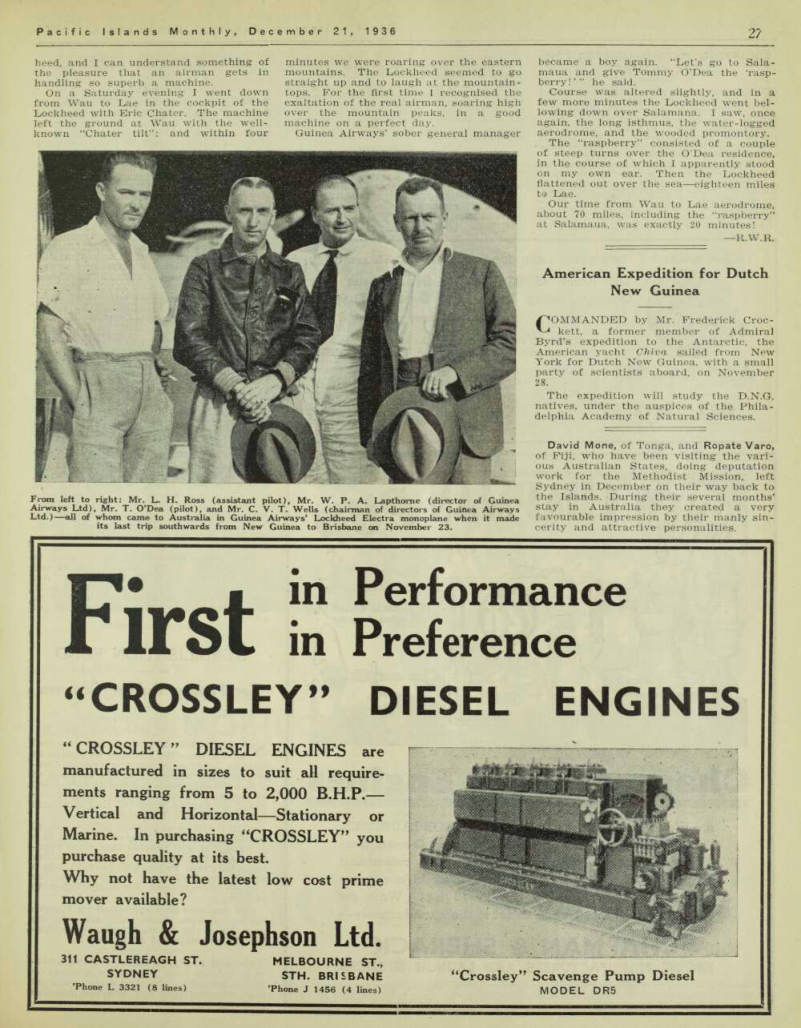
Riding on a Bullet to New Guinea Some Impressions of a Trip by G.A.’s Lockheed
ON Thursday, November 12, at 5 a.m., we rose straight into the sunrise over Sydney in Guinea Airways’ new two engined Lockheed monoplane, and darted away northwards at 200 miles per hour.
At 10 a.m. the following day I walked off the aerodrome at Wau, in Central New Guinea, 2150 miles from Sydney.
Had the pilot been prepared to take risks with the afternoon clouds over the New Guinea mountains, we could have done the trip in one day—a journey, nor mally, that takes ten days by mail steamer.
I found the prospect of this means of travel terrifying. A ’plane, travelling at 3J miles per minute, could hit the earth with a prodigious bump. And, from the North Queensland coast to Papua, there were 450 miles over water. As I walked across Mascot aerodrome that morning my knees were secretly shaking.
But, in fifteen minutes, all fear was gone. One can feel, in this type of machine, such a reserve of power, and such stability, that a consciousness of safety grows on one. There is no “flop ping about” —the machine flies straight and stiff, like a bullet. When there are mountains ahead, it just rises up, at any old angle, and flies over them —there is no circling around making height.
In 30 minutes from Sydney we were over Newcastle, 100 miles away. At 7.45 we were breakfasting in Brisbane; at 10.15 we had morning tea in Rockhamp ton; we lunched in Townsville at 1 p.m.; and at 3.45 p.m. I was making a photo graph of the postmaster at Port Douglas, 1400 miles north of Sydney, reading a copy of that morning’s Sydney Morning Herald.
Yet, in the air, we did not seem to realise the breath-taking speed of this means of travel. We conversed easily in the cabin, watched the East Coast scenery, read and slept.
With a good map it is easy to identify all the features of the coastline, over which one rushes at 3i miles per minute.
Except that the distances which seem so impressive on the map are as nothing from the Lockheed.
I predict that this particular run, Syd ney to North Queensland, along the coast line, being filled with colour and variety, will become one of the most popular in this part of the world.
The Lockheed sat all night on the level, hard beach at Port Douglas; and, at dawn, she rose smoothly and easily into a glow ing sky, ran 100 miles up the coast to Cape Hattery, and then headed out over the sea.
Four hundred and fifty miles before we should see land again! I looked out at the engines—they were purring happily.
At the pilot—he was yawning—both he and I had cursed this 3.30 a.m. rising. At my fellow-passengers—they were com posing themselves for sleep. So I went to sleep, too!
So much for that “terrifying” crossing over the open sea to Papua.
Two hours later, we saw the blue mountains of Papua. On past Bootless Inlet; and there was the apparently ever lasting old Pruth sitting up on the reef near Port Moresby.
At 8.15 a.m. the Lockheed roared and dipped over Port Moresby, and then ran out on to the aerodrome. Half an hour later the Port folk were reading the pre vious day’s Sydney and Brisbane news papers.
Shortly after 10 a.m., the people in Wau were doing the same. The Lockheed went up over the backbone of New Guinea, and along past the western shoulder of Mount Lawson, 10,000 feet up, like an arrow shot from a bow.
It was a unique experience to sit in the cockpit of that Lockheed machine with Pilot “Tommy” O’Dea. I had heard of “finger-tip control” as applied to motor cars; but here I saw it in an aeroplane.
One touch was sufficient to alter course or elevation; yet, even without that touch the ’plane flew straightly as if guided between steel rails.
The dashboard carried an amazing array of tell-tale instruments, and it was fascinating to watch how quickly they registered the slightest variation of height, speed, course, elevation, engine temperature, revolutions, fuel reserve, etc.
It seemed to me that a pilot, in a machine like that, would know everything, except what his wife was doing.
I have seen Ohater and O’Dea, both great pilots, at the controls of that Lock
heed, and I can understand something of the pleasure that an airman gets in handling so superb a machine.
On a Saturday evening I went down from Wau to Lae in the cockpit of the Lockheed with Eric Chater. The machine left the ground at Wau with the well known “Chater tilt”: and within four
minutes we were roaring over the eastern mountains. The Lockheed seemed to go straight up and to laugh at the mountain tops. For the first time I recognised the exaltation of the real airman, soaring high over the mountain peaks, in a good machine on a perfect day.
Guinea Airways’ sober general manager
became a boy again. “Let’s go to Sala maua and give Tommy O’Dea the ‘rasp berry!’” he said.
Course was altered slightly, and in a few more minutes the Lockheed went bel lowing down over Salamana. I saw, once again, the long isthmus, the water-logged aerodrome, and the wooded promontory.
The “raspberry” consisted of a couple of steep turns over the O’Dea residence, in the course of which I apparently stood on my own ear. Then the Lockheed flattened out over the sea—eighteen miles to Lae.
Our time from Wau to Lae aerodrome, about 70 miles, including the “raspberry” at Salamaua, was exactly 20 minutes!
R.W.R.
From left to right: Mr. L. H. Ross (assistant pilot), Mr. W. P. A. Lapthrne (director of Guinea Airways Ltd), Mr. T. O’Dea (pilot), and Mr. C. V. T. Wells (chairman of directors of Guinea Airways Ltd.)—all of whom came to Australia in Guinea Airways’ Lockheed Electra monoplane when it made its last trip southwards from New Guinea to Brisbane on November 23.
American Expedition for Dutch
New Guinea
COMMANDED by Mr. Frederick Croc kett, a former member of Admiral Byrd’s expedition to the Antarctic, the American yacht Chiva sailed from New York for Dutch New Guinea, with a small party of scientists aboard, on November 28.
The expedition will study the D.N.G. natives, under the auspices of the Phila delphia Academy of Natural Sciences.
David Mone, of Tonga, and Ropate Varo, of Fiji, who have been visiting the vari ous Australian States, doing deputation work for the Methodist Mission, left Sydney in December on their way back to the Islands. During their several months’ stay in Australia they created a very favourable impression by their manly sin cerity and attractive personalities.
Advertisements & other items, p. 29 (1 item)
F irSt in Preference
P* ■ in Performance
“CROSSLEY” DIESEL ENGINES
“CROSSLEY” DIESEL ENGINES are
manufactured in sizes to suit all requirements ranging from 5 to 2,000 B.H.P.— Vertical and Horizontal—Stationary or Marine. In purchasing “CROSSLEY” you purchase quality at its best.
Why not have the latest low cost prime mover available?
Waugh & Josephson Ltd.
311 CASTLEREAGH ST. MELBOURNE ST.,
SYDNEY STH. BRISBANE
’Phone L 3321 (8 lines) ’Phone J 1456 (4 lines) : “Crossley” Scavenge Pump Diesel
MODEL DRS
Equipping Your Daughter For
The Future
rrVHERE is not a more delightfully situated JL Girls’ College in Australia than “Fair holme,” overlooking the range at Toowoomba, 2,000 ft. above sea-level, contend parents of the school’s pupils. Medical men speak highly of the climate and the health record of the College is excellent. No fairer environment for the develop ment of mind and body could be desired.
The College itself offers every advantage for a thorough education and with the co-operation of a qualified staff every effort is made to equip a girl for her future life, whether it be in the home, in the business, or in the professional world.
Work itself must receive added joy from the beauty of the surroundings, while the occupations of leisure hours are wholesome and healthy. There
is every facility for outdoor recreations, while well-ventilated dormitories do their share in developing the health of the boarders.
The school is building up a fine tradition. Its past pupils are scattered far and wide, and many hold positions of responsibility and trust. “Fair holme” is indeed a College with a future. Not the least attractive feature of it is the happy spirit of comradeship and zest for work which animates the girls.*** Mr. C. E. Sparrow, A.M.1.N.A., who for four years has been Technical Instructor at the Methodist Mission’s Training Insti tution at Salamo, Eastern Papua, has re signed. His assistant, Mr. J. Graham, has been appointed to carry on the work as Instructor.
Concerning Fishing
(By Amel)
1 OFTEN wonder why “still” fishing in tropic isles is usually such a miserable failure. Is it because of an excess of moonlight, or sunlight, or rain, or abun dance of natural food, or is it just pure cussedness on the part of the fish?
We have sat on our river bank for hours interminable until our bait —week-old meat covered with worms—was all nibbled away by nasty little fish called “suckers,” and our patience vanished under the combined onslaught of mosquitoes and sand flies.
One night we “threw” a party, and, as an extra special treat, we went fishing.
The bait was contained in several smelly parcels, and consisted of prawns, crabs, and the inevitable ancient meat —our favourite fish-lure.
Optimistic thoughts, concerning fish, drifted through our minds, as we rowed the punt out to the reef. Two members of the party were actually arguing as to who should carry the biggest fish ashore!
Alas! the general demeanour of intense expectation waned noticeably after the first hundred (or so) fruitless casts had been made. A good deal of abuse began to be directed at (1) the lines; (2) the bait; (3) the boat; and (4) the occupants of (3) for being too noisy.
The atmosphere was soon distinctly un friendly, and all because we couldn’t hook a fish!
When our bait had reached the level of two prawns and a crab, Brother had a brainwave. He declared that we must locate the reef’s edge. Someone had told him that that was where fish preferred to live. We did not know any different; so blithely we up-anchored and set out in search of this wonderful place, which, however, proved to be as elusive as El Dorado.
The rowers mutinied, flatly refusing to row another stroke, though we bribed them basely with chunks of coconut ice.
So we had, perforce, to turn homewards, empty-handed, and desperately concocting convincing stories about the “one that got away!”
Stabilisation Fund
For Papuan Rubber Growers
From Our Own Correspondent
Pt. Moresby, Nov. 3.
SIR HUBERT MURRAY has received advice from the Minister in Charge of Islands Territories that the Federal Gov ernment has approved of the creation of a Rubber Stabilisation Fund to be created by the payment to a fund of the duty col lected on rubber imported into Australia from Papua and New Guinea.
A Bill will be submitted to the Federal Parliament shortly to give effect to this decision. It will provide that from Octo ber 1 of this year the duty paid on rubber imported from Papua will be paid into a fund instead of being remitted to the Papuan Government for distribution to planters.
The measure was suggested by Papuan rubber growers themselves earlier in the year, when the question arose of abolish ing the grant-in-aid of 2d. per lb.
Mr. and Mrs. J. R. Baird, of Suva, arriv ed in Sydney from Fiji by the Aorangi on November 30. Mr. Baird is assistant manager of Cable and Wireless Limited at Suva.
Advertisements & other items, pp. 30-31 (2 items)
Chapman Pffp
Firearms Repairs.
"OUR HANDS MAKE GOOD ARMS." Goods sent C.O.D.
The Name of Sil Rohu is Synonymous with
Quality Fishing Tackle and Superior Firearms
All goods moderately priced.
XMAS GIFTS of Pishing and Shooting Equipment are appreciated by the man who fishes and shoots. • Write for my Firearms catalogue (600 illustrations) and Fishing Catalogue (400 illustrations).
SIL ISOIIII
Through years of practical experience I can advise you best on everything in connection with Fishing and Shooting, especially Big - Game Fishing.
Quality Firearms and Fishing Tackle 143 Elizabeth Street, SYDNEY (near Market Street).
'Phone MA 3540
CHAPMAN Pffp
mUej fo so & tMedd Oi£ur /* tc d& you* ''urwuuf f
Chapman Pup Engines
are World-famed as power plant for MOTOR LAUNCHES.
Thousands in use throughout Australasia. Owners from all parts continually writing praising their astounding simplicity, reliability and Economy. Built in a number of different sizes from 2\ h.p. to 10 h.p. Write for leaflets and all information direct to the manufacturers —
CHAPMAN & SHERACK
ENGINE MANUFACTURERS AND LAUNCH BUILDERS
ERSKINEVILLE, N.S.W., AUSTRALIA
Mobiloil
€S / & f ; & 'i' s. z I ✓
These are the exclusive
features you buy , when
you buy MOBI L OI L
•Up to 25% less oil consumption • Practically no carbon • Absolutely NO sludge or gum that means a CLEAN engine • Complete protection at all speeds and temperatures • An easier start at low temperatures • Start the New Year well by draining out the old oil and refilling with the New Mobiloil and enjoy these benefits which are obtainable from no other oil.
Mobiloil
REG*
Made by the World Famous CLEAROSOL Process
Norfolk Island Trade
Mr. John W. Layard, an English scientist, who spent some time in the New Hebrides 20 years ago, and who, since, has been engaged on anthropological re search work, has completed the first book of his projected series of volumes, entitled “Stone Men of Malekula.” The books will give a detailed account of the social organisation, religion, language, music, and sea-faring activities of the natives of the small islands off the north coast of Malekula, in the centre of the New Heb rides group. The first volume which will be published in England shortly, will deal with the islanders of Vao.
Imports
Month, From Australia, From Pacific Is.
October,
October, 1935 . 1936 . £3669 £2415
Exports
£16 Month.
To Australia.
To Pacific Is.
October, October, 1935 . 1936 . £371 £711 £7 £21
Malayan Dwarf Coconuts
Interesting Results of Experiment in Fiji
(An address broadcast from Station ZJV, Suva, on November 16, by Mr. Edward Duncan, of Mua Estate, Taveuni, Chairman of the Coconut Planters’ Union of Fiji—being one of series of addresses arranged by Messrs. Brown and Joske Ltd.)
IVf Y plantation, at Mua, in Taveuni, had 7" been planted already when I bought it in 1910, and the man from whom I pur chased it (Mr. Wright) had already planted up 800 acres with local Fiji coco nuts. These were spaced about 30ft. x 30ft.
Through my agricultural experience, which commenced in 1887 with the Colonial Sugar Refining Company, I was convinced that better crops of coconuts could be obtained by a careful selection of the variety of coconut palm, and after a full study of the problem it seemed to me that the best was to be had in Malaya, where a variety known as the Malayan Dwarf coconut was giving good results.
Of course, in the meantime, I had planted up further areas on Mua with coconuts obtained locally.
I first endeavoured to secure a supply of Malayan Dwarf coconuts in 1914, and I received every assistance from the Fiji Government. However, the Great War intervened, and so it was not until 1921 that I managed to secure supplies.
In that year 1000 coconuts were shipped to me from Singapore, of which 800 were safely landed in Suva. From these I managed to germinate 200 on my planta tion, and in five years these reached maturity. From the nuts obtained from these 200 trees I have kept on planting further areas at Mua, and I now have
about 100 acres planted in Malayan Dwarf coconuts. It seems to me that this variety is well suited to conditions in Fiji, and I can recommend it highly to other coconut planters.
The Malayan Dwarf coconut is a genuine dwarf in all respects—that is to say, in its height, its length and the weight of its leaf, and also in the size of the coconut produced. However, this applies also to its rate of growth, which is much slower than the rate of growth of the ordinary coconut in Fiji.
There is, of course, a species of dwarf coconut which is indigenous to Fiji, well known under the name of “Niu Leka” but this variety is only a dwarf in height and its leaves and nuts are much larger and heavier than those of the ordinary coconuts.
On account of its special characteristics, that is to say, its dwarf height and its light and short top or leaves, the Malay Dwarf is comparatively immune to damage from storms and hurricanes. For the very same reasons, the Malay Dwarf can be inter-planted or planted at much closer intervals than any other variety of coconut known in Fiji. The tips of the leaves of ordinary coconuts growing in good soil touch, if planted at 30 ft. centres, but the Malayan Dwarf only touches at 15 ft. centres. In other words, planting
on the square system, you can get 193 Malay trees to the acre, as against 52 of the ordinary trees.
It takes about 7,000 Malay Dwarf coco nuts to produce 1 ton of dry copra, as against 6,000 of the ordinary nut. You will see that in order to yield 1 ton of copra the 193 Malay trees have to yield 36 nuts per tree each year, and this figure has been found to be well within their capacity. Now, that means that with Malayan Dwarf coconuts, on good soil, you can expect a yield of 1 ton of copra per acre. This sounds a high figure to people in Fiji, but it is nothing unusual in Malaya. In this connection, I will read you a letter I have received from Dr. Jack (Director of Agriculture in Fiji): “Dea'- Sir, —In the Malayan Agricultural Journal of September there is an article on dwarf coconuts which gives yields from 41 acres of dwarfs planted at my instigation in 1920 (November). Growing conditions are good but the crops are worth notice. Since 1928, the field has yielded approximately 19-20 cwts. per acre, as an average, and the yield was: 1933 31 cwt. per acre 1934 29 „ „ „ 1935 34 „ “The yield for 1936 is expected to be 35 cwts. per acre.
“I thought the above would interest you.
Similar yields have been recorded from another estate with a block of 101 acres of dwarfs planted also in 1920 at my instigation.”
It must be noted, however, that the Malay coconut is quite unsuitable for planting on anything but- really good soil, or for planting much above sea level. I think the reason lies in the difference in temperature between Malaya and Fiji. In Malaya the average temperature in the coconut areas is about 86 Fahr. In Fiji the temperature would average about 76 Fahr.
Under favourable conditions, the Malay an Dwarf coconut normally commences to bear at three to four years old. At fifteen years of age the Malay tree has a height and length of trunk of about 12 ft.
The ordinary coconut in Fiji, spaced 30 ft. x 30 ft., would at fifteen years have a corresponding height and length of trunk of 25 to 30 ft.
Under present labour conditions in Fiji it is unlikely that coconut planters will undertake any fresh planting on an exten sive scale, and so the chief virtue and value of the Malay coconut in Fiji will be found to be for inter-planting existing areas of ordinary trees, when the ordinary trees have reached a height of 40 ft. to 50 ft., which is equivalent to 40 to 50 years’ growth in good soil. Consequently, as a result of age, the leaves are much shorter than when the tree was, say, 20 years old. The leaves were probably 20 ft. in length at 20 years old, and by the time the tree is 40 years old, the leaves have shortened to 14 ft. to 16 ft. in length.
It is in such areas that I would recom mend inter-planting with Malayan Dwarf, provided, of course, that the soil is suffi ciently rich, and that the area is not very much above sea level. The Malayan nut can safely be planted midway between each of the old trees in the original rows and, if the original planting was not less than 30 ft. apart each way, then in addi tion a complete new row can be planted between the old rows.
Ever since 1921 I have been planting out Malayan Dwarf nuts, and i have experimented with different spacing. I have some at 22 ft. spaces, some at 20 ft. spaces, some at 18 ft., some at 16 ft., and a lot at 15 ft. spaces. Altogether, I have now about 100 acres and I have obtained the best results from the nuts planted at
15 ft. spaces. It is obvious that the closer you can space the trees the closer will be their top, and at 15 ft. spaces there is a dense shade beneath the tops.
This shade is so great that noxious weeds, such as Lantana, Guava and Clidemia Hirta, become so scarce and feeble that they are easily weeded out and can practically be eliminated. In fact, weeding itself is almost eliminated.
If cattle feed is wanted in such areas, there are special permanent leguminous plants which can be procured which do well under conditions of dense shade. An example of this type of plant is Dolichos Hosea, which also comes from Malaya, This plant affords most excellent grazing, whilst it does not climb the trees or cover the fallen nuts. It is a perennial and so, by establishing it under a plantation of Malayan Dwarfs, all hand weeding of the coconut areas could be eliminated.
You will see that by using Malayan
Dwarf, as suggested, you can get three times the output per acre of nuts and copra, as against using the ordinary coco nut. Obviously the costs of production are greatly reduced and the coconut planter is making better use of his land.
However, there is always “a fly in the ointment”—or should I say “a nigger in the coconut pile.” This, of course, in Fiji, is the scarcity and the rising cost of plantation labour. If there was a reason able prospect of continuity of labour
supply at reasonable cost, no one need hesitate to inter-plant all their areas of old trees with Malayan Dwarf coconuts.
Messrs. Brown and Joske Ltd., Suva, write: If people in New Guinea would like some of these Malayan Dwarf nuts, we probably could make arrangements with Mr. Duncan to send them shipments by the Carpenter Dine.
Mr. R. Giles, for many years secretary of the Primary Producers’ Association at Berry, N.S.W., sailed from Sydney in De cember for Fiji, where he has taken over a dairy property.
Mr. G. M. Murdoch, late District Officer in the Gilbert and Ellice Islands Colony, who had been trading for some years at Kuria, in the Gilberts, died on September 19.
Advertisements & other items, pp. 32-33 (2 items)
The Scots College
BELLEVUE HILL, SYDNEY
Boys' Boarding and Day College (Presbyterian) with Preparatory School.
Principal; A. K. ANDERSON, M.A.
A Great Public School of N.S.W. Staffed with nineteen Masters. Professional, Commercial and Pastoral Courses.
Prospectus on application to Principal or Bursar.
Tilley
One Lamp for every purpose In or Outdoors E.X. 4.
"ALL-PURPOSE" LAMP
Light of 300 c.p. 6 hours for Id. Burns Ordinary Kerosene This Lamp is designed for general all-round service. It is the cheapest Vapour Lamp on the market, but at the same time highly efficient in every detail and simple to operate. carried about as Storm Lantern in the fiercest gale; used as a Hangj£>g_L£mp_o2Tdoors or out) by fitting 12ins. Reflector which slides on to the Suspension Table Lamp by just detaching the Suspension Wire. The light is perfectly steady and unaffected by draughts, however severe. Lamp is strongly made of polished brass, with no parts to rust, corrode or get out of order. Burner hood enamelled in bright colours. Reflector is enamelled white. Get rid of all antiquated devices and use this up-to-date Lamp.
Obtainable throughout the Pacific Islands from the Branches of:
BURNS PHILP & CO., LTD., and
BURNS PHILP (SOUTH SEAS) CO., LTD.
Spare Parts and Lamps also obtainable from— W, KOPSEN & CO. LTD CLARENCE STREET, SYDNEY.
If any difficulty, please write direct to: THE TILLEY LAMP CO. (Dept. P.M.) HENDON, LONDON, N.W.4
Huon Pine Boat Planks
Practically Borer Proof and Everlasting, also Spotted Gum Timbers—Prices Right A C Frvpr 110 Mil,er st -* aa. v*. rryer P y rmont> n.s.w.
To the man buying
a Marine Engine
The average man buying an engine does not want to be flooded with a mass of technical details. An engine, no matter what its purpose, is a product which must be taken more or less on trust and the name and reputation of the maker and the seller is far more important to most people than any claims on behalf of the engine itself.
The simplicity of design, great dependability, robust construction, with moderate speeds and low fuel consumption, make the Fetter the popular engine for all types of craft.
I 1 / Atomic-Diesel Semi-Diesel
MARINE ENGINES
5 to 540 B.H.P.
Buzacott & Co. Ltd,
7-11 Market Street,
SYDNEY
Brought Together
Native Conference At
Madang
2000 N.G. Village Officials Brought Together
From a Special Correspondent.
Rabaul, Nov. 3.
MUCH satisfaction has been felt by the Administration recently in the devel opment of the people of the Madang Dis trict, and in their comprehension of methods applied for their welfare and advancement.
It appears that a Paramount Laluai, with the consent of the District Officer, organ ised a conference which gathered together all the village officials in the district to discuss matters affecting the welfare of
the community. This was an extraor dinary advance of thought. About 2,000 natives met in the presence of the District Officer and among the matters discussed were: Polygamy, fighting, “grudge” foot ball matches, policing of villages, and the advantages and disadvantages of black and white magic.
Magic, of course, permeates the lives of most New Guinea natives, and is believed to be essential in every undertaking. To them, it governs their destinies—death and disease are but the result of its powers.
“Grudge” Football
“Grudge” football is a term that needs some explanation. When the Government asserted that there must be no more tribal fighting among the natives, they intro duced football, among other things, to take its place. At first the keenness showed by the “sportsmen” gave much satisfaction. But a game played at Rabaul last year opened the officials’ eyes.
The game began with the usual num ber, 22 players, but after some time they increased to nearly 60, and shortly a dozen or more were lying stunned or bleeding on the ground. The police were called in to maintain order, and after an inspec tion the players were all found to be armed with knives, broken bottles, razor blades, stone club-heads, six inch nails, and short pointed sticks made from hard wood.
That for the time being was the end of football in Rabaul; but the fashion had spread and it became a favourite sport that needed attention.
B.S.I. Advisory Council
TTHE Acting High Commissioner for the Western Pacific recently notified his approval in the official Gazette of the fol lowing residents to be members of the British Solomon Islands Advisory Council, with effect from October 1: Official Members: F. E. Johnson, 1.5.0., A.F.I.A. (Treasurer): H. B. Hetherington, M.D. (Toronto), C.P. & S. (Ont.) (Senior Medical Officer); and A, H. Wilson (Act ing Commissioner of Lands and Crown Surveyor).
Non-official Members; D. Mackinnon (Plahter, of Gizo); G. E, Clift (Planter, of Guadalcanal); Right Rev. W. Baddeley (Bishop of Melanesia); and J. C. M. Scott (Manager of Burns Philp (South Sea) Co. Ltd.), of Makambo).
Advertisements & other items, p. 34 (2 items)
LOIS AKUN& Company
MODERNISE YOUR HOME with...
“FOV’C” modern PMPMITMPP in seasoned rUI O luxurious I UIMII I Ul\t teak-wood and Protect your WinterClothesfrom Insect Bide and Clothes Mothwith
“FOY’S” CAMPHOR-WOOD CARVED TRUNKS
made by First-Class Chinese Craftsmen, to any Design Submitted —or we will be pleased to Design for you.
OUR CHEAP LABOUR and OUR FREIGHT - SAVING DEVICE
MAKE “FOY’S” TRUNKS INEXPENSIVE.
Send particulars of your requirements.
Mail Your Order to
LOIS AKUN& Company
“High-grade Goods at Low Prices”
Manufacturers, Importers and Exporters of All Classes of Merchandise.
Agents for “Shun Loong” Rattan Furniture; “Lion” Brand Torch Cases andl Batteries; “Camel” House Paint and Auto Spray Lacquers, Canvas-Rubber Shoes. 180 Nathan Rd - Ho "g Kon s d* Telegrams: “ALOISAKUN.” Codes: Bentleys.
Electricity for Everyone, Everywhere—!
with a PORTABLE DELCO-LIGHT PLANT!
6 volt, £22/15/- J";) 12 volt, £24/10/ To light your bungalow, your boat, or camp; to charge your car or radio batteries, here's a 150 watt, 6 or 12 volt plant, that weighs only 44 lbs. and operates for 8 hours on a two-quart tank filling.
The Model B 6 or 812 Delco-Light plant is self-cranking, requires no particular skill to operate and instal, and can be transported easily to wherever you wish to use it.
Write for full particulars. There’s a Delco-Light Plant for your requirements.
Distributors:
Warburton, Franki, Ltd
307-15 KENT ST., SYDNEY.
■ fo 7 9r O O K % O o * 0 o.
Cf
OF CEH
Death As A Joke
Stories of Australian Miners in New Guinea
By R. W. Robson
ON the New Guinea goldfields mat-mat means “cemetery.”
When that well-known humourist and bookmaker. Jack Harvey, arranged the Mat-mat Double on the Melbourne Cup, the idea caught on tremendously. The Australian in New 7 Guinea is always ready to jeer at death.
One selected a horse in the Melbourne Cup, and coupled it with the name of a man on the goldfield. If the horse won the Cup, and the man was dead by Cup Day, one collected.
It was great fun for the healthy fellows.
They mostly had a bet in which they coupled a Cup favourite with themselves, and the longer the odds the better they were pleased. Then they looked about for a man to put into another bet which they hoped to win.
That was when the men suffering from fever, and ulcers, and rheumatism and so on, began to get annoyed. They were not deceived by tender inquiries about their health; and some of them, on dis covering that they figured prdtninently in Harvey’s book, promptly bought pas sages for the South. They said, in their simple and direct way, that they were not going to make a Roman holiday for any “blankard” who ever shifted beer in Wau.
The consumption of quinine and Aspros doubled.
The men in the Wau hospital were touched by the increase in the number of callers, who asked solicitously about their condition. Some of them, budding hypochondriacs, described their symptoms at length, and were much gratified by the attention they received.
When, a week or two later, it became known in the hospital that the majority of patients had been coupled in the Mat-mat Double with red-hot Cup favourites at very short odds, the hos pital’s temperature charts were thrown out of gear in the most alarming manner.
But a wise doctor diagnosed, not an influenza epidemic, but furious indig nation. He said, afterwards, that the sudden development of the “will to live” among a number of very sick men was really remarkable.
In the hotel bar, one evening, Mr.
Harvey was approached by an old battler whom we shall call Jock Graham. They ordered drinks.
“How much for Silver Standard and me?” asked Jock, as he poured water into his whisky.
Harvey considered him. Silver Standard was “hot,” but Jock looked good for another half-century.
Just as Harvey opened his mouth to say “Hundred to one,” Jock raised his glass. His hand trembled violently. Half the drink went overboard before the glass reached his lips. Fever!
“Fifty to one!” said Harvey.
COME time ago, in an isolated place on the Madang coast, a trader named Brown died. He was a man respected and liked—a “dinkum bloke,” they called him—but the half-dozen white men thereabouts had no time for mourning.
It was blackwater fever, and the burial had to be quick.
Material for a coffin was lacking. They did the best they could with some kero
sene cases, and a couple of odd planks.
Brown had been a very tall man. When they put him in the coffin, his head stuck out over one end. When they pressed his head and feet down inside, his knees doubled up over the top of the shallow box.
They had not the time, nor the material nor the inclination to make a new coffin.
So they cut off the corpse’s head, and placed it between his knees, and thus were able to put the lid on.
I gave a yelp of horror, when they told it to me, and they gazed at me in surprise. ‘Why, he wouldn’t have minded!” they said. ‘‘He’d have understood. He was a bloody good cove!”
They carried the coffin to the grave which the “boys” had dug. There had been heavy rain, and the hole was full of water. The coffin floated on the water.
They put rocks on it —still it would not sink. So they took it out and bored holes in it, and it sank.
“One of the best, old Brown was,” they said, defensively, ONE miserably wet day, I was sitting on the verandah of the Salamaua hotel, when two “boys” came along, push ing a handcart. A long box on the cart had black lap-lap tacked on it; but one end was bare, and bore the legend “Laurel Kerosene.” It was crude, but unmistakeably a coffin.
I remembered, then, that a Mr. Gregory (brother of the well-known Australian M.P.) had died that morning in hospital, after having been brought in from some remote corner of the goldfield suffering from fever. I decided to attend the funeral.
The “boys” wheeled the coffin to the beach, where it was loaded into a boat.
A dozen silent men got into other boats; and we were rowed around a point to the cemetery.
We stood about the open grave, in the pitiless rain, while a District Officer fumbled with an unfamiliar book, and found the burial service.
He read monotonously, for some time, then turned a page. Then he hesitated, turned another page, looked up at the pouring rain, and at the waiting men.
Then he said: “There’s an awful lot of it, boys. Shall I cut out a bit?”
“No, go on, Harry,” they said. “Give him the full issue. He was worth it —he was a real good bloke!”
And so, with proper formality and all in order, they buried another Australian miner. an isolated goldfields settlement, reached only by aeroplane, there came an itinerant dentist.
The miners were glad to see him. Rough kaikai and the foul climate had played the deuce with their teeth.
Three men had their teeth pulled out; and the dentist took impressions, and
promised to send new plates quickly, by post. Six others, with broken or un satisfactory “upper sets,” decided to take the chance of having new plates made.
The dentist completed his job promptly, and posted nine “upper sets” to nine waiting men. The packets lay in a certain store. The storekeeper was a notorious practical joker—one of those men with devilish minds, who ought to be strangled at birth. He deliberately cut off the nine labels, and mixed them up, and re-tied them.
The toothless ones soon guessed what had happened—though they never dis covered the culprit. They simply cursed, and examined the nine dentures hope lessly. But the other miners found a
situation in which their souls rejoiced.
The “gummies” were lined up, and the sets of teeth were passed along the line.
Each man tried each set. It was not exactly hygienic, but some kind of iden tification was established.
All the sets, except one, found an owner. One was rejected, while there were two claimants, each a new-made “gummy,” for another.
They were strong, determined men, but there was no bloodshed. By the grace of God, they were mates, and they got along quite well, for several months, by taking turn about in using the teeth.
Advertisements & other items, pp. 35-36 (1 item)
Vvufwia/t (mf
Q
REG£>
i
STYLISH-COMFORTABLE
AND FAITHFULLY MADE
from Tested Materials ii
TOP DOG
Clothing, Hats, Shirts, Pyjamas, Mercery, Hosiery and Knitted Goods r will give full satisfaction They Look Well and They Wear Well £rery (garment guaranteed
Xk?S*h ytf' l
CAPSTAN
CIGARETTES
CORK-TIPPED
OR PLA I N
CAPSTAN
NAVY CUT TOBACCO
ituuhf'um I
ijW 1
i^ n £SH
PST
Vvufwia/t (mf
BP
ON SALE AT ALL
READ THE
B.P . MAGAZINE
SUMMER NUMBER
ON SALE Ist DECEMBER
Short Stories ... Pictures
Travel Articles. . . Pages for
the Children Stage Latest Fashions ... Screen V
ONE SHILLING PER COPY
NEWSAGENTS AND BOOKSELLERS
advt
“Nutfall” In B.S.I.
Scientists Discover a Bug
pRIVATE letters from the Solomon Islands indicate that the mystery of “nutfall”—that strange disease which has destroyed large areas of good coconut plantations, and which is peculiar to the Solomons —is a mystery no longer.
Good work has been done by Mr. R.
J. Lever (Government entomologist) and Mr. F. Penman (of Melbourne, who is a geologist and soil specialist).
“They visited one of my plantations,” says a correspondent, “and I had a couple of palms felled for them. They soon found the bug that does all the damage —a green, turtle-backed gentleman about half an inch long. This explains why the place has been worthless and sterile for about eight years.
“I took them to the other plantation and showed them the line of demarcation between the good and diseased palms, which are rapidly spreading as the small Pheidole ant advances. They sent a boy up several non-bearing palms, and dis covered the same bug there.
“They told me that it not the ant itself that does the damage. What happens is that that particular species of ant destroys the bug’s natural enemies; so that, when the Pheidole ant is present on any palm, the bug increases prolific ally, and the value of the palm is des troyed.
“So far, they have not discovered a parasite to use against the pest, but they hope to, eventually.”
Major F. R. Hewitt, general manager of Lever’s Pacific Plantations Pty. Ltd., and Mr. C. V. Widdy, local manager, have given the scientists much valuable assistance and co-operation.
New Motor Ship For
New Guinea
From Our Own Correspondent.
Rabaul, Nov. 13.
THE new motor vessel Induna Star, built in Hong Kong for Rondahl Ltd., of Kokopo, arrived under its own power from the East on November 9, after a trip taking 18 days, during which rough weather was experienced and the vessel was even reported by a Hong Kong paper as having sunk and the crew saved by a Chinese fishing junk.
Captain R. Kendall is the master and the ship is a fine addition to the New Guinea fleet. It is 81 tons gross and is equipped with Diesel engines.
Mr. R. B. Carpenter and Mr. D. J.
Brownhill, directors of Messrs. W. R. Car penter and Co. Ltd., returned to Sydney after a business visit to Rabaul, New Guinea, by the Nellore on November 19.
High Quality N.G.
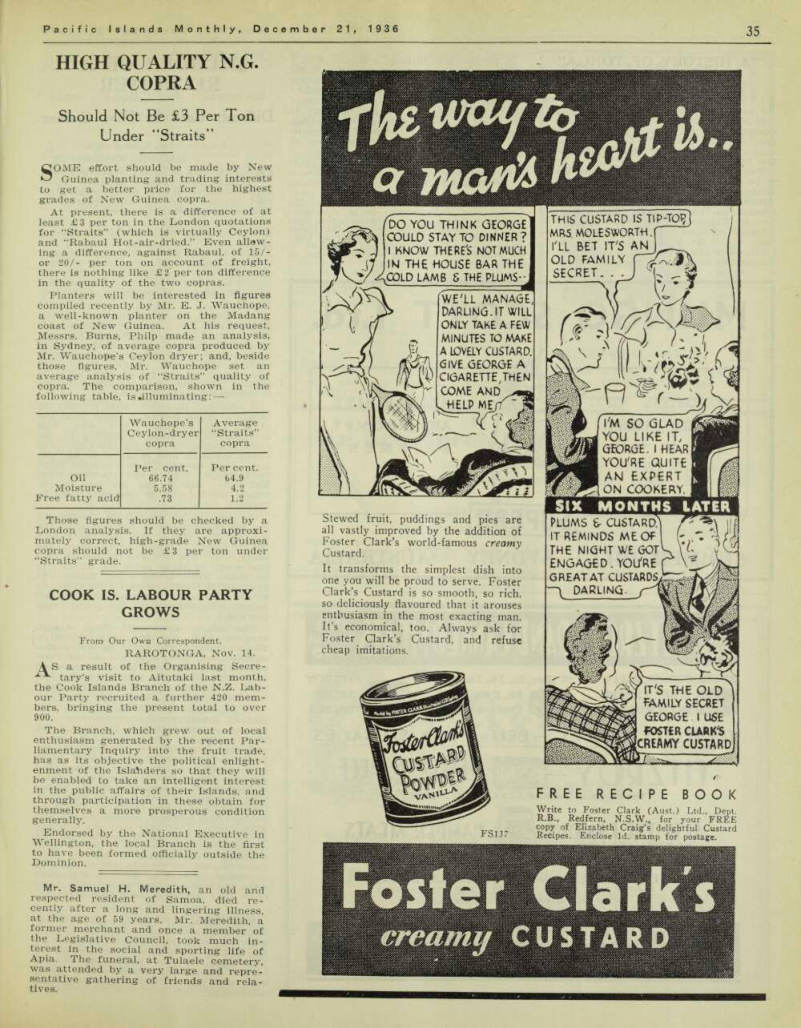
Copra
Should Not Be £3 Per Ton Under “Straits”
SOME effort should be made by New Guinea planting and trading interests to get a better price for the highest grades of New Guinea copra.
At present, there is a difference of at least £3 per ton in the London quotations for “Straits” (which is virtually Ceylon) and “Rabaul Hot-air-dried.” Even allow ing a difference, against Rabaul, of 15/or 20/- per ton on account of freight, there is nothing like £2 per ton difference in the quality of the two copras.
Planters will be interested in figures compiled recently by Mr. E. J. Wauchope, a well-known planter on the Madang coast of New Guinea. At his request, Messrs. Burns, Philp made an analysis, in Sydney, of average copra produced by Mr. Wauchope’s Ceylon dryer; and, beside those figures, Mr. Wauchope set an average analysis of “Straits” quality of copra. The comparison, shown in the following table, is .illuminating:
Those figures should be checked by a London analysis. If they are approxi mately correct, high-grade New Guinea copra should not be £3 per ton under “Straits” grade.
Wauchope's Ceylon-dryer copra Average “Straits” copra Per cent.
Per cent.
Oil 66.74 64.9 Moisture 5.58 4.2 Free fatty acid .73 1.2
Cook Is. Labour Party
Grows
From Our Own Correspondent.
Rarotonga, Nov. 14.
A S a result of the Organising Secre tary’s visit to Aitutaki last month, the Cook Islands Branch of the N.Z. Lab our Party recruited a further 420 mem bers, bringing the present total to over 900.
The Branch, which grew out of local enthusiasm generated by the recent Par liamentary Inquiry into the fruit trade, has as its objective the political enlight enment of the IslaViders so that they will be enabled to take an intelligent interest in the public affairs of their Islands, and through participation in these obtain for themselves a more prosperous condition generally.
Endorsed by the National Executive in Wellington, the local Branch is the first to have been formed officially outside the Dominion.
Mr. Samuel H. Meredith, an old and respected resident of Samoa, died re cently after a long and lingering illness, at the age of 59 years. Mr. Meredith, a former merchant and once a member of the Legislative Council, took much in terest in the social and sporting life of Apia. The funeral, at Tulaele cemetery, was attended by a very large and repre sentative gathering of friends and rela tives.
Advertisements & other items, p. 37 (1 item)
q matte h
\h..
DO YOU THINK GEORGE
COULD STAY TO DINNER?
I KNOW THERE'S NOT MUCH
IN THE HOUSE BAR THE
S THE PLUMS-•
l
WE'LL MANAGE,
DARLING.IT WILL
ONLY TAKE A FEW
MINUTES TO MAKE
A IDVaY CUSTARD.
GIVE GEORGE A
CK3ARETTEJHEN
COME AND
HELP MEj
im HV;
rag
u Stewed fruit, puddings and pies are all vastly improved by the addition of Foster Clark’s world-famous creamy Custard.
It transforms the simplest dish into one you will be proud to serve. Foster Clark’s Custard is so smooth, so rich, so deliciously flavoured that it arouses enthusiasm in the most exacting man.
It’s economical, too. Always ask for Foster Clark’s Custard, and refuse cheap imitations.
VAN'
THIS CUSTARD IS TIP-TOlfj
MRS MOLESWORTH.)
I'LL BET IT'S AN
OLD FAMILY
SECRET.
' ' r V>" c
l Yc
m s %
'M SO GLAD
YOU LIKE IT;
GEORGE. I HEAR
YOU'RE QUITE
AN EXPERT
ON COOKERY.
SIX MONTHS LATER
PLUMS & CUSTARD.
IT REMINDS ME Of
THE NIGHT WE GOT
ENGAGED. YOU'RE
GREAT AT CUSTARDS
DARLING-
r w U i j m 3.
FSI37
S THE OLD
FAMILY SECRET
GEORGE I USE
FOSTER CLARK'S
CREAMY CUSTARD
FREE RECIPE BOOK
Write to Foster Clark (Aust.) Ltd., Dept.
R. 8., Redfern, N.S.W., for your FREE copy of Elizabeth Craig’s delightful Custard Recipes. Enclose Id. stamp for postage.
creamy CUSTARD
“A History Of Tonga”
Letter to the Editor UNDER separate cover I am posting you a copy of “A History of Tonga,” which purports to be translated from a compilation by the Bishop, which appeared in Taumua Lelei, the local organ of the Catholic Church, of which the Bishop is editor.
This excellent brochure does not claim to be a translation of the whole of Bishop Blanc’s contribution to the Taumua Lelei, which is really a history of the Catholic Church, in Tonga, and is, of course, writ ten in Tongan. It is a translation of selected portions of Bishop Blanc’s writ ings, which Mr. C. S. Ramsay, the trans lator, quite justly thought would prove of interest to the general reader.
A perusal will interest you, and will, I think, confirm my opinion that Mr, Ram say has exercised a wise discrimination in his selection, and displayed consider able literary ability in his excellent trans lation. This (again in my opinion) is deserving a more generous appreciation than is accorded by the good Bishop, in his reply, as published in your issue of September.
I am, etc.,
A. Cowley.
Nukualofa,
Tonga, 4/11/36.
EDITORIAL NOTE: The brochure, as Mr.
Cowley says, really appears to be a valuable compilation, and it is very unfortunate that there was any misunderstanding between the Bishop and Mr. Ramsay. The early section of the book, which deals with the origin and migrations of the Polynesian race, leading to the settlement of Tonga, is especially interesting.
Recruiter
Murder Of A
Difficult Case In New Guinea
From Our Own Correspondent RABAUL, November 20.
ON November 9, in the Supreme Court, before Chief Judge Wanliss, there appeared three natives of the Sepik dis trict charged with the wilful murder of Charles Albert Gough, a recruiter.
Mr. I. Shoobridge, of the Crown Law Office, outlining the case for the Crown, stated that the murder occurred on August 31, 1936, at the village of Leihinga, which is about three days’ walk in from Matapau, on the Aitape coast. The vil lage was situated in officially controlled area, although no Government official had visited it.
On August 30, Mr. Gough met A.D.O.
McCarthy in the village of Ilauhup and, while there, the A.D.O. warned him not to venture further south, as the natives were hostile. The official also noticed a medical tultul with Gough’s party, and told Gough to get rid of him, as it is against the law for recruiters to be accompanied by native It appeared that this tultul brought to Gough a young recruit, a youth from the village of Leihinga, and who was desirous of recruiting, according to the tultuVs statement. During the night, the youth departed and returned to his vil lage. Next morning, Gough decided to go to Leihinga, despite the warning from McCarthy; and during the trip to the village the beatings of qaramuts could be heard.
On arriving at the village, Gough put out his trade goods in the middle of the square. The village was deserted, except for a native, Ambod, who offered the party food. But this was refused, as it is customary in these parts for attacks to be made while enemies are eating and unprepared. Gough called for the runaway youth .who came, accompanied by his father, who objected to the youth being recruited.
The attack commenced, then. Gough fired two shots but they were ineffective.
The members of the party became panic stricken, and fled, although ten of them were armed. One boy, however, remained and endeavoured to assist Gough; but, after Gough was speared three times, and was killed, the boy ran away.
In summing up His Honour said the tragedy never should have occurred, and pointed out that Gough disregarded the warning given to him by A.D.O. McCarthy and also persisted in following up the young recruit whom the medical tultul had brought to him. -The accused had done the only thing they knew of in order to keep the youth, and to show the white man they wanted nothing to do with him; they had resisted him by force. The three accused had, however, broken the law and were guilty. There was only one sentence to be given for wilful murder and he recorded the death sentence; but he made a strong recommendation that the sen tence should be commuted to one of imprisonment—not so much as a punish ment to these men, but to let the natives know they cannot commit such crimes.
Miss E. L. Cheesman, who recently completed 10 months’ entomological field work in Dutch New Guinea, returned to England by the Orontes from Sydney on November 21. She has made several natural history expeditions to the South Seas and has written many books on entomology.
Advertisements & other items, p. 38 (1 item)
advt
FIRST
IN 1868
SPICED, CORNED. ROAST
ff BOILED BEEF
AND IN MUTTON
IN 12or, 11b., 2 lb.. 3.1 b. 4 lb. slb.£* 64b ROUND
CANS AND IN TAPEB3
FITZROY
SHEEP
TONGUES
CORNED OX TONGUES - BEEF & PORK SAUSAGES
FITZROY
I TMI ORICINau PACK IN A CLASS BY ITSELF /
ALSO THE LAMOUS
AV ROUND AND TAPER CANS
€ • Q
HAMPER MEATS
/ZOZ 2+OZ.6GLBS
CO. urn DS(LAND TRADE MIEATTS
M* IE
BERSERKER &WSM OX-PALM BRANDS
/N MVSRY HZ£ AfZOAA HOZ TO 6LS CAA/S
NO tXTR.ft CHAR.OE fOR. ASSORTMENT
PACKED CASES <DR CA(R.TTONS - SEND IFOR PRJCE IB ST .74 CENTRAL QUEENSLAND MEAT EXPORT CO. LTD.
LAKES CREEK - ROCKHAMPTON
CABLE ADDRESS;- TOMOAHA ROCKHAMPTON.
An Impudent Fraud
How “Lord” Hill Governed Pitcairn Is.
AN entertaining incident —though not to those who experienced it —seems to be entirely overlooked by those who write upon the theme of the Bounty mutineers.
Pitcairn’s Island had seen riotous times when Christian and his band first occupied the lonely spot. Now, all was peace and order.
Adams, the last of the wild crew, had reformed himself and had brought up his own kin and those of the others in strictest fashion. Above all, he had instilled into the little community of 87 souls the su preme duty of obedience to authority, which he himself had so outrageously flouted in his younger days. His ardent love of the Old Country he also transmit ted to the half-caste descendants of British sailors and Tahitian women. To them, England was Home, its King theirs, its men-o’-war their joy to see and welcome, even as he had learned no longer to fear their coming.
Adams died in 1829. Before he passed away, three outsiders had been added to the population. First, Buffett and Evans, sailormen each. A ship’s captain allowed Buffett to land whilst Evans hid himself till the coast was clear. Buffett became the school teacher —for Adams, the son of a Thames lighterman, had had but the scantiest of education.
Then there came Nobbs, an Irishman, of far superior attainments, who had served in the Royal Navy, fought under Lord Cochrane for the Chilean patriots, and roamed the Seven Seas; drawn to Pit cairn by its isolation, and his big heart to lend a helping hand if such was needed.
It was—and for five and fifty years he lived and served amongst them.
THHEIR bounden duty to obey Authority twice cost these islanders dear.
Captain Beechey, of H.M.S. Blossom in 1825 had represented Home that the island was overcrowded and in 1831 an order was brought to the community by the captain of H.M.S. Comet , that he had come to transport them, goods and all, to Tahiti by the Lucy Ann, which followed hard upon the. warship. They had no wish to go; they were content; the island was their home. But an order was an order; they could not refuse to obey. Therefore, with out any heart in the matter, they went.
In one month, they had had enough.
The morals of the Tahitians were not theirs, though they had come from that stock. Their young men got out of hand by the wild license of the place, and their , young women were sore tempted to rebel.
Death struck down a dozen by a fever un known to them, and others were dying.
Buffett and others fled, hiring a small schooner. The rest found sympathy in the British Consul, who saw his Government’s mistake and chartered a brig, returning them. That readiness to obey cost 17 lives.
But there was still another test awaiting them, nor did they fail once again to carry out the teaching of their one time sole guide, guardian and friend.
THERE was one man upon Tahiti who had watched the above proceedings and saw his opportunity. Joshua Hill was a man close on 70 years, when he followed up the return of the exiled by himself landing on Pitcairn. Then things hap pened.
He gave himself out to a nobleman from
Home, sent out by the Government to take over the' “Governorship” of the island and that the British Fleet on the Pacific Sta tion had been placed at his command.
The simple islanders were overawed by these high claims. But Nobbs, Buffett and Evans who knew the outside world, made light of his pretensions.
Then “Lord” Hill declared war to the death against the three “foreigners,” as he called them. Despite warnings by the three of the imposture being practised, the fear that in opposing “Lord” Hill they might be defying the Motherland forced them to submit, and they obeyed, though most reluctantly, his various orders.
In one matter, and one only, did the elders have cause for gratitude to the grey haired “nobleman.” Some of the younger men, through the looseness of life they had seen on Tahiti, had determined to make a concoction of fierce spiritous liquor from the root of the Ti, as they had seen done there. This action was stoutly op posed by Nobbs, but he was told to mind his own business.
The noble “Lord,” upon his arrival, quickly settled the matter. He smashed their stills, and everything connected with the business, and threatened heavy pen alties if the craze for strong drink did not at once abate. He formed the whole com munity into a Temperance Society and coconut milk and mountain water were once again the drink of all the Pitcairners.
Nobbs was dismissed as schoolmaster and Hill took his place. In the heyday of his power, he sought to win the people from the Church of England to Methodism, but on this they stood firm.
But in all else, for five years, they blindly followed him, since to them he represented Authority. No vessel that could contradict his claims called to re lieve the situation. He gave out that he had written to the British Consul at Val
paraiso to get the Admiral on the Pacific Station to call and remove “the three for eigners.” If he did, along with it went other letters.
Nobbs wrote that the man had ordered “the three foreigners” and their families to be turned out of their houses. Their muskets were taken from them by order of the “Governor of the Commonwealth” and, fully loaded, were kept in Hill’s own bedroom for the use of the “Magistracy”
of the Island, Every Sunday he had a loaded musket placed near him in church, to awe the congregation. When protests were humbly raised on any matter he threatened to have a Military Assistant Governor send him with a squad of sol diers to put them in subjection. ¥N every possible way he made the place too hot for the “three foreigners,” and they were glad to escape to Tahiti on a passing vessel. From thence, Buffet wrote to the Admiral giving further information.
But help w T as long in coming. Mean while, “My Lord” had appointed two “Privy Councillors,” made laws, built a prison and had a Riot Act in readiness.
Buffet, before his escape, had a taste ef the real thing. He had decided to take his wife and children with him. This reached Hill’s ears. Buffet was brought to trial, the “Lord” being Judge, Jury, and execu tioner. He was flogged, beaten over the head, a finger broken, and was suspended from a rafter in the meeting house by his unbroken hand and when the assembled women cried “Shame!” the “Lord” read his Riot Act and declared that he would be fully justified in shooting them.
Buffet’s sentence, as taken from the Island Register , kept since Adams’ day, reads as follows: Pitcairn Island, sth August, 1833.
“It only remains with Us to declare the sentence of the Law, which is, and the Court doth accordingly adjudge: that you receive forthwith three dozen lashes with a cat upon the bare back and breech, together with a fine of three barrels of yam or potatoes to be paid within one month: or in default an extra barrel will be required for this reiterated contempt of Court.”
Hill had also enacted a law of high trea son, and when Evans humbly requested a copy as a guide to his future conduct, he was haled to Court where His Lordship tried the case and administered the lash.
Those were high days for Hill, the island ers submissive as sheep. Had noi Eng land sent him?
"OUT the end was now not far off. Nobtas and Evans went to the Gambier Islands, but Buffet kept close at Papeete.
He also kept after the Admiral.
In 1836, H.M.B. Actaeon called at Pit cairn, Lord Edward Russell in command.
Hill had unfortunately given out that he was a near relative of the Duke of Bed ford, the father of the Commander. The impostor was unmasked, Russell reported to his Admiral, who promptly sent H.M.S. Imogen, which se cured the fraudulent rascal and carried him off to Valparaiso. Neither his past nor his fate were ever known.
The “three foreigners” returned by the schooners Olive Branch and Olivia. Peace ruled once more. Obedience to Authority had cost them dear.
In a letter written a while later by the community to friends outside, Hill is let gently down. Those patient souls describe him as “a partially deranged impostor.”
W.W.B.
Pastor A. Saaga, a well-known Samoan who has been working as a missionary in the Group for 43 years, has announced his retirement from active service with the London Missionary Society. His long connection with the Samoan Church has earned him high praise as a devoted worker and the withdrawal of his mis sionary activities will be a great loss to the Samoan peonle. Henceforth Saaga will live on his own piece of land where a house will be erected from the funds which the L.M.S. have granted in recog nition of his veteran service.
Advertisements & other items, pp. 39-40 (1 item)
Kork-N-Seal
FOR HOME USE
FOR ALL HOME BOTTLING
—THE LITTLE CAP THAT
will Re-seal 1,000 Times
KORK-N-SEAL (Aust.) LTD.
106 COMMONWEALTH STREET
SYDNEY, AUSTRALIA
* Applied Airtight Pressure Proof Hand
We are
\ ’Phones: MA 3612 (4 lines) Cable Address: “Weymarkson”
Codes—Bentleys Private
Specialists...
Let us have your confidence. Sixty years is our record of supplying the leading Houses throughout the World in ... .
FRESH FRUIT, VEGETABLES, PRODUCE
WEYMARK & SON LTD.
FRUIT AND PRODUCE MERCHANTS
14-18 STEAMMILL STREET SYDNEY
A
H.PEEL&SONS
F l/’H
||MPORTER/
& EXPORTERS
QUOTES
SENT
ANYWHERE
Phoneai MW 160« FX 5011 Purveyors of Scotch, Canadian, N.Z. and Australian
Fresh and Smoked Fish
SHIPPING
PROVEDORES
239 HARRIS ST., PYRMONT
SYDNEY, New South Wales
PRODUCING UNIFORM GOOD RESULTS SINCE 1868
ALWAYS ASK FOR IT
Australia's Choicest Products: Brussels Sprout* White Turnip* Sweet Corn Tomato Puree Tomato Sauce Tomato Soup Tutti Fruit Sauce (Worcestershire flavor) Green Peas French Beans Cauliflower Beetroot Spinach Cahhage Carrots Parsnips Celery s-; en E ft
GARDEN VALE
manufactured
BY I
N PRODUCTS LIHIT-ED
'2-4 BROWN STR-E-ET, N-EWTOWN
k SYDN-EY. .AUSTRALIA
Always,.
make sure you have at hand an ample Reserve of these Delicious , .
Garden
Vale
Ready-to-
serve Vegetables
To Fiji
How Von Luckner Came
Rev. C. W. Whonsbon - Aston, now a resident of Eastern Papua, and formerly vicar of Levuka, Fiji, writes interestingly of the Von Luckner letter, now preserved in the Ovalau Club, at Levuka, as a memento of the brave and gallant German. A photograph of the letter was pub lished in our October issue.
THE October P.I.M/s reference to the von Luckner relic in the Ovalau Club misses, through an error in typescript, the writer’s little display of humour. The signature is not “W”, but “M. Pember ton.”
T. O. U. Stockwell is a fine, big Yorß shireman, who went to the Lau Archi pelago after some time in the U.S.A. He owns the island of Katafaga, which is the easternmost islet of the Lau Archi pelago, previously owned, I believe, by a German.
He tells the story that he had just left, in the very early morning, in his boat, to run over to Lomaloma, on Vanua Moalavu —the main centre —when a launch arrived through the entrance to the lagoon. The launch party landed and made free use of his house, beds, sheets and produce.
The launch party—which, of course, comprised Count von Luckner and his men, who had come all the way across from the Paumotus, where the See Adler had been wrecked—left Katafaga next day. Von Luckner intended to go to Levuka and there capture a vessel, by which he might take assistance back to his crew and prisoners, left behind in the Paumotus.
It says something for his spirit that von Luckner could “crack a joke” in this letter which he left on Katafaga. He and his men-had come through much buffet ing in their epic voyage in a small boat, over a wide stretch of ocean.
But von Luckner never reached Levuka.
His next island call was to th.e island of his fate —Wakaya, which he reached just as a terrific S.E. trade gale broke, and several vessels were sheltering there.
Two of those vessels are of note in the
incident. One was .a new twin-engined schooner (I think, named Eleanor B ) owned by a well-known figure in Fiji, Henry Palmer; the other, a cutter cap tained by a half-caste named MacPherson, who is still about Levuka. The former boat took von Luckner’s eye as a likely vessel for his purpose.
But MacPherson was shrewd and sus picious. The von Luckner party said they were Norwegians, but MacPherson some how fancied they were not genuine. He had heard that a part of the enemy were being sought for. He and his boat’s crew, in the teeth of a raging gale, put out for Levuka, and got through and gave the alarm.
The police inspector at Levuka, with native police, tried to go out in a cutter, but were driven back by the gale. The inter-island steamer Amrah most luckily came in, and took the police across to Wakaya,, only eight miles away. That was the end of von Luckner’s adventure.
Count von Luckner stands high in the estimation of most Fijian residents; though some aver that it was a pity that Lowell Thomas wrote The Sea Devil, for they seem to have seen some incidents from another angle.
EDITORIAL NOTE: Press cables from Ger many, in November, announced that Count Felix von Luckner had just built a new vessel named the Seeteufel (Sea Devil) from the proceeds of his books and lectures. In his new yacht, he pro poses to make a lengthy cruise, and probably he will visit some of the scenes of his South Sea exploits.
Mr. Pat Costello, of Suva, Fiji, recently underwent an operation at the Mater Hospital in Auckland, New Zealand. “Sir Garrick Robertson made a good job of me,” says Mr. Costello, in a cheery letter to the editor—and then, as always, he turns his attention to the economic future of the Colony. “I am of opinion that 75 per cent, of Fiji’s exports eventually will com© from the dry zone between Penang and Sigatoka,” he writes. “You can count on thousands of tons of raw sugar, bars of gold, and thousands of cases of pineapples. We are in for a period of prosperity.”
Advertisements & other items, pp. 41-42 (1 item)
Burns Philp
HOLBROOKS*
TABLE
DELICACIES
WORCESTER SHIRE
SAUCE —Enjoys a worldwide reputation.
VAT 2 SAUCE —A delicious thick, fruity sauce.
VINEGAR Strong, well matured, and guaranteed Pure Malt.
ESSENCE OF ANCHOVIES
—A fish sauce made from the finest Gorgona Anchovies.
TOMATO SAUCE Made
from fresh, ripe tomatoes.
FRENCH CAPERS —Capu-
cines and Capottes.
SPANISH OLIVES
Varieties: Spanish Queens, Small Queens, Manzanillas and Stuffed or Sliced ready for Sandwiches.
PURE OLIVE OlL— French or Italian. From the first pressings of selected Olives.
PICKLES
Varieties: Sweet Gherkins, Tiny White Onions, Walnuts, Piccalilli, Mixed and Green Tomato.
FISH AND MEAT PASTES,
in 1 and 3oz. glass jars.
Varieties: Anchovy, Salmon, Ham and Tongue, Veal and Tongue, Chicken and Ham, Turkey and Tongue, Salmon and Shrimp, Bloater SOUPS, in Boz., 160 z., \ gal. and 1 gal. tins.
Varieties: Vegetable, Ox Tail, Mulligatawny, Mock Turtle, Tomato.
JELLY CRYSTALS Speci-
ally prepared for warm climates.
They set well, and are deliciously flavoured.
HEALTH SALINE—A re-
freshing health-giving beverage, suitable for hot climates, in £lb. and 1 lb. tins.
HOLBROOKS
(Australasia) Ltd.
WATERLOO, N.S.W.
BURNS PHILP
(SOUTH SEA) CO. LTD.
Island Traders and Shipowners Registered Office:
SUVA
FIJI
Also branches at: Fiji: Levuka, Lautoka, Labasa, Ba ; Sigatoka, Rotuma. \ Tonga: Nukualofa, Haapai, Vavau.
Samoa: Apia, Pago Pago (American Samoa).
Solomons: Makambo, Gizo, Faisi.
New Hebrides: Vila, code Address? Gilberts: Tarawa.
"Bumsouth. Norfolk Is. Niue. Wallis Is. Futuna Is.
:--lV u W
S A FE
in the hottest
WEATHER
f*
EVAPORATED
BR '&* 'KS2 *<N TrU.Mark
°>fI s WEETEN^ p
“Ideal” Milk is the purest, richest country milk con* centrated to almost the consistency of cream. No sugar is added . . . only water is taken from it. It is the safest milk for every purpose—the sealed container prevents any possibility of contamination while unopened. Use “Ideal” Milk for your cooking and notice the improvement.
Use it on your sweets or cereals—it’s just like cream. 99
Evaporated Unsweetened
MILK
A NESTIi’S PRODUCT
Mourning
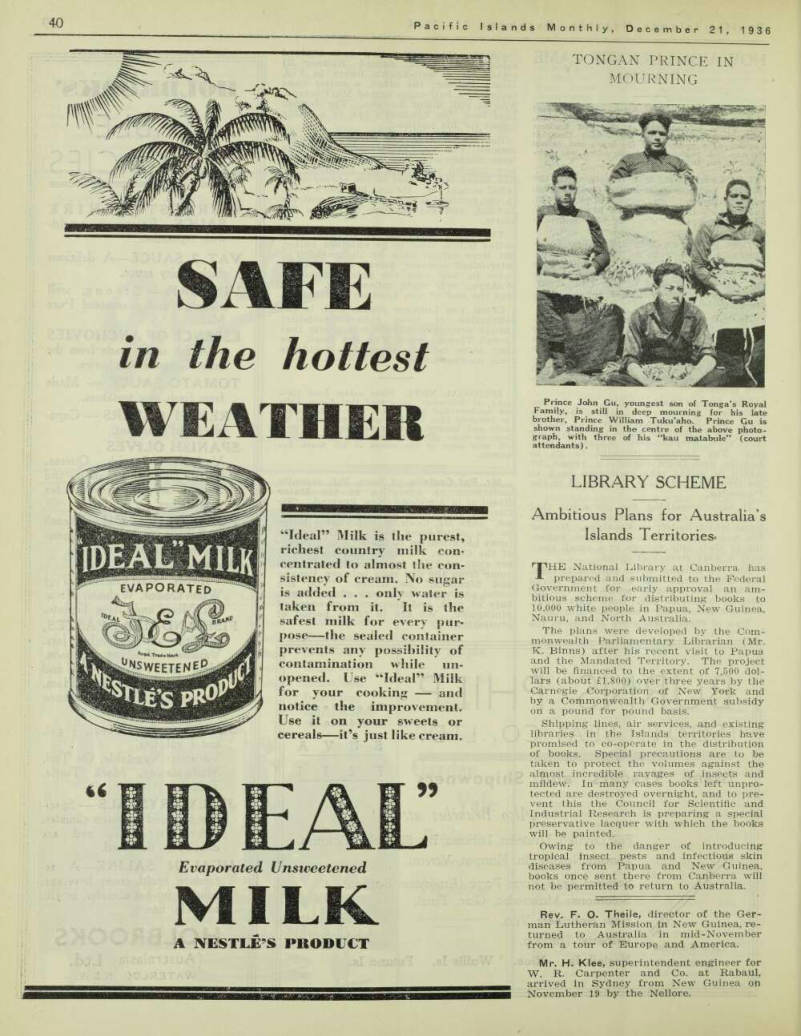
Tongan Prince In
Prince John Gu, youngest son of Tonga’s Royal Family, is still in deep mourning for his late brother, Prince William Tuku’aho. Prince Gu is shown standing in the centre of the above photo graph, with three of his “kau matabule” (court attendants).
Library Scheme
Ambitious Plans for Australia’s Islands Territories
National Library at Canberra has -*■ prepared and submitted to the Federal Government for early approval an am bitious scheme for distributing books to 10,000 white people in Papua, New Guinea, Nauru, and North Australia.
The plans were developed by the Com monwealth Parliamentary Librarian (Mr.
K. Binns) after his recent visit to Papua and the Mandated Territory. The project will be financed to the extent of 7,500 dol lars (about £1,800) over three years by the Carnegie Corporation of New York and by a Commonwealth Government subsidy on a pound for pound basis.
Shipping lines, air services, and existing libraries in the Islands territories have promised to co-operate in the distribution of books. Special precautions are to be taken to protect the volumes against the almost incredible ravages of insects and mildew. In many cases books left unpro tected are destroyed overnight, and to pre vent this the Council for Scientific and Industrial Research is preparing a special preservative lacquer with which the books will be painted.
Owing to the danger of introducing tropical insect pests and infectious skin diseases from Papua and New Guinea, books once sent there from Canberra will not be permitted to return to Australia.
Rev. F. O. Theile, director of the Ger man Lutheran Mission in New Guinea, re turned to Australia in mid-November from a tour of Europe and America.
Mr. H. Klee, superintendent engineer for W. R. Carpenter and Co. at Rabaul, arrived in Sydney from New Guinea on November 19 by the Nellore.
The “Two Miles’ Limit”
Zoned Trading System Is Subject of Lively Argument in T.N.G.
By R. W. Robson
VERY uncertain and therefore unsatisfactory position exists in New Guinea in relation to what is called the “two miles’ trading limit”; and, unless a solution is found satisfactory to the four main interests concerned—the European planters, the native growers, the principal traders and the Administration—there will be repercussions far beyond the borders of the Territory.
Conferences between the Administration and the interests concerned have been held since the Administrator returned to Rabaul in mid-November.
OUT of New Guinea there come two classes of copra—plantation-produced and native-grown. There are huge areas of native land carrying coconuts, and the Administration’s policy is to encourage natives to cultivate the palms and produce copra.
Native copra is disposed of in various ways: but the chief channel—and the kernel of the difficulty under discussion—is the native trade store. Here, the native receives cash for any dried copra, green copra or coconuts which he may bring in, and is supplied as required with the various manufactured goods and foodstuffs which he requires. Traders are licensed to (a) sell merchandise, (b) buy c °P^ a ; . .
At the beginning of the Australian Administration, the policy was followed of leasing the established trading stations to the Chinese: but this led to serious trouble. Copra values were high in 1922- 23, and the traders were eagerlv seeking every available pound of the commodity Before long it was found that natives were regularly, and on an increasing scale, stealing nuts and green copra from the Europeans’ plantations and selling them to the traders.
The position was aggravated bv the Administration’s policy of granting annual trading licenses on a wholesale system Annual licenses are distinct from licenses to trade at old-established stations, which usually are on freehold or long-leasehold land near European plantations or large
villages, and which mostly are in charge of responsible men. Cut-throat competi tion developed between annual licensees and old-established traders; ridiculous prices were paid for native copra; the natives themselves were seriously dis turbed in their usual good relations with Europeans: and thefts from plantations became rampant. Figures showed that plantation production generally was shrinking, while the copra sold by certain traders as native grown was increasing.
There was no doubt about what was hap pening.
In 1923, in protection of the Expropria tion Board’s properties, the authorities took action. It was decided that no addi tional trading licenses be granted, to ope rate within two miles of the borders of a plantation.
About this time the plantations were sold by the Expropriation Board to indi vidual planters, mainly returned soldiers; and, in the great majority of cases, the established trade stores contiguous to the plantations, instead of being leased to Chinese, were also sold to these planters.
Thus they not only grew their own copra, but they also make a small regular profit from their trade in native-grown copra from the surrounding districts. These trade-stores became a recognised part of the planting industry in New Guinea.
These new conditions stopped a good deal of the trouble. As the annual licenses expired they were renewed, but
under strict competition; trading was partly influenced by the established stores; and the position, while still having undesirable features, was stabilised.
• Case For And Against
THEN arose the cry against the system which has continued ever since, and which is the Administration’s main em barrassment. It was said that the system
of restricted trading stations creates a monopoly, with the result that the natives are exploited, especially in regard to the purchase of their copra.
The planters, on the other hand, directed attention to many evils which had their origin in the continued exist ence, right on their boundaries, of the small traders with annual licenses.
Defendants of the Administration’s policy say that there is no doubt that certain unscrupulous planters who held trading licenses did “make it a welter”: with the result that they brought discredit upon the system, and grave troubles upon the other planters, who were acting de cently and honourably by the natives.
In 1927 the Administrator decided to abolish the two miles limit. That deci sion caused great alarm among planters, who foresaw the return of the 1923 con ditions. They appealed to the Minister at Canberra (Mr. C. W. C. Marr), and the latter decided that the two miles limit should remain.
Deciding Upon A Policy
THE matter still was under argument when General T. Griffiths became Ad ministrator in 1932. He, early in 1933, appointed a Board of Inquiry to make recommendations to “govern the future Administration policy regarding the sys tem of native trading.” The Board, in May, reported in favour of “zone trading” (practically the two miles limit).
There were protests. The Administra tor appointed another committee, in Sep tember, 1933, to go over the evidence, arguments, and recommendations of the Board and report. The committee con curred generally with the Board. The recommendations included the abolition of all annual licenses within the two miles limit —they were not to be renewed.
Those recommendations were considered by the Administrator’s Advisory Council and accepted: and they became the basis of the existing Trading Regulations.
They, naturally, were accepted by the New Guinea public as “the future Ad ministration policy”; they formed the basis of contracts; and plantation and trade-store conditions *were rearranged accordingly. Traders were confident that the zoning system had come to stay.
A Bombshell
T ’’HE new Administrator (General W. R.
McNicoll) threw a bombshell early in 1936 when he announced that the Griffiths policy and regulations would be aban doned. the zone trading system abolished, and that there would be substituted there for what has been described as a “hap hazard roving pedlars’ system.”
The announcement caused great con sternation among the planters and the commercial firms, who are convinced that if the Administrator is given his way the planting industry will be partly disrupted and fundamental values very seriously disturbed. Urgent appeals to the Ad ministrator and to Canberra have resulted in the zoning system being allowed to continue for the present: but the planters are anxious and weary—and, incidentally, they are showing considerable antagonism to the Administrator who, they say, neither understands nor sympathises with their conditions.
There have been discussions in Can berra, and conferences have been taking place in Rabaul.
The Administrator’S Problem
THE outsider can understand something of what is influencing the mind of the Administrator. He believes that, in cer tain localities, the native copra-producers
have been heartlessly exploited by the European planter-traders; and, as is well known, General McNicoll is extra ordinarily sensitive on the matter of his responsibility for the protection of the native races in New Guinea, In that respect I found in New Guinea a growing conviction that this Adminis trator is giving too much attention to the natives, and too little to his equal respon sibility for the proper development of the Territory’s resources —a belief, in fact, that one is being sacrificed to the other.
The better class of planters say that the Administrator is very honestly trying to do the right thing, but that he is not suffi ciently assisted in policy matters by cer tain departmental heads in Rabaul, who have .very little real understanding of planting and trading conditions, and whose sympathies certainly are not with the non-official Europeans who are try ing to do a job of work in New Guinea.
They say, in other words, that the Ad ministrator is too readily influenced by departmental heads, and that he should insist, as General Griffiths did, on his own good judgment having precedence.
The Planters’ Proposals
THE New Guinea planters frankly have admitted that there have been evils in the zoning system. But they are ask ing that, instead of abolishing the sys tem, the Administrator should protect existing interests—that is, the funda mental planting interests—by exercising a stricter control over trading licenses.
They insist, as practical men, that it would be quite easy to fix a fair price for native copra, and to police the opera tion of the licenses. The planters, I understand, are urging the introduction of a system under which it would become a punishable offence to overcharge or under pay a native, in defiance of schedules which the Administration would prepare.
Reason seems to be on their side.
The zoning system is a common one, which operates satisfactorily in a number of industries. Many years ago Sydney newspaper managers were driven to dis traction by the conditions existing among newsagents’ shops—irregular deliveries and service, no control over the character of agents, recurring losses owing to men getting credit and running away. So the managers got together, divided the city into blocks, and gave one block each to selected men. The system is strictly policed by a committee of newspaper managers, and by the Newsagents’ Asso ciation. Improper service to the public on the one hand, and unsatisfactory ac counts on the other, are promptly re ported to the two committees and, if proved, result in the cancellation of the license, or “block.” Why could such a system not be operated in New Guinea, to control native trading, and for the pro tection of native producers?
Australia’S Interests
THE alternative is not pleasant to con template. If the zoning system goes, and the parts of the Territory now en joying protection are over-run by small fiercely-competitive Chinese traders, it is inevitable that European trade will suffer severely.
The Chinese will most certainly intro duce more goods of Asiatic origin, and Australian trade will suffer accordingly.
If the Administration does not already appreciate the fact, Canberra should re mind Rabaul that it is Rabaul’s duty to assist Australian trade in every way Some recent incidents suggest that Rabaul is so concerned with keeping one eye on the natives, and the other on the comic opera in Geneva, that it has no time to study developmental needs and Aus tralian commercial interests. If that really is so, Rabaul is due—and properly so—for an early and rude awakening.
A Real Danger
THE most serious effect, however, will be social, and will be seen in the native villages near plantations.
Copra is valuable again. The small, irresponsible traders will encourage the natives to bring in copra and nuts. The European plantations certainly will be raided. The planters, naturally, will pro tect their interests; and this fact, and the bitter trade competition, will cause un pleasant “incidents.”
The majority of planters maintain good, friendly relations with contiguous villages —they make themselves responsible for the welfare of the natives —and those re lations will be destroyed. This is not imagination—it happened before, and it will happen again.
Surely the Administrator can devise a system by which he can obtain the good
will and co-operation of the planters in.
ofth? plantoTare^ilTreep^ns
very anxious to co-operate with the Ad ministration, rather than fight it.
Australians, for their part, may not ignore the Administrator’s difficulties. He has a huge, rich, half-explored Territory to open up, and a million natives—mostly primitives—to protect. He often has to deal with Europeans who think only in
terms of their pocket, and who, if allowed, would exploit and enslave the natives. He is nagged at by missionary bodies, who always are trying to influence the course of Government, for one reason and an other.
And, to cap the lot, he has on his hands a community of Chinese, who are increas ing at a disconcerting rate, and whose main ambition is to perch themselves on a kerosene case in a trade store some where, and spend the lazy days dickering with the natives.
Those Chinese are a real problem. It may be that actually they are at the root of the “two miles’ limit” trouble. Per haps the Administrator believes he can get rid of those Chinese youths, swarming in Rabaul, by giving them “an open go” in the trade store business.
The Chinese problem is so big that it needs an article to itself: but it is certain that it cannot be solved by allowing the Chinese to take charge of a great part of the Territory’s distributing industry, at the expense of the Australian traders and merchants.
Rev. N. W. Lowing, of Ilford, Essex, England, arrived in Sydney by the Jervis Bay on November 16, en route to Thurs day Island to engage in mission work.
Advertisements & other items, pp. 43-46 (1 item)
Angus &Coote
Mail Order Specialists
Will Pack and Send Your Gifts Anywhere Post Free and Guarantee
Safe Delivery.
• £l5 £l2/10/-, The Beautiful Ring above is available at either £l2/10/- or £l5/-/-, according to the size of the centre diamond. It is 18ct. white gold with platinum settings.
Two diamonds are mounted in each shoulder.
M % m m 21/- the Pair.
The very latest salt and pepper shakers are the tall ones illustrated above.
They are finest silver-plate, 5| inches tall, and hold a useful quantity.
POST
FREE
Heavy Crystal
Sugar Basin
and Milk Jug 11 6 the two
39/6. ENTREE DISH. 39/6
This Entree Dish is solid hard E.P.N.S., heavily silverplated. It is made by Angus & Coote. The lid is usable as an extra dish. m 90/-, A dainty 9ct. Gold Baguette Wrist Watch. complete with gold-filled mesh band. Lever movement is warranted to give 15 years’ service. Kept In order 12 months free. m a® o m 00 90/-. Gentleman’s Gold Wrist Watch, with luminous dial. Has 15-jewelled lever movement, which is warranted to wear 10 years, and is kept in order 12 months free.
Complete with smart, comfortable strap.
Many More Articles in the FREE CATALOGUE Send for a Copy.
ANGUS & COOTE
500 GEORGE STREET, SYDNEY
KAMBALA Church of England School for Cjirls Founded 1887. .
A Day and Boarding School for Girls Rose Bay,
SYDNEY, N.S.W.
Kindergarten to Leaving i Certificate Resident Qualified Sports Mistress Prospectus on application to the Principal, Kambala School, Tivoli Heights, Rose Bay, Sydney.
Principal: MISS F. HAWTHORNE, B.A. Matron: Miss L. WHITE, A.T.N.A.
PURE RICE
STARCH
Always ask for . . .
“CORAL” Brand
Manufactured by
AUSTRALIAN RICE LTD.
Sydney. N.S.W.
Produced in Australia by
1 STEEL BEDSTEADS
WIRE MATTRESSES
“MORNING GLORY” BEDDING
TUBULAR STEEL FURNITURE
“LISTER” HOSPITAL EQUIPMENT
SHIPS’ ALL METAL BERTHS
WE WILL GLADLY FORWARD OUR
COMPLETE SETS OF CATALOGUES
Newlands Brothers Ltd
RILEY STREET :: SYDNEY, N.S.W.
Australia’s Largest Manufacturers of Modern Sleeping Equipment .
Cable address: “Newlandbed,”
Sydney
• ISLAND SHIPPING
Freight, Forwarding and Customs Service. Import and Export.
B. R. WHEELER
17-19 Bridge St., SYDNEY Correspondence Invited. Tel.: B 5396
Master Sewing’
Machine Co.
Established for 23 Years Reconditioned
Sewing Machines
For Industrial and Household Use.
All Types for Sale, from £3 each.
Every Machine Guaranteed Mechanically Perfect.
We have the most complete range of Sewing Machines in New South Wales.
Repairs promptly attended to by Competent Mechanics.
No Delays. All Goods Carefully Packed.
Master Sewing Machine Co. 15 Erunore Rd., Newtown, Sydney
ALL TYPES FOR SALE
From £3 each.
Let us know your requirements. We will be pleased to quote by return mail.
Do You Know that the Famous . . .
YOUNGER
STOVES and
RANGES
made with extended Firebox specially for long Wood fuel, are Self-Setting and, provided sufficient Flue Piping is attached, can be used in almost any position?
The No. 7W "Younger” Ranger can now be supplied fitted with Legs, as per illustration.
Ask for quotation for this Range, also Illustrated Catalogue and Price List for both Single and Double Oven Stoves.
Younger Stoves are Widely Used Throughout the Pacific Islands.
G. FLETCHER & SON 50 Oxford Street, Sydney
O PLANTERS and TRADERS
William E. Reed
(Established 1913) Union House. 247 George St.. Sydney For all Island requirements.
Island produce sold.
Prices right. Enquiries welcomed.
One Wild Night In Wau
Tfugo Adolf Bernatzik Is A Re
nowned German anthropologist. He visited New Guinea in 1933, and he has written a book about it — Sudsee.
It is evident, in one chapter, “How gold-diggers live and die,” that the good man unfortunately reached the Bulolo Hotel, at Wau, one night when there were “doings,” and the mad-headed sec tion were on the rampage. It doesn’t happen very often: but the traveller who runs into one of those wild nights in Wau will never forget it.
We are indebted to Mrs. Mollie Lett, of Port Moresby, for the following transla tion: — • “There lay the Hotel, regarded by the initiated as the best ‘claim’ in New Guinea. I got a room there—or perhaps we had better say a place.
“For the whole hotel consisted of one large wooden shed, in which cardboard partitions a quarter of an inch thick had been erected. They had neither doors nor ceilings. In a few cases a boundary was marked by means of a much too narrow curtain.
“The partitions and walls were just too high to climb over with difficulty. But no one need take this trouble, because his neighbours’ bedroom was anyhow acces sible through the ‘doorway.’ In the rooms thus separated stood three or four plank beds. The hotel guest must not expect anything better.
“A larger room served for meals, and a second as a bar. Here, behind a table, were piled up all those precious things with which gold prospectors love to poison themselves.”
It appears that Mr. Hugo BernatziK, feeling tired, attempted to go to sleep very early, at 8.30, but midnight found
him disturbed by various “guests,” drun kenly disputing the possession of his bed.
The half drunken hubbub coming from the raw throats of gold diggers made sleep impossible. An appalling uproar and the sound of smashing glass forced him to rise in exasperation, and witness a fight between two Italians, one of whom seized a beer glass and threw it at his opponent’s head. “The head won; only the ear got something to think about...”
“When it was all over, and the unfor tunate man’s ear had been sewn on, I crept back to bed. In the meantime, it must have turned 12, when a staggering figure wound his way through th'e door way and fell heavily on the edge of my bed.
“ ‘This is my bed, this is my bed,’ I heard him mumble, while a penetrating smell of alcohol went up my nose, “ ‘This is not your bed,’ I said in a friendly manner, ‘this is mine.’
“ ‘This is my bed,’ he repeated obstin ately.
“It is useless to get into a discussion with a man in this state, so I jumped up and said: ‘You’re right; that’s your bed,’ and pushed him on to one of the three vacant plank-beds that stood in my ‘room.’
“For 10 minutes or so he lay there, and I was just thinking that sleep had over come him, when the wretched man stood up, swaying, and mumbled, ‘That’s not my bed.’
“I got angry. I went for him, caught him by the arm and none too gently shoved him out of the doorway. The push was so vigorous that the man landed on the other side of the passage in the middle of the bar, where he was hailed with general acclamation.
“ ‘Well, he won’t come back,’ I thought, contentedly. But hardly had I got to sleep again when I was awakened once more. It was another fellow who had
confused his bed with mine. . . .
“The night’s adventures were not fin ished yet. At half past two the proprietor appeared with two completely unconscious customers, and proceeded to stow them away in the vacant beds in my ‘room.’
“One of them seemed convinced that he could find gold under the blankets, for he started grubbing with his arms like a crazy mole, and flinging the bedding about in the air. When he at last settled down, the other man started snoring in a hor rible manner.
“This woke my neighbour in the next ‘room.’ He took the disturbance in bad part, and expressed his displeasure by hammering on the wall so fiercely that it threatened to collapse.
“Then old ‘Goldrush,’ who had lain still for a while, began to belch loudly and emphatically. ' It sounded like the quack ing of a bull-frog. Then he was violently sick. He lay on his back and spewed like a fountain straight up into the air—a truly remarkable sight.
“When an opportunity offered, next day, of flying to Bulolo, I fled with joy.”
Advertisements & other items, p. 46 (1 item)
Deutz
DIESEL
ENGINES
Deutz Sngines used Internationally since 1864
MARINE DIESEL “OM” TYPE
M E Deux i -648i 2 >^^; Range from 10 to 140 B.H.P.
Full information obtainable from the Agent#
Herbert Del Cott Pty. Ltd.
15 CASTLEREAGH STREET, SYDNEY
'Phone: B 3135 ii
A. E. G.
» ELECTRICAL
EQUIPMENT
FREE ELECTRICITY !
with “A E G” Turbinamos
A "Turbinamo" working from a stream generates sufficient electricity for households, plantations or communities.
Simple to Instal Reliable Supply No Running Costs Looks After Itself m 1.
Sizes 0.5 kw. to 40 kw.
Write for particulars. State bead of water available and Electricity output required.
Cable* "Voltage" 116 QUEEN STREET, MELBOURNE 'Phone: Central 10488
Japanese Wings Over
Pacific
U.S.A. Suspicious of New Air Line to Carolines
IN United States navy circles misgivings are felt at the Japanese notice to the League of Nations of intention to open an air line from Japan to its mandated islands in the Pacific (Caroline and Marshall Groups).
The proposed route cuts thwart Pan- American Airways’ newly inaugurated trans-Pacific line. Therefore some believe the Japanese action may be a counter move to Pan-American Airways.
Japan’s declared plan to survey aerially deep-sea fishing possibilities also arouses misgivings, since it would bring Japanese fliers in the vicinity of Guam, which the United States may fortify when the non fortification clause of the Washington Treaty lapses.
The Japanese newspaper Nichd Nichi re ports that Admiral Kobayashi, the new Governor-General of Formosa, will tour the South Seas in the spring.
Palolo Rises
A Feast in Samoa
From Our Own Correspondent
Apia, Nov. 12.
DURING last week the Palolo (or coral reef worm) —that rare delicacy much esteemed by Samoans and Europeans alike —made its annual appearance on the coasts of the Samoan Islands.
The catch this year was prolific and the town of Apia was practically over-run by large numbers of natives from the West and South Coasts of Upolu, selling the spaghetti-like worms to eager buyers.
Quite a number of people indulged too much in the abundance of Palolo 3 and con sequently attacks of indigestion were the order of the day.
Mr. M. P. Curtain returned to Aus tralia from New Guinea in November, after inspecting a gold property in the Wewak area.
School For Tavua
THROUGH the generosity of the direc tors of Emperor Mines Limited, the European and half-caste children at Tavua, the goldfields centre in Fiji, are having a school built for them.
There are now over 60 children at Tavua whose parents are engaged in the gold mining industry, and in order for them to receive good education locally, Mr.
Theodore and his associates decided to
erect a school on the Emperor property.
Two European masters and an assistant teacher will comprise the staff.
The new building, which should be completed by the end of January, will be wholly financed by the mining concern— the project will entail no expense to the Fiji Government.
Mr. David Sinclair George married Miss Alys Audrey Wilkinson, of Auckland, New Zealand, at the Holy Trinity Pro- Cathedral, Suva, Fiji, on November 7.
Advertisements & other items, p. 47 (1 item)
Cordage and
The Yorkshire Insurance Coy. Ltd
ESTABLISHED IN YORK—IB24
Agents and Attorneys throughout the Pacific Islands SUVA - - A. Q. McGowan & Co.
SALAMAUA A. Innes
KAVIENG F. V. Saunders
PAPUA
Port Moresby - E. A. James Samarai E. J. Morrow
F Ire
Accident
Marine
Total Assets Exceed £15,000.000.
NEW GUINEA BRANCH: Park St.. RABAUL. E. G. MacADAM. Manager.
Ship Chandlery —Hardware
/Write for / Ship Chandlery /
Catalogue J
Special “In Bond” Prices for all Islands enquiries quoted on application.
BROOM FIELDS LIMITED
152 SUSSEX STREET :: :: :: SYDNEY Cables: “BOOM,” Sydney Large and Complete Stocks of
SHIP CHANDLERY
IRONMONGERY OF ALL KINDS, PAINTS,
WHITE LEAD AND OILS
Sole Agents for : P. H. MUNTZ & CO.’S 3-CROWN BRAND METAL SHEATHING.
PEACOCK & BUCHANS’ ENGLISH READY-MIXED PAINTS.
Scott’s Renown Brand Rope,
Cordage and
Binder
Cable Address: Ropeyard, Sydney,
Twine
of Every
Description
MANUFACTURED AT
MASCOT. N.S.W.
By
J. Scott Ltd
Head Office and Store:
163 CLARENCE ST.,
SYDNEY, N.S.W.
In An English Setting
ISLANDS people are often at a loss to know where to send their children to be educated.
England is too far off, and the cost has to be considered; but they rightly want a home environ ment for the upbringing of their children. The advantages which Australian schools have to offer may not be known to Islands parents, and, as a case m point, attention is directed to the an nouncement of Anglewood School appearing in our advertising columns.
Situated at Bowral, the famous health resort, 2,500 ft. above sea-level, on the Southern High lands fo N.S.W., Anglewood School is in mag nificently laid out grounds of 17 acres in a dis trict which is entirely English in character, cool and healthy. There are also 12 acres of park like playing fields. Since its inception the school has enjoyed an exceptional health record, and parents and visitors to the school are always im pressed with the happy appearance of the boys and the favourable conditions under which they and play. Islands parents who are interested should communicate with the Headmaster.***
Chinese Labour Question Still Agitates
Western Samoa
Native Parliaments Reply to European Party
From Our Own Correspondent.
Apia, Nov. 12.
A FTER a lengthy session of five weeks, the Samoan Native Parliament ( Fono of Faipule ) on November 4 adjourned.
The newly formed European “United Progressive Party” (which had resulted from the discussion in the Fono of the Chinese repatriation question) sent a message to the Acting Administrator, pre siding at the Fono, asking him to tell the Fono about the new party, in order to “prevent all misunderstandings and to foster the friendly feeling that has always prevailed between the Samoan people and the European residents of Samoa.”
The members of the Party and the members of the Planters’ Association also wished to state: It is the wish of the members of these two organisations to live and work in harmony with the Samoan people of these islands.
With reference to the Chinese ques tion, the two organisations will co operate with the Faipule in enforcing the existing legislation regarding the cohabitation of Chinese labourers and Samoan women.
That the two organisations will make strong representations to the Govern ment that conditions under which
Chinese labour was originally brought to Samoa will be strictly adhered to— that is, for plantation labour, and for plantation labour only.
It is respectfully requested that Your Excellency point out to the Fono how important the plantation industry is to the country, and to save this valuable asset to Samoa how necessary it is to have Chinese labour, and request the - Fono to reconsider seriously their former remit.
This message was read to the Fono and the sentiments expressed were appreciated by the Faipule. On October 31, they sent a message by telephone, suggesting a meeting of the Europeans, especially the members of the Progressive Party and the Planters’ Association, with the Faipule, the meeting to be a public gathering.
The Europeans, before deciding on such a meeting, expressed a wish to have this verbal message of the Faipule confirmed in writing.
The conciliatory attitude of the Faipule, however, had completely changed over the week-end, probably due to outside influences, and on November 2, they flatly refused to confirm their former message and, at a later stage, they decided that they did not wish to discuss the matter further and preferred to leave the decision to the N.Z. Government, to whom the representations of the various interests had already been referred.
The Fono, during tbe last days of the first session, discussed the decision of the N.Z. Government, to grant the appoint ment of 16 native judges only, against 39 proposed by the Fono. With this decision the Fono expressed its dissatisfaction.
Candidates for the various advisory boards were nominated by the Fono. Com plaints against various school-teachers by native pupils were read; better tar-sealed roads were asked for; also a lot of smaller and more personal requests.
All the remits submitted by the Fono were then reviewed. Most of the remits have been referred to New Zealand for consideration and decision.
The Fono was closed after the usual complimentary speeches had been ex
changed between the Samoan representa tives and the Acting Administrator.
N.Z. Government And Chinese
Repatriation
In a letter to the United Progressive Party, the Acting Administrator stated that the Minister for External Affairs had advised him that the repatriation of the Chinese was a matter of policy with the N.Z. Government, and that there appeared to be no point in the Party discussing the matter with the Faipule.
During the visit of the Goodwill Mis sion in July last, the Hon. Mr. Langstone stated to the planters that the mis sionaries were of opinion that the Samoan natives could be trained for plantation work, and thus replace the Chinese plan tation labourers.
The local newspaper has published a report of a Commission of Inquiry into the labour problems of the Pacific Islands, set up in 1922 by the Methodist Church of New Zealand. The report deals with the system of Chinese indentured labour in Samoa, and gives the considered opinions of the heads of the Methodist and the London Mission Societies in Samoa, who agree that the importation of labour is necessary in the interest of the country and of the Samoans themselves, and that under proper safeguards, no objection can be raised against Chinese plantation labour. The London Mission Society’s District Committee, composed of Samoans, comes to the same decision, stating that they do not consider that the introduction of Chinese constitutes any serious moral danger to the Samoan people.
The Commission further states that the N.Z. Government had expressed itself to the effect that the “sacred trust of civili sation” involves the maintenance of the Government and other plantations—their reversion to jungle would seal the fate of the Samoan race. This maintenance of plantations cannot be accomplished with out imported indentured labour.
Advertisements & other items, p. 48 (1 item)
V. H. Jones & Rickard
Electrical Engineers
525 ELIZABETH STREET
SYDNEY
Specialists in rewinding and repairing all classes and sizes of electrical machines and equipment. Special treatment oiven to work for the tropic ===-
TELEPHONE: MA 1397
Woven Wire for All industry
COPRA DRYING TRAYS. FLOORS. Etc.
FRUIT DRYING TRAYS, MINING SCREENS
Heavy Mosquito Gauze in Phosphor Bronze and Other Metals Impervious to Salt Sea Air WIRE DOOR MATS AND GENERAL WIRE WORKS
E. WRIGHT A CO. LTD.
Office and Works: 148-152 Cleveland St., Sydney, N.S.W.
Telegraphic Address: “WnVhtmalr* ”
JAMES BUDGE LTD
REFRIGERATION
“BUDGE” Automatic or Manually-controlled Refrigeration and Ice-making Plants, with or without insulated Cabinets or Rooms, ranging from 4 cubic feet to 1000 cubic feet or larger, using ammonia in the large and sulphur dioxide (SO2) in the small units.
Where electricity is not available, crude oil engines may be utilised for driving the larger plants and petrol engines for driving the smaller machines. The accompanying illustration is of a petrol engine driven SO2 unit. Enquirers please state power available (if any), size of cabinet and amount of ice required per day.
JAMES BUDGE LIMITED
REFRIGERATION AND GENERAL ENGINEERS,
McEvoy and Harley Streets,
ALEXANDRIA SYDNEY
Established 1890.
ENGINEERING WORKSHOPS
All Classes of Machines Made and Reconditioned
Rabaul Aerodrome.
Site Chosen 12 Miles From Town!
IT is reported that work has been com menced in the preparation of a new aerodrome site, situated some twelve miles from Rabaul, on the elevated ground near Kuraiba plantation.
No one, in New Guinea or elsewhere, has been able to explain why an aero drome has been chosen, at such a distance from the town —especially as no aviation expert is known to have visited or re ported upon the project.
It is contended that there is suitable ground available much nearer Rabaul. If a regular air service is to be established, an aerodrome 12 miles from Rabaul will impose much needless inconvenience and expense upon the community.
Mr. C. E. Ahrens, B.Sc.Agr., an agros tologist, who has been stationed in the Hunter River District, N.S.W., has been appointed principal of the Navuso Agri cultural College in Fiji, in succession to Mr. B. C. Meek, who has retired. A dis tinguished graduate of the Sydney Uni versity, he is a fine all-round sportsman and is keenly interested in the Boy Scout movement. Mr. Ahrens will sail for Suva in January.
Rain
O whispering wind, why chase so fast.
Dancing o’er the plain?
Does she not come to visit us.
The tearful lady—Rain?
The trees are drooping, dying fast; Life has left the grain.
All nature cries “Will she ne’er come?”
The tearful lady—Rain!
If she but knew, if she could feel The agony and pain.
She would not let us parch so long— The tearful lady—Rain.
For every night, with staring eyes.
We watch the clear moon wane.
And pray that cloudy morn may bring The tearful lady—Rain!
Thus long we wait, our throats grow dry.
Our cries seem all in vain: “O God above, send down to us The tearful lady—Rain!”
Then moaning faintly through the clouds.
We hear her soft refrain Echoing o’er the distant hills.
The tearful lady—Rain !
Our eyes are moist with fevered joy.
For she has come again.
With singing hearts we dance with her— The tearful lady. Rain!
Sonya Johnston.
Coogee, Sydney.
Dr, A. J. May arrived at Samarai, Papua, with his wife in November to be Acting Government Medical Officer there during the absence of Dr. F. J. Williams, who has proceeded to Europe on a year’s furlough.
Captain Tukai McGoon, an old identity of Fiji, died recently at Vagadaci, Levuka, aged 70. For 40 years he had charge of the trading cutter Annie, running between Levuka and Wainunu.
Advertisements & other items, pp. 49-50 (1 item)
Fibrolite
Konkrete Paint
For EVERY SURFACE where Permanence is Imperative--!
Adaptability for the varying climatic conditions of the Pacific Islands has been abundantly proved by users.
KONKRETE Standard Gloss and Flat Colours for wood, brick, fibro, cement, iron and stone.
KONKRETE PAINT IS
THE SOLUTION
Complete price list and colour card from sole wholesale distributors for N.S.W. and Pacific Islands.
H. Florentine and Son
321 Pitt Street, Sydney, N.S.W.
Allen Taylor & Co. Ltd.
SYDNEY
Sawmillers and Wholesale Suppliers of Hardwoods for Constructional Purposes GIRDERS . . . PILES . . . POLES . . . SLEEPERS,
EXPORTING TO PACIFIC ISLANDS SINCE 1893
Cables: Tuxedo, Sydney
ETC.
HIM
. BUILD WITH
Fibrolite
ASBESTOS CEMENT SHEETS
By using this Economical, Fire Retardant and White Ant Proof building material for External and Internal Walls and Ceilings, you can build a comfortable and durable Bungalow Home —AT LOW COST ! Supplied in big, sturdy building sheets in 44 handy stock sizes, "FIBROLITE” is easily and quickly erected. No waste. Less labour. No painting.
For full information, write for Illustrated “Fibrolite” Booklet F.6—FREE AND POST FREE!
JAMES HARDIE & COY. LTD.
ASBESTOS HOUSE, YORK ST., SYDNEY, N.S.W.
(Box 3935 V., G.P.0., Sydney) IS if n 4
M. HARPER
M ANDOLI AN A ISLAND, GELA
P.O. Box 6, Tulagl, Solomon Island*
RECRUITING CONTRACTS
UNDERTAKEN
A. V. PAPARI AVAILABLE FOR
CHARTER
Further details from
PACIFIC ISLANDS MONTHLY
Union House, 247 George St., Sydney
Build an Attractive EERMANEMT
Home of STEEE
JLLUSTRATED is an attractive “Comet” steel bungalow recently erected by us.
This building is in no sense a special order, but shows just what can be done with the patented “Comet” principle of Steel Building Construction.
The “Comet” Steel Building, by reason of its patented sectional construction, is easily enlarged and where required, conveniently portable.
The buildings are white-ant proof, fireresisting and economical to erect.
They have definitely proved themselves the best proposition for the islands. 44
EMINENTLY SUITABLE
FOR:—
BUNGALOWS
STORES
WORKSHOPS
COPRA SHEDS
BOYS' HOUSES
HANGARS, ETC.
COMET
Steel Buildings
SIDNEY WILLIAMS & CO. [PTY.] LTD.
Steel Building Specialists, Builders and Contractors
DULWICH HILL, SYDNEY
ROCKHAMPTON—BRISBANE—TOWNSVILLE
The Tropics
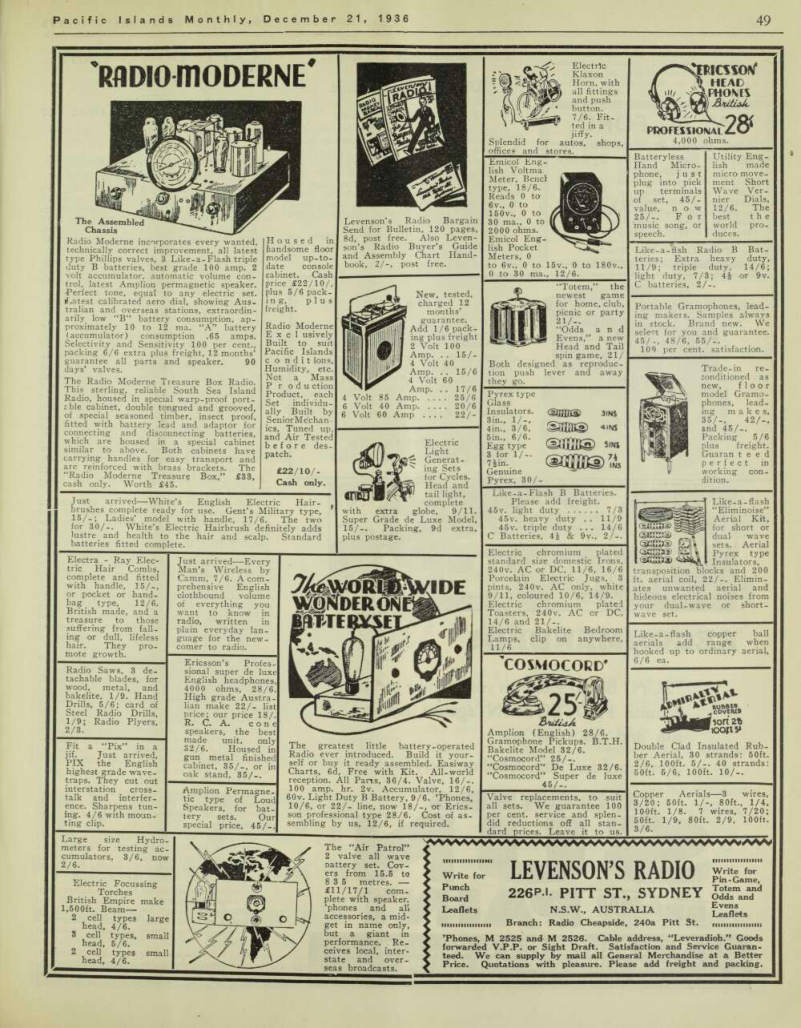
Care Of The Feet In
|T cannot be too often emphasised that the *• care of the feet in the tropics is of paramount importance.
Generally speaking, the feet are the most overworked part of the body. They are stressed and strained by occupation, mode of living and dress; therefore, they func tion under most unfavourable conditions at times.
Care should be taken that they be bathed with regularity each evening after work. This should be done with a moder ately strong solution of permanganate of potash, or Lysol. Personally, I prefer the latter. Should the feet not be given special care and attention, then weakness and discomfort will surely follow.
Tight fitting boots or shoes, short socks and stockings should be avoided at all costs —in fact, anything that is undersized should not be worn. These are contri buting causes of corns, bunions, ingrow ing toenails and weakened arches, ankles, etc. Due to the above conditions, our feet have become abnormal in many respects, and people suffer untold agony through their own carelessness.
The foot consists of a group of twenty six bones. These form four separate and distinct arches. The foot functions in two ways. It acts as an agent of locomotion, and as a shock absorber at the same time, taking care of the more delicate organs of the body, trunk, etc.
There are many and varied types of feet. There is not one type or make of boot or shoe which can be adapted to all feet. This fact should be borne in mind when purchasing footwear. One that tits someone else well, may not be suitable for your requirements.
The feet should be kept in a parallel position when walking, and not with the toes pointing outward. This only tends to weaken the strongest feet, by throwing them out of balance. A child with strong normal feet will always walk pigeon-toed.
Should he, on the other hand, “walk with toes out,” it indicates weak or defective feet.
The water should not be too hot when bathing the feet, as it is liable to injure the delicate skin, and this is just as im portant as the skin on your face.
Always cut the nails straight across.
They are to protect the extremities of your feet. All wounds and blisters should be immediately attended to, as failure may mean other serious disorders. Bathed in tepid water, with the application of per manganate crystals or Lysol, a good strong solution of iodine should be applied to all cuts, scratches and wounds, and then zinc or some other soothing ointment applied.
Ingrowing toenails and other inflictions should be treated by a skilled person. The skin should not be exposed to infection, as it is likely to be under unskilled home treatment. Always sterilise your scissors, tweezers, and other instruments before and after use. Boiling them is best, or dip ping them into strong Lysol and hot water is satisfactory. Always wash your hands carefully, before and after treating any ailments of the feet. A good brand of car bolic soap is first rate.
Here is a good prescription for a dusting powder for ground itch, tinea, heat rash, eczema, etc: Equal parts of zinc, starch and boracic powder, throughly mixed, and applied between the toes and affected parts before retiring. This preparation can also be made into a paste, if so desired, by the application of a little water.
The affected parts and surrounding skin of any wounds can be bathed effectively with methylated spirits.
You should exercise regularly, as most of the foot ailments commence from im proper standing or walking. The body should not be jarred by descending forcibly on the heels.
Always have on hand a good supply of bandages, iodine, permanganate, zinc and sulphur ointments, to combat any ailments which may arise. lodine socks (or inner soles) are splendid for aching feet, and can be had for 1/3 pair, plus postage. The writer will be glad to furnish the address to anyone in terested.
N. C. Hunt.
Wainunu, Fiji.
Mr. and Mrs. J. Land arrived in New Zealand from Tonga on leave by the Matua in November. Mr. Land is officer in-charg© of the radio station at Nukua lofa, Mr. J. (“Tom”) Knight, an old resident of Fiji, died in the Colonial War Memorial Hospital, Suva, on November 7, at the age of 72. For some years he was employed at the sugar mill at Navua, Viti Levu.
Captain W. G, Preece, harbourmaster at Nauru, arrived in Sydney on leave by the Maunganui on November 30, accom panied by his wife. He has been on the island since 1919.
Miss Mabel Yandell, of Western Samoa, who had been visiting Sydney on a health trip, sailed from Australia on her return to Apia, via ;New Zealand, on December 12.
Advertisements & other items, pp. 51-52 (1 item)
'Radio Moderne'
rm 111 y The Assembled Chassis Radio Modeme incorporates every wanted, technically correct improvement, all latest type Phillips valves, 3 Like-a-Flash triple duty B batteries, best grade 100 amp, 2 volt accumulator, automatic volume control, latest Amplion permagnetic speaker.
Perfect tone, equal to any electric set. •Latest calibrated aero dial, showing Australian and overseas stations, extraordinarily low “B” battery consumption, approximately 10 to 12 ma. “A” battery (accumulator) consumption .65 amps.
Selectivity and Sensitivity 100 per cent., packing 6/6 extra plus freight, 12 months’ guarantee all parts and speaker. 90 days’ valves.
The Radio Moderne Treasure Box Radio.
This sterling, reliable South Sea Island Radio, housed in special warp-proof portable cabinet, double tongued and grooved, of special seasoned timber, insect proof, fitted with battery lead and adaptor for connecting and disconnecting batteries, which are housed in a special cabinet similar to above. Both cabinets have carrying handles for easy transport and are reinforced with brass brackets. The “Radio Moderne Treasure Box,” £33, cash only. Worth £45.
Housed in handsome floor model up-todate console cabinet. Cash price £22/10/, plus 5/6 packing, plus freight.
Radio Moderne E x c 1 usively Built to suit Pacific Islands c o n d i t ions.
Humidity, etc.
Not a Mass P r o d u ction Product, each Set individually Built by SeniorMechan ics. Tuned up, and Air Tested before despatch. £22/10/- Cash only.
Just arrived—White’s English Electric Hairbrushes complete ready for use. Gent’s Military type, 15/-; Ladies’ model with handle, 17/6. The two for 30/-. White’s Electric Hairbrush definitely adds lustre and health to the hair and scalp. Standard batteries fitted complete.
Electra - Ray Electric Hair Combs, complete and fitted with handle, 15/-, or pocket or handbag type, 12/6.
British made, and a treasure to those suffering from falling or dull, lifeless hair. They promote growth.
Radio Saws, 3 detachable blades, for wood, metal, and bakelite, 1/9. Hand Drills, 5/6; card of Steel Radio Drills, 1/9; Radio Plyers, 2/3.
Fit a “Pix” in a jif. Just arrived.
PIX the English highest grade wavetraps. They cut out interstation crosstalk and interference. Sharpens tuning. 4/6 with mounting clip.
Leven son’s Radio Bargain Send for Bulletin, 120 pages, Bd, post free. Also Levenson’s Radio Buyer’s Guide and Assembly Chart Handbook, 2/-, post free. * New. tested, charged 12 months’ guarantee.
Add 1/6 packing plus freight 2 Volt 100 Amp. . . 15/- 4 Volt 40 Amp. . . 15/6 4 Volt 60 Amp. . . 17/6 4 Volt 85 Amp 25/6 6 Volt 40 Amp 20/6 6 Volt 60 Amp 22/with Electric Light Generating Sets for Cycles.
Head and tail light, complete globe, 9/11.
Super Grade de Luxe Model, 15/-. Packing, 9d extra plus postage.
Just arrived—Every Man’s Wireless by Camm, 7/6. A comprehensive English clothbound volume of everything you want to know in radio, written in plain everyday language for the newcomer to radio.
Ericsson’s Profes sional super de luxe English headphones 4000 ohms. 28/6.
High grade Austra lian make 22/- list price; our price 18/.
R. C. A. cone speakers, the best made unit, only 32/6. Housed in gun metal finished cabinet, 35/-, or in oak stand, 35/-.
Amplion Permagne tic type of Loud Speakers, for bat tery sets. Our special price, 45/-.
WQSfDERONEi
TTF
W
ill
The greatest little battery-operated Radio ever introduced. Build it yourself or buy it ready assembled. Easiway Charts, 6d, Free with Kit. All-world reception. All Parts, 36/4. Valve, 16/-. 100 amp. hr. 2v. Accumulator, 12/6, 60v. Light Duty B Battery, 9/6. ’Phones, 10/6, or 22/- line, now 18/-, or Ericsson professional type 2876. Cost of assembling by us, 12/6, if required. & Electric Klaxon Horn, with all fittings and push button. 7/6. Fitted in a jiffy- Splendid for autos, shops, offices and stores.
Emicol English Voltma Meter, Bend type, 18/6.
Reads 0 to 6v., 0 to 150 v., 0 to 30 ma., 0 to 2000 ohms.
Emicol English Pocket Meters, 0 to 6v., 0 to 15v., 0 to 180 v., 0 to 30 ma., 12/6.
“Totem,” the newest game for home, club, picnic or party 21/-.
“Odds and Evens,” a new Head and Tail spin game, 21/ Both designed as reproduction push lever and away they go.
Pyrex type Glass Insulators. 3in., 1/-, 4in., 3/6, sin., 6/6.
Egg type 3 for 1/-. 7iin.
Genuine Pyrex. 30/dCJDXa) 3 ins
CSUXH® 4 >NS
SINS
Like-a-Flash B Batteries.
Please add freight. 45v. light duty 7/3 45v. heavy duty .. 11/9 45v. triple duty ... 14/6 C Batteries, 4\ & 9v., 2/-.
Electric chromium plated standard size domestic Irons, 240 v. AC or DC, 11/6, 16/6 Porcelain Electric Jugs, 3 pints, 240 v. AC only, white 9/11, coloured 10/6, 14/9.
Electric chromium plated Toasters, 240 v. AC or DC. 14/6 and 21/-.
Electric Bakelite Bedroom Lamps, clip on anywhere, 11/6
COSMOCORD’
25
StUlaA
Amplion (English) 28/6.
Gramophone Pickups. B.T.H.
Bakelite Model 32/6.
“Cosmocord” 25/-.
“Cosmocord” De Luxe 32/6.
“Cosmocord” Super de luxe 45/-.
Valve replacements, to suit all sets. We guarantee 100 per cent, service and splendid reductions off all standard prices. Leave it to us.
Jtwcssorf
HEAD
PHOMIS
I J^uiLxk.
PROFESSIONAL L
4,000 ohms.
Like-a-flsh Radio B Batteries; Extra heavy duty, 11/9; triple duty, 14/6; light duty, 7/3; 4\ or 9v.
C batteries, 2/-.
Portable Gramophones, leading makeis. Samples always in stock. Brand new. We select for you and guarantee. 45/ -, 48/6, 55/-. 109 per cent, satisfaction.
Trade-in reconditioned as new, floor model Gramophones, leading makes, 35/-, 42/-. and 45/-.
Packing 5/6 plus freight.
Guaran teed perfect in working condition.
Like-a-flash “Eliminoise”
Aerial Kift, for short or dual wave sets. Aerial Pyrex type Insulators, S3® 020® EJt
GKSU®
(sBSSXa) transposition blocks and 200 ft. aerial coil, 22/-. Eliminates unwanted aerial and hideous electrical noises from your dual-wave or shortwave set.
Like-a-flash copper ball aerials add range when hooked up to ordinary aerial, 6/6 ea. \me* son zt
lOOIIS*
Double Clad Insulated Rubber Aerial, 30 strands: 50ft. 2/6, 100 ft. 5/-. 40 strands; 50ft. 5/6, 100 ft. 10/-.
Copper Aerials—3 wires, 3/20; 50ft. 1/-, 80ft., 1/4, 100 ft. 1/8. 7 wires, 7/20; 50ft. 1/9, 80ft. 2/9, 100 ft. 3/6.
Large size Hydrometers for testing accumulators, 3/6, now 2/6.
Electric Focussing Torches British Empire make 1,500 ft. Beam— -2 cell types large head, 4/6. 3 cell types, small head, 5/6. 2 cell types small head, 4/6. * r The “Air Patrol” 2 valve all wave oattery set. Covers from 15.5 to 83 5 metres. £ll/17/1 complete with speaker, ’phones and all accessories, a midget in name only, but a giant in performance. Receives local, interstate and overseas broadcasts. him 11 iii iiiiiHi Write for Punch Board Leaflets 11111111111111111 l
LEVENSON’S RADIO
226 P I- PITT ST., SYDNEY
N.S.W., AUSTRALIA
Branch: Radio Cheapside, 240 a Pitt St. iimniMiiiiiiii Write for Pin-Game, Totem and Odds and Evens Leaflets ’Phones, M 2525 and M 2526. Cable address, “Leveradioh.” Goods forwarded V.P.P. or Sight Draft. Satisfaction and Service Guaranteed. We can supply by mail all General Merchandise at a Better Price. Quotations with pleasure. Please add freight and packing.
W. M. FORD
Ship, Yacht & Boat Builder
Berry’s Bay, North Sydney
(Established 1870) BUILDERS of all kinds of Island Craft from Dinghies to Auxiliary Schooners of any tonnage. New and Second-hand Island Craft of various types in stock. New and Secondhand Full Diesel, Crude Oil, Benzine and Kerosene Engines.
Please Send on Your Enquiries
s. .
The
“Caledonia Dover”
A COOKING STOVE guaranteed to give complete satisfaction and now recognised as THE BEST on the market. Suitable for coal, coke, or wood fuel.
Illustrated Catalogue on request.
LANE & GIRVAN, LTD.
BONNY BRIDGE, SCOTLAND
sgs
ET"o
a
RECOMMENDED!
"SUN” Brand Paint on your Home means
definite PROTECTION against tropical
sun and sea-moist air.
Sun Proof and Rain Proof on every Surface
PAINT
W. R. CARPENTER & CO., LTD.
NEW GUINEA, SOLOMON ISLANDS
and all other South Sea Islands.
American Strike
Dislocation in Pacific
From Our Own Correspondent
Apia, Dec. 2.
r ''HE strike in the United States is caus ing a lot of inconvenience to the resi dents of Western Samoa owing to the dislocation of mails and freight traffic.
The M.S. Noumea, which was due to leave ’Frisco for Samoa with a large cargo of goods and lumber, is held up indefinitely owing to the strike, as also are the Matson liners Mariposa and Monterey.
There is also at the present time no communication with Pago Pago (American Samoa) and American goods for Apia are now held up in Pago.
Capt. Dow’S Last
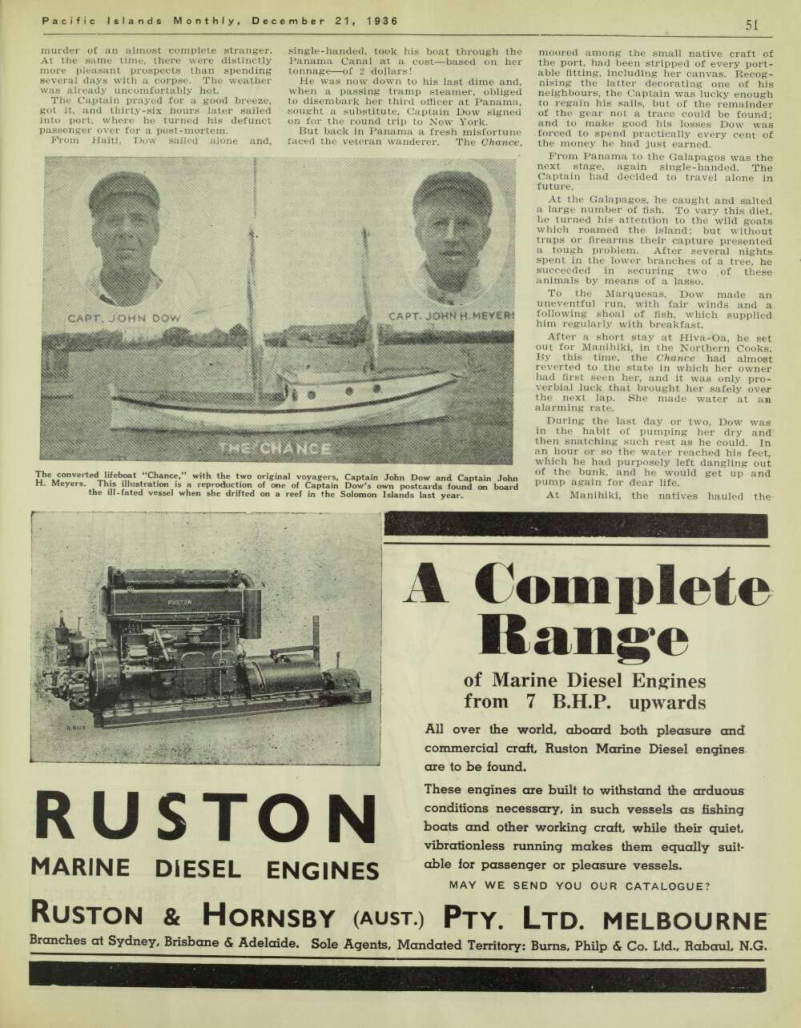
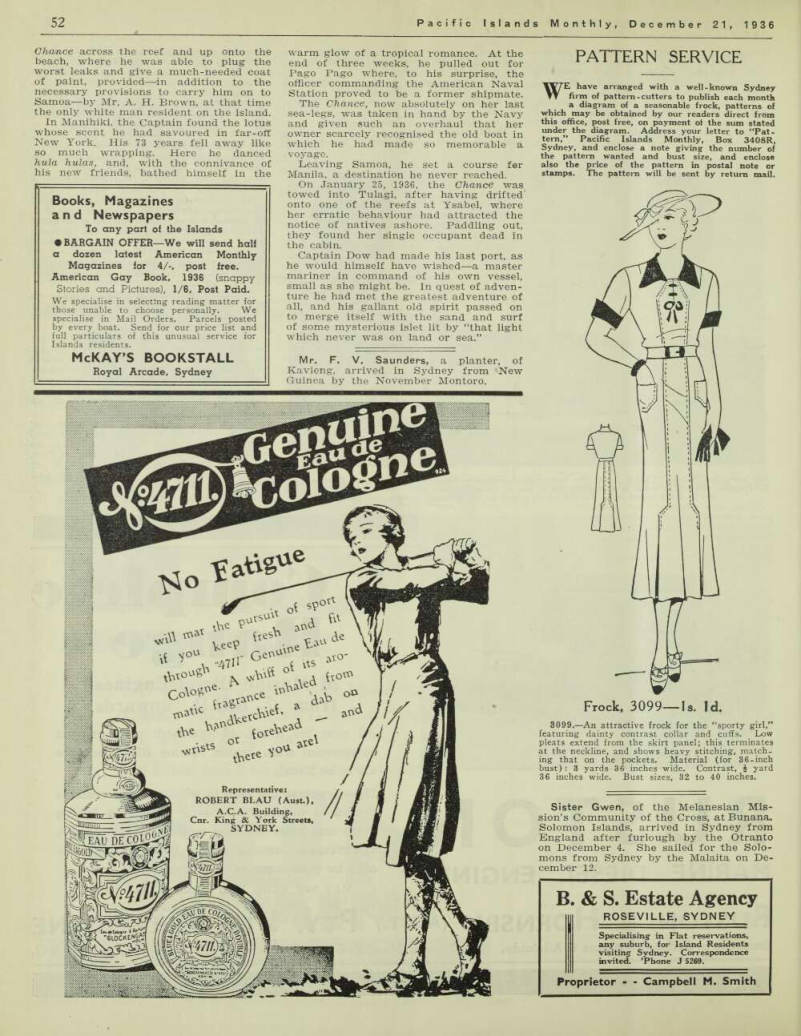
Voyage
The Extraordinary Cruise of the “Chance”
By Julian Hillas
READERS of the P.I.M. will probably recall seeing, some months ago, an announcement of the finding of a small yacht off one of the northern Solomons, her single occupant dead in his bunk. The story, meagrely supported by facts, roused considerable speculation as to the identity and intentions of the solitary navigator.
Inquiries in several quarters have now elicited the fact that Captain John Dow was certainly the eldest of that hardy company of adventurers who have taken, since the War, to roaming the Seven Seas in small boats. It also appears likely that his ketch, the Chance, could have laid claim to a similar distinction.
In 1932, Captain Dow was 71 years of age. A widower, with two sons killed in France, it seemed as though his last days were fully insured by a comfortable bank balance of 30,000 dollars, accumulated through fifty years at sea. And then, in the financial chaos of that American summer, the bank closed its doors. Of the little fortune, there remained but 150 dollars.
He spent the following winter in New York, subsisting largely on the hospitality of friends. The prospect of a second under these conditions galled the Cap tain’s spirit.
Captain Dow had an idea. His health was still excellent. Poking around the waterfront, his eye had fallen upon a dis used ship’s lifeboat. From enquiries, he learned that it had long ago been con demned; and well could he believe this, from the worm-eaten state of her tim bers. The manager of the shipyard was an old friend.
The boat changed owners and, with bor rowed tools, the Captain set to work on her. From amidships forward he decked her in. Under his capable hands the dere lict gradually emerged as the two-masted ketch Chance.
Finished, she represented his last dreams—dreams of warm Southern lands where the bounty of Nature and the kind ness of Man were as unfailing as the rise and fall of the tropical tides. He would sail thither and end his days in those congenial latitudes. In vain his friends pointed out the hazards attached to such a voyage in such a vessel as the Chance.
Better, the Captain argued, to be lost at sea in the attempt, than spend another winter in New York. Finally, they gave up trying to dissuade him.
In the summer of 1933 he started, accompanied by Captain John H. Meyers, another old sea-dog beam-ended by the Depression.
On their voyage down the Atlantic coast they encountered such weather that Meyers was unwilling to share further adventures, and returned north from one of the ports at which they touched.
A second experiment in passengers was even less satisfactory. Bound from the American mainland to Haiti, and within a couple of days’ sail of the latter, his new companion mysteriously sickened and died.
Dow was in an awkward predicament.
If he reached port alone, the authorities might view the position seriously, and at 72 he had no wish to be charged with the
murder of an almost complete stranger.
At the same time, there were distinctly more pleasant prospects than spending several days with a corpse. The weather was already uncomfortably hot.
The Captain prayed for a good breeze, got it, and thirty-six hours later sailed into port, where he turned his defunct passenger over for a post-mortem.
From Haiti, Dow sailed alone and,
single-handed, took his boat through the Panama Canal at a cost—based on her tonnage—of 2 dollars!
He was now down to his last dime and, when a passing tramp steamer, obliged to disembark her third officer at Panama, sought a substitute, Captain Dow signed on for the round trip to New York.
But back in Panama a fresh misfortune faced the veteran wanderer. The Chance,
moored among the small native craft of the port, had been stripped of every port able fitting, including her canvas. Recog nising the latter decorating one of his neighbours, the Captain was lucky enough to regain his sails, but of the remainder of the gear not a trace could be found; and to make good his losses Dow was forced to spend practically every cent of the money he had just earned.
From Panama to the Galapagos was the next stage, again single-handed. The Captain had decided to travel alone in future.
At the Galapagos, he caught and salted a large number of fish. To vary this diet, he turned his attention to the wild goats which roamed the island; but without traps or firearms their capture presented a tough problem. After several nights spent in the lower branches of a tree, he succeeded in securing two of these animals by means of a lasso.
To the Marquesas, Dow made an uneventful run, with fair winds and a following shoal of fish, which supplied him regularly with breakfast.
After a short stay at Hiva-Oa, he set out for Manihiki, in the Northern Cooks.
By this time, the Chance had almost reverted to the state in which her owner had first seen her, and it was only pro verbial luck that brought her safely over the next lap. She made water at an alarming rate.
During the last day or two, Dow was in the habit of pumping her dry and then snatching such rest as he could. In an hour or so the water reached his feet, which he had purposely left dangling out of the bunk, and he would get up and pump again for dear life.
At Manihiki, the natives hauled the
The conycrted lifeboat "Chance,” with the two original voyagers, Captain John Dow and Captain John H. Meyers. This illustration is a reproduction of one of Captain Dow’s own postcards found on board the ill-fated vessel when she drifted on a reef in the Solomon Islands last year.
Chance across the reef and up onto the beach, where he was able to plug the worst leaks and give a much-needed coat of paint, provided—in addition to the necessary provisions to carry him on to Samoa —by Mr. A. H. Brown, at that time the only white man resident on the island.
In Manihiki, the Captain found the lotus whose scent he had savoured in far-off New York. His 73 years fell away like so much wrapping. Here he danced hula hulas, and, with the connivance of his new friends, bathed himself in the
warm glow of a tropical romance. At the end of three weeks, he pulled out for Pago Pago where, to his surprise, the officer commanding the American Naval Station proved to be a former shipmate.
The Chance, now absolutely on her last sea-legs, was taken in hand by the Navy and given such an overhaul that her owner scarcely recognised the old boat in which he had made so memorable a voyage.
Leaving Samoa, he set a course for Manila, a destination he never reached.
On January 25, 1936, the Chance was towed into Tulagi, after having drifted' onto one of the reefs at Ysabel, where her erratic behaviour had attracted the notice of natives ashore. Paddling out, they found her single occupant dead in the cabin.
Captain Dow had made his last port, as he would himself have wished—a master mariner in command of his own vessel, small as she might be. In quest of adven ture he had met the greatest adventure of all, and his gallant old spirit passed on to merge itself with the sand and surf of some mysterious islet lit by “that light which never was on land or sea.”
Mr. F. V. Saunders, a planter, of Kavieng, arrived in Sydney from New Guinea by the November Montoro.
Advertisements & other items, pp. 53-54 (1 item)
Ruston
MARINE DIESEL ENGINES
A Complete
■linage
of Marine Diesel Engines
from 7 B.H.P. upwards
All over the world, aboard both pleasure and commercial craft, Ruston Marine Diesel engines are to be found.
These engines are built to withstand the arduous conditions necessary, in such vessels as fishing boats and other working craft, while their quiet, vibrationless running makes them equally suitable for passenger or pleasure vessels.
MAY WE SEND YOU OUR CATALOGUE?
Ruston & Hornsby (aust.) Pty. Ltd. Melbourne Branches at Sydney, Brisbane & Adelaide. Sole Agents, Mandated Territory: Bums, Philp & Co. Ltd., Rabaul, N.G.
Books, Magazines
and Newspapers
To any part of the Islands • BARGAIN OFFER—We will send half a dozen latest American Monthly Magazines for 4/-, post free.
American Gay Book, 1936 (snappy Stories and Pictures), 1/6, Post Paid.
We specialise in selecting reading matter for those unable to choose personally. We specialise in Mail Orders. Parcels posted by every boat. Send for our price list and full particulars of this unusual service for Islands residents.
McKAY’S BOOKSTALL
Royal Arcade, Sydney
, t P U ‘ J \ VeeP ou . Qet^ 0 it V V, -471 tVitoUfc s v
CoV>fc° c
ttvauc iV\c fit de iiow 00 t bete // e \td\^ e to#**: .4 a *» b A .VetcVi' 6 '- a^ d to*** 4 . °, „ rP v ou » ie ' Representative:
ROBERT BLAU (Aust.),
A.C.A. Building, Cnr. King & York Streets,
SYDNEY.
Pattern Service
WE have arranged with a well-known Sydney firm of pattern-cutters to publish each month a diagram of a seasonable frock, patterns of which may be obtained by our readers direct from this office, post free, on payment of the sum stated under the diagram. Address your letter to “Pat tern,” Pacific Islands Monthly, Box 3408R, Sydney, and enclose a note giving the number of the pattern wanted and bust size, and enclose also the price of the pattern in postal note or stamps. The pattern will be sent by return mail.
Frock, 3099—Is. Id.
3099.—An attractive frock for the “sporty girl,” featuring dainty contrast collar and cuffs. Low pleats extend from the skirt panel; this terminates at the neckline, and shows heavy stitching, match ing that on the pockets. Material (for 36-inch bust) : 8 yards 36 inches wide. Contrast, i yard 36 inches wide. Bust sizes, 32 to 40 inches.
Sister Gwen, of the Melanesian Mis sion’s Community of the Cross, at Bunana, Solomon Islands, arrived in Sydney from England after furlough by the Otranto on December 4. She sailed for the Solo mons from Sydney by the Malaita on De cember 12.
Advertisements & other items, p. 54 (1 item)
B. & S. Estate Agency
y ROSEVILLE, SYDNEY
Specialising in Flat reservations, any suburb, for Island Residents visiting Sydney. Correspondence invited. ’Phone J 5269.
Proprietor - - Campbell M. Smith
Fashion Hints for Islands Women
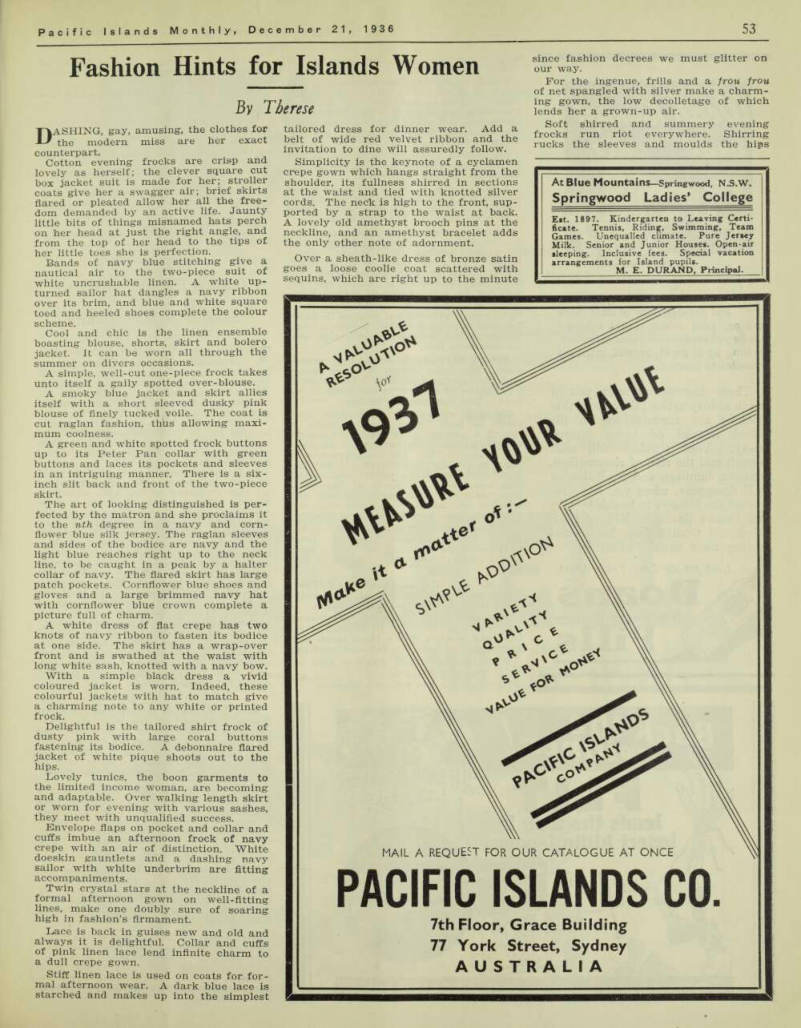
By Therese
DASHING, gay, amusing, the clothes for the modern miss are her exact counterpart.
Cotton evening frocks are crisp and lovely as herself; the clever square cut box jacket suit is made for her; stroller coats give her a swagger air; brief skirts flared or pleated allow her all the free dom demanded by an active life. Jaunty little bits of things misnamed hats perch on her head at just the right angle, and from the top of her head to the tips of her little toes she is perfection.
Bands of navy blue stitching give a nautical air to the two-piece suit of white uncrushable linen. A white up turned sailor hat dangles a navy ribbon over its brim, and blue and white square toed and heeled shoes complete the colour scheme.
Cool and chic is the linen ensemble boasting blouse, shorts, skirt and bolero jacket. It can be worn all through the summer on divers occasions.
A simple, well-cut one-piece frock takes unto itself a gaily spotted over-blouse.
A smoky blue jacket and skirt allies itself with a short sleeved dusky pink blouse of finely tucked voile. The coat is cut raglan fashion, thus allowing maxi mum coolness.
A green and white spotted frock buttons up to its Peter Pan collar with green buttons and laces its pockets and sleeves in an intriguing manner. There is a six inch slit back and front of the two-piece skirt.
The art of looking distinguished is per fected by the matron and she proclaims it to the nth degree in a navy and corn flower blue silk jersey. The raglan sleeves and sides of the bodice are navy and the light blue reaches right up to the neck line, to be caught in a peak by a halter collar of navy. The flared skirt has large patch pockets. Cornflower blue shoes and gloves and a large brimmed navy hat with cornflower blue crown complete a picture full of charm.
A white dress of flat crepe has two knots of navy ribbon to fasten its bodice at one side. The skirt has a wrap-over front and is swathed at the waist with long white sash, knotted with a navy bow.
With a simple black dress a vivid coloured jacket is worn. Indeed, these colourful jackets with hat to match give a charming note to any white or printed frock.
Delightful is the tailored shirt frock of dusty pink with large coral buttons fastening its bodice. A debonnaire flared jacket of white pique shoots out to the hips.
Lovely tunics, the boon garments to the limited income woman, are becoming and adaptable. Over walking length skirt or worn for evening with various sashes, they meet with unqualified success.
Envelope flaps on pocket and collar and cuffs imbue an afternoon frock of navy crepe with an air of distinction. White doeskin gauntlets and a dashing navy sailor with white underbrim are fitting accompaniments.
Twin crystal stars at the neckline of a formal afternoon gown on well-fitting lines, make one doubly sure of soaring high in fashion’s firmament.
Lace is back in guises new and old and always it is delightful. Collar and cuffs of pink linen lace lend infinite charm to a dull crepe gown.
Stiff linen lace is used on coats for for mal afternoon wear. A dark blue lace is starched and makes up into the simplest
tailored dress for dinner wear. Add a belt of wide red velvet ribbon and the invitation to dine will assuredly follow.
Simplicity is the keynote of a cyclamen crepe gown which hangs straight from the shoulder, its fullness shirred in sections at the waist and tied with knotted silver cords. The neck is high to the front, sup ported by a strap to the waist at back.
A lovely old amethyst brooch pins at the neckline, and an amethyst bracelet adds the only other note of adornment.
Over a sheath-like dress of bronze satin goes a loose coolie coat scattered with sequins, which are right up to the minute
since fashion decrees we must glitter on our way.
For the ingenue, frills and a froufrou of net spangled with silver make a charm ing gown, the low decolletage of which lends her a grown-up air.
Soft shirred and summery evening frocks run riot everywhere. Shirring rucks the sleeves and moulds the hips
with graceful swathes and gathers the bodice in soft folds.
There is subtle sophistication in the frock of blue and white striped satin bodice. The square neck-line dissolves into mere halter straps. The stripes run across the bodice and end in a peak below the waist line, and the stripes are cut diagonally in the skirt.
An empire gown of black net boasts balloon sleeves and a jewelled clip gleam ing from its high waist-line.
A slim gown of black delustred crepe possesses a vivid diagonal striped sash to swathe its waist and ties bustle effect with wide ends trailing floorwards.
Oozing charm, a directoire gown of white satin moulds the figure in lovely lines and trims its square decol letage with three rows of silver braid, which match up with quaint silver san dals, body and soles of which are held together by mere strips of plaited lame.
Buttoning demurely up the front of its tight bodice with crystal buttons in direct contrast with its full skirt, a taffeta frock flaunts an elbow length capelet tied with an enormous bow.
Revers have again come into promi nence, and large revers of silver spread widely over the arms like a breast plate, and fasten in a band at the back of the neck. The skirt tiptilts in front Evening gowns slit themselves from waist to hem, either front or back, to reveal a glimpse of a brilliant petticoat which can serve the purpose of an even ing gown. This petticoat-cum-evening gown is a tower of strength and becomes a complete wardrobe by interchangeable bits and pieces. Make it ©f flat crepe, slim and well cut, flaring to the hem with a kilted frill at the foot. Slip over it a fluttering floor length georgette cape.
A heavy white gown of crepe ties a jaunty cat’s-whisker bow of black pailettes at its neck-line and runs a strap of the same glittering discs down its bare back.
Yards of tulle, shirred to a delicious froth, go to the making of an evening scarf that is a dreamlike possession.
A flippant pique jacket with black spots on a white ground, dips its peplum at the back and is worn over a black crepe skirt with equal success for day and evening.
With infinite variety Fashion goes her fickle way and decrees: Draperies in the pre-war manner.
Sparkling gowns, per medium of sequins, or subtly woven gleaming threads of silver and gold.
Large sleeves and full bodices gathered to yokes.
Slim hips.
Wind-blown effects—straight fronts, flaring backs.
Voluminous evening wraps taffeta coats with bustle backs cover svelte gowns.
Lots and lots of white accessories.
Enormous buttons.
Countless spectator sports frocks.
Initials on scarves, pockets, and hand kerchiefs.
Tunics and peplums.
Crepe stockings dull and expensive looking and two-tone shoes.
Advertisements & other items, pp. 55-56 (1 item)
Pacific Islands Co.
At Blue Mountains— Springwood, N.S.W.
Springwood Ladies* College
Est. 1897. Kindergarten to Leaving Certificate. Tennis, Riding, Swimming, Team Games. Unequalled climate. Pure Jersey Milk. Senior and Junior Houses. Open-air sleeping. Inclusive fees. Special vacation arrangements for Island pupils.
M. E. DURAND, Principal.
iSP yl & ti e< & & cv 9 i* 9 K e \£ fA* S' Q X* O* O* ■4* S X*> > \* v *v c O V' 1* MAIL A REQUEST FOR OUR CATALOGUE AT ONCE
PACIFIC ISLANDS CO.
7th Floor, Grace Building 77 York Street, Sydney
AUSTRALIA
I Every Picture tells a Story P)0 YOU FEEL NERVY, irritable and generally out of sorts, back aching, head aching, limbs aching J Or do you experience urinary troubles, getting up at night, or stiff, inflamed muscles or joints ?
These discomforts warn ycu of weak kidney action; they show that poisons are accumulating in the blood instead of being filtered away. Your troubles will soon vanish and the risk of rheumatism, sciatica, lumbago and renal dropsy will disappear, when you have restored the kidneys to health by taking Doan’s Backache Kidney Pills.
Men and women find this special
kidney tonic equally effective.
Look jor the Leaf Trade Mark
Doan’s
Backache Kidney
Pills
<*<? 5?
B ‘ c Mmner!
FLIT
leods the iuf 1 " ! n * Id t
insect hillind-pc
v/ hi
flit
Kill, F> s ac he 4 Noth, 'Wstam / SP r the most deadly to insects because it contains a killing agent found in no other insecticide FLlT—the only insect spray that REALLY kills.
Growth Of A.W.A.

Success in Manufacture
T'HE profits of Amalgamated Wireless -*■ (Australasia) Limited (which con trols radio communication in the South Pacific, and half of which is owned by the Commonwealth Government) in creased by £3,000 during last financial year.
This now is a huge organisation and is notable for its efficient management and control. Its radio network and services are familiar to all dwellers in the Central and Western Pacific.
It is interesting to note that a rapid advance has been made in recent years by this Company in the field of manu facture. The Company produces in Aus tralia all kinds of radio equipment, and its apparatus and appliances are now being sold all over the world in sucessful competition with the products of the big gest companies and best brains in Europe and America. The two newest passenger liners in the South Seas—the Kanimhla and the Awatea —carry A.W.A. equipment.
No less than 1,100 persons are employed in the A.W.A. radio-electrical works at Ashfleld, Sydney—described as “an Aus tralian factory in an Australian garden.”
The buildings, which are on the site of the factory which once produced the notorious Australian Six motor-car, are surrounded by lawns and gardens, and, seen from the Parramatta-road, make a delightful picture.
M iss J. K. March, principal of the Girls’
School conducted by the Methodist Mis sion at Vunairima, New Britain, returned to Rabaul from furlough by the Montoro from Sydney on December 2. During her period of leave she paid a short visit to Fiji to study educational methods there.
Miss Ivy Wilson, who has completed four years’ service with the South Sea Evangelical Mission at Wanoni Bay, San Christoval, in the Solomon Islands, reached Sydney by the Malaita on De cember 3. She is on five months’ leave which will be spent in Victoria.
Mrs. F. Schober, of Nukualofa, has ar rived in Sydney with her children, Bern hard and Margaretta, and is the guest of her sister, Mrs. Alfred Page (Lefagaoalii) at Centennial Park. It is 12 years since Mrs. Schober was last in Sydney.
M iss Marie Elliott, of Wellington, New Zealand, passed through Sydney in De cember on her way to Papua, where she will be married in January to Mr. John Simpkin, a young Englishman, who is a plantation owner about 40 miles from Port Moresby.
Mr. and Mrs. A. E. Allison, who have been spending the winter months with Mr. and Mrs. Ernest Thorpe, at Thursday Island, returned to Australia by the No vember Wandana.
Crown Prince George Taufa’ahau, of Tonga, left Sydney on December 12 to spend his holidays at Nukualofa, On his return to Australia he will enter the Arts Faculty of Sydney University, and will also study law.
Advertisements & other items, pp. 57-58 (1 item)
Shell
to 8
gives you extra miles from every gallon. Besides maximum mileage, it gives outstanding performance: easier starting, quicker pick-up, and greater flexibility.
You can be sure of SHELL for definite savings, for better performance.
SHELL
MOTOR SPIRIT
a /A % sei
HEATHER BELTS
Cor NATIVES
f° r ftlan ufacturers j. s Specia/is/’s i
PATTERSON & STONE, CRICHTON WORKS,!
WALSALL, ENGLAND.
>FEUERHAND<
HURRICANE
LANTERNS •?
S >
*6S(UA*^
s 1 Ti (({ '»w., s.« s and many other types of varied shape and style!
Sole Agent for the South Sea and New Guinea:
CARL AUG. DOCKE BREMEN/germany
Exporter of all goods, suitable for the Islands trade importer of any kind of Island Produce Correspondence invited
Tough Voyaging In
South Seas
By “Borneo”
sailed out of Papeete, Tahiti, on a schooner of 60 tons, manned and owned by South Sea Islands natives. No engine; just sails, and fairly well patched at that.
Passengers, 7 Chinamen traders in the Austral Group, 29 native men and women, 10 of a crew, one white man (myself) 47 all told. No food provided—everyone looks after himself. Cooking out of the question. On top of all else, no accom modation —only four bunks on this schooner, in the cabin, about 14 x 10 in size.
We were well away from the gay city of Papeete when it started to blow, and
very soon we had a bit of a choppy sea.
Night was coming on, and we had nowhere to lie down. There was one small lamp.
The Chinamen were all sick in basins, with which they always provide them-* selves for these trips. They are poor sailors.
I had bought the first mate’s bunk from him “on the side,” besides paying for my passage, but I had no chance to get into it. Three women tucked themselves into it, and there was no hope for me. I tried every known move to turn them out. No good! Seasick women are the very devil incarnate!
The gale came on in earnest. Bare poles; and for three days and nights there was no let up. Most of the natives by now were well flattened out. For myself, I jumped into the captain’s bunk and made things alright with him. Money has power, even on a schooner in a storm.
A Memorable Odour
There were no sanitary arrangements on this packet, and the cabin had no door —only a hatch —and we were in a bad way for air. When it was raining and blowing there was no chance of opening the hatch to get a breath of the breeze.
The stench of the natives and the sick ness of the Chinamen is something I shall never forget—though I am a battler of the first water, 60 years old to-day and been through two wars, the Boer War and the World War. I ought to have a nose exempt from everything. But the memory of that particular stink will stay with me till I go to the Happy Land.
At last, after battling along for 18 days, we sighted an island. Then, just to spite us seemingly, Fate sent a dead calm. The water on board, one small tank, was going down. Natives never look ahead.
Six days we were becalmed, with no chance of making land. There was not a breath of wind, and our water supply was down, to an inch in the bottom.
When we were 17 or 18 miles away ne cessity drove us to action. Out at last went the boat, and nine natives pulled for the shore. Next day we were taken in tow by a handy launch. Most of us were right glad to have a swim, whilst all were ready for a meal.
I would like to see that journalist from New York who, with his wife, wanted to take a passage with us in that schooner.
He would have had something to tell his friends about for all time to come.
I persuaded them not to go—there was no accommodation for ladies. They said they wanted the experience! They can thank their stars they missed —it would likely have been the end of the lady.
The End Of Romance
LOTS of people are for ever hankering to reach the South Seas and sleep under a coconut tree. All moonshine!
There’s no real comfort anywhere in the South Seas. You get sunshine and fresh air, true enough. But, without money, you get little else.
It takes money, and plenty of it, to get comfort and easy voyaging amongst these groups. If you are well-hipped, the natives look after you fine —so long as you “shell out” steady and plentifully.
I know what I am talking about. I have had 24 years’ experience of South Sea Islands life, on and off.
There must be an “off,” or a man goes to pieces. I always manage to make my home town in New Zealand every 18 to 24 months, staying pat till, in about the same length of time, I get the wanderlust again.
I’m just like hundreds of others. When living on an island hereabouts I hunger for the comforts of New Zealand; and.
when I’m in New Zealand, I hunger for the Islands life. Man is never satisfied, always wanting something he hasn’t got.
Life On An Atoll
ONE misses a lot living on a really iso lated island, such as some of the Tua motu Atolls. No meat, no sugar, no flour, no smoking, no light; go to bed at dark, up at daylight: no butter, no milk, no cinema.
To make up, there are plenty of mos quitoes, fleas and flies, with abundance of fish if you have lines, hooks and a boat or canoes. One lives principally on taro and fish.
It’s no good “loading up.” Time and again I have provided myself with every known solid kind of foods. It was useless —too many friends! You have got to go native to live on many islands.
A passing visitor knows nothing of this.
But a resident finds himself soon eaten out of house and home. You must live as the natives do. It is pretty rough fare at times, and you may often go hungry.
Hunger has its blessed side; you enjoy a meal when it comes. Most folk have never gone hungry in their lives, eating to a timetable. There is no timetable with us. Eat when you have the food, and expect abundance only at certain sea sons of the year. A day without a bite, from sunrise to sunset, has been my lot scores of times. Nuts are not everywhere.
Tough voyaging includes land life as well as sea. You can land a carload of foodstuff on an island. That is easy; but to retain it for its appointed period is impossible. You’ve got to share out and share out liberally. As a rule, on small, lone islands, it is community life: their code is share and share alike—the devil nipping the hindmost —who is inevitably the white man.
Boarding School For Islands Boys
PARENTS in the Islands who are looking for an Australian boarding school where they can safely leave their boys, will be interest ed in the Newington College advertisement in this issue.
One of the Great Public Schools of N.S.W., Newington is a school of traditions, dating back almost three-quarters of a century. Prominent citizens m all walks of life have passed through its class-rooms; many have learned to play the game of life through learning to take their part manfully on its playing-fields. With large and completely equipped grounds and with special facilities for boarders and a competent teaching staff, Newington has everything to offer to parents looking for a suitable boarding school. The head master. Mr. P. R. Le Couteur M.A., is a Rhodes Scholar, and a sportsman of well-established reputation.*** Mr. A. E. Ray, manager of Messrs.
Burns, Philp and Co. Ltd.’s branch at Kavxeng, returned to New Guinea from furlough by the Montoro from Sydney early in December.
Rabaul Notes
From Our Own Correspondent
Rabaul, Nov. 15.
HIS Honour Judge P. B. Phillips is at present on circuit court at Wau and Salamaua. Mr. Woodhill, of the Crown Daw Office, accompanied the Court as Crown prosecutor.
The assessed value of copra for export purposes for the month of November has been declared at £l2/18/9.
The subscription list for the construc tion of the local swimming pool is grow ing apace. Datest figures show that £626 has been collected.
Armistice Day was observed in Rabaul by an impressive ceremony held in Cen tral Square, when the two minutes’ silence was observed by His Honour the Acting Administrator, Members of the Legisla tive Council and the general public.
Buglers from the native constabulary sounded the “Last Post” and “Reveille.”
Copra exported from the Territory dur ing October totalled 10,862 tons, of which 1,216 tons were shipped to Australia.
Mr. N. Blood, of the New Guinea Euro pean Constabulary, sailed from Sydney with his wife for Rabaul by the December Montoro.
Father Michael McEncroe, of the Sacred Heart Mission at Yule Island, Papua, re turned to Port Moresby from Sydney by the Montoro on December 2.
Mrs. C. R. Finney, the wife of Captain Pinney, Administrator of Norfolk Island, has been receiving- medical attention in hospital recently; but she hopes to spend the Christmas and New Year holidays in Sydney.
Mr. W. G. Meadley, a graduate of Mel bourne University in electrical engineer ing, left Sydney for Gavutu, British Solomon Islands, by the Malaita on December 12. He will carry out copra drying investigations for Lever’s Pacific Plantations Pty. Ltd., under a two years’ contract.
Advertisements & other items, pp. 59-60 (2 items)
Low-Priced Lightweight Cases
Maleham & Yeomans
LIMITED
BOWDON ST., SHEFFIELD, ENG.
Manufacturers of all kinds of Butchers’, Sticking and Sheath Knives Razors and Scissors Specialty Hairdresser Scissors Price List on Application
LOW-PRICED LIGHTWEIGHT CASES
Travel light with these strongly-made, economical cases . . . there are sizes to meet all needs, from 12-inch attaches to 28-inch travel cases.
The lids are reinforced with metal edges ... the comers fitted with stout guards that prevent wear. Each Case has two nickel-plated English locks and keys.
Storekeepers everywhere can supply them . . . ask to see cases by Ford Sherington. Ltd. At the price, they offer value unsurpassed. r N?
BBX
20 r 22 24 N 9 77
SIZES:
No. 88, Attaches 12, 14, 16, 18, and 20 inches.
No. 77, Suit Cases— -22, 24, 26, and 28 inches. 28" Traders are invited to write for full particulars of all
TRAVEL and LEATHER
GOODS
FORD, SHGRINOTOM, LTD.
MANUFACTURERS (Wholesale Only)
KIPPAX STREET, SYDNEY
A. Q. McGowan & Co.
SUVA, FIJI ISLANDS
• Dealers in all Island Products, Exporters of Trocas Shells, Pearl Shells, Cowrie Shells and Curios, Kauri Varnish Gums, Bark, Mauritius Beans, Maize. Enquiries solicited.
Tlsdall’s Anglers
Handbook $6-$?
Comprising 128 pages of interesting information regarding Trout and Salmon Fishing, General Sea Fishing, and Swordfishing. Also illustrations and prices of a wonderful range of Fishing Rods, Reels, Lines and Sea Fishing Equipment.
Every Angler should have this Handbook Write for a free copy, mentioning the “ P.1.M.”
TISDALLS
Manufacturers and Retailers of Fishing Rods and Tackle
176 QUEEN STREET, AUCKLAND, N.Z.
Branches at Wellington, Christchurch, and Hamilton, N.Z.
Your Tropical Kit
When you visit the Pacific Islands, whether on Business or Pleasure, you need Special Equipment—Light Suits of Correct Style, which fit well and launder easily; Tunic Shirts, Silk Shirts, Light Underwear, White Shoes, etc.
WALTER HORNE & CO. LTD., established in 1885, specialise in this Service.
Skilled Tailors make your suits from First-class material within 24 hours.
Complete equipment can be supplied from our Large Stocks at Reasonable, Moderate Prices.
BUY FROM THE FIRM WHICH UNDERSTANDS YOUR NEEDS AND
DRESSES YOU CORRECTLY
WALTER HORNE & CO. LTD. carry a Full Range Men resident tn , ... , . ... .- any of the Pacific of Drapery of all kinds; also Frocks, Millinery, roun- Territories can be dations and Lingerie, Hosiery, Shoes and Sandals, supplied with Ribbons and Laces, Household Drapery. Suitable Clothes.
Write to us and , , Describe your Re-
Ladies’ Hairdressing and Manicuring quirements.
Walter Horne & Co. Ltd.
Drapers and Men’s Wear Specialists
SUVA, FIJI
Help Kidneys
Don’t Take Drastic Drugs
Your kidneys have nine million tiny tubes or niters which are endangered by neglect or drastic, irritating drugs. Beware I If Kidney trouble or Bladder weakness makes you suffer from Getting Up Nights, Leg Pains, Nervousness, Dizziness, Stiffness, Rheumatism, Lumbago, Circles Under Eyes, Swollen Ankles, Neuralgia, Burning, Itching, Smarting, Acidity or Loss of Vigour, don’t delay.
Try the Doctor’s new discovery called Cystex (Siss-tex). Soothes, tones, cleans, and heals sick kidneys. Starts work in 15 minutes. Brings new health, youth and vitality in 48 hours. Cystex costs little and is guaranteed to end your troubles in 8 days or money back. Price 4/-, all Stores and Chemists. SCHAFFER & CO., 180 Clarence Street, Sydney.
Lautoka Wharfage
Urgent Need for More Accommodation
From Our Own Correspondent.
Suva, Nov. 28.
T AUTOKA people have been complaining that their growing town has not now sufficient wharf accommodation to meet the needs of shipping using the port.
There is little doubt that the complaint is justified.
This port is the distributing centre for some 150 miles of coastline from Sigatoka to Tavua, and with the boom in mining at the latter place there has been much in creased traffic. The only berth for a steamer at the wharf was built for and is still controlled by the Colonial Sugar Re
fining Co. Under an agreement between the C.S.R. Co. and the Government, all other shipping has to give way to vessels coming in to the charter of the big sugar concern.
Residents contend that the Government made a bad mistake when it granted the Company the concession to build and con trol the wharf, for no one can blame the latter for exercising its rights in this connection.
To quote a case in illustration, only re cently an overseas steamer arrived with general cargo for discharge at Lautoka.
When she reached port the agents were informed that she could have the use of the berth for only a few hours, as a vessel was expected to load sugar and would re quire the berth. The ship was able to discharge only about 50 tons of her 370 tons of cargo and then had to quit the berth and return some 10 days later.
Perishable cargo was not improved by this delay.
The most suitable site for a new wharf has been surveyed, but that seems to be as far as the matter has gone. At this site there is plenty of room for ships of any draught, which is more than can be said for the C.S.R. wharf, where some vessels loading lie on the mud at low tide.
There is also the revenue point of view to be considered. At present the Gov ernment collects no dues from shipping entering Lautoka other than light dues.
With a wharf of its own at Lautoka, the Government would probably find revenue from that side of the island substantially increased.
In Ramu District, N.G.
Agriculture Experiments
From a Special Correspondent WAU, Nov. 10.
EXPERIMENTS have been made in the * Ramu District with Cinchona seed (quinine) and Jamaica coffee seed with good results. The seeds have germinated and the growth has been promising.
It was the intention of the Agriculture Department to experiment in the cultiva tion of tea, and seed from Fiji was ex pected to offer opportunities to prospec tive tea planters. Unfortunately, the seed that arrived in October was in such poor condition that the Department despaired of any successful results.
It is understood that a further supply will follow shortly.
A Hundred Years In Fiji
IN the compass of 140 pages, Rev. J. W.
Burton, M.A. (Secretary of the Metho dist Mission), and Rev. Wallace Deane, M.A., 8.D., have produced in A Hundred Tears in Fiji a compendium of Fijian his tory.
The book gives an interesting account of the emergence from the ancient Fiji of savagery and cannibalism to the new Fiji of civilised life and peaceful progress. Full of character and incident, the story por trays graphically the outstanding mission aries who pioneered Fiji; and the chiefs who were most troublesome and who later became the Church’s staunchest allies.
The two competent writers who have collaborated in this little book know their Fiji from residence in the Group as mis sionaries. Priced at 4/-, One Hundred Years in Fiji, which is copiously illus lustrated, has been published by the Epworth Press, London.
Mr. C. I. H. Campbell, of Raua Plan tation, Kieta District, New Guinea, arrived in Australia by the Malaita early in December.
Fijian Language
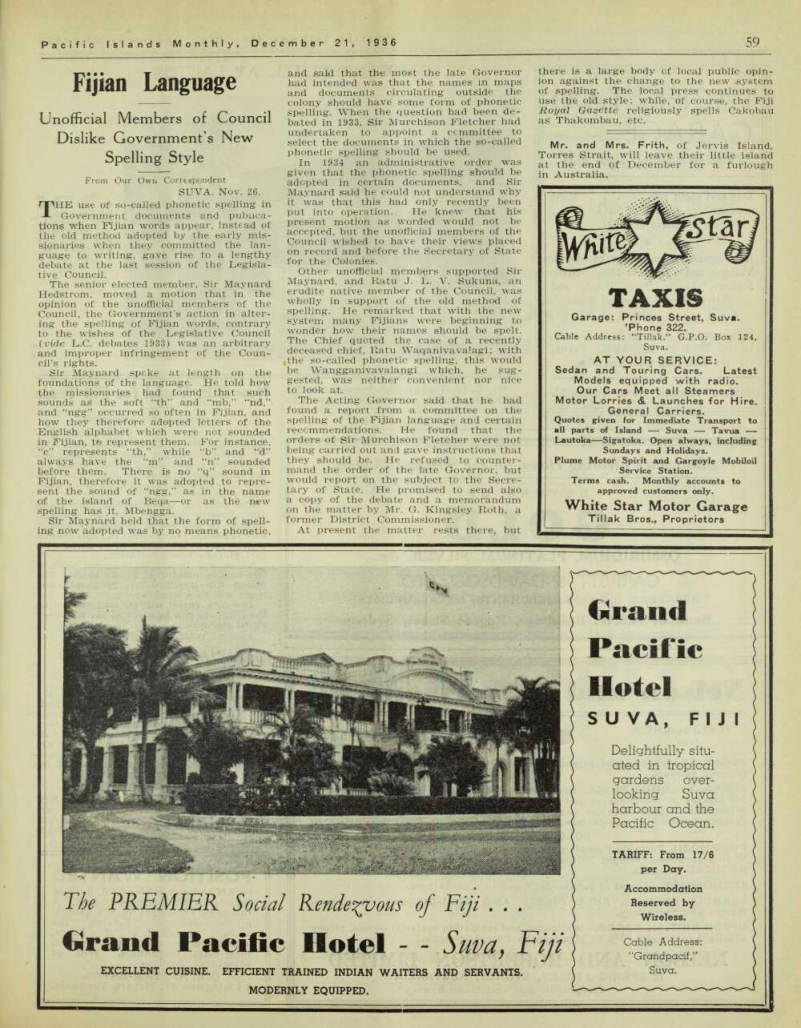
Unofficial Members of Council Dislike Government's New Spelling Style
From Our Own Correspondent
Suva. Nov. 26.
THE use of so-called phonetic spelling in Government documents and publica tions when Fijian words appear, instead of the old method adopted by the early mis sionaries when they committed the lan guage to writing, gave rise to a lengthy debate at the last session of the Legisla tive Council.
The senior elected member, Sir Maynard Hedstrom, moved a motion that in the opinion of the unofficial members of the Council, the Government’s action in alter ing the spelling of Fijian words, contrary to the wishes of the Legislative Council (vide L.C. debates 1933) was an arbitrary and improper infringement of the Coun cil’s rights.
Sir Maynard spcke at length on the foundations of the language. He told how the missionaries had found that such sounds as the soft “th” and “mb,” “nd,” and “ngg” occurred so often in Fijian, and how they therefore adopted letters of the English alphabet which were not sounded in Fijian, to represent them. For instance, “c” represents “th,” while “b” and “d” always have the “m” and “n” sounded before them. There is no “q” sound in Fijian, therefore it was adopted to repre sent the sound of “ngg,” as in the name of the island of Beqa—or as the new spelling has it, Mbengga.
Sir Maynard held that the form of spell ing now adopted was by no means phonetic,
and said that the most the late Governor had intended was that the names in maps and documents circulating outside the colony should have some form of phonetic spelling. When the question had been de bated in 1933, Sir Murchison Fletcher had undertaken to appoint a committee to select the documents in which the so-called phonetic spelling should be used.
In 1934 an administrative order was given that the phonetic spelling should be adopted in certain documents, and Sir Maynard said he could not understand why it was that this had only recently been put into operation. He knew that his present motion as worded would not be accepted, but the unofficial members of the Council wished to have their views placed on record and before the Secretary of State for the Colonies.
Other unofficial members supported Sir Maynard, and Ratu J. L. V. Sukuna, an erudite native member of the Council, was wholly in support of the old method of spelling. He remarked that with the new system many Fijians were beginning to wonder how their names should be spelt.
The Chief quoted the case of a recently deceased chief, Ratu Waqanivavalagi; with ? the so-called phonetic spelling, this would be Wangganivavalangi which, he sug gested, was neither convenient nor nice to look at.
The Acting Governor said that he had found a report from a committee on the spelling of the Fijian language and certain recommendations. He found that the orders of Sir Murchison Fletcher were not being carried out and gave instructions that they should be. He refused to counter mand the order of the late Governor, but would report on the subject to the Secre tary of State. He promised to send also a copy of the debate and a memorandum on the matter by Mr. G. Kingsley Roth, a former District Commissioner.
At present the matter rests there, but
there is a large body of local public opin ion against the change to the new .system of spelling. The local press continues to use the old style; while, of course, the Fiji Royal Gazette religiously spells Cakobau as Thakombau, etc.
Mr. and Mrs. Frith, of Jervis Island, Torres Strait, will leave their little island at the end of December for a furlough in Australia.
Advertisements & other items, pp. 61-62 (1 item)
Grand Pacific Hotel - - Suva, Fiji
TAXIS
Garage: Princes Street, Suva.
'Phone 322.
Cable Address: “Tillak.” G.P.O. Box 124, Suva.
AT YOUR SERVICE:
Sedan and Touring Cars. Latest Models equipped with radio.
Our Cars Meet all Steamers Motor Lorries & Launches for Hire.
General Carriers.
Quotes given for Immediate Transport to all parts of Island Suva Tavua Lautoka—Sigatoka. Open always, including Sundays and Holidays.
Plume Motor Spirit and Gargoyle Mobiloil Service Station.
Terms cash. Monthly accounts to approved customers only.
White Star Motor Garage
Tillak Bros., Proprietors
r V The PREMIER Social Rendezvous of Fiji . . .
Grand Pacific Hotel - - Suva, Fiji EXCELLENT CUISINE. EFFICIENT TRAINED INDIAN WAITERS AND SERVANTS.
MODERNLY EQUIPPED.
Grand
Pacific
Hotel
S U VA, FIJI
Delightfully situated in tropical gardens overlooking Suva harbour and the Pacific Ocean.
TARIFF: From 17/6
per Day.
Accommodation Reserved by Wireless.
Cable Address: ''Grandpacif/' Suva.
PACIFIC TAXI
GARAGE - -
(Vincent Brothers, Suva, Fiji) Day and night service . . , Most modern hire service in Suva . . .
Excellent drivers. • Our special trips embrace Rewa Valley and Sugar Mill, River Scenery, Lami, Suva Point, and Native Kings’ Town of Bau • Trips can be arranged on Trans- Island road to Ellington, Tavua, Ba, Lautoka, and Sigatoka.
Cables: “Vincent,” Suva. ’Phone 33.
c 'Australia’s Clearing House for the Precious
BUYERS OF
GOLD
OSMIRIDIUM, PLATINUM, SILVER, &c.
GARRETT & DAVIDSON, LTD.
ASSAYERS, BULLION MERCHANTS, METALLURGISTS
Bank of N.S.W. Buildings, Regent Street, Sydney
Nelson and Robertson Ltd.
(ESTABLISHED
1895)
• Island Merchants
COCOA BEANS.—Special attention devoted to their sale in Australian and Oversea markets.
COPRA, TROCHUS SHELL, and other Island Produce sold on commission.
All classes of merchandise and Mining Machinery purchased at wholesale prices and original invoices supplied to Island clients. Small commission.
Prices submitted for comparison.
SOLE AGENTS FOR
PUMPMOBIL Portable Pumping Plants. Recommended for Sluicing and all Mining purposes. Weight 120 lbs., 12,000 gals, per hour, 10 to 100 feet head.
REDUCED PRICES.
ARCHIMEDES.—Latest in outboards; Swedish manufacture.
SKANDIA ENGINES, FULL DIESEL AND SEMI-DIESEL; all powers, Marine and Stationary.
UPSON BRITISH BOARD. —Wallboard and insulating material in one, strong and light in weight. 6ft. to 12ft. lengths always in stock.
NELSON AND ROBERTSON LIMITED
12 SPRING STREET, SYDNEY, AUSTRALIA
Telegraphic Address: “Ivan Sydney”
Modern Hotel At Lautoka
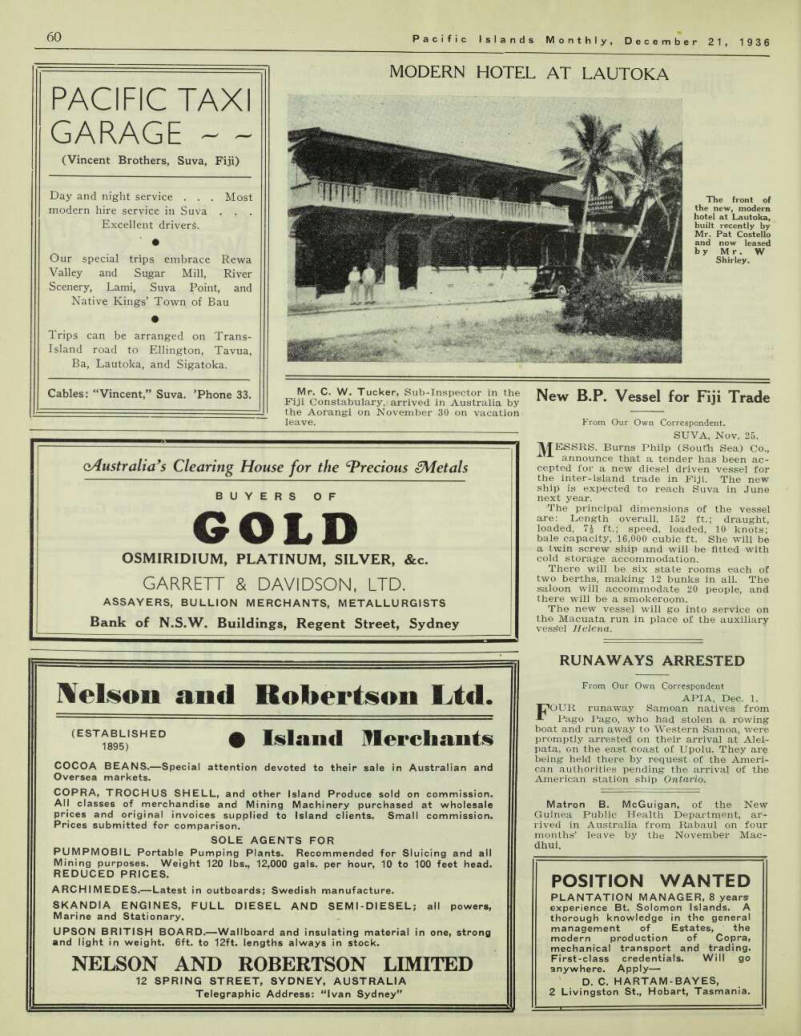
Mr. C. W. Tucker, Sub-Inspector in the Fiji Constabulary, arrived in Australia by the Aofangi on November 30 on vacation leave.
The front of the new, modern hotel at Lautoka, built recently by Mr. Pat Costello and now leased by Mr. W Shirley.
N ew R P Vessel for FiJi Trade
From Our Own Correspondent.
Suva, Nov. 25.
11/TESSRS. Burns Philp (South Sea) Co., TA announce that a tender has been ac cepted for a new diesel driven vessel for the inter-island trade in Fiji. The new ship is expected to reach Suva in June next year.
The principal dimensions of the vessel are: Length overall, 152 ft,; draught, loaded, 7§ ft,; speed, loaded, 10 knots; bale capacity, 16,000 cubic ft. She will be a twin screw ship and will be fitted with cold storage accommodation.
There will be six state rooms each of two berths, making 12 bunks in all. The saloon will accommodate 20 people, and there will be a smokeroom.
The new vessel will go into service on the Macuata run in place of the auxiliary vessel Helena.
Runaways Arrested
From Our Own Correspondent
Apia, Dec. 1.
runaway Samoan natives from Pago Pago, who had stolen a rowing boat and run away to Western Samoa, were promptly arrested on their arrival at Alei pata, on the east coast of Upolu. They are being held there by request-of the Ameri can authorities pending the arrival of the American station ship Ontario.
Matron B. McGuigan, of the New Guinea Public Health Department, ar rived in Australia from Rabaul on four months’ leave by the November Mac dhui.
Advertisements & other items, p. 62 (1 item)
Position Wanted
PLANTATION MANAGER, 8 years
experience Bt. Solomon Islands. A thorough knowledge in the general management of Estates, the modern production of Copra, mechanical transport and trading.
First-class credentials. Will go anywhere. Apply—
D. C. HARTAM-BAYES,
2 Livingston St., Hobart, Tasmania.
New Governor Arrives
in Fiji Warm Welcome for Sir Arthur Richards
From Our Own Correspondent
Suva, Nov. 28.
AN enthusiastic welcome awaited His Excellency Sir Arthur Richards, K.C.M.G., the new Governor of Fiji, when he stepped off the Matua at Suva this morning. Sir Arthur was accompanied by Lady Richards and family, and Captain P. Jeffs, his A.D.C.
Greeted by a salute of 17 guns fired from H.M.C.B. Pioneer, His Excellency landed and inspected the guard of honour of European, Fijian, and Indian companies of the Defence Force and the band.
Shortly afterwards His Excellency went to the Supreme Court, where, in the pre sence of members of the Executive Coun cil, he was sworn in as Governor and Commander-in-Chief in and over the Colony of Fiji and as High Commissioner for the Western Pacific. The oaths of allegiance and office were administered bv His Honour the Chief Justice, Mr. O. C. K.
Corrie.
In a short address Sir Arthur expressed thanks on behalf of Lady Richards and himself for the very warm welcome they had been accorded. He remarked that he was conscious of his good fortune in coming here on a rising tide of prosperity.
His predecessor, Sir Murchison Fletcher, had had the difficulties of the depression to deal with, but had also had the satis faction of steering the ship into calmer waters.
It would be his endeavour with the assistance of his advisers to pursue a policy of progress. Fiji was an agricul tural country, and it would be his en deavour to foster development along those lines.
His Excellency said that there was one policy that would remain unchanged and unchallenged, and that was that the true interests of the Fijians always remained the ultimate and predominant considera tion of the Government. Some confusion might arise as to what were the true in terests of the Fijians: they were to fit them more fully to meet the impact of modern conditions and to help them to help themselves and maintain their posi tion. It was not in the true interests of the Fijians to injure or restrict the activi ties of other races whose energy and in dustry had contributed so signally to the welfare of the land.
Later in the bure at Government House their Excellencies were accorded a tradi tional native welcome by leading chiefs of the Colony. Sir Arthur was presented with a tabua (whale’s tcoth) and the usual root of yaqona. An address of wel come was read by one of the chiefs. Then came the ceremonial preparation and drinking of kava done with full native ceremonial, the performers chanting as the drink was painstakingly prepared.
His Excellency addressed the chiefs along the lines of his address to the Exe cutive Council earlier in the day, saying that it was the object of the Government to teach the natives to take a vigorous pride in the national future. They would always have the Government’s help and support in upholding and safeguarding their position. The Government wished to help the Fijians in every way, but they must be able and willing to help them
selves, so he would confidently look for ward to receiving a full measure of sup port and co-operation from the chiefs in everything which he might try to do for the good of the people and their country.
Welcome In Samoa
From Our Own Correspondent.
Apia, Nov. 25.
T’HE newly appointed Governor of Fiji -*■ and High Commissioner for the Wes tern Pacific (Sir Arthur P. Richards, K.C.M.G.) passed through Apia on the Matua.
Sir Arthur was entertained on the afternoon of November 24 at the Govern ment (Avele) Boys’ School, with a pro gramme of Samoan songs and dances.
Representatives of Europeans and natives were present, and were introduced to the guest of honour.
Mr. W. J. Clapham, accountant at the Suva branch of the Bank of New Zealand, returned to Fiji after furlough by the Niagara in November.
Advertisements & other items, p. 63 (1 item)
A. B. Donald Ltd.
Six-Acre PLANTATION
FOR SALE
Situated at Nukualofa, capital of Tongatabu, Friendly Islands.
Full particulars from
MR. AUGUST HETTIG
Nukualofa, Tonga.
MORRIS, HEDSTROM, Ltd.
FIJI
Sole Agents in Fiji for . . .
Vacuum Oil Company (Pty.) Limited
Imperial Chemical Industries Limited
Nobel (Australasia) Pty Ltd.—Explosives
Full Stocks of
MINERS AND PROSPECTORS’
REQUISITES
Also SODIUM CYANIDE, ZINC
DUST. Etc. Etc.
Sydney Office:
DALTON HOUSE, 115 PITT ST., SYDNEY
Branches throughout the gold bearing areas Lautoka, Ba, Tavua, Penang, Nadi, and Sigatoka
A. B. DONALD Ltd.
AUCKLAND
Island Traders :: General Merchants P.O. Box 1509 ;; Cables and Telegrams: “Kingdom/' Auckland Branches at Rarotonga and throughout the Cook Islands At Papeete and throughout the Society, Marquesas and Paumotu Islands
trading as “ETABLISSEMENTS DONALD. TAHITI”
At Fiji: Trading as “Dominion Fruit C 0.,” Suva
New Zealand
Pitcairn Islanders Go To
From Our N.Z. Correspondent
Auckland, Nov. 30.
THERE has been quite a trend of emi gration from Pitcairn Island, home of the descendants of the Bounty mutineers, to New Zealand. Four of the Islanders arrived a few months ago and are now working in the Dominion, and six more, including one woman, reached Auckland this month by the Rangitata.
Four of them had previously visited
New Zealand but two are making their first contact with the outside world. One of the visitors is a descendant of Fletcher Christian, leader of the mutineers, and the others are descendants of a midshipman who joined them.
They denied that there was any hardship on Pitcairn and said, indeed, that they were so self-supporting that the depression had scarcely been felt. Their object was to get a change from Islands life and to find work in New Zealand. The length of their stay depended on their success in obtaining employment. Friendly and well-spoken, their bearing to an inter viewer was the essence of courtesy.
Washed Copra
Experiment In Fiji
rPHE following is taken from the weekly -bulletin (November 14) of the Fiji Coconut Planters’ Union: We are permitted by Mr. Duncan to give particulars of a recent experiment carried out, in conjunction with Lever Bros., of the relative merits of washed and unwashed copra.
At Mua Estate, Mr. Duncan dries his copra in compartments heated by steam coils and thus produces hot-air dried copra of a high quality. The lay out of his dryer is such that the green copra, on arrival at the kiln, is tipped on to a washing platform, where the green copra is washed by a fresh water jet, with a pressure of 100 lbs. to the square inch. The washed copra is then placed in the drying compartments.
Copra washed in this manner prior to drying, and copra put through the dryer at the same time without prior washing gave the following analyses:
The most interesting feature of the analysis is the lower free fatty acid con tent of the washed sample, 1.02 per cent, as compared with 3.11 per cent, of the un washed sample.
By reason of the high grade of his copra, Mr. Duncan is able to obtain a premium above the price of Fiji Planta tion South Sea.
Washed Unwashed Copra Copra Oil 66.79% 65.56% Moisture 4.07% 4.37% Free Fatty Acid 1.02% 3.11%
Samoan News
* From Our Own Correspondent
Apia, Nov. 25.
FOR the first ten plots of land which have been put up for tender in the new Land Settlement Scheme sponsored by the Administration, no less than 56 local-born young men have sent in applications. The plots therefore will be allotted by ballot.
The European United Progressive Party, the Chamber of Commerce, and the Plant ers’ Association have jointly submitted a request to the Administration, that the two European elected members of the Legis lative Council should represent the Euro peans on the Finance Board, which is to be constituted in accordance with the request of the Samoans.
Sir Garrick Robertson, prominent New Zealand surgeon, was a through passenger on the Matua. His daughter is married to the Apia solicitor, Mr. G. Jackson.
Mr. A. Schaaffhausen, officer in charge of the Public Works Department, is leaving by the Matua on a combined business and holiday trip to New Zealand, via Fiji.
A report of the death at Invercargill, N.Z., of Mrs. A. McCarthy, wife of Judge McCarthy, for many years a resident of Apia, where she was well and favourably known to a large circle of friends, was re ceived with sincere regret.
Mr. and Mrs. Geoffrey Jackson, of Apia, have recently had as their guests in Samoa, the former’s parents, Mr. and Mrs. T.
Jackson, of Auckland. Mrs. Geoffrey Jackson returned to New Zealand with her guests, and is now staying with her parents, Sir Garrick Robertson, the well known surgeon, and Lady Robertson, of Auckland.
Advertisements & other items, p. 64 (1 item)
Uprinql
PAINT. .
HORSE SHOE BRAND
IN PASTE OR READY
MIXED FORM
WHITE LEAD, WHITE ZINC
AND ALL COLOURS
Made in Scotland— C/ —therefore Reliable!
THOMAS MACINTYRE & CO. LTD., -GLASGOW. SCOTLAND
DOYLE’S famous VETERINARY REMEDIES
OOY
%0 RES#
REDUCINE—Cure* Your Lame Horse. Cures him painlessly and you can work him all the time.
Cures Splints, Curbs, Capped Hocks. Sprung Tendons, Bog Spavins, and all Bony and Bursal En- •argments. Price, 12/6 per can. Postage 1/-.
LARYNGINEI—A sure cure for Coughs, Colds, Strangles, etc. Price, 5/- per can. Postage, I/-.
SKIN DRESSING.—A certain remedy for Mange and Allied Parasitic Skin Diseases in Horses, Dogs, etc. Price. 7/6 (large), 3/6 (small). Postage, 1/-.
DISTEMPER MIXTURE.—A safe and reliable remedy for Coughs, Colds, Asthma, etc. Price, 2/6. Postage, 6d.
T. G. DOYLE, V.S., 9 KING STREET, RANDWICK, N.S.W.
Write for Free Veterinary Advice and Booklet
Preserve Wood and Canvas
from ROT and DECAY
Spraying or painting timber with “CUPRINOL checks the ravages of White Ants (Termites) and Fungi, and gives sound wood permanent immunity to these destructive pests. Canvas, Net or Cordage treated with “CUPRINOL” will never be subject to Mildew or Decay, the tensile strength will be increased without affecting flexibility in any way.
“CUPRINOL” is non-volatile and insoluble in water and is available in either colorless or green.
Write for details to address blow. i Section of a Greenhouse from Singapore destroyed by Termites.
UPRINQL
THE REVOLUTIONARY
WOOD AND FABRIC PRESERVATIVE
Islands Distributors:
Paul&Gray
Ltd. 82-84 Sussex St.,
SYDNEY
A. W. D. Mullins
Man Who Established Lae Workshops
THERE was regret throughout the New Guinea goldfields when it became known that, at the end of October, Mr. A.
W. D. Mullins would retire from the posi tion of mechanical superintendent for Guinea Airways Ltd., at Lae, and would return to Australia. Mr. and Mrs. Mullins, during their 10 years’ residence at Lae, endeared themselves to everyone.
The phenomenal success of Guinea Air ways in aerial transport has been due largely to mechanical efficiency and good ground organisation; and Mr. Mullins was largely responsible for that remarkable mechanical efficiency.
When, at the late C. J. Levien’s urgent request, Mr. C. V. T. Wells, of Adelaide, hesitatingly bought in Melbourne a second hand De Havilland aeroplane, wherewith to try out aerial transport in New Guinea, he selected two men to go with the machine — Captain Mustar, pilot, and A. W. D. Mul lins, mechanic. It was a shrewd and happy choice.
The ’plane was shipped to Rabaul. The B.P. steamer met terrible weather. Mustar and Mullins spent most of their time sit ting on the cables which held the 'plane on the deck, helping to keep it from falling overboard. Then came weeks of work in Rabaul, preparing the ’plane for that his toric and hazardous flight along the south coast of New Britain to Lae, where Mr.
Levien had scratched a narrow landing place out of the thick jungle.
Mustar and Mullins piade the flight suc cessfully; and thus was inaugurated the aerial transport industry of New Guinea.
Mustar flew the ’plane in to Wau (finding the cleared hillside ’drome after three at tempts) and, within a week, he was busy freighting by air. Two thousand carriers were promptly withdrawn from that heart-breaking track between Salamaua and Wau, and set to work as labourers on the new field.
Mullins, there in the jungle with a few simple tools, kept the engine of the ’plane in good order. Within a couple of years, his palm-leaf toolshed had grown into a series of great workshops, where his big staff gave ceaseless attention to the grow ing fleet of large ’planes. The Company, recognising his worth, sent Mr. Mullins to Europe and America to make himself thor oughlv acquainted with the great machines he was servicing.
A good comrade and a tireless worker, “Mull” became almost an institution at Lae. His wife, a woman of exceptional character—an army nurse, whom he met in England during the war—joined him at Lae soon after he went there, and helped him to make a home in the tropical wilder ness.
Mr. Mullins was one of the first volun teers from Adelaiie for the A.1.F., and he was one of the 25 who were disembarked near Rabaul in 1914 to put the German radio station at Bitapaka out of commis sion. He got malaria, was invalided home, and was refused when he volunteered a second time: but he went to England as a munition worker, and gained valuable ex perience in the great war workshops.
After the war. he joined the R.A.A.F. at Point Cook, Melbourne and from Mel bourne he went to New Guinea. Mr. Levien always described him as “a wizard with engines.” N Mr. Dennis Hill, a Fiji Government offi cial, arrived in Australia in November on furlough. After a brief stay in Mel bourne, he and his wife went across to Tasmania to spend a short holiday.
Morobe, T.N.G.
’Plane's Influence
Keeping Law and Order in Morobe, T.N.G.
From a Special Correspondent WAU, Nov. 19.
ON account of the large settlements of miners and the big operating con cerns. the Morobe district is far in ad vance of any other outlying region in the territory. This has been achieved to a great extent by the aeroplane services that operate into the heart of the country.
Actually there are about 40 ’planes in use in the territory, and most of these are in service in Morobe. On account of the difficult nature of the country, the immense area, and the vast population, this method of administration is the only possible means of maintaining law and order. Air transport not only keeps the various posts supplied with provisions but also enables the administrative officers to be in touch with any unforeseen disturb ances.
Although there is this marked difference between Morobe and the other districts, outlying areas are gradually coming under European influences. For instance, the Officer-in-charge in the Upper Ramu dis trict in September was visited by many warlike warriors from the surrounding villages who surrendered their arms, ex pressing in loud terms their desire to live in peace.
A greater control seems to have been achieved in this area than in any other of the more primitive districts, though work is still progressing in the Chimbu- Bena Bena areas, and extending among the Kukukuku tribes not far distant from Mt. Lawson, near the Papuan border.
Rev, C. W. J. Mannering, of the Metho dist Mission, arrived in Sydney from his station at Namatanai, New Britain, by the Nellore on November 19. He hurried immediately to Victoria to join Mrs. Man nering, who had just given birth to their son.
Mr. Roland Arthur Kable, of Vuna, Northern Fiji, married Miss Sophie Alma Cronin, second daughter of Mr. and Mrs.
J. T. Cronin, of Suva, at the Sacred Heart Cathedral, Suva, on November 10.
They sailed the following day for Tavenui where they have made their new home.
Mr. Edward Raddock, who had been in Fiji since the 70’s, died from heart failure at Suva on November 7. He was 69 years of age. Mr. Raddock was a furniture and cabinet-maker at Levuka for many years before transferring his business to Suva.
Advertisements & other items, pp. 65-66 (1 item)
Best for every
FIND OUT WHAT'S INSIDE
before you buy a low-priced Saddle.
THE KING OF 'EM ALL
NARROW
“Safer Saddle and Offers Sensational Advantages Being built on a Galvanised Tree, heavily bar plated, and strained with English web, riders are assured of its genuine foundation. Its soft, pliant kip flaps are hard-wearing, while the sweepy seat gives superb riding comfort.
Fitted with Best Leather. Op? /£? / Folded Girth, Stirrups . / Freight Free With Capped Pads 15/. extra Write for Catalogue P, 1935.
SYDNEY'S HIGH-CLASS SADDLER
NEWMARKET SADDLERY
W. H. Williams for "Safer" Saddles
18-20 WILSON ST.. NEWTOWN, N.S.W.
Copra Mats anil Matting .
Send your enquiries to us for Woven Wire Mesh in Rolls or framed for Screening purposes, Bird Cages, Sieves and Riddles, Builder’s Gravel Door Mats, Garden Arches, Chain Wire Mesh, Crimped Wire Mesh for
SCOTT AND SONS
WIREWORKS; RAILWAY PARADE AND MURRAY STREET
Copra Drying and all Screens, Rat Traps, Window Guards, etc.
MARRICKVILLE
Best for every
Writ£ for illustrated literature to:
cane arrower
Many years' study of the requirements of cane growers enables us to offer to-day Ploughs and Implements to meet all needs; from light Singlefurrow Ploughs like the "Victory" (illustrated), about 801bs. in weight, to the "Shugadisc" weighing about 3 tons.
MORRIS.
HEDSTROM
LTD.
Suva, Lautoka and Ba W‘.
BITUMENOID ROOFING
MADE IN AUSTRALIA
Bitumenoid Roofings, Dampcourses and Insulating Felts are made from the world’s best raw materials. Warranted to stand the most rigid tests.
BITUMENOID THE BEST
Roofing, 1, 2. 3-ply; Flooring, Waterproof Materials; Saturated Felt; Resilient Road Jointing; Natural Asphalt Dampcoursc; 2 and 3-ply Dampcourse; l-21b. Lead-core Dampcourse; Roofing Cement; Asphalt Paints; Roofing Compound.
SAMPLES AND PRICE LISTS ON APPLICATION
MAXWELL PORTER & SON LTD.
ESTABLISHED 1888. BUILDERS’ SUPPLIES
107 REDFERN ST., REDFERN, SYDNEY, N.S.W. ’Phone, M 3157. Cables Bitumenoid
DURA T I L E
1 These asbestos cement sheets give walls a tiled appearance at less cost. See examples in our showrooms or write for leaflet.
WUNDERLICH LTD.
Crown & Cleveland Sts., Rec Kern, Sydney
REMEMBER THE NAME
DU RATI LE
The Hygeia Dissolvenator. Approved by Health Authorities
A Self Contained Sanitary System
■i.. i 11 o<~i rinarantppH. Suitable for Easily and cheaply installed. Guaranteed.
NO WATER SUPPLY REQUIRED.
No odours, germs, flies or other insect pests.
A caustic soda solution turns the excrement and paper into an innocuous solution which runs off and is absorbed by the soil.
Gives thoroughly efficient, long, care-free service. • The Shell Oil Co. alone has given 52 repeat orders.
Hygeia Sanitary Company
26 Bridge Street, Sydney.
Suitable for Use Indoors. ** Prirp FOB. Svdnev. £l5/10/0
5
RESISTS CORROSION. STRONGER THAN STEEL
EASILY WORKE D. CANNOT RUST
r SALT WATER TANKS, PROPELLER SHAFTS
Tor MOSQUITO GAUZE, MARINE HARDWARE
Full information gladly from the Australian Distributors WRIGHT & COMPANY, 81 Clarence St., Sydney MONEL METAL is a Registered Trade Mark
Cables: “CORNRIGHT,” SYDNEY
“Fiona” Stranded
Mishap to C.S.R. Co.’s Steamer Near Suva
From Our Own Correspondent.
Suva, Nov. 28.
SOME excitement was caused in Suva on November 23, when the Colonial Sugar Refining Co.’s steamer Fiona, out ward bound for Sydney, piled up on the main reef near the harbour entrance and remained there until after midnight the following day.
The vessel was loaded with 1,940 tons of molasses and 50 tons of general cargo, and, as a result of the stranding, the molasses cargo had to be jettisoned before she could be got off.
She went on shortly after 7 p.m. at dead low water, and efforts to refloat her at high tide in the early hours of the next morning failed. Further attempts were made by C.S.R. tugs to get her off at high water in the afternoon, but though they succeeded in moving her some distance, she was still hard and fast when the tide began to fall. However, about midnight on a rising tide she was successfully re floated, and anchored in the harbour.
A Lloyd’s survey later revealed that other than a bent propeller blade she had suffered no damage and had made no water whatever.
The master (Captain V. G. Parker) told a nautical court of inquiry that he had mistaken what is known as the pile light on the eastern side of the harbour en trance for the Lami beacon. He picked up a light which he took to be the Lami light (which in reality was the pile light), and the result was that he navigated his ship on the wrong side of the beacon, run ning her into a patch of coral where the water shoals rapidly from six fathoms to one and a half fathoms.
The Acting Harbour-Master (Captain W. F. D. Hay) gave evidence that at the time the ship sailed it would have been most difficult to pick up the Lami light, and that the first light seen would prob ably be the pile light. There is little difference between them, both being white lights, the pile light having a five-second flash and the other a three-second flash.
The Court found that some blame was attributable to the master who had eom mitted an error of judgment in mistaking the lights. He was ordered to pay the costs of the inquiry, eight guineas.
Mr. Lindsav Laurie, of the staff of the Bank of New South Wales, at Wau, New Guinea, arrived in Sydney in November.
He has been transferred to one of the bank’s branches in Northern New South Wales.
Phosphate Industry
Epic Of The Open Sea
New Book by Pioneer of Phosphate Industry
IN a preface to Adventuring in Coral Seas, the latest book from the pen of Mr. Albert F. Ellis, New Zealand’s repre sentative on the Board of the British Phosphate Commission, Lord Bledisloe has written: “He is himself a creative pioneer to whom I, as a farmer, desire to pay my humble and sincere tribute, for it was through his dis covery and scientific investigation of the rich phosphatic deposits of Ocean Island and Nauru that vast stores of that fertilizating element which is so essential to the develop ment of the root and fruit of the world’s economic plants have been rendered avail able to its primary producers, thus materi ally enhancing the output and inherent value of the world’s real wealth —its only true un decaying assets. . . .”
In his Ocean Island and Nauru, pub lished earlier in the year, Mr. Ellis gave a fascinating account of those still com paratively little known islands (for' the literature concerning them is still ex tremely inadequate) and told how, during the last thirty years, they have come into such prominence in the worlds of agricul ture and commerce, through the discovery of their huge deposits of high-grade phos phate.
Importance Of Air Bases
But in his new book Mr. Ellis has gone further afield. For instance, he has dealt
with the importance of such remote islands as Baker and Howland as possible links in a chain of air-ports across the Pacific —a subject that is of vital impor tance to British and American interests.
Because of recent American action, the author observes: “One does not need to be a prophet or the son of a prophet to forecast that this is going- to develop into a very big thing in the future.”
However, it is in the glimpses of the past wherein the book provides most in terest to students of Pacific problems. It will provide many an old-timer with a chuckle.
One of the most fascinating chapters in an eminently “readable” volume describes the passing of “Miki Wakabu” (Captain Walkup), the missionary, “a somewhat short, sturdily-built man, about 45 years of age, with a pronounced American accent.”
“His features were very plain and rugged,” says the author. “Obviously the best goods were not displayed in the shop window, for on further acquaintance I found he had a heart of gold.” The Hiram Bingham, his little schooner, bore the name of a fellow-countryman, one of the missionary pioneers of Hawaii. Her com mander was at one time a prominent figure in the San Francisco prize ring.
When Mr. Ellis met Walkup on Ocean Island, the missionary was on a voyage that included calls at the Gilbert and Caroline Groups. Naturally, he was sur prised to learn of the potential wealth of the island at which he made periodical visits.
The Redoubtable Captain
Walkup
Early in 1909 Captain Walkup was sup plied with a new vessel. After calling at Ocean Island, under the command of the ex-pugilist, she sailed for Butaritari, in the Gilberts, but unfortunately never reached her destination. There were nine on board the Hiram Bingham No. 2 —a native crew of four, and four passengers for the Gilberts. Three of the latter were children, and three of the crew were Gil bertese. The fourth was a broad-should ered young Banaban named Teta, the adopted son of the native pastor of Ocean Island.
During a sudden squall on the voyage the little Hiram Bingham capsized. Teta supplied a graphic description of the mis hap. For three days Walkup and the sur vivors attempted to row in the ship’s dinghy to Butaritari. On the fourth day some rain was caught in the captain’s coat. On the eighth day they still had not sighted land, and their plight was desperate.
At last, after many days at sea, in which they covered nearly 300 miles, from the vicinity of Butaritari in the Gilberts, to Ebon, the southernmost island in the Marshall Group, they were rescued by a canoe.
The dinghy was a mere cockleshell.
“For a boat of that size with nine people aboard to make such a voyage in the open sea,” says Mr. Ellis, “must surely be an unparalleled achievement. That voyage . . . should surely have a worthy place in the annals of Central Pacific drift voyages! ”
But, on the third day after landing, the
American missionary whose courage had upheld his companions in their dire need, died. The ordeal was too much for him.
Mr. Ellis says that the real hero of the voyage was Teta. Few men of any race or colour could have met the emergencies as “did this descendant of people who, for generations, have had a strenuous struggle with the sea for their very existence.”
Had not Walkup dissuaded him, the author is of opinion that Teta would have entered the water and tackled one of the sharks that kept vigil beside the boat.
The book is written with simple charm; There is no straining after effect. Within the pages of Adventuring in Coral Seas is much information that is all the more valuable as it is the record of an eye witness. Albert F. Ellis has been in the truest sense of the expression—a pioneer
of the Pacific.
Eric Ramsden.
Adventuring In Coral Seas By Albert
F. Ellis, C.M.G., author of Ocean Island and Nauru, with a foreword by the Right Hon. Vis count Bledisloe of Lydney. Published by Messrs.
Angus and Robertson, Castlereagh St., Sydney.
Advertisements & other items, p. 67 (1 item)
I Permanent
an
The quality and distinction of a "Cyclone” Ornamental Gate makes the entrance to a home more imposing. But fine appearance is by no means the only advantage.
Strength and permanence are extremely marked. The framework of the fence, of strong steel tubing electrically welded, keeps its shape, and swings accurately for a lifetime. We shall be happy to send you full details of "Cyclone" Ornamental Gates, and Fences to match. Write us. No obligation.
ORNAMENTAL ESSS
CYCLONE FENCE & GATE CO. PTY. LTD.
THE GRACE BUILDING. 77 YORK STREET, SYDNEY, and at Melbourne, Adelaide, Perth.
Broadcast for New Caledonian
Residents
IN response to requests from French residents in New Caledonia, the Aus tralian Broadcasting Commission has arranged to transmit from its short wave station in Victoria a regular series of news items in French.
This service, which began on Decem ber 1, is broadcast on Tuesday and Friday evenings between 6.30 and 6.45 o’clock.
Mr. N. H. Fisher, Government geolo gist in New Guinea, returned to Rabaul from Brisbane by the Montoro in De cember.
The Moon And Palolo
Letter to the Editor. ¥ AM sure that “The Rising of Copra” is A of far more vital interest to your sub scribers than “The Rising of Palolo”; but, at least, from my point of view, Mr. Arthur Robinson’s sweeping statements demand a few more words on the subject.
A.R. writes of his knowledge of the “Rising” in Fiji, whilst I of the Eastern Solomons. Apparently, the dates do not coincide. That is interesting—but it does not justify A.R. tearing my humble article asunder and telling the world I know noth ing at all about the subject.
Instead of “wasting my time,” I, together with hundreds of natives of this island, have gathered Palolo on numerous occa sions two nights after November full moon.
Of course, the months differ. The full moon has been known to pop up bright and early on the Ist! Other years it has had the audacity to be as late as the 30th.
However, I am not going to fall out with A.R., for I am greatly indebted for the astronomical information, “How to find the correct date of the third quarter of the moon, south of the line.”
I am, etc.,
A. M. Andresen.
Ulawa, 20/10/1936.
Later (Nov. 3).
Just two nights after the October full moon, on Saturday evening, November 1, at 8.20. contrary to the usual first rising, the Palolo came up in all their glory by the million. Whether the same thing will occur again this month I leave to those more learned on the subject.
—A.M.A.
Japanese And Dutch New Guinea
TT has been reported that a Japanese firm, Kanefeuchi and Company, pro poses to establish cotton plantations in Dutch New Guinea.
Mrs-. F. J. Williams, of Samarai, Papua, and her two daughters, Constance and Ruth, have been staying in Wanganui, New Zealand.
Advertisements & other items, p. 68 (1 item)
W. Kopsen
IP
lilL
UMPMOBIL
LIGHT and PORTABLE
MOTOR PUMP
PUMPMOBIL
MM I Complete Plant’s weight, 140 lbs. Capacity up to 12,000 gallons per hour.
All heads from 10 to 115 feet.
Fuel consumption, \ gallon per hour.
Pressure 551 b. square inch Especially suitable prospecting and all Sluicing Requirements.
Nelson & Robertson Ltd.
12 SPRING STREET, SYDNEY
PEN T A
Marine Engines, 3-100 h.p., 1,2, 4 and 6 cylinder. Special under-bond prices for Islands Trade. Write for illustrations and full particulars.
ELECTRIC RUST
SCALING MACHINE
Removes rust at rate of 52 sq. ft. per hour and works from domestic or ship's power. Under-bond prices.
W. KOPSEN
& CO. LTD.
SHIPCHANDLERS AND HARDWARE
MERCHANTS
MANUFACTURERS OF ALPINE ASH
BOAT OARS AND TOOL HANDLES
Large Stocks of Wire Rope, Shackles,
Winches and all Miners' and Prospectors'
Equipment
V
TILLEY
Kerosene Pressure Lamps and Lanterns.
Complete range of Table, Hanging, Wall, Vase and Storm Lamps. Large Stocks of Spare Parts.
COLTHURST AND HARDING'S ENGLISH "ALPHA" QUALITY
PAINT AND VARNISHES
KOPSEN'S ENGLISH YELLOW SHEATHING METAL, NAILS
OAKUM. MARINE GLUE. FELT. ETC.
HAYWARD'S COKER CANVAS
• Write for Boat Catalogue •
70 CLARENCE STREET, SYDNEY
Cables: Kopsen, Sydney 'Phone: BW 1114 (3 lines)
TYF O N
Whistles for Air, Steam or Hand Operation. For Launches, Trading Vessels, etc. Simple, easy to operate and very efficient.
Eastern Papua
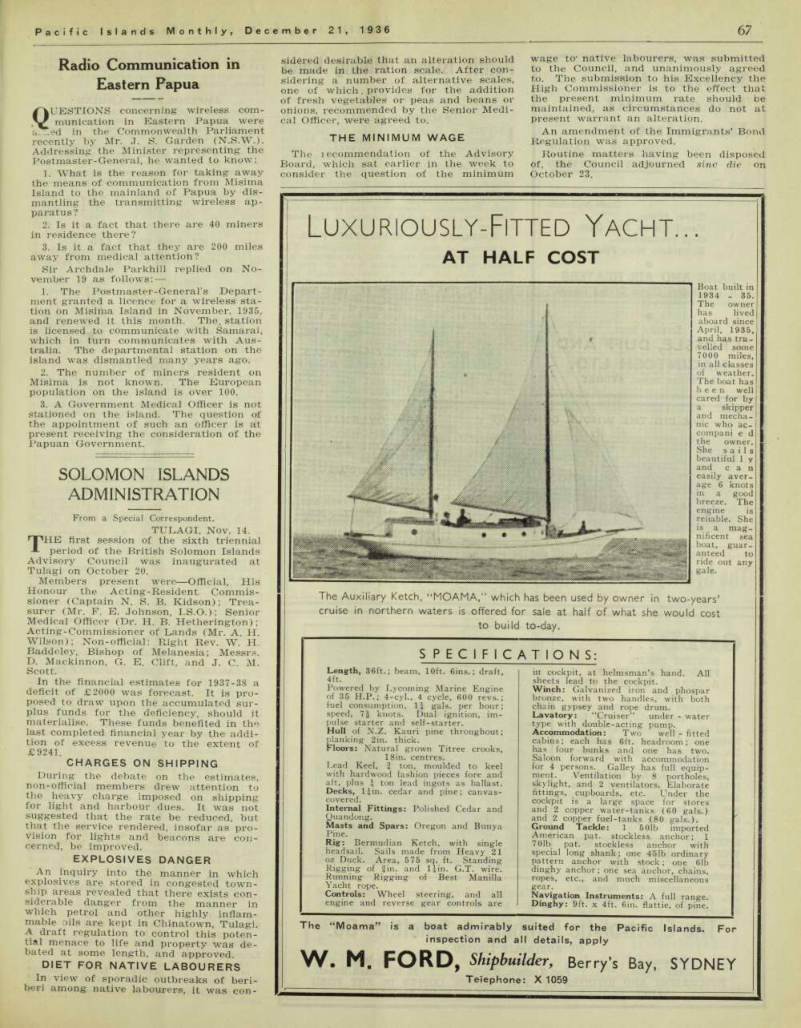
Radio Communication in Eastern Papua
QUESTIONS concerning wireless com munication in Eastern Papua were a. :.ed in the Commonwealth Parliament recently by Mr. J. S. Garden (N.S.W.).
Addressing the Minister representing the Postmaster-General, he wanted to know; 1. What is the reason for taking away the means of communication from Misima Island to the mainland of Papua by dis mantling the transmitting wireless ap paratus? 2. Is it a fact that there are 40 miners in residence there? 3. Is it a fact that they are 200 miles away from medical attention?
Sir Archdale Parkhill replied on No vember 19 as follows: 1. The Postmaster-General’s Depart ment granted a licence for a wireless sta tion on Misima Island in November, 1935, and renewed it this month. The. station is licensed to communicate with Samarai, which in turn communicates with Aus tralia. The departmental station on the island was dismantled many years ago. 2. The number of miners resident on Misima is not known. The European population on the island is over 100. 3. A Government Medical Officer is not stationed on the island. The question of the appointment of such an officer is at present receiving the consideration of the Papuan Government.
Solomon Islands
Administration
From a Special Correspondent.
Tulagi, Nov. 14.
THE first session of the sixth triennial period of the British Solomon Islands Advisory Council was inaugurated at Tulagi on October 20.
Members present were—Official, His Honour the Acting-Resident Commis sioner (Captain N. S. B. Kidson); Trea surer (Mr. F. E. Johnson, 1.5.0.); Senior Medical Officer (Dr. H. B. Hetherington); Acting-Commissioner of Lands (Mr. A. H.
Wilson); Non-official: Right Rev. W. H.
Baddeley, Bishop of Melanesia; Messrs.
D. Mackinnon, G. E. Clift, and J. C. M.
Scott.
In the financial estimates for 1937-38 a deficit of £2OOO was forecast. It is pro posed to draw upon the accumulated sur plus funds for the deficiency, should it materialise. These funds benefited in the last completed financial year by the addi tion of excess revenue to the extent of £9241.
Charges On Shipping
During the debate on the estimates, non-official members drew attention to the heavy charge imposed on shipping for light and harbour dues. It was not suggested that the rate be reduced, but that the service rendered, insofar as pro vision for lights and beacons are con cerned, be improved.
Explosives Danger
An inquiry into the manner in which explosives are stored in congested town ship areas revealed that there exists con siderable danger from the manner in which petrol and other highly inflam mable oils are kept in Chinatown, Tulagi.
A draft regulation to control this poten tial menace to life and property was de bated at some length, and approved.
Diet For Native Labourers
In view of sporadic outbreaks of beri beri among native labourers, it was con
sidered desirable that an alteration should be made in the ration scale. After con sidering a number of alternative scales, one of which. provides for the addition of fresh vegetables or peas and beans or onions, recommended by the Senior Medi cal Officer, were agreed to.
The Minimum Wage
The i ecommendation of the Advisory Board, which sat earlier in the week to consider the question of the minimum
wage ter native labourers, was submitted to the Council, and unanimously agreed to. The submission to his Excellency the High Commissioner is to the effect that the present minimum rate should be maintained, as circumstances do not at present warrant an alteration.
An amendment of the Immigrants’ Bond Regulation was approved.
Routine matters having been disposed of, the Council adjourned sine die on October 23.
Advertisements & other items, pp. 69-70 (1 item)
Luxuriously-Fitted Yacht..
AT HALF COST
* Boat built in 1934 35.
The owner has lived aboard since April, 1935, and has travelled some 7000 miles, in all classes of weather.
The boat has been well cared for by a skipper and mechanic who accompani e d the owner.
She sails beautiful 1 y and can easily average 6 knots in a good breeze. The engine is reliable. She is a magnificent sea boat, guaranteed to ride out any gale.
The Auxiliary Ketch, “MOAMA,” which has been used by owner in two-years’ cruise in northern waters is offered for sale at half of what she would cost to build to-day.
SPECIFIC
Length, 36ft.; beam, 10ft. 6ins.; draft, 4ft.
Powered by Lycoming Marine Engine of 35 H.P.; 4-cyl., 4 cycle, 600 revs.; fuel consumption, 14 gals, per hour; speed, 71 knots. Dual ignition, impulse starter and self-starter.
Hull of N.Z. Kauri pine throughout; planking 2in. thick.
Floors: Natural grown Three crooks, 18in. centres.
Lead Keel, ton, moulded to keel with hardwood fashion pieces fore and aft, plus 4 ton lead ingots as ballast.
Decks, 14in. cedar and pine; canvascovered.
Internal Fittings: Polished Cedar and Quandong.
Masts and Spars: Oregon and Bunya Pine.
Rig: Bermudian Ketch, with single headsail. Sails made from Heavy 21 oz Duck. Area, 575 sq. ft. Standing Rigging of |in. and 14in. G.T. wire.
Running Rigging of Best Manilla Yacht rope.
Controls: Wheel steering, and all engine and reverse gear controls are
A T I O N S:
in cockpit, at helmsman’s hand. All sheets lead to the cockpit.
Winch: Galvanized iron and phospar bronze, with two handles, with both chain gypsey and rope drum.
Lavatory: “Cruiser” under - water type with double-acting pump.
Accommodation: Two well - fitted cabins; each has 6ft. headroom; one has four bunks and one has two.
Saloon forward with accommodation for 4 persons. Galley has full equipment. Ventilation by 8 portholes, skylight, and 2 ventilators. Elaborate fittings, cupboards, etc. Under the cockpit is a large space for stores and 2 copper water-tanks (60 gals.) and 2 copper fuel-tanks (80 gals.).
Ground Tackle: 1 50lb imported American pat. stockless anchor; 1 701 b pat. stockless anchor with special long shank; one 451 b ordinary pattern anchor with stock; one 61b dinghy anchor; one sea anchor, chains, ropes, etc., and much miscellaneous gear.
Navigation Instruments: A full range.
Dinghy: 9ft. x 4ft. 6in. flattie, of pine.
The “Moama” is a boat admirably suited for the Pacific Islands. For inspection and all details, apply W. M. FORD, Shipbuilder, Berry’s Bay, SYDNEY Telephone: X 1059
Milling: Ore
Treatment
Machinery
COMPLETE CYANIDE
PLANTS SUPPLIED
Dorr Classifiers.
Dorr Thiciceners.
Dorr Agitators Oliver Filters.
Merril Crowe Zinc Dust Gold Precipitation.
Richardson Mine Fans. •
FANS AND AIR HEATERS
For Ventilation, Copra Drying Rooms, etc. • Enquire from
CROSSLE, DUFF AND
MACINTOSH LTD.
52 Bridge Street, SYDNEY
WE DID THE WHOLE CONTRACT
Your confidence in our service will not be misplaced.
NEW OVERHAUL
SHOP
AND STORE AT LAE
for
GUINEA AIRWAYS
LTD.
IN few undertakings do reliability, expedition, and efficient service count more than in Structural Steel contracts.
The Sydney Steel Company Ltd.
MARRICKVILLE, N.S.W.
Cable Address: “Sydsteel”
Steel Merchants and Structural Engineers
GOLD...
HIGHEST PRICES
PROMPT SETTLEMENTS
ACCURATE WEIGHTS AND
ASSAYS
are assured to producers and sellers of gold bullion who forward their consignments to The Electrolytic Refining and Smelting Co. of Aust. Ltd. for treatment and realisation.
RECORD PRICE.—On 6th March, 1935. this company paid to its clients at the rate of £9/4/6 net per fine ounce, which is the highest price ever paid for gold in Australia.
SPECIALLY ORGANISED SER-
VICE is available to clients in New Guinea, Fiji and other Pacific Island centres.
Address consignments from outside Australia to the Company's Sydney office.
The Electrolytic Refining & Smelting Co.
OF AUSTRALIA LIMITED
Melbourne: Works: Sydney; Collins House. Port Kembla, N.S.W. 25 O'Connell Street PURCHASERS AND REFINERS OF GOLD. SILVER. COPPER IN ANY FORM BANKERS: —The English, Scottish and Australian Bank Ltd. n Weighing a Pacific Islands consignment of gold bullion at an E.R. & S. receiving office.
Pacific Islands Mining Notes
From Fiji
Pacific Gold N.L.
INCOME of Pacific Gold N.L. for the period September 27, 1935, to September 30 last exceeded the expenditure by £496. In addi tion, £8077 was expended on investigating pro perties. Current assets at the close of the period exceeded the liquid assets by £2770. The diamond drilling company, to test the formation at depth on the Wainivesi area in Fiji, is in progress. The company subscribed for interests in New Cale donia Prospecting Association and Oceanic Gold Exploration, both of which proved of insufficient promise.
Sukulaki Gold Development N.L.
Directors of Sukulaki Gold Development N.L. state in their annual report that the company was formed to acquire an option over an area at Tavua, Fiji, but the area was abandoned after preliminary testing. Accounts for the period from April 18, 1935, to March 31, 1936, show a balance of £2635 transferred to investigation pro perties account. Since the close of accounts, 150 shares of £lO each, paid to £2/5/-, in Fiji Min ing Corporation N.L. have been acquired. Direc tors of that company believe that the property will prove a valuable one.
Mt. Morgan Developments Ltd.
A loss of £11,872 was incurred by Mount Mor gan Developments Limited for the period Decem ber 20, 1934, to June 30 last. The directors in their report state that expenditure on investiga
tion and development of properties amounted to £19,861, Of this £7789 was spent in looking over reported gold-bearing fields in the Pacific Islands, mostly in Fiji.
Emperor Mines Limited
Although Emperor Mines Ltd., operating at Tavua, Fiji, had a slightly increased output for the four weeks ended November 28, the grade of the ore treated was a shade lower. Yields, however, have been remarkably consistent, the recovery of recent months having averaged be tween 9 and 10 dwt a ton. Returns for the past three periods are compared m the following table:
Mt. Kasi Mines Ltd.
Production of Mount Kasi Mines Limited for the four-weekly periods since September has been as follows:
Tavua Power Pty. Ltd.
Emperor Mines Ltd. and Loloma (Fiji) Gold Mines N.L., Tavua, Fiji, have been advised by Tavua Power Pty. Ltd., that the Beiliss and Morcom Diesel air compressor set, with capacity of 2000 feet of free air compressed to 901 b per square inch, was started on November 14. It gave a satisfactory run under load conditions.
Ore (dry weight) Oct. 3.
Oct. 31.
Nov. 28 tons 2200 2,136 2,215 Fine gold, oz 1065.6 1057.1 1036.9 Head values, dwt. . 10.7 10.7 10| Recovery, dwt . . . , 9.67 9.89 6.27
Sep. 11* Oct. 9| Nov. 6$ Dec. 4** Ore, tons . . 1444 1590 1627 1500 Bullion, oz. 358 318 452 487
£A. F A. £A. £A.
Value 2601 2525 3550 3600 * Mill stopped five days for repairs and renewals, t Mill stopped six days for repairs to water supply, t Mill stopped five days for engine overhaul. ** Mill stopped 5h days owing to engine breakdown.
From Papua
Mandated Alluvials N.L.
Mandated Alluvials N.L. reports that the sampling of the mine workings on its property 16 miles from Port Moresby, having been com pleted, the precise figures are as follows: No. 6 area, a total length of 180 ft. averages 7ft. in width of a value of Bdwt per ton. No. 7 workings com menpe 160 ft. east and north of No. 6 and extend for 150 ft. north. Average width here is 6ft., of an average value of 19.8dwt per ton. The next 178 ft. has been tested by three tunnels, which gives an average width of 2.8 ft., of an average value of lldwt. A stretch of 250 ft. of unex plored country follows to where three tunnels have picked up the ore body. A line of bores has been commenced west of No. 8 shaft. No. 1 hole has proved Bft. of sulphides of a value of 4dwt. There is evidence pointing to a major fault running from 80 to 100 ft. west of mouths of the various work ings upon the eastern rim. Until the line of bores is finished, little other work will be done.
Samarai Gold Development Co.
Samarai Gold Development Co. Ltd. has de cided that the capital of the company be reduced from £50,000 divided into 200,000 shares of 5/each, of which 81,485 have been issued and are fully paid up, and 118,515 are unissued,, to £41,580/5/-, divided into 166,321 shares of 5/each, the reduction to be effected by cancelling seven shares for every 17 of the issued shares, and by cancelling all shares which are divided into a fraction as the result of such cancella tion. All options given to shareholders are to be cancelled.
Cuthbert’S Misima Goldmine Ltd.
Construction work, the management of Cuth bert’s Misima Goldmine Ltd., Papua, reports, is well in hand, although it has been somewhat be hind schedule, because of rains and delay in de livering certain portions of the new plant. The balance of the new plant is expected to reach the field by January, meanwhile the tonnage treated can be expected to increase each month to a maximum of 3500 tons monthly, when the en larged plant is completed.
Production for the last three months has been as follows;
Sept.
Oct.
Nov.
Ore treated, tons . 1875 1908 2057 Bullion, oz 1967 2202 2638 Gold, fine oz . . . 572 571 617* Silver, fine oz .. 1330 1563 2200* Estimated value (gold at £A8 per >• oz) £4624 £4642 £5060* Values per ton . . . 49/4 48/8 49/2* * Approximately only as final assays not yet available.
Sapphire Creek (Papua) Development
Syndicate N.L.
Mr. E. P. Hitchcock, local director in Papua for Sapphire Creek (Papua) Development Syndi cate N.L., advised on December 1 having arrived on the field and inspected work carried out on the Borobo and Gagibega leases. Development to date is satisfactory. Owing to the depth of overburden overlaying the lode on the Borobo lease sinking and driving is necessary. This work has been commenced from the northern end of the lode.
The lode on this lease has been traced for 500 ft.
Work on the Gagibega lease is not so far ad vanced, but indications are promising. To date no developmental work has been done on Merrie Eng land lease. He considers it inadvisable to com mence such work until development of the Borobo is further advanced. Suitable native labour has been engaged, and is being used in erecting build ings.
A later message from Mr. W. Cash, field mana ger, stated that developments to date on the Borobo lease have disclosed 18ft. Gin. of lode from hanging wall to footwall. Assays over all slightly exceed 15dwt. No. 2 costean 100 ft. north of No. 1 costean has cut the lode and assays will be available shortly. Costeaning is in pro gress 75ft. south of No. 1 costean and 300 ft. be low the No. 1 costean, where indications are con sidered favourable.
An additional 75 acres of ground have been pegged and applied for, thus joining the Borobo and Merrie England leases and making a total area of 115 acres.
Misima Reefs Ltd.
Melbourne directors of Misima Reefs Ltd. re port that 20,000 fully-paid £1 shares have been allotted to Misima Gold Reefs (New Guinea) N.L. No decision has been made with regard to any immediate operations, it being left to the chairman to communicate with London on the matter. It has been decided to register the com pany in Papua as a foreign company, and appoint Mr. G. G. Smith local agent.
New Misima Gold Mines Ltd.
Mr. F. W. Cuthbert, liquidator of New Misima Gold Mines Limited, Misima Island, Eastern Papua, reports that a declaration of a fourth and final liquidation dividend of 4/1 per share was made in November. This made a total of £7/4/1 per share paid in liquidation dividends, in addi tion to 256 shares of 10/- m the new company (Cuthbert’s Misima Goldmine Ltd.) for every 100 shares of £1 held in the old company, and 49 monthly dividends paid amounting to £3/8/- per share.
Mr. Cuthbert adds that the mine is Still looking well, with plenty of ore and plenty of gold. He anticipates a long life and regular dividends for many years to come.
From New Guinea
New Morobe Gold N.L.
Formed to merge the interest of two com panies operating on similar lines in New Guinea— New Territory N.L. and Morobe (New Guinea) Gold Options N.L.—New Morobe Gold N.L. has inspected and rejected many areas ip New Guinea.
Mr. T. R. Victor reported on an option over a property at Kela, taken jointly with Malinar (New Guinea) Gold Ltd. This was abandoned as being unsuitable for a company. An option at Wau over a sluicing lease was exercised, and the option transferred to Morobe Alluvials N.L. for 10,000 fully paid shares of 10/- each. Since September, 1935, other options have been taken and pro perties inspected. Until the ban imposed over certain areas in New Guinea was lifted the com pany had withdrawn from that territory, and, while reducing all outgoings to a minimum, the directors are endeavouring to secure a suitable pro perty in Australia or New Zealand. The debit balance of development and prospecting account for the period May 17, 1935, to May 31 last was £5435. The surplus of current assets at the close of the period was £2460, excluding 10,000 shares, fully paid to 10/-, in Morobe Alluvials N.L.
Day Dawn South (N.G.) N.L.
The directors of Day Dawn South (New Guinea) N.L. report having entered into a tribute agree ment to lease the company’s mine for two years.
As consideration. Day Dawn is to receive a per centage of the gross value of gold recovered.
Enterprise Of N. Guinea Gold And
Petroleum Development N.L.
Treating 6400 cubic yards of ground for Octo ber, Enterprise of New Guinea Gold and Petro leum Development N.L. recovered 660 z 9dwt of retorted gold, having an approximate fineness of
344 parts of gold per 1000. Due to race repairs, the nozzles worked during half the month only.
The wash treated was heavy.
Mr. H. Taylour, general manager, reported as follows for the period October 28 to November 14: Repairs to main water race in Surprise Creek area, resulting from extensive landslide, were completed on October 28. Sluicing on three shifts resumed following day. Sawmill operated during period.
Cut quantity of timber for future requirements.
In Edie Creek area, prospecting confined to cos teaning large auriferous formation, extent and value of which is not yet known. On Edie mine, Edie Ck. drainage adit referred to in last months report commenced. Timbered for 25ft. from portab. Repair work started m No. IW. drive on mam lode. Trucking road excavated from drive portal to proposed new plant site Steel rails arnved at mine. ® e used throughout principal workings. Erection of assay office and European quarters commenced. Additional areas on mine deared of timber and scrub to permit of new buildings being erected.
On December 4, Mr, Taylour reported that production for November from the Surprise Creek area was 570 z. 12dwt. bullion.
Gum River Development N.L.
Shareholders of Gum River Development N.L. passed a resolution at an extraordinary meeting in November placing the company in voluntary liquidation. It was announced that the vendors had agreed to surrender one-half of their vendor shares. Directors announced that they would declare an interim dividend of 9d a share. It is expected that the total return to shareholders will be approximately 1/-.
Bulolo Gold Dredging Ltd.
An estimate of prospective profits and dredging life o{ Bulolo Go j d Dredging Ltd. was given by Mr c A Banks, managing director, who presided at the annual meet ing of the company at Van ctmver in November. Mr. Banks said that as the additional dredges came into production the oper ating profit should gradually increase to between 4>5 00,000 and 5,000,000 dollars (Canadian) an nually. Dredging would continue for 17 or 18 years . Based on known gravel reserves, several dredges would close down in about nine years, but some additional yardage might be developed in the meantime.
Production for the company’s four dredges in
New Guinea for November compared with that of the previous two periods as follows: —
Sunshine Gold Development Ltd.
Early in December the New Guinea manager of Sunshine Gold Development Limited advised the Sydney office that the clean-up for Novem ber yielded 500 ounces of gold. This compares with 371 ounces for the previous month.
Sunshine G.D. Ltd., began production in August, and the results are not reflected in the accounts as at July 31. The directors report that opera tions on the Consolidated claims for the four months to November 30 produced 13510 z. gold, worth £B7Bl. They point out that opening-out operations for a large sluicing scheme involved considerable unproductive work, but recoveries to date had been profitable, and yields had shown a progressive increase. Delays in reaching pro duction, which were due to causes beyond the control of the management, necessitated more capital, the issue of the remaining 8000 shares making the total 200,000 shares of 10/- each.
The directors add that “they expect at no distant date to be able to commence paying dividends.”
An addition of 30 acres of ground has increased the total area to 252 acres. Testing of the re maining areas will be proceeded with, but mean time the company has over 2,000,000 cubic yards of proved ground which should provide about seven years’ work for the present plant. The option
over the Sunshine claims has been abandoned. The Undaunted claim has been let on tribute, and should shortly be in production.
Field expenditure for the 13 months ended July 31 was £18,625, and administrative expenses of £2827 made a total of £21,452. This is trans ferred by apportioning £20,316 to mine account (making a total expenditure on the Consolidated claims £35,134) and £1136 to prospecting account (raising it to £10,490). Liquid items include cash £3804, debtors £231, prepayments £1269, and creditors £9083. Formation expenses appear at £l3lB.
Upper Watut Gold Alluvials N.L.
Details of yardage represented by the last two ground sluicing clean-ups of Upper Watut Gold Alluvials N.L. were announced on December 10.
The company recently reported yields of 120 ounces and 80 ounces. It is now reported that the yardage treated was 14,869 yards for the 200 oz. On the basis of gold at £8 an ounce, this represents an average of about 2/2 a yard, or about 1/10 a yard if the gold is worth £7 an ounce. The ground sluicing is not part of Upper Watut’s principal scheme. No. 1 pontoon in the main plant commenced work early in December.
Sandy Ck. Gold Sluicing Ltd.
The yields from August last for Sandy Creek Gold Sluicing Limited have been as follows:
Morobe Alluvials, N.L.
Reviewing operations of Morobe Alluvials N.L., New Guinea, the directors in their annual report, state that the company was formed in September last year to acquire and work a sluicing property at Wau, and is paying its way. As production has not fulfilled early anticipations, and the re port of Mr. T. R. Victor on the property was not entirely satisfactory, they decided to seek another property. Properties in Queensland, New South Wales, and New Zealand were investigated, but did not warrant further expenditure. The mine manager (Mr. F. A. J. Carter) reports that the total yardage handled to August 31 was 33,136 cubic yards, the gold production amounting to 679i0z. The loss on working account from August 22, 1935, to August 31 last was £lBB5.
The surplus of current assets at the close of the period was £8266.
New Guinea Goldfields Ltd.
Monthly returns and estimated profits of New Guinea Goldfields Limited are compared in the subjoined table: Alluvial—
Oil Search Limited
Directors of Oil Search Ltd. have decided to offer at par 372,847 5/- shares to shareholders, in the propoition one for three held. Subscribers will receive negotiable option certificates entitling them, at any time up to and within 21 days after announcement by Australian State or Federal Governments of the first commercial oil or gas well drilled by the company or any of its subsi diaries, to apply at par for one new share in Oil Search Ltd. for every two subscribed in the forthcoming issue. The directors give, as a reason for the issue, the grant to the company of exclu sive prospecting permits over 25,000 square miles in New Guinea.
Irowat Gold Alluvials N.L.
Irowat Gold Alluvials N.L. reports having won 990 z. from 12,006 yards during November. With gold at £8 an oz, this represents about 1/4 a yard, or 1/2 a yard with gold worth £7 an oz. During October the company treated 28,500 cubic yards of ground for a yield, of 2140 z. Production from 30,670 cubic yards in September was 2490 z.
Bulolo Gold Deposits Ltd.
Bulolo Gold Deposits Ltd. reports having pur chased the New Guinea assets of Morobe Alluvials, N.L. The purchase price is £3500 cash, and includes the vendor’s mining lease at Wau, together
Sept. Oct. Nov.
Cubic Yard . . 981,300 962,200 956,200 Bullion, oz ... 17,052 18,172 17,724 Gold, fine, oz . 11,794 12,606 12,318 Values— Aust. currency* £103,1971 £110,3021 Per cubic yard /25.2 /27.5 /27.0 Working profit £73,998 £76,265 £75,880 *At A£8/15/- per fine ounce.
Aug.
Sept.
Oct.
Nov.
Cubic yards . . 8175 11,707 9121 9870 Gold, oz 101 310 281 288 Value 1/10 3/11 2 4/7J 4/4|
Aug.
Sept.
Oct.
Fine gold, oz ... 1147 1068 1313 Fine silver, oz . .
Golden Ridges Mill— 776 711 901 Fine gold, oz ... 1681 1534 1633 Fine oz, silver . . . 1249 1143 1355 Edie Creek Mill— Sep. 14 Oct. 14. *Nov. 14 Ore, tons 4662 3765 2739 Fine gold, oz ... 1232 1023 793 Estimated profit— July.
Aug.
Sept.
Alluvial £3803 £3375 £2794 Golden Ridges mill £7266 £7972 £6469 Edie Creek mill. . £2287 £4344 £2071 * Mill closed ten day s for repairs to timbering main hoisting shaft.
with plant, buildings, water rights, and indentured native labour. This property has been worked by the vendor for the past 14 months on a small scale, and 44,995 cubic yards treated returned 1005 oz. gold, equal to approximately 27d. per cubic yard. It is intended to work the area on a large scale in conjunction with the company’s exist ing areas. As the company’s water race runs through the property purchased, the directors con sider that work can be carried out on a large scale at low cost. The company’s manager esti mates that the profitable working life of the area is at least six years, and that the values recovered by the vendor fairly represent the average values over the area. Work on the property has com menced. In addition, two faces are being worked on the company’s existing property at the Koranga- Bulolo junction, and the next clean-up is expected before the end of December.
Advertisements & other items, pp. 71-72 (1 item)
Engineering
0 I
J-ffii
m % wmtm mm L ‘
The...
Headquarters
House f
Engineering
Supplies
Lifting Tackle Rope Blocks, Chain, Hoists, Jacks, Ropes, Slings, Winches, etc.
Blacksmithing Equipment Forges, Anvils, Vices, Drilling Machines, Grinders, Stocks & Dies, Bolts, Nuts, Rivets, Screws.
For All Trades We carry comp I e te stocks of Tools for the Carpenter, Blacksmith, Engineer, Mechanic and the Handyman. -OUR RANGE OF MINING MACHINERY INCLUDES:" = Thompson Centrifugal, Nozzle & Gravel Pumps. Stamper Batteries, Rock Breakers, Sluicing Boxes, Battery Screening and Plates, Mining Tools, Corduroy Mining Cloth, Amalgum Retorts, etc.
“ESCA” Guide Book or Tool Catalog sent on request
Headquarters
- House -
EDWARD ST
BRISBANE
iae dock or tool catalog sent
NQBronch
sturtst
TOVVNSVIUf
INdNHRINC Supply f9of AUSTRALIA I?
Timber. Joinery
ETC.
PREPARED BUILDINGS ready for erection a speciality.
SHIP and BOAT BUILDING
TIMBERS specially catered for.
FIBROLITE, PLYWOODS, GAL-
VANISED IRON, CANEC.
CONSIGNMENTS shipped
by RETURN STEAMERS
to the Islands.
John W. Galon
LTD.
WEST CRESCENT ST.,
NORTH SYDNEY
TELEPHONES: X 5051 (5 lines)
L^Oy
INC
7SI
USOLINE
Cockroach Destroyer
Never Known to Fail!
It Attracts—They Eat It—They Die AUSOLINE CO. Established 1919.
314 CROWN STREET, SYDNEY
PRICES: lib. 5/-, 31bs. 107- Postage extra.
Remit Cash with Order.
Obtainable also at Islands Stores of Burnt, Philp and Co. Ltd., W. R. Carpenter and Co. Ltd.
IT’S A
PASTE!
CUPRINOL —for Protection
... against WHITE ANTS and MARINE BORERS Official tests conducted by Union of South Africa, Forest Department, at Pienaars River with Eucalyptus saligna.
Test started 11/9/30—Treatment by immersion in Green Cuprinol.
Island Distributors.
PAUL GRAY LTD.
82-84 SUSSEX STREET, SYDNEY
Gold Shares
Quotations for Islands Gold Shares
Fiji
Mid-Aug.
Mid-Oct.
Mid-Dec.
Emperor Mines . . b!4/5 b!5/1 k bl9/U Granites Dev. . ... bid blid b8Jd Koroere ... b4/s3/9 b2/6 Loloma ..- b23/b24/b23/- Mineral Dev. . . . . sl/2 b9d blUd Mt. Kasi .. b8/3 b7/10 s7/6 Mt. Morgan Developments . b2/2 bl/6 bl/6 Pacific Gold . . . ... b£4/15/- ■ b£4 s£5 Tavua Dev. .. bl/6 bl/4 b6d Vatu Kasia b3/s3/6 Vees United . . s3d s6d Bulolo Deposits
New Guinea
. bl/2 b2/U b2/- Bulolo G.D. . . ... b£7/5/s£7/7/b£7/12/- Developments (New Guinea) .. b£3/5/s£2/10/ Enterprise of N.G & Petroleum .. bf3/7/6 b£2 b£2/5/- Guinea Gold . . . . . . s!5/4 sl5/4 sl7/3 Irowat ... b2/8i bl/1 b5d Morobe All. . . . . b9d N.G.G. Ltd. . . . ... b5/b4/9| b5/3 New Morobe . . . blO/- Oil Search . . . . . . . b3/5 b3/l b3/- Placer Dev. . . . ... sf5 b£4/18/b£4/17/3 Sandy Ck ... blOd blld bl/2| Sunshine Gold . . . . bl4/bl2/7 bl6/lj Up. Watut . . . ... b6/l b2/l bl/6 Cuthbert’s Misima G.M. .
Papua
... bl3/bl8/7J b24/9 G.M. of Papua . . .. b8/b7/l b9/ll Mandated All. ... b!3/bl4/bl3/ll Oriomo Exp. . . . sl/9 bS/11 b4/l Samarai (od.) ... b6d b9d b9d Sapphire Ck. . . . b22/6 Yodda Gold Co.
V. b3/b3d b2d
New Guinea
New Buildings Go Up In
From a Special Correspondent
Rabaul, Nov. 5.
THE Public Works Department has A made many improvements in the town of Rabaul within the last six months. Six new bungalows have been erected, besides an addition to the Supreme Court and an Asiatic ward for the Rapindik Hos pital. This latter has been an urgent need and will be greatly appreciated.
District Officer’s residence and police offices and quarters have also been con structed in outlying districts such as Wewak and Bulwa. At Wau, besides three bungalows, quarters for nurses have been fitted out at the European Hospital, and an Assay Laboratory and an isola tion ward and morgue for the Native Hospital.
Much has been done to improve the conditions of the medical services in New Ireland. At Kavieng, a new dispensary and consulting room have been completed and also a new operating theatre. There have been several additions to the Native Hospital. Besides these innovations, work on the roads has been extended along the east and west coasts.
Nu-Tex—A New Paint For
Tropical Buildings
NU-TEX, something entirely new in the paint world, is now being marketed in the South Seas. Between high priced cement paints, requiring special primers, and water paints, which are not very satisfactory, there is a wide gap.
Nu-tex steps into this breach by providing a paint which binds directly with cement and avoids the need for primers.
Nu-tex provides a hard, flat washable surface and dries rapidly, enabling a sequence of coats to be applied the same day. It adheres strongly to plaster, wood, iron, and fibre board, making it alternately useful either as a flat finish or an adhesive undercoat for other types of paint.
Lacquer may be painted over Nu-tex without lift ing it.
For ceilings and walls Nu-tex can be applied directly to any surface and a second coat can be applied within half an hour. Scrubbing with soap and water has no effect on it. For industrial use it is ideal as it is made in a special line for all industrial work. It is a rapid drying adhesive primer for metal castings to be finished with either paint, enamel, or lacquers. It is equally service able for cement work and plaster casts, and will adhere to galvanized iron where other compositions frequently fail.
Nu-tex is a new line manufactured by the Sterl ing Varmsh Co., Alexandria, N.S.W.*** Rev, A. H. Cropp, accompanied by his wife 'and family, departed from Sydney for Teopasino, Bougainville Island, in the Kieta District, New Guinea, by the Malaita on December 12. He is a worker for the Methodist Church of New Zealand.
Advertisements & other items, p. 73 (1 item)
Lars llalvorsru.^t 6 ;'
DUXBAC and
ICIL SPECIAL'
WATERPROOF CARTRIDGES
ALWAYS RELIABLE
High Velocity— Hard Hitting— Long Range
2| Loads in 2r Shells
No Excessive Fressme or Recoil
“NEOFLAK*
LOADED
“Neoflak” has become the most popular powder on the Austral i a n market in record time. 409 a o m ii
ICI
w I *-s w ) ) -S * ) ■s *
The “Halvorsen” Standard
in Shipbuilding
A recent addition to Sydney Harbour’s famous f Halvorsen” fleet K
M.Y. “SILVER CLOUD ’
Embodying the latest features in Modern Cruiser Architecture and achieving Beaut? ot Line—Luxurious Comfort. Speed and Seaworthiness. This superb Craft is 50ft. in length, beam of 13ft. 6in.. and is powered by twin 36 h.p. Morris "Commodore"
Marine Engines.
We will be pleased to quote for all types of Craft suitable for Pacific Islands commercial or pleasure service. ★ Write for details of the renowned
MORRIS MARINE
ENGINE range
Lars llalvorsru.^t 6 ;'
Death of Old Islands Trader
From Our Own Correspondent
Suva, Nov. 28. •
Tt/fANY Fiji residents learned with regret -L"-*- of the recent death from heart failure in Sydney of Mr. A. McDonald Hitchfield, of Suva.
For 30 years Mr. Hitchfield was a trader in the Gilbert Islands, and was a highly respected member of the community there.
Several years ago he sold out his business to Messrs. Burns Philp (South Sea) Co.
Ltd., and since then had lived in retire ment in Suva. Before going to the Gil berts, Mr. Hitchfield traded in Honolulu with his brother.
He was a keen bowler, and during the years of his retirement spent much time on the green of the Suva Bowling Club, where he was a most popular member.
A Delightful Book!
By A. J. Vogan
IN my long-past journalistic days, I wrote many reviews of new books. But I do not remember one that wrapped itself around my heart and spirit as one just to hand from the well-known Rev. C. W.
Whonsbon-Aston, entitled Levuka Days, and published by the S. P. Christian Know ledge, of Northumberland Avenue, London.
Perhaps what delighted me chiefly in this bright and cheerful little book, is the vein of real wit, and intelligent fun that per meates its solid and scientific bed-rock of local history, and informative truths of an Anglican missionary-priest’s work in out of-the-way places.
For example: “One Christmas they sang, ‘Hark the Herald Angels Sing,’ in Fijian to a Tongan tune. I think the tune owed much of its inspiration to ‘There’s a Tavern in the Town;’ but it was effective.”
Again, apropos of the weird fatalism that causes Islands folk sometimes to go away into the bush, to sit down and die quietly, he tells the story of the famous “Queen of Sud-Est,” one of whose labourers told her one night: “Me werry sick; I go die t’night!” Mrs. Mahony’s reply was: “If you do, I’ll give you the biggest hiding you’ve ever had in your life.” And the “boy” changed his mind.
The biographer is the recording angel of these days! We may be brilliant, am bitious, and important: and it seems hard to imagine how the poor world will get along without us when we have departed this sphere for our particular “Purple Cloud.” But in a year or two after our decease, we will be perfectly forgotten!
Save in the case of some writer like the Rev. Whonsbon-Aston coming along, and immortalising our good works in letters of printers’ ink.
If the reader wants Romance, with a capital “R.” it is there, on page 55. And the ghosts of the Old Pioneers are raised for our teaching. Such men as William E.
Floyd, “the apostle of the Anglican Com munion in the Western Pacific,” are well worth remembering in times like to-day!
He had to face, alone, a wild and turbulent white public, containing übiquitous pub licans, and that hideous object-lesson, the de-civilized white-man —who, by licentious ness, alcohol, and absence of authority, had sunk far lower in the human-scale than the worst type of “untutored savage.”
I heartily congratulate the reverend author of Levuka Days; and I feel grate ful to him for having told this cheerful tale of dear old Levuka which, although situated on one of the most interesting and lovely islands in the Pacific, remains un advertised by the shipping folk, and almost unknown to the tourist.
N.G. Goldfield Notes
From Our Own Correspondent.
WAU, Nov. 22.
THE appearance on the Kimai slopes below the “Gap” of the Salamaua- Wau road survey party’s camp, has caused some surprise among Wau resi dents, for it has not been generally known that a survey was being undertaken.
Messrs. Bergin and Ferries have been on this location for some months, it is un derstood, and they should be in Wau shortly.
As a result of the survey, the question of the building of a Salamaua-Wau road —almost as old as the goldfields them selves —has been raised again. People are wondering if a road will now be built in spite of the fact that air freights are comparatively low, and that there is a glut of fast ’planes.
Two Years For Embezzlement
At the sitting of the Supreme Court in November at Wau, R. N. Tabrett, was sentenced to two yeairs’ imprisonment with hard labour by Judge F. B. Phillips, for embezzlement while employed as manager of McGilvery’s store at Edie Creek.
Arrest Of Well-Known Miner
The arrest of W. C. Abbie, prominent Wau miner, on a charge of alleged gold stealing, has caused a sensation in the goldfields township where he has been engaged in mining for many years. The hearing in the lower court commenced at Wau on November 19, and much local interest is evident.
Four Hours In Air
On November 20 one of the Mandated Airlines’ Dragon aeroplanes was forced to turn back to Port Moresby owing to bad weather when within quarter of an hour’s flying from Wau. When the machine arrived back at Port Moresby she had been in the air for four hours.
Mr. F. R. Isom, of the Melanesian Mis sion Press, British Solomon Islands, and Mrs. Isom, will leave early in the New Year to spend a furlough in London. Their present intention is to leave Maravovo in February,
Advertisements & other items, p. 74 (1 item)
CLmottls
W. M. REID
Exporter and Export Agent
REID HOUSE,
75 King Street, Sydney N.S.W.
THE PERFECT
SCHOOL LUNCH
SUALLY the school lunch is a very scratch meal which is eaten just when the vigorous exercise of the playground has made a strong demand on the endurance of the child. However with little trouble it can be improved in nutritional value and made wonderfully attractive to the child, simply by adding a few buttered Milk Arrowroot Biscuits; they are a delicious and valuable milk food.
CLmottls
FAMOUS
MILK
ARROWROOT
BISCUITS
Patrol Officer Wounded
In New Guinea
Patrol-Officer T. A. Hough Was
brought to Salamaua Hospital, New Guinea, by the Lutheran Mission plane, on December 11, with an arrow in his right lung.
The patrol-officer, with eight native police, went into the semi-controlled dis trict. near the Leron River (tributary of the Markham) in pursuit of a native mur derer. The party, on December 7, was suddenly attacked by a large number of natives. Hough, though severely wound ed by an arrow and by spears, continued to direct the defence, and the natives were beaten off, after four had been shot.
The native police, with great difficulty, conveyed him to a mission station, and the Lutheran plane, on December 11, pick ed him up at Kaiapit aerodrome, on the Upper Markham.
District Officer Taylor and A. D. O.
Roberts have gone out to the Leron River district with a strong police party.
A Fete Day In Fiji
From a Special Correspondent NABOQWALU (Fiji), Nov, 12.
THE town of Nabouwalu (Yanua Levu, Fiji) is en fete to-day.
The Provincial meeting - commences at 10 a.m. The Pioneer has just arrived.
Several boats are in port, and the place looks quite busy. Crowds of natives are coming in from all parts of the province.
The holiday spirit reigns. Many boats are in port, cutters, launches, etc. A launch party from Mount Kasi Gold Mine are down for a holiday, to view the ceremonies.
The District Court was opened by Mr.
Maguire, D.C., who came over from Nasa vusavu for the occasion. Various cases were dealt with and fines ranging from 30/- to £5 were inflicted. The natives down the Bua end of the province are allowed five dogs free on account of the pig men ace; others are subject to licence fees, hence the above variations of fines. One case of obstructing the Government road by constructing a bamboo fence with slip rails was dealt with, and £2 fine inflicted on the offender, he having to remove the obstruction.
There were various Indian cases, and one Fijian case of suicide by hanging. Suicide is fairly rare among the natives.
Penny-A-Liners
Assistance For Pacific
THOUGH Cacoethes Scribendi does not figure in handbooks on Islands entomolgy, it is nevertheless a “bug” that has bitten its way into popularity in the Pacific. Judging by the quantity of literary work received by the “P.1.M..” miners, planters, traders, missionaries, and a host of others spend many of their leisure hours in the throes of composition, trying to remember whether it should be who or whom, will or shall.
Penny-a-liners and budding Shakespeares will find much to interest, and, incidentally, help them in the 1937 edition of the “Australian Authors’ and Artists’ Handbook,” edited by W. E. Fitz Henry (of the “Bulletin”) and Richard Geraint.
Among its many useful sections are articles on how to submit a manuscript, paragraph and article writing, the novel, the short story, serial fiction, verse, etc. There is a complete list of Australian journals and magazines which offer some market for free-lance contributors, and the editorial requirements and rates of payment of over 250 papers are set out.
In that it not only tells Islands writers where to sell work, but also indicates how to go about providing material with the best chance of accept ance, the handbook is an indispensable guide for the aspiring as well as the experienced contri butor. It is published by Richard Geraint, Box 2455 MM, 0.P.0., Sydney. Price 3/-.
Mr. and Mrs. A. Drummond Thompson, of Numa Numa Plantation, in the Kieta District, New Guinea, arrived in Sydney on furlough by the Malaita early in December.
Mr. J. G. Fowler, A.R.M., who has been Acting R.M. at Cape Nelson, Papua, arrived in Australia in November by the Montoro on 10 months’ furlough. After his leave he will retire from the Public Service on superannuation.
Advertisements & other items, pp. 75-76 (1 item)
Kerr Brothers Limited
STEAMSHIPS TRADING COMPANY LIMITED
PORT MORESBY PAPUA SAMARAI
Chairman and Managing Director: A. S. FITCH.
Shipowners, Wholesale and Retail Merchants and Traders; Shipping, Customs and Insurance Agents; Copra and Rubber Plantation Owners.
Mail Contractors to Commonwealth and Papuan Governments.
AGENCIES: —At Port Moresby: Coral Sea Insurance Co.; Phoenix Insurance Co.; Delta Sawmills, Ltd.; Acme Bakery Co.; Vacuum Oil Co. Pty., Ltd. At Samarai: Coral Sea Insurance Co.; Delta Sawmills, Ltd.; Bankers and Traders’
Insurance Co.; National Mutual Life Insurance Co.; Kularo Shipyards; Mamai Plantations.
BRANCHES.—In Papua: Hanuabada, Sivitoi, Aroma, Koki, Hula, Ela Beach, Duga Duga, Yule Island.
SYDNEY: NELSON & ROBERTSON, LTD., 12 Spring Street; Melbourne, 396 Flinders Lane; London, E. Whiteaway & Co., 7 Chiswell Street, Finsbury, London.
Cable Address: “STEAMSHIPS.” Code: Bentley’s.
Established N.H. 1894
Kerr Brothers Limited
ISLAND MERCHANTS & AGENTS
Assembly Hall Building,
1 JAMIESON STREET, SYDNEY
PRODUCE:
Cacao, Coffee, Copra, Peanuts, Shell: Ship to us for best returns. Produce shipped overseas on behalf of clients and may be drawn on.
PLANTATION REQUIREMENTS:
We have over 40 years’ experience to help you. Agents for Cacao, Coffee and Castor Seed Machinery; Agricultural implements and Power Cultivators; Tractors and Trailers; Paints; Marine, Fire and Earthquake Insurance.
MERCHANDISE PURCHASED AT BEST PRICES
AND ORIGINAL INVOICES SUPPLIED
G.P.O. Box 3838 T
Cable Address:
“CARE, SYDNEY”
ANCHOR"FLOUR
THE STANDARD OF QUALITY
■ 4m
GILLESPIE
SYDNEY
BROS., LTD.
AUSTRALIA
j i
Coleman
SELF-HEATING IRON
LIGHTS INSTANTLY
easy and pleasant to iron with a Coleman. It saves your strength.
You do better ironing easier and quicker at less cost. This modern Coleman Iron lights instantly . . . no generating with match or torch ... no waiting.
Saves you more time and work than a $lOO washing machine. Do a whole ironing with one iron.
Coleman Lamp & Stove Co. Ltd.
Toronto, Canada 500 Kent Street, Sydney
(PREPA R E D)
CKeeps onJ(eepin on.
AGENTS THROUGHOUT THE ISLANDS
Prosperity Returns To
Samoa
From Our Own Correspondent.
Apia, Nov. 25.
TIRADE is booming in Samoa at present. -*• Copra prices are the highest recorded for several years. Copra is coming in freely and the natives are busy cutting to take advantage of the increased price for their Christmas buying.
Planters are picking their cocoa crop which, according to all reports, is a splen did one and, with the price keeping good, the outlook for the cocoa-planters is de cidedly much improved.
Bananas also share in the improvement.
Owing to the very good quality of our fruit, the demand in New Zealand is in creasing and Samoan bananas are being given preference. For the Matua, leaving for Auckland to-day, a wireless order was received to increase the shipment from 7,000 to 8,000 cases, and also to ship small quantities of pineapples, mummy-apples, mangoes and avocado pears for the Auck land market.
Cocoa planters find it very hard to ob tain Samoan plantation labour to pick the crop. With better prices prevailing for copra, cocoa and bananas, natives are more averse than ever to doing permanent or even casual work on European plan tations.
Outboard Motors For The
Pacific
IN introducing the “Archimedes” outboard en gines to the Pacific Islands, Messrs. Nelson & Robertson, Ltd., Sydney, do so with every confidence, as the motors are a highly efficient product beyond the experimental stage, and are claimed to be the world’s finest outboard.
Results obtained in the world’s longest outboard races held last year, in which they secured four first places, are sufficient proof of their reliability.
Climatic conditions do not affect the “Archimedes,” whether they be used in the South Seas or the Arctic regions. The easiest starting of all out boards, they are absolutely free from vibration.
Simple in manipulation, they do not need any attention during running. Acceleration is exceed ingly swift, and the speed from the minimum to the maximum can be raised in a moment. The “Archimedes” is remarkably light in weight in consideration of its output and powerful construc tion.
Further particulars will be supplied by Messrs.
Nelson & Robertson, Ltd., 12 Spring-street, Syd ney, who are the Australasian representatives.***
Tahiti’S Deputy
Election in French Oceania
From Our Own Correspondent.
Papeete, Nov. 9.
LECTION day (November 8) brought to an end one of the most exciting cam paigns seen in French Oceania.
The contest was between two candidates for the office of Deputy, to represent the colony at Paris. The contestants were: Monsieur Emile Sari, a Senator from Corsica; and Monsieur Gaston Monner ville, Deputy for French Guiana.
At the present writing the returns show a decided majority in favour of Monsieur Sari.
The figures received from Tahiti, Moorea, Raiatea, Makatea, Gambier Islands, Tubuai, the Marquesas Islands and Apataki show: Monsieur Sari 2098 votes Monsieur Monnerville 1155 votes The reports from those islands which do not possess wireless apparatus will be de layed; but they do not contain sufficient voting power to alter materially the above result.
Thursday Is. Notes
From Our Own Correspondent.
Thursday Is., Dec. 2.
THE Thursday Island municipal reservoir is now empty, waiting for the rainy season.
There have been a few slight showers. For a few days the town will be supplied from the military tanks.
Mrs. A. T. Sullivan has been the guest of Mrs.
Zahel on Badu Island (Torres Strait) during the absence of her husband in Sydney.
Mr. Alexander, pilot, of Townsville, North Queensland, who brought the American yacht “Director” here from Port Moresby, died recently in the Torres Strait Hospital, as the result of an attack of pneumonia.
Rev. Philip Seymour has arrived from Western Australia to be the new chaplain for the Mitchell River Mission, Gulf of Carpentaria.
Mr. and Mrs. D. J. C. Fell, of the Quarantine Department, have sailed for Brisbane on their regular furlough.
Radio-operator Paice, of the steamer “Taiping,” who has been on Thursday Island receiving medi cal treatment, has rejoined his ship.
Mr. H. Chapman has been transferred from Wimmera, Victoria, to the local branch of the National Bank of Australasia, in place of Mr.
Douglass, who has returned South.
Mr. and Mrs. Curtis have been transferred to the Aboriginal Industries’ Store at Badu Island, Torres Strait, from Palm Island, near Townsville.
Mr. and Mrs. Murphy, previously at Badu, have gone to Brisbane.
Mr. and Mrs. Harry Rowan, of the Lockhart River Mission, Cape York Peninsula, have re turned from their holiday in Europe, having travelled on the Ormonde that caught fire off the Australian coast. Mrs, Rowan has been on a short visit to Thursday Island.
Advertisements & other items, p. 76 (1 item)
Sydney’s heading
SAILMAKER
and RIGGER Also Manufacturer ofall Canvas and Rope Work ISLANDS WORK a Speciality
HARRY WEST
Balmain East, SYDNEY Tel Wl 105
Guinea”
“Shooting of Natives in New Guinea”
THE following news message dated London, December 6, was published in the Sydney newspapers on December 7: “The Anti-Slavery and Aborigines Pro tection Society has appealed to the Man dates Commission to endeavour to have an inquiry held into the shooting of natives by gold prospectors in New Guinea.”
This is the kind of stupid and unneces sary act by which such societies make pests of themselves. If this Society knew anything of the subject, it would know that every case of assault upon natives has already been strictly inquired into by the Administration. The effect of the appeal is to give the impression that there is something wrong in New Guinea in regard to the treatment of natives.
Papuan Methodist
Synod
TPHE forty-sixth annual Synod of the Methodist Mission was held at Salamo, Eastern Papua, in October, under the chairmanship of Rev. J. R. Andrew.
Revs. Guy, Rundle, Clarke, Dixon, Grant, Shotton and Robinson, with Mr. C. E.
Sparrow and representatives from the Mission Sisters, were present.
During the sessions, Henry Robinson was ordained, the Chairman delivering the charge.
Two Papuans were received as the first candidates for the regular ministry. Four others were appointed catechists, and nine dedicated to the office of teachers from the District Training Institution.
Miss F. J. Pearce completed 20 years of service among the women and girls during the year, and was the recipient of hearty felicitations. This is a record term of service in the Sisterhood of the Papuan Mission.
The membership returns showed an in crease of nearly 600 over those of last year, while the increase in the price of copra was indicated in the voluntary giv ing of the people—£3oo more being re ceived this year than last.
Splendid work is being done by the native boys under Rev. J. W. Dixon, at the printing press. Most of the printing work for the district is well executed by them.
Mr. B. Kroening, of Toboroi Plantation, Kieta District, New Guinea, reached Syd ney from Rabaul by the Neptuna on December 15.
Checking Mosquito Pest
In N. Guinea
IVEW regulations have been promulgated in New Guinea for the destruction and prevention of mosquitoes.
Landowners are advised that five means are prescribed whereby persons shall pre vent mosquitoes breeding in ponds, puddles, tanks, etc. They are: (a) by keeping the water constantly treated with kerosene or oil; (b) by keeping the water stocked with larvae-destroying fish; (c) by covering all openings in tanks, etc. with fine wire mesh, or with flap valves; (d) by drawing off all water or liquid and allowing puddles, etc, to dry; (e) by emptying receptacles and thoroughly scrubbing their interior before refilling, once at least every seven days.
The regulations provide that disused tins, etc. shall not be kept on premises; that owners shall construct and maintain gutters and drains; and that owners of land shall remove undergrowth and vegetation likely to harbour mosquitoes or obstruct watercourses.
Failure to comply with the new regula tions may mean a fine of £25, and a fur ther penalty of £5 for every day during which the offence continues.
Fire On Copra Ship
|7 N route from Sydney to London, via Pacific Islands ports, the motor ship Inverbank was threatened by a fire in her copra cargo early in December.
A message from Suva (Fiji) on Decem ber 4 reported that the vessel was anchored in five fathoms off Pegimotu Island, near Nukualofa, Tonga, and that the blaze was in the lower section of the No. 4 hold. The following day advice was received that the fire had been blan keted with steam and was then under control.
Fijian Workman Killed
On New Rewa Bridge
Suva, Nov. 20.
TO7HILE working- on the new bridge at ▼▼ Rewa, a Fijian fell 100 ft. down one of the cylinders on November 6, and was killed. Great difficulty was found in re covering the body.
It is believed that a bucket bringing spoil up to the surface caught on some thing. As it swung away, it hit the native who was working inside the cylinder. Ap parently he toppled over and fell to the bottom of the cylinder, dislodging a quan tity of spoil from the cylinder’s sides which fell upon the body, covering it to a depth of 6ft.
More Buildings For N. Guinea
The New Guinea Administration, in Octo ber, let the following building contracts- Erection of 11 bungalows in Rabaul, £8735 to the Bay Loo Company; three bungalows, Manus district, £2790, district office. Manus! £B3O, and native labour quarters, Manus, ?; Bowsett; native gaol, Manus, ib4s, and Customs store, Manus, £439—Bav Loo Company,
Advertisements & other items, p. 77 (1 item)
# BULLIVANTS’ wire ropes
SPEYING OUTFIT
FOR CATTLE
complete £6/10/-
POSTAGE 2/- EXTRA
Contains
DISTENDER
(as illustration)
SPEYING
SCISSOR
BRASS
SYRINGE
SPEYING
KNIFE
all made of the best Material Send for Illustrated Catalogue of Veterinary Instruments
W. JNO. BAKER
LIMITED
3 Hunter Street, Sydney
N.S.W:
BULLIVANTS’ wire ropes
THE WORLD’S STANDARD
LARGEST STOCKS IN AUSTRALASIA
FOR ALL PURPOSES
Also Blocks. Hooks, Shackles, Thimbles. Strand, Seizing. Aircraft Cord, etc Prompt Attention! Efficient Service!! Complete Satisfaction!!!
BULLIVANTS’ Australian Co, Pty., Ltd.
Incorporated in Victoria.
331 KENT STREET, SYDNEY
Letters:
Box 1298 J, G.P.O.
Telegrams: Sydney “Bullivants Ltd.,’
Islands Produce
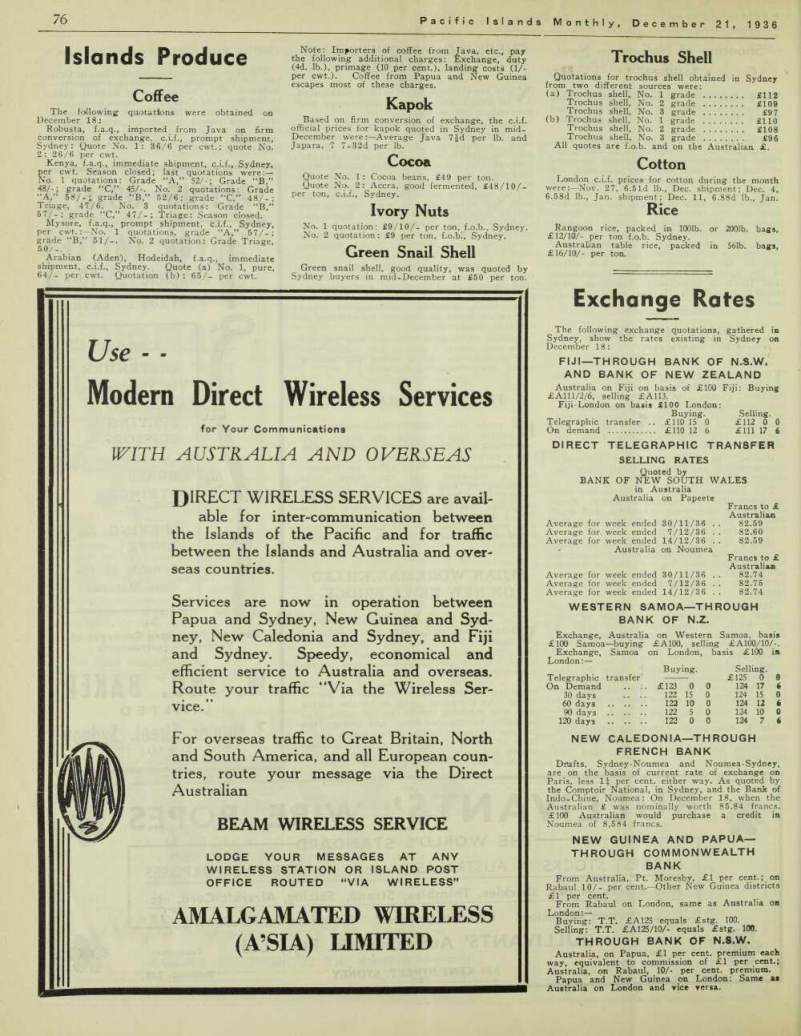
Coffee
The following quotations were obtained on December 18: Robusta, f.a.q., imported from Java on firm conversion of exchange, c.i.f., prompt shipment, Sydney: Quote No. 1: 36/6 per cwt.; quote No. 2: 26/6 per cwt.
Kenya, f.a.q., immediate shipment, c.i.f., Sydney, per cwt. Season closed; last quotations were:— No. 1 quotations: Grade “A,” 52/-; Grade “B,” 48/-; grade “C,” 45/-. No. 2 quotations: Grade “A.” 58/-; grade “B,” 52/6; grade “C,” 48/-; Triage, 47/6. No. 3 quotations: Grade “B,” 57/-; grade “C” 47/-; Triage: Season closed.
Mysore, f.a.q., prompt shipment, c.i.f., Sydney, per cwt.: —No. 1 quotations, grade “A,” 57/-; grade “B,” 51/-. No. 2 quotation: Grade Triage, 50/-.
Arabian (Aden), Hodeidah, f.a.q., immediate shipment, c.i.f., Sydney. Quote (a) No. 1, pure, 64/- per cwt. Quotation (b) : 65/- per cwt.
Note: Importers of coffee from Java, etc., pay the following additional charges; Exchange, duty (4d. lb.), primage (10 per cent.), landing costs (1/per cwt.). Coffee from Papua and New Guinea escapes most of these charges.
Kapok
Based on firm conversion of exchange, the c.i.f. official prices for kapok quoted in Sydney in mid- December were:—Average Java 7|d per lb. and Japara, 7 7-32 d per lb.
Cocoa
Quote No. 1 : Cocoa beans, £49 per ton.
Quote No. 2: Accra, good fermented, £4B/10/per ton, c.i.f., Sydney.
Ivory Nuts
No. 1 quotation: £9/10/- per ton, f.0.b., Sydney.
No. 2 quotation: £9 per ton, f.0.b., Sydney.
Green Snail Shell
Green snail shell, good quality, was quoted by Sydney buyers in mid-December at £5O per ton.
Trochus Shell
Quotations for trochus shell obtained in Sydney from two different sources were: (a) Trochus shell. No. 1 grade £ll2 Trochus shell. No. 2 grade £lO9 Trochus shell. No. 3 grade £97 (b) Trochus shell. No. 1 grade £llO Trochus shell. No. 2 grade £lOB Trochus shell. No. 3 grade £96 All quotes are f.o.b. and on the Australian £.
Cotton
London c.i.f. prices for cotton during the month were:—Nov. 27, 6.51 d lb., Dec. shipment: Dec. 4, 6.58 d lb., Jan. shipment; Dec. 11, 6.88 d lb., Jan.
Rice
Rangoon rice, packed in 1001 b. or 2001 b. bags, £l2/10/- per ton f.o.b. Sydney.
Australian table rice, packed in 561 b. bags, £l6/10/- per ton.
Exchange Rates
The following exchange quotations, gathered in Sydney, show the rates existing in Sydney on December 18:
Fiji—Through Bank Of N.S.W.
And Bank Of New Zealand
Australia on Fiji on basis of £lOO Fiji: Buying £Alll/2/6, selling £AII3.
Fiji-London on basis £lOO London:
Direct Telegraphic Transfer
Selling Rates
Quoted by
Bank Of New South Wales
in Australia
Western Samoa—Through
Bank Of N.Z.
Exchange, Australia on Western Samoa, basis £lOO Samoa—buying £AIOO, selling £AIOO/10/-.
Exchange, Samoa on London, basis £lOO in London; —
New Caledonia—Through
French Bank
Drafts, Sydney-Noumea and Noumea-Sydney, are on the basis of current rate of exchange on Paris, less 1J per cent, either way. As quoted by the Comptoir National, in Sydney, and the Bank of Indo-Chine, Noumea: On December 18, when the Australian £ was nominally worth 85.84 francs. £lOO Australian would purchase a credit in Noumea of 8,584 francs.
New Guinea And Papua
Through Commonwealth
Bank
From Australia, Pt. Moresby, £1 per cent.; on Rabaul 10/- per cent.—Other New Guinea districts £1 per cent.
From Rabaul on London, same as Australia on London: — Buying: T.T. £AI2S equals £stg. 100.
Selling: T.T. £AI2S/10/- equals £stg. 100.
Through Bank Of N.B.W.
Australia, on Papua, £1 per cent, premium each way, equivalent to commission of £1 per cent.; Australia, on Rabaul, 10/- per cent, premium.
Papua and New Guinea on London: Same aa Australia on London and rice versa.
Buying. Selling.
Telegraphic transfer .. £110 15 0 £112 0 0 On demand £110 12 6 £111 17 6
Australia on Papeete Francs to £ Australian Average for week ended 30/11/36 .. 82.59 Average for week ended 7/12/36 .. 82.60 Average for week ended 14/12/36 .. 82.59 Australia on Noumea Francs to £ Australian Average for week ended 30/11/36 .. 82.74 Average for week ended 7/12/36 .. 82.75 Average for week ended 14/12/36 . . 82.74
Buying. Selling.
Telegraphic transfer £125 0 0 On Demand .. .. £123 0 0 124 17 < 30 days ... 122 15 0 124 15 0 60 days 122 10 0 124 12 t 90 days 122 5 0 124 10 0 120 days 122 0 0 124 7 6
Advertisements & other items, p. 78 (1 item)
Modern Direct Wireless Services
Use - ■
for Your Communications
WITH AUSTRALIA AND OVERSEAS
DIRECT WIRELESS SERVICES are avail-
able for inter-communication between the Islands of the Pacific and for traffic between the Islands and Australia and overseas countries.
Services are now in operation between Papua and Sydney, New Guinea and Sydney, New Caledonia and Sydney, and Fiji and Sydney. Speedy, economical and efficient service to Australia and overseas.
Route your traffic “Via the Wireless Service.”
For overseas traffic to Great Britain, North and South America, and all European countries, route your message via the Direct Australian
BEAM WIRELESS SERVICE
LODGE YOUR MESSAGES AT ANY
WIRELESS STATION OR ISLAND POST
OFFICE ROUTED “VIA WIRELESS"
9
AMALGAMATED WIRELESS
(A’SIA) LIMITED
Market Quotations
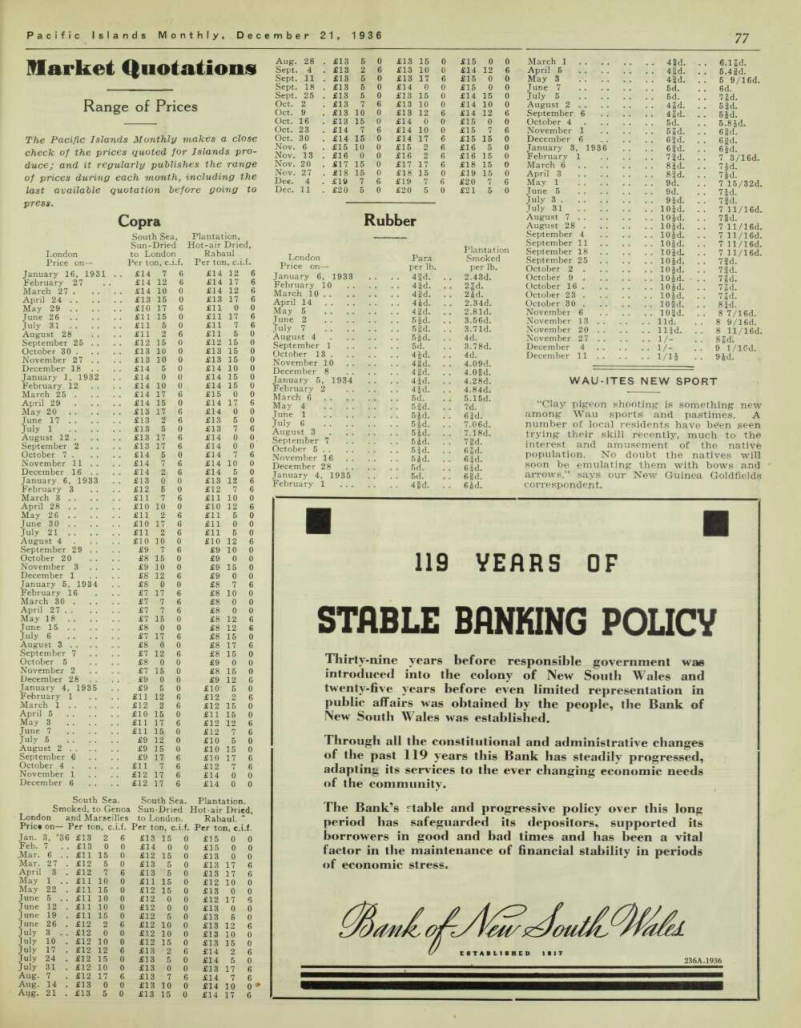
Range of Prices
The Pacific Islands Monthly makes a close check of the prices quoted for Islands pro duce; and it regularly publishes the range of prices during each month, including the last available quotation before going to press.
March 1 . , .. 4 |d. 6.1 |d.
April 5 .. 4|d. 5.4gd.
May 3 . . 43d. 5 9/16d.
June 7 . . 5d. 6d.
July 5 . . 5d. 7id.
August 2 . . . . 4?d. 53d.
September 6 .. 4gd. 5|d.
October 4 . . 5d. 5.8|d.
November 1 . . 5gd. 6|d.
December 6 . . 63d. 6§d.
January 3, 1936 . . 63d. 6|d.
February 1 . . 73d. 7 3/16d.
March 6 . . 8|d. 7 Jd.
April 3 . . 83d. 7 Jd.
May 1 . . 9d. 7 15/32d.
June 5 . . . . 9d. 7Jd.
July 3 . . . . . 9|d. 73d.
July 31 . . 10id. 7 1 l/16d.
August 7 . . . . 10 Jd. 7|d.
August 28 . . . 10|d. 7 1l/16d.
September 4 . . 10 Jd. 7 ll/16d.
September 11 . . 10*d. 7 ll/16d.
September 18 . . 10 Jd. 7 ll/16d.
September 25 . . lOJd. 73d.
October 2 . .. 10 Jd. 73d.
October 9 . . . 10id. 7gd.
October 16 . . . 10 Jd. 7gd.
October 23 . . . lOJd. 7|d.
October 30 . . . lOgd. 83d.
November 6 .. 103d. 8 7/16d.
November 13 . .. lid. 8 9/16d.
November 20 .. 11 Jd. 8 ll/16d.
November 27 8|d.
December 4 .. 1/- 9 l/10d.
December 11 ■ • 1/U 9Jd.
Aug. 28 . £13 5 0 £13 15 0 £15 0 0 Sept. 4 . £13 2 6 £13 10 0 £14 12 6 Sept. 11 . £13 5 0 £13 17 6 £15 0 0 Sept. 18 . £13 5 0 £14 0 0 £15 0 0 Sept. 25 . £13 5 0 £13 15 0 £14 15 0 Oct. 2 . £13 7 6 £13 10 0 £14 10 0 Oct. 9 . £13 10 0 £13 12 6 £14 12 6 Oct. 16 . £13 15 0 £14 0 0 £15 0 0 Oct. 23 . £14 7 6 £14 10 0 £15 7 6 Oct. 30 . £14 15 0 £14 17 6 £15 15 0 Nov. 6 . £15 10 0 £15 2 6 £16 5 0 Nov. 13 . £16 0 0 £16 2 6 £16 15 0 Nov. 20 . £17 15 0 £17 17 6 £18 15 0 Nov. 27 . £18 15 0 £18 15 0 £19 15 0 Dee. 4 . £19 7 6 £19 7 6 £20 7 6 Dec. 11 . £20 5 0 £20 5 0 £21 5 0
Rubber
Plantation London Para Smoked Price on per lb. per lb.
January 6 . 1933 . . 4|d. 2.43d.
February 10 . . . 43d. 2Jd.
March 10 . . 4id. 2 Jd.
April 14 .. 4 id. 2.34d.
May 5 .. 4gd. 2.81d.
June 2 . . . . 5|d. 3.56d.
July 7 .. 5gd. 3.71d.
August 4 . . 5Jd. 4d.
September 1 . . . 5d. 3.78d.
October 13 . 4 id. 4d.
November 10 . 4gd. 4.09d.
December 8 .. 4 id. 4.0gd.
January 5, 1934 i ’. .. 43d. 4.28d.
February 2 . . 4Jd. 4.84d.
March 6 . . 5d. 5.15d.
May 4 . . 53d. 7d.
June 1 . . . . 5Jd. 6|d.
July 6 . . 5id. 7.06d.
August 3 . . 5id. 7.18d, September ?’ ! . . 5 Jd. 7gd.
October 5 .. 5Jd. 6 Jd.
November 16 .’ . . 5 Jd. 6Jd.
December 28 . . . 5d. 63d.
January 4. 1935 . . 5d. 6gd.
February
1 . . 4|d. 6 Jd.
Copra
South Sea, Plantation, Sun-Dried Hot-air Dried, London to London Rabaul Price on — Per ton, c.i .f.
Per ton, c.i.f.
January 16, 1931 . £14 7 6 £14 12 6 February 27 £14 12 6 £14 17 6 March 27 . £14 10 0 £14 12 6 April 24 . . £13 15 0 £13 17 6 May 29 . . . . £10 17 6 £11 0 0 June 26 . . £11 15 0 £11 17 6 July 31 . . . . £11 5 0 £11 7 6 August 28 . . £11 2 6 £11 5 0 September 25 . . £12 15 0 £12 15 0 October 30 . £13 10 0 £13 15 0 November 27 . . £13 10 0 £13 15 0 December 18 . . £14 5 0 £14 10 0 January 1, 1932 £14 0 0 £14 15 0 February 12 . . £14 10 0 £14 15 0 March 25 . £14 17 6 £15 0 0 April 29 £14 15 0 £14 17 6 Mav 20 £13 17 6 £14 0 0 June 17 . . £13 2 6 £13 5 0 July 1 . . £13 5 0 £13 7 6 August 12 . . , £13 17 6 £14 0 0 September 2 £13 17 6 £14 0 o’
October 7 . £14 5 0 £14 7 6 November 11 . . £14 7 6 £14 10 0 December 16 . . £14 2 6 £14 5 0 January 6, 1933 £13 0 0 £13 12 6 February 3 . . £12 5 0 £12 7 6 March 3 . . £11 7 6 £11 10 0 April 28 . . £10 10 0 £10 12 6 May 26 . . . . . . £11 2 6 £11 5 0 June 30 . . £10 17 6 £11 0 0 July 21 . . . , . . £11 2 6 £11 5 0 August 4 £10 10 0 £10 12 6 September 29 . . £9 7 6 £9 10 0 October 20 £8 15 0 £9 0 0 November 3 . . £9 10 0 £9 15 0 December 1 . . £8 12 6 £9 0 0 January 5, 1934 . . £8 0 0 £8 7 6 February 16 £7 17 6 £8 10 0 March 30 . £7 7 6 £8 0 0 April 27 . . £7 7 6 £8 0 0 May 18 £7 15 0 £8 12 6 June 15 £8 0 0 £8 12 6 July 6 £7 17 6 £8 15 0 August 3 . . £8 0 0 £8 17 6 September 7 . £7 12 6 £8 15 0 October 5 £8 0 0 £9 0 0 November 2 . . £7 15 0 £8 15 0 December 28 . £9 0 0 £9 12 6 January 4, 1935 . . £9 5 0 £10 5 0 February 1 . . £11 12 6 £12 2 6 March 1 , . £12 2 6 £12 15 0 April 5 £10 15 0 £11 15 0 May 3 . . . . £11 17 6 £12 12 6 June 7 £11 15 0 £12 7 6 July 5 £9 12 0 £10 5 0 August 2 . . £9 15 0 £10 15 0 September 6 £9 17 6 £10 17 6 October 4 . £11 7 6 £12 7 6 November 1 £12 17 6 £14 0 0 December 6 £12 17 6 £14 0 0 South Sea.
South Sea.
Plantation Smoked, to Genoa Sun-Dried ' Hot-air Dried.
London and Marseilles i to London.
Rabaul.
Pric« on— Per ton, c :.i.f.
Per ton, c :.i.f.
Per ton, c.i.f.
Jan. 3. ’36 £13 2 6 £13 i 15 0 £15 0 0 Feb. 7 . . £13 0 0 £14 . 0 0 £15 0 0 .Mar. 6 . . £11 15 0 £12 : 15 0 £13 0 0 Mar. 27 . £12 5 0 £13 1 5 0 £13 17 6 April 3 . £12 7 6 £13 1 5 0 £13 17 6 May 1 .. £11 10 0 £11 15 0 £12 10 0 May 22 . £11 15 0 £12 ; 15 0 £13 0 0 June 5 . . £11 10 0 £12 0 0 £12 17 6 June 12 . £11 10 0 £12 0 0 £13 0 0 June 19 . £11 15 0 £12 5 0 £13 6 0 June 26 . £12 2 6 £12 10 0 £13 12 6 July 3 . . £12 0 0 £12 10 0 £13 10 0 July 10 . £12 10 0 £12 15 0 £13 15 0 July 17 . £12 12 6 £13 2 6 £14 2 6 July 24 . £12 15 0 £13 5 0 £14 5 0 July 31 . £12 10 0 £13 0 0 £13 17 6 Aug. 7 . £12 17 6 £13 7 6 £14 7 6 Aug. 14 . £13 0 0 £13 10 0 £14 10 0 ♦ Aug. 21 . £13 5 0 £13 15 0 £14 17 6
Wau-Ites New Sport
“Clay pigeon shooting is something new among Wau sports and pastimes. A number of local residents have bden seen trying their skill recently, much to the interest and amusement of the native population. No doubt the natives will soon be emulating them with bows and arrows,” says our New Guinea Goldfields correspondent.
Advertisements & other items, p. 79 (1 item)
Stable Banking Policy
119 YEARS OF
Thirty-nine years before responsible government was introduced into the colony of New South Wales and twenty-five years before even limited representation in public affairs was obtained by the people, the Bank of New South Wales was established.
Through all the constitutional and administrative changes of the past 119 years this Bank has steadily progressed, adapting its services to the ever changing economic needs of the community.
The Bank’s and progressive policy over this long period has safeguarded its depositors, supported its borrowers in good and bad times and has been a vital factor in the maintenance of financial stability in periods of economic stress. $ 236A.1936
Shipping Services in the Pacific
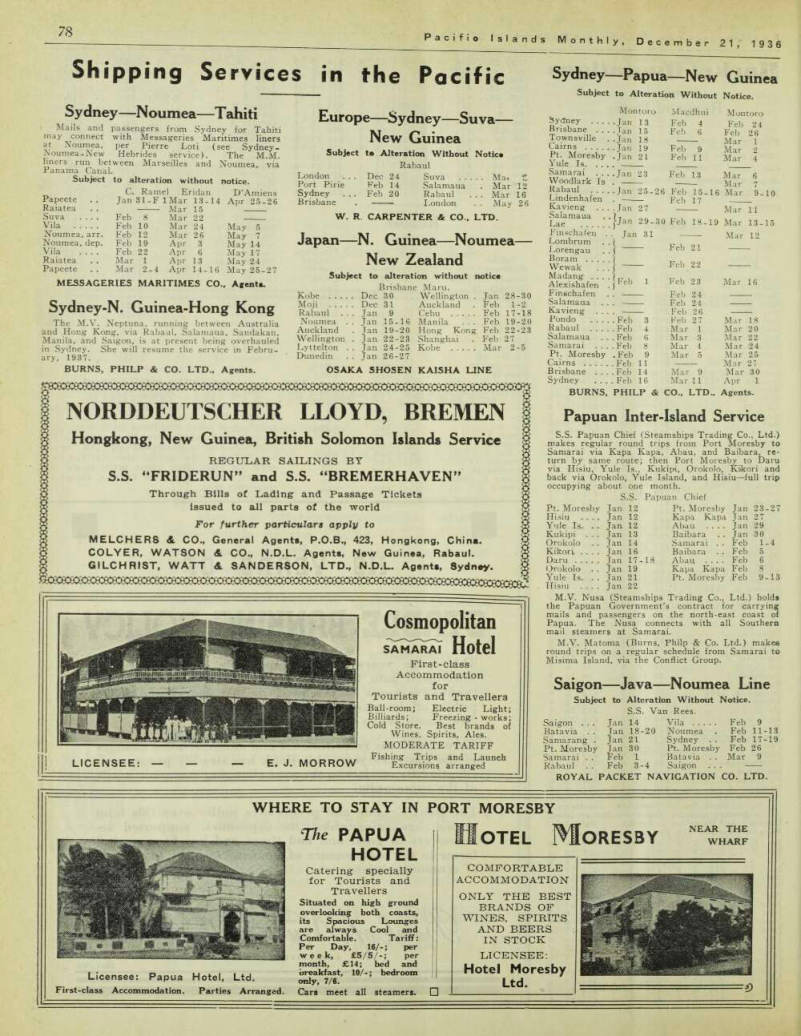
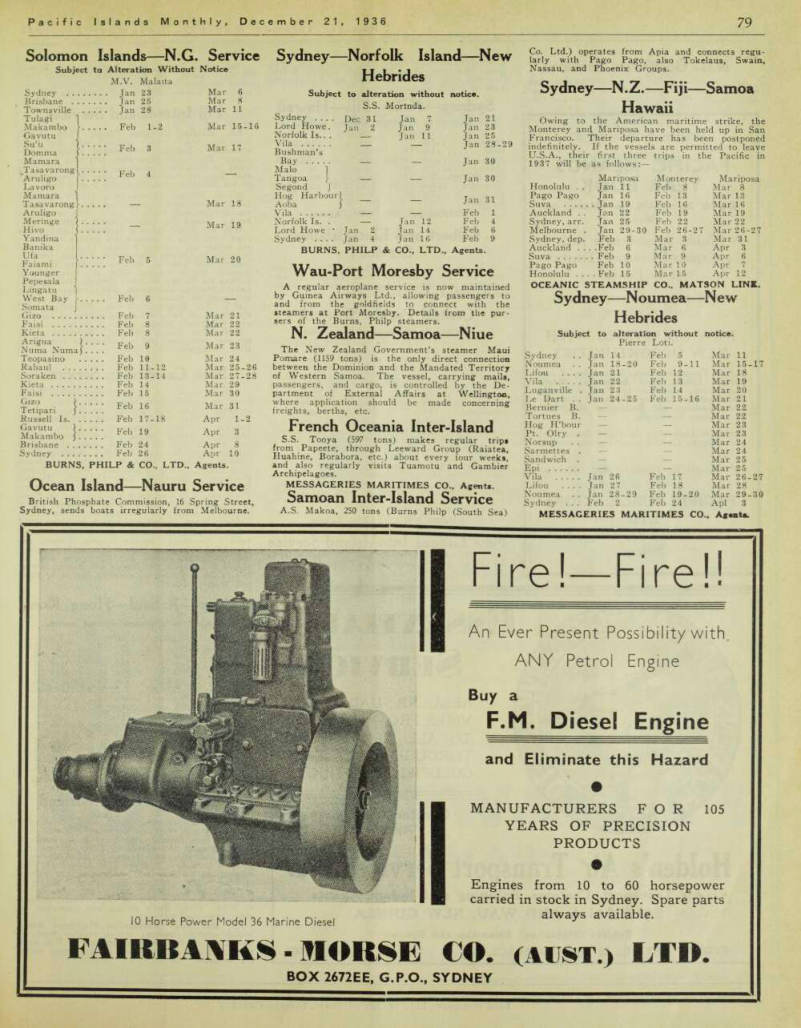
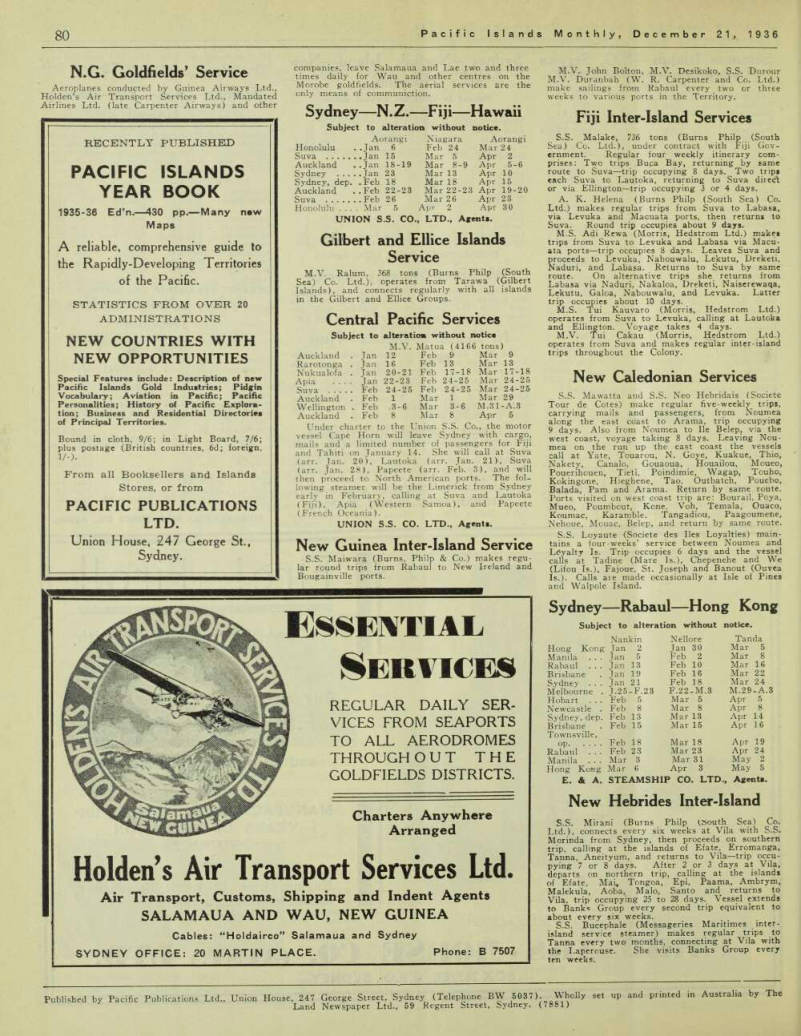
Sydney—Noumea—T ahiti
Mails and passengers from Sydney for Tahiti may connect with Messageries Maritimes liners at Noumea, per Pierre Loti (see Sydney- Noumea-New Hebrides service). The M.M. liners run between Marseilles and Noumea, via Panama Canal.
Subject to alteration without notice.
Sydney-N. Guinea-Hong Kong
The M.V. Neptuna, running between Australia and Hong Kong, via Rabaul, Salamaua, Sandakan, Manila, and Saigon, is at present being overhauled in Sydney. She will resume the service in Febru ary, 1937.
Burns, Philp & Co. Ltd., Agents.
Europe—Sydney—Suva—
New Guinea Subject ts Alteration Without Notice
Japan—N. Guinea —Noumea— New Zealand Subject to alteration without notice
Sydney—Papua—New Guinea Subject to Alteration Without Notice.
Papuan Inter-Island Service
S.S. Papuan Chief (Steamships Trading Co., Ltd.) makes regular round trips from Port Moresby to Samarai via Kapa Kapa, Abau, and Baibara, re turn by same route; then Port Moresby to Daru via Hisiu, Yule Is., Kukipi, Orokolo, Kikori and back via Orokolo, Yule Island, and Hisiu —full trip occupying about one month.
M.V. Nusa (Steamships Trading Co., Ltd.) holds the Papuan Government’s contract for carrying mails and passengers on the north-east coast of Papua. The Nusa connects with all Southern mail steamers at Samarai.
M.V. Matoma (Burns, Philp & Co. Ltd.) malces round trips on a regular schedule from Samarai to Misima Island, via the Conflict Group.
Saigon—Java—Noumea Line
Subject to Alteration Without Notice.
Sydney ...
Brisbane . . .
Townsville Cairns Pt. Moresby Yule Is Montoro Jan 13 Jan 15 Jan 18 Jan 19 Jan 21 Macdhui Feb 4 Feb 6 Feb 9 Feb 11 Montoro Feb 24 Feb 26 Mar 1 Mar 2 Mar 4 Samarai . . .
Woodlark Is Rabaul Lindenhafen Jan 23 Feb 13 Mar 6 Mar 7 Mar 9-10 Jan 25-26 Feb 15-16 Feb 17 Feb 18-19 Kavieng . . .
Salamaua Lae Jan 27 Jan 29-30 Mar 11 Mar 13-15 Finschafen . .
Lombrum . .
Lorengau
Boram j
Jan 31 Feb 21 Feb 22 Feb 23 Feb 24 Feb 24 Feb 26 Feb 27 Mar 12
Wewak . . . J
Madang . . . . j Alexishafen . j Finschafen . .
Salamaua Feb 1 Mar 16 Kavieng . . . .
Pondo Feb 3 Feb 4 Mar 18 Mar 20 Mar 22 Mar 24 Mar 25 Mar 21 Mar 30 Apr 1 Rabaul Mar 1 Mar 3 Mar 4 Mar 5 Salamaua . . .
Samarai . . . .
Pt. Moresby , Cairns Feb 6 Feb 8 .Feb 9 Feb 11 Feb 14 Feb 16 Brisbane Sydney . . . .
Mar 9 Mar 11
Burns, 1
Philp & Co., Ltd-
Agents.
Rabaul London . .. Dec 24 Suva Mai Z Port Pirie Feb 14 Salamaua . Mar 12 Sydney ... Feb 20 Rabaul ... Mar 16 Brisbane . London . . May 26
W. R Carpenter & Co., Ltd.
C.
Ramel Eridan D’Amiens Papeete Tan 31-F 1 Mar 13-14 Apr 25-26 Raiatea — Mar 15 Suva ...
Feb 8 Mar 22 Vila Feb 10 Mar 24 May 5 Noumea, arr.
Feb 12 Mar 26 May 7 Noumea, dep.
Feb 19 Apr 3 May 14 Vila ...
Feb 22 Apr 6 May 17 Raiatea Mar 1 Apr 13 May 24 Papeete Mar 2-4 Apr 14-16 May 25-27
Messageries
Maritimes Co.
, Agent*.
Brisbane Maru.
Kobe Dec 30 Wellington . Jan 28-30 Moji Dec 31 Auckland . Feb 1-2 Rabaul . . . Jan 9 Cebu Feb 17-18 Noumea . . Jan 15-16 Manila . . . Feb 19-20 Auckland . Jan 19-20 Hong Kong Feb 22-23 Wellington . Jan 22-23 Shanghai . Feb 27 Lyttelton . . Jan 24-25 Kobe Mar 2-5 Dunedin . . Jan 26-27
Osaka Shosen Kaisha Line
S.S.
Papuan Chief Pt. Moresby Jan 12 Pt. Moresby Jan 23-27 Hisiu ...
Jan 12 Kapa Kapa Jan 27 Yule Is. ..
Jan 12 Abau ...
Jan 29 Kukipi Jan 13 Baibara . .
Jan 30 Orokolo . .
Jan 14 Samarai . .
Feb 1-4 Kikori ...
Jan 16 Baibara . .
Feb 5 Daru Jan 17- 18 Abau Feb 6 Orokolo . .
Jan 19 Kapa Kapa Feb 8 Yule Is. . .
Jan 21 Pt. Moresby Feb 9-13 Hisiu ...
Jan 22
S.S.
Van Rees.
Saigon . . .
Jan 14 Vila Feb 9 Batavia . .
Jan 18- 20 Noumea Feb 11-13 Samarang .
Jan 21 Sydney . .
Feb 17-19 Pt. Moresby Jan 30 Pt. Moresby Feb 26 Samarai . .
Feb 1 Batavia . .
Mar 9 Rabaul Feb 3- 4 Saigon
Royal
Packet
Navigation
Co. Ltd.
Solomon Islands—N.G. Service Subject to Alteration Without Notice
Ocean Island—Nauru Service
British Phosphate Commission, 16 Spring Street, Sydney, sends boats irregularly from Melbourne.
Sydney—Norfolk Island —New Hebrides Subject to alteration without notice.
S.S. Morlnda.
Burns, Philp & Co., Ltd., Agents.
Wau-Port Moresby Service
A regular aeroplane service is now maintained by Guinea Airways Ltd., allowing passengers to and from the goldfields to connect with the steamers at Port Moresby. Details from the pur sers of the Burns, Philp steamers.
N. Zealand—Samoa—Niue
The New Zealand Government’s steamer Maui Pomare (1159 tons) is the only direct connection between the Dominion and the Mandated Territory of Western Samoa. The vessel, carrying mails, passengers, and cargo, is controlled by the De partment of External Affairs at Wellington, where application should be made concerning freights, berths, etc.
French Oceania Inter-Island
S.S. Tooya (597 tons) makes regular trips from Papeete, through Leeward Group (Raiatea, Huahine, Borabora, etc.) about every four weeks, and also regularly visits Tuamotu and Gambier Archipelagoes.
Messageries Maritimes Co., Agents.
Samoan Inter-Island Service
A.S. Makoa, 250 tons (Burns Philp (South Sea)
Co. Ltd.) operates from Apia and connects regu larly with Pago Pago, also Tokelaus, Swain, Nassau, and Phoenix Groups.
Sydney—N.Z.—Fiji—Samoa
Hawaii
Owing to the American maritime strike, the Monterey and Mariposa have been held up in San Francisco. Their departure has been postponed indefinitely. If the vessels are permitted to leave U.S.A., their first three trips in the Pacific in 1937 will be as follows:
Oceanic Steamship Co.. Matson Link.
Sydney—Noumea—New
Hebrides
Subject to alteration without notice.
Pierre Loti.
M.V.
Malaita Sydney . .
Brisbane . 23 25 28 Mar Mar Mar 6 8 11 Tulagi Makambo Gavutu Feb 1-2 Mar 15 -16 Su’u Mar 17 Feb 3 Mamara
'Aruligo
Lavoro Mamara Tasavarong Aruligo Meringe ■ ' ' * Feb 4 Mar Mar 18 19 Yandina Banika Ufa Mar 20 Feb 5 Younger Pepesala
Lingatu
West Bay j
Somata J
Gizo Feb 6 Feb 7 Mar 21 Faisi Kieta Arigua Numa Numa Teopasino Rabaul . . .
Feb Feb
I Feb
. . . . . Feb 8 8 9 10 Mar Mar Mar Mar 22 22 23 24 Feb 11-12 Mar 25- 26 Soraken ...
Kieta Faisi Feb Feb Feb 13-14 14 15 Mar Mar Mar 27- 29 30 28 Gizo ) 16 Mar 31 Tetipari J Russell Is.
Feb Feb 17-18 Apr Apr 2 Gavutu ) Makambo 3 Feb 19 3 Brisbane . .
Sydney . . •
24 26 Apr Apr 8 10
Burns, Philp & Co., Ltd..
Agents.
Sydney Dec 31 Jan 7 Jan 21 Lord Howe. Inn 2 Jan 9 Jan 23 Norfolk Is... — Jan 11 Jan 25 Vila Jan 28-29 Bushman’s Bay Jan 30
Male ]
Tangoa [• — Jan 30 Segond J Hog Harbour) Aoba J — Jan 31 Vila — Feb 1 Norfolk Is. . — Jan 12 Feb 4 Lord Howe * Jan 2 Jan 14 Feb 6 Sydney ... Jan 4 Jan 16 Feb 9
Mariposa Monterey Mariposa Honolulu . . Jan 11 Feb 8 Mar 8 Pago Pago Jan 16 Feb 13 Mar 13 Suva Jan 19 Feb 16 Mar 16 Auckland . . Jan 22 Feb 19 Mar 19 Sydney, arr. Jan 25 Feb 22 Mar 22 Melbourne . Jan 29-30 Feb 26-27 Mar 26-27 Sydney, dep. Feb 3 Mar 3 Mar 31 Auckland . . . .Feb 6 Mar 6 Apr 3 Suva Feb 9 Mar 9 Apr 6 Pago Pago Feb 10 Mar 10 Apr 7 Honolulu ... Feb 15 Mar 15 Apr 12
Sydney , . Jan 14 Feb 5 Mar 11 Noumea . . Jan 18-20 Feb 9-11 Mar 15- 17 Lifou ... Jan 21 Feb 12 Mar 18 Vila Jan 22 Feb 13 Mar 19 Luganville . Jan 23 Feb 14 Mar 20 Le Dart . . Ian 24-25 Feb 15-16 Mar 21 Bernier B. — Mar 22 Tortues B. .— Mar 22 Hog H’bour Mar 23 Pt. Olry . — — ■ Mar 23 Norsup . . — — Mar 24 Sarmettes . — Mar 24 Sandwich . — — Mar 25 Epi — — Mar 25 Vila Jan 26 Feb 17 Mar 26- 27 Lifou ... Jan 27 Feb 18 Mar 28 Noumea . . Jan 28-29 Feb 19-20 Mar 29- 30 Sydney . . . Feb 2 Feb 24 Apl 3
Messageries Maritimes Co.
, AiuU.
N.G. Goldfields’ Service
Aeroplanes conducted by Guinea Airways Ltd., Holden’s Air Transport Services Ltd., Mandated Airlines Ltd. (late Carpenter Airways) and other
companies, leave Salamaua and Lae two and three times daily for Wau and other centres on the Morobe goldfields. The aerial services are the only means of communiction.
Sydney—N.Z.—Fiji—Hawaii
Subject to alteration without notice.
Union S.S. Co., Ltd., Agents.
Gilbert and Ellice Islands
Service
M.V. Ralum, 368 tons (Burns Philp (South Sea) Co. Ltd.), operates from Tarawa (Gilbert Islands), and connects regularly with all islands in the Gilbert and Ellice Groups.
Central Pacific Services
Subject to alteration without notice
Under charter to the Union S.S. Co., the motor vessel Cape Horn will leave Sydney with cargo, mails and a limited number of passengers for Fiji and Tahiti on January 14. She will call at Suva (arr. Jan. 20), Lautoka (arr. Jan. 21), Suva (arr. Jan. 28), Papeete (arr. Feb. 3), and will then proceed to North American ports. The fol lowing steamer will be the Limerick from Sydney early in February, calling at Suva and Lautoka (Fiji). Apia (Western Samoa), and Papeete (French Oceania).
Union S.S. Co. Ltd., Agents.
New Guinea Inter-Island Service
S.S. Maiwara (Burns, Philp & Co.) makes regu lar round trips from Rabaul to New Ireland and Bougainville ports.
M.V. John Bolton, M.V. Desikoko, S.S. Durour M.V. Duranbah (W. R. Carpenter and Co. Ltd.) make sailings from Rabaul every two or three weeks to various ports in the Territory.
Fiji Inter-Island Services
5.5. Malake, 736 tons (Burns Philp (South Sea) Co. Ltd.), under contract with Fiji Gov ernment. Regular four weekly itinerary com prises: Two trips Buca Bay, returning by same route to Suva—trip occupying 8 days. Two trips each Suva to Lautoka, returning to Suva direct or via Ellington—trip occupying 3 or 4 days.
A. K. Helena (Burns Philp (South Sea) Co.
Ltd.) makes regular trips from Suva to Labasa, via Levuka and Macuata ports, then returns to Suva. Round trip occupies about 9 days.
M.S. Adi Rcwa (Morns, Hedstrom Ltd.) makes trips from Suva to Levuka and Labasa via Macu ata ports —trip occupies 8 days. Leaves Suva and proceeds to Levuka, Nabouwalu, Lekutu, Dreketi, Naduri, and Labasa. Returns to Suva by same route. On alternative trips she returns from Labasa via Naduri, Nakaloa, Dreketi, Naiserewaqa, Lekutu, Galoa, Nabouwalu, and Levuka. Latter trip occupies about 10 days.
M.S. Tui Kauvaro (Morris, Hedstrom Ltd.) operates from Suva to Levuka, calling at Lautoka and Ellington. Voyage takes 4 days.
M.V. Tui Cakau (Morris, Hedstrom Ltd.) operates from Suva and makes regular inter-island trips throughout the Colony.
New Caledonian Services
5.5. Mawatta and S.S. Neo Hebridais (Societe Tour de Cotes) make regular five-weekly trips, carrying mails and passengers, from Noumea along the east coast to Arama, trip occupying 9 days. Also from Noumea to He Belep, via the west coast, voyage taking 8 days. Leaving Nou mea on the run up the east coast the vessels call at Yate, Touarou, N. Goye, Kuakue, Thio, Nakety, Canalo, Gouaoua, Houailou, Moueo, Pouerihouen, Tieti, Poindimie, Wagap, Touho, Kokingone, Hieghene, Tao, Outbatch, Pouebo, Balada, Pam and Arama. Return by same route.
Ports visited on west coast trip are: Bourail, Poya, Mueo, Poumbout, Kone, Voh, Temala, Ouaco, Koumac, Karamble, Tangadiou, Paagoumene, Nehoue, Mouac, Belep, and return by same route. 5.5. Loyaute (Societe des lies Loyalties) main tains a four-weeks’ service between Noumea and Ldyalty Is. Trip occupies 6 days and the vessel calls at Tadine (Mare Is.), Chepenehe and We (Lifou Is.), Fajoue, St. Joseph and Banout (Ouvea Is.). Calls are made occasionally at Isle of Pines and Walpole Island.
Sydney—Rabaul—Hong Kong
Subject to alteration without notice.
New Hebrides Inter-Island
5.5. Mirani (Burns Philp (.South Sea) Co.
Ltd.), connects every six weeks at Vila with S.S.
Morinda from Sydney, then proceeds on southern trip, calling at the islands of Efate, Erromanga, Tanna, Aneityum, and returns to Vila—trip occu pying 7or 8 days. After 2or 3 days at Vila, departs on northern trip, calling at the islands of Efate, Mai. Tongoa, Epi, Paama, Ambrym, Malekula, Aoba, Malo, Santo and returns to Vila, trip occupying 25 to 28 days. Vessel extends to Banks Group every second trip equivalent to about every six weeks. 5.5. Bucephale (Messageries Maritimes mtcr island service steamer) makes regular trips to Tanna every two months, connecting at Vila with the Laperouse. She visits Banks Group every ten weeks.
Aorangi Niagara Aorangi Honolulu .Jan 6 Feb 24 Mar 24 Suva .Jan 15 Mar 5 Apr 2 Auckland .Jan 18-19 Mar 8-9 Apr 5-6 Sydney . ... .Jan 23 Mar 13 Apr 10 Sydney, dep. .Feb 18 Mar 18 Apr 15 Auckland .Feb 22-23 Mar 22-23 Apr 19-20 Suva .Feb 26 Mar 26 Apr 23 Honolulu . . . . Mar 5 Apr 2 Apr 30
M.V.
Matua (4166 tons) Auckland Tan 12 Feb 9 Mar 9 Rarotonga .
jan
16 Feb 13 Mar 13 Nukualofa .
Jan 20-21 Feb 17-18 Mar 17-18 Apia Jan 22-23 Feb 24-25 Mar 24-25 Suva Feb 24-25 Feb 24-25 Mar 24-25 Auckland Feb 1 Mar 1 Mar 29 Wellington . . Feb ,3-6 Mar 3-6 M.31 -A.3 Auckland Feb 8 Mar 8 Apr 5
Nankin Nellore Tanda Hong Kong Jan 2 Jan 30 Mar 5 Manila Jan 5 Feb 2 Mar 8 Rabaul . . .
Jan 13 Feb 10 Mar 16 Brisbane Jan 19 Feb 16 Mar 22 Sydney . . • Jan 21 Feb 18 Mar 24 Melbourne .
J.25-F.23 F.22-M.3 M.29-A.3 Hobart . . .
Feb 5 Mar 5 Apr 5 Newcastle .
Feb 8 Mar 8 Apr 8 Sydney, dep.
Feb 13 Mar 13 Apr 14 Brisbane Feb 15 Mar 15 Apr 16 Townsville, op Feb 18 Mar 18 Apr 19 Rabaul . . .
Feb 23 Mar 23 Apr 24 Manila . . .
Mar 3 Mar 31 May 2 Hong Kong Mar 6 Apr 3 May 5 E. & A.
Steamship Co. Ltd.
,, Agents.
Advertisements & other items, pp. 80-84 (2 items)
Cosmopolitan
NORDDEUTSCHER LLOYD, BREMEN
Hongkong, New Guinea, British Solomon Islands Service
REGULAR SAILINGS BY
S.S. “FRIDERUN” and S.S. “BREMERHAVEN”
Through Bills of Lading and Passage Tickets issued to all parts of the world For further particulars apply to MELCHERB A CO., General Agents, P. 0.8., 423, Hongkong, China.
COLYER, WATSON A CO., N.D.L. Agents, New Guinea, Rabaul.
GILCHRIST, WATT A SANDERSON, LTD., N.D.L. Agents, Sydney.
•mm*
LICENSEE: E. J. MORROW
Cosmopolitan
SAMARAJ Hotel
First-class Accommodation for Tourists and Travellers Ball-room; Electric Light; Billiards; Freezing - works; Cold Store. Best brands of Wines, Spirits, Ales.
MODERATE TARIFF
Fishing Trips and Launch Excursions arranged
WHERE TO STAY IN PORT MORESBY
fcd
Licensee: Papua Hotel, Ltd.
First-class Accommodation. Parties Arranged.
The PAPUA
HOTEL
Catering specially for Tourists and Travellers Situated on high ground overlooking both coasts, its Spacious Lounges are always Cool and Comfortable. Tariff: Per Day, 16/-; per week, £5/5/-; per month, £l4; bed and breakfast, 10/-; bedroom only, 7/6.
Cars meet all steamers.
Hotel Moresby
COMFORTABLE
ACCOMMODATION
ONLY THE BEST
BRANDS OF
WINES, SPIRITS
AND BEERS
IN STOCK
LICENSEE:
Hotel Moresby
Ltd.
10 Horse Power Model 36 Marine Diesel
FAIRBANKS ■ MORSE
BOX 2672EE, G.P.O,
Fire! —Fire!!
An Ever Present Possibility with
ANY Petrol Engine
Buy a
F.M. Diesel Engine
and Eliminate this Hazard
MANUFACTURERS FOR 105
YEARS OF PRECISION
PRODUCTS
• Engines from 10 to 60 horsepower carried in stock in Sydney. Spare parts always available.
CO. (aust.) LTD.
SYDNEY
RECENTLY PUBLISHED
PACIFIC ISLANDS
YEAR BOOK
1935-36 Ed’n.— 43o pp.— Many new Maps
A reliable, comprehensive guide to
the Rapidly-Developing Territories
of the Pacific.
STATISTICS FROM OVER 20
ADMINISTRATIONS
NEW COUNTRIES WITH
NEW OPPORTUNITIES
Special Features include: Description of new Pacific Islands Gold Industries; Pidgin Vocabulary; Aviation in Pacific; Pacific Personalities; History of Pacific Exploration; Business and Residential Directories of Principal Territories.
Bound in cloth, 9/6; in Light Board, 7/6; plus postage (British countries, 6d; foreign, !/-)• From all Booksellers and Islands Stores, or from
PACIFIC PUBLICATIONS
LTD.
Union House, 247 George St.,
Sydney.
Essential
Services
REGULAR DAILY SER-
VICES FROM SEAPORTS
TO ALL AERODROMES
THROUGH OUT THE
GOLDFIELDS DISTRICTS.
Charters Anywhere Arranged
Holden s Air Transport Services Ltd.
Air Transport, Customs, Shipping and Indent Agents
SALAMAUA AND WAU, NEW GUINEA
Cables; “Holdairco” Salamaua and Sydney SYDNEY OFFICE: 20 MARTIN PLACE. Phone: B 7507
AERIAL TRANSPORT ESTABLISHED
NEW GUINEA GOLD INDUSTRY
S INCE 1927, when the development of the Morobe Goldfield commenced, the European population of the Territory has been trebled.
The new industry has increased the Empire's gold production by nearly £2,000,000 per annum, and has added enormously to the trade turnover of New Guinea.
Only Aerial Transport makes this possible. There is no road between the Goldfields and the coast. Aeroplanes, running on Regular Schedules, without Difficulty or Delay, carry in Dredges, Crushing Mills, Cyaniding Plants, Motor Vehicles, Hvdro - Electric Machinery, Thousands of Passengers, and Every Kind of Goods needed by a large and Growing European Community.
CjUINEA AIRWAYS LTD. were established in 1927; and they have grown in the following way, until they are to-day the largest freight-carrying service in the world: I
SUIHg,
WWay I 111 m I Hill if” JSSP A typical load landed from one of Guinea Airways' giant freight-carrying aeroplanes. This big G-31 Junkers machine carried from Lae, on the coast, to the aerodrome at Wau, the goldfields centre in the interior, a Baby Austin motor car, an office safe, and 38 bags of rice—a total weight of nearly two and a half tons.
Guinea Airways Ltd. operate regular air services in New Guinea and Papua; they use over 50 Aerodromes and Landing-grounds in the two Territories.
GUINEA AIRWAYS L™
LAE • SALAMAUA
HEAD OFFICE: NEW GUINEA OFFICE:
BROOKMAN BUILDINGS LAE
GRENFELL STREET MANDATED TERRITORY OF
ADELAIDE, S.A. NEW GUINEA
BRANCH OFFICES AND AGENTS AT WAU, SALAMAUA, PORT MORESBY, AND SYDNEY
II I
StSEN
ER long bollle 1
SCHS
SSQAL
EXPO
■SEN
• tpTTt.ro pt
, Co LIMITED
Sydney 3 r
PILSENIR
g s= When two long thirsts equal one ' tie!
What's yours?"
Resch’s Pilsener /* So 9 s mine When you ask for Pilsener insist on the long bottle.
RESCH'S
p io n
80
Pacific Islands Monthly, December 21, 1936
Published by Pacific Publications Ltd., Union House, 247 George Street, Sydney (Telephone BW 5037). Wholly set up and printed m Australia by The Land Newspaper Ltd., 59 Regent Street, Sydney. (7881)