Islands
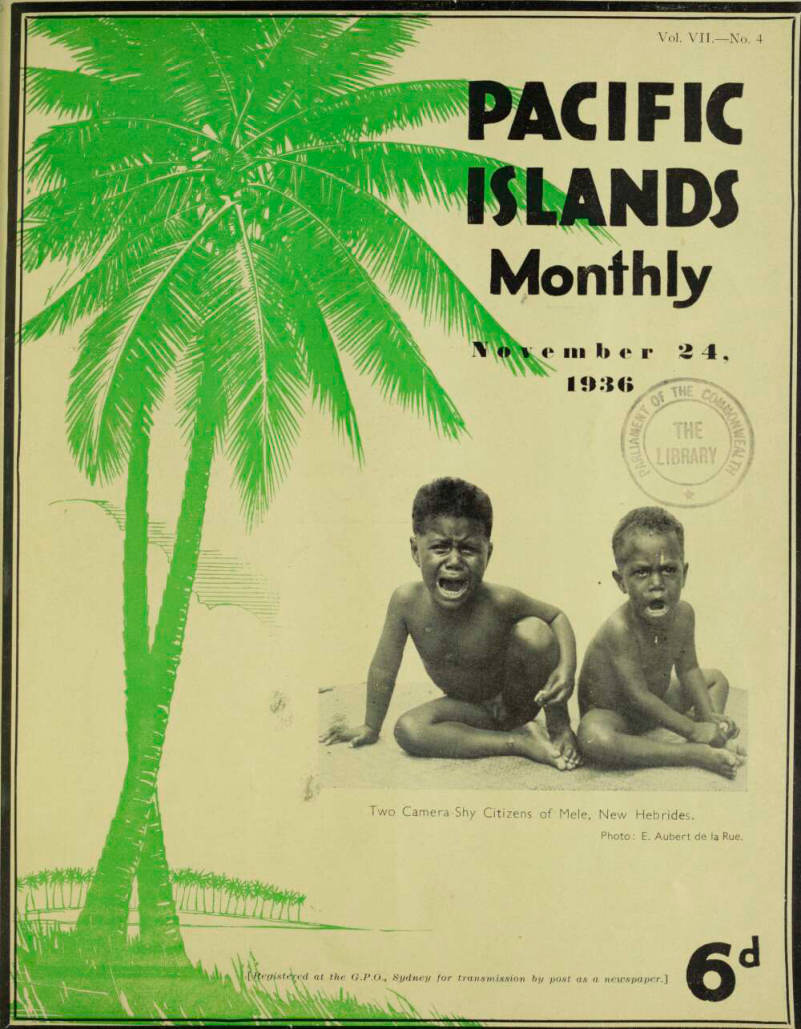
Pacific
Monthly
Vol. VII.—No. 4
"m 3 •l»:i«
1 at the G.P.0., Sydney for transmission by post as a newspaper.]
6 d
Two Camera-Shy Citizens of Mele, New Hebrides.
Photo: E. Aubert de la Rue.
Advertisements & other items, p. 2 (1 item)
Direct Nhippiiig: Service
BETWEEN THE
Pacific Territories and Europe
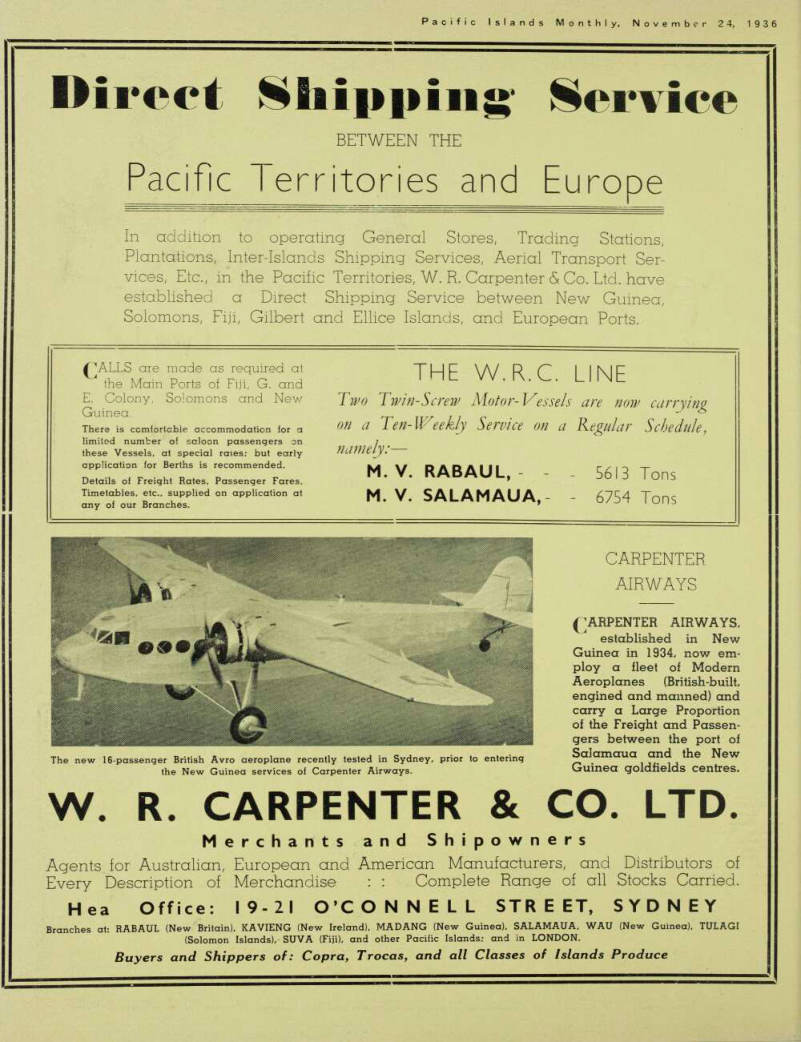
In addition to operating General Stores, Trading Stations, Plantations, Inter-Islands Shipping Services, Aerial Transport Services, Etc., in the Pacific Territories, W. R. Carpenter & Co. Ltd. have established a Direct Shipping Service between New Guinea, Solomons, Fiji, Gilbert and Ellice Islands, and European Ports. are made as required at the Main Ports of Fiji, G. and E. Colony, Solomons and New Guinea.
There is comfortable accommodation for a limited number of saloon passengers on these Vessels, at special raxes; but early application for Berths is recommended.
Details of Freight Rates. Passenger Fares, Timetables, etc., supplied on application at any of our Branches.
THE W. R. C. LINE
Two Twin-Screw Motor-Vessels are now carrying
on a Ten-Weekly Service on a Regular Schedule,
namely: —
M. V. RABAUL, - 5613 Tons
M. V. SALAMAUA, 6754 Tons
"-T v. a ST -- \ The new 16-passenger British Avro aeroplane recently tested in Sydney, prior to entering the New Guinea services of Carpenter Airways.
CARPENTER
AIRWAYS
AIRWAYS.
established in New Guinea in 1934, now employ a fleet of Modern Aeroplanes (British-built, engined and manned) and carry a Large Proportion of the Freight and Passengers between the port of Salamaua and the New Guinea goldfields centres.
W. R. CARPENTER & CO. LTD.
Merchants and Shipowners
Agents for Australian, European and American Manufacturers, and Distributors of Every Description of Merchandise : : Complete Range of all Stocks Carried.
Hea Office: 19-21 O’CONNELL STREET, SYDNEY
Branches at: RABAUL (New Britain). KAVIENG (New Ireland). MADANG (New Guinea). SALAMAUA, WAU (New Guinea). TULAGI (Solomon Islands). SUVA (Fiji), and other Pacific Islands; and in LONDON.
Buyers and Shippers of: Copra , Trocas f and all Classes of Islands Produce
Pacific Islands Travellers
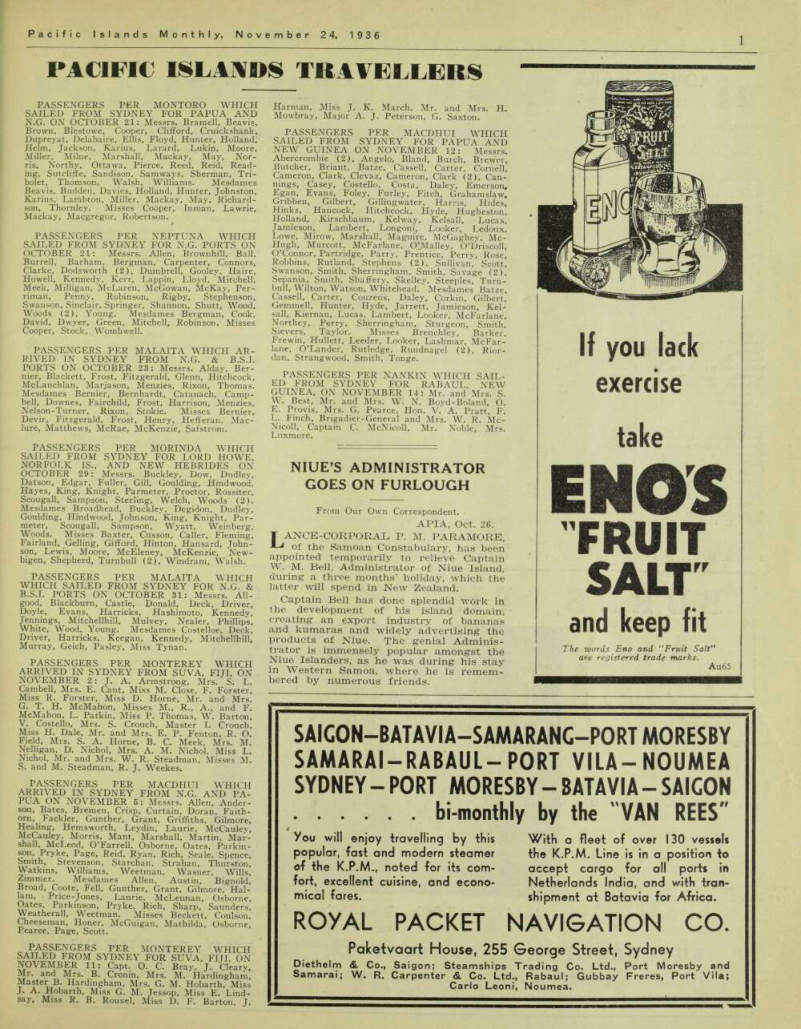
Passengers Per Montoro Which
Sailed From Sydney For Papua And
N.G. ON OCTOBER 21: Messrs. Bramell, Beavis.
Brown, Blestowe, Cooper, Clifford, Cruickshank, Dupreyat, Delabaire, Ellis, Floyd, Hunter, Holland, Helm, Jackson, Karius, Larard, Lukin, Moore, Miller, Milne, Marshall, Mackay, May, Nor ris, Northy, Ottawa, Pierce, Reed, Reid, Read ing, Sutcliffe, Sandison, Samways, Sherman, Tri bolet, Thomson, Walsh, Williams. Mesdames Beavis, Budden, Davies, Holland, Hunter, Johnston, Karius, Lambton, Miller, Mackay, May, Richard son, Thornley. Misses Cooper, Inman, Lawrie, Mackay, Macgregor, Robertson.
Passengers Per Neptuna Which
SAILED FROM SYDNEY FOR N.G. PORTS ON OCTOBER 21: Messrs. Allen, Brownhill, Ball, Burrell, Barham, Bergman, Carpenter, Connors, Clarke, Dodsworth (2), Dumbrell, Gooley, Haire, Howell, Kennedy, Kerr, Lappin, Lloyd, Mitchell, Meek, Milligan, McLaren, McGowan, McKay, Per riman. Penny, Robinson, Rigby, Stephenson, Swanson, Sinclair, Springer, Shannon, Shutt, Wood, Woods (2), Young. Mesdames Bergman, Cook, David, Dwyer, Green, Mitchell, Robinson. Misses Cooper, Stock, Wombwell.
Passengers Per Malaita Which Ar
RIVED IN SYDNEY FROM N.G. & 8.5.1.
PORTS ON OCTOBER 23: Messrs. Alday, Ber nier, Blackett, Frost, Fitzgerald, Glenn, Hitchcock, McLauchlan, Marjason, Menzies, Rixon, Thomas.
Mesdames Bernier, Bernhardt, Catanach, Camp bell, Downes, Fairchild, Frost, Harrison, Menzies, Nelson-Turner, Rixon, Stokie. Misses Bernier, Devir, Fitzgerald, Frost, Henry, Hefferan, Mac lure, Matthews, Mcßae, McKenzie, Safstrom.
Passengers Per Morinda Which
Sailed From Sydney For Lord Howe,
Norfolk Is., And New Hebrides On
OCTOBER 29: Messrs. Buckley, Dow, Dudley, Datson, Edgar, Fuller, Gill, Goulding, Hindwood, Hayes, King, Knight, Parmeter, Proctor, Rossiter, Scougall, Sampson, Sterling, Welch, Woods (2).
Mesdames Broadhead, Buckley, Degidon, Dudley, Goulding, Hindwood, Johnson, King, Knight, Par meter, Scougall, Sampson, Wyatt, Weinberg, Woods. Misses Baxter, Cusson, Caller, Fleming, Fairland, Gelling, Gifford, Hinton, Hansard, John son, Lewis, Moore, McEleney, McKenzie, New bigen. Shepherd, Turnbull (2), Windram, Walsh.
Passengers Per Malaita Which
WHICH SAILED FROM SYDNEY FOR N.G. & 8.5.1. PORTS ON OCTOBER 31: Messrs. All good, Blackburn, Castle. Donald, Deck, Driver.
Doyle, Evans, Harricks, Hashimoto, Kennedy, Jennings, Mitchellhill, Mulvey, Nealer, Phillips.
White, Wood, Young. Mesdames Costelloe, Deck, Driver, Harricks, Keegan, Kennedy, Mitchellhill, Murray, Geich, Pasley, Miss Tynan.
Passengers Per Monterey Which
ARRIVED IN SYDNEY FROM SUVA. FIJI, ON NOVEMBER 2: J. A. Armstrong, Mrs. S. L.
Cambell, Mrs. E. Cant, Miss M. Close, F. Forster, Miss R. Forster, Miss D. Horne, Mr. and Mrs.
G. T. H. McMahon, Misses M., R., A., and F.
McMahon, L. Patkin, Miss P. Thomas, W. Barton, V. Costello, Mrs. S. Crouch, Master I. Crouch, Miss H. Dale, Mr. and Mrs. E. P. Fenton, R. O.
Field, Mrs. S. A. Horne, B. C. Meek, Mrs. M.
Nelligan, D. Nichol, Mrs. A. M. Nichol, Miss L.
Nichol, Mr. and Mrs. W. R. Steadman, Misses M.
S. and M. Steadman, R. J. Weekes.
Passengers Per Macdhui Which
ARRIVED IN SYDNEY FROM N.G. AND PA PUA ON NOVEMBER 5: Messrs. Allen, Ander son, Bates, Bremen, Crisp, Curtain, Doran, Faith orn, Fackler. Gunther, Grant, Griffiths, Gilmore, Healing, Hemsworth, Leydin, Laurie, McCauley, McCauley, Morris, Mant, Marshall, Martin, Mar shall, McLeod, O’Farrell, Osborne, Oates, Parkin son, Pryke, Page, Reid, Ryan. Rich, Seale, Spence, Smith, Stevenson, Starchan. Strahan, Thurston, Watkins, Williams. Weetman, Wasner, Wills, Zimmer. Mesdames Allen, Austin, Bignold, Broad, Coote, Fell, Gunther, Grant, Gilmore, Hal lam, Price-Jones, Laurie, McLennan, Osborne, Oates, Parkinson, Pryke, Rich, Sharp, Saunders, Weatherall, Weetman. Misses Beckett, Coulson, Cheeseman, Honer, McGuigan, Mathilda, Osborne.
Pearce, Page, Scott.
Passengers Per Monterey Which
Sydney For Suva. Fiji, On
NOVEMBER 11: Capt. O. C. Bray, J. Clearv, Mr. and Mrs. B. Cronin, Mrs. M. Hardingham.
Master B. Hardingham, Mrs. G. M. Hobarth, Miss J. A. Hobarth, Miss G, M. Jessop, Miss E. Lind say, Miss R. B. Rouxel, Miss D. F. Barton, J,
Harman, Miss J. K. March, Mr. and Mrs. H.
Mowbray, Major A. J. Peterson, G. Saxton.
Passengers Per Macdhui Which
Sailed From Sydney For Papua And
New Guinea On November 12: Messrs.
Abercrombie (2), Angelo, Bland, Burch. Brewer, Butcher, Briant, Batze, Cassell, Carter, Cornell, Cameron, Clark, Clevaz, Cameron, Clark (2), Can nings, Casey, Costello, Costa, Daley, Emerson, Egan, Evans, Foley, Furley, Fitch, Grahamslaw, Gribben, Gilbert, Gillingwater, Harris, Hides, Hinks, Hancock, Hitchcock, Hyde, Hugheston, Holland, Kirschbaum, Kelway, Kelsall, Lucas, Jamieson, Lambert, Longoni, Looker, Ledoux, Lowe, Mirow, Marshall, Maguire, McGaghey, Mc- Hugh, Murcott, McFarlane, OlMalley, O’Driscoll, O’Connor, Partridge, Parry, Prentice, Perry, Rose, Robbins, Rutland, Stephens (2), Sullivan, Scott, Swanson, Smith, Sherringham, Smith, Savage (2), Sepania, Smith, Shaffery, Skelley, Steeples, Turn bull, Wilton, Watson, Whitehead. Mesdames Batze, Cassell, Carter, Couzens, Daley, Corkin, Gilbert, Gemmell, Hunter, Hyde, Jarrett, Jamieson, Kel sall, Kiernan, Lucas, Lambert, Looker, McFarlane, Northey, Perry, Sherringham, Sturgeon, Smith, Sievers, Taylor. Misses Brenchley, Barker.
Frewin, Hullett, Leeder, Looker, Lashmar, McFar lane, O’Lander, Rutledge, Rundnagel (2), Rior dan, Strangwood, Smith, Tonge.
Passengers Per Nankin Which Sail
Ed From Sydney For Rabaul. New
GUINEA, ON NOVEMBER 14: Mr. and Mrs. S.
W. Best, Mr. and Mrs. W. N. Boyd-Boland, O.
E. Provis, Mrs. G. Pearce, Hon. V. A. Pratt, F.
L. Finch, Brigadier-General and Mrs. W. R. Mc- Nicoll, Captain C. McNicoll, Mr. Noble, Mrs.
Luxmorg.
Niue’S Administrator
Goes On Furlough
From Our Own Correspondent.
Apia, Oct. 26.
1 Ance-Corporal P. M. Paramore,
of the Samoan Constabulary, has been appointed temporarily to relieve Captain W. M. Bell, Administrator of Niue Island, during - a three months’ holiday, which the latter will spend in New Zealand.
Captain Bell has done splendid work in the development of his island domain, creating an export industry of bananas and kumaras and widely advertising the products of Niue. The genial Adminis trator is immensely popular amongst the Niue Islanders, as he was during his stay in Western Samoa, where he is remem bered by numerous friends.
Advertisements & other items, p. 3 (1 item)
Enos
a If you lack exercise take
FRUIT
SALT'
and keep fit The words Eno and “Fruit Salt” are registered trade marks.
Au6s
SAICON-BATAVIA-SAMARANG-PORT MORESBY
SAMARAI-RABAUL- PORT VILA-NOUMEA
SYDNEY - PORT MORESBY - BATAVIA - SAIGON
bi-monthly by the "VAN REES"
You will enjoy travelling by this popular, fast and modern steamer of the K.P.M., noted for its comfort, excellent cuisine, and economical fares.
With a fleet of over 130 vessels the K.P.M. Line is in a position to accept cargo for all ports in Netherlands India, and with transhipment at Batavia for Africa.
royal packet NAVIGATION CO.
Paketvaart House, 255 George Street, Sydney
Diethelm & Co., Saigon; Steamships Trading Co. Ltd., Port Moresby and Samarai; W. R. Carpenter & Co. Ltd., Rabaul; Gubbay Freres, Port Vila; Carlo Leoni, Noumea.
Advertisers
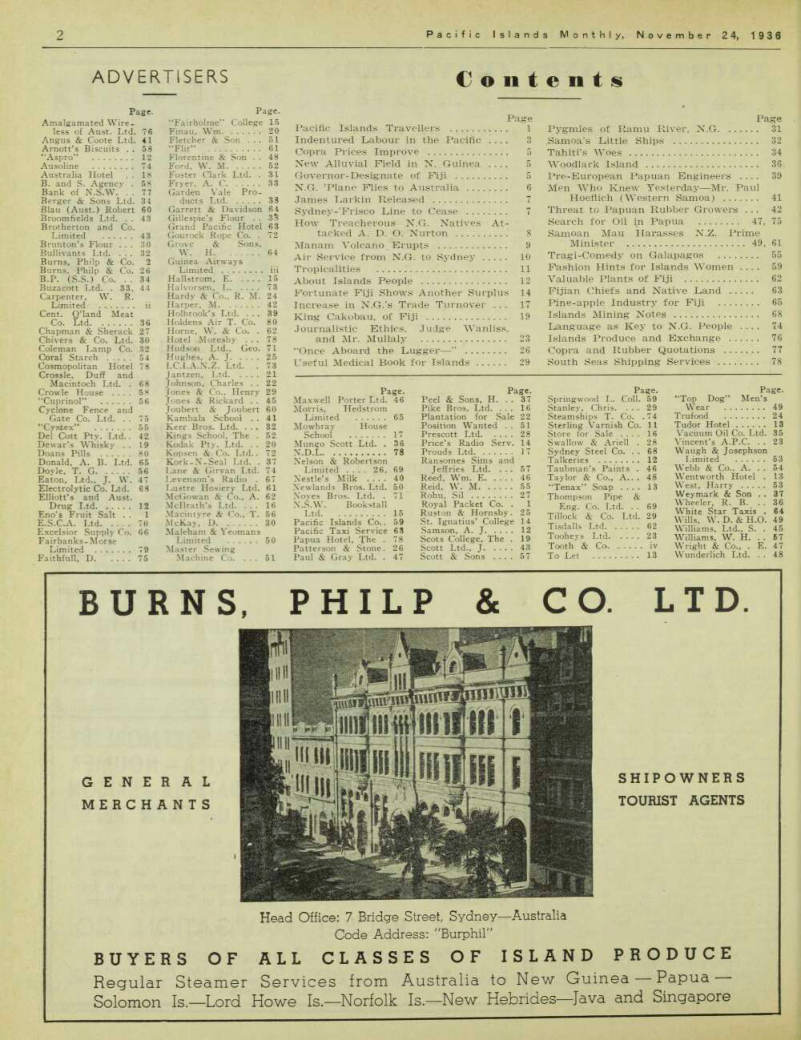
Page.
Amalgamated Wire less of Aust. Ltd. 76 Angus & Coote Ltd. 41 Arnott’s Biscuits . . 58 “Aspro” 12 Ausoline 74 Australia Hotel . . 18 B. and S. Agency . 58 Bank of N.S.W. . . 77 Berger & Sons Ltd. 34 Blau (Aust.) Robert 60 Broomfields Ltd. . . 43 Brotherton and Co.
Limited 43 Brunton’s Flour ... 30 Bullivants Ltd. ... 32 Burns, Philp & Co. 2 Burns, Philp & Co. 26
B.P. (S.S.) Co. . . 34
Buzacott Ltd. . 33, 44 Carpenter, W. R.
Limited ii Cent. Q’land Meat Co. Ltd 36 Chapman & Sherack 27 Chivers & Co. Ltd. 30 Coleman Lamp Co. 32 Coral Starch 54 Cosmopolitan Hotel 78 Crossle, Duff and Macintoch Ltd. . 68 Crowle House ... 58 “Cuprinol” ... 56 Cyclone Fence and Gate Co. Ltd. . . 75 “Cystex” 55 Dei Cott Pty. Ltd.. 42 Dewar’s Whisky . . 19 Doans Pills 80 Donald, A. B. Ltd. 65 Doyle, T. G 56 Eaton, Ltd., J. W. 47 Electrolytic Co. Ltd. 68 Elliott’s and Aust.
Drug Ltd 12 Eno’s Fruit Salt . . 1
E.S.C.A. Ltd 70
Excelsior Supply Co. 66 Fairbanks - Morse Limited 79 Faithfull, D. ... 75
Page.
“Fairholme” College 15 Finau, Wm 20 Fletcher & Son ... 51 “Flit” 61 Florentine & Son . . 48 Ford, W. M 52 Foster Clark Ltd. . 31 Fryer, A. C 33 Garden Vale Pro ducts Ltd 38 Garrett & Davidson 6 4 Gillespie’s Flour . . 3S Grand Pacific Hotel 63 Gourock Rope Co. . 72 Grove & Sons, W. H 64 Guinea Airways Limited iii Hallstrom, E 15 Halvorsen, L 73 Hardy & Co., R. M. 24 Harper, M 42 Holbrook’s Ltd. ... 39 Holdens Air T. Co. 80 Horne, W. & Co. . 62 Hotel Moresby ... 78 Hudson Ltd., Geo. 71 Hughes, A. J 25
1.C.1.A.N.Z. Ltd. . 73
Jantzen, Ltd 21 Johnson, Charles . . 22 Jones & Co.. Henry 29 Jones & Rickard . . 45 Joubert & Joubert 60 Kambala School . . 41 Kerr Bros. Ltd. ... 32 Kings School, The . 52 Kodak Pty. Ltd. . . 20 Kopsen & Co. Ltd.. 72 Kork-N-Seal Ltd. . 37 Lane & Girvan Ltd. 74 Levenson’s Radio . 67 Lustre Hosiery Ltd. 61 McGowan & Co., A. 62 Mcllrath’s Ltd. ... 16 Macintyre & Co., T. 56 McKay, D 30 Maleham & Yeomans Limited ... 50 Master Sewing Machine Co. ... 51
Page.
Maxwell Porter Ltd. 46 Morris, Hedstrom Limited 65 Mowbray House School 17 Mungo Scott Ltd. . 36
N.D.L 78
Nelson & Robertson Limited ... 26, 69 Nestle’s Milk 40 Newlands Bros. Ltd. 50 Noyes Bros. Ltd. . 71 NLS.W. Bookstall Ltd 15 Pacific Islands Co.. 59 Pacific Taxi Service 63 Papua Hotel, The . 78 Patterson & Stone. 26 Paul & Gray Ltd. . 47
Page.
Peel & Sons. H. . . 37 Pike Bros. Ltd. ... 16 Plantation for Sale 22 Position Wanted . . 51 Prescott Ltd 28 Price’s Radio Serv. 14 Prouds Ltd 17 Ransomes Sims and Jeffries Ltd. ... 57 Reed, Wm. E 46 Reid. W. M 55 Rohu, Sil 27 Royal Packet Co. . 1 Ruston & Hornsby. 25 St. Ignatius’ College 14 Samson, A. J 12 Scots College, The . 19 Scott Ltd., J 43 Scott & Sons ... 57
Page.
Springwood L. Coll. 59 Stanley, Chris. ... 29 Steamships T. Co. .74 Sterling Varnish Co. 11 Store for Sale ... 16 Swallow & Ariell . 28 Sydney Steel Co. . . 68 Talkeries 12 Taubman’s Paints . 46 Taylor & Co., A... 48 “Tenax” Soap ... 13 Thompson Pipe & Eng. Co. Ltd. . . 69 Tillock & Co. Ltd. 29 Tisdalls Ltd 62 Tooheys Ltd 23 Tooth & Co iv To Let 13
Page.
“Top Dog” Men’s Wear 49 Trufood 24 Tudor Hotel 13 Vacuum Oil Co. Ltd. 35 Vincent’s A.P.C. . . 23 Waugh & Josephson Limited 53 Webb & Co.. A. . . 54 Wentworth Hotel . 13 West, Harry 53 Weymark & Son . . 37 Wheeler, R. B. . . 36 White Star Taxis . 64 Wills, W. D. & H.O. 49 Williams, Ltd., S. . 45 Williams. W. H. . . 67 Wright & Co., . E. 47 Wunderlich Ltd. . . 48
Contents
Page Pacific Islands Travellers 1 Indentured Labour in the Pacific ... 3 Copra Prices Improve 5 New Alluvial Field in N. Guinea ... 5 Governor-Designate of Fiji 5 N.G. ’Plane Flies to Australia 6 James Larkin Released 7 Sydney-’Frisco Line to Cease 7 How Treacherous N.G. Natives At tacked A. D. O. Nurton 8 Manam Volcano Erupts 9 Air Service from N.G. to Sydney 10 Tropicalities 11 About Islands People 12 Fortunate Fiji Shows Another Surplus 14 Increase in N.G.’s Trade Turnover ... 17 King Cakobau, of Fiji 19 Journalistic Ethics, Judge Wanliss, and Mr. Mullaly 23 “Once Aboard the Lugger—” 26 Useful Medical Book for Islands 29
Page Pygmies of Ramu River, N.G 31 .Samoa’s Little Ships 32 Tahiti’s Woes 34 Woodlark Island 36 Pre-European Papuan Engineers ... 39 Men Who Knew Yesterday—Mr. Paul Hoeflich (Western Samoa) 41 Threat to Papuan Rubber Growers ... 42 Search for Oil in Papua 47, 75 Samoan Mau Harasses N.Z. Prime Minister 49, 61 Tragi-Comedy on Galapagos 55 Fashion Hints for Islands Women ... 59 Valuable Plants of Fiji 62 Fijian Chiefs and Native Land 63 Pine-apple Industry for Fiji 65 Islands Mining Notes 68 Language as Key to N.G. People ... 74 Islands Produce and Exchange 76 Copra and Rubber Quotations 77 South Seas Shipping Services 78
Advertisements & other items, p. 4 (1 item)
Burns, Philp & Co. Ltd.
GENERAL
MERCHANTS
V 111 ' mil rtSSt mm m
ill
till
1111 111
HI IK
II)
ill
m\
SHIPOWNERS
TOURIST AGENTS
Head Office: 7 Bridge Street, Sydney—Australia Code Address: "Burphil"
BUYERS OF ALL CLASSES OF ISLAND PRODUCE Regular Steamer Services from Australia to New Guinea Papua Solomon Is.—Lord Howe Is.—Norfolk Is. —New Hebrides —lava and Singapore
Pacific Islands Monthly
The Newspaper-Magazine of the South Seas [Registered at the G.P.O. Sydney, for transmission hy post as a newspaper.]
Published Once Each Month and Circulated in Australia and New Zealand and in the following Pacific Territories and Island Groups:
Crown Colony of Fiji.
Australian Territory of Papua.
Mandated Territory (Australia) of New Guinea, Bismarck Archipelago and Northern Solomon Islands.
Mandated Territory (Japan) of Marshall, Caroline and Marianna Islands.
French Territory of New Caledonia.
British and French Condominium of New Hebrides.
American Territory of Eastern Samoa.
American Territory of Guam.
Mandated Territory of Nauru.
British Crown Colony of Gilbert and Ellice Islands.
Mandated Territory (New Zealand) of Samoa.
British Solomon Islands Protectorate.
British Protectorate of Tongan Islands.
New Zealand Territory of Cook Islands.
Australian Territory of Norfolk Island.
French Colony of Oceania (Tahiti, etc.).
American Territory of Hawaiian Islands.
Owned and Produced by Pacific Publications Ltd., Union House, 247 George Street, Sydney
Telephone Bw 5037
P.O. Box 3408 R
Registered Address of Telegrams, Radiograms, and Cables: “PACPtJB.” Sydney.
Contributions Articles, Stories, and Photographs dealing with Pacific Islands subjects are invited, and will be paid for on publication at usual rates.
Subscription Rates
Per Annum, within British Empire, Prepaid, Post Free 6/ Per Annum, elsewhere, prepaid. Post Free 8/ Single Copies 6d.
Editor and Publisher;
R. W. Robson, F.R.G.S.
Advertisements
Advertising rates furnished on application.
Colours, etc by Arrangement.
Process Blocks made at Advertiser’s expense when required. Screen, 100.
Changes of Advertising Copy should reach this Office by Bth of each month, otherwise previous advertisement may be repeated.
Agents
The following are authorised to receive subscrip tions for the Pacific Islands Monthly:— Islands Branches of Burns, Philp & Co., Ltd., and Burns Philp (South Sea) Co., Ltd.
Islands Branches of W. R. Carpenter & Co., Ltd.
All Branches of Morris, Hedstrom & Co., Ltd.
G. Thomas & Co., Rabaul, New Guinea.
Whitten Bros., Ltd., Samarai, Papua.
P. Costello, Suva, Fiji.
J. Muir, Suva, Fiji, All Branches and Representatives of W. H. Grove and Sons, Ltd., Auckland, New Zealand, Cook Islands Trading Co., Rarotonga, Cook Is.
W. H. Watson, Rarotonga, Cook Is.
Representative in London: W. C. HARVEY. Coronation Building, 4 Lloyds Avenue, London, E.C.2. from whom may be obtained copies of Pacific Islands Monthly, Pacific Islands Year Book, advertising schedules, etc.
Vol. VII., No. 4.
Sydney, November 24, 1936
Prir#> I 6d - Per Copy ' l llCc \ Prepaid: 6/- p.a.
Indentured Labour In The Pacific
THE editor of the Pacific Islands Monthly has been caned by the Honolulu Star-Bulletin because he has protested against the proposal of the N.Z. Government, in pursuance of its Socialistic ideology, to deport the few remaining Chinese labourers from Western Samoa, and thus deprive the Samoan planters of anything re sembling a dependable labour supply.
The Honolulu newspaper says that our editor “is for the plantocracy” ; that he is guilty of “a particularly cold-blooded non-social utterance”; and that “the human aftermath is of no consequence to those who think only of 30 and 40 per cent.” (in other words, high profits).
The on many occasions, has urged the protection of the interests of the indigenous South Seas natives, as against those of European exploiters.
The editor knows Pacific Islands his tory pretty thoroughly, and is aware of the cruelties and racial perversions which have been forced upon the trust
ing, unoffending Polynesian folk by our
ruthless Western civilisation. There is upon all Europeans an obligation to protect and help these native peoples, if only to provide a set-off to some of the
horrible things perpetrated by white
men in the last 150 years.
But, even if we bury our heads at times in the clouds, there is no need to forget that our feet are planted irrevoc ably upon the brutal, practical earth.
We must take the position v as we find it. Political and strategical necessities say that we must hold these Pacific Islands territories, for our own pro tection. They cannot be left to them selves—if they were abandoned, they would be mopped up by another nation * n a few hours.
Holding them, we are under an obli gation to govern them properly, Government, with its concomitants of roads and bridges and wharves, water supply and health services, and educa tion, means money. A regular revenue means taxation. Taxation means
organised production. Production
means dependable labour.
So there you are. It the land-owning islanders will not hire themselves out as labourers —and why should they?— then labourers must be provided from some other source.
Western Samoa is a very good case in point. When the country came into the hands of Germany and, later, into British possession, it already was partly over-run by European planters and traders. One could then, as now, make out a strong case for leaving the attrac tive brown people in sole control, with their own considerable culture, but already it was too late. Germany and Britain had to take Samoa as they found it—a country subject to Euro pean ideas of government, producing goods for export, and demanding
organised public services—and carry
on. They might, in 1890, or in 1914, have withdrawn all European forms and institutions from the country, ringed it about with warships as a warning to other predatory nations to keep out, and left the Samoans to their own devices. Such a thing has never
been done simply because, for obvious reasons, it is not practicable. The “white man’s burden” is—despite the arguments and jeers of idealists and dreamers—a real thing, and self imposed.
The Samoans would not become plantation labourers, so the Germans brought in Chinese Coolies and Solo mon Islanders. The British continued the system. Some of both classes of labourers took Samoan wives, and the resulting strains, while representing an unfortunate disturbance of the true Polynesian type, were not in them selves bad —and they are by no means numerous. (If the Star-Bulletin wants confirmation of that, let it call next door, at the Bishop Museum in Hono lulu, and ask the learned men there what they think of the Chinese-Poly nesian cross.) The British, recognising the undesirableness of a fixed Chinese community in Samoa, have reduced the Chinese labourers from some thousands to 400; but they cannot further reduce that small labour force without impos ing ruin on the principal plantations, and thus removing the principal sources of revenue and crippling the administration: The Samoan position is repeated, in more or less similar form, in all the Polynesian countries which have been occupied by white men. The Poly nesians in Hawaii, in Tahiti, and in Fiji (for the purpose of this discussion, Fiji may be classed as Polynesian) have been born without either the inclination or the obligation to labour.
The European administrators have been compelled—in every case most unwillingly—to permit the introduction of foreign labourers. The result is that, to-day, there are large and established communities of Chinese and Japanese in Hawaii, of Chinese in Tahiti, of Indians and Chinese in Fiji.
No European likes what he sees in those Pacific Islands. We would, if we could, “shatter it to bits and re mould it nearer to our heart’s desire.”
But it is too late.
All that can be done, now, is to see that Islands territories like Samoa, which have not yet had an Asiatic community fastened upon them, shall not be compelled to accept any such community. There is nothing much wrong with the system of using inden tured Asiatic labour, provided that the indentured labourers are under proper control and are not allowed to settle permanently in the country. That was allowed in Hawaii, Tahiti and Fiji,
with incalculable results, but it has not been allowed in Samoa, New Hebrides and New Caledonia (where very large numbers of Asiatics have been tem porarily employed) and no racial harm has been done to those territories. The use of Asiatic labour, in the Islands, makes orderly and efficient adminis tration possible; but the system must be subject to the strictest form of control.
Mr. A. E. Stephen delivered an address on “Treasure Islands of the Pacific” on November 10 to members of the N.S.W.
Geographical Society in Sydney. He described in detail the development of Ocean Is., Nauru, and Makatea, whose rich and enormous deposits of phosphates have been of such value to the agri culturists of the world.
Advertisements & other items, p. 5 (1 item)
3
Monthly, November 24, 1936
Pacific Island
Cheeky Sampan in B.S.I.
TNHIGNATION has been expressed by B.S.L residents at the cheekiness of a Japanese sampan which has been leading the authorities a merry dance at Vanikoro.
Towards the end of October an unusu ally large Japanese sampan cruised around the island and the crew spent some time diving for shell and sailing about inside the reef in front of the white settlement. Officials from the Govern ment station in a cutter chased the poacher, but it was too fast and escaped.
The following day it returned to its previous anchorage. Again the Govern ment boat went towards it, but the Jap anese vessel made off quickly. The cutter went back to the settlement.
Employees of the Vanikoro Kauri Tim ber Co. could scarcely believe their eyes when shortly afterwards the same sampan daringly returned to continue shell poach ing operations. Eventually the vessel sailed away from the island.
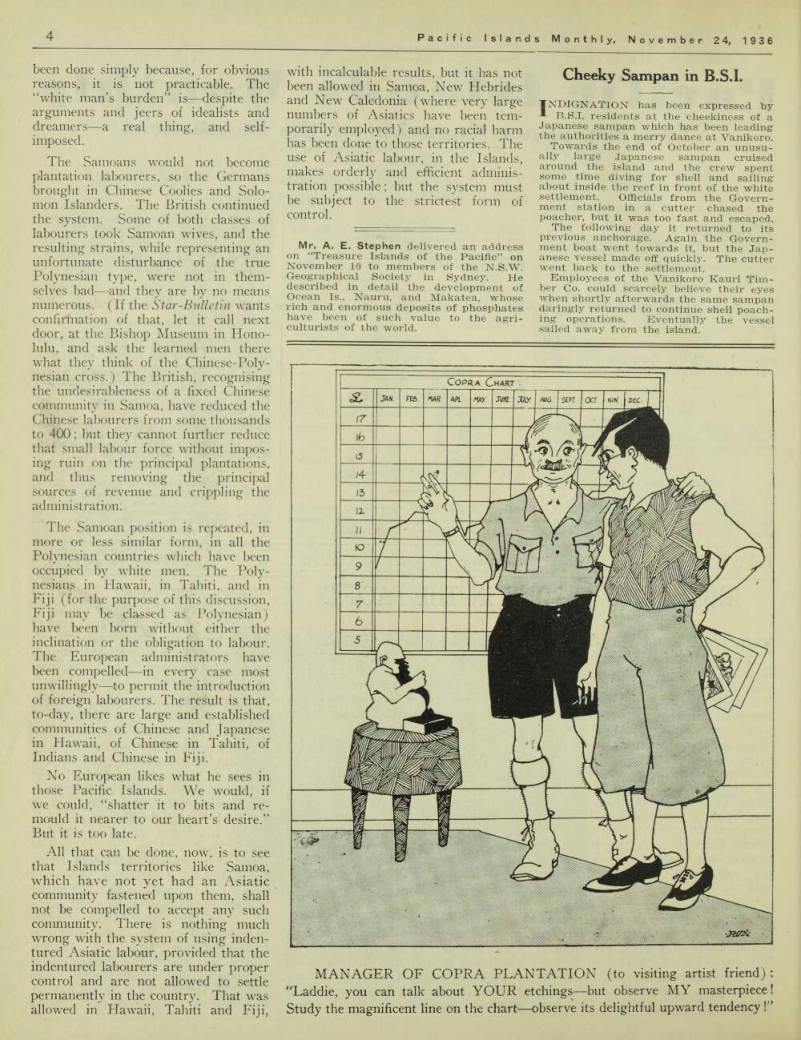
MANAGER OF COPRA PLANTATION (to visiting artist friend): “Laddie, you can talk about YOUR etchings—but observe MY masterpiece!
Study the magnificent line on the chart—observe its delightful upward tendency!”
Jump
Copra Prices
Increased Values Must Improve Trade Throughout the Pacific
THE copra prices which were quoted officially in London on November 20 (see our market reports at the end of this journal) are the highest that have been recorded since the Pacific Islands Monthly was established in 1930.
If the figures are examined it will be seen that the rise has not been rapid— these good prices have been reached by a slow, steady advance, extending over months.
Another comforting factor is that a series of causes appear to be contributing to the higher value of copra. There seems to be, comparatively, a world shortage of oils and fats. In the United States the stocks of cotton oil and lard are lower at present than has been the case for some years, while in Europe there is very little unsold whale oil and vegetable oil in store.
Two or three years ago there was as much as 400,000 tons of unsold whale oil in Europe.
Another factor is the change in the cur rency position.
When France, Italy, Switzerland, and Holland abandoned the gold standard, it was thought by some that, owing to the reduced purchasing power of their cur rency in the international market, they would buy less rather than more of such international commodities as oils and fats.
Actually, however, the contrary has been the case. Those countries believe that now they have a much better chance of increasing their exports and thus building up foreign credits; and as a result, and in order to get their factories going at full speed again, they have been buying all kinds of raw materials in increasing quan tities, including copra and similar things.
It is most interesting to note that since April, 1934, when copra reached its disas trous low level (South Seas sun-dried, £7/5/-; Rabaul hot-air-dried, £7/15/-) the value of copra has more than doubled.
This all spells much better times for the South Seas planter—and that means also better for the South Seas trader. It will be interesting to observe the way in which this copra money will trickle afar off into remote and distant groups of islands. When the market went to pieces, large numbers of natives ceased making copra, and ceased to use articles supplied by Europeans, and returned to their old and primitive ways of living.
The recovery of copra will not only mean a better standard of life for European planters and traders, but it will mean also a far greater consumption of the white man’s goods in the more remote parts of the Pacific.
Brigadier-General W. Ramsay McNicoll, Administrator of New Guinea, who has been spending the last two months on furlough in Australia with his wife, re turned to the Mandated Territory by the Nankin, which sailed from Sydney on November 14.
Mr. and Mrs. Zoltan de Havas arrived m Sydney from Papeete by the Maun ganui on November 14, after a three years’ stay in Tahiti. Mr. de Havas, a Hungar ian, went there originally with his English bride to spent a few weeks on a honey moon trip from the Argentine, but they became so enchanted with the French Colony that the couple remained in resi dence there.
New Alluvial Goldfield in N.-W.
New Guinea
WAU, Nov. 14.
DESCRIBED as the best goldfield for “battlers” since Morobe was found in 1926, a new alluvial field three days’ march inland from Matapau, on the North-west coast of the Mandated Ter ritory, has attracted many well-known New Guinea miners. Matapau is 40 miles west of Wewak, the government station in that district.
At the present time there are about 60 men, the majority of whom are from Wan, working on the field, and reports state that they are mostly doing well.
Another party is leaving here next week for the field by the Macdhui.
Although the discovery of this new area has been known only a short time, the aviation companies are already running their ’planes to the field, which is a 350miles flight from Wau.
“Untrue”
Report About N.Z. Officials and Samoan Wives
From Our Own Correspondent.
Apia, Oct. 27.
TTHE Fono of Faipule, when sitting in Apia during October, discussed a very wide variety and range of subjects.
The Acting Administrator (Mr. A. C.
Turnbull) was asked, for instance, whether it was a fact, as reported, that officials of the Administration who married native Samoan or half-caste girls were dismissed from the service, or were sent back to New Zealand. If there was such a regulation, said the Faipule, it should be revoked— officials should be allowed to select their wives without interference.
The Acting Administrator declared that the report to which reference was made was untrue.
New Governor Bound for Fiji
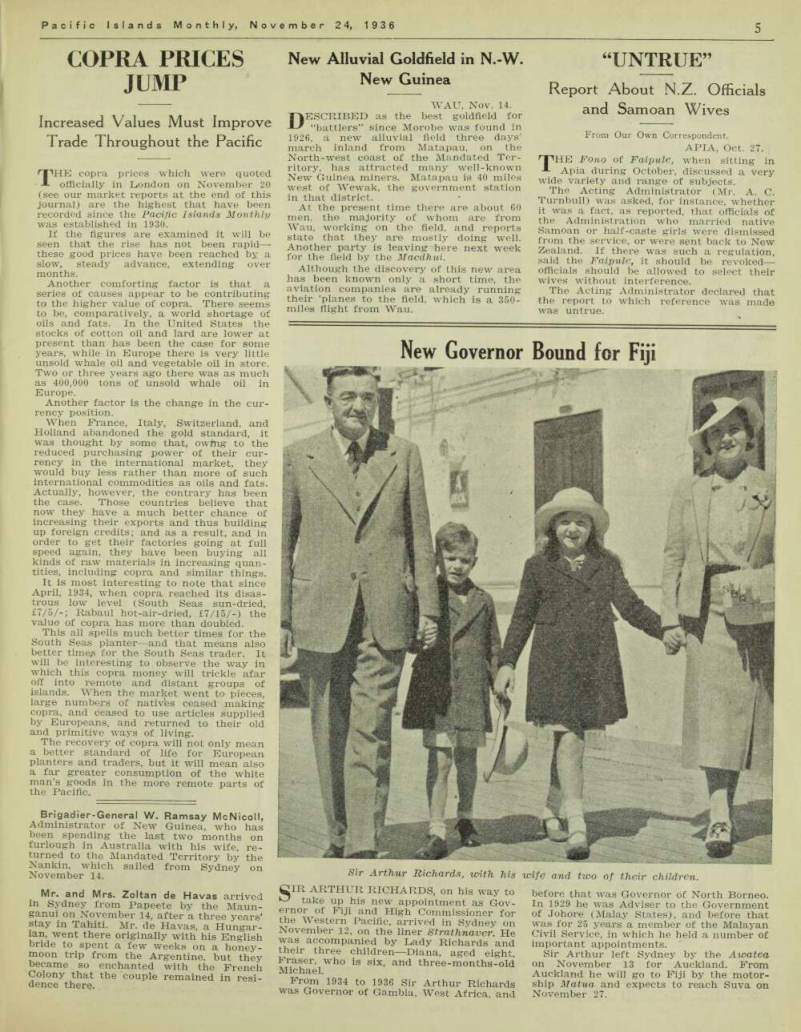
Q!R ARTHUR RICHARDS, on his way to take lip his new appointment as Govf™' Fiji and High Commissioner for tne Western Pacific, arrived in Sydney on November 12, on the liner Strathnaver. He was accompanied by Lady Richards and their three children—Diana, aged eight, rraser, who is six, and three-months-old Michael, rrom 1934 to 1936 Sir Arthur Richards was Governor of Gambia, West Africa, and
before that was Governor of North Borneo.
In 1929 he was Adviser to the Government of Johore (Malay States), and before that was for 25 years a member of the Malayan Civil Service, in which he held a number of important appointments, Sir Arthur left Sydney by the Axoatea on November 13 for Auckland. From Auckland he will go to Fiji by the motor ship Matua and expects to reach Suva on November 27.
Sir Arthur Richards, with his wife and two of their children.
Quick Trip by Plane
From Wau To
Melbourne
GUINEA Airways Limited have been making aviation history with their new Lockheed Electra monoplane.
It was decided in October that a party of the Company’s directors should visit New Guinea; and as time is an important factor with business men, it was arranged that the Lockheed should fly down to Aus tralia and carry them back to the goldfield.
When this was known, a number of Morobe residents decided that they would take this opportunity of making a quick visit to Australia. The fact that the Mel bourne Cup was about to be run probably influenced them.
The Lockheed left Wau on October 28 with nine passengers in charge of Pilot “Tommy” O’Dea and stayed that night at Port Moresby; flew the next day to Bris bane; and the following day from Bisbane to Melbourne. The 200 miles-per-hour machine put up a good record and demon strated the practicability of a passenger service between New Guinea and the east ern states of Australia.
The monoplane left Sydney on its return trip on November 12 in charge of Pilot O’Dea, carrying a party of Guinea Airways directors, Mr. R. W. Robson (Editor of the Pacific Islands Monthly), and four of the passengers who came down to Australia by her.
The Lockheed is scheduled to leave New
Guinea again about November 23 to fly south to Sydney on the return trip with the directors of Guinea Airways; and will fly back to New Guinea immediately there after, leaving Sydney about November 27.
unexplored country in the north-west of Papua, part of which was Visited by the Hides expedition in 1935.
The party consists of the two white officers, 27 native carriers, and members of the Papuan Armed Constabulary.
On May 25, the patrol advised that they had gone up the Bamu River, in the West ern Division, and were on the slopes of Leonard Murray Mountain, with full sup plies for the whole party until the end of August. It was hoped to eke out the stock with supplies procured from friendly na tives, so that it would last until the end of September, or even October.
Mr. Champion previously was with the Karius patrol, and Mr. Adamson, a Patrol Officer, is a tried bushman. It is not known where they will break through, but it is expected that it will be on the Purari River.
Mr. Champion’s Expedition
Papuan Patrol
NEWS is now being awaited of the re turn to civilisation of the expedition which left Port Moresby early this year, led by Mr. Ivan F. Champion, A.R.M., and Mr. C. T. J. Adamson, to penetrate the
Reached The Purari?
On November 23 a radiogram received from our Ft. Moresby correspondent stated that a tin floating down from the Purari headwaters had been picked up, suggesting that the Champion party had reached the Purari.
The message added that Mr. Cham pion’s wide patrolling experience and his ability to take accurate bearings support the local belief that the expedition will soon be brought to a successful com pletion.
Tahiti's New Governor
From Our Own Correspondent.
Papeete, Oct. 27.
\ new Governor of full rank has been appointed for French Oceania in the person of Monsieur Chastenet de Gery, Officer of the Legion of Honour, ex-In spector of Colonies, and ex-Marine Offi cer.
The present Acting-Governor, M. Henri Sautot, who came to Tahiti from the New Hebrides where he was for some years Administrator for Franc© in the dual Franco-British Government, will remain in Tahiti as Chief Magistrate of the Col ony.
It had been thought that when M. Sau tot was relieved of the Acting-Governor ship, he would take up his old position in the New Hebrides, and there will be many expressions of regret in the Condominium when it is learned that he will not be re turning.
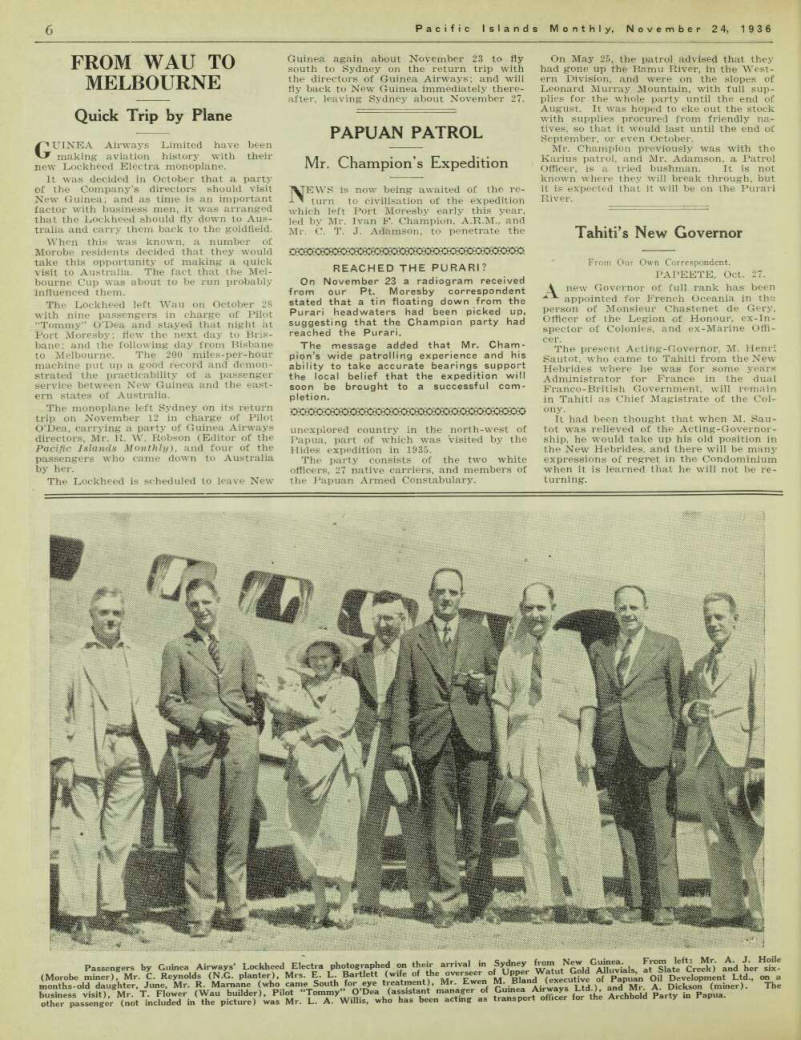
Passengers by Guinea Airways' Lockheed Elytra photographed on their arrival in Sydney from left: Mr. A. J. Hoile (Morobe miner), Mr. C. Reynolds (N.G.planter), Mrs. E. L. Bartlett (wife of the overseer of Upper watut Gold Aluvials, at Slate Creek) and her six months-old daughter, june, Mr. R. Marnane (who came South for eye treatment), Mr.Ewen M. Bland (executive of Papuann oil Development Ltd., on a busoness visit), Mr. T. Flower (Wau builder), pilot "Tommy" O'Dea (assistant manager of Guinea Sirways Ltd.), and Mr. A. Dickson (miner). The other passenger (not included in the piture) was Mr. L. A. Willis, who has acting as transport officer tor the Archbold Party in Papua.
James Larkin
Release After Serving Five Years
THE release of James Larkin from the Tuncurry Prison Camp, New South Wales took place on November 3. It is understood that he will be married at an early date, and will go to live in South America.
Mr. Larkin was the owner of Noru plantation, in the Admiralty Group, New Guinea, and on October 28, 1931, he re primanded a native labourer. Sambung.
Sambung was insolent and cheeky, and a fight occurred between Larkin and Sambung. Larkin was bitten, and severely injured. Later, under Larkin’s orders, Sambung was held and flogged.
Sambung subsequently became very ill, and died, apparently from blood-poisoning caused by his flogging.
On November 30, 1931, Chief Judge Wanliss found Larkin guilty of murder, and sentenced him to ten years’ imprison ment.
Some of Mr. Larkin’s friends, and the Pacific Islands Monthly, took the view that the verdict was wrong and the punishment excessive; and that the offence, if any, was manslaughter; and. during 1932, 1933, and 1934, an agitation was carried on for a revision of the sentence. A petition (promoted by the P.1.M., and the cost borne by public sub scription in New Guinea) was presented to the Administrator in 1935, carrying over 600 signatures, and praying for re consideration of the case.
Early in 1935, the editor of the P.I.M. was informed, unofficially but authori tatively, that if he would “shut up for a while,” something would be done in Rabaul, in the Larkin case. The editor promised to “shut up” accordingly, and did, during 1935.
Early in 1936, as nothing had been done, we prepared to renew the agitation. Then we were informed that the Larkin case would be dealt with this year—“please say nothing in the meantime.” Finally, in June, we learned that Mr. Larkin would be released in November.
If we had known that nearly two years were to elapse before anything was done, we should never have agreed to “shut up” in the first place.
Mr. Larkin should have been released a year ago. As it is, he has served five years—which is an excessive sentence.
New Guinea residents would very much like to know the true story of the oppo sition that was organised and presented in Rabaul against any interference with the original sentence on James Larkin.
Wau Hotels Sold To
Carpenter Interests
THE two licensed hotels at Wau, the chief town of the New Guinea gold fields—Parer’s Hotel and the Bulolo Ho tel—were sold on November 14 to a syn dicate in which Messrs. W. R. Carpenter and Co. Ltd. has a controlling Interest.
The Bulolo Hotel was started in the “early days” by Mrs. F. S. Stewart. Par er’s Hotel was erected early last year.
Tlwo new companies, the Wau Hotel Ltd. and the Bulolo Hotel Ltd., will be formed in Sydney to operate the estab lishments. These concerns will take charge immediately the transfers are sanctioned by the N.G. Administration,
Real Fishing!
Sydney Man’s Sport Near Suva
EXCEEDINGLY good fishing was re ported by Mr. J. A. Armstrong, of Oliver Road, Roseville, Sydney, who re turned after a two months’ holiday spent in Suva with Mr. Carl Corbett.
Mr. Armstrong intended spending only
a few days in Fiji; but Mr. Corbett took him out in his launch among the reef pas sages near Suva and. day after day, they found sport which enthralled the Sydney man.
Trolling, usually in the reef passages, but sometimes outside, they caught half a
dozen varieties of very game, fighting fish.
Their best ground was the Naqara pas sage, some 10 miles from Suva.
“There is no better fishing anywhere,” declared Mr. Armstrong. “Some of those ogo fish go up to 60 lbs., and they and the sanka fight like tigers. They are all edible fish.”
Captain G. F. Zimmer, one-time R.A.F, pilot and formerly of the Papuan Ser vice, arrived in Sydney from Port Moresby by the Macdhui early in Novem ber. He will spend a few months in Aus tralia before returning to his gold claim on the headwaters of the Tiveri River.
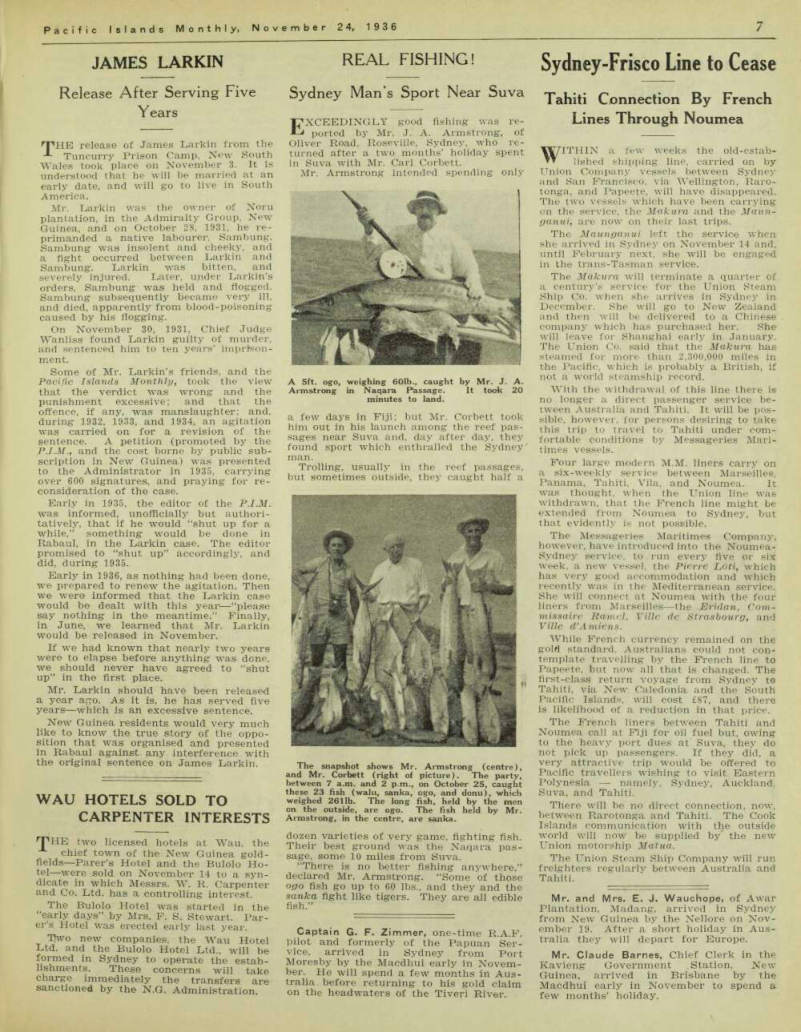
A 5ft. ogo, weighing 60lb., caught by Mr. J. A.
Armstrong in Naqara Passage. It took 20 minutes to land.
The snapshot shows Mr. Armstrong (centre), and Mr. Corbett (right of picture). The party, between 7 a.m. and 2 p.m., on October 25, caught these 23 fish (walu, sanka, ogo, and donu), which weighed 261l b. The long fish, held by the men on the outside, are ogo. The fish held by Mr.
Armstrong, in the centre, are sanka.
Sydney-Frisco Line to Cease
Tahiti Connection By French Lines Through Noumea
WITHIN a few weeks the old-estab lished shipping line, carried on by Union Company vessels between Sydney and San Francisco, via Wellington, Raro tonga, and Papeete, will have disappeared.
The two vessels which have been carrying on the service, the Makura and the Mann ganui, are now on their last trips.
The Maunganui left the service when she arrived in Sydney on November 14 and, until February next, she will be engaged in the trans-Tasman service.
The Makura will terminate a quarter of a century’s service for the Union Steam Ship Co. when she arrives in Sydney in December. She will go to New Zealand and then will be delivered to a Chinese company which has purchased her. She will leave for Shanghai early in January.
The Union Co. said that the Makura has steamed for more than 2,300,000 miles in the Pacific, which is probably a British, if not a world steamship record.
With the withdrawal of this line there is no longer a direct passenger service be tween Australia and Tahiti. It will be pos sible, however, for persons desiring to take this trip to travel to Tahiti under com fortable conditions by Messageries Mari times vessels.
Four large modern M.M. liners carry on a six-weekly service between Marseilles, Panama, Tahiti. Vila, and Noumea. It was thought, when the Union line was withdrawn, that the French line might be extended from Noumea to Sydney, but that evidently is not possible.
The Messageries Maritimes Company, however, have introduced into the Noumea- Sydney service, to run every five or six week, a new vessel, the Pierre Loti, which has very good accommodation and which recently was in the Mediterranean service.
She will connect at Noumea with the four liners from Marseilles —the Eridan, Com missaire Ramcl, Ville de Strasbourg, and Ville d’Amiens.
While French currency remained on the gold standard. Australians could not con template travelling by the French line to Papeete, but now all that is changed. The first-class return voyage from Sydney to Tahiti, via New. Caledonia and the South Pacific Islands, will cost £B7, and there is likelihood of a reduction in that price.
The French liners between Tahiti and Noumea call at Fiji for oil fuel but, owing to the heavy port dues at Suva, they do not pick up passengers. If they did, a very attractive trip would be offered to Pacific travellers wishing to visit Eastern Polynesia namely, Sydney, Auckland, Suva, and Tahiti.
There will be no direct connection, now, between Rarotonga and Tahiti. The Cook Islands communication with the outside world will now be supplied by' the new Union motorship Matua.
The Union Steam Ship Company will run freighters regularly between Australia and Tahiti.
Mr. and Mrs. E. J. Wauchope, of Awar Plantation, Madang, arrived in Sydney from New Guinea by the Nellore on Nov ember 19. After a short holiday in Aus tralia they will depart for Europe.
Mr. Claude Barnes, Chief Clerk in the Kavieng Government Station, New Guinea, arrived in Brisbane by the Macdhui early in November to spend a few months’ holiday.
Savages
Treacherous Attack by Savages N. Guinea Officer’s Terrible Experience
From Our Own Correspondent.
Rabaul, Nov. 1.
pROPPED up with cushions, with
almost every portion of his body
bandaged and with his left leg ampu tated, A. D. O. Nurton described the
attack which took place inland from
the Rai Coast, on the mainland of
New Guinea, on the morning of
September 24.
"AT about 9.30 a.m. a small armed party, consisting of eight men and five women, came running to my fenced-in personal camp,” said Mr. Nurton.
“I immediately buckled on my ‘armour,’ which consisted of the metal of a 501 b. bis cuit tin, covered on the outside with khaki material and lined inside with a thick row of cotton wool, covered with calico. After arming myself, I halted the party at the gate of the compound and I noticed that one of the men wore the cap of lulucui, while another wore a tultul’s cap.
“They addressed me in piteous tones and appeared to beg to be allowed to enter,
and as a sign of friendliness threw down their bows and arrows. I had the impres sion they were survivors of a fight, and I tried to tell them that I would send for an interpreter from the road gang. I allowed them then to enter the compound and ordered them to place their bows and arrows against the fence, which was specially constructed for defensive pur poses. The ground for six feet outside and inside was thickly planted with razor edged and needle-pointed ground-spears.
“The natives entered,” continued Mr.
Nurton, “and sat about, appearing very nervous: they asked me to sit down with them, but I declined and walked about. I thought possibly they had come for census purposes and, noting their nervousness, I put my arms away into an adjacent house, and returned to them unarmed, though still wearing my armour.
“Walking up to them I picked up one of their most dangerous arrows and with it violently stabbed my body, with only the result that the arrow was shattered. This caused a look of amazement to come to their faces. I walked among them, speak ing kindly, and to the two be-capped na tives I offered to shake hands, to which they smilingly responded; I also offered to shake hands with the other older men.
Two of them accepted, but the third coldly refused.
“Whilst I was standing against the fence I noticed a sudden signal made by the luluai, who suddenly held me in his arms. I broke from his grip and then noticed that the whole party were armed with 14in. knives, which they had snatched like magic from their hilums (string bags).
“The first blow I received was a paral lel slash with a knife, evidently intended
for my eyes. I remember blood spurting out and running down my neck and I remember thinking how warm it felt.
There was no more pain, though, than a stiff boxing left on the nose.
“The next swipe was a hefty knife swing to my neck. This I parried with my right arm, with the result that the cut fractured the bone; fortunately, no tendons were severed.
“The next attack from my assailants was a swipe that nearly took off the top of my head. Bleeding copiously, I be gan to feel that my contest was lost and, feeling a little punch-drunk, I flopped near the fence.
“The police-boy who had been working with me had apparently gone away some where and the others, including my cook boy, were out of sight, so I fell alone in the fence. My assailants could not reach my head as it was hidden in the fence.
“I kicked vigorously at my attackers.
My left foot was nearly severed at the instep by a blow, and the other leg had two lesser wounds. They shot arrows at my armoured body, without effect. They then bombarded me with limestone rocks, which I generally diverted with the quick unflung legs.
“I then struggled through the fence, got up and raced pell-mell down the hill to ward the police quarters. Half-way down, my left leg snapped like a pistol and I turned a complete somersault.
“I lay on the ground and, looking back, I saw a young man running towards me, armed with a 16-inch knife.
“Then I heard the glorious crack of a rifle, and the treacherous native crumpled up in his stride, while his shining knife went hurtling through the air like a ski.
I struggled up and crawled as best I could to the police quarters, where I climbed on a bench and listened to the yells and shooting of the fight.”
Later, Mr. Nurton discovered that the withdrawal of the attackers was due to the bravery of his personal cook-boy who, armed with a rifle, managed to account for seven of the attackers; several others being wounded.
Mr. Nurton graphically described the trip out to the beach —a distance of 17 miles —and then up the coast until a native boat was chartered, which landed the in jured man at Madang after three days of terrible journeying.
Dr. Sinclair, of Salamaua, flew to Ma dang, where he consulted with Dr.
MacQueen.'and it was decided to amputate the left leg below the knee. The follow ing day Mr. Nurton was sent to Habaul on board the Montoro, where he was placed in Namanula hospital for treatment. His progress is satisfactory.
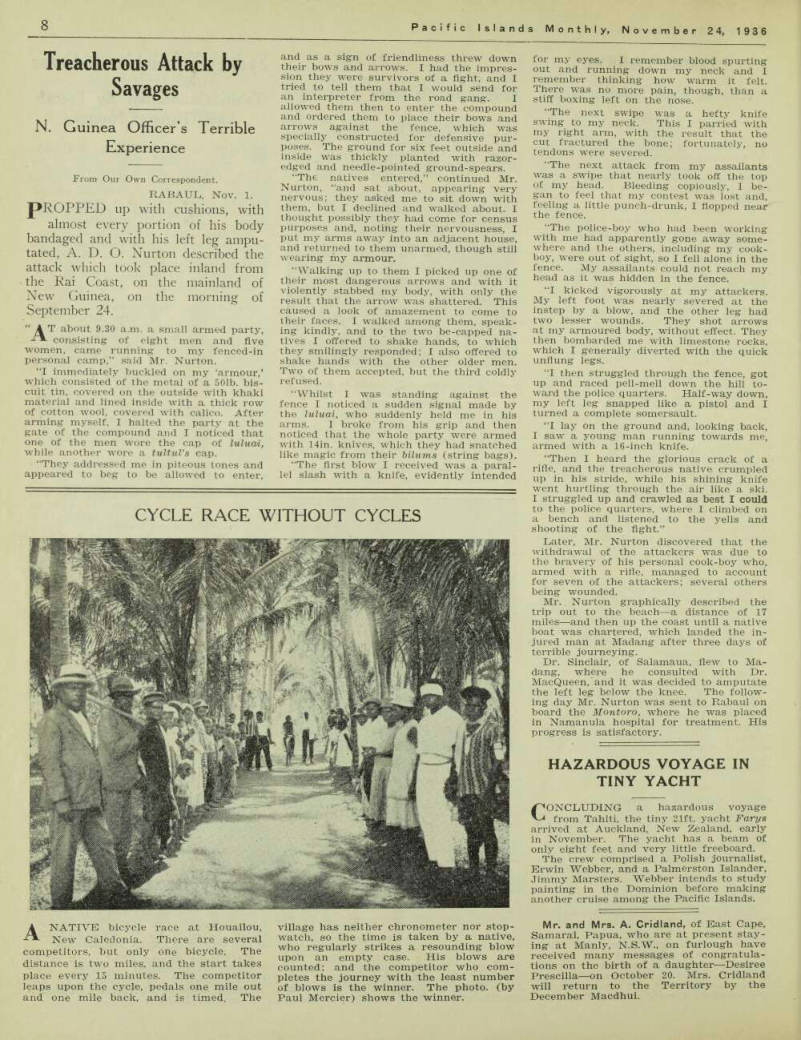
Cycle Race Without Cycles
A NATIVE bicycle race at Houailou, New Caledonia. There are several competitors, but only one bicycle. The distance is two miles, and the start takes place every 15 minutes. The competitor leaps upon the cycle, pedals one mile out and one mile back, and is timed. The
village has neither chronometer nor stop watch, so the time is taken by a native, who regularly strikes a resounding blow upon an empty case. His blows are counted; and the competitor who com pletes the journey with the least number of blows is the winner. The photo, (by Paul Mercier) shows the winner.
Hazardous Voyage In
Tiny Yacht
CONCLUDING a hazardous voyage from Tahiti, the tiny 21ft. yacht Farys arrived at Auckland, New Zealand, early in November. The yacht has a beam of only eight feet and very little freeboard.
The crew comprised a Polish journalist, Erwin Webber, and a Palmerston Islander, Jimmy Marsters. Webber intends to study painting in the Dominion before making another cruise among the Pacific Islands.
Mr. and Mrs. A. Cridland, of East Cape, Samarai, Papua, who are at present stay ing at Manly, N.S.W., on furlough have received many messages of congratula tions on the birth of a daughter—Desiree Prescilla—on October 20. Mrs. Cridland will return to the Territory by the December Macdhui.
Lava Flows
Manam Island Volcano in Eruption
VOLCANIC eruptions extending over a week occurred on Manam (Vulcan) Island, off the north coast of New Guinea, during October.
Stones w r ere thrown 3,000 ft. into the air and in the heavy flow of lava seawards, native gardens were destroyed. No lives were lost, however, and the natives de clined to leave the island.
The B.P. inter-island steamer Maiwara witnessed terrific eruptions in the even ings of October 18 and 24. On both occa sions the vessel stood by, but the natives did not appear to require assistance or wish to leave the island.
A party under a Government Patrol Officer departed from Madang on October 27 to investigate the position of the 3,000 natives on the island. Supplies of rice were taken for their sustenance.
Manam, about nine miles off the coast of the N.G. mainland, is situated south eastward of the mouth of the Sepik River.
Its area is about 32 square miles, and it has a cone-shaped crater 4,265 ft. high, still active. The island is constantly seen with its head in a cloud of vapour.
A previous eruption on the island occurred in March, 1921, the volcano emit ting quantities of steam, dust, and debris, with occasional flows of lava. A more violent outbreak was in August, 1919, when gardens and houses were destroyed.
There was also an eruption on the island in 1917, following an earthquake.
The Manam natives believe the visita tions to be the work of an evil spirt, and it is their custom to appease its wrath by solemn dancing, to the beating of drums and the blowing of long pipes of bamboo.
Labourers Wanted
Samoan Planters’ Plight
From Our Own Correspondent.
Apia, Oct. 28.
AS a sidelight upon the Chinese question, it is worth noting that planters here to-day, owing to the stimulus of greatly improved quotations for cocoa, copra, bananas, etc., are anxiously seeking labour, but they cannot get it. All the Chinese la bourers, of course, are employed and the planters are trying to get Samoan labour ers—especially to assist in bringing in the cocoa crop and also for weeding and bush felling.
Actually, they are experiencing the greatest difficulty in obtaining any Samoan labour at all. The Samoans are enjoying so much prosperity, as a result of the ac tivity in the banana and copra markets, that they refuse to work on the plantations for any wages that may be offered.
Yet the New Zealand Government pro poses to send away our Chinese labour!
Mr. J. G. Hid es, formerly Assistant Resident Magistrate in Papua, gave an interesting lantern lecture to members of Tattersall’s Club, Sydney, on November 11. His subject was “Savages in Serge,’’ and he praised the magnificent work of the Papuan Armed Constabulary, which, he declared, “had kept open the laneways between civilisation and the stone age.”
Fisherman’S
“Luck”
From Our Own Correspondent.
Rarotonga, Nov. 1
LORING ANDREWS, American writer resident here, is a noted fishing en thusiast. Returning recently from a visit to New Zealand, the author brought back a beautiful little speed launch capable of 27 knots, all gadgets and polished wood work.
Zane-Greying out from Avatieu harbour one morning last week Mr. Andrews, with two companions promptly hooked a 4-foot para weighing 601 b. On board the launch, the visitor at once bit his host just above the ankle so severely that the party were obliged to return immediately for a couple of stitches to be put in. But a fish-bite being considered proverbially lucky for those who are not bitten, the launch put out to sea again, running six or seven miles down the coast.
There the engine batteries gave out.
Opposite the wireless station the fishing party signalled for assistance, anchoring off the reef whilst the Government whale boat rowed down from Avarua with the Chief of Police and the Harbour Master aboard. With fresh batteries the launch was again got under way until a native youth, leaning overboard, touched a spark plug with his wet clothing and caused a
backfire which wrenched away a portion of the distributor.
Towed home by the whaleboat against a strong headwind, Mr. Andrews’ opinion of polished speed boats, 601 b paras, native boys, and life in general were all unfit for publication in any self-respecting news paper.
Kava For Tongan Prince
FK)R the second time in recent months the old Polynesian ceremony of mak ing and presenting kava will be performed in Sydney when the Polynesian Club holds its next function. The guest of honour will be Prince George Taufa’ahau, heir to the Tongan throne.
The gathering will be held at the Green Door, George-street, Sydney, on Tuesday, December 1. After the kava ceremony, an entertainment of Maori and Islands songs and dances will be provided by members of the Club.
Rev. Father Franz J. Kirschbaum, who is one of the best-known missionaries in North-west New Guinea, returned to the Mandated Territory by the Macdhui on November 12.
Captain A. S. Fitch, managing-director of Steamships Trading Co. Ltd., of Papua, who had spent recent months in Australia on furlough, returned to Port Moresby by the Macdhui in November.
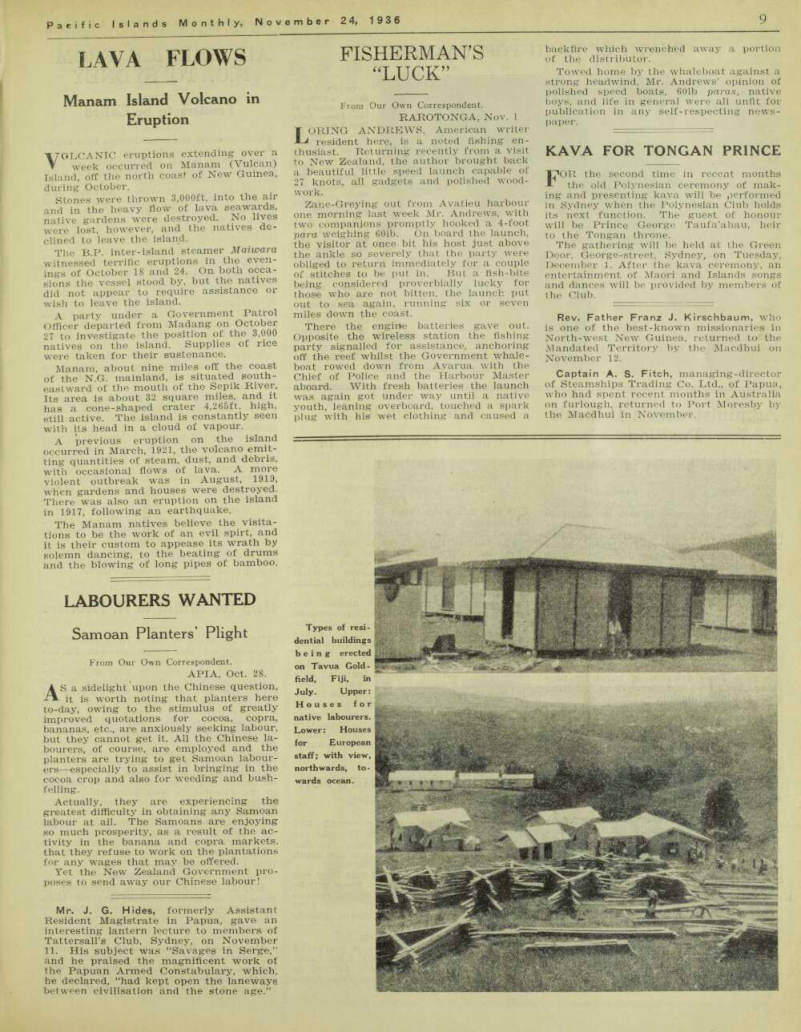
Types of resi dential buildings being erected on Tavua Gold field, Fiji, in July. Upper: Houses for native labourers.
Lower: Houses for European staff; with view, northwards, to wards ocean.
Death Of Ratu Popi Cakobau
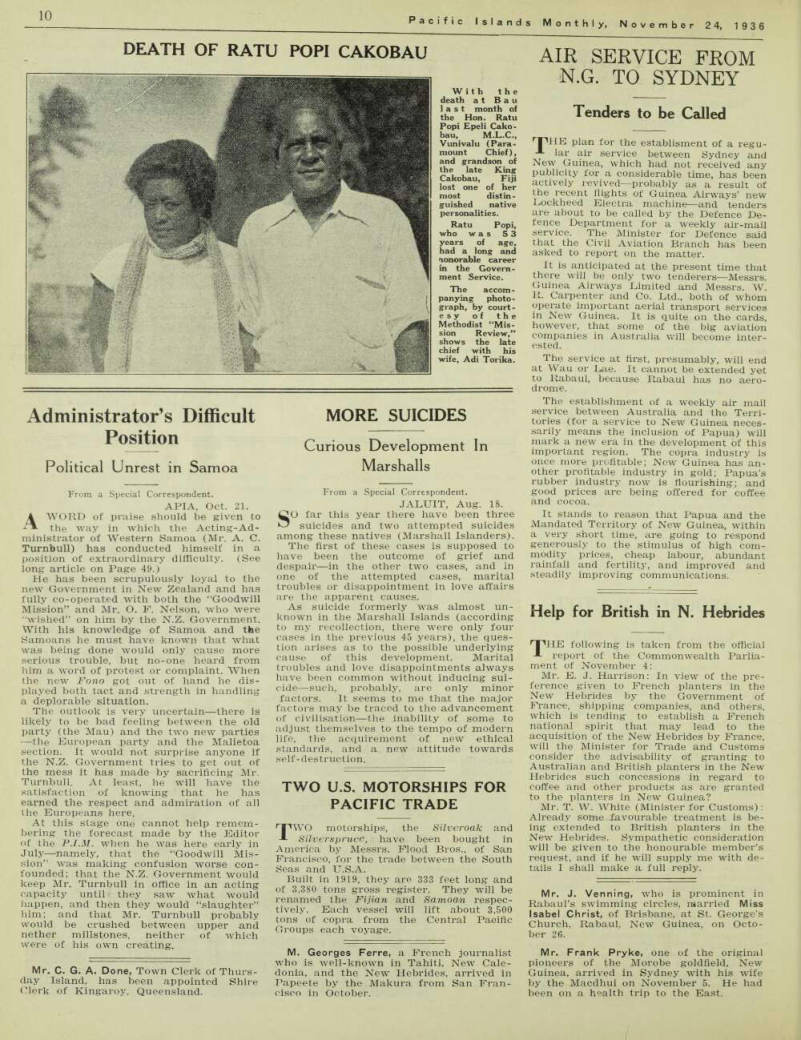
With the death at Bau last month of the Hon. Ratu Popi Epeli Cako bau, M.L.C., Vunivalu (Para mount Chief), and grandson of the late King Cakobau, Fiji lost one of her most distin guished native personalities.
Ratu Popi, who was 53 years of age, had a long and honorable career in the Govern ment Service.
The accom panying photo graph, by court esy of the Methodist “Mis sion Review,” shows the late chief with his wife, Adi Torika.
Administrator’s Difficult
Position Political Unrest in Samoa
From a Special Correspondent.
Apia, Oct. 21.
4 WORD of praise should be given to the way in which the Acting-Ad ministrator of Western Samoa (Mr. A. C.
Turnbull) has conducted himself in a position of extraordinary difficulty. (See long article on Page 49.) He has been scrupulously loyal to the new Government in New Zealand and has fully co-operated with both the “Goodwill Mission” and Mr. O. F, Nelson, who were ‘•wished” on him by the N.Z, Government.
With his knowledge of Samoa and the Samoans he must have known that what was being done would only cause more serious trouble, but no-one heard from him a word of protest or complaint. When the new Fono got out of hand he dis played both tact and strength in handling a deplorable situation.
The outlook is very uncertain —there is likely to be bad feeling between the old party (the Mau) and the two new parties —the European party and the Malietoa section. It would not surprise anyone if the N.Z. Government tries to get out of the mess it has made by sacrificing Mr.
Turnbull. At least, he will have the satisfaction of knowing that he has earned the respect and admiration of all the Europeans here.
At this stage one cannot help remem bering the forecast made by the Editor of the P.I.M. when he was here early in July—namely, that the “Goodwill Mis sion” was making confusion worse con founded; that the N.Z. Government would keep Mr. Turnbull in office in an acting capacity until they saw what would happen, and then they would “slaughter” him; and that Mr. Turnbull probably would be crushed between upper and nether millstones, neither of which were of his own creating.
Mr. C. G. A. Done, Town Clerk of Thurs day Island, has been appointed Shire Clerk of Kingaroy, Queensland.
More Suicides
Curious Development In Marshalls
From a Special Correspondent.
Jaluit, Aug. 18.
SO far this year there have been three suicides and two attempted suicides among these natives (Marshall Islanders).
The first of these cases is supposed to have been the outcome of grief and despair—in the other two cases, and in one of the attempted cases, marital troubles or disappointment in love affairs are the apparent causes.
As suicide formerly was almost un known in the Marshall Islands (according to my recollection, there were only four cases in the previous 45 years), the ques tion arises as to the possible underlying cause of this development. Marital troubles and love disappointments always have been common without inducing sui cide —such, probably, are only minor factors. It seems to me that the major factors may be traced to the advancement of civilisation —the inability of some to adjust themselves to the tempo of modern life, the acquirement of new ethical standards, and a new attitude towards self-destruction.
Two U.S. Motorships For
Pacific Trade
TWO motorships, the Silveroak and Silverspruce, have been bought in America by Messrs. Flood Bros., of San Francisco, for the trade between the South Seas and U.S.A.
Built in 1919, they are 333 feet long and of 3,380 tons gross register. They will be renamed the Fijian and Samoan respec tively. Each vessel will lift about 3,500 tons of copra from the Central Pacific Groups each voyage.
M. Georges Ferre, a French journalist who is well-known in Tahiti, New Cale donia, and the New Hebrides, arrived in Papeete by the Makura from San Fran cisco in October.
N.G. To Sydney
Air Service From
Tenders to be Called
r FHE plan for the establisment of a regu lar air service between Sydney and New Guinea, which had not received any publicity for a considerable time, has been actively revived —probably as a result of the recent flights of Guinea Airways’ new Lockheed Electra machine—and tenders are about to be called by the Defence De fence Department for a weekly air-mail service. The Minister for Defence said that the Civil Aviation Branch has been asked to report on the matter.
It is anticipated at the present time that there will be only two tenderers —Messrs.
Guinea Airways Limited and Messrs. W.
R. Carpenter and Co. Ltd., both of whom operate important aerial transport services in New Guinea. It is quite on the cards, however, that some of the big aviation companies in Australia will become inter ested.
The service at first, presumably, will end at Wau or Lae. It cannot be extended yet to Rabaul, because Rabaul has no aero drome.
The establishment of a weekly air mail service between Australia and the Terri tories (for a service to New Guinea neces sarily means the inclusion of Papua) will mark a new era in the development of this important region. The copra industry is once more profitable; New Guinea has an other profitable industry in gold; Papua’s rubber industry now is flourishing; and good prices are being offered for coffee and cocoa.
It stands to reason that Papua and the Mandated Territory of New Guinea, within a very short time, are going to respond generously to the stimulus of high com modity prices, cheap labour, abundant rainfall and fertility, and improved and steadily improving communications.
Help for British in N. Hebrides
r T'HE following is taken from the official report of the Commonwealth Parlia ment of November 4: Mr. E. J. Harrison: In view of the pre ference given to French planters in the New Hebrides by the Government of France, shipping companies, and others, which is tending to establish a French national spirit that may lead to the acquisition of the New Hebrides by France, will the Minister for Trade and Customs consider the advisability of granting to Australian and British planters in the New Hebrides such concessions in regard to coffee and other products as are granted to the planters in New Guinea?
Mr. T. W. White (Minister for Customs): Already some favourable treatment is be ing extended to British planters in the New Hebrides. Sympathetic consideration will be given to the honourable member’s request, and if he will supply me with de tails I shall make a full reply.
Mr. J. Venning, who is prominent in Rabaul’s swimming circles, married Miss Isabel Christ, of Brisbane, at St. George’s Church, Rabaul, New Guinea, on Octo ber 26.
Mr. Frank Pryke, one of the original pioneers of the Morobe goldfield, New Guinea, arrived in Sydney with his wife by the Macdhui on November 5. He had been on a health trip to the East.
Tropicalities
THE appointment of J. R. Halligan as Acting - Administrator of Norfolk Island has not gone unnoticed by the quidnuncs of the Pacific Territories’ ser vices. “Ha, ha!” and “Oh, oh!” they said. ‘ This is an indication that Halligan is in line for one of the big jobs—Papua or New Guinea, maybe.” It may not be all idle chatter —and it would not be a bad thing if it were not. Mr. Halligan is one of the very few men who have climbed up the public service ladder without de veloping the outlook of the public servant and bureaucrat. The average public ser vant, while efficient and trustworthy, has an inelastic mind and an absence of initia tive, so that, in an emergency, he simply glues his nose to “the letter of the regu lations,” and stays there. Such a man, in a high administrative job, is a perpetual irritation to the public, and a pain in the neck to his staff. Mr. Halligan is one of the exceptions. In spite of many cramp ing years in the Prime Minister’s Depart ment, Mr. Halligan has maintained a broad and independent outlook on affairs, and confidence in his own judgment; and, with that training and character, plus an at tractive personality, he should be useful in a bigger job. Hundreds of people who have met him as an efficient and always courteous officer of the Prime Minister’s Department will wish him “Good luck!” during his Norfolk Island sojourn. * * * TTHUS Mr. Marc. T. Greene on the Sa moan situation, as he sees it from London: “Nelson is and will continue to be as long as he lives a symbol to the Samoans, a symbol of their grievances against the white man and of resistance to them.
“They always have had and will go on having, from their own point of view, those grievances, and no such policy as New Zealand seems now to be embarking upon—offering a friendly hand and asking to be forgiven—will make any impression whatever upon the" Samoans. They are no doubt laughing in their sleeves now at this new regime in N.Z, The only thing they respect is firmness, and that’s why they respected the Germans.
“The difference between their attitude toward Germany and New Zealand is sim ply that, while they liked neither, they respected the former and despised the lat ter.
“The Samoans, who are as unlike the Maoris or the Tahitians or the Hawaiians a Frenchman is unlike a Spaniard, must be dealt with firmly; but, as I have re peatedly pointed out, firmness need not be accompanied by injustice and stupidity, as it has been ever since N.Z. took over these islands.” * * ♦ THE recent appointment of both new m Governor and new Chief Justice to Fiji, calls to mind the amusing picture conjured up in the diary of the first Gover nor of Fiji (Sir Arthur Gordon, afterwards Lord Stanmore) in his strained relations with his C.J. of those days.
Apparently they did not like each other and the C.J. seemed to try every method possible to harass His Excellency.
The Governor was extremely anxious that some sensible sort of dress might evolve to suit tropical conditions, and most folk agreed with him in wearing white trousers and shirts, with bright cummer bunds, and with a bright puggaree about a white helmet.
The C.J. at this time began to irritate
the Governor by taking, as his regular morning “constitutional,” a row in a dinghy from the town proper up to Gov ernment House at Nasova and back, clad, if you please, in the customary Vic torian style of long frock coat and tall silk hat. This stretch of water, it might be said, can be particularly hot in the morn ing when the sun glints off the sea on to the ironstone cliffs. —“The Padre.” ♦ * * HENRY DEXTER—who, although he is a beardless, sprightly man, calls himself “Old Trader Horn of Papua”—is on the Mongolia, due in Sydney early in January.
Dexter made a modest “pile,” trading in Milne Bay, and decided in 1934 to retire and live in England. He stood it six months, and returned to Papua. Then family matters called him and, after a few weeks in Samarai, he sailed for England.
He had been there only a few months when his sister died. Then he bought a store, and decided to settle down in Hampshire Three months of English winter were suf ficient to lift him out by the roots. He has sold out, and is again looking for the warmth of the southern seas. * * * TO hand from Mr. J. H. H. Millett, presi dent of the Suva Bowling Club, is an interesting brochure, giving the history of the Suva Bowling Carnival. This is be coming one of the highlights of the bowlers’ year in the South Seas. It is held every year in July, when climatic condi tions in Suva are ideal; and every bowler in Australia and New Zealand who can afford it puts dull care in the toolhouse and locks the door, takes his wife and daughter firmly by the arm, marches them aboard a trans-Pacific liner, and proceeds to enjoy the holiday of a lifetime. For two weeks, Suva’s picturesque streets are made more picturesque by crowds of flam boyant blazers: wives and daughters go on excursions around Fiji and explore the mysterious shops of All-Nations Street; and the famous hospitality of Suva resi
dents is given full play. And as for the bowling !
Mr. Millett “ventures to prophesy that the Suva bowling carnival will become the greatest bowling festival in the Pacific.”
He is betting on a certainty. • • • JAPAN’S administration of her mandated islands in the South Seas was sharply criticised at the sitting of the Mandates Commission on November 10.
Differences of approximately one-third between imports and exports—the latter being greater—led to the suggestion that the Japanese were draining the islands of their natural resources, giving the natives little in return.
The Japanese delegate (Mr. Ito) despite a five hour cross-examination,'was unable to supply information beyond that contained in his Government’s report, although the official reason of his presence was to furn ish particulars as required. His denials were so firm that the Commission did not attempt to obtain information about the fortifications alleged to exist in the islands, contrary to the Versailles Treaty. Nor did it deal with the series of air bases being ■erected, according to the Japanese, to fol low the movements of fish.
N.G. Schooner Wrecked
From Our Own Correspondent.
Habaul, Nov. 14.
¥"|RAGGING her anchor in a stiff south east squall, the schooner Dawaun was wrecked on a reef in the Cartaret Islands on October 29. She carried a number of passengers and 900 bags of copra, and was manned by a white captain and engineer with a native crew of 12. All were saved.
Captain Cruickshank, with three natives, sailed 70 miles through high seas in a small flat-bottomed ship’s boat to Kessa Plantation on Buka Island. A message was then sent by radio to Rabaul. The Elizabeth was despatched to rescue the marooned passengers and crew, and pick up Captain Cruickshank. They arrived here safely on November 11, An auxiliary schooner of 47 tons, the Damaun first came to New Guinea some years ago as La France, carrying the American-financed Coultas expedition.
Advertisements & other items, pp. 13-14 (1 item)
Finishing White
o^3 s'2
STERLING HOME PAINT
ALSO FOR...
BOATS, YACHTS AND
ALL MARINE WORK
STERLING VARNISH CO.. Alexandria,
RESISTS
TROPICAL
SUN
New South Wales
RECORDS
Packed Free and sent C.O.D. without extra charges.
H.M. Voice Slightly-used Portables, delivered straight to your nearest port for £3/15/- Send for Latest Record Lists
Talkeries Music Stores
451 Queen Victoria Buildings
SYDNEY
HOW TO STOP FEVER
BEFORE IT GETS YOU DOWN...
'T’HERE are many forms of fever—Dengue—Malaria—Five Days Fever, etc. All are characterized by high body temperature—thirst—loss of strength, etc. Fever may develop from a chill. A quick, safe and effective method of combating fever is to take “ASPRO” according to the directions on the leaflet in each packet as soon as you develop a temperature. “ASPRO” reduces temperature and fever conditions because, after ingestion in the system, it is anti-pyretic or fever reducing, and is an antiseptic, anti-periodic and anti-fermentative. It is also a powerful germicide. You take no risk with “ASPRO” because it is pure medicine in tablet form. “ASPRO” conforms to the standard of purity laid down by the British Pharmacopoeia (the guiding authority of the Medical Profession). It does not harm the heart and is much preferable to quinine. There are no injurious after effects.
‘ASPRO'
NIPS FEVER IN THE BUD
S'* S3s IP
BAILEY’S
FLUID MAGNESIA
A Product of
ELLIOTTS & AUSTRALIAN DRUG Ltd.
A Valuable Aid to Digestion
Relieves —
HEARTBURN
DISPEPSIA
BILIOUSNESS, etc.
OBTAINABLE
AT ALL HIGH-CLASS CHEMISTS
AND STORES.
About Islands People
Mr. R. V. Alford, accountant at the Bank of New South Wales in Samarai, Papua, joined the Tanda on October 22 for a holiday trip to the East.
Rev. R. V. Grant, L.Th., of the Method ist Mission, who is stationed at Cape Pearson, Papua, arrived in Sydney on furlough by the Macdhui on November 5.
Mr. D. B. Wallace, of Guinea Airways mechanical staff at Lae, New Guinea, married Miss Phyllis Trader, of Adelaide, at Port Moresby early in October when the bride arrived from Australia by the Macdhui.
Mr. R. W. Douglass, of th© National Bank of Australasia, Thursday Island, sailed by the October Changte for Aus tralia on transfer.
Mr. and Mrs. C. H. Rich, of Samarai, arrived in Sydney by the Macdhui from Papua on November 5. Mr. Rich is As sistant Resident Magistrate at Samarai.
Mr. J. J. Peddie, Bacteriologist in the Western Samoan Medical Department, returned to Apia with his wife from fur lough in New Zealand by the October Maui Pomare.
Mr. R. Reye, of the Seventh Day Ad ventist Mission in Western Samoa, re turned to Apia from a holiday visit to Australia and New Zealand by the Matua on October 27.
Mr. Henry Stephenson Edgar, J.P., who has been Acting Administrator of Nor folk Island, and acting chief magistrate at various times, returned to N.I. from Sydney by the Morinda on October 29.
Mr. Torres Cohen has resigned from the Thursday Island Town Council, his place being taken by Mr. J. I. Dunwoodie.
Mr. Cohen has left T.I. to reside with relatives in Townsville, North Queens land.
M. Siadous, Governor of New Caledonia, will leave the French Colony by the Ville de Strasbourg for Marseilles, France, on December 3. His successor, M. Marches son, is expected to arrive via Australia on December 7.
Mr. Arthur J. Vogan, F.R.G.S., a well known Pacific traveller, writer, and archaeologist, has been notified that his book entitled “Lemka Days,” dealing with his experiences in Fiji, is about to be published in England.
Mr. S. A. P. (“Toby”) Clarke, a popular resident of New Guinea, died in Wau Hospital on October 18, aged 42. At the time of his death he was medical assistant at Edie Creek for New Guinea Goldfields Ltd. Mr. Clarke originally joined the Expropriation Board in New Guinea in 1921, becoming attached to the health branch. Six years later he entered the service of the Melanesia Company, serv ing until 1932, when he became an officer of the N.G. Public Service. Last year he joined the staff of N.G.G. Ltd.
Miss E. L. Cheeseman, an English en tomologist, who has been in the interior of New Guinea for 10 months, arrived-in Sydney by the Macdhui on November 5 on her way back to the British Museum.
London. She penetrated the old Cyclops mountain range in Dutch New Guinea, and also visited Lake Sentani, which, once salt, is now fresh water. Miss Cheeseman has travelled extensively alone in the South Seas. Eleven years ago she col lected specimens in the Society Group, and has since visited the New Hebrides, and Papua.
Rev. G. Stallan, of the London Mission ary Society’s station at Fagalele, Tutuila Island, American Samoa, has been ap pointed principal of the L.M.S. College at Malua, in Western Samoa.
Professor Harrison Smith, formerly of the Massachusetts Institute of Technology, who is now a resident of Tahiti, left Papeete recently on a short visit to the United States to attend the Tercentenary of the Harvard University at Cambridge, Massachusetts, of which he is a graduate.
Dr. Fred. J. Williams, Government Medi cal Officer at Samarai, Eastern Papua, arrived in Sydney by the November Mac dhui. He sailed by the Maloja on Nov ember 14 for London, where he intends taking a post graduate course.
Mr. and Mrs. Ivan Nottage left Raro tonga, Cook Islands, by the Maunganui for New Zealand early in November. For eight years they had resided in Raro tonga, where Mr. Nottage was Senior Fruit Inspector in the C.I. Agriculture Department.
Mr. A. J. Bates, who has been 36 years in the Papuan Public Service during the latter part of which he has been Chief Clerk in the Government Secretary’s De partment at Port Moresby, arrived in Sydney by the Macdhui in November. He is on long leave for nine months, at the end of which he will retire from the Ser vice.
Mr. A. J. Marshall, a Sydney zoologist who is associated with the Oxford Ex ploration Club, returned to Australia from New Guinea by the Macdhui in November after making a preliminary reconnaissance for an expedition from England which, it is hoped, will explore Central N.G. in 1937 or 1940.
Dr. Walter J. Williams, lately British Consul at Tahiti, and one of the oldest European residents in French Oceania, returned to Papeete in October after a lengthy sojourn in California, where he had been receiving medical treatment.
Mr. L. J, O’Malley, Patrol Officer in the Papuan Administration, who has been in Australia since August, returned to Port Moresby by the Macdhui on November 12 from Sydney.
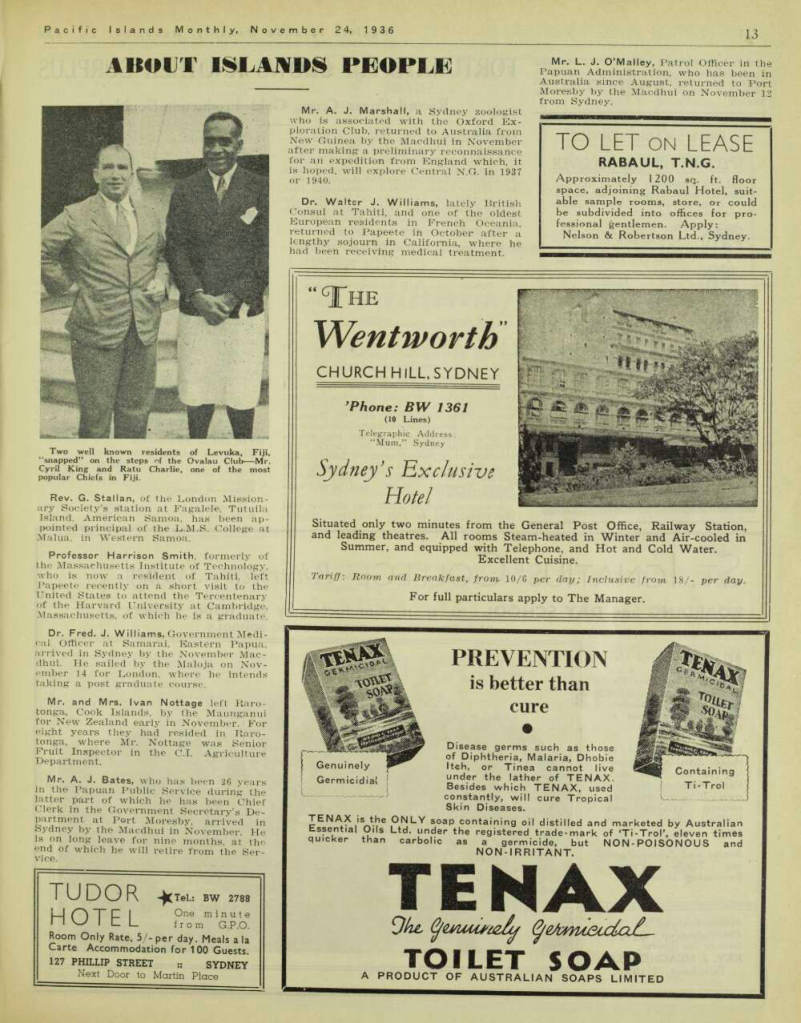
Two well known residents of Levuka, Fiji, “snapped” on the steps of the Ovalau Club—Mr.
Cyril King and Ratu Charlie, one of the most popular Chiefs in Fiji.
H.M.A.S. Moresby was in Port Moresbj In mid-October and sailed for Samara; whence she will be engaged in survey work between Shortland Reef and Dawson Island.
Advertisements & other items, pp. 14-16 (1 item)
Kurrajong . Phone:
WHEENY CREEK FARM K’jong 42
Forty-five miles from Sydney . .
Superior modern accommodation, abundance of cream, eggs, and poultry, 5 acres orchard. Tennis, etc.
Tariff Double, £2/2/- each; Single. £2/10/-.
Proprietor: A. J. SAMSON, Formerly New Guinea Public Service
TO LET on LEASE
RABAUL, T.N.G.
Approximately 1200 sq. ft. floor space, adjoining Rabaul Hotel, suitable sample rooms, store, or could be subdivided into offices for professional gentlemen. Apply: Nelson & Robertson Ltd., Sydney.
,g 3The
Wentworth
CHURCH HILL.SYDNEY
’Phone: BW 1361 (10 Lines) Telegraphic Address; “Mum,” Sydney
Sydney’s Exclusive
Hofei
I!
If m ** M £ *ac.
Situated only two minutes from the General Post Office, Railway Station, and leading theatres. All rooms Steam-heated in Winter and Air-cooled in Summer, and equipped with Telephone, and Hot and Cold Water.
Excellent Cuisine.
Tariff : Room and Breakfast, from 10/6 per day; Inclusive from 18/- per day.
For full particulars apply to The Manager.
PREVENTION
is better than
cure • Disease germs such as those of Diphtheria, Malaria, Dhobie Itch, or Tinea cannot live under the lather of TENAX.
Besides which TENAX, used constantly, will cure Tropical Skin Diseases.
TENAX is the ONLY soap containing oil distilled and marketed by Australian Essential Oils Ltd. under the registered trade-mark of ‘Ti-Trol’, eleven times quicker than carbolic as a germicide, but NON-POISONOUS and
NON-IRRITANT.
TENAX
Ohc C/Muusiccu oeA»nuudix£
TOILET SOAP
A PRODUCT OF AUSTRALIAN SOAPS LIMITED
Genuinely GermicidiaJ m m mm Containing Ti-Trol
TUDOR
HOTEL
BW 2788 One minute from G.P.O.
Room Only Rate. 5/- per day. Meals a la Carte Accommodation for 100 Guests.
127 PHILLIP STREET SYDNEY
Next Door to Martin Place
PRICE’S RADIO SERVICE
SPECIAL TROPICAL RECEIVER
Coil Unit hermetically sealed in brass box, Chassis Bitumastic coated, all fully impregnated against moisture, assures perfect operation at all times.
This modern 7-valve Dualwave Receiver has a wave- Tf I I band coverage of 16 to 55 metres and 200-250 metres.
FEATURES:
•AI Quality Components • Octode Frequency Converter • Automatic Volume Control • Two Audio Stages • Class B Push-pull Output • Economy Valves.
CABINET
w h A specially-treated Teak Table Cabinet houses both chassis and speaker.
PRICE COMPLETE,
£37/10/- F. 0.8. SYDNEY
Am. LA t liaV
fDNEY 4\
4
PRICE'S RADIO SERVICE
5 ANGEL PLACE ... SYDNEY AUSTRALIA
St, Ignatius' College - JLiverview, Sydney
BOARDING and DAY SCHOOL :: :: Conducted by the Jesuit Fathers
ONE OF SYDNEY’S GREAT PUBLIC SCHOOLS
t>OYS prepared for Intermediate and Leaving Certificate Examinations and for Exhibitions, Scholarships and Bursaries at the University.
Boys are arranged in three divisions according to age and size.
Each division has its own library, debating society, cricket and football field, tennis court.
Senior and Junior Rowing Sheds. Private Swimming Baths.
Prospectus and Further Particulars on application to the Rector,
REV. J. MEAGHER, S.J.
Telephone, J 1 106. mm
wnriTif 111 l
UUiM
i I iil £ i jC m
Fortunate Fiji Shows Another Surplus
Record Sugar Crop; Gold Production Doubled
THE finances of the Colony of Fiji con tinue to show the fruit of the careful planning and budget balancing of the last decade. Opening the Legislative Council at Suva on October 23, the Acting-Gover nor (Hon. Juxon Barton) announced that the surplus for 1936 was £49,708, that the accrued surplus was £403,124, and that the estimated surplus for 1937 was £48,018.
The figures for 1936 and 1937 are:
The rise in ordinary expenditure for 1937 is due mainly to increases in the Medical Department, Education, and Recurrent Public Works. A comprehensive building programme, under the heading of Public Works Extraordinary, will be financed from the Accumulated Surplus. Included in this proposed expenditure are grants for the following: Light for Turtle Rock (Nadi Bay), £2,000; Vessel for Lau, £3,000; Mau Quarry, £14,000; Improvements to Colonial War Memorial Hospital, £20,000; Tavua Township, £5,500; and New Phar macy, £7,300.
A census held in April last showed that the population of Fiji was then 198,379.
In 1881 the Fijians numbered 114,748, but steadily decreased until 1905, when they numbered 86,800. A gradual increase took place until 1917, but fell again after the influenza epidemic to its lowest point in 1919-1920, being 82,000. Since then there has been a steady improvement.
In 1921, the Indian population totalled 60,634, and at the 1936 census 85,002. The number of Indians born in the Colony is now 60,856, or 71.59 per cent, of the total.
The Chinese number 1,751, compared with 910 in 1921, and the Rotumans 2,816, compared with 2,235 in 1921.
In the 1921 census persons of mixed European and Native descent were 2,781, and at the last census 4,574, an increase of 1,793, which brings the total of this section of the community ahead of that of the European section.
In 1881, the European section of the com munity numbered 2,671; in 1921, it was 3878; and this year, 4,028, an increase of 150 in the 15 year period.
The main sex distribution figures are:
1936 1937 £ £ Revenue 741,016 727,649 Expenditure . . . 668,968 679,631 Surplus 72,048 48,018 Expenditure from Surplus Funds . . 22,340 138,355 Net Surplus . . . 49,708 Excess of Expenditure 90,337* * Excess of expenditure over revenue is to be met from the Accumulated Surplus.
This was made up as follows: Fijians 97,651 Indians 85,002 Other nationalities 7,124 Persons of mixed European and Native descent ... 4,574 Europeans 4,028
Males Females Fijians 49,869 47,782 Indians 48,246 36,756 Persons of mixed European and Native descent 2,325 2,249 Europeans 2,263 1,765
Sugar Production Up.
The estimated sugar production for 1936 is 144,000 tons, and it is thought that the “carry-over” to 1937 will be around 25.000 tons. If the 1936 figure is realised, it will be 3,627 tons in excess of 1935, and will constitute a record. Prospects for 1937 are somewhat affected by drought.
The banana industry has maintained its position, exports to New Zealand to date having exceeded the quota by 45,000 cases.
The trade with Canada has continued satisfactorily, but exports are limited be cause only monthly shipments are possible.
Good coconut crops are recorded, and the estimated exports for the year include 30.000 tons of copra. Fijians have shown an interest in the small, cheaply-con structed hot-air drier designed by the Agricultural Department.
Operating companies on the Tavua and Yanawai goldfields report steady progress.
Gold production to September 30 amounted to approximately 13,000 ounces, compared with 6,728 ounces in 1935.
Customs Returns
For the eight months ended August 31, the Colony’s trade amounted to £2,040,728. which was £251,550 in excess of the corre sponding period for 1935. Trade figures are as follows:
This increase is due, in the main, to bet ter ruling prices for sugar and copra, and a consequent increased spending power.
There was a general rise in all imports, except drapery, which dropped £19,974 in value.
Public Works.
During the year needed public works were carried out, and steady progress is re ported in connection with the programme of extensive works in the Colony drawn up in 1935.
The last two piers of the sub-structure of the Rewa Bridge are now being built and it should be open to traffic in February next. The work of preparing the plans, etc., for the new Government buildings is well in hand. The site acquired, adjacent to Albert Park, has been reclaimed and levelled.
New buildings completed include a Bac teriological Laboratory, a Customs shed at Levuka (with a capacity of 1,500 tons), and a Post Office at Nausori. A six-inch water main was installed for the Namoli area, Lautoka. This has remedied a very un satisfactory state of affairs.
Eight months of Excess over 1936 1935 £ £ Imports . . . 981,536 189,588 Exports (produce) . 998,075 59,055 Re-Exports 61,117 2,907
New Book By Hides
J\| R- JACK HIDES, formerly A.R.M. in the Papuan Public Service, completed another book in November, to the order of Messrs. Angus and Robertson Ltd., for simultaneous publication in Sydney and London.
The book deals mostly with Mr. Hides’s experiences as the leader of various police patrols in Papua. This is his third book; the two others, Through Wildest Papua and Papuan Wonderland, are both selling well.
Sir Hubert Murray (Lieutenant-Gov ernor of Papua) accompanied by the Official Secretary (Hon. Leonard Murray) returned to Port Moresby on October 27 by the Laurabada, after making an in spection of all Government stations in the East and North-eastern divisions, includ ing Misima Island. His Excellency was away from the capital for two weeks.
New Ship For Phosphate
Trade
PLANS are at present being - completed for the construction of a new vessel for the British Phosphate Commissioners Ltd., the keel of which will be laid down shortly in British yards.
The vessel, which will replace the Triona on the Ocean Island-Australia run, will be either a cargo-carrying steamer or a motor vessel.
Mr. J. W. Hinks, Pacific Islands mining engineer, sailed for Pt. Moresby from Sydney by the November Macdhui.
Lady Murray, wife of the Lieutenant- Governor of Papua, reached Sydney from Pt. Moresby by the November Macdhui.
Advertisements & other items, pp. 17-18 (1 item)
allstrom
Yachtsmen, Navigators, and
8.0. T. Students
We carry the largest stock of
NAUTICAL -and AVIATION
BOOKS in Australia. Also complete stocks of ADMIRALTY
CHARTS and SAILING DIREC-
TIONS for the Australian Coast and Pacific Islands.
Write for our NAUTICAL Catalogue, which is free and post free.
N.S.W. Bookstall Co. Ltd.
General and Educational Booksellers and Librarians, Market & Castlereagh Sts., SYDNEY.
allstrom
KEROSENE OPERATED...
R E FRIG E RATO RS
ANNOUNCE NEW EXPORT POLICY
To enable us to obtain Full Advantage from the enormous Output Capacity of the new Hallstrom Manufacturing Plant, covering 20 acres and including the finest machinery of its type in Australia, we have decided on a policy of More Sales at Lower Prices We now offer the Model as Illustrated at £3l-10-0 F. 0.8. Sydney.
This ever popular Hallstrom model has. over a number of years, stood all tests undei all conditions, and may be ordered direct from the factory, or is obtainable at the new price from all branches of Burns, Philp & Co. Ltd., and W. R. Carpenter & Co. Ltd
E. HALLSTROM, Willoughby, Sydney
i
a
FAIRHOLME
A Mountain Schoolfor Girls
m Dormitory Wing PRESBYTERIAN GIRLS* COLLEGE, Toowoomba, Q’land. 2,000 feet above sea level :: Unrivalled climate.
Academic, Home Science and Commercial Courses
TENNIS, SWIMMING, ORGANISED GAMES
PRINCIPAL: MISS D. E. CULPIN, B.A.
For prospectus, apply Sec., R. T. PHELPS, F.A.A., Toowoomba
u
For Long, Hard Wear
SANTWILL
Work Shirts
These sturdy shirts are made from a strong, sandy coloured Twill English Shirting and have collar attached and two breast pockets with button flaps.
Generously cut to give wonderful roomy working comfort.
Please state Collar size when ordering.
Ready to Wear Price, 7 9 each 3 for 22/6
PIKE BROTHERS LTD
QUEEN STREET, BRISBANE
Utilise this Space to Wish all " o o
RESIDENTS OF
ISLAND TERRITORIES
A Itornj
and much Happiness during 1937 McILRATH’S also express gratitude to their man/ Islands customers for generous support during the past year, and promise . . .
STILL BETTER SERVICE IN 1937
w
McILRATH’S LTD.
EXPORT DEPARTMENT
202 PITT STREET, SYDNEY, AUSTRALIA
Maritime Shells
Found on High Central Plateau, New Guinea
Father Alphonse Schaefer, Of
Korugu, New Guinea (which is situated in the Wahgi Valley, behind the Bismarck ranges in Central New Guinea) when levelling a landing ground for the aeroplane of the Mission, found at a depth of 9-10 feet, large quantities of petrified snail and other shells, imbedded through out the grey-bluish clay at an altitude of 4500 feet.
According to some of his boys from the coast, these are specimens of such snails and shells as are found only in the sea.
Among these were quantities of trochus and nautilus shell.
The petrified specimens are being examined at present by experts and, if they prove to be of maritime origin, it would follow that this part of the high plateau behind the Bismarck Mountains, and perhaps the whole of that large high plateau around Mount Hagen, at one time was under the sea.
Radiophones
Link Up Outposts in Papua
From Our Own Correspondent.
Port Moresby, Nov. 1.
jyjß. C. E. SEARLE, of Amalgamated Wireless, has just returned from the interior of the Central Division, Papua, where he has installed a radio telephone at the recently established Goilala Police Camp, three days’ journey from the old Camp at Monda, not far from the border, where unruly natives still indulge in inter tribal warfare.
Mr. Searle journeyed on foot from Ka nosia and Aroa, whence he made for the mainland opposite Yule Island. Thence he travelled inland for 100 miles over broken country, where ranges tower one above another and torrents wind tortu ously in and out of precipitous ravines, until he reached the remote station of the Sacred Heart Mission and eventually the Po’ice Camp. Two officers of the magis terial force maintain law and order there.
Radio receiving sets and radio tele phones have now be&n installed in all the remote districts of the Territory by Amal gamated Wireless, and daily communica tion is maintained. This service has done much for the lonely settler. When one can keep touch with world events and daily happenings in the country, isolation has much to commend it.
Samoan Local-born to go on the Land
Land
From Our Own Correspondent.
APIA, October 27.
THE two elected Legislative Councillors (Hon. A. G. Smyth and Hon. I. H.
Carruthers) have been advised by the New Zealand Government that approval has been given to the Land Settlement Scheme for local-born young men.
An initial sum of £5OO has been voted for the scheme. Tenders have been written out for selection of land sections near Aleisa and the project is to be proceeded with immediately.
The Ngatangiia Choir, conducted by Mr.
J. W. W. Graham, recently won the Bledisloe Trophy for Native Choirs in the Cook Islands. Second prize was awarded to the Catholic Mission Choir, and third t® the London Missionary Society Choir.
Store For Sale
ESTABLISH ED General Store and Bakery Business is for sale as going concern in prosperous town in Polynesian territory. Freehold; buildings in good repair; about £l5OO worth of stock carried.
This business was started 40 years ago by father of present owner. Latter, for family reasons, wishes to retire and live in New Zealand. The business, which already has old, profitable connections, is capable of considerable development.
For further details, write to Editor, Pacific Islands Monthly, P.O. Box 3408 R, Sydney.
Advertisements & other items, p. 18 (1 item)
16
Monthly, November 24, 1936
Pacific Island
Guinea
Progress Of New
Remarkable Increase in Trade Turnover
gTATISTICS made available dur ing the month show that the Territory of New Guinea, under the stimulus of gold and copra prices, plus a growing export of coffee and cocoa, is threatening to displace Fiji from the proud position of being (on official trade statistics) the most prosperous colony in the Empire.
The revenue of the New Guinea Ad ministration for the year ended June 30, 1936, was £419,919, and the expendi ture £425,793. This compares with previ-
The accumulated surplus is now about £40,954.
Exports were worth £2,573,251, 8f which Australia took £1,950,240; and the imports were £1,290,788 (from Australia
The extraordinary growth in the trade turnover is due, of course, to the develop ment of the gold industry, and (more recently) to the recovery in the copra industry. The following figures tell a
really remarkable story. Just when copra sank to a ruinous level, in 1933-34, gold production increased enormously and saved the Territory.
Population is now: European, 5881; Asiatic, 1523; natives (counted), about 500,000. Natives in the uncontrolled areas may number (in addition to the 500,000 counted in the controlled areas) anything up to 400,000. Non-indigenous population
Expenditure, during the year, increased in all government departments, except district services and native welfare.
Indentured labourers in the Territory, on June 30, numbered 36,927, and planted areas of estates totalled 95,748 hectares. There are 370 public servants and 627 mission aries; of this number 374 missionaries are Germans.
Mr. W. J. Crowther, Treasurer and Col lector of Customs in Western Samoa, com pleted his term of office in the Mandated Territory in October. With his wife and two sons, he returned to New Zealand by the Maui Pomare on October 15. Mr. R.
A. Malone is the new Treasurer of Samoa.
Mr. Templeton Crocker, who with a party of friends has been engaged for some time in scientific research work in the South Seas on board his yacht Zaca, arrived at Apia, Western Samoa, on Octo ber 12. After a few days in the capital, the party left for Savaii. The Zaca pre viously visited Samoa about six years ago.
ous years thus: — Revenue Expenditure £ £ 1923 . 259,286 250,431 1928 . 364,580 331,296 1932 . 306,072 282,404 1933 . 321,917 321,567 1935 . 388,177 367,513 1936 . 419,919 425,793
£542,052).
Comparisons: — Imports Exports £ £ 1924 485,634 718,535 1928 811,832 1,471,026 1932 779,397 1,108,619 1933 912,365 1,581,2J2 1934 924,316 1,766,198 1935 948,404 2.340,624 1936 1,290,788 2,573,251
Gold And Copra Exported-Value
Copra Gold £ £ 1928 1,176,040 .. 256,216 1929 933,769 .. 179,433 1930 864,358 .. 96,338 1931 716,543 132,239 1932 618,298 .. 398,939 1933 543,906 .. 933,940 1934 283,329 .. 1,367,616 1935 361,413 .. 1,897,244 1936 761,309 .. 1,704,498
at different periods:— European Asiatic 1895 203 .. — 1910 687 .. 555 1917 818 1922 1489 .. 1424 1928 2400 .. — 1932 2905 .. 1457 1934 4129 .. 1424 1936 5881 .. 1523
Advertisements & other items, pp. 19-20 (1 item)
Prouds Ltd.
Character
Pottery
Some quaint shapes intended for use, but possessing much interesting ornamental value. The Dickens series by Royal Doulton so cleverly depict the immortal characters created by their author.
"Sairey Gamp/' a Royal Doulton Jug, with the "Gamp" handle, ISA. Others include: "The Old Curosity Shop," 19A; "Dick Turpin," 16/6; "The Cardinal," 16/6; "John Barleycorn," 14/-; "Old Charlie," 13/-.
From London. Paris, Berlin, and New York—the world's fashion centres arrive selections of the current popular novelties, and our CATALOGUE this year (just published) illustrates many quaint yet useful articles suitable for Xmas. Birthday and Wedding Gifts.
80-EIGHTY PAGES-80
Not merely an illustrated price list, our catalogue contains much interesting and informative reading and is a most useful guide for buyers to have by them.
Send name and address and you will receive a copy by return post.
PROUDS Ltd.
The Gift Store
Cr. King & Pitt Sts., Sydney
with coloured section V
ON PARLE FRANCAIS
o
Mowbray House School
CHATSWOOD, SYDNEY, N.S.W.
(Established in 1906.) A Boarding School for Boys. Surrounded by Spacious playing fields, on heights of the North Shore Line.
V The School Offers: A Home Atmosphere An Unrivalled Health Record A Sound Physical, Mental, and Moral Training.
The curriculum extends from the earliest stages to the Intermediate Examination, and provides a specially designed course of COMMERCIAL EDUCATION for boys entering a business career or work on the land.
Special provision is made to meet the requirements of boys from THE ISLANDS, which includes facilities for spending School Vacations at the School Country House.
Applications for enrolment in 1937 are now being received.
Illustrated Prospectus on Application. HEADMASTER: L. BAVIN.
With the completion of the magnificent and enchanting Martin Place Extension. “The Australia” assumes pride of place as the largest and finest Hotel South of the Line.
Every desirable feature of Modern Hotel Life is represented the whole maintained at standards that compare more than favorably with those of the Northern Hemisphere.
Nearly 500 rooms and suites.
Central heating. Air-conditioning.
Broadcasting wired to rooms.
Telegraphic address: “ Austraotel, Sydney.” ml 1 1 m r ' ,r -
iwift
m H I a ~k 111 m
Cakobau, Rex!
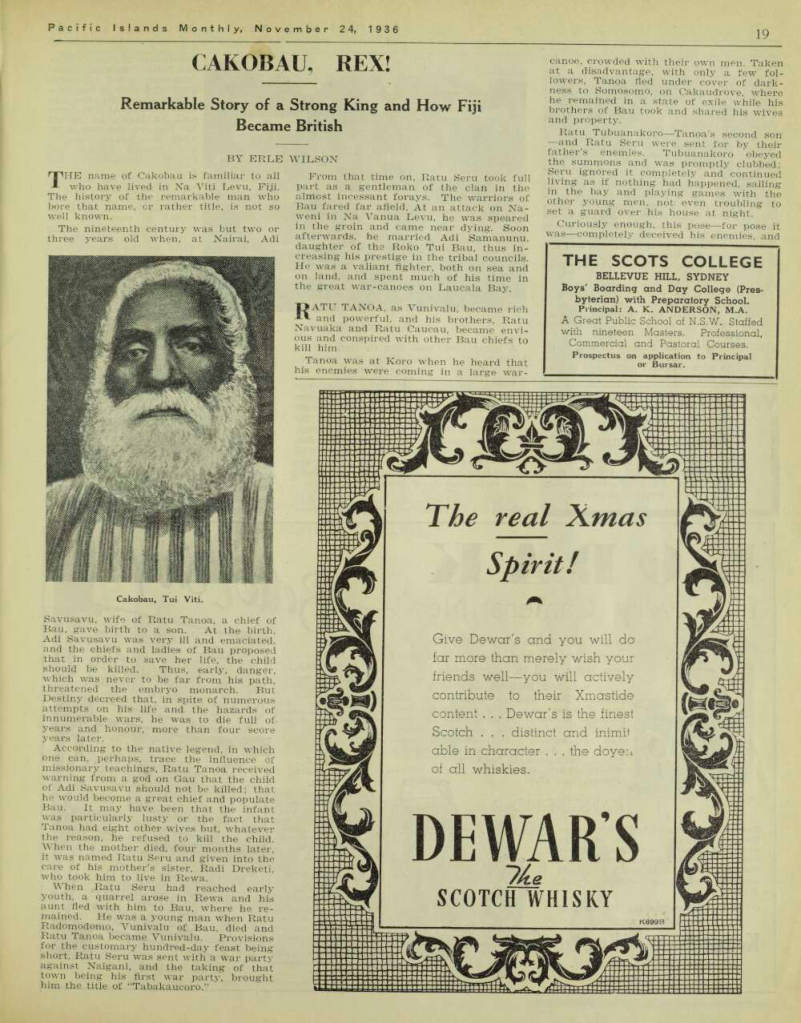
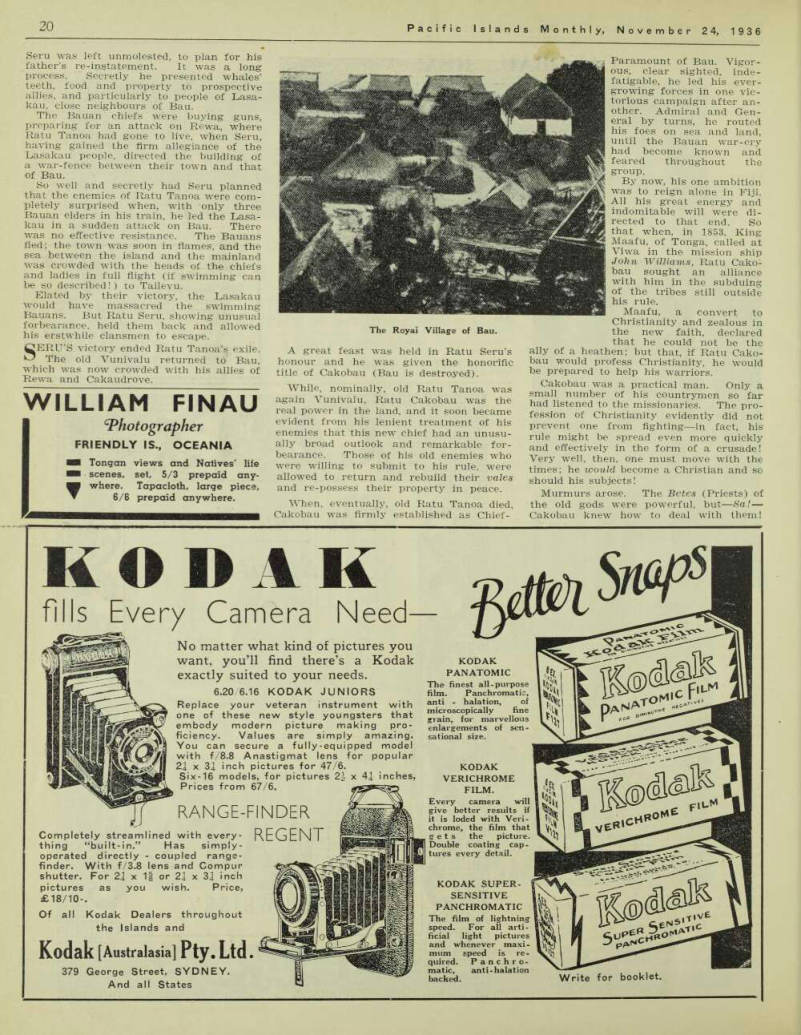
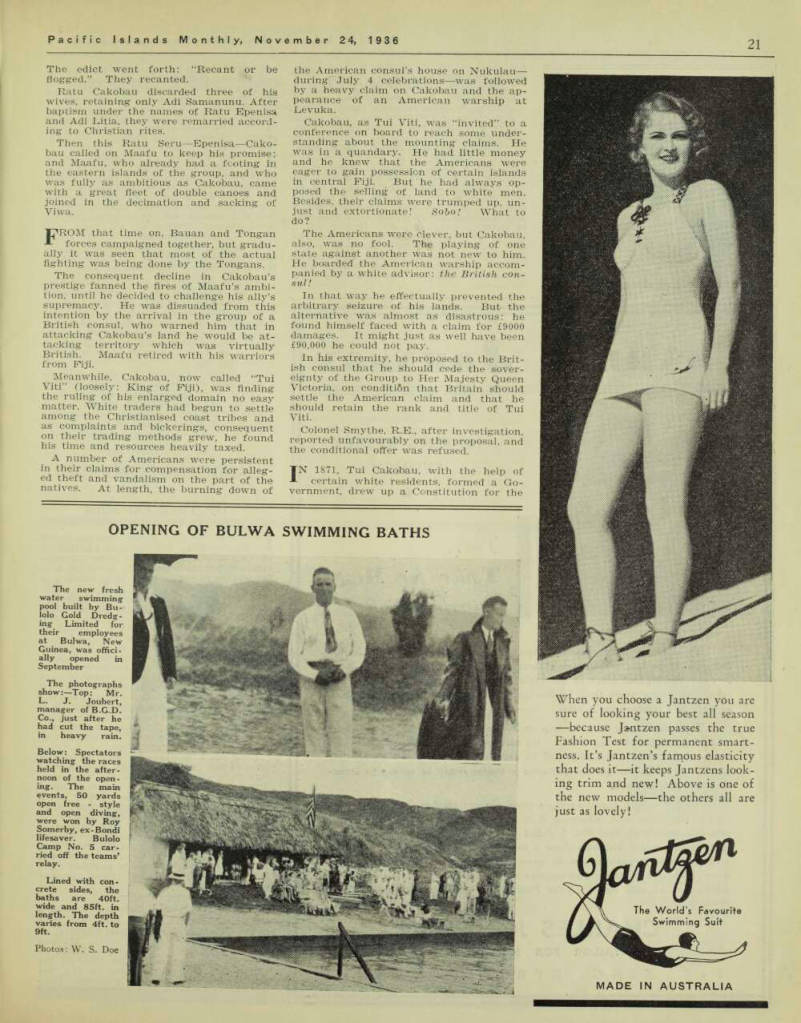
Remarkable Story of a Strong King and How Fiji Became British
By Erle Wilson
THE name of Cakobau is familiar to all who have lived in Na Viti Levu, Fiji.
The history of the remarkable man who bore that name, or rather title, is not so well known.
The nineteenth century was but two or three years old when, at Nairai, Adi
Savusavu, wife of Ratu Tanoa, a chief of Bau, gave birth to a son. At the birth.
Adi Savusavu was very ill and emaciated, and the chiefs and ladies of Bau proposed that in order to save her life, the child should be killed. Thus, early, danger, which was never to be far from his path, threatened the embryo monarch. But Destiny decreed that, in spite of numerous attempts on his life and the hazards of innumerable wars, he was to die full of years and honour, more than four score years later.
According to the native legend, in which one can, perhaps, trace the influence of missionary teachings, Ratu Tanoa received warning from a god on Gau that the child of Adi Savusavu should not be killed; that he would become a great chief and populate Bau. It may have been that the infant was particularly lusty or the fact that Tanoa had eight other wives but, whatever the reason, he refused to kill the child.
When the mother died, four months later, it was named Ratu Seru and given into the care of his mother’s sister, Radi Dreketi, who took him to live in Rewa.
When Ratu Seru had reached early youth, a quarrel arose in Rewa and his aunt fled with him to Bau, where he re mained. He was a young man when Ratu Radomodomo, Vunivalu of Bau, died and Ratu Tanoa became Vunivalu. Provisions for the customary hundred-day feast being short, Ratu Seru was sent with a war party against Naigani, and the taking of that town being his first war party, brought him the title of “Tabakaucoro.”
From that time on, Ratu Seru took full part as a gentleman of the clan in the almost incessant forays. The warriors of Bau fared far afield. At an attack on Na weni in Na Vanua Levu, he was speared in the groin and came near dying. Soon afterwards, he married Adi Samanunu, daughter of the Roko Tui Bau, thus in creasing his prestige in the tribal councils.
He was a valiant fighter, both on sea and on land, and spent much of his time in the great war-canoes on Laucala Bay.
TDATU TANOA, as Vunivalu, became rich 11 and powerful, and his brothers, Ratu Navuaka and Ratu Caucau, became envi ous and conspired with other Bau chiefs to kill him Tanoa was at Koro when he heard that his enemies were coming in a large war
canoe, crowded with their own men. Taken at a disadvantage, with only a few fol lowers, Tanoa fled under cover of dark ness to Somosomo, on Cakaudrove, where he remained in a state of exile while his brothers of Bau took and shared his wives and property.
Ratu Tubuanakoro—Tanoa’s second son and Ratu Seru were sent for by their father’s enemies. Tubuanakoro obeyed the summons and was promptly clubbed; Seru ignored it completely and continued living as if nothing had happened, sailing in the bay and playing games with the other young men, not even troubling to set a guard over his house at night.
Curiously enough, this pose—for pose it was—completely deceived his enemies, and
Cakobau, Tui Viti.
Seru was left unmolested, to plan for his father’s re-instatement. It was a long process. Secretly he presented whales’ teeth, food and property to prospective allies, and particularly to people of Lasa kau, close neighbours of Bau.
The Bauan chiefs were buying guns, preparing for an attack on Rewa, where Ratu Tanoa had gone to live, when Seru, having gained the firm allegiance of the Lasakau people, directed the building of a war-fence between their town and that of Bau.
So well and secretly had Seru planned that the enemies of Ratu Tanoa were com pletely surprised w T hen, with only three Bauan elders in his train, he led the Lasa kau in a sudden attack on Bau. There was no effective resistance. The Bauans fled; the town was soon in flames, and the sea between the island and the mainland was crowded with the heads of the chiefs and ladies in full flight (if swimming can be so described!) to Tailevu.
Elated by their victory, the Lasakau would have massacred the swimming Bauans. But Ratu Seru, showing unusual forbearance, held them back and allowed his erstwhile clansmen to escape.
SERU’S victory ended Ratu Tanoa’s exile.
The old Vunivalu returned to Bau, which was now crowded with his allies of Rewa and Cakaudrove.
A great feast was held in Ratu Seru’s honour and he was given the honorific title of Cakobau (Bau is destroyed).
While, nominally, old Ratu Tanoa was again Vunivalu, Ratu Cakobau was the real power in the land, and it soon became evident from his lenient treatment of his enemies that this new chief had an unusu ally broad outlook and remarkable for bearance. Those of his old enemies who were willing to submit to his rule, were allowed to return and rebuild their vales and re-possess their property in peace.
When, eventually, old Ratu Tanoa died, Cakobau was firmly established as Chief-
Paramount of Bau. Vigor ous, clear sighted, inde fatigable, he led his ever growing forces in one vic torious campaign after an other. Admiral and Gen eral by turns, he routed his foes on sea and land, until the Bauan war-cry had become known and feared throughout the group.
By now, his one ambition was to reign alone in Fiji.
All his great energy and indomitable will were di rected to that end. So that when, in 1853, King Maafu, of Tonga, called at Viwa in the mission ship John Williams, Ratu Cako bau sought an alliance with him in the subduing of the tribes still outside his rule.
Maafu, a convert to Christianity and zealous in the new faith, declared that he could not be the
ally of a heathen; but that, if Ratu Cako bau would profess Christianity, he would be prepared to help his warriors.
Cakobau was a practical man. Only a small number of his countrymen so far had listened to the missionaries. The pro fession of Christianity evidently did not prevent one from fighting—in fact, his rule might be spread even more quickly and effectively in the form of a crusade!
Very well, then, one must move with the times; he would become a Christian and so should his subjects!
Murmurs arose. The Betes (Priests) of the old gods were powerful, but — Sa! — Cakobau knew how to deal with them!
The Royai Village of Bau,
The edict went forth: “Recant or be flogged.” They recanted.
Ratu Cakobau discarded three of his wives, retaining only Adi Samanunu. After baptism under the names of Ratu Epenisa and Adi Litia, they were remarried accord ing to Christian rites.
Then this Ratu Seru —Epenisa—Cakobau called on Maafu to keep his promise: and Maafu, who already had a footing in the eastern islands of the group, and who was fully as ambitious as Cakobau, came with a great fleet of double canoes and joined in the decimation and sacking of Viwa.
FROM that time on, Bauan and Tongan forces campaigned together, but gradu ally it was seen that most of the actual fighting was being done by the Tongans.
The consequent decline in Cakobau’s prestige fanned the fires of Maafu’s ambi tion, until he decided to challenge his ally’s supremacy. He was dissuaded from this intention by the arrival in the group of a British consul, who warned him that in attacking Cakobau’s land he would be at tacking territory which was virtually British. Maafu retired with his warriors from Fiji.
Meanwhile, Cakobau, now called “Tui Viti” (loosely: King of Fiji), was finding the ruling of his enlarged domain no easy matter. White traders had begun to settle among the Christianised coast tribes and as complaints and bickerings, consequent on their trading methods grew, he found his time and resources heavily taxed.
A number of Americans were persistent in their claims for compensation for alleg ed theft and vandalism on the part of the natives. At length, the burning down of
the American consul’s house on Nukulau— during July 4 celebrations—was followed by a heavy claim on Cakobau and the ap pearance of an American warship at Levuka.
Cakobau, as Tui Viti, was “invited” to a conference on board to reach some under standing about the mounting claims. He was in a quandary. He had little money and he knew that the Americans were eager to gain possession of certain islands in central Fiji. But he had always op posed the selling of land to white men.
Besides, their claims were trumped up, un just and extortionate! Sobo! What to do?
The Americans were clever, but Cakobau. also, was no fool. The playing of one state against another was not new to him.
He boarded the American warship accom panied by a white advisor: the British con sul !
In that way he effectually prevented the arbitrary seizure of his lands. But the alternative was almost as disastrous: he found himself faced with a claim for £9OOO damages. It might just as well have been £90,000 he could not pay.
In his extremity, he proposed to the Brit ish consul that he should cede the sover eignty of the Group to Her Majesty Queen Victoria, on condition that Britain should settle the American claim and that he should retain the rank and title of Tui Viti.
Colonel Smythe, R.E., after investigation, reported unfavourably on the proposal, and the conditional offer was refused.
TN 1871, Tui Cakobau, with the help of * certain white residents, formed a Go vernment, drew up a Constitution for the
Kingdom of Fiji (Matanitu ko Viti ), and signed the following oath: “I swear positively, in the presence of our God, that I will wholly hold to, and will not be false towards, the Constitu tion of the Kingdom of Fiji; and I will govern the land and the people according as written herein.
Written on the 30 th of September,
1871. Cakobau, R
From the start, the Native Government met with difficulties. It was cumbersome and expensive and, in the opinions of the native chiefs, gave the white population and their representatives too much power.
The affairs of the kingdom went from bad to worse.
Tui Cakobau had lived a life of remark able activity and had survived many attempted assassinations and innumerable native campaigns. He had proven him self a great warrior and something of a statesman.
Now, advanced in years, he found him self unable to cope with the unforeseen complexities of his position. He had learned many things since his first intrigue and campaign to restore his exiled father.
Mixed with his personal ambition, there had always been evident a wish for the good of his people as a whole.
TPHE crowning act of his career, before -*• he retired as a pensioner of the British Government, was that of a patriot and a far-sighted man. Left to themselves, he saw the Fijians must inevitably become the victims of exploiting whites. There was one remedy but—it entailed the un conditional surrender of his rank and power! He did not shrink.
On October 10, 1874, Sir Hercules Robin son. representing Her Majesty Queen Vic toria, was handed the following letter: “To Her Majesty the Queen of Britain: “We, the king of Fiji, together with the high chiefs of Fiji, cede Fiji without reservation to the great and gracious lady, Her Majesty the Queen of Great Britain and Ireland; and we have com plete trust that she will rule Fiji righte ously in love, that well-being may re sult thereby.
“And we request the Governor, Sir Hercules Robinson, messenger of the Queen, that he will hear our helpers in certain matters which they will tell to him, as we have confidence in them, and seek that this discussion may end well.
Signed: CAKOBAU, R.”
Advertisements & other items, pp. 21-22 (1 item)
Dewars
THE SCOTS COLLEGE
BELLEVUE HILL. SYDNEY
Boys' Boarding and Day College (Presbyterian) with Preparatory School.
Principal: A. K. ANDERSON, M.A.
A Great Public School of N.S.W. Staffed with nineteen Masters. Professional, Commercial and Pastoral Courses.
Prospectus on application to Principal or Bursar.
The real Xmas
Spirit!
!S Give Dewar's and you will do far more than merely wish your friends well—you will actively contribute to their Xmastide content . , . Dewar's is the finest Scotch . . . distinct and inimit able in character . . . the doyen of all whiskies.
DEWARS
The
SCOTCH WHISKY
WILLIAM FINAL!
Photographer
FRIENDLY IS., OCEANIA
▼ Tongcm views and Natives' life scenes, set, 5/3 prepaid anywhere. Tapacloth, large piece. 6/6 prepaid anywhere.
KODAK
Every Camera Need
m igßSk No matter what kind of pictures you
want, you’ll find there’s a Kodak
exactly suited to your needs.
6.20 6.16 KODAK JUNIORS
Replace your veteran instrument with one of these new style youngsters that embody modern picture making proficiency. Values are simply amazing.
You can secure a fully-equipped model with f/8.8 Anastigmat lens for popular 21 x 84 inch pictures for 47/6.
Six-16 models, for pictures 2 \ x inches, Prices from 67/6.
RANGE-FINDER
Completely streamlined with every- REGENT thing “built-in.” Has simplyoperated directly - coupled rangefinder. With f/3.8 lens and Compur shutter. For 2| x 1| or 2 \ x 31 inch pictures as you wish. Price, £lB/10-.
Of all Kodak Dealers throughout the Islands and
Kodak [Australasia] Pty.Ltd.
379 George Street, SYDNEY.
And all States
KODAK
PANATOMIC
The finest all-purpose film. Panchromatic, anti - halation, of microscopically fine grain, for marvellous enlargements of sen sational size.
KODAK
VERICHROME
FILM.
Every camera will give better results if it is loded with Verichrome, the film that gets the picture.
Double coating cap tures every detail.
KODAK SUPER-
SENSITIVE
PANCHROMATIC
The film of lightning speed. For all artificial light pictures and whenever maxi mum speed is required. Panchromatic, anti-halation backed.
A
fIUM
Si!
oM ,c
Hf -- 1 v£ 5l N .
Tl c nC pA- Write for booklet.
Opening Of Bulwa Swimming Baths
The new fresh water swimming pool built by Bu lolo Gold Dredg ing Limited for their employees at Bulwa, New Guinea, was offici ally opened in September The photographs
show:—Top: Mr.
L. J. Joubert, manager of B.G.D.
Co., just after he had cut the tape, in heavy rain.
Below: Spectators watching the races held in the after noon of the open ing. The main events, 50 yards
open free-style
and open diving, were won by Roy
Somerby, ex-Bondi
lifesaver. Bulolo Camp No. 5 car ried off the teams' relay.
Lined with con crete sides, the baths are 40ft. wide and 85ft. in length. The depth varies from 4ft. to 9ft.
Photos: W. S. Doe
Advertisements & other items, p. 23 (1 item)
ur
When you choose a Jantzen you are sure of looking your best all season —because Jantzen passes the true Fashion Test for permanent smartness. It’s Jantzen’s famous elasticity that does it—it keeps Jantzens looking trim and new! Above is one of the new models—the others all are just as lovely!
The World's Favourite Swimming Suit
MADE IN AUSTRALIA
Plantation For Sale
AWNER of small island in Wes ” tern Pacific group (which he has on long lease at peppercorn rental) will sell for £3300, walk in, walk out. Property includes large bun galow, sheds, labour, houses, aux. schooner, and last year produced 60 tons of Copra, with 5 plantation labourers.
Details have been left with editor of the Pacific Islands Monthly (Union House) with instructions to make them available only to genuine enquirers.
By Tung Oil Mills
Candle-Nuts Bought
TT is reported that a new concern called 1 Empire Tung Oil Products Limited, of 66 King-street, Sydney, has made arrange ments to purchase from Fiji about 500 tons per annum of candle-nuts, to be crushed in its mills in Sydney.
If it is so, it is an interesting develop ment. The planting of Tung oil trees proved a failure in the Pacific Islands and other countries where the climate is oceanic; but planting has proceeded with apparent success, though in a haphazard manner, in the eastern districts of Austra lia, where the climate is continental. It will be remembered that experiments were made with the Fordii variety of Tung oil (which is the heavy fruiting variety) in the Islands, but these experiments failed. It is believed that the Montana variety, which is a small, light-fruiting tree, would grow successfully in the Pacific Islands, but it, of course, is not so profitable.
There is a world-wide and increasing demand for Tung oil, for use in high-class varnish, and it is believed tht very soon there will be enough nuts grown in East ern Australia to keep the Sydney mills going and meet the Australian demand.
The candle-nut, well-known in most of the Pacific Islands, really is a variety of the Tung tree, but it is said that the oil it contains is not as good as the Fordii variety of Tung. If, however, a use can be found for it and it can be profitaly mar keted, the news will be of interest to many Islands traders.
Mr. Percy Oakden Cakobau Cuthbert, the first European born in Suva, Fiji, died in the Colonial War Memorial Hospital on October 12, after a long illness. He was 65 years of age. Educated in Suva, he was for some years in the office of the Union S.S. Company’s agent in Fiji, be fore taking up a sea-faring career. Dur ing recent years he was on the Suva staff of Burns Philp (S.S.) Co. Ltd.
Advertisements & other items, p. 24 (1 item)
€Iiakle§ Joh \ Jsiom
143 KING STREET
SYDNEY
The..
'Tailor for ]ff of
discrimination
It’s easy to be a winner when one is garmentised by Charles Johnson. In this modern day struggle of a man to reach his goal . . . the highest place in the social and business worlds ... it takes something more than brains and strength. It takes appearance as well, and appearance is vital.
Take advantage of your trip to Sydney by calling at the smartest store for men in the big town. Be assured of courtesy and attention.
Know that your individuality will be carefully studied and that all that it takes to make the perfect garment is there, ready to spring to attention and get to work.
It’s not only a social asset to wear correct clothes. It does a lot to put you over with whatever it is you want when you want to put yourself over with that No. 1 Juliet of yours. No, Charles is not a matrimonial agent but he’s done a lot of satisfying wives . . . by giving husbands satisfaction in garments and when it’s all said and done, if there’s anything you require after perfect satisfaction, well you might just as well stay in your Pacific Isle and not be among those dressed by
CHARLES JOHNSON
THE TAILOR FOR MEN WHO CARE
143 KING STREET, SYDNEY
Journalistic Ethics, Judge Wanliss, and Mr. Mullaly
Letter to the Editor
WITH reference to the article appear- ** ing in your issue of September, headed “Judge Wanliss and Justice in New Guinea” and with particular reference to your Editorial note thereto, may I hope that you will permit me space in your journal to enquire on behalf of numerous New Guineaites, of many residential years’ qualification, knowledge of the country’s personnel, requirements, attributes and vicissitudes, on what authority do you, who claim to be an impartial chronicler of Pacific Islands affairs and requirements, justify your Editorial vilification of a gentleman whose 15 years’ honourable work as, amongst other
Mandated 1 ha/ stairpped him be!
yond dues,ion an outstanding asset and personality in Australia s occupation and administration of the Territory-a gentleman of whose record both Australia and this Territory must be justly proud and upon whose occupancy of his high office both countries have cause to congratulate themselves most heartily.
New Guinea could well have utilised the services of on© hundred men of similar calibre in the conduct of its public affairs during the past 20 years, and be reaping the benefit to-day.
So far as I am aware, your practical knowledge of current New Guinea affairs —including that of justice—which one gathers from your latest and previous effusions of the subject is so unevenly dispensed by the Chief Judge from the Suprem© Court Bench—has been gained
on two or three fleeting - trips to Rabaul and “round trips” to outports and the Goldfields, per mail boats—l 2 to 14 days each in all—during which you have bounded about, like many of your kind, with an air of importance appreciated by no one but yourself, and bounced out again, leaving behind little if anything other than a sense of amusement amongst those not unduly impressed with any thing about you other than an air of pomposity, taking with you little, if any, knowledge of the administration of Jus tice or, for that matter, anything else vital to the conduct of the Territory’s affairs.
a IE
/Libre anTfdeaJs “SfdentS
( this Territory—lrrespective of their sectional or denominational viewpoints— would have realised at least that
mly bl sa^le
wi th some of the sentences of His Honour Ju(J Wanliss> there are few it anv. amongst his ''critics” who will agree with your subtle insinuation that his admini stration of justice is or has been at any time “a menace to peace and good gov ernment,” or that he has been other than “a friend of decency and justice in public life,” any more than they would expect His Honour to tolerate any person, let alone a highly placed and responsible Law official, doing in his opinion “public wrong” from a “desire to protect a mis guided man against injustice masquerad ing as justice!”
Permit me to further observe, Mr.
Editor, that I doubt whether such jour nalistic clap-trap and partisanship as is employed in your editorial note will add
to either the popularity of your journal or to your personal prestige amongst the community of this Territory, no matter what may be the individual opinions of its members regarding the specific matter of your attack upon the chief of its judi ciary.
In view of your well-known and oft expressed antipathy towards the highly respectable Chief Judge of the Supreme Court of this Territory (his qualifications and achievements in the sole interests of New Guinea during the 15 years’ associa tion with the judiciary of the Territory are too well-known and appreciated by those who count, to need recognition here) one would imagine that —to quote your editorial words —“as seems apparent there is to be an official enquiry into the matter” of His Honour’s remarks relative to the Crown Law Officer in the Zimmer case, decency would demand of the Editor of any journal, other than those gener ally associated with “the yellow press,” that he would refrain —at least until the promulgation of the findings of such enquiry—from partisan and condemna tory remarks towards an honoured and respected gentleman, debarred by the ethics of his high office, if by no other motive, from any reply to vituperative attack.
In the interests of the justice you so earnestly and effusively lay claim to champion, I venture the submission that you might well have left your vitriolic
editorial outburst until a higher and better qualified tribunal than yourself (self appointed) has decided the merits of the case, which incidentally are not the subject matter of this letter.
In conclusion, I suggest that should James Larkin be released within the next few months, the circumstances of such action will be as well-known to you as they are to many others, as being in no way whatsoever associated with the de velopments. in the Cranssen case, as in ferred by you in the penultimate paragraph of your editorial, or to the fact that the appeal Judges of the High Court saw fit to disagree with the sen tence passed on Cranssen by Judge Wanliss.
What about making an effort to cut out prejudice and strive for a little fair mindedness, Mr. Editor?
I am etc.,
J. C. Mullaly
Non-official M.L.C.
Rabaul, 19/10/36.
Advertisements & other items, pp. 25-26 (1 item)
Tooheys
I Relieve headache, neuritis and ail nerve pains with Vincent's A. P. C.
Dissolves rapidly acts speedily.
Prepared on scientific, hospital formula and recommended by medical profession. Powders & tablets: 1/6 and 2/6.
All chemists and stores, or direct from Vincent Chemical' Company Limited, 76-78 Liverpool St., Sydney FOR SAFETY'S SAKE. SAY " VINCENT'S ’
Island 1dy11...
Sparkling—like the sunshine on the blue Pacific. Refreshing— as the first plunge into the surf. Healthful—as the finest malt and hops can make it—Tooheys Pilsener is ideal for the Islands.
TOOHEYS
PILSENER
“Here’s To’ee”
Get your
FREE
COPY
of the
NEW TRUFOOD
RECIPE BOOK
♦9 specially tested recipes—all kinds of new ideas for attractive things to cook cakes, pastry, puddings, custards, desserts, savouries, sauces, etc.
POST THIS COUPON TODAY
Recipe Department” c/- Box 4267 Y. G.P.0., Sydney.
Please send me POST FREE, s copy of The Trufood Book of 69 Tempting Recipes Name
(BLOCK LETTERS)
Address
Plane Falls - Lives Lost
“No apparent
mechanical faults
found.”
Could the Pilot have been paralysed with the gripping, agonising pains of stomach disorder?
Read This:
Colonel J. Stacey 31 Erskine Street Sydney, N.S.W.
Dated February 10, 1933.
Mr. R. M. Hardy, Hardy’s Chambers, 5 Hunter Street, Sydney, N.S.W.
Dear Sir, —Some three months ago I was very ill caused by severe ’Flu and Nervous Breakdown, suffered intense pains in the stomach, my condition was serious for over a month and getting worse.
I was advised to try your Indigestion and Stomach Remedy, and after ten days’ treatment all pains were gone and my nerves became normal.
I regained my health, and feel that your Remedy is all you claim for it.
Yours truly,
COLONEL J. STACEY
■> £
WHY RISK YOUR LIFE?
take
R.M. Hardy’s
Indigestion and Ulcerated
Stomach Remedy
Obtainable at All Burns, Philp & Co. Stores.
Price; 3/9, 3/6, and 2/6 per Tin.
No Dieting—No Headaches —No Stabbing
Pains
Editorial Note
■jl/TR. Mullaly evidently intended that this letter of his should be published—he sent it by registered post!—so published it is—as an interesting example of how long residence in the tropics may destroy a man’s good judgment and natural courtesy.
One or two remarks may be added.
I do not write to please the Mr.
Mullalys of the Pacific; and I do not trim my editorial sails —as this kind gentleman infers —to gain “personal pres tige” or add to “the popularity of the journal.” My articles are based on a sense of personal conviction of what is right, and I do not care twopence whether Mr. Mullaly likes them or not. I admit that I am not always right—but I do my best.
Mr. Mullaly accuses me of “well-known and oft-expressed antipathy towards the highly respectable Chief Judge.” If it were anyone else but Mr. Mullaly I should say that that was an utterance un worthy of a man in Mr. Mullaly’s position.
But Mr. Mullaly is—Mr. Mullaly, and therefore entitled to a little license. Why should I have any “antipathy” towards the Chief Judge? We have had occasion here to question the justice of various sentences he has imposed; and, finally, when the High Court and other Federal authorities cancelled those sentences, I challenged the wisdom of allowing him to continue in charge of that jury-less court in New Guinea. Beyond that, I know nothing about Judge Wanliss, be yond the fact that, as Mr. Mullaly him self says, he has a long record of honourable service in New Guinea.
Mr. Mullaly’s letter shows how an angry man will defeat his own purpose.
He wants to sting me; but he has merely descended to personal abuse, and conse quently achieves little —except that some of my friends will read his diatribe with keen delight.
I will admit, however, that he gets me on that matter of “pomposity.” That is new. I have been conscious of many shortcomings, from temperamental illogi cality to indigestion, but never before of pomposity. It needed a Mullaly to discern
that evil trait!
R. W. Robson.
Directors of Cuthbert’s Misima Goldmine Limited, Papua, have declared a third in terim dividend of sixpence per share pay able on November 27. The Company s transfer books will be closed between No vember 24 and 27.
Louisiade Gold
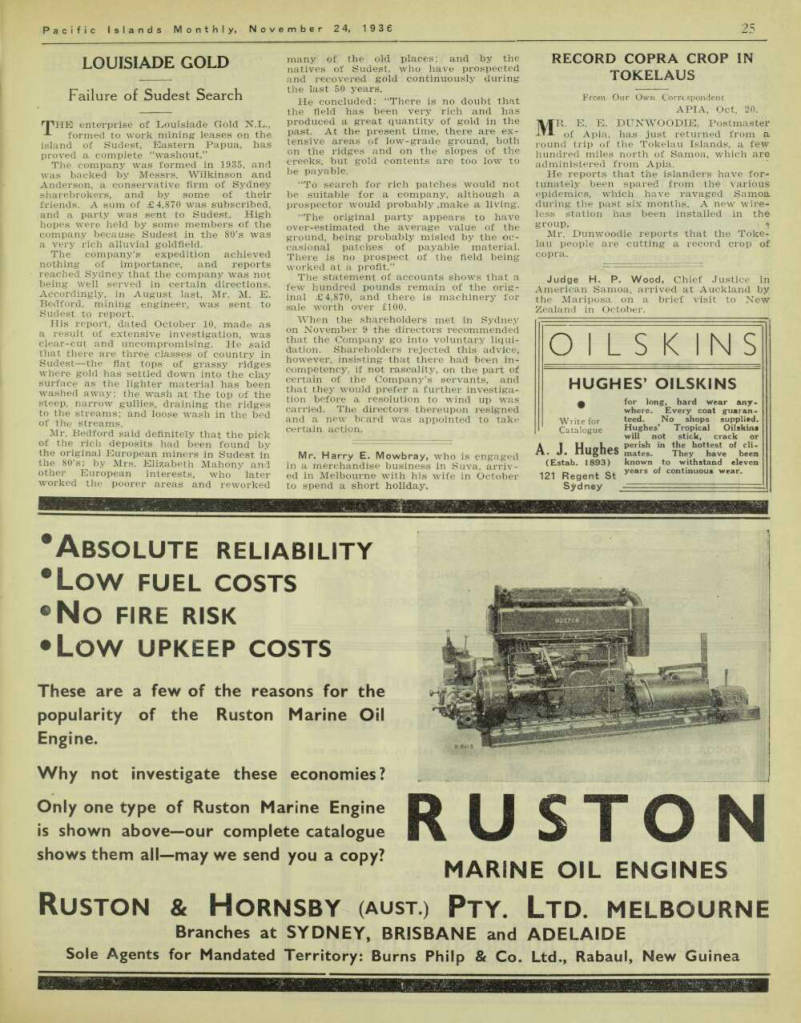
Failure of Sudest Search
THE enterprise of Louisiade Gold N.L., formed to work mining leases on the island of Sudest, Eastern Papua, has proved a complete “washout,”
The company was formed in 1935, and was backed by Messrs. Wilkinson and Anderson, a conservative firm of Sydney sharebrokers, and by some of their friends. A sum of £4,870 was subscribed, and a party was sent to Sudest. High hopes were held by some members of the company because Sudest in the 80’s was a very rich alluvial goldfield.
The company’s expedition achieved nothing of importance, and reports reached Sydney that the company was not being well served in certain directions.
Accordingly, in August last, Mr. M. E.
Bedford, mining engineer, was sent to Sudest to report.
His report, dated October 10, made as a result of extensive investigation, was clear-cut and uncompromising. He said that there are three classes of country in Sudest—the flat tops of grassy ridges where gold has settled down into the clay surface as the lighter material has been washed away; the wash at the top of the steep, narrow gullies, draining the ridges to the streams; and loose w r ash in the bed of the streams.
Mr. Bedford said definitely that the pick of the rich deposits had been found by the original European miners in Sudest in the 80’s; by Mrs. Elizabeth Mahony and other European interests, who ‘ later worked the poorer areas and reworked
many of the old places; and by the natives of Sudest, who have prospected and recovered gold continuously during the last 50 years.
He concluded: “There is no doubt that the field has been very rich and has produced a great quantity of gold in the past. At the present time, there are ex tensive areas of low-grade ground, both on the ridges and on the slopes of the creeks, but gold contents are too low to be payable.
“To search for rich patches would not be suitable for a company, although a prospector would probably .make a living.
“The original party appears to have over-estimated the average value of the ground, being probably misled by the oc casional patches of payable material.
There is no prospect of the field being worked at a profit.”
The statement of accounts shows that a few hundred pounds remain of the orig inal £4,870, and there is machinery for sale worth over £lOO.
When the shareholders met in Sydney on November 9 the directors recommended that the Company go into voluntary liqui dation, Shareholders rejected this advice, however, insisting that there had been in competency, if not rascality, on the part of certain of the Company’s servants, and that they would prefer a further investiga tion before a resolution to wind up was carried. The directors thereupon resigned and a new beard was appointed to take certain action.
Mr. Harry E. Mowbray, who is engaged in a merchandise business in Suva, arriv ed in Melbourne with his wife in October to spend a short holiday.
Tokelaus
Record Copra Crop In
From Our Own Correspondent
Apia, Oct. 20.
MR. E. E. DUNWOODIE, Postmaster of Apia, has just returned from a round trip of the Tokelau Islands, a few hundred miles north of Samoa, which are administered from Apia.
He reports that the islanders have for tunately been spared from the various epidemics, which have ravaged Samoa during the past six months. A new wire less station has been installed in the group. * Mr. Dunwoodie reports that the Toke lau people are cutting a record crop of copra.
Judge H. P. Wood, Chief Justice in American Samoa, arrived at Auckland by the Mariposa on a brief visit to New Zealand in October.
Mr. Harold Gatty, representative in Australia for Pan-America Airways, re turned to Sydney by the Monterey on November 2 after attending a conference in New Zealand on trans-Paciflc air ser vices. He said that P.-A. Airways are definitely going ahead with their earlier plans to connect the United States and New Zealand, via Hawaii and Samoa, by flying-boat.
Advertisements & other items, pp. 27-28 (1 item)
Ruston
OILSKINS
HUGHES’ OILSKINS
£ for long, hard wear any. where. Every coat guaran.
Write for teed. No shops supplied.
Catalogue Hughes’ Tropical Oilskins will not stick, crack or A I Hurtlmc P er * s h in the hottest of cli- . J. nugnes mates. They have been (Estab. 1893) known to withstand eleven ._. , cs, years of continuous wear. 121 Regent St
Sydney
•Absolute reliability
•LOW FUEL COSTS
®No FIRE RISK
•LOW UPKEEP COSTS
These are a few of the reasons for the popularity of the Ruston Marine Oil Engine.
Why not investigate these economies?
Only one type of Ruston Marine Engine is shown above—our complete catalogue shows them aH- m a y wo send you a copy! MAR|NE Q|L EN( - |NES Ruston & Hornsby (aust.) Pty. Ltd. Melbourne Branches at SYDNEY, BRISBANE and ADELAIDE Sole Agents for Mandated Territory: Burns Philp & Co. Ltd., Rabaul, New Guinea JT t:
RUSTON
LEATHER BELTS
Cor NATIVES
f THan ufacturers & Specialists
PATTERSON & STONE, CRICHTON WORKS.
WALSALL .ENGLAND.
srtj
Nelson and Robertson Ltd.
(ESTABLISHED
1895)
• Island Merchants
COCOA BEANS.—Special attention devoted to their sale in Australian and Oversea markets.
COPRA, TROCHUS SHELL, and other Island Produce sold on commission.
All classes of merchandise and Mining Machinery purchased at wholesale prices and original invoices supplied to Island clients. Small commission.
Prices submitted for comparison.
SOLE AGENTS FOR
PUMPMOBIL Portable Pumping Plants. Recommended for Sluicing and all Mining purposes. Weight 120 lbs., 12,000 gals, per hour, 10 to 100 feet head.
REDUCED PRICES.
ARCHIMEDES.—Latest in outboards; Swedish manufacture.
SKANDIA ENGINES, FULL DIESEL AND SEMI-DIESEL; all powers, Marine and Stationary.
UPSON BRITISH BOARD.—Wallboard and insulating material in one, strong and light in weight. 6ft. to 12ft. lengths always in stock.
NELSON AND ROBERTSON LIMITED
12 SPRING STREET, SYDNEY, AUSTRALIA
Telegraphic Address: “Ivan Sydney”
Marshalls
Heavy Rains In The
From a Special Correspondent.
Jaluit, Aug. 18.
THE rainfall in the Marshall Islands has been heavy in recent months —but no floods can occur in these coralline islands, save from a typhoon or a tidal wave.
Although the excessive rainfall has not caused floods, those who depend for a livelihood on copra production have been seriously embarrassed because of the difficulty of drying the copra. Those who heeded official advice in past years, and constructed houses for drying copra by artificial heat, are now reaping the benefit of their foresight.
Romance of Penrhyn Pearl-
“Once Aboard The
Lugger—”
Romance of Penrhyn Pearl- King
By Julian Hillas.
TF you should happen to visit the island A of Penrhyn, you will certainly meet there Philip Woonton; for to all intents and purposes “Philipa” is Penrhyn, and vice versa.
There are roughly two hundred pounds of him, and his voice, when all the stops are out, goes right into the amplifier class.
In these times of effete Island residents ne is something of an anachronism, being the possessor of those boisterous and genial qualities more commonly associated with the “good old bad days” of the 70’s or 80’s, when rum was really rhum, and not all women were wives.
Woonton was a young man when he first came to Penrhyn as mate of the trading schooner Vaite, about the begin ning of the century. Leaving the sea to settle ashore, he speedily established him self as a dominant figure in the pearling industry; and if you buy good pearls in Penrhyn to-day they will probably be from him, because he now acquires pretty well all that are worth acquiring.
I remember an occasion when our schooner had just berthed, and the late Tom Wilson, one of the most charmingly casual characters Penrhyn ever sheltered, told Woonton that he had left a registered package on the latter’s verandah.
“Philipa” bounded ' out of the saloon and over the gang-plank before any of us could set down our glasses. The “package,” he explained later, contained only between £7OOO and £BOOO worth of pearls returned unsold from his London agents!
Now the history of pearls hhs always been associated with great romances and the pearl-trader into whose life romance had not sprung would be no sort of a figure to write about. Romance not merely sprang into young Woonton’s life; it posi tively hurled itself in—romance of the epic-making variety which long ago “launched a thousand ships and burnt the topless towers of Ilion.” For a day came when “Philipa” had to leave Penrhyn on pressing business—and he did not want to leave alone.
“Farewell, Romance,” the traders cried, “Our keels have lain with every sea.
The dull returning wind and tide Heave up the wharf where we would be; The known and noted breezes swell Our trudging sails. Romance, farewell!”
That was about how things were. Only, on the subject of farewell, “Philipa” had his own ideas. He had fallen hopelessly and desperately in love with Maara, whose parents—as often happens in Penrhyn— could come to no unanimous decision re garding their daughter’s future.
But delay was irksome to the lovers, and, meanwhile, the schooner was due to leave. Would Maara elope? Maara would —and, with the captain’s connivance, she was stowed away in a sail locker.
But, unfortunately, the islanders had suspicious minds, and the whole com munity, tramping down to the little wharf, refused to let the vessel go until they had searched her from stern to fo’c’sle.
Tearfully, Maara was led ashore by local deacons of the Church —but not be fore “Philipa” had whispered certain in structions in her shell-like ear.
The Vaite warped clear; and Maara,
left to her own devices, scuttled away through the “bush” to a spot on the outer beach opposite one of the many narrow fissures in the reef which at this point fringes the shore. Half an hour later the schooner was abreast of where she lay, and without waiting for the pre-arranged signal, she immediately plunged into the water.
On board, “Philipa” watched the white line of the surf as it went booming thun derously along the reef, stabbing the air with spray-geysers which hung like plumes waved against a vivid green back ground of palm fronds. He needed no telling that in such a sea neither Maara nor any other girl could ever make the
pdssage.
Davit blocks squealed, the Yaite’s only boat was lowered, and pulled away with Woonton and two natives at the oars. As they approached, it became increasingly evident that Maara would never be able either to fight her way through or struggle back to the beach. The breakers rolled her over and over and her long hair, secured by a single comb, slipped down, and, floating loose, impeded her every movement.
Stripping to his singlet, “Philipa” swam in with the intention of bringing Maara out to the boat. But, once in the sinister grip of those seas, he quickly realised the impossibility of such a task. His only chance lay in getting her over the reef and back on shore.
By this time, the schooner’s unusual behaviour had been noticed, and the en tire settlement were gathering on the sands where, with a peculiar mixture of hysteria and fatalism, they wrung their hands and wailed in shrill chorus as each wave lifted the unfortunate girl.
Supporting Maara with one arm, “Philipa” found it was all he could do to keep afloat. Twice he tried to reach the reef, but each time the backwash swept him out again before he could obtain a footing.
With something akin to panic, he re cognised that his own strength was fail ing. Unless he succeeded now, it would not be sufficient to make a fourth attempt.
Very grimly, with death lurking in the swirling waters about him, Woonton drove forward, and again, just as his feet touched coral, the backwash started to sweep him out. Reaching out desperately, his fingers encountered a small projec tion, and to this he clung with the tenacity of despair. The strain of their double weight was terrific, but the knob-like thing held until the next incoming wave carried them up on to the reef, from whence he was able to wade across to the beach.
Pushing through the excited crowd, he laid the now unconscious Maara on the sand, and standing over her, applied arti ficial respiration. Whilst thus engaged, an infuriated relative, believing the girl dead, flung himself—knife in hand —at Woonton’s back, and was only prevented from accomplishing his purpose by the timely intervention of an old woman, who seized his arm as he was about to strike.
On Maara’s recovering consciousness, everyone became deliriously happy; and, since it was impossible for “Philipa” to board the schooner where she was, the whole party set out for the village, singing and dancing as they went.
With that swift change of emotion characteristic of Polynesians, Maara’s family decided “Philipa” had now rightly earned their daughter's affection, and, with great haste, her belongings were packed in a large camphor-wood chest, with brass handles and name-plate.
Unanimity had at last been reached, and, as the Vaite appeared on the lee side of the island, all Penrhyn, for the third and final time that day, tramped across the sands to meet her.
In the centre of the procession were “Philipa” and Maara, and, directly behind them, came the brass-bound chest—borne by those same deacons whose earlier con duct had been so different!
A fortnight afterwards the wedding bells pealed in Tahiti, sealing a romance which lasted until Maara, ten years later, passed beyond the friendly call of human voices, out through the shifting cold twi light to some white tremendous daybreak on the other side of life, where perhaps—• “ on the Ideal Reef, Thunders the Everlasting Sea.”
Mile. Andree Luquet, of Noumea, reach ed Sydney by the Van Rees on October 13, en route to France, where she will seek fame as a film actress.
Miss C. Dusting, who was for some years an honorary missionary sister in Fiji for the Methodist Mission, died re cently in Victoria.
Mr. P, Kodanda Rao, M.A., of the Ser vants of India Society, who has been studying the life and conditions of the Indian community in Fiji, left the Colony by the Niagara on October 23.
Advertisements & other items, pp. 28-29 (2 items)
26
Monthly, November 24, 1936
Pacific Island
*0 Chapman
Firearm Repairs
CUR HANDS MAKE GOOD ARMS"
Firearms sent
C.O.D.
The Single Barrel 12 Gauge SHOTGUN
is most Economical to Use
Quality S.B. Guns: All 30 or 32 inch barrel, full choke for 2J Webley Scott (English) £7/5/- in. cartridges, and Post Free.
Iver Johnson 60/- Winchester latest model 65/- Write for my new Firearm Catalogue, also (30 inch barrel only) my list of S.H. English shotguns. fill |£ II IT Gunsmith, Importer of High-grade Firearms and IIIMI Fishing Tackle Specialist. 143 Elizabeth Street, Sydney (near Market Street)
"FISHING TACKLE TO TACKLE FISHING”
*0 CHAPMAN
'W frU&J SO (follotv / thi Mefadd Ot£ur / fade
I/OU7 I&WUU/
llljjjlli
Chapman Pup Engines
are World-famed as power plant for MOTOR LAUNCHES.
Thousands in use throughout Australasia. Owners from all parts continually writing praising their astounding simplicity, reliability, and Economy. Built in a number of different sizes from 2£ h.p. to 10 h.p. Write for leaflets and all information direct to the manufacturers—
CHAPMAN & SHERACK,
ENGINE MANUFACTURERS & LAUNCH
BUILDERS
ERSKINEVILLE, N.S.W., AUSTRALIA.
Suva Athlete Wins His Fifth
Successive 100 Yards Title
From a Special Correspondent. c-TT-tTA 4. -.o
Suva, Oct. 13.
FOR the fifth successive year, J. A. (“Tony”) Moore won the European 100 yards Cham pionship of Fiji at the Suva Athletic Sports Club meeting on October 5. He ran the distance
in 10 seconds. Moore was presented with a cup donated by Captain Mullins.
A field of 19 started in the 120 yards Euro pean Sheffield Handicap, the final being won by ?°y er < 9y< * s -> by two feet from H. Williams (7yds.). J. A. Moore (2yds.) was third. F.
Storck (30yds.) had an easy win from K. Pinson (scratch) in the 880 yards European Handicap.
The Native Sheffield Handicap of 120 yards went to Joe Kunidai. Ratu Vitu cleared sft. 4ins. to carry off the High Jump event.
Misbehaviour Of Police
Boys
Probable Cause of Rai Coast Trouble
INFORMATION to hand during the month throws some light upon the disorders reported recently from the Rai Coast (on the mainland of New Guinea, south-eastward of Madang).
The first incident reported occurred on July 23, when a native policeman was killed and four others wounded. One re port at that time said that the outbreak was the result of “religious fanaticism.”
It now appears, however, that what oc curred had an entirely different cause.
Assistant District Officer A. Nurton was in that region in July engaged on a patrol, in which he was seeking census informa tion. He sent a party of native police into a district that is rarely visited. The people of this village had shown some reluctance to line up, and to carry out certain duties regarding road-making, or village cleanliness, or something of that sort, imposed upon them by the Ad ministration.
When the police party commenced to march towards the villages, the people apparently thought that they were to be punished, and fled into the bush. The native policemen, entering one of the de serted villages, appear to have displayed a spirit of license and hooliganism.
One policeman, named Sapuri, made prisoner a native woman whom he found in hiding, and kept her in the police camp, where he outraged her. The natives from the village to which the woman be longed crept upon the police camp in the night and sought out and attacked and killed Sapuri. There apparently was a general fight, in which four other police men were wounded.
Patrol Officer G. Greathead was sent into the area to assist A.D.O. Nurton. But before Mr. Greathead arrived, Mr. Nurton went into the disturbed area in an en deavour to restore order, and he and his party were suddenly attacked by What appear to have been the same class of natives who killed the native policeman Sapuri.
This second incident occurred on Sep tember 24, and, as previously reported, A.D.O. Norton was so severely injured that one of his legs had to be amputated.
Other information will be made avail able in due course, no doubt; but present indications are that the trouble on the Rai Coast was caused by the bad be haviour of a party of native policemen in a district which is only nominally under control.
Norfolk Island Trade
Mrs. Donald Finlayson, who had re sided in the Rewa District, Fiji, for al most half a century, died at the home of her daughter, Mrs. Henry Abbott, at Nausori, in mid-October.
Imports
F rom F rom Month. Australia. Pacific Is.
September, 1935 . £3640 . . £32 September, 1936 . £4135
Exports
To To Month. Australia. Pacific Is.
September, 1935 . £638 . . £14 September, 1936 . £316 . . £13
Advertisements & other items, p. 30 (1 item)
Swallow
PRESCOTT L T i> I u y s I e nV-J ar-e sole wholesale fbr^
PINEAPPLE BACON & HAMS
DAISY BRAND BUTTER
LEA & PERRINS’ r° RC u E c E E
LEA& PERRINS’ H.P. Sauce
and ZMost other Super-Quality Lines of the Trade
SWALLOW
—— & ARIELL’S
PLUM
PUDDINGS
6^ Kenowned for Quality Manufactured at Port Melbourne, Australia
For Islands
Useful Medical Book
THE most useful publication that has been made available to Pacific Islands residents for many a long day is Diseases Commonly Met With in Melanesia—Their Diagnosis, Prevention and Treatment. It has been written by Dr. Clifford S. James, medical officer in charge of the Mela nesian Hospital at Fauabu, British Solo mon Islands; published by the Melanesian Mission; and it is being distributed through Burns, Philp stores at 4/6 per copy.
Every type of disease commonly met with in the Pacific Islands, and especi ally in Melanesia, is described in simple, non-technical language, and the methods of treatment recommended are set out in sufficient detail to enable the non-medical worker to understand and carry them out.
Dr. H. B. Hetherington (Solomon Islands), in a foreword, gives the book the warm praise it deserves, and points out that “with careful attention to details of the instructions given, anyone can ex pect to perform successfully any of the procedures described . . . Complicated procedures, beyond the ability of the medical layman, have been omitted.” He points out that Dr. James writes with the authority of eight years’ experience in the Solomons and New Guinea.
The book is divided conveniently into sections, classified according to the parts of the body in which symptoms usually manifest themselves. Sections are de voted to fevers, skin diseases, bowel dis eases, lung diseases, etc. The method of treatment is given alongside the descrip tion of every disease.
A good index permits immediate refer ence to the description and treatment of the sickness or disease under notice.
The author has given a good deal of attention to the prevention of disease, and to the care of women and children. “The tropical life,” he says, “is not for those with tuberculosis in the family, nor epi lepsy, nervous troubles, mental disease, nor with a tendency to diarrhoea.”
The section on “Prevention of Malaria” ought to be learned by heart by every dweller in Melanesia.
The book will be just as useful in Poly nesia as in Melanesia. The only dif ference is that there are in Polynesia fewer of the diseases described in the book, and no additional ones. No dweller in the tropical islands should be without a book of this kind.
Persons who cannot obtain a copy from the local B.P. store should send 4/6 to the Secretary, Melanesian Mission, 247 George Street, Sydney.
Gayer Social Life In
Samoa
From Our Own Correspondent
Apia, Oct. 22.
THE visibly improved economic situa tion in Samoa and the increased spending power of the people have re sulted in an uplift of the social life, es pecially in the capital, Apia.
Within a period of four weeks no less than six musical and theatrical enter tainments are announced, starting with a concert of the Apia Symphony Orchestra, composed of local amateur talent. All these functions are for the benefit of various club, church, and benevolent funds.
Pearl-Shellers
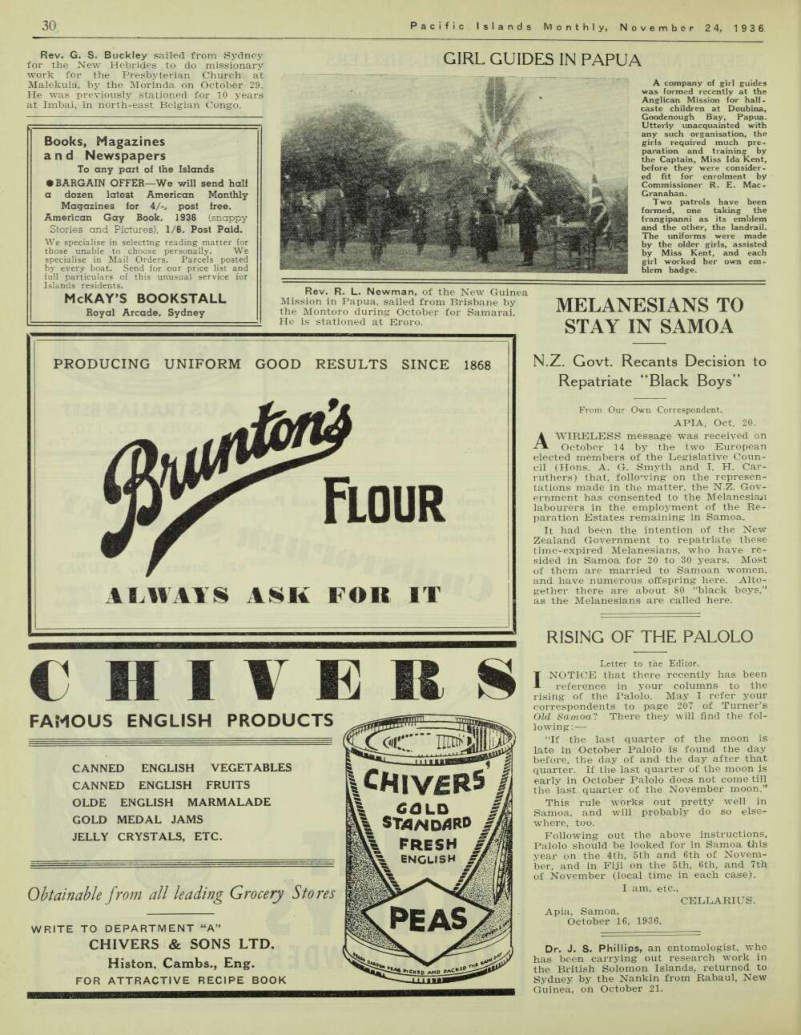
Assistance from Australian Government
\ USTRALIAN pearl shell interests are to receive assistance from the Com monwealth Government in the shape of a provision in the tariff that “articles for use in the pearling industry” will be ad mitted into Australia free of duty if they are of British manufacture, and subject to a duty of only 15 per cent, if they are of foreign manufacture.
The Australian Tariff Board and the Minister for Customs inquired closely into the conditions of the pearl shell industry and rejected a proposal that it should be assisted by the payment of a bounty on production. It was felt that a more effective and more permanent form of en couragement would be given in the shape of tariff concessions.
An early amendment in the Australian tariff schedule will give effect to the de cision.
Rev. John W. Burton, M.A., general secretary of the Methodist Missionary Society of Australasia, who is well known in the South Seas, left England on his re turn to Australia after furlough on Octo ber 14. He will visit the Methodist Mis sion stations in India en route to Sydney, where he is expected to arrive late in December.
Rev. G. S. Buckley sailed from Sydney for the New Hebrides to do missionary work for the Presbyterian Church at Malekula, by the Morinda on October 29.
He was previously stationed for 10 years at Imbai, in north-east Belgian Congo.
Advertisements & other items, pp. 31-32 (1 item)
Mary's
H.JONES e-co c
AUSTRALIA'S BEST
H. JONES & CO., LTD.
Darlington, Sydney Hobart, Tas.
For— Fresh Fruit, Vegetables, and Produce Islands Residents can rely on the old-established Shipping Providers: SV«»’
Only Addreasi 421 Sussex St., SYDNEY Islands AII orders Promptly Attended Representatives: Nelson & Robertson Ltd. W, M. Reid
£ A new, simple lid for your convenience; a new
patented parchment seal
to ensure perfect freshness.
AUNT
MARY'S
BAKING POWDER
Send 1/- plus 2d. postage to Tillock and Co.
Ltd., Sydney, fop “Aunt Mary’s" Cookery Book.
It’s the best.
Books, Magazines
and Newspapers
To any part of the Islands • BARGAIN OFFER—We will send half a dozen latest American Monthly Magazines for 4/-, post free.
American Gay Book, 1936 (snappy Stories and Pictures), 1/6, Post Paid.
We specialise in selecting reading matter for those unable to choose personally. We specialise in Mail Orders. Parcels posted by every boat. Send for our price list and full particulars of this unusual service for Islands residents.
McKAY’S BOOKSTALL
Royal Arcade, Sydney
PRODUCING UNIFORM GOOD RESULTS SINCE 1868
ALWAYS ASK FOR IT
C II I V K IS S
FAMOUS ENGLISH PRODUCTS
CANNED ENGLISH VEGETABLES
CANNED ENGLISH FRUITS
OLDE ENGLISH MARMALADE
GOLD MEDAL JAMS
JELLY CRYSTALS, ETC.
Obtainable from all leading Grocery Stores
WRITE TO DEPARTMENT “A”
CHIVERS & SONS LTD.
Histon, Cambs., Eng.
FOR ATTRACTIVE RECIPE BOOK
m Off sm
CHIV£R S
CdLD
ST4AiD/iR» .
FRESH i
ENGLISH gi :
PEAS
m -iitiCKßp AHD
Girl Guides In Papua
Rev. R. L. Newman, of the New Guinea Mission in Papua, sailed from Brisbane by the Montoro during October for Samarai.
He is stationed at Eroro.
A company of girl guides was formed recently at the Anglican Mission for half caste children at Doubina, Goodenough Bay, Papua.
Utterly unacquainted with any such organisation, the girls required much pre paration and training by the Captain, Miss Ida Kent, before they were consider ed fit for enrolment by Commissioner R. E. Mac- Granahan.
Two patrols have been formed, one taking the frangipanni as its emblem and the other, the landrail.
The uniforms were made by the older girls, assisted by Miss Kent, and each girl worked her own em blem badge.
Melanesians To
Stay In Samoa
N.Z. Govt. Recants Decision to Repatriate “Black Boys”
From Our Own Correspondent.
Apia, Oct. 20.
A WIRELESS message was received on October 14 by the two European elected members of the Legislative Coun cil (Hons. A. G. Smyth and I. H. Car ruthers) that, following on the represen tations made in the matter, the N.Z. Gov ernment has consented to the Melanesian labourers in the employment of the Re paration Estates remaining in Samoa.
It had been the intention of the New Zealand Government to repatriate these time-expired Melanesians, who have re sided in Samoa for 20 to 30 years. Most of them are married to Samoan women, and have numerous offspring here. Alto gether there are about 80 “black boys,” as the Melanesians are called here.
Rising Of The Palolo
Letter to the Editor. 1 NO TICE that there recently has been reference in your columns to the rising of the Palolo, May I refer your correspondents to page 207 of Turner’s Old Samoa ? There they will find the fol lowing:— “If the last quarter of the moon is late in October Palolo is found the day before, the day of and the day after that quarter. If the last quarter of the moon is early in October Palolo does not come till the last quarter of the November moon.”
This rule works out pretty well in Samoa, and will probably do so else where, too.
Following out the above instructions, Palolo should be looked for in Samoa this year on the 4th, sth and 6th of Novem ber, and in Fiji on the sth, 6th, and 7th of November (local time in each case).
I am, etc.,
Cellarius.
Apia, Samoa, October 16, 1936.
Dr. J. S. Phillips, an entomologist, who has been carrying out research work in the British Solomon Islands, returned to Sydney by the Nankin from Rabaul, New Guinea, on October 21.
River, N.G.
Pygmies Of Ramu
Lord Moyne’s “Discovery" Is Challenged
Letter to the Editor, the way to New Guinea from Aus tralia a few months ago, I was handed an English newspaper, wherein Lord Moyne claimed for himself the discovery of the Ramu pygmies. As this was only a newspaper item, I did not think it worth while to comment on it at the time.
But, seeing the story reprinted in the P.I.M. of August, 1936, page 57, and con sidering the P.I.M. a magazine of some standing, I now feel justified in putting this report in its right place.
What is most astounding is the an nouncement to the world at large that “of the results of the expedition by far the most interesting was the confirmation of rumours as to the existence of an un known group of pygmies who were said to live on the Ramu River.”
Any scientific expedition doing scientific research work naturally would look up the literature of the country it wants to explore. Thus, Lord Moyne might have found in Anthropos (International Review of Ethnology and Linguistics), Vol. XXII, pg. 202-215, an exact account of the actual first discovery (not of rumours!) and of my visit to these pygmies in July, 1926 that is 10 years ago.
Furthermore, the Government author ities, whom Lord Moyne met in Rabaul before proceeding on his trip to the Ramu River, also knew of this first visit to the pygmies, in fact I had sent a copy of my article to the Administration at the time.
Thus, he even had the chance to become acquainted with the facts right near the spot.
Again, recruiters, miners, and Father J.
Ziegler, of the Mission Station at Atemble, have time and again visited the same pygmies, since my first visit to them.
Finally, when Lord Moyne went up the Ramu River, and was staying on the Mis sion Station at Atemble, where he actually met and measured 15 pygmies (I had given the measurements of 22 pygmies in the said article), did he really not hear a word of the fact that the pygmies had been visited before? And did Mr. E. J.
Wauchope, who accompanied him on this trip and who knew all about the earlier visits to the pygmies, not enlighten him at all on this point?
And yet, after all this, it was reserved to Lord Moyne to take home with him “as the most interesting result of the expedi tion, the confirmation of rumours as to the existence of an unknown group of pyg mies who were said to live on the Ramu River.”
Most interesting, indeed!
I am, etc.,
(Rev.)
Franz J. Kirschbaum.
Catholic Mission, Alexishafen, N.G.
Mr. L. St. George Ryder, of Messrs Morris, Hedstrom Ltd.’s staff at Suva Fiji, arrived in Western Samoa by the Antigone on October 6 after inspecting the firm’s branches in Tonga. He will take charge of the Apia establishment of Morris, Hedstrom during the absence on furlough of the manager, Mr. G. S. Chis holm. The latter departed from Samoa for Auckland by the Matua on October 27. Mr. Chisholm will return to Apia in January.
Advertisements & other items, pp. 33-34 (1 item)
Foster Clark's
WHAT AM I GOING TO
DO? BOB'S 'PHONCD TO
SAY HIS CHIEF & WIFE
ARE COMING TO BRIDGE
TO-NIGHT & THERE'S
n SIMPLY NOTHING
IN THE HOUSE
. . . .IT'S BEEN A
DELIGHTFUL EVENING.
YOU MUST BOTH COME
AND SEE US VERY
) SOON.
y i \ THANKS SO MUCH, WE'D LOVE TO. BY THE WAY, I'VE COPIED OUT THE LEMON TARTLET RECIPE FOR YOU. MIND YOU T
USE FOSTER CLARK'S CREAKY CUSTARdJ/
IT MAKES ALL THE
.. I KNOW YOU KEEP ]
Foster clark's custard]
THERE ARE HEAPS OF r-
LOVELY THINGS YOU
CAN MAKE WITH IT— i
LEMON TARTLETS FOR J
INSTANCE ... §
V:
DIFFERENCE
r.
A Foster Clark’s world-famous creamy Custard may not bring promotion to every woman’s husband—but it does promote a hearty appetite! Especially when it is used in delightful dishes like Lemon Tartlets. You’ll find this recipe and nearly 100
others—in Elizabeth Craig’s Recipe
Book. Write for your FREE copy to Foster Dark (Aust.) Ltd., Dept.
R. 8., Redfern, N.S.W. Enclose Id. stamp for postage.
Health Value.
Remember, Foster Clark’s Custard is
RECIPE FOR LEMON TARTLETS
J lb. Short Crust Raspberry Jam 2 ozs. Almonds
1 pt. FOSTER CLARK’S LEMON
CUSTARD
Turn pastry on to a lightly floured board and roll to i-inch thickness. With a pastry cutter, cut pastry into rounds, and line tartlet tins evenly with the rounds.
Prick the bottom of each with a fork.
Bake in a quick oven till crisp, then cool on a cake rack. When required, place a teaspoon of jam in the bottom of each tartlet and almost fill with the custard.
Blanch, split, and brown the almonds in a little butter. They can be fried or baked. Spike the custard fillings with the almonds. more than a delicious dish. It is a nourishing food, prepared from pure, wholesome ingredients, and natural flavours . . . finest Vanilla Beans, choicest Lemons and selected Valencia Almonds. Take your choice from these three, or the Standard flavouring, and serve Custard for dinner to-morrow. Always ask for Foster Clark’s Custard, and refuse
cheap imitations.
Foster Clark's
creamy CUSTARD
VANILLA j/h
FSI43
Ii 3 0 0 Candle power "Live
Pressure Light
THIS two-mantle Coleman Kerosene Mantle Lamp, burns 96% air and; 4% kerosene (coal oil). It’s a pressure lamp that produces 300 candlepower of “live”, eyesaving brilliance... gives more and better light at less cost. A worthy companion to the famous Coleman Gasoline Pressure Lamps. Safe... the fuel fount is made of brass and steel... no glass to break. Clean...no greasy wicss to trim; no smoky chimneys to wash. Finished in twotone Indian Bronze with attractive Parchment Shade.
COLEMAN LAMPS now fitted with Genuine Clear Glass Pyrex Globes, protecting Mantles and Shades and giving the whole brilliance to the Room.
Coleman Kerosene Lamps will burn Benzine equally as well.
Unaffected by draughts—The Coleman just continues to Shine.
Coleman Lamp & Stove Co. Ltd.
TORONTO, CANADA
500 Kent St., Sydney.
Established N.H. 1894
Kerr Brothers Limited
ISLAND MERCHANTS & AGENTS
Assembly Hall Building,
1 JAMIESON STREET, SYDNEY
PRODUCE:
Cacao, Coffee, Copra, Peanuts, Shell: Ship to us for best returns. Produce shipped overseas on behalf of clients and may be drawn on.
PLANTATION REQUIREMENTS:
We have over 40 years’ experience to help you. Agents for Cacao, Coffee and Castor Seed Machinery; Agricultural implements and Power Cult.vators; Tractors and Trailers; Paints: Marine, Fire and Earthquake Insurance.
MERCHANDISE PURCHASED AT BEST PRICES
AND ORIGINAL INVOICES SUPPLIED
G.P.O. Box 3838 T
Cable Address:
“CARE, SYDNEY”
♦ BULLIVANTS’ WIRE ROPES
— THE WORLD’S STANDARD —
m
LARGEST STOCKS IN AUSTRALASIA
FOR ALL PURPOSES
Also Blocks. Hooks, Shackles. Thimbles, Strand, Seizing, Aircraft Cord, etc.
Prompt Attention! Efficient Service!! Complete Satisfaction!!!
BULLIVANTS’ Australian Co. Pty., Ltd.
Letters: Incorporated in Victoria.
Box 1298 J. G.P.O. 331 KENT STREET, SYDNEY T elegrams: ‘Builivants Ltd., Sydney m
Memories of the “Lady Roberts"
Samoa’S Little Ships
Letter to the Editor. 4PROPOS the second inquiry into the loss of the Tiafau ( P.1.M., Sept.), it is stated that the findings “were not in ac cordance with public opinion in Apia.”
This is quite understandable, if a review of marine affairs in Samoa is undertaken.
The first marine venture of the Admin istration was in June, 1923, when the S.S.
Lady Roberts was purchased from New Zealand. European officers, comprising captain, chief and second officer, and chief engineer, were sent from Samoa to steam the ship from Auckland, and she was taken over from the Defence Department. After much haggling, two additional engineers w r ere secured for the trip, in addition to three local-born Samoan firemen and other half-caste deck-hands, none of whom had previously held sea jobs.
Fitted with 2ft. of 2-inch timbers for extra freeboard, 16 tons of coal on deck and two tons on the engine room plates, the ship left Auckland. Of 250 tons register and 98 horse power, the trip was no pleas ure cruise, but after rough trips of six days to Suva from Russell, and four days Suva to Apia, she arrived, and was com missioned with a European captain and an engineer. The rest of the crew were local-born and native Samoans, etc.
No second engineer was provided and
the ship commenced her mail run between Apia and Pago Pago, a distance of approx. 80 miles, and a run of 12 hours by night.
Forty miles of Pacific Ocean separate the two islands, yet up to 50 deck passengers were carried, life saving equipment consist ing of a whaleboat, small dinghy and about a dozen kapok lifebelts. At times, the weather encountered was sufficient to de lay the Matson liners and, speaking as one with T.B.D. experience during the War, I state emphatically that for negli gence the Administration should have been prosecuted. With the engineer disabled, there was at all times not one soul aboard the ship capable of stopping the engines or shutting down the boiler.
After five months, a Chinese second en gineer was procured, and designs were submitted for a larger ship. This was due to passengers declaring their intention never to travel on the Lady Roberts after their one trip. Islands commercial travel lers can vouch for this.
The new ship was designed sketchily by Capt. Willcocks (the Harbourmaster at Apia) and Mr. Toni Hutton (draughtsman in the P.W.D.), and this ship, primarily intended for inter-island trade, became the now famous Maui Pomare. Her history from infancy is painful to read about.
These ventures of the Samoan Adminis tration are on a par with previous failures too numerous to mention, which produced the first citizens’ indignation meeting, at which Mr. O. F. Nelson was appointed chairman. As he was an M.L.C. at the time, it was deduced that he would be the man to approach the Governor, Which he did, with disastrous results to himself.
Such is fame!
Regarding the unfortunate captain of the Tiafau, we have another instance of the old adage used extensively in Australia, commonly called “carrying the baby.”
The correct verdict of the Marine Court should have been negligence by the Administration in allowing the vessel to leave without adequate life-saving gear.
I am, etc.,
Ed. V. Tibbo.
Tavua, Fiji.
N.G. Public Service Transfers
THE following transfers connected with the staff of the New Guinea Public Service were announced on October 7: — District Services Dept.: G. Greathead, Patrol Officer, Rabaul to Madang; R. G. Ormsby, Cadet, Rabaul to Gasmata; J. A. Grant, Cadet, Rabaul to Salamaua.
Public Health Dept.: R. F. Armstrong, Medical Assistant, Rabaul to Namatanai; W. A. Mc- Allister, Medical Assistant, Rabaul to Wewak.
Agriculture Dept.: H. Henderson, Inspector, Rabaul to Namatanai; W. Me. ,G. Pestell, In spector, Rabaul to Salamaua.
Lands Dept.: C; W. G. Fox, Surveyor, Rabaul to Morobe District.
Police Force: H. R. Taylor, Warrant Officer, Rabaul to Wau.
New Schooner
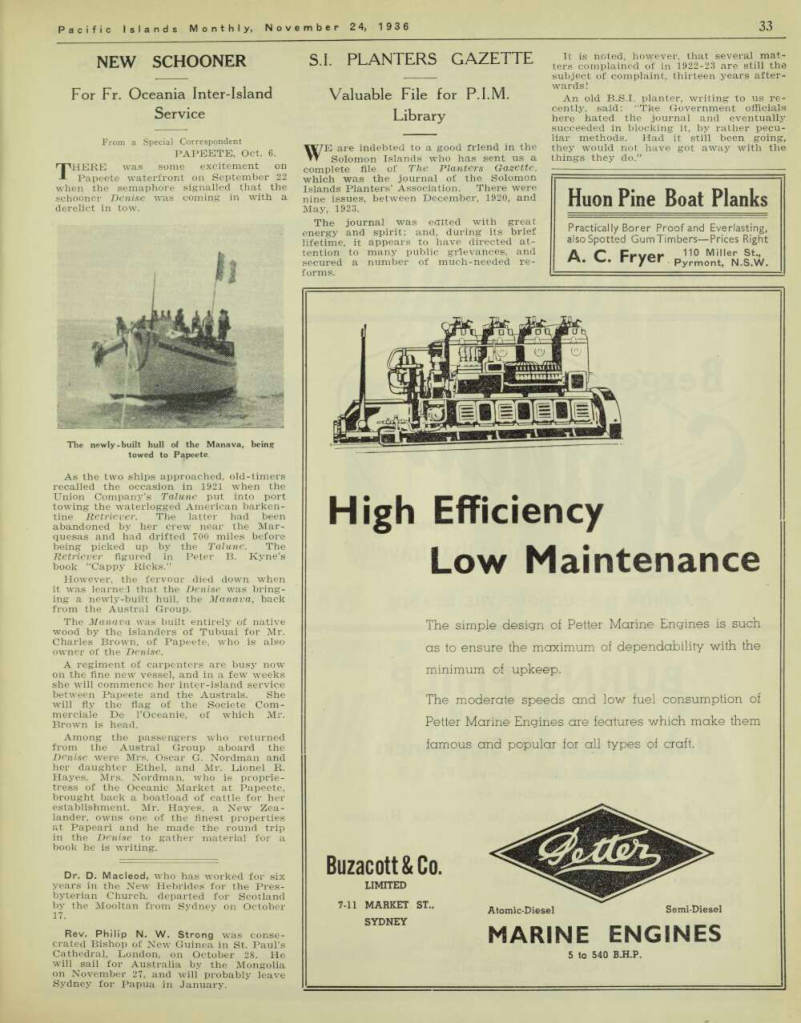
For Fr. Oceania Inter-Island Service
From a Special Correspondent
Papeete, Oct. 6.
THERE was some excitement on Papeete waterfront on September 22 when the semaphore signalled that the schooner Denise was coming in with a derelict in tow.
As the two ships approached, old-timers recalled the occasion in 1921 when the Union Company’s Talune put into port towing the waterlogged American barken tine Retriever. The latter had been abandoned by her crew near the Mar quesas and had drifted 700 miles before being picked up by the Talune. The Retriever figured in Peter B. Kyne’s book “Gappy Ricks.”
However, the fervour died down when it was learned that the Denise was bring ing a newly-built hull, the Manava, back from the Austral Group.
The Manava was built entirely of native wood by the islanders of Tubuai for Mr.
Charles Brown, of Papeete, who is also owner of the Denise.
A regiment of carpenters are busy now on the fine new vessel, and in a few weeks she will commence her inter-island service between Papeete and the Australs. She will fly the flag of the Societe Com merciale De I’Oceanie, of which Mr.
Brown is head.
Among the passengers who returned from the Austral Group aboard the Denise were Mrs. Oscar G. Nordman and her daughter Ethel, and Mr. Lionel R.
Hayes. Mrs. Nordman, who is proprie tress of the Oceanic Market at Papeete, brought back a boatload of cattle for her establishment. Mr. Hayes, a New Zea lander, owns one of the finest properties at Papeari and he made the round trip in the Denise to gather material for a book he is writing.
Dr. D. Macleod, who has worked for six years in the New Hebrides for the Pres byterian Church, departed for Scotland by the Mooltan from Sydney on October 17.
Rev. Philip N. W. Strong was conse crated Bishop of New Guinea in St. Paul’s Cathedral, London, on October 28. He will sail for Australia by the Mongolia on November 27, and will probably leave Sydney for Papua in January.
The newly-built hull of the Manava, being towed to Papeete.
Library
St Planters Gazette
Valuable File for P.I.M.
WE are indebted to a good friend in the Solomon Islands who has sent us a complete file of The Planters Gazette, which was the journal of the Solomon Islands Planters’ Association. There were nine issues, between December, 1920, and May, 1923.
The journal was edited with great energy and spirit; and, during its brief lifetime, it appears to have directed at tention to many public grievances, and secured a number of much-needed re forms.
It is noted, however, that several mat ters complained of in 1922-23 are still the subject of complaint, thirteen years after wards!
An old 8.5.1. planter, writing to us re cently, said: “The Government officials here hated the journal and eventually succeeded in blocking it, by rather pecu liar methods. Had it still been going, they would not have got away with the things they do.”
Advertisements & other items, p. 35 (1 item)
High Efficiency
Huon Pine Boat Planks
Practically Borer Proof and Everlasting, also Spotted Gum Timbers—Prices Right A r FfvPf 110 Miller St., Hi. v-. rryer p yr mont, n.s.w.
Low Maintenance
The simple design of Fetter Marine Engines is such as to ensure the maximum of dependability with the minimum of upkeep.
The moderate speeds and low fuel consumption of Fetter Marine Engines are features which make them famous and popular for all types of craft.
Buzacott&Co.
LIMITED
7-11 MARKET ST.,
SYDNEY
Atomic-Diesel Semi-Diesel
MARINE ENGINES
5 to 540 B.H.P.
Kohpra, Or Kohbra?
Do You Say Kopra,
JYJAJOR CLIVE JOSKE, of Suva, started He was in a literary mood on September 21, and he wrote this paragraph for his interesting weekly bulletin to the Fiji Coconut Planters’ Union: “There is some conflict of opinion as to the pronunciation of the word ‘copra.’
Webster’s International Dictionary, in the edition of 1900. gives the pronunciation as ‘ko-pra,’ and says it is derived from the Malayam ‘koppara’ or the Hindustani ‘khopra.’ Malayam does not mean Mala yan, but is the name given to a language spoken in the Madras Province. Webster says that the word is also written ‘cobra,’ ‘copperah,’ ‘coppra’.”
“A Coconut Planter” then wrote to the Fiji Times and Herald :
“The etymology of the word ‘copra’ un doubtedly has its origin among the many varied forms of this word which are found in the vernacular of the states of South ern India: viz.: Khopra, Hindustani; Kob bera, Telugu; and Koppera (short o) Malayaham, etc., etc. From this it will be seen that there is no doubt as to what is the correct pronunciation. Copra (long o) remains the name by which the dried meat of the coconut is known.”
The pronunciation of the word varies according to locality. In Australia, Papua and New Guinea it is universally “kopra” (short o). In London, it is usually “koh pra” (long o), as stated by Major Joske.
In Samoa, where I was recently, it was almost always “kohbra” (long o. and b instead of p). I attributed this to the German influence, because Germans, when speaking English, usually soften our har der consonants. In Fiji I heard “kopra,”
“kohpra” and “kohbra,” which seemed to represent a mixture of English. Austra
lian and Samoan influences.
R.W.R.
Tahiti’S Woes
Union Line to Go; Franc Devalued
From Our Own Correspondent.
Papeete, Oct. 9.
T’HERE have been two recent develop ments which promise to have a pro found effect on the economic welfare of the islands of the South-eastern Pacific.
One is the proposed discontinuance of the Union Steam Ship Co.’s passenger and mail steamers, and the second, the de valuation of the French franc.
The discontinuance of the passenger steamers on the Australia-Cook Is.- Tahiti-San Francisco service will imme diately destroy the tourist traffic (par ticularly from North America) which has been growing in volume during recent years.
This traffic has produced a respectable revenue for Tahiti and its adjacent islands. Many landowners have erected cottages suitable for rental to sojourners; indeed the amount of such building has lather exceeded the demand. Several business houses in Papeete have thrived on revenue from tourist patronage.
Fortunately, the Union Company is continuing a regular service of freight steamers, so that the movement of mails and cargo will not be interrupted. French Oceania is well served, in addition, by the excellent passenger steamers of the Messageries Maritimes Company voyag ing every six weeks from and to France via the Panama Canal.
In view of the withdrawal of the Union Co.’s passenger vessels, a belief has been expressed in some quarters that the Mes sageries liners would extend from their present terminus of New Caledonia to Australia. There is little ground for this rumour, however, the Company having emphatically denied the intention of continuing their vessels to Sydney.
Effect Of Devalued Franc
The devaluation of the French franc is likely to cause some confusion and even hardship until the islands become ad justed to the new conditions.
The chief difficulty is that our supplies of staple foodstuffs —such as flour, beef in tins. etc. —as well as petroleum pro ducts, lumber and such, come from Aus tralasia and the Pacific Coast of North America. This means that prices for all these products, in terms of francs, will rise immediately in proportion as the franc is devalued.
It is not likely that the price of our chief export product—copra—will rise in proportion inasmuch as the entire pro duction of French Oceania is, by the necessity of present economic and trade conditions, sold to France.
The native landowner in the islands is, of course, more or less independent in that he can supply himself with fish from the sea, with plantain from the mountain valleys, and with taro, breadfruit and other vegetables and fruits from plan tations on his own estate. Flour, rice, tea, and tinned foods are, however, substantial elements in the diet of all the islanders and higher costs will work no little hard ship Mr. D. R. Eden, Acting General Manager of the New Zealand Reparation Estates, left Apia, Samoa, by the Maui Pomare on October 15 on an official visit to Welling ton, to discuss with the N.Z. authorities important matters affecting the Estates and the labour situation in Samoa.
Captain J. R. Grey, formerly of the Hoyal Navy, and a Fellow of the Royal Geographical Society, arrived in Sydney by the Makura on October 17, after having visited Tetiaroa, a group of 13 islands north of Tahiti. He examined the potentialities of the islands and sub mitted a report to their owner, Dr. W. J.
Williams, who retired recently from the position of British Consul at Papeete.
Advertisements & other items, pp. 36-38 (2 items)
Berg'ers
Full Gloss Super Finish toreverqthing that travels/
AGENTS THROUGHOUT THE ISLANDS
BURNS PHILP
(South Sea) Co. Ltd. island Traders & Shipowners Registered Office: Suva, Fiji.
ALSO BRANCHES AT:
Fiji: Levuka, Lautoka, Labasa, Ba, Sigatoka, Rotuma.
Tonga: Nukualofa, Haapai, Vavau.
Samoa: Apia, Pago Pago (American Samoa).
Solomons: Makambo, Gizo, Faisi.
New Hebrides: Vila.
Gilberts: Tarawa.
Norfolk Is. Niue. Wallis Is. Futuna Is.
Code Address: “Burnsouth.”
PftVME
m '
CONVERTS YOU QUICKER
THJIY
mm t mam
VACUUM OIL COMPANY PTY. LTD.
• ISLAND SHIPPING
Freight, Forwarding and Customs Service. Import and Export.
B. R. WHEELER
17-19 Bridge St., SYDNEY Correspondence Invited. Tel.: B 5396
MUNGO SCOTT Ltd.
EXPORTERS OF
SUPERB FLOUR
FOR
38 YEARS
mm
RELIABILITY
AND PROMPT
SHIPMENT
SUMMER HILL SYDNEY AUSTRALIA
SPICED, CORNED. ROAST
a BOILED BEEF
AND IN MUTTON
IN 12oz, 11b, 2 lb., 3.1 k 41b.
55U»,6'64b POUND
CANS AND IN TAPERS
FITZROY
SHEEP
TONGUES
CORNED OXTONGUES - BEEP & FORK SAUSAGES
FITZROY
IUNOttOW frUF
UWffiSSJW
THE ORIGINAL PACK IN A CLASS BY ITSELF/ ALSO THt f AMOUS ®| HAMPER MEATS AV ROUND AND TAP£R CANS /2 OZ- 2-4- OZ. 6 & LB-5 C»(D->M“E C<D« LTD. ASEAN D TIRADE MEATS
BERSERKER BRANDS
tAtevemy size- fk.om Igapgagl /2 oz to 6l& cams NO tXTHA CHAR.CE- POR. A SSOR.TM C-M T PACKED CASES DR CARTONS - SEND EOR PDUCE D& CENTRAL QUEENSLAND MEAT EXPORT CO. LTD.
LAKES CREEK - ROCKHAMPTON
CABLE ADDRESS:- TOMOANA ROCKHAMPTON.
Woodlark
By G. Mills-Rodger
WOODLARK Island, in Eastern Papua, ** is forty miles by sixteen. From that area hundreds of fossickers and miners have won hundreds of ounces of gold, worth hundreds of thousands of pounds.
But that was many years ago, when Woodlark was the chief goldfield of New Guinea, To-day, it is hard to realise the bustle and activity which there must have been. Only overgrown shafts, derelict machinery and tangled scrub remind one of former glory. The hundreds of whites are now reduced to some two score.
A few of the old timers are still left — in fact one has not been away from
Woodlark since h© arrived 37 years ago.
There is still gold; but never again will a dish yield a weight of one pound in one ■wash. How must these men have felt when a few swirls of their pan gave them twelve ounces of glittering dirt!
Woodlark Island is composed of hills and valleys, the coast line being flanked in many places by miles of mangrove swamp. The growth is almost impene trable; trees, vines, creepers and scrub are mingled in mad profusion.
To hack one’s way through is an arduous task. Journeying from one place to another by a recognised route means plunging along narrow jungle tracks. In wet weather it means slushing through quagmires. Snakes are numerous but the majority are considered harmless. Mili pedes abound, but also not to be feared unless trodden upon, when they emit a poisonous fluid. Wild pigs make excellent kai-kai and, incidentally, good hunting.
Certain spots are infested with crocodiles.
The rainfall is one of the heaviest in Papua, averaging some 175 inches for the year.
There are a number of coconut plan tations scattered throughout. With the recent rise in the price of that long de pressed commodity, the planter’s hopes of eventual retirement with a comfort able competence may, at last, come true.
The native name for Woodlark is Murua. The Muruan flatly declines to “sign on’’ for work either on plantations or mining. The chief reason is, of course, that he is lazy. Secondly, the island has abundance of native foods such as yam, taro, sago. Also there is betel nut which, mixed with lime, they chew with avidity.
This causes their teeth to become quite black, the mouth and lips a vivid scarlet.
Personal adornment takes the form of slit-ear lobes, in some cases almost hang ing down to the shoulders. In the aper ture is worn anything from a flower to the lid of a tobacco tin. Narrow bands of plaited grass are worn tightly on the arms and legs. Being a pure Papuan type, the Muruan has a fine mop of frizzy hair, of which he is inordinately proud and ever combing. To be possessed of red hair seems to be a great ambition and many a buck applies lime to achieve this effect.
Clothing is only a secondary con sideration. Indeed, there is a resemblance to an exiled Adam as invariably the only garment consists of a strip of pandanus leaf between the limbs, held by a strip of native grass.
The women beautify themselves much as do the men, but they wear a short grass skirt upon which, at times, another is clapped on and yet another until a tier of six or seven may be seen.
In mourning, the woman daubs herself all over with charcoal and wears an ankle length skirt. The effect is grotesque.
The period of lamentation may last six or twelve months, when a feast is pro claimed to celebrate the end of the penance. The lady is then at liberty to resume her glad rags; but in another few months it may be necessary to do some more mourning; and so it goes on.
Being covered with charcoal, in the heat of the tropics, with ablutions entirely unknown, must produce some discomfort ing effects. All have a strong aversion to cleanliness and it is indeed a matter for wonder that disease is not rampant.
Both sexes indulge in patterning their faces with charcoal. Viewed from an artistic standpoint, the results call for improvement. The native population has dwindled to about 800 and still appears to be on the decrease.
Mention must be made of the old wire less station. This concrete structure still stands in excellent condition. The erec
tion cost tens of thousands and, the writer understands, was the most power ful station in the Pacific during the War.
Occupied by a large naval staff, this must have ranked as an important unit in martial affairs at that time. The tall gaunt walls look as if they housed many a secret snatched from the ether.
It may be appropriate to relate an amusing incident which happened in connection with this wireless station in those troublesome times of war. Some of the local Europeans were enlisted as guards.
Walking down to the station at night from the mining camp of Kulumadau to take over their duties, two of the volun teers were halted by a native sentry who Jumped out of the bush with pointed rifle: “Who goes there?”
The two gentlemen had been gossiping a trifle too freely with their good friend John Barleycorn; and they resented being addressed in such peremptory fashion by a native. At any rate, they expressed their opinion of him in no mild terms.
Suddenly, one of the pair remembered they should use the password, but neither could recall it.
Meanwhile, the native, no doubt rather frightened as to what would be his fate at the hands of these two inebriated tauhadas helped them out of the difficulty, “S’pose you no talk ‘Glasgow’ I shoot.”
“Glasgow” came back the password, in chorus.
It is said the many bays and inlets of the island afforded shelter for that prowling marauder, the Wolf.
A peculiarly fascinating, intriguing island, Woodlark is no blue lagoon of Stacpoole’s creation. It has a history and, perhaps, a future.
Advertisements & other items, p. 38 (1 item)
36
Monthly, November 24, 1936
Pacific Island
New Guinea Boundary
Australia and Holland Agree
AGREEMENT has been reached between Australia and Holland indicating the location of the 141st meridian of east longitude, which forms the boundary be tween Dutch New Guinea and the Man dated Territory of New Guinea.
The agreement provides that the boundary shall continue to be the 141st meridian and that such meridian shall be deemed a line running true north and south from the middle of a monument placed as a result of observations made by Dutch and Australian surveyors in September, 1933.
It is also provided that the cost of the maintenance of the monument shall be shared equally between the Dutch and Commonwealth Governments. It is to be periodically inspected by representatives of the two Governments.
The question was first raised by the Dutch Government in 1933, when the Netherlands Ambassador in London pointed out that the position of the meridian, as shown by a Dutch survey completed in 1930, differed from the posi tion as ascertained and marked by a German survey of 1886-1889.
Mr. J. E. Nixon Westwood, who was for some years interested in South Seas trading, and who latterly has been re siding in London, has now settled down in California. He writes that he is pre pared to represent any Australian or South Seas firm there, and that his ad dress is c/o. Bank of Montreal, San Francisco.
Boats Stolen
One Smashed by Hoodlums at Atiu, Cook Is.
From Our Own Correspondent
Rarotonga, Oct. 4.
NEWS has just come to hand from the outlying island of Atiu that as the result of young hoodlums’ escapades several valuable boats—property of Messrs. A. B, Donald and the Cook Islands Trading Co. —have been lost.
It appears that the boats were taken with the intention of journeying to the neighbouring island of Mitiaro, a dis tance of some 25 miles.
In the case of the boat belonging to Messrs. A. B. Donald the voyage was never completed, owing to the state of the weather, and whilst attempting to return over the reef at Atiu, it was smashed on the coral. On this occasion, the Resident Agent (Mr Hempleman) set off in pursuit of the stolen boat and, re maining at sea all night, was himself in some danger of losing sight of the island.
Police enquiries are now being prose cuted in the matter, which is, considering the value of the lost boats, one of some local importance.
Advertisements & other items, pp. 39-40 (1 item)
Kork-N-Seal
FOR ALL HOME BOTTLING
THE LITTLE CAP THAT WILL
RE-SEAL 1,000 TIMES
KORK-N-SEAL (Aust.) Ltd.
10« COMMONWEALTH STREET
SYDNEY, AUSTRALIA
FOR HOME USE
Applied Airtight Pressure Proof Hand
We are
\ 'Phones: MA 3612 (4 lines) Cable Address: “Weymarkson”
Codes—Bentleys Private
Specialists...
Let us have your confidence. Sixty years is our record of supplying the leading Houses throughout the World in ... .
FRESH FRUIT, VEGETABLES, PRODUCE
WEYMARK & SON LTD.
FRUIT AND PRODUCE MERCHANTS
14-18 STEAMMILL STREET SYDNEY
QUOTES
SENT
ANYWHERE
Phonesi MW 160® FX 5011
H.PEEL&SONS
Fl/H
IMPORTER/
& EXPORTERS
Purveyors of Scotch, Canadian, N.Z. and Australian
Fresh and Smoked Fish
SHIPPING
PROVEDORES
239 HARRIS ST., PYRMONT
SYDNEY, New South Wales
GILLESPIE’S
“ATVCHOR”
FLOUR
TRADE
MARK
T he Standard of Quality
Always .
make sure Australia’s Choicest Products you have ■9 at hand Brussels Sprouts While Turnips Sweet Corn Tomato Puree Tomato Sauce Tomato Soup Tutti Fruit Sauce (Worcestershire flavor) Beetroot Spinach Cabbage Carrots Parsnips Celery Green Peas French Beans Cauliflower an ample Reserve of these
Delicious . .
Garden
Vale
Ready-toserve Vegetables
garden
m S s ft a
Mission Rivalries
Comment By Notable Lutheran Leader
T>ERTINENT comment on the mission -*■ situation in the Pacific is contained in a book, Under the Cross, just published by Rev. J. Flierl, D.D., senior of the Lutheran Mission in New Guinea.
“Must I enlarge,” says Dr. Flierl, “on the fairy tale about the happy primitive native, whose happiness missionaries should not be allowed to destroy by the introduction of Christianity? True, the native appears happy and jovial before the white man whose acquaintance he has made. He delights in bedecking his body with flowers, feathers, and paint; he will sing and dance at nights on end, he will chant sad songs of despair, or in prefer ence sing songs of victory. All this easily misleads the European who knows not the thin veil that cloaks the misery in which he lives and the restlessness and the fear which haunt him through life.
“Only he who has spent long years among the tribes of New Guinea, who has evinced a loving interest in acquir ing a knowledge of their language, is able to penetrate the depth of the soul of these poor people. It is necessary to appre ciate their heathen customs, to know of their ghost-lore, and fear of ghosts, their witchcraft, ascribing every death to some sorcerer, resulting in everlasting blood
feuds. The never-ending murders—one village ever against the neighbouring vil lage—are evidence thereof. We were obliged to study all these conditions until we gained the confidence of the natives.
Then they told us of their troubles and their fears, they embraced our message of peace, and accepted the Gospel of Christianity.”
There is a frank reference to the situa tion created by rival creeds. Dr. Flierl says he gladly would have come to some satisfactory arrangement with their Ro man Catholic neighbours, but they would suffer no compromise with the Protestants and thus came a mischievous race for supremacy. Priests were hurried inland, grass huts erected to represent mission stations, and unsuitable native boys placed in charge. So bitter became the rivalry that the Government was obliged to take a hand, and it closed the area which was “uncontrolled” against “native helpers” except under the immediate charge of a white missionary. The “equally aggressive and intolerant”
American Seventh Day Adventists, who “know no missionary comity,” are also indicted.
“The order given by a Governor in Ger man East Africa,” says the Doctor, “would be worthy of emulation in New Guinea.
He directed that different religious bodies were allowed only to erect stations at least 10 to 12 miles distant from the other, to enable the individual Church to work undisturbed.”
EDITORIAL NOTE.—Dr. Flierl need not have gone all the way to German East Africa for a worthy system of controlling mission enterprise and rivalry—he could have found one next door, in Papua. Unfortunately, as explained in our last issue, the Papuan system is not being staunchly maintained.
Rarotongans Are Being Trained
For Cook Is. Service
Rarotongans Are Being Trained In New Zealand
IT is part of the Cook Islands native policy to select each year up to three of the most promising scholars in Raro tonga for a three-years course at Te Aute College for Maori Boys and at Hukarere College for Maori Girls at Napier, New Zealand, said the Resident Commissioner (Judge H. F. Ayson, C.M.G.) in the Annual Report for 1935, which has just been issued.
Scholarships are given only for the number of youths and girls who can be absorbed into positions in the Cook Islands Administration service on their return.
It is believed that this intensive train ing where they are at all times in an environment where English is spoken; where they rub shoulders with their more enlightened Maori cousins and imbibe some of their ideals and traditions; and have their outlook widened beyond the range of their small islands, will assist succeed ing generations more and more to replace the less senior European officials of the Administration, and in giving oppor tunities for the people more and more to govern themselves.
The result so far has been worth while.
Native operators are now successfully running wireless stations (in conjunction with school teaching) in the outer islands; native medical practitioners after some years at Te Aute have qualified at the Central Medical School at Suva and are working in the Group; a matriculated lad is attached to the staff in Rarotonga; and a number of the native school-teachers are occupying more or less important positions.
Kemarkable Irrigation System
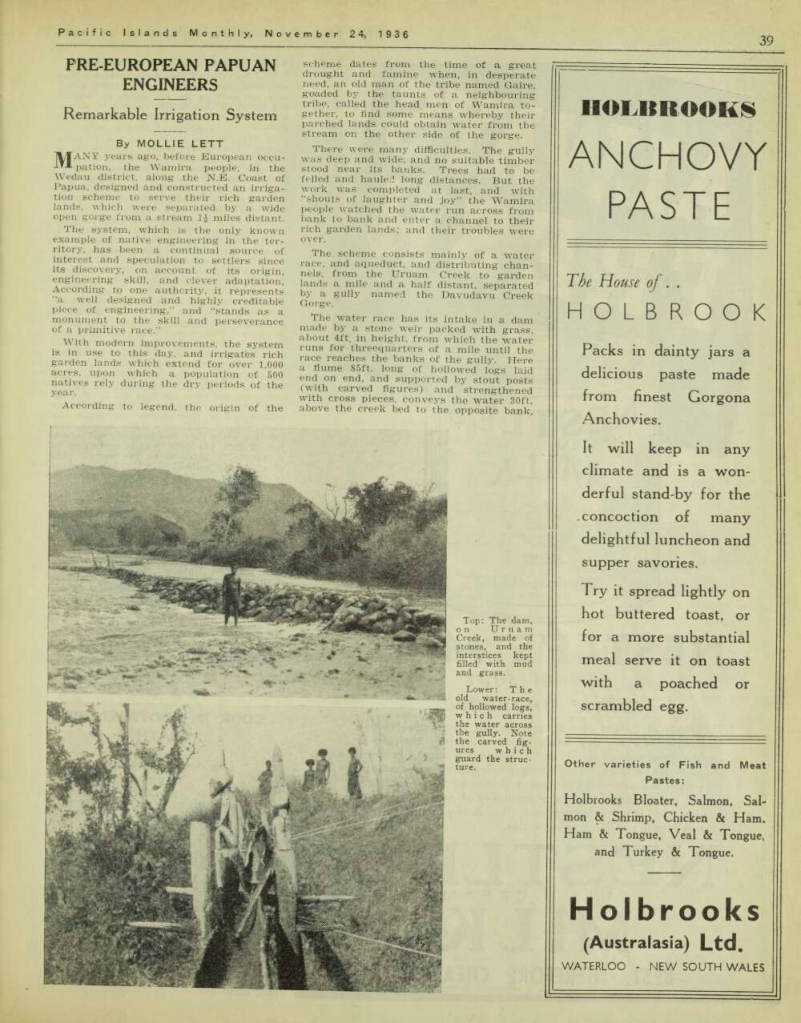
Pre-European Papuan
Engineers
By Mollie Lett
M. x ,, r AN \ years ago, before European occu pation. the Wamira people, in the Wedau district, along the N.E. Coast of Papua, designed and constructed an irriga ti°n scheme to serve their rich garden lands, which were separated by a wide open gorge from a stream 1 h miles distant.
The system, which is the only known example of native engineering in the ter ritory, has been a continual source of interest and speculation to settlers since its discovery, on account of its origin, engineering skill, and clever adaptation.
According to one authority it represents a well designed and highly creditable piece of engineering,” and “stands as a monument to the skill and perseverance of a primitive race.” icre S en upon s jss hiiarS natives rely during the dry periods of the According to legend, the origin of the
scheme dates from the time of a great drought and famine when, in desperate need, an old man of the tribe named Gaire, goaded by the taunts of a neighbouring tribe, called the head men of Wamira to gether. to find some means whereby their parched lands could obtain water from the stream on the other side of the gorge.
There were many difficulties. The gully was deep and wide, and no suitable timber stood near its banks. Trees had to be felled and hauled long distances But the work was completed at last and with “shouts of laughter and joy” the Wamira people watched the water run across from bank to bank and enter a channel to their rich garden lands; and their troubles were over.
The scheme consists mainly of a water race, and aqueduct, and distributing chan nels. from the Uruam Creek to garden i an ds a mile and a half distant, separated by a gully named the Davudavu Creek Gorge lhe water race has its intake in a dam made by a stone weir packed with grass, V s (with carved figTrLT'aTd with cross pieces, conveys the water 30ft. above the creek bed to the opposite bank,
Top: The dam, on Uruam Creek, made of stones, and the interstices kept filled with mud and grass.
Lower: The old water-race, of hollowed logs, which carries the water across the gully. Note the carved fig ures which gruard the struc ture.
where the race continues to the gardens.
The distributing channels intersect and surround the whole area of 1,000 acres, and are said to be six miles in length. 960 acres of this extent consist of a rich black flat, on which most of their taro is grown.
In 1926, at the request of the Wamira people, the Government substituted a syphon pipe line for the wooden flume of hollowed logs and made various improve ments —culverts and cement facings. The logs were in an advanced state of decay, and periodically bush fires caused a great deal of damage.
Great care is taken by the tribe to keep the main and distributing channels in order. Women are strictly forbidden to bathe in them and no one is permitted to drink from the flowing water. When the flow becomes scarce, the natives become greatly disturbed, and certain men of the tribe make incantations over the water to increase the flow; or to remove any spells that may have been cast by evil spirits.
The carved images on the upright posts in the gully represent two males and two females and were placed there by the tribe over 50 years ago as a decoration in honour of Gaire’s notable achievement.
According to native explanation, the grade of the channel was regulated by the water flowing from the dam and by digging first from the intake. When the water ceased to flow, they merely dug deeper, or vice versa; and, by these means, the existing main race was graded evenly to a fall of 30ft. per mile, which, according to a report, “appears to be the correct rate of grade for ‘critical velocity’ in this class of soil and the heavy growth of grass in the channel bed.”
Apart from the legend which assigns the origin of the irrigation system to the ingenuity of the old Wamira man, there have been many suggestions as to its source. That it may have been derived from some early Chinese immigration is one suggestion. Long before New Guinea was annexed, Chinese, engaged in beche de-mer industry, visited the south and east coast periodically in junks, sailing as far south as the Great Barrier Reef of Austra lia.
The carved images on the upright posts were placed there at a later period; the first two about 60 years ago, and the others within the knowledge of the pre sent inhabitants. Their design may have no bearing on the original structure.
Advertisements & other items, pp. 41-42 (1 item)
Anchovy
IIOIJIROOKB
PASTE
The House of . .
HOLBROOK
Packs in dainty jars a delicious paste made from finest Gorgona Anchovies.
It will keep in any climate and is a wonderful stand-by for the concoction of many delightful luncheon and supper savories.
Try it spread lightly on hot buttered toast, or for a more substantial meal serve it on toast with a poached or scrambled egg.
Other varieties of Fish and Meat Pastes: Holbrooks Bloater, Salmon, Salmon & Shrimp, Chicken & Ham.
Ham & Tongue, Veal & Tongue, and Turkey & Tongue.
Holbrooks
(Australasia) Ltd.
WATERLOO - NEW SOUTH WALES
t svv eetened comm ail ° Condensed
ss= SYDNEY
NESTLE S MILK
cannot sour
while unopened
Thousands of gallons of rich, creamy milk come info Nestle's Condenseries every day; every batch is carefully analysed to ensure uniform high quality in the finished product. In every stage of preparation, Nestle's Milk is fully protected—firstly by a hygienic manufacturing process, and then by the hermetically sealed tin, which prevents any possibility of contamination or souring while it remains unopened. That is why you can always rely on Nestle's Milk—it never varies.
NESTLES
FULL
CREAM
MILK
BEST, THEREFORE CHEAPEST
Cook Is. Footballer’S
Death
From Our Own Correspondent
Rarotonga, Oct. 4.
THERE was an animated scene of friendly rivalry as the teams of Muri and Arorangi met to play their tie for the Sports Association Cup, on Mun Beach sports ground, Rarotonga, on September 10. As common with all sports the Cook Islanders engage in, this game was a revelation of sportsmanship and clean play.
Popular Pu Napa was making a run with the ball. He had evaded three opponents when a fourth grabbed him, but he still continued to run when an other tackled him, bringing him to the ground. He managed to arise but walked only a few steps when he collapsed.
He was taken to hospital where he was found to be suffering from serious internal injuries, to which he succumbed that night.
Men Who Knew Yesterday
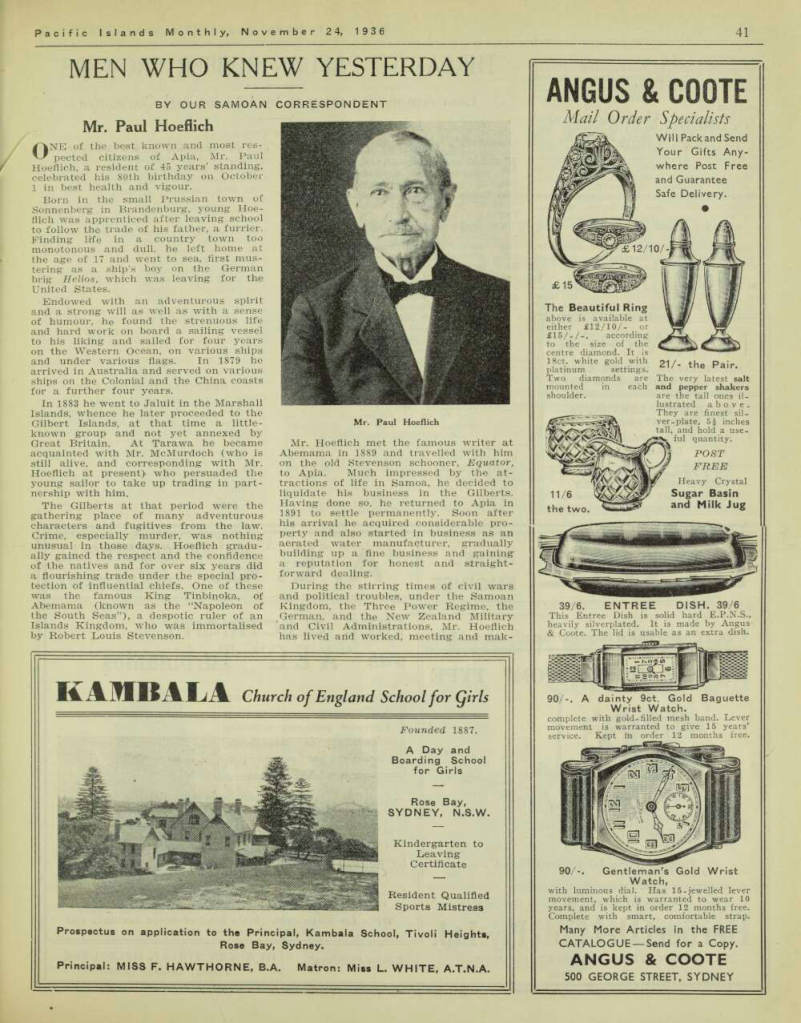
By Our Samoan Correspondent
Mr. Paul Hoeflich
ONE of the best known and most res pected citizens of Apia, Mr. Paul Hoeflich, a resident of 45 years’ standing, celebrated his 80th birthday on October 1 in best health and vigour.
Born in the small Prussian town of Sonnenberg in Brandenburg, young Hoe flich was apprenticed after leaving school to follow the trade of his father, a furrier.
Finding life in a country town too monotonous and dull, he left home at the age of 17 and went to sea, first mus tering as a ship’s boy on the German brig Helios, which was leaving for the United States.
Endowed with an adventurous spirit and a strong will as well as with a sense of humour, he found the strenuous life and hard work on board a sailing vessel to his liking and sailed for four years on the Western Ocean, on various ships and under various flags. In 1879 he arrived in Australia and served on various ships on the Colonial and the China coasts for a further four years.
In 1883 he went to Jaluit in the Marshall Islands, whence he later proceeded to the Gilbert Islands, at that time a little known group and not yet annexed by Great Britain. At Tarawa he became acquainted with Mr. McMurdoch (who is still alive, and corresponding with Mr.
Hoeflich at present) who persuaded the young sailor to take up trading in part nership with him.
The Gilberts at that period were the gathering place of many adventurous characters and fugitives from the law.
Crime, especially murder, was nothing unusual in those days. Hoeflich gradu ally gained the respect and the confidence of the natives and for over six years did a flourishing trade under the special pro tection of influential chiefs. One of these was the famous King Tinbinoka, of Abemama (known as the “Napoleon of the South Seas”), a despotic ruler of an Islands Kingdom, who was immortalised by Robert Louis Stevenson.
Mr. Hoeflich met the famous writer at Abemama in 1889 and travelled with him on the old Stevenson schooner, Equator, to Apia. Much impressed by the at tractions of life in Samoa, he decided to liquidate his business in the Gilberts.
Having done so, he returned to Apia in 1891 to settle permanently. Soon after his arrival he acquired considerable pro perty and also started in business as an aerated water manufacturer, gradually building up a fine business and gaining a reputation for honest and straight forward dealing.
During the stirring times of civil wars and political troubles, under the Samoan Kingdom, the Three Power Regime, the German, and the New Zealand Military and Civil Administrations, Mr. Hoeflich has lived and worked, meeting and mak
Mr. Paul Hoeflich
ing friends with all the prominent personalities for over 45 years. He is one of the last few living links with old Samoa, and many ar e the tales and anecdotes he remembers of those his torical days.
Genial, smiling, “Paul” (as he is called by his numerous friends) is popular and well-respected everywhere in Samoa. He has taken great interest in civic and social affairs, as well as in sport, especi ally horse-racing. One of the founders of the old German Concordia Club in 1893, he is now- President of honour.
Shortly after his arrival in Samoa Mr.
Hoeflich married, and his home life has been very happy. Of his five children two sons are living at Suva, Fiji, while his only daughter is married and re siding in America. His eldest son, Mr.
Otto Hoeflich is managing the aerated water and cordials business.
Miss B. Wingfield, of the Methodist Mis sion in Fiji, will shortly return to New Zealand to be married.
Advertisements & other items, pp. 43-44 (1 item)
Angus & Coote
Mail Order Specialists
Will Pack and Send Your Gifts Anywhere Post Free and Guarantee
Safe Delivery.
• £l5 £l2/10/ The Beautiful Ring above is available at either £l2/10/- or £l5/-/-, according to the size of the centre diamond. It is 18ct. white gold with platinum settings.
Two diamonds are mounted in each shoulder.
V 11 / 6 the two. the Paii The very latest salt and pepper shakers are the tall ones illustrated above.
They are finest silver-plate, 5i inches tall, and hold a useful quantity.
POST
FREE
Heavy Crystal
Sugar Basin
and Milk Jug
39/6. ENTREE DISH. 39/6
This Entree Dish is solid hard E.P.N.S., heavily silverplated. It is made by Angus & Coote. The lid is usable as an extra dish. 90/-. A dainty 9ct. Gold Baguette Wrist Watch. complete with gold-filled mesh band. Lever movement is warranted to give 15 years’ service. Kept in order 12 months free.
T-n IS** m Ml 90/-. Gentleman’s Gold Wrist Watch, with luminous dial. Has 15-jewelled lever movement, which is warranted to wear 10 years, and is kept in order 12 months free.
Complete with smart, comfortable strap.
Many More Articles in the FREE CATALOGUE —Send for a Copy.
ANGUS & COOTE
500 GEORGE STREET, SYDNEY
KAItfBALA Church of England School for (jirls Founded 1887. m A Day and Boarding School for Girls Rose Bay,
SYDNEY, N.S.W.
Kindergarten to Leaving Certificate Resident Qualified Sports Mistress Prospectus on application to the Principal, Kambala School, Tivoli Heights, Rose Bay, Sydney.
Principal: MISS F. HAWTHORNE, B.A. Matron: Miss L. WHITE, A.T.N.A.
M. HARPER
MANDOLIANA ISLAND, GELA
P.O. Box 6, Tulagi, Solomon Islands
RECRUITING CONTRACTS
UNDERTAKEN
A. V. PAPARI AVAILABLE FOR
CHARTER
Further details from
PACIFIC ISLANDS MONTHLY
Union House, 247 George St., Sydney
I T "V DIESEL
W I A- ENGINES
c Dcutz Engines used Internationally since 1864
MARINE DIESEL “OM” TYPE
DE Range from 10 to 140 B.H.P.
Full information obtainable from the Agents
Herbert Del Cott Pty. Ltd.
15 CASTLEREAGH STREET, SYDNEY
’Phone: B 3135
“A C (T* ” ELECTRICAL
Co \] • EQUIPMENT
FREE ELECTRICITY!
with “A E G” Turbinamos
A “Turbinamo” working from a stream generates sufficient electricity for households, plantations or communities.
Simple to Instal Reliable Supply No Running Costs Looks After Itself Sizes 0.5 kw. to 40 kw.
Write for particulars. State head of water available and Electricity output required.
Cables “Voltage” 116 QUEEN STREET, MELBOURNE ’Phone: Central 10488
Threat To Papuan Rubber Growers
Case Against Interference by International Committee
From Our Own Correspondent
PT. MORESBY, October 14.
TT ARLY in August, a memorandum was presented to Australia House in London, by the International Rubber Regulation Committee, and was for warded to Canberra and thence to Papua, The memorandum points out the great advantages that rubber growers in Papua enjoy under the restriction scheme; and, after stating- that these advantages are due to the self-imposed sacrifices of rubber producers in other countries, goes on to suggest that no encouragement be given to the extension of existing rubber plantations in Papua.
The advantages referred to are: (a) A stabilised market price at an economic figure. (b) Favourable exchange of sterling against Australian currency. (c) Remission of primage tax on Papuan rubber imported into Australia. (d) A bounty (temporary only) of 2d per lb on all rubber produced in Papua and sold in Australia. (Paid by the Commonwealth.) The fear of the Committee appears to be that, with conditions so favourable, there is danger of the extension of rubber areas in Papua to a point at which Papuan exports may exercisd an adverse influence upon world-supply.
Admittedly, the conditions are favour
able to the rubber grower in Papua; but it appears that considerable encourage ment will be needed if further capital is to be risked in further development.
In 1926, Holland refused to join the Stevenson scheme for restriction of rubber output for the very good reason that she could see no advantage to her self in doing so. And it does not seem unreasonable that Australia also should consult her own convenience in the matter of rubber supplies.
Papua is Australia’s only non-foreign source of supply in the matter of rubber.
And Papua at present produces only about one-sixteenth of the Australian annual consumption, from a total planted area of just under 9000 acres. The case of other rubber producing countries is different. They have the world for their market; and they can glut that market with surplus rubber without approaching their maximum production.
Peculiar Disabilities
HPHE question has another aspect. Papua was made a British Protectorate in 1884, and was annexed in 1888; and it became a Territory of the Commonwealth in 1906. And in fifty-two years of Euro pean occupation, which period includes thirty years of Australian rule, it has not attracted a sufficient volume of settle ment or investment to provide its modest revenue without substantial help from Australia.
Out of a total area of fifty-nine million
acres in Papua, only fifty-eight thousand are under cultivation, representing a little less than one acre in each thousand of Papua’s extent. This meagre result is due, not to the poverty of the country, but to the peculiar disabilities imposed upon it by Australia’s political necessi ties.
Australia, being Papua’s natural mar ket, and the only possible one for the majority of her products, it is upon Aus tralian marketing conditions that Papua’s prosperity must depend. Yet it is due solely to the severity of these conditions that Papua has struggled vainly for so many years to build up economic inde pendence.
Papua’S Dismal Industrial
History
THE two great evils against which A Papua has to contend apart from her bounties, w r hich are negligible in their effects, are: (a) an adverse tariff de signed to protect Australian producers, and (b) the restriction of shipping ser vices to Australian vessels, which has resulted in a virtual monopoly to one shipping firm, and in the high rates and costly inconvenience that usually spring from monopoly.
Of the many industries that have been started in Papua very nearly all have failed.
Copra is barely paying its way in an uncertain market and against heavy transport costs. Coir fibre, which, as a by-product of copra, might help plantation finances, costs more than the market price in freight alone. Coffee is not paying.
Hemp, though of first-class quality, could not cope with the cost of transport.
Tobacco, maize, and fruits, for which the Papuan soil and climate are particularly suitable, cannot face Australia’s adverse tariff.
Timber is excluded by a prohibitive duty and also by excessive freights.
There is a vast amount of copper in Papua, but it cannot be produced profit ably. Sixty years of continuous pros pecting has failed to discover payable quantities of gold, except on the little island of Misima.
Oil, which is believed to exist in large quantities, was taken out of Papua’s hands by the Commonwealth in 1912, and serious search for it is only now begin ning. And the economic cultivation of sugar, for which Papua is particularly well equipped, is rendered impossible by the exclusion of Papuan sugar from the British Preference quota.
Papua’S Main Hope
J>UBBER remains, the only product to which Papua can look for economic independence. There is a great extent of suitable land for its culture. The climate is favourable, and costly shipping does not affect it seriously.
And there are encouraging signs that, given the assurance of a stable price and reasonable profit on invested capital, the area of rubber may be greatly increased, possibly even to the point at which Aus tralia may draw the whole of her supplies from Papua.
If, on the other hand, undue weight is given to the suggestions of the Rubber Regulation Committee, Papua’s plight will become desperate.
The colony’s small revenue is, and has been for years, inadequate to cope with the necessary demands of administration.
Government influence is still spreading among the primitive inhabitants, and increasing control cannot be divorced from growing expenditure.
Australia has been restive under the
need for payment of an annual subsidy; but unless something is done, and done soon, to encourage industry,in Papua, it will become necessary not only to con tinue the subsidy and to continue it indefinitely, but to increase it very con siderably.
Rev. Father J. Deihl, of the Roman Catholic Mission at Apia, Western Samoa, returned early in October from a visit to the Tokelau Group on. board the B.P. schooner Makoa,
Mr. E. G. Theodore, who has a controll ing interest in Emperor Mines Ltd., and other companies on the Tavua goldfield, Fiji, arrived in Australia by the Mariposa early in October.
Mr. Michael Leahy has been awarded the Murchison Grant by the Council of the Royal Geographical Society, “for his explorations of Central New Guinea.” The Cuthbert Peek Grant has been awarded to Mr. T. H. Harrison, “to assist him in his proposed expedition to New Guinea.”
Advertisements & other items, pp. 44-45 (2 items)
42
Monthly, November 24, 1936
Pacific Island
Cordage and
Ship ( handier]!' —II ardtvare
/Write for / Ship Chandlery /
Catalogue J
Special “In Bond” Prices for all Islands enquiries quoted on application.
BROOMFIELDS LIMITED
152 SUSSEX STREET :: :: SYDNEY
Cables: “BOOM,” Sydney Large and Complete Stocks of
SHIP CHANDLERY
IRONMONGERY OF ALL KINDS, PAINTS,
WHITE LEAD AND OILS
Sole Agents for: P. H. MUNTZ & CO.’S 3-CROWN BRAND METAL SHEATHING.
PEACOCK & BUCHANS’ ENGLISH READY-MIXED PAINTS.
“Mokarnie ”COTTON TEXTILES
A. B. Brotherton & Co. Ltd.
(Arnold B. Brotherton )
GOVERNMENT CONTRACTORS
40 DICKINSON STREET, MANCHESTER, 1
Manufacturers of “MOKARNIE” Fabrics, Joker-Brand, etc. Lava-Lavas, Pearl Divers’ Khaki Drills, Denims Shirtings, Longcloths, Italians, Linings, etc. suitable for the South Pacific Trade.
NO DIRECT TRADE.—Orders only through European Houses.
Scott’s Renown Brand Rope,
Cordage and
Cable Address: Ropeyard, Sydney.
MWMM
3 ■ V
Binder
Twine
of Every
Description
e>
MANUFACTURED AT
MASCOT, N.S.W.
By
J. Scott Ltd.
Head Office and Store:
163 CLARENCE ST.,
SYDNEY, N.S.W.
Wrong Ideas About
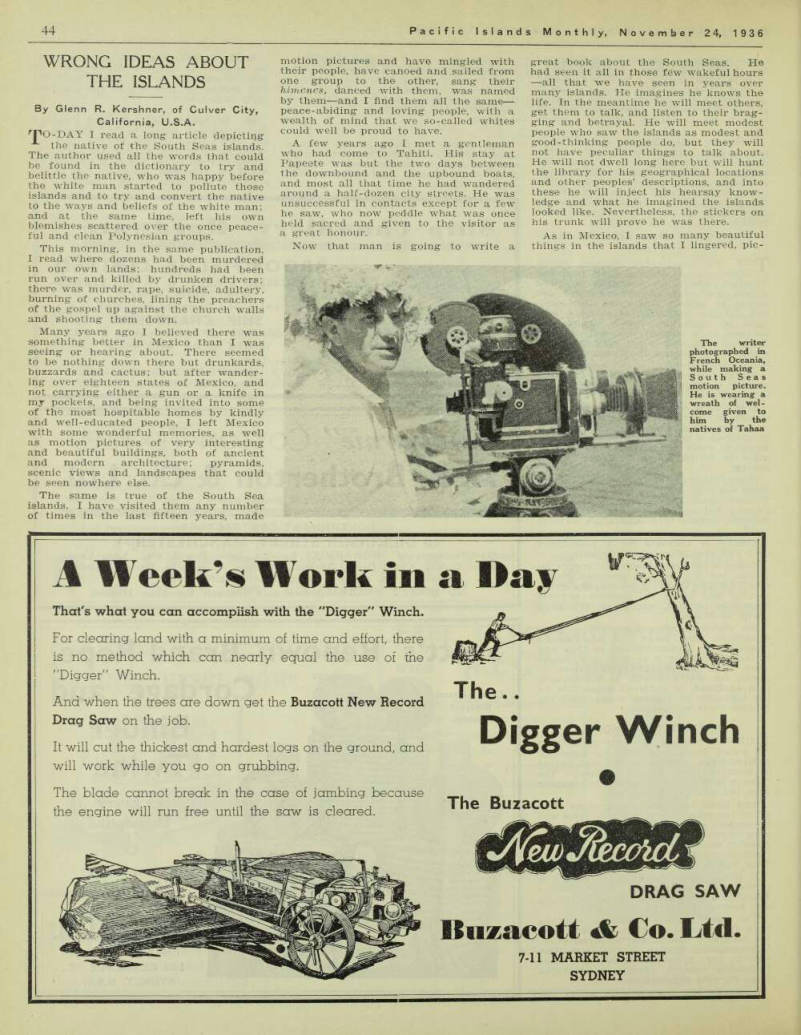
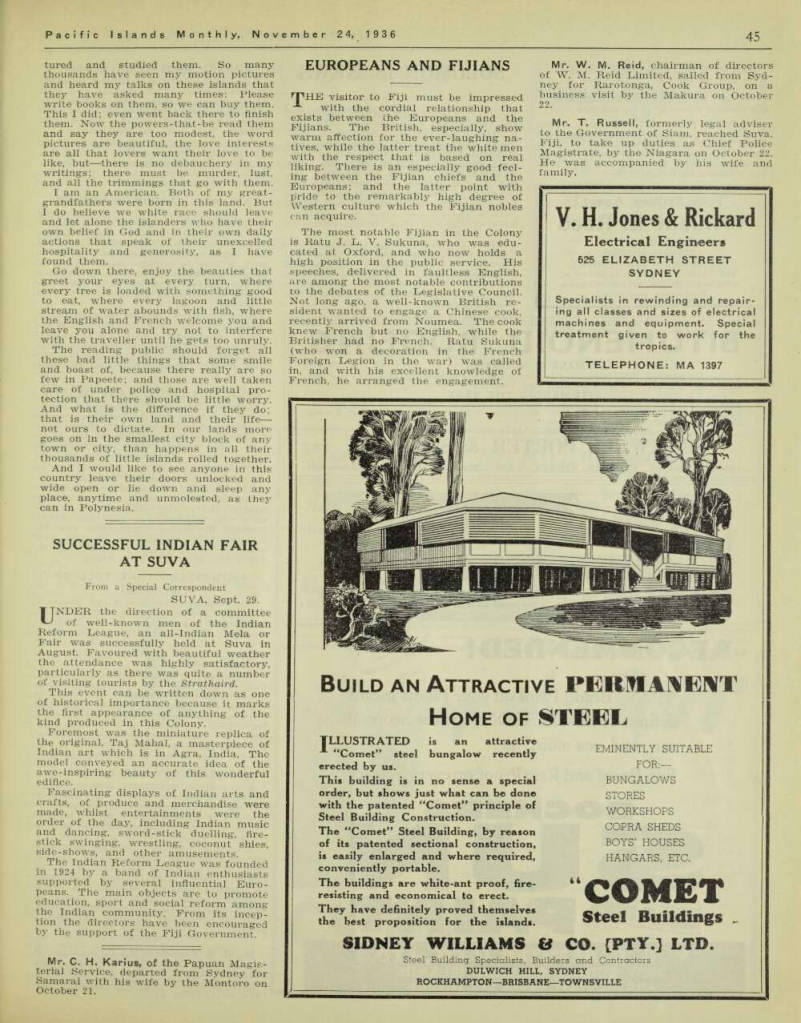
The Islands
By Glenn R. Kershner, of Culver City, California, U.S.A.
r pO-DAY I read a long article depicting A the native of the South Seas islands.
The author used all the words that could be found in the dictionary to try and belittle the native, who was happy before the white man started to pollute those islands and to try and convert the native to the ways and beliefs of the white man; and at the same time, left his own blemishes scattered over the once peace ful and clean Polynesian groups.
This morning, in the same publication.
I read where dozens had been murdered in our own lands: hundreds had been run over and killed by drunken drivers; there was murder, rape, suicide, adultery, burning of churches, lining the preachers of the gospel up against the church walls and shooting them down.
Many years ago I believed there was something better in Mexico than I was seeing or hearing about. There seemed to be nothing down there but drunkards, buzzards and cactus; but after wander ing over eighteen states of Mexico, and not carrying either a gun or a knife in my pockets, and being invited into some of the most hospitable homes by kindly and well-educated people, I left Mexico with some wonderful memories, as well as motion pictures of very interesting and beautiful buildings, both of ancient and modern architecture; pyramids, scenic views and landscapes that could be seen nowhere else.
The same is true of the South Sea islands. I have visited them any number of times in the last fifteen years, made
motion pictures and have mingled with their people, have canoed and sailed from one group to the other, sang their himenes, danced with them, was named by them —and I find them all the same— peace-abiding and loving people, with a wealth of mind that we so-called whites could well be proud to have.
A few years ago I met a gentleman who had come to Tahiti. His stay at Papeete was but the two days between the downbound and the upbound boats, and most all that time he had wandered around a half-dozen city streets. He was unsuccessful in contacts except for a few he saw, who now peddle what was once held sacred and given to the visitor as a great honour.
Now that man is going to write a
great book about the South Seas. He had seen it all in those few wakeful hours —all that we have seen in years over many islands. He imagines he knows the life. In the meantime he will meet others, get them to talk, and listen to their brag ging and betrayal. He will meet modest people who saw the islands as modest and good-thinking people do, but they will not have peculiar things to talk about.
He will not dwell long here but will hunt the library for his geographical locations and other peoples’ descriptions, and into these he will inject his hearsay know ledge and what he imagined the islands looked like. Nevertheless, the stickers on his trunk will prove he was there.
As in Mexico, I saw so many beautiful things in the islands that I lingered, pic-
The writer photographed in French Oceania, while making a South Seas motion picture.
He is wearing a wreath of wel come given to him by the natives of Tahaa
tured and studied them. So many thousands have seen my motion pictures and heard my talks on these islands that they have asked many times: Please write books on them, so we can buy them.
This I did; even went back there to finish them. Now the powers-that-be read them and say they are too modest, the word pictures are beautiful, the love interests are all that lovers want their love to be like, but —there is no debauchery in my writings; there must be murder, lust, and all the trimmings that go with them.
I am an American. Both of my great grandfathers were born in this land. But I do believe we white race should leave and let alone the islanders who have their own belief in God and in their own daily actions that speak of their unexcelled hospitality and generosity, as I have found them.
Go down there, enjoy the beauties that greet your eyes at every turn, where every tree is loaded with something good to eat, where every lagoon and little stream of water abounds with fish, where the English and French welcome you and leave you alone and try not to interfere with the traveller until he gets too unruly.
The reading public should forget all these bad little things that some smile and boast of, because there really are so few in Papeete; and those are well taken care of under police and hospital pro tection that there should be little worry.
And what is the difference if they do; that is their own land and their life — not ours to dictate. In our lands more goes on in the smallest city block of any town or city, than happens in all their thousands of little islands rolled together.
And I would like to see anyone in this country leave their doors unlocked and wide open or lie down and sleep any place, anytime and unmolested, as they can in Polynesia,
Advertisements & other items, p. 46 (1 item)
Digger Winch
A Week’s Work in
That's what you can accomplish with the "Digger" Winch.
For clearing land with a minimum of time and effort, there is no method which can nearly equal the use of me "Digger" Winch.
And when the trees are down get the Buzacott New Record Drag Saw on the job.
It will cut the thickest and hardest logs on the ground, and will work while you go on grubbing.
The blade cannot break in the case of jambing because the engine will run free until the saw is cleared. a
a Day
v
The..
Digger Winch
The Buzacott 9
DRAG SAW
Buzacott Co. Ltd.
7-11 MARKET STREET
SYDNEY
Successful Indian Fair
At Suva
From a Special Correspondent SUVA, Sept. 29.
TINDER the direction of a committee of well-known men of the Indian Reform League, an all-Indian Mela or Fair was successfully held at Suva in August. Favoured with beautiful weather the attendance was highly satisfactory, particularly as there was quite a number of visiting tourists by the Strathaird.
This event can be written down as one of historical importance because it marks the first appearance of anything of the kind produced in this Colony.
Foremost was the miniature replica of the original, Taj Mahal, a masterpiece of Indian art which is in Agra, India. The model conveyed an accurate idea of the awe-inspiring beauty of this wonderful edifice.
Fascinating displays of Indian arts and crafts, of produce and merchandise were made, whilst entertainments were the order of the day, including Indian music and dancing, sword-stick duelling, fire stick swinging, wrestling, coconut shies, side-shows, and other amusements.
The Indian Reform League was founded in 1924 by a band of Indian enthusiasts supported by several influential Euro peans. The main objects are to promote education, sport and social reform among the Indian community. From its incep tion the directors have been encouraged by the support of the Fiji Government.
Mr. C. H. Karlus, of the Papuan Magis terial Service, departed from Sydney for Samarai with his wife by the Montoro on October 21.
Europeans And Fijians
THE visitor to Fiji must be impressed A with the cordial relationship that exists between the Europeans and the Fijians. The British, especially, show warm affection for the ever-laughing na tives, while the latter treat the white men with the respect that is based on real liking. There is an especially good feel ing between the Fijian chiefs and the Europeans; and the latter point with pride to the remarkably high degree of Western culture which the Fijian nobles can acquire.
The most notable Fijian in the Colony is Ratu J. L. V. Sukuna, who was edu cated at Oxford, and who now holds a high position in the public service. His speeches, delivered in faultless English, are among the most notable contributions to the debates of the Legislative Council.
Not long ago, a well-known British re sident wanted to engage a Chinese cook, recently arrived from Noumea. The cook knew French but no English, while the Britisher had no French. Ratu Sukuna (who won a decoration in the French Foreign Legion in the war) was called in, and with his excellent knowledge of French, he arranged the engagement.
Mr. W. M. Reid, chairman of directors of W. M. Reid Limited, sailed from Syd ney for Rarotonga, Cook Group, on a business visit by the Makura on October 22.
Mr. T. Russell, formerly legal adviser to the Government of Siam, reached Suva, Fiji, to take up duties as Chief Police Magistrate, by the Niagara on October 22.
He was accompanied by his wife and family.
Miss M. Ward, of the Methodist Mission, who has. served for three years in the New Britain District in the Mandated Territory of New Guinea, returned to Queensland recently to be married.
Mr. W. S. Flower, who has been a sub inspector in the Fiji Constabulary for seven years, has resigned from the ser vice. He departed from Suva en route to England with his wife and family by the Niagara on October 23.
Advertisements & other items, pp. 47-48 (1 item)
Comet
V. H. Jones & Rickard
Electrical Engineers
525 ELIZABETH STREET
SYDNEY
Specialists in rewinding and repairing all classes and sizes of electrical machines and equipment. Special treatment given to work for the tropics.
TELEPHONE: MA 1397
I M
BIT i
Build an Attractive PERMANENT
Home of STEEL
TLLUSTRATED is an attractive “Comet” steel bungalow recently erected by us.
This building is in no sense a special order, but shows just what can be done with the patented “Comet” principle of Steel Building Construction.
The “Comet” Steel Building, by reason of its patented sectional construction, is easily enlarged and where required, conveniently portable.
The buildings are white-ant proof, fireresisting and economical to erect.
They have definitely proved themselves the best proposition for the islands.
EMINENTLY SUITABLE
FOR:—
BUNGALOWS
STORES
WORKSHOPS
COPRA SHEDS
BOYS' HOUSES
HANGARS, ETC.
COMET
Steel Buildings .
SIDNEY WILLIAMS & CO. [PTY.] LTD.
Steel Building Specialists, Builders and Contractors
DULWICH HILL. SYDNEY
ROCKHAMPTON—BRISBANE—TOWNSVILLE
Your Sydney Agent?
William E. Reed
(Established 1913)
UNION HOUSE
247 GEORGE ST., SYDNEY
Shell sold, and goods supplied at wholesale prices, on commission.
Enquiries welcomed.
BITUMENOID ROOFING
MADE IN AUSTRALIA
Bitumenoid Roofings, Dampcourses and Insulating Felts are made from the world’s best raw materials. Warranted to stand the most rigid tests.
BITUMENOID THE BEST
Roofing, 1,2, 3-ply; Flooring, Waterproof Materials; Saturated Felt; Resilient Road Jointing; Natural Asphalt Dampcourse; 2 and 3-ply Dampcourse; l-21b. Lead-core Dampcourse; Roofing Cement; Asphalt Paints; Roofing Compound.
SAMPLES AND PRICE LISTS ON APPLICATION
MAXWELL PORTER & SON LTD.
ESTABLISHED 1888. BUILDERS’ SUPPLIES
107 REDFERN ST., REDFERN, SYDNEY, N.S.W. ’Phone, M 3157. Cables Bitumenoid
V?
T' mm * Hfc- *
RECOMMENDED!
"SUN” Brand Paint on your Home means
definite PROTECTION against tropical
sun and sea-moist air.
Sun Proof and Rain Proof on every Surface
DOCKERS
U N
PAINT
W. R. CARPENTER & CO., LTD.
NEW GUINEA, SOLOMON ISLANDS
and all other South Sea Islands.
Solomon Is. News
From Our Own Correspondent.
Tulagi, Oct. 4.
IT was learned with regret recently that Mrs. Rose Statham, formerly a well known Solomon Islands resident, had died of pneumonia in the Prince Alfred Hos pital, Sydney, in August. Since the death of her husband, Mr. G. H. Statham, she had lived in Sydney to educate her son, but prior to that had lived at the Marovo Lagoon, where her husband died. Older settlers and all who knew Mrs. Statham will feel the loss of a sterling character and a good friend.
While on leave from Gatere Estate, Ysabel, which he had managed for several years, Mr. W. M. Maguire recently died in Brisbane, only a few weeks before he was due to return to the Solomons.
“Mac,” who was popular everywhere, will be greatly missed.
Guadalcanal Gold Search
Another prospecting party has returned to Guadalcanal. The original and best known mining venture there, Pioneer Ex pedition N.L., continues to go ahead with inspections with an optimism which must certainly have some justification.
It is a pity that the long-promised Mining Regulations continue to hang fire, probably holding up a much needed new industry. However, it is felt that there cannot be much more delay.
Air Mail Facilities Needed
At present there are no arrangements whereby letters to go by air mail can be despatched through the Solomon Islands Post Office. Though no air lines call here, residents frequently wish to post letters to catch planes in New Guinea, Brisbane, or Sydney; these have to be enclosed in other letters and re posted in Australia or in the Mandated Territory.
If some form of air postage were arranged here, much trouble would be saved, and the air mail would be largely used where, without it, letters are so long in transit. There seems no insurmount able obstacle; probably it has not been thought of.
Epidemics Cause Many Deaths
Sickness has been visiting the Solo mons with very serious results. An ail ment resembling beriberi broke out among the labour in Vanikoro, the death rate being rather high. Practically all the surviving labour were returned to their homes.
A form of meningitis has taken toll of the islanders of Malaita, on which the Group is chiefly dependant for its labour supply. Before the epidemic had cleared up a very fatal form of influenza spread through the island. Apparently the ’flu is more fatal on Malaita than on any other of the Solomon Islands, and the death rate is always very heavy.
Sou’Easters Take Toll Of
Shipping
The inclement weather which has per sisted for several months seems now to have eased to prepare us for the Nor’west season. The South-easters have taken toll of shipping, and there have been many miserable mariners weary of battling against them.
In Tulagi Harbour it has been so rough, that it is a risky and troublesome busi ness to board the steamer when she is leaving for Sydney. In fact, there has been an agitation to have the steamer leave from the wharf, or to provide pon toons for the safety and convenience of passengers, if the ship is to remain in the stream when about to leave the Group.
Treatment For Lepers
A prominent missionary society, recog nising the serious number of cases of leprosy in the Solomons, particularly on Malaita, is making efforts to get land to enable these unfortunates to receive treatment.
A suitable area will possibly be found, although without legislation to compel them, it is not likely that natives will be eager to leave their homes, even with the hope of relief and possibly cure under modern treatment. It is to be hoped the effort to establish a leper settlement meets with the necessary backing and assist ance. ■ Mr. B. B. Perriman, M.L.C., manager of Messrs. W. R. Carpenter and Co. Limited’s branch at Rabaul, returned to New Guinea after furlough in Australia by the Nep tuna on October 21.
The Search For Oil In Papua
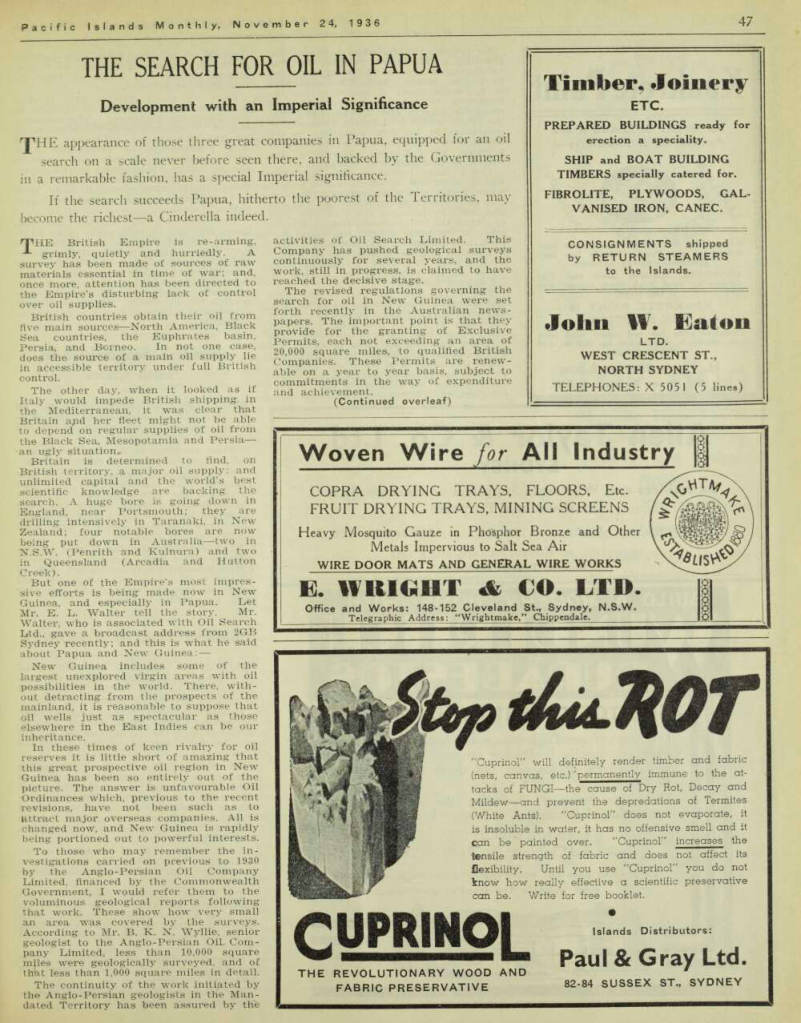
Development with an Imperial Significance
appearance of those three great companies in Papua, equipped for an oil search on a scale never before seen there, and backed by the Governments in a remarkable fashion, has a special Imperial significance.
If the search succeeds Papua, hitherto the poorest of the Territories, may become the richest —a Cinderella indeed.
rpHE British Empire is re-arming, grimly, quietly and hurriedly. A survey has been made of sources of raw materials essential in time of war; and, once more, attention has been directed to the Empire’s disturbing lack of control over oil supplies.
British countries obtain their oil from five main sources —North America, Black Sea countries, the Euphrates basin, Persia, and Borneo. In not one case, does the source of a main oil supply lie in accessible territoi'y under full British control.
The other day, when it looked as if Italy would impede British shipping in the Mediterranean, it was clear that Britain ajxd her fleet might not be able to depend on regular supplies of oil from the Black Sea, Mesopotamia and Persia— an ugly situation, Britain is determined to find, on British territory, a major oil supply: and unlimited capital and the world’s fyest scientific knowledge are backing the search. A huge bore is. going down in England, near Portsmouth; they are drilling intensively in Taranaki, in New Zealand; four notable bores are now being put down in Australia —two in N.S.W. (Penrith and Kulnura) and two in Queensland (Arcadia and Hutton Creek).
But one of the Empire's most impres sive efforts is being made now in New Guinea, and especially in Papua. Let Mr. E. L. Walter tell the story. Mr.
Walter, who is associated with Oil Search Ltd., gave a broadcast address from 2GB Sydney recently; and this is what he said about Papua and New Guinea: — New Guinea includes some of the largest unexplored virgin areas with oil possibilities in the world. There, with out detracting from the prospects of the mainland, it is reasonable to suppose that oil wells just as spectacular as those elsewhere in the East Indies can be our inheritance.
In these times of keen rivalry for oil reserves it is little short of amazing that this great prospective oil region in New Guinea has been so entirely out of the picture. The answer is unfavourable Oil Ordinances which, previous to the recent revisions, have not been such as to attract major overseas companies. All is changed now, and New Guinea is rapidly being portioned out to powerful interests.
To those who may remember the in vestigations carried on previous to 1930 by the Anglo-Persian Oil Company Limited, financed by the Commonwealth Government, I would refer them to the voluminous geological reports following that work. These show how very small an area was covered by the surveys.
According to Mr. B. K. N. Wyllie, senior geologist to the Anglo-Persian Oil. Com pany Limited, less than 10,000 square mpes were geologically surveyed, and of that less than 1,000 square miles in detail.
The continuity of the work initiated by the Anglo-Persian geologists in the Man dated Territory has been assured by the
activities of Oil Search Limited. This Company has pushed geological surveys continuously for several years, and the work, still in progress, is claimed to have reached the decisive stage.
The revised regulations governing the search for oil in New Guinea were set forth recently in the Australian news papers. The important point is that they provide for the granting of Exclusive Permits, each not exceeding an area of 20,000 square miles, to qualified British Companies. These Permits are renew able on a year to year basis, subject to commitments in the way of expenditure and achievement. (Continued overleaf)
Sir George Pearce, when notifying the granting of Exclusive Permits covering an aggregate area of 52,000 square miles in Papua, stated that —“The conditions of a Permit make it necessary for the permittee to conduct a thorough and energetic search, and it was hoped that the seach would lead to the discovery of petroleum in payable quantities in the Territories.” This is a hope with every promise of fulfilment, providing the search is thorough and energetic.
The Permits issued to date in Papua which cover an area of 52,000 square miles, have been allocated as follows; One of 20,000 square miles in the Western and Delta Divisions of the Territory, goes to Papua Oil Development Ltd.; a similar area, in the same district, to Island Ex plorations Company Pty. Ltd. and a third in the Gulf and Delta Divisions to Oriomo Oil Limited. This latter Permit covering 12,000 square miles will be worked by Oil Search Limited.
The stage, now set for the thorough and energetic search essential to success, emphasises the regard in which the oil prospects of Papua are held. Nothing can be more impressive to the public than to know that the activities of Papua Oil Development Co. Ltd. are to be conducted under the auspices of the Shell Company, and the activities of Island Explorations Co. are under the auspices of the Vacuum Oil Company. These powerful companies,
through manifesting such keen interest in the acquisition of Permits in Papua, give a lead to the people of Australia that must be followed.
Fully as much interest also is dis played in the acquisition of Permits in the Mandated Territory. The outcome, soon to be announced by the Minister, is awaited with interest. Oil Search Limited will, presumably, be generously dealt with, considering the advanced stage of the geological explorations of that com pany in the Sepik District south of the Torricelli Mountains, which have been so diligently pushed during the past several years.
The New Guinea Gazette, No. 433, dated January 15, 1936, takes in an addi tional area of 2,200 square miles there previously “uncontrolled,” with a popu lation exceeding 20,000. It is only proper to state that this has been made possible through the activities of Oil Search Limited’s survey parties, which have contributed greatly to the establishment of friendly relations with the native in habitants.
Advertisements & other items, pp. 49-50 (1 item)
Ruprinoi
Timber, Joinery
ETC.
PREPARED BUILDINGS ready for erection a speciality.
SHIP and BOAT BUILDING
TIMBERS specially catered for.
FIBROLITE, PLYWOODS, GAL-
VANISED IRON, CANEC.
CONSIGNMENTS shipped
by RETURN STEAMERS
to the Islands.
John W. Ealon
LTD.
WEST CRESCENT ST.,
NORTH SYDNEY
TELEPHONES: X 5051 (5 lines)
Woven Wire for All Industry
COPRA DRYING TRAYS. FLOORS, Etc.
FRUIT DRYING TRAYS. MINING SCREENS
Heavy Mosquito Gauze in Phosphor Bronze and Other Metals Impervious to Salt Sea Air WIRE DOOR MATS AND GENERAL WIRE WORKS
E. WItIGUT <& CO. LTD.
Office and Works: 148-152 Cleveland St., Sydney, N.S.W.
Telegraphic Address: “Wrightmake," Chippendale. a o fa m
''Cuprinol'' will definitely render timber and fabric (nets, canvas, etc.) ''permanently immune to the attacks of FUNGl—the cause of Dry Rot. Decay and Mildew —and prevent the depredations of Termites (White Ants). "Cuprinol" does not evaporate, it is insoluble in water, it has no offensive smell and it can be painted over. "Cuprinol" increases the tensile strength of fabric and does not affect its flexibility. Until you use "Cuprinol” you do not know how really effective a scientific preservative can be. Write for free booklet.
rUPRINOI
THE REVOLUTIONARY WOOD AND
FABRIC PRESERVATIVE
Islands Distributors:
Paul & Gray Ltd.
82-84 SUSSEX ST., SYDNEY
Konkrete Paint
For EVERY SURFACE where Permanence is Imperative--! m Adaptability for the varying climatic conditions of the Pacific Islands has been abundantly proved by users.
KONKRETE Standard Gloss and Flat Colours for wood, brick, fibre, cement, iron and stone.
KONKRETE PAINT IS
THE SOLUTION
Complete price list and colour card from sole wholesale distributors for N.S.W. and Pacific Islands.
H. Florentine and Son
321 Pitt Street, Sydney, N.S.W.
Allen Taylor & Co. Ltd.
SYDNEY
Sawmillers and Wholesale Suppliers of Hardwoods for Constructional Purposes GIRDERS . . . PILES . . . POLES . . . SLEEPERS, ETC.
EXPORTING TO PACIFIC ISLANDS SINCE 1893
Cables: Tuxedo, Sydney
BUILD A MODERN HOME WITH
fl I K » ft »
ASBESTOS CEMENT BUILDING SHEETS
Low cost with good appearance and endurance is assured when you specify Durabestos for walls and ceilings in new buildings or for additions or repairs to existing structures.
Write for literature illustrating the new horizontal application of Durabestos, in modern buildings.
WUNDERLICH LTD..
Crown and Cleveland Sts., Redfern SYDNEY Durabestos does not require skilled labour to erect, and is most suitable for tropical dwellings.
Japanese Soapmakers In North China
North China
THE following paragraph from an American shipping journal was pub lished recently in the bulletin 5f the Fiji Coconut Planters’ Union: “Time marches on in the Far East — and so does the Japanese army of trade.
“From Shanghai comes the report that Japanese soap manufacturers have just purchased the Lever Brothers (British) Velvet Soap Company, which has been operating in China for a long time, and announced plans to build a large soap factory in North China.
“The Japanese decided it was impos sible to sell a large quantity of soap in China when there is an import duty of 30 per cent. Hence, the Japanese will evade the duty by owning and operating their own plants in China.”
Cement For New Guinea
THERE has been quite a row in official circles in Australia because the Ad ministration of New Guinea in June last bought 1,000 casks of Japanese cement.
Labour members of the Commonwealth Parliament have been asking Federal ministers why the Administration bought the Japanese instead of the Australian product.
Sir George Pearce, the responsible minister, said that quotations, closing on June 26, were invited, but that no brand of cement was specified. The only quo tations submitted were for Japanese and Danish cement, and the Administration ordered “Onoda” cement at 9/5| per cask, c.i.f.e., Rabaul.
Then members asked the name of the newspaper in which the Government notice was published inviting the quota tions.
The Minister said that tenders were not called, but quotations were invited by the N.G. Administration. Probably, con tinued the Minister, the importers dealing in this commodity in Rabaul were invited to submit prices.
Senator Collings (Queensland): The cement interests in Australia were not aware of the matter.
The Minister: They could not have sup plied it, in any case.
Samoan Mau Harasses N.Z.
Prime Minister
Extraordinary Political Ferment Follows “Reforms” of “Goodwill Mission”
W/ESTERN SAMOA is in a ferment again.
For several years, while Samoa was ruled in muddle-headed fashion by a Conser vative New Zealand government, a fierce agitation was maintained by the Mau (otherwise the radicals, or nationalists, or revolutionaries), one leader of which was Mr. O. F. Nelson, who was deported.
Then a Socialist (government took power in N.Z. It returned Mr. Nelson to Samoa, and sent there also a well-intentioned, footling “Goodwill Mission,” which gave political recognition to the Mau, and allowed that body to understand that it virtually would govern Samoa in future. That was in July last.
The “Mission” went back to New Zealand, and said that it had settled all Samoa’s troubles and established political peace.
The P.I.M. challenged that statement, and asserted that the Mission had made confusion worse confounded. The Prime Minister of N.Z., in September, said that the Editor of the P.I.M. did not know what he was talking about. Since then; — 1. The Mau has taken charge of the Samoan native parliament (fono), and has behaved in so high-handed and irresponsible a fashion that it has aroused the sharp hostility of both the European and the moderate Samoan communities. 2. The European community has formed anew party to protect itself. 3. The moderate Samoan section, angered especially by an insult to High Chief Malietoa, is forming anew Party to resist the Mau.
The New Fono Causes
A Stir
From Our Own Correspondent
Apia, Oct. 22.
AMONG the concessions granted to the Samoans during the visit of the New Zealand “Goodwill Mission” in July was the election of a new Native Parliament (Fono of Faipule ) by the various districts of Samoa, to be convened on September 30. The previous parliament, which con sisted of Faipule appointed by the Admini strator, and in consequence composed of “loyalists” only, was to continue in session, conjointly with the newly elected parlia ment, until the close of its regular legisla tive period (another 18 months) with the proviso that if the old Faipule resigned, they were to be paid for these 18 months at their normal rate of pay, £10 per year.
On September 30 the new Fono was opened at Mulinu’u. The Acting Admini strator (Mr. A. C. Turnbull) was present.
The 34 former “loyalist” Faipule sat with the newly elected Faipule, numbering 39.
At the close of the first session it was announced that the old Faipule would re sign and leave the field to the new Faipule.
The former were then paid for their un ,expired 18 months (£15 each —a total of £510).
The new Fono, composed of 31 Mau members and 8 “loyalists,” then despatched a wireless message to the Prime Minister of New Zealand, asking a guarantee that the new method of electing the Faipule, instead of appointing them, should be fixed by legislation in N.Z.
On receipt of this guarantee the Fono resumed its sittings.
Through its appointed speaker, a young chief named Alipia, who is a prominent member of the Mau, the Fono then decided to radio the following remits to the N.Z.
Government: 1. That the High Chiefs, Malietoa and Tuimalealiifano, be appointed Fautua (ad visers to the Government) and that Mr.
O. ,P. Nelson be appointed Fa’atonu (Adviser and liaison officer between the Administra tion and the Samoans) and that the two Fautua and the Fa’atonu together attend and take part in the Fono.
2, That all Chinese be sent away from Samoa.
The Prime Minister replied, approving of the appointment of the two Fautua. Re garding the appointment of Mr. Nelson, he said that Mr. Nelson could stand as a European candidate for the next election to the Legislative Council. If, however, he wanted to act as Samoan representative, Fa’atonu or Faipule, he must change his status to that of a Samoan, or act as ad viser to the Faipule in an unofficial ca pacity.
Regarding the Chinese problem, the Prime Minister stated that the present contract with the Chinese labourers does not expire for a year and that the “Good will Delegation” has recommended for con sideration that no further contract with Chinese be made.
The Fono proceeded.
(Continued On Page 50)
A Matter Of Fees
During the visit of the “Goodwill Mis sion” the Man had agreed to an annual payment of £ls for each Faipulc and, in addition, a sustenance allowance of 8/per day.
This did not prevent the Faipule from suddenly proposing that their pay be £6O per annum and a sustenance allowance of 14/- per day, and from haggling for several days over these new demands.
Eventually, they made their claim £36 per annum (subject to investigation by a special Finance Board) plus sustenance allowance of 8/- per day.
Alipia criticised the high salaries of European officials as compared with the small remuneration of native officials.
The Acting Administrator replied that the European officials had to be paid ac cording to the work they performed, and their ability, and that the rates were simi
lar to those paid in other territories. In any event, the officials were appointed by New Zealand, and the Fono had no control over them.
Alipia said that the European officials were paid with the money of the Samoans.
Mr. Turnbull replied that the money came also from Europeans.
Insult To Malietoa
A remit was advanced by the Fono, to appoint as Samoan members of the Legis lative Council Mr. Nelson (Taisi), Fau muina Fiame, Tamasese and Tualatula; and to ask the present Samoan representa tive in the Council (Hon. Malietoa Tanu, 0.8. E.) to resign.
A letter was read from the representa tives of the Malietoa Family—the highest and most influential clan of ancient Royal blood —lodging a solemn and dignified pro test against the unprecedented action of the Fono, in proposing to deny representa tion in the highest offices of the country to the Malietoa family.
A dramatic scene then took place.
In spite of endeavours of the Fono, to induce him to withdraw and to disregard the protest, High Chief Malietoa, in a pas sionate and impressive speech, reviewed the, long years of service he had given to Samoa.
“J have not been appointed by you Fai pule,” he exclaimed, “but by the King of England, and the Government of New Zea land, and my services and work for Samoa have been recognised by the award of the Order of the British Empire. What is your reason for trying to remove me from my office? I shall not resign at your request and just to make room for somebody else.”
Prime Minister’S Reply
The matter was left at that; but the Fono pressed upon the N.Z. Government
its wish that Mr. Nelson should be one of its representatives on the Council.
By this time the Prime Minister of N.Z. was getting a little w-eary of it. On Octo ber 16, this clear and concise despatch from him was read to the Fono :— “Imperative that Government should be appraised of any difference existing among the Samoans in order that it may be pos sible to assist in amicable settlement of such difficulties.
“Regarding Samoan representatives on the Legislative Council, Malietoa’s position was never in question and definite under standing of Goodwill Mission was that num ber of representatives was to be increased to four, making it necessary to consider three new appointments.
“By virtue of his status as a European, Mr. Nelson is not eligible for appointment to such a position and, therefore, he can not be accepted as a nominee.
“Tamasese, Faumuina, and Tuala are eligible and acceptable, and Government’s intention is that when their appointments are confirmed they will hold office until next election.
“With regard to request of Faipules that Malietoa be asked to relinquish his position on the Council, the Government would greatly regret omission from the Council of representative of extensive and import ant Malietoa line.”
Administrator Is Firm
This was not accepted gracefully by the Fono. The speaker, Alipia, in sharp con trast with the usual courteous and dignified speech of the Samoan orator, went so far as to blame the Acting-Administrator for lack of consideration and goodwill to the Fono, and in a disrespectful tone he de manded that a wireless message be sent to the N.Z. Government asking for the im
mediate appointment of anew Adminis trator.
Mr. Turnbull strongly reprimanded Alipia for the lack of respect and courtesy he had shown, which offended against all Samoan tradition and dignity. He told the Fono that he would not be intimidated by any body, and would do his duty to the Govern ment.
The demand for anew Administrator was not mentioned again.
The Fono, early, had discussed the re organisation of Native Government, the re-election of Pulenu’us (Village heads) and the election of native district planta tion inspectors, native district judges, native village policemen and native clerks, all of which offices had been abolished dur ing the last 10 years owing to the political dissension amongst the natives.
An interesting episode occurred when Speaker Alipia criticised the despatch of wireless reports to the N.Z. Government by the Acting Administrator, informing the Government of remits and discussions, before final decisions were reached by the Fono.
The Acting Administrator sharply de clared that this statement was unwarrant ed, as he was in duty bound to report im portant matters as they occurred, and he would not submit his reports to the cen sorship of the Fono.
For the same reason, the Fono attempted to prevent the despatch of press wireless reports dealing with debates and discus sions.
Demand For Delegation
The remit of the Fono , on October 19, that the European district officers and con stables should be withdrawn and replaced by native Samoan officials, caused new difficulties.
The Acting Administrator was unable to give the Faipule any definite information concerning the attitude of the N.Z. Go vernment in the matter.
The Faipule then requested the Acting Administrator to inform the Prime Minis ter by wireless, that, in view of failure to reach an understanding on various im portant questions in connection with the re-organisation of Government services, the Fono wished to despatch a delegation to New Zealand to discuss personally the various remits of the Fono with the Prime Minister. They proposed a delegation of seven including the Acting Administrator, Alipia, Lieataua, Taisi (Mr. Nelson), Tama sese, Faaumuina, Vuiamato (Mr. Amato Stowers, President of the Local-Born Labour Party). Mr. Stowers was subse quently dropped from the list of nominees, and High Chief Malietoa added.
The Prime Minister’s lengthy reply was read to the Fono on October 22. He said that the N.Z. Government was extremely disappointed to learn of the suspicious attitude adopted by the Faipule towards the Administration. The views of the Go vernment had been made clear by the “Goodwill Mission” and it was regretted that the Fono did not appear to be willing to accept those assurances in the spirit in which they were given by the Mission.
“In the considered opinion of the Go vernment,” proceeded the despatch, “a delegation of Samoans to New' Zealand is quite unnecessary and if events prove that there ought to be direct contact between Samoan representatives and the N.Z. Go vernment it would be more effective and convenient for Government representatives again to visit Samoa.
“The Government wants to know wheth er the Faipule really appreciate the ad vantage accruing to them from their direct association with New Zealand. Tonga, for instance, is in a much worse position and has no shipping facilities similar to Samoa, but has to pay a monthly subsidy
of £2OO to be able to export bananas, which subsidy has to be borne by the growers.
“The decisions given to the remits of the Fono and conveyed by the Acting Admini strator are the decisions of the N.Z. Go vernment, which has not only the benefit of the Acting Administrator’s sympathetic attitude towards and knowledge of Samoa, but also the advantage of advice from the Goodwill Mission.
“The Prime Minister conveys the sincere hope that for the remainder of this Fono business will be conducted in that spirit of co-operation which was so manifest during the visit of the delegation, and that such business can be concluded within the next few days.”
The Fono decided to take time off to con sider this despatch; and the latest de velopment is that a petition embodying the Fono demands, and signed by all the
Faipule, will be sent by this mail to the N.Z. Government,
“Government Inspectors! ”
The members of the new Mau Fono had to wait three days for a despatch from New
Zealand. They did not waste their time.
With the permission of the Acting-Ad ministrator, they visited various Govern ment departments, offices, the hospital, various schools and the Vaimea prison.
They were carted around in three large motor buses, and apparently immensely en joyed their new dignity as “Government Inspectors”—though their activities did not exactly please the inspected Govern ment officials. (Reports of further proceedings by the Fono. after October 19, are published on page 61.).
Advertisements & other items, pp. 51-54 (1 item)
UtA/fm/sM feiiff
o
REGD
V
STYLISH-COMFORTABLE
AND FAITHFULLY MADE
from Tested Materials
TOP DOG
Clothing, Hats, Shirts, Pyjamas, Mercery, Hosiery and Knitted Goods 'will glue full satisfaction They Look Well and They Wear Well €rery (garment (guaranteed
XkP&t
CAPSTAN
CIGARETTES
CORK-TIPPED
OR PLA I N
»**>*' m • k
ktU
ft^ n
cSH
PST
CAPSTAN
NAVY CUT TOBACCO
wuuli ifwm the (fuieAt
UtA/fm/sM feiiff
Maleham & Yeomans
Ltd.
BOWDON ST., SHEFFIELD, ENG.
Manufacturers of all kinds of
BUTCHERS’, STICKING AND
SHEATH KNIVES
RAZORS AND SCISSORS
Specialty
HAIRDRESSER SCISSORS
PRICE LIST ON APPLICATION
i! li s Produced in Australia by
STEEL BEDSTEADS
WIRE MATTRESSES
“MORNING GLORY” BEDDING
TUBULAR STEEL FURNITURE
“LISTER” HOSPITAL EQUIPMENT
SHIPS’ ALL METAL BERTHS
WE WILL GLADLY FORWARD OUR
COMPLETE SETS OF CATALOGUES
Newlands Brothers Ltd.
RILEY STREET :: SYDNEY, N.S.W.
Australia's Largest Manufacturers of Modern Sleeping Equipment .
Cable address: “Newlandbed,”
Sydney
Position Wanted
PLANTATION MANAGER, 10 years’
experience, desires a change, available within three months.
A comprehensive knowledge in the management of large modern Coconut Estates. Can control all estate affairs. Of temperate and industrious habits, reliable and trustworthy.
Apply: R.E.F., C/o. Pacific Publications Ltd., Box 3408 R, G.P.0., Sydney
MASTER SEWING MACHINE CO.
ESTABLISHED FOR 23 YEARS
Reconditioned
SEWING MACHINES
For Industrial and Household use.
All Types for Sale.
From £3 Each
Every Machine Guaranteed Mechanically Perfect.
We have the most complete range of Sewing Machines in New South Wales.
Let us know your requirements.
We will be pleased to quote by return mail.
Repairs promptly attended to by Competent Mechanics.
No Delays :: All Goods Carefully Packed
Master Sewing Machine Co.
15 Enmore Road, Newtown, Sydney
The No. 7W "Younger" Ranger can now be supplied fitted with Legs, as per illustration.
Do You Know that the Famous . . .
YOUNGER
STOVES and
RANGES
made with extended Firebox specially for long Wood fuel, are Self-Setting and, provided sufficient Flue Piping is attached, can be used in almost any position?
Ask for quotation for this Range, also Illustrated Catalogue and Price List for both Single and Double Oven Stoves.
Younger Stoves are Widely Used Throughout the Pacific Islands.
G. FLETCHER & SON 50 Oxford Street, Sydney
W. M. FORD
Ship, Yacht & Boat Builder
Berry’s Bay, North Sydney
(Established 1870) BUILDERS of all kinds of Island Craft from Dinghies to Auxiliary Schooners of any tonnage. New and Second-hand Island Craft of various types in stock. New and Secondhand Full Diesel, Crude Oil, Benzine and Kerosene Engines.
Please Send on Your Enquiries
3
THE KING’S SCHOOL
(PARRAMATTA)
N.S.W.
i mm Extensive Modern Additions made in 1934-1935 —New Class Rooms, Laboratories, Dormitories, Modern Swimming Pool.
The School Re-opens on Wednesday, 10th Feb., 1937
’Vacancies for 1937 Apply, THE HEADMASTER
Chinese Labour Question
Europeans Form a New Party
THE unexpected attitude of the Mau re garding the employment of Chinese labourers in Samoa has stirred up the European community which has formed itself into a party for its own protection.
It is estimated that about one third of the Samoan natives are not in sympathy
with the Mau, and probably will give some sort of support to the Europeans.
It is difficult to guess what has swayed the Mau leaders in their attitude on the Chinese question, in which for 34 years the Samoans have shown little or no interest.
The case for the planters in favour of the retention of Chinese labour has been clearly stated to the N.Z. Government’s Mission and subsequently in petitions and representations to the Prime Minister—by the planters by the European-elected mem bers of the Council, and by the Apia Chamber of Commerce.
The native Samoans have never objected to the employment of Chinese labourers by the planters, even when there were several thousand coolies working here. The pre sent number has dwindled to 400, who are hardly sufficient to do the necessary plan tation work. Mr. O. F. Nelson has re peatedly expressed himself in favour of retaining Chinese plantation labour, as the Samoans, instead of being hired lab ourers, should extend their own plantations, renew their planting, and start new cultiva tions on the large areas of land available to them.
The planters decided to organise a party whose aims would be “to foster and protect the planting interests and promote to the utmost the material and moral well-being and the social progress of the inhabitants of the Territory” in the terms of the Man date over Western Samoa. The planters considered that their. vital interests, and consequently the interests of all the in habitants of the territory, were seriously threatened# by the unprecedented and un provoked interference of the Fono of Faipule in the economic affairs of the European inhabitants.
A large meeting of European residents at the Tivoli Theatre on October 16, after a convincing speech by the convener, Mr.
A. R. Cobcroft, decided to form a new party to safeguard the economic and political interests of the European residents, as laid down in the terms of the Mandate.
Several speakers pointed out that their interests were very seriously endangered by the avowed intention of the N.Z. Go vernment to deprive the planting industry, which is a basic industry on which all Europeans depend for their livelihood and existence, of essential and indispensable labour.
The name of the new party is the United Progressive Party of Western Samoa. The appeal to the European population was signed by about 150 of the more prominent settlers, mainly planters, traders and busi ness men. Rules were adopted and an executive elected, of which Mr. A. R. Cob croft is chairman, Mr. R. P. Berking, vice president, and Hon. I. H. Carruthers, Messrs. Bruce, Wetzell, Meyer, Williams, Harrington and Brighouse, members of committee.
During the debate, Mr. Carruthers pointed out that the Samoans would not and should never work on the European planta tions as day labourers —an occupation for which the Chinese coolie had proved him self eminently suitable. The Santoans had large holdings of their own and it was preferable that they should extend and in tensively work these holdings, instead of working for the Europeans. The free born Samoan, indeed, was born for some thing better than to be a labourer.
On learning of the demand of the Fono majority to send a delegation to New Zea land, the President and Vice-President of the newly-formed party waited upon the Acting Administrator and lodged a strong protest against the sending of any delega tion to New Zealand at the expense of the taxpayers of the Territory. In case, however, of a delegation being approved by the N.Z. Government, they claimed equal representation for the European residents.
(Continued On Next Page)
Party
Samoans Form a “National”
Party Slight to Malietoa Bitterly Resented
TWO factors —both created by the high handed Mau majority in the new Fono —are now operating to bring a new party into existence, and create disunity where, professedly, only unity was sought.
The influential Malietoa faction strongly resents the slight to the Malietoa family, conveyed in the Man's demand for the resignation of the High Chief Malietoa from his position as a member of the Legis lative Council.
The policy of the Mau leaders, in trying to remove all Samoan chiefs not in sym pathy with the Mau Movement, from posi tions of influence, has already caused deep anger among all moderate sections of the Samoan population—especially in view of the professed desire of the Mau leaders to promote unity. They are supported by the Mataafa section.
The dissatisfied Samoans are at the pre sent time busy organising themselves into an opposition party to the Mau, which is to be called the “National Party” and is to have a flag and a uniform of its own.
One special grievance is that the Mau, in contradiction of all former Samoan policies, has attempted again and again, to force the appointment of a European of mixed descent, Mr. O. F. Nelson, as Fa’atonu, or virtual dictator, upon the whole of the Samoan people, while trying to push aside the hereditary leader and highest chief in the country, High Chief Malietoa Tanu.
The respect for tradition and time-hal lowed hereditary customs, and loyalty to the old ruling houses of Samoan royalty are still very much alive among Samoan people, and thus the Fono’s insult to the head of the Malietoa clan, rankles very deeply.
It is possible that this will mean the break-up of the Mau, and that there will be wholesale desertions from the Mau to the new party.
It is certain that serious dissensions among the Samoan natives are imminent.
Mr. Nelson Explains Position
jVI R. O. F. NELSON has kindly explained to me, for publication, his personal attitude regarding the difficult and deli cate situation that has arisen.
“I returned to Samoa,” said Mr. Nelson, “with the intention to devote my time to business and other personal affairs which have suffered so materially during my enforced exile and need all the atten tion I can give them. The remission of my exile by the new Government of Mew Zealand was the righting of a serious wrong perpetrated upon me and the Sa moans by previous Governments; but this does not lessen my appreciation for the action of the present Government in my return to Samoa, a freer man than when I left.
“So, when I found that the Samoans in sisted on my helping them in giving co operation, and that the Government in Wellington and the Administration here expected me to play my part in the inau guration of the new policy as set down by the Goodwill Mission ... I was left no choice but to fill what position was offered
me, where I felt my services would be useful towards reconciling the differences that might arise.
“That was why I reluctantly submitted to the urgent pleadings of the Samoans to allow my name to be placed among the representatives of the Samoans in the various councils which were to be set up —though this would press more heavily on my time than my own affairs can spare.
This was on the understanding that the Goodwill Mission’s assurance to the Sa moans regarding my freedom to take part in Samoan native affairs (published in the New Zealand press before I left New Zealand) extended to the nomination and election of myself to a seat on the Fono of Faipule, the Legislative Council, and the Finance Committee. I was led to believe the Administration here would welcome my inclusion in these councils.
“When the first intimation was received from Wellington, that I would not be eligible for election as representative of
the Samoans in these Councils unless I changed my status to that of a Samoan, but may continue to advise the Faipule and the Samoans in an unofficial capacity, I readily accepted the situation and accom panied Mr. Turnbull, the Acting Adminis trator, to Mulinu’u, in order to explain the
position to the Faipule. Mr. Turnbull stated he would be pleased to have me attend the Fono in the unofficial capacity suggested, but the Faipule and the Sa moans pressed for my official appointment to the posts named. The points raised by the Samoans were: 1. That when the Fono of Faipule became a purely Samoan body, with power to legislate for the Samoans without white representatives of the Government holding authority, there would be no room for anyone with other than Samoan status; but while the power was still in the hands O f white representatives of the Government, the Samoans should have the right to elect Samoans of part-European blood, holding European status, to become their representatives, so they may be equal in status with the white representatives on the Government side. 2. That the interpretation of the European status of part-Samoans as disclosed in the present atti tude of the Government placed a disability on part-Samoans and Samoans, because full Europeans were allowed to hold offices not eligible to part- Samoans without foregoing their European status. 3. That the Samoans should not be deprived of the right to have part-Samoans represent them in public and national affairs, or help in the inauguration of the new policy, because part - Maoris have never been prevented from associat ing themselves with the public and national affairs of the native Maoris in New Zealand, irrespective of whether the former were of Maori or European status —such as was the case of Sir James Carroll, who became Minister of Native Affairs, while he held a seat in Parliament for a European elec torate. 4. That the suggestion of the possible exploitation of native lands by part-Samoans, if allowed to represent Samoan interests while holding Euro pean status, was not justified, because the whole of the land in Samoa now held by Europeans on freehold title was originally acquired by full Europeans and not by part-Samoans, and no part of the land is known to have been received by part-Samoans as a gift from their Samoan rela tions. It is only in fairness to the part-Samoans
of European descent that this fact should be made known.
“I nevertheless retired from the Fono and have not attended it since, but have rendered the Acting Administrator every assistance whenever I was asked for such, as undoubtedly he will be pleased to admit.
He also will admit that my presence at the Fono would have been most helpful to him in the reconciliation of the different view points of the Samoans and the Adminis tration.
Chinese Repatriation
“The white planters sent representatives to solicit my advice and assistance in bringing their case before the Samoans in regard to the retention in Samoa of the necessary number of Chinese coolies for the plantations under conditions which would remove any cause for justified com plaints by the Samoans. I received the planters’ representations in a friendly spirit, as will be proved by my letter to Mr. D. R. Eden (President of the Planters’
Association) of September 30, and my let ter to the Prime Minister of October 12, on the same question, copy of which was sent to Mr. Eden.
“The attitude of the Planters’ Associa tion towards me has been most unfriendly, deliberately so in my opinion, to say the best of it, more especially in view of the sympathetic spirit, in which I have re ceived their representations and in which I have successfully held up the Mau demand for repatriation of the Chinese from September 9 to October 6.”
Advertisements & other items, pp. 55-56 (1 item)
First
Sydney s Leading
SAILMAKER
and RIGGER
Also Manufacturer o'all Canvas and Rope Work ISLANDS WORK a Speciality
HARRY WEST
Balmain East, SYDNEY Tel Wl 105
First
in in
Performance
Preference
“CROSSLEY” DIESEL ENGINES
“ CROSSLEY” DIESEL ENGINES are
manufactured in sizes to suit all requirements ranging from 5 to 2,000 B.H.P.— Vertical and Horizontal—Stationary or Marine. In purchasing “CROSSLEY” you purchase quality at its best.
Why not have the latest low cost prime mover available?
Waugh & Josephson Ltd.
311 CASTLEREAGH ST. MELBOURNE ST..
SYDNEY STH. BRISBANE
’Phone L 3321 (8 lines) ’Phone J 1456 (4 lines) “Crossley” Scavenge Pump Diesel
MODEL DRS
PURE RICE
STARCH
Always ask for . . .
“CORAL” Brand
100% PURE
CORAL BRAND
RICE STARCH
lAL STARCH LTD.
Noted for its
QUALITY
and
WHITENESS
Goes Farthest and gives Lasting Finish
WILL NOT
STICK TO
IRON
Obtainable from Leading Island Stores Manufactured by
AUSTRALIAN RICE LTD.
Sydney, N.S.W.
Buy Direct from Manchester!
Pacific Traders can save money and obtain High Quality Goods and Dependable Service by writing to us for Quotations. We are manufacturers of—
GREY, WHITE AND COLOURED TEXTILES
Rami materials of every description.
Para Reds.
White and Blue Drills.
Grey and White Calicos.
Super Drill.
Ecru Tussore.
Dyed Poplins.
Woven-striped Poplins.
Table Cloths.
Serviettes.
Sheets.
Pillow Cases.
Quilts.
Bedspreads.
Art Silk Piece Goods.
Bath Wraps.
Glass Cloths.
Sweat Rags.
Bias Binding.
Braids.
Printed Calicos.
Poplins.
Woven Coloured Ginghams, etc. 6 It will be to your interest, in the end, to Buy and Distribute
British-made goods.
Extract from a letter sent to us by an Islands storekeeper who recently retired: Milne Bay, Papua. 1/10/34.
". . .a success due—in a great measure—to the excellent service rendered for so many years by your firm. Yours faithfully, H. DEXTER ”
A. Webb & Company (Manchester) Ltd.
86 GEORGE STREET, MANCHESTER
Contractors to H.M. and Foreign Governments. Bentley’s Code, and ABC Code 4th and sth Editions. Telegraphic Address : "WASTOCK,” Manchester.
“A Hornet’s Nest”
From a Special Correspondent.
Apia, Oct. 20.
IAM afraid that the so-called “Goodwill Mission” stirred up a hornet’s nest here —the prospect is not good. Thanks to Mr. liangstone the natives are clamour ing for self-government, and before any Government can ever get political peace in Samoa again they will have to use drastic measures.
Many of the planters would like to ex tend their cultivation but they are afraid to move. Cocoa-beans are worth £6O per ton on the Beach to-day; we have a good crop on the trees —but no song in our hearts!
Certain recent moves suggest that the N.Z. Government are going to proceed with the cutting up of the N.Z. Reparation Estates. Then, as they will not them selves require coolie labour to work the estates, they will have a better excuse for deporting the Chinese.
Mr. Nelson is in a difficult position. I think he is very perturbed because the new European party refused to meet him and some other Mau leaders to discuss the Chinese question. But the new party does not intend to make any compromising re lationships just at present.
Mr. Maurice Scott, son of Sir Henry and Lady Scott, of Suva, Fiji, has passed his final law examination in England and has been called to the English Bar.
He will shortly join his father in the busi ness of William Scott and Company, the oldest established legal firm in Suva.
Miss Beatrice Grimshaw, the well known Islands novelist and short story writer, who formerly resided in Papua, is now living in Australia. She recently purchased an old-fashioned cottage at Kelso, outside the N.S.W. country town of Bathurst; the building goes back to the early days and was constructed by con vict labour. Miss Grimshaw will convert it into an attractive home.
Tragi-Comedy On Galapagos
Mystery of The Disappearance of the Mad “Empress”
THE Pacific can still be the background -*• for a romantic story, stark, real, and tragic—as gruesome, indeed, as any in its long and fascinating history.
A year or so ago, the world was intrigued by the erratic behaviour of the self-styled “Empress of the Galapagos.”
The majority of American newspaper editors had never heard of remote Floreana, in that group, until 1932, when the Bar oness Eloise Bosquet de Wagner Wehrborn, once of Vienna and Paris, stepped ashore there.
Strange stories drifted out to the world beyond.
The Baroness, it was said, intended to make the Galapagos islands a world sum mer resort: she planned to build a hotel there, and to arrange for American vessels to make them a regular port of call.
It was unfortunate for the Rittners and Wittmers, German couples who had retired to found an Eden on Floreana, that the Baroness should have selected their island.
The newcomer (who was accompanied by two other Germans, Alfred Rudolph Lor enz, her lover, and Robert Phillipson), soon made her presence felt.
Colony Of Queer People
THE Baroness affected an abbreviated costume of brassiere and silk shorts.
The pistol at her waist was often in use.
Norwegians who had settled in the group before her advent and came from other islands to shoot fresh meat, were driven off at the revolver point. It was rumoured that one of her “subjects,” possibly an Ecuadorean peon, was killed. A couple stranded on the island during the honey moon trip, were cast adrift again in a small open bbat.
To herself the Baroness had taken the title of “Empress.”
On occasion, her strange mania took a queer form: it was stated that she shot animals and nursed them back to life. In short, the Baroness was “copy.” The American newspapers, in particular, chronicled her queer doings, and stories of her extraordinary behaviour were pub lished in European journals. The Baroness, incidentally, thrived on her notoriety.
Dr. Rittner, a Berlin dentist, and Frau Koerwin, had already settled on Floreana.
The Doctor, since deceased, became known as “the man with the steel teeth.”
Before leaving Germany for the paradise he sought in the Pacific he had all his teeth extracted and replaced with a set of steel. Frau Koerwin, his companion (the wife of a Berlin gymnasium professor), kept her own. They became the Adam and Eve of the Galapagos.
Next came the Wittmers, accompanied by their half-blind son in his teens.
When I was in Tahiti last year I met a young American yachtsman who had called on the Wittmers. He told me what a shock he received to find this boy perched on a lava ridge, silent, ever watchful of their movements . . .
The Wittmers sought a peaceful escape from civilisation, though in a more con ventional manner than had the Rittners.
The respective families settled far away from each other: soon they were unob trusively arranging their own lives.
A Very Lively “Triangle”
IT was into this Eden that the Baroness came. Upon her arrival she declared herself “ruler of the island.”
With the Wittmers, in particular, she was soon at enmity. Before long her domestic affairs were in an unheaval . . .
“Instead of the highly romanticised ‘love idyll’ described in the papers,” says William Albert Robinson, in his Voyage to the Gala pagos, “life among the three was a fes tering sex-complex, culminating in a series of brawls, as the men fought with each other, and the woman cast off her lover Lorenz and took on Phillipson.
“Lorenz was too small and weak to be a match for his rival, and eventually was reduced to a sort of ‘super-scullion,’ a slave to the other two.” On one occasion, he was beaten so severely that he took shelter for several months with the Wittmers.
On March 28, 1934, the Wittmers heard another uproar from their neighbours. On investigating, they found Lorenz standing wild-eyed by the deserted, disordered shack.
There had been another fight, he explained, and the Baroness and Phillipson had gone off on an American yacht.
OY that time Lorenz had enough: he ** appealed to his brother in Germany to send him sufficient money to leave the Galapagos islands for ever.
One day Nuggerud, a Norwegian, called at the island in his little Dinamita with a deck hand, and collected the German. On November 17, 1934, all three were found on the barren island of Marchena, 160 miles to the north of Floreana, dead.
Something on shore attracted the atten tion of some American fishermen. Nearby was a dead seal. Pieces of meat had been hacked from it. There was no note ex plaining what had happened, and only one clue to identity—a German passport with the name of Alfred Rudolph Lorenz.
For a time it was thought that the
bodies were those of Wittmer and Lorenz My American friend in Papeete thought they were those of the Wittmers and their infant child; a parcel of baby’s clothing had been found near the corpses.
Later it was established that Phillips Lord, the American radio entertainer, had dined with the Wittmers. In time, it was proved that Nuggerud, from Indefatigable Island, was the companion of Lorenz: in assisting the latter to escape from his island ‘paradise” he, too, had found Purga tory.
Was Lorenz A Murderer?
BUT that did not explain the mysterious disappearance of the Baroness and Phillipson.
Mr. Robinson, in his new book, does not hesitate to accuse Lorenz of murdering them: —
“It is impossible to say what actually happened, but I am inclined to think that Lorenz . . . brooding over his troubles . . . consumed with hatred, ' conceived his revenge. . . . When an opportune moment came he killed them, probably at night while they were sleeping. Either one of the other w r as more than a match for him, so he would be taking no chances ...”
How he disposed of the bodies may never be known. If he buried them in a cre vice in the rocks they may yet be dis covered: if he placed them in a small boat and sent them to sea by the never-failing current that sweeps past Floreana, or cast them to the sharks, there will probably be no sequel.
However, one thing is certain —Lorenz paid dearly for his crime.
THE story of the “Empress of the Gala pagos” is, however, only incidental to Mr. Robinson’s fascinating account of his ill-fated trip in the Svaap. The book is full of “meat,” and eminently quotable.
Equally exciting is the author’s account of the loss of his little craft and how he, too, nearly left his bones —he was a victim to appendicitis—among those rugged, lonely islands. Throughout the book, in cidentally, he pays tribute to the courage, companionship, and ability of his young wife.
When I saw them on the foreshore of the lagoon on the western side of Tahiti, planning the home facing the dramatic peaks of Moorea (in which he has since written this racy account), one could not have conceived that the slim, attractive, golden-headed Mrs. Robinson could have faced such perilous adventure.
For those who have the enterprise, the vision—and perhaps the wherewithal —the Pacific Ocean still has adventure enough to call a young couple of the calibre and resourcefulness of the Robinsons. The only prosaic thing about Mr. Robinson is his name.
Eric Ramsden,
(VOYAGE TO GALAPAGOS, by William Albert Robinson, Jonathan Cape, London. Our review copy from Angus and Robertson, Castlereagh Street, Sydney.)
Advertisements & other items, pp. 57-58 (1 item)
Kidneys Usually to Blame
Acid In Your Blood Kills Health and Energy Kidneys Usually to Blame
Nothing can so quickly undermine your health, strength, and energy as an excess of Acid in your blood. Every time you move your hand, take a step, or use even the slightest amount of energy, cells are broken down in the body and create Acids. This process goes on even when you are asleep.
Fortunately, nature has provided an automatic method of getting rid of these excess Acids by circulating new blood 200 times an hour through 9 million tiny, delicate tubes, or filters, in your Kidneys. It is the function of the Kidneys to filter out these healthdestroying Acids, and to purify the blood so that it can take energy and vitality to every part of your body. But if your Kidneys slow down and do not function properly, and remove approximately 3 pints of Acids, Poisons, and liquids from your blood every 24 hours, then there is a gradual accumulation of these Acids and Wastes, and slowly but surely your system becomes poisoned, making you feel old before your time, rundown, and worn-out.
Causes man/ ills
If Kidney and Bladder troubles cause you to suffer from Acidity, Getting Up Nights, Nervousness, Leg Pains, Dizziness, Frequent Headaches, Rheumatic Pains, Swollen Ankles, Circles Under Eyes, Backache, Loss of Vitality, or Burning, Itching and Smarting, don’t waste time worrying and waiting.
Help your Kidneys with the doctor’s special, guaranteed kidney diuretic prescription, called Cystex (pronounced Siss-Tex). Cystex works directly on the Kidneys and Bladder, and helps the Kidneys in their function of washing impurities and Acids from the system and in maintaining the purity of the blood. Don’t try to overcome Acidity in your blood by taking medicines to offset the Acidity. The Acid is bound to stay there unless the Kidneys function properly.
Thousands of chemists and doctors in 31 different countries throughout the world recommend Cystex Dr. T. J. Rastelli for its purity and prompt m
action as a Kidney diuretic. For instance.
Dr. T. J. Rastelli, famous Doctor, Surgeon, and Scientist, of London, says : “Cystex is one of the finest remedies I have ever known in my medical practice. Any doctor will recommend it for its definite benefit in the treatment of many functional Kidney and Bladder disorders. It is safe and harmless.”
Dr. C. Z. Rendelle, another widely-known Physician and Medical Examiner, of San Francisco, recently said : “Since the Kidneys purify the blood, the Poisons collect in these organs and must be promptly flushed from the system, otherwise they re-enter the blood stream and create a toxic condition. I can truthfully recommend the use of Cystex.”
Guaranteed to Cure
Because of its world-wide and unusual success, Cystex is offered under a written guarantee to do the work to your complete satisfaction in 8 days or money back on return of empty package. Under this written guarantee you can put Cystex to the test and see exactly what it can do in your particular case. You must feel younger, stronger, and better than you have in a long time —you must feel that Cystex has done the work thoroughly and completely, or you merely return the empty package and it costs you nothing. You are the sole judge of your own satisfaction.
With Cystex there is no long waiting for results, because it is scientifically prepared to act directly on the Kidneys. For that reason most people report a remarkable improvement within the first 48 hours, and complete satisfaction within 8 days.
Cystex costs very little, and as the guarantee protects you completely, you should not take chances with cheap, inferior, or irritating drugs or delay.
Ask your chemist for guaranteed Cystex (pronounced Siss-tex) to-day.
Price 4/-, from all Stores and Chemists.
Schaffer & Co., 189 Clarence Street, Sydney.
W. M. KEII)
C/o. Robert Reid & Co., Ltd.
32-34 YORK STREET, SYDNEY
Wholesale Exporter of Goods of all Classes from Australia
PAINT.
HORSE SHOE BRAND
IN PASTE OR READY
MIXED FORM
WHITE LEAD. WHITE ZINC
AND ALL COLOURS
Made in Scotland — X 3 CX —therefore Reliable!
THOMAS MACINTYRE & CO. LTD., -GLASGOW. SCOTLAND
DOYLE'S famous VETERINARY REMEDIES
VOVLBs
4 K
ORES*
REDUCINE—Cures Your Lame Horsp. Cures him painlessly and you can work him all the time.
Cures Splints, Curbs, Capped Hocks, Sprung Tendons, Bog Spavins, and all Bony and Bursal Enlargments. Price, 12/6 per can. Postage 1/-.
LARYNGINE1 —A sure cure for Coughs, Colds, Strangles, etc. Price, S/- per can. Postage, I/-.
SKIN DRESSING. —A certain remedy for Mange and Allied Parasitic Skin Diseases in Horses, Dogs, etc. Price, 7/6 (large), 3/6 (small). Postage, 1/-.
DISTEMPER MIXTURE.—A safe and reliable remedy for Coughs, Colds, Asthma, etc. Price, 2/6. Postage, 9d.
T. G. DOYLE, V.S., 9 KING STREET, RANDWICK, N.S.W.
Write for Free Veterinary Advice and Booklet
CUPRINOL —for Protection against
WHITE ANTS
Official tests conducted by Union of South Africa, Forest Department, at Pienaars River with Eucalyptus saligna.
Test started 11/9/30 —Treatment by immersion in Green Cuprinol.
Treated I nspections 1/3/33 I 13/10/33| 3/9/34 O.K.
O.K.
O.K.
O.K.
O.K.
O.K.
O.K.
O.K. 13/4/35 O.K.
O.K.
O.K.
O.K.
Island Distributors.
PAUL A <>ICA V LTD
82-84 SUSSEX STREET, SYDNEY
“Hospital Week” Helps
L.M.S. In Papua
From Our Own Correspondent
Pt. Moresby, Oct. 8.
A NOVEL experiment was decided upon by the London Missionary Society for raising funds to continue medical work among the Papuans. An unusual amount of sickness among the Poreporena natives near Port Moresby had overtaxed the L.M.S.’s resources and rather than ask the Government for further aid, Rev.
T. Ure held a “Hospital Week.”
The idea appealed to the natives’ im agination and was an outstanding success.
Two objects were achieved; Sufficient funds were raised to cover the deficit, and the natives found an awakened interest in hygiene.
This latter interest was aroused to a great extent by largely-attended one-act plays, known as “Cautionary Tales”; by house-to-house propaganda and distribu tion of pamphlets printed by the Govern ment in the native language; and by a Baby Show in which 100 mothers took part. The “Hospital Week” ended with a festival attended by 400 adults and 500 school children, every native bringing a donation for the L.M.S, Hospital’s needs.
M iss P. Brokenshire returned to Fiji to take up missionary work again, after an absence of three years in Australia, by the Mariposa on October 14. Miss Broken shire has been appointed to take charge of the Methodist Mission’s school for Indian girls at Lautoka.
Mr. B. C. Meek, who for the past 12 years has been principal of the Methodist Mission’s agricultural farm at Navuso, Fiji, will retire shortly, and will return to Australia. He has rendered fine ser vice in the agricultural development of the Colony and many of his students are scattered in various parts of Fiji and other Pacific Islands carrying on the valu able work of agriculture. Mrs. Meek, who holds the degrees of M.A. and Dip. Ed., was the -first headmistress of the Davuilevu Practising School, the fore runner of the now well-known Davuilevu Teachers’ Training Institution.
Anaesthetist”
"Must Be Your Own
Work In Isolated Hospitals
DO medical men in well-equipped and well-staffed city hospitals ever think of the conditions under which their con freres work in some of those isolated Islands stations?
The speculation is induced by a para graph in the report of Dr. Clifford James, in charge of the Melanesian Mission’s hospital at Fauabu, North Mala, British Solomon Islands. This medical officer has a sense of humour. One chuckles with him as he describes his troubles in induc ing the local natives not to “pinch” the hospital’s modest crop of tapioca.
How would Dr. Macquarie Street like to work under these conditions:— “Anaesthetics are always an interesting subject to the medical officers of missions (says Dr. James) for the simple reason that we have to be our own anaesthetist, and our own surgeon at the same time.
Therefore any of these new-fangled things needing specialists and special apparatus for their administration are ruled out.
“Chloroform is too poisonous, and needs too much care in its administration to make it a fair deal to ask a nurse to give it.
“With these people, who talk a different language, and who do not react as white people do, such things as Evipan, Avertin, and the basal analgesics, I have found most difficult to judge the dose. To have to fall back on general anaesthesia to make up the shortage and to keep the pa tient under is no use where we are trying to avoid having an anaesthetist. We have therefore, to develop local anaesthetic methods coupled with morphine and atro pine.
“Spinal anaesthesis is excellent, and I have had no casualties with it, though now and then, with patients with poor ‘vital ity’ and low blood pressure, we have had to put them into a Trendellenburg, which is almost vertical, to counteract the fall in blood pressure. This occurred with Novocaine, but with Percaine made up with Glucose so as to make a heavy solu tion, the anaesthesia is much more under control. , The site of puncture, the speed of injection, and the amount given, and the way in which the patient is lying, are the important factors.
“I ‘do’ arm operations under local anaes thesia by injecting Novocaine into the brachial plexus above the clavicle. I have found it most satisfactory. This gives anaesthesia to the shoulder. The spinal anaesthetic will give anaesthesia to above the nipples, and much of the head and neck can be ‘done’ under local, but there is a residue which needs, as well as the local anaesthetic, some other general anaesthetic, such as avertin and/or chloroform.”
All of which conveys little to the layman, but will be read with interest by persons with medical knowledge.
Miss F. N. Inman, of the Australian Board of Missions teaching staff in Papua, returned to Samarai by the October Mon toro after spending furlough in Tasmania and Victoria.
Mr. Thomas Lockhead, who had been living in retirement at Tailevu, Fiji, died in the Colonial War Memorial Hospital, Suva, on October 8, at the age of 79. A retired N.Z. civil servant, he went to Fiji in 1921, and for a while was in the clerical branch of the Public Works Department at Levuka.
New Papuan Goldfield
From Our Own Correspondent.
Pt. Moresby, Oct. 29.
INTEREST in the Astrolabe field still holds the attention of residents in Papua and, following the favourable re ports* of Mandated Alluvials, further appli cations have been lodged for gold mining leases.
On September 22, a mineral lease (30 acres) No. 134, known as “Merigeda,” was applied for by T. L. Sefton; and on Sep tember 30, two gold mining leases, No. 19 and 20 (10 acres each), known as “Gahi bera” and “Borobo,” near and on Sap phire Creek, by E. P. Hitchcock; while E.
Evans applied for a renewal of extension of his prospecting area known as A.S.O. on Musgrave River.
In the Warden’s Court, early in October, an application by Mandated Alluvials N.L. for a water right of 200 ground sluice heads, to obtain water from the Laloki River, at a point about 150 feet above the crest of Rouna Falls, in order to generate power by turbine for mining purposes, was granted.
On October 13, in the Warden’s Court, the following applications were made: For mineral leases No. 135 and No. 137, known as the “Naumakala” (89 acres) and the “Naumakala Extended” (60 acres) — both leases situated on the Laloki River.
Applicant: T. L. Sefton.
Application No. 136 for mineral lease known as “Maia-koi-ani” (100 acres) situ ated on the Laloki River. Applicant: F.
A. Roberg.
Mr. J. C. Sedgers, one of Messrs. W. R.
Carpenter and Co.’s inspectors in New Guinea, sailed from Townsville, Queens land, for Rabaul by the Montoro on Octo ber 26.
Mr. J. P. Blaikie Webster, head of New Guinea Goldfields Limited, departed from Brisbane for the Morobe goldfield, New Guinea, by the Montoro on October 23.
Mrs. E. W. P. Chinnery, wife of the well-known Director of Native Affairs in New Guinea, arrived in Australia by the Neptuna in October. . Mademoiselle Renee Hamon, a special feature writer for the Paris journal, Intransigeant, left Noumea, New Cale donia, by the Eridan on October 18 for Papeete. She will spend three or four months writing in Tahiti and will then return to New Caledonia.
Advertisements & other items, pp. 59-60 (1 item)
Perfect
Find out What’s Inside
before you buy a low-priced Saddle.
THE KING OF ’EM ALL
Being bull' vanised Tr< plated, and English wt u . assured of its genuine foundation. Its sott, pliant kip flaps are hard-wearing, while the sweepy seat gives superb riding comfort.
With Capped Pads, 15/- extra.
Write for Catalogue P 1935.
Sydney’s High-Class Saddler.
Newmarket Saddlery
W. H. Williams for “Safer” Saddles 18-20 Wilson St., Newtown, N.S.W.
“Safer”
Saddle and Offers Sensational Advantages. le a
NARROW
s. G RI p x; Fitted with Best Leather, Folded Girth, Stirrups ’£s/5/- Freight Free
Copra flats and flatting; . . .
Send your enquiries to us for Woven Wire Mesh in Rolls or framed for Copra Drying and all Screening purposes. Bird Cages, Sieves and Riddles, Builder’s Gravel Screens, Rat Traps, Door Mats, Garden Arches, Chain Wire Mesh, Crimped Wire Mesh for Window Guards, etc.
SCOTT AND SONS
WIREWORKS: RAILWAY PARADE AND MURRAY STREET MARRICKVILLE
Perfect
results
In any class of soil can be obtained with one implement or other in our wide range of ploughs and implements for animal and tractor draught.
The illustration shows the BTSL, a light steel walking cultivator adjustable for width from 14-ins. to 24ins. Alternatively, a ridging body can be fitted.
ansomes
PLOUGHS and IMPLEMENTS
write for illustrat e d catalogues and all information, which will he sent on application.
Agents for Fiji, Samoa, and Tonga.
Morris Hedstrom
Ltd.,
Suva, Lautoka, and Ba.
Made by RANSOMES, SIMS & JEFFRIES, LTD., Ipswich England.
B. & S. Estate Agency
nil ROSEVILLE, SYDNEY
Specialising in Flat reservations, any suburb, for Island Residents visiting Sydney. Correspondence invited. ’Phone J 5269.
Proprietor - - Campbell M. Smith
IN THE HEART
OF SYDNEY
v ° v
PRIVATE
HOTEL
■*> V J ,S 6
ANNOUNCEMENT. . .
ISLANDS’ PATRONS of “CROWLE HOUSE” are
informed that this well-known SYDNEY PRIVATE HOTEL is under NEW AND EXPERT MANAGE- MENT, and has been LAVISHLY RE-FURNISHED THROUGHOUT. Every convenience is available, including Hot and Cold Water in all Bedrooms, Electric Elevator, Laundries, Electric Irons, Pressing Rooms, etc. (Free Service).
Visitors holidaying in Sydney will find Comfort and Contentment at this conveniently situated Hotel. Excellent Cuisine. .
TARIFF- J. C. HUGHES
Single Room. Bed & B’fast., 7/6 per day. „ Proprietor 45/- per week. Radios and Double Room. Bed & B’fast., 14/- per day. Telegrams: 84 - per week. Casual Meals 2/- each. CROWL-
-161 CASTLEREAGH ST. SYDNEY.
BETTER THAN
EVER
IF you want to please the men folk, give them Ginger Nuts to crunch—but make certain to give them the best.
ARNOTTS FAMOUS GINGER NUT BISCUITS have
never been equalled or even approached in quality and excellence, they are real Ginger Nuts, crunchy and spicy. If you give these to your men folk and try them yourself they will be elected instantly to a permanent position on your grocery order.
Crisp, delicious, unrivalled in quality and excellence.
ARNOTTIS
FAMOUS
GINGER NUT
BISCUITS
, Always ask your Grocer for Arnott’s
“THEY ARE BETTER THAN EVER”
Pattern Service
WE have arranged with a well-known Sydney firm of pattern - cutters to publish each month a diagram of a seasonable frock, patterns of which may be obtained by our readers direct from this office, post free, on payment of the sum stated under the diagram. Address your letter to “Pat tem,” Pacific Islands Monthly, Box 3408 R, Sydney, and enclose a note giving the number of the pattern wanted and bust size, and enclose also the price of the pattern in postal note or stamps. The pattern will be sent by return mail.
3057 —A gay frock for semi-sport. The novel shaping of the front and the fastening will appeal to the outdoor girl. Sleeves have a seam on the shoulders where they show an inverted pleat.
Skirt has a plain back and features a pleat down the centre front. Material (for 36 in. bust) : 3 yds. 36 ins. wide. Bust sizes 32 to 40 ins.
Frock, 305 7—1s. 1d.
Ladies’ Hockey in Fiji
From a Special Correspondent.
Suva. Oct. 16.
FAST play throughout marked the Annual Women’s Hockey match between Suva and Levuka for the Muir Cup, played here on October 5. Good saves by both goalkeepers resulted in the match being a scoreless draw.
Suva’s team, which included members of the side that toured New Zealand during July and August, was: Miss L. Sutherland (Captain), Miss L. Storck (goalkeeper), Mrs. M. Fenn, Miss E.
Eastgate, Miss M. Molloy, Miss O. Foreman, Miss F. Wilson, Miss E. Boyer, Miss E. Hopwell, Miss M. Watson, and Miss J. Harman.
Levuka’s representatives comprised: Miss L.
Whitcombe (Captain), Mrs. J. Williams (goal keeper), Miss A. Williams, Miss V. Crooks, Miss J. Leveny, Miss C. Sword, Miss A. A’Costa, Miss L. Doughty, Miss A. Sinclair, Miss L. Levy, Mrs.
A. Wendt.
Fashion Hints for Islands Women
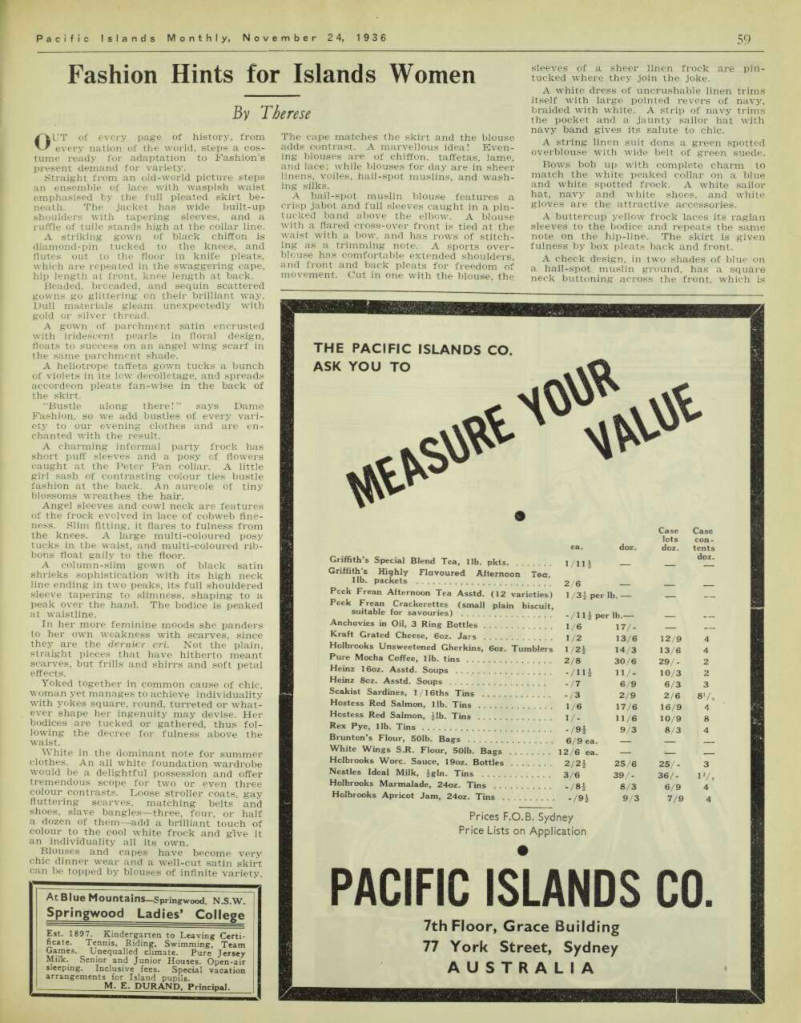
By Therese
OUT of every page of history, from every nation of the world, steps a cos tume ready for adaptation to Fashion’s present demand for variety.
Straight from an old-world picture steps an ensemble of lace with waspish waist emphasised by the full pleated skirt be neath. The jacket has wide built-up shoulders with tapering sleeves, and a ruffle of tulle stands high at the collar line.
A striking gown of black chiffon is diamond-pin tucked to the knees, and flutes out to the floor in knife pleats, which are repeated in the swaggering cape, hip length at front, knee length at back.
Beaded, brocaded, and sequin scattered gowns go glittering on their brilliant way.
Dull materials gleam unexpectedly with gold or silver thread.
A gown of parchment satin encrusted with iridescent pearls in floral design, floats to success on an angel wing scarf in the same parchment shade.
A heliotrope taffeta gown tucks a bunch of violets in its low decolletage, and spreads accordeon pleats fan-wise in the back of the skirt.
“Bustle along there!” says Dame Fashion, so we add bustles of every vari ety to our evening clothes and are en chanted with the result.
A charming informal party frock has short puff sleeves and a posy of flowers caught at the Peter Pan collar. A little girl sash of contrasting colour ties bustle fashion at the back. An aureole of tiny blossoms wreathes the hair.
Angel sleeves and cowl neck are features of the frock evolved in lace of cobweb fine ness. Slim fitting, it flares to fulness from the knees. A large multi-coloured posy tucks in the waist, and multi-coloured rib bons float gaily to the floor.
A column-slim gown of black satin shrieks sophistication with its high neck line ending in two peaks, its full shouldered sleeve tapering to slimness, shaping to a peak over the hand. The bodice is peaked at waistline.
In her more feminine moods she panders to her own weakness with scarves, since they are the dernier cri. Not the plain, straight pieces that have hitherto meant scarves, but frills and shirrs and soft petal effects.
Yoked together in common cause of chic, woman yet manages to achieve individuality with yokes square, round, turreted or what ever shape her ingenuity may devise. Her bodices are tucked or gathered, thus fol lowing the decree for fulness above the waist.
White in the dominant note for summer clothes. An all white foundation wardrobe would be a delightful possession and offer tremendous scope for two or even three colour contrasts. Loose stroller coats, gay fluttering scarves, matching belts and shoes, slave bangles—three, four, or half a dozen of them—add a brilliant touch of colour to the cool white frock and give it an individuality all its own.
Blouses and capes have become very chic dinner wear and a well-cut satin skirt can be topped by blouses of infinite variety.
The cape matches the skirt and the blouse adds contrast. A marvellous idea! Even ing blouses are of chiffon, taffetas, lame, and lace; while blouses for day are in sheer linens, voiles, hail-spot muslins, and wash ing silks.
A hail-spot muslin blouse features a crisp jabot and full sleeves caught in a pin tucked band above the elbow. A blouse with a flared cross-over front is tied at the waist with a bow, and has rows of stitch ing as a trimming note. A sports over blouse has comfortable extended shoulders, and front and back pleats for freedom of movement. Cut in one with the blouse, the
sleeves of a sheer linen frock are pin tucked where they join the joke.
A white dress of uncrushable linen trims itself with large pointed revers of navy, braided with white. A strip of navy trims the pocket and a jaunty sailor hat with navy band gives its salute to chic.
A string linen suit dons a green spotted overblouse with wide belt of green suede.
Bows bob up with complete charm to match the white peaked collar on a blue and white spotted frock. A white sailor hat, navy and white shoes, and white gloves are the attractive accessories.
A buttercup yellow frock laces its raglan sleeves to the bodice and repeats the same note on the hip-line. The skirt is given fulness by box pleats back and front.
A check design, in two shades of blue on a hail-spot muslin ground, has a square neck buttoning across the front, which is
cut across yoke fashion, and gathered to fulness. Puff sleeves and a flared skirt accompany it on its cool way.
Amusing accessories keep interest alive.
Chic suede and patent belts have quaint fastenings. Buttons come in infinite vari ety—acorns, flowers, keys, animals, etc. — giving individuality to the simplest frock.
Initials pinned to the lapels and embroid ered monograms on scarves, pockets and belts are all important.
Trailing evening handkerchiefs of chiffon have appliqued velvet or beaded initials.
Colourful scarves do dual duty. They tie about the neck or swathe the waist.
Hats are delightful. Simple little hats with tailored bands rely solely on stiffened eye veils for effect. Small skull caps with top-knots of ribbon or flowers are thrust on the back of the head for evening wear.
Tropical felts in pastel shades are de lightful. They are flower or ribbon trim med and the brims are wide and adaptable.
Mr. and Mrs. D. Butler departed from Western Samoa for New Zealand to spend furlough by the Matua on October 28.
Mr. Butler is manager of the Apia branch of the Union Steam Ship Co. of New Zea land Ltd.
Advertisements & other items, pp. 61-62 (1 item)
Pacific Islands Co.
THE PACIFIC ISLANDS CO.
ASK YOU TO
ea. doz.
Griffith’s Special Blend Tea, lib. pkts Griffith's Highly Flavoured Afternoon Tea, lib. packets Peek Frean Afternoon Tea Asstd. (12 varieties) Peek Frean Crackerettes (small plain biscuit, suitable for savouries) Anchovies in Oil, 3 Ring Bottles Kraft Grated Cheese, 6oz. Jars Holbrooks Unsweetened Gherkins, 6oz. Tumblers Pure Mocha Coffee, lib. tins Heinz 16oz. Asstd. Soups Heinz Boz. Asstd. Soups Seakist Sardines, l/16ths Tins Hostess Red Salmon, 11b. Tins Hostess Red Salmon, Jib. Tins Rex Pye, lib. Tins Brunton’s Flour, 50lb. Bags White Wings S.R. Flour, 50lb. Bags Holbrooks Wore. Sauce, 19oz. Bottles Nestles Ideal Milk, -Jgln. Tins Holbrooks Marmalade, 240 z. Tins Holbrooks Apricot Jam, 240 z. Tins 1/Hi 2/6 1/3* per lb.
Case Case lots condoz. tents doz. 12/9 4 13/6 4 29/- 2 10/3 2 6/3 3 2/6 BV* 16/9 4 10/9 8 8/3 4 25/- 3 36/- IV., 6/9 4 7/9 4 Prices F. 0.8. Sydney Price Lists on Application
PACIFIC ISLANDS CO.
7th Floor, Grace Building
77 York Street, Sydney
AUSTRALIA
At Blue Mountains— Springwood, N.S.W.
Springwood Ladies* College
Est. 1897. Kindergarten to Leaving Certificate. Tennis, Riding, Swimming, Team Games. Unequalled climate. Pure Jersey Milk. Senior and Junior Houses. Open-air sleeping. Inclusive fees. Special vacation arrangements for Island pupils.
M. E. DURAND, Principal.
AVOID INERT CREAMS
What woman does not sigh after this radiant freshness, this juvenile tint that excites admiration? CREME SIMON makes the skin lovely, —it is always active and is delicately perfumed.
For Perfect Beauty use
CREME SIMON
poudrVsimon
(7 Shades), and
SIMON SOAP
SiMON
PARIS
Obtainable Chemists and Stores Sole Agents: Joubert <S- Joubert Pty.Ltd.,Melbourne
When dancing
or at the theatre don’t forget now and then to dab a few drops of “4711” Genuine Eau de Cologne on temples and forehead; it will refresh, invigorate, revive. ’.V&47/jjn Representative:
• * ROBERT BLAU (Aust.),
A.C.A. Building, . Cnr. King SC York Streets,
SYDNEY.
•GLOCKENG
?47//l Eaucfe
w^Colotfne
Better Standard Of
Living
Advance of Gilbert and Ellice Natives
AN appreciable advance by the Gilbert and Ellice Islanders in their standard of living has been noted and recorded in the Colony’s Annual Report on Education for 1935 by Mr. F. G. L. Holland (Superin tendent of Education).
“Contrasting the conditions of 16 years ago with those of to-day, the improved attitude of parents and others towards hygiene, care of the home, and infant wel fare cannot but be viewed with satisfac tion,” he wrote. “Almost everywhere more general cleanliness, a higher stan dard of food preparation, and better atten tion to children can be observed.
“There is room, of course, for great im provement still,” he continued. “But native development during nearly two decades, although disturbed by the economic depres sion, has been considerable, and the social future of the Colony seems promising if the full educational work of administrator, doctor, missionary, and teacher can be maintained.”
Increase In Population
Statistical information appended to the Education Report shows that there has been a satisfactory increase in the popula tion of the Group, and that in 1935 there were 33,713 people in the Colony. Com pared with 1934, the figures are: Gilbertese, 29,291 (28,654); Ellice Islanders, 4,154 (4,042); Europeans, 244 (254); Chinese (exclusive of indentured labourers), 24 (41).
Papuan Mission Station
Burned
THE village of Divari, near Dogura, Papua, where the Anglican Missionary Training College for native clergy is situ ated, has been destroyed by fire, according to news received in Melbourne in Novem ber by the Australian Board of Missions.
The college, school, church, warden’s house and a house for mission students were among the buildings burned. There was no insurance on the property.
Japanese Pearlers Find Rich
Shell Patch
LATEST reports from Darwin say that Japanese pearlers found a rich patch of pearl shell inside territorial limits, about 300 miles east of Darwin, where charts show only eleven fathoms of water.
So many Japanese have bought charts of territory waters that a temporary short age exists. The Japanese say that when they have cleaned out the present patch they will visit the West Australian coasts to get shell there.
Mr. J. B. Wright, of New Zealand, ar rived at Apia, Samoa, by the Maui Pom are on October 15 to relieve Mr. W. H.
Roberts, Treasury Department Clerk, who will leave the Territory in December.
His Lordship Bishop Leonard S. Kemp thorne (Bishop in Polynesia) arrived in Western Samoa from Fiji on a visit to the Anglican diocese in Apia by the steamer Antigone in October.
Samoan Demands
Attitude Towards Chinese
From Our Own Correspondent,
Apia, Oct. 28.
THE Fono of Faipule continued its sit tings last week, (See report on page 49 of this issue).
On October 23 the Fono sent a lengthy resolution to the Acting Administrator (Mr. A. C. Turnbull) expressing deep re gret that the N.Z. Government would not permit a delegation of Samoans to visit New Zealand and emphasising that all their remits and requests were based on the agreement reached between the Mau and the “Goodwill Mission.”
The Fono asked for a large increase in the district and village officials of native birth employed by the Administration— that is, from 178 to 384, representing an increase in expenditure from £1,834 to £6,161.
The Fono asked that Samoans be em ployed on banana inspection.
The Acting Administrator said he would employ anyone irrespective of race or creed, if he had the necessary qualifica tions. He reminded the Fono that the banana industry would not have been pos sible without the assistance of New Zea land in providing a means of transport—• the N.Z. taxpayers actually had financed the banana industry.
The Faipule indicated great anxiety about the Europeans’ strong opposition to the demand for the repatriation of all Chinese. They said that the Samoans since 1902 had not liked the system of indentured Chinese labour, but had not previously objected, out of respect to the wishes of the Europeans. The “Goodwill Mission,” however, told the Samoans that it was the wish of the N.Z. Government to repatriate all Chinese—and this was why the Sa moans now came out and advocated repat riation. Now they found that the Euro peans were disturbed and had formed a party to oppose the Samoans’ demand. The Faipule wanted to know what the position really was. Did the N.Z. Government still wish to repatriate the Chinese, or had they changed their minds?
The Acting Administrator said that the position was that the present contracts of Chinese labourers did not expire for a year, and the matter would be considered then.
The Fono continued to discuss the mat ter in an indefinite fashion, and Mr. Turn bull said that their representations would be considered by the Government.
The Fono asked for the formation of a Medical Board, an Education Board, and a Public Works Board on which the Samoans would be represented; for a Government dentist to be attached to the Apia Hospital; that the Samoan language be declared the official language for Samoa; that all Gov ernment officials unable to speak Samoan after one year in the country be sent back to New Zealand: that there should be second grade schools for Samoan children in all districts; that only departmental heads should be Europeans from New Zealand and that the staff be composed of half-castes and Samoans; and that small hospitals should be provided in every district.
The Faipule pointed out, in support of its claim for the employment of Samoan clerks instead of Europeans, that at pres ent 18 white officials receive remuneration equal to the wages of 339 Samoan officials.
A request indicating an extraordinary change in the Samoans’ habits was that the members of the Fono should each be supplied with a desk and a chair and that a wooden floor be laid in the Fono house.
Since time immemorial, the Samoans have sat on their mats, which cover clean, hygienic floors of smoothed coral.
Colonising Sunday Is.
From Our N.Z. Correspondent
Auckland, Oct. 19.
proof of the determination •*- of a number of Auckland residents to colonise Sunday Island in the Kerma decs was provided by the departure of the ketch Yvonne on October 9, laden with timber, tanks, building- materials, and stores for the island. The ketch was in charge of Mr. H. B. Sorensen, and with him were Messrs. J. Boshier, J. Sneddon, and F, J. Kilver, One of the crew will remain behind on the island to carry out the carpentry work in connection wuth the building of houses for the settlers who may be taken there on subsequent trips of the Yvonne.
Mr. H. Alday, of the New Guinea Dis trict Services Department, arrived in Sydney en route to Melbourne by the Malaita from Rabaul on October 23.
Rev. and Mrs. A. H. Lambton, of the New Guinea Mission. Dogura, Papua, who have been in Australia on furlough, will not be going back to their work in the Territory, as Mr. Lambton has developed serious eye trouble. Mrs. Lambton re turned to Papua by the Montoro in Octo ber to finalise their affairs there.
Advertisements & other items, pp. 63-64 (1 item)
Flit
JLmyerve bij^
O' .1.
JS Lingerie of the highest quality. You can obtain Slips, Vests, Knickers in many styles as well as Pyjamas, Nighties, Kiminos and Dressing Jackets, too.
Lustre Lingerie is obtainable from
BURNS PHILP
at all their Branches in the Pacific.
3 o Kill u Has SP9
Get set the ‘ kj ,
FLIT
hills ins -
they never recover^ %
FLlT—the only insect spray that REALLY kills.
A. Q. McGowan & Co.
SUVA, FIJI ISLANDS
• Dealers in all Island Products, Exporters of Trocas Shells, Pearl Shells, Cowrie Shells and Curios, Kauri Varnish Gums, Bark, Mauritius Beans, Maize. Enquiries solicited.
lations.
ree,,.
Tls<l all’s Anglers
llamlbook
Comprising 128 pages of interesting information regarding Trout and Salmon Fishing, General Sea Fishing, and Sword- . fishing. Also illustrations and prices of a wonderful range of Fishing Rods, Reels, Lines and Sea Fishing Equipment.
Write for a free copy, mentioning the “P.1.M.”
TISDALL
Manufacturers and Retailers of Fishing Rods and Tackle
176 QUEEN STREET, AUCKLAND, N.Z.
Branches at Wellington, Christchurch, and Hamilton, N.Z.
Every Angler should have this Handbook
Your Tropical Kit
When you visit the Pacific Islands, whether on Business or Pleasure, you need Special Equipment—Light Suits of Correct Style, which fit well and launder easily; Tunic Shirts, Silk Shirts, Light Underwear, White Shoes, etc.
WALTER HORNE & CO. LTD., established in 1885, specialise in this Service.
Skilled Tailors make your suits from First-class material within 24 hours.
Complete equipment can be supplied from our Large Stocks at Reasonable, Moderate Prices.
BUY FROM THE FIRM WHICH UNDERSTANDS YOUR NEEDS AND
DRESSES YOU CORRECTLY
WALTER HORNE & CO. LTD. carry a Full Range Men resident in r ... , . ... r- any of the Pacific of Drapery of all kinds; also Frocks, Millinery, Foundations and Lingerie, Hosiery, Shoes and Sanda's, Ribbons and Laces, Household Drapery.
Territories can he supplied with Suitable Clothes.
Ladies* Hairdressing and Manicuring
Write to us and Describe your Requirements.
Walter Horne & Co. Ltd.
Drapers and Men*s Wear Specialists
SUVA, FIJI
Officers
Uniforms For Patrol
IT recently was brought under the " notice of the Australian Prime Minister that Patrol Officers in Papua wear no distinguishing badge as a mark of their authority, and that often this absence of identification causes them in convenience in the execution of their duty.
The Prime Minister said that this mat ter would be referred to the administra tive authorities.
It does seem a desirable thing that Dis trict Officers and Patrol Officers on field duty in both the Mandated Territory of New Guinea and Papua, should wear some kind of distinguishing uniform.
Such a uniform would give a note of authority—especially among native popu lations.
Valuable Plants
Of Fiji
Notes on the Qisa Bush
By H. B. R. Parham
THE Qisa ( Orellana Bixa), better known as the Annatto of commerce, is a very well-grown and interesting bush in Fiji.
Although its usual height does not ex ceed 10 or 12 feet, it sometimes attains to 20 feet. Very few insects attack the leaves, which are of an attractive green.
The flowers are pretty—larger than the wild rose of England, but similar in col our and shape, being rose-pink and white.
But it is the capsuled fruit that is of import, since it is of value for its dyeing properties. Its use in dairy work is well known, but it is also esteemed as a dye for textile goods. Its qualities in this direction have been tested and proved to be excellent.
As a dye Annatto has long been used.
The Europeans, who first visited America, found the Indians using the berries as the old-time Fijians did, to paint their bodies.
In an ancient book, more than a century old the following interesting remarks occur:— “The brilliant and showy colour of the berries of the Annatto tree attracted the attention of the settlers, who not only ap plied it to their own uses, but likewise con verted it very speedily into an article of commerce.”
It might well become an article of com merce in Fiji to-day if its market value were more generally known, for the stems are fibrous and make good cordage.
“This tree (continued the book) pro duces large crops of bristled pods, which are at first of a beautiful rose colour, but turn to a dark brown when ripe, when they burst open, and display a splendid farina or pulp in which are contained 30 or 40 seeds, similar in shape to raisin seeds.”
The colouring matter of Annatto is said to consist of two colouring principles— “Orellin,” which is yellow, soluble in water, and which gives a yellow colour to cloth when mordanted, and “bixin,” which when pure forms a cinnabar-red powder, easily dissolved by alkaline solution.
A variety of shades, both yellow and red, are produced with the help of vinegar, alum, lemon-juice, etc.
It makes a good dye for silks and thin materials, but is not recommended for cloth. It can be altered by certain com binations into orange, deep orange, and tango, but this is not a fitting place for fuller chemical details.
Another dye-plant is the Mavunitoga (Antiario Bcnnettii) of the order Artocar peae. This, possibly, is not indigenous, for the name used in the vernacular means the Tongan Mavu. The tree, however, has for long been at home in Fiji, and in olden times was frequently planted near heathen temples ( bure kalou).
Its beautiful foliage and large bright crimson drupes should make it popular with garden-lovers, and also with those who are aiming at making the Fiji motor roads “things of beauty.”
Then there is the Lauci ( Aleurites Mo luccaiia), belonging to the Euphorhiaceae, and which has many names in the Fijian.
It is Sekeci in one place, Tuitui in another, and Qereqere in yet another; while Euro peans call it the Candle-nut. Beyond many other uses, it produces an excellent black paint or dye. The tree grows readily, and is at home in almost any situation. It is practically in flower all the vear through, but is in its fullest bloom in October.
Fijian Chiefs Would Hand Over Land to Government
Important Decisions at Bau Council Meeting
MATTERS of extreme importance to the Colony at large were discussed by Fijian members of the Council of Chiefs at Bau in September. The Coun cil carefully considered and debated at length many questions affecting the future welfare of the native race, and 30 resolutions were passed and forwarded to the Acting-Governor (Hon. Juxon Bar ton) for reply.
The most significant of these resolu tions was to the effect that all lands (in cluding leases) not required for the main tenance of the Fijian owners be opened for settlement; that a committee be appointed to determine the amount of land needed for the proper development of the native owners: and that all land (including leases) not so required be handed over to the Government to lease on behalf of the Fijians.
In reply, His Excellency said he was most grateful to receive evidence of the confidence and trust of the Chiefs in the Government. It was not a matter for a hasty decision: the chiefs must first ex plain carefully the resolution and its rea sons to their people. Pending the arrival of a new Governor, it would be premature for him to appoint a committee, he added.
Other major resolutions carried by the Council of Chiefs were as follows: Legislative Council: The following 10 Chiefs’ names were submitted to the Governor, who will choose five to be mem
bers of the Legislative Council: Ratu George Tuisawau, Ratu J. L. V. Sukuna, Ratu I. Tawake, Ratu Tiale Vuiyasawa, Ratu Deve Toganivalu, Ratu G. Lala, Ratu E. Mataitini, Ratu George Togani valu, Ratu P. Veli, Ratu Pope E. Cakobau. (The last-named Chief has since died.) Edward VlM.’s Coronation: The Council advised the Government to send eight leading Chiefs to England to attend the Coronation of His Majesty King Edward VIII., which is to be held in May, 1937.
The Acting-Governor said that the ar rangements for the King’s Coronation in 1937 will be similar to those made in 1911 for the Coronation of His late Majesty.
It is King Edward’s desire that it should be celebrated fully in each part of the Empire, and the Government feels it proper that on such an occasion Fijian Chiefs should be with their own people at that time.
Rockefeller Institute: The Fiji Govern ment was asked to convey to the Ameri can Rockefeller Institute the Council’s great appreciation of the health and medical work being done in the Colony and its hope that the Institute may long remain in the Pacific to carry on its Christian labours.
Goldmining Industry: Legal provision
should be made whereby Fijians employed in goldmines are insured against accident or death.
Agricultural Training: As agricultural training is in the best interests of the
native race, it is desirable that an Agri cultural School be established to educate selected youths. This project could be financed from Crown Lands Schedule “B" funds, and be maintained by all the Pro vinces.
History of Fiji: The Government was asked to form a small committee to pre pare a History of Fiji. Replying. His Ex cellency said that while the Government
did not consider that any useful purpose would be served by appointing a commit tee, it was prepared to offer every facility and encouragement to historical research by any properly qualified person. The Government is now endeavouring to form a collection of useful books bearing on Fiji’s history.
Maintenance of Houses: The Acting Governor said he would refer to the Native Regulation Board for considera tion the Council’s request that a law be passed to enforce the proper maintenance of wood and iron houses in native towns.
Memorial to King George: The Council resolved that the Fijians should have a separate memorial for His late Majesty King George V.; and that it should take the form of a Native Nurses’ Training Institution, the cost to be borne by Crown Lands Schedule “B” funds, and such monies as the Provincial Councils may decide. His Excellency stated that the question of a memorial in which all races of the Colony could join w T as receiving consideration. He added that the import ance of the efficient training of nurses is fully realised.
Yasawa Islands: The proposal that the Yasawa Group of Islands should be made a separate province will be considered in connection with the general organisation of the Colony.
Banana Marketing: The Council asked that the Government might be pleased to undertake the duty of marketing Fijian owned bananas. This proposal would in volve considerable expenditure by the Government in the provision of additional staff, of floating stock and other equip ment, said the Hon. Juxon Barton, and it was impossible to reply until extensive enquiries had been made. The Director of Agriculture has been requested to report fully on the marketing of native crops.
Protection of Trees: A law or regula tion is needed to enforce the proper plant ing and protection of useful trees, such as Vesi, Damanu, Rosawa, Buabua, Sogale, Dilo, Kauvala, Yaka, etc. His Excellency pointed out that, though instructions will be issued to that effect, the active support of the Chiefs is necessary to secure the enforcement of any legislation on this matter.
Foreign Imports: The Acting Governor told the Council that he appreciated its motives in passing a resolution entreat ing the Government to make the importa tion of foreign goods into Fiji more dif ficult.
Sale of Produce: The Council requested that the sale of produce and curios in Suva streets be stopped and confined to the area on the wharf reclamation. The control of street hawkers, the Council was informed, was now receiving attention.
Advertisements & other items, pp. 65-66 (1 item)
Service,
Pacific Taxi
- Vincent Brothers : Immediate Transport to any part of the Island provided by any of the following modem Cars (all latest models): — 7-pass. Plymouth-Chrysler De Luxe. 7-pass. V-8 Ford Sedan. 7-pass. Master Buick Tourer. 4-pass. Plymouth-Chrysler De Luxe. 4-pass. Studebaker. 4-pass. Nash Lafayett. 4-pass. V-8 Ford Sedan. 4-pass. Plymouth - Chrysler Sedan.
Moderate Charges—Efficient Drivers Radio your instructions, and a car will meet the Steamer Cables: “Vincent, Suva.” ’Phone: 33 Garage Next to Bums* Philp Store
*v . I r* , The PREMIER Social Rendezvous of Fiji . . .
Grand Pacific Hotel - - Fiji
EXCELLENT CUISINE. EFFICIENT TRAINED INDIAN WAITERS AND SERVANTS.
MODERNLY EQUIPPED.
Cirand
Pacific
I Bold
SUVA, FIJI
Delightfully situated in tropical gardens overlooking Suva harbour and the Pacific Ocean.
TARIFF: From 17/6
per Day.
Accommodation Reserved by Wireless.
Cable Address: "Grandpacif,”
Suva.
TAXIS
Garage: Princes Street, Suva.
'Phone 322.
Cable Address: “Tillak.” G.P.O. Box 124, Suva.
AT YOUR SERVICE:
Sedan and Touring Cars. Latest Models equipped with radio.
Our Cars Meet all Steamers Motor Lorries & Launches for Hire.
General Carriers.
Quotes given for Immediate Transport to all parts of Island Suva Tavua —— Lautoka—Sigatoka. Open always, including Sundays and Holidays.
Plume Motor Spirit and Gargoyle Mobiloil Service Station.
Terms cash. Monthly accounts to approved customers only.
White Star Motor Garage
Tillak Bros., Proprietors
g Australia’s Clearing House for the
BUYERS OF
GOLD
OSMIRIDIUM, PLATINUM, SILVER, &c.
GARRETT & DAVIDSON, LTD.
ASSAYERS, BULLION MERCHANTS, METALLURGISTS
Bank of N.S.W. Buildings, Regent Street, Sydney
W.H. GROVE & Sons Ltd.
AUCKLAND
Islands Traders p 0 BOX 490 Telegraphic and Cable Address: “Grove,” Auckland.
Shippers of all classes of New Zealand Products, specially prepared for the Island trade.
Representing • Rylands & Sons (Col.) Ltd. of London and Manchester (including the famous “Dacca” Mills Products). •Parbury Henty & Co. Pty. Ltd of Sydney and Kobe. •“AGFA” Photographic Corporation of Berlin. •J. Blair King, of London, World-famed Shirts. • Sissons Bros. & Co. Ltd. Hull. All classes of paints.
Without Departmental
Chiefs
From Our Own Correspondent.
Rabaul, Oct. 24.
WHEN the s.s. Tanda sailed for the East at noon to-day it left Rabaul prac tically without Government departmental chiefs.
The Administrator is on leave in Aus tralia.
The Secretary for Lands (Hon. E. P.
Holmes) and the Director of Public Works (Hon. E. Knox) have departed on leave.
Prior to that, the Director of Public Health (Hon. E. T. Brennan), the Director of District Services (Hon. E. W. P. Chin nery), the Economic Botanist (Mr. R.
Dwyer), the Harbour Master (Mr. C.
Webb), and the Chief Dispenser (Mr. J.
Cruise) had departed on an inter-island tour of inspection.
The Government Secretary (Hon. H. H.
Page) and the Superintendent of Police (Colonel Walstab), the Superintendent of Stores (Mr. J. Savage), the Entomologist (Mr. J. Froggatt), and the Chief Collector of Customs (Hon. E. F. Phibbs) were all away on leave.
At the same time the Director of Agri culture (Hon. G. H. Murray) was receiving medical attention in hospital.
His Honour the Chief Judge is here, but he is a sick man. He is grimly attend ing to his duties as Acting Administrator, although his health really demands abso lute rest.
Of the Departmental chiefs, this leaves only the Treasurer (Hon. Orton Townsend) and the Crown Law Officer (Hon. Gerald Hogan) actually occupying their office chairs.
The return on Monday is expected of Dr.
Brennan, Commander Webb and Mr.
Cruise, when the Macdhui arrives from the outports.
Mr. Charles Edward Dixon, of Port Moresby, married Miss Anne Danswan, also of Port Moresby, at the Papuan Registrar’s office on October 17.
Pineapples
Another New Industry for Lucky Fiji
'THE canning of Fijian pine-apples by A the Colonial Sugar liefining Co., Ltd. will not be commenced in earnest % until about .the end of 1938.
That announcement was made early in November at a meeting of C.S.R. share holders by the chairman, Mr. E. R. Knox.
Evidently the Company intends to make the most careful preparations in the erec tion of factories, in the growing of the fruit, and in the proper organisation of the markets before it launches the new in dustry.
Mr. Knox said that the Company, with all its experience and its powerful organi sation, entered the new business with con fidence.
As already pointed out in the this is a development of first-rate import ance for Fiji—the luckiest of all British colonies. Fiji already is rich because of the sugar industry. It is richer because its great copra industry has returned to profit. It is still richer because a gold industry has been established which may produce £500,000 worth of gold annually before very long. And now’ it is to have another profitable industry in the canning of pine-apples.
The coiner of the phrase “A rich uncle from Fiji” knew’ w'hat he w r as talking about!
Government Gives C.S.R.
Co. Concessions
From Our Own Correspondent.
Suva. Oct. 31.
4 MOTION which will mean a great deal to Fiji was passed at the Legis lative Council meeting on October 28, when it was agreed to make certain concessions to the Colonial Sugar Refining Co. with a view to assisting the revival of the pine apple canning industry.
Several attempts have been made in the past to market Fiji canned pine-apples, but although the Colony produces fruit equal to the best in the world, failure has resulted, chiefly due to lack of capital. But the C.S.R. Co. has changed the outlook.
The motion was welcomed by all sec tions of the House, and members described the moment as one of importance in the history of the Colony. It was also pointed out that in pine-apple production an area which would otherwise be waste land, un suitable fer sugar cane, bananas or copra, would be brought into profitable produc tion.
The principal concessions made to the Company were: (a) Import duty paid on machinery and plant within four years from January 1, 1937, for the canning and packing of pine apples grown in Fiji is to be refunded (this shall not include the refund of Port and Customs Service Tax properly levied and paid). (b) For 10 years from January 1. 1937, no export tax shall be levied on pine-apples grown and canned in Fiji, but this shall not debar the Government from collecting a Port and Customs Service Tax thereon when exported. (c) For 10 years from January 1, 1937, the Government will permit the drawback of import duty paid on sugar, materials for cases, tin plates, and partly-made tins used in the canning and packing of pine apples grown in Fiji and thereafter ex ported.
Fire On “Montoro”
WHEN the Islands steamer Montoro was about to berth in Brisbane on FrL day, October 23, on the north-bound trip which left Sydney on October 21, a fire w’as discovered in the lower hold of No. 3 hatch, but it was extinguished before any serious damage w'as done.
The steamer was berthing at Dalgety’s wharf, w’hen smoke was seen issuing from a ventilator. Immediately four fire extin guishers and the ship’s hoses were put into operation, and they soon quenched the flames, which had started in a case of goods. Examination show’ed that the ship w r as not damaged, but portion of the cargo near the seat of fire was damaged by water.
The Montoro resumed her voyage to Papua that night.
Samoan Bananas In
Demand
From Our Own Correspondent.
Apia, Oct. 28.
THE Matua, which sailed to-day, lifted nearly 7,000 cases of Samoan bananas for the Auckland market.
Visitors by the Matua commented on the splendid quality of the fruit exported from Samoa as compared with that from Fiji and Tonga. It was stated that the superiority of our bananas is generally recognised in New' Zealand and conse quently the demand is steadily increasing.
This is due mainly to the efficiency of the Inspector of Produce (Mr. H. Newton) and the w r ell established organisation and inspection he has created.
Advertisements & other items, p. 67 (1 item)
A. B. Donald Ltd.
MORRIS, HEDSTROM, Ltd.
FIJI
Sole Agents in Fiji for . . .
Vacuum Oil Company (Pty.) Limited
Imperial Chemical Industries Limited
Nobel (Australasia) Pty Ltd.—Explosives
Full Stocks of
MINERS AND PROSPECTORS’
REQUISITES
Also SODIUM CYANIDE, ZINC
DUST. Etc., Etc.
Sydney Office;
DALTON HOUSE, 115 PITT ST., SYDNEY
Branches throughout the gold hearing areas Lautoka, Ba, Tavua, Penang, Nadi, and Sigatoka
A. B. DONALD Ltd.
AUCKLAND
Island Traders :: General Merchants
P.O. Box 1509 :: Cables and Telegram*; “Kingdom," Auckland -Branches at Rarotonga and throughout the Cook Islands At Papeete and throughout the Society, Marquesas and Paumotu Islands
trading as “ETABLISSEMENTS DONALD. TAHITI”
At Fiji: Trading as “Dominion Fruit C 0.,” Suva
Educating The Gilbert
And Ellice Islanders
TNSTRUCTION to the primary standard is being given to 6,924 scholars in the Gilbert and Ellice Islands through four Government schools and 79 mission schools, according to the Colony’s Annual Report on Education for 1935, just issued.
Including subsidies to the two missions carrying on the work of education—the Uondon Missionary Society and the Roman Catholic Sacred Heart Order—the Govern ment’s expenditure on education during the period was £3,960.
Throughout the Gilbert Islands, instruc tion is given in the vernacular, except at the King George V. School (Tarawa) and the Sacred Heart Boys’ School (Butaritari), where English prevails. The medium in the Ellice Group is Samoan, due to the influence and example of the early L.M.S.
Samoan missionaries and to the affinity of the Ellice dialect with Samoan.
During the year two students of the King George School—one Gilbertese and one Ellice Islander—were sent to the Cen tral Medical School at Suva, Fiji. This made four students—two Gilbertese and two Ellice Islanders—in 'residence there.
Three scholars at that school qualified as
Native Medical Practitioners, and were ap pointed to the G. and E. Medical Depart ment. Eight ex-students of the King George School are now in service as N.M.P.’s in the Group.
In Fiji
More Sampans Reported
From Our Own Correspondent.
Suva, Oct. 31.
4 NOTHER report has reached Suva re garding the Japanese sampans which are operating in the Fiji group.
This is to the' effect that two sampans were anchored for some days at Yanutha, an island about 15 miles north-east of Taveuni. The men were ashore several times for food and water, and spent two days fishing for trochus shell.
Miss Eileen Morris, of Napier, New Zealand, who has been travelling about the Pacific in the 32ft. ketch-rigged yacht Te Rapunga for over a year, re turned to her home temporarily at the beginning of November by the Niagara.
After a short stay with her parents she will rejoin the yacht in Hawaii.
Blackwater
Four Recent Cases at Yodda, Papua
From Our Own Correspondent.
Pt. Moresby, Nov. 1.
* 1 1 HE fourth case of blackwater fever from the Yodda, this year, was brought over by plane on October 14 and admitted to the European Hospital.
On this occasion, the patient is a well known member of the magisterial service, Mr. R. W. Faithorn, A.R.M., stationed at Kokoda. Though Mr. Faithorn’s condi tion was considered serious for the first two or three days after admittance, he has now sufficiently recovered to be well out of danger.
Mr. H. T. Kienzle, who was admitted to hospital on September 30 from the Yodda Goldfields, suffering also from blackwater, has made a good recovery and will shortly resume duty.
These four cases, following hard upon one another in the one district, have given rise to some anxiety. In the case of Mr.
E. C. Carr, the well known botanist of the British Museum, the disease in June proved fatal.
Residents in the Yodda district are for tunate in being able to call on the New Guinea aerial services in cases of urgency to transport them immediately over the ranges to Port Moresby, where medical at tention gives them every chance of re covery.
Large Crops and Good Prices
Samoans Prosper
From Our Own Correspondent
Apia, Oct. 20.
AFTER a long, dry spell, which ad versely affected the banana industry, the long-expected rains have at last arrived.
The cocoa crop is now coming in, and planters are busy picking. The present year promises another record in cocoa and copra, as well as banana exports. The only cloud on the horizon is the threat ened repatriation of the Chinese planta tion labourers, though it is still hoped that the N.Z. Government will seriously con sider the representations made by the European community.
Samoans have never been as prosperous as they are at the present time, with good prices and large crops of the various products prevailing. The prosperity of the natives is reflected in their purchases of luxuries and comforts, such as Euro pean furniture, benzine lamps, etc.
Papua
Land Settlement In
From Our Own Correspondent.
Pt. Moresby, Oct. 26.
MR. W. R. HUMPHRIES, Resident Magistrate of the Central Division of Papua, left recently for the Sogeri district, to investigate the possibilities of the dis trict for settlement, and the amount of land available for certain enterprises.
The inspection will be extensive, and Mr. Humphries is expected to remain in the district for several weeks.
Sogeri is a well known rubber district, and lies approximately 30 miles outside Port Moresby.
Advertisements & other items, pp. 68-70 (2 items)
Excelsior Supply Co. Ltd.
The most extensive Manufacturers in the British Empire of
RUBBER STAMPS,
INKS, STENCILS.
Marking Devices.
ACME STAMP PADS
We have a big range of Special
FRUIT CASE MARKING SETS
We alto Manufacture or Supply a complete line of
Spraying Machines
for all purposes.
Let us know your requirements and we will quote you by return. Ask for our Big Catalogue.
Sole Australasian Distributors of the World Famous SHEAFFER FOUNTAIN
PENS and PENCILS.
EXCELSIOR SUPPLY CO. LTD.
Head Office 160 BROADWAY,
SYDNEY. N.S.W.
Radio Moderne'
m wr
ksPtzik
The Assembled Chassis Just designed for 100 per cent, service in the Pacific Islands. Pay cash and save at least 33 1-3. Radio Moderne is the newest, finest and most up-to-themoment 5-valve battery-operated superhet. ever introduced for the Pacific Islands. That’s a sweeping statement, but we stand behind every word of it.
Hear all Australasian stations, plus London, Paris, Berlin, Moscow, Tokyo, New York, etc. etc.
Radio Moderne E x c 1 usively Built to suit Pacific Islands c o n d i t ions.
Humidity, etc.
Not a Mass P r o d u ction Product, each Set individually Built by SeniorMe'chan ics. Tuned up, and Air Tested before despatch.
Y, & i £22/10/- Cash only.
Send for Bulletin, 120 pages Levenson’s Radio Bargain Bd, post free. Also Leven son’s Radio Buyer’s Guide and Assembly Chart Handbook, 2/-, post free.
New, tested charged 12 months’ guarantee.
Add 1/6 packing plus freight 2 Volt 100 Amp. . . 15/- 4 Volt 40 Amp. . . 15/6 4 Volt 60 Amp. . . 17/6 4 Volt 85 Amp 25/6 6 Volt 40 Amp 20/6 6 Volt 60 Amp ... 22/- Electric Light Generating Sets for Cycles.
Head and tail light, complete globe, 9/11.
Super Grade de Luxe Model, 15/-. Packing, 9d extra, plus postage. with
Special Floor Model Cabinet
Radio Moderne incorporates every wanted, technically correct improvement, all latest type Phillips valves, 3 Like-a-Flash triple duty B batteries, best grade 100 amp. 2 volt accumulator, automatic volume control, latest Amplion permagnetic speaker. Perfect tone, equal to any electric set. Latest calibrated aero dial, showing Australian a°d .overseas stations, extraordinarily low “B” battery consumption, approximately 10 to 12 ma. “A” battery (accumulator) consumption .65 amps. Selectivity and Sensitivity 100 per cent, packing 6/6 extra plus freight, 12 months’ guarantee all parts and speaker, 90 days’ valves ... £22/10/-
THE TREASURE BOX
Radio Moderne in special Table Model, car / y mg Cabinet of Special Timber, Insect and Warp Proof, designed for Island use vith special Battery Box and Adapter, £33
WqNJDERONE
8
TIE
& The greatest little battery-operated Radio ever introduced. Build it yourself or buy it ready assembled. Easiway Charts, 6d, Free with Kit. All-world reception. All Parts, 36/4. Valve, 16/-. 100 amp. hr. 2v. Accumulator, 12/6, 60v. Light Duty B Battery, 9/6. ’Phones, 10/6, or 22/- line, now 18/-, or Ericsson professional type 28/6. Cost of assembling by us, 12/6, if required.
Splendid for offices and stores Electric Klaxon Horn, with all fittings and push button. 7/6. Fitted in a jiffy, autos, shops.
Emicol English Voltma Meter, Bend type, 18/6.
Reads 0 to 6v., 0 to 150 v., 0 to 30 ma., 0 to 2000 ohms.
Emicol English Pocket Meters, 0 to 6v., 0 to 15v., 0 to 180 v. 0 to 30 ma., 12/6.
“Totem,” Hi newest game for home, club picnic or party 21/-.
“Odds and Evens,” a new Head and Tail spin game, 21/ Both designed as reproduc tion push lever and away they go.
Pyrex type Glass Insulators. 3 in., 1/-, 4in., 3/6, sin., 6/6.
Egg type 3 for 1/-. 7iin.
Genuine Pyrex, 30/- (SfiUflA 3INS 4'NS
ffl® SINS
7i
INS
High pitched tone adjust able Morse Code Buzzer professional type ... 7/6 The Book of Practical Television, just arrived. Cloth__ bound. Illustrated from cover to 3 *™ cover, 8/6. Write for full list of latest Radio Publications for Amateur and Professional.
COSMOCORD’
/ 4 25 Amplion (English) 28/6.
Gramophone Pickups. B.T.H.
Bakelite Model 32/6. ‘Cosmocord” 25/-. ‘Cosmocord” De Luxe 32/6.
“Cosmocord” Super de luxe 45/-.
Valve replacements, to suit all sets. We guarantee 100 per cent, service and splendid reductions off all standard _prices. Leave it to us.
LATEST RADIO
PUBLICATIONS
ml*"
“The Wireless Constructor’s Encyclopaedia.” by Camm.
Giant Size. Hundreds of illustrations 7/6 Cloth bound.
The Book of Practical Radio by Scott Taffal 10/- “The How and Why of Radio” 5/_ “Wireless Step by Step” 5/- “The Outline of Wireless” 15/ - Serviceman’s Handy Manual 1/3 “Finding Foreign Stations” 8/6 “Radio—the Magic Car- Pet” 8/6 Everyman’s Book of Wireless 7/6 “Amplification of Wireless Signals” 2/- “ Wireless Receiving Stations” 2/- “Seeing by Wireless” . 2/- “Wireless Communication & Broadcasting” 2/- “How to Understand Wireless Diagrams” 2/- “The Book of the Neutroayne” l/_ “Making and Repairing Wireless Sets” 1/9 “Television Really Explained’’ 1/9 English Electric Hair Combs, stimulate growth and loveliness, 21/-; with handle, 15/ pocket type, complete. They keep the Jiair and scalp in a healthy condition.
Copper Aerials—3 wire 3/20; 50ft. 1/-, 80ft., l/‘ 100 ft. 1/8. 7 wires, 7/2C 50ft. 1/9, 80ft. 2/9, IOOt 3/6.
TIA .jCOVtiu*
SOFT 216
lOOfl 5 1 Double Clad Insulated Rubber Aerial, 30 strands: 50ft. 2/6, 100 ft. 5/-. 40 strands: 50ft. 5/6, 100 ft. 10/-.
Console Model Reconditioned and Rebuilt Gramophones, perfect condition. 30/-, 35/-, plus 3/6 packing, plus freight.
Ericsson
HEAD
PHO\[S
I
PROFFf SIOMAI
Ho m e Broadcasting Microphones, for speech or music. Just plug into pick-up terminals of your set. Batteryless Model 25/-. w The “Air Patrol” 2 valve all wave cattery set. Covers from 15.5 to 83 5 metres. £ll/17/1 complete with speaker, ’phones and all accessories, a midget in name only, but a giant in performance. Receives local, interstate and overseas broadcasts. 11111111111111111 l
LEVENSON’S RADIO
226 P I- PITT ST., SYDNEY
N.S.W., AUSTRALIA
11111111111111111 l Branch: Radio Cheapside, 240 a Pitt St. ’Phones, M 2525 and M 2526. Cable address, “Leveradioh.” Goods forwarded V.P.P. or Sight Draft. Satisfaction and Service Guaranteed. We can supply by mail all General Merchandise at a Better Price. Quotations with pleasure. Please add freight and packing.
Write for Punch Board Leaflets 11111111111111111 l Write for Pin-Game, Totem and Odds and Evens Leaflets iMimiiiiiiiiiii
Mining Ore
Treatment
Machinery
COMPLETE CYANIDE
PLANTS SUPPLIED
Dorr Classifiers.
Dorr Thickeners.
Dorr Agitators Oliver Filters.
Merril Crowe Zinc Dust Gold Precipitation, Richardson Mine Fans.
FANS AND AIR HEATERS
For Ventilation, Copra Drying Rooms, etc. • Enquire from
CROSSLE, DUFF AND
MACINTOSH LTD.
52 Bridge Street. SYDNEY
WE DID THE WHOLE CONTRACT
NEW OVERHAUL
SHOP
AND STORE AT LAE
for
GUINEA AIRWAYS
LTD.
IN few undertakings do reliability, expedition, and efficient service count more than in Structural Steel con- Your confidence in our service will not be misplaced. tracts.
MARRICKVILLE, N.S.W.
Cable Address: “Sydsteel”
Steel Merchants and Structural Engineers
The Sydney Steel Company Ltd.
GOLD
HIGHEST PRICES
PROMPT SETTLEMENTS
ACCURATE WEIGHTS AND
ASSAYS
are assured to producers and sellers of gold bullion who forward their consignments to The Electrolytic Refining and Smelting Co. of Aust. Ltd. for treatment and realisation.
RECORD PRICE.—On 6th March, 1935, this company paid to its clients at the rate of £9/4/6 net per fine ounce, which is the highest price ever paid for gold in Australia.
SPECIALLY ORGANISED SER-
VICE is available to clients in New Guinea. Fiji and other Pacific Island centres.
Address consignments from outside Australia to the Company's Sydney office. m Weighing a Pacific Islands consignment ®f gold bullion at an E.R. & S. receiving office.
The Electrolytic Refining & Smelting Co.
OF AUSTRALIA LIMITED
Melbourne: Works: Sydney: Collins House. Port Kembla, N.S.W. 25 O'Connell Street.
PURCHASERS AND REFINERS OF GOLD. SILVER, COPPER IN ANY FORM BANKERS:—The English, Scottish and Australian Bank Ltd.
Pacific Islands
Mining Notes
Papua
Cuthbert’S Misima Goldmine Ltd.
PRODUCTION from the property of Cuthbert’s Misima Goldmine Ltd., Misima Island, Eas tern Papua, compare as follows:
Misima Gold Reefs (N.G.) N.L.
Shareholders of Misima Gold Reefs (New Guinea) N.L. were disappointed at a meeting in Melbourne bn October 29 when the chairman of directors (Mr. W. Blewett) announced that no further information had been received regarding the exercising by Oroville Dredging Ltd. of its option over the company’s leases at Misima Island, Papua. He said that Misima Reefs Ltd., with a nominal capital of £lOO,OOO in £1 shares, had been registered in Sydney, and it was expected that at the first meeting of directors, at least 20,000 shares would be allotted to Misima Gold Reefs (New Guinea) N.L. in consideration for the leases. Because of injuries received in a motor car accident, Mr. T. Owen, attorney to Oroville
Dredging Ltd., proceedings had been delayed, and Melbourne directors had received no news. It was decided to call an extraordinary meeting to wind up the company voluntarily and to authorise the directors to sell sufficient shares that revert to the company to liquidate the liabilities, amounting to £l2B.
Gold Mines Of Papua
On the basis of proved and possible ore reserves of 250,000 tons, and exclusive of a further 150.000 tons, mainly of sulphide ore, which may accrue from exploration on the company’s pro perties on Misima Island, Eastern Papua, the current 8/6 market for Gold Mines of Papua shows a return of 26.6 per cent, per annum after allowing for returns of capital (says the Sydney
‘‘ Daily Telegraph”).
The reserves are estimated at 46/- a ton, with gold at £stg.6/18/-, while costs are not expected to exceed 22/- a ton.
The basis of the profit valuation is;— 250.000 tons at 46/- 575,000 Costs at 22/- 275,000 Surplus 360,000 Less — 240,000 shares at Market 102,000 198,000 Less — Surplus liabilities 8,000 Net surplus 190,000 The capacity of the plant is to be 3000 tons per month, and if the ore can be fed to the mill in this quantity it w»uld take seven years to treat the estimated 250,000 tons.
Thus the net surplus of £190,000 is equal to £27,143, or 26.6 per cent, on the current market price of capital after allowing for return of capital at that price. The company, of course, will not consider amortisation at the current price, but a buyer is obliged to do so.
If exploration proves the existence of further reserves, profits will improve, provided estimates are realised. The company’s annual report indi cates that conditions are favourable for develop ment of the additional reserves.
Developments (N.G.) N.L.
Mr. F. A. Roberg, engineer to Developments (New Guinea) N.L., has advised that the com pany’s lease in Papua of 160 acres north, and ad joining the property of Mandated Alluvials N.L. and the lease of 160 acres under option south, and adjoining Mandated Alluvials, have been granted by the Mines Department. Native mining labour arrived on the property at the end of October, and an assistant to Mr. Roberg left Sydney for Port Moresby by the last boat. Mr. Roberg reports having inspected more country, and he considers the prospects favourable. On Sexton’s area, No. 135, consteens have opened up an oxidised lode, 30 feet wide, carrying gold by chemical tests. An assay is being made of the costeens, 200 feet below the top of the range.
Sapphire Creek (Papua) Development
Syndicate N.L.
Sapphire Creek (Papua) Development Syndicate N.L., with a nominal capital of £lO,OOO in 5000 shares of £2 each, has been formed in Melbourne, with the object of developing three leases, totalling 118 acres, adjacent to the Mandated Alluvials pro perties, about 17 miles from Port Moresby, Papua.
Mr. E. P. Hitchcock, New Guinea mining pro spector, and formerly closely connected wiHi the Mt. Lawson Sydnicate, has taken up the leases, which are reported to contain lode formation simi lar to that contained in the Mandated Alluvial leases.
Prospecting and development work en the pro perties is now being carried out by Mr. W. Cash, who has reported that development was most en couraging, and that in costeening, a body of ore had been located, the width of which had not been determined.
Shares in the company were payable £1 on application. There were no vendors’ or pro moters’ shares.
The legal manager of the syndicate, pro tern, is Mr. K. W. Steedman, 440 Little Collins-street, Melbourne. Provisional directors are Messrs.
E. P. Hitchcock, R. E. Tracey and R. M. Boyd.
New Guinea Alluvials Ltd.
Directors of New Guinea Alluvials, Ltd., have recommended that the company go into voluntary liquidation. They anticipate that shareholders will receive four shares of 5/- each fiilly paid, and four shares of 5/- each paid to 6d in Gold Mines of Papua, Ltd., for every five shares of 5/- each held in the company. At present the company holds 8,000 fully paid shares in Gold Mines of Papua, and will take up the further new issue now being offered, for which sufficient funds are avail able. With a surplus of £1227 on a sale of 4300 shares in Gold Mines of Papua, against expendi ture of £74 7, the debit balance was reduced from £1578 to £lO9B for the year ended March 31. At
Aug.
Sept.
Oct.
Treated, tons 1753 1875 1908 Bullion, oz 2272 1967 2202 Gold, fine oz 528 572 571 Silver, fine oz 1671 1330 1563 Estimated value — (Gold at £A8 per oz.) £4306 £4624 £4642 Value per ton 49/1 49/4 48/8
that date the holding of Gold Mines of Papua shares is shown at £12,925, and associated com panies owed £lOl9. Capital is £15,000
Mandated Alluvials N.L.
Full sampling has been completed by Mandated Alluvials N.L., Papua, at intervals of 22 feet in the various workings at the south-east end of the property, 16 miles outside Pt. Moresby. The management reports that the workings occur as two groups based upon Nos. 6 and 7 adits. The sampling of No. 6 territory has proved that the reef varies in width from 31 feet to 12 feet, and values 9 dwt. through 13 to 15 dwt., the higher values being in the wider portion of the reef.
In No 7 territory there is still a little work to be done, but sampling has established an average width of 10 feet for a value of 1 oz., decreasing south to 3 feet 2 inches at 11 dwt. This sampling covers a length of 600 feet. Every 100 feet on the dip should give 30,000 tons of ore. North of the No. 7 prospecting for the rim rock has reached a distance of 500 feet, and all that will be done here will be to go sufficiently into the hill to obtain a full section of the reef for sampling. This takes no account of the mass exposed in the Moresby King. Other development work in pro gress is driving north-west along the western rim. This has exposed for a total of 132 feet an average of 3i feet of sulphides averaging: 10 dwt. a ton. This work will be prosecuted vigorously.
The boring plant is on the ground.
New Guinea
Bulolo Gold Dredging Ltd.
THE annual report of Bulolo Gold Dredging Ltd. states that 121,352 oz. of fine gold, and 52,600 oz. of silver, were recovered from 10,915,000 cubic yards of gravel. The bullion realised 4,359,000 dollars, and an operating profit of 3,208,986 dollars (including 18,135 dollars of sundry income) —approximately £828,800 —was made, knm which 217.000 dollars were transferred to amortisation reserve.
At May 31, 1936, the company’s dredging areas in New Guinea were estimated to contain 204.000,000 cubic yards of 33 cent, gravel (gold at 35 dollars an ounce), with a net working profit of 50 million dollars, after allowing for deduction of gold royalty and expenses outside New Guinea.
The first of the three new dredges is expected to be completed about next July.
The Co.’s production for October compares with that of the previous two periods as follows:
Enterprise Of N.G. And Petroleum
Development N.L.
Reporting on operations for the period Septem ber 6 to October 27, Mr. H. Taylour, general manager of Enterprise of New Guinea and Petro leum Development N.L., advised that sluicing operations continued as usual on the alluvial pro perty at Surprise Creek until October 12. when a large landslip five chains in length occurred on the main water race. This resulted from a succession of heavy rains, and completely cut off the supply of water to the nozzles. Repairs were almost com plete, and it was anticipated that water would be available for a recommencement of sluicing on or about the 28th inst., when the clean up for the month’s run would be commenced.
In the Edie Creek area prospecting on the gold mining leases continued, and several small aurifer ous veins were discovered. Further work will be carried out on these outcrops. The mule road to the Edie mine was completed, and when re quired, be widened sufficiently to permit motor lor ries to transport supplies direct to the mine from the Wau aerodrome.
The site has been cleared and approach com pleted for a drainage adit on the Edie mine to be driven 150 feet vertically below No. 1 west drive on the main lode. An additional gold-mining lease has been pegged adjoining the Edie mine leases.
As a result of prospecting in the Oriabanda area portion of an old river bed has been discovered.
The value or extent of the wash is not yet known.
Gum River Development N.L.
A meeting of Gum River Development, N.L., took place in Melbourne on November 20 to con sider winding up. A similar meeting was held on May 7, but as insufficient shareholders were rep resented to sanction winding up nothing could be finalised.
Assets at August 28 included cash in hand, £1891; survey fees to be refunded, £836; and ten : hares in Gum Heights (which had since decided to liquidate and return £2/10/- a share). Plant and equipment are shown at £292. The company had spent £2587 on prospecting account, and paid vendors £5 617 in cash and shares.
Holders of the 32,000 shares had contributed £6400 in cash (4/- a share), while vendors re ceived 24,000 shares, representing £4BOO.
After providing for a creditor, £7 5, the above liquid assets (when survey fees are collected) represent about 1/7 a share on the 32,000 con
Aug.
Sept.
Oct.
Cubic yard . 978,000 981,300 962,200 Bullion, oz. . . . 17,740 17,052 18,172 Gold, fine, oz. . 12,484 11,794 12,606
Value—
Aust. currency* £109,235 , £103,1972 £110,3022 Per cubic yard /26.8 / 25.2 /27.5 Working profit £75,748 £73,998 £76,265 *At A £8/15/ - per fine ounce.
tributing shares or lid a share on the total shares issued, including vendors’. It is understood that the vendors will not rank in full in the distribu tion of the remaining cash.
Sandy Creek Gold Sluicing Ltd.
The mine manager of Sandy Creek Gold Sluicing Limited reported early in November as follows:
Sunshine Gold Development Ltd.
Early in November, the manager of Sunshine Gold Development, New Guinea, radio’d to the Sydney office as follows:—“October: Hours sluiced 4 70, cubic yards treated 12,000. During month elevator was lowered to 55 feet, and since been sunk to 64 feet. Average recovery during October 4/- per cubic yard. Time lost through opening out and sinking elevator.”
New Guinea Goldfields Ltd.
Recent monthly returns of production and esti-
Day Dawn South (N.G.) N.L.
Speaking at an extraordinary general meeting of Day Dawn South (New Guinea), N.L., in Syd ney in October, the chairman of directors (Mr. N.
Barrell) said that, owing to the poor response to the last call, the directors had to consider the future of the company. He said they had entered
into an arrangement with a party, which was to pay an amount in cash and work the mine on a percentage basis. They hoped within 12 months to be able to pay a dividend on the fully paid shares.
An auction sale would be held shortly to dispose of the forfeited shares. Replying to a shareholder, who asked for particulars of the arrangement to tribute the mine, Mr. Barrell said he thought that was a matter which could be left in the hands of the directors. The amount received in cash, how ever, would be sufficient to carry on the company for a year. The meeting agreed to the directors’ proposal.
Gum Heights Gold Syndicate.
Shareholders of Gum Heights Gold Syndicate N.L., who at the end of October passed a resolu tion placing the company in voluntary liquidation will receive approximately 50/- a share for each £5 share held. The company was formed to prospect a lode at Gum River, New Guinea.
Mr. W. I. Potter, who presided at the meeting, told shareholders that values on the area tested had not been sufficiently high. A very large ex pense would have been involved in testing such an extensive area, and prospects were not attractive enough to undertake such expense under present conditions.
Bulolo Gold Deposits Ltd.
Bulolo Gold Deposits Ltd.’s Sydney office was advised in November that production for Septem ber and October compared as follows:
*Aug. Sept. Oct.
Cubic yards 8,175 11,707 9,121 Gold, oz 101 310 281 Average cub. yd. . . 1/10 3/ll| 4/7i *Plant was in operation for hall of month only, balance of time being taken up in constructing new penstock and moving pipes, elevator and boxes to new position.
mated profits of New Guinea Goldfields Limited are: Aug. 14.
Month ended Sept. 14 Oct. 14.
Edie Creek mill— Ore, tons 4,089 4,662 3,765 Fine gold, oz. 1,417 1,232 1,023 July.
Aug.
Sept.
Alluvial — Fine gold, oz. . . 1,166 1,147 1,068 Fine silver, oz. . 837 776 711 Gold Ridges mill— Fine gold, oz. . . 1,617 1,681 1,534 Fine silver, oz. . 1,258 1.249 1,143 June.
July.
Aug.
Operating profit— Edie Creek mill . £2,275 £2,287 £4,344 Alluvial 4,214 3,803 3,375 Golden Ridges mill 6,130 7,266 7,972
Sept.
Oct.
Hours 451 609
Wash, cub. yd. . . .
8500 8000 Gold, oz 439 368
Advertisements & other items, pp. 71-72 (1 item)
Mining' Machinery.
E
jUMPHOBIL
LIGHT and PORTABLE
MOTOR PUMP
u J Complete Plant’s weight, 140 lbs. Capacity up to 12,000 gallons per hour.
All heads from 10 to 115 feet.
Fuel consumption, \ gallon per hour.
Pressure 551 b. square inch Especially suitable prospecting and all Sluicing Requirements.
Nelson & Robertson Ltd.
12 SPRING STREET, SYDNEY
Mining' Machinery.
of all classes,
including:
Bucket Dredges
Sluicing Plants
Gravel Pumps
Nozzle Pumps
Elevators, Nozzles,
Piping, Valves, etc.
n
GRAVEL PUMP ILLUS-
TRATED is one of two (2) 12in. size, capacity 80 to 100 c. yds. solids per hour against 60ft. head. To be driven by 190 h.p. motor.
Casings, liners and baseplates have been sectional ised for aeroplane transport, maximum lift being 30001 bs. •
MADE FOR THE UPPER
WATUT GOLD ALLU-
VIALS N.L., N. GUINEA.
THOMPSON’S ENGINEERING & PIPE CO. LTD.
CASTLEMAINE, VICTORIA
Cable Address: “THOMPSONS, CASTLEMAINE.”
SYDNEY OFFICE KEMBLA BUILDING 58 MARGARET STREET
v 91
The...
Headquarters
House f
Engineering
Supplies
Lifting Tackle
Rope Blocks, Chain, Hoists, Jacks, Ropes, Slings, Winches, etc.
Blacksmithing
Equipment
Forges, Anvils, Vices, Drilling Machines, Grinders, Stocks & Dies, Bolts, Nuts, Rivets, Screws.
For All Trades We carry comp I e te stocks of Tools for the Carpenter, Blacksmith, Engineer, Mechanic and the Handyman. OUR RANGE OF MINING MACHINERY INCLUDES: Thompson Centrifugal, Nozzle & Gravel Pumps. Stamper Batteries, Rock Breakers, Sluicing Boxes, Battery Screening and Plates, Mining Tools, Corduroy Mining Cloth, Amalgum Retorts, etc.
“ESCA” Guide Book or Tool Catalog sent on request "rffiSr* iC? C?/3 r «H ,H ?2s* h
EDWARD ST JLfl M, STURT ST
BRISBANE TOWNSVIUf
INCINEfRINe SumvcicrALSTRAUAI?I
Fiji
Loloma (Fiji) Gold Mines N.L.
TyRECTORS of Loloma (Fiji) Gold Mines N.L., U Tavua, Fiji, estimate that production will commence in June of next year. Ore reserves at July 31 were sufficient to provide at least four years’ tonnage for the proposed new treatment plant. Additional ore reserves have been proved since that date, and taking into consideration the possibilities of a further large tonnage being open ed up, the directors have every confidence that operations will prove highly profitable for many years. Expenditure for the 12 months ended July 31, exceeded the revenue by £3255, Aus tralian currency. Current assets, at the close of the year, exceeded the liabilities by £94,587, ex cluding 17,000 shares of £l, paid to 10/-, in Tavua Power Pty. Ltd. ■ Ore tests, the directors report, have been con ducted in America and Australia and it has been decided, as a first step, to erect a treatment plant with a capacity of 500 tons weekly. Its cost is estimated at £BO,OOO. Concurrently with the plant erection it will be necessary to carry out further development work, also provide housing accommodation for additional employees required when treatment operations commence. The general manager’s estimate of the cost of this work is £25,000. Portion of the expenditure of this programme has been met, but it may become necessary early next year to make a call of 1/a share on the contributing shares.
Mr. F. W. R. Godden (general manager) esti mates the positive ore (definitely assured and blocked out), probable ore (not fully blocked out, but reasonably expected) and possible ore (ex posed on one side only, but which should be avail able with further development) at 105,130 tons, of an average value of 29.97 dwt., containing 156,529 fine oz.
Mt. Kasi Mines Ltd.
The gold yields of Mount Kasi Mines Ltd. for the four weekly periods since August have been:—
East Reefs Consolidated N.L.
Addressing shareholders at the annual meeting of East Reefs Consolidated N.L. during October, the chairman, Mr. A. E. Ffrost, said that a London company had made a tentative inquiry about the company’s area in Fiji. Any further action, however, depended on whether the London interests acquired the surrounding properties.
Shareholders left to the directors the decision as to whether the company should wind up.
For the period June 6, 1935, to August 31, last.
East Reefs expended £7147, and at the close of the term current assets exceeded liabilities by £2Bl.
Emperor Mines Ltd.
Stating that a new milling plant, which would
Aug. 14. Sept. 11.
Oct. 9.
Nov. 6* Ore, tons . . 848 1444 1590 1627 Bullion, oz. 295 358 318 452 Value, £A . 2260 2601 2525 3550 *Mill closed down five days for overhaul to Diesel engine.
treat 12,000 tons a month, was expected to be working by September, the managing director of Emperor Mines Ltd. (Mr. E. G. Theodore) ex pressed the opinion at the annual meeting of shareholders on November 4, that within a few weeks of that time it should be possible to dis tribute profits.
The new mill will treat oxidised ore, Mr. Theo dore said, of which there is 750,000 tons. It will be necessary to instal a sulphide milling pro cess, but this will be gradual, and in conjunction with the oxidised mill, as the oxidised ore is treated. The units will be converted to treat sulphide ore. Provision for this mill will not be necessary for several years, and by that time pro ceeds from the mine will be able to take care of capital expenditure.
The managing director gave a comparison of figures quoted by Mr. T. R. Victor just before the formation of the company, and at the end of September, 1936, which showed that development during the last 12 months had been satisfactory;—
Mr. Theodore said that it was highly encour aging that the mine had stood up to active de velopment work, resulting in enormously increas ed ore reserves.
Each month brings reports of further disclosures which support the view that the Emperor Mine will ultimately rank as one of the major pro ducers of the world, said the chairman (Mr. Wal lace H. Smith).
He added that the pilot plant had proved that high extraction was possible, and costs were very reasonable. With the installation of a larger plant and much larger crushings, costs were ex pected to be reduced still further. Since the time when Mr. Connolly had assessed ore reserves at 720,000 tons, highly important developments had taken place.
Finance, the chairman concluded, were very healthy, and no difficulty whatever will be ex perienced in financing the 1937 programme.
Issued early in November, returns for the past three periods are compared in the following table
May 1935.
Sept. 1936.
Tonnage proved ... 211,000 670,000 Fine gold, oz 141,500 335,000 Value (believed gold content) £ 1,132.000 2,680,000 Proved gold, per share 15/1 35/8
Sept. 5.
Oct. 3.
Oct. 31.
Ore (dry weight). tons 2315 2200 2136 Fine gold, 02. ... 1060 1065.6 1057.1 Head values, dwt. 10 10.7 10,7
Recovery, dwt. . .
9.16 9.67 9.89
Recent Fluctuations in Islands
Gold Shares
Fiji
Mid-June Mid-Sept.
Mid-Nov.
Emperor Mines Granites Dev. . . . b!2/9 . .. b3d bl5/3 s2d bl6/6 slid Koroere b4/s4/6 Loloma Mineral Dev. ... b9d b24/3 b8d b21/6 bl/- Mt. Kasi . .. .
Mt. Morgan b7/10 b7/- Developments . bl/10 bl/5 bl/5 Pacific Gold . .
Tavua Dev.
Vatu Kasia ... s2/3 bf 5 sl/6 b4/15/b9id bl/b4d Vees United . . ... bid — Cuthbert’s
Papua
Misima G.M. .. blO/4 bl3/b20/4£ G.M. of Papua .. . b8/6 slO/9 b9/4 Mandated All. .
Oriomo Exp. . . , Samarai (pd.) Yodda Gold Co. b3d b32/9 b2/8 b7d b3d bl6/7J b4/10J b8id s9d
New Guinea
Bulolo Deposits . . b9d bl/9 bl/9 Bulolo G.D. . . .
Developments . . . b£8 sf7/10/ - b£7/3/- (New Guinea) .. b£3/15/- Enterprise of N.G. b£2/5/b£l/10/- & Petroleum .
Guinea Gold . .
Irowat Mt. Lawson . . . . . . . bf3/5/- ... sl8/sl4/b2/bf 5 b£l/15/sl6/9 bl/0i s £6 N.G.G. Ltd Oil Search Placer Dev Sandy Ck Sunshine Gold . .
Up. Watut . . . . •• b9/2 bll/9 b4/5 b3/10i b£4/17/bl/0 h bl3/6 b2/-
N.G. Goldfields Notes
From Our Own Correspondent.
WAU, Nov. 1.
RECENTLY, an unusual spectacle was seen on Wau ’drome when one of Guinea Airways’ Stinsons, returning late in the evening was assisted in landing by the lighting of petrol flares on the landing ground. The machine looked picturesque, with its head and tail light showing.
It is reported in mining circles that Mr.
R. C. Symes and Mr. Nichterlein have jointly purchased a two years’ tribute from Day Dawn South N.L.
Mr. H. Strong, of the Public Works De partment, with his wife and family, have returned to Wau from leave in Australia.
Miss Inez Beckett, typiste in the Land and Mines Dept., is also back in Wau after spending her leave in England and Aus tralia.
Miss E. Kerr, of the District Office staff, Wau, has been transferred to the District Office at Salamaua. Her position at Wau is being filled by Miss Jess Hobler.
Advertisements & other items, p. 73 (1 item)
Making Equipment
MINING and ROAD-
Manufactured by the Gardner ■ Denver Co. 1 L The Gardner-Denver Model 555
DRIFTING DRILL MODEL DB9.
The DB9 is an “all-purpose” Drifter following the streamline design first conceived by Gardner-Denver engineers. It is intended for general mine drifting and tunnelling, but it is also adapted to use in quarries, and can be equipped with a spring handle for sinking.
Write for ftill information of Gardner-Denver Products Hand-held Drill Perfectly balanced, and embodies the greatest drilling capacity at which the qualities of easy riding and conservative air consumption are maintained.
NOYES BROS- (SYDNEY) LTD.
115 CLARENCE STREET, SYDNEY
BRANCHES AT NEWCASTLE AND BRISBANE
Hudson’s Ready-Cut” Homes
Design No. 504 containing 5 large rooms, bathroom and wide verandahs. Materials ready-cut with weatherboard or asbestos cement walls, plaster lined, galvanised iron roof.
Price at wharf, Sydney, £382 HUDSON’S Ready - Cut System offers the most practical solution of the building of a home in districts „ IIU . . , . where skilled labour is difficuit to obtain. The framework is prepared ready for erection, the doors and windows are fitted and hung in frames with locks, hinges, etc., ready for placing in position and all verandah posts, plates, barge boards, etc., are cut ready for fixing.
Waste is almost entirely eliminated and erection costs are reduced by half.
A very efficient plan service is provided which makes the work of erection a very simple matter, and it is not necessary to employ skilled labour.
We quote for your own or any design Send for latest catalogue containing many new designs.
GEORGE HUDSON LTD,
Timber Merchants, GLEBE, SYDNEY, N.S.W.
Ready-Cut Homes Department, 7 Castlereagh Street. m
ilium
Earthquake At Guam
THE worst earthquake in 34 years in the island of Guam, the American Naval Station in North-west Pacific, was reported on October 30. There were 67 distinct shocks on that and the following day.
Natives suffered minor injuries, and there was some damage to property.
Guam is the largest of the islands com prising the Marianne Archipelago, the re mainder of which are under Japanese control. Though minor shocks are of common occurrence —the island being situ ated in a recognised “earthquake zone”— this was the most serious ’quake since Sep tember 22, 1902, when every masonry house was ruined, highway bridges wrecked, and roads blocked.
Chamber Of Mines
Formed at Wau, N.G.
THE Morobe Chamber or Mines was re cently formed at Wau, New Guinea, .with the following objects:— (1) To protect and promote the mining interests and industries of the goldfields situate in the District of Mcrobe, New Guinea. (2) To enter into any amalgamation, affiliation, fusion or alliance with any other association incorporated according to law, and having similar objects. (3) To consider all questions connected with the mining industry and to promote public discussion thereon. (4) To promote and oppose legislative and other measures affecting the mining industry. (5) To communicate with and exchange information upon mining matters with Chambers of Mines, or Government De partments of Mines in New Guinea or elsewhere. (6) To act as arbitrators in the settle ment of any dispute arising out of mining. (7) Generally to do all such other things as may appear to be incidental or con ducive to the attainment of the above objects.
The first officers elected are as follows: — President, Mr. Harold Taylour (General Manager, Enterprise of New Guinea Gold and Petx-oleum Development N.L.); Vice- Presidents, Mr. E. A. De Lautour (General Manager. New Guinea Goldfields Limited), Mr. A. L. Joubert (General Manager, Bu lolo Gold Dredging Limited): Members of Council, Mr. .1. M. Spence (Mining En gineer), Mr. Norman White (Mining En gineer), Mr. J. Whelan (Manager, Bulolo Gold Deposits N.L.), Mr. R. McConnan (Manager, Koronga Gold Sluicing Ltd.),
Mr. W. Johnson (Manager, Sandy Creek G.S. Ltd.).
Individual efforts in the past to bring about more favourable conditions in the mining industry generally have met with little or no success, but with the forma tion of an organisation such as this it is considered that at least some of the bar riers which have hitherto restricted min ing operations in New Guinea will be broken down.
In their own interests and that of the general community all companies, claim holders and representatives of mining in terests in New Guinea have been requested to give their support. The subscription for individual members is £3/3/ per annum and, with the very definite proposals now under the consideration of the Chamber, the accruing benefits should more than repay the meagre monetary outlay.
The Council has outlined an energetic programme and is pursuing its objects with all despatch.
Value Of Cocoa Shell
TESTS proving that cocoa shell is a safe accessory in the fodder of cattle were described at a meeting at Birmingham University, England, early in November.
The cocoa bean, it was stated, contained a large amount of vitamin D, which in creased the vitamin content of milk and butter from the winter to the summer level. Herds given coarse cake composed of cocoa shells yielded richer milk, which was free from taint, and increased the but ter fat to the correct quantity, 21b. a day.
Mr. R. Symes, well-known Edie Creek miner, sailed from Rabaul, New Guinea, for the East by the Neptuna on October 31.
Advertisements & other items, p. 74 (1 item)
W. K.Opsen
BIRKMYRE'S
WATERPROOF CANVAS
® The Original and Best for all purposes where a thoroughly waterproof covering is required.
SAILCLOTHS. DUCKS, &c.
ot FLAX, HEMP and COTTON.
FISHING NETS,
LINES and TWINES
Extensive Stocks carried, Ensuring prompt despatch.
The GOUROCK CO.
LIMITED
397 KENT ST., SYDNEY, N.S.W.
•PE N T A
Marine Engines, 3-100 h.p., 1,2, 4 and 6 cylinder. Special under-bond prices for Islands Trade. Write for illustrations and full particulars. —;5B /
ELECTRIC RUST
SCALING MACHINE
Removes rust at rate of 52 sq. ft. per hour and works from domestic or ship s power. Under-bond prices.
W. K.OPSEN
& CO. LTD.
SHIPCHANDLERS AND HARDWARE
MERCHANTS
MANUFACTURERS OF ALPINE ASH
BOAT OARS AND TOOL HANDLES
Large Stocks of Wire Rope, Shackles,
Winches and all Miners' and Prospectors'
Equipment
V
TILLEY
Kerosene Pressure Lamps and Lanterns.
Complete range of Table, Hanging, Wall, Vase and Storm Lamps. Large Stocks of Spare Parts.
COLTHURST AND HARDING'S ENGLISH "ALPHA" QUALITY
PAINT AND VARNISHES
KOPSEN'S ENGLISH YELLOW SHEATHING METAL, NAILS
OAKUM, MARINE GLUE. FELT. ETC.
HAYWARD'S COKER CANVAS
• Write for Boat Catalogue •
70 CLARENCE STREET, SYDNEY
Cables: Kopsen, Sydney ’Phone: BW 1114 (3 lines)
TYF O N
Whistles for Air, Steam or Hand Operation. For Launches, .Trading Vessels, etc. Simple, easy to operate and very efficient.
in Papua
Scientific Cruise
American Yacht “Director” in Papua
From Our Own Correspondent.
Pt. Moresby, Oct. 29.
THE American yacht Director arrived in Port Moresby harbour early in October, and will leave shortly after the arrival of the southern steamer early in November, to continue her cruise through Torres Straits to Java.
Mr. Sheridan Fahnestock, master of the Director, and his brother (Mr. Bruce Fahnestock) are both collecting specimens for the American Museum of Natural History, as is also Mr. Dennis Puleston. who is on board. Mr. Bruce Fahnestock is an entomologist, Mr. Puleston an ornithologist, and Mr. Sheridan Fahnestock specialises in fish specimens. Other mem bers of the party Mr. Edward Dair, a New York artist, and Mr. Lewis Hirshon, left the yacht in Eastern Polynesia, on the way to Papua.
The Director left New York early in 1935, and visited the Galapagos Islands, via Panama.
From there, the party proceeded to Pa peete, staying nine months before they left for Suva. They called at Penrhyn Island, American Samoa, and Wallis Island.
Prom Fiji, the Director set sail, after three or four weeks, for the New Hebrides and Solomons and from the Solomons she eventually came to Port Moresby.
Mr. Fahnestock hopes to return to America via the Cape of Good Hope at the end of 1937.
Can N.G.G. Shareholders Count
On a Good Dividend?
f ’HE Stock Exchange quotation for the A shares of New Guinea Goldfields Ltd. hangs around par (5/-). Yet, on figures, they should be worth more.
The issued capital of this huge concern was originally between £4,000,000 and £5,000,000. Certain interests went gold crazy when the goldfield was first proved, and bought leases in every direction, and paid lavishly for them in fully-paid-up shares.
From 1930 to 1934 the cold winds beat unmercifully upon the Co., and early in 1935 the directors made public acknow ledgment of many shortcomings and de linquencies, and wrote the £ 1 shares down to 5/ which was the price the share markets had had upon them for very many moons, anyway.
Thus, early in 1935, the Co. faced the critical and sceptical world with an issued capital of less than £1,200,000. It looked a good enough investment, con sidering the rich country that the Co. was squatting on in New Guinea (with the permission of an extraordinary sympa thetic government), and it should have been capable of earning 10 per cent. But investors were shy—and justifiably so, because after the end of the next finan cial year, early in 1936, the Co. announced a profit of £152,000, but decided to de clare no dividend and use the money for developmental purposes. The shares re mained at 4/- to 5/-.
All this year, the Co. has been an nouncing a profit of between £12,000 and £15,000 per month. It commenced the financial year, on October 1, 1935, with a credit in the profit-and-loss account of
£211,000, and it should have added about £140,000 to that, for the financial year ended September 30, last. Shareholders might calculate upon a dividend for the year of anything from 10 to 15 per cent.
The directors usually issue their re port in January, and hold their annual meeting in February; and, if there is to be nothing juicy for the shareholders on this occasion, after the “hiding” the latter have had in recent years, the directors will know what to expect . . . That is why these shares should be worth buying at par.
The “Duranbah”
New W.R.C. Vessel for New Guinea Trade
Messrs. W. R. Carpenter & Co.
LTD’S new wooden motorship, which was completed in August at Huskisson, N.S.W., successfully underwent trials on Sydney Harbour on November 19.
Originally launched as the Dolphin, she was renamed the Duranhah when it was learned that a schooner called the Dolphin was already operating in New Guinea.
Carpenters’ old vessel from which the new ship’s name was taken is now a hulk in Rabaul, after serving for many years in the Solomons and New Guinea.
White hulled, picked out in red, and fly ing the blue and white W.R.C. house flag, the 270-tons ship has a neat appearance.
She is well fitted for Islands conditions, and is equipped with transmitting and re ceiving wireless apparatus. Her length is 130 ft., and she has a beam of 26ft.
Skippered by Captain P. B. Park, with Mr. Roberts as Chief Officer, the Duran hah sailed from Sydney for Samarai, Papua, en route to Rabaul on November 21.
For the present she will be engaged in the New Guinea inter-island trade, mainly between Rabaul and Madang.
Advertisements & other items, p. 75 (1 item)
Lars Haivorsen, 1
Heavy Loadj
High. Velocity
Lorvsf Ra
411 b iS, There’s additional pleasure for the keen shooter who uses “Duxbac” and “Icil Special” Cartridges, because of their outstanding qualities.
Loaded With "NEOFIAK” Powder the world’s most successful shot gun propellant and the powder that achieved amazing popularity on the Australian market in record time.
No Excessive Pressure or Recoil
OBTAINABLE EVERYWHERE'
AT POPULAR PRICES
0 Sr m &
The “Haivorsen” Standard
in Shipbuilding
Estimates gladly given for all types of Cruisers, Schooners, Launches, Ketches, etc. Let us know your requirements— We will be pleased to make suggestions.
A FINE EXAMPLE OF
MODERN CRUISER
Roomy & Comfortable.
Sturdy & Fast
M.C. “ARGO”
(by Haivorsen)
V Distributing Agent for
MORRIS MARINE
MOTORS
Lars Haivorsen, 1
Fruit Prices Rocket in Rarotonga
From Our Own Correspondent.
Rarotonga, Nov. 1.
|>ETURNS reminiscent of the “good old days” were realised by growers here last month when sharp competition drove prices up to 12/- and 13/- a case respect ively for bananas and tomatoes “on the w r harf.”
The fun apparently started when the Exporters’ Association was unable to reach a unanimous decision upon a uni form buying price and was further in creased by the entry of the Growers’ As sociation with a substantial buying order.
Competitive bidding—a forgotten art lo cally—jumped the price almost hourly as the time for packing approached, it ap pearing to be a point of honour with some of the older firms not to be beaten.
As the majority of the shipment was bought, growers had a glorious time spending during the following week, and the only consolation which traders have
since had to solace themselves with is the knowledge that the money paid out mostly came to rest again in their tills.
For comfort was badly needed when mar ket advices were received showing losses from 2/- to 4/- a case, one agent alone reputedly having lost over £lOOO.
Sobered, and greatly chastened, buyers this month are only offering 7/- for ban anas and 2/- for tomatoes ‘on the wharf.”
To Exploit N. Guinea’s Timber
Resources
\V7ITH a nominal capital of £lO,OOO, the ** New Guinea Lumber Co. Ltd. was registered in Sydney in November with the objects of becoming “timber mer chants and growers, sawmill proprietors, etc., in the Mandated Territory and else where.”
Subscribers are: Messrs. Cyril Moss, Basil P. Purcell, Lionel Dare. Raymond Tobias. Jack H. Dawes, John I. Einfield, and Edwin Lusher.
Guinea People
Language as Key to New
Noted Scientist’s Theory
£ "|XLY by a systematic, thorough, and tedious study of the languages spoken by the natives of New Guinea will the key to the origin and migrations of the people of that great island be found, was. the theory propounded by Rev. Father Franz J. Kirschbaum in a lecture to members of the N.S.W. Anthropological Society at the Australian Museum, Sydney, on November 10.
Father Kirschbaum, who is a Roman Catholic missionary of the Divine Word Order, has spent 25 years in North-west New Guinea. He is a distinguished anthro pologist, and is regarded by scientists as the leading authority on the natives, their languages, cultures, and customs in that part of the Territory.
There are two distinct language groups in New Guinea—Melanesian and Papuan— Father Kirschbaum explained. Melanesian is spoken in practically all coastal districts from the Dutch border in the north right around the whole island and along the southern seaboard to the Dutch border in Papua. There is a definite affinity between all the Melanesian dialects spoken on the coast.
The languages classified by scientists as Papuan are those used by the inland tribes of New Guinea and Central Papua. There are many complex tongues and, so far, it appears that they are entirely dissimilar.
There have been many successive migra tory waves through New Guinea, both from the north and from the south, said Father Kirschbaum, and each prehistoric race left traces of its culture and, in some instances, imparted a lasting influence upon the people who occupied the land.
Pestles and mortars of stone have been found in various parts of the Territory and, since the present inhabitants have no knowledge of their original use, the arti facts apparently indicate the migrants’ routes through the island.
The lecturer mentioned that a Roman Catholic missionary had recently shown him a pestle in the form of a rampant bird that had been found among the newly discovered people near Mt. Hagen. Al though he had seen six similar shaped pestles in Northern New Guinea, this was the first in which the design appeared to have been, burned in like pottery, instead of being carved. From a scientific point of view this was a discovery of first-rate importance.
Dealing with the New Guinea pygmies.
Father Kirschbaum related that they had first been reported by a German anthro pologist, Dr. Richard Thurnwald, in 1908.
On the outbreak of war, in 1914, Dr. Thurn wald visited the Catholic mission and told him of the discovery of more pygmies on the Sepik headwaters.
Later information supplied by Mr. Ivan Champion, who accompanied the Karius expedition across New Guinea, tended to disprove this latter report, as Champion met only tall natives in the Upper Sepik region, added Father Kirschbaum.
The German missionary himself found a race of pygmies on the Ramu River in 1926, and it was interesting to note that they were cultivators of the soil, tilling the land instead of hunting with bows and arrows, as is the practice of pygmies else where. He believed that the pygmy people were possibly the oldest in the island.
The lecturer referred also to the systems of counting among the natives; to the Tuo people of the Middle Sepik who appear to have a higher culture than other natives inhabiting the mighty Sepik Valley; to the
old-established trade route across New Guinea, from the Papuan coast up the Purari River, through the Hagen area to the Yuat River (a tributary of the “Sepik), and so to the coast of Northern New Guinea, and to the value placed upon cowrie shells by the natives along this route who have bartered for hundreds of years; to the archaeological finds in the Middle Sepik region; and to the influence of Polynesian culture in certain areas.
Proposing a vote of thanks, Mr. F. L. S.
Bell, an anthropologist who spent some time in New Guinea for the Australian National Research Council, said that photographs offering definite proof of the pygmies reported on the Sepik headwaters in 1914 had just been published in Man, the journal of the Royal Anthopological Society of Great Britain.
The proposal was seconded by Professor A. P. Elkin, of the Department of Anthro pology, Sydney University, who stressed the importance of the scientific work being carried on in New Guinea by missionaries and more especially that done by such a noted figure Father Kirschbaum.
Father Kirschbaum returned to the Man dated Territory in June last from a four years’ sojourn in Germany, to complete a book he has been workng upon for some years, and also to lead an expedition from Harvard University to study all aspects of the culture of the Sepik River tribes. On his return he learned that the areas wherein they wished to penetrate had been declared “uncontrolled,” and permis sion to enter was withheld by the N.G.
Administration.
The expedition has been cancelled for the present. But Father Kirschbaum has been granted access to the Ramu region, where the pygmies live, and for the next two years he will continue his anthropolo gical research work among those queer,
fascinating little people.
S.C.H.
Advertisements & other items, p. 76 (1 item)
Usoline
STEAMSHIPS TRADING COMPANY LIMITED
PORT MORESBY PAPUA SAMARAI
Chairman and Managing Director: A. S. FITCH.
Shipowners, Wholesale and Retail Merchants and Traders; Shipping, Customs and Insurance Agents; Copra and Rubber Plantation Owners.
ArcMr.J! 311 Contractors to Commonwealth and Papuan Governments.
AGENCIES:—At Port Moresby: Coral Sea Insurance Co.; Phoenix Insurance Co.; Delta Sawmills, Ltd.; Acme Bakery Co.; Vacuum Oil Co. Pty., Ltd. At Samarai: Coral Sea Insurance Co.; Delta Sawmills, Ltd.; Bankers and Traders' Insurance Co.; National Mutual Life Insurance Co.; Kularo Shipyards; Mamai Plantations.
BRANCHES.—In Papua: Hanuabada, Sivitoi, Aroma, Koki, Hula, Ela Beach, Duga Duga, Yule Island.
SYDNEY: NELSON & ROBERTSON, LTD., 12 Spring Street; Melbourne, 396 Flinders Lane; London, E. Whiteaway & Co., 7 Chiswell Street, Finsbury, London.
Cable Address: “STEAMSHIPS." Code: Bentley’s.
fig
The
“Caledonia Dover”
A COOKING STOVE guaranteed to give complete satisfaction and now recognised as THE BEST on the market. Suitable for coal, coke, or wood fuel.
Illustrated Catalogue on request.
LANE & GIRVAN, LTD.
BONNY BRIDGE, SCOTLAND
m
Roving®
USOLINE
Never Known to Fail!
Cockroach Destroyer
It Attracts—They Eat It—They Die
AUSOLINE CO.
314 CROWN STREET, SYDNEY
Established 1919.
PRICES: lib. 5/-, 31b*. 10/- Postage extra.
Remit Cash with Order.
Obtainable also at Islands Stores of Burns, Philp and Co. Ltd., W. R. Carpenter and Co. Ltd.
IT’S A
PASTE!
Papua
The Search For Oil in Papua
From Our Own Correspondent.
Pt. Moresby, Oct. 19.
13APUAN Oil Development Co. Ltd. are importing another vessel for use in the west of the Angas, an oil-fired steam lighter of 230 tons, with a length of 129 feet, beam 26 feet and a draught that can be trimmed for 5 feet. The vessel, which is expected next month from Sara wak will, it is understood, be manned by a crew of Malays.
This Company have installed one of the latest A.W.A. transmitting and receiving sets at Daru for their operations which will be open for service to the general public—another step forward in the mat ter of communication in Papua.
The advance party of the Oriomo Oil Co. arrived here early in October. The party comprise J. N. Montgomery (geologist-in charge), S. Warren Carey, M.Sc. (geologist) and W. P. Wilson Itopographer). The party will set out for their concession shortly after the arrival of the Company’s vessel, which is expected to arrive on ber 20 in charge of Captain L. Kingdom Other members of the company—additional geologists and a surveyor—will arrive at a later date.
Rev, A. J. Collocott, of Mordialloc, Vic toria, who was a Methodist missionary in Fiji in the 80’s, collapsed and died on November 14. He was 78.
Mr. and Mrs. Jack Gilmore, of Put Put Plantation, Kokopo, arrived in Sydney with their son Graham by the November Macdhui. They will remain in Australia until the New Year.
Advertisements & other items, p. 77 (1 item)
protects
D. FAITHFULL, Overseas English Buyer
All Classes Merchandise Purchased and Original Invoices Supplied.
Enquiries Invited.
Small orders as well as large Orders appreciated.
Earnest attention to LADIES’ REQUIREMENTS.
Good Selection of First-class Cunard White Star Ships' Fittings, Furniture, and Oak and Mahogany Panelling from "Mauretania,” "Majestic" and "Homeric."
Also Military Clothing, Belts, Haversacks, Blankets, etc. —• suitable for Islands Trade.
Write —D. F. FAITHFULL. 23 Prince Wales Avenue. Regents Park, Southampton,
ENGLAND.
CYCLONE
1 Jf( Photo, by courtesy M. Harper, Tulagi, > Solomon Islands.
protects
Youi* Property
The “Cyclone” Ringlock Joint is immovable and unbreakable, whether by beast or any other strain of erecting or usage. Needs fewer posts and no droppers. Costs less in the long run, often less in the first place, than any other fence. • rei ir ■ i ~Tsmr~: * ax fl %
CL9I
g r« -- *1 0" • I CYCLONE FENCE & GATE CO. PTY. LTD.
The Grace Bldg., 77 York St., Sydney And at Melbourne, Adelaide, Perth.
Please send me by return mail your free, illustrated and priced Catalogue of Cyclone Metal Gates and Ring-lock Fences, and comparison of costs.
Name Address P. 1.1
Islands Produce
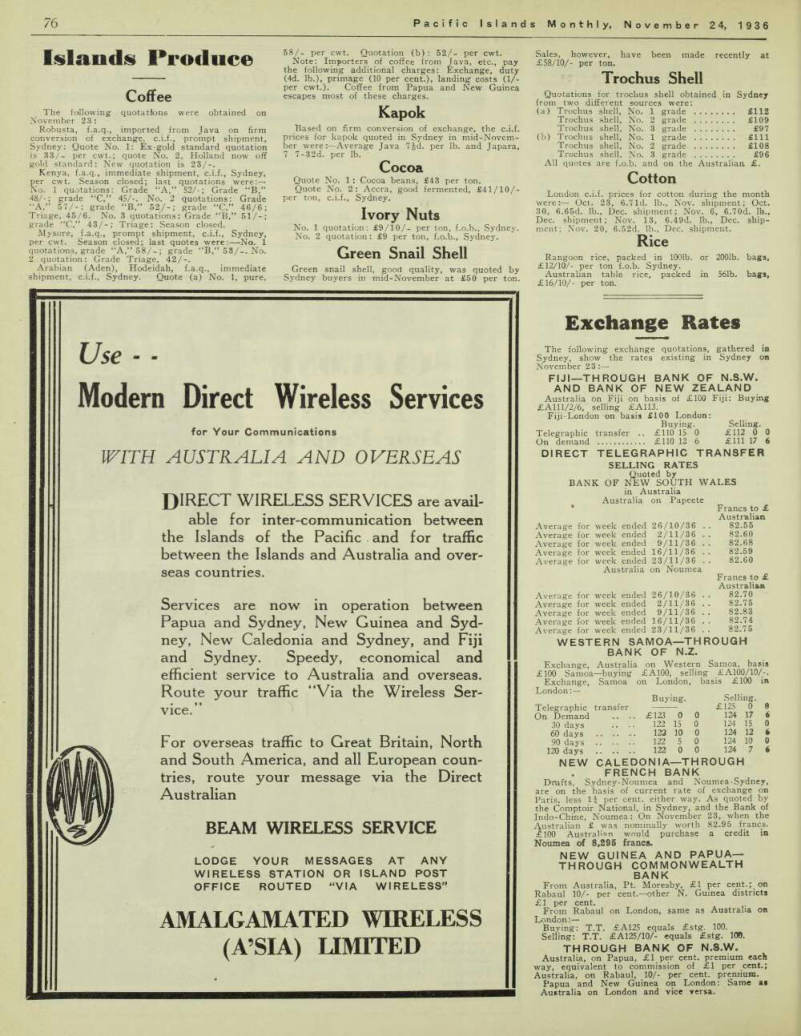
Coffee
The fallowing quotations were obtained on November 23: Robusta, f.a.q., imported from Java on firm conversion of exchange, c.i.f., prompt shipment, Sydney: Quote No. 1: Ex-gold standard quotation is 33/- per cwt.; quote No. 2, Holland now off gold standard: New quotation is 23/-.
Kenya, f.a.q., immediate shipment, c.i.f., Sydney, per cwt. Season closed; last quotations were;— No. 1 quotations: Grade “A,” 52/-; Grade “B,” 48/-; grade “C,” 45/-. No. 2 quotations: Grade “A,” 57/-; grade “B.” 52/-; grade “C,” 46/6; Triage, 45/6. No. 3 quotations: Grade “B,” 51/-; grade “C,” 43/-; Triage: Season closed.
Mysore, f.a.q., prompt shipment, c.i.f., Sydney, per cwt. Season closed; last quotes were:—No. 1 quotations, grade “A,” 58/-; grade “B,” 58/-. No. 2 quotation: Grade Triage, 42/-.
Arabian (Aden), Hodeidah, f.a.q., immediate shipment, c.i.f., Sydney. Quote (a) No. 1, pure,
58/- per cwt. Quotation (b) ; 52/- per cwt.
Note: Importers of coffee from Java, etc., pay the following additional charges: Exchange, duty (4d. lb.), primage (10 per cent.), landing costs (1/per cwt.). Coffee from Papua and New Guinea escapes most of these charges.
Kapok
Based on firm conversion of exchange, the c.i.f. prices for kapok quoted in Sydney in mid-Novem ber were:—Average Java 7id. per lb. and Japara, 7 7-32 d. per lb.
Cocoa
Quote No. 1: Cocoa beans, £43 per ton.
Quote No. 2: Accra, good fermented, £4l/10/per ton, c.i.f., Sydney.
Ivory Nuts
No. 1 quotation: £9/10/- per ton, f.0.b., Sydney.
No. 2 quotation: £9 per ton, f.0.b., Sydney.
Green Snail Shell
Green snail shell, good quality, was quoted by Sydney buyers in mid-November at £5O per ton.
Sales, however, have been made recently at £5B/10/- per ton.
Trochus Shell
Quotations for trochus shell obtained in Sydney from two different sources were:
Cotton
London c.i.f. prices for cotton during the month were:— Oct. 23, 6.71 d. lb., Nov. shipment; Oct. 30, 6.65 d. lb., Dec. shipment; Nov. 6,6.70 d. lb., Dec. shipment: Nov. 13, 6.49 d. lb., Dec. ship ment; Nov. 20, 6.52 d. lb., Dec. shipment.
Rice
Rangoon rice, packed in 1001 b. or 2001 b. bags, £l2/10/- per ton f.o.b. Sydney.
Australian table rice, packed in 561 b. bags, £l6/10/- per ton.
(a) Trochus shell. No. 1 grade £112 Trochus shell. No. 2 grade £109 Trochus shell. No. 3 grade £97 (b) Trochus shell. No. 1 grade £111 Trochus shell. No. 2 grade £108 Trochus shell. No. 3 grade £96 All quotes are f.o.b. and on the Australian. £.
Exchange Rates
The following exchange quotations, gathered in Sydney, show the rates existing in Sydney on November 23: —
Fiji—Through Bank Of N.B.W.
And Bank Of New Zealand
Australia bn Fiji on basis of £lOO Fiji: Buying £Alll/2/6, selling £AII3.
Fiji-London on basis £lOO London;
Direct Telegraphic Transfer
Selling Rates
Quoted by
Bank Of New South Wales
in Australia
Western Samoa—Through
Bank Of N.Z.
Exchange, Australia on Western Samoa, basis £lOO Samoa —buying £AIOO, selling £AIOO/10/-.
Exchange, Samoa on London, basis £lOO in
New Caledonia—Through
French Bank
Drafts, Sydney-Noumea and Noumea-Sydney, are on the basis of current rate of exchange on Paris, less per cent, either way. As quoted by the Comptoir National, in Sydney, and the Bank of Indo-Chine, Noumea: On November 23, when the Australian £ was nominally worth 82.95 francs. £lOO Australian would purchase a credit in Noumea of 8,295 francs.
New Guinea And Papua
Through Commonwealth
Bank
From Australia, Pt. Moresby, £1 per cent.; on Rabaul 10/- per cent.—other N. Guinea districts £1 per cent.
From Rabaul on London, same as Australia on London:— Buying: T.T. £AI2S equals £stg. 100.
Selling: T.T. £AI2S/10/- equals £stg. 100.
Through Bank Of N.B.W.
Australia, on Papua, £1 per cent, premium each way, equivalent to commission of £l per cent.; Australia, on Rabaul, 10/- per cent, premium.
Papua and New Guinea on London: Same as Australia on London and vice versa.
Buying.
Selling.
Telegraphic transfer .
. £110 15 0 £112 0 0 On demand . £110 12 6 £111 17 6
Australia on Papeete • Francs to £ Australian Average for week ended 26/10/36 .. 82.55 Average for week ended 2/11/36 ., 82.60 Average for week ended 9/11/36 .. 82.68 Average for week ended 16/11/36 .. 82.59 Average for week ended 23/11/36 .. 82.60 Australia on Noumea Francs to £ Australia* Average for week ended 26/10/36 .. 82.70 Average for week ended 2/11/36 .. 82.75 Average for week ended 9/11/36 .. 82.83 Average for week ended 16/11/36 .. 82.74 Average for week ended 23/11/36 .. 82.75
London; — Buying. Selling.
Telegraphic transfer £125 0 9 On Demand .. .. £123 0 0 124 17 6 30 days .. .. 122 15 0 124 15 0 60 days 122 10 0 124 12 6 90 days 122 5 0 124 10 0 120 days 122 0 0 124 7 6
Advertisements & other items, p. 78 (2 items)
76
Monthly, November 24, 1936
Pacific Island
Modern Direct Wireless Services
Use - -
for Your Communications
WITH AUSTRALIA AND OVERSEAS
DIRECT WIRELESS SERVICES are avail-
able for inter-communication between the Islands of the Pacific and for traffic between the Islands and Australia and overseas countries.
Services are now in operation between Papua and Sydney, New Guinea and Sydney, New Caledonia and Sydney, and Fiji and Sydney. Speedy, economical and efficient service to Australia and overseas.
Route your traffic “Via the Wireless Service.”
For overseas traffic to Great Britain, North and South America, and all European countries, route your message via the Direct Australian
BEAM WIRELESS SERVICE
LODGE YOUR MESSAGES AT ANY
WIRELESS STATION OR ISLAND POST
OFFICE ROUTED “VIA WIRELESS"
AMALGAMATED WIRELESS
(A’SIA) LIMITED
Market Quotations
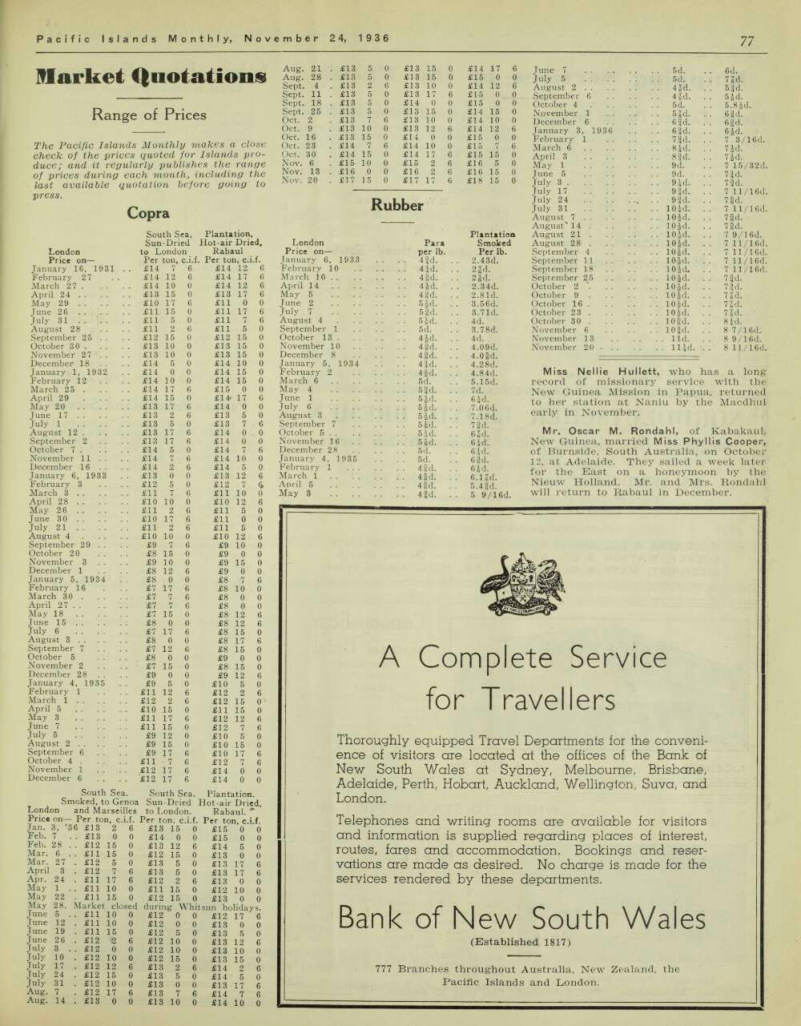
Range of Prices
The Pacific Islands Monthly makes a close check of the prices quoted for Islands pro duce; and it regularly publishes the range of prices during each month, including the last available quotation before going to press.
Miss Nellie Hullett, who has a long record of missionary service with the New Guinea Mission in Papua, returned to her station at Naniu by the Macdhui early in November.
Mr, Oscar M. Rondahl, of Kabakaul, New Guinea, married Miss Phyllis Cooper, of Burnside, South Australia, on October 12, at Adelaide. They sailed a week later for the East on a honeymoon by the Nieuw Holland. Mr. and Mrs. Rondahl will return to Rabaul in December.
June 7 . . 5 cl. 6d.
July 5 5d. 7 |d.
August 2 . . 4gd. 53d.
September 6 4 id. bid.
October 4 5d. 5.8 Jd.
November 1 5|d. 6|d.
December 6 63d. 6gd.
January 3, 1936 63d. 6^d.
February 1 73d. 7 3/16d.
March 6 . . 8 Jd. 7Jd.
April 3 83d. lid.
May 1 9d. 7 15/32d.
June 5 . . 9d. 73d.
July 3 . . . 9|d. 73d.
July 17 93d. 7 1 l/16d.
July 24 . . • •. 93d. 7 |d.
July 31 10*d. 7 1 l/16d.
August 7 . . lOJd. 7 |d.
August* 14 . 10Jd. 7 |d.
August 21 . 10£d. 7 9/16d.
August 28 . 10|d. 7 1l/16d.
September 4 lOJd. 7 ll/16d.
September 11 10|d. 7 ll/16d.
September 18 10Jd. 7 1 l/16d.
September 25 lOJd. 73d.
October 2 *. 10|d. 73d.
October 9 . 10|d. 7 id.
October 16 . 10 Jd. 7 id.
October 23 . lOid. 7 id.
October 30 . 10gd. 8Jd.
November 6 103d. 8 7 / 16d.
November 13 . lid. 8 9/16d.
November 20 . 113d. 8 ll/16d.
Aug. 21 . £13 5 0 £13 15 0 £14 17 6 Aug. 28 . £13 5 0 £13 15 0 £15 0 0 Sept. , 4 . £13 2 6 £13 10 0 £14 12 6 Sept. 11 . £13 5 0 £13 17 6 £15 0 0 Sept. , 18 . £13 5 0 £14 0 0 £15 0 0 Sept. 25 . £13 5 0 £13 15 0 £14 15 0 Oct. 2 . £13 7 6 £13 10 0 £14 10 0 Oct. 9 . £13 10 0 £13 12 6 £14 12 6 Oct. 16 . £13 15 0 £14 0 0 £15 0 0 Oct. 23 . £14 7 6 £14 10 0 £15 7 6 Oct. 30 . £14 15 0 £14 17 6 £15 15 0 Nov. 6 . £15 10 0 £15 2 6 £16 5 0 Nov. 13 . £16 0 0 £16 2 6 £16 15 0 Nov. 20 . £17 15 0 £17 17 6 £18 15 0
Rubber
Plantation London Para Smoked Price on — per lb.
Per lb.
January 6, 1933 43d. .. 2.43d.
February 10 43d. . . 2|d.
March 10 . . 4gd. .. 2 Jd.
April 14 . . . . 4id. .. 2.34d.
May 5 4gd. . . 2.81d.
June 2 5 Jd. . . 3.56d.
July 7 5 id. . . 3.71d.
August 4 5 Jd. . . 4d.
September 1 . . 5d. 3.78d.
October 13 . 4Jd. . . 4d.
November 10 43d. . . 4.09d.
December 8 4 id. .. 4.Old.
January 5, 1934 43d. . . 4.28d.
February 2 4|d. . . 4.84d.
March 6 5d. 5.15d.
May 4 53d. . . 7d.
June 1 5£d. . . 63d.
July 6 5id. . . 7.06d.
August 3 5Jd. . . 7.18d.
September 7 . . 5 Jd. . . 7gd.
October 5 . . 53d. . . 6 Id.
November 16 5 Jd. . . 63d.
December 28 6d. 63d.
January 4. 1935 5d. 63d.
February 1 ... 4 3d. .. 6|d.
March i 4id. . . 6.1|d.
April 5 4id. . . 5.43d.
May 3 4 3d. .. 5 9/16d.
Copra
South Sea, Plantation, Sun-Dried Hot-air Dried, London to London Rabaul Price on— Per ton, i c.i.f.
Per ton, c.i.f.
January 16, 1931 . . £14 7 6 £14 12 6 February 2 7 £14 12 6 £14 17 6 March 27 . £14 10 0 £14 12 6 April 24 . . £13 15 0 £13 17 6 May 29 . . £10 17 6 £11 0 0 June 26 . . £11 15 0 £11 17 6 July 31 . . £11 5 0 £11 7 6 August 28 £11 2 6 £11 5 0 September 25 £12 15 0 £12 15 0 October 30 . £13 10 0 £13 15 0 November 27 £13 10 0 £13 15 0 December 18 £14 5 0 £14 10 0 January 1, 1932 £14 0 0 £14 15 0 February 12 £14 10 0 £14 15 0 March 25 . £14 17 6 £15 0 0 April 29 £14 15 0 £14> 17 6 May 20 . . £13 17 6 £14 0 0 June 17 . . £13 2 6 £13 5 0 July 1 • • £13 5 0 £13 7 6 August 12 . £13 17 6 £14 0 0 September 2 . . £13 17 6 £14 0 0 October 7 . £14 5 0 £14 7 6 November 11 £14 7 6 £14 10 0 December 16 £14 2 6 £14 5 0 January 6, 1933 £13 0 0 £13 12 6 February 3 £12 5 0 £12 7 & March 3 . . £11 7 6 £11 10 0 April 28 . . £10 10 0 £10 12 6 May 26 . . £11 2 6 £11 5 0 June 30 .. £10 17 6 £11 0 0
July 21 . .
£11 2 6 £11 5 0 August 4 £10 10 0 £10 12 6 September 29 £9 7 6 £9 10 0 October 20 £8 15 0 £9 0 0 November 3 . . £9 10 0 £9 15 0 December 1 . . £8 12 6 £9 0 0 January 5, 1934 £8 0 0 £8 7 6 February 16 £7 17 6 £8 10 0 March 30 . £7 7 6 £8 0 0 April 27 . . £7 7 6 £8 0 0 May 18 £7 15 0 £8 12 6 June 15 . . £8 0 0 £8 12 6
July 6 . .
£7 17 6 £8 15 0 August 3 . . £8 0 0 £8 17 6
September 7
£7 12 6 £8 15 0 October 5 £8 0 0 £9 0 0 November 2 . . £7 15 0 £8 15 0 December 28 £9 0 0 £9 12 6 January 4, 1935 £9 5 0 £10 5 0 February 1 £11 12 6 £12 2 6 March 1 . . £12 2 6 £12 15 0 April 5 £10 15 0 £11 15 0 May 3 £11 17 6 £12 12 6 June 7 £11 15 0 £12 7 6 July 5 . . £9 12 0 £10 5 0 August 2 . . £9 15 0 £10 15 0 September 6 . . £9 J7 6 £10 17 6 October 4 . £11 7 6 £12 7 6 November 1 £12 17 6 £14 0 0 December 6 £12 17 6 £14 0 0 South Sea.
South Sea.
Plantation.
Smoked, to Genoa Sun-Dried Hot-air Dried.
London and Marseilles to London.
Rabaul. * Price on— Per ton, c.i.f.
Per ton. c.i.f.
Per ton. c.i. f.
Jan. 3, ’36 £13 2 6 £13 ! 15 0 £15 0 0 Feb. 7 . . £13 0 0 £14 0 0 £15 0 0 Feb. 28 . . £12 15 0 £13 ; 12 6 £14 5 0 Mar. 6 . . £11 15 0 £12 : 15 0 £13 0 0 Mar. 27 . £12 5 0 £13 1 5 0 £13 17 6 April 3 . £12 7 6 £13 ; 5 0 £13 17 6 Apr. 24 . £11 17 6 £12 ; 2 6 £13 0 0 May 1 .. £11 10 0 £11 15 0 £12 10 0 May 22 . £11 15 0 £12 1 15 0 £13 0 0 May 28. Market closed during Whitsun holidays.
June 5 . . £11 10 0 £12 ; o 0 £12 17 6 June 12 . £11 10 0 £12 1 0 0 £13 0 0 June 19 . £11 15 0 £12 1 5 0 £13 5 0 June 26 . £12 2 6 £12 : 10 0 £13 12 6 July 3 . . £12 0 0 £12 : 10 0 £13 10 0 July 10 . £12 10 0 £12 : 15 0 £13 15 0 July 17 . £12 12 6 £13 1 2 6 £14 2 6 July 24 . £12 15 0 £13 1 5 0 £14 5 0 July 31 . £12 10 0 £13 ; o 0 £13 17 6 Aug. 7 . £12 17 6 £13 7 6 £14 7 6 Aug. 14 . £13 0 0 £13 i 10 0 £14 10 0
Advertisements & other items, p. 79 (1 item)
A Complete Service
for Travellers
Thoroughly equipped Travel Departments for the convenience of visitors are located at the offices of the Bank of New South Wales at Sydney, Melbourne, Brisbane, Adelaide, Perth, Hobart, Auckland, Wellington, Suva, and London.
Telephones and writing rooms are available for visitors and information is supplied regarding places of interest, routes, fares and accommodation. Bookings and reservations are made as desired. No charge is made for the services rendered by these departments.
Bank of New South Wales
(Established 1817) 777 Branches throughout Australia, New Zealand, the Pacific Islands and London.
Shipping: Services in the Pacific
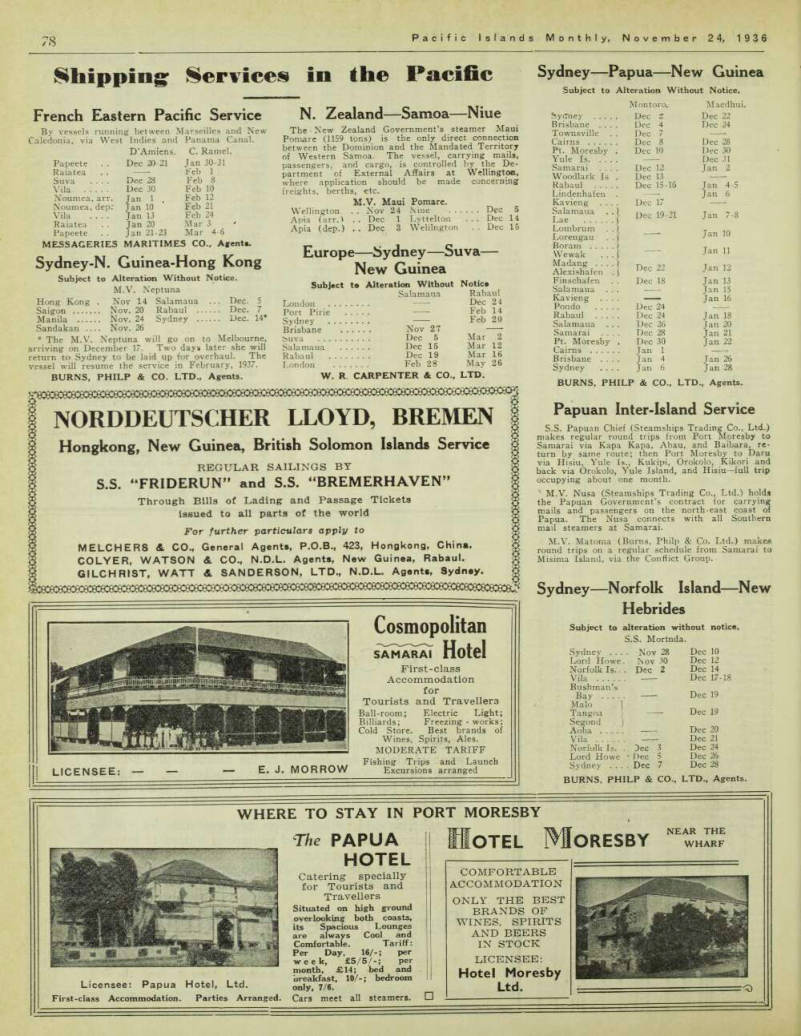
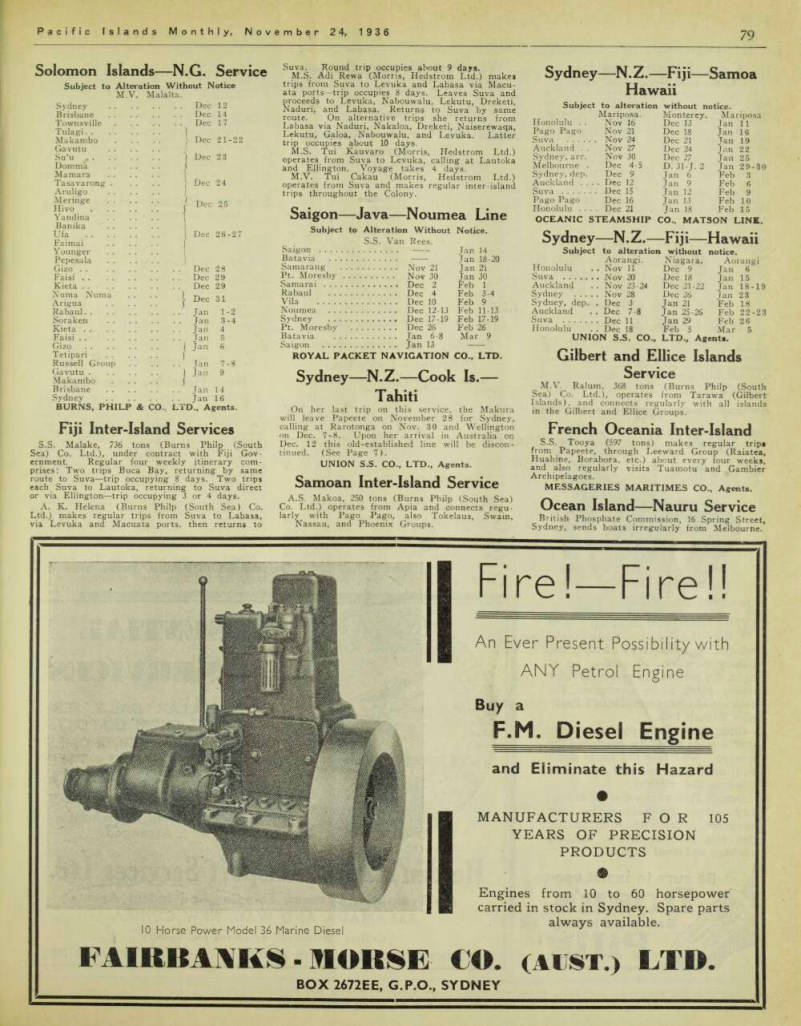
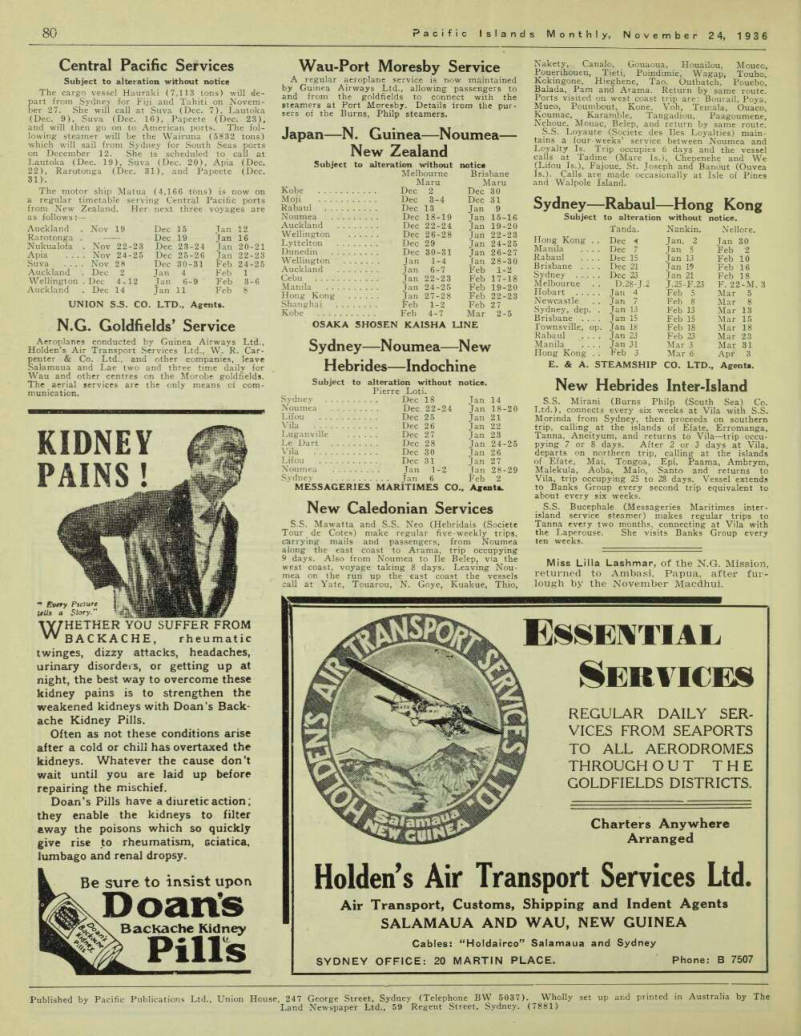
French Eastern Pacific Service
By vessels running between Marseilles and New Caledonia, via West Indies and Panama Canal.
Sydney-N. Guinea-Hong Kong Subject to Alteration Without Notice.
N. Zealand —Samoa —Niue
The New Zealand Government’s steamer Maui Pornare (1159 tons) is the only direct connection between the Dominion and the Mandated Territory of Western Samoa. The vessel, carrying mails, passengers, and cargo, is controlled by the De partment of External Affairs at Wellington, where application should be made concerning freights, berths, etc.
Europe—Sydney—Suva — New Guinea Subject to Alteration Without Notice
Sydney—Papua—New Guinea Subject to Alteration Without Notice.
Papuan Inter-Island Service
S.S. Papuan Chief (Steamships Trading Co., Ltd.) makes regular round trips from Port Moresby to Samarai via Kapa Kapa, Abau, and Baibara, re turn by same route; then Port Moresby to Daru via Hisiu, Yule Is., Kukipi, Orokolo, Kikori and back via Orokolo, Yule Island, and Hisiu —full trip occupying about one month.
M.V. Nusa (Steamships Trading Co., Ltd.) holds the Papuan Government’s contract for carrying mails and passengers on the north-east coast of Papua. The Nusa connects with all Southern mail steamers at Samarai.
M.V. Matoma (Burns, Philp & Co. Ltd.) makes round trips on a regular schedule from Samarai to Misima Island, via the Conflict Group.
Sydney—Norfolk Island—New
Hebrides
Subject to alteration without notice.
D’Amiens.
C. Ramel.
Papeete Dec 20-21 Jan 30-31 Raiatea — Feb 1 Suva ...
Dec 28 Feb 8 Vila Dec 30 Feb 10 Noumea, arr.
Jan 1 .
Feb 12 Noumea, dep: Jan 10 Feb 21 Vila Jan 13 Feb 24 Raiatea Jan 20 Mar 3 Papeete Jan 21-23 Mar 4-6
Messageries
Maritimes Co., Agent*.
M.V. Neptuna Hong Kong . Nov 14 Salamaua ... Dec. 5 Saigon Nov. 20 Rabaul Dec. 7 Manila Nov. 24 Sydney Dec. 14* Sandakan Nov. 26 * The M.V. Neptuna will go on to Melbourne, arriving on December 17. Two days later she will return to Sydney to be laid up for overhaul. The vessel will resume the service in February, 1937.
Burns, Philp & Co. Ltd., Agents.
M.V. Maui Pomarc.
Wellington . . Nov 24 Niue Dec 5 Apia (arr. ) . . Dec 1 Lyttelton ... Dec 14 Apia (dep.) . . Dec 3 Wellington . . Dec 15
Salamaua Rabaul London ■ Dec 24 Port Pirie Feb 14 Sydney Feb 20 Brisbane Nov 27 —— buva Dec 5 Mar 2 Salamaua Dec 15 Mar 12 Rabaul Dec 19 Mar 16 London Feb 28 May 26
W. R Carpenter & Co., Ltd.
Montoro, Macdhui.
Sydney . . .
Dec 22 Brisbane . .
Dec 4 Dec 24 Townsville Dec 7 — Cairns ...
Dec 28 Pt. Moresby Dec 10 Dec 30 Yule Is. . .
Dec 31 Samarai . .
Dec 12 Jan 2 Woodlark Is Dec 13 — Rabaul . . .
Dec 15-16 Jan 4-5 Jan 6 Lindenhafen Kavieng . .
Dec 17 — Salamaua Lae i i i Dec 19-21 Jan 7-8 Lombrum Jan 10 Lorengau i Boram ...
Jan 11 Wewak — Madang . . .
Alexishafen i \ Dec 22 Jan 12 Finschafen Dec 18 Jan 13 Salamaua . — Jan 15 Kavieng — Jan 16 Pondo Dec 24 Dec 24 Rabaul . . .
Jan 18 Jan 20 Salamaua Dec 26 Samarai . .
Dec 28 Jan 21 Pt. Moresby Dec 30 Jan 22 Jan 1 Jan 4 Brisbane . .
Jan 26 Sydney Jan 6 Jan 28
Burns, Philp & Co., Ltd., Agents.
S.S. Morlnda.
Sydney ...
Nov 28 Dec 10 Lord Howe.
Nov X) Dec 12 Norfolk Is.. .
Dec 2 Dec 14 Vila Dec 17-18 Bushman's Bay — Dec 19 Malo
Tangoa [
— Dec 19 Segond J Aoba — Dec 20 Vila — Dec 21 Norfolk Is. .
Dec 3 Dec 24 Lord Howe • Dec 5 Dec 26 Sydney ...
Dec 7 Dec 28
Burns, Philp & Co., Ltd.,
Agents.
Solomon Islands—N.G. Service Subject to Alteration Without Notice
Fiji Inter-Island Services
S.S. Malake, 736 tons (Burns Philp (South Sea) Co. Ltd.), under contract with Fiji Gov ernment. Regular four weekly itinerary com prises: Two trips Buca Bay, returning by same route to Suva —trip occupying 8 days. Two trips each Suva to Lautoka, returning to Suva direct or via Ellington—trip occupying 3 or 4 days.
A. K. Helena (Burns Philp (South Sea) Co.
Ltd.) makes regular trips from Suva to Labasa, via Levuka and Macuata ports, then returns to
Suva. Round trip occupies about 9 days.
M.S. Adi Rewa (Morris, Hedstrom Ltd.) makes trips from Suva to Levuka and Labasa via Macu ata ports—trip occupies 8 days. Leaves Suva and proceeds to Levuka, Nabouwalu, Lekutu, Dreketi, Naduri, and Labasa. Returns to Suva by same route. On alternative trips she returns from Labasa via Naduri, Nakaloa, Dreketi, Naiserewaqa, Lekutu, Galoa, Nabouwalu, and Levuka. Latter trip occupies about 10 days.
M.S. Tui Kauvaro (Morris, Hedstrom Ltd.) operates from Suva to Levuka, calling at Lautoka and Ellington. Voyage takes 4 days.
M.V. Tui Cakau (Morris, Hedstrom Ltd.) operates from Suva and makes regular inter-island trips throughout the Colony.
Saigon—Java—Noumea Line
Subject to Alteration Without Notice.
Royal Packet Navigation Co., Ltd.
Sydney—N.Z.—Cook Is.—
Tahiti
On her last trip on this service, the Makura will leave Papeete on November 28 for Sydney, calling at Rarotonga on Nov. 30 and Wellington on Dec. 7-8. Upon her arrival in Australia on Dec. 12 this old-established line will be discon tinued. (See Page 7).
Union S.S. Co., Ltd., Agents.
Samoan Inter-Island Service
A.S. Makoa, 250 tons (Burns Philp (South Sea) Co. Ltd.) operates from Apia and connects regu larly with Pago Pago, also Tokelaus, Swain, Nassau, and Phoenix Groups.
Sydney—N.Z.—Fiji—Samoa Hawaii Subject to alteration without notice.
Sydney—N.Z.—Fiji—Hawaii Subject to alteration without notice.
Gilbert and Ellice Islands
Service
M.V. Ralum, 368 tons (Burns Philp (South Sea) Co. Ltd.), operates from Tarawa (Gilbert Islands), and connects regularly with all islands in the Gilbert and Ellice Groups.
French Oceania Inter-Island
S.S. Tooya (597 tons) makes regular trip* from Papeete, through Leeward Group (Raiatea, Huahine, Borabora, etc.) about every four weeks, and also regularly visits Tuamotu and Gambier Archipelagoes.
Messageries Maritimes Co., Agents.
Ocean Island—Nauru Service
British Phosphate Commission, 16 Spring Street, Sydney, sends boats irregularly from Melbourne.
M.V.
Malalta.
Sydney 12 Brisbane 14 Townsville . . . 17 Tulagi 1 Makambo [ Dec 21-22 Gavutu Su’u 23 Domma J Mamara 1 Tasavarong . . .
I Dec 24 Aruligo J M cringe Hivo
j Dec
25 Yandina Banika 1 Ufa [Dec 1 26-27 Faimai Younger 1 Pepesala J Gizo 28 Faisi 29 Kieta 29 Numa Numa Arigua
Dec
31 Rabaul 1-2 Soraken Jan 3-4 Kieta Jan 4 Faisi 5 Gizo
j Jan
6 Tetipari Russell Group 7-8 Gavutu
Jan
9 Makambo . . .
Brisbane 14 Sydney 16
Burns, Philp & Co., Ltd., Agents.
S.S. Van Rees.
Saigon Jan 14 Batavia Jan 18-20 Samarang Nov 21 Jan 21 Pt. Moresby Nov 30 Jan 30 Samarai Dec 2 Feb 1 Rabaul Dec 4 Feb 3-4 Vila Dec 10 Feb 9 Noumea Dec 12-13 Feb 11-13 Sydney Dec 17-19 Feb 17-19 Pt. Moresby Dec 26 Feb 26 Batavia Jan 6-8 Mar 9 Saigon Jan 13
Mariposa.
Monterey.
Mariposa Honolulu . .
Nov 16 Dec 13 Jan 11 Pago Pago Nov 21 Dec 18 Jan 16 Suva ...
Dec 21 Jan 19 Auckland .
Nov 27 Dec 24 J<xn 22 Sydney, arr.
Nov 30 Dec 27 Jan 25 Melbourne Dec 4-5 D. 31-J. 2 Tan 29-30 Sydney, dep.
Dec 9 Jan 6 Feb 3 Auckland . . . . Dec 12 Jan 9 Feb 6 Suva Jan 12 Feb 9 Pago Pago Dec 16 Jan 13 Feb 10 Honolulu . . ■ • Dec 21 Jan 18 Feb 15
Oceanic
Steamship
Co.. Matson Line.
Aorangi. Niagara. Aorangi Honolulu . . Nov 11 Dec 9 Jan 6 Suva Nov 20 Dec 18 Jan 15 Auckland .. Nov 23-24 Dec 21-22 Jan 18-19 Sydney Nov 28 Dec 26 fan 23 Sydney, dep. . Dec 3 Jan 21 Feb 18 Auckland . . Dec 7-8 Jan 25-26 Feb 22-23 Suva Dec 11 Jan 29 Feb 26 Honolulu . . Dec 18 Feb 5 Mar 5
Union S.S. Co., Ltd., Agent*.
Central Pacific Services
Subject to alteration without notice The cargo vessel Hauraki (7,113 tons) will de part from Sydney for Fiji and Tahiti on Novem ber 27. She will call at Suva (Dec. 7), Lautoka (Dec. 9), Suva (Dec. 16), Papeete (Dec. 23), and will then go on to American ports. The fol lowing steamer will be the Wairuna (5832 tons) which will sail from Sydney for South Seas ports on December 12. She is scheduled to call at Lautoka (Dec. 19), Suva (Dec. 20), Apia (Dec. 22), Rarotonga (Dec. 31), and Papeete (Dec. 31).
The motor ship Matua (4,166 tons) is now on a regular timetable serving Central Pacific ports from New Zealand. Her next three voyages are as follows: Auckland . Nov 19 Dec 15 Jan 12 Rarotonga . Dec 19 Jan 16 Nukualofa . Nov 22-23 Dec 23-24 Jan 20-21 Apia ... Nov 24-25 Dec 25-26 Jan 22-23 Suva ... Nov 28 Dec 30-31 Feb 24-25 Auckland . Dec 2 Jan 4 Feb 1 Wellington . Dec 4-12 Jan 6-9 Feb 3-6 Auckland . Dec 14 Jan 11 Feb 8
Union S.S. Co. Ltd., Agents.
N.G. Goldfields’ Service
Aeroplanes conducted by Guinea Airways Ltd., Holden’s Air Transport Services Ltd., W. R. Car penter & Co. Ltd., and other companies, leave Salamaua and Lae two and three time daily for Wau and other centres on the Morobe goldfields.
The aerial services are the only means of com munication.
Wau-Port Moresby Service
A regular aeroplane service is now maintained by Guinea Airways Ltd., allowing passengers to and from the goldfields to connect with the steamers at Port Moresby. Details from the pur sers of the Burns, Philp steamers.
Japan—N. Guinea—Noumea—
New Zealand
Subject to alteration without notice
Sydney—Noumea—New Hebrides —Indochine Subject to alteration without notice.
New Caledonian Services
S.S. Mawatta and S.S. Neo (Hebridais (Societe Tour de Cotes) make regular five-weekly trips, carrying mails and passengers, from Noumea along the east coast to Arama, trip occupying 9 days. Also from Noumea to He Belep ? via the west coast, voyage taking 8 days. Leaving Nou mea on the run up the east coast the vessels call at Yate, Touarou, N. Goye, Kuakue, Thio,
Nakety, Canalo, Gouaoua, Houailou, Moueo, Pouerihouen, Tieti, Poindimie, Wagap, Touho, Kokingone, Hieghene, Tao, Outbatch, Pouebo, Balada, Pam and Arama. Return by same route.
Ports visited on west coast trip are: Bourail, Poya, Mueo, Poumbout, Kone, Voh, Temala, Ouaco, Koumac, Karamble, Tangadiou, Paagoumene, Nehoue. Mouac, Belep, and return by same route.
S.S. Loyaute (Societe des lies Loyalties) main tains a four-weeks’ service between Noumea and Loyalty Is. Trip occupies 6 days and the vessel calls at Tadine (Mare Is.), Chepenehe and We (Lifou Is.), Fajoue, St. Joseph and Banout (Ouvea Is.). Calls are made occasionally at Isle of Pines and Walpole Island.
Sydney—Rabaul—Hong Kong
Subject to alteration without notice.
New Hebrides Inter-Island
5.5. Mirani (Burns Philp (South Sea) Co.
Ltd.), connects every six weeks at Vila with S.S.
Morinda from Sydney, then proceeds on southern trip, calling at the islands of Efate, Erromanga, Tanna, Aneityum, and returns to Vila—trip occu pying 7or 8 days. After 2or 3 days at Vila, departs on northern trip, calling at the islands of Efate, Mai, Tongoa, Epi, Paama, Ambrym, Malekula, Aoba, Malo, Santo and returns to Vila, trip occupying 25 to 28 days. Vessel extends to Banks Group every second trip equivalent to about every six weeks. 5.5. Bucephale (Messageries Maritimes inter island service steamer) makes regular trips to Tanna every two months, connecting at Vila with the Laperouse. She visits Banks Group every ten weeks.
Miss Lilia Lashmar, of the N.G. Mission, returned to Ambasi, Papua, after fur lough by the November Macdhui.
Tanda.
Nankin.
Nellore.
Hong Kong . . Dec 4 Jan. 2 Jan 30 Manila . . Dec 7 Jan 5 Feb 2 Rabaul . . Dec 15 Jan 13 Feb 10 Brisbane . . . . Dec 21 Jan 19 Feb 16 Sydney . . . . . Dec 23 Tan 21 Feb 18 Melbourne . . D.28-J.2
J.2S-F.23
F. 22-M. 3 Hobart . . .
Feb 5 Mar 5 Newcastle . . Jan 7 Feb 8 Mar 8 Sydney, dep, . . Jan 13 Feb 13 Mar 13 Brisbane . . . . Jan 15 Feb 15 Mar 15 Townsville, op. Jan 18 Feb 18 Mar 18 Rabaul . . Jan 23 Feb 23 Mar 23 Manila . . Jan 31 Mar 3 Mar 31 Hong Kong . . Feb 3 Mar 6 Apr 3 E. & A.
Steamship
Co. Ltd.,
, Agents.
Melbourne Brisbane Maru Maru Kobe 2 Dec 30 Moji 3-4 Dec 31 Rabaul 13 Jan 9 Noumea . . . . 18-19 Jan 15-16 Auckland . . . 22-24 Jan 19-20 Wellington 26-28 Jan 22-23 Lyttelton 29 Jan 24-25 Dunedin ... 30-31 Jan 26-27 Wellington Jan 1-4 Jan 28-30 Auckland . . .
Jan 6-7 Feb 1-2 Cebu ... 22-23 Feb 17-18 Manila Jan 24-25 Feb 19-20 Hong Kong Jan 27-28 Feb 22-23 Shanghai Feb 1-2 Feb 27 Kobe Feb 4-7 Mar 2-5
Osaka
Shosen Kaisha Line
Pierre Loti.
Sydney Dec 18 Jan 14 Noumea Dec 22-24 Jan 18-20 Lifou Dec 25 Jan 21 Vila Dec 2 6 Jan 22 Luganville Dec 27 Tan 23 Le Dart Dec 28 Jan 24-25 Vila Dec 30 Jan 26 Lifou Dec 31 Jan 27 Noumea Jan 1-2 Tan 28-29 Sydney Jan 6 Feb 2
Mess Acer Ies Maritimes Co., Agent*.
Advertisements & other items, pp. 80-84 (2 items)
Cosmopolitan
NORDDEUTSCHER LLOYD, BREMEN
Hongkong, New Guinea, British Solomon Islands Service
REGULAR SAILINGS BY
S.S. “FRIDERUN” and S.S. “BREMERHAVEN”
Through Bills of Lading and Passage Tickets issued to all parts of the world For further particulars apply to MELCHERS CO., General Agents, P. 0.8., 423, Hongkong, Chin*.
COLYER, WATSON & CO., N.D.L. Agents, New Guinea, Rabaul.
GILCHRIST, WATT & SANDERSON, LTD., N.D.L. Agents, Sydney.
mannpmtfi
LICENSEE:
E. J. MORROW
Cosmopolitan
samara! Hotel
First-class Accommodation for Tourists and Travellers Ball-room; Electric Light; Billiards; Freezing - works; Cold Store. Best brands of Wines, Spirits, Ales.
MODERATE TARIFF
Fishing Trips and Launch Excursions arranged
WHERE TO STAY IN PORT MORESBY
PAPUA
HOTEL
Catering specially for Tourists and Travellers Situated on high ground overlooking both coasts, its Spacious Lounges are always Cool and Comfortable. Tariff: Per Day, 16/-; per week, £5/5/-; per month, £l4; bed and u , , breakfast, 10/-; bedroom Licensee: Papua Hotel, Ltd. on l y> 7/5.
First-class Accommodation. Parties Arranged. Cars meet all steamers.
OTEL
Moresby
COMFORTABLE
ACCOMMODATION
ONLY THE BEST
BRANDS OF
WINES, SPIRITS
AND BEERS
IN STOCK
LICENSEE:
Hotel Moresby
Ltd.
NEAR THE
WHARF
10 Horse Power Model 36 Marine Diesel
FAIRBANKS ■ MORSE
BOX 2672EE, G.P.O.
Fire! —Fire!!
An Ever Present Possibility with ANY Petrol Engine
Buy a
F.M. Diesel Engine
and Eliminate this Hazard
MANUFACTURERS FOR 105
YEARS OF PRECISION
PRODUCTS
* Engines from 10 to 60 horsepower carried in stock in Sydney. Spare parts always available.
€O. (AUST.) LTD.
SYDNEY
KIDNEY
PAINS!
*■ Every Picture tell* a Story." m Every Picture^ telli a Story.
WHETHER YOU SUFFER FROM
BACKACHE, rheumatic twinges, dizzy attacks, headaches, urinary disorders, or getting up at night, the best way to overcome these kidney pains is to strengthen the weakened kidneys with Doan’s Backache Kidney Pills.
Often as not these conditions arise after a cold or chill has overtaxed the kidneys. Whatever the cause don’t wait until you are laid up before repairing the mischief.
Doan’s Pills have a diuretic action; they enable the kidneys to filter away the poisons which so quickly give rise to rheumatism, sciatica, lumbago and renal dropsy.
* to insist upon
Doan's
v Backache Kidney
Pills
$ %
Essential
Vertices
REGULAR DAILY SER-
VICES FROM SEAPORTS
TO ALL AERODROMES
THROUGH OUT THE
GOLDFIELDS DISTRICTS.
Charters Anywhere Arranged
Holden’s Air Transport Services Ltd.
Air Transport, Customs, Shipping and Indent Agents
SALAMAUA AND WAU, NEW GUINEA
Cables; “Holdairco” Salamaua and Sydney SYDNEY OFFICE: 20 MARTIN PLACE. Phone: B 7507
AERIAL TRANSPORT ESTABLISHED
NEW GUINEA GOLD INDUSTRY
S INCE 1927, when the development of the Morobe Goldfield commenced, the European population of the Territory has been trebled.
The new industry has increased the Empire's gold production by nearly £2,000,000 per annum, and has added enormously to the trade turnover of New Guinea.
Only Aerial Transport makes this possible. There is no road between the Goldfields and the coast. Aeroplanes, running on Regular Schedules, without Difficulty or Delay, carry in Dredges, Crushing Mills, Cyaniding Plants, Motor Vehicles, Hydro - Electric Machinery, Thousands of Passengers, and Every Kind of Goods needed by a large and Growing European Community.
G ■UINEA AIRWAYS LTD. were established in 1927; and they have grown in the following way, until they are to-day the largest freight-carrying service in the world: J G W«6l WWays i A typical load landed from one of Guinea Airways' giant freight-carrying aeroplanes. This big G-31 Junkers machine carried from Lae, on the coast, to the aerodrome at Wau, the goldfields centre in the interior, a Baby Austin motor car, an office safe, and 38 bags of rice-^-a * total weight of nearly two and a half tons.
Guinea Airways Ltd. operate regular air services in New Guinea and Papua; they use over 50 Aerodromes and Landing-grounds in the two Territories.
GUINEA AIRWAYS L™
LAE • SALAMAUA
HEAD OFFICE:
BROOKMAN BUILDINGS
GRENFELL STREET
ADELAIDE, S.A.
NEW GUINEA OFFICE:
LAE
MANDATED TERRITORY OF
NEW GUINEA
BRANCH OFFICES AND AGENTS AT WAU, SALAMAUA, PORT MORESBY. AND SYDNEY
the more
SATISFACTION
you’ll find in K. 8.!
AC o'- I > V h 5 o -5S v^ x \A CO Sf o .
When the sun beats down with throatparching fierceness—when the air shimmers with the tropical heat—that’s when you’ really appreciate the cooling, enjoyable qualities of K. 8.; for the hotter the weather, the more real refreshment there is in a cool, satisfying glass of TOOTH’S K B. LAGER.
80
Pacific Islands Monthly, November 24, 1936
Published by Pacific Publications Ltd., Union House, 247 George Street, Sydney (Telephone BW 5037). Wholly set up and printed in Australia by The Land Newspaper Ltd., 59 Regent Street, Sydney. (7881)