Pacific
Island
Monthly
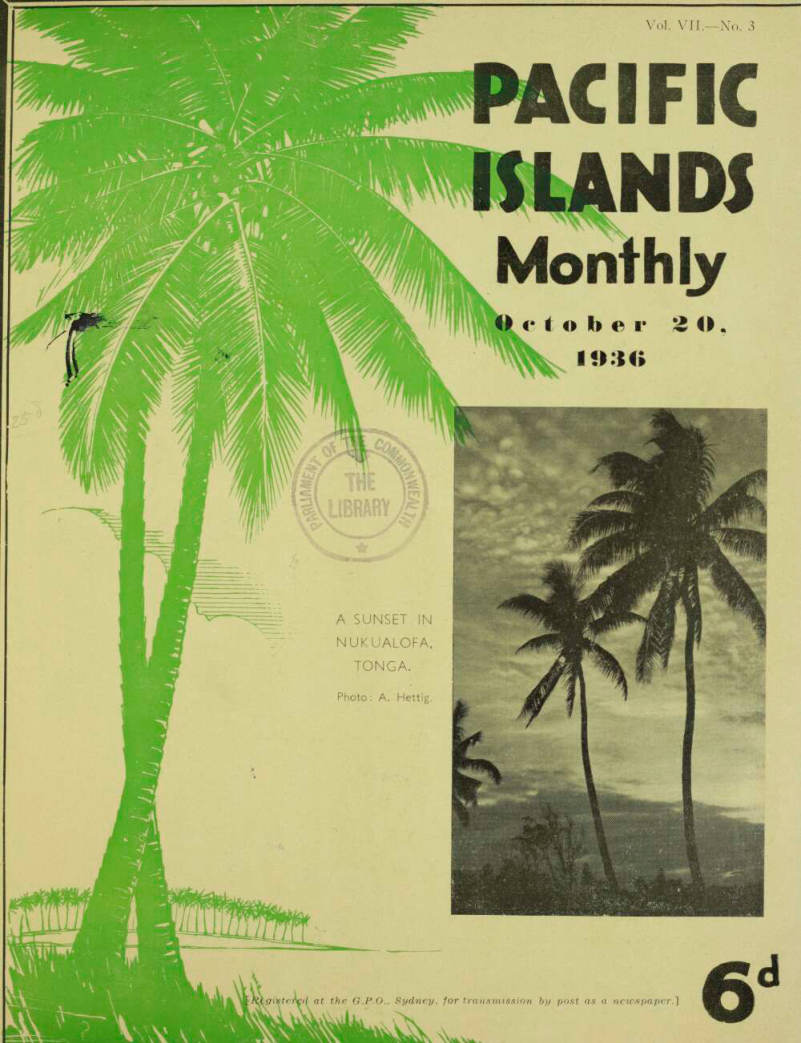
Vol. VII.—No. 3
Ovtoh e 2 0, turn
at the G.P.0., Sydney, for transmission by post as a newspaper .]
6 a
A Sunset In
Nukualofa,
Tonga.
Photo: A. Hettig.
Advertisements & other items, p. 2 (1 item)
Pacific Territories and Europe
Direct Shipping Service between the
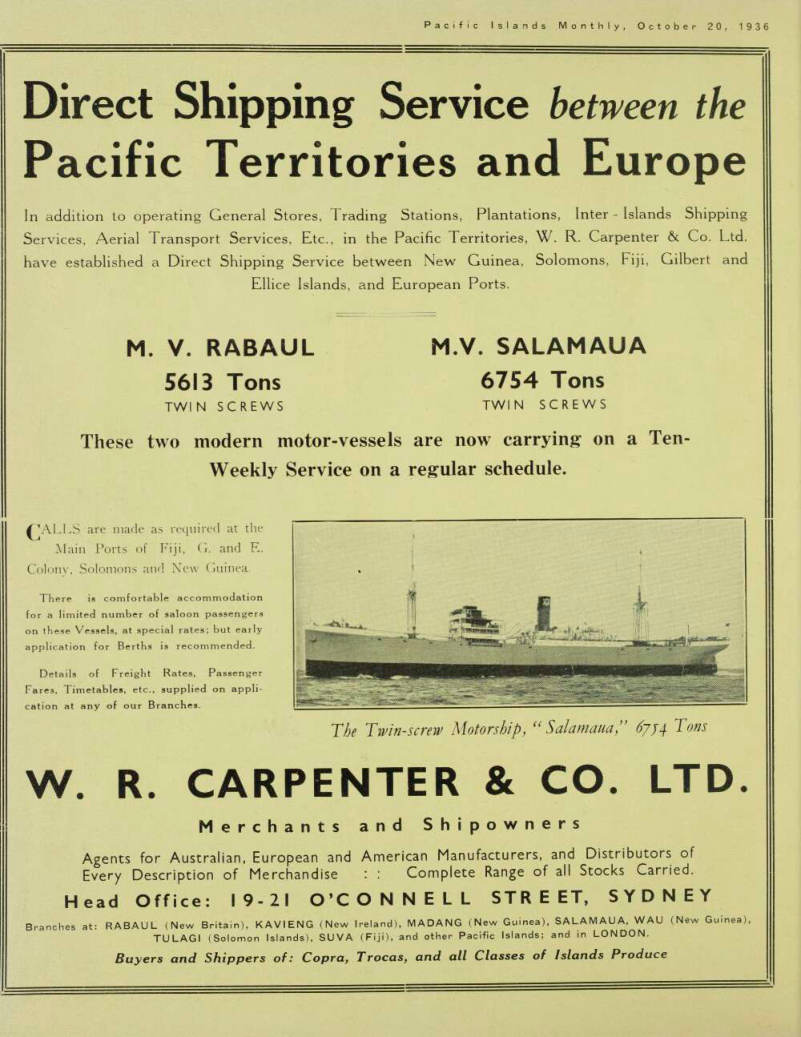
In addition to operating General Stores, Trading Stations, Plantations, Inter - Islands Shipping Services, Aerial Transport Services, Etc., in the Pacific Territories, W. R. Carpenter & Co. Ltd. have established a Direct Shipping Service between New Guinea, Solomons, Fiji, Gilbert and Ellice Islands, and European Ports.
M. V. RABAUL M.V. SALAMAUA
5618 Tons 6754 Tons
TWIN SCREWS TWIN SCREWS
These two modern motor-vessels are now carrying on a Ten- Weekly Service on a regular schedule.
C ALI are made as required at the Main Ports of Fiji, G. and E.
Colony, Solomons and New Guinea There is comfortable accommodation for a limited number of saloon passengers on these Vessels, at special rates; but early application for Berths is recommended.
Details of Freight Rates, Passenger Fares, Timetables, etc., supplied on application at any of our Branches.
W. R. CARPENTER & CO. LTD.
Merchants and Shipowners Agents for Australian, European and American Manufacturers, and Distributors of Every Description of Merchandise : : Complete Range of all Stocks Carried.
Head Office: 19-21 O’CONNELL STREET, SYDNEY
Branches at: RABAUL (New Britain), KAVIENG (New Ireland), MADANG (New Guinea), SALAMAUA, WAU (New Guinea), TULAGI (Solomon Islands), SUVA (Fiji), and other Pacific Islands; and in LONDON.
Buyers and Shippers of: Copra, Trocas, and all Classes of Islands Produce The Twin-screw Motorship, “ Salamaua,” 6yj4 Tons
Pacific Islands Travellers
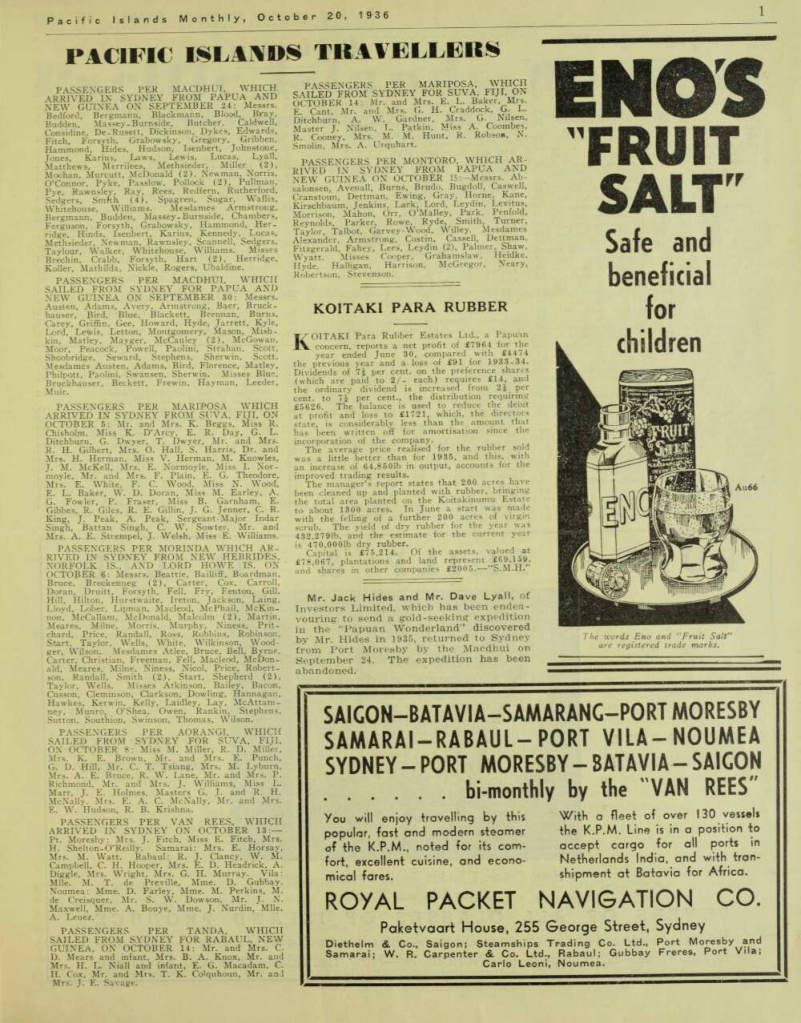
Passengers Per Macdhui, Which
Arrived In Sydney From Papua And
New Guinea On September 24: Messrs.
Bedford, Bergmann, Blackmann, Blood, Bray, Budden, Massey-Burnside, Butcher, Caldwell, Considine, De-Rusett, Dickinson, Dykes, Edwards, Fitch, Forsyth, Grabowsky, Gregory, Gnbben, Hammond, Hides, Hudson, Isenbert, Johnstone, Jones, Karius, Laws, Lew r is, Lucas, Lyall, Matthews, Merrilees, Methsieder, Miller (2), Mochan, Murcutt. McDonald (2), Newman, Norris, O’Connor, Pyke, Passlow, Pollock (2). Pullman, Pye, Rawnsley, Ray, Rees, Redfern, Rutherford, Sedgers, Smhh (4), Spagren, Sugar, Wallis, Whitehouse, Williams. Mesdames Armstrong, Bergmann, Budden, Massey-Burnside, Chambers, Ferguson, Forsyth, Grabowsky, Hammond, Her ridge. Hinds, Isenbert, Karius, Kennedy, Lucas, Methsieder, Newman, Rawnsley, Scannell, Sedgers, Taylour, Walker, Whitehouse, Williams. Misses Brechin, Crabb, Forsyth, Hart (2), Herridge, Koller, Mathilda, Nickle, Rogers, Übaldine.
Passengers Per Macdhui, Which
Sailed From Sydney For Papua And
New Guinea On September 30: Messrs.
Austen, Adams, Avery, Armstrong, Baer, Bruck hauser. Bird, Blue, Blackett, Brennan, Burns, Carey, Griffin, Gee, Howard, Hyde, Jarrett, Kyle, Lord, Lewis, Letton, Montgomery, Mason, Mish kin, Matley, Mayger, McCauley (2), McGowan, Moor, Peacock, Powell, Paolini, Strahan, Scott, Shoobridge, Seward, Stephens, Sherwin, Scott.
Mesdames Austen, Adams, Bird, Florence, Matley, Philpott, Paolini, Swansen, Sherwin. Misses Blue, Bruckhauser, Beckett, Frewin, Hayman, Leeder, Muir.
Passengers Per Mariposa Which
ARRIVED IN SYDNEY FROM SUVA, FIJI. ON OCTOBER 5: Mr. and Mrs. K. Beggs, Miss R.
Chisholm, Miss K. D’Arcy, E. R. Day, G. L.
Ditchburn, G. Dwyer, T. Dwyer, Mr. and Mrs.
R. H. Gilbert, Mrs. O. Hall, S. Harris, Dr. and Mrs. H. Herman, Miss V. Herman, M. Knowles.
J. M. McKell, Mrs. E. Normoyle, Miss I. Nor moyle, Mr. and Mrs. F. Plain, E. G. Theodore, Mrs. E. White, F. C. Wood, Miss N. Wood, E. L. Baker, W. D. Doran, Miss M. Earley, A.
G. Fowler, P. Fraser, Miss B. Garnham, E.
Gibbes, R. Giles, R. E. Gillin, J. G. Jenner, C. R- King, J. Peak, A. Peak, Sergeant-Major Indar Singh, Battan Singh, C. W. Sowter. Mr. and Mrs. A. E. Strempel, J. Welsh, Miss E. Williams.
Passengers Per Morinda Which Ar
Rived In Sydney From New Hebrides,
NORFOLK IS., AND LORD HOWE IS. ON OCTOBER 6: Messrs. Beattie, Bailliff, Boardman, Bruce, Breckenneg (2), Carter, Cox, Carroll, Doran, Druitt, Forsyth, Fell, Fry, Fenton, Gill, Hill, Hilton, Hurstwaite, Ireton, Jackson, Laing, Lloyd, Lober, Lipman, Macleod, McPhail, McKin non, McCallam, McDonald, Malcolm (2), Martin, Meares, Milne, Morris, Murphy, Niness, Prit chard, Price, Randall, Ross, Robbins, Robinson, Start, Taylor, Wells, White, Wilkinson, Wood ger, Wilson. Mesdames Atlee, Bruce, Bell, Byrne, Carter, Christian, Freeman, Fell, Macleod, McDon ald, Meares, Milne, Niness, Nicol, Price, Robert son, Randall, Smith (2), Start, Shepherd (2), Taylor, Wells. Misses Atkinson, Bailey, Bacon, Cusson, Cleminson, Clarkson, Dowling, Hannagan, Hawkes, Kerwin, Kelly, Laidley, Lay, McAttam ney, Munro, O’Shea, Owen, Rankin, Stephens, Sutton. Southion, Swinson, Thomas, Wilson.
Passengers Per Aorangi, Which
Sailed From Sydney For Suva, Fiji,
ON OCTOBER 8: Miss M. Miller, R. D. Miller, Mrs. K. E. Brown, Mr. and Mrs. E. Punch, G. D. Hill, Mr. C. T. Tsiang, Mrs. M. Lyburn, Mrs. A. E. Bruce, R. W. Lane, Mr. and Mrs. P.
Richmond, Mr. and Mrs. J. Williams, Miss L.
Marr, J. E. Holmes, Masters G. J. and R. H.
McNally. Mrs. E. A. C. McNally, Mr. and Mrs.
E. W. Hudson, R. B. Krishna.
Passengers Per Van Rees. Which
Arrived In Sydney On October 13;—
Pt. Moresby: Mrs. J. Fitch, Miss E. Fitch, Mrs.
H. Shelton-O’Reilly. Samarai; Mrs. E. Horsay, Mrs. M. Watt. Rabaul: R. J. Clancy, W. M.
Campbell, C. H. Hooper, Mrs. E. D. Headrick, A.
Diggle, Mrs. Wright, Mrs. G. H. Murray. Vila: Mile. M. T. de Preville, Mme. D. Gubbay.
Noumea: Mme. D. Farley, Mme. M. Perkins, M. de Creisquer, Mr. S. W. Dowson, Mr. J. N.
Maxwell, Mme. A. Bouye, Mme. J. Nurdin, Mile.
A. Leuez.
Passengers Per Tanda, Which
Sailed From Sydney For Rabaul. New
GUINEA, ON OCTOBER 14; Mr. and Mrs. C.
D. Mears and infant, Mrs. B. A. Knox, Mr. and Mrs. H. L. Niall and infant, E. G. Macadam, C.
H. Cox, Mr. and Mrs. T. K. Co’quhoun, Mr. and Mrs. J. E. Savage.
Passengers Per Mariposa, Which
SAILED FROM SYDNEY FOR SUVA, FIJI. ON OCTOBER 14: Mr. and Mrs. E. L. Baker, Mrs.
E. Cant. Mr. and Mrs. G. H. Craddock, G. L.
Ditchburn, A. W. Gardner, Mrs. G. Nilsen, Master J. Nilsen, L. Patkin, Miss A. Coombes, R. Cooney, Mrs. M. M. Hunt, R. RobsoM, .N.
Smolin, Mrs. A. Urquhart.
Passengers Per Montoro, Which Ar
Rived In Sydney From Papua And
New Guinea On October 15:—Messrs. Ab
salonsen, Avenall, Burns, Brudo, Bugdoll, Caswell, Cranstoun, Dettman, Ewing, Gray, Horne, Kane, Kirschbaum, Jenkins, Lark, Lord, Leydm, Levitus, Morrison, Mahon, Orr, O’Malley, Park, Penfold, Reynolds, Parker, Rowe, Ryde, Smith, Turner, Taylor, Talbot, Garvey-Wood, Willey. Mesdames Alexander, Armstrong, Costin, Cassell, Dettman, Fitzgerald, Fahey, Lees, Leydin (2), Palmer, Shaw, Wyatt. Misses Cooper, Grahamslaw. Heidke, Hyde. Halligan, Harrison, McGregor, Neary, Robertson, Stevenson.
Koitaki Para Rubber
Estates Ltd., a Papuan concern, reports a net profit of £7964 for the year ended June 30. compared with £4474 the previous year and a loss of £9l for 1933-34.
Dividends of 7i per cent, on the preference shares (which are paid to 2/- each) requires £l4, and the ordinary dividend is increased from 2J per cent, to 7h per cent., the distribution requiring £5626. The balance is used to reduce the debit at profit and loss to £1721, which, the directors state, is considerably less than the amount that has been written off for amortisation since the incorporation of the company.
The average price realised for the rubber sold was a little better than for 1935, and this, with an increase of 64,8501 b in output, accounts for the improved trading results.
The manager’s report states that 200 acres have been cleaned up and planted with rubber, bringing the total area planted on the Koitakinumu Estate to about 1300 acres. In June a start was made with the felling of a further 200 acres of virgin scrub. The yield of dry rubber for the year was 432,2791 b, and the estimate for the current year
is 470,0001 b dry rubber.
Capital is £75,214. Of the assets, valued at £78,067, plantations and land represent £69,1 09. and shares in other companies £2005. —“S.M.H. ’
Mr. Jack Hides and Mr. Dave Lyall, of Investors Limited, which has been endea vouring to send a gold-seeking expedition in the “Papuan Wonderland” discovered by Mr. Hides in 1935, returned to Sydney from Port Moresby by the Macdhui on September 24. The expedition has been abandoned.
Advertisements & other items, p. 3 (1 item)
Fruit
ff
SALT
Safe and beneficial for children irr » Au 66 The words Eno and “Fruit Salt ' are registered trade marks.
SAICON-BATAVIA-SAMARANC-PORT MORESBY
SAMARAI-RABAUL-PORT VILA-NOUMEA
SYDNEY - PORT MORESBY - BATAVIA - SAIGON
bi-monthly by the VAN REES
You will enjoy travelling by this popular, fast and modern steamer of the K.P.M.. noted for its comfort, excellent cuisine, and economical fares.
With a fleet of over 130 vessel* the K.P.M. Line is in a position to accept cargo for all ports in Netherlands India, and with transhipment at Batavia for Africa.
ROYAL PACKET NAVIGATION CO.
Paketvaart House, 255 George Street, Sydney Diethelm & Co., Saigon; Steamships Trading Co. Ltd., Port Moresby and Samarai; W. R. Carpenter & Co. Ltd., Rabaul; Gubbay Freres, Port Vila; Carlo Leoni, Noumea.
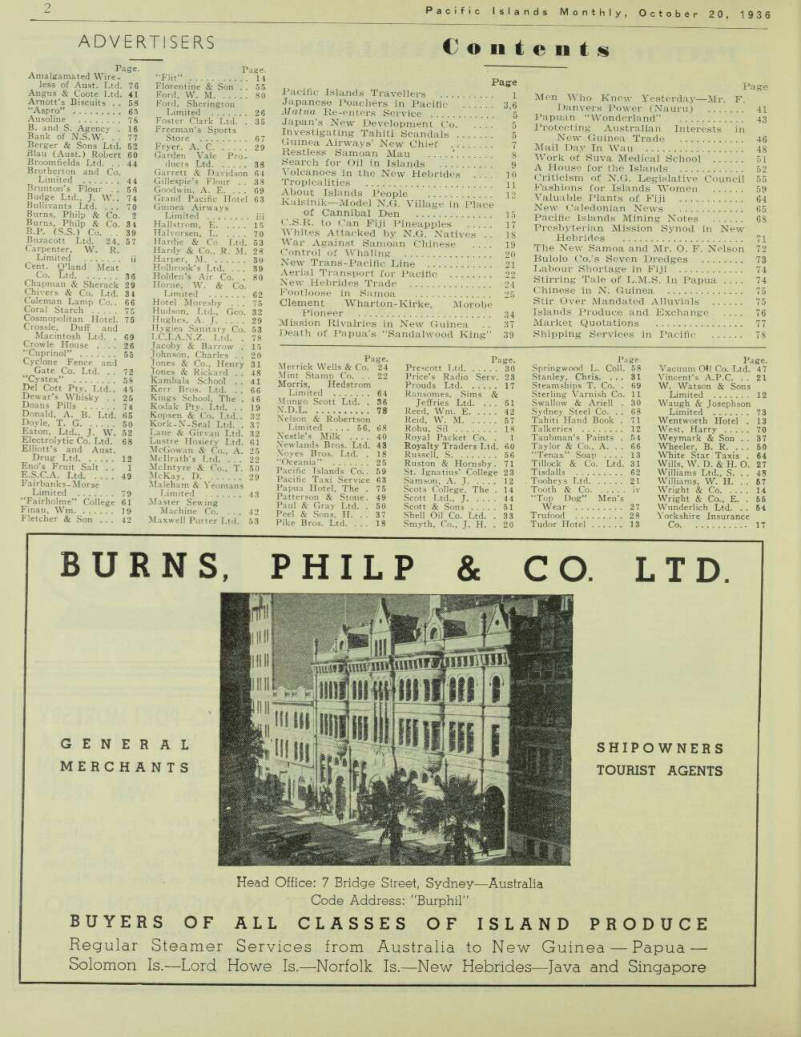
Advertisers
Page.
Amalgamated Wire less of Aust. Ltd. 76 Angus & Coote Ltd. 41 Arnott’s Biscuits . . 58 “Aspro” 65 Ausoline 78 B. and S. Agency . 16 Bank of N.S.W. . . 77 Berger & Sons Ltd. 52 Blau (Aust.) Robert 60 Broomfields Ltd. . . 44 Brotherton and Co.
Limited 44 Brunton’s Flour . , 5 6 Budge Ltd., J. W.. 74 Bullivants Ltd. ... 70 Burns, Philp & Co. 2 Burns, Philp & Co. 3 4
B.P. (S.S.) Co. .. 39
Buzacott Ltd. 24, 57 Carpenter, W. R.
Limited ii Cent. Q’land Meat Co. Ltd 35 Chapman & Sherack 29 Olivers & Co. Ltd. 34 Coleman Lamp Co.. 66 Coral Starch 75 Cosmopolitan Hotel. 75 Crossle, Duff and Macintosh Ltd. . 69 Crowle House ... 26 “Cuprinol” 55 Cyclone Fence and Gate Co. Ltd. . . 72 “Cystex” 58 Del Cott Pty. Ltd.. 4 5 Dewar’s Whisky . . 25 Doans Pills 74 Donald, A. B. Ltd. 65 Doyle. T. G 50 Eaton, Ltd., J. W. 52 Electrolytic Co. Ltd. 6 8 Elliott’s and Aust.
Drug Ltd 12 Eno’s Fruit Salt . . 1
E.S.C.A. Ltd 49
Fairbanks-Morse Limited 79 “Fairholme” College 61 Finau, Wm 19 Fletcher & Son ... 42
Page.
“Flit” 14 Florentine & Son . . 55 Ford, W. M 80 Ford, Sherington Limited 26 Foster Clark Ltd. . 35 Freeman’s Sports Store 67 Fryer, A. C 29 Garden Vale Pro ducts Ltd 38 Garrett & Davidson 64 Gillespie’s Flour . . 38 Goodwin, A. E. ... 69 Grand Pacific Hotel 63 Guinea Airways Limited iii Hallstrom, E 15 Halvorsen, L 70 Hardie & Co. Ltd. 53 Hardy & Co., R. M. 28 Harper, M 30 Holbrook’s Ltd. ... 39 Holden’s Air Co. . 80 Horne, W. & Co.
Limited 62 Hotel Moresby ... 75 Hudson, Ltd., Geo. 32 Hughes, A. J 29 Hygiea Sanitary Co. 53
1.C.1.A.N.Z. Ltd. . 78
Jacoby & Barrow . 15 Johnson, Charles . . 20 Jones & Co., Henry 31 Jones & Rickard . . 48 Kambala School . . 41 Kerr Bros. Ltd. . . 66 Kings School, The . 4 6 Kodak Pty. Ltd. . . 19 Kopsen & Co. Ltd.. 32 Kork-N-Seal Ltd. . 37 Lane & Girvan Ltd. 32 Lustre Hosiery Ltd. 61 McGowan & Co., A. 25 Mcllrath’s Ltd. ... 22 Mclntyre & Co., T. 50 McKay, D 29 Maleham & Yeomans Limited 43 Master Sewing Machine Co. ... 42 Maxwell Porter Ltd. 53
Page.
Merrick Wells & Co. 24 Mint Stamp Co. . . 22 Morris, Hedstrom Limited 64 Mungo Scott Ltd. . 36
N.D.L 78
Nelson & Robertson Limited ... 56, 68 Nestle’s Milk ... 40 Xewlands Bros. Ltd. 4 3 Noyes Bros. Ltd. . 18 “Oceania” 25 Pacific Islands Co.. 59 Pacific Taxi Service 63 Papua Hotel, The . 75 Patterson & Stone. 49 Paul & Gray Ltd. . 50 Peel & Sons, H. . . 37 Pike Bros. Ltd. ... 18
Page.
Prescott Ltd 30 Price’s Radio Serv. 23 Prouds Ltd 17 Ransomes, Sims & Jeffries Ltd. ... 51 Reed, Wm. E 42 Reid. W. M 57 Rohu, Sil 18 Royal Packet Co. . 1 Royalty Traders Ltd. 60 Russell, S 56 Ruston & Hornsby. 71 St. Ignatius’ College 2 3 Samson, A. J 12 Scots College, The . 14 Scott Ltd., J 44 Scott & Sons 51 Shell Oil Co. Ltd. . 33 Smyth, Co., J. H. . 20
Page.
Springwood L. Coll. 58 Stanley, Chris. ... 31 Steamships T. Co. . 69 Sterling Varnish Co. 11 Swallow & Ariell . 30 Sydney Steel Co. . . 68 Tahiti Hand Book . 71 Talkeries 12 Taubman’s Paints . 54 Taylor & Co., A. . . 66 “Tenax” Soap ... 13 Tillock & Co. Ltd. 31 Tisdalls 62 Tooheys Ltd 21 Tooth & Co iv "Top Dog” Men’s Wear 27 Trufood 28 Tudor Hotel 13
Page.
Vacuum 041 Co. Ltd. 47 Vincent’s A.P.C. . . 21 W. Watson & Sons Limited 12 Waugh & Josephson Limited 73 Wentworth Hotel . 13 West, Harry 70 Weymark & Son . . 37 Wheeler, B. R. ... 50 White Star Taxis . 64 Wills. W. D. & H. O. 27 Williams Ltd., S. . . 48 Williams, W. H. . . 57 Wright & Co 14 Wright & Co.. E. . 55 Wunderlich Ltd. . . 54 Yorkshire Insurance Co 17
Contents
Page Pacific Islands Travellers 1 Japanese Poachers in Pacific 3 6 Matua Re-enters Service 5 Japan’s New Development Co 5 Investigating Tahiti Scandals 5 Guinea Airways’ New Chief 7 Restless Samoan Mau ...* 8 Search for Oil in Islands 9 Volcanoes in the New Hebrides ... 10 Tropicalities n About Islands People 12 Kaisinik—Model N.G. Village in Place of Cannibal Den 15 C.S.R. to Can Fiji Pineapples 17 Whites Attacked by N.G. Natives . . 18 War Against Samoan Chinese ... 19 Control of Whaling 20 New Trans-Pacific Line 21 Aerial Transport for Pacific 22 New Hebrides Trade 24 Footloose in Samoa 25 Clement Wharton-Kirke, Morobe Pioneer 34 Mission Rivalries in New Guinea . . 37 Death of Papua’s “Sandalwood King” 39
Page Men Who Knew Yesterday—Mr. F.
Danvers Power (Nauru) 41 Papuan “Wonderland” 43 Protecting Australian Interests in New Guinea Trade 46 Mail Day In Wau 48 Work of Suva Medical School 51 A House for the Islands 52 Criticism of N.G. Legislative Council 55 Fashions for Islands Women 59 Valuable Plants of Fiji 64 New Caledonian News 65 Pacific Islands Mining Notes 68 Presbyterian Mission Synod in New Hebrides 71 The New Samoa and Mr. O. F. Nelson 72 Bulolo Co.’s Seven Dredges 73 Labour Shortage in Fiji 74 Stirring Tale of L.M.S. In Papua 74 Chinese in N. Guinea 75 Stir Over Mandated Alluvials 75 Islands Produce and Exchange ... 76 Market Quotations 77 Shipping Services in Pacific 78
Advertisements & other items, p. 4 (1 item)
Burns, Philp & Co. Ltd.
GENERAL
MERCHANTS
M \n v" ! * m
ill
in if! 11l i ■ w ■ f
SHIPOWNERS
TOURIST AGENTS
Head Office: 7 Bridge Street, Sydney—Australia Code Address: "Burphil"
BUYERS OF ALL CLASSES OF ISLAND PRODUCE Regular Steamer Services from Australia to New Guinea Papua Solomon Is.—Lord Howe Is.—Norfolk Is.—New Hebrides —lava and Singapore
Pacific Islands Monthly
The Newspaper-Magazine of the South Seas [ Registered at the G.P.O. Sydney, for transmission by post as a newspaper.]
Published Once Each Month and Circulated in Australia and New Zealand and in the following Pacific Territories and Island Groups:
Crown Colony of Fiji.
Australian Territory of Papua.
Mandated Territory (Australia) of New Guinea, Bismarck Archipelago and Northern Solomon Islands.
Mandated Territory (Japan) of Marshall, Caroline and Marianna Islands.
French Territory of New Caledonia.
British and French Condominium of New Hebrides.
American Territory of Eastern Samoa.
American Territory of Guam.
Mandated Territory of Nauru.
British Crown Colony of Gilbert and Ellice Islands.
Mandated Territory (New Zealand) of Samoa.
British Solomon Islands Protectorate.
British Protectorate of Tongan Islands.
New Zealand Territory of Cook Islands.
Australian Territory of Norfolk Island.
French Colony of Oceania (Tahiti, etc.).
American Territory of Hawaiian Islands.
Owned and Produced by Pacific Publications Ltd., Union House, 247 George Street, Sydney
Telephone Bw 5037
P.O. Box 3408 R
Registered Address of Telegrams, Radiograms, and Cables: “PACPUB,” Sydney.
Contributions Articles, Stories, and Photographs dealing with Pacific Islands subjects are invited, and will be paid for on publication at usual rates.
Subscription Rates Per Annum, within British Empire, Prepaid, Post Free 6/- Per Annum, elsewhere, prepaid. Post Free 87- Single Copies 6d.
Editor and Publisher:
R. W. Robson. F.R.G.S.
Advertisements
Advertising rates furnished on application.
Colours, etc by Arrangement.
Process Blocks made at Advertiser’s expense when required. Screen, 100.
Changes of Advertising Copy should reach this Office by Bth of each month, otherwise previous advertisement may be repeated.
Agents
The following are authorised to receive subscrip tions for the Pacific Islands Monthly:— Islands Branches of Burns, Philp & Co., Ltd., and Burns Philp (South Sea) Co., Ltd.
Islands Branches of W. R. Carpenter & Co., Ltd.
All Branches of Morris, Hedstrom & Co., Ltd- G. Thomas & Co., Rabaul, New Guinea.
Whitten Bros., Ltd., Samarai, Papua.
P. Costello, Suva, Fiji.
J. Muir, Suva, Fiji.
All Branches and Representatives of W. H. Grove and Sons, Ltd., Auckland, New Zealand.
Cook Islands Trading Co., Rarotonga, Cook Is.
W. H, Watson, Rarotonga, Cook Is.
Representative in London: W. C. HARVEY, Coronation Building, 4 Lloyds Avenue, London, E.C.2. from whom may be obtained copies of Pacific Islands Monthly, Pacific Islands Year Book, advertising schedules, etc.
Vol. VII., No. 3.
Sydney, October 20, 1 936
Prir*#* ! 6d> Pcr Copy ' 1 riCc j Prepaid: &/- p.a.
Japanese Poachers In Pacific
F would be easy to exaggerate the significance of the swarms of Japanese sampans which have appeared in the Central and South-western Pacific, where they are deliberately and
systematically stealing trochus-shell and
other marine products from British and French territorial waters. We are inclined to be a little nervy where Japanese activities are concerned, and to see in this poaching pest a manifesta tion of the thrusting power of Japan, We have examined the details of scores of poaching incidents, since the poachers first became a nuisance some three years ago; and we can say that in no instance, where the Japanese have been intercepted and detained by Euro peans, has there been any real disorder, nor any attempt to resist arrest. Wher ever possible, the Japanese have attempted to escape arrest; and, in the incident in the Fijian River (reported in this issue), they came near to a dis play of hostile force. But, almost
invariably, the poachers have submitted quietly when caught, and have shown philosophic calm when, as has happened invariably, they have been heavily fined and their ships and cargoes confiscated.
The Japanese Government, grimly and silently, has undertaken the task of repatriating the poachers who have been marooned in the various islands by the confiscation of their ships.
These circumstances make it clear that the Japanese Government, as well as the Japanese themselves, recognise that the trochus-fishers who invade territorial waters are engaging in an illegal enterprise, and that they must take, without resistance, whatever punishment is coming to them. It seems that this epidemic of sampan poachers has no national or official significance—it is simply organised thieving, undertaken by a reckless and adventurous class of people.
The Fead Islands incident bears this out. There is no doubt that the sam-
Europeans, and that their practice is to scare away the natives and help them selves to the shell. They have corn mitted a few outrages, such as burning huts, seizing women and stealing food stuffs—the sort of thing to be expected of sea-rovers who are conscious of law breaking—but they have avoided mur der. It is evident that they thought the Fead Islands were still in a primitive state, and they used firearms more to intimidate the natives than to kill any one' for they left in a great hurry as soon * s the y dlscovered that the group 15 ln wopean occupa ion.
In other words, these poachers are a great and growing nuisance, raiding our territorial waters and destroying our valuable and irreplaceable shell beds, but they are not the recognised emissaries of Imperialistic Japan. The southwards thrust of Japan will come, inevitably, but surely it is not to be heralded by a swarm of irresponsible shell-poachers. Japan seems unwilling to defend or protect them, The poachers represent a serious
problem, nevertheless. Unless their activities are greatly curtailed, many of the best trochus-beds in British and French waters will soon disappear. It is a monstrous thing that the heavy cost of patrolling and protecting these waters against Japanese should be thrown solely upon the British and French Administrations—the responsi
bility, surely, belongs primarily to
Japan. If Japan will not take respon sibility for her nationals, Britain and France should decline to be responsible, also, for any unfortunate thing which happens to Japanese subjects who per sistently break international law.
There are signs that the French in New Caledonia are not going to treat the poachers as gently as the British have done.
But, if the poacher trouble per se has no significance as an organised national manifestation, it would be unwise to regard it as having no significance at all. We people who live in half developed Pacific countries may not, for one moment, forget that 100,000,000 people are packed into the Japanese Archipelago, and that they are increas ing by 1,000,000 every year. There are 1077 Japanese to every square mile of arable land —a density of population twice that of Belgium, three times that of Italy, four times that of Britain and Germany. The Japanese must have new territory or, alternatively, new trade through which they may buy foreign-grown food for the millions who are being crowded off the soil.
Otherwise, Japan will perish.
The poachers are an irritating and expensive problem: but a little real organisation and co-operation will stop their depredations. The thing that is alarming is the appearance of these
well-equipped Japanese in such large
numbers, and in such a strange temper.
We strike at them, and push them off; and they do not strike back at us, and they come on in increasing numbers.
They do not appear to want to break the law: they simply are being pushed onto us by the weight of the incredible millions behind.
What can we do about it ? We may not stop the Japanese from breeding.
Fundamental laws operate to-day, as they did thousands of years ago. An overcrowded people naturally seek new lands, and what they may not occupy
peacefully they take, anyhow.
The writing is on the wall. .But the wall is no place for the sword and the rifle.
First Aeroplane On
Thursday Island
From Our Own Correspondent.
Thursday Is., Oct. 3.
INURING September Pilot MacDonald made the first landing on Thursday Island itself with an aeroplane. Hitherto our aerial visitors have either arrived in seaplanes or landed on Horn Island or on Mr. Vidgen’s property near Cape York.
A landing-ground has now been cleared on the site of the old T.I. racecourse and Pilot MacDonald used it again this week.
He flew in with another machine to pick up Constable Martin, who journeyed to North Queensland to visit his dying mother.
Rouna Falls
Mandated Alluvials to Harness Rouna Falls
By Radiogram
Pt. Moresby, Oct. 19.
lITANDATED Alluvials N.L. have been A granted the right to harness the famous Rouna Falls to obtain power to work the Moresby King and any adjoin ing mines.
Two hundred ground sluice heads 150 feet above the crest of the Falls will generate 1200 h.p. The cost of the in stallation will be £15,000, This is the first such application granted in Papua, Mr. Magar, a surveyor, is at present working on the project.
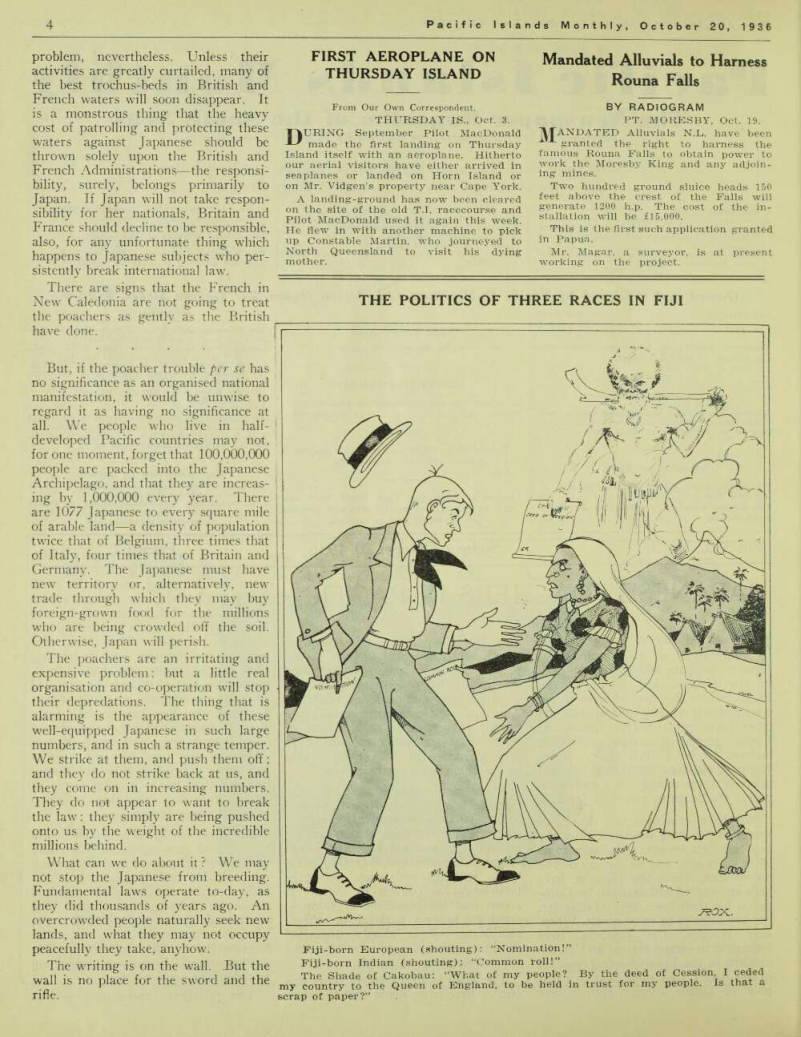
The Politics Of Three Races In Fiji
Fiji-born European (shouting): “Nomination!”
Fiji-born Indian (shouting): “Common roll!”
The Shade of Cakobau: “What of my people? By the deed of Cession, I ceded my country to the Queen of England, to be held in trust for my people. Is that a scrap of paper?”
“Matua” Repaired
0Resumes on 22nd after Quick Job in Dock
From Our N.Z. Correspondent
Auckland, Oct. 9.
4FTER meeting with a mishap at the outset of her career, the Union S.S.
Company’s new motor-ship Matua limped into Auckland on September 26 with both propellers damaged and the greater part of her rudder broken off, as a result of striking a submerged outcrop of the reef at Aitutaki on September 15.
She was docked the day after her arrival and it was then seen that the damage was greater than had been anticipated. The scheduled trip to Tonga, Samoa, and Fiji from Auckland on September 24 and the quick run to the Cook Group on October 8 were cancelled and the vessel was laid up for repairs.
The Matua will take up running again on October 22, when she will leave for Nukualofa, Apia, and Suva.
While repairs were being effected to the Matua, the U.S.S. Co.’s cargo vessel Wai pahi (1,783 tons), made a trip direct to Western Samoa to pick up the banana shipments awaiting the Matua. She re turned to Auckland early in October.
The accident to the new Matua occurred at 8 p.m., when the vessel was leaving, after loading. She went on and landed her native labour at Rarotonga and immedi ately left for New Zealand, leaving behind 10,000 cases of fruit at the other islands of the Cook Group; these were lost, as no other vessel was available to pick them up.
Captain A. H. Prosser performed a fine feat of seamanship in bringing his vessel back to New Zealand at between 8 and 9 knots in her damaged condition. A return to ancient methods was made, by the rig ging of deck awnings to act as sails on the trip, in order to assist in giving the vessel steerage way.
It is pointed out on the Auckland water front that there has been no survey at Aitutaki, in the locality of the accident for over 40 years, and coral growths have probably completely altered the seabed in the vicinity since then.
Copra
Prices High and Outlook Good
WORLD-WIDE factors, which affect the copra market, change so quickly that it is difficult to keep track of them. But the net result, on the month, is seen in high prices and excellent prospects, so Pacific planters need not worry.
America, despite the Bailey tax, remains a keen and eager buyer. Climatic condi tions have reduced American production of oils and fats.
Britain and Norway have agreed on the restrictions to govern the Antarctic whal ing season (December 8, 1936-March 7, 1937). The argument was protracted, be cause Norway wanted production limited to the 1935/36 figures, whereas Britain sought exceptions in favour of the Uni lever and Salvesen companies—famous as friends of copra-producers!
The British-Norwegian agreement to restrict whale-killing may be rendered useless owing to the departure southwards in October of German and Japanese whal ing fleets. Those two nations urgently want oils, fats and glycerine for military purposes; they have not the foreign ex change to buy foreign-grown copra, tal low, etc.; so they are going to chase whales and thus get their own supplies.
France’s decision to abandon the gold standard is bound to affect the copra market —how, remains to be seen. The first effect may be unfavourable; but, as France begins to regain her foreign trade, the ultimate effect must be good.
Mr. D. J. Mahon, of the Prisons De partment of the Papuan Administration, reached Sydney to spend three months’ leave by the Montoro on October 15.
Captain A. S. Fitch, head of Steamships Trading Company Limited, of Papua, arrived in Sydney from Port Moresby by the Macdhui on business at the end of September. He was later joined by his wife and daughter who arrived by the Van Rees on October 13.
The “Matua” In Tongan Ports
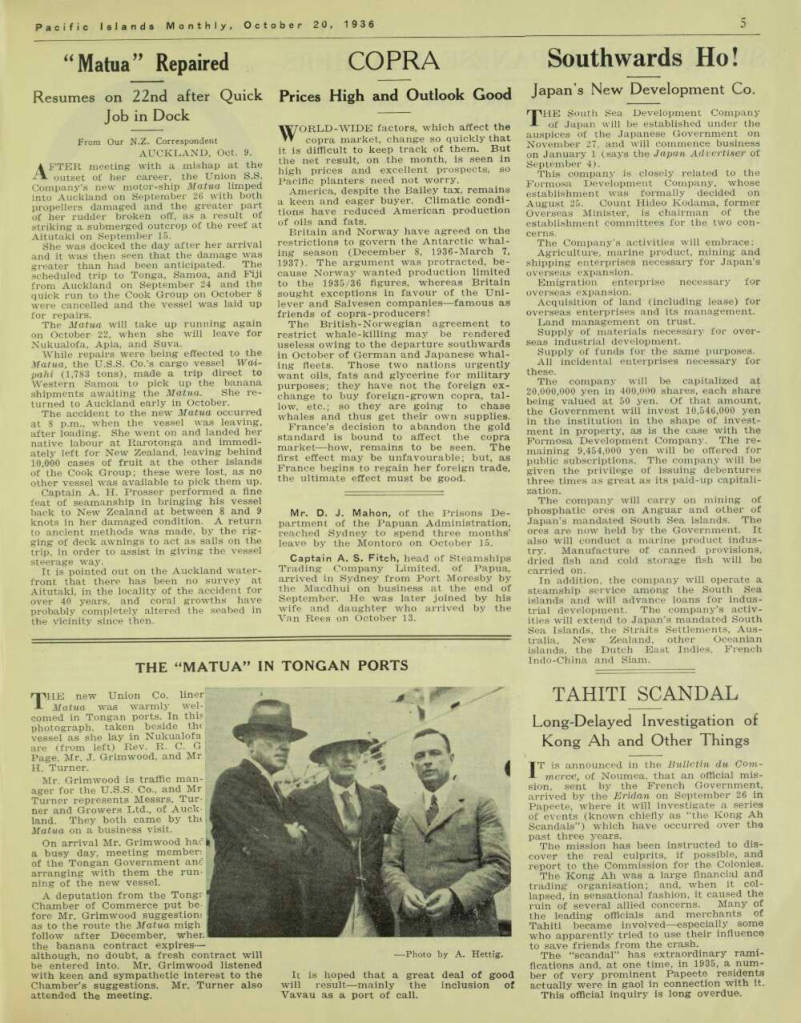
THE new Union Co. liner Matua was warmly wel comed in Tongan ports. In thi. c photograph, taken beside tht vessel as she lay in Nukualofa are (from left) Rev. R. C. G Page, Mr. J. Grimwood, and Mr H. Turner.
Mr. Grimwood is traffic man ager for the U.S.S. Co., and Mr Turner represents Messrs. Tur ner and Growers Ltd., of Auck land. They both came by tht Matua on a business visit.
On arrival Mr. Grimwood hac a busy day, meeting member; of the Tongan Government anc arranging with them the run ning of the new vessel.
A deputation from the Tongr Chamber of Commerce put be fore Mr. Grimwood suggestion: as to the route the Matua migh follow after December, when the banana contract expires—
although, no doubt, a fresh contract will be entered into. Mr. Grimwood listened with keen and sympathetic interest to the Chamber’s suggestions. Mr. Turner also attended the meeting.
It is hoped that a great deal of good will result —mainly the inclusion of Vavau as a port of call.
—Photo by A. Hettig.
Southwards Ho!
Japan's New Development Co.
THE South Sea Development Company of Japan will be established under the auspices of the Japanese Government on November 27, and will commence business on January 1 (says the Japan Advertiser of September 4).
This company is closely related to . the Formosa Development Company, whose establishment was formally decided on August 25. Count Hideo Kodama, former Overseas Minister, is chairman of the establishment committees for the two con cerns.
The Company’s activities will embrace; Agriculture, marine product, mining and shipping enterprises necessary for Japan’s overseas expansion.
Emigration enterprise necessary for overseas expansion.
Acquisition of land (including lease) for overseas enterprises and its management.
Land management on trust.
Supply of materials necessary for over seas industrial development.
Supply of funds for the same purposes.
All incidental enterprises necessary for these.
The company will be capitalized at 20,000,000 yen in 400,000 shares, each share being valued at 50 yen. Of that amount, the Government will invest 10,546,000 yen in the institution in the shape of invest ment in property, as is the case with the Formosa Development Company. The re maining 9,454,000 yen will be offered for public subscriptions. The company will be given the privilege of issuing debentures three times as great as its paid-up capitali zation.
The company will carry on mining of phosphatic ores on Anguar and other of Japan’s mandated South Sea islands. The ores are now held by the Government. It also will conduct a marine product indus try. Manufacture of canned provisions, dried fish and cold storage fish will be carried on.
In addition, the company will operate a steamship service among the South Sea islands and will advance loans for indus trial development. The company’s activ ities will extend to Japan’s mandated South Sea Islands, the Straits Settlements, Aus tralia, New Zealand, other Oceanian islands, the Dutch East Indies, French Indo-China and Siam.
Tahiti Scandal
Long-Delayed Investigation of Kong Ah and Other Things
IT is announced in the Bulletin du Com merce, of Noumea, that an official mis sion, sent by the French Government, arrived by the Eridan on September 26 in Papeete, where it will investigate a series of events (known chiefly as “the Kong Ah Scandals”) which have occurred over the past three years.
The mission has been instructed to dis cover the real culprits, if possible, and report to the Commission for the Colonies.
The Kong Ah was a large financial and trading organisation; and, when it col lapsed, in sensational fashion, it caused the ruin of several allied concerns. Many of the leading officials and merchants of Tahiti became involved —especially some who apparently" tried to use their influence to save friends from the crash.
The “scandal” has extraordinary rami fications and, at one time, in 1935, a num ber of very prominent Papeete residents actually were in gaol in connection with it.
This official inquiry is long overdue.
Swarms Of Japanese Poachers
Harassing Coasts of Australia, New Guinea, Solomons, New Caledonia, and Fiji
the newspapers of Australia and N.Z. have been giving comparatively little attention to the Japanese trochus-shell poachers, the pest has been growing worse; and to-day it is now so extensive that actually it demands serious attention from the countries mainly interested —namely, Australia, France, Great Britain, and Japan.
DURING the last few weeks the follow ing incidents have been reported: Boats from a sampan-poacher landed on an island off the coast of New Ireland (Mandated Territory of New Guinea), and the Japanese used firearms upon the na tives when the latter approached them.
A sampan-poacher was caught by the British authorities in the Solomon Islands, and taken to Tulagi.
Another sampan-poacher was arrested by the French off the coast of New Cale donia (making three altogether), and taken to Noumea. Three other poaching vessels were sighted.
A sampan poacher was overtaken by the British while ashore on the northern coast of Vanua Levu, Fiji, and was detained; but the crew slashed the ropes, and the vessel escaped.
There have been further reports of activ ities of Japanese sampans off the coast of North Australia.
A glance at the map will show that this plague of Japanese poachers extends over a very wide section of the Pacific Ocean — namely, from the Dutch East Indies to the region east of Fiji—and so many have been reported that it seems certain there are hundreds of these craft at work, de
stroying the trochus beds on the reefs within British and French territorial waters.
It is bad enough that the valuable shell should be removed in this way; but a far worse thing is the fact that the poachers are carrying off and destroying the im mature shell, and are thus threatening to put an end to an industry that is of im mense value to the British and French territories in the Central and Western Pacific.
The British authorities have been pa tiently protesting against these depreda tions for some three or four years; but, being apparently anxious not to cause any unfortunate “incident,” they really have done nothing to punish severely and so scare off the poachers.
But a new factor has now entered the situation —namely, French resentment at the sudden appearance of considerable numbers of sampans in the territorial waters of New Caledonia. The French are displaying a good deal of bad temper and, if Japan does not take some action to suppress this poaching nuisance, it seems inevitable that, sooner or later, some of these sampans will be dealt with by the French or the British in such a way that international complications will ensue.
The British and French authorities should take an early opportunity of mak ing a very strong request to Tokio to suppress this very serious and growing nuisance of trochus poaching.
Japanese Fire on New Guinea
Natives
|Y| R. E. WOOD, manager of a group of plantations on the Fead Islands, off the east coast of New Ireland (New Guinea), wrote on August 16 to the editor of the P.I.M.
“Yesterday, at daylight, a sampan turned up off the reef on the far side of the group, where it could not be seen from the home island. I did not know it was there until the late afternoon when some of the boys returned from there and told me. How ever, about 11 o’clock this morning, it showed up and came along the reef, stop ping off an island about a quarter of a mile from the home island.
T had 11 boys on this island, cutting scrub. When the sampan stopped off the reef, she lowered two boats, which went ashore. My boys went down and asked the Japs if they had any permission to be shelling there, which, of course, they had not.
“However, the two boats immediately returned to the sampan without any of the Japs answering the boys.
“The boys stood there watching and saw two shotguns handed to the Japs in the boats, which started back for the reef.
The boys then retreated to the fringe of the coconuts.
“As soon as the Japs landed on the reef they opened fire on the boys, who at once scattered in among the palms.
“The next moment the Japs on the sam pan opened fire with shotguns and rifles.
Ten shots were fired by the Japs on the reef, and many more by those on the sam pan.
“My wife, self, and other boys stood on the point of the home island helplessly watching the whole thing. The boys who were being shot at, being totally unarmed, ran to the other end of the island and came over to us in their canoes. Luckily, through scattering so quickly, no one was hit.
“When the boys arrived here at the home island, I collected them and all others that were here (about 28), and took them aboard the schooner, which was anchored in the lagoon, with the intention of putting out and trying to get alongside the sampan to ascertain what they meant by trying to shoot my boys.
“However, while we were heating up the engine, the sampan came further along the reef, and sighted the schooner for the first time. She immediately put about, and went back to pick up her two boats. Bj' the time we got going she was headed out to sea. We went out through the passage with the schooner, and chased her for several miles, but she was too fast for us, and we had to turn back.
“It is a lovely position to be in, right out here with a wife and three-years-old daughter, when these Japs can come and, not only poach our shell, but open up with gunfire, with no provocation at all. When we chased them with the schooner the only weapons we had were fish spears. If they are up to the pitch where they will open fire on native labourers on private property, how long will it be before they fire at the white men and women on these islands? Not a single measure has been taken as far as I know to stop them.
“I am writing a full report of the whole thing to the Administration, and am taking my schooner to Rabaul in a fortnight’s time. Next time I am visited by a Japan ese sampan they will find that two can play at shooting.”
Mrs. V. H. Sherwin
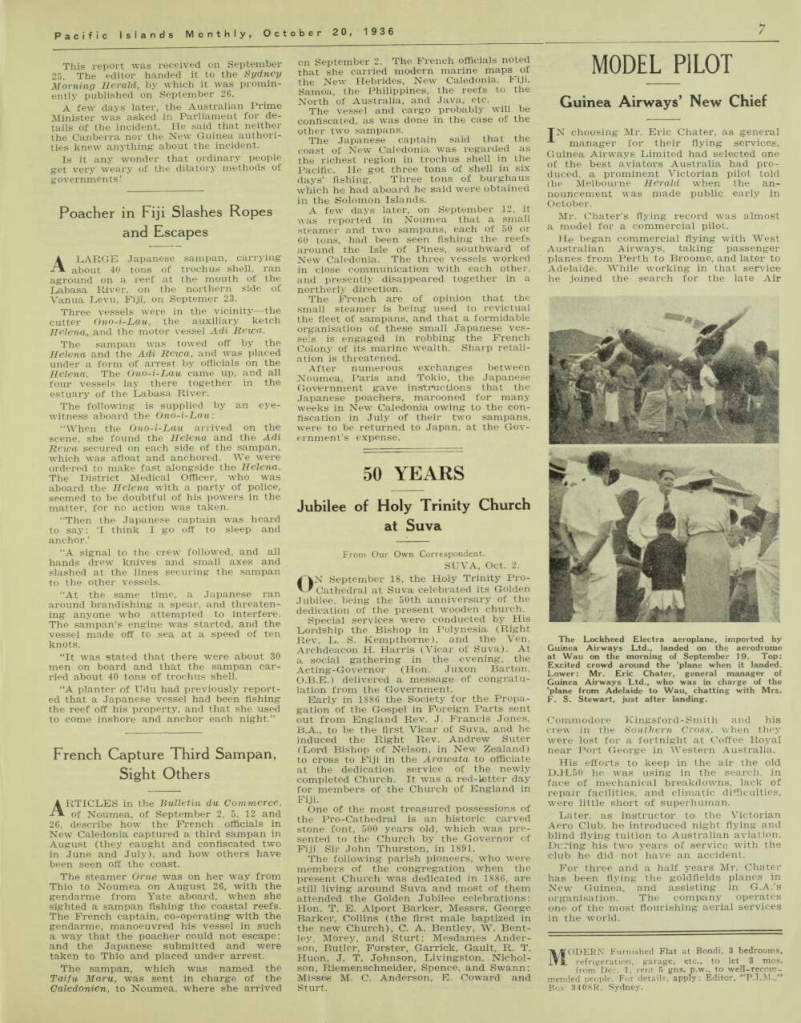
Mrs. Vernon H. Sherwin (Nursing Sister M.
Morton, of Adelaide), who recently was married in South Australia to Rev. Sherwin, of the Melanesian Mission. She accompanied her hus band back to his station at Wau, on the Morobe goldfield, New Guinea, sailing from Sydney on September 30 by the Macdhui.
This report was received on September 25. The editor handed it to the Sydney Morning Herald, by which it was promin ently published on September 26.
A few days later, the Australian Prime Minister was asked in Parliament for de tails of the incident. He said that neither the Canberra nor the New Guinea authori ties knew anything about the incident.
Is it any wonder that ordinary people get very weary of the dilatory methods of governments!
Advertisements & other items, p. 8 (1 item)
Wrapper !
Look on the Front of Your
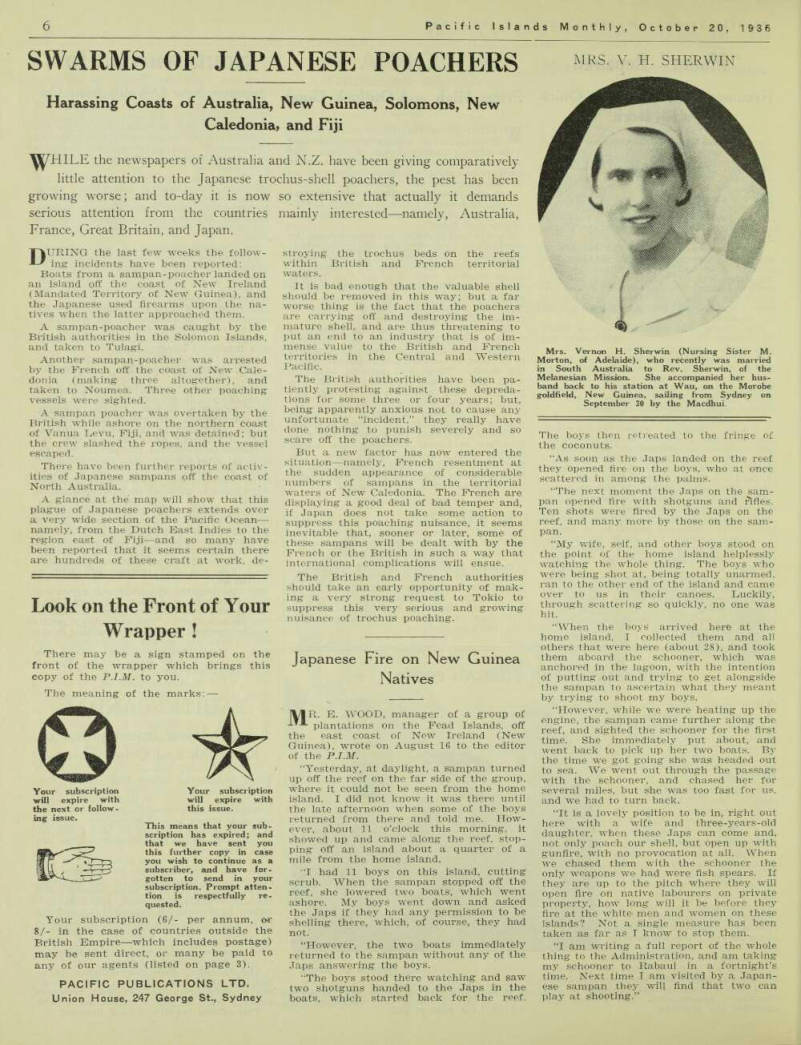
There may be a sign stamped on the front of the wrapper which brings this copy of the P.I.M. to you.
The meaning of the marks; 0 * Your subscription (6/- per annum, o«r 8/- in the case of countries outside the British Empire—which includes postage) may be sent direct, or many be paid to any of our agents (listed on page 3).
PACIFIC PUBLICATIONS LTD.
Union House, 247 George St., Sydney Your subscription will expire with the next or following issue.
Your subscription will expire with this issue.
This means that your subscription has expired; and that we have sent you this further copy in case you wish to continue as a subscriber, and have forgotten to send in your subscription. Prompt attention is respectfully requested.
and Escapes
Poacher in Fiji Slashes Ropes and Escapes
A LARGE Japanese sampan, carrying about 40 tons of trochus shell, ran aground on a reef at the mouth of the Labasa River, on the northern side of Vanua Levu, Fiji, on Septemer 23.
Three vessels were in the vicinity—the cutter Ono-i-Lau, the auxiliary ketch Helena, and the motor vessel Adi Rewa.
The sampan was towed off by the Helena and the Adi Rewa, and was placed under a form of arrest by officials on the Helena. The Ono-i-Lau came up, and all four vessels lay there together in the estuary of the Labasa River.
The following is supplied by an eye witness aboard the Ono-i-Lau: “When the Ono-i-Lau arrived on the scene, she found the Helena and the Adi Rewa secured on each side of the sampan, which was afloat and anchored. We were ordered to make fast alongside the Helena.
The District Medical Officer, who was aboard the Helena with a party of police, seemed to be doubtful of his powers in the matter, for no action was taken.
“Then the Japanese captain was heard to say: T think I go off to sleep and anchor.’
“A signal to the crew followed, and all hands drew knives and small axes and slashed at the lines securing the sampan to the other vessels.
“At the same time, a Japanese ran around brandishing a spear, and threaten ing anyone who attempted to interfere.
The sampan’s engine was started, and the vessel made off to sea at a speed of ten knots.
“It was stated that there were about 30 men on board and that the sampan car ried about 40 tons of trochus shell.
“A planter of Udu had previously report ed that a Japanese vessel had been fishing the reef off his property, and that she used to come inshore and anchor each night.”
French Capture Third Sampan,
Sight Others
ARTICLES in the Bulletin du Commerce, of Noumea, of September 2, 5. 12 and 26, describe how the French officials in New Caledonia captured a third sampan in August (they caught and confiscated two in June and July), and how others have been seen off the coast.
The steamer Orne was on her way from Thio to Noumea on August 26, with the gendarme from Yate aboard, when she sighted a sampan fishing the coastal reefs.
The French captain, co-operating with the gendarme, manoeuvred his vessel in such a way that the poacher could not escape; and the Japanese submitted and were taken to Thio and placed under arrest.
The sampan, which was named the Taifu Maru, was sent in charge of the Caledonian, to Noumea, where she arrived
on September 2. The French officials noted that she carried modern marine maps of the New Hebrides, New Caledonia. Fiji, Samoa, the Philippines, the reefs to the North of Australia, and Java, etc.
The vessel and cargo probably will be confiscated, as was done in the case of the other two sampans.
The Japanese captain said that the coast of New Caledonia was regarded as the richest region in trochus shell in the Pacific. He got three tons of shell in six days’ fishing. Three tons of burghaus which he had aboard he said were obtained in the Solomon Islands.
A few days later, on September 12, it was reported in Noumea that a small steamer and two sampans, each of 50 or 60 tons, had been seen fishing the reefs around the Isle of Pines, southward of New Caledonia. The three vessels worked in close communication with each other, and presently disappeared together in a northerly direction.
The French are of opinion that the small steamer is being used to revictual the fleet of sampans, and that a formidable organisation of these small Japanese ves sels is engaged in robbing the French Colony of its marine wealth. Sharp retali ation is threatened.
After numerous exchanges between Noumea, Paris and Tokio, the Japanese Government gave instructions that the Japanese poachers, marooned for many weeks in New Caledonia owing to the con fiscation in July of their two sampans, were to be returned to Japan, at the Gov ernment’s expense.
50 Years
Jubilee of Holy Trinity Church at Suva
From Our Own Correspondent.
Suva, Oct. 2.
ON September 18, the Holy Trinity Pro- Cathedral at Suva celebrated its Golden Jubilee, being the 50th anniversary of the dedication of the present wooden church.
Special services were conducted by His Lordship the Bishop in Polynesia (Right Rev. L. S. Kempthorne), and the Ven.
Archdeacon H. Harris (Vicar of Suva). At a social gathering in the evening, the Acting-Governor (Hon. Juxon Barton, 0.8. E.) delivered a message of congratu lation from the Government.
Early in 1886 the Society for the Propa gation of the Gospel in Foreign Parts sent out from England Rev. J. Francis Jones, 8.A., to be the first Vicar of Suva, and he induced the Right Rev. Andrew Suter (Lord Bishop of Nelson, in New Zealand) to cross to Fiji in the Arawata to officiate at the dedication service of the newly completed Church. It was a red-letter day for members of the Church of England in Fiji.
One of the most treasured possessions of the Pro-Cathedral is an historic carved stone font, 500 years old, which was pre sented to the Church by the Governor of Fiji Sir John Thurston, in 1891.
The following parish pioneers, who were members of the congregation when the present Church was dedicated in 1886, are still living around Suva and most of them attended the Golden Jubilee celebrations: Hon. T, E. Alport Barker, Messrs. George Barker, Collins (the first male baptized in the new Church), C. A. Bentley, W. Bent ley, Morey, and Sturt; Mesdames Ander son, Butler, Forster, Garrick, Gault, R. T.
Huon, J. T. Johnson, Livingston, Nichol son, Riemenschneider, Spence, and Swann: Misses M. C. Anderson, E. Coward and Sturt.
Model Pilot
Guinea Airways' New Chief
IN choosing Mr. Eric Chater, as general manager for their flying services, Guinea Airways Limited had selected one of the best aviators Australia had pro duced, a prominent Victorian pilot told the Melbourne Herald when the an nouncement was made public early in October.
Mr. Chater’s flying record was almost a model for a commercial pilot.
He began commercial flying with West Australian Airways, taking passenger planes from Perth to Broome, and later to Adelaide. While working in that service he joined the search for the late Air
Commodore Kingsford-Smith and his crew in the Southern Cross, when they were lost for a fortnight at Coffee Royal near Port George in Western Australia.
His efforts to keep in the air the old D.H.50 he was using in the search, in face of mechanical breakdowns, lack of repair facilities, and climatic difficulties, were little short of superhuman.
Later, as instructor to the Victorian Aero Club, he introduced night flying and blind flying tuition to Australian aviation.
During his two years of service with the club he did not have an accident.
For three and a half years Mr. Chater has been flying the goldfields planes in New Guinea, and assisting in G.A.’s organisation. The company operates one of the most flourishing aerial services in the world.
The Lockheed Electra aeroplane, imported by Guinea Airways Ltd., landed on the aerodrome at Wau on the morning of September 19. Top: Excited crowd around the ’plane when it landed.
Lower: Mr. Eric Chater, general manager of Guinea Airways Ltd., who was in charge of the plane from Adelaide to Wau, chatting with Mrs.
F. S. Stewart, just after landing.
Advertisements & other items, p. 9 (1 item)
ODERN Furnished Flat at Bondi, 3 bedrooms,
refrigeration, garage, etc., to let 3 mos. from Dec. 1, rent 5 gns. p.w., to well-recommended people. For detail?, apply: Editor, “P.T.M.,”
Box 3408 R, Sydney.
Restless Samoan Mau
Signs of Discontent Where N.Z. Says There is Only Peace
From Our Own Correspondent
APIA, Sept. 29.
A CCORDING to reports published in New Zealand newspapers, everything in Samoa is very quiet: and Europeans and Samoans are supposed to have “settled down” as the result of the “Goodwill Mis sion.”
This peace, however, is only superficial.
There are now apparent very strong undercurrents of dissatisfaction and opposition which, at any time, may cause trouble.
The elections of the new Faipule (or representatives of the Samoan natives) in the Samoan Fono Faipule (Parliament) have taken place in the various districts.
A certain number of the old Faipule, who belonged to the former “loyal” faction of the Samoans, have been re-elected, but the majority of the new Faipule belong to the Mau.
The “loyal” faction, which is now in op position to the Mau, is not satisfied, and is demanding a larger representation. The “loyal” village of Lauli’i, to the east of Apia, takes a strong attitude against the Mau, and against the Mau leader, Mr.
Nelson; and, according to reports, threats have been made against Mr. Nelson’s life, so that his residence is being guarded by Mau police.
The Mau, on the other hand, blames a Samoan Chief, I’iga, who is employed by the Native Department of the Administra tion, for causing all the trouble and stir ring up the Lauli’i people against the Mau.
The Mau leader Faumuina Fiame (who has been appointed senior sergeant of the Native Police, and starts in this new position on October 1) has demanded the dismissal of I’iga from the service.
It is an extraordinary thing, to see the previous position reversed —namely, the Malo (or loyalists) in opposition, and the Mau supporting the Government.
The Mau is not sitting quiet, however — it seems to be asserting its strength in several directions. It is reported to be attempting to interfere with the banana inspection and export organisation, which is now working very smoothly and profit ably.
At the bottom of it all probably is merely a desire to test newly-won strength. The Mau leader, Mr. Nelson, remains an un known quantity. He has kept very quiet and has not disclosed his hand in any way.
In the circumstances, the opening of the new Fono of Faipule, which is to take place on September 30, is anticipated with in terest.
Among the local-born, of mixed descent, there is dissatisfaction with the planned settlement of young unmarried men. Some of the local-born are asking for the settle ment of married men with large families, instead.
As reported previously, the European planters are in strong opposition to the threatened repatriation of Chinese and Melanesian plantation labourers by the N.Z. Government, and have forwarded strong protests against this measure to New Zealand. They are supported in their attitude by practically the whole of the population.
P.I.M. Criticism
Auckland, Oct. 6.
T'HE substance of criticism of Samoan affairs, published in the was evidently repeated in an address to the Polynesian Club in Sydney, by Mr. R, W.
Robson, editor of the P.I.M. A report of that address was cabled to New Zealand and published in most of the N.Z. news-
papers; and it has drawn replies from the Prime Minister (Mr. Savage) and Mr. J.
O’Brien, who was a member of the “Good will Mission.”
The Prime Minister says that Mr. Nel son must know a gcod deal more about Samoa than Mr. Robson, and he quotes at length from a letter from Mr. Nelson to show that in Samoa there now is con tinuing and increasing political peace.
Mr. O’Brien says that, as a result of the visit of the Goodwill Mission, “there has been an almost complete elimination of the desire to break away from New Zealand’s administration." The Samoans and Sa moan-born “were never more united than at present.” Mr. O’Brien described plans that have been made to provide land and employment for the 3500 local-born in Samoa.
“I consider Mr. Robson’s vision to be clouded by his bias against the present N.Z. Government,” said Mr. O’Brien.
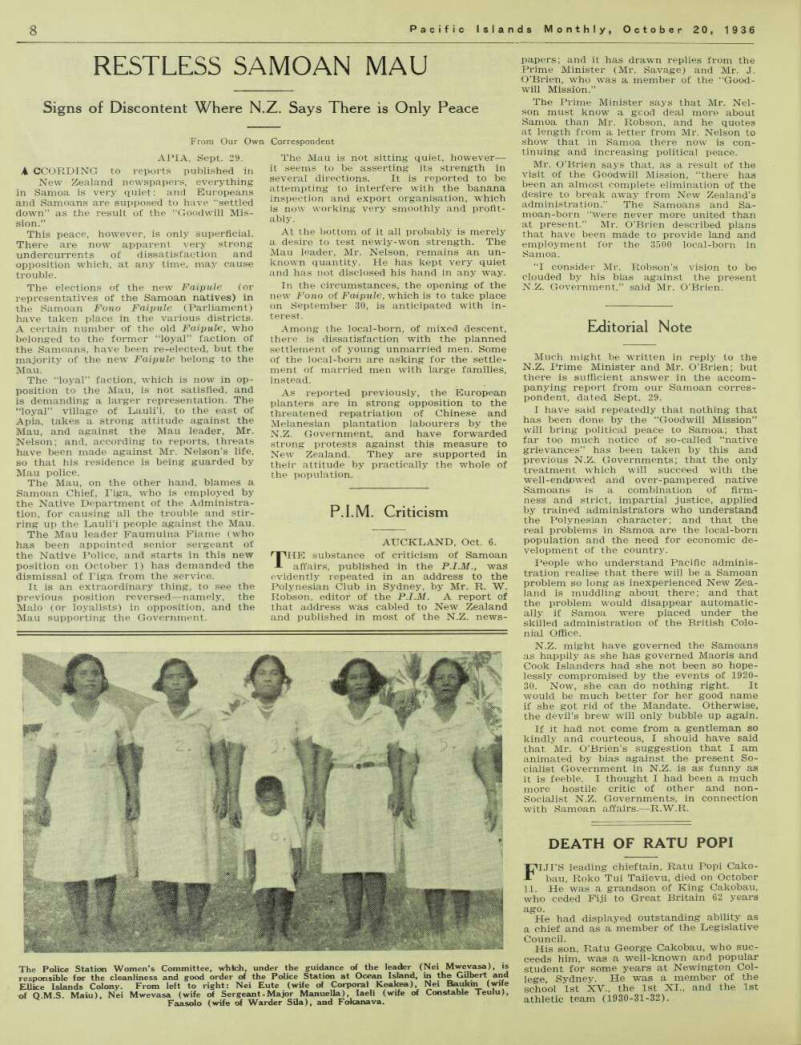
The Police Station Women’s Committee, which, under the guidance of the leader (Nei Mwevasa), is responsible for the cleanliness and good order of the Police Station at Ocean Island, in the Gilbert and Ellice Islands Colony. From left to right: Nei Eute (wife of Corporal Keakea), Nei Baukin (wife of Q.M.S. Maiu), Nei Mwevasa (wife of Sergeant-Major Manuella), laeli (wife of Constable Teulu), Faasolo (wife of Warder Sila), and Fokanava.
Editorial Note
Much might be written in reply to the N.Z. Prime Minister and Mr. O’Brien; but there is sufficient answer in the accom panying report from our Samoan corres pondent, dated Sept. 29.
I have said repeatedly that nothing that has been done by the “Goodwill Mission” will bring political peace to Samoa; that far too much notice of so-called “native grievances” has been taken by this and previous N.Z. Governments; that the only treatment which will succeed with the well-endjowed and over-pampered native Samoans is a combination of firm ness and strict, impartial justice, applied by trained administrators who understand the Polynesian character; and that the real problems in Samoa are the local-born population and the need for economic de velopment of the country.
People who understand Pacific adminis tration realise that there will be a Samoan problem so long as inexperienced New Zea land is muddling about there; and that the problem would disappear automatic ally if Samoa were placed under the skilled administration of the British Colo nial Office.
N.Z. might have governed the Samoans as happily as she has governed Maoris and Cook Islanders had she not been so hope lessly compromised by the events of 1920- 30. Now, she can do nothing right. It would be much better for her good name if she got rid of the Mandate. Otherwise, the devil’s brew will only bubble up again.
If it had not come from a gentleman so kindly and courteous, I should have said that Mr. O’Brien’s suggestion that I am animated by bias against the present So cialist Government in N.Z. is as funny as it is feeble. I thought I had been a much more hostile critic of other and non- Socialist N.Z. Governments, in connection
with Samoan affairs.-
R.W.R.
Death Of Ratu Popi
FIJI’S leading- chieftain, Ratu Popi Cako bau, Roko Tui Tailevu, died on October 11. He was a grandson of King Cakobau, who ceded Fiji to Great Britain 62 years ago.
He had displayed outstanding ability as a chief and as a member of the Legislative Council.
His son, Ratu George Cakobau, who suc ceeds him, was a well-known and popular student for some years at Newington Col lege, Sydney. He was a member of the school Ist XV., the Ist XI., and the Ist athletic team (1930-31-32).
Many Ships—But Little
Howl From Rabaul
Many Ships—But Little Service
THE Rabaul Times points out that the modern vessels of several steamship lines call at Rabaul. But: “Rabaul passengers embarking for South and North too often undergo a deal of inconvenience by being kept in a state of uncertainty as to cabin accom modation and by no means receiving the attentive courtesies which are shown tra vellers in other parts of the world.
“One of these days—Shipping Bill or no Shipping Bill —a line will call at Ra baul with less charges and more cour tesies, and the old lines will realise then how long-sixffering New Guinea has been in this year of grace 1936.
“Isn’t it time the E. and A. line changed its present system which causes intending passengers to live in a state of unrest until the vessel leaves Hong Kong—eleven days away—before they can ascertain whether they can obtain a passage or not? Isn’t it time that some change should be made to enable an intending tra veller, who applies nine months before hand, to be given first-class accommoda tion instead of having a second-class berth thrown to him like a crumb from the Inchcape table?
“Is that an Australian steamship com pany’s idea of service? This idea of the shipping companies saying to the public: Take what we like to give you or go with out, has just about reached its limit.
“Austx'alian shipping companies must sit up and take notice when modern ves sels like the Canberra Maru, which tied up here recently on her first voyage, show us what modern accommodation on freighters can be. It was the acme of comfort and cleanliness. And we wonder why Japan forges ahead and captures the Pacific trade!”
Death Of Popular Former
Fiji Governor
From Our Own Correspondent.
SUVA, Sept. 26.
IT was with deep regret that the people of Fiji learned of the death of that most popular former Governor of the Colony, Sir Eyre Hutson, who died in England after a short illness on Septem ber 14.
Sir Eyre Hutson’s association with Fiji went back to 1908, when he was appointed Colonial Secretary, after having served in the Colonial Service since 1885. Pre viously he had been in Barbados, Mauri tius, British Guiana, Jamaica, and Ber muda. He was Acting-Governor of Fiji and High Commissioner for the Western Pacific in 1915-16 and also in 1918, In which year he was appointed Governor of British Honduras until 1925, when he returned to Fiji as Governor, serving until he retired from the service in 1929.
He was born in August, 1864, was made a C.M.G. in 1911, and was created K.C.M.G. in 1922.
Rev. D. Macleod, M. 8., Ch.B., who has been working since 1930 under the John G. Paton Fund for the New Hebrides Presbyterian Mission, arrived in Sydney with his wife by the Morinda on October 6. He is stationed at Lenakel, West Tanna.
Search For Oil
Companies in Papua and New Guinea
THERE is a considerable revival of inter est in oil prospecting in Papua.
Of the three companies which received exclusive permits one, Oriomo Oil, Limited, a member of the Oil Search Limited group, is purely Australian. It has rights over 12,000 square miles.
Papua Oil Development Company Limit ed, which has been granted a permit over 20,000 square miles, has recently been re gistered in Port Moresby. This inde pendent company has a close relationship with the Shell group and confoxms to the provisions of the ordinance which require that at least two-thirds of the shares issued by a company or corporation holding such permits must be held by natui’al-born, or natux-alised British subjects.
The third concessionaire is Island Ex plorations Pty. Limited, which also re ceived a permit over 20,000 square miles.
This company was recently incorporated in Victoria under the auspices of the Vacuum Oil Company.
Search In Papua
Ox'iomo Oil Limited is ah’eady known in a general way to the public. The permit issued to that company is to be worked by Oil Search Limited.
A fully equipped geological survey party left for the area by the Macdhui on Sep tember 30 last and arrived in Port Moresby on October 8. The leader is Mr. J. N.
Montgomery who, for the last two years, has been in charge of field opei’ations in the Mandated Territory for Oil Seai'ch Ltd.
Mr. Montgomery was formexiy Geolo
gist-in-Charge of exploitation to the Anglo-Persian Oil Company Limited, in Persia, and previously with the Anglo- Persian Oil Company Limited engaged in the search for oil in Papua and New Guinea on behalf of the Commonwealth Government.
The party has now left Port Moresby for Kikori on the auxiliary yawl Olive, 46 tons gross, which sailed from Sydney on Octo ber 9. This vessel, specially fitted by Oil Search Ltd., to serve as a geological base, was manned by four men to take it to Port Moresby, where a native crew has been put on board.
The second contingent of geologists for Oil Search Ltd., will leave for the field by the Van Rees on December 19.
The programme being carried out by Oil Search Ltd., in the Mandated Territory, over a long period, and which is in charge of Mr. G. A. V. Stanley, is now far ad vanced. It is expected that a drilling re comendation will be forthcoming before long. •
Operations In New Guinea
Mr. E. L. Walter, managing director of Oil Search Limited, writes to the editor as follows: — “In your issue of September last, and under the heading of ‘A New Company to Take Over Enterprise of New Guinea’ it was mentioned that a large British oil company, it is understood, has been pro specting for oil in New Guinea and Papua for almost nine years, and has spent be tween £300,000 and £400,000.
“My company has been conducting geo logical surveys over a large area for a number of years. In fact, it has main tained a continuity of work since the date when the geologists of the Anglo-Persian Oil Company Limited were withdrawn in 1929. No other company has been con ducting similar work during the last six years.”
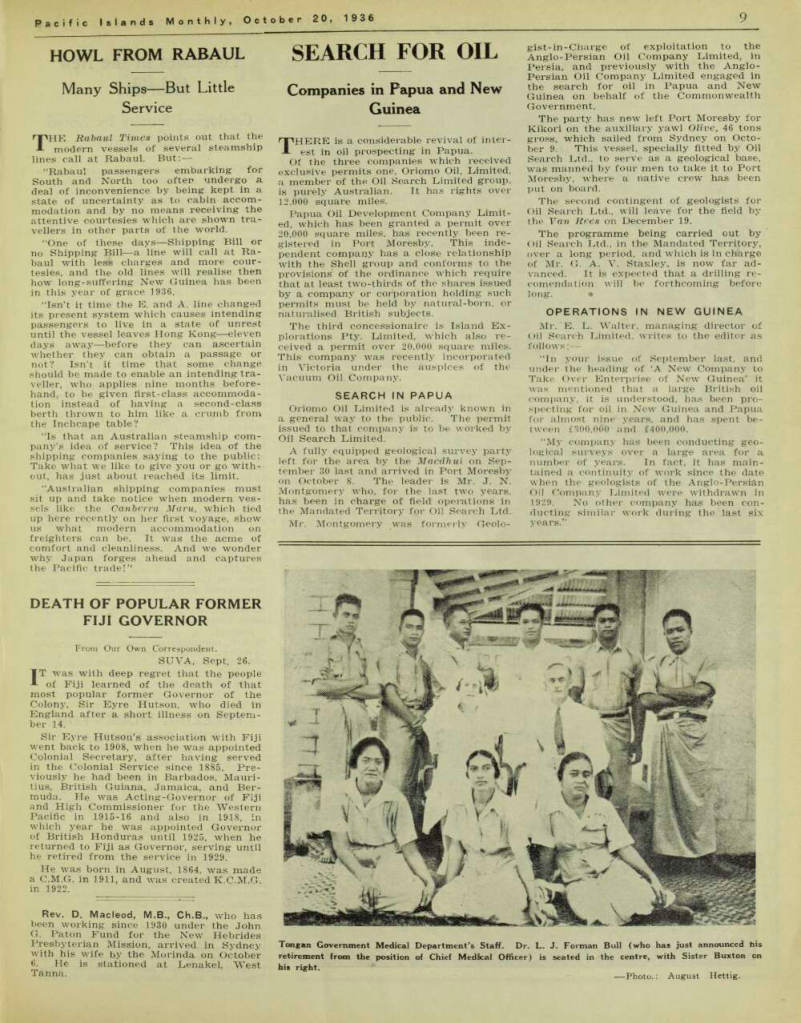
Tongan Government Medical Department’s Staff. Dr. L. J. Forman Bull (who has just announced his retirement from the position of Chief Medical Officer) is seated in the centre, with Sister Buxton on his right. —Photo.: August Hettig.
Hebrides
Volcanoes in the New Hebrides Geological Survey by Noted French Scientist
TJAVING completed an important geo logical mission in the New Hebrides for the Natural History Museum of Paris, Monsieur Edgar Aubert de la Rue, who is a Doctor of Natural Science at the Paris Museum, recently arrived in Sydney by the Capitaine Illiaque, accom panied by his wife.
Dr. de la Rue spent 18 months in the Condominium, mostly on Ambrym and Tanna, where his particular study was the geological observation of the vol canoes there. Madame de la Rue accom panied her husband on all his expedition, even ascending to the summit of the active volcanoes.
In 1934, M. de la Rue led a scientific party to carry out ethnological, geological, and zoological investigations in the French possessions in Western Pacific.
His experiences and observations during that expedition were published last year in Prance in a book entitled L’Homme et les lies. * Before leaving Australia for Canada en route to Paris, Dr. de la Rue, who is an anthropologist of note, delivered an in teresting lecture in Sydney to members of the Alliance Francaise. He spoke on the native tribes and the flora and fauna of the New Hebrides, and his address was illustrated by a number of 'striking lantern slides.
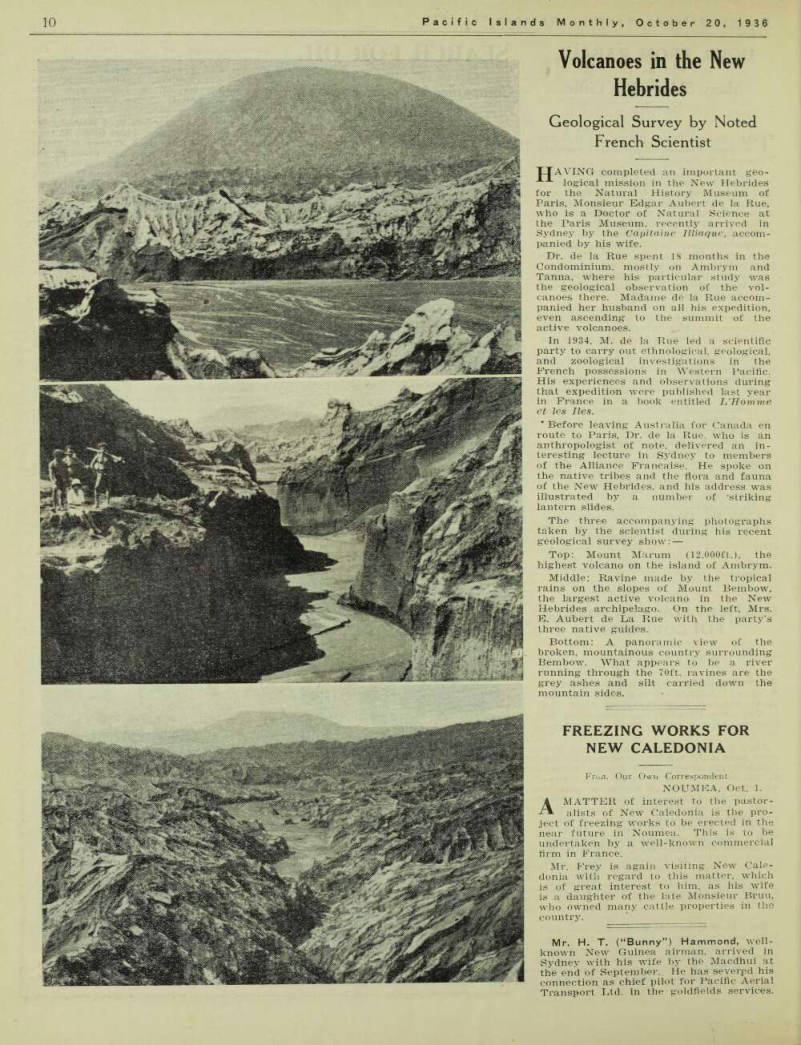
The three accompanying photographs taken by the scientist during his recent geological survey show: Top: Mount Marum (12,000 ft.), the highest volcano on the island of Ambrym.
Middle: Ravine made by the tropical rains on the slopes of Mount Bembow, the largest active volcano in the New Hebrides archipelago. On the left, Mrs.
E. Aubert de La Rue with the party’s three native guides.
Bottom: A panoramic view of the broken, mountainous country surrounding Bembow. What appears to be a river running through the 70ft. ravines are the grey ashes and silt carried down the mountain sides.
New Caledonia
Freezing Works For
Fron. Our Own Correspondent
Noumea, Oct. 1.
A MATTER of interest to the pastor alists of New Caledonia is the pro ject of freezing works to be erected in the near future in Noumea. This is to be undertaken by a well-known commercial firm in France.
Mr. Frey is again visiting New Cale donia with regard to this matter, which is of great interest to him, as his wife is a daughter of the late Monsieur Bruu, who owned many cattle properties in the country. * Mr. H. T. (“Bunny”) Hammond, well known New Guinea airman, arrived in Sydney with his wife by the Macdhui at the end of September. He has severed his connection as chief pilot for Pacific Aerial Transport Ltd. in the goldfields services.
Tropicalliies
THIS happened recently at a big native ceremonial gathering in Fiji, at which the Acting-Governor, the Chief Justice, and other high officials and their wives were present.
There was a very select official lun cheon, with many varieties of fish, oysters, prawns, and what-nots, all done to a turn.
Only a few yards away, the officers of the Defence Force guard of honour, and several others not invited to the official luncheon, were lunching, also from a sumptuously-laden board.
All went well; but the next day, in Suva, it was found that many high officials were absent from their offices.
Inquiries elicited the words: “Fish pois oning.” Some suffered violently for a week.
The fact that none of those at the less select luncheon suffered is considered by the latter to be amusing. « * * WITH reference to the famous marae of the Pomare family called Tarahoi, in the Arue district, Tahiti, Mr. Arthur Brander (a nephew of the late Queen Marau), writes to a Sydney correspondent: “With regard to the Pomare marae, the family, as you know, came from the Pau motus, and did not have the old marae that the Teva clan had. I understand that there were two marae in the Arue district, namely Raianaunau and Tarahoi, and there is no doubt that they belonged to the Pomares.”
Mr. Brander’s grandmother was the chieftainess Ariitaimai, famous for her memoirs. The book was privately printed, and is now extremely rare. When an Australian library recently attempted to purchase a copy of it £5O was requested.
Mr. Brander says that the memoirs have been translated into German, and it is possible that a French translation can also be had. The Mitchell Library in Sydney does not possess a copy, except certain extracts which were published in bulletin form by the Societe des Etudes Oceani ennes, of Papeete.—Eriki. * * * IHAD made some scones,” writes “Mrs.
Marooned” (New Hebrides), “but they were not quite a success —a little heavy, I thought—bad firewood or some other equally good excuse. Still, I considered that they were good enough to put on the table—the children, at any rate, would not be over critical.
“Presently, small three-year-old daugh ter came clamouring for food; I gave her one of the scones. She took a bite, looked at the scone, turned it over and inspected its reverse, then handed it to her father with the remark: ‘You hab it, daddy—he not ripe yet!’ ” *. * * THE question has sometimes arisen as to why the Gambier Islands received their name. Positive evidence that they were named by Captain Wilson, of the Duff, after a one time well-known British admiral, Lord Gambier, is to be found among the papers of the Haweis collection recently purchased by the Mitchell Library in Sydney.
“The captain named the cluster Gam bier’s Islands, from a gentleman of that name belonging to the Admiralty,” says one of the missionaries (probably Rev. W.
Pascoe Crook, who later settled in New South Wales) in an entry on May 25,
1797. Lord Gambier was a supporter of missions, and well known to Rev. Samuel Marsden. The early missionaries in New Zealand called the Hokianga River after him, too, but the name, fortunately, soon fell into disfavour.
The Duff was then on her way to the Marquesas from Tonga. “Our time being very limited,” says the same account, “and business urgent, we could not stay to at tempt an intercourse with the natives: they are doubtless in the same state of darkness and ignorance as their neigh bours. They appear to know the art of destroying each other but of their great and spiritual concerns they have no idea.”
What an opportunity for observation was lost! Only recently Dr. Peter H.
Buck, of the Bishop museum, has been in the group endeavouring to collect the threads of knowledge still remaining.—E.R. * * * ANEW edition (1936) of the Handbook of Fiji has been published by the Govern ment Printer, Suva. It is a large book, containing 170 pages of letterpress, and very numerous illustrations: and it con tains a great mass of data relating to the Colony of Fiji, all carefully arranged and indexed. There also is a very good map of Fiji. This is a book that must be in the hands of anyone interested in the Colony. The price is not stated on our complimentary copy. Inquiries should be directed to the Government Printer, Suva, Fiji. * * * HENRY DEXTER, that hard-bitten trader of Eastern Papua, who is now living in the ease of retirement in England, sent us a little yarn early this year describ ing an encounter with a mysterious fish in the Vari-Vari Islands. He said the in cident occurred “in 1901 when I was bound from Port Moresby to the Aroa River.”
The story was published in the May issue: and we have now received a note from a resident of Samarai, Mr. E. A. Jackson, who scolds Mr. Dexter, pointing out that
he (Dexter) could not have made the trip in 1901, since he did not arrive in Papua until the Bentinck reached Port Moresby in 1910.
Mr. Jackson is correct —Henry Dexter, in 1901, had no thought of going to Papua.
The error apparently is the_result of Mr.
Dexter’s temperamental typewriter which, in the manner of typewriters the world over, transposed the figures to make 1910 read 1901. * * * IWAS told on good authority in Fiji in July, that the Colonial Sugar Refining Company would take over the derelict pineapple-canning industry. I was im mediately interested —it seemed as if the C.S.R., with its usual luck and shrewd, far-sighted management, would be walk ing into something already pioneered and proved, and that it certainly would make a success of the new industry to the further enrichment of Fiji. But certain wise ones to whom I talked in Suva ridiculed the report. They had a dozen reasons why the industry must fail —the chief, I remember, being that the pine apple grown in Fiji does not carry the sugar content of pineapples grown elsewhere.
Now, it is clear, the C.S.R. will take over the canning of pineapples in Fiji; and I have a feeling that this is going to be a very successful and highly profitable in dustry. The C.S.R. has been well de scribed as Fiji’s fairy godmother.—R.W.R. * * * LIKE all Polynesians, the people of On tong Java, a remote island near the Solomons, are nothing if not polite. Some years ago the Sydney anthropologist, Dr.
H. lan Hogbin, was there for the purpose of research work. After a particularly bad bout of malaria, he was approached by a deputation of village elders. There was some friendly conversation and they even tually stated the object of the visit.
“If, by chance, you are worrying about your place of interment, do not think that we will bury you in the bush ’’ Dr, Hogbin was informed by the principal speaker.
“We will place you among our own people in our own burial ground.”
Dr. Hogbin did not require the good ser vices of his friends at Ontong Java. —E.R.
Advertisements & other items, pp. 13-14 (1 item)
Home
STERLING
ROME PAINT
Reruns
HOME
(I Guaranteed CD
LOOKS
BETTER
LONGER
MADE BY
STERLING VARNISH CO.
For
TROPICAL
SUN and
SALT-LADEN
AIR
SYDNEY, N.S.W.
RECORDS
PACKED FREE
SEND FOR LISTS
Australia’s finest Record Shop, specialising in Mail Orders.
Any Records procured and sent same day.
Dozens of clients in the Pacific Islands.
THE TALKERIES
QUEEN VICTORIA BUILDINGS
SYDNEY, AUSTRALIA
Set up in 45 seconds i m
“ —amazed the
diagnostic
Users of the Watson Caldwell Portable X-Ray Apparatus frequently express their amazement at the power and diagnostic range provided by such a compact apparatus.
A self-contained and portable unit; the Watson “C.P.” is the economical, efficient, easily operated equipment that is solving the radiographic problems of many Island Hospitals, such as Thursday Island, Nauru, Rabaul (New Britain) and King Island, Bass Strait.
Write in for full particulars.
CtT. Ctlatson £>*Sons Ltd.
(incorporated in N.S.W.) Watson House, Bligh Street, Sydney Melbourne, Brisbane, Adelaide, Newcastle, Perth, and New Zealand
BMLEIS
FLUID MAGNESIA
A Product of
ELLIOTTS & AUSTRALIAN DRUG Ltd.
A Valuable Aid to Digestion
Relieves —
HEARTBURN
DISPEPSIA
BILIOUSNESS, etc.
OBTAINABLE
AT ALL HIGH-CLASS CHEMISTS
AND STORES.
About Islands People
Mrs. Ada Kennedy, .wife of Mr. Charles Kennedy, of Nadi, Fiji, died on September 6, after a long period of indifferent health.
Born in Levuka 67 years ago, she was the eldest daughter of the late Mr. James Mackay, one of the early pioneers of the Fiji Islands.
Mr. J. H. Sutton, a well-known identity of Papua, died in Sydney early in Sep tember. Until a year ago he was head gaoler at the Badili prison situated near Koki, just outside Port Moresby. Pre viously he had served in various other capacities in the Papuan Public Service.
Mr. Sutton left a widow and one son.
Mr. Harold Gatty, who is the represen tative in New Zealand and Australia for Pan-American Airways, sailed from Syd ney for Auckland by the Monterey on September 17 to attend a conference on trans-Pacific and trans-Tasman air ser vices.
Mr. Christopher Falkner, of Tearouki Plantation in Bougainville, New Guinea, died on September 9 at Namanula Hos pital, Rabaul, after being taken in from his plantation in a low state of health by the S.S. Maiwara. He was an old and respected resident of the territory, having first gone to New Guinea to manage Vunakambi estate in 1920. Joining the Administration in 1921 as a pest inspec tor, he was later transferred to the Public Health Dept. For a time he was a Patrol Officer in the Bainings area, and after wards was Deputy District Officer at Buka Passage. Resigning from the ser vice in 1925, he returned to the land. Mr.
Falkner, who was only 42, had a fine war record, having been awarded the Military Medal and the Serbian Cross of Kar george.
Sister Gwen, of the Melanesian Mis sion’s Community of the Cross at Siota, British Solomon Islands, arrived in Eng land in August on furlough. She is now spending a brief holiday at Streatham, after several weeks with her mother at Westward Ho. Sister Gwen, who has been in Melanesia for seven years, will return to the Solomons before Christmas.
Mr. A. W. Ottawa, of the Riverstone Meat Co. Ltd., will leave Sydney for New Guinea by the Montoro on October 21.
This is his first visit to Melanesia, though he has handled the South Sea interests of the Riverstone Meat Co. for many years. He intends to make personal acquaintance with his firm’s Islands cus tomers. Mr. Ottawa will return to Sydney through the Solomon Islands on board the Malaita.
Mr. Harold Langley Hart, who laboured faithfully for the Melanesian Mission from 1910 to 1928, first at Raga (New Hebrides), then in charge of the Vureas School (Banks Group), with a spell as head at Norfolk Island, died recently from pneumonia, in Chipping Norton Hospital, England.
Mr. and Mrs. Albert R. W. Massey re turned to Australia from a honeymoon visit to Suva by the Aorangi on October 2. They were married in Sydney on Sep tember 9, the ancestors of both the bride and bridegroom being well-known in Fiji, Mr. Massey is a grandson of the late Captain Randell, of Fiji; and Mrs. Massey (nee Jean Cocks) is the elder daughter of the late Captain Robert Cocks, of Fiji, and Mrs. Cocks, of Glenbrook, N.S.W., and grand-daughter of the late David Wilkinson, of Suva.
Mr. F. I sen be rt, who has been a miner for some years in the Morobe district, arrived in Sydney from New Guinea with his wife by the Macdhui on September 24.
Mr. G. S. Buckley, who recently arrived in Australia from Scotland to do mission ary work in the New Hebrides under the John G. Baton Fund, was ordained to the Presbyterian ministry at the Deepdene Presbyterian Church, Victoria, on October 12. He will leave Sydney with his wife by the Morinda on October 29, and will be stationed at Wintua, South West Bay, on Malekula Island, among the Big Nambas tribes.
Mr. Gower Wilson, of Lord Howe Island, arrived in Sydney by the Morinda on Oc tober 6 to take delivery of his new 32ft. cruiser, which has been built at Palm Beach, N.S.W. Manned by Messrs. Gower Wilson, Alan Wilson, W. Goddard and W.
Hammill, the vessel will leave Sydney for Lord Howe Is. at the end of October.
Queen Salote, D.8.E., of Tonga, accom panied by her husband, Prince Tugi, de parted from Sydney for New Zealand, en route to Nukualofa, by the Awatea on September 25. Her Majesty left in much better health, and had benefited consider ably by her four months’ stay in Australia.
Mr. F. Penman, a Victorian research chemist, returned to Sydney from the Solomon Islands by the Malaita on Sep tember 11. He had been engaged for several months upon an investigation of soil values on Lever’s Pacific Plantations Pty. Ltd’s estates in the group.
Rev. L. Methsieder, of the Lutheran Mission station at Siassi, New Guinea, arrived in Sydney in September on fur lough. He was accompanied by his wife and they went on to South Australia where Mrs. Methsieder has entered the Lutheran Hospital.
Dr. Bernard Mishkin, of the U.S. Social Science Council, sailed from Sydney for New Guinea by the Macdhui on September 30 to carry out anthropological work. He will study the Wapi race in the moun tainous region near the Sepik River. Dr.
Mishkin proposes to take moving pictures in natural colours, and hopes to obtain a large collection of valuable specimens of native art, spears, axes, etc.
Mr. and Mrs. H. C. Symes, of Marara Plantation, Guadalcanal, British Solomon Islands, sailed from Rabaul, New Guinea, by the W.R.C. vessel Rabaul at the end of September on the first stage of a world tour. Mr. Symes has invented various munitions devices and he will endeavour to exploit them overseas.
The engagement is announced of Miss Miriam Warren, youngest daughter of Mr. and Mrs. S. Warren, of Pitcairn Island, to Mr. Mathew King, of Miramar, Welling ton. The marriage will take place after Easter, and the couple will reside in New Zealand.
Mp. F. Bepgmann, who has been in New Guinea as a missionary for the Neuendettelsau Mission Society, reached Adelaide, South Australia, early in October to obtain medical treatment. He was accompanied by his wife.
Miss Esther Williams, 8.A., Dip. Ed., of the Methodist Station at Lautoka, among the Fiji Indians, arrived in Mel bourne on October 6. She was hurriedly recalled to Australia because of the illness of Mr. W. J. Williams, of Korumburra, Victoria, her father, who died a week be fore she reached her home.
Miss J. N. Niau, authoress of the recently published book, “Phantom Para dise,” dealing with the ill-fated De Rays expedition in the Western Pacific, arrived in New Guinea in September by the m.v.
Rabaul. After visiting the outports, she will spend some time in the capital. Miss Niau is collecting material for another book.
Mr. H. M. Stuchbery, Government Vete rinary Officer in Fiji, and his family, left on leave by the Aorangi on September 24.
Sister Joseph, who has been connected for many years with the Roman Catholic convent at Savalalo, Western Samoa, died on September 9.
Mr. A. E. Ray, manager of Messrs.
Burns, Philp and Co. Ltd.’s store at Kavieng, arrived in Sydney from New Guinea by the Macdhui on September 24.
M. Gorjux, who has been appointed director of the health services in New Caledonia, will arrive in Noumea by the Ville d'Amiens on November 20.
Dr. Martha Koller, of the medical department of the Lutheran Mission at Finschhafen, New Guinea, arrived in Aus tralia recently by the Macdhui. She is at present spending leave in South Australia.
Advertisements & other items, pp. 14-15 (1 item)
Kurrajong
Wheeny Creek Farm
Forty-five miles from Sydney Superior modern accommodation, abundance of cream, eggs, and poultry. S acres orchard. Tennis, etc.
Tariff: Double, £2/2/- each; Single. £!/!•/- ’Phone: Kurrajong 42 Proprietor: A. J. SAMSON Formerly New Guinea Public Servics
The
Wentworth
CHURCH HILL,SYDNEY
’Phone: BW 1361 (10 Lines) Telegraphic Address: “Mum,” Sydney
Sydney’s Exclusive
Hofei
St* It St m i Situated only two minutes from the General Post Office, Railway Station, and leading theatres. All rooms Steam-heated in Winter and Air-cooled in Summer, and equipped with Telephone, and Hot and Cold Water.
Excellent Cuisine.
Tariff: Room and Breakfast, from 10/6 per day; Inclusive from 18/- per day.
For full particulars apply to The Manager.
tolUute
\S
TENAX
& e
fot
TENAX
THt GENUINELY GERMICIDAL
TOILET SOAP
PREVENT
TROPICAL
DISEASES
You guard yourself against Typhoid, Diphtheria, Malaria, Dhobie Itch, and Tinea when you lather daily with TENAX. It is also invaluable in the cure of Tropical Skin Diseases, for TENAX is the ONLY soap containing oil distilled and marketed by Australian Essential Oils Ltd. under the registered trade-mark of “Ti-Trol,” eleven times quicker than carbolic as a germicide, but NON - POISONOUS
and NON-IRRITANT.
A PRODUCT OF AUSTRALIAN SOAPS LIMITED
TUDOR HOTEL
Room Only Rate, 5/- per day. Meals a la carte. Accommodation for 100 guests. One minute from G.P.O.
127 PHILLIP ST. Tel.: BW 2788
Next door to Martin Place
Sydney
Around-The-World Cruise
THE 30-years-old trawler Antelope is being refitted and painted at Plymouth, England, in preparation for a cruise across the Atlantic and among the islands of the Pacific.
The voyage has been planned by four young business men and two women, who have formed a syndicate known as Horizon Hunters Limited. They are Mr. J. Bruce Kellock, garage proprietor, and his 22-year old wife, Rita; Mr. C. H. Christian, bank clerk; Mr. J. Mackern and Mr. D. Taylor, engineers; and Mr. Kellock’s sister.
There has been some speculation as to the object of the cruise. Some commen tators believe that it is connected with a “treasure-hunt” scheme; while it has been stated that the voyage has been arranged in conjunction with a film project.
Mr. Joseph Henry Lewis, an old identity of the New Guinea goldfields, died at Wau on September 1, from pneumonia.
Samoan Trade Is
Good
Mau is Displaying Strange Curiosity
From Our Own Correspondent APIA, Sept. 30.
OWING to dry conditions, bananas are not very plentiful just now, but the trade continues good. Samoa is promised an extra quota in December.
Owing to the accident to the Matua at Rarotonga, the banana shipment on Octo ber 1 will probably be lifted by the Wai pahi or another Union steamer.
Copra is coming in freely and the American steamer Golden Coast, now in Apia, is loading a large consignment of 1600 tons of copra for the American mar ket.
The cocoa price is rising, and Samoan cocoa, at present in good demand, is real ising top prices. The second crop of the year is coming in now, and should be a fair one.
The Mau is at present taking great in terest in bananas, some natives being sus picious that European shippers get pref erence in the banana quotas. They have asked for permission to have some Mau representatives on the Apia wharf to watch the inspection of the fruit and safeguard Samoan interests.
Banana inspection and quotas have been very fair in the past, and the sudden suspicion of the Mau leaders seems to amount simply to a test of the power of the natives to interfere in all kinds of Government work.
Food Shortage
A food shortage, due to a lengthy spell of dry weather, is reported from the dis tricts on the west coast of Upolu. So far the shortage is not considered serious, as other districts have still a surplus of food and the rainy season should start shortly.
Quarantine Again
Owing to the continued prevalence of measles in Western Samoa, the Naval Administration at Pago Pago has again declared a quarantine for passengers from Western Samoa.
A New Census
The census for the Territory of Western Samoa will be taken on November 4 next.
There have been important changes and a large increase in the native and local born population since the last census was taken in 1926, and the result of the coming count is expected with interest.
Aid For Needy Planters
The Samoan Treasury is at present in vestigating the financial affairs of Euro pean planters, who are indebted to the Administration, the N.Z. Reparation Es tates, and commercial firms with a view to granting relief wherever necessary, especially for debts incurred during the depression period. The Treasurer has re ceived authority to act in conjunction with the “Debt Postponement Board.” The investigation has been ordered as a result of representations made to the “Goodwill Mission.”
Personal Items
Sir Maynard Hedstrom, director of the firm of Morris, Hedstrom Ltd., arrived at Apia on a visit of inspection to the Apia branch of the firm by the steamer Anti gone during September.
The Government Auditor, Mr. W. R.
McCulloch, with Mrs. McCulloch, has left Apia by the Maui Pomare after the ex piration of his tei’m of office in the terri tory.
Mr. G. Henry, Commissioner, of Puka Puka, Cook Islands, is at present on a visit to Apia.
Passengers on the schconer Makoa for Swain’s Island and the Tokelau Group on September 17 were Mr. A. E. Jennings and family, Rev. Father Deihl (of the R.C.
Mission) and Mr. E. E. Dunwoodie (Post master, of Apia).
Mr. and Mrs. H. S. Wayne arrived in New Guinea in September from Brisbane, Queensland. Mr. Wayne is the new manager at the Vacuum Oil Company’s Rabaul branch.
Advertisements & other items, p. 16 (1 item)
follow through'
THE SCOTS COLLEGE
BELLEVUE HILL, SYDNEY
Boys' Boarding and Day College (Presbyterian) with Preparatory School.
Principal: A. K. ANDERSON, M.A.
A Great Public School of N.S.W. Staffed with nineteen Masters. Professional, Commercial and Pastoral Courses.
Prospectus on application to Principal or Bursar.
the most deadly to insects because it contains a killing agent found in no other insecticide Australia
follow through'
that count si
FLIT
does not stun
insects-
tlulls
them
a Kill FLlT—the only insect spray that REALLY kills.
RESISTS CORROSION, STRONGER THAN STEEL
EASILY WOR KED. CANNOT RUST
f SALT WATER TANKS, PROPELLER SHAFTS
J or MOSQUITO GAUZE, MARINE HARDWARE
Full information gladly from the Australian Distributors WRIGHT & COMPANY, 81 Clarence St., Sydney * MONEL METAL i. . R.gi.t.red Trad. Mark Cab.es: “CORNRIGHT,” SYDNEY
Kaisinik
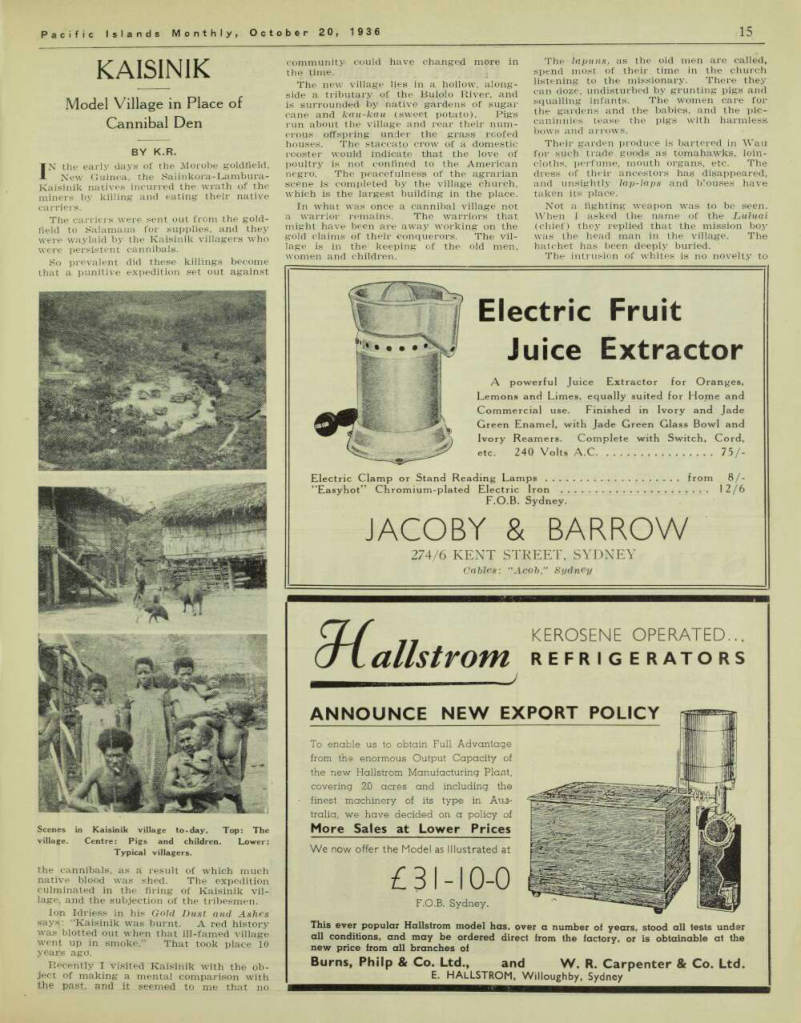
Model Village in Place of Cannibal Den
By K.R.
JN the early days of the Morobe goldfield, New Guinea, the Saiinkora-Lambura- Kaisinik natives incurred the wrath of the miners by killing and eating their native carriers.
The carriers were sent out from the gold field to Salamaua for supplies, and they were waylaid by the Kaisinik villagers who were persistent cannibals.
So prevalent did these killings become that a punitive expedition set out against
the cannibals, as a result of which much native blood was shed. The expedition culminated in the firing of Kaisinik vil lage, and the subjection of the tribesmen. lon Idriess in his Gold Dust and Ashes says: “Kaisinik was burnt. A red history was blotted out when that ill-famed village went up in smoke.” That took place 10 years ago.
Recently I visited Kaisinik with the ob ject of making a mental comparison with the past, and it seemed to me that no
community could have changed more in the time. ■ The new village lies in a hollow, along side a tributary of the Bulolo River, and is surrounded by native gardens of sugar cane and kau-kau (sweet potato). Pigs run about the village and rear their num erous offspring under the grass roofed houses. The staccato crow of a domestic rooster would indicate that the love of poultry is not confined to the American negro. The peacefulness of the agrarian scene is completed by the village church, which is the largest building in the place.
In what was once a cannibal village not a warrior remains. The warriors that might have been are away working on the gold claims of their conquerors. The vil lage is in the keeping of the old men, women and children.
The iapuns, as the old men are called, spend most of their time in the church listening to the missionary. There they can doze, undisturbed by grunting pigs and squalling infants. The women care for the gardens and the babies, and the pic caninnies tease the pigs with harmless bows and arrows.
Their gai’den produce is bartered in Wau for such trade goods as tomahawks, loin cloths, perfume, mouth organs, etc. The dress of their ancestors has disappeared, and unsightly lap-laps and b’ouses have taken its place.
Not a fighting weapon was to be seen.
When I asked the name of the Luluai (chief) they replied that the mission boy was the head man in the village. The hatchet has been deeply buried.
The intrusion of whites is no novelty to
Scenes in Kaisinik village to-day. Top: The village. Centre: Pigs and children. Lower: Typical villagers.
those people. Regarded with indifference, I wondered what the feelings of these people were towards the whites generally, for many of them must still remember the night when their homes went up in flames, and the traditional life of their village was destroyed for ever.
Advertisements & other items, p. 17 (1 item)
alls tram
••• ■4
Electric Fruit
Juice Extractor
A powerful Juice Extractor for Oranges, Lemons and Limes, equally suited for Home and Commercial use. Finished in Ivory and Jade Green Enamel, with Jade Green Glass Bowl and Ivory Reamers. Complete with Switch, Cord, etc. 240 Volts A.C 757- Electric Clamp or Stand Reading Lamps . . . .
“Easyhot” Chromium-plated Electric Iron . .
F. 0.8. Sydney. from 8/l2/6
JACOBY & BARROW
274/6 KENT STREET, SYDNEY
Cables: “Acob,” Sydney
alls tram
KEROSENE OPERATED...
R E FRIG E RATO RS
ANNOUNCE NEW EXPORT POLICY
To enable us to obtain Full Advantage from the enormous Output Capacity of the new Hallstrom Manufacturing Plant, covering 20 acres and including the finest machinery of its type in Australia, we have decided on a policy of More Sales at Lower Prices We now offer the Model as Illustrated at £3l-10-0 F. 0.8. Sydney.
This ever popular Hallstrom model has, over a number of years, stood all tests under all conditions, and may be ordered direct from the factory, or is obtainable at the new price from all branches of Burns, Philp & Co. Ltd., and W. R. Carpenter & Co. Ltd.
E. HALLSTROM, Willoughby, Sydney
Swimming Pool At Bulwa
From a Special Correspondent WAU, Sept. 26.
A RECENT innovation at Bulwa, which should prove a great benefit to the goldfields community generally, is a new swimming pool which Bulolo Gold Dredg ing Ltd. has provided for its employees. It was officially opened by Mr. L. Joubert (B.G.D.’s manager) on September 5.
Great credit is due to Bulolo's manager at the Bulwa Camp (Mr. L. Bergstrand), who carried out the engineering section of the pool which was excavated to depths varying from 4ft. to 9ft. It is 85fL long by 40ft. wide and is strengthened *by a stone retaining wall.
The swimming pool is situated in an attractive natural setting and advantage has been taken of the nearby mineral springs to run hot and cold water to the baths.
Planters’ Association of New Guinea Safeguarding
New Guinea Safeguarding the Interests of Copra Producers
THE annual report of the Executive Council of the Planters’ Association of New Guinea shows that there has been much activity during the year on the part of that live body to safeguard the interests of the coconut planters in the Mandated Territory.
Mainly as a result of the Association’s representations a new system of payments of purchase instalments due on expro priated properties was agreed to by the Commonwealth Government. It came into operation on July 1 and has created a sense of security and optimism among copra producers.
The report deals at length with the pro posed amendments to the Trading Regula tion (“Two Mile Limit” regulation). The committee declares: — “It is common knowledge that certain officials not in a position to form a sound and independent judgment on this sub ject and ignorant of the ramifications and difficulties to be faced by planters and traders are prejudiced and opposed to the principle of a protected trading area around plantations on the ground that it leaves the way open to exploitation of natives.
“The Association emphatically denies this, maintaining that experience has proved that any abuses under existing re gulations are the merest trifle compared
with the irregularities which existed under the totally unrestricted system of trading.”
In view of the possible necessity for the establishment of concentration points for produce, consequent upon the introduc tion of the Shipping Bill, the Association believes that an up-to-date roads policy, which will meet agricultural requirements, should be proceeded with immediately by the Administration.
The Committee protests against the omission from the recently published terms of the mail contract of Kavieng and Madang as main ports of call by direct boats from Australia.
It is urged that a progressive and com prehensive agricultural policy be formu lated and put into operation. It is con sidered that a Board of Agriculture should be formed as scon as possible.
Representation was made to the Admini stration for the abolition of the Native Labour Tax. The tax was remitted for 12 months, expiring June 30, 1937.
Cited as the “most important matter which has yet demanded the attention and deepest consideration of the Planters’ As sociation,” the stormy Shipping Bill re ceived a few more broadsides in the Com mittee’s report. The latter urged that a Royal Commission be constituted to in quire into “the whole of the circumstances which have led up to the introduction of this legislation, its effect upon the com merce and industry of the Territory; the necessity for such legislation, and the whole question of territorial shipping re quirements and operations.”
Mr. W. M. Campbell, who has been en gaged for some time as engineer superin tendent with Messrs. W. R. Carpenter and Co. Ltd., arrived in Australia from Rabaul by the Van Rees early in October.
Advertisements & other items, p. 18 (2 items)
B. & S. Estate Agency
ROSEVILLE, SYDNEY
Specialising in Flat reservations, any suburb, for Island Residents visiting Sydney. Correspondence invited. ’Phone J 5269.
Proprietor - - Campbell M. Smith
Sydney Tirawmab School
DAY and BOARDING SCHOOL FOR BOYS (9 to 19) The original Sydney Grammar School was founded in 1825, the Sydney College in 1830, the present school, on the same central site, by Act of Parliament in 1854.
The School House, owned and administered by the School Trustees, has about 40 boarders.
Early application is desirable.
Requests for prospectus of the School and House should be made to the Headmaster, College Street, Sydney. The best recommendation is a personal visit or the personal report of a friend. •
H. S. DETTMANN. M.A.. B.C.L.
Headmaster
THE SCHOOL HOUSE. DORMITORY BLOCK
C.S.R. To Can Fiji Pineapples
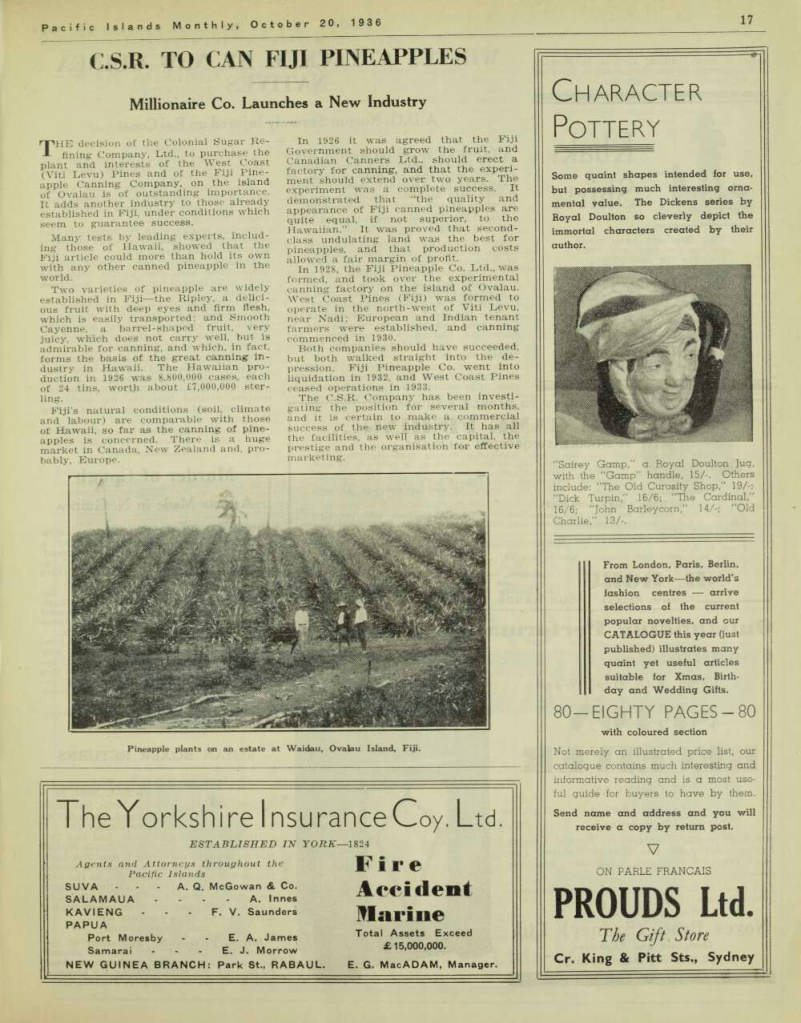
Millionaire Co. Launches a New Industry
THE decision of the Colonial Sugar Refining Company, Ltd., to purchase the plant and interests of the West Coast (Viti Levu) Pines and of the Fiji Pineapple Canning Company, on the island of P Ovalau is of outstanding importance.
It adds another industry to those already established in Fiji, under conditions which seem to guarantee success. 5 . .
Many tests by leading experts, including those of Hawaii, showed that the Fiji article could more than hold its own with any other canned pineapple in the world.
Two varieties of pineapple are widely established in Fiji—the Ripley, a delicious fruit with deep eyes and firm flesh, which is easily transported: and Smooth Cayenne, a barrel-shaped fruit, very juicy, which does not carry well, but is admirable for canning, and which, in fact, forms the basis of the great canning industry in Hawaii. The Hawaiian production in 1926 was 8,800,000 cases, each of 24 tins, worth about £7,000,000 sterling.
Fiji’s natural conditions (soil, climate and labour) are comparable with those of Hawaii, so far as the canning of pineapples is concerned. There is a huge market in Canada, New Zealand and, probably, Europe.
In 1926 it was agreed that the Fiji Government should grow the fruit, and Canadian Canners Ltd should erect a factory for canning, and that the expert ment should extend over two years. The experiment was a complete success. I demonstrated that the quality and appearance of Fiji canned pineapples are quite equal, if not superior, to the Hawaiian. It was proved that second class undulating land was the best for pineapples, and that production costs allowed a fair margin of profit, j n 192 8, the Fiji Pineapple Co. Ltd., was formed, and took over the experimental canning factory on the island of Ovalau.
West Coast Pines (Fiji) was formed to operate in the north-west of Viti Levu, near Nadi; European and Indian tenant farmers were established, and canning commenced in 1930.
Both companies should have succeeded, but both walked straight into the de pression. Fiji Pineapple Co. went into liquidation in 1932, and West Coast Pines ceased operations in 1933.
The C.S.R. Company has been investi gating the position for several months, and it is certain to make a commercial success of the new industry. It has all the facilities, as well as the capital, the prestige and the organisation for effective marketing.
Pineapple plants on an estate at Waidau, Ovalau Island, Fiji.
£Hon. H. H. Page, Government Secre tary in New Guinea, arrived in Sydney from Rabaul by the Neptuna on October 10, on nine months’ furlough.
Advertisements & other items, pp. 19-20 (1 item)
Prouds Ltd.
Character
Pottery
Some quaint shapes intended for use. but possessing much interesting ornamental value. The Dickens series by Royal Doulton so cleverly depict the immortal characters created by their author.
Yr "Sairey Gamp," a Royal Doulton Jug, with the "Gamp" handle, 15/-. Others include: "The Old Curosity Shop,” 19/-; "Dick Turpin," 16/6; "The Cardinal," 16/6; "John Barleycorn," 14/-; "Old Charlie," 13/-.
From London. Paris. Berlin, and New York —the world's fashion centres arrive selections of the current popular novelties, and our i CATALOGUE this year (just published) illustrates many quaint yet useful articles suitable for Xmas, Birthday and Wedding Gifts.
80-EIGHTY PAGES-80
with coloured section Not merely an illustrated price list, our catalogue contains much interesting and informative reading and is a most useful guide for buyers to have by them.
Send name and address and you will receive a copy by return post.
V
ON PARLE FRANCAIS
PROUDS Ltd.
The Gift Store
Cr. King & Pitt Sts., Sydney
The Yorkshire Insurance Coy. Ltd.
ESTABLISHED IN YORK —IB24
Agents and Attorneys throughout the Pacific Islands SUVA - A. Q. McGowan & Co.
SALAMAUA ... A. Innes
K AVI ENG - - - F. V. Saunders
PAPUA
Port Moresby - - E. A. James Samara! - - - E. J. Morrow
NEW GUINEA BRANCH: Park St.. RABAUL.
Fire
Accident
Marine
Total Assets Exceed £15,000,000.
E. G. MacADAM, Manager.
Khaki
Shirts
Pike Brothers have made clothes for men and their sons for the past 50 years.
Write for complete range of Khaki Shirt patterns in Poplins, Zephyrs, Twills, and Flannels.
Tailored to Measure in Uniform Bush and Sports Styles.
PIKE
BROTHERS LIMITED
In Queen Street, Brisbane
‘FISHING TACKLE TO TACKLE FISHING”
BIG GAME FISHING...
as SHARKS, SWORDFISH and ’RAYS
My new Big Game multiplying Fishing Reel—the “Swordfish Senior,” holds 1000 yds. 39 cord cutty hunk or 1200 yds. 36 cord.
Price £3O. “Undover” for top and bottom rod, £27/10/-, and “Swordfish” for top rod only. Price £25.
Capacity of both reels, 700yds. 39 cord or 850 yds. 36 cord.
Sil Rohu’s Big Game Rods A Strong Rod, made in one piece, solid Indian cane, with S.R. low set chromium-plated runner and end ring, winch fitting, price, £4/5/-.
Heavy Hickory octagon shape, best fittings, 2 section.
Price, £B/5/-.
Double built cane, best fittings, 2 section, £lO/10/-.
Treble built, £l2/10/-. , m m Gunsmith, Importer of High-grade Firearms iMhl I j ■mflPll I I and Fishing Tackle Specialist 143 Elizabeth St., SYDNEY (near Market St.)
“OUR HANDS MAKE GOOD ARMS”
Load your rifle cartridges and save money. I stock everything for the reloader.
Black’s & Lyman’s Tools, etc.
Firearm Repairs.
Outstanding; Performance in Tropical
Conflations
6 Valve A.C. Dual Wave
SKVO\
RECEIVER
37 GUINEAS
Detail Built Incorporating A.F.5. Ferranti Transformer, Special Celotex BaflFle, Solid Australian Walnut Cabinet, Ferranti Tuning Meter, with many other exclusive features.
Full range of Battery, and All-Electric Receivers available from I 6 gns. to 1 1 5 gns.
Write for particulars to:
Noyes Bros. (Sydney) Ltd.
Designers and Engineers, 115 Clarence Street, Sydney. i
Natives
Whites Attacked By New Guinea
A.D.O. Nurton Severely Injured on RaiCoast
A TTACKED by natives while on patrol in the Rai Coast area, near Madang, on the mainland of New Guinea, on September 24, Assistant District Officer Nurton was severely wounded. All the members of the camp were wounded.
Six of the attacking natives were killed and one woman was captured.
The attack was made in the area in which an administration patrol, also under Mr. Nurton, was attacked on July 23. when a native police constable was killed and four other natives were wounded.
Nurton’s camp was attacked when only four native constables were with him.
After the previous attack, Patrol-officer Greathead had been sent to the area to assist Mr. Nurton to restore order, but he had not arrived there when the further attack was made.
Men and women approached Mr. Nur ton and said that they desired peace. The men, it is stated, then grabbed Mr. Nur
ton, while the women attacked him with knives. Other men attacked the native police with arrows.
After repulsing the attack, Mr. Nurton and his men returned to the beach, and made their way to Madang, whence the attack was reported.
Further trouble with the natives is also reported from Gasmatta (New Britain) and Wide Bay districts.
Another officer and further native police have been sent to the area, and they will remain until order has been restored.
Mr. Nurton’s injuries included a septic compound fracture and dislocation of the left ankle, which was apparently caused by an axe, numerous minor knife wounds, and body abrasions.
The injury to A. D. O. Nurton’s leg proved very serious. Dr. Sinclair, on Sep tember 29, flew from Salamaua to Madang and there joined Dr. McQueen. The two doctors decided that the leg could not be saved and it was amputated below the knee.
Mr. Nurton has been a member of the New Guinea service for 15 years.
Murder of Gough
Arrests Made in N. Guinea
TWO natives of the Sepik area, New A Guinea, have been arrested by a patrol led by District Officer Townsend, and charged with the murder of C. A.
Gough, a native recruiter. Several others have been apprehended as witnesses.
During his investigations into the murder of Gough at Leihinga, a village in the Sepik district, Mr. Townsend ascertained that the natives of three villages were involved in the attack.
His patrol, he reported, established con tact with 3000 new natives, who are now ready to come under Government in fluence, and with this object in view two officers belonging to the patrol will re main in Leihinga for approximately three months.
Leihinga, presumably, is near the Sepik River, south-west of Wewak.
Fijian Boxer Returns
From Our Own Correspondent.
SUVA, Sept. 29.
SEMI, the Fijian boxer, who has been fighting- in New Zealand, returned to Fiji by the Niagara on September 18.
He had three fights away, and had two wins and one loss. He beat Claude Nichol, the Australian, on a foul in his first bout, and in his second fight secured a sensa tional decision by a knock-out in the first round against Luttrell, the New Zealan der. In his third fight he met Nichol in a return bout, and was defeated on points, after putting up a splendid fight.
Mr. A. P. Dyason, headmaster of the Buca Bay School, Fiji, is at present spending five months’ furlough in Aus tralia with his wife. During his absence, Mr. J. Kamea is acting as headmaster.
War Against The
Chinese
Samoan Appeal to N.Z.
Cabinet
From Our Own Correspondent
Apia, Oct. 1.
THE Samoan Planters’ Association, the elected members of the Samoan Legislative Council, supported by the Chamber of Commerce, Mr. O. F. Nelson, and other bodies, have forwarded a strong protest to the New Zealand Government against the threatened repatriation of Chinese and Melanesian plantation labour.
It is pointed out that this measure is unwarranted, and detrimental to the European and Samoan plantation indus try, and likely to have serious conse quences to the economic development of the territory. It is hoped that the N.Z.
Government will reconsider the matter, and allow the planters and also the Gov ernment-owned New Zealand Reparation Estates to retain an adequate labour sup ply essential to the maintenance and the development of the plantations in Western Samoa.
The local planters have asked the N.Z.
Cabinet, by wireless, to postpone any steps intended until the representations of the planters are received.
These representations are supported by the Chamber of Commerce, the Samoan- Born Labour Party, Mr. O. P. Nelson, the leader of the Mau, and practically all the residents of Samoa.
In regard to the Melanesians, of whom only about 75 are left in Samoa, and who are working on the coconut plantations of
the N.Z. Reparation Estates, the position is just as bad or worse. All these Mela nesians have worked in Samoa for 30 to 40 years, and nearly all are married to Samoan women, and have a numerous offspring. They are good workers, and law-abiding people. All are Christians, and have no desire to return to their for mer homes in New Guinea or the Solo mons, where they have no friends or relations left. The Melanesians in Samoa are completely de-tribalised, and unable to fit into the life and conditions of their former homes.
One of these Melanesians, who is threatened with repatriation (to New Guinea) after faithfully serving in Samoa for 40 years, has sent a touching appeal to his white overseer which, in the pecu liar pidgin English of the black boys, is a moving appeal for justice and fair play: “Dear Master, —Altogether boy him hear talk bye and bye all fella black boy go back along New Guinea. All boy speak Master you please no let send boy away.
We go, now no see Mary (wife) belong me again, no see piccanini. Master please, four fella ten year we work good along Crown Estates now why we must go away. Ail boy old fella man now, close up he die, no want go way now. Papa belong me he die, Mama belong me he die —no sabee man he stop New Guinea now, savee too much man along Samoa, all boy like too much Master along Crown Estates. Please Master you no let Gov ernment send black boy go New Guinea, lose him piccanini, no see one time more.
God bless Master.—TOKAN.”
For the sake of humanity and common sense, the N.Z. Government should let the small remnant of the Melanesians, who do not constitute a charge on the Govern ment, and are a harmless and ever-de creasing portion of the labour element,
pass their days in peace in the land they helped to develop and improve.
For the longest period in the memory of Samoan residents, Western Samoa has been without an Administrator. The task of selecting a suitable successor to Gene ral Hart seems an extremely difficult one to the New Zealand Labour Government, probably in view of the large number of applicants for this socially and financially very attractive position. That the busi ness of the Administration is suffering from this delay goes without saying, as the Acting-Administrator, whatever his ability and good intentions, has not the power and authority a permanent head of affairs would exercise, Mr. J. W. Matley, of Waigani Planta tion, Eastern Papua, returned to Samarai by the Macdhui at the end of September.
Captain F. W. Haig, chief aviation offi cer for the Vacuum Oil Company Pty.
Ltd., who flew to New Guinea in Guinea Airways’ new Lockheed Electra ’plane in September, returned to Australia by the Neptuna on October 10. He was favour ably impressed with the aviation organi sation on the Morobe fields, and was par ticularly enthusiastic about the work carried on by Guinea Airways Limited,
Residents of Fiji were pleased to learn recently that on August 1, a son was born to Lady Noel Richards, wife of Sir Arthur Richards, Governor-designate of Fiji.
Mr. Leslie V, Waterhouse, prominent Australian mining engineer, who is a director of Placer Development Co. Ltd., Bulolo Gold Dredging Ltd., and Guinea Airways Limited, reached Sydney on October 5 by the Mariposa after an ex tensive business visit to England, Europe, and America.
Advertisements & other items, pp. 21-22 (1 item)
Kodaks
WILLIAM FINAU
Photographer
FRIENDLY IS., OCEANIA
■■ Tongan views and Natives’ ■i life scenes, set, 5/3 prepaid ▼ anywhere. Tapacloth, large piece, 6/6 prepaid anywhere.
What better gift could you select for your friends in the Islands or mainland than a
KODAK?
CH Rl STAAAS
KODAKS
A Christmas Kodak is overflowing with the holiday spirit —always a happy reminder of the giver. And, of course, you will want a new 1937 Kodak for yourself as well. 4
Some Seasonable Suggestions ...
BABY BROWNIE (illustrated top right), smart, All-moulded, for pictures, 2.\ x 1| ins 6/- 6.20 and 6.16 BROWNIES (illus. on right) Junior Models 14/6, 17/6 Regular .. . 19/6, 24/- JIFFY KODAKS (on left), in three popular picture sizes 28/6, 55/-, 60/- 6.20 and 6.16 KODAKS, Regular and Junior Models in a range of lens equipments from 47 ; 6
MINIATURE KODAKS DE LUXEfrom £5/15/-
CINE-KODAKS for home movies from £9/18/6 Of all Kodak Dealers throughout the Islands and
KODAK (Australasia) Pt)f. Ltd.
379 GEORGE STREET, SYDNEY
o in L
Pacific Island Stamps
BOUGHT AND SOLD
Stamps sent on approval on receipt of reference. Send for free lists and specimen copy “Australian Stamp Journal."
J. H. SMYTH CO. LTD.
121 a Castlereagh St., Sydney
Charles Johnson
'Tailor for M of
discrimination
143 KING STREET
SYDNEY
IT’S here again. No, not the face that should know better, or any ideas of a Mr. Australia competition, but the face that goes with the chassis that goes for super excellence in the tailoring life of Sydney. Have your own private life when you hit the big town, but leave it to Charles to look after the other.
Charles Johnson and the store at 143 King Street, have come to stand for all that is meant by the ultimate in Men’s Clothes in Sydney. You know, up in the Islands where Men are Men and women are glad of it, and down in Sydney where Men are still the same and women stand in tram cars, is a world of difference, and that world of difference is noticed in the garments tailored by Johnson.
Maybe it’s Moonlight in Kalua, or other tropical, itching places, but when it’s a New Season in Sydney there’s always the latest materials and accessories at the King Street store. “Look out, here comes Charlie,” has come to mean something to those other houses.
And so, when you leave your isle with a Sydney visit planned, Fitzmaurice travelogue “gag” and say, “With these thoughts in we say farewell to Cascastanago—or wherever it is,” and let thoughts be
CHAR .ES JOHNSON
do a mind, those 143 King Street, Sydney, for all that it takes to make a well dressed man look even better and those not so well dressed, well, even as good as the well dressed will look, after he has got to the stage of even looking better.
The ultimate in Tailoring and Gents’ Accessories at the Right Price all to he obtained at
CHARLES JOHNSON
THE TAILOR FOR MEN WHO CARE
143 KING STREET, SYDNEY
Control Of Whaling
Restricted Season and Smaller Plant
A FTER months of squabbling it appears that an agreement has been reached between British and Norwegian interests to govern whaling in the Antarctic.
During the last 10 years there has been no restriction upon whaling in the remote south. The result has been that huge expeditions have been organised—a fac tory ship with anything up to 10 whale catchers —and an enormously increased quantity of whale oil has been poured upon the world’s market. A decade ago whale oil did not compete to any great extent with coconut oil; but to-day,
owing to new methods of purification and deodorization, whale oil is an active com petitor with coconut oil. This huge quantity of Antarctic whale oil has had a very definite effect upon the world’s copra market.
But the unrestricted destruction of whales has at last stirred the nations to take special measures. Scientists have pointed out that whales have been swept from every ocean in the world, except Antarctica; and that the Antarctic whales, which probably took millions of years to evolve, are in danger of being destroyed within a few decades.
A move to limit this destruction was made some three years ago but appar ently was resisted by vested interests. A strong pressure was finally brought to bear and the argument has been going on in London and in Oslo for many months. The whaling companies appear to have fought to the last ditch against restriction.
The basis of the agreement was an nounced in September. It is restriction by a close season and by the limitation of the number of whale-catchers —small boats which go out from a parent ship— which shall be used at any one time in connection with a whale factory ship.
The open season will be from December 8, 1936, to March 7, 1937, and the number of whale-catchers allowed to be used at any one time by any factory ship will vary from seven to five, according to the classification agreed upon between the two Governments.
United Kingdom ships will, as in previous years, carry inspectors, who will ensure compliance with the statutory regulations and also safeguard the terms of the voluntary agreement.
As from Monday, August 24, Australia took control of about 3,000,000 square miles of territory in the Antarctic, and regulations have been issued under the Whaling Act, passed last December. All Australian ships which engage in whal ing must be licensed and the regulations provide very strictly that there shall be no wastage in the manner that has made the industry notorious in recent years.
Goldfield
Strike On Tavua
60 Miners Dismissed
From Our Own Correspondent.
SUVA, Sept. 29.
OWING to the fact that several half caste miners have refused to acknow ledge a new schedule of wages, a strike has occurred at the Tavua mines. Fol lowing meetings with Mr. E. G. Theodore, the Emperor men struck, and, by the use of intimidation, induced the Loloma men to come out also.
The native workmen were in sympathy with the strikers, and demanded 6/- per shift for boss boys, 4/- for underground men, and 3/- for surface men. This was refused and the Emperor boys went on strike. They called the Loloma natives off the job, and the result was a deadlock.
However, latest reports state that the back of the strike has been broken. Mr.
Theodore said that about 60 men had been dismissed, and that the new schedule of wages—from 6/- to 12/- a shift of eight hours —was remaining in force.
Hon. J. P. Bayly, M.L.C., returned to Suva from England by the Niagara on September 18.
New Trans-Pacific Line
Report of Two 24-Knot Vessels
THE British and Dominion Governments are still dithering with the question of subsidising the British trans-Pacific steamship line, so that it may compete on more favourable terms with the heavily subsidised Matson line.
The Imperial Chambers of Commerce Congress, sitting in Wellington, early in October, urged the Governments concerned to assist British shipping in the direction suggested.
Meanwhile, there has been an interest ing development. The following telegram, despatched from Auckland, on October 2, was published in the Sydney Morning H erald: “Mr. Brendan Dowling, a Sydney busi ness man, who is a through passenger to Sydney in the Mariposa, states that the construction of two fast modern passenger vessels of about 20,000 tons each is being considered by a powerful oversea syndicate with a view to their employ ment in the Sydney-Auckland-Los Angeles or Sydney-Auckland-Vancouver trade. ‘‘Mr. Dowling, who has been visiting England and America, says that he rep resents an Australian group interested in the project, and desirous of fostering the tourist trade between the United States and Australia and New Zealand, adding that he conferred with the oversea syndi cate while abroad. ‘‘While it would be some months before a final decision was made, Mr. Dowling said, plans and specifications of the
vessels had been prepared and details of the organisation were being discussed. It was hoped to shorten the travelling time across the Pacific and the vessels would have an average speed of at least 24 knots' They would be built to suit tropical con ditions.”
The announcement caused a stir —it seems to portend a new competitor in the Pacific shipping business.
Mr. Dowling is well-known in Sydney as an accountant and is one of the family of Dowlings which partly owns and directs the New South Wales Bookstall Co., Ltd.
Fiji’S New Scenic Road
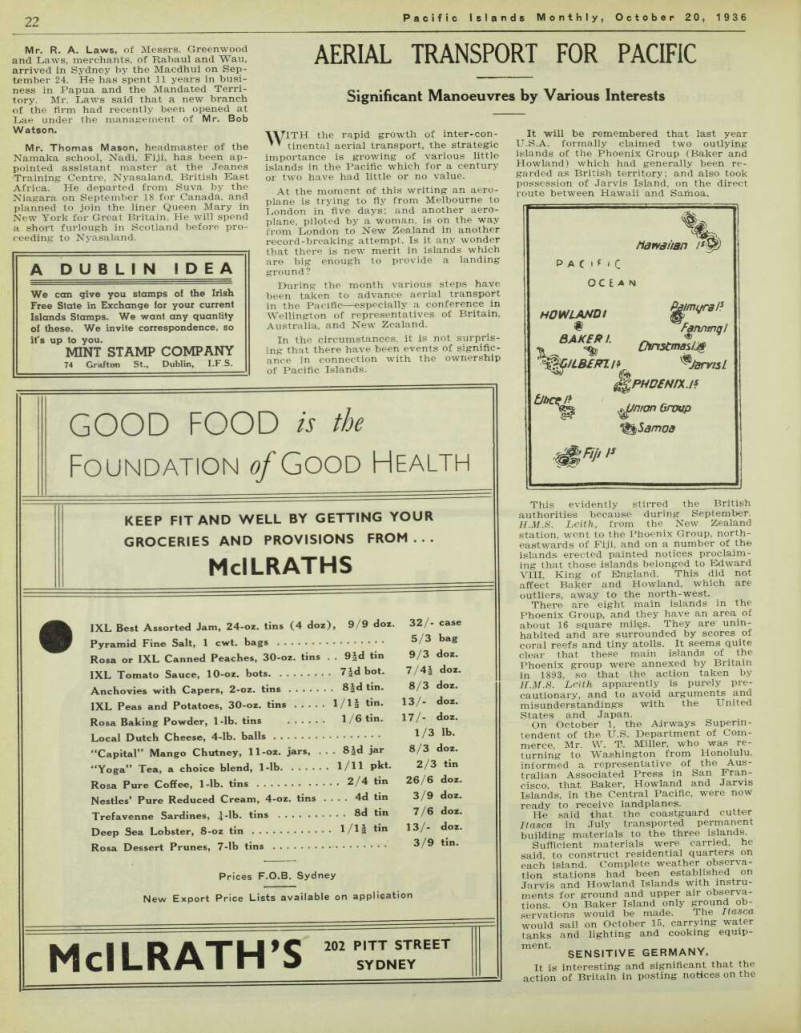
From Our Own Correspondent SUVA, Sept. 29.
EXCELLENT progress is being made with the new road through to Navua and Sigatoka, and, at present, cars can travel along the road for about 17 miles from Suva. In fact, one car, that of a road engineer, Mr. Rix-Trott, has already been through to Navua —the first to make the journey.
The road gives promise of being a fine scenic attraction when it is completed, and even as far as it has gone, it is ex tremely pretty in parts.
However, it is noticeable that timber cutters are already at work along the roadside, and it is to be hoped that the Government will take some action to stop their depredations.
Sub-Inspector P. M. Morris and Mrs.
Morris left Suva by the Aorangi on leave on September 24.
Mr. B. E. V. Parham, Fiji Government agricultural officer, and his family left Suva by the Aorangi on September 24 on leave.
Mr. R. A. Laws, of Messrs, Greenwood and Laws, merchants, of Rabaul and Wau, arrived in Sydney by the Macdhui on Sep tember 24. He has spent 11 years in busi ness in Papua and the Mandated Terri tory. Mr. Laws said that a new branch of the firm had recently been opened at Lae under the management of Mr. Bob Watson.
Mr. Thomas Mason, headmaster of the Namaka school, Nadi, Fiji, has been ap pointed assistant master at the Jeanes Training Centre, Nyasaland, British East Africa. He departed from Suva by the Niagara on September 18 for Canada, and planned to join the liner Queen Mary in New York for Great Britain. He will spend a short furlough in Scotland before pro ceeding to Nyasaland.
Advertisements & other items, pp. 23-24 (1 item)
Tooheys
SORE THROAT
Laryngitis, tonsilitis and sore throats can be quickly and safely relieved by using Genuine Vincent's A.P.C. as a gargle. Prepared on the scientific hospital formula and recommended by the medical profession; Vincent's A.P.C. does not affect the heart.
Powders and tablets, 1/6 and 2/6.
Trial size, 2d. each.
ALL CHEMISTS
AND STORES.
FOR SAFETY'S SAKI, SAY " VINCENt'I
Island 1dy11...
Sparkling—like the sunshine on the blue Pacific. Refreshing— as the first plunge into the surf. Healthful—as the finest malt and hops can make it —Tooheys Pilsener is ideal for the Islands.
TOOHEYS
PILSENER
66 Here’s To’ee”
A DUBLIN IDEA
We can give you stamps of the Irish Free State in Exchange for your current Islands Stamps. We want any quantity of these. We invite correspondence, so it's up to you.
MINT STAMP COMPANY
74 Grafton St., Dublin, I.F.S.
GOOD FOOD the
Foundation of Good Health KEEP FIT AND WELL BY GETTING YOUR
GROCERIES AND PROVISIONS FROM...
McILRATHS
Prices F. 0.8. Sydney New Export Price Lists available on application
McILRATH’S 202
Aerial Transport For Pacific
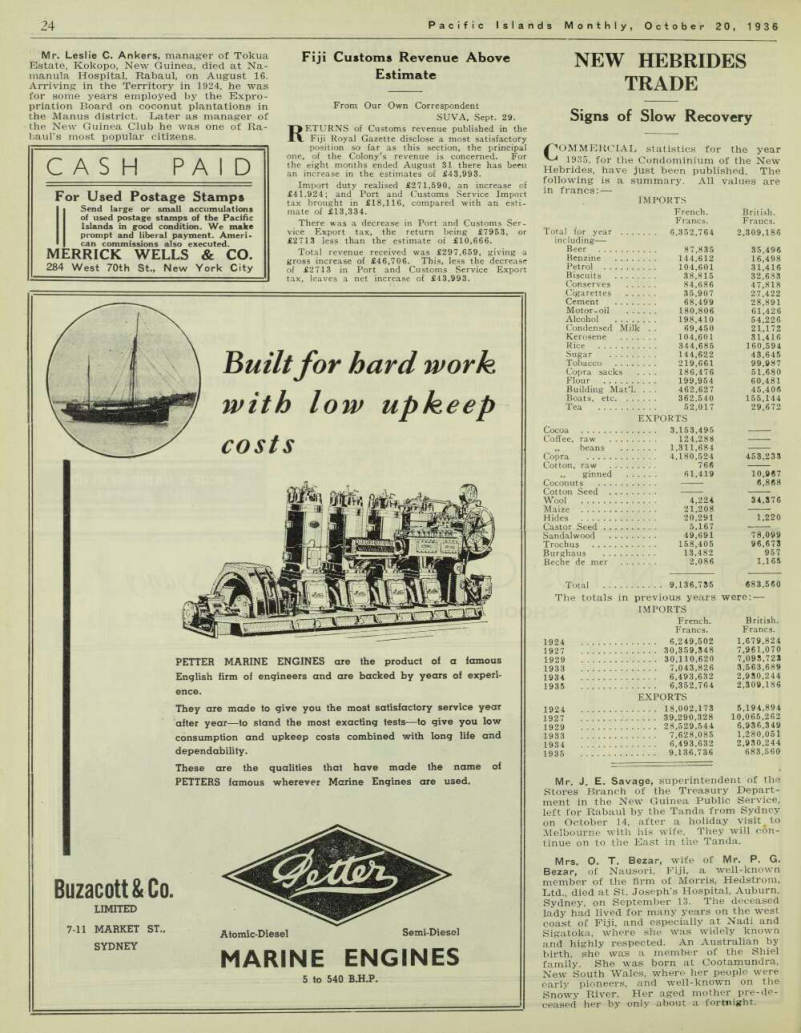
Significant Manoeuvres by Various Interests
VyiTH the rapid growth of inter-con ' ’ tinental aerial transport, the strategic importance is growing of various little islands in the Pacific which for a century or two have had little or no value.
At the moment of this writing an aero plane is trying to fly from Melbourne to London in five days; and another aero plane, piloted by a woman, is on the way from London to New Zealand in another record-breaking attempt. Is it any wonder that there is new merit in islands which are big enough to provide a landing ground ?
During the month various steps have been taken to advance aerial transport in the Pacific —especially a conference in Wellington of representatives of Britain, Australia, and New Zealand.
In the circumstances, it is not surpris ing that there have been events of signific ance in connection w T ith the ownership of Pacific Islands.
It will be remembered that last year U.S.A. formally claimed two outlying islands of the Phoenix Group (Baker and Howland) which had generally been re garded as British territory ; and also took possession of Jarvis Island, on the direct rout© between Hawaii and Samoa.
This evidently stirred the British authorities because during- September.
H.M.S. Leith, from the New Zealand station, went to the Phoenix Group, north eastwards of Fiji, and on a number of the islands erected painted notices proclaim ing that those islands belonged to Edward VIII, King of England. This did not affect Baker and Howland, which are outliers, away to the north-west.
There are eight main islands in the Phoenix Group, and they have an area of about 16 square They are unin habited and are surrounded by scores of coral reefs and tiny atolls. It seems quite clear that these main islands of the Phoenix group were annexed by Britain in 1893, so that the action taken by H.M.S. Leith apparently is purely pre cautionary, and to avoid arguments and misunderstandings with the United States and Japan.
On October 1, the Airways Superin tendent of the U.S. Department of Com merce, Mr. W. T. Miller, who was re turning to Washington from Honolulu, informed a representative of the Aus tralian Associated Press in San Fran cisco, that Baker, Howland and Jarvis Islands, in the Central Pacific, were now ready to receive landplanes.
He said that the coastguard cutter Itasca in July transported permanent building materials to the three islands.
Sufficient materials were carried, he said, to construct residential quarters on each island. Complete weather observa tion stations had been established on Jarvis and Howland Islands with instru ments for ground and upper air observa tions. On Baker Island only ground ob servations would be made. The Itasca would sail on October 15, carrying water tanks and lighting and cooking equip
Ment’ Sensitive Germany.
It is interesting and significant that the action of Britain in posting notices on the
Phoenix Islands (which was almost simultaneous with certain actions confirm ing the annexation by Australia of a large section of Antarctica) was made the occasion of a sharp attack on Britain by a German journal called Angriff, which is the leading organ of the Nazi Govern ment. The article bore the headlines, “Gigantic increase of Territory for the British Empire,” “Australia Doubles Its Territory,” “Injustice to Germany.”
The article ran through only an early edition of the paper and was then with drawn. British comment was calm. It was pointed out that Britain already had title to the Phoenix Islands (16 square miles!) since 1893, and that the section of Antarctica which Australia holds (and has held for many years) is covered with snow and ice.
The incident, however. shows how in tensely sensitive the landless nations are to territorial movements in the Pacific.
Japan And The Marshalls.
Japan is just as sensitive and suspicious in these matters as Germany. Sydney newspapers during the month published the story of Mr. H. F. Beeton, a world wandering English schoolmaster, who had been desirous of spending a few months in the Marshall Islands. But Mr. Beeton never got beyond Japan. When he said he wished to go to Japan’s Mandated Territory he received the concentrated at tention of officials and detectives to such good effect that he left the country altogether. He complained that he was regarded as a spy.
Anyone can go to the Mandated Ter ritories held by Britain and her Dominions, and by France; but very few Europeans ever have been permitted to enter the Marshall and Caroline Islands, and permission to enter is becoming evermore difficult to obtain.
America And Britain.
It was reported early in October that the aviation conference in New Zealand dealt with the position of New Zealand in relation to the proposed trans-Paciflc air routes. Pan-American Airways, it was stated, was seeking an arrangement to enable it to found a service, using Hawaii and Samoa as bases. On the other hand, it was pointed out, Britain is seek ing a reciprocal arrangement with the United States Government for the use of Hawaii as a base by aircraft engaged in a British service between Canada and other parts of the British Empire in the Pacific.
It was stated that an agreement virtu ally had been reached for a new aviation service between Australia and New Zea land; but, although the proposed Pan- American Airways’ service between Auck land and Hawaii was discussed, it was not stated that any agreement was reached. It is quite clear that there is some hold-up in this plan owing to the inability of the British and American aviation authorities to agree, but the exact nature of the trouble has not been disclosed.
We still hold the opinion that we have expressed several times —namely, that a service between Hawaii and New Zea land will not come very soon, simply be cause there are not enough passengers and freight in sight to make it profitable.
The collection of New Guinea birds of paradise, which was presented to the Commonwealth by Mr. W. B. Carpenter, of Woolstonecraft (N.S.W.) was on dis play in Melbourne recently. The collection, which is housed at the Institute of Anat omy, at Canberra, comprises 11 brilliantly coloured birds.
Mr. George Preece, an Englishman who was for some years in the employ of the Colonial Sugar Refining Co. Ltd., in Fiji, died in the War Memorial Hospital, Suva, on September 12, at the age of 74.
Mr. Leslie C. Ankers, manager of Tokua Estate, Kokopo, New Guinea, died at Na manula Hospital, Rabaul, on August 16.
Arriving in the Territory in 1924, he was for some years employed by the Expro priation Board on coconut plantations in the Manus district. Later as manager of the New Guinea Club he was one of Rahaul’s most popular citizens.
Advertisements & other items, pp. 25-26 (1 item)
St. Ignatius’ College - Kiverview, Sydney
REPLACEMENT PARTS
FOR ALL RADIO SETS
SPECIALLY IMPREGNATED
AGAINST MOISTURE
SPECIAL SETS MADE FOR
TROPICAL USE
KITS OF PARTS FOR ALL
TYPE RECEIVERS
WRITE FOR PRICE LIST AND
DESCRIPTION OF SPECIAL
TROPICAL BATTERY RECEIVER
PRICE'S RADIO
5(6 ANGEL PLACE SYDNEY AUSTRALIA
St. Ignatius’ College - Kiverview, Sydney
BOARDING and DAY SCHOOL :: :: Conducted by the Jesuit Fathers
ONE OF SYDNEY’S GREAT PUBLIC SCHOOLS
J>OYS prepared for Intermediate and Leaving Certificate Examinations and for Exhibitions, Scholarships and Bursaries at the University.
Boys are arranged in three divisions according to age and size.
Each division has its own library, debating society, cricket and football field, tennis court.
Senior and Junior Rowing Sheds. Private Swimming Baths.
Prospectus and Further Particulars on application to the Rector,
REV. J. MEAGHER, SJ.
Telephone, JIIO6. ggf: 9 f ...» m iife.il ati 1,1:11:1,11 .111 m k 13ES
CASH PAID
For Used Postage Stamps
Send large or small accumulations of used postage stamps of the Pacific Islands in good condition. We make prompt and liberal payment. American commissions also executed.
MERRICK WELLS & CO.
284 West 70th St., New York City
Built for hard
with low upkeep
costs
- • * FETTER MARINE ENGINES are the product of a famous English firm of engineers and are backed by years of experience.
They are made to give you the most satisfactory service year after year—to stand the most exacting tests —to give you low consumption and upkeep costs combined with long life and dependability.
These are the qualities that have made the name of FETTERS famous wherever Marine Engines are used.
Buzacott&Co.
LIMITED
7-11 MARKET ST..
SYDNEY
Atomic-Diesel Semi-Diesel
MARINE ENGINES
5 to 540 B.H.P.
Fiji Customs Revenue Above
Estimate
From Our Own Correspondent SUVA. Sept. 29.
RETURNS of Customs revenue published in the Fiji Royal Gazette disclose a most satisfactory position so far as this section, the principal one, of the Colony’s revenue is concerned. For the eight months ended August 31 there has been an increase in the estimates of £43,993.
Import duty realised £271,590, an increase of £41,924; and Port and Customs Service Import tax brought in £18,116, compared with an esti mate of £13,334, There was a decrease in Port and Customs Ser vice Export tax, the return being £7953, or £2713 less than the estimate of £10,666.
Total revenue received was £297,659, giving a gross increase of £46,706. This, less the decrease of £2713 in Port and Customs Service Export tax, leaves a net increase of £43,993.
Signs of Slow Recovery
New Hebrides
Trade
Mr. J. E. Savage, superintendent of the Stores Branch of the Treasury Depart ment in the New Guinea Public Service, left for Rabaul by the Tanda from Sydney on October 14, after a holiday visit to Melbourne with his wife. They will con tinue on to the East in the Tanda.
Mrs. O. T. Bezar, wife of Mr. P. G.
Bezar, of Nausori, Fiji, a well-known member of the firm of Morris, Hedstrom, Ltd., died at St. Joseph’s Hospital, Auburn, Sydney, on September 13. The deceased lady had lived for many years on the west coast of Fiji, and especially at Nadi and Sigatoka, where she was widely known and highly respected. An Australian by birth, she was a member of the Shiel family. She was born at Cootamundra, New South Wales, where her people were early pioneers, and well-known on the Snowy River. Her aged mother pre-de ceased her by only about a fortnight.
/COMMERCIAL statistics for the year 1935, for the Condominium of the New Hebrides, have just been published. The following is a summary. All values are in francs: — Total for year
Imports
French.
F rancs. 6,352,764 British.
Francs. 2,309,186 including— Beer 87,835 35,496 Benzine 144,612 16,498 Petrol . . 104,601 31,416 Biscuits 38,815 32,683 Conserves 84,686 47,818 Cigarettes 35,907 27,422 Cement 68,499 28,891 Motor-oil 180,806 61,426 Alcohol 198,410 54,226 Condensed Milk . . 69,450 21,172 Kerosene 104,601 31,416 Rice 344,685 160,594 Sugar 144,622 43,645 Tobacco 219.661 99,987 Copra sacks ... 186,476 51,680 Flour 199,954 60,481 Building Mat’l. . . . 462,627 45,406 Boats, etc. . 362,540 155,144 Tea ... 52,017 29,672
Exports
3 153 495 124 288 „ beans 1,31L684 Copra 4,180,524 453,233 Cotton raw 766 „ ginned Coconuts 61,419 10,967 6,868 Cotton Seed Wool 4,224 34,876 Maize 21 208 Hides 20^291 1,220 Castor Seed 5 167 Sandalwood 49,691 78,099 Trochus . . . . 158,405 96,673 Burghaus 13,482 957 Beche de mer 2,086 1,165 Total 9,136,735 683,560 The totals in previous years were: — 1924
Imports
French.
Francs. 6,249,502 British.
Francs. 1,679,824 1927 30,359,348 7,961,070 1929 30,110,620 7,093,723 1933 7,043,826 3.563,689 1934 6.493.632 2,980,244 1935 6,352,764 2,309,186 1924
Exports
18.002,173 5,194,894 1927 39.290.328 10,065,262 1929 28,529,544 6,936,349 1933 7,628,085 1,280,051 1934 6,493,632 2.930,244 1935 9,136,736 683,560
Footloose In Samoa
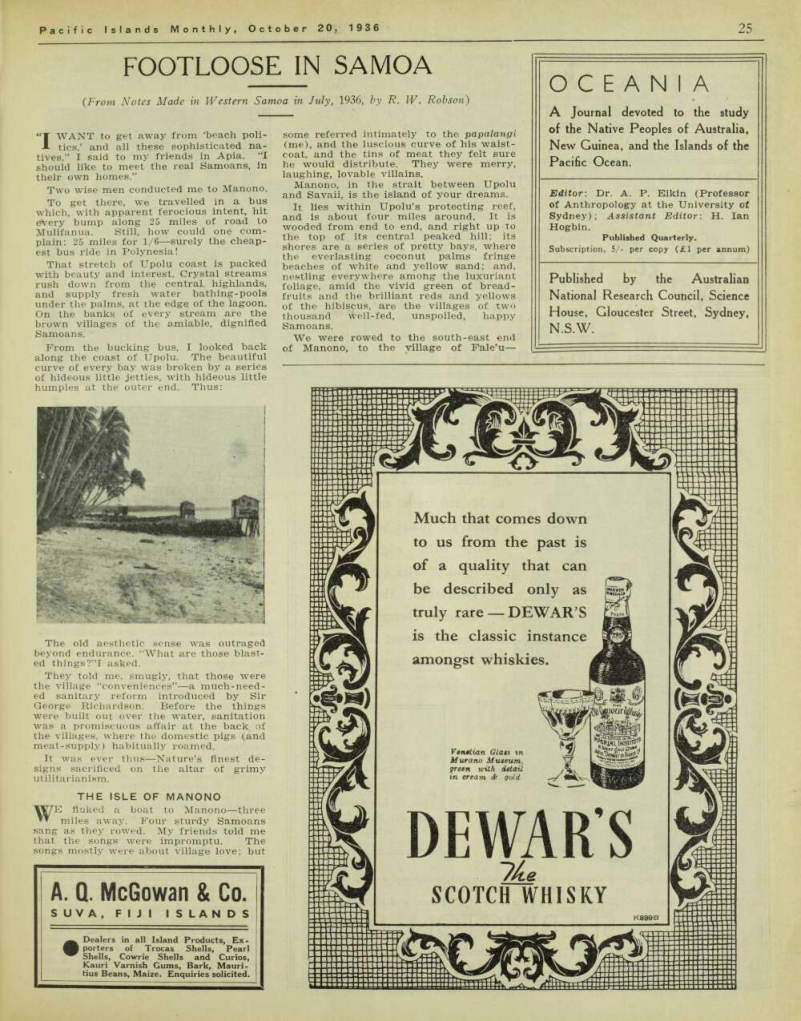
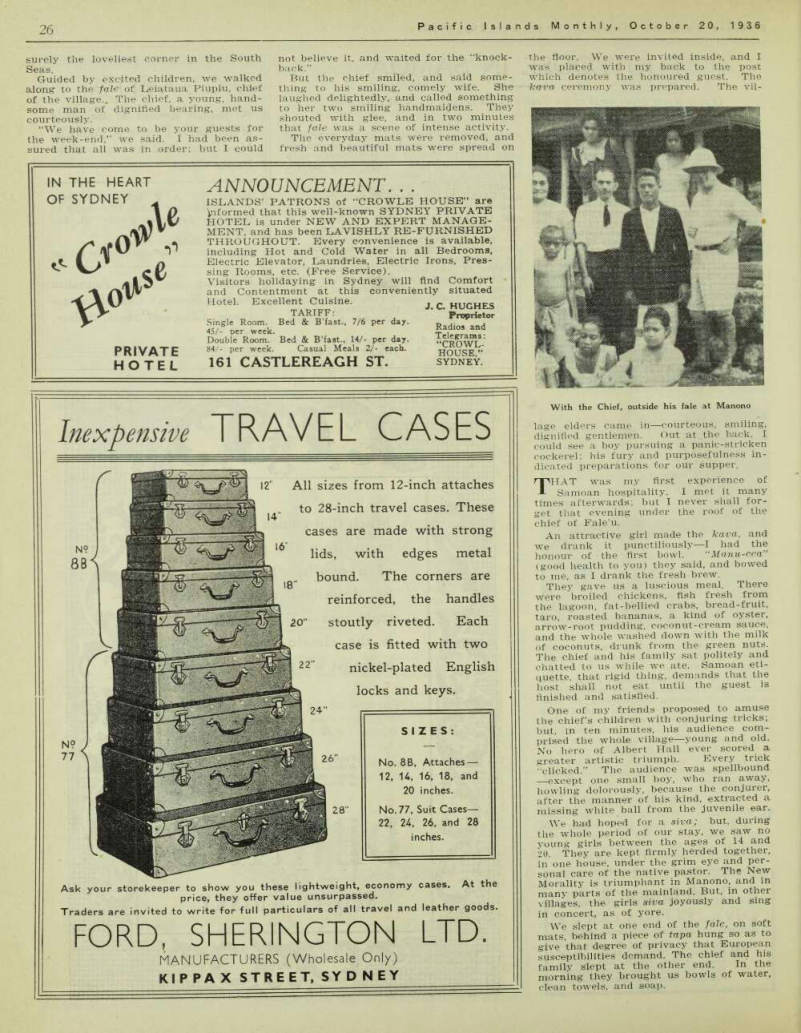
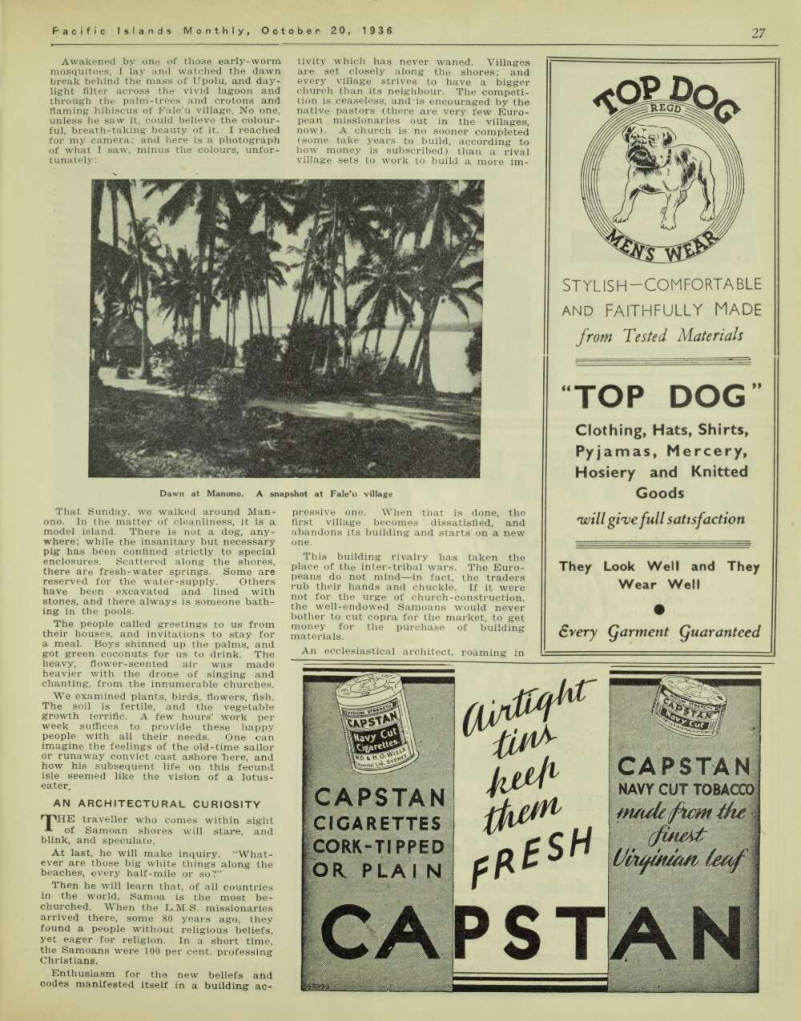
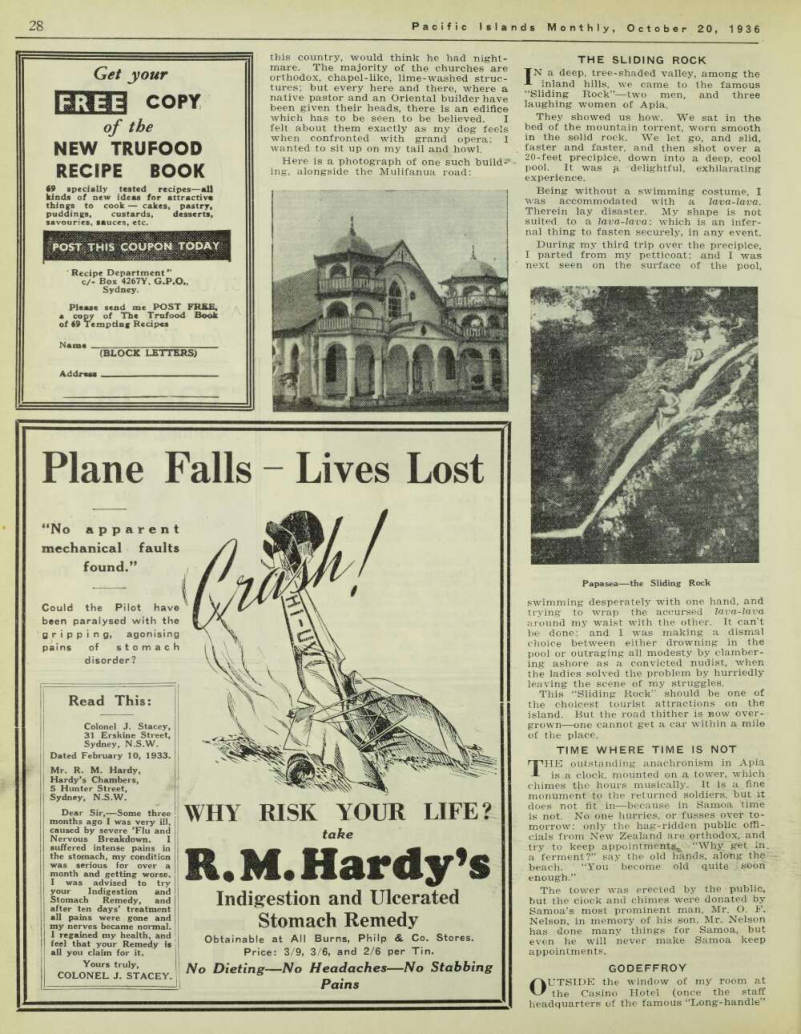
(From Notes Made in Western Samoa in July, 1936, by R. W. Robson )
“¥ WANT to get away from ‘beach poli- J- tics,’ and all these sophisticated na tives,” I said to my friends in Apia. “I should like to meet the real Samoans, in their own homes.”
Two wise men conducted me to Manono.
To get there, we travelled in a bus which, with apparent ferocious intent, hit every bump along 25 miles of road to Mulifanua. Still, how could one com plain: 25 miles for 1/6 —surely the cheap est bus ride in Polynesia!
That stretch of Upolu coast is packed with beauty and interest. Crystal streams rush down from the central highlands, and supply fresh water bathing-pools under the palms, at the edge of the lagoon.
On the banks of every stream are the brown villages of the amiable, dignified Samoans.
From the bucking bus, I looked back along the coast of Upolu. The beautiful curve of every bay was broken by a series of hideous little jetties, with hideous little humpies at the outer end. Thus:
The old aesthetic sense was outraged beyond endurance. “What are those blast ed things?”! asked.
They told me, smugly, that those were the village “conveniences” —a much-need ed sanitary reform introduced by Sir George Richardson. Before the things were built out over the water, sanitation was a promiscuous affair at the back of the villages, where the domestic pigs (and meat-supply) habitually roamed.
It was ever thus—Nature’s finest de signs sacrificed on the altar of grimy utilitarianism.
The Isle Of Manono
WE fluked a boat to Manono—three miles away. Four sturdy Samoans sang as they rowed. My friends told me that the songs were impromptu. The songs mostly were about village love; but
some referred intimately to the papalangi (me), and the luscious curve of his waist coat, and the tins of meat they felt sure he would distribute. They were merry, laughing, lovable villains.
Manono, in the strait between Upolu and Savaii, is the island of your dreams.
It lies within Upolu’s protecting reef, and is about four miles around. It is wooded from end to end, and right up to the top of its central peaked hill: its shores are a series of pretty bays, where the everlasting coconut palms fringe beaches of white and yellow sand; and, nestling everywhere among the luxuriant foliage, amid the vivid green of bread fruits and the brilliant reds and yellows of the hibiscus, are the villages of two thousand well-fed, unspoiled, happy Samoans.
We were rowed to the south-east end of Manono, to the village of Fale’u—
surely the loveliest corner in the South Seas.
Guided by excited children, we walked along to the fale of Leiataua Piupiu, chief of the village.. The chief, a young, hand some man of dignified bearing, met us courteously.
“We have come to be your guests for the week-end,” we said. I had been as sured that all was in order; but I could
not believe it, and waited for the “knock back.”
But the chief smiled, and said some thing to his smiling, comely wife. She laughed delightedly, and called something to her two smiling handmaidens. They shouted with glee, and in two minutes that fale was a scene of intense activity.
The everyday mats were removed, and fresh and beautiful mats were spread on
the floor. We were invited inside, and I was placed with my back to the post which denotes the honoured guest. The kava ceremony was prepared. The vil-
lage elders came in—courteous, smiling, dignified gentlemen. Out at the back, I could see a boy pursuing a panic-stricken cockerel: his fury and purposefulness in dicated preparations for our supper.
THAT was my first experience of Samoan hospitality. I met it many times afterwards; but I never shall for get that evening under the roof of the chief of Fale’u.
An attractive girl made the kava, and we drank it punctiliously—l had the honour of the first bowl. “Manu-eea” (good health to you) they said, and bowed to me, as I drank the fresh brew.
They gave us a luscious meal. There were broiled chickens, fish fresh from the lagoon, fat-bellied crabs, bread-fruit, taro, roasted bananas, a kind of oyster, arrow-root pudding, coconut-cream sauce, and the whole washed down with the milk of coconuts, drunk from the green nuts.
The chief and his family sat politely and chatted to us while we ate. Samoan eti quette, that rigid thing, demands that the host shall not eat until the guest is finished and satisfied.
One of my friends proposed to amuse the chief’s children with conjuring tricks; but, in ten minutes, his audience com prised the whole village—young and old.
No hero of Albert Hall ever scored a greater artistic triumph. Every trick -clicked.” The audience was spellbound —except one small boy, who ran away, howling dolorously, because the conjurer, after the manner of his kind, extracted a missing white ball from the juvenile ear.
We had hoped for a siva; but, during the whole period of our stay, we saw no voung girls between the ages of 14 and 20. They are kept firmly herded together, in one house, under the grim eye and per sonal care of the native pastor. The New Morality is triumphant in Manono, and in many parts of the mainland. But, in other villages, the girls siva joyously and sing in concert, as of yore.
We slept at one end of the fale, on soft mats, behind a piece of tapa hung so as to give that degree of privacy that European susceptibilities demand. The chief and his family slept at the other end. In the morning they brought us bowls of water, clean towels, and soap.
With the Chief, outside his fale at Manono
Awakened by one of those early-worm mosquitoes, I lay and watched the dawn break behind the mass of Upolu, and day light filter across the vivid lagoon and through the palm-trees and crotons and flaming hibiscus of Fale’u village. No one, unless he saw it, could believe the colour ful, breath-taking beauty of it. I reached for my camera; and here is a photograph of what I saw, minus the colours, unfor tunately:
That Sunday, we walked around Man ono. In the matter of cleanliness, it is a model island. There is not a dog, any where; while the insanitary but necessary pig has been confined strictly to special enclosures. Scattered along the shores, there are fresh-water springs. Some are reserved for the water-supply. Others have been excavated and lined with stones, and there always is someone bath ing in the pools.
The people called greetings to us from their houses, and invitations to stay for a meal. Boys shinned up the palms, and got green coconuts for us to drink. The heavy, flower-scented air was made heavier with the drone of singing and chanting, from the innumerable churches.
We examined plants, birds, flowers, fish.
The soil is fertile, and the vegetable growth terrific. A few hours’ work per week suffices to provide these happy people with all their needs. One can imagine the feelings of the old-time sailor or runaway convict cast ashore Tiere, and how his subsequent life on this fecund isle seemed like the vision of a lotus eater.
An Architectural Curiosity
T'HE traveller who comes within sight -*■ of Samoan shores will stare, and blink, and speculate.
At last, he will make inquiry. “What ever are those big white things along the beaches, every half-mile or so?”
Then he will learn that, of all countries in the world, Samoa is the most be churched. When the L.M.S. missionaries arrived there, some 80 years ago, they found a people without religious beliefs, yet eager for religion. In a short time, the Samoans were 100 per cent, professing Christians.
Enthusiasm for the new beliefs and codes manifested itself in a building ac
tivity which has never waned. Villages are set closely along the shores; and every village strives to have a bigger church than its neighbour. The competi tion is ceaseless, and is encouraged by the native pastors (there are very few Euro pean missionaries out in the villages, now). A church is no sooner completed (some take years to build, according to how money is subscribed) than a rival village sets to work to build a more im
pressive one. When that is done, the first village becomes dissatisfied, and abandons its building and starts on a new one.
TVI . , , , . .. „ J* I ®, r ™ lr / has taken the ® y ars ' +^ he * E^ r °' f*.° v. ot /i mind a fac t’ traders ™b their hands and chuckle. If it were t^ H Urgr ® 1 °J church -construction, the well-endowed Samoans would never bother to cut copra for the market, to get money for the purchase of building materials, * An ecclesiastical architect, roaming in
Dawn at Manono. A snapshot at Fale’u village
this country, would think he had night mare. The majority of the churches are orthodox, chapel-like, lime-washed struc tures; but every here and there, where a native pastor and an Oriental builder have been given their heads, there is an edifice which has to be seen to be believed. I felt about them exactly as my dog feels when confronted with grand opera: I wanted to sit up on my tail and howl.
Here is a photograph of one such build” ing, alongside the Mulifanua road:
The Sliding Rock
IN a deep, tree-shaded valley, among the inland hills, we came to the famous “Sliding Rock” —two men, and three laughing women of Apia.
They showed us how. We sat in the bed of the mountain torrent, worn smooth in the solid rock. We let go, and slid, faster and faster, and then shot over a 20-feet precipice, down into a deep, cool pool. It was a delightful, exhilarating experience.
Being without a swimming costume, I was accommodated with a lava-lava.
Therein lay disaster. My shape is not suited to a lava-lava: which is an infer nal thing to fasten securely, in any event.
During my third trip over the precipice, I parted from my petticoat; and I was next seen on the surface of the pool,
swimming desperately with one hand, and trying to wrap the accursed lava-lava around my waist with the other. It can't be done; and I was making a dismal choice between either drowning in the pool or outraging all modesty by clamber ing ashore as a convicted nudist, when the ladies solved the problem by hurriedly leaving the scene of my struggles.
This “Sliding Rock” should be one of the choicest tourist attractions on the island. But the road thither is now over grown—one cannot get a car within a mile of the place.
Time Where Time Is Not
THE outstanding anachronism in Apia is a clock, mounted on a tower, which chimes the hours musically. It is a fine monument to the returned soldiers, but it does not fit in—because in Samoa time is not. No one hurries, or fusses over to morrow: only the hag-ridden public offi cials from New Zealand are orthodox, and try to keep “Why get in a ferment?” say the old hands, along the beach. “You become old quite soon enough.”
The tower was erected by the public, but the clock and chimes were donated by Samoa’s most prominent man, Mr. O. F.
Nelson, in memory of his son. Mr. Nelson has done many things for Samoa, but even he will never make Samoa keep appointments.
Godeffroy
OUTSIDE the window of my room at the Casino Hotel (once the staff headquarters of the famous “Long-handle”
Papasea—the Sliding Rock
firm—the D.H. and P.G.) there was a cairn of rough stones, with cacti growing upon it. I investigated, and on the north side, looking out over the sea, I found two large brass plates. One carried the pic ture of a handsome strong-featured man —Johan Cesar Godeffroy; and the other, a few words, in German, to say that, on this spot, eighty years ago, the famous firm of Godeffroy and Son was first estab lished in Samoa.
I went to Watson’s History of Samoa for details: and there I learned that about 1854 August Unshelm, representing Godeffroy (a great Hamburg house) ar rived in Apia from Valparaiso, and com menced trading. He established branches in Tonga and Fiji, but was lost at sea in a hurricane in 1864. Theodor Weber, a remarkable man of dynamic energy, then took charge, and he extended the opera tions of Godeffroy all over the Central and South Pacific. The Godeffroy firm, broken by foreign speculation, collapsed in the seventies, and its organisation was taken over by the D.H. and P.G.
No one seemed to know who had erected the monument. It must have been a long time ago, for the mana of Godeffroy de parted in the seventies.
By a curious coincidence, the author of this invaluable History of Samoa occu pied the next room to mine, in the hotel.
He was temporarily in Samoa, acting as Chief Judge—a learned man, with a most intimate and cynical knowledge of the Samoans.
Polynesian Migration
IN Samoa I had the pleasure of meeting Monsignor J. Darnand, the Catholic Bishop of Samoa, and of receiving from him a copy of his book, Le Foret qui s’lllumine, in which he tells the story of mission work in that part of the Pacific.
The book was published recently by the Libraire Catholique, 10 Rue Jean Bart, Paris.
I was especially interested in two sec tions of the book— L’Origine et les Mi grations des Polynesiens and Les Vik
The inscription on Apia’s clock-tower
The plaque, showing Johan Cesar Godeffroy, set in a cairn of stones at the Casino Hotel, Apia.
ings du Pacifique. Monsignor Darnand has made a close personal study of all the evidence he could find about the early migrations and voyages of the Polyne sians; he has consulted most of the numerous books on the subject; and his conclusions, written at the end of three decades in these islands, are most valu able.
In Apia, also, I met Father Deihl, a very popular missionary, who, although a younger man, also has devoted much study and thought to the mystery of the Polynesian race. He has accumulated quite a library on the subject, and can discuss it in a fascinating way.
After talking with these men and read ing their books. One is left in no doubt
about the Polynesian migration. Partly Caucasian, partly Mongolian, with a little Ethiopian mixed in, these attractive people came from somewhere about Wes tern Asia, and crossed Southern India and
the East Indies, into the Central Pacific.
That must have happened—but I leave the details to the scientists.
I think it was Father Deihl who, in this connection, directed my attention to a book, Arabia Deserta, in which the author, G. M. Doughty, describes an Arabian coffee-drinking ceremony called Kahwa. It is at least remarkable that this ceremony is similar to that which at tends the drinking of kava throughout Polynesia.
Snapshots At The Baths
ALL through history, all over the world, artists and writers have found in spiration at the public baths; and Samoa is no exception.
Every village has its bathing pool and its communal resort, where the family wash is undertaken in leisurely fashion.
Streams, flowing from the central moun
Monsignor J. Darnand, Catholic Bishop of Western Samoa.
tains, give an endless supply of fresh water. I never entered a village, but what I did not see a dozen pretty pictures, just waiting to be photographed. Here are two of them:
This young Samoan mother was sous ing her offspring very thoroughly in the pool, when I arrived and was smilingly given permission to make a picture.
This young woman had herself just left the pool and was drying her hair, while she did the family wash—beating it upon a plank.
It may interest Pacific Islands travellers to know that all these photographs were taken with a Kodak Vdllenda camera (the No. 48 model, making pictures of half “V.P.” size), using Kodak Panatomic film.
Mr. Leo Austen, Assistant Resident Magistrate in the Trobriand Group, Papua, who has been in Australia on fur lough since July, returned to Port Moresby by the Macdhui on September 30.
Dr. W. C. Klein, of the Dutch New Guinea Committee, who was in Papua and New Guinea last year studying condi tions and administrative methods, has written a book, in Dutch, entitled “Nieuw Guinea.” It contains almost 400 pages and is published by the Molukken Insti tute.
Advertisements & other items, pp. 27-32 (1 item)
Dewar's
OCEANIA
. / A Journal devoted to the study of the Native Peoples of Australia, New Guinea, and the Islands of the Pacific Ocean.
Editor: Dr. A. P. Elkin (Professor of Anthropology at the University of Sydney); Assistant Editor : H. lan Hogbin.
Published Quarterly.
Subscription, 5/- per copy (£1 per annum) Published by the Australian National Research Council, Science House, Gloucester Street, Sydney,
N.S.W.
Much that comes down to us from the past is of a quality that can be described only as truly rare DEWAR’S is the classic instance amongst whiskies.
Venetian Glass in Murano Museum, green with detail in cream <k gold 9f W &
DEWAR'S
~7/ie
SCOTCH WHISKY
A. Q. McGowan & Co.
SUVA, FIJI ISLANDS
• Dealers in all Island Products, Exporters of Trocas Shells, Pearl Shells, Cowrie Shells and Curios, Kauri Varnish Gums, Bark, Mauritius Beans, Maize. Enquiries solicited.
IN THE HEART
OF SYDNEY
PRIVATE
HOTEL
ANNOUNCEMENT. . .
ISLANDS’ PATRONS of "CROWLE HOUSE” are
that this well-known SYDNEY PRIVATE HOTEL is under NEW AND EXPERT MANAGE- MENT, and has been LAVISHLY RE-FURNISHED THROUGHOUT. Every convenience is available, including Hot and Cold Water in all Bedrooms, Electric Elevator, Laundries, Electric Irons, Pressing Rooms, etc. (Free Service).
Visitors holidaying in Sydney will find Comfort and Contentment at this conveniently situated Hotel. Excellent Cuisine.
TARIFF:
Single Room. Bed & B’fast., 7/6 per day. 45/- per week.
Double Room. Bed & B’fast., 14/- per day. 84 - per week. Casual Meals 2/- each.
161 CASTLEREAGH ST.
J. C. HUGHES
Proprietor Radios and Telegrams:
“CROWL-
HOUSE,”
SYDNEY.
Inexpensive TRAVEL CASES
3 12' All sizes from 12-inch attaches to 28-inch travel cases. These & 14 16 N 9 BB< 18" r ..
N? 77 cases are made with strong lids, with edges metal bound. The corners are reinforced, the handles 20" stoutly riveted. Each case is fitted with two
22 ’’ nickel-plated English
locks and keys. 24" 28- Ask your storekeeper to show you these lightweight, economy cases. At the price, they offer value unsurpassed.
Traders are invited to write for full particulars of all travel and leather goods.
FORD, SHERINGTON LTD.
MANUFACTURERS (Wholesale Only)
KIPPAX STREET. SYDNEY
REG£
ft
STYLISH—COMFORTABLE
AND FAITHFULLY MADE
from Tested Materials ii
TOP DOG
Clothing, Hats, Shirts, Pyjamas, Mercery, Hosiery and Knitted Goods 'will give full satisfaction They Look Well and They Wear Well £rery garment guaranteed
CAPSTAN
CIGARETTES
CORK-TIPPED
OR. PLAIN
ip**: M
CAPSTAN
NAVY CUT TOBACCO
meukfwm the
cSH
Uitofmatt Imf ft
PST
Get your
Ban c ° p Y
of the
NEW TRUFOOD
RECIPE BOOK
69 specially tested recipes—all kinds of new ideas for attractive things to cook cakes, pastry, puddings, custards, desserts, savouries, sauces, etc.
POST THIS COUPON TODAY
‘ Recipe Department *’ c/- Box 4267 Y, G.P.0., Sydney.
Please send me POST FREE, a copy of The Trufood Book of 69 Tempting Recipes Name
(BLOCK LETTERS)
Address
Plane Falls - Lives Lost
“No apparent
mechanical faults
found.”
Could the Pilot have been paralysed with the gripping, agonising pains of stomach disorder?
Read This:
Colonel J. Stacey, j 31 Erskine Street, 1 Sydney, N.S.W. ! Dated February 10, 1933.
Mr. R. M. Hardy, Hardy’s Chambers, 5 Hunter Street, Sydney, N.S.W.
Dear Sir, —Some three months ago I was very ill, j caused by severe ’Flu and j Nervous Breakdown. 1 suffered intense pains in the stomach, my condition was serious for over a month and getting worse.
I was advised to try your Indigestion and Stomach Remedy, and after ten days’ treatment all pains were gone and 1 my nerves became normal.
I regained my health, and feel that your Remedy is j all you claim for it.
Yours truly,
COLONEL J. STACEY.
C.
WHY RISK YOUR LIFE?
take
R.M. Hardy’s
Indigestion and Ulcerated
Stomach Remedy
Obtainable at All Burns, Philp & Co. Stores.
Price: 3/9, 3/6, and 2/6 per Tin.
No Dieting—No Headaches—No Stabbing
Pains
Huon Pine Boat Planks
Practically Borer Proof and Everlasting, also Spotted Gum Timbers—Prices Right A C F rvP 110 Miller St., 1 r / c Pyrmont, N.S.W.
OILSKINS
HUGHES’ OILSKINS
£ for long, hard wear anywhere. Every coat guaran- Write for teed. No shops supplied.
Catalogue Hughes’ Tropical Oilskins will not stick, crack or A I Wnrrlipo P« rish the hottest of cli- .J. nllgnes mates. They have been (Estab. 1893) known to withstand eleven 121 Regeht St years of conti °uou. wear.
Sydney - ■ izz:
y 0 CHAPMAN
& lit field Ouur /to de ye* it teusuuf Ca-
Chapman Pup Engines
are World-famed as power plant for MOTOR LAUNCHES.
Thousands in use throughout Australasia. Owners from all parts continually writing praising their astounding simplicity, reliability, and Economy. Built in a number of different sizes from 2i h.p. to 10 h.p. Write for leaflets and all information direct to the manufacturers—
CHAPMAN & SHERACK,
ENGINE MANUFACTURERS & LAUNCH
BUILDERS
ERSKINEVILLE, N.S.W., AUSTRALIA
PRESCOTT L T -P Iy S dpJe S y ar-e sole wholesale adenis fb
PINEAPPLE BACON & HANS
DAISY BRAND BUTTER
TIC E R cruyere CHEESE
LEA & PERRINS' SAUCE
& Most other Super- Quality lines of* the Trade
Swallow & Ariell’s
WORLD RENOWNED
Canterbury
Cakes
FRUIT
PLAIN
SEED
PLUM
ALMOND
mm
C akH
PRESERVED
GINGER
SULTANA
CHERRY
RIPE
GENOA
Each Cake is Enclosed, by special process, In air-tight tin, and is warranted to keep its condition for a considerable period
M, HARPER
MAN DOLI AN A ISLAND, GELA
P.O. Box 6, Tulagi, Solomon Islands
RECRUITING CONTRACTS
UNDERTAKEN
A. V. PAPARI AVAILABLE FOR
CHARTER
Further details from
PACIFIC ISLANDS MONTHLY
Union House, 247 George St., Sydney
Sunday Island’s Population
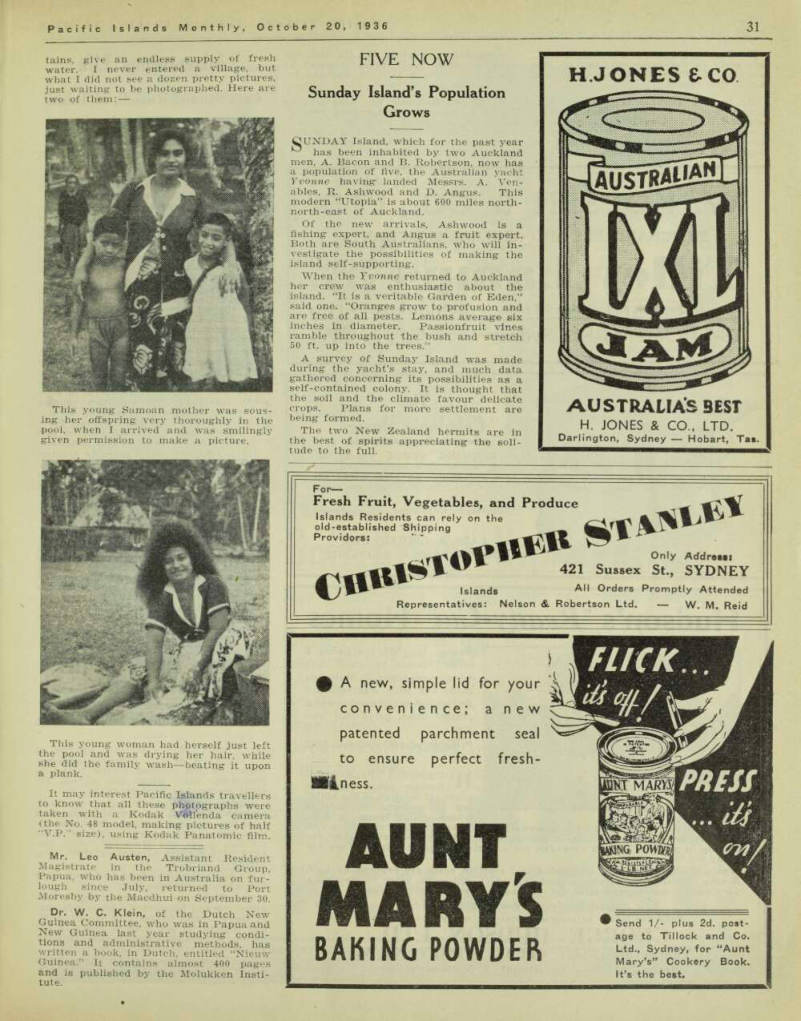

Five Now
Sunday Island’s Population Grows
lsland, which for the past year has been inhabited by two Auckland men, A. Bacon and B. Robertson, now has a population of five, the Australian yacht Yvonne having- landed Messrs. A. Ven ables, R. Ashwood and D. Ang-us. This modern “Utopia” is about 600 miles north north-east of Auckland.
Of the new arrivals, Ashwood is a fishing- expert, and Angus a fruit expert.
Both are South Australians, who will in vestigate the possibilities of making the island self-supporting.
When the Yvonne returned to Auckland her crew was enthusiastic about the island. “It is a veritable Garden of Eden,” said one. “Oranges grow to profusion and are free of all pests. Lemons average six inches in diameter. Passionfruit vines ramble throughout the bush and stretch 50 ft. up into the trees.”
A survey of Sunday Island was made during the yacht’s stay, and much data gathered concerning its possibilities as a self-contained colony. It is thought that the soil and the climate favour delicate crops. Plans for more settlement are being formed.
The two New Zealand hermits are in the best of spirits appreciating the soli tude to the full.
Mr. Stanley Murray, of Thursday Island, left early in September to take up the position of Shire Clerk at Cooktown, North Queensland.
Mr. E. H. Chater has been promoted to general manager of Guinea Airways Ltd., and Mr. F. T. O’Dea becomes assistant general manager. Mr. I. H. Grabowsky, formerly general manager, has severed his connection with the company.
Hon. Alport Barker, M.L.C., and his daughter, Mrs. F. I. Ryan, returned to Suva, Fiji, from a visit to England by the Niagara on September 18.
Mr. E. W. Bonwick, who was sent to Papua to make an independent investi gation of Mandated Alluvials’ property near Port Moresby on behalf of a private syndicate of shareholders, returned to Sydney on September 23.
Advertisements & other items, pp. 33-34 (1 item)
M A R Y's
HJONES&CO
AUSTRALIA’S BEST
H. JONES & CO.. LTD.
Darlington, Sydney Hobart, Tai.
For—
Fresh Fruit, Vegetables, and Produce
Islands Residents can rely on the old-established Shipping Providers; Only Address;
421 Sussex St., SYDNEY
Islands AII Orders Promptly Attended Representatives: Nelson & Robertson Ltd. W. M. Reid
£ A new, simple lid for your convenience; a new patented parchment seal to ensure perfect fresh- Mfiness.
AUNT
M A R Y'S
BAKING POWDER
® Send 1/- plus 2d. postage to Tillock and Co.
Ltd., Sydney, for “Aunt Mary’s” Cookery Book.
It’s the best.
W. KOPSEN & CO., LTD.
SHIPCHANDLERS AND GENERAL MERCHANTS
Tilley La nips made
Special Quotations for Island Trade GENUINE Tilley Parts 68-70 Clarence St., Sydney CABLES;
The
“Caledonia Dover”
A COOKING STOVE guaranteed to give complete satisfaction now recognised as THE BEST on the market. Suitable for coal, coke, or wood fuel.
Illustrated Catalogue on request.
LANE & GIRVAN, LTD.
BONNY BRIDGE, SCOTLAND
Hudson’s * Ready-Cut" Homes
Design No. 504 containing 5 large rooms, bathroom and wide verandahs. Materials ready-cut with weatherboard or asbestos cement walls, plaster lined, galvanised iron roof.
Price at wharf, Sydney, £382 HUDSON’S Ready - Cut System offers the most practical solution of the building of a home in districts where skilled labour is difficult to obtain. The framework is prepared ready for erection, the doors and windows are fitted and hung in'frames with locks, hinges, etc., ready for placing in position and all verandah posts, plates, barge boards, etc., are cut ready for fixing.
Waste is almost entirely eliminated and erection costs are reduced by half.
A very efficient plan service is provided which makes th ®. °J erect,on a very simple matter, and it is not necessary to employ skilled labour.
We quote for your own or any design Send for latest catalogue containing many new designs.
GEORGE HUDSON LTD.
Timber Merchants, GLEBE, SYDNEY, N.S.W.
Ready-Cut Homes Department, 7 Castlereagh Street. 1 '
Adventurous Life
Late Samuel Russell, of Tahiti
From Our Own Correspondent
Papeete, Sept. 2.
WITH the death of Mr. Samuel Russell at Papeete on August 28, the Tahi tians lost a sympathetic guide and ally and his friends a man who inspired con fidence and esteem and deep affection.
Mr. Russell was born in England in 1879, and when a young man migrated to Natal, South Africa, settling in the city of Pietermaritzburg. He gained his first experience in what proved to be an ad venturous life, as a member of the patrols guarding the passes of the Drakensberg mountains.
Later he joined the mounted police In Southern Rhodesia. In the Boer conflict Mr. Russell served with distinction throughout the whole period of the war, and particularly as a member of Kit chener’s mounted forces.
Mr. Russell was an expert mineralogist, and the practice of his profession carried him to all parts of South Africa and Portuguese East Africa, after the close of the Boer War. The hardships of con stant travel through primitive country and repeated attacks of malarial fever — which resulted finally in blackwater fever —so undermined his health that he was advised to seek a malaria-free climate.
Having passed many years in tropical and semi-tropical lands and learning that the islands of South-eastern Polynesia are free of malaria, Mr. Russell settled in Rarotonga, Cook Group, where he re mained several years as manager of a large plantation.
About 20 years ago he established him self at Tahiti. He was the British Vice- Consul at Papeete, acting for long periods as consul in the absence of his superior officer. He was requested by the Foreign Office to accept the appointment of consul, but declined, owing to the heavy burden of his private interests.
Mr. Russell is survived by Mrs. Russell and one son—now at Tahiti —and by two daughters at school in England.
Children
Gave Life For His
Marshall Islander’s Self-Sacrifice
A STORY of self-sacrifice by one of the crew of the Japanese schooner Regina, which reached Nauru Island in September after being- lost at sea for eight weeks, has been revealed.
During the period when the vessel was searching for land the crew of 22 Marshall Islanders suffered severely from starva tion, thirst and scurvy. One of them refused to eat and drink his ration, but gave it to his two adopted children, thus saving their lives.
He was so weak that he died soon after the schooner reached Nauru.
The Regina became lost during a 120miles’ voyage between Kwajalong Island, in the Marshall Group, and Wotha Atoll, and cruised for about eight weeks in the region of the Equator before sighting land.
The Japanese company which owns the vessel will send a steamer to tow it back from Nauru.
Advertisements & other items, pp. 35-36 (1 item)
Soft, Bright, Unflickering
T— m i i *
A "SHELL”
PRODUCT
Soft, Bright, Unflickering
For a soft, easy, restful light, clear and steady, use “PENNANT” Kerosene.
Super-refined and free from sulphur and impurities, “PENNANT” burns without odour, without flicker, or splutter.
It’s better for wicks, too does not crust or char them.
Order “PENNANT”- it is the best Kerosene you can buy.
PENNANT
KEROSENE
Books, Magazines
and Newspapers
To any part of the Islands • BARGAIN OFFER—We will send half a dozen latest American Monthly Magazines for 4/-, post free.
American Gay Book, 1936 (snappy Stories and Pictures), 1/6, Post Paid.
We specialise in selecting reading matter for those unable to choose personally. We specialise in Mail Orders. Parcels posted by every boat. Send for our price list and full particulars of this unusual service for Islands residents.
McKAY’S BOOKSTALL
Royal Arcade, Sydney
cv plrk
A IJITMAGAZINE-
j ■ ' ' I -•
READ THE
B.P. MAGAZINE
SPRI NG NUMBER
NOW ON SALE
Short Stories . . . Pictures Travel Articles . . Pages for the Children Stage Latest Fashions ... Screen o
ONE SHILLING PER COPY
ON SALE AT ALL NEWSAGENTS AND BOOKSELLERS
(Hiv i: it s
SOW
pL w foS \
||o^^aA
lUk V, V ,^y‘M
PURE
FOODS
GOLD MEDAL JAMS
CANNED ENGLISH FRUITS
CANNED ENGLISH
VEGETABLES
CUSTARD POWDER
OLD ENGLISH MARMALADE
JELLY CRYSTALS. ETC.
Obtainable from all Leading Grocery Stores -- Write to Department A., Chivert and Sons Ltd., Histon, Cambridge, England, for attractive Recipe Book E .76
New Equipment For
Tahiti Broadcasting
From Our Own Correspondent
Papeete, Sept. 4.
FOR some months a society of Tahiti residents has been operating a broad casting station for the purpose of trans mitting news, market quotations, and music to listeners on the many islands in French Oceania. In August they installed a new and more powerful apparatus. It is believed that broadcasts from Papeete can now be heard in Australia and other distant places.
The society intends to broadcast pro grammes of Tahitian music sung by local choruses and other characteristic items.
Morobe Pioneer
Clement Wharton-Kirke
By “Freeza.”
THE subject of this brief biography is known wherever prospectors, miners, engineers and surveyors foregather around a glass or two to exchange reminiscences of our modest Morobe pioneers.
Mr. Clement Wharton-Kirke, better known to his intimates as “Tonic,” has a lengthy record of engineering and survey ing achievements to his credit. His out standing abilities in the technical world are only equalled by his hearty dislike of publicity in any form.
Prior to his arrival in the Territory of New Guinea to undertake on behalf of New Guinea Goldfields Limited a perilous road location from the abrupt ramparts of Kunai Creek along the hazardous edge of a crater whose gaping countenance had long ago witnessed the birth of the ulti mately famous Koranga Creek, to the rugged but wealth-productive Golden Ridges, Mr. Wharton-Kirke held an im portant position in Kebun Bharu, in the Malay States, where his technical advice was not infrequently sought by the ruler of that region.
In a sense Mr. Wharton-Kirke may be said to have been the father of road con struction in the District of Morobe, for prior to his advent the standard of road locations in the district had been negligible.
The road engineered and built by him, and known far and wide as “Kirke’s Monu ment,” has proved the forerunner of a progressive and excellent series of roads leading from the goldfields capital of Wau to the various gold-producing centres.
When Mr. Wharton-Kirke resigned his important position with New Guinea Gold fields Ltd., that company’s loss was the Administration’s gain, as his presence was largely instrumental in the rapid clearing up of many mining surveys, from the cloud-capped Capoule Range to the wild gorges of the Webiak River, and from the tall twin peaks of Mt. Rubianag (discov ered on the epic McLean expedition of 1928) to the churning rapids of the Lower Watut.
Life is not all armchair exploration in a New Guinea survey party, as Mr. Whar ton-Kirke could tell if he only would. It is difficult to get him to describe what he went through on one occasion while ex ploring the Capoule. He had struggled up one precipitous edge of a razor-back ridge on a hot afternoon and overstepped the top of the ridge, and had the misfortune to connect with the head of a narrow land slide on the other, with the result that instead of pausing for a timely rest, he accelerated.
On examining himself shortly after wards, he discovered no bones broken, but his clothing somewhat deteriorated through friction during his descent. The land slide was now situated above him, and beneath his feet lay the course of a dark and sinuous unknown creek. In his semi dazed condition he was uncertain as to which watershed the newly located stream belonged, or whether his route to his camp lay upstream or down.
By the time he had followed the gorge downstream for what seemed hours, his way was barred by a precipitous waterfall, and in the minutes of remaining daylight he gathered his strength to return up stream. A stumble in the gathering dark ness, and he was a fixture for the night with a rapidly-swelling, bruised foot.
Meanwhile, his colleagues, who had re turned to camp by another route, did not
feel anxious about him, knowing his long experience in bushcraft, until dusk de scended. With increasing anxiety when it became known that none of the inhabit ants in the vicinity had seen anything of Wharton-Kirke, a search party was or ganised at 3 a.m. and left an hour before dawn. At 9 a.m. after a hazardous jour ney his trail “over the top” was discovered.
Then came the rescue problem.
Even if two men were to risk their lives by descending the landslide, between them they had no hope of carrying or assisting Wharton-Kirke back up the route by which he had descended. It was Wharton- Kirke’s devoted native servant Sekau who provided the right inspiration. Quickly assuming the leadership of the fourteen or so natives who accompanied the successful search party, he directed his “one-talks” to construct a long rope ladder of kundah vines. Even so, an hour’s frantic work supplied only half enough to reach the bottom of the gorge in which the marooned man waited philosophically and cheerP !y.
Again, Sekau’s resourcefulness pr ved useful.
Having, with true native forethought, provided himself with a crowbar, he di rected the top of the rope ladder to be anchored to a tree stump atop the razor back, at the edge of the slide, and the ladder to be thrown down the slide to its full length. Sekau then nimbly descended the ladder with the crowbar and, clinging to the bottom rung with his prehensile toes, prized out a foothold in the native rock and enlarged it to a ledge with stand ing room for two persons. Calling to a native colleague, Pukpuk, who had been recruited by his master by the gift of a bar of Crown soap (which he was saving to comfort him in his old age), that dusky youth was instructed to cut a strong wooden post. This was sent down the lad der with another native, while Sekau, with the crowbar, gouged out a hole to contain the post. The latter was then planted and rammed firm, and the lower end of the ladder hung over it.
Next, the upper end of the ladder was freed from above, and the length of it came hurtling about the ears of Sekau and his companion. They straightened out the kinks in the ladder with an expertness learned in long familiarity with the dis entangling of survey chains from jungle obstacles such as quilas, korukas, and other impedimenta.
Gathering the ladder up in lasso style, Sekau next hurled the sinuous thing down to his waiting master, who scrambled up it to the midway ledge, as rapidly as his weakened condition and his swollen foot would allow.
While the rescued man was regaining his breath at the halting-stage, Pukpuk had supervised the making of a long “fish ing-line,” composed of several lengths of stout vine lashed end-to-end. and a hooked stick tied to the extremity of this device.
This was skilfully dangled down, while Sekau hauled up the ladder again from below. He gathered the free end into lasso formation, this time throwing it up wards, and connecting with the hook of the “fishing line.”
Then, the native shock-workers’ slogan was heard, and to the sound of “heave sail-oh,” the rope ladder was once more hoisted to the narrow ridge by willing hands, and re-anchored to its moorings.
The remainder of the rescue proceeded on orthodox lines.
This episode may sound like adventure to some, but to hard-boiled pioneers like Clem Wharton-Kirke it was merely an incident in the day’s work.
Dr. T. M. Clouston, Government Medi cal Officer at Nauru, and Mrs. Clouston arrived in Sydney by the Niagara on September 5 on three months’ leave.
Advertisements & other items, p. 37 (1 item)
Foster Clark's
Daddy
then's
Creamy custard
today
u \
Grown-ups like custard
too!
CUSJARP
Powder
A
ILL A
VAN
Daddy and little daughter both demand lots of Custard. No wonder—when it’s Foster Clark’s world-famous creamy Custard. That’s one sweet which appeals to people of all ages.
Foster Clark’s is the creamiest, most flavoursome and most dependable Custard you can make. Serve it often. It’s full of nourishment, and very economical. There are so many quick and interesting ways of serving it, too.
FREE RECIPE BOOK
Write for Elizabeth Craig’s Recipe Book to Foster Clark (Australia) Ltd., Dept. R. 8., Redfern, N.S.W. Enclose Id. stamp for postage.
Try the dishes in Elizabeth Craig’s Recipe Book, and serve Foster Clark’s Custard with stewed fruit, puddings and pies. It increases their food value and brings out their flavour. Always ask for Foster Clark’s Custard, and refuse cheap imitations.
FSI39
Foster Clark's
creamy CUSTARD
Tahiti
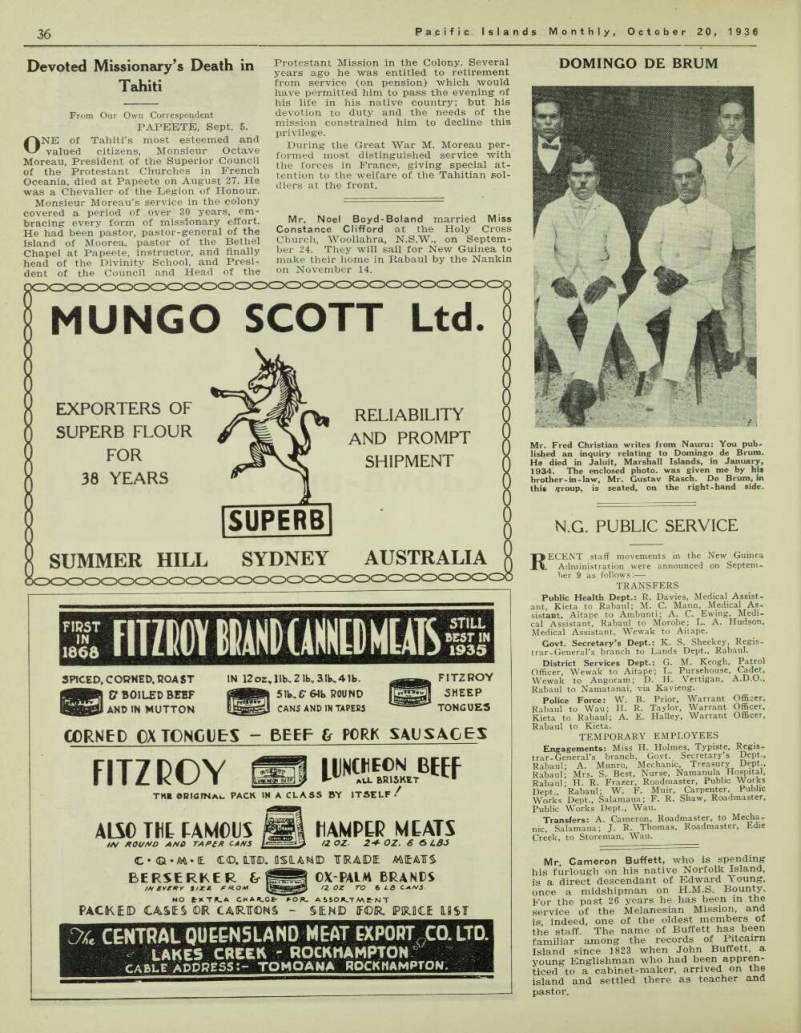
Devoted Missionary’s Death in Tahiti
From Our Own Correspondent
Papeete, Sept. 5.
ONE of Tahiti’s most esteemed and valued citizens, Monsieur Octave Moreau, President of the Superior Council of the Protestant Churches in French Oceania, died at Papeete on August 27. He was a Chevalier of the Legion of Honour.
Monsieur Moreau’s service in the colony covered a period of over 30 years, em bracing every form of missionary effort.
He had been pastor, pastor-general of the island of Moorea, pastor of the Bethel Chapel at Papeete, instructor, and finally head of the Divinity School, and Presi dent of the Council and Head of the
Protestant Mission in the Colony, Several years ago he was entitled to retirement from service (on pension) which would have permitted him to pass the evening of his life in his native country; but his devotion to duty and the needs of the mission constrained him to decline this privilege.
During the Great War M. Moreau per formed most distinguished service with the forces in France, giving special at tention to the welfare of the Tahitian sol diers at the front.
Mr. Noel Boyd-Boland married Miss Constance Clifford at the Holy Cross Church, Woollahra, N.S.W., on Septem ber 24. They will sail for New Guinea to make their home in Rabaul by the Nankin on November 14.
Domingo De Brum
Mr. Fred Christian writes from Nauru: You pub lished an inquiry relating to Domingo de Brum.
He died in Jaluit, Marshall Islands, in January, 1934. The enclosed photo, was given me by his brother-in-law, Mr. Gustav Rasch. De Brum, in this group, is seated, on the right-hand side.
N.G. Public Service
RECENT staff movements in the New Guinea , Administration were announced on Septem ber 9 as follows; —
Transfers
Public Health Dept.: R. Davies. Medical Assist ant, Kieta to Rabaul; M. C. Mann. Medical As sistant, Aitape to Ambunti; A. C. Ewing, Medi cal Assistant, Rabaul to Morobe; L. A. Hudson, Medical Assistant, Wewak to Aitape.
Govt. Secretary’s Dept.: K. S. Sheekey, Regis trar-General’s branch to Lands Dept., Rabaul.
District Services Dept.: G. M. Keogh, Patrol Officer, Wewak to Aitape; L. Pursehouse, Cadet.
Wewak to Angoram; D. H. Vertigan, A.D.0., Rabaul to Namatanai, via Kavieng.
Police Force: W. B. Prior, Warrant Officer, Rabaul to Wau; H. R. Taylor, Warrant Officer.
Kieta to Rabaul; A. E. Halley, Warrant Officer.
Rabaul to Kieta.
Temporary Employees
Engagements: Miss H. Holmes, Typiste, Regis trar-General’s branch. Govt. Secretary’s Dept., Rabaul; A. Munro. Mechanic, Treasury Dept., Rabaul; Mrs. S. Best, Nurse, Namanula Hospital.
Rabaul; H. R. Frazer, Roadmaster, Public Works Dept. Rabaul: W. F. Muir, Carpenter. Public Works Dept., Salamaua; F. R. Shaw. Roadmaster, Public Works Dept., Wau.
Transfers: A. Cameron, Roadmaster, to Mecha nic, Salamaua; J. R. Thomas, Roadmaster, Edie Creek, to Storeman, Wau.
Mr. Cameron Buffett, who is spending his furlough on his native Norfolk Island, is a direct descendant of Edward Young, once a midshipman on H.M.S. Bounty.
For the past 26 years he has been in the service of the Melanesian Mission, and is indeed, one of the oldest members of the staff. The name of Buffett has been familiar among the records of Pitcairn Island since 1823 when John Buffett, a young Englishman who had been appren ticed to a cabinet-maker, arrived on the island and settled there as teacher and pastor.
Advertisements & other items, p. 38 (1 item)
Fitzroy 0
MUNGO SCOTT Ltd.
EXPORTERS OF
SUPERB FLOUR
FOR
38 YEARS
RELIABILITY
AND PROMPT
SHIPMENT
SUPERB
AUSTRALIA
SYDNEY
SUMMER HILL
FIRST
IN 1868
SPICED, CORKED. ROAST
Gf BOILED BEEF
AND IN MUTTON
IN 12oz, 11b, 2 lb, 51b,41b.
51b,6'64b ROUND
CANS AND IN TAPERS
FITZROY
SHEEP
TONGUES
CORNED CX TONGUES - BEEF & FORK SAUSAGES
FITZROY 0
TK* ORIGINAL. PACK IN A CLASS BY ITSELF
ALSO THE EAMOUS i
W ROUND AND TAP£R CANS £
C•<D• M • IL O<D, HTHD,
BERSERKER &jpUg OXPAIM BRANDS
/A'EVERY a/Z£ P R.OM 13. OZ TO 6L3 CAMS
HO tXTLA CHAR.CE- AO R, ASSORTMENT
HAMPER MEATS
/2 OZ. 24- OZ. 6e> LBS
DSdAND TTIRADIE MEAIS
PACKED CASES ®R CARTONS - SEND IFOR PRIICE LBSI
DU CENTRAL QUEENSLAND MEAT EXPORTCO. LTD.
LAKES CREEK - ROCKHAMPTON
CABLE ADDRESS:- TOMOANA ROCKHAMPTON.
New Guinea
Mission Rivalries In
By [?]Ordon Thomas
NOW thatllenry Foege, the Lutheran missionary, has had the greater por tion of his sentence of two years’ im prisonment remitted by the Adminis trator, and Anthony Cranssen, the Roman Catholic priest, had only to serve six months of his five years’ sentence, we may consider the missionary episodes closed in this Territory—we hope for all time.
A pity that representations were not made to the Administrator, after a reasonable time, for a remission of the sentences. There is little doubt that such appeal would have succeeded and much unsavoury publicity in the Southern Press would have been avoided.
There are always two aspects in every case: the legal and the moral. In a court of law only the legal phase is taken Into consideration. Both Cranssen and Foege broke the law. That the sentences in both cases were severe there is no doubt. There were, however, contribut ing circumstances in both cases for strong deterrent measures to be taken and these circumstances undoubtedly in fluenced the Chief Judge when he sen tenced the two missionaries. In the Cranssen case, there was very apparent sectarian jealousy and the usurping of Government authority; while the Foege case confined itself solely to his taking the law into his own hands.
Usurping Government authority has for long been a tendency of mission work ers in the areas occupied by primi tive natives on the mainland. Whether by coincidence or design, it seems to have developed during recent years with the growing rehabilitation of certain European Powers. This, of course, is a circumstance which is not recognised in official circles, but, nevertheless, it exists.
As an illustration, take the case of a young patrol officer who had occasion to censure a missionary in an isolated area of New Britain. In order to maintain his standing with natives, the missionary told his followers that very soon he would cause the removal of the Government official. In a short while, the patrol officer proceeded on his usual leave, and, on re turn to Rabaul, was transferred to another district "owing to the exigencies of the service.” So far as the natives were concerned, the missionary had had a win, for he did not fail to refer to his prognostication, and, with a nod of the head: "I told you so.” This is only on© of many similar incidents which assist in consolidating the missionary’s position with the native, who knows little of twenty-one months’ official leave or the difficulties of filling staff vacancies.
The incident, also, will give some idea of one of the psychological difficulties with which the Administration is faced.
The root of nearly all the trouble in this Territory between White and Black is the constant struggle of the White to maintain unquestioned mastery over the native, which gives rise to a marked re sentment towards anyone entering into rivalry for that position in the native mind. This resentment too often takes the form of defamatory remarks to natives.
The New Guinea hinterland bristles with the rivalry of Government authority, mission influences and commercial de velopment, each bent on a race of its own; while the primitive man stands be wildered.
These are some of the factors that lie
in the background and have become in terwoven with the events which came out in the Cranssen and Foege trials —circumstances which, in all probability, had some bearing on the sentences. Sen tences, it must be remembered, can always be reduced, but seldom increased.
From the moral angle, Cranssen had less in his favour than Foege. He was in a wild country, where self-preservation is always a fundamental principle guid ing one’s actions. Sectarian rivalry be came rife as the result, chiefly, of the zeal of native teachers, Cranssen acted with a view to intimidate; he destroyed property in a manner recognised in that country as signifying great hostility.
The repercussions from the primitive natives, spurred on by denominational rivalry, might have taken tragic dimen sions against innocent members of the white race at any future period. He was the aggressor.
Foege, on the other hand, conducted his reprisals and demanded retribution in every respect similar to native custom. He was the aggrieved party, demanding com pensation in a manner understood by the natives. The hostage, the demands for pigs for the balance of the unreturned goods, and more pigs for the attack upon his helpers, the ceremony of handing over, the exchange of gifts, the sharing of the pigs, breaking of arrows, and the final
parting—all was carried out strictly ac cording to custom, resulting in a peaceful settlement. But it was done according to the Black and not the White law. Foege took unto himself power with which he was not vested, and therein lay his breach of the law.
A fact which must not be disregarded in both cases is that the root of the trouble lay with the native mission teachers or helpers.
With the observance of the newly-in troduced regulations, prohibiting native teachers from working in “uncontrolled areas,” unless under the direct super vision of a white missionary, the possi bility of similar sorry casrtltof mission aries being charged with of the law will no doubt be minimised.
Keep native teachers well under control, and eradicate denominational rivalry— and mission troubles in New Guinea will be at an end.
Advertisements & other items, pp. 39-40 (1 item)
Kork-N-Seal
FOR ALL HOME BOTTLING
THE LITTLE CAP THAT WILL
RE-SEAL 1,000 TIMES
KORK-N-SEAL (Aust.) Ltd.
106 COMMONWEALTH STREET
SYDNEY, AUSTRALIA
FOR HOME USE
Applied Airtight Pressure Proof Hand
We are Specialists...
’Phones: MA 3612 (4 lines) Cable Address: “Weymarkson”
Codes—Bentleys Private Let us have your confidence. Sixty years is our record of supplying the leading Houses throughout the World in ... .
FRESH FRUIT, VEGETABLES, PRODUCE
WEYMARK & SON LTD.
FRUIT AND PRODUCE MERCHANTS
14-18 STEAMMILL STREET SYDNEY
QUOTES
SENT
ANYWHERE
Phones!
MW fM
FX Mil
Ii.PEEL&SONS
F ITU
IMPORTER/
& EXPORTERS
Purveyors of Scotch, Canadian, N.Z. and Australian
Fresh and Smoked Fish
SHIPPING
PROVEDORES
239 HARRIS ST., PYRMONT
SYDNEY, New South Wales
GILLESPIE’S
“ ANCHOR”
FLOUR
MARK
TRADE
The Standard of Quality
i 4 /
yohdm \cdt
V-API-ETI-C5
Australia’s Choicest Products: Green Peas French Beans Cauliflower Beetroot Spinach Cabbage Carrots Parsnips Celery Brussels Sprouts White Turnips Sweet Corn Tomato Puree Tomato Sauce Tomato Soup Tutti Fruit Sauce (Worcestershire flavor) BV '
r-cARD-EN VALE
x PRODUCTS LIMITED
. 2-4 BROWN STREET, N-EWTCWN
1 SYDN-EY. AUSTRALIA
Always..
make sure you have at hand an ample Reserve of these Delicious • •
Garden
Vale
Ready-toserve Vegetables
Catholics Versus Protestants in Pacific Mission Field
Letter to the Editor
ON a number of occasions you have made reference to sectarian friction in the Pacific territories, and some of your criticism apparently has been directed at the Seventh Day Adventists.
You have —and I think rightly—praised the Papuan system, whereunder certain areas were reserved to certain missionary organisations. As an old resident in the Islands I have seen a good deal of sec tarian rivalry and bitterness and I want to say to you that, while much of what you have said is true, you have not actually put your finger on the cause of the trouble.
I can say as a result of my observa tions that in very many cases where sec tarian strife has occurred, to the con fusion and bedevilment of the natives, the
real cause is the refusal of the Roman Catholic Church to recognise that there can be any true religion other than the R.C. religion.
I saw a good example of this in Eastern Papua in recent years. The territory was divided up between the Anglicans, Lon don Missionary Society, Methodist Mis sion, and Kwato Mission. Generally these missionaries worked together amicably; their work was well and efficiently done; and they respected each other’s sphere of influence. Then the Roman Catholics bought a small plantation in one of the other mission body’s areas, near Samara!, and commenced school work there; and from that point they gradually have thrust their missionary activities into various other areas previously served by the non-Catholic missionary bodies. This is completely opposed to the old estab lished arrangement. The Administration, which formerly had upheld the old policy of reserving certain areas for certain missionary bodies, has apparently refused to deal with this situation—apparently because it is not willing to join issue with the Roman Catholic Church in the matter —and the result is that sectarian bitter ness Is now to be found in this region.
The policy of Rome apparently is that her mission Is directed to all people who are not Roman Catholics, and she cannot agree that native peoples are receiving religion if they are receiving it at the hands of Protestants. That is the funda mental cause of sectarian bitterness in the Pacific, and nothing is to be gained by covering the fact.
There is reason behind the contention of Rome, provided that the appeal is made to educated people who are capable of weighing the arguments for and against Roman Catholicism, and making a de cision for themselves. But that these age-old arguments as between Catholi cism and Protestantism should be carried into the Pacific territories, for submission to primitive people who are quite in capable of appreciating those fine shades of difference which puzzle even educated Europeans, is surely a most deplorable thing.
I have many friends among mission aries of all denominations, and, like you, Mr. Editor, I loathe sectarianism with all my heart. I am personally under a debt of gratitude to Roman Catholic mission aries who have given me much-needed help in the past. But I confess my sym pathies are with those Protestant mis sionaries who boil with indignation when they meet natives who, having been in structed by R.C. missionaries, assure the Protestant men that the religion they seek to teach is not a religion at all. Is it any wonder that the non-Catholic mis sionaries fight back and that we have these unfortunate sectarian incidents?
I am, etc.,
Pt. Moresby
Old Trader.
Papua.
September 8, 1936.
Pioneer Passes

Death of Robert Hunter, Once Papua’s “Sandalwood King”
From Our Own Correspondent
Pt. Moresby, Sept. 6.
ON August 28, the death occurred at the European Hospital, Port Moresby, of one of the oldest pioneers of the Ter ritory—Robert Hunter, at the age of 85, after many months of ill-health.
Robert Hunter, an Englishman by birth, first came to Papua early in 1883, when he and his brother George, attracted by the adventurous tales of the then unknown savage land, crossed over from Somerset, Queensland, in the D.M.S. schooner Ellen gowan, with the object of trading.
The only permanent settlers at the time in the whole island of New Guinea were the Rev. W. G. Dawes, of the D.M.S., and Andrew Goldie, a collector and store keeper; and little was known of the savage tribes beyond the limits of mission influence. The natives were in a state of constant warfare with their more in land neighbours.
Shortly after their arrival, both Robert and George Hunter won the approval of the mission in their dealings with the natives, and in their wanderings across country they gained the confidence of tribes yet untouched by outside control.
It was on account of their knowledge of the country and their familiarity with the natives and their language that Robert Hunter and his brother were recommend ed to the first Special Commissioner, Sir Peter Scratchley, on his arrival in 1885, He engaged Robert Hunter as inspector of the beche-de-mer industry, and his brother George as forester and inspector of the timber trade, which was attracting attention.
Both Chinese and Australians were en gaged in pearl shell and beche-de-mer fishing along the coast, and Robert Hun ter’s duties were to inspect the vessels and report on new operations before they set sail for China and Cooktown.
The glowing reports in the newspapers
in Australia of the prospects of a vast timber trade in New Guinea had “raised expectations of a sanguine nature,” and already companies had been formed to exploit the untold wealth of the country’s resources.
These duties claimed the attention of the two brothers until the death of Sir Peter Scratchley, when they worked un der Deputy-Commissioner H. H. Romilly, and his assistant, Anthony Musgrave, un til the arrival of Hon. John Douglas in 1886.
In the absence of Romilly and Musgrave in 1886, the Hunter brothers administered the affairs of the country with the assist ance of the Rev. W. G. Dawes and An drew Goldie, and the disturbed state of the country kept them busy far to the east and west of Port Moresby.
Dater, Robert Hunter was appointed Superintendent of Natives on account of his judicious handling of native cases.
George Hunter was ordered to establish a Government station at Rigo, where he attempted to settle the tribal disputes between Hula, Kaile, and Kerepunai, until he was murdered in 1890.
Excellent work was done by Robert Hunter in the Motu Motu district, and reports state that not only did he settle disagreements but marked out limits of tribal transgressions and brought the principal culprits to justice in Port Moresby.
With the arrival of Sir William Mac- Gregor, the first Administrator, in 1888, came changes and a well organised gov ernment. Further districts were brought under control, and vast areas opened up by Government exploration, and Sir Wil liam, with his organised staff and chief judicial officers, found little continuous employment for Robert Hunter. Though his‘ advice was sought at intervals on native matters, there was little the Gov ernment could offer him beyond planting reserves and prospecting for timber and metals.
In 1898, a boom in the sandalwood trade offered him lucrative employment for a number of years, when he earned the name of “Sandalwood King.” But with the collapse of the industry he retired from active interest in the Territory’s affairs, and settled in his home across
the harbour at Hitau, by the passage that bears his name, and where he lived until the day before his death.
For many years, until he died, Robert Hunter received a small allowance from the Papuan Government, which enabled him to end his last years in peace. All connections with his home country had long since ceased, and the only home he knew was Papua, the land of his adop tion.
Fifty-three years is a very long time in a tropical country, with a constantly moving population, and very few of the present day residents of Port Moresby had any recollections of Robert Hunter as he passed through the town on his last journey to Konedobu cemetery. Up to 1900 he was a well-known identity of the town, and frequently seen, in a wide hat, blue coat, white moleskins, high boots, big spurs, and carrying a hunting crop, and was, with some derision not unmixed with envy, known as the “San dalwood King.”
Advertisements & other items, pp. 41-42 (1 item)
Olives
are an attractive and appetising addition to a well-served meal. •
Holbrooks Olives
Are thoroughly dependable.
Only the finest fruit is imported, and by skilful preserving the luscious flavour and crispness is retained.
The following varieties, in tali bottles, or glass tumblers, are packed by the House of Holbrook.
HOLBROOKS
MANZANILLA OLIVES
For cocktails
HOLBROOKS QUEEN
OLIVES
HOLBROOKS STUFFED
(PIMIENTO) OLIVES
For table use
HOLBROOKS SLICED
OLIVES
For sandwiches or garnishing
Holbrooks
(Australasia) Ltd.
WATERLOO - NEW SOUTH WALES
BURNS PHILP
(South Sea) Co. Ltd.
Island Traders & Shipowners Registered Office: Suva, Fiji.
ALSO BRANCHES AT:
Fiji: Levuka, Lautoka, Labasa, Ba, Sigatoka, Rotuma.
Tonga: Nukualofa, Haapai, Vavau.
Samoa: Apia, Pago Pago (American Samoa).
Solomons: Makambo, Gizo, Faisi.
New Hebrides: Vila.
Gilberts: Tarawa.
Norfolk Is. Niue. Wallis Is. Futuna Is.
Code Address: “Burnsouth.”
T dk * \ A &&’■ i % I \ m
H I'M
m <
tel
A / m y
EVAPORATED
I =J? lHL l ft“' serve m
WITH
FRUIT
B 3HAI MILK
What an improvement “Ideal” Milk makes to fruits and other sweets! It’s like cream—rich and nourishing as cream.
You see, “Ideal” Milk is pure, fresh farm milk reduced to twice the creamy richness of ordinary milk.
No sugar or preservatives are added—only water is taken from it.
And because it comes to you in hermetically sealed containers, “Ideal” Milk cannot sour or become contaminated while unopened. IT IS ALWAYS FRESH.
EVAPORATED UI\SWEETEJ\ED
MILK
A NESTLE’S PRODUCT Copyright, 1145.
Diary of a Passenger With
a “Hang-over”
On 8.8. Montoro.
WE are now speeding along at the rate of three drinks to the mile—which is rather good for a sea trip—and we are passing among small tropical islands. The mainland looms like a towering giant in the distance, its highest peaks shrouded in mist.
We have just passed a floating bottle, bobbing its way to China or some other far-flung outposts of Empire.
Maybe, there is a note inside, telling in charcoal or betelnut juice the plight of some shipwrecked seaman living on coco nuts or the notorious Actional breadfruit, and hanging his only shirt out every day on the off-chance that a passing steamer will make a note of it in the' log.
Then, again, there may be no note In side and it may tell a wordless tale of three married men going out to fish in a dinghy, becoming saturated in saltwater and alcohol, returning home to infuriated wives with the old story about the boat capsizing and the catch being lost.
So much for a bottle in the ocean.
We left Port Moresby last night. We were carried onto the boat as the gang plank was being lifted. We left our hat on the Macdhui, our coat in the Hotel Moresby, and our cobbers in the various gutters and drain-pipes. Port Moresby is a wonderful place and we enjoyed our selves so much that we cannot remember a thing about it.
We are nearing Samarai, one of the beauty spots of the Pacific. The beauty is not to be found without the desired spots.
Its hibiscus shrubs in the evening and its gin slings in the morning have left nothing to the imagination of the pleasure lover.
I’ll describe the city to-morrow —a few friends have just come aboard. —L.W.
Dr. W. Wood has resigned from the directorate of Mandated Alluvials N.L., Papua, on account of the increasing de mands of his professional life.
Mr. George Henry Pass, of the staff of the Bank of New South Wales in Ra baul, New Guinea, married Miss Jean Lindsay Sherwood on August 28. Arch deacon de Voil, of the Melanesian Mission, performed the ceremony at St. George’s Church, Rabaul.
Men Who Knew Yesterday
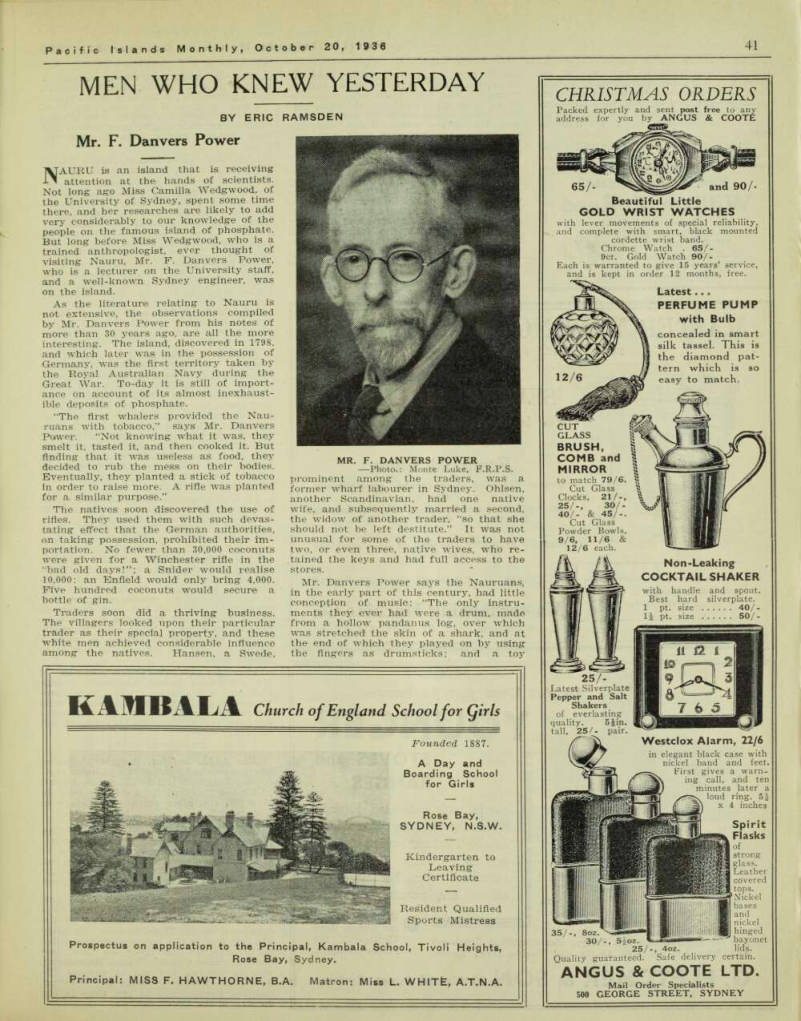
By Eric Ramsden
Mr. F. Danvers Power
NAURU is an island that is receiving attention at the hands of scientists.
Not long ago Miss Camilla Wedgwood, of the University of Sydney, spent some time there, and her researches are likely to add very considerably to our knowledge of the people on the famous island of phosphate.
But long before Miss Wedgwood, who is a trained anthropologist, ever thought of visiting Nauru, Mr. F. Danvers Power, who is a lecturer on the University staff, and a well-known Sydney engineer, was on the island.
As the literature relating to Nauru is not extensive, the observations compiled by Mr. Danvers Power from his notes of more than 30 years ago, are all the more interesting. The island, discovered in 1798, and which later was in the possession of Germany, was the first territory taken by the Royal Australian Navy during the Great War. To-day it is still of import ance on account of its almost inexhaust ible deposits of phosphate.
“The first whalers provided the Nau ruans with tobacco,” says Mr. Danvers Power. “Not knowing what it was, they smelt it, tasted it, and then cooked it. But finding that it was useless as food, they decided to rub the mess on their bodies.
Eventually, they planted a stick of tobacco in order to raise more. A rifle was planted for a similar purpose.”
The natives soon discovered the use of rifles. They used them with such devas tating effect that the German authorities, on taking possession, prohibited their im portation. No fewer than 30,000 coconuts were given for a Winchester rifle in the “bad old days!”; a Snider would realise 10,000; an Enfield would only bring 4,000.
Five hundred coconuts would secure a bottle of gin.
Traders soon did a thriving business.
The villagers looked upon their particular trader as their special property, and these white men achieved considerable influence among the natives. Hansen, a Swede,
prominent among the traders, was a former wharf labourer in Sydney. Ohlsen, another Scandinavian, had one native wife, and subsequently married a second, the widow of another trader, “so that she should not be left destitute.” It was not unusual for some of the traders to have two, or even three, native wives, who re tained the keys and had full access to the stores.
Mr. Danvers Power says the Nauruans, in the early part of this century, had little conception of music: “The only instru ments they ever had were a drum, made from a hollow pandanus log, over which was stretched the skin of a shark, and at the end of which they played on by using the fingers as drumsticks; and a toy
Mr. F. Danvers Power
—Photo.: Monte Luke, F.R.P.S.
trumpet made from the leaf stem of the same tree . . . On one occasion a band from a German warship played on shore to amuse the natives, but the latter were frightened and, thinking the music some kind of punishment, made off into the bush.
“What’s the matter with the white man
now?” they demanded. “Why does he make that noise? Have we done anything wrong?” The reed instrument was ob jected to as it squealed, “all the same pig”
The kettle drum made too much noise: but the natives were pleased with the big drum. One old man wanted to look inside the latter to investigate where the big noise came from.
Sports, including wrestling; fishing; the telling of legends; club throwing; dancing; and a ball game, all had a part in com munal life when Mr, Danvers Power was on the island. Small boys played a similar game to marbles with seeds and nuts. Mr.
Danvers Power saw the famous frigate bird dance performed when the partici pants, green leaves in their hands, went through all the evolutions of catching those birds and chanted of their prowess.
The Nauruans of old encased a fat man
in “armour” made from closely woven coir consisting of a corselet, trousers, helmet, and a protection for the back of the hands.
“It was the duty of this man,” Mr. Dan vers Power says, “to protect, with a stout quarterstaff, two smaller men who fought with lighter spears from beneath his arms.”
Like some Pacific islands, Nauru did not escape a period of missionary intolerance.
On one occasion a missionary, an ex steward, a German by birth but American naturalised, found a single girl in the mission compound who was expecting a child. The native asked the missionary (who was said to have had some medical experience) to assist her at its birth. But he refused to do so, declaring that he would be no party to “bringing a child of sin into the world.” Dr. Kruelle, the Ger man scientist investigating disease on the island, happened to arrive at an opportune time, and hearing of the missionary’s re fusal, used to walk a mile from the Resi dent Magistrate’s bungalow twice a day in the heat until the child was safely delivered and the mother out of danger.
The Germans instituted a rule that the resident missionary should, perforce, be come acquainted with the native language, or else leave the island within two years.
The missionary in question, after a time, addressed the natives in such a glib fashion that the authorities believed him proficient in the Nauru tongue. As a mat ter of fact, only those natives accustomed to hearing him speak could understand his oratorical flow. Some newcomers at last begged the traders to explain what he meant: they imagined the missionary to be speaking German!
At Nauru, as elsewhere, the missionaries set their faces against certain of the natives’ dances and amusements. Inci dentally, they went as far as to refuse baptism for three years to natives who attended their own dances. Men were pro hibited from smoking on the Sabbath.
Even a ban was placed against tree climb ing on the sacred day if they owed allegi ance to the mission. It was decided that it was indecent for women to show their breasts —though such had been customary for centuries —and European clothes were insisted upon. The latter edict, naturally enough, caused many deaths, as when a native got wet, he allowed the clothes to dry on him.
After the un-Christianlike behaviour of the missionary before mentioned, Roman Catholic missionaries, who were pre viously not allowed on the Island, were invited to come to Nauru. The unpopular minister, unable to retain his converts, left for other fields.
Miss J. M. Jenkins, 8.A., a Methodist Mission worker among the Chinese resi dents of Rabaul, left Brisbane on August 22 by the Macdhui for a further term in New Britain, after extended furlough in Queensland.
Ratu Mosese Dranibaka, a Fijian preacher for the Seventh Day Adventist organisation, who came to Australia to attend a Mission conference in Melbourne, died from pneumonia at the Wahroonga Sanatarium, N.S.W., at the end of August.
Captain Benton arrived at Rarotonga, Cook Group, from New Zealand, on Sep tember 5 to take over command of the trading schooner Tiare Taporo. He made his first trip in the latter when she sailed north during September on her last voyage under Captain Viggo Rasmussen, who is leaving the sea to assume the duties of Resident Agent at Penrhyn.
Captain Benton was at one time in the employ of the Union S.S. Co.
Advertisements & other items, pp. 43-44 (1 item)
KAMBALA Church of England School for Cjirls
CHRISTMAS ORDERS
Packed expertly and sent post free to any address for you by ANGUS & COOTE s'.:
65/- and 90/-
Beautiful Little
GOLD WRIST WATCHES
with lever movements of special reliability, and complete with smart, black mounted cordette wrist band.
Chrome Watch . 65/- 9ct. Gold Watch 90/- Each is warranted to give 15 years’ service, and is kept in order 12 months, free. r 12/6 Latest...
PERFUME PUMP
with Bulb concealed in smart silk tassel. This is the diamond pattern which is so easy to match.
CUT
GLASS
BRUSH,
COMB and
MIRROR
to match 79/6.
Cut Glass Clocks, 21/-, 25/-, 30/- 40/- & 45/-.
Cut Glass Powder Bowls, 9/6, 11/6 & 12/6 each.
Non-Leaking
COCKTAIL SHAKER
with handle and spout.
Best hard silverplate. 1 pt. size 40/- 1| pt. size 50/- -g, 25/- Latest Silverplate Pepper and Salt Shakers of everlasting quality. siin. tall, 25/- pair. a is ID 'U Westclox Alarm, 22/6 in elegant black case with nickel band and feet.
First gives a warning call, and ten minutes later a loud ring. 5 J x 4 inches
Spirit
Flasks of strong glass.
Leather covered tops.
Nickel bases and nickel hinged bayonet lids. s£oz. 25/-, 4oz.
Quality guaranteed. Safe delivery certain.
ANGUS & COOTE LTD.
Mail Order Specialists
500 GEORGE STREET, SYDNEY
KAMBALA Church of England School for Cjirls Founded 1887.
A Day and Boarding School for Girls Rose Bay,
SYDNEY, N.S.W.
Kindergarten to Leaving Certificate Resident Qualified Sports Mistress Prospectus on application to the Principal, Kambala School, Tivoli Heights, Rose Bay, Sydney.
Principal; MISS F. HAWTHORNE, B.A. Matron: Miss L. WHITE, A.T.N.A.
Your Sydney Agent?
William E. Reed
(Established 1913)
UNION HOUSE
247 GEORGE ST., SYDNEY
Shell sold, and goods supplied at wholesale prices, on commission.
Enquiries welcomed.
MASTER SEWING MACHINE CO.
ESTABLISHED FOR 23 YEARS
Reconditioned
SEWING MACHINES
For Industrial and Household use.
All Types for Sale.
From £3 Each
Every Machine Guaranteed Mechanically Perfect.
We have the most complete range of Sewing Machines in New South Wales.
I.V'GM
■* n Repairs promptly attended to by Competent Mechanics.
Let us know your requirements.
We will be pleased to iiuote by return mail.
No Delays All Goods Carefully Packed
Master Sewing Machine Co.
15 Enmore Road, Newtown, Sydney
Do You Know that the Famous . .
YOUNGER
STOVES and
RANGES
made with extended Firebox specially for long Wood fuel, are Self-Setting and, provided sufficient Flue Piping is attached, can be used in almost any position?
The No. 7W "Younger” Ranger can now be supplied fitted with Legs, as per illustration.
Ask for quotation for this Range, also Illustrated Catalogue and Price List for both Single and Double Oven Stoves.
G. FLETCHER & SON 50 Oxford Street, Sydney Younger Stoves are Widely Used Throughout the Pacific Islands.
Papuan “Wonderland”
A SPLENDID sal© in the British Empire and the United States is reported con cerning Papuan Wonderland, the book written by Mr, Jack Hides at the end of last year and published in London by Blackie and Company. The book has been praised in lavish terms by reviewers all over the world, who agree that it is likely to become a classic of modern travel and exploration.
The following is the way in which the book was reviewed by “Touchstone” for the Melbourne Herald: As a record of courage and endurance in the face of almost insuperable diffi culties, both natural and human, this enthralling record of present-day adven ture challenges and sustains comparison with the exploit of the great explorers of the past. It is a record of which all Aus tralians should, and will, be justly proud.
Some 400 years ago, a Portuguese Don named de Menses was drifted, by storms and currents, on to the shores of a strange land. Because its inhabitants were adorned with heads of kinky hair, he called them Papuas, from a Malay word implying crinkled hair. De Menses had discovered New Guinea.
Later on other adventurers, Dampier among them, landed on its savage shores, but it was not until the end of the 19th century that the white invaders firmly established themselves.
Mr. Hides was born in Port Moresby, and he is both old, and young enough, to remember it in its infancy. He has watched it grow from what was little more than a native village to its present state.
In choosing him to lead the expedition, the
Administrator (Sir Hubert Murray) could not have made a better choice. Mr. Hides was not only fully conversant with the difficulties he had to overcome, but he had also an intimate knowledge of native life and habits which was ' later to stand him in good stead.
Assisting him in the difficult task to which he was assigned were Mr. Chris.
O’Malley, a young Irish-Australian, and a detachment of the Papuan Armed Con stabulary to whose loyalty the author pays the following tribute: “They were brown men of Papua, re cruited from all parts of Papua to serve Papua. Loyal and courageous always, they have built up a wonderful tradition. There is nothing they fear, no task which they will not tackle. They will die for their tradition. Savages in serge if you like; but they serve their country faithfully and well.”
It was in December, 1934, that Mr. Hides and his party set out to conquer the “ugly blank” in the map, an area of some 8000 square miles, Papua’s vast secret, along the borders of British New Guinea and the Mandated Territory. After leading his little party for hundreds of miles up the Fly and Strickland Rivers, Mr. Hides struck out into the unknown in a north erly direction towards the vast limestone barrier beyond which lay their objective, the headwaters of the Kikori upon which they hoped to float back to civilisation.
Their equipment and stores were care fully calculated for a three months’ jour ney, but they could not foresee the diffi culties they had to face. It was not until eight months later that they floated down
the Kikori River to the kindly hospitality of the Resident Magistrate at Ogomobu.
What Mr. Hides and his companions dis covered and endured during their voyage of discqvery affords material for a modern epic.
Even Sir Hubert Murray, who is not given to extravagant praise, feels it neces sary to remark that: “It is generally ad mitted that travel in these territories is as difficult as anywhere in the world, and the explorer, D’Albertis, has left on record his opinion that it is easier to cross the Alps than to ascend an ordinary hill in Papua ... the distance that can be cov ered in a day will sometimes hardly exceed a couple of miles.
“Your route may lie, for instance, due east, but nine times out of ten you will not be able to travel due east, for the nature of the country will drive you either north or south; and though, in inhabited districts, you will find tracks, still they
rarely lead in the direction in which you want to go. And in uninhabited country you are driven to the slow and maddening tedious process of cutting your way through jungle and forest. . . .
“It is necessary for the reader to realise all this if he would appreciate the task which this apparently insignificant body of white men, native police and car riers had undertaken, and which they so gallantly brought to a successful conclu sion.”
And he adds: “As to the white officers
themselves, one need not say more than that they fully sustained the reputation of the Papuan service for efficiency and resolution. Personal courage is, fortu nately, not a rare virtue, and both these men showed again what we knew already, that they possessed this virtue in a very marked degree.”
The first stages of the journey after leaving the Strickland River along a stream which Mr. Hides named the Ren toul, were comparatively easy. The sur rounding country, beautiful in its tropical
flowers and trees, was inhabited by a race of nomads with whom they vainly tried to come in contact. When their canoes would take them no further they aban doned them and set out on foot towards the limestone barrier that barred their path to the north.
Their first meeting with the natives of the region was not encouraging. The little party was ambushed, and arrows be gan to fly. There was nothing to do but beat their attackers off, which they did, at the loss of two lives. Mr. Hides sadly re cords: “In nine years of patrolling, and from most of the hostile corners of Papua, I had captured nearly 150 convicted mur derers; and this was the second man that I had shot. A rifle against a bow and arrow; it did not seem fair to me. Yet the position might have been reversed; it could easily have been me now lying on the ground with an arrow in my chest. I walked back dejectedly to camp to tell O’Malley of what had happened.”
Nothing daunted, they pushed ahead, meeting with no more opposition until they reached the dreaded limestone barrier, which the Papuans themselves call the “broken-bottle country.” In describing this stage of their journey, Mr. Hides says: “It was a frightful stretch of coun try—a desolate, silent land, where only bandicoots and pythons can find a home.
The rock is honeycombed and stands on end; it forms fissures and craters, large and small, and every step has to be watched, for the limestone edges are as sharp as broken glass. There are no running streams, no water, for the rain seeped immediately through the limestone.
The fissures and cylindrical stone pits of this country sometimes appear bottomless to the eye. A stunted and tangled growth covers it all.
“The days dragged on into weeks as we fought our way across this limestone; our tents were leaking and falling to pieces, and, with many of the police and carriers disabled by deep gashes, caused, by the limestone, our outlook was far from cheer ful. A perpetual blanket of fog covered the land, preventing us from seeing any thing of the country around us, and a cold, miserable rain made our existence wretched. . .
“In this country of limestone craters and the crevices with their jagged edges, with no level stretches at all, we even had diffi culty in finding a space to stretch our three tents. The reader has probably seen limestone caves somewhere, and if he can visualise a mountain barrier of such for mation rising in places to eight or nine thousand feet, and covered with a dense growth, he will arrive at some idea of what this terrible country is like. It tore our boots to pieces, and whenever we slipped, it did likewise with our bodies.
And the wounds that it left always fes tered from the poison in the rocks."
But the expedition had its reward when, after passing through this inferno, they looked down upon a wonderful valley of rolling timbered slopes and grasslands laid out in carefully cultivated squares, with little columns of smoke arising from the homes of the people of this new Eden. It was, as they shortly discovered, the land of the Tarifuroro, a light-skinned race who still lived in the Stone Age (they refused the author’s offer of steel tomahawks, pre ferring their own greenstone axes) but whose methods of agriculture and living generally were far in advance of tho coastal tribes.
In describing them, Mr. Hides says; “I was astounded at their appearance. They were all of short stature, they were , clean and light skinned, and they had girlish mops of brown hair, adorned with flowers.
Three or four had rosettes of bachelor
buttons; others had bands of eidelweiss across their foreheads; some had parrot feathers; while all of them had bone dag gers stuck in the cane girdles around their waists. A knitted sporan, tucked between the cane girdles, was all the covering they had.
“I was greatly interested in their Asiatic like features; their cheek bones were high, and their noses and lips were all finely moulded. I set to wondering about theso new people, their extraordinary methods of cultivation, arid this valley wonderland of yodelling natives who lived in farm houses. Whence had they come, and for how long had they lived in this forgotten world of theirs? Perhaps they had been here before Hannibal crossed the Alps? Or even before corn was discovered in Egypt?
For we are told that the migratory whirls that populated the Pacific date back many thousands of years.”
For day after day the party marched across the valley whose extreme fertility impressed even the native police. From the land of the Tarifuroro they passed to that of the Waga Furari —the black “Pharaohs” of Papua—bewigged, dark skinned men with deep, guttural voices, who also showed not the slightest sign of European influence and who also preferred their stone axes—with which they can fell large trees—to the author’s steel toma hawks.
They reckoned their wealth in pearl and cowrie shell and their disappointment was great when Mr. Hides explained that he had none. However, their quick searching eyes discovered the pearl buttons on his and his companions’ clothes, and before night fell they had no buttons left. For five days the expedition travelled through these friendly people, being everywhere hospitably received.
Date in the afternoon of the fifth day,
however, they entered a new section and here they met with a hostility that was to dog their steps for many weeks. All food, although they offered to pay for it, was refused them and every night their camping place was surrounded by hordes of sullen savages fingering their stone axes and bows and arrows. By this time the stores of the expedition were running low and every member of the party was suffering from hunger and the results of privation. To have attempted to take what they wanted from the fields around them would have been to invite disaster.
Husbanding their resources and their strength, they pushed slowly onward, ig noring the insults hurled at them by the arrogant natives.
It was then that Mr. Hides proved the quality of his leadership and the discip line of his constabulary. To the natives the guns of the party were nothing more than wooden clubs, but rather than turn them on his attackers, Mr. Hides endured their insults in silence.
Only when hundreds of them launched an assault were the party’s guns turned upon the people of the Wen. For three long hours the expedition beat off attack after attack until at nightfall their assail ants withdrew. Dismayed by a resistance they had not expected, the savages retired to a distance, but hung on the flanks of the expedition, trying to ambush them. Time after time disaster was only averted at the last minute and to add to their difficulties Mr. Hides was stricken with dysentery, and the police and the carriers were gaunt and hollow-eyed with the strain.
There was nothing to do but push on and on, with the limestone still to be re crossed. “I wonder if the reader knows what I mean?” asks Mr. Hides. “Can he picture a little band of men, their frames no more than skeletons, the bones of their
faces showing out and dull eyes sunk deep in the sockets; and can he picture them dragging their frames over limestone rocks, exerting those frames again and again with no promise of food, with nos trils filled with a mucus that strength is not there to clear away? I never want to see such tortured and pitiable humans again.”
At long last, however, the limestone was passed and the expedition made its way slowly towards the Kikori and, launching themselves on its broad surface, drifted safely home.
The book contains a number of exceed ingly interesting illustrations and a map.
Advertisements & other items, pp. 45-46 (1 item)
Newlands Brothers Ltd.
Maleham & Yeomans
Ltd.
BOWDON ST., SHEFFIELD, ENG.
Manufacturers of all kinds of
BUTCHERS’, STICKING AND
SHEATH KNIVES
RAZORS AND SCISSORS
Specialty
HAIRDRESSER SCISSORS
PRICE LIST ON APPLICATION
Si !
STEEL BEDSTEADS
WIRE MATTRESSES
“MORNING GLORY” BEDDING
TUBULAR STEEL FURNITURE
“LISTER”HOSPITAL EQUIPMENT
SHIPS’ ALL METAL BERTHS
WE WILL GLADLY FORWARD OUR
COMPLETE SETS OF CATALOGUES
Produced in Australia by
Newlands Brothers Ltd.
RILEY STREET :: SYDNEY, N.S.W.
Australia’s Largest Manufacturers of Modern Sleeping Equipment.
Cable address: "Newlandbed,”
Sydney
Ship Chandlery— Hardware
/Write for J
Ship Chandlery /
Catalogue J
Special “In Bond” Prices for all Islands enquiries quoted on application.
BROOM FIELDS LIMITED
152 SUSSEX STREET :: :: :: SYDNEY Cables: “BOOM,” Sydney Large and Complete Stocks of
SHIP CHANDLERY
IRONMONGERY OF ALL KINDS, PAINTS,
WHITE LEAD AND OILS
Sole Agents for: P. H. MUNTZ & CO.’S 3-CROWN BRAND METAL SHEATHING.
PEACOCK & BUCHANS’ ENGLISH READY-MIXED PAINTS.
“JS/loharnie” COTTON TEXTILES
A. B. Brotherton & Co. Ltd.
(Arnold B. Brotherton)
GOVERNMENT CONTRACTORS
40 DICKINSON STREET, MANCHESTER, 1
Manufacturers of “MOKARNIE” Fabrics, Joker-Brand, etc. Lava-Lavas, Pearl Divers’ Khaki Drills, Denims Shirtings, Longcloths, Italians, Linings, etc. suitable for the South Pacific Trade.
NO DIRECT TRADE. —Orders only through European Houses.
Scott’s Renown Brand Rope,
Cordage and
Binder
Cable Address Ropcyard, Sydney.
Twine
of Every
Description
MANUFACTURED AT
MASCOT. N.S.W.
By
J. Scott Ltd.
Head Office and Store:
163 CLARENCE ST..
SYDNEY, N.S.W.
Marist Mission Congress at Kieta
Kieta in 1937
T>LANS are being discussed in Australia 1 to hold a Eucharistic Congress in the South Seas next year, in which 20,000 native Roman Catholics will take part, to celebrate the centenary of the Marist Mis sions.
The proposal was advanced by the Vicar Apostolic of the Northern Solomons (Bishop Wade) when he was in Melbourne in September.
It is reported that the congress will be at Kieta, on the island of Bougainville, The central office of the Catholic Mis sions, in Melbourne, is organising an Aus tralian pilgrimage to the congress. It will take the form of a mission cruise in the waters of the Mandated Territory and the Solomon Islands, with Kieta as its centre. A liner is being chartered for the pilgrims.
Advertisements & other items, p. 47 (1 item)
Deutz
DIESEL
ENGINES
Dcutz Engines used Internationally since 1864
MARINE DIESEL “OM” TYPE
Ci 64 5 ' Range from 10 to 140 B.H.P.
Full information obtainable from the Agents
Herbert Del Cott Pty. Ltd.
15 CASTLEREAGH STREET, SYDNEY
’Phone: B 3135
A p 9» ELECTRICAL
C* V 3 • EQUIPMENT
FREE ELECTRICITY!
with “AEG” Turbinamos
A “Turbinamo” working from a stream generates sufficient electricity for households, plantations or communities.
Simple to Instal Reliable Supply No Running Costs Looks After Itself Sizes 0.5 kw. to 40 kw. /« Write for particulars. State head of water available and Electricity output required.
Cables “Voltage" 116 QUEEN STREET, MELBOURNE ’Phone: Central 10488
Population Of New
Hebrides
WE learn from L’Oceanie Francaise that the population of the New Hebrides is now estimated as follows;
Mr. Lionel Dudley, of the Federal Foreign Mission of the Church of Christ, married Miss Christiansen in Melbourne in September. They will leave Sydney to undertake missionary work at Aoba, in the New Hebrides, by the Morinda on October 29.
1930 1934 1936 British 254 240 261 French Indo-Chinese, indentured 951 827 816 to French employers.
Natives (est.) 4603 1682 890 50.000
N. Guinea Trade
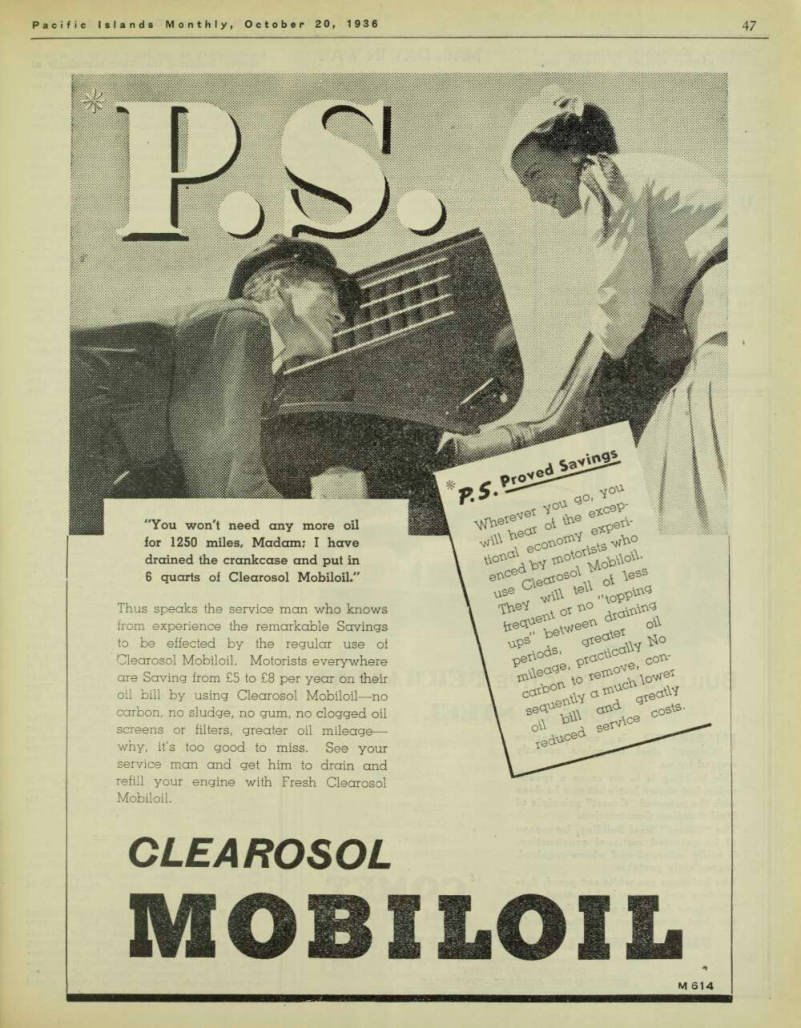
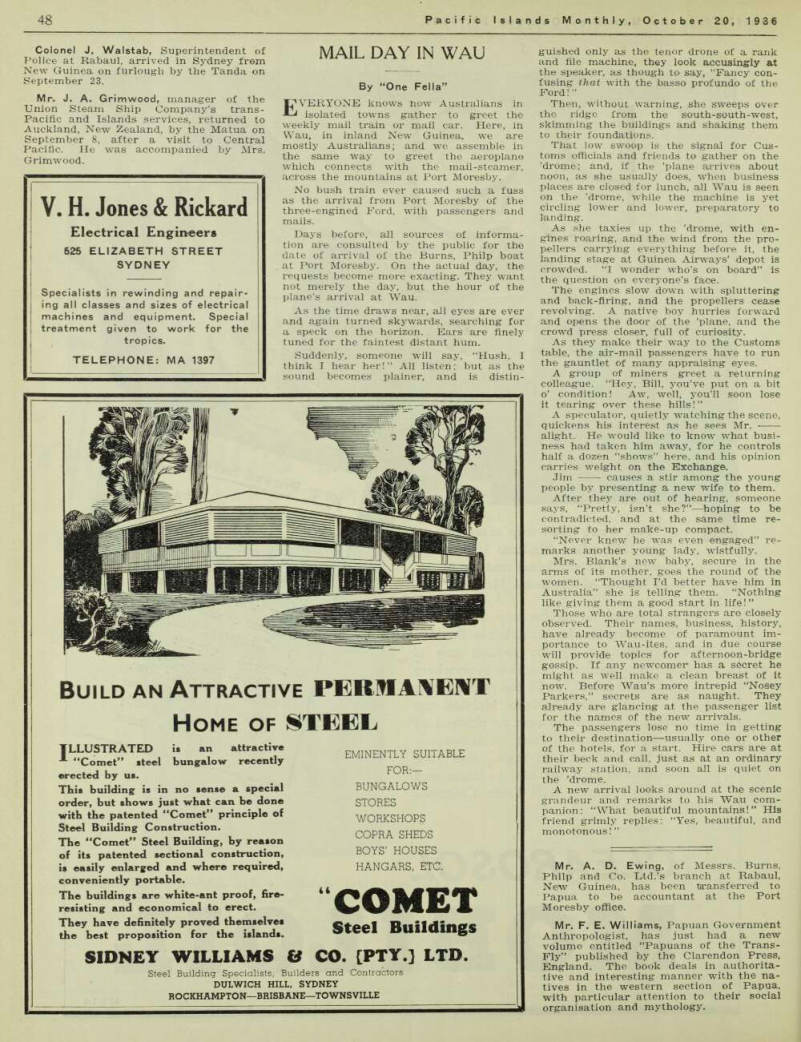
Protection of Australian Interests
HAVING spent two years in the Man dated Territory of New Guinea, the Administrator, Brigadier-General W. R.
McNicoll, is now enjoying a few weeks’ rest in Australia, The Administrator has been interro gated by newspapers and various or ganisations with reference to the condi tion of the Territory, but he has had com paratively little to say. He has made a report personally in Canberra; and the information which he has given to the public suggests that the Mandated Terri tory is in a very good position. Summed up, the claims of the Administrator are as follows;
Revenue last year was, in round figures, £400,000, and was the largest on record.
New Guinea’s imports were worth £948,000, of which £430,000 worth came from Australia. Exports were worth £2,350,000, of which £1,725,000 was gold.
New Guinea’s shipping is nearly all British. Last year 450,000 tons entered was British, 50,000 was German, and 60,000 was miscellaneous.
The gold industry is flourishing, and a determined, carefully planned effort is now being made to locate an oilfield.
Government control is being steadily extended over the large, newly-discovered population in Central New Guinea. Es pecially good work has been done in the Chimbu-Wahgi valley.
The Administrator said that a great success is being made of the Government experimental farm, where coffee and cocoa are being produced for export. He especially praised the work of Messrs.
Clive Green and Colin Marr.
Timber Resources
The Federal Government has under consideration a request made by the Aus tralian timber industry that the duty on timber imported from New Guinea should be reduced from the general rate of 30 per cent, to the preferential rate of 10 per cent. It was pointed out that maho gany and cedar logs from North Borneo and the Solomon Islands were allowed in at the preferential rate, and that the local trade would benefit if the same concession applied to New Guinea.
New Guinea’S Imports
Several questions asked in the Com monwealth Parliament apparently indi cate a belief that too large a quantity of foreign goods is being imported into the Mandated Territory of New Guinea at the expense of Australian trade. Reference has been made especially to canned meats, rice, cement, etc.
In each case ministerial replies have been defensive. It is said that wherever possible Australian goods are used by the Administration, and that local firms are encouraged to import Australian products.
There is little doubt, however, that con stant prodding is necessary to maintain this position. There is evidence that both the Administration and the merchants re quire encouragement from official sources in Australia —otherwise they will take the goods that are so frequently being offered to them at “dumping” rates.
It was well-known, for instance, that only a few weeks ago a large quantity of Argentine canned meat was lying at a Chinese port, and had been offered to New Guinea interests at rates with which Australian canners could not possibly compete. The Australian merchants took drastic action; with the result that Can berra officialdom moved, and the Argen tine product was kept out of the lian Territory.
The Administrator has been questioned in Australia about the rice trade. He has explained that native-grown rice is ac ceptable to the natives but not to the Chinese. The latter do not even like Australian-grown rice—they insist on the Indo-Chinese product.
Rev. Harold Chambers, principal of the group of educational institutions main tained by the Methodist Missionary Society at Davuilevu, Fiji, has forwarded a request to the Board of Missions in Sydney for permission to return to Aus tralia at the end of the year for family reasons. He will seek an appointment in the Victoria and Tasmania Conference in 1937.
Colonel J. Walstab, Superintendent of Police at Rabaul, arrived in Sydney from New Guinea on furlough by the Tanda on September 23.
Mr. J. A. G rim wood, manager of the Union Steam Ship Company’s trans pacific and Islands services, returned to Auckland, New Zealand, by the Matua on September 8, after a visit to Central Pacific. He was accompanied by Mrs.
Grimwood.
Advertisements & other items, pp. 48-50 (2 items)
The King’S School
(PARRAMATTA)
N.S.W.
I % Extensive Modern Additions made in 1934-1935 New Class Rooms, Laboratories, Dormitories, Modern Swimming Pool.
The School Re-opens on Wednesday, 10th Feb., 1937 Vacancies for 1937
Apply, THE HEADMASTER
Mobiloil
•K V J ve pto o^ qo
V d £S-SSS.
** us® '•® U T^ et -ot* 10 AtC ftU ! 'P q I waft'*' 8 "?.” 04 You won t need any more oil for 1250 miles. Madam; I have drained the crankcase and put in 6 quarts of Clearosol Mobiloil." aX eI uP s •.r.a\W ds p-[Ci 0 c o^ *^ ce ‘ Thus speaks the service man who knows from experience the remarkable Savings to be effected by the regular use of Clearosol Mobiloil. Motorists everywhere are Saving from £5 to £8 per year on their oil bill by using Clearosol Mobiloil—no carbon, no sludge, no gum, no clogged oil screens or filters, greater oil mileage— why, it's too good to miss. See your service man and get him to drain and refill your engine with Fresh Clearosol Mobiloil.
CLEAROSOL
MOBILOIL
M 614
V. H. Jones & Rickard
Electrical Engineers
525 ELIZABETH STREET
SYDNEY
Specialists in rewinding and repairing all classes and sizes of electrical machines and equipment. Special treatment given to work for the tropics.
TELEPHONE: MA 1397
1
Build an Attractive PERMANENT
Home of STEEL
ILLUSTRATED is an attractive “Comet” steel bungalow recently erected by us.
This building is in no sense a special order, but shows just what can be done with the patented “Comet” principle of Steel Building Construction.
The “Comet” Steel Building, by reason of its patented sectional construction, is easily enlarged and where required, conveniently portable.
The buildings are white-ant proof, fireresisting and economical to erect.
They have definitely proved themselves the best proposition for the islands.
EMINENTLY SUITABLE
FOR:—
BUNGALOWS
STORES
WORKSHOPS
COPRA SHEDS
BOYS' HOUSES
HANGARS, ETC.
COMET
Steel Buildings
SIDNEY WILLIAMS & CO. [PTY.] LTD.
Steel Building Specialists, Builders and Contractors
DULWICH HILL. SYDNEY
ROCKHAMPTON—BRISBANE—TOWNSVILLE
Mail Day In Wau
By “One Fella”
EVERYONE knows now Australians in isolated towns gather to greet the weekly mail train or mail car. Here, in Wau, in inland New Guinea, we are mostly Australians; and we assemble in the same way to greet the aeroplane which connects with the mail-steamer, across the mountains at Port Moresby.
No bush train ever caused such a fuss as the arrival from Port Moresby of the three-engined Ford, with passengers and mails.
Days before, all sources of informa tion are consulted by the public for the date of arrival of the Burns, Philp boat at Port Moresby. On the actual day, the requests become more exacting. They want not merely the day, but the hour of the plane’s arrival at Wau.
As the time draws near, all eyes are ever and again turned skywards, searching for a speck on the horizon. Ears are finely tuned for the faintest distant hum.
Suddenly, someone will say, “Hush, I think I hear her!” All listen; but as the sound becomes plainer, and is distin
guished only as the tenor drone of a rank and file machine, they look accusingly at the speaker, as though to say, “Fancy con fusing that with the basso profundo of the Ford!”
Then, without warning, she sweeps over the ridge from the south-south-west, skimming the buildings and shaking them to their foundations.
That low swoop is the signal for Cus toms officials and friends to gather on the ’drome; and, if the ’plane arrives about noon, as she usually does, when business places are closed for lunch, all Wau is seen on the ’drome, while the machine is yet circling lower and lower, preparatory to landing.
As she taxies up the ’drome, with en gines roaring, and the wind from the pro pellers carrying everything before it, the landing stage at Guinea Airways’ depot is crowded. “I wonder who’s on board” is the question on everyone’s face.
The engines slow down with spluttering and back-firing, and the propellers cease revolving. A native boy hurries forward and opens the door of the ’plane, and the crowd press closer, full of curiosity.
As they make their way to the Customs table, the air-mail passengers have to run the gauntlet of many appraising eyes.
A group of miners greet a returning colleague. “Hey, Bill, you’ve put on a bit o’ condition! Aw, well, you’ll soon lose it tearing over these hills!”
A speculator, quietly watching the scene, quickens his interest as he sees Mr. ——alight. He would like to know what busi ness had taken him away, for he controls half a dozen “shows” here, and his opinion carries weight on the Exchange.
Jim —- causes a stir among the young people by presenting a new wife to them.
After they are out of hearing, someone says, “Pretty, isn’t she?” —hoping to be contradicted, and at the same time re sorting to her make-up compact.
“Never knew he was even engaged” re marks another young lady, wistfully.
Mrs. Blank’s new baby, secure in the arms of its mother, goes the round of the women. “Thought I’d better have him in Australia” she is telling them. “Nothing like giving them a good start in life!”
Those who are total strangers are closely observed. Their names, business, history, have already become of paramount im portance to Wau-ites, and in due course will provide topics for afternoon-bridge gossip. If any newcomer has a secret he might as well make a clean breast of it now. Before Wau’s more intrepid “Nosey Parkers,” secrets are as naught. They already are glancing at the passenger list for the names of the new arrivals.
The passengers lose no time in getting to their destination —usually one or other of the hotels, for a start. Hire cars are at their beck and call, just as at an ordinary railway station, and soon all is quiet on the 'drome.
A new arrival looks around at the scenic grandeur and remarks to his Wau com panion: “What beautiful mountains!” His friend grimly replies; “Yes, beautiful, and monotonous! ”
Mr. A. D. Ewing, of Messrs. Burns, Philp and Co. Ltd.’s branch at Rabaul, New Guinea, has been transferred to Papua to be accountant at the Port Moresby office.
Mr. F. E. Williams, Papuan Government Anthropologist, has just had a new volume entitled “Papuans of the Trans- Fly” published by the Clarendon Press, England. The book deals in authorita tive and interesting manner with the na tives in the western section of Papua, with particular attention to their social organisation and mythology.
Again
Rarotonga Settles Down Again Aftermath of N.Z. Members’
Visit
From Our Own Correspondent.
Rarotonga, Sept. 6.
VOW that Rarotonga is again settling into the even tenor of its normal life, one is better able to form an estimate of the possible value of the Parliamentary visit and investigation into local affairs.
For a month everything revolved around the three visiting Members —cabals, con spiracies, false rumours and true reports, feastings, and public entertainment.
One result of the rather excessive hos pitality on the part of the natives must have been to create among the visitors an erroneous impression of the domestic conditions of people whose ordinary standard of living is very different from that seen during the Committee’s visit.
One cannot help deploring the official attitude which countenances, if not actu ally encourages, these displays of Olym pian prodigality, which have, it must be borne in mind, to be counterbalanced later on by a corresponding tightening of local belts.
On the other hand it is to be admitted that as a practical demonstration of “everything in the garden being beauti ful” they have a distinct value.
Despite a discreet but nonetheless constant escort of officials, Government quarters, and a carefully selected visiting list, the Members succeeded in obtaining a fair insight into general conditions, al though in some quarters it was regretted that they were not more accessible for those “heart to heart” conversations and recitals with which certain residents would have liked to entertain them.
Control Of Fruit Industry
The Fruit Control Board proposed by a large number of growers and which formed the basis of their recent petition to the N.Z. Parliament, was fully dis cussed during a four-day session. It became evident that whatever advantages such a scheme might possess there was none among the petitioners qualified to conduct the operations of such a Board.
An impression that the Government had already decided on the broad prin ciple of its intentions regarding the Islands fruit-trade was also strengthened as a result of the Member’s insistence on determining the attitude of local growers towards the establishment of full Government control of the industry. A large quantity of evidence was tendered, a great deal of which was neither very helpful nor illuminating. Speaking as representative of the Exporters’ Associa tion, Mr. Robert McKegg, submitted what might almost be described as the only constructive and detailed report on con ditions as viewed from the commercial angle.
On the credit side of this rather costly visitation there must definitely be set the psychological value of its contact with the Cook Islanders and the feeling there by generated among the latter that the new Government apparently wants and means to better local conditions.
During the Committee’s visits to the various districts the schools were in spected and exhibitions given by their respective pupils. The prominence thus accorded to this branch of the Admini stration was no doubt responsible for the
somewhat extravagant praise bestowed upon it in the farewell speeches made by the Members, and also for the partial eclipse of the less spectacular work of the medical authorities, to whom, on the same occasion, no public reference was made.
In any assessment of the relative utility of these two departments (the educational and the medical) it should be remembered that during the past four years expenditure on the former has ex ceeded that on the latter by over £6,000 — an excess of £3,572 being spent in 1935 alone —a distribution by no means unani mously endorsed in all quarters.
Mr. Alfred Dow, who was born in Aus tralia of a Melanesian father and an Aus tralian aboriginal mother, will leave Sydney shortly by the Morinda to com mence mission work on Pentecost Island, New Hebrides, for the Church of Christ.
Mr. Lars Halvorsen, of Neutral Bay, Sydney, died at a private hospital on October 5, after a brief illness. A Nor wegian, he was well-known in Australia, where he had lived since 1924, as a skilled designer and builder of motor-boats, yachts, and other water craft. Mr, Hal vorsen constructed many Islands boats, and last year made a trip through the Western Pacific to meet his clients. The boatbuilding business will be carried on in future by his sons.
Advertisements & other items, pp. 51-52 (2 items)
Mining
LEATHER BELTS
for NATIVES
r 'manufacturers s Specialists
PATTERSON & STONE. CRICHTON WORKS.
WALSALL, ENGLAND.
m m* Ml »r if m 'SaiA®
The...
Headquarters
House for
Mining
Machinery
yi
Thompson’s Centrifugal, Nozzle and Gravel Pumps
Noted for their Reliability, Good Efficiency, Accessibility of Inspection and Repair. Particularly designed for dealing with Alluvial Deposits of Gravel, Sand, etc.
Ingersoll Rand Air Compressors and Pneumatic Tools; Stamper Batteries. Rock Breakers, Sluicing Boxes, Battery Screenings and Plates, Wire Rope, Mining Steel, Lifting Tackle, Mining Tools, Picks, Shovels, Corduroy Mining Cloth, Amalgum Retorts, etc.
FOR QUICK DELIVERY ORDER YOUR SUPPLIES FROM
"rssr ic? C/er«M
EDWARD ST JL * f a ST LPT ST
BRISBANE TOWNSVIUf
INICINEtRINCi Surrey C9Cf AUSTRALIA I?
WiSl'f'rfApU- a eeS
How His Height Saved a Missionary
THERE is at least one man in Western Samoa who does not decry his height of over six feet every time he has to bend double to enter a fale.
He is Rev. Father J. B. Doumeizel, of
WiSl'f'rfApU- a eeS
Jtas rood cluse to be thankful for hil *' ior Ms being alive to day.
A short time ago he was returning to his Mission station from Apia on a motor bus with 17 other passengers. The vehicle rattled down the long curve of a steep incline, raced through the railing of a
bridge at the bottom, and plunged over a 14ft. drop into the Letogo River, where the tide was running high.
A Samoan youth was killed; and broken bones and many lacerations bore witness to the tragedy.
When the bus settled in the stream, Father Doumeizel trying to escape found his foot inextricably pinned in the wreck age, while above him the tide was swirl ing. Pushing upwards to his full height he just managed to extrude his chin above water level and gulp fresh air until help arrived.
Undoubtedly, he says, his six feet of longitude saved him from drowning.
Mr. C. H uson, a planter at Tulean estate, Buka, returned to New Guinea by the September Macdhui.
A Memory Of Von Luckner
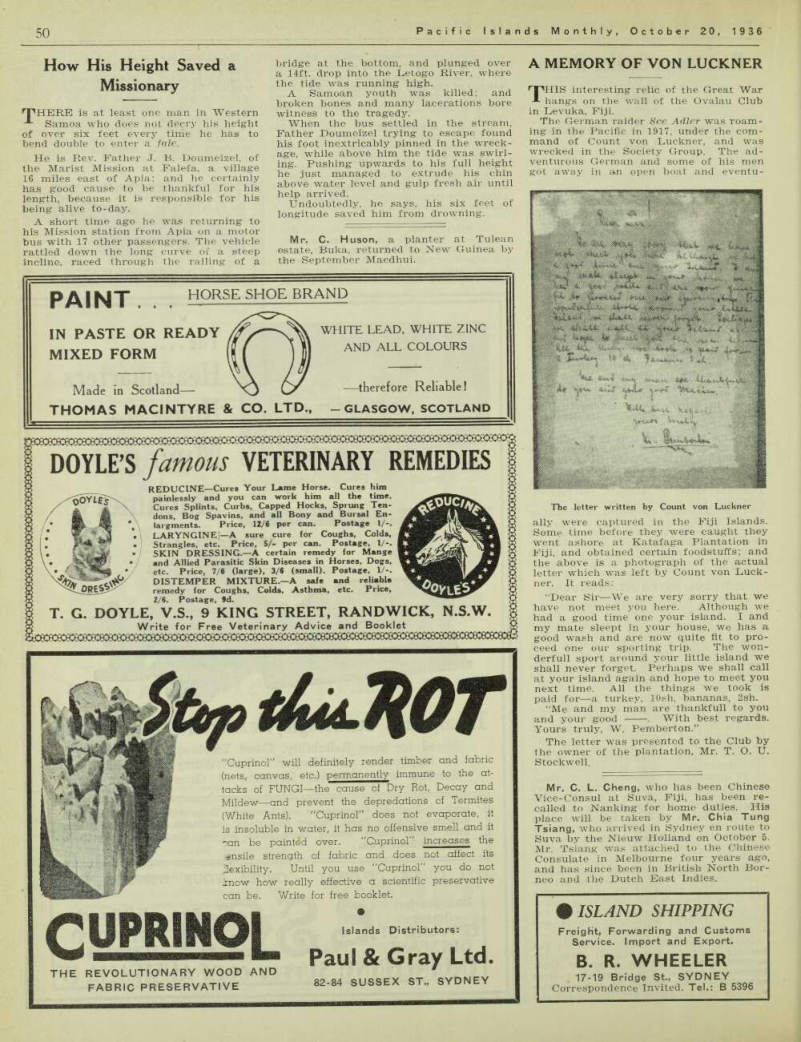
THIS interesting relic of the Great War hangs on the wall of the Ovalau Club in Levuka, Fiji.
The German raider See Adler was roam ing in the Pacific in 1917, under the com mand of Count von Buckner, and was wrecked in the Society Group. The ad venturous German and some of his men got away in an open boat and eventu-
ally were captured in the Fiji Islands.
Some time before they were caught they went ashore at Katafaga Plantation in Fiji, and obtained certain foodstuffs; and the above is a photograph of the actual letter which was left by Count von Luck ner. It reads; “Dear Sir —We are very sorry that we have not meet you here. Although we had a good time one your island. I and my mate sleept in your house, we has a good wash and are now quite At to pro ceed one our sporting trip. The won derfull sport around your little island we shall never forget. Perhaps we shall call at your island again and hope to meet you next time. All the things we took is paid for —a turkey, lOsh, bananas, 2sh.
“Me and my man are thankfull to you and your good . With best regards.
Yours truly, W, Pemberton.”
The letter was presented to the Club by the owner of the plantation, Mr. T. O. U.
Stockwell.
Mr. C. L. Cheng, who has been Chinese Vice-Consul at Suva, Fiji, has been re called to Nanking for home duties. His place will be taken by Mr. Chia Tung Tsiang, who arrived in Sydney en route to Suva by the Nieuw Holland on October 5.
Mr. Tsiang was attached to the Chinese Consulate in Melbourne four years ago, and has since been in British North Bor neo and the Dutch East Indies.
The letter written by Count von Luckner
Advertisements & other items, p. 52 (2 items)
Rufrinoi
PAINT
HORSE SHOE BRAND
IN PASTE OR READY
MIXED FORM
WHITE LEAD. WHITE ZINC
AND ALL COLOURS
Made in Scotland— X) O' —therefore Reliable!
THOMAS MACINTYRE & CO. LTD., -Glasgow, Scotland
DOYLE’S famous VETERINARY REMEDIES
oOYUs i M
ORES*
REDUCINE—Cures Your Lame Horse. Cures him painlessly and you can work him all the time.
Cures Splints, Curbs, Capped Hocks, Sprung Tendons, Bog Spavins, and all Bony and Bursal Enlargments. Price, 12/6 per can. Postage 1/-.
LARYNGINE1 —A sure cure for Coughs, Colds, Strangles, etc. Price, S/- per can. Postage, I/-.
SKIN DRESSING.—A certain remedy for Mange and Allied Parasitic Skin Diseases in Horses, Dogs, etc. Price, 7/6 (large), 3/6 (small). Postage, 1/-.
DISTEMPER MIXTURE.—A safe and reliable remedy for Coughs, Colds, Asthma, etc. Price, 2/6. Postage, 9d.
T. G. DOYLE, V.S., 9 KING STREET, RANDWICK, N.S.W.
Write for Free Veterinary Advice and Booklet
''Cuprinol'' will definitely render timber and fabric (nets, canvas, etc.) permanently immune to the attacks of FUNGl—the cause of Dry Rot, Decay and Mildew—and prevent the depredations of Termites (White Ants). "Cuprinol" does not evaporate, it is insoluble in water, it has no offensive smell and it -an be painted over. "Cuprinol" increases the ■snsile strength of fabric and does not affect its flexibility. Until you use "Cuprinol" you do not know how really effective a scientific preservative can be. Write for free booklet.
rUFRINOI
THE REVOLUTIONARY WOOD AND
FABRIC PRESERVATIVE
Islands Distributors:
Paul & Gray Ltd.
82-84 SUSSEX ST., SYDNEY
• Island Shipping
Freight, Forwarding and Customs Service. Import and Export.
B. R. WHEELER
17-19 Bridge St., SYDNEY Correspondence Invited. Tel.: B 5396
Saving The Native
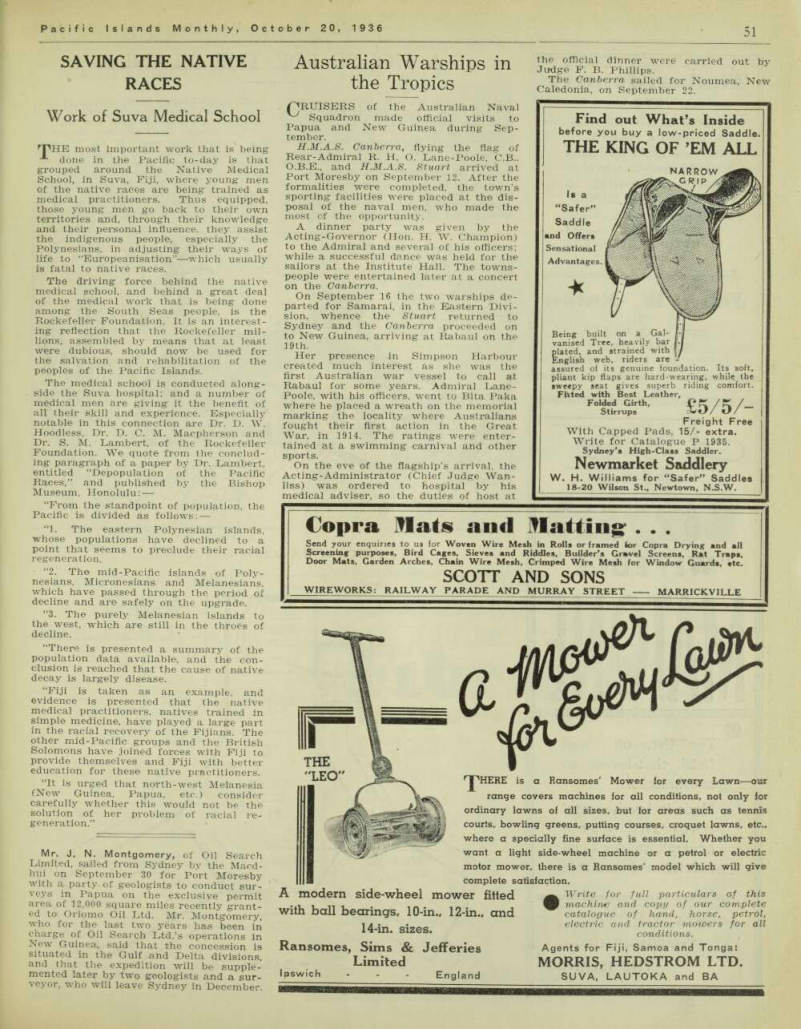
Races
Work of Suva Medical School
THE most important work that is being “*■ done in the Pacific to-day is that grouped around the Native Medical School, in Suva, Fiji, where young men of the native races are being trained as medical practitioners. Thus equipped, those young men go back to their own territories and, through their knowledge and their personal influence, they assist the indigenous people, especially the Polynesians, in adjusting their ways of life to “Europeanisation”—which usually is fatal to native races.
The driving force behind the native medical school, and behind a great deal of the medical work that is being done among the South Seas people, is the Rockefeller Foundation. It is an interest ing reflection that the Rockefeller mil lions, assembled by means that at least were dubious, should now be used for the salvation and rehabilitation of the peoples of the Pacific Islands.
The medical school is conducted along side the Suva hospital; and a number of medical men are giving it the benefit of all their skill and experience. Especially notable in this connection are Dr. D. W.
Hoodless, Dr. D. C. M. Macpherson and Dr. S. M. Lambert, of the Rockefeller Foundation. We quote from the conclud ing paragraph of a paper by Dr. Lambert, entitled “Depopulation of the Pacific Races,” and published by the Bishop Museum, Honolulu: “From the standpoint of population, the Pacific is divided as follows; “1. The eastern Polynesian islands, whose populations have declined to a point that seems to preclude their racial regeneration.
“2. The mid-Pacific islands of Poly nesians, Micronesians and Melanesians, which have passed through the period of decline and are safely on the upgrade.
“3. The purely Melanesian islands to the west, which are still in the throes of decline.
“There is presented a summary of the population data available, and the con clusion is reached that the cause of native decay is largely disease.
“Fiji is taken as an example, and evidence is presented that the native medical practitioners, natives trained in simple medicine, have played a large part in the racial recovery of the Fijians. The other mid-Pacific groups and the British Solomons have joined forces with Fiji to provide themselves and Fiji with better education for these native practitioners.
“It is urged that north-west Melanesia (New Guinea. Papua, etc.) consider carefully whether this would not be the solution of her problem of racial re generation.”
Mr. J. N. Montgomery, of Oil Search Limited, sailed from Sydney by the Macd hui on September 30 for Port Moresby with a party of geologists to conduct sur veys in Papua on the exclusive permit area of 12,000 square miles recently grant ed to Oriomo Oil Ltd. Mr. Montgomery, who for the last two years has been in charge of Oil Search Ltd.’s operations in New Guinea, said that the concession is situated in the Gulf and Delta divisions, and that the expedition will be supple mented later by two geologists and a sur veyor, who will leave Sydney in December.
the Tropics
Australian Warships in the Tropics
/BRUISERS of the Australian Naval Squadron made official visits to Papua and New Guinea during Sep tember.
H.M.A.S. Canberra, flying the flag of Rear-Admiral R. H. O. Lane-Poole, C. 8., 0.8. E., and H.M.A.S. Stuart arrived at Port Moresby on September 12. After the formalities were completed, the town’s sporting facilities were placed at the dis posal of the naval men, who made the most of the opportunity.
A dinner party was given by the Acting-Governor (Hon. H. W. Champion) to the Admiral and several of his officers; while a successful dance was held for the sailors at the Institute Hall. The towns people were entertained later at a concert on the Canberra.
On September 16 the two warships de parted for Samarai, in the Eastern Divi sion, whence the Stuart returned to Sydney and the Canberra proceeded on to New Guinea, arriving at Rabaul on the 19th.
Her presence in Simpson Harbour created much interest as she was the first Australian war vessel to call at Rabaul for some years. Admiral Lane- Poole, with his officers, went to Bita Paka where he placed a wreath on the memorial marking the locality where Australians fought their first action in the Great War, in 1914. The ratings were enter tained at a swimming carnival and other sports.
On the eve of the flagship’s arrival, the Acting-Administrator (Chief Judge Wan liss) was ordered to hospital by his medical adviser, so the duties of host at
the official dinner were carried out by Judge F. B. Phillips.
The Canberra sailed for Noumea, New Caledonia, on September 22.
Advertisements & other items, pp. 53-54 (1 item)
Newmarket Saddlery
Find out What’s Inside
before you buy a low-priced Saddle
THE KING OF 'EM ALL
NARROW
is* V Is a "Safer”
Saddle and Offers Sensational Advantages.
Being built on a Galvanised Tree, heavily bar plated, and strained with English web, riders are assured of its genuine foundation. Its soft, pliant kip flaps are hard-wearing, while the sweepy seat gives superb riding comfort.
Fitted with Best Leather, Folded Girth, P K / K /_ Stirrups *3/ Freight Free With Capped Pads, 15/- extra.
Write for Catalogue P 1935.
Sydney’s High-Class Saddler.
Newmarket Saddlery
W. H. Williams for "Safer” Saddles 18-20 Wilson St., Newtown, N.S.W.
Copra Mats ami Matting . . .
Send your enquiries to us for Woven Wire Mesh in Rolls or framed tor Copra Drying and all Screening purposes, Bird Cages, Sieves and Riddles, Builder’s Gravel Screens, Rat Traps, Door Mats, Garden Arches, Chain Wire Mesh, Crimped Wire Mesh for Window Guards, etc.
SCOTT AND SONS
WIRE WORKS; RAILWAY PARADE AND MURRAY STREET MARRICKVILLE
THE
"LEO
r JpHERE is a Ransomes' Mower for every Lawn—our range covers machines for all conditions, not only for ordinary lawns of all sizes, but for areas such as tennis courts, bowling greens, putting courses, croquet lawns, etc., where a specially fine surface is essential. Whether you want a light side-wheel machine or a petrol or electric motor mower, there is a Ransomes' model which will give complete satisfaction.
A modern side-wheel mower fitted
with ball bearings, 10-in., 12-in., and
14-in. sizes. • Write for full particulars of this machine and copy of our complete catalogue of hand, horse, petrol, electric and tractor mowers for all conditions.
Ransomes, Sims & Jefferies
Limited
Ipswich - - - England Agents for Fiji, Samoa and Tonga;
MORRIS, HEDSTROM LTD.
SUVA, LAUTOKA and BA
Timber, Joinery
ETC.
PREPARED BUILDINGS ready for erection a speciality.
SHIP and BOAT BUILDING
TIMBERS specially catered for.
FIBROLITE, PLYWOODS, GAL-
VANISED IRON, CANEC.
CONSIGNMENTS shipped
by RETURN STEAMERS
to the Islands.
Joint W. Eaton
LTD.
WEST CRESCENT ST.,
NORTH SYDNEY
TELEPHONES: X 3051 (3 lines)
£ II r
WET EDGE
The flat, oil, wall finish that leaves no brushmarks.
Made in lovely pastel
tints and warm neutral shades all fadeless and washable
AGENTS
THROUGHOUT
THE ISLANDS
A House For The Islands
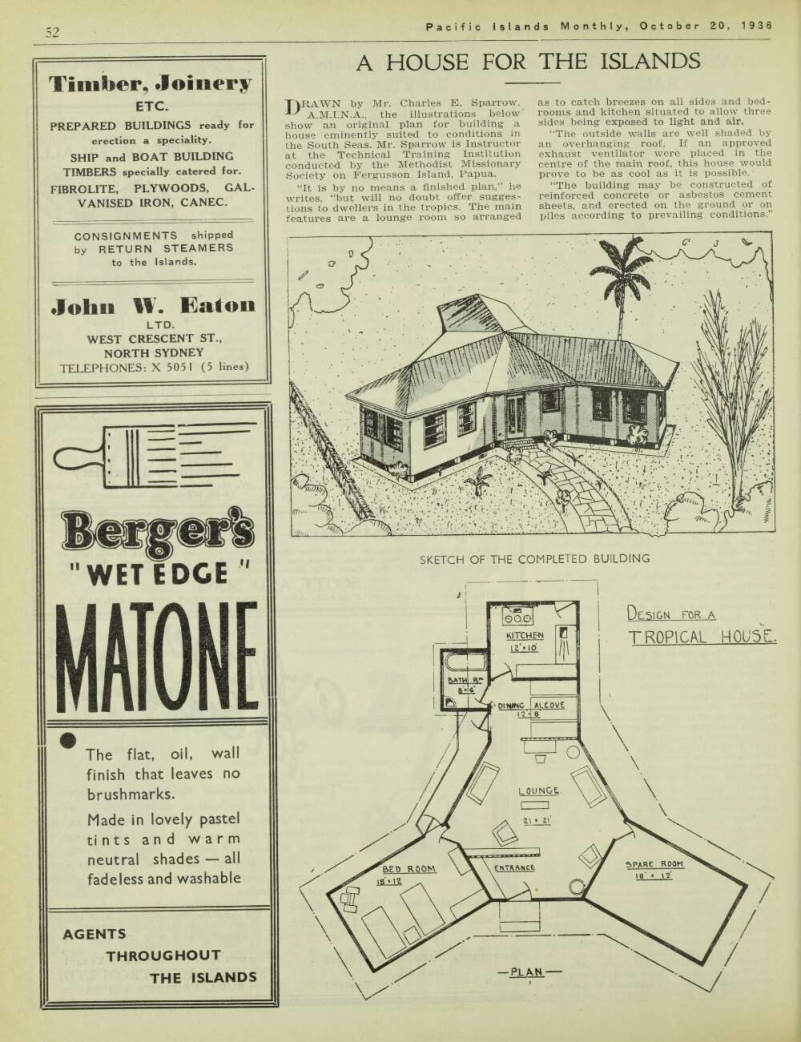
TV.RAWN by Mr. Charles E. Sparrow.
A.M.1.N.A., the illustrations below show an original plan for building a house eminently suited to conditions in the South Seas. Mr. Sparrow is Instructor at the Technical Training Institution conducted by the Methodist Missionary Society on Fergusson Island, Papua.
“It is by no means a finished plan,” he writes, “but will no doubt offer sugges tions to dwellers in the tropics. The main features are a lounge room so arranged
as to catch breezes on all sides and bed rooms and kitchen situated to allow three sides being exposed to light and air.
“The outside walls are well shaded by an overhanging roof. If an approved exhaust ventilator were placed in the centre of the main roof, this house would prove to be as cool as it is possible.
“The building may be constructed of reinforced concrete or asbestos cement sheets, and erected on the ground or on piles according to prevailing conditions.
Advertisements & other items, p. 54 (1 item)
Tropical House.
ft
SKETCH OF THE COMPLETED BUILDING
Design for a
TROPICAL HOUSE.
000
KITCHEN
LZ'MO'
a'-U'
ALCOVE
PIWMC
12 \
LOUNGE.
SPARE ROOM
16' « >2’ fNTAANCfc
BED ROOM
IB‘IZ
PLAN
N. Guinea Cocoa
Growers Still Asking For "A Fair Deal”
WE continue to receive complaints from cocoa growers in New Guinea that they are not receiving a fair deal from Australian manufacturers.
One grower in the Bainings district has sent to us the original of correspondence which he has had with a firm in Hong Kong. The latter praises the quality of the New Guinea cocoa beans and says it is prepared to arrange for regular pur chases from him at prices which will make it worth his while to sell to Hong Kong rather than to Australia.
The planter, in writing to us, remarks that it will not be difficult to beat the Australian price. The Australian buyers —“evidently with the idea of decrying the New Guinea beans and keeping down the New Guinea price”—still refuse to give the N.G. growers the price they think they are entitled to.
“It surely seems reasonable,” says our correspondent, “seeing that the Common wealth Government is prepared to pay a bonus for New Guinea beans to help the establishment of the cocoa industry here, that the Government should carry the matter a step further and put some sort of an import duty on cocoa beans grown in places other than New Guinea,”
Our correspondent says that although there appears to be a market for N.G. cocoa beans in the East, the position is that that market cannot be taken ad vantage of, because the operation of the new shipping law in New Guinea will de prive N.G. planters of the means of effect ing direct shipping from their plantations to Hong Kong.
A Port For Tavua
Goldfield
THERE has been controversy in Fiji for some weeks concerning the best means of providing the new Tavua gold field with port facilities.
On the north coast of Viti Levu, almost opposite the goldfield, which is several miles inland, there is a poor kind of port at Vatia Point, which is the western corner of Tavua Bay. To develop this port so as to make it of real use to Tavua township and the Tavua goldfield would be costly.
The alternative, it appears, is the further development of the port of Lau toka. The present wharf at Lautoka is owned by the Colonial Sugar Refining Company and is used by other interests by arrangement with the C.S.R. Co. Even under present conditions, there is much congestion in Lautoka port. It is pointed out that the Government for 30 years has collected wharfage from importers at Lautoka, representing altogether about £50,000; and it is urged that at least £30,000 of this be used in the construction of a new wharf at Lautoka, opposite Namoli village.
The argument is that it would be better for all concerned if additional wharfage were provided at Lautoka and the mer chandise, machinery, oil, etc., required for the Tavua goldfield were transported along the existing good road 40 miles from Lautoka to Tavua. This would serve the whole area of Northern Viti Levu and would do away with the necessity
for the expenditure of money to provide wharfage at Vatia Point.
It is said that if there are to be several mills established on the Tavua field and much oil is required for their motive power, it would be simple to place a pontoon in Tavua Bay alongside of which steamers could lie, and to carry a pipeline from the pontoon to the shore.
It is argued that if a port were estab lished at Tavua it would have to be a port of entry, which would mean a com
plete staff and a costly upkeep, and that the revenue from same would not pay the interest on the outlay. Such a port would serve only Ba and Tavua —which could be served more efficiently and profitably from a larger port in Lautoka.
Miss Harriet Muir, a certificated nurs ing sister, sailed from Sydney by the Macdhui on September 30 to take up duties at the Methodist Mission’s hospital at Salamo, Papua.
Advertisements & other items, p. 55 (1 item)
Fibrolite
BITUMENOID ROOFING
MADE IN AUSTRALIA
Bitumenoid Roofings, Dampcourses and Insulating Felts are made from the world’s best raw materials. Warranted to stand the most rigid tests.
BITUMENOID THE BEST
Roofing. 1,2, 3-ply; Flooring, Waterproof Materials; Saturated Felt; Resilient Road Jointing; Natural Asphalt Dampcoursc; 2 and 3-ply Dampcourse; l-21b. Lead-core Dampcourse; Roofing Cement; Asphalt Paints; Roofing Compound.
SAMPLES AND PRICE LISTS ON APPLICATION
MAXWELL PORTER & SON LTD.
ESTABLISHED 1888. BUILDERS’ SUPPLIES
107 REDFERN ST., REDFERN, SYDNEY, N.S.W. ’Phone, M 3157. Cables Bitumenoid
The Hygeia Dissolvenator. —Approved b/ Health Authorities
A Self Contained Sanitary System
SUITABLE FOR USE INDOORS
Easily and cheaply installed. Guaranteed.
NO WATER SUPPLY REQUIRED.
No odours, germs, flies or other insect pests.
Turns the excrement and paper into an innocuous solution which runs off and is absorbed by the soil.
Gives thoroughly efficient, long, care-free service.
The Shell Oil Co. alone has given 52 repeat orders. Price, F. 0.8. Sydney, £l5/10/0 Hygeia Sanitary Company 26 Bridge Street, Sydney.
Fibrolite
ASBESTOS CEMENT SHEETS
By using this Economical, Fire Retardant and White Ant Proof building material for External and Internal Walls and Ceilings, you can build a comfortable and durable Bungalow Home—AT LOW COST ! Supplied in big, sturdy building sheets in 44 handy stock sizes, "FIBROLITE" is easily and quickly erected. No waste. Less labour. No painting.
For full information, write for illustrated “Fibrolite” Booklet F.6—FREE AND POST FREE!
JAMES HARDIE & COY. LTD.
ASBESTOS HOUSE, YORK ST., SYDNEY, N.S.W.
(Box 3935 V., G.P.0., Sydney)
Kirke Bros.’ Home At Wau
Destroyed By Fire
From Our Own Correspondent WAU, Sept. 20. 4 FIRE at Wau early on the morning of September 15 totally destroyed the house occupied by Messrs. Kirke Bros.
Its origin is believed to have been the over-heating of a chicken incubator.
The sawn-timber dwelling, which was about 50ft. square, together with its contents, several fowls and a dog, were lost.
It is believed that the property was not insured, On account of the Are occurring between 3 and 5 a.m., it was not noticed by Wau residents.
Suva’S New Broadcast
Station
O ADIO listeners in Australia, late in September, heard a programme being broadcast from Station VPD2, in Suva, Fiji, by means of a relay through a Syd ney station. About the same time Mr.
B- S. B. Stevens, Premier of New South Wales, returning from Europe, had a radio-telephone chat from Suva with his colleagues in Australia.
These events were an indication of a new development in Station VPD, Suva — one of the most interesting stations in the world, because it marks the introduction of broadcasting in the South Sea Islands.
There are powerful stations in Honolulu, and in the Philippines and East Indies; but it has remained for Amalgamated Wireless (Australasia) Ltd. to introduce radio broadcasting in the Pacific Islands south of the equator.
Station YPD, Suva, is destined to be an important one. It has been soundly or ganised and established for A.W.A. by a far-sighted enthusiast in the person of Mr. F. C. Exon. It has been cordially accepted as an important local institution by the leading people of Fiji; and the manner in which the people of Suva have rallied round and provided sufficient local talent to guarantee a nightly programme of entertainment ensures the success of the station in that direction.
The station was established early in 1936. The studio and offices are located in an attractive white building on the water front at Suva. The transmitters and en gineering apparatus and aerials are some three miles out, at an eastern suburb of Suva called The Point. Here there is a number of substantial buildings, and under the vigorous direction of Mr. Exon the surrounding land has been cleared and laid down in lawns. The white build ings, under the palm trees, surrounded by grassy slopes and brilliant flowering shrubs, with the lagoon in the back ground, make a very attractive picture.
The new development referred to is the installation of a new and much more powerful transmitter. This has given wider reception, and has made two-way telephone conversation possible between Fiji and the countries surrounding the Pacific.
Not long ago a special programme of Fijian songs and music was transmitted from VPD to America, where it was very successfully relayed over the major net work of the National Broadcasting Cor poration.
Native Youth’S Ordeal
Adrift in Canoe for 34 Days
HHHE pious courage and remarkable fortitude of a 17-years-old Tokelau native who was tossed about the Pacific for 34 days when his canoe was blown off its course, was praised recently by Rev. Joseph Deihl, of Apia, Samoa, in his Mission paper Astride the Times.
It appears that the young native be came lonely and homesick while at the atoll of Fakaofo in the Tokelau Group (north of Western Samoa). He dragged his canoe over the reefs, set his mat sail, and steered westward for Nukunono, 45 miles distant: but an adverse wind sprang up sweeping the frail craft in a contrary direction.
Ten coconuts helped to sustain the boy’s life for two days, then followed a long, biting fast relieved only when he caught with his hands a fish that scudded beneath the drifting canoe. There were occasional rain showers, but having nothing with which to catch the water, the native drank sea-water.
Day, nig-ht; day, night; the alternating burning and cool hours passed in seem ingly endless procession. Barely able to keep alive, the youth was carried over two hundred miles south-east for 34 days.
Wretched, weary, covered with boils and in a collapsed condition, he was picked up near the small island of Aunuu off the coast of Tutuila, the main island in American Samoa, from whence he was later taken to Apia.
Miss Broughton, of Springsure, Queens land. arrived at Thursday Island in Sep tember to join the staff of the Torres Straits Hospital.
Advertisements & other items, p. 56 (1 item)
Repaint
These asbestos cement sheets give walls a tiled appearance at less cost. See examples in our showrooms or write for leaflet.
WUNDERLICH LTD.
Crown & Cleveland Sts., Rechfern, Sydney
REMEMBER THE NAME
DUPATILf
or?* *
RECOMMENDED!
"SUN” Brand Paint on your Home means
definite PROTECTION against tropical
sun and sea-moist air.
Sun Proof and Rain Proof on every Surface
REPAINT
W. R. CARPENTER & CO., LTD.
NEW GUINEA, SOLOMON ISLANDS
and all other South Sea Islands.
Criticism Of N.G. Legislative Council
Charge That Native, Asiatic, and Half-Caste Interests are not Properly Safeguarded (CONTRIBUTED BY A RESIDENT OF NEW GUINEA)
THE traditional policy of Britain is to give the largest measure of self-gov ernment to the different peoples of its vast and scattered possessions. When civil administration replaced military occupa tion in the Mandated Territory of New Guinea on May 9, 1921, nothing was more natural than that the desire for some sort of local self-government would become popular. But the problem then, as now, was what sort of local self-government could be set up that would legislate with justice, equity and efficiency under the Mandate in such a cosmopolitan land?
The Territory is not owned by Australia or even by Britain. Australia is for the time being merely its caretaker, or mana ger, and responsible to a higher power at Geneva.
The Mandate which Australia holds states that the material and moral welfare, as well as the social progress of those liv ing under the Mandate, must be the first consideration.
The peoples comprise black, white, and Asiatic. By far the largest portion of the population are the natives, low in mental ity, even among native races, and obviously unfit to take any part in government. Next comes a large and rapidly increasing Asiatic and half-caste population, almost all of whom are locally born and conse quently can claim to be true natives of the soil. These people, though socially in ferior to Europeans, are well educated, and full contributors to the taxes of the Terri tory. Lastly, there is the ever changing European section of the people, most of whom are Australians who arrived after the war.
Doubtless a very difficult problem faced Canberra in providing a Legislative Coun cil. After much delay and discussion it was decided that the Council should com prise the heads of the various Government Departments, under the Presidency of the Administrator, and a number of non official members representing planters miners, and commercial interests.
Obviously, the only one in the Council apart from the Administrator, with any interest in native or Asiatic and half-caste welfare is the Director of Native Services.
The official members are city men, and the planters, miners and others are purely in terested parties.
The question arose when the Council was in process of formation as to what repre sentation the large body of Christian mis sionaries should have in it. Many of these spe " t their lives and talents in uplifting the natives and are lightening taxation by their purely gratuitous work in the fields of education and public health.
Colonel Ainsworth, in his masterly re the affairs of the Territory, stated that the missionaries are the only people uho really know the natives; yet they are in spite of more than a half-century of experience, unrepresented in a Council whose activities should embrace native welfare.
TjVDLLOWING the deliberations of the Legislative Council, it is difficult to evade the conclusion that it is becoming more and more the mouthpiece of the Planters’ Association. That benign body is of comparatively recent origin. Many of its members are not very experienced
planters. They secured, on money bor rowed from the Islands Companies, the plantations taken from the pioneer Ger man planters, who happened to be the subjects of a conquered race. This body assists to lay down a policy to be followed in the Territory and. I fear, often from narrow and interested motives.
Until a few years ago, the Chinese trader was a well-known and appreciated identity in most native villages. He bought the coconuts of the natives and paid for them with cash on the spot. Moreover, his well filled little store was a boon to village life.
A few years ago a cry was raised that these Chinese traders were buying coco nuts stolen by the natives from neigh bouring plantations. The charge, which probably contained a modicum of truth, resulted in the closing of all stores within two miles of a plantation.
What has been the result?
(Continued on next page.)
THE Chinese, most of whom are local born, were driven to the already gested areas known as “Chinatowns” around the ports, where no employment is available. In the villages, the natives, instead of selling their produce on the spot for cash, are forced to bring it to the local planter, who pays for it with sticks of tobacco.
Imagine a native carrying thirty nuts a mile or even two miles to be rewarded with a threepenny stick of tobacco! When they asked the planters to come up with a motor lorry into the village, and collect the produce as the Chinese trader had done, the request was laughed at. The
result is that large areas of country, with numerous villages and thousands of na tives, are virtually controlled by a handful of planters who can state their own con ditions to the natives.
Go into the villages, and the same sorry sight is everywhere met —thousands of coconuts rotting into the ground, merely because the Chinese trader has been driven out, and it is well nigh impossible to dis pose of the produce now.
The present Administrator evidently saw the baneful effect of the two-mile limit system, and abolished it;, but, as usual, only the planter’s case is presented, and the native is ignored. Now attempts are being made to restore the system which has already resulted in the loss of thous ands of tons of produce to the Territory.
WHEN the Native Labour Ordinance was to be introduced by the Director of Native Services, threats were made to ruin his reputation unless the proposed Ordinance was shorn of every item dis pleasing to the Planters’ Association.
Ninety questions were prepared, most of which were quite irrelevant, concerning statements alleged to have been made by the Director in England concerning the opening up of the New Guinea country.
In my opinion, there is not a member of the Council who has a complete and pro per knowledge of those two large bodies of people (Native and Asiatic). Yet we were told by General Griffith, on the opening day, that the Legislative Council was for the benefit of the Territory as a whole, and not one section of it.
When will those pressing problems— native education, child-welfare, orphan welfare, housing of Asiatics and half castes, education of Asiatics and half castes —come up for discussion? Never, in my opinion, until the Legislative Council includes adequate representation of those classes of people most in need of help.
Advertisements & other items, pp. 57-58 (1 item)
Konkrete Paint
For EVERY SURFACE where Permanence is Imperative--!
Adaptability for the varying climatic conditions of the Pacific Islands has been abundantly proved by users.
KONKRETE Standard Gloss and Flat Colours for wood, brick, fibro, cement, iron
KONKRETE PAINT IS
THE SOLUTION
Complete price list and colour card from sole wholesale distributors for N.S.W. and Pacific Islands.
H. Florentine and Son
321 Pitt Street, Sydney, N.S.W. and stone.
Woven Wire /or All Industry
COPRA DRYING TRAYS. FLOORS. Etc.
FRUIT DRYING TRAYS. MINING SCREENS
Heavy Mosquito Gauze in Phosphor Bronze and Other Metals Impervious to Salt Sea Air WIRE DOOR MATS AND GENERAL WIRE WORKS
E. Will GUT A CO. LTD.
Office and Works: 148-152 Cleveland St. f Sydr>ey, N.S.W.
Telegraphic Address: "Wrightmake,” Chippendale.
CUPRINOL
—for Protection against
• WHITE ANTS
Official tests conducted by Union of South Africa, Forest Department, at Pienaars River with Eucalyptus saligna.
Test started 11/9/30—Treatment by immersion in Green Cuprinol.
Inspections island Distributors.
PAUL A GRAY LTD
82-84 SUSSEX STREET, SYDNEY
SAMUEL RUSSELL
ESTATE AND GENERAL AGENT
P.O. Box 64, Papeete, Tahiti
Real Estate. Investments. Estate Management and Administration. Valuations and Reports. Houses & Lands for Lease or Sale.
Sole Proprietor: TAHITI PERFUMES.
Cables; Russell, Tahiti (Bentley’s Code)
PRODUCING UNIFORM GOOD RESULTS SINCE 1868
Flour
ALWAYS ASK FOR IT
Nelson and Robertson Ltd.
(ESTABLISHED
1895)
Island Merchants
COCOA BEANS. —Special attention devoted to their sale in Australian and Oversea markets.
COPRA, TROCHUS SHELL, and other Island Produce sold on commission.
All classes of merchandise and Mining Machinery purchased at wholesale prices and original invoices supplied to Island clients. Small commission.
Prices submitted for comparison.
SOLE AGENTS FOR
PUMPMOBIL Portable Pumping Plants. Recommended for Sluicing and all Mining purposes. Weight 120 lbs., 12,000 gals, per hour, 10 to 100 feet head.
REDUCED PRICES.
ARCHIMEDES.—Latest in outboards; Swedish manufacture.
SKANDIA ENGINES, FULL DIESEL AND SEMI-DIESEL; all powers, Marine and Stationary.
UPSON BRITISH BOARD. —Wallboard and insulating material in one, strong and light in weight. 6ft. to 12ft. lengths always in stock.
NELSON AND ROBERTSON LIMITED
12 SPRING STREET, SYDNEY, AUSTRALIA
Telegraphic Address: “Ivan Sydney”
Suggest Previous High Culture
Ancient Relics
Suggest Previous High Culture in Papua
From Our Own Correspondent
Pt. Moresby, Sept. 8.
A STONE pestle and mortar have re cently been unearthed under many feet of ground on the Lakekamu goldfield.
Stone clubs of unusual design, and a skeleton that crumbled to dust on an at tempt being made to remove it from its position, many feet below the surface, have also been found.
Relics of a former occupation in the territory are continually coming to light.
Stone pestles and mortars have been dis covered for years past in various parts of the country by prospectors and miners.
On the Gira goldfields long ago a stone figure of a bird with the head and neck of a snake was dug up from a depth of 20ft. An obsidian battle axe and a peculiar shaped alabaster club were also uncovered on the Yodda field, 70ft. below the surface.
These unique relics and “the upper por tion of a man’s body cut in hard stone, 20 inches in height,” with features re sembling those of an African negro, found not far from Buna Bay, suggest that at some time, long years ago, the country harboured men who worked in stone.
Explanations have been put forth that these relics were either left behind by some former occupation or that they are evidence of the retrogression of the Papuan from some higher civilisation.
The natives in whose districts these relics have been found can offer no explanation as to their use or where they originally came from, nor do they show any signs of ever having attempted to make any thing resembling them.
Right Rev. John Hubert Dickinson, M.A., Assistant Bishop of Melanesia, arrived in Sydney by the Macdhui on September 25 on his way to England, via South Africa.
Mr. Dwight Long, that adventurous young American navigator, writes to the Editor from Singapore, which he appears to have reached early in September. Mr.
Long navigated his tiny ketch Idle Hour from U.S.A. across the Pacific to Auck land via various Pacific island groups; thence to Sydney; thence via the Great Barrier Reef and Torres Straits to the Dutch East Indies. He says that he ex pects to be in Singapore until November, in Ceylon until December and thence he is going, via Aden and the Suez Canal, to London to see the Coronation of Edward
Viii.
Silver Wedding On
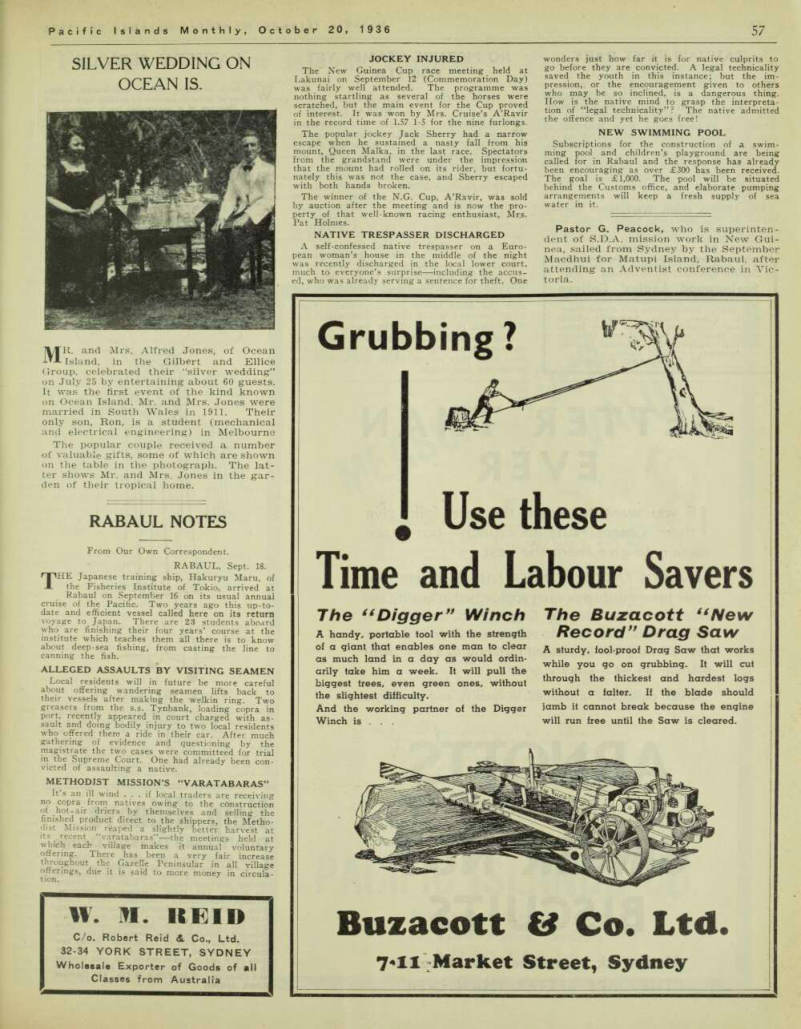
Ocean Is.
IV/TR, and Mrs. Alfred Jones, of Ocean -‘-’A Island, in the Gilbert and Ellice Group, celebrated their “silver wedding” on July 25 by entertaining about 60 guests.
It was the first event of the kind known on Ocean Island. Mr. and Mrs. Jones were married in South Wales in 1911. Their only son, Ron, is a student (mechanical and electrical engineering) in Melbourne The popular couple received a number of valuable gifts, some of which are shown on the table in the photograph. The lat ter shows Mr. and Mrs. Jones in the gar den of their tropical home.
Rabaul Notes
From Our Own Correspondent.
Rabaul, Sept. 18.
THE Japanese training ship, Hakuryu Maru, of the Fisheries Institute of Tokio, arrived at Rabaul on September 16 on its usual annual cruise of the Pacific. Two years ago this up-to date and efficient vessel called here on its return voyage to Japan. There are 23 students aboard who are finishing their four years’ course at the institute which teaches them all there is to know about deep-sea fishing, from casting the line to canning the fish.
Alleged Assaults By Visiting Seamen
Local residents will in future be more careful about offering wandering seamen lifts back to their vessels after making the welkin ring. Two greasers from the s.s. Tynbank, loading copra in port, recently appeared in court charged with as sault and doing bodily injury to two local residents who offered them a ride in their car. After much gathering of evidence and questioning by the magistrate the two cases were committeed for trial in the Supreme Court. One had already been con victed of assaulting a native.
Methodist Mission’S “Varatabaras”
It s an ill wind ... if local traders are receiving no copra from natives owing to the construction of hot-air driers by themselves and selling the finished product direct to the shippers, the Metho dist Mission reaped a slightly better harvest at its recent “varatabaras”—the meetings held at which each village makes it annual voluntary offering. There has been a very fair increase throughout the Gazelle Peninsular in all village offerings, due it is said to more money in circula tion.
Jockey Injured
The New Guinea Cup race meeting held at Lakunai on September 12 (Commemoration Day) was fairly well attended. The programme was nothing startling as several of the horses were scratched, but the main event for the Cup proved of interest. It was won by Mrs. Cruise’s A’Ravir in the record time of 1.57 1-5 for the nine furlongs.
The popular jockey Jack Sherry had a narrow escape when he sustained a nasty fall from his mount, Queen Malka, in the last race. Spectators from the grandstand were under the impression that the mount had rolled on its rider, but fortu nately this was not the case, and Sherry escaped with both hands broken.
The winner of the N.G. Cup, A’Ravir, was sold by auction after the meeting and is now the pro perty of that well-known racing enthusiast, Mr.s.
Pat Holmes.
Native Trespasser Discharged
A self-confessed native trespasser on a Euro pean woman’s house in the middle of the night was recently discharged in the local lower court, much to everyone’s surprise—including the accus ed, who was already serving a sentence for theft. One
wonders just how far it is for native culprits to go before they are convicted. A legal technicality saved the youth in this instance; but the im pression, or the encouragement given to others who may be so inclined, is a dangerous thing.
How is the native mind to grasp the interpreta tion of “legal technicality”? The native admitted the offence and yet he goes free!
New Swimming Pool
Subscriptions for the construction of a swim ming pool and children’s playground are being called for in Rabaul and the response has already been encouraging as over £3OO has been received.
The goal is £l,OOO. The pool will be situated behind the Customs office, and elaborate pumping arrangements will keep a fresh supply of sea water in it.
Pastor G. Peacock, who is superinten dent of S.D.A. mission work in New Gui nea, sailed from Sydney by the September Macdhui for Matupi Island, Rabaul, after attending an Adventist conference in Vic toria.
Advertisements & other items, p. 59 (1 item)
Grubbing ?
Use these
Time and Labour Savers
The “Digger" Winch
A handy, portable tool with the strength of a giant that enables one man to clear as much land in a day as would ordinarily take him a week. It will pull the biggest trees, even green ones, without the slightest difficulty.
And the working partner of the Digger Winch is . . .
The Buzacott “New
Record" Drag Saw
A sturdy, fool-proof Drag Saw that works while you go on grubbing. It will cut through the thickest and hardest logs without a falter. If the blade should jamb it cannot break because the engine will run free until the Saw is cleared.
Buzacott & Co. Ltd.
7*ll Market Street, Sydney
W. M. REID
C/o. Robert Reid <£. Co., Ltd.
32-34 YORK STREET, SYDNEY
Wholesale Exporter of Goods of all Classes from Australia
Tavua’S First Baby
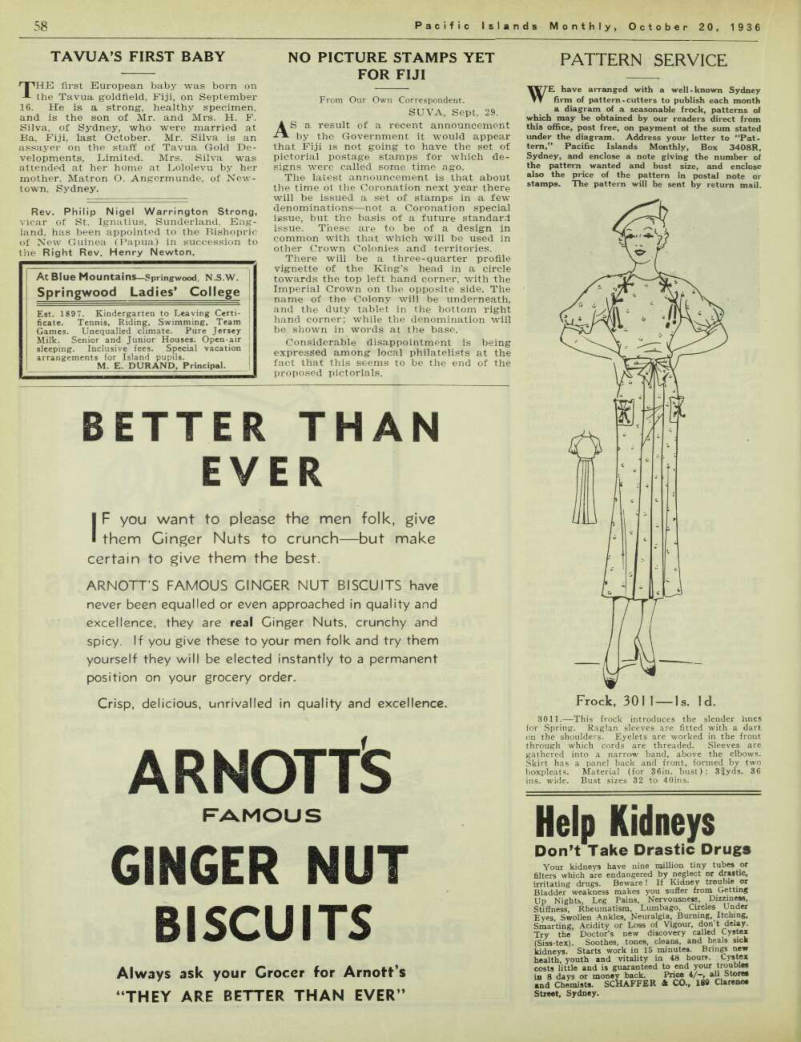
THE first European baby was born on the Tavua goldfield, Fiji, on September 16. He is a strong, healthy specimen, and is the son of Mr. and Mrs. H. F.
Silva, of Sydney, who were married at Ba, Fiji, last October. Mr. Silva is an assayer on the staff of Tavua Gold De velopments, Limited. Mrs. Silva was attended at her home at Lololevu by her mother. Matron O. Angermunde, of New town, Sydney.
Rev. Philip Nigel Warrington Strong, vicar of St. Ignatius, Sunderland, Eng land, has been appointed to the Bishopric of New Guinea (Papua) in succession to the Right Rev. Henry Newton.
No Picture Stamps Yet
For Fiji
From Our Own Correspondent.
SUVA, Sept. 29.
AS a result of a recent announcement by the Government it would appear that Fiji is not going to have the set of pictorial postage stamps for which de signs were called some time ago.
The latest announcement is that about the time ot the Coronation next year there will be issued a set of stamps in a few denominations —not a Coronation special issue, but the basis of a future standard issue. These are to be of a design in common with that which will be used in other Crown Colonies and territories.
There will be a three-quarter profile vignette of the King’s head in a circle towards the top left hand corner, with the Imperial Crown on the opposite side. The name of the Colony will be underneath, and the duty tablet in the bottom right hand corner; while the denomination will be shown in words at the base.
Considerable disappointment is being expressed among local philatelists at the fact that this seems to be the end of the proposed pictorials.
Pattern Service
WE have arranged with a well-known Sydney firm of pattern - cutters to publish each month a diagram of a seasonable frock, patterns of which may be obtained by our readers direct from this office, post free, on payment of the sum stated under the diagram. Address your letter to “Pat tern," Pacific Islands Monthly, Box 3408 R, Sydney, and enclose a note giving the number of the pattern wanted and bust size, and enclose also the price of the pattern in postal note or stamps. The pattern will be sent by return mail.
3011.—This frock introduces the slender lines for Spring. Raglan sleeves are fitted with a dart on the shoulders. Eyelets are worked in the front through which cords are threaded. Sleeves are gathered into a narrow band, above the elbows.
Skirt has a panel back and front, formed by two boxpleats. Material (for 36in. bust): 3|yds. 36 ins. wide. Bust sizes 32 to 40ins.
Frock, 3011—1s. 1d.
Advertisements & other items, p. 60 (2 items)
Arnottjs
At Blue Mountains— Springwood, N.S.W.
Springwood Ladies* College
Est. 1897. Kindergarten to Leaving Certificate. Tennis, Riding, Swimming, Team Games. Unequalled climate. Pure Jersey Milk. Senior and Junior Houses. Open-air sleeping. Inclusive fees. Special vacation arrangements for Island pupils.
M. E. DURAND, Principal.
BETTER THAN
EVER
IF you want to please the men folk, give them Ginger Nuts to crunch —but make certain to give them the best.
ARNOTT’S FAMOUS GINGER NUT BISCUITS have
never been equalled or even approached in quality and excellence, they are real Ginger Nuts, crunchy and spicy. If you give these to your men folk and try them yourself they will be elected instantly to a permanent position on your grocery order.
Crisp, delicious, unrivalled in quality and excellence.
ARNOTTJS
FAMOUS
GINGER NUT
BISCUITS
Always ask your Grocer for Arnett’s
“THEY ARE BETTER THAN EVER”
Help Kidneys
Don’t Take Drastic Drugs
Your kidneys have nine million tiny tubes or filters which are endangered by neglect or drastic, irritating drugs. Beware ! If Kidney trouble or Bladder weakness makes you suffer from Getting Up Nights, Leg Pains, Nervousness, Dizziness, Stiffness, Rheumatism, Lumbago, Circles Under Eyes, Swollen Ankles, Neuralgia, Burning, Itching, Smarting, Acidity or Loss of Vigour, don’t delay.
Try the Doctor’s new discovery called Cystex (Siss-tex). Soothes, tones, cleans, and heals sick kidneys. Starts work in 15 minutes. Brings new health, youth and vitality in 48 hours. Cystex costs little and is guaranteed to end your troubles in 8 days or money back. Price 4/-, all Store* and Chemists. SCHAFFER * CO., 189 Clarence Street, Sydney.
Fashion Hints for Islands Women
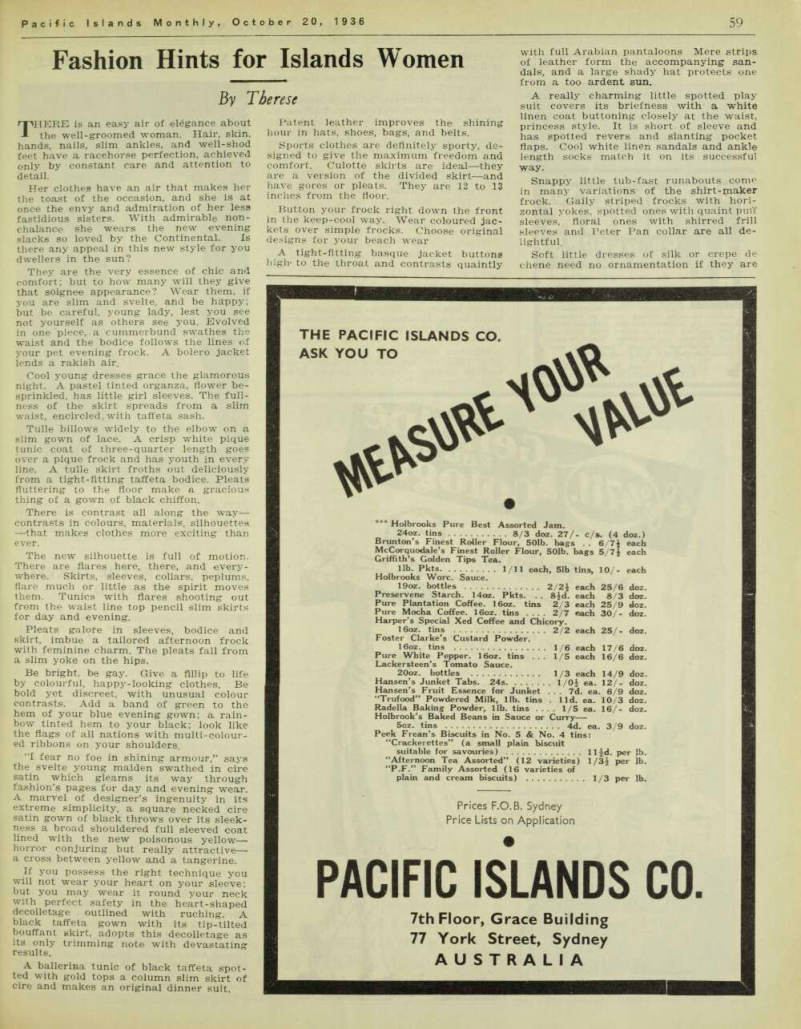
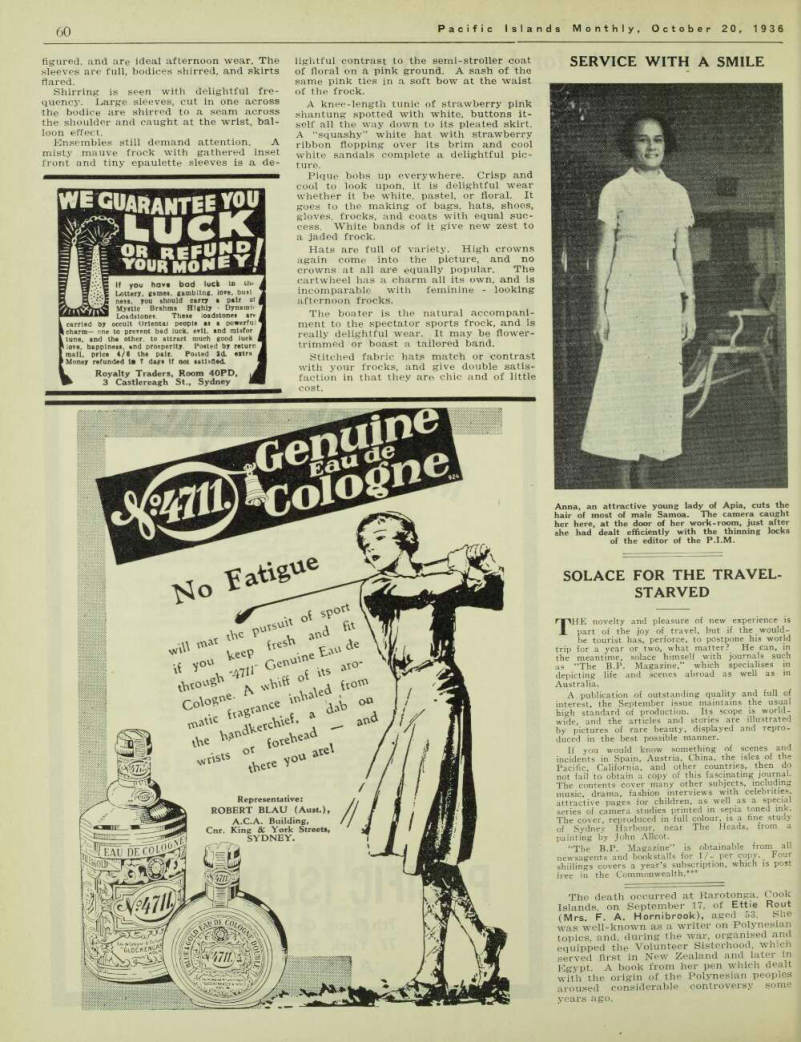
By Therese
THERE is an easy air of elegance about the well-groomed woman. Hair, skin, hands, nails, slim ankles, and well-shod feet have a racehorse perfection, achieved only by constant care and attention to detail.
Her clothes have an air that makes her the toast of the occasion, and she is at once the envy and admiration of her less fastidious sisters. With admirable non chalance she wears the new evening slacks so loved by the Continental. Is there any appeal in this new style for you dwellers in the sun?
They are the very essence of chic and comfort: but to how many will they give that soignee appearance? Wear them, if you are slim and svelte, and be happy; but be careful, young lady, lest you see not yourself as others see you. Evolved in one piece, a cummerbund swathes the waist and the bodice follows the lines of your pet evening frock. A bolero jacket lends a rakish air.
Cool young dresses grace the glamorous night. A pastel tinted organza, flower be sprinkled, has little girl sleeves. The full ness of the skirt spreads from a slim waist, encircled,with taffeta sash.
Tulle billows widely to the elbow on a slim gown of lace. A crisp white pique tunic coat of three-quarter length goes over a pique frock and has youth in every line. A tulle skirt froths out deliciously from a tight-fitting taffeta bodice. Pleats fluttering to the floor make a gracious thing of a gown of black chiffon.
There is contrast all along the way— contrasts in colours, materials, silhouettes —that makes clothes more exciting than ever.
The new silhouette is full of motion.
There are flares here, there, and every where. Skirts, sleeves, collars, peplums, flare much or little as the spirit moves them. Tunics with flares shooting out from the waist line top pencil slim skirts for day and evening.
Pleats galofe in sleeves, bodice and skirt, imbue a tailored afternoon frock with feminine charm. The pleats fall from a slim yoke on the hips.
Be bright, be gay. Give a fillip to life by colourful, happy-looking clothes. Be bold yet discreet, with unusual colour contrasts. Add a band of green to the hem of your blue evening gown; a rain bow tinted hem to your black; look like the flags of all nations with multi-colour ed ribbons on your shoulders.
“I fear no foe in shining armour,” says the svelte young maiden swathed in cire satin which gleams its way through fashion’s pages for day and evening wear, A marvel of designer’s ingenuity in its extreme simplicity, a square necked cire satin gown of black throws over its sleek ness a broad shouldered full sleeved coat lined with the new poisonous yellow— horror conjuring but really attractive— a cross between yellow and a tangerine.
If you possess the right technique you will not wear your heart on your sleeve: but you may wear it round your neck with perfect safety in the heart-shaped decolletage outlined with ruching. A black taffeta gown with its tip-tilted bouffant skirt, adopts this decolletage as its only trimming note with devastating results.
A ballerina tunic of black taffeta spot ted with gold tops a column slim skirt of cire and makes an original dinner suit.
Patent leather improves the shining hour in hats, shoes, bags, and belts.
Sports clothes are definitely sporty, de signed to give the maximum freedom and comfort. Culotte skirts are ideal—they are a version of the divided skirt —and have gores or pleats. They are 12 to 13 inches from the floor.
Button your frock right down the front in the keep-cool way. Wear coloured jac kets over simple frocks. Choose original designs for your beach wear A tight-fitting basque jacket buttons high* to the throat and contrasts quaintly
with full Arabian pantaloons Mere strips of leather form the accompanying san dals, and a large shady hat protects one from a too ardent sun.
A really charming little spotted play suit covers its briefness with a white linen coat buttoning closely at the waist, princess style. It is short of sleeve and has spotted revers and slanting pocket flaps. Cool white linen sandals and ankle length socks match it on its successful way.
Snappy little tub-fast runabouts come in many variations of the shirt-piaker frock. Gaily striped frocks with hori zontal yokes, spotted ones with quaint puff sleeves, floral ones with shirred frill sleeves and Peter Pan collar are all de lightful.
Soft little dresses of silk or crepe de chene need no ornamentation if they are
figured, and are ideal afternoon wear. The sleeves are full, bodices shirred, and skirts flared.
Shirring is seen with delightful fre quency. Large sleeves, cut in one across the bodice are shirred to a seam across the shoulder and caught at the wrist, bal loon effect.
Ensembles still demand attention. A misty mauve frock with gathered inset front and tiny epaulette sleeves is a de
lightful contrast to the semi-stroller coat of floral on a pink ground. A sash of the same pink ties in a soft bow at the waist of the frock.
A knee-length tunic of strawberry pink shantung spotted with white, buttons it self all the way down to its pleated skirt.
A “squashy” white hat with strawberry ribbon flopping over its brim and cool white sandals complete a delightful pic ture.
Pique bobs up everywhere. Crisp and cool to look upon, it is delightful wear whether it be white, pastel, or floral. It goes to the making of bags, hats, shoes, gloves, frocks, and coats with equal suc cess. White bands of it give new zest to a jaded frock.
Hats are full of variety. High crowns again come into the picture, and no crowns at all are equally popular. The cartwheel has a charm all its own, and is incomparable with feminine - looking afternoon frocks.
The boater is the natural accompani ment to the spectator sports frock, and is really delightful wear. It may be flower trimmed or boast a tailored band.
Stitched fabric hats match or contrast with your frocks, and give double satis faction in that they are chic and of little cost.
Advertisements & other items, pp. 61-62 (1 item)
Pacific Islands Co.
THE PACIFIC ISLANDS CO.
ASK
*** Holbrooks Pure Best Assorted Jam. 240 z. tins 8/3 doz. 27/- c/s. (4 doz.) Brunton’s Finest Roller Flour, 50lb. bags . . 6/7 i each McCorquodale’s Finest Roller Flour, 501 b. bags 5 7i each Griffith’s Golden Tips Tea. lib. Pkts 1/11 each, 51b tins, 10/- each Holbrooks Wore. Sauce. 19oz. bottles 2/2* each 25/6 doz.
Preservene Starch. 14oz. Pkts. . . B*d. each 8/3 doz.
Pure Plantation Coffee. 16oz. tins 2/3 each 25/9 doz.
Pure Mocha Coffee. 16oz. tins ... 2/7 each 30/- doz.
Harper’s Special Xed Coffee and Chicory. 16oz. tins 2/2 each 25/- doz.
Foster Clarke’s Custard Powder. 16oz. tins 1/6 each 17/6 doz.
Pure White Pepper. 16oz. tins ... 1/5 each 16/6 doz.
Lackersteen’s Tomato Sauce. 20oz. bottles 1/3 each 14/9 doz.
Hansen’s Junket Tabs. 24s 1/0* ea. 12/- doz.
Hansen’s Fruit Essence for Junket . . . 7d. ea. 6/9 doz.
“Trufood” Powdered Milk, 11b. tins . lid. ea. 10/3 doz.
Radella Baking Powder, 11b. tins ... 1/5 ea. 16/- doz.
Holbrook’s Baked Beans in Sauce or Curry— -soz. tins 4d. ea. 3/9 doz.
Peek Frean’s Biscuits in No. 5 & No. 4 tins; “Crackerettes” (a small plain biscuit suitable for savouries) ll*d. per lb.
“Afternoon Tea Assorted” (12 varieties) 1/3* per lb.
“P.F.” Family Assorted (16 varieties of plain and cream biscuits) 1/3 per lb.
PACIFIC ISLANDS CO.
Prices F. 0.8. Sydney
Price Lists on Application
7th Floor, Grace Building
77 York Street, Sydney
AUSTRALIA
I If you hova bad luck u> th»- Lottery, games, gambling, lore, bust ness, you should carry a pair ot , Mystic Brahma Highly • Dynaml- Loadstones. These loadstones are. carried by occult Oriental people as a powerful 1 I charm — one to prevent bad luck. evil, and mlsfor tune, and the other, to attract much good luck Hove, happiness, and prosperity. Posted by return mall, price 4/6 the pair. Posted 2d. eitra • Money refunded 1> 7 days If not satisfied.
Royalty Traders, Room 40PD,
3 Castlereagh St., Sydney
Co* sp o* de \ne GC ° c vxs *°“
Vdtf °\ A fcot*
oo d» b ao //, T t Vvc P' **' «*** Veep V ° l V -4711’
XVvt° V Rl \V V - . ,\oß»*- N taoC e iwtcW • , *e (ot e^ '* t ' stS °u.re V° U Representative:
ROBERT BLAU (Aust.),
A.C.A. Building, Cnr. King &. York Streets,
SYDNEY.
Service With A Smile
Anna, an attractive young lady of Apia, cuts the hair of most of male Samoa. The camera caught her here, at the door of her work-room, just after she had dealt efficiently with the thinning locks of the editor of the P.I.M.
Solace For The Travel
Starved
THE novelty and pleasure of new experience is part of the joy of travel, but if the would be tourist has, perforce, to postpone his world trip for a year or two, what matter? He can, in the meantime, solace himself with journals such as “The B.P. Magazine,” which specialises in depicting life and scenes abroad as well as in Australia.
A publication of outstanding quality and full of interest, the September issue maintains the usual high standard of production. Its scope is world wide, and the articles and stories are illustrated by pictures of rare beauty, displayed and repro duced in the best possible manner.
If you would know something of scenes and incidents in Spain, Austria, China, the isles of the Pacific, California, and other countries, then do not fail to obtain a copy of this fascinating journal.
The contents cover many other subjects, including music, drama, fashion interviews with celebrities, attractive pages for children, as well as a special series of camera studies printed in sepia toned ink.
The cover, reproduced in full colour, is a fine study of Sydney Harbour, near The Heads, from a painting by John Allcot.
“The B.P. Magazine” is obtainable from all newsagents and bookstalls for 1/- per copy. Four shillings covers a year’s subscription, which is post free in the Commonwealth.*** The death occurred at Rarotonga, Cook Islands, on September 17, of Ettie Rout (Mrs. F. A. Hornibrook), aged 53. She was well-known as a writer on Polynesian topics, and, during the war, organised and equipped the Volunteer Sisterhood, which served first in New Zealand and later in Egypt. A book from her pen which dealt with the origin of the Polynesian peoples aroused considerable controversy some years ago.
Appeal Upheld by Higher
Suva’S Mayoral Chain
Appeal Upheld by Higher Court
From Our Own Correspondent.
SUVA, Sept. 29.
THE farcical case concerning the dis posal of the Mayoral chain of the now defunct Suva Municipal Council seems to have been settled at last.
The three ex-Councillors (Messrs. J. T.
Johnson, J. A. Muir, and Dr. I. Hamilton Beattie) when they were ordered by the Acting-Chief Police Magistrate, Mr. A. J.
Armstrong, to pay the value of the chain and the costs of the prosecution, decided to appeal and took the matter to the Supreme Court.
There, before the Chief Justice (Mr. O.
C. K. Corrie), Mr. G. F. Grahame, counsel for the appellants, began by raising the point that the Magistrate did not have jurisdiction to try the case, as the ordin ance under which the prosecution was brought by the auditors, Messrs. W. R.
Main and A, E. Pearce, distinctly said that such prosecutions should be brought in the Supreme Court.
This point had been raised in the lower court, but there, the Magistrate had up held the view of the opposing counsel, Mr. R. A. Crompton, that the Court was that of a Commissioner of the Supreme Court, or the Supreme Court in its sum mary jurisdiction, and that as the amount involved was less than £5O, he had the power to try the case.
Before hearing Mr. Grahame further, His Honour said he would like to decide this point, as the whole case hinged on it.
He heard Mr. Crompton’s arguments, and then after an hour’s retirement, gave a considered judgment to the effect that the Magistrate did not have the jurisdic tion to try the case, and upheld the ap peal, giving costs against the respondents.
It is not known whether the auditors will now take proceedings in the Supreme Court, but local opinion seems to be that they will let the matter drop
Progress of Woodcrafts Ltd.
Samoan Industry
progress is being made in the organisation of a new industry in Samoa namely, Island Woodcrafts Limited which is using indigenous woods for the manufacture of very beau tiful wooden articles much in demand by tourists, especially salad bowls and servers, breakfast sets, buffet sets for luncheon and supper, coffee trays, tea trays, decorative bowls and vases. The designs employed, while quite modern retain an attractive suggestion of their Islands origin.
For over 100 years white men in Samoa built boats, houses, and vehicles, but al ways of timbers imported from California, New Zealand or Australia. Isolated attempts were made in a half-hearted fashion to make us© of Samoan timbers; and indeed a few sample logs were ex ported, but the experiments were unsuc cessful.
It was not until about eight years ago that any serious attempt was made to try out indigenous timbers in Upolu. It was obvious at the outset that the proposition was not one that a sawmiller might suc cessfully tacjde. There are no aggrega tions of timber where a mill could be profitably operated: and the terrain is such that log-hauling cannot be even thought of. There are no rivers or streams large enough to float logs to a mill in payable numbers.
There remained only ornamental woods which might b© profitably handled in small quantities. Among them are the Tulipwood and Wild Almond, of India, together with some really unique and beautiful indigenous woods. It was when attempting to season the latter that a real problem was encountered.
One small group, the saps of which contain alkaloids and oil of wintergreen. can, when sawn green, be seasoned by the common method of racking. The greater number, however, cannot be so treated as they yield sawn stock which
becomes putrescent in from 12 to 36 hours after leaving the saw.
Putrescence is due to violent ferments -—most likely from fruit-fly infection— which decomposes the cellulose of the timber.
It became quickly evident that stock which emitted offensive odours when dry ing could not resist dry rot, o.r other fungoid attacks. It was also observed that elasticity was lost, and with it most of the character and colour of the timber.
It was believed that many Islands woods were valuable enough to spend money and time upon; and research work was com menced. It took six years of careful work before the results justified the experi menter in saying that these unstaple saps could be neutralised upon a commercial basis, and that fine ornamental woods, previously useless, could be offered with
full assurance of their resistance to attacks by fungoid diseases and white ants.
During the years while experimental batches of seasoning were being observed, furniture and other articles were being manufactured. By the time the seasoning methods were approved there existed an overseas market for many lines in Islands woods.
The venture was then incorporated under the name of Island Woodcrafts Limited. A suction gas power plant and suitable mill saw are being erected, and a factory building will follow as soon as timber can be sawn for its erection.
Mr. A. L. Schultze, of Kavieng, New Guinea, sailed by the m.v. Rabaul for Europe early in October on a six months’ holiday.
Advertisements & other items, pp. 63-64 (1 item)
advt
JS Lingerie of the highest quality. You can obtain Slips, Vests, Knickers in many styles as well as Pyjamas, Nighties, Kiminos and Dressing Jackets, too. € a
Lustre Lingerie
is obtainable frpm
BURNS PHILP
at all their Branches in the Pacific.
advt
jree ...
Tisdall’s Anglers
Ha ml book f
Comprising 128 pages of interesting information regarding Trout and Salmon Fishing, General Sea Fishing, and Swordfishing. Also illustrations and prices of a wonderful range of Fishing Rods, Reels, Lines and Sea Fishing Equipment.
Write for a free copy, mentioning the “P.1.M.”
TISDALLS
Manufacturers and Retailers of Fishing Rods and Tackle
176 QUEEN STREET, AUCKLAND, N.Z.
Branches at Wellington, Christchurch, and Hamilton, N.Z.
Every Angler should have this Handbook
Your Tropical Kit
When you visit the Pacific Islands, whether on Business or Pleasure, you need Special Equipment—Light Suits of Correct Style, which fit well and launder easily; Tunic Shirts, Silk Shirts, Light Underwear, White Shoes, etc.
WALTER HORNE & CO. LTD., established in 1885, specialise in this Service.
Skilled Tailors make your suits from First-class material within 24 hours.
Complete equipment can be supplied from our Large Stocks at Reasonable, Moderate Prices.
BUY FROM THE FIRM WHICH UNDERSTANDS YOUR NEEDS AND
DRESSES YOU CORRECTLY
WALTER HORNE & CO. LTD. carry a Full Range Men resident m . , . any of the Pacific of Drapery of all kinds; also Frocks, Millinery, roun- Territories can he dations and Lingerie, Hosiery, Shoes and Sandals, supplied with Ribbons and Laces, Household Drapery. Suitable Clothes.
Write to us and . . Describe your Re-
Ladies’ Hairdressing and Manicuring quirements.
Walter Horne & Co. Ltd.
Drapers and Men*s Wear Specialists
SUVA, FIJI
Carried Opium
American in Gaol for Six Months
From Our Own Correspondent.
SUVA, Sept. 29.
A FINE of £lOO, in default six months’ imprisonment, was imposed on Lewis Uentis Stanford, a young American, by the Chief Justice (Mr. O. C. K. Corrie) in the Supreme Court, when Stanford pleaded guilty to a charge of being in possession of four tins of prepared opium.
Stanford, who was a passage worker on the Mariposa, came ashore with a towel over his arm, and when asked by a Cus toms Officer as a matter of form to un roll it, disclosed a bathing costume and two tins of opium. When taken before a senior official, he produced two more tins from inside his shirt.
Counsel for the defence in the Supreme Court said that defendant had previously missed his ship in Suva, and had been sent to gaol for a month for being a pro hibited immigrant. He had been put on board the Mariposa on her southbound voyage as a passage worker, and it was on her northbound trip, when she arrived at Suva, that a Chinese, whom the ac cused thought to be from the shore, had offered him five dollars to bring the par cel ashore that he had got into trouble.
He had no money. He did not know what was in the parcel, and had not seen the Chinese since.
The Attorney-General (Mr. R. S. Thac ker) said that though the offence was re garded as a serious one, he did not, in the present circumstances, wish to press for a heavy penalty. Accused was liable to a fine of £lOOO and/or 10 years’ imprison ment.
Stanford is serving his imprisonment at Korovou gaol, Suva.
Indian Police N.C.O.
Retires After Thirty
Years In Fiji Service
From Our Own Correspondent.
Suva, Oct. 5.
THE “Grand Old Man” of the Fiji Con stabulary, Sergeant-Major Indar Singh, probably the best known N.C.O. in the force, is retiring on pension after over 30 years’ service in the Colony. He left by the Mariposa for India on September 29.
Sergeant-Major Indar Singh entered the Indian Army in 1901, joining the 22nd Punjabi Regiment, and served for four years. Later he joined the Singapore police, serving there until December, 1905, when he resigned and left for Fiji.
In Suva he entered the Constabulary as a third-class Constable, and was at Navua, Rewa, Nadi, and Sigatoka, before coming to headquarters in Suva in 1919.
He attained the rank of Sergeant-Major in 1929.
Sergeant-Major Singh was awarded a Jubilee Medal last year. A few days ago he was presented by the Acting-Governor with the Colonial police long service and good conduct medal, with two bars.
Mr. M. Maginnity arrived in Samoa from New Zealand by the Maui Pomare on Sep tember 16 to relieve Mr, C. B. Colomb at the Apia branch of the Bank of New Zea land.
"Get Back to the Land”
Acting-Governor’s Advice to Fijians at Council of Chiefs
From Our Own Correspondent SUVA, Sept. 29.
THE first Great Council of Chiefs held m Fiji since November, 1933, was opened by His Excellency the Acting- Governor (Hon. Juxon Barton, 0.8. E.) at the historic island of Bau, the old native capital, on September 16.
The crossing from the mainland to Bau was made in picturesque fashion. It being low tide, His Excellency and Mrs. Barton were placed in a punt, which was then hoisted on the shoulders of a party of Fijians in full ceremonial costume, and carried bodily across the mud flats.
After an official luncheon provided by the Roko Tui Tailevu (Ratu Popi Cako bau), His Excellency inspected a guard of honour provided by the Fijian section of the Defence Force. At the Council House he was accorded the customary cere monial presentation of tabua (whale’s tooth) a root of yaqona, and the cere monial making of kava, after which he addressed the Council.
His Excellency said: “I wish to sound a note of warning. Education does not consist in fitting oneself for a post as a clerk, and the knowledge of English does not mean that there will be an easy post waiting for the scholar. We have now reached a stage when only a few of the boys leaving school can be absorbed in the Colony’s service. What is required in an agricultural country like Fiji is in telligent producers, men who will not only
create wealth for themselves, but who will also make their country rich.
“At various meetings I have said that you were born on the land, that you live on the land, that you will die on the land, and that you will be buried in the land.
It is to the land that you must look as a child to its mother, old though you may be.
“If you are to remain a race in the face of the competition with other people, I advise you with all the power at my command to realise* late though it is, that it is in agricultural and manual edu cation that you will find your strength, and not in books alone.
“With that warning, that the Fijian will die as a race unless he learns how to cultivate his land, I will turn to agricul ture.”
His Excellency then outlined the crops of Vhich the Fijians could make a suc cess: bananas, copra, tobacco, rice, cot ton, and mixed farming, as well as the cultivation of sugar under the Colonial Sugar Refining Co.
“Yours is a very rich agricultural coun try,” continued His Excellency, “and you are not making full use of it. There are many other countries without your soil and your rainfall where the natives are ahead of you as producers. While in Fiji you are fortunate in not knowing what famine means, the first essential is to maintain sufficient food crops, and not to cultivate one crop to the exclusion of others.”
His Excellency referred to the value of trees and forest conservation, saying: “When I spoke on education, I warned you that your real education was the intelligent use of your land; now that I have spoken on agriculture, I warn you that if you neglect the land, the land will neglect you.”
An interesting ceremony followed the
meeting when the Chiefs made a presen tation known as the burua ceremony, in honour of the late King George V. This consisted of tabua from each province, a huge viaglti (feast) and rolls of tapa cloth and mats.
The piles of taro and yams, and many live and roast pigs made a picturesque sight laid out in front of the large house in which the Council was held.
Advertisements & other items, pp. 65-66 (1 item)
Pacific Taxi
GARAGE - -
(Vincent Brothers, Suva, Fiji) Day and night service . . . Most modern hire service in Suva . . .
Excellent drivers. • Our special trips embrace Rewa Valley and Sugar Mill, River Scenery, Lami, Suva Point, and Native Kings’ Town of Bau • Trips can be arranged on Trans- Island road to Ellington, Tavua, Ba, Lautoka, and Sigatoka.
Cables: “Vincent,” Suva. ’Phone 33.
N r ■ The PREMIER Social Rendezvous of Fiji . . .
Grand Pacific Hotel - - Suva, Fiji EXCELLENT CUISINE. EFFICIENT TRAINED INDIAN WAITERS AND SERVANTS.
MODERNLY EQUIPPED.
Grand
Pacific
Hotel
S U VA, FIJI
Delightfully situated in tropical gardens overlooking Suva harbour and the Pacific Ocean.
TARIFF: from 17/6 per Day Accommodation Reserved by Wireless Cable address: “Grandpacif,”
Suva.
Star
mm
TAXIS
Garage: Princes Street, Suva. ’Phone 322.
Cable Address: “Tillak.” G.P.O. Box 124, Suva.
AT YOUR SERVICE:
Sedan and Touring Cars. Latest Models equipped with radio.
Our Cars Meet all Steamers Motor Lorries & Launches for Hire.
General Carriers.
Quotes given for Immediate Transport to all parts of Island Suva Tavua • Lautoka—Sigatoka. Open always, including Sundays and Holidays.
Plume Motor Spirit and Gargoyle Mobiloil Service Station.
Terms cash. Monthly accounts to approved customers only.
White Star Motor Garage
Tillak Bros., Proprietors
oAustralia’s Clearing House for the Precious
BUYERS OF
GOLD
OSMIRIDIUM, PLATINUM, SILVER, &c.
GARRETT & DAVIDSON, LTD.
ASSAYERS, BULLION MERCHANTS, METALLURGISTS
Bank of N.S.W. Buildings, Regent Street, Sydney
MORRIS, HEDSTROM, Ltd.
FIJI
Sole Agents in Fiji for . . .
Vacuum Oil Company (Pty.) Limited *
Imperial Chemical Industries Limited
Nobel (Australasia) Pty Ltd.—Explosives
Full Stocks of
MINERS AND PROSPECTORS’
REQUISITES
Also SODIUM CYANIDE. ZINC
DUST, Etc., Etc.
Sydney Office:
DALTON HOUSE, 115 PITT ST., SYDNEY
Branches throughout the gold tearing areas Lautoka, Ba, Tavua, Penang, Nadi, and Sigatoka
Valuable Plants
Of Fiji
By H. B. R. Parham
THE Fijian Group of Islands is richly en dowed with indigenous trees, shrubs and herbs, which could be made useful, and profitable commercially, as dyes, per fumes and medicines.
It is, indeed, rather surprising that such an interesting field for exploitation has been so little brought to the notice of the outer world.
It is my purpose, in these brief notes, to draw attention, in the first place, to the plants which have been made use of by the natives in former times as dyes, and which grow freely in the vei kau (bush) of these islands.
Some of these the old-time Fijians were accustomed to use: (1) to stencil their masi (tapa ); (2) to colour their pottery; and (3) both to adorn their bodies and to dye their abundant hair.
Taking the last first, we find the Wiwi is xised still, as it has been used for untold generations, as a hair dye. The Wimi is the Koelreuteria sp. of botanists, and is considered a very interesting plant on ac count of its having been quite recently
found growing, apparently quite at home, in parts of Fiji, whereas, hitherto, it was not known to be indigenous in any coun try outside China and the Isle of Formosa.
It has been fo,und growing near the big limestone rocks at Qara Qalimare, and some trees grow, and are well established, although less plentiful, in the bush near Bemana and Saru.
It is rather amusing to see how very effectually this black'dye colours the hair of the dusky village belles, who were prob ably content before with having their frizzled hair the colour of a tawny lion, or that shade we look for in a child’s “teddy bear! ”
To obtain the much-prized black hair dye, many of the present-day village folk are well pleased to use the juice extracted from the leaves of the Mauritius bean — and a queer sight these young people pre sent while the process is being carried on, with streams of Stygian blackness slowly coursing down their laughing faces, while their mop-like heads of hair look as if they had dipped their polls into a big ink-well!
There is a vine also known locally as the wa kara, that makes a very black dye.
This vine has beautiful red and blue flow ers with white centres, and is not unlike the well known yaka ( Pachyrhizus tri lobus) except that the leaf is dissimilar.
Like the yaka, it climbs, and may be seen far above one’s head, clinging in its jaunty fashion to the high-up branches of some tall tree.
To obtain the dye, the natives take pieces of the stem of the tea kara, and beat it with a heavy hammer, if they possess such a thing—with a big stone, otherwise; and in this way they extract the juicy mucilage, which they mix with coconut oil. The result is a very black dye, We come then to the plant which sup plied the natives formerly with a good substitute for paint and powder. Of course, I am referring to the very well known Rerega —the product of the native tumeric —the Cago (Curcuma Tonga domes tica, or the Amomum curcuma of botani cal books).
The Cago (Thango) is found in both Viti Levu and Vanua Levu and, according to Seemann, in all the lower districts —by which presumably the great botanist means that this tuberous plant loves the lowlands, rather than the heights.
It is a little misleading to give the name Saffron to the Cago, as has been. done in the past, for though Cago has a similar colouring matter in its roots (or rhizomes), it does not belong to the same botanical order as the Saffron. The latter is a crocus (Iridaceac ): the former a curcuma (Sci tamineae).
Besides being used as an ingredient in curry, cago is a native toilet powder. The Kai Viti were accustomed in olden times to use the powdered root extensively as a paint, for the maramas, on especially in teresting occasions. “In fact,” says See mann, “tumeric powder, with the Fijian, is what rouge and similar preparations are with us—a cosmetic, promoting in their opinion health and beauty. . . The manu facture of tumeric is similar to that of arrowroot.”
Mr. C. D. Bates, patrol officer in the Chimbu area, New Guinea, who is in Sydney on long leave, will be the guest of honour and principal speaker at a gathering arranged by the Polynesian Club of Sydney on October 21. The club has met with such a measure of support that the committee have arranged for club rooms for a weekly gathering in Jamieson Street, Sydney. The monthly gatherings will, however, continue to be held at The Green Door, George Street.
Caledonia
Notes From New
From Our Own Correspondent.
Noumea, Oct. 1.
THE annual re-urlion of La Societe Sportive de la Nouvelle Caledonie was held at Majenta with great success on Sep tember 13.
Monsieur J. Mary was the proud winner of the grand prix with the imported horse Orion, five years, bred by the well-known Australian studmaster, Mr. Reynolds, and ridden by the Australian jockey, Solomons.
Mr. Burkard has become associated with the proprietors of a nickel mine at Saint Louis and is much occupied in its de velopment. This, no doubt, will detain him in New Caledonia for a much longer period than he anticipated.
Our new Governor, M. Marchesson is ex pected at the end of December, coming via Suez. His Excellency, the present Go vernor, M. Siadous, will leave in January.
The Minister for Foreign Aftairs in Paris has sent a request to the Japanese Government to repatriate the many Japan ese poachers of trochus shell, now isolated in Noumea.
Le Banque de ITndo Chine, which is the only bank that operates in Noumea, has closed its doors during the present monetary crisis. This necessarily must cause a great deal of inconvenience in business circles.
Mr. and Mrs, Enoch Perkins, who have paid an extended visit to the mines in the north, have returned to Noumea. Mrs.
Perkins leaves by the Van Rees on October 7. Mr. Perkins, when his work is finished, will follow at a later date.
Two splendid days of deer-shooting were arranged for the men of H.M. New Zea land warship Leith, which arrived the week before H.M.A.S. Canberra, and whose commander paid his homage to the Marts de la Grande Guerre by laying a wreath at the foot of the monument. The Leith left for Norfolk Island and New Zealand on September 26. The commander, three officers, and five marines were motored to a point just off the coast of Bouloupari and conveyed by launch to the.little island of Lepredour. After the deer (cerf, as they are always termed here) were rounded up by natives and dogs, the kill was consid erable. What always strikes a newcomer as a feat of strength is the way so many of these hardy young bushmen throw a deer across their shoulders and carry him a considerable distance.
Deer are so numerous that they have become a great pest in this country.
This hunt was again repeated for the officers of the Canberra. For those who preferred a gun, good duck shooting was provided on a property some 40 miles from Noumea.
The Canberra arrived in Noumea on Saturday morning, September 26, coming from Queensland, and remaining till Thurs day. October 1. A very full programme of entertainment including balls, shooting, boxing and football, in which the ship’s crew fully participated, was arranged in their honour. The ball, arranged by Le Cercle Militaire, was a marked success on Monday, September 28. Both officers and midshipmen seemed to find the French girls with their softly-modulated voices very alluring.
Mr. Archibald Gardner, of the staff of Messrs. Burns Philp (S.S.) Co. Ltd., has gone to Levuka, Fiji, to take charge of the branch there. Mr. Gardner returned to Sydney in October from a lengthy trip abroad. He was the firm’s representative at Rotumah. (Fiji) for three years.
More Piffle About
New Guinea
A TISSUE of inaccuracies, exaggerations and general rubbish is a fitting descrip tion of New Guinea Gold, a book that has just been published in London. It is a translation of a work by a Frenchman.
Edmond Demaitre, who visited New Guinea in 1934. He writes entertainingly, but without any real regard for truth; and his book, as a contribution to serious litera ture, is quite useless.
Of all the territories in the romantic Pacific, New Guinea to-day offers to writ ers the best material, in overwhelming measure. The place is big, and vital and colourful. There, one may study life from many angles—the pussy-cat tameness of Rabaul and Kavieng, the raw, harsh con
ditions of the new goldfield, the extra ordinary culture of that newly-found quarter-million of people in the Chimbu *Mt. Hagen region, the restlessness of a huge native population, the romance of the amazing aerial transport industry.
There is material here for innumerable fascinating and truthful books. Yet one finds publishers prepared to issue piffle like Neio Guinea Gold, at 10/6 (sterling) per copy!
Monsieur de Creisquer, general manager of Messageries Maritimes in Noumea, ar rived in Sydney by the Van Rees on Octo ber 13.
Mrs. George H. Murray, wife of the Director of Agriculture in New Guinea, arrived in Sydney from Rabaul by the October Van Rees to spend a month’s holiday.
Mr. George Penman Wylie, assistant at Wangaramut Plantation, died at Rabaul, New Guinea, on August 29.
Advertisements & other items, pp. 67-68 (1 item)
A. B. Donald Ltd.
FIVE MINUTES for RELIEF
There is nothing indefinite about “ASPRO.” Its service is QUlCK—safe, effective, and definite. It gives you relief in 5 to 10 minutes, and then goes on to dispel or dissolve the cause of the pain, allowing Nature to effect the desired relief. Furthermore, you get no harmful after effects from “ASPRO,” as it is speedily eliminated from the system a few hours after being taken. It neither dopes, deadens, nor drugs. h
DOES NOT HARM THE HEART
A. B. DONALD Ltd.
AUCKLAND
Island Traders :: General Merchants P.O. Box 1509 :: Cables and Telegrams; “Kingdom," Auckland Branches at Rarotonga and throughout the Cook Islands At Papeete and throughout the Society, Marquesas and Paumotu Islands
trading as “ETABLISSEMENTS DONALD. TAHITI”
At Fiji: Trading as “Dominion Fruit C 0.,” Suva
u J
Coleman
LANTERN
THIS is the lit tie Coleman Lantern with tne big brilliance. It lights instantly and is always ready for any lighting job, in any weather.
Just the light you need for every outdoor use on the farm, for hunting, fishing, outdoor sports Has genuine Pyrex bulge-type globe, porcelain ventilator top, nickel-plated fount, built-in pump. Like Coleman Lamps, ft makes and burns its own gas from regular gasoline. It’s a big value with yea:s of dependable lighting service COLEMAN supplies you with equipment to LIGHT YOUR HOME with Soft Full Radiance.
COLEMAN turns night hours for outside work into Light Hours; with kerosene or Benzine Lanterns.
COLEMAN gives the housewife added leisure when the COLEMAN IRON does the Laundry Work.
Coleman Lamp & Stove Co. Ltd.
TORONTO, CANADA.
500 Kent St., Sydney.
Allen Taylor & Co. Ltd.
SYDNEY
Sawmillers and Wholesale Suppliers of Hardwoods for Constructional Purposes GIRDERS . . . PILES . . . POLES . . . SLEEPERS, ETC.
EXPORTING TO PACIFIC ISLANDS SINCE 1893
Cables: Tuxedo, Sydney
Established N.H. 1894
Kerr Brothers Limited
G.P.O. Box 3838 T
Cable Address:
“CARE, SYDNEY”
ISLAND MERCHANTS & AGENTS
Assembly Hall Building,
1 JAMIESON STREET, SYDNEY
PRODUCE:
Cacao, Coffee, Copra, Peanuts, Shell: Ship to us for best returns. Produce shipped overseas on behalf of clients and may be drawn on.
PLANTATION REQUIREMENTS:
We have over 40 years’ experience to help you. Agents for Cacao, Coffee and Castor Seed Machinery; Agricultural Implements and Power Cultivators; Tractors and Trailers; Paints; Marine, Fire and Earthquake Insurance.
MERCHANDISE PURCHASED AT BEST PRICES
AND ORIGINAL INVOICES SUPPLIED
Coconut Planters
Plea For Direct Help
Letter to the Editor A PAT on the back for your very able leading article in the P.I.M. of July 21!
By all means plead for subsidised trans port for without the shipping firms we Islands pioneers would be helpless. But a subsidy to shipping companies is not enough to enable the present Islands com munities to carry on successfully and some thing more is required.
Australia must learn and realise that these islands cannot be treated merely as revenue-producers or dependencies to be ignored. They are more than that: they are the real outposts which will surely some, day take the first shock of peril to Australia, and who will give that continent a little breathing-time in which to collect its scattered wits. The men and women of these outposts will probably be dust and ashes, with their homes, but they will have given the alarm.
What is needed is a complete internal re-organisation for, at the present time, we are merely ‘‘taking in each other’s washing” and living on each other. There are many now who could not carry on without the generosity of the storekeepers.
It must be understood that I am not criticising the present administration, but am trying to state the case for the work ing pioneers.
There cannot be help given exclusively to one section of the community: all must be helped.
On the recent visit of the Federal Minis
ter for Customs the newly-formed Papuan Planters’ Association pleaded the cause of the rubber planters, but no plea was made on behalf of those engaged in the copra or any other industry. The industrial backbone of this and other Pacific terri tories is copra; the coconut is the most suitable plant for these localities.
From dearly bought experience I know that rubber is not generally suitable. Tea, coffee and cocoa all have their special habitats and cannot be grown profitably in any old spot.
The copra growers of Papua have gone through four harrowing years, and even the enhanced present price is not sufficient to wipe out our overdrafts. We certainly were granted some help by our Govern ment during those dark days but by the time that help arrived many of us had been overwhelmed and those Who benefited most were not the small producers who were in greatest need.
There are many, including the writer, who have spent their lives pioneering here and who have given employment to thous ands of natives during that time. These employees have been well fed and housed and have been (I hope) taught industry and hygiene, and their many ailments at tended to. It is idle to say these people have been exploited. No thoughtful em ployer ever ill-treats the labour from which he gains a livelihood, albeit a very meagre one.
Your reference to lowered transport costs is heartily endorsed by all of us. It may even apply to fares, for at the present time I understand they are going up instead of down. In many isolated spots a passenger must wander many days around the Pacific before ever he reaches Southern shores, and his fare is charged in accord ance.
It is not an easy matter for an official, sitting in his office, surrounded by all modern comforts, to get a really clear perspective of the situation as it is in these more isolated places. I hope you will plead the cause for us who have little opportunity to plead for ourselves.
I am, etc.,
Bill Copra.
Woodlark Is., Papua.
Papua
Rice Fields In Western
“T HAVE just had a most interesting -I- walk into the Aramia River —a most amazing country,” writes Dr. G. H. Ver non, of Daru, Western Papua.
“I canoed for miles through swamps covered with wild rice in full grain, used only by the wild geese. Where this quite excellent wild rice will flourish, the rice of commerce could be grown without a doubt, and I can imagine this part of Western Papua, so different from any other part I have visited, one huge ter rain of terraced rice fields. ‘‘The wild rice grain is quite edible, but only about half the size of the cultivated rice which should of course replace it, if ever the right type of cultivator were settled there. ‘‘My thoughts, as I swept through these charming lakes, edged with ridges of great fertility, were that this country would support vast numbers of Asiatic
peasants.”
Mr. and Mrs, E. T. Pleasants, of Wes tern Samoa, departed by the Waipahi for a holiday in New Zealand on September 29. Mr. Pleasants is a well-known solici tor of Apia.
Advertisements & other items, pp. 69-70 (1 item)
Freemans
For QUALITY GOODS at LOW PRICES
For the past 30 Years FREEMANS have supplied the leading Sports Clubs of Australia
147 CASTLE REACH STREET,
SYDNEY - - New South Wales Right in the Centre of THE BLOCK Between Park and Market Street*.
Sporting: Goods
We carry the largest stocks of sporting material in Australia.
BRAND NEW BRAND NEW
GOLF SETS! GOLF SETS!
Free with every Golf Set purchased: One Dozen Tees and Two Golf Balls.
Matched Hickory Shaft Golf Sets, hand forged, including mid-iron, mashie, putter, and brassie-driver in leather mounted waterproof canvas bag 37/6 “J. Kirkwood” Hickory Shaft Matched Golf Sets, rustless Scotch heads, hand forged, including mid-iron, mashie, putter and brassiedriver, in leather mounted waterproof Canvas Bag 42/6 Steel Shaft Golf Sets, including mid-iron, mashie. putter and brassie driver, in leather mounted waterproof Canvas Bag 63/-
WE STOCK ALL SPORTING REQUISITES
Tents! Flys! Brand New
Strongly made and reinforced.
Extra heavy English Calico Tents: 3ft. walls, 6xB, 16/9; 8 x 10, 21/6; 10 x 12, 27/6.
Extra heavy English Calico Flys: 8 x 10, 10/6; 11 x 9, 13/6; 10 x 12, 16/6; 12 x 12. 19/6; 12 x 14, 22/6; 14 x 14, 25/-.
Extra heavy English lOoz. twisted Duck Tents, 3ft. walls, 6xB, 24/-; 8 x 10, 30/-; 10 x 12, 42/6.
Extra heavy English lOoz. twisted Duck Flys, 8 x 10, 12/6; 11 x 9, 16/6; 10 x 12, 19/6; 12 x 12. 22/6; 12 x 14. 25/-; 14 x 14, 27/6.
Folding Camp Stretchers, brand new, 14/6 ea.
Haversacks, strongly made of waterproof khaki 6/6 ea.
Auto Tents—Brand New
12 x 12 Marquee Auto Tents, extra heavy English 15oz. twisted duck roof, lOoz twisted duck walls, with calico partition, telescopic poles, ropes, pegs, and waterproof duck ba S £6/10/0
Saddles Saddles
BRAND NEW—GUARANTEED TREES
High-grade Stock Saddles, built on strong guaranteed trees, very deep comfortable kip seat, narrow grip, wide leather facings at back, 4in. firm pads (set up high, giving greater security to the rider), extra long kip flaps and skirts, mounted with leathers, rolled girth, and a-bar N.P. irons £4/10/0 Y*— '* ■ "■'«"■ ■■ ■ “■ ‘ ■ --“ - T -TT t ■ I Special Concessions to traders I ? and storekeepers for quantities, ? Give us a trial. t ■ ■H il ■ ■ •■■■ . . ■!.. ■ - , jp j, ,' i
Sewing Machines
Slightly Used.
Hand Sewing Machines, in good order and condition, always on hand. Prices range
Musical Instruments
Special Bargains in High-grade Musical Instruments.
Brand New Imported Ukeleles, with pegs and strings, splendid tone. Free Tutor ... 10/6 Brand New Imported Steel Guitars, magnificent tone. Free Steel Picks, Tutor ... 35/- Brass Bugles, slightly used 19/6 Oval-ba«_k Mandolins, in case, slightly used.
Free Tutor 35/.
Standard Banjos in case, good condition, free tutor 42/6 Brand New Chinese Temple Blocks, set of five 42/6 per set Very fine Violins, full size, with case and bow, slightly used, free tutor 45/- Very fine Tenor Banjos, in case, slightly used 50/.
“Mandy Joe” Banjo Mandolins, in case, all metal, slightly used, free tutor 45/- Very fine “Stella” flat back Banjo Mandolins, in case, free tutor 45/- Italian Oval-back Mandolins, pearl inlaid, slightly used 55/.
“Reliance” large size Banjo-Ukeleles, with resonator, in case, slightly used, free tutor, 55/ Magnificent Italian Flat-back Mandolins, mother-of-pearl inlaid, nearly new, free tutor 50/- Magnificent Silver-plated Trumpets, “Ambassador” make, quick change, A or B, in solid leather case, nearly new £9/10/- Silver-plated “Besson” Baritones, Class A, good condition £lO/10/- Magnificent Silver-plated “Higham” Trumpet, Champion Star model, quick change to A or B, in solid leather case, nearly new £ll/10/- Magnificent Standard Banjos, with fine resonator, 24 brackets, nearly new, in case, £5/10/- Very fine Old Violins, bow, case . £5/10/- Silver-plated “Conn” Cornets, class A, in case, nearly new £6/10/- Magnificent “Windsor” Tenor Banjos, “Pixie,” marvellous tone, complete in case, nearly new, cost £24; will sell £l2/10/- “Decca” Portable Gramophones, slightly used 35/.
Columbia Portable Gramophones, slightly used 45/.
“His Master’s Voice” Portable Gramophones, slightly used 79/6
Brand New Accordeons
Brand New high grade German Accordeons, steel bronze reeds, built on ebonised frames, 2 stop, 32/6; 3 stop. 39/6; 4 stop, 47/6.
Piano Accordeons
21 notes, 8 Sunken Basses, green pearloid finish body, 14 folded bellows, with nickelplated corner protectors, with free tutor, £6/15/ Antonio Silvagni Piano Accordeons, 21 notes, 12 sunken Basses, dark blue pearloid finish body and sloping keyboard, rounded black keys, chromium plated key cover. 14 fold bellows, nickel-plated corners, protectors, strong leather bass & shoulder straps, with free tutor £7/15/- We Stock all kinds of Musical Instruments.
Bicycles
Special Bargains in Used Bicycles Very Strong Bicycles, fixed or free wheel handbrake, well shod 55/.
Very strong, Red Painted Bicycles, free wheel handbrake, in good order and condition . . £ Strong Blue Painted Bicycles, free wheel, hand brake, in good order and condition £ Very Strong Bicycles, fixed or free wheel, 2 handbrakes, good tyres and tubes . . £3/15/ Eadie Coaster Bicycles, good order ... 75/ Very Strong Red Painted Bicycles, taperec frame, handbrake, fixed wheel, well shod, 75/- Very Strong Eadie Coaster Bicycles, taperec frame, good order Red Painted “Speedwell” Bicycles, free wheel 2 handbrakes, nearly new condition, £5/10/- “Malvern Star” Club Racer Bicycles, taperec frame, fixed wheel, 2 handbrakes, in gooc order and condition £5/10/- Very fine “Carbine,” Blue Painted, Bicycles, Club Racer, tapered frame. 2 handbrakes, nearly new condition £5/19/6 Good, strong, slightly used Bicycles always in stock. Prices range from 55/-
Field and Race Glasses
Slightly Used.
Powerful Field Glasses 25/- Extra powerful Field Glasses 39/5 Powerful Field Glasses, in case 49/6 English Prismatic Binocular Field Glasses, 6x, m case 75/- “Colmont” Binocular Field Glasses, 6x, in case, very powerful £4/15/.
“Ross” stereo prism Binocular Field Glasses, 6x, in case 95/.
French Field Glasses, 8x £4/15/.
English Field Glasses, 8x magnification, powerful, in case £5/15/.
“Colmont” Binocular Race Glasses, Bx, extra powerful, in case £6/15/- “Carl Zeiss” Binocular Field Glasses, 6 x 80, in case, powerful £6/15/- “Carl Zeiss” Binocular Race Glasses, Silvamar, Bx, extra powerful £9/10/-
Slightly Used Cameras
Vest Pocket Kodak Cameras 15/- Kodak 1A Folding Cameras 20/.
Kodak 2A Folding Cameras 27/6 Kodak 3A Folding Cameras 30/-
Slightly Used Typewriters
“Corona” Portable Typewriters, 3 bank, good order and condition £6/10/- “Corona,” 4 bank, Portable Typewriters, in case, slightly used £lO/10/- “Remington,” 4 bank Typewriters, good order and condition £7/10/- Remington Portable Typewriters, 4 bank, good order and condition £B/10/- Royal 4 bank Portable Typewriters, nearly new, in case £lO/10/- Monarch 4 bank Typewriters, good order and condition £6/10/-
All Mail Orders Promptly Attended to. WE GUARANTEE YOU EVERY SATISFACTION. WE STOCK EVERYTHING.
Kindly add carriage on ail Mail Orders.
For Prompt Service and Honest Value Sydney, New South Wales rxinuiy aaa carnage on an
FREEMANS
147 Castlereagh Street,
PUM
II LIGHT
PMOBIL
and PORTABLE
MOTOR PUMP
Complete Plant’s weight, 140 lbs. Capacity up to 12,000 gallons per hour.
All heads from 10 to 115 feet.
Fuel consumption, \ gallon per hour.
Pressure 551 b. square inch Especially suitable prospecting and all Sluicing Requirements.
Nelson & Robertson Ltd.
12 SPRING STREET, SYDNEY
WE DID THE WHOLE CONTRACT
■ K-sf i Your confidence in our service will not be misplaced.
NEW OVERHAUL
SHOP
AND STORE AT LAE
for
GUINEA AIRWAYS
LTD.
IN few undertakings do reliability, expedition, and efficient service count more than in Structural Steel contracts.
The Sydney Steel Company Ltd.
Steel
MARRICKVILLE, N.S.W.
Cable Address: “Sydsteel”
Merchants and Structural Engineers
GOLD
HIGHEST PRICES
PROMPT SETTLEMENTS
ACCURATE WEIGHTS AND
ASSAYS
are assured to producers and sellers of gold bullion who forward their consianments to The Electrolytic Refining and Smelting Co. of Aust. Ltd. for treatment and realisation.
RECORD PRICE.— On 6th March, 1935, this company paid to its clients at the rate of £9/4/6 net per fine ounce, which is the highest price ever paid for gold in Australia.
SPECIALLY ORGANISED SER-
VICE is available to clients in New Guinea, Fiji and other Pacific Island centres.
Address consignments from outside Australia to the Company’s Sydney office. . 1 Weighing a Pacific Islands consignment of gold bullion at an E.R. & 8. receiving - office.
The Electrolytic Refining & Smelting Co.
OF AUSTRALIA LIMITED.
Melbourne: Works: Sydney; Collins House. Port Kembla, N.S.W. 25 O’Connell Street.
Purchasers and Refiners of Gold, Silver, Copper in any form BANKERS.—The English, Scottish and Australian Bank Ltd.
Pacific Islands Mining
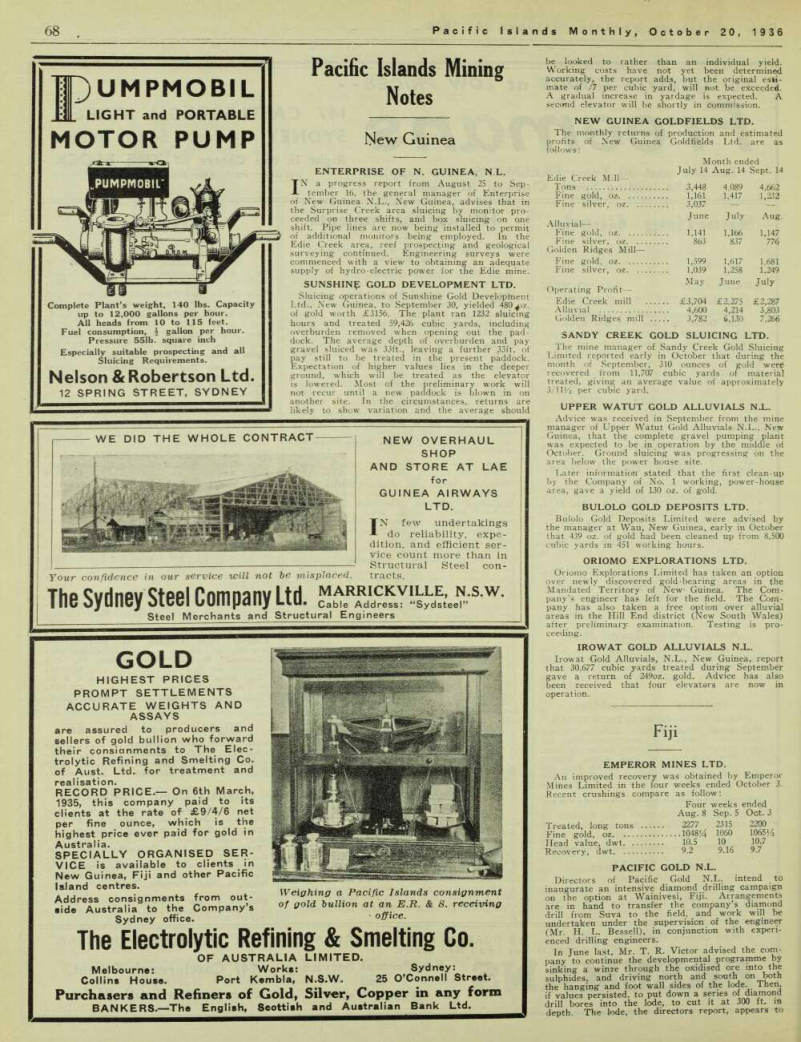
Notes New Guinea
Enterprise Of N. Guinea, N.L.
IN a progress report from August 25 to Sep tember 16, the general manager of Enterprise of New Guinea N.L., New Guinea, advises that in the Surprise Creek area sluicing by monitor pro ceeded on three shifts, and box sluicing on one shift. Pipe lines are now being installed to permit of additional monitors being employed. In the Edie Creek area, reef prospecting and geological surveying continued. Engineering surveys were commenced with a view to obtaining an adequate supply of hydro-electric power for the Edie mine.
Sunshine Gold Development Ltd.
Sluicing operations of Sunshine Gold Development Ltd., New Guinea, to September 30, yielded 480 j>z. of gold worth £3156. The plant ran 1232 sluicing hours and treated 59,426 cubic yards, including overburden removed when opening out the pad dock. The average depth of overburden and pay gravel sluiced was 33ft., leaving a further 33ft. of pay still to be treated in the present paddock.
Expectation of higher values lies in the deeper ground, which will be treated as the elevator is lowered. Most of the preliminary work will not recur until a new paddock is blown in on another site. In the circumstances, returns are likely to show variation and the average should
be looked to rather than an individual yield.
Working costs have not yet been determined accurately, the report adds, but the original esti mate of /I per cubic yard, will not be exceeded.
A gradual increase in yardage is expected. A second elevator will be shortly in commission.
New Guinea Goldfields Ltd.
The monthly returns of production and estimated profits of New Guinea Goldfields Ltd. are as follows;
Sandy Creek Gold Sluicing Ltd.
The mine manager of Sandy Creek Gold Sluicing Limited reported early in October that during the month of September, 310 ounces of gold were recovered from 11,707 cubic yards of material treated, giving an average value of approximately 3/11 Vi per cubic yard.
Upper Watut Gold Alluvials N.L,
Advice was received in September from the mine manager of Upper Watut Gold Alluvials N.L., New Guinea, that the complete gravel pumping plant was expected to be in operation by the middle of October. Ground sluicing was progressing on the area below the power house site.
Later information stated that the first clean-up by the Company of No. 1 working, power-house area, gave a yield of 130 oz. of gold.
Bulolo Gold Deposits Ltd.
Bulolo Gold Deposits Limited were advised by the manajger at Wau, New Guinea, early in October that 439 oz. of gold had been cleaned up from 8,500 cubic yards in 451 working hours.
Oriomo Explorations Ltd.
Oriomo Explorations Limited has taken an option over newly discovered gold-bearing areas in the Mandated Territory of New Guinea. The Com pany’s engineer has left for the field. The Com pany has also taken a free option over alluvial areas in the Hill End district (New South Wales) after preliminary examination. Testing is pro ceeding.
Irowat Gold Alluvials N.L.
Irowat Gold Alluvials, N.L., New Guinea, report that 30,677 cubic yards treated during September gave a return of 2490 z. gold. Advice has also been received that four elevators are now in
operation.
Month ended July 14 Aug. 14 Sept. 14 Edie Creek Mill Tons 3,448 4,089 4,662 Fine gold, oz 1,161 1,417 1,232 Fine silver, oz 3,037 — - — June July Aug.
Alluvial— Fine gold, oz 1,141 1,166 1,147 Fine silver, oz. „ 863 837 776 Golden Ridges Mill— Fine gold, oz 1,599 1,617 1,681 Fine silver, oz 1,039 1,258 1,249 May June July Operating Profit— Edie Creek mill ..., .. £3,704 £2,275 £2,287 Alluvial 4,600 4,214 3,803 Golden Ridges mill ... 3,782 6,130 7,266
Fiji
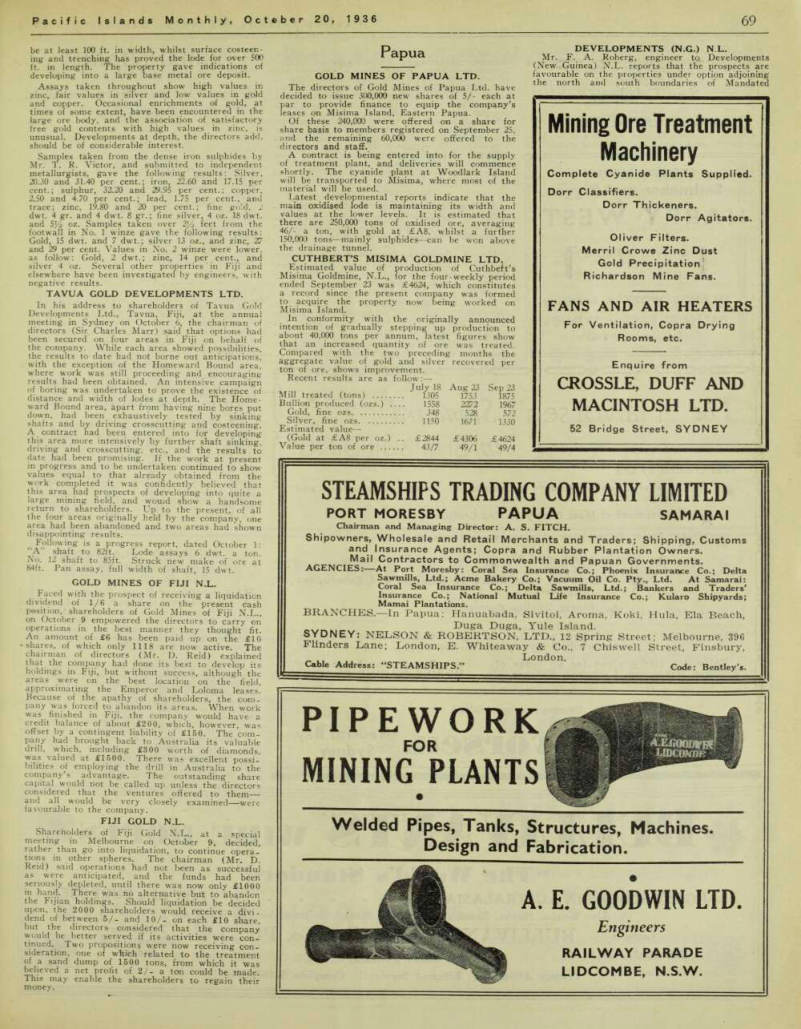
Emperor Mines Ltd.
An improved recovery was obtained by Emperor Mines Limited in the four weeks ended October 3.
Recent crushings compare as follow:
Pacific Gold N.L.
Directors of Pacific Gold N.L. intend to inaugurate an intensive diamond drilling campaign on the option at Wainivesi, Fiji. Arrangements are in hand to transfer the company’s diamond drill from Suva to the field, and work will be undertaken under the supervision of the engineer (Mr. H. L. Bessell), in conjunction with experi enced drilling engineers.
In June last, Mr. T. R. Victor advised the com pany to continue the developmental programme by sinking a winze through the oxidised ore into the sulphides, and driving north and south on both the hanging and foot wall sides of the lode. Then, if values persisted, to put down a series of diamond drill bores into the lode, to cut it at 300 ft. in depth. The lode, the directors report, appears to
Four weeks ended Aug. 8 Sep. 5 Oot. 3 Treated, long tons 2277 2315 2200 Fine gold, oz 1048J4 1060 106554 Head value, dwt 10.5 10 10.7 Recovery, dwt 9.2 9.16 9.7
be at least 100 ft. in width, whilst surface costeen ing and trenching has proved the lode for over 500 ft. in length. The property gave indications of developing into a large base metal ore deposit.
Assays taken throughout show high values in zinc, fair values in silver and low values in gold and copper. Occasional enrichments of gold, at times of some extent, have been encountered in the large ore body, and the association of satisfactory free gold contents with high values in zinc, is unusual. Developments at depth, the directors add. should be of considerable interest.
Samples taken from the dense iron sulphides by Mr. T. R. Victor, and submitted to independent metallurgists, gave the following results: Silver, 20.30 and 31.40 per cent.; iron, 22.60 and 17.15 per cent.; sulphur, 32.20 and 29.95 per cent.; copper. 2.50 and 4.70 per cent.; lead, 1.75 per cent., and trace; zinc, 19.80 and 20 per cent.; fine gold, 2 dwt. 4 gr. and 4 dwt. 8 gr.; fine silver, 4 oz. 18 dwt. and S l /2 oz. Samples taken over 2J4 feet from the footwall in No. 1 winze gave the following results; Gold, 15 dwt. and 7 dwt.; silver 13 oz., and zinc, 27 and 29 per cent. Values in No. 2 winze were lower, as follow: Gold, 2 dwt.; zinc, 14 per cent., and silver 4 oz. Several other properties in Fiji and elsewhere have been investigated by engineers, with negative results.
Tavua Gold Developments Ltd.
In his address to shareholders of Tavua Gold Developments Ltd., Tavua, Fiji, at the annual meeting in Sydney on October 6, the chairman of directors (Sir Charles Marr) said that options had been secured on four areas in Fiji on behalf of the company. While each area showed possibilities, the results to date had not borne out anticipations, with the exception of the Homeward Bound area, where work was still proceeding and encouraging results had been obtained. An intensive campaign of boring was undertaken to prove the existence of distance and width of lodes at depth. The Home ward Bound area, apart from having nine bores put down, had been exhaustively tested by sinking shafts and by driving crosscutting and costeening.
A contract had been entered into for developing this area more intensively by further shaft sinking, driving and crosscutting, etc., and the results to date had been promising. If the work at present in progress and to be undertaken continued to show values equal to that already obtained from the work completed it was confidently believed that this area had prospects of developing into quite a large mining field, and would show a handsome return to shareholders. Up to the present, of all the four areas originally held by the company, one area had been abandoned and two areas had shown disappointing results.
Following is a progress report, dated October 1: ‘A” shaft to 82ft. Lode assays 6 dwt. a ton.
No. 12 shaft to 85ft. Struck new make of ore at 84ft. Pan assay, full width of shaft, 15 dwt.
Gold Mines Of Fiji N.L.
Faced with the prospect of receiving a liquidation dividend of 1/6 a share on the present cash position, shareholders of Gold Mines of Fiji N.L.. on October 9 empowered the directors to carry on operations in the best manner they thought fit.
An amount of £6 has been paid up on the £lO -shares, of which only 1118 are now active. The chairman of directors (Mr. D. Reid) explained that the company had done its best to develop its holdings in Fiji, but without success, although the areas were on the best location on the field, approximating the Emperor and Loloma leases.
Because of the apathy of shareholders, the com pany was forced to abandon its areas. When work was finished in Fiji, the company would have a credit balance of about £2OO, which, however, wa<offset by a contingent liability of £l5O. The com pany had brought back to Australia its valuable drill, which, including £3OO worth of diamonds, was valued at £l5OO. There was excellent possi bilities of employing the drill in Australia to the company’s advantage. The outstanding share capital would not be called up unless the directors considered that the ventures offered to them— and all would be very closely examined—were favourable to the company.
Fiji Gold N.L.
Shareholders of Fiji Gold N.L., at a special meeting in Melbourne on October 9, decided, rather than go into liquidation, to continue opera tions in other spheres. The chairman (Mr. D.
Reid) said operations had not been as successful as were anticipated, and the funds had been seriously depleted, until there was now only £lOOO in hand. There was no alternative but to abandon the Fijian holdings. Should liquidation be decided upon, the 2000 shareholders would receive a divi dend of between 5/- and 10/- on each £lO share, but the directors considered that the company would be better served if its activities were con tinued. Two propositions were now receiving con sideration, one of which related to the treatment of a sand dump of 1500 tons, from which it was believed a net profit of 2/- a ton could be made.
This may enable the shareholders to regain their money.
Papua
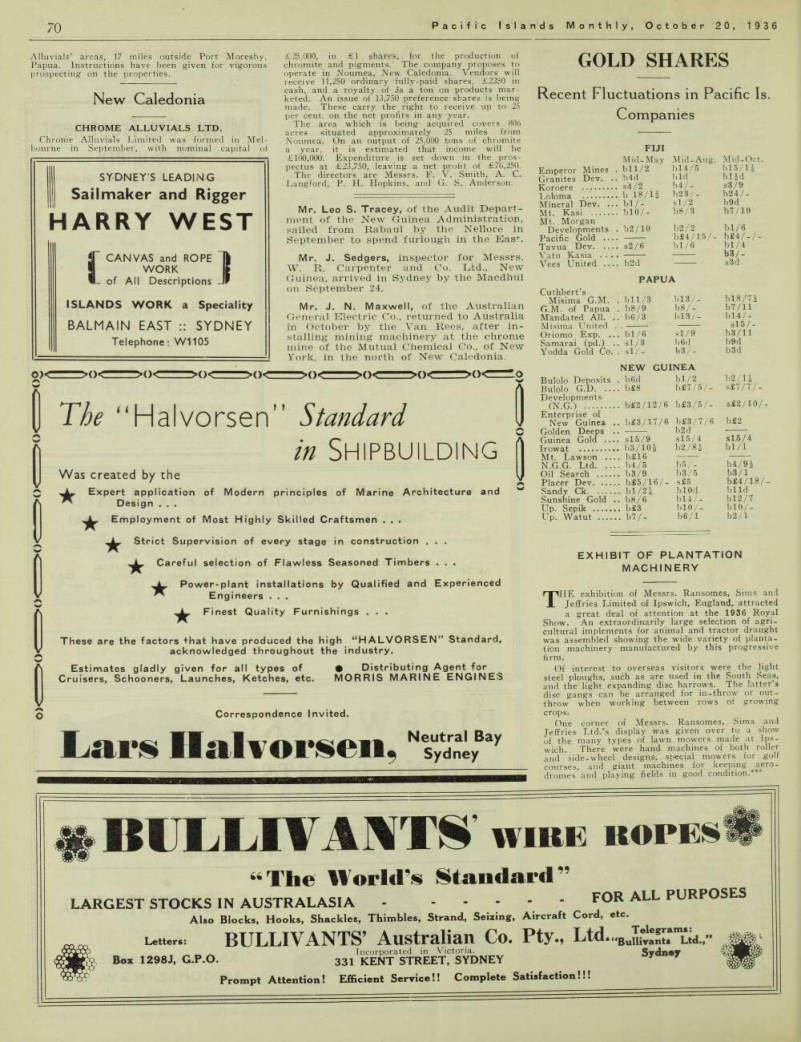
Gold Mines Of Papua Ltd.
The directors of Gold Mines of Papua Ltd. have decided to issue 300,000 new shares of 5/- each at par to provide finance to equip the company’s leases on Misima Island, Eastern Papua.
Of these 240,000 were offered on a share for share basis to members registered on September 25, and the remaining 60,000 were offered to the directors and staff.
A contract is being entered into for the supply of treatment plant, and deliveries will commence shortly. The cyanide plant at Woodlark Island will be transported to Misima, where most of the material will be used.
Latest developmental reports indicate that the main oxidised lode is maintaining its width and values at the lower levels. It is estimated that there are 250,000 tons of oxidised ore, averaging 46/- a ton, with gold at £AB, whilst a further 150,000 tons—mainly sulphides—can be won above the drainage tunnel.
Cuthbert’S Misima Goldmine Ltd.
Estimated value of production of Cuthbeft’s Misima Goldmine, N.L., for the four-weekly period ended September 23 was £4624, which constitutes a record since the present company was formed to acquire the property now being worked on Misima Island.
In conformity with the originally announced intention of gradually stepping up production to about 40,000 tons per annum, latest figures show that an increased quantity of ore was treated.
Compared with the two preceding months the aggregate value of gold and silver recovered per ton of ore, shows improvement.
Recent results are as follow:
Developments (N.G.) N.L,
Mr. F. A. Roberg, engineer to Developments (New Guinea) N.L. reports that the prospects are favourable on the properties under option adjoining the north and south boundaries of Mandated
July 18 Aug 23 Sep 23 Mill treated (tons) 1305 1753 1875 Bullion produced (ozs.) 1558 2272 1967 Gold, fine ozs 348 528 572 Silver, fine ozs 1150 1671 1330 Estimated value— (Gold at £A8 per oz.) .. £2844 £ 4306 £ 4624 Value per ton of ore 43/7 49/1 49/4
Alluvials’ areas, 17 miles outside Port Moresby, Papua. Instructions have been given for vigorous prospecting on the properties.
Advertisements & other items, p. 71 (1 item)
Machinery
Mining Ore Treatment
Complete Cyanide Plants Supplied.
Dorr Classifiers.
Dorr Thickeners.
Dorr Agitators.
Oliver Filters.
Merril Crowe Zinc Dust Gold Precipitation Richardson Mine Fans.
FANS AND AIR HEATERS
For Ventilation, Copra Drying Rooms, etc.
Enquire from
CROSSLE, DUFF AND
MACINTOSH LTD.
52 Bridge Street, SYDNEY
STEAMSHIPS TRADING COMPANY LIMITED
PORT MORESBY PAPUA SAMARA!
Chairman and Managing Director: A. S. FITCH.
Shipowners, Wholesale and Retail Merchants and Traders; Shipping, Customs and Insurance Agents; Copra and Rubber Plantation Owners.
Mail Contractors to Commonwealth and Papuan Governments.
AGENCIES:—At Port Moresby: Coral Sea Insurance Co.; Phoenix Insurance Co.; Delta Sawmills, Ltd.; Acme Bakery Co.; Vacuum Oil Co. Pty., Ltd. At Samarai: Coral Sea Insurance Co.; Delta Sawmills, Ltd.; Bankers and Traders’
Insurance Co.; National Mutual Life Insurance Co.; Kularo Shipyards; Mamai Plantations.
BRANCHES. —In Papua: Hanuabada, Sivitoi, Aroma, Koki, Hula, Ela Beach, Duga Duga, Yule Island.
SYDNEY: NELSON & ROBERTSON, LTD., 12 Spring Street; Melbourne, 396 Flinders Lane; London, E. Whiteaway & Co., 7 Chiswell Street, Finsbury, „ . London.
Rafale Address: “STEAMSHIPS.” Code: Bentley’s.
A. E. GOODWIN LTD,
Engineers
RAILWAY PARADE
LIDCOMBE, N.S.W.
New Caledonia
Chrome Alluvials Ltd.
Chrome Alluvials Limited was formed in Mel bourne in September, with nominal capital of
£25,000, in £1 shares, for the production of chromite and pigments. The company proposes to operate in Noumea, New Caledonia. Vendors will receive 11,250 ordinary fully-paid shares, £2250 in cash, and a royalty of 3s a ton on products mar keted. An issue of 13,750 preference shares is being made. These carry the right to receive up to 25 per cent, on the net profits in any year.
The area which is being acquired covers 805 acres situated approximately 25 miles from Noumea. On an output of 25,000 tons of chromite a year, it is estimated that income will be £100,000. Expenditure is set down in the pros pectus at £23,750, leaving a net profit of £76,250.
The directors are Messrs. F. V. Smith, A. C.
Langford, P. H. Hopkins, and G. S. Anderson.
Mr. Leo S. Tracey, of the Audit Depart ment of the New Guinea Administration, sailed from Rabaul by the Nellore in September to spend furlough in the EasL Mr. J. Sedgers, inspector for Messrs.
W. R. Carpenter and Co. Ltd., New Guinea, arrived in Sydney by the Macdhui on September 24.
Mr. J. N. Maxwell, of the Australian General Electric Co., returned to Australia in October by the Van Rees, after in stalling mining machinery at the chrome mine of the Mutual Chemical Co., of New York, in the north of New Caledonia.
Companies
Gold Shares
Recent Fluctuations in Pacific Is.
Fiji
Mid-May Mid-Aug.
Mid-Oct.
Emperor Mines . bll/2 bl4/5 bl5/l^ Granites Dev. .. b4d bid bl|d Koroere s4/2 b4/s3/9 b24/- Loloma b 18/1 a b23/- Mineral Dev. ... bl/sl/2 b9d Mt. Kasi blO/b8/3 b7/10 Mt. Morgan Developments .
Pacific Gold ... . b2/10 b2/2 bl/6 — b£4/15/b£4/-/- Tavua Dev , s2/6 bl/6 bl/4 Vatu Kasia . . . . . — b3/- Vees United ... , b2d — s3d Cuthbert’s Misima G.M.
Papua
, bl1/3 bl3/bl8/7 \ G.M. of Papua . b8/9 b8/b7/ll Mandated All. . . b6/3 bl3/bl4/- Misima United . . — sl5/- Oriomo Exp. .. . bl/6 sl/9 b3/ll Samarai (pd.) . . sl/3 b6d b9d Yodda Gold Co. . si/b3/b3d Bulolo Deposits Bulolo G.D. ...
New Guinea
. b6d bl/2 b2/lg . bf8 b£7/5/s£7/7/- Developments (N.G.) . b£2/12/6 b£3/5/s£2/10/- Enterprise of New Guinea . . bf3/17/6 b£3 '7/6 bf 2 Golden Deeps . . b2d — Guinea Gold ... . sl5/9 sl5/4 sl5/4 Irowat . b3/10^ b2/8a bl/1 Mt. Lawson ... . b£16 — — N.G.G. Ltd. ... . b4/5 b5/ b4/9a Oil Search . b3/9 b3/5 b3/l Placer Dev . b£5/16/s£5 b£4/18/- Sandy Ck . bl/2| blOd blld Sunshine Gold . . b8/6 bl4/bl2/7 Up. Sepik . b£3 blO/ blO/- Up. Watut . b7/b6/l b2/l
Exhibit Of Plantation
Machinery
THE exhibition of Messrs. Ransomes, Sims and Jeffries Limited of Ipswich, England, attracted a great deal of attention at the 1986 Royal Show. An extraordinarily large selection of agri cultural implements for animal and tractor draught was assembled showing the wide variety of planta tion machinery manufactured by this progressive firm.
Of interest to overseas visitors were the light steel ploughs, such as are used in the South Seas, and the light expanding disc harrows. The latter’s disc gangs can be arranged for in-throw or out throw when working between rows of growing crops.
One corner of Messrs. Ransomes, Sims and Jeffries Ltd.’s display was given over to a show of the many types of lawn mowers made at Ips wich. There were hand machines of both roller and side-wheel designs, special mowers for golf courses, and giant machines for keeping pro dromes and playing fields in good condition.***
Advertisements & other items, p. 72 (1 item)
# BULLIVAMTS wire ropes#
SYDNEY'S LEADING
|l Sailmaker and Rigger
HARRY WEST
f CANVAS and ROPE
WORK 'i
of All Descriptions Jr ISLANDS WORK a Speciality
BALMAIN EAST SYDNEY
Telephone: WllO5
The “Halvorsen” Standard
in Shipbuilding
Was created by the Expert application of Modern principles of Marine Architecture and Design . . .
Employment of Most Highly Skilled Craftsmen . . .
Strict Supervision of every stage in construction . . .
Careful selection of Flawless Seasoned Timbers . . . ,JL, Power-plant installations by Qualified and Experienced Engineers . . .
Finest Quality Furnishings . . .
These are the factors that have produced the high “HALVORSEN” Standard, acknowledged throughout the industry.
Estimates gladly given for all types of • Distributing Agent for Cruisers, Schooners, Launches, Ketches, etc. MORRIS MARINE ENGINES Correspondence Invited.
Lar§ Halvorsen, N l u y d r ni y ßay
BULLIVAMTS wire ropes#
66 The World’s Standard”
LARGEST STOCKS IN AUSTRALASIA
FOR ALL PURPOSES
Also Blocks, Hooks, Shackles, Thimbles, Strand, Seizing, Aircraft Cord, etc.
Letters: BULLIVANTS’ Australian Co. Pty., Ltd.o B J£S» a Tid,, „ Incorporated in Victoria. Sydney Box 1298 J, G.P.O. 331 KENT STREET, SYDNEY 07 7 Prompt Attention! Efficient Service!! Complete Satisfaction!!! ♦
New Guinea
Indentured Labour In
Will It be Abolished Eventually?
IN reply to questions from members of the Permanent Mandates Commission during- discussion recently at the 27th Ses sion of the annual report from New Guinea, the accredited representative stated that it was the policy of the Administra tion to do away eventually with the inden ture system of labour.
The Planters’ Association of New Guinea viewed this development with apprehen sic n and in the Executive Committee’s annual report said: “That the first state ment that such is the policy of the Terri tory should be given under such circum stances without any previous indication to that effect having been made within the Territory itself and without any indication as to how and with what labour the pres ent system is to be replaced, is very alarm ing to planters and other employers of labour.”
The Committee believes that some com prehensive and authoritative statement should be made by the Commonwealth Go vernment, relative to this matter of para mount interest to the whole trade, com merce and industry of the Mandated Ter ritory, Madame Doris Legras, of New Cale donia, who is en route to New Zealand on an extended holiday, reached Sydney from Noumea by the October Van Rees.
Mr. N. Blood, of the European Con stabulary in New Guinea, arrived in Aus tralia on leave by the Macdhui on Sep tember 24.
Presbyterian Mission Synod
in New Hebrides
THE annual Synod of the New Hebrides Pres byterian Mission was held at Tangoa, South Santo, between July 24 and August 3.
Present were Revs. M. Prater (Paama), W. V.
Milne (Nguna), W. Anderson (Hog Harbour), B. R. C. Nottage (Tongoa), W. F. Paton (North Ambrym), H. M. Bell (East Tanna), and two associate members, Mr. A. Wilson (Tangoa) and Miss M. Rankine (Vila).
The meeting placed on record its appreciation of the work of Rev. Thomson Macmillan, of Tanna, who recently retired after 40 years’ service. He mastered the native language, and his trans lation of the New Testament has been described as “a masterpiece of pure, idiomatic Tannese which nas crystallised the native tongue for coming generations.” His wife also carried out notable work at White Sands Mission.
Sympathy was extended to the family of Rev.
Alex Gillies (formerly at Kwamera, Tanna, for four years) who died in Scotland, and to the relatives of Mr. Andrew Stewart, who died in Sydney early this year, after serving on Santo since 1931.
A committee, comprising Messrs. W. F. Paton, Wilson and Bell, drew up a minute based on re ports of stations. They said that a movement on the lines of the Oxford Group is vitalising the spiritual life of many natives on West Tanna.
A good response is seen on Ambrym, with an in creasing effort towards self-support by the native church. Work is made difficulty by lingering superstitions, kava drinking, witchcraft, grou selling, illegal recruitment of labour, and, on Male kula, by certain brutalities.
Two hurricanes caused heavy damage to many mission stations during the year, and seriously reduced the natives’ food supplies. Missionaries dealt effectively with epidemics after the visita tions. Medical work generally has been conducted satisfactorily.
The Synod noticed that new problems are arising from the natives’ increasing contacts with modern civilisation. A new mental outlook is apparent— e.g., in the expressed desire for higher education.
including a working knowledge of the French language.
It was agreed that Presbyterian missionaries should endeavour to gather together the traditions.
folklore, customs and laws of their respective islands m order to preserve them in the printed page, thus preventing the ultimate loss of inter esting knowledge valuable for New Hebrides race culture.
Looking forward to the Centenary of the landing and martyrdom of John Williams on Erromanga in 1839, and so of the commencement of mis sionary endeavour on the New Hebrides, the Synod appointed an Editorial Committee (Messrs. M.
Prater, B. Nottage and W. F. Paton) to collect material for a booklet in commemoration of this event.
Before the session adjourned, it was resolved that the next Synod would be held at North Am brym in 1938, during June or July.
Mr. and Mrs. J, A. Parer, uf Wau, New Guinea, sailed from Rabaul by the Nel lore on September 22 to spend holidays in the East.
Mr. R. J. Clancy, of Messrs. W. R. Car penter and Co. Ltd., who is stationed at New Ireland, arrived in Sydney on fur lough by the Van Rees early in October.
Advertisements & other items, pp. 73-74 (1 item)
Oil Engines
TAHITI
AND
French Oceania
This book, by Samuel Russell, is a valuable work of reference. It gives, in relation to Tahiti and French Oceania, complete details of administration, commerce, sport, tourist resorts, industries, excursions, hotels, immigration and land laws, etc.
Yachtsmen and fishermen, who awe visiting Tahiti in increasing numbers, will find this a most useful handbook.
It also supplies a fascinating account of life in Tahiti—one of the most delightful places of residence in the world.
Copies from:
Pacific Publications Ltd.
247 George Street - - - Sydney Price in Australia (posted): Cloth bound, 6/-; paper-cover, 5/-.
BCSTOH POWERED
fe i Made in ranges of sizes up to 650 B.H.P.
Shall we send you details?
RUSTON & HORNSBY
(AUST.) PTY. LTD.
174-180 KING STREET, MELBOURNE
Cables: "Hornsbys." Melbourne Ruston Marine Oil Engines have proved themselves dependable and economical in all types of craft for many years.
More Ruston Marine Oil Engines are beng installed now than ever before.
Invest wisely in . . .
■Cession
Marine
Oil Engines
Britain's Largest Builders of Oil Engines Branches also at SYDNEY, BRISBANE & ADELAIDE Sole Agents for Mandated Territory: Burns, Philp & Co. Ltd.. Rabaul, New Guinea
HW courtesy HIP Photo by courtesy r, Tulagi, I 1 * Islands.
Harpe Solomon L r mm * % S 3 s Hi %’■ - 9 9
“ Well
That Stretch is
there for GOOD
If a stretch is fenced with “CYCLONE” it will never let stock escape or break through—will never need maintenance or repair.
“CYCLONE” is made entirely of HARD Steel Wire.
“CYCLONE” possesses the RING-LOCK JOINT which is so Wear-and-Weather-Proof as to be practically everlasting.
Cyclone e
CYCLONE FENCE 8i GATE CO. PTY. LTD.
The Grace Bldg., 77 York St., Sydney And at Melbourne, Adelaide, Perth.
Please send me by return mail your free, illustrated and priced Catalogue of Cyclone Metal Gates and Ring-lock Fences, and comparison of costs.
Name Address P. 1.10
The New Samoa And
Mr. Nelson
Lend.' to the Editor. 1 GATHER from correspondents in Samoa that the N. Z. Labour Govern ment has acted in such a manner as to end all differences between the natives and the Mandatory Administration, and to restore complete harmony.
This is a very worthy achievement, and I think no one is more gratified at it than I am. As you know, I have participated somewhat actively in this controversy at various times, and always in the endea vour to aid in bringing about a reconcilia tion of the Samoans with the Mandatory, to the advantage of the native people.
That their cause has deserved whatever effort I or anyone could make on their behalf is evident enough in the very
nature of the “regulations” the New Zealand Government now seems to have rescinded; that is to say, the preposterous decree against the free movements of the islanders in their own land, and the edict of illegality in respect of the Mau.
I hope that there will now be an en during peace. No one man can do more to assure that than Mr. O. F. Nelson, whose influence among the Samoans sur passes anything of the sort I have ever seen in the South Seas.
A number of silly people have had con siderable to say and to write concerning what they have called the “Greene-Nelson feud,” and of that I think it proper to say a word.
I opposed Nelson in a certain amount of press propaganda, and in other ways, and I urged both Hart and Forbes to de port him because I thought his attitude was widening the breach between the Samoans and the Mandatory. I still think it was; but I fully believe that since those whom he regarded as his enemies are out of the picture he will co-operate with the present New Zealand Government to pre serve harmony in the islands.
That being the case, neither I nor any one can have any objection to Nelson being back in his native island where, if he behaves himself, he has every right to be, His influence is a vital factor there, and, being the man of keen intelligence that he is, he can be a very useful friend to New Zealand and help to make the Mandatory Administration the success that it has never yet been. Had the Lake Leman Old Ladies’ Knitting Bee investi gated the Samoan position as they should have done long ago, the results now achieved might then have been reached and Samoa been the happy, contented and prosperous place it ought to have been for these past ten years.
I am, etc.,
Marc T. Greene.
Stratford, England, September 1, 1936.
Midway Islands
—an important station on the Pan-American Airways new route across the North Pacific, ’Frisco to Hong Kong—are so called because they are about half way between California and China (says the Honolulu Star-Bulletin).
And the plural is correct —there are two islands. Originally called Brooks islands (Middle Brooks or Eastern and Lower Brooks or Sand Island) after Capt* N. C.
Brooks who discovered them July 5, 1859, they were annexed and named Midway in September, 1867, by the U.S.S. Lackawanna.
Nobody then could have imagined their value as a station in trans-Paciflc air transportation 70 years later!
Another explanation of the name Midway is that the islands are precisely 12 hours from Greenwich, marking the middle point of time’s march around the world.
Mr. Richard Archbold, leader of the American Museum of Natural History expedition in Papua, arrived in Sydney by the Neptuna on October 10. He was ac companied by Mr. R. R. Rogers (pilot and mechanic) and Mr. E. Julestedt (radio operator). Mr. Archbold said that the loss of the valuable seaplane proved a great drawback, but he is returning to U.S.A. to buy another, and will continue ihe expedition. He is taking back to America many specimens of Papuan birds, mainly birds of paradise and quail.
Three .members of the party, Messrs. A.
L Rand (ornithologist), G. H. Tate (mam ologist), and L. J. Brass (botanist) are still in the territory, collecting specimens in the lower reaches of the Fly River.
Seven Dredges
Bulolo Company’s Plans for New Guinea
'PHE very successful Bulolo Gold A Dredging Limited, which has been operating profitably for some years on the New Guinea goldfield, has decided to in stal a dredge of six-cubic-feet-bucket capacity on the area at Wau taken over last year from Bulolo Gold Deposits Ltd.
Thus, including four dredges now in operation at Bulolo, and two deep-digging ones to recover gold from the lower level discovered under the present dredging area three years ago, the Company will have seven dredges working in the Territory.
The dredge for the Bulolo Gold Deposits area will be known as No. 6, and the orders for it are now being placed. It will dig to a depth of 30ft., and should be completed about the end of next year.
After No. 6 is in operation dredge No. 1, which for some years has been work ing the shallow gravel along the eastern rim of the deposits, and which cannot reach the lower gravels, will be dis mantled and re-erected some miles downstream.
The first of the deep-digging dredges (to be called No. 5) is now being shipped to New Guinea and should be completed by July next. It will be freighted in from the coast to Bulolo by aeroplane, and it has been built so that the heaviest piece of machinery to be carried by air will not exceed 7,900 lbs. (over three and a half tons). The dredge will dig to 80ft. below water level and carry a bank of 40ft., thus giving a total digging depth of 120 ft.
The second deep-digging dredge (No. 7) will be constructed as rapidly as possibly after the above programme is completed.
It will dig to about 115 ft. and carry a bank of 50ft., making a total possible dredging depth of about 165 ft.
The Company has also announced that a further 1,000 h.p. unit will be added to the hydro-electric plant at Baiune.
B.G.D.’s September Production
PRODUCTION of the four dredges of Bulolo Gold Dredging Ltd., for Sep tember, compares with that of the previ ous two periods as follows:
Messrs. W. Blewett and W. McGregor, two directors of Misima Gold Reefs (N.G.) N.L., have been elected to the board of directors of the newly formed Misima Reefs Limited.
Mr. Clive Green, superintendent of the N.G. Administration’s demonstration plan tation at Keravat, outside Rabaul, re turned to the territory from leave by the September Nellore.
Mrs. Shelton-O’Reilly, wife of Mr. H.
Shelton -O'Reilly, who is draughtsman in the Papuan Survey Office, arrived in Sydney by the Van Rees in October. She is an expert photographer and her pic tures of Port Moresby scenes and native studies have won high praise.
,, July. August. September.
Cubic yard ... 986.700 978,000 981,300 Bullion, oz 19,812 17,740 17,052 Gold, fine, oz. .. 13,904 12.484 11,794
Value—
Aust. Currency*. £121.660 £109,235 £103.197| Per cubic yard . /29.59 /26.8 /25.2 Working profit . £84,621 £75,748 £73,998 * At A£8/15/- per fine ounce.
Two Fijians Acquitted
Murder Trial
From Our Own Correspondent.
Suva, Oct. 2.
of the longest and most interesting murder trials heard in Fiji for some time was on the calendar of the last crim inal session of the Supreme Court, and resulted in a verdict of not guilty.
The case arose out of the death in hos pital of an old Fijian, Jiosevani Tuleca, after he had allegedly been but uraki’d, or turkey-trotted, on the wharf. The assault took place last January and. after long investigations, two men, Acura Lelekaria (represented by Mr. D. Warren) and Beni Makoto (represented by Messrs. S. and M.
Hasan), were first charged with man slaughter, and then with murder.
The hearing lasted eight days, and many inconsistencies in the evidence for the prosecution, conducted bv the Attorney- General (Mr. R. S. Thacker), and Mr. D.
R. McDonald, were made the most of by the defence, who did not call any evidence.
After lengthy addresses by counsel, His Honour the Chief Justice (Mr. O. C. K.
Corrie) summed up at some length, and the assessors returned a verdict of not guilty. They held that the identity of the accused had not bee;i established, and that the medical evidence that deceased died of pneumonia as a result of injuries had not been fully established.
Mr. and Mrs. Charles Cleveland, of Thursday Island, arrived in Sydney in September. They brought their motor car with them and intend making a tour of the Commonwealth until Christmas.
Advertisements & other items, p. 75 (1 item)
Crossler Scavenge Pump Diesel
Latest Improved Marine Engine ...
The Crossley Scavenge Pump direct Reversing Marine Diesel Engine combines the advantages of the four stroke and two stroke types, without the disadvantages of either. Why not have the latest low running cost Marine Engine available? Write for full particulars now.
DRS. 125 B.H.P.
As recently supplied to C. Hegarty, for use in Ferry in Sydney Harbour.
WAUGH A JOSEPHSOA UTD.
Unwin’s Bridge Road, St. Peters, N.S.W. 102-104 Melbourne St., South Brisbane, Queensland.
Stirring Tale Of L.M.S.
In Papua
New Book by Cecil Northcott
SOME fascinating stories of missionary adventure and enterprise in the South Seas have been told by Rev. Cecil North cott; but none bears comparison with Guinea Gold, 100 pages, just received from
the publishers, wherein Mr. Northcott sets out the history of the London Misisonary Society in Papua.
What a drama this is! One is shown the melancholy, cadaverous Dampier driv ing his leaky old tub of a Roebuck along New Guinea’s northern coast, in January, 1700. Then one sees, during slow de cades, scores of other daring navigators adventuring into this strange and danger ous sea. But none can conquer the fierce, mountainous, jungle-clad land of New Guinea. The kindlier islands of the Cen tral and South Pacific soon afford foot holds for Europeans; but, though the cen turies pass, New Guinea remains terra in cognita—the last and the most difficult Pacific territory to be penetrated.
The advance of the L.M.S. upon Papua came from Lifu, in the Loyalties. Captain Banner, of the ship Blue Belle visited Rev.
John Jones there in 1866, and told Mr.
Jones about New Guinea. Mr. Jones told London. On May 30, 1871, there sailed from Lifu a schooner, the Surprise, char tered by the L.M.S. to convey Messrs.
Samuel Macfarlane, A. W. Murray and eight native Lifuan teachers to southern New Guinea, They were to establish themselves in islands off the mainland and thence work their way into the interior.
The first teacher was landed in Darnley Island, in Torres Strait, on July 1, 1871, and others on Warrior and Dauan Islands.
More teachers came from Rarotonga, and started work among the swamps and is lands to the south of the Fly River, and eastward along the Papuan Gulf, in Red scar Bay.
It w r as frightful work. They were con stantly attacked by savage men and relentless disease. In four years, they lost 21 of their number —17 by disease, and four by the clubs of the natives. But they stuck it out. W. G. Lawes arrived on November 21, 1874, and put behind the work the force of a great personality.
James Chalmers, the famous missionary martyr, arrived in 1877.
It is a stirring tale, remarkably well told.
In a preface, the Lieut.-Governor of Papua, Sir Hubert Murray, writes authori tatively of the assistance which Pacific ad ministrators have received from missions of all denominations. Says Sir Hubert:— “Readers wall realise that Christianity is not ‘a creed outworn,’ but is a living force which can nerve men and women, irre spective of race and colour, to deeds of strange self-sacrifice and heroism in the warfare against the powers of evil and darkness-—that long warfare in which there is no truce and in which there can be no discharge.”
Labour Shortage
Growth of Mining Causes Difficult Situation in Fiji
HPHERE are signs of serious difficulty arising in Fiji in connection with the supply of unskilled labour.
Employers depend generally upon the Fijians and, to a lesser extent, on half castes. Plantation labour in Fiji, as else where, is obtained for from £l5 to £2O per man per annum, and all found.
The opening of the goldmines at Tavua has altered everything. The mines wanted large numbers of Fijian labourers, and they just went out into the countryside and bought them.
In mid-September there were between 1500 and 2000 Fijians employed at the mines, at around £4O per annum and found, in addition to large numbers of more skilled half-castes, drawing about 12/- per day.
There was not a jobless man in Fiji; but, all over the Group there were plan tation-managers begging vainly for labour, and wondering how on earth they were going to carry on.
Indians provide no solution. There are 90,000 of them in Fiji, but they keep mostly to agriculture, small trading, etc.
As reported elsewhere, the labourers on Tavua goldfield have gone on strike, and are demanding higher wages from Mr.
Theodore and others.
An utterly unreliable correspondent says that planters, all over Fiji, are sending telegrams conveying tender sympathy to Mr. Theodore and the mine-managers.
Mr. Keith Watkins, of Messrs. Burns, Philp and Co.’s staff at Salamaua, New Guinea, married Miss Jeanne Taylor, of Sydney, at Salamaua on September 5.
Madame Maurice Colardeau, who was born in Sydney and left as a small child for New Celadonia which has been her home ever since, returned to Australia by the Van Rees from Noumea on October 13 for the first time in over 50 years. She is on her way to France to visit her daughter at Cote d’Azur for a year.
Madame Colardeau’s brother is M. Carlos Leoni, Consul for the Netherlands in Noumea.
Advertisements & other items, p. 76 (1 item)
Piles
How to relieve them.
VOU can’t mistake piles. You feel A uneasy and fidgety, wondering how on earth to stop that irritation or bleeding. Day and night piles worry you, taking your heart out of your job.
You can’t stand still for long, and you feel just as bad when sitting. Piles are dilated or inflamed veins of the lower bowel and are aggravated by a cold or constipation. In severe cases surgical treatment even may be necessary. Let Doan’s Ointment give you the relief you so sorely need. This special pile prescription is healing, antiseptic and soothing. This is why it is equally successful in overcoming eczema and other itching skin complaints.
Mrs. A. Craw, 59 Rolfe Street, Leichhardt, Sydney, says: “About two years ago I used Doan’s Ointment for a bad attack of piles, and I am pleased to tell you that it cured me, and I have had no return of that distressing complaint since. I suffered terribly before I used Doan’s Ointment, the pain and irritation being often very trying. Different preparations I used failed to give me any relief, but Doan’s Ointment soon fixed me up. and I am very glad to have an opportunity of saying a few words in praise of this fine remedy. I always keep a tin in the house now, and I find it very useful at times.”
Six years later, Mrs. Craw says: "I have had no return of Piles since Doan’s Ointment cured me. My experience proves that Doan’s Ointment is a genuine remedy for piles.”
Doan’s Ointment is sold by all chemists and storekeepers. .Foster- McClellan Co., Proprietors, 15 Hamilton Street, Sydney.
But be sure you get DOAN’S.
JAMES’BUDGE
REFRIGERATION
“BUDGE” Automatic or Manually-controlled Refrigeration and Ice-making Plants, with or without insulated Cabinets or Rooms, ranging from 4 cubic feet to 1000 cubic feet or larger, using ammonia in the large and sulphur dioxide (SO2) in the small units.
Where electricity is not available, crude oil engines may be utilised for driving the larger plants and petrol engines for driving the smaller machines. The accompanying illustration is of a petrol engine driven SO2 unit. Enquirers please state power available (if any), size of cabinet and amount of ice required per day.
JAMES BUDGE LIMITED
REFRIGERATION AND GENERAL ENGINEERS,
McEvoy and Harley Streets,
ALEXANDRIA SYDNEY
Established 1890.
ENGINEERING WORKSHOPS
All Classes of Machines Made and Reconditioned
Chinese In New
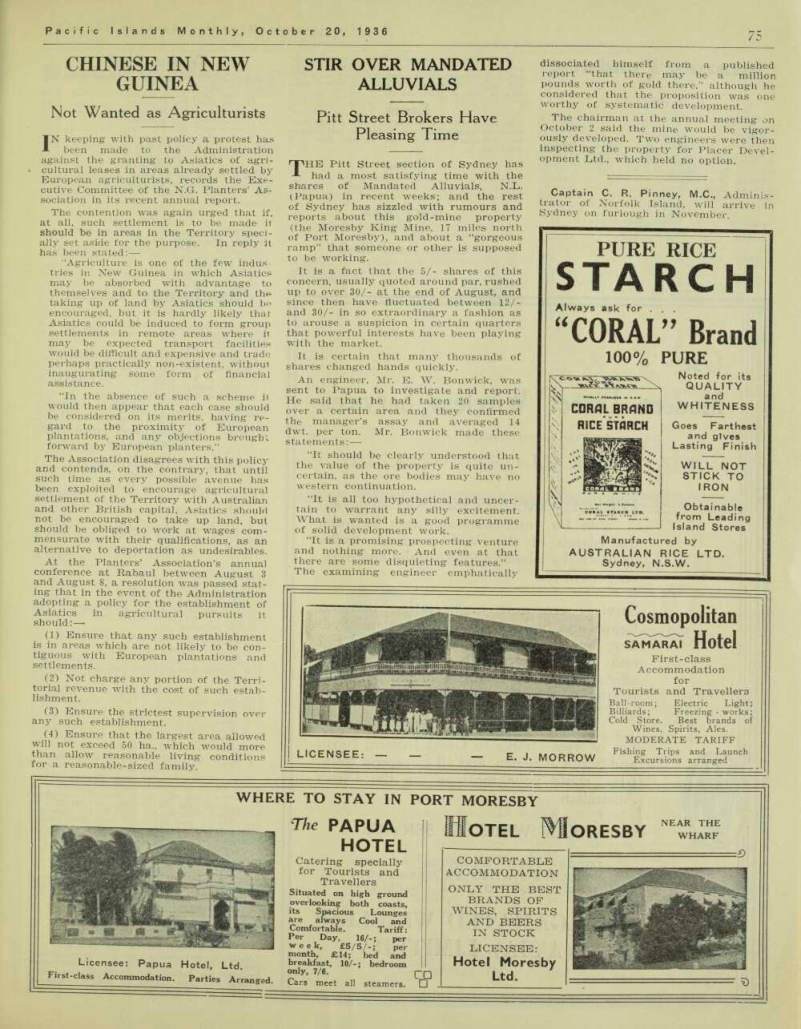
Guinea
Not Wanted as Agriculturists
IN keeping with past policy a protest has been made to the Administration against the granting to Asiatics of agri • cultural leases in areas already settled by European agriculturists, records the Exe cutive Committee of the N.G. Planters’ As sociation in its recent annual report.
The contention was again urged that if. at all, such settlement is to be made it should be in areas in the Territory speci ally set aside for the purpose. In reply it has been stated: “Agriculture is one of the few indus tries in New Guinea in which Asiatics may be absorbed with advantage to themselves and to the Territory and the taking up of land by Asiatics should bo encouraged, but it is hardly likely that Asiatics could be induced to form group settlements in remote areas where it may be expected transport facilities would be difficult and expensive and trade perhaps practically non-existent, without inaugurating some form of financial assistance.
“In the absence of such a scheme it would then appear that each case should be considered on its merits, having re gard to the proximity of European plantations, and any objections brought forward by European planters.”
The Association disagrees with this policy and contends, on the contrary, that until such time as every possible avenue has been exploited to encourage agricultural settlement of the Territory with Australian and other British capital, Asiatics should not be encouraged to take up land, but should be obliged to work at wages com mensurate with their qualifications, as an alternative to deportation as undesirables.
At the Planters’ Association’s annual conference at Rabaul between August 3 and August 8, a resolution was passed stat ing that in the event of the Administration adopting a policy for the establishment of Asiatics in agricultural pursuits it should: (1) Ensure that any such establishment is in areas which are not likely to be con tiguous with European plantations and settlements. (2) Not charge any portion of the Terri torial revenue with the cost of such estab lishment. (3) Ensure the strictest supervision over any such establishment. (4) Ensure that the largest area allowed will not exceed 50 ha., which would more than allow reasonable living conditions for a reasonable-sized family.
Pleasing Time
Stir Over Mandated
Alluvials
Pitt Street Brokers Have Pleasing Time
HPHE Pitt Street section of Sydney has -*■ had a most satisfying time with the shares of Mandated Alluvials, N.L. (Papua) in recent weeks; and the rest of Sydney has sizzled with rumours and reports about this gold-mine property (the Moresby King Mine, 17 miles north of Port Moresby), and about a “gorgeous ramp” that someone or other is supposed to be working.
It is a fact that the 5/- shares of this concern, usually quoted around par, rushed up to over 30/- at the end of August, and since then have fluctuated between 12/and 30/- in so extraordinary a fashion as to arouse a suspicion in certain quarters that powerful interests have been playing with the market.
It is certain that many thousands of shares changed hands quickly.
An engineer, Mr. E. W. Bonwick, was sent to Papua to investigate and report.
He said that he had taken 20 samples over a certain area and they confirmed the manager’s assay and averaged 14 dwt. per ton. Mr. Bonwick made these statements: “It should be clearly understood that the value of the property is quite un certain, as the ore bodies may have no western continuation.
“It is all too hypothetical and uncer tain to warrant any silly excitement.
What is wanted is a good programme of solid development work.
“It is a promising prospecting venture and nothing more. And even at that there are some disquieting features.”
The examining engineer emphatically
dissociated himself from a published report “that there may be a million pounds worth of gold there,” although he considered that the proposition was one worthy of systematic development.
The chairman at the annual meeting on October 2 said the mine would be vigor ously developed. Two engineers were then inspecting the property for Placer Devel opment Ltd., which held no option.
Captain C. R. Finney, M.C., Adminis trator of Norfolk Island, will arrive in Sydney on furlough in November.
Advertisements & other items, p. 77 (1 item)
Starch
PURE RICE
Always ask for . . .
“CORAL” Brand
Manufactured by
AUSTRALIAN RICE LTD.
Sydney, N.S.W.
ml)!
LICENSEE
E. J. MORROW
Cosmopolitan
sa>iaraT Hotel
First-class Accommodation for Tourists and Travellers Ball-room; Electric Light; Billiards; Freezing - works; Cold Store. Best brands of Wines, Spirits, Ales.
MODERATE TARIFF
Fishing Trips and Launch Excursions arranged
WHERE TO STAY IN PORT MORESBY
Licensee; Papua Hotel, Ltd.
First-class Accommodation. Parties Arranged.
The PAPUA
HOTEL
Catering specially for Tourists and Travellers Situated on high ground overlooking both coasts, its Spacious Lounges are always Cool and Comfortable. Tariff: Per Day, 16/-; per week, £5/5/-; per month, £l4; bed and breakfast, 10/-; bedroom only, 7/6.
Cars meet all steamers.
lotel Moresby
c d d
COMFORTABLE
ACCOMMODATION
ONLY THE BEST
BRANDS OF
WINES, SPIRITS
AND BEERS
IN STOCK
LICENSEE:
Hotel Moresby
Ltd.
NEAR THE
WHARF
Islands Produce
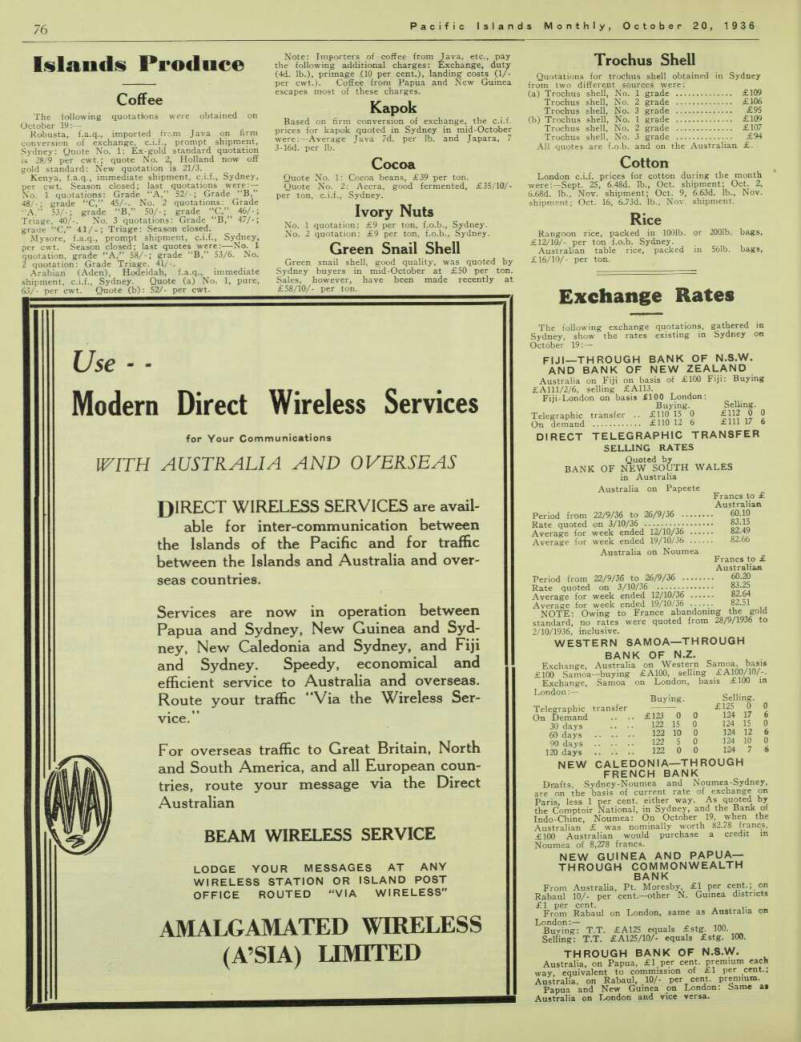
Coffee
The following quotations w r ere obtained on October 19: — .
Robusta, f.a.q., imported from Java on firm conversion of exchange, c.i.f., prompt shipment, Sydney: Quote No. 1; Ex-gold standard quotation is 28/9 per cwt.; quote No. 2, Holland now off gold standard: New quotation is 21/3.
Kenya, f.a.q., immediate shipment, c.i.f., Sydney, per cwt. Season closed; last quotations were:— No. 1 quotations: Grade “A,” 52/-; Grade “B,” 48/-; grade “C,” 45/-. No. 2 quotations: Grade •‘A.” 53/-; grade “B,” 50/-; grade “C,” 46/-; Triage, 40/-. No. 3 quotations: Grade “B,” 47/-; grade “C,” 41/-; Triage: Season closed.
Mysore, f.a.q., prompt shipment, c.i.f., Sydney, per cwt. Season closed; last quotes were: —No. 1 quotation, grade “A,” 58/-; grade “B,” 53/6. No. 2 quotation; Grade Triage, 41/-.
Arabian (Aden), Hodeidah, f.a.q., immediate shipment, c.i.f., Sydney. Quote (a) No. 1, pure, 63/- per cwt. Quote (b): 52/- per cwt.
Note: Importers of coffee from Java, etc., pay the following additional charges; Exchange, duty (4d. lb.), primage (10 per cent.), landing costs (1/per cwt.). Coffee from Papua and New Guinea escapes most of these charges.
Kapok
Based on firm conversion of exchange, the c.i.f. prices for kapok quoted in Sydney in mid-October were: —Average Java 7d. per lb. and Japara, 7 3-16 d. per lb.
Cocoa
Quote No. 1; Cocoa beans, £39 per ton.
Quote No. 2: Accra, good fermented, £35/10/per ton, c.i.f., Sydney.
Ivory Nuts
No. 1 quotation: £9 per ton, f.0.b., Sydney.
No. 2 quotation: £9 per ton, f.0.b., Sydney.
Green Snail Shell
Green snail shell, good quality, was quoted by Sydney buyers in mid-October at £5O per ton.
Sales, however, have been made recently at £5B/10/- per ton.
Trochus Shell
Quotations for trochus shell obtained in Sydney from two different sources were: (a) Trochus shell, No. 1 grade £lO9 Trochus shell, No. 2 grade £lO6 Trochus shell, No. 3 grade £95 (b) Trochus shell, No. 1 grade £lO9 Trochus shell, No. 2 grade £lO7 Trochus shell. No. 3 grade £94 All quotes are f.o.b. and on the Australian £.
Cotton
London c.i.f. prices for cotton during the month were:—Sept. 25, 6.48 d. lb., Oct. shipment; Oct. 2, 6.68 d. lb., Nov. shipment; Oct. 9,6.63 d. lb., Nov. shipment; Oct. 16, 6.73 d. lb., Nov. shipment.
Rice
Rangoon rice, packed in 1001 b. or 2001 b. bags, £l2/10/- per ton f.o.b. Sydney.
Australian table rice, packed in 561 b. bags, £l6/10/- per ton.
Exchange Rates
The following exchange quotations, gathered in Sydney, show the rates existing in Sydney on October 19: —
Fiji—Through Bank Of N.S.W.
And Bank Of New Zealand
Australia on Fiji on basis of £lOO Fiji; Buying £Alll/2/6, selling £AII3.
Fiji-London on basis £lOO London;
Direct Telegraphic Transfer
Selling Rates
Quoted by
Bank Of New South Wales
in Australia
Western Samoa—Through
Bank Of N.Z.
Exchange, Australia on Western Samoa, basis £lOO Samoa—buying £AIOO, selling £AIOO/10/-.
Exchange, Samoa on London, basis £lOO in London; — . on-
New Caledonia —Through
French Bank
Drafts, Sydney-Noumea and Noumea-Sydney, are on the basis of current rate of exchange on Paris, less 1 per cent, either way. As quoted by the Comptoir National, in Sydney, and the Bank of Indo-Chine, Noumea: On October 19, when the Australian £ was nominally worth 82.78 francs, £lOO Australian would purchase a credit in Noumea of 8,278 francs.
New Guinea And Papua
Through Commonwealth
Bank
From Australia, Pt. Moresby, £1 per cent.; on Rabaul 10/- per cent.—other N. Guinea districts £1 per cent. . , From Rabaul on London, same as Australia on London;— .
Buying: T.T. £AI2S equals £stg. 100.
Selling: T.T. £AI2S/10/- equals £stg. 100.
Through Bank Of N.S.W.
Australia, on Papua, £l.per cent, premium each way equivalent to commission of £1 per cent., Australia, on Rabaul, 10/- per cent, premium.
Papua and New Guinea on London: Same a* Australia on London and vice versa.
Buying.
Selling.
Telegraphic transfer . . £110 15 0 £112 0 0 On demand . £110 12 6 £111 17 6
Australia on Papeete Period from 22/9/36 to 26/9/36 Francs to £ Australian 60.10 Rate quoted on 3/10/36 « 83*15 Average for week ended 12/10/36 82.49 Average for week ended 19/10/36 82.66 Australia on Noumea Period from 22/9/36 to 26/9/36 Francs to £ Australian 60.20 Rate quoted on 3/10/36 . 83.25 Average for week ended 12/10/36 82.64 Averasre for week ended 19/10/36 . •... 82.51 NOTE; Owing: to France abandoning the gold standard, no rates were quoted from 28/9/1936 to 2/10/1936, inclusive.
Buying. Selling.
Telegraphic transfer 0 0 On Demand .. £123 0 0 124 17 6 30 davs .. 122 15 0 124 15 0 60 days 122 10 0 124 12 6 90 days 122 5 0 1M ! 0 120 days 122 0 0 124 7 6
Advertisements & other items, p. 78 (1 item)
Modern Direct Wireless Services
Use--
for Your Communications
WITH AUSTRALIA AND OVERSEAS
DIRECT WIRELESS SERVICES are avail-
able for inter-communication between the Islands of the Pacific and for traffic between the Islands and Australia and overseas countries.
Services are now in operation between Papua and Sydney, New Guinea and Sydney, New Caledonia and Sydney, and Fiji and Sydney. Speedy, economical and efficient service to Australia and overseas.
Route your traffic “Via the Wireless Ser- • ft vice.
For overseas traffic to Great Britain, North and South America, and all European countries, route your message via the Direct Australian
BEAM WIRELESS SERVICE
LODGE YOUR MESSAGES AT ANY
WIRELESS STATION OR ISLAND POST
OFFICE ROUTED “VIA WIRELESS"
AMALGAMATED WIRELESS
(A’SIA) LIMITED
Market Quotations
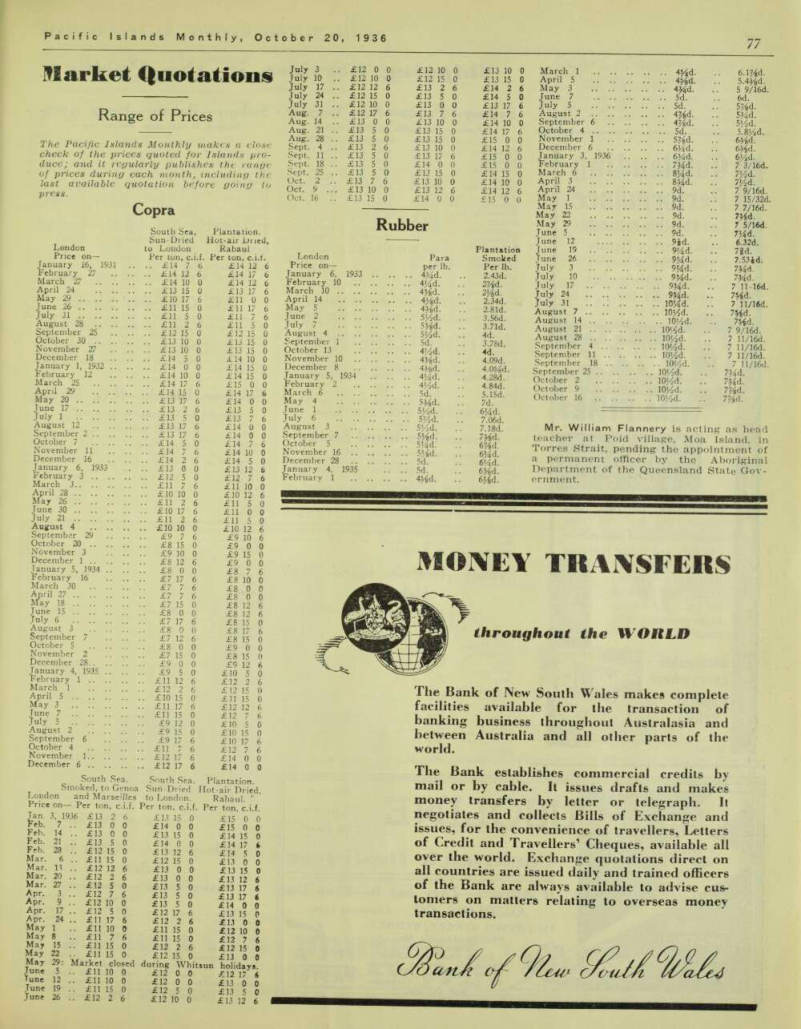
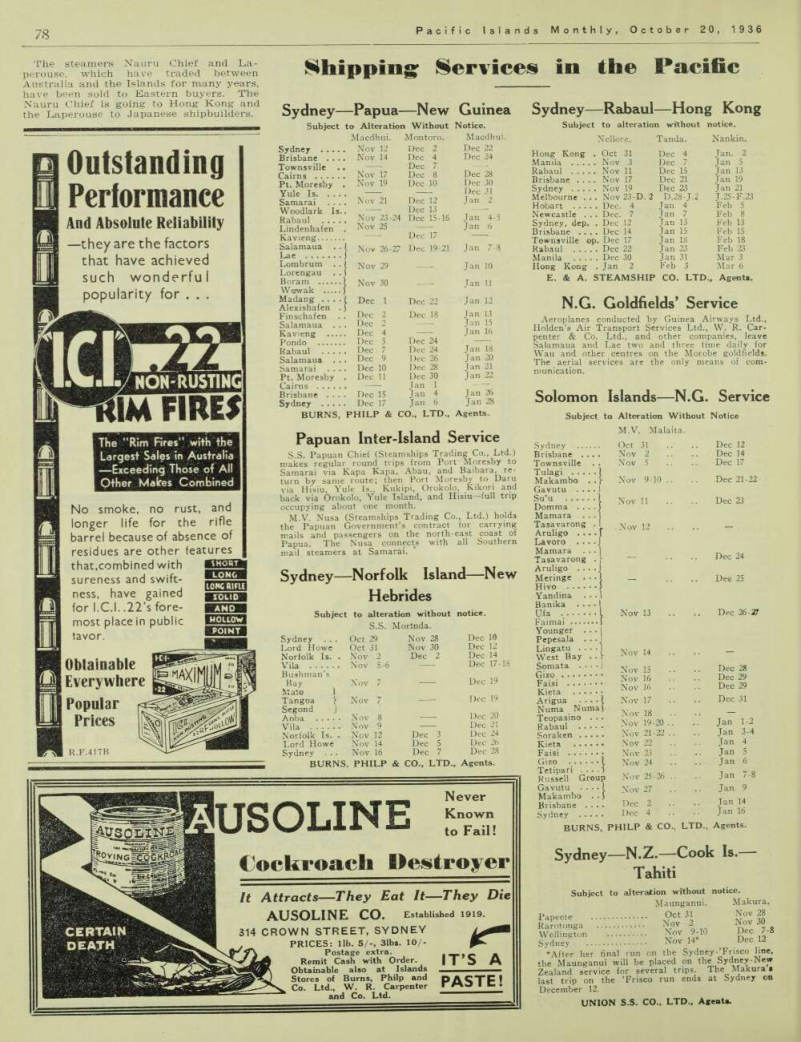
Range of Prices
The Pacific Islands Monthly makes a close check of the prices quoted for Islands pro duce; and it regularly publishes the range of prices during each month, including the last available quotation before going to press.
Mr. William Flannery is acting as head teacher at Poid village, Moa Island, in Torres Strait, pending the appointment of a permanent officer by the Aboriginal Department of the Queensland State Gov ernment.
March 1 . 4f£d 6.1^d.
April 5
5 .Vsd.’
May 3 .. .. 4**d. 5 9/16d.
June 7 .. .. 5d. 6d.
July 5 sm.
August 2 .. .. 4^d. sy 4 d.
September 6 ... .. .. 4%d.
S'Ad.
October 4 .. .. 5d.
S.S'ad.
November 1 ... 6Vsd.
December 6 ... .. .. 6V 4 d. 6||d.
January 3 1936 .. .. .. 6Hd. 6'/ 2 d.
February 1 ... .. .. 7H d. 7 3/16d.
March 6 7'Ad.
April 3 .. .. &y 4 d. 7/ 2 d.
April 24 7 9/16d.
May 1 7 15/32d.
May IS .. .. 9d. 7 7/16d.
May 22 .. .. 9d. 7^d.
May 29 .. .. 9d. 7 5/16d.
June 5 .. .. 9d. 7'Ad.
June 12 .. .. 9Jd. 6.32d.
June 19 .. .. 9'Ad. 78d.
T une 26 .. .. 9 x / 4 d. 7.53Jd.
July 3 .. .. 9%d. 7Hd.
July 10 .. .. 9Xd. 7Hd.
July 17 .. .. 9Hd. 7 11-16d.
July 24 .. .. 9^d. . . 7Hd.
July 31 7 ll/16d.
August 7 7Hd.
August 14 .. .. W'Ad. 7Hd.
August 21 .. .. 10'Ad. 7 9/16d.
August 28 .. .. ]oy 2 d. 7 ll/16d.
September 4 .. .. .. .. 10^d. 7 ll/16d.
September 11 .. .. .. .. W'Ad. 7 ll/16d.
September 18 .. .. .. .. WAd. 7 1l/16d.
September 25 . .. 10'Ad. 7Hd.
October 2 . .. lOHd. 7V 4 d.
October 9 . .. 10^d.
October 16 , .. 10^d. 7m.
July 3 . £12 0 0 £12 10 0 £13 10 0 July 10 . . £12 10 0 £12 15 0 £13 15 0 July 17 . . £12 12 6 £13 2 6 £14 2 6 July 24 . . £12 15 0 £13 5 0 £14 5 0
July
31 . . £12 10 0 £13 0 0 £13 17 6 Aug. 7 . . £12 17 6 £13 7 6 £14 7 6 Aug. 14 . . £13 0 0 £13 10 0 £14 10 0 Aug. 21 . . £13 5 0 £13 15 0 £14 17 6 Aug. 28 . . £13 5 0 £13 15 0 £15 0 0 Sept. 4 . . £13 2 6 £13 10 0 £14 12 6 Sept. 11 . . £13 5 0 £13 17 6 £15 0 0 Sept. 18 . . £13 5 0 £14 0 0 £15 0 0 Sept. 25 . . £13 5 0 £13 15 0 £14 15 0 Oct. 2 .. , £13 7 6 £13 10 0 £14 10 0 Oct. 9 .. . £13 10 0 £13 12 6 £14 12 6 Oct. 16 .. , £13 15 0 £14 0 0 £15 0 0
Rubber
Plantation London Para Smoked Price on— per lb.
Per lb.
January 6. 1933 2.43d.
February 10 2V%d.
March 10 .. .. 2'Ad.
April 14 .. .. 2.34d.
May 5 4Hd. 2.81d.
June 2 ... 3.56d.
July 7 ...
Slid. 3.71d.
August 4 5^d. 4d.
September 1 3.78d.
October 13 4d.
November 10 4.09d.
December 8 4^d. 4.0$id.
January 5, 1934 4Hd. 4.28d.
February 2 4.84d.
March 6 5.15d.
May 4 ...
S^d. 7d.
Tune 1 .. .. 6%d.
July 6 ... sy 2 d. 7.06d.
August 3 .. .
S'Ad. 7.18d.
September 7 .. , October 5 .. . : ;; §& md. 6Hd.
November 16 5*/£d. 6'Ad.
December 28 5d. 6*4 d.
January 4. 1935 .. .. 5d. 654d.
February 1 .. , 4^d. .. 6^d.
London
Copra
South Sea, Sun-Dried to London Plantation.
Hot-air Dried, Kabaul Price on— Per ton, c.i.f. . .. £14 7 6 Per ton, c.i.f.
January 16, 1931 £14 12 6 .February 27 . .. £14 12 6 £14 17 6 March 27 . .. £14 10 0 £14 12 6 April 24 £13 17 6 May 29 .. .. £11 0 0 June 26 .. . .. £11 15 0 £11 17 6 July 31 .. .. . .. £11 5 0 £11 7 6 August 28 .. . .. £11 2 6 £11 5 0 September 25 . .. £12 15 0 £12 15 0 October 30 .. £13 15 0 November 27 . .. £13 10 0 £13 15 0 December 18 £14 10 0 January 1, 1932 . .. £14 0 0 £14 15 0
February 12
. .. £14 10 0 £14 15 0 March 25 £15 0 0 April 29 £14 17 6 May 20 .. .. £14 0 0 June 17 .. .. £13 5 0 July 1 ... . .. £13 5 0 £13 7 6 August 12 £14 0 0 September 2 .. £14 0 0 October 7 £14 7 6 November 11 .. £14 7 6 £14 10 0 December 16 £14 5 0 January 6, 1933 .. £13 0 0 £13 12 6 February 3 .. £12 7 6 March 3.. .. .. £11 7 6 £11 10 0 April 28 .. .. £10 12 6 May 26 .. .. £11 5 0 June 30 .. .. £11 0 0 July 21 .. .. £11 5 0 August 4 £10 12 6
September 29
.. £9 7 6 £9 10 6 October 20 £9 0 0 November 3 .. £9 10 0 £9 15 0 December 1 .. £9 0 0 January 5, 1934 .. £8 0 0 £8 7 6
February 16
.. £7 17 6 £8 10 0 March 30 £8 0 0 April 27 .. ..
May 18 .. .. .. £7 7 6 £8 0 0 £8 12 6 June 15 .. .. £8 12 6 July 6 .. £8 15 0 August 3 £8 0 0 £8 17 6 September 7 .. £7 12 6 £8 15 0 October 5 £8 0 0 £9 0 0 November 2 £8 15 0 December 28.. .. £9 0 0 £9 12 6 January 4, 1935 .. £9 5 0 £10 5 0 February 1 .. £12 2 6 March 1 .. £12 2 6 £12 15 0
April 5 .. ..
£11 15 0 May 3 .. .. .. £11 17 6 £12 12 6 June 7 .. .. £12 7 6 July 5 .. .. £10 5 0 August 2 £10 15 0 September 6 .. £9 17 6 £10 17 6 October 4 .. £11 7 6 £12 7 6 November 1.. .. £12 17 6 £14 0 0 December 6 .. .. £12 17 6 £14 0 0 South Sea.
South Sea.
Plantation. . Smoked, to Genoa Sun-Dried Hot-air Dried London and Marseilles to London.
Rabaul.
Price on— Per ton, c.i.f. Per ton. c.i.f. ] Per ton, c.i.f.
Jan. 3, 1936 £13 2 6 £13 15 0 £15 0 0 Feb. 7 .. £13 0 0 £14 0 0 £15 0 0 Feb. 14 .. £13 0 0 £13 15 0 £14 15 0 Feb. 21 .. £13 5 0 £14 0 0 £14 17 6 *eb. 28 .. £12 15 0 £13 12 6 £14 5 0 Mar. 6 .. £11 15 0 £12 15 0 £13 0 0 Mar. 13 .. £12 12 6 £13 0 0 £13 15 0 Mar. 20 .. £12 2 6 £13 0 0 £13 12 6 Mar. 27 .. £12 5 0 £13 5 0 £13 17 6 Apr. 3 .. £12 7 6 £13 5 0 £13 17 € Apr. 9 .. f 12 10 0 £13 5 0 £14 0 0 Apr. 17 .. £12 5 0 £12 17 6 £13 15 P Apr. 24 .. £11 17 6 £12 2 6 £13 0 0 May 1 .. £11 10 0 £11 15 0 £12 10 0 May 8 .. £11 7 6 £11 15 0 £12 7 6 May IS .. £11 15 0 £12 2 6 £12 15 0 May 22 .. £11 IS 0 £12 15 0 £13 n n May 29: Market closed during Whitsun holidays.
June 5 .. £11 10 0 £12 0 0 £12 17 6 T une 12 ,. £11 10 0 £12 0 0 £13 0 0 June 19 .. £11 15 0 £12 5 0 £13 5 0 June 26 .. £12 2 6 £12 10 0 £13 12 6
The steamers Nauru Chief and La perouse, which have traded between Australia and the Islands for many years, have been sold to Eastern buyers. The Nauru Chief is going to Hong Kong and the Laperouse to Japanese shipbuilders.
Advertisements & other items, pp. 79-80 (1 item)
Money Transfers
The Bank of New South Wales makes complete facilities available for the transaction of banking business throughout Australasia and between Australia and all other parts of the world.
The Bank establishes commercial credits by mail or by cable. It issues drafts and makes money transfers by letter or telegraph. It negotiates and collects Bills of Exchange and issues, for the convenience of travellers, Letters of Credit and Travellers’ Cheques, available all over the world. Exchange quotations direct on all countries are issued daily and trained officers of the Bank are always available to advise customers on matters relating to overseas money transactions.
throughout the WOULD
Outstanding
Pertormanee
And Absolute Reliability —they are the factors that have achieved such wonderful popularity for . . . ms
IM FIRE*
The "Rim Fires" with the Largest Sales in Australia —Exceeding Those of All Other Makes Combined No smoke, no rust, and longer life for the rifle barrel because of absence of residues are other features that,combined with yjM.llll sureness and swiftness, have gained for I.CI. .22’s fore- KHS most place in public Li.'lil'.ul favor.
Obtainable
Everywhere
Popular
Prices R.F.4178 m\ ta m
USOLINE
Never Known to Fail!
Cockroach Destroyer
It Attracts—They Eat It—They Die
AUSOLINE CO.
314 CROWN STREET, SYDNEY
Established 1919.
PRICES: lib. 5/-, 31bs. 107- Postage extra.
Remit Cash with Order.
Obtainable also at Islands Stores of Burns, Philp and Co. Ltd,, W. R. Carpenter and Co. Ltd.
IT’S A
PASTE!
Shipping: Services in the Pacific
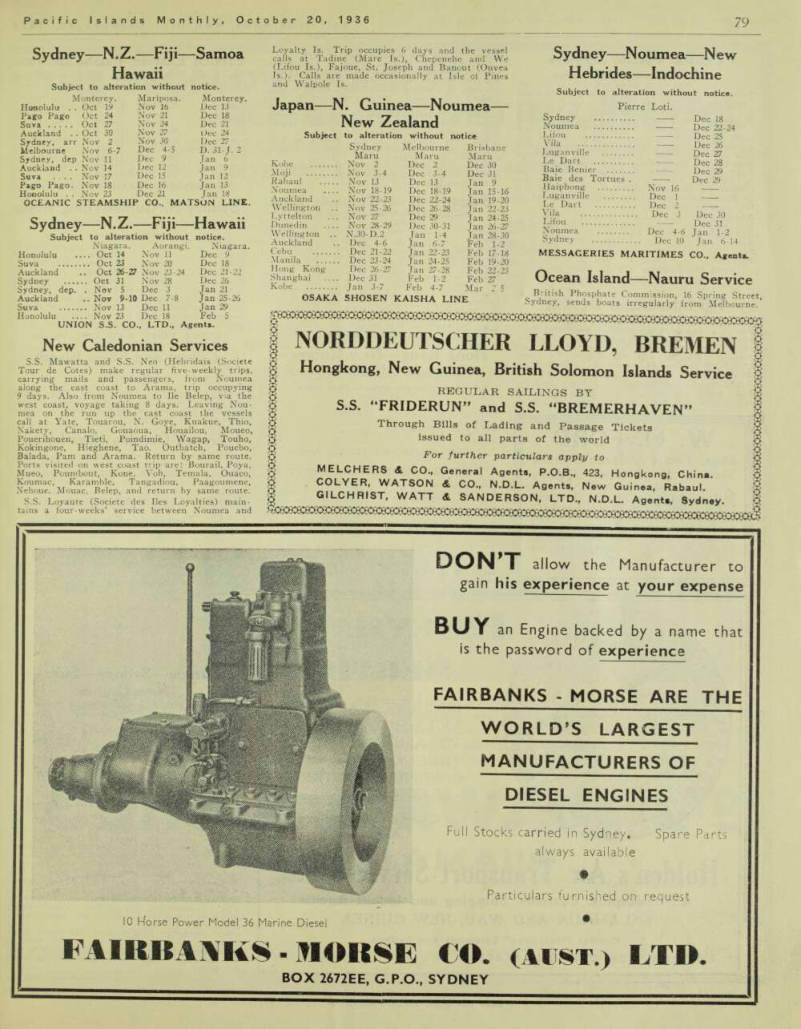
Sydney—Papua—New Guinea Subject to Alteration Without Notice.
Papuan Inter-Island Service
S.S. Papuan Chief (Steamships Trading Co., Ltd.) makes regular round trips from Port Moresby to Samarai via Kapa Kapa, Abau, and Baibara, re turn by same route; then Port Moresby to Daru via Hisiu, Yule Is.. Kukipi, Orokolo, Kikon and back via Orokolo, Yule Island, and Hisiu full trip occupying about one month.
M.V. Nusa (Steamships Trading Co., Ltd.) holds the Papuan Government’s contract for carrying mails and passengers on the north-east coast of Papua. The Nusa connects with all Southern mail steamers at Samarai.
Sydney—Norfolk Island —New
Hebrides
Subject to alteration without notice.
Sydney—Rabaul—Hong Kong Subject to alteration without notice.
N.G. Goldfields* Service
Aeroplanes conducted by Guinea Airways Ltd., Holden’s Air Transport Services Ltd., W. R. Car penter & Co. Ltd., and other companies, leave Salamaua and Lae two and three time daily for Wau and other centres on the Morobe goldfields.
The aerial services are the only means of com munication.
Solomon Islands—N.G. Service
Subject to Alteration Without Notice
Sydney—N.Z. —Cook Is.— Tahiti Subject to alteration without notice.
Macdhui.
Montoro.
Macdhui.
Sydney ...
Nov 12 Dec 2 Dec 22 Brisbane . . .
Nov 14 Dec 4 Dec 24 Townsville — Dec 7 — Cairns Nov 17 Dec 8 Dec 28 Pt. Moresby Nov 19 Dec 10 Dec 30 Yule Is. ... — — Dec 31 Samarai Nov 21 Dec 12 Jan 2 Woodlark Is. — Dec 13 — Rabaul ...
Nov 23-24 Dec 15-16 Jan 4-5 Lindenhafen Nov 25 — Jan 6 Kavieng — Dec 17 — Salamaua I . Nov 26-27 Dec 19-21 Jan 7-8 Lombrum . .
Nov 29 Jan 10 Lorengau Boram I 1 Nov 30 Jan 11
Wewak j
Madang . . . . j
I Dec 1 Dec 22 Jan 12 Alexishafen . J Finschafen 1 Dec 2 Dec 18 Jan 13 Salamaua . . . , Dec 2 — Jan IS Kavieng Dec 4 — Jan 16 Pondo Dec 5 Dec 24 — Rabaul Dec 7 Dec 24 Jan 18 Salamaua . .. . Dec 9 Dec 26 Jan 20 Samarai . . . . . Dec 10 Dec 28 Jan 21 Pt. Moresby .
Dec 11 Dec 30 Jan 22 Cairns — Jan 1 — Brisbane . . . .
Dec 15 Jan 4 Jan 26 Sydney Dec 17 Jan 6 Jan 28
Burns,
Philp & Co., Ltd.,
Agents.
s.s.
Morlnda.
Sydney Oct 29 Nov 28 Dec 19 Lord Howe Oct 31 Nov 30 Dec 12 Norfolk Is. - Nov 2 Dec 2 Dec 14 Vila Nov 5-6 — Dec 17-IS Bushman’s Bay Nov 7 — Dec 19 Mato ] Tangoa > Nov 7 — Dec 19 Segond J Aoba Nov 8 — Dec 20 Vila Nov 9 — Dec 21 Norfolk Is. .
Nov 12 Dec 3 Dec 24 Lord Howe Nov 14 Dec 5 Dec 26 Sydney . . .
Nov 16 Dec 7 Dec 28
Burns
. Philp
& Co., Ltd.,
Agents.
Nellore.
Tanda.
Nankin.
Hong Kong . Oct 31 Dec 4 Jan. 2 Manila . . . . . Nov 3 Dec 7 Jan 5 Rabaul . . . . . Nov 11 Dec 15 Jan 13 Brisbane . . .
Dec 21 Jan 19 Sydney ... . Nov 19 Dec 23 Jan 21 Melbourne . . . . Nov 23-D. 2 D.28-J.2 J.25-F.23 Hobart . . .
Jan 4 Feb 5 Newcastle . . . Dec. 7 Jan 7 Feb 8 Sydney, dcp. . Dec 12 Jan 13 Feb 13 Brisbane . . . . Dec 14 Jan 15 Feb 15 Townsville op. Dec 17 Jan 18 Feb 18 Rabaul . . . . . Dec 22 Jan 23 Feb 23 Manila Jan 31 Mar 3 Hong Kong . Jan 2 Feb 3 Mar 6 E. & A.
Steamship
CO. LTD., Agent*.
M.V. Malaita.
Oct 31 Dec 12 Brisbane . . . .
Nov 2 Dec 14 Townsville Nov 5 Dec 17 Makambo . .
Nov 9-10 ..
Dec 21-22 Gavutu . . • . 1 Nov 11 Dec 23 Domma ...
Mamara Tasavarong . . Nov 12 Aruligo ...
Lavoro ... ■.
Mamara Tasavarong . — Dec 24 Aruligo ... I Meringe . . ■( Dee 25 Yandina . . • Banika ...
X If a Nov 13 Dec 26-37 Younger . . .
Pepesala ...
Lingatu ...
Nov 14 West Bay . .
Somata ...
Nov 15 Dec 28 Dec 29 Dec 29 Nov 16 Nov 16 Arigua ...
I Nov 17 Dec 31 Numa Numa Teopasino . • * Nov 18 Nov 19-20..
Jan 1-2 Soraken •• • • Nov 21-22..
Jan 3-4 Kieta • Nov 22 Jan 4 Faisi • Nov 23 Jan 5 Jan 6 0 1 zo ••• J Nov 24 Tetipari Hussell Grou p Nov 25-26 ..
Jan 7-8 Gavutu Nov 27 Jan 9 Makambo . • Brisbane . . • Dec 2 Jan 14 Sydney • . . .
Dec 4 Jan 16
Burns, Philp & Co., Ltd.,
Agents.
Maunganui. Makura.
p aDe ete Oct 31 Nov 28 Rarotonga Nov 2 Nov 30 Wellington Nov 9-10 Dec 7-8 Sydney Nov 14* Dec 12 ♦After her final run on the Sydney-’Frisco line, the Maunganui will be placed on the Sydney-New Zealand service for several trips. The Makura • last trip on the ’Frisco run ends at Sydney on December 12.
Union S.S. Co.. Ltd., Agents.
Sydney—N.Z.—Fiji—Samoa
Hawaii Subject to alteration without notice.
Sydney—N.Z.—Fiji—Hawaii Subject to alteration without notice.
New Caledonian Services
5.5. Mawatta and S.S. Neo (Hebridais (Societe Tour de Cotes) make regular five-weekly trips, carrying mails and passengers, from Noumea along the east coast to Arama, trip occupying 9 days. Also from Noumea to He Belep, via the west coast, voyage taking 8 days. Leaving Nou mea on the run up the east coast the vessels call at Yate, Touarou, N. Goye, Kuakue, Thio, Nakety, Canalo, Gouaoua, Houailou, Moueo, Pouerihouen, Tied, Poindimie, Wagap, Touho, Kokingone, Hieghene, Tao. Outbatch, Pouebo, Balada, Pam and Arama. Return by same route.
Ports visited on west coast trip are: Bourail, Poya, Mueo, Poumbout, Kone. Voh, Temala, Ouaco, Koumac, Karamble, Tangadiou, Paagoumene, Nehoue. Mouac, Belep, and return by same route. 5.5. Loyaute (Societe des lies Loyalties) main tains a four-weeks’ service between Noumea and
Loyalty Is. Trip occupies 6 days and the vessel calls at Tadine (Mare Is.), Chepenehe and We (Lifou Is.), Fajoue, St. Joseph and Banout (Ouvea Is.). Calls are made occasionally at Isle of Pines and Walpole Is.
Japan—N. Guinea—Noumea—
New Zealand
Subject to alteration without notice
Sydney—Noumea—New Hebrides—lndochine Subject to alteration without notice.
Ocean Island—Nauru Service
British Phosphate Commission, 16 Spring Street, Sydney, sends boats irregularly from Melbourne.
Monterey. Mariposa. Monterey.
Honolulu . . Oct IV Nov 16 Dec 13 Pago Pago Oct 24 Nov 21 Dec 18 Suva Oct 27 Nov 24 Dec 21 Auckland . . Oct 30 Nov 27 Dec 24 Sydney, arr Nov 2 Nov 30 Dec 27 Melbourne Nov 6-7 Dec 4-5 D. 31-J. 2 Sydney, dcp Nov 11 Dec 9 Jan 6 Auckland . . Nov 14 Dec 12 Jan 9 Suva ... Nov 17 Dec 15 Jan 12 Pago Pago. Nov 18 Dec 16 Jan 13 Honolulu . . Nov 23 Dec 21 Jan 18
Oceanic Steamship Co., Matson Line.
Niagara. Aorangi. Niagara.
Honolulu ... Oct 14 Nov 11 Dec 9 Suva Oct 23 Nov 20 Dec 18 Auckland .. Oct 26-27 Nov 23-24 Dec 21-22 Sydney Oct 31 Nov 28 Dec 26 Sydney, dep. . Nov S Dec 3 Jan 21 Auckland ..Nov 9-10 Dec 7-8 Jan 25-26 Suva Nov 13 Dec 11 Jan 29 Honolulu Nov 23 Dec 18 Feb 5
Union S.S. Co., Ltd., Agent*.
Sydney Melbourne Brisbane Maru Maru Maru Kobe Nov 2 Dec 2 Dec 30 Moji Nov 3-4 Dec 3-4 Dec 31 Rabaul Nov 13 Dec 13 Jan 9 Noumea ...
Nov 18-19 Dec 18-19
jan 15-16
Auckland Nov 22-23 Dec 22-24 Jan 19-20 Wellington Nov 25-26 Dec 26-28 Tan 22-23 Lyttelton Nov 27 Dec 29
jan 24-25
Dunedin ...
Nov 28-29 Dec 30-31 Jan 26-27 Wellington ..
N.30-D.2 Jan 1-4 Jan 28-30 Auckland Dec 4-6 Jan 6-7 Feb 1-2 Cebu Dec 21-22 Jan 22-23 Feb 17-18 Manila Dec 23-24 Jan 24-25 Feb 19-20 Hong Kong Dec 26-27 Jan 27-28 Feb 22-23 Shanghai Dec 31 Feb 1-2 Feb 27 Kobe Jan 3-7 Feb 4-7 Mar 2 5
Osaka
Shosen
Kaisha Line
Pierre Loti.
Sydney — Dec 18 Noumea — Dec 22-24 Lifou — Dec 25 Vila — Dec 26 Luganville Dec 27 Le Dart Dec 28 Baie Benier Dec 29 Baie des Tortues .
Dec 29 Haiphong Nov 16 Dec 1 Dec 2 Dec 3 Luganville Le Dart — Vila Dec 30 Lifou — Dec 31 Noumea Dec 4-6 Jan 1-2 Sydney Dec 10 J an 6 -14
Messageries Maritimes
CO., Agent*.
Advertisements & other items, pp. 80-81 (2 items)
78
Monthly, October 20, 1936
Pacific Islands
advt
NORDDEUTSCHER LLOYD, BREMEN
Hongkong, New Guinea, British Solomon Islands Service
REGULAR SAILINGS BY
S.S. “FRIDERUN” and S.S. “BREMERHAVEN”
Through Bills of Lading and Passage Tickets issued to all parts of the world For further particulars apply to MELCHERS A CO., General Agents, P. 0.8., 423, Hongkong, China.
COLYER, WATSON A CO., N.D.L. Agents, New Guinea, Rabaul.
GILCHRIST, WATT A SANDERSON, LTD., N.D.L. Agents, Sydney.
advt
Europe—Sydney—Suva—
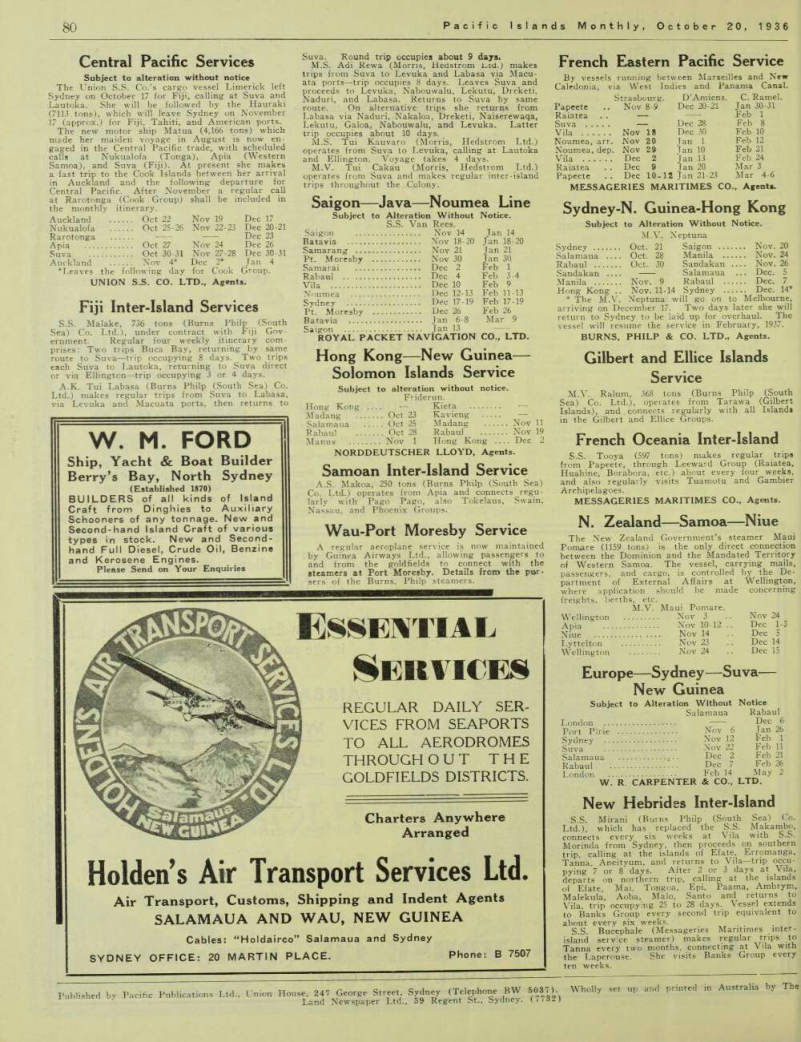
Central Pacific Services
Subject to alteration without notice The Union S.S. Co.’s cargo vessel Limerick left Sydney on October 17 for Fiji, calling at Suva and Lautoka. She will be followed by the Hauraki (7113 tons), which will leave Sydney on November 17 (approx.) for Fiji, Tahiti, and American ports.
The new motor ship Matua (4,166 tons) which made her maiden voyage in August is now en gaged in the Central Pacific trade, with scheduled calls at Nukualofa (Tonga), Apia (Western Samoa), and Suva (Fiji). At present she makes a fast trip to the Cook Islands between her arrival in Auckland and the following departure for Central Pacific. After November a regular call at Rarotonga (Cook Group) shall be included in the monthly itinerary.
Fiji Inter-Island Services
S.S. Malake, 736 tons (Burns Philp (South Sea) Co. Ltd.), under contract with Fiji Gov ernment. Regular four weekly itinerary com prises : Two trips Buca Bay, returning by same route to Suva —trip occupying 8 days. Two trips each Suva to Lautoka, returning to Suva direct or via Ellington—trip occupying 3 or 4 days.
A.K. Tui Labasa (Burns Philp (South Sea) Co.
Ltd.) makes regular trips from Suva to Labasa, via Levuka and Macuata ports, then returns to
Suva. Round trip occupies about 9 days.
M.S. Adi Rewa (Morns, Hedstrom makes trips from Suva to Levuka and Labasa via Macu ata ports —trip occupies 8 days. Leaves Suva and proceeds to Levuka, Nabouwalu, Lekutu, Dreketi, Naduri, and Labasa. Returns to Suva by same route. On alternative trips she returns from Labasa via Naduri, Nakaloa, Dreketi, Naiserewaqa, Lekutu, Galoa, Nabouwalu, and Levuka. Latter trip occupies about 10 days.
M.S. Tui Kauvaro (Morris, Hedstrom Ltd.) operates from Suva to Levuka, calling at Lautoka and Ellington. Voyage takes 4 days.
M.V. Tui Cakau (Morris, Hedstrom Ltd.) operates from Suva and makes regular inter-island trips throughout the Colony.
Saigon—Java—Noumea Line
Subject to Alteration Without Notice.
Hong Kong—New Guinea — Solomon Islands Service Subject to alteration without notice.
Samoan Inter-Island Service
A.S. Makoa, 250 tons (Burns Philp (South Sea) Co. Ltd.) operates from Apia and connects regu larly with Pago Pago, also Tokelaus, Swain, Nassau, and Phoenix Groups.
Wau-Port Moresby Service
A regular aeroplane service is now maintained by Guinea Airways Ltd., allowing passengers to and from the goldfields to connect with the steamers at Port Moresby. Details from the pur sers of the Burns, Philp steamers.
French Eastern Pacific Service
Sydney-N. Guinea-Hong Kong Subject to Alteration Without Notice.
Gilbert and Ellice Islands
Service
M.V. Ralum, 368 tons (Burns Philp (South Sea) Co. Ltd.), operates from Tarawa (Gilbert Islands), and connects regularly with all Islands in the Gilbert and Ellice Groups.
French Oceania Inter-Island
S.S. Tooya (597 tons) makes regular trips from Papeete, through Leeward Group (Raiatea, Huahine, Borabora, etc.) about every four weeks, and also regularly visits Tuamotu and Gambier Archipelagoes.
Messageries Maritimes Co., Agents.
N. Zealand—Samoa —Niue
The New Zealand Government’s steamer Maui Pomare (1159 tons) is the only direct connection between the Dominion and the Mandated Territory of Western Samoa. The vessel, carrying mails, passengers, and cargo, is controlled by the De partment of External Affairs at Wellington, where application should be made concerning freights, berths, etc.
Europe—Sydney—Suva—
New Guinea Subject to Alteration Without Notice
New Hebrides Inter-Island
5.5. Mirani (Burns Philp (South Sea) Co.
Ltd.), which has replaced the S.S. Makambo, connects every six weeks at Vila with S.S.
Morinda from Sydney, then proceeds on southern trip, calling at the islands of Efate, Erromanga, Tanna, Aneityum, and returns to Vila —trip occu pying 7or 8 days. After 2or 3 days at Vila, departs on northern trip, calling at the islands of Efate, Mai, Tongoa, Epi, Paama, Ambrym, Malekula, Aoba, Malo, Santo and returns to Vila, trip occupying 25 to 28 days. Vessel extends to Banks Group every second trip equivalent to about every six weeks. . . 5.5. Bucephale (Messageries Mantimes inter island service steamer) makes regular trips to Tanna every two months, connecting at Vila with the Laperouse. She visits Banks Group every ten weeks.
Auckland ... Oct 22 Nov 19 Dec 17 Nukualofa ... Oct 25-26 Nov 22-23 Dec 20-21 Rarotonga Dec 23 Apia ... Oct 27 Nov 24 Dec 26 Suva ... Oct 30-31 Nov 27-28 Dec 30-31 Auckland ... Nov 4* Dec 2* Tan 4 •Leaves the following day for Cook Group.
Union S.S. Co. Ltd.,
Agents.
s.s.
Van Rees.
Saigon Jan 14 Batavia ... Nov 18-20 Tan 18-20 Samarang Jan 21 Pt. Moresby ... Nov 30 Jan 30 Samarai ... . Dec 2 Feb 1 Rabaul Feb 3-4 Vila Feb 9 Noumea ... Dec 12-13 Feb 11-13 Sydney ... Dec 17-19 Feb 17-19 Pt. Moresby . .. . Dec 26 Feb 26 Batavia Mar 9 Saigon —
Royal Packet Navigation Co., Ltd.
Friderun.
Hong Kong ... -— Kieta •— Madang Oct 23 Kavieng — Salamaua Oct 25 Madang Nov 11 Rabaul Oct 28 Rabaul Nov 19 Manus Nov 1 Hong Kong Dec 2
Norddeutscher Lloyd, Agents.
By vessels running between Marseilles and New Caledonia, via West Indies and Panama Canal.
Strasbourg.
D’Amiens.
C. Ramel.
Papeete Nov 8-9 Dec 20-21 Jan 30-31 Raiatea . . — — Feb 1 Suva — Dec 28 Feb 8 Vila Nov 18 Dec 30 Feb 10 Noumea, arr.
Nov 20 Jan 1 Feb 12 Noumea, dep. Nov 29 Tan 10 Feb 21 Vila Dec 2 Jan 13 Jan 20 Feb 24 Raiatea Dec 9 Mar 3 Papeete Dec 10-12 Jan 21-23 Mar 4-6
Messageries Maritimes Co., A»Ent*.
M.V. Neptuna Sydney Oct. 21 Saigon Nov. 20 Salaraaua Oct. 28 Manila Nov. 24 Rabaul Oct. 30 Sandakan Nov. 26 Sandakan ... Salamaua ... Dec. 5 Manila Nov. 9 Rabaul Dec. 7 Hong Kong .. Nov. 11-14 Sydney Dec. 14* * The M.V. Neptuna will go on to Melbourne, arriving on December 17. Two days later she will return to Sydney to be laid up for overhaul. The vessel will resume the service in February, 1937.
Burns, Philp & Co. Ltd., Agents.
Wellington M.V. Maui Pomare.
Nov 3 Nov 24 Nov 10-12..
Dec 1-3 \iue Nov 14 Dec 5 Lyttelton Wellington Nov 23 Dec 14 Dec 15
Salamaua Rabaul Dec 6 Port Pirie ...
Nov 6 Jan 26 Sydney Nov 12 Feb 1 Suva Nov 22 Feb 11 Salamaua Dec 2 Feb 21 Rabaul Dec 7 Feb 26 London Feb 14 May 2 W. R
Carpenter & Co.,
Ltd.
Advertisements & other items, pp. 82-84 (2 items)
80
Pacific Islands Monthly, October 20, 1936
Published by Pacific Publications Ltd., Union House 247 George Street Sydney (Telephone BW 5037) Wholly se, up and printed in Australia by The Land Newspaper Ltd., 59 Regent St., Sydney. (77
Services
W. M. FORD
Ship, Yacht & Boat Builder
Berry’s Bay, North Sydney
(Established 1870) BUILDERS of all kinds of Island Craft from Dinghies to Auxiliary Schooners of any tonnage. New and Second-hand Island Craft of various types in stock. New and Secondhand Full Diesel, Crude Oil, Benzine and Kerosene Engines.
Please Send on Your Enquiries
Essential
Services
REGULAR DAILY SER-
VICES FROM SEAPORTS
TO ALL AERODROMES
THROUGH OUT THE
GOLDFIELDS DISTRICTS.
Charters Anywhere Arranged
Holdens Air Transport Services Ltd.
Air Transport, Customs, Shipping and Indent Agents
SALAMAUA AND WAU, NEW GUINEA
Cables: “Holdairco” Salamaua and Sydney SYDNEY OFFICE: 20 MARTIN PLACE. Phone: B 7507
THE WORLD’S LARGEST
AERIAL FREIGHTING SERVICE
G UINEA AIRWAYS LTD. was established in 1927; and it has grown in the following way, until it is to-day the largest freight-carrying air-service in the world: 000000000000000000 Unloading a Racehorse and Miscellaneous Cargo from a 3-engined Junker Monoplane, brought to Wau, New Guinea, by Guinea Airways Ltd. 000000000000000000 \ - L w. ‘•v 4 - - %->'! m AERIAL-TRANSPORT Speedy, Safe and Dependable made possible the Rapid Development of the great Morobe Goldfield, and the Consequent Enrichment of the Mandated Territory. Aeroplanes, running on Regular Schedules, without Difficulty or Delay, carried in Dredges, Crushing Mills, Cyaniding Plants, Motor Vehicles, Hydro-Electric Machinery, and Every Kind of Goods Needed by a Large and Growing European Community.
GUINEA AIRWAYS L™
LAE • SALAMAUA
HEAD OFFICE:
BROCKMAN BUILDINGS
GRENFELL STREET
ADELAIDE, S.A.
NEW GUINEA OFFICE:
LAE
MANDATED TERRITORY OF
NEW GUINEA
BRANCH OFFICES AND AGENTS AT WAU, SALAMAUA, PORT MORESBY, AND SYDNEY
iwe*-o V., urn*%\ a % % > i Keschs Lager is protected by the 'svt' crown seal It refreshes and invigorates you as no flavour, because it is fully protecied other drink can. In Resch’s Lager, against climatic conditions by the specivou get all the original freshness and ally designed “Spot” Crown Seal.
RESCHWIAGER
R.L.12.27