Pacific
Islands
Monthly
Vol. VII. No. 9
April 23, 19 3 7
tl\e G.P.0. . Sydney, for transmission by post as a newspaper .]
8 d
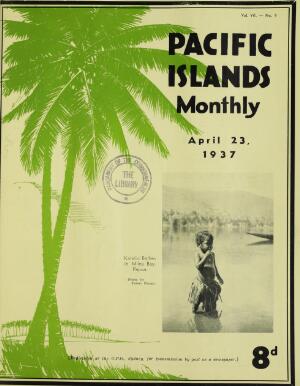
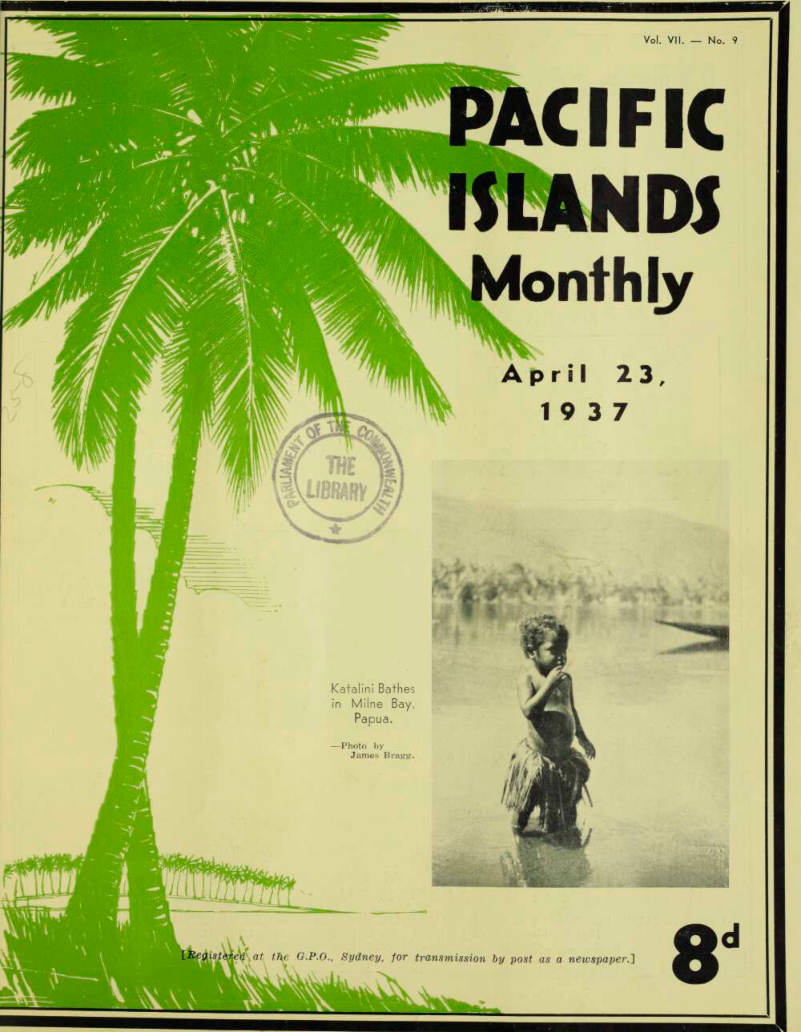
Katalinl Bathes in Milne Bay,
Papua.
—Photo by James Bragg.
Advertisements & other items, p. 2 (2 items)
ac i' 1 c islands Monthly, April 23, 1937
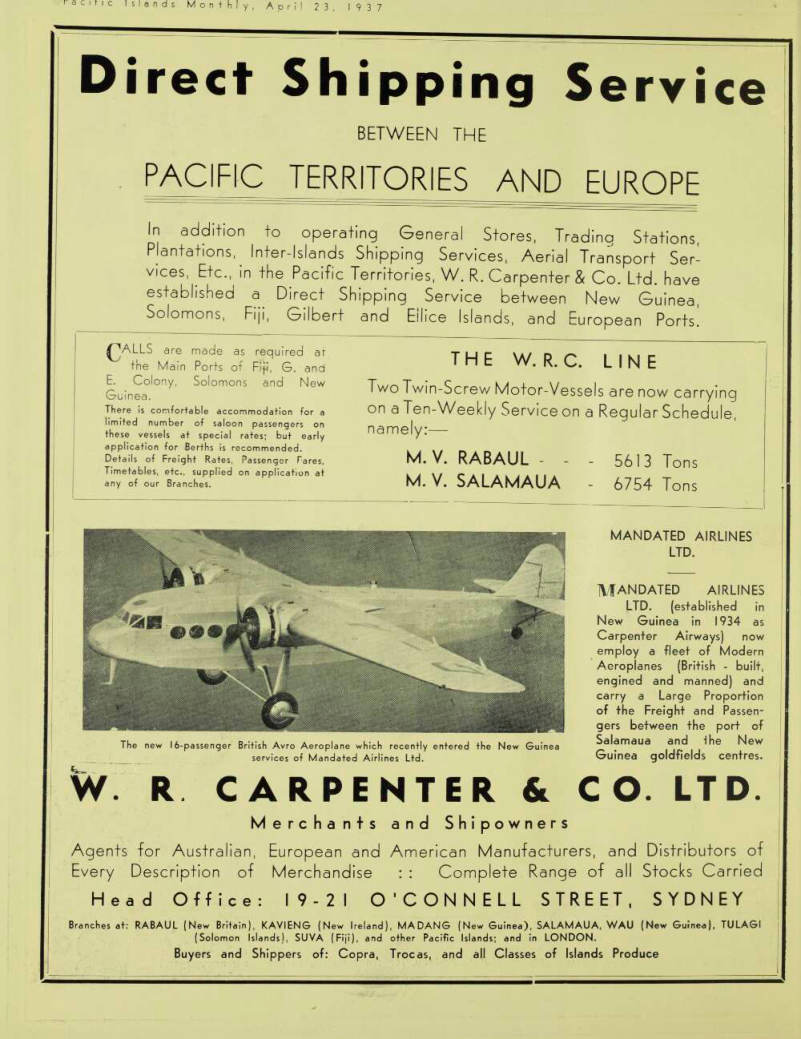
Direct Shipping Service
BETWEEN THE
PACIFIC TERRITORIES AND EUROPE
operating General Stores, Trading Stations,
slands Shipping Services, Aerial Transport Ser-
In addition to
Plantations, Inter
vices, Etc., in the Pacific Territories, W. R. Carpenter & Co.'ltd. have established a Direct Shipping Service between New Guinea, Solomons, Fiji, Gilbert and Ellice Islands, and European Ports! are made as required at the Main Ports of Fiji, G. and E, Colony, Solomons and New Guinea.
There Is comfortable accommodation for a limited number of saloon passengers on these vessels at special rates; but early application for Berths is recommended.
Details of Freight Rates, Passenger Fares, Timetables, etc., supplied on application at any of our Branches.
THE W. R. C. LINE
Two Twin-Screw Motor-Vessels are now carrying
on aTen-Weekly Serviceon a Regular Schedule,
namely:—
M. V. RABAUL - - - 5613 Tons
M. V. SALAMAUA - 6754 Tons
a - .
MANDATED AIRLINES
LTD.
The new 16-passenger British Avro Aeroplane which recently entered the New Guinea services of Mandated Airlines Ltd.
MANDATED airlines LTD. (established in New Guinea in 1934 as Carpenter Airways) now employ a fleet of Modern Aeroplanes (British - built engined and manned) and carry a Large Proportion of the Freight and Passengers between the port of Salamaua and fhe New Guinea goldfields centres.
W. R CARPENTER & CO. LTD
Merchants and Shipowners Agents for Australian, European and American Manufacturers, and Distributors of Every Description of Merchandise : : Complete Range of all Stocks Carried
Head Office: 19-21 O'CONNELL STREET, SYDNEY
Branches at; RABAUL (New Britain), KAVIENG (New Ireland), MADANG (New Guinea), SALAMAUA, WAU (New Guinea), TULAGI (Solomon islands), SUVA (Fiji), and other Pacific Islands; and in LONDON.
Buyers and Shippers of: Copra, Trocas, and all Classes of islands Produce
Pacific Islands Travellers
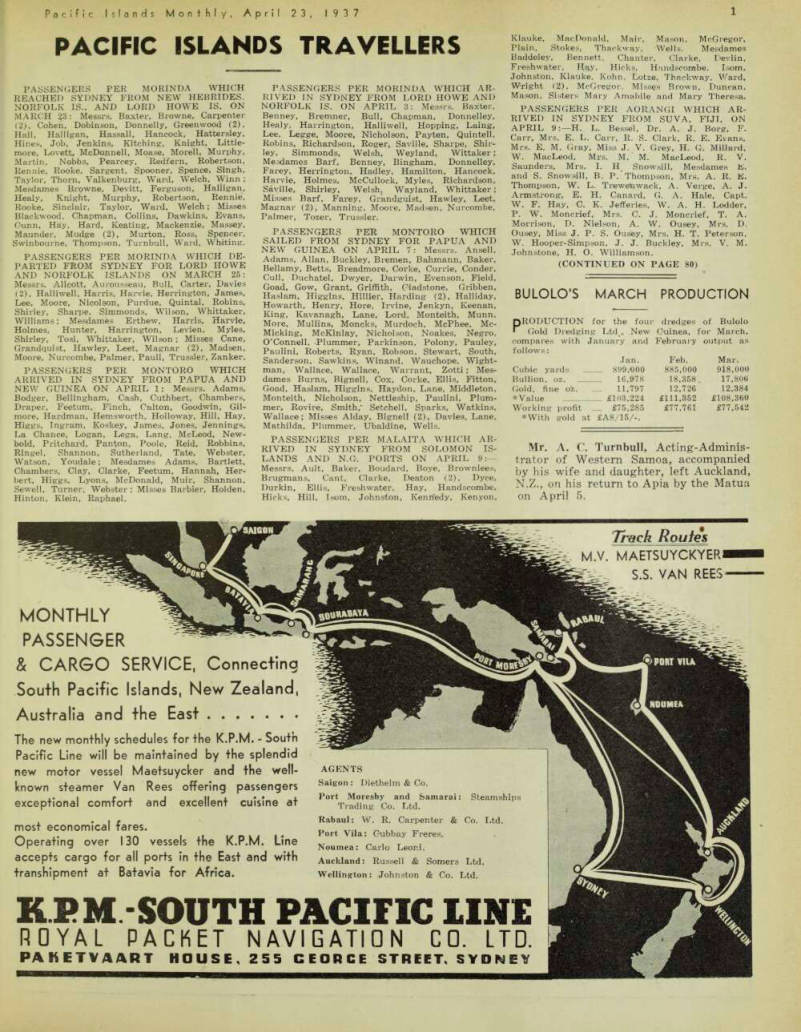
Passengers Per Morinda Which
Reached Sydney From New Hebrides.
NORFOLK IS., AND LORD HOWE IS. ON MARCH 23: Messrs. Baxter, Browne, Carpenter (2), Cohen, Dobinson, Donnelly, Greenwood (2), Hall, Halligan, Hassall, Hancock, Hattersley, Hines, Job, Jenkins, Kitching, Knight, Little more, Lovett. McDonnell, Moase, Morell, Murphy, Martin, Nobbs, Pearcey, Redfern, Robertson, Rennie, Rooke, Sargent, Spooner, Spence, Singh, Taylor, Thorn, Valkenburg, Ward, Welch, Winn ; Mesdames Browne, Devitt, Ferguson, Halligan, Healy, Knight, Murphy, Robertson, Rennie, Rooke, Sinclair, Taylor, Ward, Welch; Misses Blackwood, Chapman, Collins, Dawkins, Evans, Gunn, Hay, Hard, Keating, Mackenzie, Massey, Maunder, Mudge (2), Murton, Ross, Spencer, Swinbourne, Thompson, Turnbull, Ward, Whiting.
Passengers Per Morinda Which De
Parted From Sydney For Lord Howe
And Norfolk Islands On March 25:
Messrs. Allcott, Aurousseau, Bull, Carter, Davies (2), Halliwell, Harris, Harvie, Herrington, James, Lee, Moore, Nicolson, Purdue, Quintal, Robins, Shirley, Sharpe, Simmonds, Wilson, Whittaker, Williams; Mesdames Erthew, Harris, Harvie, Holmes, Hunter, Harrington, Levien, Myles, Shirley, Tosi, Whittaker, Wilson; Misses Cane, Grandquist, Hawley, Leet, Magnar (2), Madsen, Moore, Nurcombe, Palmer, Pauli, Trussler, Zanker.
Passengers Per Montoro Which
Arrived In Sydney From Papua And
NEW GUINEA ON APRIL 1: Messrs. Adams.
Bodger, Bellingham, Cash, Cuthbert, Chambers, Draper, Feetum, Finch, Galton, Goodwin, Gil more, Hardman, Hemsworth, Holloway, Hill, Hay, Higgs, Ingram, Koskey, James, Jones, Jennings, La Chance, Logan, Lega, Lang, McLeod, New bold, Pritchard, Panton, Poole, Reid, Robbins, Ringel, Shannon, Sutherland, Tate, Webster, Watson, Youdale; Mesdames Adams, Bartlett, Chambers, Clay, Clarke, Feetum, Hannah, Her bert, Higgs, Lyons, McDonald, Muir, Shannon, Sewell, Turner, Webster ; Misses Barbier, Holden, Hinton, Klein, Raphael.
Passengers Per Morinda Which Ar
RIVED IN SYDNEY FROM LORD HOWE AND NORFOLK IS. ON APRIL 3: Messrs. Baxter, Benney, Bremner, Bull, Chapman, Donnelley, Healy, Harrington, Halliwell, Hopping, Laing, Lee, Legge, Moore, Nicholson, Payten, Quintell, Robins, Richardson, Roger, Saville, Sharpe, Shir ley, Simmonds, Welsh, Weyland, Wittaker; Mesdames Barf, Benney, Bingham, Donnelley, Farey, Herrington, Hadley, Hamilton, Hancock, Harvie, Holmes, McCullock, Myles, Richardson, Saville, Shirley, Welsh, Wayland, Whittaker; Misses Barf, Farey, Gr'andguist, Hawley, Leet, Magnar (2), Manning, Moore, Madsen, Nurcombe, Palmer, Tozer, Trussler.
Passengers Per Montoro Which
Sailed From Sydney For Papua And
NEW GUINEA ON APRIL 7: Messrs. Ansell, Adams, Allan, Buckley, Bremen, Bahmann, Baker, Bellamy, Betts, Breadmore, Corke, Currie, Conder, Cull, Duchatel, Dwyer, Darwin, Evenson, Field, Goad, Gow, Grant, Griffith, Gladstone, Gribben, Haslam, Higgins, Hillier, Harding (2), Halliday, Howarth, Henry, Hore, Irvine, Jenkyn, Keenan, King, Kavanagh, Lane, Lord, Monteith, Munn, More, Mullins, Moncks, Murdoch, McPhee, Mc- Micking, McKinlay, Nicholson, Noakes, Negro, O’Connell, Plummer, Parkinson, Polony, Pauley, Paulini, Roberts, Ryan, Robson, Stewart, South, Sanderson, Sawkins, Winand, Wauchope, Wight man, Wallace, Wallace, Warrant, Zotti: Mes dames Burns, Bignell, Cox, Corke, Ellis, Fitton, Goad, Haslam, Higgins, Haydon, Lane, Middleton, Monteith, Nicholson, Nettleship, Paulini, Plum mer, Rovire, Smith," Setchell, Sparks, Watkins, Wallace; Misses Alday, Bignell (2), Davies, Lane, Mathilda, Plummer, Übaldine, Wells.
Passengers Per Malaita Which Ar
Rived In Sydney From Solomon Is
LANDS AND N.G. PORTS ON APRIL 9 Messrs. Ault, Baker, Boudard, Boye, Brownlees, Brugmans, Cant, Clarke, Deaton (2), Dyce, Durkin, Ellis, Freshwater, Hay, Handscombe, Hicks, Hill, Isom, Johnston, Kenn'edy, Kenyon,
Klauke, MacDonald, Mair, Mason, McGregor, Plain, Stokes, Thackway, Wells. Mesdames Baddeley, Bennett, Chanter, Clarke, Devlin, Freshwater, Hay, Hicks, Handscorabe. Isom, Johnston, Klauke, Kohn, Lotze, Thackway, Ward, Wright (2), McGregor. Misses Brown, Duncan, Mason. Sisters Mary Amabile and Mary Theresa.
Passengers Per Aorangi Which Ar
RIVED IN SYDNEY FROM SUVA. FIJI. ON APRIL 9:—H. L. Bessel, Dr. A. J. Borg, F.
Carr. Mrs. E. L. Carr. R. S. Clark. R. E. Evans.
Mrs. E. M. Gray. Miss J. V. Grey. H. G*. Millard, W. MacLeod, Mrs. M. M. MacLeod, R. V.
Saunders, Mrs. I. H Snowsill, Mesdames E. and S. Snowsill, B. P. Thompson, Mrs. A. R. E.
Thompson, W. L. Trewetiwack, A. Verge, A. J.
Armstrong, E. H. Canard, G. A. Hale, Capt.
W. F. Hay. C. K. Jefferies, W. A. H. Lodder, P. W. Moncrief, Mrs. C. J. Moncrief, T. A.
Morrison, D. Nielson, A. W. Ousey, Mrs. D.
Ousey, Miss J. P. S. Ousey, Mrs. H. T. Peterson, W. Hooper-Simpson, J. J. Buckley, Mrs. V. M.
Johnstone, H. O. Williamson,
(Continued On Page 80)
Passengers Per Aorangi Which
SAILED FROM SYDNEY FOR SUVA, FIJI, ON APRIL 15: J. S. Birdsall, W. W. Birdsall, Mrs.
S M. Bossley, Miss E. M. Clift, Mr. and Mrs.
A E. Crawford, J. R. Dupre, Mrs. C. Elliott, Mrs. W. Finlayson, Miss Finlayson, J. S.
Higman, Mrs. K. S. Hawkins, Mr. and Mrs. A. G*.
King, Mr. and Mrs. J. Morrison, Mr. and Mrs.
H. McKay, Miss L. Robinson. Mrs. G. S. Rowley, Miss R. M. Sabben, Mr. and Mrs. L. M. Sher wood, Mrs E. Snowsill, Misses M. and S. Snow sill, Mrs. A. B. Snodgrass, G. M. Wane, Mr. and Mrs. D. G. Watson, Misses V. and N.
Watson, Mrs. C. Ansett, Mrs. A Anderson, Mr. and Mrs. S. M. Brown, Mrs. Briscoe' Mrs. K.
Banfield, Misses M. and E. Banfield, Mrs. L.
Bek, R. L. Came, Mr and Mrs. W. Ferris, Mr. and Mrs. R. L. Forrest, J. S. Flynn, Miss B.
Howell, Mrs. F. Howell, C. Kennedy, Mrs. C. E.
Mansell, Miss M. M Morrison, Miss J. Morrison, Miss N. Mackay, Mrs. McLeod, Miss E. Sprawson, Miss Webster, Miss M. A. Wisham, H. Williams, Mr. and Mrs. J. E. Williams, Mrs. L. Bowers, Mrs. Kalesi.
Passengers Pee Morinda Which
Sailed From Sydney For Lord Howe
IS., NORFOLK IS.. AND NEW HEBRIDES ON APRIL 15Messrs. Allcott, Aurousseay, Bull, Carter, Davies (2), Halliwell, Herrington, Harvie, Harris, James, Leet, Myles, Moore, Nicholson, Purdue, Quintal, Robins, Simmonds, Sharpe, Shirley, Williams, Whittaker, Wilson. Mesdames Holmes, Herrington, Hunter, Harvie, Harris, Levien, Myles, Shirley, Tosi, Thew, Whittaker, Wilson. Misses Cane, Grandquist, Hawley, Leet, Magnar (2), Madsen, Moore, Nurcombe, Palmer, Pauli, Trussler, Zanker.
Passengers Per Malaita Which Left
Sydney For Solomons And N.G. Ports
ON APRIL 17: —Messrs. Allom, Bowditch, Bradley, Blake, Cantor, Campbell, Cottrell- Dormer, French, Ferris, Finkle, Glenn, Gadsby, Hancock, Hazelwinkel, Haselett, Joyes, Kearney, Munsell, Skiller, Svensen, Rooney, Wells. Mes dames Allom, Cox, Campbell, Exton, Francis, Griffiths, Glenn, Harrison, Moore, Newton, Neale, Pryce-Williams, Thomas, Turnbull, Wright,
White, Wells. Misses Blaise, Civil, Deck, Devir, Fitzgerald, Hosking, Hosking, Henderson, Healy, King, Loxton, Love, Leclers, Macdonel, Reid, Salome, Turnbull, Wells
Bulolo's March Production
PRODUCTION for the four dredges of Bulolo Gold Dredging Ltd , New Guinea, for March, compares with January and February output as follows:
Mr. A. C. Turnbull, Acting-Adminis trator of Western Samoa, accompanied by his wife and daughter, left Auckland, N.Z., on his return to Apia by the Matua on April 5.
Jan. Feb. Mar.
Cubic yards 899,-000 885,000 918,000 Bullion, oz 16,978 18,358. 17,806 Gold, fine o!z 11,797 12,726 12,384 ♦ Value £103,224 £111,352 £108,360 Working profit £75,285 £77,761 £77,542 ♦ With gold at £A8/15/-.
Advertisements & other items, p. 3 (1 item)
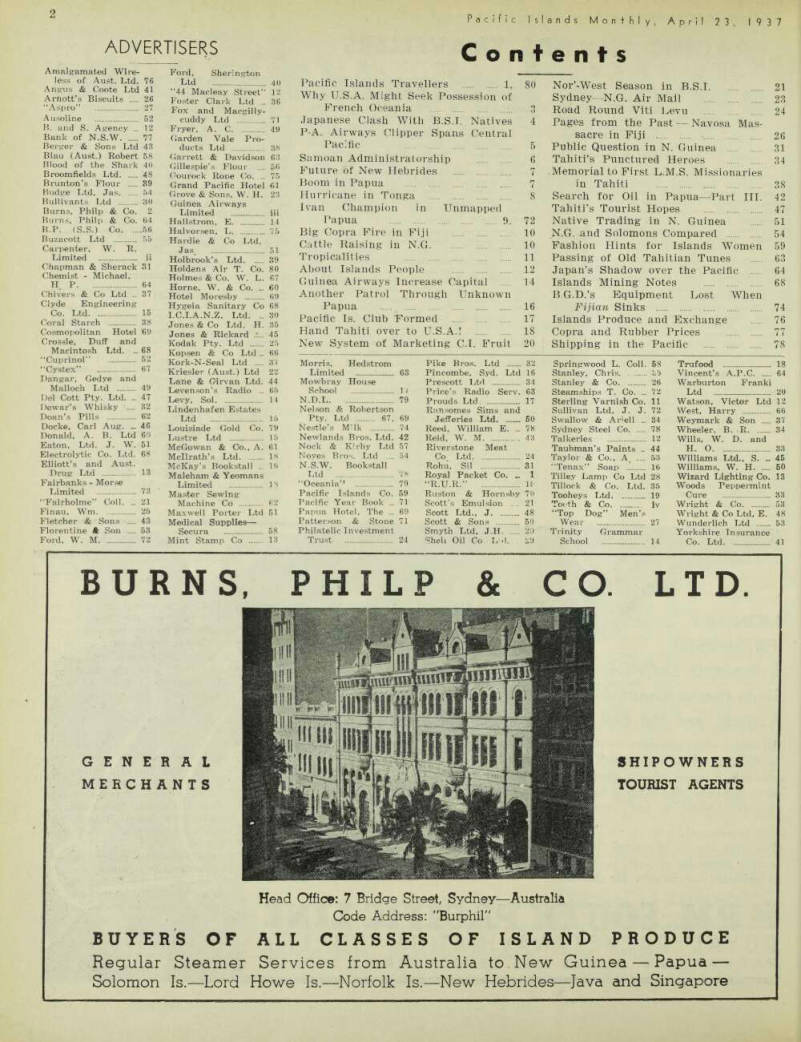
K.Rm -South Pacific Line
Track Routes
fv M.V. MAETSUYCKYER
Serv-. S.S. VAN REES
-i- -ft
AGENTS
Saigon: Diethelm & Co.
Ik.
MONTHLY
PASSENGER
& CARGO SERVICE, Connecting
South Pacific Islands, New Zealand,
Australia and the East
The new monthly schedules for the K.P.M. - Soutn Pacific Line will be maintained by the splendid new motor vessel Maetsuycker and the wellknown steamer Van Rees offering passengers exceptional comfort and excellent cuisine at most economical fares.
Operating over 130 vessels the K.P.M. Line accepts cargo for all ports in the East and with transhipment at Batavia for Africa.
Rabaul: W. R. Carpenter & Co. Ltd.
Port Vila: Gubbay Freres.
Noumea: Carlo Leoni.
Auckland: Russell & Somers Ltd.
Wellington; Johnston & Co. Ltd.
K.RM -SOUTH PACIFIC LINE
ROYAL PACKET NAVIGATION CO. LTD.
PAKETVAART HOUSE. 255 GEORGE STREET, SVDNEV
Advertisers
Amalgamated Wire less of Aust. Ltd. 76 Angus & Coote Ltd 41 Arnott’s Biscuits 26 “Aspro” 27 Ausoline 52 B. and S. Agency ... 12 Bank of N.S.W 77 Berger & Sons Ltd 43 Blau (Aust.) Robert 58 Blood of the Shark 40 Broomfields Ltd 48 Brunton’s Flour 39 Budge Ltd, Jas 54 Bullivants Ltd 30 Burns, Philp & Co. 2 Burns, Philp & Co. 64
B.P. (S.S.) Co 56
Buzacott Ltd 55 Carpenter, W. R.
Limited ii Chapman & Sherack 31 Chemist - Michael, H P 64 Chivers & Co Ltd ... 37 Clyde Engineering Co. Ltd 15 Coral Starch 38 Cosmopolitan Hotel 69 Crossle, Duff and Macintosh Ltd. ... 68 “Cuprinol” 52 “Cystex” 67 Dangar, Gedye and Mai loch Ltd 49 Del Cott Pty. Ltd. ... 47 Dewar’s Whisky 32 Doan’s Pills 62 Docke, Carl Aug. „ 46 Donald, A. B. Ltd 60 Eaton, Ltd. J. W. 51 Electrolytic Co. Ltd. 68 Elliott’s and Aust.
Drug Ltd 13 Fairbanks - Morse Limited 73 “Fairholme” Coll. ... 21 Finau, Wm. ... 25 Fletcher & Sons 43 Florentine A Son 53 Ford, W. M 72
Ford, Sheri ngton Ltd 40 “44 Macleay Street” 12 Foster Clark Ltd ... 36 Fox and Macgilly cuddy Ltd 71 Fryer, A. C 49 Garden Vale Pro ducts Ltd 38 Garrett & Davidson 63 Gillespie’s Flour $6 Gourock Rooe Co. ... 75 Grand Pacific Hotel 61 Grove & Sons, W. H. 23 Guinea Airways Limited iii Hallstrom, E 14 Halvorsen, L 75 Hardie & Co Ltd,
Jas. 51
Holbrook’s Ltd 39 Holdens Air T. Co. 80 Holmes & Co, W. L. 67 Horne, W. & Co. .. 60 Hotel Moresby 69 Hygeia Sanitary Co 68
1.C.1.A.N.Z. Ltd. ... 30
Jones &Co Ltd, H. 35 Jones & Rickard .:... 45 Kodak Pty. Ltd 25 Kopsen & Co Ltd... 66 Kork-N-Seal Ltd 37 Kriesler (Aust.) Ltd 22 Lane & Girvan Ltd. 44 Levenson’s Radio ... 65 Levy, Sol 14 Lindenhafen Estates Ltd 15 Louisiade Gold Co. 79 Lustre Ltd 15 McGowan & Co., A. 61 Mcllrath’s Ltd 18 McKay’s Bookstall ... 16 Maleham & Yeomans Limited 18 Master Sewing Machine Co 62 Maxwell Porter Ltd 51 Medical Supplies— Secura 58 Mint Stamp Co 13
Morris, Hedstrom Limited 63 Mowbray House School 17
N.D.L 79
Nelson & Robertson Pty. Ltd 67, 69 Nestle’s M'lk 74 Newlands Bros. Ltd. 42 Nock & Kirby Ltd 57 Noyes Bros. Ltd 54 N.S.W. Bookstall Ltd 78 “Oceania’* 79 Pacific Islands Co. 59 Pacific Year Book ... 71 Papua Hotel, The ... 69 Patterson & Stone 71 Philatelic Investment Trust 24
Pike Bros. Ltd 32 Pincombe. Syd. Ltd 16 Prescott Ltd 34 Price’s Radio Serv. 63 Prouds Ltd 17 Ransomes Sims and Jefferies Ltd 50 Reed, William E. ... 78 Reid, W. M 43 Riverstone Meat Co. Ltd 24 Rohu, Sil 31 Royal Packet Co, „ 1
“R.U.R.” It
Ruston & Hornsby 70 Scott’s Emulsion . . 21 Scott Ltd., J 48 Scott & Sons 50 Smyth Ltd, J.H 20 Sheh Oil Co Ld. . 29
Springwood L. Coll. 58 Stanley, Chris b 5 Stanley & Co 26 Steamships T. Co. ... 72 Sterling Varnish Co. 11 Sullivan Ltd, J. J. 72 Swallow & A Hell ... 34 Sydney Steel Co 78 Talkeries 12 Taubman’s Paints ... 44 Taylor & Co,, A 53 “Tenax” Soap 16 Tilley Lamp Co Ltd 28 Tillock & Co. Ltd. 35 Tooheys Ltd 19 Tooth & Co iv “Top Dog” Men’s Wear 27 Trinity Grammar School 14
Trufood _... 18 Vincent’s A.P.C 64 Warburton Franki Ltd 20 Watson, Victor Ltd 12 West, Harry 66 Weymark & Son 37 Wheeler, B. R. 34 Wills, W. D. and H. 0 33 Williams Ltd., S. „ 45 Williams. W. H 50 Wizard Lighting Co. 13 Woods Peppermint Cure 33 Wright & Co 53 Wright &Co Ltd, E. 48 Wunderlich Ltd 53 Yorkshire Insurance Co. Ltd. 41
Contents
Pacific Islands Travellers 1, 80 Why U.S.A. Might Seek Possession of French Oceania 3 Japanese Clash With 8.5.1. Natives 4 P-A. Airways Clipper Spans Central Pacific 5 Samoan Administratorship 6 Future of New Hebrides 7 Boom in Papua 7 Hurricane in Tonga 8 Ivan Champion in Unmapped Papua 9. 72 Big Copra Fire in Fiji 10 Cattle Raising in N.G. 10 Tropicalities 11 About Islands People 12 Guinea Airways Increase Capital 14 Another Patrol Through Unknown Papua 16 Pacific Is. Club Formed 17 Hand Tahiti over to U.S.A.! 18 New System of Marketing C.I. Fruit 20
Nor’-West Season in 8.5.1 21 Sydney—N.G. Air Mail 23 Road Round Viti Levu 24 Pages from the Past Navosa Mas sacre in Fiji 26 Public Question in N. Guinea 31 Tahiti’s Punctured Heroes 34 Memorial to First L.M.S. Missionaries in Tahiti 38 Search for Oil in Papua—Part 111. 42 Tahiti’s Tourist Hopes 47 Native Trading in N. Guinea 51 N.G. and Solomons Compared 54 Fashion Hints for Islands Women 59 Passing of Old Tahitian Tunes 63 Japan’s Shadow over the Pacific 64 Islands Mining Notes 68 B G.D.’s Equipment Lost When Fijian Sinks 74 Islands Produce and Exchange 76 Copra and Rubber Prices 77 Shipping in the Pacific 78
Advertisements & other items, p. 4 (1 item)
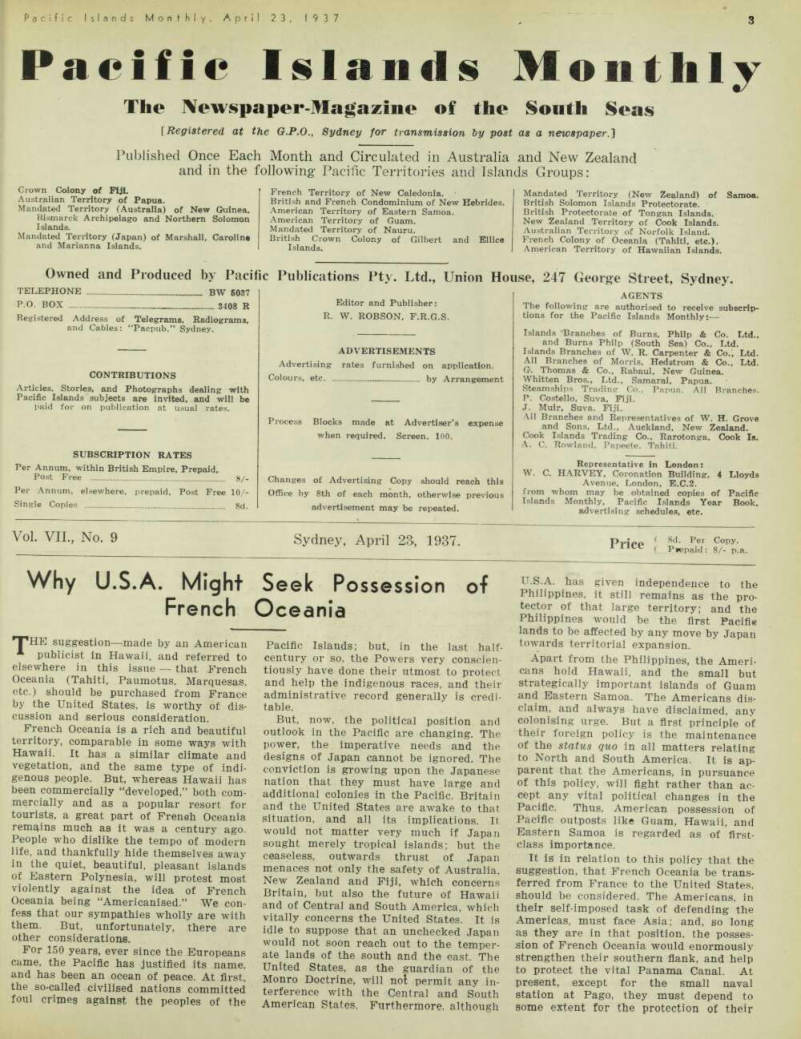
Burns, Philp & Co. Ltd.
GENERAL
MERCHANTS
iiiyli
fill
m
hi in
HI Iff
BE
SHIPOWNERS
TOURIST AGENTS
Head Office: 7 Bridge Street, Sydney—Australia Code Address: "Burphil"
BUYERS OF ALL CLASSES OF ISLAND PRODUCE Regular Steamer Services from Australia to New Guinea Papua Solomon Is.—Lord Howe Is.—Norfolk Is. —New Hebrides—Java and Singapore
Pacific Islands Monthly
The Newspaper-Magazine of the South Seas
[ Registered at the G.P.0., Sydney for transmission hy post as a newspaper. ] Published Once Each Month and Circulated in Australia and New Zealand and in the following Pacific Territories and Islands Groups:
Crown Colony of Fiji.
Australian Territory of Papua.
Mandated Territory (Australia) of New Guinea, Bismarck Archipelago and Northern Solomon Islands.
Mandated Territory (Japan) of Marshall, Caroline and Marianna Islands.
French Territory of New Caledonia.
British and French Condominium of New Hebrides.
American Territory of Eastern Samoa.
American Territory of Guam.
Mandated Territory of Nauru.
British Crown Colony of Gilbert and Ellice Islands.
Mandated Territory (New Zealand) of Samoa.
British Solomon Islands Protectorate.
British Protectorate of Tongan Islands.
New Zealand Territory of Cook Islands.
Australian Territory of Norfolk Island.
French Colony of Oceania (Tahiti, etc.).
American Territory of Hawaiian Islands.
Owned and Produced by Pacific Publications Pty. Ltd., Union House, 247 George Street, Sydney.
Telephone Bw 5037
P-O- Box 8408 R
Registered Address of Telegrams, Radiograms, and Cables: “Pacpub,” Sydney.
Contributions
Articles, Stories, and Photographs dealing with Pacific Islands subjects are invited, and will be paid for on publication at usual rates.
Subscription Rates
Per Annum, within British Empire, Prepaid, Post Free 8/.
Per Annum, elsewhere, prepaid, Post Free 10/- Single Copies gd.
Editor and Publisher:
R. W. Robson. F.R.G.S.
Advertisements
Advertising rates furnished on application.
Colours, etc. by Arrangement Process Blocks made at Advertiser’s expense when required. Screen, 100.
Changes of Advertising Copy should reach this Office by Bth of each month, otherwise previous advertisement may be repeated.
Agents
The following are authorised to receive subscrip tions for the Pacific Islands Monthly:— Islands Branches of Burns, Philp & Co. Ltd.. and Burns Philp (South Sea) Co., Ltd.
Islands Branches of W. R. Carpenter & Co., Ltd.
All Branches of Morris, Hedstrom & Co., Ltd.
G. Thomas & Co., Rabaul, New Guinea.
Whitten Bros., Ltd., Samarai, Papua.
Steamships Trading Co., Papua. All Branches.
P. Costello, Suva, Fiji.
J. Muir, Suva, Fiji.
All Branches and Representatives of W. H. Grove and Sons, Ltd., Auckland, New Zealand.
Cook Islands Trading Co., Rarotonga, Cook Is.
A. C. Rowland, Papeete. Tahiti.
Representative In London: W. C. HARVEY, Coronation Building, 4 Lloyds Avenue. London, E.C.2. from whom may be obtained copies of Pacific Islands Monthly, Pacific Islands Year Book, advertising schedules, etc.
Vol. VII., No. 9
Sydney, April 23, 1937.
( 8d - Per Copy, x ntc ( Prepaid: 8/- p.a.
Why U.S.A. Might Seek Possession of French Oceania
French Oceania
'THE suggestion—made by an American publicist in Hawaii, and referred to elsewhere in this issue that French Oceania (Tahiti, Paumotus, Marquesas, etc.) should be purchased from France by the United States, is worthy of dis cussion and serious consideration.
French Oceania is a rich and beautiful territory, comparable in some ways with Hawaii. It has a similar climate and vegetation, and the same type of indi genous people. But, whereas Hawaii has been commercially “developed,” both com mercially and as a popular resort for tourists, a great part of French Oceania remains much as it was a century ago.
People who dislike the tempo of modern life, and thankfully hide themselves away in the quiet, beautiful, pleasant islands of Eastern Polynesia, will protest most violently against the idea of French Oceania being “Americanised.” We con fess that our sympathies wholly are with them. But, unfortunately, there are other considerations.
For 150 years, ever since the Europeans came, the Pacific has justified its name, and has been an ocean of peace. At first, the so-called civilised nations committed foul crimes against the peoples of the
Pacific Islands; but, in the last half century or so, the Powers very conscien tiously have done their utmost to protect and help the indigenous races, and their administrative record generally is credi table.
But, now, the political position and outlook in the Pacific are changing. The power, the imperative needs and the designs of Japan cannot be ignored. The conviction is growing upon the Japanese nation that they must have large and additional colonies in the Pacific. Britain and the United States are awake to that situation, and all its implications. It would not matter very much if Japan sought merely tropical islands; but the ceaseless, outwards thrust of Japan menaces not only the safety of Australia, New Zealand and Fiji, which concerns Britain, but also the future of Hawaii and of Central and South America, which vitally concerns the United States. It is idle to suppose that an unchecked Japan would not soon reach out to the temper ate lands of the south and the east. The United States, as the guardian of the Monro Doctrine, will not permit any in terference with the Central and South American States. Furthermore, although
US.A. has given independence to the Philippines, it still remains as the pro tector of that large territory; and the Philippines would be the first Pacific lands to be affected by any move by Japan towards territorial expansion.
Apart from the Philippines, the Ameri cans hold Hawaii, and the small but strategically important islands of Guam and Eastern Samoa. The Americans dis claim, and always have disclaimed, any colonising urge. But a first principle of their foreign policy is the maintenance of the status quo in all matters relating to North and South America. It is ap parent that the Americans, in pursuance of this policy, will fight rather than ac cept any vital political changes in the Pacific. Thus, American possession of Pacific outposts like Guam, Hawaii, and Eastern Samoa is regarded as of first class importance.
It is in relation to this policy that the suggestion, that French Oceania be trans ferred from France to the United States, should be considered. The Americans, in their self-imposed task of defending the Americas, must face Asia; and, so long as they are in that position, the posses sion of French Oceania would enormously strengthen their southern flank, and help to protect the vital Panama Canal. At present, except for the small naval station at Pago, they must depend to some extent for the protection of their
southern flank upon Britain and France.
In considering possibilities in the Pacific, we do not know where France stands. It is assumed that France, hold ing Cochin China, New Caledonia, and French Oceania, would naturally ally herself with Britain and U.S.A. in resist ing any move by Japan to seize new territory. But that is not certain. In any event, the French maintain no fleet and no naval base worthy of mention, in the Pacific. Their two colonies in the Pacific are not of sufficient importance to justify much expenditure on defence.
The possession of Tahiti is of little stra tegic importance and of minor economic value to Prance; but it would be of the utmost value to United States.
Commercial interests in Tahiti prob ably will discuss this matter very keenly.
At present, under French rule, they are dependent for transport wholly upon the
Messageries Maritimes line of steamers, and upon calls by the Union Co.’s trans pacific freighters. The result is that the tourist traffic, never very robust, is now almost negligible. It is certain that, under American administration, Tahiti would be linked closely with the United States, and probably with Australia, by first-class steamers—and perhaps by air liners —and the tourist traffic would be vigorously encouraged. French Oceania, in an economic sense, almost certainly would flourish exceedingly. But the charm of Eastern Polynesia, the unique attrac tiveness of Tahiti, would disappear—just as it has disappeared from Hawaii, and is disappearing from other groups which are in process of “development.”
The French are very jealous of their territorial possessions, and they will not like this plan at all. The Hawaiian writer, in advancing it, has suggested that American administration, per se, would be better than French administra tion. That is not a fair suggestion.
Except for the Marquesas (where a large and fertile group, capable of carrying a large population, is now almost unin habited) the administration of France in Eastern Polynesia is creditable, and the manner in which the natives have been protected and assisted is praiseworthy.
The point is that the control of French Oceania probably would be of great strategic value to U.S.A.; and the shrewd statesmen of France probably will see that point very clearly.
The method whereby it is suggested that U.S.A. should pay for French Oceania —by cancelling a portion of France’s war-debt to U.S.A. —will not be received enthusiastically by France. It might have some force if France were embarrassed by the debt. But no one apparently intends to pay war debts to America, anyhow.
Sydney-N.G. Air Service
A S the Federal authorities had made no an nouncement by April 21, we telegraphed Canberra by information. The Civil Aviation Dept, courteously replied that “tenders are still under consideration.” See article on page 23.
To Live In Samoa
From Our Own Correspondent
Nukualofa, Mar. 17.
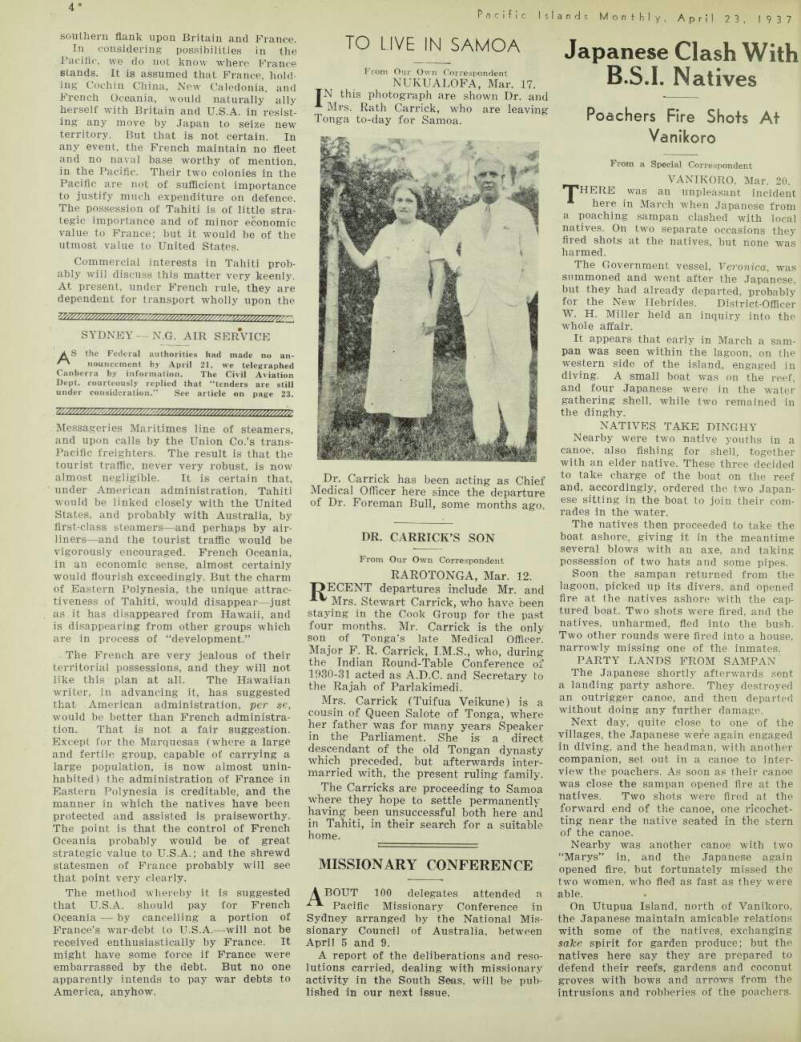
TN this photograph are shown Dr. and A Mrs. Rath Garrick, who are leaving Tonga to-day for Samoa.
Dr. Garrick has been acting as Chief Medical Officer here since the departure of Dr. Foreman Bull, some months ago.
Dr. Garrick’S Son
From Our Own Correspondent
Rarotonga, Mar. 12.
T>ECENT departures include Mr. and Mrs. Stewart Garrick, who have been staying in the Cook Group for the past four months. Mr. Garrick is the only son of Tonga’s late Medical Officer.
Major F. R. Garrick, 1.M.5., who, during the Indian Round-Table Conference of 1930-31 acted as A.D.C. and Secretary to the Rajah of Parlakimedi.
Mrs. Garrick (Tuifua Veikune) is a cousin of Queen Salote of Tonga, where her father was for many years Speaker in the Parliament. She is a direct descendant of the old Tongan dynasty which preceded, but afterwards inter married with, the present ruling family.
The Garricks are proceeding to Samoa where they hope to settle permanently having been unsuccessful both here and in Tahiti, in their search for a suitable home.
Missionary Conference
A BOUT 100 delegates attended a Pacific Missionary Conference in Sydney arranged by the National Mis sionary Council of Australia, between April 5 and 9.
A report of the deliberations and reso lutions carried, dealing with missionary activity in the South Seas, will be pub lished in our next issue.
Japanese Clash With B.S.I
B.S.I. Natives Poachers Fire Shots At Vanikoro
From a Special Correspondent
Vanikoro, Mar. 20.
was an unpleasant incident * here in March when Japanese from a poaching sampan clashed with local natives. On two separate occasions they fired shots at the natives, but none was harmed.
The Government vessel, Veronica, was summoned and went after the Japanese, but they had already departed, probably for the New Hebrides. District-Officer W. H. Miller held an inquiry into the whole affair.
It appears that early in March a sam pan was seen within the lagoon, on the western side of the island, engaged in diving. A small boat was on the reef, and four Japanese were in the water gathering shell, while two remained in
the dinghy.
Natives Take Dinghy
Nearby were two native youths in a canoe, also fishing for shell, together with an elder native. These three decided to take charge of the boat on the reef and, accordingly, ordered the two Japan ese sitting in the boat to join their com rades in the water.
The natives then proceeded to take the boat ashore, giving it in the meantime several blows with an axe, and taking possession of two hats and some pipes.
Soon the sampan returned from the lagoon, picked up its divers, and opened fire at the natives ashore with the cap tured boat. Two shots were fired, and the natives, unharmed, fled into the bush.
Two other rounds were fired into a house, narrowly missing one of the inmates.
Party Lands From Sampan
The Japanese shortly afterwards sent a landing party ashore. They destroyed an outrigger canoe, and then departed without doing any further damage.
Next day, quite close to one of the villages, the Japanese were again engaged in diving, and the headman, with another companion, set out in a canoe to inter view the poachers. As soon as their canoe was close the sampan opened fire at the natives. Two shots were fired at the forward end of the canoe, one ricochet ting near the native seated in the stern of the canoe.
Nearby was another canoe with two “Marys” in, and the Japanese again opened fire, but fortunately missed the two women, who fled as fast as they were able.
On Utupua Island, north of Vanikoro, the Japanese maintain amicable relations with some of the natives, exchanging saTce spirit for garden produce; but the natives here say they are prepared to defend their reefs, gardens and coconut groves with bows and arrows from the intrusions and robberies of the poachers.
P.-A. Airways Clipper Spans Central
Pacific, North To South
Survey Flight From 'Frisco To New Zealand and Return Was Technical Triumph
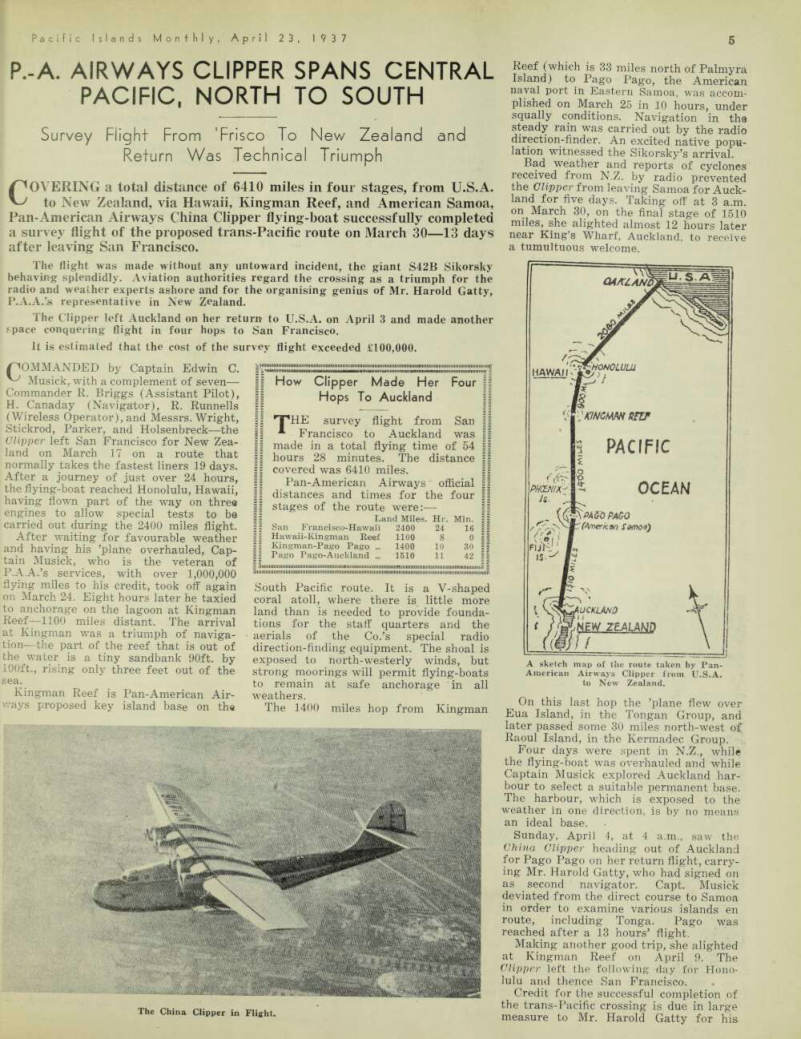
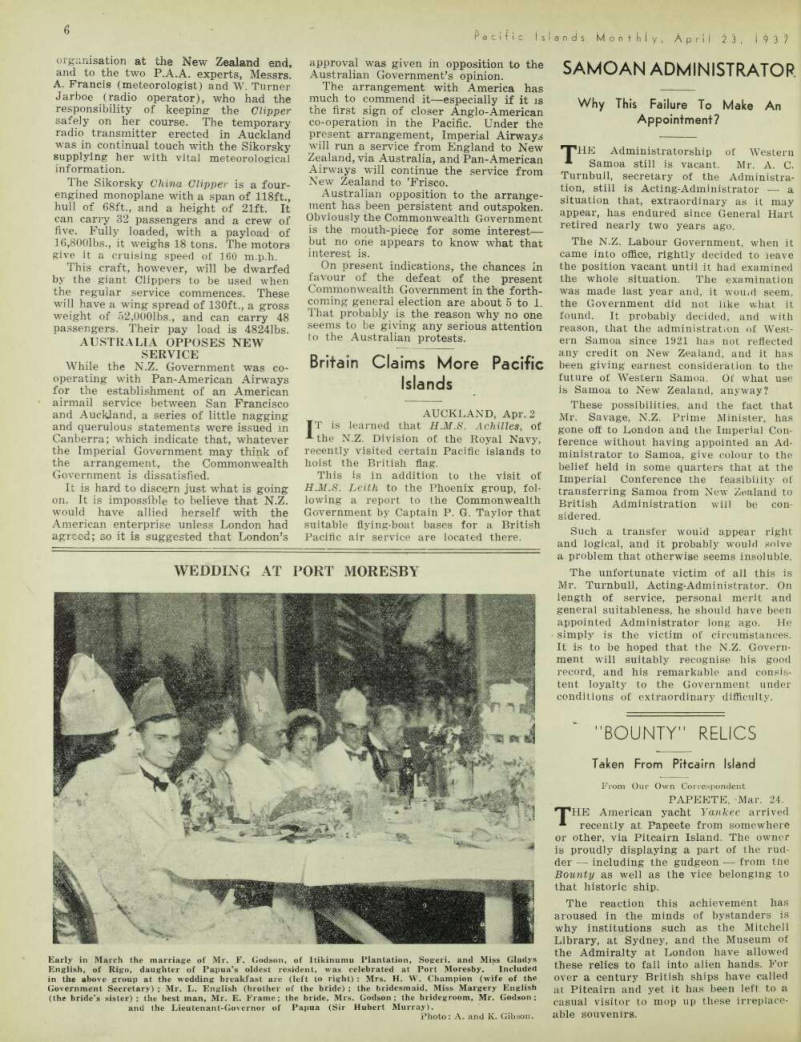
COVERING a total distance of 6410 miles in four stages, from U.S.A. to New Zealand, via Hawaii, Kingman Reef, and American Samoa, Pan-American Airways China Clipper flying-boat successfully completed a survey flight of the proposed trans-Pacific route on March 30—13 days after leaving San Francisco.
The flight was made without any untoward incident, the giant 5428 Sikorsky behaving splendidly. Aviation authorities regard the crossing as a triumph for the radio and weather experts ashore and for the organising genius of Mr. Harold Gatty, P.A.A.!s representative in New Zealand.
The Clipper left Auckland on her return to U.S.A. on April 3 and made another space conquering flight in four hops to San Francisco.
It is estimated that the cost of the survey flight exceeded £lOO,OOO.
/COMMANDED by Captain Edwin C.
Musick, with a complement of seven — Commander R. Briggs (Assistant Pilot), H. Canaday (Navigator), R. Runnells (Wireless Operator), and Messrs. Wright, Stickrod, Parker, and Holsenbreck—the Clipper left San Francisco for New Zea land on March 17 on a route that normally takes the fastest liners 19 days.
After a journey of just over 24 hours, the flying-boat reached Honolulu, Hawaii, having flown part of the way on three engines to allow special tests to be carried out during the 2400 miles flight.
After waiting for favourable weather and having his ’plane overhauled, Cap tain Musick, who is the veteran of P.A.A.’s services, with over 1,000,000 flying miles to his credit, took off again on March 24. Eight hours later he taxied to anchorage on the lagoon at Kingman Reef—lloo miles distant. The arrival at Kingman was a triumph of naviga tion—the part of the reef that is out of the water is a tiny sandbank 90ft. by 100 ft., rising only three feet out of the sea.
Kingman Reef is Pan-American Air ways proposed key island base on the
South Pacific route. It is a V-shaped coral atoll, where there is little more land than is needed to provide founda tions for the staff quarters and the aerials of the Co.’s special radio direction-finding equipment. The shoal is exposed to north-westerly winds, but strong moorings will permit flying-boats to remain at safe anchorage in all weathers.
The 1400 miles hop from Kingman
Reef (which is 33 miles north of Palmyra Island) to Pago Pago, the American naval port in Eastern Samoa, was accom plished on March 25 in 10 hours, under squally conditions. Navigation in the steady rain was carried out by the radio direction-finder. An excited native popu lation witnessed the Sikorsky's arrival.
Bad weather and reports of cyclones received from N.Z. by radio prevented the Clipper from leaving Samoa for Auck land for five days. Taking off at 3 a.m. on March 30, on the final stage of 1510 miles, she alighted almost 12 hours later near King’s Wharf, Auckland, to receive a tumultuous welcome.
On this last hop the ’plane flew over Eua Island, in the Tongan Group, and later passed some 30 miles north-west of Raoul Island, in the Kermadec Group.
Four days were spent in N.Z., while the flying-boat was overhauled and while Captain Musick explored Auckland har bour to select a suitable permanent base.
The harbour, which is exposed to the weather in one direction, is by no means an ideal base.
Sunday, April 4, at 4 a.m., saw the China Glipper heading out of Auckland for Pago Pago on her return flight, carry ing Mr. Harold Gatty, who had signed on as second navigator. Capt. Musick deviated from the direct course to Samoa in order to examine various islands en route, including Tonga. Pago was reached after a 13 hours’ flight.
Making another good trip, she alighted at Kingman Reef on April 9. The Clipper left the following day for Hono lulu and thence San Francisco, Credit for the successful completion of the trans-Pacific crossing is due in large measure to Mr. Harold Gatty for his
The China Clipper in Flight.
A sketch map of the route taken by Pan- American Airways Clipper from U.S.A. to New Zealand.
organisation at the New Zealand end, and to the two P.A.A. experts, Messrs.
A. Francis (meteorologist) and W. Turner Jarboe (radio operator), who had the responsibility of keeping the Clipper safely on her course. The temporary radio transmitter erected in Auckland was in continual touch with the Sikorsky supplying her with vital meteorological information.
The Sikorsky China Clipper is a four engined monoplane with a span of 118 ft., hull of 68ft., and a height of 21ft. It can carry 32 passengers and a crew of five. Fully loaded, with a payload of 16,8001b5., it weighs 18 tons. The motors give it a cruising speed of 160 m.p.h.
This craft, however, will be dwarfed by the giant Clippers to be used when the regular service commences. These will have a wing spread of 130 ft., a gross weight of 52,0001b5., and can carry 48 passengers. Their pay load is 48241b5.
Australia Opposes New
Service
While the N.Z. Government was co operating with Pan-American Airways for the establishment of an American airmail service between San Francisco and Auckland, a series of little nagging and querulous statements were issued in Canberra; which indicate that, whatever the Imperial Government may think of the arrangement, the Commonwealth Government is dissatisfied.
It is hard to discern just what is going on. It is impossible to believe that N.Z. would have allied herself with the American enterprise unless London had agreed; so it is suggested that London’s
approval was given in opposition to the Australian Government’s opinion.
The arrangement with America has much to commend it—especially if it is the first sign of closer Anglo-American co-operation in the Pacific. Under the present arrangement, Imperial Airways will run a service from England to New Zealand, via Australia, and Pan-American Airways will continue the service from New Zealand to ’Frisco.
Australian opposition to the arrange ment has been persistent and outspoken.
Obviously the Commonwealth Government is the mouth-piece for some interest— but no one appears to know what that interest is.
On present indications, the chances In favour of the defeat of the present Commonwealth Government in the forth coming general election are about 5 to 1.
That probably is the reason why no one seems to be giving any serious attention to the Australian protests.
How Clipper Made Her Four
Hops To Auckland
survey flight from San * Francisco to Auckland was made in a total flying time of 54 hours 28 minutes. The distance covered was 6410 miles.
Pan-American Airways official distances and times for the four stages of the route were:— Land Miles. Hr. Min.
San Francisco-Hawaii 2400 24 16 Hawaii-Kingman Reef 1100 8 0 Kingman-Pago Pago „ 1400 10 30 Pago Pago-Auckland ... 1510 11 42
Islands
Britain Claims More Pacific Islands
Auckland, Apr. 2
IT is learned that H.M.B. Achilles, of the N.Z. Division of the Royal Navy, recently visited certain Pacific islands to hoist the British flag.
This is in addition to the visit of H.M.S. Leith to the Phoenix group, fol lowing a report to the Commonwealth Government by Captain P. G. Taylor that suitable flying-boat bases for a British Pacific air service are located there.
Wedding At Port Moresby
Early in March the marriage of Mr. F. Godson, of Itikinumu Plantation, Sogeri, and Miss Gladys English, of Rigo, daughter of Papua’s oldest resident, was celebrated at Port Moresby. Included in the above group at the wedding breakfast are (left to right) : Mrs. H. W. Champion (wife of the Government Secretary); Mr. L. English (brother of the bride) ; the bridesmaid. Miss Margery English (the bride’s sister); the best man, Mr. E. Frame; the bride, Mrs. Godson; the bridegroom, Mr. Godson; and the Lieutenant-Governor of Papua (Sir Hubert Murray).
Photo: A. and K. Gibson.
Samoan Administrator.
Why This Failure To Make An Appointment?
Administratorship of Western * Samoa still is vacant. Mr. A. C.
Turnbull, secretary of the Administra tion, still is Acting-Administrator a situation that, extraordinary as it may appear, has endured since General Hart retired nearly two years ago.
The N.Z. Labour Government, when it came into office, rightly decided to leave the position vacant until it had examined the whole situation. The examination was made last year and, it wouid seem, the Government did not like what it found. It probably decided, and with reason, that the administration of West ern Samoa since 1921 has not reflected any credit on New Zealand, and it has been giving earnest consideration to the future of Western Samoa. Of what use is Samoa to New Zealand, anyway?
These possibilities, and the fact that Mr. Savage, N.Z. Prime Minister, has gone off to London and the Imperial Con ference without having appointed an Ad ministrator to Samoa, give colour to the belief held in some quarters that at the Imperial Conference the feasibility of transferring Samoa from New Zealand to British Administration will be con sidered.
Such a transfer would appear right and logical, and it probably would solve a problem that otherwise seems insoluble.
The unfortunate victim of all this is Mr. Turnbull, Acting-Administrator. On length of service, personal merit and general suitableness, he should have been appointed Administrator long ago. He simply is the victim of circumstances.
It is to be hoped that the N.Z. Govern ment will suitably recognise his good record, and his remarkable and consis tent loyalty to the Government under conditions of extraordinary difficulty.
"Bounty" Relics
Taken From Pitcairn Island
From Our Own Correspondent
Papeete, Mar. 24.
TPHE American yacht Yankee arrived * recently at Papeete from somewhere or other, via Pitcairn Island. The owner is proudly displaying a part of the rud der including the gudgeon ■ — from the Bounty as well as the vice belonging to that historic ship.
The reaction this achievement has aroused in the minds of bystanders is why institutions such as the Mitchell Library, at Sydney, and the Museum of the Admiralty at London have allowed these relics to fall into alien hands. For over a century British ships have called at Pitcairn and yet it has been left to a casual visitor to mop up these irreplace able souvenirs.
Future Of New
Hebrides
Apparently Little Hope of Change
FT was reported during April, by the * London correspondent of an Austra lian newspaper that, while the future of the Condominium in the New Hebrides is listed for consideration at the Imperial Conference in May and June, it is not expected that any real advance will be made.
It is said that “Britain is determined to conserve to the full her rights and interests, and not to accept any altera tion in her present status—although she will seek to maintain her present very friendly relations with her French partner.” It is also said that “it is known that France will never accept any proposal to sell out or exchange her holding, so that Britain might hand over the islands to Australian control.”
All of which presents a dismal out look for the few remaining ill-treated and neglected British settlers in the New Hebrides.
It does not seem more than a decade since Mr. Nicholas Hagen went to Lon don, with practically all the authority necessary to sell the French interests in the New Hebrides to the Australian Government. But the Australian Gov ernment, being ruled at the time by politicians who thought that New Heb rides was the name of a new kind of psychological complex, would not seri ously consider the proposal. Most of the gentlemen concerned in that decision have gone, deservedly, into the obscurity from which they came, so there is little use now in jeering at them for their shortsightedness.
British Responsibilities
Australia Urged To Take Over British Responsibilities
A RESOLUTION that Australia should the place of Great Britain as a partner with France in the control of the New Hebrides was made at the Austra lian Missionary Conference on April 7, during consideration of a report from missionary bodies working in the Group.
The report stated that the present Condominium was “a miserable compro mise between two great nations,” and condemned the natives and those who had their highest welfare at heart to almost intolerable conditions. Time after time, added the report, strong represen tations have been made to the Home authorities to terminate the Condomin ium. The clash of interests in the Hebrides is painful to contemplate.
Dr. A. S. Frater, superintendent of the John G. Paton Memorial Hospital at Vila, and a Condominium medical officer, de clared that the clash between British and
French ideals was partly responsible for the failure of the Condominium. The British Government had little interest in the New Hebrides, and refused to take a fair share in necessary expenses, which were borne mainly by the French, who had sunk millions of francs in the New Hebrides, and had no intention of with drawing.
“The only practical solution,” he said, “was for Australia to take over the British responsibilities. Australia had natural political interests in the Group, her missionaries had worked there for years, and she had large commercial in terests, including an export trade worth £50,000 a year.”
Dr. P. A. Micken urged that the pre sent form of dual control should be abolished, and a mandate given to Aus tralia by the League of Nations.
Big Fiji Fish
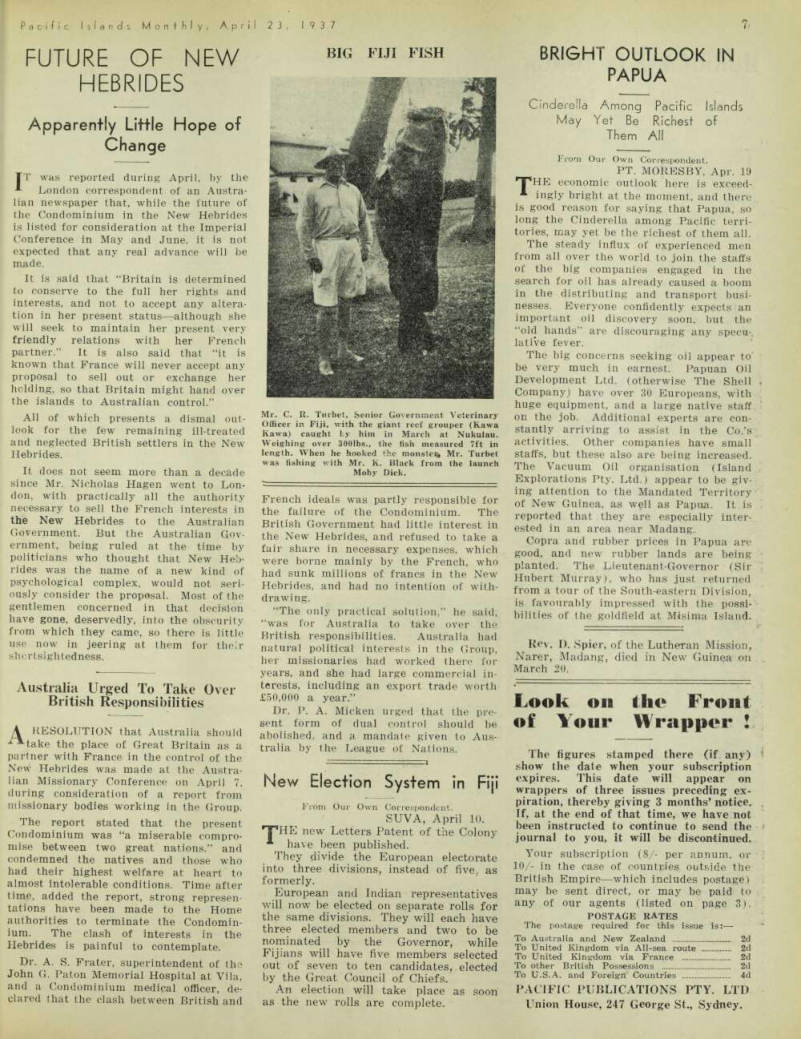
Mr. C. R. Turbet, Senior Government Veterinary Officer in Fiji, with the giant reef grouper (Kawa Kawa) caught by him in March at Nukulau.
Weighing over 3001bs., the fish measured 7ft in length. When he hooked the monster Mr. Turbet was fishing with Mr. K. Black from the launch Moby Dick.
New Election System in Fiji
From Our Own Correspondent.
SUVA, April 10. r T"HE new Letters Patent of the Colony * have been published.
They divide the European electorate into three divisions, instead of five., as formerly.
European and Indian representatives will now be elected on separate rolls for the same divisions. They will each have three elected members and two to be nominated by the Governor, while Fijians will have five members selected out of seven to ten candidates, elected by the Great Council of Chiefs.
An election will take place as soon as the new rolls are complete.
Bright Outlook In
Papua
Cinderella Among Pacific Islands May Yet Be Richest of Them All
From Our Own Correspondent.
Pt. Moresby, Apr. 19
THE economic outlook here is exceed ingly bright at the moment, and there is good reason for saying that Papua, so long the Cinderella among Pacific terri tories, may yet be the richest of them all.
The steady influx of experienced men from all over the world to join the staffs of the big companies engaged in the search for oil has already caused a boom in the distributing and transport busi nesses. Everyone confidently expects an important oil discovery soon, but the “old hands” are discouraging any specu lative fever.
The big concerns seeking oil appear to be very much in earnest. Papuan Oil Development Ltd. (otherwise The Shell Company) have over 30 Europeans, with huge equipment, and a large native staff on the job. Additional experts are con stantly arriving to assist in the Co.’s activities. Other companies have small staffs, but these also are being increased.
The Vacuum Oil organisation (Island Explorations Pty. Ltd.) appear to be giv ing attention to the Mandated Territory of New Guinea, as well as Papua. It is reported that they are especially inter ested in an area near Madang.
Copra and rubber prices in Papua are good, and new rubber lands are being planted. The Lieutenant-Governor (Sir Hubert Murray), who has just returned from a tour of the South-eastern Division, is favourably impressed with the possi bilities of the goldfield at Misima Island.
Rev. D. Spier, of the Lutheran Mission, Narer, Madang, died in New Guinea on March 20.
Advertisements & other items, p. 9 (1 item)
of Your Wrapper !
Look on the Front
The figures stamped there (if any) show the date when your subscription expires. This date will appear on wrappers of three issues preceding expiration, thereby giving 3 months’ notice.
If, at the end of that time, we have not been instructed to continue to send the journal to you, it will be discontinued.
Your subscription (8/- per annum, or 10/- in the case of countries outside the British Empire—which includes postage) may be sent direct, or may be paid to any of our agents (listed on page 3).
POSTAGE RATES
The postage required for this issue is:— To Australia and New Zealand , 2d To United Kingdom via All-sea route 2d To United Kingdom via France 2d To other British Possessions 2d To U.S.A. and Foreign Countries 4d
PACIFIC PUBLICATIONS PTY. LTD
Union House, 247 George St., Sydney.
Hurricane In Tonga
One Night of Terror
From a Special Correspondent
\ Nukualofa, Mar. 16.
or three rather prolonged periods * of oppressive heat during January and early February indicated that some thing out of the ordinary might be ex pected.
On Sunday, February 21, heavy wind from the N.W. reminded us of the hurri cane season. Towards evening, the squalls increased in violence and blew up to a strong gale, increasing to a whole
gale, by the time the wind shifted during the night to the S.W.
The storm centre passed fairly close to the south of Tongatabu. Considerable damage was done to native foods in general, and bananas in particular, and of course the coconut palms suffered.
Monday was calmer, and w e felt that we had had what was coming to us for the hurricane season of 1937. We were, as usual, erring on the side of optimism.
On Wednesday, February 24, a strong wind from S.S.E., with heavy squalls of rain, increased in violence towards even ing, and the one red flag of warning at the wireless station was augmented by a second, meaning “Hurricane approach ing.” Heavy rain squalls continued, the
wind increasing in violence as night fell and until long after midnight.
A moon, a couple of days from full, gave sufficient light to show coconut palms performing more like whips than trees, the heavier trees and lighter foli age being lashed unmercifully.
Sleep was out of the question, what with the noise of the wind, the hissing of the rain in the trees and the rat-a-tat as of machine-gun fire, as it fell with force on the galvanized roofs. Water found its way in through the most
innocent-looking cracks.
Towards 2 a.m., the wind had slowly veered to about N.E., increasing in velo city, and with vicious gusts and pouring rain driven by the wind.
At the height of the storm, from 2 a.m. to 3.30 a.m., it is estimated that the wind velocity was 85 m.p.h.
The centre of the storm passed very close to the north of Tongatabu on a W.S.W. course. 7.18 inches of rain fell.
The leaves of the coconut trees stood out at right angles from the trunks in one direction only—that of the wind.
As morning approached, the force of the hurricane gradually abated and dawn broke with some ameloriation.
What a scene of desolation met the eye! Buildings blown down and scat tered, roofs blown off, large trees split and mangled, breadfruit trees uprooted, banana plants nearly all down, the yam crop ruined. Many native houses were destroyed, the inhabitants fleeing for shelter to their neighbours’ dwellings, and in some cases only until that one went, and then on again.
The copra crop has been badly dam aged—to what extent we shall find out during the latter half of the year—prob ably 30% of the potential copra output has gone.
The hurricane was the worst experi enced by Nukualofa since 1915. The lowest barometer reading (about mid night on February 24) was 28.90. The storm centre was at Namuka, a small island between Nukualofa and Haapai.
Vavau was not affected. There is no information from Haapai.
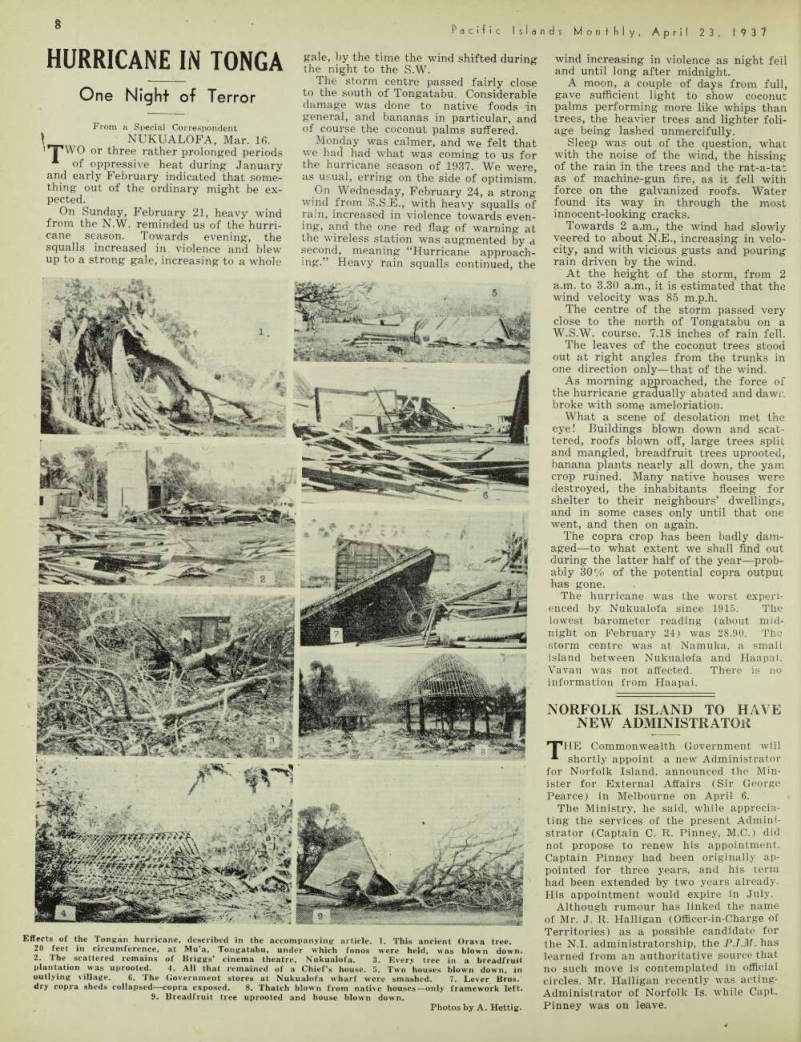
Effects of the Tongan hurricane, described in the accompanying article. 1. This ancient Orava tree, 20 feet in circumference, at Mu’a, Tongatabu, under which fonos were held, was blown down. 2. The scattered remains of Briggs’ cinema theatre, Nukualofa. 3. Every tree in a breadfruit plantation was uprooted. 4. All that remained of a Chief’s house. 5. Two houses blown down, in outlying village. 6. The Government stores at Nukualofa wharf were smashed. 7. Lever Bros, dry copra sheds collapsed— copra exposed. 8. Thatch blown from native houses—only framework left. 9. Breadfruit tree uprooted and house blown down.
Photos by A. Hettig.
Norfolk Island To Have
New Administrator
Commonwealth Government will shortly appoint a new Administrator for Norfolk Island, announced the Min ister for External Affairs (Sir George Pearce) in Melbourne on April 6.
The Ministry, he said, while apprecia ting the services of the present Admini strator (Captain C. R. Pinney, M.C.) did not propose to renew his appointment.
Captain Pinney had been originally ap pointed for three years, and his term had been extended by two years already.
His appointment would expire in July.
Although rumour has linked the name of Mr. J. R. Halligan (Officer-in-Charge of Territories) as a possible candidate for the N.I. administratorship, the P.I.M. has learned from an authoritative source that no such move is contemplated in official circles. Mr. Halligan recently was acting- Administrator of Norfolk Is. while Capt, Pinney was on leave.
"Shirts Out!"
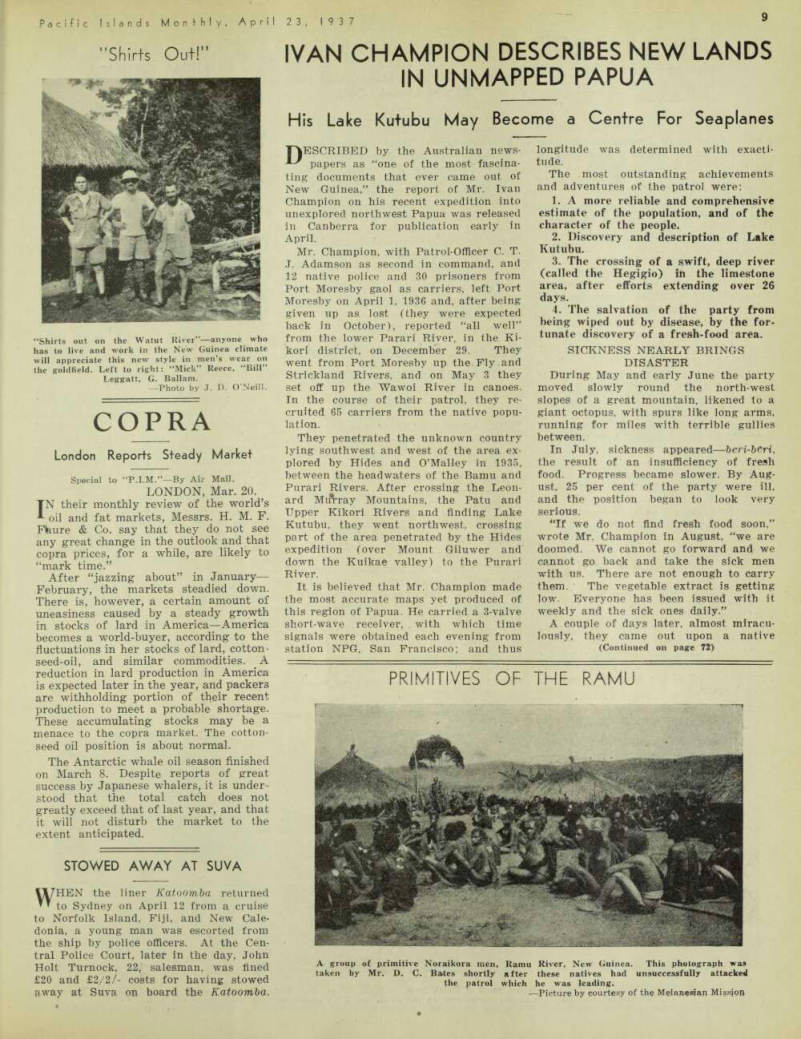
“Shirts out on the Watut River”—anyone who has to live and work in the New Guinea climate will appreciate this new style in men’s wear on the goldfield. Left to right: “Mick” Reece, “Bill”
Leggatt, G. Ballam. —Photo by J. D. O'Neill.
Copra
London Reports Steady Market
Special to “P.I.M.”—By Air Mail.
London, Mar. 20.
IN their monthly review of the world’s oil and fat markets, Messrs. H. M. F.
Fbure & Co. say that they do not see any great change in the outlook and that copra prices, for a while, are likely to “mark time.”
After “jazzing about” in January— February, the markets steadied down.
There is, however, a certain amount of uneasiness caused by a steady growth in stocks of lard in America —America becomes a world-buyer, according to the fluctuations in her stocks of lard, cotton seed-oil, and similar commodities. A reduction in lard production in America is expected later in the year, and packers are withholding portion of their recent production to meet a probable shortage.
These accumulating stocks may be a menace to the copra market. The cotton seed oil position is about normal.
The Antarctic whale oil season finished on March 8. Despite reports of great success by Japanese whalers, it is under stood that the total catch does not greatly exceed that of last year, and that it will not disturb the market to the extent anticipated.
Stowed Away At Suva
VI7HEN the liner Katoomba returned to Sydney on April 12 from a cruise to Norfolk Island, Fiji, and New Cale donia, a young man was escorted from the ship by police officers. At the Cen tral Police Court, later in the day, John Holt Turnock, 22, salesman, was fined £2O and £2/2/- costs for having stowed away at Suva on board the Katoomba.
Ivan Champion Describes New Lands
In Unmapped Papua
His Lake Kutubu May Become a Centre For Seaplanes
"PRESCRIBED by the Australian news papers as “one of the most fascina ting documents that ever came out of New Guinea,” the report of Mr. Ivan Champion on his recent expedition into unexplored northwest Papua was released in Canberra for publication early in April.
Mr. Champion, with Patrol-Officer C. T.
J. Adamson as second in command, and 12 native police and 30 prisoners from Port Moresby gaol as carriers, left Port Moresby on April 1, 1936 and, after being given up as lost (they were expected back in October), reported “all well” from the lower Parari River, in the Ki kori district, on December 29. They went from Port Moresby up the Fly and Strickland Rivers, and on May 3 they set off up the Wawoi River in canoes.
In the course of their patrol, they re cruited 65 carriers from the native popu lation.
They penetrated the unknown country lying southwest and west of the area ex plored by Hides and O’Malley in 1935, between the headwaters of the Bamu and Purari Rivers. After crossing the Leon ard MuVray Mountains, the Patu and Upper Kikori Rivers and finding Lake Kutubu, they went northwest, crossing part of the area penetrated by the Hides expedition (over Mount Giluwer and down the Kuikae valley) to the Purari River.
It is believed that Mr. Champion made the most accurate maps yet produced of this region of Papua. He carried a 3-valve short-wave receiver, with which time signals were obtained each evening from station NPG, San Francisco; and thus
longitude was determined with exacti tude.
The most outstanding achievements and adventures of the patrol were: 1. A more reliable and comprehensive estimate of the population, and of the character of the people. 2. Discovery and description of Lake Kutubu. 3. The crossing of a swift, deep river (called the Hegigio) in the limestone area, after efforts extending over 26 days. 4. The salvation of the party from being wiped out by disease, by the for tunate discovery of a fresh-food area.
Sickness Nearly Brings
Disaster
During May and early June the party moved slowly round the north-west slopes of a great mountain, likened to a giant octopus, with spurs like long arms, running for miles with terrible gullies between.
In July, sickness appeared— heri-'beri . the result of an insufficiency of fresh food. Progress became slower. By Aug ust, 25 per cent of the party were ill, and the position began to look very serious.
“If we do not find fresh food soon,” wrote Mr. Champion In August, “we are doomed. We cannot go forward and we cannot go back and take the sick men with us. There are not enough to carry them. The vegetable extract is getting low. Everyone has been issued with it weekly and the sick ones daily.”
A couple of days later, almost miracu lously, they came out upon a native (Continued on page 72)
garden of two acres, containing sweet potatoes and sugar-cane—the first they had seen. The inhabitants fled in terror out of the nearby village.
On August 17, the sick were fed on a decoction of boiled potato-leaves, with vegetable-extract, from among the stores carried; and this treatment, together with fresh food , soon restored the party to health.
Limestone Barrier
The party pushed on steadily during August and September, purchasing food from a very shy but not hostile popula tion; and then they encountered the notorious Limestone strip of terrible, broken country which runs roughly east and west, and which twice almost spelled the doom of the Hides
expedition.
“I knew we must meet it some time,” says Mr. Champion, “but now I felt a chill run down my spine.” The chill was justified. Within a short time (on Sep tember 11) the expedition was face to
K face with a river 80 yards wide, very deep, rushing along at 13 knots, with steep banks and great whirlpools.
When they reached the river, there was a very flimsy but possibly service able suspension bridge of vines. Next morning, they found that natives, in the night, had cut the bridge away. Then commenced a task which occupied nearly four weeks. First, Mr. Champion tried to swim across —but was hauled back from an impossible feat. They vainly tried, by utilising the current to get across on small tethered canoes. A native policeman, Ketue, tried to swim across, but his line broke and he was swept away to apparently certain death, but he got ashore by a miracle.
Attempt after attempt failed; stores were getting low; and the leader was in despair. That river had to be crossed — it was right in their path.
Finally, they built a canoe 30 feet long; the river began to fall; and they got across on October 7.
A Great New Inland Lake
Eleven days later, on October 18, they reached Lake Kutubu —never previously examined by Europeans, but seen from the air, during aerial reconnaissances, in 1936.
Mr. Champion found a very large, but generally friendly, population around this lake, and his description of the place and its people is intensely interesting. The climate is- good, and there is plenty of timber and garden land.
Mr. Champion says that he will never forget his first sight of this lake, which is some 12 miles long by two miles wide.
The view was breath-taking. The water is dark blue with shores of dark green.
A little later, the party was taken aboard the canoes of the natives, and slowly paddled towards a large, green island in the middle, taking soundings, and there was no bottom at 20 fathoms.
They landed in front of a long-house, where there were 50 men on the veran dah, which was decorated with hundreds of pigs’ jaws. Separated by a road 15 feet from the long-house was a row of 15 houses.
The women peeped out, wearing neck lets of cowrie shells, a string covering in front and a tapa cloth cloak over the shoulders. Standing away from the long house at each end were little houses like dove-cotes filled with skulls. The long house was 76 yards in length. On the side facing the women’s houses, it had windows, through which food probably was passed.
Mr. Champion showed the assembly of men some of the wonders of civilisation.
An electric torch impressed them. He poured out some methylated spirits and lighted it. The men looked thoughtful.
Certain of them, who had been demand ing an excessive price for their foodstuffs suddenly became more reasonable. A man. who could “make water burn” had better not be overcharged!
On October 22, the party was taken across the lake, to the northeast shore, in a fleet of 17 canoes, containing 90 men.
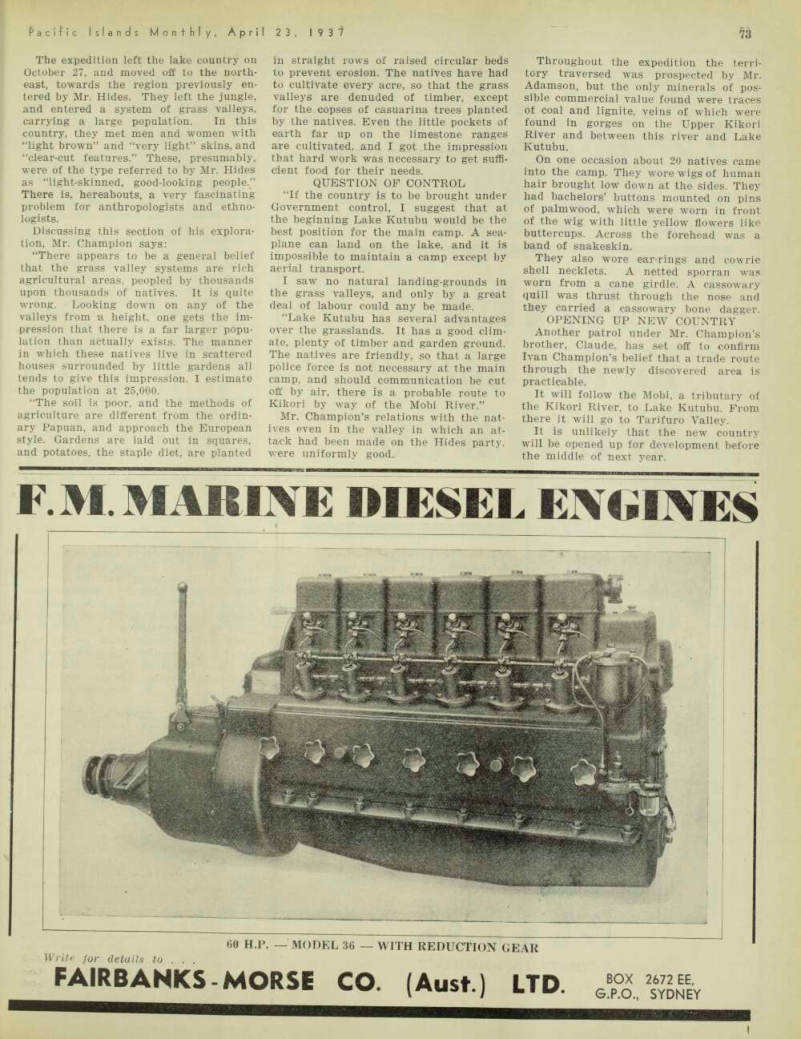
The expedition left the lake country on October 27, and moved off to the northeast, towards the region previously entered by Mr. Hides. They left the jungle, and entered a system of grass valleys, carrying a large population. In this country, they met men and women with “light brown” and “very light” skins, and “clear-cut features.” These, presumably, were of the type referred to by Mr. Hides as “light-skinned, good-looking people.”
There is, hereabouts, a very fascinating problem for anthropologists and ethnolegists.
Discussing this section of his exploration, Mr. Champion says: “There appears to be a general belief that the grass valley systems are rich agricultural areas, peopled by thousands upon thousands of natives. It is quite wrong. Looking down on any of the valleys from -a height, one gets the impression that there is a far larger population than actually exists. The manner in which these natives live in scattered houses surrounded by little gardens all tends to give this impression. I estimate the population at 25,000.
“The soil is poor, and the methods of agriculture are different from the ordinary Papuan, and approach the European style. Gardens are laid out in squares, and potatoes, the staple diet, are planted
in straight rows of raised circular beds to prevent erosion. The natives have had to cultivate every acre, so that the grass valleys are denuded of timber, except for the copses of casuarina trees planted by the natives. Even the little pockets of earth far up on the limestone ranges are cultivated, and I got the impression that hard work was necessary to get suffi cient food for their needs.
Question Of Control
“If the country is to be brought under Government control, I suggest that at the beginning Lake Kutubu would be the best position for the main camp. A sea plane can land on the lake, and it is impossible to maintain a camp except by aerial transport.
I saw no natural landing-grounds in the grass valleys, and only by a great deal of labour could any be made.
“Lake Kutubu has several advantages over the grasslands. It has a good clim ate, plenty of timber and garden ground.
The natives are friendly, so that a large police force is not necessary at the main camp, and should communication be cut off by air, there is a probable route to Kikori by way of the Mobi River.”
Mr. Champion’s relations with the nat ives even in the valley in which an at tack had been made on the Hides party, were uniformly good.
Throughout the expedition the terri tory traversed was prospected by Mr.
Adamson, but the only minerals of pos sible commercial value found were traces of coal and lignite, veins of which were found in gorges on the Upper Kikori River and between this river and Lake Kutubu, On one occasion about 20 natives came into the camp. They wore wigs of human hair brought low down at the sides. They had bachelors’ buttons mounted on pins of palmwood, which were worn in front of the wig with little yellow flowers like buttercups. Across the forehead was a band of snakeskin.
They also wore ear-rings and cowrie shell necklets. A netted sporran was worn from a cane girdle. A cassowary quill was thrust through the nose and they carried a cassowary bone dagger.
Opening Up New Country
Another patrol under Mr. Champion’s brother, Claude, has set off to confirm Ivan Champion’s belief that a trade route through the newly discovered area is practicable.
It will follow the Mobi, a tributary of the Kikori River, to Lake Kutubu. From there it will go to Tarifuro Valley.
It is unlikely that the new country will be opened up for development before the middle of next year.
Primitives Of The Ramu
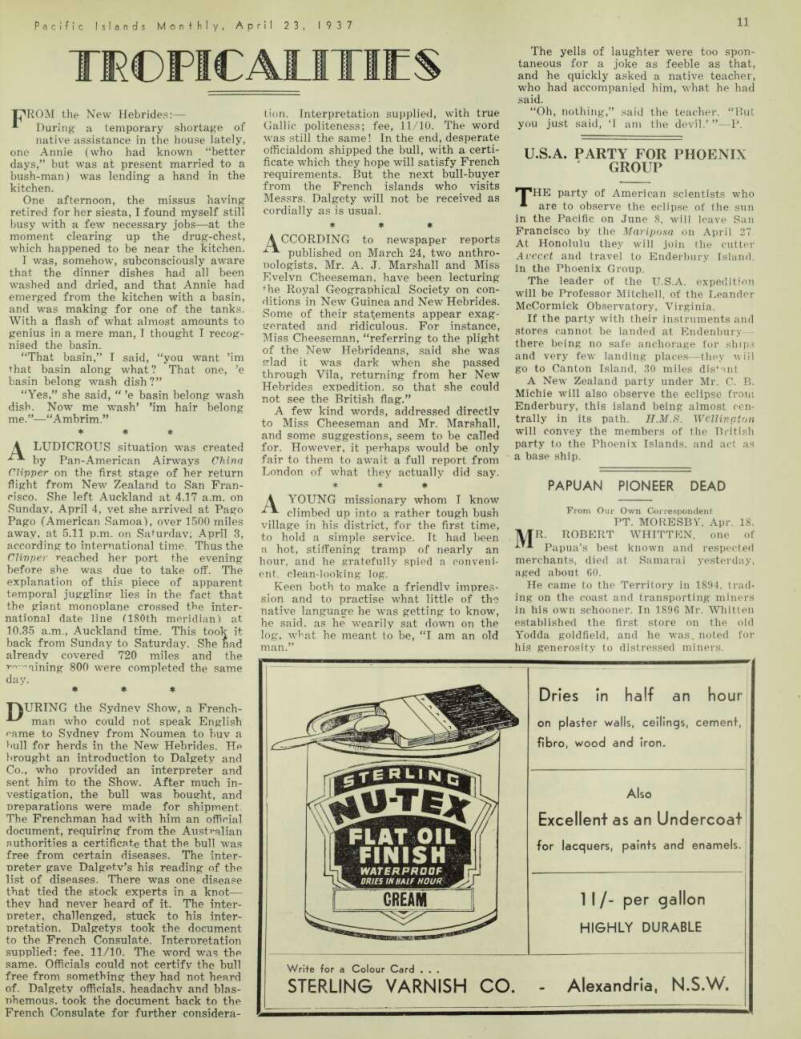
A group of primitive Noraikora men, Ramu River, New Guinea. This photograph was taken by Mr. D. C. Bates shortly after these natives had unsuccessfully attacked the patrol which he was leading. by courtesy of the Melanesian Mission
£13,000 Damage
Big Copra Fire in Suva
From Our Own Correspondent
Suva, Apr. 1.
/YNE of the worst fires experienced for ” many years broke out here early in the evening of Saturday, March 13. and raged right through the week-end. doing over £13,000 worth of damage.
It destroyed a copra store, containing 420 tons of copra belonging to Morris.
Hedstrom Ltd . as well as the stock and plant of Pacific Tobacco Ltd., a company controlled by Mr. S. Levy.
The conra was- insured for £B.OOO and the building for £3.500. Mr. Levy valued his stock and plant at £1,500, but had only a £3OO policy on it.
Considerable damage was done both bv fire and water to the premises of Union Scans Ltd., next door but the amount of this has not yet-been ascertained.
When the fire was first discovered and the fire brigade, under Superintendent G. Bright, reached the outbreak, there was little to be seen but dense smoke. Manv people thought that, like most Suva fires, it would be soon extinguished. However, it had too good a hold, and despite sev eral leads from nearbv hydrants and one fire engine pumping thousands of gallons of sea-water from the harbour, it could not be nut out. In a few hours the concrete building was a raging inferno.
On one side of the building was a wooden store containing paint, kauri gum, carbide, and other inflammables, and steps w r ere taken to remove its con tents early.
The brigade made a good save of the soap works on the other side, for the wind was blowing in that direction and flames were licking through the window's at the top of the walls. Rafters were set alight, iron work was damaged, and the concrete wall showed signs of bad bul ging, but most of the stock was quickly carried away.
" Bill " Dupain
Promoted To Cairns Managership From B.P's Pt. Moresby Office
From Our Own Correspondent.
Pt. Moresby, Apl. 2.
THE. manager of the extensive organi * sation of Messrs. Burns. Philp & Co.
Ltd. in Panua. Mr. W. Dupain, has been transferred to the management of the Company’s branch in Cairns, and will move over to the mainland in June.
The popular “Bill” will be greatly missed in Port Moresbv. Anart from be ing a leading commercial figure, he and his charming wife have taken part in all our social activities, and have been wel come in every home.
Mr. C ,T. A. Moore, at present account ant at Rabaul. will relieve Mr. Dupain at Port Moresby.
Papeete Schooner Wrecked
In Treacherous Tuamotus
From Our Own Correspondent
Papeete. Mar. 14.
The schooner Alto of Papeete is r~- * ported to have been wrecked on thp island of Raraka, 270 miles north-east of Tahiti.
Raraka is one of the Tuamotu Islands marked on maps as the Dangerous Archipelago. The group is notorious as the graveyard of many ships, and is re puted to be depository of ailing vessels which have arrived at the evening of their usefulness.
Officers of most insurance companies look with basilisk eyes on applications for marine insurance in these waters.
Trans-Pacific steamers navigate north of latitude 4 S. or far south of the tropic of Capricorn, in order to avoid the reefs, strong currents and intricate channels of the Tuamotus.
During 10 years (1924 1934) 35 schooners from Tahiti alone were wrecked in the Tuamotus.
Interesting Developments
Cattle Raising In
New Guinea
When the Montoro sailed for New Guinea on April 7. she carried a young Shorthorn bull, consigned to Kavi eng, and purchased bv Mr. H. Adams for the improvement of his herd of mixed Shorthorns, on the west coast of New Ireland.
Good work has been done steadily, dur ing recent years, bv plantation owners in New Ireland and the eastern end of New Britain in the improvement of their cattle, with the result that almost pure bred herds are being successfully main tained. free of disease, on an increasing number of plantations. Where some vpars ago. most of the fresh beef avail able was of the dark tough, unappetising stuff obtained from the Cebu cross, to-day meat of high qualitv is obtained regu larly, and many plantations have them own milk and butter supply.
Mr. Adams, who has spent a good deal of time and money in collecting informa tion about stock-raising in the Mandated Territory—he has been there for 20 years —believes that the secret of successful cattle-raising lies in a good water-sunnly.
In New Ireland and New Britain, streams of clear, pure water come down from the nearbv mountains, and the resulting pasture is clean and sweet, and cattle thrive on it. But. where there is no supplv of mountain water, or where the island is small and sandy, the cattle do not thrive, and soon become victims of disease.
At one time, it was thought that the only chance of successful cattle-raising in New Guinea lay through the Cebu cross. But the experiments of Mr. Adams and other planters suggest that catPe may yet be raised in the bigger, moun tainous islands with the same success as has been attained in Fiji; and thp possi bilities, therefore, become rather impor tant.
The little town of Fakfak, on the south-western coast of Dutch New Guinea. It is the Administrative centre for the Division. The Government buildings are in the centre and on the right, and the Chinese shopping area is on the left.
Iropicaiities
the New Hebrides:— * During a temporary shortage of native assistance in the house lately, one Annie (who had known “better days,” but was at present married to a bush-man) was lending a hand in the kitchen.
One afternoon, the missus having retired for her siesta, I found myself still busy with a few necessary jobs—at the moment clearing up the drug-chest, which happened to be near the kitchen.
I was, somehow, subconsciously aware that the dinner dishes had all been washed and dried, and that Annie had emerged from the kitchen with a basin, and was making for one of the tanks.
With a flash of what almost amounts to genius in a mere man, I thought I recog nised the basin.
“That basin,” I said, “you want ’im that basin along what ? That one, ’e basin belong wash dish?”
“Yes,” she said, “ ’e basin belong wash dish. Now me wash’ ’im hair belong me.”—“Ambrim.” * ♦ ♦ A LUDICROUS situation was created by Pan-American Airways China Clipper on the first stage of her return flight from New Zealand to San Fran cisco. She left Auckland at 4.17 a.m. on Sunday, April 4, vet she arrived at Pago Pago (American Samoa), over 1500 miles away, at 5.11 p.m. on Saturday, April 3, according to international time. Thus the Clinper reached her port the evening before she was due to take off. The explanation of this piece of apparent temporal juggling lies in the fact that the giant monoplane crossed the inter national date line (180th meridian) at 10.35 a.m., Auckland time. This took it back from Sunday to Saturday. She had already covered 720 miles and the reaming 800 were completed the same day. * ♦ ♦ TAURING the Sydnev Show, a French man who could not speak English (’ame to Sydnev from Noumea to buy a bull for herds in the New Hebrides. He brought an introduction to Dalgety and Co., who provided an interpreter and sent him to the Show. After much in vestigation, the bull was bought, and preparations were made for shipment.
The Frenchman had with him an official document, requiring from the Australian authorities a certificate that the bull was free from certain diseases. The inter preter gave Dalgetv’s his reading of the list of diseases. There was one disease that tied the stock experts in a knot— they had never heard of it. The inter preter, challenged, stuck to his inter pretation, Dalgetys took the document to the French Consulate. Interpretation supplied: fee. 11/10. The word was the same. Officials could not certify the bull free from something they had not heard of. Dalgety officials, headachy and blas phemous, took the document back to the French Consulate for further considera
tion. Interpretation supplied, with true Gallic politeness; fee, 11/10. The word was still the same! In the end, desperate officialdom shipped the bull, with a certi ficate which they hope will satisfy French requirements. But the next bull-buyer from the French islands who visits Messrs. Dalgety will not be received as cordially as is usual. ♦ ♦ ♦ A CCORDING to newspaper reports published on March 24, two anthro nologists, Mr. A. J. Marshall and Miss Kvelvn Cheeseman, have been lecturing f he Royal Geographical Society on con ditions in New Guinea and New Hebrides.
Some of their statements appear exag gerated and ridiculous. For instance, Miss Cheeseman, “referring to the plight of the New Hebrideans, said she was glad it was dark when she passed through Vila, returning from her New Hebrides expedition, so that she could not see the British flag.”
A few kind words, addressed directly to Miss Cheeseman and Mr. Marshall, and some suggestions, seem to be called for. However, it perhaps would be only fair to them to await a full report from London of what they actually did say. ♦ ♦ ♦ A YOUNG missionary whom I know climbed up into a rather tough bush village in his district, for the first time, to hold a simple service. It had been a hot, stiffening tramp of nearly an hour, and he gratefully spied a conveni ent. clean-looking log.
Keen both to make a friendlv impres sion and to practise what little of the native language he was getting to know, he said, as he wearily sat down on the log, what he meant to be, “I am an old man.”
The yells of laughter were too spon taneous for a joke as feeble as that, and he quickly asked a native teacher, who had accompanied him, what he had said.
“Oh, nothing,” said the teacher. “But you just said, T am the devil.’ ” —P.
U.S.A. Party For Phoenix
Group
* I *HE party of American scientists who * are to observe the eclipse of the sun in the Pacific on June 8, will leave San Francisco by the Mariposa on April 27 At Honolulu they will join the cutter Avecet and travel to Enderbury Island, in the Phoenix Group.
The leader of the U.S.A. expedition will be Professor Mitchell, of the Leander McCormick Observatory, Virginia.
If the party with their instruments and stores cannot be landed at Endenbury there being no safe anchorage for ships and very few landing places—they will go to Canton Island, 30 miles distant A New Zealand party under Mr. C. B.
Michie will also observe the eclipse from Enderbury, this island being almost cen trally in its path. H.M.B. Wellington will convey the members of the British party to the Phoenix Islands, and act as a base ship.
Papuan Pioneer Dead
From Our Own Correspondent
Pt. Moresby, Apr. 18.
I\|R. Robert Whitten, One Of
Papua’s best known and respected merchants, died at Samarai yesterday, aged about 60.
He came to the Territory in 1894, trad ing on the coast and transporting miners in his own schooner. In 1896 Mr. Whitten established the first store on the old Yodda goldfield, and he was. noted for his generosity to distressed miners.
Advertisements & other items, pp. 13-14 (1 item)
itSZljt
fS n
CREAM
Write tor a Colour Card . . .
STERLING VARNISH CO.
Dries In half an hour on piaster walls, ceilings, cement, fibro, wood and iron.
Also Excellent as an Undercoat for lacquers, paints and enamelso 1 I /- per gallon
HIGHLY DURABLE
Alexandria, N.S.W.
RECORDS
Packed Free and sent C.O.D. without extra charges.
H.M. Voice Slightly-used Portables, delivered straight to your nearest port tor £3/15/-
SEND FOR LATEST RECORD LISTS
Talkeries Music Stores
451 Queen Victoria Buildings
SYDNEY
WHEN SPENDING YOUR VACATION IN SYDNEY YOUR CHOICE OF RESIDENCE IS A MATTER SO VITAL TO YOUR ENJOYMENT!
May we ,commend to you for All-round Excellence
SYDNEY'S MOST EXCLUSIVE PRIVATE HOTEL
I I
44 MACLEAY STREET"
Here for you await unrivalled Service and Cuisine—Suites with Private Baths- H. & C. Water and Telephones in ail rooms—Magnificent Harbour Views Roof Garden Sun Rooms Spacious Lounges ana Smoke Rooms and every modern convenience All under Personal Supervision of the Proprietress,
MISS M. E. BURROWS
/VWWWVWS/WWWVWWVWVWWWWV
TARIFF: From £3/3/-
per week inclusive.
Radios:
"FORTYFOR'
Sydney.
Telephone: FL 2641
MRI
is 2®
The W ”< .IV j
PORTABLE X - RAY APPARATUS
as a YIOKIII] MIT . . .
The Mobile Carriage can be ob+ained as an addlt’onal accessory. It IS really mobile.
A child could wheel it—very unlike the average apparatus, which is mobile in name only.
The Mobile Carriage has many exclusive features. As an instance, there is a tunnel protected against X-R'adiation to carry loaded cassettes. At the base is a long cupboard with an oval opening which will hold auxiliary appliances.
PORTABILITY and MOBILITY are combined, and when a Mobile carriage is purchased, portability is not sacrificed, as the Unit may be removed and mounted in carrying case in one minute.
WATSON HOUSE, 13 BLIGH STREET, SYDNEY
Melbourne, Brisbane, Adelaide, Newcastle. Perth
The Mobile Unit ready
for transport.
md Zealand
About Islands People
Mr. J. Craig, Colonial Treasurer in Fiji, left Suva by the March Niagara en route to England on leave. Mr. A. W. L. .Savage will act as Treasurer until he returns.
Sir Raphael Cilento has been appointed honourary professor of Tropical and Social Medicine in the University of Queensland. Now Federal Director- General of Health and Medical Services, Sir Raphael is well known for his medical work in Melanesia.
Mr. T. R. Victor, a prominent Victorian mining engineer who is well known in Fiji and New Guinea, sailed for Port Moresby from Sydney by the Montoro on April 7. In company with Mr. F. M.
Murdoch, he will report upon Mandated Alluvials N.L.’s property in Papua.
Mr. Jack Bailey, manager of the Southern British Insurance Co. Ltd.* sailed from Sydney for Rabaul on a three months’ business visit by the Tanda on April 14. He is well known in the Mandated Territory, having been ac countant for Messrs. W. R. Carpenter and Co. Ltd. at Salamaua for some time.
Mr. and Mrs. Fred R. Isom, of the Melanesian Mission Press at Guadal canal, Solomon Islands, reached Sydney by the Malaita on April 9. They sailed for England by the Strathaird on the 17th, and will spend long leave in the Old Country, returning to 8.5.1. early next year.
Mr. William T. Miller, Airways Super intendent of the United States Depart ment of Commerce, arrived in New Zealand in mid-April in connection with the inauguration of a regular trans pacific air service from ’Frisco to the Dominion. He will later visit Australia.
Rev. A. H. Wood, accompanied by his wife and family, arrived in Sydney from Tonga on April 5. Mr. Wood has com pleted 13 years’ service with the Methodist Mission in the Friendly Group and has now come to Sydney to have his six children educated. He has been ap pointed Methodist minister at Concord
N.S.W.
Monsieur Martial Aumont, Chief Clerk of the Central Administration of the Colonies and Chief of the General Ad ministration of Finances at Papeete, Tahiti, has been named Chevalier of the Legion of Honour.
Mr. Thomas Stewart Cameron, a former pilot in New Guinea with Messrs.
W. R. Carpenter & Co. Ltd., was killed in Brisbane on March 28 when the Stin son air liner which he was flying crashed just after taking off from Archerfield aerodrome. He was 29 years of age.
Miss V. Cliff and Miss N. Furness, of Melbourne, were stranded at Norfolk Island at the end of March when the cruise liner Katoomba sailed without them. They are being cared for by Mr.
A. R. Tindale, manager of Messrs. Burns Philp (South Sea) Co. at N.I. until the Morinda will take them to Australia on April 29.
Advertisements & other items, p. 14 (1 item)
B. & S. Estate Agency
11 ROSEVILLE. SYDNEY
I Specialising in Flat reservations, any suburb, for Island Residents visiting Sydney. Correspondence I invited. ’Phone J 5269.
Proprietor - - Campbell M. Smith
About Islands People
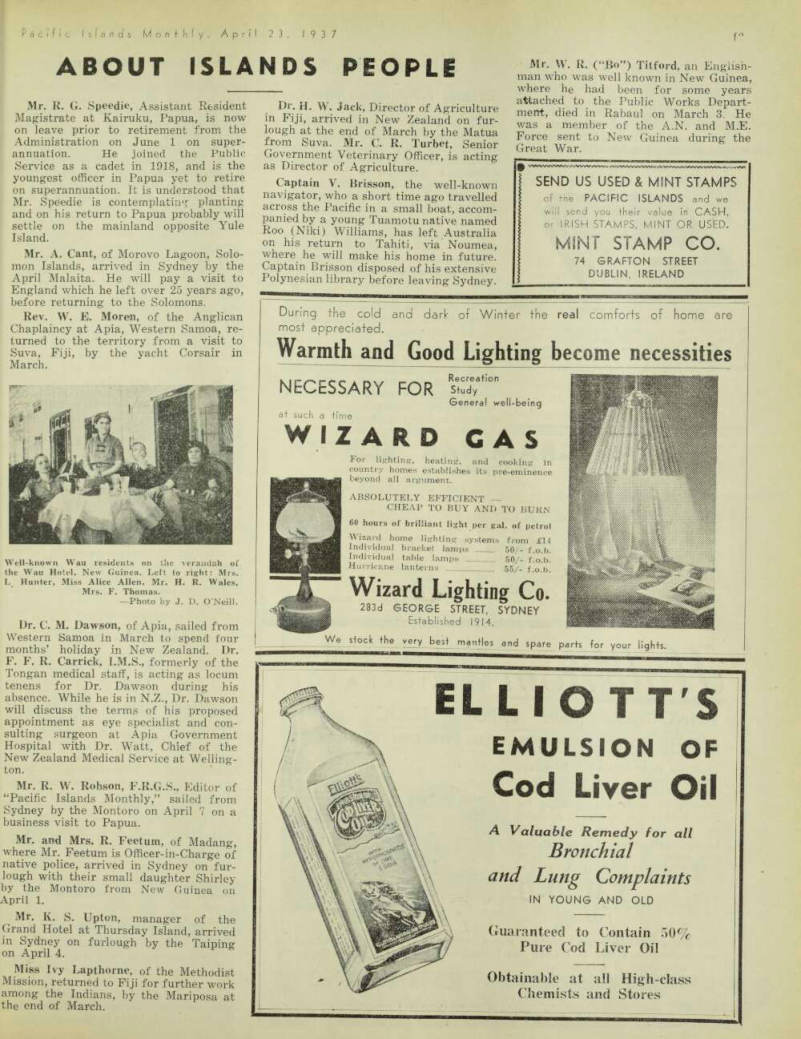
Mr. R. G. Speedie, Assistant Resident Magistrate at Kairuku, Papua, is now on leave prior to retirement from the Administration on June 1 on super annuation. He joined the Public Service as a cadet in 1918, and is the youngest officer in Papua yet to retire on superannuation. It is understood that Mr. Speedie is contemplating planting and on his return to Papua probably will settle on the mainland opposite Yule Island.
Mr. A. Cant, of Morovo Lagoon, Solo mon Islands, arrived in Sydney by the April Malaita. He will pay a visit to England which he left over 25 years ago, before returning to the Solomons.
Rev. W. E. Moren, of the Anglican Chaplaincy at Apia, Western Samoa, re turned to the territory from a visit to Suva, Fiji, by the yacht Corsair in March.
Dr. C. M. Dawson, of Apia, sailed from Western Samoa in March to spend four months’ holiday in New Zealand. Dr.
F. F. R. Carrick, formerly of the Tongan medical staff, is acting as locum tenens for Dr. Dawson during his absence. While he is in N.Z., Dr. Dawson will discuss the terms of his proposed appointment as eye specialist and con sulting surgeon at Apia Government Hospital with Dr. Watt, Chief of the New Zealand Medical Service at Welling ton.
Mr. R. W. Robson, F.R.G.S., Editor of ‘‘Pacific Islands Monthly,” sailed from Sydney by the Montoro on April 7 on a business visit to Papua.
Mr. and Mrs. R. Feetum, of Madang, where Mr. Feetum is Officer-in-Charge of native police, arrived in Sydney on fur lough with their small daughter Shirley by the Montoro from New Guinea on April 1.
Mr. K. S. Upton, manager of the Grand Hotel at Thursday Island, arrived in Sydney on furlough by the Taiping on April 4.
Miss Ivy Lapthorne, 0 f the Methodist Mission, returned to Fiji for further work among the Indians, by the Mariposa at the end of March.
Dr. H. W. Jack, Director of Agriculture in Fiji, arrived in New Zealand on fur lough at the end of March by the Matua from Suva. Mr. C. R. Turbet, Senior Government Veterinary Officer, is acting as Director of Agriculture.
Captain V. Brisson, the well-known navigator, who a short time ago travelled across the Pacific in a small boat, accom panied by a young Tuamotu native named Roo (Niki) Williams, has left Australia on his return to Tahiti, via Noumea, where he will make his home in future.
Captain Brisson disposed of his extensive Polynesian library before leaving Sydney.
Mr. W. R. (“Bo”) Titford, an English man who was well known in New Guinea, where he had been for some years attached to the Public Works Depart ment, died in Rabaul on March 3. He was a member of the A.N. and M.E.
Force sent to New Guinea during the Great War,
Well-known Wau residents on the verandah of the Wau Hotel, New Guinea. Left to right: Mrs.
L Hunter, Miss Alice Allen, Mr. H. R. Wales, Mrs. F. Thomas. —Photo by J. D. O’Neill.
Mr I). Hax G’Connor, who was accepted as a Patrol Officer by the Papuan Administration, arrived in Port Moresby from Australia on March 24 by the Macdhui. He left the following day for Daru, in the Western Division. Mr.
O’Connor has had tropical experience in the British Solomon Islands.
Advertisements & other items, pp. 15-16 (2 items)
13
Pacific Islands Monffify, April 23, 1937
L I O Xt's
SEND US USED & MINT STAMPS
of the PACIFIC ISLANDS and we wiil send you their value In CASH,
or IRISH STAMPS, MINT OR USED.
MiNT STAMP CO.
74 GRAFTON STREET
DUBLIN, IRELAND
During the cold and dark of Winter the real comforts of home are
most appreciated.
Warmth and Good Lighting become necessities
NECESSARY FOR sST'”
Genera! well-being
at such a time 1 1 ai
WIZARD CAS
For lighting, heating, and cooking in jl3 %M country homes establishes its pre-eminence HBL// L’iJ $ ■ beyond all argument. ■MpTi' pi;-!': v HHHg
■KH ABSOLUTELY EFFICIENT - -
CHEAP TO BUY AND TO BURN 60 hours of brilliant light per gal, of petrol Wizard home lighting systems from £l4 Individual bracket lamps 50/- f.o.b.
Individual table lamps ... 50/- f.o.b.
Hurricane lanterns 65/- f.o.b! mtm*
Wizard Lighting Co.
283 d GEORGE STREET, SYDNEY
Established 1914.
We stock the very best mantles and spare parts for your lights.
L I O XT'S
EMULSION OF
Cod Liver Oil
A Valuable Remedy for all
Bronchial
and Lung Complaints
IN YOUNG AND OLD
Guaranteed to Contain 50% Pure Cod Liver Oil Obtainable at all High-class Chemists and Stores
SMOKERS’ REQUISITES
The “Ideal” Cigarette-making Machine and combination Tobacco Box; usual price 6/6 —“Pacific Islands Monthly” readers, 3/9.
The “Rolls” Safety Razor always available from as low as 42/-. The “Wilkinson” Safety Razor, from 14/6 each. Genuine Cadman’s “Bengali”
Blade Razor —worth 12/6 —my special price, 7/6.
Silver Mounted “L. & Co.” and “Barling” Briar Pipes worth 25/ —to you for 17/6.
Inquiries of any description I welcome.
SOL LEVY Established 36 yrs.
713 George St., Haymarket, Sydney, Aust.
to you
for 3/9
TRINITY GRAMMAR SCHOOL
KEW, VICTORIA
President of Council: Headmaster: A. O. HENTY, Esq. FRANK SHANN, M.A., Dip. Ed.
The School is well equipped and splendidly situated. Its present size (about 40 boarders and 230 day boys) makes it possible for every boy to come into personal touch with the Head Master and a staff of 10 experienced and successful masters (including seven University Graduates). The general life of the school is very varied and full of vigour. The Head Master will be pleased to send the Illustrated Year Book for 1936-7 on application, and to give full information about the school, which is approved by the University of Melbourne as a Class "A” School for Intermediate and School Leaving Examinations. Two Preparatory Schools —Charles Street, Kew, for boarders and day boys; and St. Hilary’s Hall, John Street, East Kew, for boys and little girls.
Term (kites for 1937: June 1, September 14.
Postal Address: Kew, E. 4, Victoria. Telephone: Hawthorn 412.
KEROSENE OPERATED...
StfOfTi REFRIGERATORS
ANNOUNCE NEW EXPORT POLICY
AND THE BEST REFRIGERATOR VALUE EVER OFFERED To enable us to obtain Full Advantage from the enormous Output Capacity of the new Hallstrom Manufacturing Plant, covering 20 acres * and including the finest machinery of its type in Australia, we have decided on a policy of More Sales at Lower Prices We now offer the Model as illustrated at £3l-10-0 F. 0.8. Sydney.
This ever popular Hallstrom model has, over a number of years, stood all tests under all conditions, and may be ordered direct from the factory, or is obtainable, at the new price, from all branches of Burns, Philp & Co. Ltd. and W. R. Carpenter & Co. Ltd.
E. HALLSTROM. Willoughby, Sydney
Guinea Airways
Extended Activities and New Capital
VV/dTHOUT a dissentient voice, share ** holders of Guinea Airways Ltd. in Adelaide on April 2, agreed to increase the nominal capital of the company from £200,000 to £300,000.
It is intended to raise £40,000 of new capital (making the total issued capital £120,000), wherewith the company will build new hangars at Parafield (Ade laide) and (possibly) Sydney, provide for new plant and ground organisation, and provide working capital for the rec ent expansion of the company’s opera tions so as to include the Australian mainland.
The chairman of directors, Mr. C. V. T.
Wells, told shareholders that figures re ceived that week from New Guinea showed that in the year ending February 28, the company had carried 6705 tons of goods by air—an increase of 229 tons on the 1935-36 record total of 6476 tons. The annual accounts would be presented and the dividend announced at the annual general meeting in May.
The chairman said that only a few days previously they had completed a three-years’ contract for the whole of Messrs. Burns, Philp’s air transportation in New Guinea, and had also arranged new contracts with two important min ing companies.
New Managing Director
The chairman announced to the meeting the appointment to the position of man aging director of the company, of Mr. H.
Morris Smith, who has been assistant secretary of the company, in Adelaide, for some years.
Now that the company has commenced operating in Australia, the need for a chief executive in Australia has become pronounced and, after careful thought, Mr. Smith was selected. He is a young man, with a first-class business record and was an engaging personality. He will, as managing director, exercise supervision over the New Guinea busi ness; but Mr. Eric Chater will, as hereto fore, act as general manager of the com pany’s extensive operations and property in New Guinea and Papua.
Adelaide—Darwin
A great deal of interest is being dis played in Australia in Guinea Airways’ new trans-Australian weekly air-mail service, between Adelaide and Darwin.
The big Lockheed machine that was brought from New Guinea is carrying on the service, via Alice Springs, Ten nant’s Creek and other centres. The trans- Australian flight is made in a day and a half.
The South Australian Government is making plans to send tourist traffic by this service to Central Australia, where there are many remarkable scenic at tractions. It is thought that Alice Springs might become an important health resort.
Misima Gold
G.M.O.P. Prospects Improve Further
A REPORT issued by Gold Mines of Papua Ltd. to their shareholders late in March, showing excellent progress being made in the development of their leases on the island of Misima (Eastern Papua), and an improvement in pros pects regarding ore bodies, sent the shares of the company “jumping.”
The 5/- shares, early in April, touched 17/-, and the shares of the new issue (3/paid) were around 15/-. There is every indication that, with this and other com panies coming to production alongside Mr. F. W. Cuthbert’s famous “money spinner” on Misima, a solid gold-mining industry has been at last established in Papua.
The G.M.O.P. report is published in our mining columns.
Mr. James Burns, chairman of direc tors of Messrs. Burns, Philp & Co. Ltd., sailed for London aboard the Comorin early in April. He will supervise the construction of five new motor ships for the inter-islands trade in the South Seas.
Three Natives Killed In Rabaul Smash
Rabaul Smash
From Our Own Correspondent RABAUL, March 25. ■"PH REE natives were killed and three others injured when a two-and-a-half ton lorry driven by a Chinese named See Too Leon overturned on Kokopo-road, as it was avoiding an on-coming car, on March 20.
Fifty natives, including men and
women, were travelling on the vehicle when it capsized. See Too'Leon has been
charged with manslaughter.
On March 24 a special Government Gazette was issued containing an amend ment to the Motor Traffic Regulations limiting the number of passengers that may be carried by lorries. Where no number is specified in the license then the number may not exceed 20. Another amendment was issued prohibiting other persons sitting in the front seat when the driver is a native.
For a considerable time now it has been the practice for natives to travel in lorries and, on occasions, as many as 90 passengers have been counted. This practice, as has ■ been pointed out, is extremely dangerous to the public.
General satisfaction is expressed at the introduction of the recent amendments, though it would appear that a fatality was necessary to accelerate the legisla tion in question.
Captured Sampan Released
From Our Own Correspondent
Tulagi, Mar. 28.
THE Japanese sampan, captured in 8.5.1. waters some time ago and which had become a feature of a secluded part of Tulagi, has been sent away. Its crew had been mildly imprisoned for some months at the quarantine station.
It is understood that a portion of the fine imposed was remitted, as the pris oners and their craft were a certain amount of bother and expense. It is hoped, however, that the seizure and im prisonment will have a deterrent effect on future poachers in the Solomons.
Mr. Desmond O’Brien has been ap pointed H.B. Majesty’s Vice-Consul at Papeete, Tahiti.
Pastor A. G. Stewart, one of the execu tive heads of the Seventh Day Adven tist organisation, sailed from Sydney on board the Montoro for Papua on April 7.
He was accompanied by Miss Frances Harding, of the S.D.A. medical staff.
Tourists For Fiji
Agent Appointed in Sydney To Develop Traffic
A POPULAR appointment, announced in Sydney in April, was that of Mr.
F. W. Hennings, a former well-known resident of Suva, to act as official repre sentative in Australia for the Fiji Pub
licity Board.
Mr. Hennings is a member of a family long resident in Fiji. He was born m Levuka, Fiji, and was educated at King’s College, Auckland. In New Zealand, he joined the Union Co., and from 1908 until 1913 was engaged in shipping activities.
As assistant purser, and purser in the Islands services, he gained a useful knowledge of the Pacific. He eventually returned to Fiji as manager of the Fiji Times, but resigned after a year to enter the Fiji Government service.
For six years he was attached to the Department of Agriculture, and spent a good ideal of his time among the natives.
Mr. Hennings later returned to commer cial life, and was for 11 years with Walter Horne & Co. Ltd., merchants, of Suva. In 1931 he came to Australia and entered into business on his own account.
“More than 9,000 people have visited Fiji of late as a result of cruises and the reasonable fares offered,” says Mr.
Hennings, “and it now is realised that
these islands are not merely a stopping place on the trans-Pacific route, but that they have something unique to offer the traveller. Fiji will become increasingly popular as time passes.”
Mr. Hennings’s Sydney office is at 12 Castlereagh-street.
Advertisements & other items, pp. 17-18 (2 items)
The Most Delightful
PRELIMINARY
ANNOUNCEMENT
LINDENHAFEN ESTATES LTD.
(IN LIQUIDATION)
Under instructions from the Uquidator the whole of the business and undertaking of the above-named Company, comprising Copra Plantation and Desiccated Coconut Factory situated at Lindenhafen, Copra Plantation at Ring Ring and interest in land at Fullaborn, New Britain, Mandated Territory, will be offered For Sale by Public Auction as a going concern on Thursday, 22nd July, 1937, at I I a.m. in the Auction Room, No. 70 Pitt Street, Sydney, New South Wales.
FuH particulars may be obtained on application to: The Liquidator, E. L.
WOODGATE, Chartered Accountant (Aust.), Frazer House, 42 Bridge Street, Sydney: RAINE & HORNE LTD., Auctioneers, 70 Pitt Street, Sydney.
0 -4 h A \x" \
uS t
\i
THE MOST DELIGHTFUL
From BU RNS PHI IP at all their Pacific
WE POST FREE, to any address in the islands, 7 Doz. Latest American Magazines for 4/-.
Large Assortment Mystery, Detective, Boxing, Mechanical, Movie and Western.
French Frolics - - - I/- Posted Paris Peeps - - I/- M Fun in Bed - - I/- n Gay Life - - - 1/6 „ We buy all kinds of Postage Stamps, Mint and Used Highest Prices Paid.
McKAY'S BOOKSTALL
30 ROYAL ARCADE. SYDNEY
See the New ROYAL
Portable First!
UCM
ROYAL - More
than ever World's
No. I Typewriter
Standard Keyboard, with all standard features—the most completely equipped Typewriter made.
Backspaces Stencil Switch, Margin Release, etc., etc. Supplied in Handsome Travelling Case—The New Duo-Case. • Sole Agents ROYAL Typewriter
SYDNEY PINCOMBE PTY. LTD.
48 HUNTER STREET, SYDNEY
P.O. Box 1652 JJ., G.P.0., Sydney
CUT THIS OUT
SYDNEY PINCOMBE PTY. LTD.,
Box 1652 JJ, G.P.0., Sydney.
Please send me full particulars of NEW ROYAL Portable Typewriter.
Name Address
Rheumatic Remedy
MONET SACK GUARANTEE
“Obtainable from all branches of Burns, Philp and Co. Ltd., or Post Frfee from R.U.R. Pty., 841 George St., Sydney—7/6 for 6 weeks’ treatment, 4/- for 3 weeks’ trial size. Ask or write for Free Booklet.
Central Papua
Another Patrol Through Central Papua Mr. Claude Champion To Visit Lake Kutubu
From Our Own Correspondent.
Pt. Moresby, Apr. 19.
T-HE Administration has despatched * another expedition to explore Central Papua.
Mr. Claude Champion, A.R.M., who has been stationed at Daru, left on April 17 for a patrol from Kikori (in the Delta Division) across the Limestone Barrier to the newly discovered Lake Kutubu.
Kutubu was visited by the Champion- Adamson patrol in October last year from the Leonard Murray Mountains.
On his recently completed patrol, Mr.
Ivan Champion made investigations which clearly showed that a trade route existed from the Kikori River to Lake Kutubu.
It is to seek and examine this track that Mr. Claude Champion, who is accom panied by Patrol Officer F. W. G. Ander son, has undertaken the patrol They will endeavour to find where the trade route extends, and whether it serves valleys leading to what has become known as the
“Papuan Wonderland.”
Difficulty Of Importing
An Aeroplane
t>ORDER difficulties were shown up in Port Moresby recently, when Mr.
Ward Williams was fined £5 (the mini mum) for importing an aeroplane and failing to pay duty on same.
Mr. Williams needed a plane for his prospecting work on the Fly River, so he bought a Waco machine in Lae, New
Guinea. As there were no facilities for re-fuelling between Port Moresby and the Upper Fly, the machine was not taken via Port Moresby, but was instead flown direct from Lae to the prospecting party’s camp on the Upper Fly—thus crossing the border between Papua and the Man dated Territory.
No one worried about it, apparently, until Mr. Williams’s agent in Port Moresby, Mr. E. J. Frame, noticed what had happened. No duty had been paid, and no certificate of airworthiness had been produced, as required by Papuan law. Thereupon the Government was informed, £l3O of duty was paid, the certificate was produced; and on March 25, Mr. Williams was solemnly fined £5.
The maximum fine provided is three times the value of the article imported.
Freighters Experience
At Nauru
VI7ITH her sides stained by phosphates ** and the paint on her doors peeling off from the temperature of the tropics, the British freighter Ilvington Court ar rived in Sydney on March 23 from Nauru Island, Central Pacific.
Bad weather hovered around Nauru while the steamer was there, said the master, Captain H. Dempster. After a few hours of unloading a heavy swell would come up, and the Ilvington Court would have to cast off hurriedly and steam away from the island as there is no harbour. The vessel would then roll about till the weather moderated.
This happened every day for a fort night.
Mr. and Mrs. J. Klaucke, of Gizo, British Solomon Islands, reached Bris bane by the Malaita early in April. Be fore returning to 8.5.1., Mrs. Klaucke
will undergo an operation.
Advertisements & other items, p. 18 (1 item)
Tejvax
, ü bslHul e ,\s*° I
TENAX
A®
TEJVAX
TH [ GENUINELY GEP.MICIDAI
TOIIET SOAP
o
PREVENT
TROPICAL
DISEASES
You guard yourself against Typhoid, Diphtheria, Malaria, Dhobie Itch, Tinea and Surfer's Foot when you lather daily with TENAX. It Is also invaluable in the cure of Tropical Skin Diseases, for TENAX is the ONLY soap containing oil distilled and marketed by Australian Essential Oils Ltd. under the registered trade-mark of "Ti-Trol, 1 ' eleven times quicker than carbolic as a germicide, but NON-POISONOUS and
NON-IRRITANT.
"The Medical Journal of Australia," official organ of the 8.M.A., says: "TENAX is a satisfactory germicidal soap which may be recommended with confidence."
A PRODUCT OF AUSTRALIAN SOAPS LIMITED
Pacific Islands Club
New Organisation To Cultivate Friendly Relations With South Seas
WITH the objects of developing closer relations between the peoples of Australia and New Zealand, and the peoples of the Pacific, and to form a social centre where residents of the Islands may meet the descendants of former residents in the Pacific, an organi sation was formed in Sydney in April to be known as the Pacific Islands Club.
Dr. H. lan Hogbin, lecturer in anthro pology at the University of Sydney and a former research worker in different parfs of the Pacific, presided over a representative attendance.
The majority of those present were formerly members of the Polynesian Club of Sydney. Mr. Eric Ramsden, who acted as provisional secretary to the new organisation, explained that they were seeking an organisation which would have as its objective the study of social conditions, history, traditions, economics, political developments in the Pacific, as well as promoting the friendly social relations with people in the Islands.
Mr. R. W. Robson emphasised that such an organisation was a necessity in Syd ney. “Islands people constantly are pass ing through this city,” he said, “and it would be to the advantage of ail con cerned if we could establish closer rela tions with those visitors and provide them with services of various kinds.” His journeys in various parts of the Pacific, he said, had convinced him that a duo such as suggested would receive the sup port of Islands residents.
“I agree that it is essential we should have an organisation which will look broadly across the Pacific,” declared Mr.
W. Taylor, New Zealand Trade and Tourist Commissioner, who said his Government represented 70,000 Maoris, in addition to the natives of the Cook
Islands and Western Samoa, “I would like to see such a club founded on a solid, firm basis, and it should be con structive in every way,” he added.
On the motion of Mr. F. D. McCarthy, ethnologist at the Australian Museum, seconded by Mr. H. R. Rabone (a former resident of Norfolk and Lord Howe Is lands, whose grandfather was one of the pioneer missionaries in Tonga), it was unanimously decided to form the Pacific Islands Club.
The following officials were elected:— President, Dr. H. lan Hogbin; chief tainess, Mrs. Alfred Page (Lefagaoa ii) . formerly of Apia, Samoa; vice-chief tainess, Mrs. Vika Lamacraft, formerly of Nukualofa, Tonga; treasurer, Mr. W.
H. Fetch, formerly of Pitcairn Island, Rarotonga and Tahiti; executive com mittee, Mr. W. Taylor (New Zealand), Miss E. Blacklock (Samoa), Mr. Rabone, Mrs. Tennant Kelly (University of Syd ney), Mr. F. W. Hennings (Fiji), and two others to be. elected. Annual sub scription was fixed at 5/-.
The committee were requested to formulate rules for presentation to a general meeting of members.
Following a meeting of the executive, arrangements will be made for the first social gathering. It is hoped to have papers and addresses delivered by persons qualified to speak on Pacific affairs, and that visitors from the Islands will be entertained during their visits to Sydney.
Should the movement meet with support, the committee hope also to publish a journal in which the proceedings of the club will be recorded.
Islands residents who wish to get in touch with the club may communicate with the general secretary, care of the Pacific Islands Monthly.
Mr. H. S. Russell, Boarding Inspector at Samarai, Papua, has been appointed Collector of Customs and Postmaster at Port Moresby. He took up his new duties at the end of March.
Advertisements & other items, pp. 19-20 (1 item)
Prouds
Chromium Finish
owes its great popularity to its refined appearance and non-tarnishablc nature. It is an excellent wearing surface and peculiarly adapted for good quality brushes for which a long life may be expected.
S3—Chromium-plated Military Brush and Comb, in Case, 30/-.
S 2 Gentleman’s Chromium-plated Travel Set, in Leather Case, with Zipp Fastening, £3/3/-.
SI —Superior Quality Military Brushes and Comb, in case. Chromium, £3/5/-.
Sterling Silver, £5.
CATALOGUE SENT POST FREE
ON PARLE FRANCAIS
PROUDS
PTY. LTD.
THE GIFT STORE
Cr. King & Pi++ S+s., Sydney
0 L-'</
Mowbray House School
CHATSWOOD, SYDNEY, N.S.W.
(Established in 1906) A Boarding School for Boys. Surrounded by Spacious playing fields, on hights of the North Shore Line.
The School Offers: A Home Atmosphere —An Unrivalled Health Record A Sound Physical, Mental, and Moral Training.
The curriculum extends from the earliest stages to the Intermediate Examination, and provides a specially designed course of COMMERCIAL EDUCATION for boys entering a business career or work on the land.
Special provision Is made to meet the requirements of boys from THE ISLANDS, which includes facilities for spending School Vacations at the School Country House.
Applications for enrolment in 1937 are now being received.
Illustrated Prospectus on Application. HEADMASTER: L. BAVIN
Get your
m copy
of the
NEW TRUFOOD
RECIPE BOOK
69 specially tested rccipes—all kinds of new ideas for attractive things to cook cakes, pastry, puddings, custards, desserts, = mir'es, sauces, etc.
' - , ' ' '' coupon today Recipe Department/' c/- Box 3922TT G.P.O.
Sydney.
Please send me POST FREE, a copy of The Trufood Book of 69 Tempting Recipes Jamc
(BLOCK LETTERS)
Address
ATTRACTIVE FOOD
FOR THE TROPICS
M®ILRATHS
|"St. George" Vegetable Salad, 14-oz. tins 12/6 dozen "I.X.L" Green Peas and Potatoes, 30-oz. tins 13/-dozen I Australian LA. Crystal Sugar, 70-lb. bags "Red Feather" Camp Pie, 12-oz. tins ...
"Yoga" Tea. Finest Blend, l-lb. packets "1.X.L." Tomato Sauce, 10-oz. bottles Selmore Sockeye Salmon, tins Anchovies with Capers, 2-oz. tins Trefavenne Sardines In Oil, 4-oz. tins Special Vintage Invalid Port, 26-oz "Selmore" Cooking Sherry, 40-oz. bottle "Rosa" Baking Powder, l-lb. tins "Rosa" Self-raising Flour, 2-ib. packets ..
Gartside's Sweet Corn, 10-oz. tins ...
PRICES F. 0.8. SYDNEY
Half dozens supplied at dozen rates. 13/9 bag 6/- dozen I/I I pkt, doz. 12/6 dozen 8/3 dozen 7/6 dozen 2/6 bottle 2/6 bottle 17/6 dozen 5/9 dozen § 6/- dozen
M? I LROTH’S LTD
" Cf'toxzejc&~"
• • ♦ -C * PO a T OCPA a T M N T •'» •
202 PITT STREET, SYDNEY
NEW SOOTH WALES . AUSTRALIA.
Hand Tahiti And French
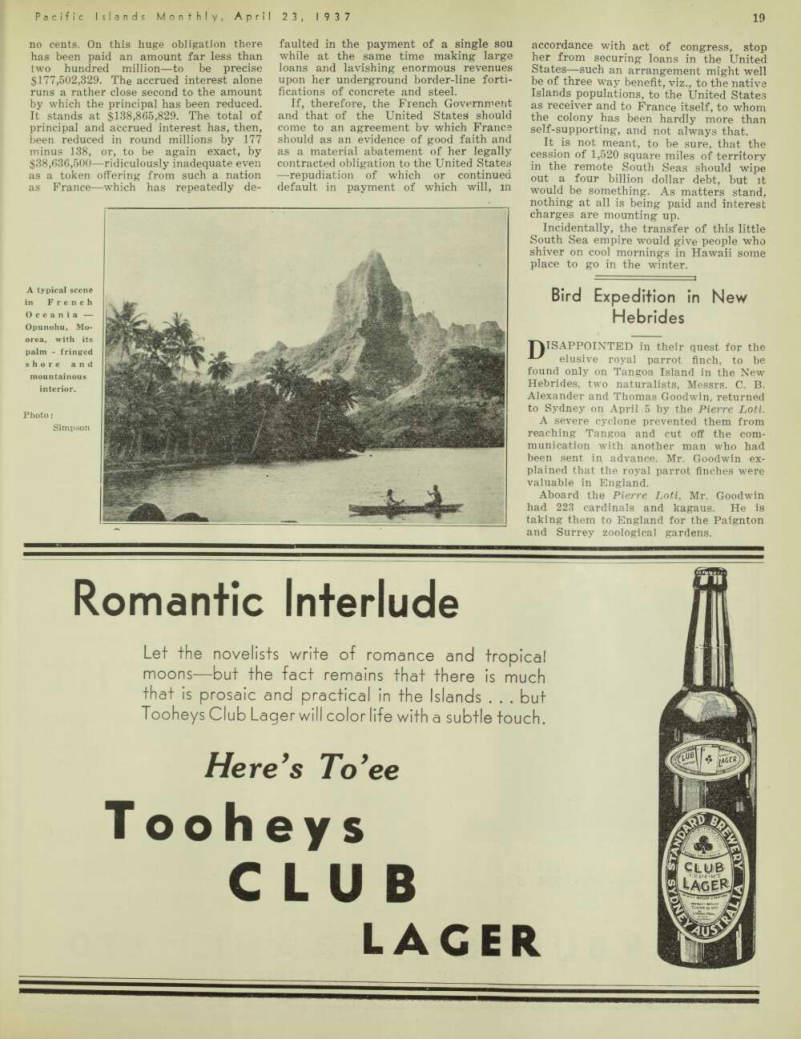
Oceania To U.S.A.!
Interesting Rian Advocated In Honolulu
DR. A. W. SLATEN, In the "Hololulu Star Bulletin" of January 16, presents most Interesting arguments to show why French Oceania (Tahiti, Marquesas, etc.) should be ceded to the United States. Ihe cogent part of his article Is reprinted below:—
■"PHE arguments to be offered for the * cession of French Oceania by France to the United States are partly historical, partly humanitarian and party commer cial (says Dr. Slaten). Incidentally, they bear upon that extension of American responsibilities in the Pacific which it would seem natural to expect.
Theoretically—from the tendency of a great political body to attract smaller units to itself —and practically—from the beginnings made bv American relation ships with Samoa, Hawaii, the Philip pines, Guam, our optional right in Yap, and latterly with Howland, Jarvis and Baker Islands, it is reasonable to anti
cipate that American interests in the Pacific will increase rather than decrease.
That pioneering in air communication between remotely separated Pacific com munities which awakens our astonished admiration is but a hint of the wa ,f in which, after a few more years, the armadas of the air will be shuttling to and fro. We shall need islands, and more islands!
Historically, the United States had a prior claim to the Marquesas, as Great Britain had to the Society group. These two most important archipelagoes of the entire area became French, as it were, by default.
Should the occasion ever arise, it would be a gallant Gallic gesture to restore them to the original owners to whom they were lost by negligence. In such an event, Great Britain would no doubt vield to her closely related colleague, having no care for further extension, by the addition of a handful of remote islands, of her already enormous empire.
Historically, then, the cession of French Oceania to the United States would be well grounded.
Humanitarian considerations also urge the transfer. There is a notable improve ment in health conditions in quarters that come under American control, whether the region be American Samoa or Puerto Rico or the five mile strip that borders the Panama canal.
It would not be too much to expect in the event of France’s cession of her possessions in Oceania to the United States some reparation for the white man’s curse in the past would result and the decline in the once flourishing Marquesan population would be stayed.
Commercial considerations add their not insignificant weight to those of his tory and humanity.
The cold facts are that France owes the United States Government more than four billion dollars —to be exact, an original principal of $4,041,152,329 and
no cents. On this huge obligation there has been paid an amount far less than two hundred million—to be precise $177,502,329. The accrued interest alone runs a rather close second to the amount by which the principal has been reduced.
It stands at $138,865,829. The total of principal and accrued interest has, then, been reduced in round millions by 177 minus 138, or, to be again exact, by $38,636,500 —ridiculously inadequate even as a token offering from such a nation as France—which has repeatedly de
faulted in the payment of a single sou while at the same time making large loans and lavishing enormous revenues upon her underground border-line forti fications of concrete and steel.
If, therefore, the French Government and that of the United States should come to an agreement bv which France should as an evidence of good faith and as a material abatement of her legally contracted obligation to the United States —repudiation of which or continued default in payment of which will, in
accordance with act of congress, stop her from securing loans in the United States—such an arrangement might well be of three way benefit, viz., to the native Islands populations, to the United States as receiver and to France itself, to whom the colony has been hardly more than self-supporting, and not always that.
It is not meant, to be sure, that the cession of 1,520 square miles of territory in the remote South Seas should wipe out a four billion dollar debt, but it would be something. As matters stand, nothing at all is being paid and interest charges are mounting up.
Incidentally, the transfer of this little South Sea empire would give people who shiver on cool mornings in Hawaii some place to go in the winter.
A typical scene in French Oceania Opunohu, Mo- Orea, with its palm - fringed shore and mountainous interior.
Photo: Simpson
Advertisements & other items, p. 20 (1 item)
Maleham & Yeomans
LIMITED
BOWDEN STREET, SHEFFIELD. ENS
Manufacturers of all kinds of Butchers', Sticking and Sheath Knives Razors and Scissors Specialty Hairdresser Scissors
PRICE LIST ON APPLICATION
Hebrides
Bird Expedition in New Hebrides
in their quest for the elusive royal parrot finch, to be found only on Tangoa Island in the New Hebrides, two naturalists, Messrs. C. B.
Alexander and Thomas Goodwin, returned to Sydney on April 5 by the Pierre Loti.
A severe cyclone prevented them from reaching Tangoa and cut off the com munication with another man who had been sent in advance. Mr. Goodwin ex plained that the royal parrot finches were valuable in England.
Aboard the Pierre Loti , Mr. Goodwin had 223 cardinals and kagaus. He is taking them to England for the Paignton and Surrey zoological gardens.
Advertisements & other items, p. 21 (1 item)
h
"King Of Tabar"

THE many friends of an old identity 1 of New Guinea, Charlie Petterson, known as the “King of Tabar,” will learn with pleasure that he is gaining in health at Wahroonga Sanitarium,
N.S.W.
A very sick man, he left Rabaul last February by the Van Rees. At New Caledonia he had to be taken ashore for treatment at the hospital; but not liking his surroundings in the French Colony, he left at the earliest opportunity by the Pierre Loti for Sydney.
In Noumea, he was fortunate enough to meet an Australian nurse, who ac companied him to Sydney. She advised him to seek treatment at the Wahroonga Sanitarium, and he has progressed so favourably that he expects to return to Tabar at the end of April, One of the old pioneers, Petterson ar rived in New Guinea from Sweden in 1900. He opened up several plantations for the big New Guinea Co., and for a while was running one of their vessels.
In 1912 he acquired a plantation of his own at Tatau Island, Tabar Group.
Gluts And Famines
New System of Marketing Cook Is. Fruit
From Our Own Correspondent.
Rarotonga, March 12.
INTERVIEWED by your correspondent on his return last month from New Zealand, Captain J. D. Campbell, Managing Director of the Cook Islands Native Association and a prominent figure in the “cabals” of former Resident Commissioner F. W. Platts, C.M.G., made the following observations on current affairs:— “Control by the Government of the collection and marketing of C.I. fruit should do away with the costly methods at present in operation, and which result in the market being at one time glutted, while at another in a shortage, with cor responding peak prices, very little of which reaches the planter,” said Captain Campbell.
“Already, in the short time since the official announcement (3/2/’37) that the Government had taken power to control our fruit, local growers have formed themselves into labour groups and are clearing each other’s land, large areas of which are to be planted with bananas and tomatoes.
“If the Government is prepared to guarantee a regular fortnightly steamer service during the tomato and banana season, so that fruit may be picked as it matures, New Zealand should get Islands produce at prices which, while allowing for the planting of areas now ‘in bush,’
would also be far more within the con sumer’s reach than those at present prevailing.
“The appointment of Mr . Harvey Turner as Government distributor under the new scheme may yet have the approval of all parties concerned, as his expert knowledge of the Islands fruit trade has been proved again and again in the successful development of his own business Messrs. Turner and Growers Ltd.”
Owing to the illness which resulted in Captain Campbell leaving for New Zea land, he was unable to appear at the Parliamentary inquiry held here last winter.
New Government Control
Official notice was received here on March 3 that the New Zealand Govern ment had “taken power to control the export and sale of Cook Islands fruit,” but that it was not intended to put the whole of these powers into immediate operation.
The first local reaction to the announce ment was a scramble on the part of lead ing exporters to secure orange crops in the outer islands on a flat-price basis, the contracts to cover the entire seasonal shipments. Prices reported to have been offered were as high as 5/- a case for fruit only.
In Rarotonga, a tentative move was made towards obtaining contracts for the coming season on a flat rate of 3/6 a case (fruit only).
In view’ of the statements made before the Parliamentary Inquiry held here last July that the fruit-business was not a paying one for those engaged in it, it is
now surprising to find these people will ing to contract for fruit at far higher prices than prevailed at the time of the inquiry.
One explanation possibly lies in the fac" that the heavy book-debts carried by the majority of business houses can only be collected through handling deb tors’ produce. To retain the latter, buyers have obviously got to be able to show evidence that by continuing the present marketing system, growers will receive as much, if not more, benefit than under any form of official control.
Mr. William Mcßirney, Chairman of the Growers’ Association, and whose changes in opinion have mystified the members of his organisation, probably has lent colour to these pious wishes by his statement last month to the Resident Commissioner that he has no longer con sidered either a Fruit Board or other form of Government control necessary, since his Association now is operating so successfully. This is a point of view that is not generally endorsed in local pi -pplpc
Oranges At Sd. Each
It was reported in Auckland on April 2 that oranges were selling at sd. each and would be an extreme luxury in Auck land for the next few weeks. Produce merchants said that the embargo on Australian oranges had not affected the position, as no oranges are available from Australia. There was a shortage of oranges in the Pacific Islands.
Advertisements & other items, pp. 22-23 (2 items)
Delco-Licht
Pacific Islands Stamps
Sent on approval on receipt of reference.
Send for free lists and specimen copy, "Australian Stamp Journal."
Collections and Loose Lots Bought
J. H. SMYTH LTD.
114 CASTLEREASH STREET, SYDNEY
6 volt - - - - £23 10 0 12 volt - - - - £25 5 0 (With Battery in bond, Sydney) Distributors:
ELECTRICITY for
EVERYONE... EVERYWHERE
with a Portable Plant
DELCO-LICHT
TO light your bungalow, your boat or camp; to charge your car, boat and radio batteries, here's a 150 watt—6 or 12 volt—plant that operates for 8 hours on a two-quart tank filling.
The plant weighs only 44-lbs., and can be readily transported anywhere.
SPECIFICATIONS: ENGINE, single cylinder four-cycle, L head, air-cooled by forced draught.
DYNAMO, 6 pole; capacity of 150 watts voltage 812 (12 volt), B 6 (6 volt) , . . Self cranking from battery through manual starting switch.
Dynamos in each case will supply six 25 watt lamps. The 12 volt battery 4, for approx. 9 hours and the 6 volt battery for approx. hours.
WRITE to Desk PI for full details now; the plant requires no particular skill to operate or instal, you'll marvel at its portability
WA RBURTON, FRANK! LTD.
MELBOURNE 307 - 15 KENT STREET, SYDNEY BRISBANE
Norfolk Island Trade
February, 1936
IMPORTS
Fi'om Australia £3,691 From Pacific Is.
February, 1937 £2,400 £11 February, 1936
EXPORTS
To Australia £1,253 To Pacific Is. £59 February, 1937 £4.187 £18
Nor'-West Season's
Toll
Shipping and Business Hampered in the Solomons
From Our Own Correspondent
Tulagi, Mar. 24.
‘‘T'HE Nor’-west season in the Solomons * has been one of the worst for many years. It followed particularly objection able Sou’-east weather which it outdid in nastiness.
Shipping and work generally have been much hampered, and many a planter mis sed top prices for his copra because the weather prevented freighters from pick ing up the produce. Shipping has suf fered, and so far there are two vessels which are quite unlikely to be seen at work again.
Like the two vessels lost during the Sou’-east season, both were Guadalcanal craft. One, the Scout , a fine vessel which arrived a few years ago for the Roman Catholic Mission, had had very little ser vice, and had recently been overhauled.
She promised to be very useful, and would has facilitated the work of the Mission, which will be considerably in convenienced by the loss. The other vessel, belonging to Lavoro Plantations, had had a long and useful career, and will be greatly missed.
Communications in the Guadalcanal district must be a serious problem since so many vessels have been lost there.
At the present time what we hope is the “March blow,” usually recognised as the finale of the Nor’-west season, is blow ing a gale. When it eases, quite a few vessels will be busy again.
Mr. J. Gilmore, of Put Put Plantation,
Kokopo, New Guinea, arrived in Sydney
from Rabaul by the Montoro on April 1.
Mr. K. Atkinson, son of Mr. O. J.
Atkinson, Resident Magistrate at Buna, Papua, has joined the Papuan Public Service as a Cadet Patrol Officer. For the present he will be stationed at Buna.
Canon and Mrs. Robert Rooke returned to Australia from Norfolk Island by the Morinda on March 23 after spending 10 months at N.I. with their married daughter, Mrs. H. F. Chapman, who has lived there for the past 12 years.
Mother’S
Trouble
Pitiful letter about her child
u T go through tortures worrying X about my son. I feed him well, yet he isn’t as strong as other boys.
He catches so many more colds than my cousin’s boy. She gives her child Scott’s Emulsion, but I give my son a cod liver oil tonic, too. What can be wrong with him ? ”
When mothers find their children
getting peaky in winter and catching
one cold after another, they look for help to cod liver oil. And quite right, too. It’s the finest body-builder you could give your child.
But you must be careful to choose the right form of cod liver oil. And that’s where some mothers make a mistake. They don’t realise that cod liver oil should be made digestible so that children’s delicate stomachs can get all the goodness out of it.
If it upsets your child’s stomach or passes through undigested, you are wasting money. That’s what may happen with plain oils and most cod liver oil mixtures.
But there is one cod liver oil tonic which even the most delicate stomach can digest easily. It is Scott’s Emulsion. Read what an eminent Research Body says about it: — “Only when cod liver oil is given in the white creamy form of Scott’s Emulsion can children wholly digest the oil and so get ail the body-building goodness they need.”
Actually, Scott’s Emulsion is even more digestible than milk puddings. Thirty minutes after your child has taken a spoonful of it, every drop has gone to strengthen his whole body and particularly his chest and lungs.
That’s what makes him strong, sturdy and free from colds or other winter illness.
Get Scott’s Emulsion from your chemist to-day. Give it to your child regularly through the winter. Watch his appetite improve, his cheeks fill out, his muscles get hard, his whole life become as happy as any mother could wish. But see that it is SCOTT’S Emulsion.
Advertisements & other items, pp. 23-24 (2 items)
’Fairholme"
A Mountain School for Girls
mm Dormitory Wing
PRESBYTERIAN GIRLS' COLLEGE
Toowoomba, Q'land, 2,000 feet above sea level :: Unrivalled Climate
ACADEMIC HOME SCIENCE AND COMMERCIAL COURSES
Tennis :: Swimming :: Organised Games
PRINCIPAL: MISS D. E. CULPIN, B.A.
For Prospectus, apply to Secretary. R. T. PHELPS. F.A.A.. Toowoomba
Dry Batteries Out For Life!
as mm f S
In step with the World's largest Set Manufacturers, Krlesler revolutionises Country and Islands reception, and gives to Islands listeners the first real high power —high economy —low maintenance radio ever produced.
To hear these new Krieslers is to realise just how fine a musical instrument can be. Every Kriesler is sold with a three years' guarantee plus the Kriesler "Make Good Policy or Money Back."
TWO NEW DRY BATTERYLESS MODELS
460 Broadcast - 470 Dual Wave
Kriesler Australasia Ltd.
Cnr. PINE, MYRTLE and BEAUMONT STREETS
CHIPPENDALE, SYDNEY
Please send me full particulars of Kriesler Dry- Batteryless Radio.
I Name Address (Are you a Radio Dealer?)
Sydney - New Guinea

Air Mail
Four Big Firms Are Tenderers
HPENDERS for the proposed Sydney * New Guinea weekly air-mail service, which closed on March 31, were submitted by Guinea Airways Limited, W. R. Car penter & Co. Ltd., Australia-New Guinea Airlines, and Southern Airlines and Freighters.
The first two tenderers are well known in New Guinea. The third is a company formed by the big Australian aviation concerns with the apparent object of tendering for the New Guinea service.
The last-named is a company formed by Mr. I. H. Grabowsky (formerly general manager for Guinea Airways Ltd.) and certain Melbourne interests to undertake aerial freighting in Australia.
As each tenderer has submitted a num ber of tenders covering services of different speeds and plane capacities, and with different ports of call, a total of 49 separate proposals have been submitted, and must receive the close consideration of the Civil Aviation Board before a recommendation can be placed before the Commonwealth Government.
It was hoped, early in April, that it would be possible to make a recom mendation to the Cabinet meeting on April 20, but so much had to be done in checking up on the tenders that that was considered unlikely. It is not con sidered probable that the service will commence much before the end of the year.
It was officially announced that radio and direction-finding apparatus will be placed at Cooktown, Port Moresby, and Salamaua, on the proposed Sydney-Neyr Guinea route.
Papua Prepares For Air Link
With Australia
From Our Own Correspondent.
Pt. Moresby, Mar. 22.
TNSTRUCTED by the Commonwealth Government to advise whether the Port Moresby aerodrome was suitable for the Sydney-New Guinea air service, Mr. M.
B. Allen, of the Civil Aviation Board, who is stationed on the Morobe gold fields, paid two visits of inspection to the landing ground at Kila Kila early in March.
Mr. Allen advised the Papuan Adminis tration that the aerodrome should be lengthened. The Public Works Depart ment is now preparing plans and esti mates of costs, and the Government is acquiring the necessary land from native owners of the district for the extension.
The decision of the Commonwealth aviation authorities to allow the route to be from Cooktown direct overseas to Port Moresby, and then on to Salamaua has given much satisfaction to all resi dents of the Territory, who regarded with alarm the plan excluding Port Moresby from the programme.
New Radio Station In
Northern Cooks
From Our Own Correspondent
Rarotonga, Mar. 12.
OADIO communication between Raro tonga and Manihiki, in the Northern Cook Group, has now been established for general use at certain specified hours.
The plant, which only recently has been installed, is worked by the Resident Agent, a former operator on the Sydney —’Frisco mail run.
The utility of the new station remains to be seen, although it is difficult to im agine what benefit it can confer on the 400 or 500 natives and two white men who inhabit this remote and harbourless
atoll. Local optimists have suggested that as a means of communication in times of sickness it will justify its erec tion; but anyone who has read a radio’d diagnosis by a layman realises at once that the seventh state of the patient is likely to be much worse than his first.
EDITORIAL NOTE. —Our correspondent has forgotten the pending establishment of Pan- American Airways Central Pacific service. All islands in the Central Pacific lying in or near the region between Hawaii and Samoa, suddenly have become important. The radio station at Manihiki, like that on Christmas Island, has an Imperial rather than an economic significance.
Archdeacon H. Harris, of the Anglican
Pro-Cathedral, Suva, Fiji, sailed from
Sydney with his wife and child for Lon don by the Straithaird on April 17.
Captain G. B. Nasmyth, Harbourmaster at Suva, returned to Fiji from England in March with his wife and daughter by the Niagara.
Miss Olive Russell, a teacher at the Methodist Mission’s Ballantine Memorial Girls’ School, Muanikau, Fiji, departed from Sydney for Suva by the Mariposa on March 22. Miss Russell spent ner furlough in Victoria.
Advertisements & other items, pp. 25-26 (2 items)
23
Pacific fsfands Morifhly, April 23, 1937
Clyde
An all-electric Home
—wherever you live
Home Lighting llotteries
Ins+al a Clyde Home Lighting Battery and make your home as comfortable as any city home. Brilliant lighting, power for electrical refrigeration, ironing, cleaning, etc. A range of types for all lighting and power needs. Easy to instal. No trouble to maintain.
There are Clyde Batteries also .for all Cars, Trucks, Buses, Motor Cycles and Radio. Booklet on request.
THE CLYDE ENGINEERING CO. LTD.
GRANVILLE, N.S.W.
Main Sales and Service Division: 61-65 Wentworth Avenue, Sydney Obtainable through the Islands Branches of Burns Philp & Co. Ltd. . . . W. R. Carpenter & Co. Ltd. ... A. J, Peadon, Rabaul . . . and. in Fiji from Morris Hedstrom Ltd.
Ask for full- particulars.
A
For BEST RESULTS use
I I A /II 11= A 1 I
PHOTOGRAPHIC MATERIAL
W. H. GROVE & SONS, Ltd.
ISLAND TRADERS, AUCKLAND. NEW ZEALAND
REPRESENTING
Rylands & Sons (Col.) Ltd., of London & Manchester (including the famous "Dacca" Mills' products for all classes of soft goods).
Agfa Photographic Corporation, Berlin, Germany.
Parbury Henty & Co. Pty. Ltd., Sydney & Kobe.
Sissons Bros. & Co. Ltd., Hull. All Classes of Paints.
VALUABLE CORONATION SOUVENIRS
and NOVELTIES offered in return for
FIRST-DAY COVERS and STAMPS of
PACIFIC ISLANDS. Current and Obsolete Issues—Collections and Loose- Lots, Bought, Sold or Exchanged
PHILATELIC INVESTMENT TRUST
Wall House, 18 Loftus Street, Sydney.
References; Bank of New Zealand, Sydney: Commercial Bureau, Sydney.
TODAY
Imperial
Flavour-Sealed Foods
are READY TO SERVE
CorVe loaf
BEE
Imperial Corned Beef Loaf.
We take the finest beef and cure it by a process which retains its full, rich flavour. Then we slice it, seal it in the cans with aspic jelly, and cook it in vacuum. ' Imperial” Corned Beef Loaf is therefore the tastiest way to serve good corned beef. Try some for home use or for picnics.
Added Zest!
Serve Imperial
Mango & Paw Paw
CHUTNEY
With any Imperial Dish
CAM
Imperial Camp Pie.
Open a can and have one taste—it simply melts in your mouth. Selected fine quality meats are blended and delicately spiced by a process which brings out their full rich flavour. Then they are cooked In vacuum— "flavour-sealed"—in the can. Try some— you'll enjoy it and so will all your family.
IBM
O
Tasty
CRUSTLESS
imperial Chedder Cheese
Give it to your children for lunch , or try it toasted.
IMPERIAL FOODS ARE STOCKED BY ALL LEADING STORES
Road Round Viti Levu
Suva-Navua Section Opened
From Our Own Correspondent.
SUVA, April 1. ’’PHE new road from Suva to Navua, a distance of 30 odd miles, has now been opened to the public.
Considering the nature of the country traversed, the road is in exceptionally good order. During Easter, many cars went through to Navua, some for the week-end, and others merely for the day.
Once the road is properly consolidated, Navua promises to become quite popular, for although it is a small place, there is a good hotel, and at Naitonitoni, a short distance away, there is a* fine beach.
The first few miles of the new road from Suva traverse coastal tidal swamp country. Then come a rubber plantation, now disused, and a section of country under rice cultivation. After this, one is into the hill country and there are five distinct well timbered spurs. Travel through this country is very pretty and should be a big attraction for tourists, if the Government takes steps to protect the bush from depredations of timber cutters.
Twenty-one miles from Suva is Fletcher’s Lookout, the highest point in the road, 415 ft. above sea level, and from here is presented a glorious view out to sea. After crossing the Lobau River, with its 225 ft. bridge, one comes to more flat country, which is given over to grazing and rice cultivation. This continues right to Navua. Just before the Lobau River is a plantation of rubber trees at Waidoi; unfortunately all these trees have decayed.
The only really bad section of the road is a few miles near Navua, where it tra verses swampy country. Great trouble has been experienced here, for it seems that as fast as metal is spread it sinks.
Survey of this road was commenced in 1933, and construction started in May, 1935. The average width of the formation is 22 ft., with 10 ft. of gravel. At present there are some very bad corners, but these are gradually being cut away. The road, together with 18 bridges, cost £37,000 (£1,680 per mile), which com pares favourably with road building costs overseas.
When completed, the length of the road from Suva to Sigatoka will be 80 miles, and of this 63 miles will be new con struction. So far, the road has reached Taunova, 37 miles from Suva. Construc tion is also under way from the Sigatoka end, and has reached out 25 miles from tlfe Government station at Lawaqua, Sigatoka. A stretch of four miles in between, in the province of Serua, has also been completed, leaving approxi mately 20 miles to be finished.
When this road is completed it will provide a motorable highway right round the island of Viti Levu, which will be a great boon to the Colony as a whole, and will have the effect of opening up much new country. Among other things, the road will be a memorial to the progres sive reading policy of Fiji’s late Gover nor, Sir Murchison Fletcher.
Rabaul Citizens’
Committee
From Our Own Cor responder. u ..
Rabaul, Mar. 27.
TTHE Citizens’ Committee, which was * organised, here as a result of the mass meeting held in December, has now decided to extend its activities through out the Territory and to organise branches in all populated centres.
The secretary (Mr. J. C. Mullaly) rec ently made a tour of the outports and he informed the Committee that the enthu siasm for their principles i?i the other centres of New Guinea was made mani fest to him in no uncertain maimer.
The Cruise Of The
" Felicie "
Some Corrections By The Owner
Letter to the Editor T NOTICED in your January issue the lucubrations of your special corres pondent at Tulagi, under the caption “A Non-Paying Enterprise—A Visitor from the Seychelles.” * He says: “The Felice is of no parti cular rig, etc.” The name is spelt Felicie and she is ketch-rigged according to her registry. This you can verify by looking in the signal-letter book where you will find her name next to the Buranbah.
Her signal letters are V.S.D.J.
He says that her foremast was badly sprung. This is news to me and the cap tain. If your correspondent’s eagle eye noticed this it is curious that he could not read her name correctly.
He next says: “The owner, Mr. H.
Parsons, an Englishman of birth and education, etc.” This is very kind of him. although how he found it out is beyond me, as none of us on board ever met him, at least to our knowledge.
He goes on: “They called at Singapore, Kavieng, and Rabaul. According to their story, they were given no work and were on the point of starvation.” The last sentence is absolutely false. We did a freight at Kavieng and we freighted out of Rabaul for a month. We were not on the point of starvation—unless your
correspondent considers running out of tinned meat constitutes this.
He says that we' took three months to get from Rabaul to Tulagi. We took a week to get to the Shortland Islands. We stopped there about two weeks, and took four days from that place to Tulagi.
Next follows this piece of news: “After a week in Tulagi, where they got no work and scant hospitality, they left once more for the African coast.” We got no work in Tulagi, it is true. As for the hospitality, perhaps he speaks for himself on this point. I can only say that the people of the Solomons were most hospitable, especially in the Short lands, where Mr. Sutton and Mr. Seaton were most kind and most hospitable.
The part of the sentence about the African coast is most interesting. Either the captain was drunk, and set the wrong course, or the compass went on the blink, as we found ourselves back in Rabaul.
Your correspondent continues: “Mr.
Parsons, the owner, said that native con ditions in the Solomons were extraordin ary ... He was astounded with the lack of discipline and general velvet-glove system.” I said nothing at all about this —but I agree with him, all the same.
He goes on; “What surprised him more than anything were the number of Chinese in Tulagi.” It did not. I knew how many Chinese there were in Tulagi, from perusing the Colonial Office List.
Your correspondent finishes up with with: “Seychelles was a prosperous and industrious group of islands of 40,000 inhabitants. There was plenty of work
and labour and good conditions, etc.” He should have said Seychelles was a poor and lazy group of islands with 30,000 people. There was no work and poor conditions.
His letter to you was nearly as good as that which was published about us by a Singapore paper, whose correspondent said that the Felicie was a three-masted schooner, and we anchored on the Line! (In the middle of the Indian Ocean, I presume.) I am, etc..
Kokopo, T.N.G., 20/3/1937.
The engagement is announced of Miss Myra Ayson, daughter of Judge Ayson, Resident Commissioner of the Cook Islands, to Mr. Noel Rodgers, of Palmer ston North, N.Z. Miss Ayson is the elder daughter of the Judge and Mrs. Ayson, and has been in charge of the dental clinic in Palmerston North.
Advertisements & other items, pp. 27-28 (1 item)
Prizes
WILLIAM. FINAU
PHOTOGRAPHER
FRIENDLY ISLANDS. OCEANIA
Send 5/6 for interesting views and native life scenes from Tonga. Your money back If unsatisfied. Simple information; 5/6. More important information and photographic data: 10/6
£35 IN
PRIZES
for photographs on Kodak Film by Artificial Light. Have the fun of making snapshots at night—and win some cash!
You'll be surprised how easy it Is with the newer, faster Kodak Films—Panatomic and Super Sensitive Panchromatic.
WRITE FOR SPECIAL BOOKLET.
Users of Cine-Kodak Eight (the modern movies-at-low-cost equipment) can now share the thrills enjoyed by 16mm. owners. Kodachrome Film gives you glorious movies in full natural colors! Every scene appears in full brilliant hues, clear in detail, revolutionary of beauty. Kodachrome movies must be seen to be appreciated! Details on request.
Cine-Kodak Eight £l 1/19/6 Kodachrome Film for Cine-Kodak Eight Price 22/6 Of all Kodak Dealers throughout the Islands and
KODAK (Australasia) PTY.
. Tn 379 GEORGE STREET
L,u * SYDNEY
Established 1841
Stanley & Co.
WHOLESALE AND RETAIL
Produce Merchants
POULTERERS . . .
FRUITERERS . . .
GREENGROCERS
SHIPPING PROVIDORS
Packing for Islands Trade
a Specialty
STANLEY & CO.
325 SUSSEX STREET
SYDNEY
Cables: "Stancarr.," Tel. MA4416
FAVOURITE FOR
HALF A CENTURY
p OR over 60 years the biscuit par excellence where masculine taste is concerned Arnott’s Famous Ginger Nuts.
Crisp, brown, warmly delicious in flavour and crunchy in texture, they hold pride of place as a hardy he-man’s biscuit which has never been equalled in either quality or popularity. Try some with your next order.
ARNOTTiS
FAMOUS
GINGER NUT
BISCUITS
Always ask your Grocer for Arnotf’s
“THEY ARE BETTER THAN EVER”
Pages From The Past
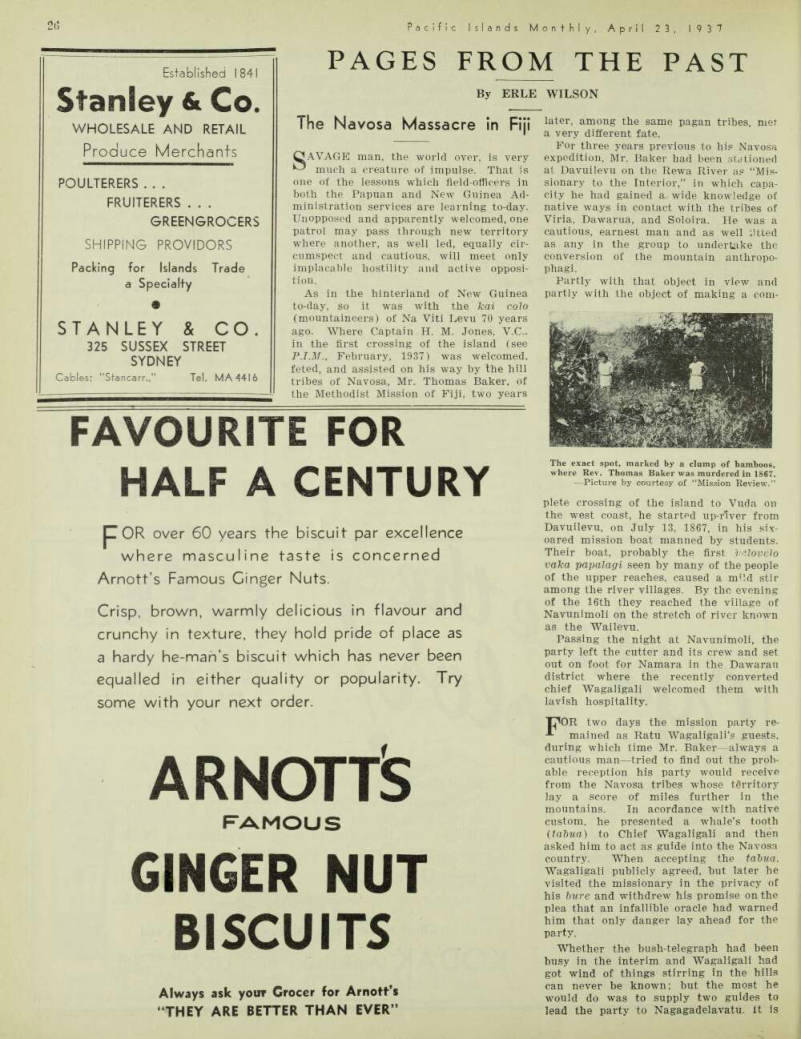
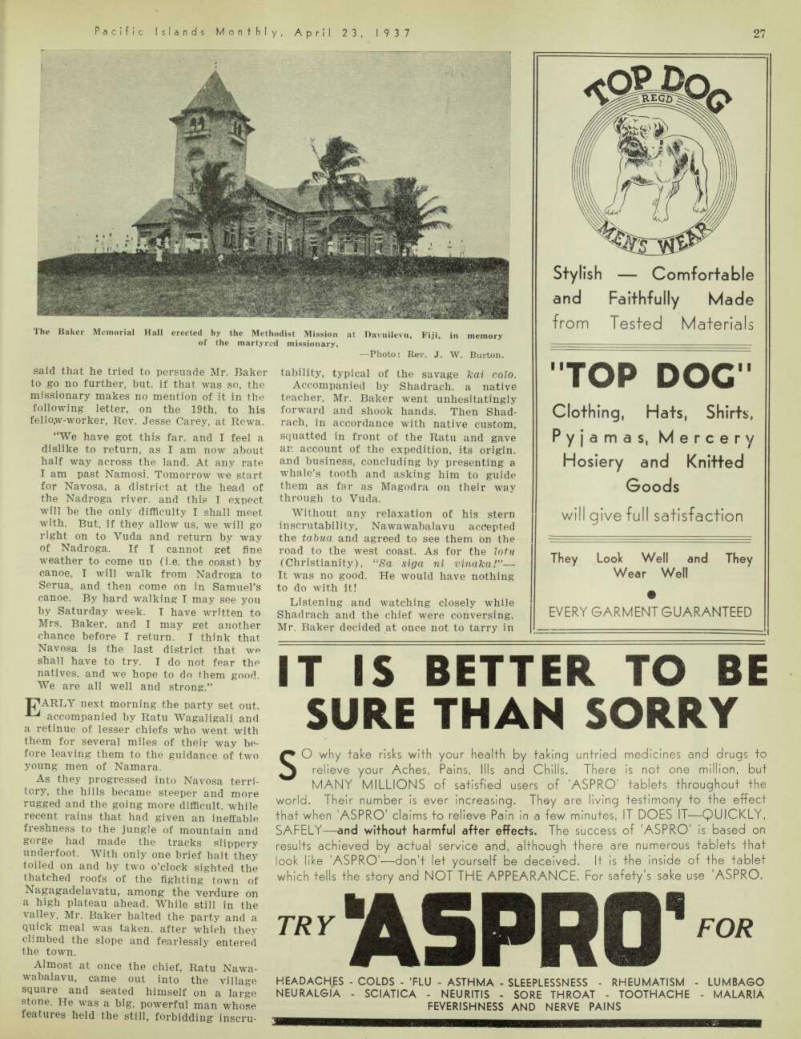

The Navosa Massacre in Fiji
By Erle Wilson
OAVAGE man, the world over, is very much a creature of impulse. That is one of the lessons which field-officers in both the Papuan and New Guinea Ad ministration services are learning to-day.
Unopposed and apparently welcomed, one patrol may pass through new territory where another, as well led, equally cir cumspect and cautious, will meet only implacable hostility and active opposi tion.
As in the hinterland of New Guinea to-day, so it was with the kai colo (mountaineers) of Na Viti Levu 70 years ago. Where Captain H. M. Jones, V.C.. in the first crossing of the island (see February, 1937) was welcomed, feted, and assisted on his way by the hill tribes of Navosa, Mr. Thomas Baker, of the Methodist Mission of Fiji, two years
later, among the same pagan tribes, met a very different fate.
For three years previous to his Navosa expedition, Mr. Baker had been stationed at Davuilevu on the Rewa River as “Mis sionary to the Interior,” in which capa city he had gained a wide knowledge of native ways in contact with the tribes of Viria, Dawarua, and Soloira. He was a cautious, earnest man and as well fitted as any in the group to undertake the conversion of the mountain anthropo phagi.
Partly with that object in view and partly with the object of making a com-
plete crossing of the island to Vuda on the west coast, he started up-river from Davuilevu, on July 13, 1867, in his six oared mission boat manned by students.
Their boat, probably the first vzlovolo vaka papalagi seen by many of the people of the upper reaches, caused a mild stir among the river villages. By the evening of the 16th they reached the village of Navunimoli on the stretch of river known as the Wailevu.
Passing the night at Navunimoli, the party left the cutter and its crew and set out on foot for Namara in the Dawarau district where the recently converted chief Wagaligali welcomed them with lavish hospitality. two days the mission party re mained as Ratu Wagaligali’s guests, during which time Mr. Baker —always a cautious man—tried to find out the prob able reception his party would receive from the Navosa tribes whose territory lay a score of miles further in the mountains. In acordance with native custom, he presented a whale’s tooth ( tabua ) to Chief Wagaligali and then asked him to act as guide into the Navosa country. When accepting the tatua.
Wagaligali publicly agreed, but later he visited the missionary in the privacy of his Tmre and withdrew his promise on the plea that an infallible oracle had warned him that only danger lay ahead for the party.
Whether the bush-telegraph had been busy in the interim and Wagaligali had got wind of things stirring in the hills can never be known; but the most he would do was to supply two guides to lead the party to Nagagadelavatu. It is
The exact spot, marked by a clump of bamboos, where Rev. Thomas Baker was murdered in 1867. —Picture by courtesy of “Mission Review.”
said that he tried to persuade Mr. Baker to go no further, but, if that was so, the missionary makes no mention of it in the following letter, on the 19th, to his fello.w-worker, Rev. Jesse Carey, at Rewa.
“We have got this far, and I feel a dislike to return, as I am now about half way across the land. At any rate I am past Namosi. Tomorrow we start for Navosa, a district at the head of the Nadroga river, and this I expect will be the only difficulty I shall meet with. But, if they allow us, we will go right on to Vuda and return by way of Nadroga. If I cannot get fine weather to come up (i.e. the coast) by canoe, I will walk from Nadroga to Serua, and then come on in Samuel’s canoe. By hard walking I may see you by Saturday week. I have written to Mrs. Baker, and I may get another chance before I return. I think that Navosa is the last district that we shall have to try. I do not fear the natives, and we hope to do them good.
We are all well and strong.”
PEARLY next morning the party set out. accompanied by Ratu Wagaligali and a retinue of lesser chiefs who went with them for several miles of their way be fore leaving them to the guidance of two young men of Namara.
As they progressed into Navosa terri tory, the hills became steeper and more rugged and the going more difficult, while recent rains that had given an ineffable freshness to the jungle of mountain and gorge had made the tracks slippery underfoot. With only one brief halt they toiled on and by two o’clock sighted the thatched roofs of the fighting town of Nagagadelavatu, among the verdure on a high plateau ahead. While still in the valley. Mr. Baker halted the party and a quick meal was taken, after which they climbed the slope and fearlessly entered the town.
Almost at once the chief, Ratu Nawa wabalavu, came out into the village square and seated himself on a large stone. He was a big, powerful man whose features held the still, forbidding inscru
tability, typical of the savage kai colo.
Accompanied by Shadrach. a native teacher, Mr. Baker went unhesitatingly forward and shook hands. Then Shad rach, in accordance with native custom, squatted in front of the Ratu and gave ar. account of the expedition, its origin, and business, concluding by presenting a whale’s tooth and asking him to guide them as far as Magodra on their way through to Vuda.
Without any relaxation of his stern inscrutability, Nawawabalavu accepted the tabua and agreed to see them on the road to the west coast. As for the Infu (Christianity), “8a siga ni vinaka!” — It was no good. He would have nothing to do with it!
Listening and watching closely while Shadrach and the chief were conversing.
Mr. Baker decided at once not to tarry in
The Baker Memorial Hall erected by the Methodist Mission at Davuilevu, Fiji, in memory of the martyred missionary, —Photo: Rev. J. W. Burton.
Nagagadelavatu and straightway he asked the chief to allow them to proceed. Ratu Nawawabalavu frowned; “No!” he said, “The Consul (Captain Jones) slept here on his way across the land and so must you.” Dismissing them, he pointed to a bure into which they obediently went to await events.
They were not left long alone. The bure rapidly filled with a crowd of curi ous villagers who questioned them inter minably about the new faith. If the mission party derived any hope or satis faction from the interest shown in their teaching it must have been effectively extinguished by accompanying questions as to means of procuring muskets and ammunition and by an ominous remark made by Nawawabalavu who. during the evening, appeared among the crowd and, pointing to a hatchet on the wall, said: “There is the thing for the lotu!”
There was one other disturbing cir cumstance: Nawawabalavu had not given them food of any kind—an act of grave discourtesy. Yet, he had accepted their whale’s tooth and, early in the evening, had sent a special messenger to his nephew, the young chief of Nubutautau— who two years before had guided Captain Jones part of the way to Tavua —to come in the morning and guide Mr. Baker to the coast.
SINCE their setting out from Namara, lalis (drums) had been speaking over hill and valley. News of the expedition had gone abroad and, unknown to Mr.
Baker, back in the town of Naitasiri, the
district in which the missionary had his headquarters, a high chief nursed a sense of affront at the white man’s not having first obtained his permission to make the journey. Sobo! Such an insult could not be overlooked! Hot on the heels of the party travelled his Mata-ni-vanua bearing a whale’s tooth to Ratu Nawawabalavu and a request—which was almost a com mand—for the massacre of the party!
The messenger arrived at Nagagadela vatu during the night, presented his tabua —which Nawawabalavu accepted— and delivered the message of his chief before the mission party awoke to a per fect hill dawn and set about preparations for their journey.
Shortly after daylight, a quantity of hot yam was brought to the bure and while his party were hastily breakfasting Mr. Baker looking out through the door evidently saw something that aroused his suspicions. “ Ragone —” (lads), he cried, “Let us be quick or we shall be killed to-day!”
Almost at once, Ratu Nawawabalavu came to the door and bluntly told them that if they did not leave with him im mediately, they would be killed. Hurriedly they left the burc and formed* up in Fijian marching order: the Chief leading, followed by Mr. Baker, behind whom marched a Navosa tribesman carrying a long-handled steel battle-axe of American make. Then came Shadrach and in turn, strung out behind him, two other native teachers and six students.
They had gone scarcely a hundred
yards when the hindmost student, gian cing back, saw a party of Navosa men in full war-paint stealing silently after them. The sight was too much for the youngster; with a low cry he ran for ward to the middle of the column, leaving a fellow-student with a tin box on his shoulder the last in the line. A big warrior sprang forward and aimed a quick blow at the laden student who desperately twisted aside and the club fell with a loud impact on the tin box.
At once Mr. Baker halted and stepped out of the line to see the cause of the commotion. Before he had time to do more than raise his right arm in stern prohibition, the battle-axe of the Kavosa man w b° h a <i marched behind him came down in a murderous blow across his back and a little to the right of the neck, felling him instantly.
With the exception of the faithful Shadrach who dropped on his knees be side the fallen leader where he himself was swiftly butchered, the mission party broke and fled in all directions pursued by the fe a P in S> yelling killers of Navosa.
Tbe massacre was soon over; but by a miracle, it seemed, two of the students who went to earth in a great bank of high ree( ts remained undiscovered till night fall wben they stole off into the hills, ultimately, after much suffering and pri vation, winning to safety with their own People, TN Nagagadelavatu, bedlam broke loose, Quickly the bodies of the murdered mission men were dragged into the vil
lage square to an accompanying, re peated chant: “Drag me gently! Drag me gently!
I am the champion of the land!
Give thanks! Give thanks!”
Then a chorus of wild yells, hand clapping, and the sounding of the weird, measured tempo of the derua on the lalis, thundered forth through the beautiful Navosa hills the news that at Nqgagade lavatu a feast of boholo (human flesh) was under way. One after another the
hill villages took up the tale until the whole land seemed to be pulsing like a savage, primeval heart.
Into the town, as the barbaric orgy was reaching its height in the licentious, frenzied cibi cibi dances, there stalked a splendid-looking young chief, Ratu Nawa wabalavu’s nephew from Nubutautau, who had come to guide the mission party to the coast. Cold anger showed in the flash of his eyes and his wide-flaring nostrils. Taking in at a glance what had occurred, without a word he snatched a musket from a capering warrior, aimed it point-blank at the Mata-ni-vanua from Naitasiri and pressed the trigger. The musket misfired. Furiously he flung it aside and poured a tirade of wrath on the assembled chiefs and the slayers of the mission men, stilling and sobering all bystanders with the vehemence of his words - and his prophesies of the wrath of the Kai Peritania (British) which must surely follow. It was a greatly chastened crowd of cannibals who watched the young Ratu turn his back on their festivities and return home.
SINCE those far-off days, the Navosa people have given the land where the massacre took place to the Methodist Mission and on it a stone memorial has been placed; but for many years no white man knew who had sent the whale’s tooth that brought death to the little party.
Thirty-six years later, in 1903, while the Methodist Mission’s Annual Synod was in session at Rewa, a son of the chief of Naitasiri surprised the assembled missionaries with the ceremonious pre sentation of a whale’s tooth, humbly con fessing that a blight had rested on his tribe ever since his father had loosed the tambua that caused the Navosa massacre in 1867.
Advertisements & other items, pp. 29-32 (1 item)
Aspro' ™
t n 4r.
Stylish Comfortable and Faithfully Made from Tested Materials
"TOP DOC"
Clothing, Hats, Shirts, Pyjamas, Mercery Hosiery and Knitted Goods will give full satisfaction They Look Well and They Wear Well •
EVERY GARMENT GUARANTEED
IT IS BETTER TO BE
SURE THAN SORRY
SO why take risks with your health by taking untried medicines and drugs to relieve your Aches, Pains, Ills and Chills. There is not one million, but MANY MILLIONS of satisfied users of 'ASPRO' tablets throughout the world. Their number is ever increasing. They are living testimony to the effect that when 'ASPRO' claims to relieve Pain in a few minutes, IT DOES IT—QUICKLY, SAFELY — and without harmful after effects. The success of 'ASPRO' Is based on results achieved by actual service and, although there are numerous tablets that look like 'ASPRO'-—don't let yourself be deceived. It is the inside of the tablet which tells the story and NOT THE APPEARANCE. For safety's sake use 'ASPRO.
ASPRO' ™
HEADACHES - COLDS - 'FLU - ASTHMA - SLEEPLESSNESS - RHEUMATISM - LUMBAGO NEURALGIA - SCIATICA - NEURITIS - SORE THROAT - TOOTHACHE - MALARIA
FEVERISHNESS AND NERVE PAINS
MODERNISE YOUR LIGHTING
by using
T.L. 10 TABLE LAMP
The Tilley Table Lamp with its clear, white, steady light shows your room to the best advantage, as well as banishing eyestrain when reading or doing needlework. No smell or glare. Does not flicker when standing in a draught. Made throughout in lacquered brass and fitted with opal shade.
Constructed on scientific principles and free from danger.
TILLEY
KEROSENE VAPOUR LAMPS AND LANTERNS
300 candle-power Light of 6 hours for Id.
Tilley Lamps and Lanterns are indispensable to those living In the Pacific Islands and all tropical countries.
They are British-made throughout of finest workmanship and materials, and are designed to withstand rough usage. Absolutely safe and cannot explode. They burn ordinary kerosene under pressure and are pre-heated by the same oil, so that only one fuel is necessary. The Kerosene Lighter draws i+s oil supply from the container of the Lamp Itself, and does away with the use of methylated spirit. Give a brilliant illumination of 300 c.p. When filled will burn for six hours at a cost of Id. without attention other than occasional pumping. Make no hissing noise and all indoor models are fitted with a special silencer.
Obtainable throughout the Pacific Islands from the Branches of:
BURNS. PHILP & CO. LTD., and
BURNS, PHILP (SOUTH SEAS) CO. LTD.
S Z'\lrLu. d i‘o7- W. KOPSEN & CO.. LTD.. cla s r y e d n n c e E y. ST - If any difficulty, please write direct to: THE TILLEY LAMP CO. (Dept. P.M.), HENDON, LONDON, N.W.4.
NO WICKS
NO CHIMNEY
NO SMELL
DRAUGHT PROOF
INSECT PROOF
BRITISH MADE
THROUGHOUT
P.L.54 STORM LANTERN
Tilley Lantern is invaluable for all outdoor work ; can be hung up, stood down_ or carried about just as required. Will burn steadily anywhere, unaffected by weather, however severe, being wind and rain - proof.
Strongly made of brass.
No parts to rust, corrode or get out of order. Get rid of all antiquated devices and use this up-to-date Lantern.
and eyes are resting, too!
You can’t relax properly if your eyes are being irritated and strained by the flickering of a lamp.
How different you find the steady light from PENNANT Kerosene ! No flickering, no crusting or charring of the lamp-wick, no odour, PENNANT is super-refined, free from sulphur and impurities, the best you can buy. Order PENNANT—for your eyes’ sake.
THE SHELL COMPANY OF AUSTRALIA LIMITED (Incorporated in Great Britain) P.K-4ft
b Again enjoy the experience that "A Full Bag" means— again let your choice of ammunition be
Heavy loads, high velo-
city, and hard hitting
make sure of the birds ■—cleanly and without "losses."
U-Oz. Shot in 2\" Shells.
Without Excessive Pressure or Recoil.
OBTAINABLE
EVERYWHERE
POPULAR PRI
ES
Ward Williams Ill
From Our Own Correspondent
Pt. Moresby, March 26.
MR. WARD WILLIAMS, the American mining engineer, who has been con ducting a prospecting party on the waterways of the Upper Fly River, from a base camp near D’Albertis Junction, Western Papua, was flown into Port Moresby by ’plane on March 24 suffering from a severe attack of gastric fever.
He was admitted into hospital where, it is understood, he has already shown improvement.
Cook Island Notes
From Our Own Correspondent
Rarotonga, Mar. 12.
•"THE sympathy of the beach is ex * tended to Mr. Herbert Shearman, European representative on the Island Council, for the loss of his wife on January 25.
Born in Lancashire, the deceased lady accompanied her parents as a child to New Zealand, whence, in 1909, she left Auckland to marry Mr. Shearman. She leaves a family of two sons and a daughter.
Guest House For Sale
“Avarua House,” Number 2 Rarotonga Hotel, has come into the market as a result of Mrs. P. Shearman’s decision to rejoin her husband in the Dominion.
The hotel, with emergency accommoda tion for 22 guests, has recently had several extensions added and, given a satisfactory steamer service, should be a good investment for somebody.
Rarotonga Lacks Amusements
Although the harbours at Ngatangiia and Avarua offer quite good facilities for mooring small shallow-draught craft, few residents here have ever taken seriously to sailing. Indeed, in comparison with other places having a similar climate and economic status, Rarotonga is conspicu ously lacking both in the quantity and quality of its amusements. Although horses are cheap to buy and keep, nobody rides. There is neither a golf course nor a club and, although a number of people swim regularly, no one has had the initi ative to install a raft with chute and div ing boards. Fishing too —trolling and hand line—offers considerable sport, yet it is doubtful whether half a dozen persons take advantage of it.
A New Dinghy
It was therefore quite an agreeable surprise last week to see a 15-ft. centre
board, Marconi-rigged dinghy tacking en
ergetically beyond the reef at Avarua.
Inquiry disclosed the owner as Mr. H.
Scott, and he is to be congratulated on the neat job which he has turned out, single-handed, during his spare time as manager of A. B. Donald’s branch store.
It is to be hoped that his example will be followed by others—unless the thrill of bowls, lawn tennis and ping pong is considered sufficient stimulus for tired tropic nerves.
Advertisements & other items, p. 32 (1 item)
Bullivants' Wire Ropes
—T H E WORLD'S STANDARD-™
LARGEST STOCKS IN AUSTRALASIA
FOR ALL PURPOSES
Also Blocks, Hooks, Shackles, Thimbles, Strand, Seizing, Aircraft Cord, etc.
Prompt Attention! Efficient Service!! Complete Satisfaction!!!
BULLIVANTS' Australian Co. Pty., Ltd.
Incorporated in Victoria.
Letters;
Box 1298 J, G.P.O.
nni k'FMT <;TRFF7 SYDNEY
Telegrams; Sydney “Bullivants Ltd.” ♦
Public Questions in
New Guinea Many Queries But Short Council Meeting
Legislative Council of New Guinea held a very short meeting in Rabaul on March 3. Non-official members were anxious to bring forward various im portant matters for discussion, but were given no opportunity.
To show r the nature of the business planned by the non-official members, we publish hereunder a list of the questions directed to the Administrator. The questions were not answered.
Native Trade
Hon, A. N. McLennan asked: Has the Administration decided on any future policy in the matter of trading by and with the natives?
Has the Administration decided to re move any and what restrictions on such trade and if so from what date?
Asiatic And Native Clerks
Will the Administrator inform the Council whether he is in favour of em ploying locally born and suitable young Asiatics in the lower grades of the Public Service?
Will the Administration state whether it intends to take any and what action with respect to the following resolution carried unanimously at the January, 1935 session of this Council: “That the Legis lative Council is in favour of the em ployment of natives and of Asiatics born in the Territory in subordinate positions in the Public Service of the Territory.”
Protection Of White Women
Hon. J, C. Mullaly asked:— Will consideration be given by the Administration to the introduction at the earliest opportunity of legislation based on the “White Women’s Protection Ordinance” of Papua to deal with crimes and attempted crimes by natives against European women and children in the Territory of New Guinea, What are the powers of Europeans in the Territory to arrest natives who have committed or are suspected of having committed an offence against the laws of the Territory?
In cases where it is not reasonably practicable or convenient for a European to send or take a native offender to the nearest Magistrate or District Officer is it lawful for him to take such native offender or native suspected of being an offender against the laws of the Territory into custody until the nearest Police Of ficer can be communicated with?
If Europeans have power to arrest natives under such circumstances what powers have they to prevent any likeli hood of escape by the native?
If the answers to above were in the negative, asked Mr. Mullaly, would Hie Administrator direct the Law Depart ment to draft amendments to the criminal code to provide that any Euro pean resident may apprehend any native
whom he reasonably suspects of having committed any offence against the Law, and hold him until he can be handed over to,the police.
Collector Of Customs
Mr. Mullaly’s questions continued: When is it proposed to fill the position, which has now been vacant for over 12 months, of Chief Collector of Customs?
Will applications for the position be called for from persons both inside and outside the Public Service of the Terri tory?
Shipping Laws
Will the Administrator please inform the Council (i) to what overseas vessels have permits or licences under the Ship ping Bill 1936 been issued for the pur pose of discharging or loading cargo at other than main ports of the Territory and to whom do such vessels belong? (ii) Have any applications for such permits been refused and if so in respect of what vessels?
In view of the fact that mall boats operating under the terms of the sub
sidised mail contract make calls at the plantations known as Lindenhafen and Pondo in the New Britain District, and Alexishafen, Boram, and Fins
chafen on the mainland, in addition to main ports in those Districts, will the Administration make representation to the Commonwealth Government that the port of Lorengau in Manus District (which is the Government Headquarters of the District, a Wireless Centre, the headquarters of the shell industry of the Territory and an extensive agricul tural and mercantile centre) be included as formerly in the itinerary of the sub sidised mail steamers operating between Australia and the Territory? If not, why not?
Shell Poachers
What facilities are available to the Administrati®n for the apprehension of foreign shell poachers operating in Ter ritorial waters?
If inadequate for the purpose will the Administration request the Common wealth Government to furnish adequate facilities for the purpose?
Matters Of Policy
Will the Director of District Services and Native Affairs please outline the native policy of the Territory for the in formation of the Council and state in what manner such policy co-ordinates the
essential requirements of European agri cultural and industrial development?
Will the Director of Agriculture please outline the Agriculture Policy?
Will the Director of District Services and Native Affairs please inform the Council whether it is part of the Native Policy to endeavour to place native copra producers on terms of economic equality with European producers?
Hospitals
Will the Director of Public Health please inform the Council whether in his opinion the present establishment of the Public Health Department under the Public Service Ordinance provides for sufficient Medical Officers and Medical Assistants to meet public health require ments in all Districts of the Territory, with particular reference to Europeans?
Whether and to what extent and for what reason is there a present shortage in establishment of: Medical Officers, and Medical Assistants?
Whether the existing Hospital Build ings, appointments, and equipment at Namanula adequately meet the require ments of an up-to-date European Tropical Hospital with particular reference to: Accommodation and treatment of pati ents; accommodation and numerical strength of nursing staff; sanitation ar rangements; isolation in infectious cases?
Whether he is of the opinion that the present Hospital (European) at Nama nula should be replaced by a modern and more up-to-date hospital building.
Whether a more suitable and conveni ently situated site, than the present one could and should be obtained for the Rabaul European Hospital?
Native Crime
To what does the Administration attri bute the increase in crime and attempted crimes by natives against European women in the Territory?
Has the Administration taken any drastic action or does it propose doing so in an endeavour to reduce or elimin ate this growing menace?
Cocoa And Coffee
Will the Director of Agriculture intro duce legislation to provide for the inspec tion of all cocoa beans and coffee beans exported from this Territory?
Advertisements & other items, pp. 33-34 (2 items)
31
Pacific Islands Monffify, April 23, 193"/
Xis. Chapman
Firearm Repairs; "OUR HANDS MAKE GOOD ARMS." Firearms sent C.O.D.
High - Grade Secondhand Guaranteed English Hammerless Shot Guns Hammerless The Famous B.S.A. 12 gauge Gun, £l6/10/-.
Country clients write for catalogue.
SiL ROHU
I am continually x-eceiving consignments from England. Among those in stock at present are: Purdey, Jeffrey, Lang, Greener, Boswell, Rigby, Evans, Cashmore, Holloway and Naughton and Hollis.
Second-hand English Hammer Guns from £5.
Write for Second-hand List.
Also published separate list of Second-hand High-power and Low-power Rifles. A chance to get a rebarrelled rifle at a big cut on its original cost. Firearms exchanged.
Firearms over 50/- post free.
Quality Firearms and Fishing Tackle. 143 ELIZABETH STREET. SYDNEY (near Market Street) Telephone MA 3540
XIS. CHAPMAN
tyaUatv / & lite/ejd Oteur a to do yva/i 'uiusuuf ' muej uu A
CHAPMAN PUP ENGINES
are World-famed as power plant for MOTOR LAUNCHES.
Thousands in use throughout Australasia. Owners from all parts continually writing praising their astounding simplicity, reliability and Economy. Built in a number of different sizes from h.p. to 10 h.p. Write for leaflets and all information direct to the manufacturers—
CHAPMAN & SHERACK
ENGINE MANUFACTURERS AND LAUNCH BUILDERS
ERSKINEVILLE, N.S.W., AUSTRALIA
Are You Coming
to Australia ?
If so, you'll need a
KARACHI
READY - TO - WEAR
Lightweight SUIT
Price 79/6
Obtainable in two attractive shades of Fawn and Biscuit.
Ideal for Tropical Wear.
PIKE BROTHERS
LIMITED
QUEEN STREET - - BRISBANE
DEWAR'S
with lemon and soda —off the ice, or with plain ice-water . . .
A real refresher!
The Famous
SCOTCH Whisky
Twenty-Four Papuans Held On
Attempted Murder Charge
From Our Own Correspondent
Pt. Moresby, March 25.
AT the Court of Petty Sessions last Friday, before Mr. J. R. Horan, A.R.M., a native, Kogoropa-Karonga, and 23 other Orakaiva natives were charged with the attempted murder of Mr. L.
Cay, plantation assistant, on February 24. The natives were employed as labourers on Itikinumu Plantation, Sogeri District, in the Central Division.
The 24 natives were committed for trial at the Central Court. The case is at present proceeding in Port Moresby before Plis Honour Mr. Justice Gore.
To A Bored N.G. Pilot
A NATIVE’S head pickled in a kerosene tin was part of the cargo of an aeroplane flown by Pilot M. Mather from Bulolo to Wau, New Guinea, recently (says Sydney Daily Telegraph).
The head was Government cargo, and officials hoped to establish the age of its owner, and how he died.
“Plane cargoes in New Guinea comprise any thing from birds of paradise to corpses,” said Pilot Mather, who returned to Sydney by the Montoro recently.
“I’ve come back for good,” he said. “I’m sick •f malaria, pilot’s messrooms, and the only means of social intercourse in Salamaua—pub bars.”
SO “Salamaua lacks a Social Life”?
Most sad, most true, your story rings!
Maybe If you had had your spats, a wife, Your polo ponies and such various things So really needful to a chap’s welfare, Whene’er a Goldfields pilot “takes the air,”
You might perhaps have won that social tone And made of it in truth a “Home from Home.”
The old days didn’t boast a social side; But this “gate to adventure” had its pride.
That “old pub bar” was oft a road to fame, Its rafters echoed to many an honoured name— Toasts to Arnold, Pryke and such . . .
And pilots really were not bored so much — Mustar, Parer, Mullins, Shaw; They blazed the air trails and they con quered more!
They flew with fever; messrooms then were sheds; They ate tinned tack; their clothing wat in shreds; But they pushed old buses over all the hills, They sought lost miners and they dealt out pills.
So came some great men to that old beach “pub,”
Cementing there fine mateships, sharing grub, The quitters then were few, though life was rough— It’s men that count, and not the social stuff.
—Alice Allen Innes.
Vaucluse, Sydney.
Samoans Mourn Death Of
Mau Leader’S Daughter
From Our Own Correspondent
Apia, Mar. 11.
TIfHEN the Limerick arrived at Apia from Fiji on March 1, a large con course of Samoans were on the wharf to pay homage to the remains of Mrs. E. J.
Grey, eldest daughter of Mr. O. F. Nel son, the well-known Mau leader. Mrs.
Grey died in Suva hospital in February, and the body was embalmed for burial in Samoa, where the funeral took place on March 9 at Mr. Nelson’s property at Tuaefu.
A large gathering of Europeans at tended the ceremony. It is estimated that about 5,000 Samoans came to Apia to show their respect and sympathy to Mr. Nelson.
A Forward Step
How Samoans View Government Control of Banana Industry
From Our Own Correspondent
Apia, Mar. 9.
* I *HE decision of the New Zealand * Government to exercise control over the sale of Samoan bananas in New Zealand is welcomed by Samoan growers as a step in the right direction.
T . . , » , .. . ...
It is hoped that as a result of selling bananas at cheaper rates and thereby making the fruit available for the consumption of the mass of N.Z. working people, the demand should be greatly stimulated. Thus it may be possible to
increase the Samoan quota and assist producers here.
There is at present a large surplus of bananas offering. The last Maui Pomare shipment of over 7,000 cases was cut down by about 1,000, as many cases were rejected because of windfalls and over ripe fruit which had been cut too early.
The Maui Pomare, which arrived here late because of adverse weather con ditions, was still quarantined on account of the infantile paralysis in New Zea land. The regulations have now been lifted for all vessels leaving New Zealand after March 1.
The 38-tons auxiliary ketch, Lady Jean, formerly one of the Bass Strait “mos quito” fleet, has been sold to Queensland owners for trading among the New Guinea islands.
Mr. Garth Heenan, Government Sur veyor in Tonga, has been spending his leave in Sydney, accompanied by Mrs, Heenan, and their small daughter Sheelagh. They left Sydney for New Zealand at the end of March to catch the Matua at Auckland for Tonga. Mr.
Heenan, who has been for many years in the Government service in Tonga, is
an old boy of the Whanganui Collegiate School, New Zealand. While in Sydney they were the guests of Mrs. William Lieber, of Mosman, who is also well known in Tonga.
Mr. Herbert Selwood, headmaster of the Tongan College, Nukualofa, is spend ing his leave with his wife and two children in Queensland.
Advertisements & other items, pp. 35-36 (1 item)
Capstan
toC^'
\V s X Tough stuff but not too tough to VK kill “ Its grip leaves giants naught to boast, The strongest seem to suffer most.
A chill if checked need not alarm, And treated right does little harm — Warmth, rest, and Woods’ Great Peppermint Cure Applied at once will ease assure.
Woods’ Great Peppermint Cure, First aid for Coughs, Colds, Influenza.
K9S* m - , ■ ■
CAPSTAN
Aw 1
NAVY CUT TOB*
A iM 0 :
psh
* * p 1
PST
PRESCOTT L T D Iy S d^e S y aj'-e sole wholesale a^e/ils
PINEAPPLE BACON & HAMS
DAISY BRAND BUTTER
LEA & PERRINS' H. P. Sauce
LEA & PERRINS' JTT™
and Most other Super-Quality Lines of the Trade
Swallow & Ariell's
WORLD RENOWNED
CANTERBURY
CAKES
:xxxxxxxxx3
FRUIT
PLAIN
SEED
PLUM
ALMOND
cxxxxxxxxx?
IE Ca
CXXXXXXXXXI
PRESERVED
GINGER
SULTANA
CHERRY
RIPE
GENOA
txxxxxxxxx: :xxxxxxxxxxxxxxxxxxxxxxxxxxxxxxxxxxxxxxxxxxxxxj Each Cake is Enclosed, by special process, in air-tight tin, and is warranted to keep its condition for a considerable period.
rTYTYIITYIIIIIYYIIIIIYIIIimmiYyTYYITTTYTTYY^
Punctured Heroes
Some Amusing Incidents In Tahiti
By A. C. Rowland
ISOLATED as is Papeete in the South Pacific Ocean, it is probably one of the most dangerous places in the world to parade false pretensions of rank, soc ial position, or achievements. A perverse fate almost invariably has someone at hand to puncture the bubble.
The first instance which comes to mind is the individual who alleged he had won the Victoria Cross. Fortified by generous imbibitions of “Rainbow” punch, he was intoning the saga of his valour to an admiring company at that famous social centre of former times—the back veranda of Lovina’s Tiare Hotel. When the heroic story was finished, and the narrator paused to refresh himself, a low, gruff voice issued from a shadowy corner nearby.
“Would you mind telling us,” spoke the voice, “at what battle you won the Victoria Cross?”
“At Omdurman, sir.”
"Um-m-m,” growled the voice, “and who was your brigade commander in that battle?”
“Uh-uh-uh, General So-and-So,” stam mered the hero, after some hesitation.
“Um-m-m-m,” repeated the voice. “I was at Omdurman. There was never any brigade commander of that name in Kitchener’s forces.”
That was the end of the conversation.
The “hero” stared into the shadow for a moment, and backed away into the outer darkness.
The voice belonged to an old retired major of Kitchener’s army who had been staying some months in the Islands and was well known, * * * THEN came the Professor of Romance Languages at Johns Hopkins Univer sity, Baltimore, U.S.A. At least, so he represented himself to be when he landed in Papeete.
He possessed dignity and an impressive personality. In addition, there dangled from his watch chain the golden key of Phi Beta Kappa (the collegiate honorary society for scholarship) inscribed as hav ing been awarded at Johns Hopkins.
What use he intended to make of his distinction was never disclosed. There was not sufficient time. The Goddess of Fortune had ordained that the million to one chance should place a genuine pro fessor from Johns Hopkins University in Papeete at that particular moment. , Professor Hathaway was a very pep
pery and somewhat apoplectic personage.
When he heard of the new arrival his language departed from the standards of classic purity.
“Never heard of him,” he boomed.
“Damned scoundrel—impudent impostor” . . . and so on at some length.
The next steamer carried away a Phi Beta Kappa key attached to a vastly deflated dignity, ♦ * ♦ most joyous occasion, however, was the arrival of Arbothnot and Sampson.
They came ashore at Papeete bringing swords, army revolvers and a rakish racing-type motor car painted a battle ship grey, ornamented with crossed an chors and bearing a plate labelled “U.S.S.
Marblehead.”
“We are United States naval officers,” they said.
Again, the million to one chance func tioned in the person of a retired U.S.A. naval officer who was a guest at the Tiare Hotel. When he heard of the ar rival of two brother officers he went to see them. The interview developed that neither Arbothnot nor Sampson knew the difference between a binnacle and a chronometer and that they thought box ing the compass meant crating that in strument for transportation.
The retired officer was a sportsman, and had a well-nourished sense of humor.
He saw in prospect the possibilities of many a hearty laugh so he agreed not to give them away provided they took from their battleship-grey motor the plate inscribed “U.S.S. Marblehead.”
His forecast of amusing happenings was not in error. Arbothnot and Samp son drew into their orbit a sporty young French officer locally known as “Gip the Blood”, and the three proceeded to add to the gaiety of the community in the most satisfactory manner.
Then came the duel.
Arbothnot challenged an elderly French gentleman because the latter’s dog had bitten him. “Gip the Blood” was his second, and there were many solemn goings and comings for days. Arbothnot wanted the affair fought out with sabres.
But the French gentleman, contending that as he was the challenged party the choice of weapons lay with him, desig nated champagne corks!
And so the matter was carried out. The duel was staged on the veranda of the Tiare Hotel. The two discharged corks from champagne bottles at 20 paces and then sat down to drink the contents — while the island rocked with Homeric laughter. * * * OOGUS knights, barts., and noble lords never get very far in the Islands.
There have been too many “Burke’s Peer ages” ready to spring out and bite them, and the latest Whittaker editions are always at hand in consular and other offices. They used to drop ashore now and then. But word has doubtless been passed about among the illustrious fraternity that Papeete is well armed — for they come no more.
Advertisements & other items, p. 36 (1 item)
• Island Shipping
Freight, Forwarding and Customs Service. Import and Export.
B. R. WHEELER
17-19 Bridge St.. SYDNEY Correspondence Invited. Tel.: B 5396
Archbold Expedition Breaks Up
From Our Own Correspondent
Pt. Moresby, Mar. 12.
jl/TESSRS. A. L. Rand and L. J. Brass, members of the Archbold Scientific Expedition, who have been collecting specimens for the American Museum of Natural History for the past year in tho Western Division of Papua, have arrived in Port Moresby by the Royal Endeavour'.
Mr. Rand and Mr. G. H. Tate, who recently returned from the Sogeri Dis trict, leave shortly for America to join Mr. Richard Archbold, who is making preparations for further scientific worfc in the territory. The next party ,vill be aided by a seaplane, now under construc tion, of larger proportions than the Fair child Amphibian which met with disaster in Port Moresby harbour last year.
Mr. L. J. Brass, a botanist on the staff of the Arnold Arboretum, Queensland, who has been working with the Expedi tion, will also leave shortly for Australia.
Rainfall in Suva in 1936 was 10.23 inches above the average for the last 52 years, the total fall recorded being 129.93 inches, compared with the average of 119. Tins. The total rainfall for each of the last five years is as follows: 1932, 121.69 ins; 1933, 151.4; 1934, 134.33; 1935, 163.62; 1936, 129.93.
Crown Prince Tubouto’a, of Tonga, who recently passed his matriculation examination, has entered into his studies at Sydney University. He was accompanied on his return from Tonga in March by W. Finau, who was a fellow student at Newington College, and who is* also taking a course at the University.
Mr. Russell Clarke, a well-known fietion writer in Australia, under his pen name of Gilbert Anstruther, left Sydney
by the Niagara on March 18 for Fiji, Mr. Clarke proposes to spend some time on a walking tour in the Lau Group. He rnade a similar excursion to Viti Levu y ear - Mr. Fred Tubou, of Nukualofa, Tonga, who recently completed his education at Newington College, Sydney, has entered the Government service in Fiji in order to acquaint himself with surveying, which profession he will later practise in Tonga.
Advertisements & other items, pp. 37-38 (1 item)
Mary's
H.JONES e-co
AUSTRA^
AUSTRALIA’S BEST
H. JONES & CO., LTD.
Darlington, Sydney Hobart, Tas.
For— Fresh Fruit, Vegetables, and Produce Islands Residents can rely on the old-established Shipping Providers: o 9&
St A
Island Agents Only Address: 421 Sussex Street, SYDNEY All Orders Promptly Attended
NELSON & ROBERTSON PTY. LTD.
• A new, simple lid for your convenience; a new
pafen+ed parchment seal
to ensure perfect fresh-
ness.
AUNT
MARY'S
BAKING POWDER
Send I/- plus 2d. postage to Tillock and Co.
Ltd., Sydney, for "Aunt Mary’s" Cookery Book.
It’s the best.
0 t
WHAT! ATHIRDI
HELPING. 1 AND 11
CANT BLAM! HIM
I HAD NO IDEA
YOU COULD BUY
SUCH CREAMY
CUSTARD &d.
fES-AND TO THINK
I USED TO WORRY
IABOUT HIS
r^\APPETITE
WHY, THAIS YOURJIMMYS
-.THIRD WIN TODAY. HE
MUST BE WONDERFULLY
—n FIT'/
5 m
I'VE THE DOCTOR C
TO THANK FOR THAT.
HE INSISTED I MUST
GIVE JIMMY MORE
NOURISHMENT AND
LOTS OF FRUIT - - •
o Keep your children fit. Give them nourishing food that they enjoy.
Foster Clark’s world-famous creamy Custard is the smoothest, most flavoursome, most wholesome Custard obtainable. It consists of four-fifths milk, and the rest is made from the purest of ingredients, plus fresh, natural flavours.
Neither children nor grown-ups ever grow tired of Foster Clark’s Custard. It makes a delicious addition to stewed fruit, puddings and pies—and it’s the main ingredient in dozens of tempting dishes for all weathers. You’ll never be at a loss for a sweet so long as you keep Foster Clark’s creamy Custard in the house. Always ask for Foster Clark’s Custard, and refuse cheap imitations.
FREE RECIPE BOOK
Nearly 100 ways of using Custard are contained in Elizabeth Craig’s Recipe Book. Write for your FREE copy to Foster Dark (Aust.) Ltd., Dept. R. 8., Redfern. Enclose Id. stamp for postage.
FSI4S
Foster Clark's
creamy CUSTARD
From Notes Made In
Wau
By R. W. Hobson
TF you are interested, you may see in A the Bulolo Hotel, at Wau, a fine bronze figure of a New Guinea police-boy carrier, with his pack up. This is called “The Real Pioneer,” and it is a tribute paid by the late Mr. C. J. Levien, gold fields pioneer, to those brave and hard working native carriers who made the opening of Morobe possible. Mr. Levien presented the figure for competition at the Wau Easter sports.
I was surprised to learn that, despite the great air-transport services, parties of carriers still walk in from the coast with freight. The freight is detonators, which may not be carried in aeroplanes.
The walk, with all modern improvements thrown in, still takes 3i days. * * ♦ AN old-timer in Wau showed me where store stood, in the days when Wau was merely a cluster of shacks among the Kunai. Mr. Ainsworth kept the store. It was not lawful to sell beer m quarts or pints, yet beer was the ar ticle of merchandise most frequently asked for. Ainsworth got over the trouble simply he stored his beer in tins. Cus tomers asked for “a bully-beef tin.” Ains worth duly handed over the tin and re ceived payment. The fact that the tin was full of beer was a happy accident.
Thus was the law honoured and the Non conformist conscience salved. * * * T WAS impressed by the sartorial excel lence of the pilots in the New Guinea air-transport services. Some of the pilots show originality and artistry in arrang ing their costumes. The one I like best comprised white shirt, white shorts, and white socks daintily turned down over black shoes. But their hats are an ab omination in the face of the Creator.
Never have I seen such foul old felts.
Now I know where all the discarded old hats go in spring-cleaning-time. ♦ * * THE fertility of the Bulolo Valley, on the Morobe goldfield, is something beyond belief. The soil will grow any thing, and the situation close to the equator, but 3500 feet above sea level— gives a climate that is a sheer delight to gardeners. In front of Mrs. Stewart’s Hotel I saw vivid red roses growing be side hibiscus and frangi-panni, while English peaches flourished alongside mango-trees. Nearby, surrounding a bun galow in which Dr. and Mrs. Giblin (late of Port Moresby) have settled down, there was a glorious display of English flowers—all the sorts that they say will not grow in the tropics. These flowers had come from seeds in less than three months—an almost incredible thing.
There was not a speck or a blemish to be seen anywhere—another incredible thing—the garden pests of civilisation have not yet found this clean new town among the New Guinea hills.
Bride Money
Contentious Custom on Malaita, B.S.I.
THE much debated question of bride * money, against which certain mis sionary interests on Malaita, Solomon Is lands, had brought their influence to suppress, was raised by Dr. H. lan Hogbin, lecturer in anthropology at the Sydney University, when addressing the Anthropological Society of N.S.W. in March.
Mr. Eric Ramsden, who presided, said that Dr. Hogbin was regarded as one of the best known members of the anthro pological school in the Pacific, and he had carried out valuable work both in the Solomons and in New Guinea.
“Chaperons are still in demand in Malaita,” declared Dr. Hogbin, “whatever may be their debatable status elsewhere.”
He explained that when a young man on that island went courting he was only permitted to stand back to back, in the presence of a chaperon, with the object of his affection. Later he went to her father and handed over part of the bride price. Then the girl was permitted to go and reside for some months with the relatives of her fiance.
“But do not think that the marriage is consumated then,” lie added, “for she is really on probation. The system is really an excellent one, for it permits the young man to get to know his future wife, and if the young woman does not like either the man or his relatives, she is at liberty to return to her village.”
If the girl proves satisfactory, she re turns to her home, and then the balance of the bride money, in so-called “shell money,” is paid to her father.
By suppressing that payment, Dr.
Hogbin said, the South Sea Evangelical Mission had caused commotion in the native life. Some of the natives had followed the lead of the mission, others had persisted in the custom in a more modified form. The Melanesian Mission, however, did not lay down any specific direction in the matter.
As many of the Malaita natives had been married in Church by native clergy according to Christian rites, and such marriages were not recognised by the civil authority, it had been said that they were “living in sin.” Only marriages by European ministers were recognised. On the whole he thought the payment of bride money was a custom suited to the people, and one with which they had been familiar from time immemorial Major H. S. Robinson, secretary of the Melanesian Mission, when proposing a vote of thanks to the lecturer, remarked that the missionary of to-day was much better equipped to understand native problems than his predecessors. “Almost invariably the missionaries now in the field have received a course in anthro pology,” he said, “and they are all the better for it. Not a few of them, too, are trained in medicine.”—E.R.
The United States fleet will carry out its Spring manoeuvres this year in the Pacific, using Hawaii as a base.
Missionaries Build Gothic
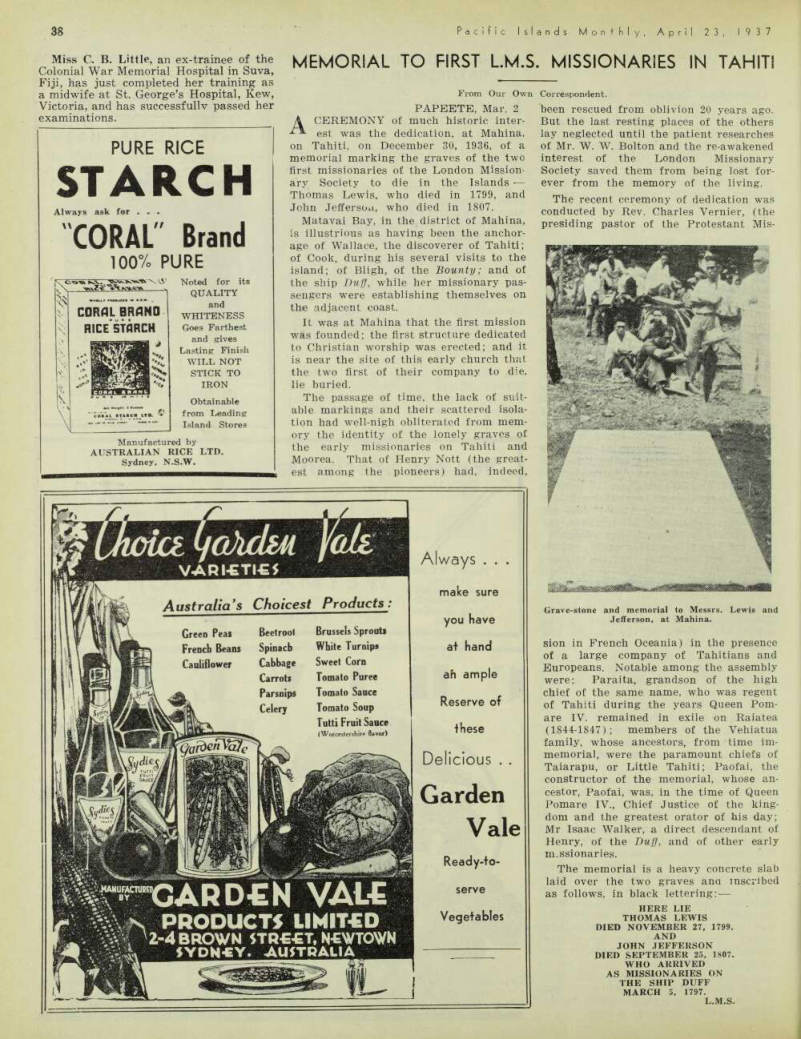
Cathedral In N.G.
l?OR three years, mission brothers and native boys at the Society of the Divine Word Mission, at Alexishafen, north of Madang, on the N.G. mainland coast, have been building a new Gothic cathedral—a copy of a famous edifice in Rome.
Sister Ottonia, who arrived in Sydney from Alexishafen by the Macdhui in March, said that it is now finished, except for carvings on the wood inside and the making of seats. The timber used for the church came from the nearby jungle. The mission station is eagerly awaiting the arrival of an organ which has been ordered from Europe.
Sister Ottonia, who went to New Guinea from America 10 years ago, was accompanied by Sister Josina, a Dutch missionary, who has served at various New Guinea stations for 13 years.
A recent amendment to the Solomon Islands Mining Regulations fixes the royalty to be paid on gold (mined, ex tracted, or collected) at five per cent of the value.
Miss C. B. Little, an ex-trainee of the Colonial War Memorial Hospital in Suva, Fiji, has just completed her training as a midwife at St. George’s Hospital, Kew, Victoria, and has successfully passed her examinations.
Advertisements & other items, pp. 39-40 (1 item)
V II I V E it s
Kork-N-Seal
FOR HOME USE
FOR ALL HOME BOTTLING
—THE LITTLE CAP THAT
will Re - seal 1,000 Times
KORK - N - SEAL (Ausf.) LTD.
106 COMMONWEALTH STREET
SYDNEY, AUSTRALIA
Applied Airtight Pressure Proof Hand
We are Specialists . . .
\ ’Phones: MA 3612 (4 lines) Cable Address; “Wcymarkson”
Codes —Bentleys Private Let us have your confidence. Sixty years is our record of supplying the leading Houses throughoui the World in ... .
FRESH FRUIT VEGETABLES PRODUCE
WEYMARK & SON LTD.
FRUIT AND PRODUCE MERCHANTS
14-18 STEAMMILL STREET - . SYDNEY
V II I V E it s a
CsQgm
PURE
FOODS
GOLD MEDAL JAMS
CANNED ENGLISH FRUITS
CANNED ENGLISH VEGETABLES
CUSTARD POWDER
OLD ENGLISH MARMALADE
JELLY CRYSTALS, ETC.
Obtainable from all Leading Grocery Stores Write to Department A., Chivers and Sons Ltd., Histon, Cambridge, England, for attractive Recipe Book.
E. 76
PURE RICE
STARCH
Always ask for . .
AA
CORAL" Brand
100% PURE
CORAL BRAND
RICE STARCH
N.
Si m.% •*••«*< » o—^ “'coVa lITA ft CM Noted for its
QUALITY
and
WHITENESS
Goes Farthest and gives Lasting Finish
WILL NOT
STICK TO
IRON
Obtainable from Leading Island Stores Manufactured by
AUSTRALIAN RICE LTD.
Sydney, N.S.W.
K m
hist
Green Peas French Beans Cauliflower
TfofdertVSfc
-“™"GARDEN VALE
s PRODUCTS LIMITED
i 2-4 BROWN STREET, NEWTOWN
4 SYDNEY. AUSTRALIA
serve Vegetables I
Memorial To First L.M.S. Missionaries In Tahiti
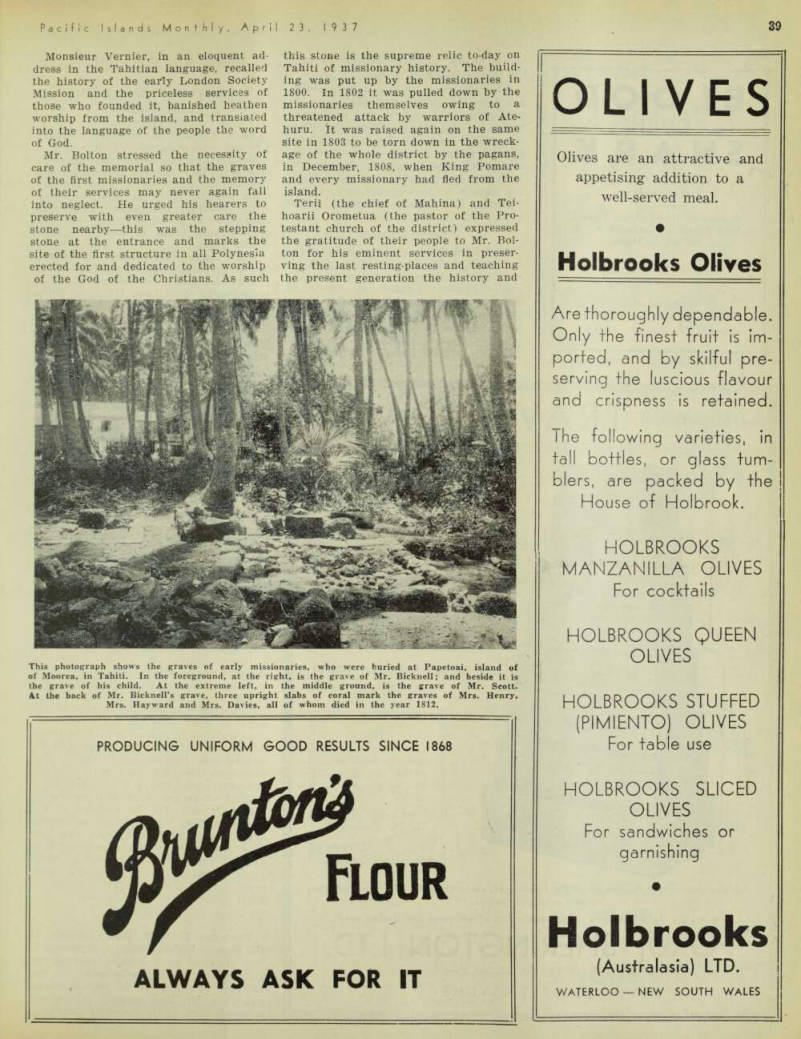
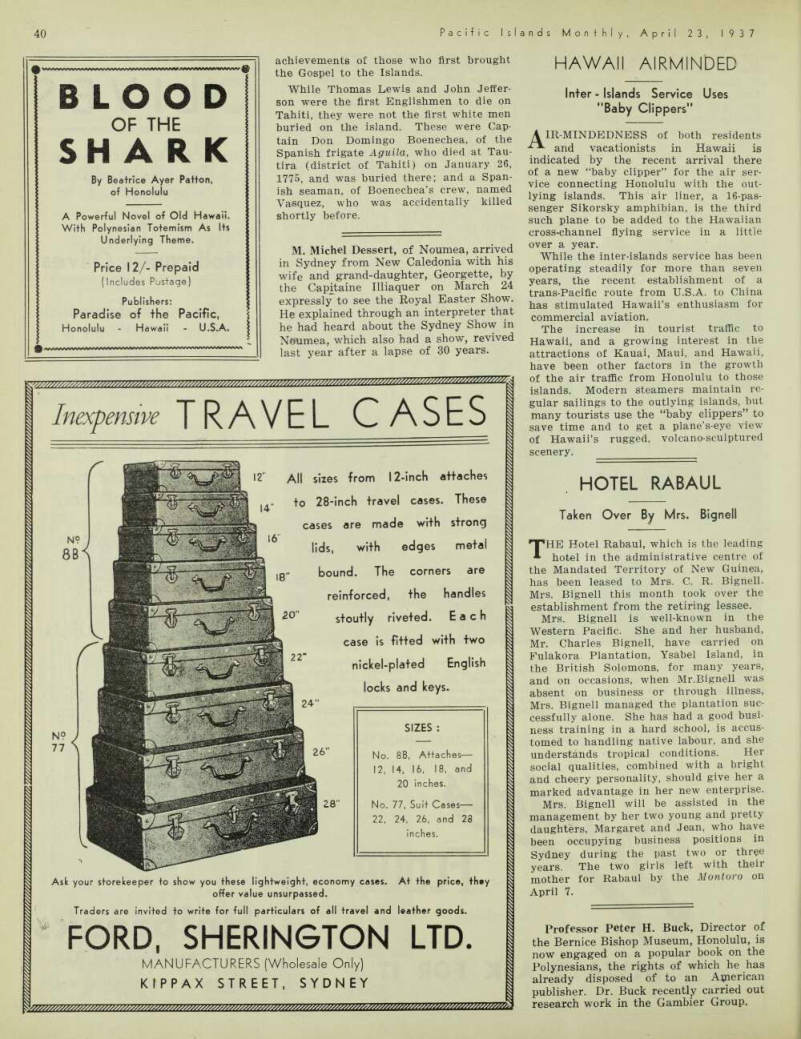
From Our Own Correspondent.
Papeete, Mar. 2
\ CEREMONY of much historic inter est was the dedication, at Mahina, on Tahiti, on December 30, 1936, of a memorial marking the graves of the two first missionaries of the London Mission ary Society to die in the Islands • Thomas Lewis, who died in 1799, and John Jefferson, who died in 1807.
Matavai Bay, in the district of Mahina, is illustrious as having been the anchor age of Wallace, the discoverer of Tahiti; of Cook, during his several visits to the island; of Bligh, of the Bounty; and of the ship Duff, while her missionary pas sengers were establishing themselves on the adjacent coast.
It was at Mahina that the first mission was founded; the first structure dedicated to Christian worship was erected; and it is near the site of this early church that the two first of their company to die, lie buried.
The passage of time, the lack of suit able markings and their scattered isola tion had well-nigh obliterated from mem ory the identity of the lonely graves of the early missionaries on Tahiti and Moorea. That of Henry Nott (the great est among the pioneers) had, indeed,
been rescued from oblivion 20 years ago.
But the last resting places of the others lay neglected until the patient researches of Mr. W. W. Bolton and the re-awakened interest of the London Missionary Society saved them from being lost for ever from the memory of the living.
The recent ceremony of dedication was conducted by Rev. Charles Vernier, (the presiding pastor of the Protestant Mis-
sion in French Oceania) in the presence of a large company of Tahitians and Europeans. Notable among the assembly were: Paraita, grandson of the high chief of the same name, who was regent of Tahiti during the years Queen Pom are IV. remained in exile on Raiatea (1844-1847); members of the Vehiatua family, whose ancestors, from time im memorial, were the paramount chiefs of Taiarapu, or Little Tahiti; Paofai, the constructor of the memorial, whose an cestor, Paofai, was, in the time of Queen Pomare IV., Chief Justice of the king dom and the greatest orator of his day; Mr Isaac Walker, a direct descendant of Henry, of the Duff, and of other early missionaries.
The memorial is a heavy concrete slab laid over the two graves ana inscribed as follows, in black lettering:
Here Lie
Thomas Lewis
Died November 27, 1799.
And
John Jefferson
Died September 25, 1807.
Who Arrived
As Missionaries On
The Ship Duff
March 5, 1797.
L.M.S.
Grave-stone and memorial to Messrs. Lewis and Jefferson, at Mahina.
Monsieur Vernier, in an eloquent ad dress in the Tahitian language, recalled the history of the early London Society Mission and the priceless services of those who founded it, banished heathen worship from the island, and translated into the language of the people the word of God.
Mr. Bolton stressed the necessity of care of the memorial so that the graves of the first missionaries and the memory of their services may never again fall into neglect. He urged his hearers to preserve with even greater care the stone nearby—this was the stepping stone at the entrance and marks the site of the first structure in all Polynesia erected for and dedicated to the worship of the God of the Christians. As such
this stone is the supreme relic to-day on Tahiti of missionary history. The build ing was put up by the missionaries in 1800. In 1802 it was pulled down by the missionaries themselves owing to a threatened attack by warriors of Ate huru. It was raised again on the same site in 1803 to be torn down in the wreck age of the whole district by the pagans, in December, 1808, when King Pomare and every missionary had fled from the island.
Terii (the chief of Mahina) and Tei hoarii Orometua (the pastor of the Pro testant church of the district) expressed the gratitude of their people to Mr. Bol ton for his eminent services in preser ving the last resting-places and teaching the present generation the history and
This photograph shows the graves of early missionaries, who were buried at Papetoai, island of of Moorea, in Tahiti. In the foreground, at the right, is the grave of Mr. Bicknell; and beside it is the grave of his child. At the extreme left, in the middle ground, is the grave of Mr, Scott.
At the back of Mr. Bicknell’s grave, three upright slabs of coral mark the graves of Mrs. Henry, Mrs. Hayward and Mrs. Davies, all of whom died in the year 1812.
achievements of those who first brought the Gospel to the Islands.
While Thomas Lewis and John Jeffer son were the first Englishmen to die on Tahiti, they were not the first white men buried on the island. These w r ere Cap tain Don Domingo Boenechea, of the Spanish frigate Aguila, who died at Tau tira (district of Tahiti) on January 26, 1775, and w T as buried there; and a Span ish seaman, of Boenechea’s crew, named Vasquez, who was accidentally killed shortly before.
M. Michel Dessert, of Noumea, arrived in Sydney from New Caledonia with his wife and grand-daughter, Georgette, by the Capitaine Illiaquer on March 24 expressly to see the Royal Easter Show.
He explained through an interpreter that he had heard about the Sydney Show in Noumea, which also had a show, revived last year after a lapse of 30 years.
Advertisements & other items, pp. 41-42 (1 item)
Olives
are an attractive and appetising addition to a well-served meal. •
Holbrooks Olives
Are thoroughly dependable.
Only the finest fruit is Imported, and by skilful preserving the luscious flavour and crispness is retained.
The following varieties, in tall bottles, or glass tumblers, are packed by the House of Holbrook.
HOLBROOKS
MANZANILLA OLIVES
For cocktails
HOLBROOKS QUEEN
OLIVES
HOLBROOKS STUFFED
(PIMIENTO) OLIVES
For table use
HOLBROOKS SLICED
OLIVES
For sandwiches or garnishing
Holbrooks
(Australasia) LTD.
WATERLOO —NEW SOUTH WALES
PRODUCING UNIFORM GOOD RESULTS SINCE 1868
ALWAYS ASK FOR IT
BLOOD
OF THE
SHARK
By Beatrice Ayer Patton, of Honolulu A Powerful Novel of Old Hawaii.
With Polynesian Totemism As Its Underlying Theme.
Price 12/- Prepaid (Includes Postage) Publishers: Paradise of the Pacific, Honolulu - Hawaii - U.S.A.
Inexpensive TRAVEL CASES
r 16 N 9
BBS
20' 22 24 mm All sizes from 12-inch attaches to 28-inch travel cases. These cases are made with strong ids, with edges metal bound. The corners are reinforced, the handles stoutly riveted. Each case is fitted with two
nickel-plated English
locks and keys. 28" your storekeeper to show you these lightweight, economy cases. At the price, they offer value unsurpassed.
Traders are invited to write for full particulars of all travel and leather goods.
FORD, SHERINGTON LTD.
MANUFACTURERS (Wholesale Only)
KIPPAX STREET, SYDNEY
"Baby Clippers"
Hawaii Airminded
Inter - Islands Service Uses "Baby Clippers"
AIR-MINDEDNESS of both residents and vacationists in Hawaii is indicated by the recent arrival there of a new “baby clipper” for the air ser vice connecting Honolulu with the out lying islands. This air liner, a 16-pas senger Sikorsky amphibian, is the third such plane to be added to the Hawaiian cross-channel flying service in a little over a year.
While the inter-islands service has been operating steadily for more than seven years, the recent establishment of a trans-Pacific route from U.S.A, to China has stimulated Hawaii’s enthusiasm for commercial aviation.
The increase in tourist traffic to Hawaii, and a growing interest in the attractions of Kauai, Maui, and Hawaii, have been other factors in the growth of the air traffic from Honolulu to those islands. Modern steamers maintain re gular sailings to the outlying islands, but many tourists use the “baby dippers” to save time and to get a plane’s-eye view of Hawaii’s rugged, volcano-sculptured scenery.
Hotel Rabaul
Taken Over By Mrs. Bignell
THE Hotel Rabaul, which is the leading hotel in the administrative centre of the Mandated Territory of New Guinea, has been leased to Mrs. C. R. Bignell.
Mrs. Bignell this month took over the establishment from the retiring lessee.
Mrs. Bignell is well-known in the Western Pacific. She and her husband, Mr. Charles Bignell, have carried on Fulakora Plantation, Ysabel Island, in the British Solomons, for many years, and on occasions, when Mr.Bignell was absent on business or through illness, Mrs. Bignell managed the plantation suc cessfully alone. She has had a good busi ness training in a hard school, is accus tomed to handling native labour, and she understands tropical conditions. Her social qualities, combined with a bright and cheery personality, should give her a marked advantage in her new enterprise.
Mrs. Bignell will be assisted in the management by her two young and pretty daughters, Margaret and Jean, who have been occupying business positions in Sydney during the past two or three years. The two girls left with their mother for Rabaul by the Montoro on April 7.
Professor Peter H. Buck, Director of the Bernice Bishop Museum, Honolulu, is now engaged on a popular book on the Polynesians, the rights of which he has
already disposed of to an Apierican
publisher. Dr. Buck recently carried out research work in the Gambier Group.
Those Pygmies
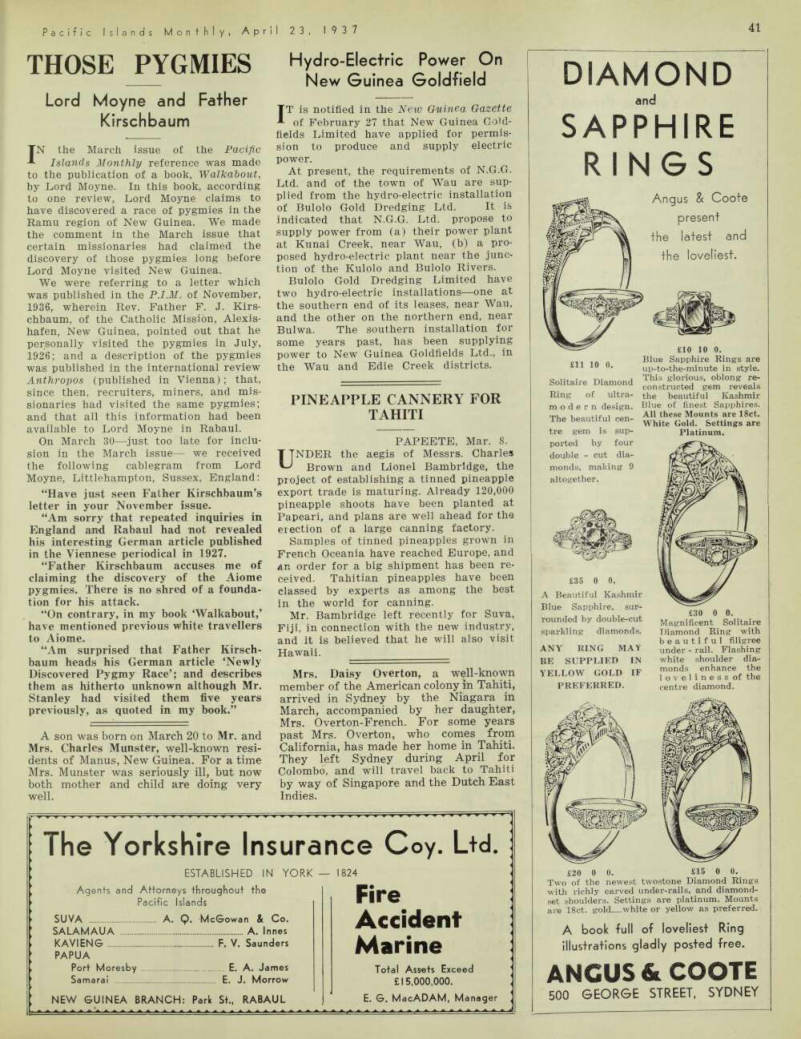
Lord Moyne and Father Kirschbaum
IN the March issue of the Pacific Islands Monthly reference was made to the publication of a book, Walkabout, by Lord Moyne. In this book, according to one review, Lord Moyne claims to have discovered a race of pygmies in the Ramu region of New Guinea. We made the comment in the March issue that certain missionaries had claimed the discovery of those pygmies long before Lord Moyne visited New Guinea.
We were referring to a letter which was published in the P.I.M. of November, 1936, wherein Rev. Father F. J. Kirs chbaum, of the Catholic Mission, Alexis hafen, New Guinea, pointed out that he personally visited the pygmies in July, 1926; and a description of the pygmies was published in the international review Anthropos (published in Vienna); that, since then, recruiters, miners, and mis sionaries had visited the same pygmies; and that all this information had been available to Lord Moyne in Rabaul.
On March 30—just too late for inclu sion in the March issue— we received the following cablegram from Lord Moyne, Littlehampton, Sussex, England: “Have just seen Father Kirschbaum’s letter in your November issue.
“Am sorry that repeated inquiries in England and Rabaul had not revealed his interesting German article published in the Viennese periodical in 1927.
“Father Kirschbaum accuses me of claiming the discovery of the Aiome pygmies. There is no shred of a founda tion for his attack.
“On contrary, in my book ‘Walkabout,’ have mentioned previous white travellers to Aiome.
“Am surprised that Father Kirsch baum heads his German article ‘Newly Discovered Pygmy Race’; and describes them as hitherto unknown although Mr.
Stanley had visited them five years previously, as quoted in my book.”
A son was born on March 20 to Mr. and Mrs. Charles Munster, well-known resi dents of Manus, New Guinea. For a time Mrs. Munster was seriously ill, but now both mother and child are doing very well.
Hydro-Electric Power On New Guinea Goldfield
New Guinea Goldfield
IT is notified in the New Guinea Gazette of February 27 that New Guinea Gold fields Limited have applied for permis sion to produce and supply electric power.
At present, the requirements of N.G.G.
Ltd. and of the town of Wau are sup plied from the hydro-electric installation of Bulolo Gold Dredging Ltd. It is indicated that N.G.G. Ltd. propose to supply power from (a) their power plant at Kunai Creek, near Wau, (b) a pro posed hydro-electric plant near the junc tion of the Kulolo and Bulolo Rivers.
Bulolo Gold Dredging Limited have two hydro-electric installations —one at the southern end of its leases, near Wau, and the other on the northern end, near Bulwa. The southern installation for some years past, has been supplying power to New Guinea Goldfields Ltd., in the Wau and Edie Creek districts.
Pineapple Cannery For
Tahiti
Papeete, Mar. 8.
UNDER the aegis of Messrs. Charles Brown and Lionel Bambrldge, the project of establishing a tinned pineapple export trade is maturing. Already 120,000 pineapple shoots have been planted at Papeari, and plans are well ahead for the erection of a large canning factory.
Samples of tinned pineapples grown in French Oceania have reached Europe, and an order for a big shipment has been re ceived. Tahitian pineapples have been classed by experts as among the best in the world for canning.
Mr. Bambridge left recently for Suva, Fiji, in connection with the new industry, and it is believed that he will also visit Hawaii.
Mrs. Daisy Overton, a well-known member of the American colony in Tahiti, arrived in Sydney by the Niagara in
March, accompanied by her daughter,
Mrs. Overton-French. For some years past Mrs. Overton, who comes from California, has made her home in Tahiti.
They left Sydney during April for
Colombo, and will travel back to Tahiti by way of Singapore and the Dutch East Indies.
Advertisements & other items, p. 43 (1 item)
Rings
DIAMOND
and
SAPPHIRE
RINGS
B
Angus & Coote
present
the latest and
the loveliest.
£ll 10 o.
Solitaire Diamond Ring of ultramodern design.
The beautiful centre gem is supported by four double - cut diamonds, making 9 altogether. £lO 10 0.
Blue Sapphire Rings are up-to-the-minute in style.
This glorious, oblong reconstructed gem reveals the beautiful Kashmir Blue of finest Sapphires.
All these Mounts are 18ct.
White Gold. Settings are Platinum. £35 0 0.
A Beautiful Kashmir Blue Sapphire, surrounded by double-cut sparkling diamonds.
ANY RING MAY
BE SUPPLIED IN
YELLOW GOLD IF
PREFERRED.
m £3O 0 0.
Magnificent Solitaire Diamond Ring with beautiful filigree under - rail. Flashing white shoulder diamonds enhance the loveliness of the centre diamond. mm £2O 0 0. £l5 0 0.
Two of the newest twostone Diamond Rings with richly carved under-rails, and diamondset shoulders. Settings are platinum. Mounts are 18ct. gold white or yellow as preferred.
A book full of loveliest Ring
illustrations gladly posted free.
ANGUS & COOTE
500 GEORGE STREET, SYDNEY
The Yorkshire Insurance Coy. Ltd.
ESTABLISHED IN YORK 1824
Agents and Attorneys throughout the Pacific Islands SUVA A. Q. McGowan & Co.
SALAMAUA A. Innes
KAVIENG F. V. Saunders
PAPUA
Port Moresby E. A. James Samarai E. J. Morrow
NEW GUINEA BRANCH: Park St.. RABAUL
Fire
Accident
Marine
Total Assots Exceed £15,000,000.
E. G. MacADAM, Manager
Search For Oil In Papua
Various Private Companies Try and Fail
Part 111.
A NUMBER of expeditions, hacked by powerful companies and subsidised liberally by British Governments, are now seeking an oilfield in Papua — and. probably, will succeed. This article, the third of a series written by a resident of Papua, tells the story of the discovery of petroleum in the Territory, and of the subsequent attempts at development.
DY 1919 the truth was plain to the Commonwealth authorities. For six years Dr. Wade had persevered against every imaginable obstacle. And the sole return for an expenditure that exceeded £lOO,OOO, was the certainty that oil ex isted in Papua. Whether it existed in commercially workable reservoirs was no more certain in 1919 than it had been in 1912.
But at least the Commonwealth had come to understand that in order to develop, or even to prove, a reputed oil field they must either be prepared to spend a great deal more lavishly, and must build up an adequate organisation of their own; or they must utilise in some way the vast resources of one or other of the great oil companies. It was not practicable to create the necessary specialised organisation to deal with a field which, though its promises were lavish, gave no certainty of ultimate re
turns; and the alternative course was adopted.
A tri-partite agreement was entered into, to which the British and Common wealth Governments and the Anglo- Persian Oil Company were signatories.
The British Government was to contri bute a sum not exceeding £50,000 to the cost of proving the field; and the Anglo- Persian Co. was to place its resources at the disposal of the two Governments in so far as they were prepared to finance them.
The arrangement proved unworkable.
Divergent views could not be completely reconciled; and the British Government withdrew from the arrangement, after contributing half the maximum amount agreed upon. The agreement was then re-constituted so that the Anglo-Persian Co. became the agent of the Common wealth.
Still, progress was slow. The slowness, however, was no longer due to lack of organisation and influence, but solely to the limit of expenditure that the Com monwealth Government had of necessity to impose.
A completely new geological survey was undertaken and carried out with great thoroughness, which covered the same ground as that of Dr. Wade, but
which brought somewhat different con clusions to the minds of the four geolo gists who made it. The main point of difference was that the new survey con demned the country about the Vailala river as being too broken and faulted for any extensive oil reservoirs to exist. Un questionably, oil in small quantities had been struck at shallow depths; and there seemed to them every likelihood that a similar measure of success might be ex pected in other bores in the same dis trict. But they argued that no true anti cline existed there; and that, even by the most modern methods, there was no chance of striking oil in sufficient volume to defray the expenses of boring.
On the other hand, they found at Popo, half way between the Vailala and Yule Island, conditions that approached their ideal. Such of the existing plant as they propose to use was moved there, and more suitable machinery imported, and the area at Vailala was abandoned.
The survey had taken a good deal of t me; and it was not until the early days of 1922 that actual boring was begun on the new site. By March, the hole was down to 350 feet, and by the end of July a depth of 1380 feet had been reached in sandy shale, from which a plentiful efflux of gas escaped through the bore-head.
This was strictly in accordance with what the geological staff had forseen; and it was not expected that the real oil horizon would be cut at any less depth than four to five thousand feet.
OUT even the pbwer Anglo-Persian Co. was not to be immune from trouble.
There can be no doubt that, working on
their accustomed scale, far more facili ties would have been made available than were at the disposal of the drilling staff under the financial restrictions imposed by the Commonwealth. Ministers either failed to realise, or could find no remedy for the fact, that by so drastically cur tailing finance they were not only delay ing results, but were also greatly increas ing the cost of whatever might ultimately be achieved.
The year 192£-23 was almost barren of results. At a depth of barely 1500 fee*t the drillers struck the same trouble as had interrupted operations on the Vai lala. Between the steeply sloping strata of rock, the drill encountered liquid mud of which the lateral pressure was great enough to throw the casing out of align ment, and ultimately to crush it alto gether.
This was an obstacle by no means un known to the Company’s drillers, and it could have been overcome at the cost of additional expenditure; but the Common wealth authorities were adamant. Already about £250,000 had been spent without any return; and the prospect of success, though it remained good, was not brigh ter than it had been at any time since the first geological report had been re ceived in 1912.
Ministerial feeling was much more in clined to abandon the expensive game altogether than to increase the annual expenditure on it; but in view of the strongly favourable reports of the Com pany’s officers, it was decided to continue operations for some time longer.
The first bore at Popo was abandoned at a depth of 1800 feet, and a second was started; but again structural troubles occurred which could not be overcome without extra expenditure, and the hole was abandoned at 890 feet.
The third bore gave greater promise.
By June, 1925, a depth of 2300 feet had been reached, before a string of tools broke adrift and was lost down the bore.
This entailed a long period of “fishing” for the lost tools; but they were even tually recovered, and the bore was con tinued to a depth of 2707 feet before it, too, presented difficulties that the exist ing plant could not overcome.
DURING 1923, the Commonwealth moderated its policy in relation to the oil field, and by an Ordinance passed at Port Moresby in July, prospecting licenses over areas not exceeding 1,000 square miles were thrown open for appli cation by private enterprise. Prospecting was to cover both oil and coal; and in the event of oil being discovered by the licensee on the area covered by his license, provision was made for the granting to him of a lease of 160 acres preferentially, and of a further area of 640 acres as a reward claim.
These conditions, though generous in comparison with those proposed in 1912, did not prove attractive to the big com panies. But several smaller concerns tried their luck. By June, 1924, six licenses had been granted; and a year later the number had increased to 14.
Most of the applicants were purely specu lative and only five of the applicants suc ceeded in raising enough capital to start
actual work. In no case was the amount raised great enough to enable them to persevere beyond the preliminary work and the first of the many unforseen ob stacles that, in Papua, seem to be in evitable.
The Commonwealth reserved to itself an area of 1160 square miles that in cluded the anticline at Popo and what the Anglo-Persian geologists considered the best structure for oil conservation.
The Papua Oil Exploratory Co. Ltd. was a syndicate company only; and its funds were barely sufficient to maintain on its area of 890 square miles between the Vailala and Lakekamu rivers the four Europeans called for by the condi tions of the license. Their area was very rich in surface indications, and had been the subject of a detailed report by E. R- Stanley. But money was hard to raise; and although the little concern expanded within a year to the Papua Petroleum Co. Ltd., its finances never permitted more than the use of a small scout dril
ling plant which struck a seepage of thin oil at shallow depth; and after existing precariously for two years, the company died.
The life of the Nabo Oil Development Co. No Liability, was even shorter and more barren of results. Two men with more enthusiasm than experience came over from Quensland with a plant that could never hope to do more than pierce the uppermost strata. Their hope was that the surface boring that they hoped to accomplish might yield results on which further capital could be raised.
But the theory was never put to the test.
Difficulties and the expense and delays
of transport swallowed their capital before they reached their destination; and the little company dissolved, leaving its plant scattered at various points on the Lakekamu river.
THE New Guinea Oil Co. Ltd. was the first concern to get down to serious work, after the passing of the Oil and Coal Ordinance of 1923. They selected a site some four miles west of the Vailala river, where one of the earliest discoveries had been made of mud and gas effusions: a site that had been recommended by Dr. Wade, condemned by the Anglo-Persian geologists, and again highly approved by Charles Moore, the managing director and the most active member of the new company. Of the
energy, resource, and purpose of this company there was never any doubt.
Preparatory work demanded several months of concentrated effort. A wharf was built at the bank of the river; dwel ling houses, storage sheds, native labour lines, and a road over four miles of soft and swampy alluvial land to the summit of an abrupt hill. Clearing was in itself a heavy task, as was also the difficult transport by tractors and lorries of the heavy machinery. But Moore’s patience and resourcefulness overcame the innum erable obstacles and won steady progress.
Before the end of 1925 the preliminary work was completed, the great steel der rick built, and the machinery in place.
And within six months the first bore had
been sunk to 1107 feet and cased with 12i inch casing. From the bore-head came a profuse flow of gas, with traces of oil; and the smell of petroleum per meated the camp.
But finances, carefully as they had been nursed were strained. The utmost use had been made of the funds available, but more must be found if the work, so well begun, was to be continued. Samples of the various strata encountered by the drill were sent to Australia, and the work was suspended until such time as further funds should be forthcoming.
The delay was a long one. The non success of the Anglo- Persian Co., and of all the other companies at work in Papua had the effect of making capital timid.
Private capitalists were unwilling to risk their money until the long years of search yielded some concrete results to justify the risk. But within six months Moore’s enthusiasm had resulted in the provision of sufficient funds to carry on for a time; and a probability had arisen that the Commonwealth would subsidise the further efforts of the company.
During the interval the bore had be come filled with mud-stone forced up from the bottom; and it was not until July 17, 1927, that the debris was re moved and the bore re-opened to a depth of 1270 feet. Dr. Woolnough, the Federal Geological Adviser, was expected shortly to visit the scene to report on the ad visability of subsidising the company.
Everything depended on his report; and in order to conserve what remained of the company’s funds, Moore reduced his staff to three whites and 50 natives, until the future prospects should become known.
Dr. Woolnough arrived on September 30. 1927, and stayed until October 12. On his instructions, 5 scout bores were sunk in the neighbourhood, and sample of fos sils and strata were sent to Canberra to be examined and correlated. He recom mended that a subsidy be paid on a pound for pound basis, with the condit ion that development should proceed on the lines that he laid down.
Work was resumed as soon as Dr.
Woolnough left; but it was not until mid- December, 1927, that drilling was con tinued.
To quote from Moore’s report: “On December 20 work on the well was re sumed, the well being found filled up from 1353 feet, the original bottom reached in October, 1926, to the 1132 feet level. I discovered that the bottom length of 12J inch casing, at 1142 feet, had become detached by some means while the plant was closed down. It was probably broken off by an earth movement. As it would not be possible to pull a 12iinch pipe through one of the same size, and the rest of the pipe was firmly cemented, this pipe had to be cut up and side-tracked.
“On March 17, I inspected the 10-inch casing past the obstruction, but found there was still a good deal of steel in the well in a chopped-up condition, which impeded progress. It may be mentioned that this detached length of casing weighed 980 lbs, and had attached to its
lower end a high-carbon steel shoe weigh ing 50 lbs. I therefore withdrew the 10inch casing again, recovering some 50 lbs of steel fragments in the bottom length.
The 10-inch casing was again inserted on April 3 last to 1200 feet, 30 feet past the spot at which the last obstruction was encountered.
“Gas made itself evident on several oc casions; notably when cleansing out the well after the casing bad been inserted.
This gas is probably coming from the bottom, and is responsible for the enor mous amount of mud that is brought up out of the well. Drilling proceeds very slowly, as the well is being continually re-filled with fresh material pushed up wards by the gas.”
He ended his report on the optimistic note that was characteristic of him; and, indeed, the results of his work justified optimism. In most countries of the world success would probably have been certain; for his plant was in excellent order, his buildings adequate and in good repair, and the motor vessel that main tained communication with Port Moresby and brought out cargo from that port was running regularly and doing invalu able work. Only the road —less road than cleared track —gave trouble by its need of constant repairs and the expense of effecting them; and health, though neces sarily far from good in such a climate, was at least no worse than was to be expected.
During April, 1928, the bore was con tinued to 1245 feet —still 128 feet short of its original depth and the 10-inch casing was set to that depth. But on the 28th the drill twisted off, and was not recovered until May 10. In the mean time the well filled again to a depth of only 740 feet from the surface, at which level the mudstone, under pressure of the gas, formed a bridge in the casing and prevented a further rise of the debris. But when the bridge was drilled out, mud and fragments of rock were again forced up the casing in such quan tities that the drill could make no pro gress. Attempts to thicken the mud, so as to increase its specific gravity, failed of the desired effect by the fact that the mud became too viscous, and at a den sity of 1.25 the pump could no longer deal with it.
The bore was closed down on June 9, 1928, and preparations were made to in troduce barytes, thereby increasing the specific gravity of the mud without affect ing its viscosity.
Twenty-five tons of barytes were im ported from Australia and transported to the boring site. But little more work was done there. The sets-back had been expensive, and it was impossible to fore see what other obstacles might present themselves. Again shareholders became reluctant and, in spite of the subsidy, refused to commit themselves to further expenditure.
Charles Moore was an enthusiastic worker and an indomitable fighter. But success had been too long delayed, not only in the case of the New Guinea Co., but in that of the Commonwealth itself.
Investors had lost faith; and although Moore continued to fight for capital as
long as he lived, his untimely death in 1930 deprived the company of its soul; and the concern was wound up in that year.
OP the three concerns other than those directly connected with the Com monwealth Government that made seri ous efforts to win oil in Papua, the hap piest was certainly the Oriomo Oil Co.
Ltd., of which the moving spirit was Mr.
S. N. McLean.
McLean had been for a time on the Vailala oilfield as a geological surveyor.
But the work was not to his liking, and he left after a few months.
The Oriomo Co. chose an area in the west of Papua; a tract of country that embraced the Oriomo river and about a thousand square miles to east and west of it. This district has the great advan tage, from the point of view of transport, of being practically rainless during the greater part of the year, when the ground is firm, and gives no hint of the sticky morass into which the rains will convert it from December to March.
Furthermore, instead of the dense jungle that clothes the greater part of
Papua, open grass and scattered gum trees offer good visibility over the undu lating country that comprises the area.
The early stage of the company’s work were probationary. A drilling plant was brought to Papua early in 1925. Pre liminary work included the building of a wharf at a spot about 40 miles up the Oriomo river, clearing a road of all ob stacles for a dozen miles from the land ing, and the erection of the usual build ings. The plant was then re-shipped
from Port Moresby and transported along the road to the selected site.
By August, 1925, the well was down to a depth of 1260 feet. This rapid pro gress, together with the favourable strata encountered by the drill, provided the justification that was needed; and the company was exempted from the work ing conditions specified by the Ordinance in order that more capital might be raised and the company expanded.
By April 23, 1927, McLean was back again with a staff of nine Europeans, and three boring plants. And within three weeks a geological prospecting bore was down to a depth of 100 feet, and surveys,
trigonometrical, topographical, and geo
logical, were all under way.
Indications in the trial bore had been encouraging; and those in succeeding bores were no less satisfactory. By the end of the year the two main bores, at
Maremosab and Wbhomul, were down 730 and 714 feet respectively, and gas and a showing of oil were present in both; while half a dozen scout bores, 100 to 150 feet deep, had been put down to test the structure beneath the heavy overburden of clay.
The bore at Maremosab was continued to 1580 feet by June, 1928, but bottomed at that depth in granite. This was the end of hope for that particular spot; and the casing was withdrawn and the hole filled in. At Wohomul, in the meantime, a depth of 1567 feet was reached in a schistose stratum; and although no oil reservoir was tapped in either of these bores, gas in large quantities, distinct traces of oil, and small quantities of paraffin wax, proved that the country was definitely oil-bearing.
The plant was removed from Mare mosab to Wonia, where a testing drill
had struck a good showing of oil at 175 feet; and a new hole was started there, the experimental one being filled in.
But the company was near the end of its work in Papua. The work had been done thoroughly and expeditiously; and without the tragic accidents and unfore seen difficulties that had hampered the efforts of other concerns. But non-success, combined with that of every oil-seeking company in Papua seems to have de deterred the directors from further ex penditure. There were other directions in which the company’s remaining capi tal might be expended.
Operations ceased in 1928; and the Oriomo Co. enjoyed the distinction of being the only mining company to date that had been in a position to remove its plant from Papua. (To be concluded.)
Advertisements & other items, pp. 44-48 (1 item)
Newlands Brothers Ltd
STEEL BEDSTEADS
WIRE MATTRESSES
"MORNING GLORY" BEDDING
TUBULAR STEEL FURNITURE
" LISTER " HOSPITAL EQUIPMENT
SHIPS' ALL METAL BERTHS
WE WILL GLADLY
FORWARD OUR
COMPLETE SETS OF CATALOGUES
Produced in Australia by
Newlands Brothers Ltd
RILEY STREET :: SYDNEY, N.S.W.
Australia's Largest Manufacturers of Modern Sleeping Equipment.
Cable Address “Newlandbed, Sydney
W. M. REID
Exporters and Export Agent
REID HOUSE
75 King Street, Sydney, N.S.W.
9
(PREPARED)
CKceps on JOep on .
AGENTS THROUGHOUT THE ISLANDS
Over 30 Years Ago..
The first Younger Stove was exported to the Pacific Islands. Ruggedly strong in construction, highly efficient and economical in fuel, has made them the most popular stove in the South Seas.
The illustration shows a Younger Single Stove. Special stoves, with cast iron ovens for Island requirements made to order. • Write us for quotations for special sizes and catalogue of double and single oven stoves. •
G. Fletcher & Son
50 OXFORD STREET. SYDNEY
r
The
"Caledonia Dover"
A COOKING STOVE guaranteed to give complete satisfaction and now recognised as THE BEST on the market.
Suitable for coal, coke, or wood fuel.
Illustrated Catalogue on request.
LANE & GIRVAN, LTD.
BONNY BRIDGE, SCOTLAND
HH U m
recommended:
"SUN” Brand Paint on your Home means
definite PROTECTION against tropical
sun and sea-moist air.
Sun Proof and Rain Proof on every Surface
PAINT
W. R. CARPENTER & CO., LTD,
NEW GUINEA, SOLOMON ISLANDS
and all other South Sea Islands.
V. H. Jones & Rickard
Electrical Engineers
525 ELIZABETH STREET
SYDNEY
Specialists in rewinding and repairing all classes and sizes of electrical machines and equipment. Special treatment given to work for the tropics.
TELEPHONE: MA 1397
BUILD AN ATTRACTIVE PERMANENT
HOME OF STEEL
TLLUSTRATED is an attractive "Comet" steel bungalow recently erected by us.
This building is In no sense a special order, but shows just what can be done with the patented "Comet" principle of Steel Building Construction.
The "Comet" Steel Building, by reason of its patented sectional construction, is easily enlarged and where required, conveniently portable.
The buildings are white-ant proof, fire-resisting and economical to erect.
They have definitely proved themselves the best proposition for the islands.
EMINENTLY SUITABLE
FOR:—
BUNGALOWS
STORES
WORKSHOPS
COPRA SHEDS
BOYS' HOUSES
HANGARS, ETC.
"COMET"
Steel Buildings
SIDNEY WILLIAMS & CO. (PTY.) LTD.
Steel Building Specialists, Builders and Contractors
DULWICH HILL, SYDNEY
ROCKHAMPTON BRISBANE TOWNSVILLE
>FEUERHANP<
HURRICANE
LANTERNS £ ms) %
*ee **£4 % L<S € 1 i* L< w s s and many other types of varied shape and style!
Sole Agent for the South Sea and New Guinea: CARL AUG. DOCKE bremen/germany Exporter of all goods, suitable for the Islands trade Importer of any kind of Island Produce Correspondence invited
Samoa’S “Old-Timers”
Are Disappearing
From Our Own Correspondent
Apia, Mar. 18.
The small band of “old-timers” and * pioneers in Western Samoa is disap pearing fast. There are only compara tively few left now, and each month or so sees the loss of another of these hardy people. During February and March, two more passed on—Mrs. A. J. Tattersall and Mr. C. Boysen.
The wife of Mr. A. J. Tattersall, Apia’s photographer, and one of the oldest iden tities on the beach, Mrs. Tattersall had been prominent in Apia social and church circles for many years. She had been ill for some time past and her end, on February 23 at the age of 65, was not unexpected. The funeral was very largely attended, Rev. H, S. Perkins conducting the impressive service at the graveside.
Two sons, who are in the Government service, and the widower, were the chief mourners.
The other old resident who passed away was Mr. C. Boysen, aged 67 years.
He settled in Samoa before the Great War, and lived on a small plantation on the West Coast.
Fiji To Have Pictorial Stamps
From Our Own Correspondent.
Suva, Mar. 12.
\ LTHOUGH it was feared some time ago that Fiji was again to have a standard set of Crown Colony stamps in flicted on it, it is now announced that designs have been selected for a pictorial set. This will be heartening news to philatelists, especially those who special ise in the stamps of the Pacific Islands.
Some time ago a competition for de signs was conducted in Fiji. Selections have now been made and the designs forwarded to England for approval. There will be 11 denominations. It is not anti cipated that they will be ready for about six months.
In the meantime, philatelic interests are eagerly awaiting the issue of Corona tion stamps, which has been announced from London,
Tahiti's Tourist Hopes
Based Apparently on Eastern U.S.A.
From Our Own Correspondent.
Papeete, Mar. 21.
THE tourist traffic, which has provided a substantial revenue for Tahiti during recent years, and on the expan sion of which hopes for an increasing income were based, has been cut off with out any hope of revival —so far as the Pacific Coast of the United States is con cerned.
Economic conditions have changed vastly during the past lustrum, shifting trade connections from old sources of sup ply and closing markets formerly open to the products of the Islands.
For instance, many varieties of mer chandise formerly imported from the United States now come from Japan, Hong Kong, and Czecho-Slovakia. Food stuffs come from Australasia.
It is true that lumber and petroleum products are supplied from the Pacific Coast. But these can be transported only on freight steamers —especially petroleum which is not allowed as cargo on pas senger vessels.
Export of Islands products to the States is interdicted by tariff imposts, excluding the possibility of any return cargo for vessels voyaging from the Coast to the Islands.
It would appear, therefore, that any revival of tourist traffic must be based on the service offered by the Messageries Maritimes steamers which voyage be tween Panama, Tahiti, and New Cale donia, at six weeks’ intervals. There are,
fortunately, lines of palatial steamers, with frequent sailings from New York via Panama to San Francisco and return.
It might be to the advantage of all concerned to explore the possibilities of a tourist traffic from the Atlantic Coast of the United States. The short voyage from New York to Panama, and connect ing there with the Messagaries Mantimes steamers to Tahiti, would offer a comfort able and interesting voyage to the South Seas. If the steamship companies inter ested would be willing to arrange special through tariffs and invest in some judicious advertising in the Eastern United States, they would doubtless be rewarded with a substantial response.
It is from the Eastern States that travellers, seeking to escape the severe temperatures prevailing there during the winter months, go in great numbers to milder climates. A direct route to the South Seas on comfortable steamers and at moderate travelling expense would certainly offer an attractive change from the routine Mediterranean voyage so largely patronized.
Romantic Wedding
In Fiji
From a Special Correspondent
Suva, Mar. 11.
A N interesting and romantic wedding took place in Suva on March 4, when Mr. Wilfrid Laurier Parham, second son of Mrs. H. B. R. Parham, of Suva, and the late Mr. Charles John Parham, ot Ruku Ruku Bay, Vanua Levu, married Miss Gladys Margery Parham, daughter
of the late Mr. and Mrs. Nelson Parham, of Montreal, Canada.
The contracting parties were both lineal descendants of the same old United Empire Loyalist family, who migrated to Canada rather than remain in the re volting states of America. Doubtless the fact that the bride had come all the way from Montreal to meet her bride groom added the touch of romance that always increases popular interest. That the bride had the same surname as her bridegroom was naturally also a matter of remark.
Mr. W. L. Parham, as Senior Agricul tural Assistant, is well-known in Fiji, where his successful handling of native agricultural problems has been favour ably noted.
He met his charming bride, when on long leave, last year. Miss Parham ar rived in Suva, by the Niagara, late in the afternoon on March 4, and was mar ried the same evening, a few hours after the boat berthed.
The marriage was solemnised at St.
Andrew’s Presbyterian Church, Rev. Alex Hardie officiating. The bride, looked very pleasing as she entered the church, accompanied by Dr. H, W. Jack, Director of Agriculture, who gave her away. The bride was attended by Misses B. and M.
Parham (sisters of the bridegroom) and by Miss Edna Leask and Miss Lilian Laurie. The bridegroom was supported by Mr. A. B. Ackland as best man.
After the ceremony, the guests were received by the bridegroom’s mother, at her residence in Domain Road, when the usual toasts were honoured duly.
Advertisements & other items, p. 49 (1 item)
Herbert Del Cott Pty. Ltd.
DEU T Z
DIESEL
ENGINES
Deutz Engines used Internationally since 1864
MARINE DIESEL "OM" TYPE
M &K,
EUT
£ 6*« Range from 10 to 140 B.H.P.
Full information obtainable from the Agents
Herbert Del Cott Pty. Ltd.
15 CASTLEREAGH STREET, SYDNEY
Phone: B 3135
A. E. C."
ELECTRICAL
EQUIPMENT
FREE ELECTRICITY !
with “A E G” Turbinamos
A " Turbinamo " working from a stream generates sufficient electricity for households, plantations or communities.
Simple to Instal Reliable Supply No Running Costs Looks After Itself Sizes 0.5 kv to 40 kw.
Write for particulars - - State head of water available and Electricity output required.
Cables "Voltage"
116 QUEEN STREET. MELBOURNE
Phone; Central 10488
Further Typhoid Out-
Break In Samoa
From Our Own Correspondent Tapia, Mar. 10.
HERE have lately been a number of new cases of typhoid fever—all from the neighbourhood of the Taufusi-Saleufi suburb of Apia.
A large number of Samoans, half castes, Chinese, and Chinese-Samoans,
live in the swamp region there. The Administration has been asked repeatedly to prohibit settlement on the swamp area and to have the latter drained, as its P resen ce constitutes a danger to the public health of Apia. The land is owned by the Roman Catholic Mission, but the Administration could recompense the Mission for the land by offering some of the Government’s Reparation Estates land in exchange.
Moorea's Octagonal
Church
\ PROPOS of that remarkable octagonal church at Papetoai, Moorea, about which an article and photograph ap peared in the January issue of the Sydney Mitchell Library contains a reference to its building in a letter written by Rev. W. Henry, one of the pioneers of the Tahitian mission, to the Rev. Samuel Marsden, of New South Wales. Writing from Moorea on Septem ber 17, 1822, he said: “Our new church furnishes a convincing proof of the peace and harmony among ourselves. It is going on well: is of hewn coral, lined with stone, and of octagon figure. The Gospel is spreading.”
The people of Moorea, the writer added, felt the loss of Pomare 11. very severely. “They have been experiencing from time to time the effects of the over bearing and arbitrary spirit of the pre sent Government,” Henry declared. The Government to which he referred was that Regency headed by Pomare’s princi pal wife, a woman who had little capa city for administration and soon found herself in difficulties both with mission aries and traders. On the death of the boy king, Pomare 111., Aimata ascended the Tahitian throne as Queen Pomare IV.
William Henry lived to see the mission ary autocracy that flourished during th® reign of her brother replaced by a French protectorate. Eventually he returned to New South Wales, where he died and was buried at Ryde, near Sydney. Both he and J. M. Orsmond, (whose daughter married a son of Henry), have descen dants in the Islands, as well as in Australia.—E.R.
Increase in N.G's Revenue
A CCORDING to an official statement in ***■ the New Guinea Gazette of February 27 the public revenues of the Mandated Territory for the six months ended December 31 were £287,941, an increase of approximately £34,000 compared with the same period of 1935.
One naturally turns with interest to the details to ascertain the source of these rich revenues. But the New Guinea accounts are published in the style fol lowed in other places which simply means that they convey mighty little information. One naturally wants to know what sums are derived from the copra export tax and from the gold royalty. But all the official accounts show are: “Customs, £11,752; Mines, £69,845.” The copra export tax, presum ably, is included somewhere in “Customs”, and the gold royalty some where in “Mines.”
However, there is nothing to be gained by throwing bricks at the New Guinea Administration. The thing is typical of bureaucracy the world over.
Mr. Thomas Horne, managing director of Messrs. Walter Horne & Co. Ltd., Suva, arrived in Sydney by the March Monterey on a health-recruiting trip.
Advertisements & other items, p. 50 (1 item)
Cordage and
Woven Wire for all Industry
COPRA DRYING TRAYS, FLOORS, Etc.
FRUIT DRYING TRAYS, MINING SCREENS
Heavy Mosquito Gauze in Phosphor Bronze and other Metals Impervious to Salt Sea Air WIRE DOOR MATS AND GENERAL WIRE WORKS
E. WRIGHT & CO. LTD.
Office and Works: 148-152 Cleveland Street, Sydney, N.S.W.
Telegraphic Address: “Wrightmake.” Chippendale
Ship Chandlery Hardware
[ Write for Ship Chandlery Catalogue y Special "In Bond" Prices for all Islands enquiries quoted on application.
Sole Agents for:
BROOMFIELD'S LIMITED
152 SUSSEX STREET :: ::
Cables "Boom," Sydney Large and Complete Stocks of
SHIP CHANDLERY
IRONMONGERY OF ALL KINDS,
WHITE LEAD AND OILS
SYDNEY
PAINTS,
P. H. MUNTZ & CO.'S 3-CROWN BRAND METAL SHEATHING.
PEACOCK & BUCHANS' ENGLISH READY - MIXED PAINTS.
Scott's Renown Brand Rope
Cordage and
Binder
Twine
Cable Address: Ropeyard, Sydney
of Every
Description
MANUFACTURED AT
MASCOT, N.S.W.
J. Scott Ltd.
Head Office and Store:
163 CLARENCE STREET,
SYDNEY
N.S.W.
Snarling Voyagers
How Tahiti Sees Those " Happy "
World Cruises
From Our Own Correspondent
Papeete, Mar. 26.
WHEN Mr. J. Pierpont Morgan’s yacht, the Corsair, came into Papeete har bour recently from the United States, bearing a company of harmonious guests she presented a spectacle almost unique in these waters.
The average yacht—no matter how con genial the company may have been at the port of departure—almost invariably brings through the pass at Tahiti a pack of snarling wild cats who are ready to claw at each other’s throats. A long voyage in the confined space and ines capable association corrodes the thin veneer of civilisation and eventually ex poses the raw, palaeozoic stratum of the original Adam —especially if the yacht is munitioned with an opulent rum pantry as is frequently the case.
Usually no sooner is the anchor cast overboard at Papeete than the party scatters to lodging houses as far apart as the size of the island will permit, until the sailing of the next mail steamers.
Sometimes, instead of voyaging by the same ship, various members of the once happy yachting party will choose a roundabout route via New Zealand to Vancouver rather than be afflicted with the company of their yachtmates on the direct steamer to San Francisco.
The most amusing collection of spit fires was a party of scientists who came out from England on board an old mus eum piece—half sail, half steamer — named the Bt. George.
They came by way of Panama and the Galapagos Islands. We never heard w r hat happened between England and Galapagos. But when the Bt. George arrived at our “Pearl of the Pacific,” the learned savants had passed the stage of hurling diatribes and cathode rays at each other’s heads and were on the threshold of mayhem and eye gorging.
When the ship reached Papeete the party blew apart as though a five gallon can of nitro-glycerine had exploded in its midst.
Those who had the means to do so fled to the four quarters of the compass on the first available mail steamers. The remnant, tied by lean purses to the ship, continued on an erratic voyage to Rapa, where the vessel struck a reef and nearly foundered. Going on across the Pacific to the eastward, at long last they reached Panama, where the expedition gave up the ghost, on account of lack of funds.
If anything ever came of this expedi tion to increase the sum of human know ledge, the world has been unaware of it until this day.
Unfortunately for the harassed yacht owner, these fulminations are not con fined to the beau monde of the cabine de luxe. The forcastle quakes and rumbles with similar dark passions during the voyage, and flies asunder when port is reached. As a result the vessel may be delayed for weeks until a new crew can
be gathered together. This has given opportunity to many a young Tahitian to see the world, and accounts also for the large number of cosmopolitans who haunt our Papeete waterfront.
Japanese Ships May Call
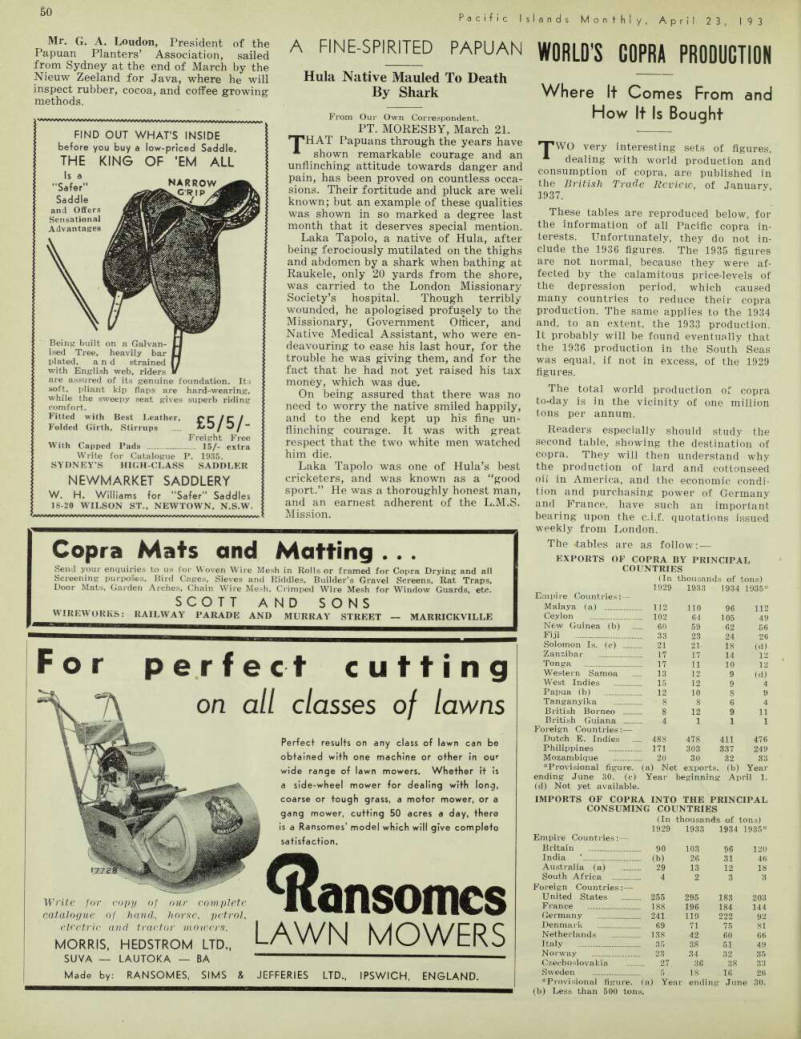
At Western Samoa
From Our Own Correspondent
Apia, Mar. 20.
seems to be a possibility that, * in view of the increased trade be tween Japan and Western Samoa, Japan ese steamers will contemplate making Apia a port of call.
A feature of the large importations of goods which have come to hand lately, is the preponderance of Japanese stuff, more especially in drapery lines. Other lines are also affected as, for instance, canned salmon and sardines.
Miss Queenie Reymond, of Butaritari, Gilbert Islands, whose dancing has been a popular feature at the Polynesian Club gatherings in Sydney during the past year, will leave for her home in the Gilbert Islands early in May.
Mr. G. A. Loudon, President of the Papuan Planters’ Association, sailed from Sydney at the end of March by the Nieuw Zeeland for Java, where he will inspect rubber, cocoa, and coffee growing methods.
Advertisements & other items, pp. 51-52 (1 item)
Lister
Huon Pine Boat Planks
Practically Borer Proof and Everlasting, also Spotted Gum Timbers—Prices Right.
A. C. Fryer
NO Miller Sf..
Pyrmont, N.S.W.
Lister
IDARinE
DIESEL
ENGINES
There is no finer power unit for small craft than the Lister British-built Marine Diesel Engine. . . . The crankshaft (conforming to Lloyd's requirements for sea-going vessels) is ground to accurate limits and carefully balanced. The very liberal dimensions ensure rigidity, and provide ample bearing surfaces, both on the main and large-end bearings. The Cylinder Liners are renewable and completely waterjacketed; while all working parts are accessible. In spite of the engine being of the totally enclosed type. Sizes range from 7 h.p. to 21 h.p. (Lister), and h.p. to 30 h.p. (Blackstone).
Sole Agents for N.S.W.:
Dangar, Gedye & Malloch Ltd.
MALLOCH HOUSE, 10-14 YOUNG STREET
SYDNEY
FIND OUT WHAT'S INSIDE
before you buy a low-priced Saddle.
THE KING OF 'EM ALL
"Safer" NARROW Saddle and Offers Sensational Advantages Being built on a Galvanised Tree, heavily bar plated, and strained with English web, riders are assured of its genuine foundation. Its soft, pliant kip flaps are hard-wearing, while the sweepy seat gives superb riding comfort.
Fitted with Best Leather, rr /r / Folded Girth, Stirrups Freight Free With Capped Pads 15/- extra Write for Catalogue P. 1935.
SYDNEY’S HIGH-CLASS SADDLER
NEWMARKET SADDLERY
W. H. Williams for "Safer" Saddles
18-20 WILSON ST., NEWTOWN, N.S.W.
A Fine-Spirited Papuan
Hula Native Mauled To Death By Shark
From Our Own Correspondent.
Pt. Moresby, March 21.
THAT Papuans through the years have * shown remarkable courage and an unflinching attitude towards danger and pain, has been proved on countless occa sions. Their fortitude and pluck are well known; but an example of these qualities was shown in so marked a degree last month that it deserves special mention.
Laka Tapolo, a native of Hula, after being ferociously mutilated on the thighs and abdomen by a shark when bathing at Raukele, only 20 yards from the shore, was carried to the London Missionary Society’s hospital. Though terribly wounded, he apologised profusely to the Missionary, Government Officer, and Native Medical Assistant, who were en deavouring to ease his last hour, for the trouble he was giving them, and for the fact that he had not yet raised his tax money, which was due.
On being assured that there was no need to worry the native smiled happily, and to the end kept up his fine un flinching courage. It was with great respect that the two white men watched him die.
Laka Tapolo was one of Hula’s best cricketers, and was known as a “good sport.” He was a thoroughly honest man, and an earnest adherent of the L.M.S.
Mission.
World's Copra Production
Where It Comes From and How It Is Bought
TWO very interesting sets of figures, 4 dealing with world production and consumption of copra, are published in the British Trade Review, of January, 1937.
These tables are reproduced below, for the information of all Pacific copra in terests. Unfortunately, they do not in clude the 1936 figures. The 1935 figures are not normal, because they were af fected by the calamitous price-levels of the depression period, which caused many countries to reduce their copra production. The same applies to the 1934 and, to an extent, the 1933 production.
It probably will be found eventually that the 1936 production in the South Seas was equal, if not in excess, of the 1929 figures.
The total world production of copra to-day is in the vicinity of one million tons per annum.
Readers especially should study the second table, showing the destination of copra. They will then understand why the production of lard and cottonseed oil in America, and the economic condi tion and purchasing power of Germany and France, have such an important bearing upon the c.i.f. quotations issued weekly from London.
The tables are as follow:
Exports Of Copra By Principal
Countries
Imports Of Copra Into The Principal
Consuming Countries
(In thousand s of tons) 1929 1933 1934 1935 s8 Empire Countries:— Malaya (a) .. 112 110 96 112 Ceylon .. 102 64 105 49 New Guinea (b) 60 59 62 56 Fiji 33 23 24 26 Solomon Is. (c) 21 21 18 (d) Zanzibar 17 17 14 12 Tonga 17 11 10 12 Western Samoa 13 12 9 (d) West Indies 15 12 9 4 Papua (b) 12 10 8 9 Tanganyika 8 8 6 4 British Borneo ... 8 12 9 11 British Guiana 4 1 1 1 Foreign Countries:— Dutch E, Indies ... 488 478 411 476 Philippines ... 171 303 337 249 Mozambique ... 20 30 32 33 figure. (a) Net exports. (b) Year ending June 30. (c) Year beginning April 1. (d) Not yet available.
(In 1929 thousands of 1933 1934 tons) 1935* Empii’e Countries: — Britain 90 103 96 120 India (b) 26 31 46 Australia (a) 29 13 12 18 South Africa 4 2 3 3 Foreign Countries: — United States 255 295 183 203 France ._ 188 196 184 144 Germany 241 119 222 92 Denmark . 69 71 75 81 Netherlands 138 42 60 66 Italy 35 38 51 49 Norway 23 34 32 35 Czechoslovakia 27 36 38 33 Sweden 5 18 16 26 figure, (a) Year ending June 30. (b) Less than 500 tons.
Advertisements & other items, p. 52 (1 item)
ansomcs
Copra Mats and Matting .. .
Send your enquiries to us for Woven Wire Mesh in Rolls or framed for Copra Drying and all Screening purposes, Bird Cages, Sieves and Riddles, Builder’s Gravel Screens, Rat Traps, Door Mats, Garden Arches, Chain Wire Mesh, Crimped Wire Mesh for Window Guards, etc.
SCOTT AND SONS
WIREWORKS: RAILWAY PARADE AND MURRAY STREET MARRICKVILLE
For perfect cutting
7\ on all classes of lawns
•V*. >• U7S Perfect results on any class of lawn can be obtained with one machine or other in our wide range of lawn mowers. Whether it is a side-wheel mower tor dealing with long, coarse or tough grass, a motor mower, or a gang mower, cutting 50 acres a day, there is a Ransomes' model which will give complete satisfaction.
Write for copy of our complete catalogue of hand, horse, petrol, electric and tractor mowers.
MORRIS. HEDSTROM LTD.,
SUVA LAUTOKA BA
Made by: RANSOMES, SIMS
ansomcs
LAWN MOWERS
& JEFFERIES LTD., IPSWICH, ENGLAND.
Native Trading In N. Guinea
New Law Passed To Regulate Activities
From Our Own Correspondent
Rabaul, Mar. 20.
the 23 bills passed through the local. ” Legislative Council, sitting on March 3 and 4, the most interesting measure was that in connection with an amend ment to the Licences Ordinance, which brought local natives under its pro visions.
At the last session held in August, natives were exempted from the pro visions of the Ordinance. That is to say, natives were at liberty to buy and sell goods, copra, etc., without obtaining licences and permits, or conforming to other regulations which non - native traders are compelled to do. The author* ities did not realise, when they exempted natives, that trading among themselves would be carried on to such an extent.
Hon. E. W. P. Chinnery (Director of District Services) who sponsored the bill in the chamber, in his second reading speech, pointed out that it would con trol native trading when done in a busi ness manner, apart from the usual bartering.
How Two-mile Limit Restricted Trading “Until a short time ago,” said Mr.
Chinnery, “native trading was restricted by the two-mile limit by which non-native traders secured the exclusive right to trade over areas owned and occupied by native communities. The natives had to sell their copra and other produce to the trader operating in that zone at any price offered by him, or hawk it else where if they wanted a better price. As traders usually agreed as to rates of payment, and generally kept to these agreements, it was seldom that the unfortunate native—squeezed by the monopoly—found it worth while to hawk his produce elsewhere. Usually motor transport was not available, so they had to take what was offered, or have their produce left on their hands. In some ins'ances, in zones owned by firms— especially on the west coast of New Ireland—natives were not able to dispose of their produce at all, because planta tion managers did not trade, and no one else was allowed within their zone.
“This was the position for years,” con tinued Mr. Chinnery. “The natives con stantly complained of the restrictions preventing them from getting a fair price for their produce. It was on these complaints that District Officers recom mended the abolition of the two-mile limit. It is obvious therefore that the position was unsatisfactory, and that the natives would take every opportunity that presented itself to dispose of their produce at the best prices possible. 57 Native Copra Driers “Early in 1935 a native of the Rabaul district built a drier, and cured his copra.
By hiring lorries, he was able to take this produce to Rabaul and receive the ruling price. His example was quickly followed by others. Driers were built, high-grade copra was produced, passed
by inspectors and, with the aid of hired transport, was disposed of at market prices. During the past half-year 658 tons of trade copra were sold in Rabaul at current prices. There are now 29 native driers in the Rabaul district and a further 28 are under construction.”
Non-official members spoke against the bill and Mr. B. B. Perriman stated that the introduction of such a measure would have the effect that a large amount of money invested in trading stations, and the erection of buildings, would be of very little use in the future. Speaking of the zone system, he admitted that it might restrict some of the rights of the natives, and suggested that some sort of control might be instituted in the buy ing of coconuts and copra.
“The natives are receiving Isrge sums of money now,” said Mr. Perriman, “which to my way of thinking they are not sufficiently advanced to be able to
use to advantage. My contention is that some form of tax, whereby a certain sum per ton can be collected from trade copra obtained, be used by the Administration for the welfare of the natives, and I submit it will be used to better advantage in the hands of the Administration than in the hands of the natives, as at present.
What Is Government’s Policy ? a tu„t . j , , that fhp an Said t ? l n t he h °P e <j
wi?h \ specially charged
. • t ? le Interests of the r , in dicate the policy of the , e .
Whatever our views may be,” said Mr.
McLennan, w e are unanimous that the Government should have the courage to state its intentions. Some time ago I had the pleasure of fighting a losing battle, together with my honourable friends here, on the question of freedom of trade in regard to shipping. I cannot see any
difference in principle whatever. One would Imagine that the Administration was giving something to these natives which does not already belong- to them, “In this country we have half a million natives,” he continued. “We are charged, according to the mandate, with the duty of promoting to the utmost the material well-being of the natives. I have ‘always regarded these words with considerable suspicion. I do not believe that Britain is any black colony primari i y for the well-being of the native people. I do no t believe that Australia is in this colony primarily for the well-being of the native and I do not believe that the Administrator, or his officials, or anyone else, is in this territory primarily for the well-being of the native people. We are here primarily for our own benefit. I do believe, however, that if we are just people and sane people we cannot but see that the well-being of the natives
must go hand in hand with the well-being of the white people.
“Unless these natives progress, and unless they learn to produce wealth on their own soil, how on earth are we going to develop this country? Do you think it is real development to have a few white men on a few white estates in this country ? Take the black countries of the world that are outstanding suc cesses—take Java, for instance. Java’s greatness is based on native agriculture.
The same in the Philippines, across the way. There they produce, or did four or five years ago, about 350,000 tons of copra, as compared with our 60,000 tons, and most of the Philippines copra is pro duced by the natives on their own land.
Dispensing With White Traders “I am going to vote against this bill,' he concluded, “but for a totally different reason from that which will animate my honourable friends in voting against it.
Over a term of years, and by means ol the Licences Ordinance and regulations we have built here, as regards trading by and with natives, an amazing edifice of monopoly for the aggrandisement of the white trader at the expense of the native producer. Now the native pro ducer, through contact with people with a little more economic sense than himself, has commenced to build his own copra driers, and to dispense with the services of the white trader. I hope that the Government will sweep away the amazing system of monopoly to which 1 have referred.”
Advertisements & other items, pp. 53-54 (1 item)
Fibrolite
Timber, Joinery
ETC.
PREPARED BUILDINGS ready for erection a speciality.
SHIP AND BOAT BUILDING.
TIMBERS specially catered for.
FIBROLITE, PLYWOODS, GALVANISED
IRON, CANEC.
CONSIGNMENTS shipped
by RETURN STEAMERS
to the Islands.
John W. Eaton
LTD.
WEST CRESCENT STREET
NORTH SYDNEY
TELEPHONES: X 5051 (5 lines)
BITUMENOID ROOFING
MADE IN AUSTRALIA
Bitumenoid Roofings, Dampcourse and Insulating Felts are made from the world’s best raw materials. Warranted to stand the most rigid tests.
BITUMENOID THE BEST
Roofing, 1,2, 3-ply; Flooring, Waterproof Materials; Saturated Felt; Resilient Road Jointing ; Natural Asphalt Dampcourse; 2 and 3-ply Dampcourse; l-21b. Lead-core Dampcourse; Roofing Cement; Asphalt Paints; Roofing Compound,
SAMPLES AND PRICE LISTS ON APPLICATION
MAXWELL PORTER & SON LTD.
ESTABLISHED 1888. BUILDERS’ SUPPLIES
107 REDFERN ST., REDFERN, SYDNEY, N.S.W. ’Phone, M 3157. Cables Bitumenoid
. BUILD WITH
Fibrolite
ASBESTOS CEMENT SHEETS
By using this Economical, Fire Retardant and White Ant Proof building material for External and Internal Walls and Ceilings, you can build a comfortable and durable Bungalow Home—AT LOW COST! Supplied in big, sturdy building sheets in 44 handy stoclc sizes, FIBROLITE" is easily and quickly erected. No waste.
Less labour. No painting.
For full information, write for illustrated "Fibrolite" Booklet F.6—FREE AND POST FREE!
JAMES HARDIE & COY. LTD.
ASBESTOS HOUSE. YORK ST., SYDNEY, N.S.W.
(Box 3935 V., G.P.0., Sydney)
PROTECTION OF . . .
MINING TIMBERS BY
CUPRINOI
Results of Official Tests conducted by the Union of South Africa at the Consolidated Main Reef Mines.
SPECIMENS PLACED ON TEST ON sth MARCH, 1931 Full particulars and prices from the Island Distributors—
PAUL & CRAY LTD
82 SUSSEX STREET
SYDNEY
IT ATTRACTS
££JS °riNo \
THEY EAT IT THEY DIE!
USOLINE
NEVER
KNOWN
TO FAIL!
COCKROACH
DESTROYER
IT'S A PASTE!
AUSOLINE CO.,
314 CROWN STREET. SYDNEY
(Established 1919)
PRICES:
Mb. 5/- . . . 3lbs. 10/- Postage Extra.
Remit Cash with Order.
Obtainable also from Islands stores of:
«URNS, PHILP & Co. Ltd.
W. K. CARPENTER & Co. Ltd.
Fined For Giving Credit To
N.G. Native
From Our Own Correspondent.
Rabaul, Mar. 23.
A CASE which caused interest here recently was that of the Crown against T, V. Wallace, of Walaur Planta tion, who was charged with having given goods to a native on credit, which is con trary to the provisions of the Natives Contracts Protection Ordinance.
The principal witness for the Crown was a chief from the North Coast dis trict, near Rabaul. It was alleged that the defendant supplied the witness with galvanised iron, nails, cement and other building material to construct a hot-air kiln.
The defence claimed that the material was given to the chief with the full understanding that there was no legal obligation on the native’s part to make repayment. A moral obligation was admitted.
Although the chief spoke good “pidgin - English,” and that language is officially accepted in the Lower Court, a European interpreter was furnished by the Crown and all native evidence translated. Mr.
P. J. Woodhill, of the Crown Law Office, appeared for the prosecution, assisted by Mr, H. A. Gregory, who had been making the investigations. Mr. A. Kelly appeared for the defence.
The defendant was convicted, and fined £2.
Mr. W. W. Froggatt's
Death
Recalls Story of First Expedition To Papua in 1885
Mr. Arthur J. Vogan, F.R.G.S., we * are indebted for the following notes on the career and associations of Mr.
W. W. Froggatt, the noted entomologist, who died in Svdney on March 18 at the age of 78. Mr. Vogan is now the last remaining member of the first expedi tion to British New Guinea (now Papua) in 1885, on which Mr. Froggatt was official entomologist.
The passing of the well-known Mr. W.
W Froggatt, who was entomologist on the first expedition to what is now Papua, takes the mind back to those more placid days ere the flying machine, the wireless, and the motor car had entered into our world, says Mr. Vogan. To-day only one member of that expedition remains; and the new water-route into the interior then discovered, the Strickland (named after Sir Edward Strickland, nresident of the Royal Geographical Society of Aus tralasia which sent the party) is now commonly used by prospectors, Govern ment patrols, and others.
The story attached to the sending of the expedition has something of romance about it. The German Government seized the northern part of the goose-shaped island which was not under Dutch con trol; and Sir Thomas Mcllwraith, then Premier of Queensland, afraid of a too close neighbourhood with the Red, Black, and White, attempted to take possession of what was left—the southern quarter of the great barrier between Australia and Asia.
However, the Gladstone Government in England would have none of it: and then took place the first common-action achieved by the Australasian powers— then “colonies”! They forced the Home Government’s hands. The next thing then was to send an expedition to learn about what they had won.
As nearly as possible a man was sent as representative of each of the colonies.
But —there is always a “but,” alas!—the leader chosen because of his experience in the Malay Islands proved most un suitable; and the Resident Magistrate of Thursday Island, the famous “Black"
Douglas, was approached by a deputation from the party.
He said, “Go on, nominally under Captain Everill; but take your orders from Captain Hemsworth, second in charge. As magistrate, I authorise you to do this!”
Hemsworth, with Senior (the surveyor) successfully carried out the work; but to day (such is fame and history!) all our naming of the rivers, hills, and islands, etc., discovered has disappeared, as later explorers arrived, in after years. Only the name “Strickland” for the new branch of the Upper Fly and “Everill” (the deposed “leader”) for the junction with the main river, Hemsworth’s sons are today well known aviators in the New Guinea ser vices. Poor Senior, who was drowned n a Sydney Harbour boat-picnic on his return, and all the rest gradually sank back into the oblivion from which they had emerged—save W. W. Froggatt who as an entomologist of genius reaped de served kudos.
Mr. Froggatt’s son, Mr. John L. Frog gatt, is now entomologist with the New Guinea Administration.
Advertisements & other items, p. 55 (1 item)
Wundepiichi
Konkrete Paint
For EVERY SURFACE where Permanence is Imperative--! .<cT v Adaptability for the varying climatic conditions of the Pacific Islands has been abundantly proved by users.
KONKRETE Standard Gloss and Flat Colours for wood t brick, fibro, cement, iron, and stone.
KONKRETE PAINT IS
THE SOLUTION
Complete price list and colour card from sole wholesale distributors for N.S.W. and Pacific Islands.
H. Florentine and Son
321 Pitt Street, Sydney, N.S.W.
Allen Taylor & Co. Ltd
SYDNEY
Sawmillers and Wholesale Suppliers of Hardwoods for Constructional Purposes GIRDERS . . . PILES . . . POLES . . . SLEEPERS. Etc.
EXPORTING TO PACIRC ISLANDS SINCE 1893
Cables: Tuxedo, Sydney
WUNDEPIICHI
PBplisi
duratile
These asbestos cement sheets give walls a tiled appearance at less cost. See examples in our showrooms or write for leaflet.
WUNDERLICH LTD.
Crown & Cleveland Sts.. Redfern, Sydney
REMEMBER THE NAME
(xicoi
A l * ji. ■w Monel wire cloth cannot rust, and resists attack by all alkalies and most acids. Also it is strong, tough and durable so that It not only withstands high-pressure erosion, but can be cleansed frequently, rapidly and thoroughly without damage.
From 10 to 200 mesh for filtering equipment, etc., and a special mesh for insect screens is available from . . . .
WRIGHT AND COMPANY
81 CLARENCE STREET
Monel is a registered trade mark
SYDNEY, N.S.W.
Chasing A Rumour
Curious Story of Papuan "Massacre"
From Our Own Correspondent.
Pt. Moresby, Mar. 23.
nTHE origin of the story of the “mas * sacre” in Western Papua is rather curious.
Mr. Jack Hides, who is away up the Strickland River with his prospecting expedition, heard the rumour (two white men and a party of natives “skittled”) from the natives. He decided to pass on the report, through his pedal-radio set, to the Government, for what it was worth. So he advised Daru station, at the mouth of the Fly.
Daru could not raise Port Moresby, so got in touch with Townsville, and asked them to advise Port Moresby. This they did.
Then, of course, Port had to find out where the rumour originated. The radio was very busy, getting into touch with all the mobile (pedal) sets (oil camps,
Ward Williams’ show, etc.), until they at last raised Jack Hides. Then they learned that Hides had merely advised that he had heard that a masscre had been reported by natives as having occurred somewhere in the Elevala or Strickland River districts.
That was all; but it caused a first class press hullabaloo.
An interesting feature was the way in which Amalgamated Wireless got into touch with every mobile set in the Western Division, separated by hundreds of miles from one another, and was able to report within a few hours that all parties were safe and sound, and knew of no disturbance.
The rumour may have been connected with some happening of long ago, and become exaggerated with age.
Major R. N. Caldwell, who has been Provincial and District Commissioner at Lautoka, Fiji, for eight years, arrived in Australia on furlough by the Niagara in March.
Comparisons
Are Odious
New Guinea and Solomons Reviewed By Recent Nyasaland Resident
Letter to the Editor AST have lived eight years in a Protectorate and a Mandated Territory in Africa (Nyasaland and Tanganyika Territory) and as the British Solomons and New Guinea are a Protectorate and a Mandated Territory respectively, a com parison of a few facts as between the two places might be of interest.
A favourite topic of conversation in New Guinea is native labour. I was a nlanter in Nyasaland with a Bne of boys, children and women, up to 300 all told. As far as I know there is no Native Labour Ordinance in Nyasaland. The only time the Government take an interest in native labour there is when natives go to the D.O. and complain that they have not been paid for three or four months.
The Government in Nyasaland do not care if labour is paid £lO a month or lOd. They are uninterested if natives are worked one hour or twelve, or if the planter makes 24 or 31 days constitute a month. Thev are indifferent about their health on a plantation, so long as there is no contagious disease. They do not worry about where they come from or bow many are at work, or anything else about them. The planter may feed them on peaches and cream, or nothing at all.
The usual ration was 121bs. of corn. 21bs. of beans and a tablespoon of salt per week, and their pay. 6/- for boys, 1/6 to 2/6 for kids, and 3/- for women per month of 27 days. Posho (rations) cost about Id. per day, or 6d. per week in lieu thereof. They were not issued with tobacco, soap, laplaps or blankets.
Corn is a more nutritious diet than Saigon rice. Beans, I am sure, are better and cheaper than tinned “pish” or “bulla makow.” Natives in this part of the world seem to get more blankets, laplaps, tobacco, marmite, tins of fish, sharps,
matches and soap thrown at them than they know what to do with.
The indenture system of labour is the rule in this part of the world, and natives are used to it, so it would not be advis able to do away with it, as there is noth ing to take its place. But it seems to me that it could be vastly improved and simplified. Or imported indentured labourers could be used, which would save the Government and the missions a great deal of worry.
The native is bribed to “make paper,” and then he has to complete one, two or three years as the case may be. His attitude then becomes the same as the gentleman in broad-arrows who was wheeling a barrowful of sand. He was asked why he moved so slowly and his reply was that he had 15 years to finish that particular job. It is against the law to make the native more faster with a stick, or even to swear at him. He can, of course, be taken to the Map and charged with not showing reasonable diligence in the performance of his duties. Perhaps this entails a voyage of 50 miles for the manager of the planta tion, with a flock of witnesses, in a schooner, and the outcome is 30 davs* gaol. Meanwhile, what happens to the plantation ?
There seems to be much trouble over “Peeping Toms,” and natives entering white women’s rooms in Rabaul and other centres. There was some trouble of a similar nature in Blantyre, Nyasa land: but in half the cases the object was burglarv. The natives responsible bad been to Johannesburg - and worked in the mines and had learned bad habits there. Ladv mission workers can and do ride small motor-bikes all over the countrv, and they sleep in native villages 60 miles away from towns, in perfect security.
Of course, the maioritv of natives will not leave their villages without their women. Or if they do they Quickly form a temporary liaison with a local woman.
In New Guinea, where there are thousands of natives working hundreds of miles away from their women, I should imagine there is plenty of cause for trouble. There seem to be numerous court cases to bear out this statement.
The majority of single planters in other territories keep native mistresses, as a matter of course. I think it is a fact that New Guinea is about the onlv excep tion within the British Colonial Empire to-day. In Nyasaland. the planters pre fer to get mission-trained girls, if nos sible—of course, without the consent and blessing of the mission!
In Nyasaland, with a poniflation of 2,000,000 natives, I doubt if th e re are more than 100 missionaries of all de nominations. In New Guinea, there are 600 or 700 missionaries all told, I have been informed, yet the known native ponulation is about 700,000. I mav be mistaken in these rough figures; but the fact remains that the ratio of mission aries to natives is very much greater in this territory.
I was once required to return a census of natives at work for me and also their religions. I stated that 85% were Pagans,
10% Mahommedans, and 5% Christians (that is, those who attended church occa sionally or had been to a mission school).
The missions, besides religious teaching in Nyasaland, taught the three R’s and carpentry, blacksmithing and various trades, etc. Here, they seem to be much more interested in business enterprises, such as planting, saw-milling and pur chasing copra. This is borne out by the fact that they are forced to register as limited companies. They do not seem to be much concerned with penetrating into areas where the natives have no money—unless the area is a cheap recruit ing ground.
I am, etc.,
F. W. Parsons.
Kokopo, T.N.G., March 30, 1937.
Advertisements & other items, p. 56 (1 item)
c\C\tHO
A oO*-\ Si 9r m
flux
Sole Distributors, N.S.W. and Queensland: Both these Solders available in all diameters down to 16 gauge. Packed in quantities ranging from 51b. to 14Ibs.
NOYES BROS. (Sydney) LTD.
115 Clarence Street, Sydney
11 WATT ST., NEWCASTLE 197 ELIZABETH ST., BRISBANE A scientifically proportioned blend of solder and flux in wire form. Easy to use. No mess, no waste. Non-conductive, non-corrosive.
" Dubois " Resin-cored Solder is particularly suitable for radio, delicate electrical work; armatures, bells, indicators, etc. Resin core does not deteriorate.
" Fluxite-Kord " the only Fluxite paste cored solder. For all metals except aluminium.
Use for all general purposes.
JAMES BUDGE
LTD
REFRIGERATION .
."BUDGE" Automatic or Manually-controlled Refrigeration and Ice-making Plants, with or without insulated Cabinets or Rooms, ranging from 4 cubic feet to 1000 cubic feet or larger, using ammonia In the large and sulphur dioxide (SO2) In the small units.
Where electricity is not available, crude oil engines may be utilised for driving the larger plants and pelrol engines for driving the smaller machines. The accompanying illustration is of a petrol engine driven SO2 unit. Enquirers please state power available (if any), size of cabinet and amount of ice required per day.
JAMES BUDGE LIMITED
REFRIGERATION AND GENERAL ENGINEERS
McEvoy and Harley Streets
ALEXANDRIA SYDNEY
Established 1890
ENGINEERING WORKSHOPS
ALL CLASSES OF MACHINES MADE AND RECONDITIONED
Good News For Pt. Moresby's
Housewives
From Our Own Correspondent.
Pt. Moresby, March 23.
■"PHE rates for electric current supplied * for domestic purposes are to be reduced from July 1 to 4d. per unit for the first 40 units per month and 2d. per unit in excess of that amount. Formerly the charges were 6d. and 3d, respectively.
This is quite a substantial reduction, and householders should be able to use the many labour saving contrivances that are a blessing to housewives exasperated with inefficient domestic servants.
It is understood that after 12 months’ trial the rates will be further reviewed and another reduction probably will be made.
Advertisements & other items, p. 57 (2 items)
55
Pacific Islands Monfhlvi April 23, 1-937
Simple and Economical
Atomic-Diesel Semi-Diesel
MARINE ENGINES
5 to 540 B.H.P.
Simplicity and economy are the outstanding features of Fetter Marine Engines.
The care and precision accompanying their manufacture make the Fetter an Engine you can depend on.
They are easy starting and their moderate running speeds mean longer life, low fuel consumption and economical operation. we
Buzacott & Co. Ltd.
7-11 MARKET STREET, SYDNEY
Islands Sinners
Busy Courts in Cook Is.
From Our Own Correspondent.
Rarotonga, March 12.
OERSONS concerned with the moral A behaviour of their fellows will derive a vicarious pleasure from the Cook Islands Annual Report for 1936, in which it is shown that 32 cases of “cohabitation ’ and four of adultery were heard in the local High Court during the year.
It also is shown that 599 natives also illegally consumed “home-brew,” while six gambled, 24 failed to register their dogs and 14 more kept pigs within the prescribed area of the settlement.
Out of a total of 1,144 cases, 1,046
convictions were secured, 17 cases being
dismissed and the balance either with
drawn or adjourned.
EDITORIAL NOTE.—It is time that public attention was directed to this curious and unique Cook Islands law relating to “cohabitation”, which appears to be a survival of the notorious mis sionary regime of last century. Very earnest and very narrow-minded old gentlemen, bearded and top-hatted and frock-coated, set themselves grimly to the work of flailing heathenism out of Raro tonga. The Rarotongans, like dozens of other races, had —and still have—a free-and-easy pre marriage relationship between the sexes. The missionaries somehow had this offence against their moral code (“cohabitation”) included in Rarotonga’s Criminal Code, and there it remains to this day. If ever some clever writer gets hold of the facts, and presents them effectively, the Cook Islands will be made the laughing-stock of the world. Imagine a “cohabitation” law being put into operation in Australia or New Zealand!
Gilbertese
The Mind Of The
A ® an interesting example of how the native can acquire education, and of how the native mind works, we reproduce helow, exactly as it ioas written, a letter received by the editor from G. I. Kiribati, a resident of Beru, in the Gilbert Islands.
TT is very seldom that you can find a magazine or a newspaper which is of interest for every kind of people.
I think that all your Readers enjoy the reading of your magazine P.I.M. S some with pleasure, some with anger. So let the Traders and Businessmen attack the Government and the Missions. It will help very much them both, and let the Government and the Missions defend their rights. Everybody must keep in mind when disputing with a man of different opinion that he has never any right to be rough or insolent.
Living on a small island since 1905, with a population about 2,000, we enjoy the greatest peace, everyone being res pectful for his neighbour, without any interference with him in matters of creed or of opinion.
The Gilbertese are the happiest people of this world, no worry at all about to morrow. If they have food, they take a good meal, if they have not they will sleep or talk. They cannot starve, always there are some coconuts on the top of the trees, fish in the sea, and plenty water in the bush.
Our good Gilbertese are very sympa thetic, and to know them and to love them, it is the same. For a man, who loves them and is happy to spend his life for them, it is very hard to find that they are children all their life.
Before the war, sometimes they were treated roughly by some Agents of Gov., who oblige them to work, but in my opin ion. that helped them to become men.
The post-war new Agents are only speak ing about liberty (a very good word used in many ways) so the Gilbertese try to live with the least work, and the most play and talk, and they are not progres sing at all.
It may be you will find somebody who will teach the Government to make the Gilbertese both free and men. To educate a son or daughter is not to make him or her a slave. Why does the Government not use the same rule for our good Gil bertese? If you accuse any Government to take a Colony for making money, yon will be fined or put away, so to let them civilise the natives. But nowadays, what is the meaning of “Civilisation?”
Mr. Lewis Armstrong, a director and general manager of Burns, Philp & Co.
Ltd., sailed from Sydney for England by the Strathnaver on March 20, accom panied by his daughter. He will be away for about nine months.
Mr. E. R. Fenn, of Parkin College, Ade
laide, South Australia, who is training
for missionary service, will be sent to Papua this year by the London Mis
sionary Society.
Advertisements & other items, p. 58 (1 item)
Burns Philp
(SOUTH SEA) CO. LTD.
c INCORPORATED IN FIJI
island Traders and Shipowners Registered Office:
SUVA
FIJI
Also Branches at: Fiji: Levuka, Lautoka, Labasa, Ba, Sigatoka, Rotuma.
Tonga: Nukualofa. Haapai, Vavau. \ Samoa: Apia, Pago Pago (American Samoa).
Solomons: Makambo, Glzo, Faisi.
New Hebrides: Vila.
Code Address: Gilberts: Tarawa.
"Bumsouth." Norfolk Is. Niue. Wallis Is. Futuna Is.
11
ANCHOR" FLOUR
THE STANDARD OF QUALITY
* 1 m m m i
GILLESPIE BROS., LTD
SYDNEY - AUSTRALIA
Artist Who Captured
Tahiti's Charms
Success of Allister MacDonald
From Our Own Correspondent.
Papeete, Mar. 16.
]Y|U. Allister Macdonald, The
distinguished artist, returned to Tahiti by the last Hauraki after a pro longed sojourn abroad.
There are many who hold the opinion that alone, among the many painters who have essayed the task, Mr MacDonald has succeeded in truly picturing the charm and colouring of the Islands. He has succeeded in capturing that dazzling, crystal light which, on certain sunny days, transfigures our land and seascapes into dreams of celestial splendour.
Mr. MacDonald’s paintings have been acclaimed in England as works of genius.
They have received the accolade of ad mission into one of the great galleries of London, which has bought many for permanent exhibition.
We have had many painters in Tahiti.
While the Gauguin vogue was at its height, artists descended like a plague on our islands. Most of them were of the pink tree, yellow ocean and brown sky school. During a period which seemed to promise no end they violated and outraged the beauties of our islands until Nature herself trembled. For the first time in Tahiti in the memory of man, earthquakes started and continued almost daily during two years or more.
These painters were earnest folk. They tried patiently to initiate us into the higher mysteries of modern art. They loaned us books and showed us pictures.
But in spite of their endeavours and our eager desire for culture, when ever we were placed before a canvas whereon some golden brown maiden had been dis torted to the semblance of a giraffe and coloured like a Zulu afflicted with cyan osis, we were invariably conscious of sharp, shooting pains, followed by a las s tude which remained for days.
Our instructors finally became peevish, cast us into the outer darkness, and called us Philistines!
Trade Conditions Are
Bright In Samoa
From Our Own Correspondent.
Apia, Mar. 23.
serious “blow” which did consid * erable damage to banana and coco nut plantations in Tonga, fortunately spared Western Samoa.
Weather conditions here throughout the rainy season have been exceptionally good. There is a good copra output, a promising cocoa crop, and a large offer ing of bananas from European and Samoan growers.
Trade condit ons are very bright, and with more ready cash in circulation, business is now definitely on the up grade.
A number of commercial travellers are in Apia at present and all report that sales have improved substantially.
Land Purchases In Paoua
From Our Own Correspondent.
Pt. Moresby, March 24.
TOURING March the following Orderin-Council was made in the Execu tive Council:— “Officers are to be instructed that in purchasing native lands they should be careful in each instance to ascertain whether presents in money or money’s worth are being made or promised to the vendors. If it appears that such presents are being made or promised,
the officer should abandon the transaction and report immediately to the Govern ment Secretary.” , Th . er . e ha Y e *?een rum °urs that the Administration is concerned that, in cer tein instances where Europeans have app iied for land, the applicants had promised the owners some payment or present in kind if the land would be sold to t h e Crown. This was done previous to the Government’s sending an officer to ma ke the necessary purchase from the natives.
It is understood that this procedure has been the custom for many years past.
Advertisements & other items, p. 59 (1 item)
Irator
NOCK & KIRBY LTD.
Johnson Iron Horse
YOU DEPENDABLE
ELECTRICITY
EVERYWHERE
at extremely low cost.
* LIGHT * POWER
300 Watts 12 Volts
GENE
WILL GIVE
I Full range Generator Control from nothing to 300 watts—lndependent Magneto Ignition—Special Type 4-Pole Compound Wound Generator with armature carried direct on crankshaft—Automatic Cut-out for disconnecting batteries from generator when engine is stopped—Shielded Ignition—6 Pint Cast Iron Tank forming base of Unit. This Unit can be used for charging 2to 12 Volt Batteries, the Generator automatically adjusting itself to load. Automatic Governor gives constant speed at all loads. Complete with 12 volt battery. Powered by the famous Johnson Iron Horse i H.P. Weight of unit 80 lbs. p R!GE - f n/j If A/ Delivered any V §d L / I jS / » Pacific Islands Port *" ' Write for illustrated folder giving complete specifications , etc.
Posted free on request.
Johnson Sea Horse
OUTBOARD MOTOR
Model 210 3.3 H.P. at 3000 R.P.M.
Johnson s famous Light Tv/in. Underwater Exhaust and many plus features . . . No Vibration . . . Balanced Construction . . . Pressure Vacuum Cooling System.
Write for Illustrated Johnson Outboard Motor Folder Posted Free.
PR|CE f n e
EX BOND
DESK P.I.M.
Postal Address: Box 4250 Y, G.P.0., Sydney
Ski-ing in the Tropics

The Paradox of Hawaii
TT is not generally known that ski-ing, the darling sport of the Continent, is the latest craze to be adopted in the tropical South Seas.
Let us hasten to explain, however, that it is paradoxical Hawaii that has taken this new thrill to its bosom. Hawaii, geo graphically, is sub-tropical, but by some freak of Nature mountains, snowcapped the year round, are part of its makeup.
Recently parties have climbed the snow covered slopes of Mauna Kea (13,825 ft. high), to indulge in this sport that was entirely foreign to the Islands until this year. They reported excellent ski-ing at the 12,000 ft. level, although the bright Hawaiian sun on the tropical snow caused a few cases of temporary snow blindness.
Several globe-trotters who were on one of the sporting expeditions claimed that the ski-ing was as good as that experi enced in any part of the world. Hawaiians among the group reported that their experience in sliding down the crests of Waikiki waves on surfboards was of little help to them in handling the skis.
The pioneer snow sportsmen reached the ski runs by horseback as the snow belt is far off the beaten track on Hawaii Island, the largest in the archipelago.
Mauna Kea means “white mountain.
Its sister peak, Mauna Loa, is the scene of occasional outpouring of volcanic fire— the last flow having been a little over a year ago.
Pattern Service
\A/E have arranged with a well-known Sydney firm of pattern-cutters to publish each month a diagram of a seasonable frock, patterns of which may be obtained by our readers direct from this office, post free, on payment of the sum stated under the diagram. Address your letter to “Pat tern,” Pacific Islands Monthly, Box 3408 R, Sydney, and enclose a note giving the number of the pattern wanted and bust size, and enclose also the price of the pattern in postal note or stamps. The pattern will be sent by return mail.
3101. —This dressy ensemble has a flared skirt shaped to join the bodice which extends to a point below the waistline. The loose coat :nay fasten at the neck and is trimmed with heavy stitching to match the frock. Material (for 36in. bust) : sJyds. 36ins. wide. Bust sizes 32 to 40ins.
Advertisements & other items, p. 60 (2 items)
coV>B l;^
At Blue Mountains—Springwood, N.S.W.
Springwood Ladies' College
Est. 1897. Kindergarten to Leaving Certificate. Tennis, Riding, Swimming, Team Games. Unequalled climate. Pure Jersey Milk. Senior and Junior Houses. Open-air sleeping. Inclusive fees. Special vacation arrangements for Island pupils.
M. E. DURAND, Principal.
*Vft «*'
v< v °\-47ir GcnU \ vt » »*°-
v „V'K ° eA itoW
coV>B l;^
tt\ a* vC tbe b.a^ v/t'\s is ot* SP o* urt fvl uts aia de o» bea tote
ate'
ot yo'A tbcte
dVet*'t., A
Representative: /.
ROBERT BLAU (Aust.), A
A.C.A. Building, // Cnr. King & York Street*,
SYDNEY.
Medical Goods
All our MEDICAL GOODS are sold with
our GUARANTEE OF MONEY BACK if
not satisfied; best quality, lowest prices.
Call or write for FREE "BOOK Or KNOWLEDGE." Price List & Catalogue of Medical Goods, etc., and FREE
CONFIDENTIAL ADVICE. All these
goods POST FREE in plain wrapper from
SECURA CHEMISTS,
Dept. P.
269 ELIZABETH ST., MELBOURNE
LADIES. —Let the SECURA NURSE advise you in the selection of your medical requirements.
Fashion Hints for Islands Women
By Therese
COLOURS in this year of grace 1937 are more glorious than ever, in fluenced by the brilliancy and pageantry of the Coronation —blues, reds, and royal purple. Then comes Persian Rust, a lovely glowing shade between henna and red, and all the greens of Spring and the warm tints of Autumn. Even when the gown is of sober black, a ruffle be neath the hem in some brilliant colour brings it to sudden life and beauty. Brown is still a smart colour, and grey in vary ing shades takes unto itself all the Coronation colours with complete success.
Lovely prints depicting London Tower, royal coaches, crowns and sceptres, with fairy-tale glamour tempt us to extravag ances. Glittering gold and silver cloth, moulds into gowns of unbelievable beauty.
Like breast plates, the broad extending revers of silver lame, stitched and re stitched, lift a gown of taffeta to the heights. As a direct contrast to many models the bodice is skin tight, while the slim hipped skirt spreads voluminously.
An enormous ruching of tulle froths about the shoulders of a royal purple evening frock, which has rows of gradu ated stitching on the wrong side to give a ribbed appearance.
A glamorous chiffon runs cascade draperies from the knees to its ruffled hemline. The same little cascades fall from the bodice which is held aloft by slender shoulder straps, one of which is jewelled and gleaming.
For the ingenue, frills and froufrou have the greatest fascination, A gown of net spangled with pailettes crosses the border line from youth to sophistication with its strapless bodice and low decolletage.
There is a nymph-like beauty about the slender maid who wears a gown of orchid pink and encircles her waist with an enormous rose coloured sash tying un expectedly in front. A sunpleated cape, romantic and beguiling, lends it roseate enchantment.
A chiffon dinner dress puts its trust in the finest of shirring at the neck, waist, and wrists to make it a success.
Evening coats come in infinite variety— all enveloping wraps which reach from neck to hem in a single fluid line; cavalier capes brilliantly lined, that swing with gay abandon; knee length coats of taffeta with billowy sleeves; and dear little jackets of gold and silver lame.
Tunics are made out of almost any thing, in the most varying styles for both day and evening.
Skirt lengths are unchanged, though the formal afternoon frock is an inch or so longer than those worn for practical and sports wear. Nothing could be worse that a really chic afternoon gown little more than knee length—all its beauty is gone.
The normal waist is most general; but for evening the extended skirt effect which shortens the bodice, is almost Empire in its slim and lovely line.
Fulness flows from the knees—subtly
concealed fulness achieved by clever cut and ingenious inverted pleats.
Most evening gowns boast sleeves — wrist, short, or elbow length, with ful ness at or about the elbow. A marvellous idea is to attach sleeves which can be removed at will.
Loose swing back jackets lead the way in the new modes, finger tip length being most popular.
The soignee woman the type of woman men admire —gives attention to the tiniest detail of her appearance. Her clothes are well cut, her gloves simple but of quality impeccable, and her shoes have the same virtues. She chooses sleek little suits, and dresses with jackets that serve the clock round. Beautifully moulded gowns are her choice for even ing.
Accessories are a question of utmost importance. Every ensemble has quick change of bits and pieces, including gay unusual scarves of taffetas, that change its outlook in the twinkling of an eye.
Perky little hats bob up and down in intriguing fashion.
Pastel tinted glass belts are greeted enthusiastically, as are cleverly plaited ones of cellophane. Choker collars of semi-precious stones are sought feverishly. Scarves and sashes make bright colour splashes.
Buttons assume special importance.
Castles, crowns, and coins of the realm oust the ordinary everyday button from its utilitarian place.
Lacquered braid is an important trimming motif of the season and coloured lightening fasteners add notes of contrast to day frocks.
Beach clothes are gay and alluring.
Fish sport themselves in bright array over towelling wraps which cover brief swim suits.
Rubber suits, soft as silk, cling lovingly to the figure. A bottle green surf suit adds a deep red terry cloth cowl coat, while a satin bathing suit bands itself with green rubber.
Play suits, peasant handkerchiefs, and gay little toeless sandals add their quota to the beach outfit.
Complete frocks of white terry cloth are quite the most charming beach wear.
They button from neck to hem, are little more than knee length, and are em broidered with all the wonders of the sea.
The culotte or trouser skirt, is the ideal garment for almost all sports wear.
It is comfortable, sufficiently modest, and has infinite charm. A navy culotte dons a navy shirt, and ties a scarlet cowboy handkerchief at its neckline. This style
can be adopted for all sports. In tweed, for golf, linen for tennis and so on.
Beach hats range from the Mexican sombrero to the gob cap, and each and every one manages to achieve indi viduality.
Sports shoes come in surprising variety—two toned ties; the übiquitous sandal; ghillies for golf or, if you choose, the masculine oxford; and if you wan; safety in stormy seas your yachting shoes must have hemp soles.
To keep abreast of the onward march of fashion for when you come South, study the following modes for Winter v/ear decreed by the experts:— Straight and simple black wool frocks worn with finger length coats and vivid three corner scarves.
Three-quarter length swing back jackets with brilliant blouses.
Capes over tweed coats and skirts.
Frocks trimmed with their own material snipped into a fringe.
Black woollen dinner dresses high of neck -with scarlet scarf and silver belt.
Dinner frocks of flannel, girded with silver or gold cord.
Black velvet floor length capes with Fra Angelica hoods.
Evening coats of facecloth.
Advertisements & other items, pp. 61-62 (1 item)
Mail This Now
Kindly forward by return mall a copy of your LATEST 1937 CATALOGUE, the cover of which is illustrated above.
To Pacific Islands Co.,
728 GRACE BUILDINGS,
77 YORK STREET, SYDNEY
AUSTRALIA
Name Address (Bloc* letters)
Your Tropical Kit
When you visit the Pacific Islands, whether on Business or Pleasure, you need Special Equipment—Light Suits of Correct Style, which fit well and launder easily; Tunic Shirts Silk Shirts, Light Underwear, White Shoes, etc.
WALTER HORNE & CO. LTD., established in 1885, specialise in this Service. Skilled Tailors make your Suits from First-class material within 24 hours. Complete equipment can be supplied from our Large Stocks at Reasonable, Moderate Prices.
BUY FROM THE FIRM WHICH UNDERSTANDS YC
DRESSES YOU CORRECTLY
WALTER HORNE & CO. LTD., carry a Full Range of * Drapery of all kinds; also Frocks, Millinery, Foundations and Lingerie, Hosiery, Shoes and Sandals, Ribbons and Laces, Household Drapery.
Ladies' Hairdressing and Manicuring
JR NEEDS AND
Men resident in any of the Pacific Territories can be supplied with Suitable Clothes.
Write to us and Describe you r Requirements.
WALTER HORNE & Co. Ltd.
Drapers and Men's Wear Specialists
SUVA. FIJI
A. B. DONALD LTD.
AUCKLAND
ISLAND TRADERS :: GENERAL MERCHANTS
P. O. Box 1509 Cables and Telegrams: "Kingdom," Auckland Branches at Rarotonga and throughout the Cook Islands At Papeete and throughout the Society, Marquesas and Paumotu Islands
trading as " ETABLISSEMENTS DONALD, TAHITI"
At Fiji: Trading as "Dominion Fruit C 0.," 'Suva
Tahitian Princesses Visit
Europe
From Our Own Correspondent
Papeete, Mar. 26.
pRINCESS Teriinui-o-Tahiti, daughter
of the late Pomare V., last reigning king of Tahiti, sailed from Papeete in March by the Commissaire Ramel for France. She was accompanied by her cousin, Princess Moeterauri Tetupaia i Hauviri.
The latter is the daughter of Princess Tevahineairoroatua Teriirourumaonaite rai Tepomateao, who herself is the great grand-daughter of Queen Pomare IV.; daughter King Tamatoa V., of Raiatea; and daughter of Princess Teriinavahoroa (daughter of Tamatoa).
The two princesses are voyaging to France to attend the International Ex position at Paris. It is probable that they will extend their travels to England to witness the Coronation ceremonies.
New Guinea Pennies
In Demand
From Our Own Correspondent.
Rabaul, Mar. 27.
/''IWING to the extensive buying up of New Guinea pennies, bearing the mono gram of King Edward VIII., the local banks have received permission to issue Australian pennies. The demand for the E.R.I. coins has been so great that seldom does one see them in circulation now.
It is understood that these coins are the only ones in the British Empire minted with King Edward’s monogram.
The general impression is that they will have a good value in the future.
Miss Gwen Davies, of Penrith, N.S.W.,
departed from Sydney by the Montoro on April 7 for Rabaul, New Guinea, where she is to be married to Mr. F. Coleman.
Increasing
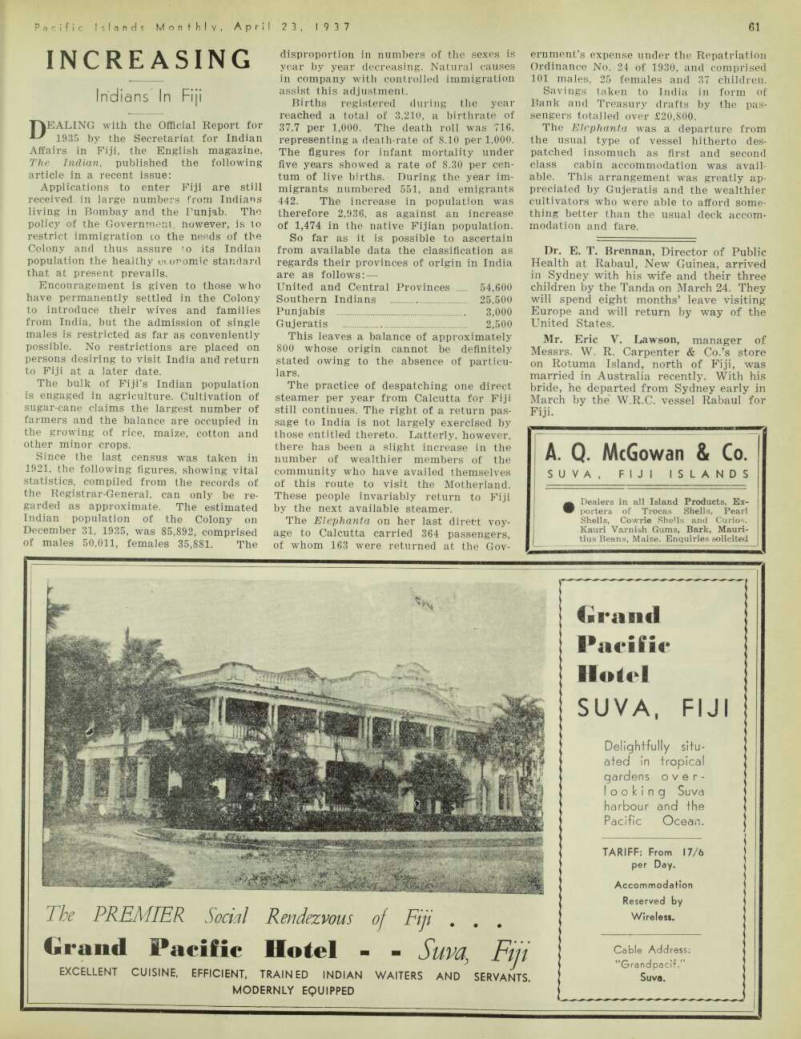
Indians In Fiji
with the Official Report for 1935 by the Secretariat for Indian Affairs in Fiji, the English magazine, The Indian, published the following article in a recent issue: Applications to enter Fiji are still received in large numbers from Indians living in Bombay and the Punjab. The policy of the Government, however, is to restrict immigration to the needs of the Colony and thus assure to its Indian population the healthy economic standard that at present prevails.
Encouragement is given to those who have permanently settled in the Colony to introduce their wives and families from India, but the admission of single males is restricted as far as conveniently possible. No restrictions are placed on persons desiring to visit India and return to Fiji at a later date.
The bulk of Fiji’s Indian population is engaged in agriculture. Cultivation of sugar-cane claims the largest number of farmers and the balance are occupied in the growing of rice, maize, cotton and other minor crops.
Since the last census was taken in 1921, the following figures, showing vital statistics, compiled from the records of the Registrar-General, can only be re garded as approximate. The estimated Indian population of the Colony on December 31, 1935, was 85,892, comprised of males 50,011, females 35,881. The
disproportion in numbers of the sexes is year by year decreasing. Natural causes in company with controlled immigration assist this adjustment.
Births registered during the year reached a total of 3,210, a birthrate of 37.7 per 1,000. The death roll was 716, representing a death-rate of 8.10 per 1,000.
The figures for infant mortality under five years showed a rate of 8.30 per cen tum of live births. During the year im migrants numbered 551, and emigrants 442. The increase in population was therefore 2,936, as against an increase of 1,474 in the native Fijian population.
So far as It is possible to ascertain from available data the classification as regards their provinces of origin in India are as follows: United and Central Provinces 54,600 Southern Indians 25,500 Punjabis 3,000 Gujeratis 2,500 This leaves a balance of approximately 800 whose origin cannot be definitely stated owing to the absence of particu lars.
The practice of despatching one direct steamer per year from Calcutta for Fiji still continues. The right of a return pas sage to India is not largely exercised by those entitled thereto. Latterly, however, there has been a slight increase in the number of wealthier members of the community who have availed themselves of this route to visit the Motherland.
These people invariably return to Fiji by the next available steamer.
The Elephanta on her last direct voy age to Calcutta carried 364 passengers, of whom 163 were returned at the Gov
ernment’s expense under the Repatriation Ordinance No, 24 of 1930, and comprised 101 males, 25 females and 37 children.
Savings taken to India in form of Bank and Treasury drafts by the pas sengers totalled over £20,800.
The Elcphanta was a departure from the usual type of vessel hitherto des patched insomuch as first and second class cabin accommodation was avail able. This arrangement was greatly ap preciated by Gujeratis and the wealthier cultivators who were able to afford some thing better than the usual deck accom modation and fare.
Dr. E. T. Brennan, Director of Public Health at Rabaul, New Guinea, arrived in Sydney with his wife and their three children by the Tanda on March 24. They will spend eight months’ leave visiting Europe and will return by way of the United States.
Mr. Eric V. Lawson, manager of Messrs. W. R. Carpenter & Co.’s store on Rotuma Island, north of Fiji, was married in Australia recently. With his bride, he departed from Sydney early in March by the* W.R.C. vessel Rabaul for
Fiji.
Advertisements & other items, pp. 63-64 (1 item)
- Suva,
A. Q. McGowan & Co.
SUVA, FIJI ISLANDS
• Dealers in all Island Products, Exporters of Trocas Shells, Pearl Shells, Cowrie Shells and Curios.
Kauri Varnish Gums, Bark, Mauritius Beans, Maize. Enquiries solicited
The PREMIER Social Rendezvous
Grand Pacific Hotel «
EXCELLENT CUISINE, EFFICIENT, TRAINED INDIAN
MODERNLY EQUIPPED
of Fiji . . .
- Suva,
WAITERS AND SERVANTS.
Grand
Pacific
Hotel
SUVA, FIJI
Delightfully situ-
ated in tropical gardens overlooking Suva harbour and the Pacific Ocean.
TARIFF: From 17/6
per Day.
Accommodation Reserved by Wireless.
Cable Address; "Grandpacif,"
Suva.
Nagging Pains
in the
Back
B
\Sinif
Backache is an indication of kidney weakness and when there are also urinary irregularities, disturbed nights, dizziness and lassitude the trouble is self-evident. Don’t wait for rheumatism, sciatica, lumbago. Strengthen the kidneys now with Doan’s Backache Kidney Pills.
They put an end to needless pain and will bring back your health and vigour. ‘ Every Picture tells a Story.”
“HAD TO LIE UP”
Mrs. F. Anderson, 29 Thomas Street, Balmain, Sydney, says; “I suffered with my kidneys for a good while, the result being that I was tortured with backache, and the pain at times was so acute that I had to lie up. My ankles and legs swelled somewhat, and were sore to the touch, and I always felt tired and languid, having no energy for anything. About two years ago I was advised to take a course of Doan’s Backache Kidney Pills and five bottles effected a perfect cure.”
Be sure to insist upon
Doan’s
Backache Kidney
Pills
WE ALSO STOCK
HEAVY LEATHER CANVAS
LIGHT LEATHER CAR TRIM-
MING BOOT PATCHING-
HIGH SPEED DRESSMAKING
& HEMSTITCHING MACHINES.
O All Machines Guaranteed.
Master Sewing
Machine Co.
15 ENMORE ROAD
NEWTOWN - SYDNEY
RECONDITIONED SEWING MACHINES
OIL supplied. Any quantity.
Opening of Country Club in Papua
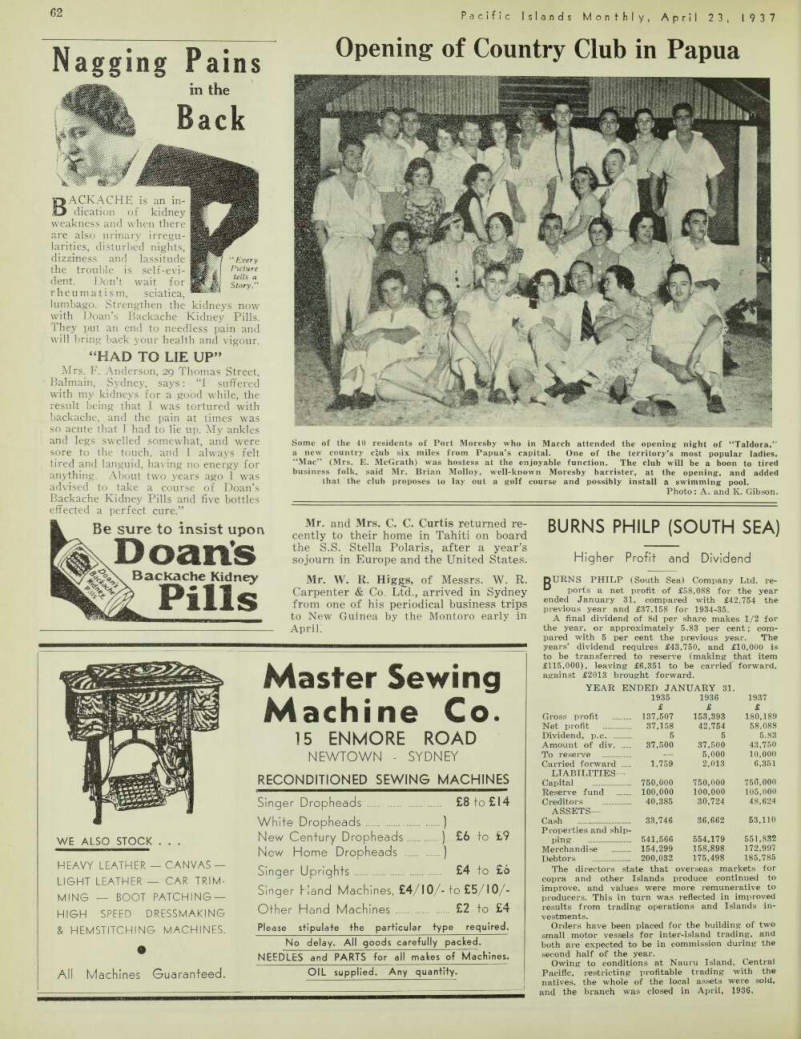
Mr. and Mrs. C. C. Curtis returned re cently to their home in Tahiti on board the S.S. Stella Polaris, after a year’s sojourn in Europe and the United States.
Mr. W. R. Higgs, of Messrs. W. R.
Carpenter & Co. Ltd., arrived in Sydney from one of his periodical business trips to New Guinea by the Montoro early in April.
Some of the 40 residents of Port Moresby who in March attended the opening night of “Taldora,” a new country ciub six miles from Papua’s capital. One of the territory’s most popular ladies, “Mac” (Mrs. E. McGrath) was hostess at the enjoyable function. The club will be a boon to tired business folk, said Mr. Brian Molloy, well-known Moresby barrister, at the opening, and added that the club proposes to lay out a golf course and possibly install a swimming pool.
Photo: A. and K. Gibson.
Burns Philp (South Sea)
Higher Profit and Dividend
pURNS PHILP (South Sea) Company Ltd. re ® ports a net profit of £58,088 for the year ended January 31, compai-ed with £42,754 the previous year and £37,158 for 1934-35.
A final dividend of 8d per share makes 1/2 for the year, or approximately 5.83 per cent; com pared with 5 per cent the previous year. The years’ dividend requires £43,750, and £lO,OOO is to be transferred to reserve (making that item £115,000), leaving £6,351 to be carried forward, against £2013 brought forward.
The directors state that overseas markets for copra and other Islands produce continued to improve, and values were more remunerative to producers. This in turn was reflected in improved results from trading operations and Islands in vestments.
Orders have been placed for the building of two small motor vessels for inter-island trading, and both are expected to be in commission during the second half of the year.
Owing to conditions at Nauru Island, Central Pacific, restricting profitable trading with the natives, the whole of the local assets were sold, and the branch was closed in April, 1936.
Year Ended January 31.
1935 1936 1937 £ £ £ Gross profit 137,507 153,393 180,189 Net profit 37,158 42,754 58.088 Dividend, p.c 5 5 5.83 Amount of div 37,500 37,500 43,750 To reserve — 5,000 10,000 Carried forward 1,759 2,013 6.351
Liabilities—
Capital 750.000 750,000 750.000 Reserve fund 100,000 100,000 105.000 Creditors 40,385 30,724 48.624
Assets—
Cash 33,746 36,662 53,110 Properties and shipping 541,566 554,179 551,832 Merchandise 154,299 158,898 172,997 Debtors — 200,032 175,498 185,785
Passing Of The Old Tahitian Tunes
Influence of the Phonograph Has Created Musical Chamber of Horrors
From Our Own Correspondent
Papeete, Mar. 12.
*T*HE phonograph has many sins to * answer for; but there is none more heinous than the part it has played in the destruction of the native music of South-eastern Polynesia.
No one has ever taken the trouble to trace the origins and developing influ ences which evolved the Himene. What ever these origins and influences may have been, the product was an astonish ing flower of the innate musical genius of the race.
The old district singing companies were trained to perfection until each choir of voices blended as one tone. The music itself —an intricate fabric of inter woven melodic phrases, full of strange harmonies—was startlingly like the com positions of ultra-modern European com posers. Each district felt intense pride in its chorus and on festal occasions, such as Bastile Day, would send in its trained company of 150 or 200 to uphold its honour in the singing competitions.
Bastile Day at Papeete and at Raiatea became famous the world over. People would travel thousands of miles to be present in the same manner as multi tudes go long distances to hear Bach festivals.
The first battering ram which attacked the foundations of this beautiful edifice was undoubtedly certain missionary in fluences. Then came the phonograph, bearing with it the wails and croons con cocted in Tin Pan Alley and exported to Honolulu to be re-exported thence under the label of native Hawaiian ,music. For some reason, known only to themselves, these Hawaiian records took the fancy of the younger generation of Tahitian natives and the doom of the glorious old Himene was sealed.
Why some of the horde of scientists, who have descended on these islands in recent years, have not recognised the unique character of this music and taken some measures to preserve it, is past understanding. Perhaps they have been too busy trotting after bugs, coral polyps, and mouldy bones to take note that they were passing by a priceless jewel.
The present day set up in the Islands is verily a musical chamber of horrors.
District singing companies still exist and they work diligently on European part songs dismal enough to delight the heart of the most pious missionary in Chris tendom.
Native voices, alas, are not suitable for European music and all the training and drudgery beneath the moon will never make them so. It is a curious pheno menon that while singing their own music the voices blend harmoniously as an organ tone; whereas in European part songs they become unbalanced and harsh and altogether unlovely.
What these industrious singing com panies seem incapable of understanding is that the music the majority of both
natives and Europeans want to hear is not “Arizona” and “Springtime in the Rockies” set to Tahitian words, but the majestic old Tahitian Himene sung as the old companies of their fathers sang it.
If they would throw away their steel guitars and imported tunes and revive the fine old Himene and ancient Ute before it is too late, and broadcast these worthy things in the Tuesday and Friday radio programmes, they would receive “fan” mail from home and abroad that would surprise them.
Maior Clive Joske (Commandant of the Fiii Defence Forces'!, Hon. J. L. V.
Sukuna, M.L.C., and Lieut. Edward Cako bau, Flips representatives to the Corona tion. left Melbourne at the end of March by tbe Strathnaver for London. While passing through Svdnev, they paid a visit tr» the studios of Amalgamated Wireless (A/sia) Ltd. and, during an experimental wireless telephone transmission, ex changed greetings with their friends in Fiji.
Advertisements & other items, p. 65 (1 item)
Morris, Hedstrom, Ltd.
DO YOU KNOW
that you may listen to the whole world via short wave with our newly
developed
"Tropical Twin"
This powerful little receiver uses a "19" twin valve, and is supplied complete with batteries, phones, aerial equipment and coils for both short wave and broadcast bands.
Complete £7/10/" Sydney
Price s Radio Service
5 and 6 ANGEL PLACE
SYDNEY
Send Your COLD to us for Prompt Payment Known throughout the Commonwealth and Islands as Australia's clearing house of Precious Metals, we buy and make prompt payment for Gold, Osmiridium, Platinum, Silver, etc. . . . We are Assayers, Bullion Merchants and Metallurgists of standing, and command the largest business of its class In the Southern Hemisphere. . . .
Honest business methods have won for us an enviable reputation which has gained the confidence of a very wide circle of satisfied clients.
GARRETT & DAVIDSON LTD.
BANK OF N.S.W. BUILDINGS. REGENT ST.. SYDNEY
MORRIS, HEDSTROM, Ltd.
FIJI
Sole Agents in Fiji for . . . „
Vacuum Oil Company (Pty.) Limited
Imperial Chemical Industries Limited
Nobel (Australasia) Pty. Ltd. Explosives
Full Stocks of
MINERS AND PROSPECTORS'
REQUISITES
Also SODIUM CYANIDE, ZINC
DUST. Etc., Etc.
Sydney Office: DALTON HOUSE - - 115 Pin STREET, SYDNEY Branches throughout the gold bearing areas Lautoka, Be.
Tavua, Penang, Nadi, and Sigatoka
N.G. Mails Lost
From Our Own Correspondent
Rabaul, Mar. 27.
|T would appear that the old Marsina (renamed the Halving) was deter mined that her foundering off the Queens land coast in March should not go un known to New Guinea residents, who had been associated with her for so many years when she was on the B.P. run.
Ninety-six bags of mail were put on board the Halving when she sailed for Rabaul with a cargo of coal from New castle on March 10. There was 33 bags of letters on board when she went down.
Mr. J. R. Halligan, of the Prime
Minister’s Department, Canberra, return
ed to Australia from Norfolk Island, where he had been acting as Adminis trator for three months, by the March Morinda. He was accompanied by his wife.
Japan's Shadow Over The Pacific
Significance of Many Recent Events
JAPAN continues in an increasing degree to be the danger point of the Pacific, Events during the month only bear out warnings that have been published fre quently in this journal during the past few years—namely, that this proud and virile nation of 100,000,000 people, in creasing at the rate of 1,000,000 per annum, confined to a large crowded and not particularly fertile island cannot be expected to remain quiet.
Japan must have new territory, or perish. Her statesmen look, alternately, to the mainland of Asia (which, already, is densely populated and anti-Japanese in spirit) and to the large and unde
veloped territories of the Central and South Pacific (which are held strongly and jealously by European nations). It is inevitable in the very nature of things that Japan, sooner or later, will put her national future to the hazard of the sw'ord. The four European nations prim arily concerned with this position ■— Great Britain, the United States of America, France, and Holland —can only ■accept the plain facts and prepare ac cordingly.
During the month there have been big and little events of considerable signi ficance.
Another Japanese Government, unable to resist the pressure of the Army— which fiercely and aggressively demands an expansionist policy—has resigned, and the Elder Statesmen have decided upon a general election. The Army has in trigued for this general election for a long time. It hopes that the Parliament that will be elected will adopt a new outlook—that it will not be a Govern ment of compromise in international af fairs, but a Government which will say to the European powers in the Pacific: “Japan must have more room for her growing population and greater freedom for her steadily expanding trade, and Japan is prepared, if necessary, to fight for those things.” The result of the general election will be known early in May. Much depends upon it. jV/fEANWHILE, one finds on every side evidence of the ceaseless southwards thrust of Japan.
The anxiety with which Holland for many years has regarded Japanese pene tration of the East Indies has at last become vocal. Japan has sought various concessions in the East Indies, and es pecially territorial concessions in Dutch New Guinea; and unquestionably behind the request there is a threat of force.
Already, as has been pointed out in the (and especially in an article by a Dutch official in our issue of December, 1935), considerable concessions have been given to various Japanese concerns for the production of cotton, dammar resin, etc., on the north coast of Dutch New Guinea. Japan’s cheap manufactured
goods, for years past, have been Hooding through the Dutch East Indies. Fleets of Japanese vessels, loosely described as poachers, have been preying for years upon the shell deposits in Dutch terri torial waters, just as they have done in the South Pacific regions.
Mr. Sukurai, a minister in a former Japanese Government, made a speech in Tokyo on March 23 wherein he advocated that Japan should apply to Holland for a permanent lease of land in Dutch New Guinea on which to settle Japan’s sur plus population and produce raw materials.
The Tokyo newspaper Asahi reports that the Japanese South Seas Industry Co. has succeeded in overcoming the pink boll weevil and consequently obtained 1701 b. of cotton an acre on a 500-acre tract on the north coast of Dutch New Guinea. The company hopes to establish
a 60,000,000-acre cotton plantation in the same territory within three years.
There are large Japanese interests in .the Moluccas and the Celebes—both parts of the Netherlands Indies—and there are now no less than 20,000 Japanese settlers in the large, fertile island of Mindanao, which is the most southerly of the Phil
ippine Group.
The Dutch now clearly recognise the menace of Japan and, although not an excitable race, they recently have ex pressed their alarm. They have not hesi tated to say openly that the Netherlands Indies must be regarded as, in a sense, under the protection of Great Britain.
So far as British territories are con cerned, there have been no developments of note. There is significance, however, in the manner in which the Australian authorities finally surrendered to Japan ese insistence and allowed Japanese in terests to get possession of the huge deposits of iron ore at Yampi Sound, Western Australia.
JAPANESE interests are sternly explor ** ing the Pacific in search of iron ore.
A Japanese company, financed by the Oriental Development Co. and the No mura Security Co., has been formed to exploit iron ore deposits in New Cale donia, for which the French recently gave a concession. The company expects to obtain 300,000 tons of iron ore per annum from the New Caledonian deposit, which is estimated to contain 200,000,000 tons.
It is worthy of note that another Japanese company, the South Seas Ferro Mining Co., is now obtaining 100,000 tons
of iron ore per annum from a concession which it obtained in Malaya.
Another concern, the Kyowa Mining Co., has been formed with a capital of 5,000,000 yen, and a naval subsidy, to search for petroleum in the South Seas.
In our March issue we published an article describing the manner in which Japanese interests have virtually taken control of the pearl and trochus shell industries, which formerly were an Aus tralian monopoly.
It needs little intelligence to appreci ate the meaning of these things.
JAPAN is a very powerful nation. It is beyond any question or doubt that, if she dared, she would take possession of the Pacific territories which she needs.
But, at present, she is playing a lone hand. Facing her resolutely, and deter mined to maintain the status quo in the Pacific, are Great Britain, the United States, and Holland. It may be assumed that France, in view of the her Cochin China interests, stands with Britain in this matter —but the Pacific policy of France has not been clearly revealed.
The United States and Great Britain, so long as they keep together, can main tain the present position in the Pacific indefinitely. The association of the two great Anglo-Saxon powers is the only guarantee of our safety in the South Seas. It may be taken as certain that it will be the ceaseless purpose of Japanese diplomacy to separate Britain and America. If ever that happens, Japan will strike.
The developments that have taken place during the month, in the direction
of establishing an American airways ser vice between the United States and New Zealand, and the conciliatory note which is expected to dominate the discussion of Anglo-American Pacific affairs at the forthcoming Imperial Conference, also have an important bearing upon the Pacific situation.
There is plenty of evidence of a grow ing friendship and better understanding between Great Britain and U.S.A, Every one who tries to bring a clear vision and some intelligence to bear upon the future of the Pacific will hope that, within the next year or two, the British and Ameri can spheres of influence in the Pacific— especially in relation to commerce and transport—will be more clearly defined.
Political and international considerations make it imperative that there shall be an end to this long-continued shipping war between British and American inter ests, with its unnecessary and irritating political repercussions. R.W.R.
Hong Kong And Formosa
/MIEAT BRITAIN has announced that she intends to construct great forti fications at Hong Kong. This, of course, is an outcome of Japan’s refusal to renew the non-fortification clauses of the Wash ington Naval Pact (otherwise, the London Treaty).
The following message from Hong Kong was published in the Sydney Tele graph of March 26; — Survivors of the wrecked British steamer Hop Sang tell of a secret Japan ese air-base at the southern tip of the island of Formosa. They stumbled upon it when landing after the wreck.
When their ship crashed on to the rocks they lashed oars together to form a 20ft. bridge to land. Over this the Chinese boatswain crawled with a wire lashed to his waist. The wire made fast ashore, the other members of the crew made their way to safety.
At dawn they set out for the town of Koshun, only a few miles from the southernmost point of the island. Soon they found themselves in a great Japan ese military encampment and airbase.
They were questioned stringently and then permitted to continue to Koshun.
There they were impressed by the inten sive naval activity in the harbour.
Koshun lies more than 400 miles north east of Hong Kong, but is less than 200 miles from the coast of China.
Advertisements & other items, pp. 66-69 (1 item)
Pain
MASTER
!S! W $ . r?
A
POWDERS &
TABLETS
1/6 AND 2/6.
SINGLES 2d.ea.
HEADACHE
FLU & COLDS
RHEUMATISM
N EU RALCIA
SC I ATI C A
NEURITIS
LUMBAGO
AND ALL NERVE AND
MUSCULAR PAINS
Reduce temperature and relieve feverishness with Vincent’s A.P.C. It diminishes the likelihood of complications and leaves no after effects. Doctors recommend it because it is prepared on the scientific hospital formula and has stood the test of experience for over 16 years. Keep a packet of Vincent’s A.P.C. always at hand.
FOR SAFETY'S SAKE, SAY "VINCENT'S A. P. C."
READ THE
B.P. MAGAZINE
AUTUMN NUMBER
NOW ON SALE
Short Stories - Pictures Travel Articles Pages for the' Children Stage Latest Fashions Screen A
ONE SHILLING PER COPY
ON SALE AT ALL NEWSAGENTS AND BOOKSELLERS BP
LOST VITALITY
quickly and safely restored by taking the
famous DR. HENRI’S NU-VIGOR VITAL-
ITY PILLS, giving wonderful results for Loss of Power and Nervous Exhaustion.
Week’s trial 3/6; month’s supply 10/6 (posted free). Extra-Strong Prescription for obstinate cases 7/6 and 21/-. Stimulates the vital forces. All communications strictly confidential. Call or write for FREE ADVICE and literature to
H. P. MICHAEL. Chemist
MICHAEL’S BUILDINGS,
COR. ELIZABETH & LONSDALE STS.,
MELBOURNE
Ask for Free Catalogue and Price List of Medical Goods, etc. All lines stocked.
"crowd &
ARCHOR"
POPULDR
EVER
A GR€QT DIC€THROUL/SAG GPATIC
Complete sets comprising betting cloth, 3 dice, 1 shaker 10/6, or 3 dice in case 6/6, small dice 5/6, betting cloth 3/6.
Take Tennis Sets by “Ayres”, of London 7/6, 12/6, 21/-, 25/-, 30/-.
“Like-a-Flash” de luxe Morse code keys, adjustable every way.
Long or short tappers, 12/6 ; P.M.G. type all brass fittings, 19/6; Junior models, 9/6, 10/6.
High grade buzzers, 7/6. 63/- “Like-a-Flash” Medical Coil Shocking Outfit, with" all appli cators, complete ready for use A high-grade scientific machine housed in neat portable cabinet, for professional, amateur, or home use ; recommended by lead ing medical men for nervous or muscular ailments, 63/-.
K RE Roulette Wheels, approx. 7in diameter, 19/9 ; complete with instructions and betting cloth. Upright model, 21/-; sin. Bakelite models, 7/6.
Send for Leven son’s Radio Bargain Bulletin, Bd, post free.
Also Levenson’s Radio Buyer’s Guide and Assembly Chart Handbook, 2/- post free. * Steeplechase Race Game ■— the horses actually jump the hurdles 4 horses, 4 players, 4 winders, 1 for each player, 35/- A game of table skill.
“Totem,” the newest game for home, club, sr i|« picnic or party
lIV 2i/-
■I I “ Odds and iiij Evens,” a new Head and Tail spin game 21/ Both designed as reproductions. Push lever and away they go.
Just arrived; Latest types from U.S.A. Straight play or automatic payouts. Send for illustrated explanatory leaflets. m
non* 2ft
'com*
Double Clad Insulated Rub ber Aerial, 30 strands: 50ft 2/6. 100 ft. 5/-. “Man-o-War’ aerial. 40 strands: 50ft. 5/6 100 ft. 10/-.
HEAD
,PUOMS
jdutijA
Pyrex type Glass Insulators: 3in., 1/- 4in., 3/6, jins «• •£ r Genuine Pyrex, 30/-.
COSMOCOCD*
/l! 25
PwOFtSSIOMAL*
4000 ohms & I w “Cosmocord” 25/- “Cosmocord” De Luxe 32/6 “Cosmocord” Super de Luxe 45/-.
Amplion (English) 28/6.
Gramophone Pickups. B.T.H.
Bakelite Models 32/6 “Clarion” English all-Bakelite Pick - up, with volume control, 22/6.
Hand Winding Gramophone Motors, reliable make, complete with all fittings and turntable. 25/-.
The “Air Patrol” 2 valve all wave battery set. Covers from 15.5 to 835 metres — £ll/17/1 complete with speaker, ’phones and all accessories, a midget in name only, but a giant in performance. Receives local, interstate and overseas broadcasts.
Cz/uGl*)
<accms) K£i (sfiKJSa) Insulators, Like-a-flast ‘Eliminoise’
Aerial Kit for shon or dual wave sets.
Aerial Pyrex type transposi t i o n blocks and 200 ft. aerial coil, 22/6. Eliminates unwanted aerial and hideous electrical noises from your dual-wave or snort-wave set.
Just landed English Gramophone - Radio Pick-up Heads, fit any standard Gramo. Tone Arm. Bakelite moulded 11/6, and De Luxe Model. 19/6.
Others. 10/6, 12/6.
Like-a-Flash Radio Batteries, now reduced: 45v. light duty, 7/3; 45v. heavy duty, 10/6 ; 45v. triple duty, 12/6; 44v. C battery, 1/9; 9v. C battery, 2/-; IJv. dry cells, 2/3.
Please add freight THE GREATEST RADIO OF ITS TYPE EVER
INTRODUCED
A Most Excellent Type of 1937-38 Radio.
The “Like-a-Flash” Batteryless 6-valve Radio. A wonderful set, compact in metal cabinet, runs off 6-volt accumulator, no dry batteries. A beautiful modern set thal will give 100 per cent satisfaction—range wonderful.
Amplion Speaker. Remote control or Vernier Tuninr Dial as required. Ideal for home, plane, launch, ship etc., £l4/15/-, 180 amps hour 6-volt Accumulator, £4 extra.
'RADIO mODERNE 4
n u The Assembled Chassis £22/10/- Just designed for 100 per cent service in the Pacific Islands. Pay cash and save at least 33 1-3. Radie Moderne is the newest, finest and most up-to-the moment 5-valve battery-operated superhet. ever introduced for the Pacific Islands. That’s a sweeping statement, but we stand behind every word of it. Hear all Australasian stations, plus London, Paris, Berlin, Moscow, Tokyo New York, etc., etc.
Radio Moderne, Exclusively Built to suit Pacific Island, conditions, Humidity, etc. Not a Mass Production Pro duct, each Set individually Built by Senior Mechanics, Tuned Up, and Air Tested before despatch.
Radio Moderne incorporates every wanted, technically correct improvement, all latest type Philips valves, S Like-a-Flash triple duty B batteries, best grade 100 amp. 2 volt accumulator, automatic volume control, late Ampion permagnetic speaker. Perfect tone, equal to any electric set. Latest calibrated aero dial, showing Au tralian and overseas stations, extraordinarily lew "B” battery consumption, approximately 10 to 22 ma. “A” battery (accumulator) consumption .65 amps. Selectivity and Sensitivity 100 per cent. Packing 6/6 extra, plus freight, 12 months’ guarantee all parts and speaker 90 days’ valves ...r. ... £22/10/- ■ \
1: r v f
I Home Broadcasting Table Type Microphones, speech or music, 12/6 ; Battery, 1/9. 20ft. Cords, 1/6 extra. Plugs into pick-up terminals of set. Others 22/6, 25/-.
Write for Punch Board Leaflets
LEVENSON S RADIO
226P.1. PITT STREET, SYDNEY
Branches: Radio Cheapside, 240 a Pitt St.
N.S.W., AUSTRALIA
Write for Pin-Game, Totem and Odds and Evens Leaflets ’Phones, M 2525 and M 2526. Cable address, “Leveradioh.” Goods forwarded V.P.P. or Sight Draft. Satisfaction and Service Guaranteed. We can supply by mail all General Merchandise at a Better Price. Quotations with pleasure. Please add freight and packing.
SYDNEY'S LEADING
SAILMAKER
and RIGGER
Also Manufacturer of all Canvas and Rope Work ISLANDS WORK a Speciality
HARRY WEST
Balmain East, SYDNEY Tel. WIIOS
TILLEY
Kerosene Pressure Lamps Lanterns and Radiators.
Write or Ring for New Catalogue of Lamps and Spare Parts.
Models to suit every purpose and every pocket.
TILLEY The Most Satisfactory 300 c.p. Keiosene Lamp.
W.KOPSEN & CO. LTD.
Shipchandlers & Hardware Merchants
LARGEST MANUFACTURERS OF ASH BOAT
OARS AND TOOL HANDLES IN THE SOUTHERN
HEMISPHERE
Large Stocks of Metal Sheathing and Nails, Oakum Ropes, Anchors and Chains, Copper Paints, Blocks, Canvas, etc.
All Classes of Boating, Miners' and Prospectors' Equipment.
70 CLARENCE STREET, SYDNEY
Cables: Kopsen, Sydney. 'Phone: BW 1114 (3 lines) Penta KI I Single Cylinder Write for New 40-page Catalogue Penta U2I Outboard
PENTA
MARINE ENGINES
OUTBOARDS 4-18 H.P.
INBOARDS 3-100 H.P.
Precision Built and Absolutely Free from Vibration.
Deliveries from Stock at Under Bond Prices.
Write for Complete Catalogue and also Particulars of the Penta - Hesselman Engine, running on Heavy Oil Fuel PENTA The World's Leading Marine Engine
Kill Kidney
Trouble Quick
Thousands of sufferers from Kidney trouble and Bladder weakness have stopped Getting Up Nights, Leg Pains, Circles Under Eyes, Swollen Ankles, Nervousness, Stiffness, Rheumatism, Dizziness, Lumbago, Burning, Itching, Smarting, Acidity and Loss of Vigour by a Doctor’s new discovery called Cystex (Siss-tex). Gently soothes, tones, cleans and heals, raw sore kidneys. In 15 minutes Cystex starts refreshing your blood.
Brings new health, youth and vitality in 48 hours.
Guaranteed to end your troubles in 8 days or money back. Price 4/-, from all Stores and Chemists. SCHAFFER & CO,, 189 Clarence Street Sydney.
Suva's Urgent Need
From Our Own Correspondent
Suva, Apr. 2.
OUVA’S urgent need of more wharf accommodation is being emphasised more and more as the weeks go by.
Last month three overseas boats oc cupied all the available space, with the result that one ship had to spend a day in the stream waiting for a berth. The Samoan and Rabaul, neither of them really big vessels, and the Mariposa left no room for another ship of any size at the wharf. The N.Z. Shipping Go’s Opawa from London, with a large quantity of cargo to discharge, arrived the same morning and had to lie out in the stream until the Mariposa cleared in the even ing.
With ships so much dependent on the weather, so far as loading and discharg ing are concerned, it seems a hardship that they should have to waste valuable time because there is no accommodation.
During February the cruise yacht Stella Polaris , a Matson liner, the Shell Oil Go’s Pinna, and the M.V. Matua ar rived on the same day. The Pinna had to lie out in the stream until there was a berth available. When Mr. J. P. Mor gan’s yacht Corsair sent a message that she was coming in to Suva for oil fuel, her agents had to wireless her to keep away for a couple of days until the oiling berth was available.
That the shipping of the port of Suva is growing is demonstrated by the fact that 12 overseas vessels, six of them over 13,000 tons, are expected to arrive in April. Their total gross tonnage is 150,270. Fortunately, they are fairly well spread out through the month.
Mr. J. S. Proud, consulting engineer to Mandated Alluvials N.L., Papua, who was one of the two survivors of the Stinson air tragedy in Queensland in February, will leave the hospital at the end of April after recovering from a frac tured leg and the effects of nine days’ privations.
Advertisements & other items, pp. 69-70 (1 item)
Winches
PORTABLE HAND POWERED
Capacities: 2 ton. 5 lon.
Weight: 66 lbs. I 10 lbs.
IN USE
THROUGHOUT NEW GUINEA
Unsurpassed in Constructional Work—moving boulders from alluvial workings—and for all mining purposes.
THE STRONGEST WINCHES, FOR THEIR
WEIGHT, IN THE WORLD
Delivery ex Sydney stocks.
Particulars from:
NELSON & ROBERTSON
PTY., LTD.
Cables: IVAN SYDNEY
V & S' As builders of many Islands vessels, amongst j the unequalled facilities available at our which are the above, we invite the attention modern yards for new building, engine of intending purchasers of new craft to I Installations, etc. • We are also agents in Australia and the South Seas for several leading makes of marine engines, viz;— "ATLAS IMPERIAL" DIESEL " R.N." DIESEL "GRAY"
Prices, both for building and engine installations, are the keenest possible and your enquiry will receive prompt attention. iitr / McMAHON’S PT.
• nV/LIVICj Ot KmO* SYDNEY, N.S.W.
Mining Ore
Treatment
Machinery
COMPLETE CYANIDE
PLANTS SUPPLIED
Dorr Classifiers Dorr Thickeners Dorr Agitators Oliver Filters Merril Crowe Zinc Dust Gold Precipitation Richardson Mine Fans *
FANS AND AIR HEATERS
For Ventilation, Copra Drying Rooms, etc.
Enquire from
CROSSLE, DUFF AND
MACINTOSH LTD.
52 Bridge Street, SYDNEY
The Hygeia Dissolvenator Approved by Health Authorities
A Self Contained Sanitary System
Easily and cheaply installed. Guaranteed.
NO WATER SUPPLY REQUIRED
No odours, germs, flies or other insect pests.
A caustic soda solution turns the excrement and paper into an innocuous solution which runs off and is absorbed by the soil.
Gives thoroughly efficient, long, care-free service. The Shell Oil ' Co. alone has given 52 repeat orders.
HYGEIA SANITARY COMPANY
26 BRIDGE STREET. SYDNEY.
Suitable for Use Indoors.
Price, F. 0.8. Sydney, £l6/10/-
COLD...
HIGHEST PRICES. PROMPT
SETTLEMENT, ACCURATE
WEIGHTS AND ASSAYS.
are assured to producers and sellers of gold bullion who forward their consignments to The Electro-
lytic Refining and Smelting Co.
of Aust. Ltd. for treatment and realisation.
RECORD PRICE.—On 6th March, 1935, this company paid to its clients at the rate of £9/4/6 net per fine ounce, which is the
highest price ever paid for gold
in Australia.
SPECIALLY ORGANISED SER-
VICE is available to clients in New Guinea, Fiji and other Pacific Island centres.
Address consignments from outside Australia to the Company's Weighing a Pacific Islands consignment of Sydney office. gold bullion at an E.R. & S. receiving office.
The Electrolytic Refining & Smelting Co.
OF AUSTRALIA LIMITED
Melbourne: Works: Sydney: Collins House. Port Kembla, N.S.W. 25 O'Connell Street.
PURCHASERS AND REFINERS OF GOLD, SILVER. COPPER IN ANY FORM BANKERS: —The English, Scottish and Australian Bank Ltd. s L e
Pacific Islands Mining Notes
From Fiji
Emperor Mines Limited
LiR. E. DAVIES, of Charles Ruwolt Pty. Ltd., Melbourne, consulting engineers to Emperor Mines Ltd., Tavua, Fiji, returned to Victoria at the end of March, after a visit of inspectiion to Fiji. Mr. Davies reported that the progress of the work to date is entirely satisfactory, and that unless any unforseen difficulties arise the new treatment plant should be in operation about the end of September next, as originally estimated.
The plant will treat 12,000 tons of ore a month.
Shipments from Australia for the Emperor Mine early in April included the two ball mills, bottom for 120 ft. thickener vat, ironwork for calcine and amalgam fux-nace, classifiers and poiUon of the 3000-ton Merril Crowe plant, whilst shipment was made from London in March of steel work for the mill buildings and agitator v^ts.
Returns for the last four periods have been: — Four weeks ended Dec. 19* Jan. 23f Feb. 20 Mar. 20 Ore treated, tons 1,957 2,080 2,102 2,370 Head, value, dwt. 8.04 10.75 10.3 9.0 Gold, oz. fine ... 787.4 1,027.7 997.6 974.2 * Three weeks’ pex-iod. fFive weeks’ period.
Loloma (Fiji) Gold Mines N.L.
Directors of Loloma (Fiji) Gold Mines N.L. have been advised by Mr. Davies, consulting engineer, that the pi'Ogress of construction work
is most satisfactory, and that the treatment plant should be in operation about the end of July, as oxdginally estimated, unless any unforseen diffi culty arises. The minimum capacity of the plant will be 500 tons of ore a week.
Mt. Kasi Mines Ltd.
The output from Mount Kasi Mines Ltd’s pro perty in Vanua Levu was as follows during the past four months :■ — Four weeks ended Dec. 4f Jan. 28* Feb. 25 Mar. 25 Ore, tons 1,500 1,853 2,359 2,600 Bullion, oz. 487 352 365 447 Value, £ A 3.600 2,773 3,194 3,911 t Mill stopped 51 days owing to engine break down. Mill closed down dui-ing December for ovei’haul and repairs and resumed crushing Janu ary 6. *Twenty-one days’ run.
Additional recovery for February from slag 65 fine oz.
From New Guinea
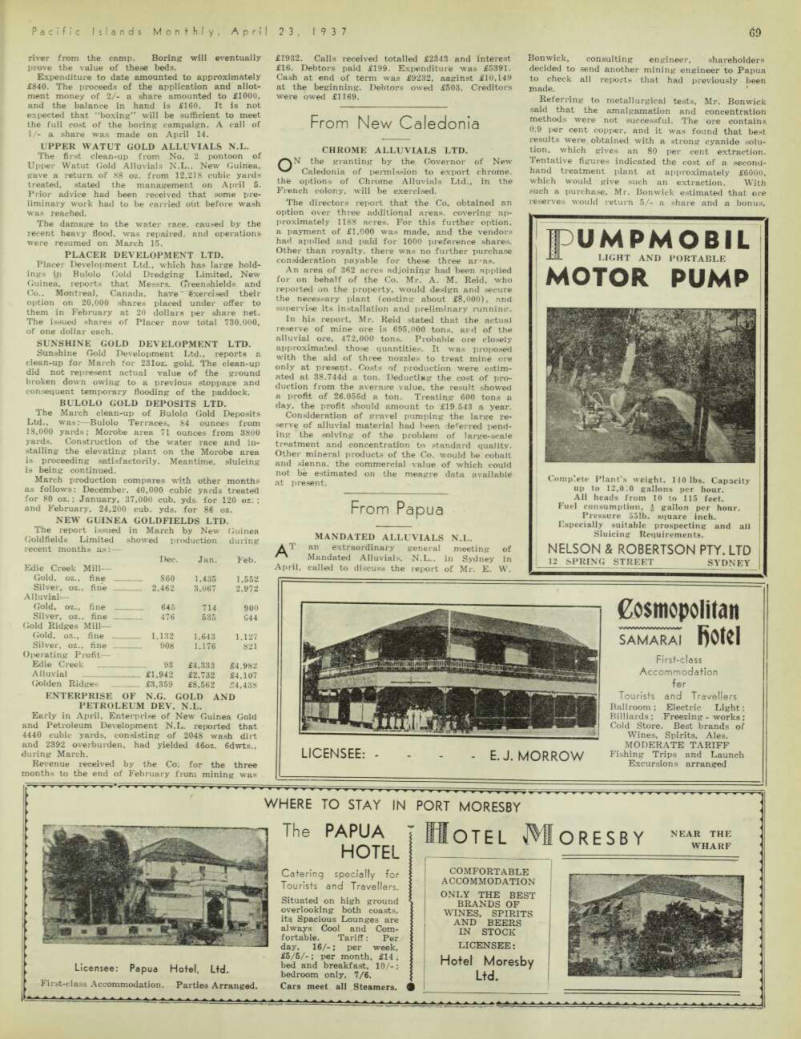
Irowat Gold Alluvials N.L.
A FFAIRS of Irowat Gold Alluvials N.L., New Guinea, were lengthily discussed at the adjourned annual meeting, held in Melbourne on March 22. Mr. C. Mackay (chairman of direc tors) read replies to questions submitted by a committee of shareholders appointed at the annual meeting, and dealing with the administration and operations of the company Mr. Mackay mentioned that the Co. owed Upper Watut Gold Alluvials N.L. £11,207. The want of success, he said, could be traced directly to the operations failing to confirm the quality of gold which the gx-ound was stated to contain in the original reports.
The dii'ectors had received demands thi-ough two firms of solicitors for money alleged to be owing to Mr. R. M. Brain (formerly construc tional engineer) and Mr. D. J. McClelland (the present consulting engineer and general super visor of the company). As the Co. was without funds it was evident that this action would place it in a most embarrassing position.
Mr. D. J. McClelland did not seek re-election as a director.
Sandy Creek Gold Sluicing Ltd.
Returns for Sandy Creek Gold Sluicing Ltd..
New Guinea, for January, February and Max*ch compare as follows: Jan. Feb. Mar.
Cubic yards 7,345 9,4?* 9,934 Gold, oz 139 219 262 Average, cub. yd 2/10 3/53 3/11*
Wewak Gold Estates N.L.
Outlining the position of Wewak Gold Estates N.L., in a circular to shareholders, the directors advise that Mr. J. Thurston, one of the vendors and a director, and Mr. M. P. Curtain, engineer, left for the Mandated Territory in December last year, taking with them a complete boring equip ment and accessories. Mr. Curtain is in charge of the field operations of the company, and has the guidance and assistance of Mr. Thurston, who is wox-king on his own claims neai'by.
Recent mail advices received from Mr. Curtain indicated that camp was established on the George Y. lease on the Humuku River. The top portion of this lease was suiweyed, and clearings made for the first line of bores. Boring was carried on concuri’ently with “boxing” by native labour. Two boxes ai’e being employed, and this vwork will not only give usefxil data as to values, but will, it is hoped, contxdbute towards the cost of the boring campaign.
Mr. Curtain reported that although disappoint ing results were obtained from the first few days’ work with the first box, it had since been located at another point, where he obtained ‘‘ex cellent prospects in the dish” in a nice looking wash. Bottom had not been reached when these prospects wei’e taken. Mr. Curtain emphasised that “boxing” can only be canned on successfully at certain selected points of the creek, where concentrations from the higher terrace ground occur. It was not anticipated that “boxing” could be carried out except at some such favour able locations, the main interest in the areas being to prove values for treatment by sluicing or dredging.
As regards the higher level wash, Mr. Curtain stated tlxat the camp is situated on a bed of wash 10 or 12 ft. above the flat w'here “boxing” will be carried on, and that some excellent pros pects can be obtained in many places on the terrace, which extends both up and down the
river from the camp. Boring will eventually prove the value of these beds.
Expenditure to date amounted to approximately £B4O. The proceeds of the application and allot ment money of 2/- a share amounted to £lOOO, and the balance in hand is £l6O. It is not expected that “boxing” will be sufficient to meet the full cost of the boring campaign. A call of 1/- a share was made on April 14.
Upper Watut Gold Alluvials N.L.
The first clean-up from No, 2 pontoon of Upper Watut Gold Alluvials N.L., New Guinea, gave a return of 88 oz. from 12,218 cubic yards treated, stated the management on April 5.
Prior advice had been received that some pre liminary work had to be carried otit before wash was reached.
The damage to the water race, caused by the recent heavy flood, was repaired, and operations were resumed on March 15.
Placer Development Ltd.
Placer Development Ltd., which has large hold ings i/i Bulolo Gold Dredging Limited, New Guinea, reports that Messrs. CTreen shields and Co., Montreal, Canada, have' exercised their option on 20,000 shares placed under offer to them in February at 20 dollars per share net.
The issued shares of Placer now total 730,000, of one dollar each.
Sunshine Gold Development Ltd.
Sunshine Gold Development Ltd., reports a clean-up for March for 2310 z. gold. The clean-up did not represent actual value of the ground broken down owing to a previous stoppage and consequent temporary flooding of the paddock.
Bulolo Gold Deposits Ltd.
The March clean-up of Bulolo Gold Deposits Ltd., was:—Bulolo Terraces, 84 ounces from 18,000 yards; Morobe area 71 ounces from 3800 yards. Construction of the water race and in stalling the elevating plant on the Morobe area is proceeding satisfactorily. Meantime, sluicing is being continued.
March production compares with other months as follows: December, 40,000 cubic yards treated for 80 oz. ; January, 37,000 cub. yds. for 120 oz. ; and February, 24,200 cub. yds. for 86 oz.
New Guinea Goldfields Ltd.
The report issued in March by New Guinea Goldfields Limited showed production during recent months as:— Dec. Jan. Feb.
Edie Creek Mill— Gold, oz., fine 860 1,435 1,552 Silver, oz., fine 2,462 3,067 2,972 Alluvial— Gold, oz., fine 645 714 900 Silver, oz.. fine 476 535 C 44 Gold Ridges Mill— Gold, oz., fine 1,132 1,643 1,127 Silver, oz., fine 908 1.176 821 Oj»erating Profit— Edie Creek 93 £4.333 £4,982 Alluvial £1,942 £2,732 £4,107 Golden Ridges £3,359 £8,562 £4,438
Enterprise Of N.G. Gold And
Petroleum Dev. N.L,
Early in April, Enterprise of New Guinea Gold and Petroleum Development N.L. reported that 4440 cubic yards, consisting of 2048 wash dirt and 2392 overburden, had yielded 460 z. 6dwts., during March.
Revenue received by the Co; for the three months to the end of February from mining was
£1932. Calls received totalled £2343 and interest £l6. Debtors paid £199. Expenditure was £5391.
Cash at end of term was £9232, aaginst £10,149 at the beginning. Debtors owed £503. Creditors were owed £1169.
From New Caledonia
Chrome Alluvials Ltd.
the granting by the Governor of New Caledonia of permission to export chrome, the options of Chrome Alluvials Ltd., in the French colony, will be exercised.
The directors report that the Co. obtained an option over three additional areas, covering ap proximately 1188 acres. For this further option, a payment of £l,OOO was made, and the vendors had applied and paid for 1000 preference shares.
Other than royalty, there was no further purchase consideration payable for these three ar*as.
An area of 362 acres adjoining had been applied for on behalf of the Co. Mr. A. M. Reid, who reported on the property, would design and secure the necessary plant (costing about £8,000), and supervise its installation and preliminary running.
In his report, Mr. Reid stated that the actual reserve of mine ore is 695,000 tons, ard of the alluvial ore, 472,000 tons. Probable ore closely approximated those quantities. It was proposed with the aid of three nozzles to treat mine ore only at present. Costs of production were estim ated at 38.744 d a ton. Deducting the cost of pro duction from the average value, the result showed a profit of 26.056 d a ton. Treating 600 tons a day, the profit should amount to £19.543 a year.
Consideration of gravel pumping the large re serve of alluvial material had been deferred pend ing the solving of the problem of large-scale treatment and concentration to standard quality.
Other mineral products of the Co. would be cobalt and sienna, the commercial value of which could not be estimated on the meagre data available at present.
From Papua
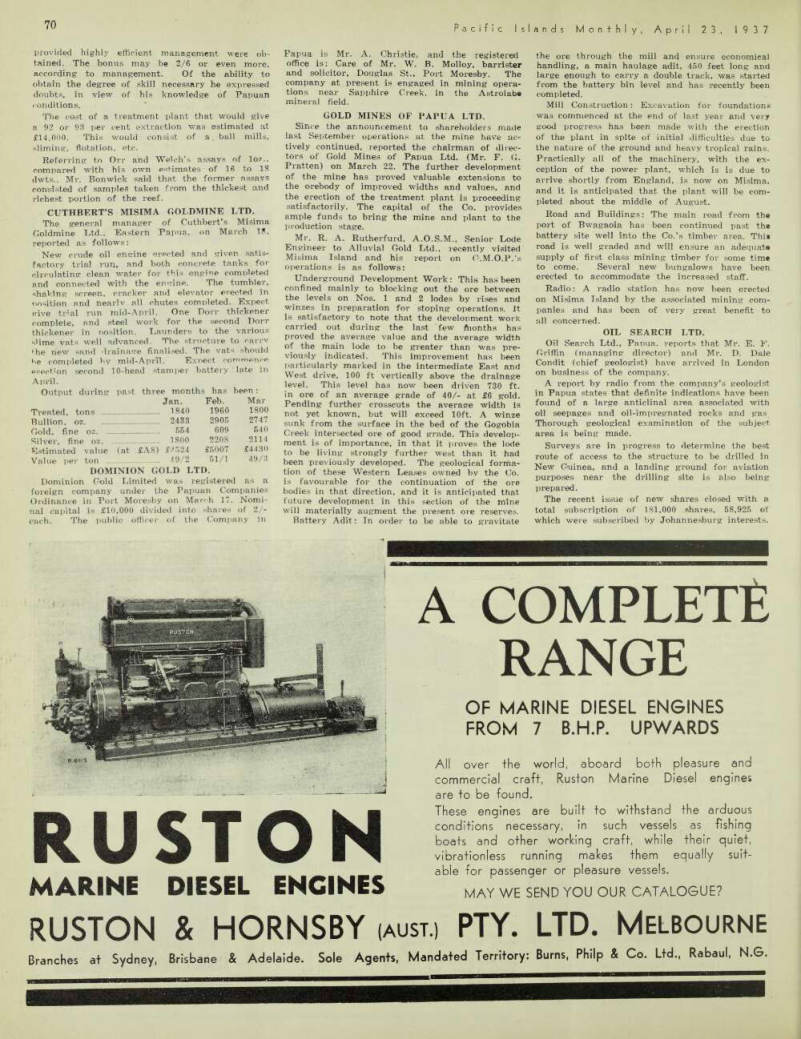
Mandated Alluvials N.L.
A T an extraordinary general meeting of Mandated Alluvials, N.L., in Sydney in April, called to discuss the reixort of Mr. E. W.
Bonwick, consulting engineer, shareholders decided to send another mining engineer to Papua to check all reports that had previously been made.
Referring to metallurgical tests, Mr. Bonwick said that the amalgamation and concentration methods were not successful. The ore contains 0.9 per cent copper, and it was found that best results were obtained with a strong cyanide solu tion, which gives an 80 per cent extraction.
Tentative figures indicated the cost of a second hand treatment plant at approximately £6OOO, which would give such an extraction. With such a purchase, Mr. Bonwick estimated that ore reserves would return 5/- a share and a bonus.
provided highly efficient management were ob tained. The bonus may be 2/6 or even more, according to management. Of the ability to obtain the degree of skill necessary he expressed doubts, in view of his knowledge of Papuan conditions.
The cost of a treatment plant that would give a 92 or 93 per cent extraction was estimated at £14,000. This would consist of a ball mills, sliming, flotation, etc.
Referring to Orr and Welch’s assays of loz.. compared with his own estimates of 16 to 18 dwts.. Mr. Bon wick said that the former assays consisted of samples taken from the thickest and richest portion of the reef.
Cuthbert’S Misima Goldmine Ltd.
The general manager of Cuthbert’s Misima Goldmine Ltd.. Eastern Papua, on March 18. reported as follows: New crude oil engine erected and given satis factory trial run, and both concrete tanks for circulating clean water for this engine completed and connected with the engine. The tumbler, shaking screen, cracker and elevator erected in position and nearlv all chutes completed. Expect trive trial run mid-April. One Dorr thickener complete, and steel work for the second Dorr thickener in position. Launders to the various slime vats well advanced. The structure to carrv f he new sand drainage finalised. The vats should he completed by mid-April. Expect commence erection second 10-head stamper battery ' late in April.
Output during past three months has been: Jan. Feb. Mar Treated, tons 1840 1960 1800 Bullion, oz 2433 2905 2747 Gold, fine oz 554 609 540 Silver, fine oz 1800 2208 2114 Estimated value (at £AB) £4524 £5007 £4430 Value per ton 49/2 51/1 49/3
Dominion Gold Ltd.
Dominion Gold Limited was registered as a foreign company under the Papuan Companies Ordinance in Port Moresby on March 17. Nomi nal capital is £lO,OOO divided into shares of 2/cach. The public officer of the Company in
Papua is Mr. A. Christie, and the registered office is: Care of Mr. W. B. Molloy. barrister and solicitor, Douglas St., Port Moresby. The company at present is engaged in mining opera tions near Sapphire Creek, in the Astrolabe mineral field.
Gold Mines Of Papua Ltd.
Since the announcement to shareholders made last September operations at the mine have ac tively continued, reported the chairman of direc tors of Gold Mines of Papua Ltd. (Mr. F. G.
Pratten) on March 22. The further development of the mine has proved valuable extensions to the orebody of improved widths and values, and the erection of the treatment plant is proceeding satisfactorily. The capital of the Co. provides ample funds to bring the mine and plant to the production stage.
Mr. R. A. Rutherfurd. A.0.5.M., Senior Lode Engineer to Alluvial Gold Ltd., recently visited Misima Island and his report on G.M.O.P.’s operations is as follows: Underground Development Work: This has been confined mainly to blocking out the ore between the levels on Nos. 1 and 2 lodes by rises and winzes in preparation for stoping operations. It is satisfactory to note that the development work carried out during the last few fhonths has proved the average value and the average width of the main lode to be greater than was pre viously indicated. This improvement has been particularly marked in the intermediate East and West drive, 100 ft veidically above the drainage level. This level has now been driven 730 ft. in ore of an average grade of 40/- at £6 gold.
Pending further crosscuts the average width is not yet known, but will exceed 10ft. A winze sunk from the surface in the bed of the Gogobia Creek intersected ore of good grade. This develop ment is of impoi’tance, in that it proves the lode to be living strongly further west than it had been previously developed. The geological forma tion of these Western Leases owned by the Co. is favourable for the continuation of the ore bodies in that direction, and it is anticipated that future development in this section of the mine will materially augment the present ore reserves.
Battery Adit; In older to be able to gravitate
the ore through the mill and ensure economical handling, a main haulage adit, 450 feet long and large enough to carry a double track, was started from the battery bin level and has recently been completed.
Mill Construction: Excavation for foundations was commenced at the end of last year and very good progress has been made with the erection of the plant In spite of initial difficulties due to the nature of the ground and heavy tropical rains.
Practically all of the machinery, with the ex ception of the power plant, which is is due to arrive shortly from England, is now on Misima, and it is anticipated that the plant will be com pleted about the middle of August.
Road and Buildings: The main road from the port of Bwagaoia has been continued past the battery site well into the Co.’s timber area. Thi« road is well graded and will ensure an adequate supply of first class mining timber for some time to come. Several new bungalows have been erected to accommodate the increased staff.
Radio: A radio station has now been erected on Misima Island by the associated mining com panies and has been of very great benefit to all concerned.
Oil Search Ltd.
Oil Search Ltd., Papua, reports that Mr. E. F.
Griffin (managing director) and Mr. D. Dale Condit (chief geologist) have arrived in London on business of the company.
A report by radio from the company’s geologist in Papua states that definite indications have been found of a large anticlinal area associated with oil seepages and oil-impregnated rocks and gas.
Thorough geological examination of the subject, area is being made.
Surveys are in progress to determine the best route of access to the structure to be drilled in New Guinea, and a landing ground for aviation purposes near the drilling site is also being prepared.
The recent issue of new shares closed with a total subscription of 181,000 shares, 58,925 of which were subscribed by Johannesburg interests.
Advertisements & other items, pp. 71-72 (1 item)
Ipumpmobil
-ti. LIGHT AND PORTABLE
MOTOR PUMP
s Complete Plant’s weight. 110 lbs. Capacity up to 12,0 .0 gallons per hour.
All heads from 10 to 115 feet.
Fuel consumption, ?. gallon per hour.
Pressure 551 b. square inch.
Especially suitable prospecting and all Sluicing Requirements.
NELSON & ROBERTSON PTY. LTD
12 SPRING STREET SYDNEY
rWtgrffim
LICENSEE; -
E. J. MORROW
Cosmopolitan
Hold
First-class Accommodation for Tourists and Travellers Ballroom; Electric Light: Billiards ; Freezing - works ; Cold Store. Best brands of Wines, Spirits, Ales.
MODERATE TARIFF
Fishing Trips and Launch Excursions arranged
WHERE TO STAY IN PORT MORESBY
Licensee: Papua Hotel, Ltd.
First-class Accommodation. Parties Arranged.
The PAPUA
HOTEL
Catering specially for
Tourists and Travellers.
Situated on high ground 1 overlooking both coasts, its Spacious Lounges are always Cool and Comfortable. Tariff: Per day, 16/-; per week, £5/5/- ; per month, £l4 , bed and breakfast, 10/-; bedroom only, 7/6.
Cars meet all Steamers. 4
Hotel Moresby
NEAR THE
WHARF
COMFORTABLE
ACCOMMODATION
ONLY THE BEST
BRANDS OF
WINES. SPIRITS
, AND BEERS
IN STOCK
LICENSEE:
Hotel Moresby
Ltd.
RUSTON
MARINE DIESEL ENGINES
A COMPLETE
RANGE
OF MARINE DIESEL ENGINES
FROM 7 B.H.P. UPWARDS
All over the world, aboard both pleasure and commercial craft, Ruston Marine Diesel engines are to be found.
These engines are built to withstand the arduous conditions necessary, in such vessels as fishing boats and other working craft, while their quiet, vibrationless running makes them equally suitable for passenger or pleasure vessels.
MAY WE SEND YOU OUR CATALOGUE?
RUSTON & HORNSBY iaust.) PTY. LTD. Melbourne Branches at Sydney, Brisbane & Adelaide. Sole Agents, Mandated Territory: Burns, Philp & Co. Ltd., Rabaul, N.G.
Quotations for Islands
Gold Shares
Fiji
Mid-Nov.
Mid-Felt.
Mid-Apr. Emperor Mines Mt: 1.20/9 1.18/71 Granite Dev slid bl i»8d Koroere s4/ti b4/9 1-4/3 Loloma b21/6 b24/lJ b23/- Mineral Dev. bl/bl/9 b2/6 Mt. Kasi b7/b5/6 fc6/3 Mt. Morgan Dev. ... bl/5 b8d b9d Pacific Gold b£4 7 15/s£4 s£2/10/- Tavua Dev b91d b7d bGd Vatu Kasia bl/- ._ s4/- Vees United b4d s3d bld
New Guinea
Bulolo Deposits bl/9 bl/4 bl/4 Bulolo G.D. b£7/3/s£7/15/s£7/5/- Enterprise of N.G. and Petroleum b£l/15/. - b£2/10/b£4 Guinea Gold sl6/9 sl6/bl5/ll I rowat bl/OJ s3d bUd Morohe Ml. .— b9d sl/- N.G.G-. Ltd. b4/5 b3/91 b2/10 New Morobe .— b!5/- Oil Search b3/101 1-3/51 b7/ll Placer Dev. b£4/17/b£5 s£5 Sandy Ck bl/Oi bl/5 bl/6 Sunshine Gold bl3/6 bl4/10 bl4/l Upper Watut b2/bl/7 blld
Papua
Cuthbert’s Misima G.M. b20/41 b25/6 b25/S G.M. of Panua b9/4 bl2/10 bl4/3 Mandated All bl6/71 b3/l 1 b3/- Sapphire Ck — s25/b30/- Oriomo Exp. b4/101 b5/ll b4/- Mis!ma United . sl5/- Sfodda Gold Co s9d b2d b2d
Interest Revived
In Old Gira Goldfield, Papua
From Our Own Correspondent
Pt. Moresby, Mar. 24.
T , HE old Gira goldfield, Papua, situated not far from the loma Government station in the mountainous interior of he Northern Division between the water vays of the Mombare and Gira Rivers, las again been attracting attention dur ng recent months.
By the Montoro on March 4, Mr. James Jeorge. a well-known mining engineer, rrived in Port Moresby, and left shortly fterwards by plane for loma. Since then e has been busily inspecting the mining iroperty taken up by Arum Dredging )eyelopment N.L. and other likely pro ositions in the district. Already a ship lent of cargo has been flown to the seat f operations.
It is generally acknowledged that the Id field which first attracted attention s far back as May, 1897, and winch was mrked by one of Papua’s oldest pros ectors. Bob Elliott, holds out as great possibility of success as any mining istrict in the territory.
Commenting on the newly opened dis *ict in 1897, when trials were made for 'aces of gold, Sir William MacGregor ated: “Traces of gold were fouftd to be resent in favourable spots in a greater ?gree than had been noticed before in iy of the other rivers . . . The presence gold was by no means unexpected as appeared clear enough that the gold ime chiefly from the great Albert Ed ard Mountain.”
N.G.G. Policy
Uncertainty Causes Slump in Shares
/~\WING to a typographical error, it was stated in the P.J.M. in February that, at the annual meeting of New Guinea Goldfields Ltd., the chairman of th* 3 meeting, Mr. Blaikie Webster, disclosed that he was the holder of 80,000 shares.
The figure, of course, was wrong. Mr.
Blaikie Webster holds 800,000 N.G.G. shares.
The passing of the N.G.G. dividend in February, and uncertainty about the com pany’s future policy, led to a slump in the 5/- shares, and at one period, early in April, they were down under 3/-.
There seemed to be buyers for all parcels coming on to the market under 4/-, and prices have hardened slightly. The shares ought to be worth a lot more than 4/-.
This company has a great deal of rich ground, and the directors cannot go on indefinitely meeting heavy capital expen diture of a developmental character out of the declared profits.
But the policy of the directors is com pletely in doubt. The company is con trolled by the British Mining Trust, which also controls Mount Isa. in Queens land; and the Mining Trust, in turn, is powerfully influenced, if not controlled, by the great Guggenheimer concern of New York.
Amongst all these big fellows, the small Australian shareholder in N.G.G. can only hope and pray.
John T. Solomon, a Rotuman minister, has been appointed the first colporteur in Fiji in connection with the British and Foreign Bible Society. Trained at the
Methodist Mission’s Theological College,
Solomon speaks Fijian, English, Samoan,
and Hindustani, in addition to his mother tongue.
Advertisements & other items, p. 73 (1 item)
Fox & Maccillycuddy Ltdt
LEATHER BELTS
(it NATIVES
z 5 777 an ufacturm 4 Specialists
PATTERSON & STONE. CRICHTON WORKS.
WALSALL .ENGLAND.
PACIFIC ISLANDS
YEAR BOOK
1935-36 Edition, 430 p.p.
A reliable, comprehensive guide to
the Rapidly-Developing Territories of the Pacific.
STATISTICS FROM OVER 20
ADMINISTRATIONS
Numerous Comprehensive Maps
NEW COUNTRIES WITH
NEW OPPORTUNITIES
Special Features include: Description of new Pacific Islands Gold Industries; Pidgin Vocabulary; Aviation in Pacific; Pacific Personalities; History of Pacific Exploration : Business and Residential Directories of Principal Territories.
Bound in cloth, 9/6, plus postage. (British countries, 6d. : foreign, 1/-) From all Booksellers and Islands Stores, or from
PACIFIC PUBLICATIONS LTD.
Union House, 247 George Street,
Sydney.
WHY TAKE A RISK?
AAAAAAAAAA *^AAAAA^A/*AA/\^\AAAAA/V
YOU CAN WITH CONFIDENCE
PLACE YOUR. RADIO ORDERS WITH
Fox & Maccillycuddy Ltd
The Oldest Established Radio Distributors of Completed Receivers Accessories In Australia.
Parts and We specialise in all sets as described by “ Wireless Weekly,” and full stocks of parts are always on hand. We will be pleased to quote you by return mail.
• EVERREADY BATTERIES •
everready batteries always in stock
SUPERDYNE HEAVY DUTY LIGHT DUTY
”C” BIAS “A” BATTERIES AND TORCH REFILLS All brands of Radio Valves always in stock, including Radiotron, Philips, Kenrad, Mullard, National Union, Osram. Each Valve is carefully tested before despatch.
QUALITY RADIO— PROMPT SERVICE RELIABILITY
FOX & MACCILLYCUDDY LTdT
57, YORK ST, SYDNEY.
Rewa Bridge Opens In May
From Our Own Correspondent.
Suva, Apr. 3.
AT long last the much awaited bridge over the Rewa River is nearing completion. It is anticipated that it wfll be opened to traffic in May.
Only one small span requires to be thrown across, and then there will not remain much to be done. On appearances the bridge is going to be a handsome and durable structure, and will be a credit to the engineer in charge (Mr. Williams) and his staff.
Advertisements & other items, pp. 74-76 (2 items)
Ivan Champion's Patrol
72
Pacific Islands Monthly, April 23, 1937
(CONTINUED FROM PAGE 9)
J. J. Sullivan Ltd.
W. M. PORD
Ship, Yacht and Boat Builder
Berry's Bay - North Sydney
(Established 1870) BUILDERS of all kinds of Island Craft from Dinghies to Auxiliary Schooners of any tonnage. New and Second-hand Island Craft of various types in stock.
New and Second-hand Full Diesel, Crude Oil, Benzine and Kerosene Engines.
Please Send on Your Enquiries
STEAMSHIPS TRADING COMPANY LIMITED
PORT MORESBY PAPUA SAMARAI
Chairman and Managing Director: A. S. FITCH.
Shipowners. Wholesale and Retail Merchants and Traders; Shipping. Customs and Insurance Agents; Copra and Rubber Plantation Owners.
MAIL CONTRACTORS TO COMMONWEALTH AND PAPUAN GOVERNMENTS.
AGENCIES: —At Port Moresby: Coral Sea Insurance Co.; Phoenix Insurance Co.; Delta Sawmills. Ltd.; Acme Bakery Co.; Vacuum Oil Co, Pty. Ltd. At SamanU; Coral Sea Insurance Co. : Delta Sawmills, Ltd.; Bankers and Traders Insurance Co. ; National Mutual Life Insurance Co. ; Kularo Shipyards; Mamai Plantations.
BRANCHES:—In Papua: Hanuabada, Sivitoi, Aroma, Koki, Hula, Ela Beach, Duga Duga, Yule Island.
SYDNEY: NELSON & ROBERTSON PTY. LTD., 12 Spring St.; Melbourne. 396 Flinders Lane; London. E. Whiteaway & Co., 7 Chiswell Street, Finsbury. London.
Cable Address: “STEAMSHIPS.” f.rwTo • Rpntkv’f
J. J. SULLIVAN LTD.
Sullivan's Buildings
168 -174 SUSSEX STREET, SYDNEY, N.S.W.
Cable and Telegraphic Address : “SULLGREN,” Sydney.
GENERAL MERCHANTS
EXPORTERS
' e
ALL COMMODITIES HANDLED
Best Roller Flour . . . Best Biscuit
IMPORTERS
SHIPPERS
Flour
HIGHEST GRADE "CORAL" BRAND SHARPS
" Pony ' Brand Oats.
Dried Fruits, Prunes, Sultanas, etc.
Canned Meats . . . Canned Fruits Jams, etc. « PROMPT ATTENTION TO CABLE AND MAIL ENQUIRIES, WHICH
ARE APPRECIATED
Telephone: M 62G8 (3 lines)
F. M. MARINE DIESEL ENGINES
> : »- Write for details to . . . 60 H.P. MODEL 36 WITH REDUCTION GEAR FAIRBANKS-MORSE CO. (Aust.) LTD. BOX 2672 EE
G.P.0., SYDNEY
a: u.
U
SA FE
in the hottest
WEATHER
“Ideal” Milk is the purest, richest country milk con* centrated to almost the consistency of cream. No sugar is added . . . only water is taken from it. It is the safest milk for every purpose—the sealed container prevents any possibility of contamination while unopened. Use “Ideal” Milk for your cooking and notice the improvement.
Use it on your sweets or cereals—it’s just like cream.
EVAPORATED
r» tA
Sweeten e 6
•,y t 6 99
Evaporated Unsweetened
MILK
A MvSTIFS PRODUCT
Copyright 1143
Dredge
Bulolo G.D.'S No. 5
Equipment Worth £50,000 Lost When Motor-ship "Fijian" Sinks in Marshall Group
jV/T ACHINERY and equipment, worth £50,000, consigned to Bulolo Gold Dredging Ltd., New Guinea, for their No. 5 dredge was lost when the freighter Fijian sank in the Marshall Islands at the end of March.
“Coming after the hold-up caused by the American strike, the loss of this equipment will delay the construction of our dredge for some four or five months,” said Mr. L. V. Waterhouse, B.G.D.’s tech nical director in Sydney, in April.
He added that most of the lost parts, comprising miscellaneous material, buck ets, ladders, etc., had already been re placed and would arrive at Lae by the vessel Samoan on July 15. Other mach inery would reach Sydney by the July Matson liner and would be transhipped to New Guinea aboard the Macdhui.
Mr. Waterhouse said that his com pany’s equipment on board the Fijian was covered by insurance.
How “Fijian” Went Down
The first news that the Fijian was in danger was received on March 24, when the vessel, en route to New Guinea from San Francisco, sent out an 5.0.5., stating that a terrific explosion had occurred and that she was on fire. The crew of 40 took to the lifeboats.
The following day a skeleton crew of 10 reboarded the burning steamer. They sent a radio message that the fire was almost under control, but that they needed help. The British freighter Janeta, outward-bound from Sydney, raced to her assistance.
Before the Janeta could get to her, however, the burning ship sank south of the small island of Yaruto (Jaluit) in the Marshall Group. The crew were later picked up by the Japanese steamer Shinko Maru.
Formerly the Silveroak (3380 tons), the Fijian was bought last year by Messrs Flood Bros., of San Francisco, for trad ing between U.S.A. and the South Seas.
She was in command of Captain Parker.
Mrs. Putnam To Try Again
In May
AFRESH start at the end of May on her round-the-world flight is being planned by Mrs. Amelia Earhart Putnam, who abandoned her first attempt at Hawaii because of a crash when taking off.
Mrs. Putnam’s Lockheed Electra was badly damaged as she was leaving the aerodrome at Honolulu on March 17, on the second hop of her 27,000 miles journey. The projected flight included stops in Hawaii, Howland Is., Lae (N.G.), East Indies, India, Africa, and South and Central America.
Amphibian For Papuan
Oil Search
From Our Own Correspondent.
Thursday Is., Apr. 2
C CAPTAIN A. DAVIS, of New York, has J arrived here on his way to Papua with the Sikorsky amphibian which will be used for oil search work by Papuan Oil Development Co. Ltd.
The machine, which is of the 5.38 type, is a sesquiplane, the lower wings being shorter than the upper. It has two en gines with a total horse-power of 900.
The cruising range is 700 miles, and its maximum speed is 140 m.p.h.
Mr. Whitwam, one of P.O.D.’s engin eers, came with the amphibian to take the launch Molek across Torres Strait *to Daru. Mr. Boston also arrived in the ’plane.
Count Von Luckner On
Visit To South Seas
IT was announced in the newspapers on April 19 that Count Felix von Luckner, the German Lieutenant-com mander of the See Adler (Sea Eagle), whose exploits during the Great War made him a national hero, had departed for Australia and the South Seas in his yacht Bea Devil, on a “propaganda mission for German ideals.”
Major H. S. N. Robinson, general secretary and treasurer of the Melanesian Mission in Sydney, arrived in Auckland, New Zealand, by the Mariposa on April 3 to attend the Anglican General Synod at Hamilton.
Taken By Surprise
Japanese Luggers In N. Australia
WHEN the Australian patrol vessel Larrakia was rushed down from Darwin to the Adelaide River, to pick up a buffalo-shooter who was seriously ill, she caused a wild scamper among Japan ese pearling luggers who were illegally using Guribah Island, northwards of the Crocodile Islands, as a base.
There probably are 100 Japanese lug gers fishing in these waters, and the majority of them sneak into Australian territorial waters, get fuel and water at certain points (which is quite illegal) and make contact with the aboriginals— and especially the- female aboriginals.
About 50 of these luggers have been mak ing their base at Guribah Island.
The Japanese intelligence system said chat the Larrakia was 200 miles away, on the other side of Darwin; and there was almost a panic when she glided in among 11 luggers that were at anchor.
Very shortly afterwards, six more lug gers arrived; but when they saw the Larrakia, they and some of the others tried to get away to sea again.
The Larrakia gave chase; and, when the Japanese would not stop, she fired a number of bursts from her machine guns. That sobered the lugger captains, and the Larrakia rounded them up, off the anchorage at Guribah.
It was a difficult problem for Captain Haultain. It did not seem practicable to arrest the lot and take them to
Darwin. Besides, the thing had an inter national aspect, and Canberra might be annoyed. So he got the Japanese skip pers together, explained the law about territorial waters, and gave them 12 hours to get away off the Australian coast. The Japanese seemed vastly re lieved. They expected confiscation at least —an expectation justified by recent events in New Guinea, the Solomons, the East Indies, and New Caledonia.
The Australian authorities are being blamed for not immediately arresting these law-breaking Japanese and seizing their vessels. The Japanese know the law quite well and are aware that, in breaking it, they risk the confiscation of their vessels. One probable explana tion is that there is a certain doubt about Australia’s ownership of the little is’ands off the north Australian coast.
Advertisements & other items, p. 77 (1 item)
Bl Rkmyre's
WATERPROOF CANVAS
@ The Original and Best for all purposes • where a thoroughly waterproof covering is required.
SAILCLOTHS, DUCKS, &c.
of FLAX, HEMP and COTTON.
FISHING NETS,
LINES and TWINES
Extensive Stocks carried.
Ensuing prompt despatch.
THE 60UR0GK jgSCO.
LIMITED
397 KENT STREET, SYDNEY. N.S.W.
HALVORSEN Introduces... the STANDARDISED "32"
A new CRUISER line that will definitely rank as another HALVORSEN achievement.
Convinced that this advanced design embodies all features demanded by Experienced Yachtsmen, standardisation of the model was decided upon.
It has Everything , . . Exceptional roominess being an appreciated characteristic. t'ull details are available on request . . . Correspondence is- invited m ' M.C. "WARILDA," ONE OF THE NEW STANDARDISED "32“ CRUISERS Length 32'. . . . Beam 10' 6" . . . 6' 2" Headroom throughout . . . Sleeping Accommodation for 6 persons.
Powered by 40 h.p. MORRIS "COMMODORE," Speed m.p.h. Price £1,200. Completely equipped.
LARS HALVORSEN, neutral bay, Sydney, n.s.w.
islands Produce
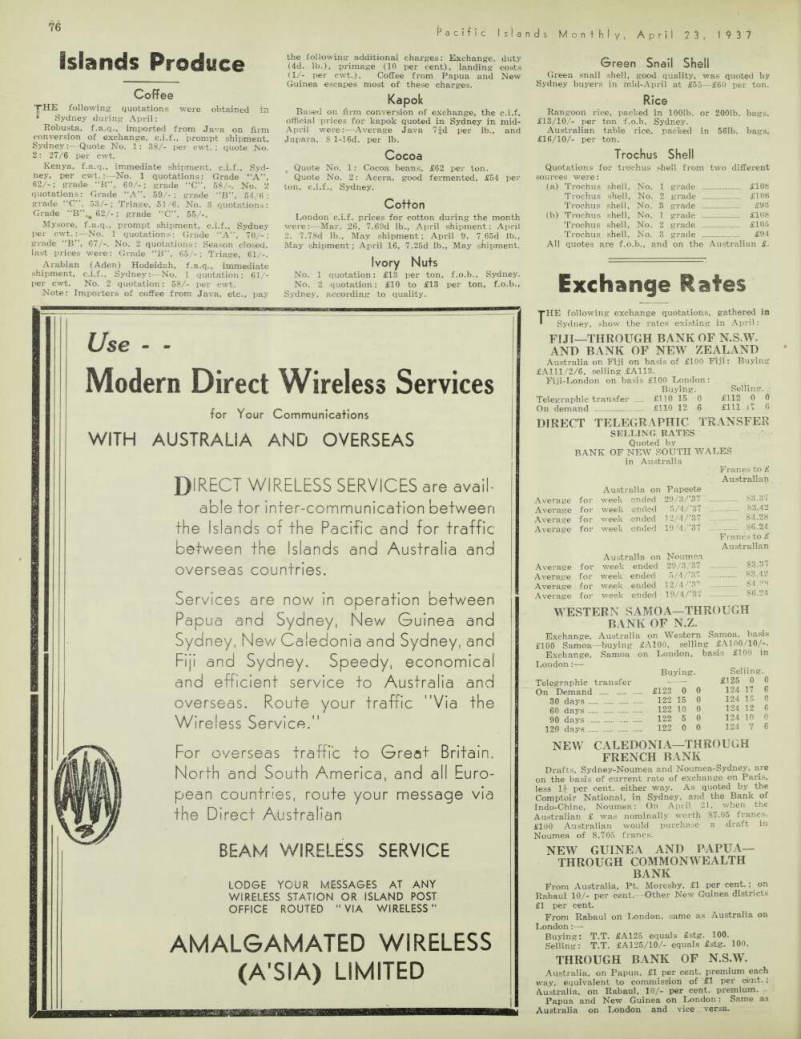
Coffee
THE following quotations were obtained in ® Sydney during April: Robusta, f.a.q., imported from Java on firm conversion of exchange, c.i.f., prompt shipment.
Sydney:—Quote No. 1: 38/- per cwt.; quote No. 2: 27/6 per cwt.
Kenya, f.a.q., immediate shipment, c.i.f., Syd ney. per cwt.:—No. 1 quotations: Grade “A”, 62/-; grade “B”. 60/-; grade “C”, 58/-. No. 2 quotations: Grade “A”, 59/-; grade “B”, 54/6; grade “C”, 53/-; Triage, 51/6. No. 3 quotations: Grade “8”, % 62/-; grade “C”. 55/-.
Mysore, f.a.q., prompt shipment, c.i.f., Sydney per cwt.:—No. 1 quotations: Grade “A”, 70/-; grade “B”, 67/-. No. 2 quotations: Season closed, last prices were: Grade “B”, 65/-; Triage, 61/-.
Arabian (Aden) Hodeidah, f.a.q., immediate shipment, c.i.f., Sydney:—No. 1 quotation: 61/per cwt. No. 2 quotation: 58/- per cwt.
Note: Importers of coffee from Java, etc., pay
the following additional charges: Exchange, duty (4d. lb.), primage (10 per cent), landing costs (1/- per cwt.). Coffee from Papua and New Guinea escapes most of these charges.
Kapok
Based on firm conversion of exchange, the c.i.f. official prices for kapok quoted in Sydney in mid- April were: —Average Java 7|d per lb., and Japara, 8 l-16d. per lb.
Cocoa
, Quote No. 1: Cocoa beans, £62 per ton.
Quote No. 2: Accra, good fermented, £54 per ton, c.i.f., Sydney.
Cotton
London c.i.f. prices for cotton during the month were: —Mar. 26, 7.69 d lb., April shipment; April 2. 7.78 d lb., May shipment: April 9, 7 65d lb..
May shipment; April 16, 7.25 d lb.. May shipment.
Ivory Nuts
No. 1 quotation: £l3 per ton, f.0.b., Sydney.
No. 2 quotation: £lO to £l3 per ton, f.0.b., Sydney, according to quality.
Green Snail Shell
Green snail shell, good quality, was quoted by Sydney buyers in mid-April at £55 —£60 per ton.
Rice
Rangoon rice, packed in 1001 b. or 2001 b. bags, £l3/10/- per ton f.o.b. Sydney.
Australian table rice, packed in 561 b. bags, £l6/10/- per ton.
Trochus Shell
Quotations for trochus shell from two different sources were: (a) Trochus shell. No. 1 grade £lOB Trochus shell, No. 2 grade £lO6 Trochus shell. No. 3 grade £93 (b) Trochus shell. No. 1 grade £lOB Trochus shell, No. 2 grade £lO5 Trochus shell. No. 3 grade £94 All quotes are f.0.b., and on the Australian £.
Exchange Rates
THE following exchange quotations, gathered in Sydney, show the rates existing in April:
Fiji—Through Bank Of N.S.W.
And Bank Of New Zealand
Australia on Fiji on basis of £lOO Fiji; Buying £Alll/2/6, selling £AII3.
Fiji-London on basis £lOO London: Buying. Selling. .
Telegraphic transfer £llO 15 0 £ll2 0 0 On demand £llO 12 6 £lll J 7 6
Direct Telegraphic Transfer
Selling Rates
Quoted by
Bank Of New South Wales
in Australia Franes to £ Australian Australia on Papeete Average for week ended 29/3/’37 83.37 Average for week ended 5/4/’37 - 83.42 Average for week ended 12/4/’37 84.28 Average for week ended 19/4/’37 86.24 Francs to £ Australian Australia on Noumea Average for week ended 29/3/37 83.37 Average for w T eek ended 5/4/’37 83.42 Average for week ended 12/4 / ’3' 7 84.28 Average for week ended 19/4/’37 86.24
Western Samoa—Through
Bank Of N.Z.
Exchange, Australia on Western Samoa, basis £lOO Samoa —buying £AIOO, selling £AIOO/10/-.
Exchange, Samoa on London, basis £lOO in London:—
New Caledonia—Through
French Bank
Drafts, Sydney-Noumea and Noumea-Sydney, are on the basis of current rate of exchange on Paris, less 1J per cent, either way. As quoted by the Comptoir National, in Sydney, and the Bank of Indo-Chine, Noumea: On April 21, when the Australian f was nominally worth 87.05 francs. £lOO Australian would purchase a draft in Noumea of 8,705 francs.
New Guinea And Papua
Through Commonwealth
Bank
From Australia, Pt. Moresby, £1 per cent.; on Rabaul 10/- per cent.—Other New Guinea districts £1 per cent.
From Rabaul on London, same as Australia on London: — Buying: T.T. £AI2S equals £stg. 100.
Selling: T.T. £AI2S/10/- equals £stg. 100.
Through Bank Of N.S.W.
Australia, on Papua, £1 per cent, premium each way, equivalent to commission of £1 per cent.; Australia, on Rabaul, 10/- per cent, premium.
Papua and New Guinea on London: Same as Australia on London and vice versa.
Buying. Selling.
Telegraphic transfer £125 0 0 On Demand £123 0 0 124 17 6 30 days - 122 15 0 124 15 0 60 days - 122 10 0 124 12 6 90 days 122 5 0 124 10 0 120 days - 122 0 0 124 7 6
Advertisements & other items, p. 78 (1 item)
Modern Direct Wireless Services
Use - -
for Your Communications
WITH AUSTRALIA AND OVERSEAS
DiRECT WIRELESS SERVICES are avail-
able tor inter-communication between the Islands of the Pacific and for traffic between the Islands and Australia and overseas countries.
Services are now in operation between Papua and Sydney, New Guinea and Sydney, New Caledonia and Sydney, and Fiji and Sydney. Speedy, economical and efficient service to Australia and overseas. Route your traffic "Via the Wireless Service."
For overseas traffic to Great Britain.
North and South America, and all European countries, route your message via the Direct Australian
BEAM WIRELESS SERVICE
LODGE YOUR MESSAGES AT ANY
WIRELESS STATION OR ISLAND POST
OFFICE ROUTED "VIA WIRELESS"
AMALGAMATED WIRELESS
(A'SIA) LIMITED
S£
Market Quotations
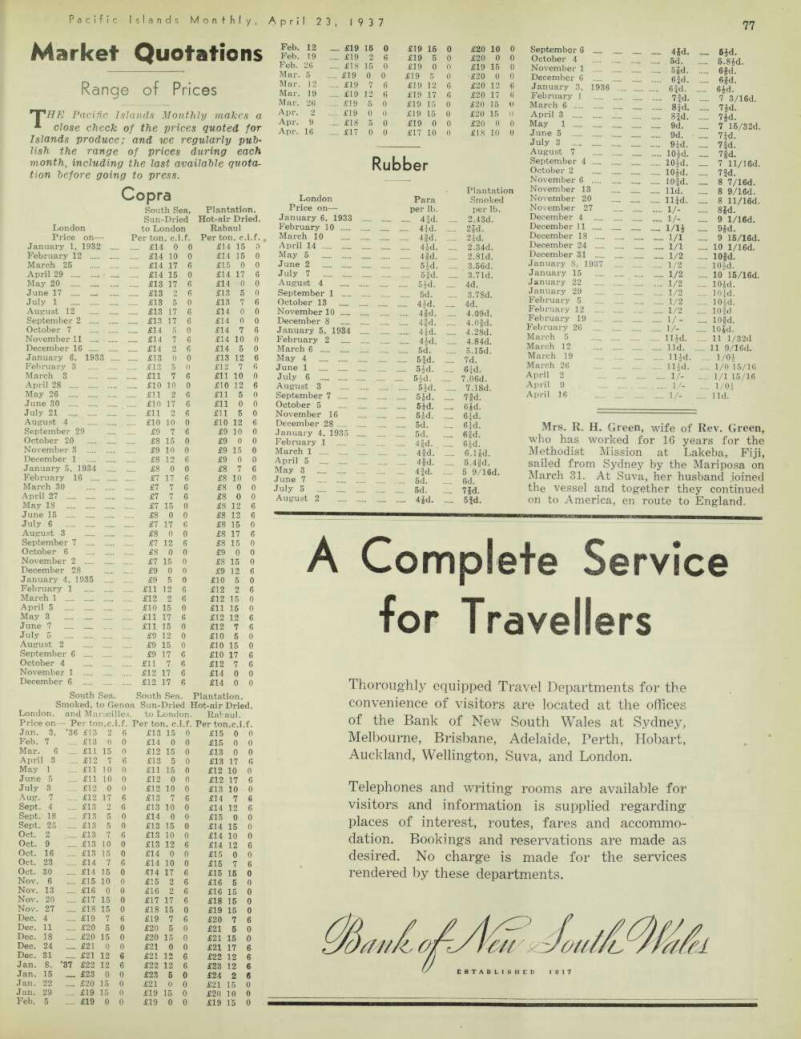
Range of Prices
r T*HE Pacific Islands Monthly makes a * close check of the prices quoted for Islands produce; and we regularly pub lish the range of prices during each month , including the last available quotOr tion before going to press.
Copra
Rubber
Mrs. R. H. Green, wife of Rev. Green, who has worked for 16 years for the Methodist Mission at Lakeba, Fiji, sailed from Sydney by the Mariposa on March 31. At Suva, her husband joined the vessel and together they continued on to America, en route to England.
September 6 ... - 4|d. 6id.
October 4 • ... 5d. 5.8id.
November 1 — 5 id. «|d.
December 6 6|d. 6fd.
January 3, 1936 6^d. 6id.
February 1 ... 7 |d. 7 3/16d.
March 6 ... 8|d. 7id.
April 3 ... — 8 |d. 7id.
May 1 ..._ 9d. 7 15/32d.
June 5 ... — 9d. 7id.
July 3 ... — 9|d. 7|d.
August 7 ... 10id. 7fd.
September 4 ... 10id. 7 H/16d.
October 2 ... 10id. 7|d.
November 6 10|d. 8 7/16d.
November 13 — lid. 8 9/16d.
November 20 ... ... ll|d. 8 H/16d.
November 27 — 1/- 8|d.
December 4 ... — 1/- 9 l/16d.
December 11 — 1/1* 9id.
December 18 — 1/1 9 15/16d.
December 24 1/1 10 l/16d.
December 31 — 1/2 10gd.
January 8. 1937 ... 1/2 lOid.
January 15 1/2 10 15/16d.
January 22 ... 1/2 10id.
January 29 1/2 10id.
February 5 ... 1/2 10.Id.
February 12 ... 1/2 10|d February 19 1/- 10|d.
February 26 ... 1/- 10|d.
March 5 ... Hid. 11 l/32d March 12 ... Hd. 11 9/16d.
March 19 ... Hid. ■ i/oi March 26 Hid. 1/0 15/16 April 2 ... ... -... 1/- 1/1 15/16 April 9 ... 1/l/0i April 16 1/lid.
Feb. 12 £19 15 0 £19 15 0 £20 10 0 Feb. 19 £19 2 6 £19 5 0 £20 0 0 Feb. 26 £18 15 0 £19 0 0 £19 15 0 Mar. 5 £19 0 0 £19 5 0 £20 0 0 Mar. 12 £19 7 6 £19 12 6 £20 12 6 Mar. 19 £19 12 6 £19 17 6 £20 17 6 Mar. 26 £19 5 0 £19 15 0 £20 15 0 Apr. 2 £19 0 0 £19 15 0 £20 15 0 Apr. 9 £18 5 0 £19 0 0 £20 0 0 Apr. 16 £17 0 0 £17 10 0 £18 10 0
London Price on— January 6, 1933 Para per lb. 4 2d. ...
Plantation Smoked per lb. 2.43d.
February 10 -... 42 d 2|d.
March 10 m 2id.
April 14 „ ... 4|d. ... 2.34d.
May 5 ... 4 2d 2.81d.
June 2 ... 5 2d 3.56d.
July 7 5|d 3.71d.
August 4 -... 5 |d 4d.
September 1 5d 3.78d.
October 13 — 42d. 4d.
November 10 ... 4fd 4.09d.
December 8 4 2d. ... 4.0|d.
January 5, 1934 — 4|d. ... 4.28d.
February 2 ... ... 4|d. ..._ 4.84d.
March 6 ... ... 5d 5.15d.
May 4 ... 53d 7d.
June 1 ... 5|d 6|d.
July 6 ... 52d. 7.06d.
August 3 ... 5|d. ... 7.18d.
September 7 5 |d. ... 7|d.
October 5 — 5id. 6|d.
November 16 ...~ 5|d 6id.
December 28 ... 5d. 6 jd.
January 4, 1935 ... 5d. 6|d.
February 1 ... 4 |d 6|d.
March 1 ... 4|d 6.lid.
April 5 ...„ 4|d 5.4§d.
May 3 ..._ 4 fd. ... 5 9/16d.
June 7 5d. ... 6d.
July 5 ... 5d 7|d.
August 2 •— ... 4|d 5fd.
South Sea, Plantation, Sun-Dried Hot-air Dried, London to London Rabaul Price on- Per ton, c.i.f.
Per ton, c. .i.f.
January 1, 1932 £14 0 0 £14 15 0 February 12 ... ... £14 10 0 £14 15 0 March 25 £14 17 6 £15 0 0 April 29 £14 15 0 £14 17 6 May 20 ; ... £13 17 6 £14 I 0 0 June 17 ... £13 2 6 £13 5 0 July 1 ... £13 5 0 £13 1 7 6 August 12 £13 17 6 £14 . 0 0 September 2 ... £13 17 6 £14 0 0 October 7 ... £14 5 0 £14 7 6 November 11 ... £14 7 6 £14 10 0 December 16 ... £14 2 6 £14 5 0 January 6, 1933 .. £13 0 0 £13 12 6 February 3 .. £12 5 0 £12 7 6 March 3 „ £11 7 6 £11 10 0 April 28 ..._ ... . £10 10 0 £10 12 6 May 26 .. £11 2 6 £11 5 0 June 30 ... .. £10 17 6 £11 0 0 July 21 . £11 2 6 £11 5 0 August 4 £10 10 0 £10 12 6 September 29 £9 7 6 £9 10 0 October 20 £8 15 0 £9 0 0 November 3 ... £9 10 0 £9 15 0 December 1 £8 12 6 £9 0 0 January 5, 1934 £8 0 0 £8 7 6 February 16 ... £7 17 6 £8 10 0 March 30 £7 7 6 £8 0 0 April 27 ... ... ... £7 7 6 £8 0 0 May 18 £7 15 0 £8 12 6 June 15 £8 0 0 £8 12 6 July 6 ... £7 17 6 £8 15 0 August 3 ... £8 0 0 £8 17 6 September 7 £7 12 6 £8 15 0 October 6 £8 0 0 £9 0 0 November 2 £7 15 0 £8 15 0 December 28 £9 0 0 £9 12 6 January 4, 1935 £9 5 0 £10 5 0 February 1 ™ . £11 12 6 £12 2 6 March 1 £12 2 6 £12 15 0 April 5 £10 15 0 £11 15 0 May 3 „ £11 17 6 £12 12 6 June 7 £11 15 0 £12 7 6 July 5 ... £9 12 0 £10 5 0 August 2 £9 15 0 £10 15 0 September 6 £9 17 6 £10 17 6 October 4 £11 7 6 £12 7 6 November 1 £12 17 6 £14 0 0 December 6 £12 17 6 £14 0 0 South Sea.
South Sea. Plantation.
Smoked, to Genoa Sun-Dried Hot-air Dried, London, and Marseille.' ?. to London.
Rabaul.
Price on— Per ton.c.i.f.
Per ton, c. i.f.
Per ton.c.i.f.
Jan. 3, '36 £13 2 6 £13 15 0 £15 0 0 Feb. 7 £13 0 0 £14 0 0 £15 0 0 Mar. 6 £11 15 0 £12 15 0 £13 0 0 April 3 ... £12 7 6 £13 5 0 £13 17 G May 1 £11 10 0 £11 15 0 £12 10 0 June 5 £11 10 0 £12 0 0 £12 17 6 July 3 £12 0 0 £12 10 0 £13 10 0 Aug. 7 £12 17 6 £13 7 6 £14 7 6 Sept. 4 £13 2 6 £13 10 0 £14 12 6 Sept. 18 £13 5 0 £14 0 0 £15 0 0 Sept. 25 £13 5 0 £13 15 0 £14 15 0 Oct. 2 ... £13 7 6 £13 10 0 £14 10 0 Oct. 9 £13 10 0 £13 12 6 £14 12 6 Oct. 16 ... £13 15 0 £14 0 0 £15 0 0 Oct. 23 ... £14 7 6 £14 10 0 £15 7 6 Oct. 30 ... £14 15 0 £14 17 6 £15 15 0 Nov. 6 £15 10 0 £15 2 6 £16 5 0 Nov. 13 ... £16 0 0 £16 2 6 £16 : 15 0 Nov. 20 ... £17 15 0 £17 17 6 £18 15 0 Nov. 27 £18 15 0 £18 15 0 £19 ; 15 0 Dec. 4 „.. £19 7 6 £19 7 6 £20 7 6 Dec, 11 ... £20 5 0 £20 5 0 £21 5 0 Dec. 18 ... £20 15 0 £20 15 0 £21 15 0 Dec. 24 £21 0 0 £21 0 0 £21 17 6 Dec. 31 ._ £21 12 6 £21 12 6 £22 12 6 Jan. 8, ’37 £22 12 6 £22 12 6 £23 12 6 Jan. 15 £23 0 0 £23 5 0 £24 2 6 Jan. 22 ... £20 15 0 £21 0 0 £21 15 0 Jan. 29 £19 15 0 £19 15 0 £20 10 0 Feb. 5 £19 0 0 £19 0 0 £19 15 0
Advertisements & other items, p. 79 (1 item)
for Travellers
A Complete Service
Thoroughly equipped Travel Departments for the convenience of visitors are located at the offices of the Bank of New South Wales at Sydney, Melbourne, Brisbane, Adelaide, Perth, Hobart, Auckland, Wellington, Suva, and London.
Telephones and writing rooms are available for visitors and information is supplied regarding places of interest, routes, fares and accommodation. Bookings and reservations are made as desired. No charge is made for the services rendered by these departments. & ouut,
ESTABLISHED
I) 1 7
Shipping Services in the Pacific
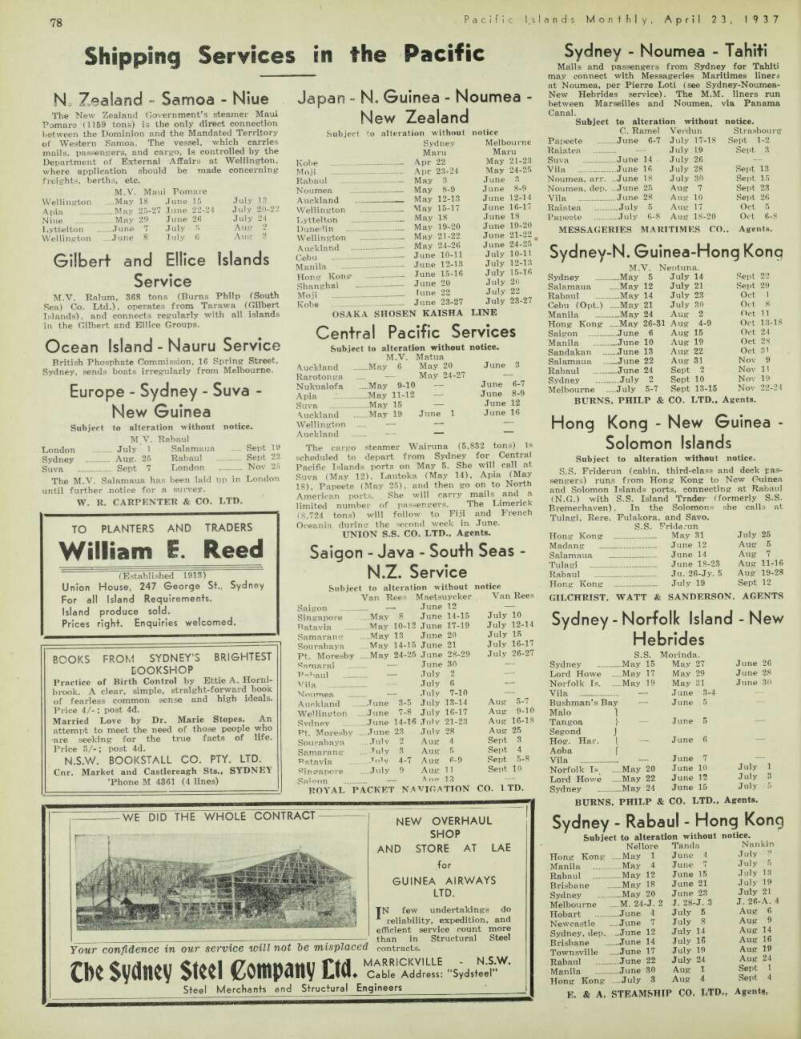
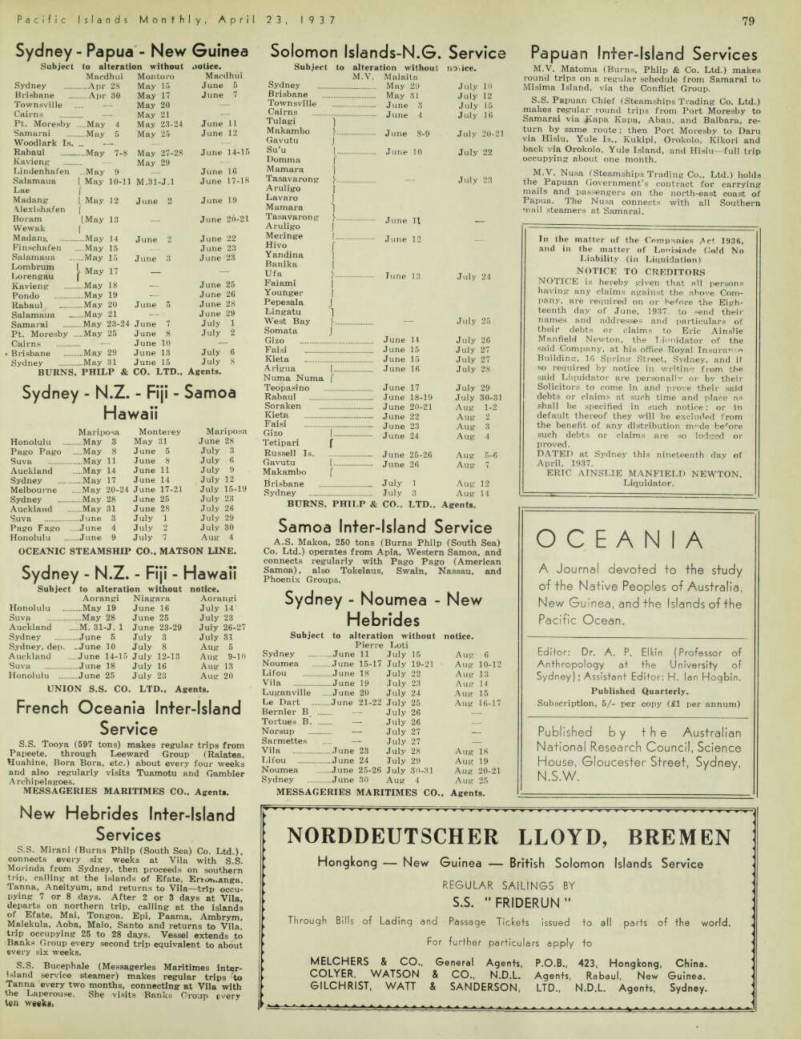
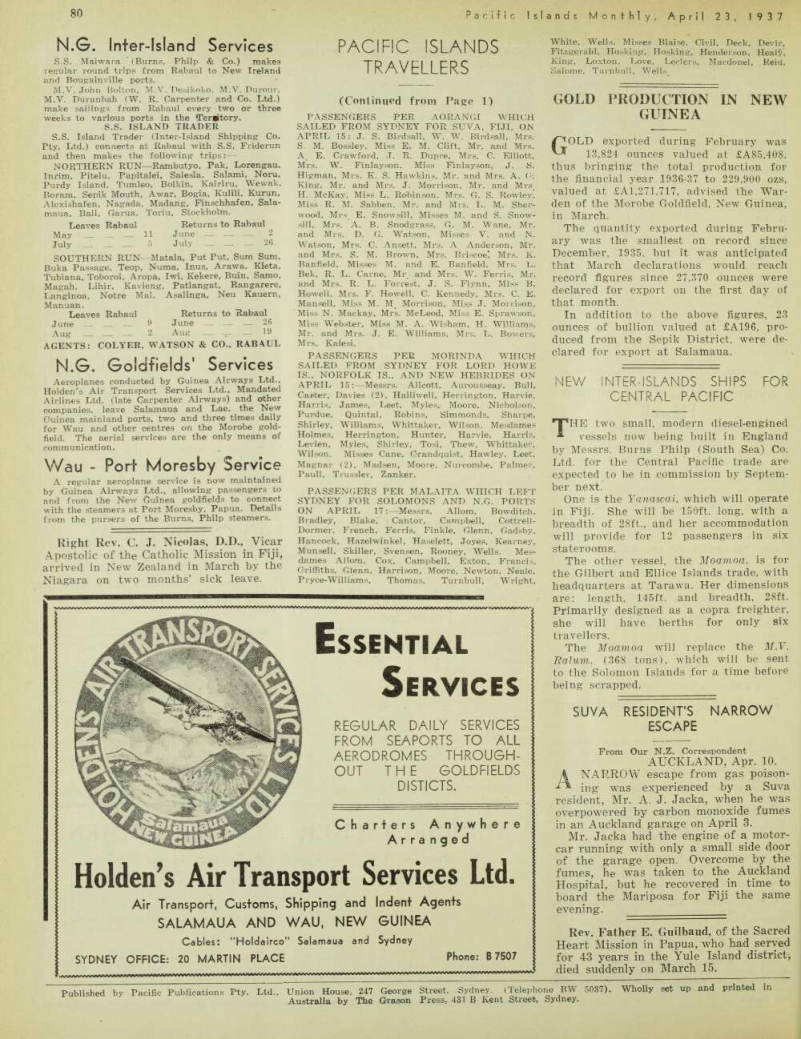
N. Zealand - Samoa - Niue
The New Zealand Government’s steamer Maui Pomare (1159 tons) is the only direct connection between the Dominion and the Mandated Territory of Western Samoa. The vessel, which carries mails, passengers, and cargo, is controlled by the Department of External Affairs at Wellington, where application should be made concerning freights, berths, etc.
M.V. Maui Pomare Wellington May 18 June 15 July 13 Apia May 25-27 June 22-24 July 20-22 Niue May 29 June 26 July 24 Lyttelton June 7 July 5 Aug 2 Wellington June 8 July 6 Aug 3
Gilbert and Ellice Islands
Service
M.V. Ralum, 368 tons (Burns Philp (South Sea) Co. Ltd.), operates from Tarawa (Gilbert Islands), and connects regularly with all islands in the Gilbert and Ellice Groups.
Ocean Island - Nauru Service
British Phosphate Commission, 16 Spring Street, Sydney, sends boats irregularly from Melbourne.
Europe - Sydney - Suva -
New Guinea
Subject to alteration without notice.
M V. Rabaul London July 1 Salamaua Sept 19 Sydney Aug. 25 Rabaul Sept 23 Suva Sept 7 London Nov 25 The M.V. Salamaua has been laid up in London until further notice for a survey.
W. R. Carpenter & Co. Ltd.
Japan - N* Guinea - Noumea - New Zealand
Central Pacific Services
Subject to alteration without notice.
M.V. Matua Auckland May 6 May 20 June 3 Rarotonga May 24-27 Nukualofa May 9-10 June 6-7 Apia May 11-12 June 8-9 Suva May 15 June 12 Auckland May 19 June 1 June 16 Wellington Auckland The cargo steamer Wairuna (5,832 tons) is scheduled to depart from Sydney for Central Pacific Islands ports on May 5. She will call at Suva (May 12). Lautoka (May 14), Apia (May 18), Papeete (May 25), and then go on to North American ports. She will carry mails a limited number of passengers. The Limerick (8.724 tons) will follow to Fiji and French Oceania during the second week in June.
Union S.S. Co. Ltd., Agents.
Saigon - Java - South Seas - N.Z. Service
Sydney - Noumea - Tahiti
Mails and passengers from Sydney for Tahiti may connect with Messageries Maritimes liners at Noumea, per Pierre Loti (see Sydney-Noumea- New Hebrides service). The M.M. liners run between Marseilles and Noumea, via Panama Canal.
Sydney-N. Guinea-Hong Kong
Hong Kong - New Guinea -
Solomon Islands
Subject to alteration without notice.
S.S. Friderun (cabin, third-class and deck pas sengers) runs from Hong Kong to New Guinea and Solomon Islands ports, connecting at Rabaul (N.G.) with S.S. Island Trader (formerly S.S.
Bremerhaven). In the Solomons she calls at Tulagi, Rere, Fulakora, and Savo.
Sydney - Norfolk Island - New Hebrides
Sydney - Rabaul - Hong Kong
Subject t o alteration without notice Sydney Melbourne Maru Maru Kobe Apr 22 May 21-23 Moji Apr 23-24 May 24-25 Rabaul May 3 June 3 Noumea May 8-9 June 8-9 Auckland May 12-13 June 12-14 Wellington May 15-17 June 16-17 Lyttelton May 18 June 18 Dunedin May 19-20 June 19-20 Wellington May 21-22 June 21-22 m Auckland May 24-26 June 24-25 Cebu — June 10-11 July 10-11 Manila - June 12-13 July 12-13 Hong Kong June 15-16 July 15-16 Shanghai June 20 July 2fl Tune 22 July 22 Kobe June 23-27 July 23-27
Osaka
Shosen Kaisha
Line
Subject to alteration without notice Van Rees Maetsuycker Van Rees Saigon — June 12 Singapore May 8 June 14-15 July 10 Ratavia May 10-12 June 17-19 July 12-14 Samaranc May 13 June 20 July 15 Sourabaya May 14-15 June 21 July 16-17 Pt. Moresby May 24-25 June 28-29 July 26-27 Samarai — June 30 Pobaul — July 2 Vila £ — July 6 Noumea — July 7-10 Auckland June 3-5 July 13-14 Aug 5-7 Wellington June 7-8 July 16-17 Aug 9-10 Svdnev June 14-16 July 21-23 Aug 16-18 Pt. Moresby June 23 July 28 Aug 25 Sourabaya July 2 Aug 4 Sept 3 Samarang ... July 3 Aug 5 Sept 4 Patavia July 4-7 Aug 6-9 Sept 5-8 Singapore July 9 Aug 11 Sept 10 Sa’gon — A no- 13
Royal Packet Navigation
Co. 1 Td.
Subject to alteration without notice.
C. Ramel Verdun Strasbourg Papeete ...June 6-7 July 17-18 Sept 1-2 Raiatea — July 19 Sept 3 Suva ..June 14 July 26 Vila June 16 July 28 Sept 13 Noumea, arr. ...June 18 July 30 Sept 15 Noumea, dep. ...June 25 Aug 7 Sept 23 Vila ..June 28 Aug 10 Sept 26 Raiatea ...July 5 Aug 17 Oct 5 Papeete Aug 18-20 Oct 6-8
Messaceries Marit1Mes Co.. Agents.
M.V. Neptuna.
Sydney ...May 5 July 14 Sept 22 Salamaua ...May 12 July 21 Sept 29 Rabaul ...May 14 July 23 Oct 1 Cebu (Opt.) ... ...May 21 July 30 Oct 8 Manila ...May 24 Aug 2 Oct 11 Hong Kong ... ...May 26-31 Aug 4-9 Oct 13-18 Saigon ..June 6 Aug 15 Oct 24 Manila ..June 10 Aug 19 Oct 28 Sandakan .— ..June 13 Aug 22 Oct 31 Salamaua .— ..June 22 Aug 31 Nov 9 Rabaul ..June 24 Sept 2 Nov 11 Sydney ...July 2 Sept 10 Nov 19 Melbourne July 5-7 Sept 13-15 Nov 22-24
Burns.
Philp & Co. Ltd.,
Agents.
S.S. Fride.'un Hong Kotik May 31 July 25 Madang June 12 Aug 5 Salamaua June 14 Aug 7 Tulagi June 18-23 Aug 11-16 Rabaul Ju. 26-Jy. 5 Aug 19-28 Hong Kong - July 19 Sept 12
Gilchrist,
Watt & Sanderson.
Agents
Sydney s.s. .May 15 Morinda.
May 27 June 26 Lord Howe May 17 May 29 June 28 Norfolk Is May 19 May 31 June 30 Vila — June 3-4 — Bushman’s Bay — June 5 —*
Halo 1
Tangoa )■ June 5 — Segond J Hog. Har. 1 June 6 — Aoba f Vila June 7 — Norfolk Is May 20 June 10 July 1 Lord Howe May 22 June 12 July 3 Sydney .May 24 June 15 July 5
Burns.
Philp
& Co. Ltd.,
Agents.
Subject to alteration without notice.
Nellore Tanda Nankin Hong Kong; May 1 J une 4 July ?
Manila May 4 June 7 July 5 Rabaul May 12 June 15 July 13 Bi’isbane May 18 June 21 July 19 Sydney May 20 June 23 July 21 Melbourne M. 24-J. 2 J. 28-J. 3
J. 2G-A. 4
Hobart June 4 July 5 Aug 6 Newcastle June 7 July 8 Aug 9 Sydney, dep. ...June 12 July 14 Aug 14 Brisbane June 14 July 15 Aug 16 Townsville June 17 July 19 Aug 19 Rabaul June 22 July 24 Aug 24 Manila June 30 Aug 1 Sept 1 Honpr Kong July 3 Aug 4 Sept 4 E. & A,
Steamship Co, Ltd
Agent?.
Sydney - Papua - New Guinea
Sydney - N.Z. - Fiji - Samoa Hawaii
Sydney - N.Z. - Fiji - Hawaii
French Oceania Inter-Island
Service
5.5. Tooya (597 tons) makes regular trips from Papeete. through Leeward Group (Raiatea, Huahine, Bora Bora, etc.) about every four weeks and also regularly visits Tuamotu and Gambier Archipelagoes.
Messageries Maritimes Co., Agenti.
New Hebrides Inter-Island
Services
5.5. Mirani (Burns Philp (South Sea) Co. Ltd.), connects every six weeks at Vila with S.S.
Morinda from Sydney, then proceeds on southern trip, calling at the islands of Efate. Ertim.anga, Tanna, Aneityum, and returns to Vila—trip occu pying 7 or 8 days. After 2 or 3 days at Vila, departs on northern trip, calling at the islands of Efate, Mai, Tongoa. Epi, Paama, Ambrym.
Malekula, Aoba, Malo, Santo and returns to Vila, trip occupying 25 to 28 days. Vessel extends to Banks Group every second trip equivalent to about every six weeks. 5.5. Buoephale (Messageries Maritimes inter island service steamer) makes regular trips to Tanna every two months, connecting at Vila with the Laperouse. She visits Banks Group every ten weeks,
Solomon Islands-N.G. Service
Samoa Inter-Island Service
A.S. Makoa, 250 tons (Burns Philp (South Sea) Co. Ltd.) operates from Apia, Western Samoa, and connects regularly with Pago Pago (American Samoa), also Tokelaus, Swain, Nassau, and Phoenix Groups.
Sydney - Noumea - New
Hebrides
Papuan Inter-Island Services
M.V. Matoma (Burns, Philp & Co, Ltd.) makes round trips on a regular schedule from Samarai to Misima Island, via the Conflict Group.
S.S. Papuan Chief (Steamships Trading Co. Ltd.) makes regular round trips from Port Moresby to Samarai via JCapa Kapa, Abau, and Baibara, re turn by same route ; then Port Moresby to Daru via Hisiu, Yule Is., Kukipi, Orokolo, Kikori and back via Orokolo. Yule Island, and Hisiu—full trip occupying about one month.
M.V. Nusa (Steamships Trading Co,, Ltd.) holds the Papuan Government’s contract for carrying mails and passengers on the north-east coast of Papua. The Nusa connects with all Southern mail steamers at Samarai.
Subject to alteration without notice.
Sydney Macdhui Apr 28 Montoro May 15 May 17 May 20 Macdhui June 5 Brisbane Townsville Apr 30 June 7 Cairns May 21 May 23-24 May 25 Pt. Moresby Samarai Woodlark Is.
May 4 May 5 June 11 June 12 Rabaul Kavieng Lindenhafen Salamaua May 7-8 ...May 9 I May 10-11 May 27-28 May 29 M.31-J.1 June 14-15 June 16 June 17-18 Lae ( Madang \lexishafen [ May 12 f June 2 June 19 Boram Wewak [May 13 ( — June 20-21 Madang May 14 June 2 June 3 June 3 June 7 June 22 Finschafen Salamaua Lombrum Lorengau Kavieng — Pondo Rabaul Salamaua Samarai May 15 May 15 J= May 17 ...May 18 May 19 May 20 May 21 May 23-24 June 23 June 23 June 25 June 26 June 28 June 29 July 1 Pt. Moresby .
Cairns ...
May 25 June 8 June 10 July 2 • Brisbane — Sydney
Burns,
...May 29 May 31
, Philp &
June 18 June 15
Co. Ltd.,
July 6 July 8 Agents.
Mariposa Monterey Mariposa Honolulu May 3 May 31 June 28 Pago Pago May 8 June 5 July 3 Suva June 8 July 6 Auckland May 14 June 11 July 9 Sydney May 17 June 14 July 12 Melbourne May 20-24 June 17-21 July 15-19 Sydney May 28 June 25 July 23 Auckland -May 31 June 28 July 26 Suva .
June 3 July 1 July 29 Pago Pago June 4 July 2 July 30 Honolulu June 9 July 7 Aug 4
Oceanic Steamship Co., Matson Line.
Subject to alteration without notice.
Aorangi Niagara Aorangi Honolulu May 19 June 16 July 14 Suva ...May 28 June 25 July 23 Auckland M. 31-J. 1 June 23-29 July 26-27 Sydney June 5 July 3 July 31 Sydney, dep. -June 10 July 8 Aug 5 Auckland June 14-15 July 12-13 Aug 9-10 Suva June 18 July 16 Aug 13 Honolulu — June 25 July 23 Aug 20
Union S.S. Co. Ltd., Agents.
Subject Sydney to alteration without M.V. Malaita Mav 29 novice.
July July July Tnl v 10 Brisbane May 81 June 3 J une 4 June 8-9 12 Townsville 15 Cairns Tulagi Makambo ) 1- «i uiy July 1 D 20-21 Gavutu Su’u [ June 10 Tulv 99 Domma Mamara Tasavarontr r s- July 23
Aruligo (
Lavaro )
Mamara ]
Tasavarong }■
Aruligo J
Merinere 1. .. — June U Hivo Yandina Banika June 12 Ufa Tune 13 T, ,],, O A Faiami Younger
Pepesala J
Lingatu 1
West Bay [■ J my July 25
Somata J
Gizo June 14 July 26 Faisi Kieta Arigua — June 15 June 15 June 16 July 27 July 27 Julv 28 Numa Numa f Teonasino June 17 July July Aug Aug Aug 29 Rabaul Soraken Kieta Faisi June 18-19 June 20-21 June 22 June 23 June 24 June 25-26 June 26 30-31 1-2 2 3 4 5-6 Gizo Aug Aug
Tetipari f
Russell Is Gavutu 1
Makambo f
Aug Brisbane July 1 Aug Aug Agents. 12 Sydney July 3 14
Burns,
Philp &
Co.. Ltd.,
Subject to alteration without notice.
Pierre Loti Sydney ...June 11 July 15 Auk 6 Noumea June 15-17 July 19-21 Auk 10-12 Lifou ...June 18 July 22 Auk 13 Vila ...June 19 July 23 Auk 14 LuKanville ... June 20 July 24 Auk 15 Le Dart ...June 21-22 July 25 Auk 16-17 Bernier B ... — July 26 Tortues B. ™ — July 26 Nor sup — July 27 Sarmettes — July 27 Vila ... June 23 July 28 Auk 18 Lifou ...June 24 July 29 Auk 19 Noumea ...June 25-26 July 30-31 Auk 20-21 Sydney ...June 30 Auk 4 Auk 25
Messageries Maritimes Co.
Agents.
N.G. Infer-lsland Services
5.5. Maiwara ‘ (Burns, Philp & Co.) makes regular round trips from Rabaul to New Ireland and Bougainville ports.
M.V. John Bolton, M.V. Desikoko. M.V. Durour, M.V. Duranbah (W. R. Carpenter and Co. Ltd.) make sailings from Rabaul every two or three weeks to various ports in the Ter*tory.
S.S. Island Trader
5.5. Island Trader (Inter-Island Shipping Co.
Pty. Ltd.) connects at Rabaul with S.S. Friderun and then makes the following trips:— NORTHERN RUN—Rambutyo, Pak, Lorengau.
Inrim, Pitelu, Papitalei, Salesia. Salami, Noru, Purdy Island, Tumleo, Boikin, Kairiru, Wewak, Boram, Sepik Mouth, Awar, Bogia, Kulili, Kurun, Alexishafen, Nagada, Madang, Finschhafen, Sala maua, Bali, Garua, Toriu, Stockholm.
Leaves Rabaul Returns to Rabaul May - - 11 June - 2 July - 5 July 26 SOUTHERN RUN—Matala, Put Put, Sum Sum, Buka Passage, Teop, Numa, Inus, Arawa, Kieta, Tubiana, Toboroi, Aropa, Iwi, Kekere, Buin, Samo, Magah, Lihir, Kavieng, Patlangat, Rangarere, Langinoa, Notre Mai, Asalinga, Neu Kauern, Manuan.
Leaves Rabaul Returns to Rabaul June 9 June - 26 Aug - 2 Aug 19
Agents: Colyer, Watson & Co.. Raba.Ul
N.G. Goldfields' Services
Aeroplanes conducted by Guinea Airways Ltd., Holden’s Air Transport Services Ltd.. Mandated Airlines Ltd. (late Carpenter Airways) and other companies, leave Salamaua and Lae, the New Guinea mainland ports, two and three times daily for Wau and other centres on the Morobe gold field. The aerial services are the only means of communication.
Wau - Port Moresby Service
A regular aeroplane service is now maintained by Guinea Airways Ltd., allowing passengers to and from the New Guinea goldfields to connect with the steamers at Port Moresby, Papua. Details from the pursers of the Burns, Philp steamers.
Right Rev. C. J. Nicolas, D.D., Vicar Apostolic of the Catholic Mission in Fiji, arrived in New Zealand in March by the Niagara on two months’ sick leave.
Advertisements & other items, pp. 80-82 (2 items)
78
Pacific l.slands Monthly, April 23, 1937
Che Sydney Steel Company Dd. M c tKd™«=
TO PLANTERS AND TRADERS
William E. Reed
(Established 1913) Union House, 247 George St., Sydney For all Island Requirements.
Island produce sold.
Prices right. Enquiries welcomed.
BOOKS FROM SYDNEY’S BRIGHTEST
BOOKSHOP
Practice of Birth Control by Ettie A. Hornibrook. A clear, simple, straight-forward book of fearless common sense and high ideals.
Price 4/-; post 4d.
Married Love by Dr, Marie Slopes. An attempt to meet the need of those people who are seeking for the true facts of life.
Price 3/-; post 4d.
N.S.W. BOOKSTALL CO. PTY. LTD.
Cnr. Market and Castlereagh Sts., SYDNEY ’Phone M 4361 (4 lines)
WE DID THE WHOLE CONTRACT
u i Your confidence in our service will not be misplaced
NEW OVERHAUL
SHOP
AND STORE AT LAE
for
GUINEA AIRWAYS
LTD.
TN few undertakings do * reliability, expedition, and efficient service count more than in Structural Steel contracts.
Che Sydney Steel Company Dd. M c tKd™«= Steel Merchants and Structural Engineers
In the matter of the Companies .Act 1936, and in the matter of LoiMsdado Gold No Liability (in Liquidation)
NOTICE TO CREDITORS
NOTICE is hereby given that all persons having: any claims against the above Company, are required on or before the Eighteenth day of June, 1937. to send their names and addresses and particulars of their debts or claims to Eric Ainslie Manfield Newton, the Lirmidator of the said Company, at his office Royal Insuran-o Building, 16 Spring Street, Sydney, and if so required by notice in writing from the said Liquidator are personally or by their Solicitors to come in and prove their said debts or claims at such time and place as shall be specified in such notice: or in default thereof they will be excluded from the benefit of any distribution m-de before such debts or claims are so lodged or proved.
DATED at Sydney this nineteenth day of April, 1937.
ERIC AINSLIE MANFIELD NEWTON.
Liquidator.
OCEANIA
A Journal devoted to the study of the Native Peoples of Australia, New Guinea, and the Islands of the Pacific Ocean.
Editor: Dr. A. P. Elkin (Professor of Anthropology at the University of Sydney); Assistant Editor: H. lan Hogbin.
Published Quarterly.
Subscription, 5/- per copy (£1 per annum) Published by the Australian National Research Council, Science House, Gloucester Street, Sydney,
N.S.W.
NORDDEUTSCHER LLOYD, BREMEN
Hongkong New Guinea British Solomon Islands Service
REGULAR SAILINGS BY
S.S. " FRIDERUN "
Through Bills of Lading and Passage Tickets issued to all parts of the world.
For further particulars apply to MELCHERS & CO., General Agents, P. 0.8., 423, Hongkong, China.
COLYER, WATSON & CO., N.D.L. Agents, Rabaul, New Guinea.
GILCHRIST, WATT & SANDERSON, LTD., N.D.L. Agents. Sydney.
m %
Essential
Services
REGULAR DAILY SERVICES
FROM SEAPORTS TO ALL
AERODROMES THROUGH-
OUT THE GOLDFIELDS
DISTICTS.
Charters Anywhere Arranged
Holden’s Air Transport Services Ltd.
Air Transport, Customs, Shipping and Indent Agents
SALAMAUA AND WAU, NEW GUINEA
Cables: "Holdairco" Salamaua and Sydney SYDNEY OFFICE: 20 MARTIN PLACE Phone: B 7507
Gold Production In New
Guinea
GOLD exported during February was 13,824 ounces valued at £A85,408, thus bringing the total production for the financial year 1936-37 to 229,900 ozs, valued at £A1,271,717, advised the War den of the Morobe Goldfield, New Guinea, in March.
The quantity exported during Febru ary was the smallest on record since December, 1935. but it was anticipated that March declarations would reach record figures since 27,370 ounces were declared for export on the first day of that month.
In addition to the above figures, 23 ounces of bullion valued at £AI96, pro duced from the Sepik District, were de clared for export at Salamaua.
New Inter-Islands Ships For
Central Pacific
TPHE two small, modern diesel-engined * vessels now being built in England by Messrs. Burns Philp (South Sea) Co.
Ltd. for the Central Pacific trade are expected to be in commission by Septem ber next.
One is the Yanamai, which will operate in Fiji. She will be 150 ft. long, with a breadth of 28ft., and her accommodation will provide for 12 passengers in six staterooms.
The other vessel, the Moamoa, is for the Gilbert and Ellice Islands trade, with headquarters at Tarawa. Her dimensions are: length, 145 ft. and breadth, 28ft.
Primarily designed as a copra freighter, she will have berths for only six travellers.
The Moamoa will replace the M.V.
Ralum , (368 tons), which will be sent to the Solomon Islands for a time before being scrapped.
Suva Resident's Narrow
Escape
From Our N.Z. Correspondent
Auckland, Apr. 10.
A NARROW escape from gas poison ing was experienced by a Suva resident, Mr. A. J. Jacka, when he was overpowered by carbon monoxide fumes in an Auckland garage on April 3.
Mr. Jacka had the engine of a motor car running with only a small side door of the garage open. Overcome by the fumes, he was taken to the Auckland Hospital, but he recovered in time to board the Mariposa for Fiji the same evening.
Rev. Father E. Guilbaud, of the Sacred Heart Mission in Papua, who had served for 43 years in the Yule Island district-, died suddenly on March 15.
Advertisements & other items, pp. 82-84 (2 items)
Pacific Islands
80
Pacific Islands Monthly, April 23, 1937
TRAVELLERS
(Continued from Page 1)
Published by Pacific Publications Pty. Ltd.. Union House, 247 George Street. Sydney. (Telephone BW 5037). Wholly set up and printed in Australia by The Grason Press, 431 B Kent Stx’eet, Sydney.
Guinea Airways L™
AERIAL TRANSPORT ESTABLISHED
NEW GUINEA COLD INDUSTRY
S INCE 1927, when the development of the Morobe Goldfield commenced, the European population of the Territory has been trebled. The new industry has increased the Empire's gold production by nearly £2,000,000 per annum, and has added enormously to the trade turnover of New Guinea.
Only Aerial Transport makes this possible. There is no road between the Goldfields and the coast. Aeroplanes, running on Regular Schedules, without Difficulty or Delay, carry in Dredges, Crushing Mills, Cyanidinc Plants, Motor Vehicles, Hydro - Electric Machinery, Thousands of Passengers, and every kind of goods needed by a large and growing European community.
UINEA AIRWAYS LTD. were
G established In 1927; and they have grown in the following way, until they are to-day the largest freightcarrying service in the world: wmmmmmrn Every kind of cargo, frozen meat to hydro-electric machinery, is carried In to the Morobe goldfield centres by Guinea Airways machines. In this photograph, taken in December, 1936, a motor-car is shown, while being unloaded on the Wau Aerodrome. operate regular air services in New Guinea and Papua; they use over 50 Aerodromes and Landing-grounds in the two Territories.
GUINEA AIRWAYS L™
LAE • SALAMAUA
HEAD OFFICE:
BROOKMAN BUILDINGS
GRENFELL STREET
ADELAIDE, S.A.
BRANCH
NEW GUINEA OFFICE:
LAE
MANDATED TERRITORY OF
NEW GUINEA
OFFICES AND AGENTS AT WAU. SALAMAUA. PORT MORESBY. AND SYDNEY
rn w X 111 v; \ '■> Vv
CANNOT AFFECT
- NX
OKA
at Si t m Vj/ OU,II J* o»
r^ T °OTH £ CO.UMITE^
mm Resch’s lager is protected by the §p>df^ crown seal It refreshes and invigorates you as no flavour, because it is fully protected other drink can. In Resch’s Lager, against climatic conditions by the speci- VOU get all the original freshness and ally designed “Spot” Crown Seal.
RESCHWUIiER