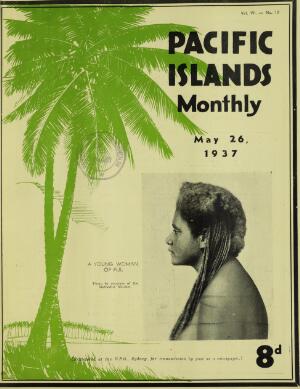
Pacific
Ilands
Monthy
Vol. VII. No. 10
May 26, 19 3 7
iKebisfWrAi at the G.P.0. . Sydney, /or transmission by post as a newspaper.']
8 d
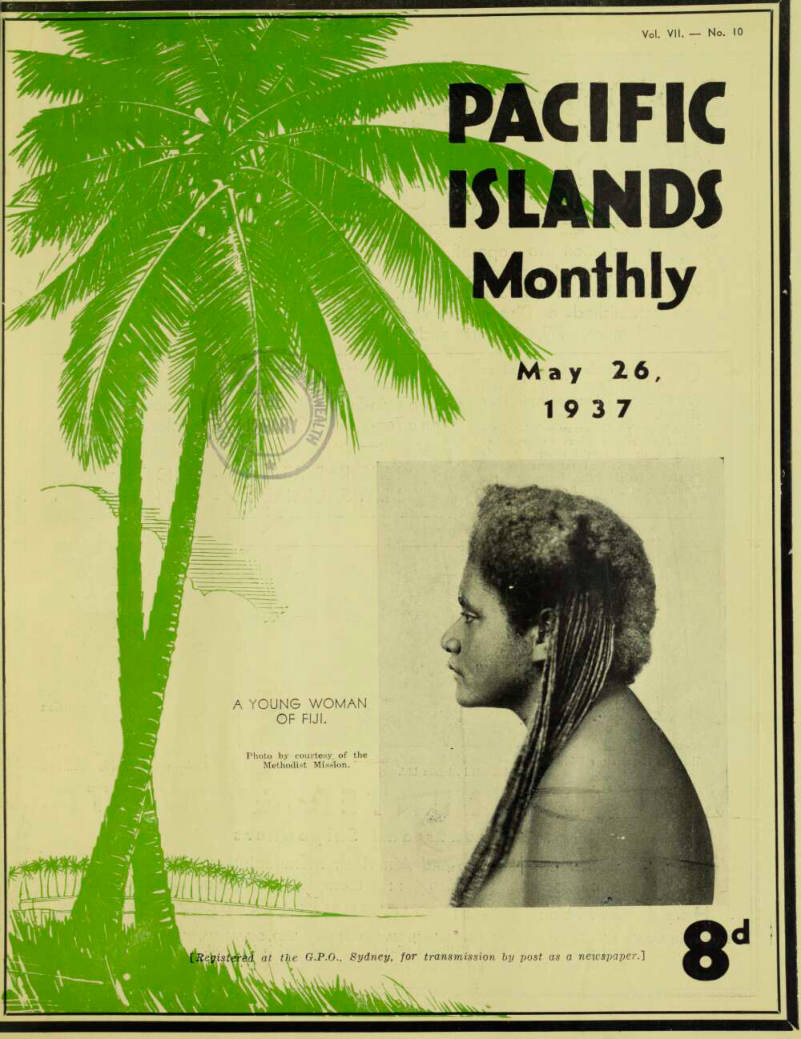
A Young Woman
Of Fiji.
Photo by courtesy of the Methodist Mission.
Advertisements & other items, p. 2 (2 items)
Pacific I jnds h/.drl hly, May 26, 1937
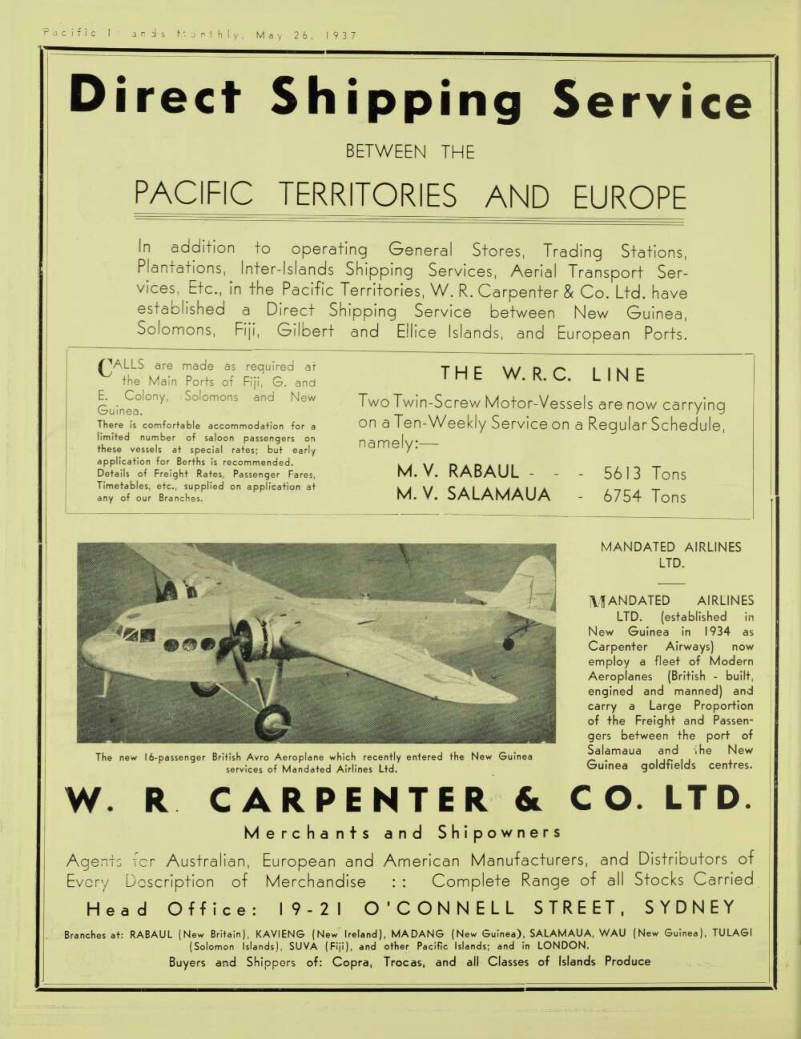
Direct Shipping Service
BETWEEN THE
PACIFIC TERRITORIES AND EUROPE
In addition to operating General Stores, Trading Stations, Plantations, Inter-Islands Shipping Services, Aerial Transport Services, Etc., in the Pacific Territories, W. R. Carpenter & Co. Ltd. have established a Direct Shipping Service between New Guinea, Solomons, Fiji, Gilbert and Ellice Islands, and European Ports.
THE W. R. C. LINE
Two Twin-Screw Motor-Vessels are now carrying
on aTen-Weekly Serviceon a Regular Schedule,
namely:—
M. V. RABAUL - - - 5613 Tons
M. V. SALAMAUA - 6754 Tons
MANDATED AIRLINES
LTD.
MANDATED AIRLINES
LTD. (established in New Guinea in 1934 as Carpenter Airways) now employ a fleet of Modern Aeroplanes (British - built, engined and manned) and carry a Large Proportion of the Freight and Passengers between the port of Salamaua and ihe New Guinea goldfields centres.
W. R CARPENTER & CO. LTD.
Merchants and Shipowners
Agents for Australian, European and American Manufacturers, and Distributors of Every Description of Merchandise : : Complete Range of all Stocks Carried
Head Office: 19-21 O’CONNELL STREET, SYDNEY
Branches at: RABAUL (New Britain), KAVIENG (New Ireland), MADANG (New Guinea), SALAMAUA, WAU (New Guinea), TULAGI (Solomon Islands), SUVA (Fiji), and other Pacific Islands; and in LONDON.
Buyers and Shippers of: Copra, Trocas, and all Classes of Islands Produce ... m The new 16-passenger British Avro Aeroplane which recently entered the New Guinea services of Mandated Airlines Ltd. £JALLS are made as required at the Main Ports of Fiji, G. and E. Colony, Solomons and New Guinea.
There is comfortable accommodation for a limited number of saloon passengers on these vessels at special rates; but early application for Berths is recommended.
Details of Freight Rates, Passenger Fares, Timetables, etc., supplied on application at any of our Branches.
Pacific Islands Travellers
Passengers Per Macdhui Which
Reached Sydney From Papua And New
GUINEA ON APRIL 22: Messrs. Adams, Brown, Butcher, Ellis, Fleming, Fryer, Fahey, Grove, Gamble, Hudson, Hart, Hogan, Hides, Ifould, Jones, Johns, Knight, Kirkham, King, Lumley, Lyons. Lucas, Macdonald, Miskin, Morton, Molloy, Momsen, Moen, Moon, Nevitt, Parry, Pomeroy, Plumb, P rector, Robinson, Robinson, Robinson, Firth-Smith, Stathers, Thomson, Weldon, Winter ford. Wyatt, White. Mesdames Brown, de la Try Ellis. Car lick. Overall, Lucas, Laird, Hogan, Moen, Preston, Robinson, Rouse. Misses Abel, Glasson, Preston, Sherry, Stevens.
Passengers Per Macdhui Which Left
Sydney For Papua And New Guinea
ON APRIL 28: Messrs. Thornley, Jameson, Gibson, Clay, Boyle, Conwell, Vivian, Bayer, Silvester, Crofton, Robins, Bignold, Griffiths, Bonney, McLaren, Moore, Pennington Coutts, Wainwright, Harvey, Lark, Farley, Newbound, Middleton, McAlpine, Wauchope (2), Normoyle, Clunn, Taylor. Parkes, Rudnagel, Maguire, Ellis, Washington, Bryen, Ellis, Herket, Wilson, Miller, Bye. Thomson, Gilmour, Haycroft, Stewart, Lyon, Turner, Stamper, Dao. Kruttschnitt, Lee, Collopy, Foil, Miller, Griffiths (2), Paton, Washington, Harvey, Jones, Penny, Ritchie, Tudor, Corrig han, Tudor, Bertelmier, MacGregot, Fuggle,
Taylor, Davies, Fryer, Brock. Mesdames Richard son, James, Clay, Johanson, Silvester, Crofton, Wakefield, Bignold, Whitton, Gemmell, Austen, Vesper, Harris, Evensen, Vieusseux, Hill, Parkes, Rudnagel, Harvey, Wauchope, Ellis, Parry (2), Murphie, Venning, Theckston, Schmidt, Reid, Ellis, Pye, Sinclair, Collopy, Kruttschnitt, Fraser, Foil, Brewster, Corrighan, Tudor, Day. Misses Duncan, Hurd, Franklin, Irwin, Niven, Higgins, Farley, Sigamatu, Pearce, Coulson, Helm, God dard, Clements, Rothwell, Parry (2), Birchley, King.
Passengers Per Morinda Which Ar
Rived In Sydney From N. Hebrides,
NORFOLK IS.. AND LORD HOWE IS.. ON MAY 7 : Messrs. Allcott, Aurousseau, Barf, Chap man, Garrick, Coglan, Donkin, Davies, Dearberg, Delfendahl, Dicksen, Dixon, Ferrier, Grahame, Harvie, Haxby, Jackson, James, Jenkins, Jaede.
Johnston, McGrath, Nobbs, Ohlen, Poland, Quin tal, Robinson, Sanderson, Stock, Thompson, Weiss, Trai Yueh Chirao. Mesdames Carrick.
Coglan, Delfendahl, Dicksen, Dixon, Evans, Fox, Grahame, Hunter, Haxby, Jaede, Johnston, Kirby, Nobbs, O’Brien, Ohlen, Tosi, Thompson, Weath ered, Young. Misses Barnes, Cliff, Doepel (2), Elliott, Fox, Furness, Harris (2), Heath, Jones, Lang, Livingstone, Mullavey, Paris, Pauli, Rollo, Scobie, Watts, White. Wilson. Wines, Zanl er, Henriques, Hattersley.
Passengers Per Niagara Which Ar
RIVED IN SYDNEY FROM SUVA, FIJI. ON MAY 8: J. Birdsall, W. Birdsall, Miss A. Brailey, Miss B. Clift. F. Clapcott, Mrs. E. Corbett. Miss Corbett, B. Ford, J. Higman, Mr. and Mrs. G.
Hutchings. Misses G. and T. Hut-nhigs, Sister McCormack, Miss L. Robinson. J. H. Bales, A.
Elphice, S. Harris, J. Huggins. A. Sail. J. L.
Stark, Miss S. Tippett. Miss E. Giblin.
Passengers Per Montoro Which Ar
RIVED IN SYDNEY FROM PAPUA AND NEW (-'UINEA ON MAY 10: Messrs. Anderson, Buck ley, Boreham, Bland. Bourke, Couzens, Clarke.
Corbett. Delme-Radcliffe, Emerson, Foley. Gray.
Gallagher. Hanson, Havill, Kane. King, Lambert, Lang. Lewis. Livingstone. Lucas. Marshall, Mc- Gregor. Munro, McGrath. Murdok, Monte, th.
Neate, Noakes (2), Nelson, Nicholson. Piatt Russell, Render, Robson, loss Smith Owen- Turner, Victor. Whitwam, Ward- Williams. Mes dames Anderson. Boreham. Balmain, Bartlett, Eourke, Crawford, Gray, H-wi’l, Lambert. Lamb.
Lee, Murray. Nibloe. Neate. Wilkin. Misses Ballantyne, Cain. Flanagan, Maher. Mocatta.
(Continued On Page 80)
Mr. L. V. Waterhouse, technical direc tor of Bulolo Gold Dredging Ltd., has been elected a vice-president of the Australasian Institute of Mining and Metallurgy.
Passengers Per Niagara Which
SAILED FROM SYDNEY FOR SUVA, FIJI, ON 13: Mr * and Mrs - F - Exon, Misses Exon (2), Mr. and Mrs. C. Handly, R. J. Sand, S S Downes. A. E. C. Fuller. Mr. and Mrs F W Peel, Mr. and Mrs. B. H. Marks, Mr. and Mrs!
W A. Campbell. Miss A. Campbell. Mr. and Mrs.
J. Bailey. Mr. and Mrs. G. L. Robley. Mr. and Mrs. H. B. Bowen. Mr. and Mrs. C. B. Matthews, Mrs. L. Williams. Miss L. F. Williams. Miss B.
Brooke. Mr. and Mrs. E. J. Harding. Mr. and Mrs. E. J. Pratt. J. R. Donaldson, Mrs. E M Mune, Master A. J. Mune, Mrs. M. E. Horsfield Mrs. Tarrant, Mrs. M. Mumford. Mrs. Mcßean’
Mr. and Mrs. G. R. Robertson, R. C. Barclay,’
K. M. Graham, F. White, Mr. and Mrs G F Zillman, Mr. and Mrs. L. C. Seymour. Mr. 'and Mrs. P. E Whitehead, Mr. and Mrs. E. G. Keyte, Masters Keyte (2), Mr. and Mrs. R. S. M.
Southey, Mr. and Mrs. C. E. Thompson, Mrs. A.
Bray, Mrs. B. L. Nankivell, A. J. Carew, J. Dods Mrs. F. N. Olsen.
Passengers Per Montoro Which Left
SYDNEY FOR PAPUA AND N.G. ON MAY 15: Messrs. Carpenter, Flatten, Kerr, Marshall, Gal ton, Ringel, Pike. Streeter, Gribben, Clarke, Kemmis, Parnell, Saaw. Frew. Kenny, Parry.
Wyatt, Evans. Sibbald, Maxwell, Cameron, Lumley, Whiteman, Ferris, Farnsworth, Nevitt, Preece, Swinfield. May, McFlthinney, Stewart, Bliss, A anna, Blackmore, Todd, Ryan, Cruick shank, Theisen, Roberts, Wilson, Wainwright, Lane, Mulholland, Stevenson, Zaiattoro, Mason, Kaneko, Ferris, Sparkes, Christie, Moyle, Austin.
Mesdames Carpenter, Lockhart, Baird, Flatten, Johnson, Kerr, Lane, Galton, Ker, Bannon, Chester, Rankin, Wyatt, Murray, Cruickshank, Margetts, Whiteman, Ferris, Farnsworth, Bensley, Gemmell, Bliss, Dupain, Parry, Roberts, Ferris.
Misses Horton, Wilson, Cooper, Alldis, Traill, Bryson, Chadderton, Flannagan, Chaseling, Mc- Alister, Pritchard, Stokes, Prices, Mulholland.
Passengers Per Malaita Which
Reached Sydney From N.G. And Solo
MONS PORTS ON MAY 21: —Messrs. Allom, Goodyer, Ross, Allen, Bradley, Craig, Gunner, Harding, Higgins, Hill, Mapletoft, Martin, Mur phy, Pemberton, Quinton, Stevenson, Wenn, Wills.
Mesdames Allom, Ross, Exton, Harding, Maple toft, Martin, Murphy, Newton, Pemberton, Quin ton, Whybrow, Wills; Misses Healy, Hosking (2), Mac Donnell, Niau, Sherwin, Stead.
Advertisements & other items, p. 3 (1 item)
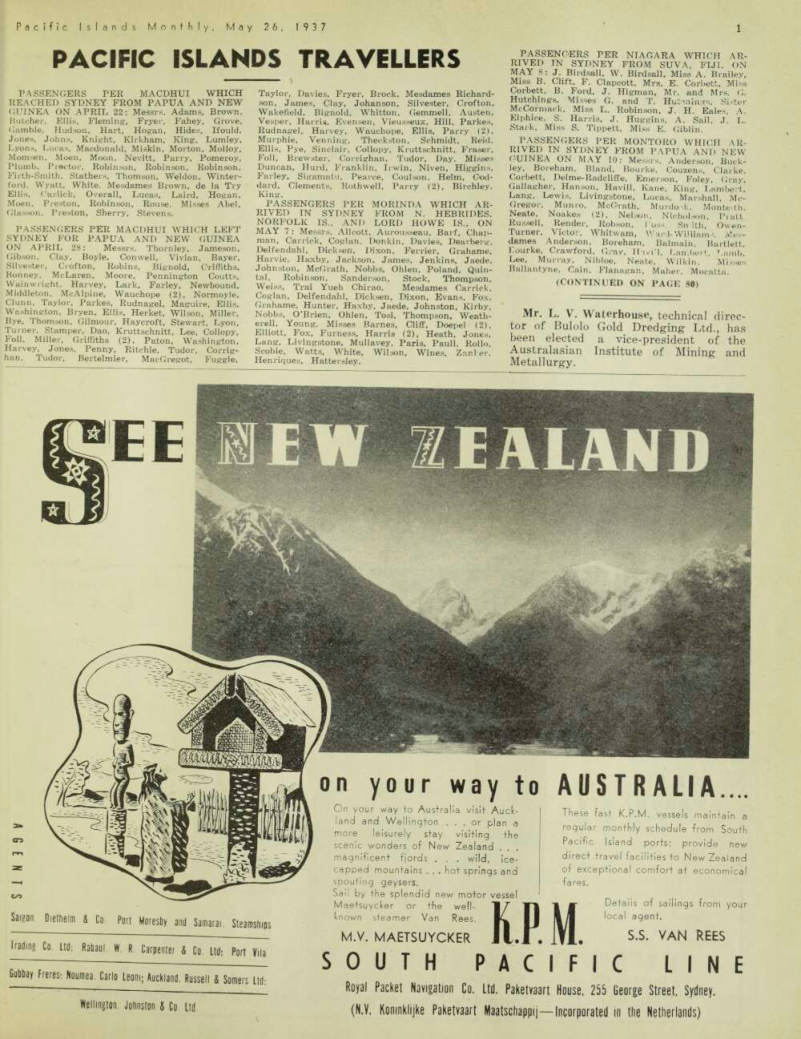
on your way to AUSTRALIA....
Saigon Diettielm & Co. Port Moresby and Samarai Steamships Trading Co Ltd; Rabaul. W. R. Carpenter & Co Ltd; Port Vila Gubbay Freres-, Noumea. Carlo Leoni; Auckland. Russell & Somers Ltd; Wellington. Johnston & Co. ltd
on your way to AUSTRALIA...
On your way to Australia visit Auckland and Wellington ... or plan a more leisurely stay visiting the scenic wonders of New Zealand , magnificent fjords . . , wild, icecapped mountains . . . hot springs and spouting geysers.
Sail by the splendid new motor vessel These fast K.P.M. vessels maintain a regular monthly schedule from South Pacific Island ports; provide new direct travel facilities to New Zealand of exceptional comfort at economical fares.
Details of sailings from yogr local agent.
S.S. VAN REES
Maetsuycker known steamer or the Van well- Rees.
MV. MAETSUYCKER
K.P M.
SOUTH PACIFIC LINE
Royal Packet Navigation Co. ltd. Paketvaart House. 255 George Street, Sydney. (N.V, Konmklljke Paketvaart Maatschappij—lncorporated In the Netherlands)
Advertisers
Amalgamated Wire less of Aust. Ltd. 76 Angus & Coote Ltd 41 Armidale School ... 15 Amott’s Biscuits 28 “Aspro” 31 Ausoline 54 Baker Ltd., W. Jno. 14 B. and S. Agency ... 12 Bank of N.S.W 77 Berger & Sons Ltd 27 Blau (Aust.) Robert 58 Brandt & Steele 23 Broomfields Ltd 48 Brunton’s Flour 39 Bullivants Ltd 49 Burns, Philp & Co. 2 Burns, Philp & Co. 75
B.P. (S.S.) Co 20
Buzacott Ltd 30, 51 Carpenter. W. R.
Limited ii Chapman & Sherack 18 Chemist - Michael, H. P 56 Chivers & Sons Ltd. 37 Clyde Engineering Co. Ltd 27 Coral Starch 38 Cosmopolitan Hotel 74 Crossle, Duff and Macintosh Ltd. _6B “Cuprinol” 54 “Cystex” 62 Dangar, Gedye and Mallock Ltd 67 Del Cott Pty. Ltd. ... 47 Dewar’s Whisky 12 Doan’s Pills 42 Docke, Carl Aug. „ 46 Donald, A. B. Ltd 66 Eaton, Ltd., J. W. 55 Electrolytic Co. Ltd. 68 Eno’s Fruit Salt 60 Excelsior Supply Co. 56 Expropriated Terri tories 80 Fairbanks - Morse Limited 73 “Fairholme” College 41 Finau, Wm 16
Fletcher & Sons 42 Florentine & Son 56 Ford. W. M. 54 “44 Macleay Street” 14 Foster Clark Ltd ... 36 Fox and Macgilly cuddy Ltd 52 Fryer, A. C 30 Garden Vale Pro ducts Ltd 38 Garrett & Davidson 71 Gillespie’s Flour 72 Grand Pacific Hotel 65 Grove & Sons, W. H. 22 Guinea Airways Limited iii Hallstrom, E 26 Halvorsen, L 61 Holbrook’s Ltd 39 Holdens Air T. Co. 80 Holmes & Co.. W. L. 20 Horne. W. & Co 64 Hotel Moresby 74
1.C.1.A.N.Z. Ltd 66
Jones &Co Ltd, H. 35 Jones & Rickard 45 Joubert & Joubert ... 58 Kodak Pty. Ltd - 16 Kopsen & Co Ltd ... 63 Kork-N-Seal Ltd 37 Lane & Girvan Ltd. 44 Levenson’s Radio 57 Levy, Sol 19 Lustre Ltd 25 McGowan & Co., A. 65 Mcllrath’s Ltd 24 McKay’s Bookstall ... 78 Maleham & Yeomans Limited 31 Master Sewing Machine Co 52 Maxwell Porter Ltd 55 Medical Supplies— Secura 58 Mint Stamp Co 18 Morris, Hedstrom Limited 64
N.D.L. 78
Nelson & Robertson Pty. Ltd 69, 71
Nestle’s Milk 40 Newland Bros. Ltd 43 Noyes Bros. Ltd _... 69 “Oceania” 21 Oxymel Oil and Paint Co. Ltd 61 Olsson, T. A 63 Pacific Islands Co. 59 Pacific Year Book ... 72 Papua Hotel, The ... 74 Partnership Wanted 51 Patterson & Stone 50 Philatelic Investment Trust - 20, 73 Pike Bros. Ltd 12 Pincombe, Syd. Ltd 22 Plantation For Sale 49 Position Wanted 73
Prescott Ltd 34 Price’s Radio Serv. 75 Prouds Ltd 17 Ran somes Sims and Jefferies Ltd 50 Reed, William E. ... 29 Reid. W. M. > 45 Return Thanks 13 Riverstone Meat Co. Ltd 29 Rohu, Sil 18 Royal Packet Co. 1
“R.U.R.” 64
Ruston & Hornsby ... 53 Scott’s Emulsion 25 Scott Ltd., J 48 Scott & Sons 50 Springwood L. Coll. 59
Stanley, Chris S 5 Stanley & Co 28 Steamships T. Co. ... 79 Sterling Varnish Co. 11 Sullivan Ltd., J. J. 26 Swallow & Ariell ... 34 Sydney Steel Co 68 Talkeries 74 Taubman’s Paints ... 44 Taylor & Co., A 71 “Tenax” Soap 13 Thompson’s Eng’r. & Pipe Co, Ltd 70 Tillock & Co. Ltd. 35 Tooheys Ltd 19 Tooth & Co. iv “Top Dog” Men’s Wear 31
Trufood 24 Vacuum Oil Co 32 Vincent’s A.P.C 17 Warburton Franki Ltd* 21 Webb & Co.. A 60 West, Harry 79 Weymark & Son 37 Wheeler, B. R 33 Wills. W. D. and H. 0.. Ltd 33 Williams Ltd., S. ... 45 Williams. W. H 50 Woods P’mint Cure 33 Wizard Lighting Co. 13 Wright &Co Ltd, E. 48 Wunderlich Ltd 55
Contents
Pacific Islands Travellers 1. 80
Idealists, Americans, and Proposed
Pacific Pact 3 Fiji’s Governor to Tour Pacific 4 New Bulolo Dredge 4 Relapse of Copra Market 5 Gov.-General’s Visit to Papua & N.G. 5 French Line for Tahiti 5 Sampans Seized in N. Caledonia 6 Early Tahiti Documents 6 Solomon Islands Gold 6 Air-mail Routes in Pacific 7 Missionary Murdered 7 Samoa’s Future 8 Gold Search in Strickland Area 8 Pt. Moresby Jottings 9 Queer Papuan Artifacts 10 Tropicalities 11 About Islands People 12 Those N.G. Pygmies 14 Legal Tangle over Ffrost Case 16 Judge Ayson Returning to N.Z. 17
Rabaul’s Aerodrome 18 Late Mr. R. P. Whitten (Papua) 19 Seaplanes in Western Papua 21 White Prestige in Danger in N.O. 22 Von Luckner’s Sextant 25 Vanilla Beans in Fr, Oceania 28 The Work of the N.M.P 30 The Search for Oil in Papua—Part IV 35 The Ethics of Cannibalism 43 Land Wanted in New Guinea 46 Valuable Plants of Fiji 47 Tonga’s Only Anglican Bishop 50 C.I. Oranges 51 Aimahle Josephine Massacre 53 Fashions for Islands Women 59 Pacific Missionary Conference 63 New Buildings for Suva 65 Pacific Is. Mining Notes 68 B.P.’s Annual Report 75 Produce and Exchange Quotations 76 Copra and Rubber Markets 77 South Seas Shipping Timetables 78
Advertisements & other items, p. 4 (1 item)
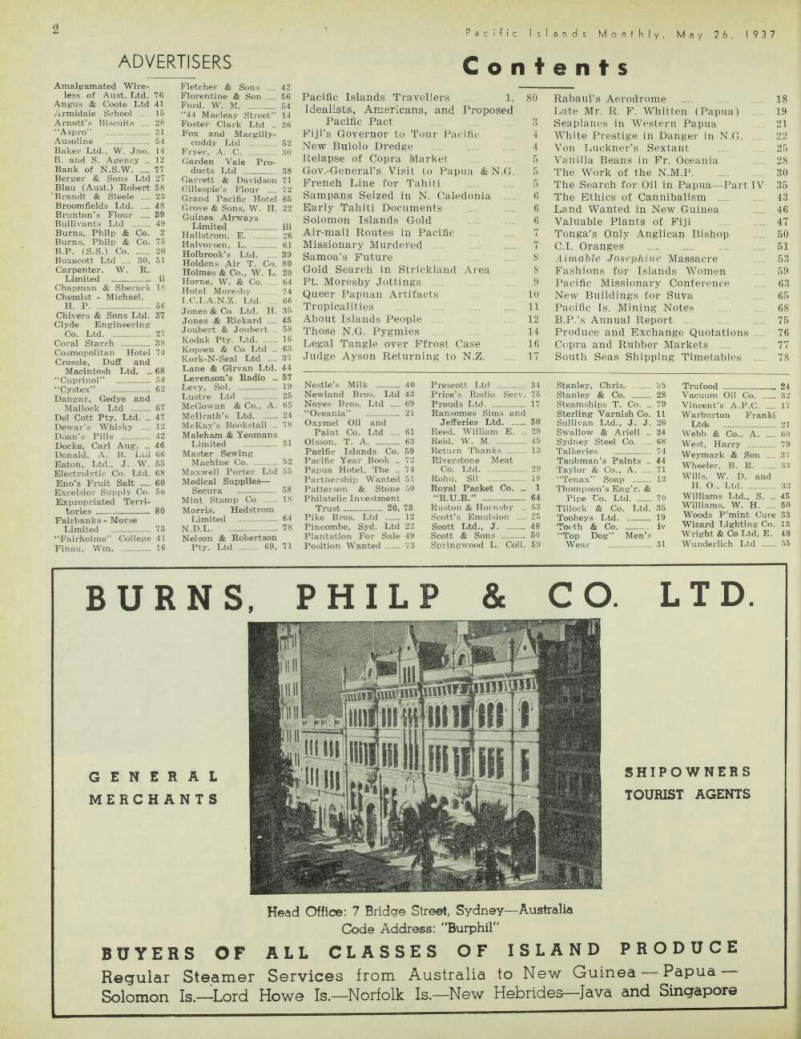
Burns, Philp & Co.
GENERAL
MERCHANTS
mu ro mm 111 ii r i mi uitifi i
SUii
LTD.
SHIPOWNERS
TOURIST AGENTS
Head Office: 7 Bridge Street, Sydney—Australia Code Address: "Burphil"
BUYERS OF ALL CLASSES OF ISLAND PRODUCE Regular Steamer Services from Australia to New Guinea Papua Solomon Is.—Lord Howe Is. —Norfolk Is.—New Hebrides —Java and Singapore
Pacific Islands Monthly
The Newspaper-Magazine of the South Seas [Registered at the G.P.0., Sydney for transmission by post as a newspaper .l
Published Once Each Month and Circulated in Australia and New Zealand and in the following Pacific Territories and Islands Groups:
Crown Colony of Fiji.
Australian Territory of Papua.
Mandated Territory (Australia) of New Guinea.
Bismarck Archipelago and Northern Solomon Islands.
Mandated Territory (Japan) of Marshall, Caroline and Marianna Islands.
French Territory of New Caledonia.
British and French Condominium of New Hebrides.
American Territory of Eastern Samoa.
American Territory of Guam.
Mandated Territory of Nauru.
British Crown Colony of Gilbert and Ellice Islands.
Mandated Territory (New Zealand) of Samoa.
British Solomon Islands Protectorate.
British Protectorate of Tongan Islands.
New Zealand Territory of Cook Islands.
Australian Territory of Norfolk Island.
French Colony of Oceania (Tahiti, etc.).
American Territory of Hawaiian Islands.
Owned and Produced by Pacific Publications Pty. Ltd., Union House, 247 (ieorge Street, Sydney.
Telephone Bw 6037
P.O. Box 8408 R
Registered Address of Telegrams, Radiograms, and Cables: “Pacpub,” Sydney.
Contributions
Articles, Stories, and Photqgraphs dealing with Pacific Islands subjects are invited, and will be paid for on publication at usual rates.
Subscription Rates
Per Annum, within British Empire, Prepaid, Post Free 8/- Per Annum, elsewhere, prepaid, Post Free 107- Single Copies Bd.
Editor and Publisher:
R. W. Robson. F.R.G.S.
Advertisements
Advertising rates furnished on application.
Colours, etc by Arrangement Process Blocks made at Advertiser’s expense when required. Screen, 100.
Changes of Advertising Copy should reach this Office by Bth of each month, otherwise previous advertisement may be repeated.
Agents
The following are authorised to receive subscrip tions for the Pacific Islands Monthly:— Islands Branches of Burns, Philp & Co. Ltd., and Burns Philp (South Sea) Co., Ltd.
Islands Branches of W. R. Carpenter & Co., Ltd.
All Branches of Morris. Hedstrom & Co., Ltd.
G. Thomas & Co., Rabaul, New Guinea.
Whitten Bros., Ltd., Samarai, Papua.
Steamships Trading Co., Papua. All Branches.
P. Costello, Suva, Fiji.
J. Muir, Suva, Fiji.
All Branches and Representatives of W. H. Grove and Sons, Ltd., Auckland, New Zealand.
Cook Islands Trading Co., Rarotonga, Cook Is.
A. C. Rowland. Papeete, Tahiti.
Representative in London: W. C. HARVEY, Coronation Building, 4 Lloyds Avenue, London, E.C.2. from whom may be obtained copies of Pacific Islands Monthly, Pacific Islands Year Book, advertising schedules, etc.
Vol. VIL, No. 10.
Sydney, May 26, 1937.
PHpp ( Bd> Per Copy - X riUU ( Prepaid: 8/- p.a.
Idealists, Americans and the Proposed
Pacific Pact
A PACIFIC PACT —“a regional pact of non-aggression, to which all countries in the Pacific would subscribe” —is the outstanding proposal of the British Imperial Conference, now in session.
The proposal was made by Mr. Lyons, Prime Minister of Australia.
At first, the idea was widely and warmly acclaimed. It was held to repre sent a method by which the British Empire and the United States could get together, protect their common interests in the Pacific—that is, uphold the status quo —and, maybe, make important tariff concessions to each other. It was thought that France, Holland and Portugal would join willingly in the Pact, and that Japan eventually would come in. The plan appeared to give shape to what most people, with logical and practical minds, have been thinking.
Then the academic idealists and the hair-splitters came into the picture, and began to batter the Lyons proposal. We have been told that “official opinion in Washington is cold”—the gentlemen there being of the opinion that the Washington Naval Agreement (dis carded and buried these two years past) and the Kellogg Pact (a most praise
worthy bit of idealism) would be quite sufficient for all genuine peace-seekers, if only they were supported in a sincere and proper manner.
Now the University professors are having their say. One, who was allowed to broadcast his Sunday-school arguments through the Australian radio network, wants to know how the incidence of the Pact would be defined —would it include China and Peru!—and how sanctions would be applied, and how could Japan be induced to enter. Another, equally futile, has suggested that the League of Nations—that lamented skeleton that still occasionally rattles its bones at Geneva —should be entrusted with the job of maintaining peace in the Pacific.
Why cannot American idealists and University philosophers get their feet down upon the hard earth and recognise brutal facts, and realise that neither logic, nor high aspiration, nor brotherly love will maintain peace in the Pacific, so long as there are countries in the Pacific which are under-populated and apparently occupiable, and other countries which are overcrowded to the point of suffocation ?
The outstanding, overwhelming factor
in the Pacific situation today is Japan.
Japan, judged by European standards, is an honourable nation—she has most scrupulously observed every treaty obli gation she ever entered into. But the Japan of today is not the Japan of yester day—she has become industrialised and gravely over-populated. She must have overseas trade, so that her swarming industrial population may be fed; and she must have new territory, to which her surplus people may be sent. We may not forget the logic of those facts.
The Elder Statesmen of Japan may desire international peace and harmony.
But they cannot ignore the ancient laws which have ruled humankind since the days of the jungle: an overcrowded nation, faced with the alternatives of suffocation and decay at home, or war abroad, takes its sword in hand and goes out to find new territory.
That is what Japan will do—would have done ere this, had it not been for her conviction that the Anglo-Saxon Powers will stand together in the Pacific.
Who but blind fools, or idealists with their heads in the clouds, or sheltered academic theorists who seem to think that the world is run on logic and reason and altruism, could fail to see the signs ?
Every month, in this journal, we report details of the outwards and southwards thrust of Japanese traders, fishers, poachers, colonisers, and seekers after raw materials. The Japanese, every day
now, are knocking at the doors of the Philippines, of Borneo, of the Dutch East Indies, of New Guinea. More than once recently, there has been something of menace in the Tokio announcements about Japan’s South Seas activities and aspirations.
We dare not ignore political conditions in Japan. The army and navy, whose policy is aggressive and expansionist, directly control the Government. But Parliament is controlled by the two great parties—Minseito (business and indus trial classes) and Seiyukai (landowners) —who will not form a Government, and the present Government can do little ex cept govern. In March, the army chiefs forced a general election, hoping thus to get control of Parliament. The elec tion, at the end of April, resulted: Min
seito, 179; Seiyukai, 175; Socialist, 37; Showakai (now the Government party), 19: others, 46.
But all the elements of an explosion are present in that political situation: and if the militarists ever,should get control, the repercussions in the Pacific would be quick, and very serious.
The European nations recognise Janan’s difficulties, and sympathise with them.
But—and here is another ancient, funda mental law of humankind!—self-preser vation is our first consideration. Once that is assured the nations, in confer ence, might try to find a way to provide for the clamorous needs of Japan’s ex panding trade and population.
We Pacific peoples must not —dare not —close our eyes against stark facts. Mr.
Lyons’s plan of a Pacific Pact is a simple acknowledgement of those facts, and an agreement that, for the preservation of our lives and homes, we shall stand together for the maintenance of the status quo. The plan is in danger of being wrecked by Americans and professors.
We cannot forget that it was an Ameri can professor who gave us the League of Nations—fathered by Woodrow Wil son, abandoned by the United States, adopted by John Bull, defended to the point of self-destruction by the British Empire, and finally left to bawl itself to death at Geneva, as a beautiful but useless example of impractical idealism.
Advertisements & other items, p. 6 (1 item)
N.G. Plantations For Sale
nULL details of plantations and vacant land ■ offered for sale in New Guinea by the Custodian of Expropriated Property are advertised on Page 80.
Lorry Accident In Samoa
From Our Own Correspondent
Apia, May 1.
ON April 27. when trying to avoid a pig in Afega village, eight miles west of Apia, a lorry loaded with cases of bananas capsized. Two Samoan banana-planters, Gafa and Sua, and the driver, Leslie Jessop, were seriously in jured. Gafa, aged 26, subsequently died, and Sua is not expected to live, Jessop is recovering.
Fiji's Governor
To Visit Hebrides, Solomons, and G. and E. Colony
From Our Own Correspondent.
Suva, May 6.
TO acquaint himself with the territories * under his jurisdiction as High Com missioner for the Western Pacific, Sir Arthur Richards, K.C.M.G., will sail from Suva on board H.M.B. Leith on June 15 on a tour of the Pacific.
Proceeding first to the New Hebrides, he will spend 12 days in the Condomi nium before leaving for Tulagi, 8.5.1.
After three weeks in the Solomons, he will then sail for the Gilbert and Ellice Islands Colony remaining there for an other three weeks.
His Excellency will return to Suva, via Rotuma, about the middle of August.
Described as “the first descendant of a Bounty mutineer ever to return to England from Pitcairn Island,” David Young, 61, arrived at Southampton in May, aboard the Arawa to attend the Coronation.
New Bulolo Dredge
Seven Now at Work or On Order
/~iN May 20, Mr. L. V. Waterhouse, technical director of Bulolo Gold Dredging Ltd., placed an order with Messrs. Poole and Steele, Sydney, for the hull and ship structure for No. 7 dredge.
It will be a replica of No. s—a5 —a large deep-digger.
The B.G.D. fleet of dredges is now as follows: Nos. 1, 2 and 3. —Now operating on Bulolo flats. Medium diggers.
No. 4.—Operating at Bulwa (north end of Bulolo flats). Medium digger.
No. 5. —Now being erected on Bulolo flats. Deep digger (80 feet).
No, 6. —Small dredge, now being con structed in Sydney and shipped to New Guinea, for work on area recently ac quired from Bulolo Deposits Ltd., near Wau. Replica of dredge at Asnazu, Colombia.
No. 7. —Just ordered, for Bulolo flats.
Replica of No. 5.
Advertisements & other items, p. 6 (1 item)
An Author's Islands Trials
"Morning, Mr. Philpotts! Need any more material for your travel book?"
Copra
The Relapse of the Market
THE copra market during recent weeks has been uncertain and unreliable.
The figures quoted in our market sum mary show that since mid-January the price has fallen by about £8 per ton. The fall since early April has been between £4 and £5 per ton.
At first sight, this seems mysterious and calamitous, as there apparently is no outstanding cause for this sagging of the market. The real explanation, however, probably is that the prices that ruled between January and March, owing to a peculiar set of circumstances, were far higher than were warranted, and the latest figures represent a settling down to established conditions.
Figures published elsewhere indicate the extent to which United States pur chases affect the market; and it is quite clear that economic conditions generally in U.S.A. —especially in relation to vege table and mineral oils —have been very much disturbed.
When it was announced recently that U.S.A. would not accept further gold consignments, the prices on the world’s commodities markets fell alarmingly.
They have not recovered —although the U.S. banks have emphatically denied the report, and President Roosevelt has offi cially declared that he has no intention of reducing the price of gold.
Our mid-April reports from London show uncertainty regarding stocks of oil and fats in America, and also uncertainty about the total of the Antarctic whale oil catch. Otherwise, there is no factor to explain any wide disorganisation of the copra market and we cannot discern any cause for serious concern on the part of planters.
Timber Ship on Solomon Is.
Reef
A FTER having been stuck fast on a re ef at Vanikoro, Solomon Islands, for four days, the steamer Erica reached Sydney on May 21. She will enter dock for inspection.
The Erica (5,112 tons), which is owned by South African Railways and Har bours, arrived at Vanikoro early on April 26, and at about 7 a.m., on entering the passage, struck a portion of the point of the reef, and went up to nearly two-thirds of the ship’s length, on the coral reef.
Many efforts were made to get the ship off and, next morning at 3 a.m., the cargo consisting of sawn timber and 200 logs from the Philippines, was jettisoned.
Great assistance was rendered by the employees and management of the Vani koro Kauri Timber Co., who worked in shifts day and night to lighten the ship, and tow the logs away from her side.
Both anchors, after much trouble and with the aid of derricks, were placed in position on the reef, and within two days the ship was floated off.
Governor-General
Visit To Papua and New Guinea
A VISIT to Papua and New Guinea in July and August by the Governor- General of Australia (Lord Gowrie) has been arranged. He will be accompanied by Lady Gowrie.
The visit will coincide with the visit of the Australian fleet to Papuan and New Guinea ports.
The whole of the Australian fleet will not make the cruise, as H.M.A.B. Sydney is to be docked for repairs to her pro pellers, damaged during her N'Z. cruise.
The cruiser Canberra will lead the squad ron, and the cruise is described as “the most important winter event yet arran ged by the Australian navy.” The squadron will go first to Darwin, and thence to Papuan ports. It is not yet known whether the Governor-General will go all the way, or will join the war ships at Thursday Island, en route to Papua.
Lord and Lady Gowrie will carry out the following provisional programme: July 26: Arrive Port Moresby.
July 27-29: Visits in Papua, including probably a visit to the Morobe goldfield, in New Guinea, by aeroplane.
July 29: Leave Port Moresby.
July 30: Arrive Samarai.
July 31: Leave Samarai.
August 2: Arrive Rabaul.
August 2-12 Visit various places in New Guinea August 12: Depart for Australia. Captain E. G. Stopp, Collector of Customs at Norfolk Island, returned to N.I. by the last Morinda, after spending his annual leave in Australia.
French Line For Tahiti
New Service Next Year
TN a statement published in the San Francisco Chronicle on April 23, Mr.
Gilbert Macqueron, manager in Western America for the French Line (Compagnie Trans-Atlantique, owners of the Norman die and other great ships) said that the French Line had been giving attention to the position of Tahiti, which was iso lated from San Francisco since the dis continuance of the Union Line in 1936.
It had been decided to provide a service.
“Just what we will do about getting into the California-Tahiti service we do not know get,” said Mr. Macqueron. “But we will have a splendid service there next year—that is sure.”
Levers Make Seven Millions
Profit
A RECORD profit of over £7,000,000 was reported by Lever Bros. Ltd., Eng land, soap manufacturers, etc., at the recent annual meeting.
Mr. Francis d’Arcy Cooper (chairman) in the course of an address, said that the company had extensive coconut plan tations in the Solomon Islands which had been developed over the past 35 years, and would develop even more if it were not for the lack of labour.
Mr. D. C. McFadyen, manager of Burns Philp (S.S.) Co. in American Samoa is at present visiting: Svdnev.
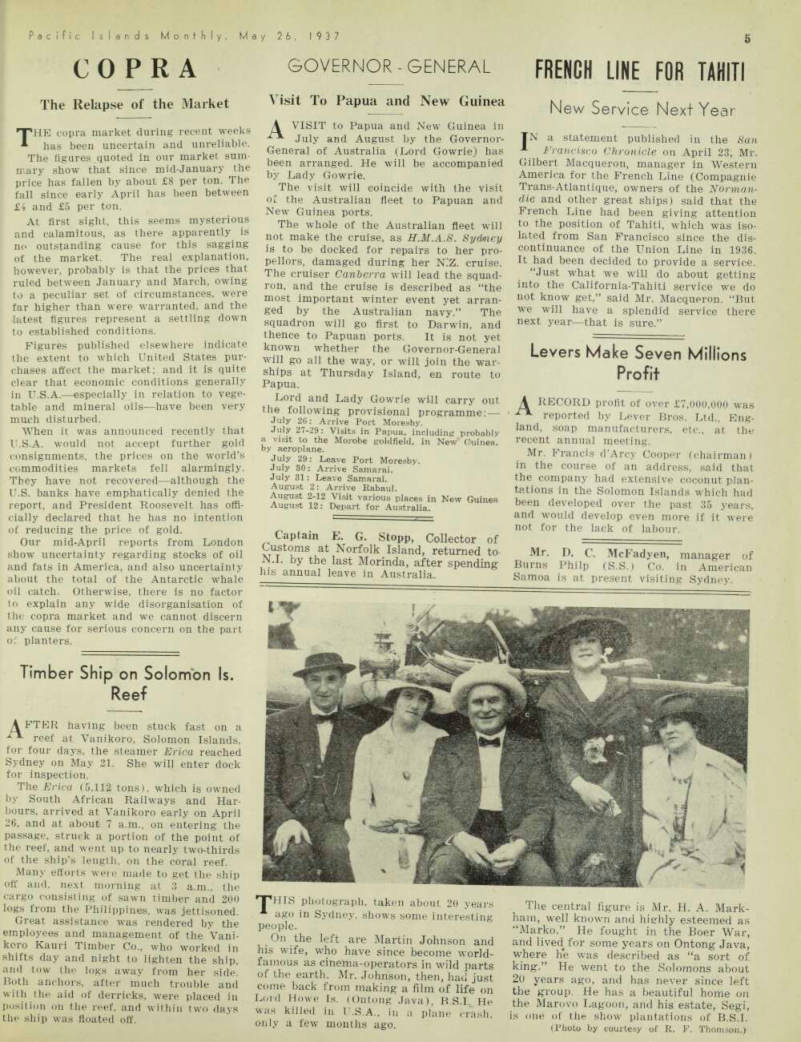
THIS photograph, taken about 20 years ago in Sydney, shows some interesting people.
On the left are Martin Johnson and his wife, who have since become world famous as cinema-operators in wild parts of the earth. Mr. Johnson, then, had just come back from making a film of life on Lord Howe Is. (Ontong Java), 8.5.1, He was killed in U.S.A., in a plane crash, only a few months ago.
The central figure is Mr. H. A. Mark ham, well known and highly esteemed as “Marko.” He fought in the Boer War, and lived for some years on Ontong Java, where he was described as “a sort of king.” He went to the Solomons about 20 years ago, and has never since left the group. He has a beautiful home on the Marovo Lagoon, and his estate, Segi, is one of the show plantations of 8.5.1. (Photo by courtesy of R. F. Thomson.)
Sampans Taken
French Seize Poachers in N. Caledonia
THE French authorities are dealing smartly and sternly with the Japan ese sampans which are poaching trochus shell, etc., in the coastal waters of New Caledonia.
A resident of Tao, Mr. Henwood, on March 23, signalled the gendarmes at Hienghene that a sampan was at work on the reef.
Two gendarmes from Hienghene met two gendarmes from Ouegoa and Pouebo and, lying down in a fast motor-launch manned by natives, they crept along the coast. They approached the sampan sud denly and, when the four startled Japan ese aboard tried to get away, they headed them off and displayed their arms, and the poachers surrendered. The sampan, with the four men and a quantity of shell, was taken to Hienghene. The gen darmes then set out to arrest the sam pan’s fishing-boats, and the 12 Japanese who manned them also surrendered, and were taken to port.
The French now have captured four sampans and 90 Japanese, in New Cale donian waters. They are; Gyokatsu Maru , taken at Yate on July 7, 1936, by the ketch Caledonicn.
Kinsko Maru, taken at Ponerihouen on July 17, 1936, by the gendarmes.
Taifa Maru, taken near Toupetit rec ently.
Kongo Maru, taken near Tao on March 23 by the gendarmes.
The two first-named sampans and their contents have been formally confiscated.
The captain of the Kongo Maru (which is a vessel of 32 tons) said that he left the Caroline Islands on February 16, and had fished in the Santa Cruz group (Solo mons) and he then was going to Fiji, but had been driven on to New Caledonia by bad weather.
22,000 Tons Liner
For Central Pacific
IT is confidently expected in shipping circles, that, very soon after the Im perial Conference, the construction will be commenced of a 22,000 tons liner, with a speed of 23 knots, for the Canadian- Australasian Line (Sydney-Auckland- Fiji-Honolulu-Vancouver).
Nothing yet has appeared in the reports, but apparently it is expected that the Imperial Conference will deal with the vexed question of Pacific shipping subsidies.
Sydney-New Guinea
Air Service
IT is expected that the tenders for the weekly air-mail service from Sydney to New Guinea will be dealt with finally early in June. There has not been the slightest indication of the direction in which the contract is likely to go.
Bishops And German
Propaganda
A Slight Misunderstanding
THERE was a little stir in New Zea land recently, between bishops, con cerning German propaganda in New Guinea.
Bishop Baddeley (Melanesia), in Auck land, referred to the all-too-frequent re ports about the pro-Nazi propaganda of German missionaries working in New Guinea; and he quite rightly said that it was “a breach of hospitality on their part to introduce politics to their religi ous teaching.”
This stirred up Dr. O’Shea, Roman Catholic Archbishop of Wellington, who said that such an attack on “German Catholic missionaries,” made without evidence, was unfair, and that such mis sionaries could not wish to live under Nazi rule.
His Grace of Wellington, for once, barked up the wrong tree. There never has been complaint against the Catholic missionaries. The trouble —and it is not very serious has been caused by the injudicious enthusiasm of certain young Lutherans, who have arrived in New Guinea with their ideas about Nazi-ism all out of focus.
We learn that necessary disciplinary action has been taken by the heads of the Lutheran mission, and probably little more will be heard of the matter.
Early Tahiti
Century-old Documents Go To Sydney Library
ABOUT two years ago, Mr. Eric Rams den (whose valuable work in pre serving the fast-disappearing history of Polynesia is now receiving tardy recog nition) was in Tahiti; and, in seeking certain records at the British Consulate there, he came upon a great mass of documents, about a century old, dirty ar*d stained and riddled by insects.
Mr. Ramsden had a look at the papers, recognised their great historical value, and reported his discovery to the Mitchell Library, Sydney. The Mitchell librarian, Miss Ida Leeson, was sent to Papeete: she confirmed the importance of the discovery; and negotiations were opened with the British Foreign Office, extending over 18 months.
It was announced, at the end of April, that permission has been given to trans fer the mass of documents from Papeete to the Mitchell Library, Sydney, which has become the repository of practically all books and documents relating to the early history of South Pacific countries.
Some details of the material discovered by Mr. Ramsden in Papeete will be pub lished in next issue.
Solomon Islands
Gold
Investing Public Is Shy
HP HE flotation of Solomon Islands Gold ■®- Sluicing Limited, for some reason, has not been a success, and the directors of the company are now seeking further information before deciding what to do.
It was proposed to form this operating company, with £50,000 of new money, to work a gold bearing area on the island of Guadalcanal, British Solomon Islands, which had been intensively prospected during 18 months by Mr. H. J. Ault, on behalf of Pioneer Syndicate N.L. The history of the goldfield was recounted in our issue of February last.
The area appears to have been tested and proved, and there was every indica tion that it could be worked with advan tage and profit. It was extraordinary, therefore, that the public failed to sup port this flotation —especially as the same public had subscribed tens of thousands of pounds in recent times for the develop ment of what were merely silly holes in the ground, in Fiji, Papua, and New Guinea.
We are inclined to think that the cause of investors’ shyness was the proposal of the directors to allot no less than 100,000 5/- shares to the “Vendors,” while offer ing only 200.000 5/- shares to the public.
There would seem to have been too many fingers in this pie. There was the Guadal canal Prospecting Syndicate; it became Chuba Limited and Guadalcanal Limited; then Pioneer Syndicate N.L. came into the picture: that was followed by Solo mon Islands Gold Development Limited; and it was the latter concern which was to receive 100,000 shares.
We understand that Mr. T. R. Victor, the well-known mining engineer, will leave shortly for the Solomons to have a look at this goldfield and, when his report is received, important decisions will be made.
Advertisements & other items, p. 8 (1 item)
of Yonr Wrapper !
Look on the Front
The figures stamped there (if any) show the date when your subscription expires. This date will appear on wrappers of three issues preceding expiration, thereby giving 3 months’ notice.
If, at the end of that time, we have not been instructed to continue to send the journal to you, it will be discontinued.
Your subscription (8/- per annum, or 10/- in the case of countries outside the British Empire—-which includes postage) may be sent direct, or may be paid to any of our agents (listed on page 3).
POSTAGE RATES
The postage required for this issue is:— To Australia and New Zealand 2d To United Kingdom via All-sea route 2d To United Kingdom via France 2d To other British Possessions 2d To U.S.A. and Foreign Countries 4d
PACIFIC PUBLICATIONS PTY. LTD
Union House, 247 George St., Sydney.
Airmail Routes In The Pacific
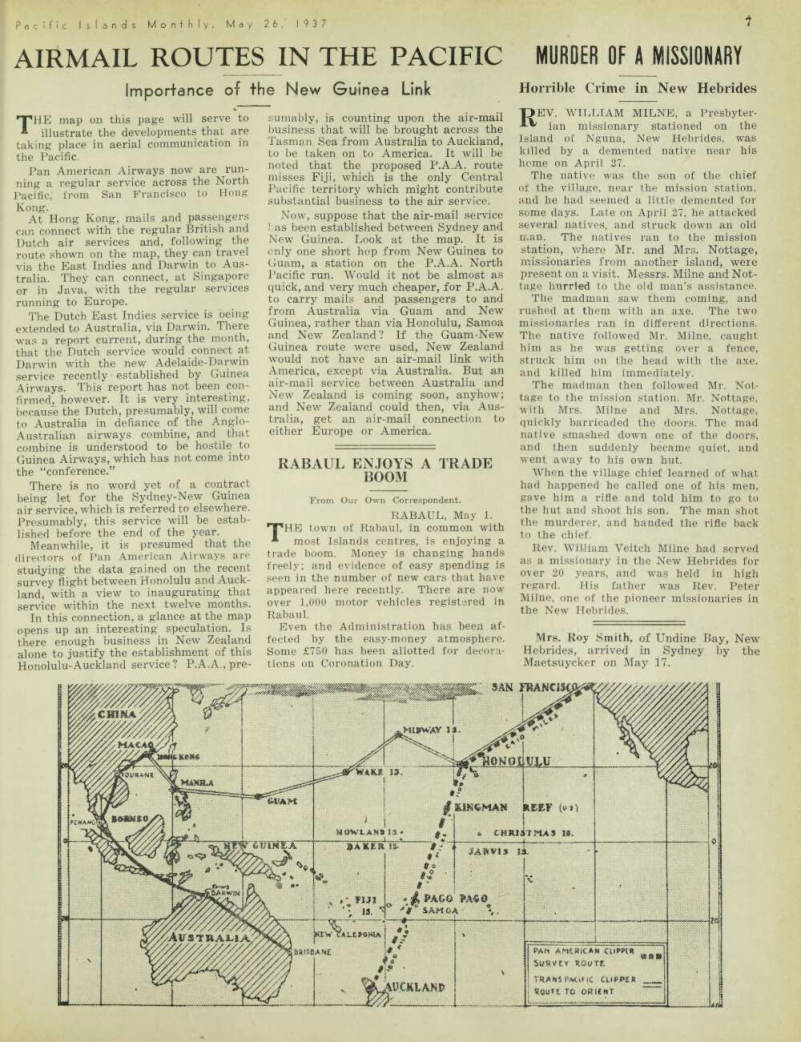
importance of the New Guinea Link
THE map on this page will serve to illustrate the developments that are taking place in aerial communication in the Pacific.
Pan American Airways now are run ning a regular service across the North Pacific, from San Francisco to Hong Kong.
At Hong Kong, mails and passengers can connect with the regular British and Dutch air services and, following the route shown on the map, they can travel via the East Indies and Darwin to Aus tralia. They can connect, at Singapore or in Java, with the regular services running to Europe.
The Dutch East Indies service is being extended to Australia, via Darwin. There was a report current, during the month, that the Dutch service would connect at Darwin with the new Adelaide-Darwin service recently established by Guinea Airways. This report has not been con firmed, however. It is very interesting, because the Dutch, presumably, will come to Australia in defiance of the Anglo- Australian airways combine, and that combine is understood to be hostile to Guinea Airways, which has not come into the “conference.”
There is no word yet of a contract being let for the Sydney-New Guinea air service, which is referred to elsewhere.
Presumably, this service will be estab lished before the end of the year.
Meanwhile, it is presumed that the directors of Pan American Airways are studying the data gained on the recent survey flight between Honolulu and Auck land, with a view to inaugurating that service within the next twelve months.
In this connection, a glance at the map opens up an interesting speculation. Is there enough business in New Zealand alone to justify the establishment of this Honolulu-Auckland service ? P.A.A., pre
sumably, is counting upon the air-mail business that will be brought across the Tasman Sea from Australia to Auckland, to be taken on to America. It will be noted that the proposed P.A.A. route misses Fiji, which is the only Central Pacific territory which might contribute substantial business to the air service.
Now, suppose that the air-mail service 1 as been established between Sydney and New Guinea. Look at the map. It is only one short hop from New Guinea to Guam, a station on the P.A.A. North Pacific run. Would it not be almost as quick, and very much cheaper, for P.A.A. to carry mails and passengers to and from Australia via Guam and New Guinea, rather than via Honolulu, Samoa and New Zealand? If the Guam-New Guinea route were used, New Zealand would not have an air-mail link with America, except via Australia. But an air-mail service between Australia and New Zealand is coming soon, anyhow; and New Zealand could then, via Aus tralia, get an air-mail connection to either Europe or America.
Rabaul Enjoys A Trade
Boom
From Our Own Correspondent.
Rabaul, May 1.
HP HE town of Rabaul, in common with most Islands centres, is enjoying a trade boom. Money is changing hands freely; and evidence of easy spending is seen in the number of new cars that have appeared here recently. There are now over 1,000 motor vehicles registered in Rabaul.
Even the Administration has been af fected by the easy-money atmosphere.
Some £750 has been allotted for decora tions on Coronation Day.
Murder Of A Missionary
Horrible Crime in New Hebrides
13 BV. WILLIAM MILNE, a Presbyter ian missionary stationed on the Island of Nguna, New Hebrides, was killed by a demented native near his home on April 27.
The native was the son of the chief of the village, near the mission station, and he had seemed a little demented for some days. Late on April 27, he attacked several natives, and struck down an old man. The natives ran to the mission station, where Mr. and Mrs. Nottage, missionaries from another island, were present on a visit. Messrs. Milne and Not tage hurried to the old man’s assistance.
The madman saw them coming, and rushed at them with an axe. The two missionaries ran in different directions.
The native followed Mr. Milne, caught him as he was getting over a fence, struck him on the head with the axe, and killed him immediately.
The madman then followed Mr. Not tage to the mission station. Mr. Nottage, with Mrs. Milne and Mrs. Nottage, quickly barricaded the doors. The mad native smashed down one of the doors, and then suddenly became quiet, and went away to his own hut.
When the village chief learned of what had happened he called one of his men, gave him a rifle and told him to go to the hut and shoot his son. The man shot the murderer, and handed the rifle back to the chief.
Rev. William Veitch Milne had served as a missionary in the New Hebrides for over 20 years, and was held in high regard. His father was Rev. Peter Milne, one of the pioneer missionaries in the New Hebrides, Mrs. Roy Smith, of Undine Bay, New
Hebrides, arrived in Sydney by the
Maetsuycker on May 17.
Samoa's Future
Probably Affected By Imperial Conference Decisions
VIfHEN the Prime Minister of New * * Zealand (Mr. Savage) has completed his work in London and the Imperial Conference, he may make some announce ment about the future of Western Samoa —especially, as matters relating to the Pacific are receiving so much attention fiom the Conference.
It is clear that Mr. Savage went to London with his hands free, so far as the Samoan Mandate is concerned. He was prepared to hand the Mandate over to Britain, if Whitehall so desired. That explains N.Z.’s failure to appoint an Administrator.
Much depends on the tenor of the Lon don conversations. Britain may elect to bring Samoa under the High Commis sioner of the Western Pacific (he already administers two Crown Colonies, two Protectorates, and a Condominium, so a Mandate need not worry him); but, if New Zealand public opinion is likely to be hurt by the withdrawal of the Man date, the farseeing British statesmen will leave the position as it is.
On arriving in London, Mr. Savage was interviewed by over 20 reporters, and he defended N.Z.’s Labour Government warmly and effectively.
Asked whether New Zealand would be willing to surrender its Samoan Mandate to Germany, Mr. Savage said: “The first thing which we must do to obtain world peace is to give justice to all nations, I am just a little afraid that we are not using our mandated territories as well as we might.”
New South Pacific Line
“Maetsuycker” at Port Moresby
From Our Own Correspondent
Port Moresby, May 1.
OORT MORESBY residents assembled en masse on April 26, to join in a welcome to the new motor-ship Maetsuy cker, with which the Royal Dutch Navi gation Company (K.P.M.) have inaugur ated the new South Pacific Line. The Maetsuycker and the Van Rees will carry on this service and thus will link the East Indies with Papua, New Guinea, New Hebrides, New Caledonia, New Zea land and Australia.
Captain Kooper and his officers enter tained the Port Moresby people at a cock tail party during the afternoon. Among those present were the Governor (Sir Hubert Murray), the Official Secretary (Mr. H. L. Murray) and Mrs. Murray, Mr. H. W. Champion and Mrs. Champion, and Mr. Justice Gore and Mrs. Gore.
The Maetsuycker was specially built for the new South Pacific Line and was launched last year at Amsterdam. She is a single screw motor-ship, driven by Werkspoor motors developing 3,600 s.h.p., giving her a cruising speed of 14 knots, top speed of 16 knots. There is excellent passenger accommodation for 51 persons.
Gold Search on the
Strickland River Hides’s New Area To Be Examined At Once
fTSING a seaplane chartered from Guinea Airways Ltd.. Messrs. Jack Hides and David Lyall, who are leading a gold prospecting expedition in Papua on behalf of Investors Ltd. (Sydney), ar rived in Port Moresby on April 24. On April 27, Mr. Hides made application at the Warden’s Court, Port Moresby, for a dredging claim of 45 square miles, ex tending along 21J miles of the Strickland River, immediately above Everill’s Steep Pass.
On April 28, Messrs. Hides and Lyall returned to the Strickland by the sea plane.
Before its return to Port Moresby the seaplane, which was in charge of Pilot Aubrey Koch and Mechanic Carl Isler, made a reconnaissance flight from Mr.
Hides’s camp over the Upper Strickland and up to the mountains, which lie be tween Papua and New Guinea. Mr. Hides was thus able to examine closely the country into which he is now penetrat ing.
The Warden (Mr. W. R. Humphries), on May 11, granted the dredging claim, subject to confirmation by the Governor.
Immediately thereafter Austral Malay Tin Ltd., which is associated with Inves tors Ltd. in this enterprise, organised a prospecting party; and Mr. Du Faur will leave Sydney within a few wrecks for Port Moresby. With a small party and a drill, he will proceed immediately to the Strickland area and will carry out boring in an endeavour to learn the value of the area that has been reserved to the company.
Praise has been accorded Pilot Koch for his feat in so quickly finding Mr.
Hides’s camp amid the dense jungle of the Strickland River on April 23. When he got beyond the Lower Strickland he found the existing maps of little value, and so he flew towards w r hat was believed to be the latitude of the camp. Through his pedal wireless set, Mr. Hides knew that the ’plane was coming, and he had signal fires burning. Mr. Koch found these signals and w r as able to land his seaplane on a quiet reach of the river near the camp.
New Industry For N.I.
A SMALL freezing plant has been in stalled at Norfolk Island by Messrs.
G. S. Watt and G. H. Davies, and tlfey have offered to buy any quantity of fish (at Id per lb. gutted), which will be filleted, frozen, and shipped to the Sydney market. They say they have orders from Sydney to ship eight tons per steamer.
Mr. J. E. Workman, Assistant Com missioner of Police in the Gold Coast
Colony, has been appointed Inspector
General of Constabulary in Fiji.
New Steamer
For W. R. Carpenter Line
OIR WALTER CARPENTER announced on May 21 that his firm, Messrs. W. R.
Carpenter and Co. Ltd., had placed in England an order for a new steamer of 9,500 tons to run with the motor vessels Rahaul and Salamaua, in the W.R.C.
Line between Australia, the Pacific Is lands, and Europe. The three vessels will maintain a two-monthly service.
The fact that a steamer has been or dered is interesting. Sir Walter said that his firm’s experience with motor vessels had been unsatisfactory—first because of the extreme difficulty of finding qualified engineers, and second because of certain considerations relating to maximum en gine efficiency. They had returned to steam and he believed that various other shipowners were doing the same.
The motor vessel Salamaua has broken a crank-shaft and has gone into dock in Rotterdam for repairs. Sir Walter said that his company had found it utterly impossible to get this work done in Britain every dockyard was fully en gaged for a long time ahead.
New Wewak Field
About 220 Men There Now
INFORMATION received to-day (May *• 20) is that there are at least 220 Europeans at work on the new Wewak goldfield, New Guinea.
The goldfield (which has not been pro claimed) extends westward of Wewak, along a narrow strip of country between the Torricelli mountains and the sea. The miners are scattered among the short valleys, between the mountains and the coast.
Steamers are discharging cargo for the field at Worn, near Matapau, about 30 miles west of Wewak. and aeroplanes are assisting in transporting it to the chief centre of the field, where they use an aerodrome called Marprik (“three days’
march inland”).
An interesting development occurred recently, when a solidly-backed London company, Far East Alluvials Ltd., bought from Mr. J. Pollard an option over three areas pegged by him —2000 acres behind Sawom (near Matapau), 2000 acres on the Amuk River, and 1000 acres on the Lower Screw River. The two last-named are on the southern (inland) side of the Torricellis. The Co. also has taken an option from Mr. J. Williamson over 2000 acres on the Sauein River, west of Mata pau; and Mr. Norman White, in April, arrived with drills, to make a test of both the Sawom and Sauein areas, in the hope that they may be proved as dredging areas.
In June, 1936, there were only six men on the Wewak field (Messrs. Dick Glas son, J. Thurston, J. Pollard, H. Tudor, senior and junior, and M. Dwyer). By November there were over 60. To-day, there are at least 220. —R.
Port Moresby
From Notes Made In
By R. W. Robson
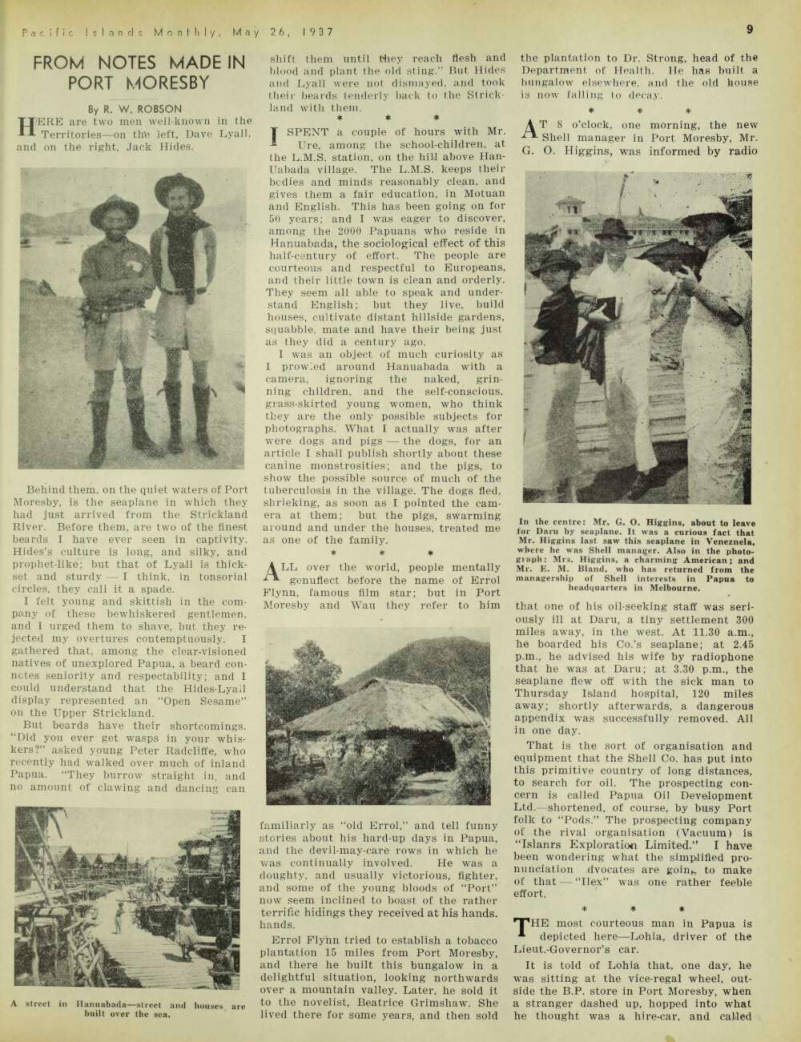
HERE are two men well-known in the Territories—on th'e left, Dave Lyall, and on the right, Jack Hides.
Behind them, on the quiet waters of Port Moresby, is the seaplane in which they had just arrived from the Strickland River. Before them, are two of the finest beards I have ever seen in captivity.
Hides’s culture is long, and silky, and prophet-like; but that of Lyall is thick set and sturdy I think, in tonsorial circles, they call it a spade.
I felt young and skittish in the com pany of these bewhiskered gentlemen, and I urged them to shave, but they re jected my overtures contemptuously. I gathered that, among the clear-visioned natives of unexplored Papua, a beard con notes seniority and respectability; and I could understand that the Hides-Lyall display represented an “Open Sesame” on the Upper Strickland.
But beards have their shortcomings.
“Did you ever get wasps in your whis kers?” asked young Peter Radcliffe, who recently had walked over much of inland Papua. “They burrow straight in, and no amount of clawing and dancing can
shift them until they reach flesh and blood and plant the old sting.” But Hides and Lyall were not dismayed, and took their beards tenderly back to the Strick land with them. ♦ * * I SPENT a couple of hours with Mr.
Ure, among the school-children, at the L.M.S. station, on the hill above Han- Uabada village. The L.M.S. keeps their bodies and minds reasonably clean, and gives them a fair education, in Motuan and English. This has been going on for 50 years; and I was eager to discover, among the 2000 Papuans who reside in Hanuabada, the sociological effect of this half-century of effort. The people are courteous and respectful to Europeans, and their little town is clean and orderly.
They seem all able to speak and under stand English; but they live, build houses, cultivate distant hillside gardens, squabble, mate and have their being just as they did a century ago.
I was an object of much curiosity as I prowled around Hanuabada with a camera, ignoring the naked, grin ning children, and the self-conscious, grass-skirted young women, who think they are the only possible subjects for photographs. What I actually was after were dogs and pigs the dogs, for an article I shall publish shortly about these canine monstrosities; and the pigs, to show the possible source of much of the tuberculosis in the village. The dogs fled, shrieking, as soon as I pointed the cam era at them; but the pigs, swarming around and under the houses, treated me as one of the family. ♦ ♦ ♦ \ LL over the world, people mentally 1 genuflect before the name of Errol Flynn, famous film star; but in Port Moresby and Wau they refer to him
familiarly as “old Errol,” and tell funny stories about his hard-up days in Papua, and the devil-may-care rows in which he was continually involved. He was a doughty, and usually victorious, fighter, and some of the young bloods of “Port” now seem inclined to boast of the rather terrific hidings they received at his hands, hands.
Errol Flynn tried to establish a tobacco plantation 15 miles from Port Moresby, and there he built this bungalow in a delightful situation, looking northwards over a mountain valley. Later, he sold it to the novelist, Beatrice Grimshaw. She lived there for some years, and then sold
the plantation to Dr. Strong, head of the Department of Health. He has built a bungalow elsewhere, and the old house is now falling to decay. ♦ * * AT 8 o’clock, one morning, the new Shell manager in Port Moresby, Mr.
G. O. Higgins, was informed by radio
that one of his oil-seeking staff was seri ously ill at Daru, a tiny settlement 300 miles away, in the west. At 11,30 a.m., he boarded his Co.’s seaplane; at 2.45 p.m., he advised his wife by radiophone that he was at Daru; at 3.30 p.m., the seaplane flew off with the sick man to Thursday Island hospital, 120 miles away; shortly afterwards, a dangerous appendix was successfully removed. All in one day.
That is the sort of organisation and equipment that the Shell Co. has put into this primitive country of long distances, to search for oil. The prospecting con cern is called Papua Oil Development Ltd. —shortened, of course, by busy Port folk to “Pods.” The prospecting company of the rival organisation (Vacuum) is “Islanrs Exploration Limited.” I have been wondering what the simplified pro nunciation dvocates are goin*, to make of that “Ilex” was one rather feeble effort. * ♦ ♦ THE most courteous man in Papua is * depicted here —Lohia, driver of the Lieut.-Governor’s car.
It is told of Lohia that, one day, he was sitting at the vice-regal wheel, out side the B.P. store in Port Moresby, when a stranger dashed up, hopped into what he thought was a hire-car, and called
A street in Hanuabada —street and houses are built over the sea.
In the centre: Mr. G. O, Higgins, about to leave for Daru by seaplane. It was a curious fact that Mr. Higgins last saw this seaplane in Veneznela, where he was Shell manager. Also in the photo graph: Mrs. Higgins, a charming American; and Mr. E. M. Bland, who has returned from the managership of Shell interests in Papua to headquarters in Melbourne.
out: “Quickly, boy—drive me to Judge Gore’s house!”
The always-obliging Lohia did as re quested; but, half-way, he got into seri ous trouble with his long car on the hair pin bends. (Anyone who has climbed that hill and partaken of Judge Gore’s hospitality knows the amazing track I am referring to. The judge says complac ently that he “engineered” it himself!) The uninvited passenger became an noyed at the tight fit in the traffic, and
Lohia. got out. “If that’s the best you can do you can go back,” he said. “I won’t pay you!”
And a very puzzled Lohia returned to the main street.
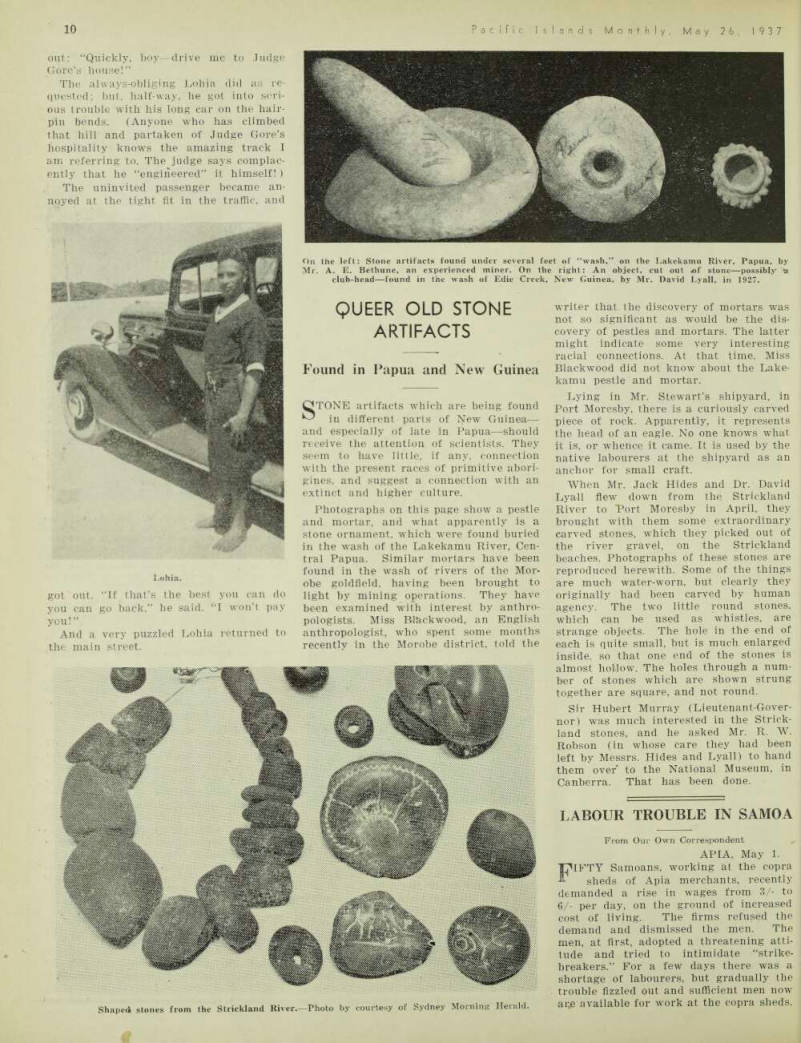
Shaped stones from the Strickland River. —Photo by courtesy of Sydney Morning Herald.
On the left: Stone artifacts found under several feet of “wash,” on the Lakekamu River, Papua, by Mr. A. E. Bethune, an experienced miner. On the right: An object, cut out .of stone—possibly a club-head—found in the wash of Edie Creek, New Guinea, by Mr. David Lyall, in 1927.
Queer Old Stone
Artifacts
Found in Papua and New Guinea
OTONE artifacts which are being found in different parts of New Guinea — and especially of late in Papua—should receive the attention of scientists. They seem to have little, if any, connection with the present races of primitive abori gines, and suggest a connection with an extinct and higher culture.
Photographs on this page show a pestle and mortar, and what apparently is a stone ornament, which were found buried in the wash of the Lakekamu River, Cen tral Papua. Similar mortars have been found in the wash of rivers of the Mor obe goldfield, having been brought to light by mining operations. They have been examined with interest by anthro pologists. Miss Blackwood, an English anthropologist, who sprnit some months recently in the Morobe district, told the
writer that- the discovery of mortars was not so significant as would be the dis covery of pestles and mortars. The latter might indicate some very interesting racial connections. At that time, Miss Blackwood did not know about the Lake kamu pestle and mortar.
Lying in Mr. Stewart’s shipyard, in Port Moresby, there is a curiously carved piece of rock. Apparently, it represents the head of an eagle. No one knows what it is, or whence it came. It is used by the native labourers at the shipyard as an anchor for small craft.
When Mr. Jack Hides and Dr. David Lyall flew down from the Strickland River to "Port Moresby in April, they brought with them some extraordinary carved stones, which they picked out of the river gravel, on the Strickland beaches. Photographs of these stones are reproduced herewith. Some of the things are much water-worn, but clearly they originally had been carved by human agency. The two little round stones, which can be used as whistles, are strange objects. The hole in the end of each is quite small, but is much enlarged inside, so that one end of the stones is almost hollow. The holes through a num ber of stones which are shown strung together are square, and not round.
Sir Hubert Murray (Lieutenant-Gover nor) was much interested in the Strick land stones, and he asked Mr. R. W.
Robson (in whose care they had been left by Messrs. Hides and Lyall) to hand them over to the National Museum, in Canberra. That has been done.
Labour Trouble In Samoa
From Our Own Correspondent
Apia, May 1.
FIFTY Samoans, working at the copra sheds of Apia merchants, recently demanded a rise in wages from 3/- to 6/- per day, on the ground of increased cost of living. The firms refused the demand and dismissed the men. The men, at first, adopted a threatening atti tude and tried to intimidate “strike breakers.” For a few days there was a shortage of labourers, but gradually the trouble fizzled out and sufficient men now ar.e available for work at the copra sheds.
Tropicalities
I HAD been away the whole of the previous day from the mission station on a launching visit to another Island outpost (writes a missionary) and the following morning happened to be hover ing in the neighbourhood of the medicine room, when Mary, our faithful old ser vant, made her way across the verandah to me. ‘‘Me, me want ’im some black medi cine,” she said, “face belong me ’e sore.”
Reaching for the iodine bottle, I was about to rub a little on the sore spoc when she stopped me, saying, “Not that feller medicine, black medicine.”
I told her that I didn’t know any other black medicine suitable for her complaint, but she was far from satisfied and said, “Yes, one feller black medicine where Mobi ’e been find ’im yesterday.”
Now, Mobi was my rouseabout, and milked the cows pretty well, but he had no right or qualification to be dispensing drugs, so with rising interest I said, “Here, Mary, you come show me that medicine.”
On the way to oblige, she completed her story. “Yes,” she said, “one man ’e been come, ’e been get ’im sore neck, Mobi ’e been find ’im black medicine, e’ rub ’im along sore place.” With that she pointed to the high shelf where the dangerous things were; “’lm ’ere,” she said, triumphantly recognising the Lysol bottle.
I could never find out who the victim was, as he did not return for a second dose of the embrocation. But I felt quite relieved that Mobi had not been called upon to supply cough medicine. * * * THIS happened recently in Fiji. Some of the parties are well known.
The District Officer wrote to a Euro pean storekeeper and asked him if he could dispose of a few “Haig’s Fund Poppies” at 3d., 6d. and 1/- each.
As the storekeeper was reading the letter, a half-caste, who can read and write a little English, came in. “Here, Bill,” said the storekeeper. “Wouldn't you like some of these?”
Bill read the letter carefully, and then took it away with him. He said he would advise later if it were possible to sell any.
Next day he came back. “Them Haig puppies are cheap, alright,” he said.
“But nobody wants any more dogs just now. But I’ll take a couple of the six penny ones myself if they are any good for pighunting when they grow up.”
A neighbour, that day, watched curiously while the storekeeper came out at the back of his store, and apparently proceeded to have a fit.—Tui Natovo. * * ♦ THE transfer of G. J. A. Moore from Rabaul to Port Moresby, as B.P. manager, brings to mind an amusing in cident of the administration of General Griffiths. A steamer arrived in Rabaul from South with measles aboard, and the medical officers took their usual stern measures to keep the disease away from
the natives. It was found necessary to quarantine a number of passengers.
There was no quarantine station; and General Griffiths, with that kindness that is so characteristic of him, gave up Gov ernment House to the unfortunates, and took up quarters elsewhere. So to Nama nula went four women, four babies—and G. J. A. Moore! They were kept isolated there for some weeks. Some men might have been happy, nursed the babies in idleness, and been gallant to the bored mothers, but it was hell for Mr. Moore.
He is a conscientious, hard-working man, and he used to stand on the hill, and look down at the huge B.P. establishment, and curse. Even to-day, Mr. Moore shivers when he sees a packet of Baby Powder or a tin of Trufood —they re mind him too poignantly of those weeks of deadly isolation. * * * T ITTLE black mosquitoes, of persistent, devilish habits, still remind the so journer in Port Moresby that he is in the tropics, in a land of mangroves and sorrow; but Port people point out proudly that these little black torturers are not Anopheles, and that nowadays one does not get fever in Papua’s capital city.
Credit for this happy state of affairs is given unhestitatingly to Dr. W. E.
Giblin, who was Health Officer there for many years, and who carried on a long, patient war against the Anopheles, and finally drove the beast out of Port. Prior to Dr. Giblin’s campaign, there were in credible swarms of mosquitoes in Port Moresby—“in the evenings, they rattled against your face like rain,’* said one old resident. The doctor employed all the usual methods against the pest, but es pecially did he make use of the Gam busia fish. One would meet him at all
sorts of odd hours, tramping around the environs of Port Moresby, with jars of Gambusia slung around his shoulders, and examining every bit of stagnant water where the mosquitoes were likely to breed. At the faintest sign of larvae, he would release a few of the larvae eating Gambusia. In the end, the Ano pheles disappeared: and nowadays, if you want a really good dose of malaria, you must travel 20 or 30 miles away from Port. Grateful residents still toast “Giblin and Gambusia .”
Good work has been done also in New Guinea with Gambusia; but there are official fatheads in Australia who have never heard of them. A drum of Gam busia was brought down to Cairns (a mosquito-infested place) on the Montoro, on which I travelled, and I heard that, as it did not comply with section 46a of the Dog and Goat Act, or something, offi cialdom insisted that it be emptied over board.— R.W.R. * * * \ KING’S Regulation, issued by the Western Pacific High Commission on April 15, applies the following law to the Solomon Islands: “ 11. Any person who shall keep any dog without causing the ownership of such dog to be registered shall be liable on summary conviction to pay a fine not exceeding five pounds for every such dog so kept in addition to the amount of any fee that should have been paid in res pect of such registration.”
If this means what it seems to mean, officials in the Solomons are in for an exhausting time. It is privately estimated that the dogs, half-dogs, and near-dogs, living in native villages in the Solomon Islands, number 3,622,457.
Mr. R. St. G. Ryder, of Messrs. Morris, Hedstrom Ltd., at Apia, arrived in New Zealand recently from Western Samoa to spend a few months’ holiday.
Colonel R. F. Baird, M.R.C.S., L.R.C.P., D.T.M., 8.A., who recently was appointed Chief Magistrate of Norfolk Island, assumed office in April.
Advertisements & other items, pp. 13-14 (1 item)
riUTE>
CREAM
«ar.«'air’ ■ ■ ~",«»»'•■■• Write for a Colour Card . . .
STERLING VARNISH CO.
Dries in half an hour on plaster walls, ceilings, cement, fibre, wood and Iron.
Also Excellent as an Undercoat for lacquers, paints and enamels. 11/- per gallon
HIGHLY DURABLE
Alexandria, N.S.W.
When You Come
to Brisbane . . . .
Make Pike Brothers your shopping headquarters. The prompt, courteous, personal service and quality goods are distinct advantages.
If you are not certain of the right clothes to wear for any particular occasion ask their advice. The Leading Men’s Outfitters since 1885, Pikes are authorities on correct wear.
PIKE BROTHERS
LIMITED
QUEEN STREET - - BRISBANE
with lemon and soda —off the icor with plain ice-water . . .
A real refresher!
The Famous
SCOTCH Whisky
About Islands People
Mr. C. .1. J. T. Barton, Colonial Secre tary of Fiji, was awarded the C.M.G. in the Coronation honours, announced on May 10.
Captain Booker, master of the Govern ment ketch Melbidir which operates in Torres Strait from Thursday Island, is spending furlough in Brisbane. Captain H. Woodhead is relieving him.
Mr. A. J. Armstrong, a District Com missioner in Fiji, sailed from Suva by the April Aorangi en route to England on leave.
Mrs. Margetts (widow of Rev. J. H.
Margetts, of the Methodist Mission, who served for 22 years in the New Britain District, New Guinea), who has been living in Australia for the past two years, sailed from Sydney by the Montoro on May 15 to spend a few months with friends in Rabaul.
Mr. H. W. Simmonds, F.E.S., Govern ment Entomologist in Fiji, received the award of 0.8. E. in the Coronation honours during May.
Mr. J. R. Clay, of Messrs. J. R. Clay & Co. Ltd., Port Moresby, sailed for Papua from Sydney with his family by the Macdhui on April 28.
Rev. and Mrs. Guy Darke, of St. Paul’s Mission, Moa Island, Torres Strait, re turned to Thursday Island from Australia by the April Merkur on their way back from furlough.
Mr. E. G. Theodore, managing director of Emperor Mines Ltd., who has been on a holiday in Australia, left Australia in May by Imperial Airways to examine a reported new goldfield in Western Borneo. During his absence, Mr. Nils E. Nilsen (manager) is direct ing the operations of the Emperor Co. in Fiji.
Mr. A. J. McGrath, a member of the Norfolk Island Advisory Council, arrived in Sydney by the Morinda on May 6.
Formerly a grazier of Moree, N.S.W., he went to N.I. four years ago on a three weeks’ holiday, but becoming enchanted with the little island he intends to spend the rest of his life there.
Mr. John Beveridge, who has been in charge of the Fiji Government quarantine station at Makuluva for some years, has been appointed a sub-inspector of con stabulary in the British Solomon Islands.
Mr. C. R. Field, the recently appointed Director of Public Works in New Guinea, arrived in Rabaul from Sydney by the April Montoro to take up duties. A returned soldier, he formerly was en gineer in charge of the Public Works Dept, in Western Australia and has had many years’ experience in constructing works of similar nature to those which he will be required to deal with in New Guinea.
Mrs. Heatly, wife of Mr. E. M. Heatly, of Messrs. Morris, Hedstrom Ltd., Fiji, died in Suva on April 26.
Mr. Francis H. Hopkinson, of Mel bourne, married Miss Cecilia Ethel Tibbo, eldest daughter of Mr. and Mrs. E. V.
Tibbo, of Tavua, Fiji, at Nailaga Church on April 24.
Mr. G. Marston has been appointed superintendent of the Post and Radio Department in Western Samoa. He has had experience in the Cook Islands and the Chathams.
Mr. Bob MacCreath, a well-known miner who spent 11 years in the Morobe District, New Guinea, died in Wau Hospital early in April.
Mn Alfred H. Perry, of New Zealand, married Miss D. A. Hopkinson, of Suva, at St. Andrew’s Presbyterian Church, Suva, Fiji, on April 17.
Advertisements & other items, p. 14 (1 item)
B. & S. Estate Agency
111 ROSEVILLE. SYDNEY
I Specialising in Flat reservations, any suburb, for Island Residents •; visiting Sydney. Correspondence <j invited. ’Phone JJ5269.
Proprietor - - Campbell M. Smith
About Islands People
Mr. Percival Bert Guy Jackson, a 22years-old direct descendant of Fletcher Christian, leader of the Bounty mutiny, arrived in Sydney from Norfolk Island on May 6 on his way to take up a posi tion at Burren Junction, north-west New South Wales.
Mr, J. T. Allen, of Amalgamated Wire less (A/sia) Ltd., Rabaul, New Guinea, has left the Company’s services after 20 years’ association with wireless in the Territory. He went to New Guinea from Woodlark Island, Papua, where the R.A.N. has a high-power naval radio station. After serving at Madang and Kieta stations, he was 12 years in charge of the Bitapaka station and later at the new station in Rabaul.
Mr. James Stuart, a former District Commissioner in Fiji, died recently in Scotland at the age of 64. He entered the Fiji Service first as an officer in the Armed Native Constabulary and rose to be Senior D.C. in the Colony. He retired in 1930.
Mr. Ronald Field, of Fiji, married Miss Margaret Steadman, daughter of Rev. and Mrs. W. R. Steadman, of the Metho dist Mission, Suva, Fiji, in Adelaide, South Australia, on April 10, Mr. E. P. Holmes, M.L.C., Secretary of the Lands Department in New Guinea, departed from Sydney with his wife for Rabaul by the Tanda in April.
Rev. Lionel E. Saville, a Methodist missionary at Cakaudrove Fiji, died from typhoid fever in Taveuni Hospital on May 7, at the age of 31. A native of Toowoomba, Queensland, he had been in Fiji for four years.
Mr. Karl Nagy,' a staff engineer of Guinea Airways Ltd., arrived in Sydney from New Guinea by the Neptuna on April 27, on his way to his home in Budapest on furlough Mr. Rudolph Wolff, one of New Guinea’s oldest residents, died in Rabaul on May 3. He was born in Germany in 1867, and arrived in New Guinea in 1892.
His wife and baby were murdered by natives in 1902. The funeral was attended by representatives of all sec tions, including the Administrator and officials.
Miss Blackwood, a well-known English anthropologist, arrived in Port Moresby recently, and spent a few days in the Gulf Division wdth Mr. and Mrs. F. E.
Williams. Miss Blackwood has just com pleted nearly one year’s study of the Kukukukus—the semi-nomadic people who live in the New Guinea mountains behind Wau.
Mr. Percy R. Hinds, a well-known trader, who formerly was stationed at Daru, and who for some time past has been in business in Port Moresby, has settled at Kukipi, on the Gulf of Papua, where he has acquired a trading site.
Mr. Hinds, besides trading, will engage in recruiting for the various companies that have recently started operations in Papua.
Mr. William Thomas Rabone, a son of the late Rev. William T. Rabone, pioneer Methodist missionary in Tonga, died at Ashfield, N.S.W., early in May. He was born in Tonga 63 years ago.
Captain Edward Stenberg, aged 71, one of the best known mariners in the South Seas, was washed overboard and drowned when, during a storm, his ketch went ashore on the eastern coast of New Zea land on May 13. He was bringing the 50ft. ketch Yvonne from Sunday Island, in the Kermadecs, to Auckland.
Mr. Albert Griffiths, a Sydney miner, returned to Australia from New Cale donia by the Van Spilbergen in April, after seven years in Noumea.
Return Thanks
To the Residents of Wau, Slate Creek and Salamaua, I wish to extend my sincere THANKS for their many acts of kindness shown to me in my recent sad bereavement in the loss of my husband, Mr. E. L. Bartlett, of Upper Watut Gold Alluvials, New Guinea.
Mrs. E. L. Bartlett.
Advertisements & other items, p. 15 (1 item)
Tenax
SELF-RESPECT DEMANDS GOOD LIGHTING
TO-DAY
Even in remote country districts, kerosene, like torchlight and whaleoil, has been relegated to the limbo of the Dark Ages !
In place of its dim, smoky flame
WIZARD CAS
THE PERFECT COUNTRY LIGHT
burns with its powerful steady brilliance. Wizard makes the children’s home lessons easier and turns a mere house into a real home with modern civilization’s standard of comfort.
Wizard Lamps (140 Candlepower) light with a taper and burn for 60 hours on a gallon of petrol. Wizard Stoves boil, bake and grill to perfection.
Home Lighting Sets from £l4. Stoves. Lamps and WALL LAMPS Lanterns for all purposes. f rom 50/ . Sydney
WIZARD LIGHTING CO.
Established 1914. 283 d GEORGE STREET, SYDNEY We stock the very best mantles and spare parts for your lights.
r Genuinely
Germicidial
PREVENTION
is better than
cure
m Disease germs such as those of Diphtheria, Malaria, Dhobie Itch, Tinea or Surfer’s Foot cannot live under the lather of TENAX. Besides which TENAX, used constantly, will cure Tropical Skin Diseases.
TENAX is the only soap containing oil distilled and marketed by Australian Essential Oils Ltd., under the Ti-Trol,” eleven times quicker than carbolic as a germicide, but M
Containing
Ti-Trol
“TENAX is
registered trade-mark
NON-POISONOUS and NON-IRRITANT.
“The Medical Journal of Australia,” official organ of the 8.M.A., says satisfactory germicidal soap which may be recommended with confidence.”
TENAX
TOILET SOAP
A PRODUCT OF AUSTRALIAN SOAPS LIMITED
Pension-Less Service
ALTHOUGH there is a liberal super annuation system in operation in Papua, and a good, if less liberal, system in New Guinea, public servants in the smaller Australian territories have no pension at all. Norfolk Island, for in stance, has only a handful of officials, but they must keep working until they drop—there are no pensions provided for them.
Many people still hope that out of the Imperial Conference there will emerge a scheme, under which Australia will take charge of other Western Pacific territor ies and will then create for the adminis tration of all these territories, a tropical service, wherein men will be given wider opportunities for advancement and pro motion, and which will provide a liberal system of pensions for all.
Those Pygmies
Lord Moyne and Father Kirschbaum
Letter to the Editor 1%/3’Y attention has only just been called to Father Kirschbaum’s letter in your issue of November, 1936. Not wish ing his attack to remain any longer un answered, I am sending you a cable for insertion in your next issue, and posting you this letter by air mail in amplifica tion.
Father Kirschbaum is very indignant with certain reports dealing with an exhibition of ethnographical material brought back by me from New Guinea for the British Museum, and also those at Oxford and Cambridge. I understood that
German Museums are well provided with exhibits from New Guinea but, in view of the complete absence from our British Collections of articles from the Ramu up to the time of my journey, Father Kirs chbaum’s sarcasms seem uncalled for.
His letter shows annoyance that there was no mention in these cabled press reports to a journey previously made by himself. Repeated discussions which I had with Mr. E. J. Wauchope, also en quiries which I made at Rabaul and Madang, and from eminent anthropolo gists in England had failed to reveal any information as to Father Kirschbaum’s visit to the Aiome country in 1926, or his very interesting account of the in habitants in Anthropos, Vol. XXII., 1927.
The Administrator at Rabaul had writ ten to me before I felt England mention ing that his officers had reported the existence of pygmies near Atemble. The pygmy country is unadministered and, as far as I could learn, has not been visited by any Government officials. On leaving the Ramu, I sent a telegram to the Ad ministration, asking whether they could refer me to any Government or other report on the subject of these people be yond those already in my possession, but they were unable to do so. Both Mr.
Chinnery and Father Kirschbaum were at the time absent from New Guinea and this perhaps accounts for the lack of in formation about the latter’s visit to the pygmies.
Father Kirschbaum’s suggestion that I personally claim to have discovered the Aiome pygmies could not have been made if he had either communicated with me direct when he first saw the press report, or had read my book Walkabout. I have there referred to those who had previ ously visited the Aiome country, particu larly Mr. Evan Stanley and Mr. E. J.
Wauchope, and expressed my disappoint ment that the Government had since prohibited entry into this “uncontrolled territory.” As I also mentioned in my book that the pygmies come down to trade at Atemble, it is quite evident that the missionaries who happened to be absent from their station at the time of my visit, must often have seen them.
As Mr. Wauchope is at present in Aus tralia, I cannot fipd out before posting this letter whether it w'as he or Father Kirschbaum who first visited Aiome. In any case, this issue seems to me a very petty one. But as Father Kirschbaum attacks me on account of a claim which I never made, I cannot help wondering how he justifies the titles of his article in Anthropos , “Ein Neuentdeckter Zwerg stamm auf Neu-Guinea” (A Newly Dis covered Dwarf Race on New Guinea), and “Eine Reise zu Bisher Unbekannten Zwergen in der Schrader-Kette . . .” (A Journey to Hitherto Unknown Dwarfs in the Schrader Chain . . .), in spite of Mr.
Evan Stanley having seen the same people whom he described as of short stature, five years previously, as quoted in my book, p. 180.
I am, etc.,
10 Grosvenor Place, London, 31/3/37.
Moyne.
Advertisements & other items, pp. 16-17 (1 item)
W. Jno. Baker Es
Your Next Gift ...
THE
"CHATSWORTH'
CABINET
Contains 42 pieces of Baker's Old English pattern Spoons and Forks, Stainless Steel Table and Dessert Knives. £7:7:0 Other Cabinets from £6/6/-
W. JNO. BAKER ES
3 HUNTER STREET - - SYDNEY
FOR THE BEST CUTLERY
WHEN SPENDING YOUR VACATION IN SYDNEY YOUR CHOICE OF RESIDENCE IS A MATTER SO VITAL TO YOUR ENJOYMENT!
May we commend to you for All-round Excellence
SYDNEY’S MOST EXCLUSIVE PRIVATE HOTEL
"44 MACLEAY STREET"
await unriva Service and Cuisine—Suites with Private Baths— n all rooms—Magnificent Harbour Views Roof Garden Sun Rooms Spacious Lounges and LV you ere
iIH
OS* 0 Smoke Rooms and every modern convenience All under Personal Supervision of the Proprietress,
MISS M. E. BURROWS
TARIFF: From £3/3/-
per week inclusive.
Radios;
'FORTY FOR'
Sydney.
Telephone; FL 2641
THE ARMIDALE SCHOOL
ARMIDALE... N.S.W.
f mm ':jj| U(.li m THE ARMIDALE SCHOOL is the only Great Public School situated in the country.
It is conducted on the lines of an English Public School, adapted to suit Australian conditions.
The School aims at giving a good all-round education: at the same time, it prepares boys for the various public examinations, and offers a course in Agricultural Science for those taking up pastoral life.
The School is planned and organized as a Boarding School, and the fullest provision is made for the welfare of the boys. There is a separate Junior House for boys under 13, in charge of a resident married Master.
The School possesses good buildings and grounds of 40 acres, with spacious playing fields for cricket, football, tennis, and athletics. The healthy and bracing climate is unrivalled, Armidale being 3,265 feet above sea level.
The Headmaster and his wife have lived for 16 years in India and are therefore specially qualified from personal experience to understand the needs of children sent home from the tropics for education.
An illustrated prospectus may be obtained on application to the Headmaster, The Rev. H. P. Young, M.A. (Canfab.), 8.A., B.Lltt. (Dunelm).
Ffrost Case
Efforts to Keep Young Man Out of New Guinea Courts Creates First class Constitutional Tangle.
ONE of the prettiest constitutional tangles seen for years came before the Australian courts in April and May as a result of an attempt by the law offi cials in New Guinea to have Galfred Mervyn Collins Ffrost brought back from Sydney to New Guinea on a charge of causing the death of a native labourer.
Ffrost is a young man of good type and family and was employed as a plan tation overseer by Messrs. Burns, Philp and Co. Ltd. There was some difficulty with labour on the plantation and a labourer died. The boss boy was held in some way responsible for the death and was sentenced to gaol. Then the court reached out for Ffrost, who had gone on leave.
The “Big Firm” stood staunchly be hind its employee, and the lawyers in voked every possible process of law in order to prevent Ffrost from being sent to New Guinea. It is not possible to dis cuss the merits of the case, because it is sub judice ; but it is apparent that the “Big Firm” is not helping its employee to evade punishment for any offence he has committed but is rather seeking to protect him against trial by a New Guinea court which is regarded by the New Guinea public generally as irrespon sible and unfair. counsel sought a Habeas Cor pus order. It was refused. The power of the magistrate to send Ffrost back to New Guinea was challenged before the Supreme Court (a State institution). The matter went on from the Supreme Court to the Full Court of the Supreme Court.
The latter on April 23, in a judgment that is beyond the understanding of a mere layman decided that a State Court need not recognise the process of a New Guinea Court; yet somehow it was de cided that Ffrost could be sent back to New Guinea by the State magistrate.
The Sydney Morning Herald said, on April 27, that “the decision that the Commonwealth Parliament had no power to enact service-and-execution-of-process legislation as between the States and the Mandated Territory” had convulsed legal and constitutional circles, and it was sug gested that, the Imperial Parliament might have to amend the Commonwealth of Australia Constitution Act. Said the Herald : “The practical effect of the Supreme Court’s judgment is that the residents of the Territory are
left without means of enforcing their legal rights against residents of the States.
“The practice has been that, where a judgment has been given in a New Guinea Court against a resident of a State, a certificate has been ten dered before a prothonotary of a State Court, who registers it, the judgment then taking ; orce as if it were a judgment of the State Court. A number of such judgments have in fact been registered in New South Wales.
“In the decision of the Supreme Court on April 23, the regulations under which this was done, and the section of the Service and Execution of Process Act under which those regulations were made, were declared ultra vires and invalid.”
Meanwhile, the position was that Ffrost was again headed for New Guinea.
His counsel then made an appeal to the higher constitutional authority, the Com monwealth High Court and he was re leased on bail. For several days early in May, five eminent judges of the High Court heard an appeal by Ffrost against the decision of the Full Court of the Supreme Court, and constitutional issues of first-class importance were raised and argued. Finally, on May 14, judgment was reserved. The impression seemed to be general that the High Court was called upon to make one of the most diffi cult decisions in its history, involving the relationship between the Common wealth, the States, and the Territories.
Ffrost is still ’in Sydney on bail.
The costs in this case must have been enormous.
It is to be hoped that, as a result of this case, the Federal Government will take early steps to review and reform the judicial machinery that has been operating in New Guinea for some years past.
Advertisements & other items, p. 18 (1 item)
Such Value
WILLIAM FINAU
PHOTOGRAPHER
FRIENDLY ISLANDS, OCEANIA
Send 5/6 for interesting views and native life scenes from Tonga. Your money back if unsatisfied. Simple information: 5/6. More important information and photographic data: 10/6
A magnificent opportunity to bring your photography up-to-date. Has twelve features for better pictures, viz.: Anastigmat Lens f 8.8; Finger-tip focussing; 2 snapshot speeds also T. & B.; Action front—instant opening; absolute rigidity; two View-finders; Quick easy loading; Red-window Safety-cover; Two Tripod Sockets; Cable Release; Compact handy size, modern design and outstanding excellence of workmanship.
HtVIB PtfOßt
SUCH VALUE
Add lo CO to your Movies New Kodachrome Film gives you every scene in full brilliant color, 'dear in detail, revolutionary in clarity. No special apparatus for talcing or projecting—no pattern or "mesh"—no limit to screen size.
Prices : 100-ft. (16mm) £2/12/6 50-ft. (16mm) ,-r £l/8/6 25-ft. (Bmm) .-. £l/2/6 R 7i The world's
most popular
folding Kodak
Six-20 KODAK JUNIOR
with f/8.8 Anastigmat Lens
You must see it tor yourself. For pictures 2\ x inches. Price 39/9.
Of all Kodak Dealers throughout the Islands and
KODAK (A/asia) PTY. LTD.
379 GEORGE STREET, SYDNEY
Judge Ayson
C.I. Resident Commissioner To Return to N.Z. Shortly
From Our Own Correspondent
Rarotonga, Apr. 8
AT a meeting of the Rarotonga Island Council on March 19. Judge H. F.
Ayson, C.M.G., announced that he would shortly relinquish the post of Resident Commissioner in the Cook Islands.
“When I became Resident Commis sioner in 1922, I was on loan from the Bench of the Native Land Court of New Zealand, which is my permanent office,” he said. “Owing to pending changes in regard to the judges of the N.Z. Land Court, I find it necessary, in my own interests, to return to the Land Court in N.Z. on promotion.
“When I was recently in N.Z., I dis cussed the matter fully with the Prime Minister, who is also Minister for the Cook Is., and Minister of Native Affairs.
I am therefore expecting to return to N.Z. about the end of June,” he con cluded.
Judge Ayson first came to the Group in 1916 as Judge of the Native Land Court. In 1922 he succeeded Mr. F. W.
Platts as Resident Commissioner, combin ing in himself the triple position of Commissioner, Judge of the Land Court, and also of the Supreme Court.
At .present Mr. Ayson is not definite as to the exact date of his departure, nor has the name of his successor yet been made public. Rumour has already ac corded the position to half-a-dozen per sons ranging from Judge Carr, of the N.Z. Land Court, down to the Labour members of the Parliamentary Committee which visited the Group last July.
Mr. H. Priest, journalist and author,
who has devoted special study to native life on several South Sea islands, arrived
at Wellington by the Mataroa recently
to spend a month in New Zealand gather ing material about the Maori race.
Chinese In New Guinea
A Problem Without a Solution
OIDE by side with the problem of the sophisticated native in New Guinea, there is another problem what to do with the steadily increasing Chinese population.
The Chinese got a footing there during the confusion of the war period. They had been brought in by the Germans, and remained there during the period of Australian military occupation.
When civil administration finally was established in 1921, it was too late to deport the Chinese, and they became established too.
They came in originally as labourers but, in the years since 1914, they have become traders and artisans, demanding European standards of remuneration, and turning up their noses at any kind of ordinary, unskilled labour. They are increasing rapidly in numbers, and are displaying an increasing tendency to dis place Europeans in the higher-class oc cupations. Already, most of the native trading is in their hands. The younger Chinese will not take jobs—they either hang around Chinatown (and there is now a Chinatown in Kavieng, Madang, Salamaua, and Kieta, as well as in Rabaul) or they get out in the bush with a little trade store.
Recently, the Administration planned to improve the efficiency of the Rabaul telephone exchange by replacing the nat ive operators with Chinese girls, educated in the mission schools. It was quite a good idea, but it did not work. The Chin ese girls demanded wages and conditions that could not be agreed to.
It is a problem that must give the Administration headaches. If the com munity would only remain stationary, some suitable way of using the Chinese in Newl Guinea might be found. But the Chinese know nothing of the doctrines of Malthus, and the problem keeps on growing.
Advertisements & other items, pp. 19-20 (2 items)
17
Pacific Islapds Monthly, May 26, 1937
Pains
A POPULAR
MODERN DESIGN
in
Table Plate
Teaspoons Dessert Spoons Soup Spoons
Table Spoons
Dessert Forks Table Forks Dessert Knives Table Knives 7/6 doz. - 16/6 11 .. - 16/6 .. 11 - 21/- 11 .. - 16/6 „ „ - 21/- .. .. - 32/6 .. „ 35/-.. lt We stock Table Plate and Cutlery by the best known English manufacturers, and supply in any quantities required, also In suites fitted in handsome Presentation Canteens.
Our finely illustrated Catalogue sent post free on application.
ON PARLE FRANCAIS
PRO U D S
PTY. LTD.
The Gift Store
Cr. King & Pl+t Sts.
Sydney
PAINS
MASTER
POWDERS &
TABLETS
1/6 AND 2/6.
SINGLES 2d. ea.
STOPS SAFELY
HEADACHE
FLU & COLDS
RHEUMATISM
NEURALGIA
SC I ATI C A
NEURITIS
LUMBAGO
AND ALL NERVE AND
MUSCULAR PAINS
Reduce temperature and relieve feverishness with Vincent’s A.P.C. It diminishes the likelihood of complications and leaves no after effects. Doctors recommend it because it is prepared on the scientific hospital formula and has stood the test of experience for over 16 years. Keep a packet of Vincent’s A.P.C. always at hand.
FOR SAFETY'S SAKE, SAY— " VINCENT'S A.P.C."
FOR STAMP COLLECTORS
12 Good Colonial and Foreign Stamps Diff. Cat. 21/- - 3/3 10 Irish Free State, Diff. used ... 2/- 40 Irish Free State, Diff. used. Many overprints 5/6 Remittance by Money Order We want stamps of your Islands, Mint or uced, for cash.
MINT STAMP CO.
74 GRAFTON STREET, DUBLIN, IRELAND
Firearm Repairs :
"OUR HANDS MAKE GOOD ARMS."
Goods sent C.O.D.
Black’s Straightway Reloading Tools ...
For Mauser and 303 British Shells Harrison’s Bronze Gas Check Moulds ...
Australian Gas Checks Lyman Gas Checks Primers, 303 non-corrosive American Primers
SIL ROHU
RELOADING OF RIFLE
CARTRIDGES IS A MONEY SAVER AND IS A PASTIME THAT IS
FULL OF INTEREST.
Powders for Regular Loads: Dupont Nos. 17£, 1204, 80 Hercules, Nos. 2400, 13, Sharpshooter No. 1 all per lb. 20/- Ror Reduced Loads; Amberite per lb. 13/6 Hercules, No. 2 per lb. 10/- Bullets: Soft Point and Hollow Point Low Prices Write for Catalogue Rifles converted for the 22 Super Hornet and other types Prices on application.
Quality Firearms and Fishing Tackle. 143 ELIZABETH STREET, SYDNEY (near Market Street) Telephone MA 3540 per 1000 per 1000 per 500 per 1000 per 100 per 1000 35/- 45/- 30/- 10/6 15/- 7/6 14/6 2/- 19/-
0 CHAPMAN
? o
"IK/Suo*/
SO a iMedS Oi£ur /* tc dr yvOA 'Utwuuf: ' m £
CHAPMAN PUP ENGINES
are World-famed as power plant for MOTOR LAUNCHES.
Thousands In use throughout Australasia. Owners from all parts continually writing praising their astounding simplicity, reliability and Economy. Built in a number of different sizes from h.p. to 10 h.p. Write for leaflets and all information direct to the manufacturers —
CHAPMAN & SHERACK
ENGINE MANUFACTURERS AND LAUNCH BUILDERS
ERSKINEVILLE, N.S.W., AUSTRALIA
New Vessel For Samarai
From Our Own Correspondent
Port Moresby, May 1.
MESSRS. Bunting and Evenett have acquired a new vessel, the Lady Jean . for their growing trade in the east of Papua. The vessel arrived from Towns ville on March 30, and is specially fitted out for cargo work on these coasts.
Nobody Cares !
New Rabaul Aerodrome Is Over 12 Miles From Town
TH E New Guinea Administration is * going right ahead with its task of pieparing an aerodrome at Rabaul for the new aeroplane service with Australia.
Officialdom has had its way, and the aerodrome is being constructed 12 miles from Rabaul—which discloses bureau cracy’s usual regard for the convenience of the public. Rabaul will have impor tant air communications with countries both north and south, in the decades to come, and the drome should have been as close to the town as practicable.
The placing of the drome away out in the country is on all fours with the Ad ministration’s action in having the whar ves built in their present position in Rabaul Harbour. The original German built wharf was very close to the com mercial centre of the town. It was, more over, in a snug, sheltered position—cap tains could berth their ships there com fortably and easily. But, when the wharf was destroyed by fire, the'Government would not allow a new wharf to be built there the ugly ships and the horrid sailors offended the aesthetic sense of some major official, presumably. So the wharf was rebuilt out beyond Malaguna, which is about two miles from the town and which, more often than not (it de pends on the wind) is a much more diffi cult place at which to berth a ship.' Aeroplane passengers presently will join with steamer passengers in cursing the fatheadedness of New Guinea official dom. But nobody cares.
Ready By July
From a Special Correspondent
Rabaul, Apr. 16
THE construction of the aerodrome site * outside Rabaul is progressing, and the landing ground should be completed by July. It will be fully capable of land ing all types of machines.
The road from Rabaul to the aero drome has also been improved to a great extent, and cuts off a considerable length from the old road leading to Toma.
New French Shipping
Service
nPHE French steamer Neo Hetridais, * which for some years has been run ning out of Noumea up the east and west coasts of New Caledonia has been sold by the Societe du Tour de Cotes to the Societe Maritime et Miniere Hagen for £2,750.
On April 29, the Neo Hehridais arrived at Newcastle, N.S.W., to inaugurate for her new owners a line between New Cale donia and Australia. On a regular monthly schedule she will now ply be tween Noumea and Newcastle, the round trip occupying about 17 days.
The vessel will bring chrome and other New Caledonian minerals to Australia and will take back foodstuffs and general merchandise.
Late Mr. R. F. Whitten
Death Removes Fine Type of Merchant From Papua
From Our Own Correspondent.
Port Moresby, May 2.
IT was with great regret that residents throughout the Territory learned of sudden death of Robert F. Whitten, at his residence in Samarai on April 16. He had been, apparently, in excellent health, but, while talking to friends, he collapsed suddenly. His death was due to heart failure.
Mr. Whitten came to the Territory about 1893, to join his elder brother, Wil liam Whitten, who had arrived in the Governor Blackball with Sir Peter Scrat chley, first Administrator of Papua, in 1885.
Attracted by trading prospects, Wil liam Whitten set out on his own account and sailed his schooners among the is lands and along the coast of the main land, to beyond Samarai. When trade and settlement increased, Robert Whitten joined him. Whitten Bros, established a store at Samarai which has prospered to this day. It was followed by a business in Port Moresby, which continued until 1934.
Whitten Bros, were intimately con cerned with the development of every goldfield and enterprise in the Territory.
For many years, in the opening of both the old Yodda and Lakekamu goldfields, they undertook the greater part of the transport between the fields and the coast, recruited labourers for work on the
different claims, and established stores, first on the coast and, later, in the centre of mining operations.
Always the friend of the miners, both “Bill” and “Bob” helped and grubstaked many a man who was at the end of his resources, and the firm has had more acts of generosity to its credit than any other business concern in the history of Papua.
William Whitten died some 20 years ago, since when the whole of the firm’s interests, which are extensive, were car ried on by R. F. Whitten, a popular and trusted figure whom the residents of Papua will sadly miss. His knowledge of the country and its conditions led to a seat on the Legislative Council, which he held for over seven years.
Robert Whitten was twice married; on the first occasion, to Miss Melville, of Cooktown. His daughter, Miss Elsie Whitten, (who was, first, Mrs. R. M.
Bunting and is now Mrs. T. Edgell, of New Guinea), and his second wife (who was Miss Clarke, of Sydney) survive him.
Mr. A. L. Lewis arrived at Rarotonga by the Matua in April on a six months' visit in connection with the Cook Islands interests of Messrs. W. H. Grove and Sons Ltd., of Auckland, N.Z. He was formerly in Western Samoa as secretary of Messrs. O. F. Nelson and Co.
Mr. Gordon Reed, late of the radio stations at Salamaua and Manus, New Guinea, has been transferred to Ade
laide, South Australia, after 12 years'
service in the Mandated Territory. His wife and two children, Dorothy and Gordon, accompanied him to his new post.
Tavua Power Plant
'"PHE power plant installed by Tavua Power Pty. Ltd. to supply electricity to the principal mines on the Tavua gold field, Fiji, is now operating successfully, said Mr. William Hooper-Simpson, on his arrival in Sydney from the Colony in April. Mr. Hooper-Simpson had been prospecting for gold for some time on both Viti Levu and Vanua Levu.
The whole installation comprises a Diesel air compressor set and three Diesel generating sets, he added.
Mr. Hooper-Simpson, who recently completed a contract with Mt. Kasi Mines Ltd., left Sydney shortly after his arrival for Albury, N.S.W., to spend a few months’ holiday.
Advertisements & other items, pp. 21-22 (1 item)
Romantic Interlude
SMOKERS’ REQUISITES
Worth 6/6 to you
. for 3/9
The ‘‘ldeal” Cigarette-making Machine and combination Tobacco Box; usual price 6/6 —‘‘Pacific Islands Monthly” readers, 3/9.
The “Rolls” Safety Razor always available from as low as 42/-. The “Wilkinson” Safety Razor, from 14/6 each. Genuine Cadman’s “Bengali”
Blade Razor worth 12/6 —my special price, 7/6.
Silver Mounted “L. & Co.” and “Barling” Briar Pipes -worth 25/ to you for 17/6.
Inquiries of any description I weloome.
SOL LEVY Established 36 yrs.
713 George St., Haymarkef, Sydney, Aust.
Romantic Interlude
Let the novelists write of romance and tropical moons —but the tact remains that there is much that is prosaic and practical in the Islands . . . but TooheysClub Lager will color life with a subtle touch.
Here's To’ee
T oo h eys
CLUB
LAGER
VALUABLE CORONATION SOUVENIRS
and NOVELTIES offered in return for
FIRST-DAY COVERS and STAMPS of
PACIFIC ISLANDS. Current and Obsolete Issues —Collections and Loose Lots, Bought, Sold or Exchanged
PHILATELIC INVESTMENT TRUST
Wall House, 18 Loftus Street, Sydney.
References: Bank of New Zealand, Sydney; Commercial Bureau, Sydney.
BURNS PHiLP
(SOUTH SEA) CO. LTD.
Inc. in Fiji Island Traders and Shipowners Also Branches at: Registered Office:
SUVA
FIJI
Fiji: Levuka, Lautoka, Labasa, Ba, Sigatoka, Rotuma.
Tonga: Nukualofa, Haapai, Vavau. \ Samoa: Apia, Pago Pago (American Samoa).
Solomons: Makambo, Gizo, Faisi.
New Hebrides: Vila.
Code Address: Gilberts: Tarawa.
"Bumsouth." Norfolk Is. Niue. Wallis Is. Futuna Is.
HOLMES.CRAFT “54”
t % • ■v % " '
Luxurious
in
Design
Outstanding
in
Performance
Commodore A. D. Walker’s "Lolita" powered with Twin 6 cyl.
Gray Motors.
The magnificent lines of this new 54ft. twin screw motor yacht instantly mark her a triumph of modern naval architecture.
A revelation when you step aboard a joy when you go below.
W. L. HOLMES €l CO. MCMAHON’S pt.. SYDNEY, n.s.w Agents for: “Ga-ay Marine Engines,” “Atlas Imperial,” and ‘‘R.N. Diesels.
First German Boat at New
Caledonia in 20 Years
THE steamer Anhalt (Captain Meiners) which reached Noumea on April 16 from New Zealand, was the first German vessel to call at the French Colony since the Great War.
She loaded 6,500 tons of chrome at Paagoumene before sailing for America, and thence on to Germany.
No Undesirables!
Immigration and Deportation Laws Being Tightened in Cook Is.
From Our Own Correspondent.
Rarotonga, Apr. 10.
TT has been learned from official sources -*■ that the existing Immigration and Deportation laws respecting the Cook Group are now in process of being re drafted. In their new form they will be considerably taughtened, both in regard to the exclusion of unpalatable types and the ejection of undesirable residents.
No information as to the precise nat ure or scope of the new regulations is as yet available, although it is not im probable that some such clause will be included as now exists in Western Samoa, where intending residents are required to deposit £5O before landing. Evidence of means—in addition to a return ticket — may also be asked from persons con templating a stay of considerable period.
Observers of Pacific policy will have noticed lately a general tendency to wards the “keep out” attitude on the part of Islands Administrations. In French Oceania, Europeans have been forbidden to remain on many of the smaller islands longer than 48 hours without special permission, and in the January number of the P.I.M. readers will recall a declaration of “closed dis tricts” in the Gilbert and Ellice Groups.
In the Cook Islands there is no equi valent of the Vagrancy Act, and unless a person commits a definite breach of the law and receives a sentence of six months or over it is virtually impossible to eject him once he has become a recognised resident. Prior to the Cook Islands Act ot 1915, however, there was provision made for the deportation of those con sidered “to be living on the natives.”
In fairness to any such would-be oppor tunist to whom the above paragraph dis closes a luscious panorama of flower wreathed maidens and free-food ad lib. under the swaying palms, it should be clearly stated that the man who, without any quid pro quo, could succceed in liv ing on the natives of to-day would be wasting his very obvious talents in these remote and profitless parts.
Marked Trade Improve
Ment In Papua
From Our Own Correspondent.
Port Moresby. May 1.
TTHE statement of imports and exports * for the Territory for the six months ending on December 31 shows a general improvement in the country’s trade.
In both imports and exports, the in creases are general. Copra exports show an increase of 949 tons, rubber 84 tons, and gold 5,199 ozs. The importation of machinery shows an increase over the same period of last year of £4,329, and boats and vessel £4,882.
1936 1935 Imports £196,081 £146,181 Duty Paid £21,507 £18,245 Exports ... £250.090 £153.797
Seaplanes In Western
Papua
Their Increasing Value
IT looks as if the seaplane is to play an important part in the development of Western Papua which is a region of dense jungles, liberally intersected by rivers and lakes.
On May 2, when the Montoro was in
Port Moresby, three seaplanes lay at
moorings in the port, and an examina tion of their ownership shows what is going on in the western districts.
There was a yellow Sikorsky amphi bian, in charge of Pilot H. A. Davis, a hard-bitten American aviator. The Sikor sky is for the use of Papua Oil Develop ment Co. (The Shell Company in another name, and locally known as “Pods”) which is seeking oil in Papua.
Another amphibian had just arrived from the Upper Fly River, with Mr. Ward Williams. That well-known goldseeker is now concentrating his attention on the area up in the corner near the Dutch border and his seaplane, in charge of Pilot Stuart Campbell, is an indispen sable unit of communication.
The third seaplane was a Guinea Air ways Junker (a single-engined W 34) which has been put on to floats and func tions very satisfactorily. It had just com pleted a charter for Investors Ltd., which took it to Mr. Jack Hides’ camp, far up the Strickland River, where the young explorer is seeking gold. The plane, in charge of Pilot Aubrey Koch and Mechanic Carl Isler, has now taken up a
charter for Islands Exploration Ltd. (Vacuum Oil Co., which also has large oil concessions), and it will be employed for some time on and about the Fly River.
The use of land planes in this region would be preferred by the companies, because of their larger pay-Joad; but there are practically no landing-grounds west of the Lakekamu. For the seaplanes, on the other hand, there is almost always landing-water available.
The task of mooring the craft safely on those rushing Papuan rivers should not be underestimated, however. A down pour in the night quickly brings a flood, and with the flood usually come logs capable of wrecking the planes. Most of the big rivers, also, are infested with huge crocodiles, which regularly hunt dogs, pigs, and natives. Seaplane pilots, while in Port Moresby, wander around at all sorts of improper hours, and sniff the wind; it is a habit they form out In the western jungles.
P.O.D.’S Sikorsky Busy
From Our Own Correspondent
Port Moresby, May 2.
The P.O.D. Sikorsky plane, which ar * rived here on March 25, has already made several flights from Port Moresby to Daru and up the Fly, Strickland, and Bamu Rivers. P.O.D. are using the plane to maintain speedy communication with the widely separated parties now seeking oil in their concession of 20,000 s.m., up the Fly and the Bamu.
On April 9 the company’s chief geologist, Dr. C. W. Creek, left on a visit of inspec tion, and he returned to Port Moresby on April 15, with Messrs. J. Stathers and P. D. Radcliffe. On April 23 Mr. G. O.
Higgins, who arrived by the Montoro on April 15 as General Manager of the com pany (relieving Mr. G. M. Bland), flew to Daru on his first visit.
Mr. N. J. Taylor, of Rabaul, New Guinea, who was for six years attached to the staff of Messrs. Burns, Philp and Co. Ltd. at Madang, married Miss I.
Edwards, of Norfolk Island and Vaucluse, at St. Mary’s Cathedral, Sydney, on April 13.
Mr. J. P. Blaikie-Webster, chairman of directors of New Guinea Goldfields Limited, sailed from Sydney on April 17 with his wife for England by the Strathaird.
Mr. Elston, a prominent American writer, has been spending a month's holi day in Apia, Western Samoa, with his wife. A film company now on location in America Samoa is using a script written by him.
Mr. J. K. McCarthy, Assistant District Officer in the N.G. Service, sailed from Sydney by the Nankin on May 11, after spending his leave in Melbourne. He was accompanied by his wife.
Advertisements & other items, pp. 23-24 (1 item)
Delco-Licht
OCEANIA
A Journal devoted to the study of the Native Peoples of Australia, New Guinea, and the Islands of the Pacific Ocean.
Editor: Dr. A. P. Elkin (Professor of Anthropology at the University of Sydney); Assistant Editor: H. lan Hogbin.
Published Quarterly.
Subscription, 5/- per copy (£1 per annum) Published by the Australian National Research Council, Science House, Gloucester Street, Sydney,
N.S.W.
6 volt 12 volt (With Distributors: Battery in - £23 10 0 - £25 5 0 bond, Sydney)
ELECTRICITY
EVERYONE... EVERYWHERE
with a Portable Plant
DELCO-LICHT
TO light your bungalow, your boat or camp; to charge your car, boat and radio batteries, here's a 150 watt—6 or 12 volt—plant that operates for 8 hours on a two-quart tank filling.
The plant weighs only 44-lbs., and can be readily transported
anywhere.
SPECIFICATIONS: ENGINE, single cylinder four-cycle, L head, air-cooled by forced draught.
DYNAMO, 6 pole; capacity of ISO watts voltage 812 (12 volt), B 6 (6 volt) . . . Self cranking from battery through manual starting switch.
Dynamos in each case will supply six 25 watt lamps. The 12 volt battery 4, for approx. 9 hours and the 6 volt battery for approx. hours.
WRITE to Desk PI for full details noio; the plant requires no particular skill to operate or instal, you’ll marvel at its portability
WARBURTON. FRANKI LTD
MELBOURNE
307 - 15 KENT STREET. SYDNEY
BRISBANE
See the New ROYAL
Portable First!
ROYAL - More
than ever World's
No. I Typewriter
Standard Keyboard, with all standard features —the most com-
pletely equipped Typewriter made.
Backspaces Stencil Switch, Margin Release, etc., etc. Supplied in Handsome Travelling Case—The New Duo-Case.
Sole Agents ROYAL Typewriters:
SYDNEY PINCOMBE PTY. LTD.
48 HUNTER STREET. SYDNEY
P.O. Box 1652 JJ., G.P.0., Sydney
CUT TH IS OUT
‘SYDNEY PINCOMBE PTY. LTD.,
Box 1652 JJ, G.P.0., Sydney.
Please send me full particulars of NEW ROYAL Portable Typewriter.
Name .. - Address
White Prestige In Danger In
New Guinea
How Government Apathy and Individual Ignorance Have Created A “Serious Position”
By our Rabaul Correspondent
THE action of the Citizens’ Committee in Rabaul in making representations to the local authorities has received wide publicity.
From whatever angle the agitation is viewed, it makes “front page copy.” It is lively reading for the busy man in the city, and it gives political hucksters points to throw into the arena of the coming Federal election.
The “position” in Rabaul has been re ferred to as “serious”; crimes against European women are said to be “alarm ingly on the increase”: lack of discipline is described as rampant amongst natives; and the local Administration is accused of taking no steps to remedy the situa tion.
Conditions may be alarming and seri ous, but to the observer, who has been keeping an eye on events for the past 20 years, none of the conditions come as a surprise. They are individually and col lectively related to cause and effect,, in exactly the same way as conditions in other Empire countries. There are, or have been, grave situations in Africa, Palestine, India and, in a minor degree, in Samoa.
WHEN Australian civil administration took control of New Guinea there was a distinct reversal of native policy, as compared with that of the German administration. The latter was often re ferred to in Australia as “brutal” and “inhuman,” and “without regard for native welfare.” Political pressure from Australia, coupled with eagerness to please in every detail the whims of the
Geneva idealists, brought into practice by the New Guinea Administration a pro cedure not a policy of dealing with natives from an educational standpoint, in an endeavour to bring these primitive people up to a standard where they would be able to stand alone in this modern, complex world.
Discipline went by the board; any en forcement might be interpreted as a return to the “brutal” methods of the previous administration; legal processes became so involved, as a result of ensur ing “British fair play,” that in many in stances they defeated their own end.
Native uplift became a fetish and Western ideas were rammed down the throats of the bewildered natives until they began to suffer from cultural indi gestion. “Social dyspepsia” is the reason for the present “alarming” conditions and lack of discipline. The passing on to these natives of the white man’s “wis dom” has been speeded up far beyond the recipient’s capacity to absorb it.
Young New Guinea has no appreciation of what has been attempted. The high idealism of British justice and fair play are so much blether to the indigenous young bloods, who interpret administra tion legiency and welfare work as some thing achieved by the efforts and attitude of Young New Guinea itself.
THE greatest harm which has been wrought by the institution of this system of indulgence is the loss of pres tige to ’the white race. This is bad enough, in populated areas, but is con siderably increased on isolated planta
tions where a “Master” has under his control 50 or 100 natives on whom he depends for the working of his estate.
Prestige is a weapon of unknown value in a black country; the power which stands behind the white man has on many occasions been responsible for his welfare and a regard for his safety.
Eliminate that power, and remove that sense of prestige from the native mind, and you leave the white man dependent for his safety solely upon his own re sources; and that, in many cases, means recourse to force of arms. That, in turn, inevitably means -troublous consequences.
The argument has been advanced that the white man has no place in the scheme of things, insofar as a Mandated Terri tory is concerned, and that the Govern ment’s sole aim in such a country is to further native interests and native in terests alone. This, of course, is absurd on the face of it; for, if commercial in terests were eliminated from black coun tries, then the Government’s source of revenue would be eliminated.
IT is not inappropriate here to quote a remark made in the recent N.G. Legis lative Council meeting by the Hon. A. N.
McLennan, when he referred to the duty we are charged with, under the Mandate, of promoting to the utmost the material well-being of the natives.
Here the Hon. W. E. Grose interjected with the words: “The inhabitants!”
Continuing, Mr. McLennan said: “I have always regarded those words with considerable suspicion. I do not believe that Britain is in any black prim arily for the well-being of the native people; I do not believe that Australia is in this colony primarily for the well being of the native. I do not believe that the Administrator or his officials or any one else is in this Territory primarily for the well-being of the native people.
We are here primarily for our own bene fit. I do believe, however, that if we are just people and sane people, we will see that the well-being of the natives must go hand-in-hand with the well-being of the white people.”
Much depends upon the actual meaning of the word “inhabitant” in the terms of the mandate. The broader interpretation includes non-indigenous residents, but Government policies are inclined to ac cept the interpretation as referring only to the indigenous people. And therein lies one of the Territory’s greatest problems.
If the “material and moral well-being of the inhabitants” excludes non-indigen ous interests, then special provision should be made to protect and encourage commercial enterprises. If the terms of the Mandate are intended to include non indigenous in the word “inhabitants”, then Canberra should issue instructions to that effect, and modification of present policies will have to be introduced. And one of the first modifications in, this res pect will be the re-establishment of white prestige.
Another important decision would be the extent to which it is intended to edu cate the New Guinea native. If it is the intention to lift him above his present sphere of usefulness as a hewer of wood
and drawer of water, then Commercial enterprises should be so advised, in order that they may make provision for future labour supplies and so become indepen dent of the local native —whose economic position in any event never has compelled him to work. \LL these are abstract factors and subsidiary to the present “alarming” position in Rabaul.
It must be remembered, of course, that
natives in and around Rabaul are more sophisticated than in any other part of the Territory. Also, it must be borne in mind that amongst the white residents there are some who are unsophisticated concerning the ways of the native, and who probably do not realise that the in dividual has a responsibility to bear re garding his or her behaviour in a native country, and that their actions as indi viduals have no little influence in main
taining or destroying that prestige to which we have already referred.
Much is done in ignorance; and therein lies a work for the Citizens’ Committee which, if carried out, could do much good. Let the Committee instruct and advise newcomers as to their proper be haviour in a native country: the things to do and the things to avoid, in dress, deportment, and language.
In like manner, the authorities could well order a full muster of all indentured labourers in Rabaul and instruct them firmly as to their deportment towards whites, and their responsibilities as ser vants. There are hundreds of natives brought into Rabaul and put to work, who are quite ignorant of the more im portant laws and regulations of the country and have no idea of what they are expected to do or what they are pro hibited from doing.
Much of the present trouble is attri butable to Ignorance and Indulgence.
There is undoubtedly a work to be done by a Committee of representative residents, but that work must be gov erned by co-operation directed by con
structive motives, working with, and not against authority.
Providing, always, that authority is, in turn, working along practical, sane lines for the betterment of all.
Advertisements & other items, pp. 24-26 (1 item)
W. H. GROVE & Sons Ltd.
AUCKLAND
Islands Traders box 490 Telegraphic and Cable Address: “Grove,” Auckland.
Shippers of all classes of New Zealand Products, specially prepared for the Island trade.
Representing Rylands & Sons (Col.) Ltd of London and Manchester. (Including the famous “Dacca” Mills Products.) Parbury Henty & Co. Pty. Ltd., of Sydney and Kobe.
“AGFA” Photographic Corporation, of Berlin.
J t Blair king, of London. World-famed Shirts.
Burrell & Co? Ltd., Millwall, London, E. 14. All classes of Paints.
Announcing the New . . .
OPTIMUS
OftA CANDLE
Ai vv POWER
KEROSENE or BENZINE
LAMPS & LANTERNS
HURRICANE LAMP
Strongly made of solid brass, heavily nickel plated. This lamp has an automatic cleaning device for cleaning the nipple.
It is a general utility lantern suitable for all outdoor requirements.
Storm-proof and insect-proof—gives a strong, steady, bright light, 200-candle power. Catalogue No. 200.
SPARE
PARTS
ALWAYS
AVAILABLE
pt MU 200 IlllilllV
OPT|
SOLE
DISTRIBUTORS
TABLE LAMP
This modern lamp has a frosted globe, deal underneath for deflecting the light. It is entirely enclosed, making it wind and insect proof. It is solidly constructed of brass with a high nicke plate finish.
Catalogue No. 252-A. * Write for Illustrated Price List
BRANDT & STEELE
381 PITT STREET, SYDNEY
Get your
FREE
COPY
of the
NEW TRUFOOD
RECIPE BOOK
69 specially tested recipes—all kinds of new ideas for attractive things to cook cakes, pastry, puddings, custards. desserts, savour es, sauces, etc.
POST THIS COUPON TODAY:
I-- - ' !
' Recipe Department' c/- Box 3922TT G.P.O.
Sydney.
Please send me POST FREE, a copy of The Trufood Book of 69 Tempting Recipes Name
(BLOCK LETTERS)
Address
ATTRACTIVE POOD
FOR THE TROPICS
M^ILRATH’S
A///>
Pacific Is. Club Holds
First Social
TTHE Pacific Islands Club, which was * formed in Sydney during April, held its first social gathering at the Carlton Hotel on April 28. Attended by some 50 persons representative of the Pacific Islands, the function was a complete success.
Dr. H. lan Hogbin (president) said that the fine attendance was a happy augury for the future of the Club. He was sure that members would fulfill the Club’s objects of developing closer rela tions between Australians and New Zea landers and the peoples of the South Seas and of forming a social centre where Is lands residents may meet the descen dants of former residents in the Pacific.
Mr. Eric Ramsden gave an interesting address, illustrated with slides, on “The Maori People.” He emphasised that unless the Maoris returned to the land the future of the race was in danger.
Through the courtesy of the N.Z.
Government Tourist and Trade Commis sioner (Mr. W. Taymr), a short film touching on New Zealand’s scenic attrac tions was displayed. Members of the Club rendered Maori songs, and Mr. R.
Williams performed a Tahitian dance.
It is intended to hold another gather ing shortly, at which Mr. Thomas Horne, managing director of Walter Horne and Co. Ltd., Suva, will deliver an address on Fiji.
Growth Of Misima
From Our Own Correspondent.
Port Moresby, May 2.
THE new store built for Burns, Philp and Co. at Misima Island, Eastern Papua, was officially opened on Easter Saturday, when Mr. and Mrs. A. Pym. the local manager, and his staff, invited residents to a dance and concert in the new buildings, at Bwagaoia, Misima’s seaport.
Representatives of the Government and of all the large mining concerns were present. Mr. A. C. Rentoul, the Resident
Magistrate, joined in the congratulatory
speeches at the close of the proceedings.
The store is constructed of fibrolite and is a very large and attractive building, designed to house the whole of the office and merchandise department, besides an elaborate native store. It stands not far from the Government wharf, 100 yards up the foreshore.
Mr. James M. Downie, a writer of adventure stories for boys, arrived in Sydney on May 5 by the Ormonde from London. He will shortly leave for the South Seas to gather material for more stories and novels.
Advertisements & other items, p. 26 (1 item)
24
Pacific .s ands Monthly, May 26, 1937
Von Luckner’S Sextant

How It Was Made By An Ingenious German Cadet
DECLARING that he would engage in a propaganda mission for German ideals, Count Felix von Luckner, the famous wartime Lieutenant-Commander of the See Adler, sailed for Australasia and the Pacific Islands in the middle of April.
Just what he means by his Pacific “voyage of propaganda for German ideals” no one appears to know, but it is evident that he will not be permitted to indulge in any unnecessary political pro paganda in New Guinea or Samoa. How ever, the Count has many friends in the Pacific, where he. is remembered as a man of unusual skill and daring, and of much personal charm.
The suggestion has been put forward that the New Zealand Government might meet the friendly overtures of the Count by restoring to him what is known as the “von Luckner sextant” which, until recently, was hidden away in a packing case in the Dominion Museum, at Wellington.
Von Luckner did not make the famous sextant. It was the work of Cadet W. von Zartowsky, who was interned at Pago Pago, and later on the island of Motuihi, Auckland, from which von Luckner and his men escaped. It was
produced recently at the request of Mr. Harold Gatty, of Pan-American Air ways.
The sextant is a remarkable example of high class craftsmanship under most difficult conditions. All that the cadet had to work with were odds and ends, such as parts of a primus stove, and he manufactured a sextant that did excellent service over long ocean distances. The instrument had practically every adjust ment and detail found on modern sex tants, including adjustments for index and collimation, a frosted glass to keep the glare of the sun from the arc, vernier, and lens for reading the vernier scale exactly. Young von Zardowsky even made a key for the lock. The arc was cut from a section of the brass bonding of a launch steering wheel, and it is probable that an old sextant provided other parts.
When war was declared von Zardowsky was a cadet on a German merchantman, and was interned. The relic would be of interest to the former cadet if he is still living, or to his family. But the sextant is also a war relic of considerable interest —provided, of course, that it is placed on display and not hidden awa^.
Felix von Luckner commanded the See Adler, which left Hamburg in 1916, and he managed to get his vessel through the Allied blockade —under Norwegian colours —and was responsible for sinking 14 Allied merchantmen. But the See Adler was wrecked the folowing year on one of the islands administered from
Tahiti. Von Luckner then set out with five men in an 18-teet boat, armed with machine-gun and rifles. Again, he called himself a Norwegian. He, called at is lands in the Cook Group, but was even tually captured in Fiji, and taken as a prisoner to New Zealand and interned at Motuihi. It was then that he met Cadet von Zadowsky, and plans were laid with considerable skill for their sensa tional escape. How the Germans secured the N.Z. commandant’s own launch, and eventually transferred to the scow Moa,
and were recaptured in the Kermadecs, is common history.
Incidentally, the scow Rangi, which was wrecked not long ago, was in com pany with the Moa on that historic oc casion, beating up the coast to Tauranga.
The crew of the Rangi noticed that Moa had suddenly changed her course. It was not until later, however, that they dis covered that that vessel had been boarded by the adventurous von Luckner. The Rangi reported the incident in Auckland, and that information eventually led to the Counts, re-capture at the Kermadecs.
Eriki.
Advertisements & other items, p. 27 (1 item)
ZluS he
MOTHER’S
ANXIETY
T a recent school outing I could have hidden mv face in shame,” writes a mother. “My girl seemed so pale and peaky beside the other girls. Even Mary, my sister’s child who’s a few months younger, is much stronger and catches cold much less often. My sister gives her girl Scott’s Emulsion in winter, but I give Edna a cod liver oil tonic, too. If only someone could tell me what was
wrong.”
Doctors say that there’s no finer tonic for building up children’s bodies and protecting them against winter illnesses than cod liver oil. Yet thousands of mothers have the same bitter experience as the one who wrote the above letter.
And that’s the risk you run if you give your child plain oil or an ordinary cod liver oil mixture.
An eminent Research Body has discovered the reason. Its report says that “cod liver oil must be made wholly digestible before it can do good; it mutt be made into the white creamy form of Scott’s Emulsion, so that children can get alt the body-building goodness they need.”
Other winter tonics may either upset your child’s digestion or let the vital oil pass through without doing good. But Scott’s Emulsion is absorbed into her system within 30 minutes and by that time every drop has gone to strengthen her whole body, particularly her chest and lungs.
Scott’s Emulsion puts into your child’s body just what it needs. Purest cod liver oil to make sound muscle and tissue.
Hypophosphites of mineral salts to make bone. Vitamin A to keep off illness.
Vitamin D to tone up the whole system.
Get Scott’s Emulsion for your child to-day. Let her have it right through the winter. Watch her grow up big and healthy and free from the coughs, colds and winter illnesses that make other mothers so anxious about their children. But, remember, SCOTT*S Emulsion.
“ What’s wrong with
my child ? ”
N \ i
ZluS he
THE MOST DELIGHTFUL
tie From BURNS PHILP at all their branches* Pacific
How “See Adler” Was Lost
IV/TR. N. Melville, of Lismore, N.S.W., who was in Levuka when Count von Luckner was captured there, says that the Count lived for some years in Perth before the war, and for some months in Brisbane. He returned to Germany before war was declared. He sank 200,000 tons of Allied shipping (mostly British) with out causing the loss of a single life. His treatment of prisoners most chival rous.
The See Adler's speed was considerably
reduced by the barnacles on the hull while in the Pacific and von Luckner de cided to careen on one of the Paumotus Islands. A heavy sea carried the vessel further aground while the work was in progress, and she was partially wrecked.
Von Luckner then decided to use the three Diesel-engined launches, on the See Adler to get off the island, and had hopes of capturing another vessel to continue his raiding.
Mr. Melville said that the next news of the Germans came when the half-caste skipper of a small schooner notified the harbour master at Levuka that he had seen six men on the Island of Wakaya, seven miles away, and that “they not speak good English for white men.”
The same day, in the teeth of a tro pical storm, a party in charge of the Sub inspector of Police (Lieutenant Hills) tried to reach the island in a small cutter but were unable to get through a small coral passage a mile from the shore. The next day a small steamer, the Amarah. used mostly for carrying cattle, was pressed into service by Lieutenant Hills, and the harbour master (Mr. J. Marsh), who set out with a party, which included Mr. Melville and six native policemen.
Von Luckner and his party surrendered when Lieutenant Hills and the native policemen landed, and, on boarding the Amarah. von Luckner’s first question was, “How many guns does this boat carry?” “None,” replied Lieutenant Hills, “this is a cattle boat.”
The reply left von Luckner gasping, because he had machine guns, bombs, and ammunition on shore, and could have resisted capture had he not, as he ad mitted, mistaken for gun-ports the window-like embrasures cut in the sides of the cattle boat to provide ventilation for the cattle.
N.G. Public Service
r\URING April the following staff movements of members of the New Guinea Public Ser vice were announced by the Central Administra tion :
Transfers
District Services Dept.: C. W. Barnes, Senior Clerk, Rabaul to Kavieng; H. P. Seale, Clerk, Rabaul to Kavieng; A. F. Bruckshaw, Clerk.
Kavieng to Rabaul ; W. E. Sansom, Assistant District Officer, Rabaul to Gasmata; S. H. Filan, Clerk, Rabaul to Wewak.
Public Health Dept.: T. W. Ellis, Medical Assistant, Grade 1, Rabaul to Wewak.
Public Works Dept.: L. H. Thompson, Carpen ter, Rabaul to Wau.
Police Force: Warrant Officer I. Hoggard, Rabaul* to Wau ; Warrant Officer R. C. Clammer, Rabaul to Wau : Warrant Officer W. E. Allen.
Wau to Madang.
Temporary Engagements
Public Health Dept.: H. Shaw to be Medical Assistant, Grade 1.
Postal Services: E. A. Hawnt to be Linesman and Mechanic.
District Services Dept.: Miss L. Reynolds and Mrs. V. Weatherall to be Typistes.
Mr. S. J. Smith, Secretary to the Cook
Islands Dept., New Zealand, sailed from
Auckland for Rarotonga by the Matua
in April. Under instructions from the
Acting-Minister-in-Charge of the Cook
Is. Administration (Hon, F, Langstone),
Mr. Smith is organising the growers of the group so that regular shipments of
properly graded oranges will be ex
ported to N.Z.
Advertisements & other items, p. 28 (1 item)
cKaIL
J. J. SULLIVAN LTD.
Sullivan's Buildings
168-174 SUSSEX STREET, SYDNEY, N.S.W.
Cable and. Telegraphic Address: “SULLGREN,” Sydney.
GENERAL MERCHANTS IMPORTERS
EXPORTERS SHIPPERS
ALL COMMODITIES HANDLED
Best Roller Flour . . . Best Biscuit Flour
HIGHEST GRADE "CORAL" BRAND SHARPS
" Pony " Brand Oats Dried Fruits, Prunes, Sultanas, etc.
Canned Meats . . . Canned Fruits Jams, etc. • PROMPT ATTENTION TO CABLE AND MAIL ENQUIRIES. WHICH
ARE APPRECIATED
Telephone: M 62G8 (3 lines)
cKaIL
KEROSENE OPERATED..
StfOm REFRIGERATORS
ANNOUNCE NEW EXPORT POLICY
AND THE BEST REFRIGERATOR VALUE EVER OFFERED To enable us to obtain Full Advantage from the enormous Output Capacity of the new Hallstrom Manufacturing Plant, covering 20 acres and including the finest machinery of its type in Australia, we have decided on a policy of More Sales at Lower Prices We now offer the Model as illustrated at £3l-10-0 F. 0.8. Sydney. .* ■ • V. f -r :J This ever popular Hallstrom model has, over a number of years, stood all tests under all conditions, and may be ordered direct from the factory, or is obtainable, at the new price, from all branches of Burns, Philp & Co. Ltd. and W. R. Carpenter & Co. Ltd.
E. HALLSTROM. Willoughby, Sydney > 5.”
Model Built By Papeete
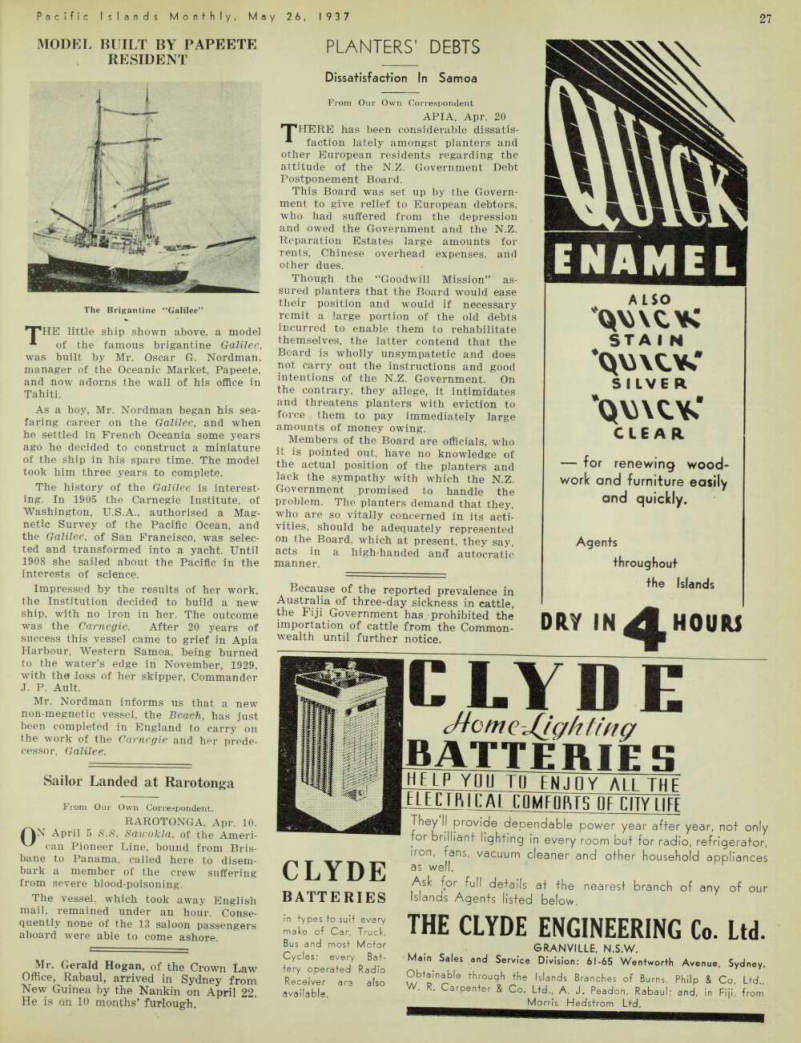
Resident
TTHE little ship shown above, a model of the famous brigantine Galilee, was built by Mr. Oscar G. Nordman, manager of the Oceanic Market, Papeete, and now adorns the wall of his office in Tahiti.
As a boy, Mr. Nordman began his sea faring career on the Galilee, and when he settled in French Oceania some years ago he decided to construct a miniature of the ship in his spare time. The model took him three years to complete.
The history of the Galilee is interest ing. In 1905 the Carnegie Institute, of Washington, U.S.A., authorised a Mag netic Survey of the Pacific Ocean, and the Galilee, of San Francisco, was selec ted and transformed into a yacht. Until 1908 she sailed about the Pacific in the interests of science.
Impressed by the results of her work, the Institution decided to build a new ship, with no iron in her. The outcome was the Carnegie. After 20 years of success this vessel came to grief in Apia Harbour, Western Samoa, being burned to the water’s edge in November, 1929, with thei loss of her skipper, Commander J. P. Ault.
Mr. Nordman informs us that a new non-megnetic vessel, the Beach, has just been completed in England to carry on the work of the Carnegie and her prede cessor, Galilee.
The Brigantine “Galilee”
Sailor Landed at Rarotonga
From Our Own Correspondent.
Rarotonga. Apr. 10.
April 5 S.S. Sawokla . of the Ameri ” can Pioneer Line, bound from Bris bane to Panama, called here to disem bark a member of the crew suffering from severe blood-poisoning.
The vessel, which took away English mail, remained under an hour. Conse quently none of the 13 saloon passengers aboard were able to come ashore.
Mr. Gerald Hogan, of the Crown Law
Office, Rabaul, arrived in Sydney from
New Guinea by the Nankin on April 22, He is on 10 months’ furlough.
Planters' Debts
Dissatisfaction In Samoa
From Our Own Correspondent
Apia, Apr. 20
'T'HERE has been considerable dissatis * faction lately amongst planters and other European residents regarding the attitude of the N.Z. Government Debt Postponement Board.
This Board was set up by the Govern ment to give relief to European debtors, who had suffered from the depression and owed the Government and the N.Z.
Reparation Estates large amounts for rents, Chinese overhead expenses, and other dues.
Though the “Goodwill Mission” as sured planters that the Board would ease their position and would if necessary remit a large portion of the old dobts incurred to enable them to rehabilitate themselves, the latter contend that the Board is wholly unsympatetic and does not carry out the instructions and good intentions of the N.Z. Government. On the contrary, they allege, it intimidates and threatens planters with eviction to force them to pay immediately large amounts of money owing.
Members of the Board are officials, who it is pointed out, have no knowledge of the actual position of the planters and lack the sympathy with which the N.Z.
Government promised to handle the problem. The planters demand that they, who are so vitally concerned in its acti vities, should be adequately represented on the Board, which at present, they say, acts in a high-handed an? autocratic manner.
Because of the reported prevalence in Australia of three-day sickness in cattle, the Fiji Government has prohibited the importation of cattle from the Common wealth until further notice.
Advertisements & other items, pp. 29-30 (1 item)
Clyde
ENAMEL
ALSO
STA I N
SILVER
*qv>\cy;
CLEAR
for renewing woodwork and furniture easily
and quickly.
Agents throughout the Islands
DAY IN
4
HOURS
m
CLYDE
BATTERIES
CLYDE
cHeme Xigh t
batteries
HELP YOU TD ENJOY ALL THE
ELECTRICAL CUM HIRES OF CITY LIFE
They II provide dependable power year after year, not only for brilliant lighting in every room but for radio, refrigerator, iron, fans, vacuum cleaner and other household appliances as well.
Ask tor full details at the nearest branch of any of our Islands Agents listed below. in types to suit every make of Car, Truck, Bus and most Motor Cycles: every Battery operated Radio Receiver are also available,
THE CLYDE ENGINEERING Co. Ltd.
GRANVILLE, N.S.W.
Main Sales and Service Division: 61-65 Wentworth Avenue. Sydney.
Obtainable through the Islands Branches of Burns, Philp & Co Ltd W. R. Carpenter & Co. Ltd.. A. J. Peadon, Rabaul; and. in Fiji, from Morris Hedstrom Ltd,
Cables: "Stancarr." Tel. MA 4416
ESTABLISHED 1841
Stanley & Co.
325 SUSSEX STREET
SYDNEY
WHOLESALE & RETAIL
PRODUCE MERCHANTS
Fruiterers and Greengrocers
Shipping Providers
PACKING FOR ISLANDS TRADE
A SPECIALTY
EUROPEAN jand CHINESE VEGETABLES
always available in any quantity.
Yacht“Yankee”On Second
World Cruise
From Our Own Correspondent.
Apia, Apr. 20.
TN the course of a second South Seas cruise, coming from such out-of-the way places as the Tokelaus and Swain’s Island (where she was passed by the Pan-American Clipper on its way back from N.Z. to Hawaii), the American yacht Yankee, Captain I. Johnson, called at Apia on April 13 for a three days’ visit.
Apart from the owner and his wife and baby, there are a dozen young Americans on board, who work the ship and are fully-fledged members without pay of the happy family on board. On the 16th the Yankee took her departure in continu ation of the voyage to American Samoa and thence eastwards.
Miss Hilda Taylor, who has been work ing for the Methodist Mission among the Indian women and children at Lautoka arrived in Sydney from Fiji by the Mariposa recently. She is at present spending leave in New South Walej.
Vanilla Beans
How Boom Created Saturnalia of Spending in French Oceania
From Our Own Correspondent
Papeete, May 3.
\ CONTRIBUTORY element of no small importance in the economic recovery of French Oceania has been the rise in the price of vanilla beans.
Vanilla growing is well nigh as specu lative an undertaking as dabbling on the Stock Exchange or playing the numbers in a roulette game. There are times when it seems that every one in the world is eating vanilla ice cream and every cook “from Greenland’s icy mountains to India’s coral strand” is pouring bottles of vanilla essence into puddings and cake batter. It is then that vanilla beans be come worth their weight in gold.
But soon something happens, and it is all over. Tins of vanilla rushed to mar ket to supply the apparently limitless demand become suddenly as unsaleable as a herd of sick elephants. Then the stocks lie around in warehouses for months and even years before a buyer can be discovered.
On the crest of these booms the native grower rides high, wide and handsome.
He does not, as a rule, undertake the difficult and delicate operation of curing the beans. That task has been taken over by the Chinese. The planter sells the matured beans to the Chinese for cash.
The latter assume the risks of drying and curing, and the uncertainties of markets. The green vanilla is sold at auction (under Government supervision) at the headquarters of the chief of each district, on specified days in order to avoid conflict with sales in other dis tricts. Knowledge as to market prices is in the possession of the grower; compe tition is keen; and so the native usually gets all the traffic will bear.
The most spectacular, perhaps, of these booms came along in the hectic 1920’5.
United States merchants were living at that time in the hashish dream of the “New Era” when the world and all it contained were to ride on flowing beds of ease and bull markets until time should be no more. Vanilla, of course, was to be no exception. Advances of money were made to South Seas Chinese on the basis of things to come; tins of the precious substance were amassed in warehouses; and everyone concerned sat down to wait for prices to soar into the stratosphere.
The denouement —which came later (when public taste suddenly turned to Peach Melbas, cooks altered their recipes to contain Worcester sauce, paprika, and lemons; and it was belatedly discovered that crafty Hovas had been busy clearing and planting several counties of Mada gascar in vanilla) —was the beginning of many troubles in Tahiti, some of the consequences of which are visible at this day. But all that is apart from the pre sent story.
The principally relevant fact is that
the bulk of the advances had passed into the possession of native growers in the Leeward Archipelago (then, as now, the sites of the largest number of vanilla plantations in these islands) in payment for their crop of vanilla beans. The advent of so much money into hands un accustomed to receive it was followed by a saturnalia of spending which surpassed anything known in the experience of any then living and has become historic in the annals of the Colony.
The first phase was a series of gar gantuan banquets. Hecatomes of pigs, brigades of fowl, and mountains of other comestibles were sacrificed on the altar of these gustatory Olympics. There were giant trenchermen in those days who possessed vast capacities within the circle of their ample equators, and it usually took three days of feasting to fi.ll them up.
This writer once was present at a mid day session of one of these three day feasts. Behind a nearby spinney, the but chers were at work preparing for the morrow. Throughout the repast the air reverberated with shrieks and squeals and grunts and groans in a syncopated ensemble precisely like the sounds we hear nightly over the radio. We have since wondered if modern jazz did not have its origin at some hog barbacue in the deep south of the United States of America!
That phase ended, the second develop ment was a general hegira to that centre of golden dreams in the minds of all out islanders: the metropolis, Papeete.
Schooners from Raiatea, Hauhine, Bora Bora, and Tahaa sailed into Papeete Har bour crowded with humanity packed tightly on decks, in cabins, and even in the cargo holds. Soon the astonished residents beheld the spectacle of proces sions of automobiles full of natives, with the exalted mien and the independent air of the Man Who Broke The Bank At Monte Carlo, brandishing rolls of 100franc notes and calling lustily for new excitements. They did not have to call in vain.
The third and last phase was a philo sophic and satisfied return to the places whence they came. Those who had militant wives each took with them an armoire a glace (the chest of drawers with mir ror that every woman in Eastern Poly nesia is fired with ambition to possess, as it is the symbol of opulence and social eminence); some pieces of feminine dress godds; and, perhaps, a few cases of tin ned salmon.
The others bore away the shirts on their backs (usually hanging to their flap ends outside their trousers—as the fashion is); a demijohn of red wine to cheer them on their way; a consciousness of duty well performed; and nothing else.
The present rise in vanilla prices has not, as yet, attained boom proportions.
But it has stimulated trade in ukuleles, guitars, cigarettes, gramophone records, tinned meats, and miscellaneous girn cracks. The future is on the knees of the gods.
Advertisements & other items, p. 30 (1 item)
Arnottis
THEY KEEP YOU FIT
AND KEEP YOU SLIM
“PHESE delicious Biscuits are a perfect slimming food.
Made from the whole grain of carefully selected, sun-ripened wheat. They are tempting, wholesome and extremely easy to digest.
Slimming is made pleasant by these delicious and popular biscuits, which in addition increase the energy and improve the general health. Try them spread with butter and creamy candied honey, with butter and cheese, or jam. *■
ARNOTTiS
FAMOUS
SHREDDED
WHEATMEAL
B ISCUITS
Always ask your Grocer for Arnotf’s
“THEY ARE BETTER THAN EVER”
Village Councillors
System Adopted In Rabaul
From a Special Correspondent
Rabaul, Apr. 21.
’THE organisation of native Village Councillors in the Rabaul district has met with marked success.
It is encouraging to note that they have already shown understanding and appreciation of the methods applied for the beginnings of simplified self-govern ment. It is reported that as soon as their understanding increases beyond the ex perimental stage, the Government will consider conferring some definite auth ority upon the councillors.
That the system of native Village Coun cillors can operate successfully has al ready been shown in Papua, where it has been established for over 10 years. The system was adopted there with the object of giving the Papuans an opportunity of taking part in their own administration, and obtaining some understanding of its objects. They are selected by the village
people and their duties are to advise the District Magistrates of any matters which they think will be of advantage to the people.
Within the last few years the Papuan Councillors generally have been of mar ked assistance in explaining to the com munities the advantages of Government measures for the natives’ improvement.
Advertisements & other items, pp. 31-32 (1 item)
Just Try Them
TO PLANTERS AND TRADERS
William E. Reed
(Established 1913) Union House, 247 George St., Sydney For all Island Requirements.
Island produce sold.
Prices right. Enquiries welcomed.
JUST TRY THEM
Imperial
FLAVOUR SEALED GOOD FOODS
Try any one of these "Imperial" dishes and prepare yourself for a glorious surprise. We have blended the finest selected meats and cooked them in Vacuum. We call the process "flavour-sealing" because all the precious flavour carriers and valuable mineral salts are sealed in the can.
• Imperial SHEEP TONGUES
Prime, selected new season's tongues cooked by the new tenderizing process. • Imperial CORNED BEEF LOAF Delightfully flavoured, mild cured corned beef, ready to eat from the can.
• Imperial BEEF STEAK PUDDING
Selected Beef Steak with Rich Gravy, topped off with Devonshire Pudding.
tntperiul SMALLGOODS
PORK SAUSAGES, FRANKFURTS, PORK
FRITZ, DEVON SAUSAGE, PORK GARLIC
You'll enjoy all of these "Imperial" treats, but for added zest serve them with Imperial Mango & PaPaw
CHUTNEY
iimiiii Another delightful Imperial product Crustless O in 4 oz. & 8 or. Pkts.
Imperial Cheddar Cheese LOOK FOR THIS SIGN OF QUALITY FOODS-
Stocked by
Stocked by
All Leading Stores All Leading Stores
Huon Pine Boat Planks
Practically Borer Proof and Everlasting, also Spotted Gum Timbers—Prices Right.
A. C.
Fryer
MO Miller St., Pyrmont, N.S.W.
“Lovers And Luggers”
TO begin work on a new Cinesound film, “Lovers and Luggers,” Captain Frank Hurley, the well-known Australian photographer, sailed from Sydney for Thursday Island by the Taiping during April.
The story, written by Gurney Slade, deals with pearling, and Captain Hurley has been detailed to obtain background scenes. Hurley’s first film success was a silent movie, “Pearls and Savages,” made in Papua some years ago.
Mr. Ken Hall, who will direct the new film, says that a prominent actor is being brought from Hollywood to play the lead ing part.
The Work Of The N.M.P.
Remarkable Paper By Fijian Native
VV JE frequently have referred to the ** splendid work being done for the Pacific native races by the Suva Medical School, where young Fijians, Tongans, Samoans, Cook Islanders, and Solomon Islanders are being educated and trained as N.M.P.’s (Native Medical Practi
tioners),
As evidence of this, we pi'int below an article written for us by Solomone K. Ravasakula, a Fijian N.M.P. stationed
at Nabouwalu hospital, Bua, Fiji. The
article is published exactly as it was written, to show the way in which the Central and Eastern Pacific people can acquire European education .
Child Welfare Work For
Natives
FOR many years, death rates in child ren in the Western Pacific Island groups were usually very high, but at present it decreases down, as we natives are now graduated as medical men, and native women are qualified as Native Obstetric Nurses.
For five years practising as a native medical practitioner, I am always inter ested in child welfare work; and now I have come to the conclusion that very few children die in my medical districts per annum.
My routine rules in doing child welfare works are as follows with all my instruc tions to the head man of the village and Women Committees:
I.—Outline Of Meetings
(a) Talk to the crowd. (b) Short medical lecture. (c) Reports of Women’s Committee. (d) Examining the children. (e) Weighing of babies. (f) Closing remarks. (g) Visit the sick and give out medicine.
2.—Cleanliness Of The Village
(1) Village must be cleaned once a day; dead fruit, old food and rubbish burned. (2) They must not throw rubbish about —e.g., old food outside the house —because this brings flies. (3) No tins, bottles, coconut shells, to lie about the village, because dirty water inside breeds mosquitoes. (4) All people should have bath twice a day with water and soap. (5) Native houses to be cleaned daily, and swept after meals. (6) All food should be covered. (7) Once a week the walls must be swept out. (8) The grass under the mats should be clean, or change often and mats sunned. (9) Dishes must be cleaned after food, and turn upside down, so that flies cannot settle inside. (10) Spitting on floor or under the mats must be stopped ; use tins or coconut shells, with little kerosene, and burn them afterwards. (11) Kitchen must be clean daily. (12) Every house should have a latrine well covered to keep out flies. (13) Water supply must be kept clean from decaying matter. (14) If they do not obey all these rules the head man of village should be notified.
3.—Rules Or Duty Of Women’S
Committee
(1) They must meet once a week and talk of what they going to do. (2) They must inspect houses once a week and see if there is any cobwebs.
(3) A bell should be rang every morning to call children for treatment. (4) They must treat itch and tinea. (5) They give castor oil to children, and treat sore eyes with 5 per cent or 10 per cent Argyrol and medicine dropper. (6) They have to watch pregnant women. (7) The Women’s Committee must report all cases of sick, deaths and birth to the nurse or
N.M.P.
(8) If they know there is any case of infectious disease in the village, they must send urgently to the medical practitioner. (9) They must see that all rules are carried out.
4.—Feeding Of Babies
The best food is: (1) mother’s milk; (2) cow’s milk; (3) goat’s milk; (4) artificial food, e.g., Glaxo and Lactogen.
Teeth are made for chewing, only milk and soft food must be given to children until two sets of teeth appear.
You can also feed babies with well cooked rice, otherwise you can with soft coconut-meat.
When the baby is at the age of six months, you can start to feed with soft food. Over-work and over-eating poisons the mother’s milk. Stand ing in cold water is very bad.
Another good food for baby is the white of an egg. A few drops of orange juice can be given and mammy-apples, etc.
S.—Care Of Pregnant Women
The reason is, dealing with two lives. Her bowels should move at least once or twice a day.
She must have a proper rest. You must watch her, if she having any oedema of the face, hands and feet. If she has, you must treat her with the treatment of any kidney conditions. (Watch the heart.) A daily bath (warm) with soap is necessary.
6. Ringworm And Itch
For ringworm, use a saturated solution of acid salicylas in tincture iodine fortis.
For itch, use ung-sulph, or hydrarg, ammon. ointment, or boric acid ointment.
7.—Spitting
Very dangerous habit. Always tell the people not to spit under mats or on walls, because they only spx-eading germs to others.
Infectious diseases, such as T. 8., can be spread in this way.
N.B.—Tell all natives that diseases are caused by small insects called germs, which cannot be seen by the naked eye.
Advertisements & other items, p. 32 (1 item)
anifWoik-
CUujwhete
33 J 3 Simple design and rugged construction combine to make the Fetter Diesel Marine Engines the most dependable and economic source of motive power for any type of craft. f Atomic-Diesel Semi-Diesel
MARINE ENGINES
6 to 400 B.H.P.
BUZACOTT Co. Ltd. ' sydC 51
Visits Samoa
German Consul
From Our Own Correspondent
Apia, Apr. 21.
THE Germany Consul at Wellington, Dr.
W. Hellenthal. is expected to arrive from New Zealand by the Maui Povnare on April 27 on his first official visit to Western Samoa.
He will stay here a fortnight, and various functions have been planned by German residents for his entertainment.
Wreaths will be laid at the German, American, and British graves at Mulinu’u on German National Day, May 1.
Are Lutherans
Preaching
Hitler-Ism?
A Mission Problem in New Guinea
A GOOD DEAL of criticism of the political activities of German Luth eran missionaries in New Guinea con tinues to be published in Australia.
The best-informed opinion is that the trouble is being caused, firstly, by a few young and newly-arrived German mis sionaries who are enthusiastic Nazis; and, secondly, by a few older men who have recently spent a long leave in Ger many and become affected by the pre vailing idolatry of Adolf Hitler.
The Lutheran Mission should be warned that, if pro-Germanism and Hitler-ism are going to be preached in New Guinea, prompt steps almost cer tainly will be taken to put an end to it.
Hitler and his Nazis unquestionably saved Germany from Communism and revolution, and gave shape and direction to the fine national spirit of the Father land; but that does not mean that British people will accept Nazi-ism, in any shape or form, even if it only is being preached to primitive natives in a former German colony. There is grow ing friendship between Britain and Ger many, but that does not mean that the British will accept Hitler-ism.
The Lutherans would be great fools to allow their political enthusiasms to pre judice their position in New Guinea. They have been treated, ever since 1914, with kindness and consideration, and they have done splendid work in the mission field. But they should try to be mis sionaries all the time, while in New Guinea, and Nazis only when they go on leave.
Advertisements & other items, pp. 33-34 (3 items)
31
Pacific Islands M6rtf h I y , May 26, 193/
Aspro
Q
B.EGD
i v v Stylish Comfortable and Faithfully Made from Tested Materials
"TOP DOC"
Clothing, Hats, Shirts, Pyjamas, Mercery Hosiery and Knitted Goods will give full satisfaction They Look Well and They Wear Well •
EVERY GARMENT GUARANTEED
MILLIONS of GOOD DEEDS
DONE DAILY
TF you consider that banishing pain and illness is a GOOD DEED, *-then 'ASPRO’ is performing millions of good deeds daily. For 'ASPRO' the DAY OF SERVICE is a full one—it' Is busy everywhere all over the globe—dispelling all kinds of Pain and Headaches in some places, banishing Colds, 'Flu and Rheumatism in others. Then again, 'ASPRO' brings sweet sleep to the sleepless, soothes the irritable and quickly removes the cause of many minor everyday complaints.
'ASPRO' is therefore, an ideal "GOOD SCOUT" ready to do a good deed anywhere, at any time. You will save time, trouble, temper and expense by always having 'ASPRO' on hand ready for any emergency.
ASPRO
1
SERVES OLD and YOUNG ALIKE
ALWAYS
ASK
FOR
$ ,
PROTECT
YOUR EYES
with the soft
white light of
LAUREL
KEROSENE
Don't risk eye strain with lamplight that is harsh, yellowish or flickery.
Guard your precious eyes with the soft WHITE light of LAUREL. Its flickerless, steady whiteness will make reading a pleasure and sewing a delight. Laurel burns without smoke, soot or smell and is easily the World's finest kerosene for Lighting, Cooking, Heating and Cleaning. Always order by name —
KEROSENE
Maleham & Yeomans
LIMITED
BOWDEN STREET. SHEFFIELD, ENG.
Manufacturers of all kinds of Butchers', Sticking and Sheath Knives Razors and Scissors Specialty Hairdresser Scissors
PRICE LIST ON APPLICATION
Skippers
Dean Of Islands
Capt. Andrew Thompson Visits Tahiti
From Our Own Correspondent
Papeete, Apr. 12.
THE schooner Tagua, of Rarotonga, skippered by Captain Andrew Thomp son, arrived at Papeete recently.
Since the retirement from the sea of Captain Viggo Rasmussen, Captain Thompson succeeds to the distinction of Dean of Islands skippers in the South- Eastern Pacific.
He probably would not thank the writer for this remark, as the word “dean" carries an intimation of hoary locks (or no locks at all) and other dis abilities of advancing age. In this per son, however, the word merely appoints his place in the company of those who navigate Islands waters. He is young in years and appearance, master of his craft, and beloved by all his friends.
As her usual voyages are among the Cook Islands, it is only on rare occasions that the Tagua calls at Tahiti where many friends of her captain reside and are always rejoiced to see him.
Reduction In C.I. Orange
Crop Predicted
From Our N.Z. Correspondent
Auckland. Apr. 16.
PREDICTING a considerable reduction in the quantity of oranges exported from Rarotonga, Mr. R. McKegg, manag ing director of the Cook Islands Trading Co., who has been spending a holiday in New Zealand, declared that little syste matic planting had taken place in Raro tonga in recent times and many of the trees now in existence were too old.
F~ops would be diminished greatly unVss fresh planting was commenced and natives taught the proper methods of pruning and fertilising trees. Mr.
McKegg added that his remarks did not apply to outlying islands in the group.
Higher prices for copra had resulted in an improvement in trade in the group and conditions were now much better than for several years, he continued.
Banana production was back to normal, and cold storage accommodation on the Matua enabled fruit to be marketed in N.Z. in much better condition than previously.
Mr, McKegg mentioned that the tomato crop was expected to be a good one this year, and the first 4,000 or 5,000 cases would probably be landed in New Zea land in May.
Rev. W. Anderson, a Scottish minister who is working in the New Hebrides under the John G. Paton Fund, returned to the Condominium in April, after fur lough in New Zealand and Victoria. Mr.
Anderson is stationed at Hog Harbour on the island of Santo.
Four Natives Sentenced
To Death In N. Guinea
Fiom Our Own Correspondent
Rabaul, Apr. 14.
TPHE criminal sessions of the N.G. * Supreme Court opened here on April 1 with His Honour Judge F. B. Phillips presiding.
Four Bougainville natives appeared to stand trial on a charge of wilfully mur dering a native, Obel, on February 17.
They pleaded not guilty. The Crown al leged that the natives attacked Obel as he left Ramandata village, near Buka Passage, early one morning, and that after wounding him with knives and a tomahawk threw him into the sea. His body was later washed up at the village of Manob.
The four accused were found guilty and sentence of death was passed on them
Whippings For Wau Native
Another case, which was remanded from Wau District Court, was that of a native charged with Intent to indecently insult a European female. He pleaded guilty, and was convicted and sentenced to one year’s imprisonment with hard labour and two whippings of 18 strokes.
Advertisements & other items, p. 35 (1 item)
jTDucE kiPE
• ISLAND SHIPPING
Freight, Forwarding and Customs Service. Import and Export.
B. R. WHEELER
17-19 Bridge St., SYDNEY Correspondence Invited. Tel.: B 5396
jTDucE kiPE
0 now and then Common sense will tell you when.
Duty done should rest attain, Strain relaxed from hand and brain.
Take life easy till you're well, When the pangs of cold compel.
Add relief to warmth and rest — Woods' Great Peppermint Cure is best.
Woods’ Great Peppermint Cure, For Bronchial Coughs, Colds, Influenza.
ivfr
iiM
CAPST
NAVY CUT TO
iuM 1
ICARETTES
ORR-TIPPED
PSH
Vimm ft
R. PLA I
PST
Petty Thefts In Apia
From Our Own Correspondent
Apia, Apr. 8.
pETTY thefts in Apia as well as on outlying plantations seem of late to be the order of the day.
It appears that these thefts are mostly committed by young larrikins, who lack sufficient supervision.
An illustration is. the recent case when two local-born lads broke into the shop of Apia’s photographer, and stole some valuable lenses. Finding the glasses of no use to themselves, they threw them into the harbour, near the Customs Wharf.
Fortunately the boys w'ere caught, and it is hoped that severe punishment will be dealt out in this and similar cases.
Public opinion seems to favour corporal punishment in cases of this nature.
Sectarian Jealousies
Native Teachers and Sectarian Jealousies N.G. Administration Backs and Fills
TN June, 1936, the New Guinea Administration amended the Native Admini stration regulations, so as to prevent native mission teachers from entering uncontrolled areas in New Guinea, unless under the immediate supervision of a European. This was a necessary reform, on account of ridiculous sectarian wrangles which had developed in the uncontrolled areas, to bemuse the minds of the primitive people.
Now the Administration, with typical inability to keep its mind made up for any length of time on any matter affect ing the control of natives, has issued another amendment. The Administrator now may, upon the recommendation of a District Officer, give authority for native mission teachers to take up resi dence within uncontrolled areas.
The Rahaul Times comments bitingly upon the development and points out that it throws a heavy and most unfortunate responsibility upon District Officers, who now can scarcely hope to escape from becoming involved in sectarian jealousies and intrigues.
Solomons
Missionary Work in the Solomons
From Our N.Z. Correspondent
Auckland, Apr. 20.
“XTOW many realise that the Christian missionary in the Islands preceded and prepared the way for civil adminis tration?” queried Rev. J. F. Goldie, founder and chairman of the N.Z. Metho dist Mission in the Solomons in an ad dress to members of the Auckland Rotary Club in April. The missionary had gone before and made easy the pathway of legitimate commerce, he said.
With two colleagues, Mr. Goldie first visited the Western Solomon Islands in 1902. They were the first missionaries to work in that part of the group, and Mr. Goldie said he saw there not only the salvation of the individual, but “the resurrection of a race.”
One of the missionaries’ initial duties was to reduce the language to writing.
This had been done, and the natives were given a Bible and a literature in a lan guage they spoke better than the mis sionaries.
The object in educating the natives was to develop all-round character so that they could withstand disaster when the inevitable invasion of non-Christian civilisation commenced, concluded Mr.
Goldie.
Mr. W. Atkinson, a well-known planter of many years’ residence in the Shortland Group, British Solomon Is lands, is at present spending a few
months’ holiday in Sydney.
Advertisements & other items, p. 36 (1 item)
& Ariell's
PRESCOTT L T J? luyTI u yTn x e s^ sole wholesale agents fd^
PINEAPPLE BACON & HAMS
DAISY BRAND BUTTER
LEA & PERRINS' H. P. Sauce
LEA & PERRINS' ITSTI
and Most other Super-Quality Lines of the Trade
SWALLOW
& ARIELL'S
PLUM
PUDDINGS
fib. lb. 1 fibs. : 2-lbs. and 3-lbs.
Renowned for Quality Manufactured at Port Melbourne, Australia
Search For Oil In Papua

Why the Search Has Been Resumed With Prospects of Success
Part Iv.
\ NUMBER of expeditions, hacked hy •t*- powerful companies and subsidised liberally by British Governments, are now seeking an oilfield in Papua and , probably, will succeed. This article, ivritten by a resident of Papua, telling the story of the discovery of petroleum in the Territory and of the subsequent attempts at development, is the conclud ing instalment of a series of four.
T'HE Vogel (Papua) Petroleum Co. Ltd. * was attracted to the Cape Vogel peninsula in the first place by the report of E. R. Stanley, geologist to the Papuan Government. The geological indications were very similar to those on the Vailala River; the rainfall equally heavy and constant; and the danger of malaria as great.
The site selected by F. L. Dolton, the energetic originator of the Company, was a 4ozen or so miles from the coast; and a road had to be made and graded from Giwa, the landing place, over rough and rising country to the top of the anticline near the village of Kukuia.
The erection of a breakwater on the coast, roadmaking, and the heavy task of transporting 18 tons of machinery in addition to building materials, heavy casing, and accessories, occupied nine months of hard work. The drilling plant eventually reached the Kukuia site on December 6, 1926. Six weeks later it was in place, bedded down, and stayed; and drilling commenced on January 18, 1927.
From the beginning the outlook was encouraging. At 147 ft. there was a strong flow of gas from a stratum of sandy shale and shell, the prelude to a show of oil at 150 ft. As had been the case on the Vailala, this was not looked upon as the true oil horizon; and drilling was continued through grey shale with bands of fossiliferous shale and hard lime stone. These strata continued until, after six months of drilling, the bit was down to 390 ft. in grey shale and limestone.
Progress was far from rapid up to this point, due not so much to the dif ficulty of the strata as to continual sick ness among the four white men who formed the staff.
But, during the next half-year, matters improved considerably. By the end of July the well was down* to 565 ft. in calcareous sandy shale, giving a grati fying show of oil which continued down to 618 ft. A big flow of water and gas came in at 568 ft., and persisted until the casing was down to the 600 ft. level.
Then followed 18ft. of sandy shale, fol lowed by various shales alternating with limestone and hot mud to 851 ft. Caving was very troublesome at this point, and the casing was kept as close as possible to the bit to minimise the danger.
By the end of 1927 the drill was down to I,oooft. in sandy shale, after passing through calcareous shale and carbon aceous shale with bands of crystalline
limestone intervening. A foot of coarse light sandstone followed, then shale and shell to 1018 ft., which depth was reached on January 22, 1928.
The Company’s financial year ended on January 31, and the financial situation had to be reviewed. The staff left for Australia on vacation for three months, and during their absence a party of geologists attached to the Anglo-Persian Oil Co., headed by Dr. Papp, visited Kukuia to make a geological and topo graphical survey of the district.
Drilling was resumed on May 5, 1928.
The bore was cleared of silt and cavings to 1005 ft.; but when that point was reached the hole caved again badly, bury ing the tools under 100 ft. of debris, and breaking off the rope at the socket clips.
Rather than lose time in the almost hopeless task of fishing for tools I,oooft. below the surface, and buried beneath some 50 tons of rubbish in a hole notori ously given to caving, Dolton acted upon Dr. Papp’s advice, and abandoned the bore, removing his plant to a site that Dr. Papp had recommended, with the intention of cutting the known oil-horizon already encountered at 568 ft.
Dr. Papp had to leave the district to carry on the work of his Company else where; but his real interest in the Vogel
area was proved by his undertaking to return and advise as soon as the oilhorizon was reached in the new bore.
But it never was reached. The cost and time involved in moving the plant, drilling difficulties in the new well, and the accumulated non-success of other oil-seeking Companies in Papua, determined the shareholders to cut their losses rather than invest further sums in so costly and speculative a venture.
The Vogel Company persevered until
the end of 1929, and was the last con cern to give up the contest. But at that point hope, not of the existence of oil, but the mone y whereby to win it, was at ast abandoned.
TO return to the Anglo-Persian Oil Co. * at Popo. Finance was still, as it had been from the beginning, a constant source of worry; and, in addition, a sus picion grew in the minds of Ministers that no real effort had been made to win oil. Allegations of the most serious
nature were made under the cloak of parliamentary privilege both against Dr.
Wade and against the officers of the Anglo-Persian Co.
But, to those whose close acquaintance with the work done and the methods employed in Papua entitles them to judge, there seems to have been no adequate ground whatever for the suspicions that were so unreservedly expressed. Instead, the uneasiness appears to have been due to Parliament’s failure to appreciate either the extreme difficulties of oil search in such a country as Papua, or the wide scale on which the work, to be successful, must be carried out.
Early in May, 1925, a Parliamentarv narty consisting of five members of the Public Accounts Committee arrived at Port Moresby to enquire into the affairs of the oil-field. They devoted a fortnight to the task, and it would appear that they, at least, found nothing to cavil at; for after their visit it was decided to continue the work.
It has been mentioned that the third Anglo-Persian bore at Popo was taken down to a depth of 2707 ft., and then abandoned, owing to difficulties that the existing plant could not overcome.
There was a pause in drilling activity, though the geological survey continued until it had covered the whole of the coast line and a wide belt of country inland.
A new bore, the fourth, was started in 1927. Constructional work was started in March and completed in August, when drilling was begun. In this bore the trouble that eventually stopped the drillers was that of soft mudstone, similar to that which had hampered the New Guinea Oil Co . making the control of the drilling flush a difficult matter.
This was overcome, though the difficulty of dealing with it slowed down the rate of drilling considerably: and the bore was pushed down to a depth of 895 ft. There casing trouble developed, and it was decided to abandon the bore and start another in what it was hoped was a better position.
The lifth bore was started late in February, 1928, and difficulties presented themselves almost from the first day.
The strata were very much broken, and there was great difficulty in holding the seat of the conductor string. Eventually this string was cementedj but new trouble developed owing to the alternation of hard and soft strata inclined at a very steep angle.
Under such conditions, with the hard steel drill impinging on hard limestone at an acute angle, the greatest difficulty was experienced in keeping the hole vertical. Progress was very slow; but the Company’s men were keyed up to a high pitch of keenness bv the knowledge that unless results could be shown before the end of the year there would be no further opportunity for achieving them. The second period of five years was drawing to a close, and there was every indication that the agreement would not be renewed without good grounds. The Company rushed its best men to Popo, taking its
star driller from an important job in Persia that he might devote his skill to the problem in Papua.
The whole staff was as efficient and as experienced as the most particular critic could wish.
The main difficulty was overcome, and the bore went down more quickly and more steadily than any other in Papua.
Enthusiasm gripped the staff. Every member of it devoted all his energy and thought to the work in hand, and the geologists examined with constantly growing hope the cores extracted from the bore. By August, indications were so good that the drillers expected to strike a gusher at any moment. Geological forecasts were more than fulfilled; and the queer sixth sense of experienced drillers kept men keyed to constant alert ness and expectation.
By the beginning of October the thing seemed a certainty to all the operatives, as well as to the clerical members of the organization who could read a geo logical report with understanding.
Another Anglo-Persian expert was rushed to the field—this time a man with a reputation for uncanny skill in shutting off the flow of a gusher from the bore head. Reports of daily, almost of hourly, progress were telegraphed in to Port Moresby and relayed to Canberra and London.
Right up to the last day of the term of agreement the excitement continued.
But it would have taken more than mere confidence to persuade the Common wealth Government to continue the costly experiment. For 18 years they had been paying out good cash, and in return had reaped nothing but confident reports and the heart-sickness of hope continually deferred.
Ministers were fed up. There were many directions in which the money spent on the oilfield would be welcome. At five o’clock, on October 24,1929, the work ceased.
THE total Commonwealth expenditure * on the search for oil amounted to £553,290, in addition to the sum of £25,000 contributed by the British Government. Of this amount, all but a small proportion was spent in Papua during the years 1912 to 1929; the balance going to subsidize oil-research on the mainland of Australia.
The amount is large; but it represents only a small proportion of the sums that have been expended on other fields. In British North Borneo, for instance, over £6,000,000 was expended on prospecting before a payable well was found; and the geological prospects there were no better than those in Papua. Also, in the opinion of those competent to judge, it is likely that far better results would have been achieved by more rapid expenditure over a shorter term.
It would be far from true to state that interest in Papuan oil, or faith in its existence, is dying. On the contrary, the interest is greater now than at any time since the first discovery in 1911.
The outbreak of war in 1914 diverted attention from Papua; and the big Com panies that had been eager to test and develop its oil resources lost their eager
ness. But when the war ended in 1918, keenness revived for a time.
By 1923 it had subsided again, owing to the fact that existing wells were more than adequate to supply the world’s markets. Many wells were closed down, while others were producing at only part capacity.
To-day (the end of 1936) the position has changed again. The world demand for oil is increasing rapidly; while there is evidence that the existing fields in Borneo as well as in America are becom ing exhausted. These facts, together with the insistent danger of have re minded the British Government that there are practically no oil supplies actually within the Empire; and the important part that the Pacific must play in any war that breaks out makes it more than ever desirable that a source of supply in the Pacific possessions of the Empire should be discovered and exploited.
As a result of this feeling of urgency the Petroleum Ordinance of 1934 was rushed through the Legislative Council of Papua towards the end of that year.
The Bill was not of local origin, but was dictated by the Commonwealth Govern ment at the instance of the Government
of Great Britain; and its object was to offer sufficient inducement to the great oil Companies to devote serious efforts to the discovery of pavable oil wells in Papua.
When the granting of prospecting
licenses was first considered in 1911-2, the conditions under which licenses would be granted were specifically de signed to exclude large companies from the field; the statement being openly made by responsible Ministers that any project requiring large capital in Papua would be undertaken by the Common wealth itself. This was quite in accord with the policy of the Labour Govern ment of that time; but in the case of oil it proved unworkable.
In 1923, when the experiment had proved a costly failure, an attempt was made to interest capital. The area to be covered by a prospecting license was increased from 320 acres to 1,000 square miles; but even this was not enough to attract oil companies, and neither the prospecting areas nor the area of the working leases that might be selected from them were long enough to give scope to big capital or to make the allocation to them of adequate resources worth while.
The 1934 Ordinance was designed to remove these disabilities; but it still failed of the desired effect. Although the areas were largely increased, the Ordinance embraced restrictions that threatened to destroy an operating Com pany’s freedom of action and might very well deprive it of adequate reward for its investment of money and effort. No applications followed the passing of the
Ordinance, and no indication to accept the conditions was shown by the big companies.
In March, 1936, still under instructions from Canberra, the Ordinance was amended so as to make the conditions altogether acceptable.
The principal amendments provided for the granting of exclusive prospecting rights over areas up to 20,000 square miles in extent; for the increase of area of working leases from 8 to 20 square miles, with the right of one person or 1 company to take up five such leases; and for the selection of land comprising such leases in a succession of small blocks of a quarter-mile each, thus per mitting the lessee to follow closely the desired geological structure and to avoid the inclusion of unpromising ground.
At the same time clauses were intro duced that were designed to ensure hona fide effort on the part of permittees.
Prospecting permits were to be granted for one year only, with the riglit of renewal subject to the full approval of the Papuan Government. Permittees were required to expend a large specified sum on development during the currency of the permit, and were required to deposit with the Papuan Treasury a large sum in cash as a guarantee of their fulfilment of the conditions.
The effect of these amendments was immediate. They were passed by the Papua Legislative Council in March. In April they were assented to by the Governor-General of Australia and be came law. Before the end of May the delegate of “a Company to be formed” was in Port Moresby negotiating for prospecting rights. On June 22, a peimit was granted to him for 12 months over an area of 20,000 square miles; and on July 9 the Papua Oil Development Co.
Ltd. was registered in Port Moresby with a nominal capital of £50,000. That the capital is not larger is accounted for by the fact that it is a prospecting company only, and is an off-shoot of the powerful Shell Company, by which, if promising sites are discovered, the expensive boring operations will be undertaken.
Under the requirements of the Ordin ance the Company is committed to the expenditure of not less than £15,000 during the first six months of the permit’s currency, and an equal sum during the remainder of the term. On the other hand, the Commonwealth Government will subsidize boring operations on a pound for pound basis, though all the expenses of prospecting and survey must be borne by the company.
Meanwhile, on June 30, 1936, Islands Exploration Co. Proprietary Limited was registered as a foreign company in Port Moresby; and on September 16 a permit was granted to its representative over three areas aggregating 21,000 square miles.
On September 29 yet another permit over 12,000 square miles was granted to Oriomo Oil Co. Ltd., the same energetic concern that operated in the west of Papua from 1925 to 1928.
Thus the whole of the Territory west of Cape Possession was under permit
within six months of the amendment of the Ordinance.
The Papua Oil Development Co., ob viously guided by the exhaustive report of the Anglo-Persian * Oil Co., had no hesitation about the area for which they applied. It includes a strip of low-lying coast in the Delta Division, then broadens and runs north-west to cover the heart of the great Western Division, touching with its westernmost corner the boundary between Papua and Dutch New Guinea.
Islands Exploration Co. hangs closely on its flanks to north and to south-west, and includes all the remaining country west of the Purari River, with the area that was unsuccessfully prospected by Oriomo Oil Ltd. in earlier years, and also the broken mountainous region of the Star Mountains in the extreme north west.
Oriomo Oil Ltd. have taken the area between the Purari River and Cape Possession—an area that includes the Vailala River and Popo, the two scenes of Commonwealth activity, where sur face indications are extremely rich, but where drilling conditions are known to be very difficult.
Both Islands Exploration Ltd. (which is under the aegis of the Vacuum Oil Co.) and Oriomo Oil Ltd. have been required to give guarantees similar tc those given by Papua Oil Development Co. Ltd.; and the scope of these guaran tees is such that little doubt remains that the question of payable oil in Papua will bte solved one way or the other within a very few T years.
The Papua Oil Development Co., in particular, is already (December, 1936) very vigorously at work. It has already its own steamer on the coast, manned and equipped for communication between Port Moresby and its field headquarters at Daru; it has also two large motor vessels, and another steamer is on its way to Papua. It has launches on the rivers, and 11 geological survey parties busily examining the country. A sea plane has been chartered to help in the work pending the arrival of more suit able air-craft that are on order; and
everything' points to the determination of the Company to do everything that can be done to prove or disprove, the existence of payable oil at the earliest possible date.
In Papua, hope runs high. For it is fully realized that the negative results obtained during the years 1913 to 1929 were not conclusive. On the contrary, every foot drilled in the many bores that were started and abandoned during those years helped to strengthen the opinion that oil in large quantities exists, and that it can be found if those searching for it have sufficient financial stamina to stay the distance.
Furthermore, it seems certain that two such Companies as Shell and Vacuum would need very solid grounds for con fidence before embarking on the lavish expenditure of money and of effort to which they are now committed; and it seems equally certain that such en couragement was found in the full report of the Anglo-Persian Oil Co. It is a very hopeful sign that, on the strength of the knowledge gained by their pre decessors in the field, and despite their lack of success, these two big concerns had no hesitation in their choice of ground, and none with regard to embark ing on the heavy effort and expenditure (Sailed for by the need of rapid progress.
Throughout the long-drawn history of oil search in Papua there has been noth ing whatever to weaken the belief ex pressed by Professor David and many other eminent geologists that profitable oil wells are to be found in Papua. On the contrary, in spite of the failure, to date, of every concern that has made the finding of oil its object, every scrap of evidence accumulated by geological sur veys and by drilling has gone to strengthen it.
Mr. A. J. Healy, who has been a planter at Norfolk Island for over seven years, arrived in Sydney by the Morinda in April to join his wife who had come to Australia by the previous boat. They left Sydney later on a visit to New Zealand.
Advertisements & other items, pp. 37-42 (2 items)
Aunt
H.JONES eco ;>
AUSTRALIA’S BEST
H. JONES & CO., LTD.
Darlington, Sydney Hobart, Ta*.
For- Fresh Fruit, Vegetables, and Produce Islands Residents can rely on the old-established Shipping Providers: , o P*^
St A
Island Agents Only Address: 421 Sussex Street, SYDNEY All Orders Promptly Attended
NELSON & ROBERTSON PTY. LTD.
• A new, simple lid for your convenience; a new
patented parchment seal
to'ensure perfect fresh-
ness.
AUNT
M A RYS
BAKING POWDER
® Send I/- plus 2d. postage to Tillock and Co.
Ltd., Sydney, for "Aunt Mary's" Cookery Book.
It's the best.
T his
is wh
they like
* ii m
FOR
WRITE
TO-DAY
W hat a sight for hungry people! A big bowl of Foster Clark’s creamy Custard smooth, rich, deliciously flavoured and full of nourishment.
Mother knows what they like!
Your family will really enjoy Foster Clark’s world - famous Custard.
Make it a regular part of your menu —and see how popular it will be!
Remember that four-fifths of your Custard’s cost is milk. Don’t take risks with inferior Custard Powder.
Always ask for Foster Clark’s Custard, and refuse cheap imitations.
Send your name and address with Id. stamp to Foster Clark (Aust.) Ltd., Dept. R. 8., Redfern, N.S.W., for your FREE copy of Elizabeth Craig’s Recipe Book.
FSI44
Foster Clark's
creamy CUST A R D
Kork-N-Seal
FOR HOME USE
FOR ALL HOME BOTTLING
—THE LITTLE CAP THAT
will Re - seal 1,000 Times
KORK - N - SEAL (Aust.) LTD.
106 COMMONWEALTH STREET
SYDNEY, AUSTRALIA
Applied Airtight Pressure Proof Hand
We are Specialists . . .
\ ’Phones: MA 3412 (4 lines) Cable Address: "Weymarkson”
Codes—Bentleys Private Let us have your confidence. Sixty years is our record of supplying the leading Houses throughout the World in ... .
FRESH FRUIT VEGETABLES PRODUCE
WEYMARK & SON LTD.
FRUIT AND PRODUCE MERCHANTS
14-18 STEAMMILL STREET - - SYDNEY
CHIVERS
FAMOUS ENGLISH PRODUCTS
CANNED ENGLISH VEGETABLES
CANNED ENGLISH FRUITS
OLDE ENGLISH MARMALADE
GOLD MEDAL JAMS
JELLY CRYSTALS. ETC.
Obtainable from all leading Grocery Stores
WRITE TO DEPARTMENT ~A , ,
CHIVERS & SONS LTD.
Histon, Cambs., Eng.
POR ATTRACTIVE RECIPE BOOK
min'
OK dA
CHIV£RS
, COLD
a STfIMD4R» .
PRESH
1.
ENGLISH
PEAS
s
:<«»D AHD
~uJui
PURE RICE
STARCH
Always ask for . . .
"CORAL" Brand
100% PURE
CORAL BRAND
RICE STARCH
Noted for its
QUALITY
and
WHITENESS
Goes Farthest and gives Lasting Finish
WILL NOT
STICK TO
IRON
Obtainable from Leading Island Stores Manufactured by
AUSTRALIAN RICE LTD.
Sydney, N.S.W.
/ n Always . . . make sure Australia’s Choicest Products: you have Brussels Sprouts White Turnips Sweet Corn Tomato Puree Tomato Sauce Tomato Soup Futti Fruit Sauce (Worcestershire flavor) Green Peas French Beans Cauliflower Beetroot Spinach Cabbage Carrots Parsnips Celery at hand & an ample Reserve of these
QardenVfi\
Delicious
M 3.
Garden
Vale
Ready-toserve Vegetables I i ft a ■I
HOLBROOKS
TABLE
DELICACIES
WORCESTERSHIRE SAUCE
Enjoys a world-wide reputation.
VAT 2 SAUCE —A delicious thick, fruity sauce.
VINEGAR Strong, well matured, and guaranteed Pure Malt.
ESSENCE OF ANCHOVIES—
A fish sauce made from the finest Gorgona Anchovies.
TOMATO SAUCE—Made from fresh, ripe tomatoes.
FRENCH CAPERS —Capucines and Capottes.
SPANISH OLIVES
Varieties: Spanish Queens, Small Queens, Manzanillas and Stuffed or Sliced ready for Sandwiches.
PURE OLIVE OIL French
or Italian. From the first pressings of selected Olives.
PICKLES
Varieties: Sweet Gherkins, Tiny White Onions, Walnuts, Piccalilli, Mixed and Green Tomato.
FISH AND MEAT PASTES.
In and 3oz. glass jars.
Varieties : Anchovy, Salmon,
Ham and Tongue, Veal and Tongue, Chicken and Ham, Turkey and Tongue, Salmon and Sh rimp, Bloater.
SOUPS, in Boz., 160 z., gal.
and I gal. tins.
Varieties: Vegetable, Ox Tail, Mulligatawny, Mock Turtle, Tomato.
JELLY CRYSTALS Specially prepared for warm climates.
They set well, and are delicious-
ly flavoured.
HEALTH SALINE—A refreshing health-giving beverage, suitable for hot climates, In and lib. tins.
HOLBROOKS
(Australasia) Ltd.
WATERLOO, N.S.W.
PRODUCING UNIFORM GOOD RESULTS SINCE 1868
Flour
ALWAYS ASK FOR IT
V/HEHEVER
YOU USE
ka\lk
ill SWEETENED CONS
t>»* v 'J
NEST BRAND
R'gd.lM. M*rh
SYDNEY
\1 For every occasion on which you use milk —whether it's for the kiddies, for cooking, for tea, coffee or cocoa—use Nestie's Milk—the safest and purest milk you can buy. Nestie's Milk is rich country milk taken from selected herds. Being hermetically sealed, It cannot become contaminated, and it remains fresh indefinitely while unopened. Order a regular supply of Nestie's Milk and use it always.
NESTLES
FULL CREAM
MILK
Its Quality is Your Safeguard kJkU.AJ
37
Pacific Islands Monthly, May i 6, I 7 3 7
Plan To Brew At Wau
Mew Guinea Breweries Ltd.,
* the registration of which in Sydney was reported recently, is a company formed to acquire from Mr. J. Cassell his right, title and interest in a sole license for the territory from a German firm which is marketing a special process of beer manufacture (and supplying the machinery and a technician), together with an area of 40 acres at Wau, and an agreement with the Australian Govern ment that no duty will be charged on locally-produced beer for two years.
The prospectus contains an estimate of sales to the extent of 50,000 gallons per annum at 3/6 per gallon, at which price it is considered that it will be easy to defeat the competition of Australian beers which cost a minimum of 7/6 per gallon in New Guinea, inclusive of import duty. Ten thousand of the 50,000 £1 shares are said to have been sold in New Guinea.
The enterprise is definitely speculative.
Anyone who knows New Guinea knows how fussy the New Guinea resident is about his beer—his likes and dislikes are definite, and nothing will shift him from one brew to another, once his taste is formed. The estimate that the people of Morobe goldfield will consume 50,000 gallons per annum of the new brew seems excessive—in any event, so much depends upon the quality of the brew in relation to the public taste. If Wau beer is to be sold elsewhere in the Territory it will be subject to the same disability as the Australian beers —namely, high transport cost.
Samoa On The Screen
From Our N.Z. Correspondent
Auckland, Apr. 20.
A N interesting film of Western Samoa, which is to be released for exhibition overseas and in places where it is thought travel propaganda will prove most effective, has recently been com pleted at the N.Z. Government Publicity Department’s studios at Mirimar, Wel lington.
Taken during a tourist cruise to Samoa the film is a travelogue portraying vari ous aspects of native life in the vicinity of Apia. Its duration is about 10 min utes and it reveals a high degree of technical skill.
In addition to many attractive scenes of Samoan native life, which do full justice of the beautiful island scenery, prominence is given to a native feast in honour of Queen Salote, of Tonga, on one of her visits to Samoa.
The musical and oral effects reveal the same degree of skill which marks the photography and general presentation of the film.
Rev. J. Bodger, priest in charge of the New Guinea Mission’s head station at Dogura, in Papua, arrived in Sydney by the Montoro in April, on leave following illness.
Advertisements & other items, p. 43 (1 item)
Village House In Dutch
NEW GUINEA
Village house for the unmarried men, Dutch New Guinea, eastern districts.
Copra War On Niue
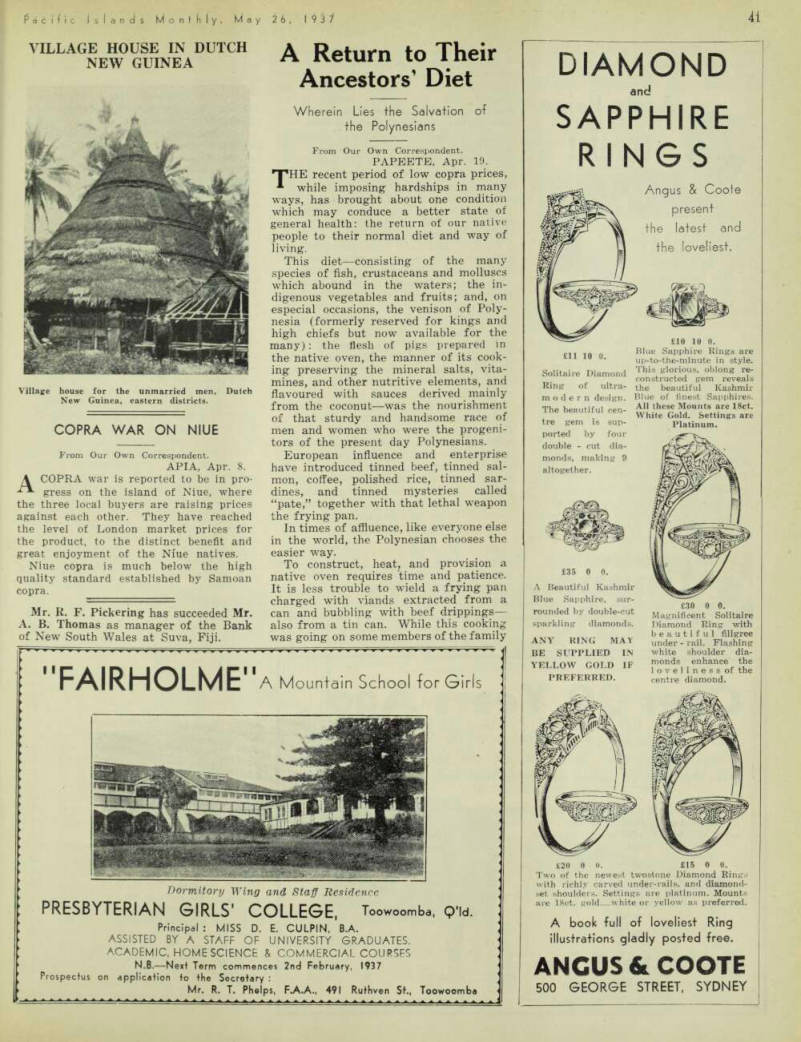
From Our Own Correspondent.
Apia, Apr. 8.
A COPRA war is reported to be in pro gress on the island of Niue, where the three local buyers are raising prices against each other. They have reached the level of London market prices for the product, to the distinct benefit and great enjoyment of the Niue natives.
Niue copra is much below the high quality standard established by Samoan copra.
Mr. R. F. Pickering has succeeded Mr.
A. B. Thomas as manager of the Bank of New South Wales at Suva, Fiji.
A Return to Their
Ancestors’ Diet Wherein Lies the Salvation of the Polynesians
From Our Own Correspondent.
Papeete, Apr. 19.
THE recent period of low copra prices, while imposing hardships in many ways, has brought about one condition which may conduce a better state of general health: the return of our native people to their normal diet and way of living.
This diet —consisting of the many species of fish, crustaceans and molluscs which abound in the waters; the in digenous vegetables and fruits; and, on especial occasions, the venison of Poly nesia (formerly reserved for kings and high chiefs but now available for the many): the flesh of pigs prepared in the native oven, the manner of its cook ing preserving the mineral salts, vita mines, and other nutritive elements, and flavoured with sauces derived mainly from the coconut —was the nourishment of that sturdy and handsome race of men and women who were the progeni tors of the present day Polynesians.
European influence and enterprise have introduced tinned beef, tinned sal mon, coffee, polished rice, tinned sar dines, and tinned mysteries called “pate,” together with that lethal weapon the frying pan.
In times of affluence, like everyone else in the world, the Polynesian chooses the easier way.
To construct, heat, and provision a native oven requires time and patience.
It is less trouble to wield a frying pan charged with viands extracted from a can and bubbling with beef drippings— also from a tin can. While this cooking was going on some members of the family
had been despatched with a kettle to the nearest Chinese store for coffee—a black brew which had been stewing in a
brass samovar since dawn and probably contained the dregs of coffee left over from the day before, and the day before that. Into this—after it had been de canted into bowls—was ladled brown sugar until it emerged like a volcanic cone in the centre of a crater lake.
The ultimate consequence of prolonged indulgence of such a diet has been that about 99.44 per cent, of the population of the Georgean Islands (i.e., Tahiti and Moorea) possess troublesome livers and a resistance to disease so diminished that they fall easy victims to the epidemic maladies (chiefly respiratory) which fre quently descend on the Islands.
Of the survivors 99.99 per cent, are afflicted with coughs, more or less chronic, and it is not an exaggeration to say that to discover a native in abso lutely sound health would require some exploration.
The natives of the outer islands offer a very different picture. It appears that the further they are removed from European influences and European foods the more they retain the physique and good health which characterised their ancestors.
When one sees the fine types who in habit islands where tinned meats and frying pans do not corrupt, and the rum bottle is excluded by law, it seems evident enough that the physical salvation of the Polynesian lies in a return to the diet and healthy out-of-doors life which the experience of countless generations has proved to be the most suitable for the well being of the race.
Mr. J. Morling, who recently was ap pointed Chief Judge of Western Samoa, arrived at Apia during April and has now taken up his duties.
Mr. R. A. Vivian, Resident Magistrate at Port Moresby, Papua, sailed from Sydney by the Macdhui on April 28, after spending furlough in Australia.
Advertisements & other items, pp. 43-44 (1 item)
Sapphire
DIAMOND
and
RINGS
B yr.,
Angus & Coote
present
the latest and
the loveliest.
m £ll 10 0.
Solitaire Diamond Ring of ultramodern design.
The beautiful centre gem is supported by four double - cut diamonds, making 9 altogether. £lO 10 0.
Blue Sapphh’e Rings are up-to-the-minute in style.
This glorious, oblong reconstructed gem reveals the beautiful Kashmir Blue of finest Sapphires.
All these Mounts are 18ct.
White Gold. Settings arc Platinum. f £35 0 0.
A Beautiful Kashmir Blue Sapphire, surrounded by double-cut sparkling diamonds.
ANY RING MAY
BE SUPPLIED IN
YELLOW GOLD IF
PREFERRED.
£3O 0 0.
Magnificent Solitaire Diamond Ring with beautiful filigree under - rail. Flashing white shoulder diamonds enhance the loveliness of the centre diamond.
KT- •V El 5 £2O Two of the newest twostone Diamond Rings with richly carved under-rails, and diamondset shoulders. Settings are platinum. Mounts are 18ct. gold white or yellow as preferred.
A book full of loveliest Ring
illustrations gladly posted free.
ANGUS & COOTE
500 GEORGE STREET, SYDNEY
"FAIRHOLME" A Mountain School for Girls
a Dormitory Wing and Staff Residence
PRESBYTERIAN GIRLS' COLLEGE, Toowoomba, Q'ld.
Principal : MISS D. E. CULPIN, B.A.
ASSISTED BY A STAFF OF UNIVERSITY GRADUATES.
ACADEMIC. HOME SCIENCE & COMMERCIAL COURSES
N.B.—Next Term commences 2nd February, 1937 Prospectus on application to the Secretary : Mr. R. T. Phelps, F.A.A., 491 Ruthven St., Toowoomba
Acute Pains
in the
I Back!
/ “ Every Picture tells a Story."
SHARP OR
NAGGING
pains in the small of the back, interrupted sleep, urinary disorders, dizzy attacks, renal dropsy, sciatica and rheumatism make life a burden.
Plainly there is urgent need for Doan’s Backache Kidney Pills.
They give quick, soothing relief and help to wash out the tiny kidney tubes whose filtering action is so vital to your health. Doan’s Pills will not cure you in fifteen minutes, it would be foolish to expect it. Forty years’ record of unique success proves the value of this special kidney prescription which can be taken with safety by men and women of all ages.
Be sure to insist upon
Doan’s
Backache Kidney
Pills
Over 30 Years Ago..
The first Younger Stove was exported to the Pacific Islands. Ruggedly strong in construction, highly efficient and economical in fuel, has made them the most popular stove in the South Seas.
The illustration shows a Younger Single Stove. Special stoves, with cast iron ovens for Island requirements made to order. © Write us for quotations for special sizes and catalogue of double and single oven stoves, •
G. Fletcher & Son
50 OXFORD STREET, SYDNEY
m
About Wireless
wireless pedal sets are becom * ing so numerous about the Islands now that we have decided to take up the broadcasting business.
It wasn’t until the other day that we discovered that there was any opening for us. It happened like this. We were staying in one of those places where a ten-head battery rudely disturbs the peace and solitude of the Papuan jungle, and our tank went dry, for an unaccount able reason. Investigation was impera tive, so we decided to start on the down pipe.
Our ladder was not of the best, but it allowed us to reach the roof in compara tive comfort. Cleaning out a down pipe is not what it’s cracked up to be, but we had reached the second bend, and were laboriously scanning its innards for blockages, with only the latter half of us able to drink in the glorious tropical sunshine, when something happened.
The ladder slipped, leaving us hanging in mid-air.
We ask you, what would you have said? Anyhow, we said it and, unfor tunately, forgot that it was a down-pipe.
The sound carried to the tank, \\Tiich acted as a loud speaker.
Anyhow, all the neighbours wanted to know what station we had got on to with our new wireless. It is being kept a dark secret till the patent is secured.
Then we propose to start a new career as an announcer. This will probably create a boon in the radio industry, as there will be no children’s hour, no classical stuff, and no political reports.
As a substitute for all these, we prob ably will teach the native language.
No, we don’t quite mean that. We have already taught th£ native language, and he picks it up far too easily. Only the other day we got into hot water when the cook expressed his real meaning in the hearing of the wife. He said he’d learnt it from us!
What we do mean is this. The new housewife arrives, straight from her un pretentious bungalow in the city. She tells her boy to do something and he looks blank and doesn’t do it. She im mediately rushes, and pedals her set, and asks our service department what she should say. We are at once at the mike, and let our head go.
The outcome is that she brings an ac tion and gets a quid and costs for ob scene language and assault, and has no more trouble with cooks. Everyone is satisfied.
Then there is the intrepid explorer who goes forth with 20 or 30 carriers into the jungle. In the course of the journey there is talk of mutiny among the natives. He pedals his set and informs us of his difficulty. We ask him to erect his loud speaker, chase one of our com mercial vehicles around with the mike, and give our client the full force of a local gear change. His carriers tremble in sheer terror, thinking that all the powers of the jungle are enveloping them and rush to their employer for protection.
L.H.W.
The Ethics Of Cannibalism
By Julian Hillas
BARELY a generation separates the present-day, Ford-owning Cook Is lander from his cannibal ancestors. Any living man of 60 whose father reached the age of 75 may claim with tolerable accuracy that his parent tasted human flesh in early youth.
Maretu, one of the pioneer mission aries attached to the London Missionary Society in the Cook group, has left be hind a written record of his times, the greater part of which, translated by the late Dr. Wyatt Gill, has appeared in the Journal of Polynesian Research. Maretu died on January 25, 1880. Assuming that he was 75 at the time of his death, he would have been a boy of 15 when the first white man, Captain Goodenough, landed on Rarotonga in 1820 —a period at which cannibalism was in general vogue.
Maretu makes it quite clear that the prevalence of this custom was not due to an acquired taste. It was, he states most emphatically, the result of revenge for acts of arrogance, spiteful oppression, and sacrilege. The high chiefs of Raro tonga never had human ovens; such cul inary possessions were the property of warriors and others below the chiefly ranks.
The reason for this abstinence on the part of the ruling class appears to have been a fear that by indulging themselves their example would be followed by the common people, who would subsequently acquire a craving for human flesh.
When it was known that a man had been slain, in peace-time, the chief would send instructions that the body was to be removed to the shrine of the god Tan garoa, as an offering, and its place taken at the feast by pigs or fowls. To eat human flesh, except on specially pres cribed occasions, was a serious offence against ariki law.
In this respect, the Rarotongans wore far more conventional than the majority of their neighbours, particularly the Fijians, with whom “long” or “short” pig was a matter of indifference, and any body at any time was liable to go into the family cooking-pot with perfect im partiality.
The Marquesans, on the other hand, seem to have been governed by much the same principles as the Cook Islanders.
Like the latter, revenge appears to have been the main motive behind a human killing. Frederick O’Brien mentions a case, that occurred not so long ago, of a man and his wife who were both found guilty of having lured a child into the bush, killed it and cut up the body, which they distributed among their relations in small pieces, each person’s share being placed in an empty match-box!
Maretu, who confesses that as a youth he ate human flesh cooked in his father’s oven at Ngatangiia, describes the fat of man as delicious, being neither so strong tasting nor smelling as that of fish or hogs. Moreover, it was particularly
sweet. Through Maretu’s acquired veneer ot civilisation one discerns an almost heathen longing, when he dilates upon the edible qualities of human thighs and kidneys.
The last case of cannibalism on a large scale in Rarotonga took place a few years before the arrival of the missionaries in 1826.
Pa-ariki, hereditary high chief of the Ngatangiia district, is supposed to have given the sacred maro . or girdle belong ing to the god Tangaroa, to Tinomana ariki, chief of Arorangi, on the west side of the island. But whether this was so or not, a great madness descended upon the Ngatangiia people and, led by Pa, a number of them “went like animals, bereft of reason’’ to Arorangi. On reach ing here they were treated as “pet pigs,” and divided out among the villagers, each man being adlotted his share of the new arrivals, whom he was at liberty to kill and eat as he chose.
For some extraordinary reason, all these people quietly submitted to their horrible fate, and sat in the houses assigned to them without making any attempt to escape. The explanation prob ably lies in the same obscure pathological causes that were responsible during the Middle Ages for those strange hysterical epidemics which swept through Europe and led to bands of men and women wandering about the countryside dancing, singing, or flagellating one another.
After the butchery had continued for some time, Pa aroused himself srffici ently to escape and return to Ngatangiia where he collected the remainder of his
tribe and with them descended upon Aro rangi. During the fighting which ensued the villagers were defeated and a number of them killed and eaten in revenge for their former arrogance. For two days, their bodies were kept in specially pre pared holes at the shrine of Tangaroa and then, being nicely softened, were dug up again and cooked.
As a result of this quarrel the Aro rangi people subsequently abandoned their homes along the edge of the lagoon and built a new settlement inland on the lower slopes of Maunga-roa, where they remained until the coming of Chris tianity put an end to the feud. But, even to-day, a vague resentment exists, and it is no exaggeration to say that any of the older men in Ngatangiia could tell
you promptly which and how many of their ancestors were eaten at Arorangi.
It has so long been the custom to exalt our own virtues at the expense of the South Sea islanders that it is salutary to find the position occasionally reversed.
Probably, few people are aware that we have in our own annals a case of canni balism on such a lavish scale that, be side it, the exploits of individual Raro tongans pale to utter insignificance. On this count alone it is worth relating.
Sawney Beane was born near Edinburgh in the last quarter of the 16th century.
His parents were poor hedgers and ditchers, who brought him up to follow the same occupation. But, being by nature idle and fond of dissolute pur suits, he soon left them and, in company
with a woman as viciously inclined as himself, took up his abode in a large cave on the Galloway coast.
Here he dwelt for 25 years, during which time his family increased to eight sons, six daughters, 18 grandsons and 14 grand-daughters, all of whom were be gotten in incest.
With this devil’s brood, he methodically hunted down, robbed and murdered all who passed insufficiently armed or guarded. The bodies of his victims were quartered, and such limbs as were not required for immediate consumption were pickled in brine. The flesh of these un fortunate people provided the family with its sole source of meat, and report has it that they were seldom short of commons.
As time went on, their depredations became so numerous that widespread alarm was caused throughout the countryside and, several innocent persons having been executed on suspicion, inn keepers and others abandoned the dis trict lest they should suffer a similar fate.
Everything, indeed, favoured the real culprits. The cave in which they lived, besides penetrating almost a mile under ground, was entered at high tide by the sea for nearly 200 yards, so that the search parties which were from time to time sent out by the authorities, not un naturally supposed the place to be un inhabited.
Sawney believed in the safety of num bers and made a point of always attack ing in vastly superior force. at length, having ambushed a man and his wife, the former put u$ such a stout resistance that he made good his escape and spurred into Glasgow, where he an nounced what had befallen him.
King James of Scotland (afterwards James I. of England) happened to be in the city when the news arrived, and he immediately led out in person a force of about 400 men and several bloodhounds.
They reached the vicinity of the cave, but they would have passed by, had not one of the hounds entered and set up such a hideous howling that the King ordered the place to be searched. Torches were accordingly procured and as many as could threaded their way along the twists and turnings which led to the huge inner recess.
Here, to their horror, they found the whole vast cavern hung with legs, arms and thighs, while other human members stood in casks of brine against the wall.
Gold, silver, weapons and clothing, repre senting the spoils of quarter of a century, were also discovered. Although no exact record is available, it has been computed that during Sawney Beane’s cannibal career he was directly responsible for the death of no less than 1,000 men, women and children.
Conveyed under strong guard to Edin burgh, Sawney and his family were com mitted to the Tolbooth, whence they were removed the following day to Leith and there executed. The men had |their arms and feet amputated, so that they bled to death; while the females, down to the smallest child, were burned in three separate fires. All, it may be added, died utterly unrepentant, giving
vent to the most obscene imprecations.
Sawney Beane was a contemporary of Shakespeare and Spenser. He lived at a period when Englishmen considered themselves the salt of the earth. But one cannot help wondering what a Polynesian of the same generation would have thought of this interpretation of “the roast beef of Old England.”
Advertisements & other items, pp. 45-46 (1 item)
Newlands Brothers Ltd.
BEDSTEADS
WIRE MATTRESSES
"MORNING GLORY" BEDDING
TUBULAR STEEL FURNITURE
" LISTER " HOSPITAL EQUIPMENT
SHIPS' ALL METAL BERTHS
WE WILL GLADLY
FORWARD OUR
COMPLETE SETS OF CATALOGUES U
*vv>naaaaaaaaaaaaaa/^/>aaaa/\a/vvvv\aaa/v%aaaa#vwv\aaaa/vvvvv%aaaaa/w\aaaaaaa/vvn^»>vvvvvvv>^vvvvvvvv^/vvvv Produced in Australia by
Newlands Brothers Ltd.
RILEY STREET :: SYDNEY. N.S.W.
Australia's Largest Manufacturers of Modern Sleeping Equipment.
Cable Address “Newlandbed,”
Sydney
The
"Caledonia Dover"
A COOKING STOVE guaranteed to give complete satisfaction and now recognised as THE BEST on the market.
Suitable for coal, coke, or wood fuel.
Illustrated Catalogue on request.
LANE & GIRVAN, LTD.
BONNY BRIDGE, SCOTLAND
fsnsg m
RECOMMENDED!
"SUN” Brand Paint on your Home means
definite PROTECTION against tropical
sun and sea-moist air.
Sun Proof and Rain Proof on every Surface
PAINT
W. R. CARPENTER & CO., LTD,
NEW GUINEA, SOLOMON ISLANDS
and all other South Sea Islands.
In Papua
Work of the L.M.S. Press In Papua
'THE London Missionary Society at * Hula, Papua, carries on the Raukele Press, where much mission printing is done; and the Rev. Harold Short, who is the lone European in charge of the station, has sent us some impressive speci mens of the work of his printing shop.
Except for the ethnological aspect, it is not necessary to lay stress upon the fact that all this work, except direction and supervision, is done by Papuan natives — the printing would do credit to any small printing shop in Australia.
The specimens of printing shown inci dentally give an insight into the work of the mission; and it is interesting to find among them a four-page explanation, in simple English and Motuan, of why our “day of rest” is Sunday. The native mind has been much bewildered in Papua by the advent of certain earnest gentle men who assure the natives that they should observe Sunday upon a Saturday.
The obligation to rest upon the 7th day, says the pamphlet, “is a kind law of God. No friend to us would spoil this wise way, or quarrel about the name of our rest-day; nor can the Timeless One care what is its number on our little calendar.”
Sprucing Up T.I.
From Our Own Correspondent.
Thursday Is. Apr. 20.
The T.T. Court House premises have been recently renovated and extended, making a better appearance from the harbour. Considerable additions have been effected to the accommodation for the public and staff.
A new house is being erected for the local Protector of Aboriginals, and another is shortly to be commenced for the Superintendent of Prisons. The Commonwealth Government plans to build a residence for the Sub-Collector of Customs, with the Customs Office underneath.
Right Rev. L. S. Kempthorne, Bishop
in Polynesia, arrived in New Zealand by the Aorangi in April, from Suva, Fiji.
A Bit "Fed Up"
Tahiti's Indifference To Visiting Yachtsmen
From Our Own Correspondent.
Papeete, Apr. 12.
THE yacht Sirius, of Sydney, with its owner and his two sons on board, reached Papeete Harbour recently. The little vessel has navigated the Standard round the world route usually followed by such craft —Bali, Java, Suez, the At lantic, Panama, Galapagos Islands, and Tahiti.
The Galapagos Group is the one re maining place in the Pacific whence tall tales of sea dragons, mermaids, Cyclops, and other prodigies can be brought home.
Publicity loving scientists have painted flamboyant pictures of its natural history and the human imagination is a marvel lous thing.
Many daring round-the-world voyagers have visited Papeete. But Tahiti is a bitter disappointment to these gallant “Men Against the Sea.” They complain
at our indifference and lack of recogni tion. Sometimes they write caustic and unkind things about us in their home newspapers.
We are most pained and grieved when these articles appear; but the truth is, we feel —as the various countries of Western Europe must have felt when the flock of heroes following Lindbergh began dropping on them out of the skies—a bit “fed up!”
Advertisements & other items, p. 47 (2 items)
"Comet"
V. H. Jones & Rickard
Electrical Engineers
525 ELIZABETH STREET
SYDNEY
Specialists in rewinding and repairing all classes and sizes of electrical machines and equipment. Special treatment given to work for the tropics. uMiMiiiiiiiiniiimiiiiiiiiiiiiiimiuuiimiuiiujiiiiiiiiiiiiiimmiiMiiiimniiiiiiiiiiMiiUMiiiiuiiiiii
TELEPHONE: MA 1397
BUILD AN ATTRACTIVE PERMANENT
HOME OF STEEL
TLLUSTRATED is an attractive "Comet" steel bungalow recently erected by us.
This building Is in no sense a special order, but shows just what can be done with the patented "Comet" principle of Steel Building Construction.
The "Comet" Steel Building, by reason of its patented sectional construction, Is easily enlarged and where required, conveniently portable.
The buildings are white-ant proof, fire-resisting and economical to erect.
They have definitely proved themselves the best proposition for the Islands.
EMINENTLY SUITABLE
FOR:—
BUNGALOWS
STORES
WORKSHOPS
COPRA SHEDS
BOYS' HOUSES
HANGARS. ETC.
"COMET"
Steel Buildings
SIDNEY WILLIAMS & CO. (PTY.) LTD.
Steel Building Specialists, Builders and Contractors
DULWICH HILL, SYDNEY
ROCKHAMPTON BRISBANE TOWNSVILLE
W. M. Reid
Exporters and Export Agent
REID HOUSE
75 King Street, Sydney, N.S.W.
Valuable Chronology Of
Samoa Is Published
A Chronology of Western Samoa is the valuable reference book on Samoa which has been published in recent times.
It was compiled by Mr. C. G. R. McKay, secretary of Native Affairs in Samoa’, and, well bound in cloth, was published at the Samoa Mail office, Apia, Samoa, at the low price of 2/-.
The Chronology commences with the discovery of Samoa in 1722, gives details of the country’s extraordinary political history, year by year, and ends with the visit of the New Zealand ‘‘Goodwill Mis sion” in 1936. The last item reads; ‘‘December 16, 1936 —Faumuina-Fiame, hitherto president of the Mau, was ap
pointed Supervisor of Native Police.”
One is not sure whether this concluding note is one of faith, hope or charity.
The little book contains some general information about Samoa, in addition to the chronology and a couple of maps, li should be in every reference library in the world. Mr. McKay (who is a bril liant young member of the N.Z. Pubbc Service, with a remarkable knowledge of Samoa and the Samoans) is to be con gratulated on an excellent job of work.
Mr. J. G. Munt, a veteran Papuan planter at Nivani Island, has left the Territory on a world tour, embracing the
East, North America, England, Africa
and India. It is the first time he has been away from Papua during his 30 years’ residence there.
Land Wanted!
A Problem In New Guinea
By “Quartpot”
TO anyone having the slightest experi ence in the obtaining of agricultural land in New Guinea, a small article that appeared in the March, 1936, issue of the Pacific Islands Monthly must appear as an exact and true example of the usual procedure.
It is extremely difficult for us to under stand the weird and wonderful ways of our so-called Administration.
We are blessed with a Lands Office in Rabaul, but they appear to have
knowledge regarding everything but
land. As for seeking information from them regarding suitable areas for agri cultural purposes, we might just as well hope for a jury system and a vote.
However, one must not lose heart, as the Department has some policy upon which it is carrying out the settlement of planters upon New Guinea’s rich tropical soils. An instance of this is the closing of Karkar Island to any further alienation of native-owned land. To any one with a practical knowledge of Karkar Island, this either displays ignorance on the part of the officials responsible, or else a gesture that they do not desire the territory developed.
All this talk of the natives not having sufficient land for their own requirements is balderdash, and if the Administration would only read the report of an official attached to the Department of Agricul ture, they would discover that the natives are never likely to require half of the remaining land. We assume that this official’s report has been shelved, as is usual with reports that do not coincide with the desired view as taken by the Administration.
Karkar Island, as is generally known, is perhaps the richest island in New Guinea—the average yield per hectare for coconuts being two tons (approx.)—and therefore should be exploited to its fullest extent. It is quite capable of supporting another half-dozen plantations, and it is really the duty of the Administration to investigate the land question more fully in this regard. It is suggested, taking into consideration the heavy productions obtainable, and the suitability for cocoa growing, that areas of approximately 150 hectares be marked off and thrown open to any person desiring land. This area would support and give to a planter a good living and most of the amenities of life.
Some excuse, however, must be put forward for Rabaul officialdom, as it is obvious that they are ignorant of the position regarding Karkar, as is shown by a map of the island which was re garded as an official map of Karkar Island.
To begin with, all land one mile from the foreshore was marked on the map “non arable” land, and although there were only a few villages marked, most of these were in the wrong position. It is obvious from this that this island
is an unknown quantity to most of the officials responsible for the closing of the island, as the land one mile from the foreshore is as rich as that on the beach, as can be seen by visiting any of the plantations there.
This land should not be labelled “non arable” but “not required by natives.”
What a deplorable state of affairs this is! One would expect our officials in Rabaul to have a little more knowledge of the island, before taking such a drastic measure as to forbid further alienations.
Surely they can put faith in the District Officer under whose jurisdiction this island comes, and ask him to investigate the matter.
Have the Rabaul officials ever con sidered the fact that the area of land taken up by any individual planter always supports far more natives, in the manner of indentured labourers, than it ever sup ported previously when owned by the natives ? Who ever heard of an area of, say, 200 hectares supporting 40 natives, as it would do if run as a plantation ? No, our Rabaul officialdom have not.
As a planter, I am not losintr heart, as I hope the Administration will awake from its lethargy, and allow us to develop the country, as we are expected to do by that European body sometimes called the League of Notions. If we do not, who can blame Germany for her appeal for colonies —I, for one, do not blame her one iota.
According to a notice in the New Guinea Gazette recently, the Rabaul Tobacco Company Limited has gone into voluntary liquidation.
Advertisements & other items, p. 48 (1 item)
>Feuerhand<
HURRICANE
LANTERNS *
\ w % ff m i vnl jjflc S.® s and many other types of varied shape and style!
Sole Agent for the South Sea and New Guinea: CARL AUG. DOCKE bremen/germany Exporter of all goods, suitable for the Islands trade Importer of any kind of Island Produce Correspondence invited
Valuable Plants Of Fij
Perfumes and Essentia! Oils
By H. B. R. Parham
A MOST attractive shrub may be found in the immediate vicinity of many of the old native Koros, especially in Vanua Levu, and one soon learns that its local name is the Tiali.
The Fijian women love to put the frag rant white blossoms coquettishly over their ears, and in their dark fuzzy locks.
The beautiful flowers look like white stars.
The Tiali is a species of Gardenia, and belongs to the Rubiaceae. All Gardenias are characterised by the sweet, heavy perfume of their flowers, and as this native variety grows so easily in Fiji, it might surely under expert cultivation be laid under contribution for perfumery.
A clever maker of dainty essences should find it worthy of consideration.
The natives, of course, have long used the oil from the Tiali to perfume their coconut oil, but that is rather too crude a medium for so delicate a scent—unless indeed the oil itself is subjected to speci al and careful refining. Lucca Oil—in other words, good olive oil —would prove more suitable for the use of an amateur perfume maker.
The Uci or Sacasaca (Evodia hortcn sis) is also remarkable for the odour ex haled by its blossoms. Uci. of course, belongs to the Rutaccac . in common with citrus fruits.
The smell of the blossoms of the Uci is very penetrating and does not appeal altogether to European taste. Still, the very fact that it is abiding, and not evanescent, as is too often the case, should be a valuable asset in the com pounding of scents. There are certainly markets, too, for these less delicate per fumes.
The Kai Viti are passionately fond of the plant, and weave the racemed flowers into salus (garlands), when and where ever they can find them. They use it also to scent the coconut oil which they use on their own persons. It is quite possible that there might be a vogue for it, if well prepared, even among white people, since there are as many fancies to be catered for in perfumery as in confec tionery. Novelty in many quarters is of the greatest importance.
In some circles it is considered “chic” to be fortunate enough to find and ex ploit something that is out of the way. some style or perfume to proclaim indi viduality. Certainly to introduce the Uci would be something to be proud of. for it is an honour of a high kind to bring a new perfume into notice, and might even bring some more tangible emolu ment in its wake.
Among other valuable perfume pro ducing plants we must not forget to
stress the claims of various species of the citrus family, as both the base of pleasant scents and of essential oils.
Both orange and lemon peels, or outer skins, are rich in these essential oils.
Rightly handled they may become of ever-increasing commercial value on many a lonely plantation, and so prove contributing factors in the building-up of a comfortable income for the initiated and industrious owner. Not only are the peels of oranges valuable as oil-produc ers, but the flowers can also be made
into an oil of value, known in the trade as Oleum Neroli.
The oil produced from citrus is of great importance, for it also has a thera peutic value. As a perfume, it is • the basis of the justly famous Citronella, which is found so useful by those who are subjected to the attacks of that pest of humid places in hot countries the tormenting mosquito. Citronella is in great repute as a chaser of this übiqui tous disturber of rest.
It is possible that Fiji planters have
not as yet cultivated Bergamot oranges to any extent, but they would surely grow In these islands, and oleum Ber gamotae might regain its old repute.
The latter was always on the dressing table of ladies who knew good things a hundred or two hundred years ago. It was used in cases of fever, to soothe the sufferer and sweeten the air of the sick room.
According to Baird, an old authority on these subjects, the Bergamot orange is “a species of the genus Citrus, and is often called by scientists the C. hegamia.
It has a pear-shaped fruit of fine taste and odour. From its rind an essential oil is extracted, which is much prized as a perfume.”
It has often been asserted that the orange family comes next to that of the grape-vine. On more careful considera tion the various species of orange (Citrus aurantium ) seem to hold the pride of place, if regarded impartially in the light of deciding as to which fruit is really the more beneficial to mankind. Oranges are not only consumed as a delicious fruit, with an almost universal market, but Citrus aurantium has been used in medi cine extensively, both per se and as a basis for other drugs.
Lime juice is too well and favourably known to call for diffuse recommenda tion. The lime (Citrus acida ) grows well and fruits freely in many parts of Fiji.
So useful is the juice in medicine that the tree Is often known by the name of Citrus medica. It is also laid under tribute for art requirements. As an anti scorbutic drink, lime juice has long been part of the equipment for a long sea voyage. Refreshing and wholesome, it is always sure to be welcomed as a pleasant beverage.
Nitrogenous soil is best for both orange and lime trees, and where the ground is deficient in nitrogen it is necessary to supply the lack artificially. A certain amount of mulching has been found pro fitable, especially the detritus from the “press” (when the fruit has been used to extract the juice).
When the advantages are considered of lessening the freight charges, by manufacturing essences on the plantation it will surely be apparent that it is more profitable to export juice than fruit. Fruit spoils in transit, but the juice, in con tainers, does not share this danger. (To he continued.) '
Advertisements & other items, p. 49 (1 item)
Herbert Del Cott Pty. Ltd.
DEU T Z
DIESEL
ENGINES
Deutz Engines used Internationally since 1864
MARINE DIESEL " OM " TYPE
Range from 10 to 140 B.H.P.
Full Information obtainable from the Agents
Herbert Del Cott Pty. Ltd.
15 CASTLEREAGH STREET. SYDNEY
Phone: 83135 II
A. E. C.
ELECTRICAL
EQUIPMENT
FREE ELECTRICITY !
with “AE G” Turbinamos
A " Turbinamo " working from a stream generates sufficient electricity for households, plantations or communities.
Simple to Instal Reliable Supply No Running Costs Looks After * ■ , Itself S,zes °* 5 t kv ’ to 40 kw.
Write for particulars - - State head of water available and Electricity output required.
Cables "Voltage"
116 QUEEN STREET, MELBOURNE
Phone: Central 10488
Nordhoff And Hall At Work
On New Novel
From Our Own Correspondent
Papeete, Apr. 15.
HAVING recently returned from the United States by the Hauraki, Mr.
James Norman Hall has joined his friend and co-author. Mr. Charles B. Nordhoff. and together they are now working on a new novel.
Mr. and Mrs. Hall’s many friends in Tahiti were rejoiced to learn on their return that their son. Joseph Conrad Hall, has been restored to health by a surgical miracle. He is now at school in California, U.S.A.
Advertisements & other items, pp. 50-51 (2 items)
Cordage and
Woven Wire for all Industry
COPRA DRYING TRAYS, FLOORS, Etc.
FRUIT DRYING TRAYS, MINING SCREENS
Heavy Mosquito Gauze in Phosphor Bronze and other Metals Impervious to Salt Sea Air WIRE DOOR MATS AND GENERAL WIRE WORKS
E. WRIGHT & CO. LTD.
Office and Works; 148-152 Cleveland Street, Sydney, N.S.W.
Telegraphic Address: “Wrightmake,” Chippendale
Ship Chandlery Hardware
P. H. MUNTZ & CO.'S 3-CROWN BRAND METAL SHEATHING.
PEACOCK & BUCHANS' ENGLISH READY - MIXED PAINTS.
Scott s Renown Brand Rope>
Cordage and
Binder
Cable Address; Ropeyard, * Sydney 1:3 SS
Twine
of Every
Description
MANUFACTURED AT
MASCOT. N.S.W.
J. SCOTT
PTY. LTD.
Head Office and Store:
163 CLARENCE STREET,
SYDNEY
N.S.W.
Three Babes And A Barrow
Three young gentlemen of the SoIomon Islands solve a transport problem at the Melanesian Mission’s Hospital, Fauabu. -Picture by courtesy of Major
H. S. N.
Robinson.
Timber From New
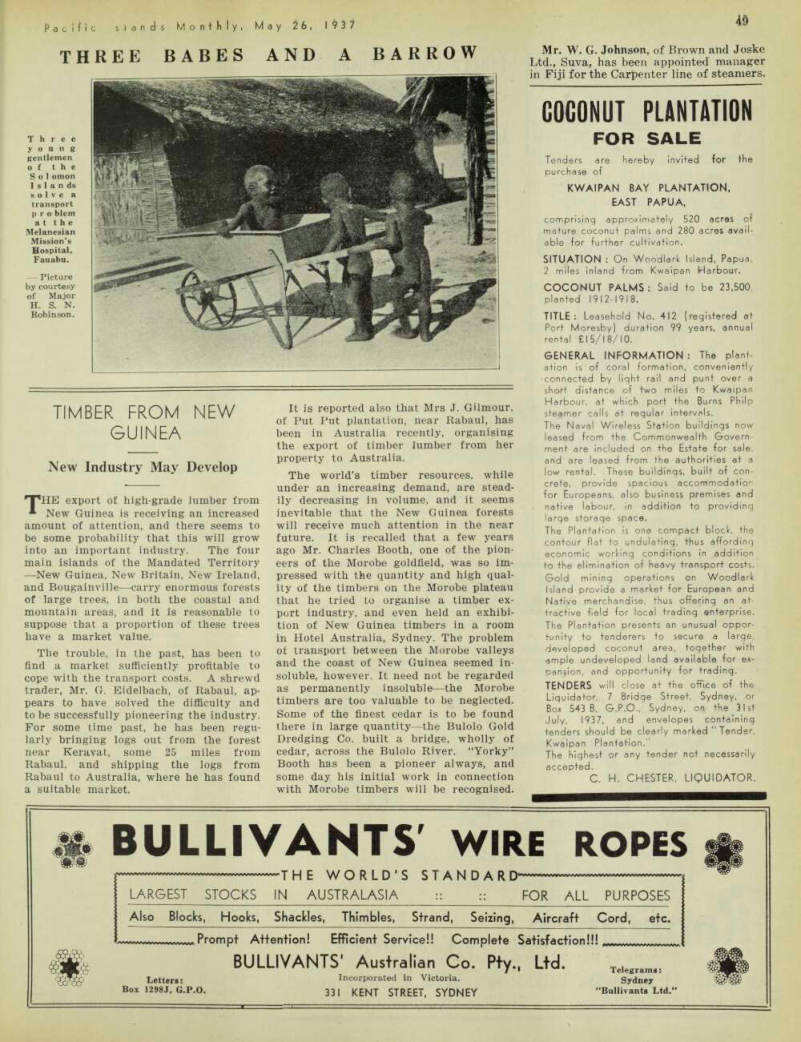
Guinea
New Industry May Develop
TTHE export of high-grade lumber from New Guinea is receiving an increased amount of attention, and there seems to be some probability that this will grow into an important industry. The four main islands of the Mandated Territory —New Guinea, New Britain, New Ireland, and Bougainville—carry enormous forests of large trees, in both the coastal and mountain areas, and it is reasonable to suppose that a proportion of these trees have a market value.
The trouble, in the past, has been to find a market sufficiently profitable to cope with the transport costs. A shrewd trader, Mr. G. Eidelbach, of Rabaul, ap pears to have solved the difficulty and to be successfully pioneering the industry.
For some time past, he has been regu larly bringing logs out from the forest near Keravat, some 25 miles from Rabaul, and shipping the logs from Rabaul to Australia, where he has found a suitable market.
It is reported also that Mrs J. Gilmour, of Put Put plantation, near Rabaul, has been in Australia recently, organising the export of timber lumber from her property to Australia.
The world’s timber resources, while under an increasing demand, are stead ily decreasing in volume, and it seems inevitable that the New Guinea forests will receive much attention in the near future. It is recalled that a few years ago Mr. Charles Booth, one of the pion eers of the Morobe goldfield, was so im pressed with the quantity and high qual ity of the timbers on the Morobe plateau that he tried to organise a timber ex port industry, and even held an exhibi tion of New Guinea timbers in a room in Hotel Australia, Sydney. The problem of transport between the Morobe valleys and the coast of New Guinea seemed in soluble, however. It need not be regarded as permanently insoluble —the Morobe timbers are too valuable to be neglected.
Some of the finest cedar is to be found there in large quantity—the Bulolo Gold Dredging Co. built a bridge, wholly of cedar, across the Bulolo River. “Yorky”
Booth has been a pioneer always, and some day his initial work in connection with Morobe timbers will be recognised.
Mr. W. G. Johnson, of Brown and Joske Ltd., Suva, has been appointed manager in Fiji for the Carpenter line of steamers.
Advertisements & other items, pp. 51-52 (2 items)
49
Pacific stands Monthly, May 26. I$ 3 2
M. Bullivants' Wire Ropes*
COCONUT PLANTATION
FOR SALE
Tenders are hereby invited for the purchase of
KWAIPAN BAY PLANTATION,
EAST PAPUA,
comprising approximately 520 acres of mature coconut palms and 280 acres available for further cultivation.
SITUATION : On Woodlark Island, Papua, 2 miles inland from Kwaipan Harbour.
COCONUT PALMS : Said to be 23,500, planted 1912-1918.
TITLE: Leasehold No. 412 (registered at Port Moresby) duration 99 years, annual rental £15/18/10.
GENERAL INFORMATION : The plant-
ation is of coral formation, conveniently •connected by light rail and punt over a short distance of two miles to Kwaipan Harbour, at which port the Burns Philp steamer calls at regular intervals.
The Naval Wireless Station buildings now leased from the Commonwealth Government are included on the Estate for sale, and are leased from the authorities at a low rental. These buildings, built of concrete. provide spacious accommodation for Europeans, also business premises and native labour, in addition to providing large storage space.
The Plantation is one compact block, the contour flat to undulating, thus affording economic working conditions in addition to the elimination of heavy transport costs.
Gold mining operations on Woodlark Island provide a market for European and Native merchandise, thus offering an attractive field for local trading enterprise.
The Plantation presents an unusual opportunity to tenderers to secure a large, developed coconut area, together with ample undeveloped land available for expansion, and opportunity for trading.
TENDERS will close at the office of the Liquidator, 7 Bridge Street, Sydney, or Box 543 B, G.P.O., Sydney, on the 31st July, 1937, and envelopes containing tenders should be clearly marked " Tender, Kwaipan Plantation."
The highest or any tender not necessarily accepted.
C. H. CHESTER, LIQUIDATOR.
M. BULLIVANTS' WIRE ROPES*
T I_IC VA/ AD I n' C CTAKinAD W
THE WORLD'S STANDARD
LARGEST STOCKS IN AUSTRALASIA
FOR ALL PURPOSES
Also Blocks, Hooks, Shackles, Thimbles, Strand, Seizing, Aircraft Cord, etc. „ Prompt Attention! Efficient Service!! Complete Satisfaction!!!
BULLIVANTS' Australian Co. Pty., Ltd.
Letters:
Box 1298 J, G.P.O.
Incorporated in Victoria.
331 KENT STREET, SYDNEY
Telegrams: Sydney Bullivants Ltd.
I LEATHER BELTS
jot NATIVES
ITlan ufacturers 4 Specialists —I!
PATTERSON & STONE, CRICHTON WORKS.!!
WALSALL, ENGL AND.
FIND OUT WHAT’S INSIDE
before you buy a low-priced Saddle.
THE KING OF 'EM ALL
Is a "Safer”
Saddle and Offers Sensational Advantages
NARROW
Being built on a Galvanised Tree, heavily bar plated, and strained with English web, riders are assured of its genuine foundation. Its soft, pliant kip flaps are hard-wearing, while the sweepy seat gives superb riding comfort.
Fitted with Best Leather, cr /r / Folded Girth, Stirrups I*D/ 0/“ Freight Free With Capped Pads 15/- extra Write for Catalogue P. 1935.
SYDNEYS HIGH-CLASS SADDLER
NEWMARKET SADDLERY
W. H. Williams for "Safer” Saddles
18-20 WILSON ST.. NEWTOWN, N.S.W.
Copra Mats and Matting . . .
Send your enquiries to us for Woven Wire Mesh in Rolls or framed for Copra Drying and all Screening purposes. Bird Cages, Sieves and Riddles, Builder’s Gravel Screens, Rat Traps, Door Mats, Garden Arches, Chain Wire Mesh, Crimped Wire Mesh for Window Guards, etc.
SCOTT AND SONS
WIREWORKS: RAILWAY PARADE AND MURRAY STREET MARRICKVILLE
Made
i n
5 Widths
7-inch, 8-inch, 9-inch, 10-inch and I I -in. cut These plougs will do good work in new or old land.
Ample clearance is provided for ploughing in thick surface growth.
ansomcs
“CUB”
PLOUGHS
Write for illustrated literature and all information.
MORRIS, HEDSTROM LTD. - Suva, Lautoka and Ba Made by; RANSOMES, SIMS & JEFFERIES, LTD., IPSWICH, ENGLAND
Tonga’s Only Anglican Bishop
Centenary of Right Rev. Alfred Willis
DURING the century just closed the centenary passed unnoticed of the birth of the Right Reverend Alfred Willis, one time Bishop of Honolulu. Dur ing the War years he was in charge of St. Paul’s Church, at Nukualofa, Tonga.
The tall, gaunt figure, with flowing white beard, is still remembered in the Tongan capital, where he attempted to sail an Anglican craft among mighty Methodist waters.
The very presence of the Bishop in the Pacific was anomalous. Flom time im memorial it has been decreed that the Bishop of London should have under his charge all members of the Church of England in any part of the world who were not included in any particular dio cese. Thus were the American Colonies considered at one time to be under his spiritual jurisdiction. It was the same in the Pacific.
The Diocese of Honolulu was the first, apart from the see of Jerusalem, that the Church of England established beyond the British Empire.
Bishop Willis was in charge at Hono lulu from 1872 until 1902. In 1898 he was advised from London that he was also to exercise spiritual control in Fiji and Samoa. Indeed, all islands not con nected with the Melanesian Mission were to be in his charge. Acting under that authority, he visited Samoa and Fiji the
following year, and he also called at Tonga.
On the overthrow of the Hawaiian Queen, however, the position of the Anglican Church in those islands under went considerable change. The Ameri cans, naturally enough, considered that the Bishop of Honolulu should be an American. English clerics had never been exactly popular in certain quarters in Hawaii. Bishop Staley, (the prede cessor of Willis), was accused of being “a political missionary,” and was said to have worked in the interests of the British Government. Willis’s own wife, a woman of considerable force of char acter. was suspected of having Royalist sympathies.
When the Americans came to Hawaii, Dr. Willis felt that his period of useful ness there was over, and he prepared to hand his staff to an American successor.
Samoa, Fiji, and Tonga were still under his jurisdiction; so he determined to settle in Tonga, as on his former visit King George 11. had received him in a friendly manner. A contemporary has described the Bishop as “a scholar, a gentleman, agreeable socially, and of a forgiving disposition . . . fearless and stubborn for what he believed to be right, and made of the stuff of which martyrs are made, unbending in any cause which he believed to be just.”
“To Tonga he went with high courage,” it was stated, “there to toil and under take a small and almost hopeless work, to lay the foundation of something greater for the future.” But though the ranks of Methodism were divided, that faith was too solidly entrenched for An glicanism to make much impressions on the Tongans.
It is said, too, that a young Chinese followed Bishop Willis to Tonga. The Celestial became so proficient in the Ton gan tongue that he acted as interpreter for the Bishop. Later he was sent to divinity school in California.
The Bishop struggled on. In 1907 he was assisted by Samuel Broadfoot, the holder of a lay reader’s license, who for merly resided at Wagga Wagga, N.S.W.
Mrs. Willis proved a patient helpmate.
In 1904 Bishop Willis visited Fiji for the consecration of the Church of the Holy Redeemer at Levuka. This church had a special interest for him as he had set the foundation stone when previously in Fiji. The War years found him work ing in Tonga. Naturally enough, he was strongly pro-British, and his sermons did not altogether please some of the German residents in the kingdom.
Alfred Willis was born in 1836, edu cated at Uppingham and at St. John’s College, Oxford, and in many respects typical of his sphere and period.
Disappointed after his years of service in Honolulu, he thought he could still be useful in Tonga. The last years of his life were spent in his native England.
F.R.
M. Le Boucher, Government Secretary of New Caledonia, sailed from Noumea in April for France by the Ville de Verdun.
C. I. Oranges
Trade to be Controlled by N.Z. Government
From Our Own Correspondent
Rarotonga, Apr. 10.
ON March 26, before a representative meeting of those engaged in the fruit industry, the Resident Commissioner (Judge Ayson, C.M.G.) outlined the posi tion under the recently announced Gov ernment decision to take control of the trade, commencing this year with the orange crops in Rarotonga and Lower Group islands.
The Secretary of the C.I. Department advised that the method of disposal was that the fruit would be distributed to licensed brokers throughout the Domin ion on a population basis and sold by them as agents of the N.Z. Government on a fixed commission, the latter also fixing prices below which the fruit should not be sold.
Referring to the efforts made last month by certain Auckland merchants to purchase the entire season’s crop, the Resident Commissioner informed the meeting that contracts made with this object could, under the power invested in the Government, be declared void and unenforceable. The prices offered by these firms were 4/- (fruit only) in the Rarotonga sheds, 5/- in Aitutaki and Atiu, and 6/- in Mangaia.
These offers, Judge Ayson continued, had appeared so attractive that on March 17, after consultation with the parties concerned, he had despatched a radiogram to the Cook Is. Dept, advising that local producers were anxious not to lose such good prices.
On the 19th a further radiogram was sent stating that the Island Council also strongly favoured acceptance under Government contract —of the Auckland merchants’ offer, complete control of the fruit to be taken at a later date.
In reply, radio advice from the Dept, intimated that the Minister was already cognizant of the offers referred to, and that “without exception the entire orange crop would be controlled,” arrangements for its distribution having been concluded and the co-operation of leading brokers secured.
In conclusion. Judge Ayson observed that it was only fair to assume that such an offer as the above, if genuine, would have claimed the Minister’s serious at tention and that for him to have decided against it clearly pointed to some detri mental aspect which was not perhaps discernable locally. Both the Prime Minister (who is also Minister for the Cook Islands) and Mr. S. J. Smith, (Sec retary of the C.I. Dept.) had only one objective and that was the betterment of the Group. No one could doubt that they, together with the whole Labour Government, were definitely out to assist the primary producer.
Mr. Dave Brown, on behalf of the Ex porters’ Association expressed his appre
ciation of Judge Ayson’s efforts to secure fair and favourable conditions for all narties. The motion was seconded by Captain J. D. Campbell. . In a short reply, stating that his own part in these matters was only in the course of his duty, Judge Ayson said that there was one thing which he would like to clear up. During the past year certain attacks, a lot of them from be hind hedges, had been made upon him in connection with the fruit trade. Sev eral had got into print.
Referring specifically to an extract from a letter which had appeared in the February issue of the P.1.M. , alleging that “the powers that be are moving heaven and earth to get a certain official into the position of manager of the fruit business instead of another man who is regarded as the obvious person for the
job,” he would like to say that no such idea had ever entered his head and that he would now ask the people of Raro tonga to regard any suggestion to that effect as a deliberate falsehood.
No Early Shipment By “Matua”
Local growers have been preturbed by their inability to ship their early oranges by this month’s Matua owing to
the number of cases available (approxi mately 500) being insufficient to justify the Union Co. setting apart a special hold for the consignment. Oranges and ban anas, it appears, require to be kept at different temperatures.
Requests to the Union Co. last week to divert the Gape York, bound from Pa peete to Auckland, were also unavailing.
Although only a few growers are affected these are particularly disappointed since the first oranges shipped in the season almost invariably command top prices.
As Government control of the fruit in dustry does not commence officially until the May shipment, local traders were also interested in what would have been their last speculative venture in the much discussed, often disparaged, but always sought-after orange.
Advertisements & other items, pp. 53-54 (1 item)
Drag Saw
WORKING PARTNERSHIP WANTED
Two single young men seek opportunity in the Pacific Islands for £5O each and selves.
Trading Schooner or Plantation.
Both First Aid men, good sailors and experienced bushmen and agriculturists.
Please reply to: H. McMANUS, Belvedere Flats, fv'erine Parade, Watson's Bay, Sydney, N.S.W.
Fhe Buzacott
t.
Drag Saw
The saw that makes land clearing easy and profitable —that cuts up the hardest, thickest logs in the shortest time.
It is a one man machine, light and easy to handle and practically fool-proof.
If the blade jambs it cannot break —the engine runs free till the saw is cleared.
LOHI
Buzacott & Co. Ltd.
7-11 Market Street, SYDNEY
WHY TAKE A RISK? —
YOU CAN WITH CONFIDENCE
PLACE YOUR RADIO ORDERS WITH
Fox & Maccillycuddy Ltd.
The Oldest Established Radio Distributors of Completed Receivers Parts and Accessories in Australia.
We specialise in all sets as described by “ Wireless Weekly,” and full stocks of parts are always on hand. We will be pleased to quote you by return mail.
• EVERREADY BATTERIES •
EVERREADY BATTERIES ALWAYS IN STOCK
SUPERDYNE HEAVY DUTY LIGHT DUTY
“ c ” BIAS “A” BATTERIES AND TORCH REFILLS All brands of Radio Valves always in stock, includiiiK Radiotron, Philips, Kenrad. Mullard. National Union, Osram. Each Valve is carefully tested before despatch.
QUALITY RADIO— PROMPT SERVICE RELIABILITY
FOX & MACCILLYCUDDY LTdT|
■ 57, YORK ST, SYDNEY.
Master Sewing
Machine Co.
WE ALSO STOCK . . .
HEAVY LEATHER CANVAS
LIGHT LEATHER CAR TRIM-
MING BOOT PATCHING
HIGH SPEED DRESSMAKING
& HEMSTITCHING MACHINES.
All Machines Guaranteed.
Singer Hand Machines, £4/10/- to £5/10/-
Other Hand Machines £2 to £4
Please stipulate the particular type required.
No delay. All goods carefully packed.
NEEDLES and PARTS for ail makes of Machines.
OIL supplied. Any quantity.
Rapid Progress
Pacification of New Guineas Outlying Areas
From a Special Correspondent WAU, Apr. 27.
The policy of peaceful penetration of * outlying areas adopted by the New Guinea Administration has proved ex ceedingly successful. Especially is this so in the remote valleys of the Upper Mark ham, Ramu, Bena Bena, and Chimbu regions.
To those acquainted with the difficul ties of maintaining law and order in these vast areas between tribes whose principal diversions were warfare and raiding, it is astonishing to learn of the
rapid progress with which these primi tive people have accepted the new con ditions under Government control, with out antagonism, or resentment.
The attitude of the various tribes has become more peaceful, not only in rela tion to the Government but towards one another. In some instances the suspen sion of hostilities has led to voluntary disarmament.
One factor that has had a great deal to do with the Government’s success in this direction was the early establish ment of bridal paths linking up all the principal villages, base camps, and Police Posts. At the end of last year the Direc tor of District Services and Native Af fairs (Mr. Chinnery) visited these out lying regions by means of the bridal paths. Accompanied by the Officer in Charge of the Ramu District, he was cordially received by all the chief men, and ceremoniously conducted into each village. The people greeted him with native ritual and display, including dramatic plays symbolic of their im proved conditions.
The work of pacification and consoli dation in these “uncontrolled” areas is steadily going on all the time. Even now in the Otibanda district, control is being extended into the watershed of the Lake kamu and Tauri Rivers, which have their outlet far south in the Papuan Gulf.
Coronation Stamps for the Cook Islands
Cook Islands
From Our Own Correspondent
Rarotonga. Apr. 9.
TT is understood that the Coronation A issue of stamps for the Cook Islands will be similar to the set issued for New Zealand, those for the former being merely overprinted denomination of Id, 2|d, and 6d.
Philatalists will recall the phenomenal values to which the recent C.I. Jubilee issue soared within a few months owing to overseas dealers having failed to sec ure adequate stocks before the issue was withdrawn.
Mr. “Viri” Watson, who cleaned up so successfully on the Jubilee issue, is mak ing a special trip from Auckland next month to obtain large numbers of “first day covers” and other peculiarities dear to collectors. He hopes that he will have a repetition of his former 500 per cent luck, since it is a form of profit-making which hurts nobody except those who are well enough off to pay the ridiculous prices that are asked.
Mr. H. J. Topal has resigned from the public service of New Guinea in order to enter commercial life. He has been in the service on two occasions—latterly as a rnember of the medical department, doing patrol work in the Morobe district.
Dr. A. J. Bapen arrived in Sydney from Fiji by the Monterey on April 19 on his way back to India to undergo a refresher course. He will return to Fiji after he has finished his studies at Madras Uni
versity.
And Its Gilbertian Sequel
The "Aimable Josephine" Massacre
THIS is a story of ruthless piracy and a grim massacre in Fiji that had a Gilbertian sequel.
In 1831. when Ratu Seru (afterwards King Cakobau) was still almost a youth, and full 40 years before the cession of Fiji by Britain, there arrived in the group a French brig, the Aimable Jose phine, captained and owned by one Des bureaux, whaler, beche-de-mer, turtle shell, and sandalwood trader.
At that time, more than one white man had followed the example of Charlie Savage and Charlie Connor in taking part with one tribe or another in the ceaseless native wars on Na Viti Levu.
Trading was too slow for Desbureaux and his crew, but so also were the petty guerilla affrays of the mainland. They had a stout brig, muskets and cannon; what a chance for a new kind of filibus tering! The Kai Viti were forever at feud in any case: why not see what pickings were to be had by lending assistance to one of the more ambitious chiefs?
They had not far to seek for an ally.
The indomitable Tui (King) Makanasese, of the island of Viwa, was the man: a fierce and bloody-handed fighter. In return for pearls, trepang, turtle-shell and sandalwood, Desbureaux proposed to lend his brig as transport for Viwan warriors, and to support them with his cannon and the muskets of his crew. Tui Makanasese saw the possibilities . . .
Very soon he would be not merely Tui Viwa but Tui Viti! Thus, the black Alexander.
For a time they prospered, adding one successful raid to another until the terror of Makanasese’s name spread wide through the group.
But Makanasese, the ambitious chief of Viwa, and Makanasese, the firmly-estab lished and greatly-feared ruler of wide flung territories, were two different per sons to deal with. In the interim, Des bureaux and his filibusters had descended to the native level, even to the point, it is said, of allowing the great pots for trying-out whale oil to be used in the preparation of cannibal orgies aboard the Aimable Josephine. The black Alexander at last decide that he no longer needed their support; why continue to pay them tribute?
With a band of chosen warriors he boarded the brig. It was soon done. The French were completely off their guard.
Great war-clubs rose and fell, the deck of the Aimable Josephine became the scene of one final feast, and thencefor ward Tui Makanasese reigned alone.
But the massacre was not to go un avenged, though four years were to pass before the miscreants of Viwa were to feel the anger of Desbureaux’s country men.
Monsieur le Contre-amiral Dumont d’Urville, in command of the corvettes
Astrolabe and Zelee, cruising at Vavau in 1838, was told by missionaries of the fate of his compatriots.
Sacred name of a name! ... A French brig taken and Frenchmen assassinated by black cannibals! . . . Un Filibustier? . . . Eh, bien; but still a Frenchman! . . . Where was this? ... In Fiji? . . .
Bien, we go to Fiji! . . .
The voyage is not long. Soon they arrive at Lakeba, where the command ant’s launch is hoisted out. Monsieur le Contre-amiral, resplendent in full uni form, makes a formal visit to the Tui Lakeba, to demand information.
While he and his escort are ashore, the rest of the crew are left to gaze idly with longing eyes at the palm-fringed beach.
An indication of what some of them at least were thinking is given in this brief quotation from the pen of M. Elie Le Guillour, Surgeon-major of the Zelee in his narrative Voyage Autour Du Monde dc VAstrolabe et de la Zelee : "Every time that I coast along these countries so well adorned, so endowed by Heaven, so rich in luscious fruits, of such perpetual peace, I ask myself why the millions of Europeans, poverty stricken and suffering at home, do not emigrate and come and find here the repose and abundance that their own land does not offer them . .
At last, here comes le Commandant.
But who is that great savage with him?
Of a certainty, a chief: see his train of tapa and that great club. Xom de Dieu, what a souvenir ...
Monsieur le Contre-amiral, naturally, has not cruised so long among the delec table isles of Oceania without acquiring a wide knowledge of the character of the inhabitants. They vary a little, of course.
in different groups but at least one trait is common to all: their love of fighting.
To have a neighbour is to have an enemy.
He had reckoned on that characteristic in this instance, and it appears his judg ment has been completely confirmed. Tui Lakeba, himself unaware where the mas sacre happened, is willing, nay, anxious to pilot them to Bau, of which state he is
subject, where they will be sure to obtain details. Wiill the great French chief allow him, the Tui Lakeba, to take part in the well deserved reprisals?
The great French chief will. This uni versal enmity simplifies things consider ably. He will teach the assassins to res pect the name of Frenchman in future!
While M. Dumont-d’Urville is ceremoni ously introducing his new-found pilot and would-be ally to his senior officers, a small, fast-sailing canoe carrying the mata (herald) of Lakeba slips out from a beach hidden behind a palm-clad point of land a little way along the coast, and heads swiftly away towards Bau.
M. Dumont-d’UrviLle was to leave Fiji without obtaining any idea of the intri cate native system of tribal alliances or suspecting how completely he had been hoaxed by the allies Bau, Lakeba and Viwa, Quite unsuspecting, he walk the quar
ter deck of L'Astrolabe as, followed by the Zclee, she moves over a shining, sapphire sea. He glances from time to time at the Tui Lakeba and congratulates himself on having so quickly acquired such an eager and useful ally.
At Bau they are received with great respect and ceremony. Does the Roko Tui Bau know who were the killers of the French chief Desbureaux and his men? . . , Sobosobo! Yes, the pig hearted Makanasese of Viwa did it The Roko Tui Bau has long wanted to punish Viwa for killing his good friends the French, only the Viwans are strong; stronger even than Bau. But now that the great French chief has come with his ships the matter will be simple, if they but take care not to let news of their coming reach Viwa.
Here and there among the chiefs as sembled, the ghost of a smile flickers across a paint-blackened face as Viwan warriors in the background listen to the words of their guileful high-chief.
They re-embark. The Tui Lakeba is still their pilot. The order on both cor vettes is that none shall hail any canoe during the brief promenade and should any canoe speak to them they must answer in English to hide their real nationality; and, lastly, should they be boarded, the stranger must be kept on board until Viwa has been punished—M.
Dumont-d’Urville does not intend to ruin his chances by carelessness!
All is subdued excitement aboard the corvettes. The voyage has been rather uneventful of late: here is a welcome chance against an enemy of La Belle France! All cannot participate; though, secure in the knowledge of their strength and the righteousness of the ! r cause, all are eager. This is no mere routine matter: let lots be drawn for the places of honour in the landing force.
It is done. About 40 men from each corvette are chosen and armed with mus kets and swords. The Viwan warriors are said to number about 60, but there may be more; the prestige of France demands that no chances shall be taken.
Joyfully, the chosen avengers set out for shore in pinnace and launch: they find that they are too deeply laden to clear the coral patches near the beach.
But that is—Pouf! —a mere bagatelle to the navy of France. Over the gunwales they go and charge through the shallows to the beach, now ominously deserted.
The town their objective is hidden behind a long mound —a natural rampart. With set, eager faces the marines and volun teers form up and begin a cautious ad vance, eyes and ears intent, muskets at the ready and fingers on the triggers.
A heavy silence hangs over the scene, broken only by the boom of surf on the outer reef and the protesting squeak of the sand beneath the heavy tread of four score feet.
At any moment now the welkin may be rent by fierce Viwan war-cries as hid den warriors spring from their conceal ment. From the French ranks a clear command rings out: “ Char-r-gezl Mes enfants —” and the huzzaing marines
surge eagerly over and round the ram part into an empty town!
Nonplussed, the punitive force stands among the abandoned vales. Something has gone wrong somewhere: the enemy has taken to the bush. Impossible to follow them there. Completely deflated and rather sheepish the men of France look disgustedly at the perennial green of the silent, heat-oppressed jungle.
Somewhere, far off in the forest maze, a lali begins to throb. To the listening French it carries a note of jeering defiance. The leader of the landing force snaps an angry command and soon wisps of smoke rise from the dry thatch of the houses. But they are not to go entirely unrewarded. In one of the burning Imres a pig is squealing in terror; it is quickly rescued and carried off in triumph to the corvettes, while the town goes up in flames.
It seems that the honour of France is satisfied with this futile “punishment,” for the vessels weigh anchor immediately and leaving the Viwans to the task—easy to natural communists—of rebuilding their koro from the inexhaustable store of nature everywhere at hand, return to Bau.
In an attempt to impress the natives and save what face they can, after their late discomfiture, M. le Contre-amiral Dumont-d’Urville lands with his officers in full-dress uniform, accompanied by a well-armed ascort.
The Roko Tui Bau, not to be outdone, receives them in the fcoro square, where his warriors are drawn up in order of battle. The farce is not yet done.
Roko Tui Bau, with the Fijian’s love of a good joke and the finesse of an artist, plays it to the end. He makes a long speech in praise of the French, and how they have “routed” Makanasese and his warriors and sacked Viwa. Our Gallic Contre-amiral reacting mercurially to the majestic and so obviously sincere paean of praise, responds with a speech of almost equal flamboyance and exagger ation. He ends by promising the sup port of the French navy to Bau against aggressors if, in the future, that great monarch will extend his protection to Frenchmen in Fiji.
As a final indication of the valour of French arms, the marines give an ex hibition of military evolutions and show their skill with the musket by firing at a stationary target. This last is the crowning act of burlesque, and the chiefs and warriors of Bau (who have already, for 30 years or more, used and been familiar with European firearms) receive the exhibition fittingly with much vudi kalou (snapping of fingers accompanied by exclamations of great wonder).
A feast is then given in honour of the white conquerors of Viwa, who finally sail away, happy in the conviction that they have achieved some useful object and suitably impressed the native mind with the might of La Belle France.
E.W.
Mr. Albert F. Ellis, N.Z. representative of the British Phosphate Commission, arrived in Sydney from Auckland by the Niagara on May 8,
Advertisements & other items, pp. 55-56 (1 item)
Ruston
marine oil engines are used in craft of all types throughout the world. The Admiralty and leading shipowners instal them. So do many yacht owners. • Salient features are smooth vibrationless running, reliability and economy. m
POWER
INVEST WISELY IN
RUSTON
MARINE
OIL ENGINES
RUSTON & HORNSBY
(AUST.)
PTY. LIMITED
MELBOURNE SYDNEY
BRISBANE ADELAIDE
Sole Agents tor Mandated Territory :
BURNS, PHILP & CO. LTD., RABAUL
W. M. FORD
Ship, Yacht and Boat Builder
Berry's Bay - North Sydney
(Established 1870) BUILDERS of all kinds of Island Craft from Dinghies to Auxiliary Schooners of any tonnage. New and Second-hand Island Craft of various types in stock.
New and Second-hand Full Diesel, Crude Oil, Benzine and Kerosene Engines.
Please Send on Your Enquiries
PROTECTION OF . . .
MINING TIMBERS BY
Results of Official' Tests conducted by the Union of South Africa at th Main Reef Mines.
CUPRINOI
e Consolidated SPECIMENS PLACED ON TEST ON sth MARCH. 1931 6/2/35 O.K.
O.K.
O.K.
O.K.
O.K. 20% rot 40% rot Full particulars and prices from the Island
PAUL & CRAY LTD.
Distributors—
-82 SUSSEX STREET
SYDNEY
IT ATTRACTS
LINO
THEY EAT IT THEY DIE!
USOLINE
NEVER
KNOWN
TO FAIL !
COCKROACH
DESTROYER
IT'S A PASTE!
AUSOLINE CO.
314 CROWN STREET, SYDNEY
(Established 1919)
PRICES:
Mb. 5/- . . . 3lbs. 10/- Postage Extra.
Remit Cash with Order.
Obtainable also from Islands stores of: tfURNS, PHILP & Co. Ltd.
W. R. CARPENTER & Co. Ltd.
Highest For 10 Years
Contract Price for American Samoa's 1937 Copra Output
From Our Own Correspondent.
Apia, Apr. 16.
jl/fESSRS. Atkins, Kroll and Company, of San Francisco, has been awarded the contract for the purchase of the whole of the 1937 copra production of Eastern Samoa.
The firm is paying 101.62 dollars per ton, the highest price paid for the copra of American Samoa in over 10 years, and more than double the rate paid to copra growers last year.
The Government pays the natives 3.60 dollars per lOOlbs. for sun dried cofra, and 1.90 dollars per lOOlbs-. for green copra delivered at the Government drier at Futiga. The new prices, which came into effect in February compare favour ably with the prices at present paid by Western Samoan merchants to natives and European producers.
Advertisements & other items, pp. 57-58 (1 item)
Fibrolite
Timber, Joinery
ETC.
PREPARED BUILDINGS ready for erection a speciality.
SHIP AND BOAT BUILDING.
TIMBERS specially catered for.
FIBROLITE, PLYWOODS, GALVANISED
IRON, CANEC.
CONSIGNMENTS shipped
by RETURN STEAMERS
to the Islands.
John W. Eaton
LTD.
WEST CRESCENT STREET
NORTH SYDNEY
TELEPHONES: X 5051 (5 lines)
BITUMENOID ROOFING
MADE IN AUSTRALIA
Bitumenoid Roofings, Dampcourse and Insulating Felts are made from the world’s best raw materials. Warranted to stand the most rigid tests.
BITUMENOID THE BEST
Roofing, 1,2, 3-ply; Flooring, Waterproof Materials; Saturated Felt; Resilient Road Jointing- Natural Asphalt Dampcourse; 2 and 3-ply Dampcourse; l-21b. Lead-core Dampcourse; Roofing Cement; Asphalt Paints; Roofing Compound.
SAMPLES AND PRICE LISTS ON APPLICATION
MAXWELL PORTER & SON LTD.
ESTABLISHED 1888.
107 REDFERN ST., REDFERN, SYDNEY, N.S.W.
BUILDERS’ SUPPLIES
’Phone, M 3157. Cables Bitumenoid
BUILD WITH
Fibrolite
ASBESTOS CEMENT SHEETS
B y> using this Economical. Fire Retardant and White Arrt Proof building material for External and Internal Walls and Ceilings, you can build a comfortable and durable Bungalow Home— AT LOW COST! Supplied in big, sturdy building sheets in 44 handy stock sizes, FIBROLITE is easily and quickly erected. No waste.
Less labour. No painting.
For full Information, write for illustrated "Fibrolite" Booklet F.6—FREE AND POST FREE!
JAMES HARDIE & COY. LTD.
ASBESTOS HOUSE, YORK ST., SYDNEY, N.S.W.
(Box 3935 V., G'.P.O., Sydney)
Konkrete Paint
For EVERY SURFACE where Permanence is Imperative--! ,T Adaptability for the varying climatic conditions of the Pacific Islands has been abundantly proved by users.
KONKRETE Standard Gloss and Flat Colours for wood, brick, fibre, cement, iron, and stone.
KONKRETE PAINT IS
THE SOLUTION
Complete price list and colour card from sole wholesale distributors for N.S.W. and * Pacific Islands.
Solo Distributors wanted in Pacific Islands territories where not already represented.
H. Florentine and Son
321 Pitt Street, Sydney, N.S.W.
EXCELSIOR SUPPLY CO. LTD,
The moat extensive Manufacturers in the British Empire of
RUBBER STAMPS,
INKS, STENCILS,
Marking Devices.
ACME STAMP PADS
We have a big range of Special
FRUIT CASE MARKING SETS
We also Manufacture or Supply a complete line of
Spraying Machines
for all purposes.
Let us know your requirements and we will quote you by return. Ask for our Big Catalogue.
Sole Australasian Distributors of the World Famous SHEAFFER FOUNTAIN
PENS and PENCILS.
EXCELSIOR SUPPLY CO. LTD.
Head Office :
160 BROADWAY, SYDNEY. N.S.W.
Shocked!
When the Tourist Era Startled Tahiti
From Our Own Correspondent
Papeete, Apr. 16.
THE cartoon entitled “This Tourist Traffic” in the January issue of the Pacific Islands Monthly has awakened grievous memories of sights our own eyes beheld during the Tourist Era at Papeete.
In the innocent days of our youth that sanctum sanctorum - the feminine form divine —was concealed from the profane by veils within veils and spoken of only through the lofty medium of poetry or represented in the epic sculpture of a Phidias. The fleeting glimpse of a dainty foot peeping modestly from beneath those ample draperies or the flash of a well turned ankle in the tumult of a waltz, would send us home to write sonnets such as we should be inspired to compose to a violet seen in the woodland dell or an orchid in a tropical paradise.
Then dawned the New Era, and with its coming the veils of Isis were torn
from the sanctuary. We had only read about it; but we did not know the ghastly reality until the tourist ships began to empty themselves on the shores of Tahiti.
What we saw curdled our blood: eye browless masks as void of expression as w r ax images in the museum of Madame Toussard; gory talons that seemed to have been but lately tearing quivering flesh at some abattoir; broad expanses of dorsal epidermis of colour and texture not good to see.
All this was bad enough. But what shocked us beyond endurance and com pleted our disillusionment were those nether members which, when we were young, were not even named, but were mentioned only by poetic allusion to those classic perfections of symmetry and beauty: The Doric, lonic, and Corinthian.
What met our horrified gaze, in the streets of Papeete, banished all thoughts of classic arts. The Muse of Poetry blushed and departed in precipitant flight; the shade of Phidias ground its teeth and faded into the void.
The only things we could think of as fitting comparisons were the supports of grand pianos, obelisks, and the front legs of giraffes.
Happily, all that is now past. The highways of Tahiti are populated only by the modestly attired daughters of Polynesia whose flawless, unpainted com plexions, and graceful carriage reassure us that the charms of femininity have not altogether departed from the world.
The discontinuance of passenger steam ers has caused us the greatest possible inconvenience. Our mails now are un certain, and our incomes are diminished.
But we are bearing these things, however, with staunch fortitude for we have this compensation: our eyeballs will be seared no more by such fearsome sights!
Japanese Co. To Treat New

Caledonian Nickel
'T'HE Japan Soda Company is establish * ing smelter works in Yokohama to treat 5,000 tons of nickel ore from New Caledonia each month, yielding 150 tons of 99.8 per cent pure nickel. It is planned to commence operations in September next.
At present Japanese munition factories and other industries are depending on nickel that comes chiefly from Canada.
Miss D. Glasson, of the Methodist Mission, Dobu, Papua, is in Sydney re ceiving surgical treatment.
Advertisements & other items, pp. 58-60 (2 items)
Lost Vitality
quickly and safely restored by taking the
famous DR. HENRI’S NU-VIGOR VITAL-
ITY PILLS, giving wonderful results for Loss of Power and Nervous Exhaustion.
Week’s trial 3/6; month’s supply 10/6 (posted free). Extra-Strong Prescription for obstinate cases 7/6 and 21/-. Stimulates the vital forces. All communications strictly confidential. Call or write for FREE ADVICE and literature to
H. P. MICHAEL, Chemist
MICHAEL’S BUILDINGS,
COR. ELIZABETH & LONSDALE STS.,
MELBOURNE
Ask for Free Catalogue and Price List of Medical Goods, etc. All lines stocked.
Batteryless Hand Microphone, just plug into pick-up terminals of set, A 45/- value. Now 25/-. For Music, Song, or Speech. Others 19/6.
Six inch automatic bench type carborundum, wheels complete, 10/6, always handy.
Two inch jaw, hard wearing solid bench vices, 5/9.
Elec. 6v. automatic motor car windscreen wipers, 63/- value, now 48/-.
Specially designed radio plyers, the handiest little tool made. / 4 in 1 all metal screw drivers, fountain pen, pocket size, 1/6 set.
“Ormond” English cone speakers in handsome cabinet, adjustable. 84/-, now 25/-, for all types of sets.
Crown and anchor sets with dice, shaker and betting cloth, 10/6, or 3 section top with betting cloth, 7/6.
mpn-o-uifiß"
RUBBER CLRD
“Totem,” the newest game for home, club, picnic or party 21/-.
“ Odds and Evens,” a new Head and Tail spin game 21/ Both designed as reproductions. Push lever and away they go.
Pyrex type Glass Insulators: 3in., 1/- 4in., 3/6, jins «'NS
IZ-SlfflEg) SINS
sv®®® ™ Genuine Pyrex, 30/-.
COSMOCORD*
25 “Cosmocord” 25/- “Cosmocord” De Luxe 32/6 “Cosmocord” Super de Luxe 45/-.
Amplion (English) 28/6.
Gramophone Pickups. B.T.H.
Bakelite Models 32/6 “Clarion” English all-Bakelite Pick - up, with volume control, 22/6. % Utility 2-Speed Micro Dial, absolutely best made for short wave or broadcast, 10/- Emicol Volt/Ma. Meters, British, 12/6. Reads 0 to 30 ma., 0 to 150, 0 to 6 v. 12/6 3/9 Metal case for reading A and B batteries. m ELimmoisr
FILTER
Panel Short • wave Vernier Dials. World’t Best. 12/6 Micro movement Ormond English 3in. metal front panel Vernier Dials, geared movement, 7/6.
tmessos
HEAD
PHOMS
;PPOFIS*IOMAI .L
4000 ohms <4 9 > The “Air Patrol” 2 valve wave battery set. Covers from 15.5 to 835 metres— £ll/17/1 complete with speaker, ’phones and all accessories, a midget in name only, but a giant in performance. Receives local, interstate and overseas broadcasts.
Hand Winding Gramophone Motors, reliable make, complete with all fittings and turntable, 25/-. ctric 240 v. AC gramophone ors. with all fittings, corne. 55/-.
Midget, all bakelite Sandown type spinning wheel race game, with Betting Sheet, 7/6.
All kinds of electric appliances for domestic use stocked.
We can supply all general merchandise at keen cut prices.
All kinds of rubber raincoats for ladies, gents, and children.
We can supply rubber boots, all types, for ladies, gents, and children.
Cone Speaker Units, adjustable, 17/6, now 7/6. British.
Cone Sepakers, all types. To clear, 20/-; were up to 84/-.
“Like-a-Flash” de luxe Morse code keys, adjustable every way.
Long or short tappers, 12/6 ; P.M.G. type all brass fittings, 19/6; Junior models, 9/6, 10/6.
High grade buzzers, 7/6.
“Like-a-Flash” Medical Coil Shocking Outfit, with all applicators, complete ready for use A high-grade scientific machine, housed in neat portable cabinet, for professional, amateur, or home use : recommended by leading medical men for nervous or muscular ailments, 63/-.
Smaller outfits 15/-, 17/6, quite efficient.
Send for Levenson’s Radio Bargain Bulletin, Bd, post free.
Also Levenson’s Radio Buyer’s Guide and Assembly Chart Handbook, 2/- post free.
iip
Just landed English Gramophone-Radio Pickup Heads, fit any standard Gramo. Tone Arm.
Bakelite moulded 11/6, and De Luxe Model, 19/6 Others, 10/6, 12/6.
We make and repair all types of radios, and electrical equipment. Replacement parts, plus actual time on job is our basis of charge. 7/3 f “ 10/6 Like-a-Flash Radio Batteries, now reduced: 45v. light duty, 7/3; 45v heavy duty, 10/6 ; 45v. triple duty 12/6; 41 v. C battery, 1/9; 9v. C battery, 2/-; IJv. dry cells, 2/3.
Please add freight.
Like-a-flash electrical goods all guaranteed 12 months, fittings and flex 2/- extra.
Elec, laundry irons, 9/11, 12/6, 14/6 and 21/-.
Elec, toasters, 10/6, 12/6, 14/6 and 21/-.
Immersion heaters for boiling fluids, 3/11, 5/6, 8/11.
Electric jugs, 6/9, 9/11, 14/6 and 21/-.
Gramophones floor or table models, 35/-, 39/6 and 45/-. Have been traded-in on radio sets, all reconditioned as new.
Morse code outfit, complete with buzzer, tapper, morse lamp and battery, for one person, 10/6 each. The set of two for two persons 20/- complete.
'RADIO mODERNE 4
ns u The Assembled Chassis £22/10/ Just designed for 100 per cent service in the Pacific Islands. Pay cash and save at least 33 1-3. Radio Moderne is the newest,finest and most up-to-the moment 5-valve battery-operated superhet. ever introduced for the Pacific Islands. That’s a sweeping statement, but we stand behind every word of it. Hear all Australasian stations, plus London, Paris, Berlin, Moscow, Tokyo New York, etc., etc.
Radio Moderne, Exclusively Built to suit Pacific Island,conditions, Humidity, etc. Not a Mass Production Product, each Set individually Built by Senior Mechanics, Tuned Up, and Air Tested before despatch.
Radio Moderne incorporates every wanted, technicallj correct improvement, all latest type Philips valves, r Like-a-Flash triple duty B batteries, best grade 100 amp. 2 volt accumulator, automatic volume control, late Ampion permagnetic speaker. Perfect tone, equal to any electric set. Latest calibrated aero dial, showing Australian and overseas stations, extraordinarily lew “B” battery consumption, approximately io to 22 ma. “A' battery (accumulator) consumption .65 amps. Selectivity and Sensitivity 100 per cent. Packing 6/6 extra, plus freight, 12 months’ guarantee all parts and speaker 90 days’ valves £22/10/ Like-a-flash ‘Eliminoise’
Aerial Kit, for short or dual wave sets.
Aerial Pyrex type transposi t i o n blocks and 200 ft. aerial coil, 22/6. Eliminates unwanted aerial and hideous electrical noises from your dual-wave or short-wave set.
OBB3S>
/2.THT32
Radio publications —write for full list.
“The Outline of Wireless, ’ b y Stranger, 15/-.
“The IS ireless Constructor’s Encyclopedia,” 7/6. “ Everyman’s Wireless Book,” b y Camm 8/6.
Write for
Punch ,
Board 226P.1.
Leaflets Branches
LEVENSON S RADiO
Write for Pin-Game,
STREET, SYDNEY
PITT
Radio Cheapside 240 a Pitt St.
N.S.W., AUSTRALIA
Evens Leaflets wwv/wwwwwv ’Phones, M 2525 and M 2526. Cable address, “Leveradioh,” Goods forwarded V.P.P. or Sight Draft. Satisfaction and Service Guaran teed. We can supply by mail all General Merchandise at a Bettei Price. Quotations with pleasure. Please add freight and packing.
AVOID INERT CREAMS
What woman does not sigh after this radiant freshness, this juvenile tint that excites admiration? CREME SIMON makes the skin lovely, —it is always active and is delicately perfumed.
For Perfect Beauty use
CREME SIMON
also
POUDRE SIMON
(7 Shades), and
SIMON SOAP
SIMON
PARIS
Obtainable Chemists and Stores Sole Agents: Joubert£» Joubert Pty.Ltd.,Melbourne
/. <v 4
When dancing
or at the theatre don’t forget now and then to dab a few drops of "4711" Genuine Eau de Cologne on temples and forehead; it will refresh, invigorate, revive. isfl 47/1) a„ Eau ae
“Cologne
57
(Pacific siands Monthly, May 26, 1937
French High Commissioner
Visits N. Hebrides
THE French High Commissioner in the Pacific (M. Jean Marchessou), who took office at the end of last year, made his first oflicial visit to the New Heb rides in April to confer with the French and British Resident Commissioners.
On board the sloop Rigault de Genou illy, he left his headquarters in New Caledonia on April 3 for Vila, via the Loyalty Islands. In the New Hebrides he called at Lenakel (Tanna), Dillon Bay (Erromanga), Vila (Efate), Pt. Sand wich and Pt. Stanley (Malekula), Segond Channel and Pt. Olry (Santo). Hoods (Ambrym), and Nelson Bay (Epi). He was feted everywhere, and at all ports received official and unofficial visitors.
The Rigault de Genouilly returned to Noumea on April 19.
In October next, M. Marchessou will pay a visit to the Wallis Islands in the Rigault de Genouilly to be present at the celebrations in connection with the cen tenary of the arrival of the Marist mis sionaries in the group.
Pattern Service
have arranged with a well-known Sydney firm of pattern-cutters to publish each month a diagram of a seasonable frock, patterns of which may be obtained by our readers direct from this office, post free, on payment of the sum stated under the diagram. Address your letter to “Pat tern,” Pacific Islands Monthly, Box 3408 R, Sydney, and enclose a note giving the number of the pattern wanted and bust size, and enclose also the price of the pattern in postal note or stamps. The pattern will be sent by return mail.
94^1.—Schoolgirls like to follow the grown-up fashions. The new sleeves are gathered into the arm-holes and completed with cuffs of contrast matching the collar. Front material is gathered on to the yoke; from here the panel extends to the base of frock ; back panel is from the waist only. Material: 2J yds. 36 ins. wide; contrast, i yd. 36 ins. wide.
Frock, 9441—9d. (12 and 14 years)
Advertisements & other items, p. 60 (1 item)
Medical Goods
All our MEDICAL GOODS are sold with
our GUARANTEE OF MONEY BACK if
not satisfied: best quality, lowest prices.
Call or write for FREE "BOOK OF KNOWLEDGE." Price List & Catalogue of Medical Goods, etc., and FREE
CONFIDENTIAL ADVICE. All these
goods POST FREE in plain wrapper from
SECURA CHEMISTS,
Dept. P.
269 ELIZABETH ST.. MELBOURNE
LADIES.—Let the SECURA NURSE advise you in the selection of your medical requirements.
Fashion Hints for Islands Women
By Therese
WITH the glorious background of blue sky, golden sands, and sparkling water, the young modern stages a parade that runs the gauntlet of fashion’s every range. Scarlet of lips and fingernails, slim of hip, she clads herself in a rubber swim suit soft and supple as silk. These swim suits come in the loveliest shades and an infinite variety of design. Figure moulding woollen suits leave little to be desired, those of black being the most sought after.
Beach coats are full of imagination and range from hip to ankle length. They are loose and flowing, trim and fitting, or hooded and monk-like.
Crownless wide-brimmed straws are ideal beach wear. A small scarf of some brilliant colour sewn inside the brim fits over the head and ties under the chin or floats gaily in the breeze as tho whim dictates.
Play suits in figured materials are de lightful, as are little towelling shorts and shirts in pastel shades and white. Towel ling also fashions beach dresses which are infinitely becoming. The culotte (trouser skirt) takes its place as success fully on the beach as it does for all sport ing occasions.
Sea horses with mermaids aloft, gallop over a scarlet towel of tremendous pro portions which serves as a wrap if needs be. Towelling hold-alls lined with water proof silk are scattered with star fish and quaint sea snails.
Lingerie has never been lovelier. Voile sets of pastel or floral designs are lace trimmed or boast hand hemstitched hems and are really charming. They wash beautifully and keep their freshness to the last thread. Kabe silk also has equally good washing propensities, and with its quaint little old world bird and butterfly designs is very fascinating.
Feminine nighties of empire designs are increasing in popularity, and take unto themselves the loveliest wraps, while pyjamas fashioned after Milord’s, sport dressing gowns of impeccable cut.
Day frocks are simplicity itself. Skirts are from 13 to 14 inches from the ground, waistlines are normal, and shoulders, though squared, are not exaggerated. The severely tailored suit falls into second place, the dressmaker suit —a softer ver sion with wide revers—taking pride of place. Collarless coats —that swing open in front and have decorative pockets— are to the fore.
Coat dresses on princess lines give a slim unbroken line. Bolero suits loom large on the horizon. A bolero suit of navy dons a pink blouse and a wide sash of raspberry. Its skirt is narrow with kick pleats back and front.
Redingote frocks are a hit with their easy graceful swing, and no wardrobe is complete without them.
A tailored jacket of sunflower yellow worn over indigo blue, has a petal collar
to match up with the yellow flowers at the waist. Vestees and odd coats alter the whole individuality of foundation frocks and are matched up with acces sories.
Zipp fasteners make a bright splash of colour on a dark frock and oust but tons from pride of place. Suede flower necklets are a delightful innovation for
the light woollen afternoon frock, and make gay little splashes of colour against a sober background.
Blouses are many and varied, and how ever fashioned are always successful.
They top slim skirts, kick pleated or subtly flaring.
With their glorious combination of colours, floral evening gowns become much loved possessions. In contrast with the pencil slim gown that flared from the knees, comes the skirt breaking to fulness just below the hips— a much kinder line which covers a number of figure faults - Lace, net, and tulle evening coats mock
their more practical sisters of velvet and taffetas, and float round the wearer im bueing her with infinite charm. A dew spangled net in a lovely pastel blue floats in clouds over a deeper blue taffeta slip and is the ingenue’s dream come true.
Reminiscent of our Victorian grand mothers, a tulle frock with scalloped flounces edged with lace, takes unto itself a quaint old fashioned three tiered berthe.
Sleeveless high-necked dinner gowns and
gowns with sleeves tapering to the wrist, share equal success. The sculptured draperies of modern fashion find perfect expression in satin, soft and supple, which sheathes the body in lovely lines.
A flame satin flaunts over its perfection a sheer net cape of emerald green.
A romantic picture frock in taffetas has a deep square decolletage banked with flowers, which are a riot of colour.
The unusual heartshaped off-the-shoulder decolletage of a blue and silver evening gown is outlined with a ruched band of chiffon, and has a little coatee that fits snugly into the waist flaring suddenly into a basque.
Unusual colour combinations are at all times arresting. Royal purple allies itself to green, scarlet to mauve, pink to silver, and blue takes unto itself that lovely new shade of yellow that looks like gold and is aptly termed golden yellow. Grey blends with all the coronation colours.
Evening bags show great ingenuity. A subtly concealed light flashes when the bag is opened—a marvellous idea which makes possible a perfect complexion at all hours.
Accessories are amusing and chic.
Bright flowers, gay hair bands, barbaric belts and bracelets, leather jewellery for sports wear, Spanish mantillas, and paste buckles and brooches, gladden our hearts and enliven our toilette.
Shoe styles have never been so varied.
They come in black, white, two tone, and colours. Here and there, boots are mak ing a bold bid for popularity, but are appreciated only when ankles and in steps are slim, as they are apt to look clumsy. The übiquitous court shoe is always correct for afternoon wear. Suede and kid combinations in tie and court shoes are very smart. Kid shoes have trimmings of patent leather. Evening sandals of gold and silver kid are delight ful, and combine with almost any colour with great success.
Sheer chiffon stockings of opalescent hues harmonize with any ensemble what ever its colour, since they have the pro pensity of taking unto themselves the colour of the frock with which they are worn. Crepe georgette stockings wear wonderfully and have that dull finish that makes for perfection of appearance.
Such colours as* Sultan, autumn breeze, suntan, black magic, hooey dew and hotcha, make the buying of stockings a delightful adventure into the realms of the unexpected.
Rev. Donald Fraser Boorman, L.Th., youngest son of the late C. H. Boorman and Mrs. S. Boorman, of Tweed River, N.S.W., recently married Miss Olive Ruth
Strickland, only daughter of the late
H. R. Strickland and Mrs. R. Strickland, of Sherwood, Brisbane. The ceremony, conducted by Rev. C. 0. Lelean, Chair man of the Fijian Methodist Mission, took place in the Baker Hall, Davuiievu, Fiji. Mrs. A. C. Cato was Matron of Honour and Rev. G. Stanton Crouch best man. The couple have now settled down in their new home at Levuka, Ovalau Island, where Mr. Boorman is a mis sionary for the Methodist Church.
Advertisements & other items, pp. 61-63 (2 items)
To Pacific Islands Co.,
At Blue Mountains—Springwood, N.S.W.
Springwood Ladies' College
Est. 1897. Kindergarten to Leaving Certificate. Tennis, Riding, Swimming, Team Games. Unequalled climate. Pure Jersey Milk. Senior and Junior Houses. Open-air sleeping. Inclusive fees. Special vacation arrangements for Island pupils.
M. E. DURAND, Principal.
MAIL THIS NOW
Kindly forward by return mail a copy of your LATEST 1937 CATALOGUE, the cover of which Is Illustrated above.
To Pacific Islands Co.,
728 GRACE BUILDINGS,
77 YORK STREET, SYDNEY
AUSTRALIA
Name Address (Block letters)
rr
ENOS
FRUIT
SALT
ff Corrects i tones up thcl whole system j 'words Sno and ' r( tfruit Salt” are registered trade marks.
Buy Direct from Manchester !
Pacific Traders can save money and obtain High Quality Goods and Dependable Service by writing to us for Quotations. We are manufacturers of —
GREY, WHITE AND COLOURED TEXTILES
Rami materials of every description.
Para Reds.
White and Blue Drills.
Grey and White Calicos.
Super Drill.
Ecru Tussore.
Dyed Poplins.
Woven-striped Poplins.
Table Cloths.
Serviettes.
Sheets. • It will be to your interest,
in the end, to Buy and
Distribute British - made
goods.
Pillow Cases.
Quilts.
Bedspreads. ' Art Silk Piece Goods.
Bath Wraps.
Glass Cloths.
Sweat Rags.
Bias Binding.
Braids.
Printed Calicos.
Poplins.
Woven Coloured Ginghams, etc.
Extract from a letter sent to us by an Islands storekeeper who recently retired: — Milne Bay, Papua, 1/10/34.
“ ... a success due —in a great measure—to the excellent service re?idered for so many years by your firm. Yours faithfully, h. dexter:'
A. Webb & Company (Manchester) Ltd.
86 GEORGE STREET - - MANCHESTER
Contractors to H.M. and Foreign Governments. Bentley's Code, and ABC Code Ath and sth Editions. Telegraphic Address : “ WABToCKManchester.
A Recent Wedding In New Guinea
Mr. Oxenbridge, of Bulolo, was married recently at St. Augustine’s Church, Wau, to Miss Johannsen, of Sydney. The photograph shows the wedding group.
Photo by Thos. A. Olsson.
"Just A Miner"
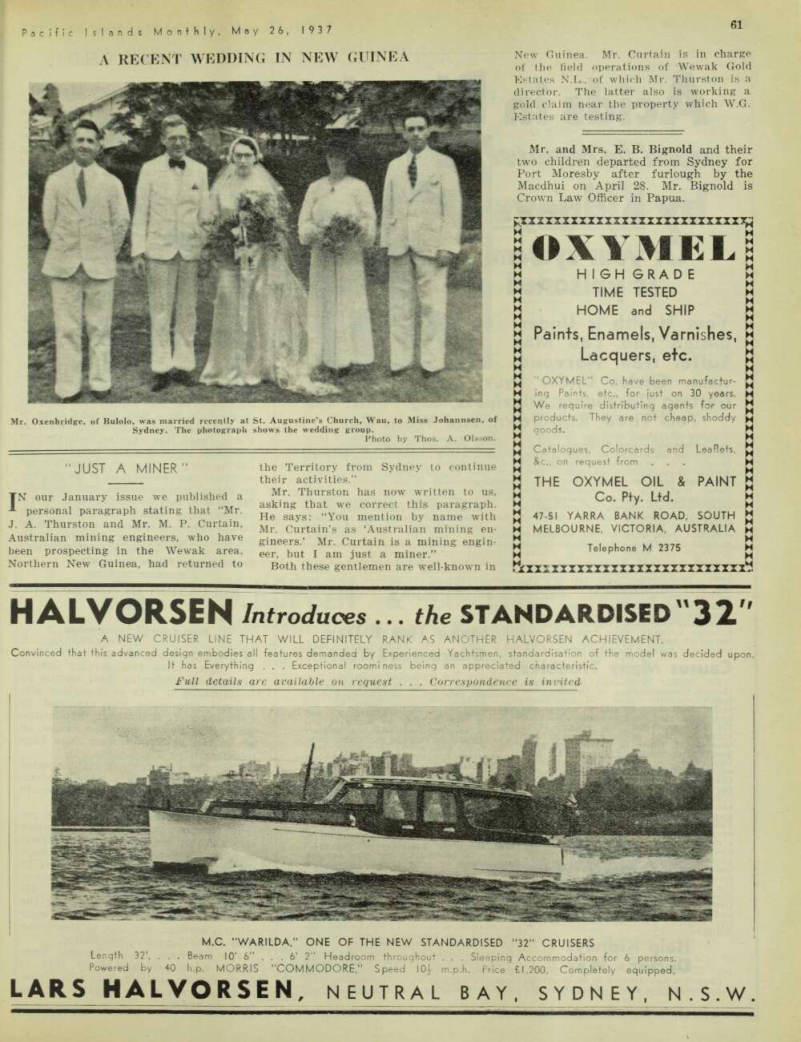
TN our January issue we published a * personal paragraph stating that ‘‘Mr.
J. A. Thurston and Mr. M. P. Curtain, Australian mining engineers, who have been prospecting in the Wewak area, Northern New Guinea, had returned to
the Territory from Sydney to continue their activities.”
Mr. Thurston has now written to us, asking that we correct this paragraph.
He says: ‘‘You mention by name with Mr. Curtain’s as ‘Australian mining en gineers.’ Mr. Curtain is a mining engin eer, but I am just a miner.”
Both these gentlemen are well-known in
New Guinea. Mr. Curtain is in charge of the field operations of Wewak Gold Estates N.L.. of which Mr. Thurston is a director. The latter also is working a gold claim near the property which W.G.
Estates are testing.
Mr, and Mrs. E. B. Bignold and their two children departed from Sydney for
Port Moresby after furlough by the
Macdhui on April 28. Mr. Bignold is Crown Law Officer in Papua.
Advertisements & other items, pp. 63-64 (1 item)
Oxymel
HIGH GRADE
TIME TESTED
HOME and SHIP
Paints, Enamels, Varnishes,
Lacquers, etc.
"OXYMEL" Co. have been manufacturing Paints, etc., for just on 30 years.
We require distributing agents for our products. They are not cheap, shoddy goods.
Catalogues, Colorcards and Leaflets, &c., on request from
THE OXYMEL OIL & PAINT
Co. Pty. Ltd.
47-51 YARRA BANK ROAD. SOUTH
MELBOURNE, VICTORIA. AUSTRALIA
Telephone M 2375
HALVORSEN Introduces ... the STANDARDISED ”32''
A NEW CRUISER LINE THAT WILL DEFINITELY RANK AS ANOTHER HALVORSEN ACHIEVEMENT.
Convinced that this advanced design embodies all features demanded by Experienced Yachtsmen, standardisation of the model was decided upon.
It has Everything . . . Exceptional roominess being an appreciated characteristic.
Full details are available on request . . . Correspondence is inv-ited wMM m s ?■ - M.C. "WARILDA," ONE OF THE NEW STANDARDISED M 32" CRUISERS Lenglh 32 , . . . Beam 10’ 6" . . . 6‘ 2" Headroom throughout . . . Sleeping Accommodation for 6 persons.
Powered by 40 h.p. MORRIS “COMMODORE," Speed 105 m.p.h. Price £1,200. Completely equipped.
LARS HALVORSEN, neutral bay, Sydney, n.s.w.
Acids in Blood
mustAeremom
by Kidneys
Or your system
is poisoned
Your Health is Undermined and You May Suffer from Nervousness. Circles Under Eyes, Lack of Vitality, Getting Up Nights, Dizziness, Leg Pains, and Feel Tired, Run-Down, and Worn Out. vh z
There is nothing that can so quickly undermine your health, strength, and energy, as an excess of acid in your blood. Most people when thinking of Acidity think of the stomach. However, the type of acidity that undermines health is that arising in the blood and often caused by worry, overwork, fear, late hours or over-indulgence, thus placing a heavy strain or load on the kidneys. • Nature has provided an automatic method of getting rid of these excess Acids in the blood. This is accomplished by your Kidneys, the most intricate and delicate organs in your body. Each kidney, although only the size of your clenched fist, contains \\ million tiny, delicate tubes or filters.
Your blood circulates through these tiny filters 200 times an hour, or so frequently that in a 24-hour period the kidneys actually filter and purify a barrel of blood, so that the Acids and poisonous wastes may be removed.
Causes Many Troubles
Dr. Walter R. George, many years Health Commissioner of Indianapolis, U.S.A., recently stated: “Modern foods and drinks, nervous strain, worry, and overwork, place a tremendous load on the kidneys. For this reason it is estimated that millions of men and women at times are troubled with poorly functioning kidneys. In fact this condition is often the real cause of thousands of people feeling older than they should, run-down, exhausted, nervous, and worn out."
If your kidneys slow down and do not function properly and fail to remove approximately 3 pints of Acids, Poisons, and liquids from your blood every twenty-four hours, then there is a gradual accumulation of these Acids and Wastes, and slowly but surely your system becomes poisoned. Kidney and Bladder Troubles cause many diseases, such as Nervousness, Getting Up Nights, Leg Pains, Dizziness, frequent Colds and Headaches, Rheumatism, Pains, Swollen Ankles, Circles under Eyes, Backaches, Loss of Vitality, Burning, Itching and Smarting, Acidity.
Help Kidneys
Doctor's Way
Chemists and doctors in 51 countries throughout the world think that the
right way to help your kidneys function is with the doctor’s prescription, Cystex, which is scientifically prepared in accordance with the requirements of the United States and British pharmacopoeia to act directly on the kidneys. For instance, Dr. C. Van Straubenzee, noted European physician, stated: “I consider Cystex one of the most meritorious formulas I have ever examined, and recommend it most highly.” And Dr. C. J. Roberts, formerly of the Philadelphia General Hospital, states: ‘‘In my years of practice I have employed many medicines and prescriptions to improve the functional action of the kidneys, but in my opinion there is no preparation that excels the prescription known as Cystex.”
Make This 8-Day
Guaranteed Test
If you are rundown, worn out, feel older than you are, or suffer from the diseases previously mentioned. Kidney and Bladder Troubles likely are the real cause of your trouble. At any rate it will do you no harm to put Cystex to the test and see exactly what it can do in your particular case.
Under the guarantee, in 8 days’ time it must do the work to your complete satisfaction, or you merely return the empty package and the full purchase price is refunded without question or argument. With Cystex there is no long waiting for results, because it is scientifically prepared to act directly on the kidneys. For that reason most people report a remarkable improvement within the first forty.-eight hours and complete satisfaction within 8 days. In testing Cystex, you are the sole judge of your satisfaction. You must feel younger, stronger and better than you have in a long time—you must feel that Cystex has done the work thoroughly and completely, or you merely return the empty package and it costs you nothing. Cystex costs little at chemists, and as the guarantee protects you completely, you can not afford to take chances with cheap, inferior, or irritating drugs or any medicine that is not good enough to be guaranteed. Ask your chemist for guaranteed Cystex (pronounced Sisstex) today. Schaffer & Co., Sydney.
Wewak Field
200 Miners Make A Living
OOME 200 men now are at work on what is called the Wewak goldfield, inland from the northern coast of New Guinea. Most of them went there from the Morobe goldfield which, in any event, had lost much of its attractiveness for individual miners.
Nothing sensational has been found on the Wewak field, but it provides the majority of the miners with a living. It simply justifies its name as “a battler’s field.” A few men are doing very well, however. That well-known Morobe pion eer, Ray Parer, has been lucky, and is reported to be averaging some 14 ounces a week, with a team of six boys. Some of his associates also are on good country. But it is a patchy irritating field, giving just enough gold to keep the miners scratching hopefully, while pro viding no one with a fortune.
The aviation companies have been freighting in supplies, while using the Morobe district as headquarters; and freights, from the Madang-Wewak coast to the field, have been brought down to about 3d per pound. It is reported that Kevin Parer, Ray’s brother, shortly will commence his own aerial freighting ser vice between a village on the north coast of New Guinea where most of the steamer freight will be unloaded, and the field.
Stores, also, have been established. Every one was very hesitant about the Wewak field, at first—it looked a mere flash in the pan—but the coming of the freighting service and the stores suggest that con fidence in its future is growing.
Education In American
Samoa
From a Special Correspondent
Honolulu, Apr. 8.
THE opinion that the natives of East ern Samoa were making definite progress in conserving their culture by co-ordinating it with an American edu cational programme was expressed by Commander T. Kirkpatrick, administra tor of education in American Samoa, on his arrival at Hawaii from Pago Pago recently.
Commander Kirkpatrick has just ended a two-year’s period as director of educa tion. He will be succeeded by Captain G. H. Markle.
The Samoans are to-day almost 100 per cent literate, Commander Kirkpatrick said, and they are taking a great interest in education. Some 2,200 natives between the ages of six and 15 were attending 22 schools, three of which carried instruc tion through to the ninth grade. He praised the progressive attitude of the young Samoans, who were loyal to their cultural heritage, but keen to absorb the elements of American civilisation.
The Frederick Duclos Barstow foun dation school, established in 1934 to train capable natives for educational leadership, was a fine influence for the good, he added.
Successful Mission Conference
Islands Churchmen Discuss Problems At Sydney Meeting
"AN outstanding success” was how •**-Rev. J. W. Burton, M.A. (chairman) described the Pacific Missionary Confer ence held in Sydney during April. About 100 delegates, representing the major
missionary organisations (except the
Roman Catholics), attended the sessions.
One of the main features of the Confer ence was the emphasis placed upon the growth of the indigenous churches in the Islands. In presenting the report of the Pacific Commission, Rev. Dr. Micklem stated that it was his conviction that they must envisage a great Pacific Church, undivided by denominational differences.
“We are not only concerned,”he said,“with establishing small Christian communities here and there, linked with the Church of the West, and retaining forms and worship and Christian practice peculiar to the West. There is something bigger we must do. That is, I think, nothing less than the gigantic task of reconstruc ting the Island Societies of the Pacific on a Christian basis, and integrating them into one great Christian fellow ship.”
Careful inquiry was made in regard to education in the Pacific. It was decided that it is the ultimate responsibility of the Governments concerned to educate their citizens. As the Governments undertake this, the Missions must with
draw; but taking care, nevertheless, that religious teaching and influence, for the sake of the natives themselves, are ade quately safeguarded, especially by insur ing the Christian character of the teachers.
After discussing the matter of lan guage—a burning question in some areas —the Conference recognised that English, or perhaps better, “Basic English,” would become the lingua franca of the South Seas. Rev. Burton declared that the language of religion must be the homely varnacular of the people among whom the missionaries are labouring.
Addressing the Conference, Professor A. P. Elkin (who occupies the Chair of Anthropology at Sydney University) showed how modern science can aid the missionary in his approach to, and under standing of, other races. He declared that there should be no conflict, but rather co-operation, between missionaries and anthropologists. Some anthropolo gists, he admitted, thought certain mis sionaries might adopt wiser and more fruitful methods.
The Conference emphasised the need of the specific training of missionaries for their task. It felt that they should be fully equipped as ministers, doctors, nurses, teachers, or technicians: but over and above these essential qualifications
there should be definite instruction In such subjects as Anthropology, Linguis tics, Tropical Medicine and Hygiene, and Comparative Religion.
The relation of Governments to Mis sions was the subject of much discussion.
The general conclusion was that in the Pacific the Missions’ relations were, on the whole, very satisfactory, and that the Administrations paid not only lip ser vice to their value, but in various prac tical ways showed their appreciation of the work that was *being done.
During the Conference a Pacific Advis ory Committee was appointed. Some of the draft resolutions made by this body were: That this Conference, while recognising the value of the educational work done by some of the older established Governments in the South Seas, urges all Administrations having responsi bility for native races in the Pacific, to provide or extend educational facilities, especially in the
primary grades, for the benefit of the races concerned.
That this Conference believes that the best results in native education are obtained when every opportunity is given to the respective mis sions to provide Christian training for native teachers.
That this Conference requests the Papuan Administration, while preserving its policy of encouraging the teaching of English in native schools, to register vernacular schools of suitable standard : and to consider the advisability of sup porting them, at least to the extent of compelling the attendance of the children within a prescribed area.
That this Conference notes with sincere regret that the Administration of the Mandated Terri tory of New Guinea has not yet put into effect a comprehensive and adequate policy of primary and village education. It urges the Government to take immediate steps to honour its responsi bility as a Mandatory Power in this respect.
That this Conference recommends that the National Missionary Council appoint a Language Commission for the Islands of the South Pacific
to make a survey of languages and translation work.
That this Conference heartily commends the work of the Central Medical Training School in Fiji, and urges other Governments to use or extend this system of providing Native Medical Practitioners; and that enquiry be made as to whether this College would accept native mission ary candidates for medical training with a view to their engaging afterwards in medical work under a missionary society.
That this Conference envisages in the future a United Church of the Pacific and in the mean time urges all leaders of Christian Communions associated to give earnest consideration to prob lems brought to their attention that may cause misundersanding among native Christians or delay the realisation of this ideal.
That this Conference believes that the attitude of missionaries in the Pacific to native rites and customs should be one of fulfilment rather than of destruction, and that no efforts should be made to discourage and modify native rites except where they are incompatible with the spiritual, social and moral welfare of the people.
Advertisements & other items, pp. 65-66 (1 item)
W.Kopsen & Co. Ltd.
PHOTOS OF GOLDFIELDS
DISTRICT, NEW GUINEA.
FOR SALE
I have over 3,000 negatives available, showing Mines and IVKning Work, Aerial Transport and Aeroplanes, Natives, Native Life, Scenery, Towns, etc.
Photos, in any size, from 1" x 1J" up to full plate. Postcard photos., 6d. each. Send for some photos, of the gold mine you are interested in.
Agent for: Leica Cameras and accessories; Agfa Cameras and material. Stocks always on hand.
THOS. A. OLSSON, Photographer
Box 47, WAU, New Guinea
TILLEY
Kerosene Pressure Lamps Lanterns and Radiators.
Write or Ring for New Catalogue of Lamps and Spare Parts.
Models to suit every purpose and every pocket.
TILLEY The Most Satisfactory 300 c.p. Kerosene Lamp.
W.KOPSEN & CO. LTD.
Shipchandlers & Hardware Merchants
LARGEST MANUFACTURERS OF ASH BOAT
OARS AND TOOL HANDLES IN THE SOUTHERN
HEMISPHERE
Large Stocks of Metal Sheathing and Nails, Oakum Ropes, Anchors and Chains, Copper Paints, Blocks, Canvas, etc.
All Classes of Boating, Miners' and Prospectors' Equipment.
70 CLARENCE STREET, SYDNEY
Cables: Kopsen, Sydney. 'Phone: BW 1114 (3 lines) Write for New 40-page Catalogue Penta KlI
Single Cylinder
Penta U2I Outboard
PENTA
MARINE ENGINES
OUTBOARDS ... 4-18 H.P.
INBOARDS 3-100 H.P.
Precision Built and Absolutely Free from Vibration, Deliveries from Stock at Under Bond Prices.
Write for Complete Catalogue and also Particulars of the Penta - Hesselman Engine, running on Heavy Oil Fue PENTA The World's Leading Marine Engine
MORRIS, HEDSTROM, LTD.
Registered Office - - Suva, Fiji.
BRANCHES THROUGHOUT FIJI, TONGA AND SAMOA
Agents for : 'Y
LLOYD’S
NOBELS (AUSTRALIA) LIMITED—EXPLOSIVES
MATSON NAVIGATION COMPANY
RUSTON & HORNSBY LIMITED
IMPERIAL CHEMICAL INDUSTRIES LIMITED
JOHN LYSAGHT (AUST.) LTD.
VACUUM OIL COMPANY PROPTY. LIMITED
FORD MOTOR COMPANY LIMITED
GOODYEAR TIRE & RUBBER EXPORT COY. J.
SYDNEY OFFICE: DALTON HOUSE, 115 PITT ST.
Your Tropical Kit
When you visit the Pacific Islands, whether on Business or Pleasure, you need, Special Equipment—Light Suits of Correct Style, which fit well and launder easily; Tunic Shirts Silk Shirts, Light Underwear, White Shoes, etc.
WALTER HORNE & CO. LTD., established in 1885, specialise in this Service. Skilled Tailors make your Suits from First-class material within 24 hours. Complete equipment can be supplied from our Large Stocks at Reasonable, Moderate Prices.
BUY FROM THE FIRM WHICH ‘UNDERSTANDS YOUR NEEDS AND
DRESSES YOU CORRECTLY
WALTER HORNE & CO. LTD., carry a Full Range of Drapery of all kinds; also Frocks. Millinery. Foundations and Lingerie, Hosiery, Shoes and Sandals, Ribbons and Laces, Household Drapery.
Ladies' Hairdressing and Manicuring
Men resident in any of the Pacific Territories can be supplied with Suitable Clothes.
Write to us and Describe your Requirements.
WALTER HORNE & Co. Ltd
Drapers and Men's Wear Specialists
SUVA FIJI
Phoenix Group
Now Included in Gilbert and Ellice Colony
DY an official proclamation in the Western Pacific High Commission Gazette , issued in Suva, Fiji, on April 8, the boundaries of the Gilbert and Ellice Islands Colony have been extended so as to include the Phoenix Group.
The following islands are affected: Birnie Island (lat. 3.355., long. 171.33 W.).
Canton Island (lat. 2.495., long. 171.43 W.).
Enderbury Is. (lat. 3.075., long. 171.03 W.).
Gardner Island (lat. 4.405., long. 174.31 W.).
Hull Island (lat. 4.305.. long. 172.13 W.).
McKean Island (lat. 3.355., long. 174 01 W.).
Phoenix Island (lat. 3.425., long. 170.43 W.).
Sydney Island (lat. 4.275., long. 171.15 W.).
The islands will now be under the jurisdiction of Mr. J. C. Barley (Resident Commissioner in the Gilbert and Ellice Colony) whose headquarters are at Ocean Island.
Valuable Award Secured
By Fiji Chemist
From Our Own Correspondent SUVA, April 23.
TPHE Commonwealth Fund of New * York, a philanthropic foundation existing since 1918, has awarded a fellow ship for 15 months’ biochemical study in the United States to Mr. W. J. Blackie, Government Chemist in the Agriculture Department.
Mr. Blackie has obtained leave from the Fiji Government to take up the fellowship.
Each year fellowships are offered by the Commonwealth Fund to enable Brit ish subjects to attend an American university to carry out special research work. Five fellowships have been awarded for 1937, and it is estimated that the value of each is about 3,000 dollars (£750 Aust.U Mr. Gregory Bateson, M.A., who car ried out research work in anthropology in New Guinea for several years, has written a book entitled “Naven,” which has just been published bv the Cambridge University Press. It deals with a re markable ceremony which he found and studied among the head-hunting latmul people of the Sepik River.
Advertisements & other items, p. 66 (1 item)
The Original
RUR
RHEUMATIC REMEDY
MONEY BACK GUARANTEE
“Obtainable from all branches of Burns, Philp and Co. Ltd., or Post Free from R.U.R. Pty., 841 George St., Sydney—7/6 for 6 weeks’ treatment, 4/- for 3 weeks’ trial size. Ask or write for Free Booklet.
£150,000 Block
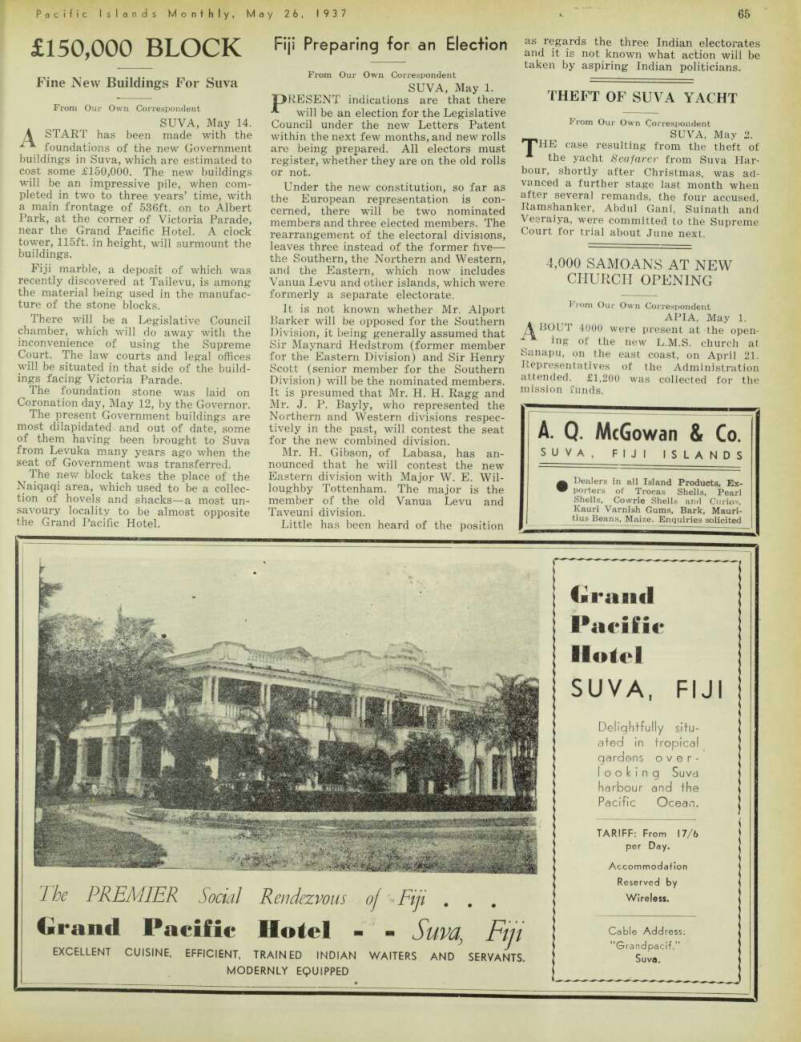
Fine New Buildings For Suva
From Our Own Correspondent
Suva, May 14.
A START has been made with the foundations of the new Government buildings in Suva, which are estimated to cost some £150,000. The new buildings will be an impressive pile, when com pleted in two to three years’ time, with a main frontage of 536 ft. on to Albert Park, at the corner of Victoria Parade, near the Grand Pacific Hotel. A clock tower, 115 ft. in height, will surmount the buildings.
Fiji marble, a deposit of which was recently discovered at Tailevu, is among the material being used in the manufac ture of the stone blocks.
There will be a Legislative Council chamber, which will do away with the inconvenience of using the Supreme Court. The law courts and legal offices will be situated in that side of the build ings facing Victoria Parade.
The foundation stone was laid on Coronation day, May 12, by the Governor.
The present Government buildings are most dilapidated and out of date, some of them having been brought to Suva from Levuka many years ago when the seat of Government was transferred.
The new block takes the place of the Naiqaqi area, which used to be a collec tion of hovels and shacks—a most un savoury locality to be almost opposite the Grand Pacific Hotel.
Fiji Preparing for an Election
From Our Own Correspondent
Suva, May 1.
|3RESENT indications are that there will be an election for the Legislative Council under the new Letters Patent within the next few months, and new rolls are being prepared. All electors must register, whether they are on the old rolls or not.
Under the new constitution, so far as the European representation is con cerned, there will be two nominated members and three elected members. The rearrangement of the electoral divisions, leaves three instead of the former five— the Southern, the Northern and Western, and the Eastern, which now includes Vanua Levu and other islands, which were formerly a separate electorate.
It is not known whether Mr. Alport Barker will be opposed for the Southern Division, it being generally assumed that Sir Maynard Hedstrom (former member for the Eastern Division) and Sir Henry Scott (senior member for the Southern Division) will be the nominated members.
It is presumed that Mr. H. H. Ragg and Mr. J. P. Bayly, who represented the Northern and Western divisions respec tively in the past, will contest the seat for the new 1 combined division.
Mr. H. Gibson, of Labasa, has an nounced that he will contest the new Eastern division with Major W. E. Wil loughby Tottenham. The major is the member of the old Vanua Levu and Taveuni division.
Little has been heard of the position
as regards the three Indian electorates and it is not known what action will be taken by aspiring Indian politicians.
Theft Of Suva Yacht
From Our Own Correspondent
Tsuva, May 2.
HE case resulting from the theft of the yacht Seafarer from Suva Har bour, shortly after Christmas, was ad vanced a further stage last month when after several remands, the four accused, Ramshanker, Abdul Gani, Suinath and Veeraiya, were committed to the Supreme Court for trial about June next.
4,000 Samoans At New
Church Opening
From Our Own Correspondent
Apia. May 1.
A BOUT 4000 were present at the open ly* ing of the new L.M.S. church at Sanapu, on the east coast, on April 21.
Representatives of the Administration attended. £1,200 was collected for the mission funds.
Advertisements & other items, p. 67 (1 item)
Suva. Fiji
A. Q. McGowan & Co.
SUVA. FIJI ISLANDS
Dealers in all Island Products, Exporters of Trocas Shells, Pearl Shells, Cowrie Shells and Curio*.
Kauri Varnish Gums, Bark, Mauritius Beans, Maize. Enquiries solicited
7he PREMIER Social Rendezvous of Fiji . . .
Grand Pacific Hotel - - Fiji
EXCELLENT CUISINE. EFFICIENT, TRAINED INDIAN WAITERS AND SERVANTS.
MODERNLY EQUIPPED
Grand
Pacific
Hotel
SUVA. FIJI
Delightfully situ-
ated in tropical gardens overlooking Suva harbour and the Pacific Ocean.
TARIFF: From 17/6
per Day.
Accommodation Reserved by Wireless.
Cable Address; "Grandpacif,"
Suva,
Pay In Sterling Or
Australian?
Problem In The Solomons
ORBSENT and pas*t officials of the Solo -*■ mon Islands administration are displaying a lively interest in the an nouncement that the Solomon Islands administration will now accept Austra lian currency as its monetary system.
A King’s Regulation recently issued by
the High Commissioner for the Western Pacific (Sir Arthur Richards) stated that Australian bank notes and Australian and English coins will be the only legal tender in the Protectorate after Septem ber 25. The Regulation also provided for imprisonment not exceeding five years for forgery, uttering, and receiving.
Hitherto, the currency conditions in the British Solomon Islands have been complex. The majority of officials there have been transferred from other British Crown Colonies, and are accustomed to being paid in sterling. Many years ago, for its own convenience, the Administra tion created its own currency—£l, 10/and 5/- notes, etc. Then, as most 8.5.1. trade Is with Australia, Australian cur rency was freely used. There were no difficulties while Australian currency was on par with sterling, but since Aus tralian currency went 25 per cent under sterling there has been endless confusion.
The 8.5.1. currency should be on par with sterling, but actually it is on par with Australian. Meanwhile 8.5.1. public servants, to their endless discontent have been paid mostly in 8.5.1. currency.
Under the new arrangement 8.5.1. offi cials (and, of course, ex-officials, or pen sioners) hope to receive payment, not in Australian currency, but in sterling.
Presumably, as officials of the British Colonial Service, they are entitled to sterling, but, if they get it, there will be trouble in other Pacific territories under the High Commission. Fiji offi cials, for instance, will ask why they have been paid in Fiji currency (which is 12| per cent under sterling) instead of sterling.
It was a poet who said that money is a curse; but the remark is heartily en dorsed nowadays by sundry Colonial Administrators.
Mr. A. Mackenzie, newly appointed
Director of Education in Samoa, arrived
at Apia by the April Matua.
When The Law Is
No Law
Officialdom Is Criticised In Fiji
From Our Own Correspondent
Suva, May 2.
OINCE the Aorangi arrived from Auckland and Sydney on April 23, resi dents of Suva —that is to say, ordinary people with no official position and no wires that they can conveniently pull— are beginning to wonder just what use are the local health regulations, which decree that an overseas vessel must be granted pratique by the Medical Officer before anyone from the shore can board her.
As the Aorangi pulled alongside the wharf, people waiting patiently outside the wharf gates were astonished to see a prominent local resident (a member of the Legislative Council) who was cer tainly not a returning passenger, leaning over the rail of the ship. The yellow flag, signifying that pratique had not yet been granted, was still flying.
The wife of the honourable gentleman was returning by the Aorangi —but so were the wives of many other local resi dents. Why should this resident be granted the privilege of joining the vessel in the stream from the doctor’s boat, was the general query.
One indignant citizen wrote a letter to the local newpaper about it, but there has been no official explanation forth coming.
On the same occasion, another incident gave rise to considerable feeling. When an overseas liner is berthing, the general public, in the interests of safety and con venience, are kept off the wharf until the ship is tied up and the passengers are ashore and through the customs. This is a great improvement on the old sys tem, whereby people from the shore were allowed aboard immediately the ship was passed by the doctor, causing endless con fusion.
On the arrival of the Aorangi a cus toms officer and the native constable on duty at the gate of the wharf were given instructions that they were to let no one through. Then, along came a very senior official, with his wife and two other ladies, one the wife of a senior official and the other the wife of an ecclesiastical dignitary, who was returning by the liner. They were allowed through—and for this, one cannot altogether blame a somewhat junior custom official and a native policeman.
These people, having got on to the wharf, did not even keep out of sight, but paraded up and down, to the com plete exasperation of the unfortunates compelled to remain outside.
The axiom that there is one law for the rich and another for the poor, is varied in Fiji, so that there is one law for the Government official and another for those outside the service.
Advertisements & other items, p. 68 (1 item)
A. B. Donald Ltd.
have achieved their wonderful popularity because of outstanding performance and absolute reliability.
They are the Rim Fires with Sales in Australia greater than all other makes combined.
Obtainable
Everywhere
Popular
Prices Koldun fcU3SE3 *AX E 3
A. B. DONALD LTD.
AUCKLAND
ISLAND TRADERS :: GENERAL MERCHANTS
P. O. Box 1509 Cables and Telegrams: "Kingdom," Auckland — Branches at Rarotonga and throughout the Cook Islands At Papeete and throughout the Society, Marquesas and Paumotu Islands trading as " ETABLISSEMENTS DONALD, TAHITI "
At Fiji: Trading as "Dominion Fruit C 0.," Suva
Canon Tomlinson
Pioneer Missionary’s Death In Papua
CANON Samuel Tomlinson died at Dogura. Papua, on April 26, from bronchial pneumonia in his 81st year.
He was one of the veteran missionaries of the Anglican Church, and a pioneer of missionary work in Papua. • He landed in Papua on October 11, 1891, and joined the mission as a car penter. In 1898 he was ordained by Bishop Stonewigg, and with his wife he witnessed the growth of Christianity from the first beach service to the build ing of Papua’s first cathedral, which is now nearing completion.
The main part of his ministry was spent at Mukawa, on Cape Vogel. While there he translated the Bible into the Mukawan language, and, in recognition of this memorable feat, he was made a life governor of the British and Foreign Bible Society and a Fellow of the Aus tralian College of Theology. He was made a Canon of St. Peter and St. Paul’s, Dogura, by Bishop Newton about 1927.
When Canon Tomlinson and his wife settled on the then savage north-east coast there were no other whites, and in the first open-air service at Wedau Beach, Bartle Bay, the congregation consisted of semi-hostile natives, to whom the first lesson of Christianity was delivered mainly by gesticulation.
Canon Tomlinson retired about three
years ago. Since then he and his wife have lived on a hilltop which overlooks Wedau Beach, Bartle Bay, near Dogura.
Recently, when a missionary became ill and had to forsake his post, Canon Tom linson, though in his 81st year, took his place. It is believed that this brought on his last illness.
400 Methodists
Cruise To Tonga, Samoa, and Fiji
FOLLOWING an invitation from Queen Salote, of Tonga, 200 clergy and lay men of the Methodist Church of Victoria, and a similar number representing West Australia, South Australia, Queensland, Tasmania and New South Wales left Melbourne on May 12 on the Katoomba. which has been chartered for the cruise.
On arrival at Nukualofa, the party were the guests of Queen Salote for five days. They were conveyed to points of interest on the island, and entertained at exhibitions of native folk dances and ceremonies peculiar to the country.
Later two days were to be spent at Samoa. The first will be occupied in visiting the mission stations, and the second will be given up to a special pil grimage to the former home of Robert Louis Stevenson at Vailima, and to his grave on the mountain of Vaea.
On the return journey the volcanic island known as Tin Can will be visited, and the final call will be made at Fiji.
Registered in Papua
Another Oil Company
Port Moresby. May 2.
'T'HE Papuan Aplnaipi Petroleum Co. * Ltd. was incorporated under the Papuan Companies Ordinance on April 29. The company has a nominal capital 0f'£250,000, divided into 1,000,000 shares of 5/- each.
It is understood that the company in tend prospecting for oil on a concession to the west of lokea, on the Kapure River, near Cape Possession, on the old Popo oilfield, worked formerly by the Anglo-Persian Oil Co. and the Common wealth.
This area is practically surrounded by the Oriomo Co.’s oil concession No. 5.
Their area (12,000 square miles) when taken up, was exclusive (for the time being) of this reserve (the Popo Com monwealth property).
EDITORIAL NOTE; No one we have seen can explain why this area was kept out of the oil companies’ concessions, and priven to small private interests. If it is to be the subject of “a Pitt Street float,” there probably will be an outcry.
It was reported in the Melbourne Aye on April 23 that “Mr. W. Marks, a former member of the Federal Parliament, has been granted a permit to prospect for oil in Papua over an area of 75 square miles.
The permit is for 12 months, and under it the lessee is required to spend at least £5OOO on oil prospecting during the first six months of the lease and a similar sum during the second six months.”
Advertisements & other items, pp. 69-70 (1 item)
Lister
IDARinE
DIESEL
ENGINES
There is no finer power unit for small craft • than the Lister British-built Marine Diesel Engine. . . . The crankshaft (conforming to Lloyd's requirements for sea-going vessels) is ground to accurate limits and carefully balanced. The very liberal dimensions ensure rigidity, and provide ample bearing surfaces, both on the main and large-end bearings. The Cylinder Liners are renewable and completely waterjacketed; while all working parts are accessible, in spite of the engine being of the totally enclosed type. Sizes range from 7 h.p. to 21 h.p. (Lister), and h.p. to 30 h.p. (Blackstone).
Sole Agents for N.S.W.:
Dangar, Gedye & Malloch Ltd.
MALLOCH HOUSE, 10-14 YOUNG STREET
SYDNEY
Mining Ore
Treatment
Machinery
COMPLETE CYANIDE
PLANTS SUPPLIED
Dorr Classifiers Dorr Thickeners Dorr Agitators Oliver Filters Merril Crowe Zinc Dust Gold Precipitation Richardson Mine Fans
FANS AND AIR HEATERS
For Ventilation, Copra Drying Rooms, etc. • Enquire from
CROSSLE. DUFF AND
MACINTOSH LTD.
52 Bridge Street. SYDNEY
WE DID THE WHOLE CONTRACT
dm
NEW OVERHAUL
SHOP
AND STORE AT LAE
for
GUINEA AIRWAYS
LTD.
IN few undertakings do reliability, expedition, and efficient service count more Tr , than in Structural Steel Your confidence in our service will not he misplaced contracts.
MARRICKVILLE - N.S.W.
Cable Address: "Sydsteel"
Cbe Sydney Steel Company Dd.
Steel Merchants and Structural Engineers
COLD...
HIGHEST PRICES, PROMPT
SETTLEMENT, ACCURATE
WEIGHTS AND ASSAYS.
are assured to producers and sellers of gold bullion who forward their consignments to The Electrolytic Refining and Smelting Co. of Aust, Ltd. fof treatment and realisation, RECORD PRICE.—On 6th March, 1935, this company paid to its clients at the rate of £9/4/6 net per fine ounce, which is the highest price ever paid for gold in Australia.
SPECIALLY ORGANISED SER-
VICE is available to clients in New Guinea, Fiji and other Pacific Island centres.
Address consignments from outside Australia to the Company's Sydney office.
SH Weighing a Pacific Islands consignment of gold bullion at an E.R. & S. receiving office.
The Electrolytic Refining &.
OF AUSTRALIA LIMITED
Melbourne: Works: Collins House. Port Kembla, N.S.W.
Smelting Co.
Sydney; 25 O'Connell Street, PURCHASERS AND REFINERS OF GOLD, SILVER. COPPER IN ANY FORM BANKERS; —The English, Scottish and Australian Bank Ltd.
Pacific Islands Mining Notes
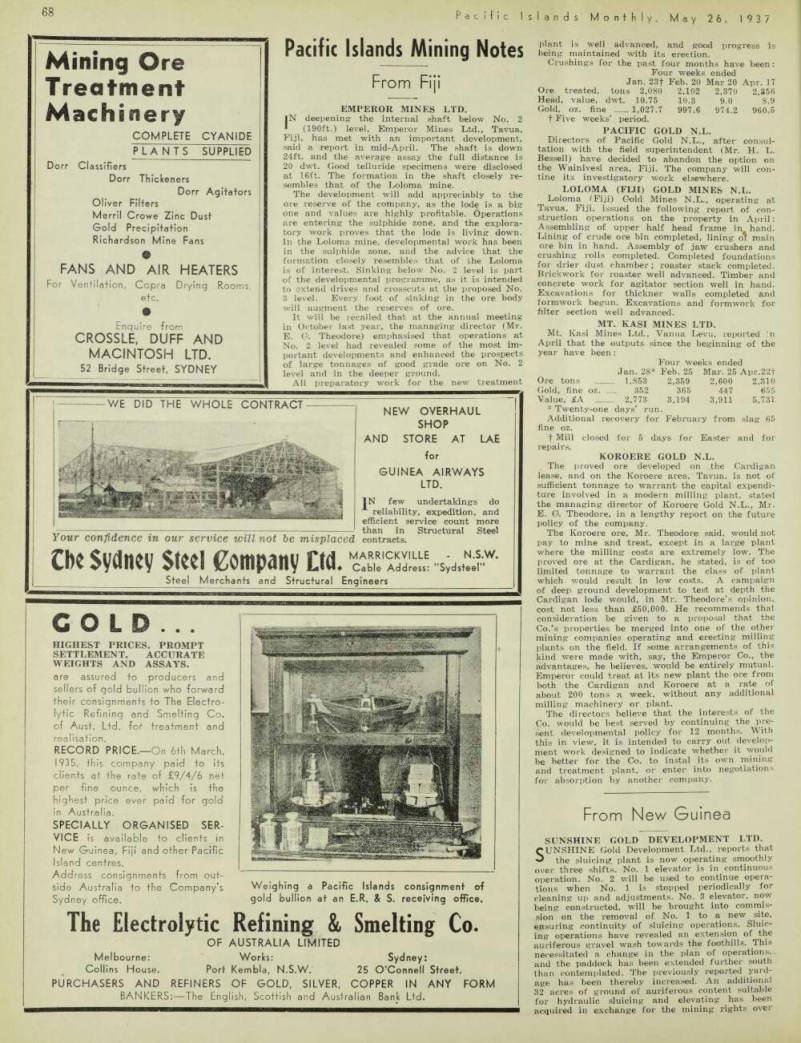
From Fiji
Emperor Mines Ltd.
IN deepening the internal shaft below No. 2 ■ (190 ft.) level. Emperor Mines Ltd., Tavua, Fiji, has met with an important development, said a report in mid-April. The shaft is down 24ft. and the average assay the full distance is 20 dwt. Good telluride specimens were disclosed at 16ft. The formation in the shaft closely re sembles that of the Loloma mine.
The development will add appreciably to the ore reserve of the company, as the lode is a big one and values are highly profitable. Operations are entering the sulphide zone, and the explora tory work proves that the lode is living down.
In the Loloma mine, developmental work has been in the sulphide zone, and the advice that the formation closely resembles that of the Loloma is of interest. Sinking below No. 2 level is part of the developmental programme, as it is intended to extend drives and crosscuts at the proposed No. 3 level. Every foot of sinking in the ore body will augment the reserves of ore.
It will be recalled that at the annual meeting in October last year, the managing director (Mr.
E. G. Theodore) emphasised that operations at No. 2 level had revealed some of the most im portant developments and enhanced the prospects of large tonnages of good grade ore on No. 2 level and in the deeper ground.
All preparatory work for the new treatment
plant is well advanced, and good progress is being maintained with its erection.
Crushings for the past four months have been:
Pacific Gold N.L.
Directors of Pacific Gold N.L., after consul tation with the field superintendent (Mr. H, L.
Bessell) have decided to abandon the option on the Wainivesi area, Fiji. The company will con tine its investigatory work elsewhere.
Loloma (Fiji) Gold Mines N.L.
Loloma fFiji) Gold Mines N.L., operating at Tavua, Fiji, issued the following report of con struction operations on the property in April: Assembling of upper half head frame in hand.
Lining of crude ore bin completed, lining of main ore bin in hand. Assembly of jaw crushers and crushing rolls completed. Completed foundations for drier dust chamber; roaster stack completed.
Brickwork for roaster well advanced. Timber and concrete work for agitator section well in hand.
Excavations for thickner walls completed and formwork begun. Excavations and formwork for filter section well advanced.
Mt. Kasi Mines Ltd.
Mt. Kasi Mines Ltd., Vanua Levu, reported ;n April that the outputs since the beginning of the year have been:
Koroere Gold N.L.
The proved ore developed on the Cardigan lease, and on the Koroere area, Tavua, is not of sufficient tonnage to warrant the capital expendi ture involved in a modern milling plant, stated the managing director of Koroere Gold N.L., Mr.
E. G>. Theodore, in a lengthy report on the future policy of the company.
The Koroere ore, Mr. Theodore said, would not pay to mine and treat, except in a large plant where the milling costs are extremely low. The proved ore at the Cardigan, he stated, is of too limited tonnage to warrant the class of plant which would result in low costs. A campaign of deep ground development to test at depth the Cardigan lode would, in Mr. Theodore’s opinion, cost not less than £50,000. He recommends that consideration be given to a proposal that the Co.’s properties be merged into one of the other mining companies operating and erecting milling plants on the field. If some arrangements of this kind were made with, say, the Emperor Co., the advantages, he believes, would be entirely mutual.
Emperor could treat at its new plant the ore from both the Cardigan and Koroere at a rate of about 200 tons a week, without any additional milling machinery or plant.
The directors believe that the interests of the Co. would be best served by continuing the pre sent developmental policy for 12 months. With this in view, it is intended to carry out develop ment work designed to indicate whether it would be better for the Co. to instal its own mining and treatment plant, or enter into negotiations for absorption by another company.
Four weeks ended Jan.231 Feb. 20 Mar 20 Apr. 17 Ore treated, tons 2.080 2.102 2,370 2,356 Head, value, dwt. 10.75 10.3 9.0 8.9 Gold, oz. fine 1,027.7 997.6 974.2 960.5 t Five weeks’ period.
Four weeks ended Jan. 28* Feb. 25 Mar. 25 Apr.22f Ore tons 1,853 2,359 2,600 2,310 Gold, fine oz. 352 365 447 655 Value, fA .. 2,773 3,194 3,911 5,731 * Twenty-one days’ run.
Additional recovery for February from slag 65 fine oz. t Mill closed for 5 days for Easter and for repairs.
From New Guinea
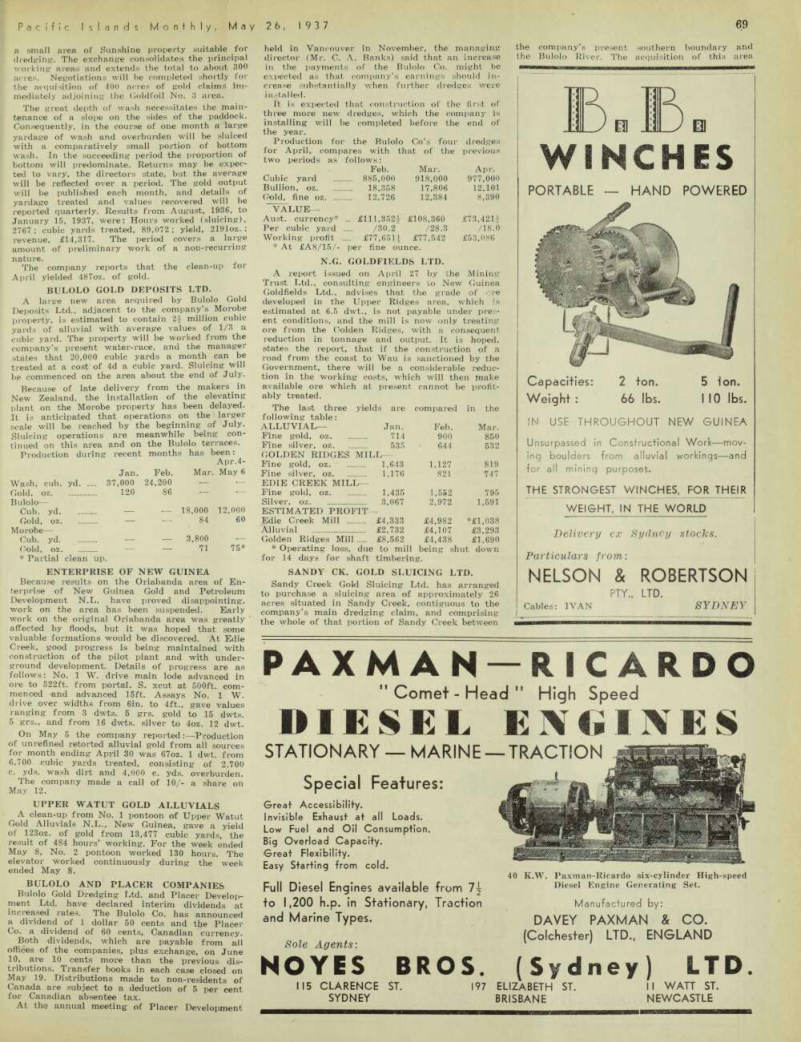
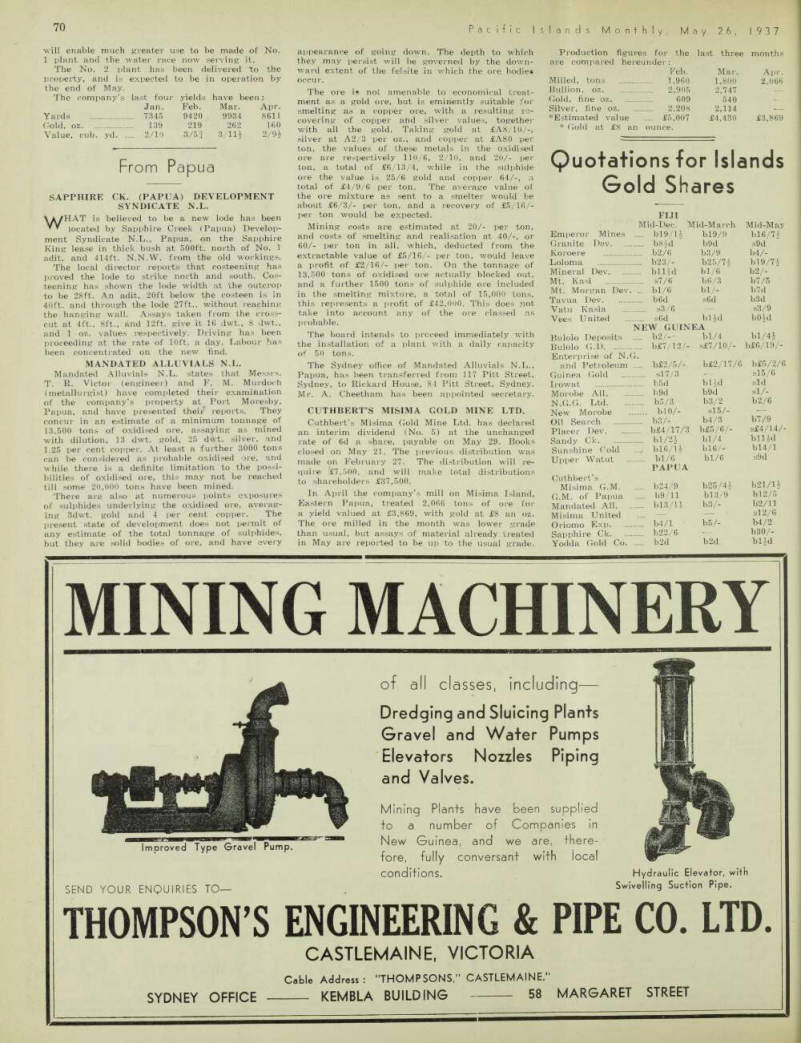
Sunshine Gold Development Ltd.
SUNSHINE Gold Development Ltd., reports that the sluicing, plant is now operating smoothly over three shifts. No. 1 elevator is in continuous operation. No. 2 will be used to continue opera tions when No. 1 is stopped periodically for cleaning up and adjustments. No. 3 elevator, now being constructed, will be brought into commis sion on the removal of No. 1 to a new site, ensuring continuity of sluicing operations. Sluic ing operations have revealed an extension of the auriferous gravel wash towards the foothills. This necessitated a change in the plan of operations, and the paddock has been extended fui’ther south than contemplated. The previously repoi’ted yard age has been thereby increased. An additional 32 acres of gi’ound of aurifei’ous content suitable for hydraulic sluicing and elevating has been acquiied in exchange for the mining rights over
a small area of Sunshine property suitable for dredging. The exchange consolidates! the principal working areas and extends the total to about 300 acres. Negotiations will be completed shortly for the acquisition of 400 acres of gold claims im mediately adjoining the Goldfoil No. 3 area.
The great depth of wash necessitates the main tenance of a slope on the sides of the paddock.
Consequently, in the course of one month a large yardage of wash and overburden will be sluiced with a comparatively small portion of bottom wash. In the succeeding period the proportion of bottom will predominate. Returns may be expec ted to vary, the directors state, but the average will be reflected over a period. The gold output will be published each month, and details of yardage treated and values recovered will be reported quarterly. Results from August, 1936, to January 15, 1937, were: Hours worked (sluicing), 2767 ; cubic yards treated, 89,072 ; yield, 21910 z. : revenue, £14,317. The period covers a large amount of preliminary work of a non-recurring nature.
The company reports that the clean-up for April yielded 4870 z. of gold.
Bulolo Gold Deposits Ltd.
A large new area acquired by Bulolo Gold Deposits Ltd., adjacent to the company’s Morobe property, is estimated to contain *L\ million cubic yards of alluvial with average values of 1/3 a cubic yard. The property will be worked from the company’s present water-race, and the manager states that 20,000 cubic yards a month can be treated at a cost of 4d a cubic yard. Sluicing will be commenced on the area about the end of July.
Because of late delivery from the makers in New Zealand, the installation of the elevating plant on the Morobe property has been delayed.
It is anticipated that operations on the larger scale will be reached by the beginning of July.
Sluicing operations are meanwhile being con tinued on this area and on the Bulolo terraces.
Production during recent months has been:
Enterprise Of New Guinea
Because results on the Oriabanda area of En terprise of New Guinea Gold and Petroleum Development N.L, have proved disappointing, work on the area has been suspended. Early work on the original Oriabanda area was greatly affected by floods, but it was hoped that some valuable formations would b© discovered. At Edie Creek, good progress is being maintained with construction of the pilot plant and with under ground development. Details of progress are as follows: No. 1 W. drive main lode advanced in ore to 522 ft. from portal, S. xcut at 500 ft. com menced and advanced 15ft, Assays No. 1 W. drive over widths from 6in. to 4ft., gave values ranging from 3 dwts. 5 grs. gold to 15 dwts. 5 grs., and from 16 dwts. silver to 4oz. 12 dwt.
On May 5 the company reported:—Production of unrefined retorted alluvial gold from all sources for month ending April 30 was 670 z. 1 dwt. from 6,700 cubic yards treated, consisting of 2,700 c. yds. wash dirt and 4,000 c, yds. overburden.
The company made a call of 10/- a share on May 12.
Upper Watut Gold Alluvials
A clean-up from No. 1 pontoon of Upper Watut Gold Alluvials N.L., New Guinea, gave a yield of 1230 z. of gold from 13,477 cubic yards, the result of 484 hours’ working. For the week ended May 8, No. 2 pontoon worked 130 hours. The elevator worked continuously during the week ended May 8.
Bulolo And Placer Companies
Bulolo Gold Dredging Ltd. and Placer Develop ment Ltd. have declared interim dividends at increased rates. The Bulolo Co. has announced a dividend of 1 dollar 50 cents and the Placer Co. a dividend of 60 cents, Canadian currency.
Both dividends, which are payable from all offices of the companies, plus exchange, on June 10, are 10 cents more than the previous dis tributions. Transfer books in each case closed on May 19. Distributions made to non-residents of Canada are subject to a deduction of 5 per cent for Canadian absentee tax.
At the annual meeting of Placer Development
held in Vancouver in November, the managing director (Mr. C. A. Banks) said that an increase in the payments of the Bulolo Co. might be expected as that company’s earnings should in crease substantially when further dredges were installed.
It is expected that construction of the first of three more new dredges, which the company is installing will be completed before the end of the year.
Production for the Bulolo Co’s four dredges for April, compares with that of the previous two periods as follows:
N.G. Goldfields Ltd.
A report issued on April 27 by the Mining Trust Ltd., consulting engineers to New Guinea Goldfields Ltd., advises that the grade of ore developed in the Upper Ridges area, which 5 s estimated at 6.5 dwt., is not payable under pres ent conditions, and the mill is now only treating ore from the Golden Ridges, with a consequent reduction in tonnage and output. It is hoped, states the report, that if the construction of a road from the coast to Wau is sanctioned by the Government, there will be a considerable reduc tion in the working costs, which will then make available ore which at present cannot be profit ably treated.
The last three yields are compared in the following table:
Sandy Ck. Gold Sluicing Ltd.
Sandy Creek Gold Sluicing Ltd. has arranged to purchase a sluicing area of approximately 26 acres situated in Sandy Creek, contiguous to the company’s main dredging claim, and comprising the whole of that portion of Sandy Creek between
the company’s present southern boundary and the Bulolo River. The acquisition of this area
Apr.4- Jan. Feb. Mar. May 6 Wash, cub. yd 37.000 24,200 — — Cold. oz. 120 86 — — Bulolo— Cub. yd — — 18,000 12,000 Gold, oz — — — 84 60 Morobe — Cub. yd — — 3,800 •— Cold, oz — — 71 75* * Partial clean up.
Feb. Mar. Apr.
Cubic yard 885,000 918,000 977.000 Bullion, oz 18,358 17,806 12,101 Gold, fine oz 12,726 12,384 8,390
Value—
Aust. currency* ... £111,852* £108,360 £73,4214 Per cubic yard /30.2 /28.3 /18.0 Working profit £77,651} £77.542 £53,086 * At £A8/15/- per fine ounce.
Alluvial—
Jan.
Feb.
Mar.
Fine gold, oz 714 900 850 Fine silver, oz 535 644 532
Lolden Ridges Mill
Fine gold, oz 1,643 1,127 819 Fine silver, oz 1,176 821 747
Edie Creek Mill—
Fine gold, oz 1,435 1,552 795 Silver, oz 3,067 2,972 1,591
Estimated Profit
Edie Creek Mill „„ £4,333 £4,982 *£1,038 Alluvial £2,732 £4,107 £3,293 Golden Ridges Mill ... £8,562 £4,438 £1.690 * Oj>erating loss, due to mill being shut down for 14 days for shaft timbering.
will enable much greater use to be made of No. 1 plant and the water race now serving it.
The No. 2 plant has been delivered to the property, and is expected to be in operation by the end of May.
The company’s last four yields have been:
Jan. Feb. Mar. Apr.
Yards 7345 9420 9934 8611 Gold, oz 139 219 262 160 Value, cub. yd 2/10 3/53 3/11J 2/9*
Advertisements & other items, p. 71 (1 item)
Paxman Ricardo
WINCHES
PORTABLE
HAND POWERED
U 5 1 ton. on. 66 lbs. 10 lbs.
Capacities
Weight :
IN USE THROUGHOUT NEW GUINEA
Unsurpassed in Constructional Work—moving boulders from alluvial workings—and for all mining purposes.
THE STRONGEST WINCHES. FOR THEIR
WEIGHT. IN THE WORLD
Delivery ex Sydney stocks.
Particulars from:
NELSON & ROBERTSON
PTY., LTD.
Cables; IVAN SYDNEY
PAXMAN RICARDO
" Comet-Head" High Speed
DIESEL ENGINES
STATIONARY —MARINE —TRACTION
Special Features:
Great Accessibility.
Invisible Exhaust at all Loads.
Low Fuel and Oil Consumption.
Big Overload Capacity.
Great Flexibility.
Easy Starting from cold.
Full Diesel Engines available from to 1,200 h.p. in Stationary, Traction and Marine Types.
Sole Agents :
NOYES BROS.
115 CLARENCE ST.
SYDNEY
40 K.W. Paxman-Ricardo six-cylinder High-speed Diesel Engine Generating Set.
Manufactured by:
DAVEY PAXMAN & CO.
(Colchester) LTD., ENGLAND
(Sydney) LTD.
197 ELIZABETH ST.
BRISBANE
II WATT ST.
NEWCASTLE
From Papua
Sapphire Ck. (Papua) Development
Syndicate N.L.
WHAT is believed to be a new lode has been located by Sapphire Creek (Papua) Develop ment Syndicate N.L., Papua, on the Sapphire King lease in thick bush at 500 ft. north of No. 1 adit, and 414 ft. N.N.W. from the old workings.
The local director reports that costeening has proved the lode to strike north and south. Cos teening has shown the lode width at the outcrop to be 28ft. An adit, 20ft below the costeen is in 40ft. and through the lode 27ft., without reaching the hanging wall. Assays taken from the cross cut at 4ft., Bft., and 12ft. give it 16 dwt., 8 dwt.. and 1 oz. values respectively. Driving has been proceeding at the rate of 10ft. a day. Labour has been concentrated on the new find.
Mandated Alluvials N.L.
Mandated Alluvials N.L. states that Messrs.
T. R. Victor (engineer) and F. M. Murdoch (metallurgist) have completed their examination of the company’s property Port Moresby, Papua, and have presented their reports. They concur in an estimate of a minimum tonnage of 13,500 tons of oxidised ore. assaying as mined with dilution, 13 dwt. gold, 25 dwt. silver, and 1.25 per cent copper. At least a further 3000 tons can be considered as probable oxidised ore, and while there is a definite limitation to the possi bilities of oxidised ore, this may not be reached till some 20,000 tons have been mined.
Thei'e are also at numerous points exposures of sulphides underlying the oxidised ore, averag ing 3dwt. gold and 4 per cent copper. The present state of development does not permit of any estimate of the total tonnage of sulphides, but they are solid bodies of ore, and have every
appearance of going down. The depth to which they may persist will be governed by the down ward extent of the felsite in which the ore bodies occur.
The ore is not amenable to economical treat ment as a gold ore, but is eminently suitable for smelting as a copper ore, with a resulting re covering of copper and silver values, together with all the gold. Taking gold at £AB/10/-, silver at A2/3 per oz., and copper at £ABO per ton, the values of these metals in the oxidised ore are respectively 110/6, 2/10, and 20/- per ton, a total of £6/13/4, while in the sulphide ore the value is 25/6 gold and copper 64/-, a total of £4/9/6 per ton. The average value of the ore mixture as sent to a smelter would be about £6/3/- per ton, and a recovery of £5/16/per ton would be expected.
Mining costs are estimated at 20/- per ton, and costs of smelting and realisation at 40/-, or 60/- per ton in all, which, deducted from the extractable value of £5/16/- per ton, would leave a profit of £2/16/- per ton. On the tonnage of 13,500 tons of oxidised ore actually blocked out, and a further 1500 tons of sulphide ore included in the smelting mixture, a total of 15,000 tons, this represents a profit of £42,000. This does not take into account any of the ore classed as probable.
The board intends to proceed immediately with the installation of a plant with a daily capacity of 50 tons.
The Sydney office of Mandated Alluvials N.L., Papua, has been transferred from 117 Pitt Street, Sydney, to Rickard House, 84 Pitt Street, Sydney.
Mr. A. Cheetham has been appointed secretary.
Cuthbert’S Misima Gold Mine Ltd.
Cuthbert’s Misima Gold Mine Ltd. has declared an interim dividend (No. 5) at the unchanged rate of 6d a share, payable on May 29. Books closed on May 21. The previous distribution was made on February 27. The distribution will re quire £7,500, and will make total distributions to shareholders £37,500.
In April the company’s mill on Misima Island, Eastern Papua, treated 2,066 tons of ore for a yield valued at £3,869, with gold at £8 an oz.
The ore milled in the month was lower grade than usual, but assays of material already treated in May are reported to be up to the usual grade.
Production figures for the last three months are compared hereunder:
Feb. Mar. Apr.
Milled, tons 1,960 1,800 2,066 Bullion, oz. 2,905 2,747 Gold, fine oz 609 540 Silver, fine oz 2,208 2,114 — •“Estimated value £5,007 £4,430 £3.869 * Gold at £8 an ounce.
Quotations for Islands
Gold Shares
Fiji
Mid-Dec. Mid-March Mid-May Emperor Mines bl9/lJ bl9/9 bl6/7* Granite Dev b84d b9d s9d Koroere b2/6 b3/9 b4/- Loloma b23/b25/7i bl9/7i Mineral Dev bll^d bl/6 b2/- Mt. Kasi s7/6 b6/3 b7/5 Mt. Morgan Dev. ... bl/6 bl/b7d Tavua Dev b6d s6d b3d Vatu Kasia s.V6 — s3/9 Vees United sGd bUd bold Bulolo Deposits
New Guin
b2/- EA bl/4 bl/4i Bulolo G.D b£7/12/s£7/10/b£6/19/- Enterprise of N.f and Petroleum I’... b£2/5/b£2/17/G b£5/2/6 Guinea Gold sl7/3 .— sl5/6 I row at b5d bUd sld Morobe All b9d b9d sl/- N.G.G. Ltd b5/3 b3/2 b2/6 New Morobe blO/sl5/- -- Oil Search b3/b4/3 b7/9 Placer Dev b£4/17/3 b£5/6/s£4/14/- Sandy Ck bl/21 bl/4 blUd Sunshine Cold ... bl6/U bl6/bl4/l Upper Watut bl/6 bl/6 s9d Cuthbert’s Misima G.M.
Papua
...„ b24/9 b25/4i b21/li G.M. of Papua b9/ll bl3/9 bl2/5 Mandated All. bl3/ll b3/b2/ll Misima United — — si 2/6 Oriomo Exp b4/l b5/b4/2 Sapphire Ck b22/6 *— b30/- Yodda Gold Co. b2d b2d. bl^d
Advertisements & other items, p. 72 (1 item)
Mining Machinery
of all classes, including—
Dredging and Sluicing Plants
Gravel and Water Pumps
Elevators Nozzles Piping
and Valves.
Improved Type Gravel Pump.
Mining Plants have been supplied to a number of Companies In New Guinea, and we are, therefore, fully conversant with local conditions.
SEND YOUR ENQUIRIES TO
Hydraulic Elevator, with Swivelling Suction Pipe.
THOMPSON’S ENGINEERING & PIPE CO. LTD.
CASTLEMAINE, VICTORIA
SYDNEY OFFICE
Cable Address: "THOMPSONS," CASTLEMAINE."
KEMBLA BUILDING 58 MARGARET STREET
Pacific Territories
Coronation Day In The
C CORONATION Day, May 12, was ob- J served with suitable ceremonial in the centres of all the British Pacific ter ritories.
Most extensive ceremonies took place at Rabaul, New Guinea, in which the three communities European, Chinese, and native —all took part. Loyal messages were transmitted to London from the European and Chinese communities.
In Papua, Sir Hubert Murray delivered a loyal address, which was broadcast over station 4PM. There were children’s sports on the decorated parade ground at Konedobu, and over 60 townsmen as sembled at Government House and toasted Their Majesties. There were celebrations also at Hanuabada and Koki, where the Governor attended the native school-children’s pageant and sports.
In Suva, the Governor of Fiji was the leading figure in a number of spectacular events, including a military parade, a reception, the laying of the foundation stone of the new Government buildings, and a ball at the Grand Pacific Hotel.
There was a big fireworks display and a bon-fire was lit on the top of Mt. Koro baba. There were also a fancy dress ball, a pageant of Empire, and a garden party at Government House.
A gathering of Norfolk Is. residents transmitted, through their Administrator, a loyal message to the King and Queen.
The Administrator of Nauru sent, on behalf of his community a message of loyalty and devotion to Their Majesties.
Under the direction of Mr. Turnbull, Acting-Administrator, Coronation Day was suitably observed in Samoa. There was much native ceremonial. The Fono of Faipulc (Samoan native assembly) met on May 12, and took part in the celebrations.
Death Of K. J. Allardyce
From Our Own Correspondent
Suva, May 2.
■“PHE death occurred at Nabavatu, in * the Lau Group, on April 14, of Mr.
Kenneth James Allardyce, M.8.E., a former Secretary for Native Affairs in Fiji.
Mr. Allardyce, who was born in Scot land in 1881, was a brother of the late Sir William Allardyce, former Governor of Tasmania and Newfoundland. He joined the Fiji Civil Service as a clerk and later became a cadet, rising through the various grades of the service as a District Commissioner until he became Secretary for Native Affairs. He served in the Great War as officer in charge of the Fiji labour corps.
Some years ago he retired from the service and went into partnership with Mr. G. M. Hennings, running Naitauba and Nabavatu as copra estates. The partnership was dissolved in 1920 and Mr.
Allardyce continued to conduct Nabavatu on his own account. On several occasions he returned to the service in a temporary capacity as District Commissioner, Lau, and Resident Commissioner, Rotuma.
"Uncontrolled" Rai
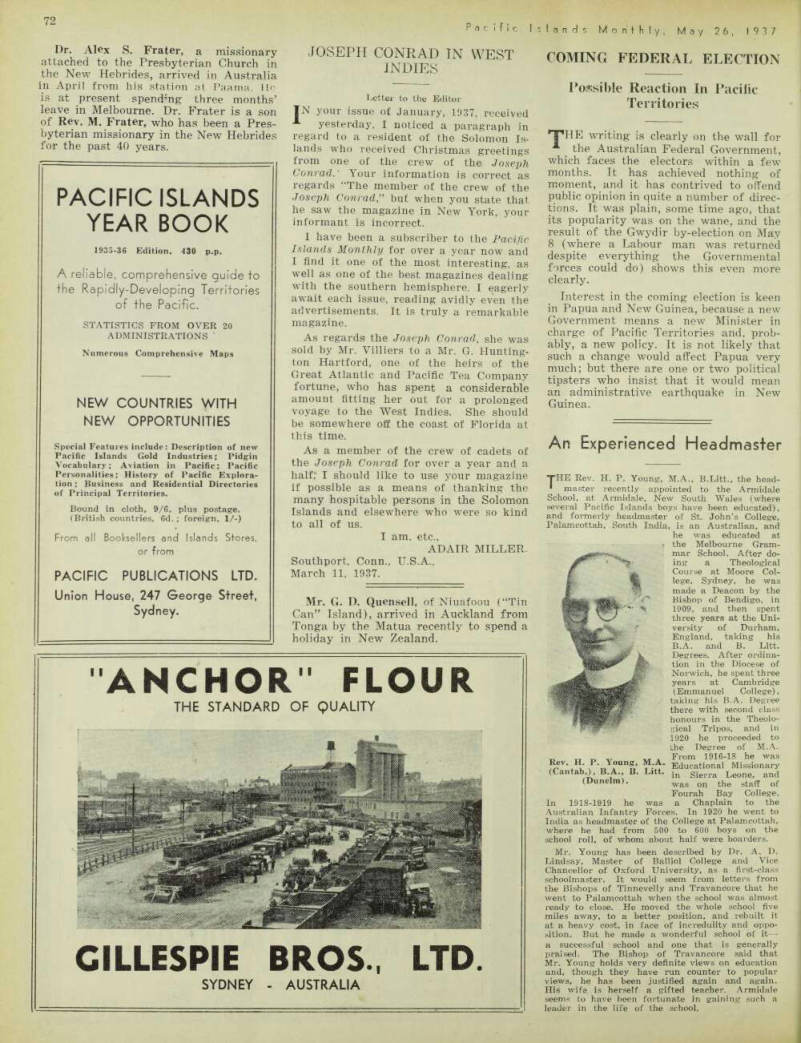
Coast Natives
N.G. Administration Makes Friendly Contact
From a Special Correspondent
Rabaul, Apr. 22.
Government Patrols along the Rai Coast (Madang District) among the natives concerned in the wounding of A.D.O. Nurton Jast year, have suc ceeded in making contact with the tribe implicated in the outrage.
It is understood that the cause of their attack on the Administration’s party was due in a great measure to the behaviour of the native police, and the natives’ mis understanding of their methods. Peaceful relations, however, now have been es tablished, and the natives concerned have been induced to return to their villages.
The Administration has decided to promote friendly relations with all the tribes in this “uncontrolled” district by means of a base camp with two officers in charge. It is expected that it will not be long before a good deal of this unruly region is under control.
Already friendly offers have come to hand and contacts have been made be
tween the Rai Coast natives and neigh bouring tribes with whom they were continually at war.
Dr. Alex S. Frater, a missionary attached to the Presbyterian Church in the New Hebrides, arrived in Australia in April from his station at Paama. He is at present spending three months' leave in Melbourne. Dr. Frater is a son of Rev. M. Frater, who has been a Pres byterian missionary in the New Hebrides for the past 40 years.
Advertisements & other items, pp. 73-74 (1 item)
Cold
IDUMPMOBIL
-ML LIGHT AND PORTABLE
MOTOR PUMP
Si Complete Plant’s weight, 140 lbs. Capacity up to 12,000 gallons per hour.
All heads from 10 to 115 feet.
Fuel consumption, S gallon per hour.
Pressure 551 b. square inch.
Especially suitable prospecting and all Sluicing Requirements.
NELSON & ROBERTSON PTY. LTD
12 SPRING STREET SYDNEY
Allen Taylor & Co. Ltd
SYDNEY
Sawmillers and Wholesale Suppliers of Hardwoods for Constructional Purposes GIRDERS . . . PILES . . . POLES . . . SLEEPERS, Etc.
EXPORTING TO PACIFIC ISLANDS SINCE 1893
Cables: Tuxedo, Sydney
We Are Australasia's Clearing House for
COLD
• We can honestly claim to hold the greatest proportion of the gold business of the Islands, having among our many regular clients the leading gold mining companies of the Pacific.
We have, from our inception many years ago, steadily built our progressive business on the basic principles of accurate assays, prompt payment and integrity of methods.
We are assayers, bullion merchants, metallurgists, of repute and buy for prompt cash GOLD, OSMIRIDIUM, PLATINUM, SILVER, etc.
Send your next consignment to us for prompt payment.
GARRETT & DAVIDSON 5S
BANK OF N.S.W. BUILDINGS
REGENT and GEORGE STS., SYDNEY
PACIFIC ISLANDS
YEAR BOOK
1935-36 Edition. 430 p,p.
A reliable, comprehensive guide to
the Rapidly-Developing Territories of the Pacific.
STATISTICS FROM OVER 20
ADMINISTRATIONS
Numerous Comprehensive Maps
NEW COUNTRIES WITH
NEW OPPORTUNITIES
Special Features include: Description of new Pacific Islands Gold Industries; Pidgin Vocabulary; Aviation in Pacific; Pacific Personalities; History of Pacific Exploration ; Business and Residential Directories of Principal Territories.
Bound in cloth, 9/6, plus postage. (British countries, 6d. ; foreign, 1/-) From all Booksellers and Islands Stores, or from
PACIFIC PUBLICATIONS LTD.
Union House, 247 George Street,
Sydney.
Joseph Conrad In West
Indies
Letter to the Editor IN your issue of January, 1937, received A yesterday, I noticed a paragraph in regard to a resident of the Solomon Is lands who received Christmas greetings from one of the crew of the Joseph Conrad.' Your information is correct as regards “The member of the crew of the Joseph Conrad ,” but when you state that he saw the magazine in New York, your informant is incorrect.
I have been a subscriber to the Pacific Islands Monthly for over a year now and I find it one of the most interesting, as well as one of the best magazines dealing with the southern hemisphere. I eagerly await each issue, reading avidly even the advertisements. It is truly a remarkable magazine.
As regards the Joseph Conrad, she was sold by Mr. Villiers to a Mr. G. Hunting ton Hartford, one of the heirs of the Great Atlantic and Pacific Tea Company fortune, who has spent a considerable amount fitting her out for a prolonged voyage to the West Indies. She should be somewhere off the coast of Florida at this time.
As a member of the crew of cadets of the Joseph Conrad for over a year and a half' I should like to use your magazine if possible as a means of thanking the many hospitable persons in the Solomon Islands and elsewhere who were so kind to all of us.
I am. etc.,
Adair Miller.
Southport, Conn., U.S.A., March 11. 1937.
Mr. G. D. Quensell, of Niuafoou (“Tin Can” Island), arrived in Auckland from Tonga by the Matua recently to spend a holiday in New Zealand.
Coming Federal Election
Possible Reaction In Pacific Territories
TTHE writing is clearly on the wall for * the Australian Federal Government, which faces the electors within a few months. It has achieved nothing of moment, and it has contrived to offend public opinion in quite a number of direc tions. It was plain, some time ago, that its popularity was on the wane, and the result of the Gwydir by-election on May 8 (where a Labour man was returned despite everything the Governmental forces could do) shows this even more clearly.
Interest in the coming election is keen in Papua and New Guinea, because a new Government means a new Minister in charge of Pacific Territories and, prob ably, a new policy. It is not likely that such a change would affect Papua very much; but there are one or two political tipsters who insist that it would mean an administrative earthquake in New Guinea.
An Experienced Headmaster
THE Rev. H. P. Young, M.A., B.Litt., the head ' master recently appointed to the Armidale School, at Armidale, New South Wales (where several Pacific Islands boys have been educated), and formerly headmaster of St. John’s College, Palamcottah, South India, is an Australian, and
he was educated at the Melbourne Gram mar School. After do ing a Theological Course at Moore Col lege, Sydney, he was made a Deacon by the Bishop of Bendigo, in 1909, and then spent three years at the Uni versity of Durham, England, taking his B.A. and B. Litt.
Degrees. After ordina tion in the Diocese of Norwich, he spent three years at Cambridge (Emmanuel College), taking his B.A. Degree there with second class honours in the Theolo gical Tripos, and in 1920 he proceeded to the Degree of M.A.
From 1916-18 he was Educational Missionary in Sierra Leone, and was on the staff of Fourah Bay College.
In 1918-1919 he was a Chaplain to the Australian Infantry Forces. In 1920 he went to India as headmaster of the College at Palamcottah, where he had from 500 to 600 boys on the school roll, of whom about half were boarders.
Mr. Young has been described by Dr. A. D.
Lindsay, Master of Balliol College and Vice Chancellor of Oxford University, as a first-class schoolmaster. It would seem from letters from the Bishops of Tinnevelly and Travancore that he went to Palamcottah when the school was almost ready to close. He moved the whole school five miles away, to a better position, and rebuilt it at a heavy cost, in face of incredulity and oppo sition. But he made a wonderful school of it— a successful school and one that is generally praised. The Bishop of Travancore said that Mr. Young holds very definite views on education and, though they have run counter to popular views, he has been justified again and again.
His wife is herself a gifted teacher. Armidale seems to have been fortunate in gaining such a leader in the life of the school.
Rev. H. P. Young, M.A. (Cantab.), B.A., B. Litt. (Dunelm).
Advertisements & other items, p. 74 (1 item)
Anchor" Flour
THE STANDARD OF QUALITY
* fc m mm m mm
GILLESPIE BROS., LTD
SYDNEY - AUSTRALIA
Maintenance Orders
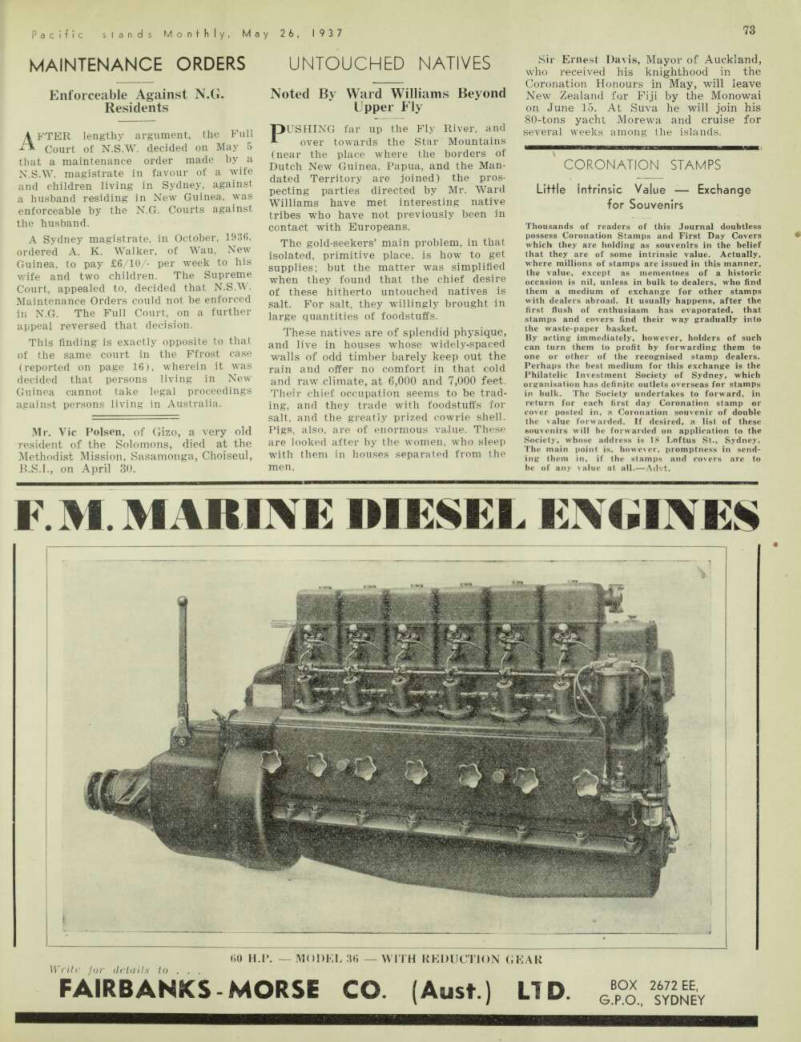
Enforceable Against N.G.
Residents
\ FTER lengthy argument, the Full Court of N.S.W. decided on May 5 that a maintenance order made by a N.S.W. magistrate in favour of a wife and children living in Sydney, against a husband residing in New Guinea, was enforceable by the N.G. Courts against the husband.
A Sydney magistrate, in October, 1936, ordered A. K. Walker, of Wau, New Guinea, to pay £6/10/- per week to his wife and two children. The Supreme Court, appealed to, decided that N.S.W.
Maintenance Orders could not be enforced in N.G. The Full Court, on a further appeal reversed that decision.
This finding is exactly opposite to that of the same court in the Ffrost case (reported on page 16), wherein it was decided that persons living in New Guinea cannot take legal proceedings against persons living in Australia.
Mr. Vic Polsen, of Gizo, a very old resident of the Solomons, died at the Methodist Mission, Sasamonga, Choiseul, 8.5.1., on April 30.
Untouched Natives
Noted By Ward Williams Beyond Upper Fly
PUSHING far up the Fly River, and over towards the Star Mountains (near the place where the borders of Dutch New Guinea, Papua, and the Man dated Territory are joined) the pros pecting parties directed by Mr. Ward Williams have met interesting native tribes who have not previously been in contact with Europeans.
The gold-seekers’ main problem, in that isolated, primitive place, is how to get supplies; but the matter was simplified when they found that the chief desire of these hitherto untouched natives is salt. For salt, they willingly brought in large quantities of foodstuffs.
These natives are of splendid physique, and live in houses whose widely-spaced walls of odd timber barely keep out the rain and offer no comfort in that cold and raw climate, at 6,000 and 7,000 feet.
Their chief occupation seems to be trad ing, and they trade with foodstuffs for salt, and the greatly prized cowrie shell.
Pigs, also, are of enormous value. These are looked after by the women, who sleep with them in houses separated from the men.
Sir Ernest Davis, Mayor of Auckland, who received his knighthood in the Coronation Honours in May, will leave New Zealand for Fiji by the Monowai on June 15. At Suva he will join his 80-tons yacht Morewa and cruise for several weeks among the islands.
Advertisements & other items, p. 75 (2 items)
73
Pacific siands Monthly, May 26, 1937
F.M.Marine Imfsfl Engines
CORONATION STAMPS
Little Intrinsic Value Exchange
for Souvenirs
Thousands of readers of this Journal doubtless possess Coronation Stamps and First Day Covers which they are holding as souvenirs in the belief that they are of some intrinsic value. Actually, where millions of stamps are issued in this manner, the value, except as mementoes of a historic occasion is nil, unless in bulk to dealers, who find them a medium of exchange for other stamps with dealers abroad. It usually happens, after the first flush of enthusiasm has evaporated, that stamps and covers find their way gradually into the waste-paper basket.
By acting immediately, however, holders of such can turn them to profit by forwarding them to one or other of the recognised stamp dealers.
Perhaps the best medium for this exchange is the Philatelic Investment Society of Sydney, which organisation has definite outlets overseas for stamps in bulk. The Society undertakes to forward, in return for each first day Coronation stamp or cover posted in, a Coronation souvenir of double the value forwarded. If desired, a list of these souvenirs will be forwarded on application to the Society, whose address is 18 Loftus St., Sydney.
The main point is, however, promptness in sending them in, if the stamps and covers arc to be of any value at all.—Advt.
F.M.MARINE IMFSFL ENGINES
m Write for details to . <>o H.l*. MODEL 3tt WITH REDUCTION GEAR FAIRBANKS-MORSE CO. (Aust.) LID. S B P “ ,'! Y
Caledonia
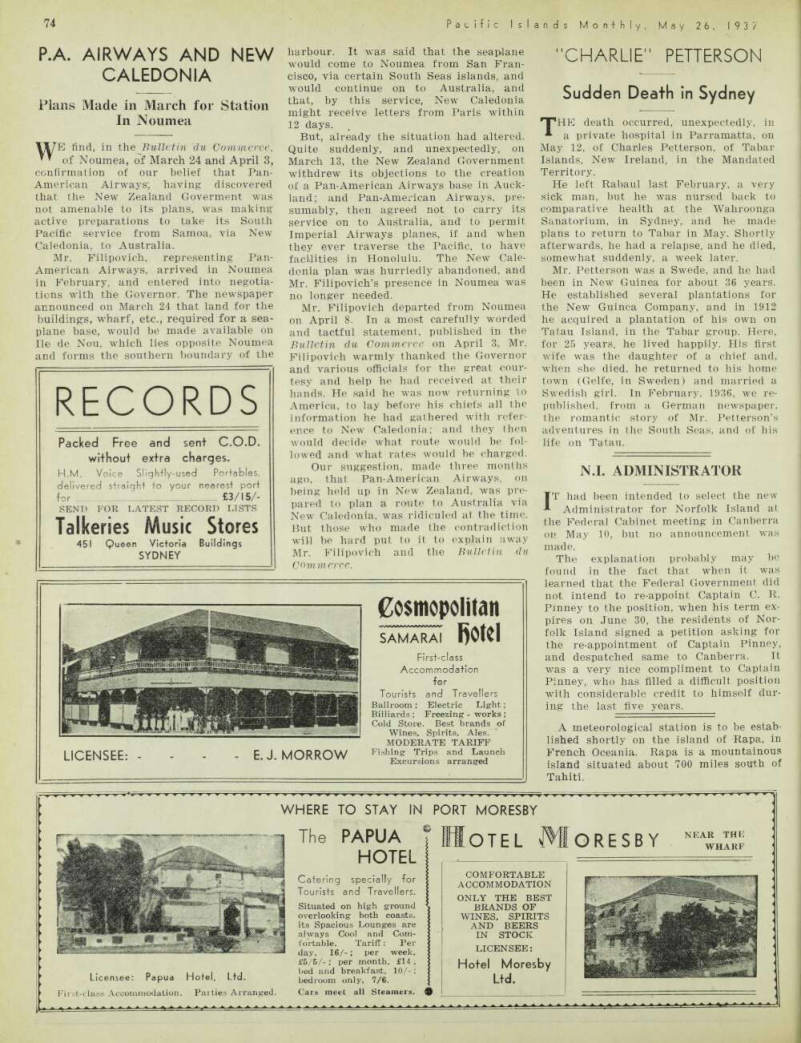
P.A. Airways And New
Plans Made in March for Station In Noumea
VI7E find, in the Bulletin du Commerce, * ' of Noumea, of March 24 and April 3, confirmation of our belief that Pan- American Airways; having discovered that the New Zealand Goverment was not amenable to its plans, was making active preparations to take its South Pacific service from Samoa, via New Caledonia, to Australia.
Mr. Filipovich, representing Pan- American Airways, arrived in Noumea in February, and entered into negotia tions with the Governor. The newspaper announced on March 24 that land for the buildings, wharf, etc., required for a sea plane base, would be made available on He de Nou, which lies opposite Noumea and forms the southern boundary of the
harbour. It was said that the seaplane would come to Noumea from San Fran cisco, via certain South Seas islands, and would continue on to Australia, and that, by this service. New Caledonia might receive letters from Paris within 12 days.
But, already the situation had altered.
Quite suddenly, and unexpectedly, on March 13, the New Zealand Government withdrew its objections to the creation of a Pan-American Airways base in Auck land; and Pan-American Airways, pre sumably, then agreed not to carry its service on to Australia, and to permit Imperial Airways planes, if and when they ever traverse the Pacific, to have facilities in Honolulu. The New Cale donia plan was hurriedly abandoned, and Mr. Filipovich’s presence in Noumea was no longer needed.
Mr. Filipovich departed from Noumea on April 8. In a most carefully worded and tactful statement, published in the Bulletin du Commerce on April 3, Mr.
Filipovich warmly thanked the Governor and various officials for the great cour tesy and help he had received at their hands. He said he was now returning to America, to lay before his chiefs all the information he had gathered with refer ence to New Caledonia: and they then would decide what route would be fol lowed and what rates would be charged.
Our suggestion, made three months ago, that Pan-American Airways, on being held up in New Zealand, was pre pared to plan a route to Australia via New Caledonia, was ridiculed at the time.
But those who made the contradiction will be hard put to it to explain away Mr. Filipovich and the Bulletin du Commerce.
Sudden Death in Sydney
"Charlie" Petterson
'“pHE death occurred, unexpectedly, in * a private hospital in Parramatta, on May 12, of Charles Petterson, of Tabar Islands, New Ireland, in the Mandated Territory.
He left Rabaul last February, a very sick man, but he was nursed back to comparative health at the Wahroonga Sanatorium, in Sydney, and he made plans to return to Tabar in May. Shortly afterwards, he had a relapse, and he died, somewhat suddenly, a week later.
Mr. Petterson was a Swede, and he had been in New Guinea for about 36 years.
He established several plantations for the New Guinea Company, and in 1912 he acquired a plantation of his own on Tatau Island, in the Tabar group. Here, for 25 years, he lived happily. His first wife was the daughter of a chief and, when she died, he returned to his home town (Gelfe, in Sweden) and married a Swedish girl. In February, 1936, we re published, from a German newspaper, the romantic story of Mr. Petterson’s adventures in the South Seas, and of his life on Tatau.
N.I. Administrator
IT had been intended to select the new Administrator for Norfolk Island at the Federal Cabinet meeting in Canberra on May 10, but no announcement was made.
The explanation probably may be found in the fact that when it was learned that the Federal Government did not intend to re-appoint Captain C. R.
Finney to the position, when his term ex pires on June 30, the residents of Nor folk Island signed a petition asking for the re-appointment of Captain Finney, and despatched same to Canberra. It was a very nice compliment to Captain Finney, who has filled a difficult position with considerable credit to himself dur ing the last five years.
A meteorological station is to be estab lished shortly on the island of Rapa, in French Oceania. Rapa is a mountainous island situated about 700 miles south of Tahiti.
Advertisements & other items, p. 76 (1 item)
Records
Packed Free and sent C.O.D. without extra charges.
H.M. Voice Slightly-used Portables, delivered straight to your nearest port for £3/15/-
SEND FOR LATEST RECORD LISTS
Talkeries Music Stores
451 Queen Victoria Buildings
SYDNEY
LICENSEE: -
E. J. MORROW
Cosmopolitan
s/yvwwwvw\ww W 2 A A I
SAMARAI I)oiei
First-class Accommodation for Tourists and Travellers Ballroom ; Electric Light; Billiards ; Freezing - works ; Cold Store. Best brands of Wines, Spirits, Ales.
MODERATE TARIFF
Fishing Trips and Launch Excursions arranged
WHERE TO STAY IN PORT MORESBY
Licensee: Papua Hotel. Ltd.
First-class Accommodation. Parties Arranged.
The PAPUA 7
HOTEL
Catering specially for
Tourists and Travellers.
Situated on high ground 1 overlooking both coasts, its Spacious Lounges are always Cool and Comfortable. Tariff: Per day. 16/-; per week, £5/5/-; per month, £l4 , bed and breakfast. 10/-: bedroom only, 7/6.
Cars meet all Steamers. ®
Hotel Moresby
NEAR THE
WHARF
COMFORTABLE
ACCOMMODATION
ONLY THE BEST
BRANDS OF
WINES, SPIRITS
AND BEERS
IN STOCK
LICENSEE:
Hotel Moresby
Ltd.
Burns. Philp
Profit Slightly Higher Last Year
BURNS, Philp and Company Ltd., at the end of April, reported a net profit of £226,067 for the year ended March 31, compared with £216,979 the previous year, and £211,006 for 1934-35.
Details are as follow:
The directors state that sales of mer chandise increased to a new high level, and that shipping and trading operations produced satisfactory results. Better prices were obtained for copra, and sub sidiary plantation companies improved their plantations and acquired additional planted areas. Orders have been placed for a modern passenger and cargo motor vessel for the Australia-Papua-New Guinea mail service, and for two small motor vessels for inter-island trade.
The new issue, at par, of 500,000 £1 shares has already been announced. The balance-sheet is presented in more de tailed form, particularly the items for merly grouped under the heading “pro perty, shipping property, and invest ments.”
New Issue Of Shares
There has been much speculation con cerning the purpose of the new issue of £500,000 £1 shares. The company is so solidly placed, financially, that some said the new £500,000 could not be used, except in the development of some entirely new enterprise. Concensus of opinion is that part of it will be used in connection with the “Big Firm’s” sub sidiary, Penny’s Limited, the Queensland equivalent (and rival) of Woolworths Ltd., which has grown into a huge con cern, and which obviously is capable of much extension and development.
At the annual meeting on May 18, the chairman (Mr. Nosworthy), in referring to the decision to increase the company’s paid-up capital from £1,500,000 to £2,000. 000, stated that the calls for this addi tional capital had been spread over a
period suitable for its utilisation in con nection with the building of the new vessels, to meet the growing needs of properties, *premises, and merchandising, and generally to meet the requirements of the gradual expansion of business over a very large field.
“Our operations are of such magnitude that our usual resources must be hus banded to care for increasing regular business, and provision should be made for ample reserves in order to negotiate quickly any unexpected business of a remunerative or advantageous nature,” he said.
“With the increased capital, the direc tors expect to maintain the usual 10 per cent dividend.
“As there have been certain rumours that the company intends floating off part of its business as a separate com pany, I may say that there is no idea at the present of doing any such thing.”
Old Trading Co. Purchased
Messrs. Burns, Philp and Co., in rec ent weeks, absorbed the New Britain Corporation Ltd., an old established Islands trading concern. Its authorised capital is £25,000, in £1 shares, of which 19,970 have been issued.
The capital was represented by net tangible assets of £19,012, mostly estate and buildings. Messrs. Burns. Philp pur chased the property for 10 - per share.
Year ended March 31 1935 1936 1937 £ £ £ profits Div., 10 p.c 211.006 216,979 226,067 150,000 150,000 150,000 To reserve 25,000 50.000 75,000 Special depreciation, 25,000 Copra plantation ... 25,000 ■ Carried forward ... 39,089 31,068 32,135 Expenses, etc 459.839 508,518 600,448 Depreciation, etc. 121,995 134,621 139,462 Gross profits 792.841 860,118 965,977
Liabilities —
1,500,000 1,500.000 Capital paid up ... 1 ,500,000 Reserve fund 975.000 1,000,000 1,050,000 Insurance reserve. 553.351 61,823 etc — Cash credits 517,775 144,626 535.268 58,256 Bills and foreign drafts — Open liabilities 1 180 .528,105 821 1,568,263 383 1.654.842
Assets -
Merchandise, copra, advances Cash in hand 715.427 164,852 850,360 113,508 1,060,015 98,816 Property, shipping, «nd shares 3,215,210 3,065,818 fl, 326.770 Sundry debtors ... 783.285 813,991 823,715 Shares in other com- 960,437 732,781 panies, Govt. sec. — Shares in subsidiaries f Real property and shipping property.
All Sorts Of Mowers
WiESSRS. Ransomes, Sims, and Jeffries Ltd., of Ipswich. England, which manufactured the first lawn mower over 100 years ago, and supplies mowers and equipment to the governments of Great Britain, Belgium, Roumania, Japan, Sweden, and Denmark, has just issued its 1937 catalogue. This 52-page illustrated booklet depicts mowing machines of every imaginable type and size, from the common suburban home mower to the huge tractor-drawn units for cutting golf courses, playing fields, and aerodromes.
Readers of the “Pacific Islands Monthly” may procure a copy of this interesting catalogue by writing to Ransomes, Sims, and Jeffries Ltd., Ipswich, England.—***
Returned Soldiers
Indignant
From a Special Correspondent
Rabaul, Apr. 11.
'T'HERE is indignation here because the Returned Soldiers’ League have been ignored in preparations for the forth coming Coronation festivities. All firms and other associations have been invited to participate, but the R.S.L. have been left out. The returned men are all very angry over the matter.
Advertisements & other items, p. 77 (2 items)
75
Pacific* Islands Monthly. May 26, 1537
r:fil *IM
DO YOU KNOW
that you may listen to the whole world via short wave - with our newly
developed
"Tropical Twin"
This powerful little receiver uses a "19" twin valve, and is supplied complete with batteries, phoney, aerial equipment and coils for both short wave and broadcast bands.
Complete £7/10/- Sydney
Price's Radio Service
5 and 6 ANGEL PLACE
SYDNEY
A BP
-v:
READ THE
B.P. MAGAZINE
WINTER NUMBER
NOW ON SALE
Short Stories --- Pictures Travel Articles --- Pages for the' Children --- Stage Latest Fashions --- Screen A
ONE SHILLING PER COPY
ON SALE AT ALL NEWSAGENTS AND BOOKSELLERS
Islands Produce
Coffee
THE following quotations were obtained in ' Sydney during May.
Robusta, f.a.q., imported from Java on firm conversion of exchange, c.i.f., prompt shipment, Sydney:—Quote No. 1: 37/- per cwt. ; quote No. 2: 27/3 per cwt.
Kenya, f.a.q., immediate shipment, c.i.f., Syd ney, per cwt.: —No. 1 quotations; Grade “A”, 62/-; grade “B”, 60/-; grade “C”, 58/-. No. 2 quotations: Grade “A”, 59/-; grade “B”, 54/-; grade “C”, 53/-; Triage, 52/-. No. 3 quotations: Grade “B”, 55/-; grade “C”, 54/-.
Mysore, f.a.q., prompt shipment, c.i.f., Sydney, per cwt.:—No. 1 quotations: Grade “A”, 65/-; grade “B”, 61/-. No. 2 quotations: Season closed, last prices were; Grade“B”, 66/-; Triage, 60/-.
Arabian (Aden) Hodeidah, f.a.q., immediate shipment, c.i.f., Sydney:—No. 1 quotation: 60/per cwt. No. 2 quotation: 58/- per cwt.
Note: Importers of coffee from Java* etc., pay
the following additional charges: Exchange, duty (4d. lb.), primage (10 per cent), landing costs fl/- per cwt.). Coffee from Papua and New Guinea escapes most of these charges. *
Kapok
Based on firm conversion of exchange, the c.i.f. official prices for kapok quoted in Sydney in mid- May were:— Average Java per lb., and Japara, 8 l-16d. per lb.
Cocoa
Quote No. 1: Cocoa beans, £62 per ton.
Quote No. 2: Accra, good fermented, £52 per ton, c.i.f., Sydney.
Cotton
London c.i.f. prices for cotton during the month were: Apr, 23, 7.26 d lb., May shipment; Apr. 30, 7.05 d lb., June shipment : May 7,7.27 d lb., June shipment; May 14, 7.01 d lb., June shipment; May 21, 7.10 d lb., Jun& shipment.
Ivory Nuts
No. 1 quotation: £l3 per ton, f.0.b., Sydney.
No. 2 quotation: £lO to £l3 per ton, f.0.b., Sydney, according to quality.
Green Snail Shell
Green snail shell, good quality, was quoted by Sydney buyers in mid-May at £6O per con.
Rice
Rangoon rice, packed in 1001 b. or 2001 b. bags, £l3/10/- per ton f.o.b. Sydney.
Australian table rice, packed in 561 b. bags, £l6/10/- per ton.
Trochus Shell
Quotations fox’ ti'ochus shell from two different sources were: (a) Trochus shell, No. 1 grade ... £108 Trochus shell. No. 2 grade ... £105 Trochus shell, No. 3 grade ... £93 (b) Trochus shell, No. 1 grade ... £107i Trochus shell, No. 2 grade ... £105 Trochus shell. No. 3 grade ... £93 All quotes are f.o.b., and on the Australian £.
Exchange Rates
THE following exchange quotations, gathered in * Sydi ey, show the rates existing in May:
Fiji—Through Bank Of N.S.W.
And Bank Of New Zealand
Australia on Fiji on basis of £lOO Fiji: Buying fAlll/2/6, selling £AII3.
Fiji-London on basis £lOO London:
Direct Telegraphic Transfer
Selling Rates
Quoted by
Bank Of New South Wales
in Australia
Western Samoa—Through
Bank Of N.Z.
Exchange, Australia on Western Samoa, basis £lOO Samoa—buying £AIOO, selling £AIOO/10/-.
Exchange, Samoa on London, basis £lOO in London:—
New Caledonia—Through
French Bank
Drafts, Sydney-Noumea and Noumea-Sydney, are on the basis of current rate of exchange on Paris, less li per cent, either way. As quoted by the Comptoir National, in Sydney, and the Bank of Indo Chine. Noumea: On May 24, when the Australian £ was nominally worth 87.43 francs. £lOO Australian would purchase a draft in Noumea of 8,743 francs.
New Guinea And Papua
Through Commonwealth
Bank
From Australia, Pt. Moresby, £1 per cent. ; on Rabaul 10/- per cent. —Other New Guinea districts £1 per cent.
From Rabaul on London, same as Australia on London:— Buying: T.T. £AI2S equals £stg. 100.
Selling: T.T. £AI2S/10/- equals £stg. 100.
Through Bank Of N.S.W.
Australia, on Papua, £1 per cent, premium each way, equivalent to commission of £1 per cent.; Australia, on Rabaul, 10/-* per cent, premium.
Papua and New Guinea on London: Same as Australia on London and vice versa.
Buying.
Selling.
Telegraphic transfer ... £110 15 0 £112 0 0 On demand ... £110 12 6 fill 17 6
Average for Australia on week ended Papeete 26/4/’37 Francs to £ Australian 86.90 Average for week ended 3/5/’37 86.84 Average for week ended 10/5/’3 7 86.12 Average for week ended 17/5/'37 86.45 Average for week ended 24/5/’37 86.78 Average for Australia on week ended Noumea 26/4/’37 Francs to £ Australian 87.26 Average for week ended 3/5/’37 87.19 Average for week ended 10/5/’37 86.47 Average for week ended 17/5/’37 86.80 Average for week ended 24/5/’37 87.13
Buying. Selling.
Telegraphic transfer £125 0 0 On Demand ... ... £123 0 0 124 17 6 30 days 122 15 0 124 15 0 60 days - 122 10 0 124 12 6 90 days - 122 5 0 124 10 0 120 days - 122 0 0 124 7 6
Advertisements & other items, p. 78 (1 item)
Modern Direct Wireless Services
Use - -
for Your Communications
WITH AUSTRALIA AND OVERSEAS
DIRECT WIRELESS SERVICES are avail-
able for inter-communication between the Islands of the Pacific and for traffic between the Islands and Australia and overseas countries.
Services are now in operation between Papua and Sydney, New Guinea and Sydney, New Caledonia and Sydney, and Fiji and Sydney. Speedy, economical and efficient service to Australia and overseas. Route your traffic "Via the Wireless Service."
For overseas traffic to Great Britain.
North and South America, and all European countries, route your message via the Direct Australian
BEAM WIRELESS SERVICE
LODGE YOUR MESSAGES AT ANY
WIRELESS STATION OR ISLAND POST
OFFICE ROUTED "VIA WIRELESS"
AMALGAMATED WIRELESS
(A'SIA) LIMITED
Market Quotations
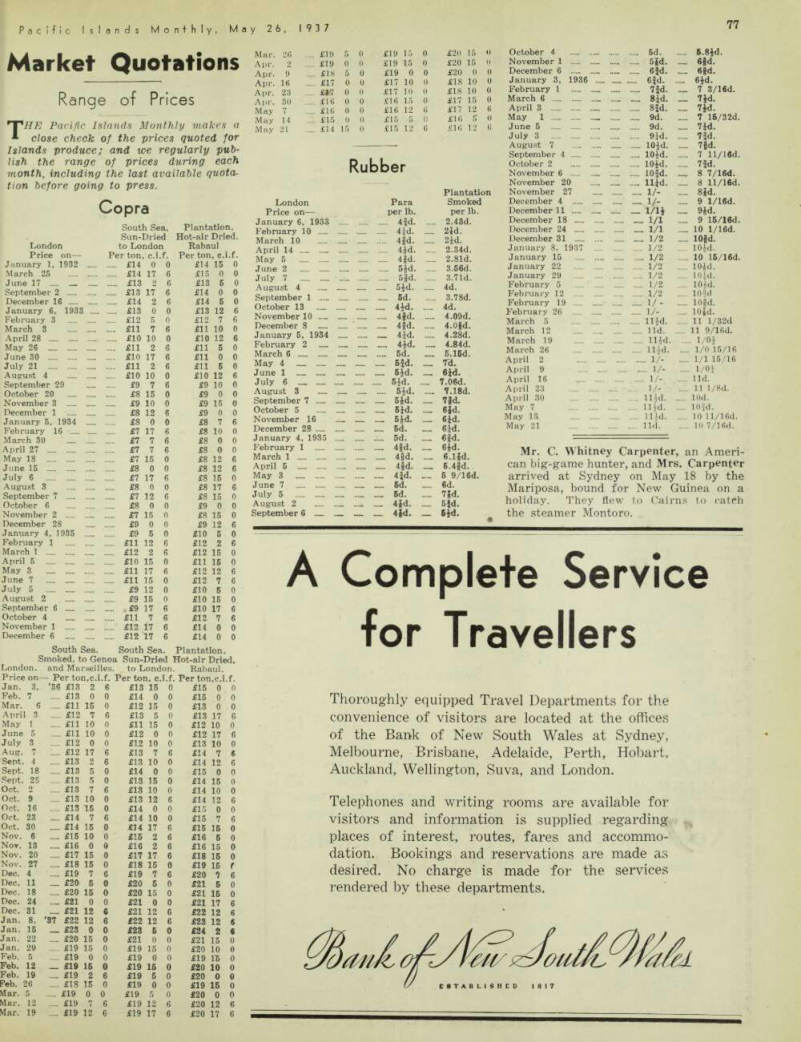
Range of Prices
THE Pacific Islands Monthly makes a close check of the prices quoted for Islands produce; and we regularly pub lish the range of prices during each month, including the last available quota tion before going to press.
Mr. C. Whitney Carpenter, an Ameri can big-game hunter, and Mrs. Carpenter arrived at Sydney on May 18 by the Mariposa, bound for New Guinea on a holiday. They flew to Cairns to catch the steamer Montoro.
October 4 ... 6d. 6.83d.
November 1 5|d. 6|d.
December 6 ... 63d. ,. „ 6fd.
January 3, 1936 ... 63d. ... 63d.
February 1 . . , 73d. 7 3/16d.
March 6 — 8Jd. 1 7jd.
April 3 83d. 73d.
May 1 — ... 9d. .. . 7 15/32d.
June 5 — 9d. 73d.
July 3 9id. 73d.
August 7 „ ... 103d. ... 7gd.
September 4 103d. 7 ll/16d.
October 2 ... ... 103d. 73d.
November 6 103d. .. 8 7/16d.
November 20 113d. 8 ll/16d.
November 27 ... , 1/- 8|d.
December 4 „ . . 1/- _. T „ 9 l/16d.
December 11 1/1* — 93d.
December 18 • 1/1 9 15/16d.
December 24 ... . 1/1 ... .. 10 l/16d.
December 31 . 1/2 T .„. lOgd.
January 8, 1937 1/2 103d.
January 15 ... - 1/2 10 16/16d.
January 22 1/2 103d.
January 29 1/2 10|d.
February 5 • 1/2 lOid.
February 12 1/2 103d February 19 ...
V- 10|d.
February 26 1/- 10jd.
March 5 ... 113d. 11 l/32d March 12 lid. 11 9/16d.
March 19 ... ... , 113d. ■ 1/03 March 26 ... 113d. 1/0 15/16 April 2 - 1/- 1/1 15/16 April 9 .. 1/- 1/03 April 16 . 1/lid.
April 23 1/- 11 l/8d.
April 30 113d. lOd.
May 7 113d. 103d.
May 13 Hid. 10 ll/16d.
May 21 «... lid. 10 7/16d.
Mar. 26 £19 5 0 £19 15 0 £20 15 41 Apr. 2 £19 0 0 £19 15 0 £20 15 0 Apr. 9 £18 5 0 £19 0 0 £20 0 0 Apr. 16 £17 0 0 £17 10 0 £18 10 0 Apr. 23 £17 0 0 £17 10 0 £18 10 0 Apr. 30 £16 0 0 £16 15 0 £17 15 0 May 7 £16 0 0 £16 12 6 £17 12 6 May 14 £15 0 0 £15 5 0 £16 5 0 May 21 £14 15 0 £15 12 6 £16 12 6
Rubber
Plantation London Para Smoked Price on— per lb. per lb.
January 6, 1933 ... 43d. 2.43d.
February 10 ... 43d. 23d.
March 10 4«d. 23d.
April 14 ... 43d. 2.34d.
May 5 4fd. 2.81d.
June 2 ... 53d. 3.56d.
July 7 ... , 5fd. 3.71d.
August 4 53d. ... 4d.
September 1 - 5d. ... 3.78d.
October 13 43d. ... 4d.
November 10 4fd. 4.09d.
December 8 , 4«d. 4.0|d.
January 5, 1934 r . . 43d. ... 4.28d.
February 2 .. 4§d. . Tl . 4.84d.
March 6 ,,, . , 5d. , 5.15d.
May 4 53d. 7'd.
June 1 . . 53d. , 63d.
July 6 , , . „ 53d. . 7.06d.
August 3 53d. 7.18d.
September 7 53d. 7Jd.
October 5 63d. . .. 6 Jd.
November 16 — 5|d. 63d.
December 28 ... ., 5d. - 63d.
January 4. 1935 -- 5d. 6fd.
February 1 4fd. 63d.
March 1 — 4|d. 6.l|d.
April 5 4 3d. 6.4fd.
May 3 43d. 5 9/16d.
June 7 — , , 6d. . 6d.
July 5 — ... 6d. — 7 id.
August 2 ... 43d. 5|d.
September 6 — — — — 4|d. — 63d.
Copra
South Sea, Plantation, Sun-Dried Hot-air Dried, London to London Rabaul Price on— Per ton, c.i.f.
Per ton, c.i i.f.
January 1, 1932 £14 0 0 £14 15 0 March 25 £14 17 6 £15 0 0 June 17 £13 2 6 £13 5 0 September 2 - TT1 „ ... £13 17 6 £14 0 0 December 16 £14 2 6 £14 5 0 January 6. 1933 ... £13 0 0 £13 12 6 February 3 ... £12 5 0 £12 7 6 March 3 £11 7 6 £11 10 0 April 28 . , r £10 10 0 £10 12 6 May 26 £11 2 6 £11 5 0 June 30 £10 17 6 £11 0 0 July 21 £11 2 6 £11 5 0 August 4 £10 10 0 £10 12 6 September 29 £9 7 6 £9 10 0 October 20 £8 15 0 £9 0 0 November 3 .. , £9 10 0 £9 15 0 December 1 £8 12 6 £9 0 0 January 5, 1934 £8 0 0 £8 7 6 February 16 ... £7 17 6 £8 10 0 March 30 £7 7 6 £8 0 0 April 27 £7 7 6 £8 0 0 May 18 . £7 15 0 £8 12 6 June 15 £8 0 0 £8 12 6 July 6 T ... £7 17 6 £8 15 0 August 3 £8 0 0 £8 17 6 September 7 £7 12 6 £8 15 0 October 6 £8 0 0 £9 0 0 November 2 ... £7 15 0 £8 15 0 December 28 £9 0 0 £9 12 6 January 4, 1935 £9 5 0 £10 5 0 February 1 ... £11 12 6 £12 2 6 March 1 ... £12 2 6 £12 15 0 April 5 £10 15 0 £11 15 0 May 3 — ... £11 17 6 £12 12 6 June 7 £11 15 0 £12 7 6 July 5 r ... £9 12 0 £10 6 0 August 2 . . .. £9 15 0 £10 15 0 September 6 £9 17 6 £10 17 6 October 4 . , £11 7 6 £12 7 6 November 1 £12 17 6 £14 0 0 December 6 — £12 17 6 £14 0 0 South Sea.
South Sea.
Plantation.
Smoked, to Genoa Sun-Dried Hot-air Dried.
London, and Marseilles. to London.
Rabaul.
Price on— Per ton.c.i.f. Per ton, c.i.f. Per ton.c.i, ,f.
Jan. 3, ’36 £13 2 6 £13 15 0 £15 0 0 Feb. 7 ... £13 0 0 £14 0 0 £15 0 0 Mar. 6 £11 15 0 £12 15 0 £13 0 0 April 3 ... £12 7 6 £13 5 0 £13 17 G May 1 £11 10 0 £11 15 0 £12 10 0 June 5 £11 10 0 £12 0 0 £12 17 6 July 3 £12 0 0 £12 10 0 £13 10 0 Aug. 7 ... £12 17 6 £13 7 6 £14 7 6 Sept. 4 ... £13 2 6 £13 10 0 £14 12 6 Sept. 18 ... £13 5 0 £14 0 0 £15 0 0 Sept. 25 £13 5 0 £13 15 0 £14 15 0 Oct. 2 ™.. £13 7 6 £13 10 0 £14 10 0 Oct. 9 £13 10 0 £13 12 6 £14 12 6 Oct. 16 ... £13 15 0 £14 0 0 £15 0 0 Oct. 23 — £14 7 6 £14 10 0 £15 7 6 Oct. 30 £14 15 0 £14 17 6 £15 15 0 Nov. 6 £15 10 0 £15 2 6 £16 5 0 Nov. 13 ... £16 0 0 £16 2 6 £16 15 0 Nov. 20 £17 15 0 £17 17 6 £18 15 0 Nov. 27 ™ £18 15 0 £18 15 0 £19 16 r Dec. 4 ..._ £19 7 6 £19 7 6 £20 7 6 Dec. 11 £20 5 0 £20 5 0 £21 5 0 Dec. 18 ._ £20 15 0 £20 15 0 £21 15 0 Dec. 24 £21 0 0 £21 0 0 £21 17 6 Dec. 31 — £21 12 6 £21 12 6 £22 12 6 Jan. 8. ’37 £22 12 6 £22 12 6 £23 12 6 Jan. 15 — £23 0 0 £23 5 0 £24 2 6 Jan. 22 £20 15 0 £21 0 0 £21 15 0 Jan. 29 £19 15 0 £19 15 0 £20 10 e Feb. 5 — £19 0 0 £19 0 0 £19 IS 0 Feb. 12 £19 15 0 £19 16 0 £20 10 0 Feb. 19 ..„ £19 2 6 £19 5 0 £20 0 0 Feb. 26 £18 15 0 £19 0 0 £19 15 0 Mar. 5 £19 0 0 £19 5 0 £20 0 0 Mar. 12 £19 7 6 £19 12 6 £20 12 6 Mar. 19 ... £19 12 6 £19 17 6 £20 17 6
Advertisements & other items, p. 79 (1 item)
for Travellers
A Complete Service
Thoroughly equipped Travel Departments for the convenience of visitors are located at the offices of the Bank of New South Wales at Sydney, Melbourne, Brisbane, Adelaide, Perth, Hobart, Auckland, Wellington, Suva, and London.
Telephones and writing rooms are available for visitors and information is supplied regarding places of interest, routes, fares and accommodation. Bookings and reservations are made as desired. No charge is made for the services rendered by these departments.
for Travellers
Shipping Services in the Pacific
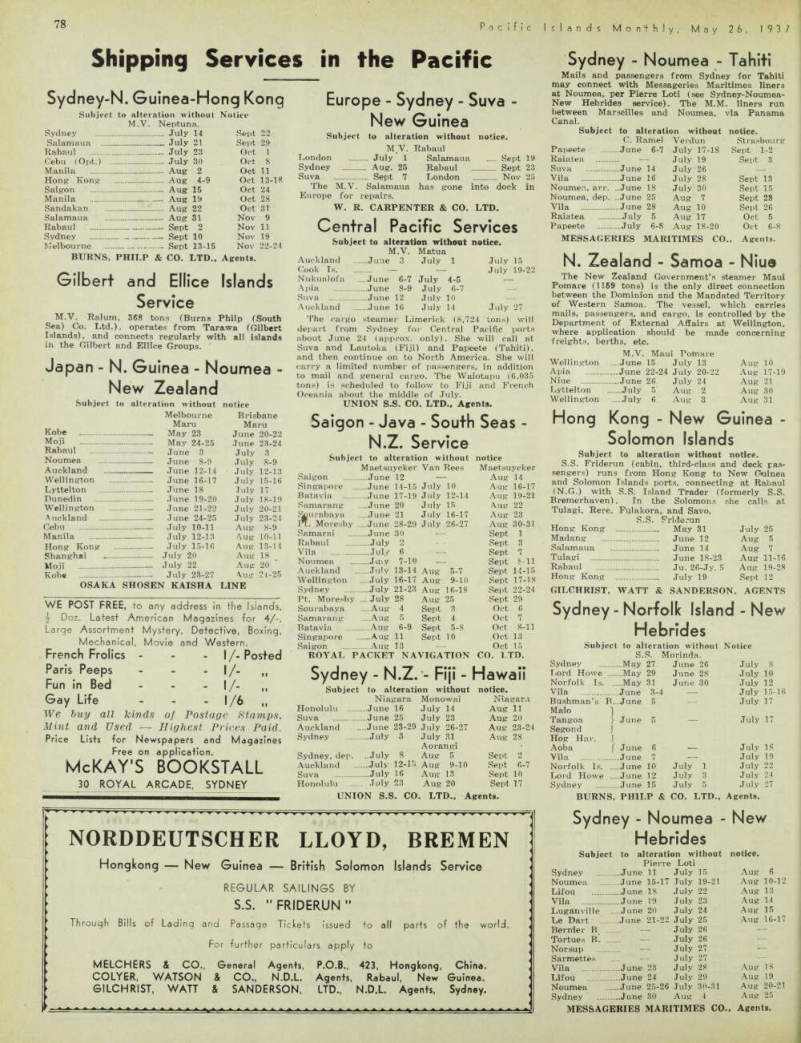
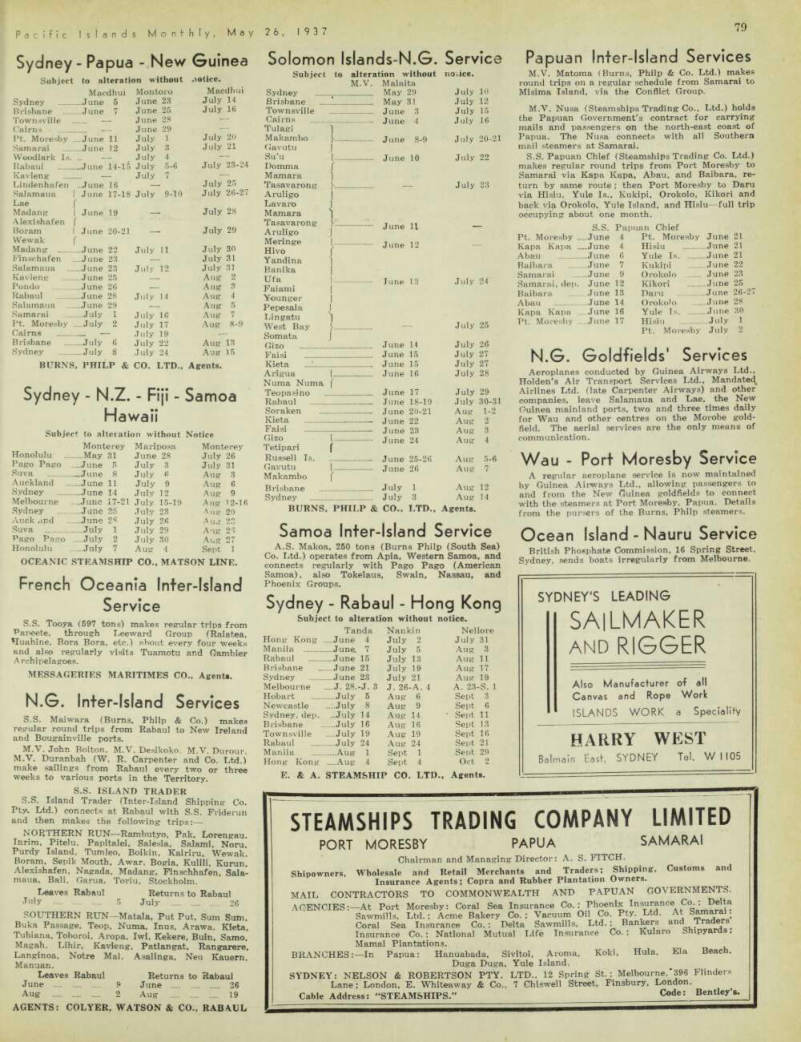
Sydney-N. Guinea-Hong Kong
Subject to alteration without Notice M.V. Neptuna.
Gilbert and Ellice Islands
Service
M.V. Ralum, 368 tons (Burns Philp (South Sea) Co. Ltd.), operates from Tarawa (Gilbert Islands), and connects regularly with all islands in the Gilbert and Ellice Groups.
Japan - N. Guinea - Noumea -
New Zealand
Subject to alteration without notice Melbourne Brisbane
Europe - Sydney - Suva - New Guinea Subject to alteration without notice.
M V. Rabaul
Central Pacific Services
Subject to alteration without notice.
M.V. Matua Auckland June 3 July 1 July 15 Cook Is — — July 19-22 Nukualofa June 6-7 July 4-5 — Apia June 8-9 July 6-7 Suva June 12 July 10 Auckland June 16 July 14 July 27 The cargo steamer Limerick (8,724 tons) will depart from Sydney for Central Pacific ports about June 24 (approx, only). She will call at Suva and Lautoka (Fiji) and Papeete (Tahiti), and then continue on to North America. She will carry a limited number of passengers, in addition to mail and general cargo. The Waiotapu (6,035 tons) is scheduled to follow to Fiji and French Oceania about the middle of July.
Union S.S. Co. Ltd., Agents.
Saigon - Java - South Seas -
N.Z. Service
Subject to alteration without notice Maetsuycker Van Rees Maetsuycker
Sydney - N.Z. - Fiji - Hawaii Subject to alteration without notice.
Niagara Monowai Niagara Honolulu June 16 July 14 Aug 11 Suva June 25 July 23 Aug 20 Auckland June 23-29 July 26-27 Aug 23-24 Sydney July 3 July 31 Aug 28 Aorangi Sydney, dep. ...July 8 Aug 5 Sept 2 Auckland July 12-iS Aug 9-10 Sept 6-7 Suva July 16 Aug 13 Sept 10 Honolulu July 23 Aug 20 Sept 17
Union S.S. Co. Ltd., Agents.
Sydney - Noumea - Tahiti
Mails and passengers from Sydney for Tahiti may connect with Messageries Maritimes liners at Noumea, per Pierre Loti (see Sydney-Noumea- New Hebrides service). The M.M. liners run between Marseilles and Noumea, via Panama Canal.
Subject to alteration without notice.
C. Ramel Verdun Strasbourg
N, Zealand - Samoa - Niue
The New Zealand Government’s steamer Maui Pomare (1159 tons) is the only direct connection between the Dominion and the Mandated Territory of Western Samoa. The vessel, which carries mails, passengers, and cargo, is controlled by the Department of External Affairs at Wellington, where application should be made concerning freights, berths, etc.
Hong Kong - New Guinea -
Solomon Islands
Subject to alteration without notice.
S.S. Friderun (cabin, third-class and deck pas sengers) runs from Hong Kong to New Guinea and Solomon Islands ports, connecting at Rabaul (N.G.) with S.S. Island Trader (formerly S.S.
Bremerhaven). In the Solomons she calls at Tulagi, Here, Fulakora, and Savo.
Sydney-Norfolk Island - New Hebrides
Sydney - Noumea - New Hebrides Subject to alteration without notice.
Pierre Loti
Sydney ..June 11 July 15 Aug 6 Noumea 15-17 July 19-21 Aug io-i: Lifou ..June 18 July 22 Aug 13 Vila ..June 19 July 23 Aug 14 Luganville June 20 July 24 Aug 15 Le Dart June 21-22 July 25 Aug i6-r Bernier B July 26 Tortues B.
July 26 Norsup July 27 Sarmettes July 27 Vila Lifou 23 July 28 Aug IS ..June 24 July 29 Aug 19 Noumea ..June 25-26 July 30-31 Aug 20-2: Sydney ..June 30 Aug 4 Aug 25
Messageries Maritimes Co.,
Agents.
Subject to alteration without S.S. Morinda.
Notice Sydney ..May 27 June 26 July 8 TiOi-d Howe ..May 29 June 28 July 10 Norfolk Is. ... ..May 31 June 30 July 12 Vila June 3-4 — July 15- Bushman’s R..
Malo 1 .June 5 — July 17 Tangoa Segond Hog Har. I June 5 July 17 Aoba June 6 — July 18 Vila June 7 — July 19 Norfolk Is June 10 July 1 July 22 Lord Howe June 12 July 3 July 24 Sydney June 15 July 5 July 27
Burns.
Philp
& Co. Ltd..
Agents.
S.S. Fride'un Hons: Kong May 31 July 25 Madang Aug 5 Salamaua June 14 Aug 7 Tulagi June 18-23 Aug ll-K Rabaul Ju. 26-Jy. 5 Aug 19-2!
Hong Kong July 19 Sept 12
Gilchrist,
Watt & Sanderson,
Agents
M.V. Maui Pomare Wellington ...June 15 July 13 Aug 10 Apia ...June 22-24 July 20-22 Aug 17-: Niue ...June 26 July 24 Aug 21 Lyttelton July 5 Aug 2 Aug 30 Wellington July 6 Aug 3 Aug 31
Papeete June 6-7 July 17-18 Sept 1-2 Raiatea July 19 Sept 3 Suva June 14 July 26 Vila June 16 July 28 Sept 13 Noumea, arr. ...June 18 July 30 Sept 15 Noumea, dep. ...June 25 Aug 7 Sept 28 Vila June 28 Aug 10 Sept 26 Raiatea July 5 Aug 17 Oct 5 Papeete July 6-8 Aug 18-20 Oct 6-8
Messageries
Maritimes Co.
, Agents.
Saigon June 12 Aug 14 Singapore ... 14-15 July 10 Aug 16-17 Batavia June 17-19 July 12-14 Aug 19-21 Samarang 20 July 15 Aug 22 June 21 July 16-17 Aug 23
1*. Moresby
June 28-29 July 26-27 Aug 30-31 Samarai June 30 Sept 1 Rabaul July 2 — Sept 3 Vila JuW 6 Sept 7 Noumea ..Jmy 7-10 Sept S-ll Auckland July 13-14 Aug 5-7 Sept 14-15 Wellington July 16-17 Aug 9-10 Sept 17-18 Sydney July 21-23 Aug 16-18 Sept 22-24 Pt. Moresby July 28 Aug 25 Sept 29 Sourabaya Aug 4 Sept 3 Oct 6 Samarang Aug 5 Sept 4 Oct 7 Batavia ...Aug 6-9 Sept 5-8 Oct 8-11 Singapore Aug 11 Sept 10 Oct 13 Saigon Aug 13 Oct 15
Royal Packet Navigation
Co. Ltd.
London Sydney Suva
July' 1
... Aug- 25 Salamaua ... Sept 19 Rnhaul Sant. 22 Sept 7 London Nov 25 The Europe M.V. Salamaua for repairs. has gone into dock in
W. R. Carpenter & Co. Ltd.
Maru Maru Kobe May 23 June 20-22 Moji — May 24-25 June 23-24 Rabaul June 3 July 3 Noumea June 8-9 July 8-9 Auckland June 12-14 July 12-13 Wellington June 16-17 July 15-16 Lyttelton June 18 July 17 Dunedin June 19-20 July 18-19 Wellington June 21-22 July 20-21 Auckland - June 24-25 July 23-24 Cebu July 10-11 Aug 8-9 Manila July 12-13 Aug 10-11 Hong Kong July 15-16 Aug 13-14 Shanghai July 20 Aug 18 Moji July 22 Aug 20 ' Kobe — July 23-27 Aug 21-25
Osaka
Shosen Kaisha
Line
Sydney July 14 Sept 22 Salamaua July 21 Sept 29 Rabaul July 23 Oct 1 Cebu (Opt.) July 30 Oct 8 Manila Aug 2 Oct 11 Hong Kong — Aug 4-9 Oct 13-18 Saigon — — Aug 15 Oct 24 Manila - Aug 19 Oct 28 Sandakan Aug 22 Oct 31 Salamaua — Aug 31 Nov 9 Rabaul Sept 2 Nov 11 Sydney ... — - Sept 10 Nov 19 Melbourne Sept 13-15 Nov 22-24
Burns. Philp & Co. Ltd.,
Agents.
Sydney - Papua - New Guinea Subject to alteration without notice.
Sydney - N.Z. - Fiji - Samoa Hawaii Subject to alteration without Notice
French Oceania Inter-Island
Service
5.5. Tooya (597 tons) makes regular trips from Papeete, through Leeward Group (Raiatea, Huahine, Bora Bora, etc.) about every four weeks and also regularly visits Tuamotu and Gambier Archipelagoes.
Messageries Maritimes Co., Agent*.
N.G. Inter-Island Services
5.5. Maiwara (Burns, Philp & Co.) makes regular round trips from Rabaul to New Ireland and Bougainville ports.
M.V. John Bolton, M.V. Desikoko. M.V. Durour, M.V. Duranbah (W. R. Carpenter and Co. Ltd.) make sailings from Rabaul every two or three weeks to various ports in the Territory.
S.S. Island Trader
5.5. Island Trader (Inter-Island Shipping Co.
Pty. Ltd.) connects at Rabaul with S.S. Priderun and then makes the following trips:— NORTHERN RUN—Rambutyo, Pak, Lorengau.
Inrim, Pitelu, Papitalei. Salesia, Salami, Noru.
Purdy Island, Tumleo, Boikin, Kairiru. Wewak.
Boram, Sepik Mouth. Awar. Bogia, Kulili, Kurun, Alexishafen. Nagada, Madang, Finschhafen. Sala maua, Bali, Garua. Toriu, Stockholm.
Leaves Rabaul Returns to Rabaul July 5 July 26 SOUTHERN RUN—Matala. Put Put. Sum Sum.
Buka Passage. Teop, Numa, Inus, Arawa, Kieta, Tubiana, Toboroi, Aropa, Iwi, Kekere, Buin, Samo, Magah, Lihir, Kavieng, Patlangat, Rangarere.
Langinoa, Notre Mai, Asalinga, Neu Kauern, Manuan.
Leaves Rabaul Returns to Rabaul June 9 June 26 Aug 2 Aug 19
Agents: Colyer, Watson & Co.. Raba.Ul
Solomon Islands-N.G. Service Subject to alteration without novice.
Samoa Inter-Island Service
A.S. Makoa, 250 tons (Burns Philp (South Sea) Co. Ltd.) operates from Apia, Western Samoa, and connects regularly with Pago Pago (American Samoa), also Tokelaus, Swain, Nassau, and Phoenix Groups.
Sydney - Rabaul - Hong Kong
Subject to alteration without notice.
Papuan In+er-lsland Services
M.V. Matoma (Burns, Philp & Co. Ltd.) makes round trips on a regular schedule from Samarai to Misima Island, via the Conflict Group.
M.V. Nusa (Steamships Trading Co., Ltd.) holds the Papuan Government’s contract for carrying mails and passengers on the north-east coast of Papua. The Nusa connects with all Southern mail steamers at Samarai.
S.S. Papuan Chief (Steamships Trading Co. Ltd.) makes regular round trips from Port Moresby to Samarai via Kapa Kapa, Abau, and Baibara, re turn by same route : then Port Moresby to Daru via Hisiu, Yule Is., Kukipi, Orokolo, Kikori and back via Orokolo, Yule Island, and Hisiu —full trip occupying about one month.
N.G. Goldfields' Services
Aeroplanes conducted by Guinea Airways Ltd., Holden’s Air Transport Services Ltd..
Airlines Ltd. (late Carpenter Airways) and other companies, leave Salamaua and Lae, the New Guinea mainland ports, two and three times daily for Wau and other centres on the Morobe gold field. The aerial services are the only means of communication.
Wau - Port Moresby Service
A regular aeroplane service is now maintained by Guinea Airways Ltd., allowing passengers to and from the New Guinea goldfields to connect with the steamers at Port Moresby, Papua. Details from the pursers of the Burns, Philp steamers.
Ocean Island-Nauru Service
British Phosphate Commission, 16 Spring Street, Sydney, sends boats irregularly from Melbourne.
Macdhui Montoro Macdhui Sydney June 5 June 23 July 14 Brisbane June 7 June 25 July 16 Townsville June 28 —- Cairns June 29 — Pt. Moresby June 11 July 1 July 20 Samarai June 12 July 3 July 21 Woodlark Is.
July 4 — Rabaul June 14- 15 July 5-6 July 23-24 Kavieng July 7 — Lindenhafen ..June 16 — July 25 Salamaua 1 June 17-18 July 9-10 July 26-27 Lae r Madang 1 June 19 — July 28 Alexishafen r Boram 1 June 20-21 — July 29 Wewak r Madang June 22 July 11 July 30 Finschafen June 23 — July 31 Salamaua June 23 July 12 July 31 Kavieng June 25 Aug 2 Pondo June 26 Aug 3 Rabaul June 28 July 14 Aug 4 Salamaua June 29 — Aug 5 Samarai July 1 July 16 Aug 7 Pt. Moresby July 2 July 17 Aug 8-0 Cairns — July 19 — Brisbane —July 6 July 22 Aug 13 Sydney July S July 24 Aug 15
Burns. Philp
& CO. LTD., Agents.
Monterey Mariposa Monterey Honolulu May 31 June 28 July 26 Papo Papo —June 5 July 3 July 31 Suva —June 8 July 8 Aup 3 Auckland June 11 July 9 Aup 6 Sydney June 14 July 12 Aup 9 Melbourne June 17-21 July 15-19 Aup 12-16 Sydney June 25 July 23 Anp 20 Auck and June 28 July 26 A up 23 Suva July 1 July 29 Aup 26 Papo Paco July 2 July 30 Aup 27 Honolulu July 7 Aup 4 Sept 1
Oceanic Steamship
CO.,
Matson Line.
M.V.
Malaita Sydney „ May 29 July 10 Brisbane May 31 June 3 July 12 Townsville July 15 July 16 July 20-21 Cairns June 4 June 8-9 Tulagi Makambo Gavutu Su’u I June 10 July 22 Comma Mamara
Tasavarong f
July 23 Aruligo Lavaro Mamara Tasavarong fe June 11 Aruligo Meringe I June 12 Hivo Yandina ] Banika Ufa \ Tune 13 July 24 Faiami Younger Pepesala J Lingatu 1 West Bay f , July 25 Somata Gizo June 14 July 26 Faisi June 15 July 27 Kieta June 15 July 27 Arigua [ June 16 July 28 Numa Numa f Teopasino June 17 July 29 Rabaul „ June 18-19 July 30-31 Aug 1-2 Aug 2 Aug 3 Aug 4 Soraken „ June 20-21 June 22 June 23 June 24 Kieta .
Fnisi Gizo I
Tetipari f
Russell Is.
June 25-26 June 26 July 1 Aug 5-6 Aug 7 Aug 12 Gavutu [ Makambo f Brisbane Sydney July 3 Aug 14
Burns, Philp &
Co.. Ltd.,
Agents.
Tanda Nankin Nellore Hong Kong June 4 July 2 July 31 Manila July 5 Aug 3 Rabaul June 15 July 13 Aug 11 Brisbane June 21 July 19 Aug 17 Sydney June 23 July 21 Aug 19 Melbourne J. 28.-J. 3 J. 26-A. 4 A. 23-S. 1 Hobart July 5 Aug 6 Sept 3 Newcastle July 8 Aug 9 Sept 6 Sydney, dep. ...July 14 Aug 14 • Sept 11 Brisbane July 16 Aug 16 Sept 13 Townsville July 19 Aug 19 Sept 16 Rabaul July 24 Aug 24 Sept 21 Manila Aug 1 Sept 1 Sept 29 Hong Kong ._...Aug 4 Sept 4 Oct 2 E. & A.
Steamship Co. Ltd.,
Agents.
S.S. Papuan Chief Pt. Moresby June 4 Pt. Moresby June 21 Kapa Kapa June 4 Hisiu June 21 Abau June 6 Yule Is June 21 Baibara ... June 7 Kukipi June 22 Samarai June 9 Orokolo June 23 Samarai. <lep. June 12 Kikori June 25 Baibara June 13 Daru June 26-27 Abau June 14 Orokolo June 23 Kapa Kapa June 16 Yule Is June 30 Pt. Moresby June 17 Hisiu July 1 Pt. Moresby July 2
Advertisements & other items, pp. 80-81 (1 item)
Norddeutscher Lloyd, Bremen
WE POST FREE, to any address in the Islands, 2 Doz. Latest American Magazines for 4/-.
Large Assortment Mystery, Detective, Boxing, Mechanical. Movie and Western.
French Frolics - - I /- Posted
Paris Peeps
Fun in Bed
Gay Life
IA i/- 1/6 We buy all kinds of Postage Stamps, Mint and Used —- Highest Prices Paid.
Price Lists for Newspapers and Magazines Free on application.
McKAY'S BOOKSTALL
30 ROYAL ARCADE, SYDNEY
NORDDEUTSCHER LLOYD, BREMEN
Hongkong — New Guinea — British Solomon Islands Service
REGULAR SAILINGS BY
S.S. " FRIDERUN "
Through Bills of Lading and Passage Tickets Issued to all parts of the world.
For further particulars apply to MELCHERS & CO., General Agents, P.O.B., 423, Hongkong, China.
COLYER, WATSON & CO., N.D.L. Agents. Rabaul, New Guinea.
GILCHRIST. WATT & SANDERSON. LTD., N.D.L. Agents, Sydney.
SYDNEY’S LEADING
SAILMAKER
and RIGGER
Also Manufacturer of all Canvas and Rope Work ISLANDS WORK a Speciality
HARRY WEST
Balmain East, SYDNEY Tel. W 1105
STEAMSHIPS TRADING COMPANY LIMITED
PORT MORESBY PAPUA SAMARAI
Chairman and Managing Director: A. S. FITCH.
Shipowners. Wholesale and Retail Merchants and Traders; Shipping, Customs and Insurance Agents; Copra and Rubber Plantation Owners.
MAIL CONTRACTORS TO COMMONWEALTH AND PAPUAN GOVERNMENTS.
AGENCIES:—At Port Moresby: Coral Sea Insurance Co.; Phoenix Lisurance Co. 1 Delta Sawmills, Ltd. ; Acme Bakery Co. ; Vacuum Oil Co. Pty. Ltd. At Samarai Coral Sea Insurance Co.; Delta Sawmills. Ltd.; Bankers and Traders Insurance Co. ; National Mutual Life Insurance Co.; Kularo Shipyards.
Koki, Hula. Ela Beach.
Mamai Plantations.
BRANCHES: —In Papua: Hanuabada, Sivitoi, Aroma, Duga Duga, Yule Island.
SYDNEY: NELSON & ROBERTSON PTY. LTD.. 12 Spring St.; Melbourne.‘396 Flinders Lane; London. E. Whiteaway & Co.. 7 Chiswell Street. Finsbury, London.
Cable Address: “STEAMSHIPS.” Code: Bcntley,i
New Hebrides Inter-Island
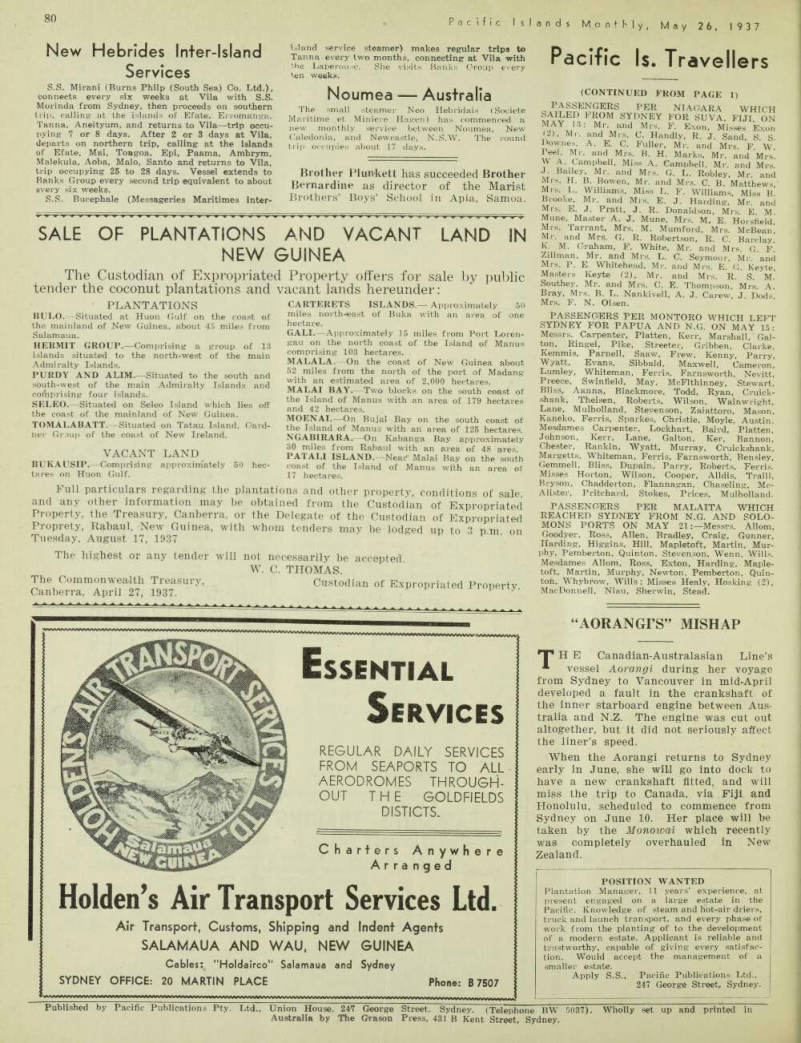
Services
5.5. Mirani (Burns Philp (South Sea) Co. Ltd.), connects every six weeks at Vila with S.S.
Morinda from Sydney, then proceeds on southern trip, calling at the islands of Efate, Erromanga, Tanna, Aneityum, and returns to Vila—trip occu pying 7 or 8 days. After 2 or 3 days at Vila, departs on northern trip, calling at the islands of Efate, Mai, Toagoa, Epi, Paama, Ambrym, Malekula, Aoba, Malo, Santo and returns to Vila, trip occupying 25 to 28 days. Vessel extends to Banks Group every second trip equivalent to about every six weeks. 5.5. Bucephale (Messageries Maritimes inter
island service steamer) makes regular trips to Tanna every two months, connecting at Vila with the Laperouse. She visits Banks Group every ten weeks.
Noumea *— Australia
The small steamer Neo Hebridais (Societe Maritime et Miniere Hagen) has commenced a new monthly service between Noumea, New Caledonia, and Newcastle, N.S.W. The round trip occupies about 17 days.
Brother Plunkett has succeeded Brother
Bernardine as director of the Marist
Brothers’ Boys’ School in Apia, Samoa.
Sale Of Plantations And Vacant Land In
New Guinea
The Custodian of Expropriated Property offers for sale by public tender the coconut plantations and vacant lands hereunder:
Plantations
BULO.—Situated at Huon Gulf on the coast of the mainland of New Guinea, about 45 miles from Salamaua.
HERMIT GROUP.—Comprising a group of 13 islands situated to the north-west of the main Admiralty Islands.
PURDY AND ALlM.—Situated to the south and south-west of the main Admiralty Islands and comprising four islands.
SELEO. —Situated on Seleo Island which lies off the coast of the mainland of New Guinea.
TOMALABATT.—Situated on Tatau. Island, Gard ner Group of the coast of New Ireland.
Vacant Land
BUKAUSIP. —Comprising approximately 50 hec tares on Huon Gulf.
CARTERETS ISLANDS.— Approximately 50 miles northeast of Buka with an area of one hectare.
GALL Approximately 15 miles from Port Loren gau on the north coast of the Island of Manus comprising 103 hectares.
MALALA. —On the coast of New Guinea about 52 miles from the north of the port of Madang with an estimated area of 2,000 hectares.
MALAI BAY.—Two blocks on the south coast of the Island of Manus with an area of 179 hectares and 42 hectares.
MOENAI.—On Bujal Bay on the south coast of the Island of Manus with an area of 125 hectares.
NGABIRARA.—On Kabanga Bay approximately 30 miles from Rabaul with an area of 48 ares.
PATALI ISLAND.—Near Malai Bay on the south coast of the Island of Manus with an area of 17 hectares.
Full particulars regarding the plantations and other property,, conditions of sale and any other information may be obtained from the Custodian of Expropriated Property, the Treasury, Canberra, or the Delegate of the Custodian of Expropriated Proprety, Rabaul, New Guinea, with whom tenders may be lodged up to 3 p m on Tuesday, August 17, 1937 The highest or any tender will not necessarily be accepted
W. C. Thomas.
The Commonwealth Treasury, Custodian of Expropriated Property Canberra, April 27, 1937.
“Aorangi’S” Mishap
*T* H E Canadian-Australasian Line’s vessel Aorangi during her voyage from Sydney to Vancouver in mid-April developed a fault in the crankshaft of the inner starboard engine between Aus tralia and N.Z. The engine was cut out altogether, but it did not seriously affect the liner’s speed.
When the Aorangi returns to Sydney early in June, she will go into dock to have a new crankshaft fitted, and will miss the trip to Canada, via Fiji and Honolulu, scheduled to commence from Sydney on June 10. Her place will be taken by the Monoivai which recently was completely overhauled in New Zealand.
Advertisements & other items, pp. 82-84 (3 items)
Pacific Is. Travellers
80
(CONTINUED FROM PAGE 1)
Pacific Islands Monthly, May 26, 1937
Published by Pacific Publications Pty. Ltd., Union House, 247 George Street. Sydney. (Telephone BW 5037). Wholly set up and printed in Australia by The Grason Press, 431 B Kent Street, Sydney.
Essential
*1 fr i A Sj % h
Services
REGULAR DAILY SERVICES
FROM SEAPORTS TO ALL
AERODROMES THROUGH
OUT THE GOLDFIELDS
DISTICTS.
Charters Anywhere
Arranged
Holden’s Air Transport Services Ltd.
Air Transport, Customs, Shipping and Indent Agents
SALAMAUA AND WAU, NEW GUINEA
Cables:, "Holdairco" Salamaua and Sydney SYDNEY OFFICE: 20 MARTIN PLACE Phone; B 7507
Position Wanted
Plantation Manager, 11 years’ experience, at present engaged on a large estate in the Pacific. Knowledge of steam and hot-air driers, truck and launch transport, and every phase of work from the planting of to the development of a modern estate. Applicant is reliable and trustworthy, capable of giving every satisfaction. Would accept the management of a smaller estate.
Apply S.S., Pacific Publications Ltd., 247 George Street, Sydney.
WHAT AERIAL TRANSPORT HAS
DONE FOR NEW GUINEA
S INCE 1927, when the development of the Morobe Goldfield commenced, the European population of the Territory has been trebled. The new industry has increased the Empire's gold production by nearly £2,000,000 per annum, and has added enormously to the trade turnover of New Guinea.
Only Aerial Transport makes this possible. There is no road between the Goldfields and the coast. Aeroplanes, running on Regular Schedules, without Difficulty or Delay, carry in Dredges, Crushing Mills, Cyaniding Plants, Motor Vehicles, Hydro - Electric Machinery, Thousands of Passengers, and every kind of goods needed by a large and growing European community.
AIRWAYS LTD. were
established in 1927; and they have grown in the following way, until they are to-day the largest freightcarrying service in the world; % 1 > > i ■t r w Aerial Transport is now assisting in the establishment of agricultural and pastoral industries to serve the goldfields. The above recent photo shows dairy cows being unloaded from a freight>carryingi aeroplane, after being brought in from the coast for a dairy farm near Wau. (Photo: Thos. A. Ollson) J _.v* . vs vs ivs i Ivs vs Ivs I VJ I I OVsI V I Vs O 111 INvs Vv >—/ UIII Vs VJ UM VJ I UJJUU , they use over 50 Aerodromes and Landing-grounds in the two Territories.
GUINEA AIRWAYS L T S
LAE • SALAMAUA
HEAD OFFICE;
BROOKMAN BUILDINGS
GRENFELL STREET
ADELAIDE, S.A.
NEW GUINEA OFFICE:
LAE
MANDATED TERRITORY OF
NEW GUINEA
BRANCH OFFICES AND AGENTS AT WAU, SALAMAUA, PORT MORESBY, AND SYDNEY
The more
SATISFACTION
you’ll find in 1
& \V'
ACE
pt- \l 3 * V V s v) A vt 0 V\^ X CO w- - 0s kv.
'4# When the sun beats down with throatparching fierceness when the air shimmers with the tropical heat —that's when you really appreciate the cooling, enjoyable qualities of K. 8.; for the hotter the weather, the more real refreshment there Is In a cool, satisfying glass of TOOTH'S K.B. LAGER.