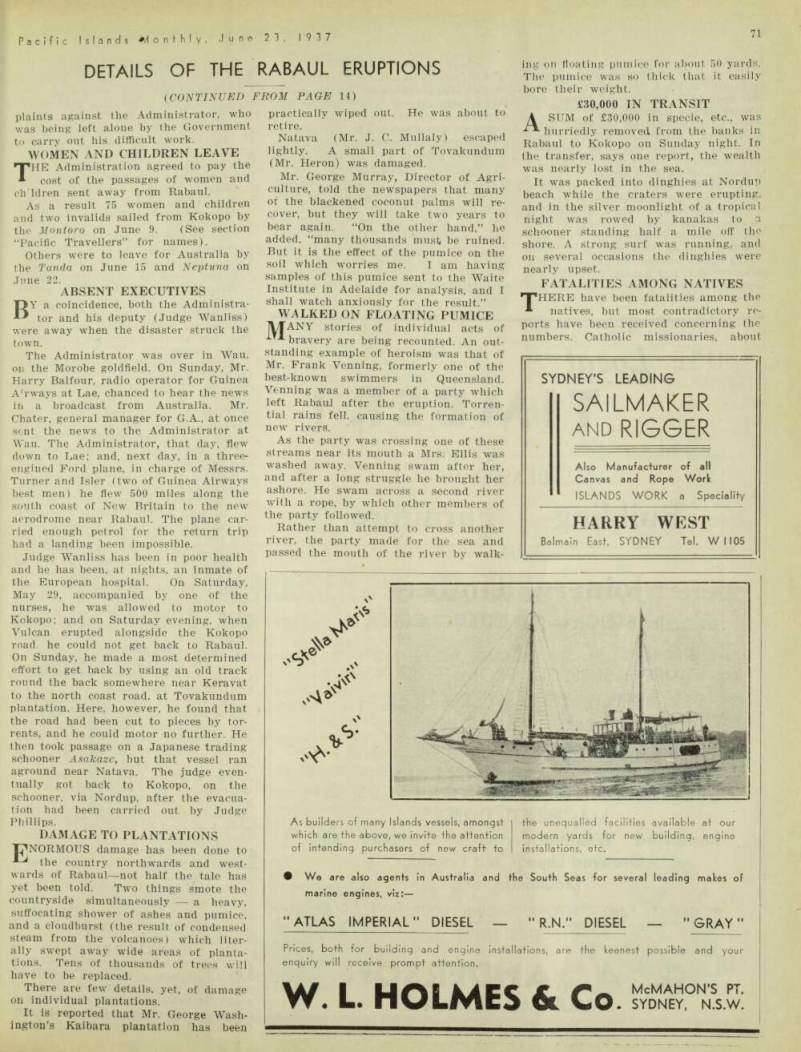
Pacific
Islands
Monthly
Vol. Vii. No. Ii
June 23, 1937
8 d
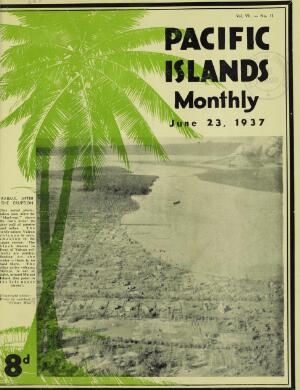
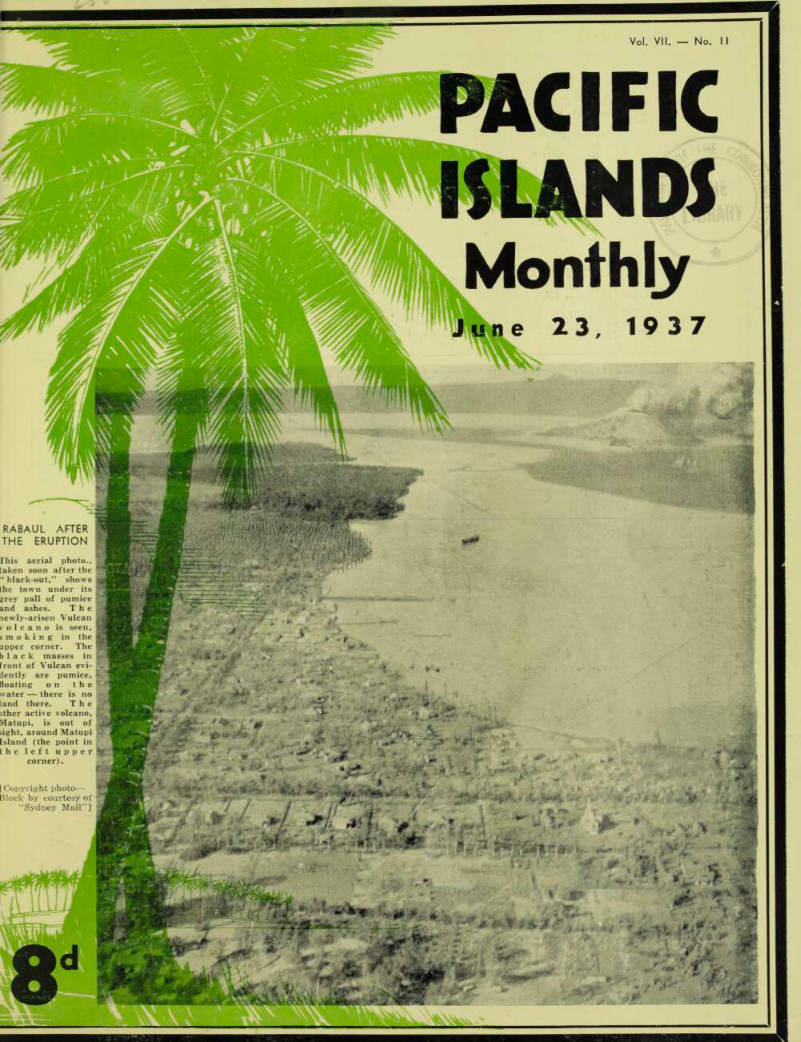
Rabaul After
The Eruption
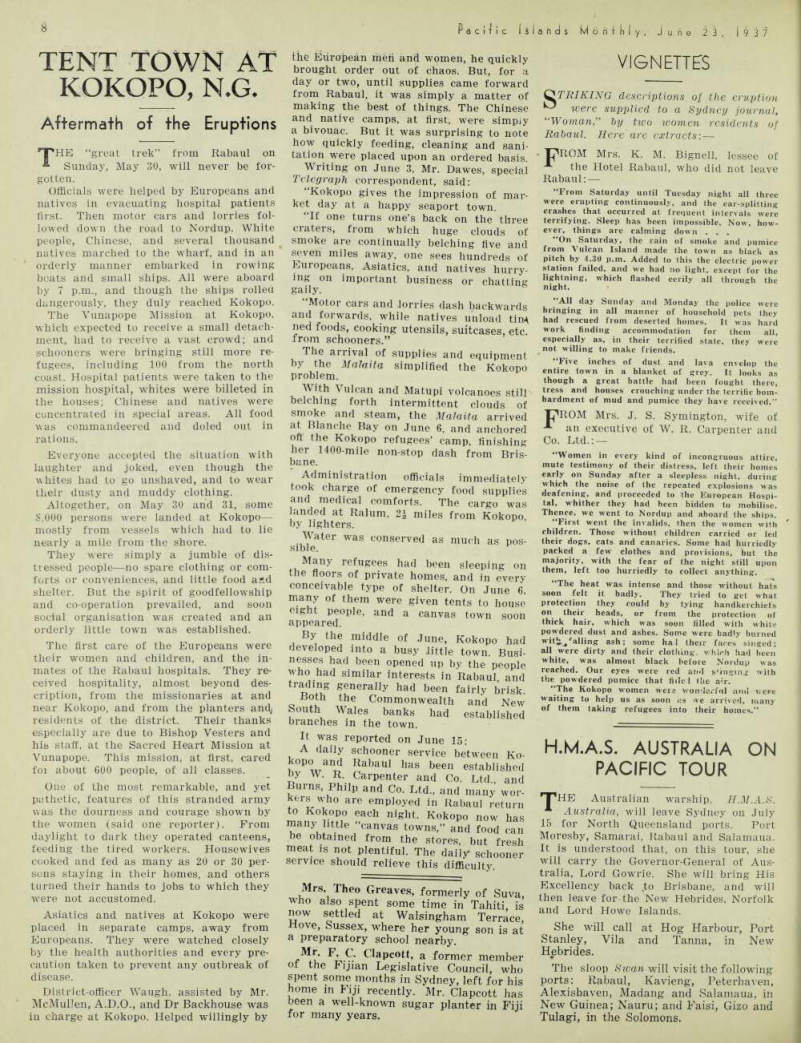
This aerial photo., taken soon after the "black-out,” shows the town under its grey pall of pumice and ashes. The newly-arisen Vulcan voIcano is seen, smoking in the upper corner. The black masses in Front of Vulcan evi dently are pumice, floating on the water there is no land there. The other active volcano, Matupi, is out of sight, around Matupi Island (the point in the left upper corner). [Copyright photo— Block by courtesy of "Sydney Mail”]
Advertisements & other items, p. 2 (1 item)
Direct Shipping Service
BETWEEN THE
PACIFIC TERRITORIES AND EUROPE
In addition to operating General Stores, Trading Stations, Plantations, Inter-Islands Shipping Services, Aerial Transport Services, Etc., in the Pacific Territories, W. R. Carpenter & Co. Ltd. have established a Direct Shipping Service between New Guinea, Solomons, Fiji, Gilbert and Ellice Islands, and European Ports. are made as required ar the Main Ports of Fiji, G. and E. Colony, Solomons and New Guinea.
There is comfortable accommodation for a limited number of saloon passengers on these vessels at special rates; but early application for Berths is recommended.
Details of Freight Rates, Passenger Fares, Timetables, etc., supplied on application at any of our Branches.
THE W. R. C. LINE
Two Twin-Screw Motor-Vessels are now carrying on a Ten-Weekly Service on a Regular Schedule,
namely:—
M. V. RABAUL - - - 5613 Tons
M. V. SALAMAUA - 6754 Tons
MANDATED AIRLINES
LTD.
MANDATED AIRLINES
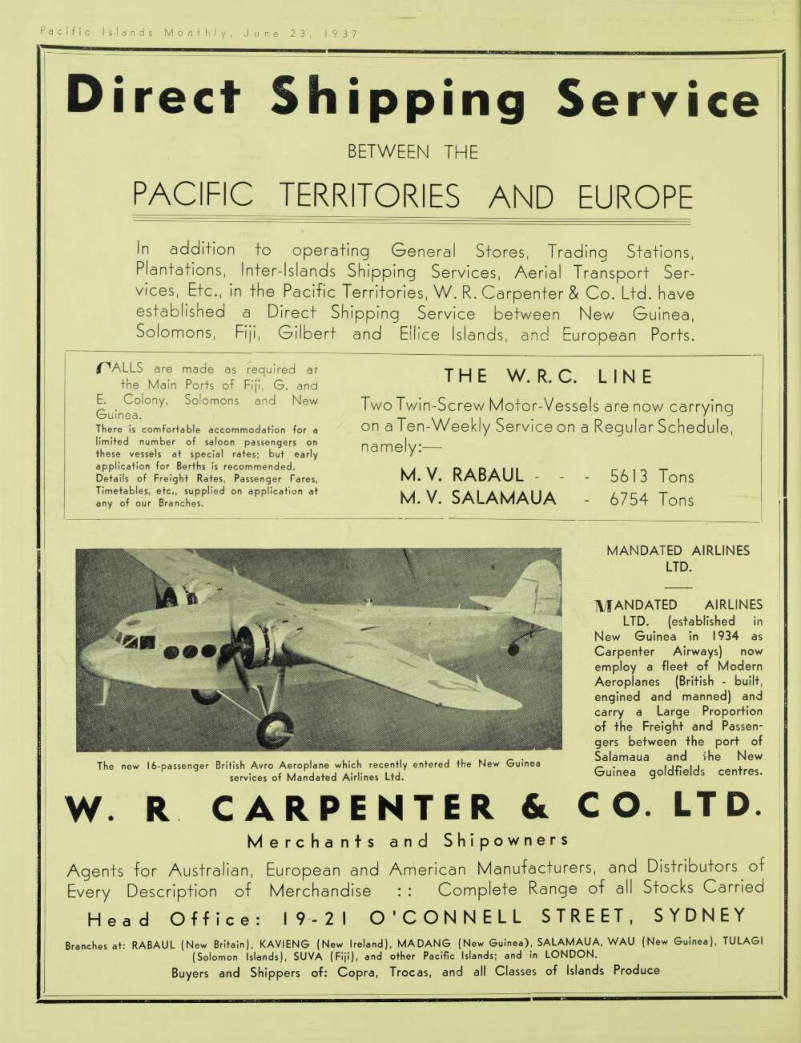
LTD. (established in New Guinea in 1934 as Carpenter Airways) now employ a fleet of Modern Aeroplanes (British - built, engined and manned) and carry a Large Proportion of the Freight and Passengers between the port of Salamaua and ihe New Guinea goldfields centres.
W. R CARPENTER & CO. LTD.
Merchants and Shipowners Agents for Australian, European and American Manufacturers, and Distributors of Every Description of Merchandise : : Complete Range of all Stocks Carried
Head Office: 19-21 O'CONNELL STREET, SYDNEY
Branches at: RABAUL (New Britain). KAVIENG (New Ireland), MADANG (New Guinea). SALAMAUA, WAU (New Guinea). TULAGI (Solomon islands), SUVA (Fiji), and other Pacific Islands; and in LONDON.
Buyers and Shippers of: Copra, Trocas, and all Classes of Islands Produce earn The new 16-passenger British Avro Aeroplane which recently entered the New Guir services of Mandated Airlines Ltd.
New Guinea
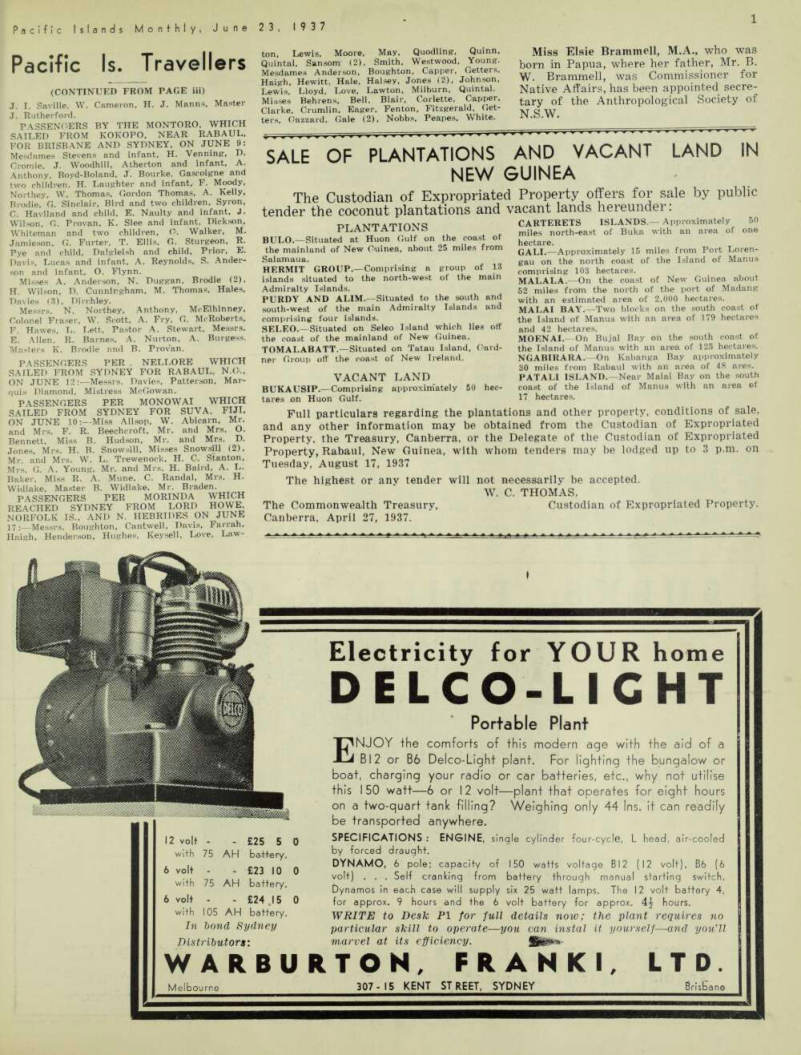
SALE OF PLANTATIONS AND VACANT LAND IN
The Custodian of Expropriated Property offers for sale by public tender the coconut plantations and vacant lands hereunder.
Plantations
BULO.—Situated at Huon Culf on the coast of the mainland of New Guinea, about 25 miles from Salamaua.
HERMIT GROUP.— Comprising a group of 13 islands situated to the north-west of the main Admiralty Islands.
PURDY AND ALlM.—Situated to the south and south-west of the main Admiralty Islands and comprising four islands.
SELEO.—Situated on Seleo Island which lies off the coast of the mainland of New Guinea.
TOMALABATT.—Situated on Tatau Island, Gard ner Group off the coast of New Ireland.
Vacant Land
BUKAUSlP.—Comprising approximately 50 hec tares on Huon Gulf.
CARTERETS ISLANDS.— Approximately 50 miles north-east of Buka with an area of one hectare.
GALL —Approximately 15 miles from Port Loren gau on the north coast of the Island of Manus comprising 103 hectares.
MALALA. —On the coast of New Guinea about 52 miles from the north of the port of Madang with an estimated area of 2,000 hectares.
MALAI BAY. Two blocks on the south coast of the Island of Manus with an area of 179 hectares and 42 hectares.
MOENAI. —On Bujal Bay on the south coast of the Island of Manus with an area of 125 hectares.
NGABIRARA. -On Kabanga Bay approximately SO miles from Rabaul with an area of 48 ares.
PATALI ISLAND,—Near Malai Bay on the south coast of the Island of Manus with an area ot 17 hectares.
Full particulars regarding the plantations and other property, conditions of sale, and any other information may be obtained from the Custodian of Expropriated Property, the Treasury, Canberra, or the Delegate of the Custodian of Expropriated Property, Rabaul, New Guinea, with whom tenders may be lodged up to 3 p.m. on Tuesday, August 17, 1937 The highest or any tender will not necessarily be accepted.
W. C. Thomas,
The Commonwealth Treasury, Custodian of Expropriated Property.
Canberra, April 27, 1937.
tary of the Anthropological Society of
J. I. Saville. W. Cameron, H, J. Manns, Master J. Rutherford.
Passengers By The Montoro, Which
Sailed From Kokopo, Near Rabaul.
FOR BRISBANE AND SYDNEY. ON JUNE 9: Mesdames Stevens and infant, H. Venning, D.
Cromie, J. Woodhill, Atherton and infant, A.
Anthony, Boyd-Boland, J. Bourke, Gascoigne and two children. H. Laughter and infant, F. Moody, Northey, W. Thomas, Gordon Thomas, A. Kelly, Brodie, G. Sinclair, Bird and two children, Syron, C. Haviland and child. E. Naulty and infant. J.
Wilson, G. Provan, K. Slee and infant, Dickson, Whiteman and two children, G. Walker, M.
Jamieson, G. Furter, T. Ellis. G. Sturgeon, R.
Pye and child, Dalgleish and child, Prior, E, Davis, Lucas and infant, A. Reynolds, S. Ander son and infant, O. Flynn.
Misses A. Anderson, N. Duggan, Brodie (2), H. Wilson, D. Cunningham, M. Thomas, Hales, Davies 13), Dirchley.
Messrs. N. Northey, Anthony, McElhinney.
Colonel Fraser. W. Scott. A. Fry, G. Mcßoberts.
F. Hawes, L. Lett. Pastor A. Stewart, Messrs.
E. Allen, R. Barnes, A. Norton, A. Burgess, Masters K. Brodie and B. Provan.
Passengers Per Nellore Which
Sailed From Sydney For Rabaul, N.G.,
ON JUNE 12:—Messrs, Davies. Patterson. Mar quis Diamond, Mistress McGowan.
Passengers Per Monowai Which
Sailed From Sydney For Suva, Fiji,
ON JUNE 10; Miss Allsop, W, Abicarn. Mr. and Mrs. F. R. Beechcroft, Mr. and Mrs. O.
Bennett, Miss B. Hudson, Mr. and Mrs. D.
Jones, Mrs. H. B. Snowsill. Misses Snowsill (2), Mr. and Mrs. W. L. Trewenock, H. C. Stanton, Mrs. G. A. Young, Mr. and Mrs. H. Baird, A. L.
Baker, Miss R. A. Mune, C. Randal. Mrs. H.
Widlake, Master B. Widlake, Mr. Braden.
Passengers Per Morinda Which
Reached Sydney From Lord Howe,
NORFOLK IS.. AND N. HEBRIDES ON JUNE 17: Messrs. Boughton, Cantwell, Davis, Farrah.
Haigh, Henderson, Hughes, Keysell, Love, Law
ton, Lewis, Moore. May, Quodling. Quinn.
Quintal. Sansom (2), Smith. Westwood. Young.
Mesdames Anderson, Boughton, Capper, Getters.
Haigh, Hewitt, Hale, Halsey, Jones (2), Johnson, Lewis, Lloyd, Love, Lawton, Milburn, Quintal.
Misses Behrens, Bell, Blair, Corlette. Capper, Clarke. Crumlin. Eager, Fenton, Fitzgerald, Get ters. Gazzard, Gale (2). Nobbs. Peapes, White.
Miss Elsie Brammell, M.A., who was born in Papua, where her father, Mr. B.
W. Brammell, was Commissioner for Native Affairs, has been appointed secre tary of the Anthropological Society of
N.S.W.
Pacific Islands Travellers
Passengers Per Nellore Which Ar
RIVED IN SYDNEY FROM RABAUL, N.G., ON MAY 20:—Mr. D. Scobie, Mr. and Mrs. J. E.
Daymond, Mr. and Mrs. K. Nettleship, Miss P.
H. Daymond, T. Flower, J. Gilmore, Mr. and Mrs. D. Munro, Mr. and Mrs. Bayley, B. L.
Kavanagh, B. Crawley, W. H. Fitzgibbons, L.
Hansen, W. Conquest, Miss Moore, Miss Heron.
Passengers Per Morinda Which De
Parted From Sydney For Lord Howe
IS., NORFOLK IS., AND NEW HEBRIDES ON MAY 27: Messrs. Boughton, Baxter, Cantwell, Frater, Farrah, Haigh, Hamilton, Henry, Hughes, Henderson, Keysell, Love, Lancon, Lewis, Mar tin, Moore, Menzies, Quodling, Quinn, Roe, San som (2), Spooner, Stevenson, White, Nobbs, Vibert Mesdames Anderson, Adams, Barlow, Boughton, Bailey, Gettens, Hale, Hewitt, Horsley, Haigh, Jones, Johnson, Love, Lewis, Milburn, Nobbs.
Misses Bell, Behrens, Coates, Crumlin, Fitzgerald, Fenton, Gale (2), Gettens, Lombard, Rankine, Ross, Wilson.
Passengers Per Malaita Which
Sailed From Sydney For Solomon Is
LANDS AND N.G. PORTS ON MAY 29: Messrs.
Ault. Adair, Alke, Boland, Beveridge, Bignell, Bullen, Boudard, Bergelin, Beasley, Clarke, Carey, Dyer, Gralton, Goldie, Hay, Hobbs, Jackman, Jay. McLean, Murray, McGregor,
Murnin, Mackenzie, Ponsford, Piper, Rowley, Roche, Sterling, Smith (2), Thomson, Victor, Waterhouse, Whatmore. Mesdames Beveridge, Cunney, Gralton, Gaskell, Lotze, Lamond, Mc- Gregor, Mackenzie, Ormby, Jack, French, Smith, Whatmore, Wilkins, Waldock, Forrest. Misses Bird, Devir, Mort, Ring, Smith, Solley, Smith, Salas. Waddell.
Passengers Per Macdhui Which
Reached Sydney From Papua And
N.G. ON MAY 31: Messrs. Allen, Anderson, Burrows, Brude, Boileau (2), Clark, Colcough, Carroll, Foil, Farley, Griffiths (2), Glanfield, Green, Goddard Hislop, Huxley, Hendrick, Hitch cock, Bowen-Jones, Lowcock, Lawrence, Lee, Mackay, McKinlay, Milne, Munsell, Miller, Mc- Millan, McGuigan, McCann, Newbound, Percy, Piper, Paton, Pendlebury, Quintrell, Rae, Smith (2), Towsend, Wilson, Woodhouse, Wain. Mes dames Anderson, Burrows, Collins, Cox, Dunning, Doyle, Foil, Lee, McDonald, Moen, Patterson, Vaughan, Wood. Misses Arliss, Beale, Farley, Goddard, Helm, Shields, Thomas, Turnbull, Tonge.
Passengers Per Macdhui Which Left
Sydney For Papua And New Guinea.
ON JUNE 5:—Messrs. Allica, Ashbrook, Ander son, Argabrite, Baulch, Burns, Bartlett, Blanch, Bodger, Banks, Chambers, Cruickshank. Drane.
Draper, Downing, Edwards. Fitzgibbons*. Faith orn, Faveling, Grant, Gilmore, Groom, Hadley, Hides, Hughes, Hooper, Hill, Haig, Horan, Ingram, Johnston, Jones, Jamieson, Kerby, Leetch, Lewis, Molony, Macdonald, Momsen, Murdoch, Mateer, Millis, Molloy, Munster, Man nering, Minogue, McMurray, Miles, Martin, Miller, McPherson, Misken, Neill, Newton, Nut ting, Priebe, Robbins, Ryan, Muller-Reid Spag nola, Slaviero, Stewart, Sparks, Stinear, Schro der, Stevenson, Spellacy, Strang, Swanson, Smith,.
Thomson (2), Wooden, Weaver, Ward-Williams, Washington. Mesdames Ashton, Allan, Abraham* Bartlett, Barwick, Costin, Duchatel, Gillingwater, Grant, Garlick, Gemmell, Heath, Hides, Henry* Horan, Hockey, Ingram, Jargett, Leetch, Morris, Minogue (2), Mannering, Munster, Molony, Per kins, Robertson, Rudd. Smith, Stainer, Spencer, Trenchard-Smith, Thomson. Misses Carpenter, Damiens, Eustelle, Frewin, Fairhall, Klaveren, Macgregor, Maye, Mclean, O’Kelly, Smith (2)* Stainer (3).
Passengers Per Aorangi Which Ar
RIVED IN SYDNEY FROM SUVA, FIJI, ON JUNE 6: —Mr. and Mrs. J. Bailey, S. S. Downes* F. H. Ellerton, Mrs. D. C. Gale, Mrs. A. Mcßean, R. J. Sands, Mrs. L. L. Williams, Miss L. F.
Williams, Mr. and Mrs. P. E. Whitehead, L- Byrnes, R. L. Came, T. A. Cantlon, Miss V* Guinery, W. O. Gray, Mrs. M. E. Huntley, F.
Jansson, E. H. Lewis, P. S. Primrose, Miss M.
M. Rial, C. S. Sharp, Mrs. L. M. Seville, Master
(Continued On Page 1)
Advertisements & other items, p. 3 (2 items)
Pacific Is. Travellers
(CONTINUED FROM PAGE iii)
Delco-Licht
Electricity for YOUR home
In bond Sydney Distributors:
WARBU
Melbourne
Portable Plant
ENJOY the comforts of this modern age with the aid of a BI 2or B 6 Delco-Light plant. For lighting the bungalow or boat, charging your radio or car batteries, etc., why not utilise this 150 watt—6 or 12 volt—plant that operates for eight hours on a two-quart tank filling? Weighing only 44 Ins. It can readily be transported anywhere.
SPECIFICATIONS : ENGINE, single cylinder four-cycle, L head, air-cooled by forced draught.
DYNAMO, 6 pole: capacity of 150 watts voltage 812 (12 volt), B 6 (6 volt) . . . Self cranking from battery through manual starting switch.
Dynamos in each case will supply six 25 watt lamps. The 12 volt battery 4, for approx. 9 hours and the 6 volt battery for approx. hours.
WRITE to Desk PI for full details now; the plant requires no particular skill to operate—you can instal it yourself—and you'll marvel at its efficiency.
RTON, FRANK!, LTD.
307 -15 KENT STREET. SYDNEY
Brisbai
Advertisers
Amalgamated Wire less of Aust, Ltd 79 Anderson, G. A 72 Angus & Coote Ltd 15 Arnott’s Biscuits 30 “Aspro” 54 Ausoline 52 B. and S, Agency ... 15 Bank of N.S.W 80 Berger & Sons Ltd 50 Blau (Aust.) Robert 58 Brandt & Steele ... 23 Broomfields Ltd 51 Brunton’s Flour ..._ 70 Budge & Co. Ltd 50 Bullivants Ltd 64 Burns, Philp & Co. 2 Burns, Philp & Co. 36
B.P. (S.S.) Co 66
Buzacott Ltd 26 Carpenter, W. R.
Limited ii Chapman & Sherack 18 Chemist - Michael, H. P. 68 Chivers & Sons Ltd 37 Clyde Engineering Co. Ltd 21 Coleman Lamp Co, 16 Coral Starch 38 Cosmopolitan Hotel 75 Crossle, Duff and Macintosh Ltd 68 “Cuprinol” 52 "Cystex” 66 Dangar, Gedye and Mallock Ltd 09 Del Cott Pty Ltd ... 45 Dewar’s Whisky 74 Doan’s Pills 56 Docke, Carl Aug. ... 44 Donald, A. B. Ltd 60 Eaton, Ltd, J. W. ... 53 Electrolytic Co. Ltd 68 Everyday Products Ltd 25 Expropriated Pro perties —... 1 Fairbanks - Morse Limited 77 .
“Faix-holme” College 76 Finau, Wm 20 Fletcher & Sons 28 Florentine & Son 78 Ford Sherington Ltd 47 Ford, W. M 52 “44 Macleay Street” 12 Fox and Macgilly cuddy Ltd 48 Fryer, A. C. ...:. 26 Garden Vale Pro ducts Ltd 38 Garrett & Davidson 62 Gillespie’s Flour 36 Grand Pacific Hotel 61 Grove & Sons, W. H. 32 Guinea Airways Ltd v Hallstrom, E 39 Halvorsen, L 78 Hannan Bros. Ltd ... 24 Hardie & Co. Ltd, Jas. 56 Holbrook’s Ltd 41 Holmes & Co., W. L. 71 Horne. W. & Co. ... 60 Hotel Moresby ;.. 75 House For Sale ... 22
1.C.1.A.N.Z. Ltd 64
Jones & Co. Ltd, H. 35 Jones & Rickard 43 Kodak Pty. Ltd 20 Kopsen & Co. Ltd ... 73 Kork-N-Seal Ltd 37 Lane & Giryan Ltd 42 Levenson’s Radio ... 57 Levy, Sol 13 Lindenhafen Estates Ltd 4 25 Lustre Ltd 17 McGowan & Co., A. 61 Mcllrath’s Ltd 22 McKay’s Bookstall ... 21 Maleham & Yeomans Limited 47 Master Sewing Machine Co 48 Maxwell Porter Ltd 53 Medical Supplies— Secura 59 Miller & Co. Pty Ltd 54
Mint Stamp Co 24 Morris, Hedstrom Limited • 62
N.D.L 81
Nelson & Robertson Pty. Ltd LJ 69. 70 Nestle’s Milk ,*... 40 Newland Bros. Ltd 67 Nock & Kirby Ltd ... 65 Nordnian, Oscar G. 78 Noyes Bros. Ltd : 28 Oxymel Oil and Paint Co. Ltd 66 Olsson, T. A. 60 Pacific Islands Co. 59 Papua, Hotel, The ... *75 Patterson & Stone ... 63 Philatelic Investment Trust' 1... 18,'74 Pike Bros Ltd 15
Pincombe Ltd, Syd. 32 Plantation For Sale 29 Prescott Ltd „.. v . 34 Price’s Radio Serv. 75 Prouds Ltd 17 Ransomes Sims and Jefferies Ltd 63 Reed, William, E. ... 36 Reid, W. M 43 Riverstone Meat Co.
Ltd 31 Rohu, Sil 18 Royal Packet Co. .. iii
“R.U.R.” 62
Ruston & Hornsby ... 55 St. Ignatius College 14 Scott’s Emulsion 23 Scott Ltd, J 51 Scott ' & "Sons ' 63 Shell Oil Co. Ltd 49
Smyth Ltd. J. S 14 Springwood L. Coll. 59 Stanley, Chris 35 Stanley & Co 30 Stead & Baker 24 Steamships T. Co. ... 76 Sterling Varnish Co. 11 Sullivan Ltd, J. J. 39 Swallow & Ariell ... 34 Sydney Steel Co 68 Talkeries 12 Taubman’s Paints ... 42 Taylor & Co.. A. 76 “Tenax” Soap 13 Tilley Lamp Co 46 Tillock & Co. Ltd 35 Tooheys Ltd 19 Tooth & Co vi “Top Dog” Men’s Wear 21
Trufood 22 Vacuum Oil Co 27 Vincent’s A.P.C 58 Warburton Frank!
Ltd 1 Watson, Victor, Ltd 12 West, Harry 71 Weymark & Son 37 Wheeler, B. R 33 Wills, W. D. and H. 0.. Ltd 33 Williams Ltd, S 43 Williams. W. H 63 Wizard Lighting Co. 13 Woods P’mint Cure 33 Wright & Co 29 Wright & Co. Ltd, E. 51 Wunderlich Ltd 53 Yorkshire Insurance Co. Ltd 42
Contents
Pacific Islands Travellers iii Rabaul Bickerings and Tropical Ad ministration 3 Carpenters get Sydney-N.G. Airmail Contract 4 Future of New Hebrides i. ■ 4 No Subsidy Yet for Pacific’Shipping 5 New -C.I. Resident Commissioner 6 Tent Town at Kokopo 8 Volcanic Eruptions Compel Evacua tion of Rabaul ... 9, 71 About Islands People 15 Tom Harrisson’s Exploits in New Hebrides ... ... 17 Those N.G. Pygmies ... ... ... 19 Loss of Fijian in Marshalls 21 Guinea Airways Ltd 22, 74 Early Fijian Navigators 23 Thomas Lewis’s Polynesian Wife ... 25 Men Who Knew Yesterday—William Blacklock, of Samoa 28
Judge Ayson, C.M.G.—An Apprecia tion 31 ! ake Kutubu in Unknown Papua 33 New Caledonia’s Trade 35 The Significance of Colours 37 Tragic Death of Rev. W. V. Milne 38 How the Pacific Cable Was Laid 40 The Boy-King of Tahiti 45 N.Z. Controls Cook Is. Fruit 50 What is Happening in Japan’s Man dated Islands 52 A New Mountain and People in Dutch New Guinea 55 Fashion Hints for Islands Women ... 59 ’Fiji's Representative Describes Cor onation Procession 61 Morris Hedstrom’s' Annual Report 64 Pacific Islands Mining Notes 65 Islands Produce and Exchange 79 Copra and Rubber Prices 80 Shipping Services in Pacific 81
Advertisements & other items, p. 4 (1 item)
Burns, Philp & Co. Ltd
GENERAL
MERCHANTS
IHI
II if!
Hi) ul 111
lil
HI
ill
SHIPOWNERS
TOURIST AGENTS
Head Office: 7 Bridge Street, Sydney—Australia Code Address: "Burphil"
BUYERS OF ALL CLASSES OF ISLAND PRODUCE Regular Steamer Services from Australia to New Guinea Papua Solomon Is. —Lord Howe Is. —Norfolk Is. —New Hebrides —lava and Singapore
Pacific Islands Monthly
The Newspaper-Magazine of the South Seas [ Registered at the G.P.0., Sydney for transmission by post as a newspaper .]
Published Once Each Month and Circulated in Australia and New Zealand and in the following Pacific Territories and Islands Groups:
Crown Colony of Fiji.
Australian Territory of Papua.
Mandated Territory (Australia) of New Guinea, Bismarck Archipelago and Northern Solomon Islands.
Mandated Territory (Japan) of Marshall, Caroline and Marianna Islands.
French Territory of New Caledonia.
British and French Condominium of New Hebrides.
American Territory of Eastern Samoa.
American Territory of Guam.
Mandated Territory of Nauru.
British Crown Colony of Gilbert and Ellice Islands.
Mandated Territory (New Zealand) of Samoa.
British Solomon Islands Protectorate.
British Protectorate of Tongan Islands.
New Zealand Territory of Cook Islands.
Australian Territory of Norfolk Island.
French Colony of Oceania (Tahiti, etc.).
American Territory of Hawaiian Islands.
Owned and Produced by Pacific Publications Pty. Ltd., Union House, 247 George Street, Sydney.
Telephone Bw 5037
P.O. Box 1 8408 R
Registered Address of Telegrams, Radiograms, and Cables: “Pacpub,” Sydney.
Contributions
Articles, Stories, and Photographs dealing with Pacific Islands subjects are invited, and will be paid for on publication at usual rates.
Subscription Rates
Per Annum, within British Empire, Prepaid, Post Free 8/- Per Annum, elsewhere, prepaid. Post Free 10/- Single Copies , Bd.
Editor and Publisher:
R. W. Robson, F.R.G.S.
Advertisements
Advertising rates furnished on application.
Colours, etc. by Arrangement Process Blocks made at Advertiser’s expense when required. Screen, 100.
Changes of Advertising Copy should reach this Office by Bth of each month, otherwise previous advertisement may be repeated.
Agents
The following are authorised to receive subscrip tions for the Pacific Islands Monthly:— Islands Branches of Burns, Philp & Co. Ltd., and Burns Philp (South Sea) Co., Ltd.
Islands Branches of W. R. Carpenter & Co., Ltd.
All Branches of Morris, Hedstrom & Co., Ltd.
G. Thomas & Co., Rabaul, New Guinea.
Whitten Bros., Ltd., Samarai, Papua.
Steamships Trading Co., Papua. All Branches.
P. Costello, Suva, Fiji.
J. Muir, Suva, Fiji.
All Branches and Representatives of W. H. Grove and Sons, Ltd., Auckland, New Zealand.
Cook Islands Trading Co., Rarotonga, Cook Is.
A. C. Rowland, Papeete, Tahiti.
Representative in London: W. C. HARVEY, Coronation Building, 4 Lloyds Avenue, London, E.C.2. from whom may be obtained copies of Pacific Islands Monthly, Pacific Islands Year Book, advertising schedules, etc.
Vol. VIL, No. 11.
Sydney, June 23, 1937.
PnVp ( 8d - Pei Copy - L l ICC ( Px-epaid : 8/- p.a.
Rabaul Bickerings and Tropical Administration
IT was fortunate, perhaps, that the un seemly squabble between the Adminis trator of New Guinea and his “subjects” came when it did; because it has served effectively to show up some of the faults of a system which Australia proposed to enlarge.
It has been proposed that Australian administration shall take the place of English administration in certain Pacific territories (notably, the New Hebrides and the Solomons) which already are far more Australian than English in their oversea connections and associations. If this should mean that Australia simply is going to organise two more-parties of public servants in watertight compart ments, presided over by two more poli tical appointees, the residents of the New Hebrides and Solomons would be well advised, at this stage, to resist the con templated change to the utmost of their power.
It should be a primary condition of any extension of Australian authority in the Pacific that Australia creates a corps of men trained and competent to undertake tropical administration, and able to pro vide, out of their own ranks, officers cap able of occupying the highest positions in that service.
Already, Australia administers five tropical territories North Australia, Papua, New Guinea, Nauru and Norfolk Island —and it is scarcely necessary to stress the fact -that the administrators, who exercise absolute and almost un challengeable authority, should be speci alists trained for their jobs and, tempera mentally, men of calm, patient, well balanced judgment. Yet two of the main territories, Nth. Australia and New Guinea, are controlled now by men who were arbitrarily selected, without compe tition, by a Cabinet which had no special qualifications for making such appoint ments. Mr. Abbott and General McNicoll may be men of great personal merit; but the fact remains that neither had had one hour’s training in the specialised work of tropical administration, and that they came under official notice in the first place only because they happened to have been elected to Parliament.
Meanwhile, each territory maintains its own public service, each service divided into departments, each departmental head supremely conscious of the fact that, however, well he may acquit himself, the principal positions are not for him—they
are reserved, mostly, for political appoin
tees. It is an intolerable system.
Its weakness has been demonstrated during the month, in Rabaul. Almost every issue of the newspapers, for three weeks, has contained something about the bickerings between the Administra tor, who says that Rabaul is habitable and reasonably safe, and a section of the non-official Europeans, who say it is not.
The managers of the big trading firms have insisted upon a policy of caution, in considering the scope and character of their future establishments in Rabaul; while the utterances of Administrator on this subject have had an unfortunate appearance of either flippancy or bad temper.
The attitude of the Administrator may be perfectly right; but, if it is, he cer tainly has done the right things in the wrong way. The Administrator may not have ordered the evacuation of Rabaul; but, in his statement of June 1 (see pages 13 and 14), he clearly confirmed it, and added that the town would not be haoi table (or “tenable”) for several weeks, and apparently approved all the arrange ments for a temporary settlement at Kokopo. Yet, only six days later, he was issuing statements which could be interpreted only as insistence on the im mediate re-occupation of the town. Was it any wonder that a large - section of the Europeans became angry and resentful!
This was a time, if ever there was one, when the Administrator should have
acted in close consultation and co-opera tion with the commercial community, and with the rank and file of Europeans, whose interests had been so disastrously affected. Patience, tact and sympathy were called for. Instead of that, General McNicoll’s far-too-numerous utterances, as reported in Australian newspapers, suggested a stubborn insistence on his dictatorial authority, combined with peevishness and impatience. The impres sion made “down South” was not good.
General McNicoll was a successful school master and a distinguished soldier. But the methods of the schoolroom, and the heavy heel of the autocratic G.0.C., are very much out of place on an occasion like this. In fact, they are out of place nowadays in tropical administration gen erally. The unfortunate record of New Zealand in Western Samoa, between 1925 and 1932, is proof of that.
Criticism is difficult. We must set
against the Administrator’s apparently
temperamental inability to co-operate
with the non-official community, his per sonal courtesy, his energy and his
organising genius, admirably displayed
on this occasion.
"Macdhui" on Fire
off N.G. Coast "Neptuna" Races to Aid of Drifting Vessel
WHEN the Burns, Philp passenger motorship Macdhui was off Fortifica tion Point en route from Lae to Madang, New Guinea, on June 20, two fires broke out abroad, leaving the vessel drifting with her engines disabled.
In response to S.O.S. calls, the B.P. liner Neptuna raced to the rescue, and reached the Macdhui the following day to tow her to port.
When the first fire occurred in the MacdhuVs engine-room, she was consid ered to be in danger, and the passengers took to the boats. Later, the European passengers returned to the ship, but 150 native deck passengers were put ashore near Fortification Point, as a panic was feared.
The first outbreak occurred in the fuel oil bunkers at 1 a.m. and assumed serious proportions. The crew fought the fire with great determination, and by 4 a.m. it was under control. The damage was extensive.
At 5.30 a.m., a second fire broke out in No, 4 hold, and the crew was again called out to fight the outbreak, which, however, was not so serious as the first fire.
Captain Campbell, master of the Macdhui, reported early on June 21 that the vessel was in no danger, as the weather was calm and the set of currents tended to carry her in a north-westerly direction, away from land. A later mes sage stated that the bulkhead and hatch had cooled appreciably.
N.G. Air-Mail
Contract for Weekly Service Goes To Carpenter & Co.
■THE contract to operate the new, * weekly, air-mail service between Sydney and Rabaul (New Guinea), via Brisbane, Cooktown, Port Moresby, Wau, and Salamaua, for five years, was let by the Australian Government on June 8 to Messrs. W. R. Carpenter and Co. Ltd.
The unsuccessful tenderers were Guinea Airways Ltd., Australia-New Guinea Airlines Ltd., and Southern Airlines and Freighters Ltd.
Messrs. Carpenter have ordered three De Havilland 868 machines from Britain.
They will be assembled at Mascot, Sydney, in time to commence the service in January, 1938. They are bi-planes; they are easily handled and housed; each has four engines, and can fly on two out of the four; each will be equipped with two-way radio equipment; each will carry about 15 passengers: and the fare will be about the same as the first-class steamer fare.
Sydney to Cooktown will be one day’s flight; Cooktown to Port Moresby, Sala maua and Rabaul the second day’s flight.
Cooktown aerodrome is fo be enlarged, to accommodate these machines. The Federal authority has promised to put in directional wireless at Cooktown and Rabaul, and to create an efficient meteor logical service.
The total subsidy to be provided by the Government is £65,572 —an average of £13,000 per annum.
The service will be operated by Messrs.
Carpenter and Co. —not by Mandated Air lines, which is the firm’s local operating company in New Guinea. The chief pilot of Mandated Airlines, Mr. R. 0. Mant, will be the flying superintendent of the new service.
The DH 868 machines are an improved model of the machines which have given such good service on the Darwin-Singa pore section of the Australia-London route.
Imperial Conference
New Hebrides
Indefinite Discussion at
A PROPOSAL that Australia should assume responsibility for Britain’s share in the administration of the New Hebrides- (which is a Condominium, con ducted by France and Britain) was dis cussed at the Imperial Conference dur ing the month.
But, when the Conference- ended, noth ing had been agreed upon. It is be lieved, however that discussions will continue between the Governments of Britain, France and Australia.
The irresponsible section of the Aus tralian newspaners which seems to reach extreme heights of silliness and inaccuracv whenever it deals with Pacific affairs—reported that a transfer had been agreed unon: that Australia would establish “a semi-dinlomatic Com missionershin” in the a-roup: that the British officials would be replaced by Australians: and so on.
One priceless kite-flier announced that “Australia was to become the ultimate administrative headouarters for all Frn nire possessions in Pacific;” and that “th e next move will be to incornorate Fiii. which can be far more conveniently administered from Canberra than from London.” The latter statement was so ridiculous and fantastic that other news napers took the unusual course of con tradicting it.
If the journalist had spoken of the Solomons, instead of Fiji, he might have been a little nearer the mark. Every argument which can be nut forward in favour of Australian administration of the New Hebrides can be applied also to the Solomons. The Solomons have not been mentioned in reports of Imperial Conference discussions; but it can be taken as probable that the future of both the Hebrides and the Solomons are under consideration, and not the Hebrides alone.
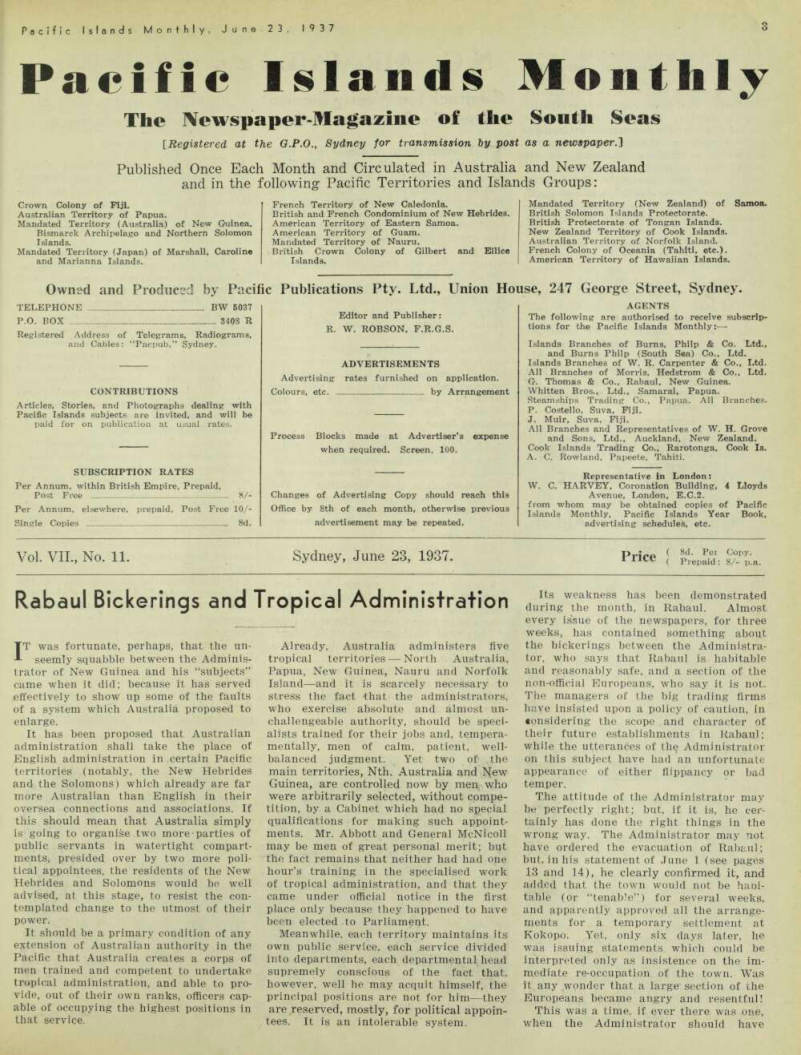
Eating the Apple.—An event in the Coronation Day sports in Port Moresby. Beryl Mustard was the winner. (Gibson, photo.)
No Subsidy Yet

Imperial Conference Fails To Agree on Pacific Shipping Question
'X'HE Imperial Conference ended with * out any decision having been reached on the question of subsidising the Canadian - Australasian steamship line, which runs in competition with the sub sidised American (Matson) line.
An extraordinary amount of inaccurate rubbish was supplied from London to the Australian newspapers, which published it with all kinds of sensational heads. We were told, variously, that an agreement had been reached; that two 22,000 tons liners would be built, at a cost of £3,000,- 000; and that the substantial subsidy thereon would be borne by Britain, to the extent of 51 per cent, and that 49 per cent would be divided between Aus tralia, New Zealand and Canada. It was said, also, that an arrangement was t being made with the United States under which if U.S.A. allowed British ships to trade between Honolulu and ’Frisco, the Em pire Governments would allow Matson liners to continue to trade between New Zealand and Australia.
Actually, nothing was agreed upon.
There seems to have been an enormous amount of talk—and then the Imperial Conference ended.
At this date (June 21) the matter of subsidising British shipping in the Pacific is being considered in London by a com mittee, which “hopes to reach a provi sional agreement that can be referred to the Governments interested.”
There is an indication that the whole subject is tied up with an apparent need to subsidise British shipping in the north west Pacific, which is severely feeling the growing competition of the cheaply run Japanese lines.
Seaplane's Discoveries
In New Hebrides
THE seaplane from the French war sloop Rigault de Genouilly was used freely during an official visit to the New Hebrides in April. The pilots flew over most of the islands, and made some useful observations.
At Santo, especially, the naval airmen flying over the interior noted that the estimate of the heights of the principal peaks were probably 200 metres less than their true height. They also noted that the plain of Jourdain, on Santo, is an attractive region, with a lake in the centre, and possibly is suitable for colonisation.
Mrs. S. G. Jones, who spent four years on Wallis Is., New Hebrides, reached Sydney by the Morinda on June 17.
Tahiti's Chinese
Commission To Study the Problem
TAHITI has decided to take steps to * cope with the invasion of Chinese (says the Bulletin du Commerce , of Noumea).
A commission has been set up in Papeete, comprised of leading citizens, to study all aspects of the Chinese problem, ;and the effect of the increasing Chinese community upon the economic and social conditions in French Oceania.
Sir Henry Marks, C.8.E., has been appointed Honorary Colonel of the Fiji Defence Force —an honour unique in Fiji history. Sir Henry held a commission as a major in the old Fiji Volunteers some 40 years ago and has always taken keen interest in the Defence Force.
S.S. Bucephale
Wrecked In New Hebrides
THE Messageries Maritimes steamer Bucephale, (903 tons, built in 1925, formerly the Saint Andre), ran on to a reef on the coast of Efate, 12 miles from Port Vila, New Hebrides, on June 14, and became a total loss.
The sea was quiet, and crew and pas sengers were taken off and conveyed to Vila. The ship was on her way from Tanna to Vila, and carried about 140 tons of copra. The Pierre Loti . on June 17, was making an attempt to salvage the cargo.
The Bucephale ran to the southern New Hebrides, and the Banks Group, on a regular schedule.
Coronation Day
French Warship Shows Tongans Their First Aeroplane or Coronation Day
Dr REO FORTUNE, now of the Ling Nam University, Canton, China, (who recently carried out anthropological research in New Guinea), has announced his en gagement to Miss Eileen Pope, of Wellington, N.Z. Their mar riage will take place shortly in China.
Dr John Wesley Coulter,
associate professor of Geography in the University of Hawaii, is spending leave from academic duties in 1937-38 in the South Sea Islands. He is making a survey of land utilization in American Samoa under the aus pices of the naval government there. From American Samoa, he will go to British Samoa, Fiji, and other islands in the Pacific and then on to New Zealand, Australia, and Europe.
He is an Irishman by birth and received his early education in the Methodist Co>lege, Belfast.
He is the author of several books.
Nukualofa, May 22.
During the Coronation cele brations here on May 12 the French sloop Rigault de Genou illy, commanded by Commander Leon Moron, was in port.
The ship’s seaplane flew over Nukualofa during the celebra tions and gave the Tongans their first thrill of seeing a plane over their island.
Shown in the accompanying photographs are:— Top: Her Majesty Queen Salote Tubou, D.B.E., and her consort, Prince William Tugi, C.B.E. (with A.D.C. and maid in waiting) arriving to attend Coronation Service at St. Paul’s Anglican Church. Nukualofa, where the Kev. H. A. Favell officiated.
Lower (left to right) : Com mander Leon Moron, Mrs.
Ragnar Hyne, Mr. Ragnar Hyne (British Vice-Consul).
Also in the group are two other officers from the French war ship.
Resident Commissioner
in Cook Is.
Appointment of Mr. S. J. Smith
MR. S. J. SMITH, who has been
iTI Secretary of the Cook Islands
Department, in New Zealand, since
1928, has been appointed Resident
Commissioner in the Cook Islands,
to succeed Judge H. F. Ay son,
retired.
From Our Own Correspondent
Rarotonga, May 19.
TT would be difficult to imagine a hap * pier choice than that of Mr. S. J.
Smith. He is no stranger to the people of the group, and he has had a long record of tropical service. This com menced in 1914 when, as a member of the Samoan Occupying Force, he was seconded for duty as secretary to the Samoan Administration under Military Occupation. He continued in this capa city for several years, and then* returned to New Zealand and became second-in charge of the Dept, of External Affairs.
He took charge of the C.I. Department in 1928.
The choice is appropriate because, under the new Fruit Control Regulations, a very considerable degree of authority is vested in the Resident Commissioner, and Mr. Smith, as secretary for the C.I.
Dept., has played the leading part, not only in framing the regulations, but in the gigantic task of bringing them to fruition. It mav be said that for years direct supervised control of the local fruit trade has been his special objective —although it was not until the present Government came to power that he was able to see his ambition realised.
Mr. Smith starts with a clear fie’d. V “control” does not turn out a success under his guidance, then it mav safely be assumed that it will never do so.
Samoan M.P.'S Want
Higher Pay
From Our Own Correspondent
Apia, May 31.
TrHE Fono of Faipule (native Samoan Parliament) commenced its session after Coronation Day.
The Faipule seem to be mainly inter ested in having their own allowance raised, and have sent an address to the New Zealand Government, demanding a daily allowance of 8/- in addition to their yearly pay of £36.
They are asking also for greatly in creased numbers of native officials, vil lage heads, native judges, plantation in spectors, etc., the salaries amounting to approximately £4,000 per annum.
On the other hand, the natives refuse to pay direct taxes to the Admihistration, and European taxpayers are unfavourable to the Samoans’ excessive demands, un less the natives bear at least some of the financial burden.
Impressive Pile
New Fiji Government Offices
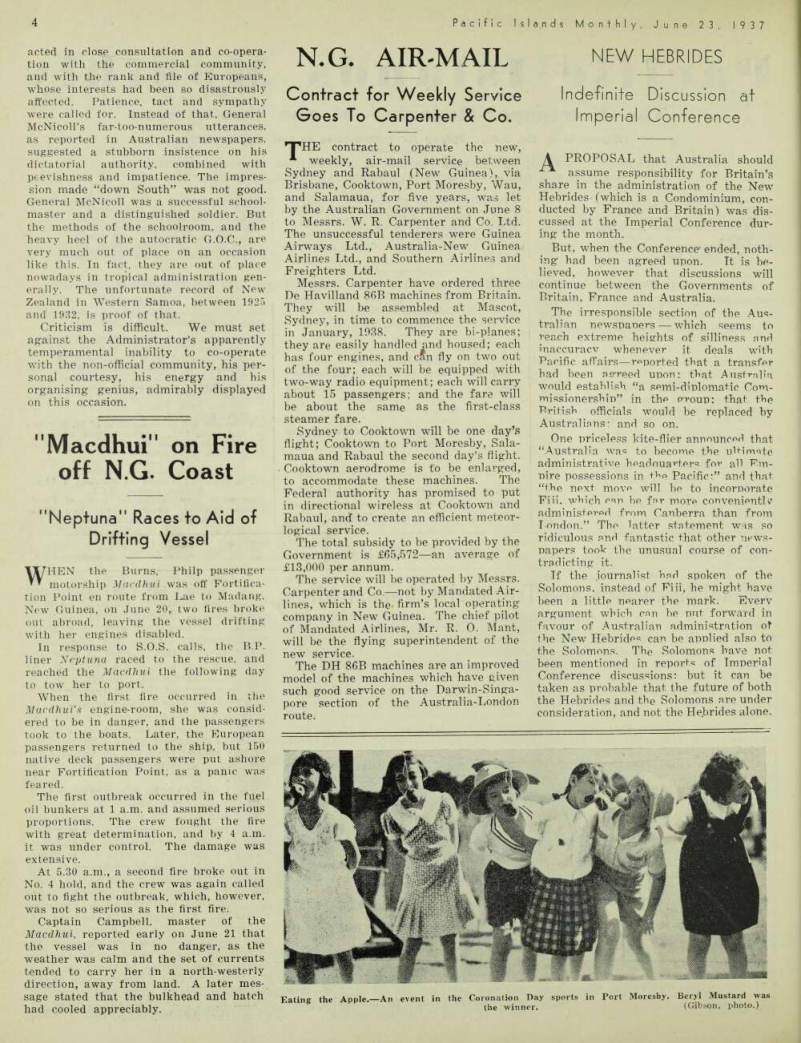
From Our Own Correspondent SUVA, June 1. J HE most important of the many **■ Coronation Day ceremonies here was the laying of the foundation-stone of the
new Government offices by the Governor, Sir Arthur Richards.
After the stone had been laid, Lady Richards deposited within it a leaden casket containing a copy of the special Coronation number of the Fiji Times, a copy of the Hindu paper, Shanti But , and the Fijian journal, Na Mata, as well as a set of Coronation stamps and some Fiji coins.
The new buildings, when completed, will be a most impressive pile. They will have a frontage of 536 feet on one side and 294 feet on the other, while a clock tower, 115 feet in height, will surmount the main entrance.
Where the Foundation Stone was laid.
Arrested
Two Japanese Boats
Australia Acts At Last
THERE has been liveliness on the Dar win front, in the war against Japan ese poachers.
The Federal vessel Larrakia swooped early in June, caught, and arrested the mother-ship, New Guinea Maru, and the Takachiho Maru.
The Larrakia's starboard engine broke down, and she had to crawl back to Dar win by the inner channel. The draught of New Guinea Maru was too deep for the inner channel. So the Australia offi cials released her and arrested the Seicho Maru instead: and set off slowly for home.
The Larrakia's long* absence alarmed the authorities, and they sent out Dr.
Fenton (“the flying doctor”) in his plane. He found the Larrakia, creeping home with her two prisoners, 500 miles away, and brought back reports on June 15.
The Australian Government will send another patrol boat, and a patrol aero plane to Northern Australia.
Death In Solomon Islands
Mr. G. E. Clift
jVfR. Geoffrey E. Clift, of Guadalcanal, IV i British Solomon Islands, died on June 8. Pneumonia was given as the cause of death.
Mr. Clift was one of the best-known and most lovable men in the Solomon Islands, and a wide circle of his friends in the Pacific and elsewhere will learn of his death with the deepest regret.
Mr. Clift spent some years in Fiji, where he was employed by the Colonial Sugar Refining Company as a surveyor.
Some time before the war, he went to the Solomon Islands and entered the planting industry, taking over the Pairo Estate, on Meringe Lagoon. He was one of the Solomon Island planters who en listed with the British forces when war broke out in 1914, and he served with distinction. After his military service, he returned to his plantation in the Solo mons and took an active part in public affairs there. He became a member of the Advisory Council and he was one of the most active members of the Solomon Is lands Planters Association. Through his activity and energy, in travelling over the group and organising the planters, he was successful in obtaining concessions from the Administration in connection with native land leases.
The late Mr. Clift, although he suffered much in later years from ill health, was always cheerful and witty. On one occa sion, when he came to Sydney, he was intercepted on the boat by a reporter, who asked him if there was anyone of im portance on board.
“No one of any importance lives in the Solomons,” replied Mr. Clift; and this remark, to the amusement of 8.5.1. people, was solemnly reported in the Sydney Morning Herald.
Mr. Clift was about 60 years of age.
Advertisements & other items, p. 8 (2 items)
6
Pacilic Islands Monthly. June 23. 1937
Look on the Front
of Your Wrapper !
The figures stamped there (if any) show the date when your subscription expires. This date will appear on wrappers of three issues preceding expiration, thereby giving 3 months’ notice.
If, at the end of that time, we have not been instructed to continue to send the journal to you, it will be discontinued.
Your subscription (8/- per annum, or 10/- in the case of countries outside the British Empire—which includes postage) may be sent direct, or may be paid to any of our agents (listed on page 3).
POSTAGE RATES
The postage required for this issue is:— To Australia and New Zealand 2d To United Kingdom via All-sea route - 2d To United Kingdom via France - 3d To other British Possessions 3d To U.S.A. and Foreign Countries 5d
PACIFIC PUBLICATIONS PTY. LTD
Union House, 247 George St., Sydney.
Samoan "Welcome"
To Minor N.Z. Official
From a Special Correspondent APIA, June 3.
THIS certainly is a country of quaint political happenings.
The other day a Mr. Holland, a minor official in New Zealand, and a son of the late Labour Leader, passed through Apia on the Maui Pomare.
Mr. O. F. Nelson took the opportunity to arrange a ceremonious “welcome,” a demonstration on the wharf, and an en tertainment at Vaimoso, (the Mau head quarters) and an affectionate farewell.
Mr, Nelson paraded with the leaders of the local “Labour Party,” a feeble organi sation which sprang suddenly into being a year ago, when the “Goodwill Mission” was due.
The demonstration was watched with wonderment by the citizens of Apia, who could not understand what it was all about.
Well-Known Mining Man
Killed In Papua
Port Moresby, June 15.
MR. F M. Murdoch, general manager of Mandated Alluvials and Dominion Gold Ltd., who arrived here by the Macdhui from Melbourne on June 11, was badly injured in a motor accident on June 14 and died in the hospital to-day.
Large New Lake
Seen By Airman In Dutch New Guinea
A DUTCH Always pilot, when flying from Seroei (Geelvink Bay, north west of Dutch New Guinea) to Aika (on the south coast, east of Mimika, across Dutch New Guinea, discovered a large lake, a few weeks ago.
The position of the lake is, roughly, 80 kilometres north of Mimika, and 150 kilometres east of Etna Bay. It is con siderably west of the Carstenz summit,' in the Snow mountains.
The lake is about 5000 feet above sea level, is about 10 miles long, and is surrounded by grassy plains. There are smaller lakes in the vicinity. The aviator said there were some 40 canoes on the lake, and the people appeared to be fairly light in colour. They cultivated beautiful gardens.
The discovery is regarded as important.
The lake, probably, will be valuable as a base for an exploring expedition, and as a landing place for amphibians.
Advice has been received from London that New Guinea was represented within Westminster Abbey during tne recent Coronation celebrations, in the persons of Lieut.-Colonel Walstab, Superintendent of the New Guinea Police, and Mrs.
Walstab.
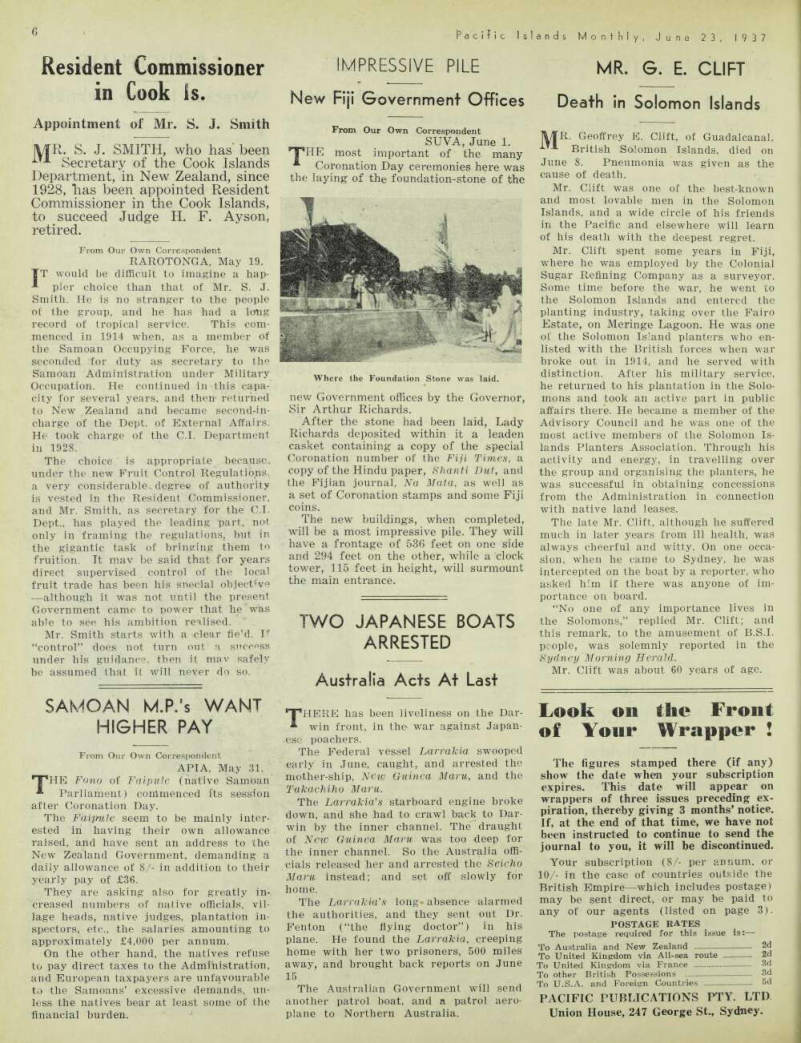
Australian Coastal Vessel For New Guinea
TTHE North Coast steamer Coombar, of * 581 tons, was purchased early in June by W. R. Carpenter and Co. Ltd., to replace one of the company’s vessels lost in the Rabaul eruption.
The Coombar left Sydney on June 9 to be towed to Rabaul (where a crew awaits her) by the tug St. Mamyn, which was
sold a few weeks ago to Eastern buyers.
After delivering the Coombar the tug will continue her journey to China.
Until recently the Coombar, which has twin screws and was built in Glasgow in 1917 for the North Coast S.N. Co. Ltd., ran regularly between Sydney and North Coast ports.
Rabaul's Future
Expert Committee To Advise
DISCUSSION concerning the suitability of Rabaul as the future administra tive centre of New Guinea has filled col umns of the Australian newspapers since May 29.
Many people have urged that the ad ministrative centre should be removed to the mainland to Wau, to Lae, or Madang. The editor of the Pacific Islands Monthly , in an article in the Sydney Morning Herald on June 2, urged the claims of the Morobe-Ramu plateau, on account of the good climate, the fer tility of the soil, accessibility by aero plane from Australia, and the impetus that would be given to settlement and development there.
There has been much criticism of the Administrator, owing to his insistence on the early re-occupation of Rabaul. This matter is referred to elsewhere.
The Commonwealth Government, after a number of indefinite statements, finally announced, on June 16: “After the report of a scientist on the safety of Rabaul is received the Government proposes to appoint a committee to prepare expert advice
from medical, shipping, commercial,
transport, aviation and administra tive viewpoints on the suitability of Rabaul as a permanent capital.”
Meanwhile, the Government is experi encing difficulty in finding a “scientist” cr “seismic expert” capable of saying whether Rabaul is or is not in danger of further volcanic eruptions.
Loloma Nearing
Production
•THE production stage of Loloma (Fiji) ■*“ Gold Mines N.L. is drawing steadily nearer. The electrical plant has been shipped from England to Fiji and the balance of the other plant has just left Australia.
This almost certainly will prove to be a rich mine.
A. G. Smyth & Co.
New Firm Starts in Samoa
From Our Own Correspondent
Apia, May 26.
A BUSINESS deal of interest has just been completed.
The old-established business, general store and bakery, of Mrs. N. Davidson (formerly E. Hutch) has been acquired by Hon. A. G. Smyth, a prominent busi ness man of Samoa, who has had control of some leading business concerns in Apia, and of late has conducted the busi ness of Messrs. O. F. Nelson and Co. Ltd. as manager and director.
The new firm, Messrs. A. G. Smyth and Co., will start operations as from June 1.
Kokop O, N.G.
Tent Town At
Aftermath of the Eruptions
THE “great trek’’ from Rabaul on Sunday, May 30, will never be for gotten.
Officials were helped by Europeans and natives in evacuating hospital patients first. Then motor cars and lorries fol lowed down the road to Nordup. White people, Chinese, and several thousand natives marched to the wharf, and in an orderly manner embarked in rowing boats and small ships. All were aboard by 7 p.m., and though the ships rolled dangerously, they duly reached Kokopo.
The Vunapope Mission at Kokopo, which expected to receive a small detach ment, had to receive a vast crowd; and schooners were bringing still more re fugees, including 100 from the north coast. Hospital patients were taken to the mission hospital, whites were billeted in the houses; Chinese and natives were concentrated in special areas. All food was commandeered and doled out in rations.
Everyone accepted the situation with laughter and joked, even though the whites had to go unshaved, and to wear their dusty and muddy clothing.
Altogether, on May 30 and 31, some 8,000 persons were landed at Kokopo— mostly from vessels which had to lie nearly a mile from the shore.
They were simply a jumble of dis tressed people—no spare clothing or com forts or conveniences, and little food a*d shelter. But the spirit of goodfellowship and co-operation prevailed, and soon social organisation was created and an orderly little town was established.
The first care of the Europeans were their women and children, and the in mates of the Rabaul hospitals. They re ceived hospitality, almost beyond des cription, from the missionaries at and near Kokopo, and from the planters and; residents of the district. Their thanks especially are due to Bishop Vesters and his staff, at the Sacred Heart Mission at Vunapope. This mission, at first, cared foi about 600 people, of all classes.
One of the most remarkable, and yet pathetic, features of this stranded army was the dourness and courage shown by the women (said one reporter). From daylight to dark they operated canteens, feeding the tired workers. Housewives cooked and fed as many as 20 or 30 per sons staying in their homes, and others turned their hands to jobs to which they were not accustomed.
Asiatics and natives at Kokopo were placed in separate camps, away from Europeans. They were watched closely by the health authorities and every pre caution taken to prevent any outbreak of disease.
District-officer Waugh, assisted by Mr.
McMullen, A.D.0., and Dr Backhouse was in charge at Kokopo. Helped willingly by
thb European meii and women, he quickly brought order out of chaos. But, for a day or two, until supplies came forward from Rabaul, it was simply a matter of making the best of things. The Chinese and native camps, at first, were simpiy a bivouac. But it was surprising to note how quickly feeding, cleaning and sani tation were placed upon an ordered basis.
Writing on June 3, Mr. Dawes, special Telegraph correspondent, said: “Kokopo gives the impression of mar ket day at a happy seaport town.
“If one turns one’s back on the three craters, from which huge clouds of smoke are continually belching five and seven miles away, one sees hundreds of Europeans, Asiatics, and natives hurry ing on important business or chatting gaily.
“Motor cars and lorries dash backwards and forwards, while natives unload
ned foods, cooking utensils, suitcases, etc.
from schooners.”
The arrival of supplies and equipment by the MaTaita simplified the Kokopo problem.
With \ ulcan and Matupi volcanoes still belching forth intermittent clouds of smoke and steam, the Malaita arrived at Blanche Bay on June 6. and anchored oft the Kokopo refugees’ camp, finishing her 1400-mile non-stop dash from Bris bane.
Administration officials immediately took charge of emergency food supplies and medical comforts. The cargo was landed at Ralum. 2\ miles from Kokopo, by lighters.
Water was conserved as much as pos sible.
Many refugees had been sleeping on the floors of private homes, and in every conceivable type of shelter. On June 6, many of them were given tents to house eight people, and a canvas town soon appeared.
By the middle of June, Kokopo had developed into a busy little town. Busi nesses had been opened up by the people who had similar interests in Rabaul, and trading generally had been fairlv brisk.
Both the Commonwealth and New South Wales banks had established branches in the town.
It was reported on June 15; A daily schooner service between Ko kopo and Rabaul has been established by W. R. Carpenter and Co. Ltd., and Burns, Philp and Co. Ltd., and many wor kers who are employed in Rabaul return m a ,fv 0 mH 0 “ Ch night ' Kokopo now has many little canvas towns,” and food can be obtained from the stores, but fresh meat is not plentiful. The daily schooner service should relieve this difficulty.
Mrs. Theo Greaves, formerly of Suva, who also spent some time in Tahiti, is now settled at Walsingham Terrace, Hove, Sussex, where her young son is at a preparatory school nearby.
Mr. F. C. Clapcott, a former member oi the Fijian Legislative Council, who spent some months in Sydney, left for his home in Fiji recently. Mr. Clapcott has been a well-known sugar planter in Fiji for many years.
Vignettes
STRIKING descriptions 0/ the eruption
were supplied to a Sydney journal ,
‘"Woman,” by two women residents of
Rabaul. Here are extracts : • Mrs. K. M. Bignell, lessee of A the Hotel Rabaul, who did not leave Rabaul: “From Saturday until Tuesday night all three were erupting continuously, and the ear-splitting crashes that occurred at frequent intervals were terrifying. Sleep has been impossible. Now, how ever, things are calming down . . .
On Saturday, the rain of smoke and pumice from Vulcan Island made the town as black as pitch by 4.30 p.m. Added to this the electric power station failed, and we had no light, except for the lightning, which flashed eerily all through the night.
All day Sunday and Monday the police were bringing in all manner of household pets they had rescued from deserted homes. It was hard work finding accommodation for them all, especially as, in their terrified state, they were not willing to make friends.
“Five inches of dust and lava envelop the entire town in a blanket of grey. It looks as though a great battle had been fought there, tress and houses crouching under the terrific bom bardment of mud and pumice they have received.”
Mrs. J. S. Symington, wife of A an executive of W. R. Carpenter and Co. Ltd.: “Women in every kind of incongruous attire, mute testimony of their distress, left their homes early on Sunday after a sleepless night, during which the noise of the repeated explosions was deafening, and proceeded to the European Hospi tal, whither they had been bidden to mobilise.
Thence, we went to Nordup and aboard the ships.
“First went the invalids, then the women with children. Those without children carried or led their dogs, cats and canaries. Some had hurriedly packed a few clothes and provisions, but the majority, with the fear of the night still upon them, left too hurriedly to collect anything.
“The heat was intense and those without haTs soon felt it badly. They tried to get what protection they could by tying handkerchiefs on their heads, or from the protection of thick hair, which was soon filled with whits powdered dust and ashes. Some were badly burned B^».« f aliing ash; some ha 1 their faces singed; all were dirty and their clothing, which had been white, was almost black before Nordup was reached. Our eyes were red and stinging with the powdered pumice that filled the aw.
“The Kokopo women were wonderful and were waiting to help us as soon as we arrived, many of them taking refugees into their homes.”
H.M.A.S. Australia On
Pacific Tour
nPHE Australian warship, H.M.A.S.
Australia, will leave Sydney on July 15 for North Queensland ports. Port Moresby, Samarai, Rabaul and Salamaua.
It is understood that, on this tour, she will carry the Governor-General of Aus tralia, Lord Gowrie. She will bring His Excellency back ( to Brisbane, and will then leave for the New Hebrides, Norfolk and Lord Howe Islands.
She will call at Hog Harbour, Port Stanley, Vila and Tanna, in New Hebrides.
The sloop Sivan will visit the following ports: Rabaul, Kavieng, Peterhaven, Alexishaven, Madang and Salamaua, in New Guinea; Nauru; and Faisi, Gizo and Tulagi, in the Solomons.
Advertisements & other items, p. 10 (1 item)
8
Pacilic Inlands M6rifli I y , June 23, |9 3 ?
Volcanic Eruptions Compel Evacuation Of Rabaul
Residents Endure Many Days of Terror, Dirt and Discomfort—Followed By Period , of Administrative Discord—Two Europeans and Several Natives Killed
VOLCANIC ERUPTIONS, long-expected, occurred near Rabaul, chief town of New Guinea, on May 29. A new crater formed at Vulcan Island, and the old Matupi crater exploded.
Rabaul and countryside were smothered under a huge fall of ashes and dust.
The whole population, after a night of terror, was removed to Kokopo. Many women and children have been brought to Australia.
A section of the civil population is in sharp conflict with the Administrator, on the question of whether Rabaul is suitable for re-occupation.
'THE story of the eruptions, the evacua * tion of Rabaul, and many events associated therewith, has been told in scores of newspaper despatches from Rabaul and Kokopo.
From those disconnected despatches, the following account of the disaster has been compiled. So that the events may be followed, they have been chronologi cally arranged.
Friday, May 28.
■THERE was a sharp earth tremor at 1.15 p.m. The harbour waters receded and returned. There were landslides along the Kokopo road. Matupi crater commenced to send out heavy smoke.
Mrs. G. Further, wife of a Rabaul storekeeper, was lying in bed in her
home, eight miles from Rabaul, suffering from a broken hip when a tremor shook her house down. She was thrown to the floor. A wardrobe in her room blocked the door and native boys had to climb through the windows to get her out,
The “Black-Out”
Saturday, May 29.
tremors commenced at dawn, and continued, with growing inten sity. Great earth-cracks opened on Matupi Island. From noon onwards, there was a feeling of uneasiness among the people.
Between 4 and 4.30 p.m. (approxi mately 4.20) Vulcan Island blew up in a succession of terrifying explosions.
Masses of smoke, steam and volcanic dust covered the sky; ashes and dust were
showered over the entire countryside northwest and north of Vulcan, including Rabaul; total darkness supervened within 30 minutes. Matupi crater also became very active, shaking the town continu ously. Frequent bursts of flame over Vulcan had the effect of lightning dis charges which continued all night.
White-hot rocks were thrown to a great height out of Vulcan crater. The town was literally smothered in dust—people could not see more than a few yards.
Thus commenced a night of terror, in which few slept. Yet there was no panic.
The people gathered in groups, at first, to discuss the situation. Their hair be came matted with dust and their mouths filled with mud. There was dust every where.
Vulcan’s activity continued severely for some two hours, and then subsided somewhat, and by 9 p.m. it was notice ably reduced. Conditions continued very alarming and unpleasant, however.
With the darkness, there presently came torrential rain, turning the du»t into mud and adding to the terrors of the night. The downpour quickly formed raging torrents on the hillsides northwest of Rabaul, and these tore at least three gaping canyons across the road to Wuna watung and the north coast, and cut off road communication in that direction.
This exceptional rain was the result of the condensation in the cold upper air of the masses of steam being ejected from the volcanoes.
Exodus
A general exodus from Rabaul com menced early in the evening’.
Many people tried to get away by Kokopo and North Coast roads, but they were mostly blocked by debris and land slides. A number of Europeans went aboard the American freighter Golden Bear, which had come in for copra, and was lying in the harbour, between the town and Vulcan.
Early on Saturday evening, while
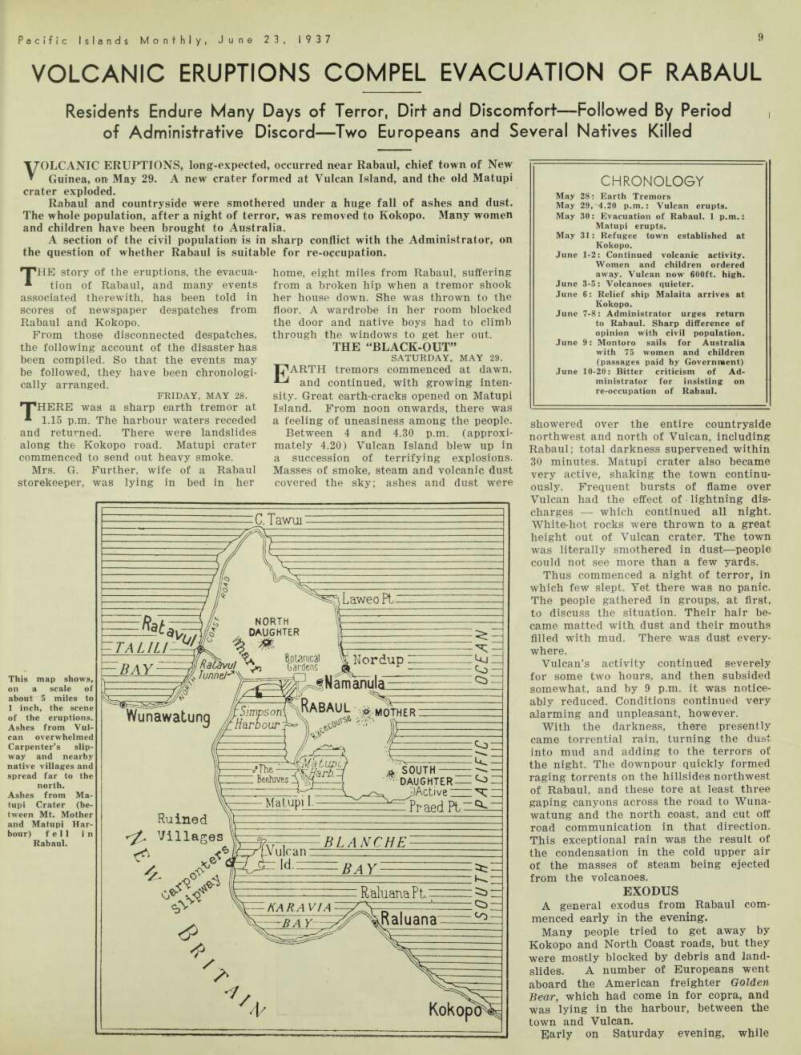
This map shows, on a scale of about 5 miles to 1 inch, the scene of the eruptions.
Ashes from Vul can overwhelmed Carpenter’s slip way and nearby native villages and spread far to the north.
Ashes from Ma tupi Crater (be tween Mt. Mother and Matupi Har bour) fell in Rabaul.
Vulcan was erupting in a terrifying man ner, large numbers of private cars, filled with fleeing families, went up the eastern road, towards Namanula and Nordup.
Women with small children crowded into the Namanula hospital, and the doors were closed, to keep out the dust and the sulphur fumes. The fumes, outside, were overpowering, while inside, the heat was unbearable.
Cars continued to arrive, adding to the dirt and confusion. The later arrivals were literally covered with ashes and pumice dust. There were innumerable urgent inquiries after friends and rela tions, but no panic. The children were gathered into special rooms at the hospi tal, out of the dust and fumes. The par ents sat up all night.
Captain Eugene Olsen, of the Golden Bear, decided to get out of the harbour, and in the darkness he ran the gauntlet between Vulcan and Matupi, through water covered with masses of dust and cinders. He got his ship safely out into Blanche Bay, and then he went around to Nordup, where he lay for the rest of the night.
The New Guinea people expressed much gratitude to this American captain and crew.
Radio Men’S Troubles
The radio operator on the Golden Bear, Victor Castner, an American, aged 45, was ashore when Vulcan erupted, and was never seen again. Probably, he fell into the harbour when trying to get aboard, through the dust and darkness.
Because the eruption was threatening the radio station in Rabaul, the mainten ance of the Golden Bear outfit was neces sary; and Mr. S. W. Faulkner, a member of the staff of W. R. Carpenter and Co., volunteered to take over the station.
Mr. Faulkner was confronted with a great pile of official and private messages, awaiting transmission, but he stuck gal lantly to his big task. For a time when the A.W.A. men were driven out by sul phur fumes and ash, Mr. Faulkner’s radio
was the only means of communication with the outside world.
The radio receiving station at Mala guna (two miles from Rabaul) was in danger, and the Rabaul inspector, Mr.
Twycross, advised the operator on duty, Mr. L. C. Coleman, to leave. Mr. Coleman remained, however. Meanwhile, Mr. C. H.
Sturgeon, another operator, got the wo men of the radio station into a car, and set out for the north coast. They en countered dust, ashes, mud and torrential rain; Mrs. Thomas fell and broke her leg; but they got through. Mr. Sturgeon tried to return, but was held up by a cloudburst and washaways.
At the transmitting station, in Rabaul, Mr. C. B, Alexander was making every effort to keep the equipment in action, but when cinders, sulphurous smoke, and mud overwhelmed him, and the power plant broke down, and he could no longer see, he gave it up. Thus, for a little while only, was Rabaul station off the air —actually, from 6 p.m. on Saturday until 12.15 a.m. on Sunday.
Evacuation Of Town
Sunday. May 30.
DY Sunday morning, Vulcan had become quieter, but Matupi’s activity had markedly increased.
Judge Phillips, in the absence of the Administrator and Deputy Adminis trator, took charge of the situa tion. He decided upon the immediate evacuation of the town’s population to Kokopo, via Namanula and Nordup. He found that, during Saturday night and in the early hours of Sunday, a large pro portion of the European population had gathered on the hill at Namanula, be hind Rabaul, where there are a few resi dences, Government House and the Euro pean hospital: and women and children had been cared for there.
An emergency organisation was quickly put into operation, to take care of mobi lisation, transport and supplies. Police and special messengers were sent out in all directions, instructing the people (800 Europeans, 1,000 Chinese and over 5,000
natives) to assemble quickly at Naina nula and Nordup.
The organisation was:—Judge Phillips in charge of Rabaul and district; Mr.
W. B. Ball in charge of police and essen tial services; Mr. R. Melrose in charge of stores; Mr. H. A. Gregory in charge of Nordup Beach; Mr. D. Waugh, assisted by a committee of officials and residents, in charge of Kokopo and district. On the medical side, Dr. R. W. Cooper was in charge of Rabaul and district, and Dr. T. C. Backhouse of Kokopo and dis trict.
These officers were assisted by bodies of officials and civilians and, in the cir cumstances, extraordinarily good work was done. The difficulty of removing some 8,000 people, from a smothered town, over choked roads, with improvised transport, supplies and shelter, can be better imagined than described.
As the people assembled, they were drafted to cars, and taken to Stony Beach at Nordup. It is about two miles from Rabaul to Namanula, and another two miles from Namanula to Nordup. Trans port was exceedingly difficult. The roads were choked with dust, ashes and smash ed trees, and many cars had been buried.
There were hours of weary waiting in the heavy, humid heat, amid dust and discomfort, but there were few com plaints. They were “all in it together.”
The Golden Bear, which had come round to Nordup during Saturday night, was the first to receive refugees from' Nordup beach. But all sorts of schooners and small craft were pressed into ser vice. There was only*a small wharf — the larger craft had to lie off, both at Nordup and Kokopo.
The officials, willingly assisted by vol unteers, worked tirelessly. They not only had to shift the entire population, but they also had to provide for their shelter and food. It was declared to be “a state of emergency,” and transport and sup plies were commandeered as required.
That some 8,000 people, with food and equipment, and including aged folk and the inmates of hospitals, were got away from Nordup beach between 6 a.m. and 6 p.m., with improvised transport, was a masterpiece of organisation, co-opera tion and hard work, for which full credit must be given to Judge Phillips and his officials.
Patients from the European hospital were carried out, and down the beach by natives, on stretchers and mattresses.
Native patients from the Rapindik hospital were similarly removed. Some went crazy with fear and fled, however.
Four, one of them a woman, were found on Monday, wandering naked in the de serted town.
The gaol was opened and the prisoners set free. In the following week, they helped to clean the streets and returned to gaol of their own accord.
Matupi Eruption
HTHE embarkation was proceeding with orderliness at Nordup, and the Golden Bear was on her way to Kokopo with a load of Europeans and natives, when Matupi exploded (about 1 p.m. on Sunday). There was a momentary panic
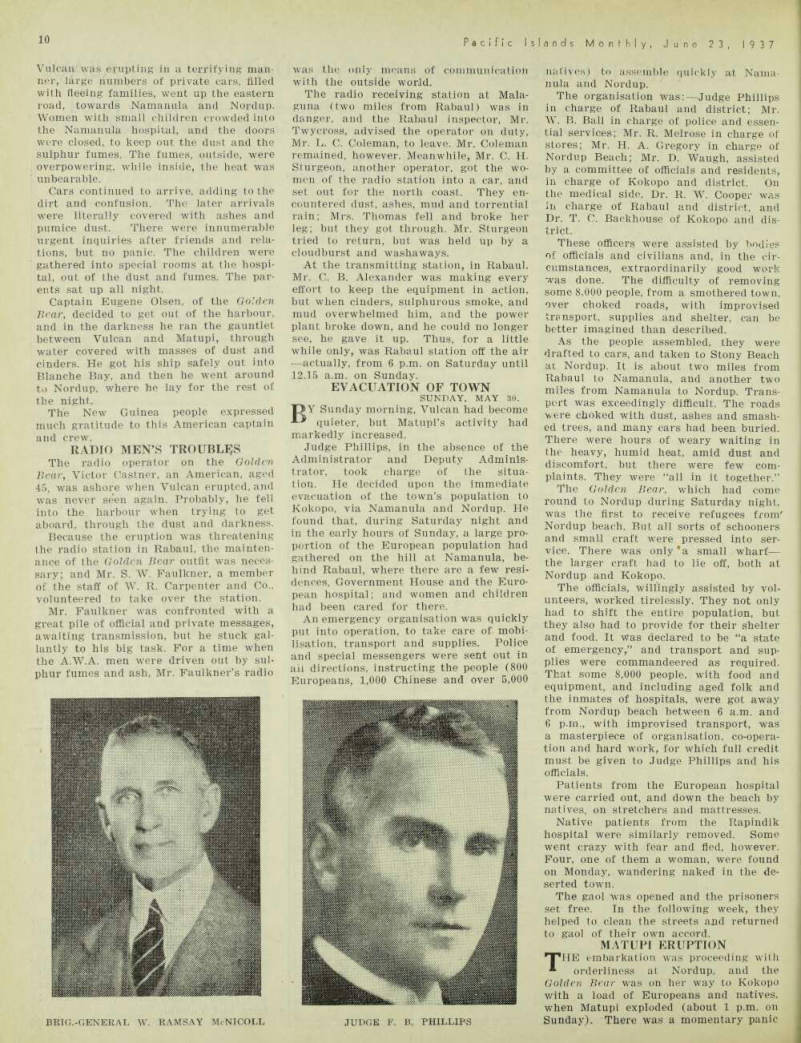
Brig.-General W, Ramsay Mcnicole
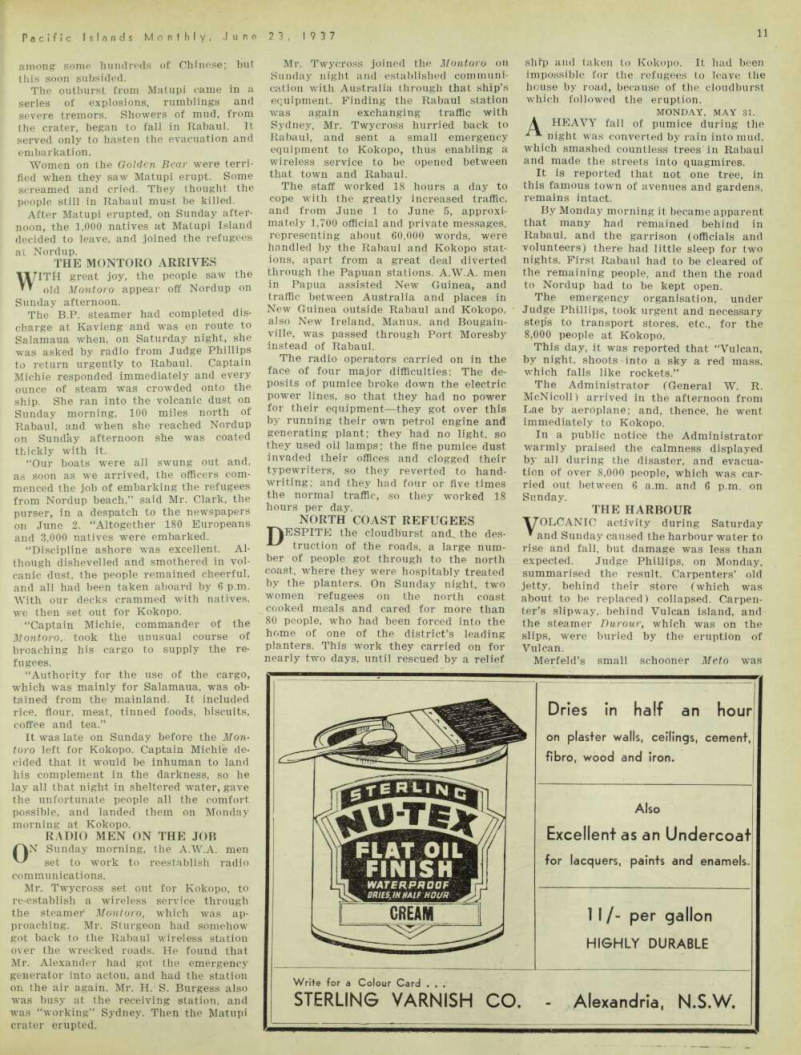
Judge F, B, Phillips
among some hundreds of Chinese; but this soon subsided.
The outburst from Matupi came in a series of explosions, rumblings and severe tremors. Showers of mud, from the crater, began to fall in Rabaul. It served only to hasten the evacuation and embarkation.
Women on the Golden Bear were terri fied when they saw Matupi erupt. Some screamed and cried. They thought the people still in Rabaul must be killed.
After Matupi erupted, on Sunday after noon, the 1,000 natives at Matupi Island decided to leave, and joined the refugees at Nordup.
The Montoro Arrives
linTH great joy, the people saw the ▼▼ old Montoro appear off Nordup on Sunday afternoon.
The B.P. steamer had completed dis charge at Kavieng and was en route to Salamaua when, on Saturday night, she was asked by radio from Judge Phillips to return urgently to Rabaul. Captain Michie responded immediately and every ounce of steam was crowded onto the ship. She ran into the volcanic dust on Sunday morning, 100 miles north of Rabaul, and when she reached Nordup on Sunday afternoon she was coated thickly with it.
“Our boats were all swung out and, as soon as we arrived, the officers com menced the job of embarking the refugees from Nordup beach,” said Mr. Clark, the purser, in a despatch to the newspapers on June 2. “Altogether 180 Europeans and 3,000 natives were embarked.
“Discipline ashore was excellent. Al though dishevelled and smothered in vol canic dust, the people remained cheerful, and all had been taken aboard by 6 p.m.
With our decks crammed with natives, we then set out for Kokopo.
“Captain Michie, commander of the Montoro, took the unusual course of broaching his cargo to supply the re fugees.
“Authority for the use of the cargo, which was mainly for Salamaua, was ob tained from the mainland. It included rice, flour, meat, tinned foods, biscuits, coffee and tea.”
It was late on Sunday before the Mon toro left for Kokopo. Captain Michie de cided that it would be inhuman to land his complement in the darkness, so he lay all that night in sheltered water, gave the unfortunate people all the comfort possible, and landed them on Monday morning at Kokopo.
Radio Men On The Job
/'AN Sunday morning, the A.W.A. men ” set to work to reestablish radio communications.
Mr. Twycross set out for Kokopo, to re-establish a wireless service through the steamer Montoro, which was ap proaching. Mr. Sturgeon had somehow got back to the Rabaul wireless station over the wrecked roads. He found that Mr. Alexander had got the emergency generator into acton, and had the station on the air again. Mr. H. S. Burgess also was busy at the receiving station, and was “working” Sydney. Then the Matupi
crater erupted.
Mr. Twycross joined the Montoro on Sunday night and established communi cation with Australia through that ship’s equipment. Finding the Rabaul station was again exchanging traffic with Sydney, Mr. Twycross hurried back to Rabaul, and sent a small emergency equipment to Kokopo, thus enabling a wireless service to be opened between that town and Rabaul.
The staff worked 18 hours a day to cope with the greatly increased traffic, and from June 1 to June 5, approxi mately 1,700 official and private messages, representing about 60,000 words, were handled by the Rabaul and Kokopo stat ions, apart from a great deal diverted through the Papuan stations. A.W.A. men in Papua assisted New Guinea, and traffic between Australia and places in New Guinea outside Rabaul and Kokopo, also New Ireland, Manus, and Bougain ville, was passed through Port Moresby instead of Rabaul.
The radio operators carried on in the face of four major difficulties: The de posits of pumice broke down the electric power lines, so that they had no power for their equipment—they got over this by running their own petrol engine and generating plant; they had no light, so they used oil lamps; the fine pumice dust invaded their offices and clogged their typewriters, so they reverted to hand writing: and they had four or five times the normal traffic, so they worked 18 hours per day.
North Coast Refugees
TAESPITE the cloudburst an<L the des truction of the roads, a large num ber of people got through to the north coast, where they were hospitably treated by the planters. On Sunday night, two women refugees on the north coast cooked meals and cared for more than 80 people, who had been forced into the home of one of the district’s leading planters. This work they carried on for nearly two days, until rescued by a relief
ship and taken to Kokupo. It had been impossible for the refugees to leave the house by road, because of the cloudburst which followed the eruption.
Monday, May 31.
A HEAVY fall of pumice during the night was converted by rain into mud, which smashed countless trees in Rabaul and made the streets into quagmires.
It is reported that not one tree, in this famous town of avenues and gardens, remains intact.
By Monday morning it became apparent that many had remained behind in Rabaul, and the garrison (officials and volunteers) there had little sleep for two nights. First Rabaul had to be cleared of the remaining people, and then the road to Nordup had to be kept open.
The emergency organisation, under Judge Phillips, took urgent and necessary step's to transport stores, etc,, for the 8,000 people at Kokopo.
This day, it was reported that “Vulcan, by night, shoots into a sky a red mass, which falls like rockets.”
The Administrator (General W. R.
McNicoll) arrived in the afternoon from Lae by aeroplane; and, thence, he went immediately to Kokopo.
In a public notice the Administrator warmly praised the calmness displayed by all during the disaster, and evacua tion of over 8,000 people, which was car ried out between 6 a.m. and 6 p.m. on Sunday.
The Harbour
'l/'OLCANIC activity during Saturday * and Sunday caused the harbour water to rise and fall, but damage was less than expected. Judge Phillips, on Monday, summarised the result. Carpenters’ old jetty, behind their store (which was about to be replaced) collapsed. Carpen ter’s slipway, behind Vulcan island, and the steamer Durour , which was on the slips, were buried by the eruption of Vulcan.
Merfeld’s small schooner Meto was
washed into the garden of Mr. Townsend, the treasurer at Rabaul.
The schooner Feads sunk at her moor ings.
Two Carpenter steamers —Durour (820 tons) and Duris (671 tons), which were trapped in the harbour and lost—were valued at £20,000.
The little wooden motorship Desikoko, though trapped in the harbour, even tually escaped, on June 2. Half-way out her engine, clogged with pumice, stopped, but it was restarted, and the vessel got clear.
The smaller of the two “beehives,” which are coral outcrops in the centre
of the harbour and well-known land marks, disappeared beneath the water.
A New Mount
Tuesday, June 1.
volcano was now reported to * be a cone over 600 feet high. On Saturday morning, it was a small, very low island, which appeared after an eruption in 1878. The crater which erupted on Saturday was quiescent; but, at 12.20 p.m., another violent eruption occurred, and a new crater appeared on the eastern side of the cone. This time, the ashes did not fall on Rabaul.
It was reported, this day, that the uprising of Vulcan had filled up the for mer deep water between the island and the mainland; and that land had ap peared between Vulcan and Matupi is land, suggesting that the harbour (Simp scnhaven) had become landlocked. Sub sequent inquiry showed that what ap peared land was really floating pumice, and that the channel was open.
Destruction Of Cars
A NEWS despatch of this date:— Evidence of the hurried escapes from Rabaul can now be seen.
Cars which apparently refused to run, and others which have been wrecked, are scattered along most of the outer roads.
At Nordup beach, where many hundreds ot people were embarked, there are two paddocks choked with cars.
Scores of cars were nearly buried in the wrecked streets, where they stood before the eruption occurred. It is esti mated that damage in this respect alone amounts to £200,000.
Several cars on the north coast road at the time of the cloudburst after the eruption were caught up in torrents of water and swept into the sea.
All the remaining cars in Rabaul and in Kokopo were commandeered by the Administration, which supplied, the pet rol necessary, and used them under the state of emergency. Owners among the refugees, who up to this time had com plained very little, were now anxious to find out the possibilities of compen sation.
It was reported, only in April, that there were over 1,000 motor cars and trucks centred on Rabaul.
Administrator’S Summary
IN a statement circulated throughout the community at Kokopo, on June 1, the Administrator said:- “A state of emergency continues to exist, and the Administration has taken over control of all essential services.
“Rabaul will be untenable for many weeks. The water supply has become polluted, and no sanitation arrangements are at present possible.
“The present bad position will be in tensified when the rain comes, as the roofs of all houses are thickly covered with volcanic dust, which will become thick mud immediately it rains.
“In the circumstances, it is necessary to restrict the number of persons who may visit Rabaul.
“Only those officials on duty and others with urgent business to attend to will
be allowed to proceed from Kokopo and land at Nordup. Written authority must first be obtained.
“The public can assist greatly by selec ting from among themselves messengers to collect needed household articles left behind in the hurried evacuation. Heavy articles, other than cases containing es sential clothing requirements, may not be removed.
“The roads at present are fit for traffic only from Nordup to the Burns, Philp garage. Beyond that, the roads are strewn with fallen branches, so that the col lection of more than essential require ments is impossible.
“On my arrival at Kokopo from Lae I was greatly relieved to observe the stoic calm with which the residents of Rabaul and district were accepting the unfor tunate situation that has been forced upon them.
“We will hasten the work of clearing the debris in every way, but some little time must elapse.
“It is extremely desirable that as many women and children as possible proceed to Australia.”
Wednesday, June 2.
A LL three volcanoes, Vulcan, New Vul can and Matupi, were active; but the wind was favourable, and the show ers of ash and pumice missed the town.
Said one commentator, on the 2nd: “The pall of black ash over the land and sea contrasts vividly with the towering column of white smoke, reflecting the brilliant sunshine.”
Friday, June 4.
'"PHE Administrator declared that every * thing at Rabaul would be functioning normally within a week; but the business community and the public service would not accept this view.
Saturday, June 5.
HPHE Rabaul-Kokopo road had now been partly cleared, and motor transport was able to make two return trips per day, with supplies for the people at Kokopo.
Administrator V. Civil
Population
Monday, June 7.
*T*HE Administrator on June 7 issued a * despatch announcing that he con sidered that Rabaul was habitable, that the departments would be brought back from Kokopo within a few days, and that no further rations would be issued to refugees at Kokopo after midnight on Wednesday, June 9.
On June 7, the Administrator informed the Australian Minister, Mr. White, by radiophone: “There was no reason why Rabaul should not be in full occupation as a capital by the end of the week.”
This day, it became apparent that there was a sharp division of opinion between the Administration and commercial in terests on the question of the immediate re-occupation of Rabaul. Representatives of business firms were unanimous that it would be wiser to wait and make sure that there would not be any recurrence of the volcanic activity, but they agreed to co-operate by giving the Administra tion control of their goods and equipment until the present emergency passed.
On Monday, June 7, for the first time, women were allowed to visit Rabaul—
but only to collect personal belongings, to take to Australia. They were pre pared for the worst, but they said later they had not believed that such condi tions of dirt, destruction and disorder could be possible.
Tuesday, June 8.
DY June 8, electric light and power services had been practically res tored, thus allowing the two freezers (Carpenters and the Rabaul Freezing Co.) to regularly supply fresh food, and other establishments to operate.
In an interview on June 8, General McNicoll said that suggestions for the transfer of the capital away from Rabaul could be classed as a form of hysteria.
Wednesday, June 9.
9 1 ’HE heads of the leading firms were * emphatic on June 9 that they would
not take their full staffs back to Rabaul while it remained as at present—a mass of dried mud and penetrating, nauseous dust.
“We are not going back at present; my opinion has not been changed by any despatch,” said Mr. P. Coote, manager of Burns, Philp and Co. Ltd., in New Guinea. He said the company would operate on a small scale to serve the small population which would be return ing to Rabaul. As the population of the town increased the operations of the firm would increase. He said that he preferred to take medical advice before that of anyone else.
The general manager for New Guinea of W. R. Carpenter and Co. Ltd., (Mr.
W. H. Carpenter) said that the only way to clean Rabaul was to get everything possible out of the town and to send 2,000 or 3,000 labourers to scour the place. His company had no intention of abandoning Rabaul, but its premises would only be kept open at present for the use of the plantations, and not for ordinary business. His idea was to keep a skeleton staff of 10 there for that pur
pose, and to remove everything he could to Kokopo.
Mr. Carpenter said that he refused to let his staff work at a place where there was 2,000,000 tons of dirt to shift, and which was filthy. He could not ignore the health of the employees, and the 10 men who would work at Rabaul would return to Kokopo each night. He had learnt that the chiefs of the native tribes had ad vised their people not to go back, to Rabaul, and it was well known that many natives had refused to go back.
He thought that the Administrator’s despatch suggesting a return to normal had been issued several months too soon.
It was reported this day that some public servants do not disguise the fact that they are opposed to returning to Rabaul. They state that they will not return unless ordered to do so. They are anxious for the Commonwealth Govern ment to take some action..
On June 9, the Administration called the eruptions a “nine days’ wonder’’; declared that the majority of people were anxious to return to Rabaul; and declared that a radio broadcast descrip tion of Rabaul by the A.B.C. was “largely exaggerated and inaccurate.”
The latter statement was sharply chal lenged by the chairman of the A.B.C.
Thursday, June 10.
THERE was a sharp tremor, in which buildings rocked noticeably, early on Thursday evening, followed by a burst of activity from Vulcan, but there were no serious developments.
By this time, all residents of Rabaul had taken to wearing masks in the streets to avoid breathing the irritating dust. The Administration, in an effort to cope with the dust nuisance, began pumping water from the harbour through fire hoses, on to the nearer streets.
Many live electric wires were still ly ing about, and one native, coming in con tact with a wire, was killed.
It was noted, this w r eek, that pumice was floating so thickly upon the harbour that vessels had difficulty in moving through it. Persons could walk easily over the surface of the water, upon the pumice.
Friday, June 11.
HUNDREDS of Chinese responded to the Administrator’s invitation to go back to Rabaul and reopen their shops.
In a large number of cases, however, they just took one look at their shops— and returned to Kokopo. Consequently, it was reported on June 11 that very few of the shops in Chinatown, Rabaul, were open.
Occupation Of Rabaul
OIGHT up until June 20, daily reports in Australian newspapers described the choking dust which filled the streets of Rabaul. the unwillingness of the people to return, and their resentment of the attitude of the Administrator.
Sir George Pearce, Australian Minister for Territories, on June 16, publicly an nounced that he was ignoring the com
(Continued On Page 71)
plaints against the Administrator, who was being left alone by the Government to carry out his difficult work.
Women And Children Leave
THE Administration agreed to pay the cost of the passages of women and ch Idren sent away from Rabaul.
As a result 75 women and children and two invalids sailed from Kokopo by the Montoro on June 9. (See section “Pacific Travellers” for names).
Others were to leave for Australia by the Tanda on June 15 and Neptuna on June 22.
Absent Executives
BY a coincidence, both the Administra tor and his deputy (Judge Wanliss) were away when the disaster struck the town.
The Administrator was over in Wau, on the Morobe goldfield. On Sunday, Mr.
Harry Balfour, radio operator for Guinea A’rways at Lae, chanced to hear the news in a broadcast from Australia. Mr.
Chater, general manager for G.A., at once sent the new r s to the Administrator at Wau. The Administrator, that day, flew down to Lae; and, next day, in a three* engined Ford plane, in charge of Messrs.
Turner and Isler (two of Guinea Airways best men) he flew 500 miles along the south coast of New Britain to the new aerodrome near Rabaul. The plane car ried enough petrol for the return trip had a landing been impossible.
Judge Wanliss has been in poor health and he has been, at nights, an inmate of the European hospital. On Saturday, May 29, accompanied by one of the nurses, he was allowed to motor to Kokopo; and on Saturday evening, when Vulcan erupted alongside the Kokopo road he could not get back to Rabaul.
On Sunday, he made a most determined effort to get back by using an old track round the back somewhere near Keravat to the north coast road, at Tovakundum plantation. Here, however, he found that the road had been cut to pieces by tor rents, and he could motor no further. He then took passage on a Japanese trading schooner Asakaze , but that vessel ran aground near Natava. The judge even tually got back to Kokopo, on the schooner, via Nordup, after the evacua tion had been carried out by Judge Phillips.
Damage To Plantations
damage has been done to the country northwards and west wards of Rabaul—not half the tale has yet been told. Two things smote the countryside simultaneously a heavy, suffocating shower of ashes and pumice, and a cloudburst (the result of condensed steam from the volcanoes) which liter ally swept away wide areas of planta tions. Tens of thousands of trees will have to be replaced.
There are few details, yet, of damage on individual plantations.
It is reported that Mr. George Wash ington’s Kaibara plantation has been
practically wiped out. He was about to retire.
Natava (Mr. J. C. Mullaly) escaped lightly. A small part of Tovakundum (Mr. Heron) was damaged.
Mr. George Murray, Director of Agri culture, told the newspapers that many of the blackened coconut palms will re cover, but they will take two years to bear again. “On the other hand," he added, “many thousands must be ruined.
But it is the effect of the pumice on the soil which worries me. I am having samples of this pumice sent to the Waite Institute in Adelaide for analysis, and I shall watch anxiously for the result.”
Walked On Floating Pumice
jyfANY stories of individual acts of bravery are being recounted. An out standing example of heroism was that of Mr. Frank Venning, formerly one of the best-known swimmers in Queensland.
Venning was a member of a party which left Rabaul after the eruption. Torren tial rains fell, causing the formation of new rivers.
As the party was crossing one of these streams near its mouth a Mrs. Ellis was washed away. Venning swam after her, and after a long struggle he brought her ashore. He swam across a second river with a rope, by which other members of the party followed.
Rather than attempt to cross another river, the party made for the sea and passed the mouth of the river by walk
ing on floating pumice for about 50 yards.
The pumice was so thick that it easily bore their weight.
£30,000 In Transit
\ SUM of £30,000 in specie, etc., was hurriedly removed from the banks in Rabaul to Kokopo on Sunday night. In the transfer, says one report, the wealth was nearly lost in the sea.
It was packed into dinghies at Nordup beach while the craters were erupting, and in the silver moonlight of a tropical night was rowed by kanakas to a schooner standing half a mile off the shore. A strong surf was running, and on several occasions the dinghies were nearly upset.
Fatalities Among Natives
r T , HERE have been fatalities among the * natives, but most contradictory re ports have been received concerning the numbers. Catholic missionaries, about
June 5, estimated that 261 natives had been killed by the smothering showers of pumice and ash from Vulcan, which fell upon the villages of Tavui and Walaur on the coast nearby.
The Administrator, on the other hand, declared that the natives were only mis sing, and probably would be found to have escaped to other tribes. On June 12, he estimated the dead at 18.
Mr. T. V. Wallace, it is reported, climbed over the pumice-covered area of Keravia, adjacent to Vulcan, to find that nine European houses, including his own, had completely disappeared. Two hun dred feet of ashes cover most of the area.
The native villages of Tavaua, Vuna mame, Valaur, and Rapollo have also dis appeared. Keravia is mostly covered, and Upper Rapollo smashed.
Loss Of Life
TWO Europeans lost their lives. * The disappearance of Mr. Costner (a ship’s radio officer) is referred to else where.
Mr. W W. Elworthy, 28, engineer, at the light and power station, left Rabaul in his car about 3 p.m, on Saturday, to take close-up photographs of Malupi crater and did not return. Although Matupi’s biggest explosion did not occur until Sunday, it became exceedingly ac tive soon after 4 p.m. on Saturday, and there is little doubt that Mr. Elworthy was overwhelmed and killed. He was very popular in Rabaul. His parents live in Sydney. He had resigned, and would have returned to Australia within a few weeks.
Dairyman’S Loss
jVfR. H. R. Reed, the only dairyman in Rabaul, has lost everything, but says he is going to start all over again.
His farm was at Valaur, the nearest point on the land to Vulcan Island. His 18 imported Holsteins and Jerseys are all dead. Some of their carcasses have been seen floating in the harbour. His house has been completely buried, and there is no trace of it. Mr. Reed esti mates his loss at £l4OO. He intends to begin operations afresh at some different part of Rabaul.
Narrow Escapes
OFFICERS from the Durour, lying on the slip opposite Vulcan Island, were interested to see the island rising slowly on Saturday, May 29, and went in a boat to investigate. They got away just in time—and, as they landed and ran, they were pelted with cinders and pumice.
They lost all their personal possessions on the Durour.
Similar curiosity almost cost two lead ing officials their lives. Mr. E. W. P.
Chinnery, Director of Native Affairs, his wife, and Mr. G. H. Murray, Director of Agriculture, borrowed a motor boat belonging to the Durour and went to inspect the new reefs. Suddenly the north end of Vulcan Island rose out of sea and shut off their return to the Durour. They turned to go back to Rabaul, but 100 yards away an eruption took place. They were in an awkward predicament, so they ran the boat aground, hastily scrambled out, and rushing to the slipway, found that their car had gone. They took pos session of another one, and luckily got out of a dangerous situation. After driving his wife into Kokopo, Mr. Chinnery re turned to Rabaul, and assisted in evacua tion work until Sunday. He received severe head injuries when a car in which he was a passenger crashed into a falling palm tree. He was taken to the Vuna pope Mission Hospital.
Help Given By Ships
SEVERAL ships assisted the distressed people of Rabaul.
The American freighter Golden Bear was in Rabaul on May 29, and willingly gave most valuable help. The 8.. P. liner Montoro arrived on May 30, and assisted in the evacuation. The inter-island steamer Island Trader arrived at Kokopo on June 3, with a much-needed supply of fresh water. H.M.A.S. Moresby, Austra lian survey ship, was rushed from the Gulf of Carpentaria to Rabaul, where she arrived on June 5; she surveyed the har bour, pronounced it safe, and left/ on June 12. The inter-island steamer Maiwarra arrived off Kokopo on June 5 with stores and fresh water. The liner Malaita, specially diverted from the Solomon Is. run as a relief ship, arrived off Kokopo on June 6, from Brisbane direct, with food and equipment supplied by the Australian Government.
Offers Of Help
OFFERS of help were received by the Administrator from all directions.
Sir Walter Carpenter offered his firm’s hotels at Salamaua, Wau and Madang, for the use of refugees. Guinea Airways Ltd. offered to place aeroplanes unreser
vedly at the disposal of the officials and, if necessary, to send a big freight-carrier from Lae to Kokopo with three tons of foodstuffs. The Bishop of Melanesia of fered to send the Mission ship Southern Cross. Radiograms poured in from Aus tralia. Fortunately, these special relief measures were not needed.
Ravuvu Wrecked And Pillaged
INURING the first week of the evacua tion, officials ridiculed the report that there had been pillaging and looting of empty houses by natives. Later infor mation shows that losses from this cause have been fairly widespread and severe.
Natives have helped themselves, and then apparently escaped into the bush.
One of the worst sufferers was Mrs.
H. R. Garton, 73 years of age. Before the eruptions she conducted a popular tearoom and a private swimming bath at Ravuvu, three miles from Rabaul, on the edge of the harbour. She returned to find her place a wreck.
It was evident that a tidal wave had gone right through the house, and that both the house and the beautiful garden had been smothered in ashes; but, what was even worse, the interior had been thoroughly and systematically pillaged by natives.
Archdeacon H. Mayo Harris, the Anglican vicar of Suva, has left for England at the request of the Polynesian Synod to obtain support for an endow ment fund of £lO,OOO, an appeal for which was recently launched by the re vised Polynesian Association in Britain.
Chronology
May 28* Earth Tremors May 29, 4.20 p.m.; Vulcan erupts.
May 30: Evacuation of Rabaul. 1 p.m.: Matupi erupts.
May 31: Refugee town established at Kokopo.
June 1-2: Continued volcanic activity.
Women and children ordered away. Vulcan now 600 ft. high.
June 3-5: Volcanoes quieter.
June 6: Relief ship Malaita arrives at Kokopo.
June 7-8: Administrator urges return to Rabaul. Sharp difference of opinion with civil population.
June 9: Montoro sails for Australia with 75 women and children (passages paid by Government) June 10-20: Bitter criticism of Ad ministrator for insisting on re-occupation of Rabaul.
Advertisements & other items, pp. 13-16 (2 items)
t4UT6>
m
CREAM
Write for a Colour Card . . .
STERLING VARNISH CO.
Dries In halt an hour on plaster walls, ceilings, cement, fibro, wood and iron.
Also Excellent as an Undercoat for lacquers, paints and enamels. 11/- per gallon
HIGHLY DURABLE
Alexandria, N.S.W.
RECORDS
Packed Free and sent C.O.D. without extra charges.
H.M. Voice Slightly-used Portables, delivered straight to your nearest port for I £3/15/-
SEND FOR LATEST RECORD LISTS
Talkeries Music Stores
451 Queen Victoria Buildings
SYDNEY
The WATSOI “€.IV”
PORTABLE X - RAY APPARATUS
as a NOBILE UNIT . . .
The Mobile Carriage can be obtained as an addit’onal accessory. It IS really mobile.
A child could wheel it —very unlike the average apparatus, which is mobile in name only.
The Mobile Carriage has many exclusive features. As an instance, there is a tunnel protected against X-Radiation to carry loaded cassettes. At the base is a long cupboard with an. oval opening which will hold auxiliary appliances.
PORTABILITY and MOBILITY are combined, and when a Mobile carriage is purchased, portability is not sacrificed, as the Unit may be removed and mounted in carrying case in one minute. arsl, ■f J r •m.
WATSON HOUSE. 13 BLIGH STREET, SYDNEY
Melbourne, Brisbane, Adelaide, Newcastle, Perth, m
The Mobile Unit ready
for transport.
AnrJ Mpw
WHEN SPENDING YOUR VACATION IN SYDNEY YOUR CHOICE OF RESIDENCE IS A MATTER SO VITAL TO YOUR ENJOYMENT!
May we commend to you for All-round Excellence
SYDNEY'S MOST EXCLUSIVE PRIVATE HOTEL
"44 MACLEAY STREET"
Here for H. & C. you await unrivalled Water and Telephones in »v*
Ipi. @5
Service and Cuisine—Suites with Private Baths— all rooms—Magnificent Harbour Views Roof Garden Sun Rooms Spacious Lounges and Smolce Rooms and every modern convenience All under Personal Supervision of the Proprietress,
MISS M. E. BURROWS
per week inclusive.
Radios;
"FORTYFOR'
Sydney.
Telephone: FL 2641 a r. 4
SMOKERS'
REQUISITES
THIS GENUINE
CALABASH
f or , 7/6 honest
30/- Silver Mounted “L. & Co.” and “Barling” Briar Pipes worth 25/-, to you for 17/6. Write for illustrations. In Safety Razor Outfits, I have “Gillette,” “Valet,” “Rolls,” and “Wilkinson.”
A genuine “Cadman” Bengali Blade Razor, valued at 12/6, my special price, 7/6.
INQUIRIES OF ANY DESCRIPTION
I WELCOME
SOL LEVY E “. ed
713 George St,, Haymarket, Sydney, Australia.
Don't r or
Established 1914.
We stock the very
tamper with Eyestrain
Use the Modern Method and
Flood your home with the Best
Light on the market . . .
WIZARD CAS
SYSTEMS FOR COUNTRY HOMES.
Beautiful, modern, safe, efficient and economical.
Wizard Gas, the most favored country light in Australia.
Cheaper than electrical plants both to buy and to burn.
Consider long and carefully before you pass it by for another.
HOME PLANTS FROM £l4.
Stoves for heating and cooking in Island and Country homes. Prices from £7/10/- f.o.b.
The new WIZARD shades and fittings are a triumph of modern craftsmanship and artistic design.
Wizard Lighting Co.
283 d GEORGE STREET, SYDNEY
best Mantles and Spare Parts for your lights.
LU-J.xu^rt-
, \ ■i \ \ n\
GUARD AGAINST
INFECTION Inj UdUWj
Tropical Diseases
Hold No Terrors
::: —if you use TENAX Daily
The germs of Diphtheria, Malaria, Dhobie Itch, Tinea and Surfer’s Foot, cannot harm you, if you are protected by the rich “Ti-trol” lather of TENAX.
TENAX is the ONLY soap containing oil distilled and marketed by Australian Essential Oils, Ltd., under the registered trade-mark ot “Ti-Trol,” eleven times quicker than carbolic as a germicide, but NON-POISONOUS and
NON-IRRITANT.
“The Medical Journal of Australia,” official organ of the 8.M.A., says: “TENAX is a satisfactory germicidal soap which may be recommended with confidence.”
A PRODUCT OF AUSTRALIAN SOAPS
LIMITED
TENAX
Oht OmMfiezu (!/efomecdat.
TOILET SOAP
Pacific Islands Stamps
Sent on approval on receipt of reference.
Send for free lists and specimen copy, "Australian Stamp Journal."
Collections and Loose Lots Bought
J. H. SMYTH LTD.
114 CASTLEREASH STREET, SYDNEY
St. Ignatius' College - Sydney
BOARDING and DAY SCHOOL
Conducted by the Jesuit Fathers
BOYS prepared for Inter-
mediate and Leaving Certificate Examinations and for Exhibitions, Scholarships and Bursaries at the
University.
Boys are arranged In three divisions according to age and size. Each division has its own library, debating society, cricket and football field, tennis court.
Senior and Junior Rowing Sheds.
Private Swimming Baths, Prospectus and Further Particulars on application to the Rector,
REV. J. MEAGHER, SJ.
Telephone: J 1106
ONE OF SYDNEY’S GREAT PUBLIC SCHOOLS
ZJJJJLfJL***
I I ■ m •,*r m W: 'Jd
14
Pacific lsian-ds Monthly, June 23, (937
About Islands People
Mr. Ivan Champion, an assistant resi dent magistrate in Papua, arrived in Sydney on May 31 by the Macdhui on three months’ holiday. Mr. Champion led an expedition through an unexplored area in Papua last year.
Messrs. H. Stevens, H. Morton and H.
Weekley, of the Tavua gold field, Fiji, recently visited Melbourne on business associated with the Emperor mine.
M. Marchessou, Governor of New Caledonia and Commissioner-General of France in the Pacific, made an official visit to the New Hebrides in April and, meeting all classes of people there, he made an excellent impression upon both the French and British communities.
Captain F. Stenbeck, who was drowned in the wreck of his scow Yvonne on the New Zealand coast, was held in high regard in Samoa and the Central Pacific, where he had been in command of small vessels for many years. He was a famous storyteller, and many tales and poems from his pen have been published. He had been mate and captain of over 40 different Islands vessels—his last com mand was the Burns Philp schooner Choiseul.
Mr. Albert F. Possin, an old resident of Samoa, died in Apia on May 25. He settled in Apia under the German regime in 1907, after having taken part in the Gauss South Polar Expedition. After serving the Government at the Obser vatory, and as Chief of Police, he filled various positions as trader and planter.
During the last few years he suffered from illness. His wife is chief typiste in the present Administration service, and his two children are at present in New Zealand. The burial service was attended by a representative gathering, including the Acting Administrator.
Brother Nicolas Schorn, a faithful and loyal member of the Roman Catholic Mission in Samoa, died in Apia after a long and lingering illness, at the age of 67. Brother Nicolas went to Samoa in 1906.
Major H. S. N. Robinson, general secretary and treasurer of the Melanesian Mission in Sydney, returned from New Zealand by the Monowai on June 8.
Mr. A. H. Bunting, M.L.C., of Samarai, Papua, who was booked for home by the early June Macdhui, had to go into the Chatswood Community Hospital, Sydney, for a minor operation. He expects to be in good shape again in July, in time for the Legislative Council meeting at Port Moresby.
Mr. and Mrs. N. G. Hides, and their two children, sailed from Sydney for their home in Papua, by the Macdhui early in June.
Mr. G. E. Banks, who has been ap pointed officer-in-charge of the Rabaul Electricity Company, sailed from Sydney for Rabaul, N.G., on June 5.
Mr. J. J. Gilmore, who has been a resident of New Guinea for over 16 years, left Sydney for his home early in June.
Capt. F. C. Rennels, of the New Guinea mission at Samarai, Papua, returned to the Territory from Sydney by the Montoro on May 23.
Mr. H. E. Snell, who has been secretary of Messrs. Morris Hedstrom Ltd., Suva, for 25 years, has been appointed general manager and secretary of the company, as from July 1.
Mr. Davies, the American aviator, who is in charge of the Sikorsky seaplane used by the Papuan Oil Development Ltd., in Papua, became ill while the seaplane was undergoing overhaul in Sydney early in June, and was sent to a private ward in St. Vincent’s Hospital. Probably, he will be there for four or five weeks.
Rev. and Mrs. A. J. Thompson returned to Papua in June after two years’ fur lough in England. Mr, Thompson is Rector of Samarai.
Mr. H. M. Smith, managing director of Guinea Airways Ltd., left Sydney by the Macdhul on June 5, on a business visit to Lae, New Guinea.
Mr. and Mrs. J. H. H. Millett returned to Fiji in May from a holiday abroad.
Rev. Mother Ursula, of the Convent of St. Joseph de Cluny, Suva, left for a holiday visit to France on April 30. She was accompanied by Miss A. Brailey, of Suva, who intends to join the order of §t. Joseph de Cluny.
(Continued Overleaf)
Mr. G. W. Marston has arrived in Apia, Western Samoa, to succeed Mr. E. E.
Dunwoodie, who for long years was Postmaster and Radio Superintendent in Apia.
He was accompanied by Mrs. Marston and their young daughter.
Mr. E. S. Neaverson has received an appointment with Ruston & Hornsby (Aust.) Pty. Ltd. as Interstate representative. Mr. Neaverson served an apprenticeship with the parent company in England and was later associated with Barford & Perkins prior to their amalgamation with Avelmg & Porter.
Mr. and Mrs. C. Southey, of Ba, Fiji, returned from leave on May 6.
Mr. H. L. Dowling, one of the best known district officials in New Guinea, returned to Rabaul by the Macdhui on June 5, after a visit to Sydney.
Mr . F A Rowle left for the Solomon Islands by the Ma y laita on May & 29 .“Sg* Rowley attended the Anglican General Synod in New Zealand in April, and spent some time in Australia before returning to Malaita, 8.5.1., where he is a teacher at Maka College.
Sister A- Bank Matron of the Metho . dist Mission’s Hospital for women and chi]dren at Ba> is making satig . factory progress, after an operation, at Melbourne.
Mr. J. S. Neill, British Consul and Agent in Tonga, passed through Auck land from Suva on the last trip of the Matua. Mr. Neill subsequently visited Pitcairn Island on official business, travel ling by the Ruahine from Wellington.
Mr. Neill, who was accompanied by Mrs.
Neill, will be back in Nukualofa in June.
The death occurred at Waiyevo, Taveuni, Fiji, early in May of Rev.
Father Villaine, a popular priest of the Roman Catholic Mission in Fiji. Father Villaine, who was born in France, went to. Fiji over 40 years ago, and had laboured in the Colony ever since.
Mrs. R. A. Gale, of Lautoka, Fiji, arrived in Sydney on June 6 by the Aorangi.
Mrs. H. G. Allen, a well known resident of New Guinea, sailed from Sydney for Wau by the Macdhui on June 5.
A wedding of interest took place in Suva, Fiji, on May 21, when Miss Alison Ellis, youngest daughter of the late Mr.
Gordon Ellis, of Chatswood, N.S.W., and Mr. Hamilton Reynolds Huntley, only son of Mr. and Mrs. Guy Huntley, of Turramurra, N.S.W., were married in the Church of England Pro-Cathedral by the Bishop of Polynesia (Rt. Rev. L. S.
Kempthorne). The reception was held at Macdonald’s Hotel.
Rt. Re v . Bishop Nicolas, S.M., Vicar Apostolic of Fiji, returned to the Colony from New Zealand on May 6.
Mrs. A. T. Collins, of Salamaua, New Guinea, arrived in Sydney on May 31 by the Macdhui.
Mrs. C. R. Doyle, of Kokopo, New Britain, arrived in Sydney at the end of May for three months’ holiday with her parents at Gunnedah, N.S.W.
Mr. F. C. Exon, A.W.A. manager in Fiji, returned on May 21, accompanied by Mrs. Exon and family.
Mr. Jim Lancon, of Ouesso Plantation, Port Sandwich, returned to the New Hebrides after a long vacation in Aus tralia by the Morinda from Sydney on May 27.
Mr. “Johnny” Young, direct descendant of Edward Young, “Bounty” mutineer, arrived in Sydney from Norfolk Island for the first time by the Morinda on June 17. For the past year he has been residing on Lord Howe Island.
Mr. S. O. Martin, who runs a sheep station on Erromanga Island, in the New Hebrides, returned after a holiday in Australia by the May Morinda.
Rev. E. Lawton, of the Melanesian Mission, Norfolk Island, arrived in Syd ney with his wife by the Morinda on June 17.
Mr. A. Nurton, A.D.0., in the New Guinea public service, who lost his left foot as the result of an attack by Rai Coast natives last year, was among those removed from the Rabaul Hospital when the eruptions occurred. He has been sent to Sydney, for another operation.
Captain H. G. Murday, harbourmaster at Thursday Island, has been transferred to Brisbane, and has been succeeded by Captain J. D. Gray, of Bowen, Q.
Advertisements & other items, pp. 17-18 (3 items)
15
Pacific’ Islands Monfhly, June 23, 193 7
Angus & Coote Sydney S R
Brisbane
By Special Appointment
Visitors!
While in Brisbane make Pike Brothers your shopping headquarters. Pike Brothers have been the leading suppliers of men's requirements for over 50 years—you will appreciate the personal attentive service which has enabled them to build up the reputation they now enjoy.
PIKE BROTHERS
Clothing Men and their Sons since 1885
QUEEN STREET - - BRISBANE
This
Stainless
Steel Lever
is the only
Watch for
the Tropics
E" LEVER
So successful has this watch proved, that Angus & Coote have been able to place very impressive repeat orders with the Swiss manufacturers. Reduced prices were therefore quoted—and Angus & Coote give their customers the benefit of the saving.
REVISED PRICES
The “Indestructible" Lever with chrome case and stainless steel back is 85/-. With dial it is 90/-. With case entirely of stainless steel —which is the model Angus & Coote si»3cially recommend for the tropics—it is 95/-. With luminous dial it is .€5. Safe delivery is guaranteed. Each watch comes complete with a strong, brickled suede strap.
ALL THE ABOVE WATCHES WERE FROM 10/- to 25/- HIGHER IN PRICE PREVIOUSLY All cases are hermetically sealed so that no dust or damp whatever can possibly gfcin access. The parts are all cushioned —so that an accident does not hurt; the movement.
They are splendid timekeepers, warranted to ,give 25 years’ wear, arid kept in order for two years by Angus & Coote. Recommended by all who have tested them.
Catalogues of Watches, Jewellery, Silverplate, Cutlery, etc., Posted FREE Anywhere.
S*l Q
IT IS THE " INDESTRUCTIB
ANGUS & COOTE SYDNEY S R
B. & S. Estate Agency
“ ROSEVILLE, SYDNEY
Specialising in Flat reservations, any suburb, for Island Residents visiting Sydney. Correspondence invited. ’Phone J 5269, Proprietor - - Campbell M. Smith
Here’s the
You Need^
KEROSENE
or
BENZINE
200 to 300
Candle Power
Rain Gale Insect Proof.
COLEMAN LANTERNS are
the most Scientifically constructed Lantern made. o N o / / r \ X
oleman kerosene
(COAL OIL)
MANTLE LANTERNS
And to the above splendid qualities must be added the following : Positive Shut-off Valve. Pump built in, with Positive Ball Valve and Air stem. Roto Generator. Porcelain Enamelled Ventilator. Genuine Coleman Clear Glass Pyrex Globe.
BUILT TO LAST BUILT FOR LIGHT
These and all other Coleman Lamps, Lanterns, Irons and Stoves are procurable from . , .
Coleman Lamp & Stove Co., Toronto, Canada.
Burns Philp & Co. Ltd., Burns Philp (South Seas) Co. Ltd., W. R, Carpenter & Co. Ltd., Morris Hedstrom Ltd., Steamships Trading Co. Ltd., Whitton Bros. Ltd., or Coleman Quiclc-Lite Co., 500 Kent Street, Sydney.
About Islands People
Tom Harrisson’s Exploits in
New Hebrides Sharply Challenged by MaleKula Resident
Letter to the Editor TN the March issue of the you * referred to a book written by a man named T. H. Harrisson, the name of the book being “Savage Civilisation.”
Notices of the same book appeared in various papers in other States, and in England, and also extracts contributed by the same person to some of the English newspapers.
In all these, remarkable claims are made of particular and super-knowledge of Malekulan people and their customs; also claims of having witnessed and par ticipated in cannibal feasts; of having been initiated into the first grade of the Maugke; of having lived with the primi tive Big Nambus people for a consider able period: and (in the English papers) a claim of having lived for two years amongst cannibals on Malekula and of having gained this super-knowledge by the method of “going native,” etc.
Mr. Harrisson makes the claim of having been a member of the Oxford University expedition to the New Hebrides. By inference, some people might perhaps think he is an Oxford University man. He is not an Oxford
University man, neither graduate nor undergraduate; nor is he of Cambridge; nor is he of any University whatever. In the English papers he is described as a “Young Anthropologist”; in your maga zine and other Australian papers as a “Biologist.” He must have gained those qualifications in very recent months.
When he was in this Group, he was a bird-collector both for the British Museum and private profit.
He arrived in the Group with the Oxford University Expedition led by Dr.
Baker. Until August, 1935, he was in Santo Island. About the middle of, or early in August, 1935, he arrived in Malekula, stopped for short periods at Vao and Atchin Islands; then amongst the Small Nambus people in the north of the Island; and at Taumaro, one of the accessible Big Nambus villages; and one or two smaller villages adjacent. It was suggested that he had been to Zinambit and, by inference, to Amok, two of the less accessible villages. This latter suggestion was disproved when, a few months later, he visited these villages in the company of the Government Dis trict Officer. At the utmost, his “living” with the primitive people could not have exceeded three weeks.
In September, 1935, he came to Bush man’s Bay, which he made his head quarters, till he got a temporary position as assistant to the local District Officer, whilst the latter was relieving a fellow officer in the Vila Office. From September to January he was never in the Big
Nam bus area, except in the company of the District Officer.
In January, 1936, he got the temporary job mentioned above—it lasted for five months. He made his headquarters at a place called Tontow —incorrectly called Meteuavat by him. Here he erected a large, native-thatched house of elaborate style. This place is many miles away from the Big Nambus area.
It was during this term —January to
June, 1936 —that all his wonderful experi ences occurred. He “was initiated into the first grade of the Maugke in the Meteuavat tribe.”
There is no Meteuavat tribe, nor was there ever such a tribe. There were a few human flotsam and jetsam accumu lated in late years, at a place called Meteuavat. These were remnants of de funct inland villages, runaways, refugees, etc. —some 25 in all. This is what Mr.
Harrisson describes as the Meteuavat tribe. His initiation consisted in his kill ing three borrowed pigs, whilst Mr. Lewis, of the Douglas Fairbanks filming party, industriously turned the handle of his camera. It was performed at the back of the Government hut spoken of pre viously, in front of one of the labour houses.
He may have thought he was being initiated; but the natives thought it was a huge joke.
His super-knowledge of native customs would or should have w r arned him against claiming to have eaten human flesh at a native feast. Not having been initiated by the native custom,) he could not eat in the Ganxale with or at the same fire as men. He would eat only at the women’s fire.
His statement about his long locks be ing the admiration of village maidens is pure bunk. Natives have prompt methods of dealing with that sort of philanderer, and he would have been soon passed out on his ear at least, if not knocked on the head. Anyhow, after he reached Bush man’s Bay, his locks, like those of Sam son before him, were cut off. His claim about going native, insofar as a true native horror of soap and water and ordinary decency and cleanliness is con cerned, may or mav not be true. The natives never mistook him for a native, whatever they may have thought of him as a white man.
He gives a great praise to the mis sionaries. They do not return the com pliment. To them all, of whatsoever sect, he was anathema.
I think that what I have written dis poses of some of Mr. T. H. Harrisson’s glories and stories. If he wants further and more minute and less pleasant de tails, he has only to dispute these facts.
I am, etc.,
E. Corlett.
Malekula, N.H., May 16, 1937.
Mr. J. Beveridge, who has been in charge of the quarantine station at Maku luva, Fiji, for some time, has been ap pointed a sub-inspector of constabulary in the Solomon Islands and, accompanied by Mrs. Beveridge, left on May 11 to take up his new appointment.
Dr. W. Ramsay’s retirement from the Fiji Government medical service after 31 years’ service was marked by a com plimentary dinner tendered him by the local members of the medical profession.
Rev. F. G. Lewis, Chairman of the New Britain District of the Methodist Mission, has been appointed a Legis lative Councillor for the Territory of New Guinea.
Advertisements & other items, pp. 19-20 (2 items)
jluA tte
Gift Novelties
for Young and Grown-ups
Our 80-page catalogue, illustrating the latest productions in Jewellery, Watches and Clocks, Leather and Fancy Goods, Cut Glass and China, and featuring delightful gift novelties, will be forwarded by return mail on receipt of name and address. r Finely modelled China Book Ends, in bright and attractive colours, 7/6 pair. 12 I Chan&e fair 2- 7 5 5 Combination high-grade 8-day Clock, Thermometer and Barometer, in chrome, 55/-.
With heavy chrome base and sides, 63/-. o 4 Sweet-toned Dinner Chimes, in chrome, complete with music book of chimes, 12 x 9, 57/6.
Write for Catalogue. On parle Francais.
PROUDS Pty. Ltd.
The Gift Store
Cr. KING and PITT STREETS, SYDNEY
\ f o m *
jluA tte
THE MOST DELIGHTFUL
'J.iagetie
VALUABLE CORONATION SOUVENIRS
and NOVELTIES offered in return for
FIRST-DAY COVERS and STAMPS of
PACIFIC ISLANDS. Current and Obsolete Issues —Collections and Loose Lots, Bought, Sold or Exchanged,
PHILATELIC INVESTMENT TRUST
Wall House, 18 Loftus Street, Sydney.
References; Bank of New Zealand, Sydney; Commercial Bureau, Sydney.
"FISHING TACKLE TO TACKLE FISHING"
The pleasure of trolling for game fish will be enjoyed to the fullest if your Gear is supplied by SIl Rohu !
QUALITY IS THE KEYNOTE!
The S.R. "Makoora” Sin. ball bearing metal trolling reel, with special Star Drag £4/15/- Caged Model Reel ... £5/17/6 The Knockabout Unbreakable Rod The S.R. one-piece solid Indian cane general trolling rod, with protected porcelain guides and screw winch fitting. 52/6 For light game fish up to 20 lbs., the S.R. light English double built split cane trolling rod, agate guides and screw winch fitting; length 6ft., weight sjozs £6/5/- Heavier model for fish up to 801bs. ; length 6ft. lOins., weight, lllozs. £7 Both rods have guides spaced for top rod fishing, but they can also be used for bottom rod fishing.
My “Swordfish” Brand Cutty Hunk Line is famous for its remarkable strength. A few of its performances among the heavyweights 10491b5. Tiger Shark caught by Dr. E. Fischer, on 36 cord. 10051bs. Tiger Shark caught by Sil Svdney, on 30 cord. 8401bs. Tiger Shark caught by C. W. Firth, Sydney, on 39 cord. 7401b5. Tiger Shark caught by N. C. Thomson on 30 cord. 36 cord sells at 13/6 per 100 yards, 39 cord sells at 14/6 per 100 yards. Compare with other prices.
Quality Firearms and Fishing Tackle.
SB HLI 1 43 ELIZABETH STREET. SYDNEY (near Market Street) B la rfc. » w Telephone MA 3540
10 CHAPMAN Pflfr
a? o rru&J fO SO thi Gallon / U *tMeA4 Ouur /, fa (fa tfOU* 'UTWUU/f^
CHAPMAN PUP ENGINES
are World-famed as power plant for MOTOR LAUNCHES.
Thousands In use throughout Australasia. Owners from all parts continually writing praising their astounding simplicity, reliability and Economy. Built In a number of different sizes from h.p. to 10 h.p. Write for leaflets and all Information direct to the manufacturers —
CHAPMAN & SHERACK
ENGINE MANUFACTURERS AND LAUNCH BUILDERS
ERSKINEVILLE, N.S.W., AUSTRALIA
18
Pacific Isla n d s Monthly, June 23, 1937
Those New Guinea Pygmies
Early Researches By Father Kirschbaum
Letter to the Editor
PERMIT me a few words on Lord Moyne’s cablegram, which was published in the P.I.M. of April, page 41.
If Lord Moyne, after ‘(repeated inquiries in England and RabaiTl” has not been able to find my article referred to in P.I.M. of November, 1936, I am certain the fault for his failure does not lie with the libraries of the great English Universities.
Lord Moyne complains that I accused him of claiming for himself the discovery of the pygmies in the Schrader ranges.
In my letter to the editor of the P.I.M. in November, it was not I who accused him, for I was merely quoting an English newspaper and the P.I.M. Thus, if now Lord Moyne disclaims the discovery of these pygmies for himself in the cablegram, and anybody be to blame, Lord Moyne should lay the blame at the right door: the newspapers which I am quoting. But even now, in his book “Walkabout,” according to one review (Melbourne Herald, quoted by the P.I.M. of March) Lord Moyne “claims to be the discoverer of a race of pygmies in New Guinea, among the Aiome mountains.”
As I am not in a position to spend 35/on Lord Moyne’s book, I am unable to decide whose statement is correct; Lord Moyne in the cablegram disclaiming the discovery for himself, or the Melbourne
Herald claiming this discovery for Lord Moyne.
Lord Moyne says in his cablegram: “Am surprised that Father Kirschbaum heads his German article ‘Newly Discov ered Pygmy Race;’ and describes them as hitherto unknown, although Mr. Stan ley had visited them five years previously as quoted in my book.”
I really am sorry now not to be able to read what Lord Moyne says in his book about Mr. Stanley’s visit to the pygmies. The only book I know of, writ ten by the late Evan Stanley on the Territory of New Guinea, is his official “Report on Geology and Natural Re sources of the New Guinea Territory,” published in 1922. In this official report of 93 pages there is not one word about his having visited the pygmies, nor does the word “pygmy,” nor any other intima tion that he knew of the existence of pygmies, occur once in the whole report.
Stanley says: “I made several expedi tions, both east and west of our anchor age, to the villages within a radius of 15 to 18 miles.” (Report, page 32.) And further: “I had the pleasure of meeting (not visiting—F.J.K.) the Upper Aiome people . , . they are short (emphasised by me—F.J.K.) but well developed.” (Report, p. 79.) And, in the same report, Stanley reproduces a picture showing
himself with “natives from the Aiome mountains, interested in the transit of the sun.”
Now, I take it, these my quotations here, probably would be the quotations in Lord Moyne’s book also. Well, it is not impossible that Stanley really did meet some of the pygmies on his expedi tions, but he certainly does not say so anywhere in his book; and, if he met them, he probably was not aware of the fact that those short people he met were pygmies. And the natives shown in the above-mentioned picture certainly are not pygmies, because they have not the typical hair-dress of the pygmies in the Schrader ranges.
If Stanley had visited the pygmies and had recognised them as such, he certainly would have mentioned the fact and would have described their hamlets, the typical form of their houses, etc.
After his return from that trip, I had a long talk with Stanley about the people he had met, and whom I also had met, right back in 1916, but he never men tioned a word about pygmies, of whose existence neither he or I was aware at the time.
The same case of not recognising these pygmies as such happened long before Stanley’s time. A couple of months ago, my friend, Father Joseph Schebest, of Bogia Mission Station, told me that he had found in an old number of the Ger man review “Globus,” of October 23, 1902, an article entitled “Pygmies in New Guinea?” by Prof. Weule. In this article, which was shown to me, there were re produced three (I believe) photographs,
with real pygmies of the Schrader ranges. These photos had been taken by Dr. Lauterbach on his Ramu expeditions, 1898-1900. In this case, also, Dr. Lauter bach apparently did not recognise them as pygmies, nor did he visit their villages.
It was only the study of these photo graphs by Prof. Weule that brought forth the above-named article.
Therefore, unless Lord Moyne has pro duced other evidence to disprove my statement, I still claim that I was the first European to visit these pygmies.
And so I myself am not at all “sur prised”, as is Lord Moyne, at the heading of my German article, “Newly Discov ered Pygmy Race.”
I am, etc.,
Franz J. Kirschbaum.
Alexishafen, Madang, T.N.G.
May 21, 1937.
Mr. and Mrs. Ken Hay sailed by the Malaita on May 29 for their home in Banika, Solomon Islands, after a holiday in Sydney.
Advertisements & other items, pp. 21-22 (1 item)
Oatmeal
’vs\W HEfILT//
BREWED FROM
FINEST
MALTED
OATS
AND BREWED
FOR HEALTH
OATMEAL
DT Toon^t 1 THE'jQj
RJGfNAL
'OOMEVS
WILLIAM FINAU
PHOTOGRAPHER
FRIENDLY ISLANDS, OCEANIA
Send 5/6 for interesting views and native life scenes from Tonga. Your money back if unsatisfied. Simple information; 5/6. More important information and photographic data: 10/6
Coronation Medals
From Our Own Correspondent
Port Moresby, May 31.
/CORONATION medals were received by the following residents of Papua: Miss Alice Cottingham, teacher for '■many years at the Anglican Mission schools.
Rev. Matthew Kerr Gilmour, of the Methodist Mission in Papua.
Hon. Arthur Jewell, member of the Legislative and Executive Councils of Papua.
The Lieutenant-Governor (Sir Hubert Murray, K.C.M.G.).
Sister Mary Paschal, of the Roman Catholic Mission in Papua.
Rev. the Hon. R. Lister Turner, M.L.C., of the London Missionary Society, Papua.
Coronation Day In Tahiti
From Our Own Correspondent.
Papeete, May 14.
TTIIE British Consul-General, Mr. Gor * ton, gave a very handsome reception, at the Consulate at Papeete, on May 12, in honour of the Coronation of their Majesties, King George VI. and Queen Elizabeth.
Those present included His Excellency, the Governor of French Oceania and Madame De Gery; the officers of the Administrative and Judicial Services and their ladies; the Consul of the United States and Madame Mersmann; and a large company of French, British, and United States residents of Tahiti.
New Guinea Goldfields
Road
From Our Own Correspondent
Rabaul, May 25.
T'HE Administrator (Brig.-General Mc * Nicoll), accompanied by the new Director of Public Works (Mr. Field), is away on an inspection of the Morobe goldfields, and it is understood that the possible construction of a road from Salamau to Wau will occupy their atten tion.
Senator Foil, who is a director of New Guinea Goldfields, recently passed through here on his way to Morobe, and he expressed the hope that the road would be put through at an early date, otherwise the life of his company was in danger. It is argued that, with a Sala maua-Wau road,, all transport difficulties will disappear and enable the profitable working of low grade ore.
Gold production in the Morobe field reached a record figure during March, when 52,619 ounces of bullion, valued at £A277,868 were exported. For the nine months a total of 282, 519 ounces, valued at £A1,549,585, were exported—a record.
Mr. and Mrs. S. Audet, of New Cale donia, arrived in Sydney by the Chitral on May 27, and after spending a few days there, returned to New Caledonia.
Mr. and Mrs. H. W. Collins, of Nauru, left Melbourne on June 5 for furlough in England. Mr. Collins is engineer for the British Phosphate Commissioners.
Advertisements & other items, p. 22 (1 item)
Kodak Film
If it's worth an exposure it’s worth using So & 9 • > w ▲ 7 * sR v 5 %
because--
It's the KODAK FILM that makes the picture Whatever kind of pictures you want . . . whatever kind of camera you've got . . . whether you are a beginner or an expert . . . there's a KODAK FILM best suited to your particular purpose.
KODAK VERICHROME FILM. The double-coated Film with enormous latitude for exposure errors. Higher speed, “sees quicker.” Gives better colour reproduction.
KODAK PANATOMIC FILM. With its amazing ultra-line grain gives enlargements of sensational size and marvellous quality. Fully panchromatic. Double-coated.
KODAK SUPER SENSITIVE PANCHROMATIC FILM. The Film of lightning speed! For magnificent pictures by artificial light and perfect results under difficult light conditions anywhere. Glorious in tonal quality.
Double-coated.
KODAK REGULAR FILM. For 40 years the basis of amateur photography.
Always fresh and dependable.
Of all Kodak Dealers throughout the Islands and
KODAK (Australasia) PTY. LTD.
379 GEORGE STREET. SYDNEY
“Fijian” Lost
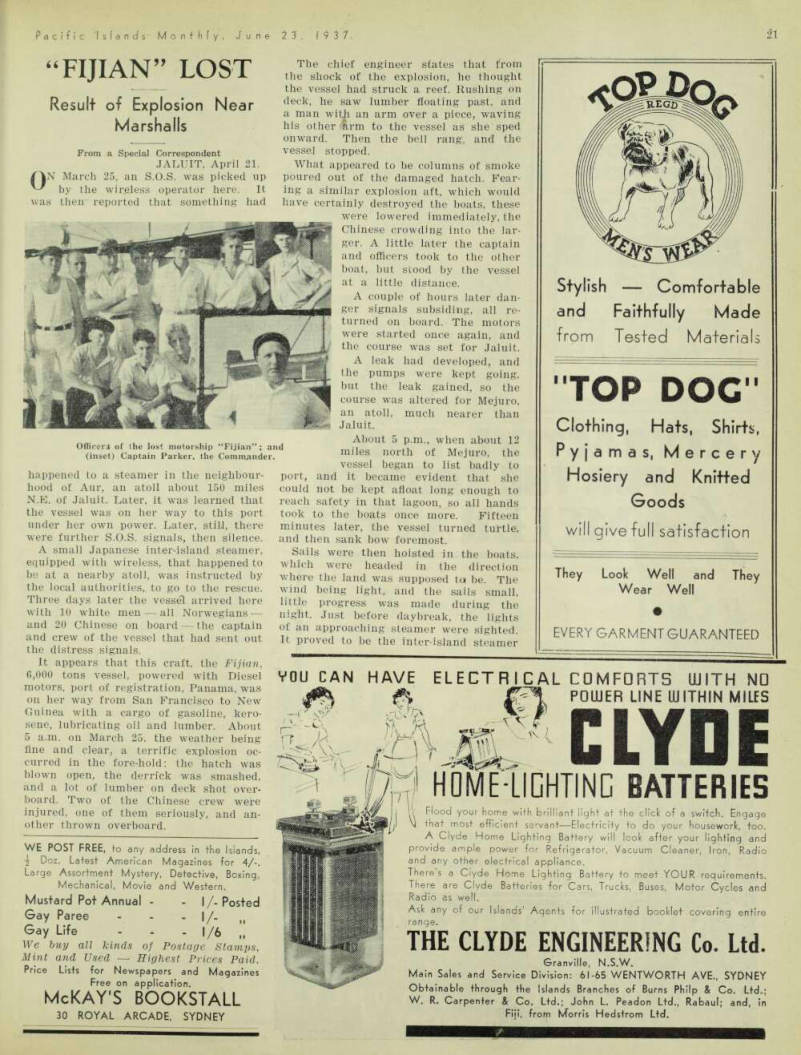
Result of Explosion Near Marshalls
From a Special Correspondent JALUIT, April 21.
HN March 25, an S.O.S. was picked up ” by the wireless operator here. It was then reported that something had
happened to a steamer in the neighbour hood of Aur, an atoll about 150 miles N.E. of Jaluit. Later, it was learned that the vessel was on her way to this port under her own power. Later, still, there were further S.O.S. signals, then silence.
A small Japanese inter-island steamer, equipped with wireless, that happened to be at a nearby atoll, was instructed by the local authorities, to go to the rescue.
Three days later the vessel arrived here with 10 white men all Norwegians and 20 Chinese on board the captain and crew of the vessel that had sent out the distress signals.
It appears that this craft, the Fijian, 6,000 tons vessel, powered with Diesel motors, port of registration, Panama, was on her way from San Francisco to New Guinea with a cargo of gasoline, kero sene, lubricating oil and lumber. About 5 a.m. on March 25. the weather being fine and clear, a terrific explosion oc curred in the fore-hold: the hatch was blown open, the derrick was smashed, and a lot of lumber on deck shot over board. Two of the Chinese crew were injured, one of them seriously, and an other thrown overboard.
The chief engineer states that from the shock of the explosion, he thought the vessel had struck a reef. Rushing on deck, he saw lumber floating past, and a man with an arm over a piece, waving his other arm to the vessel as she sped onward. Then the bell rang, and the vessel stopped.
What appeared to be columns of smoke poured out of the damaged hatch. Fear ing a similar explosion aft, which would have certainly destroyed the boats, these
were lowered immediately, the Chinese crowding into the lar ger. A little later the captain and officers took to the other boat, but stood by the vessel at a little distance.
A couple of hours later dan ger signals subsiding, all re turned on board. The motors were started once again, and the course was set for Jaluit.
A leak had developed, and the pumps were kept going, but the leak gained, so the course was altered for Mejuro, an atoll, much nearer than Jaluit.
About 5 p.m., when about 12 miles north of Mejuro, the vessel began to list badly to
port, and it became evident that she could not be kept afloat long enough to reach safety in that lagoon, so all hands took to the boats once more. Fifteen minutes later, the vessel turned turtle, and then sank bow foremost.
Sails were then hoisted in the boats, which were headed in the direction where the land was supposed ta be. The wind being light, and the sails small, little progress was made during the night. Just before daybreak, the lights of an approaching steamer were sighted.
It proved to be the inter-island steamer
Officers of (he lost motorship “Fijian”; and (inset) Captain Parker, the Commander.
which had been despatched in response to the S.O.S. A few days after arrival here, one injured man died. It is ex pected that the crew will leave for Japan within a few days.
Within a week of the sinking of the Fijian, much of her cargo drifted ashore at Mejuro and Arno. The exact quantity is not yet known, but probably there is between two and three thousand drums of gasoline, many cases of kerosene, ben zine, etc., and a large quantity of lumber.
Just what will become of all this is not yet apparent.
Advertisements & other items, pp. 23-24 (1 item)
Clyde
Q
REGO
mn $ % Stylish Comfortable and Faithfully Made from Tested Materials
"TOP DOC"
Clothing, Hats, Shirts, Pyjamas, Mercery Hosiery and Knitted Goods will give full satisfaction They Look Well and They Wear Well
EVERY GARMENT GUARANTEED
' r VOU CAN HAVE ELECTRICAL COMFORTS UJITH NO
POULIER LINE UUITHIN MILES
CLYDE
HOME LIDHTINC BATTERIES
Flood your home with brilliant light at the click of a switch. Engage that most efficient servant—Electricity to do your housework, too.
A Clyde Home Lighting Battery will look after your lighting and provide ample power for Refrigerator, Vacuum Cleaner, Iron, Radio and any other electrical appliance.
There's a Clyde Home Lighting Battery to meet YOUR requirements.
There are Clyde Batteries for Cars, Trucks, Buses, Motor Cycles and Radio as well.
Ask any of our Islands' Agents for illustrated booklet covering entire range.
THE CLYDE ENGINEERING Co. Ltd.
Granville, N.S.W.
Main Sales and Service Division: 61-65 WENTWORTH AVE., SYDNEY Obtainable through the Islands Branches of Burns Philp & Co. Ltd.; W. R. Carpenter & Co. Ltd.; John L. Peadon Ltd., Rabaul; and, in Fiji, from Morris Hedstrom Ltd.
WE POST FREE, to any address in the Islands, Doz. Latest American Magazines for 4/-.
Large Assortment Mystery, Detective, Boxing.
Mechanical, Movie and Western.
Mustard Pot Annual - - (/-Posted Gay Paree - - |/.
Gay Life - - 1/6 We buy all kinds of Postage Stamps, Mint and Used Highest Prices Paid.
Price Lists for Newspapers and Magazines Free on application.
McKAY'S BOOKSTALL
30 ROYAL ARCADE, SYDNEY
Get your
FREE
COPY
of the
NEW TRUFOOD
RECIPE BOOK
69 specially tested recipes—all kinds of new ideas for attractive things to cook cakes, pastry, puddings, custards, desserts, wour : cs, sauces, etc.
POST THIS COUPON TODAY
‘ Recipe Department/ c/- Box 3*22TT G.P.O.
Sydney.
Please send me POST FREE, a copy of The Trufood Book of 69 Tempting Recipes Name
(BLOCK LETTERS)
Address
ATTRACTIVE POOD
FOR THE TROPICS
M«ILRATH’S
Nestle's Condensed Milk (4 doz.) 7/9 doz. 27/-case I.X.L. Best Assorted Jam, 24-oz. (4 doz.) 10/3 doz. 33/-case Crown Soap, 60s —Unwrapped 21/- case Globe Trade Beef, 12-oz. (4 doz.) 7/-doz. 26/ case Globe Trade Beef, 12-oz., 3 .case lots 25/-case Australian I.A. Sugar, 70-lb. bags 13/6 bag Capital Powdered Milk, I-lb. tins tin 9/3 doz.
I.X.L. bruit Cocktail, 16-oz. tins 9d. tin 8/9 doz.
"Rosa" Custard Powder, 16-oz. tins 1/2 tin 13/6 doz.
"Rosa" Pure Baking Powder, 8-oz. tins tin 10/3 doz.
Krownall Mango Chutney, 6-oz. jars 9d. jar 8/9 doz.
Gartsides Green Peas, 10-oz. tins tin 4/3 doz.
I.X.L. Baked Beans, 10-oz. tins 6jd. tin 6/- doz.
Special Vintage Sweet Sherry, 26-oz. bots. 2/- bot. 23/6 doz.
All Prices f.o.b. Sydney • > • -CXPOAT D€PAATMENT • • •
202 PITT STREET. SYDNEY
NEWSOUTH WALES . AUSTRALIA.
Fiji Coronation Honours
/CORONATION honours awarded in Fiji were as follows: Companion of St. Michael and St.
George (C.M.G.): Hon. Juxon Barton, Colonial Secretary.
Officer of the Order of the British Empire (0.8. E.); Mr. H. W. Simmonds, Government Entomologist.
Member of the Order of the British Empire (M.8.E.): Mrs. W. E. Willoughby Tottenham, wife of Hon. W. E. Wil loughby Tottenham, M.L.C.
Guinea Airways Ltd.
New Guinea Business Improves
GUINEA AIRWAYS LTD., reports a net profit of £13,887 for the year ended February 28, compared with £25,876 the previous year, and £20,818 for 1934-35. Three dividends were paid during the year, one of 1/-, and two of /9 each per share, together requiring £9375. Against £95 brought forward, £4607 is carried forward. The 34th divi dend, of 1/- per share, was paid on May 31.
Gross revenue was £96,134, against £137,729 the previous year. Tonnage car ried by air was 6705, against 6476, and passengers carried numbered 11,869, against 12,137. The average freight charged per pound of cargo was /2.49, against /2.90.
The directors state that a decided im provement in New Guinea business has been indicated during the current quarter.
The directors have great confidence in the future of the Mandated Territory and Papua, and in the company’s capacity to operate profitably there. Australian operations were inaugurated by the open ing of the Adelaide to Darwin weekly service at the end of February. This route has steadily developed in popular ity, and, though still unsubsidised, is giving satisfactory results. During the current year, the business of Holden’s Air Transport Services Ltd. (which has been wholly acquired by Guinea Air ways, and is now in liquidation), will be incorporated in the company’s figures.
The company’s proposal to issue 80,000 preference shares has already been an nounced. The issue is to provide for expansion of operations in Australia, in volving the purchase of additional high speed multi-engined aircraft and the pro vision of ground organisation. The direc tors state that the present plans for expansion have no direct bearing on whether or not the company is success ful with its tender to the Commonwealth Government for the proposed Sydney-
Salamaua-Rabaul route.
S.M.H.
Mrs. Eric Wood, whose husband is in the New Guinea Administration, arrived in Sydney with her daughter Patricia, by the Macdhui on May 31, en route to New Zealand.
Advertisements & other items, p. 24 (2 items)
22
Pacific Islands Montiily, June 23, 1937
A Seaside Home
IN AUSTRALIA
Lovely sea-side gentleman's home,
near Sydney.
® Large, airy rooms, wide verandahs, garage and man's cottage. All modern appointments. Good water supply.
Refrigerator. Electric light. Frontage to charming surf beach. Total frontage, 276 feet. Ideal climate, fishing, surfing, only 40 minutes paved motor road to city.
Price £4,500 cash, or Easy Terms, No Agents.
Apply Box 92. Haymarket Post Office, Sydney, Australia.
Fijian Navigators
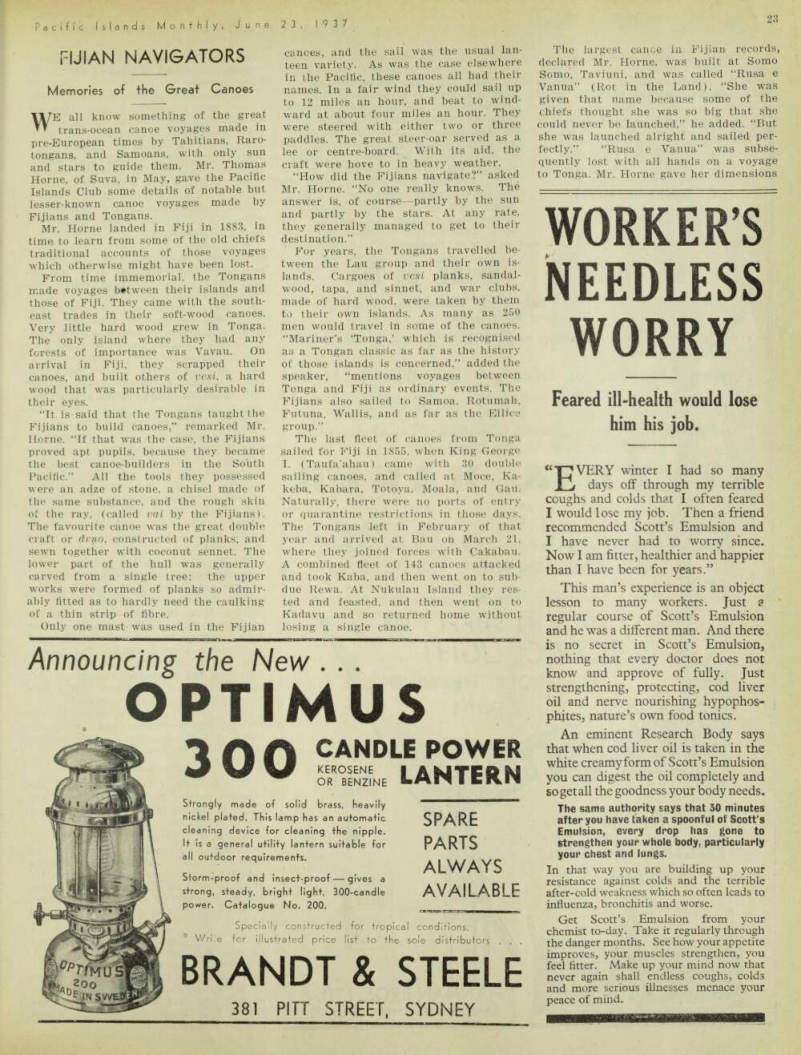
Memories of the Great Canoes
WE all know something of the great trans-ocean canoe voyages made in pre-European times by Tahitians, Raro tongans, and Samoans, with only sun and stars to guide them. Mr. Thomas Horne, of Suva, in May, gave the Pacific Islands Club some details of notable but lesser-known canoe voyages made by Fijians and Tongans.
Mr, Horne landed in Fiji in 1883, in time to learn from some of the old chiefs traditional accounts of those voyages which otherwise might have been lost.
From time immemorial, the Tongans made voyages b«tween their islands and those of Fiji. They came with the south east trades in their soft-wood canoes.
Very little hard wood grew in Tonga.
The only island where they had any forests of importance was Vavau. On arrival in Fiji, they scrapped their canoes, and built others of vesi, a hard wood that was particularly desirable in their eyes, “It is said that the Tongans taught the Fijians to build canoes,” remarked Mr.
Horne. “If that was the case, the Fijians proved apt pupils, because they became the best canoe-builders in the South Pacific.” All the tools they possessed were an adze of stone, a chisel made of the same substance, and the rough skin of the ray, (called vai by the Fijians).
The favourite canoe was the great double craft or druo, constructed of planks, and sewn together with coconut sennet. The lower part of the hull was generally carved from a single tree: the upper works were formed of planks so admir ably fitted as to hardly need the caulking of a thin strip of fibre.
Only one mast was used in the Fijian
canoes, and the sail was the usual lan teen variety. As was the case elsewhere in the Pacific, these canoes all had their names. In a fair wind they could sail up to 12 miles an hour, and beat to wind ward at about four miles an hour. They were steered with either two or three paddles. The great steer-oar served as a lee or centre-board. With its aid, the craft were hove to in heavy weather.
“How did the Fijians navigate?” asked Mr. Horne. “No one really knows. The answer is, of course —partly by the sun and partly by the stars. At any rate, they generally managed to get to their destination.”
For years, the Tongans travelled be tween the Lau group and their own is lands. Cargoes of vesi planks, sandal wood, tapa, and sinnet, and war clubs, made of hard wood, were taken by them to their own islands. As many as 250 men would travel in some of the canoes.
“Mariner’s ‘Tonga,’ which is recognised as a Tongan classic as far as the history of those islands is concerned,” added the speaker, “mentions voyages between Tonga and Fiji as ordinary events. The Fijians also sailed to Samoa. Rotumah, Futuna, Wallis, and as far as the Ellice group.”
The last fleet of canoes from Tonga sailed for Fiji in 1855, when King George I. (Taufa’ahau) came with 30 double sailing canoes, and called at Moce, Ka keba, Kabara, Totoya, Moala, and Gau.
Naturally, there were no ports of entry or quarantine restrictions in those days.
The Tongans left in February of that year and arrived at Bau on March 21, where they joined forces with Cakabau.
A combined fleet of 143 canoes attacked and took Kaba, and then went on to sub due Rewa. At Nukulau Island they res ted and feasted, and then went on to Kadavu and so returned home without losing a single canoe.
The largest canoe in Fijian records, declared Mr. Horne, was built at Somo Somo, Taviuni, and was called “Rusa e Vanua” (Rot in the Land). “She was given that name because some of the chiefs thought she was so big that she could never be launched,” he added. “But she was launched alright and sailed per fectly.” “Rusa e Vanua” was subse quently lost with all hands on a voyage to Tonga. Mr. Horne gave her dimensions
as: 118 feet in length; beam of main canoe, 7 feet 6 inches; draft, 3 feet; length of platform, 50 feet; width, 24 feet; mast, 68 feet; and yard, 90 feet.
Another large canoe was the “Rama Rama,” built by Tongans at Somo Somo for Tui Cakau: she was 99 feet long and carried a crew of 50. On one journey be tween Taviuni and Bau she accommo dated an additional 200 warriors. The speaker mentioned that his old friend, Mr. Jack Waters, was present in 1873 at the laying of her keel. Mr. George Barker, who is now in charge of the Suva Museum, was present when she was broken up at Somo Somo. “Rama Rama” took five years to build, and was given to Cakabau by Tui Cakau. She made three voyages to Tonga. Her mast
head, and several of her steer oars, (which are 34 feet in length), are in the Suva Museum.
Mr. Horne also made mention of the “Joni,” built at Lakeba by Ratu Mara on his return from exile in Tonga. This canoe was given the name of “Joni” after that chief’s son, the well-known Ratu Joni Madrai Wi Wi. Vesi for her hull and planks was brought from Cakadrove.
“Joni” was 96 feet in length, had a beam of 6 feet 2 inches, a draft of 2 feet 7 inches, and a platform of 25 feet by 21 feet. Her mast was 60 feet high, and her yard was 81 feet.
Mara, according to Mr. Horne, when in command of his war vessels, was Fiji’s most experienced admiral. It was not for nothing that he has been called the “Nelson of Fiji.” When* in command of the “Joni” he rammed many an enemy craft. This vessel always flew long white streamers. After the defeat of Ratu Mara at Kaba he escaped in her to Lau., The “Joni” was subsequently owned by Caka bau, and was left by him to his eldest son, Ratu Epeli. When owned by the latter chief Mr. Horne sailed in her from Bau to Levuka.
The son of Ratu Joni, Mr. Horne ex plained, was the Hon. Ratu Sukuna, a member of the English bar, who fought with the French Foreign Legion during the Great War, and now District Com missioner in the Lau Group. “And a perfect gentleman if ever there was one!” the speaker added. Ratu Sukuna, inci dentally, was one of the Fijian repre sentatives at the Coronation of King George VI.
Mr. Horne said that he had compiled a complete history of the tribes that once occupied the country around Suva and neighbourhood, from the time they des cended from the mountains until the period of the extensive massacre, that took place on the site of Sir Maynard Hedstrom’s present home. The popula tion was at one time “enormous.” But, following the massacre, the people left the district, and for almost half a cen tury it was practically deserted.
“But home is always home to the Fijian,” he remarked, “and eventually some of their descendants returned to the vicinity of Suva.”
Mr. J. Scott, Chief Engineer at the Nausori mill of the Colonial Sugar Re fining Company, returned to Fiji on May 6.
Mr. K. B. Thorne arrived on May 21 to rejoin the Suva staff of the Bank of New Zealand. Mr. H. Coombe is another member of this bank staff who recently rejoined after an absence of some years.
Mr. C. H. Dorreen and Mr. S. R. Egan, of the bank’s Suva staff, have returned to N.Z.
The death occurred at Naduri, near Labasa, Fiji, on May 16, of Mr. F. A.
Archibald, in his 56th year. Mr, Archi bald was an old mining man, well known in Australia. He had spent many years in Fiji and was the discoverer of the Mount Kasi mine. He leaves a widow and two children.
Advertisements & other items, pp. 25-26 (1 item)
Optimus
WORKER’S
NEEDLESS
WORRY
Feared ill-health would lose
him his job.
“TTVERY winter I had so many F i days off through my terrible coughs and colds that I often feared I would lose my job. Then a friend recommended Scott’s Emulsion and I have never had to worry since.
Now I am fitter, healthier and happier than I have been for years.”
This man’s experience is an object lesson to many workers. Just a regular course of Scott’s Emulsion and he was a different man. And there is no secret in Scott’s Emulsion, nothing that every doctor does not know and approve of fully. Just strengthening, protecting, cod liver oil and nerve nourishing hypophosphites, nature’s own food tonics.
An eminent Research Body says that when cod liver oil is taken in the white creamy form of Scott’s Emulsion you can digest the oil completely and so get all the goodness your body needs.
The same authority says that 30 minutes after you have taken a spoonful of Scott’s Emulsion, every drop has gone to strengthen your whole body, particularly your chest and lungs.
In that way you are building up your resistance against colds and the terrible after-cold weakness which so often leads to influenza, bronchitis and worse.
Get Scott’s Emulsion from your chemist to-day. Take it regularly through the danger months. See how your appetite improves, your muscles strengthen, you feel fitter. Make up your mind now that never again shall endless coughs, colds and more serious illnesses menace your peace of mind.
Announcing the New . . .
OPTIMUS
I
Opf
ZOO
ad*
SWEJS
I N 300
CANDLE POWER
OR BENZINE
LANTERN
Strongly made of solid brass, heavily nickel plated. This lamp has an automatic cleaning device for cleaning the nipple.
It is a general utility lantern suitable for all outdoor requirements.
Storm-proof and insect-proof gives a strong, steady, bright light, 300-candle power. Catalogue No. 200.
SPARE
PARTS
ALWAYS
AVAILABLE
Specially constructed for tropical conditions. * Wriie for illustrated price list to the sole distributors . . .
BRANDT & STEELE
381 PITT STREET. SYDNEY
• WANTED IMMEDIATELY for CASH
all used Coronation Commemorative Stamps of Pacific Is., Australia and New Zealand, Remittance sent promptly.
MINT STAMP COMPANY
74 Grafton Street,
DUBLIN, IRELAND
POST FREE
• Our price list of Car and Truck Accessories, Spare Parts, Tools and Hardware.
We carry a great variety of stocks not listed in our pamphlet, but we shall be happy to quote on — Anything for Car or Truck Everything In Metal Established for over 25 years, we now have a very large Clientele of satisfied Customers, as every order entrusted to us receives— PROMPT ATTENTION AND CAREFUL CONSIDERATION AT ALL TIMES.
YOUR ENQUIRY WILL BE APPRECIATED
STEAD & BAKER
for
Car Accessories and Spare Parts; Engineers,
Brass Founders and General Hardware Merchants
743-5, HARRIS STREET, BROADWAY. SYDNEY, N.S.W.
Telegrams : "Steady," Sydney.
AN ABUNDANT SUPPLY OF
ELECTRIC LIGHT
FREE FROM THE WIND
WITH
WHITE
DIRECT
TO
WIND DRIVEN
ELECTRIC LIGHTING
PLANT
1 xi X mm
HANNAN BROS. LTD.
58-62 FLINDERS STREET, ADELAIDE
Thomas Lewis
The Polynesian Wife Of
Letter to the Editor IN your issue of April, 1937, I read with interest an article describing a memorial ceremony, marking the graves of the two first missionaries of the Lon don Mission Society to die in Tahiti — Thomas Lewis, 1799, and John Jefferson, 1807.
I note that a heavy concrete slab laid over the two graves bears the following inscription: “Here lie Thomas Lewis, died November 27, 1799. and John Jef ferson, etc.”
It may be of interest to your many readers to learn that this missionary, with others, landed in Tahiti as early as 1797; but the causes leading up to and the unhappy circumstances some two years later surrounding the death of Thomas Lewis are of significance and importance.
The following is an extract from a publication by William Ellis entitled “Polynesian Researches,” published by Fisher, Son, and Jackson, London, in 1829. Volume I. at page 94, reads: “Towards the close of the year 1799, the missionaries were called to the mel ancholv duty of conveying to the silent grave, i.inder verjf distressing circum stances, Mr. Lewis, one of their number, and the first missionary who had termin ated his life on the shores of Tahiti.
He landed from the ship Duff in 1797, continued to labour with his companions, respected and useful, until about three months after the departure of the Naut ilus with the families to Port Jackson, when he left the mission house, and took up his residence with a taio, or friend, in t.ie eastern part of the district.
“Three weeks afterwards, he intimated to his companions his intention of unit ing in marriage with a native of the
island, solemnly purposing to abide faith ful toward her until death.
“Considering her an idolatress, the missionaries deemed this an inconsistent and unlawful act, but Mr. Lewis, persev ering in his determination, they dissolved the connection that had subsisted be tween him and themselves, as members of the church of Christ, and discontinued all Christian and social intercourse with him. He was still constant in attendance on public worship, industrious in the culture of his garden, and in working for the King and principal chiefs, who were evidently much attached to him.
“On the 23rd of November, the mission aries heard he had died on the preceding evening. They hastened to his house, and found the corpse lying on a bed; the forehead and face considerably disfigured with wounds, apparently inflicted with a stone and a sharp instrument. The female with whom he had lived as his wife in formed them that he went out of his house on the preceding evening, and that, hearing a noise shortly afterwards, she hastened to the spot whence it proceeded and saw him on the pavement in front of the house, beating his head against the stones. On looking at that part of the pavement where he had fallen, one or two of the stones were stained with blood.
“Some of the natives said that the evil spirit had entered into him; but, from several expressions that were used, there was reason to apprehend he had been murdered.
“Assisted by two or three natives, Mr.
Bicknell and Mr. Nott dug his grave in a spot near their dwelling, on the north side of Matavai bay, which had been selected as a place of interment. On the evening of 29th of November, 1799, Mr.
Nott, Mr. Jefferson, Mr, Eyre and Mr.
Bicknell bore his remains to the grave, where Mr. Harris read the 90th Psalm,
and offered up an appropriate prayer to Almighty God.
“The circumstances of his death were truly affecting, and the feelings of the missionaries such as it would be in vain to attempt to describe. They have since learned that he was murdered, and some of them have also regretted that after his separation, kindness and friendly intercourse were not continued, which might perhaps, without compromise of
character, have been consistently main tained . . .”
There are three salient features arising out of this narrative.
Firstly, the date of death of Thomas Lewis given is November 22, and not November 27, as inscribed on the memor ial slab.
Secondly, the Tahitian wife of Mr.
LOwis was libelled an idolatress, although it was the wish of Mr. Lewis that he be
married by his companions according to their Christian faith.
Thirdly, the suicidal suggestions as to the actual cause of deceased’s death were later rebutted, and it is now a proven fact that Mr. Lewis was murdered by intimidated relatives of his wife.
Thus, not only did Thomas Lewis die a Christian martyr, but he was the first and greatest martyr to the cause of those of us who can boast of our part-Poly nesian blood.
I am, etc., Auckland, N.Z. 27/5/37.
Fiame.
Rev. John Bodger, who has been in Sydney on sick leave, returned by the Macdhui on June 5 to take up mission duty at Dogura, Papua.
Advertisements & other items, pp. 27-28 (1 item)
New Britain--Mandated Territory of New Guinea
n fji a
PP'H
HOT SHOWERS
AND BATHS
for aiuj water su{
60 SECONDS of-
fer lighting a
Challenger Bath-
heater you can step under a hot shower. A Chal-
lenger will give
you a hot bath for about Id. or a hot shower for less.
The Challenger
uses KEROSENE;
is as safe as a hurricane lamp and
as simple to light.
Easily connected.
Terms may be arranged
KEROSENE OPERATED
AN ISLAND RECOMMENDATION
San Cristobal, Dear Sirs, British Solomon Islands.
Thank you for your letters of Ist and 14th December. The Heater came to hand last week. I had no difficulty in installing it, and it works splendidly and does all you say for it. Yours faithfully, (Signed) I. M. CAMPBELL
! EVERYDAY PRODUCTS LTD., Ist !
I Floor , 188 George Street, ( near Circular I Quay). Sydney.—Please send me Ulus- • trated folders and complete details of I the Challenger KEROSENE Bath-heater. I
Name
Aaatess I /M PORTANT State if Town Water I Supply OR Overhead Tanks. j WHEN IN TOWN CALL FOR OBLI- I
CATION-FREE DEMONSTRATION.!
FIRST FLOOR.
New Britain--Mandated Territory of New Guinea
Under Instructions from the Liquidator of
LINDENHAFEN ESTATES LTD. (in Liqn.)
THE WHOLE of the BUSINESS and UNDERTAKING of the above-mentioned Company comprising COPRA PLANTATION and DESICCATED COCONUT FACTORY, situate at Lindenhafen; also COPRA PLANTATION at RING RING and INTEREST IN LAND at
LUI ISLAND and FULLEBORN, NEW BRITAIN.
THE HOLDINGS comprise:—
LINDENHAFEN
About 1900 acres of which approximately 1800 acres planted with Coconuts. Freehold,
LUI ISLAND
17 acres, planted with Coconuts. Agricultural lease 99 years from January, 1925.
Annual rental 8/6.
RING RING
About 2770 acres, of which about 405 acres planted with Coconuts. Freehold.
FULLEBORN
At Fulleborn Harbour, about 30 miles Northeast of Lindenhafen. About 2471 acres of virgin land, agricultural lease 99 years from October, 1928. Annual rental £62/10/-.
DETAILED LIST OF VARIOUS BUILDINGS, PLANT, Etc., can be obtained on application to the Liquidator, E. L. WOODGATE, Chartered Accountant (Aust,), Frazer House, 42 Bridge Street, Sydney, or the Auctioneers.
The foregoing will be offered for sale by PUBLIC AUCTION as a going concern In the ROOMS. 70 PITT STREET. SYDNEY. N.S.W., on THURSDAY. 22nd JU].Y. 1937, at II a.m.
RAINE & HORNE LTD., Auctioneers
70 PITT STREET. SYDNEY
Vendor's Solicitors: Messrs. J. W. MAUND & KELYNACK. 62 Margaret Street, Sydney.
Huon Pine Boat Planks
Practically Borer Proof and Everlasting, also Spotted Gum Timbers—Prices Right.
A C HO Miller St..
A. rryer p yrmonti n.s.w.
Diesel Engines
Fetter Marine Engines Atomic Diesel Semi Diesel 6 to 400 B.H.P.
There Is no better marine engine than the Fetter Diesel.
Simple in design and rugged in construction with years of manufacturing experience behind them, they are the most dependable and economic source of motive power for any type of Craft.
Buzacott & Co. Ltd.
7-11 MARKET STREET, SYDNEY
Tubuais Charms
And a Scientific Mystery
From Our Own Correspondent
Papeete, May 14.
little time ago a young man appeared at Papeete and announced lie was a scientist from a certain museum in the States and that he was on his way to Tubuai for the purpose of geographic research.
We thought we had not heard aright and asked him if it were not geological research. But he insisted it was geogra phic, and we have been wondering ever since what it was all about, for the young man was very reticent and de clined to give details of his objectives.
What geographic mystery may reside in Tubuai has been a matter of discus sion ever since. We remembered finally that Tubuai sits astride the Tropic of Capricorn and it has occurred to us that maybe the young scientist was commis sioned by his museum to ascertain whether the Southern Tropic line traver sed the island through a tunnel under tne mountains, or follows the contour of the peaks after the manner of the Great Wall of China.
Someone else suggested that he might be working on electric tests with a col league in South America to find out if the Tropic of Capricorn has been warped or cracked by the violent volcanic erup tions and earthquakes in the Chilean Andes during recent years.
Tubuai is too far south and the climate there is too cold for coconuts to'mature —so there is no copra to export. The inhabitants apply their energies to the raising of pigs and cattle and turkeys and fowl.
The local schooner Teheiporoura, on her long voyages northward to Tahiti is, therefore, redolent —not with the acrid smell of copra, but with the odours of the barnyard which increase in violence as she proceeds under the heat of a tro pical sun, until the fabled stench of the Augean stables becomes as a faint and gentle zephyr compared with the Tehei poroura when she finally arrives at Papeete.
But to us who are accustomed to this signal of her arrival it heralds toothsome turkey meat, tender fowl and fat pork in the market on the morrow.
Mr. R. J. Wilson, joined the April Mon toro at Cairns on his way to Misima Island, Papua, where he took up a posi tion with Cuthbert’s Misima Gold Mine Ltd.
Miss F. J. Pearce, a Methodist mis sionary, returned to Kiriwina, Papua, by the Macdhui on April 28. Miss Pearce, who has been doing missionary work in Papua for 21 years, was accompanied by her friend, Miss C. Coulson, who assists in her work.
Sivami Avinasananda, a Hindu priest,
of Ramakriskra Mission, Belur, Math,
India, arrived in Sydney in May by the Mooltan en route to Fiji to minister to the Hindu population there.
Advertisements & other items, p. 29 (1 item)
Greater Mileage
FOR
The unrivalled volatility of PLUME makes it easily the finest motor spirit you can buy in the Islands for Starting, Acceleration, Power and Mileage.
Prove this in your omi Car
VACUUM OIL COMPANY
PTY. LTD.
MORRIS HEDSTROM LTD
Agents
P7IS
No Casino For Noumea
THE refusal of the French Minister for the Colonies to permit the estab lishment of a Casino in New Caledonia was the result of a report made by M.
Barthe, a Colonial official, sdys the Bulletin du Commerce, of Noumea. M.
Barthe was of opinion that the function ing of a casino would have a bad effect upon the morals of the people of New Caledonia.
The newspaper is wrathful and indig nant. It refers to all the casinos which operate in France, without doing any noticeable harm to French morals, and it proceeds to tell M. Barthe just what it thinks of him.
The casino plan is dead, for the mom ent, however.
Men Who Knew Yesterday
William Blacklock, of Samoa
By Eric Ramsden
FROM the pages of the past they trooped, a goodly throng—kings and queens, chiefs and chieftainesses, sol diers, sailors, missionaries, beachcomers.
In fact,, there is hardly a name in the extensive Samoan bibliography of the last half century that William Blacklock. once Consul-General for the United States of America in Apia, does not recall.
From the windows of his home on the bush-clad slopes above Brisbane Water, he gazed east across the mangrove swamps and blue waters of the inlet, a
view that was framed by tall, slender gums. The shadows lengthened. Soon the sun would sink behind the rocky, age-scarred mountains to the west.
But his thoughts were far away from the fading Australian landscape. The swamp oaks and gums were replaced by gently waving palms. Brisbane Water faded into the beach at Apia, once men aced by the guns of Britain, Germany, and the United States. In memory, the mountains of Tutuila were sharply etched against the tropical sunset, and within their embrace lay Pago Pago, now the most important naval station in all Polynesia . . .
Only the other day a giant American clipper of the air spread her wings on the waters of Pago Pago. When William Blacklock first saw that harbour, the echo of the paddles of the war-canoes had not yet died aw r ay. To him was entrusted the duty, on behalf of the U.S.
Government, of completing the settle ment of all claims, both Samoan and
European, to the future naval base; the negotiations for which were initiated by Consul-General Sewall in 1890.
A Pawn In The Game
He had seen the warships of the Great Powers assemble off Apia at a time when the whole world had watched, with no little anxiety, the battle for supremacy between rival chieftains for the kingship of those islands —a pawn in the inter national game.
William Blacklock had seen the war vessels of the United States and Ger many pounded by the great hurricane of 1889, when every vessel then in port, with the exception of H.M.B. Calliope . had been destroyed, or hopelessly crippled by that appalling storm. In Rear- Admiral Kimberley’s report to the U.S.
Government occurs this passage: “Of the foreign residents of Apia, the U.S. vice- Consul, Mr. W. Blacklock. was pre-emin ently conspicuous for his energy and good
Mr. Blacklock.
services, not only in saving life, but in caring for the immediate and pressing wants of the survivors of the Vandalia, most of whom were taken to the Consul ate. Too much cannot be said in justice to his exertions and hospitality on this occasion.”
Hand-in-hand with the chief Seumanu tafa and a number of Samoans and Europeans, he waded into the swirling in-shore waters of Apia harbour, follow ing the memorable hurricane, and res cued bodies. After some difficulty they secured the body of a young mid-shipman from the U.S.S. Vandalia. The lad was more dead than alive. In time, however, he recovered, and lived to return to the Pacific in 1925 as Rear-Admiral H. A.
Wiley, in command of the West Virginia and the battleship division of the U.S.
Fleet, then on a goodwill cruise. Unfor tunately, Mr. Blacklock and the Admiral did not meet when the Fleet was in Sydney harbour. It was not until the eve of departure that Admiral Wiley learnt of Mr. Blacklock’s presence in Australia. However, they have been in communication since.
Storekeeper, trader, auctioneer, and finally Islands merchant in Sydney, Wil liam Blacklock has observed the Samoan drama since 1883. Born in Victoria of Scots parentage more than 80 years ago, he settled in Southland, New Zealand, with his family as a child. When a lad of 16 he sailed from Port Chalmers for the United States, and obtained his first glimpse of Islands life when passing through Honolulu in 1872. During a stay of 11 years in the United States, spent principally in the then still pion eering state of Oregon, he obtained American citizenship, a privilege that was subsequently forfeited on returning to his native land many years later.
Malietoa And Mataafa
When he first landed in Apia, apart from the missionaries and their wives, there was but a handful of Europeans in the group. There was no regular mail service. Foreign residents received their letters two or three times a year by schooner from Fiji.
He has lived through the most stirring period in Samoan history. As the official representative of his Government, in subsequent years he played an important part, both in the negotiations that fol lowed the Malietoa and Mataafa episodes, and behind the scenes* He was one of the three Consuls who, with King Malietoa,
signed the Berlin Treaty of 1890. Britain, Germany, and the United States were all vitally concerned in the fate of Samoa.
Fnally, the islands were partitioned be tween Germany and the United States.
Britain, compensated by being given a free hand in the Solomons and Tonga, agreed to withdrawal.
Since 1905, Mr. Blacklock has made his home in Australia.
The German administration so success fully initiated by Dr. W. H. Solf in W.
Samoa, has been replaced by that of N.Z. under mandatory powers from the League of Nations. But the real solution for the settlement of Samoa’s internal difficulties is no nearer finality than it was half a century ago. The Samoans still remain the “Irishmen of the Pacific.”
Across the pages of history pass a not able assembly There are Mata’afa, three times selected King of Samoa, and even tually exiled to Jaluit, in the Marshalls; and Malietoa, his predecessor, who had an even more extensive experience of exile in Germany, the Cameroons, and finally in Jaluit; Bassett ' Haggard (brother of the famous novelist), then a Land Commissioner in Samoa, once referred to Malietoa as that “poor bat tered old sovereign.”
Haggard, then a British official, was a contemporary of William Blacklock’s at Apia. On one occasion they were out shooting pukeko together. The English man, when jumping a ditch in a taro plantation, put a charge of shot through the rim of the American Consul’s tropi cal hat. “He was most apologetic, of course,” commented Mr. Blacklock, “hut it was, nevertheless, a close shave!”
Bassett Haggard was the author of a reply to R. L. Stevenson, which he titled “An Object of Pity” by “A Gentleman of Quality.” In satirical verse, he ex plained: “ Friend , I have written at your bidding.
Things until notv kept in hiding . . .”
The book is now keenly sought after by South Sea collectors. A copy is in the Mitchell Library in Sydney.
Association With Stevenson
Mr. Blacklock was associated with “Tusitala” and William Cooper, (a brother of the late Mr. Justice Cooper, of New Zealand), then a municipal magistrate in Apia, in establishing the Samoa Herald. Owing to its repeated attacks on the Germans, the Samoa Times had been closed up and the press taken to Fiji. “So we had to establish another paper.” Mr. Blacklock explained.
“Stevenson and Cooper were chiefly pro minent. Naturally enough, I had to keep in the background.”
In those days an editor’s job in the South Seas was no sinecure. On one occasion a party of German ratings was detailed off to administer chastisement to the editor of the Samoa Times. How ever, they mistook their quarry, and Jones, the German Government printer (who was, of course, in German employ) received the punishment! In the dark, the ratings mistook their man.
“Socially, Stevenson was one of the whitest men and a most charming host,” said Mr. Blacklock. “He was kind-hearted and generous, but he was also a man with a most violent temper. I regarded him as a past-master in the art of swearing!”
But. politically, he considered R.L.S. was dangerously ambitious, and a menace to the peace of the islands. “So much so that at one time he was threatened by the British Government with deporta tion,” he added. “It must also be remem bered, however, that Stevenson was an ill man, and I consider that his life was ruined through the influences of matri monial entanglements.”
Among his photographs Mr. Blacklock found one of a young and handsome ga*, typical of the Samoan aristocracy of oo years ago. The girl was Sueiga’s sister.
Sueiga was the wife of the second Tama sese who, replete in uniform and epam ettes, smiled grimiy from the opposite page. Sueiga achieved some notonty by dancing faa Samoa with a bust of Kaiser Wilhelm I. in her arms. The bust had come ashore with other flotsam and jet som from one of the German war-vessels after the hurricane of ’B9. “Sueiga meant no harm,” said Mr. Blacklock, “but the German Consul took her action seriously, and demanded a very heavy fine!”
Incidentally, several pieces of plate that once belonged to the Trenton's wardroom and were recovered from the wreck, now grace the former Consul s sideboard as souvenirs of the great hur ricane.
Dr. Shirley Baker
A Pacific personality known to Mr.
Blacklock was the Rev. Dr. Shirley Baker, Premier of Tonga, and holder of almost every portfolio within the gift of the old king, George Tubou I. They met at a time when the missionary-Prime Minister visited Samoa for the purpose of obtaining American citizenship.
The British authorities in Suva were becoming a trifle too inquisitive for Dr.
Baker’s liking, and he though that, if he secured American nationality, the Governor of Fiji would not have such a hold over him. “However, he found from Consul-General Sewall that he could not take out American papers in Samoa,” observed Mr. Blacklock. “Although Baker was primarily first for Baker, and Tonga came next, he was a man of great ability and he did a great deal of good for Tonga. The splendid land system which native-born Tongans enjoy to-day was the result of his vision, and they should be thankful to him. After all, Tonga is to day the only independent kingdom in the Pacific.”
Dr. Sole
Another figure that emerged from the past was Dr. Solf, the first German ad ministrator of note in Western Samoa, whose memory is still revered by many Samoans. He was not entirely a novice in colonial affairs when he arrived in Samoa for he had served in what was then German East Africa, and he had also the good sense to study British admini stration in Fiji.
Mr. Blacklock instanced Dr. Solf as an example of the success of a well-trained civilian as Governor of Samoa. “It is no use sending a military man there.” he added. “Whites or natives will have none of them!”
Captain “Bully” Hayes was dead when Mr. Blacklock went to Samoa, but he knew his widow and two daughters.
“Queen -Emma” Of New Britain
“A slendid woman, and most capable in business,” was his description of “Queen Emma,” the daughter of Jonas M. Coe, an American resident of Apia, and his wife, a high-caste Samoan. “Koe”, as Emma was once known, and hed friend Moe. were such pretty girls that they were the toast of Apia. In later years “Queen Emma,” as the former became
known, pioneered settlement in New Britain and acquired considerable wealth.
She was married in Apia and her son still asides at Vaucluse, near Sydney.
The Purchase Of Pago Pago
One of Mr. Blacklock’s most important duties was to secure the purchase of Pago Pago harbour for his Government.
This was partly achieved on the island of Aunu, near the harbour entrance, the rightful chiefs having been driven out of Pago Pago by rebel warriors. “My instru ctions were to buy each and every claim outright,” he remarked, “and money was no object.” 100,000 dollars was appropri ated for that purpose.
One of the results of the famous hur ricane of 1889 was the birth of the American Navy as it is known to-day.
The war vessels sent to Samoa at Mr.
Blacklock’s request had been built in Confederate days. The United States Government realised that if her flag was to be respected in the Pacific and else where, modern ships must be built.
One of Mr. Blacklock’s most exciting memories was the concealment of the American journalist, Kleibe, in the Apia Consulate. The Germans were anxious to secure him, and if they had done so, they would have hanged him from the yard arm of one of their ships. However, Mr.
Blacklock managed to get him into the Consulate, and later, through the conni vance of Commander Mullen, of the U.S.S. Nipsic , he was taken on that vessel away from the group and transferred to a mail-boat.
Samoa has witnessed some dramatic interludes since the former U.S. Consul left her shores for good. Yet there are few people alive to-day who can claim to have greater personal knowledge of the historic happenings of the past.
Advertisements & other items, pp. 30-32 (3 items)
Younger
Modernise
HOME, OFFICE, STORE, FACTORY
Write for full details of lines that interest you. . . . with these comfort-bringing, labour-saving products. There are none better made.
Crompton Coiled Coil and Single Coil Lamps . . .Seyon All-electric and Battery-operated Radio . . . Simpson Electric Turntables . . . Silovac Vacuum Cleaners . . .
Household Electric Appliances . . . Rodgers Cutlery . . .
Perfection Silverware . . . Electrical Fittings ... Crompton Fans for home, office, store and factory .. . Callender Wires, Cables and Flexibles for indoor and outdoor installations . . Seyon Floodlighting Equipment for tennis courts, etc.
NOYES BROS. (Sydney) LTD.
115 Clarence Street. Sydney II Waff Street, Newcastle 197 Elizabeth Street, Brisbane
Do You Know that the Famous
YOUNGER
STOVES and
RANGES
made with extended Firebox specially for long Wood fuel, are Self-Setting and. provided sufficient Flue Piping is attached, can be used in almost any position?
The No. 7W "Younger" Ranger can now be supplied fitted with Legs, as per illustration.
Ask for quotation for this Range, also Illustrated Catalogue and Price List for both Single and Double Oven Stoves.
G. FLETCHER & SON 50 Oxford Street, Sydney Younger Stoves are Widely Used Throughout the Pacific Islands.
29
Pacific (sfancfs Monthly, June 23, 193?
material for your
COCONUT PLANTATION
FOR SALE
TENDERS are hereby invited for the purchase of
KWAIPAN BAY PLANTATION.
EAST PAPUA
Comprising approximately 520 acres af mature coconut palms and 280 acres available for further cultivation.
SITUATION : On Woodlark Island, Papua, 2 miles inland from Kwaipan Harbour.
COCONUT PALMS : Said to be 23,500, planted 1912-1918.
TITLE : M.P. No. 693/29, duration of 79 years 72 days from 28th March, 1929, annual rental £l3/6/8. Also No. 737.
Duration 25 years from 4th July, 1927, annual rental £2/12/-.
GENERAL INFORMATION : The Planta-
tion is of coral formation, conveniently connected by light raj I and punt over a short distance of two miles to Kvaipan Harbour, at which port the Burns Philp sleamer calls at regular intervals. ' The Naval Wireless Station buildings leased from the Commonwealth Government are included on the Estate for sale.
These buildings, built of concrete, provide spacious accommodation for Europeans, also business premises and native labour, in addition to providing large storage space.
The Plantation is one compact block, the contour flat to undulating, thus affording economic working conditions in addition to the elimination of heavy transport costs. Gold mining operations on Woodlark Island provide a market for European and Native merchandise, thus offering an attractive field for local trading enterprise. The plantation presents an unusual opportunity to tenderers to secure a large, developed coconut area, together with ample undeveloped land available for expansion, and opportunity for trading.
TENDERS will close at the office of the Liquidator, 7 Bridge Street, Sydney, or Box 543-B, G.P.0., Sydney, on the 31st July, 1937, and envelopes containing tenders should be clearly marked "Tender, Kwaipan Plantation."
The highest or any tender not necessarily accepted.
C. H. CHESTER, Liquidator.
I Ml 0 I
CORROSION RESISTANT, CANNOT RUST,
STRONGER THAN STEEL, EASILY WORKED,
is the ideal
material for your
SALT WATER TANKS,
PROPELLER SHAFTS,
MOSQUITO GAUZE
MARINE HARDWARE
Let us fell you WHY full particulars gladly supplied by WRIGHT & COMPANY, 81 Clarence St., Sydney, N.S.W. - QNEL i$ a Re 9stared Trade Mark Cables: "CORNRIGHT," SYDNEY
Cables : "Stancarr." Tel. MA 4416
ESTABLISHED 1841
Stanley & Co.
325 SUSSEX STREET
SYDNEY
WHOLESALE & RETAIL
PRODUCE MERCHANTS
Fruiterers and Greengrocers
Shipping Providers
PACKING FOR ISLANDS TRADE
A SPECIALTY
EUROPEAN and CHINESE VEGETABLES
always available in any quantify.
THEY KEEP YOU FIT
AND KEEP YOU SLIM
“PHESE delicious Biscuits are a perfect slimming food., 1 Made from the whole grain of carefully selected, sun-ripened wheat. They are tempting, wholesome and extremely easy to digest.
Slimming is made pleasant by these delicious and popular biscuits, which in addition increase the energy and improve the general health. Try them spread with butter and creamy candied honey, with butter and cheese, or jam.
ARNOTTiS
famous
SHREDDED
WHEATMEAL
B ISCUITS
Always ask your Grocer for Arnotf’s
“THEY ARE BETTER THAN EVER”
N.G. Roads Closed To Copra
Transport After Dark
ON April 24, per medium of the New Guinea Gazette, and under the author ity of the Administrator’s Powers Or dinance, the Administrator 'made the fol lowing new regulation, to come into operation on May 1: “Except within the boundaries of any town, no person shall, without the writ ten consent of a District Officer previously obtained, use any road for the transport of coconuts or copra between the hours of 7 p.m. and 5.30 a.m. Penalty; Fifty pounds or imprisonment for six months.
There is no explanation of the new law, but apparently it is connected with the rapid growth of copra-production by natives (who have installed a number of modern driers), and with accidents which have occurred recently owing to reckless driving of motor-lorries by natives.
Mr. J. R. Budge, who has been staying for several months at Ouaco, in the north of New Caledonia, returned to Australia
by the Maetsuycker on May 18.
Mr. Ken Nettleship, of the Customs Department, New Guinea, and Mrs.
Nettleship, arrived in Sydney from Rabaul by the Nellore in May.
Judge Ayson, C.M.G.
Leaves Cook Islands After 15 Years
TUDGE Hugh Fraser Ayson, C.M.G., has ** retired after occupying for five con secutive terms, with marked success, the important and delicate administrative position of Resident Commissioner in the Cook Islands.
Fifty-two years of age last November, Judge Ayson was educated at Wellington College and Victoria University, N.Z., whence, scarcely out of his ’teens, he entered the Law, practising as a barris ter and solicitor in Wellington from 1905 until his appointment as Judge of the
Native Land Court in 1916, in which year he first joined the Cook Islands service.
In October, 1922, Judge Ayson was ap pointed to the triple post of Resident Commissioner, Judge of the High Court, and Judge of the Native Land Court at Rarotonga, thus taking upon his shoul ders duties formerly borne by two separ ate officials, and which he has success fully carried out single-handed for 15 years.
Last month Judge Ayson announced that in view of impending changes in the personnel of the New Zealand Land Court it would be necessary in his own interests, to return to the Dominion and the Department from which he had been “on loan” to C.I.
Any attempt to estimate the work and influence of Judge Ayson locally must
take into account the fact that the ad ministration of a small territory, con taining many diverse interests, is a far more hazardous undertaking that a simi lar office in a larger area, where the conflicting elements are widely diffused.
In Rarotonga, where every third Euro pean is connected with the Administra tion, the “Government” is virtually on people’s doorsteps, with the inevitable result that official actions are liable to be regarded as biassed, so that unless the Commissioner is prepared to forego the common privilege of friendship, he is certain to incur the charge of having his policies influenced by his friends.
In such circumstances no small degree or skill is required to combat the pre judices, the petty jealousies and ambi tions of constantly warring factious, each seeking to advance its own interests at the expense of the others. And behind these is the great semi-inarticulate yet by no means unintelligent body of native opinion, easily offended and still more easily persuaded that its welfare is tak ing second place.
A natural tactician, Judge Ayson has sedulously eschewed party politics, and with enviable dexterity has set his course so that each political, commercial or social breeze has combined to blow him along in the direction he wished to go, and which was often quite contrary to where it was hoped they would carry him.
That this course has led to the better ment of the group is plain from the briefest perusal of the improvements effected during his administration, des pite the fact that almost half his term of office has been spent under “the de pression,” with its slashing seductions in Dominion subsidies.
In 1922, there were four Government schools in Rarotonga and four in the Lower Group islands, with a total of 1,300 pupils, functioning at an annual cost of approximately £9,000. By 1935, a new syllabus had been introduced, all existing schools enlarged and improved, and others established in the Northern Group, bringing the attendance roll up to 2,816 children, with a teaching staff of 71, 12 of whom are qualified Euro peans, the whole operating at an annual expenditure of a little over £6,000 In the medical realm, extensions have been added to the hospital, including the installation of an X-ray plant. Soil sani tation, too, has been undertaken on a la,rge scale and the Government, in con junction with the Rockefeller Institute,
have erected over 2,000 fly-proof closets of cement construction, thereby substan tially reducing disease from ground-borne infection. In 1926, a school dental clinic was inaugurated, with the part-time ser vices of a professional dentist.
Radio communication in 1922 was limi ted to the single station at Rarotonga.
To-day, there are substations on the tour main Lower Group islands and a fifth on Manihiki, 650 miles, to the north.
The population of the Cook Islands, 8.000 in 1900, has risen to 12,000 and 2.000 of that increase has occurred dur ing the past ten years.
Excellent as these improvements and innovations are, one feels that Judge Ayson’s claim to remembrance will proo ably rest less on his material achieve ments than on his administrative policy, which has successfully kept the Group from any of the undesirable sort of front page publicity, such as has been so marked in the case of Western Samoa.
With almost uncanny intuition, he has always been at least one jump ahead of those who might have desired to throw sand in the machinery.
In so many-sided a personality it is difficult to specify any one aspect as rep resentative of the whole, although per haps characteristic of Judge Ayson is the unswerving loyalty and support which he accords to his subordinates — an attitude which can only be appreci ated to the full by those who have actu ally served under him.
Judge Ayson is still a comparatively young man. Unless rumour lies, he leaves the Cook Islands for one of the most responsible judicial positions in New Zea land. With him will go, the hearty good wishes and congratulations of this small community.
Julian Hill As.
Rarotonga, May 19.
Advertisements & other items, pp. 33-34 (1 item)
Sheep Tongues
Try these delicious Imperial
* m
SHEEP TONCO
Here are the finest, mild cured new season s tongues cooked in vacuum, by a new "flavoursealing, tenderising process, packed in jelly and unsurpassably delicious. They are ready to serve when you take them from the can, and nothing could make a more appetising meal.
Get a can of Imperial Sheep Tongues to-day, and serve with Imperial Mango and Pa Paw Chutney. What a dinner that will make !
i£RNED
LOAF
BEEF
Try this TOO !
Imperial CORNED BEEF LOAF
Mild-cured, corned, prime, selected beef, packed in aspic jelly. Slice it finely for service ab table or spread it on sandwiches.
Imperial Crustless CHEDDAR CHEESE
Adds a wonderful flavour to salads, egg dishes, macaroni and potatoes. Give it to your children for lunch or try ( it toasted.
GOOD
FOOD
Imperial FOODS ARE STOCKED BY ALL LEADING STORES
See the New ROYAL
Portable First!
ROYAL - More
than ever World's
No. I Typewriter
Standard Keyboard, with all standard features—the most com-
pletely equipped Typewriter made.
Release, etc., etc. Supplied In Handsome Travelling Case—The New Duo-Case.
Sole Agents ROYAL Typewriters:
SYDNEY PINCOMBE PTY. LTD.
48 HUNTER STREET, SYDNEY
P.O. Box 1652 JJ., G.P.0., Sydney
CUT THIS OUT
an —— ——• —i» —» *»—
SYDNEY PINCOMBE PTY. LTD.,
Box 1652 JJ, 0.P.0., Sydney.
Please send me full particulars of NEW ROYAL Portable Typewriter.
Backspaces Stencil Switch, Margin Name
i Ft r in
For BEST RESULTS use
"AGFA"
PHOTOGRAPHIC MATERIAL
W. H. GROVE & SONS, Ltd
ISLAND TRADERS. AUCKLAND, NEW ZEALAND
REPRESENTING
Rylands & Sons (Col.) Ltd., of London & Manchester (including the famous "Dacca" Mills' products for all classes of soft goods).
J. Blair King of London World-famed Shirts.
Agfa Photographic Corporation. Berlin, Germany.
Parbury Henty & Co. Pty. Ltd.. Sydney & Kobe.
Burrell & Co. Ltd.. London All classes of Paints.
Lake Kutubu
May Be Ancient Trading Centre of Unknown Papua
From Our Own Correspondent.
Port Moresby, May 28.
WHEN Ivan Champion set forth on his long patrol (April, 1936), into the in terior of Papua, one of his objectives was the large lake first seen from the air, during a reconnaissance flight over this region early last year.
The lake lay hidden far away in the limestone ranges, south of the Tari- Furoro, in the Kikori headwaters. Houses and gardens could be seen plainly from the plane, both on the islands that stud ded the deep and vivid blue waters of the lake and in the valleys between the lime stone spurs, running sharply to the water’s edge.
It was evident that the district held a fairly large population, and Ivan Cham pion’s object was to make contact with these unknown people and explore the country further north, to the Purari headwaters.
From the spurs of the Leonard Murray Mountains, likened by Champion to a giant octopus, the patrol pushed its way for many weary days (as described in the April issue) and on October 18 the lake was seen at last.
On the following day they reached the banks of a wide clear stream where nat ives, after trading with food stuffs, paddled them in canoes into the wide spreading waters of the lake, called Kutubu in the district.
“It was a glorious, fine morning,” writes Ivan Champion, “and the air was crisp and bracing. We paddled up the river, which is called Digimu, and we were told that it flowed into the Kiko.
The banks of the river were flanked with reeds. Over the trees could be seen the blue limestone range towards the Wage.
“We travelled for three-quarters of a mile and came into the lake. I will never forget the first sight of it. The view left us breathless.
“To the north-west was the gorge of the Tari-Furoro and the high mountain mass on its eastern side, which gradually sloped to the south east in long flattened ridges to form the Waga Furari. Beyond this plateau were high ranges. North east, a serrated range went south-east to end in a series of domes and castle shaped peaks; westward the ranges were lower, gradually rising towards the Tari- Furoro.
'‘The water of the lake was blue; its shores were dark green, with the lighter green of garden clearings. In the middle rose an island, with the water stretching away in the distance towards the end of the lake, which we could not see.
“Slowly, we were paddled towards the island. I took soundings but could not get bottom at 20 fathoms. As we ap proached the island we could see many figures at the entrance to the long-house, and there was our friend beckoning to us.
We landed, and a young man barred our way. But the old man called to us to
come up and others thrust the young man aside.
“Fifty men sat on the verandah of the long-house. I moved towards the en trance, but the old man shook his head, so I did not go in. The wall of the verandah was decorated with hundreds ot pig-jaws. Separated from the long house by a street, 15ft. in width, was a row of 15 houses, each 18ft. long by 12ft.
Shy women peeped at us; they had cowrie necklets and a string covering in front, with a tapa cloak over their shoulders. Standing away from the dubu. at each end, were little houses like dove cotes, which were filled with skulls.
“The long-house was 76yds. long. On the side facing the women’s houses were little windows; probably to pass food through.”
Later, after some brisk trading for pigs and sago, a large fleet of canoes, manned by nearly 90 men, moved the party to the north-east side of the lake, where they made camp in a lovely bay, near the track to the Wage.
“We pitched our camp,” continues the the report, “near an old house overlook ing the Jake and about 70ft. above it.
Lying on our bunks, we looked out across
the lake and thought that even if we could go no further, Kutubu had been worth our hard struggle round Bosavi (Leonard Murray Mts.) and across the Hegigio (Upper Kikori).”
A long limestone peninsula jutted out from the south-eastern shores, ending in cone shaped islands on which grew pretty red and orange flowers, and at the side in a reed swamp nearby, beautiful water
hyacinths. Numerous brown ducks were found swimming in the different bays, also black cormorants, and a bird which was taken to be a rail. In the clear water, near the shores, where everything could be seen clearly on the bottom, large fish were noticed which the natives caught with a pronged spear from canoes.
With the game they shot, added to the foodstuffs, sweet potatoes and sago, the
party were able to vary their fare. The white men lived on pig, wild duck, sweet potatoes and sweet potato leaves, fol lowed by sugar cane to satisfy their craving for sugar, which had long petered out.
Ivan Champion estimated the lake to be between 10 and 12 miles in length and from one and three-quarters to two miles wide and, on account of the shell trade and also some old blunt tomahawks in use, he took Kutubu to be a central trade market, the trade coming from the east from the Okani, to where the trad ing seemed to extend along well-defined routes.
Advertisements & other items, pp. 35-36 (1 item)
Winners
9 ISLAND SHIPPING
Freight, Forwarding and Customs Service. Import and Export.
B. R. WHEELER
17-19 Bridge St., SYDNEY Correspondence Invited. Tel.: B 5396
WONDER-STRUCK
WINNERS
I \ A in Lottery Lane Mostly “go gay” on the wealth they obtain.
Quickly and wisely invested aright, Lottery winnings will seldom take flight.
Wonder-struck winners, if wise, will beware, And for their wintertime ailments prepare; Laying-by treatment relief to assure— Bottles of Woods’ Great Peppermint Cure.
Woods’ Great Peppermint Cure, Lor Influenza, Colds.
* Ss*
kin
CAPSTAN
I
CAPSTAN
CIGARETTES
CORK-TIPPED
NAVY CUT TOBACCO
cSH
R.
L
PST
PRESCOTT L T J? Iy S dUe S y ar-e sole wholesale afyenis
PINEAPPLE BACON & HAMS
DAISY BRAND BUTTER
LEA & PERRINS' H P. Sauce
LEA & PERRINS' STSf'cl
and Most other Super-Quality Lines of the Trade
Swallow & Ariel!
LIMITED
PORT MELBOURNE :: AUSTRALIA
Manufacturers Since 1854 of
HIGH QUALITY
Ship and Cabin Biscuits
CABIN (INCLUDING SMALL CABIN)
PACIFIC CABIN
CABIN CRACKERS
BREAKFAST BISCUITS
NAVY & PILOT BREAD
PACKED EXPRESSLY FOR EXPORT IN TINS UP TO 50LBS.
Cooking
Hints On Islands
all know what good cooking is—or ** ought to. Having been on the bachelor list of a matrimonial bureau for 20 years past, this writer knows what good cooking isn’t. Some of the things we haven’t learnt would fill lots of cook ery books. 4 If you have done a day’s march into the jungle, and suddenly remember that you left the tin-opener hanging on the top shelf, near the sink, you immediately become distressed. However, it can be done without.
Take the bottle firmly in one hand, hold it hard against the tucker box and hit down. But, of course, we were speaking of cooking.
Place the tin on a stone. Grasp another stone firmly in both hands. Lift it above the head and throw down. If, after an hour or so of this, the tin doesn’t burst, you, will, but it is good exercise, and will probably bring on a bout of fever.
Lift the tin up and throw it at the nearest tree. If a tree isn’t handy, the cook-boy is just as good, providing it strikes him on the head. Then jump on it, and finally get a tomahawk and chop it open.
Bread is another problem. Get a tin hops and make the yeast. Ask your neighbour how to do that—it’s too ad vanced for us. When the yeast is made, mix it with flour and stand over-night— I mean the flour to stand.
In the morning knead it. Let it rise and knead it again. Put in tins and bake. Throw this lot away and say nothing.
Then start again and knead it more this time. Within about a week you will need it so much that you will get the baking powder and make a damper. How many of us have baked a damper in the ashes of our own bread!
I don’t think we bachelors are a suc cess as cooks. I’ve never met any flour millers they may have a different version.—L.H.W.
Madamoiselle Elizabeth Allequier, of Noumea, arrived in Sydney from Nevr Caledonia on her way to France by the Maetsuycker on May 18. She is the daughter of the late Professor Allequier, who was headmaster at the High School at Noumea.
Good Customer of Australia
New Caledonia's Trade
TI7E are indebted to the Bulletin du ** Commerce. Noumea, for very com plete statistics showing the trade of the French Colony of New Caledonia for the year 1936.
Imports and exports have been as fol lows: —
An analyses of the figures shows that of the total of nearly 55.000,000 francs rep resenting exports po less than 40 000.000 francs are the of the minerals — 14.721.000 francs b°ing chrome. 23.458.000 francs being nickel matte, and 1.159.000 francs being nickel Of the 77,768 tons of chrome evnorted 58.248 tons went to TT.S.A., 7.731 tons to Holland. 1.310 tons to Japan. 3 481 tons to Australia, and 7.008 tons to France.
Another table shows the extraordinary variation in the value of the production of chrome in New Caledonia. The value of the annual production has ranged from 19.000 000 francs in 1929 to as low as 2.800.000 francs in 1924 and 3.315,000 francs in 1932. But the production in tons has not varied nearlv so much. The production has been as follows;
The value of nickel matte exported during the past 25 vears has grown stead ily from 2.137.000 francs in 1911 to be tween 20,000.000 and 30,000,000 francs, which has been the average value of the production since 1929. For some years and up to and including 1934, nickel matte was exported in almost eaual quan tities to France and Belgium. Nowadays nearly the whole of this production goes to France.
Japan takes practically all of the nickel that is produced—s,3oo tons out of a total of 5,495.
The chief products of New Caledonia evnorted, other than minerals, are as follows;
The chief item of the pastoral pro ducts is canned beef (1,494.000 francs in 1936, comnared with 870.000 francs in 1935. and 559,000 in 1934). In 1919 New Caledonia exnorted pastoral products worth 4.721,800 francs. The industry declined during the 20’s, but appears now to be recovering.
Trochus shell (marine products) ex ported in 1936 totalled 763 tons —practically double the production of 1935. One must go back to the immediate post war period to find a year in which New Cale donia exported more than '7OO tons of trochus.
The copra industry shows a small im provement. In 1936, 2,755 tons were ex ported worth over 2,500,000 francs. In 1912 New Caledonia produced 2.851 tons of copra and in 1920, 3,311 tons. Since then the figures have been;
In 1936 the Colony exported 1,388 tons of coffee, practically all of which went to France, of a total value of 6,535,000 francs. This industry seems to be solidly established and is growing in importance and value. Despite three successive hur ricanes (in 1932, 1933, and 1934) pro duction has been as follows:
In 1936 New Caledonia exported 10 tons of essence of Niaouli (which is similar to Australian eucalyptus) of a total value of 155,000 francs. This industry seems to be declining. In 1934 the Colony pro duced 19 tons worth 356,000 francs and in 1935, 14 tons worth 226,000 francs. It is claimed that this is the finest product of its kind in the world and it is re ported, rather bitterly, that France should protect this product instead of allowing it to be displaced by foreign Dutch East Indies) which are taking its
products (especially an oil from tht plac«.
It is shown that, of the imports worth
Imports Exports "Francs Vr*»Tlr*c 1000 57 710.000 45.634.000 1094 Z9 370 ooo /•K.677.000 103K 50 358 ooo 54.027.000 1936 50 042 000 54 873 000
Year Tons Year Tons 1928 3.692 1934 ... 1.129 1930 3.864 1935 1.847 1931 2,608 1936 ... 2,755 1933 2,370
Year Tons Year Tons 1912 376 1982 1.313 1919 599 1933 1,005 1924 818 1934 1,062 1928 952 1935 1.312 1930 709 1936 1,388 1931 1,157
V no v Tor*-' Yoor 1014 KR 797 1039, R.43fi 1918 34 ms ma.a 7.823
1990 ... S8.66S 1934 Is.Sir
1093 14.032 103S 33.528 1930 ... 27.9RR 1936 ... 45,773 1931 10.811
Tons in Francs a orrirnitiiral 4.144 9.037.000 "Pastoral £34 1.9K3.000 Marine 733 3,693.000 Forests 19 160.000
59,000,000 francs in 1936, goods worth 23,667,000 francs came from France, 4,560,0D0 francs from French colonies, and 30,813,000 francs from foreign coun tries (Australia, 21,000,000 francs).
An interesting table shows the value of the trade between New Caledonia and
Australia over several years;
The principal exports from Australia were coal and coke (for use in the nickel smelters), timber, petrol and oil, preserved milk, fresh vegetables, flour, potatoes, and rice.
It is interesting to note that New Caledonia is purchasing from Japan an increasing amount of the following goods:—
Year Imports Export* from Aust. to Aust.
Value in Value in Francs Francs 1925 30,035,232 4.269.030 1926 46,771,262 5,025,877 1927 41,061,978 5,485.023 1928 36,931,517 5,395,340 1929 35,173,776 2,684,765 1930 25,096,808 1.968.907 1931 15,541,970 2,261,000 1932 13,309,031 845,000 1933 19,108,370 576,000 1934 17,042,000 610,000 1935 17,758,000 833,000 1936 21,074,000 1,127,000
1934 1936 Value in Value in Francs Francs Beer 65.000 163,000 Gotten goods 105,000 441,000 Lingerie 53,000 136,000 Matches 30,000 34,000
Advertisements & other items, pp. 37-38 (1 item)
Products
H.JONES &C 0
austraU£?
* . v
AUSTRALIA’S BEST
H. JONES & CO., LTD.”
Darlington, Sydney Hobart, Ta*.
For — Fresh Fruit, Vegetables, and Produce Islands Residents can rely on the old-established Shipping Providers:
St A
Island Agents Only Address: 421 Sussex Street, SYDNEY All Orders Promptly Attended
NELSON & ROBERTSON PTY. LTD.
" Defiance M
Brand
Canned
Goods
are prepared and packed by the proprietors of Aunt Mary’s Pure Food Products.
The finest quality goods are hermetically sealed to withstand tropical heat, and give to consumers maximum satisfaction.
PURE FOOD
PRODUCTS
Supreme in quality and flavour, these pure food products have been supplied to the people of the Islands for more than thirty years. Specially manfactured and packed to meet Island conditions, they give complete satisfaction to both retailer and consumer.
Prepared and Packed only by—
TILLOCK & CO. LTD.
PURE FOOD MANUFACTURERS
KENT AND LIVERPOOL STREETS,
SYDNEY, N.S.W.
TO PLANTERS AND TRADERS
William E. Reed
(Established 1913) Union House, 247 George St., Sydney For all Island Requirements.
Island produce sold.
Prices right. Enquiries welcomed.
READ THE
B.P. MAGAZINE
WINTER NUMBER
NOW ON SALE
Short Stories Pictures Travel Articles Pages for the’ Children Stage Latest Fashions Screen A
ONE SHILLING PER COPY
ON SALE AT ALL NEWSAGENTS AND BOOKSELLERS BP i
11
ANCHOR" FLOUR
THE STANDARD OF QUALITY
GILLESPIE BROS., LTD
SYDNEY - AUSTRALIA
Was Ocean Island
A Ramp?
Allegation That Natives Were Defrauded
THE following is from The New Age— A a vigorously-edited journal published in London to advocate Douglas Credit principles. The reference, of course, is to Ocean Island.
The Guano Ramp Again
“Old readers will remember two or three occasions when we have alluded to the Gilbert Islands scandal and to Mr.
T. C. T. Potts’s dogged perseverance in exposing it. The scandal consisted in the connivance of the Colonial Office in 1901 in the leasing by a private company from the natives of the right to dig up and export guano deposits worth millions of pounds for a lump sum of £3OO to be paid in £5O annual instalments for six years.
After that there was to be a royalty of 6d a ton, but this was to be paid to the British Exchequer, “The company’s first year of working produced a profit of £85,000. In 1908 the profit was £307,000. During the whole period the natives have gone through some hard times, and Mr. Potts’s con tention has been, and is, that they should get back at least a portion of what was swindled out? of them.
“The occasion of our present reference to the subject is the receipt from him of of a copy of a letter which he has sent to the Prime Minister, Mr. Baldwin.
While his narrative does not bear directly on Social-Credit objectives it contains many authentic data suitable for anno tating Social-Credit theses. It draws a picture of the transference of the natives’ ‘real credit’ to the control of manipu lators of ‘financial credit,’ and then tells how these manipulators afterwards sold out to the Government, thereby re-trans ferring the ‘real credit’ to the control of the creators of financial credit behind the Government.”
Mr. Clifford Gessler, who accompanied the Bishop Museum’s expedition into the South Seas in the yacht Islander in 1934, has recently had his book “Road My Body Goes” published in New York by Reynal and Hitchcock. The volume deals with his observations and experi ences on Tepuka Maruia, one of the Tuamotu Islands, where he stayed for a considerable time. Mr. Gessler was formerly literary editor of the Honolulu Star-Bulletin.
The Significance Of
Colours
By Arthur J. Vogan, F.R.G.S., Etc.
VV/HEN artist here for the Illustrated ’ ’ London News, in the ’eighties, I was soon impressed with the great and uni versal power of the symbolism of the various colours.
Civilisation having commenced in Nor thern Asia, we might expect that it would give the rest of the world its colour scales and harmonies, just as it did its musical regulations and science; and so we find it. And nowhere better than in that Home of Colour, the Pacific, are these facts illustrated—for its inhabitants were originally derived from Asia; and here the old language of colour-meaning may be studied in its primitive attributes.
To-day, we are experiencing a passing fever of commercialism and mechanism; but tomorrow we will return, as before, to much we now neglect. It is not, then, useless to keep in touch with sources of joy and historic information such as the study of colour-symbolism gives us. To get the mind into tune with the subject, one cannot do better than read, once more, Sir Edwin Arnold’s Light of Asia, or Mrs. E. B. Browning’s Aurora Leigh.
Let us take red. Erckmann-Chatrian’s wonderful boys’ books of my youth used always to picture. the heco as “a fine young man, with good red ears;” and all my life I have been choosing parties of men for energetic work, with that formula in mind—more and more im pressed, each year, with its value! The intrepid Sir J. H. P. Murray and others, following his example, including myself, have found the wearing of a red shirt lessens the risk of poi-nted attentions from jumpy “jungle-jingos.” Red is a sacred colour universally. The wearer shows that he is not approaching sur reptitiously, but in the full consciousness of his right to approach, which is half the battle with primitives, as with our selves.
Even in Shakespeare we read, in Mac beth, how the lack of colour in the face is a token of lack of courage:— “Go prick thy face and over-red thy fear Thou lily-livered boy!”
Red is the colour of cheerfulness and battle-fitness all through the Islands: and when we discovered the Strickland River in Papua, Turkey-red was found to be the best “trade.” In my home-land, Wales, red robes showed honourable rank; and Robert Burns sang “My love is like the red, red rose.” Maori maidens receive the welcome proposal of their best boy who bears the message of the Kowhai in his eager hand—for love and courage go ever hand-in-hand. Red berries all over the Islands have the same significance.
Yellow is the universal symbol of the sun; and gold first drew its value from this fact. Yellow is the colour of unity.
Buddha, with his yellow robe, practised “Yoga,” which means Union; whilst Dante sings of “Into the yellow of the Rose Eternal, me Beatrice drew!” The pope presents, on the fourth Sunday in Lent, a “Golden Rose” as a spiritual bles
sing, to persons beloved by the church.
All through the Islands a bunch of yellow blooms, in the old days, were car ried by messengers of peace, or union.
From Malaya to Japan and Fiji, the Mundane-egg was a golden one; and the Greeks, originally from the same part of Northern India, whence came the ances tral New Zealander, had the Golden thread and Golden bough that drew the favoured up to heaven.
Green has ever been the symbol of Hope and Faith; and the Islands traveller who knows his Shelley will often have recalled those lines: “Many a green isle needs must be In the deep, wide sea of Misery.”
The Druids, who, I think, came of the same race that have left their traces in Borneo, the Carolines and Fiji, gave Robes of Hope to their “ovates,” who were hoping to become bards, later.
The “Fortunate Isles” of the Greeks, and of the North American Indians, were green; and green is the colour of the turbans worn by Mohemmedans about our Islands who have visited Mecca, “in hope of a blessed resurrection.”
Blue is the colour of heaven. Ships in mourning denote same by a blue streak.
But. curiously, it cannot be used in hos pitals, for certain of the mentally af flicted—it irritates them!
There was a heavy demand for the special Coronation issue of Papua postage stamps, released on May 14. The denomi nations are Id, 2d, 3d, and sd.
Madamoiselle Josephine Niau, author ess of “Pacific Paradise,” who has been travelling in New Guinea for over a year gathering material for another book, arrived in Sydney from Rabaul by the Malaita on May 21.
Advertisements & other items, pp. 39-40 (1 item)
Low-Priced Lightweight Cases
Maleham & Yeomans
LIMITED
BOWDEN STREET. SHEFFIELD. ENS
Manufacturers of all kinds of Butchers', Sticking and Sheath Knives Razors and Scissors Specialty Hairdresser Scissors
PRICE LIST ON APPLICATION
LOW-PRICED LIGHTWEIGHT CASES
Travel light with these strongly-made, economical cases . . . there are sizes to meet all needs, from 12-inch attaches to 28-inch travel cases.
The lids are reinforced with metal edges ... the corners fitted with stout guards that prevent wear. Each Case has two nickel-plated English locks and keys.
Storekeepers everywhere can supply them . , . ask to see cases by Ford Sherington Ltd. At the price, they offer value unsurpassed. r 12"
N 9 18" 20' r 22 N? 77 20" Traders are invited to write for full particulars of all
TRAVEL and LEATHER
GOODS
Ford. SlieriHgton, Ltd.
MANUFACTURERS (Wholesale Only)
KIPPAX STREET, SYDNEY
PURE RICE
STARCH
Always ask for . . .
CORAL" Brand
100% PURE
Noted for its
QUALITY
and
WHITENESS
Goes Farthest and gives Lasting Finish
WILL NOT
STICK TO
IRON
Obtainable from Leading Island Stores Manufactured by
AUSTRALIAN RICE LTD.
Sydney, N.S.W. -
CORAL BRAND
RICE STARCH
4 /
yohdm fall
fIIWK
V-API-ETI-E5
Products : Choicest Australia s Brussels Sprout* White Turnip* Sweet Corn Tomato Puree Tomato Sauce Tomato Soup Tutli Fruit Sauce (Worcestershire flavor) Beetroot Spinach Cabbage Carrots Parsnips Celery Green Peas French Beans Cauliflower A
Qarde" VS/,
11
VALE
\ PRODUCTS UNITED
. ' 2-4 BROWN STREET, NEWTOWN
SYDNEY. AUSTRALIA
Always . . . make sure you have at hand an ample Reserve of these Delicious . .
Garden
Vale
Ready-to-
serve
Vegetables
Tragic Death Of
Rev. W. V. Milne
Madman’s Attack On Mission
THE cruel murder of Rev. W. V. Milne, a noted missionary, by a demented native, at Nguna, in the New, Hebrides on April 27, was reported in our May issue. Some further details of the trag edy are given in a personal letter to the editor from another missionary, Rev. B.
R. C. Nottage, of Tongoa, who narrowly escaped with his life.
“I happened to be at Nguna, staying with Mr. Milne on my way back to Ton goa from furlough,” said Mr. Nottage, “and I of course went out with him when he was called out by natives who said there was * a big trouble.’ It was 7.30 p.m., and almost dark.
“Evidence of it was soon seen in the injured while we were still on the mis sion station. As soon as we entered the village we found an old native with his head terribly battered, just dying. He had been thus injured in the eating house, and then thrown outside. The weapon used was an iron bar some 3ft. 6ins. long.
“We had no time to think then, for in a flash the madman was rushing upon us, yelling, and coming with fiendish
leaps. We had to scatter, as we were unarmed, except that the four or five natives with us had light pieces of wood.
“Mr. Milne did not escape. This I discovered when, after getting inside, I ventured out again to find him.
“An awful night followed, for the mad man followed me and the two boys to wards the house. He smashed the gate, which gave us a few seconds extra. Then he smashed a lamp, and finally a door we had locked.
“Having smashed an ample hole in it (half the door), he did not enter. We were still not armed with anything worthwhile, so it was providential that he did not come through the open door to where we were, in darkness, with only a chair as a weapon.
“I will say nothing more of that terror stricken night.
“We eventually got a message away for help from neighbours and to the Govern ment police in Vilo —35 miles away by bush track but some natives finally found courage and came back from an other village with arms, and soon after 3 a.m. the madman was shot.”
Tribute To The Late Rev.
W. V. Milne
The following very striking tribute to the life and work of Mr. Milne was wirtten by Mr.
Nottage.
THE death of the Rev. W. V. Milne, of Nguna, with tragic suddenness, on April 27, at the hands of a native who had suddenly gone homicidally mad, has removed one of the best-known and most highly-respected of the missionaries in the New Hebrides. He went to Nguna in 1905 as a missionary from the Presby terian Church of New Zealand, succeed in the Rev. Peter Milne, his father, who settled at Nguna in the dangerous days of 1869. For 32 years he had worked with singular devotion for the welfare of the natives of a large district.
The influence that he exerted over both natives and Europeans was tremendous.
For the natives, it was best shown by the manner in which he was always ac cepted, as a matter of course, as their helper and their refuge in trouble. He had the great gift of being able to bring right out almost any wrong, clearness out of confusion, and happiness out of strife or sorrow.
Faced with a task, however difficult, he always kept at it until by infinite pati ence and skill in details he had achieved something worthy. He could repair al most any part, in hull or engine, of a launch, and would make spare parts from most unlikely materials.
He was known to be fearless at sea, and had gone through thrilling times first, with an open boat, with oars and sails, and latterly, with a powerful launch. He loved and cared for his boat as truly as man ever did horse or dog and with equally good results.
If the medical work that he did were estimated solely by the lives that he saved, they must have been numbered in hundreds; while thousands received lesser aid.
The whole of his personal influence is expressed significantly and sincerely in a letter written by a French trader who was his nearest white neighbour for the past 10 years. He said: “By his kindness, his greatness of ideas, he was my refuge, and the balance of my acts. He was an Englishman, myself a Frenchman. Be tween us, we were only men, without a distinction of nationality. After 54 years of my life, the sweetest remembrance is attached to the name of my dear W.
Milne ... In the illness, in the sorrow, always, they were near us, always so kind and encouraging,”
Shining through all is the picture of him ministering the Word of God to his people. Here, too, there was simplicity, but so understanding and so closely re lated to their own way of thinking that none could fail to see and to appreciate the high intention. He aimed always “to do justly, to love mercy, and to walk humbly with his God.”
Proof of his success is to be seen by any who can spend time in the place where he lived, observing the natives there.
Tragic though his death was, he met it in going out yet once again to help his people in a time of trouble. —B.N.
Roads That Are Not Roads
From a Special Correspondent
Rabaul, May 22.
ROADING conditions hereabouts de mand a little attention.
The main streets, in the centre of the town, have been improved, but the side streets leading to private dwellings are in a shocking state. The Malaguna Rd., which leads to the main wharves, is also in a bad state.
The worst of all is the Kokopo Road.
It is in a deplorable condition—'just mile after mile of stones, pot-holes, gutters and corrugation. It is ruinous to run a good car on this road. When heavy rain comes, the road is like a river, and water lies in big pools for days.
This is the main tourist road, and a very beautiful drive, but a few miles is enough for the average tourist they usually ask to turn back. above was written five days before the volcanoes erupted and ruined all roads.)
N.S. Pennies
A LTHOUGH it has been stated that New Guinea pennies are being sought after by collectors, dealers say that the demand is only fair, chiefly because the coin does not bear the head of ex-king Edward VIII., and they are offering only 3d to sellers. This seems an unfair price as they are retailing them to the public at 1/3 each. However, 200 per cent profit is not bad business for those people who brought large quantities of the pennies South, and many have sold at this price rather than go to the trouble of carrying tße coins about with them while await ing a better price or marketing them privately.
Papuan Missionaries
Letter to the Editor.
SURELY Homer was nodding when the P.I.M. for March declared on page 56 that “the first two Papuans to be ac cepted for the Christian ministry were admitted as candidates for training,” etc.
Your contributor is losing sight of the fact that for many years past a number of native Papuans have been working in the Anglican Mission, under Bishop New ton, as ordained clergymen in the Chris tian ministry. Presumably your corres pondent intended to say that these are the first two Papuans to be accepted for
the Christian ministry as far as the Methodist organisation is concerned, but he .does not convey this idea.
I am, etc.,
Thursday Is., 3/5/1937.
Veritas.
Mr. A, Martin, of Marovo Lagoon, B.S.L, who conducts a Seventh Day Adventist training school at Batuna, arrived in Sydney on furlough by the Malaita on May 22.
Mr. and Mrs. D. Clarke, of Tulagi, B.S.L, departed from Sydney after six weeks’ holiday in Sydney, by the Malaita on May 29.
Advertisements & other items, pp. 41-42 (1 item)
ulall
J. J. SULLIVAN LTD.
Sullivan's Buildings
168 -174 SUSSEX STREET, SYDNEY, N.S.W.
Cable and Telegraphic Address: “SULLGREN,” Sydney.
GEN ERAL MERCHA NTS IMPORTERS
EXPORTERS SHIPPERS
ALL COMMODITIES HANDLED
• Best Roller Fiour , . . Best Biscuit Flour
HIGHEST GRADE "CORAL" BRAND SHARPS
" Pony ■' Brand Oats.
Dried Fruits, Prunes, Sultanas, etc.
Canned Meats . . . Canned Fruits Jams, etc. • PROMPT ATTENTION TO CABLE AND MAIL ENQUIRIES, WHICH
ARE APPRECIATED
Telephone: M 6268 (3 lines)
ulall
KEROSENE OPERATED...
StfOiTi REFRIGERATORS
ANNOUNCE NEW EXPORT POLICY
AND THE BEST REFRIGERATOR VALUE EVER OFFERED To enable us to obtain Full Advantage from the enormous Output Capacity of the new Hallstrom Manufacturing Plant, covering 20 acres and including the finest machinery of its type in Australia, we have decided on a policy of More Sales at Lower Prices We now offer the Model as illustrated at £3l-10-0 F. 0.8. Sydney. ■ This ever popular Hallstrom model has, over a number of years, stood all tests under all conditions, and may be ordered direct from the factory, or is obtainable, at the new price, from all branches of Burns, Philp & Co. Ltd. and W. R. Carpenter & Co. Ltd.
E. HALLSTROM, Willoughby, Sydney
1 I O FV4^ v-< i* TC* \i i' 1 ' m—lT— ' < -' -', v.v «. '.»< -^4.- • ':•■ i ■—
USE "IDEAL" MILK
DILUTED
for ordinary cooking
UNDILUTED
with fruit or cereals
“Ideal” Milk fulfils all the purposes of ordinary milk —and more. Dilute it with water and you can use it for your cooking or for milk drinks you will appreciate the extra nourishment and flavour of “Ideal” Milk. Then, because “Ideal” Milk is reduced to almost twice the consistency of rich milk, you can serve it undiluted with fruit and cereals—it is delicious that way.
OEAC
EVAPORATED VISSWtiETEISED
MILK
ii
A NESTLE’S < T
Copyright 1144.
How Pacific Cable Was Laid
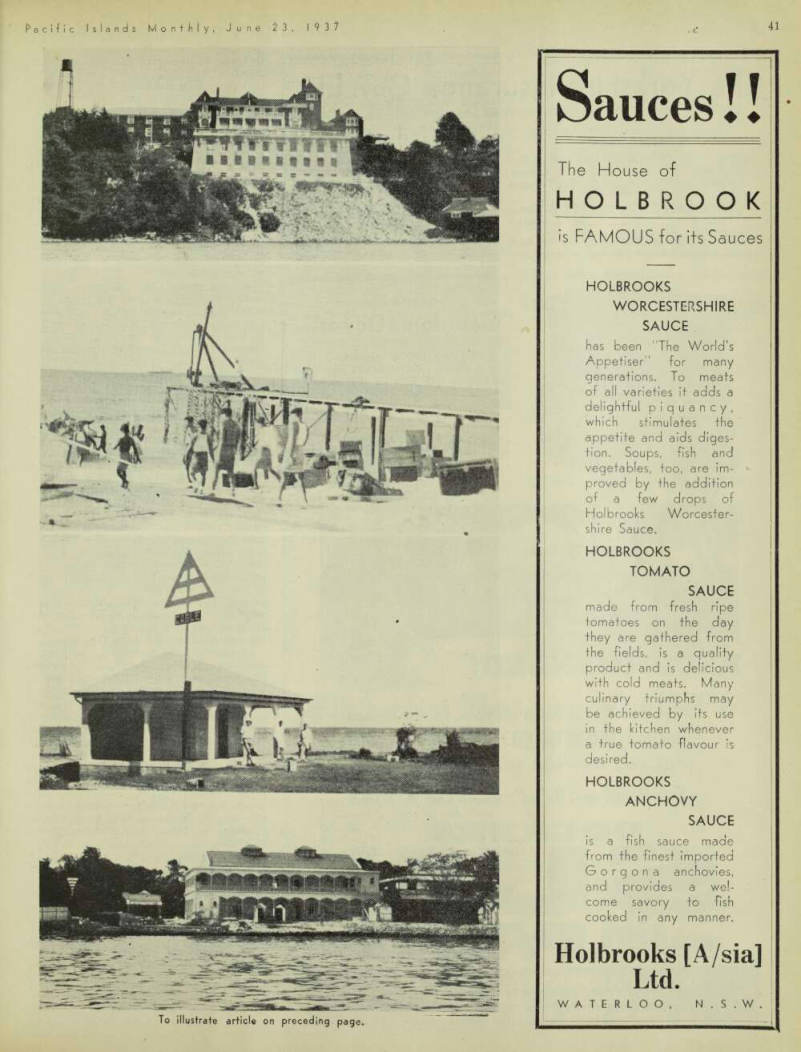
The Plan To Seize Necker Island
By A. A. Henkel
TT is not generally known that Necker -*■ Island, in the Hawaiian Group, was much sought after as the first point of landing of the Pacific cable, after leaving Canada.
This island was discovered by La Per ouse on November 1, 1786, but was not considered, at the time, worth claiming.
Fanning Island was such a distance from Canada that it was not considered pos sible to lay such a long length of cable to there, and Necker Island received great attention as it lessened the distance by approximately 1,000 miles, and gave an all-British route.
Sir Sanford Fleming had urged, in 1879, that a submarine cable be laid across the Pacific to connect with the Canadian land lines, and it was due mainly to his efforts that the plan was put into operation. He is regarded as the father of the Pacific cable.
The opposition to this scheme was great and terrible disasters and difficul ties were foreseen. In particular one expert witness said that there were pre cipes with jagged edges, as tortuous as the path of a man with “a jag on,” and with a ten-acres field to perform his gyrations in. The torpedo, also, would plunge to hitherto unknown depths after the cable, and speedily bring about its end by boring through the insulation.
Sir Sanford, despite many setbacks and years of weary waiting, continued to
The illustrations in the adjoining columns show: Top: Office and quarters. Cable Station, Bam field, Canada.
Second: Fanning Island. The cable comes in at the left of the jetty.
Third: The cable hut at Suva, about 2£ miles from the cable offices in Victoria Parade. There are two cables between Canada and Fiji, the first laid being known as No. 1 (to which the accompanying article refers) and the second, laid about 1927, as No. 2. The latter cable comes ashore at the hut and is connected with the offices by landlines.
Bottom: The cable offices in Suva. No. 1 cable lies buried in the mud, in the foreground.
spend a great deal of his time in forward ing this project. Upon the completion of the Pacific terminus of the Canadian Pacific railway, the telegraph was ex tended to British Columbia; and he urged that the British possessions west of the Pacific Ocean be connected by submarine cable with the completed land line.
Necker Island was regarded as the best location, as a landing place, for the first section of the proposed cable. It is a mere rock, one mile long and 1,000 feet broad, and it rises to a height of about 300 feet at its highest point.
In September, 1893, Sir Sanford urged upon the Canadian Government the im mediate acquisition of Necker Island by Britain. In October, 1893, the Govern ments of New South Wales, Victoria and
(Continued on page 42)
To illustrate article on preceding page.
Queensland supported the Canadian pro posal, urging the Home Government to take immediate steps to secure the island.
About this time, the death of King Kamehameha, of Hawaii, had been fol lowed by a revolution. The Queen was deposed, and a provisional Government was set up in the group; and it was felt possibly that to take possession of Necker Island at this stage might upset relations with Washington.
This decision was regarded as curious.
To quote the words of Sir Sanford Fleming; “Necker Island is an unoccu pied and unclaimed spot in the middle of the Pacific Ocean, wholly unfit for settlement, and destitute of the means of supporting life.”
Months passed and, no more having been done in the matter, the Home Gov ernment was pressed for a reply which was to the effect that “in view of the dis turbed conditions in the Sandwich Islands (Hawaii) further definite steps were undesirable for the present.”
Fearing that the whole proposal that the British Government should take pos session of Necker Island would become public, some other solution of the diffi culty was sought.
Sir Sanford, in conversation with a friend, mentioned the matter, and was asked if he was not aware of the manner in which the island of Perim was gained.
The story is that the French had sent an admiral to raise the Tricolour and claim it as a French Possession. The admiral called in, on the journey, on the British Resident at Port Aden, who, in the course of the evening, learned the object of his guest. Leaving the admiral on a pretext, the British Resident gave orders that men should be at once des patched to hoist the British flag and take possession in the name of Her Majesty.
He then returned to his guest and kept him entertained far into the night.
Setting sail the next day, the French admiral completed his voyage to Perim.
His amazement must have been great to see another flag already floating over the island.
The hint was taken, and a retired naval officer was entrusted with this delicate mission of securing Necker Island, by a private coup. A boat was to be pro cured, at Honolulu, to take him to an unoccupied island, situated about Lat. 23, 35, N., and Long. 164, 39. W.- —in other words, Necker. Examination of the island was also to be made, soundings on ap proaches to taken, and a sketch made providing any other information that could be gained.
Being a retired officer of the British Navy, the man’s claim would be legal, providing that the Imperial Government chose to recognise it. On account of the Colonial Conference due to meet at Ot tawa at the end of June, and this now being May, the task presented many diffi culties, owing mainly to the necessity for secrecy and quick action.
There were two boats at Honolulu which could have made it in the time allowed —that is, to return to Honolulu in time to catch the Arawa en route to
Vancouver and due at Honolulu on June 2. However, on arrival at Honolulu, the officer learned that in the meantime the Imperial Government had apparently given possession of this island to the pro visional Government at Honolulu, and had asked for permission to control the island for purposes nf a cable station.
The secret being out, the proposal to an nex the island, by what might be termed a private coup, was abandoned. Ironically enough, the very ship that had been selected for the journey to establish claim to the island for the British was sent by the provisional Government of Hawaii, and a party landed and claimed it for U.S.A., thus establishing ownership beyond all doubt.
The application from the Imperial Government, on being referred to the U.S. Senate, was voted against, and Necker Island was lost as a landing place for the Pacific cable.
Attention was now directed towards Fanning Island which, with Christmas Island and Penrhyn, was annexed by Britain in 1888. Fanning and Christmas both export copra at the present time.
Fanning was then considered as the next best location and it was agreed to land the cable there.
At the date of contract for the con struction of the Pacific cable (December, 1900) soundings from Vancouver Island (the cable leaves Canada from Bamfield, on the west coast of Vancouver Island) to Fanning had been taken by the British survey ship Egeria, up to about 300 miles from the island. The Byittania was en gaged to complete this survey, and also the other surveys of the route to Queens land, Norfolk Island, Fiji, and New Zealand.
Fanning Island is really a coral reef, measuring about three miles by nine, and some 12ft. above water level. During the sounding operations by the Brittania, a distance of 6883 miles had been cov ered and, out of 699 soundings taken, 198 bottom temperatures were observed. At 2,500 fathoms, near Fiji, temperature was recorded as 34.1 Fahr. At depths of over 3000 fathoms, there is very little varia tion in temperature, which is only a few degrees above freezing point (32 Fahr.).
The commencement of the laying of the cable was from Bamfield Creek, Van couver Island, and it was done by the Colonia on September 18, 1902. With 3540 nautical miles of cable aboard, she laid 3455 nautical miles of cable in 17i days, thus completing, at an average speed of eight m.p.h. the first link be tween Canada and Australia of the All- Red route. Approximately 10 per cent of cable is paid out in slack.
The Colonia, a ship of 510 ft., 56 beam and 39 depth, was designed to carry a dead weight of 10,000 tons. The cable
varied in w r eight from lh tons per nauti cal mile, for the deep sea type, and to 26 tons for the heavy shore end.
During the laying of cable, a perfect check on the amount of cable laid is ob tained by the unrolling of fine wire, and the distance between the recorded length of the cable laid, and the tight wire, gives the amount of slack. It is interesting to note that when the cable is being laid in depths of 3000 fathoms (3J miles) it will be some 20 miles astern of the ship when it comes in contact with the bottom.
A submarine cable consists of the core, or the central wire, usually surrounded by copper strips over which gutta percha is placed and finally covered by iron or steel wires giving, in addition to protec tion, the necessary weight to be laid on the ocean floor. The size of the com pleted cable is governed by the location in which it is to be laid. If in the ocean depths it would be about one inch in diameter: whereas the shore end, on rocky bottom, would have additional protection which would give it a dia meter of two and a half inches or more.
The first message was sent on October 31. 1902, to the Governor-General, Ottawa, via England, South Africa, Australia and the Pacific cable, from Ottawa, by Sir Sanford Fleming—thus encircling the globe per medium of submarine tele graphy.
Miss Margaret Quintal, a descendant of Matthew Quintal, of the Bounty mutiny, arrived in Sydney from Norfolk Island by the Morinda on May 24.
Advertisements & other items, pp. 43-45 (1 item)
Sauces!!
The House of
HOLBROOK
is FAMOUS for its Sauces
HOLBROOKS
WORCESTERSHIRE
SAUCE
has been "The World's Appetiser" for many generations. To meats of all varieties it adds a delightful piquancy, which stimulates the appetite and aids digestion. Soups, fish and vegetables, too, are im- • proved by the addition of a few drops of Holbrooks Worcestershire Sauce.
HOLBROOKS
TOMATO
SAUCE
made from fresh ripe tomatoes on the day they are gathered from the fields, Is a quality product and is delicious with cold meats. Many culinary triumphs may be achieved by Its use in the kitchen whenever a true tomato flavour Is desired.
HOLBROOKS
ANCHOVY
SAUCE
is a fish sauce made from the finest Imported Gorgona anchovies, and provides a welcome savory to fish cooked in any manner.
Holbrooks [A/sia]
Ltd.
WATERLOO, N.S.W.
The Yorkshire Insurance Coy. L+d.
ESTABLISHED IN YORK 1824
Agents and Attorneys throughout the Pacific Islands SUVA A. Q. McGowan & Co.
SALAMAUA A. Innes
KAVIENG F. V. Saunders
PAPUA
Port Moresby E. A. James Samarai E. J. Morrow
Fire
Accident
Marine
Total Assets Exceed £15.000.000.
NEW GUINEA BRANCH: Park St.. RABAUL
E. G. MacADAM, Manager
I
The
"Caledonia Dover"
A COOKING STOVE guaranteed to give complete satisfaction and now recognised as THE BEST on the market.
Suitable for coal, coke, or wood fuel.
Illustrated Catalogue on request.
LANE & GIRVAN, LTD.
BONNY BRIDGE, SCOTLAND
m.
BBHH
RECOMMENDED!
"SUN” Brand Paint on your Home means
definite PROTECTION against tropical
sun and sea-moist air.
Sun Proof and Rain Proof on every Surface
DOCKERS
PAINT
W. R. CARPENTER & CO., LTD.
NEW GUINEA, SOLOMON ISLANDS
aaJ all other South Sea islands.
V. H. Jones & Rickard
Electrical Engineers
525 ELIZABETH STREET
SYDNEY
HimiiMitiiiiiiHiiuiiiMiiiiiiiiiiiiimmiiMiiiiiiiimiiiiiiiiiiiiiiiiiiiiiiiiiiiiiiiiiiiiiiiiiiiimiiiiiiiiH iiiiiiimiiHiiMiiiiiiiimiiiiMiiimiMiiiiiimiiiiiiiiiiMiiimnmiinmimiimiiiiiiiimiiMMiiiiiHiii* Specialists in rewinding and repairing all classes and sizes of electrical machines and equipment. Special treatment given to work for the tropics.
TELEPHONE: MA 1397
BUILD AN ATTRACTIVE PERMANENT
HOME OF STEEL
ILLUSTRATED is an attractive "Comet" steel bungalow recently erected by us.
This building is in no sense a special order, but shows just what can be done with the patented "Comet" principle of Steel Building Construction.
The "Comet" Steel Building, by reason of its patented sectional construction, is easily enlarged and where required, conveniently portable.
The buildings are white-ant proof, fire-resisting and economical to erect.
They have definitely proved themselves the best proposition for the islands.
EMINENTLY SUITABLE
FOR:—
BUNGALOWS
STORES
WORKSHOPS
COPRA SHEDS
BOYS’ HOUSES
HANGARS. ETC.
"COMET '
Steel Buildings
SIDNEY WILLIAMS & CO. (PTY.) LTD.
Steel Building Specialists?. Builders and Contractors
niiI.WICH HIM* SYDNEY
ROCKHAMPTON BRISBANE TOWNSVILLF.
W. M. REID
Exporters and Export Agent
REID HOUSE
75 King Street, Sydney, N.S.W,
Papuan Rats
The Archbold Collection
'THE recent Archbold scientific expe- A dition to Western Papua has been described recently as most successful. It took back to New York many new species of birds and mammals.
The expedition is remembered in Papua mostly on account of its rat-catch ing activities. Several well known local bushmen were employed on the work, and they still talk about it as one of the quaintest jobs in their experience.
The expedition took away thousands of dead rats, and the following is one expert’s summary of their value:— “There are definite affinities between
the rodents of Papua and Australia. We found a water-rat belonging to the same genus as that inhabiting Victoria; also mosaic-tailed rats, a group of grass-rats and a new form of jumping rat, related to one found in Queensland and the Northern Territory. There is also the giant rat, Mallomys, which has long and thick, woolly fur. One member of the water-rat group, with soft velvety rufous fawn fur, was at home far from water— its habits are not aquatic.”
Dr. Frances Harding, accompanied by her brother-in-law, Mr. C. Harding, of Ohio, U.S.A., reached Sydney by the Malaita during May after a seven-weeks’ visit to Papua, New Guinea, and the Solomons in the interests of the S.D.A.
Mission.
On An Old Goldfield
jV/f-ft- HUMPHRIES was the warden on iTA the old LaJcekamu goldfield, Central Papua. He saw the decline of the field , and the population slowly dwindle , until only one European remained, where for merly many hundreds were busy. tTERE they walked and talked, and dreamed of finding Gold, to open a wide world’s door.
The passionate voices of a rich-find minding Whatever doubts the day’s yield bore.
Here they lived and toiled in ecstasy, grew thinner, Rarely about their hardships word was heard.
The chorus was, “The field will prove a winner!”
And now the silence here is never stirred!
The disappointment! Yes; but affirma tions, All holding promise for the unspent days, Of richer fields and startling revelations, Consoled and sent them forth by divers ways.
I hear their joking faintly, and the laughter To veil the thoughts then mirrored in their eyes; M atching them go, and lonelier ever after, I saw them big and brave men, if not wise.
Richard Humphries.
Defaulting Recruits
Letter to the Editor ■THE very interesting article of “De -1 faulting Recruits,” in the Solomons, published in the P.I.M. of March, should arouse sympathy among recruiters in Papua, for defaulting recruits are by no means unknown in this country, though the monetary loss that may result is far less than in the instances cited from the Solomons, Natives have been known to clamour for work when a recruiter visits their villages, yet, having had the conditions and wages conscientiously explained to them through an interpreter, have re fused to keep their word of acceptance when brought before a labour official. In such cases, the unfortunate recruiter has to feed and return them home, free of charge.
The practice is not common enough to make a song about, but, rare or common, it is downright fraudulent, and the ex posure of fraudulent practices when proved is in British countries followed by some form of penalty.
But. in Papua, as in the Solomons, there is no redress in such cases.
I am, etc.,
Recruiter.
Pt. Moresby, Papua, 3/5/1937.
Mrs. Eric Vine, after three months’ holiday in Sydney, returned to her home in Fiji hy the Mariposa on May 28.
Advertisements & other items, p. 46 (1 item)
>Feuerhanp<
HURRICANE
LANTERNS *
\ £ 4 1 1* < 'S 5* s and many other types of varied shape and style!
Sole Agent for the South Sea and New Guinea:
CARL AUG. DOCKE BREMEN/germany
Exporter of all goods, suitable for the Islands trade Importer of any kind of Island Produce Correspondence invited
The Boy-King Of Tahiti
And His Crowning
By W. W. Bolton, M.A.
Part I.
W'HEN Pomare 11. died on December 7, 1821, he left two children, a girl, Aimata, seven years of age, and a boy, Terii Taria, a babe in arms. It was to the latter he ordered the succession should go, and Pomare was the name he was to assume.
The infant, born June 25, 1820, was nursed by his mother Terito, but was placed in special charge of her steadier sister, Pomare Vahine, who was a super numary wife of Pomare 11., edged out of her promised premier post as first Queen by the earlier action of Terito, and childless.
A special house was raised at Papaoa, a few miles distant from Papeete, close adjoining Pomare’s tomb, and known as the Queen’s House, where aunt and babe resided during his infant years.
Terito went her own wild ways, keep ing her girl by her side, and scandalised the brethren of the L.M.S. by allowing herself freedom to the extreme extent of being tatooed. The babe, not the mother, was the one to watch and guard.
Even before the child could lisp, ar rangement was made for Brother Nott, doyen of the mission band, to leave Hua hine and take up his residence at Pa paoa as instructor of the infant prince.
His kingdom was being looked after by a Regent. Ariipaea, and a Council, but the real power was in the hands of Pomare Vahine, a strong, virile and cap able woman.
Some trepidation had been felt at the time of the death of the father that the chiefs would not be willing to accept an infant as their liege lord, but they had made no sign of dissatisfaction. The brethren were, however, taking no chances, and something entirely new and even unheard of was planned, proposed and accepted: there should be a crowning as soon as the boy could stand upon his feet.
To make things still more secure for the tranquility of the state and the pro gress of Christian civilisation, there was started a school, in 1824, at Afareaitu, on Moorea, with the resounding title of “The South Sea Academy,” for the sons of chiefs, who were to be in residence, and little Pomare amongst them. The part to be played by Brother Nott was to be taken as headmaster by a later ar rival, Rev. J. M. Orsmond.
Coronation Of Pomare 111.
The programme ready, great prepara tions were made at Papaoa for the crown ing, which took place on April 21, 1824, the boy king not yet four years old.
Happily we have an account of this remarkable event in South Sea history from the pen of a contemporary witness, as it appears in the Command Papers Presented to the British Parliament , cov ering the years 1822-1847. The transla tion reads as follows. The only difficulty
to be met with are the sites mentioned, the names of that day being long disused.
To-day they are Arue and Papaoa, where in stood the vast Royal Mission Chapel.
There were two classes of people in that ceremony, some were ungodly and others were godly. (1) Those who carried the Tiari and the Oroa (flowers) were Mauihi-u-iti Vahine, Terai mano Vahine, Tuehau Va hine (women), and Tehapai. They threw the flowers along the road. (2) Next were the children of the mis sionaries and their wives. (3) Next was Mahine, His office was to carry the Word of God. Messrs. Tyer man and Nott were on his right; Messrs.
Bennet and Henry on his left; they as sisted Mahine. (4) Next were the missionaries. (5) Next to them was Utami. He car ried the Laws; he was assisted by Paofai, on his right, and by Paraita, on his left. (6) Next was Tati, who carried the Crown; Hapoto on his right, Onee on his left. (7) Next to them was Pomare, and the people who carried him, namely Taituma taata, Heivae, Uoho and Laaviri, on his right; Teupoopaari, Priui, Roura and Te hope on his left. Aita Vahine, Maihara Vahine, Tenania Vahine (women) were also on his left; and Taaroa Vahine (mother), Aimata (sister) and Tera taue (aunt) on his right. (8) Next was Pomare’s hunoa (first husband of his sister), Tamatoa on his right and Tahitoe on his left. (9) Next was Fenuapeho. He carried
t.h» table to place the crown upon. Pahi titia carried the oil (coconut) for an ointing the king. All the governors and district judges assisted them. (10) We went inland by the way of Taipu. It was there where Pomare 111. was crowned. (11) Then all the royal party, the governors, the missionaries, aid the judges, and the society were assembled together. (12) After Mr. Crook, the priest, fin ished prayer, Mr. Henry anointed the king and placed the crown upon his head (13) Mr. Nott read the Laws and pardoned all the guilty. Mr. Wilson ex horted the King. Mr. Davies prayed, and Mr. Jones read a hymn. Mr. Wilson prayed. When finished we returned to Outuaiai. There Mr. Henry prayed. These were the words of God; “Exalt the King and fear God.” There it finished.
So far, this witness. But was Henry, the Archbishop of the day, and Nott merely his assistant? Henry himself makes answer. Writing from Moorea, October 15, 1845 (31 years later) he says: “King Pomare 111., that young prince, whom I anointed on the occasion, and on whose head my late reverend Brother Nott placed the Crown.”
One hopes so, for when the crash came in December, 1808, Henry had fled, but the unflinching Nott stood fast.
Ariipaea the Regent is lost to us, ap pearing under another name, whilst of the other personalities mentioned, Messrs Tyerman and Bennet were newcomers on the scene, being the delegation sent out from home to report on the missionary
work being carried on by the society throughout the world—Rennet alone com pleted the tour, Tyerman dying on Mada gascar.
The infant’s brother-in-law was Tapoa, of Pora Pora. In 1822 when Aimata was eight years of age and Tapoa' 16. there was a public betrothment of the two, which was looked upon as “marriage” according to the custom of the country and Tapoa was then given the name of Pomare as an honour.
Tati (1770-1864) had every right to his high post. He was the leading chief, had seen Cook in his childhood days, stood by the Pomares, both father and son, through stress and storm, and had re fused the Regency, though hard pressed to accept it. He was of Papara, the last district to bend the knee to the Pomares.
Mr. Crook, “the priest,” had played no no small part in the new king’s life, as his daily journal shows. He was the ac coucheur assisted by his well trained wife. June 25, 1820; “Mrs. Crook took the child, managed and dressed it in the English fashion . . . the king would al low no one to touch the child but Mrs.
Crook. June 26: The infant was most of the day at our house with Pomare Vahine . . . Our daughter Mary is de nominated his mother, being the friend of the queen. The child is also called Mrs. Crook’s son.”
He it was who baptised the child, September 10, in the presence of a thous and people, where now he was crowned, and makes bold to address the directors in London on his behalf in a letter dated December 21. 1821: “I shall be glad to
receive dresses for young Prince Pomare who is now IS months old, some superior, soma common.” A godfather of quality, with every right to play his part in open ing the Coronation proceedings.
It was a good send off even if the principal personage might well wonder what it was all about, being but three years and ten months old. (To be concluded)
Advertisements & other items, p. 47 (1 item)
Herbert Del CottPty. Ltd.
DEU T Z
DIESEL
ENGINES
Deu\z Engines used Internationally since 1864
MARINE DIESEL M OM " TYPE
v w
EUT
Range from 10 to 140 B.H.P.
Full information obtainable from the Agents
Herbert Del CottPty. Ltd.
15 CASTLEREASH STREET, SYDNEY
Phone: B 3135
"A. E. C."
ELECTRICAL
EQUIPMENT
FREE ELECTRICITY !
with “A E G” Turbinamos
A "Turblnamo" working from a stream generates sufficient electricity for households, plantations or communities.
Simple to Instal Reliable Supply No Running Costs Looks After - Itself Slzes °- 5 to 40 kw.
Write for particulars - - State head of water available and Electricity output required.
Cables "Voltage"
116 QUEEN STREET, MELBOURNE
Phone: Central 10488
Good Report from Steamships
Trading Co. Ltd.
AS a reflection of improved conditions in Papua, it is announced that Steam ships Trading Co. Ltd., merchants and shipowners, of Port Moresby and Sama rai. have made a full payment in cash of preference share dividends (equal to 5/per share) and will pay regular dividends in future.
Associated companies are active and profitable. Coral Seas Insurance Ltd., has paid its usual dividend of 10 per cent; and Sawmillers and Traders Ltd. (the old Port Romilly mill) has declared a dividend of 10 per cent.
S.T. Co. Ltd. has just purchased Vaiviri plantation (Vailala River) from Mrs.
Russell Smith. It adjoins Maira plan tation, already owned by the Co., and it has 350 acres of full-bearing coconuts.
The Co. is managing agent for the two new rubber companies, Rubberlands Ltd. and Maratoi Rubber Estates Ltd., where clearing and planting operations are now proceeding actively.
Advertisements & other items, p. 48 (1 item)
Tilley
One Lamp for every purpose In or Outdoors E.X. 4.
"ALL-PURPOSE" LAMP
Light of 300 c.p. 6 hours for Id. Burns Ordinary Kerosene This Lamp is designed for general all-round service. It is the cheapest Vapour Lamp on the market, but at the same time highly efficient in every detail and simple! to operate. Can be carried about as Storm Lantern in the fiercest gale; used as a Hanging Lamp (indoors or out) by fitting 12ins. Reflector which slides on to the Suspension Wire; or turned into a Table Lamp by just detaching the Suspension Wire" The light is perfectly steady and unaffected by draughts, however severe. Lamp is strongly made of polished brass, with no parts to rust, corrode or get out of order. Burner hood enamelled in bright colours. Reflector is enamelled white. Get rid of all antiquated devices and use this up-to-date All-British Tilley Lamp.
Obtainable throughout the Pacific Islands from the Branches of;
BURNS PHILP & CO.. LTD., and
BURNS PHILP (SOUTH SEAS) CO.. LTD.
Spare Parts and Lamps also obtainable from — W. KOPSEN & CO. LTD., CLARENCE STREET, SYDNEY.
If any difficulty, please write direct to: THE TILLEY LAMP CO. (Dept. P.M.) HENDON, LONDON, N.W.4
Sugar And Pineapples
C.S.R. Co. In Fiji
THE total output of raw sugar from all sugar mills in, Australia last season was 756,000 tons. That from the seven mills of the Colonial Sugar Co.
Ltd., was 167,900 tons. Production in each case was a record.
These facts were stated by the Chair man of C.S.R. Co. Ltd. (Mr. E. R. Knox) at the half-yearly meeting of share holders on May 26.
The Fiji output was, as expected, a record at 149,300 tons, and the prospects for the coming season are quite satis factory.
There has been a marked increase in the demand for nearly all distillery pro ducts, and arrangements have been made to increase capacity, both as to produc tion and storage. A new still has just been ordered which will enable the com pany to make industrial alcohol and absolute alcohol as required.
The two steamers, Rona and Fiona , are fully taxed to keep the distillery supplied with molasses, and enquiries are being made for a third ship.
Planting of pineapples in Fiji has pro ceeded as well as was expected, and ful filment of the expectation to can and pack a crop next year can be forseen.
Many operating difficulties in the pro duction of fibre board from megass in Queensland have been met.
a. n. Mclennan leaves
New Guinea
ONE of the best known solicitors in the Western Pacific, Mr. A. N. Mc- Lennan, of Rabaul, New Guinea, has sold his practice and has gone to live in Aus tralia. For many years, Mr. McLennan took an active and important part in New Guinea affairs, and he was a highly res pected member of the Legislative Council.
Several gatherings of residents in Rabaul entertained him before his departure and expressed regret that he was leaving the territory.
Mr. McLennan sold his practice at Rabaul and Wau to the manager of his Wau branch, Mr. J. Irwin Cromie. Mr.
Cromie will carry on the Rabaul practice, and Mr. J. A. McKay, recently of Mel bourne, will manage the Wau branch.
Twelve navy ’planes, with 78 men aboard, arrived at Honolulu, Hawaii, rec ently, non-stop from San Diego (Cali fornia) to increase the permanent stat ion at Pearl Harbour. Their flying time was 21 hours 25 minutes.
The Tongan high chief Ata will visit Sydney towards the end of the year, and has accepted an invitation to be the guest at a function which The Pacific Islands Club will hold in his honour. Ata is the Tongan Minister for Lands, and was acting-Premier during the recent absence of Prince Tugi.
Staff Movements In N.G.
Public Service
May 13, the Government Secretary of the New Guinea Administration announced the following transfers and encasements in connec tion with the Public Service: —
Transfers
Public Health Dept: E. A. Holland, Medical Officer, Rabaul to Kavieng; H. S. Roberts, Medi cal Officer, Kavieng to Madang; G. H. McQueen, Medical Officer, Madang to Rabaul ; A. R. Parry, Medical Assistant, Rabaul to Kokopo; F. N.
Green, Medical Assistant, Lorengau to Rabaul ; F. E. Cattrell, Medical Assistant, Kavieng to Madang; Miss P. M. Noonan, Nurse, Rabaul to Wau.
Lands Dept: A. R. Miller, Surveyor, Morobe District to Sepik District.
Police Force: E. Steeples, Inspector, Rabaul to Wau ; H. C. Gridley, Warrant Officer, Rabaul to Kieta; T. W. Upson, Warrant Officer, Wewak to Kavieng; N. S. B. Blood, Warrant Officer, Kieta to Rabaul.
Temporary Engagements
Govt. Secretary’s Dept.; Miss J. McCluggage to be typiste.
Treasury Dept.: A. L. B. King to be clerk; Miss I. Doering to be typiste.
Public Health Dept.: Miss J. Cunningham to be typiste.
Public Works Dept.; T. G, V. Blakey to be Senior Electrical Mechanic.
Mr. J. T. Kenny, planter, of Nama taiiai, New Ireland, left Sydney for the
Territory by the Montoro in mid-May.
Advertisements & other items, p. 49 (1 item)
Vers
Kork-N-Seal
FOR HOME USE
FOR ALL HOME BOTTLING
—THE LITTLE CAP THAT
will Re - seal 1,000 Times
KORK - N - SEAL (Ausf.) LTD.
106 COMMONWEALTH STREET
SYDNEY, AUSTRALIA
Applied Airtight Pressure Proof Hand
We are Specialists . . . \ 'Phones: MA 3612 (4 lines) Cable Address: “Weymarkson”
Codes —Bentleys Private Let us have your record of supplying the World in ... .
FRESH FRUIT VEGETABLES
confidence. Sixty years is our the leading Houses throughout
PRODUCE
WEYMARK & SON LTD.
FRUIT AND PRODUCE MERCHANTS
14-18 STEAMMILL STREET - - SYDNEY
C H I
VERS
P ERE
FOODS
GOLD MEDAL JAMS
CANNED ENGLISH FRUITS
CANNED ENGLISH VEGETABLES
CUSTARD POWDER
OLD ENGLISH MARMALADE
JELLY CRYSTALS, ETC.
Obtainable from all Leading Grocery Stores --- Write to Department A., Chivers and Sons Ltd., Hlston, Cambridge, England, for attractive Recipe Book.
E. 76 '***' m mm on W
Naval Heroes
France Remembers Her Naval Heroes
THE French sloop Rigault de Genouilly 1 left Auckland early in May for Mauna Island, Samoa, where officers and men of the La Perouse expedition were murdered in 1787. The Mayor of Auck land presented the sloop with stone, kerbing and cement for the graves.
Acknowledging the gift, the French commander said, “We are proud to know that our friends, who can count in their past the greatest navigator in history, Captain Cook, wish to associate with us in keeping our memories.”
Mauna is now called Tutuila, and is the chief island of American Samoa.
Captain de Langle, commander of the Astrolabe, and 11 men, were murdered there on December 8, 1787. In 1883, a stone was placed over the graves with the words: “Marts pour la Science et la PatrieP Mr. J. H. L. Waterhouse, of Rabaul, New Guinea, has been in Sydney for some time receiving medical attention, and he has been granted special leave from the Education Department in Rabaul until October. During his stay in Sydney Mr.
Waterhouse is preparing a special work on the Blanche Bay native language, New Britain, and is receiving special assist ance in this connection from Dr. A. P.
Elkin, Professor of Anthropology at the University of Sydney.
Anthropologists

Are They A Help or a Menace?
Letter to the Editor recommendations of the recent Honolulu Conference concerning pro blems of native education in the Pacific, have been the subject of some criticism in the South Seas—not only by seasoned educationalists at work there, but also by the more advanced and educated natives. I t Education in the future, it seems, in order “to secure permanent and stable adjustment of native social life under the new conditions,” etc., must be based upon the natives’ own obsolete practices and customs.
It is understood, also, that an alliance of social anthropology and education is being sought. Scientific knowledge of native sociology and psychology, they de clare, are “essential to, success in a pro cess of adaptation that aims at a blend of native and European culture.”
“Concept of Nativisation in Educa tion” sounds very learned, but the mean ing of it and the methods proposed for future development are so vague that one can have no hesitation in using the phrase freely, for it can mean nothing more than another anthropological tag to be used as a groundwork for further abstract theories.
Conjectures already are rife as to which of the customs usually frowned upon by law may be considered suffici ently stimulating for this anthropological theory to work upon.
With so many aspirants in the field of anthropology, it is understandable that the most compelling self-advertisement is necessary, if a number of fanciful theor ies are to be brought to light; but even their beautiful blossoming, and the poig nant sadness of their fading, cannot justify this last frantic effort for publicity.
Until recently anthropology has been comparatively harmless, and few have regarded its pet theories seriously. But if these theorists are to succeed in push ing their fantastic claims as educational ists into the South Seas, it is time that some measures be taken to protect un fortunate natives from being harassed by a frantic band of job-hunters.
Anthropologists are becoming seriously a l armed at the insecurity of their stand ing, and impatient that their alleged right to fame should be measured by their ability to attain it. Some check should be put upon their uncontrolled and mis chievous activities, before the threat be comes a scourge.
I am, etc.,
Educationalist Of 20 Years’
Standing.
Pt Moresby, Papua.
May 4, 1937.
Pastor W. D. Smith, a Seventh Day Adventist missionary, arrived in Sydney by the Morinda on May 24, after spend ing two years on Norfolk Island and in the New Hebrides. He will leave shortly for Pitcairn Island.
Mr. Andrew F. Ker, of the New Guinea Administration’s staff at the Wau Dis trict Office, departed from Sydney for Rabaul with his wife by the Montoro on May 15. They spent their leave in Sydney and Victoria.
Advertisements & other items, pp. 50-52 (2 items)
Master Sewing
WHY TAKE A RISK ' AAAAAAAAAAAAA AAAAA/^AAAAAA/\A/\AAAA/V\A/>^W\^^/^A/V^A/VW\AAA/VWWNAAAA/V\A^W%A/
J. YOU CAN WITH CONFIDENCE
*' AAAA *AAAAAAAAAAAAAA/W^W^/WWWWV*AA
PLACE YOUR RADIO ORDERS WITH
Fox & Maccillycuddy Ltd
The Oldest Established Radio Distributors of Completed Receivers Parts and Accessories in Australia.
9 EVERREADY BATTERIES •
EVERREADY BATTERIES ALWAYS IN STOCK
SUPERDYNE HEAVY DUTY LIGHT DUTY
“C” BIAS “A” BATTERIES AND TORCH REFILLS All brands of Radio Valves always in stock, including Radiotron, Philips, Kenrad, Mullard, National Union, Osram. Each Valve is carefully tested before despatch.
QUALITY RADIO PROMPT SERVICE RELIABILITY
We specialise in all sets as described by “ Wireless Weekly,” and full stocks of parts are always on hand. We will be pleased to quote you by return mail. u
YORK
SYDNEY.
WE ALSO STOCK
HEAVY LEATHER CANVAS
LIGHT LEATHER CAR TRIM-
MING BOOT PATCHING
HIGH SPEED DRESSMAKING
& HEMSTITCHING MACHINES.
All Machines Guaranteed.
Master Sewing
Machine Co.
15 ENMORE ROAD
NEWTOWN - SYDNEY
RECONDITIONED SEWING MACHINES
Singer Dropheads £8 to £l4
White Dropheads )
New Century Dropheads ) £6 to £9
New Home Dropheads )
Singer Uprights £4 to £6 Singer Hand Machines, £4/10/- to £5/10/- Other Hand Machines £2 to £4 Please stipulate the particular type required.
No delay. All goods carefully packed.
NEEDLES and PARTS for all makes of Machines.
OIL supplied. Any quantity.
Any motorist,
changing to SHELL, will find his car "pulling better.”
Shell does give outstanding performance. Starting is easier: pick-up is quicker; flexibility is more pronounced.
And SHELL gives extra miles to every gallon.
SHE
Utl
WET EDGE "
• The flat, oil, wall finish fhaf leaves no brushmarks.
Made in lovely pasfel
tinfs and warm neutral shades all fadeless and washable.
AGENTS
THROUGHOUT
THE ISLANDS
State Control
Fruit Export Under
N.Z. Acts In Cook Islands
From Our Own Correspondent.
Rarotonga, May 19.
A PUBLIC meeting of fruit growers was held on April 13, when Mr. S. J.
Smith, newly-appointed Resident Com missioner, described the workings of the “Cook Islands Fruit Control Regulations, 1937.”
Mr Smith said that 34 brokers through out the Dominion would receive and sell the fruit, as agents of the Government, on a small fixed commission per case.
The selling price to retailers would also be fixed. At this end, growers w*ould form an elected Advisory Committee, consisting of the Resident Commissioner, the Director of Agriculture, three Maori and one European representatives. Their election would take place on July 7.
The new regulations empowers the Minister: (1) To control the export of all fruit, so that no person can export, but only the Government; (2) to take control of the handling and shipping of fruit and to sell it on behalf of the growers; (3) to assist growers to reno vate and improve their plantations.
When the grower brings fruit into the packing-shed, and it is accepted by the inspector, he will receive a receipt for the number of cases packed. On presen tation of this, the Fruit Control Office will pay him 2/6 cash for each case. In addition, if the quality is right, the Government aims to pay a further 1/6 when the fruit is sold, making 4/- for oranges this season.
Mr. Samuel Bennett (manager, A. B.
Donald Ltd., Rarotonga) intimated that, on behalf of his own firm and also the Exporters’ Association, he would like to assure Mr. Smith of the support of the local merchants in whatever measures the Government might take regarding the control of fruit.
The meeting adjourned until April 15, to allow growers to consider the regu lations.
On April 15, Mr Smith outlined further aspects of the regulations. Rerferring to native debts, he said the Government would ask the traders to assess the amount of the debts as on April 1, 1937.
The merchant, the debtor, and the Ad ministration would then meet and decide the amount of debt recoverable. If they were unable to agree a tribunal would be arranged. The amount fixed would be put on each debtor’s fruit account sheet, and 6d per case deducted —not from the initial payment of 2/6, but from the subsequent anticipated 1/6.
Mr, Smith said that there was a gen eral desire by growers that the Govern ment take over the banana and tomato crops, as well as oranges. He would like to make it quite clear that the Govern ment intended <%o control these, immedi ately adequate distributing arrangements could be made.
A number of the pricipal native and half-castes, representing the various dis tricts, then spoke briefly, each to the ef fect that they were authorised to say that growers fully endorsed and would sup port the Government’s proposals.
A resolution to that effect was then put by Mr. C. Cowan and carried un animously.
Theft By An Agent
From Our Own Correspondent
Rarotonga, May 19.
H[IGH Court proceedings on April 27, against Charles Cowan, of Ngatangiia, occasioned considerable local interest.
The accused, who was found guilty of forgery and theft, is a prominent half cast, a member of the Island Council, and was recently appointed to a full-time inspectorship under the new Fruit Con trol Regulations.
The charges related to his activities as a “supercargo” or licensed fruit-buyer for the firm of W. H. Grove and Son. He purchased on their behalf, last October, 58 cases of tomatoes for £36/5/- from a native grower, and his own account with the firm had subsequently been credited with this amount, out of which
payments were made to the grower, totalling, by the end of December, £l4/18/-. The balance of £2l/7/- had never been paid, although, on enquiries being made by the police, the accused produced a receipt for the full amount of £36. The prosecution proved that this document was in part a forgery.
Evidence showed that the accused’s account as a “supercargo” was not kept distinct from his personal account, with the result that when the latter was in debt, amounts credited to him for the purpose of paying growers served prim arily to balance the account as a whole.
At this stage, Judge Ayson made it clear that onus of making payment to growers rested with the firm involved, the “supercargo” being simply an em ployee, whose principal the grower was well aware of.
Found guilty, the accused was fined £lO and ordered to repay the £2l.
Advertisements & other items, p. 52 (1 item)
Refrigeration .
i-A,', ia
JAMES BUDGE
LID
REFRIGERATION .
"BUDGE" Automatic or Manually-controlled Refrigeration and Ice-making Plants, with or without insulated Cabinets or Rooms, ranging from 4 cubic feet to 1000 cubic feet or larger using ammonia in the large and sulphur dioxide (SO2) in the small units.
Where electricity is not available, crude oil engines may be utilised for driving the larger plants and petrol engines for driving the smaller machines. The accompanying illustration is of a petrol engine driven SO2 unit. Enquirers please state power available (if any), size of cabinet and amount of ice required per day.
JAMES BUDGE LIMITED
REFRIGERATION AND GENERAL ENGINEERS
McEvoy and Harley Streets
ALEXANDRIA SYDNEY
Established 1890
ENGINEERING WORKSHOPS
ALL CLASSES OF MACHINES MADE AND RECONDITIONED
A Party Postponed
IT happened in “The Blessed Isles”— sometime in ’93 — A dozen miners struck the town, all bent upon a spree; From Gira and The Yodda and the gold fields of Sud-Est, With the thirst that calls together men from East and North and West.
Came Flannigan, Macßackett, Bud and Ryan—“shammy’s” full — The rest of us were pretty broke, for mining had been dull!
Then Micky Dennis drifted in: He’d had a lucky spin, But 12 months out with foodstuffs scarce had left him weak and thin.
Too ill to even “square the store,” to hospital he went.
“It’s blackwater,” the doctor said. “His life’s not worth a cent.”
“I guess I’m done for, boys,” said Mick, “You’d better hang around — To drink a farewell at my grave I’ve left you each ten pound.”
Some stayed about in sympathy, and some in thirsty hope.
And day by day the matron handed out the “dying dope,”
“Last messages” and “tender thoughts he has about his mates.”
“We may not see him?” “No, indeed!”
We hangs about and waits.
The month went by. All stony broke, with thirsts as deep as sin.
All credit gone! No stores! No boys!
The Southern boat comes in— And, sailing, takes as passengers, Mick and his Matron bride ...
To leave us cursing wasted days when Micky nearly died.
Alice Allen Innes.
“Salamaua,” Olola Av., Vaucluse.
Mr. J. S. Neil, H.B.M’s Consul and Agent at Nukualofa, Tonga, sailed from New Zealand in May for Pitcairn Island on official business.
Tragic Voyage Of The
“Viking”
From Our Own Correspondent
Papeete, May 14.
THE yacht Viking, of New York, with her owner, Mr. George F. Baker and guests on board, arrived at Papeete on May 1. She remained at Tahiti five days and departed for Rarotonga, Samoa, Tonga, Fiji, Honolulu and the United States.
This yacht, while smaller and not de
signed along the handsome lines of the black-hulled Corsair of Mr. Morgan, is still one of the most costly and sumptu ous pleasure craft in the United States.
Critical Operation In
Mid-Ocean
The Canadian-Australian liner Niagara stopped in mid-ocean, between Suva and Honolulu, on May 26. in response to signals from the American steam yacht Viking. Mr. G. F. Baker, owner of the
yacht and the millionaire president of the American First National Bank was gravely ill, suffering from peritonitis.
The master of the Niagara (Captain W.
Martin) placed on board the Viking a doctor and nurse (both passengers) who immediately performed an operation upon Mr. Baker, whose condition was
reported satisfactory. After a delay of 21 hours, the Niagara went on.
Later information received in Hono lulu was that a relapse had occurred in the condition of Mr. Baker, and a coast guard cutter was ordered to rush medi cal supplies to the yacht. Shortly after the cutter left, an appeal was made for blood donors, and a naval aeroplane was despatched with serum that could be used instead. But despite all effort to save his life, Mr. Baker died on May 31.
Mr. G. L. Windred, an entomologist who recently arrived in Sydney from Fiji, sailed from Melbourne for England
by the Largs Bay in May.
Mr. L. C. Farnsworth sailed from Sydney for New Guinea by the Montoro on May 15 to join the radio station staff at Rabaul.*
Advertisements & other items, pp. 53-54 (1 item)
Cordage and
Woven Wire for all Industry
COPRA DRYING TRAYS, FLOORS, Etc.
FRUIT DRYING TRAYS, MINING SCREENS
Heavy Mosquito Gauze in Phosphor Bronze and other Metals Impe'rvious to Salt Sea Air WIRE DOOR MATS AND GENERAL WIRE WORKS
E. WRIGHT & CO. LTD.
Office and Works: 148-152 Cleveland Street, Sydney. N.S.W.
Telegraphic Address: "Wrightmake,” Chippendale
VVT/W
7!
Or fO -VF; £ rn & A
isv*
Ship Chandlery Hardware
I Write for Ship Chandlery Catalogue ] Special "In Bond" Prices for all Islands enquiries quoted on application.
BROOMFIELD'S LIMITED
152 SUSSEX STREET :: :: ::
Cables "Boom," Sydney Large and Complete Stocks of
SHIP CHANDLERY
IRONMONGERY OF ALL KINDS.
WHITE LEAD AND OILS
SYDNEY
PAINTS,
Sole Agents for: P. H. MUNTZ & CO.'S 3-CROWN BRAND METAL SHEATHING.
PEACOCK & BUCHANS' ENGLISH READY - MIXED PAINTS.
Scotf s Renown Brand Rope.
Cordage and
Binder
Twine
Ropeyard Sydney f
SSSSSSSSs
of Every
Description
MANUFACTURED AT
MASCOT, N.S.W.
J. SCOTT
PTY. LTD.
Head Office and Slore:
163 CLARENCE STREET.
SYDNEY
N.S.W.
W. M. FORD
Ship, Yacht and Boat Builder
Berry's Bay - North Sydney
(Established 1870) BUILDERS of all kinds of Island Craft from Dinghies to Auxiliary Schooners of any tonnage. New and Second-hand Island Craft of various types in stock.
New and Second-hand Full Diesel.
Crude Oil, Benzine and Kerosene Engines, Please Send on Your Enquiries
Free Literature from
PAUL & GRAY LTD.
(Islands Distributors)
82 - 84 SUSSEX STREET, SYDNEY
DRY ROT
DRY ROT or the attacks of White Ants or Borers can be permanently prevented by treating your timber with '•'Cuprlnol." This scientific preservative is insoluble in water, easy to apply, and can be painted or varnished over. "Cuprlnol ' will definitely eradicate these pests In timber that has already been attacked.
The life of Canvas, Nets, Cordage, etc., can be doubled or trebled by treating with "Cuprinol"—it prevents Mildew and Rot, adds to the tensile strength and doesn't affect flexibility. Full information on request.
CUPRINOI
The Revolutionary Wood and Fabric Preservative
IT ATTRACTS THEY EAT IT THEY DIE!
OVING
USOLINE
NEVER
KNOWN
TO FAIL!
CERTAIN
DEATH
COCKROACH
DESTROYER
IT’S A PASTE!
A U 314
SOL
CROWN
N E
STREET,
c o
SYDNEY
(Established 1919)
PRICES:
Mb. 5/- . . . Bibs. 10/- Postage Extra.
Remit Cash with Order.
Obtainable also from Islands stores of:
BURNS, PHILP & Co. Ltd.
W. K. CARPENTER & Co. Ltd.
In Defence Of Japan
What is Happening in the Mandated Islands
The following article, in defence of Japanese activities in the Marshall Is lands (which Japan holds under man date) was written hy Mr. Carl R. Heine, a missionary of the American Board oj Missions, who has lived in the Marshall and Caroline Groups for a very long time. Mr. Heine is now a resident of Jaluit, Marshall Islands.
IN your November issue there is a para graph in “Tropicalities” concerning proceedings at the sitting of the Man dates Commission on November 10, when Japan’s administration of her Mandates in the South Seas was sharply criticised.
Apparently the vexed question was: “The difference of apparently one third be tween exports and imports the latter being the greater—led to the suggestion that the Japanese were draining the is lands of their natural resources, giving the natives little in return.”
It seems to me that with the infor mation supplied to the League of Nations from time to time by responsible Japan ese officials, and corroborated by Major Bodley, Professor Clyde, and other re liable writers who have visited the Man dates in question during recent years, there should be no valid reason whatever for the critical and distrustful attitude of the Mandates Commission. But the writer is not at all surprised, for it has long been evident that a fault-finding spirit is rampant nowadays, especially where Japan is concerned.
What explanations Mr. Ito (the Japan ese delegate to the League of Nations) may have offered concerning the matter I do not know, but this I can certify and affirm: The natives of the Japanese South Sea Mandates receive more for their copra under the present regime than they ever did before, and they are able to purchase all their requirements from a larger and more varied stock than they ever could before, and can do this at less cost than ever before.
These facts should tend to allay the apprehensions of the Mandates Commis sion. The Commission has been barking up the wrong tree.
But how about the excess of exports over imports? The explanation appears to be simple. There are several Japanese bonito-fishing ventures, purely their own, in the Mandates with an annual catch valued at over a million yen. Then there is the sugar industry in the Carolines, purely their own, with an annual output valued at over 10,000,000 yen. The lab ourers in these industries are, I under stand, practically all Japanese, from the mainland, or else Lu Chu islanders. It is only to be expected that most of the savings of these men, and also the divi dends of the shareholders, will not be spent in the mandates, hence the im ports will tend to be less than they might be under other circumstances.
But note that the islands are not being drained of their natural resources, the supar plantations being on State lands, formerly uncultivated and mistakenly considered to be of little worth, and no Islander has been devprived of his patri mony or means of sustenance.
New Sugar Industry
The principal sugar plantations are on Tinian and Saipan, in the Marianas, a spur of the Caroline Islands. Tinian is a long, flat-topped elevated island of coral formation, 38 square miles in area, and in some respects similar in appearance to Banaba or Nauru —the well-known phospate islands —but of a more terrace like structure on the weather side. It is only a few miles distant from Saipan, which is another island of coral forma tion, but very different in appearance to Tinian.
I well remember my first sight of the latter island, towards the close of 1918, when I was on a never-to-be-forgotten journey to Japan. The tide was low as we steamed along the weather shore.
From the outer edge of the flat-topped reef adjoining the land—a reef very simi lar to that of the typical coral island — columns of spray shot high up at short intervals, probably caused by blow-holes with large openings at the extremity of the reef, with small outlets further back.
I never saw anything exactly like it be fore. In a curious manner, many of these columns of spray seemed to main tain their upright position for nearly half a minute, without spreading out or dissipating, as they advanced across the reef towards the land like tall, sheeted ghosts.
At that time Tinian was covered with a dense jungle, wherein wild cattle and fierce hogs roamed at will, and no sound of human voice was heard. When I again passed the island in 1933 I was amazed at the great change that had taken place.
The dense jungle had given place to miles and miles of vivid green fields of luxuriant sugar-cane, ripening for the harvest, and the hum of busy industry had replaced the former solitude.
While viewing this prosperity, and considering the change and progress manifest elsewhere throughout the man dates, and comparing this with what I have read concerning alleged conditions in some of the mandates of other powers, it is to the writer obvious that Japan has demonstrated her ability to admini ster mandates as satisfactorily as any of the other Mandatories, and better than some. This finding may be objected to; flaws in the system pointed out; never theless, the truth will stand.
Air-Line To Marshalls?
I am interested in an item in your December issue, entitled “Japanese Wings Over the Pacific,” in which it was stated that misgivings have been felt in U.S. navy circles at Japan’s al leged intention to open an air-line from Japan to the mandated islands—that is, the Caroline and Marshall Islands.
Well, at present there are no signs here of anything of the sort being con templated. But I certainly do hope that the plan materialises, and the sooner the
better. I don’t see why U.S. navy circles should entertain any misgivings concern ing the project. Surely, in these days of world progress an air line from Japan to the Mandates is to be expected, and in fact it is long overdue.
No more misgiving should be felt in U.S. navy circles over the plan, than in Japanese navy circles over Pan-American Airways. If the Japanese have misgivings over that, they haven’t said so, to my knowledge. It would have been more ap propriate for U.S. folk to have remained mum, also.
Mr. and Mrs. W. Lieber, old residents of Tonga and Samoa, who have been settled in Sydney for some years, have been elected members of The Pacific Islands Club. Other new members are Mr. T. Wilson', at one time of Apia, Samoa, and Mr. Edward C. Snow, a former resident of Tahiti and Rarotonga.
Dr. A. S. Frater returned to Vila, New Hebrides, by the Morinda on May 27. Dr.
Frater is Medical Missionary in charge of the Presbyterian Hospital at Vila.
Advertisements & other items, p. 55 (1 item)
Bitumenoid Roofing
Timber, Joinery
ETC.
PREPARED BUILDINGS ready for erection a speciality.
SHIP AND BOAT BUILDING.
TIMBERS specially catered for.
FIBROLITE, PLYWOODS, GALVANISED
IRON, CAN EC.
CONSIGNMENTS shipped
by RETURN STEAMERS
to the Islands.
John W. Eaton
LTD.
WEST CRESCENT STREET
NORTH SYDNEY
TELEPHONES: X 5051 (5 lines)
BITUMENOID ROOFING
MADE IN AUSTRALIA
Bitumenoid Roofings, Dampcourse and Insulating Felts are made from the world’s best raw materials. Warranted to stand the most rigid tests.
BITUMENOID THE BEST
Roofing, 1,2, 3-ply; Flooring, Waterproof Materials; Saturated Felt; Resilient Road Jointing; Natural Asphalt Dampcourse: 2 and 3-ply Dampcourse: l-2lb. Lead-core Dampcourse; Roofing Cement; Asphalt Paints; Roofing Compound.
SAMPLES AND PRICE LISTS ON APPLICATION
MAXWELL PORTER & SON LTD.
ESTABLISHED 1888. BUILDERS’ SUPPLIES
107 REDFERN ST.. REDFERN, SYDNEY, N.S.W. ’Phone, M 3157. Cables Bitumenoid
BUILD
MODERN HOME WITH
JJi
I 9 i I
ASBESTOS CEMENT BUILDING SHEETS
Low cost with good appearance and endurance is assured when you specify Durabestos tor walls and ceilings in new buildings or for additions or repairs to existing structures.
Write for literature illustrating the new horizontal application of Durabestos, in modern buildings.
WUNDERLICH LTD.,
Crown and-Cleveland Sts., Redfern SYDNEY
Pacific Islands Club
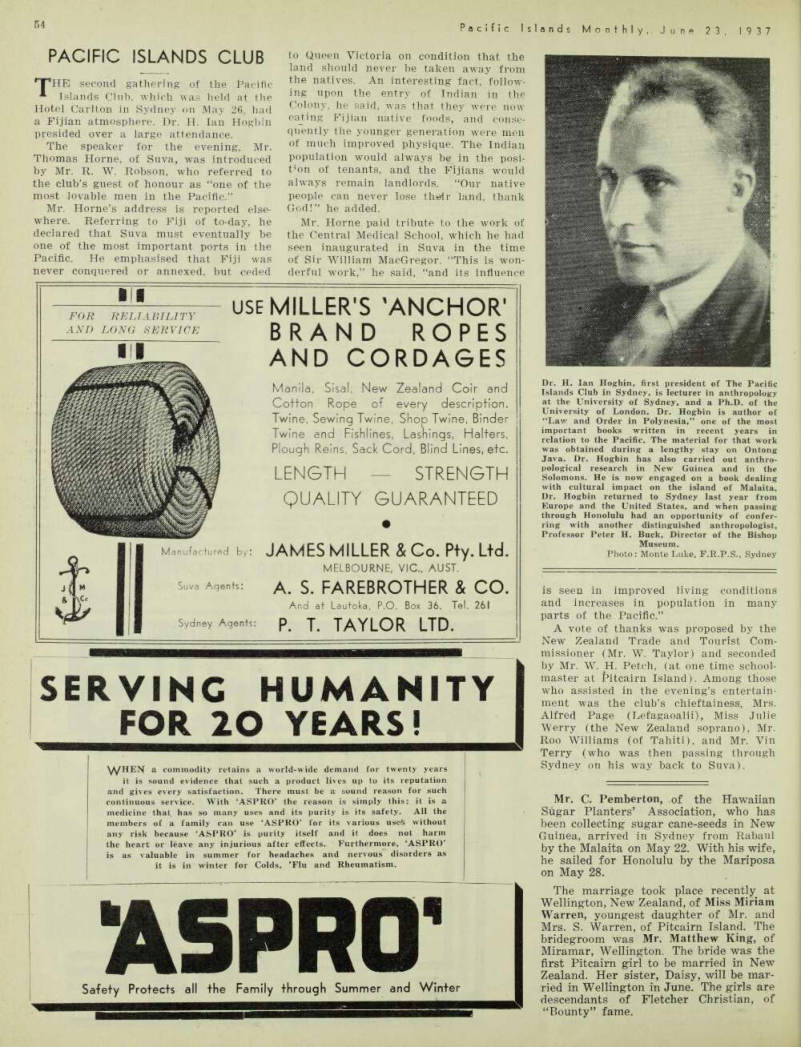
''PHE second gathering of the Pacific * Islands Club, which was held at the Hotel Carlton in Sydney on May 26, had a Fijian atmosphere. Dr. H. lan Hogbin presided over a large attendance.
The speaker for the evening, Mr.
Thomas Horne, of Suva, was introduced by Mr. R. W. Robson, who referred to the club’s guest of honour as “one of the most lovable men in the Pacific.”
Mr. Horne’s address is reported else where. Referring to Fiji of to-day, he declared that Suva must eventually be one of the most important ports in the Pacific. He emphasised that Fiji was never conquered or annexed, but ceded
to Queen Victoria on condition that the land should never be taken away from the natives. An interesting fact, follow ing upon the entry of Indian in the Colony, he said, was that they were now eating Fijian native foods, and conse quently the younger generation were men of much improved physique. The Indian population would always be in the posi tion of tenants, and the Fijians would always remain landlords. “Our native people can never lose their land, thank God!” he added.
Mr. Horne paid tribute to the work of the Central Medical School, which he had seen inaugurated in Suva in the time of Sir William MacGregor. “This is won derful w'ork,” he said, “and its influence
is seen in improved living conditions and increases in population in many parts of the Pacific.”
A vote of thanks was proposed by the New Zealand Trade and Tourist Com missioner (Mr. W. Taylor) and seconded by Mr. W. H. Fetch, (at one time school master at Pitcairn Island). Among those who assisted in the evening’s entertain ment was the club’s chieftainess, Mrs.
Alfred Page (Lefagaoalii), Miss Julie Werry (the New Zealand soprano), Mr.
Roo Williams (of Tahiti), and Mr. Vin Terry (who was then passing through Sydney on his way back to Suva).
Mr. C. Pemberton, of the Hawaiian Sugar Planters’ Association, who has been collecting sugar cane-seeds in New Guinea, arrived in Sydney from Rabaul by the Malaita on May 22. With his wife, he sailed for Honolulu by the Mariposa on May 28.
The marriage took place recently at Wellington, New Zealand, of Miss Miriam Warren, youngest daughter of Mr. and Mrs. S. Warren, of Pitcairn Island. The bridegroom was Mr. Matthew King, of Miramar, Wellington. The bride was the first Pitcairn girl to be married in New Zealand. Her sister, Daisy, will be mar ried in Wellington in June. The girls are descendants of Fletcher Christian, of “Bounty” fame.
Dr. H. lan Hogbin, first president of The Pacific Islands Club in Sydney, is lecturer in anthropology at the University of Sydney, and a Ph.D. of the University of London. Dr. Hogbin is author of “Law and Order in Polynesia,” one of the most important books written in recent years in relation to the Pacific. The material for that work was obtained during a lengthy stay on Ontong Java. Dr. Hogbin has also carried out anthro pological research in New Guinea and in the Solomons. He is now engaged on a book dealing with cultural impact on the island of Malaita.
Dr. Hogbin returned to Sydney last year from Europe and the United States, and when passing through Honolulu had an opportunity of confer ring with another distinguished anthropologist.
Professor Peter H. Buck, Director of the Bishop Museum.
Photo: Monte Luke, F.R.P.S., Sydney
Advertisements & other items, p. 56 (1 item)
Aspro*
11l
FOR RELIABILITY
AND LONG SERVICE
o n H M \Cc W
use MILLER'S ’ANCHOR'
BRAND ROPES
AND CORDAGES
Manila, Sisal, New Zealand Coir and Cotton Rope of every description.
Twine, Sewing Twine, Shop Twine, Binder !
Twine and Fishlines, Lashings, Halters, Plough Reins, Sack Cord, Blind Lines, etc.
LENGTH STRENGTH
QUALITY GUARANTEED
Manufactured by: JAMES MILLER & Co. P+y. Ltd.
MELBOURNE, VIC., AUST.
Suva Agents: S. FAREBROTHER & CO.
And at Lautoka. P.O. Box 36. Tel, 261 Sydney Agents; p_ J. TAYLOR LTD.
SERVING HUMANITY
FOR 20 YEARS!
a commodity retains a world-wide demand for twenty years it is sound evidence that such a product lives up to its reputation and gives every satisfaction. There must be a sound reason for such continuous service. With ‘ASPRO’ the reason is simply this: it is a medicine that has so many uses and its purity is its safety. All the members of a family can use ‘ASPRO’ for its various use& without any risk because ‘ASPRO’ is purity itself and it does not harm the heart or leave any injurious after effects. Furthermore, ‘ASPRO’ is as valuable in summer for headaches and nervous disorders as it is in winter for Colds, ’Flu and Rheumatism.
ASPRO*
Safety Protects all the Family through Summer and Winter
In Dutch New Guinea
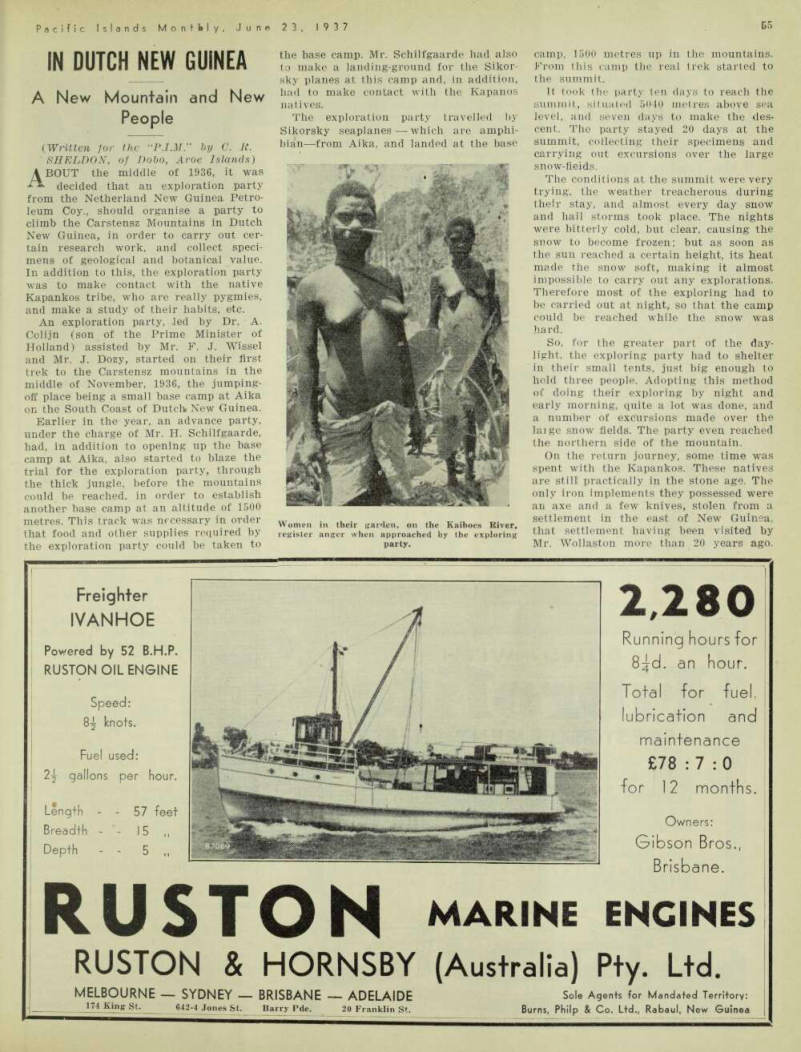
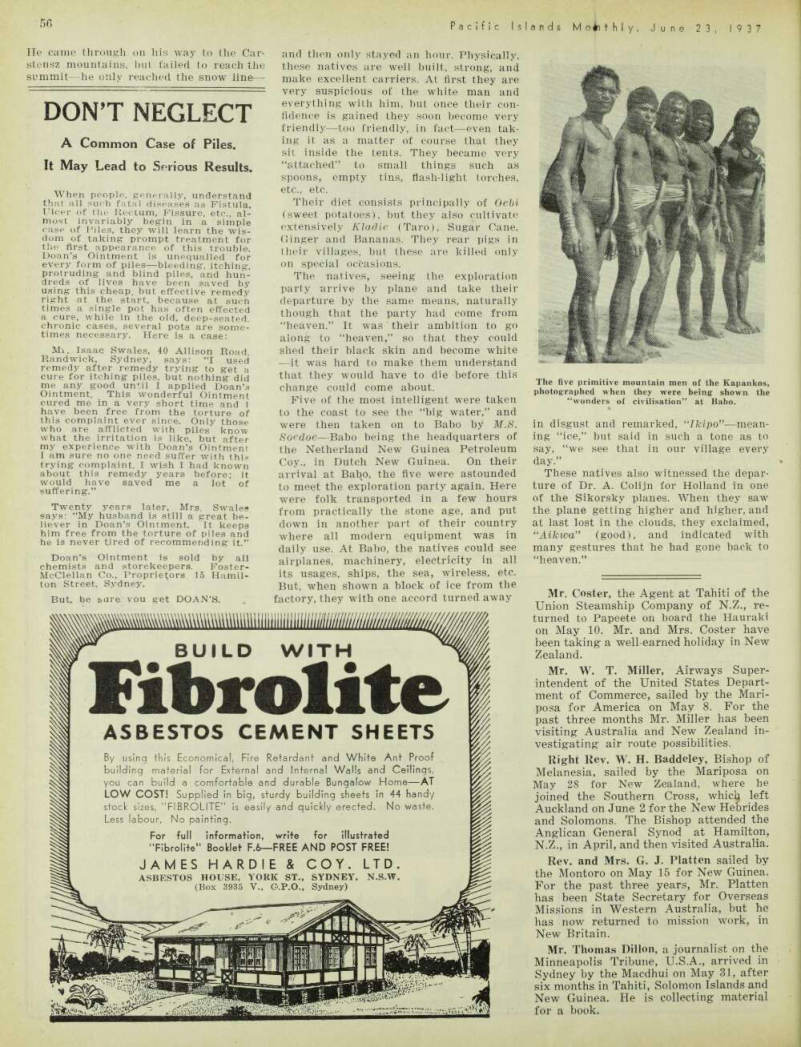
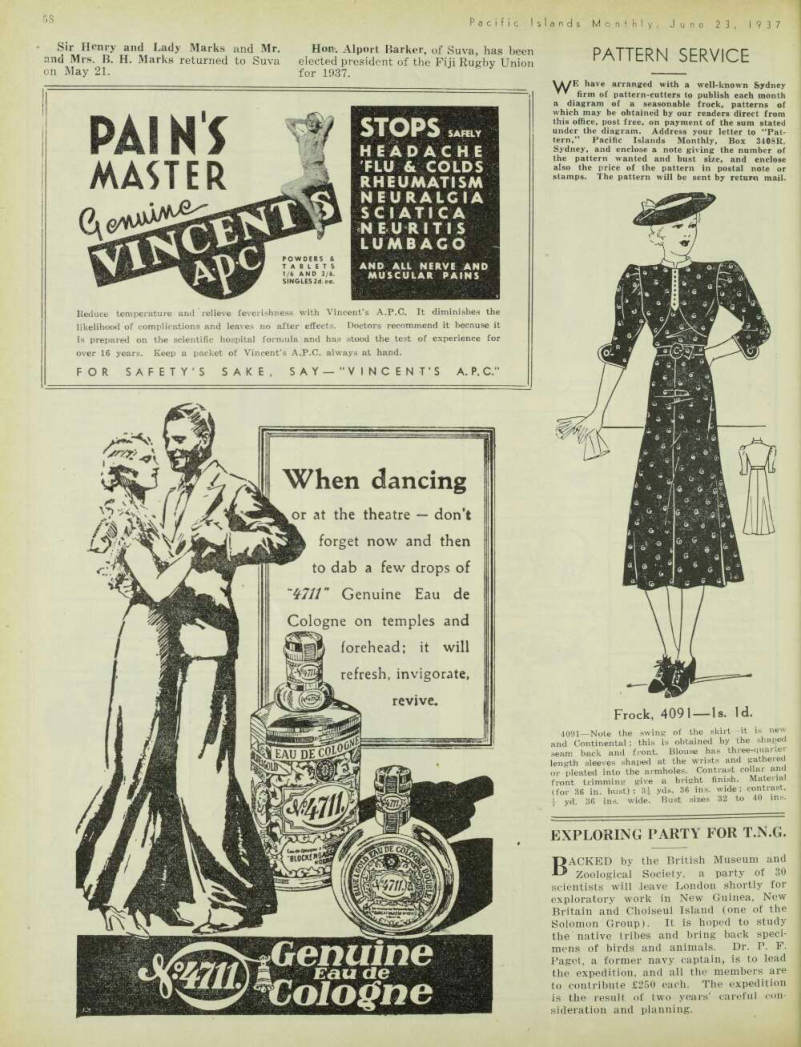
A New Mountain and New People
(Written for the “ P.l.Mhy C. R.
SHELDON, of Doha, Aroe Islands ) ABOUT the middle of 1936, it was decided that an exploration party from the Netherland New Guinea Petro leum Coy., should organise a party to climb the Carstensz Mountains in Dutch New Guinea, in order to carry out cer tain research work, and collect speci mens of geological and botanical value.
In addition to this, the exploration party was to make contact with the native Kapankos tribe, who are really pygmies, and make a study of their habits, etc.
An exploration party, led by Dr, A.
Colijn (son of the Prime Minister of Holland) assisted by Mr. F. J. Wissel and Mr. J. Dozy, started on their first trek to the Carstensz mountains in the middle of November, 1936, the jumping off place being a small base camp at Aika on the South Coast of Dutch New Guinea.
Earlier in the- year, an advance party, under the charge of Mr. H. Schilfgaarde, had, in addition to opening up the base camp at Aika, also started to blaze the trial for the exploration party, through the thick jungle, before the mountains could be reached, in order to establish another base camp at an altitude of 1500 metres. This track was necessary in order that food and other supplies required by the exploration party could be taken to
the base camp. Mr. Schilfgaarde had also to make a landing-ground for the Sikor sky planes at this camp and, in addition, had to make contact with the Kapanos natives.
The exploration party travelled by Sikorsky seaplanes—which are amphi bian—from Aika, and landed at the base
camp, 1500 metres up in the mountains.
From this camp the real trek started to the summit.
It took the party ten days to reach the summit, situated 5040 metres above sea level, and seven days to make the des cent. The party stayed 20 days at the summit, collecting their specimens and carrying out excursions over the large snow-fields.
The conditions at the summit were very trying, the weather treacherous during their stay, and almost every day snow and hail storms took place. The nights were bitterly cold, but clear, causing the snow to become frozen; but as soon as the sun reached a certain height, its heat made the snow soft, making it almost impossible to carry out any explorations.
Therefore most of the exploring had to be carried out at night, so that the camp could be reached while the snow was hard.
So, for the greater part of the day light, the exploring party had to shelter in their small tents, just big enough to hold three people. Adopting this method of doing their exploring by night and early morning, quite a lot was done, and a number of excursions made over the large snow fields. The party even reached the northern side of the mountain.
On the return journey, some time was spent with the Kapankos. These natives are still practically in the stone age. The only iron implements they possessed were an axe and a few knives, stolen from a settlement in the east of New Guinea, that settlement having been visited by Mr. Wollaston more than 20 years ago.
Women in their garden, on the Kaiboes River, register anger when approached by the exploring party.
He came through on his way to the Carstensz mountains, but failed to reach the summit—he only reached the snow line—
and then only stayed an hour. Physically, these natives are well built, strong, and make excellent carriers. At first they are very suspicious of the white man and everything with him, but once their con fidence is gained they soon become very friendly—too friendly, in fact —even tak ing it as a matter of course that they sit inside the tents. They became very “attached” to small things such as spoons, empty tins, flash-light torches, etc., etc.
Their diet consists principally of Oehi (sweet potatoes), but they also cultivate extensively Kladie (Taro), Sugar Cane, Ginger and Bananas. They rear pigs in their villages, but these are killed only on special ocfcasions.
The natives, seeing the exploration party arrive by plane and take their departure by the same means, naturally though that the party had come from “heaven.” It was their ambition to go along to “heaven,” so that they could shed their black skin and become white —it was hard to make them understand that they would have to die before this change could come about.
Five of the most intelligent were taken to the coast to see the “big water,” and were then taken on to Babo by M.B.
Soedoe —Babo being the headquarters of the Netherland New Guinea Petroleum Coy., in Dutch New Guinea. On their arrival at Babo, the five were astounded to meet the exploration party again. Here were folk transported in a few hours from practically the stone age, and put down in another part of their country where all modern equipment was in daily use. At Babo, the natives could see airplanes, machinery, electricity in all its usages, ships, the sea, wireless, etc.
But, when shown a block of ice from the factory, they with one accord turned away
in disgust and remarked, “7/dpo”—mean ing “ice,” but said in such a tone as to say, “we see that in our village every day.”
These natives also witnessed the depar ture of Dr. A. Colijn for Holland in one of the Sikorsky planes. When they saw the plane getting higher and higher, and at last lost in the clouds, they exclaimed, “ Aikwa ” (good), and indicated with many gestures that he had gone back to “heaven.”
Mr. Coster, the Agent at Tahiti of the Union Steamship Company of N.Z., re turned to Papeete on board the Hauraki on May 10. Mr. and Mrs. Coster have been taking a well-earned holiday in New Zealand.
Mr. W. T. Miller, Airways Super intendent of the United States Depart ment of Commerce, sailed by the Mari posa for America on May 8. For the past three months Mr. Miller has been visiting Australia and New Zealand in vestigating air route possibilities.
Right Rev. W. H. Baddeley, Bishop of Melanesia, sailed by the Mariposa on May 28 for New Zealand, where he joined the Southern Cross, whici* left Auckland on June 2 for the New Hebrides and Solomons. The Bishop attended the Anglican General Synod at Hamilton, N.Z., in April, and then visited Australia.
Rev. and Mrs. G. J. Flatten sailed by the Montoro on May 15 for New Guinea.
For the past three years, Mr. Flatten has been State Secretary for Overseas Missions in Western Australia, but he has now returned to mission work, in New Britain.
Mr. Thomas Dillon, a journalist on the Minneapolis Tribune, U.S.A., arrived in Sydney by the Macdhui on May 31, after six months in Tahiti, Solomon Islands and New Guinea. He is collecting material for a book.
The five primitive mountain men of the Kapankos, photographed when they were being shown the “wonders of civilisation” at Babo.
Sir Henry and Lady Marks and Mr. and Mrs. B. H. Marks returned to Suva on May 21.
Hon. Alport Barker, of Suva, has been elected president of the Fiji Rugby Union for 1937.
Advertisements & other items, pp. 57-60 (1 item)
Ruston
Freighter
IVANHOE
Powered by 52 B.H.P.
RUSTON OIL ENGINE
Speed: knots.
Fuel used: gallons per hour.
Length Breadth Depth 57 feet
RUSTON
2,280 Running hours for an hour.
Total for fuel, lubrication and maintenance £7B : 7 : 0 for 12 months.
Owners: Gibson Bros., Brisbane.
MARINE ENGINES
RUSTON & HORNSBY (Australia) Pty. Ltd.
MELBOURNE SYDNEY BRISBANE ADELAIDE
174 King St. 642-4 Jones St. Barry Pde. 20 Franklin St.
Sole Agents for Mandated Territory: Burns, Philp & Co. Ltd., Rabaul, New Guinea
DON’T NEGLECT
A Common Case of Piles.
It May Lead to Serious Results.
When people, generally, understand that all such fatal diseases as Fistula, Ulcer of the Rectum, Fissure, etc., almost invariably begin in a simple case of Piles, they will learn the wisdom of taking prompt treatment for the first appearance of this trouble.
Doan’s Ointment is unequalled for every form of piles—bleeding, itching, protruding and blind piles, and hundreds of lives have been saved by using this cheap, but effective remedy right at the start, because at such times a single pot has often effected a cure, while in the old, deep-seated, chronic cases, several pots are sometimes necessary. Here is a case: Mt. Isaac Swales, 40 Allison Road.
Rand wick, Sydney, says: “I used remedy after remedy trying to get a cure for itching piles, but nothing did me any good until I applied Doan’s Ointment. This wonderful Ointment cured me in a very short time and I have been free from the torture of this complaint ever since. Only those who are afflicted with piles know what the irritation is like, but after my experience with Doan’s Ointment I am sure no one need suffer with this trying complaint. I wish I had known about this remedy years before; it would have saved me a lot of suffering.”
Twenty years later, Mrs. Swales says: “My husband is still a great believer in Doan’s Ointment. It keeps him free from the torture of piles and he is never tired of recommending it.”
Doan’s Ointment is sold by all chemists and storekeepers. Foster- McClellan Co., Proprietors 15 Hamilton Street, Sydney.
But, be sure vou get DOAN’S.
BUILD WITH
Fibrolite
ASBESTOS CEMENT SHEETS
By using this Economical, Fire Retardant and White Ant Proof building material for External and Internal Walls and Ceilings, you can build a comfortable and durable Bungalow Home — AT LOW COST! Supplied in big, sturdy building sheets In 44 handy stock sizes, "FIBROLITE" is easily and quickly erected. No waste.
Less labour. No painting.
For full Information, write for illustrated "Fibrolite" Booklet F.6—FREE AND POST FREE!
JAMES HARDIE & COY. LTD.
ASBESTOS HOUSE, YORK ST., SYDNEY, N.S.W.
(Box 3935 V„ G'.P.O., Sydney)
Batteryless Hand Microphone, just plug into pick-up terminals of set, 45/- value. Now 25/-. For Music, Song, or Speech. Others 19/6.
Just arrived: Fruit and poker machines for clubs, hotels, etc.
Automatic pay outs. Ask for leaflets.
Three readings
"TELSEN" }/«, oto 9 -
•nr.rr rl«V T,SH 180 v., 0 to i *OC«!T rvpf VOIT ma Qthe Bakelite cased Voltmeters, 0 to 10. 0 to 125 / v., 4/6. Others g'Ci to read A and B batteries, 2/6, 3/9, 4/6
"mpn-o-iufiß
RUBBER CLfiD
% —■ AERIAL
56
SOFT
10 100 FT “Totem,” the newest game for home, club, picnic or party 21/-.
“ Odds and Evens,” a new Head and Tail spin game 21/ Both designed as reproductions. Push lever and away they go.
Pyrex type Glass Insulators: 3in., 1/- 4in., 3/6, daami) 3i N5 3 for Sims I M 3 7Jin.
Genuine Pyrex 30/ Genuine Pyrex 30/-.
COSMOCOBD*
/It 25
&U&4IA
“Cosmocord” 25/- “Cosmocord” De Luxe 32/6 “Cosmocord” Super de Luxe 45/-.
Amplion (English) 28/6.
Gramophone Pickups. B.T.H.
Bakelite Models 32/6 “Clarion” English all-Bakelite Pick - up, with volume control, 22/6.
Electric Combs complete, handfa a g type, 12/6 or with handle 15/6.
Electric Hand Toilet M i r r o r s, handbag midget type, 3/6. Electric Hair Brushes (as illustrated), all complete, ready for use, with testing light, 15/- and 17/6. 13 176 Utility 2-Speed Micro Dial, absolutely best made for short wave or broadcast, 10/m Sturdy build, always handy, sin. wheel hand grinders, 10/6.
Utility Front Panel Short wave Vernier Dials. World’s Best, 10/-.
Micro movement Ormond English 3in. metal front panel Vernier Dials, geared movement, 7/6.
lasoN
HEAD
PHOMS
I AmUaJc
professional 2&
4000 ohms •»/ m The "Air Patrol” 2 valve all wave battery set. Covers from 15.5 to 835 metres — £ll/17/1 complete with speaker, ’phones and all accessories, a midget in name only, but a giant in performance. Receives local, interstate and overseas broadcasts.
Two inch solid bench vices 5/9. We stock all kinds of tools for all kinds of trades —prices with out obligation, or order and leave it to us for a fair deal Emicol English Volt ma. Meter Bench type, 18/6. Reads 0 to 6v., 0 to 150 v., 0 to 30 ma., 0 to 2000 ohms.
Emicol English Pocket Meters, 0 to 6v., 0 to 150 v., 0 to 30 ma., 12/6.
Just landed, English Gramophone-Radio Pick-up Heads, fit any standard gramo. Tone Arm Bakelite moulded 11/6, and De Luxe Model, 19/6. Others, I )/6 12/6.
Roulette Wheels, approx. 7in. diameter, 19/9; complete with instructions and betting cloth.
Upright model, 21/-; sin. Bakelite models, 7/6.
“Like-a-Flash” de luxe Morse code keys, adjustable every way.
Long or short tappers, 12/6 ; P.M.G. type all brass fittings, 19/6 ; Junior models, 9/6, 10/6.
High grade buzzers, 7/6.
K Send for Levenson’s Radio Bargain Bulletin, Bd, post free.
Also Levenson’s Radio Buyer’s Guide and Assembly Chart Handbook, 2/- post free.
Just Arrived
"THE BOOK OF PRACTICAL RADIO"
10/6 By Scott-Taggart Cloth Bound A most excellent publication for the newcomer, amateur or professional radio fan. ev.r J 7e Just arrived. Over 200 illustrations. 289 pages, cloth bound. A radio consultant for the listener, expert or amateur constructor.
THE WIRELESS CONSTRUCTOR’S
ENCYCLOPEDIA 7/6
By Camm.
Giant size, profusely illustrated. A veritable treasury of Wireless knowledge for amateur and expert.
THE BOOK OF PRACTICAL
TELEVISION 8/6
Just Arrived 320 pages Edited by C. G. Dowding, cloth bound, fully illustrated. The greatest publication of its kind yet produced. All best-known experts contribute to it.
Kit of all parts to build a smart Model
ELECTRIC MOTOR 2/6
One that Works Full Directions Easy to Follow Failure Impossible The most popular educational toy of the decade.
Teaches more about a motor in 10 minutes than hours of study. Assembled and ready to work in a few minutes.
Everything supplied, except battery, which is 1/9 extra. Many novel and interesting experiments are possible with the help of this model motor.
Like-a-flash radio batteries. Always fresh, 45 v. heavy duty, 10/6, triple duty 12/6.
Now ready: Levenson’s illustrated folder of high grade radio and gramo-radio cabinets. Send for it.
All types of valves for all types of receivers. Send your order to Levenson’s.
We are sure to have the wanted type.
TELSEN'acdc
MULTIMETER
25' TaU Tennis X Table Tennis Sets, by Ayres, London. World’s best, 7/6, 10/6, 12/6, 15/-. 21/-, 37/6.
Rest made.
Rubber knee boots for ladies, gentlemen and children. A 1 1 sizes, all types; enquire for prices and leave it to . us. We supply all kinds of wet weather wants. Tarpaulins, canvas goods, etc., etc.
Like-a-flash ‘Eliminoise’
Aerial Kit, for short or dual Ol wave sets.
Insulators, transposi ti o n blocks and 200 ft. aerial wire, 22/6. Eliminates unwanted aerial and hideous electrical noises from your dual-wave or short-wave set.
T— LEVENSON S RADIO
Board
226P.1. PITT STREET, SYDNEY
Leaflets Branches; Radio Cheapside, 240 a Pitt St.
N.S.W., AUSTRALIA
Write for Pin-Game, Totem and Odds and Evens Leaflets ’Phones, M 2525 and M 2526. Cable address, “Leveradioh.” Goods forwarded V.P.P. or Sight Draft. Satisfaction and Service Guaranteed. We can supply by mail all General Merchandise at a Better Price. Quotations with pleasure. Please add freight and packing
PAI MS
MASTER
(\e*££ra
POWDERS &
TABLETS
1/6 AND 2/6.
SINGLES2d.ea.
STOPS SAFELY
HEADACHE
'FLU &l COLDS
RHEUMATISM
NEURALGIA
SC I ATI C A
N EURIT I S
LUMBAGO
AND ALL NERVE AND
MUSCULAR PAINS
Reduce temperature and relieve feverishness with Vincent’s A.P.C. It diminishes the likelihood of complications and leaves no after effects. Doctors recommend it because it is prepared on the scientific hospital formula and has stood the test of experience for over 16 years. Keep a packet of Vincent’s A.P.C. always at hand.
FOR SAFETY'S SAKE, SAY "VINCENT'S A. P. C."
L
When dancing
or at the theatre don’t forget now and then to dab a few drops of "4711" Genuine Eau de Cologne on temples and forehead; it will MB refresh, invigorate, revive.
ire
f Eaude
Cologne
Pattern Service
\A/E have arranged with a well-known Sydney ** firm of pattern-cutters to publish each month a diagram of a seasonable frock, patterns of which may be obtained by our readers direct from this office, post free, on payment of the sum stated under the diagram. Address your letter to “Pat tern,” Pacific Islands Monthly, Box 3408 R, Sydney, and enclose a note giving the number of the pattern wanted and bust size, and enclose also the price of the pattern in postal note or stamps. The pattern will be sent by return mail.
4091—Note the swing of the skirt —it is new and Continental ; this is obtained by the shaped seam back and front. Blouse has three-quarter length sleeves shaped at the wrists and gathered or pleated into the armholes. Contrast collar and front trimming give a bright finish. Materia (for 36 in. bust) : 3i yds. 36 ins. wide ; contrast, j- yd. 36 ins. wide. Bust sizes 32 to 40 ms.
Frock, 4091 Is. Id.
Exploring Party For T.N.G.
BACKED by the British Museum and Zoological Society, a party of 30 scientists will .leave London shortly for exploratory work in New Guinea, New Britain and Choiseul Island (one of the Solomon Group). It is hoped to study the native tribes and bring back speci mens of birds and animals. Dr. P. F.
Paget, a former navy captain, is to lead the expedition, and all the members are to contribute £250 each. The expedition is the result of two years’ careful con sideration and planning.
Fashion Hints for Islands Women
By Therese
GOLD and —well, gold and any colour your errant fancy pleases, and you can be sure you are in the vanguard of fashion. The new cloth of gold lends itself so happily to the svelte sophistic ated type of frock, of perfect cut and line with no trimming except perhaps a troubador sash of emerald, scarlet, royal blue or purple, or a huge cluster of flowers at the shoulder. Shoulder clusters, by the way, grow larger and as they grow they gather to themselves more charm.
Taffetas and nets of gold give a fairy tale air to the jeune fille. They are youth ful and romantic, and when there is a combination of the two —gold net over gold taffetas foundation, the result is breathtaking in its loveliness, A dimmer gown of black has a thread of gold gleaming through its sombre ness. Gold lines the long monk-line sleeve and a huge cluster of gold feathers, light, airy bits of loveliness, is pinned on the shoulder with more than happy results.
The palest of blue crystal studded net froths out over a double net foundation of mauve and pink, and is like the first pale flush of dawn.
Pastel shades share equal popularity with the more glowing Coronation colours, and clouds of tulle in misty grey metamorphose into a dance frock that bids fair to out-rival its more colourful sisters Silver kid leaves trim the royal purple chiffon gown. The skirt is softly draped and the leaves are appliqued in graceful line down the skirt. A diaphanous gown of black chiffon with rhinestone twinkling from its folds is like night with its thousand eyes.
Coloured rhinestones, the new “sew on” variety, are used extensively for day and evening. During the day they form a motif or a panel down the front of a frock, and when night comes they are scattered lightly over full skirts and twinkle like stars. Bead motifs are also added to daytime frocks with great suc cess; a bow, a geometrical design or what you will.
Bands of good old fashioned ruching trim the bodice, neckline and sleeves of a fuschia afternoon frock. The sleeves are magyar, full to the wrist and caught in a tiny ruched band.
Buttoned bodices with basques are neat and tiim. The basques fit or flare. Little collars fit close to the throat, and often introduce a second collar of contrasting colour.
Three shades of violet go to the making of a delightful formal frock with draped neck and skirt flaring to fulness. The sleeves, wide at the shoulder, taper to slimness at the wrist.
A fluted jabot is an attractive addition to a frock of pebble silk in Wallis blue.
Its raglan sleeves are gauged from neck to elbow and its waist swathed with a sash of parma violet and raspberry. The
skirt is slim and straight. Another trock of blue takes unto itself a sash of dull gold with equally pleasing result.
Black is unfailingly chic. Try it with different coloured belts and posies. Bril liant sashes will lend it gaiety —one, two or even three colours —and sometimes there is a scarf to match, or a multi coloured handkerchief to peep from a
pocket set high in the bodice or on the hip of the skirt.
An afternoon frock of Persian rust has
a round yoked bodice and V-neckline which it trims with self pleating and adds two gold clasps at the base of the throat.
The skirt is panelled and has inverted pleats on either side.
A redingote effect is obtained by a princess dress opening out to show a panel of constrasting material, either printed or plain. The back swings out in dashing highwayman style.
A tunic saw-edges its hem and out lines the cowl neck line of the bodice in the same unusual way. A wide shoulder line and narrow twisted leather belt with chromium clasp, are some of its highlights. A brown crepe suede is slashed with mustard on the skirt, and has mustard vest and belt. The bodice has stitched collar and pocket flaps.
Evening wraps are full of charm. For
winter evenings, face cloth takes pride of place—face cloth cut on tailored lines and buttoning with diamonte buttons as a sop to feminine vanity; or dramatic capes, matador fashion, with far flung scarf ends and lined with brilliant colour.
Woollen evening frocks, too, keep winter winds at bay; and some of the new woollen materials are so beautiful, so soft and supple, and make gowns of such suave distinction, that it is small wonder that the vogue for woollen even ing frocks is fast gaining popularity.
Wool, supple as silk, is woven with gold threat or scattered with rhinestones.
Wool cocktail blouses are band embroid ered in gay colours or have stitched cloth of gold collars and cuffs.
Advertisements & other items, pp. 61-62 (1 item)
A Classified Directory for Island Residents
At Blue Mountains —Springwood, N.S.W.
Est. 1897. Kindergarten to Leaving Certificate. Tennis, Riding, Swimming. Team Games. Unequalled climate. Pure Jersey Milk. Senior and Junior Houses. Open-air sleeping. Inclusive fees. Special vacation arrangements for Island pupils.
Ladies' College
M. E. DURAND, Principal.
A Classified Directory for Island Residents
AT the back of the Sydney Telephone Directory are to be found lists of firms, tabulated in alphabetical order of the nature of the goods or services that they sell, such as adding machines, bath heaters, carpet cleaners, etc.—really a buyer’s guide as to who sells the particular goods or services he requires.
It is of inestimable value, as everybody at some time or another knows what they want, but do not know where to obtain it. By this classified directory a long-felt want is being fulfilled.
Island residents are not quite so fortunate as to have such a directory always at hand. The Pacific Islands Co., however, have established themselves with this end in view—to act the part of a classi-
fied directory.
How handy it is to know exactly where to buy the things you want; to eliminate the delays of enquiries and explanations travelling back and forth.
The remedy is simple. The Pacific Islands Co. is at your service to supply your every need, be it an ordinary purchase, an enquiry, or a request to buy goods in, and include them with the general order, all packed and consigned together. Freight and insurance costs are then reduced to a minimum. Only one set of documents, invoices and accounts have to be handled, so the work entailed
in clearing and taking delivery of the goods is also minimised as far as possible. Many little charges such as stamp duty on bills of lading and insurance declarations are reduced almost to nothing. But these things allowed to go on, mount to real pounds, shillings and pence over twelve months.
Their catalogue shows a wide range of groceries and foodstuffs, all of well known brands and quality, at the most attractive prices. Included also are representative lists of hardware, sports-goods, tents, manchester, boots and shoes, sand shoes, cutlery, clothing, water-proof goods, jewellery and wrist-watches. Not perhaps as complete as the lists of foodstuffs, but included to illustrate their versatility and ability to satisfy any requirements.
One thing worth remembering is that this company has no other interest to serve than yours. Consequently each order is given individual attention, with the result that it is not a case of the first order pleasing and subsequent deliveries bringing condemnation due to a firm’s disregard of detail.
The Pacific Islands Co. is pleased to answer any enquiries no matter how small, and their catalogue can be obtained by addressing your enquiry to The Sales Manager, The Pacific Islands Co., 728 Grace Building, 7.7 York Street, Sydney, Australia. —Advt.
MEDICAI GOODS
Ml our MEDICAL GOODS are sold with
our GUARANTEE OF MONEY BACK it
not satisfied; best quality, lowest prices.
Call or write for FREE "BOOK Or KNOWLEDGE." Price List & Catalogue of Medical Goods, etc., and FREE
CONFIDENTIAL ADVICE. All these
goods POST FREE in plain wrapper from
SECURA CHEMISTS,
Dept. P.
269 ELIZABETH ST.. MELBOURNE
LADIES. —Let the SECURA NURSE advise you in the selection of your medical requirements.
EMERY OR GRINDING WHEELS
An announcement which must interest users of emery or grinding ar\pl similar abrasives is that the Pacific Islands Co. are now distributors of NAXOS
PRODUCTS.
NAXOS PRODUCTS comprise grinding or emery wheels, segments, blocks and loose emery, of any grit, grade, shape or texture.
Orders and requests for printed price lists should be addressed to . . .
The Distributors :
THE PACIFIC ISLANDS CO.
728 GRACE BUILDING, 77 YORK STREET
SYDNEY, AUSTRALIA. MA 7698
PHOTOS OF GOLDFIELDS
DISTRICT, NEW GUINEA.
FOR SALE
I have over 3,000 negatives available, showing Mines and Mining Work, Aerial Transport and Aeroplanes, Natives, Native Life, Scenery, Towns, etc.
Photos, in any size, from 1" x 15" up to full plate. Postcard photos., 6d. each. Send for some photos, of the gold mine you are interested in.
Agent for: Leica Cameras and accessories; Agfa Cameras and material. Stocks always on hand.
THOS. A. OLSSON, Photographer
Box 47, WAU, New Guinea
Your Tropical Kit
When you visit the Pacific Islands, whether on Business or Pleasure, you need Special Equipment—Light Suits of Correct Style, which fit well and launder easily: Tunic Shirts Silk Shirts, Light Underwear, White Shoes, etc.
WALTER HORNE & CO. LTD., established in 1885, specialise in this Service. Skilled Tailors make your Suits from First-class material within 24 hours. Complete equipment can be supplied from our Large Stocks at Reasonable, Moderate Prices.
BUY FROM THE FIRM WHICH UNDERSTANDS
DRESSES YOU CORRECTLY
WALTER HORNE & CO. LTD., carry a Full Range of Drapery of all kinds; also Frocks, Millinery, Foundations and Lingerie, Hosiery, Shoes and Sandals, Ribbons and Laces, Household Drapery.
YOUR NEEDS AND
Men resident in t* any of the Pacific Territories can he supplied with Suitable Clothes.
Ladies' Hairdressing and Manicuring
Write to us and Describe your Requirements.
WALTER HORNE & Co. Ltd.
Drapers and Men's Wear Specialists
SUVA. FIJI
A. B. DONALD LTD.
AUCKLAND
ISLAND TRADERS :: GENERAL MERCHANTS
P. O. Box 1509 Cables and Telegrams: "Kingdom," Auckland Branches at Rarotonga and throughout the Cook Islands At Papeete and throughout the Society, Marquesas and Paumotu Islands trading as " ETABLISSEMENTS DONALD, TAHITI "
At Fiji: Trading as "Dominion Fruit C 0.," Suva
New Constitution In Fiji
Effective on June 1 2
From Our Own Correspondent
Suva, May 28.
A PROCLAMATION published by the Gazette announces that the present Legislative Council of Fiji will be dis solved as from June 11, 1937, and the new Letters Patent will come into force on June 12.
New electoral rolls are being made up in accordance with the change in the electoral boundaries, and applications for enrolment recently closed. The new Legislative Council will con sist of 16 official members, five European unofficial members (three elected and two nominated), Five Indian members (three elected and two nominated) and five Fijian members (all nominated in ac cordance with the wish of the Fijians, as expressed through the Council of Chiefs).
The present Council consists of 13 official members, six European elected members, three nominated Fijian mem bers and two elected Indian members.
Three Indian members are allowed, but only two seats have been occupied for a number of years.
More Marble Found In Fiji
From Our Own Correspondent SUVA, June 1.
A NOTHER deposit of marble has been found on the island of Vitilevu. Some time ago, in the Tailevu district, a large deposit of good quality white marble was discovered.
The new discovery was made on the Mainimala River, and it is in a con venient position for cheap water trans port, should it be developed commercially.
This deposit is not of such good quality as the Tailevu marble, being bluey-grey in colour, with white veins. However, should there be a demand for decorative marble, or marble for sanitary appli ances, it should be worth development.
It is also reported that another dis covery of marble has been made in the Nadi district. This, however, is incon veniently situated as regards transport.
Fiji's Trade
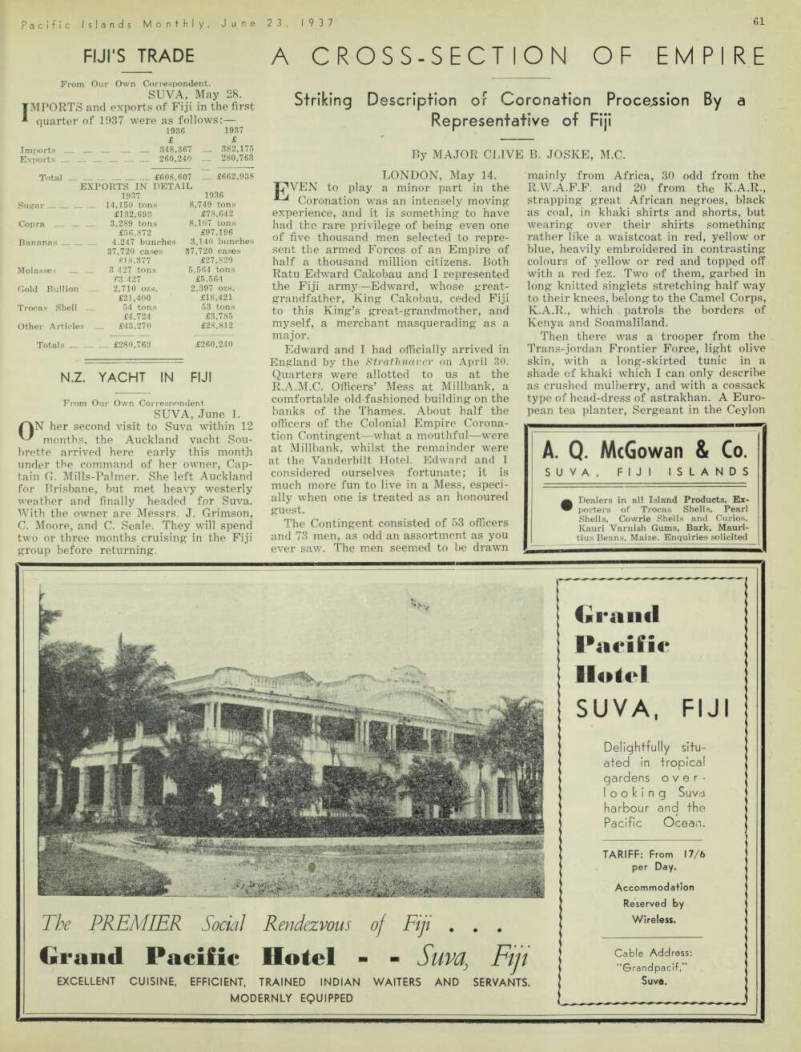
From Our Own Correspondent.
Suva, May 28.
IMPORTS and exports of Fiji in the first quarter of 1937 were as follows: —
1936 1937 £ £ Imports 348,367 382,175 Exports ... 260,240 280,763 Total £608,607 £662,938
Exports In Detail
1937 1936 Sugar — — — — 14,150 tons 8,749 tons £132.693 £78,642 Copra — — 3,289 tons 8,107 tons £56.872 £97,196 Bananas 4.247 bunches 3,140 bunches 37,720 cases 37,720 cases £18,377 £27,820 Molasses 8 427 tons 5,564 tons £3.427 £5.564 Cold Bullion — 2,710 ozs. 2,397 ozs. £21,400 £18,421 Trocas Shell — 54 tons 53 tons £4,724 £3,785 Other Articles £43,270 £28,812 Totals ... ... £280,763 £260,240
N.Z. Yacht In Fiji
From Our Own Correspondent SUVA, June 1.
P|N her second visit to Suva within 12 months, the Auckland vacht Sou brette arrived here early this month under the command of her owner, Cap tain G. Mills-Palmer, She left Auckland for Brisbane, but met heavy westerly weather and finally headed for Suva.
With the owner are Messrs. J. Crimson, C. Moore, and C. Seale. They will spend two or three months cruising in the Fiji group before returning.
A Cross-Section Of Empire
Striking Description of Coronation Procession By a Representative of Fiji
By Major Clive B. Joske, M.C.
London, May 14.
to play a minor part in the Coronation was an intensely moving experience, and it is something to have had the rare privilege of being even one of five thousand men selected to repre sent the armed Forces of an Empire of half a thousand million citizens. Both Ratu Edward Cakobau and I represented the Fiji army—Edward, whose great grandfather, King Cakobau, ceded Fiji to this King’s great-grandmother, and myself, a merchant masquerading as a major.
Edward and I had officially arrived in England by the Strathnaver on April 30.
Quarters were allotted to us at the R.A.M.C. Officers’ Mess at Millbank, a comfortable old-fashioned building on the banks of the Thames. About half the officers of the Colonial Empire Corona tion Contingent—what a mouthful—were at Millbank, whilst the remainder were at the Vanderbilt Hotel. Edward and I considered ourselves fortunate; it is much more fun to live in a Mess, especi ally when one is treated as an honoured guest.
The Contingent consisted of 53 officers and 73 men, as odd an assortment as you ever saw. The men seemed to be drawn
mainly from Africa, 30 odd from the R.W.A.F.F. and 20 from the K.A.R., strapping great African negroes, black as coal, in khaki shirts and shorts, but wearing over their shirts something rather like a waistcoat in red, yellow or blue, heavily embroidered in contrasting colours of yellow or red and topped off with a red fez. Two of them, garbed in long knitted singlets stretching half way to their knees, belong to the Camel Corps, K.A.R., which patrols the borders of Kenya and Soamaliland.
Then there was a trooper from the Trans-jordan Frontier Force, light olive skin, with a long-skirted tunic in a shade of khaki which I can only describe as crushed mulberry, and with a cossack type of head-dress of astrakhan. A Euro pean tea planter, Sergeant in the Ceylon
Planters’ Rifle Corps, paraded alongside a short squat Chinese sergeant-major from Hong Kong; a couple of Malays with green pillar-box caps set jauntily over their right eyebrows were next to an aged and corpulent Warrant Officer who had already been to the previous Coronation.
The officers were just as wonderfully assorted. A number came from the various units of the R.W.A.F.F. or K.A.R., but amongst us there was a Lieutenant-commander from Hong Kong, colonial-born pfflcers from the West Indies: Malays; and a native officer from the Aden Protectorate Levies who liter ally had not used a knife and fork until he reached England.
In my section alone there were officers from Trinidad, Falkland Islands, Sierra
Leone, Hong Kong, the F.M.S. and British Guiana—not a bad little cross-section of Empire in itself.
Edward was unique—he was the only soldier to be bareheaded on parade!
Thus the Colonial Contingent, through its complete lack of uniformity, its racial variety and its odd mixture of drab khaki and garish colour was sharply contrasted against the scarlet, blue and gold that were the dominating colours of the procession. The spectators, in their hundreds of thousands, looking at us, savoured to the full the glamour and romance of their Colonial Empire, stretching to the uttermost ends of the earth.
At Wellington Barracks
Contingent were paraded together on Monday, May 10, when each
of us 1 saw for the first time his strange bedfellows. Our headquarters were at Wellington Barracks, the home of the Guards, and I think we were all fascinated to find ourselves in precincts so consecrated to military tradition. The Guards “carried on” but we were as thrilled as children by the clock-work precision of their most minor movements.
The weather had been cold with a dank mist almost every day, and the War Office had issued an order that all troops must be in possession of greatcoats in case a general cloaking order should be issued. Edward’s clothing allowance from the Fiji Government was almost ex hausted but representations to the Colonial Office put us in funds once more, so we were in a position to “cloak” at a moment’s notice.
It looked as though this would have to be done, for on the Tuesday, London treated us to a tropical downpour. How ever, the Great Day dawned cold, misty, but fine. My servant said it was “mild,” so I donned two woollen singlets to keep warm, and Edward and I put on our white tunics.
We then proceeded to play our parts in a really comfortable manner. There was no rising at crack of dawn for us — not a bit of it. After a leisurely break fast we left our comfortable quarters at 9 a.m. for Wellington Barracks by motor bus. The run across took only a few minutes. As we were not required to parade before 11.30 a.m., Edward and I strolled over from Wellington Barracks to a point of vantage just opposite the gates of Buckingham Palace —it was not unduly crowded, since admission here was limited to ticket-holders—and we had an excellent view of the arrivals of the distinguished and the departures of the various processions to the Abbey.
We saw at close quarters the triple Guard of Honour, Sailors, Guards and Airmen, the unhurried ease of the Escort of Lifeguards, the fairy-tale splendour of the Glass Coach —and at length their Imperial Majesties set forth amid a wave of cheering that shrilled away into the distance, whilst we paraded at the Bar racks and set forth in our turn.
In The Procession
OPPOSITE Buck House we halted, whilst each little bit of the jig-saw was fitted into its place, and the pro cession for the return from Westminster Abbey was complete, save for the Cap tains and the Kings.
The Colonial Contingent was at the head, which sounds as though we occu pied the post of honour. However, in a State procession you rank from the front backwards; the first shall be last, and so forth. The same rule applied to the Contingent itself—junior officers in front
and senior in rear—so, as we dressed by the left flank, it came to pass that the whole of the procession took its dressing from a young naval volunteer midshipman from Singapore!
Whilst halted, we could hear snatches of the service broadcast from the Abbey.
When the Archbishop placed the Crown on the King’s head the crowds in the packed stands about us all rose to their feet and joined with those inside the Abbey in acclaiming King George VI. as King of all the Kingdoms.
And one realised with some degree of awe that millions all over the world were also hearing those voices charged with emotion vibrating from the Abbey into space!
At length, we moved off and swung into the Mall behind the Band and Bugles of the Rifle Brigade. Here the crowd had already enthused over the Royal Processions earlier, and so we were greeted with applause which seemed restrained by comparison with that which was to greet us later. Few people, too, had been allowed into Whitehall and there was not much more than handclapping.
Then “Eyes, Right” followed at the Cenotaph and we wheeled left-handed along Victoria Embankment. Here there were 40,000 school children who had been there for hours and we were the first piece of the pageant they had seen. So' there was a gale, a storm, a wild hurri cane of high-pitched, shrieking, deliriods enthusiasm. Only an iceberg could have remained cold and unresponsive to this.
The enthusiasm was just as full-bodied, if not such a cataclysm of sound, along Pall Mall, St. James’s Street, Piccadilly and Regent Street. It was smiling, shouting, cheering faces everywhere imaginable, and in numbers incalculable, whilst the pavements grew forests of periscopes.
In Upper Regent Street we halted, which meant that the end of our pro cession was in position by the Houses of Parliament, ready to move off as soon as the King and Queen entered the glass coach at Westminster Abbey. Here we stood at ease and munched our ration of chocolate until a policeman, from the wireless van in front, waved a red-striped disc and then lowered it, signifying that the King had joined the procession.
On into Oxford Street, and I got a sudden view of an empty street stretch ing undisturbed by traffic, an odd sight in London. Here it seemed that enthus iasm reached its zenith and that the crowds were packed more densely.
But the unforgettable sight came as we swung through Marble Arch into Hyde Park. The road widened out on either hand to trees in their new spring green ery, and the tiered faces, stretching out wards and upwards, enhanced the air of spaciousness. It was growing darker, and the mist lay heavier—everything was as unreal as a dream.
On through a grey-white arch, topped with pink rhododendrons, and down narrow Constitution Hill, where we passed aged Chelsea pensioners, who sat staring motionless at us—a reminder that there had been glorious pageantry in England before to-day and that our glory, too, would fade into a memory of
the past. And so past Buckingham Palace to Wellington Barracks, surprised and relieved to find that a lunchless ten miles had been as only three.
It has been worth coming fourteen thousand miles to play a minor part in this brilliantly unforgettable spectacle.
Of the organisation I can only say, perfection; of the stage management, in credibly perfect; and of our audience, those patient laughing English hosts who lined the streets, I can only repeat the comment of a young native officer from Malay who said to me: “Sir, these English people are very good-humoured and orderly. If all the people of the world behaved like them, sir, the world would be a better place.”
Advertisements & other items, pp. 63-64 (1 item)
Suva. Fiji
A. Q. McGowan & Co.
SUVA. FIJI ISLANDS
• Dealers in al! Island Products, Exporters of Trocas Shells, Pearl Shells, Cowrie Shells and Curios, Kauri Varnish Gums, Bark, Mauritius Beans, Maize. Enquiries solicited
« *... y. J «9 ■ Zfe PREMIER Social Rendezvous of Fiji . . .
Grand Pacific Hotel - - Fiji
EXCELLENT CUISINE, EFFICIENT, TRAINED INDIAN WAITERS AND SERVANTS.
MODERNLY EQUIPPED
Grand
Pacific
Eloitd
SUVA. FIJI
Delightfully situ-
ated in tropica! gardens overlooking Suva harbour and the Pacific Ocean.
TARIFF: From 17/6
per Day.
Accommodation Reserved by Wireless.
Cable Address; "Grandpacit,"
Suva.
•is liid si i 1 3 s n o h n o 11 v a : 30iddo abnqas T 'aoo idOdX3 ddaand s 3dii dV3Aaooe j
(3311WH ANVdHCO dOIOW QdOd
Q3IIHH ’Al.dOdd ANVdIAIOO 110 HODOVA
'an (*isnv) iHsvsAi nhop aaniAin S3idisnaNi ivoiH3HO ivid3dHi a3iiiAin AasNdOH s Noisnd
ANVdHOO NOIIVOIAVN NOSIVH
S3AisoidX3—a3iiiAin (vnvdisnvl si3aoN s.qaoti
: JOj S+UO&V J,
vohvs qnv V9NOI ‘irid moHenodHi s3HONVda ‘ eAn S ‘ " OD !JjO p9-<9+si6o^j
•an ‘woaxsaeH ‘sraaow
WE PAY THE HIGHEST PRICES FOR
-C O L D
• Consign your GOLD to Australia's acknowledged clearing house for all Precious Metals and receive the highest ruling x rates.
In our large list of satisfied clients, are the foremost Mining Operators of the Pacific Islands, who have proved year after year that the integrity of the House of Garrett & Da/idson is as sound as the Bank of England.
For accuracy of assay . . . for speedy payment . . . and for highest prices . . . consign your next shipment of GOLD to us.
Our efficient service Is another reason for our continued Increase of business.
GARRETT & DAVIDSON rty.
ASSAYERS, BULLION MERCHANTS, METALLURGISTS
LTD.
BANK OF N.S.W. BUILDING, REGENT STREET, SYDNEY
THE ORIGINAL
RUR
RHEUMATIC REMEDY
MONEY BACK GUARANTEE
“Obtainable from all branches of Burns.
Philp and Co. Ltd., or Post Free from R.U.R. Pty.. 841 George St., Sydney—7/6 for 6 weeks’ treatment, 4/- for 3 weeks’ trial size. Ask or write for Free Booklet.
Governor Of Fiji On Tour
Suva, May 28.
*T , HE new Governor of Fiji, Sir Arthur ■k Richards, since his arrival last November, has visited most of the group.
Recently he made an extensive tour of the main centres of Vanua Levu (visiting Savu Savu, Nabouwalu, Naduri, Labasa and Yanawai), and at all places he was cordially received.
Residents appreciate His Excellency’s energy in making these trips at consider able personal inconvenience, seeing that the Government yacht Pioneer is laid up indefinitely and likely to be scrapped.
His Excellency is away now from Suva on a visit to the Lau group, in the small steamer Malake. He has taken a large party of Government officials with him.
He called at the Makogai leper station on the way out, and will call also at Kadavu.
Miss Hilda Taylor, who is in charge of the Jasper Williams’ Boarding School for Indian children at Lautoka, Fiji, sailed from Sydney by the Monowai on June 10 for Fiji.
Mr. H. H. Stinear, a geologist from New Zealand, left by the Macdhui on June 5 to join the staff of Islands Exploration Ltd. in Papua.
Advertisements & other items, pp. 65-66 (1 item)
ansomes
LEATHER BELTS
Cor NATIVES
PATTERSON & STONE, CRICHTON WORKS
WALSALL, ENGL AND.
FIND OUT WHAT'S INSIDE
before you buy a low-priced Saddle.
THE KING OF 'EM ALL
Is a "Safer"
Saddle and Offers Sensational Advantages
NARROW
Being built on a Galvanised Tree, heavily bar plated, and strained with English web. riders are assured of its genuine foundation. Its soft, pliant kip flaps are hard-wearing, while the sweepy seat gives superb riding comfort.
Fitted with Best Leather, rp/ p / Folded Girth, Stirrups Freight Free With Capped Pads 15/- extra Write for Catalogue P. 1935.
SYDNEYS HIGH-CLASS SADDLER
NEWMARKET SADDLERY
W. H. Williams for "Safer" Saddles
18-20 WILSON ST., NEWTOWN, N.S.W.
Copra Mats and Matting . .
Semi your enquiries to us for Woven Wire Mesh in Rolls or framed for Copra Drying and all Screening purposes, Bird Cages, Sieves and Riddles, Builder’s Gravel Screens, Rat Traps, Door Mats, Garden Arches, Chain Wire Mesh, Crimped Wire Mesh for Window Guards, etc.
SCOTT AND SONS
WIREWORKS: RAILWAY PARADE AND MURRAY STREET MARRICKVILLE
These fight steel
Cultivators
table
ads?
riety
ate va {or
allot* 8
opet
of Special Features:—Suitable for use with one bullock or horse. Can be supplied with a wide range of reversible points and shares.
Supplied in three models: (1) Fixed pattern, with 5 tines covering 24 ins. (2) Single lever expanding pattern, adjustable for width from 14 ins. to 24 ins. (3) Double lever expanding pattern, adjustable for width from 14 ins. to 24 ins. with second lever for controlling the depth.
ansomes
LIGHT STEEL
Walking Cultivators
Write for illustrated folders and all information MORRIS, HEDSTROM LTD. - Suva. Lautoka and Ba Made by: RANSOMES, SIMS & JEFFERIES, LTD., IPSWICH, ENGLAND
£ * * a 9 9
bSI
il 9- Ct o\ 9° 5% v- -428A Hard hitting at long range, heavy loads and high velocity make both "Duxbac" and "Icil Special" the Ideal cartridges for the keen duck shooter, and cut out any chance of "lost" birds.
If you are out after "A Full Bag" use "Duxbac" or "Icil Special."
Obtainable
Everywhere
Popular Prices
O fO P if 3v
• l£Ozs. Shotin 2rShells
BULLIVANTS' WIRE ROPES
THE WORLD'S STANDARD
*aaaaaa*aaaaaa*aaaa/* ,
LARGEST STOCKS IN AUSTRALASIA
FOR ALL PURPOSES
Also Blocks, Hooks, Shackles, Thimbles, Strand, Seizing, Aircraft Cord, etc.
Prompt Attention! Efficient Service!! Complete Satisfaction!!!
BULLIVANTS' Australian Co. Pty., Ltd.
Letters:
Box 1298 J, G.P.O.
Incorporated in Victoria.
331 KENT STREET, SYDNEY
Telegrams: Sydney Bullivants Ltd.’
Morris Hedstrom
Company in Strong Position
IyTESSRS. Morris Hedstrom Ltd., with headquarters at Suva, Fiji, reported a net profit of £70,384 for the year ended March 31, compared with £53,511 for the previous year. Gross profit is £43,893 higher at £193,499. Ordinary dividend is raised to 5| per cent, from J 5 per cent. (21 interim and 34 final), and requires £29,923. Preference dividend of 6 per cent, absorbs £13,152. An amount of £20,000 is transferred to general reserve, making that account £lOO,OOO. With £54,764 brought forward, there is carried forward £62,072.
The following analysis and comparison show the remarkable healthiness of this company:—
Higher values of merchandise and of produce held denote not only heavier stocks for better trade, but higher prices.
Debtors are substantiallv lower, showing the improved position of the company’s •customers. The reduction in the item, “shares, debentures, and mortgages,” of £29,077, if it relates principally to the two latter sub-items, has the same sig nificance as the reduction in trade debtors.
Year Ended March 31.
1935 1936 1937 £ £ £ Cross profit 130,223 149.606 193,499 Net profit 45.141 53,511 70,384 Div., pref., 6 p.c 13,152 13,152 13,152 Div., ord., p.c 5 5 54 Div.. ord., amount 26,020 26,020 29,923 To Reserve — — 20,000 Forward 40,425 54,764 62,072
Liabilities—
Capital: Preference 219,206 219.206 219,206 Ordinary 520,407 520.407 520,407 General reserve 80,000 80,000 80.000 Insurance fund res 41,906 45.080 48,530 Depositors 1,965 5,100 10,010 Creditors 14.955 13,882 22,700 Charges accrued due 2,742 3,194 3,023 Suspense (income tax, etc.) 6,194 10,833 15,373
Assets—
Plantations 54,194 52,753 49,033 Land and buildings 301,820 294,055 290,404 Floating stock 19,950 17,250 14,484 Plant and fittings 6,326 8,534 10.674 Merchandise 174,833 193,450 238.655 Produce 52,398 55,116 100,279 Branches and due by subsidiary companies 63,359 57,232 75,572 Debtors ... 129,926 151,045 132,468 Prepaid items 2,444 2,136 3,088 Cash 20,829 36,118 34,872 Shares, debs, and mortg 123.909 104,359 75.282 Total assets 949,988 972,054 1 ,024,814
System
Useless " Bounty "
Canberra Officials Examine A Long-Dead Corpse In Papua
Port Moresby, June 3.
TWO officers of the Department of Trade and Customs, Messrs. J.
Fletcher and O. Wolfensberger, have ar rived in the Territory to inquire into the possible renewal of the Papua and New Guinea Bounties Act, which was adopted by the Commonwealth in 1926, and which will expire at the end of 1937.
The products concerned included Cocoa Beans, Cocoa Shells, Fibres, Sago (not packed for household use), Vanilla Beans, unmanufactured Bamboos and Rattans, Spices, and Kapok, and they were al lowed bounties of varying amounts for 10 years, from January, 1927. The follow ing products also were admitted free into the Commonwealth: Coffee, Dried Fruits, Fresh Fruits, Fungi, Ginger, Rangoon Beans, Coconuts (whole, prepared or un shelled), and Seeds, such as Sesame and Kapok.
There has been no demand for the fruits specified, which are practically un known in the Territory, such as Chico mamey, Litchi, Longan, Akee, Pulasan, etc., and apart from Coffee and Desic cated Coconut, no advantage has been taken of this offered assistance.
The bounty system is mostly notable for its omission of those products which could have been exploited profitably except in the case of Kapok and Sisal Hemp, which had already been attempted without marked success.
This “measure of assistance” has been generally regarded as simply not worth while. With the exception of Coffee and Desiccated Coconut, all the products were experimental crops, and most of them difficult to cultivate, and without prospect of a market in Australia.
If the bounties had been extended to Bananas, Pineapples, Maize, Citrus Fruits, and such other crops as naturally grow well in Papua, the measure might have been o t practical and lasting value.
Generally, it is considered that a per manent bounty scheme would have some value if it encouraged the growing of small, easily-grown crops, which might induce the planting of new areas by pro viding plantations with revenue until the main crop is established.
Helping The Natives
Respective Spheres of Missions and Governments
Letter to the Editor FAR be it from me to disagree with your criticism of Lord Moyne’s' super ficial “Walkabout” (P.1.M., March, 1937).
It is to be regretted, however, that in your widely-read magazine you should repeat one or two mistaken ideas held by many worthy men and women down South, who have no personal knowledge of native matters in New Guinea.
Like most long-time residents of Papua, I have much admiration *for the great work performed by mission bodies, es pecially by their lady members, but I do think that you rather unfairly exagger ate the position when you state that “without the missions the condition of the natives in contact with Europeans would be calamitous indeed.”
Surely this is a reflection, possibly un intended, upon the long-continued task of the Murray Administration, at least, ,and suggests that if all the missions de cided to remove themselves from the field, the local magistrates and protectors of Papuans would view with unconcern the harsh or unlawful treatment of nat ives by any who might venture upon such a policy? Is it not also unjust to our decent white community to infer that they are only held back from ill-treating the natives by the presence of the devoted missionary. The idea is wholly absurd, and not according to fact, as anyone con versant with the position can affirm.
The spiritual welfare, care and educa tion of the more civilised natives has ever been the splendid task of the mis sionary; but this could never be accom plished but for the long and patient ef forts of patrol officers, magistrates and administrators in bringing these stone age people into the light of our' so-called civilisation and protecting them from influences which might menace their development. They are not failing in that duty.
I am, etc.,
Alex. C. Rentoul.
Bwagaoia, Misima. 30/4/1937.
Sabotage On The
"Maui Pomare"
SEVERAL parts of the machinery of the Government motorship Maui Pomare, which maintains the direct N.Z.- Samoa service, were removed, and appar ently deliberately thrown into Auckland harbour.
The engines were being overhauled, and the cylinder heads and piston rings were stowed on deck. They disappeared, and a diver was sent down to search the harbour bed. He found the rings, and it is thought that the other articles are also in the harbour.
Dr. C. H. B. Thompson, Medical Officer of Health at Suva, returned from leave spent in England on May 2.
Advertisements & other items, p. 67 (1 item)
Petrol Engine
NOCK & KIRBY LTD.'
J.A.P.
(British Made)
PETROL ENGINE
C?
A *
mm W
*■» SB h New .. . Compact . . . Simple
H HP. at 2,000 R.P.M.
EASY TO START. ECONOMICAL TO OPERATE.
FOR driving Separators, Grinding Machines, Chaffcutters, Pumps, Circular Saws, Shearing Machines, Generators, and other Farm Implements, this Air-Cooled J.A.P. Engine is unsurpassed. Although light and portable, the air cooled J.A.P. Engine is of robust construction, for it has been designed for heavy and continuous duty.
SPECIFICA i IONS: Solid, balanced crankshaft of heavy design In highgrade nickel steel, carrying a large diameter outside flywheel in which are incorporated the fan blades. Carburettor has automatic choke release. The throttle is operated by a governor giving close regulation.
Crankcase is provided with the well-known J.A.P. Vacuum system and crankcase release, ensuring a clean engine and economy in oil.
Cylinder head is detachable to facilitate decarbonising. Ij-H P at 2,000 R.P.M. ft /-g /
CASH PRICE
Mawatta Sold To Chinese
'"PHE 997-ton steamer Mawatta has been * sold to Chinese buyers. The vessel is. now at Noumea, and will shortly go to China.
The Maicatta has sailed under three
flags—German, British, and French, and
her next voyage will be under the ensign of the Chinese mercantile marine. Origi nally named the Germania , she was owned by a German firm, and was en gaged in the trade between Hong Kong, New Britain, and Australian ports. In July, 1914, she was damaged in a typhoon and her master, who was unaware of the imminence of war, came to Sydney for repairs. A few days later war was de clared, and the vessel was seized.
Methodists' Tour
HUNDRED Methodist Church members squatted on their haunches at Tonga, and ate roast sucking pig and turkey with their fingers (reported Syd ney Telegraph of June 5).
The story was told when the Katoomha returned on June 4 from the special cruise to the Methodist mission stations in Tonga, Suva, and Samoa.
Guests of Queen Salote of Tonga, to whom they presented an illuminated ad dress signed by all on board, the pas sengers were given three island feasts, where they ate in the native fashion.
Food was so liberal that many of the passengers could not eat all that was placed before them.
At Samoa they were welcomed by 4000 Methodist islanders in whaleboats.
Every day during the voyage, one of the several ministers aboard held church services in the saloon.
There are no collections at church ser vices in the islands, so the cruise pas sengers created a precedent at Tonga.
They took up a collection among them selves, and presented the proceeds— £72 —to the furtherance of mission work there.
Retailers Reject Cook Is.
Oranges
DECLARING that the price fixed by the New Zealand Government of 14/to 21/- a case, according to the count, was too high, Wellington fruit retailers early in June declined to buy a shipment of Cook Island oranges. Government officials said that the price could not be lowered because it only covered the landed cost.
The retailers demanded a reduction of 2/6 a case because the fruit was not in good condition, and a deadlock has ensued.
A reference to the new fruit handling scheme appears on page 50.
Coronation Golf
Tournament in Solomon Is.
•THE Solomon Islands Coronation Golf * Tournament was the largest tourna ment of the kind ever held in the Pro tectorate.
It was found necessary to begin the competitions as early as April 16, and to continue thereafter until the afternoon of Coronation day, May 12. After the final competitions, everybody in the dis trict met at the Tulagi club, where the trophies were displayed prior to their presentation b'y His Honour the Resident Commissioner (Mr. F. N. Ashley, C.M.G.) The following companies generously presented handsome trophies for competi tion, and these were suitably inscribed: Messrs. Lever’s P.P.P.L.; Burns Philp (S.S.) Ltd.; W. R. Carpenter and' Co. (Sol. Is.) Ltd.; Prouds Ltd., Sydney; W.
Kerr and Co., 542 George Street, Sydney; Angus and Coote Ltd., George Street, Sydney. In addition, cups for runners-up were given.
The competitions and the names of the winners were: Proud Cup (bogey scratch, 27 holes) : Winner, J. C. M. Scott; runner-up, E. Nelson-Turner.
Kerr Cup (stroke, scratch, 27 holes) : Winner, J. C. M. Scott: runner-up, E. Nelson-Turner.
Burns, Philp Cup bogey, scratch, 27 holes) : Winner. E. Nelson-Turner; runner-up, J. C. M.
Scott. Lever’s Cup (ladies’ stroke handicap, 27 holes): Winner, Mrs. J. C. M. Scott; runner-up, Mrs. Osborne.
Sir Walter Carpenter Cup (stroke handicap. 27 holes): Winner, J. C. M. Scott; runner-up, A.
Judd.
Angus and Coote Cup (bogey handicap, 27 holes) : Winner, E. Nelson-Turner; runner-up.
J. C. M. Scott.
The competition was a most successful one, the weather throughout was good, and everyone interested will remember with pleasure the tour nament and its historic association.
Rev. C. W. Whonsbon Aston, of the Anglican Mission in Eastern Papua, left
Sydney for Mukawa, Papua, after fur
lough, by the Montoro, on June 23.
Advertisements & other items, p. 68 (3 items)
Oxymel
HIGH GRADE
TIME TESTED
HOME and SHIP
Paints, Enamels, Varnishes,
Lacquers, etc.
" OXYMEL" Co. have been manufacturing Paints, etc., for just on 30 years.
We require distributing agents for our products. They are not cheap, shoddy ooods.
Catalogues, Colorcards &c., on request from
THE
and Leaflets,
OXYMEL OIL & PAINT
Co. P+y. Ltd.
47-51 YARRA BANK ROAD, SOUTH
MELBOURNE. VICTORIA, AUSTRALIA
Telephone M 2375
Burns Philp
(SOUTH SEA) CO. LTD.
Inc. in Fiji Island Traders and Shipowners Also Branches at: Registered Office:
SUVA
FIJI
Code Address: "Burnsouth."
Fiji: Levuka, Lautoka, Labasa, Ba, Sigatoka, Rotuma.
Tonga: Nukualofa, Haapai, Vavau.
Samoa: Apia, Pago Pago (American Samoa).
Solomons: Makambo, Gizo, Faisi.
New Hebrides: Vila.
Gilberts: Tarawa.
Norfolk Is. Niue. Wallis Is. Futuna Is.
If you feel older than you are or suffer
from any of the dangerous symptoms mentioned, your Kidneys may be the real cause of your trouble. Get the doctor’s prescription Cystex today. Put it to the test and see the great good it can do in your own particular case. Cystex is offered under a written money-back guarantee that by helping your Kidneys it will make you feel Younger, Stronger, and more Vigorous and satisfy yon completely and thoroughly in 8 days, or yon merely return the empty package and your money is refunded immediately.
Your word is final. This written moneyback guarantee is backed by a fund of £2,000 deposited by the Knox Drug Company (Pty.) Ltd., manufacturers of Cystex, with the leading banks of the world, such as Bank of New South Wales, Sydney ; Westminster Bank Limited (Gray’s Inn Branch), London. You can’t afford to endanger your Health—you cannot afford to waste time —and yon can’t afford to take chances with cheap, drastic, irritating drugs, which might injure your delicate Kidneys. Get the doctor’s prescription Cystex from your chemist today, under the written money-back guarantee that it must make you feel well and strong and satisfy in every way or cost nothing'. SCHAFFER & CO., 189 Clarence Street, Sydney.
New Legislators
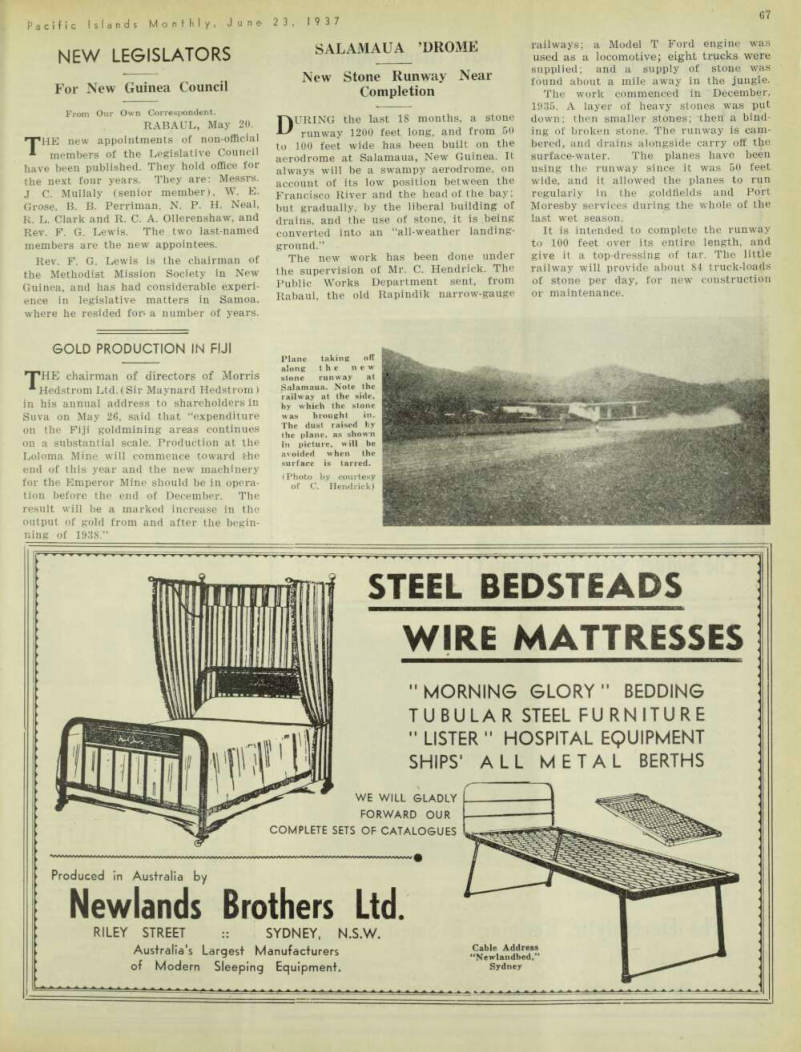
For New Guinea Council
From Our Own Correspondent.
Rabaul, May 20.
THE new appointments of non-official members of the Legislative Council have been published. They hold office for the next four years. They are: Messrs.
J C. Mullaly (senior member), W. E.
Grose, B. B. Perriman, N. P. H. Neal, R. L. Clark and R. C. A. Ollerenshaw, and Rev. F. G. Lewis. The two last-named members are the new appointees.
Rev. F. G. Lewis is the chairman of the Methodist Mission Society in New Guinea, and has had considerable experi ence in legislative matters in Samoa, where he resided for* a number of years.
Sold Production In Fiji
'"PHE chairman of directors of Morris *Hedstrom Ltd.(Sir Maynard Hedstrom) in his annual address to shareholders in Suva on May 26, said that “expenditure on the Fiji goldmining areas continues on a substantial scale. Production at the Loloma Mine will commence toward the end of this year and the new machinery for the Emperor Mine should be in opera tion before the end of December. The result will be a marked increase in the output of gold from and after the begin ning of 1938.”
Salamaua ’Drome
New Stone Runway Near Completion
DURING the last 18 months, a stone runway 1200 feet long, and from 50 to 100 feet wide has been built on the aerodrome at Salamaua, New Guinea. It always will be a swampy aerodrome, on account of its low position between the Francisco River and the head of the bay; but gradually, by the liberal building of drains, and the use of stone, it is being converted into an “all-weather landing ground.”
The new work has been done under the supervision of Mr. C. Hendrick. The Public Works Department sent, from Rabaul, the old Rapindik narrow-gauge
railways; a Model T Ford engine was used as a locomotive; eight trucks were supplied; and a supply of stone was found about a mile away in the jungle.
The work commenced in December, 1935. A layer of heavy stones was put down; then smaller stones; then a bind ing of broken stone. The runway is cam bered, and drains alongside carry off tljie surface-water. The planes have been using the runway since it was 50 feet wide, and it allowed the planes to run regularly in the goldfields and Port Moresby services during the whole of the last wet season.
It is intended to complete the runway to 100 feet over its entire length, and give it a top-dressing of tar. The little railway will provide about 84 truck-loads of stone per day, for new construction or maintenance.
Plane taking off along the new stone runway at Salamaua. Note the railway at the side, by which the stone was brought in.
The dust raised by the plane, as shown in picture, will be avoided when the surface is tarred. (Photo by courtesy of C. Hendrick)
Advertisements & other items, pp. 69-70 (1 item)
Newlands Brothers Ltd.
1
STEEL BEDSTEADS
WIRE MATTRESSES
"MORNING GLORY" BEDDING
TUBULAR STEEL FURNITURE
" LISTER " HOSPITAL EQUIPMENT
SHIPS' ALL METAL BERTHS
WE WILL GLADLY
FORWARD OUR
COMPLETE SETS OF CATALOGUES
Produced in Australia by
Newlands Brothers Ltd.
RILEY STREET :: SYDNEY. N.S.W.
Australia's Largest Manufacturers of Modern Sleeping Equipment.
Cable Address “Newlandbed,”
Sydney
Mining Ore
Treatment
Machinery
COMPLETE CYANIDE
PLANTS SUPPLIED
Dorr Classifiers Dorr Thickeners Dorr Agitators Oliver Filters Merril Crowe Zinc Dust Gold Precipitation Richardson Mine Fans ©
FANS AND AIR HEATERS
For Ventilation, Copra Drying Rooms, etc. • Enquire from
CROSSLE. DUFF AND
MACINTOSH LTD.
52 Bridge Street, SYDNEY
WE DID THE WHOLE CONTRACT
Your confidence in our service will not be misplaced
NEW OVERHAUL
SHOP
AND STORE AT LAE
for
GUINEA AIRWAYS
LTD.
JN few undertakings do X reliability, expedition, and efficient service count more than in Structural Steel contracts.
Che Sydney Steel Company Cld. ’SKSKI
Steel Merchants and Structural Engineers
C0L0...
HIGHEST PRICES, PROMPT
SETTLEMENT, ACCURATE
WEIGHTS AND ASSAYS.
are assured to producers and sellers of gold bullion who forward their consignments to The Electrolytic Refining and Smelting Co. of Aust. Ltd. for treatment and realisation.
RECORD PRICE.—On 6th March, 1935, this company paid to its clients at the rate of £9/4/6 net per fine ounce, which is the highest price ever paid for gold in Australia.
SPECIALLY ORGANISED SER-
VICE is available to clients in New Guinea, Fiji and other Pacific Island centres.
Address consignments from outside Australia to the Company's Sydney office.
Weighing a Pacific Islands consignment of gold bullion at an E.R. & S. receiving office.
The Electrolytic Refining &. Smelting Co.
OF AUSTRALIA LIMITED
Melbourne: Works: Sydney: Collins House. Port Kembla, N.S.W. 25 O'Connell Street.
PURCHASERS AND REFINERS OF GOLD, SILVER, COPPER IN ANY FORM BANKERS: —The English, Scottish and Australian Bank Ltd.
Pacific Islands Mining Notes
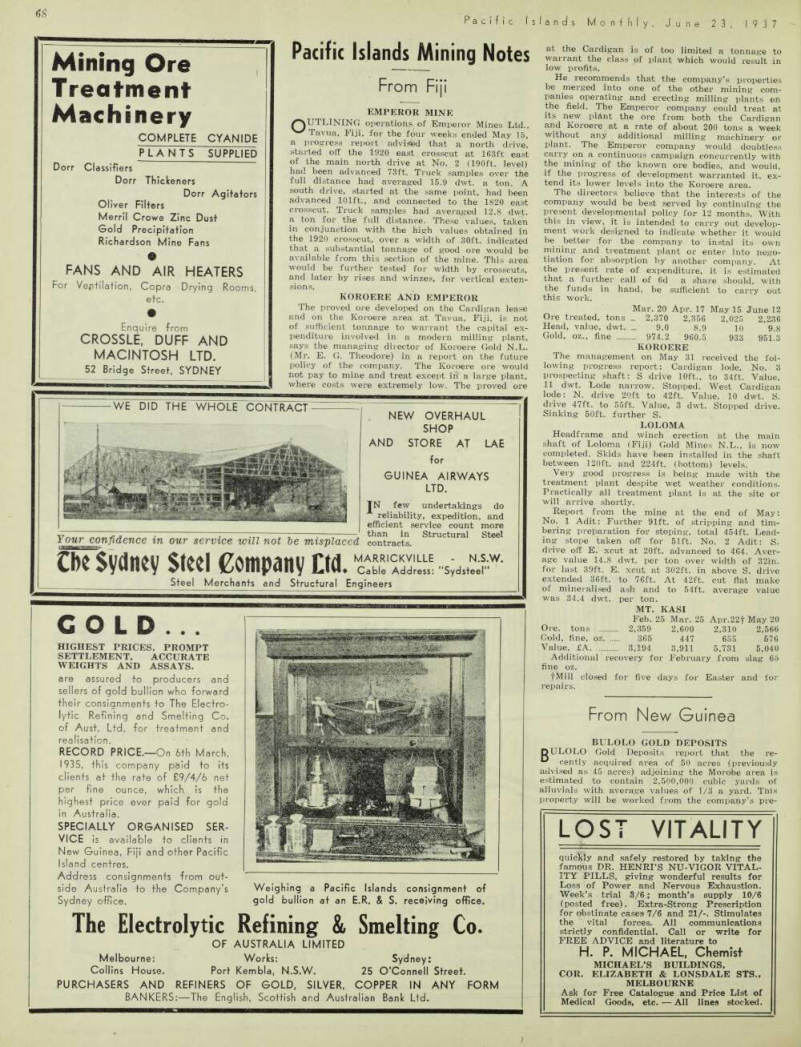
From Fiji
Emperor Mine
operations of Emperor Mines Ltd., Tavua, Fiji, for the four weeks ended May 15, a progress report advised that a north drive, started off the 1920 east crosscut at 163 ft east of the main north drive at No. 2 (190 ft, level) had been advanced 73ft. Truck samples over the full distance had averaged 15.9 dwt. a ton. A south drive, started at the same point, had been advanced 101 ft., and connected to the 1820 east crosscut. Truck samples had averaged 12.8 dwt. a ton for the full distance. These values, taken in conjunction with the high values obtained in the 1920 crosscut, over a width of 30ft. indicated that a substantial tonnage of good ore would be available from this section of the mine. This area would be further tested for width by crosscuts, and later by rises and winzes, for vertical exten sions.
Koroere And Emperor
The proved ore developed on the Cardigan lease and on the Koroere area at Tavua, Fiji, is not of sufficient tonnage to warrant the capital ex penditure involved in a modern milling plant, says the managing director of Koroere Gold N.L. (Mr. E. G. Theodore) in a report on the future policy of the company. The Koroere ore would not pay to mine and treat except iri a large plant, where costs were extremely low. The proved ore
at the Cardigan is of too limited a tonnage to warrant the class of plant which would result in low profits.
He recommends that the company’s properties be merged into one of the other mining com panies operating and erecting milling plants on the field. The Emperor company could treat at its new plstnt the ore from both the Cardigan and Koroere at a rate of about 200 tons a Week without any additional milling machinery or plant. The Emperor company would doubtless carry on a continuous campaign concurrently with the mining of the known ore bodies, and would, if the progress of development warranted it, ex tend its lower levels into the Koroere area.
The directors believe that the interests of the company would be best served by continuing the present developmental policy for 12 months. With this in view, it is intended to carry out develop ment work designed to indicate whether it would be better for the company to instal its own mining and treatment plant or enter into nego tiation for absorption by another company. At the present rate of expenditure, it is estimated that a further call of 6d a share should, with the funds in hand, be sufficient to carry out this work.
Koroere
The management on May 31 received the fol lowing progress report: Cardigan lode, No. 3 prospecting shaft: S drive 10ft., to 34ft. Value, 11 dwt. Lode narrow. Stopped. West Cardigan lode: N. drive 20ft to 42ft. Value, 10 dwt. S. drive 47ft. to 55ft. Value, 3 dwt. Stopped drive.
Sinking 50ft. further S.
Loloma
Headframe and winch erection at the main shaft of Loloma (Fiji) Gold Mines N.L., is now completed. Skids have been installed in the shaft between 120 ft. and 224 ft. (bottom) levels.
Very good progress is being made with the treatment plant despite wet weather conditions.
Practically all treatment plant is at the site or will arrive shortly.
Report from the mine at the end of May: No. 1 Adit: Further 91ft. of stripping and tim bering preparation for stoping, total 454 ft. Lead ing stope taken off for 51ft. No. 2 Adit: S. drive off E. xcut at 20ft. advanced to 464, Aver age value 14.8 dwt. per ton over width of 32in. for last 39ft. E. xcut at 302 ft. in above S. drive extended 36ft. to 76ft. At 42ft. cut flat make of mineralised ash and to 54ft. average value was 34.4 dwt. per ton.
Mt. Kasi
Additional recovery for February from slag 65 fine oz. fMill closed for five days for Easter and for repairs.
Mar. 20 Apr. 17 May 15 June 12 Ore treated, tons ... 2,370 2,356 2,025 2,236 Head, value, dwt. „ 9.0 8.9 10 9.8 Gold, oz., fine 974.2 960.5 933 951.3
Feb. 25 Mar. 25 Apr.22f May 20 Ore. tons 2,359 2,600 2,310 2,566 Gold, fine, oz. ... 365 447 655 576 Value, £A 3,194 3,911 5,731 5,040
From New Guinea
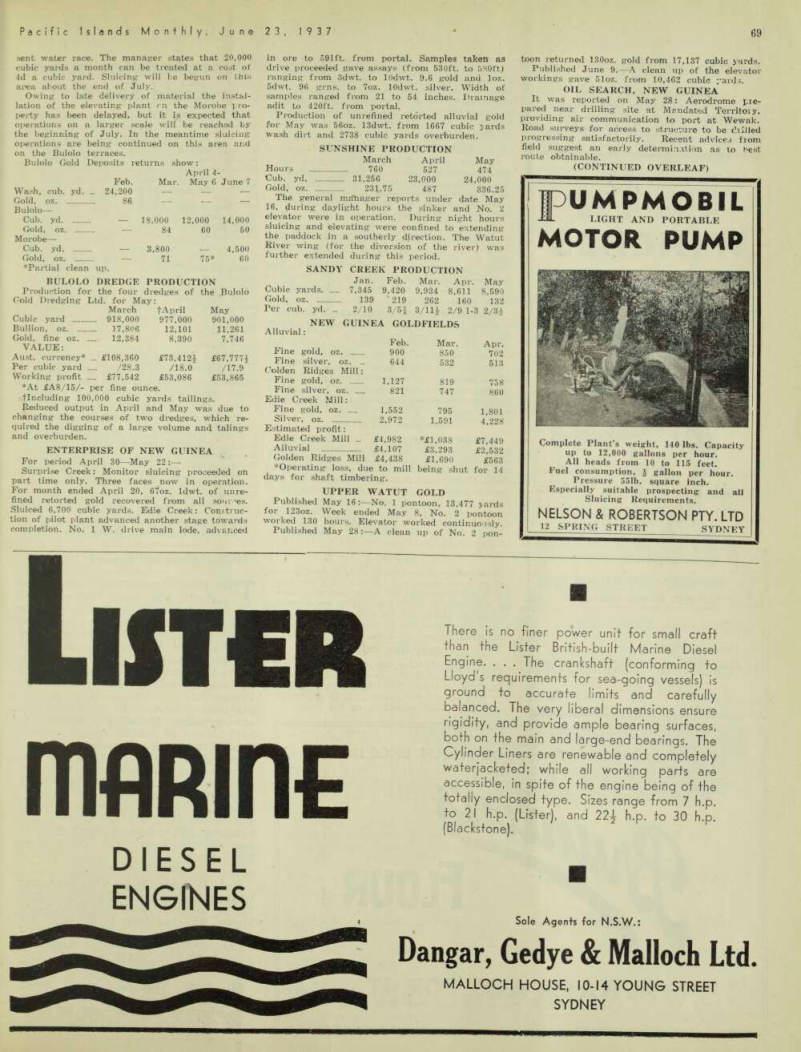
Bulolo Gold Deposits
nULOLO Gold Deposits report that the re cently acquired area of 50 acres (previously advised as 45 acres) adjoining the Morobe area is estimated to contain 2,500,000 cubic yards of alluvials with average values of 1/3 a yard. This property will be worked from the company’s pre
sent water race. The manager states that 20,000 cubic yards a month can be treated at a cost of 4d a cubic yard. Sluicing will be begun on this area about the end of July.
Owing to late delivery of material the instal lation of the elevating plant rn the Morobe pro perty has been delayed, but it is expected that operations on a larger scale will be reached by the beginning of July. In the meantime sluicing operations are being continued on this area and on the Bulolo terraces.
Bulolo Gold Deposits returns show:
Bulolo Dredge Production
Production for the four dredges of the Bulolo Cold Dredging Ltd. for May:
flncluding 100,000 cubic yards tailings.
Reduced output in April and May was due to changing the courses of two dredges, which re quired the digging of a large volume and talings and overburden.
Enterprise Of New Guinea
For period April 30 —May 22; — Surprise Creek: Monitor sluicing proceeded on part time only. Three faces now in operation.
For month ended April 20, 670 z. Idwt. of unre fined retorted gold recovered from all sources.
Sluiced 6,700 cubic yards. Edie Creek: Comtruc tion of pilot plant advanced another stage towards completion. No. 1 W. drive main lode, advanced
in ore to 591 ft. from portal. Samples taken as drive proceeded gave assays (from 530 ft. to sSoft) ranging from 3dwt. to lOdwt. 9.6 gold and loz. sdwt. 96 grns. to 7oz. lOdwt. silver. Width of samples ranged from 21 to 54 inches. Drainage adit to 420 ft. from portal.
Production of unrefined retorted alluvial gold for May was 560 z. 13dwt. from 1667 cubic yards wash dirt and 2738 cubic yards overburden.
Sunshine Production
The general manager reports under date May 16. during daylight hours the sinker and No. 2 elevator were in operation. During night hours sluicing and elevating were confined to extending the paddock in a southerly direction. The Watut River wing (for the diversion of the river) was further extended during this period.
Sandy Creek Production
New Guinea Goldfields
Alluvial:
Upper Watut Gold
Published May 16:-—No. 1 pontoon, 13,477 yards for 1230 z. Week ended May 8, No. 2 pontoon worked 130 hours. Elevator worked continuously.
Published May 28A clean up of No. 2 pon
toon returned 130 oz. gold from 17,137 cubic yards.
Published June 9. —A clean up of the elevator workings gave 51oz. from 10,462 cubic yards.
Oil Search, New Guinea
It was reported on May 28: Aerodrome pre pared near drilling site at Mandated Territory, providing air communication to port at Wewak.
Road surveys for access to structure to be drilled progressing satisfactorily. Recent advices from field suggest an early determination as to best route obtainable.
(Continued Overleaf)
Feb.
Mar.
April 4- May 6 June 7 Wash, cub. yd. ... 24,200 — .— .— Gold, oz. 86 .— .— — Bulolo—- Cub. yd. — 18,000 12,000 14,000 Gold, oz. — 84 60 50 Morobe — Cub. yd. — 3,800 — 4,500 Gold, oz. •Partial clean up. 71 75* 60
March tApril May Cubic yard 918,000 977,000 901,000 Bullion, oz. 17,806 12,101 11,261 Gold, fine oz 12,384 8.390 7,746
Value:
Aust. currency* ... £108,360 £73,412$ £67,777$ Per cubic yard — /28.3 /18.0 /17.9 Working profit £77,542 £53,086 £53,865 ♦At £A8/15/- per fine ounce.
March April May Hours 760 527 474 Cub. yd 31,256 23,000 24.000 Cold, oz 231.75 487 336.25
Jan. Feb. Mar. Apr. May Cubic yards 7,345 9,420 9,934 8,611 8,590 oz 139 ' 219 262 160 132 Per cub. yd. 2/10 3/5£ 3/11* 2/9 1-3 2/3*
Feb.
Mar.
Apr.
Fine gold, oz 900 850 702 Fine silver, oz. ... 644 532 513 Golden Ridges Mill: Fine gold, oz 1,127 819 758 Fine silver, oz. 821 747 860 Edie Creek Mill: Fine gold, oz. 1,552 795 1,801 Silver, oz 2,972 1.591 4.228 Estimated profit: Edie Creek Mill ... £4,982 •£1,088 £7,449 Alluvial £4,107 £3,293 £2,532 Golden Ridges Mill £4,438 £1,690 £563 loss, due to mill days for shaft timbering. being shut for 14
Advertisements & other items, pp. 70-71 (1 item)
Lost Vitality
quickly and safely restored by taking the
famous DR. HENRI’S NU-VIGOR VITAL-
ITY PILLS, giving wonderful results for Loss of Power and Nervous Exhaustion.
Week’s trial 3/6; month’s supply 10/6 (posted free). Extra-Strong Prescription for obstinate cases 7/6 and 21/-. Stimulates the vital forces. All communications strictly confidential. Call or write for FREE ADVICE and literature to
H. P. MICHAEL, Chemist
MICHAEL’S BUILDINGS,
COR. ELIZABETH & LONSDALE STS.,
MELBOURNE
Ask for Free Catalogue and Price List of Medical Goods, etc. All lines stocked.
ipUMPMOBIL
JilL LIGHT AND PORTABLE
MOTOR PUMP
Complete Plant’s weight, 140 lbs. Capacity up to 12,000 gallons per hour.
All heads from 10 to 115 feet.
Fuel consumption, 1 gallon per hour.
Pressure 551 b. square inch.
Especially suitable prospecting and all Sluicing Requirements.
NELSON & ROBERTSON PTY. LTD
12 SPRING STREET
SYDNEY
Lister
mARIDE
DIESEL
ENGINES
There is no finer power unit for smafl craft than the Lister British-built Marine Diesel Engine. . . . The crankshaft (conforming to Lloyd's requirements for sea-going vessels) is ground to accurate limits and carefully balanced. The very liberal dimensions ensure rigidity, and provide ample bearing surfaces, both on the main and large-end bearings. The Cylinder Liners are renewable and completely waterjacketed; while all working parts are accessible, in spite of the engine being of the totally enclosed type. Sizes range from 7 h.p. to 21 h.p. (Lister), and 22T h.p. to 30 h.p.
(Blackstone). P
mg Sole Agents for N.S.W.:
ar, Gedye & Malloch Ltd.
MALLOCH HOUSE, 10-14 YOUNG STREET
SYDNEY
From Papua
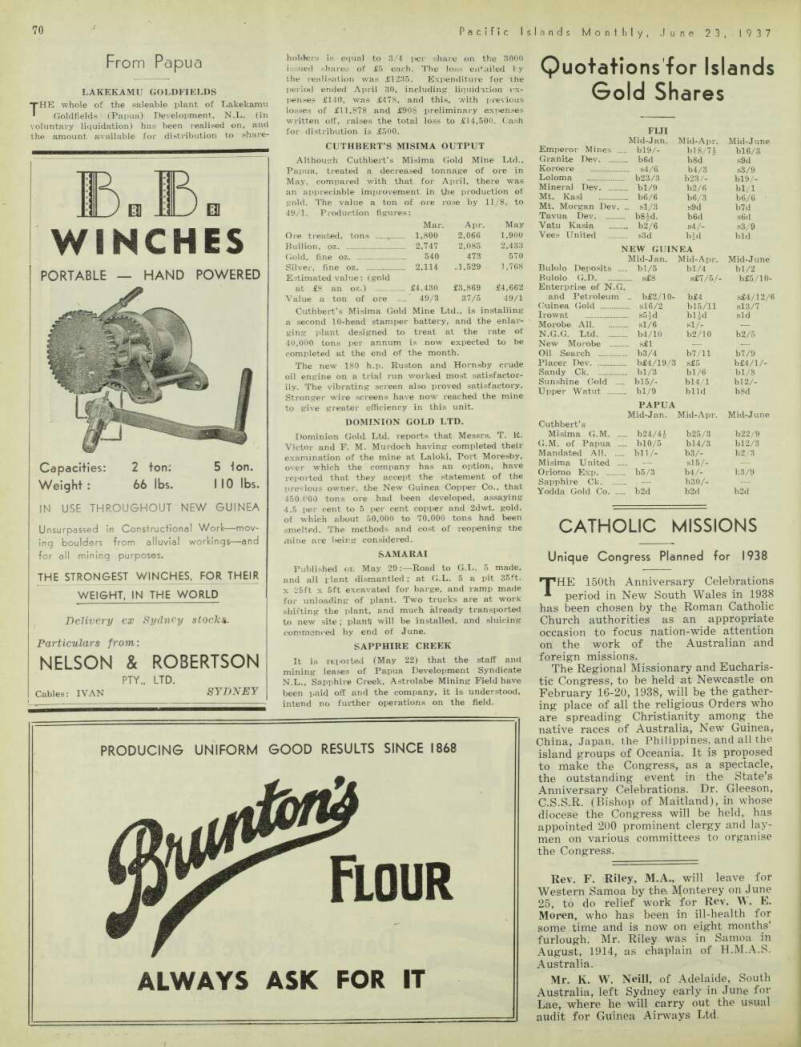
Lakekamu Goldfields
THE whole of the saleable plant of Lakekamu * Goldfields (Papua) Development, N.L. (in voluntary liquidation) has been realised on, and the amount available for distribution to share
holders is equal to 3/4 per share on the 3000 issued shares of £5 each. The loss entailed by the realisation was £1235. Expenditure for the period ended April 30, including liquidation ex penses £l4O, was £478, and this, with previous losses of £11,878 and £9OB preliminary expenses written off, raises the total loss to £14,500. Cash for distribution is £5OO.
Cuthbert’S Misima Output
Although Cuthbert’s Misima Gold Mine Ltd., Papua, treated a decreased tonnage of ore in May, compared with that for April, there was an appreciable improvement in the production of gold. The value a ton of ore rose by 11/8, to 49/1. Production figures:
Cuthbert’s Misima Gold Mine Ltd., is installing a second 10-head stamper battery, and the enlar ging plant designed to treat at the rate of 40,000 tons per annum is now expected to be completed at the end of the month.
The new 180 h.p. Ruston and Hornsby crude oil engine on a trial run worked most satisfactor ily. The vibrating screen also proved satisfactory.
Stronger wire screens have now reached the mine to give greater efficiency in this unit.
Dominion Gold Ltd.
Dominion Gold Ltd. reports that Messrs. T. R.
Victor and F. M. Murdoch having completed their examination of the mine at Laloki, Port Moresby, over which the company has an option, have reported that they accept the statement of the previous owner, the New Guinea Copper Co., that 450-000 tons ore had been developed, assaying 4.5 per cent to 5 per cent copper and 2dwt. gold, of which about 50,000 to 70,000 tons had been smelted. The methods and cost of reopening the mine are being considered.
Samarai
Published on May 29Road to G.L, 5 made, and all plant dismantled; at G.L. 5 a pit 35ft. x 25ft x sft excavated for barge, and ramp made for unloading of plant. Two trucks are at work shifting the plant, and much already transported to new site; plant) will be installed, and sluicing commenced by end of June.
Sapphire Creek
It is reported (May 22) that the staff and mining leases of Papua Development Syndicate N.L., Sapphire Creek, Astrolabe Mining Field have been paid off and the company, it is understood, intend no further operations on the field.
Mar. Apr. May Ore treated, tons ., 1,800 2,066 1,900 Bullion, oz. 2,747 2,085 2.433 Gold, fine oz 540 473 570 Silver, fine oz 2,114 .1,529 1,768 Estimated value: (gold at £8 an oz.) £4,430 £3,869 £4,662 Value a ton of ore 49/3 37/5 49/1
Quotations for Islands
Gold Shares
Fiji
Mid-Jan.
Mid-Apr.
Mid-June Emperor Mines . b!9/bl8/7i bl6/3 Granite Dev ... b6d b8d s9d Koroere ... s4/6 b4/3 s3/9 Loloma ... b23/3 b23 /bl9/- Mineral Dev bl/9 b2/G bl/1 Mt. Kasi ... b6/6 b6/3 b6/6 • Mt. Morgan Dev. sl/3 s9d b7d Tavua Dev ... b8id. b6d s6d Vatu Kasia b2/6 s4/s3/9 Yees United s.3d bld bid
New Guinea
Mid-Jan.
Mid-Apr.
Mid-June Bulolo Deposits . bl/5 bl/4 bl/2 Bulolo G.D s£8 s£7/5/b£5/10- Enterprise of N.G. and Petroleum ... b£2/10b£4 s£4/12/6 Guinea Gold ... si 6/2 bl5/ll sl3/7 Irowat s51d bljd sld Morobe All sl/6 sl/- .— N.G.G. Ltd ... b4/10 b2/10 b2/5 New Morobe s£l — •— Oil Search b3/4 b7/ll b7/9 Placer Dev b£4/19/3 s£5 b£4/l/- Sandy Ck bl/3 bl/6 bl/8 Sunshine Gold ... ... bl5/bl4/l bl2/- Upper Watut .„ bl/9 blld b8d
Papua
Mid-Jan.
Mid-Apr.
Mid-June Cuthbert’s Misima G.M. . .._ b24/4i b25/3 b22/9 G.M. of Papua . blO/5 bl4/3 bl2/3 Mandated All. ... ... bll/b3/b2/3 Misima United . — sl5/- — Oriomo Exp .._ b5/3 b4/b3/9 Sapphire Ck — b30/- Yodda Gold Co. ... ... b2d b2d b2d
Catholic Missions
Unique Congress Planned for 1938
THE 150th Anniversary Celebrations period in New South Wales in 1938 has been chosen by the Roman Catholic Church authorities as an appropriate occasion to focus nation-wide attention on the work of the Australian and foreign missions.
The Regional Missionary and Eucharis tic Congress, to be held at Newcastle on February 16-20, 1938, will be the gather ing place of all the religious Orders who are spreading Christianity among the native races of Australia, New Guinea, China, Japan, the Philippines, and all the island groups of Oceania. It is proposed to make the Congress, as a spectacle, the outstanding event in the State’s Anniversary Celebrations. Dr. Gleeson, C.S.S.R. (Bishop of Maitland), in whose diocese the Congress will be held, has appointed 200 prominent clergy and lay men on various committees to organise the Congress.
Rev. F. Riley, M.A., will leave for Western Samoa by the Monterey on June 25, to do relief work for Rev. W . E.
Moren, who has been in ill-health for some time and is now on eight months’ furlough. Mr. Riley was in Samoa in August, 1914, as chaplain of H.M.A.S.
Australia.
Mr. K. W. Neill, of Adelaide, South Australia, left Sydney early in June for Lae, where he will carry out the usual audit for Guinea Airways Ltd.
Advertisements & other items, pp. 72-74 (3 items)
Flour
WINCHES
PORTABLE HAND POWERED
LJ Capacities: 2 ton; 5 ion.
Weight : 66 lbs. I 10 lbs.
IN USE THROUGHOUT NEW GUINEA
Unsurpassed in Constructional Work—moving boulders from alluvial workings—and for all mining purposes.
THE STRONGEST WINCHES, FOR THEIR
WEIGHT. IN THE WORLD
Delivery ex Sydney stock s.
Particulars from:
NELSON & ROBERTSON
PTY., LTD.
es: IVAN
SYDNEY
PRODUCING UNIFORM GOOD RESULTS SINCE 1868
Flour
ALWAYS ASK FOR IT
Details Of The Rabaul Eruptions
71
(CONTINUED FROM PAGE 14)
Pacific Islands */l on+h I y , June 23, 1937
and RIGGER
SYDNEY’S LEADING
SAILMAKER
Also Manufacturer of all Canvas and Rope Work ISLANDS WORK a Speciality
HARRY WEST
Balmain East, SYDNEY Tel. W 1105
& ,~t N 5> O'A V A su As builders of many Islands vessels, amongst which are the above, we invite the attention of intending purchasers of new crafh to the unequalled facilities available at our modern yards for new building, engine installations, etc. • We are also agents in Australia and the South Seas for several leading makes of marine engines, viz:— "ATLAS IMPERIAL" DIESEL " R.N." DIESEL "GRAY"
Prices, both for building and engine Installations, are the keenest possible and your enquiry will receive prompt attention.
W| UAB kiPf * McMAHON’S PI.
• L. nULMES Ot WO. Sydney, n.s.w.
USE Local
TIMBER •
ALL CLASSES OF
Building - Furniture
and
Joinery Timbers
IN STOCK— OR CUT TO ORDER
TIMBER SUPPLIED FROM SALAMAUA
DEPOT TO ANY REGULAR
PACIFIC ISLANDS’ PORT,
AT SHORTEST NOTICE
SPECIALISING IN ALL CLASSES OF
MACHINED TIMBERS
Rusticated Weatherboards Tongued and Grooved Linings and Floorings
Mouldings, etc.
• SET MY QUOTE BEFORE PLACING YOUR NEXT ORDER.
ENQUIRIES INVITED
WRITE ...
C. A. ANDERSON
WAU —N. GUINEA
Newspaper Race
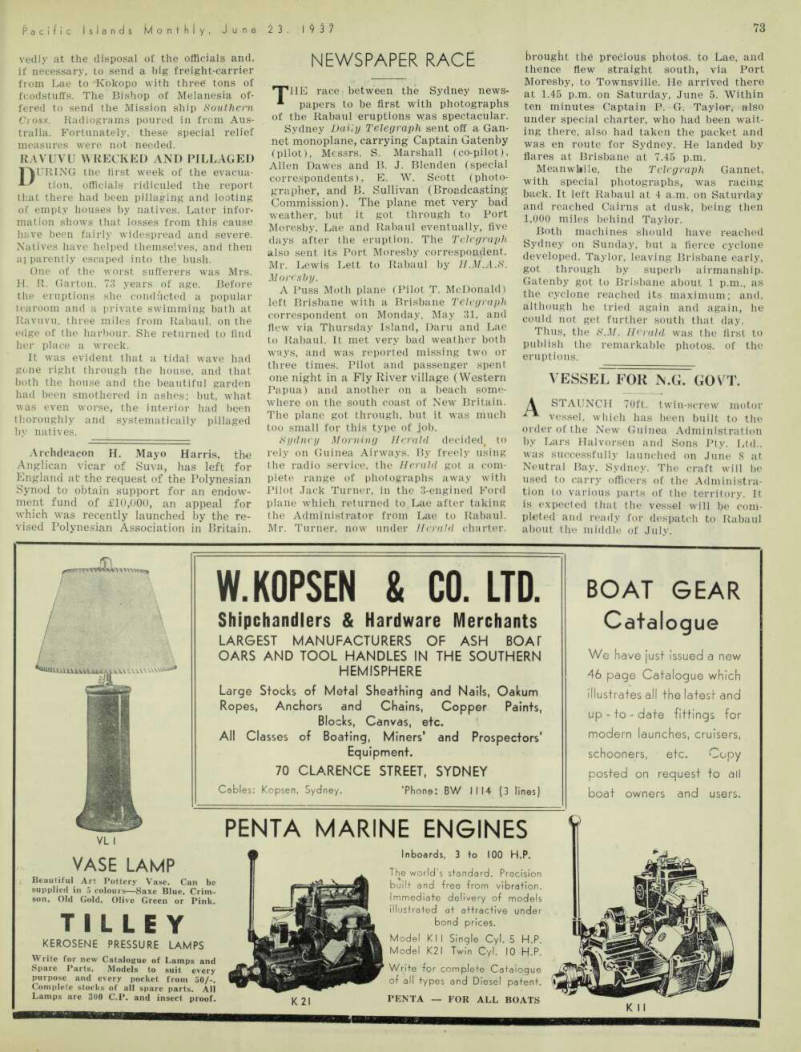
’"PHE race between the Sydney news * papers to be first with photographs of the Rabaul eruptions was spectacular.
Sydney Daily Telegraph sent off a Gan
net monoplane, carrying Captain Gatenby
(pilot), Messrs. S. Marshall (co-pilot), Allen Dawes and B. J. Blenden (special correspondents), E. W. Scott (photo grapher, and B. Sullivan (Broadcasting Commission). The plane met very bad weather, but it got through to Port Moresby, Lae and Rabaul eventually, five days after the eruption. The Telegraph also sent its Port Moresby correspondent, Mr. Lewis Lett to Rabaul by H.M.A.S.
Moresby.
A Puss Moth plane (Pilot T. McDonald) left Brisbane with a Brisbane Telegraph correspondent on Monday, May 31, and flew via Thursday Island, Darn and Lae to Rabaul. It met very bad weather both ways, and was reported missing two or three times. Pilot and passenger spent one night in a Fly River village (Western Papua) and another on a beach some where on the south coast of New Britain.
The plane got through, but it was much too small for this type of job, Sydney Morning Herald decided, to rely on Guinea Airways. By freely using the radio service, the Herald got a com plete range of photographs away with Pilot Jack Turner, in the 3-engined Ford plane which returned to Lae after taking the Administrator from Lae to Rabaul.
Mr. Turner, now under Herald charter.
brought the precious photos, to Lae, and thence flew straight south, via Port Moresby, to Townsville. He arrived there at 1,45 p.m. on Saturday, June 5. Within ten minutes Captain P. G. Taylor, also under special charter, who had been wait ing there, also had taken the packet and was en route for Sydney. He landed by flares at Brisbane at 7.45 p.m.
Meanwhile, the Telegraph Gannet, with special photographs, was racing back. It left Rabaul at 4 a.m. on Saturday and reached Cairns at dusk, being then 1,000 miles behind Taylor.
Both machines should have reached Sydney on Sunday, but a fierce cyclone developed. Taylor, leaving Brisbane early, got through by superb airmanship.
Gatenby got to Brisbane about 1 p.m., as the cyclone reached its maximum; and. although he tried again and again, he could not get further south that day.
Thus, the S.M. Herald was the first to publish the remarkable photos, of the eruptions.
Vessel For N.G. Govt.
A STAUNCH 70ft. twin-screw motor vessel, which has been built to the order of the New Guinea Administration by Lars Halvorsen and Sons Pty. Ltd., was successfully launched on June 8 at Neutral Bay, Sydney. The craft will be used to carry officers of the Administra tion to various parts of the territory. It is expected that the vessel will be com pleted and ready for despatch to Rabaul about the middle of July.
thf'■•c’o,on”r
Suva, sailed from Sydney for London on June 12.
Advertisements & other items, pp. 75-76 (1 item)
W.Kopsen & Co. Ltd.
\ \ UJmultU'Ai vw\UW^VAV
Shipchandlers & Hardware Merchants
LARGEST MANUFACTURERS OF ASH BOAT
OARS AND TOOL HANDLES IN THE SOUTHERN
HEMISPHERE
Large Stocks of Metal Sheathing and Nails, Oakum Ropes, Anchors and Chains, Copper Paints, Blocks, Canvas, etc.
All Classes of Boating, Miners' and Prospectors'
Equipment.
70 CLARENCE STREET, SYDNEY
Cables: Kopsen, Sydney. ’Phone: BW 1114 (3 lines)
BOAT GEAR
Catalogue
We have just issued a new 46 page Catalogue which illustrates all the latest and up -to - date fittings for modern launches, cruisers, schooners, etc. Copy posted on request to all boat owners and users.
VL I
VASE LAMP
Beautiful Art Pottery Vase. Can be supplied in 5 colours—Saxe Blue, Crimson, Old Gold, Olive Green or Pink.
TILLEY
KEROSENE PRESSURE LAMPS
Write for new Catalogue of Lamps and Spare Parts. Models to suit every purpose and every pocket from 50/-.
Complete stocks of all spare parts. All Lamps are 300 C.P. and insect proof.
RENTA MARINE ENGINES
\4 Inboards, 3 to 100 H.P.
The world's standard. Precision built and free from vibration.
Immediate delivery of models illustrated at attractive under bond prices.
Model KM Single Cyl. 5 H.P.
Model K2I Twin Cyl. 10 H.P.
Write for complete Catalogue of all types and Diesel patent.
K 21
PENTA
FOR ALL BOATS
CORONATION STAMPS
Little Intrinsic Value Exchange
for Souvenirs
Thousands of readers of this Journal doubtless possess Coronation Stamps and First Day Covers which they are holding as souvenirs in the belief that they are of some intrinsic value. Actually, where millions of stamps are issued in this manner the value, except as mementoes of a historic occasion is nil, unless in bulk to dealers, who find them a medium of exchange for other stair-ps with dealers abroad. It usually happens, after the first flush of enthusiasm has evaporated, that stamps and coverr, find their way gradually into the waste-paper basket.
By acting immediately, however, holders of sue'i can turn them to profit by forwarding them to one or other of the recognised stamp dealers.
Perhaps the best medium for this exchange is the philatelic Investment Society of Sydney, which organisation has definite outlets overseas for stamps in bulk. The Society undertakes to forward, in return for each first day Coronation stamp or cover posted in, a Coronation souvenir of double the value forwarded. If desired, a list of these souvenirs will be forwarde I on application to the Society, whose address is 18 Loftus St., Sydney.
The main point is, however, promptness in sending them in, if the stamps and covers are to be of any value at all.—Advt.
DEWAR'S
with lemon and soda —off the ice, or with plain ice-water . . .
A real refresher!
The Famous
SCOTCH
Entry Upon Australian Air
Guinea Airways To
Extend
Entry Upon Australian Air Routes
'T'HE directors of Guinea Airways Ltd. 1 announced On May 31 that it was intended to issue 80,000 7 per cent CUlUU lative participating preference shares of . „ rr,, ... , m the company. The money Will be used principally to buy high-powered multi-engined aircraft and to establish adequate ground organisations in selected districts in Australia.
The directors propose to extend the P resent Darwin to Adelaide service dir ect to Melbourne. It is expected that the distance Of more than 2,000 miles Will „ „ bp rovprPf t reeularlv in one, dav In boon COVerea regularly ill onei tidy, in addition, a direct service between Ade laide and Sydney is expected to be estab qnmi and othpr rnntps -irp bpimr il&tiecl soon > anti ottiei rOUteS dre being Considered. It is also Stated that the Dar win to Adelaide service will be duplicated nc . Qnnn warrants it ES 80011 aS tr 3 ™ o warrants it.
The whole Of the ISSU6 of new shares has been underwritten.
Japanese Air-Mail
Service Tokio To Carolines and Pelews
A N announcement, early in June, that Japan proposed to inaugurate, in October, a monthly air-mail service con necting Tokio with the Pelew Islands, set the whole pack of Australian newspaper kite-fliers speculating in their usual silly fashion.
Within a few days, they had exag gerated it into a plan by which Japan was to run an air-mail service to Aus tralia, via Pelew and Darwin. *They worked themselves into a mild frenzy on the question of whether Australia would admit the Japanese aircraft.
What actually is to happen is that Japan, after long consideration, has de cided to put in an air-mail link between Tokio and the Japanese Mandated Is lands. The ’planes will run southwards, via the Bonins, the Marianas and the Central Carolines (where Saipan is the chief administrative centre); then, pre sumably, they will turn westwards through the Western Carolines (where Yap is situated), and thence will fly on to the Pelew group, further west, where, at the port of Korror, are the head quarters of the South Seas Bureau, which governs the whole of this Mandated Ter ritory.
Returning to Saipan, the ’planes could fly eastwards to Truk, and on to the port of Ponape, and the Marshall Islands, of which the chief town is Jaluit.
Saipan is near the American island of Guam, which is a station on Pan- American Airways North Pacific service (’Frisco to Hongkong). If there is to be any Japanese connection between the Japanese Islands air-mail service and Australia, it almost certainly will be made between Saipan and New Guinea, and thence to North Queensland.
Copra - Producers And
Income Tax
ANEW provision in the Commonwealth Income Tax Assessment Act (No. 27, 1936—Section 23q.) gives substantial re lief to persons who live in Australia, and who own properties in Pacific territories “where the taxpayer is liable to pay royalties or export duty in respect of goods from the sale of which the income is derived.”
In the past, copra-producers in New Guinea, for example, received the current rate from exporters, less the amount of the export tax; but, owing to the word ing of the Act, it happened that it was the exporter and not the producer who was regarded as the payer of the export tax, and who got the benefit of exemption from Australian income tax. The pro ducer, if a resident of Australia, was taxed, and the exporter escaped. Under the new Act, the producer is exempt; and the exporter, presumably, is not.
Trans-Tasman Air-Mail
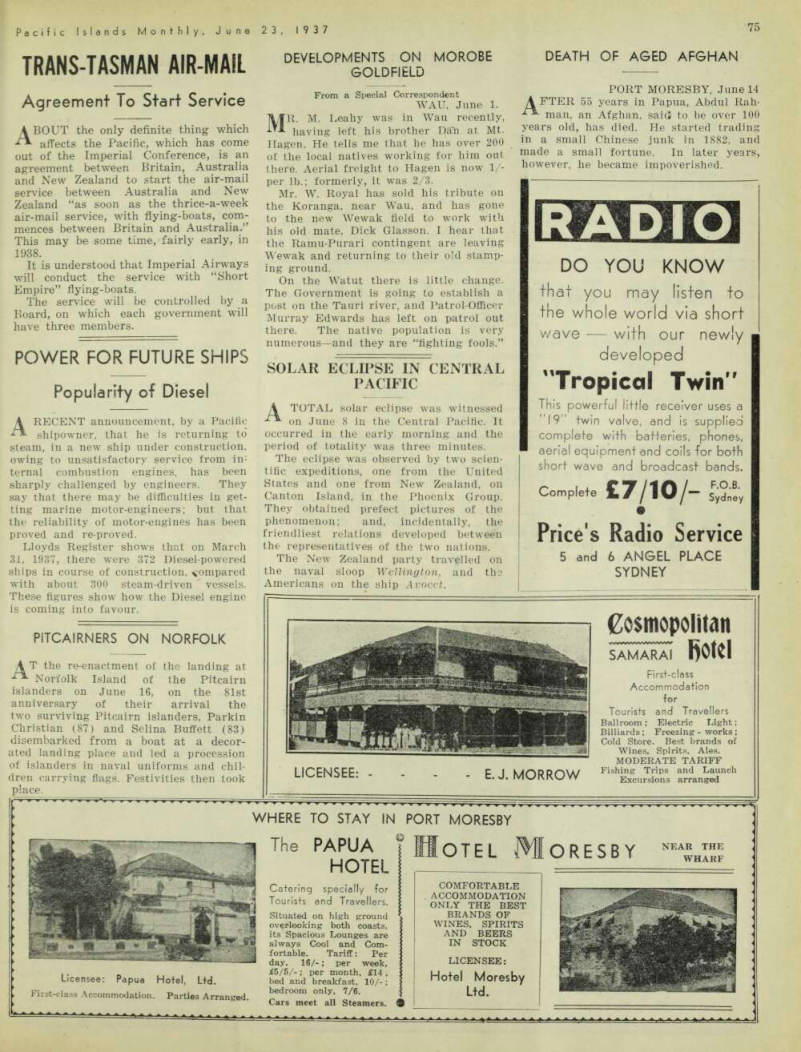
Agreement To Start Service
ABOUT the only definite thing which affects the Pacific, which has come out of the Imperial Conference, is an agreement between Britain, Australia and New Zealand to start the air-mail service between Australia and New Zealand “as soon as the thrice-a-week air-mail service, with flying-boats, com mences between Britain and Australia.”
This may be some time, fairly early, in 1938.
It is understood that Imperial Airways will conduct the service with “Short Empire” flying-boats.
The service will be controlled by a Board, on which each government will have three members.
Popularity of Diesel
Power For Future Ships
A RECENT announcement, by a Pacific shipowner, that he is returning to steam, in a new ship under construction, owing to unsatisfactory service from in ternal combustion engines, has been sharply challenged by engineers. They say that there may be difficulties in get ting marine motor-engineers; but that the reliability of motor-engines has been proved and reproved.
Lloyds Register shows that on March 31, 1937, there were 372 Diesel-powered ships in course of construction, compared with about 300 steam-driven vessels.
These figures show how the Diesel engine is coming into favour.
Pitcairners On Norfolk
A T the re-enactment of the landing at Norfolk Island of the Pitcairn islanders on June 16, on the 81st anniversary of their arrival the two surviving Pitcairn islanders, Parkin Christian (87) and Selina Buffett (83) disembarked from a boat at a decor ated landing place and led a procession of islanders in naval uniforms and chil dren carrying flags. Festivities then took
place.
Developments On Morobe
Goldfield
From a Special Correspondent WAU, June 1.
MR. M. Leahy was in Wau recently, having left his brother Dan at Mt.
Hagen. He tells me that he has over 200 of the local natives working for him out there. Aerial freight to Hagen is now 1/per lb.; formerly, it was 2/3.
Mr. W. Royal has sold his tribute on the Koranga, near Wau, and has gone to the new Wewak field to work with his old mate, Dick Glasson. I hear that the Ramu-Purari contingent are leaving Wewak and returning to their old stamp ing ground.
On the Watut there is little change.
The Government is going to establish a post on the Tauri river, and Patrol-Officer Murray Edwards has left on patrol out there. The native population is very numerous —and they are “fighting fools.”
Solar Eclipse In Central
Pacific
A TOTAL solar eclipse was witnessed on June 8 in the Central Pacific. It occurred in the early morning and the period of totality was three minutes.
The eclipse was observed by two scien tific expeditions, one from the United States and one from New Zealand, on Canton Island, in the Phoenix Group.
They obtained prefect pictures of the phenomenon; and, incidentally, the friendliest relations developed between the representatives of the two nations.
The New Zealand party travelled on the naval sloop Wellington, and the Americans on the ship Avocct.
Death Of Aged Afghan
Port Moresby, June 14
A FTER 55 years in Papua, Abdul Rah man, an Afghan, said to be over 100 years old, has died. He started trading in a small Chinese junk in 1882, and made a small fortune. In later years, however, he became impoverished.
Advertisements & other items, p. 77 (1 item)
"Tropical Twin"
DO YOU KNOW
that you may listen to the whole world via short wave with our newly
developed
"Tropical Twin"
This powerful little receiver uses a "19" twin valve, and Is supplied complete with batteries, phones, aerial equipment and coils for both short wave and broadcast bands.
Complete £7/10/
Sydney
Price's Radio Service
5 and 6 ANGEL PLACE
SYDNEY
LICENSEE: -
E. J. MORROW
Cosmopolitan
Rotel
First-class Accommodation for Tourists and Travellers Ballroom ; Electric Light; Billiards; Freezing - works : Cold Store. Best brands of Wines, Spirits, Ales.
MODERATE TARIFF
Fishing Trips and Launch Excursions arranged
WHERE TO STAY IN PORT MORESBY
s M
Licensee: Papua Hotel, Ltd.
First-class Accommodation. Parties Arranged.
The PAPUA f
HOTEL
Catering specially for
Tourists and Travellers.
Situated on high ground ', overlooking both coasts, ; its Spacious Lounges are always Cool and Comfortable. Tariff: Per day, 16/-; per week, £5/5/-; per month, £l4 ; bed and breakfast, 10/-; bedroom only, 7/6.
Cars meet all Steamers. Q
Hotel Moresby
NEAR THE
WHARF
COMFORTABLE
ACCOMMODATION
ONLY THE BEST
BRANDS OF
WINES. SPIRITS
AND BEERS
IN STOCK
LICENSEE;
Hotel Moresby
Ltd.
The Luck Op A Runaway
Sailor
Apia, May 20.
A YOUNG English sailor, Williams, from the crew of the Swedish steamer Anten, tempted by tropical life and, per haps, by the dusky beauties of Samoa, decided to desert his ship. He was living at a Samoan village on the coast when he saw some Samoan policemen approaching evidently looking for him.
Williams, trying to hide, climbed a tree near the village, but fell and broke his leg. He will spend some time in hospital here and then will be deported.
Old Families United In Samoan
Wedding
Apia, May 26.
, y[/’EDDING festivities in true Samoan style marked the marriage on May 20 of Mr. George Churchward, junior, and Miss Maria Alma Stowers, both of whom are members of old-established Samoan families. Over 450 leading residents of Upolu attended the wedding dance in the Tivoli Theatre, Apia.
Mr. C. W. Tucker, a member of the Fijian Constabulary, who is spending his leave in Sydney, will return in August.
Attempts Suicide
Tortured Samoan Girl
From Our Own Correspondent
Apia, May 20.
A T Satapuala, on the coast west of Apia, a young Samoan girl went to work on her family’s inland plantation, taking a knife with her to cut banana leaves.
The girl climbed a coconut tree to ob tain drinking coconuts and she fell, and hurt her leg badly. Tortured by pain, she took her kife and attempted to cut her throat, completely severing her windpipe.
Many hours later her family, alarmed by her long absence, found her lying in a pool of blood, but still alive. She was taken to Apia hospital, where she now is under medical treatment, and expected to live.
N.G. Mining Co. Winds Up
A petition has been granted for the winding-up of Upper Watut Gold Alluvials, which has carried on mining operations in New Guinea. The petition stated that the company was indebted to its creditors for £66,043. Its assets, apart from its gold mining leases, were estimated at £20,000.
Upper Watut Gold Alluvials N.L., was formed in Melbourne in February, 1935, to acquire, from Mt. Lawson Prospecting and Options Syndicate, options over Leahy’s, Wales’s and Mainko leases.
The issued capital was £200,000, in 5/- shares — of which £50,000 represented a fully-paid issue to the vendor syndicate. A lot of money was spent in preparing for large-scale sluicing, and the installation of a hydro-electric scheme. The first directors were D. J. McClelland, F. T.
Leahy and C. Mackay. The 5/- shares were quoted in March at 1/6 and in May at 9d.
The petition of the directors for a wind-up came as a complete surprise. The action was taken because of writs issued by the chief credi tors.
Since sluicing was commenced last August, 1385 ounces of gold of gold were won from 149,000 cubic yards. The yield since August averaged 1/3 a yard.
Chief amounts owing are: —Messrs. E. J.
Morgan and Colin Mackay, £47,523 ; Guinea Air ways, £10,236 ; Burns, Philp, £2,929; Judd and J. Leahy, £1,603 ; Siemens, £1,301 ; directors’ fees, £916.
On construction of a water-race, £29,000 was spent; £15,000 on a tunnel; £25,000 on a power house; £15,000 on gravel pumps; £7,500 on pon toons; £B,OOO on a flume; £6,500 on a diversion dam; £5,600 on residential buildings: £1,300 on an aerodrome; £2,000 on roads and bridges; and more than £4,000 on a surge tank and syphon.
To Market Timber From
New Guinea
PACIFIC Timbers Pty. Ltd. has been registered “to carry into effect an agreement made between New Guinea Timber Co. Ltd., of the one part, and William George Nosworthy and Alfred Roy Le Messurier, of the other part, John Joseph Johnson, of the first part, Flora Doris Gilmour, of the second part, and the said William George Nosworthy and Alfred Roy Le Messurier.” Capital, £50,000 in £1 shares.
Names subscribed to memorandum: Alfred Wil liam Harold Akehurst, 1 share; Reginald Mervyn Friend, 1 share. The company proposes to fell, log and mill timber in New Guinea and transport it. It is associated with Timber Transport and Storage Co. Pty. Ltd., of South Melbourne.
Mr. W. M. Dupain, manager for Messrs Burns, Philp and Co. Ltd., Port Moresby, Papua, for 11 years, moved on to take charge of the Cairns branch on June 11.
Many laudatory things were said of him at a farewell dinner at the Papua Club,
Advertisements & other items, p. 78 (1 item)
Allen Taylor & Co. Ltd.
SYDNEY
Sawmillers and Wholesale Suppliers of Hardwoods for Constructional Purposes GIRDERS . . . PILES . . . POLES . . . SLEEPERS. Etc.
EXPORTING TO PACIFIC ISLANDS SINCE 1893
Cables: Tuxedo, Sydney
STEAMSHIPS TRADING COMPANY LIMITED
PORT MORESBY PAPUA SAMARAI
Chairman and Managing Director: A. S. FITCH.
Shipowners, Wholesale and Retail Merchants and Traders; Shipping, Customs and Insurance Agents; Copra and Rubber Plantation Owners.
MAIL CONTRACTORS TO COMMONWEALTH AND PAPUAN GOVERNMENTS.
AGENCIES:—At Port Moresby: Coral Sea Insurance Co.; Phoenix Insurance Co.; Delta Sawmills, Ltd, ; Acme Bakery Co. ; Vacuum Oil Co. Pty. Ltd. At Samarai: Coral Sea Insurance Co. ; Delta Sawmills, Ltd. ; Bankers and Traders’
Insurance Co.; National Mutual Life Insurance Co.; Kularo Shipyards; Mamai Plantations.
BRANCHES: —In Papua: Hanuabada, Sivitoi, Aroma, Koki, Hula, Ela Beach, Duga Duga, Yule Island.
SYDNEY: NELSON & ROBERTSON PTY. LTD., 12 Spring St.; Melbourne. 396 Flinders Lane; London, E. Whiteaway & Co,, 7 Chiswell Street, Finsbury, London.
Cable Address: “STEAMSHIPS.” Code; Bentley’s.
"FAIRHOLME" A Mountain School for Girls
•• Si ' a T* Dormitory Wing and Staff Residence
PRESBYTERIAN GIRLS' COLLEGE, Toowoomba, Q'ld.
Principal : MISS D. E. CULPIN, B.A.
ASSISTED BY A STAFF OF UNIVERSITY GRADUATES.
ACADEMIC, HOME SCIENCE & COMMERCIAL COURSES
N.B.—Next Term commences 2nd February, 1937 Prospectus on application to the Secretary : Mr. R. T. Phelps, F.A.A., 491 Ruthven St., Toowoomba
Tribute To Norfolk Is.
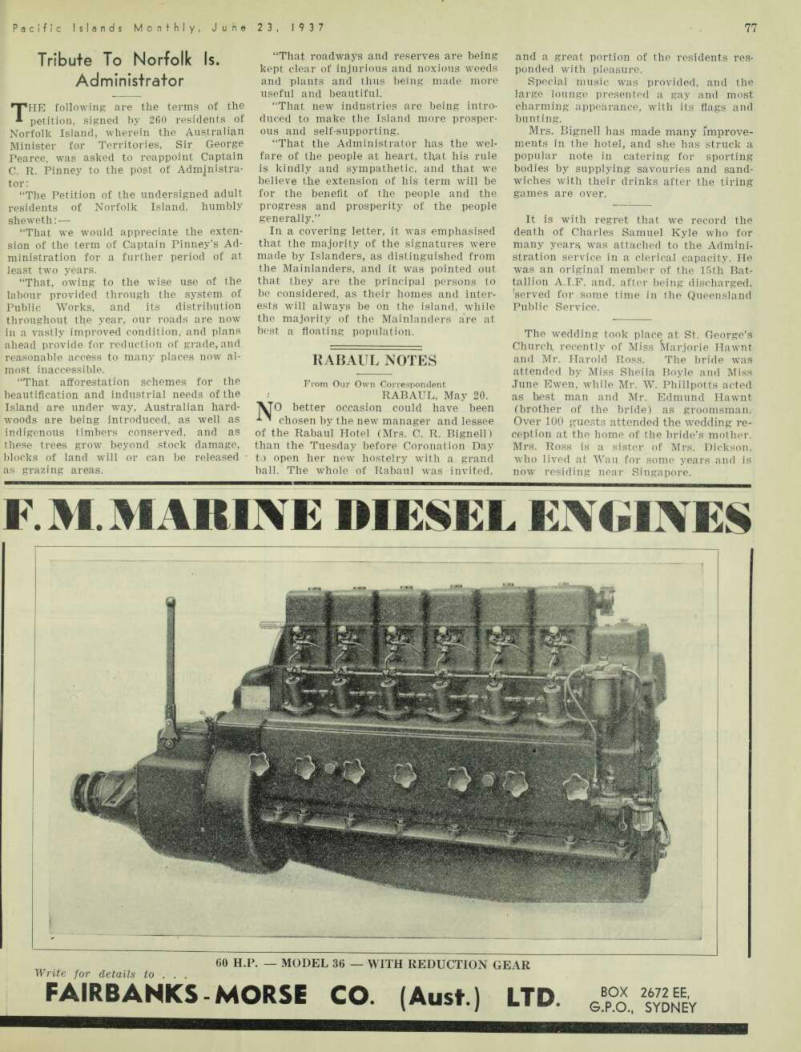
Administrator
THE following are the terms of the petition, signed by 260 residents of Norfolk Island, wherein the Australian Minister for Territories, Sir George Pearce, was asked to reappoint Captain C. R. Finney to the post of Administra tor: “The Petition of the undersigned adult residents of Norfolk Island, humbly sheweth: “That we would appreciate the exten sion of the term of Captain Finney’s Ad ministration for a further period of at least two years.
“That, owing to the wise use of the labour provided through the system of Public Works, and its distribution throughout the year, our roads are now in a vastly improved condition, and plans ahead provide for reduction of grade, and reasonable access to many places now al most inaccessible.
“That afforestation schemes for the beautification and industrial needs of the Island are under way, Australian hard woods are being introduced, as well as indigenous timbers conserved, and as these trees grow beyond stock damage, blocks of land will or can be released * as grazing areas.
“That roadways and reserves are being kept clear of injurious and noxious weeds and plants and thus being made more useful and beautiful.
“That new industries are being intro duced to make the Island more prosper ous and self-supporting.
“That the Administrator has the wel fare of the people at heart, that his rule is kindly and sympathetic, and that we believe the extension of his term will be for the benefit of the people and the progress and prosperity of the people generally.’’
In a covering letter, it was emphasised that the majority of the signatures were made by Islanders, as distinguished from the Mainlanders, and it was pointed out that they are the principal persons to be considered, as their homes and inter ests will always be on the island, while the majority of the Mainlanders are at best a floating population.
Rabaul Notes
From Our Own Correspondent
I Rabaul, May 20.
IVTO better occasion could have been chosen by the new manager and lessee of the Rabaul Hotel (Mrs. C, R. Bignell) than the Tuesday before Coronation Day to open her new hostelry with a grand ball. The whole of Rabaul was invited,
and a great portion of the residents res ponded with pleasure.
Special music was provided, and the large lounge presented a gay and most charming appearance, with its flags and bunting.
Mrs. Bignell has made many improve ments in the hotel, and she has struck a popular note in catering for sporting bodies by supplying savouries and sand wiches with their drinks after the tiring games are over.
It is with regret that we record the death of Charles Samuel Kyle who for many years was attached to the Admini stration service in a clerical capacity. He was an original member of the 15th Bat tallion A.I.F. and, after being discharged, 'served for some time in the Queensland Public Service.
The wedding took place at St. George’s Church, recently of Miss Marjorie Hawnt and Mr. Harold Ross. The bride was attended by Miss Sheila Boyle and Miss June Ewen, while Mr. W. Phillpotts acted as best man and Mr, Edmund Hawnt (brother of the bride) as groomsman.
Over 100 guests attended the wedding re ception at the home of the bride’s mother.
Mrs. Ross is a sister of Mrs. Dickson, who lived at Wan for some years and is now residing near Singapore.
Advertisements & other items, pp. 79-80 (1 item)
F. M. Marine Diesel Engines
Write for details to .. . 60 H.P. MODEL 36 WITH REDUCTION GEAR
FAIRBANKS-MORSE CO. (Aust.) LTD
BOX 2672 EE,
5.P.0., SYDNEY
Konkrete Paint
For EVERY SURFACE where Permanence is Imperative--!
Adaptability for the varying climatic conditions of the Pacific Islands has been abundantly proved by users.
KONKRETE Standard Gloss and Flat Colours for wood, brick, fibro, cement, iron, and stone.
KONKRETE PAINT IS
THE SOLUTION
Complete price list and colour card from sole wholesale distributors for N.S.W. and * Pacific Islands.
Solo Distributors wanted in Pacific Islands territories where not already represented.
H. Florentine and Son
321 Pitt Street, Sydney, N.S.W.
Coming to TAHITI ?
OSCAR 0. NORDMAN specialises In YACHT PURVEYING, and supplies Local and N.Z. Fresh and Frozen Meats of all kinds . . . Poultry, Fish, Eggs.
Vegetables. Groceries, Bread, Milk, Fruits in Season, etc., etc.
ALSO, those contemplating a visit to beautiful TAHITI may assure a Comfortable, Comprehensive and Completely Trouble-free Tour by cabling ...
OSCAR C. NORDMAN
GENERAL SHIPPING AGENT AND PURVEYOR
“MAN OF INFORMATION ”
Cable Address : ‘’OCEANIC," PAPEETE
by HALVORSEN
DESIGNERS AND BUILDERS
OF ALL TYPES OF VESSELS
FOR ALL PURPOSES
® Our technical assistance and advice is at your service . . .
Send details of your requirements . . . We may be able to assist you with helpful suggestions.
DISTRIBUTING AGENTS FOR
MORRIS
MARINE ENGINES
UTILITY CRAFT
* FOR SERVICE IN *
PACIFIC ISLANDS
LARS HALVORSEN marine Engineers
NEUTRAL BAY
SYDNEY
A Pioneer Passes
Rudolph Wolff Goes To His Rest
From Our Own Correspondent.
Rabaul, May 20.
of New Guinea’s oldest residents passed away on May 2 in the person of Rudolph Wolff. He came to the country itn 1892, and was employed for a time by the New Guinea Co., and later took up the land on which now stands the valuable plantation of Varzin, near Toma, in the Kokopo district. In 1902 he had a har rowing experience—his wife and child were murdered by the natives.
Mr. Wolff was born in 1867 in Stettin, Germany, and he leaves a son and daughter-in-law.
The funeral service was conducted by Rev. Father Madigan, and at the grave side there were representatives of every section of the community, including the Administrator, and heads of departments.
The pall-bearers were officers of the N.D.L. steamer Friderun.
N.G. Sold Royalty
From a Special Correspondent WAU, June 1.
T READ, the other day, a statement by the Administrator, that our gold royalty—five per cent on gross produc tion —was low. There seems to have been no protest from our mining representa tive oir the council. Are protests gagged there too?
To most of the independent miners, the royalty is a definite hardship. If it were the only form of taxation, few would begrudge it, though it has to be paid whether we make a profit or a loss; but the mining industry is burdened with fees on an exorbitant scale. It is the milch cow for the Territory, and it gets scant consideration.
Captain Keith A. Elliott, the youngest
June “B.P. Magazine”
THE June number of “The B.P. Magazine”
I maintains the usual high standard, and the contents are well chosen and presented in a novel and arresting manner. There are stories and articles grave and gay, beautiful pictures, and news of music, art, and cinema.
The issue possesses an appropriately English flavour, beginning with portrait studies of King George VI. and Queen Elizabeth, and continuing through many pages of lovely English landscape, historic buildings, and other aspects of the Home land with all its colourful tradition.
Will Ashton, R. 0.1., writes of the lure of the streets of France to the artist, and illustrates his articles with reproductions (in black and white) of his own pictures.
Island readers can find within the pages of the June “B.P. Magazine” a most entertaining and varied literary and pictorial fare. It is procurable from booksellers and newsagents at 1/- per copy.
Captain Keith A. Elliott, the youngest
of the Torres Strait pilots, died recently
in Brisbane.
Islands Produce
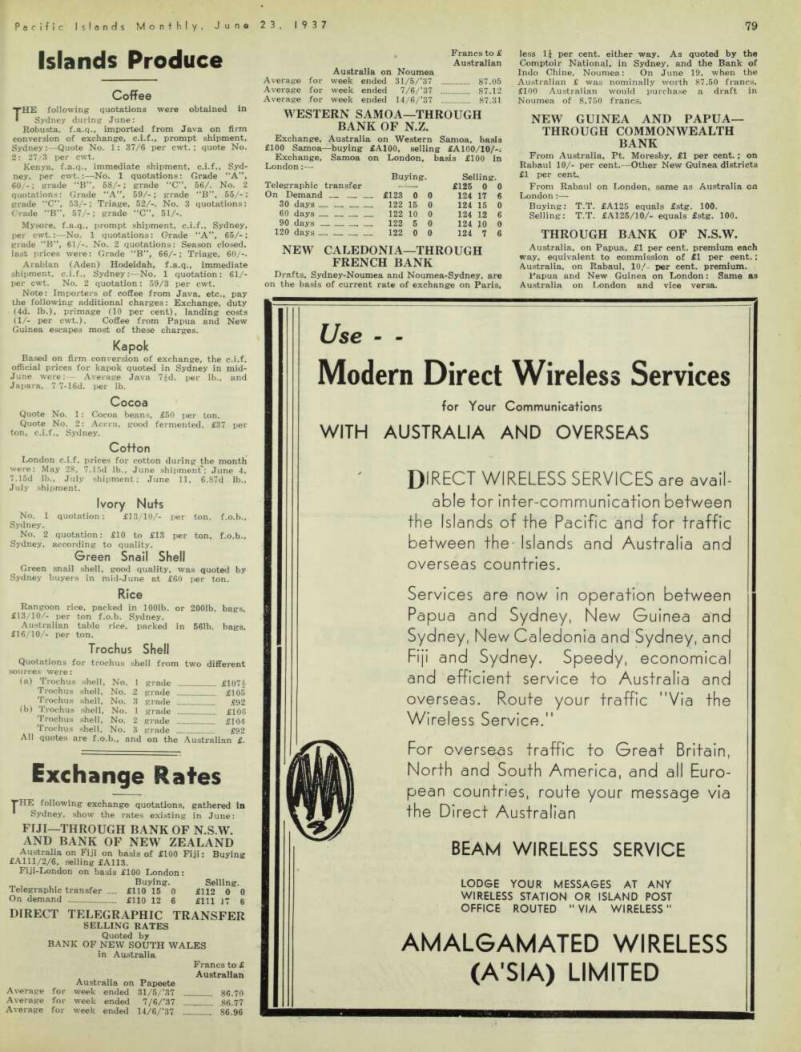
Coffee
THE following quotations were obtained in Sydney during June: Robusta, f.a.q,, imported from Java on firm conversion of exchange, c.i.f., prompt shipment, Sydney:—Quote No. 1: 37/6 per cwt. ; quote No. 2: 27/3 per cwt.
Kenya, f.a.q., immediate shipment, c.i.f., Syd ney, per cwt.:—No. 1 quotations: Grade “A”, 60/-; grade “B”, 58/-; grade “C”, 56/. No. 2 quotations: Grade “A”, 59/-; grade “B”, 55/-; grade “C”, 53/-; Triage, 52/-. No, 3 quotations: Grade “B”, 57/-; grade “C”. 51/-.
Mysore, f.a.q., prompt shipment, c.i.f., Sydney, per cwt.: —No. 1 quotations: Grade “A”, 65/-; grade “B”, 61/-. No. 2 quotations: Season closed, last prices were: Grade “B”, 66/-; Triage. 60/-.
Arabian (Aden) Hodeidah, f.a.q., immediate shipment, c.i.f., Sydney:—No. 1 quotation: 61/per cwt. No. 2 quotation: 59/3 per cwt.
Note: Importers of coffee from Java, etc., pay the following additional charges: Exchange, duty (4d. lb.), primage (10 per cent), landing costs (1/- per cwt.). Coffee from Papua and New Guinea escapes most of these charges.
Kapok
Based on firm conversion of exchange, the c.i.f. official prices for kapok quoted in Sydney in mid- June were:— Average Java 7+d. per lb., and Japara, 7 7-16 d. per lb.
Cocoa
Quote No. 1: Cocoa beans, £5O per ton.
Quote No. 2: Accra, good fermented, £37 per ton, c.i.f., Sydney.
Cotton
London c.i.f. prices for cotton during the month were: May 28, 7.15 d lb., June shipment'; June 4, 7.15 d lb., July shipment; June 11, 6.87 d lb., July shipment.
Ivory Nuts
No. 1 quotation: £l3/10/- per ton, f.0.b., Sydney.
No. 2 quotation: £lO to £l3 per ton, f.0.b., Sydney, according to quality.
Green Snail Shell
Green snail shell, good quality, was quoted by Sydney buyers in mid-June at £6O per ton.
Rice
Rangoon rice, packed in 1001 b. or 2001 b. bags, £l3/10/- per ton f.o.b. Sydney.
Australian table rice, packed in 561 b. bags. £l6/10/- per ton.
Trochus Shell
Quotations for trochus shell from two different sources were: (a) Trochus shell, No. 1 grade £lo7+ Trochus shell, No. 2 grade £lO5 Trochus shell. No. 3 grade £92 (b) Trochus shell, No. 1 grade £lO6 Trochus shell, No. 2 grade £lO4 Trochus shell. No. 3 grade £92 All quotes are f.0.b., and on the Australian £.
Exchange Rates
THE following exchange quotations, gathered in Sydney, show the rates existing in June:
Fiji—Through Bank Of N.S.W.
And Bank Of New Zealand
Australia on Fiji on basis of £100 Fiji; Buying £Alll/2/6, selling £A113.
Fiji-London on basis £100 London;
Direct Telegraphic Transfer
Selling Rates
Quoted by
Bank Of New South Wales
in Australia
Western Samoa—Through
Bank Of N.Z.
Exchange, Australia on Western Samoa, basis £lOO Samoa—buying £AIOO, selling £AIOO/10/-.
Exchange, Samoa on London, basis £lOO in London:—
New Caledonia—Through
French Bank
Drafts, Sydney-Noumea and Noumea-Sydney, are on the basis of current rate of exchange on Paris,
less 1J per cent, either way. As quoted by the Comptoir National, in Sydney, and the Bank of Indo Chine, Noumea: On June 19, when the Australian £ was nominally worth 87.50 francs, £lOO Australian would purchase a draft in Noumea of 8,750 francs.
New Guinea And Papua
Through Commonwealth
Bank
From Australia, Pt. Moresby, £1 per cent. ; on Rabaul 10/- per cent. —Other New Guinea districts £1 per cent.
From Rabaul on London, same as Australia on London:—- Buying: T.T. £AI2S equals £stg. 100.
Selling: T.T. £AI2S/10/- equals £stg. 100.
Through Bank Of N.S.W.
Australia, on Papua, £1 per cent, premium each way, equivalent to commission of £1 per cent. ; Australia, on Rabaul, 10/- per cent, premium.
Papua and New Guinea on London: Same as Australia on London and vice versa.
Average for Australia on week ended Noumea 31/5/’37 Francs to £ Australian 87.05 Average for week ended 7/6/’37 87.12 Average for week ended 14/6/’37 87.31
Buying:. Selling:.
Telegraphic transfer —— £125 0 0 On Demand ™ £123 0 0 124 17 6 30 days 122 15 0 124 15 0 60 days — — 122 10 0 124 12 6 90 days 122 5 0 124 10 0 120 days 122 0 0 124 7 6
, Buying, Selling.
Telegraphic transfer £110 15 0 £112 0 0 On demand £110 12 6 £111 J7 6
Francs to £ Australian Australia on Papeete Average for week ended 31/5/’37 86.70 Average for week ended 7/6/’37 86.77 Average for week ended 14/6/’37 86.96
Advertisements & other items, p. 81 (1 item)
Modern Direct Wireless Services
Use - -
for Your Communications
WITH AUSTRALIA AND OVERSEAS
DIRECT WIRELESS SERVICES are avail-
able for inter-communication between the Islands of the Pacific and for traffic between the- Islands and Australia and overseas countries.
Services are now in operation between Papua and Sydney, New Guinea and Sydney, New Caledonia and Sydney, and Fiji and Sydney. Speedy, economical and efficient service to Australia and overseas. Route your traffic "Via the Wireless Service."
For overseas traffic to Great Britain.
North and South America, and all European countries, route your message via the Direct Australian
BEAM WIRELESS SERVICE
LODGE YOUR MESSAGES AT ANY
WIRELESS STATION OR ISLAND POST
OFFICE ROUTED "VIA WIRELESS"
AMALGAMATED WIRELESS
(A'SIA) LIMITED
g|S23^3S3S<S^5f333gS2SSSSSiS5SsJlsl5Si5^5S:S«SSsSiaiiliS|gEss^siiasg«5
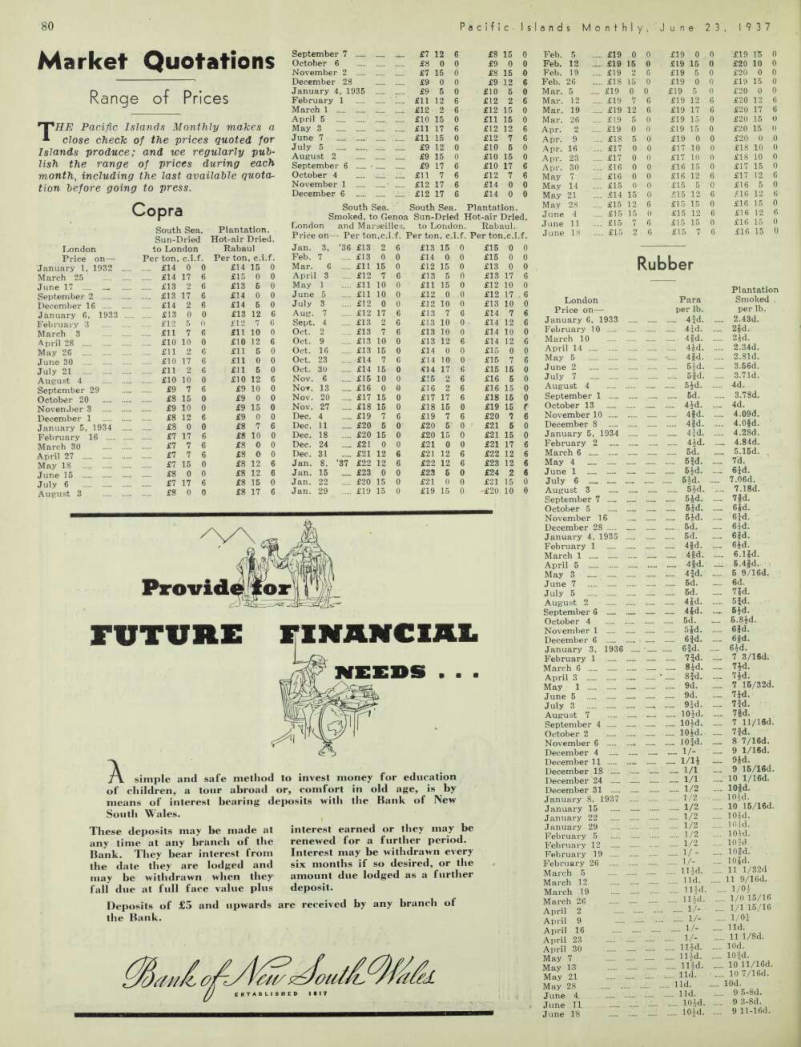
Market Quotations Range of Prices
THE Pacific Islands Monthly makes a close check of the prices quoted for Islands produce; and we regularly pub lish the range of prices during each month, including the last available quota tion before going to press.
Copra
South Sea, Plantation, Sun-Dried Hot-air Dried.
London to London Rabaul Price on — Per ton, c.i.f.
Per ton, c.i.f.
January 1, 1932 £14 0 0 £14 15 0 March 25 £14 17 6 £15 0 0 June 17 £13 2 6 £13 6 0 September 2 £13 17 6 £14 0 0 December 16 £14 2 6 £14 6 0 January 6, 1933 £13 0 0 £13 12 6 February 3 £12 5 0 £12 7 6 March 3 £11 7 6 £11 10 0 April 28 £10 10 0 £10 12 6 May 26 ... £11 2 6 £11 5 0 June 30 £10 17 6 £11 0 0 July 21 £11 2 6 £11 5 0 August 4 ...— ... £10 10 0 £10 12 6 September 29 ™ £9 7 6 £9 10 0 October 20 £8 15 0 £9 0 0 November 3 — £9 10 0 £9 15 0 December 1 „ £8 12 6 £9 0 0 January 5, 1934 £8 0 0 £8 7 6 February 16 £7 17 6 £8 10 0 March 30 £7 7 6 £8 0 0 April 27 — £7 7 6 £8 0 0 May 18 ... ... £7 15 0 £8 12 6 June 15 — — £8 0 0 £8 12 6 July 6 „ ... £7 17 6 £8 15 0 August 3 £8 0 0 £8 17 6
Feb. 5 £19 0 0 £19 0 0 £19 15 0 Feb. 12 £19 15 0 £19 15 0 £20 10 0 Feb. 19 £19 2 6 £19 5 0 £20 0 0 Feb. 26 _... £18 15 0 £19 0 0 £19 15 0 Mar, 5 ... £19 0 0 £19 5 0 £20 0 0 Mar. 12 £19 7 6 £19 12 6 £20 12 6 Mar. 19 £19 12 6 £19 17 6 £20 17 6 Mar. 26 £19 5 0 £19 15 0 £20 15 0 Apr. 2 £19 0 0 £19 15 0 £20 15 0 Apr. 9 £18 5 0 £19 0 0 £20 0 ,0 Apr. 16 £17 0 0 £17 10 0 £18 10 0 Apr. 23 £17 0 0 £17 10 0 £18 10 0 Apr. 30 £16 0 0 £16 15 0 £17 15 0 May 7 £16 0 0 £16 12 6 £17 12 6 May 14 £15 0 0 £15 5 0 £16 5 0 May 21 £14 15 0 £15 12 6 £16 12 6 May 28 £15 12 6 £15 15 0 £16 15 0 June 4 £15 15 0 £15 12 6 £16 12 6 June 11 £15 7 6 £15 15 0 £16 15 0 June 18 £15 2 6 £15 7 6 £16 15 0
September 7 £7 12 6 £8 15 0 October 6 £8 0 0 £9 0 0 November 2 £7 15 0 £8 15 0 December 28 £9 0 0 £9 12 6 January 4 . 1935 £9 5 0 £10 5 0 February 1 I..- £11 12 6 £12 2 6 March 1 ... £12 2 6 £12 15 0 April 5 . ... ... ... £10 15 0 £11 15 0 May 3 ... £11 17 6 £12 12 6 June 7 £11 15 0 £12 7 6 July 5 ... £9 12 0 £10 5 0 August 2 ... £9 15 0 £10 15 0 September 6 • ... ... £9 17 6 £10 17 6 October 4 ... £11 7 6 £12 7 6 November 1 £12 17 6 £14 0 0 December 6 — £12 17 6 £14 0 0 South Sea.
South Sea.
Plantation.
Smoked, to Genoa Sun-Dried Hot-air !
Dried, London and Mai ■seilles. to London.
Rabaul.
Price on— Per ton.c.i .f. Per ton, c. i.f.
Per ton.c.i .f.
Jan. 3.
'36 £13 2 6 £13 15 0 £15 0 0 Feb. 7 £13 0 0 £14 0 0 £15 0 0 Mar. 6 £11 15 0 £12 15 0 £13 0 0 April 3 £12 7 6 £13 5 0 £13 17 G May 1 £11 10 0 £11 15 0 £12 10 0 June 5 £11 10 0 £12 0 0 £12 17 6 July 3 £12 0 0 £12 10 0 £13 10 0 Aug. 7 ... £12 17 6 £13 7 6 £14 7 6 Sept. 4 £13 2 6 £13 10 0 £14 12 6 Oct. 2 £13 7 6 £13 10 0 £14 10 0 Oct. 9 £13 10 0 £13 12 6 £14 12 6 Oct. 16 £13 15 0 £14 0 0 £15 0 0 Oct. 23 £14 7 6 £14 10 0 £15 7 6 Oct. 30 £14 15 0 £14 17 6 £15 15 0 Nov. 6 £15 10 0 £15 2 6 £16 6 0 Nor. 13 £16 0 0 £16 2 6 £16 15 0 Nov. 20 £17 15 0 £17 17 6 £18 15 0 Nov. 27 £18 15 0 £18 15 0 £19 15 f Dec. 4 £19 7 6 £19 7 6 £20 7 6 Dec. 11 £20 5 0 £20 5 0 £21 6 0 Dec. 18 £20 15 0 £20 15 0 £21 15 0 Dec. 24 £21 0 0 £21 0 0 £21 17 6 Dec. 31 £21 12 6 £21 12 6 £22 12 6 Jan. 8. ’ 37 £22 12 6 £22 12 6 £23 12 6 Jan. 15 £23 0 0 £23 6 0 £24 2 6 Jan. 22 £20 15 0 £21 0 0 £21 15 0 Jan. 29 £19 15 0 £19 15 0 -£20 10 0
**t , 5 n ii it i si ii s it at
g|S23^3S3S<S^5f333gS2SSSSSiS5SsJlsl5Si5^5S:S«SSsSiaiiliS|gEss^siiasg«5
i 1 1 1 ! ! i I 1 1 i 1 I [ ! i I I i I 1-1 I I 1 1 t l I I l 1 11 11 1 1 11 1 M l 11 1 i j J f ! 1 i" i i 1 1 i 1 I 1 j"j J 1 i
- |^||IIS5Sa^SsS5iSSSSss0iiSs5iaSiSSSSjisi^||ifSSSS5SSSSi<t^i^^^d^
-g " I M 1 ,1 !! 1 1 i 1 i 1 1 ! 1 1 1 i 1 i ! i M 1 1 1 M ! 1 1 1 1 ! ! M ! i 1 1 ! 1 1 M 1 1 1 1 in 1- 1 n.i i 1 1 M i 1 i 1 l"1 ! ! ! 1 ! 1 i I i 1 i 1 M ! 1 1 1 1 1 ! i 1 1 i i 1 1 i 1 ! i ! ! i 1 ! i 1 11 1 i ! 1 S 1 ! ! |i 1 1 i 1 I 11 ! M I i 1 I ‘ ‘ ! ! 1 ll-i I' 1 1 1 i i i 1 i i i I 1 1 1 i i 1 I 1 I 1 1 M 1 M ! M 1 1 ■! 1 ! 1 1 1 i U 1 1 1 1 1 i 1 M I' r l 1 i Jf| 1 f M 1 J M:,! ', , r j § f i i 1 11 ( h ! i§ 1 11 11 1 i i, is 11 i 11 m f ! i| n n ! g ! i i ! Mh n i 1 ' i;', i j i s ; ; j'i i !§»•;= ! 1 1 Uis|;< 1 i 1• m'i mm a. .
Jl l!-a 1“'""I till I s |l |l i nil l|ll| i i L^r*""°^s3s' i::2
-Illlllllllillllllllllilillllltllliliilllltlllillllllillllllllllilllllllllll
Advertisements & other items, p. 82 (1 item)
Future Financial
or
Provide
C
FUTURE FINANCIAL
r simple and safe method to invest money for education of children, a tour abroad or, comfort in old age, is by means of interest bearing deposits with the Bank of New South Wales.
These deposits may be made at any time at any branch of the Bank. They bear interest from the date they are lodged and may be withdrawn when they fall due at full face value plus interest earned or they may be renewed for a further period.
Interest may be withdrawn every six months if so desired, or the amount due lodged as a further deposit.
Deposits of £5 and upwards are received by any branch of the Bank. a* U(/ a
Y/J//C
ESTABLISHED 1817
Shipping Services in the Pacific
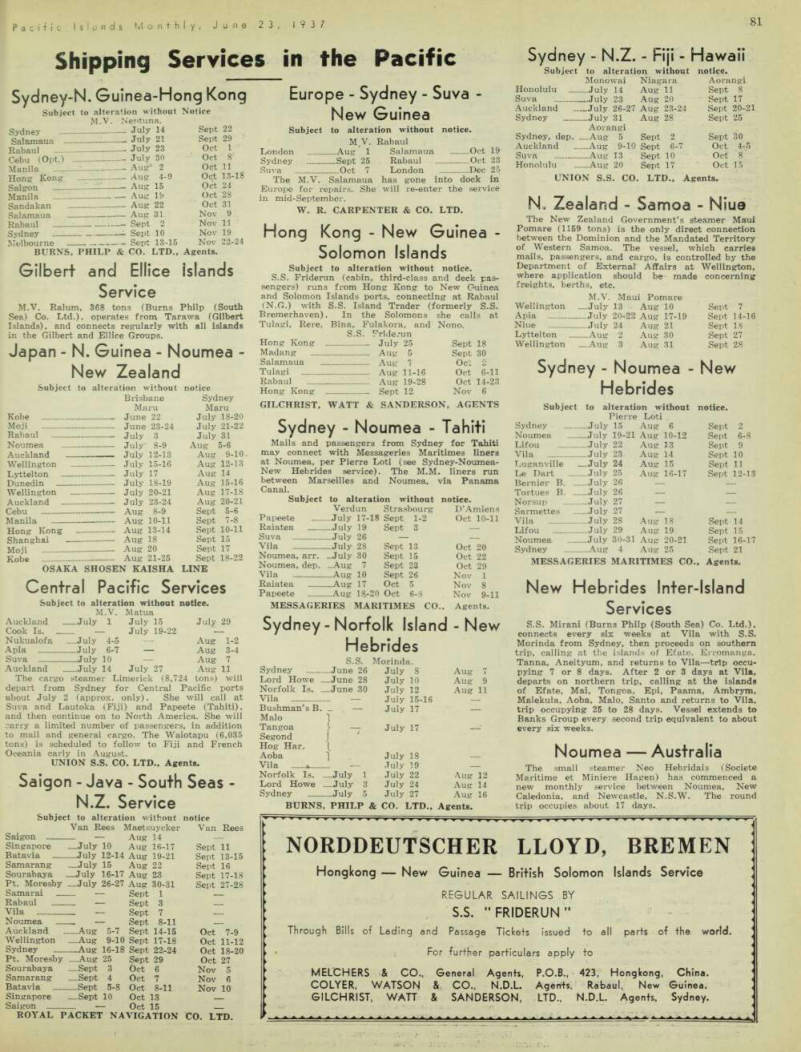
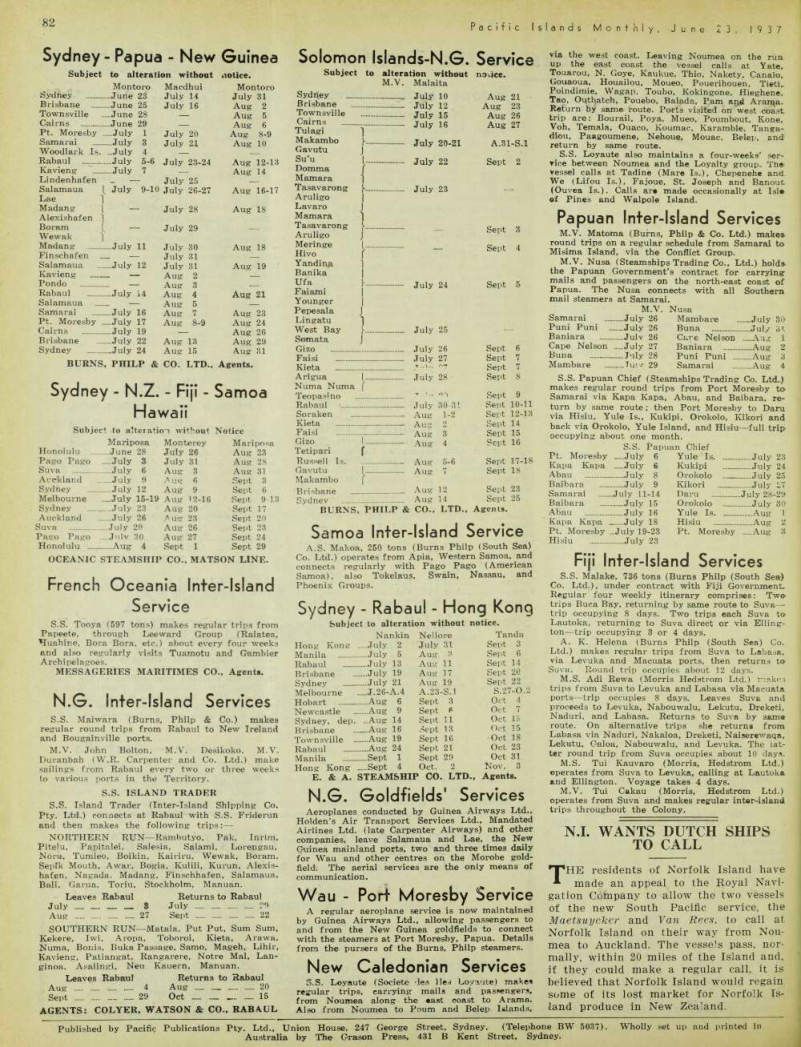
Sydney-N. Guinea-Hong Kong
Gilbert and Ellice islands
Service
M.V. Ralum, 368 tons (Burns Philp (South Sea) Co. Ltd.), operates from Tarawa (Gilbert Islands), and connects regularly with all islands in the Gilbert and Ellice Groups.
Central Pacific Services
The cargo steamer Limerick (8,724 tons) will depart from Sydney for Central Pacific ports about July 2 (approx, only). She will call at Suva and Lautoka (Fiji) and Papeete (Tahiti), and then continue on to North America. She will carry a limited number of passengers, in addition to mail and general cargo. The Waiotapu (6,035 tons) is scheduled to follow to Fiji and French Oceania early in August.
Union S.S. Co. Ltd., Agents.
Europe - Sydney - Suva -
New Guinea
Subject to alteration without notice.
M V. Rabaul London Aug 1 Salamaua Oct 19 Sydney Sept 25 Rabaul Oct 23 Suva Oct 7 London Dec 25 The M.V, Salamaua has gone into dock in Europe for repairs. She will re-enter the service in mid-September.
W. R. Carpenter & Co. Ltd.
Hong Kong - New Guinea -
Solomon Islands
Subject to alteration without notice.
S.S. Friderun (cabin, third-class and deck pas sengers) runs from Hong Kong to New Guinea and Solomon Islands ports, connecting at Rabaul (N.G.) with S.S. Island Trader (formerly S.S.
Bremerhaven). In the Solomons she calls at Tulagi, Rere, Bina, Fulakora, and Nono.
Sydney - Noumea - Tahiti
Mails and passengers from Sydney for Tahiti may connect with Messageries Maritimes liners at Noumea, per Pierre Loti (see Sydney-Noumea- New Hebrides service). The M.M. liners run between Marseilles and Noumea, via Panama Canal.
Sydney-Norfolk Island - New Hebrides
N. Zealand - Samoa - Niue
The New Zealand Government’s steamer Maui Pomare (1159 tons) is the only direct connection between the Dominion and the Mandated Territory of Western Samoa. The vessel, which carries mails, passengers, and cargo, is controlled by the Department of External Affairs at Wellington, where application should be made concerning freights, berths, etc.
Sydney - Noumea - New Hebrides
New Hebrides Inter-Island
Services
S.S. Mirani (Burns Philp (South Sea) Co. Ltd.), connects every six weeks at Vila with S.S.
Morinda from Sydney, then proceeds on southern trip, calling at the islands of Efate. Erromanga, Tanna, Aneityum, and returns to Vila—trip occu pying 7 or 8 days. After 2 or 3 days at Vila, departs on northern trip, calling at the islands of Efate, Mai, Tongoa, Epi, Paama, Ambrym, Malekula, Aoba, Malo, Santo and returns to Vila, trip occupying 25 to 28 days. Vessel extends to Banks Group every second trip equivalent to about every six weeks.
Noumea Australia
The small steamer Neo Hebridais (Societe Maritime et Miniere Hagen) has commenced a new monthly service between Noumea, New Caledonia, and Newcastle, N.S.W. The round trip occupies about 17 days.
Subject to alteration without Notice M.V. Nentuna.
Sydney . - - July 14 Sept 22 Salamaua July 21 Sept 29 Rabaul - - - July 23 Oct 1 Cebu (Opt.) July 30 Oct 8 Manila : Aug* 2 Oct 11 Hong Kong Aug 4-9 Oct 13-18 Saigon - — Aug 15 Oct 24 Manila Aug 19 Oct 28 Sandakan . ■ Aug 22 Oct 31 Salamaua Aug 31 Nov 9 Rabaul Sept 2 Nov H Sydney • — Sept 10 Nov 19 Melbourne Sept 13-15 Nov 22-24
Burns. Philp & Co. Ltd.,
Agents.
Japan -
N. Guinea - Noumea -
New Zealand
Subject : to alteration without notice Kobe Brisbane Maru Sydney Maru July 18-20 July 21-22 July 31 Aug 5-6 Aug 9-10 Aug 12-13 Aug 14 Aug 15-16 Aug 17-18 Aug 20-21 Sept 5-6 Sept 7-8 Sept 10-11 Sept 15 Sept 17 Moji Rabaul July 12-13 Wellington Lyttelton July 15-16 July 17 Dunedin July 18-19 Wellington Auckland July 20-21 July 23-24 Cebu Aug 8 9 Manila Aug 10-11 Hong Kong Allg 13-14 Aug 18 ijuauguAi — Aug 20 Unho An? 21-25 Sept 18-22
Line
Osaka Shosen Kaisha
Subject to alteration without notice.
M.V. Matua Auckland ..July 1 July 15 July 29 Cook Is. — July 19-22 Nukualofa .July 4-5 — Aug 1-2 Apia .July 6-7 — Aug 3-4 Suva .July 10 — Aug 7 Auckland .July 14 July 27 Aug 11
Saigon - Java - South Seas -
N.Z. Service
Subject to alteration without Van Rees Maetsuycker notice Van Rees Singapore Batavia Samarang Sourabaya Pt. Moresby Samarai Rabaul Vila —July 10 Aug 16-17 —July 12-14 Aug 19-21 —July 15 Aug 22 —July 16-17 Aug 23 —July 26-27 Aug 30-31 — — Sept 1 — — Sept 3 — Sept 7 Sept 11 Sept 13-15 Sept 16 Sept 17-18 Sept 27-28 Noumea Auckland Wellington Sydney Pt. Moresby Sourabaya Samarang Batavia — — Sept 8-11 —Aug 5-7 Sept 14-15 —Aug 9-10 Sept 17-18 —Aug 16-18 Sept 22-24 Aug 25 Sept 29 —Sept 3 Oct 6 —Sept 4 Oct 7 Sept 5-8 Oct 8-11 Oct 7-9 Oct 11-12 Oct 18-20 Oct 27 Nov 5 Nov 6 Nov 10 Singapore Saieon —Sept 10 Oct 13 Onf IK
Royal Packet Navigation
Co. Ltd.
S.S. Fride*un Hong Kong July 25 Sept 18 Madang - - Aug 5 Sept 30 Salamaua Aug 7 Oct G Tulagi Aug 11-16 Oct 6-11 Rabaul Aug 19-28 Oct 14-23 Hong Kong Sept 12 Nov 6
Gilchrist,
Watt & Sanderson,
Agents
Subject to alteration without notice.
Verdun Strasbourg D’Amiens Papeete July 17-18 Sept 1-2 Oct 10-11 Raiatea July 19 Sept 3 — Suva July 26 — Vila July 28 Sept 13 Oct 20 Noumea, arr. ...July 30 Sept 15 Oct 22 Noumea, dep. ...Aug 7 Sept 23 Oct 29 Vila —Aug 10 Sept 26 Nov 1 Raiatea —Aug 17 Oct 5 Nov 8 Papeete ...Aug 18-20 Oct 6-8 Nov 9-11
Messageries Mar1Times Co
.. Agents.
s.s.
Morinda.
Sydney June 26 July 8 Aug 7 Lord Howe —June 28 July 10 Aug 9 Norfolk Is June 30 July 12 Aug 11 Vila — July 15-16 Bushman’s B. ... — July 17 Malo ] Tangoa V — July 17 Segond Hog Har. [ Aoba July 18 Vila * — July 19 — Norfolk Is July 1 July 22 Aug 12 Lord Howe July 3 July 24 Aug 14 Sydney July 5 July 27 Aug 16
Burns, Philp & Co. Ltd.,
Agents.
Sydney - N.Z.
- Fiji -
Hawaii
Subject to alteration without notice.
Monowai Niagara Aoi-angi Honolulu . July 14 Aug 11 Sept 8 Suva ..July 23 Aug 20 Sept 17 Auckland July 26-27 Aug 23-24 Sept 20-21 Sydney July 31 Aug 28 Sept 25 Aorangi Sydney, dep Aug 5 Sept 2 Sept 30 Auckland Aug 9-10 Sept 6-7 Oct 4-5 Suva Aug 13 Sept 10 Oct 8 Honolulu Aug 20 Sept 17 Oct 15
Union S.S. Co.
, LTD., Agents.
M.V.
Maui Pomare Wellington ...July 13 Aug 10 Sept 7 Apia ...July 20-22 Aug 17-19 Sept 14-16 Niue ...July 24 Aug 21 Sept 18 Lyttelton _Aug 2 Aug 30 Sept 27 Wellington ...Aug 3 Aug 31 Sept 28
Subject to alteration without Pierre Loti notice.
Sydney July 15 Auk 6 Sept 2 Noumea —July 19-21 Auk 10-12 Sept 6-8 Lifou July 22 Auk 13 Sept 9 Vila July 23 Auk 14 Sept 10 Luganville July 24 Auk 15 Sept 11 Le Dart July 25 Auk 16-17 Sept 12-13 Bernier B July 26 — — Tortues B July 26 — — Norsup -July 27 — — Sarmettes July 27 — Vila July 28 Auk 18 Sept 14 Lifou - July 29 Auk 19 Sept 15 Noumea July 30-31 Auk 20-21 Sept 16-17 Sydney Auk 4 Auk 25 Sept 21
Messageries Maritimes Co.
.» Agents.
Sydney - Papua - New Guinea
Sydney - N.Z. - Fiji - Samoa Hawaii
French Oceania Inter-Island
Service
5.5. Tooya (597 tons) makes regular trips from Papeete, through Leeward Group (Raiatea, Huahine, Bora Bora, etc.) about every four weeks and also regularly visits Tuamotu and Gambier Archipelagoes.
Messageries Maritimes Co., Agents.
N.G. Inter-Island Services
5.5. Maiwara (Burns, Philp & Co.) makes regular round trips from Rabaul to New Ireland and Bougainville ports.
M.V. John Bolton, M.V. Desikoko, M.V.
Duranbah (W.R. Carpenter and Co. Ltd.) make sailings from Rabaul every two or three weeks to various ports in the Territory.
S.S. Island Trader
5.5. Island Trader (Inter-Island Shipping Co.
Pty. Ltd.) connects at Rabaul with S.S. Friderun and then makes the following trips:— NORTHERN RUN—Rambutyo, Pak, Inrim, Pitelu, Papitalei, Salesia, Salami, Lorengau, Noru, Tumleo, Boikin, Kairiru, Wewak, Boram, Seplk Mouth, Awar, Bogia, Kulili, Kurun, Alexis hafen, Nagada. Madang, Finschhafen, Salamaua, Bali, Garua, Toriu, Stockholm, Manuan.
Leaves Rabaul Returns to Rabaul July 3 July ... 29 Aug 27 Sept ... 22 SOUTHERN RUN—Matala, Put Put. Sum Sum, Kekere, Iwi, Ai-opa, Toboroi, Kieta, Arawa, Numa, Bonis, Buka Passage, Samo, Mageh, Lihir, Kavieng, Patlangat, Rangarere, Notre Mai, Lan ginoa, Asalingi, Neu Kauern, Manuan.
Leaves Rabaul Returns to Rabaul Aug 4 Aug 20 Sept 29 Oct 15
Agents: Colyer, Watson & Co., Rabaul
Solomon Islands-N.G. Service
Samoa Inler-lsland Service
A.S. Makoa. 250 tons (Burns Philp (South Sea) Co. Ltd.) operates from Apia, Western Samoa, and connects regularly with Pago Pago (American Samoa), also Tokelaus, Swain, Nassau, and Phoenix Groups.
Sydney - Rabaul - Hong Kong
N.G. Goldfields' Services
Aeroplanes conducted by Guinea Airways Ltd., Holden’s Air Transport Services Ltd., Mandated Airlines Ltd. (late Carpenter Airways) and other companies, leave Salamaua and Lae, the New Guinea mainland ports, two and three times daily for Wau and other centres on the Morobe gold field. The aerial services are the only means of communication.
Wau - Pori Moresby Service
A regular aeroplane service is now maintained by Guinea Airways Ltd., allowing passengers to and from the New Guinea goldfields to connect with the steamers at Port Moresby, Papua. Details from the pursers of the Burns, Philp steamers.
New Caledonian Services
S.S. Loyaute (Societe des lies Loyaute) makes regular trips, carrying mails and passengers, from Noumea along the east coast to Arama.
Also from Noumea to Poum and Belep Islands.
via the west coast. Leaving Noumea on the run. up the east coast the vessel calls at Yate, Touarou, N. Goye, Kaukue, Thio, Nakety, Canalo, Gouaoua, Houailou, Moueo, Pouerihouen, Tieti„ Poindimie, Wagap, Touho, Kokingone, Hieghene, Tao, Outmatch, Pouebo, Balada, Pam ap.d Araraa.
Return by same route. Ports visited on west coast trip are: Bourail, Poya, Mueo, Poumbout, Kone, Voh, Temala, Ouaco, Koumac, Karamble, Tanga diou, Paagoumene, Nehoue, Mouac, Belep, and return by same route. 5.5. Loyaute also maintains a four-week s’ ser vice between Noumea and the Loyalty group. The vessel calls at Tadine (Mare Is.), Chepenehe and We (Lifou Is.), Fajoue, St. Joseph and Banout. (Ouvea Is.). Calls are made occasionally at Isle of Pines and Walpole Island.
Papuan Inter-Island Services
M.V, Matoma (Burns, Philp & Co. Ltd.) makes round trips on a regular schedule from Samarai to Misima Island, via the Conflict Group.
M.V. Nusa (Steamships Trading Co., Ltd.) holds the Papuan Government’s contract for carrying mails and passengers on the north-east coast of Papua. The Nusa connects with all Southern mail steamers at Samarai.
5.5. Papuan Chief (Steamships Trading Co. Ltd.) makes regular round trips from Port Moresby to Samarai via Kapa Kapa, Abau, and Baibara, re turn by same route; then Port Moresby to Dam via Hisiu, Yule Is., Kukipi, Orokolo, Kikori and back via Orokolo, Yule Island, and Hisiu—full trip occupying about one month.
Fiji In+er-lsland Services
S.S. Malake, 736 tons (Burns Philp (South Sea) Co. Ltd.), under contract with Fiji Government.
Regular four weekly itinerary comprises: Two trips Buca Bay, returning by same route to Suva — trip occupying 8 days. Two trips each Suva to Lautoka, returning to Suva direct or via Elling ton —trip occupying 3 or 4 days.
A. K. Helena (Burns Philp (South Sea) Co.
Ltd.) makes regular trips from Suva to Labasa, via Levuka and Macuata ports, then returns to Suva. Round trip occupies about 12 days.
M.S. Adi Rewa (Morris Hedstrom Ltd.) tr.akos trips from Suva to Levuka and Labasa via Macuata ports—trip occupies 8 days. Leaves Suva and proceeds to Levuka, Nabouwalu, Lekutu, Dreketi, Naduri, and Labasa. Returns to Suva by same route. On alternative trips she returns from Labasa via Naduri, Nakaloa, Dreketi, Naiserewaqa, Lekutu, Galoa, Nabouwalu, and Levuka. The lat ter round trip from Suva occupies about 10 days.
M.S. Tui Kauvaro (Morris, Hedstrom Ltd.) operates from Suva to Levuka, calling at Lautoka and Ellington. Voyage takes 4 days.
M.V. Tui Cakau (Morris, Hedstrom Ltd.) operates from Suva and makes regular inter-island trips throughout the Colony.
Subject to alteration without notice.
Montoro Macdhui Montoro Sydney ...June 23 July 14 July 31 Brisbane ...June 25 July 16 Aug 2 Townsville .. June 28 Aug 5 Cairns ...June 29 Aug 6 Pt. Moresby ., ...July 1 July 20 Aug 8-9 Samarai ...July 3 July 21 Aug 10 Woodlark Is. ...July 4 Rabaul —July 5-6 July 23-24 Aug 12-13 Kavieng ...July 7 Aug 14 Lindenhafen — July 25 Salamaua July 9-10 July 26-27 Aug 16-17 Madang July 28 Aug 18 Alexishafen Boram — July 29 Wewak Madang ...July 11 July 30 Aug 18 Finschafen — July 31 Salamaua ...July 12 July 31 Aug 19 Kavieng — Aug 2 — Pondo — Aug 3 Rabaul -July 14 Aug 4 Aug 21 Salamaua — Aug 5 Samarai ...July 16 Aug 7 Aug 23 Pt. Moresby ... ...July 17 Aug 8-9 Aug 24 Cairns ...July 19 — Aug 26 Brisbane ...July 22 Aug 13 Aug 29 Sydney -July 24 Aug 15 Aug 31
Burns,
Philp &
Co. Ltd.,
Agents.
Subject to alteratio'i without Notice Mariposa Monterey Mariposa Honolulu July 26 Aug 23 Pago Pago —July 3 July 31 Aug 28 Suva Aug 3 Aug 31 Auckland July 9 Aug 6 Sept 3 Sydney July 12 Aug 9 Sept 6 Melbourne —July 15-19 Aug 12-16 Sept 9-13 Sydney July 23 Aug 20 Sept 17 Auckland July 26 Aug 23 Sept 20 Suva July 29 Aug 26 Sept 23 Paco Pago Julv 30 Aug 27 Sept 24 Honolulu Aug 4 Sept 1 Sept 29
Oceanic Steamship Co., Matson Line.
Subject to alteration without M.V. Malaita notice.
Sydney July 10 July 12 July 15 July 16 Tnlv Aug 21 Aug 23 Aug 26 Aug 27
A Q1 Q 1
Brisbane Townsville Cairns Tulagi Makambo 1 Gavutu J July L a.Oi-o.l Su'u L July 22 July 23 Sept 2 Domma Mamara Tasavarong 1 f- Aruligo Lavaro Mamara Tasavarong Aruligo Meringe 1 J Sept 3 Sept 4 Hivo Yandin^ Banika r ' i i Ufa Tnlv 91 Sept 5 Faiami Younger Pepesala Lingatu West Bay i i j 1 juiy July 25 July 26 July 27 T.,1 07 Somata Gizo J Sept 6 Faisi Sept 7 Kieta Sept 7 Arigua "T July 28 ▼ Ol Sept 8 Numa Numa Teopasino r Sept 9 Rabaul July 30-31 Aug 1-2 Aug 2 Aug 3 Sept 10-11 Soraken Sert 12-13 Sept 14 Sept 15 Sept 16 Sept 17-18 Sept 18 Kieta Faisi Gizo i Tetipari Russell Is. r Aug 5-6 Aug 7 Gavutu t Makambo r Brisbane Aug 12 Sept 23 Sydnev Aug 14 Sept 25
Burns
, Philp &
Co.. Ltd..
Agents.
Subject to alteration without notice.
Nankin Nellore Tanda Hong Kong July 2 July 31 Sept 3 Manila July 5 Aug S Sept 6 Rabaul — July 13 Aug 11 Sept 14 Brisbane July 19 Aug 17 Sept 20 Sydney July 21 Aug 19 Sept 22 Melbourne J.26-A.4 A.23-S.1 S. 27-0.2 Hobart - Aug 6 Sept 3 Oct 4 Newcastle Aug 9 Sept 6 Oct 7 Sydney, dep. ...Aug 14 Sept 11 Oct 13 Brisbane Aug 16 Sept 13 Oct 15 Townsville Aug 19 Sept 16 Oct 18 Rabaul — ...Aug 24 Sept 21 Oct 23 Manila — Sept 1 Sept 29 Oct 31 Hong Kong Sept 4 Oct. 2 Nov. 3 E. & A.
Steamship Co. Ltd
., Agents.
M.V. Nusa Samarai July 26 Mambare -.July 30 Puni Puni July 26 Buna July oL Baniara July 26 Cure Nelson ...Au.? 1 Cape Nelson July 27 Baniara Aug 2 Kuna July 28 Puni Puni ...Aug 3 Mambare Tuw 29 Samarai Aug 4
S.S.
Papuan Chief Pt. Moresby -...July 6 Yule Is.
July 23 Kapa Kapa -...July 6 Kukipi July 24 Abau July 8 Orokolo ..
July 25 Baibara July 9 Kikori July 27 Samarai ..July 11 -14 Daru ..July 28-29 Baibara July 15 Orokolo Abau ...July 16 Yule Is Aug 1 Kapa Kapa - July 18 Hisiu Aug 2 Pt. Moresby ...July 19-23 Pt. Moresby Aug 3 Hisiu
Advertisements & other items, p. 83 (1 item)
Norddeutscher Lloyd, Bremen
Hongkong New Guinea British Solomon Islands Service
REGULAR SAILINGS BY
S.S. " FRIDERUN "
Through Bills of Lading and Passage Tickets issued to all parts of the world.
For further particulars apply to MELCHERS & CO., General Agents, P. 0.8., 423, Hongkong, China.
COLYER, WATSON & CO.. N.D.L. Agents, Rabaul, New Guinea.
GILCHRIST, WATT & SANDERSON, LTD., N.D.L. Agents, Sydney.
N.I. Wants Dutch Ships
To Call
THE residents of Norfolk Island have made an appeal to the Royal Navi gation Cdhipany to allow the two vessels of the new South Pacific service, the Maetsuycker and Van Rees, to call at Norfolk Island on their way from Nou mea to Auckland. The vessels pass, nor mally, within 20 miles of the Island and, if they could make a regular call, it is believed that Norfolk Island would regain some of its lost market for Norfolk Is land produce in New Zealand.
Advertisements & other items, pp. 84-88 (3 items)
82
Pacific Islands Monthly, June 23. 1937
Published by Pacific Publications Pty. Ltd., Union House, 247 George Street. Sydney. (Telephone BW 5037). Wholly set up and printed in Australia by The Grason Press, 431 B Kent Street, Sydney.
Guinea Airways L™
WHAT AERIAL TRANSPORT HAS
DONE FOR NEW GUINEA
Since 1927, when the development of the Morobe Goldfield commenced, the European population of the Territory has been trebled. The new industry has increased the Empire's gold production by nearly £2,000,000 per annum, and has added enormously to the trade turnover of New Guinea.
Only Aerial Transport makes this possible. There is no road between the Goldfields and the coast. Aeroplanes, running on Regular Schedules, without Difficulty or Delay, carry In Dredges, Crushing Mills, Cyanidinq Plants, Motor Vehicles, Hydro - Electric Machinery, Thousands of Passengers, and every kind of goods needed by a large and growing European community.
OuiNEA AIRWAYS LTD . were
established in 1927; and they have % 0 f . & 5# a * -
tJIHI
Aerial Transport is now assisting in the establishment of agricultural and pastoral industries to serve the goldfields. The above recent photo shows dairy cows being unloaded from a freighlAcarrying’ aeroplane, after being brought in from the coast for a dairy farm near Wau. (Photo: Thos. A. Olsson) cerate regular air services in New Guinea and Papua; they use over 50 Aerodromes and Landing-grounds in the two Territories.
GUINEA AIRWAYS L™
LAE • SALAMAUA
HEAD OFFICE:
BROOKMAN BUILDINGS
GRENFELL STREET
ADELAIDE, S.A.
NEW GUINEA OFFICE:
LAE
MANDATED TERRITORY OF
NEW GUINEA
BRANCH OFFICES AND AGENTS AT WAU, SALAMAUA, PORT MORESBY, AND SYDNEY
ER
SCHS
ft
EXPO
ENE
-3noxH
ITtD
VDN
When two long thirsts equal one lons bottle!
" What’s yours ?”
"Resch’s PUsenet."
"So’s mine ”
When you ask for Pilsener insist on the long bottle.
RESCH'S
PILSENER
p lO 2*
on your way to AUSTRALIA..
EE m m % . ¥. :
Saigon Dietheim & Co ; Port Moresby and Samarai, Steamships Iradmg Co. Ltd; Rabaul. W, R, Carpenter & Co. Ltd; Port Vila Gubbay Freres; Noumea. Carlo Leoni; Auckland. Russell & Somers Ltd; Wellington. Johnston & Co Ltd On your way to Australia visit Auckland and Wellington ... or plan a more leisurely stay visiting the scenic wonders of New Zealand . . . magnificent fjords . . . wild, icecapped mountains . . . hot springs and spouting geysers.
Sail by the splendid new motor vessel Maetsuycker or the wellknown steamer Van Rees.
These fast K.P.M. vessels maintain a regular monthly schedule from South Pacific Island ports; provide new direct travel facilities to New Zealand of exceptional comfort at economical tares.
K.P.M.
Details of sailings from your local agent.
S.S. VAN REES
M.V. MAETSUYCKER
SOUTH PACIFIC LIN
Royal Packet Navigation Co. ltd. Paketvaan House, 255 George Street, Sydney. (N.V. Konmklijke Paketvaart Maatschappij—lncorporated in the Netherlands) E
“Better Buy The
m
PAINT PRODUCTS
I iinr
The Products of British Australian Lead Manufacturers Pty.
Ltd. listed on this page are the best obtainable In their various fields. When buying Paint Products specify “B-A-L-M" Brand—their extra quality ensures that your properly is better protected and beautified. Because they are made with the finest quality Ingredients they give maximum resistance to the destructive effects of sun and weather.
pAfcH
ROOF PAINT
p-A-l'H
WHITE LEAD IN OIL
rUPRINOI
The Revolutionary
Wood and Fabric Preservative
Give your timber perfect immunity from attacks of White Ants, Borers and Dry Rot with this amazing scientific preservative—"Cuprinol" will eradicate these pests from affected timber. “Cuprinol" will also give Canvas, Nets, Cordage lasting protection from Mildew and Rot — "Cuprinol's" powerful protective properties are permanent because it is insoluble in water and non-volatile.
BALM
The Miracle Finish
SUPERSEDING
ENAMELS AND VARNISHES
Here Is an interior finish particularly suitable for use in hot, humid, places . . . "Dulux," aptly named "The Miracle Finish" because of its amazing durability. "Dulux" has a lovely lustre that won't tarnish or dull ... its colour won't fade—even in acid-laden atmospheres ... its flexible film won't crack or flake.
"Dulux" is easy to apply, dries quickly, and tests have proved that i+ has from 50% to 100% greater durability than .enamels. "Dulux" is available in 59 colours and black, white and clear. "Dulux" Clear—superseding varnishes —together with "Dulux" Yacht White—are two perfect finishes for all types of marine craft.
Made in Australia by British Australian Lead Manufacturers Pty. Ltd.
Full information, prices and colour cards from:
ISLANDS DISTRIBUTORS:
PAUL & GRAY LTD.
82-84 SUSSEX STREET, SYDNEY. N.S.W.