The long move towards self-government
p. 50 · Read in the full issue
It is indicative of the complexity of their relationship that even the very purpose of the Norfolk Island Act 1979, which created Norfolk Island’s present form of government, is interpreted differently by the Norfolk Island and Australian Commonwealth governments.
As reported in the January issue of The Pacific Islands Monthly, members of the Norfolk government believe the intention of the Act is to provide the mechanism by which political authority can be transferred from Canberra back to Norfolk, and after 20 years voted 7-1 last September for “full internal self-government - now.”
Norfolk is an external territory of the Commonwealth, the Norfolk government claims, and actively supports fielding its delegations under its flag to such international venues as the Commonwealth
and Oceania Games.
According to Department of Transport and Regional Services literature, however, within which Australian territories are administered, Norfolk is an integral part of the Commonwealth.
The Norfolk Island Act 1979, it continues, conferred [only] a measure of self-government to Norfolk and that the island has no international status independent of Australia. Both governments cannot be right.
The backdrop to this seeming
stalemate was The Norfolk Island Amendment Bill 1999, pushed forward by the Howard government. This bill would have amended the 1979 Act by, among other things, requiring Australian citizenship to vote and stand for office in Norfolk elections.
It would have also eased the residency restrictions of “mainland” Australians wishing to move to the island.
The prospect of this bill prompted two referenda on the island in 1998, with 78 per cent and 73 per cent of the electorate, respectively, voting to oppose altering Norfolk’s electoral and immigration regulations. In the end, the bill was defeated, but its ramifications still echo in considerations about self-government.
Norfolk is either an internal part of
Australia or it’s not.A very different political logic regarding empowerment and self determination follows from each, and underlies almost ail questions of social equity and fairness. If Norfolk is Australia, than young families unable to afford a house on the island should simply move to another part of the country where they can.
If Norfolk is not Australia, than a situation in which its young cannot afford to establish themselves because of an influx of outside money needs to be corrected.
Similarly, if Norfolk is Australia, than it’s entirely reasonable that its electors be Australian citizens and that all Australian citizens should equally be permitted to live here. If Norfolk is not Australia, than such a move immediately risks overwhelming an endemic culture.
This unresolved constitutional dilemma goes back to June 8, 1856, when the Pitcairn Islanders arrived on Norfolk believing the island had been ceded to them by the English Crown. Sworn statements by the Pitcairn Chief Magistrate and witnesses of the day attest to a letter of cession confiscated within weeks of arrival by the Governor of New South Wales.
What is certain and which does not seem to help clarify matters much is a Crown Order in Council dated June 24, 1856, establishing Norfolk as “a distinct and separate settlement,” the governor for which also being the said Governor of New South Wales.
A subsequent 1897 Order in Council revoked the 1856 Order, transferring
governance of Norfolk from the island itself to the Colony of New South Wales.
From the Australian perspective, Norfolk was incorporated into the Commonwealth when New South Wales was.
To Norfolk Islanders, these were illegal unilateral acts and several times petitioned the Crown for redress. Nevertheless, the island government had little more than an advisory role until the Act in 1979.
Provisions in The Norfolk Island Act identify the powers of the respective governments and provide a mechanism by which Commonwealth powers can be transferred to the Norfolk government.
It has, however, been over eight years since the last such power was transferred.
Ron Nobbs, the newly-elected Chief Minister of the Norfolk Island Government
and a direct descendant of George Hunn Nobbs, the pastoral leader of the community when the Pitcairners arrived, would like these moves towards self-government to resume and has identified the control of island land as the next item to be transferred.
The land in question is crown land, the historic areas of the pre-Pitcairn settlement, and the national park (itself comprising some 12 per cent of the island). Within weeks of being elected, Nobbs met with officials in Canberra with proposals for vesting title of these
lands in the Norfolk government.
The proposal would transfer title in the spirit of progressing self-government and the wishes of the Norfolk people, and then immediately lease the land back to the Commonwealth until adequate local management staff can be trained.
When asked if there might be Commonwealth resistance, Ron replied he felt his counterparts were sympathetic.
Communication with Senator lan Macdonald, Commonwealth Minister for Regional Services, Territories and Local Government, echoed a similar desire for continued co-operation between the two governments.
Whether this can result in achieving Ron’s timetable of transferring the land by January 1,2001, remains to be seen. ■
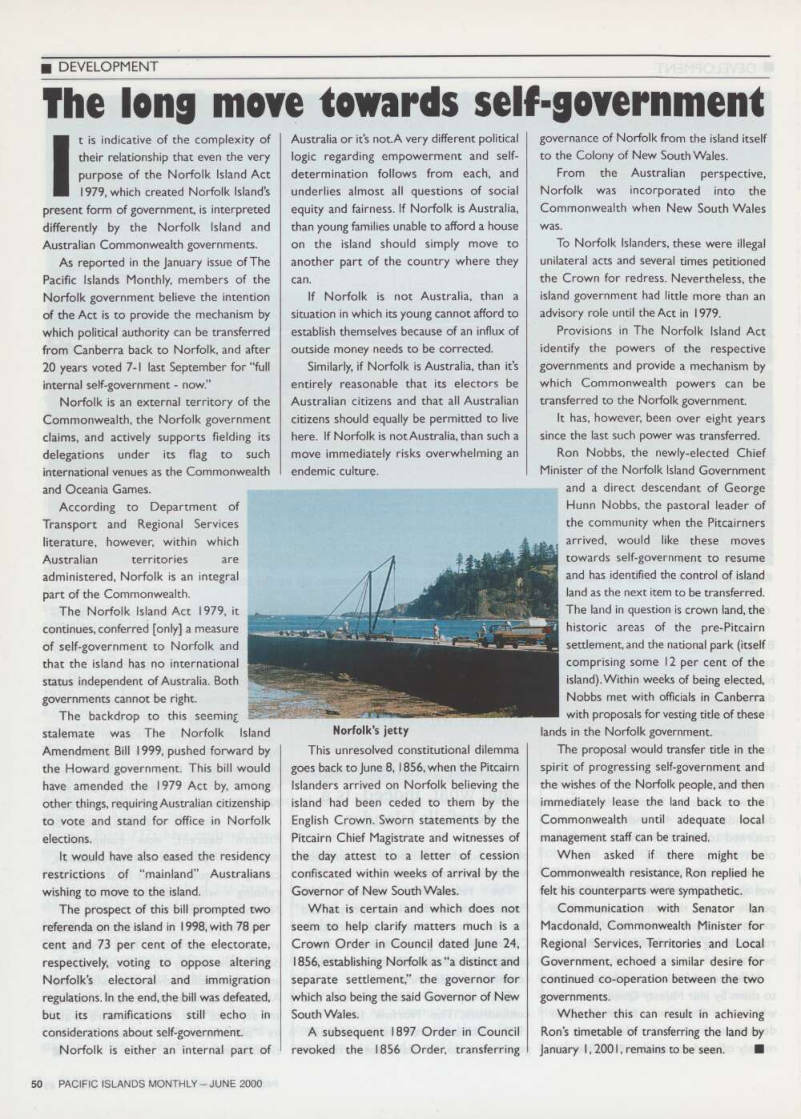
Norfolk’s jetty