Pacific Island Monthly
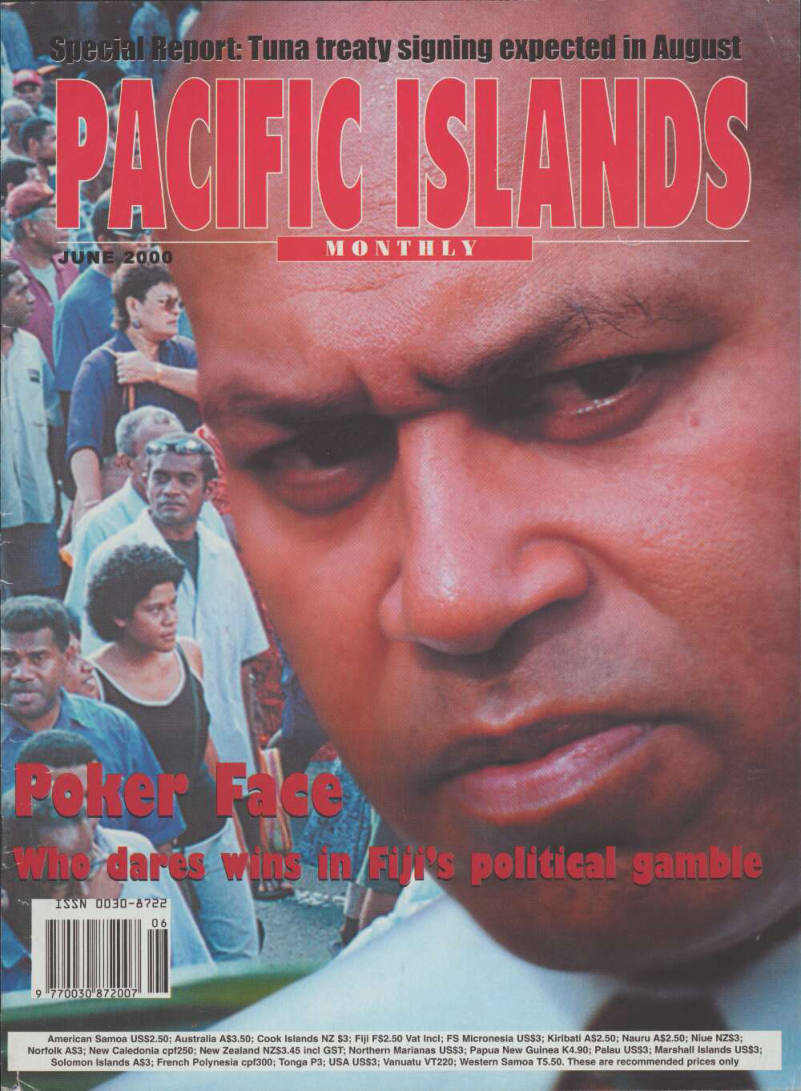
Special Report: Tuna treaty signing expected in August
June 2000
i |Pr i % * - W . • ’’ ? **.
VlLic cIL-o: V. ili~ 'LL’- L-U - v - :cII(3HL i. _.c
American Samoa US$2.5O; Australia A 53.50; Cook Islands NZ $3; Fiji F 52.50 Vat Incl; FS Micronesia US$3; Kiribati A 52.50; Nauru A 52.50; Niue NZ$3; Norfolk As 3; New Caledonia cpf2so; New Zealand NZ53.45 incl GST; Northern Marianas US$3; Papua New Guinea K 4.90; Palau US$3; Marshall Islands US$3; Solomon Islands As 3; French Polynesia cpf3oo; Tonga P 3; USA US$3; Vanuatu VT22O; Western Samoa T 5.50. These are recommended prices only
Advertisements & other items, p. 2 (1 item)
Vv*
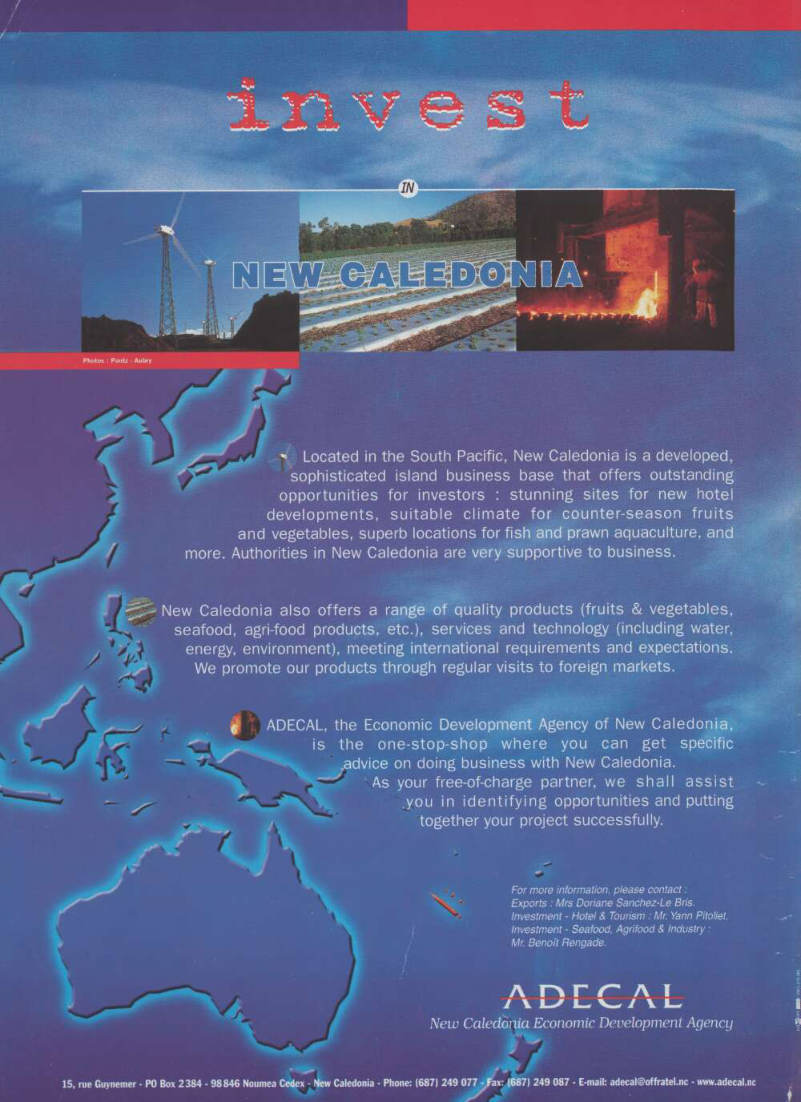
V v—✓ 9- Nl \H pp li* 'smeiiiOTi Photos : Pantz - Aubry i * / S Located in the South Pacific, New Caledonia is a developed, sophisticated island business base that offers outstanding opportunities for investors : stunning sites for new hotel developments, suitable climate for counter-season fruits and vegetables, superb locations for fish and prawn aquaculture, and more. Authorities in New Caledonia are very supportive to business. / New Caledonia also offers a range of quality products (fruits & vegetables, seafood, agri-food products, etc.), services and technology (including water, energy, environment), meeting international requirements and expectations.
We promote our products through regular visits to foreign markets. m $ ADECAL, the Economic Development Agency of New Caledonia, is the one-stop-shop where you can get specific dvice on doing business with New Caledonia.
As your free-of-charge partner, we shall assist you in identifying opportunities and putting together your project successfully.
For more information, please contact: Exports : Mrs Doriane Sanchez-Le Bris.
Investment - Hotel & Tourism : Mr. Yann Pitollet.
Investment - Seafood. Agrifood & Industry : Mr. Benoit Rengade. a r r* a i
/ V L/ LV- / VL
New Caledonia Economic Development Agency 15, rue Guynemer - PO Box 2384 ■ 98846 Noumea Cedex - New Caledonia ■ Phone: (687) 249 077 - Fax: (687) 249 087 - E-mail: [email protected] • www.adecal.nc
Pacific Islands Monthly
Vol. 70 No. 6
The News Magazine
June 2000
Alan Robinson Sophie Foster Hildebrand Michael Field. Giff Johnson, Sally Andrew, SamVulum, Ed Rampell.Alan Ah Mu, Brian Tobia.
David Barber (Wellington), Jemima Garrett (Sydney)
Penina Magnus, Sovaia Ditoga
Senior Regional Sales (South Pacific) Shayne Farah Hussein Tel (679) 3041 11,303244, Fax (679) 303809.
Sydney, Canberra: Bob Hill Media Representation,Tel (61-2) 4164245, Fax (61-2) 4165064.
Brisbane: Jane Fewings Media and Advertising Associates Tel (61-7) 3378 4522, Fax (61-7) 3878 1071.
Adelaide: Hastwell Williamsons Representatives,Tel (61-8) 3799522, Fax (61 -8) 3799735.
Melbourne: Brown Orr Fletcher Burrows (Aust) Pty Ltd.
Tel (61-3) 98265188, Fax (61-3) 98265644.
Auckland: McKay & Bowman, International Media Representatives Limited, Tel (64-9) 4190561, Fax (64-9) 4192243.
Japan: Universal Media Corporation. Tokyo, Tel (3) 3266626741, Cable: UNI-MEDIA Tokyo, Fax (3) 32626742.
Pacific Islands Monthly was founded in 1930
(Usps 9522480).
A Fiji Times Limited production.
Cover prices are recommended retail only. Registered by Australia Post, Publication No. NBPI2IO. © Copyright Fiji Times Limited, 177 Victoria Parade, Suva, Fiji.
Tel (679) 304111,fax (679) 303809.
Email: [email protected]
PIM Website: http://www.pim.com.fj Pacific Islands Monthly is published monthly by Fiji Times Limited, a division of Nationwide News, 2 Holt Street, Surry Hills, Sydney, NSW 2010.
Pacific Islands Monthly PO Box I 167, Suva, Fiji.
Printed by Quality Print Limited, 16 Amra Street,Walu Bay, Suva, Fiji.
Cover designlLayout by Penina Magnus & Sovaia Ditoga All care, but no responsibility taken for material submitted for publication
Advertisements & other items, p. 3 (1 item)
sdfsfdsfdsfds
INSIDE
Editorial 4 Letters 5 Briefs 6 Special Report: Tuna treaty signing expected in August 8 Islands compete to hos fisheries’ HQ 9 Fish attractors increase catch rates 11 Business: Burgernomics says currencies undervalued 14 Unfinished Agenda: why reforms must go on 16 Significant interest rate drop forecast for PNG 19 Tonga to deregulate Internet sector 22 Starkist confirms plans for plant in Samoa 24 Enewetak awarded USS32SM, but no money to pay 26 Vunibaka excels in language of rugby 28 Cover: Poker Face; Fiji’s political gamble 30 Chronology of a hostage crisis 32 Ratu Mara flees as military move in 33 Chronology of events in Fiji crisis 34 Terrorism in Fiji; Will sanctions work? 36 Ethnic tensions boil over again 37 Development: Amadeus selected for Qantas IT solution 38 Kiribati Port improvement project 40 Ireland to support Pacific Vulnerability Index 41 Focus: Norfolk Island “A jewel in the Pacific”... At a crossroad 48-53 Yachting: Fortune in the Hills 54 Opinion: David Barber/Jemima Garett 56 Pacific Puzzle 58
Page 8
Page 28
Page 48
No easy solution

Editorial
When a group of gunmen
led by George Speight
stormed Parliament and took hostage our elected representatives, we stated that we believed it was in Fiji’s best interest for the People Coalition to be restored to power.
We strongly abhorred - and still do - the illegal act by a group of gunmen who, in one moment of madness, destroyed the democratic principles everyone had worked so hard for in the 1997 Constitution.
Today, no matter how you look at it, the damage has been done. The event cannot be reversed, much as we would want it to.
Now, the immediate task at hand is to find an effective solution that is still in the best interest of Fiji - and not necessarily the international community at large.
Seven days after the event unfolded, it is clear that this solution is no longer the return of the People’s Coalition to power.
As much as we are aware of the backlash from the international community, the solution to our problem lies with us.
We may initially lose some friends and make some sacrifices as far as trade and aid are concerned, but it is apparent that the solution will require elements that are a unique part of the Fijian way of life.
In that context, the state of emergency declared by the President, and the resolutions by the Great Council of Chiefs, are designed to save Fiji and its people from a worsening crisis. And more importantly, the lives of the people held hostage, including Prime Minister Mahendra
Chaudhry.
The chiefs have outlined what they think is best to resolve the crisis. Many will argue that Speight has been given too much. Why should he be pardoned? Why should he have a role in the running of the country?
Whatever happens, Mr. Chaudhry must
step down. No one should have to endure what he and his colleagues have been through this past week. However, he must accept responsibility for the role he has played in the lead up to the crisis.
No doubt there are questions hanging over the legality of the decisions - and these will have to be sorted out by the legal experts. What we need to do now is to find what’s best and the least damaging of the unenviable alternatives we face.
We must also avoid signaling that it is acceptable any time for anyone with a gripe against the Government to forcefully - as George Speight has done - change the mandate of the voters in a democratically held election.
At the end of the day, the serious question we ask ourselves today is what sort of future do we want. The answer certainly will not be found in any further violence.
Letters
PNG should lead in Solomons rebel conflict PNG should give a leading hand in the Solomon Islands’ rebel conflict. The government of Sir Mekere Morauta should immediately step in and take a mediator role in the Solomon Islands rebel conflict between the Malaita Eagle Force and the Guadalcanal Revolutionary Army.
It is a slap in the face of Solomon Islands’ politicians and the people of a Melanesian country where the Solomon Islands government took a major task in solving the Bougainville Uprising.
Where is Melanesian Solidairty, Papua New Guinea? It seems that our Prime Minister has become so absorbed by Australian politics that he forgets about our closest neighbour and Melanesian brother country.
I hope Sir Mekere Morauta is briefed on the situation in the Solomon Islands.
John Sebastian Kriosaki, Wewak, Papua New Guinea Just Wake itl The Kingdom of EnenKio continues to promote the rule of law. Within the vast resources of the United States, solutions to disposal of these toxic chemicals must
abound, yet DOD wants you to believe that not only are they committed to environmental security, when the fact is that no assessment of the potential effects on the environment has been done in this case, but that Wake Island is the only viable option for storage.
For more than 150 years, the US government has conducted operations in the Pacific region in secret and without opposition. This operation is no different.
The US has even (recently) declared Wake Island (its real name is Eneen-Kio Atoll) OUTSIDE the customs territory of the United States.
This convenient declaration circumvents federal law banning importation of PCBs, and in one swift thrust thus, removes oversight by Congress, the media and the American People and grants carte blanche to the war lords of the United States Army and DOD.
With the law out of the way, what constraints shall be used to ensure accountability? How long will these materials sit at Wake before they are
completely forgotten? Does anybody
remember the other incidents of re locating waste to Wake?
EnenKio deplores this brand of lawlessness, condones oversight by US Congress, federal and international agencies and challenges opposed nations to have the courage to speak out against these acts as fundamental violations of
maritime and international law.
Eneen-Kio Atoll is currently a topic of dispute between our countries. The king’s claim of ownership to the atoll was fully acknowledged by our sister Republic of the Marshall Islands in 1989, is perfected by the Kingdom of EnenKio on paper and in US courts - the US has never formally denied the claim - and yet, the United States exercises its legendary commitments to upholding human rights and protecting the environment by shipping toxic waste to King Remios’ islands!
Well, no doubt this toxic shipment will join the rest of the toxic wastes, chemical and biological pollutants, nuclear and weapons materials dumped and stored there with hardly a whimper from the ignoble flocks of birds and turtles.
If the stuff is so benign, why has it been for months shipped back and forth across the Pacific and shuffled from port to port where ample facilities existed for handling?
And who is getting rich in the process?
The United States must be prevented from carrying out its insidiobs plans to hide its mistakes at Wake, else will be born the idiom, “Just Wake it!”
Robert Moore, Minister Plenipotentiary, Kingdom of EnenKio Foreign Trade Mission Majuro, Marshall Islands
http://www.enenkio.org it
Briefs
Vanuatu to regulate logging and
sawmill operations
Vanuatu’s Forestry Department will be introducing a new scheme which will regulate all logging operations in the country.
National broadcaster,VßTC said under the new scheme ‘Operating Licensing Scheme’, all logging operators will need to obtain proper licences from the Government.
The new licensing scheme will be introduced by the Forestry Department from July this year. All logging operators will need to obtain a licence from July I.
Licences will only be issued until December 31 this year, meaning that all those without licences after this date will not be allowed to operate in Vanuatu.
Acting Forestry Director, Watson John said the main idea behind the scheme is to ensure that logging operators are capable and skilled to work the forests in the country.
John said this will also ensure that the logging contractors also have a good knowledge of the requirements of the Vanuatu Code of Logging Practice.
He said the scheme will only attract operators who practice safe logging operations, and help reduce the
environmental damage caused by logging machinery. According to John, the scheme will cover large logging companies as well as small sawmill operators.PNS Anti-smoking bill to be tabled in Solomon Islands parliament The Solomon Islands Health Minister, Dr Steve Aumanu says he will be tabling a bill in parliament soon to regulate the use of tobacco products in the country.
The no-smoking bill will be tabled in the upcoming Parliamentary meeting.
In his official address to mark ‘World
Continued next page
Continued from previous page Tobacco Day’ (May 31), Dr.Aumanu said his ministry was in the process of finalising the tobacco legislation. However, he said the legislation needs the support of everyone in the country, especially the country’s
legislators.
Speaking to national broadcaster, SIBC, Dr. Aumanu said one of the key components of the new legislation is setting guidelines for the advertisement of
tobacco products and smoking in public
areas. The Solomon Islands is following on Fiji’s footsteps on tobacco legislation. Anti smoking laws were introduced in Fiji last November.PNS Three PNG soldiers found guilty
on mutiny charges during
Sandline crisis Three of five Papua New Guinea (PNG) soldiers retried for mutiny during the Sandline crisis of 1997 were found guilty May 31.
But two, including Major Walter Enuma who led the operation to remove Sandline mercenaries from PNG, were found not guilty in the National Court at Waigani.
The three found guilty for mutiny during the Sandline Crisis in 1997 are Captain Bola Renagi, Captain Belden Namah and Second Lieutenant Linus Osoba. These officers were charged for raiding the Defence Force Operations Centre and putting the interim army commander on detention.
Justice Timothy Hinchliffe said he believed Major Enuma had done all he could to resolve the dangerous situation that had arisen. “He had followed the correct course and there was no possible way on the evidence before the court that Major Enuma was committing an offence or aiding and abetting someone else to do it”.
Justice Hinchliffe said there was no evidence to show any criminality on the part of Major Enuma as far as what happened after he got back to Murray Barracks on the morning in question.
Justice Hinchliffe said: “If there was any criminality on his part at that time then evidence has not been presented to this court”.
The five were found guilty of mutiny in February last year and given jail sentences.
They appealed and the Supreme Court
found an apprehension of bias which
resulted in the five not being given a fair hearing and ordered a retrial.
Outside court, Major Enuma said he would be appealing to Prime Minister Sir Mekere Morauta and the Government to pardon the three found guilty of mutiny.
Justice Hinchliffe said Captain Renagi had admitted being the leader of the incident on July 28 1997. He had argued that what he did was lawful. Captain Renagi told the court he had exhausted all avenues and that he had nowhere to go.
He said the trouble clearly rose out of alleged harassment and assaults by
members of the Special Operations Group
(SOG) on the members of the Special Forces Unit (SFU) and other supporters of Operation Rausim Kwik, the plan to deport Sandline mercenaries.
The 1997 Government of Sir Julius Chen had hired British mercenaries from London-based company, Sandline, to quash the rebel uprising on Bougainville.
However, then army commander, Jerry
Singirok exposed the plan and appointed
Major Enuma to throw the mercenaries out of PNG. PNS
Continued next page
Continued from previous page Pacific Islanders in New Zealand to benefit from new health
strategy
New Zealand’s Minister of Pacific Island Affairs, Mark Gosche has welcomed the emphasis on the health of Pacific people in the New Zealand Health Strategy (NZHS), which was launched by Health Minister Annette King in Porirua June I.
Gosche said the NZHS listed one of its immediate objectives as addressing the health disparities suffered by Pacific peoples. “Pacific peoples and particularly our Pacific children experience huge health disparities compared to other New Zealanders and today’s strategy is a major step forward,” he said.
“This strategy seeks to strengthen primary health initiatives, improves the health of Pacific youngsters, target mental health services, enhance screening programmes and boost the number of Pacific people working in the health workforce.”
The NZHS also specifically referred to the development of a Pacific Health Strategy, Gosche said. “That strategy will address public health, health promotion and health protection programmes. It will also address primary care programmes to improve access to quality programmes for Pacific people, especially in areas where they live and work”.
“The strategy will also seek to improve community services for key Pacific health issues such as diabetes, asthma, paediatrics, mental health and maternity services, to build a stronger Pacific health workforce and to improve the collection of quality Pacific health information.”
Gosche said the NZHS provided a framework for improving the health of all New Zealanders, and recognised that closing the gaps was an essential element of this framework. PNS Small scale eco-tourism for Palymra Atoll near Kiribati The International Conservation Organisation, Nature Conservancy is to buy Palmyra Atoll near Kiribati, for eco tourism development.
The uninhabited atoll is under the civil jurisdiction of the United States Interior Department. The Director of Science with the Nature Conservancy in Hawaii, Dr. Sam Gunn said the atoll has unique forest plants, and reefs rich with fish and coral.
Dr Gunn said he wants only a small number of tourists to visit the atoll.
“We do intend to set up some very limited eco-tourism access.We believe that you can set it up so that a number of scuba divers can be there per year, a number of people can to look at the bird life without damaging the resources, but it will have to be very closely managed,” he said. (PNS) French Polynesia considers
building railway on Tahiti island
Authorities in French Polynesia are
considering building a railway between the
French territory’s capital Pape’ete and
Taravao town (centre ofTahiti island), Radio
I reported.
The radio says the idea was launched by Tahiti officials, who saw the benefits in this transport mode because a road would be too costly and space consuming.
A train connection, on the other hand, would be much faster and boost the development of this part ofTahiti, which is
a little peninsula.
The solution would also avoid necessary expropriation procedures of local landowners and costly delays in court
proceedings.
The 60-kilometre railway project would imply building two stations, at a total cost of some ten billion French Pacific Francs (CFP, around 77 million US dollars),
according to a preliminary feasibility study.
(Ofo)
Police war on banana tree virus Police in New Caledonia have declared an all-out war on banana trees and planting material, to prevent the spreading of the so
called “Bunchy Top” disease.
In a special operation, French gendarmes have since Saturday been setting up roadblocks in the capital Noumea and its
surroundings. The policemen are
systematically asking drivers to indicate whether they are carrying “any banana plants”. The operation is the second phase in a scheme initiated one year ago in the French territory. It aimed at eradicating the disease and containing its possible dissemination. It also implies a systematic destruction of all existing banana trees and fruits. ■
Fiji’s VE-Day
Archives-June 1945
Radio and village Drums Spread the News
In Suva there were some radio listeners who heard the 6 o’clock announcement from London that Tuesday was to be VE-Day; but in view of New Zealand’s decision not to have a holiday until Wednesday, there was some doubt as to what was going to happen in Fiji. So everybody went to work as usual and the town wore its normal air.
At 8.15 am, the governor spoke from ZJV, and the holiday announcement was made. By this time,
church bells were ringing and lalis were being beaten. In the space of almost minutes, shops and buildings were decked with bunting and flags appeared on motor cars. Shops which had flags to sell sold out quickly. Soon all doors were closed and workers were on their way home.
There was a general atmosphere of elation and relief - elation at victory and relief that friends and relations in
Britain or serving in the armed forces in Europe were free from the threat of death or injury.
At Nausori the news was received early. The GSR Co.’s mill whistle was blown continuously, and the lali at the Government Station at Naduruloulou was beaten.
This was the signal for the lalis in village after village to begin, and so the news spread for many miles.
It recalled the arrangement which was made in the years when threat of invasion by the Japanese was real, and when representatives in every village were carefully coached, so that at a pre-arranged signal they could pass on by lali beats the information that the Japanese had landed.
They never did; and on May 8 the sound of the lalis brought much more joyous news. ■
Advertisements & other items, p. 7 (1 item)
Engine Warehouse
New/Used
BMW
Engines Transmissions Parts Lister Yanmar SPECIALAir Cooled Industrial Engines Listers 18/21 /32/44hp Deutz 290 hp Generator Sets Komatsu 29kva Yanmar 150kva Cylinder Heads Tested All Terrain Vehicles Amphibious National Distributers Amphibious Carry 6 persons Pull trailer
USED FOR
Tourism Forestry Council Fisherman Contracters Govt Dept Farmers etc.etc. etc BLAIRS NEW ZEALAND Phone 643-6938122 Fax 643-6938120 P.0.80X 14 Geraldine NZ Email [email protected] Visit us on the Web www.blairs.co.nz
Tuna treaty signing expected in August
Special Report
By Giff Johnson
A precedent-setting pacific
fisheries’ conservation treaty is expected be signed by more than 20 countries this coming August in Fiji, despite continuing disagreements on some of the “fine print” of the proposed treaty.
While all aspects of the treaty are unlikely to be agreed to by August despite the scheduling of an extra round of negotiations - most, if not all, countries involved are expected to sign the treaty which will contain a mechanism for ironing out points of disagreement in the coming months, according to Marshall Islands Marine Resources Authority director Danny Wase.
A year 2000 deadline for completing treaty negotiations was set when the first “Multilateral High Level Conference” on fisheries’ conservation was held in the Marshall Islands kicking off the treaty talks in 1997, and the countries want to stick with it, he indicated.
“Everyone is tired of talking,” Marshalls resources and development minister John Silk, said in an interview recently.
“Everyone wants a mechanism in place for conservation of tuna.”
If agreed-to, this treaty would be a world-first for management and conservation of the valuable tuna fishery in the Pacific, which is estimated to produce revenues of about $2 billion annually.
Although the island countries and Asian and US fishing nations often have competing fishing interests, they have all agreed on the need to develop a conservation pact for the region’s tuna supply - particularly in view of fisheries in other parts of the world that have collapsed or been decimated for lack of conservation controls.
The sixth round of talks, held recently in Honolulu, aimed at putting the finishing touches on the draft conservation and management treaty that involves all Pacific island nations, the United States and Asian fishing nations, including Japan, South Korea, the People’s Republic of China, Taiwan and Indonesia.
Several issues - decision making by a commission that is to be established by
the treaty: transmission of tuna catch data from fishing vessels: and how the commission itself is to be funded - remain disputed, with most Pacific islands agreeing to one position, while the distant water fishing nations have varying proposals on the table for consideration on these issues.
In the mid-19905, many Asian countries balked at the islands’ demand for installation of vessel monitoring system (VMS) equipment on individual fishing vessels.
The equipment, because it pinpoints the exact location of the daily catches of
fishing vessels, significantly increased
island control over distant water fishing nations.
But eventually even the most hard-line opponents of VMS have come around.
Now the dispute over VMS centers on the protocol of how catch data from VMS will be used, Silk said.
Pacific island negotiators, including the Marshalls, want catch and position information from the VMS transmitted
Continued next page
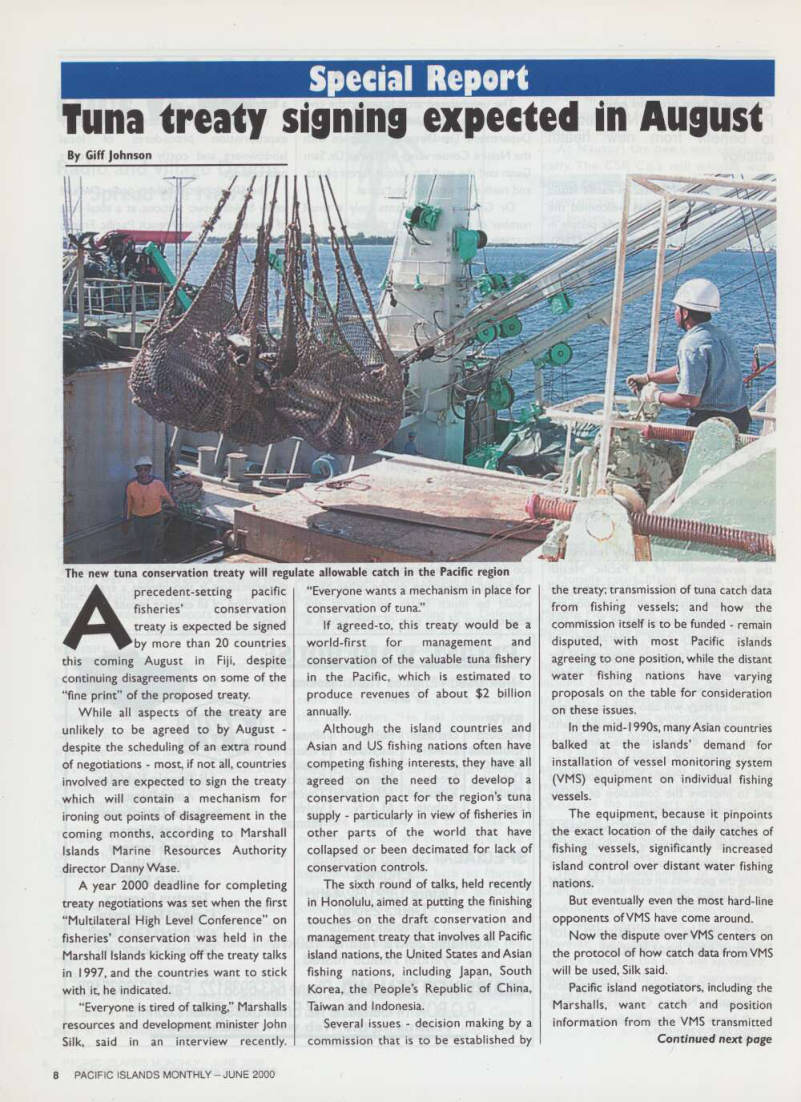
The new tuna conservation treaty will regulate allowable catch in the Pacific region
Continued from previous page
simultaneously directly from the fishing
vessels to the treaty management commission and to the fishing vessel’s country.
But some Asian fishing nations, principally Japan, do not want the VMS information transmitted directly from the vessels to the commission - preferring instead that it goes directly to their governments first for re-transmission to the commission.
Pacific island officials argue that direct transmissions from the vessels to the commission avoid any possible question about the validity of the information on catch and location of vessels that is being
provided.
Although most of the treaty area is mapped out, the northwestern boundary - waters near Japan - continue to be a source of disagreement, primarily because the area is a significant fisheries’ resource for the Japanese.
The inability of negotiators to agree on the VMS and other issues led negotiators in Honolulu to set a final negotiating session for August in Nadi, Fiji, at which time the treaty is expected to be signed.
The negotiating process is formally known as the Multilateral High Level Conference on the Conservation and Management of Highly Migratory Fish Stocks in the Central and Western Pacific.
“The goal is to conclude the treaty before the end of 2000,” Silk said.
The treaty itself will not become operational until a majority of nations approve it through their internal legislative processes. ■
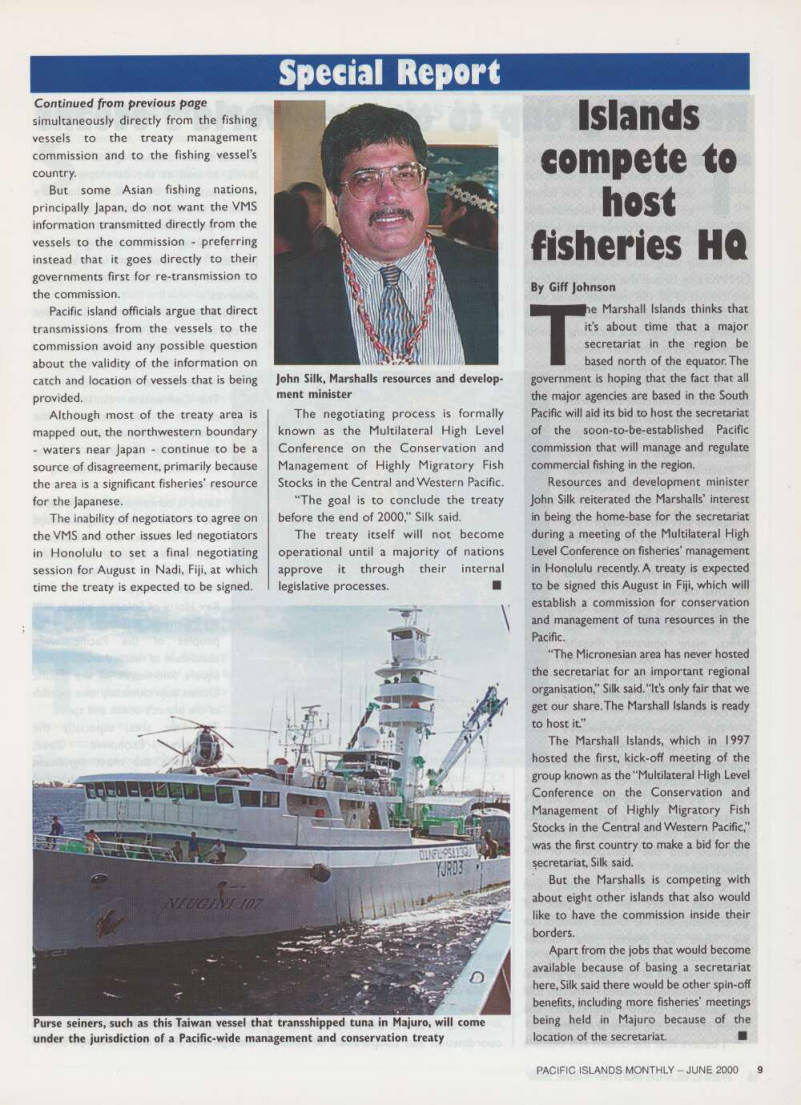
Purse seiners, such as this Taiwan vessel that transshipped tuna in Majuro, will come under the jurisdiction of a Pacific-wide management and conservation treaty
John Silk, Marshalls resources and develop ment minister
compete to
Islands compete to host fisheries HQ
By Giff Johnson
The Marshall Islands thinks that it’s about time that a major secretariat in the region be based north of the equator. The government is hoping that the fact that all the major agencies are based in the South Pacific will aid its bid to host the secretariat of the soon-to-be-established Pacific commission that will manage and regulate commercial fishing in the region.
Resources and development minister John Silk reiterated the Marshalls’ interest in being the home-base for the secretariat during a meeting of the Multilateral High Level Conference on fisheries’ management in Honolulu recently. A treaty is expected to be signed this August in Fiji, which will establish a commission for conservation and management of tuna resources in the Pacific.
“The Micronesian area has never hosted the secretariat for an important regional organisation,” Silk said.“lt’s only fair that we get our share. The Marshall Islands is ready to host it”
The Marshall Islands, which in 1997 hosted the first, kick-off meeting of the group known as the “Multilateral High Level Conference on the Conservation and Management of Highly Migratory Fish Stocks in the Central and Western Pacific,” was the first country to make a bid for the secretariat, Silk said.
But the Marshalls is competing with about eight other islands that also would like to have the commission inside their borders.
Apart from the jobs that would become available because of basing a secretariat here, Silk said there would be other spin-off benefits, including more fisheries’ meetings being held in Majuro because of the location of the secretariat. ■
New UN group to oversee world’s oceans
The General Assembly, the UN’s highest policy making body, has decided to set up a new forum to coordinate international efforts to protect and preserve the world’s oceans.
Officially designated as an open-ended UN Working Group, the consultative body will consist of all 188 member states who will meet once a year to oversee matters relating to the high seas, including mineral
resources and marine environment.
“As we enter the next century, an internationally coordinated approach to protecting the world’s oceans is essential to the health and well-being of the planet and human kind,” says Matthew Gianni, campaign coordinator for Greenpeace International.
Gianni says that although 1998 was designated the UN Year of the Ocean, it was the worst year on record for coral reef damage due to global climate change.
Furthermore, he points out, overfishing by industrial fishing fleets, many operating illegally, continued to decimate many species of marine life such as tunas, cod, seabass, sharks, seabirds and sea turtles.
“The General Assembly’s initiative (to set up a new forum) may well represent one of the most significant outcomes of the UN
Year of the Ocean,” he says. “The world’s oceans, however, face a myriad of threats from global climate change, overfishing, pollution and the destruction of the coastal habitat.”
“Only a firm commitment and concerted effort on the part of governments and the United Nations can we hope to prevent the further destruction of the ocean’s biodiversity.”
Satya Nandan of Fiji, secretary-general of the International Seabed Authority, told delegates his country appreciates the timely action of the General Assembly.
“I believe that the oceans will become
an area of intense activity as the new millennium progresses,” Nandan says.
This will come about as a result of the increase in demand for food resources, more rapid communications and transportation, as well as the demand for mineral resources from the sea.
“It is inevitable that major developments in technology and advances in scientific research on the marine environment will accelerate these activities,” says Nandan.
But he complains that the international community “has always taken the oceans for granted, so much so that it is prepared, as is currently the case, to spend billions of dollars in research in outer space while less than one-tenth of that amount is allocated to research on the more immediate environment of the oceans.”
Clearly this must change as pressure on the ocean environment grows and there is an urgent need both to discover new uses for the oceans and develop their potential, he says.
This underscores the need for better coordination and cooperation of ocean
policies at the national, regional and global levels, as well as the development and implementation of policies that are coherent and cost-effective, he adds..
The establishment of a UN Working Group, represents the beginning of a new process.“l hope it will work to re-establish the focus on the oceans which it justly deserves.”
Speaking on behalf of the 15-member
European Union (EU), Marja Letho of
Finland has underlined the importance of
the UN Convention of the Law of the Sea, signed in December 1982.
The Convention resulted in the creation of two institutions: the International Tribunal of the Law of the Sea in Germany and the International Seabed Authority in Jamaica.
Letho is concerned, however, about the number of attacks against ships and the increased use of violence in such attacks. Regional cooperation was essential to prevent such violence, she says.
Rex Horoi of Solomon Islands told the General Assembly that the peoples of the Pacific were custodians of more than 30 million square kilometres of the Pacific Ocean, approximately one twelfth of the planet’s ocean and space.
The vast area, especially the Exclusive Economic Zone, represents the most significant source of economic wealth and
security, he says.
For that reason, countries in that region are undertaking sustainable strategies to become more active participants in the development of the industry, and to enhance the region’s share of the economic benefits from the ocean resources.
Horoi has expressed concern about illegal, unregulated and unreported fishing in the high seas, and in some cases, under the national jurisdiction of coastal states.
In that context, there is a need for the coordination of international efforts in the management of the oceans, he says. (IPS) ■
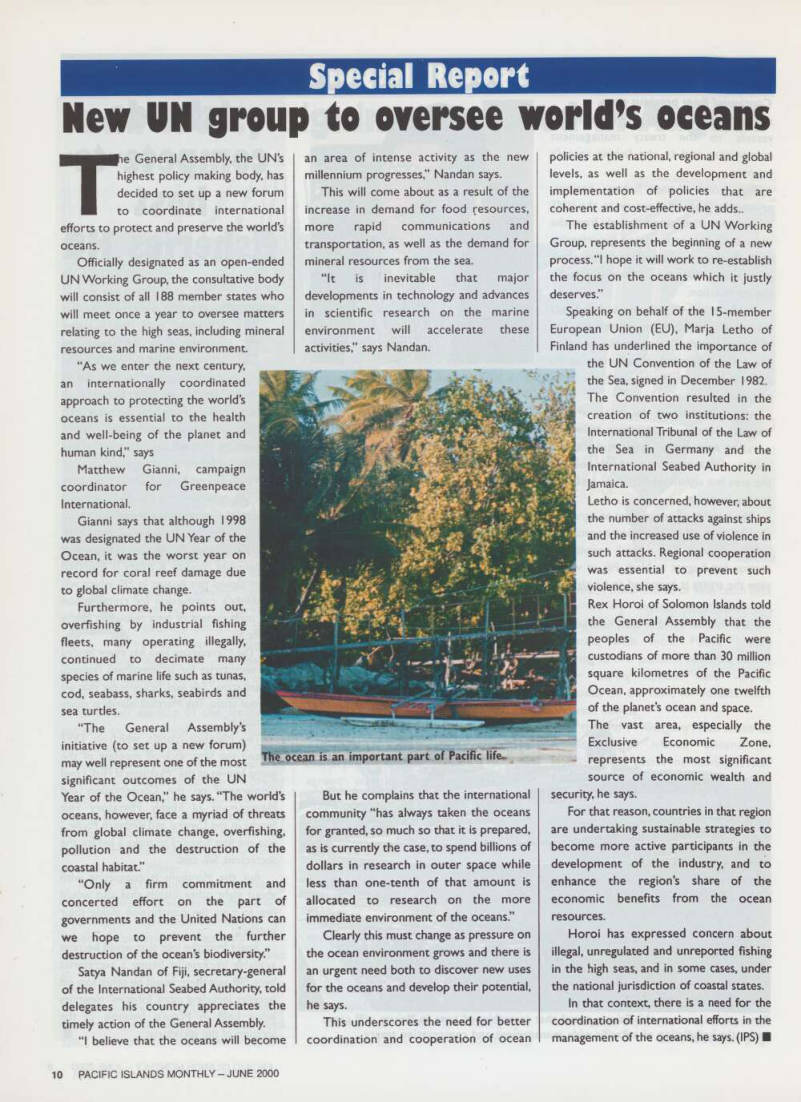
The ocean is an important part of Pacific life.
Fish attractors to increase catches by small-scale fishermen
Subsistence, non-commercial fishing (also known as artisanal fisheries) accounts for almost 50 per cent of Brazil’s fish catch.
Research is helping increase catches of an assortment of fish, including small tuna, carangid, dolphin fish, and shark, by small scale fisheries along Brazil’s northeastern coast. The focus is on better knowledge about the distribution and abundance offish, and about using improved technologies such as artificial fish attractors.
Fish attractors have been used successfully in Asia by artisanal fisheries to catch live bait and tuna. The principle is simple.A structure is placed under the water and as algae begins to grow on it, it attracts small fish, which in turn attract larger fish.
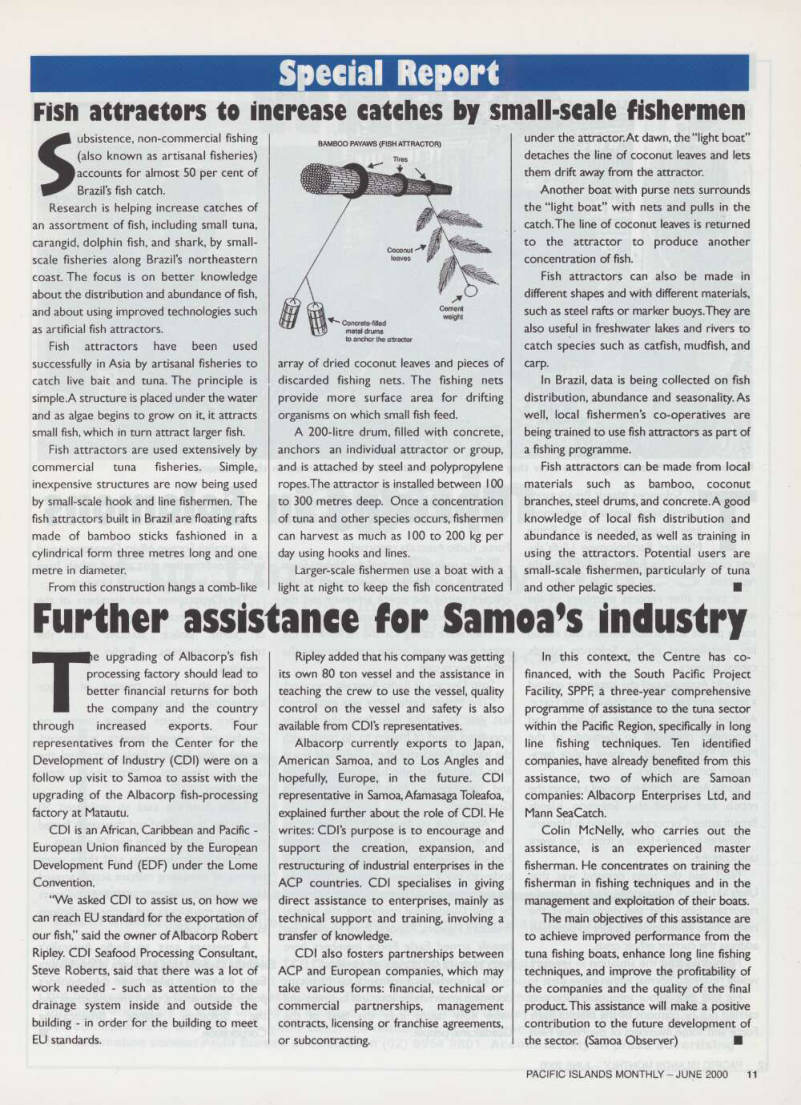
Fish attractors are used extensively by commercial tuna fisheries. Simple, inexpensive structures are now being used by small-scale hook and line fishermen. The fish attractors built in Brazil are floating rafts made of bamboo sticks fashioned in a cylindrical form three metres long and one metre in diameter.
From this construction hangs a comb-like
array of dried coconut leaves and pieces of discarded fishing nets. The fishing nets provide more surface area for drifting organisms on which small fish feed.
A 200-litre drum, filled with concrete, anchors an individual attractor or group, and is attached by steel and polypropylene ropes. The attractor is installed between 100 to 300 metres deep. Once a concentration of tuna and other species occurs, fishermen can harvest as much as 100 to 200 kg per day using hooks and lines.
Larger-scale fishermen use a boat with a light at night to keep the fish concentrated
under the attractor.At dawn, the “light boat” detaches the line of coconut leaves and lets them drift away from the attractor.
Another boat with purse nets surrounds the “light boat” with nets and pulls in the catch. The line of coconut leaves is returned to the attractor to produce another concentration of fish.
Fish attractors can also be made in different shapes and with different materials, such as steel rafts or marker buoys. They are also useful in freshwater lakes and rivers to catch species such as catfish, mudfish, and carp.
In Brazil, data is being collected on fish distribution, abundance and seasonality. As well, local fishermen’s co-operatives are being trained to use fish attractors as part of a fishing programme.
Fish attractors can be made from local materials such as bamboo, coconut branches, steel drums, and concrete. A good knowledge of local fish distribution and abundance is needed, as well as training in using the attractors. Potential users are small-scale fishermen, particularly of tuna and other pelagic species. ■
Further assistance for Samoa’s industry
T|ie upgrading of Albacorp’s fish processing factory should lead to better financial returns for both the company and the country through increased exports. Four representatives from the Center for the Development of Industry (GDI) were on a follow up visit to Samoa to assist with the
upgrading of the Albacorp fish-processing
factory at Matautu.
GDI is an African, Caribbean and Pacific -
European Union financed by the European
Development Fund (EDF) under the Lome Convention.
“We asked GDI to assist us, on how we can reach EU standard for the exportation of our fish,” said the owner of Albacorp Robert Ripley. GDI Seafood Processing Consultant, Steve Roberts, said that there was a lot of work needed - such as attention to the drainage system inside and outside the building - in order for the building to meet EU standards.
Ripley added that his company was getting its own 80 ton vessel and the assistance in teaching the crew to use the vessel, quality control on the vessel and safety is also available from GDl’s representatives.
Albacorp currently exports to Japan, American Samoa, and to Los Angles and hopefully, Europe, in the future. GDI representative in Samoa, Afamasaga Toleafoa, explained further about the role of GDI. He writes: GDl’s purpose is to encourage and support the creation, expansion, and restructuring of industrial enterprises in the AGP countries. GDI specialises in giving direct assistance to enterprises, mainly as technical support and training, involving a transfer of knowledge.
GDI also fosters partnerships between AGP and European companies, which may take various forms: financial, technical or commercial partnerships, management contracts, licensing or franchise agreements, or subcontracting.
In this context, the Centre has co financed, with the South Pacific Project Facility, SPPF, a three-year comprehensive programme of assistance to the tuna sector within the Pacific Region, specifically in long line fishing techniques. Ten identified companies, have already benefited from this assistance, two of which are Samoan companies: Albacorp Enterprises Ltd, and Mann Sea Catch.
Colin McNelly, who carries out the assistance, is an experienced master fisherman. He concentrates on training the fisherman in fishing techniques and in the management and exploitation of their boats.
The main objectives of this assistance are to achieve improved performance from the tuna fishing boats, enhance long line fishing techniques, and improve the profitability of the companies and the quality of the final product This assistance will make a positive contribution to the future development of the sector. (Samoa Observer) ■
Uprising in Solomons
T|HE Solomons Islands Broadcasting
Corporation released a statement June 5 saying the country’s Prime Minister, Bartholomew Ulufa’alu, was considering his future, Radio Australia
reported.
It came after reports members of the militant Malaita Eagle Force and possibly some police and prison officers had seized key installations in the Solomon Islands
capital, Honiara.
Radio Australia said the statement quoted a lawyer representing the Malaita Eagle Force, Andrew Nori, as saying Ulufa’alu had responded positively to demands of the Malaita Eagle Force and some police para military force members.
Radio Australia earlier carried a report the rebels had seized the Solomon Islands Broadcasting Corporation station in Honiara.
Efforts to ring Honiara from Suva were unsuccessful.
Nori said the main demand was that Ulufa’alu resign voluntarily, Radio Australia reported. Nori said the demand was the result of the government’s failure to positively address the current ethnic crisis.
Nori predicted the situation in Honiara would return to normal within a few days.
He said a one-hour joint operation was carried out by platoons of the Malaita Eagle Force and some members of the Police Field
Force, Radio Australia reported.
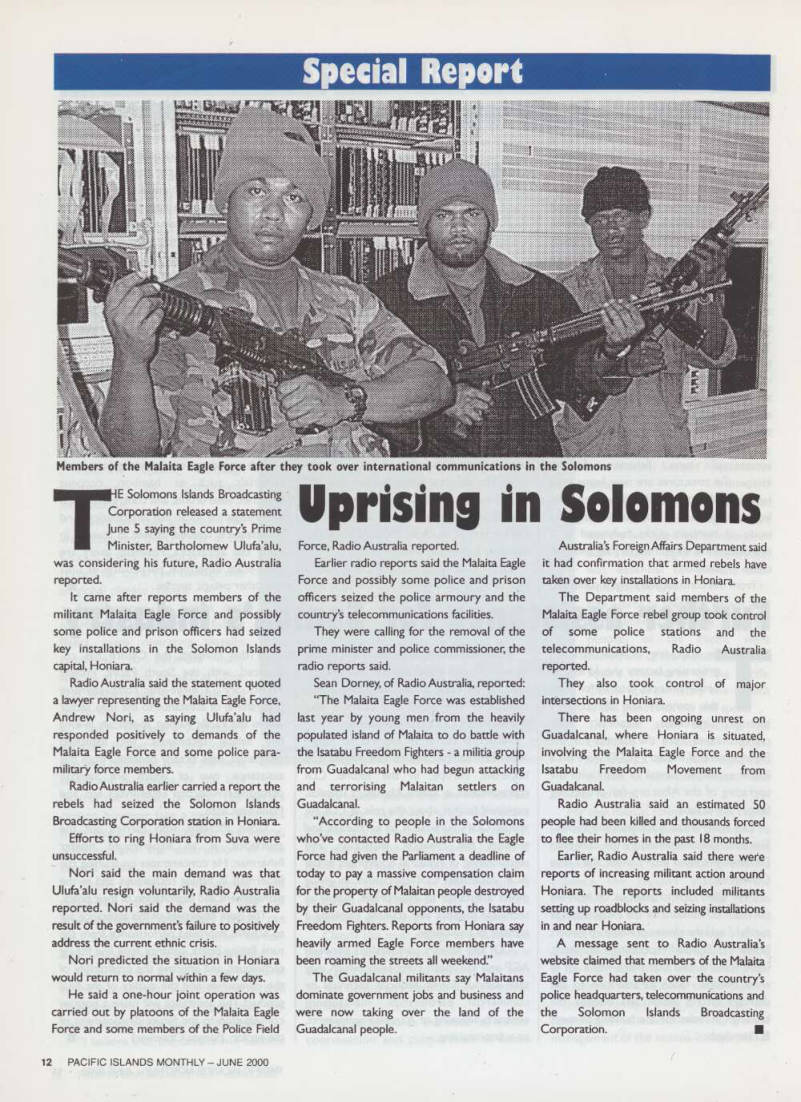
Earlier radio reports said the Malaita Eagle Force and possibly some police and prison officers seized the police armoury and the country’s telecommunications facilities.
They were calling for the removal of the prime minister and police commissioner, the radio reports said.
Sean Dorney, of Radio Australia, reported: “The Malaita Eagle Force was established last year by young men from the heavily populated island of Malaita to do battle with the Isatabu Freedom Fighters - a militia group from Guadalcanal who had begun attacking and terrorising Malaitan settlers on Guadalcanal.
“According to people in the Solomons who’ve contacted Radio Australia the Eagle Force had given the Parliament a deadline of today to pay a massive compensation claim for the property of Malaitan people destroyed by their Guadalcanal opponents, the Isatabu Freedom Fighters. Reports from Honiara say heavily armed Eagle Force members have been roaming the streets all weekend.”
The Guadalcanal militants say Malaitans dominate government jobs and business and were now taking over the land of the
Guadalcanal people.
Australia’s Foreign Affairs Department said it had confirmation that armed rebels have taken over key installations in Honiara.
The Department said members of the Malaita Eagle Force rebel group took control of some police stations and the telecommunications, Radio Australia
reported.
They also took control of major intersections in Honiara.
There has been ongoing unrest on Guadalcanal, where Honiara is situated, involving the Malaita Eagle Force and the Isatabu Freedom Movement from Guadalcanal.
Radio Australia said an estimated 50 people had been killed and thousands forced to flee their homes in the past 18 months.
Earlier, Radio Australia said there were reports of increasing militant action around Honiara. The reports included militants setting up roadblocks and seizing installations in and near Honiara.
A message sent to Radio Australia’s website claimed that members of the Malaita Eagle Force had taken over the country’s
police headquarters, telecommunications and
the Solomon Islands Broadcasting
Corporation. ■
Members of the Malaita Eagle Force after they took over international communications in the Solomons
Advertisements & other items, p. 13 (1 item)
What’s
m mi '
again
Fiji Times Daily Sales
(6 Monthly Fiji Times Circulation Figures)
* Sept 99 - March 2000 41,757 30.218 m 25,904 . ■ 31 ,726
SUNDAY
MOM-FRI
MON SAT
SATURDAY
*Latest independently audited ABO figures. All figures are average net paid daily sales.
Today’s biggest media trap is unaudited circulation. I|lM|l|| You can’t seriously expect to count on a publication that won’t let you count its readers. 1* But luckily this is a trap you can easily avoid. Because the newspapers that really mean B"~lh Ifc I business are happy to stand up and be counted - and they proudly display their ABC audit TudlHjureau symbol. Look for it, and you know you’ll catch the readership you’ve been promised. of Circulation For information contact Audit Bureau of Circulation (02) 9954 9801. Accountability in press advertising
Burgernomics says Fiji, Samoa
Business
Burgernomics says Fiji, Samoa currencies undervalued
By Michael Field
Lay all the world’s economists end to end and they still wouldn’t reach a conclusion ... But thanks to McDonalds
and the leading conservative British publication The Economist we can have some idea on at least one subject.
The real value of currencies.
For example, the market place and the Reserve Bank of Fiji to some extent, says that these days One Fiji Dollar is worth around 47 U$ cents, finding out whether that is really so, and whether any other currency is at its correct price, has always been controversial in economics. The usual response these days is the simple one: the market decides.
The Economist has come up with a formula which reveals the “correct” exchange rate.
They used McDonald’s Big Macs and in its 14th annual review of “Burgernomics” toured the world eating Big Macs.
But they overlooked the South Pacific where the Golden Arches stand in Suva, Nadi, Apia and Papeete.
The magazine says Burgernomics is based on the theory of purchasing power parity (ppp).
That theory states that a dollar should buy the same amount in all countries and so, over time, the exchange rate between two currencies should move towards the rate the equalises the prices of an identical basket of goods and services.
The McDonald’s franchise produces its standard “Big Mac” in around 120 countries - making it a good “basket” for any study of exchange rates.
The “Big Mac PPP”, as The Economist puts it, is the exchange rate that would mean hamburgers cost the same in America as they do in other countries.
And by comparing the actual exchange rates with the PPP indicates whether a currency is under or overvalued. The magazine calls that
“McParity”.
In the industrialised countries the
Continued on next page
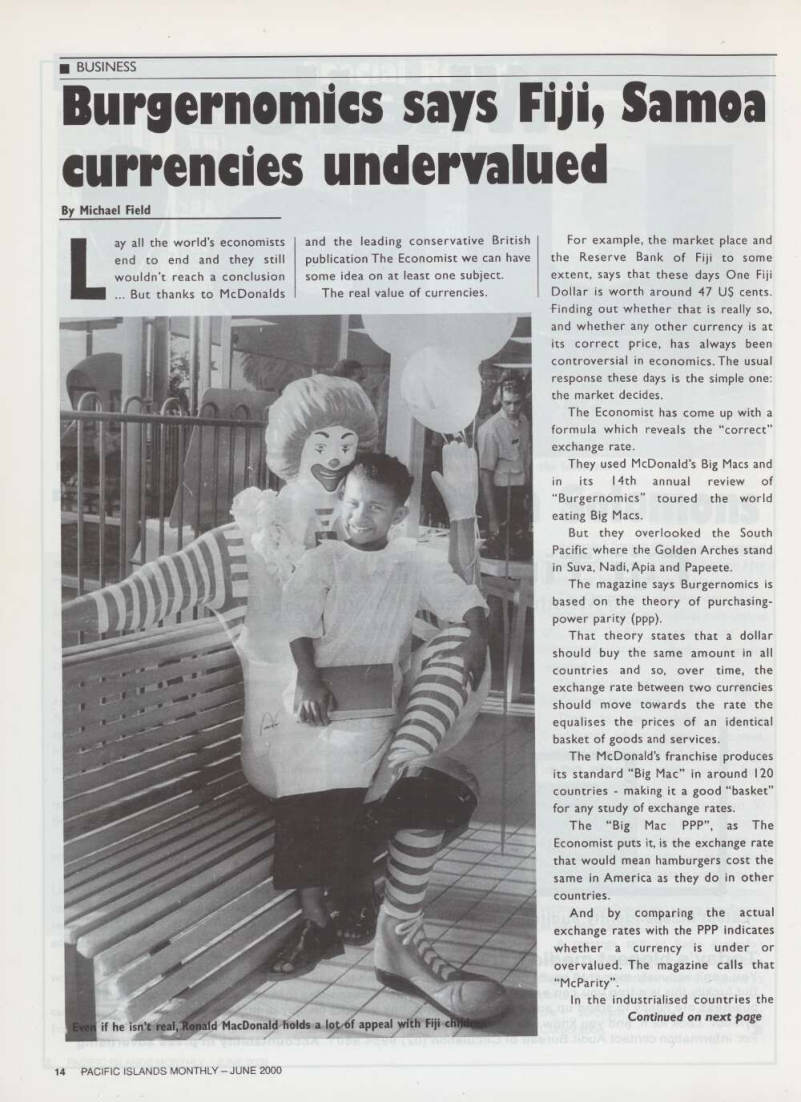
Even if he isn’t real, Ronald MacDonald holds a lot of appeal with Fiji chidren
Continued from previous page
most undervalued currency is the Australian dollar which is running at 38 per cent below McParity.
New Zealand is not doing much better either, coming in at 33 per cent below parity. The Swiss are way over valued, 39 per cent above McParity and the Danes at 23 per cent.
On The Economist list, the Malaysian ringgit was the most undervalued currency by 53 per cent, while the Israeli shekel the most overvalued at 43 per cent.
In US dollar terms, Malaysia sells the cheapest Big Mac, US$l.l 9, and Israel the most expensive US$3.5B. Australia sells at US$l.54 and New Zealand US$l.69.
The magazine gives all the formula, so its possible to figure out where Fiji stands.
Currently Suva’s McDonald’s sells a Big Mac at F 52.95, which at the exchange rate on May 6 worked out at US$l.4l.
By dividing the local price by the price in the US (The Economist has averaged this out to US$2.5 I) you get the “implied PPP of the dollar” and in Fiji this comes out at 1.175.
You then compare that number with the actual exchange rate which gave the One Fiji Dollar being worth 0.4745 and the PPP, the figures then show that the Fiji dollar is 44 per cent undervalued.
This is not the worst performer in the Pacific.
French Polynesia, which has a fixed rate Pacific Franc now hopelessly out of phase with the rest of the world, has a McDonalds in downtown Papeete. Its numbers show that their currency is 16 per cent over valued against the United States dollar.
Samoa’s tala on the scale is 17 percent under-valued.
The Economist admits that hamburgers are a flawed measure of PPP because local prices may be distorted by trade barriers on beef, sales taxes or big differences in the cost of non-traded inputs such as rents.
“Thus, whereas Big Mac PPPs can be a handy guide to the cost of living in
countries, they may not be a reliable guide to future exchange-rate movements,” the magazine says.
Yet, curiously, several academic studies have concluded that the Big Mac index is surprisingly accurate in tracking exchange rates over the long term.
The Big Mac index, for example, accurately predicted that the Euro would tumble.
“At the start of 1999, euro burgers were much dearer than American ones.
“Burgernomics is far from perfect, but our mouths are where our
moneys.” ■
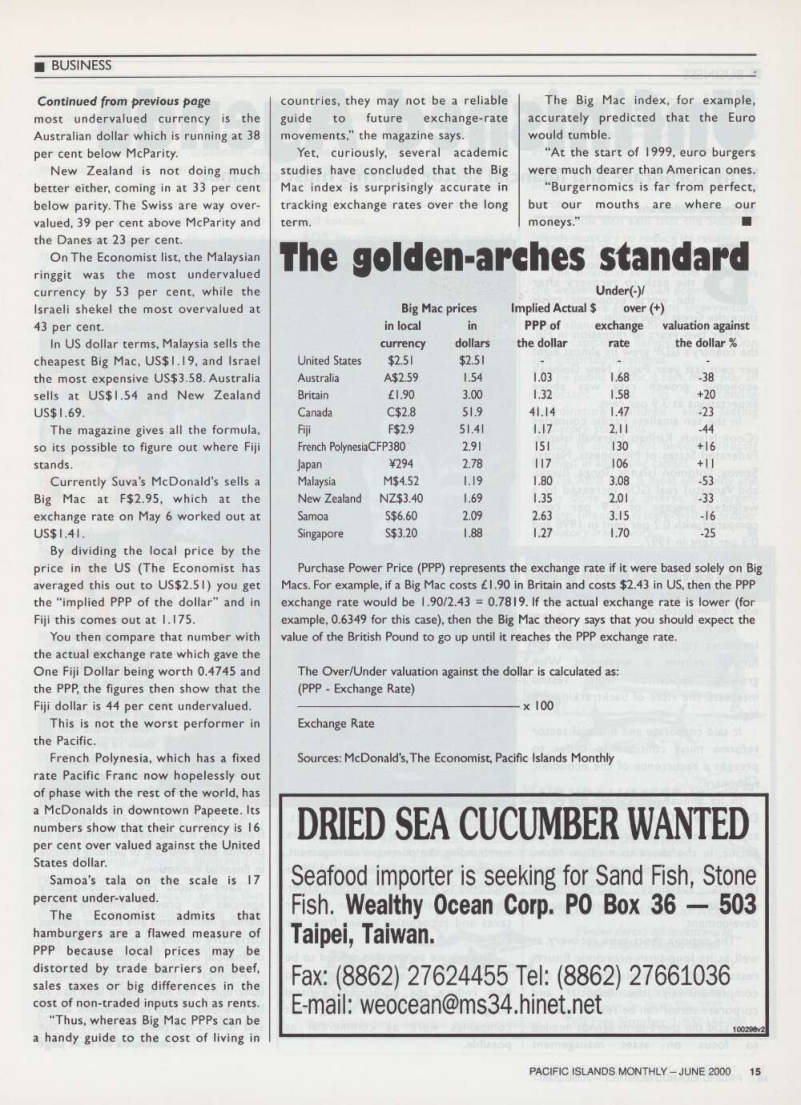
The golden-arches standard
Purchase Power Price (PPP) represents the exchange rate if it were based solely on Big Macs. For example, if a Big Mac costs £1.90 in Britain and costs $2.43 in US, then the PPP exchange rate would be 1.90/2.43 = 0.7819. If the actual exchange rate is lower (for example, 0.6349 for this case), then the Big Mac theory says that you should expect the value of the British Pound to go up until it reaches the PPP exchange rate.
The Over/Under valuation against the dollar is calculated as:
(PPP - Exchange Rate)
x 100
Exchange Rate
Sources; McDonald’s.The Economist, Pacific Islands Monthly
Big Mac prices
Under(-)/
Implied Actual $ over (+) in local in PPPof exchange
valuation against
currency dollars the dollar rate the dollar % United States $2.51 $2.51 - - - Australia A$2.59 1.54 1.03 1.68 -38 Britain £1.90 3.00 1.32 1.58 +20 Canada C$2.8 51.9 41.14 1.47 -23 Fiji F$2.9 51.41 1.17 2.11 -44 French PolynesiaCFP380 2.91 151 130 + 16 Japan ¥294 2.78 117 106 + 11 Malaysia M$4.52 1.19 1.80 3.08 -53 New Zealand NZ$3.40 1.69 1.35 2.01 -33 Samoa S$6.60 2.09 2.63 3.15 -16 Singapore S$3.20 1.88 1.27 1.70 -25
Advertisements & other items, p. 15 (1 item)
Dreed Sea Cucumber Wanted
Seafood importer is seeking for Sand Fish, Stone Fish. Wealthy Ocean Corp. PO Box 36 503 Taipei, Taiwan.
Fax: (8862) 27624455 Tel: (8862) 27661036 E-mail: [email protected] 100298v2
Unfinished Agenda
Why corporate and financial sector reforms must continue
By Sophie Hildebrand
By all accounts, it seems that Pacific island nations are on the path to recovery after the worst economic crisis since the Great Depression.
After two years of recession in Fiji, the country’s GDP grew by almost eight per cent last year. Papua New Guinea’s economic growth rate was above expectations at 3.9 per cent.
In the ten smallest Pacific countries (Cook Islands, Kiribati, Marshall Islands, Federated States of Micronesia, Nauru, Samoa, Solomon Islands, Tonga, Tuvalu, and Vanuatu) real GDP increased by a weighted average of 0.9 per cent, compared with 0.2 per cent in 1998 and 0.3 per cent in 1997.
But the Asian Development Bank has warned countries in its portfolio that the biggest risk facing the Asia-Pacific region now is complacency.
“As markets recover and foreign investors return, the momentum for further reform is weakened. With growing opposition from vested interests, the risks of backtracking are
high”.
It said corporate and financial sector reforms must continue in order to prevent a recurrence of the economic
nightmare.
In its annual publication, the Asian Development Outlook 2000, the ADB says the economic prospects of the Pacific, in the short to medium term, depend on the success of public sector reforms, sustained macroeconomic stabilisation and private sector
development.
“The region’s short-term recovery, as well as its long-term economic future, rests largely on how effectively and comprehensively the financial and corporate sector can be restructured.”
It said the short-term agenda needed to focus on asset management
companies and disposing of their assets.
The regulatory framework surrounding the purchase, management, transfer and sale of assets needed to be improved to make such practices easier.
This particularly applied to transfer taxes and recognising losses from the sale.
The private sector also needed to be involved in the restructuring process to help reduce the government’s fiscal obligation and ensure that management companies were as commercial as possible.
A crucial part of any regulatory framework, it said, was a mechanism to provide early warning of pending trouble in financial institutions.
“Laws should require supervisory agencies to provide effective early warning mechanisms and to take prompt corrective actions to minimise the risk of financial crisis,” the report said.
Amongst other considerations, bankruptcy and foreclosure laws had to be amended to help seize debtors’ assets and reduce the need to resort to the
Continued on next page
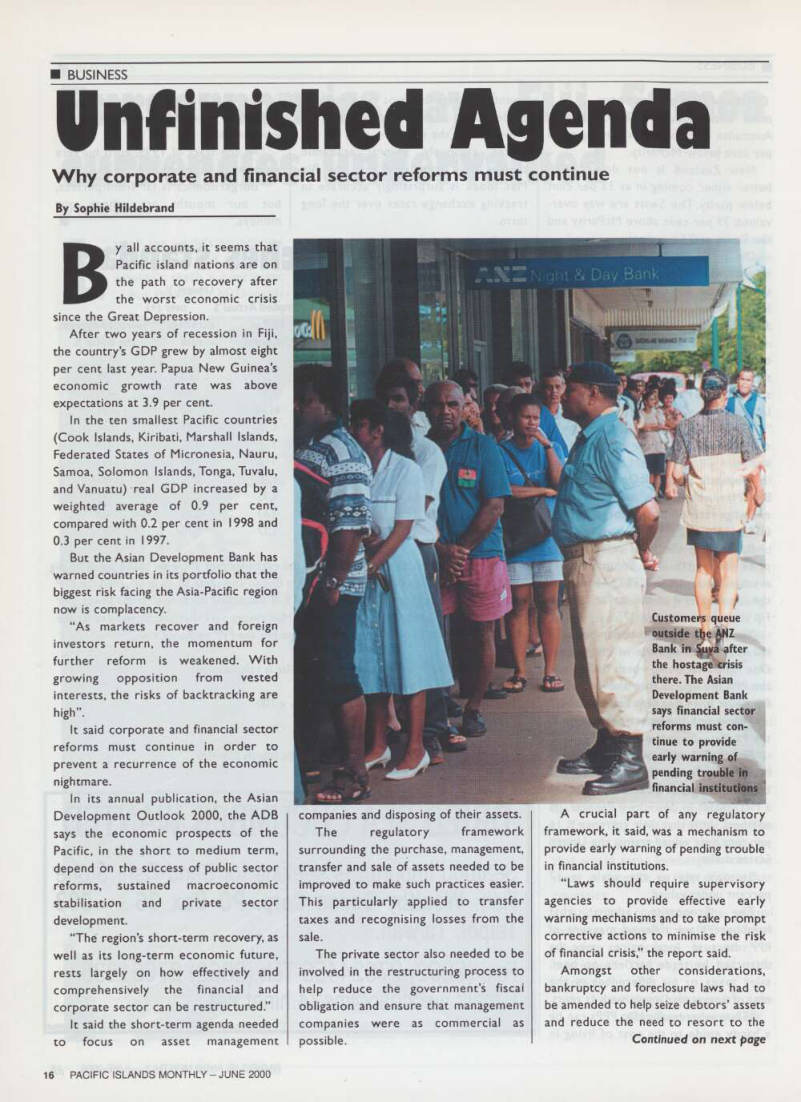
Customers queue outside the ANZ Bank in Suva after the hostage crisis there. The Asian Development Bank says financial sector reforms must con tinue to provide early warning of pending trouble in financial institutions
Continued from previous page
judicial process.
As well, the report said bank secrecy laws may have to be loosened to increase financial transparency and discourage corrupt funds flowing through the financial centres.
Attacking poor governance has also been recommended to increase transparency of economic and financial data, strengthen corporate disclosure requirements, increase accountability to shareholders, strengthen competition laws, privatise state-owned enterprises, and dismantle state-supported monopolies and cartels.
Privatisation of public assets will not guarantee improved welfare of the masses, but has the upside of stamping out government corruption and raising the necessary funds to repay debts, according to World Bank PNG resident coordinator Daniel Weise.
Weise said while there was no guarantee that privatisation would bring improved welfare, it provided an opportunity for this to happen, but only if all the processes and systems have been set right.
He said the World Bank is very determined to get the necessary reforms in place so that the sale of public assets resulted in effectively run and transparent organisations.
He said privatization is a more difficult option than undertaking macroeconomic adjustments but, with full commitment from the government, it can be achieved.
He said experience from elsewhere around the world points to positive results from privatisation moves.
As well, by privatising nationalised banks and state-owned enterprises, additional revenue could be generated to remedy fiscal imbalances.
ADB says it is generally agreed that one of the major causes of the Crisis was “excessive reliance on short-term bank loans from abroad to facilitate long term investments at home and abroad”.
It says there is a need to modernise
and develop capital markets, particularly
bond markets, and maximise the efficiency with which long-term savings
are channelled into profitable industrial and infrastructure projects.
To do this a financial sector blueprint was needed, covering the banking sector, nonbank credit organisations, insurance sector, capital markets and newer financial institutions such as venture
capital entities.
ADB recommends that all types of long-term financial markets be fostered, including equity, bond and insurance.
It said first a market for primary government securities issues must be
developed, followed by a secondary
market for such issues and then a corporate bonds market will develop.
The Governor of the Solomon Islands’ Central Bank, Rick Hou, says the country’s external debt arrears remain at more than $lB million.
However, he says the Solomons’
Government is on track with its debt servicing.
He said nearly $8 million of the amount is in interest alone.
The loans are with the Marubeni Bank
of Japan and the Ethical Fund for Insurance Corporation in Australia.
The Central Bank Governor said the EFIC loan and its arrears were restructured early this year and the interest rate has been reduced to three percent.
Mr. Hou also said that the Solomon Islands must try to reduce its reliance on overseas assistance as it develops.
The financial sector, ADB says, was the weakest link in Asian economies.
“Excessive government intervention, overreliance on banks, and pervasive
crony capitalism hampered innovation
and distorted incentives.”
The public sector, it says, must play an important role in overcoming coordination failures and setting
regulatory standards.
But, it should not become directly involved in allocating capital.
This, ADB says, is most efficiently and safely done by a diverse and largely private financial system within proper regulatory framework. ■
Advertisements & other items, p. 17 (1 item)
Hook Up With The Leader!
Pacific Ocean Producers
is the leader in L/ n 1
monofilament longline
system technology.
We offer special service to the South Pacific Islands, Australia and New Zealand. •Lindgren-Pitman gear, complete hydraulic systems, design and installation or monofilament longline systems including operations training. •Extensive Tuna and Swordfish supplies, bottom fishing gear, fish handling supplies and bait. •Duralumes Lightstick - the latest in lightsticks technology, extended light output, often used two nights, 5-year shelf life, not affected by moisture, easy-to- handle shipping carton. All popular colors available - green, blue, pink, yellow, white, violet and ultra-violet tor best fishing results. •Wide selection of trolling equipment: over 180 different colors of trolling skirts and a large selection of lure heads.' •Weekly shipments to the South Pacific Islands, Australia and New Zealand.
FREE CATALOG AVAILABLE ON REQUEST
Please direct all inquiries to the Export Department: 965-B North Nimitz Highway Honolulu, HI 96817, USA.
Telephone: (808) 537-2905 Facsimile: (808) 536-3225 Shop on line for your convenience: www,pop-hawaii.com Toll Free Number 1-800-144-488 ■H A A'-
Pacific
Ocean
Producers
exploration tax review
Chevron head says PNG needs exploration tax review
The fiscal regime for oil exploration in PNG needs to be modified to reflect the high risks and low reserve margins in the fields in the country, says the President of Chevron Overseas Petroleum Inc (COPI) Richard Matzke.
Matzke said this would attract new companies and would also provide an incentive for existing companies to carry out more exploration.
He was speaking to the Post-Courier after a short visit last month, in which he met with Chevron employees and other joint venture partners and also met with Prime Minister Sir Mekere Morauta.
As COPI president, Mr Matzke is
responsible for Chevron’s petroleum
operations globally. He has been visiting PNG once a year for the last 10 years.
Mr Matzke said Chevron had been exploring for oil in PNG for more than 10 years and the prospects they had left were
“relatively small, relatively expensive and very high risk”.
“We don’t have a lot of technical opportunities left. We’ve been exploring for 10 years and the prospects we have left are relatively small, relatively expensive and very high risk.
“We would suggest that maybe the fiscal regime on new exploration be modified to recognise the much higher risk and the small reserve targets. We think that will bring more exploration money to PNG.
“We know we would.We think it will bring a lot of other money too,” Matzke said.
However, he said changing the fiscal regime, especially for new exploration was “not untypical when you get into state of maturity in oil field
developments.
“Things have to change a little bit. So we would suggest that these higher fiscal items be reviewed by the Government to come up with the
appropriate set of terms and conditions that would attract money on a competitive basis,” Matzke said. He is not alone in expressing concern about the low level of exploration, not only in the petroleum sector but also in the mining sector.
The Chamber of Mines and Petroleum and various industry players in both sectors have expressed concern over the last couple of years at the adhoc taxes that were introduced by various governments, and how that was
stifling exploration.
The chamber’s concerns have been submitted to the Government tax review commitee headed by Sir Nagora Bogan.
Addressing a corporate function with their partners and clients, Matzke spoke about the partnership between the joint venture partners in the Kutubu and Gobe projects, which Chevron operated and how that had worked.
He said the oilfields in PNG did not have enough reserves for one licence holder to individually have the massive infrastructure that took to develop and extract oil efficiently, so many licence holders needed to get together and move in an aligned synchronized way forward.
Matzke told the guests that the last decade had been an exciting one for Chevron in PNG.
“I would hope that over the course of the past decade and a half or two decades that Chevron has left a footprint in the ground here,” he said.
Matzke said one aspect of their operation which they were proud of was that of the partnership.
Matzke said one of the biggest challenges for the developers was making the oilfields last a little bit longer than they might otherwise, and that was “going to take a degree of effort in the partnership arena, co-operation and understanding”. (Post Courier) ■
Advertisements & other items, p. 18 (1 item)
Mon-Cellnlar
CORDLESS PHONES
IslancH-Hsland »140 km fax/modem
phone/fax/modem
Mon-Cellnlar
Long Range
(Bkm-100km)
'K/<ti6ier*7<tOUe& MM s4dv<tHC£cC cofidUoA (attf noMfc. tfdeat fa* etc. m ■ www.cordlessnz.co.nz Email [email protected]
CORDLESS
TECHNOLOGIES
Ph NZ (+64) 2557 7157
Fax NZ (+64) 9814 9469
Significant interest
rate drop forecast for PNG banks
TfHE World Bank has
foreshadowed significant
drops in interest rates in Papua New Guinea by the end of the year, if not within the next 12 months, on the back of structural reforms and loan assistance the bank has earmarked for PNG.
The Bank’s resident representative Daniel Weise said in Lae the significant inflow of capital from the loans, totalling about K3BO million, will have a positive impact on the economy and the foreign exchange, allowing for the Central Bank to ease monetary policy.
Weise is confident the interest rates would fall by as much as 50 per cent.
He said inflation should also fall to record levels of five to six per cent within the same period.
Addressing a breakfast conference co hosted by the PNG Institute of Accountants’ Lae Branch and Westpac Bank, Weise said the drop in interest rates would be in both Treasury Bills as well as
lending rates.
The interest rates on Treasury Bill yields are currently at 23 per cent, and the indicator lending rates (ILR) by the commercial banks range between 18.5 per cent to 19.5 per cent.
“We can expect that under the reform package interest rates will fall significantly
and there will be more stability on the
foreign exchange,” Weise said.
A team from the Treasury Department is in Washington for negotiations with the World Bank on a loan for US$9O million.
Also tied to the World Bank’s approval
are loans from Japan (US$5O million),
Australia (US$2O million) and US$lO million from a third donor.
Weise said the PNG loan request would go before the Bank board on June 3 and if approved, PNG would get US$9O million.
Out of that, an equivalent of KIOI million would go towards direct budget assistance.
The World Bank has set a program for the release of the loan through three tranches.
The first US$35 million should arrive by the end of next month, followed by a US$2O million second tranche and the final US$35 million thereafter. Each of them is
tied to certain conditions.
The funds would only come if the Government is successful or shows serious commitment in meeting the conditions that the Bank has set.
Among them is the full privatisation of Finance Pacific Limited by the end of the month and strengthening the administration and operation of the Privatisation Commission.
The Bank would also want to see serious moves in place to prepare other public entities, including Telikom, Harbours Board and Electricity Commission for privatisation.
Weise said the Bank had not been happy with the way the commission was set up and the powers provided to the Minister, as well as laws and regulations for privatisation.
Apart from privatisation, the Bank also
wants to see the reforms in the superannuation or pension industry hastened.
“With the significant funding expected over the next six months, macroeconomic variables should improve, allowing the central bank to relax
monetary policy.”
Most commercial banks agree with the World Bank forecast for significant falls in interest rates, according to Westpac Bank managing director Simon Millet.
Millet, who was at the breakfast, also part of the bank’s 90th anniversary celebrations, reaffirmed Weises comments. (Post Courier) ■
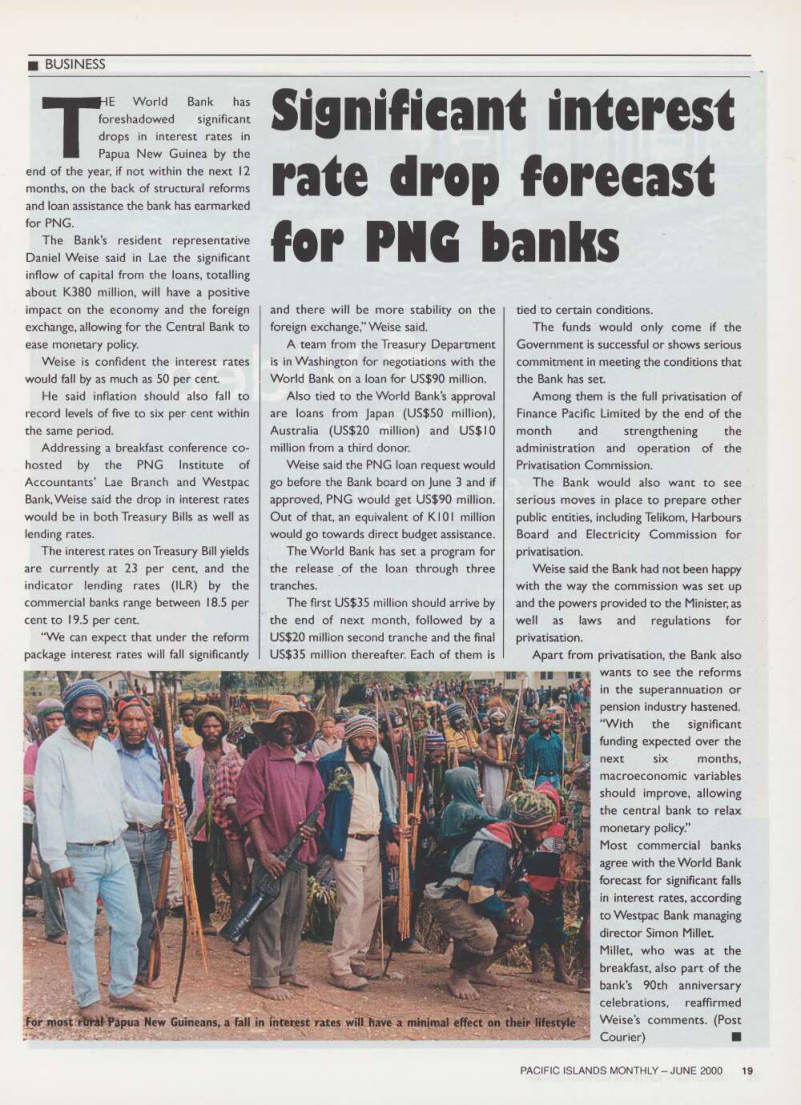
For most ram Papua New Guineans, a fall in interest rates will have a minimal effect on their lifestyle
Advertisements & other items, p. 20 (1 item)
Conferencing
BlSf '= o.v. ■ \ "-X Video Conferencing is an exciting new technology involving a highspeed, two-way, audio-visual communications link thaHetSiyou confer FACE to FACIi with people virtually anywhere in the world. mm ■f: The International Video Conferencing Service at Vatuwaqa in Suva, is part* of FINTEL’S continuing corrirriitment to the telecommunications services. more information:
U FREE 0800 - 315718
International Telecommunications Limited, Mercury House, 158 Victoria Parade, PO Box 59, Suva, Fiji Islands Telephone (679) 312 933, Fax (679) 301 025, Email [email protected] • Website http://www.fintel.com.fj
present for Fiji’s president
Miilion-dollar birthday present for Fiji’s president
By Sophie Hildebrand
What do Fiji’s prime minister and the
President’s daughter
have in common with an accountant, a hotelier, an airline chairman, two senators, a prominent entrepreneur, the head of the public service commission, a PR man and a lawyer? The short answer
is FJ$ I million.
The long one is they are all trustees of a somewhat unusual trust fund which hopes to promote multiracialism by raising and spending one million dollars.
The fund, named after and in honour of Fiji’s president Ratu Sir Kamisese Mara,
was launched last month to coiincide with his birthday.
Mara has been an influential figure in Fiji for over 40 years, playing a central part in attainment of the country’s independence from Britain in 1970, and was its first prime minister. It was a position he was to hold for 22 years.
He first put forward the philosophy of “the Pacific Way”, which is founded on the practice of mutual tolerance, understanding, respect and
goodwill.
Called the Ratu Sir Kamisese Mara Friendship Foundation, the fund aims to promote Mara’s “multi-cultural ideals and beliefs”.
Its preamble states: “While Ratu Sir Kamisese expresses strong pride in his own identity as an ethnic Fijian, he is passionate in his view that ‘without harmony among the races, there is no hope for the Fiji Islands’.”
Indeed, the trustees themselves span the races in Fiji, and the list reads like a who’s who of the country.
The chairman is the country’s Labour prime minister, Mahendra Chaudhry, who was part of the ill-fated Labour Coalition
that ousted Mara from power after the national elections in 1987.
Other members include close friends of Mara, the chairman of both Air Pacific and the Fiji Sugar Commission, Gerald Barrack, and highly successful businessman, Mahendra Patel.
Mara’s daughter, Adi Ateca Ganilau, represents the family in the trustees’ list.
She is married to the former commander of the Fiji Military Forces, Ratu Epeli Ganilau, who is now a parliamentarian.
Two lawyers make up the line-up: Senator Mohammed Afzal Khan and Hemendra Nagin.
There is one banker, Senator Laisenia Qarase, who was head of the Fiji
Development Bank for many years, and is now managing director of Merchant Bank.
Sakeasi Waqanivavalagi, who is the chairman of the Public Service Commission, is also a trustee of the fund, as is the managing director of the hugely successful Fijian Hotel, Radike
Qereqeretabua.
The trustee who handled publicity arrangements, Matt Wilson, owns a public relations firm in Suva. In fact, it was he who broached the idea with Mara last year.
And the final trustee is
PricewaterhouseCoopers partner, Jenny Seeto, who brings vast accounting and financial experience to the group, and, naturally enough, was nominated to explain the accountability provisions of the fund.
Seeto’s first statement was to deny that the Foundation was simply a “tax dodge” as insinuated by a few people at the launch.
Because the Foundation is to be largely funded by 150 per cent tax-deductible donations from the business sector, there was much cynicism before the launch.
Indeed, she said, there were several organisations in Fiji through which donations were 150 per cent tax deductible, including tourism industry marketer, the Fiji Visitors Bureau, and the country’s Olympic Games body.
Patel, who was ribbed about how much of his wealth he would pass on to the cause, said it was in the interest of
businesspeople to promote multiracialism because it ensured stability in the nation, and helped prop investor confidence.
He said if the country was torn apart by ethnic violence and intolerance, many businesses would not profit.
How the funds would be distributed was also a top query at the launch, with Wilson stating that those details were yet to be worked out.
It is understood that the trustees would accept nominations from anyone in Fiji, and would then go about deciding whether or not the nominated individual or organisation was fulfilling the
ideals of the Foundation.
The criteria is that the recipients “have excelled and distinguished themselves in
promoting friendship, harmony, tolerance,
peace, respect, goodwill and understanding among the people of the Republic of the Fiji Islands and the Island nations of the South Pacific”.
It remains to be seen whether the peace-brokering work that former Fiji prime minister and 1987 coup d’etat leader, Sitiveni Rabuka, is doing in the Solomons will qualify for the award. ■
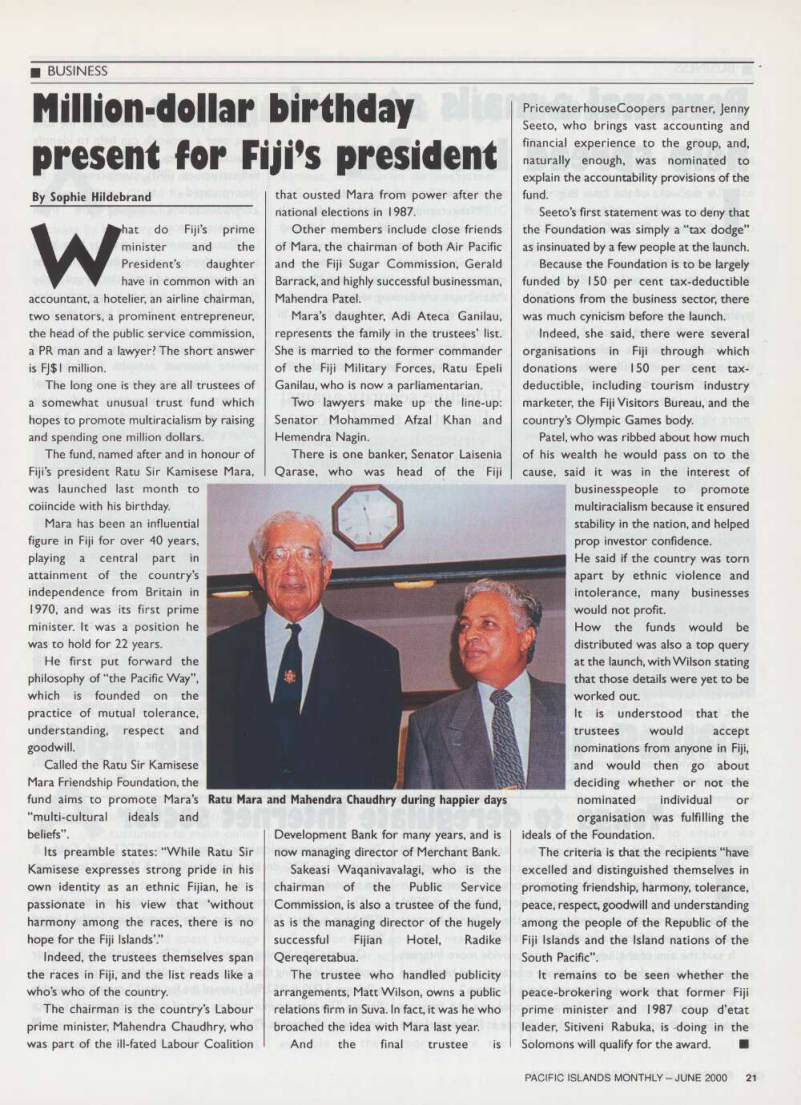
Ratu Mara and Mahendra Chaudhry during happier days
help spread Love Bug

Personal e-mails at work help spread Love Bug
In the wake of the Love Bug virus, International Chamber of Commerce (lCC)’s Cybercrime Unit has urged companies to discourage employees from using company computers for personal e-mails and advised organisations to tighten security on every system linked to their network.
“The widespread use of company networks for personal e-mails is exactly the kind of practice which allows these viruses to spread,” said Cybercrime Unit Assistant Director, Jon Merrett. “If employers were more vigilant in discouraging personal e mail abuse at work, viruses like the Love Bug wouldn’t be nearly as devastating.”
The‘Love Bug’ virus, which swept across the world leaving the computer networks of government and business in chaos, has highlighted the vulnerability of many computer systems to attack.
The Cybercrime Unit is part of ICC’s London-based Commercial Crime Services, which is leading the global fight against maritime crime, counterfeiting and commercial fraud.
“To prevent a repeat of the Love Bug crisis, companies have to realise best practice is the key to prevention,” said Merrett. According to the Cybercrime Unit, best practice requires more than the regular updating of the existing security systems. The Unit said it is important to involve individual users, promoting vigilance amongst staff and discouraging the use of
the network for personal e-mails.
“Many companies operating firewalls may have felt secure from attack, however recent events have shown the need for companies to develop comprehensive and ongoing security policies,” said Merrett.
“As viruses and hacking techniques evolve so must the security systems that are in place to protect against them.”
Aled Miles, director of the anti-virus software company Symantec, said that the
Effective security against
disruptive e-mail-bome
viruses has to be built
into the infrastructure of
corporate networks
impact of the virus was exacerbated by lax security standards in many countries.“ Only three weeks ago the (UK) Government issued a report showing that fewer than 1 5 per cent of companies have security policies in place,” he said.
Many firewalls do offer fair protection against conventional hackers. However, computers security experts appear to be in agreement that effective security against disruptive e-mail-borne viruses has to be built into the infrastructure of corporate networks.
Good security blocks suspicious e-mails and alerts the network administrator before they are distributed to the individual
users. The use of data mining, which examines patterns and trends for the data sent over a network, can help to identify unusual activity, while Public Key Infrastructure (PKI) can increasingly be
incorporated to verify that
communications received are from
legitimate sources.
Though anti-virus teams may have been quick to develop software fixes to minimize further damage and check the spread of the ‘Love Bug’ virus, nobody is suggesting that the bigger problem has yet been solved.
Industry analysts point out that this latest virus, which follows the denial of service Internet assaults in February, demonstrates the reliance of the global economy on computers and their
susceptibility to interference. Among
others the websites of Amazon.com and CNN.com were seriously affected.
Guy Field, technical analyst at brokers Teather and Greenwood, said: “This is the weakness in the new economy: the electronics world is expanding and so are the opportunities for criminal activity. It is likely that we will see more and more of this kind of attack in the future.”
The Internet and e-mail are an integral part of the modern business environment and as e-commerce grows, so too will the dependence of companies on reliable and secure computer systems. There may be no way yet to guard completely against future security breaches. However, companies and organisations that give system security the priority it demands should find their networks less prone to attack by viruses and hackers than those who fail to address the issue. ■
Tonga to deregulate Internet sector
THE Tongan government has announced it will deregulate the Internet sector in the Kingdom.
According to a Radio Tonga report, the Government is changing its policy on Internet Service Providers (ISPs) “to allow more competition and improve the quality of Internet services, at a cost-effective and efficient manner.”
It said the aim of the new policy is to provide more Internet access,“in order to develop and enhance education and health, and to accelerate economic development of the Kingdom.”
The government currently has a monopoly on the Internet sector. Two companies were allowed to operate as ISPs, namely the
Tonga Telecommunications Commission (TTC) and Cable & Wireless, but TTC decided to allow Cable & Wireless to operate the service in the Kingdom.
The Tongan government has specified a special condition that all ISPs have a direct link with the main Internet pipe in the United States.
Companies planning to establish ISPs must also fulfill other conditions, including the submission of a development plan, and pay a Pa’anga 5,000 (U 552,965) annual fee for the 12-month renewable licence.The telecommunications unit of the prime minister’s office processes all licences. PNS ■
Ansett Australia launches free Global Rewards
Ansett Australia is now offering free membership of its Global Rewards loyalty programme, following a decision by the company to remove the AUDS6O joining fee, making Global Rewards a very attractive programme to customers. Global Rewards members are recognised across all Ansett’s routes and by each of its international Star Alliance partners, which include 13 of the world’s leading airlines; Air Canada, Air New Zealand, All Nippon Airways, Ansett Australia, Austrian Airlines Group (which comprises Austrian Airlines, Lauda Air and
Tyrolean Airways), Lufthansa German
Airlines, Scandinavian Airlines System - SAS, Singapore Airlines, Thai Airways International, United Airlines and VARIG Brazilian Airlines. Points can be redeemed for flights to more than 800 destinations worldwide across I 12 countries.
Ansett customers can also earn points with other partners including Diners Club, Avis Australia and a variety of hotels and resorts. For frequent air travellers and business class passengers the benefits of becoming a Global Rewards member are even more significant. The more points accumulated, the greater the
benefits - from priority baggage handling and extra baggage allowance, to free upgrades and access to Star Alliance lounges across the world.
To join Global Rewards, log onto Ansett’s web site at www.ansett.com.au.
Ansett Australia has been serving Asia since 1993. The airline currently operates flights between Australia and four international destinations: Bali, Fiji, Hong Kong, and Osaka. Ansett Australia is a wholly owned subsidiary of Ansett Holdings Limited that is equally owned by Air New Zealand and News Corporation Ltd. ■
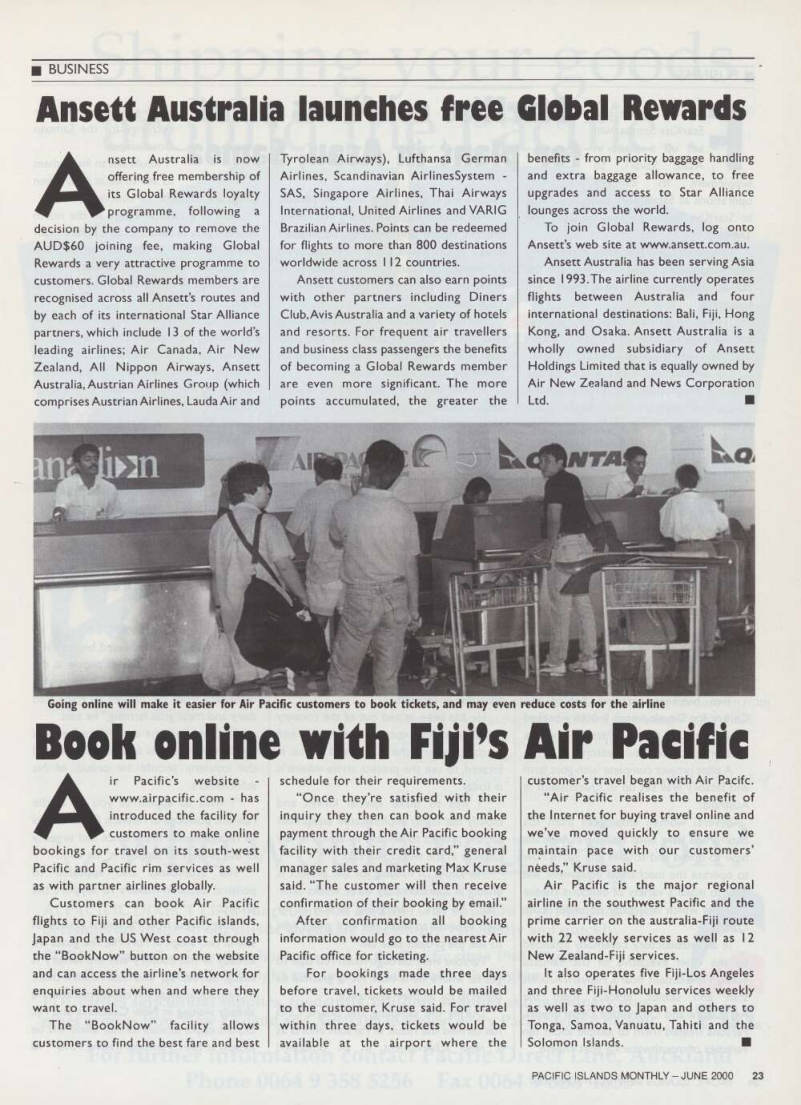
Going online will make it easier for Air Pacific customers to book tickets, and may even reduce costs for the airline
Book online with Fiji’s Air Pacific
Air Pacific’s website www.airpacific.com - has introduced the facility for customers to make online bookings for travel on its south-west Pacific and Pacific rim services as well as with partner airlines globally.
Customers can book Air Pacific flights to Fiji and other Pacific islands, Japan and the US West coast through the “Book Now” button on the website and can access the airline’s network for enquiries about when and where they want to travel.
The “Book Now” facility allows customers to find the best fare and best
schedule for their requirements.
“Once they’re satisfied with their inquiry they then can book and make payment through the Air Pacific booking facility with their credit card,” general manager sales and marketing Max Kruse said. “The customer will then receive confirmation of their booking by email.”
After confirmation all booking information would go to the nearest Air Pacific office for ticketing.
For bookings made three days before travel, tickets would be mailed to the customer, Kruse said. For travel within three days, tickets would be available at the airport where the
customer’s travel began with Air Pacifc.
“Air Pacific realises the benefit of the Internet for buying travel online and we’ve moved quickly to ensure we maintain pace with our customers’ needs,” Kruse said.
Air Pacific is the major regional airline in the southwest Pacific and the prime carrier on the australia-Fiji route with 22 weekly services as well as 12 New Zealand-Fiji services.
It also operates five Fiji-Los Angeles and three Fiji-Honolulu services weekly as well as two to Japan and others to Tonga, Samoa, Vanuatu, Tahiti and the Solomon Islands. ■
Fish processor,
StarKist confirms plans for plan! in Asau, Samoa
StarKist Samoa, will set up a plant in Asau, Savai’i, to supplement its cannery
operations at Satala very soon, according to StarKist Samoa general manager Phil Thirkell.
This, he said, will take place immediately after negotiations - now underway with the Samoan government and Asau Village - are successful.
“Things so far have been encouraging, and we hope to close off a land acquisition deal soon with the Asau Council,” he said.
The desired land is at the Asau harbor area and the proposed fish processings are meant to support the Satala plant operation.
“The plan is to utilise the resources there to support the local StarKist operation,” he continued.
The project plans are two-fold: the first stage involves the processing of albacore and having them frozen and shipped to the Satala plant for canning and export. This
division will employ more than 100 people.
The second stage involves a fish loining process where they will also be shipped frozen to the Satala plant for preparation for export. This more-involved process is expected to eventually employ more than
1,600 people.
Thirkell pointed out that establishing the two operations may take years but they both will increase the tonnage of fish to be processed at the Satala cannery.
Thirkell said it was too early to discuss details including wage structures for the Savai’i plant, the effect on the current Satala Plant’s more than 3,000 employees, the purse seiner fleet supplying the Asau operation and other aspects.
But Thirkell said, the Asau operation would be of help to the Samoan albacore fishermen who have been selling to the local canneries for the last five years,
earning millions in foreign exchange for the Samoan Government.
“I would like to invite them to sell to us at Asau when
things are finalised,” he concluded.
Asau is a coastal village in the north western part of Savai’i. It has a harbor man made in the 1960 s to enable sea transportation of lumber that was milled by a US company in the virgin forests of the area.
The company has changed hands, and the lumber operations there continue to use the port up to now. The port has since become known also for the commercial operations that have naturally sprung up in the area.
Star Kist Samoa is the largest private employer in the territory, with more than 3,000 employees. Other than employment and community service projects, it has provided corporate tax advance payments regularly in recent years at government’s request, to help out with government cash
flow problems. (Samoa News) ■
Goat products breakthrough in Vanuatu
Anew breakthrough into an untapped local and export market for goat meat and products is set to take off within the next few months in Vanuatu.
Two business partners behind the
Centre for Development Industry-backed
project are Dr Charlie Parsons and Toa Enterprises owner, Paul Heston.
A pilot project complete with goat farm and factory was set up in Queensland in Australia.
Several women employees from Toa Enterprises have been training in Australia how to breed and to milk the goats, how to operate the mechanical equipment and how to make a variety of delicious cheese - one of which is already on order from Qantas.
In an introductory ceremony attended by the chief executive of the Vanuatu Foreign Investment Board, Howard Aru, his staff and senior officers from the Agriculture and Quarantine Departments, Parsons treated them to sample about ten varieties of mouthwatering goat cheese.
“Umm...delicious, unbelievable,” said the group as they nodded and continued to sample from one plate to another.
Parsons is a medical doctor by profession but also an inventor and specialist in agriculture.
He has been in and out of the country traveling, at his expense, to Australia and Brussels where the GDI head office is located, to see the project arrive where it is today.
“I had to make special knives and
modify the highly sophisticated equipment
for the project to be able to set up in any country in the world,” he said.
He said GDI funding for the project is ending in approximately three weeks time.
“But,” he says, “I am going to stay at my own expense to await the final green light to see the project take off.”
Parsons went through much red tape to get to where he is now. He is grateful to theVFIB for all their assistance.
During the sampling, the Board CEO has termed the result of Parsons efforts as a new achievement in an untapped
industry.
“We ni-Vanuatu should be proud of what Dr Parsons has achieved, because it is an ideal opportunity for our people in the islands to be informed of the opportunity to benefit from the project by going into dairy and meat goat farming,” he said.
Aru said Parsons experienced quite a number of problems to come this far and the country should be proud of his achievement.
“I wish to appeal to you all in the relevant positions in relevant Departments to recognise the importance and urgency of this project to support it,” he said.
The attendants also appealed to political decision-makers to support the project Goat cheese from Parsons is already on sale in two shops in PortVila.The goats are already in the country and the factory is ready to set up and run within three months. Goat meat and cheese markets are already waiting in New Caledonia and Fiji.
Export opportunities further afield will be looked at next. (Vanuatu Trading Post) ■
Advertisements & other items, pp. 25-27 (2 items)
Shipping your goods
around the Pacific...
SOS
■■ hi mum
Bruce Johnson
Sales Executive XYZ Shipping.
Started in the shipping industry when he joined XYZ Shipping 12 months ago. He services Auckland customers for the Pacific leg of the round-the-world service. Prior to that, was employed as a sales rep with a computer company.
Has no discretion on the tariff. Reports to the National Sales Manager, who has greater authority, but all decisions are referred to Pricing Division.
Tammy Hamawi
Line Manager/Commercial
Director Director and shareholder with PDL Line, a privately owned company whose sole purpose is to cater for trade in the South Pacific.
Based in Head Office.
Fifteen years in the shipping industry, working her way up from Shipping Clerk to Supervisor. PDL Line Manager since 1994.
Has total discretion when dealing with customers without referral to other Managers.
Ambition: To play a significant role in the success and growth of PDL through superlative customer service.
.. .who would you rely on?
At PACIFIC DIRECT LINE our people run the line. Our structure is streamlined and decisions are made so our clients' needs are met simply, efficiently and quickly.
PDL is a family business that has operated in the Pacific since 1968. Thirty-two years of dedication to providing freight and logistics services in the region.
PDL carries agricultural supplies, foodstuffs, building supplies and machinery plus other cargoes from New Zealand and Australia to almost every Pacific Island nation.
PDL
For further information contact Pacific Direct Line, Auckland Phone 0064 9 358 5256 Fax 0064 9 358 4833
TNuceaT
Enewetak awarded US$325, but no money to pay
By Giff Johnson
Tribunal awarded islanders from a former nuclear test site
US$325 million for their hardships in exile, past and future loss of use of their home atoll, and for cleanup and
resettlement.
But the Tribunal, which compensates personal injury and land damage claims in the Marshall Islands with a US-provided compensation fund, does not have the money to pay even a tiny fraction of the compensation it has awarded to islanders from Enewetak Atoll.
The precedent
setting Tribunal decision in mid-April is the first to settle a claim for nuclear test damage to land in the Marshall Islands.
Enewetak was the site of 43 American nuclear tests, including the first hydrogen device in 1952.
Enewetak’s case was filed nearly 10 years ago and went through numerous hearings and lengthy scientific and legal argument to address the value of damages.
“Claimants have suffered damage beyond that which money can
compensate,” the
Tribunal said at the end of its 34 page
ruling. “While that which was lost may be priceless, it does not mean it was without value; nor does it justify an award which is not firmly based in fairness and reasonableness.”
The bottom line, however, is-that the Tribunal had only US$45 million in
compensation funds provided by the US.
Most of that has been exhausted paying compensation for more than 1,600 personal injury awards since the early 19905.
, VVT*
Gregor/ Dana indicated that
since the Tribunal has only two more years of U 553.25 million drawdowns left, it “can’t set a long range payment plan until funding is available to
implement it.”
Payment of the total award US$325 million award will “depend largely on a petition” that the Marshall Islands government is preparing to submit to the US Congress seeking additional nuclear test compensation.
Hawaii-based Enewetak attorney Davor Pevec said in Majuro said the Tribunal’s award would bolster Marshall Islands government efforts to seek expanded compensation from the US Congress.
If the lobbying effort in Congress does not bear fruit, Enewetak will move to reopen a lawsuit in US federal courts. The suit, in the mid 1980s, was dismissed on the basis that the Nuclear Claims Tribunal was the appropriate forum
in which to address Enewetak’s claim.
But, said Pevec, now that the Tribunal ruling confirms the inadequacy of US provided compensation to the Marshalls, US courts may be receptive
The Nuclear Claims Tribunal says that new technology will allow the nuclear cleanup of Runit Island, home of the famous nuclear waste dome
to the Enewetak claim.
The Tribunal’s compensation award for Enewetak was divided into three parts: - Loss of use from 1947 to 2026 -
US$l 99,1 54,81 I.
- Restoration, including a nuclear cleanup, rehabilitation and resettlement - U 5591,710,000. - Hardship for suffering while lived in exile on Ujelang Atoll from the time of resettlement in 1947 through their return to Enewetak in 1960 U 5534,084,500.
A major portion of the Tribunal’s decision focuses on the cleanup methods that should be used to make all of Enewetak’s necklace of coral islands habitable.
From 1977 to 1980, the US Army conducted a limited nuclear cleanup at Enewetak, which allowed the population to move back to the southern portion of the atoll.
Runit Island, which houses a huge concrete dome encasing thousands of cubic yards of nuclear waste scraped off other islands, remains highly radioactive from plutonium 239 and is still
quarantined.
But the Tribunal said, “Techniques now exist to cleanup this plutonium,
utilising soil sorting methods applied at Johnston Atoll and dissolving the coral soil to separate out the plutonium for disposal.” It will cost about US$lO million to cleanup Runit.
Meanwhile, the northern islands in Enewetak’s coral necklace also remain off-limits to habitation.
The Tribunal’s decision would, if funded, provide the necessary resources to finance a cleanup that would partially scrape contaminated soils from these islands, as well as use potassium fertilizer in other areas to reduce the uptake of cesium I 37 by root crops.
Potassium, which resembles cesium chemically, has been proven to suppress the uptake of radioactive cesium in coconut trees and other crops at Bikini Atoll, the site of 23 US nuclear tests.
A key element in the Tribunal’s award for a nuclear cleanup is the adoption of a stringent US Environmental Protection Agency radiation protection standard.
The Tribunal is following a 15 millirem limit for exposure to man-made radiation - a standard adopted by the US EPA for nuclear waste cleanup sites on the mainland.
The Tribunal said it followed the International Atomic Energy Agency position, which, in essence, says that, in
protecting Marshall Islands citizens, radiation guidelines should be adopted that are at least as strict as those used to protect US citizens.
Similar land damage claims by islanders from Bikini, Rongelap and Utrik are pending with the Tribunal.
A Marshall Islands government committee - that consists of elected leaders, scientists and officials from the Nuclear Claims Tribunal - is preparing a so-called “changed circumstances” petition to submit to the US Congress seeking increased compensation and expanded medical care.
A provision in the Compact of Free Association allows the Marshall Islands to come back to the Congress for more compensation if it can prove that since the Compact was implemented in 1986, there have been “changed circumstances” rendering the US$l5O million trust fund manifestly inadequate.
Government officials in Majuro indicate that the petition will be submitted to the Congress in the next two months.
Meanwhile, during mid-May, an
Enewetak group was heading to Washington to lobby for compensation to pay the Nuclear Claims Tribunal’s award. ■
Enewetak Islanders had 11 years of “annoyance”
By Gift Johnson
Although the hardships associated with the relocation of the people of Enewetak to Ujelang Atoll in 1947 have been characterised as ‘discomfort and annoyance’ (to be consistent with US legal rulings), it is clear that the conditions suffered by those relocated go far beyond simple annoyance.”
This comment was made by the Nuclear Claims Tribunal in the section on hardship compensation of its US$325 million award to Enewetak in mid-April.
Laurence Carucci, an anthropologist who worked on Enewetak for a number of years in the 1970 s and who testified for Enewetak, said the stories which the Enewetak people repeat “again and again focus on a number of core incidents including famine and hunger, near starvation and death from illness, food shortage and the limitations of the environment on Ujelang (fishing/collecting), the polio epidemic, the measles epidemic, the rat infestation, the time of the strike, and easing of suffering during the 1970 s but with continued homesickness and desire to return to Enewetak.”
In considering the value of a hardship award, the Tribunal said that it had set U 55125,000 as the maximum award for personal injury claims relating to exposure to nuclear test fallout.
To be fair to these claimants, hardship damages should not be more than this amount, the Tribunal decided.
It said there was general agreement that of the 33 years in exile on Ujelang, the period from 1956 to 1972 was when the greatest suffering occurred.
The annual per-person compensation award for this 16-year period was determined to be U 554,500. For the remaining 17 years, the annual amount is $3,000.
“This means that an individual who was present on Ujelang for all 33 years would receive U 55123,000,” the decision said.
“The Tribunal acknowledges that this amount is somewhat arbitrary and cannot fully repay those who suffered on Ujelang.”
Considering Enewetak’s population during that 33-year
period, the compensation for hardship was put at U 5534,084,500. ■
Vunibaka excels in language of rugby
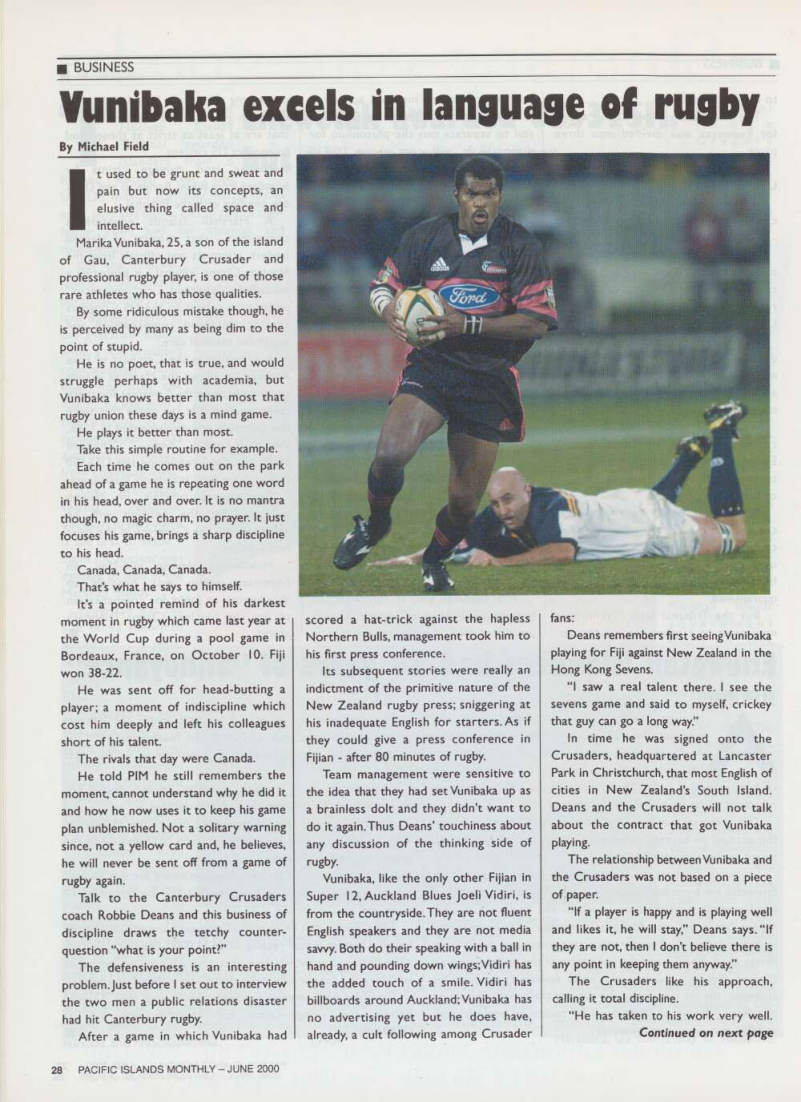
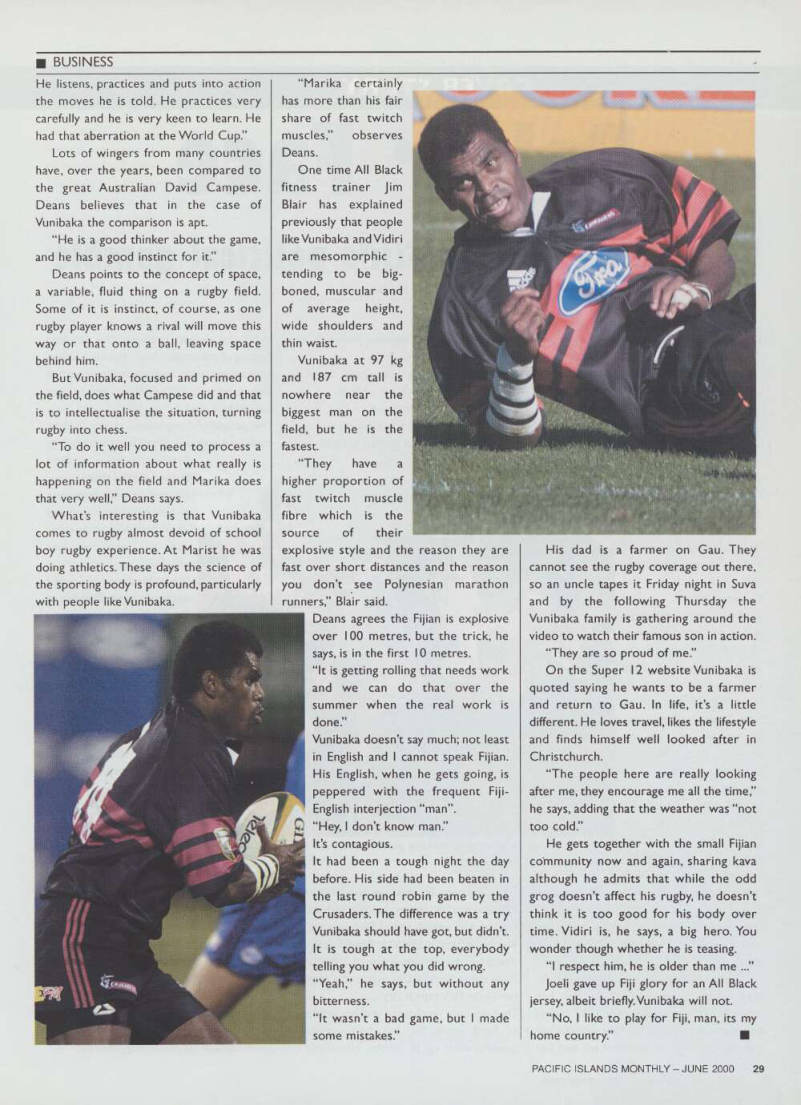
By Michael Field
It used to be grunt and sweat and pain but now its concepts, an elusive thing called space and intellect.
Marika Vunibaka, 25, a son of the island of Gau, Canterbury Crusader and professional rugby player, is one of those rare athletes who has those qualities.
By some ridiculous mistake though, he is perceived by many as being dim to the point of stupid.
He is no poet, that is true, and would struggle perhaps with academia, but Vunibaka knows better than most that rugby union these days is a mind game.
He plays it better than most.
Take this simple routine for example.
Each time he comes out on the park ahead of a game he is repeating one word in his head, over and over. It is no mantra though, no magic charm, no prayer. It just focuses his game, brings a sharp discipline to his head.
Canada, Canada, Canada.
That’s what he says to himself.
It’s a pointed remind of his darkest moment in rugby which came last year at the World Cup during a pool game in Bordeaux, France, on October 10. Fiji won 38-22.
He was sent off for head-butting a player; a moment of indiscipline which cost him deeply and left his colleagues short of his talent.
The rivals that day were Canada.
He told PIM he still remembers the moment, cannot understand why he did it and how he now uses it to keep his game plan unblemished. Not a solitary warning since, not a yellow card and, he believes, he will never be sent off from a game of rugby again.
Talk to the Canterbury Crusaders coach Robbie Deans and this business of discipline draws the tetchy counter question “what is your point?”
The defensiveness is an interesting problem. Just before I set out to interview the two men a public relations disaster had hit Canterbury rugby.
After a game in which Vunibaka had
scored a hat-trick against the hapless Northern Bulls, management took him to his first press conference.
Its subsequent stories were really an indictment of the primitive nature of the New Zealand rugby press; sniggering at his inadequate English for starters. As if they could give a press conference in Fijian - after 80 minutes of rugby.
Team management were sensitive to the idea that they had set Vunibaka up as a brainless dolt and they didn’t want to do it again. Thus Deans’ touchiness about any discussion of the thinking side of
rugby.
Vunibaka, like the only other Fijian in Super 12, Auckland Blues Joeli Vidiri, is from the countryside. They are not fluent English speakers and they are not media savvy. Both do their speaking with a ball in hand and pounding down wings;Vidiri has the added touch of a smile. Vidiri has billboards around Auckland; Vunibaka has no advertising yet but he does have, already, a cult following among Crusader
fans: Deans remembers first seeing Vunibaka playing for Fiji against New Zealand in the Hong Kong Sevens.
“I saw a real talent there. I see the sevens game and said to myself, crickey that guy can go a long way.”
In time he was signed onto the Crusaders, headquartered at Lancaster Park in Christchurch, that most English of cities in New Zealand’s South Island.
Deans and the Crusaders will not talk about the contract that got Vunibaka playing.
The relationship between Vunibaka and the Crusaders was not based on a piece of paper.
“If a player is happy and is playing well and likes it, he will stay,” Deans says. “If they are not, then I don’t believe there is any point in keeping them anyway.”
The Crusaders like his approach, calling it total discipline.
“He has taken to his work very well.
Continued on next page
He listens, practices and puts into action the moves he is told. He practices very carefully and he is very keen to learn. He had that aberration at the World Cup.”
Lots of wingers from many countries have, over the years, been compared to the great Australian David Campese.
Deans believes that in the case of Vunibaka the comparison is apt.
“He is a good thinker about the game, and he has a good instinct for it.”
Deans points to the concept of space, a variable, fluid thing on a rugby field.
Some of it is instinct, of course, as one rugby player knows a rival will move this way or that onto a ball, leaving space behind him.
But Vunibaka, focused and primed on the field, does what Campese did and that is to intellectualise the situation, turning rugby into chess.
“To do it well you need to process a lot of information about what really is happening on the field and Marika does that very well,” Deans says.
What’s interesting is that Vunibaka comes to rugby almost devoid of school boy rugby experience. At Marist he was doing athletics. These days the science of the sporting body is profound, particularly with people like Vunibaka.
“Marika certainly
has more than his fair share of fast twitch muscles,” observes Deans.
One time All Black fitness trainer Jim Blair has explained
previously that people
like Vunibaka andVidiri are mesomorphic -
tending to be big
boned, muscular and of average height, wide shoulders and thin waist.
Vunibaka at 97 kg and 187 cm tall is nowhere near the biggest man on the field, but he is the fastest.
“They have a higher proportion of fast twitch muscle fibre which is the source of their
explosive style and the reason they are fast over short distances and the reason you don’t see Polynesian marathon runners,” Blair said.
Deans agrees the Fijian is explosive over 100 metres, but the trick, he says, is in the first 10 metres.
“It is getting rolling that needs work and we can do that over the summer when the real work is done.”
Vunibaka doesn’t say much; not least in English and I cannot speak Fijian.
His English, when he gets going, is
peppered with the frequent Fiji-
English interjection “man”.
“Hey, I don’t know man.”
It’s contagious.
It had been a tough night the day before. His side had been beaten in the last round robin game by the Crusaders. The difference was a try Vunibaka should have got, but didn’t.
It is tough at the top, everybody telling you what you did wrong.
“Yeah,” he says, but without any bitterness.
“It wasn’t a bad game, but I made some mistakes.”
His dad is a farmer on Gau. The/ cannot see the rugby coverage out there, so an uncle tapes it Friday night in Suva
and by the following Thursday the
Vunibaka family is gathering around the video to watch their famous son in action.
“They are so proud of me.”
On the Super 12 website Vunibaka is quoted saying he wants to be a farmer and return to Gau. In life, it’s a little different. He loves travel, likes the lifestyle and finds himself well looked after in Christchurch.
“The people here are really looking
after me, they encourage me all the time,” he says, adding that the weather was “not too cold.”
He gets together with the small Fijian community now and again, sharing kava although he admits that while the odd grog doesn’t affect his rugby, he doesn’t think it is too good for his body over time. Vidiri is, he says, a big hero. You wonder though whether he is teasing.
“I respect him, he is older than me ...”
Joeli gave up Fiji glory for an All Black jersey, albeit briefly.Vunibaka will not.
“No, I like to play for Fiji, man, its my home country.” ■
Poker Face
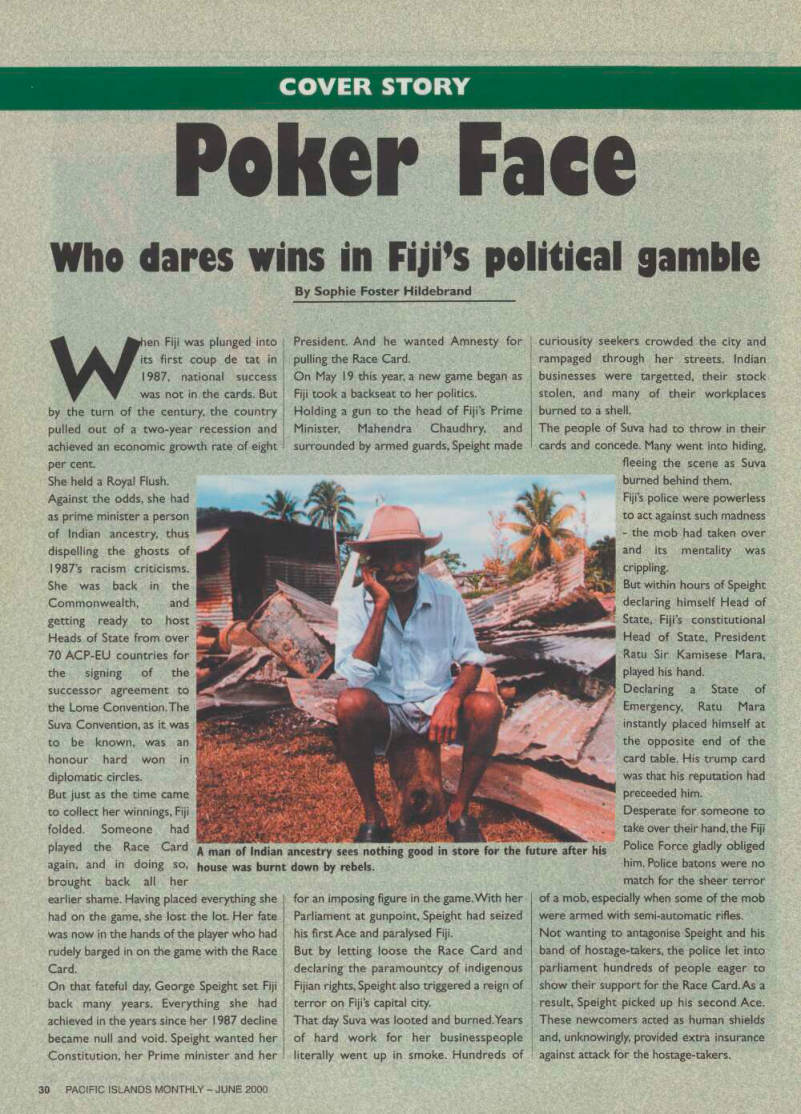
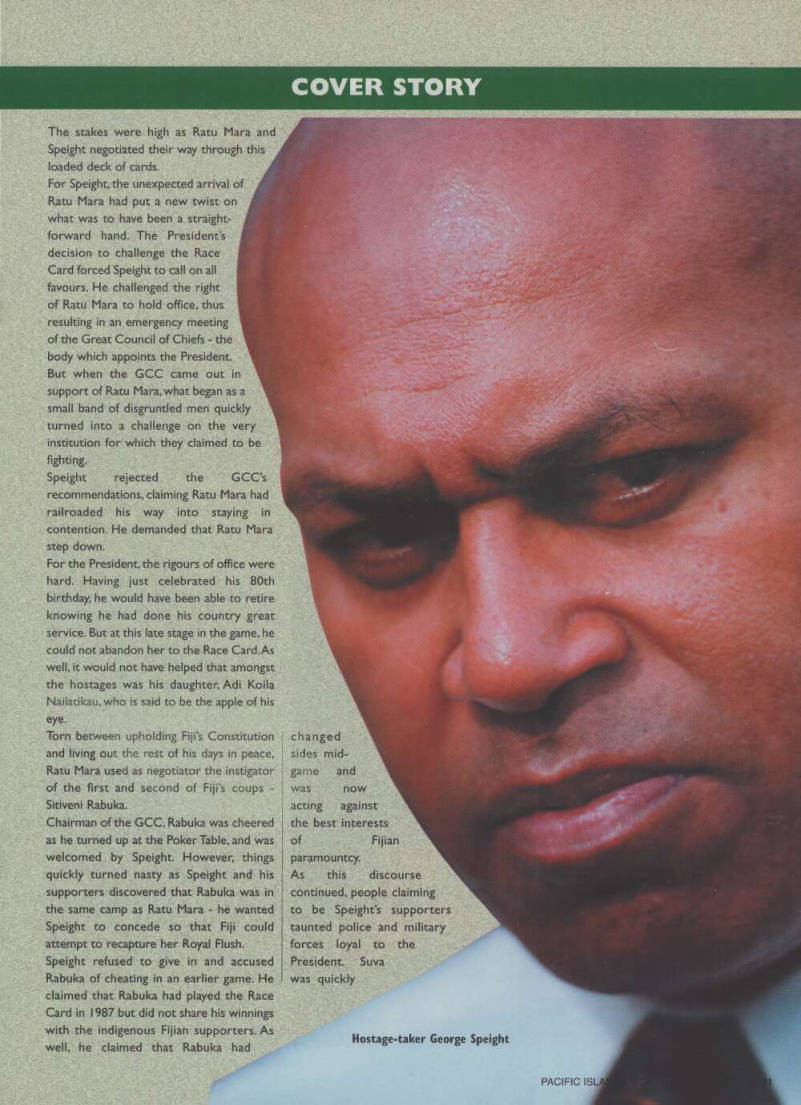
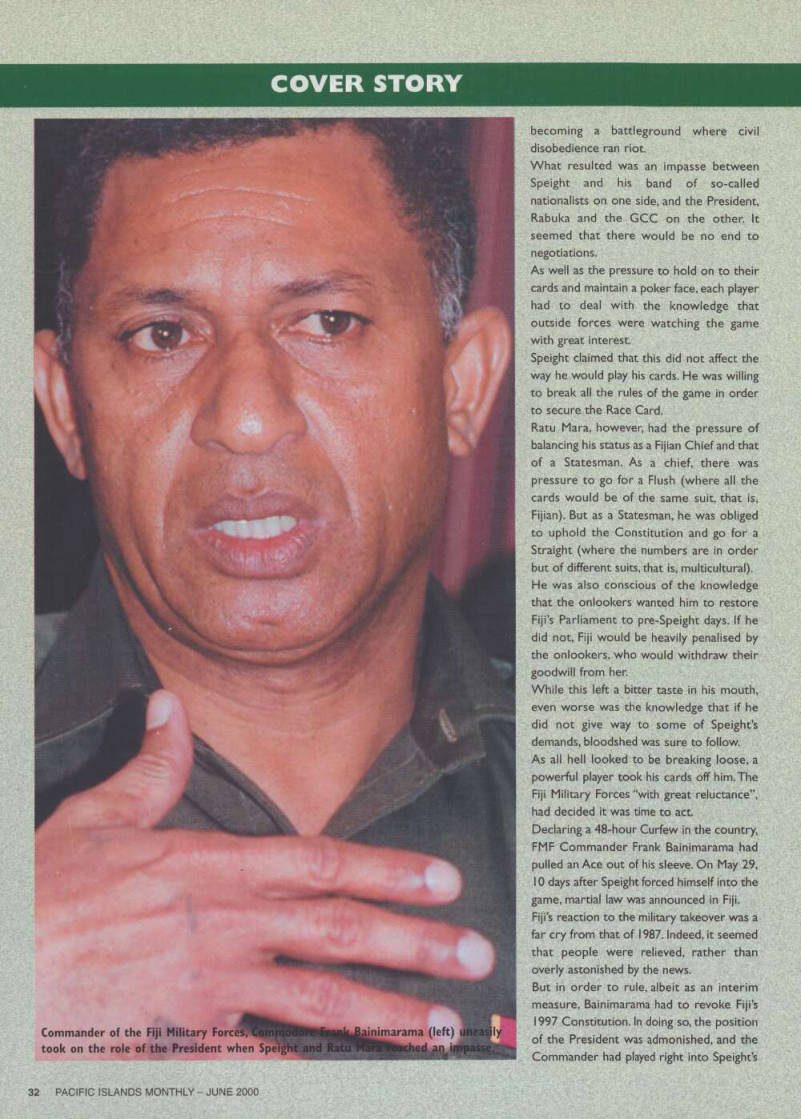
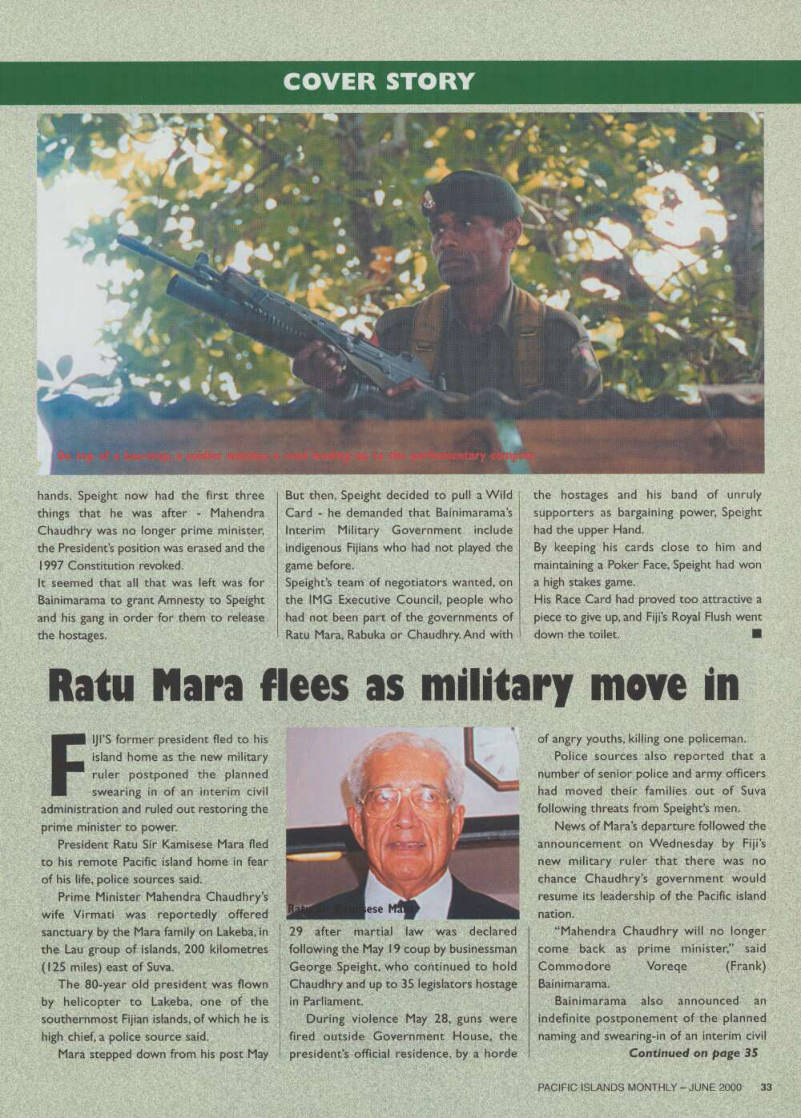
Cover Story
Poker Face Who dares wins in Fiji’s political gamble
By Sophie Foster Hildebrand
When Fiji was plunged into
its first coup de tat in 1987, national success was not in the cards. But by the turn of the century, the country pulled out of a two-year recession and achieved an economic growth rate of eight per cent.
She held a Royal Flush.
Against the odds, she had as prime minister a person of Indian ancestry, thus
dispelling the ghosts of
1987’s racism criticisms.
She was back in the Commonwealth, and getting ready to host Heads of State from over 70 ACP-EU countries for the signing of the successor agreement to the Lome Convention. The Suva Convention, as it was to be known, was an honour hard won in
diplomatic circles.
But just as the time came to collect her winnings, Fiji folded. Someone had played the Race Card again, and in doing so, brought back all her
earlier shame. Having placed everything she
had on the game, she lost the lot. Her fate was now in the hands of the player who had rudely barged in on the game with the Race Card.
On that fateful day, George Speight set Fiji back many years. Everything she had achieved in the years since her 1987 decline became null and void. Speight wanted her Constitution, her Prime minister and her
President. And he wanted Amnesty for pulling the Race Card.
On May 19 this year, a new game began as Fiji took a backseat to her politics.
Holding a gun to the head of Fiji’s Prime Minister, Mahendra Chaudhry, and surrounded by armed guards, Speight made
for an imposing figure in the game. With her Parliament at gunpoint, Speight had seized his first Ace and paralysed Fiji.
But by letting loose the Race Card and declaring the paramountcy of indigenous Fijian rights, Speight also triggered a reign of terror on Fiji’s capital city.
That day Suva was looted and burned. Years of hard work for her businesspeople literally went up in smoke. Hundreds of
curiousity seekers crowded the city and rampaged through her streets. Indian businesses were targetted, their stock stolen, and many of their workplaces burned to a shell.
The people of Suva had to throw in their cards and concede. Many went into hiding,
fleeing the scene as Suva burned behind them.
Fiji’s police were powerless to act against such madness - the mob had taken over and its mentality was
crippling.
But within hours of Speight declaring himself Head of State, Fiji’s constitutional Head of State, President Ratu Sir Kamisese Mara, played his hand.
Declaring a State of Emergency, Ratu Mara instantly placed himself at the opposite end of the card table. His trump card was that his reputation had preceeded him.
Desperate for someone to take over their hand, the Fiji
Police Force gladly obliged
him. Police batons were no match for the sheer terror
of a mob, especially when some of the mob were armed with semi-automatic rifles.
Not wanting to antagonise Speight and his band of hostage-takers, the police let into parliament hundreds of people eager to show their support for the Race Card. Asa result, Speight picked up his second Ace.
These newcomers acted as human shields and, unknowingly, provided extra insurance against attack for the hostage-takers.
A man of Indian ancestry sees nothing good in store for the future after his house was burnt down by rebels.
The stakes were high as Ratu Mara and
Speight negotiated their way through this
loaded deck of cards. Jk For Speight, the unexpected arrival of A Ratu Mara had put a new twist on jHB what was to have been a straight forward hand. The President’s m" decision to challenge the Race jHSH Card forced Speight to call on all ||i :
favours. He challenged the right ■pHp
of Ratu Mara to hold office, thus B resulting in an emergency meeting of the Great Council of Chiefs - the body which appoints the President. l| But when the GCC came out in vH support of Ratu Mara, what began as a ljj small band of disgruntled men quickly turned into a challenge on the very ■ institution for which they claimed to be
fighting.
Speight rejected the GCCs
recommendations, claiming Ratu Mara had railroaded his way into staying in contention. He demanded that Ratu Mara step down.
For the President, the rigours of office were hard. Having just celebrated his 80th birthday, he would have been able to retire knowing he had done his country great service. But at this late stage in the game, he could not abandon her to the Race Card.As well, it would not have helped that amongst the hostages was his daughter, Adi Koila Nailatikau, who is said to be the apple of his eye.
Torn between upholding Fiji’s Constitution and living out the rest of his days in peace, Ratu Mara used as negotiator the instigator of the first and second of Fiji’s coups - Sitiveni Rabuka.
Chairman of the GCC, Rabuka was cheered as he turned up at the Poker Table, and was
welcomed by Speight. However, things
quickly turned nasty as Speight and his supporters discovered that Rabuka was in the same camp as Ratu Mara - he wanted Speight to concede so that Fiji could attempt to recapture her Royal Flush.
Speight refused to give in and accused Rabuka of cheating in an earlier game. He claimed that Rabuka had played the Race Card in 1987 but did not share his winnings with the indigenous Fijian supporters. As well, he claimed that Rabuka had
changed sides mid game and was now acting against the best interests of Fijian paramountcy.
As this discourse continued, people claiming to be Speight’s supporters taunted police and military forces loyal to the President. Suva
was quickly
Hostage-taker George Speight
becoming a battleground where civil disobedience ran riot.
What resulted was an impasse between Speight and his band of so-called nationalists on one side, and the President, Rabuka and the GCC on the other. It seemed that there would be no end to negotiations.
As well as the pressure to hold on to their cards and maintain a poker face, each player had to deal with the knowledge that outside forces were watching the game with great interest.
Speight claimed that this did not affect the way he would play his cards. He was willing to break all the rules of the game in order to secure the Race Card.
Ratu Mara, however, had the pressure of balancing his status as a Fijian Chief and that of a Statesman. As a chief, there was pressure to go for a Flush (where all the cards would be of the same suit, that is, Fijian). But as a Statesman, he was obliged to uphold the Constitution and go for a Straight (where the numbers are in order but of different suits, that is, multicultural).
He was also conscious of the knowledge that the onlookers wanted him to restore Fiji’s Parliament to pre-Speight days. If he did not, Fiji would be heavily penalised by the onlookers, who would withdraw their goodwill from her.
While this left a bitter taste in his mouth, even worse was the knowledge that if he did not give way to some of Speight’s demands, bloodshed was sure to follow.
As all hell looked to be breaking loose, a powerful player took his cards off him. The Fiji Military Forces “with great reluctance”, had decided it was time to act.
Declaring a 48-hour Curfew in the country, FMF Commander Frank Bainimarama had pulled an Ace out of his sleeve. On May 29, 10 days after Speight forced himself into the game, martial law was announced in Fiji.
Fiji’s reaction to the military takeover was a far cry from that of 1987. Indeed, it seemed that people were relieved, rather than overly astonished by the news.
But in order to rule, albeit as an interim measure, Bainimarama had to revoke Fiji’s 1997 Constitution. In doing so, the position of the President was admonished, and the
Commander had played right into Speight’s
Commander of the Fiji Military Forces, Commodore Fank Bainimarama (left) uneasily took on the role of the President when Speight and Ratu Mara reached an impasse.
hands. Speight now had the first three things that he was after - Mahendra Chaudhry was no longer prime minister, the President’s position was erased and the 1997 Constitution revoked.
It seemed that all that was left was for Bainimarama to grant Amnesty to Speight and his gang in order for them to release the hostages.
But then, Speight decided to pull a Wild Card - he demanded that Bainimarama’s Interim Military Government include indigenous Fijians who had not played the game before.
Speight’s team of negotiators wanted, on the IMG Executive Council, people who had not been part of the governments of Ratu Mara, Rabuka or Chaudhry. And with
the hostages and his band of unruly supporters as bargaining power, Speight had the upper Hand.
By keeping his cards close to him and maintaining a Poker Face, Speight had won a high stakes game.
His Race Card had proved too attractive a piece to give up, and Fiji’s Royal Flush went down the toilet. ■
Advertisements & other items, p. 31 (1 item)
Cover Story
31
,1 AM
Ratu Kara flees as military move in
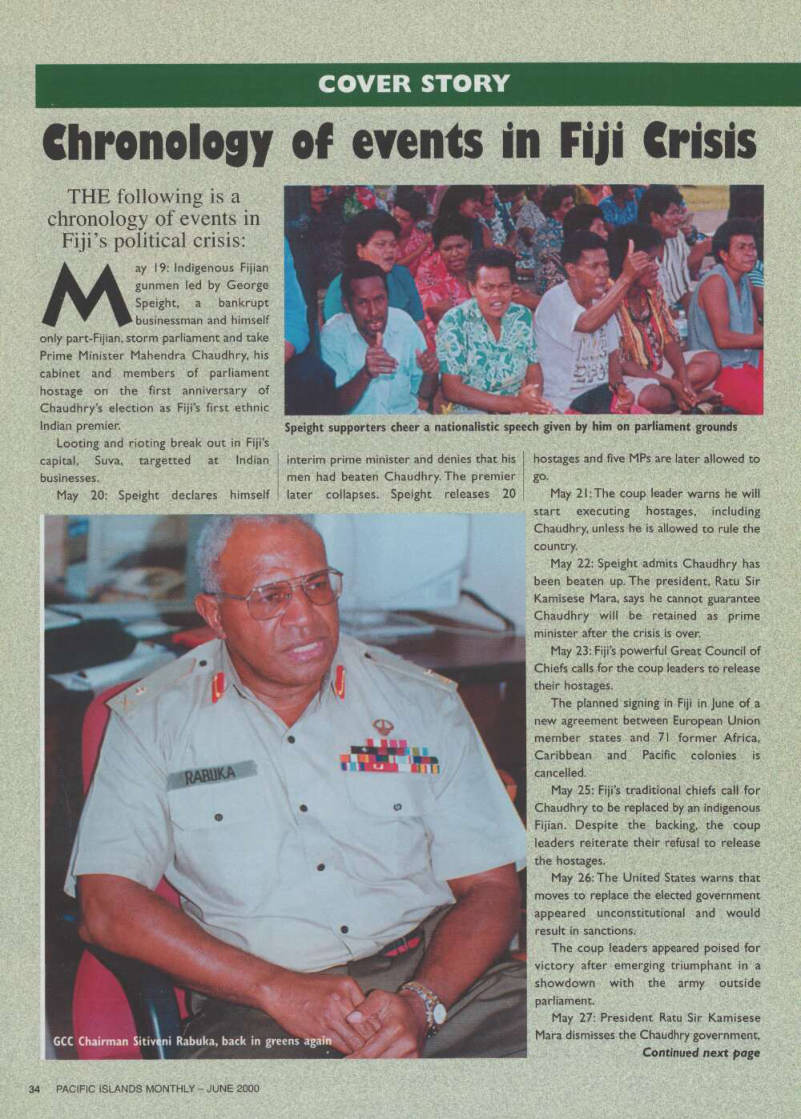
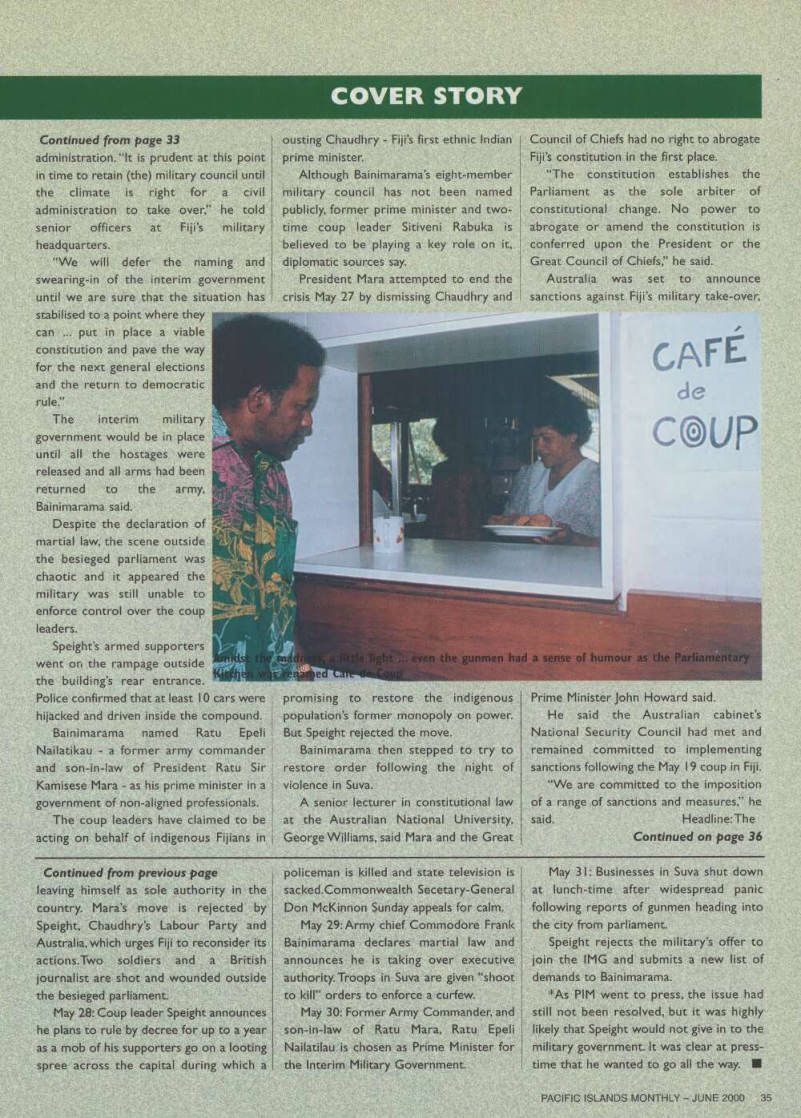
FIJI’S former president fled to his island home as the new military
ruler postponed the planned
swearing in of an interim civil administration and ruled out restoring the prime minister to power.
President Ratu Sir Kamisese Mara fled to his remote Pacific island home in fear of his life, police sources said.
Prime Minister Mahendra Chaudhry’s wife Virmati was reportedly offered sanctuary by the Mara family on Lakeba, in the Lau group of islands, 200 kilometres (125 miles) east of Suva.
The 80-year old president was flown by helicopter to Lakeba, one of the southernmost Fijian islands, of which he is high chief, a police source said.
Mara stepped down from his post May
29 after martial law was declared following the May 19 coup by businessman George Speight, who continued to hold Chaudhry and up to 35 legislators hostage in Parliament.
During violence May 28, guns were fired outside Government House, the president’s official residence, by a horde
of angry youths, killing one policeman.
Police sources also reported that a number of senior police and army officers had moved their families out of Suva following threats from Speight’s men.
News of Mara’s departure followed the announcement on Wednesday by Fiji’s new military ruler that there was no chance Chaudhry’s government would resume its leadership of the Pacific island nation.
“Mahendra Chaudhry will no longer come back as prime minister,” said Commodore Voreqe (Frank) Bainimarama.
Bainimarama also announced an indefinite postponement of the planned naming and swearing-in of an interim civil
Continued on page 35
R etu [?] sese Ma[?]
Continued from page 33
administration. “It is prudent at this point in time to retain (the) military council until the climate is right for a civil administration to take over,” he told senior officers at Fiji’s military headquarters.
“We will defer the naming and swearing-in of the interim government until we are sure that the situation has
stabilised to a point where they can ... put in place a viable constitution and pave the way for the next general elections and the return to democratic rule.”
The interim military government would be in place until all the hostages were released and all arms had been returned to the army, Bainimarama said.
Despite the declaration of martial law, the scene outside
the besieged parliament was
chaotic and it appeared the military was still unable to enforce control over the coup leaders.
Speight’s armed supporters went on the rampage outside the building’s rear entrance.
Police confirmed that at least 10 cars were hijacked and driven inside the compound.
Bainimarama named Ratu Epeli Nailatikau - a former army commander and son-in-law of President Ratu Sir Kamisese Mara - as his prime minister in a government of non-aligned professionals.
The coup leaders have claimed to be acting on behalf of indigenous Fijians in
ousting Chaudhry - Fiji’s first ethnic Indian prime minister.
Although Bainimarama’s eight-member military council has not been named publicly, former prime minister and two time coup leader Sitiveni Rabuka is believed to be playing a key role on it, diplomatic sources say.
President Mara attempted to end the crisis May 27 by dismissing Chaudhry and
promising to restore the indigenous population’s former monopoly on power.
But Speight rejected the move.
Bainimarama then stepped to try to restore order following the night of violence in Suva.
A senior lecturer in constitutional law at the Australian National University, George Williams, said Mara and the Great
Council of Chiefs had no right to abrogate Fiji’s constitution in the first place.
“The constitution establishes the Parliament as the sole arbiter of constitutional change. No power to abrogate or amend the constitution is conferred upon the President or the Great Council of Chiefs,” he said.
Australia was set to announce sanctions against Fiji’s military take-over,
Prime Minister John Howard said.
He said the Australian cabinet’s National Security Council had met and remained committed to implementing sanctions following the May 19 coup in Fiji.
“We are committed to the imposition of a range of sanctions and measures,” he said. Headline:The
Continued on page 36
Amidst the madr[?] a little light ... even the gunmen had a sense of humour as the parliamentary kitchen was renamed cafe de coup
Chronology of events in Fiji Crisis
THE following is a
chronology of events in
Fiji’s political crisis:
May 19: Indigenous Fijian gunmen led by George Speight, a bankrupt businessman and himself only part-Fijian, storm parliament and take Prime Minister Mahendra Chaudhry, his cabinet and members of parliament hostage on the first anniversary of Chaudhry’s election as Fiji’s first ethnic Indian premier.
Looting and rioting break out in Fiji’s capital, Suva, targetted at Indian businesses.
May 20: Speight declares himself
interim prime minister and denies that his men had beaten Chaudhry. The premier later collapses. Speight releases 20
hostages and five MPs are later allowed to go- May 21: The coup leader warns he will start executing hostages, including Chaudhry, unless he is allowed to rule the country.
May 22: Speight admits Chaudhry has been beaten up. The president, Ratu Sir Kamisese Mara, says he cannot guarantee Chaudhry will be retained as prime minister after the crisis is over.
May 23; Fiji’s powerful Great Council of Chiefs calls for the coup leaders to release their hostages.
The planned signing in Fiji in June of a new agreement between European Union member states and 71 former Africa, Caribbean and Pacific colonies is cancelled.
May 25; Fiji’s traditional chiefs call for Chaudhry to be replaced by an indigenous
Fijian. Despite the backing, the coup
leaders reiterate their refusal to release the hostages.
May 26; The United States warns that moves to replace the elected government appeared unconstitutional and would result in sanctions.
The coup leaders appeared poised for victory after emerging triumphant in a showdown with the army outside parliament.
May 27: President Ratu Sir Kamisese Mara dismisses the Chaudhry government,
Continued next page
GCC Chairman Siteni Rabuka, back in greens again
Speight supporters cheer a nationalistic speech given by him on parliament grounds
Continued from previous page
leaving himself as sole authority in the country. Mara’s move is rejected by
Speight, Chaudhry’s Labour Party and
Australia, which urges Fiji to reconsider its actions. Two soldiers and a British journalist are shot and wounded outside
the besieged parliament.
May 28: Coup leader Speight announces he plans to rule by decree for up to a year as a mob of his supporters go on a looting spree across the capital during which a
policeman is killed and state television is sacked. Commonwealth Secetary-General Don McKinnon Sunday appeals for calm.
May 29: Army chief Commodore Frank Bainimarama declares martial law and announces he is taking over executive authority. Troops in Suva are given “shoot to kill” orders to enforce a curfew.
May 30: Former Army Commander, and son-in-law of Ratu Mara, Ratu Epeli Nailatilau is chosen as Prime Minister for the Interim Military Government.
May 31: Businesses in Suva shut down at lunch-time after widespread panic following reports of gunmen heading into the city from parliament.
Speight rejects the military’s offer to join the IMG and submits a new list of demands to Bainimarama. *As RIM went to press, the issue had still not been resolved, but it was highly likely that Speight would not give in to the military government. It was clear at press time that he wanted to go all the way. ■
Terrorism in Fiji
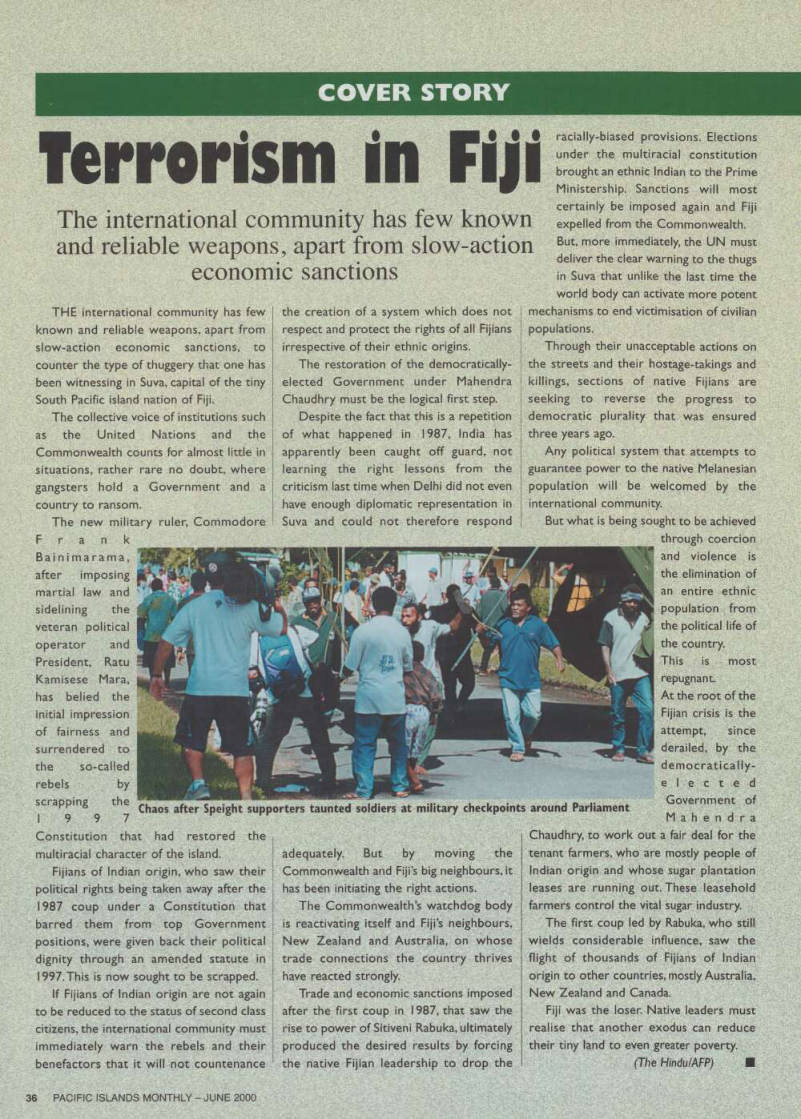
The international community has few known and reliable weapons, apart from slow-action economic sanctions
THE international community has few known and reliable weapons, apart from slow-action economic sanctions, to counter the type of thuggery that one has been witnessing in Suva, capital of the tiny South Pacific island nation of Fiji.
The collective voice of institutions such as the United Nations and the Commonwealth counts for almost little in situations, rather rare no doubt, where gangsters hold a Government and a country to ransom.
The new military ruler, Commodore
Frank Bainimarama, after imposing martial law and sidelining the veteran political operator and President, Ratu Kamisese Mara, has belied the initial impression of fairness and surrendered to the so-called rebels by scrapping the 19 9 7
Constitution that had restored the multiracial character of the island.
Fijians of Indian origin, who saw their political rights being taken away after the 1987 coup under a Constitution that barred them from top Government positions, were given back their political dignity through an amended statute in 1997. This is now sought to be scrapped.
If Fijians of Indian origin are not again to be reduced to the status of second class citizens, the international community must immediately warn the rebels and their benefactors that it will not countenance
the creation of a system which does not respect and protect the rights of all Fijians irrespective of their ethnic origins.
The restoration of the democratically elected Government under Mahendra Chaudhry must be the logical first step.
Despite the fact that this is a repetition of what happened in 1987, India has apparently been caught off guard, not learning the right lessons from the criticism last time when Delhi did not even have enough diplomatic representation in Suva and could not therefore respond
adequately. But by moving the Commonwealth and Fiji’s big neighbours, it has been initiating the right actions.
The Commonwealth’s watchdog body is reactivating itself and Fiji’s neighbours.
New Zealand and Australia, on whose trade connections the country thrives have reacted strongly.
Trade and economic sanctions imposed after the first coup in 1987, that saw the rise to power of Sitiveni Rabuka, ultimately produced the desired results by forcing the native Fijian leadership to drop the
racially-biased provisions. Elections under the multiracial constitution brought an ethnic Indian to the Prime Ministership. Sanctions will most certainly be imposed again and Fiji expelled from the Commonwealth.
But, more immediately, the UN must deliver the clear warning to the thugs in Suva that unlike the last time the world body can activate more potent
mechanisms to end victimisation of civilian
populations.
Through their unacceptable actions on the streets and their hostage-takings and killings, sections of native Fijians are seeking to reverse the progress to democratic plurality that was ensured three years ago.
Any political system that attempts to guarantee power to the native Melanesian population will be welcomed by the international community.
But what is being sought to be achieved
through coercion
and violence is the elimination of an entire ethnic population from the political life of the country.
This is most repugnant.
At the root of the Fijian crisis is the attempt, since derailed, by the
democratically
elected Government of Mahendra
Chaudhry, to work out a fair deal for the tenant farmers, who are mostly people of Indian origin and whose sugar plantation leases are running out. These leasehold farmers control the vital sugar industry.
The first coup led by Rabuka, who still wields considerable influence, saw the flight of thousands of Fijians of Indian origin to other countries, mostly Australia, New Zealand and Canada.
Fiji was the loser. Native leaders must realise that another exodus can reduce their tiny land to even greater poverty. (The Hindu/AFP) ■
Chaos after Speight supporters taunted soldiers at military checkpoints around Parliament
Ethnic tensions boil over again
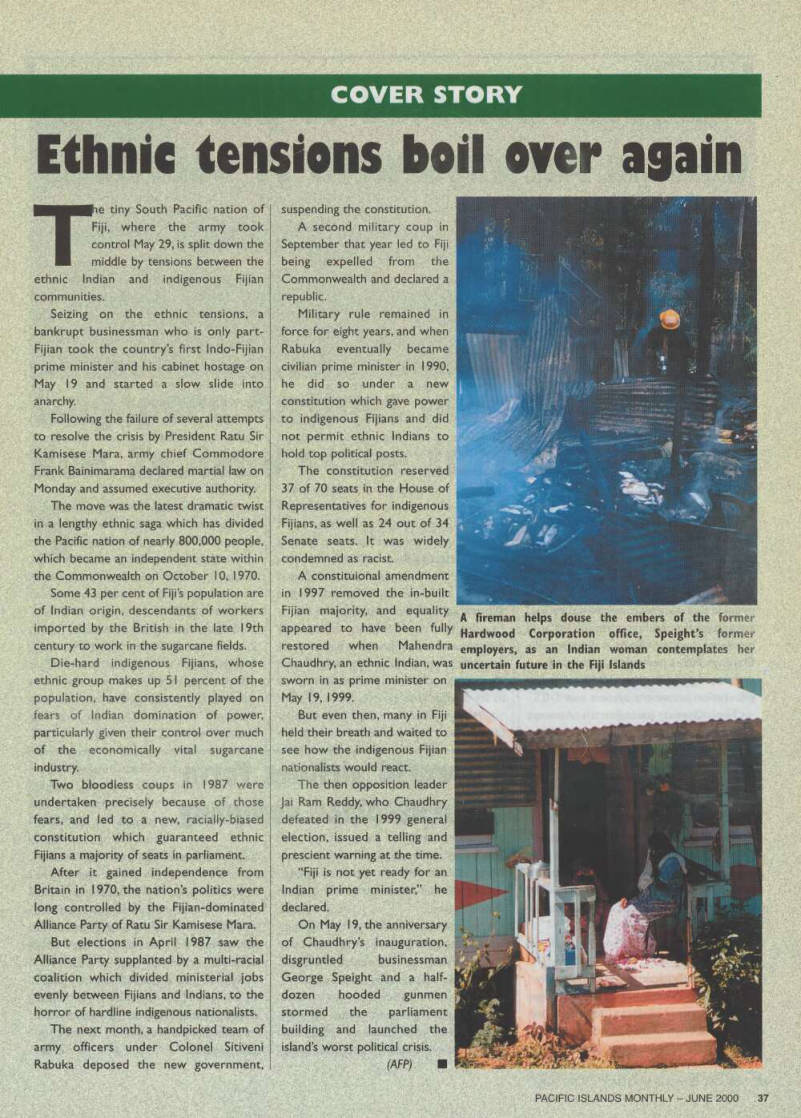
The tiny South Pacific nation of Fiji, where the army took control May 29, is split down the middle by tensions between the ethnic Indian and indigenous Fijian communities.
Seizing on the ethnic tensions, a bankrupt businessman who is only part- Fijian took the country’s first Indo-Fijian prime minister and his cabinet hostage on May 19 and started a slow slide into anarchy.
Following the failure of several attempts to resolve the crisis by President Ratu Sir Kamisese Mara, army chief Commodore Frank Bainimarama declared martial law on Monday and assumed executive authority.
The move was the latest dramatic twist in a lengthy ethnic saga which has divided the Pacific nation of nearly 800,000 people, which became an independent state within the Commonwealth on October 10, 1970.
Some 43 per cent of Fiji’s population are of Indian origin, descendants of workers imported by the British in the late 19th century to work in the sugarcane fields.
Die-hard indigenous Fijians, whose ethnic group makes up 51 percent of the population, have consistently played on fears of Indian domination of power, particularly given their control over much of the economically vital sugarcane
industry.
Two bloodless coups in 1987 were undertaken precisely because of those fears, and led to a new, racially-biased constitution which guaranteed ethnic Fijians a majority of seats in parliament.
After it gained independence from Britain in 1970, the nation’s politics were long controlled by the Fijian-dominated Alliance Party of Ratu Sir Kamisese Mara.
But elections in April 1987 saw the Alliance Party supplanted by a multi-racial coalition which divided ministerial jobs evenly between Fijians and Indians, to the horror of hardline indigenous nationalists.
The next month, a handpicked team of army officers under Colonel Sitiveni Rabuka deposed the new government,
suspending the constitution.
A second military coup in September that year led to Fiji
being expelled from the
Commonwealth and declared a
republic.
Military rule remained in force for eight years, and when Rabuka eventually became civilian prime minister in 1990, he did so under a new constitution which gave power to indigenous Fijians and did not permit ethnic Indians to hold top political posts.
The constitution reserved 37 of 70 seats in the House of Representatives for indigenous Fijians, as well as 24 out of 34 Senate seats. It was widely condemned as racist.
A constituional amendment in 1997 removed the in-built Fijian majority, and equality appeared to have been fully restored when Mahendra Chaudhry, an ethnic Indian, was sworn in as prime minister on May 19, 1999.
But even then, many in Fiji held their breath and waited to see how the indigenous Fijian nationalists would react.
The then opposition leader
Jai Ram Reddy, who Chaudhry
defeated in the 1999 general election, issued a telling and prescient warning at the time.
“Fiji is not yet ready for an Indian prime minister,” he declared.
On May 19, the anniversary of Chaudhry’s inauguration,
disgruntled businessman
George Speight and a half dozen hooded gunmen stormed the parliament building and launched the island’s worst political crisis.
(Afp) M
A fireman helps douse the embers of the former Hardwood Corporation office, Speight’s former employers, as an Indian woman contemplates her uncertain future in the Fiji Islands
Amadeus selected to provide
Development
Amadeus selected to provide Qantas Airways with IT solutions
Amadeus announced that it has been selected by Qantas Airways, Australia’s leading airline, as its preferred IT partner to provide the airline with Distribution and Customer Service systems.
Qantas carried over 19 million passengers in 1999 and the agreement will bring Amadeus valuable new business, adding to the recently announced IT relationship with British Airways.
Qantas and British Airways have recently completed an extensive joint evaluation of potential IT partners. As a result, detailed contract negotiations with Amadeus will begin shortly and, if successful, are expected to conclude later this year.
Under the terms of the Qantas proposal, the development and maintenance of QUBE (Qantas’s proprietary reservation, inventory and departure control systems (DCS)) will be transferred to Amadeus. Additionally, Qantas has charged Amadeus with developing and operating a new generation inventory system and DCS.
The Qantas and British Airways agreements will enable Amadeus to
offer airlines around the world inventory and airport customer service systems, as well as the traditional global
distribution system (CDS) products
and services.
In selecting Amadeus as its IT partner, Qantas was attracted by the
company’s technological leadership and
its unique System User concept, which provides airlines with state of the art sales and distribution solutions.
Today, over I 10 airlines are System Users and this technology has enabled Amadeus to develop and implement a powerful platform for airlines operating in partnerships and alliances.
Upon becoming a System User, Qantas will benefit from sharing a common reservations and sales platform with other Amadeus System Users, including British Airways.
David Burden, Executive General Manager Corporate Services for Qantas, said: “Qantas looks forward to working with Amadeus on projects that will ensure its reservations and airport systems remain leading edge and continue to offer excellence of service to its customers.
“We are confident that in Amadeus, Qantas has the partner it needs to
carry forward the evolution of reservations, inventory and departure
control systems.”
As part of the agreement, Amadeus will set up a Centre of Excellence for development and support in Australia.
A combination of Qantas and Amadeus staff will be assigned to work at the Centre, and with responsibility for supporting existing systems and developing the new generation of IT travel related applications.
The addition of the Sydney-based Centre of Excellence will eventually bring the number of Amadeus development centres around the world to four.
A new development centre will also be set up near London’s Heathrow Airport, UK, to support IT applications and development for British Airways.
Amadeus already has two development sites in operation - in Nice (France) and Miami (USA).
Commented Jose Antonio Tazon, President and CEO of Amadeus: “We are delighted to enter this strategic relationship and look forward to delivering the new generation systems that will cater to Qantas’s evolving business needs.” ■
Six major world airlines form
internet marketplace company
Six of the world’s major airlines have announced that they
intend to form a new company that will create and operate an internet marketplace linking carriers worldwide with qualified sellers of airline-related goods and services.
The new venture will handle approximately $32 billion of the six airlines’ supply chain business annually.
Founding members of the new company are American Airlines, Air France, British Airways, Continental Airlines, Delta Air Lines and United
Airlines. A technology partner will be selected later by the new company, which will be headquartered in the United States.
The airlines, realising the global importance of such a venture, want the new internet marketplace to be open to aviation customers and suppliers worldwide. Additionally, the partnerssee significant value for all participating airlines and suppliers through lower transaction, processing
and inventory costs.
Specific items bought and sold through this “airline industry purchasing portal”
may include suchitems as fuel and fuel services, airframe, avionics and engine components and maintenanceservices, as well as other goods and services agreed to by the founding airlines. Air transportation services are not included.
The financial investment by each founding airline was not announced, although each will initially invest an amount proportionate to the equity each receives. ■
Singapore Airlines increases Air
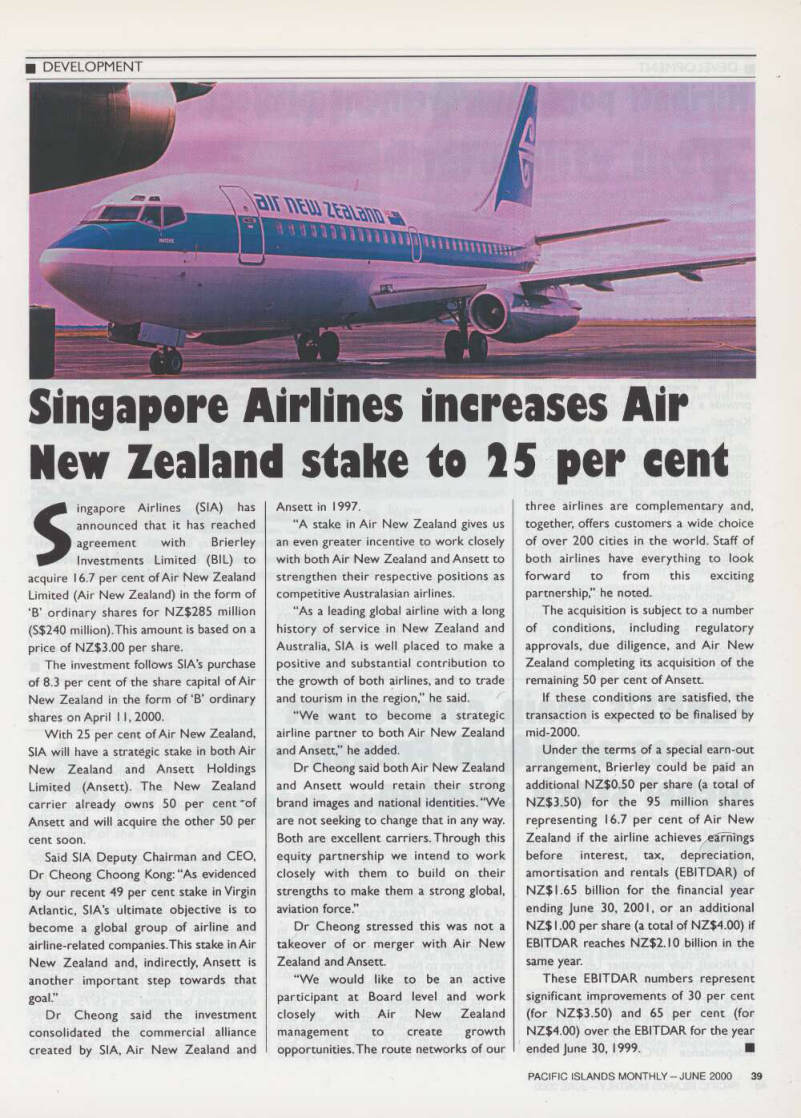
New Zealand stake to 15 per cent
Singapore Airlines (SIA) has
announced that it has reached agreement with Brierley Investments Limited (BIL) to acquire 16.7 per cent of Air New Zealand Limited (Air New Zealand) in the form of ‘B’ ordinary shares for NZ$2B5 million (Ss24o million).This amount is based on a price of NZ$3.OO per share.
The investment follows SlA’s purchase of 8.3 per cent of the share capital of Air New Zealand in the form of ‘B’ ordinary shares on April I 1,2000.
With 25 per cent of Air New Zealand, SIA will have a strategic stake in both Air New Zealand and Ansett Holdings Limited (Ansett). The New Zealand carrier already owns 50 per cent'of Ansett and will acquire the other 50 per cent soon.
Said SIA Deputy Chairman and CEO, Dr Cheong Choong Kong: “As evidenced by our recent 49 per cent stake in Virgin Atlantic, SlA’s ultimate objective is to become a global group of airline and airline-related companies. This stake in Air New Zealand and, indirectly, Ansett is another important step towards that goal.”
Dr Cheong said the investment consolidated the commercial alliance created by SIA, Air New Zealand and
Ansett in 1997.
“A stake in Air New Zealand gives us an even greater incentive to work closely with both Air New Zealand and Ansett to strengthen their respective positions as competitive Australasian airlines.
“As a leading global airline with a long history of service in New Zealand and Australia, SIA is well placed to make a positive and substantial contribution to the growth of both airlines, and to trade and tourism in the region,” he said.
“We want to become a strategic airline partner to both Air New Zealand and Ansett,” he added.
Dr Cheong said both Air New Zealand and Ansett would retain their strong brand images and national identities. “We are not seeking to change that in any way.
Both are excellent carriers. Through this equity partnership we intend to work closely with them to build on their strengths to make them a strong global, aviation force.”
Dr Cheong stressed this was not a takeover of or merger with Air New Zealand and Ansett.
“We would like to be an active participant at Board level and work closely with Air New Zealand management to create growth opportunities. The route networks of our
three airlines are complementary and, together, offers customers a wide choice of over 200 cities in the world. Staff of both airlines have everything to look forward to from this exciting partnership,” he noted.
The acquisition is subject to a number
of conditions, including regulatory
approvals, due diligence, and Air New Zealand completing its acquisition of the remaining 50 per cent of Ansett.
If these conditions are satisfied, the transaction is expected to be finalised by mid-2000.
Under the terms of a special earn-out arrangement, Brierley could be paid an additional NZ$O.5O per share (a total of NZ$3.5O) for the 95 million shares representing 16.7 per cent of Air New Zealand if the airline achieves .eSrnlngs before interest, tax, depreciation, amortisation and rentals (EBITDAR) of NZ$l.65 billion for the financial year ending June 30, 2001, or an additional NZ$ 1.00 per share (a total of NZ$4.OO) if EBITDAR reaches NZ$2.lO billion in the same year.
These EBITDAR numbers represent significant improvements of 30 per cent (for NZ$3.5O) and 65 per cent (for NZ$4.OO) over the EBITDAR for the year ended June 30, 1999. ■
Kiribati port improvement project completed
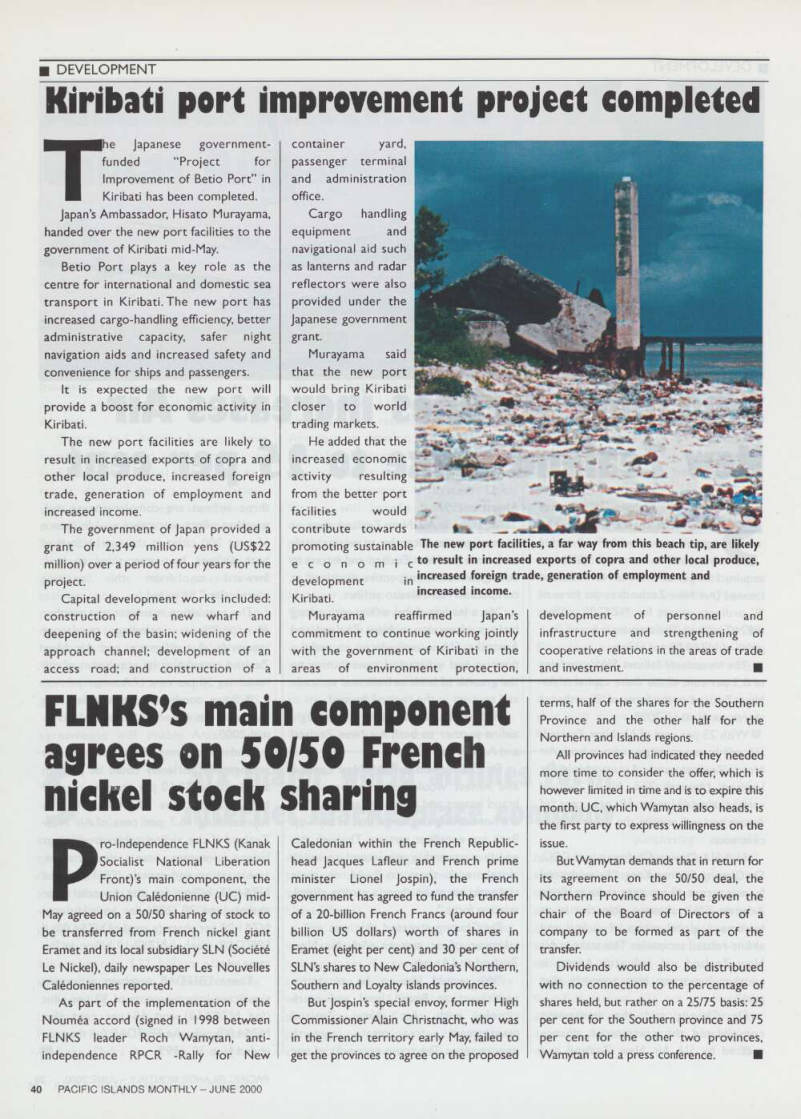
The Japanese government
funded “Project for Improvement of Betio Port” in Kiribati has been completed.
Japan’s Ambassador, Hisato Murayama,
handed over the new port facilities to the government of Kiribati mid-May.
Betio Port plays a key role as the centre for international and domestic sea transport in Kiribati. The new port has increased cargo-handling efficiency, better administrative capacity, safer night navigation aids and increased safety and convenience for ships and passengers.
It is expected the new port will provide a boost for economic activity in Kiribati.
The new port facilities are likely to result in increased exports of copra and other local produce, increased foreign trade, generation of employment and increased income.
The government of Japan provided a grant of 2,349 million yens (US$22 million) over a period of four years for the project.
Capital development works included:
construction of a new wharf and deepening of the basin; widening of the approach channel: development of an access road; and construction of a
container yard, passenger terminal and administration office.
Cargo handling equipment and navigational aid such as lanterns and radar reflectors were also provided under the
Japanese government
grant.
Murayama said
that the new port would bring Kiribati closer to world trading markets.
He added that the increased economic activity resulting from the better port facilities would contribute towards promoting sustainable economic development in Kiribati.
Murayama reaffirmed Japan’s commitment to continue working jointly with the government of Kiribati in the areas of environment protection,
development of personnel and infrastructure and strengthening of cooperative relations in the areas of trade and investment. ■
The new port facilities, a far way from this beach tip, are likely to result in increased exports of copra and other local produce, increased foreign trade, generation of employment and increased income.
FLNKS's main component
agrees on 50/50 French nickel stock sharing
Pro-Independence FLNKS (Kanak Socialist National Liberation Front)’s main component, the Union Caledonienne (UC) mid- May agreed on a 50/50 sharing of stock to be transferred from French nickel giant Eramet and its local subsidiary SLN (Societe Le Nickel), daily newspaper Les Nouvelles
Caledoniennes reported.
As part of the implementation of the Noumea accord (signed in 1998 between FLNKS leader Roch Wamytan, anti independence RPCR -Rally for New
Caledonian within the French Republic head Jacques Lafleur and French prime minister Lionel Jospin), the French government has agreed to fund the transfer of a 20-billion French Francs (around four billion US dollars) worth of shares in Eramet (eight per cent) and 30 per cent of SLN’s shares to New Caledonia’s Northern, Southern and Loyalty islands provinces.
But Jospin’s special envoy, former High Commissioner Alain Christnacht, who was in the French territory early May, failed to get the provinces to agree on the proposed
terms, half of the shares for the Southern Province and the other half for the Northern and Islands regions.
All provinces had indicated they needed more time to consider the offer, which is however limited in time and is to expire this month. DC, which Wamytan also heads, is the first party to express willingness on the issue.
But Wamytan demands that in return for its agreement on the 50/50 deal, the Northern Province should be given the chair of the Board of Directors of a company to be formed as part of the transfer.
Dividends would also be distributed with no connection to the percentage of shares held, but rather on a 25/75 basis: 25 per cent for the Southern province and 75 per cent for the other two provinces, Wamytan told a press conference. ■
Ireland to support Pacific
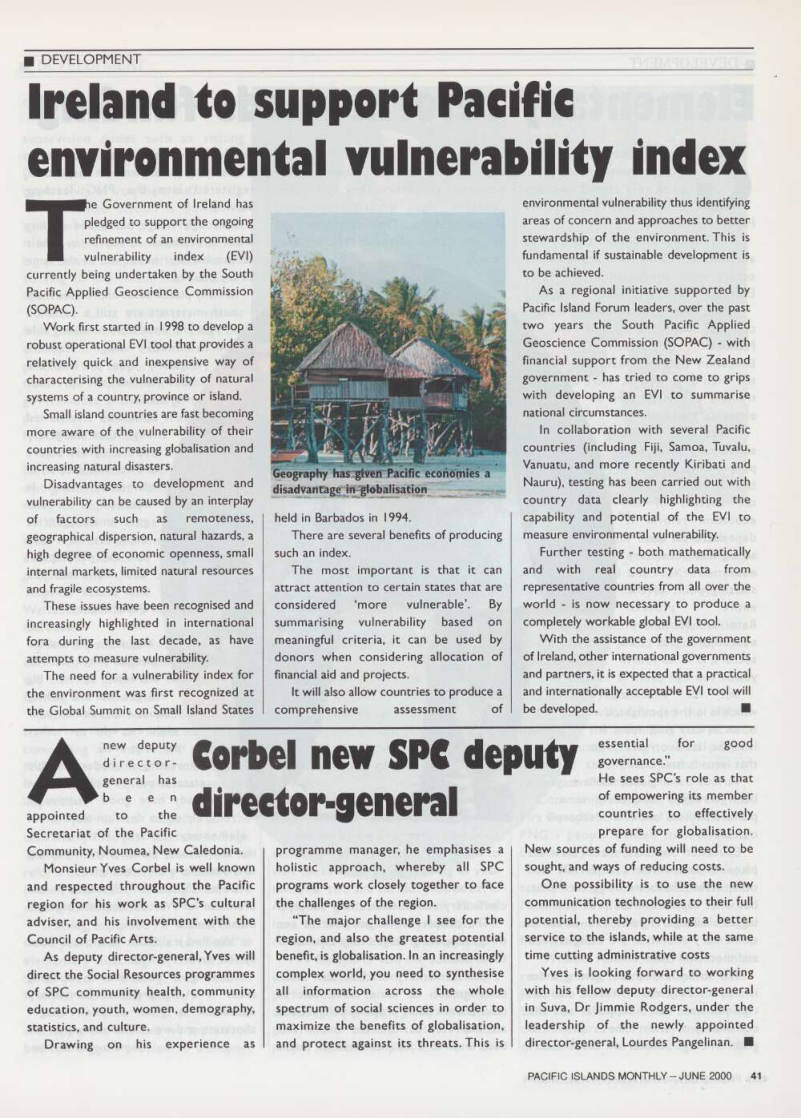
environmental vulnerability index
Tfie Government of Ireland has pledged to support the ongoing refinement of an environmental vulnerability index (EVI) currently being undertaken by the South Pacific Applied Geoscience Commission
(Sopac).
Work first started in 1998 to develop a robust operational EVI tool that provides a relatively quick and inexpensive way of characterising the vulnerability of natural systems of a country, province or island.
Small island countries are fast becoming more aware of the vulnerability of their countries with increasing globalisation and increasing natural disasters.
Disadvantages to development and vulnerability can be caused by an interplay of factors such as remoteness, geographical dispersion, natural hazards, a high degree of economic openness, small internal markets, limited natural resources and fragile ecosystems.
These issues have been recognised and increasingly highlighted in international fora during the last decade, as have attempts to measure vulnerability.
The need for a vulnerability index for the environment was first recognized at the Global Summit on Small Island States
held in Barbados in 1994.
There are several benefits of producing such an index.
The most important is that it can attract attention to certain states that are considered ‘more vulnerable’. By summarising vulnerability based on meaningful criteria, it can be used by donors when considering allocation of financial aid and projects.
It will also allow countries to produce a comprehensive assessment of
environmental vulnerability thus identifying areas of concern and approaches to better stewardship of the environment. This is fundamental if sustainable development is to be achieved.
As a regional initiative supported by Pacific Island Forum leaders, over the past two years the South Pacific Applied Geoscience Commission (SOPAC) - with financial support from the New Zealand government - has tried to come to grips with developing an EVI to summarise national circumstances.
In collaboration with several Pacific countries (including Fiji, Samoa, Tuvalu, Vanuatu, and more recently Kiribati and Nauru), testing has been carried out with country data clearly highlighting the capability and potential of the EVI to measure environmental vulnerability.
Further testing - both mathematically and with real country data from representative countries from all over the world - is now necessary to produce a completely workable global EVI tool.
With the assistance of the government of Ireland, other international governments and partners, it is expected that a practical and internationally acceptable EVI tool will be developed. ■
Geography has given Pacific economies a disadvantage in globalisation
Anew deputy
Corbel new SPC deputy director-general
d i rector
general has
been appointed to the Secretariat of the Pacific
Community, Noumea, New Caledonia.
Monsieur Yves Corbel is well known and respected throughout the Pacific region for his work as SRC’s cultural adviser, and his involvement with the Council of Pacific Arts.
As deputy director-general, Yves will direct the Social Resources programmes of SPC community health, community
education, youth, women, demography,
statistics, and culture.
Drawing on his experience as
programme manager, he emphasises a holistic approach, whereby all SPC programs work closely together to face the challenges of the region.
“The major challenge I see for the region, and also the greatest potential benefit, is globalisation. In an increasingly complex world, you need to synthesise all information across the whole spectrum of social sciences in order to maximize the benefits of globalisation, and protect against its threats. This is
essential for good governance.”
He sees SPC’s role as that of empowering its member countries to effectively prepare for globalisation.
New sources of funding will need to be sought, and ways of reducing costs.
One possibility is to use the new communication technologies to their full potential, thereby providing a better service to the islands, while at the same time cutting administrative costs Yves is looking forward to working with his fellow deputy director-general in Suva, Dr Jimmie Rodgers, under the leadership of the newly appointed director-general, Lourdes Pangelinan. ■
Elementary reform needs funding
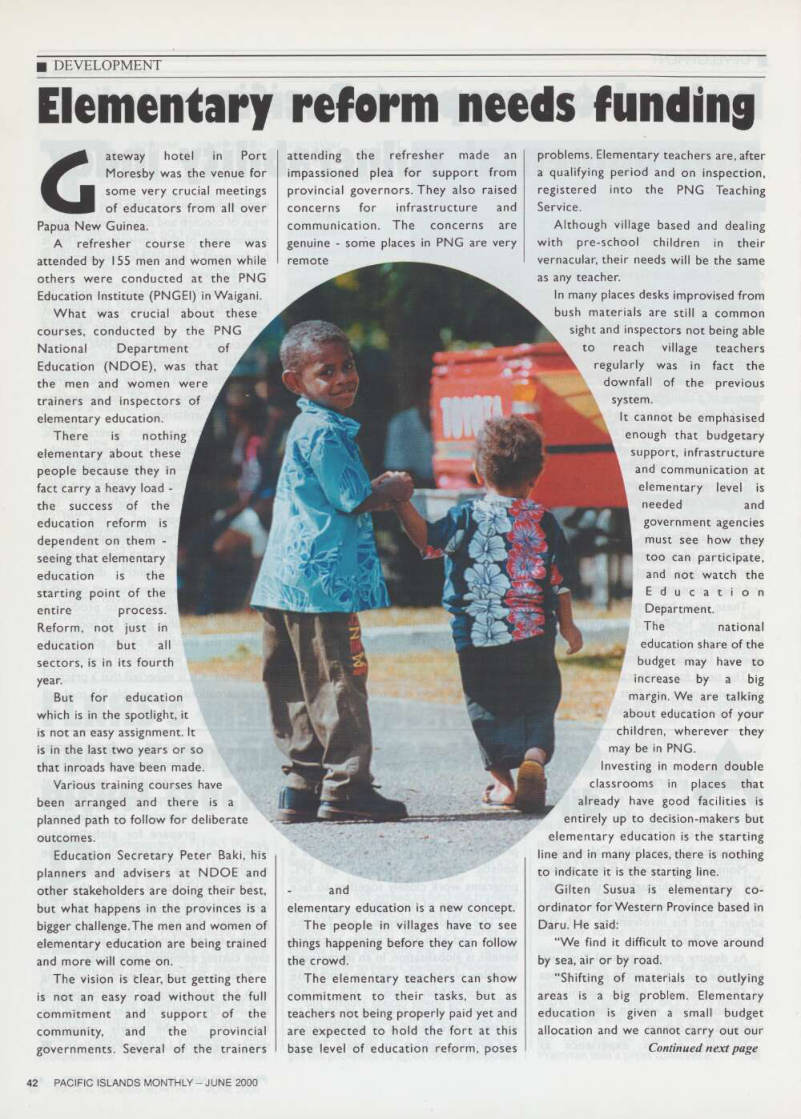
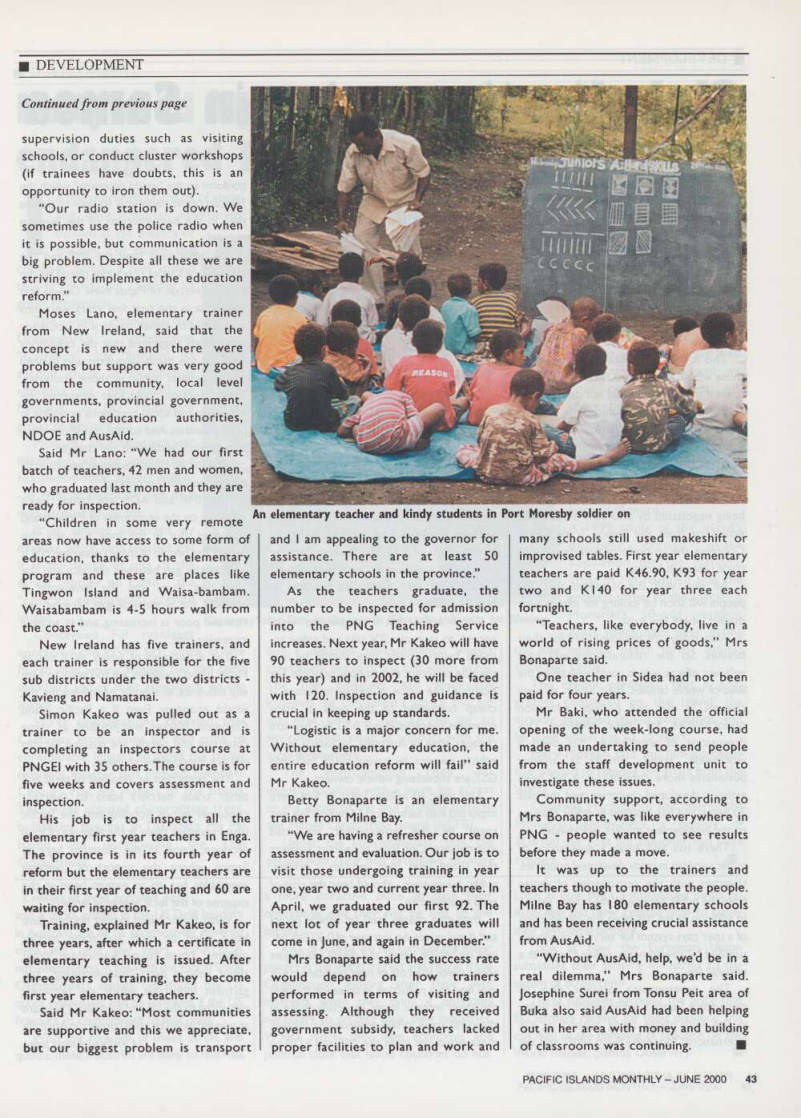
Cateway hotel in Port Moresby was the venue for some very crucial meetings of educators from all over Papua New Guinea.
A refresher course there was attended by 155 men and women while others were conducted at the PNG Education Institute (PNGEI) inWaigani.
What was crucial about these courses, conducted by the PNG A National Department of Education (NDOE), was that the men and women were Am trainers and inspectors of elementary education. Mk There is nothing elementary about these people because they in
fact carry a heavy load - I the success of the B education reform is ■ dependent on them - ■ seeing that elementary I education is the H starting point of the H entire process.
Reform, not just in education but all sectors, is in its fourth year.
But for education which is in the spotlight, it
is not an easy assignment. It is in the last two years or so that inroads have been made.
Various training courses have been arranged and there is a planned path to follow for deliberate outcomes.
Education Secretary Peter Baki, his planners and advisers at NDOE and other stakeholders are doing their best, but what happens in the provinces is a bigger challenge. The men and women of elementary education are being trained and more will come on.
The vision is clear, but getting there is not an easy road without the full commitment and support of the community, and the provincial governments. Several of the trainers
attending the refresher made an impassioned plea for support from provincial governors. They also raised concerns for infrastructure and communication. The concerns are genuine - some places in PNG are very remote
and elementary education is a new concept.
The people in villages have to see things happening before they can follow the crowd.
The elementary teachers can show commitment to their tasks, but as teachers not being properly paid yet and are expected to hold the fort at this base level of education reform, poses
problems. Elementary teachers are, after a qualifying period and on inspection, registered into the PNG Teaching Service.
Although village based and dealing with pre-school children in their vernacular, their needs will be the same as any teacher.
In many places desks improvised from bush materials are still a common |k sight and inspectors not being able to reach village teachers Wk regularly was in fact the
downfall of the previous system.
It cannot be emphasised
Hk enough that budgetary
■ support, infrastructure |B and communication at B elementary level is ■HH needed and ■ government agencies H must see how they Hi too can participate, and not watch the HB Education Department.
The national education share of the ll#** budget may have to increase by a big margin. We are talking about education of your children, wherever they may be in PNG.
Investing in modern double
classrooms in places that 1 already have good facilities is entirely up to decision-makers but elementary education is the starting line and in many places, there is nothing to indicate it is the starting line.
Gilten Susua is elementary co ordinator for Western Province based in Daru. He said: “We find it difficult to move around by sea, air or by road.
“Shifting of materials to outlying areas is a big problem. Elementary education is given a small budget allocation and we cannot carry out our
Continued next page
Continued from previous page
supervision duties such as visiting schools, or conduct cluster workshops (if trainees have doubts, this is an opportunity to iron them out).
“Our radio station is down. We sometimes use the police radio when it is possible, but communication is a ! big problem. Despite all these we are j striving to implement the education reform.”
Moses Lano, elementary trainer j from New Ireland, said that the concept is new and there were ] problems but support was very good from the community, local level governments, provincial government, provincial education authorities, NDOE and AusAid.
Said Mr Lano: “We had our first ’ batch of teachers, 42 men and women, who graduated last month and they are \ ready for inspection.
“Children in some very remote areas now have access to some form of education, thanks to the elementary program and these are places like Tingwon Island and Waisa-bambam.
Waisabambam is 4-5 hours walk from the coast.”
New Ireland has five trainers, and each trainer is responsible for the five sub districts under the two districts - Kavieng and Namatanai.
Simon Kakeo was pulled out as a trainer to be an inspector and is completing an inspectors course at PNGEI with 35 others. The course is for five weeks and covers assessment and inspection.
His job is to inspect all the elementary first year teachers in Enga.
The province is in its fourth year of reform but the elementary teachers are in their first year of teaching and 60 are waiting for inspection.
Training, explained Mr Kakeo, is for three years, after which a certificate in elementary teaching is issued. After three years of training, they become first year elementary teachers.
Said Mr Kakeo: “Most communities are supportive and this we appreciate, but our biggest problem is transport
and I am appealing to the governor for assistance. There are at least 50 elementary schools in the province.”
As the teachers graduate, the number to be inspected for admission into the PNG Teaching Service increases. Next year, Mr Kakeo will have 90 teachers to inspect (30 more from this year) and in 2002, he will be faced with 120. Inspection and guidance is crucial in keeping up standards.
“Logistic is a major concern for me.
Without elementary education, the entire education reform will fail” said Mr Kakeo.
Betty Bonaparte is an elementary trainer from Milne Bay.
“We are having a refresher course on assessment and evaluation. Our job is to visit those undergoing training in year one, year two and current year three. In April, we graduated our first 92. The next lot of year three graduates will come in June, and again in December.”
Mrs Bonaparte said the success rate would depend on how trainers performed in terms of visiting and
assessing. Although they received
government subsidy, teachers lacked proper facilities to plan and work and
many schools still used makeshift or improvised tables. First year elementary teachers are paid K 46.90, K 93 for year two and KI4O for year three each fortnight.
“Teachers, like everybody, live in a world of rising prices of goods,” Mrs Bonaparte said.
One teacher in Sidea had not been paid for four years.
Mr Baki, who attended the official opening of the week-long course, had made an undertaking to send people from the staff development unit to investigate these issues.
Community support, according to Mrs Bonaparte, was like everywhere in PNG - people wanted to see results before they made a move.
It was up to the trainers and teachers though to motivate the people.
Milne Bay has 180 elementary schools and has been receiving crucial assistance from AusAid.
“Without AusAid, help, we’d be in a real dilemma,” Mrs Bonaparte said.
Josephine Surei from Tonsu Peit area of Buka also said AusAid had been helping out in her area with money and building of classrooms was continuing. ■
An elementary teacher and kindy students in Port Moresby soldier on
Globalisation pains in Samoa
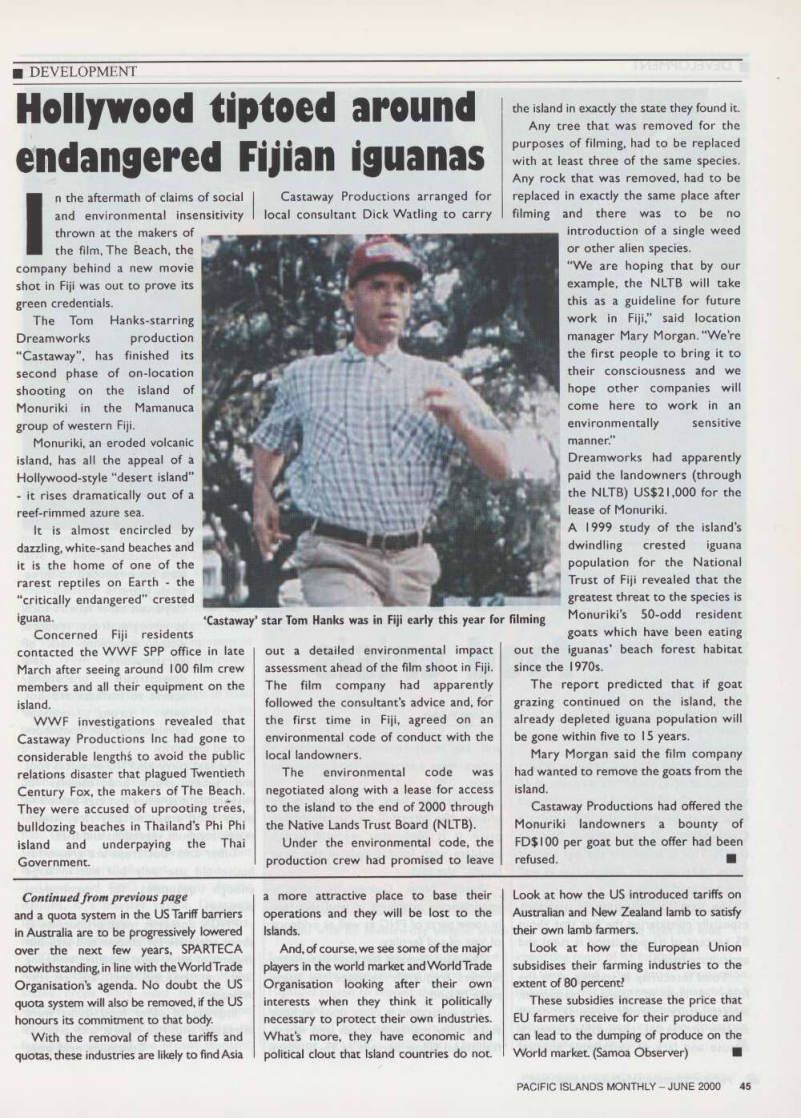
By Terry Bourke, in Apia
Wjthin the next month, some 240 jobs may
disappear from the Apia
town area through economic necessity.
This is the number we are sure of. There may well be more. The jobs will be lost when two corporations begin restructuring their operations to become more efficient, to
increase profits.
This is their right. Their shareholders those whose investments matter - would be upset if the companies did not do this.
Both Samoa Communications Ltd. and the Pacific Commercial Bank are relying on voluntary redundancies, with incentive packages being offered to staffers who wish to take them. Based on present salary and
length of employment, these packages are
being negotiated by two staff unions with assistance from the Samoa Trade Union Congress, the umbrella organization for all trade unions in Samoa.
All very well. But it means that 240 people will soon be looking for jobs in a job market where few exist Also, many are breadwinners for their families. So the redundancies will have spillover effects, which could well affect the lives of whole families, their health, through changes in diet and perhaps education opportunities for their children. This downsizing of workforces has been a worldwide trend aimed at making businesses more competitive. It has been active in developed countries over the past 20 years, and has resulted in major changes to the employment market, worldwide.
There has also been a downsizing of public services in many developed countries, together with the outsourcing of duties from the public service to the private sector.
In addition, there has been the introduction of a user pays system for services previously supplied by governments, either free or at a nominal fee.
The government’s present plan to restructure Samoa’s public sector is a policy in line with those being pushed by the International Monetary Fund (IMF) and the
Asian Development Bank (ADB). Many think
this could lead to a reduction in numbers of public servants and the introduction of a user pays system for services provided by, or through, the public service.
Certainly, over the past few years here in Samoa, the user pays principle was being implemented. For example, it now costs 25 Tala to obtain a police clearance report
Some argue that if
people are “rich” enough
to own cars, TV sets and
other so-called luxury
goods, they should be in
a position to accept the
user pay principle
often required by employers from those
applying for jobs. And we have seen the introduction of a 25 Tala ‘Parking Fee” for vehicles for purposes as yet to be explained. (NOTE: US$l.OO = Samoa Tala $ 3.0893 on May 24, 2000) Some argue that if people are “rich” enough to own cars, TV sets and other so called luxury goods, they should be in a position to accept the user pay principle. For example, the price of petrol in Samoa is cheap compared to the ones in many countries overseas, about 0.50 Tala per litre cheaper than in Australia. In Samoa, non vehicle owners, by paying taxes, including GST, are subsidising vehicle owners.
Last year, 40 million liters of fuel were imported into Samoa and 14 million Tala was spent by the government on road maintenance. One local economist suggests that those who own vehicles - private, public, buses, taxis - should bear the cost of road maintenance through a charge (tax) on vehicle petrol and diesel prices.An increase of 0.30 Tala per litre on vehicle petrol and diesel would just about cover the cost of road maintenance. It may lead to a reduction in taxes for those in the lower income levels, especially those in the rural areas. While government accepts these pressures from the IMF and ADB to
conform to the “world economy” which the Samoan prime minister is so keen to do, are they in the best interests of the Samoan
people?
We have seen how the IMF and the World Bank’s strict conditions placed on the financial rescue of Papua New Guinea and Indonesia in the past few years were not acceptable to either country. In fact, many economists suggested that the conditions were far too harsh, unrealistic and harmful to the general public in those countries.
Their adoption could have worsened the economic and social conditions prevailing in both countries. And so, the conditions were subsequently withdrawn and changed.
Will Pacific Island countries benefit from joining the World economy?
The IMF and ADB are having much influence on the economies of Pacific Island countries. But in the long run, will this benefit the people of these countries? Will it narrow the gap between the rich and the poor, the haves and the have-nots? If anything, the worldwide gap between the rich and poor is increasing, and at an ever increasing rate.
The economies of nearly all, if not all Pacific Island countries are too small to have any influence in shaping or influencing the world economy. Even if a Pacific Island Common Market was formed as some countries and people are pushing for, this will not improve the situation.
The reduction or removal of tariff and other trade barriers leads to overseas consumer goods flooding into the Pacific Island counties, often at the expense of local produce. Look at the situation here in Samoa where the import of overseas vegetables has, to an extent, been at the expense of the local vegetable farmers.
What Pacific Island export markets have been aided by tariff and trade barrier reforms? None to my knowledge. What about vehicle parts “manufacturing” and garment industries which are presently exporting to the US and Australia? These are at present aided by tariff barriers in Australia
Continued next page
Continued from previous page and a quota system in the US Tariff barriers in Australia are to be progressively lowered over the next few years, SPARTECA notwithstanding, in line with the World Trade Organisation’s agenda. No doubt the US quota system will also be removed, if the US honours its commitment to that body.
With the removal of these tariffs and quotas, these industries are likely to find Asia
a more attractive place to base their operations and they will be lost to the Islands.
And, of course, we see some of the major players in the world market and World Trade Organisation looking after their own interests when they think it politically necessary to protect their own industries.
What’s more, they have economic and political clout that Island countries do not.
Look at how the US introduced tariffs on Australian and New Zealand lamb to satisfy their own lamb farmers.
Look at how the European Union subsidises their farming industries to the extent of 80 percent?
These subsidies increase the price that EU farmers receive for their produce and can lead to the dumping of produce on the World market. (Samoa Observer) ■
endangered Fijian iguanas
Hollywood tiptoed around endangered Fijian iguanas
In the aftermath of claims of social and environmental insensitivity thrown at the makers of the film, The Beach, the JKk
company behind a new movie shot in Fiji was out to prove its green credentials.
The Tom Hanks-starring
Dreamworks production
“Castaway”, has finished its second phase of on-location shooting on the island of Monuriki in the Mamanuca group of western Fiji.
Monuriki, an eroded volcanic island, has all the appeal of a Hollywood-style “desert island” - it rises dramatically out of a reef-rimmed azure sea.
It is almost encircled by dazzling, white-sand beaches and it is the home of one of the rarest reptiles on Earth - the “critically endangered” crested iguana.
Concerned Fiji residents
contacted the WWF SPP office in late March after seeing around 100 film crew members and all their equipment on the island.
WWF investigations revealed that Castaway Productions Inc had gone to considerable lengths to avoid the public relations disaster that plagued Twentieth Century Fox, the makers of The Beach.
They were accused of uprooting trees, bulldozing beaches in Thailand’s Phi Phi island and underpaying the Thai Government.
Castaway Productions arranged for local consultant Dick Watling to carry
out a detailed environmental impact assessment ahead of the film shoot in Fiji.
The film company had apparently followed the consultant’s advice and, for the first time in Fiji, agreed on an environmental code of conduct with the local landowners.
The environmental code was negotiated along with a lease for access to the island to the end of 2000 through the Native Lands Trust Board (NLTB).
Under the environmental code, the production crew had promised to leave
the island in exactly the state they found it.
Any tree that was removed for the purposes of filming, had to be replaced with at least three of the same species.
Any rock that was removed, had to be replaced in exactly the same place after filming and there was to be no
introduction of a single weed or other alien species.
“We are hoping that by our example, the NLTB will take this as a guideline for future work in Fiji,” said location manager Mary Morgan. “We’re the first people to bring it to their consciousness and we hope other companies will come here to work in an environmentally sensitive manner.”
Dreamworks had apparently
paid the landowners (through
the NLTB) US$2l,OOO for the lease of Monuriki.
A 1999 study of the island’s dwindling crested iguana population for the National Trust of Fiji revealed that the greatest threat to the species is Monuriki’s 50-odd resident goats which have been eating
out the iguanas’ beach forest habitat since the 19705.
The report predicted that if goat grazing continued on the island, the already depleted iguana population will be gone within five to 15 years.
Mary Morgan said the film company had wanted to remove the goats from the island.
Castaway Productions had offered the Monuriki landowners a bounty of FDSIOO per goat but the offer had been refused. ■
‘Castaway’ star Tom Hanks was in Fiji early this year for filming
food crisis

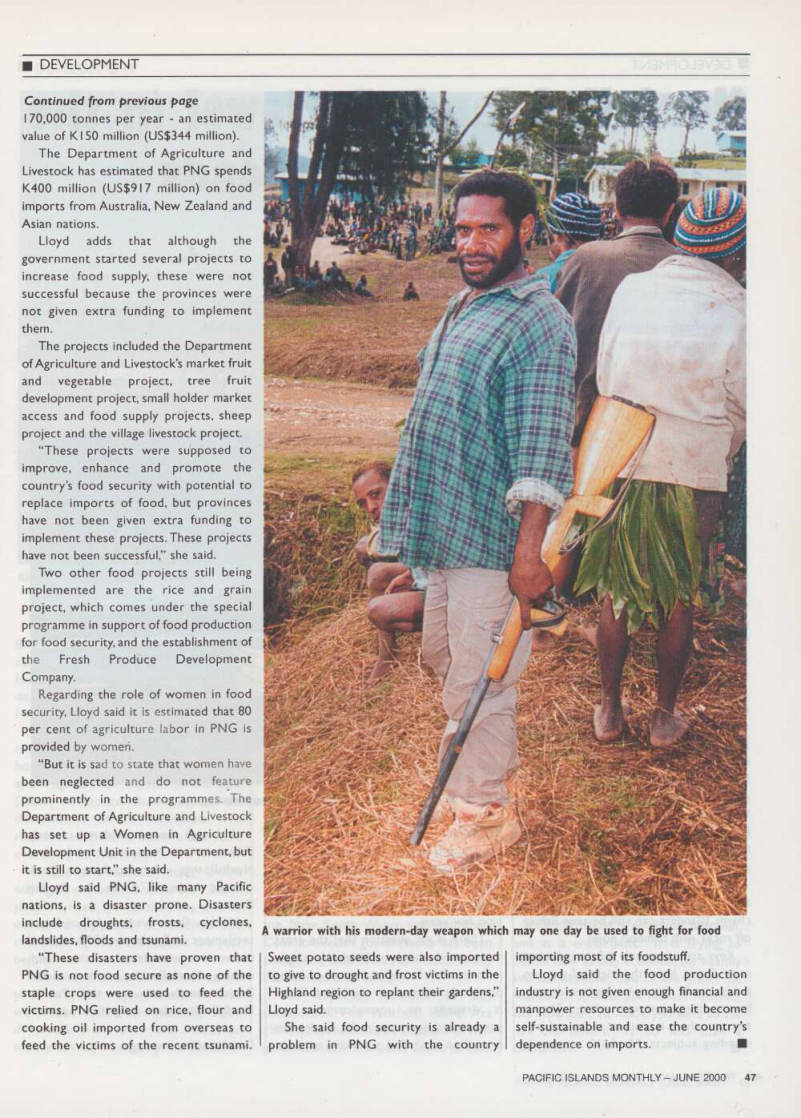
PNG could face food crisis
By Sam Vulum
Papua New Guinea could face a food supply crisis soon unless urgent measures are implemented to increase local production.
This is because food
production locally is growing
1.3 per cent slower than the country’s population - which will reach five million this year.
Eileen Lloyd of the Consumer Affairs Council of PNG said PNG was one of 77 countries classified as of low income and food deficit by the Food and Agriculture Organisation of the United Nations (FAO).This is based on the net import status of cereal crops such as rice as well as other food items.
She said the situation is alarming, especially considering the fact that about 85 percent of its population is rural and
agriculture based.
“Food insecurity is stalking us in the form of lack of finance, manpower, infrastructure, farmer training, down stream processing, reasonable resource misuse and lack of sustainable political
will to implement food production programmes addressing food insecurity needs.
“Unless we have the resources to import the shortfall, at an affordable price, it is likely that we will face a problem with food supply in the near future,” she said.
Papua New Guinea is already experiencing problems of land shortage in some parts of PNG as well as evidence of loss of soil fertility.
The high demand for food has meant farmers frequently cultivate the same piece of land.
This cultivation is often done without soil fertility management on land where traditional fallow periods of 15-20 years
have been reduced to three to six years.
Lloyd said other factors such as drought, frost, reduced water availability, lack of infrastructure and downstream processing, access to markets and not very strong political commitment also contribute
to food insecurity.
She said, currently, PNG produces root and tuber crops and bananas in reasonable quantities but lags behind in other food crops notably rice, wheat, maize, sorghum, vegetables and fruit.
Tuber and root crops are grown for household use only but not in large enough quantities for commercial purposes.
PNG’s domestic meat production is about adequate for chicken and pigs, but imports of other meat products, including lamb, mutton and beef, are on the increase.
Imports of other food items were increasing with rice highest with a net of
Continued next page
Unless urgent measures are implemented to increase local food production, PNG could face a food crisis
Continued from previous page
170,000 tonnes per year - an estimated
value of Kl5O million (US$344 million).
The Department of Agriculture and Livestock has estimated that PNG spends K4OO million (US$9l7 million) on food imports from Australia, New Zealand and Asian nations.
Lloyd adds that although the government started several projects to increase food supply, these were not successful because the provinces were not given extra funding to implement them.
The projects included the Department of Agriculture and Livestock’s market fruit and vegetable project, tree fruit development project, small holder market access and food supply projects, sheep project and the village livestock project.
“These projects were supposed to improve, enhance and promote the country’s food security with potential to replace imports of food, but provinces have not been given extra funding to implement these projects. These projects have not been successful,” she said.
Two other food projects still being implemented are the rice and grain project, which comes under the special programme in support of food production for food security, and the establishment of the Fresh Produce Development
Company.
Regarding the role of women in food security, Lloyd said it is estimated that 80 per cent of agriculture labor in PNG is
provided by women.
“But it is sad to state that women have been neglected and do not feature prominently in the programmes. The Department of Agriculture and Livestock has set up a Women in Agriculture Development Unit in the Department, but it is still to start,” she said.
Lloyd said PNG, like many Pacific nations, is a disaster prone. Disasters include droughts, frosts, cyclones, landslides, floods and tsunami.
“These disasters have proven that PNG is not food secure as none of the staple crops were used to feed the victims. PNG relied on rice, flour and cooking oil imported from overseas to feed the victims of the recent tsunami.
Sweet potato seeds were also imported to give to drought and frost victims in the Highland region to replant their gardens,”
Lloyd said.
She said food security is already a problem in PNG with the country
importing most of its foodstuff.
Lloyd said the food production industry is not given enough financial and manpower resources to make it become self-sustainable and ease the country’s dependence on imports. ■
A warrior with his modern-day weapon which may one day be used to fight for food
Norfolk Island: A “jewel in the Pacific"...at
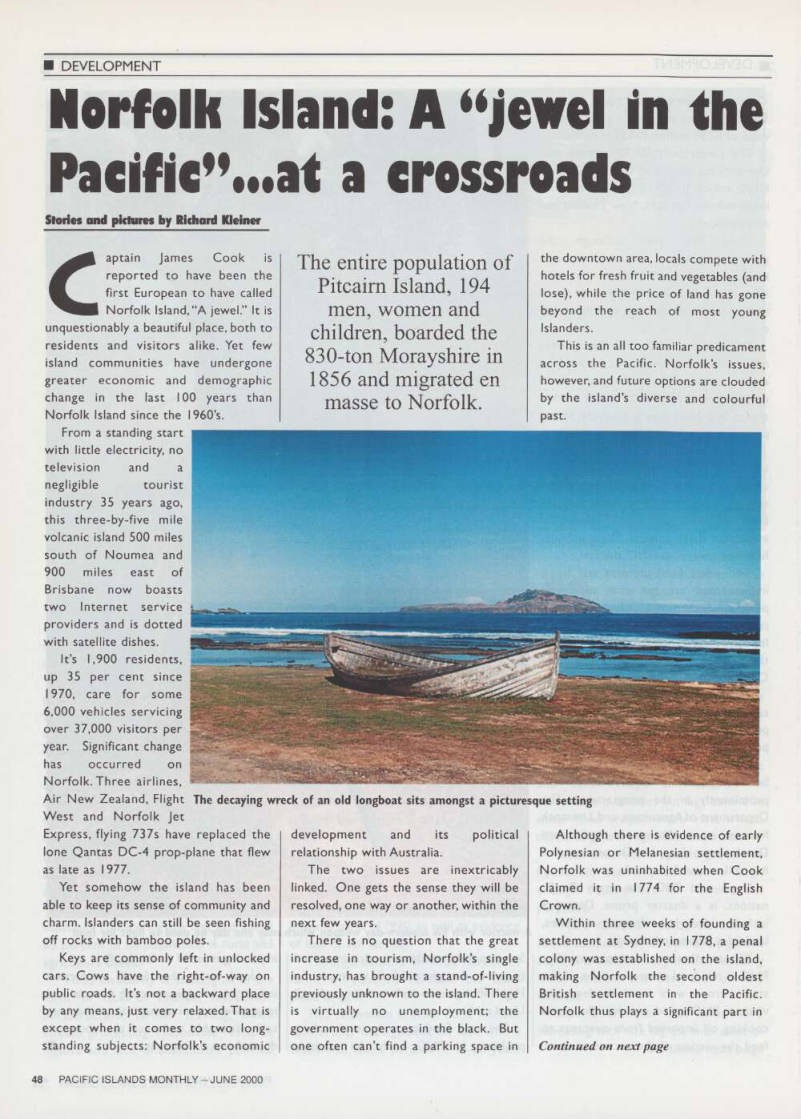
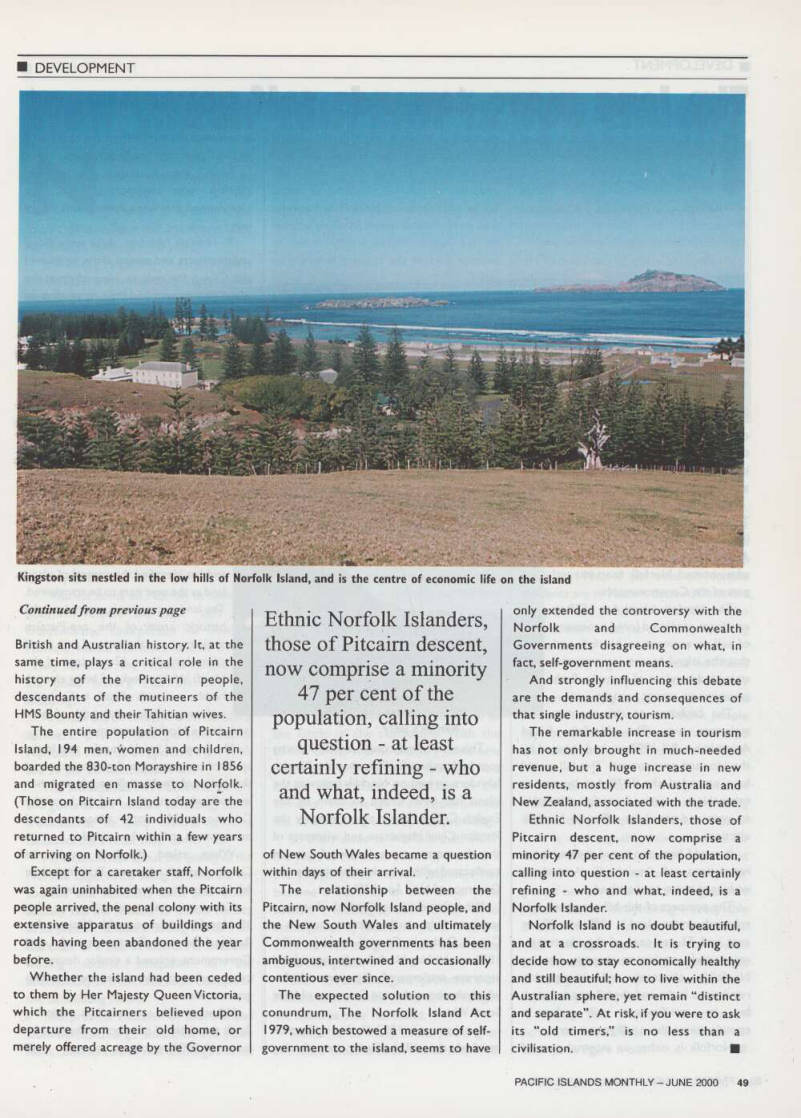
Pacific"...at a crossroads
Stories and pictures by Richard Kleiner
Captain James Cook is reported to have been the first European to have called Norfolk Island, “A jewel.” It is unquestionably a beautiful place, both to residents and visitors alike. Yet few island communities have undergone greater economic and demographic change in the last 100 years than Norfolk Island since the 1960’5.
From a standing start with little electricity, no television and a
negligible tourist
industry 35 years ago, this three-by-five mile volcanic island 500 miles south of Noumea and 900 miles east of Brisbane now boasts two Internet service providers and is dotted with satellite dishes.
It’s 1,900 residents, up 35 per cent since 1970, care for some 6,000 vehicles servicing over 37,000 visitors per
year. Significant change
has occurred on Norfolk. Three airlines, Air New Zealand, Flight West and Norfolk Jet
Express, flying 737 s have replaced the lone Qantas DC-4 prop-plane that flew as late as I 977.
Yet somehow the island has been able to keep its sense of community and charm. Islanders can still be seen fishing off rocks with bamboo poles.
Keys are commonly left in unlocked cars. Cows have the right-of-way on public roads. It’s not a backward place by any means, just very relaxed. That is except when it comes to two long standing subjects: Norfolk’s economic
The entire population of Pitcairn Island, 194 men, women and children, boarded the 830-ton Morayshire in 1856 and migrated en masse to Norfolk.
development and its political
relationship with Australia.
The two issues are inextricably linked. One gets the sense they will be resolved, one way or another, within the next few years.
There is no question that the great increase in tourism, Norfolk’s single industry, has brought a stand-of-living previously unknown to the island. There is virtually no unemployment; the government operates in the black. But one often can’t find a parking space in
the downtown area, locals compete with hotels for fresh fruit and vegetables (and lose), while the price of land has gone beyond the reach of most young Islanders.
This is an all too familiar predicament across the Pacific. Norfolk’s issues, however, and future options are clouded by the island’s diverse and colourful past.
Although there is evidence of early Polynesian or Melanesian settlement, Norfolk was uninhabited when Cook claimed it in 1774 for the English Crown.
Within three weeks of founding a settlement at Sydney, in 1778, a penal colony was established on the island, making Norfolk the second oldest British settlement in the Pacific.
Norfolk thus plays a significant part in
Continued on next page
The decaying wreck of an old longboat sits amongst a picturesque setting
Continued from previous page
British and Australian history. It, at the same time, plays a critical role in the history of the Pitcairn people, descendants of the mutineers of the HMS Bounty and their Tahitian wives.
The entire population of Pitcairn Island, 194 men, women and children, boarded the 830-ton Morayshire in 1856 and migrated en masse to Norfolk. (Those on Pitcairn Island today are the descendants of 42 individuals who returned to Pitcairn within a few years of arriving on Norfolk.) Except for a caretaker staff, Norfolk was again uninhabited when the Pitcairn people arrived, the penal colony with its extensive apparatus of buildings and roads having been abandoned the year before.
Whether the island had been ceded to them by Her Majesty Queen Victoria, which the Pitcairners believed upon departure from their old home, or merely offered acreage by the Governor
Ethnic Norfolk Islanders,
those of Pitcairn descent,
now comprise a minority
47 per cent of the
population, calling into
question - at least
certainly refining - who
and what, indeed, is a
Norfolk Islander.
of New South Wales became a question within days of their arrival.
The relationship between the Pitcairn, now Norfolk Island people, and the New South Wales and ultimately Commonwealth governments has been ambiguous, intertwined and occasionally contentious ever since.
The expected solution to this conundrum, The Norfolk Island Act 1979, which bestowed a measure of self government to the island, seems to have
only extended the controversy with the Norfolk and Commonwealth Governments disagreeing on what, in fact, self-government means.
And strongly influencing this debate are the demands and consequences of that single industry, tourism.
The remarkable increase in tourism has not only brought in much-needed revenue, but a huge increase in new residents, mostly from Australia and New Zealand, associated with the trade.
Ethnic Norfolk Islanders, those of Pitcairn descent, now comprise a minority 47 per cent of the population, calling into question - at least certainly refining - who and what, indeed, is a Norfolk Islander.
Norfolk Island is no doubt beautiful, and at a crossroads. It is trying to decide how to stay economically healthy and still beautiful; how to live within the Australian sphere, yet remain “distinct and separate”. At risk, if you were to ask its “old timers,” is no less than a civilisation. ■
Kingston sits nestled in the low hills of Norfolk Island, and is the centre of economic life on the island
The long move towards self-government
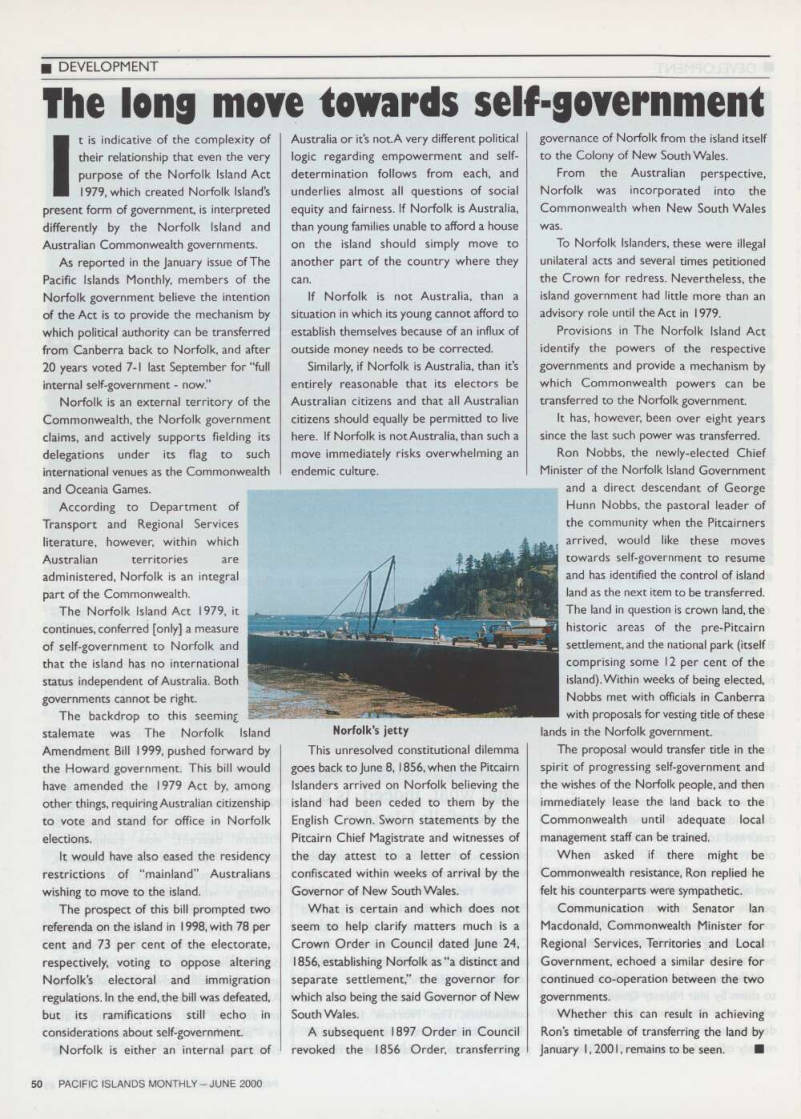
It is indicative of the complexity of their relationship that even the very purpose of the Norfolk Island Act 1979, which created Norfolk Island’s present form of government, is interpreted differently by the Norfolk Island and Australian Commonwealth governments.
As reported in the January issue of The Pacific Islands Monthly, members of the Norfolk government believe the intention of the Act is to provide the mechanism by which political authority can be transferred from Canberra back to Norfolk, and after 20 years voted 7-1 last September for “full internal self-government - now.”
Norfolk is an external territory of the Commonwealth, the Norfolk government claims, and actively supports fielding its delegations under its flag to such international venues as the Commonwealth
and Oceania Games.
According to Department of Transport and Regional Services literature, however, within which Australian territories are administered, Norfolk is an integral part of the Commonwealth.
The Norfolk Island Act 1979, it continues, conferred [only] a measure of self-government to Norfolk and that the island has no international status independent of Australia. Both governments cannot be right.
The backdrop to this seeming
stalemate was The Norfolk Island Amendment Bill 1999, pushed forward by the Howard government. This bill would have amended the 1979 Act by, among other things, requiring Australian citizenship to vote and stand for office in Norfolk elections.
It would have also eased the residency restrictions of “mainland” Australians wishing to move to the island.
The prospect of this bill prompted two referenda on the island in 1998, with 78 per cent and 73 per cent of the electorate, respectively, voting to oppose altering Norfolk’s electoral and immigration regulations. In the end, the bill was defeated, but its ramifications still echo in considerations about self-government.
Norfolk is either an internal part of
Australia or it’s not.A very different political logic regarding empowerment and self determination follows from each, and underlies almost ail questions of social equity and fairness. If Norfolk is Australia, than young families unable to afford a house on the island should simply move to another part of the country where they can.
If Norfolk is not Australia, than a situation in which its young cannot afford to establish themselves because of an influx of outside money needs to be corrected.
Similarly, if Norfolk is Australia, than it’s entirely reasonable that its electors be Australian citizens and that all Australian citizens should equally be permitted to live here. If Norfolk is not Australia, than such a move immediately risks overwhelming an endemic culture.
This unresolved constitutional dilemma goes back to June 8, 1856, when the Pitcairn Islanders arrived on Norfolk believing the island had been ceded to them by the English Crown. Sworn statements by the Pitcairn Chief Magistrate and witnesses of the day attest to a letter of cession confiscated within weeks of arrival by the Governor of New South Wales.
What is certain and which does not seem to help clarify matters much is a Crown Order in Council dated June 24, 1856, establishing Norfolk as “a distinct and separate settlement,” the governor for which also being the said Governor of New South Wales.
A subsequent 1897 Order in Council revoked the 1856 Order, transferring
governance of Norfolk from the island itself to the Colony of New South Wales.
From the Australian perspective, Norfolk was incorporated into the Commonwealth when New South Wales was.
To Norfolk Islanders, these were illegal unilateral acts and several times petitioned the Crown for redress. Nevertheless, the island government had little more than an advisory role until the Act in 1979.
Provisions in The Norfolk Island Act identify the powers of the respective governments and provide a mechanism by which Commonwealth powers can be transferred to the Norfolk government.
It has, however, been over eight years since the last such power was transferred.
Ron Nobbs, the newly-elected Chief Minister of the Norfolk Island Government
and a direct descendant of George Hunn Nobbs, the pastoral leader of the community when the Pitcairners arrived, would like these moves towards self-government to resume and has identified the control of island land as the next item to be transferred.
The land in question is crown land, the historic areas of the pre-Pitcairn settlement, and the national park (itself comprising some 12 per cent of the island). Within weeks of being elected, Nobbs met with officials in Canberra with proposals for vesting title of these
lands in the Norfolk government.
The proposal would transfer title in the spirit of progressing self-government and the wishes of the Norfolk people, and then immediately lease the land back to the Commonwealth until adequate local management staff can be trained.
When asked if there might be Commonwealth resistance, Ron replied he felt his counterparts were sympathetic.
Communication with Senator lan Macdonald, Commonwealth Minister for Regional Services, Territories and Local Government, echoed a similar desire for continued co-operation between the two governments.
Whether this can result in achieving Ron’s timetable of transferring the land by January 1,2001, remains to be seen. ■
Norfolk’s jetty
How much tourism is too much?
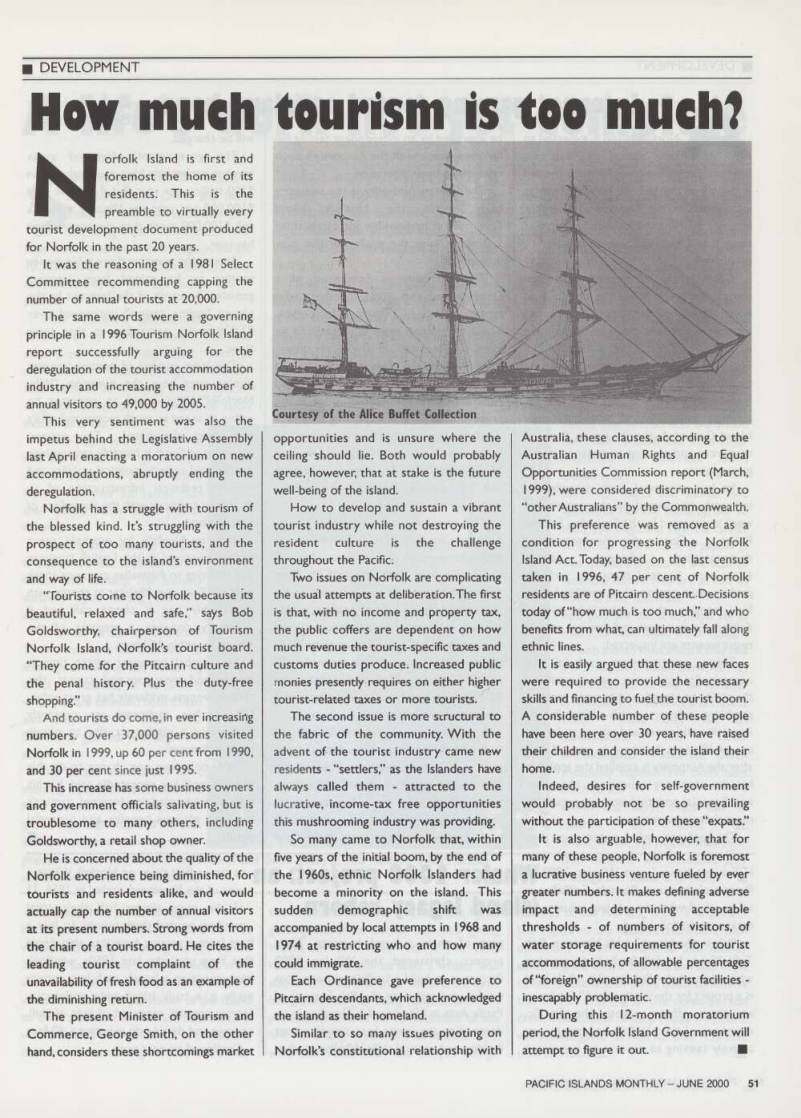
Norfolk Island is first and foremost the home of its residents: This is the preamble to virtually every tourist development document produced for Norfolk in the past 20 years.
It was the reasoning of a 1981 Select Committee recommending capping the number of annual tourists at 20,000.
The same words were a governing principle in a 1 996 Tourism Norfolk Island report successfully arguing for the deregulation of the tourist accommodation industry and increasing the number of annual visitors to 49,000 by 2005.
This very sentiment was also the impetus behind the Legislative Assembly last April enacting a moratorium on new accommodations, abruptly ending the
deregulation.
Norfolk has a struggle with tourism of the blessed kind. It’s struggling with the prospect of too many tourists, and the consequence to the island’s environment and way of life.
“Tourists come to Norfolk because its beautiful, relaxed and safe,” says Bob Goldsworthy, chairperson of Tourism Norfolk Island, Norfolk’s tourist board.
“They come for the Pitcairn culture and the penal history. Plus the duty-free
shopping.”
And tourists do come, in ever increasirtg numbers. Over 37,000 persons visited Norfolk in 1999, up 60 per cent from 1990, and 30 per cent since just 1995.
This increase has some business owners and government officials salivating, but is troublesome to many others, including Goldsworthy, a retail shop owner.
He is concerned about the quality of the Norfolk experience being diminished, for tourists and residents alike, and would actually cap the number of annual visitors at its present numbers. Strong words from the chair of a tourist board. He cites the leading tourist complaint of the unavailability of fresh food as an example of the diminishing return.
The present Minister of Tourism and Commerce, George Smith, on the other hand, considers these shortcomings market
opportunities and is unsure where the ceiling should lie. Both would probably agree, however, that at stake is the future well-being of the island.
How to develop and sustain a vibrant tourist industry while not destroying the resident culture is the challenge throughout the Pacific.
Two issues on Norfolk are complicating the usual attempts at deliberation. The first is that, with no income and property tax, the public coffers are dependent on how much revenue the tourist-specific taxes and customs duties produce. Increased public monies presently requires on either higher tourist-related taxes or more tourists.
The second issue is more structural to the fabric of the community. With the advent of the tourist industry came new residents - “settlers,” as the Islanders have always called them - attracted to the lucrative, income-tax free opportunities this mushrooming industry was providing.
So many came to Norfolk that, within five years of the initial boom, by the end of the 19605, ethnic Norfolk Islanders had become a minority on the island. This sudden demographic shift was accompanied by local attempts in 1968 and 1974 at restricting who and how many could immigrate.
Each Ordinance gave preference to Pitcairn descendants, which acknowledged the island as their homeland.
Similar to so many issues pivoting on Norfolk’s constitutional relationship with
Australia, these clauses, according to the Australian Human Rights and Equal
Opportunities Commission report (March,
1999), were considered discriminatory to “other Australians” by the Commonwealth.
This preference was removed as a condition for progressing the Norfolk Island Act. Today, based on the last census taken in 1996, 47 per cent of Norfolk residents are of Pitcairn descent. Decisions today of “how much is too much,” and who benefits from what, can ultimately fall along ethnic lines.
It is easily argued that these new faces were required to provide the necessary skills and financing to fuel the tourist boom.
A considerable number of these people have been here over 30 years, have raised their children and consider the island their home.
Indeed, desires for self-government would probably not be so prevailing without the participation of these “expats.”
It is also arguable, however, that for many of these people, Norfolk is foremost a lucrative business venture fueled by ever greater numbers. It makes defining adverse impact and determining acceptable thresholds - of numbers of visitors, of water storage requirements for tourist accommodations, of allowable percentages of “foreign” ownership of tourist facilities -
inescapably problematic.
During this 12-month moratorium period, the Norfolk Island Government will attempt to figure it out. ■
Courtesy of the Alice Buffet Collection
Alnternet j
Internet gaming touted as island hope
now, Norfolk Island is expected to have named its first two Internet gaming licensees. All that’s needed is the ink to dry and the licensees’ names announced in the Legislative Assembly.
Internet gambling, the hope and scourge of more than a few Pacific islands, has arrived on Norfolk.
Geoff Gardner, minister for health and the environment, holds the portfolio in which Internet gaming lies. He is convinced the way to avoid the pitfalls of the industry is by carefully restricting both who can obtain a license to operate a gaming establishment and who, in fact, can gamble.
Each of these first two licensees, for example, was assessed by the Norfolk Island Gaming Authority for its financial resources and existing experience in the gaming arena.
Its key personnel, both directly and indirectly connected to the enterprise, were investigated by the Australian Federal Police. Once the licensees had demonstrated adequate gaming experience, financial resources and the probity of its personnel, its technical plans for meeting the Authority’s system delivery, management and internal control requirements are inspected.
These requirements include the necessity for continuous audit control, and the ability to identify and prevent problem gamblers, players with Norfolk or Australian addresses, and players under the age of 18 years. A licence is granted only after the Authority is satisfied the applicant has the necessary experience, character, and financial and technical resources to meet these requirements.
The applicant’s online system must then
be approved by an independent testing lab for compliance with the Authority’s audit controls to begin operation.
The Gaming Authority is the statutory body within the Norfolk Island
Government responsible for establishing
and maintaining the quality of this new
industry.
The Authority is comprised of a Director and two other members who
reports directly to a Gaming Chairperson.
The Chairperson reports directly to an executive member of the government, again presently the Minister for Health and the Environment. John Clark, QC, a retired Australian Court of Appeals judge, is the present Chairperson. Reporting to him is the Authority Director, Kevin Leyshon.
Leyshon is presently Managing Director
of the consulting firm, Gaming Solutions, and has extensive private-and public sector gaming experience.
The remaining two members of the Authority are Jock Irvine, a lawyer who is past chairperson of the New Zealand Casino Control Authority, and Dr. John Walsh of Brannaugh, also a lawyer and a resident of Norfolk. The purpose of this venture is to provide an alternative to tourism as a source of public revenue. Both the gaming and bookmaking licensees will pay the Norfolk Government at least $25,000 per annum per license to cover the cost of administration.
In addition, the gaming licensee will pay to the Norfolk government a duty of 4 per cent of its gross profits; the bookmaking licensee will pay 0.5 per cent of its gross turnover. Finally, each licensee must deposit sufficient funds in a Norfolk Island bank account to pay these duties and
levies, from which a one per cent financial levy
will be charged.
The government’s high-end gross
revenue projections have gone higher than $lOO million per year. But if it made only $lOO,OOO per year, the Minister adds, it’s still $lOO,OOO more than the government has now.
There is no question there is big money waiting to be gained from Internet gambling. A search of the Internet by the phrase “online casino” uncovered over 23,000 pages pertaining to that topic alone.
This large number of existing Internet gaming sites begs the question, “Why Norfolk?” Why would an operator be willing to spend so much money and effort here than elsewhere? The answer, according to Geoff, is Norfolk can combine the financial security, political stability and modern technical infrastructure of an Australian territory with the immediacy of a small island.
Only on Norfolk, for example, can a gaming operator, in the English language and referring to Australian currency, speak with the Executive Minister in charge with conceivably just a phone call and if necessary convene a meeting of the Assembly within 24 hours.
In a global economy where time is money and every second counts, this responsiveness evidently has great value.
Seven other applicants are presently undergoing a similar scrutiny to obtain Norfolk licenses.
“We only have one chance to do this right,” Geoff has repeatedly said. It’s his way of acknowledging Internet gaming’s newness, obvious benefits and potential
pitfalls. ■
island legacy reborn
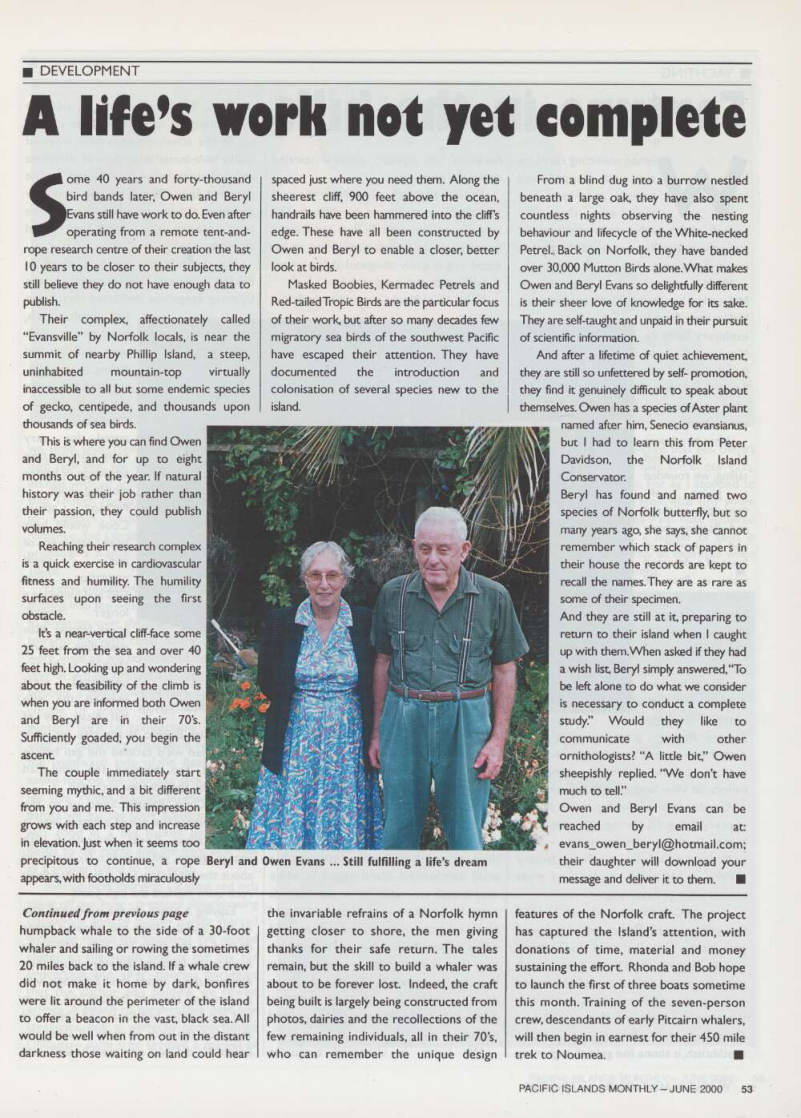
Whaler 2000 project: an island legacy reborn
IT’S a big legacy,” says Whaler 2000
Project chairperson, Rhonda Griffiths,
when asked what the whaling industry means to Norfolk Island.
“It’s in the blood,” adds historian, Bob Tofts.“Every Norfolk family had a member who was a whaler. Building this whale boat is a project for the whole island.” Similar to so many efforts across the Pacific, members of the Norfolk community are actively seeking to capture an important
part of their cultural heritage. Their project, christened the Whaler 2000 Project, is to build a traditional open-boat whaler and sail it to the Bth Festival of Pacific Arts in Noumea this October. In so
doing, they are saving long-standing boat
building and nautical skills. Whaling reaches
to the earliest times on Norfolk. Within a year of the Pitcairners arrival in 1856, 33 of the men, almost half their total number, pooled their money to buy a boat from a passing American ship. From that time until the late 19505, whaling’s importance to a largely cash-less society made it a truly island-wide endeavour.
Stories are still repeated of acts of skill, courage and derring-do wresting a 40-foot
Continued on next page
Continued from previous page
humpback whale to the side of a 30-foot whaler and sailing or rowing the sometimes 20 miles back to the island. If a whale crew did not make it home by dark, bonfires were lit around the perimeter of the island to offer a beacon in the vast, black sea. All would be well when from out in the distant darkness those waiting on land could hear
the invariable refrains of a Norfolk hymn getting closer to shore, the men giving thanks for their safe return. The tales remain, but the skill to build a whaler was about to be forever lost. Indeed, the craft being built is largely being constructed from photos, dairies and the recollections of the few remaining individuals, all in their 70s, who can remember the unique design
features of the Norfolk craft. The project has captured the Island’s attention, with donations of time, material and money sustaining the effort. Rhonda and Bob hope to launch the first of three boats sometime this month. Training of the seven-person crew, descendants of early Pitcairn whalers, will then begin in earnest for their 450 mile trek to Noumea. ■
A life’s work net yet complete
Some 40 years and forty-thousand bird bands later, Owen and Beryl Evans still have work to do. Even after operating from a remote tent-and rope research centre of their creation the last 10 years to be closer to their subjects, they still believe they do not have enough data to publish.
Their complex, affectionately called
“Evansville” by Norfolk locals, is near the summit of nearby Phillip Island, a steep, uninhabited mountain-top virtually inaccessible to all but some endemic species of gecko, centipede, and thousands upon
thousands of sea birds.
This is where you can find Owen and Beryl, and for up to eight months out of the year. If natural history was their job rather than their passion, they could publish volumes.
Reaching their research complex is a quick exercise in cardiovascular fitness and humility. The humility surfaces upon seeing the first obstacle.
It’s a near-vertical cliff-face some 25 feet from the sea and over 40
feet high. Looking up and wondering
about the feasibility of the climb is when you are informed both Owen and Beryl are in their 70’s.
Sufficiently goaded, you begin the
ascent
The couple immediately start
seeming mythic, and a bit different from you and me. This impression grows with each step and increase in elevation. Just when it seems too precipitous to continue, a rope appears, with footholds miraculously
spaced just where you need them. Along the sheerest cliff, 900 feet above the ocean, handrails have been hammered into the cliffs edge. These have all been constructed by Owen and Beryl to enable a closer, better look at birds.
Masked Boobies, Kermadec Petrels and Red-tailed Tropic Birds are the particular focus of their work, but after so many decades few migratory sea birds of the southwest Pacific have escaped their attention. They have documented the introduction and colonisation of several species new to the island.
From a blind dug into a burrow nestled beneath a large oak, they have also spent countless nights observing the nesting behaviour and lifecycle of the White-necked Petrel. Back on Norfolk, they have banded over 30,000 Mutton Birds alone. What makes Owen and Beryl Evans so delightfully different is their sheer love of knowledge for its sake.
They are self-taught and unpaid in their pursuit of scientific information.
And after a lifetime of quiet achievement, they are still so unfettered by self- promotion, they find it genuinely difficult to speak about themselves. Owen has a species of Aster plant
named after him, Senecio evansianus, but I had to learn this from Peter Davidson, the Norfolk Island Conservator.
Beryl has found and named two species of Norfolk butterfly, but so many years ago, she says, she cannot remember which stack of papers in their house the records are kept to recall the names. They are as rare as some of their specimen.
And they are still at it, preparing to return to their island when I caught up with them. When asked if they had a wish list, Beryl simply answered, “To be left alone to do what we consider is necessary to conduct a complete study.” Would they like to communicate with other ornithologists? “A little bit,” Owen sheepishly replied. “We don’t have much to tell.”
Owen and Beryl Evans can be reached by email at
their daughter will download your message and deliver it to them. ■
Beryl and Owen Evans ... Still fulfilling a life’s dream
Fortune in the hills
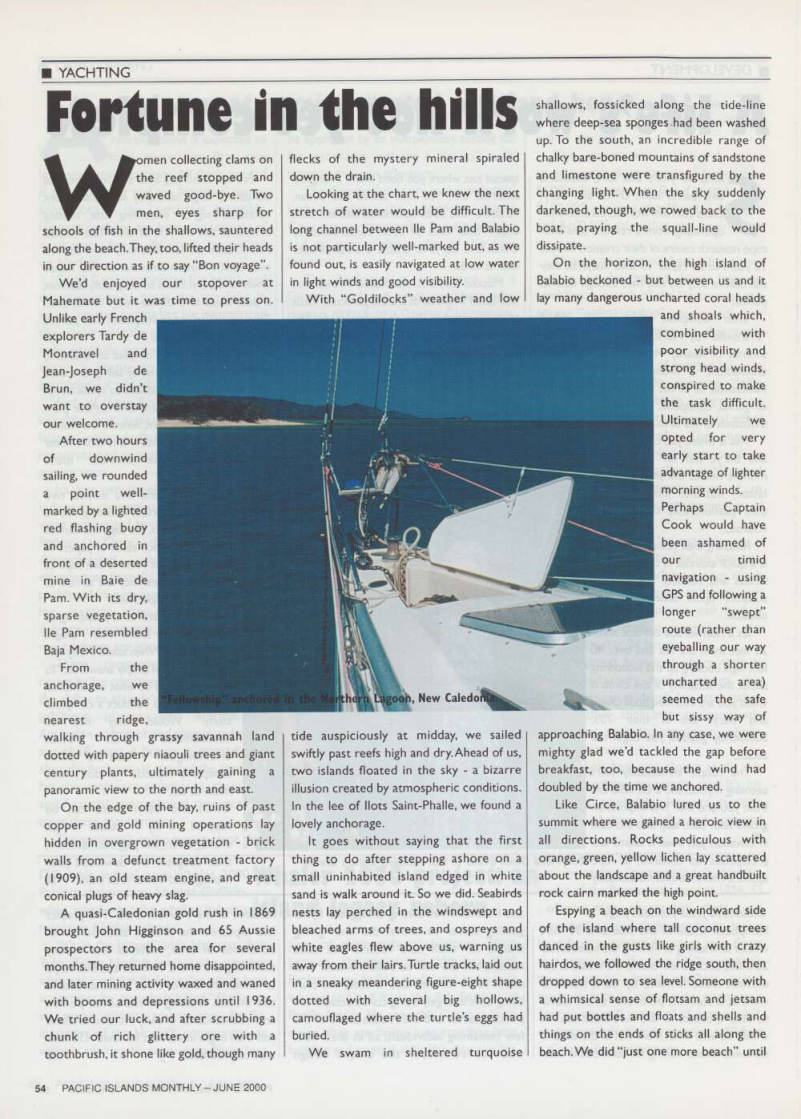
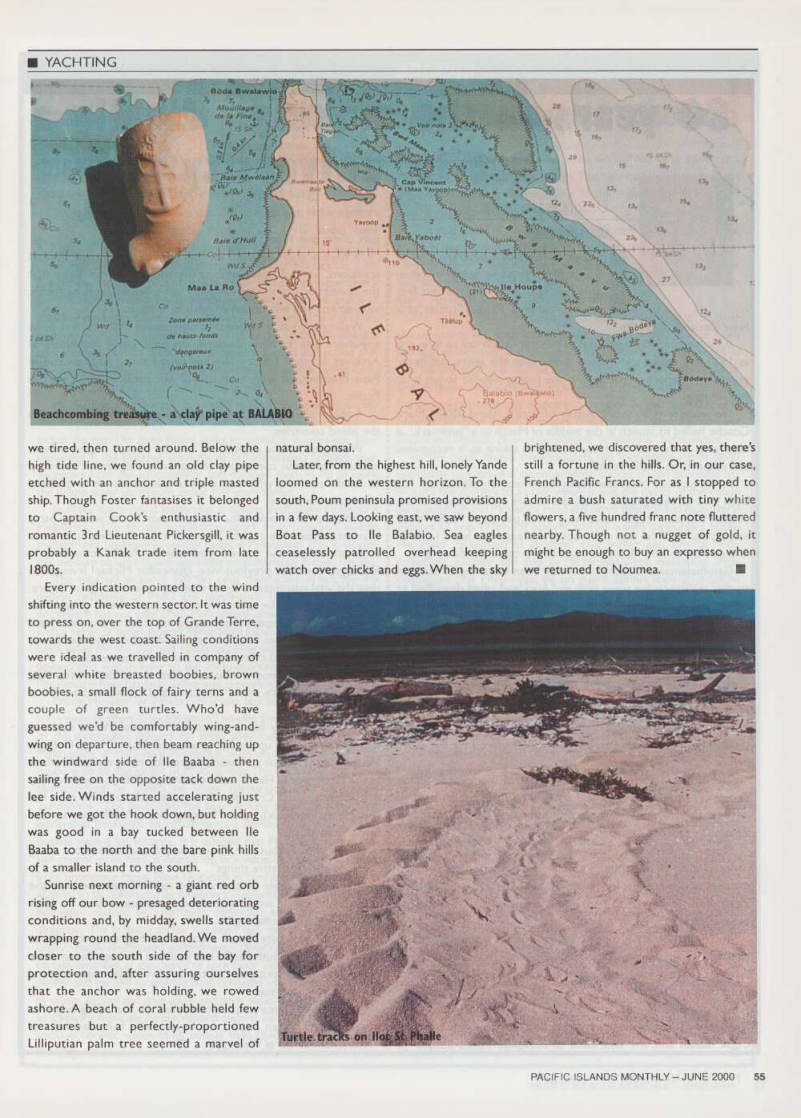
Yachting
Women collecting clams on the reef stopped and waved good-bye. Two men, eyes sharp for schools of fish in the shallows, sauntered along the beach. They, too, lifted their heads in our direction as if to say “Bon voyage”.
We’d enjoyed our stopover at Mahemate but it was time to press on.
Unlike early French explorers Tardy de Montravel and
Jean-Joseph de
Brun, we didn’t want to overstay our welcome.
After two hours of downwind sailing, we rounded a point well marked by a lighted red flashing buoy and anchored in front of a deserted mine in Baie de Pam. With its dry, sparse vegetation, He Pam resembled Baja Mexico.
From the anchorage, we climbed the nearest ridge,
walking through grassy savannah land dotted with papery niaouli trees and giant century plants, ultimately gaining a panoramic view to the north and east.
On the edge of the bay, ruins of past copper and gold mining operations lay hidden in overgrown vegetation - brick walls from a defunct treatment factory (1909), an old steam engine, and great conical plugs of heavy slag.
A quasi-Caledonian gold rush in 1869 brought John Higginson and 65 Aussie prospectors to the area for several months. They returned home disappointed, and later mining activity waxed and waned with booms and depressions until 1936.
We tried our luck, and after scrubbing a chunk of rich glittery ore with a toothbrush, it shone like gold, though many
flecks of the mystery mineral spiraled down the drain.
Looking at the chart, we knew the next stretch of water would be difficult. The long channel between He Pam and Balabio is not particularly well-marked but, as we found out, is easily navigated at low water
in light winds and good visibility.
With “Goldilocks” weather and low
tide auspiciously at midday, we sailed swiftly past reefs high and dry. Ahead of us, two islands floated in the sky - a bizarre illusion created by atmospheric conditions.
In the lee of Hots Saint-Phalle, we found a
lovely anchorage.
It goes without saying that the first thing to do after stepping ashore on a small uninhabited island edged in white sand is walk around it. So we did. Seabirds nests lay perched in the windswept and bleached arms of trees, and ospreys and white eagles flew above us, warning us away from their lairs. Turtle tracks, laid out in a sneaky meandering figure-eight shape dotted with several big hollows, camouflaged where the turtle’s eggs had buried.
We swam in sheltered turquoise
shallows, fossicked along the tide-line where deep-sea sponges had been washed up. To the south, an incredible range of chalky bare-boned mountains of sandstone and limestone were transfigured by the changing light. When the sky suddenly darkened, though, we rowed back to the boat, praying the squall-line would
dissipate.
On the horizon, the high island of Balabio beckoned - but between us and it lay many dangerous uncharted coral heads
and shoals which, combined with poor visibility and strong head winds, conspired to make the task difficult.
Ultimately we
opted for very early start to take
advantage of lighter
morning winds.
Perhaps Captain
Cook would have been ashamed of our timid navigation - using GPS and following a
longer “swept”
route (rather than eyeballing our way through a shorter
uncharted area)
seemed the safe but sissy way of
approaching Balabio. In any case, we were mighty glad we’d tackled the gap before breakfast, too, because the wind had doubled by the time we anchored.
Like Circe, Balabio lured us to the summit where we gained a heroic view in all directions. Rocks pediculous with orange, green, yellow lichen lay scattered about the landscape and a great handbuilt rock cairn marked the high point.
Espying a beach on the windward side of the island where tall coconut trees danced in the gusts like girls with crazy hairdos, we followed the ridge south, then dropped down to sea level. Someone with a whimsical sense of flotsam and jetsam had put bottles and floats and shells and things on the ends of sticks all along the beach. We did “just one more beach” until
"Fellowship" anchored in the Northern Laoon, New Caledonia
we tired, then turned around. Below the high tide line, we found an old clay pipe etched with an anchor and triple masted ship. Though Foster fantasises it belonged to Captain Cook’s enthusiastic and romantic 3rd Lieutenant Pickersgill, it was probably a Kanak trade item from late 1800 s.
Every indication pointed to the wind shifting into the western sector. It was time to press on, over the top of Grande Terre, towards the west coast. Sailing conditions were ideal as we travelled in company of several white breasted boobies, brown boobies, a small flock of fairy terns and a couple of green turtles. Who’d have guessed we’d be comfortably wing-and wing on departure, then beam reaching up the windward side of He Baaba - then sailing free on the opposite tack down the lee side. Winds started accelerating just before we got the hook down, but holding was good in a bay tucked between He Baaba to the north and the bare pink hills of a smaller island to the south.
Sunrise next morning - a giant red orb rising off our bow - presaged deteriorating conditions and, by midday, swells started wrapping round the headland. We moved closer to the south side of the bay for protection and, after assuring ourselves that the anchor was holding, we rowed ashore. A beach of coral rubble held few treasures but a perfectly-proportioned Lilliputian palm tree seemed a marvel of
natural bonsai.
Later, from the highest hill, lonely Yande loomed on the western horizon. To the south, Poum peninsula promised provisions in a few days. Looking east, we saw beyond Boat Pass to lie Balabio. Sea eagles ceaselessly patrolled overhead keeping watch over chicks and eggs. When the sky
brightened, we discovered that yes, there’s still a fortune in the hills. Or, in our case, French Pacific Francs. For as I stopped to admire a bush saturated with tiny white flowers, a five hundred franc note fluttered nearby. Though not a nugget of gold, it might be enough to buy an express© when we returned to Noumea. ■
Beachcombing treasure-a clay pipe at BALABIO
Turtle tracts on llofeS& Wjalle
Pacific university course
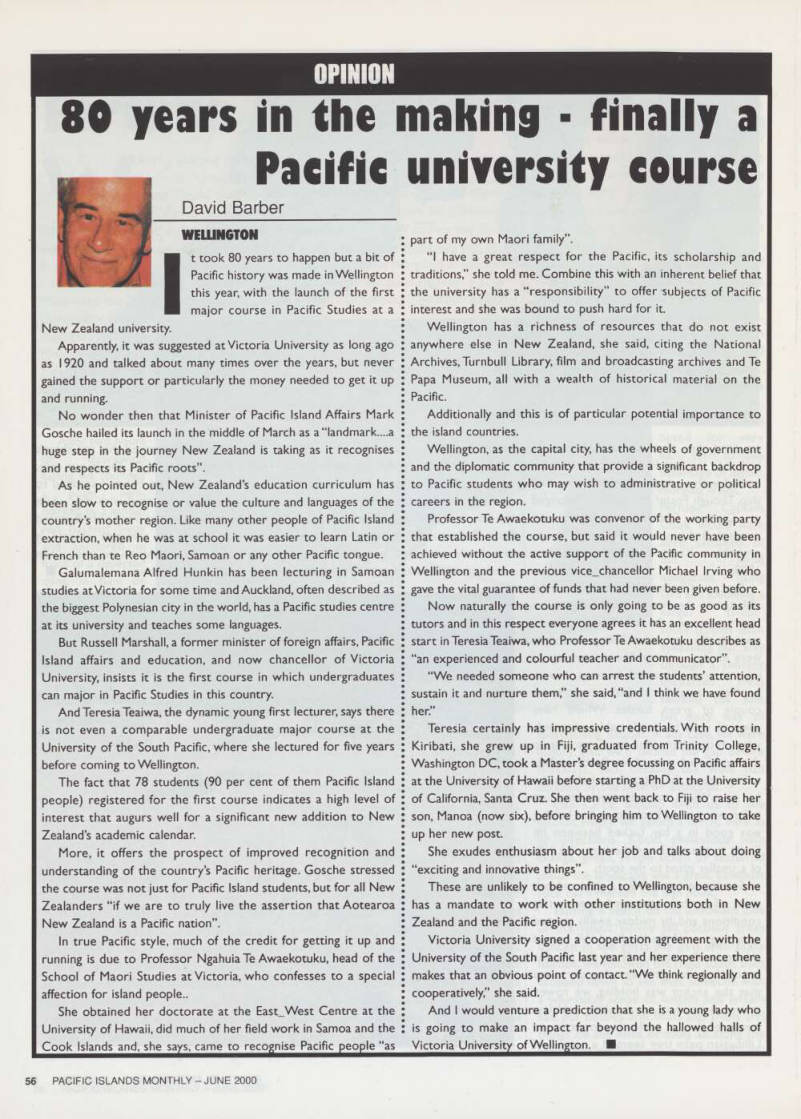
Opinion
80 years in the making-finally a Pacific university course
It took 80 years to happen but a bit of Pacific history was made in Wellington this year, with the launch of the first major course in Pacific Studies at a
New Zealand university.
Apparently, it was suggested at Victoria University as long ago as 1920 and talked about many times over the years, but never gained the support or particularly the money needed to get it up and running.
No wonder then that Minister of Pacific Island Affairs Mark Gosche hailed its launch in the middle of March as a “landmark...a huge step in the journey New Zealand is taking as it recognises and respects its Pacific roots”.
As he pointed out, New Zealand’s education curriculum has been slow to recognise or value the culture and languages of the country’s mother region. Like many other people of Pacific Island extraction, when he was at school it was easier to learn Latin or French than te Reo Maori, Samoan or any other Pacific tongue.
Galumalemana Alfred Hunkin has been lecturing in Samoan studies at Victoria for some time and Auckland, often described as the biggest Polynesian city in the world, has a Pacific studies centre at its university and teaches some languages.
But Russell Marshall, a former minister of foreign affairs, Pacific Island affairs and education, and now chancellor of Victoria University, insists it is the first course in which undergraduates can major in Pacific Studies in this country.
And TeresiaTeaiwa, the dynamic young first lecturer, says there is not even a comparable undergraduate major course at the University of the South Pacific, where she lectured for five years before coming to Wellington.
The fact that 78 students (90 per cent of them Pacific Island people) registered for the first course indicates a high level of interest that augurs well for a significant new addition to New Zealand’s academic calendar.
More, it offers the prospect of improved recognition and understanding of the country’s Pacific heritage. Gosche stressed the course was not just for Pacific Island students, but for all New Zealanders “if we are to truly live the assertion that Aotearoa New Zealand is a Pacific nation”.
In true Pacific style, much of the credit for getting it up and running is due to Professor Ngahuia Te Awaekotuku, head of the School of Maori Studies at Victoria, who confesses to a special affection for island people..
She obtained her doctorate at the East_West Centre at the University of Hawaii, did much of her field work in Samoa and the Cook Islands and, she says, came to recognise Pacific people “as
part of my own Maori family”.
“I have a great respect for the Pacific, its scholarship and traditions,” she told me. Combine this with an inherent belief that the university has a “responsibility” to offer subjects of Pacific interest and she was bound to push hard for it.
Wellington has a richness of resources that do not exist anywhere else in New Zealand, she said, citing the National Archives, Turnbull Library, film and broadcasting archives and Te Papa Museum, all with a wealth of historical material on the Pacific.
Additionally and this is of particular potential importance to the island countries.
Wellington, as the capital city, has the wheels of government and the diplomatic community that provide a significant backdrop to Pacific students who may wish to administrative or political careers in the region.
Professor Te Awaekotuku was convenor of the working party that established the course, but said it would never have been achieved without the active support of the Pacific community in Wellington and the previous vice_chancellor Michael Irving who gave the vital guarantee of funds that had never been given before.
Now naturally the course is only going to be as good as its tutors and in this respect everyone agrees it has an excellent head start in TeresiaTeaiwa, who Professor Te Awaekotuku describes as “an experienced and colourful teacher and communicator”.
“We needed someone who can arrest the students’ attention, sustain it and nurture them,” she said,“and I think we have found her.”
Teresia certainly has impressive credentials. With roots in Kiribati, she grew up in Fiji, graduated from Trinity College, Washington DC, took a Master’s degree focussing on Pacific affairs at the University of Hawaii before starting a PhD at the University of California, Santa Cruz. She then went back to Fiji to raise her son, Manoa (now six), before bringing him to Wellington to take up her new post.
She exudes enthusiasm about her job and talks about doing
“exciting and innovative things”.
These are unlikely to be confined to Wellington, because she has a mandate to work with other institutions both in New Zealand and the Pacific region.
Victoria University signed a cooperation agreement with the University of the South Pacific last year and her experience there makes that an obvious point of contact. “We think regionally and cooperatively,” she said.
And I would venture a prediction that she is a young lady who is going to make an impact far beyond the hallowed halls of Victoria University of Wellington. M
David Barber
Wellington
Coup attempt highlights Pacific’s ’indigenous’ dilemma
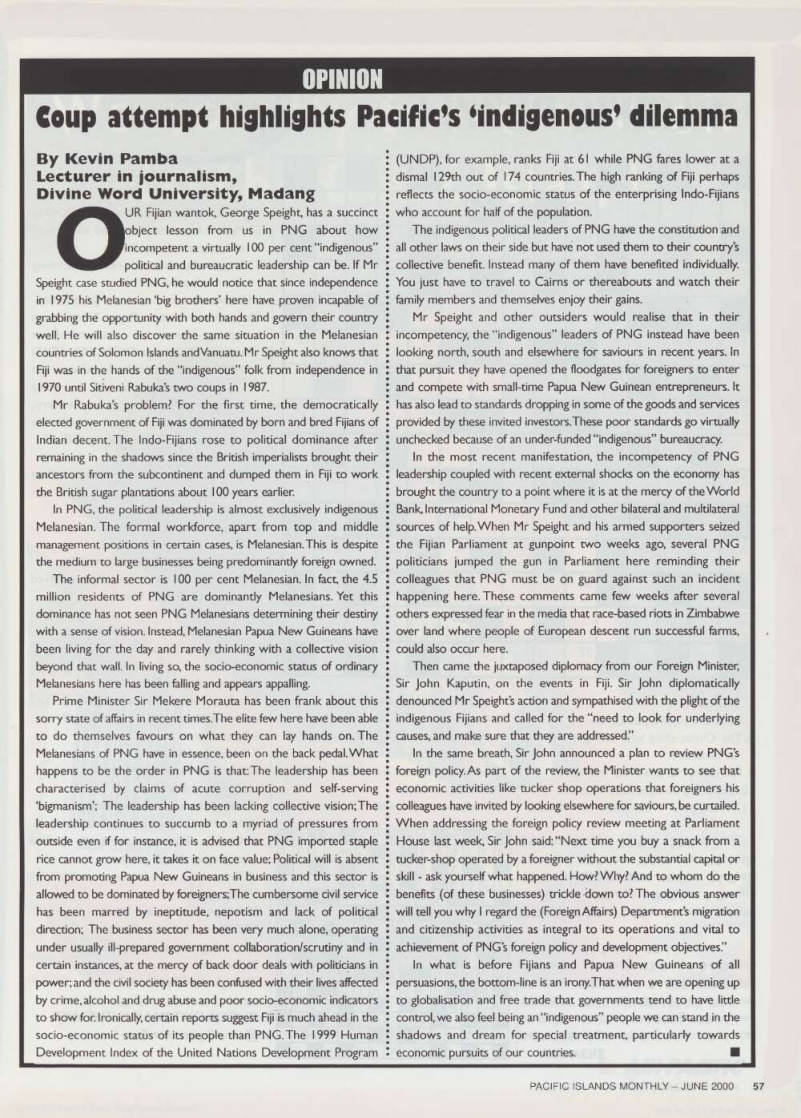
By Kevin Pamba
Lecturer in journalism.
Divine Word University, Madang
OUR Fijian wantok, George Speight, has a succinct object lesson from us in PNG about how incompetent a virtually 100 per cent “indigenous” political and bureaucratic leadership can be. If Mr Speight case studied PNG, he would notice that since independence in 1975 his Melanesian ‘big brothers’ here have proven incapable of grabbing the opportunity with both hands and govern their country well. He will also discover the same situation in the Melanesian countries of Solomon Islands and Vanuatu. Mr Speight also knows that Fiji was in the hands of the “indigenous” folk from independence in 1970 until Sitiveni Rabuka’s two coups in 1987.
Mr Rabuka’s problem? For the first time, the democratically elected government of Fiji was dominated by born and bred Fijians of Indian decent. The Indo-Fijians rose to political dominance after remaining in the shadows since the British imperialists brought their ancestors from the subcontinent and dumped them in Fiji to work the British sugar plantations about 100 years earlier.
In PNG, the political leadership is almost exclusively indigenous Melanesian. The formal workforce, apart from top and middle management positions in certain cases, is Melanesian. This is despite the medium to large businesses being predominantly foreign owned.
The informal sector is 100 per cent Melanesian. In feet, the 4.5 million residents of PNG are dominantly Melanesians. Yet this dominance has not seen PNG Melanesians determining their destiny with a sense of vision. Instead, Melanesian Papua New Guineans have been living for the day and rarely thinking with a collective vision beyond that wall. In living so, the socio-economic status of ordinary Melanesians here has been felling and appears appalling.
Prime Minister Sir Mekere Morauta has been frank about this sorry state of affairs in recent times. The elite few here have been able to do themselves favours on what they can lay hands on. The Melanesians of PNG have in essence, been on the back pedal. What happens to be the order in PNG is that;The leadership has been characterised by claims of acute corruption and self-serving ‘bigmanism’; The leadership has been lacking collective vision;The leadership continues to succumb to a myriad of pressures from outside even if for instance, it is advised that PNG imported staple rice cannot grow here, it takes it on face value; Political will is absent from promoting Papua New Guineans in business and this sector is allowed to be dominated by foreigners;The cumbersome civil service has been marred by ineptitude, nepotism and lack of political direction; The business sector has been very much alone, operating under usually ill-prepared government collaboration/scrutiny and in certain instances, at the mercy of back door deals with politicians in power; and the civil society has been confused with their lives affected by crime, alcohol and drug abuse and poor socio-economic indicators to show for. Ironically, certain reports suggest Fiji is much ahead in the socio-economic status of its people than PNG. The 1999 Human Development Index of the United Nations Development Program
(UNDP), for example, ranks Fiji at 61 while PNG feres lower at a dismal 129th out of 174 countries. The high ranking of Fiji perhaps reflects the socio-economic status of the enterprising Indo-Fijians who account for half of the population.
The indigenous political leaders of PNG have the constitution and all other laws on their side but have not used them to their country’s collective benefit. Instead many of them have benefited individually.
You just have to travel to Cairns or thereabouts and watch their family members and themselves enjoy their gains.
Mr Speight and other outsiders would realise that in their incompetency, the “indigenous” leaders of PNG instead have been looking north, south and elsewhere for saviours in recent years. In that pursuit they have opened the floodgates for foreigners to enter and compete with small-time Papua New Guinean entrepreneurs. It has also lead to standards dropping in some of the goods and services provided by these invited investors. These poor standards go virtually unchecked because of an under-funded “indigenous” bureaucracy.
In the most recent manifestation, the incompetency of PNG leadership coupled with recent external shocks on the economy has brought the country to a point where it is at the mercy of the World Bank, International Monetary Fund and other bilateral and multilateral sources of help. When Mr Speight and his armed supporters seized the Fijian Parliament at gunpoint two weeks ago, several PNG politicians jumped the gun in Parliament here reminding their colleagues that PNG must be on guard against such an incident happening here. These comments came few weeks after several others expressed fear in the media that race-based riots in Zimbabwe over land where people of European descent run successful farms, could also occur here.
Then came the juxtaposed diplomacy from our Foreign Minister, Sir John Kaputin, on the events in Fiji. Sir John diplomatically denounced Mr Speight’s action and sympathised with the plight of the indigenous Fijians and called for the “need to look for underlying causes, and make sure that they are addressed.”
In the same breath, Sir John announced a plan to review PNG’s foreign policy. As part of the review, the Minister wants to see that economic activities like tucker shop operations that foreigners his colleagues have invited by looking elsewhere for saviours.be curtailed.
When addressing the foreign policy review meeting at Parliament House last week, Sir John said: “Next time you buy a snack from a tucker-shop operated by a foreigner without the substantial capital or skill - ask yourself what happened. How? Why? And to whom do the benefits (of these businesses) trickle down to? The obvious answer will tell you why I regard the (Foreign Affairs) Department’s migration and citizenship activities as integral to its operations and vital to achievement of PNG’s foreign policy and development objectives.”
In what is before Fijians and Papua New Guineans of all persuasions, the bottom-line is an irony. That when we are opening up to globalisation and free trade that governments tend to have little control, we also feel being an “indigenous” people we can stand in the shadows and dream for special treatment, particularly towards economic pursuits of our countries. ■
Pacific Puzzle
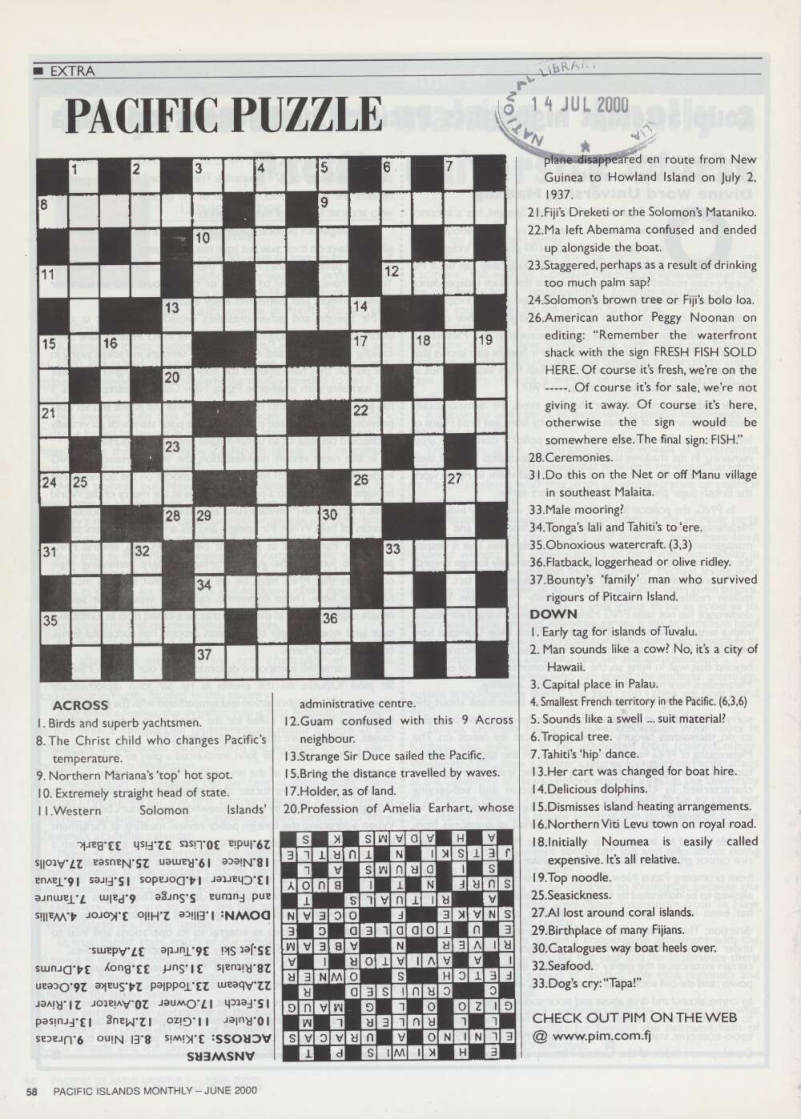
Extra
Across
I. Birds and superb yachtsmen. 8. The Christ child who changes Pacific’s temperature. 9. Northern Mariana’s ‘top’ hot spot.
10. Extremely straight head of state.
11. Western Solomon Islands’
Answers
ACROSS: 3.Kiwis B. EI Nino 9.Uracas 10. Ruler ll.Gizo l2.Maug !3.Fruised 15. Fetch 17. Owner 20. Aviator 21. River 22,Abeam 23. Toddled 24. Snake 26.0cean 28. Rituals 3 I.Surf 33. Buoy 34. Drums 3S.Jet Ski 36. Turtle 37. Adams.
DOWN: I. Ellice 2.Hi10 3.Koror 4.Wallis and Futuna s.Surge 6.Palm 7.Tamure IS.Charter 14.Dorados 15. Fires l6.Tavua 18. Niece l9.Ramen 25. Nausea 27.At011s 29. India 30. Lists 32. Fish 33. Bark.
administrative centre. 12. Guam confused with this 9 Across neighbour. 13. Strange Sir Duce sailed the Pacific. 15. Bring the distance travelled by waves. l7.Holder, as of land. 20. Profession of Amelia Earhart, whose
plane disappeared en route from New Guinea to Howland Island on July 2, 1937. 21. Fiji’s Dreketi or the Solomon’s Mataniko. 22. Ma leftAbemama confused and ended up alongside the boat. 23. Staggered, perhaps as a result of drinking too much palm sap? 24. Solomon’s brown tree or Fiji’s bolo loa. 26. author Peggy Noonan on editing; “Remember the waterfront shack with the sign FRESH FISH SOLD HERE. Of course it’s fresh, we’re on the Of course it’s for sale, we’re not giving it away. Of course it’s here, otherwise the sign would be somewhere else. The final sign: FISH.” 28. 3 I.Do this on the Net or off Manu village in southeast Malaita. 33. Male mooring? 34. lali and Tahiti’s to‘ere. 35. Obnoxious watercraft. (3,3) 36. loggerhead or olive ridley. 37. Bounty’s ‘family’ man who survived rigours of Pitcairn Island.
Down
1. Early tag for islands of Tuvalu. 2. Man sounds like a cow? No, it’s a city of Hawaii. 3. Capital place in Palau. 4. Smallest French territory in the Pacific. (6,3,6) 5. Sounds like a swell ... suit material? 6. Tropical tree. 7. ‘hip’ dance.
I 3.Her cart was changed for boat hire.
14. Delicious dolphins.
15. Dismisses island heating arrangements. 16. Viti Levu town on royal road. 18. Initially Noumea is easily called expensive. It’s all relative.
19.T0p noodle.
25. Seasickness. 27. lost around coral islands. 29. of many Fijians. 30. way boat heels over. 32. Seafood.
33. Dog’s cry:“Tapa!”
Check Out Pim On The Web
@ www.pim.com.fj
Advertisements & other items, pp. 59-60 (1 item)
sland
WFM
e a week
/ / / 1508 01107122 pp** ■ We have expanded our Pacific Islands network fo Include fwlce weekly flights fo fhe Cook Islands which Is serviced by our new generation Boeing 737 aircraft. This means you can enjoy the latest In technology and passenger comfort as well as the friendly, personal service the Islands are famous for. How you can fly ‘your Island In the sky’ to more Islands throughout the Pacific.
AIR PACIFIC
Pour Island In th Qantas Frequent Flyer Programme Partner www.alrpaclflc
r C-t 919
PAG
toll 'SheJ
■•: // >r / Some of the specs may vary according to market specifications.
Tough, Rugged and Comfortable - Toyota Hilux People all over the world prefer Toyota. Because it makes bestsellers like Hilux. It maintains that rugged reputation, and now it sports tough, durable body styles as well. It's ready for any terrain.
Hilux offers more. More power - with a choice of engines and precision transmissions and transfers. More effective power distribution to match the terrain, thanks to Toyota's advanced
technology.
jr ujujl lululu. global.
toyota.
For further information, please contact the following distributors or dealers
DISTRIBUTORS/DEALERS
NORFOLK ISLAND BORRY’S PTY LTD. PH 22114
SOLOMON ISLANDS ELA MOTORS PH 30314
VANUATU ASCO MOTORS PH 22341
COOK ISLANDS PACIFIC MOTORS LTD. PH 20796 And more passenger car-like comfort. With an ergonomic interior, all the conveniences you want, the fit and finish you'd expect from Toyota, and a ride that's smoothed out by precision-engineered suspension.
Hilux is built to take it. And to take you anywhere you want to go.
It's remarkably tough. And incredibly comfortable. With worldleading uncompromising quality. From the champion. Toyota.
® TOYOTA
KIRIBATI TARAWA MOTORS PH 21090
PAPUA NEW GUINEA ELA MOTORS PH 3229400
TAHITI NIPPON AUTOMOTO PH 429819
SAMOA ASCO MOTORS PH 20800
FIJI ASCO MOTORS
NEW CALEDONIA S.I.A.P.
TONGA ASCO MOTORS
AMERICAN SAMOA ASCO MOTORS*
(*HILUX is not being handled.)
PH I
PH 275562 PH 23500 PH 633-4281