
Advertisements & other items, pp. 1-2 (2 items)
ia.ls l® m_ftL
PACIFIC ILANDS
MONTHLY
Inside: Viiay means “Victory”
jmaT 9
ia.ls l® m_ftL
\ \ l Gold 'Coast 4 gdl
if 1 Superannuation
r J - - - ... - -» - - w a |i~ 9 770030 872007 111111 '\ Indian /wouongon* ,77 & /7 ¥-1 v w** n u ton
American Samoa US$2.5O; Australia A 53.50; Cook Islands NZ $3; Fiji F 52.50 Vat Incl; FS Micronesia US$3; Kiribati A 52.50; Nauru A 52.50; Niue NZ$3; Norfolk As 3; New Caledonia cpf2so; New Zealand NZ53.45 incl GST; Northern Marianas US$3; Papua New Guinea K 4.90; Palau US$3; Marshall Islands US$3; Solomon Islands As 3; French Polynesia cpf3oo; Tonga P 3; USA US$3; Vanuatu VT22O; Western Samoa T 5.50. These are recommended prices only
V ~-v'- yT
" s,— V y V . *wr. ■■ a- T- r m Photos : Pantz - Aubry m a Wa * Located in the South Pacific, New Caledonia is a developed!, sophisticated island business base that offers outstanding opportunities for investors ; stunning sites for new hoteH developments, suitable climate for counter-season fruits and vegetables, superb locations for fish and prawn aquaculture, and more. Authorities in New Caledonia are very supportive to business.
New Caledonia also offers a range of quality products (fruits & vegetables, seafood, agri-food products, etc.), services and technology (including water, energy, environment), meeting international requirements and expectations.
We promote our products through regular visits to foreign markets.
ADECAL, the Economic Development Agency of New Caledonia, is the one-stop-shop where you can get specific .advice on doing business with New Caledonia.
As your free-of-charge partner, we shall assist you in identifying opportunities and putting together your project successfully.
For more information, please contact: Exports : Mrs Doriane Sanchez-Le Bris.
Investment - Hotel & Tourism : Mr. Yann Pitotlet.
Investment - Seafood, Agrifood & Industry : Mr. Benoit Rengade. /k r\r y \ l/ t- A I 1 V L. : New Caledonia Economic Development Agency 15, rue Guynemer - PO Box 2384 - 98846 Noumea Cedex - New Caledonia - Phone: (687) 249 077 - Fax: (687) 249 087 - E-mail: [email protected] - www.adecal.nc
Pacific Ilands

Monthly
Vol. 70 No. 5
The News Magazine
May 2000
Alan Robinson Sophie Foster Hildebrand Michael Field, Giff Johnson, Sally Andrew, Sam Vulum, Ed Rampell, Alan Ah Mu, Brian Tobia.
David Barber (Wellington), Jemima Garrett (Sydney) Penina Magnus, Sovaia Ditoga Senior Regional Sales (South Pacific) Shayne Farah Hussein Tel (679) 304111,303244, Fax (679) 303809.
Sydney, Canberra: Bob Hill Media Representation, Tel (61-2) 4164245, Fax (61-2)4165064.
Brisbane: Jane Fewings Media and Advertising Associates Tel (61-7) 3378 4522.
Fax (61-7) 3878 1071.
Adelaide: Hastwell Williamsons Representatives, Tel (61-8) 3799522, Fax (61-8) 3799735.
Melbourne: Brown Orr Fletcher Burrows (Aust) Pty Ltd.
Tel (61-3) 98265188, Fax (61-3) 98265644.
Auckland: McKay & Bowman. International Media Representatives Limited.
Tel (64-9)4190561, Fax (64-9)4192243.
Japan: Universal Media Corporation, Tokyo, Tel (3)3266626741, Cable: UNI-MEDIA Tokyo, Fax (3) 32626742.
Pacific Islands Monthly was founded in 1930
(Usps 9522480).
A Fiji Times Limited production.
Cover prices are recommended retail only. Registered by Australia Post, Publication No. NBPI2IO. © Copyright Fiji Times Limited, 177 Victoria Parade, Suva, Fiji, Tel (679) 304111, fax (679) 303809.
Email: [email protected].(j PIM Website: http://www.pim.com.fj Pacific Islands Monthly is published monthly by Fiji Times Limited, a division of Nationwide News, 2 Holt Street, Surry Hills, Sydney. NSW 2010.
Pacific Islands Monthly PO Box 1167, Suva, Fiji.
Printed by Quality Print Limited, 16 Amra Street, Walu Bay, Suva, Fiji.
Cover design/Layout by Penina Magnus & Sovaia Ditoga All care, but no responsibility taken for material submitted for publication
Inside
Cover Story Page 30
Editorial 4 Letters 5 Briets 6 Special Report: Samoa’s darkest era since 1920 s ends with death sentences 8 Business: Tuvalu gets paid for converted “TV” 9 The chair behind the throne 11 Former Fiji couple help bring Bollywood to NZ 12 GST to be refunded to passengers departing Australia 13 Stray rocket crashes near Pitcairn 16 Disney revives‘Pearl Harbor’ 19 Air Pacific expands service to include Cook Islands 20 Brewery waste helps pests drop like flies 27 Coverstory: Calls for clean-up of Superannuation industry 30-31 Marshalls to begin revamp of Social Security system 32-33 Government dares executives to take on challenge 34 Weeding out high level corruption 34 Development: Climate change project records a rise in sea level 36 Australia to fund third phase of monitoring unit 37 Rising seas cruse concern in PNG 37 Will Castro cone to Suva signing 38 PNG government targets illegal adoptions 39 A bid to keep the Pacific landmine-free 40 Baruni’s children 42 Ttihai warfare waning In PNG 46 Sports: Vijay means “Victory” for islanders 54 Opinion: David Barber/Jemima Garett 56-57 Extra: Villagers in a dilemma over rainforest 58
Page 19
Page 42
Page 54
The race card
Editorial
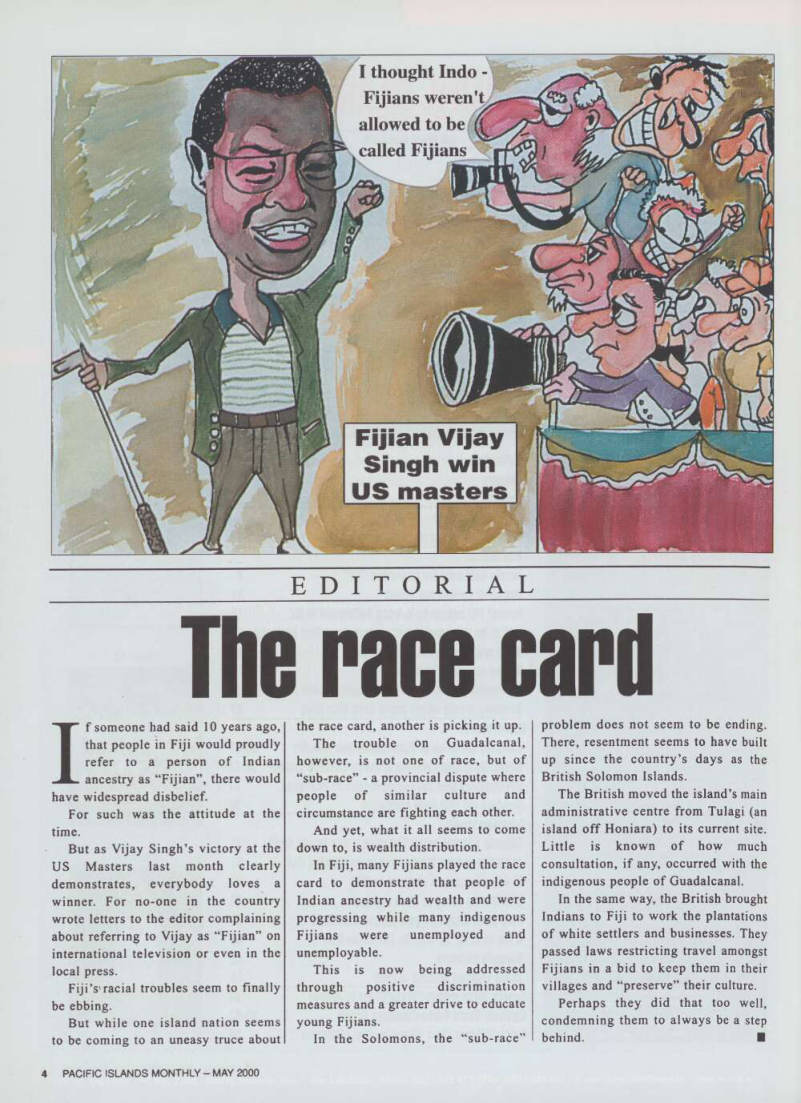
If someone had said 10 years ago, that people in Fiji would proudly refer to a person of Indian ancestry as “Fijian”, there would have widespread disbelief.
For such was the attitude at the time.
But as Vijay Singh’s victory at the US Masters last month clearly demonstrates, everybody loves a winner. For no-one in the country wrote letters to the editor complaining about referring to Vijay as “Fijian” on international television or even in the local press.
Fiji’s'racial troubles seem to finally
be ebbing.
But while one island nation seems to be coming to an uneasy truce about
the race card, another is picking it up.
The trouble on Guadalcanal, however, is not one of race, but of “sub-race” - a provincial dispute where people of similar culture and circumstance are fighting each other.
And yet, what it all seems to come down to, is wealth distribution.
In Fiji, many Fijians played the race card to demonstrate that people of Indian ancestry had wealth and were progressing while many indigenous
Fijians were unemployed and
unemployable.
This is now being addressed
through positive discrimination
measures and a greater drive to educate young Fijians.
In the Solomons, the “sub-race”
problem does not seem to be ending.
There, resentment seems to have built up since the country’s days as the British Solomon Islands.
The British moved the island’s main administrative centre from Tulagi (an island off Honiara) to its current site.
Little is known of how much consultation, if any, occurred with the
indigenous people of Guadalcanal.
In the same way, the British brought Indians to Fiji to work the plantations of white settlers and businesses. They passed laws restricting travel amongst Fijians in a bid to keep them in their villages and “preserve” their culture.
Perhaps they did that too well, condemning them to always be a step behind. ■
Letters
Correction
The advertisement promoting a chance to win an IBM Pentium Notebook Computer, titled “Subscribe to the Source”, was inserted by mistake in the April 2000 Issue of PIM. That competition, in fact, ran in 1999 and the winner has already been drawn.
Positive migration policy needed
I would like to bring to your attention the recent formation of our Australian lobby group, Australian Pacific Amnesty Council (APAC). This group has been formed as a result of growing concerns among migrants from the Pacific islands about the lack of positive migration policy and programs from current and past Australian Federal governments.
Our Council has sent written submissions to the Hon Minister of Immigration and multicultural Affairs, Philip Ruddock, we have also sent along representatives in several community consultations conducted by his Department. As well as this, we have also organised petitions, and we are currently awaiting a scheduled private meeting with the Hon Minister Philip Ruddock in person on the 17th April 2000.
APAC has also made contact with the Shadow Minister of Immigration and Multicultural Affairs, Hon Con Sciacca, and he has assured our Council that our position will be considered when settlement issues and policies are discussed within the Labor Party Caucus.
We had also made contact with Independent MP Brian Harradine, as well as other prominent members of parliament.
We hope to receive support from other Pacific island groups. The Council has the
following members:
1. Rev. Pensimani Folaumoetu’i, Leader of the Tongan Catholic Chaplain in Australia 2. Mr. ‘Ofeina Sikahele (B.Com), Immigration law specialist 3. Mr. Fetu’u Tupou, Editor of the Tongan Herald, and founder of TV Tonga 4. Mr. Salesi Finau, representative of the
Weslyan Church and current Steward of Auburn parish 5. Mafi-to-ki-felenite, Tongan Radio announcer 6. Mr. Kelemani Taumoepeau (LLB), solicitor 7. Mr. Pounima Lasalo, social worker and interpreter It would be appreciated if the existence of our council is made known to the wider pacific community, and we hope that from this, we are able to built a stronger Council with representatives from other pacific island groups. For those who are genuinely interested and who want to assist or join our Council, please contact ‘Ofeina Sikahele on (02) 9279 1991 during working hours, or 0413 639 286 after hours. We’d love to hear from you.
Australian Pacific Amnesty Council (APAC), Sydney, Australia
Pacific search
Have you ever covered an atoll called Suvarov, or Suwarrow? The atoll is the subject of writings by (sometime inhabitants) Robert Dean Frisbie, (Island of Desire), and Tom Neale, (An Island To Oneself).
In particular, I am searching for leads to the publishers of Frisbies’ book Island of Desire, or any articles written about, or related to the atoll and these two men.
Tony Lester
tonylesteroffice@aol. com
Usa
Material on Niue Island
Greetings. I am a (Tongan) student primary school teacher in Auckland, New Zealand, and am looking for some material for a social studies unit on the topic of the Niuean hair cutting ceremony for boys. I would really be grateful for any help in providing material or pictures.
Seletute Mila
[email protected] New Zealand
Orbituary
Konok leader, Yann Celene
Uregei, dies aged 67
PRO-DEMOCRACY leader Roch Wamytan has paid tribute to the late independence fighter Yann Celene Uregei, who died at the age of 67 in his Koutio home (near Noumea) last month.
Wamytan, leader of the FLNKS movement called on all supporters to respect a day of national mourning in memory of the late Kanak leader.
“Old Yann, throughout his life, has been a fighter, a flawless combatant for his people’s freedom,” Wamytan said in a release. “He was very affected by our people’s divisions after the signing of the Matignon accords, this led him to withdraw from FLNKS, the movement he helped to form.”
Uregei, a school teacher, entered politics in 1962. He later became a member of the Union Caledonienne (UC) and in 1967 became member, then the first deputy Speaker of the New Caledonian territorial assembly. But in 1970, he left the Assembly and founded the Union Multiraciale de Nouvelle- Caledonie.
In 1975, he founded a coordination committee for Kanak independence and started a series of international trips to promote the struggles of the Kanaky people. In 1977, he was re-elected into the Territorial Assembly for the new party he had just founded, the Front Uni de Liberation Kanak (FULK).
In 1984, in the wake of serious civil unrest in New Caledonia, he was part of the group that formed the FLNKS (Kanak Socialist National Liberation Front), an umbrella of several pro independence parties. The following year, because of his international profile, he was even appointed foreign affairs minister in a self-styled “Kanaky interim government”.
“His passing will be mourned by many in New Caledonia, whether they be pro or anti-independence, for his integrity and charisma were respected
by everyone”, pro-independence
Kanaky Online news service said in a statement... P.NS M
New Capital for BSI
Archives-May 1945
But shrouded in dark
official mystery
Deep mystery surrounds the selection of a new “capital” for the British Solomons. It is said to be Harira, or Honiara, on the Guadalcanal coast, opposite the old capital of Tulagi (which is on an island, close under the coast of Gela).
Casual reference was made to it some weeks ago, when the Fiji Information Office stated that the High Commissioner for the Western Pacific (A W G H Grantham) had, in a tour of the Protectorate, visited “the new capital,” Harira, as well as the old capital, Tulagi.
Officials in the Solomon Islands
Office in Sydney, when asked for enlightenment, refused to talk. The first gentleman said he didn’t know where it was - he hadn’t been in BSI for three years. He intimated that he did not care where it was, either, and instructed us to call another officer, later.
We called the other officer, later. The other officer was immediately suspicious, but finally admitted that there was a new capital. He said its name might be Harira, as the Fiji Information Office has intimated, but that the Sydney Office believed it to be (and spelled it)
Honiara. He admitted furtherr, but reluctantly, that it was on the cosast of Guadalcanal, directly opposite Tullagi.
But he could not say why Tulajgi had been condemned, or who had decided to shift the capital, or what plans; were being made for the construction or future of Honiara/Harira. That, he said, would be against Security Regulations.
There are a few ex-Solomons residents to whom the selection of a new capital, as well as the abandonment of the old, would be news. Plain civilian residents, however, are small fry, and have no place in the plans of bureaucracy.
It would be interesting to know what harm could be done “security” by a little information concerning the why and the wherefor of the new move. It is scarcely likely, at this late date, that Hirohito & Suzuki Inc. are sitting up at nights wondering what goes on in domestic politics in the Solomons. ■
Pacific Islands Monthly
Briefs
Satyan qua Mes fop world record
The Marianas Visitors Authority has received certification from Guinness World Records that Saipan now qualifies to be entered into the Guinness Book of World Records for the World’s Largest Dive.
Martin Duenas, community projects manager for MVA, and members of the Underwater Events Committee met after receiving notification from Guinness about Saipan’s qualification for inclusion into this elite circle of record holders.
On April 17,1999,215 divers, mostly from Japan, simultaneously participated in what was hoped to be the World’s Largest Dive. Officials from the Guinness Book of World Records were on hand to record the event Divers were issued stamp rally entries for a raffle to be drawn at a later date and die winners are to be brought back to Saipan for a dive holiday.
Saipan Tribune
Maternity leave gains to Frendi Polynesia
Women’s associations in French Polynesia have obtained the right to keep fully-paid salaries during their maternity leave.
The announcement, which was made by
President Gaston Flosse, comes as a result of meetings held earlier this week with the French Polynesian government Last February, about 150 French Polynesian women had gathered in the streets of the capital Pape’ete to demand 100% reimbursements of maternity leave by the local social security system. Mothers, grandmothers, many holding their babies, were chanting a revised version of the French national motto “Liberte, egalite, fratemite”, turned into “Liberte, egalite, matemite”. Recent statistics show that out of some 21,000 working women, 6,000 do not get fully reimbursement when going on maternity leave. (Les Nouvelles de Tahiti) Emfroiiiiemafctt protest against PNG mfcie operators - BHP Environmentalists and Papua New Guineans (PNG) today dumped dirt on the steps of the Melbourne headquarters of major Australian mining company, BHP to protest its involvement in the Ok Tedi copper mine in PNG’s western province.
Members of “Friends of the Earth” and PNG landowners are calling on BHP to provide financial support as tonnes of waste from the
mine are being dumped daily into the Ok Tedi Fly River system. The protesters claim up to 50,000 Papua New Guineans have lost their livelihood because of the environmental damage caused by the mine waste.
PNG’s Environment Minister Herowa Agiwa last month warned Ok Tedi Mining Limited to take full stock of all environmental damage in its operations before it decides to leave. Late last year BHP in a report admitted pollution of the Fly River system and its tributaries indicating that the best solution was to close the mine immediately. This prompted the World Bank to recommend for the closure of the giant copper mine.
However, the National Government said it would not support an early closure of the mine.
It wants BHP to rectify operations at the mine to avoid further environmental damage.
The Mine has a remaining life span of about nine years, until year 2010. PNS French Polynesia to defend Its name French Polynesia’s minister of economy Georges Puchon is this week in Paris to meet French officials and campaign for a better protection of the intellectual property of the
name of‘Tahiti”.
The trip follows concerns raised recently by the French Polynesian Chamber of Commerce, which pointed out that in metropolitan France, around 300 products, from shower gels to a whole range of items, are currently marketed under Tahiti or Tahiti-derived names. Local companies argue that because these products are already famous under this names and also marketed in French Polynesia, those entrepreneurs wishing to use the names again are effectively penalised.
French companies usually use these names because they convey a strong exotic and dream loaded message. Other names of atolls in French Polynesia, like Bora-Bora or Moorea, are not exempt either. During his trip to Paris, Puchon is schedule to have meeting with name and brand property-specialised lawyers with the aim of better protecting French Polynesia’s cultural and name identity. (RFO) PNG fftn nets acclaimed prize A Papua New Guinean film produced and directed by the head of the National Film Institute in Goroka has won an international award. Titled “Bridewealth for a Goddess,” the film was completed last year after 14 years of filming. Institute chief Chris Owen said yesterday the film institute had been awarded the prestigious Prix Nanook-GrandPrix at the 19th annual Bilan du Film Ethnographique.
He said the international festival of ethnographic/anthropological film was held each year at the Museum of Mankind in Paris, France. It has become a showcase for the best documentary films in this genre. He said the film told the story of a chief from the Kawelka tribe near Mount Hagen, in Western Highlands Province. The chief devoted several years of his life to fulfilling the ritual obligations he inherited after being visited in a dream by Ambkor, a beautiful young woman.
Mr. Owen said: “The film was selected by a distinguished panel of international jurors.
“It runs for 72 minutes.”
Mr. Owen said that the final scene in the film is one of those “increasingly rare moments in Papua New Guinea’s rapid changing society that only film could capture and preserve for posterity.”
It was directed, shot and edited by Mr.
Owen, working out of the former Institute of Papua New Guinea Studies film unit in Port Moresby. The film unit has since been
amalgamated with the former Skul Bilong Wokim Piksa to form a new national film institute. Video copies are available from their cultural gift shop in Port Moresby. (Post- Courier) ShangrHa hotels and resorts names new chief operatfeig officer Shangri-La Hotels and Resorts announced the promotion of John Segreti to Chief Operating Officer. In his new position, he will supervise all the operating functions of the group except Development. This will allow Giovanni Angelini, the group’s Chief Executive Officer/Managing Director, to focus his priority on the global expansion and development of the Shangri-La and Traders brands. Segreti, a native New Yorker, joined the company in August 1991. Most recently, he was the Vice President responsible for hotels in Singapore and Indonesia and directly responsible for the repositioning of the Shangri-La Hotel, Singapore.
This appointment took effect April 1, 2000.
John Segreti will be based at Group’s headquarters office in Hong Kong.
PMndne arfeie to fly Paiau-Davao route A Philippine airline is set to commence direct flights from Davao in the southern Philippines to the Palauan capital Koror, a Palauan official announced.
Trade and Commerce Minister Okada Techitong said Cebu Pacific would make its maiden flight on the route within this month carrying both passengers and cargo.
The decision of the airline to fly the Palau route was a result of exploratory talks held in Davao last year and following Techitong’s recent meeting with the airline’s representatives in Manila. The minister said Cebu Pacific would increase its direct flights between Davao and Koror if there was sufficient market demand, which he believed existed.
He said he hoped Cebu Pacific would provide flight connections for European tourists arriving and departing the southern Philippines.
In joining Palau’s aviation industry, Cebu Pacific would become the second Philippine airline to operate in Palau, after Centennial Air which is owned by Filipino businessman Jose Alvarez. Centennial Air provides direct flights from Manila to Palau carrying tuna exports which are transported to the Japanese market.
(Afp)
Cnise hdustry growth presents new safety
problems
The growth of the cruise industry in the Asia-Pacific region has spawned new safety concerns for maritime agencies, officials said.
Fifty top officials from 17 maritime agencies in the region decided at the end of a two-day meeting to give further attention to the boom in the cruise industry, a statement said “This presented a new challenge for SAR (search and rescue) operations, in particular in the evacuation of large numbers of passengers in an emergency,” said the Maritime and Port Authority of Singapore (MPA), which organized the meeting of the Asia-Pacific Heads of Maritime Safety Agencies Forum.
The maritime chiefs also agreed to examine new technologies to make its global maritime distress and safety system more efficient and cost effective, it added.
Tongas king intervenes in rugby boycott,
PoSce Minister quits A club rugby strike in Tonga ended after King Taufa’ahau Tupou IV ordered the country’s rugby union to end a high-level leadership tussle. Tonga Rugby Football Union (TRFU) chairman Clive Edwards, who is also the police minister, caused an uproar when he stacked the board with his own supporters, including Police Commander Sinilau Kolokihakaufisi.
The 23-clubs on the main island of Tongatapu refused to play for three weeks, prompting the King to order the board to meet again to reconcile their problems. Rugby union has always been something of a democratic battleground in a kingdom which is without meaningful political democracy. The police have long struggled to control the game and eight years ago the then Police Minister, Noble Akau’ola, pulled all the police out of the national team - four of the top 15 players.
The royal ordered meeting occurred when Edwards arrived and announced he was resigning from TRFU.
The Tongatapu clubs voted to accept the resignation with immediate effect and the kingdom’s rugby competition was finally underway a month late.
Long term, the row could have a serious impact as Tonga is due to play the All Blacks later this year as well as competing in the Pacific Rim competition with Samoa, Fiji, Canada and Japan. (AFP) ■
Samoa’s darkest era since the 1920 s is
Special Report
Samoa's darkest era since 1920s ends with death sentences
By Michael Held
Samoa’s darkest era since the 1920 s is ending with two cabinet ministers sentenced to death for their role in ordering the assassination of another minister. It was a story of greed, money and, ultimately, a rather satanic evil that led Leafa Vitale and Toi Aukuso to standing before Australian Justice Andrew Wilson who passed a death sentence over diem.
But the saga of the murder of Public Works Minister Luagalau Levaula Kamu leaves many more questions that will haunt the government of Prime Minister Tuila’epa Sailele who faces general elections next year.
Ironically Tuila’epa was after the trial hailing the transparency of the Supreme Court that saw
transcriptions of die court proceedings appearing
in the media daily in Samoa. Before Tuila’epa, as finance minister and deputy to Prime Minister Tofilau Eti Alesana, assiduously fought against any openness that would have exposed Leafa and Toi long before anybody was killed.
What was clear from the Supreme Court proceedings in Samoa was that the astonishing degree of corruption practised by Leafa and Toi, and others, was known about for years. And anybody who tried to expose it - from Chief
Auditor Sua Rimoni Ah Chong to the Samoa Observer - paid a heavy price with attacks from Tofilau and Tuila’epa. Sadly one of those who paid for his life was, it seems, no saint either and was a party to the original cover up, Luagalau.
His significance in the ruling Human Rights Protection Party (HRPP) was seen in his leading role at the party ’s 20th anniversary ball cm July 16, 1999. He was running the show that night when his cellphone rang shortly after Bpm. It was his niece Sina Kamu Anamani who could not find the ball that was at tire St Joseph’s Hall.
As he spoke to her Leafa’s 34-year-old cocaine addicted son Alatise Vrtale lined up the sights of die automatic rifle his father had given him. He fired, mortally wounding the minister.
Bizarrely the prime minister ordered the dance to continue, as a member of the band that provided the entertainment for the night, Savea Ray Lee Lo, told the court “The prime minister asked me what happened and I sort of said to him that the man, Luagalau, had been injured. And then he said, ‘Well, try and keep on playing’.”
Lo said they continued but they were scared.
The Lands Minister Tuala Sale Tagaloa, whom Leafa also wanted killed, said he called die first
dance.
“While the ministers were coming up to the floor, Minister Joe Keil approached me. He came right up the stage, and he held my hand, and he said, ‘Are you all right, Tuala?’ I said, ‘Yes,’ and he said, ‘That was a gunshot’.
“At that time, I had a strange feeling. My wife also came up to me - up to the stage - and she told me to get away from the centre of the stage,” said Tuala. Yet the scheduled programme of the night was stuck to with the prime minister asked by Tuala to cut the birthday cake.
“I continued to stand up there at that time, and then I again told the band to play another song. It was only the music that was being played, but nobody came up to the floor.”
Even though the police arrived at 9pm Tuila’epa kept the party going, much to the frustration of Police Inspector Rimoni Vaaelua who was worried about contamination of the crime scene. He said he asked the prime minister to finish the party.
“Sir, when I asked and he said that they were finishing, that urge did not persist,” the inspector said. Alatise Vitale was soon after picked up and quickly confessed to New Zealand police officers Detective Inspector Steve Shortland and Detective Sergeant Phillip Kirkham, bought in for the investigation.
“I put the gun mouth, the barrel between the kicks, and just pulled the trigger,” he said in his confession. “The gun was pointed at Leva’s left side. There was a loud bang, it was really loud, a big fire came out the front, then I pulled the gun and started running straight to the front”
Oddly police also pulled in another hired gun, Eneliko Visesio, who was Toi’s card in a battle between the two ministers to kill Luagalau. Despite the famed transparency of the trial, it has never been explained how he got away with not being charged at all. Great efforts were taken to hide him in New Zealand, and pay for the care and protection of his family.
The pathetic nature of the Vitale family came out in the court when Alatise Vitale recanted on his confession, saying the police had forced it out of him. “I am the cause of everything, it did not involve my father,” he wailed in court Then he changed his mind again.
“God knows I love my father,” he said but
Continued next page
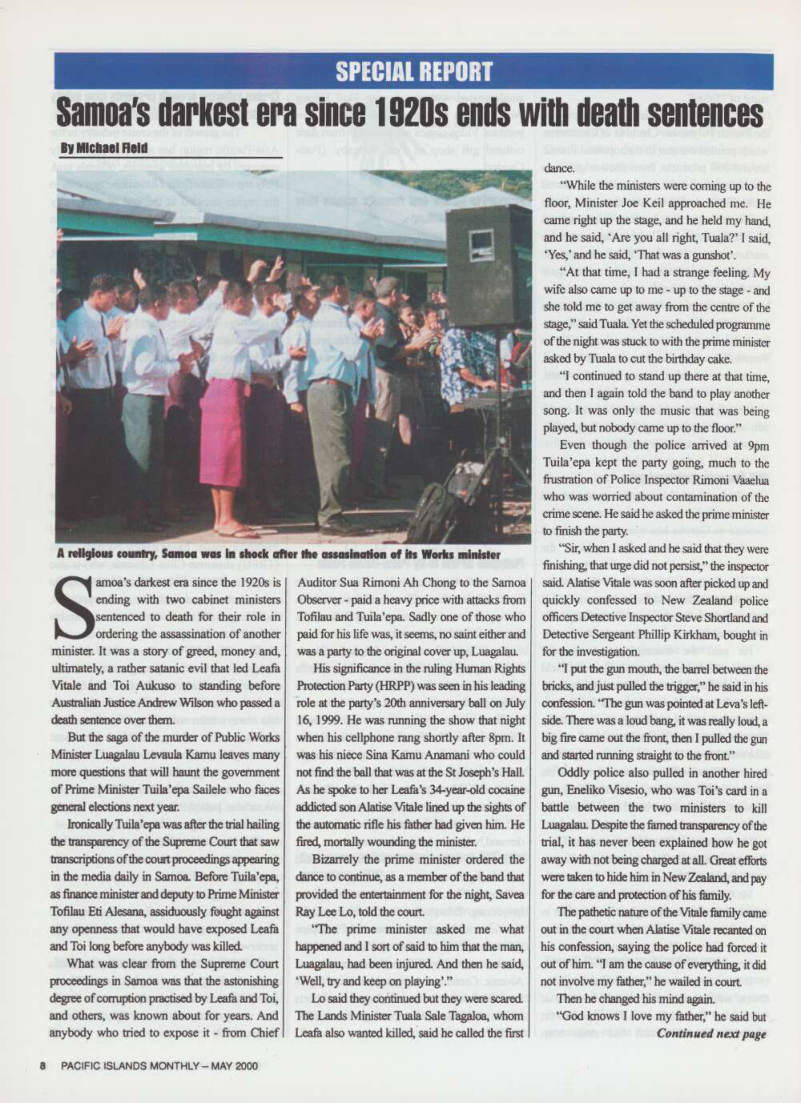
A religious country, Samoa was in shock after the assasination of its Works minister
Continued from previous page “I’ve got to tell the truth before God.”
He said of his confession: “The statement is true, I don’t want to talk about it anymore.”
The motive for the killing became clear enough during the trial; both ministers were losing power. Samoa’s insult to its women is illustrated by the way Tuila’epa, in his bid to get rid of Leafa, made him Women’s Affairs Minister. The portfolio had been held by a Tofilau hack, a former heavy weight boxer. It’s never been held by a woman.
Toi, who seems to have fallen out now with Leafa, gave evidence in court that his friend, when he was Public Works Minister, received many tips from contractors.
“That is why Luagalau was shot. Because Luagalau was also the same. He wanted tips.
tips, tips,” said Toi. The frailty of the defence came in the trial’s only humour when Leafa’s hapless counsel, Auckland lawyer Aeau Semi Epati, ridiculously submitted his client could not be guilty because he loved animals.
Toi would not even shoot dogs who ate his chickens and once pleaded to have cattle he had sold for SAMSB9,OOO returned because the new owners kept them confined in space too small.
The assessors voted 4-1 to find the two men guilty and Justice Wilson entered the conviction and passed the mandatory death sentence on April 14,2000. Samoa’s constitution gives Head of State Malietoa Tanumafili II exclusive power, without the need to consult government, over whether to commute death sentences. A kind and gentle man, he always has, ever since independence in 1962. He did it surprisingly
quickly for Alatise Vitale. At the time he signed the document Malietoa was very ill, and feared he too would die soon He did not want an execution on his conscience.
Leafa and Toi will have mixed feelings about Malietoa’s health from now on - for his successor, who ever it is, might not be so gentle.
Luagalau’s widow, Maiava Visekota Peteru, still an MP with the party that harboured her husband’s killers all those years, expressed relief it was over. “I think this trial has brought everything out in the open and we’ve had to relive everything again,” she said.
She said she could cope with support from family and friends, and knowing that her sons were “safely” in Auckland, New Zealand.
“It’s my children; 1 don’t want them to suffer any more than they have.” ■
Tuvalu gets paid
Business
Tuvalu gets paid for coverted ".tv"
The Pacific Islands nation of Tuvalu, population 10,600, for years has survived by selling stamps, fishing licenses and collecting foreign aid. Now, thanks to an alphabetic quirk, the country has been the target of an Internet bidding
war as companies vie for the right to sell Internet names and electronic mail addresses ending in Tuvalu’s country code, “.tv.”
The deal ultimately went to a company backed by Idealab, a Pasadena, California, Internet business incubator responsible for online retailer EToys and free Internet service provider Net Zero.
Idealab’s new start-up, called DotTV, recently agreed to pay Tuvalu (pronounced too-VAH-loo) US$5O million in royalties - or about three times the country’s gross domestic product over the next decade so it can sell electronic mail and Web addresses ending in “.tv” instead of the übiquitous “.com.”
Idealab figures DotTV can make hundreds of millions, and perhaps billions, by selling Web sites such as “www.Law&Order.tv “ and www.AßC.tv. Networks and TV programmes are primary targets, but DotTV expects ,tv to appeal to all sorts
of companies, organisations and individuals. The company thinks most of its .tv names will sell for several thousand dollars apiece, but some could go much higher. The current record price for an Internet address is held by Business.com, which was sold by a Texas company last year for US$7.5 million.
DotTV’s minimum payment of US$l million each quarter to Tuvalu makes this the nation’s single largest source of income. The country expects to spend its windfall on health, education and transportation.
“We were very, very, very poor, but now we are getting some money from the marketing of assets like .tv,” said Koloa Talake, a 60-year-old member of Tuvalu’s parliament, who helped negotiate the Idealab deal and holds a seat on DotTV’s board of directors.
Like most of his countrymen, he has never seen a Web site.
Tuvalu is a collection of nine atolls
halfway between Hawaii and Australia that together are a little larger than Los Angeles International Airport. The Polynesian country, which
gained its independence from
Britain in 1978, has no natural resources except fish, poor infrastructure and
attracts fewer than 1,000 visitors each year.
The Lonely Planet travel guide hails Tuvalu as a place to “sit under a palm tree and never be bothered by anyone.”
Each of Tuvalu’s islands has a hospital, but the government couldn’t afford to staff all of them with doctors until the .tv deal came through, Talake said. The “.tv” money will also pay for more classrooms, more training for teachers, new roads and more frequent ferry service to Tuvalu’s outlying islands, which can take two days to reach, Talake said.
This isn’t the first time Tuvalu has tried to profit from its technological resources. In the 19905, it struck a deal to let a Hong Kong company use some of its phone numbers for a 900 number business. But officials in the Christian nation moved to cancel the US$l.2 million-a-year contract after they discovered that the numbers were being used for phone-sex lines. (The Honolulu Advertiser/Los Angeles Times) ■
Excise rates increased to meet PN6 budget shortfall

By Sophie Foster Hildebrand
Papua New Guinea prime minister Sir Mekere Morauta has lifted excise rates on tobacco and alcohol, and increased the state cut from gambling, to meet potential shortfalls in government revenue.
He told parliament last month that although “tax collections to date are slightly above projections, and expenditure is running to budget”, a potential shortfall was predicted. “The government has become aware of some potential shortfalls in total revenue collection for the year and proposes to rectify the problem with four small, one off changes to collection levels,” he said.
The problem was picked up after improvements were made to the government’s ability to monitor budget
implementation.
“Indications are that the revenue budgeted for the ‘non-tax revenue’ category, specifically from items such as land rates, fisheries licence fees and civil aviation landing rights charges, has been over estimated. “In order to achieve the final budget outcome that we have planned for.
prudence demands that corrective measures should be taken now, to compensate for the
projected shortfall.”
The prime minister stressed that increase in excise rates and a greater cut from gambling “do not compromise the overall revenue strategy of the budget, which is to ensure that revenue measures do not hinder investment and economic growth”.
With those words, he increased excise on the majority of tobacco products by an average of 52 per cent, and the excise on spirits by 33.3 per cent.
He said the excise amendment was designed to bring PNG in line with other countries. “Many countries, including Australia, tax beer more lightly than spirits.
In Papua New Guinea the opposite is the case. The current fiscal regime actually encourages people to drink more spirits than beer.
“Set the damage that spirits undoubtedly cause against the comparatively low cost, and I know the House and the people of Papua New Guinea will applaud this measure,” he said. He added that by world standards, Papua New Guineans pay very
little for tobacco products, which was also “an inducement to indulge in one of the unhealthiest practices known to society”.
The revenue increase measures also
proposed include changes to the Gaming
Machine Act, designed to return more gambling revenue to the people of Papua New Guinea, without lowering payouts, the prime minister said.
“The Internal Revenue Commission takes 60 per cent of the profits from poker machines and the remaining 40 per cent is distributed four ways. Fifteen per cent goes to operators, 15 per cent to provincial governments, 60 per cent to site owners and 10 per cent to the trust account. “This amendment will reduce the payout to operators to 10 per cent and to site owners to 55 per cent, and increase the payout to the trust account to 20 per cent.
The government also decided to increase its revenue from bookmakers, doubling the tax.
Sir Mekere said the changes would bring an extra 22 million Kina over the remaining nine months of 2000, to cover the projected shortfall in non-tax revenue. ■
Change in the air for Fiji's biggest company
THE Fiji Sugar Corporation - Fiji’s biggest company is to introduce sweeping change to its training programmes and personnel systems. FSC chair Hafiz Khan says the corporation must function as a modern commercial organisation in a competitive marketplace.
“There is no choice about this. It is a matter of survival. This means we need the appropriate training and skills, the right working environment and good career opportunities,” says Khan.
“Some training practices and personnel procedures have been followed at the FSC for generations. It is time now for a transformation, as part of our drive to reform all aspects of the corporation. The goal is to improve the FSC’s operational performance, productivity and efficiency.” Khan says the reforms are in line with the strategic plan for the overall development of the sugar industry.
Consultancy firm PricewaterhouseCoopers, (PWC), has finished a training and personnel review. Recommendations from PricewaterhouseCoopers are to be considered by FSC management and board. Said Khan: “Our aim is to make the
FSC a preferred employer in the Fiji Islands - the kind of company people want to work for, where they get good training and are well looked after.” “We want to attract the best candidates for positions and to retain them. This will be beneficial for the corporation and the country, given the importance of the sugar industry.”
A team of specialists from PricewaterhouseCoopers listened to comments and contributions from more than 120 FSC employees in individual interviews and focus groups.
Julie Honore, the project director, said it was important to have participation from employees. “People are the key and if we take the time to listen to their input the answers are obvious.
It is people working together who will achieve the productivity gains the FSC needs.”
One of the review’s major findings was the FSC employees wanted change. In many companies, says Honore, there is resistance to doing things differently.
“But in the FSC the readiness to accept change is high.
Employees want to see the company succeed and make an acceptable profit. ■
The chair behind the throne
Chairing a company and being its chief executive call for different skills.
That is c ne of the things British Airways forgot
Running a company is a scary business these days. One moment, the chief executive is a princeling,
controlling billions and shaping
the lives of thousands. The next, he may be a nonentity, with nothing but a golden handshake to sustain him. Robert Ayling, chief executive of British Airways, is the latest star to fall to earth, resigning abruptly in March after four years as chief executive.
Every departure is different. Yet other companies could learn some useful lessons on governance from the Ayling experience.
One obvious lesson is the need for speed.
Ayling departed more than two years after a bitter strike by BA cabin crew that was, with hindsight, the moment when things began to go wrong. Since then, the airline’s share price has fallen 60 per cent and this year the firm may lose up to 300 million Pounds (As69o million). Boards never find it easy to sack the boss: after all, it in effect means saying they made the wrong appointment in the first place, or bought into the wrong strategy.
Besides, a new strategy takes time to show results, and to dismiss a chief executive halfway through the job may be unfair. A second lesson is the need for those at the top of big companies to avoid too many extracurricular activities. It is a good rule of thumb that, when chief executives take up
demanding public appointments, even in a
business as politically sensitive as airlines, their companies are a sell.
Ayling chairs the New Millennium Experience Co., which built and runs London’s much criticised and loss-making Millennium Dome. This public service gave him close links with Tony Blair’s government.
But, although BA is a sponsor of the dome, the job was a big, high-profile distraction. And it sent a message to BA’s shareholders that he did not feel their worries required his full attention. Responsibility for how a chief executive does his job and when he ought to go rests, in most public companies, with the non-executive directors on the board.
At BA, they eventually lost patience; but the revolt does not seem to have been led by the chair, Lord Marshall. Lord Marshall may well have failed to give Ayling an earlier
heave-ho bee iuse he suffered two shortcomings: he was the company’s previous chief executive,; nd so had groomed Ayling as his successor; ani i some decisions made during his watch were c. pable of bearing some blame for BA’s subseqi ent troubles. More and more British com pan i( s now split the roles of chair
and chief executive. In this, Britain is increasingly different from, say, the US. There, the two jobs tend to be split only when the company is in difficulties, as happened recently when the chief executive of Waste Management fell ill.
Yet the two jobs call for different skills; the chair’s role is, as it were, a “forest” job, exercising overall supervision on behalf of shareholders, and the chief executive’s role is a “trees” one, involving day-to-day management and strategic planning. When the roles are combined, the best governed US
firms create instead machinery for non executives to meet alone, to evaluate management’s performance without the executive directors present. The leading non executive thus has a similar role to that of a non-executive chair in Britain.
The most senior non-executive in a company is bound to be in a delicate position, whether or not he is chair, if only because his first responsibility is bound to be to the company’s shareholders, rather than to the managers.
He needs to be authoritative rather than meddling, and to intervene rarely but
effectively. He must not second-guess the chief executive, and he must be able to assess corporate strategy with an open mind. The worst person to put into the job is thus often the chief executive’s predecessor.
The best person is an outsider, who is also prepared to spend enough time on the task, which means limiting his other commitments.
For BA, therefore, the moment it has found itself a new chief executive to replace Ayling, the board should set about the task of finding a new chair to replace Lord Marshall. (The Economist) ■
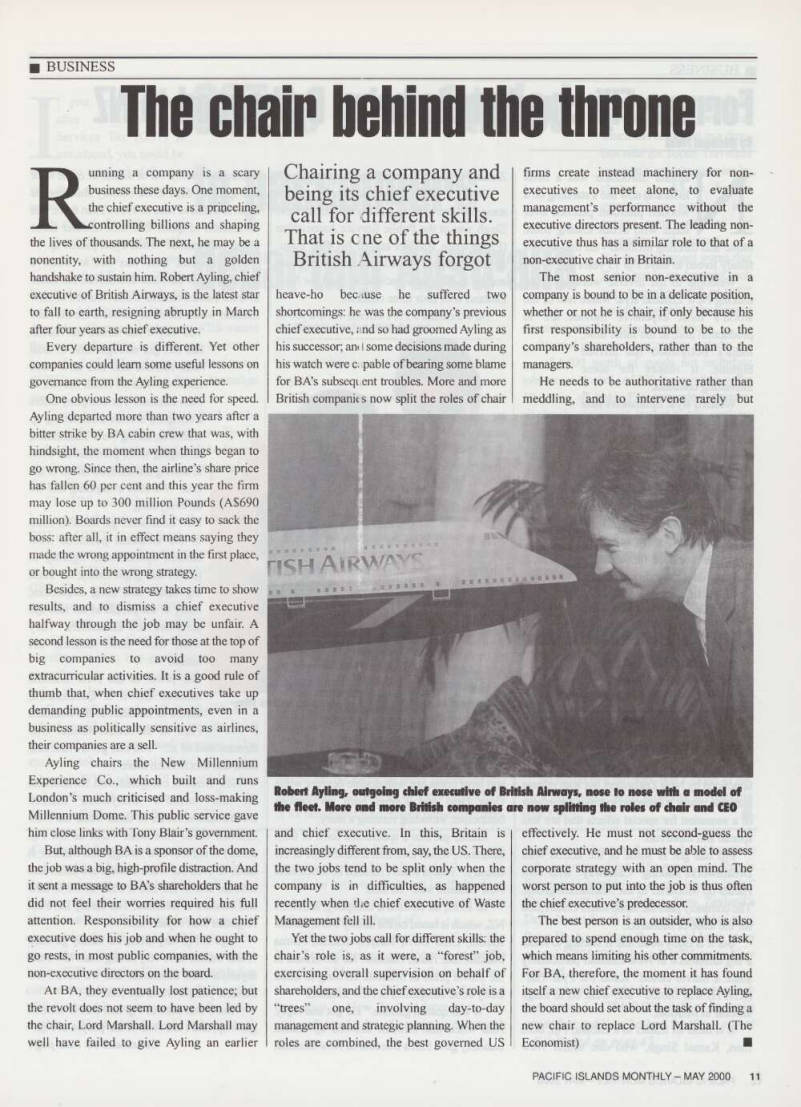
Robert Ayling, outgoing chief executive of British Airways, nose to nose with a model of the fleet. More and more British companies are now splitting the roles of chair and CEO
Former Fiji couple help bring Bollywood to NZ
By Michael Reid
Namrata Shrodhkar was a Miss India and now she’s standing on a
wooden platform perched over
some wild ocean kissing some bloke and thrilling millions - all thanks to a family forced to leave Fiji 13 years ago.
Welcome to the diverse world of film making New Zealand style where two of the world’s most expensive movies are in
production and, at the same time, India’s Bollywood has arrived bigtime. It makes for some interesting contrasts.
Western style filmmakers hate sheep and the standard tourist scenes; Bollywood cannot get enough of them. And then there is Xena (Lucy Lawless), churning out episode after episode and seemingly, with some of them, offending Hindus. New Zealand, and to a less extent Fiji, is cashing in on the world of film-making.
Not only does the industry employ hundreds of skilled workers and buys heavily into local services, it also gives the country a reputation for creative skills.
Peter Jackson’s “Lord of the Rings”, one of the most secret films ever made, involves unrivalled computer special effects as well as dozens of New Zealand
locations. “Vertical Limits”, set in the Southern Alps, has been made almost unnoticed by New Zealanders but with release later this year it is expected to cause something of a sensation for special effects that are less special and more real.
Fiji has got in some of the action with Dreamworks making “Castaway” with Tom Hanks on Monuriki in the Mamanuca group.
The company paid the landowners US$2l,OOO for the lease of Monuriki.
But it is Bollywood that is starting to make a big difference in New Zealand particularly since a movie called “Kaho Na Pyar Hai” (KNPH) was filmed - and went on to mega success in Mumbai.
It is most all thanks to a Labasa, Fiji, bom man, Kamal Singh, who one senior New
Zealand diplomat termed “our secret weapon”.
Back in 1987 Kamal was working for social welfare in Suva and his wife Uma Devi Singh was at the Public Service Association (PSA) when Rabuka staged his first coup.
Soldiers roughed Kamal up a couple of times and he and his wife decided to head for New Zealand with their three children.
New Zealand’s PSA offered Uma a job in
Christchurch and they have stayed ever since.
The children went through local schools and have come out with double degrees while Uma Devi and Kamal built up various businesses, including running a dairy.
Kamal got into a specialised form of farm insurance, which took him around most of the country. “That is when I realised how beautiful New Zealand was,” he said.
In 1993, he formed a company, KURAN NZ, which is based on the family’s first names: Kamal, Uma Devi, Raajew Kamal, Atima Nandini and Harsh Nandini. He advertised in the movie press in Mumbai offering to assist Bollywood companies in New Zealand.
“It was quite a gamble.” He got one reply.
And when that director showed up Kamal basically gave him a free tour of New Zealand,
making no money out of it. But he came back and spent 45 days in the country shooting the first Hindi move here in 1995. Then there was 18 months of quiet. But then another came along, and another. “Then it just picked up.”
The original idea was not to make a business out of the films themselves, but rather to lever themselves into Indian tourism in New Zealand which inevitably follows the movies.
The way it has turned out Kamal has not got enough time to deal with tourists and has now been involved with 38 Hindi movies in New Zealand. The company offers a complete service from setting up locations, hiring New Zealanders, arranging work permits and even to sorting out the food needs of the cast. “We offer everything and we do everything.”
New Zealanders get hired for most of the technical positions from camera operators to lighting to
gaffers and grips. Oddly, for those
big dance and song sequences, many of the people in the line-ups are white New Zealanders. “They want local Kiwi dances, not Indian.”
The jewel in the New Zealand location crown is Queenstown, buried in the heart of the Southern Alps in the South Island. One
director said of it:; “You can get Switzerland here, and much much more”.
New Zealand competes with Switzerland for the lucrative Bollywood market.
Switzerland is closer to India while the New Zealand dollar (the same value as the Fiji dollar) is attractive to foreign film makers. It tends to even out when airfares are taken into account and in the end it boils down to new and unheard of locations. The family have not forgotten their Fijian roots.
“I go to Fiji very often, the family go there ... and we still have very strong ties. Now I call myself a New Zealander and we have New Zealand passports and are citizens.
“But I was bom in Fiji and that is where I grew up, and I am fond of the people of Fiji.”
Continued on next page
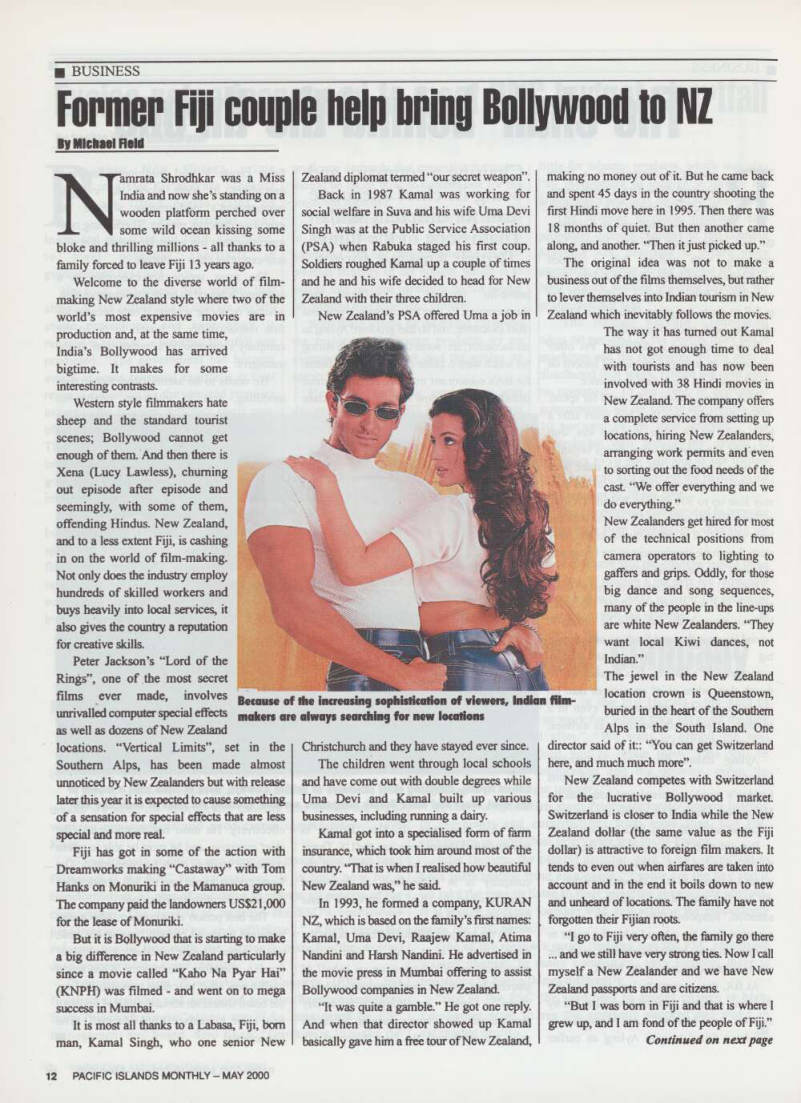
Because of the increasing sophistication of viewers, Indian film makers are always searching for new locations
Continued from previous page Kamal said he has had “vague inquiries” from movie makers thinking about Fiji as a location. “My biggest competition for getting film shows here is Switzerland, and the biggest competition for Fiji would be Mauritius. The reason being is that Mauritius is so close to India ...” The fact that Fiji has a strong Indian culture doesn’t cut much ice in Bollywood.
“Fiji needs a bit more exposure in the Indian market... Most of the people in India don’t
know where Fiji is. Most of the people in India don’t know where New Zealand is,”
Fiji, he believes, could sell itself simply as a new location that the ever demanding Indian audiences have not heard of.
“Fiji being a new location itself, just like New Zealand being a new location, in itself is attractive.” Most people in India know where the movies are shot. “Most movies that have been shot in New Zealand have been very successful and a lot of people go and watch
those movies because they are shot at locations nobody knows about. “If a movie was shot in Fiji people would just go and have a look.”
The pay-off is significant. New Zealand’s Delhi based South Asia trade commissioner, Peter Healy, reckons they would have spent around NZ$5,OOO helping KNPH get to New Zealand.
In return they got a three hour movie which cost around NZ$4OO,OOO dollars to make which featured New Zealand for 40 per cent of
Continued on page 47
Continued from page 13 the time and since its release has been seen by 300 million people in India. KNPH director Rakesh Roshan says success had a lot to do with the location.
“The new location heightens the romance and makes the story believable in that people think that if they were in a beautiful place like that they would fall in love too,” he said.
“It’s a lovely place to shoot. The people are
straightforward, fun-loving, good-humoured
and helpful. The contractors are excellent. We had brilliant service from the lighting crew and the catering contractors and the many other companies involved in making the movie.
“We don’t attract the big crowds in New Zealand that we do in India and we are left to get on with the job.
“The scenery’s great, the cost is competitive, but the people and the service is the biggest drawcard.”
It is not only the movies themselves that are important; tourists tend to follow.
Almost all the Hindi movies use Queenstown and tourist operators who several years ago never saw an Indian, now report busloads and tales are told of Indian shoppers hitting stores with credit cards and spending $20,000 a time.
At the centre of it all is a legendary 200 to 250 million strong middle class in India, said to be the fast growing in the world. Last year, according to India’s Ministry of Tourism, 3.9 million of them travelled aboard.
Kamal Singh has other ideas too; he reckons New Zealand is ideal for shooting Indian commercials. Already Indian motor cycle, condom and ice cream advertisements have been made, mostly using New Zealand’s and local Indians.
Healy says the film crews are always on the look out for new locations.
“They like New Zealand for its green fields, flowers, blue water and snow,” he said.
“Our advantage is that we can deliver all within a few hours drive of Christchurch.” ■
departing Australia
GST to be refunded to passengers departing Australia
By Sophie Foster Hildebrand
If you depart Australia
after its Goods and Services Tax (GST) is introduced, you could be entitled to a refund of the tax you paid on your shopping spree.
Its all part of an initiative of the Australian government’s new tax system called the Tourist Refund Scheme (TRS).
But it does not just apply to tourists. Administered by the
Australian Customs department, TRS means that anyone departing Australia may be entitled to a refund of GST and wine equalisation tax (WET) on goods bought from Australian retailers.
Come July 1 this year, the refund can be claimed from customs officers at Tourist Refund Scheme booths which will be located at international airports or cruise terminals in the country.
The TRS will include Australian passport holders and the refund will be the amount of GST (and WET) payable for the goods.
For example, travellers buying goods to the value of As33o can claim a refund of the As3o GST. This will only apply to taxed goods bought on, or after, July 1,2000.
As with everything, though, certain conditions apply. One is that international travellers need to buy goods worth $3OO or more from one store, no earlier than 30 days before they leave Australia.
Goods of all kinds will be eligible for a refund provided the passenger takes the goods on board as accompanied baggage. This excludes tobacco and alcohol (except wine subject to WET) which will be available duty and tax free at duty-free shops. But if you’re thinking of claiming a refund on GST paid for
accommodation and food while in Australia, forget it.
“There will be no refund for GST paid on services, including accommodation or on goods consumed in Australia,” an official statement said.
To claim a refund at the airport or port, shoppers must be able to show a tax invoice for goods bought from any retail store in Australia.
As part of the new tax system, retailers must provide a tax invoice to any customer who asks for one so they can claim input tax credits.
Customs officers at the airport will need the tax invoice to pay the refund. Travellers also need to present the goods, proof of travel and their passport to Customs officers at the TRS booth to collect their refund.
The Australian Customs department advises travellers to arrive early at the airport to take advantage of the scheme. Come July, simply look for the TRS signs as soon as you go through the customs barrier.
Payment of the refund will be in Australian dollars for amounts up to As2oo. But the As2oo limit is currently under discussion and may change. For refunds of more than As2oo or for passengers who prefer a non-cash refund,
customs officers will give the traveller a payment form which can be placed in a drop box near the booth. Travellers can then nominate payment by cheque (in A$ or foreign currency) or payment into credit card account or Australian bank account But the department warns that if the goods are brought back into Australia, GST or WET could be payable if the amount
exceeds normal passenger concessions.
Normal passenger concessions include: - SA4OO worth of goods not including tobacco or alcohol (As2oo for travellers under 18 years of age). For example, cameras,
electronic equipment, leather goods, perfume
concentrate, jewellery, watches, and sporting
goods.
- 1125 ml alcoholic liquor (including wine, beer or spirits) and 250 cigarettes, or 250 grams of cigars or tobacco products other than cigarettes, for travellers aged 18 years and over. - Most personal items such as clothing, footwear, articles for personal
hygiene/grooming.
- Personal goods owned and used for at least 12 months can also be brought into Australia without payment of duty and GST (proof of date of purchase may be required).
If in excess of the normal concessions, the tax liability for passengers arriving in Australia will be calculated by taking into consideration normal passenger concessions, depreciation allowance for some types of goods and the $5O minimum collection waiver provided the goods are declared.
So if you’re a traveller, don’t forget to ask for a tax invoice when shopping in Australia after July 1. ■
Oscar-winner still Tahitian at heart
By Ed Rampell
Winning the cinematography
Academy Award for ‘American Beauty’ was “like an out of body experience ... Being orbited around the world. It’s unreal. I must say, you go up there, and at first, it’s real, because you’re facing Brad Pitt, who’s handing you an Oscar, and then you turn around and there’s 5,000 people, and one billion in TV-land, waiting for you to open your mouth.
Trying to connect your brain with your mouth takes a second or two,” laughs Conrad Hall. He was interviewed near L.A.’s fabled Sunset Strip in his apartment decorated with South Pacific ‘tapa’ cloths and wood carvings.
The two-time Oscar winner’s unscripted heartfelt thanks to the ‘American Beauty’ team and his family prompted longtime friend Marlon Brando to call and say; “you were real up there.”
Brando godfathered Hall’s career since he was second unit camera operator for 1962’s ‘Mutiny on the Bounty,’ based on
the novel Conrad’s father, James Norman Hall, co-wrote.
Brando, who starred as mutineer Fletcher Christian in the Tahiti made ‘Mutiny,’ gave Hall his first shot as director of photography in 1965’s ‘Morituri.’
Conrad gave the black & white WWII thriller a film noir look, earning him the first of nine Oscar nominations. lowan James Norman Hall ended up in Tahiti by way of WWI, volunteering to fly in the French Foreign
Legion’s legendary Lafayette Escadrille.
James’ aerial exploits led to co-creating 1920’s ‘The Lafayette Flying Corps’ with another literary pilot, Charles Nordhoff.
Much has been written about the post-war
Lost Generation of writers such as Hemingway and Fitzgerald in Paris, but Nordhoff, Hall, R.D. Frisbie, were the ‘really’ lost. Lost Generation, searching for paradise in Polynesia.
Embarking for Tahiti in 1920, Nordhoff and Hall wrote for magazines such as Atlantic Monthly, and by 1921, published ‘Faery Lands of the South Seas.’ In 1932, they wrote their most popular book, and Clark Gable starred in the film version of ‘Mutiny on the Bounty’ as Mr. Christian in
1935’s Best Picture.
In the mid-19205, Hall married teenager Sarah Terairei Winchester, part-Tahitian daughter of a sea captain. Conrad Lafcadio (named after Joseph Conrad and Lafcadio
Heam) was bom in Tahiti in 1924. Tahitian was his first language; French second.
Conrad remembers canoeing, being the only child in Arue with a bike, and going to school with Francis Sanford, who eventually became territorial president.
Conrad describes himself as “pure coconut between my ears,” and he lived in Tahiti until he moved to California eight years later for school, and eventually studied filmmaking at USC.
With two classmates, Hall formed a production company, and shot industrials, commercials, TV films, and parts of features for Disney and others.
Following ‘Morituri,’ Conrad was director of photography for a number of ‘6os classics. Amongst them was the Paul Newman picture ‘Butch Cassidy and the Sundance Kid,’ for which Conrad became the first Polynesian to win an Oscar.
In the 19705, he did the camerawork and lighting for ‘The Day of the Locust’ and ‘Marathon Man.’ Besides 1962’s ‘Mutiny,’ the Tahitian has shot other movies on
location in Oceania: 1968’s “Hell in the Pacific” at Palau, 1987’s “Black Widow” at Hawaii, and 1994’s “Love Affair” at Moorea.
“I think and feel Tahitian, that’s my home. I speak with a language that’s not written - I shoot movies, and use a visual language. Tahitians should get into filmmaking, because they’d be wonderful at it, since all their stories were told verbally or
through dance...
“They’re great storytellers [and would] be great
visual artists ... Here was a brand new language ... instead of the alphabet, it’s made up of pictures, and just as my father could tell stories with words, I could tell Continued on next page
Oscar-winner Conrad Hall
Hall was director of cinematography for American Beauty
Continued from previous page stories with pictures,” says Conrad. He dreams of making film schools in Tahiti, so Islanders could “speak with Tahitian minds and hearts, tell Tahitian stories, and make a great [film] industry.”
Tom Cruise, who produced 1998’s “Without Limits,” which Conrad shot, recommended Hall to director Sam Mendes, leading to his second Oscar.
“After 31 years, it feels good,” says Hall, who is also the only recipient of three ASC cinematography awards.
March 26, the nominee’s Oscar entourage of 13 friends and family squeezed into one limo for the jaunt to the Shrine Auditorium, including fellow cinematographer Haskell Wexler, and Conrad’s children, Naia, Conrad W. (also a DP), and Kate.
The latter is tri-coastal, dividing her time between the Halls’ private islet off Tahiti’s coast, Hollywood, and Manhattan, where she is pitching the French Polynesia-shot pilot to a sitcom she created.
Conrad was DP for “Tahiti Royale,” a slapstick farce about a fish out of water Yank trying to manage a South Pacific resort. It co-stars a Playboy playmate and Hawaiian actor Ray Bumatai as a ‘mahu,’ who cross-dresses in ‘muumuus’ and traditional warrior garb.
Kate adds she’s “following in my grandfather’s footsteps” - just as James teamed up with Nordhoff to write the Bounty trilogy, Kate has formed a literary partnership with Christina Oxenberg, daughter of Yugoslavia’s princess, and sister of actress Catherine Oxenberg (Dynasty’s Amanda Carrington).
Conrad goes to French Polynesia three times a year to live in huts at his private isle 600 yards from Mataiea, which has solar and windmill power. The Hall family returns to paradise this summer, for the launching of Maison James Norman Hall, as a museum commemorating his and Nordhoff’s life and work opens at the author’s old home site in Tahiti in August 2000. (NOTE: Ed Rampell is co-author of Mutual Publishing’s “Made In Paradise, Hollywood’s Films of Hawai’i and the South Seas”.) ■
leapfrogging into Die wireless age
Developing countries seen leapfrogging into Die wireless age
The mobile phone, the pager and the Internet cafe can help remote, impoverished communities in the Pacific region and elsewhere break out of their isolation and participate in global economic growth, Asian business leaders argued.
Some poorer communities where telephone and television ownership has not yet become universal may yet be able to leapfrog across a generation of technology - government deregulation permitting, they said.
“The developing countries have got a better chance of going global sooner, quicker, faster, getting outside national boundaries” than they did before the Internet age, Derek Williams, Oracle Corporation senior vice president for Asia, said in an interview.
With wireless communication through satellite or earth stations, he said, developing countries can overcome costly infrastructure hurdles that hamper the spread of land lines.
In an earlier speech to business executives from the Pacific Basin Economic Council (PBEC) meeting in Honolulu, Hawaii, Williams predicted that within the next three years there will be more than a billion hand-held phones in use globally, a number equivalent to one sixth of the world
population.
Integrated with interactive services, “your ordinary cell phone will become your most important transaction and information appliance - not your personal computer or even the television,” he said.
As a result, the value of electronic commerce is expected to grow to a “staggering” 9.5 trillion dollars by 2003, he added.
Already in India, Internet cafes providing communal Web access - are springing up in isolated villages.
In that country, “in the previous generation of fixed-line phones, even in remote villages there would be a post office set up that would have a telephone, a community telephone,”
Williams said. “That has now turned itself into an Internet cafe.”
Throughout Asia, according to Motorola president for the Asia-Pacific region C D Tam, who also addressed the PBEC meeting, “the growth of cellular subscribers has outstripped the growth of personal computers.”
Japan and China are now the world’s second and third largest cellular subscriber markets after the United States, he said.
But both Tam and Williams stressed that governments must deregulate their telecommunications monopolies if the full benefits of wireless communication are to be felt in developing countries.
“To enable our developing economies to leapfrog generations of technology, we need to embrace global standards and minimize regulations and legislation on access, content and technologies,” Tam said.
Telecommunications monopolies can impose high prices and hamper Internet access, Williams noted.
“But as soon as you introduce
competition and deregulation, prices
drop,” he said, citing the example of India where, through deregulation, Internet access rates have come down sharply.
“Any government of a developing country has got to be prepared to say, ‘We want to step up to the challenge, we will deregulate, we will open up our industries to competition.”
“That in turn will bring some upheaval within the country but it also gives you a chance to participate and compete ... on an even playing field,”
Williams said. ■
Stray rocket crashes near Pitcairn
By Michael Held
Maybe Boeing Aircraft
Corporation really do care
about the people of the South Pacific but when they lost a rocket recently, they seemed remarkably indifferent about where it came down.
A Boeing-backed corporation fired the rocket off a floating platform near Kiribati and soon after lost contact over French Polynesia.
Press statements followed explaining the accident - but at no point did they say where the rocket had come down. Four days later - and only after considerable prompting - did they confirm that in fact they very nearly whacked one of the most unusual communities on Earth, the 40 people of Pitcairn Island.
What happened underscored an American view that the Pacific is empty - that it’s okay to do anything they like. Sea Launch Limited Partnership is a tax haven company registered in the Cayman Islands and headquartered at Long Beach, California. Boeing owns 40 per cent. Its other shareholders are RSC Energia of Russia with 25 per cent and Yuzhnoye of Ukraine 15 percent. Kvaemer Maritime of Norway own the other 20 per cent They built a sophisticated command ship and converted an oil platform which was towed out from Long Beach to a point in international waters on the Equator at longitude 154 West, 340 kilometres south-east of Kiribati’s Kiritimati (Christmas) Atoll.
From there they fire Ukrainian-Russian built Zenit-3SL three stage rockets.
The point of firing from the Equator is that it is cheaper for putting satellites into geostationary orbit. The rockets are meant to fly due east, over the Galapagos Islands, and into orbit. Sea Launch, in its environmental impact report, said it was safe and environmental impacts would be minimal.
Their first launch went well, as did the second. Their third, on March 12, was a disaster - and it was the first launch that was not going east. Sea Launch has not said much that is useful about what happened.
The Zenit was carrying the first of seven 2.7-tonne satellite for London-based ICO Global Communications, which includes British Telecommunications, Deutsche Telekom and Singapore Telecommunications.
Sea Launch spokesman Javier Mendoza said a statement profound for its blindingly obvious, that the rocket “suffered an anomaly” after lift off and communications were lost Richard Greco, Chief Executive Officer of ICO said the loss “posed no known safety threat to population”. But neither could say where it was, or where it had been.
Sea Launch had always touted its eastward launching but the ICO launch is south-west - 45 degrees - and goes over French Polynesia. Sea Launch has kept distinctly quiet about that aspect of it. They told the Apia-based
South Pacific Regional Environment Programme (SPREP) that March 12 launch would see the impact zones for the first and second stages “in deep ocean in international waters”.
Four days after the launch, Sea Launch communications director Paula Kom was insistent that the wayward rocket had not been a threat to people. “We believe it went down about 2000 miles (3218 kilometres) (south east) from the launch platform,” she said, and added they were not going to look for it.
“The thing is that it went up about a hundred miles and so it is very likely it would have come apart in the down fall and would have been in very small parts by the time it had impact with the water.” She said Zenits did not have self destruct mechanisms in them but if onboard computers detected problems, its motors switched off. “There was no explosion.”
Sea Launch, she said, had telephoned Pitcairn Island and established they were still there. Pitcairn’s Auckland-based Commissioner Leon Salt on March 16 was finally advised that the rocket had come down near Ducie Island, an unpopulated atoll 470 kilometres east of Pitcairn. French Polynesia High Commission spokesman Patrick Martinez said die first stage had been found also, north west of the Marquesas group in French
Polynesia.
“The second stage of the rocket, and probably the British satellite it was carrying, fell between Pitcairn island and (uninhabited) Ducie atoll, some 700 kilometres south-west of the Gambier group of islands.”
The wayward rocket would also have passed down the length of the populated Tuamotu Archipelago, 500 kilometres north Continued on next page
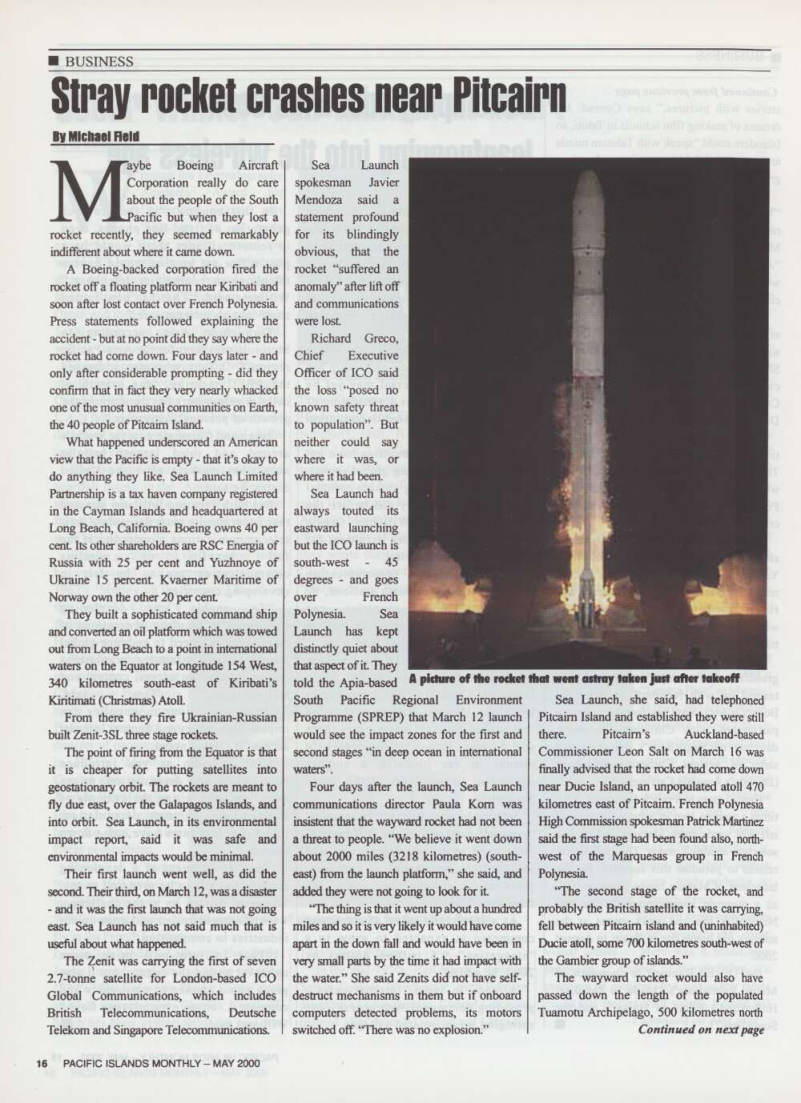
A picture of the rocket that went astray taken just after takeoff
Continued from previous page east of French Polynesia’s capital, Papeete.
Ducie was ”a pretty desolate place” with only one form of vegetation and millions of birds. Salt said. Last June, a British yacht visiting the atoll was surprised to find an unmarked military Sea Hawk helicopter on the atoll. Although it was photographed there has been no explanation of whose helicopter it was or what it was doing there. The Pacific Forum has twice expressed concern over Sea Launch, and SPREP had a battle to get the Americans to take their concerns seriously.
Boeing’s Marcus Nance and Viola Brady had visited Kiribati and SPREP and told them that if it was not for the “obvious environmental and safety and other issues we could launch right on the beach” in California.
Nance told them launching from sea reduced the environmental effects.
“In Australia, for example, off Cape York, you get a lot of crocodiles. In the ocean you tend to have less of those life forms.”
He said they wanted to launch away from environmentally sensitive areas and said Kiribati was “resilient and relatively low in biological productivity, and far removed from sensitive coastal margins ... All the research we’ve done suggests there are not a lot of higher forms of life there. Fish tend to be in waters that are shallower.”
SPREP said the operation involves laigely untested technology with potential risks to the people and the environment.
“While the proponents could potentially reap significant economic gains from this proposal, there is little demonstrable benefit to Pacific island countries...
“Pacific island countries have taken the stance in regional and international fora that the Pacific should not be used as a dumping
ground.”
Even before this accident there have been concerns about the safety of the Zenit.
Designer Vassily Makarychev wrote in the
AeroSpace Journal last year that the Soviets had long toyed with a sea launch cosmodrome but for reasons he would not specify, never got beyond planning. Zenit, he said, never been fired from sea. It was 21st century technology.
“It is currently the only launch technology capable of accomplishing the vital mission of disposing radioactive wastes in outer space,”
Makarychev said. ■
More Pacific bandwidth
come November
Southern Cross has announced that the 29,000-kilometre cable network, purpose-built for the Internet, would be Ready For Service (RFS) on November 15, 2000.
“While making this commitment, we continue to target date of 31 October 2000,”
CEO Baldo Sutich said.
“This is a si pificant achievement given the difficulties Southern Cross and other cable systems have had obtaining permits to land on the US mainland.
“It was only made possible by an initiative we took in 1999 to obtain the necessary authorisations to land at Nedonna Beach, Oregon,” he said.
At RFS, Southern Cross will deliver a network incorporating a full fibre ring linking Australia, New Zealand, Fiji and Hawaii and a direct link from Hawaii
(Oahu) to Nedonna Beach in Oregon. All nine Southern Cross cable stations will be ‘live’ and, apart from the Hawaii-US section, fill redundancy will be delivered.
Combining what was to have been two RFS dates, into a new single RFS date, also means that the Southern Cross will make more capacity available to customers at the earliest possible time.
“With demand for bandwidth so high this is an important development,” said Sutich. Total capacity sales of the Southern Cross Cable Network have already reached US$l.2 billion.
With the permitting necessary for Oregon now secured, the Southern Cross cable will land at Nedonna Beach, Oregon in mid-April. The landing will mark the start of cable laying between Oregon and Oahu. ■
French Polynesia joins PITA
French Polynesia’s telecom office (OPT) has joined the Pacific Islands Telecommunication Association (PITA) with the aim of bringing down the costs of regional telecommunications, daily newspaper La Depeche de Tahiti reported.
An agreement was signed between OPT, Cook Islands telecom, and Intelsat company.
The idea would be to join forces between Pacific islands telecommunication companies in order to be able to negotiate lower costs, especially for international telecommunications and Internet access.
“The whole point of all these links and networks is not to generate difficulties, but to allow more fluid connections”, OPT General manager Geoffry Salmon said.
OPT is currently using the Teleglobe company for its international connections.
PITA-Net, through a satellite
connection, aims at grouping Internet reception needs for each country’s operator.
The agreement makes provision for the opening of this network to twelve other operators in the region, including Fiji, Papua New Guinea, Tonga, Kiribati, Marshall islands, Niue, Palau and Solomon islands.
There are an estimated 4,500 Internet users in French Polynesia (out of a population of around 200,000).
“The main advantage of this is to be part of one community in the Pacific, and to share a capacity which will be common to all of these Pacific islands. This would enable us to benefit from a more adapted billing, hopefully lower”, Salmon said.
“I think in the Pacific islands, operators are small, the markets are small, the economies are small. So there is a need to share resources, there is a great potential there”. (OFO/Secretariat of the Pacific Community, 2000) ■
US Arm plans nickel

factory in New Caledonia
US firm Phelps Dodge, the world’s second largest copper producer, plans to build a nickel factory in the South of New Caledonia in
partnership with a local company. But it has yet to obtain an exploration permit, its Noumea representatives said. Phelps Dodge plans a partnership with the Caledonian firm Ballande, which annually exports 800,000 tonnes of nickel ore.
The company plans to build a factory that would have an annual production of 35,000 tonnes of nickel/metal and 4,000 tonnes of cobalt. The project, named Pronico, would work a 46 square kilometre deposit of laterite (low grade ore) in the South of the island, whose reserves are estimated at several hundred million tonnes.
The factory would process the ore by dissolving it in sulphuric acid under heat and pressure, with overall investment estimated at one billion dollars US. “We have unshakeable faith in the quality of this
project but we are counting on already being in the process of carrying out a feasibility study,” said William Brack, vice-president of engineering at Phelps Dodge.
Ballande had with effect from 1995 lodged a demand with the New Caledonia Mines Service for permission to search for deposits in the South, but so far has not been successful.
Since January 1, allocation of exploration permits has been in the hands of the Caledonian provincial governments. Success depends on the project having the support of local councillors, which has prompted disagreement in the industry.
“We are confident even though, according to the mines service, five other mining firms are candidates to work the deposits. If we obtain the permit, we will be committed to
achieving the feasibility study in four years, maximum. The factory would be built in seven years,” said Ballande group chair and managing director Louis Ballande. Phelps Dodge, based in
Phoenix, Arizona, employs 17,000 people and operates in 27 countries.
Societe Le Nickel, a subsidiary of French group Eramet, operates Noumea’s only metallurgical factory, which has an annual output of 59,000 tonnes of nickel.
Two other factory projects, by Canadian firms Falconbridge and Inco, are expected to come on line in 2005 and 2003 in the North and south of New Caledonia.
New Caledonia is responsible for six per cent of the world’s nickel output, with more than 10 per cent of the territory’s 200,000 population working in the industry.
The French Pacific territory also possesses about 20 to 25 per cent of the world’s nickel reserves, while world production stands at around one million tonnes. ■
IV production workshop plugs good governance
Pacific women in television and
production opened their annual
regional training in Suva last month with a twist - they started a documentary production workshop with
training in good governance.
The good governance focus for the group, which has been part of a project now running for eight years, comes as regional leaders eye good governance and what it means for their countries.
Ten participants from the Cook Islands, Vanuatu, Samoa, Tonga and Fiji attended the two-week meeting, funded by UNESCO, British Aid (DFID) and the SPC through its Regional Media Centre (RMC) in Suva and the Pacific Women’s Resource Bureau (PWRB) in Noumea.
“Good governance is a very broad term and it has many interpretations for different people,” says Conrad Mill, Team leader at the RMC.
Mill has been closely involved with the project and its development over the last eight years. He says the most important
aspect of incorporating good governance training with documentary is that women producers are part of the information networks in their own countries and can pass on what they have learnt from the
meeting.
“The good governance workshop before the planning workshop will give the women a sound knowledge of the concepts of good governance, which they can then weave into their documentary topic,” he says, “so not only will these documentaries inform the public about good governance, but the women producers become ‘ambassadors’ of good governance as well.”
Among other areas, the good governance workshop will focus on
responsibility and accountability of
governments, corruption in public office, and political institutions such as the police and media.
The production component aims to provide training opportunities to women working in television and to increase local content from Pacific Islands broadcasters.
Lead Trainer Margot Nash and counterpart trainer Lisa Williams will run it. Williams, the Communications Officer of the PWRB, was part of the inaugural Pacific Women Producers training project in 1992 and is now able to combine her previous experience with support from the regional women’s bureau for the Women Producers network.
“It’s a positive step to combine issues of good governance with production training and documentary, because women will be able to see more clearly how their everyday lives are affected by issues of good governance,” says Williams.
She says breaking the broad concept of good governance down into everyday issues that can be told via television, offered a new and important challenge to the Women Producers group.
“I hope that talking about good governance will start us thinking of the accountability we have as media people to keep our publics thinking and informed,” she says. ■
Disney revives 'Pearl Harbor'
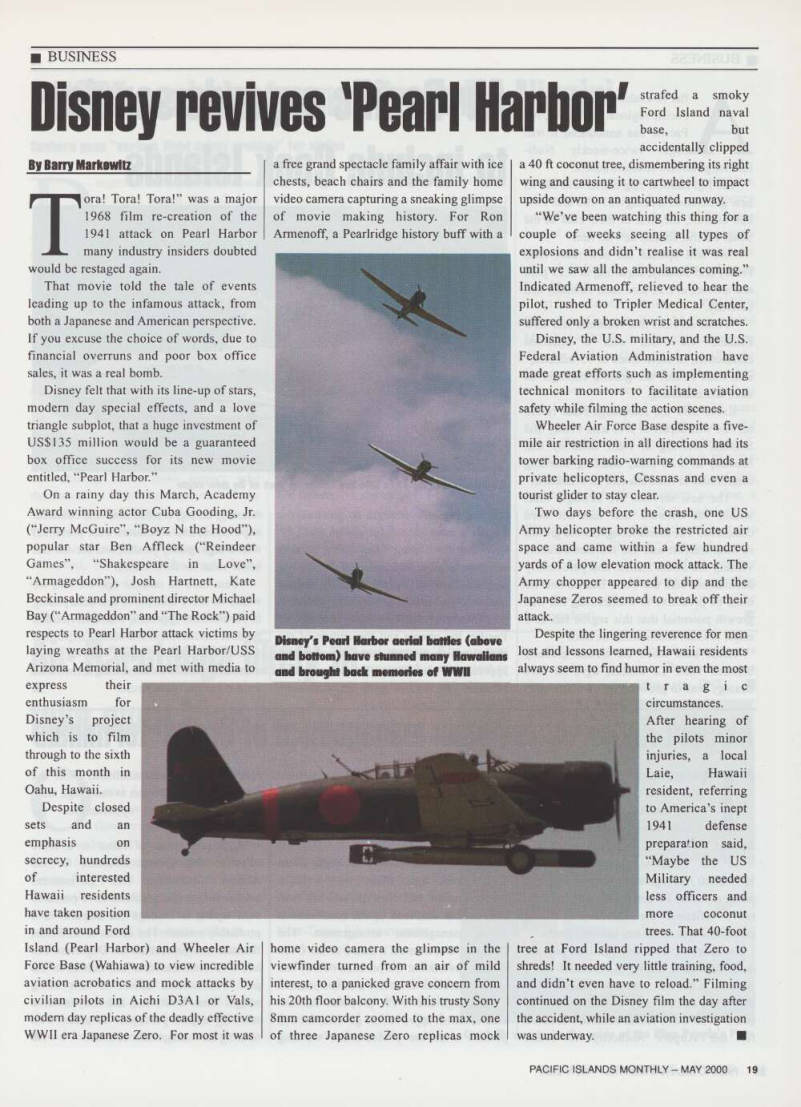
By Barry Markowitz
Tora! Tora! Tora!” was a major 1968 film re-creation of the 1941 attack on Pearl Harbor many industry insiders doubted would be restaged again.
That movie told the tale of events leading up to the infamous attack, from both a Japanese and American perspective.
If you excuse the choice of words, due to financial overruns and poor box office sales, it was a real bomb.
Disney felt that with its line-up of stars, modern day special effects, and a love triangle subplot, that a huge investment of US$l35 million would be a guaranteed box office success for its new movie entitled, “Pearl Harbor.”
On a rainy day this March, Academy Award winning actor Cuba Gooding, Jr. (“Jerry McGuire”, “Boyz N the Hood”), popular star Ben Affleck (“Reindeer Games”, “Shakespeare in Love”, “Armageddon”), Josh Hartnett, Kate Beckinsale and prominent director Michael Bay (“Armageddon” and “The Rock”) paid respects to Pearl Harbor attack victims by laying wreaths at the Pearl Harbor/USS Arizona Memorial, and met with media to
express their enthusiasm for Disney’s project which is to film through to the sixth of this month in Oahu, Hawaii.
Despite closed sets and an emphasis on secrecy, hundreds of interested Hawaii residents have taken position in and around Ford
Island (Pearl Harbor) and Wheeler Air Force Base (Wahiawa) to view incredible aviation acrobatics and mock attacks by civilian pilots in Aichi D3AI or Vais, modem day replicas of the deadly effective WWII era Japanese Zero. For most it was
a free grand spectacle family affair with ice chests, beach chairs and the family home video camera capturing a sneaking glimpse of movie making history. For Ron Armenoff, a Pearlridge history buff with a
home video camera the glimpse in the viewfinder turned from an air of mild interest, to a panicked grave concern from his 20th floor balcony. With his trusty Sony Bmm camcorder zoomed to the max, one of three Japanese Zero replicas mock
strafed a smoky Ford Island naval base, but accidentally clipped
a 40 ft coconut tree, dismembering its right wing and causing it to cartwheel to impact upside down on an antiquated runway.
“We’ve been watching this thing for a couple of weeks seeing all types of explosions and didn’t realise it was real until we saw all the ambulances coming.”
Indicated Armenoff, relieved to hear the pilot, rushed to Tripler Medical Center, suffered only a broken wrist and scratches.
Disney, the U.S. military, and the U.S.
Federal Aviation Administration have made great efforts such as implementing technical monitors to facilitate aviation safety while filming the action scenes.
Wheeler Air Force Base despite a five mile air restriction in all directions had its tower barking radio-warning commands at private helicopters, Cessnas and even a tourist glider to stay clear.
Two days before the crash, one US Army helicopter broke the restricted air space and came within a few hundred yards of a low elevation mock attack. The Army chopper appeared to dip and the Japanese Zeros seemed to break off their attack.
Despite the lingering reverence for men lost and lessons learned, Hawaii residents always seem to find humor in even the most
tragic circumstances.
After hearing of the pilots minor injuries, a local Laie, Hawaii resident, referring to America’s inept 1941 defense preparation said, “Maybe the US Military needed less officers and more coconut trees. That 40-foot
tree at Ford Island ripped that Zero to shreds! It needed very little training, food, and didn’t even have to reload.” Filming continued on the Disney film the day after the accident, while an aviation investigation was underway. ■
Disney's Pearl Harbor aerial battles (above and bottom) have stunned many Hawaiians and brought back memories of WWII
Air Pacific expands service
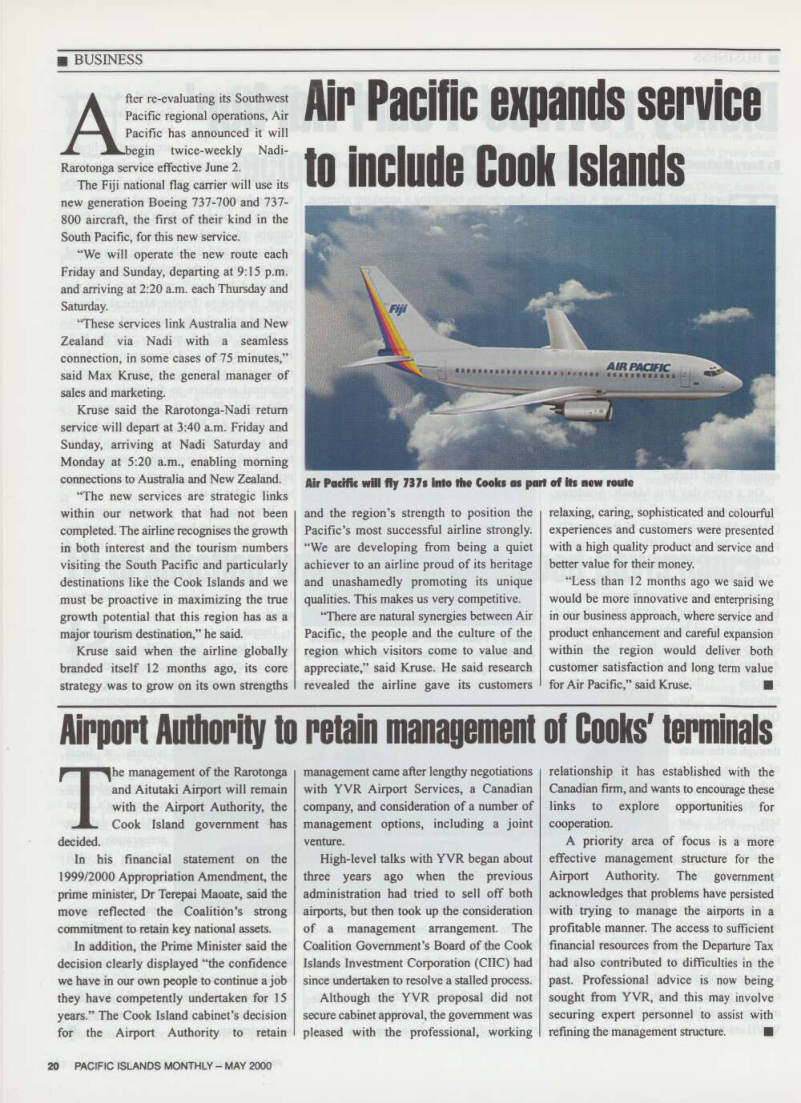
to include Cook Islands
After re-evaluating its Southwest Pacific regional operations. Air Pacific has announced it will begin twice-weekly Nadi- Rarotonga service effective June 2.
The Fiji national flag carrier will use its new generation Boeing 737-700 and 737- 800 aircraft, the first of their kind in the South Pacific, for this new service.
“We will operate the new route each Friday and Sunday, departing at 9:15 p.m. and arriving at 2:20 a.m. each Thursday and Saturday.
“These services link Australia and New Zealand via Nadi with a seamless connection, in some cases of 75 minutes,” said Max Kruse, the general manager of sales and marketing.
Kruse said the Rarotonga-Nadi return service will depart at 3:40 a.m. Friday and Sunday, arriving at Nadi Saturday and Monday at 5:20 a.m., enabling morning connections to Australia and New Zealand.
“The new services are strategic links within our network that had not been completed. The airline recognises the growth in both interest and the tourism numbers visiting the South Pacific and particularly destinations like the Cook Islands and we must be proactive in maximizing the true growth potential that this region has as a major tourism destination,” he said.
Kruse said when the airline globally branded itself 12 months ago, its core strategy was to grow on its own strengths
and the region’s strength to position the Pacific’s most successful airline strongly.
“We are developing from being a quiet achiever to an airline proud of its heritage and unashamedly promoting its unique qualities. This makes us very competitive. ‘There are natural synergies between Air Pacific, the people and the culture of the region which visitors come to value and appreciate,” said Kruse. He said research revealed the airline gave its customers
relaxing, caring, sophisticated and colourful experiences and customers were presented with a high quality product and service and better value for their money.
“Less than 12 months ago we said we would be more innovative and enterprising in our business approach, where service and product enhancement and careful expansion within the region would deliver both customer satisfaction and long term value for Air Pacific,” said Kruse. ■
Air Pacific will fly 737s into the Cooks as part of its new route
Airport Authority to retain management of Cooks' terminals
The management of the Rarotonga and Aitutaki Airport will remain with the Airport Authority, the Cook Island government has decided.
In his financial statement on the 1999/2000 Appropriation Amendment, the prime minister. Dr Terepai Maoate, said the move reflected the Coalitibn’s strong commitment to retain key national assets.
In addition, the Prime Minister said the decision clearly displayed “the confidence we have in our own people to continue a job they have competently undertaken for 15 years.” The Cook Island cabinet’s decision for the Airport Authority to retain
management came after lengthy negotiations with YVR Airport Services, a Canadian company, and consideration of a number of management options, including a joint venture.
High-level talks with YVR began about three years ago when the previous administration had tried to sell off both airports, but then took up the consideration of a management arrangement. The Coalition Government’s Board of the Cook Islands Investment Corporation (CIIC) had since undertaken to resolve a stalled process.
Although the YVR proposal did not secure cabinet approval, the government was pleased with the professional, working
relationship it has established with the Canadian firm, and wants to encourage these links to explore opportunities for cooperation.
A priority area of focus is a more effective management structure for the Airport Authority. The government acknowledges that problems have persisted with trying to manage the airports in a profitable manner. The access to sufficient financial resources from the Departure Tax had also contributed to difficulties in the past. Professional advice is now being sought from YVR, and this may involve securing expert personnel to assist with refining the management structure. ■
PNGDF could be banned from Ain Niugini
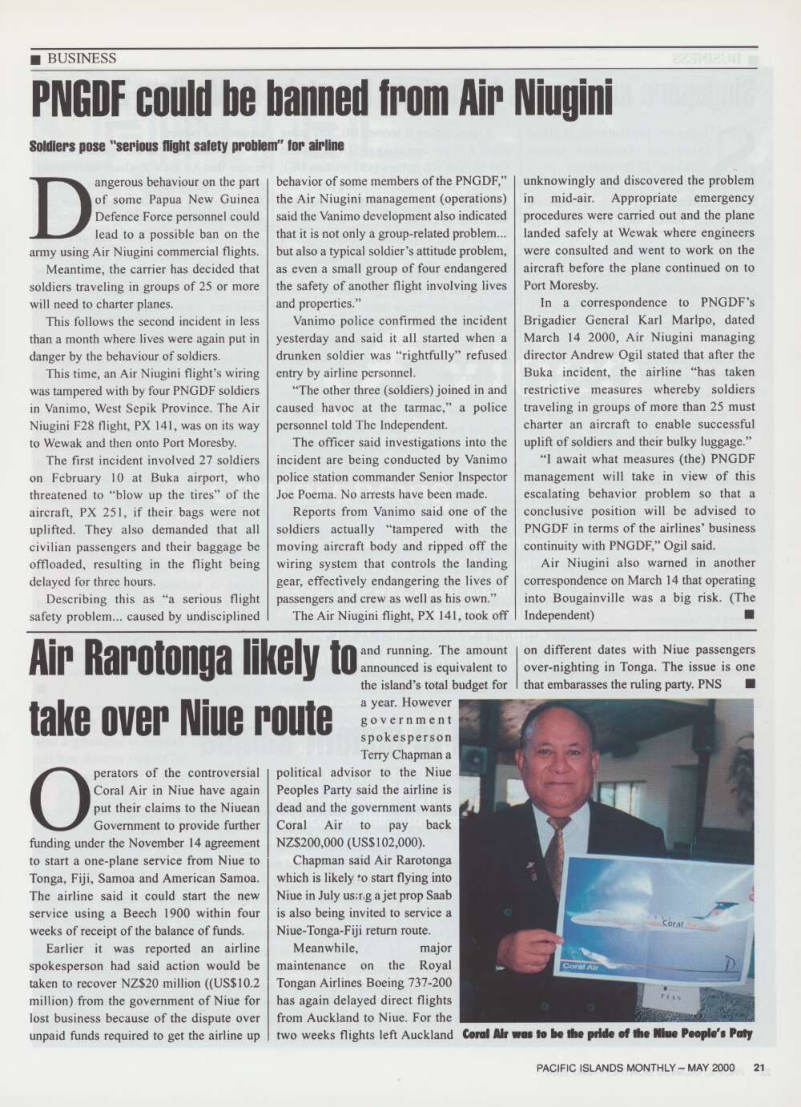
Soldiers pose "serious flight safety problem" for airline
Dangerous behaviour on the part of some Papua New Guinea Defence Force personnel could lead to a possible ban on the army using Air Niugini commercial flights.
Meantime, the carrier has decided that soldiers traveling in groups of 25 or more will need to charter planes.
This follows the second incident in less than a month where lives were again put in danger by the behaviour of soldiers.
This time, an Air Niugini flight’s wiring was tampered with by four PNGDF soldiers in Vanimo, West Sepik Province. The Air Niugini F2B flight, PX 141, was on its way to Wewak and then onto Port Moresby.
The first incident involved 27 soldiers on February 10 at Buka airport, who threatened to “blow up the tires” of the aircraft, PX 251, if their bags were not uplifted. They also demanded that all civilian passengers and their baggage be
offloaded, resulting in the flight being
delayed for three hours.
Describing this as “a serious flight safety problem... caused by undisciplined
behavior of some members of the PNGDF,” the Air Niugini management (operations) said the Vanimo development also indicated that it is not only a group-related problem... but also a typical soldier’s attitude problem, as even a small group of four endangered the safety of another flight involving lives and properties.”
Vanimo police confirmed the incident yesterday and said it all started when a drunken soldier was “rightfully” refused entry by airline personnel.
“The other three (soldiers) joined in and caused havoc at the tarmac,” a police personnel told The Independent.
The officer said investigations into the incident are being conducted by Vanimo police station commander Senior Inspector Joe Poema. No arrests have been made.
Reports from Vanimo said one of the soldiers actually “tampered with the moving aircraft body and ripped off the wiring system that controls the landing gear, effectively endangering the lives of passengers and crew as well as his own.”
The Air Niugini flight, PX 141, took off
unknowingly and discovered the problem in mid-air. Appropriate emergency procedures were carried out and the plane landed safely at Wewak where engineers were consulted and went to work on the aircraft before the plane continued on to Port Moresby.
In a correspondence to PNGDF’s Brigadier General Karl Marlpo, dated March 14 2000, Air Niugini managing director Andrew Ogil stated that after the Buka incident, the airline “has taken restrictive measures whereby soldiers traveling in groups of more than 25 must charter an aircraft to enable successful uplift of soldiers and their bulky luggage.”
“I await what measures (the) PNGDF management will take in view of this escalating behavior problem so that a conclusive position will be advised to PNGDF in terms of the airlines’ business continuity with PNGDF,” Ogil said.
Air Niugini also warned in another correspondence on March 14 that operating into Bougainville was a big risk. (The Independent) ■
Air Rarotonga likely to take
take over Nine route
Operators of the controversial Coral Air in Niue have again put their claims to the Niuean Government to provide further funding under the November 14 agreement to start a one-plane service from Niue to Tonga, Fiji, Samoa and American Samoa.
The airline said it could start the new service using a Beech 1900 within four weeks of receipt of the balance of funds.
Earlier it was reported an airline spokesperson had said action would be taken to recover NZ$2O million ((US$lO.2 million) from the government of Niue for lost business because of the dispute over unpaid funds required to get the airline up
and running. The amount announced is equivalent to the island’s total budget for
a year. However government spokesperson Terry Chapman a
political advisor to the Niue Peoples Party said the airline is dead and the government wants Coral Air to pay back
Nz$2Oo,Ooo (Us$102,000).
Chapman said Air Rarotonga which is likely to start flying into Niue in July usxg a jet prop Saab is also being invited to service a Niue-Tonga-Fiji return route.
Meanwhile, major maintenance on the Royal Tongan Airlines Boeing 737-200 has again delayed direct flights from Auckland to Niue. For the two weeks flights left Auckland
on different dates with Niue passengers over-nighting in Tonga. The issue is one that embarasses the ruling party. PNS ■
Coral Air was to be the pride of the Niue People's Paly
Singapore and Qantas in dogfight for stake in Air New Zealand
Singapore International Airlines (SIA) and Australia’s Qantas Airways LTD engaged in a dogfight for a key stake in Air New Zealand after the controlling shareholder pulled the “For Sale” sign down.
In mid-March SIA nearly sealed a deal to buy Brierley Investment LTD’s (BIL) 47 per cent stake in the New Zealand airline, but in an announcement a week later BIL said it was pulling the stocks off the sale counter.
At issue is not Air New Zealand itself, but dominance in the Australian domestic market where Air New Zealand has just completed buying Qantas’ main local rival, Ansett Holdings Ltd.
Adding to a complicated weaving of contrails are the ambitions of cut-price operator Virgin Airlines to join with SIA to run a discount domestic carrier in Australia.
But if SIA gets the Air New Zealand shares it would be expected to pull out of Virgin arrangements.
BIL owns 47 per cent of Air New Zealand, including 17 per cent of the B shares which are the only ones that can be owned by foreigners.
BIL was once headquartered in Wellington but is now registered in the Cayman Islands and was due to list on the Singapore Stock Exchange.
A week before it seemed BIL was going to sell a 25 per cent stake to SIA for around 400 million NZ dollars (197 million US), but the details were never made public nor was the future of BlL’s remaining shareholding explained.
SIA chief executive Cheong Choong Keong was in New Zealand to sign the deal which faltered when Prime Minister Helen Clark made it clear her government would not change ownership rules.
Under existing regulations, no one foreign airline can own more than 25 per cent and total foreign ownership is limited to 49 per cent.
Negotiations continued but then Qantas entered the frame by saying it wanted a piece of Air New Zealand. Any Qantas deal would, however, appear to require Air New Zealand to off-load Ansett Australia.
Air New Zealand was scheduled to conclude its 844.4 million NZ dollars (412.2 million US) purchase of the remaining 50 percent shareholding in Ansett Australia from Rupert Murdoch’s News Corp by the end of last month.
Qantas sold a 19.9 percent stake it had in Air New Zealand in 1997, frustrated both by an inability to wring operational synergy from the investment and the hostile attitude of the Air New Zealand board.
BIL said it had suspended sale talks after interest from SIA, Qantas and other
unspecified parties.
“BIL considers that the first priority is to ensure that Air New Zealand successfully moves to full ownership of Ansett Holdings Ltd,” company secretary Mark Horton said in a statement.
“BIL is also of the view that ultimately Air New Zealand would benefit from having a strategic relationship with another airline through its share register, but in the meantime, it has withdrawn its stake from sale.”
Qantas said a partnership with Air New Zealand would establish a major regional airline with the “size and capital base to compete aggressively in a rapidly changing international market.”
Analysts seriously doubt that Qantas would be able to jump regulatory, political and corporate culture hurdles to buy Air New Zealand. Both airlines compete fiercely on the trans-Tasman and trans pacific routes while Air New Zealand competes against Qantas inside Australia through Ansett.
“It’s quite a good tactical move by Qantas to become involved and try to perhaps divert the course of things,” Peter Harbison, managing director at the Centre for Asia Pacific Aviation, said.
But he added that regulatory and commercial difficulties made success an “outside prospect.” ■
Anew air
Skies deal to benefit Samoa
services agreement between New '
Zealand and Samoa will benefit all air
travellers, the New Zealand Minister of Transport Mark Gosche said in Apia. “I am very pleased to announce the signature of a new ‘open skies’ Air Services Agreement by Samoa and New Zealand, he said.
“This will ultimately benefit all trader and travellers in the region.” Mr Gosche signed the Agreement with Samoa’s Minister of Transport, Joe Keil.
The new Air Services Agreement replaces previous arrangement dating from 1978. “The old Agreement could be said to have passed its use by date,” Gosche said.
“Negotiations with Samoa were held in March after Polynesian Airlines sought access to serve additional routes beyond New Zealand to Australia and points in the South Pacific.
Both countries agreed that a new framework was needed in which to further develop air services between and beyond New Zealand
and Samoa. Polynesian Airlines is acquiring a new 8737 800 aircraft and the
runway at Faleolo International Airport is being lengthened”, Gosche said.
“The new Agreement will provide opportunities for maximum benefit to be gained from these developments.” Under the new Agreement, the airline of each side may operate over any routing and with unlimited aircraft capacity.
Liberal provisions for passenger fares and airline ownership are included. Code-sharing is permitted, including on the aircraft of third countries. There is a temporary limitation on the number of airlines of each side that may commence service.
At the request of Samoa, it has been agreed that no additional passenger airlines will operate on the route for a period of two years from the April signature.
“This new Agreement with Samoa advances that goal and follows New Zealand’s singing of ‘open skies’ Air Services Agreement with the Cook Island in January,” Gosche said. ■
Advertisements & other items, p. 23 (1 item)
Conferencing
T* ,y. : l ME • 1 ! |K™r gjgKfc ■
6MIF
* * ' Ll.* J ~* ■BfftT/ &;■-; /. v ,
Conferencing
& * .i fc/.~ virtua A Video Conferencing is an exciting
new technology involving a high-
speed, two-way, audio-visual
communications link
confer F/taE io people
J . I
anywhere, in tpe world.
The International Video
Conferencing Service at Vatuwaqa
in Suva, is RNTEIi’S
continuing to the de ■ Baa vf r; m ms
telecofnmL^
—j S“\ m es. \ jm. JjnlWir more information:
L FREE 0800 - 315718
Fiji International Telecommunications Limited, Mercury House, 158 Victoria Parade, PO Box 59, Suva, Fiji Islands.
Telephone (679) 312 933, Fax (679) 301 025, Email [email protected] • Website http://www.fintel.com.fj
Consumers not protected


from excesses of free trade
Lunch hour has arrived and John, a machinist with a motor shop in the heart of Port Moresby’s industrial area, could not wait to grab some food at a nearby fast-food outlet.
The outlet is amongst many others operated by
small-time expatriate
businessmen in the PNG capital’s main industrial area.
Although such businesses were legislated by the Government as reserved activities for Papua New Guineans only, expatriates seemed to have dominated the sector in recent years.
John bought two fried sausages, a pie and a soft drink. Being hungry, he did not pick up the foul smell of the sausages until he was about to throw in the last bit.
His stomach started to chum and sharp pains filled his insides.
Fuming, he marched to the store to get even with the owner. However, the owner refused to admit the sausages were bad although he knew they were leftover stock from the day before. He accused John of inventing the complaint.
John walked away defeated with an upset stomach that lasted several days. He found out too late that other consumers had had the same problem with the sausages.
That was in the early 80s.
If that situation had occurred today, it would have been an entirely different story.
And for that, thanks are due to the work of the South Pacific Consumer Pacific Programme in the South Pacific - a globally linked new social movement that is fast
emerging in the region.
As far as the SPCPP is concerned, John was a victim of an unscrupulous trader doing business in an unregulated market place with uninformed and naive consumers.
John’s right and that of other consumers to good quality, safe, and well-labelled goods at a fair price, and other consumer rights have been main thrust of the work of
SPCPP. Through the support of SPCPP, PNG established a Consumer Affairs Council in the early 90s, a body which John could have used to deal with the store owner.
The store owner could have been prosecuted as in the case of two expatriates running fast-food outlets in Port Moresby in March. Consumer Affairs Council officers paid a surprise visit to the outlet where they confiscated out-dated and rotten food following a complaint from consumers.
Although routine checks have always been carried out by the office, the March raid on the fast-food outlet and prosecution of its owners signals the beginning of a new chapter for consumers.
CAC is clamping down on unscrupulous traders, mainly small-time fast foot operators. With the government’s backing, CAC will establish 20 consumer associations throughout the country to help crack down on out-dated items being sold by shops and fast-food outlets in the country. The associations will be supervised by town authorities.
Puri Ruing, Vice Minister for Finance and Treasury and minister responsible for
the affairs of CAC said: “For far too long we did not have the means to express our rights. Through the consumer movements, we will encourage investors to be more competitive so that they provide the best for the people.”
Considering the recent arrests by CAC officers. Ruing said: “The government considers that for the country to develop, the consumer must be fit and healthy,” he said.
Ruing said: “Business and corporate communities must be responsible to deliver safe products to the
consumers. There must be a balance at all times, making sure that businesses do not get the better of the consumer.”
He said the country’s open market economy left consumers vulnerable to abuse.
This, he said, was where government had to intervene.
Ruing said: “The Government has a responsibility and is determined to safeguard and protect the interests of consumers in this country.”
The scope of SPCPP’s work involves a range of strategies to protect Pacific Island consumers from unscrupulous traders.
But SPCPP says there is still little knowledge of the impact of international trade on fragile Pacific Island economies and consumers.
SPCP said free trade, or marketplace liberalisation, without a basic consumer protection framework (of a consumer
protection law, appropriate regulations and
a state agency to enforce the law and educate and inform consumers) is a recipe for the loss of consumer rights.
It has pressed Pacific Island nations to enact consumer protection legislation with
Continued on next page
lunch-time in Port Moresby as people head for food stalls
Continued from previous page some success. Six Forum nations have enacted consumer laws in the last five years. However, 10 Pacific nations still have no consumer protection laws.
In 1992, the South Pacific Forum endorsed the United Nations Guidelines for Consumer Protection as the basis for consumer protection in the region.
The SPCPP then drafted a South Pacific Consumer Protection Convention and lobbied members of the South Pacific Forum to adopt the Convention to provide basic consumer protection for all nations in the region.
“Unfortunately support for the Convention has not been forthcoming and consumer rights have not been accorded a high priority. Pacific nations are now considering establishing a Free Trade Area without first protecting basic consumer rights,” SPCPP said.
It has argued that consumer rights must be protected through national laws (and a regional convention) if a free trade regime is to be established. Free trade, without adequate consumer protection measures will lead to greater marketplace abuses and a denial of consumer rights.
SPCPP said this position is in line with Consumers International’s request that the WTO set up formal mechanisms to protect consumers especially in the areas of transparency, food security, food safety, health, competition, services, investment and electronic commerce to ensure a fairer global marketplace.
“Some may argue that consumer rights and free trade are incompatible, however Consumers International’s long term objective is to secure a multilateral trading system that will support and encourage the development of consumer rights prior to further trade liberalisation,” SPCPP says.
It said Pacific Island nations are small players in the global economy and are easily ignored by large nations or trade blocs.
SPCPP said establishing a regional grouping to work together for common policies on trade has a compelling logic, but that logic is flawed if it does not also include enacting effective consumer protection legislation to shield Pacific Island consumers from the excesses of free trade. ■
Seattle shockwaves still rattle businesspeople
A recent meeting of Pacific basin corporate leaders revealed that the region’s business community is still reeling from the WTO’s failure last year to launch a new round of global trade talks.
The annual general meeting of the Pacific Basin Economic Council (PBEC), representing more than 1,000 companies from 20 economies, produced exhortations to participants to bang the drum for free trade and economic globalisation.
The three-day session also adopted an appeal to members of the World Trade Organisation to show more flexibility.
What continues to rankle PBEC members are accusations - voiced in
Seattle by non governmental organisations and street protesters - that the WTO and the unfettered flow of goods and capital across national boundaries it advocates harm the interests of poor people, workers and the environment.
The international business community was “shell-shocked” by the events in Seattle and proved unable to mount a credible defense of the WTO, he said.
“We need to polish our image if we are to compete effectively with the many other non-governmental entities and against their anti-globalisation rhetoric.”
Barshefsky assured the session here that “the core vision of the trading system is right. Opening markets in past decades has sparked
growth, reduced poverty and strengthened peace.
And to begin reversing the work we have done would be irresponsible and damaging in the extreme.”
But even from within PBEC voices were raised in
Honolulu against
globalisation as it is currently practiced and
promoted by the WTO.
“The current belief by
the global community that
countries must embrace liberalisation and adopt global rules and development would then follow has not proven true,” Tan Sri Azman Hashim, chairman of the Arab-Malaysian Banking Group, told delegates. “It would seem that the current practices in trade and investment have difficulties in distributing wealth equitably,” he said. ■
Advertisements & other items, pp. 25-26 (1 item)
Engine Warehouse
New/Used - Engines Transmissions Parts Nissan Perkins Scania Suzuki Toyota Volvo Yanmar SPECIALAir Cooled Industrial
Engines
Listers 18/21 /32/44hp
Deutz 290 hp
Generator Sets Komatsu 29kva Yanmar 150kva Cylinder Heads Tested All Terrain Vehicles Amphibious National Distributers Amphibicus Carry 6 persons Pull trailer
USED FOR
Tourism Forestry Council Fisherman Contracters Govt Dept Farmers etc.etc. etc BLAIRS NEW ZEALAND Phone 643-6938122 Fax 643-6938120
P.0.80X 14 Geraldine NZ Email blairs@blairs,com.nz
Visit us on the Web www.blairs.co.nz
toaitg for no one.
sr
mBB
Mi *"■ 'sM Wi ■ ■ * m
m mmm
Things get left to the last minute or a deadline is brought forward and every thing is required urgently. Sound familiar? Deadlines have always been part of the print industry and at Quality Print we know that you sometimes need your printing “yesterday”. We rarely miss a realistic deadline and if you have a really urgent job we’ll keep the presses running all night if necessary.
It is this kind of service that makes us one of the best printers in the Pacific. And we now have three full colour printing presses which also makes us the largest in the region.
We offer an extensive range of printing services from multi colour printing, special packaging and binding to UV gloss finishing, laminating and die-cutting. Call us or visit our “Pride in Print” printshop for a free quote.
COMMERCIAL PRINTING & PACKAGING
313 369,313 311,313 537. FAX: (679) 301 133. E-mail: [email protected]
They’re

Brewery waste helps pests drop like flies
By Donna Hoerder
dropping like flies in Tonga ... fruit flies, that is. Drunk on waste yeast from the production of Royal Beer, fruit flies may finally be getting the “heave ho” in the islands.
Tonga was the first Pacific Island country to establish an environment friendly plant to convert brewery waste yeast into a protein bait to control fruit
flies.
But Vanuatu isn’t far behind with a project planned to go ahead this month. And others could follow.
The Project on Regional Management of Fruit Flies (RMFFP) is working closely with other breweries in the Pacific, so that waste yeast from the breweries can be converted into protein autolysate like in Tonga.
Australia is the only other country in the region using the method.
The result of the conversion is called Tongalure protein bait. The waste yeast was provided by the Royal Beer Company. This project was set up by RMFFP, the Australian Centre for International Agriculture Research (ACIAR) and the USAID Commercial Agricultural Development Project.
The project aimed at converting waste yeast into protein autolysate, the protein component used in the protein bait spray.
Protein bait spraying is a
technique used in the Pacific to control fruit flies, a major insect pest of fruits and vegetables.
This technique is a type of behavioural control. It involves the spraying of a protein solution mixed with insecticide and water, under the leaves of fruit trees.
Because female fruit flies need protein to produce viable eggs, this meal is lethal. After they feed on the
protein under the leaves, they die.
The waste yeast from the Royal Beer was used as a form of protein instead of acid hydrolysates in the bait sprays.
It is cheaper than buying acid hydrolysates and environmentally friendly because the waste yeast is
recycled rather
than disposed of into the sea.
Protein bait sprays are also less harmful to beneficial insects than cover sprays using insecticides
only. In Tonga, this method slashed the damage caused by fruit flies for capsicum crops and some varieties of chillies from 100 per cent to seven per cent. In Fiji, the damage level of
guavas was reduced from 45 per cent to four per cent.
In Fiji, the local brewery Carlton Brewery has provided the research staff at Koronivia with waste yeast for sample testing. But the establishment of a plant for conversion of the waste yeast has not been discussed yet.
However, Tusker Brewery in Vanuatu is preparing to modify its waste yeast into protein autolysate for fruit fly control.
Chief technical adviser, Allan Allwood of the regional project said that the brewery was keen to set up a plant to modify waste yeast into protein autolysate for controlling fruit flies in Vanuatu.
“At the moment, RMFFP in conjunction with UNDP are investigating the introduction of protein bait sprays into small island communities such as Futuna, Aniwa and Anatomt, to help decrease losses of fresh fruits caused by fruit flies.”
These are islands south of Efate, Vanuatu’s main island.
Vanuatu’s steps toward fruit
fly control should encourage other island countries to produce their own protein bait spray.
All wood said funding assistance for this project in Vanuatu may come from
Rmffp, Aciar, And Undp.
The project should begin this month. ■
Waste yeast from the production of Royal Beer is being used in Tonga to control the sprerd of fruit flies
Education without frontiers in the new century
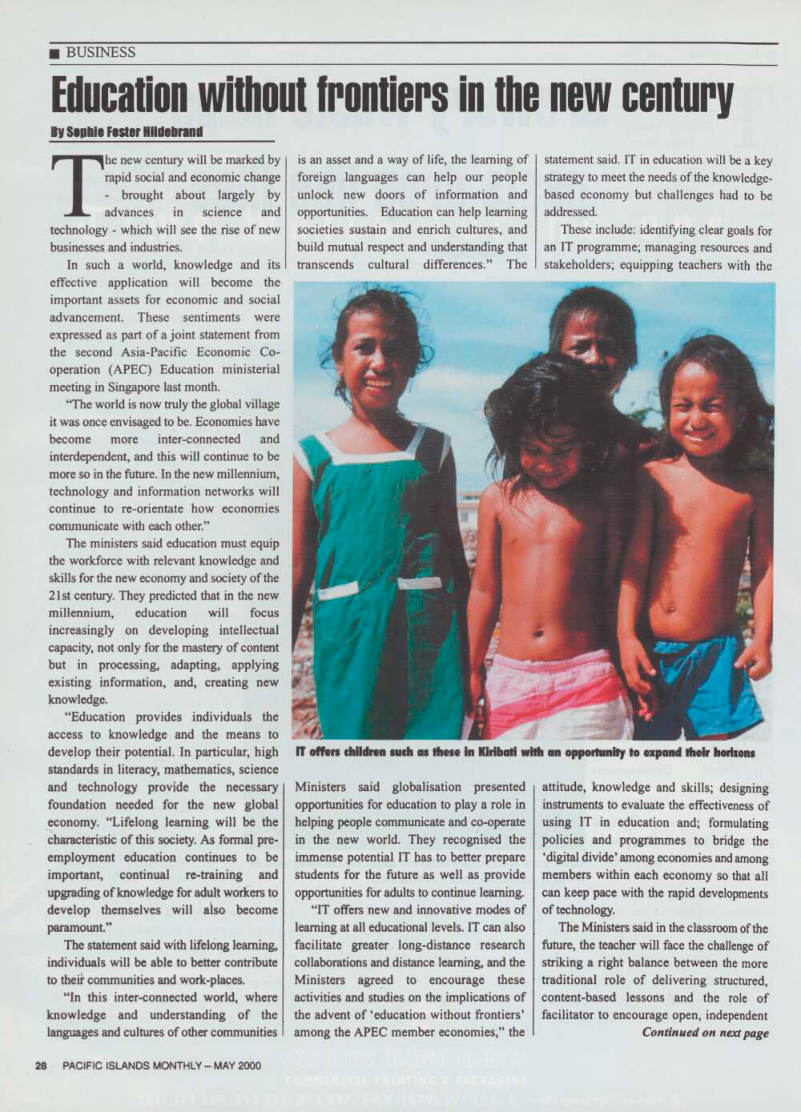
By Saphle Faster Hildebrand
The new century will be marked by rapid social and economic change - brought about largely by advances in science and technology - which will see the rise of new businesses and industries.
In such a world, knowledge and its effective application will become the important assets for economic and social advancement. These sentiments were expressed as part of a joint statement from the second Asia-Pacific Economic Co operation (APEC) Education ministerial meeting in Singapore last month.
“The world is now truly the global village it was once envisaged to be. Economies have become more inter-connected and interdependent, and this will continue to be more so in the future. In the new millennium, technology and information networks will continue to re-orientate how economies communicate with each other.”
The ministers said education must equip the workforce with relevant knowledge and skills for the new economy and society of the 21st century. They predicted that in the new millennium, education will focus increasingly on developing intellectual capacity, not only for the mastery of content but in processing, adapting, applying existing information, and, creating new knowledge.
“Education provides individuals the access to knowledge and the means to
develop their potential. In particular, high
standards in literacy, mathematics, science and technology provide the necessary foundation needed for the new global economy. “Lifelong learning will be the characteristic of this society. As formal pre employment education continues to be
important, continual re-training and
upgrading of knowledge for adult workers to develop themselves will also become
paramount.”
The statement said with lifelong learning, individuals will be able to better contribute to their communities and work-places.
“In this inter-connected world, where knowledge and understanding of the languages and cultures of other communities
is an asset and a way of life, the learning of foreign languages can help our people unlock new doors of information and opportunities. Education can help learning societies sustain and enrich cultures, and build mutual respect and understanding that transcends cultural differences.” The
statement said. IT in education will be a key strategy to meet the needs of the knowledge based economy but challenges had to be addressed.
These include: identifying clear goals for an IT programme; managing resources and stakeholders; equipping teachers with the
Ministers said globalisation presented opportunities for education to play a role in helping people communicate and co-operate in the new world. They recognised the immense potential IT has to better prepare students for the future as well as provide opportunities for adults to continue learning.
“IT offers new and innovative modes of learning at all educational levels. IT can also facilitate greater long-distance research collaborations and distance learning, and the Ministers agreed to encourage these activities and studies on the implications of the advent of ‘education without frontiers’ among the APEC member economies,” the
attitude, knowledge and skills; designing instruments to evaluate the effectiveness of using IT in education and; formulating policies and programmes to bridge the ‘digital divide’ among economies and among members within each economy so that all can keep pace with the rapid developments of technology.
The Ministers said in the classroom of the future, the teacher will face the challenge of striking a right balance between the more traditional role of delivering structured, content-based lessons and the role of facilitator to encourage open, independent Continued on next page
IT offers children such as these in Kiribati with an opportunity to expand their horizons
Continued from previous page learning. “Teacher preparation is key to equipping teachers at all levels to adapt their new roles as facilitators of learning. Teacher development is a life-long process comprising both pre-service training and continual professional development The Ministers noted that, in the globalised future, economies would no longer develop their education systems in isolation. Global economic and social trends will have an impact on the development of education systems, they said.
“The diversity of the various member economies makes APEC an ideal platform for the exchange of information, ideas and expertise as economies seek to overcome similar challenges. The advent of technology increases the opportunities and modes available for such exchanges.”
The Ministers recognised that, in the new century, the Asia-Pacific region will face new opportunities and confront unique challenges in all areas, including education.
“These opportunities and challenges have to be managed actively in order to realise our people’s hope for life-long self improvement.
“Education must play a critical role in preparing students for the new future, to be successful and responsible global citizens who can contribute to the social and economic progress of their community and the world.”
Four strategic areas have been identified to transform education systems for the 21st Century, These are the Information Technology, teacher development, sound management practices in education, and active engagement among APEC member economies in education to forge deeper understanding within the Asia-Pacific community. ■
A$20 million digital mapping system for Australian military
Anew digital topographic mapping system
commissioned by the Australian Defence Acquisition Organisation last month will give military planners and commanders the edge in strategic planning and tactical execution of field operations.
The Director-General of Command and Support Systems Branch, Air Commodore David Schubert, said the new system installed in Bendigo will allow for the storage and tailored reproduction of topographic information for the Australian Defence
Force. Digital map products are beginning to replace traditional paper maps and the digital products - on storage devices such as CD ROMs - will be essential to the command and support systems used by Australian military field commanders. The commissioning ceremony marked the end of a 19-month acquisition phase in which the Melbourne-based prime contractor, RLM Systems, teamed with suppliers including ESRI Australia Defence, Leica Geosystems, Hewlett Packard, Bogong Technologies and Barco, to develop the Digital Topographic Production System. ■
Advertisements & other items, p. 29 (1 item)
prices Jm'west's
FIJI ISLANDS
The West’s Motor Inn
Phone: (679) 720044 E-mail: [email protected] Fax; (679) 720071. P.0.80x 10097, Nadi Airport. m in • Ideally situated between the International Airport and Nadi Town • 62 Rooms from standard to airconditoned deluxe • Poolside dining, variety at reasonable
prices Jm'west's
• Entertainment performed by our very [ inn talented pianist/vocalist • Free courtesy airport transfers on request • 24-hour reception and porterage
C&it
Calls for clean-up of superannuation industry

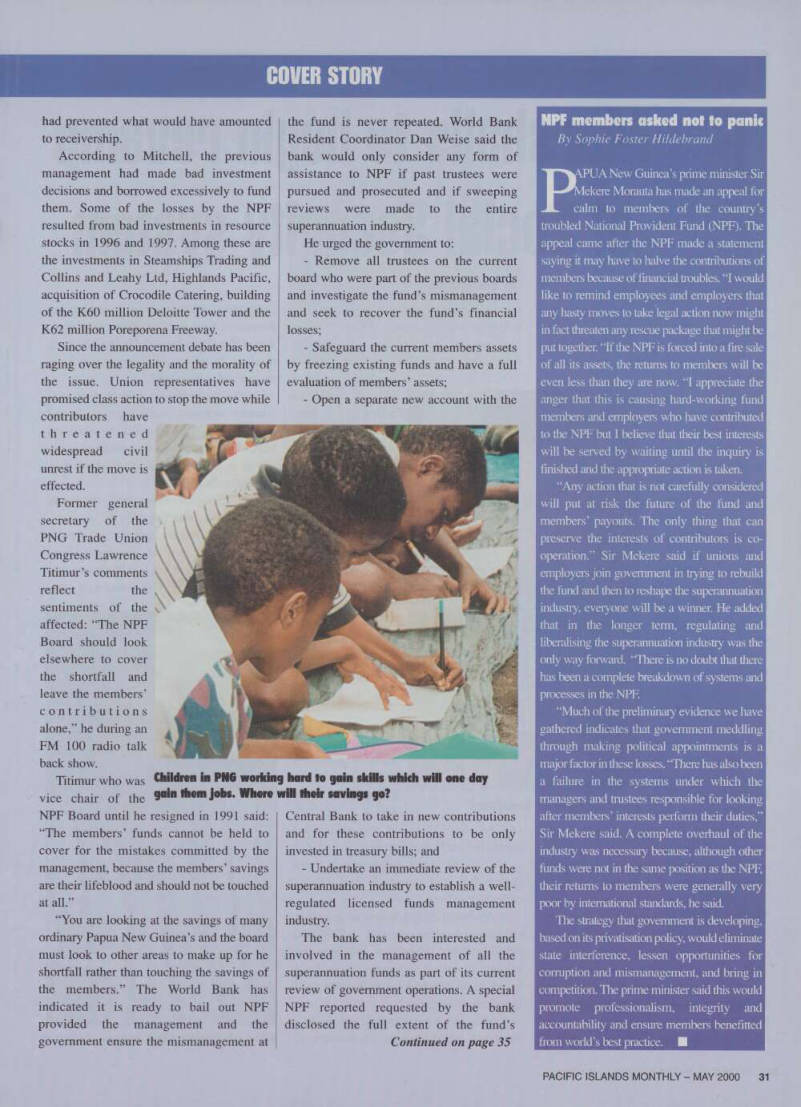
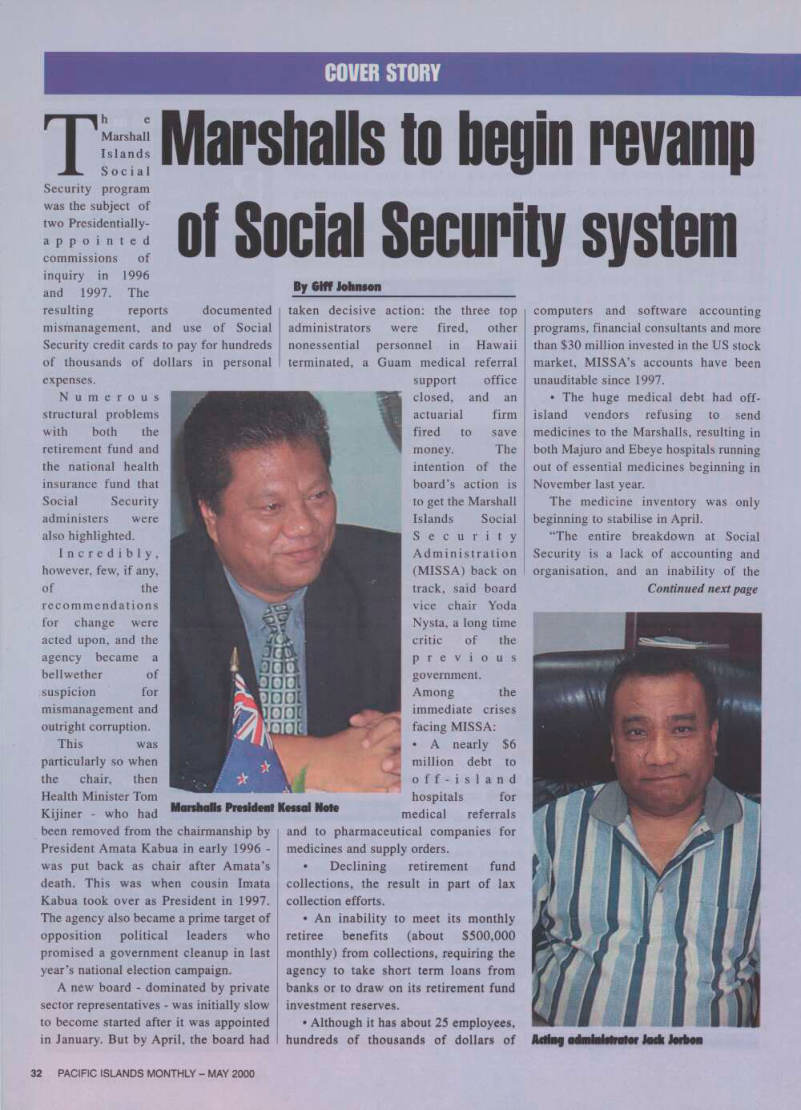
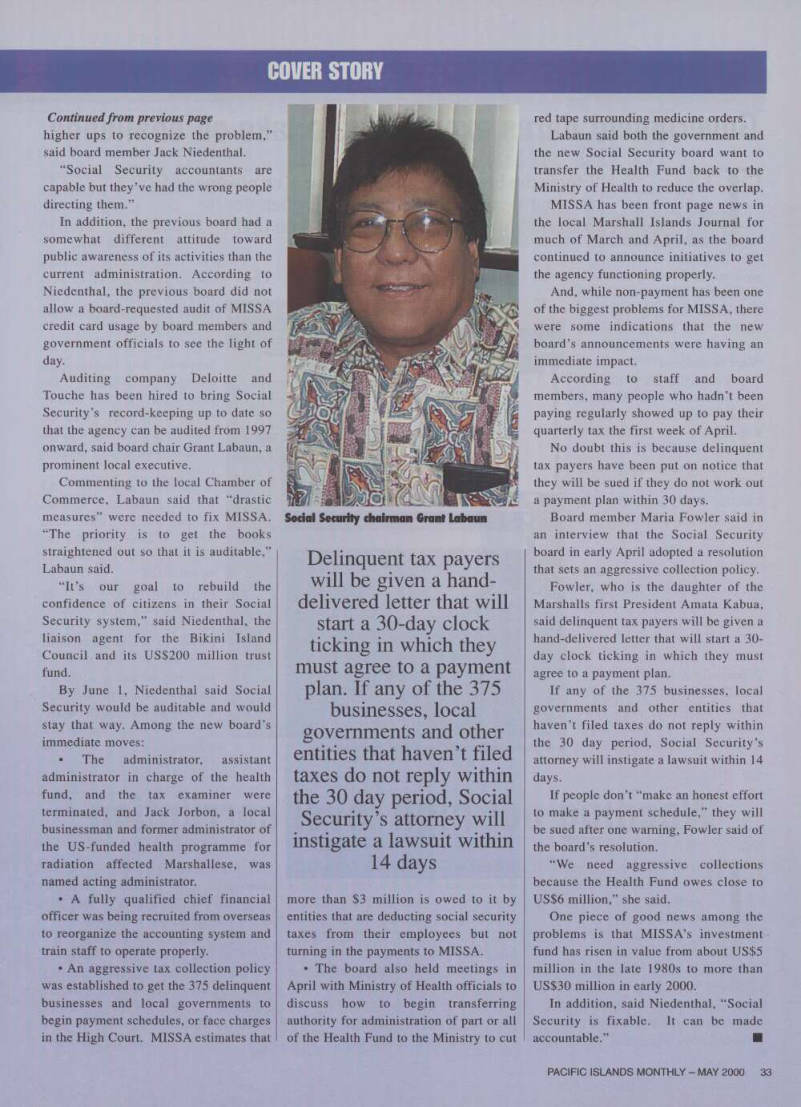
Cover Story
By Eileen Tugum-Kolmo
Outraged members told savings may have halved in value
What would you do if your
superannuation fund
manager told you that he (or she) was going to cut your contributions in half? For the workers that contribute to Papua New Guinea’s National Provident Fund, that is exactly what is being proposed, and they are, to put it mildly, very outraged. The NPF is in dire financial straits and has proposed to write down 50 per cent of all its contributors’ total savings, unless help is on its way.
The announcement shocked the fund’s 255,000 contributors who have already lost
substantially through high income tax
deductions, and many of whom are still battling to recoup money invested in pyramid financial schemes. The news has also alarmed other superannuation contributors.
The Fund announced that poor investment decisions of past boards and management have led to losses totaling K 153 million in 1998 and 1999. The losses meant a reduction of funds attributable to members from K 249 million at December 31 1999, to only K 124 million now. The fund’s general manager Rod Mitchell, who took over management of the troubled institution one year ago, said that the Fund has little choice. It has to half the contribution of workers to take into account its current level of assets. “What NPF is doing now is taking into account all the losses, all the assets overstated in the accounts and bringing everything up towards best practice,” he said.
“The members’ account in the assets pool is valued at K24omillion but this has to be written down to K 126 million to reflect the actual position of the fund.” The cut would affect savings up to 31 December 1999 and total about K 56.3 million. He said however that 50 per cent of the money would be lost permanently, unless the government or the World Bank comes to its rescue. Mid-last month PNG prime minister Sir Mekere Morauta told parliament that a
commission of inquiry would be held into the conduct of the National Provident Fund, the country’s largest superannuation fund.
Heading the inquiry is former Chief Ombudsman, Sir Charles Maino. His terms of reference are to find out why K 153 million of workers’ contributions have disappeared in bad investment. He is to: - Report whether, in connection with the management of the fund, there has been illegal or improper conduct by any person, company, business, legal entity or agency between 1995 and 1999, especially by the board of trustees, management, officers of the NPF, public officials including Ministers of State, and any other persons or organizations, in relation to certain investments and activities undertaken by or on behalf of the NPF; - Whether there was any inappropriate intervention by external persons or entities in relation to illegal or unsuitable borrowings and investments, or other
improper actions;
- Whether in connection with any illegality, any trustee or staff member should be referred to the relevant authorities for criminal prosecution or other action; - Whether in connection with any failure to act in good faith, any trustee or staff member should be indemnified, and if not whether any trustee or staff member should be held personally responsible for decisions or outcomes, and whether (and where practicable) what action should be taken to recover lost asset values; and - Whether under the respective act or any other act, the responsible government
agencies, including the Department of
Finance and Treasury, the Auditor General and the Department of Labor and Employment failed in their regulatory,
supervisory or reporting responsibilities and
what was the extent of this failure.
Meanwhile, Mitchell said in the year that his management team had been in office, they
The NPF problems have increased distrust of financial institutions amongst workers
had prevented what would have amounted
to receivership.
According to Mitchell, the previous management had made bad investment decisions and borrowed excessively to fund them. Some of the losses by the NPF resulted from bad investments in resource stocks in 1996 and 1997. Among these are the investments in Steamships Trading and Collins and Leahy Ltd, Highlands Pacific, acquisition of Crocodile Catering, building of the K6O million Deloitte Tower and the K 62 million Poreporena Freeway.
Since the announcement debate has been raging over the legality and the morality of the issue. Union representatives have promised class action to stop the move while contributors have
threatened
widespread civil
unrest if the move is effected.
Former general secretary of the PNG Trade Union
Congress Lawrence
Titimur’s comments reflect the sentiments of the affected: “The NPF Board should look elsewhere to cover the shortfall and leave the members’ contributions alone,” he during an FM 100 radio talk back show.
Titimur who was vice chair of the
NPF Board until he resigned in 1991 said: “The members’ funds cannot be held to cover for the mistakes committed by the management, because the members’ savings are their lifeblood and should not be touched at all.”
“You are looking at the savings of many ordinary Papua New Guinea’s and the board must look to other areas to make up for he shortfall rather than touching the savings of the members.” The World Bank has indicated it is ready to bail out NPF provided the management and the government ensure the mismanagement at
the fund is never repeated. World Bank Resident Coordinator Dan Weise said the bank would only consider any form of assistance to NPF if past trustees were pursued and prosecuted and if sweeping reviews were made to the entire
superannuation industry.
He urged the government to: - Remove all trustees on the current board who were part of the previous boards and investigate the fund’s mismanagement and seek to recover the fund’s financial losses; - Safeguard the current members assets by freezing existing funds and have a full evaluation of members’ assets; - Open a separate new account with the
Central Bank to take in new contributions and for these contributions to be only invested in treasury bills; and - Undertake an immediate review of the superannuation industry to establish a well regulated licensed funds management
industry.
The bank has been interested and involved in the management of all the superannuation funds as part of its current review of government operations. A special NPF reported requested by the bank disclosed the full extent of the fund’s
Continued on page 35
Children in PNG working hard to gain skills which will one day gain them jobs. Where will their sowings go?
financial position. The report found that: - The board and management prior to 1999 breached the Act in that they did not have the power to borrow funds and breached the fund rules which did not permit investment of money offshore; - The return on investment of the fund for the year ended 1999 was appalling but reflected the bad investment decisions of the management and board prior to 1999. - Until recently internal controls required to ensure efficient and effective functioning of the fund in all areas of operation were either non-existent or lacking; The current management has embarked on a debt reduction strategy through asset sales but the fund will not be cash positive or profitable in 2000. The World Bank suggested legislation be enacted to remove the potential for political interference and the chair and managing directors ought not
to be political appointees.
In response, Mitchell said that the NPF is prepared to meet the conditions set by the World Bank to rescue the Fund. And the government on its part has ordered an inquiry into the affairs of the Fund.
Sir Mekere has said that his government will do everything it can to help the Fund to lessen the impact of the fund’s losses on members.
He said his government understands the anger of the members and will work with the NP management to bring to justice those responsible for any illegality and impropriety and to see there is no repeat.
He said the inquiry is part of a wider government strategy to clean up and reform PNG’s superannuation industry. When the review is completed the government would table legislation to reform the sector, possibly as early as next month. He said the NPF inquiry would examine in detail the transactions that had caused financial losses
for the fund, identify failures in investment process that had caused the losses, and inquire into the actions of individuals involved in the transactions.
Individuals whom the Fund has requested for questioning over the affairs of the fund include Pangu Pati leader Chris Haiveta, former managing director Robert Kaul, former chairman of the board of trustees, David Copeland, and former deputy managing director Noel Wright.
Mitchell, who has specifically named these individuals, said Haiveta was the Minister for Finance when NPF invested in a number of business transactions in PNG and abroad. He said the office of the auditor general and the Finance department should also be questioned over their role.
Announcing the inquiry’s terms of reference Sir Mekere said preliminary investigations to assess the severity of the financial problems at NPF earlier in the year had shown evidence of deep financial trouble, possible illegality and impropriety, breaches of at least three acts, and a serious breakdown of accountability and the management, operating systems and processes with NPF.
“Most importantly,” he said, “our investigations raised concerns that government influence over the NPF has provided opportunities for what appears at first glance to be improper behaviour by public officials and government appointees and the people they have hired or used to provide advice and assistance.”
He has directed the Commissioners to provide a preliminary report on May 31 and a final report by July 13, 2000.
Meanwhile, the fund has put its proposed 50 percent cut to member’s contributions on hold until the National Court decides the legality of the move.
The court was expected to hand down its decision May 1. B
NPF members asked not to panic
By Sophie Foster Hildebrand
PAPUA New Guinea’s prime minister Sir Mekere Morauta has made an appeal for calm to members of the country’s troubled National Provident Fund (NPF). The appeal came after the NPF made a statement saying it may have to halve the contributions of members because of financial troubles. “I would like to remind employees and employers that any hasty' moves to take legal action now might in fact threaten any rescue package that might be put together. “If the NPF is forced into a fire sale of all its assets, the returns to members will be even less than they are now. “I appreciate the anger that this is causing hard-working fund members and employers who have contributed to the NPF but I believe that their best interests will be served by waiting until the inquiry is finished and the appropriate action is taken.
“Any action that is not carefully considered will put at risk the future of the fund and members’ payouts. The only thing that can preserve the interests of contributors is co operation.” Sir Mekere said if unions and employers join government in Hying to rebuild the fund and then to reshape the superannuation industry, eveiyone will be a winner. He added that in the longer term, regulating and liberalising the superannuation industry was the only way forward. “There is no doubt that there has been a complete breakdown of systems and processes in the NPF.
“Much of the preliminaiy evidence we have gathered indicates that government meddling
through making political appointments is a
major factor in these losses. “There has also been a failure in the systems under which the managers and trustees responsible for looking after members’ interests perform their duties,”
Sir Mekere said. A complete overhaul of the industry was necessary because, although other funds were not in the same position as the NPF, their returns to members were generally very poor by international standards, he said.
The strategy that government is developing, based on its privatisation policy, would eliminate state interference, lessen opportunities for corruption and mismanagement, and bring in competition. The prime minister said this would
promote professionalism, integrity and
accountability and ensure members benefitted from world’s best practice. ■
of Social Security system
Marshalls to begin revamp of Social Security system
By Giff Johnson
Th e
Marshall Islands Social Security program was the subject of two Presidentially appointed commissions of inquiry in 1996 and 1997. The
resulting reports documented mismanagement, and use of Social Security credit cards to pay for hundreds of thousands of dollars in personal
expenses.
Numerous
structural problems
with both the retirement fund and the national health insurance fund that Social Security administers were
also highlighted.
Incredibly,
however, few, if any, of the recommendations for change were acted upon, and the agency became a bellwether of suspicion for mismanagement and
outright corruption.
This was particularly so when the chair, then Health Minister Tom Kijiner - who had
been removed from the chairmanship by President Amata Kabua in early 1996 was put back as chair after Amata’s death. This was when cousin Imata Kabua took over as President in 1997.
The agency also became a prime target of
opposition political leaders who
promised a government cleanup in last year’s national election campaign.
A new board - dominated by private sector representatives - was initially slow to become started after it was appointed in January. But by April, the board had
taken decisive action: the three top administrators were fired, other nonessential personnel in Hawaii terminated, a Guam medical referral
support office closed, and an actuarial firm fired to save money. The intention of the board’s action is to get the Marshall Islands Social
Security
Administration (MISSA) back on track, said board vice chair Yoda
Nysta, a long time
critic of the previous government.
Among the
immediate crises
facing MISSA:
• A nearly $6 million debt to off-island
hospitals for
medical referrals
and to pharmaceutical companies for medicines and supply orders. • Declining retirement fund collections, the result in part of lax collection efforts. • An inability to meet its monthly retiree benefits (about $500,000 monthly) from collections, requiring the agency to take short term loans from banks or to draw on its retirement fund investment reserves. • Although it has about 25 employees, hundreds of thousands of dollars of
computers and software accounting programs, financial consultants and more than $3O million invested in the US stock market, MISSA’s accounts have been unauditable since 1997. • The huge medical debt had off island vendors refusing to send medicines to the Marshalls, resulting in
both Majuro and Ebeye hospitals running
out of essential medicines beginning in November last year.
The medicine inventory was only beginning to stabilise in April.
“The entire breakdown at Social Security is a lack of accounting and organisation, and an inability of the
Continued next page
Marshalls President Kessai Note
fluting admiistrator Jack Jorbon
Continued from previous page higher ups to recognize the problem,” said board member Jack Niedenthal.
“Social Security accountants are capable but they’ve had the wrong people
directing them.”
In addition, the previous board had a somewhat different attitude toward public awareness of its activities than the current administration. According to Niedenthal, the previous board did not allow a board-requested audit of MISSA credit card usage by board members and government officials to see the light of day.
Auditing company Deloitte and Touche has been hired to bring Social Security’s record-keeping up to date so that the agency can be audited from 1997 onward, said board chair Grant Labaun, a prominent local executive.
Commenting to the local Chamber of Commerce, Labaun said that “drastic measures” were needed to fix MISSA.
“The priority is to get the books straightened out so that it is auditable,”
Labaun said.
“It’s our goal to rebuild the confidence of citizens in their Social Security system,” said Niedenthal, the liaison agent for the Bikini Island Council and its US$2OO million trust fund.
By June 1, Niedenthal said Social Security would be auditable and would stay that way. Among the new board’s immediate moves; • The administrator, assistant administrator in charge of the health fund, and the tax examiner were terminated, and Jack Jorbon, a local businessman and former administrator of the US-funded health programme for radiation affected Marshallese, was named acting administrator. • A fully qualified chief financial officer was being recruited from overseas to reorganize the accounting system and train staff to operate properly. • An aggressive tax collection policy was established to get the 375 delinquent businesses and local governments to begin payment schedules, or face charges in the High Court. MISSA estimates that
Delinquent tax payers will be given a hand delivered letter that will start a 30-day clock ticking in which they must agree to a payment plan. If any of the 375 businesses, local governments and other entities that haven’t filed taxes do not reply within the 30 day period, Social Security’s attorney will instigate a lawsuit within 14 days
more than $3 million is owed to it by entities that are deducting social security taxes from their employees but not turning in the payments to MISSA. • The board also held meetings in April with Ministry of Health officials to discuss how to begin transferring authority for administration of part or all of the Health Fund to the Ministry to cut
red tape surrounding medicine orders.
Labaun said both the government and the new Social Security board want to transfer the Health Fund back to the Ministry of Health to reduce the overlap.
MISSA has been front page news in the local Marshall Islands Journal for much of March and April, as the board continued to announce initiatives to get
the agency functioning properly.
And, while non-payment has been one of the biggest problems for MISSA, there were some indications that the new board’s announcements were having an
immediate impact.
According to staff and board members, many people who hadn’t been paying regularly showed up to pay their quarterly tax the first week of April.
No doubt this is because delinquent tax payers have been put on notice that they will be sued if they do not work out a payment plan within 30 days.
Board member Maria Fowler said in an interview that the Social Security board in early April adopted a resolution that sets an aggressive collection policy.
Fowler, who is the daughter of the Marshalls first President Amata Kabua, said delinquent tax payers will be given a hand-delivered letter that will start a 30day clock ticking in which they must agree to a payment plan.
If any of the 375 businesses, local governments and other entities that haven’t filed taxes do not reply within
the 30 day period, Social Security’s
attorney will instigate a lawsuit within 14 days.
If people don’t “make an honest effort to make a payment schedule,” they will be sued after one warning, Fowler said of the board’s resolution.
“We need aggressive collections because the Health Fund owes close to US$6 million,” she said.
One piece of good news among the problems is that MISSA’s investment fund has risen in value from about US$5 million in the late 1980 s to more than USS3O million in early 2000.
In addition, said Niedenthal, “Social Security is fixable. It can be made accountable.” ■
Social Security chairman Grant labaun
Two weeks
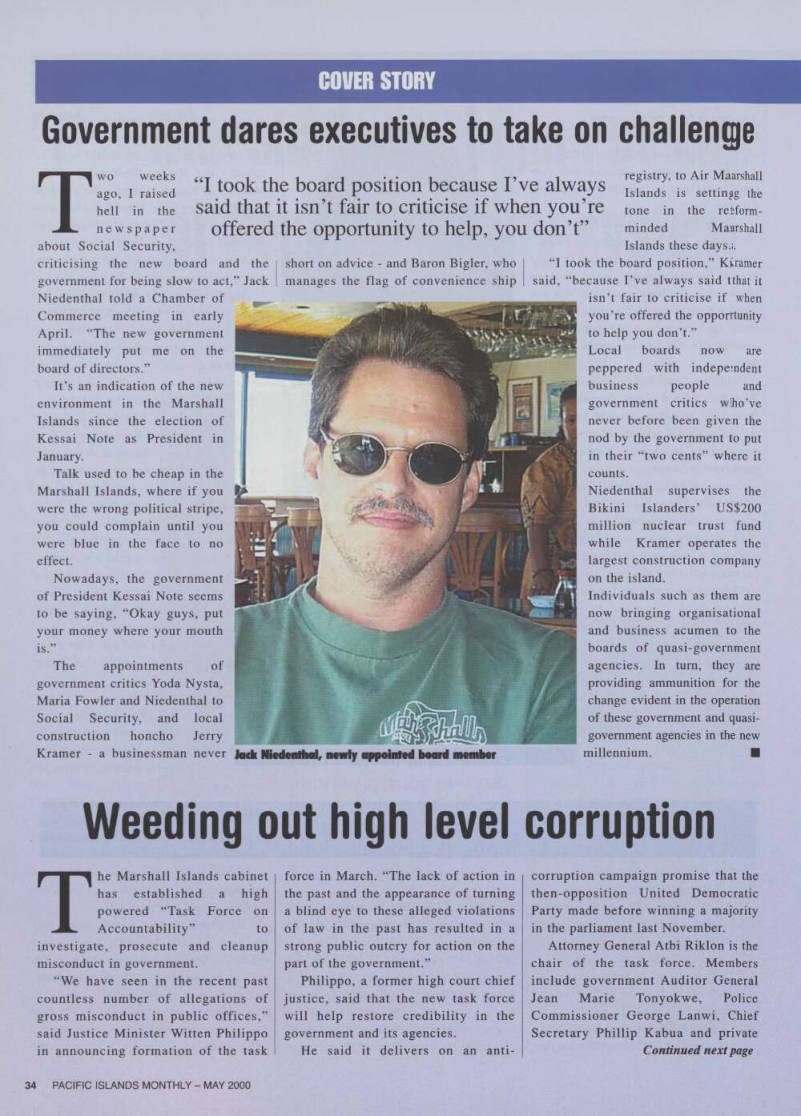
Government dares executives to take on challenge
ttr . i „_i i i i t? i 1 took the board position because I vc always said that it isn’t fair to criticise if when you’re offered the opportunity to help, you don’t”
ago, I raised hell in the newspaper about Social Security,
criticising the new board and the government for being slow to act,” Jack
Niedenthal told a Chamber of Commerce meeting in early April. “The new government immediately put me on the board of directors.”
It’s an indication of the new environment in the Marshall Islands since the election of Kessai Note as President in January.
Talk used to be cheap in the Marshall Islands, where if you were the wrong political stripe, you could complain until you were blue in the face to no effect.
Nowadays, the government of President Kessai Note seems to be saying, “Okay guys, put your money where your mouth is.”
The appointments of government critics Yoda Nysta, Maria Fowler and Niedenthal to Social Security, and local construction honcho Jerry Kramer - a businessman never
short on advice - and Baron Bigler, who manages the flag of convenience ship
registry, to Air Maarshall Islands is settingg the tone in the retform minded Maarshall Islands these days.;.
“I took the board position,” Kframer said, “because I’ve always said tthat it
isn’t fair to criticise if when
you’re offered the opportunity
to help you don’t.”
Local boards now are
peppered with independent
business people and government critics wlho’ve never before been given the nod by the government to put in their “two cents” where it counts.
Niedenthal supervises the Bikini Islanders’ US$2OO million nuclear trust fund while Kramer operates the largest construction company on the island.
Individuals such as them are now bringing organisational and business acumen to the boards of quasi-government agencies. In turn, they are providing ammunition for the change evident in the operation of these government and quasi govemment agencies in the new millennium. ■
lack Niedenthal, newly appointed board member
Weeding out high level corruption
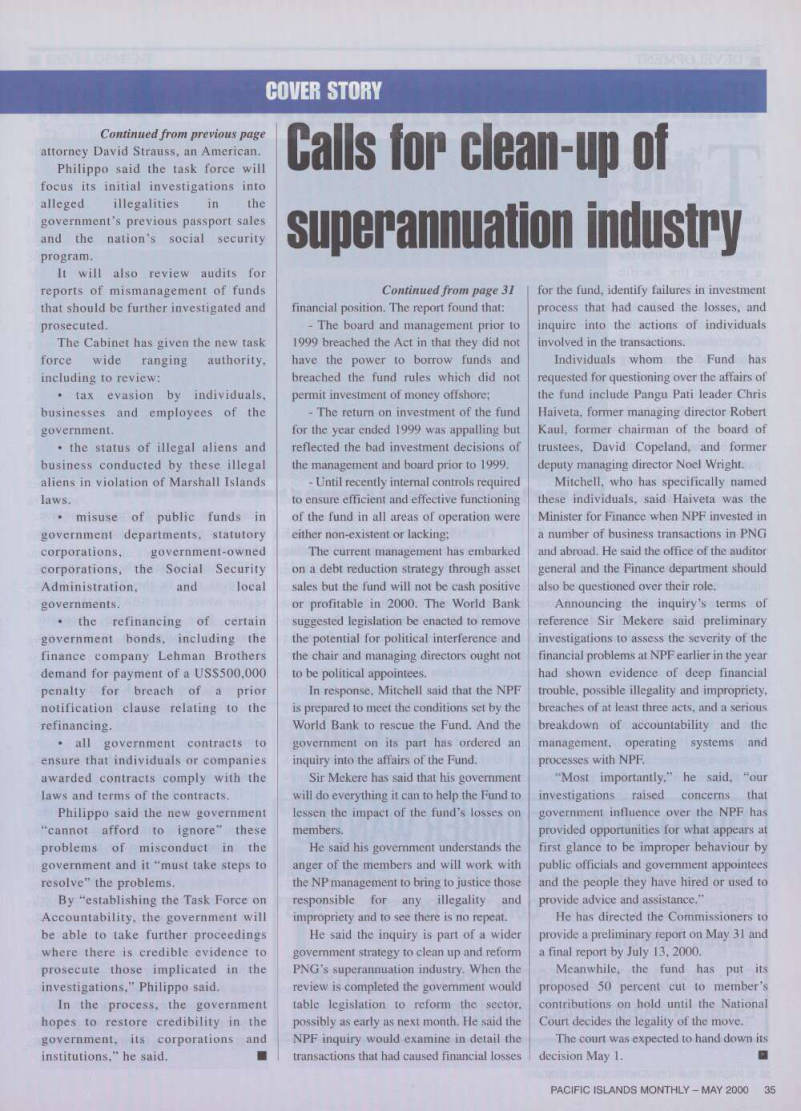
The Marshall Islands cabinet has established a high powered “Task Force on
Accountability” to
investigate, prosecute and cleanup misconduct in government.
“We have seen in the recent past countless number of allegations of gross misconduct in public offices,” said Justice Minister Witten Philippo in announcing formation of the task
force in March. “The lack of action in the past and the appearance of turning a blind eye to these alleged violations of law in the past has resulted in a strong public outcry for action on the part of the government.”
Philippo, a former high court chief justice, said that the new task force will help restore credibility in the government and its agencies.
He said it delivers on an anti
corruption campaign promise that the then-opposition United Democratic Party made before winning a majority in the parliament last November.
Attorney General Atbi Riklon is the chair of the task force. Members include government Auditor General Jean Marie Tonyokwe, Police Commissioner George Lanwi, Chief Secretary Phillip Kabua and private
Continued next page
Continued from previous page attorney David Strauss, an American.
Philippo said the task force will focus its initial investigations into alleged illegalities in the
government’s previous passport sales
and the nation’s social security program.
It will also review audits for reports of mismanagement of funds that should be further investigated and prosecuted.
The Cabinet has given the new task
force wide ranging authority,
including to review: • tax evasion by individuals, businesses and employees of the government. • the status of illegal aliens and business conducted by these illegal aliens in violation of Marshall Islands laws. • misuse of public funds in government departments, statutory corporations, government-owned
corporations, the Social Security
Administration, and local governments. • the refinancing of certain government bonds, including the finance company Lehman Brothers demand for payment of a US$5OO,OOO penalty for breach of a prior notification clause relating to the
refinancing.
• all government contracts to ensure that individuals or companies awarded contracts comply with the laws and terms of the contracts.
Philippo said the new government “cannot afford to ignore” these problems of misconduct in the government and it “must take steps to resolve” the problems.
By “establishing the Task Force on Accountability, the government will be able to take further proceedings where there is credible evidence to prosecute those implicated in the
investigations,” Philippo said.
In the process, the government hopes to restore credibility in the government, its corporations and institutions,” he said. fl
Advertisements & other items, p. 35 (1 item)
superannuation industry
35
PACIFIC ISLANDS MONTHLY - MAY 2000
COVER STORY
Calls for clean-up of superannuation industry
Continued from page 31
The National
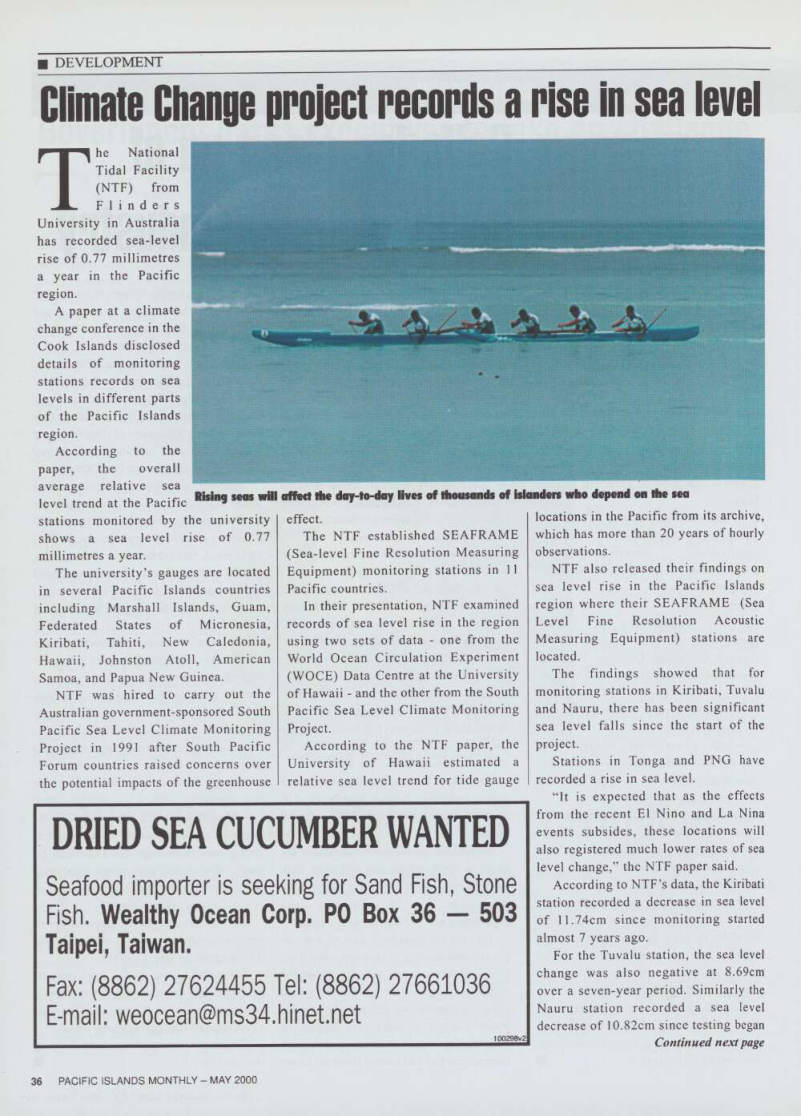
Development
Climate Change project records a rise in sea level
Tidal Facility (NTF) from Flinders University in Australia has recorded sea-level rise of 0.77 millimetres a year in the Pacific region.
A paper at a climate change conference in the Cook Islands disclosed details of monitoring stations records on sea levels in different parts of the Pacific Islands region.
According to the paper, the overall average relative sea level trend at the Pacific
stations monitored by the university shows a sea level rise of 0.77 millimetres a year.
The university’s gauges are located in several Pacific Islands countries including Marshall Islands, Guam, Federated States of Micronesia, Kiribati, Tahiti, New Caledonia, Hawaii, Johnston Atoll, American Samoa, and Papua New Guinea.
NTF was hired to carry out the Australian government-sponsored South Pacific Sea Level Climate Monitoring Project in 1991 after South Pacific Forum countries raised concerns over the potential impacts of the greenhouse
effect.
The NTF established SEAFRAME (Sea-level Fine Resolution Measuring Equipment) monitoring stations in 11 Pacific countries.
In their presentation, NTF examined records of sea level rise in the region using two sets of data - one from the World Ocean Circulation Experiment (WOCE) Data Centre at the University of Hawaii - and the other from the South Pacific Sea Level Climate Monitoring Project.
According to the NTF paper, the University of Hawaii estimated a relative sea level trend for tide gauge
locations in the Pacific from its archive, which has more than 20 years of hourly observations.
NTF also released their findings on sea level rise in the Pacific Islands region where their SEAFRAME (Sea Level Fine Resolution Acoustic Measuring Equipment) stations are located.
The findings showed that for monitoring stations in Kiribati, Tuvalu and Nauru, there has been significant sea level falls since the start of the project.
Stations in Tonga and PNG have recorded a rise in sea level.
“It is expected that as the effects from the recent El Nino and La Nina events subsides, these locations will also registered much lower rates of sea level change,” the NTF paper said.
According to NTF’s data, the Kiribati station recorded a decrease in sea level of 11.74 cm since monitoring started almost 7 years ago.
For the Tuvalu station, the sea level change was also negative at 8.69 cm over a seven-year period. Similarly the Nauru station recorded a sea level decrease of 10.82 cm since testing began
Continued next page
Rising seas will affect the day-to-day lives of thousands of islanders who depend on the sea
Continued from previous page six and half years ago.
The station in Fiji, where testing began just over seven years ago, recorded a sea level rise of I.olcm.
The Vanuatu station recorded a rise of 0.92 cm over a six-year period; the sea level at the Cook Islands station increased by 4.83 cm; the level at the Samoa station was down 3.22 cm; Marshall Islands station recorded a 1.98 cm rise; the sea level at the Solomon Islands station was up 2.87 cm; and the PNG station showed a sea level increase of 5.96 cm.
But, NTF believes that considering the analysis of the time necessary to determine accurate rates of relative sea level rise, it is premature to consider that the current South Pacific Sea Level and Climate Monitoring Project can provide anything other than “noisy estimates of trends”.
“We have examined the long term rates of sea level change as registered on tide gauges in the Pacific region and found that it is difficult to estimate localised rates of change,”
NTF admitted.
“Taking the 27 longest records available, the estimated mean relative sea level rise emerges as +o.Bmm/year.
“This is on the low side of the global rate published in the Intergovernmental Panel on Climate Change (IPCC) Scientific Assessment which in 1995 estimated that the global trend lies between l-2mm per year.”
“Consequently over a major part of the world ocean, which on the one hand includes ocean stations, and on the other a major continental coastline, the indication is that, over recorded history, sea level rise has occurred, but at a rate which falls significantly short of the IPCC world assessment.”
According to NTF, research has shown that it may take as least 30 years to estimate consistent sea level trends based upon the output of conventional tide gauges. PNS ■
Advertisements & other items, p. 36 (1 item)
Dried Sea Cucumber Wanted
Seafood importer is seeking for Sand Fish, Stone Fish. Wealthy Ocean Corp. PO Box 36 503 Taipei, Taiwan.
Fax: (8862) 27624455 Tel: (8862) 27661036 E-mail: [email protected] 100298v2
Australia’s
Australia to fund third phase of monitoring unit
minister for foreign affairs, Alexander Downer, has announced that Australia will fund the third phase of the South Pacific Sea Level and Climate Monitoring Project.
The project was developed in response to concerns raised by South Pacific Forum countries about climate change and sea level rise in the region.
Announcing the funding, Downer said it represents a significant regional contribution by Australia in the effort to understand better climate variability and global warming.
“Small island states in the Pacific are especially vulnerable to the
potentially adverse effects of climate variability and climate change in areas such as coastal infrastructure, fresh water resources, agriculture and health,” Downer said.
“Since its inception in 1991, the project has helped eleven Pacific Island countries to monitor and analyse climate and sea level changes through a network of sea level monitoring stations, satellite transmission networks and computer systems.
“It has provided governments and communities throughout the region with resources, training and information to better understand the links between sea level, climate variability and their adaptation requirements.
“An accurate scientific record of longer-term sea level trends will be crucial to understand better the effects of climate change and the occurrence of extreme weather events in the region, and to the development of appropriate response measures,” the minister said.
The third phase of the project will enhance the quality of long-term sea level monitoring and analysis, and provide national meteorological services in Pacific Island countries with improved capacity to analyse and interpret project data.
It will give increased emphasis to monitoring short and medium-term climate variability in the Pacific. ■
Rising seas
cause concern in PNG
The Governor of Papua New Guinea’s Manu province, Stephen Pokawin, has asked the government if it has any plans for people affected by the rise in sea level in the country.
Pokawin said some islands have already started sinking, and some have no food growing on the island because
of the salt content spoiling them.
Pokawin called on the PNG government to look at ways on how it could help, such as resettling the
people elsewhere.
He said many of the people had nowhere to go and should be resettled in areas where there was abundant land, especially on plantations owned by the state.
Minister for national planning, Moi Avei, said in response that the government was aware of the problems resulting from the rise in sea level.
He said they would be raising the issue with the World Bank to assist in finding solutions to the problem. (Post Courier) H
Will Castro come to Suva signing?
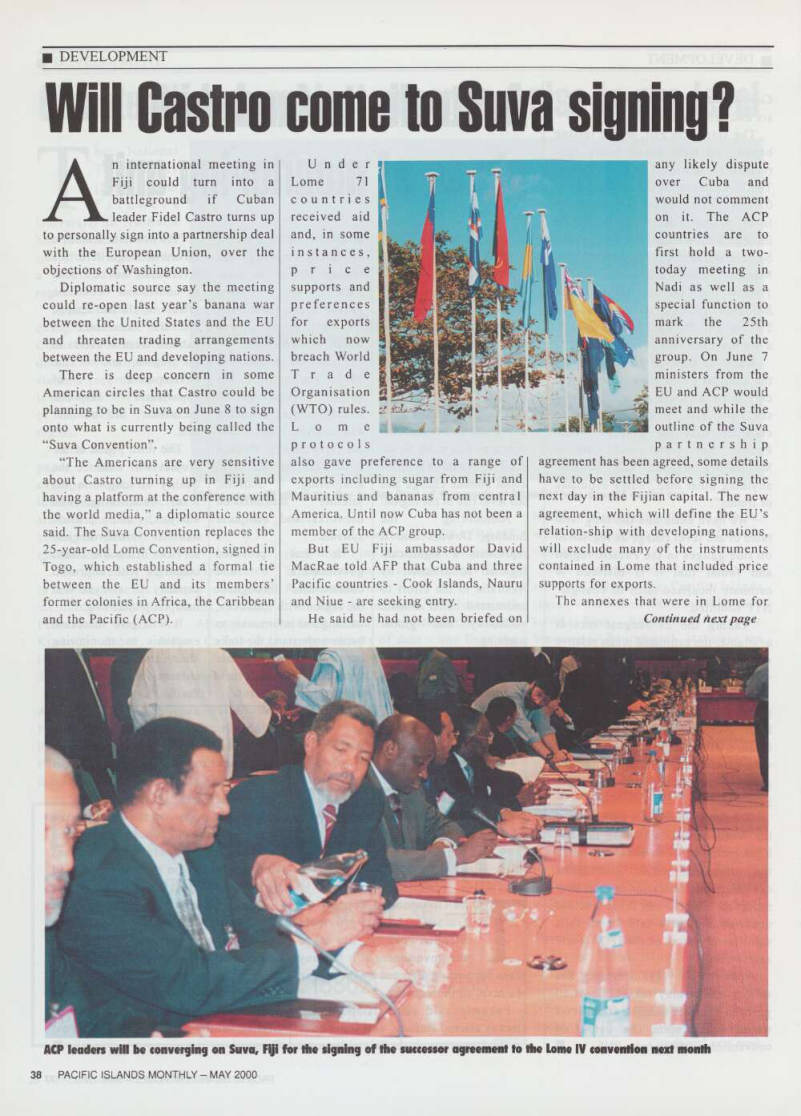
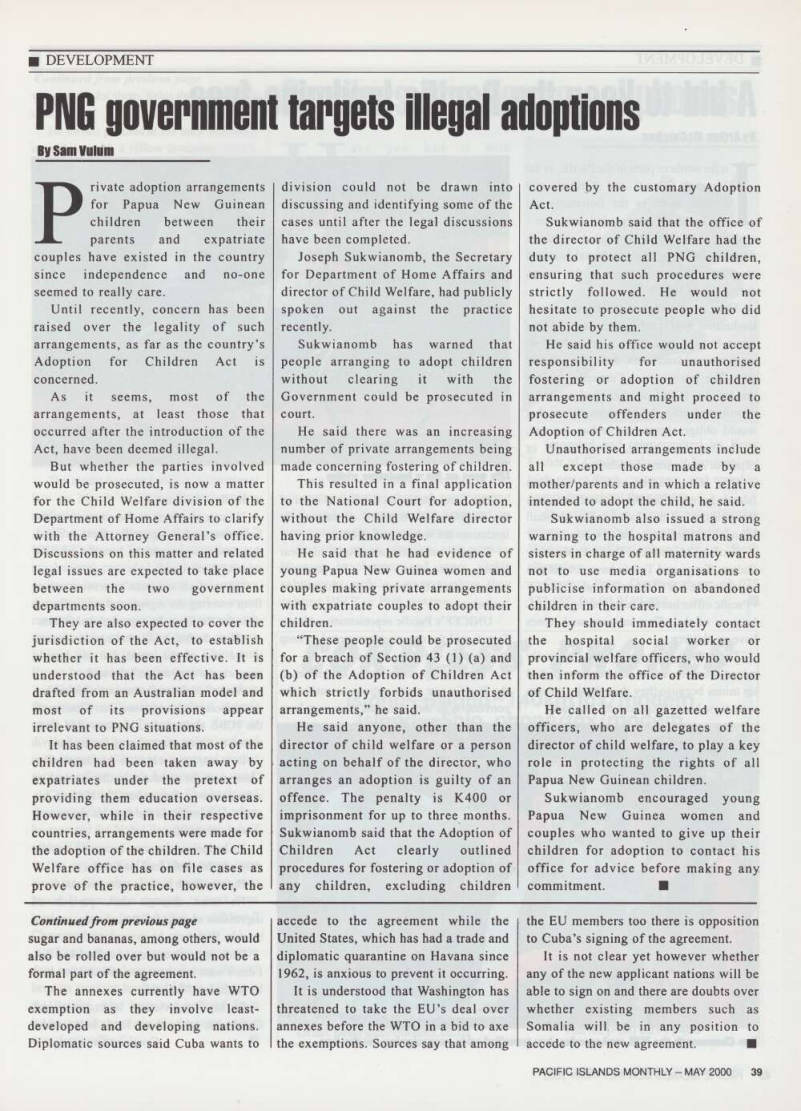
An international meeting in
Fiji could turn into a battleground if Cuban leader Fidel Castro turns up to personally sign into a partnership deal with the European Union, over the objections of Washington.
Diplomatic source say the meeting could re-open last year’s banana war between the United States and the EU and threaten trading arrangements between the EU and developing nations.
There is deep concern in some American circles that Castro could be planning to be in Suva on June 8 to sign onto what is currently being called the “Suva Convention”.
“The Americans are very sensitive about Castro turning up in Fiji and having a platform at the conference with the world media,” a diplomatic source said. The Suva Convention replaces the 25-year-old Lome Convention, signed in Togo, which established a formal tie between the EU and its members’ former colonies in Africa, the Caribbean and the Pacific (ACP).
Under Lome 71 countries received aid and, in some instances, price supports and preferences for exports which now breach World Trade Organisation (WTO) rules.
Lome protocols
also gave preference to a range of exports including sugar from Fiji and Mauritius and bananas from central America. Until now Cuba has not been a member of the ACP group.
But EU Fiji ambassador David Macßae told AFP that Cuba and three Pacific countries - Cook Islands, Nauru and Niue - are seeking entry.
He said he had not been briefed on
any likely dispute
over Cuba and would not comment on it. The ACP countries are to first hold a two
today meeting in
Nadi as well as a special function to mark the 25th anniversary of the group. On June 7 ministers from the EU and ACP would meet and while the outline of the Suva partnership
agreement has been agreed, some details have to be settled before signing the next day in the Fijian capital. The new agreement, which will define the EU’s relation-ship with developing nations, will exclude many of the instruments contained in Lome that included price supports for exports.
The annexes that were in Lome for
Continued next page
ACP leaders will be converging on Suva, Fiji for Hie signing of the successor agreement to the Lome IV convention next month
Continued from previous page sugar and bananas, among others, would also be rolled over but would not be a formal part of the agreement.
The annexes currently have WTO exemption as they involve least developed and developing nations.
Diplomatic sources said Cuba wants to
accede to the agreement while the United States, which has had a trade and diplomatic quarantine on Havana since 1962, is anxious to prevent it occurring.
It is understood that Washington has threatened to take the EU’s deal over annexes before the WTO in a bid to axe the exemptions. Sources say that among
the EU members too there is opposition to Cuba’s signing of the agreement.
It is not clear yet however whether any of the new applicant nations will be able to sign on and there are doubts over whether existing members such as Somalia will be in any position to accede to the new agreement. ■
PNG government targets illegal adoptions
By Sam Vulum
Private adoption arrangements for Papua New Guinean children between their parents and expatriate couples have existed in the country since independence and no-one seemed to really care.
Until recently, concern has been raised over the legality of such arrangements, as far as the country’s Adoption for Children Act is concerned.
As it seems, most of the arrangements, at least those that occurred after the introduction of the Act, have been deemed illegal.
But whether the parties involved would be prosecuted, is now a matter for the Child Welfare division of the Department of Home Affairs to clarify with the Attorney General’s office.
Discussions on this matter and related legal issues are expected to take place between the two government departments soon.
They are also expected to cover the jurisdiction of the Act, to establish whether it has been effective. It is understood that the Act has been drafted from an Australian model and most of its provisions appear irrelevant to PNG situations.
It has been claimed that most of the children had been taken away by expatriates under the pretext of providing them education overseas.
However, while in their respective countries, arrangements were made for the adoption of the children. The Child Welfare office has on file cases as prove of the practice, however, the
division could not be drawn into discussing and identifying some of the cases until after the legal discussions have been completed.
Joseph Sukwianomb, the Secretary for Department of Home Affairs and director of Child Welfare, had publicly spoken out against the practice recently.
Sukwianomb has warned that people arranging to adopt children without clearing it with the Government could be prosecuted in court.
He said there was an increasing number of private arrangements being made concerning fostering of children.
This resulted in a final application to the National Court for adoption, without the Child Welfare director
having prior knowledge.
He said that he had evidence of young Papua New Guinea women and couples making private arrangements with expatriate couples to adopt their children.
“These people could be prosecuted for a breach of Section 43 (1) (a) and (b) of the Adoption of Children Act which strictly forbids unauthorised arrangements,” he said.
He said anyone, other than the director of child welfare or a person acting on behalf of the director, who arranges an adoption is guilty of an offence. The penalty is K4OO or imprisonment for up to three months.
Sukwianomb said that the Adoption of Children Act clearly outlined procedures for fostering or adoption of any children, excluding children
covered by the customary Adoption Act.
Sukwianomb said that the office of the director of Child Welfare had the duty to protect all PNG children, ensuring that such procedures were strictly followed. He would not hesitate to prosecute people who did not abide by them.
He said his office would not accept responsibility for unauthorised fostering or adoption of children arrangements and might proceed to prosecute offenders under the Adoption of Children Act.
Unauthorised arrangements include all except those made by a mother/parents and in which a relative intended to adopt the child, he said.
Sukwianomb also issued a strong warning to the hospital matrons and sisters in charge of all maternity wards not to use media organisations to publicise information on abandoned children in their care.
They should immediately contact the hospital social worker or provincial welfare officers, who would then inform the office of the Director of Child Welfare.
He called on all gazetted welfare officers, who are delegates of the director of child welfare, to play a key role in protecting the rights of all Papua New Guinean children.
Sukwianomb encouraged young Papua New Guinea women and couples who wanted to give up their children for adoption to contact his office for advice before making any. commitment. ■
A bid to keep the Pacific landmine-free
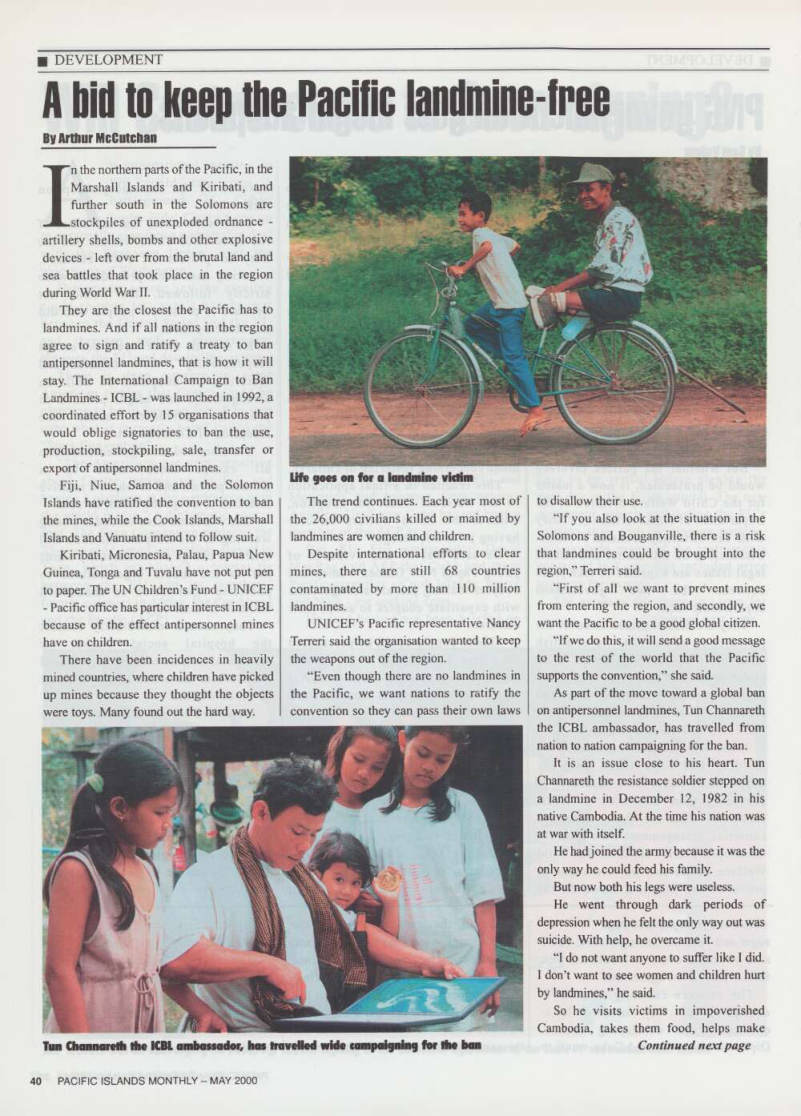

By Arthur McCutchan
In the northern parts of the Pacific, in the Marshall Islands and Kiribati, and further south in the Solomons are stockpiles of unexploded ordnance artillery shells, bombs and other explosive devices - left over from the brutal land and sea battles that took place in the region during World War 11.
They are the closest the Pacific has to landmines. And if all nations in the region agree to sign and ratify a treaty to ban antipersonnel landmines, that is how it will stay. The International Campaign to Ban Landmines - ICBL - was launched in 1992, a coordinated effort by 15 organisations that would oblige signatories to ban the use, production, stockpiling, sale, transfer or export of antipersonnel landmines.
Fiji, Niue, Samoa and the Solomon Islands have ratified the convention to ban the mines, while the Cook Islands, Marshall Islands and Vanuatu intend to follow suit.
Kiribati, Micronesia, Palau, Papua New Guinea, Tonga and Tuvalu have not put pen to paper. The UN Children’s Fund - UNICEF - Pacific office has particular interest in ICBL because of the effect antipersonnel mines have on children.
There have been incidences in heavily mined countries, where children have picked up mines because they thought the objects were toys. Many found out the hard way.
The trend continues. Each year most of the 26,000 civilians killed or maimed by landmines are women and children.
Despite international efforts to clear mines, there are still 68 countries contaminated by more than 110 million landmines.
UNICEF’s Pacific representative Nancy Terreri said the organisation wanted to keep the weapons out of the region.
“Even though there are no landmines in the Pacific, we want nations to ratify the convention so they can pass their own laws
to disallow their use.
“If you also look at the situation in the Solomons and Bouganville, there is a risk that landmines could be brought into the region,” Terreri said.
“First of all we want to prevent mines from entering the region, and secondly, we want the Pacific to be a good global citizen.
“If we do this, it will send a good message to the rest of the world that the Pacific supports the convention,” she said.
As part of the move toward a global ban on antipersonnel landmines, Tun Channareth the ICBL ambassador, has travelled from nation to nation campaigning for the ban.
It is an issue close to his heart. Tun Channareth the resistance soldier stepped on a landmine in December 12, 1982 in his native Cambodia. At the time his nation was at war with itself.
He had joined the army because it was the only way he could feed his family.
But now both his legs were useless.
He went through dark periods of depression when he felt the only way out was suicide. With help, he overcame it.
“I do not want anyone to suffer like I did. 1 don’t want to see women and children hurt by landmines,” he said.
So he visits victims in impoverished Cambodia, takes them food, helps make
Continued next page
Tun Channareth the ICBL ambassador, has travelled wide campaigning for the ban
Life goes on for a landmine victim
Continued from previous page wheelchairs for them, helps them build their own homes.
He travels perched at the back of a dusty motorbike with a fellow landmine victim.
Between the two of them, they share a leg that isn’t his.
In March, Channareth was in Fiji for 10 days. The visit was timed to coincide with a
gathering of regional parliamentarians. Fiji
was playing host to the parliamentarians who were in Nadi for a conference on governance. Channareth met them all.
“Even though many countries have signed the treaty to ban landmines, there are those who have not ratified it,” he said. “But I am happy that nations in the Pacific have either ratified the treaty or are pushing very hard to.”
The ICBL and the International Committee of the Red Cross adopted the Ottawa Declaration in October 1996 at a
Canadian-sponsored global ban conference.
The treaty became binding international law on March 1, 1999 after 40 nations ratified it.
“The treaty does rely on goodwill,”
UNICEF’s Nancy Terreri said, “but there are mechanisms provided for in the treaty to promote its implementation and resolve disputes.” Each nation is required to report regularly on action taken to implement the treaty’s obligations. The bigger military powers like the United States, China and Russia have not signed the treaty.
“The US has given the excuse that unless the situation in Korea is resolved, it can’t ratify the treaty,” Terreri said. Korea is divided in two by a heavily militarised and mined boarder. That has not stopped smaller nations and individuals from making a stand.
Channareth’s hard work in Cambodia and the rest of the world paid off in 1997 when he accepted the Nobel Peace Prize on behalf of the ICBL.
“In my whole life I had never seen anything like this. But it made me very proud. It gave me a strength to work even harder for handicapped children,”
Channareth said.
“Just because we won the peace prize does not mean that our work is done. We will keep on working hard and I hope nations in the Pacific, who have not suffered from landmines like we have, do the same so that they don’t suffer.” ■
Cordless answer to cellphones
Have you had it with
expensive cellular phone
bills that just keep piling up? If so, the Voyager cordless telephone is the answer to your mobile communication woes.
Voyager is a non-cellular cordless phone with unprecedented range and reliability, providing a full long-range mobile phone service without skyrocketing costs.
Able to be used over the greater Auckland area from high-rise locations, the unit comprises of a mobile handset that can be operated through a personal base at home. As you head to your workplace, the handset links into a second base located there.
It is an ideal non-cellular business and domestic alternative.
Tests show it is fully effective at one kilometre sideways through concrete and steel, and at elevation has achieved an impressive eight kilometre range.
For the urban dweller and worker, Voyager is cheaper and more viable solution to mobile communication than existing DECT or PHS systems.
Imported and telepermitted by Peter Escher of Cordless phones, it has received high praise from customers, and now has agents throughout the country.
If you’re after a more cost-effective answer to mobile communication, the Voyager cordless phone is a fresh alternative.
Contact: Peter, Cordless phone, ph 025 577-157, fax 09 8149-469. ■
Advertisements & other items, p. 41 (1 item)
Mon-Cellular (Bkm^-100km)
CORDLESS PHONES
Island-Island “140 km fax/ modem
Island-Ship phone/fax/modem
Mon-Cellular (Bkm^-100km)
t ZOat6ic-*?al6ieA ■ mfiit m www.cordlessnz.co.nz Emoil: [email protected] s4dwutcceC awdle&x pfatu& ft* iutf ft* 6catc, . < .teUpAane Umßa, etc.
M I v mm ■ ■
CORDLESS
TECHNOLOGIES
Ph NZ (+64) 2557 7157
Fox NZ (+64) 9814 9469
Bartini's children
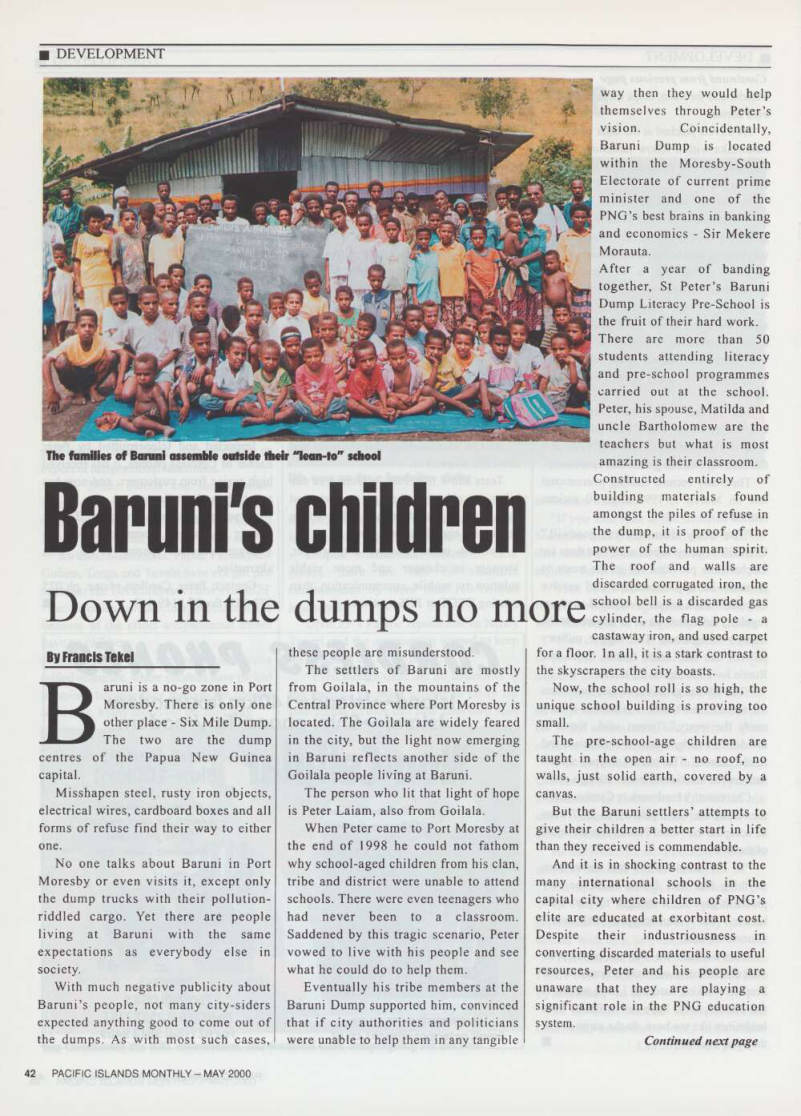
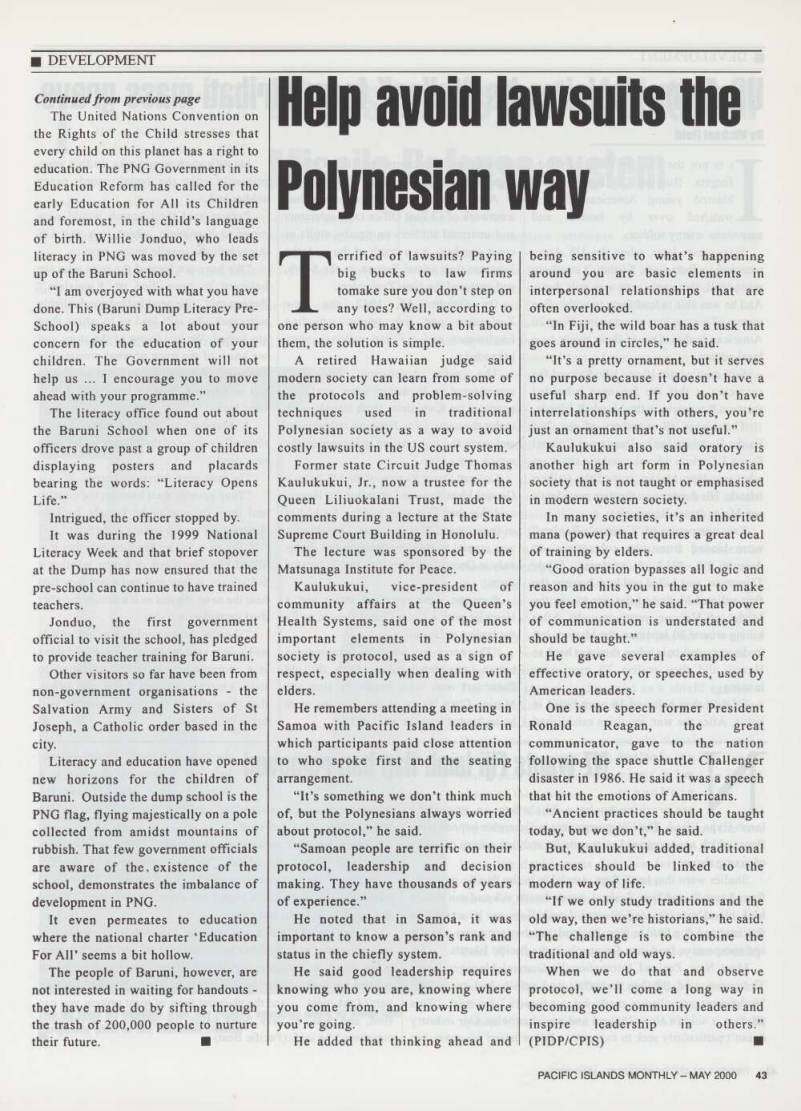
Down in the dumps no more
By Francis Tekei
these people are misunderstood.
The settlers of Baruni are mostly from Goilala, in the mountains of the Central Province where Port Moresby is located. The Goilala are widely feared in the city, but the light now emerging in Baruni reflects another side of the Goilala people living at Baruni.
The person who lit that light of hope is Peter Laiam, also from Goilala.
When Peter came to Port Moresby at the end of 1998 he could not fathom why school-aged children from his clan, tribe and district were unable to attend schools. There were even teenagers who had never been to a classroom.
Saddened by this tragic scenario, Peter vowed to live with his people and see what he could do to help them.
Eventually his tribe members at the Baruni Dump supported him, convinced that if city authorities and politicians were unable to help them in any tangible
Baruni is a no-go zone in Port Moresby. There is only one other place - Six Mile Dump.
The two are the dump centres of the Papua New Guinea capital.
Misshapen steel, rusty iron objects, electrical wires, cardboard boxes and all forms of refuse find their way to either one.
No one talks about Baruni in Port Moresby or even visits it, except only the dump trucks with their pollution riddled cargo. Yet there are people living at Baruni with the same expectations as everybody else in society.
With much negative publicity about Baruni’s people, not many city-siders expected anything good to come out of the dumps. As with most such cases.
way then they would help themselves through Peter’s vision. Coincidentally, Baruni Dump is located i within the Moresby-South i Electorate of current prime I minister and one of the I PNG’s best brains in banking ■ and economics - Sir Mekere Morauta.
After a year of banding together, St Peter’s Baruni i Dump Literacy Pre-School is I the fruit of their hard work.
I There are more than 50 j students attending literacy I and pre-school programmes carried out at the school.
Peter, his spouse, Matilda and uncle Bartholomew are the teachers but what is most amazing is their classroom.
Constructed entirely of building materials found amongst the piles of refuse in the dump, it is proof of the power of the human spirit.
The roof and walls are discarded corrugated iron, the school bell is a discarded gas cylinder, the flag pole - a castaway iron, and used carpet
for a floor. In all, it is a stark contrast to the skyscrapers the city boasts.
Now, the school roll is so high, the unique school building is proving too small.
The pre-school-age children are taught in the open air - no roof, no walls, just solid earth, covered by a canvas.
But the Baruni settlers’ attempts to give their children a better start in life than they received is commendable.
And it is in shocking contrast to the many international schools in the capital city where children of PNG’s elite are educated at exorbitant cost.
Despite their industriousness in converting discarded materials to useful resources, Peter and his people are unaware that they are playing a significant role in the PNG education system.
Continued next page
The families of Baruni assemble outside their "lean-to" school
Continued from previous page The United Nations Convention on the Rights of the Child stresses that every child on this planet has a right to education. The PNG Government in its Education Reform has called for the early Education for AH its Children and foremost, in the child’s language of birth. Willie Jonduo, who leads literacy in PNG was moved by the set up of the Baruni School.
“I am overjoyed with what you have done. This (Baruni Dump Literacy Pre- School) speaks a lot about your concern for the education of your children. The Government will not help us ... I encourage you to move ahead with your programme.”
The literacy office found out about the Baruni School when one of its officers drove past a group of children displaying posters and placards bearing the words: “Literacy Opens Life.”
Intrigued, the officer stopped by.
It was during the 1999 National Literacy Week and that brief stopover at the Dump has now ensured that the pre-school can continue to have trained teachers.
Jonduo, the first government official to visit the school, has pledged to provide teacher training for Baruni.
Other visitors so far have been from non-government organisations - the Salvation Army and Sisters of St Joseph, a Catholic order based in the city.
Literacy and education have opened new horizons for the children of Baruni. Outside the dump school is the PNG flag, flying majestically on a pole collected from amidst mountains of rubbish. That few government officials are aware of the. existence of the school, demonstrates the imbalance of development in PNG.
It even permeates to education where the national charter ‘Education For All’ seems a bit hollow.
The people of Baruni, however, are not interested in waiting for handouts they have made do by sifting through the trash of 200,000 people to nurture their future. ■
Polynesian way
Help avoid lawsuits the Polynesian way
Terrified of lawsuits? Paying big bucks to law firms tomake sure you don’t step on any toes? Well, according to one person who may know a bit about them, the solution is simple.
A retired Hawaiian judge said modern society can learn from some of the protocols and problem-solving techniques used in traditional Polynesian society as a way to avoid costly lawsuits in the US court system.
Former state Circuit Judge Thomas Kaulukukui, Jr., now a trustee for the Queen Liliuokalani Trust, made the comments during a lecture at the State Supreme Court Building in Honolulu.
The lecture was sponsored by the Matsunaga Institute for Peace.
Kaulukukui, vice-president of community affairs at the Queen’s Health Systems, said one of the most important elements in Polynesian society is protocol, used as a sign of respect, especially when dealing with elders.
He remembers attending a meeting in Samoa with Pacific Island leaders in which participants paid close attention to who spoke first and the seating arrangement.
“It’s something we don’t think much of, but the Polynesians always worried about protocol,” he said.
“Samoan people are terrific on their
protocol, leadership and decision
making. They have thousands of years of experience.”
He noted that in Samoa, it was important to know a person’s rank and status in the chiefly system.
He said good leadership requires knowing who you are, knowing where you come from, and knowing where you’re going.
He added that thinking ahead and
being sensitive to what’s happening around you are basic elements in interpersonal relationships that are often overlooked.
“In Fiji, the wild boar has a tusk that goes around in circles,” he said.
“It’s a pretty ornament, but it serves no purpose because it doesn’t have a useful sharp end. If you don’t have interrelationships with others, you’re just an ornament that’s not useful.”
Kaulukukui also said oratory is another high art form in Polynesian society that is not taught or emphasised in modern western society.
In many societies, it’s an inherited mana (power) that requires a great deal of training by elders.
“Good oration bypasses all logic and reason and hits you in the gut to make you feel emotion,” he said. “That power of communication is understated and should be taught.”
He gave several examples of effective oratory, or speeches, used by American leaders.
One is the speech former President Ronald Reagan, the great communicator, gave to the nation following the space shuttle Challenger disaster in 1986. He said it was a speech that hit the emotions of Americans.
“Ancient practices should be taught today, but we don’t,” he said.
But, Kaulukukui added, traditional practices should be linked to the modern way of life.
“If we only study traditions and the old way, then we’re historians,” he said.
“The challenge is to combine the traditional and old ways.
When we do that and observe protocol, we’ll come a long way in becoming good community leaders and inspire leadership in others.”
(Pidp/Cpis) ■
US Army reclaims its "fallen" from Hall mass grave
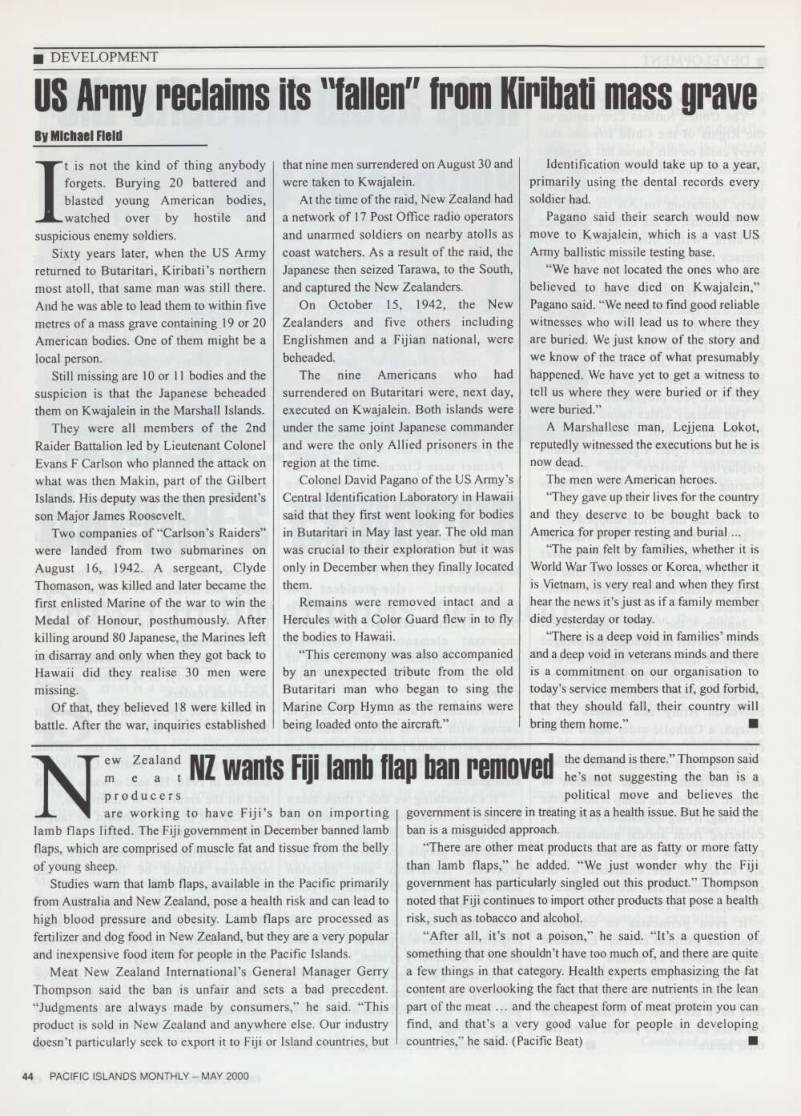
By Michael Field
It is not the kind of thing anybody forgets. Burying 20 battered and blasted young American bodies, watched over by hostile and suspicious enemy soldiers.
Sixty years later, when the US Army returned to Butaritari, Kiribati’s northern most atoll, that same man was still there.
And he was able to lead them to within five metres of a mass grave containing 19 or 20 American bodies. One of them might be a local person.
Still missing are 10 or 11 bodies and the suspicion is that the Japanese beheaded them on Kwajalein in the Marshall Islands.
They were all members of the 2nd Raider Battalion led by Lieutenant Colonel Evans F Carlson who planned the attack on what was then Makin, part of the Gilbert Islands. His deputy was the then president’s son Major James Roosevelt.
Two companies of “Carlson’s Raiders” were landed from two submarines on August 16, 1942. A sergeant, Clyde Thomason, was killed and later became the first enlisted Marine of the war to win the Medal of Honour, posthumously. After killing around 80 Japanese, the Marines left in disarray and only when they got back to Hawaii did they realise 30 men were missing.
Of that, they believed 18 were killed in battle. After the war, inquiries established
that nine men surrendered on August 30 and were taken to Kwajalein.
At the time of the raid. New Zealand had a network of 17 Post Office radio operators and unarmed soldiers on nearby atolls as coast watchers. As a result of the raid, the Japanese then seized Tarawa, to the South, and captured the New Zealanders.
On October 15, 1942, the New Zealanders and five others including Englishmen and a Fijian national, were beheaded.
The nine Americans who had surrendered on Butaritari were, next day, executed on Kwajalein. Both islands were under the same joint Japanese commander and were the only Allied prisoners in the region at the time.
Colonel David Pagano of the US Army’s Central Identification Laboratory in Hawaii said that they first went looking for bodies in Butaritari in May last year. The old man was crucial to their exploration but it was only in December when they finally located them.
Remains were removed intact and a Hercules with a Color Guard flew in to fly the bodies to Hawaii.
“This ceremony was also accompanied by an unexpected tribute from the old Butaritari man who began to sing the Marine Corp Hymn as the remains were being loaded onto the aircraft.”
Identification would take up to a year, primarily using the dental records every soldier had.
Pagano said their search would now move to Kwajalein, which is a vast US Army ballistic missile testing base.
“We have not located the ones who are believed to have died on Kwajalein,”
Pagano said. “We need to find good reliable witnesses who will lead us to where they are buried. We just know of the story and we know of the trace of what presumably happened. We have yet to get a witness to tell us where they were buried or if they were buried.”
A Marshallese man, Lejjena Lokot, reputedly witnessed the executions but he is now dead.
The men were American heroes.
“They gave up their lives for the country and they deserve to be bought back to America for proper resting and burial ...
“The pain felt by families, whether it is World War Two losses or Korea, whether it is Vietnam, is very real and when they first hear the news it’s just as if a family member died yesterday or today.
“There is a deep void in families’ minds and a deep void in veterans minds and there is a commitment on our organisation to today’s service members that if, god forbid, that they should fall, their country will bring them home.” ■
New Zealand
NZ wants Fiji lamb flap ban removed
meat producers are working
to have Fiji’s ban on importing
lamb flaps lifted. The Fiji government in December banned lamb flaps, which are comprised of muscle fat and tissue from the belly of young sheep.
Studies warn that lamb flaps, available in the Pacific primarily from Australia and New Zealand, pose a health risk and can lead to high blood pressure and obesity. Lamb flaps are processed as fertilizer and dog food in New Zealand, but they are a very popular and inexpensive food item for people in the Pacific Islands.
Meat New Zealand International’s General Manager Gerry Thompson said the ban is unfair and sets a bad precedent.
“Judgments are always made by consumers,” he said. “This product is sold in New Zealand and anywhere else. Our industry doesn’t particularly seek to export it to Fiji or Island countries, but
the demand is there.” Thompson said he’s not suggesting the ban is a political move and believes the
government is sincere in treating it as a health issue. But he said the ban is a misguided approach.
“There are other meat products that are as fatty or more fatty than lamb flaps,” he added. “We just wonder why the Fiji government has particularly singled out this product.” Thompson noted that Fiji continues to import other products that pose a health risk, such as tobacco and alcohol.
“After all, it’s not a poison,” he said. “It’s a question of something that one shouldn’t have too much of, and there are quite a few things in that category. Health experts emphasizing the fat content are overlooking the fact that there are nutrients in the lean part of the meat ... and the cheapest form of meat protein you can find, and that’s a very good value for people in developing countries,” he said. (Pacific Beat) ■
Missile Defense system
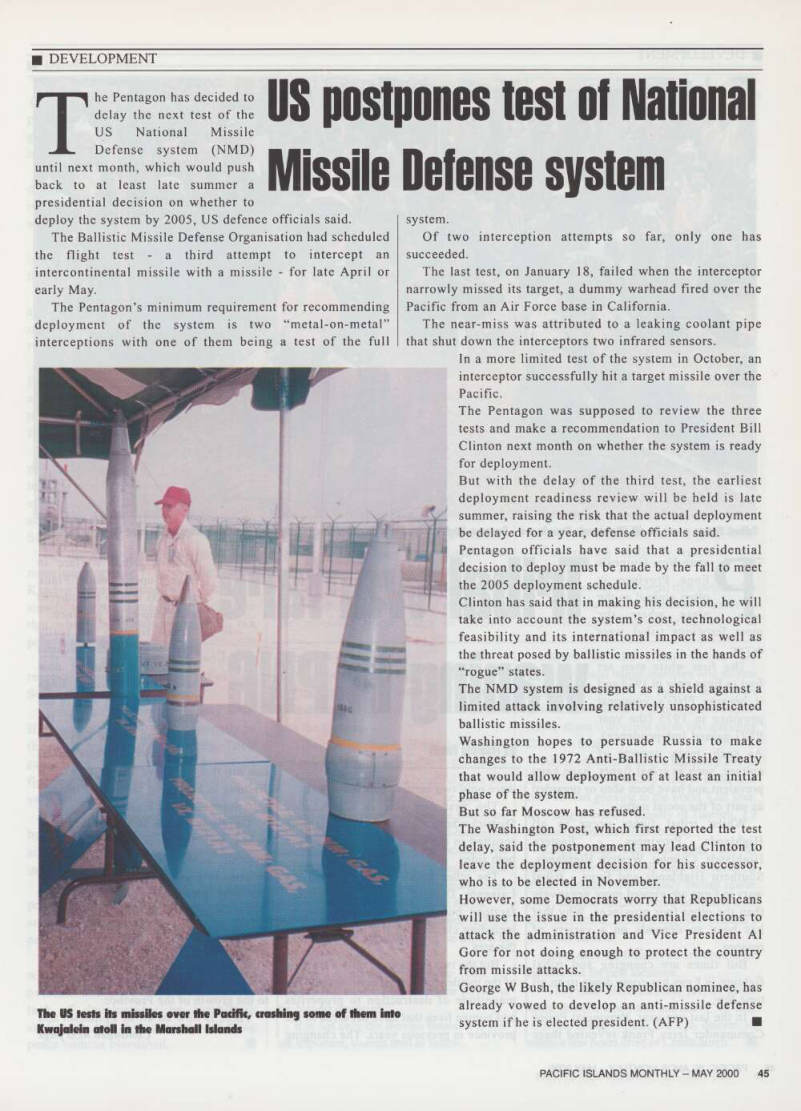
US postpones test of National Missile Defense system
The Pentagon has decided to delay the next test of the US National Missile Defense system (NMD) until next month, which would push back to at least late summer a presidential decision on whether to
deploy the system by 2005, US defence officials said.
The Ballistic Missile Defense Organisation had scheduled the flight test - a third attempt to intercept an intercontinental missile with a missile - for late April or early May.
The Pentagon’s minimum requirement for recommending deployment of the system is two “metal-on-metal” interceptions with one of them being a test of the full
system.
Of two interception attempts so far, only one has succeeded.
The last test, on January 18, failed when the interceptor narrowly missed its target, a dummy warhead fired over the Pacific from an Air Force base in California.
The near-miss was attributed to a leaking coolant pipe that shut down the interceptors two infrared sensors.
In a more limited test of the system in October, an interceptor successfully hit a target missile over the Pacific.
The Pentagon was supposed to review the three tests and make a recommendation to President Bill Clinton next month on whether the system is ready for deployment.
But with the delay of the third test, the earliest deployment readiness review will be held is late summer, raising the risk that the actual deployment be delayed for a year, defense officials said.
Pentagon officials have said that a presidential decision to deploy must be made by the fall to meet the 2005 deployment schedule.
Clinton has said that in making his decision, he will take into account the system’s cost, technological feasibility and its international impact as well as the threat posed by ballistic missiles in the hands of “rogue” states.
The NMD system is designed as a shield against a limited attack involving relatively unsophisticated ballistic missiles.
Washington hopes to persuade Russia to make changes to the 1972 Anti-Ballistic Missile Treaty that would allow deployment of at least an initial phase of the system.
But so far Moscow has refused.
The Washington Post, which first reported the test delay, said the postponement may lead Clinton to leave the deployment decision for his successor, who is to be elected in November.
However, some Democrats worry that Republicans will use the issue in the presidential elections to attack the administration and Vice President A 1 Gore for not doing enough to protect the country from missile attacks.
George W Bush, the likely Republican nominee, has already vowed to develop an anti-missile defense system if he is elected president. (AFP) ■
The US tests its missiles over the Pacific, crashing some of them into Kwajalein atoll in the Marshall Islands
Tribal warfare
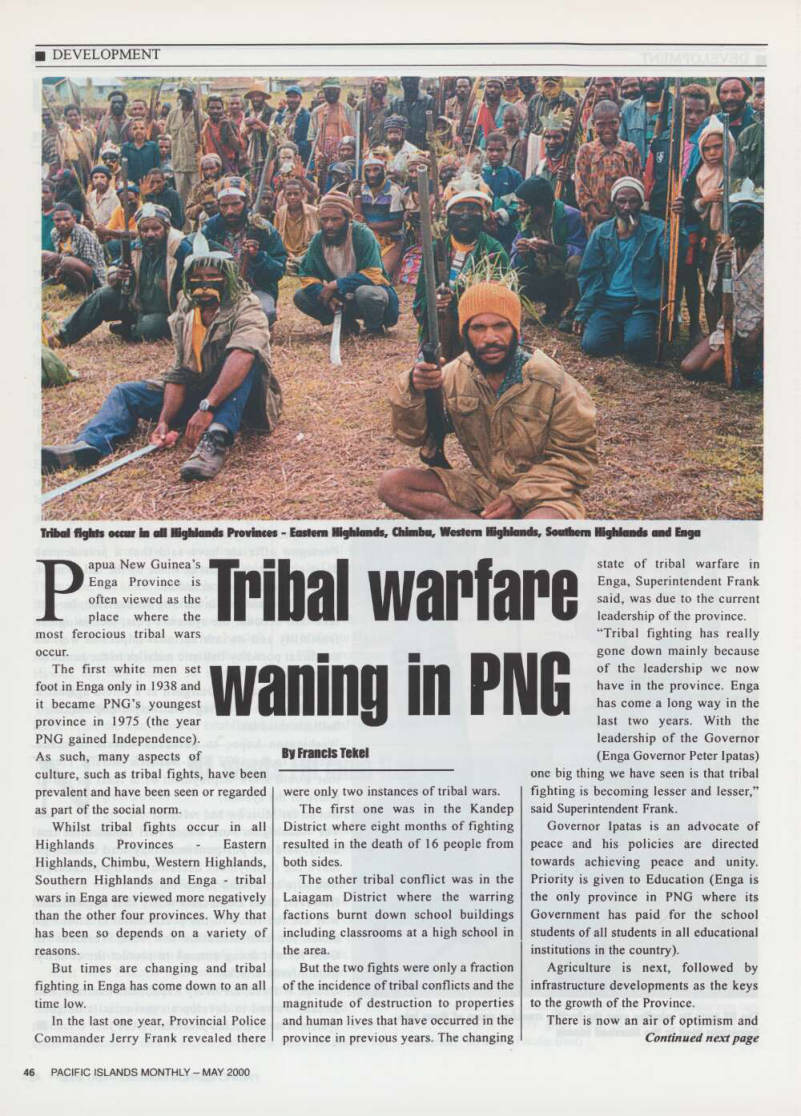
wang ia PNG
By Francis Tekei
Papua New Guinea’s Enga Province is often viewed as the place where the most ferocious tribal wars occur.
The first white men set foot in Enga only in 1938 and it became PNG’s youngest province in 1975 (the year
PNG gained Independence).
As such, many aspects of
culture, such as tribal fights, have been prevalent and have been seen or regarded as part of the social norm.
Whilst tribal fights occur in all Highlands Provinces - Eastern
Highlands, Chimbu, Western Highlands,
Southern Highlands and Enga - tribal wars in Enga are viewed more negatively than the other four provinces. Why that has been so depends on a variety of reasons.
But times are changing and tribal fighting in Enga has come down to an all time low.
In the last one year. Provincial Police Commander Jerry Frank revealed there
were only two instances of tribal wars.
The first one was in the Kandep District where eight months of fighting resulted in the death of 16 people from both sides.
The other tribal conflict was in the Laiagam District where the warring factions burnt down school buildings including classrooms at a high school in the area.
But the two fights were only a fraction of the incidence of tribal conflicts and the magnitude of destruction to properties and human lives that have occurred in the province in previous years. The changing
state of tribal warfare in Enga, Superintendent Frank said, was due to the current leadership of the province.
“Tribal fighting has really gone down mainly because of the leadership we now have in the province. Enga has come a long way in the last two years. With the leadership of the Governor (Enga Governor Peter Ipatas)
one big thing we have seen is that tribal fighting is becoming lesser and lesser,” said Superintendent Frank.
Governor Ipatas is an advocate of peace and his policies are directed towards achieving peace and unity.
Priority is given to Education (Enga is the only province in PNG where its Government has paid for the school students of all students in all educational institutions in the country).
Agriculture is next, followed by infrastructure developments as the keys to the growth of the Province.
There is now an air of optimism and
Continued next page
Tribal fights occur in all Highlands Provinces-Eastern Highlands, Chimbu, Western Highlands, Southern Highlands and Enga
Continued from previous page people are laying down their arms and getting into farming and other projects to improve their livelihood.
A clear illustration attesting to the decline in Enga tribal wars was a reconciliation ceremony between the two warring sides in Kandep District.
The reconciliation ceremony occurred in the middle of last month (February) at the Kandep District Government Station.
Leaders of the two clans pledged to abandon their weapons, forgive each other and allow peace and normalcy to rule their lives.
This was after eight months of fighting, using traditional weapons such as bows and arrows and spears and home made shotguns as well as factory made firearms.
According to a reliable source, high powered weapons were also used. This is true because tribal fighting in PNG now employs the most powerful weapons such as police or military issue ARIS and SLR rifles.
In the case of Enga, the most notorious province for tribal fights, the Kandep reconciliation was the most significant symbol and serious indication that when the leadership is right, the people want peace.
“It was a breakthrough with the reconciliation between the two clans,”
Superintendent Frank said.
Tribal fighting occurs regularly in all Highland provinces and occasionally in the coast regions of the country. Their causes are varied and the extent of fighting and the use of weapons also vary.
But the Enga reconciliation, inspired by the provincial leadership, is a sure sign that the province is beginning to live in peace.
This can also happen in other
provinces when the leadership is right
and the people are willing to live peacefully.
Only then can PNG’s tribal wars, which have been negatively portrayed overseas and are a major cause for the lack of development be completely eradicated. And this approach will bring peace without bloodshed. ■
Army team attempts worlds
sixth highest mountain
By Nathaniel Harrison
Join the Army. See the world. Or is that the Navy? But some soldiers will see the world from one of the highest points on Earth.
Ten members of Australia’s Army Alpine Association are making an attempt on Cho Oyu, the world’s sixth highest mountain at 8,201 metres.
The expedition is part of preparations for the Everest Expedition in 2001, an Army Federation activity, and will provide vital high altitude experience and test equipment and techniques in preparation for Everest.
The Cho Oyu expedition builds on the Army Alpine Association’s highly successful Shishapangma expedition last year and will provide a pool of Australian Defence Force members suitable for selection for the Everest climbing team.
Cho Oyu has been selected for its height and lengthy route that closely approximate the proposed North Ridge on Everest.
Except for the Everest Bicentennial expedition in 1988, this will be the highest mountain the Army Alpine Association has ever attempted.
Expedition leader Captain Roger Grose said the climb presented a significant challenge and would test the planning skills, self-reliance and initiative of team members.
“The 10 man team includes one Navy, five Army and one Air Force member as well as three civilians who are all experienced members of the Army Alpine Association,” he said. “As a team, we will aim to be self-reliant during the expedition with only essential support staff at base camp. This provides the opportunity for members to maximise their high altitude mountaineering skills in reaching the summit.”
The team travel to Nepal then overland to Tibet. The expedition is scheduled to take 44 days returning to Australia on May 28. ■
EU pressured to
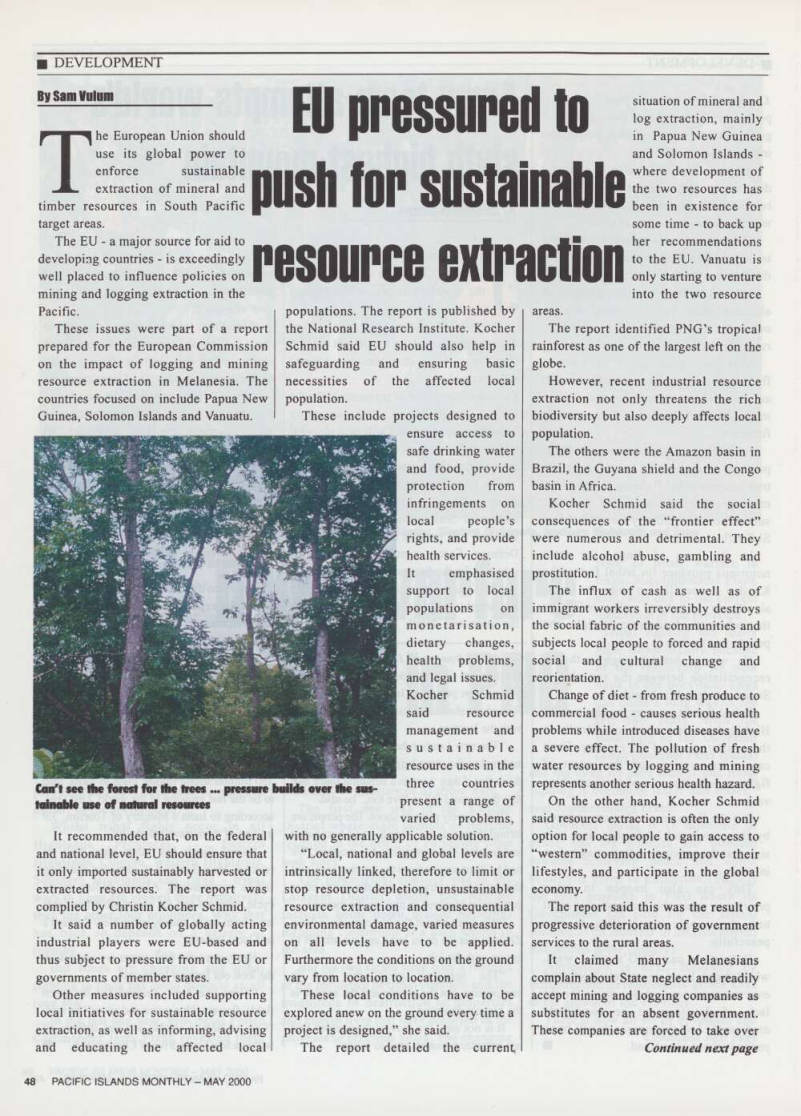
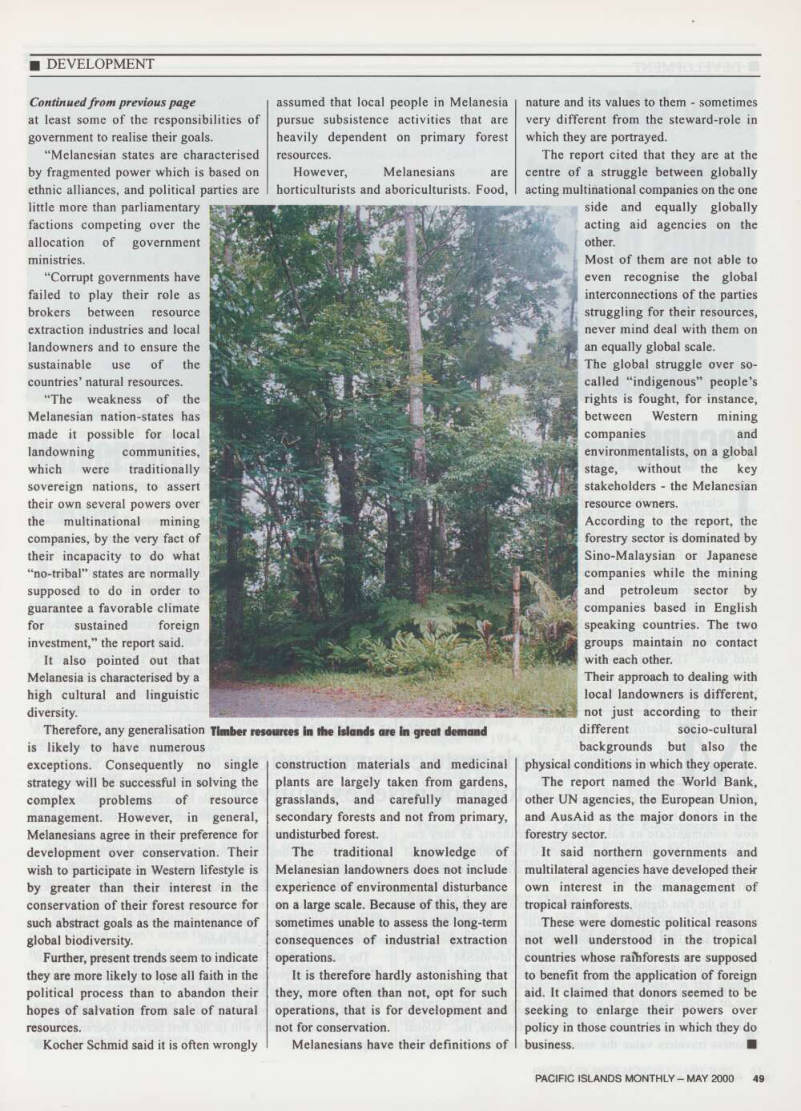
push fop sustainable resource extraction
By Sam Vulum
The European Union should use its global power to enforce sustainable extraction of mineral and timber resources in South Pacific target areas.
The EU - a major source for aid to developing countries - is exceedingly well placed to influence policies on mining and logging extraction in the Pacific.
These issues were part of a report prepared for the European Commission on the impact of logging and mining resource extraction in Melanesia. The countries focused on include Papua New Guinea, Solomon Islands and Vanuatu.
It recommended that, on the federal and national level, EU should ensure that it only imported sustainably harvested or extracted resources. The report was complied by Christin Kocher Schmid.
It said a number of globally acting industrial players were EU-based and thus subject to pressure from the EU or governments of member states.
Other measures included supporting local initiatives for sustainable resource extraction, as well as informing, advising and educating the affected local
populations. The report is published by the National Research Institute. Kocher Schmid said EU should also help in safeguarding and ensuring basic necessities of the affected local
population.
These include projects designed to
ensure access to safe drinking water and food, provide protection from infringements on local people’s rights, and provide health services.
It emphasised support to local populations on monetarisation, dietary changes, health problems, and legal issues.
Kocher Schmid said resource management and sustainable resource uses in the three countries present a range of varied problems.
with no generally applicable solution.
“Local, national and global levels are intrinsically linked, therefore to limit or stop resource depletion, unsustainable resource extraction and consequential environmental damage, varied measures on all levels have to be applied.
Furthermore the conditions on the ground vary from location to location.
These local conditions have to be explored anew on the ground every time a project is designed,” she said.
The report detailed the current
situation of mineral and log extraction, mainly in Papua New Guinea and Solomon Islands where development of the two resources has been in existence for some time - to back up her recommendations to the EU. Vanuatu is only starting to venture into the two resource
areas.
The report identified PNG’s tropical rainforest as one of the largest left on the globe.
However, recent industrial resource extraction not only threatens the rich biodiversity but also deeply affects local population.
The others were the Amazon basin in Brazil, the Guyana shield and the Congo basin in Africa.
Kocher Schmid said the social consequences of the “frontier effect” were numerous and detrimental. They include alcohol abuse, gambling and
prostitution.
The influx of cash as well as of immigrant workers irreversibly destroys the social fabric of the communities and subjects local people to forced and rapid social and cultural change and reorientation.
Change of diet - from fresh produce to commercial food - causes serious health problems while introduced diseases have a severe effect. The pollution of fresh water resources by logging and mining represents another serious health hazard.
On the other hand, Kocher Schmid said resource extraction is often the only option for local people to gain access to “western” commodities, improve their lifestyles, and participate in the global economy.
The report said this was the result of progressive deterioration of government services to the rural areas.
It claimed many Melanesians
complain about State neglect and readily
accept mining and logging companies as substitutes for an absent government.
These companies are forced to take over
Continued next page
Can't see the forest for the trees ... pressure builds over the sus tainable use of natural resources
Continued from previous page at least some of the responsibilities of government to realise their goals.
“Melanesian states are characterised by fragmented power which is based on ethnic alliances, and political parties are
little more than parliamentary factions competing over the allocation of government ministries.
“Corrupt governments have failed to play their role as brokers between resource extraction industries and local landowners and to ensure the sustainable use of the countries’ natural resources.
“The weakness of the Melanesian nation-states has made it possible for local landowning communities, which were traditionally sovereign nations, to assert their own several powers over the multinational mining companies, by the very fact of their incapacity to do what “no-tribal” states are normally supposed to do in order to guarantee a favorable climate for sustained foreign investment,” the report said.
It also pointed out that Melanesia is characterised by a high cultural and linguistic diversity.
Therefore, any generalisation is likely to have numerous
exceptions. Consequently no single strategy will be successful in solving the complex problems of resource management. However, in general, Melanesians agree in their preference for development over conservation. Their wish to participate in Western lifestyle is by greater than their interest in the conservation of their forest resource for such abstract goals as the maintenance of global biodiversity.
Further, present trends seem to indicate they are more likely to lose all faith in the political process than to abandon their hopes of salvation from sale of natural resources.
Kocher Schmid said it is often wrongly
assumed that local people in Melanesia pursue subsistence activities that are
heavily dependent on primary forest
resources.
However, Melanesians are horticulturists and aboriculturists. Food,
construction materials and medicinal plants are largely taken from gardens, grasslands, and carefully managed secondary forests and not from primary, undisturbed forest.
The traditional knowledge of Melanesian landowners does not include experience of environmental disturbance on a large scale. Because of this, they are sometimes unable to assess the long-term consequences of industrial extraction operations.
It is therefore hardly astonishing that they, more often than not, opt for such operations, that is for development and not for conservation.
Melanesians have their definitions of
nature and its values to them - sometimes very different from the steward-role in which they are portrayed.
The report cited that they are at the centre of a struggle between globally acting multinational companies on the one
side and equally globally acting aid agencies on the other.
Most of them are not able to even recognise the global interconnections of the parties struggling for their resources, never mind deal with them on an equally global scale.
The global struggle over so called “indigenous” people’s rights is fought, for instance, between Western mining
companies and
environmentalists, on a global stage, without the key stakeholders - the Melanesian resource owners.
According to the report, the forestry sector is dominated by
Sino-Malaysian or Japanese
companies while the mining and petroleum sector by companies based in English speaking countries. The two groups maintain no contact with each other.
Their approach to dealing with local landowners is different.
not just according to their different socio-cultural backgrounds but also the
physical conditions in which they operate.
The report named the World Bank, other UN agencies, the European Union, and AusAid as the major donors in the
forestry sector.
It said northern governments and multilateral agencies have developed their own interest in the management of tropical rainforests.
These were domestic political reasons not well understood in the tropical countries whose raihforests are supposed to benefit from the application of foreign aid. It claimed that donors seemed to be seeking to enlarge their powers over policy in those countries in which they do business. ■
Timber resources in the islands are in great demand
capacity, speed

New IBM notebook hard drives break capacity, speed and density records
IBM has introduced what it claims is the world’s most
versatile, highest capacity
notebook computer hard disk drives - the first with built-in features designed to deliver smoother, more lifelike video images.
The Travelstar 32GH, designed for premium notebook computers, holds five times as much data as the average notebook hard drive. The 32-gigabyte (GB) drive holds up to eight DVD movies, 32,000
high-resolution digital photographs, 49
music CDs or the text equivalent of a 5,344-foot (approximately 1,629 metres) stack of documents.
“Today’s mobile computer users don’t simply want the convenience of portability, they want a PC with desktop capabilities, able to store and process massive multimedia files,” said Bill Healy, vice president, IBM Storage Technology Division, IBM Corp. “Travelstar drives allow notebook users to carry unprecedented amounts of information, from business data to digital photographs, music and full-motion video.”
These are the first notebook hard drives designed with specialized audio-visual capabilities.
Most hard drives have a standard feature called “error correction” that regulates the transfer of text-based files. However, error correction can
interfere with video downloading. IBM researchers have found a way to partially disengage this feature during the transfer of video files, providing a much smoother, more lifelike image.
The Travelstar 32GH is also the world’s fastest mobile hard drive. At 5,400 rotations per minute (rpm) it spins 1,200 rpms faster then the average notebook drive. This higher rotational speed significantly boosts performance.
Capacity and performance are not the only records IBM shattered.
IBM’s new 20-GB Travelstar 20GN for ultra-portables sets a new record of 17.1 billion bits per square inch, the highest areal density of any hard disk drive.
Greater areal density means more information can he stored in less disk space, making the drive more cost effective to manufacture.
The industry’s previous areal density
record was set by an IBM product introduced in just March.
IBM has also introduced a 30-GB drive for mainstream notebook users. Travelstar 30GT holds the text equivalent of a 5,010foot (approximately 1,527 metres) stack of documents and boasts a record-setting areal density of 17.1 billion bits.
The 20GN and 30GT drives are scheduled to ship in volume this month to
Compaq Computer Corporation, Dell
Computer Corporation, Gateway, and the IBM Personal Systems Group. The 32GH will ship in limited quantities in June and in volume in August.
Each of these new Travelstar drives incorporates glass disk platters, load/unload technology, giant magnetoresistive (GMR) recording heads, and Enhanced Adaptive Battery Life Extender 3.0.
These features improve capacity, reliability and extend a notebook computer’s battery life.
They also support Drive Fitness Test, a diagnostic tool that works when the operating system is down. ■
Motorola provides
ultimate communications tool for jetset executives
Motorola i2OOO phone combines comprehensive global coverage with sophisticated business productivity
tools. Global business executives can now communicate as easily across continents as they can across town. Motorola today launched the i2000(tm) digital world phone, the ultimate communications tool for jet
setting executives.
It is the first digital wireless phone to enable global business travelers to make and receive phone calls around the world on iDEN(r) and GSM networks. Motorola’s i2OOO phone is the model customers will use to access Nextel WorldwideSM service, announced today by Nextel Communications.
“Effective communication is the key to a successful business trip,” said Bill Werner, corporate vice president and general manager of the iDEN Subscriber Group, Motorola, Inc. “Global business travelers value the sense of control that comes from
knowing they can touch base with colleagues and clients whenever they need to, and their organizations benefit from being able to access key decision makers when needed. The combination of
coverage and capabilities offered by the Motorola i2UOO phone makes it a compelling choice for the demanding world traveler.”
The phone operates on both GSM wireless networks in Europe, the Middle East, Africa, and Asia Pacific, and iDEN networks, which represent the most übiquitous digital coverage in the Western Hemisphere, enabling executives to keep in touch wherever their business takes them.
The handset allows users to take advantage of optimum digital wireless coverage provided by Nextel Worldwide which can permit roaming in more than 65 countries.
The 12000 model was designed in collaboration with Nextel Communications, which will be the first network operator to sell the phone. ■
University to help Pacific with E-commerce
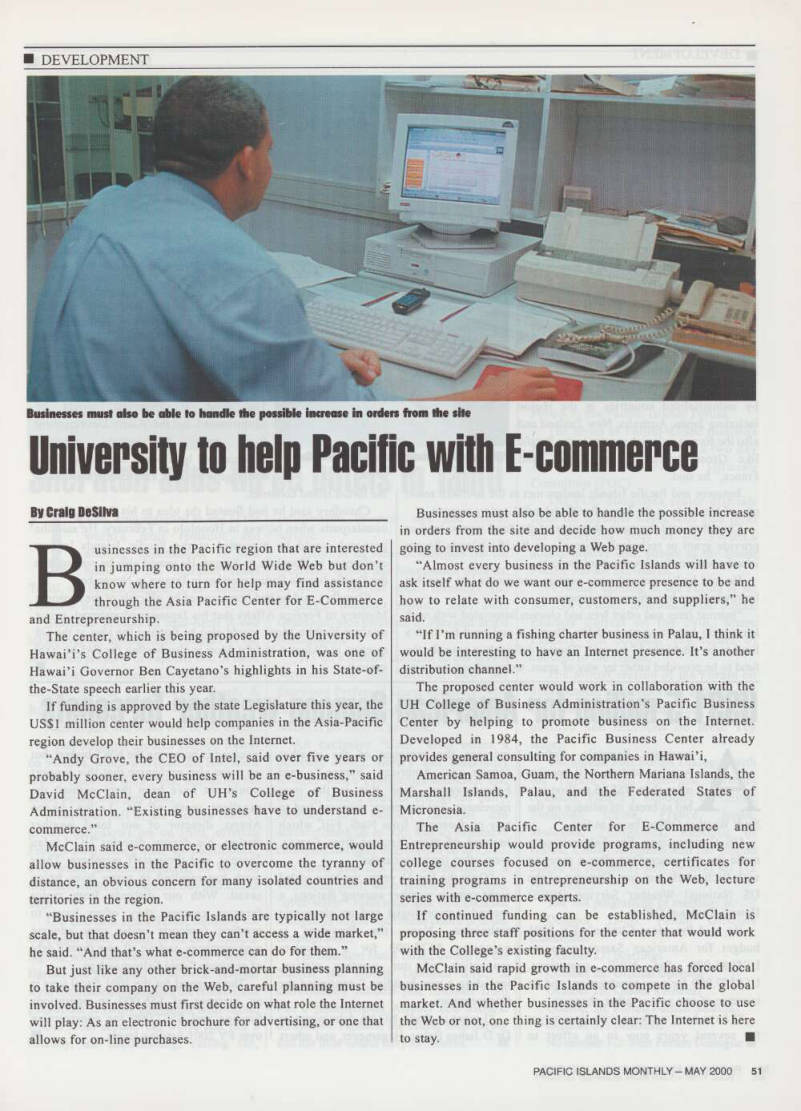
By Craig DaSilva
Businesses must also be able to handle the possible increase in orders from the site and decide how much money they are going to invest into developing a Web page.
“Almost every business in the Pacific Islands will have to ask itself what do we want our e-commerce presence to be and how to relate with consumer, customers, and suppliers,” he said.
“If I’m running a fishing charter business in Palau, I think it would be interesting to have an Internet presence. It’s another distribution channel.”
The proposed center would work in collaboration with the UH College of Business Administration’s Pacific Business Center by helping to promote business on the Internet.
Developed in 1984, the Pacific Business Center already provides general consulting for companies in Hawai’i, American Samoa, Guam, the Northern Mariana Islands, the Marshall Islands, Palau, and the Federated States of Micronesia.
The Asia Pacific Center for E-Commerce and
Entrepreneurship would provide programs, including new
college courses focused on e-commerce, certificates for training programs in entrepreneurship on the Web, lecture series with e-commerce experts.
If continued funding can be established, McClain is proposing three staff positions for the center that would work with the College’s existing faculty.
McClain said rapid growth in e-commerce has forced local businesses in the Pacific Islands to compete in the global market. And whether businesses in the Pacific choose to use the Web or not, one thing is certainly clear; The Internet is here to stay. ■
Businesses in the Pacific region that are interested in jumping onto the World Wide Web but don’t know where to turn for help may find assistance through the Asia Pacific Center for E-Commerce and Entrepreneurship.
The center, which is being proposed by the University of Hawai’i’s College of Business Administration, was one of Hawai’i Governor Ben Cayetano’s highlights in his State-of the-State speech earlier this year.
If funding is approved by the state Legislature this year, the US$l million center would help companies in the Asia-Pacific region develop their businesses on the Internet.
“Andy Grove, the CEO of Intel, said over five years or probably sooner, every business will be an e-business,” said David McClain, dean of UH’s College of Business Administration. “Existing businesses have to understand e commerce.”
McClain said e-commerce, or electronic commerce, would allow businesses in the Pacific to overcome the tyranny of distance, an obvious concern for many isolated countries and territories in the region.
“Businesses in the Pacific Islands are typically not large scale, but that doesn’t mean they can’t access a wide market,” he said. “And that’s what e-commerce can do for them.”
But just like any other brick-and-mortar business planning to take their company on the Web, careful planning must be involved. Businesses must first decide on what role the Internet will play: As an electronic brochure for advertising, or one that allows for on-line purchases.
Businesses must also be able to handle the possible increase in orders from the site
Chaudhry pushes regional
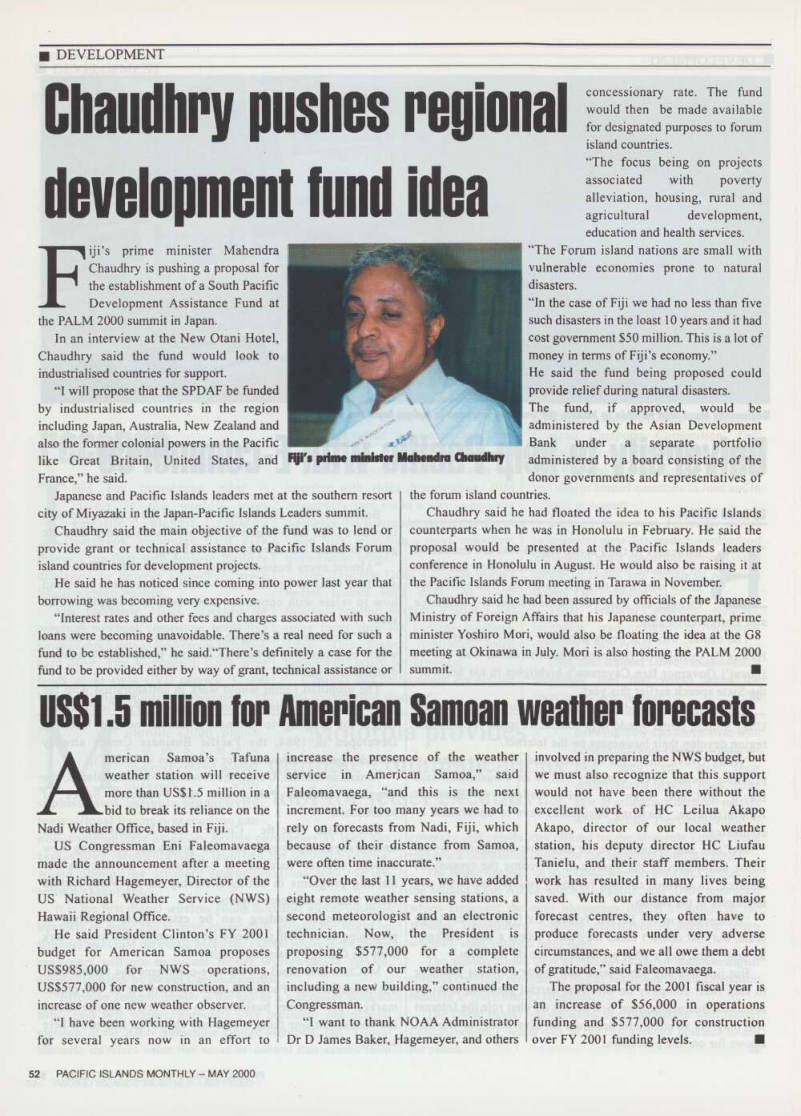
development fund idea
Fiji’s prime minister Mahendra Chaudhry is pushing a proposal for the establishment of a South Pacific Development Assistance Fund at the PALM 2000 summit in Japan.
In an interview at the New Otani Hotel, Chaudhry said the fund would look to industrialised countries for support.
“I will propose that the SPDAF be funded by industrialised countries in the region including Japan, Australia, New Zealand and also the former colonial powers in the Pacific like Great Britain, United States, and France,” he said.
Japanese and Pacific Islands leaders met at the southern resort city of Miyazaki in the Japan-Pacific Islands Leaders summit.
Chaudhry said the main objective of the fund was to lend or provide grant or technical assistance to Pacific Islands Forum island countries for development projects.
He said he has noticed since coming into power last year that
borrowing was becoming very expensive.
“Interest rates and other fees and charges associated with such loans were becoming unavoidable. There’s a real need for such a fund to be established,” he said.“ There’s definitely a case for the fund to be provided either by way of grant, technical assistance or
concessionary rate. The fund would then be made available for designated purposes to forum island countries.
“The focus being on projects associated with poverty alleviation, housing, rural and
agricultural development,
education and health services.
“The Forum island nations are small with vulnerable economies prone to natural disasters.
“In the case of Fiji we had no less than five such disasters in the loast 10 years and it had cost government $5O million. This is a lot of money in terms of Fiji’s economy.”
He said the fund being proposed could provide relief during natural disasters.
The fund, if approved, would be administered by the Asian Development Bank under a separate portfolio administered by a board consisting of the donor governments and representatives of
the forum island countries.
Chaudhry said he had floated the idea to his Pacific Islands counterparts when he was in Honolulu in February. He said the proposal would be presented at the Pacific Islands leaders conference in Honolulu in August. He would also be raising it at the Pacific Islands Forum meeting in Tarawa in November.
Chaudhry said he had been assured by officials of the Japanese Ministry of Foreign Affairs that his Japanese counterpart, prime minister Yoshiro Mori, would also be floating the idea at the G 8 meeting at Okinawa in July. Mori is also hosting the PALM 2000 summit. ■
Fiji's prime minister Mahendra Chaudhry
US$1.5 million for American Samoan weather forecasts
American Samoa’s Tafuna weather station will receive more than US$l.5 million in a bid to break its reliance on the Nadi Weather Office, based in Fiji.
US Congressman Eni Faleomavaega made the announcement after a meeting with Richard Hagemeyer, Director of the US National Weather Service (NWS) Hawaii Regional Office.
He said President Clinton’s FY 2001 budget for American Samoa proposes U 55985,000 for NWS operations, U 55577,000 for new construction, and an increase of one new weather observer.
“I have been working with Hagemeyer for several years now in an effort to
increase the presence of the weather service in American Samoa,” said Faleomavaega, “and this is the next increment. For too many years we had to rely on forecasts from Nadi, Fiji, which because of their distance from Samoa, were often time inaccurate.”
“Over the last 11 years, we have added eight remote weather sensing stations, a second meteorologist and an electronic technician. Now, the President is proposing $577,000 for a complete renovation of our weather station, including a new building,” continued the Congressman.
“I want to thank NOAA Administrator Dr D James Baker, Hagemeyer, and others
involved in preparing the NWS budget, but we must also recognize that this support would not have been there without the excellent work of HC Leilua Akapo Akapo, director of our local weather station, his deputy director HC Liufau Tanielu, and their staff members. Their work has resulted in many lives being saved. With our distance from major forecast centres, they often have to produce forecasts under very adverse circumstances, and we all owe them a debt of gratitude,” said Faleomavaega.
The proposal for the 2001 fiscal year is an increase of $56,000 in operations funding and $577,000 for construction over FY 2001 funding levels. ■
Sheraton adds three hotels in Tahiti
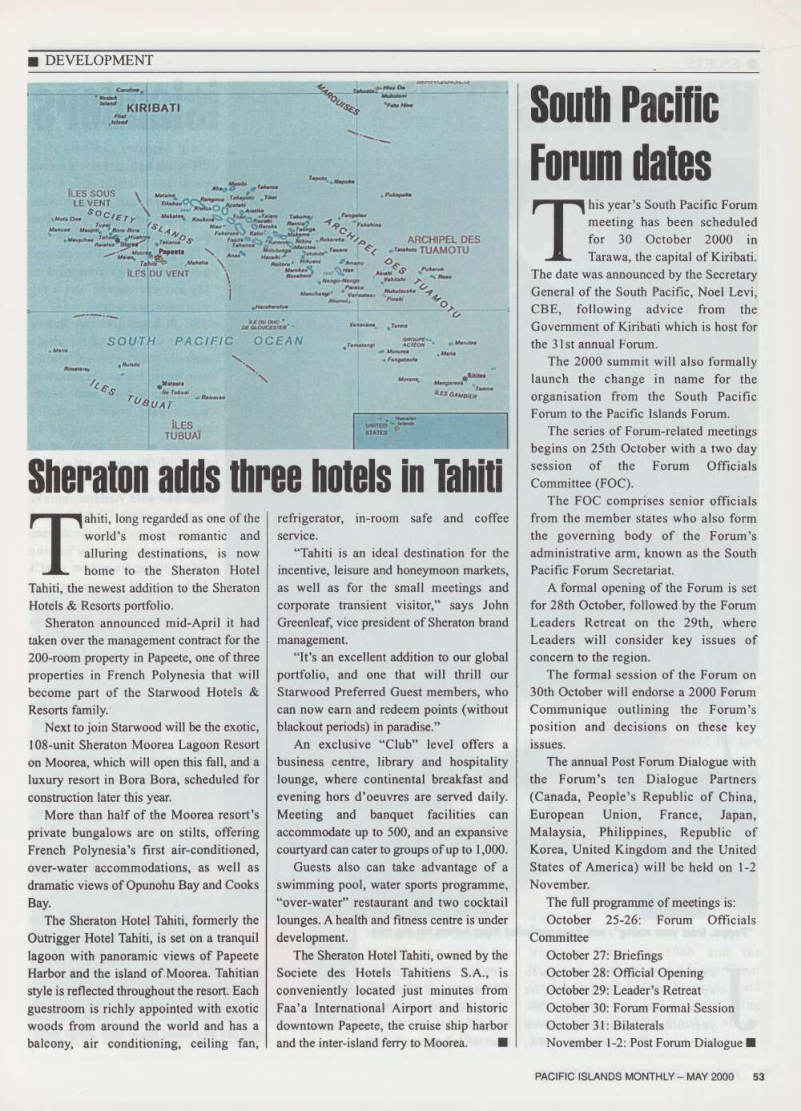
Tahiti, long regarded as one of the world’s most romantic and alluring destinations, is now home to the Sheraton Hotel Tahiti, the newest addition to the Sheraton Hotels & Resorts portfolio.
Sheraton announced mid-April it had taken over the management contract for the 200-room property in Papeete, one of three properties in French Polynesia that will become part of the Starwood Hotels & Resorts family.
Next to join Starwood will be the exotic, 108-unit Sheraton Moorea Lagoon Resort on Moorea, which will open this fall, and a luxury resort in Bora Bora, scheduled for construction later this year.
More than half of the Moorea resort’s private bungalows are on stilts, offering French Polynesia’s first air-conditioned, over-water accommodations, as well as dramatic views of Opunohu Bay and Cooks Bay.
The Sheraton Hotel Tahiti, formerly the Outrigger Hotel Tahiti, is set on a tranquil lagoon with panoramic views of Papeete Harbor and the island of Moorea. Tahitian style is reflected throughout the resort. Each guestroom is richly appointed with exotic woods from around the world and has a balcony, air conditioning, ceiling fan,
refrigerator, in-room safe and coffee service.
“Tahiti is an ideal destination for the incentive, leisure and honeymoon markets, as well as for the small meetings and corporate transient visitor,” says John Greenleaf, vice president of Sheraton brand management.
“It’s an excellent addition to our global portfolio, and one that will thrill our Starwood Preferred Guest members, who can now earn and redeem points (without blackout periods) in paradise.”
An exclusive “Club” level offers a business centre, library and hospitality lounge, where continental breakfast and evening hors d’oeuvres are served daily.
Meeting and banquet facilities can accommodate up to 500, and an expansive courtyard can cater to groups of up to 1,000.
Guests also can take advantage of a swimming pool, water sports programme, “over-water” restaurant and two cocktail lounges. A health and fitness centre is under
development.
The Sheraton Hotel Tahiti, owned by the Societe des Hotels Tahitiens S.A., is conveniently located just minutes from Faa’a International Airport and historic downtown Papeete, the cruise ship harbor and the inter-island ferry to Moorea. ■
South Pacific
Forum dates
This year’s South Pacific Forum meeting has been scheduled for 30 October 2000 in Tarawa, the capital of Kiribati.
The date was announced by the Secretary General of the South Pacific, Noel Levi, CBE, following advice from the Government of Kiribati which is host for the 31 st annual Forum.
The 2000 summit will also formally launch the change in name for the organisation from the South Pacific Forum to the Pacific Islands Forum.
The series of Forum-related meetings begins on 25th October with a two day session of the Forum Officials Committee (FOC).
The FOC comprises senior officials from the member states who also form the governing body of the Forum’s administrative arm, known as the South Pacific Forum Secretariat.
A formal opening of the Forum is set for 28th October, followed by the Forum Leaders Retreat on the 29th, where Leaders will consider key issues of concern to the region.
The formal session of the Forum on 30th October will endorse a 2000 Forum Communique outlining the Forum’s position and decisions on these key issues.
The annual Post Forum Dialogue with the Forum’s ten Dialogue Partners
(Canada, People’s Republic of China,
European Union, France, Japan, Malaysia, Philippines, Republic of Korea, United Kingdom and the United States of America) will be held on 1-2 November.
The full programme of meetings is: October 25-26: Forum Officials Committee October 27: Briefings October 28: Official Opening October 29: Leader’s Retreat October 30: Forum Formal Session October 31: Bilaterals November 1-2: Post Forum Dialogue ■
Vijay means "Victory" for islanders
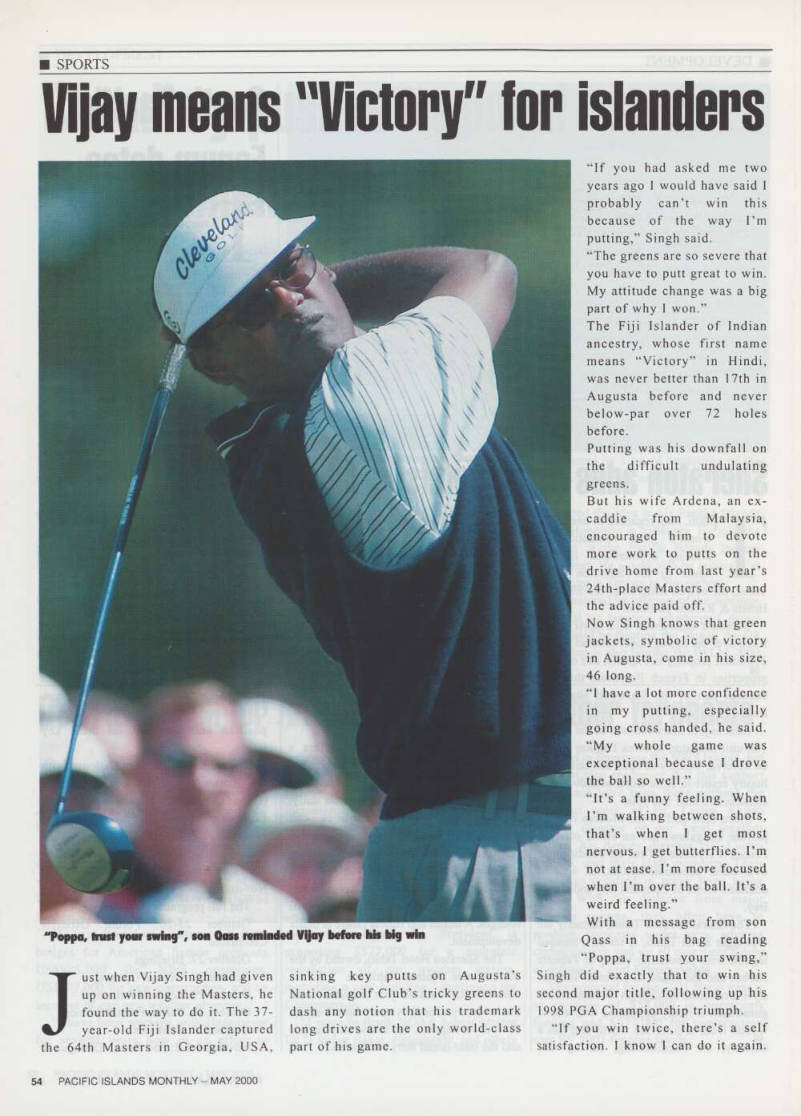
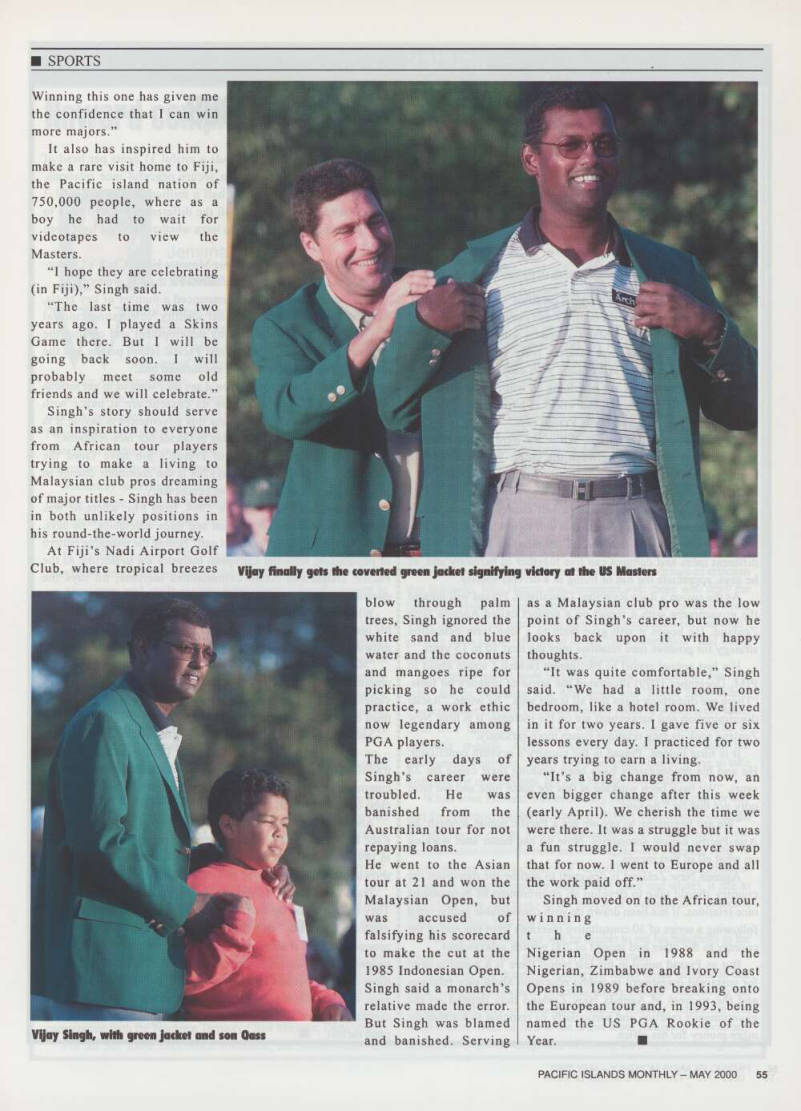
Sports
Just when Vijay Singh had given up on winning the Masters, he found the way to do it. The 37year-old Fiji Islander captured the 64th Masters in Georgia, USA,
sinking key putts on Augusta’s National golf Club’s tricky greens to dash any notion that his trademark long drives are the only world-class part of his game.
“If you had asked me two years ago I would have said I probably can’t win this because of the way I’m putting,” Singh said.
“The greens are so severe that you have to putt great to win.
My attitude change was a big part of why I won.”
The Fiji Islander of Indian ancestry, whose first name means “Victory” in Hindi, was never better than 17th in Augusta before and never below-par over 72 holes before.
Putting was his downfall on the difficult undulating greens.
But his wife Ardena, an ex caddie from Malaysia, encouraged him to devote more work to putts on the drive home from last year’s 24th-place Masters effort and the advice paid off.
Now Singh knows that green jackets, symbolic of victory in Augusta, come in his size, 46 long.
“I have a lot more confidence in my putting, especially going cross handed, he said.
“My whole game was exceptional because I drove the ball so well.”
“It’s a funny feeling. When I’m walking between shots, that’s when I get most nervous. I get butterflies. I’m not at ease. I’m more focused when I’m over the ball. It’s a weird feeling.”
With a message from son Qass in his bag reading “Poppa, trust your swing,”
Singh did exactly that to win his second major title, following up his 1998 PGA Championship triumph.
“If you win twice, there’s a self satisfaction. 1 know 1 can do it again.
"Poppa, trust your swing", son Qass reminded Vijay before his big win
Winning this one has given me the confidence that I can win more majors.”
It also has inspired him to make a rare visit home to Fiji, the Pacific island nation of 750,000 people, where as a boy he had to wait for videotapes to view the Masters.
“I hope they are celebrating (in Fiji),” Singh said.
“The last time was two years ago. I played a Skins Game there. But I will be going back soon. I will probably meet some old friends and we will celebrate.”
Singh’s story should serve as an inspiration to everyone from African tour players trying to make a living to Malaysian club pros dreaming of major titles - Singh has been in both unlikely positions in his round-the-world journey.
At Fiji’s Nadi Airport Golf Club, where tropical breezes
blow through palm trees, Singh ignored the white sand and blue water and the coconuts and mangoes ripe for picking so he could practice, a work ethic now legendary among
PGA players.
The early days of Singh’s career were troubled. He was banished from the Australian tour for not repaying loans.
He went to the Asian tour at 21 and won the Malaysian Open, but was accused of falsifying his scorecard to make the cut at the 1985 Indonesian Open.
Singh said a monarch’s relative made the error.
But Singh was blamed and banished. Serving
as a Malaysian club pro was the low point of Singh’s career, but now he looks back upon it with happy
thoughts.
“It was quite comfortable,” Singh said. “We had a little room, one bedroom, like a hotel room. We lived in it for two years. 1 gave five or six lessons every day. I practiced for two years trying to earn a living.
“It’s a big change from now, an even bigger change after this week (early April). We cherish the time we were there. It was a struggle but it was a fun struggle. I would never swap that for now. I went to Europe and all the work paid off.”
Singh moved on to the African tour, winning t h e Nigerian Open in 1988 and the Nigerian, Zimbabwe and Ivory Coast Opens in 1989 before breaking onto the European tour and, in 1993, being named the US PGA Rookie of the Year. ■
Viyay Singh, with green jacket and son Qass
Vijay finally gets the coverted green jacket signifying victory at the US Masters
Mythical harmony in NZ race relations
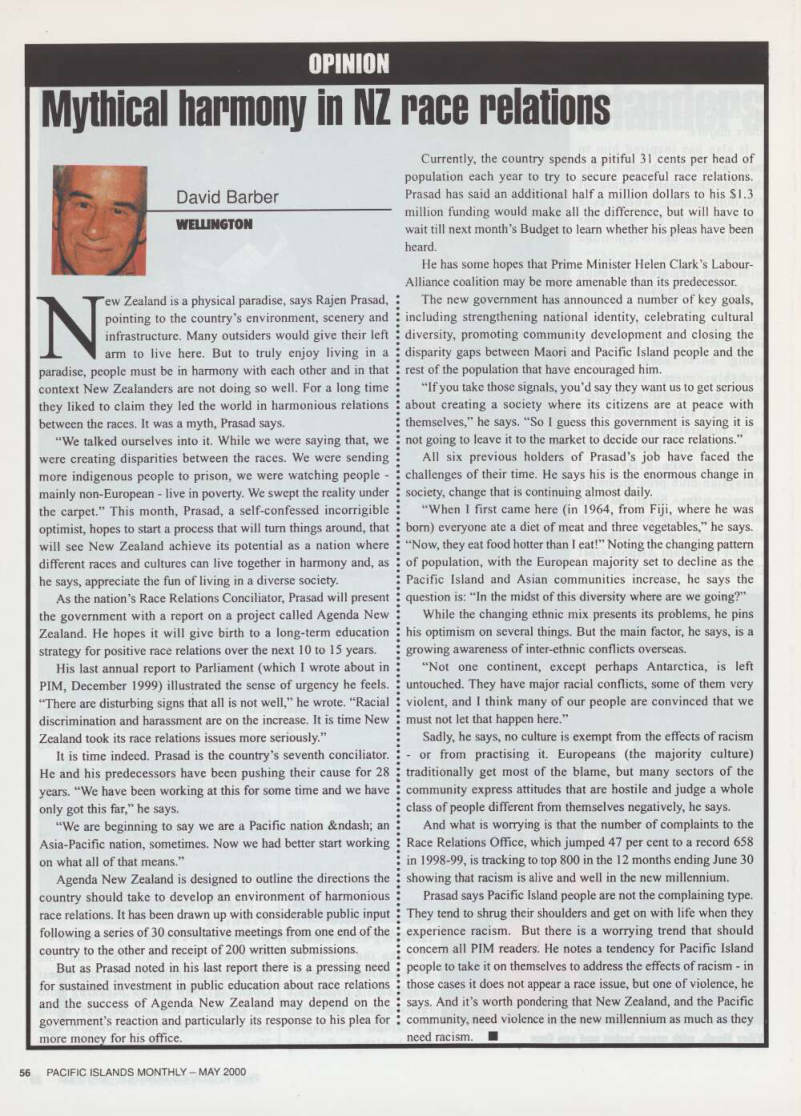
Opinion
New Zealand is a physical paradise, says Rajen Prasad, pointing to the country’s environment, scenery and infrastructure. Many outsiders would give their left arm to live here. But to truly enjoy living in a paradise, people must be in harmony with each other and in that context New Zealanders are not doing so well. For a long time they liked to claim they led the world in harmonious relations between the races. It was a myth, Prasad says.
“We talked ourselves into it. While we were saying that, we were creating disparities between the races. We were sending more indigenous people to prison, we were watching people mainly non-European - live in poverty. We swept the reality under the carpet.” This month, Prasad, a self-confessed incorrigible optimist, hopes to start a process that will turn things around, that will see New Zealand achieve its potential as a nation where different races and cultures can live together in harmony and, as he says, appreciate the fun of living in a diverse society.
As the nation’s Race Relations Conciliator, Prasad will present the government with a report on a project called Agenda New Zealand. He hopes it will give birth to a long-term education strategy for positive race relations over the next 10 to 15 years.
His last annual report to Parliament (which I wrote about in PIM, December 1999) illustrated the sense of urgency he feels.
“There are disturbing signs that all is not well,” he wrote. “Racial discrimination and harassment are on the increase. It is time New Zealand took its race relations issues more seriously.”
It is time indeed. Prasad is the country’s seventh conciliator.
He and his predecessors have been pushing their cause for 28 years. “We have been working at this for some time and we have only got this far,” he says.
“We are beginning to say we are a Pacific nation – an Asia-Pacific nation, sometimes. Now we had better start working on what all of that means.”
Agenda New Zealand is designed to outline the directions the country should take to develop an environment of harmonious race relations. It has been drawn up with considerable public input following a series of 30 consultative meetings from one end of the country to the other and receipt of 200 written submissions.
But as Prasad noted in his last report there is a pressing need for sustained investment in public education about race relations and the success of Agenda New Zealand may depend on the government’s reaction and particularly its response to his plea for more money for his office.
Currently, the country spends a pitiful 31 cents per head of population each year to try to secure peaceful race relations.
Prasad has said an additional half a million dollars to his $1.3 million funding would make all the difference, but will have to wait till next month’s Budget to leam whether his pleas have been heard.
He has some hopes that Prime Minister Helen Clark’s Labour- Alliance coalition may be more amenable than its predecessor.
The new government has announced a number of key goals, including strengthening national identity, celebrating cultural diversity, promoting community development and closing the disparity gaps between Maori and Pacific Island people and the rest of the population that have encouraged him.
“If you take those signals, you’d say they want us to get serious about creating a society where its citizens are at peace with themselves,” he says. “So I guess this government is saying it is not going to leave it to the market to decide our race relations.”
All six previous holders of Prasad’s job have faced the challenges of their time. He says his is the enormous change in society, change that is continuing almost daily.
“When I first came here (in 1964, from Fiji, where he was bom) everyone ate a diet of meat and three vegetables,” he says.
“Now, they eat food hotter than I eat!” Noting the changing pattern of population, with the European majority set to decline as the Pacific Island and Asian communities increase, he says the question is; “In the midst of this diversity where are we going?”
While the changing ethnic mix presents its problems, he pins his optimism on several things. But the main factor, he says, is a growing awareness of inter-ethnic conflicts overseas.
“Not one continent, except perhaps Antarctica, is left untouched. They have major racial conflicts, some of them very violent, and 1 think many of our people are convinced that we must not let that happen here.”
Sadly, he says, no culture is exempt from the effects of racism - or from practising it. Europeans (the majority culture) traditionally get most of the blame, but many sectors of the community express attitudes that are hostile and judge a whole class of people different from themselves negatively, he says.
And what is worrying is that the number of complaints to the Race Relations Office, which jumped 47 per cent to a record 658 in 1998-99, is tracking to top 800 in the 12 months ending June 30 showing that racism is alive and well in the new millennium.
Prasad says Pacific Island people are not the complaining type.
They tend to shrug their shoulders and get on with life when they experience racism. But there is a worrying trend that should concern all PIM readers. He notes a tendency for Pacific Island people to take it on themselves to address the effects of racism - in those cases it does not appear a race issue, but one of violence, he says. And it’s worth pondering that New Zealand, and the Pacific community, need violence in the new millennium as much as they need racism. ■
David Barber
Wellington
Howard completely out of his depth on Aboriginal Issues
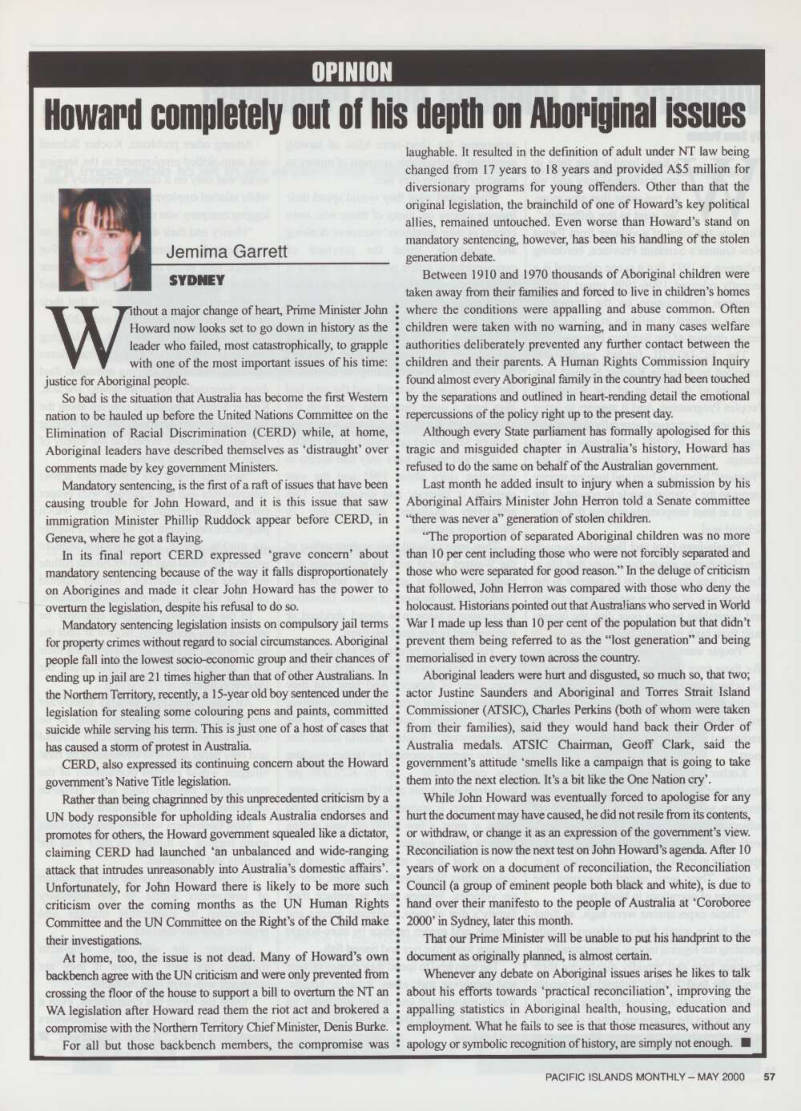
Without a major change of heart. Prime Minister John Howard now looks set to go down in history as the leader who failed, most catastrophically, to grapple with one of the most important issues of his time: justice for Aboriginal people.
So bad is the situation that Australia has become the first Western nation to be hauled up before the United Nations Committee on the Elimination of Racial Discrimination (CERD) while, at home.
Aboriginal leaders have described themselves as ‘distraught’ over comments made by key government Ministers.
Mandatory sentencing, is the first of a raft of issues that have been causing trouble for John Howard, and it is this issue that saw immigration Minister Phillip Ruddock appear before CERD, in Geneva, where he got a flaying.
In its final report CERD expressed ‘grave concern’ about mandatory sentencing because of the way it falls disproportionately on Aborigines and made it clear John Howard has the power to overturn the legislation, despite his refusal to do so.
Mandatory sentencing legislation insists on compulsory jail terms for property crimes without regard to social circumstances. Aboriginal people fall into the lowest socio-economic group and their chances of ending up in jail are 21 times higher than that of other Australians. In the Northern Territory, recently, a 15-year old boy sentenced under the legislation for stealing some colouring pens and paints, committed suicide while serving his term. This is just one of a host of cases that has caused a storm of protest in Australia.
CERD, also expressed its continuing concern about the Howard
government’s Native Title legislation.
Rather than being chagrinned by this unprecedented criticism by a UN body responsible for upholding ideals Australia endorses and promotes for others, the Howard government squealed like a dictator, claiming CERD had launched ‘an unbalanced and wide-ranging attack that intrudes unreasonably into Australia’s domestic affairs’.
Unfortunately, for John Howard there is likely to be more such criticism over the coming months as the UN Human Rights Committee and the UN Committee on the Right’s of the Child make their investigations.
At home, too, the issue is not dead. Many of Howard’s own backbench agree with the UN criticism and were only prevented from crossing the floor of the house to support a bill to overturn the NT an WA legislation after Howard read them the riot act and brokered a compromise with the Northern Territory Chief Minister, Denis Burke.
For all but those backbench members, the compromise was
laughable. It resulted in the definition of adult under NT law being changed from 17 years to 18 years and provided Ass million for diversionary programs for young offenders. Other than that the original legislation, the brainchild of one of Howard’s key political allies, remained untouched. Even worse than Howard’s stand on mandatory sentencing, however, has been his handling of the stolen generation debate.
Between 1910 and 1970 thousands of Aboriginal children were taken away from their families and forced to live in children’s homes where the conditions were appalling and abuse common. Often children were taken with no warning, and in many cases welfare authorities deliberately prevented any further contact between the children and their parents. A Human Rights Commission Inquiry found almost every Aboriginal family in the country had been touched by the separations and outlined in heart-rending detail the emotional repercussions of the policy right up to the present day.
Although every State parliament has formally apologised for this tragic and misguided chapter in Australia’s history, Howard has refused to do the same on behalf of the Australian government.
Last month he added insult to injury when a submission by his Aboriginal Affairs Minister John Herron told a Senate committee “there was never a” generation of stolen children.
“The proportion of separated Aboriginal children was no more than 10 per cent including those who were not forcibly separated and those who were separated for good reason.” In the deluge of criticism that followed, John Herron was compared with those who deny the holocaust. Historians pointed out that Australians who served in World War I made up less than 10 per cent of the population but that didn’t prevent them being referred to as the “lost generation” and being memorialised in every town across the country.
Aboriginal leaders were hurt and disgusted, so much so, that two; actor Justine Saunders and Aboriginal and Torres Strait Island Commissioner (ATSIC), Charles Perkins (both of whom were taken from their families), said they would hand back their Order of Australia medals. ATSIC Chairman, Geoff Clark, said the government’s attitude ‘smells like a campaign that is going to take them into the next election. It’s a bit like the One Nation cry’.
While John Howard was eventually forced to apologise for any hurt the document may have caused, he did not resile from its contents, or withdraw, or change it as an expression of the government’s view.
Reconciliation is now the next test on John Howard’s agenda. After 10 years of work on a document of reconciliation, the Reconciliation Council (a group of eminent people both black and white), is due to hand over their manifesto to the people of Australia at ‘Coroboree 2000’ in Sydney, later this month.
That our Prime Minister will be unable to put his handprint to the document as originally planned, is almost certain.
Whenever any debate on Aboriginal issues arises he likes to talk about his efforts towards ‘practical reconciliation’, improving the appalling statistics in Aboriginal health, housing, education and employment. What he fails to see is that those measures, without any apology or symbolic recognition of history, are simply not enough. ■
Jemima Garrett
Sydney
Villagers in a dilemma over rainforest
Extra
By Sam Vulum
We have lived a long time in our traditional way and we do not want that any more.
We want to live differently”.
This was the view of a villager from Papua New Guinea’s Sandaun Province, bordering Indonesia, in 1997. But it is one reiterated in a recently released 1996-1999 report for the European Commission on the impact of logging amongst 15 villages in the Kilimeri census division of the Sandaun Province.
The EC-DGVIII funded report was compiled by Christin Kocher Schmid with members of the Future of the Rainforest Peoples Programme. And it appears to agree with view - expressed generally throughout logging areas in PNG - that people want change. “The wish to participate in the “Western” lifestyle is high and logging money seems to the Kilimeri people to constitute the key to at least temporarily achieve this goal,”
Schmid said.
“People from Osol and Hup villages made this clear during group discussions that life in the bush was considered to be inferior to the Western way of life: the main staple of sago and vegetables being a poor diet, the houses built from bush materials being inadequate.
“People wanted to have permanent houses like those ones built by the logging company for school teachers and aid posts orderlies, electricity, water supply, roads and cars and recurrent topic. They wanted to replace their traditional diet by rice and tinned fish and meat.”
Kocher Schmid, on a five-month research attachment with PNG’s National Research Institute, said people from territories not yet subject to logging in early 1999 (block two), were closely monitoring the progress of the operations in block one which were coming to a close. They were eagerly awaiting the beginning of operations in block two.
“These expectations were high, as these people had to watch their neighbours joyfully spending the logging money, eating store food, drinking beer and proudly displaying their cars,” she said. Kocher Schmid said people still want to participate despite being shown at close quarters the short-term nature of such an influx of easily earned money. They want to
experience the short-term bliss of having seemingly inexhaustible amounts of money to spend on whatever they like.
When asked what they would spend their logging money on, many of those who were critical of their neighbors’ excessive drinking and gambling, listed the purchase of consumables as a first priority. She said it is tempting to consider the people of the Kilimeri area greedy and spoilt by the influx of logging money and high wages for semi-skilled labor.
However, before such assumptions could be made, one has to understand the history of the area as far as early European contact is concerned. Kocher Schmid said the area had long been a quiet backwater, and with the exception of Krisa and Osima, where the Catholic Mission set up schools in the 19505.
But local people have only had access to schooling since about 1995 and the vast majority is illiterate and innumerate. This effectively excludes them access to information and ideas.
They have to build their understanding of the Western world with its technology and monetarisation on scraps of information handed to them by word of mouth. Therefore, information is prone to be altered, abridged, or reinterpreted before reaching them.
“How can they be expected to make well informed decisions on spending and investing large sums of money? And how can they negotiate on equal terms with representatives of the logging company and of the administration?” Kocher Schmid asked. She said the income generated by timber royalties was considerable - up to K 20,000 per household with a rate of KlO per cubic metre.
The sum is incredible for people who make, at most, a few KlOO per year selling crops or garden surplus.
Most of these monies are spent on consumables like store food, clothes, beer or on vehicles. Women tend to replace their family’s diet of sago, collected greens and
proteins, and garden produce by store-bought
prestige foods like rice and tinned fish.
The men tend to spend their money on beer and gambling and, often, a car is bought.
Rarely maintained and driven ruthlessly up and down the rough Bewani highway, they do not last long.
Among other problems, Kocher Schmid said semi-skilled employment in the logging sector was only on a casual, temporary basis, while salaried employment other than with the logging company was minimal.
“Money and their dependency on it, is an ever-recurring concern of the people. For instance, only seven out of 132 adults in one of the villages had a wage income in 1996, and more than half of the people said that their cash income was between zero and K2OO.
“At Krisa during the peak of logging operations, there were four tradestores operating, but as the logging operation died down, three tradestores broke down,” she said.
Kocher Schmid also raised concern about the impact on the environment. She said logging had serious negative impact on the supply of clean water for local people.
“Skidding roads are often built across watercourses and not equipped with proper culverts. After rainfall, the creeks on which people are dependent for their water supply are muddy. Worse, the chemicals used to preserve the felled logs from rot further pollute the same water resources,” Kocher Schmid said. She suggested two prevention measures.
In the short-term, logging can only be stopped when landowners receive at least the same amount of money for not selling their trees as they currently receive from the logging company.
All other measures, such as landowner awareness programs, take too long to be effective. In the long-term, Kocher Schmid said only better access to information by rural villagers would prevent degradation of the environment through large scale resource extraction such as logging or mining.
Most landowners who now make decisions about logging or mining on their land are illiterate and innumerate.
Education would give the next generation of landowners access to the necessary information to sustainably manage and preserve their environment.
However, she said such long-term measures are only effective if they are combined with short term measures.
“Once the forest has disappeared, even a well-educated generation of landowners cannot bring it back,” Kocher Schmid said. ■
Advertisements & other items, pp. 59-60 (1 item)
It’s impossible to sit in an airport and imagine you are in one of our 280 lounges.
It’s impossible to sit in one of our 280 lounges and imagine you are in an airport.
I'" 1 '" > t,~7 4 7, \SOS o'.''c"
International business travellers deserve to be treated like stars. And stars need a place to hide. As a Star Alliance™ Gold member, you’re welcome to work, relax, or simply catch your breath in any of our lounges around the world. To find out how to become a Gold member, visit us at www.staralliance.com. It’s good to be a star.
Mexicana joining July 1, 2000.
AIMAM
A S4S
MKXKrm/t* I
STAR ALLIANCE
The airline network for Earth!
STR 3048 RIM
919
PAC
~w,v life &
siis
m m ■ '
g-SSI
/ s„ Some of the specs may vary according to market specifications.
Tough, Rugged and Comfortable - Toyota Hilux People all over the world prefer Toyota. Because it makes bestsellers like Hilux. It maintains that rugged reputation, and now it sports tough, durable body styles as well. It's ready for any terrain.
Hilux offers more. More power - with a choice of engines and precision transmissions and transfers. More effective power distribution to match the terrain, thanks to Toyota's advanced
technology.
lululu. global.
toyota. com
And more passenger car-like comfort. With an ergonomic interior, all the conveniences you want, the fit and finish you'd expect from Toyota, and a ride that's smoothed out by precision-engineered
suspension.
Hilux is built to take it. And to take you anywhere you want to go.
It's remarkably tough. And incredibly comfortable. With worldleading uncompromising quality. From the champion. Toyota.
® TOYOTA
For further information, please contact the following distributors or dealers.
DISTRIBUTORS/DEALERS
NORFOLK ISLAND BORRVS PTY LTD. PH 22114 KIRIBATI SOLOMON ISLANDS ELA MOTORS PH 30314 PAPUA NEW GUINEA.
VANUATU ASCO MOTORS PH 22341 TAHITI
COOK ISLANDS PACIFIC MOTORS LTD. PH 20796 SAMOA
.TARAWA MOTORS
.ELA MOTORS
.NIPPON AUTOMOTO
.ASCO MOTORS
PH 21090 PH 3229400 PH 429819 PH 20800
FIJI ASCO MOTORS PH 384888
NEW CALEDONIA S.l AP, PH 275562
TONGA ASCO MOTORS PH 23500
AMERICAN SAMOA ASCOMOTORS* PH 633-4281
(*HILIJX is not being handled.)