Pacific Islands

Monthly
Morals of the tax haven story
MAd! poq.
Human' RiaKt Wrongs 1 IB C|VhMHnfev i|r I l mr I—m the Pacific . f I
•w
American Samoa US$2.5O; Australia A 53.50; Cook Islands NZ $3; Fiji F 52.50 Vat Incl; FS Micronesia US$3; Kiribati A 52.50; Nauru A 52.50; Niue NZ$3; Norfolk As 3; New Caledonia cpf2so; New Zealand NZ53.45 incl GST; Northern Marianas US$3; Papua New Guinea K 4.90; Palau US$3; Marshall Islands US$3; Solomon Islands As 3; French Polynesia cpf3oo; Tonga P 3; USA US$3; Vanuatu VT22O; Western Samoa T 5.50. These are recommended prices only I
Advertisements & other items, p. 2 (1 item)
What wait? Priority baggage handling worldwide.
mm . m V m mm International business travellers deserve to be treated like stars. And stars don't wait for their bags. As a Star Alliance™ Gold member, your luggage will be among the first on baggage-claim carousels around the world.
To find out how to become a Gold member, visit us at www.staralliance.com. It’s good to be a star. m S4S
AIM AM
/iaucia-ak lyrolean rhfii nun'
STAR ALLIANCE
The airline network for liarth?
Pacific Islands
Monthly
Vol. 70 No. 4
The News Magazine
APBil 2000
Alan Robinson Sophie Foster Hildebrand Michael Field. Gift' Johnson, Sally Andrew. Sam Vulum, Ed Rampell. Alan Ah Mu, Brian Tobia.
David Barber (Wellington), Jemima Garrett (Sydney) Penina Magnus. Sovaia Ditoga Senior Regional Sales (South Pacific) Shayne Farah Hussein Tel (679) 304111,303244.
Fax (679) 303809.
Sydney, Canberra: Bob Hill Media Representation. Tel (61-2) 4164245, Fax (61-2 ) 4165064.
Brisbane: Jane Fewings Media and Advertising Associates Tel (61-7) 3378 4522, Fax (61-7) 3878 1071.
Adelaide: Hast well Williamsons Representatives, Tel (61-8) 3799522, Fax (61-8) 3799735.
Melbourne: Brown Orr Fletcher Burrow's (Aust) Pty Ltd.
Tel (61-3)98265188, Fax (61-3) 98265644.
Auckland: McKay & Bowman. International Media Representatives Limited.
Tel (64-9)4190561, Fax (64-9) 4192243.
Japan: Universal Media Corporation. Tokyo, Tel (3) 3266626741.
Cable: UN I-MEDIA Tokyo.
Fax (3) 32626742.
Pacific Islands Monthly was founded in 1930
(Usps 9522480).
A Fiji Times Limited production.
Cover prices are recommended retail only. Registered by Australia Post.
Publication No. NBPI2IO.
C Copyright Fiji Times Limited. 177 Victoria Parade. Suva, Fiji.
Tel (679) 304111. fax (679) 303809.
Email: pim @ fi ji times.com .fj PIM Website; http: www.pim.com.ij Pacific Islands Monthly is published monthly by Fiji Times Limited, a division of Nationwide News, 2 Holt Street, Surry Hills.
Sydney, NSW 2010.
Pacific Islands Monthly PC) Box 1167, Suva, Fiji.
Printed by Quality Print Limited. 16 Anna Street, Wain Bay, Suva, Fiji.
Cover design/Layout by Penina Magnus & Sovaia Ditoga All care, but no responsibility taken for material submitted for publication
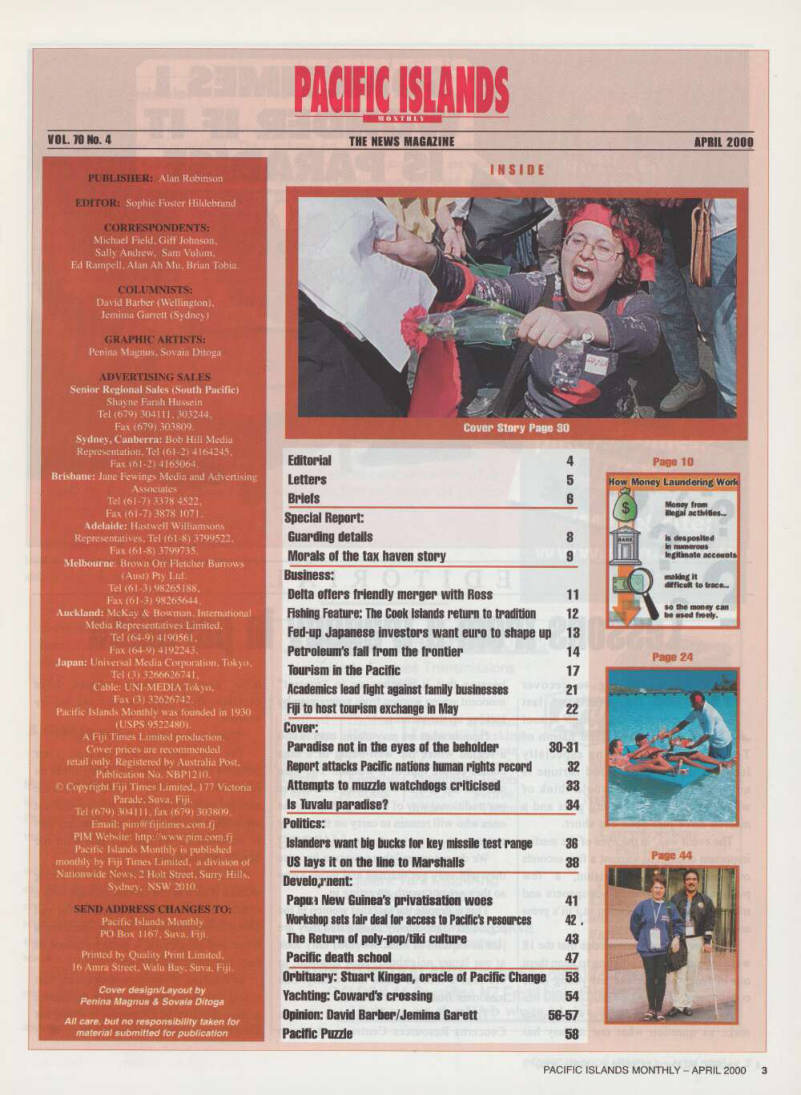
Inside
Cover Story Page 30
Editorial 4 Letters 5 Briefs 6 Special Report: Guarding details 8 Morals of the Jax haven story 9 Business: Delta offers friendly merger with Ross 11 Fishing Feature: The Cook Islands return to tradition 12 Fed-up Japanese investors want euro to shape up 13 Petroleum's fail from the frontier 14 Tourism in the Pacific 17 Academics lead fight against family businesses 21 Fiji to host tourism exchange in May 22 Cover: Paradise not in the eyes of the beholder 30-31 Report attacks Pacific nations human rights record 32 Attempts to muzzle watchdogs criticised 33 Is Tuvalu paradise? 34 Politics: Islanders want big bucks for key missile test range 36 US lays it on the line to Marshalls 38 Develojnent: Papin New Guinea's privatisation woes 41 Workshop sets fair deal for access to Pacific's resources 42 The Return el poly-pop/tiki culture 43 Pacific death school 47 Orbituary: Stuart Kingan, oracle of Pacific Change 53 Yachting: Coward's crossing 54 Opinion: David Barber/Jemima Garett 56-57 Pacific Puzzle 58
Page 10
Page 24
Page 44
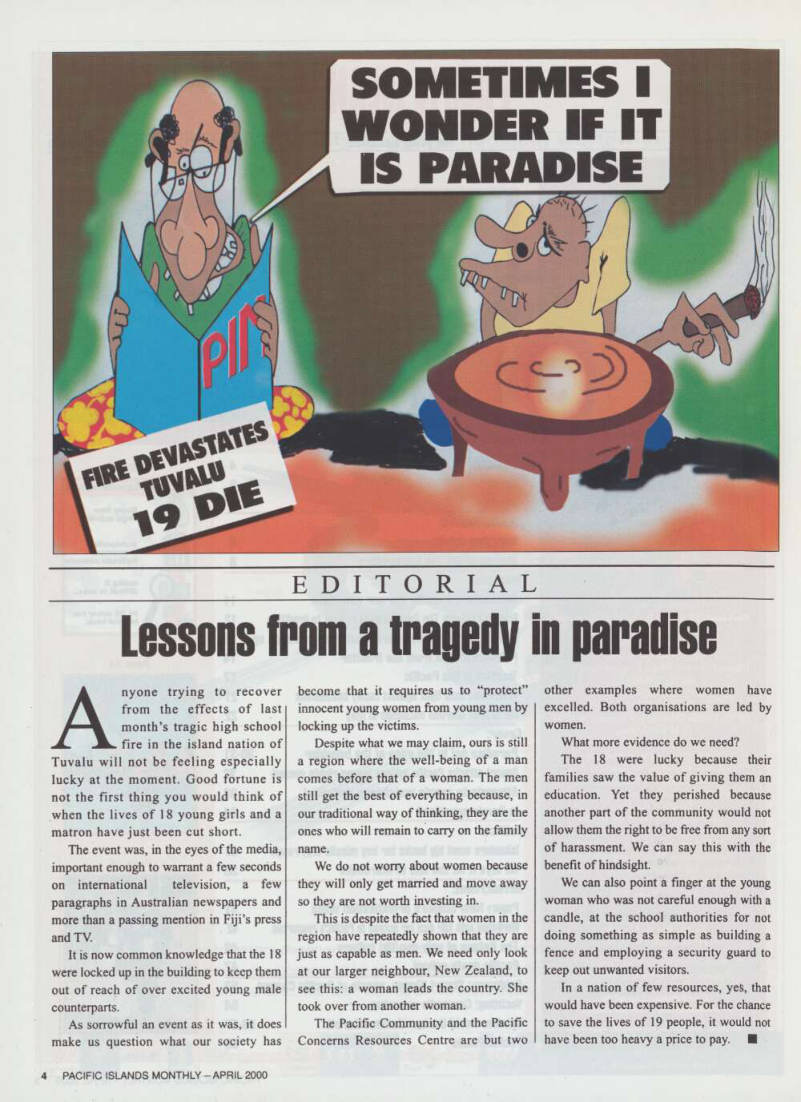
Lessons from a tragedy in paradise
Editorial
Anyone trying to recover from the effects of last month’s tragic high school fire in the island nation of Tuvalu will not be feeling especially lucky at the moment. Good fortune is not the first thing you would think of when the lives of 18 young girls and a matron have just been cut short.
The event was, in the eyes of the media, important enough to warrant a few seconds on international television, a few paragraphs in Australian newspapers and more than a passing mention in Fiji’s press and TV.
It is now common knowledge that the 18 were locked up in the building to keep them out of reach of over excited young male counterparts.
As sorrowful an event as it was, it does make us question what our society has
become that it requires us to “protect” innocent young women from young men by locking up the victims.
Despite what we may claim, ours is still a region where the well-being of a man comes before that of a woman. The men still get the best of everything because, in our traditional way of thinking, they are the ones who will remain to carry on the family name.
We do not worry about women because they will only get married and move away so they are not worth investing in.
This is despite the fact that women in the region have repeatedly shown that they are just as capable as men. We need only look at our larger neighbour, New Zealand, to see this: a woman leads the country. She took over from another woman.
The Pacific Community and the Pacific Concerns Resources Centre are but two
other examples where women have excelled. Both organisations are led by women.
What more evidence do we need?
The 18 were lucky because their families saw the value of giving them an education. Yet they perished because another part of the community would not allow them the right to be free from any sort of harassment. We can say this with the benefit of hindsight.
We can also point a finger at the young woman who was not careful enough with a candle, at the school authorities for not doing something as simple as building a fence and employing a security guard to keep out unwanted visitors.
In a nation of few resources, yes, that would have been expensive. For the chance to save the lives of 19 people, it would not have been too heavy a price to pay. ■
Letters

Illegal Internet goldmine
Your recent article “Prospectors strike gold in Website names” is misleading. The practice of registering and selling well known domain names by people with no legitimate interest in the name is known as
“cybersquatting”.
It has caused a great deal of trouble on the Internet generally and to several Pacific countries specifically, and is no longer allowed.
Recent decisions by the World Intellectual Property Organization, legislation in the US, and ICANN (the body that sets policy for Internet names) have all found the practice illegal when it involves trademarked names or when it adversely affects top-level country codes (such as the famous dot-tv).
At one time, it was possible to profit from registering generic words, but the current climate will prevent even this when it infringes on the rights of established businesses and organisations.
There may have been gold in Internet names in the past, but in the future only legitimate users of recognised names will be able to register them.
Dr Robert Guild
Economic Infrastructure Adviser South Pacific Forum Secretariat Suva
Fiji
A sight to see
I have been reading the Pacific Islands Monthly since June of last year when I went to Suva for a contract position. I look forward to getting each copy as I enjoy the variety of news that is written about.
However, I do have one concern that I would like you to respond to me about if you can find the time please. Although my eyes are not as young as they used to be, I can read quite clearly the text you use in the stories. But I have extreme difficulty in reading the captions under each photo.
At first I just ignored it until other people mentioned it to me too.
The problem is that the caption font appears to be not only smaller than the text
but it is in bold style as well. That means that the letters look as if they are merging into one another (or bleed into each other as, colours run into each other sometimes).
Thus I have to really struggle to see what is typed, for example pages 31,43 and so on of the March 2000 issue.
I can appreciate you want the caption to look differently to the text, but at the moment, the effect is to detract from the story. Do you not think it is difficult to read as well?
One possible solution could be to have a different colour. I notice the white print on a black or dark background is much better e.g.
“The Olympic Torch” on page 52 of the March issue, and the white captions on pages 31,50 and 52 of the November 1999 issue.
Incidentally the black bold print is even worse if it is printed on a blue background e.g page 45 of the November issue.
Could you re-consider the use of the small, black,bold font please and see what type might be more suitable.
Hans Zindels
Suva
Fiji
Advertisements & other items, p. 5 (1 item)
www.pim.com.fj
Have your say!
Send Letters to the Editor to: Pacific Islands Monthly, PO Box 1167, Suva, Fiji OR Email: [email protected] m.fj PIM Website: www.pim.com.fj
ENGINE WAREHOUSE
New/Used - Engines Transmissions Parts
BMW
Lister Yanmar SPECIALAir Cooled Industrial
Engines
Listers 18/21/32/44hp
Deutz 290 hp
Generator Sets Komatsu 29kva Yanmar 150kva Cylinder Heads Tested All Terrain Vehicles Amphibious National Distributers Amphibicus Carry 6 persons Pull trailer
USED FOR
Tourism Forestry Council Fisherman Contracters Govt Dept Farmers etc.etc. etc BLAIRS NEW ZEALAND Phone 643-6938122 Fax 643-6938120
P.0.80X 14 Geraldine NZ Email [email protected]
Visit us on the Web www.blairs.co.nz
Archives-August 1930
Is Edie Creek Another Rand?
Great Development awaits only
solution of transport problem
Isle del Oro - Island of Gold - was the name of New Guinea 300 years ago. That was when Alvaro de Saavedra, Commander of the Spanish Exploration Fleet, visited its palm-girdled shores in 1528. After him, it seems probable other explorers and navigators headed for this “treasure island”, the glitter of gold serving as a powerful magnet to the venturesome.
On Germany annexing the territory in 1884, some prospecting work was done. It is on record that when the Great War broke out, Dr Habert, the Acting-Governor, a mining expert, as well as a practical business man, was returning from the Waria River, after examining the possibilities of dredging the area. Prior to that, three Australians - Bill Parkes, Jim Preston and Mat Crowe - had received the Bird-of-Paradise shooting permits from the German Imperial Government, on the understanding that the proceeds were to be spent prospecting for gold at Koranga Creek, a tributary of the Bulolo River, near Edie Creek.
In 1920, Australia took over the territory of New Guinea under mandate from the League of Nations. Prospecting went ahead with renewed vigour, but met with little success until Mr William Royal, with a party of three white men, in 1925, came on an El Dorado, high up in the mountains alongside Edie Creek. The news of this find soon reached Rabaul. Then the race commenced. Luggers, well past their sailing days, and even native canoes, were brought into
commission for the trip to that low-lying strip of land - Salamoa - the port nearest the almost
inaccessible goldfields.
Prospectors in Australia, with vivid memories of Yukon and other fields, were quick to realise the opportunities of this tropic clime.
As a result, the mail steamer for Salamoa Bay was packed on each trip, even the open decks being used for accommodation.
Some Fortunes were Made The scene changes to Salamoa, with its palms waving in the gentle breeze, seeming to express the disdain of this invasion of their age-old solitudes. “Let them find out for themselves,” they nodded to one another as though they knew of the trials the gold-seekers would have to endure in that forbidding mountain range.
And those trials materialised, soon enough.
The men must have possessed wonderful spirit to battle through as they did. Tired and footsore, they toiled up the mountains to their goal, experiencing every kind of hardship. For delivery of food supplies, the prospectors had to rely on native porterage, only obtainable at
exorbitan prices. The natives themselvess looked upon the 60-mile trek to the mountain settlement with dread. Apart from the tortuous tracck, there was the ever-present danger of maraudimg tribes sweeping down on them. Head-huntinjg was a recreation with the people in that region..
Some of the miners pegged rich claiims, and quickly turned their trip to good accountt. Others were not so fortunate. There was a certain amount of lawlessness, but the Government’s representatives always held the upper hand.
On the field, one figure shone with the brilliance of a tropic star - Mrs Mary Booth, the first white woman at Edie Creek. She had accompanied her husband there, and every day, after hard work at their claim, heroically performed the duty of nurse to ailing miners. Her personality, her devotion to the sick, and the fortitude she displayed during her two years’ stay, won for her the admiration and affection of all. For her noble, untiring work, she was recently awarded the Order of the British Empire, an honour richly deserved.
Enter the Plane The arrival of the first aeroplane at Wau, two years after the initial rush, revolutionised transport. The trip could now be made in 30 minutes, in place of the grueling 10 days.
Statistics show what good work the aeroplane services have since done. Over 3000 passengers have been carried, and £3,000,000 worth of cargo transported. The cost is heavy, the passenger fare from Salamoa to Wau aerodrome being £5, and the freight 9d per lb. ■
Briefs
Bougainvile Affairs Minister hints on new
interim government (or Bougainville
The Papua New Guinea (PNG) Government announced an interim Government for Bougainville will be ready and in place bythis month. Minister for Bougainville Affairs, Sir Michael Somare said he had received 12 nominations from Bougainville MPs to make up the interim government. He said the candidate names will go to Cabinet for consideration and if approved. Prime Minister, Sir Mekere Morauta will announce the formation of the interim government. The PNG Minister said it’s important to establish the interim government, which will act as a vehicle to facilitate a democratically elected government for the island
province. Sir Michael said he was confident a common stand would be reached from the Bougainville leaders and the government during the Bougainville talks on the position of their demand for highest autonomy and referendum for independence. Meanwhile, Governor of Bougainville, John Momis is also confident all parties involved in political talks will achieve satisfactory answers to the Islands call for autonomy and a referendum for independence.
Momis and BPC President, Joseph Kabui are heading the 25-member Bougainville delegation to the third round of talks, which began at the resort of Loloata Island. Kabui said from Port Moresby that it was clear the Government was open to discussing the two issues and expected
something positive from the weekend talks.
Another leader in the Bougainville People’s Congress, David Sisito has also urged the National Government to seriously consider the demands as they were committed to a negotiated political settlement and would continue to support the peace process as long as parties maintain dialogue on the agenda for Bougainville. Government team leader to the talks and Minister responsible, Sir Michael Somare has said the Government was prepared to discuss the two issues and reach a compromise even though a referendum is not allowed in PNG’s Constitution In another development, an Australian study team from the Rural Development Sector is currently in
Madang to conduct workshops on renewable resources and rural development for the Provincial Administration and the Department of Primary Industry.
American Samoan Parliament rejects casino gambling bill Without any debate, America Samoa’s House of Representatives rejected legislation, which would have legalised casino style gambling in the territory. Last month’s vote puts to rest attempts by a group of American Samoans in California to set up a casino gambling operation.
The actual number of Representatives opposing the gaming bill was not counted because the vote was taken during second reading, which involves only a show of hands.
The House Ways and Means Committee and the House Economic Development Committee only held one public hearing on the proposed law in February. Church ministers attending the hearing spoke strongly against legalising gambling saying it would create social problems.
Two previous hearings were cancelled because the Faaola Group, which had been banking on legislative approval of the gaming law, to set up a casino facility in the territory, couldn’t attend. The two committees agreed to recommend to the full House that the bill be rejected. Before the vote. Chairman of the Economic Committee, Rep. S.E. Sala informed members of the outcome of last month’s public hearing on the bill, where only representatives of local churches testified, and all were against gambling. Rep. Su’a Carl Schuster, Chairman of the Ways and Means Committee echoed his colleague’s statement and said that although the bill was quite attractive in terms of raising much needed revenues for the government, it would create many social problems.
Both lawmakers recommended rejection of the bill and without any argument or debate, the legislation, which has been dubbed the ievil of society,! was killed by a swift show of hands.
Rep. Sala was one of the five co-sponsors of the bill, but early this year changed his mind and took the opposing side, citing social problems created by gambling.
New Zealand Minister commends Tongan community for ethics conference New Zealand’s Pacific Island Affairs Mark Gosche has commended members of the Tongan Community in New Zealand when he launched the world’s first Tongan Ethics Conference.
The meeting was designed to enable Tongan
people to work out for themselves protocols and ways for officials and medical practitioners to work with their people. “The conference is groundbreaking in that the Tongan community is going to work out how for themselves how they as a people want to move forward,” said Gosche.
“The community have acted proactively by setting the agenda themselves and asserting their position.” Gosche said ethics were about principles and values. “When someone’s actions are ethical we consider him or her to be moral, we feel they are acting in a fair, just manner. But when actions are unethical we consider them unjust and without principles,” he said.
Gosche said while people often talk about the iPacifici way of doing things - the reality is that there are several “Pacific” ways. “We are many peoples and we must each find our own way of dealing with our circumstances and futures,” he said. “Only Tongan communities know how to marry traditional Tonga Fai ways with modern concepts. Only Samoan communities can work out how fa’asamoa is to work for New Zealand bom generations. The new book Fa’asamoa and social work within New Zealand investigates many of these challenges,” Gosche said. He hoped other Pacific communities would follow the Tongan community’s example.
Pro-independence FLNKS holds congress New Caledonia’s pro-independence FLNKS (National Kanak Socialist Liberation Front) its annual congress in Mare island (Loyalty group, north) with an agenda dominated by structure reform and internal differences. “There is some cacophony within FLNKS because we don’t have a clear orientation, and no working methods,”
Union Progessiste Melanesienne (UPM, a member of the four-party FLNKS umbrella) President Victor Tutugoro said. FLNKS was set up in 1984, amidst civil unrest in the French territory. Since then, FLNKS leader, the late Jean- Marie Tjibaou signed the Matignon Accords in 1988 with anti-independence RPCR (rally for New Caledonia within the -French- Republic) leader Jacques Lafleur and the French government, paving the way for increased autonomy.
Tjibaou was assassinated a year later by a hardliner within FLNKS who saw the charismatic Kanak leader as a traitor to the spirit of struggle of the Kanak people. The Matignon Accords were followed by the Noumea Accord, signed by the same parties in 1998 providing for a possible independence of New Caledonia within “15 to
20” years. From civil unrest of the mid-eighties to a relatively stable political and institutional environment, FLNKS “is not ageing well”, supporters admitted. Wamytan was elected FLNKS President in 1995. He is also the head of the Union Caledonienne, the umbrella’s main component. “We’re like prisoners of a movement which is not really one and where each party wants to keep its own identity,” Wamytan said.
“But he also expressed disapproval at what he sees as disrespect of the ‘spirit of collegiality’ within the newly formed local government (dominated by RPCR). “If there is no evolution by the next follow-up meeting of the Noumea Accord (in April-May), the obligation for us to leave this government will impose itself to us.
The direct consequence will be an institutional crisis that the (French) State and RPCR will have to take the blame for,” Wamytan said.
Fiji military authorities hold on to name of Indo-Fijian soldier who shot a fellow soldier in Lebanon Military authorities in Fiji fear for the safety of the family of the soldier that allegedly shot and killed Private Anare Waqavonovono at the Fiji camp in Southern Lebanon. Press reports the name of the Indo-Fijian soldier is known to Fiji Military officials but they have withheld the release of the name for fear of reprisals against his family in Suva. The Fiji Military Forces has confirmed the Indo-Fijian soldier is currently admitted in hospital in Southern Lebanon after he was assaulted by a group of soldiers, in a revenge attack. He is expected to be court martialed. An Army spokesman said he is likely to face several charges before military judges and if convicted of murder, he will be jailed at a civilian prison. The penalty for murder is life imprisonment.
The shooting took place at the Fiji Batt A company area of operation in South Lebanon.
Private Waqavonovono was shot twice in the chest and once on the head.
Private Waqavonovono, whose father is a Captain in the army, is believed to have questioned the Indo-Fijian soldier where he had been when an argument broke out. “The details are not clear but 1 am told there was an argument before my son was shot,” Captain Waqavonovono said. Private Waqavonovono, who was on his second tour of duty, was to complete his stint in Southern Lebanon in June this year. The shooting has been investigated by the Fiji Batt and the United Nations Interim Forces in Lebanon (UNIFIL) military police. ■
Guarding details
Special Report
Niue’s mountain of evidence
By Michael Field
Peleni Talagi has a strange kind of job. She sits alone in one of Niue’s few office buildings - the
Commercial Building opposite the
Fale Fono - and guards files. Thousands of them, all the property of the law firm Mossack Fonseca and Co of Panama City. Ms Peleni Talagi is Mossack Fonseca’s solitary Niuean employee although the company now brings in about NZ$ 1 million to Niue a year, thanks to those very files.
Niue has given the Panamanian law firm a 20year-long exclusive deal to run tax haven banking and the creation of “international business companies” (IBCs). This from the latest International Narcotics Control Strategy Repent published by the US State Department ‘’Niue’s thriving offshore financial sector has been linked with the laundering of criminal proceeds from Russia and South America, especially through the use of its International Business Companies.”
Enter steel-eyed and angry Jurgen Mossack, a 52-year-old German, who has made his fortune with partner Ramon Fonseca in Panama with IBCs. He wants to correct stories he says are hurting Niue. First some of tire basics.
EBCs are everywhere. Hong Kong is the mother-lode with 474,500 IBCs registered, followed by Panama (350,000) and the British Virgin Islands (304,000). Niue and the Cook Islands have around 6000 IBCs each, Samoa 4000 and Vanuatu 2500.
IBCs are not the same as tax haven banks - of which Nauru, for example, has a daunting 400 “banks”, all registered to one post office box.
People set up IBCs primarily to hid or, as it is more politely described, “shelter” their money, from fire local taxman. You can set up an IBC in any country that does it and with the certificate of incorporation go along to the local bank and open up a bank account in the IBC’s name. As a foreign registered company it will be exempt from local taxes, usually.
The money does not go to the country the company is registered in. Niue gets US$l5O for every IBC registered in its jurisdictioa Mossack Fonseca on their web page describe the advantages of Niue’s IBCs as “total secrecy and anonymity” along with no requirements to disclose beneficial owners and to file annual returns, “complete business privacy and confidentiality” and “company name can be incorporated in Chinese characters as well as Cyrillic script and in accepted language forms along with a romanized version”. Cyrillic is Russian.
The US State Department again: “These features make Niuean IBCs ideal mechanisms for money laundering schemes.” Mossack had not seen the latest US report, although he had seen tire earlier reports which made similar allegations.
“The State Department report is, frankly, wrong,” he says. So are the New Zealand authorities who are looking closely at Niue Much uses the New Zealand dollar.
“We have to accept that their is no money laundering going on in Niue, or even through Niue,” Mossack says. “Any IBCs registered in Niue are used in the Far East, in Hong Kong or Singapore, to open bank accounts. Are they a threat to New Zealand or the New Zealand dollar?
I cannot see it, I don’t see a connection.”
Russian Mafia proceeds or South American drug money was not going through Niue, and Mossack noted that while it was claimed US$7O billion Russian money had gone through Nauru accounts, the actual money had gone through the Bank of New Yoik in Manhattan. Mossack says “absolutely and categorically” there is no money laundering in Niue, and nor was there a drug connection. His Niuean operation was being singled out because of the Panamanian connection. “There is where a certain discrimination factor comes into it,” he said.
“Why is some body who is based in Panama any different, any worse, than somebody based in the United States or Europe... Panama is a country like any other, it is an on-shore country, it is not an island in the middle of no where.”
Panama is not a squeaky clean state; its once brutal dictator General Manuel Noriega is serving time in a US jail fix his drug connections. He was toppled from office by a US military invasion in 1989, Operation Just Cause. Mossack says it was Noriega’s behaviour, and the stigma attached to Panama, which first led his company to set up in the British Virgin Islands (BVI) and the Bahamas.
“We needed to find a place where one could have tire same advantages of Panama without the stigma attached to the regime at the time.” His firm has had 23 years in the business of forming IBCs, trusts and foundations as well as ship registration, an enormous business in Panama.
Unlike many similar operations, Mossack
says they do not register companies over the Internet. But all the same he says he does not know who the clients are, although most of the clients come via mainstream institutions.
He says it is these agents he used the example of ‘ ’the number one Swiss bank” - who do the due diligence on the people forming the IBCs. People coming direct to them to set up companies are checked through the usual credit agencies which, Mossack says, provide “a lot of very useful information”. So he was confident he knew the kind of people setting up in Niue. “You can never be 100 per cent sure about anything.
There is always going to be one that will slip through the net Due diligence is something that has to be done and is done, but it is not always 100 per cent reliable... Even for a local company... if somebody is going to commit fraud, they commit fraud.” There is no risk to Niue.
“No money passes through Niue, there are no facilities there. Those bank licenses that may have been issued are likely to banks that need to operate through larger international banks... They are policed “As far as the IBCs are concerned the fact that nearly incorporated 6000 companies no major scandal has erupted as far as Niue is concerned speaks for itself.”
He admits he has no idea how much money is turned over through Niue IBCs - he has no way of knowing at all. BVI had become a tremendous success but a problem too; it was very difficult to find a name for a company that was not already taken. And Mossack Fonseca wanted a place in an Asia-Pacific time zone.
“We thought of several jurisdictions which had tried to be clean, no scandals attached to them, which had to be part of the British Commonwealth, so as to offer similar advantages to the BVI. We found that Niue was that one place.” They had looked at the Cook Islands and Vanuatu - but the competition was already there.
“We figured that if we had the exclusivity we would avoid the price wars because in off shore jurisdictions there is a lot of competition going on.
If we had a jurisdiction that was small and we had it from the beginning, we could offer people a stable environment, a stable price... It was a marketing tool.”
Niue has a problem with its solitary once-a week Royal Tongan Airlines service, but it has the advantage too that it is just as hard to get out and according to the lawyer “there is no prospect” of anybody finding out what information Peleni Talagi guards. “Niue is a traditional tax haven, there is no more to it than that” ■
Morals of the tax haven story
By Michael Field
Pick a Pacific constitution and chances are there will be a reference to God and Christianity in it. Ask Jurgen Mossack whose Panama firm Mossack Fonseca and Co operate the Niue tax haven whether this kind of business has a morality about it, question whether there is a right or a wrong and he thinks a bit about the answer first.
“There is a big grey zone, there is no clear cut area,” he said.
Tax havens like those operated by the Cook Islands, Marshall Islands, Nauru, Niue, Samoa and Vanuatu are all based on a simple script; tax avoidance. In other words countries which depend on the aid and goodwill of taxpayers in countries like the United States, Australia and New Zealand have no hesitation at helping bilk those same taxpayers.
“Most of the people are trying to avoid paying taxes in their home countries, that is the main trust, it is not the laundering of criminal receipts.”
And there is the other argument, advanced by the Group of Seven, the Organisation of Economic Cooperation and Development (OECD), the Financial Action Task Force and the US State Department who all say that tax—havem operations like those in Niue are being used to launder money.
The Russian Central Bank reckons there is around US$7O billion of black money moving around the world, primarily from the Russian Mafia. Much of it, they believe, goes through Nauru. And they have the Cooks, Marshall Islands and Niue under watch too. OECD has targeted Niue as one of a number of ‘’non-cooperating” states.
Mossack believes the OECD is using money laundering as a pretence.
“I am not saying no money laundering goes on in any particular jurisdiction. That is a cover.”
His view is that the real worry for the West is that countries like Niue offer “unfair tax competition”.
He does not have a problem with
Western countries trying to protect their tax base.
“They can protect it of course, they can do the best they can do, but they have to do it by their own internal means at their disposal within the county, not by reaching across frontiers by trying to close down others and trying to grab the tax.”
He points to the fact that in the United States places like Delaware, Florida and Nevada offer off-shore banking.
“If OECD countries want to be serious about unfair tax competition they are going to have to close down their own operations first.”
As for money laundering, he says that is actually carried out on-shore.
“I would say in the United States, that is where the big numbers can be played because that is where they do not cause so much attention. That is where the real money laundering is done.”
Money laundering was going on through the mainstream banks who ignored it.
The now celebrated US$7O billion figure through Nauru points to the big American banks being involved.
“Every operation of that scale needs the intervention of the big international banks and/when they see an unusual operation they must know it, and if they then continue the business it is because either they are not interested in the morals of the story, or they see it as good business to continue these operations If you have figures of that sort that they are dealing with then the international banks know what they are doing.”
Tax havens cannot be money laundering.
“I try to tell them that off shore companies cannot launder money, you need to have the banking system, without the banking system it is impossible to launder money... You need banks... and you need the mainstream banks. How else can you get figures of that sort through the system.”
Pacific officials involved in tax-haven banking fend off the money laundering in another way, saying that they are not committing any sins or crimes, and if they
did not do it then the money would go somewhere else.
“Money laundering has devastating social consequences and is a threat to national security because it provides the fuel for drug dealers, terrorists, illegal arms dealers, corrupt public officials and other criminals to operate and expand their criminal enterprises,” says the latest International Narcotics Control Strategy Report published by the US State Department.
“Money laundering is now being viewed as a central dilemma in dealing with all forms of international organised crime because financial gain means power.
Fighting money launderers not only reduces financial crime; it also deprives criminals and terrorists of the means to commit other serious crimes. ” ■
Advertisements & other items, p. 9 (1 item)
Hems from the newsletter of
Mossack Fonseca and Co of Panama.
• The partners of Mossack Fonseca & Co. recently donated U 5525,000 to the Health Department of Niue for laptop computers, a scanner machine and blood testing equipment. The donation was part of a series of events commemorating the incorporation of a full time manager to its Niue office and the firm’s confidence that it will generate US$l million in fees this fiscal year for the Niue government. • On 13th April 1998, the 3,000 th International Business Company was incorporated in the Territory of Niue.
The name of the company: Lucky 3000, of course. To mark the occasion, a small celebration was held at the Panama offices of Mossack Fonseca, attended by supervisors and staff, in which Mr. Mossack stressed the important work the firm is doing in Niue. Captured in the photograph are Jurgen Mossack and Ramon Fonseca, partners, during the toast to Lucky 3000. ■
Work progresses on 'Hit list' of money-laundering centres
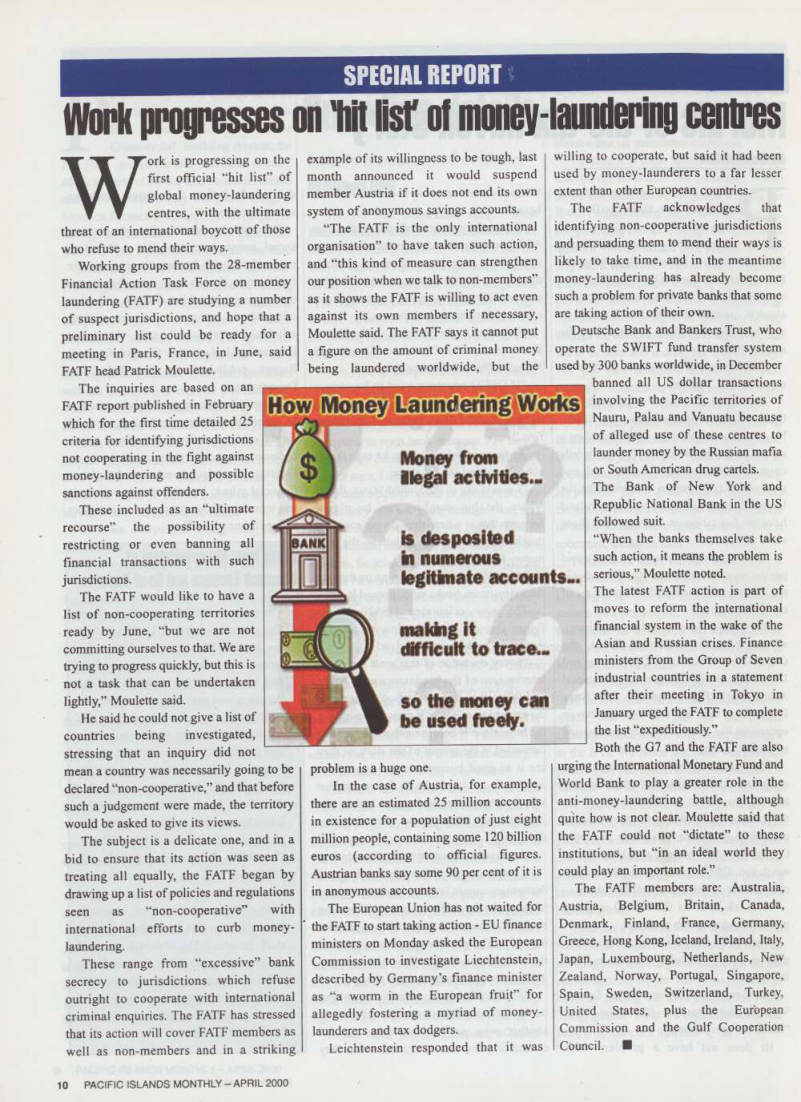
Work is progressing on the first official “hit list” of
global money-laundering
centres, with the ultimate threat of an international boycott of those who refuse to mend their ways.
Working groups from the 2 8-member Financial Action Task Force on money laundering (FATF) are studying a number of suspect jurisdictions, and hope that a preliminary list could be ready for a meeting in Paris, France, in June, said
FATF head Patrick Moulette.
The inquiries are based on an FATF report published in February which for the first time detailed 25 criteria for identifying jurisdictions not cooperating in the fight against money-laundering and possible sanctions against offenders.
These included as an “ultimate recourse” the possibility of restricting or even banning all financial transactions with such jurisdictions.
The FATF would like to have a list of non-cooperating territories ready by June, “but we are not committing ourselves to that. We are trying to progress quickly, but this is not a task that can be undertaken lightly,” Moulette said.
He said he could not give a list of countries being investigated, stressing that an inquiry did not
mean a country was necessarily going to be declared “non-cooperative,” and that before such a judgement were made, the territory would be asked to give its views.
The subject is a delicate one, and in a bid to ensure that its action was seen as treating all equally, the FATF began by drawing up a list of policies and regulations seen as “non-cooperative” with international efforts to curb money laundering.
These range from “excessive” bank secrecy to jurisdictions which refuse outright to cooperate with international criminal enquiries. The FATF has stressed that its action will cover FATF members as well as non-members and in a striking
example of its willingness to be tough, last month announced it would suspend member Austria if it does not end its own system of anonymous savings accounts.
“The FATF is the only international organisation” to have taken such action, and “this kind of measure can strengthen our position when we talk to non-members” as it shows the FATF is willing to act even against its own members if necessary, Moulette said. The FATF says it cannot put a figure on the amount of criminal money being laundered worldwide, but the
problem is a huge one.
In the case of Austria, for example, there are an estimated 25 million accounts in existence for a population of just eight million people, containing some 120 billion euros (according to official figures.
Austrian banks say some 90 per cent of it is in anonymous accounts.
The European Union has not waited for the FATF to start taking action - EU finance ministers on Monday asked the European Commission to investigate Liechtenstein, described by Germany’s finance minister as “a worm in the European fruit” for allegedly fostering a myriad of money launderers and tax dodgers.
Leichtenstein responded that it was
willing to cooperate, but said it had been used by money-launderers to a far lesser extent than other European countries.
The FATF acknowledges that identifying non-cooperative jurisdictions and persuading them to mend their ways is likely to take time, and in the meantime
money-laundering has already become
such a problem for private banks that some are taking action of their own.
Deutsche Bank and Bankers Trust, who operate the SWIFT fund transfer system used by 300 banks worldwide, in December
banned all US dollar transactions involving the Pacific territories of Nauru, Palau and Vanuatu because of alleged use of these centres to launder money by the Russian mafia or South American drug cartels.
The Bank of New York and Republic National Bank in the US followed suit.
“When the banks themselves take such action, it means the problem is serious,” Moulette noted.
The latest FATF action is part of moves to reform the international financial system in the wake of the Asian and Russian crises. Finance ministers from the Group of Seven industrial countries in a statement after their meeting in Tokyo in January urged the FATF to complete the list “expeditiously.”
Both the G 7 and the FATF are also
urging the International Monetary Fund and World Bank to play a greater role in the anti-money-laundering battle, although quite how is not clear. Moulette said that the FATF could not “dictate” to these institutions, but “in an ideal world they could play an important role.”
The FATF members are: Australia, Austria, Belgium, Britain, Canada, Denmark, Finland, France, Germany, Greece, Hong Kong, Iceland, Ireland, Italy, Japan, Luxembourg, Netherlands, New Zealand, Norway, Portugal, Singapore, Spain, Sweden, Switzerland, Turkey, United States, plus the European Commission and the Gulf Cooperation Council. ■
Delta offers friendly merger with Ross
Business
Two of Australia’s most successful low-cost gold producers, Delta Gold Ltd and Ross Mining NL, are set to consummate a friendly merger following Delta’s announcement of a scrip takeover bid that values Ross at about Asloo million (KlBB million).
There was some irony in the merger plan since Ross’ share price has taken a battering since late last year because of ethnic problems at its Gold Ridge mine in the Solomon Islands, where the company has managed to increase its low-cost gold production. For Delta the Gold Ridge mine represents an opportunity since it sees the Solomon Islands as one of the top five gold exploration areas worldwide.
Delta is offering one of its shares for every 4.5 Ross Mining shares in a bid to entrench its role as Australia’s fourth largest gold producer with output of more than 700,000 ounces in 2000/01.
Delta said its offer represented a premium of 26 per cent on the closing price
of Delta and Ross Mining on Feb 28, the day before a trading halt requested by Ross, and a premium of 31 per cent on their three month weighted average price. This is Delta’s first takeover bid since South Africa’s Anglo Gold thwarted its takeover offer last year for Acacia Resources.
Following talks held by the two companies since the middle of last year, the board of Ross Mining has decided to recommend that their shareholders accept the Delta offer in the absence of a higher offer. One of Australia’s top gold analysts, Keith Goode of Bell Securities, describing the takeover as a logical move, said it would “result in a better Delta, adding 100,000 ounces to production” and making it more attractive for institutional investors.
However, he felt Delta should have offered a premium of at least 40 per cent as had been the case with the successful Anglo Gold bid for Acacia.
“They (Delta) could easily lose Ross,” he said, adding that four Ross shares for one
Delta share would have represented “a fairer offer”. Ross’ shares have been sliding from a high of Asl in October 1998 with the most recent fall due to civil unrest near its Gold Ridge operation in the Solomon Islands.
After jumping by 24 per cent to A46cents on speculation of a takeover prior to its suspension yesterday, Ross shares today slumped by 6.5 per cent to A 43 cents.
Delta shares fared even worse to shed 9.2 per cent to close at A 51.98 following the announcement of the takeover bid.
However, much of the adverse reaction was due to an announcement that Delta’s net operating profit had dropped by 48 per cent to A 518.6 million in the six months to December after production costs had risen from As2B7 an ounce to A 5453 an ounce.
Delta’s Managing Director Terry Burgess said strong revenue growth would occur during the current half year because of improved gold prices, existing hedging contracts and a full half year contribution from 100 per cent ownership of the Kanowna Belle gold mine near Kalgoorlie in Western Australia.
“Delta’s net profit after tax for the second half is forecast to more than double to about As 23 million,” he said.
On the proposed merger with Ross Mining, Mr Burgess said Delta had reviewed worldwide exploration targets two years ago when the Solomon Islands emerged as one of the top five targets.
“It has good prospectivity for gold and
provides a platform for regional expansion,”
he said. “Ross Mining’s Gold Ridge project in Solomon Islands fits our strategy and will
provide significant low-cost and long-term
production for Delta Gold. It will add an additional one million ounces of unhedged gold reserves and it is also of advantage that Gold Ridge is in the Australasian time zone.”
Delta’s offer, which closes on April 17, is contingent on a minimum acceptance level of 50.1 per cent as well as regulatory approvals. Delta expects to produce 600,000 ounces of gold this year from 9.3 million ounces of resources, while Ross last year produced 152,930 ounces from reserves that exceeded two million ounces. ■
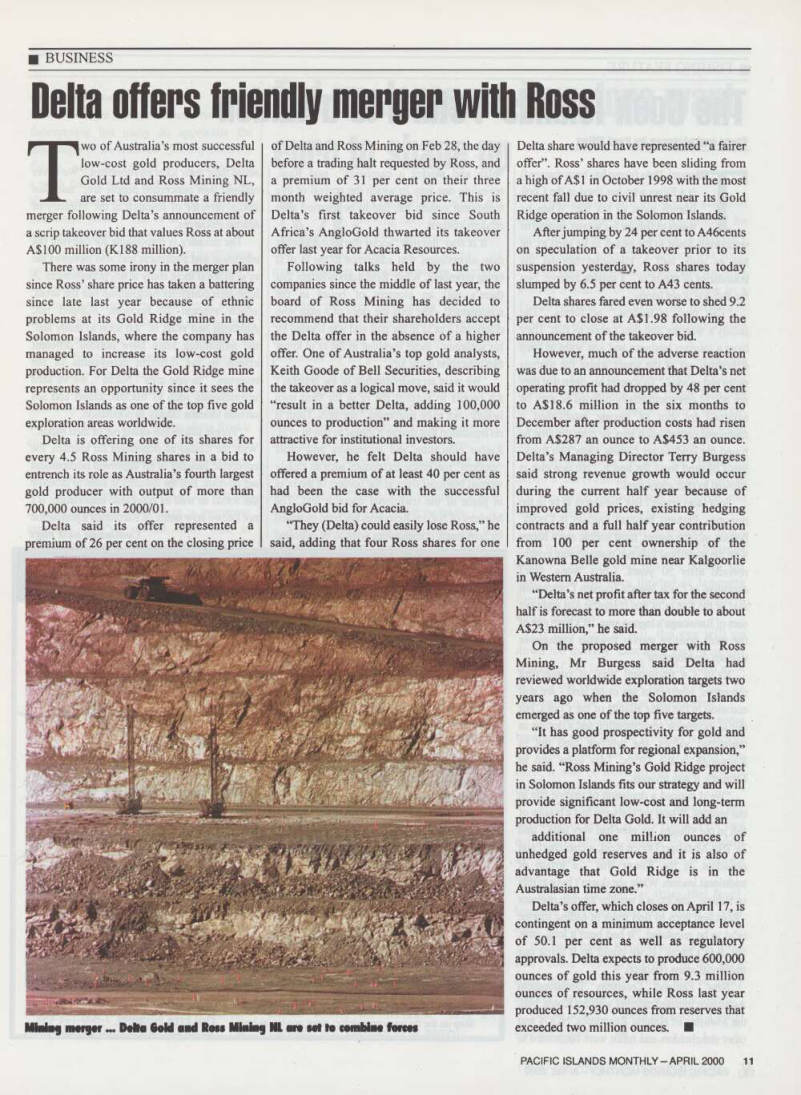
Mining merger ... Delta Gold and Roes Mining NL are set to combine forces
The Cook Islands' return to tradition
Fishing Feature
Story and pictures by Paul Miles
Tomasi Bula (name has been changed) is a Fijian who has lived in the Cook Islands most of his life. When he wants to fish for his supper, instead of wandering down to the beach as he used to, he has to walk half a kilometre beyond the boundaries of the ra’ui - a marine reserve. Not far. But Joe is not happy.
“This rau’i is useless,” he fumes. “The family’s wealthy and don’t need to fish. They have a tourism business and just want to keep fishermen out of the water where the tourists swim and snorkel.” To support his claim that they are not as environmentally-minded as may be assumed by dint of’ having established a traditional conservation area, he cites the time he found the land-owner carting away two truck loads of sand from the beach. “No one else is allowed to take away sand”
Sour (sea) grapes? But Joe seems to be in the minority. Perhaps because tourism is Cooks’ biggest income earner, most people seem happy with the traditional fisheries management system revived after 50 years. Chris Wong, chief executive of Cook Islands Tourism Corporation said of the five ra’ui that comprise just eight per cent of Rarotonga’s lagoon area, “it’s been one of the most positive moves towards sustainable tourism development”.
Ra’ui - a traditional way of conserving resources, whether in sea or on land - are still common in the outer islands of the Cooks, but due to increasing westernisation and a decline in traditional values, the practice died out in Rarotonga in the 19505. Two years ago in February, it was revived “We’d noticed a depletion of marine life in our lagoons. Where we’d always had a bounty of fish in our villages, we now had very little,” said Te Tika Mataiapo Dorice Reid, a clan chief and president of the Kotou Nui - a group of traditional leaders. While she doesn’t have to rely on fishing - she too is a wealthy tourism operator - Reid was keen to find ways of calling marine ra’ui to be reinstated. “It had been a long time.
We didn’t know if we could do it using our traditional mana (respect).”
New Zealand Overseas Development Assistance initiated meeting with the Kotou Nui, the Ministry of Natural Resources, NGOs and other stakeholders and funds were committed to
“plan and market a campaign”, said Reid, revealing one way in which the revival of this traditional system has had to be married with modem systems.
It is also through “social marketing”, rather than superstition, that adherence to the ra’ui is being promoted. While Reid acknowledges that there’s still an element of belief in the supernatural - she tells the story of a man who disobeyed a ra’ui in the past and was blinded by his speargun - those involved in the ra’ui know that education is the key.
“We want an understanding of the benefits for people to support the ra’ui for their own beliefs - not to be frightened,” she says. There is no legislation that makes it illegal to fish in ra’ui.
Rather education and awareness and other “modem” marketing techniques such as clearly worded bilingual signs at the borders of the ra’ui in place of the traditional coconut leaf. The Ministry of Natural Resources has been surprised by how much communities want to be educated
about their own local environment. “We never realised how concerned people are,” said Ben Ponia, director of research at the Ministry of Marine resources.
The ministry is responsible for carrying out education and awareness and also monitors the ra’ui to see if there really is any improvement. A high-tech computer programme has the areas, which average 20 hectares, mapped out.
Although two years is “too soon to really see” the monitoring team have noticed different effects in the different ecosystems of the reserves. “In one area - Nikao -, we’ve seen invertebrates such as trochus, clams and sea urchins increase hugely in population.
“People talk of fish eating out of their hands.”
With the Cooks so dependent on tourism, the economic benefits of an improved environment are obvious. But the ministry is keen to promote the social as well as economic importance. It’s not known how many of Rarotonga’s population Continued next page
Continued from previous page of 8000 or so are subsistent or semi-subsistence fisherpeople but many do appreciate the advantages of the reserves. “It’s improved my fishing,” says Tane Terekia, 36. He fishes twice a week for his family and does not have the slight inconvenience of ra’ui bordering his beachfront home. “The ra’ui provide good breeding grounds for the fish.”
It is because of scientific methods have proved that some areas - known traditionally are indeed better breeding grounds than others, that many advocates of the present ra’ui wanted to change the tradition of moving of lifting ra’ui after six months to two years. Especially as modem fishing techniques can so quickly eradicate any improvements.
The two-year anniversary was celebrated in three areas of Rarotonga lagoon last month. In the area of Tikioki, at the village where Reid is chief, the ra’ui was lifted on its second birthday of February 1. On the same day a neighbouring larger area of the lagoon was placed under ra’ui for five years, while a portion of the original ra’ui was made a ra’ui mutukore or permanent sanctuary. “We’ve worked really hard to achieve this. I’m so happy with these results,” said Reid.
Other ra’ui were lifted for a period of one day to just under a week and restricted fishing allowed. The ra’ui were then reinstated. Limited harvesting of the introduced Trochus niloticus is being actively encouraged in some ra’ui. Nikao Village harvested its quota of four tonnes during the period the ra’ui was lifted. While the ra’ui is improving the quantity of marine life in the lagoon, an issue to be addressed now is the quality. Potentially fatal ciguatera fish poisoning is common form reef fish caught in some areas.
“An increase in piggeries around Rarotonga may lead to excess nutrients in the lagoon. This encourages the growth of algae containing toxins. Fish feed on these and this leads to ciguatera,” says Jacqui Evans of Worldwide Fund for Nature. WWF supports the Kotou Nui with an education and awareness campaign for the ra’ui. With Rarotonga restaurateurs able to source uncontaminated fish elsewhere, one wonders whether there will be the same degree of commitment from people involved in tourism to sort out the ciguatera problem as there has been for the ra’ui.
After all, combined with the fruits of conservation, it could be a boon for tourism: plenty of pretty fish that aren’t for eating. ■
Advertisements & other items, p. 12 (1 item)
Hook Up With The Leader!
Pacific Ocean Pe
cks technology, extended light output, often used ■ moisture, easy-to- handle shipping carton. All popular white, violet and ultra-violet for best fishing results.
is the leader in
monofilament longline
system technology.
We offer special service A £ to the South Pacific Islands, 1 r Australia and New Zealand. V'i • Lindgren-Pitman gear, complete hydraulic ■* \ systems, design and installation of monofilament V., longline systems including operations training. <»_ ■ ■. • Extensive Tuna and Swordfish supplies, bottom URALUMES ® fishing gear, fish handling supplies and bait. . •* \ r"7 y A • Duralumes Lightstick - the latest in lightsticks technology, extended light output, often used ' VrL two nights, 5-year shelf life, not affected by moisture, easy-to- handle shipping carton. All popular colors available - green, blue, pink, yellow, white, violet and ultra-violet tor best fishing results. • Wide selection of trolling equipment: over 180 different colors of trolling skirts and a large selection of lure heads. • Weekly shipments to the South Pacific Islands, Australia and New Zealand.
Shop on line for your convenience: www.pop-hawau.com Toll Free Number 1-800-144-488
Pacific
Ocean
Producers
• FREE CATALOG AVAILABLE ON REQUEST
Please direct all inquiries to the Export Department: 965-B North Nimitz Highway Honolulu, HI 96817, USA.
Telephone: (808) 537-2905 Facsimile: (808) 536-3225
Fed-up Japanese investors want
euro to shape up
Major Japanese investors are growing tired of the euro as the 14-month-old currency shows few signs of overcoming its teething troubles, analysts say.
After initially welcoming the single currency’s advent with massive investment in euro holdings, big Japanese funds are perplexed by its persistent weakness and are reducing their exposure.
“I think they are not confident anymore, they are disappointed, and very confused,” said Kenneth Landon, senior currency strategist at Deutsche Bank in Tokyo.
The euro, launched in January last year, fell 15 per cent through parity against the dollar and on February 28 plumbed a new low of 0.9390 dollars in Tokyo trade.
The diverging performance of the United States and euro-zone economies is the core reason for its sustained weakness, but currency traders say a lack of support for the unit from the European Central Bank (ECB) has not helped.
That has contributed to furrowed brows among the big Japanese investors, including pension funds which sit on some of the largest savings pools in the world of more than 1.2 trillion yen (11.3 billion dollars).
Technical factors are also at play as Japanese investors repatriate funds back into yen for the financial year’s close on March 31.
But others said the euro’s affliction in Japanese eyes went deeper.
“The life assurers sold quite a lot in recent sessions. They remain sellers on the euro, at least in the short run,” said the foreign exchange manager of a major European bank.
With the US economy continuing its record-setting growth, it made more sense for investors to “put their money in a truly capitalist market rather than a socialist region like Europe where the profits are shared among the workers,” said the manager, who declined to be named.
“The Japanese are obliged to abandon the euro for fear of losing too much,” he said, noting their early influx to diversify their holdings when the currency was bom.
The euro continued to account for only around a quarter of currency trading in a Tokyo market dominated by dollar-yen business, adding to its lack of appeal, the manager added.
The euro’s less publicised weakness against the yen has been causing consternation among some major Japanese investors, who feared their foreign exchange earnings would be dented when they closed their books on March 31.
That fear was behind the Bank of Japan’s intervention, which briefly drove the yen down against both the dollar and euro, dealers said at the time.
Japan’s institutional investors “don’t want to panic at this point,” said Deutsche Bank’s Landon, with dealers noting the euro’s falls had been limited as Japanese funds could not overexpose themselves to dollar holdings.
“If they start to sell, the yen will go down too quickly. Last year they were net sellers of US bonds and bought quite a bit of euro and other bonds, that’s why they’re concerned now,” Landon commented.
The “intervention has given them some breathing room but the problem is really of the euro. Unless the ECB will support the euro, it will be difficult for other central banks to intervene.”
“Middle-sized lifers (life assurers) are interested in selling at 103/104 yen for one euro,” said Mitsuru Sahara, vice president of foreign-exchange trading at Sanwa Bank.
“But we are still far from that level, because they invested too much a year ago,” he said.
Citibank trader Kengo Kara added there was “some buying interest” in the euro from Japanese funds which stayed away last year and now wanted it on the cheap.
But he added: “Others are taking a wait and-see stance.” ■
While widespread
Petroleum's fall from the frontier
By Sam Vulum
international interest has been mounting on Papua New Guinea’s offshore mining, the direct opposite is being experienced in the country’s frontier
petroleum exploration activities.
PNG has reached a stage where the biggest oil fields have probably been found already and concentration must now be shifted towards developing marginal fields, deep-water and other frontier areas.
However, it appears that progress in this area has reached a stalemate.
Mining and Petroleum Department secretary Joe Gabut confirmed this.
Gabut said a 35 per cent tax incentive for fields discovered under frontier licences have attracted strong exploration activity in the frontier areas.
“Maybe more incentives are required to make the frontier areas attractive,” Gabut said. He said frontier areas or sites are scattered around all five sedimentary basins in the country. These are the Papua 1 Basin, the North New Guinea Basin, Cape I Vogel Basin and the Bouganville Basin.
The secretary said the government wa aware of the problem and was doing all it could do to address it. He said the department intended to undertake a detailed apprisal of the fiscal regime affecting the marginal fields, deep-water areas and other frontier areas to identity what changes are
required.
He said some of the areas that the government would consider for additional incentives for frontier areas are; • Change depreciation rates, but this may not necessarily persuade oil company boards to reorient their exploration
portfolios;
• Tax holidays, which may have marginal impact in light of existing provisions on
accelarated depreciation;
• Relaxation of ring-fencing, but this could be fraught with many difficulties; • Condensate, an issue to be discussed with the gas to Queensland proponents in the next few months.
Gabut also reassured investors in the
petroleum industry in general that any tax changes would be physically neutral to the industry - that is, any tax increases should be offset by concessions elsewhere.
He was responding to frequent complaints from the industry representatives over what they claimed to be an increasing tax burden by the government on the industry. Gabut said these complaints were the strongest during 1998 when oil prices collapsed to as low as US$9 per barrel. He said prices had since risen, thus the industry’s profitability had increased
substantially during 1999.
Despite these complaints, Gabut said the industry had been given zero rating under the recently introduces value added tax (VAT) system. He said the basics of the petroleum tax system in PNG were similar to that in Australia.
PNG has a licensing system, with taxes and royalties, rather than the production sharing contract system that is common in Indonesia, Malaysia and other parts of the Asia-Pacific region.
PNG also has a much more progressive tax system than most other countries because the tax payments are directly linked to profitability. The royalty rate of two per cent is low. The oil tax rate of 50 per cent on the other hand is high. And there is an additional profits tax which applies if rates of return exceed 27 per cent. However, the additional profits tax has never been triggered.
Gabut said that three years ago, PNG announced a lower 30 per cent tax rate for gas projects in recognition of their lower profitability. In 1998. The country announced a 35 per cent tax rate for oil projects discovered under frontier licences.
This is intended to encourage exploration in the under-exploited parts of the country.
Gabut also announced that a survey on petroleum fiscal regimes in the world ranked PNG 61 out of 116 countries in terms of the State’s take in petroleum projects. The survey by Petroconsultants of Switzerland, identify three types of fields - economic, upside and marginal. The ranking comes under the economic field. The estimated State take in PNG is 65.43 per cent.
Gabut said that according to the survey, the PNG regime was much harsher that in Australia and New Zealand, but much softer than in Indonesia and Malaysia.
“I believe this is a reaosnable position, bearing in mind the prospectivity of the country’s petroleum resources and the risks in exploration ad production. There is no evidence that the petroleum fiscala regime in Papua New Guinea is too harsh or that it is too generous to the oil companies.
“We have compared the actual tax payments for Kutubu fields with the theorectical models of Petroconsultants and Van Meurs, and the actual PNG Government take has been significantly less than their predictions. I think it has been about 58 to 60 per cent. “We can mprove on the State taake if the capacity of the Internal Revenue Commission to collect taxes was
strengthened.
“We do not have adequate financial expertise in the Government, particularly the IRC, and we cannot afford to pay for that at the present time. There has not been a single audit of an oil company’s tax returns since Kutubu began production, which I think is unfortunate,” he said.
“Thus it is inevitable that the actual tax paid by the indutry in PNG will be less than the theoretical estimates. I believe that adds strength to my view that our fiscal regime is a fair one at the present time.” ■
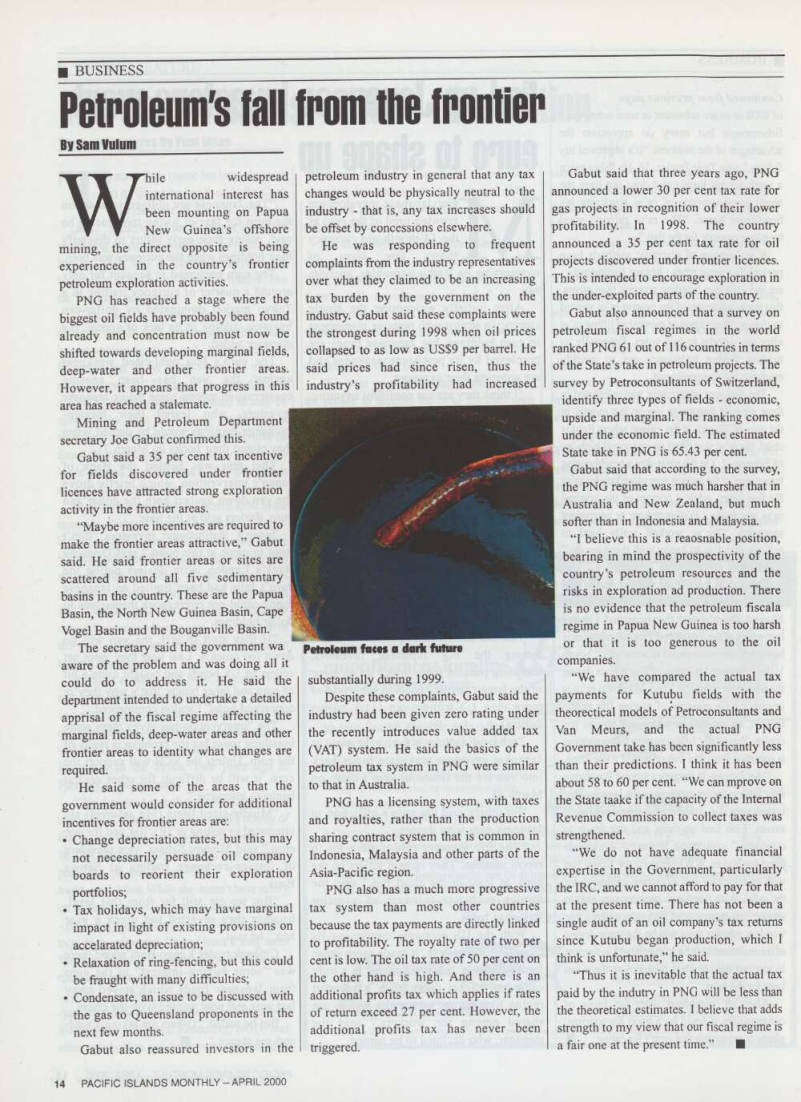
Petroleum faces a dark future
Asian Development Bank warns against slowing
down reforms
Asia is recovering faster than expected but should resist calls to slow down reforms in its headlong pursuit of higher economic growth, the region’s premier development bank said.
The Asian Development Bank (ADB) warned that a “growth first approach” was risky and may invite a recurrence of the financial crisis that swept through the region in 1997.
A report by the Manila-based bank’s regional economic monitoring unit said that as recovery firms up in the five most affected countries - Indonesia, Malaysia, the Philippines, Thailand and South Korea -
there were already signs complacency was
setting in.
“Some have suggested that a more cautious approach to reform is now needed to allow growth to take firmer root. They point out that the initial impact of restructuring is likely to be deflationary as retrenchment and bankruptcies occur, and that this could disrupt the recovery,” said the report.
The ADB said that while the suggestion was appealing, there were dangers involved in postponing the reforms, which were often painful as they would result in the closure of debt-ridden banks and companies.
“A ‘growth first’ strategy is not only risky, it may invite recurrence of problems at a later date, particularly if underlying structural difficulties are not tackled,” the report said. It said the high public debt of these countries limited the effectiveness of such a scheme and stressed that the “best chances for durable recovery require perseverance with reform”.
The report added:“Encouraging economic activity by postponing or cancelling needed but difficult reforms can exact a high cost in terms of a reduction in
long-run potential growth.”
The ADB said the region’s recovery has been “encouraging and faster than
expected”, although incomes and living standards were still below pre-crisis levels.
But the recovery has been “uneven” with South Korea springing back the fastest to post a gross domestic product (GDP) growth of 10.2 per cent in 1999, and Indonesia lagging behind because of domestic political problems.
The recovery has also not been broad based, with the stock markets leading the rebound and property markets eating the dust, the bank said. Private investment and consumption have yet to catch up with public spending and industry has yet to keep pace with the growth in agriculture.
Favorable external conditions such as the strength of the US, Japanese and European economies are seen to bolster recovery. The investor panic that gripped the region has also subsided, the bank said.
While the rebound is expected to strengthen this year, the reforms in the finance and corporate sectors were not being implemented as scheduled in some of the affected countries.
“In all five countries, progress on the
resolution of corporate debt is slower than banking sector restructuring,” the bank said, adding that there have been isolated cases of bailouts.
It described the situation in Indonesia as “highly problematic” as most banks were insolvent and operating only with the support of the Indonesian central bank.
In Indonesia, “bank privatization programs have progressed slower than envisaged, and reforms targetting non-bank financial intermediaries have lagged behind those targetting banks,” it said.
Malaysia and South Korea have “made the most progress” on bringing down the ratio of bad loans and restoring bank capital. Thailand’s private sector-led approach “seems to be delivering results” as bad loans were on a downward trend.
It said social issues present a long-term challenge to Asian economies, as the social and environmental costs of the crisis were likely to be felt much longer after the recovery. The bank suggested an approach that “empowers people rather than provides unsustainable subsidies.” ■
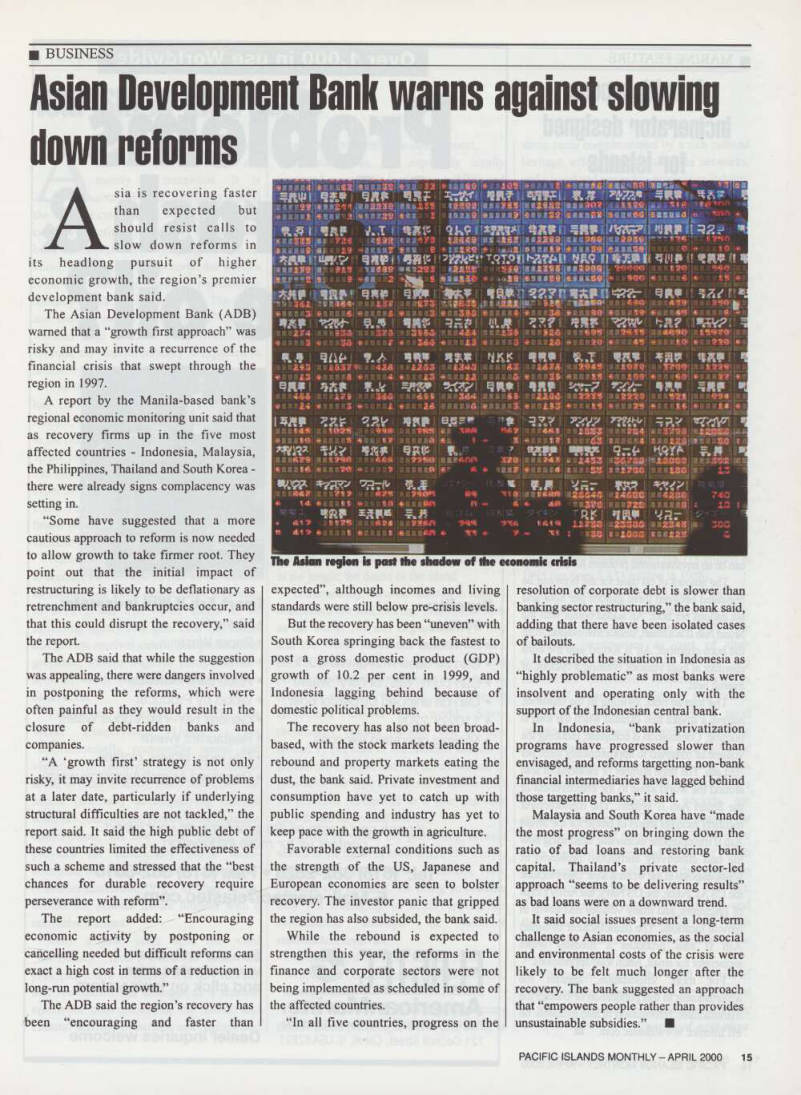
The Asian region is past Hie shadow of the economic crisis
A multipurpose

Marine Feature
A multipurpose incinerator designed for islands
The Smart Ash H, a multipurpose incinerator that uses a 55 gallon drum for a bum chamber, has been designed for use on islands and remote areas where trash build up and/or waste oil can be a problem. The Smart Ash II is unique because it can eliminate a variety of waste. Dry materials or materials with high BTU value like filters, wood by products, oily rags, etc, are burned clean and smoke free by simply lighting the load and turning on the system.
Material with high-moisture content, like restaurant waste, or wet rubbish is burned by using the waste oil injection system which adds oil to the load as the bum progresses. In other words, the waste oil can be used as fuel for the wet incinerator. The oil injection system serves two purposes; It allows the incineration of moist products that would otherwise have been a disposal problem and it eliminates waste oil that can be an environmental problem for the island.
The amount of oil used for the bum can be regulated between three gallons per hour and six gallons per hour. An added bonus with the Smart Ash II is a clean, smoke free exhaust from the bum chamber. Air is forced into the bum chamber at high velocity, creating a cyclone of intense heat The intense heat, swirling in the chamber, assures a smoke free exhaust when the load is burning. Combustion is complete, reducing the volume of materials to approximately three per cent ash. The large number of incinerators sold around the world attest to the effectiveness of the Smart Ash II system. The manufacturer regularly receives letters of praise for the Smart Ash II multipurpose incinerator, describing how the unit effectively eliminated problems of waste disposal in the writeris area. Users include file US Air Force, the US Navy, the Army Corps of Engineers, and many villages and towns in remote locations. The manufacturer of Smart Ash II also produces a medical waste incinerator for small, batch load applications.
For more information, consult the advertisement in this publication or contact the manufacturer. Information is also available on tiie Internet; www.elastec.com ■
Advertisements & other items, p. 16 (1 item)
waste oil?
Over 1,000 in use Worldwide
Problems
with trash &
waste oil?
Smart %shll
POWER TO BURN
The worlds smallest
multipurpose incinerator
eliminates waste with
incredible efficiency.
Benefits: • Portable • Eliminates waste oil • Can be used with or without fuel • Can burn "wet" or "dry" waste • Can be shipped by parcel post • 110 v or 220 v • Minimal operating expense Smart Ash II Will Incinerate: • Waste Oil • Paper Waste • Filters • Absorbent Materials • Wood by Products • General Non-Hazardous Waste • Restaurant Waste • Oily rags, gloves, clothes • Deceased Animals/biological waste If trash and waste oil are problems on your island, contact us for more information.
Tel: (618) 382-2525 • Fax: (618) 382-3610 E-Mail: [email protected]
ELHSTEC
American Marines
For Innovative Environmental Products 121 Council Street, Carmi, IL U5A62821 See our web site www.elastec.com and click on Incinerators Dealer inquiries welcome
Tourism in the Pacific
Tourism Feature
At the threshold of the new millennium, ecotourism is not merely a buzzword. It is something real happening around the world. Ecotourism is starting to provide tangible benefits for a variety of countries, both developed and developing. As we all know, tourism has now become the world’s most important civil industry, representing annually a US$ 3.5 trillion activity. The travel and tourism industry employs 127 million workers (one in 15 workers worldwide).
Overall, the tourism industry is expected to double by the year 2005 (WTTC, 1998).
The World Tourism Organization (WTO) has conducted forecasts of international tourism, which grew by more than 57 per cent in the past decade and is expected to grow by 50 per cent in this decade. The approximately 595 million international travelers in 1997 are expected to grow to 661 million by the year 2000 . The segment of tourism undergoing the fastest growth is nature-based tourism, which includes ecotourism.
Nature-based tourism has been estimated to account for between 10 and 15 per cent of all international travel expenditures, according to WTTC, and that figure seems to be increasing rapidly. It is quite clear that unless this growth receives careful and professional guidance, serious negative consequences some of which may have terminal effects could occur.
Ecotourism, as defined by IUCN - the World Conservation Union -, is “environmentally responsible travel and visitation to relatively undisturbed natural areas, in order to enjoy, study and appreciate nature (and any accompanying cultural features - both past and present), that promotes conservation, has low visitor impact, and provides for beneficially active socio economic involvement of local populations” (Ceballos-Lascurain, 1996). In other words, ecotourism denotes nature tourism with a normative element.
Only a few years ago, the word “ecotourism” didn’t exist, let alone the principles it now embodies. It is only recently that ecotourism has emerged as a feasible option for both conserving the natural and cultural heritage of nations and regions and
contributing to sustainable development.
Natural areas, and especially legally protected areas, their landscape, wildlife and flora - together with any existing cultural features - constitute major attractions for the peoples of the countries in which they are found and for tourists around the world.
These last few years have witnessed a remarkable upsurge of ecotourism activities around the world. Governments of the most varied countries are showing heretofore unknown interest in ecotourism, recognizing its enormous capabilities for conserving the natural and cultural heritage of their nations and also its rich potential for ensuring
sustainable development.
Conservation NGOs around the planet are also embarking upon ecotourism projects, recognizing in them an important ally.
Ecotourism operators and professional membership organizations are sprouting everywhere. Local communities in remote localities, which until very recently had very little contact with “modem” civilization, are now attracting ecotourists to their settlements in the jungle, the desert or the island.
Unfortunately, accurate statistics as regards ecotourism are still lacking. Institutions such as the World Tourism Organization (WTO) and the World Travel & Tourism Council (WTTC) are urging both governments and private firms to generate trustworthy data in order to evaluate the true magnitude of ecotourism around the world. Some preliminary studies indicate that perhaps around 15 per cent of international tourism is ecotourism-oriented and that the annual rate of growth of this type of tourism is also around 15 per cent (compared to a four per cent growth rate for overall tourism.
Countries which are generating success stories in the realm of ecotourism, like Kenya, Costa Rica, South Africa, Australia, New Zealand and Ecuador, are doing so because they are managing to attain appropriate coordination amongst the different stakeholders involved; • Government, the tourism industry; and • NGOs, local communities and universities, among others.
All of these countries have extraordinary natural assets (landscape, fauna, and flora), in
some cases complemented by a rich cultural heritage, effective protected area networks, and a vocal and pro-active ecotourism industry sector, interested in achieving conservation and sustainable development goals, as well as good business.
The countries mentioned above are all very competitive because, apart from their singular assets, there has been a joint interest on behalf of both government and private industry to develop ecotourism, since both sectors in these countries have recognized that there are very important benefits to reap from ecotourism.
Also, in many of these countries it has been recognized that not only benefits are to be shared, but responsibilities as well.
Indeed, nature-oriented tourism has become the largest foreign exchange earner in several nations, such as Costa Rica, Kenya, and South Africa. In Costa Rica, tourism arrivals totaled over 792 thousand in 1995 (up from 261,000 in 1986). More than 66 per cent of all tourists traveling in Costa Rica during 1996 visited a natural protected area. Gross receipts from tourism were US$ 718 million in 1995 (up from $ 133 million in 1986).
It is interesting to mention that by the mid -19905, nearly every nonindustrialized country, and many industrialized ones as well, were promoting ecotourism as part of their development strategy. All of the top ecotourism destination countries have an image of relative peacefulness and safety, extensive undisturbed wildlands, a good protected area network, as well as interesting native cultural heritage (of the past and/or the present). Some entire countries, such as Costa Rica and Belize, are billed as ecotourism destinations. Elsewhere, pockets are promoted, such as the Galapagos Islands, the Andean region and Amazonia in Ecuador; the lakes region, Patagonia and Tierra del Fuego in Argentina; the habitat of the mountain gorillas in Uganda and, before its civil war, Rwanda; Zanzibar, Mount Kilimanjaro, and the game parks in Tanzania; the most spectacular national parks (especially in the West) of the USA, etc.
Throughout most of the world, the rise of ecotourism has coincided with the promotion of free markets and economic globalization, Continued next page
Continued from previous page with the private sector hailed as the main engine for development. In many countries, state-run enterprises, including those in the tourism industry, are being sold off or shut down. This push towards privatization has been propelled by the international lending and aid agencies and major corporate players, who try to avoid excessive bureaucracy and inefficiency. In most successful ecotourism destination countries, however, even if there is a drive towards privatization, the governments (through their Ministry of Tourism or Tourism Board) are actively promoting the ecotourism attractions of their countries in a very energetic way in international forums and through the media. Evidently, it pays off more to promote partnerships than to enforce strict regulations.
And, of course, the ecotourists themselves are pushing the market around the world. Over 30 million Americans, for example, belong to environmental organizations or profess an interest in environmental protection. In the US and Canada it is estimated that there are close to 60 million bird watchers, of which about 25 million travel every year away from their homes to go watch birds. In the UK, recent estimates indicate that there are over one million “serious” bird watchers or birders. All those children and youngsters ardently watching TV documentaries on nature and distant “exotic” lands will want to visit these wonders themselves and many will perhaps become ecotourists when they grow older.
Most important, the paradigms and models of ecotourism development will surely affect the way other types of more traditional tourism are carried out. All tourism (even mass tourism) will surely benefit from this trend, since travel and lodging should become more environmentally friendly and every kind of tourist will be expecting a clean and less disturbed environment.
At a more local and grass-roots level, the following recent experiences in ecotourism are noteworthy for having generally achieved a high degree of success: the Cofan Community Ecotourism Programme in Zabalo (Cuyabeno Reserve), Ecuador; ecotourism developments in the Lower Kinabatangan River Valley, Sabah (Borneo), Malaysia; El Mazunte Campesino Ecological Reserve, Oaxaca, Mexico; the Simunye Zulu Natural Heritage Site and Ecotourism Project, KwaZulu Natal, South Africa.
This is not the place to discuss in extenso
the abovementioned experiences, which constitute only a brief sampling of what is currently going on in the field of ecotourism in different comers of our planet. Generally speaking, we may say that in all of them, the active involvement of the local communities in the ecotourism process has played a key role in their success.
But not everything about ecotourism is on the bright side. There are also serious problems. Since the term “ecotourism” has currently become very popular, being overused and misused in numerous instances, many pseudo-ecotour outfits are being set up, masquerading as “green operations”, but in reality only seeking a fast profit, engaging in no real environmental consciousness or co responsibilities. In other cases, projects with the intention of being “ecotouristic” have failed because the training aspects were neglected, or the active involvement of the local communities was not achieved, or for a number of other reasons. Also, tourist “mega projects” continue rampant in many countries, especially in beach environments, with their well-known ravaging effects on the natural and cultural environment.
But genuine, well-planned ecotourism
projects are definitely becoming more and more numerous and popular everywhere and hopefully they will establish new trends for the 21st century, in which all human activities will have to be of a sustainable nature.
The question is no longer if tourism may perform a role in the conservation of the natural and cultural heritage of our planet, but rather what are the specific steps that need to be taken in different countries to carry out activities that will ensure an adequate symbiosis between tourism, conservation, and sustainable development.
Tourism arrivals in the South Pacific have been growing considerably over the last decade. According to the Tourism Council of the South Pacific (TCSP), in 1998 there was a total 0f967,600 arrivals to the TCSP countries, compared to 666,674 in 1989 (an increase of over 45 per cent). A major proportion of these tourists (75 per cent) came to the region for holiday purposes. In 1998, tourist receipts for the region were sl.l billion and there was a total of 15,985 rooms in the TCSP countries.
As regards priorities for the future, TCSP is making substantial efforts towards sustainability and self-sufficiency. No further financial support is envisaged from the
European Union in the mid-term .future. Any further EU support would be project-based and within the areas of human resource development and the environment. That is why the TCSP Regional Tourism Marketing Plan for the period 1998-2002 considers that imaginative and creative cost-effective measures most useful for TCSP members will be needed to compensate for this lack of external funding. TCSP is also determined to coordinate a revitalised image for the region, recognising that scant attention has been given in the recent past to establishing a strong and clear image for the South Pacific region, with the results that what recognition exists is misleading, confused, and likely to be rooted in the “tropical island beach paradise” of the 1950 s movie.
All this indicates a clear need to move in the direction of ecotourism and other sustainable tourism practices. As is well known, the heyday of mass beach tourism seems to be over and there is a growing trend for tourists having a more enlightening travel
experience, heeding more importance to the
natural and cultural environment of each destination.
The South Pacific has much to offer in both departments. This goes in line with TCSP’s interest in providing particular emphasis on quality activity-based culture and nature products, and rural village tourism, which should enhance the socio-economic development of each nation.
The islands of the South Pacific possess great ecological interest and unique environmental features. Islands have long been classified as either continental or oceanic, but the meaning of these terms differs among academic disciplines.
Zoogeographers consider an island oceanic if it has not been attached to a continent during the history of the group of organisms being studied. Continental islands have had such connections (often called “land bridges” in the past). The distinction, from the point of view of animal dispersal, is obvious and important.
All of the islands of the region are oceanic in this sense.
Thus their indigenous faunas lack such continental elements as terrestrial mammals; only those groups of animals capable of over water dispersal are represented. If the right steps are taken, the South Pacific could indeed become a relevant ecotourism destination in the 21st century. ■
Advertisements & other items, p. 19 (1 item)
Welcome to the Magic of
Pub Conseil - Photos : P. Bacchet - J. Crespel - G.I.E. Tahiti Tourisme
Tahiti and her islands.
£3 • -ri-
V 'V W '
, ■* • gfeN * * I / / rou n i Tahiti Tourisme Immeuble Paofai, Batiment D, Boulevard Pomare, BP 65, Papeete,Tahiti, French Polynesia Tel. (689) 50 57 00, Fax. (689) 43 66 19
[email protected], www.tahiti-tourisme.com
Asia-Pacific airlines slow to cash in on the Net
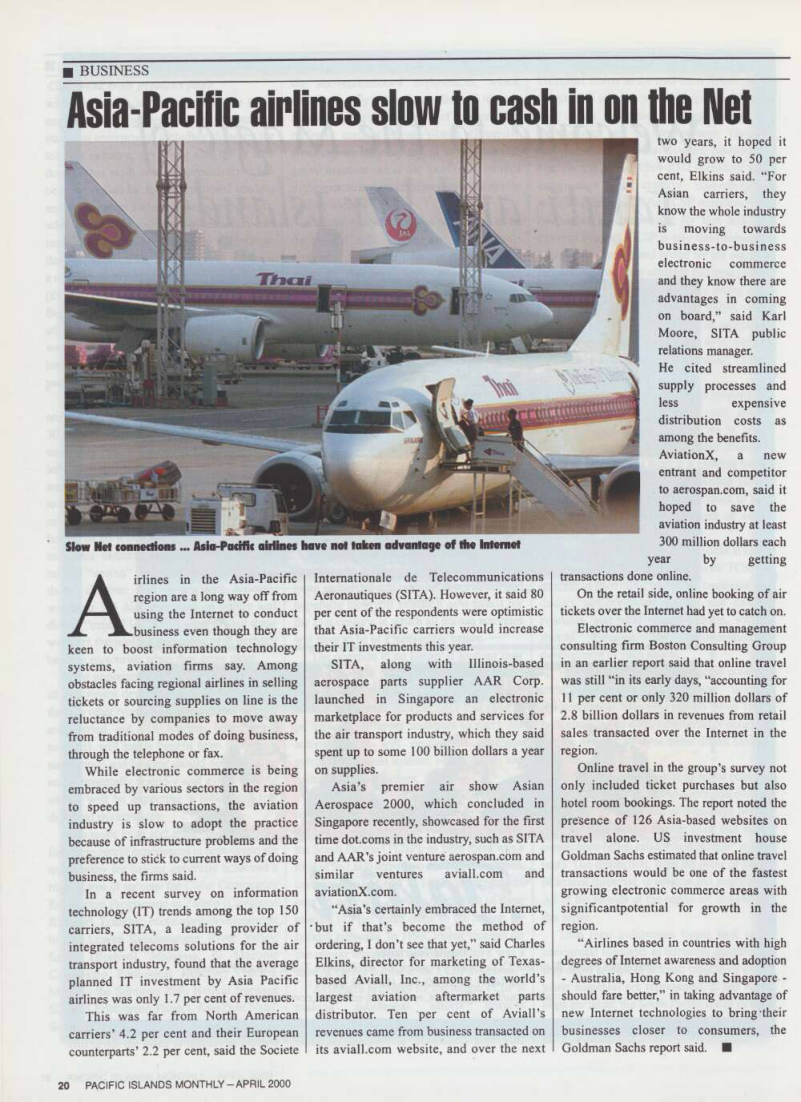
Airlines in the Asia-Pacific region are a long way off from using the Internet to conduct business even though they are keen to boost information technology systems, aviation firms say. Among obstacles facing regional airlines in selling tickets or sourcing supplies on line is the reluctance by companies to move away from traditional modes of doing business, through the telephone or fax.
While electronic commerce is being embraced by various sectors in the region to speed up transactions, the aviation industry is slow to adopt the practice because of infrastructure problems and the preference to stick to current ways of doing business, the firms said.
In a recent survey on information technology (IT) trends among the top 150 carriers, SITA, a leading provider of integrated telecoms solutions for the air transport industry, found that the average planned IT investment by Asia Pacific airlines was only 1.7 per cent of revenues.
This was far from North American carriers’ 4.2 per cent and their European counterparts’ 2.2 per cent, said the Societe
Internationale de Telecommunications Aeronautiques (SITA). However, it said 80 per cent of the respondents were optimistic that Asia-Pacific carriers would increase their IT investments this year.
SITA, along with Illinois-based aerospace parts supplier AAR Corp. launched in Singapore an electronic marketplace for products and services for the air transport industry, which they said spent up to some 100 billion dollars a year
on supplies.
Asia’s premier air show Asian Aerospace 2000, which concluded in Singapore recently, showcased for the first time dot.coms in the industry, such as SITA and AAR’s joint venture aerospan.com and similar ventures aviall.com and aviationX.com.
“Asia’s certainly embraced the Internet, but if that’s become the method of ordering, I don’t see that yet,” said Charles Elkins, director for marketing of Texas based Aviall, Inc., among the world’s largest aviation aftermarket parts distributor. Ten per cent of Aviall’s revenues came from business transacted on its aviall.com website, and over the next
two years, it hoped it would grow to 50 per cent, Elkins said. “For Asian carriers, they know the whole industry is moving towards business-to-business electronic commerce and they know there are advantages in coming on board,” said Karl Moore, SITA public relations manager.
He cited streamlined supply processes and less expensive distribution costs as among the benefits.
AviationX, a new entrant and competitor to aerospan.com, said it hoped to save the aviation industry at least 300 million dollars each
year by getting
transactions done online.
On the retail side, online booking of air tickets over the Internet had yet to catch on.
Electronic commerce and management consulting firm Boston Consulting Group in an earlier report said that online travel was still “in its early days, “accounting for 11 per cent or only 320 million dollars of 2.8 billion dollars in revenues from retail sales transacted over the Internet in the region.
Online travel in the group’s survey not only included ticket purchases but also hotel room bookings. The report noted the presence of 126 Asia-based websites on travel alone. US investment house Goldman Sachs estimated that online travel transactions would be one of the fastest growing electronic commerce areas with significantpotential for growth in the region.
“Airlines based in countries with high degrees of Internet awareness and adoption - Australia, Hong Kong and Singapore should fare better,” in taking advantage of new Internet technologies to bring their businesses closer to consumers, the Goldman Sachs report said. ■
Slow Net connections ... Asia-Pacific airlines have not taken advantage of the Internet
Academics lead fight against family businesses

A group of South Korean academics has declared war on the nation’s omnipotent conglomerates, accusing them of backtracking on corporate reforms and demanding fair play and transparency in big business.
The campaign is led by Korea
University professor Jang Ha-Sung,
figurehead of the influential People’s Civic Solidarity for Participatory Democracy, which has won a cascade of public support for its quest for political reforms.
“The family-controlled structure of South Korean conglomerates is a major obstacle to corporate reforms,” Jang said.
The professor is whetting his sword to do battle with the wiley owners of the
country’s giant conglomerates, or “chaebol,” as the season of annual shareholders’ meetings kicks off here.
His campaign
has already got some firms on the defensive, with bosses floating a flurry of offers including new stock
options to
sharholders, share buybacks, and new business plans - to help prop up its stock price and broaden its shareholder base.
The most
ensure the firms introduce real reforms to break the absolute power of the behemoths’ ruling famlies as demanded by the reformist government.
“We will take tougher action to invoke minor shareholders’ rights such as bringing damages suits and calling for an inspection of company books,” Jang said.
He suggested the protection of minor stockholders was an effective tool to crack the chaebol’s family-controlled structure and introduce more open business practices after decades of opaque
operations.
The over-leveraged conglomerates, blamed for South Korea’s descent into crisis in late 1997, have been under enourmous government pressure to reform
remarkable change came at Hyundai Motor Co., the flagship of the country’s largest firm Hyundai Group, which replaced half of its directors - including members of its controlling family - with outside members at a shareholders’ meeting on Friday.
Hyundai officials said the new reforms would also spread to other Hyundai units.
But the civic group was not overly impressed, pledging stronger steps to
their debt-financed business styles that helped the economy boom in the 1980 s.
The drive has led to the dismantling of the failed Daewoo group, once the country’s second largest conglomerate.
Daewoo head Kim Woo-Choong was the first chaebol owner to step down amid revelations of mismanagement.
The chaebol were last year barred from transferring assets between subsidiaries to prop up weak units, a practice often used
to disguise losses or shady practice as Seoul called for owning families to relinquish their grip.
This year they were obliged to present stricter consolidated balance sheets covering all their operations as Seoul forges ahead with its reforms crusade to wipe out the weaknesses that contributed to the crisis.
“Overall, we see improvement in corporate reforms. We will move further to curb circular shareholding next year,” Lee Jae-Koo, a Fair Trade Commission official, said.
But Professor Jang insisted local firms still have a long way to go, accusing some chabol owners of using shadowy in-house transactions to entrench their power.
“Corporate reforms are now at a critical junction. The rules have not been fully translated into action,” he said.
The crusader singled out Samsung and Hyundai as targets, saying the powerful groups had abused “circular shareholdings” to \ retain family control.
For example, he S says, Samsung chief 1 Lee Kun-Hee has i only a two per cent stake in Samsung I Electronics Co but ( effectively controls 1 the money-spinner through a 25 per cent
stake in the firm held by other group affiliates. Lee came under under fire last year when a substantial portion of shares in Samsung SDS, an Internet-related business, was transferred to relatives at 7000 won per share.
Samsung SDS is unlisted, but its shares are traded at 500,000 won (445 dollars) in the over the counter market. The group has flatly denied any illegality in the share transfer. ■
On the defensive ... family-owned businesses are under attack
Fiji to host tourism exchange in May
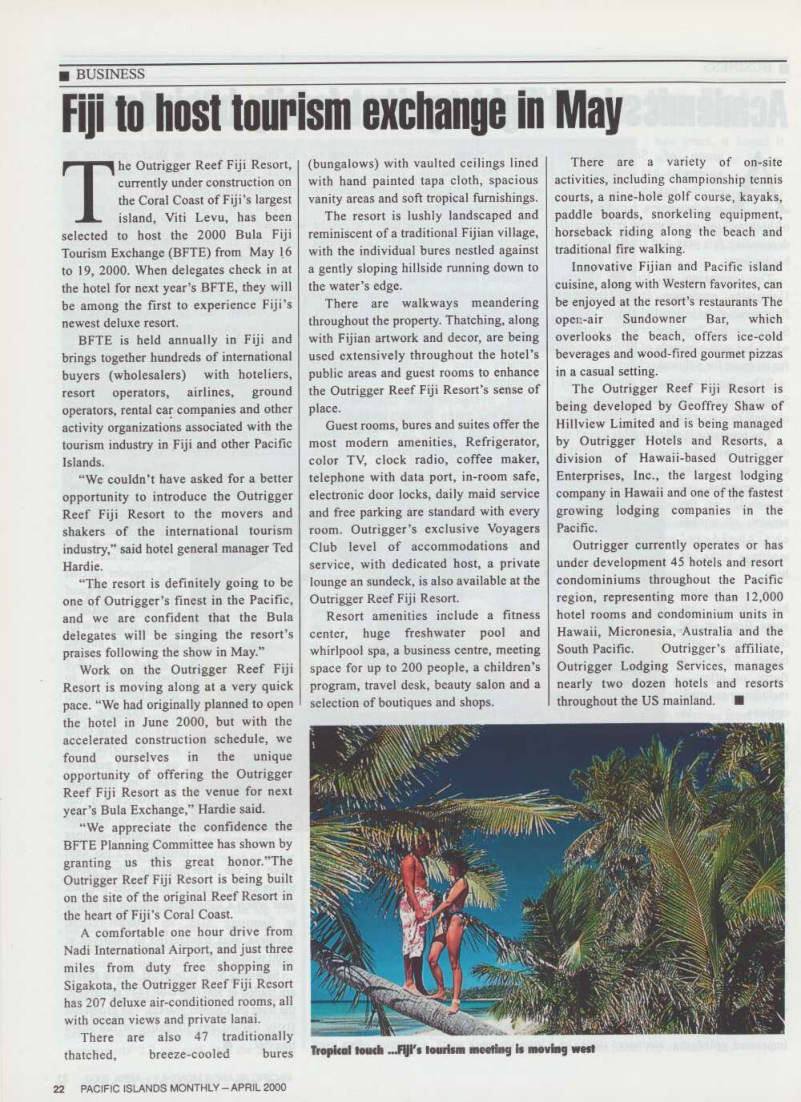
The Outrigger Reef Fiji Resort, currently under construction on the Coral Coast of Fiji’s largest island, Viti Levu, has been selected to host the 2000 Bula Fiji Tourism Exchange (BFTE) from May 16 to 19, 2000. When delegates check in at the hotel for next year’s BFTE, they will be among the first to experience Fiji’s newest deluxe resort.
BFTE is held annually in Fiji and brings together hundreds of international buyers (wholesalers) with hoteliers, resort operators, airlines, ground operators, rental car companies and other activity organizations associated with the tourism industry in Fiji and other Pacific Islands.
“We couldn’t have asked for a better opportunity to introduce the Outrigger Reef Fiji Resort to the movers and shakers of the international tourism industry,” said hotel general manager Ted Hardie.
“The resort is definitely going to be one of Outrigger’s finest in the Pacific, and we are confident that the Bula delegates will be singing the resort’s praises following the show in May.”
Work on the Outrigger Reef Fiji Resort is moving along at a very quick pace. “We had originally planned to open the hotel in June 2000, but with the accelerated construction schedule, we found ourselves in the unique opportunity of offering the Outrigger Reef Fiji Resort as the venue for next year’s Bula Exchange,” Hardie said.
“We appreciate the confidence the BFTE Planning Committee has shown by granting us this great honor.” The Outrigger Reef Fiji Resort is being built on the site of the original Reef Resort in the heart of Fiji’s Coral Coast.
A comfortable one hour drive from Nadi International Airport, and just three miles from duty free shopping in Sigakota, the Outrigger Reef Fiji Resort has 207 deluxe air-conditioned rooms, all with ocean views and private lanai.
There are also 47 traditionally thatched, breeze-cooled bures
(bungalows) with vaulted ceilings lined with hand painted tapa cloth, spacious vanity areas and soft tropical furnishings.
The resort is lushly landscaped and reminiscent of a traditional Fijian village, with the individual bures nestled against a gently sloping hillside running down to the water’s edge.
There are walkways meandering throughout the property. Thatching, along with Fijian artwork and decor, are being used extensively throughout the hotel’s public areas and guest rooms to enhance the Outrigger Reef Fiji Resort’s sense of place.
Guest rooms, bures and suites offer the most modern amenities, Refrigerator, color TV, clock radio, coffee maker, telephone with data port, in-room safe, electronic door locks, daily maid service and free parking are standard with every room. Outrigger’s exclusive Voyagers Club level of accommodations and service, with dedicated host, a private lounge an sundeck, is also available at the Outrigger Reef Fiji Resort.
Resort amenities include a fitness center, huge freshwater pool and whirlpool spa, a business centre, meeting space for up to 200 people, a children’s program, travel desk, beauty salon and a selection of boutiques and shops.
There are a variety of on-site activities, including championship tennis courts, a nine-hole golf course, kayaks, paddle boards, snorkeling equipment, horseback riding along the beach and traditional fire walking.
Innovative Fijian and Pacific island cuisine, along with Western favorites, can be enjoyed at the resort’s restaurants The open-air Sundowner Bar, which overlooks the beach, offers ice-cold beverages and wood-fired gourmet pizzas in a casual setting.
The Outrigger Reef Fiji Resort is being developed by Geoffrey Shaw of Flillview Limited and is being managed by Outrigger Hotels and Resorts, a division of Hawaii-based Outrigger Enterprises, Inc., the largest lodging company in Hawaii and one of the fastest growing lodging companies in the Pacific.
Outrigger currently operates or has under development 45 hotels and resort condominiums throughout the Pacific region, representing more than 12,000 hotel rooms and condominium units in Hawaii, Micronesia, Australia and the South Pacific. Outrigger’s affiliate, Outrigger Lodging Services, manages nearly two dozen hotels and resorts throughout the US mainland. ■
Tropical touch ... Fiji's tourism meeting is moving west
Indonesia's environmental unity
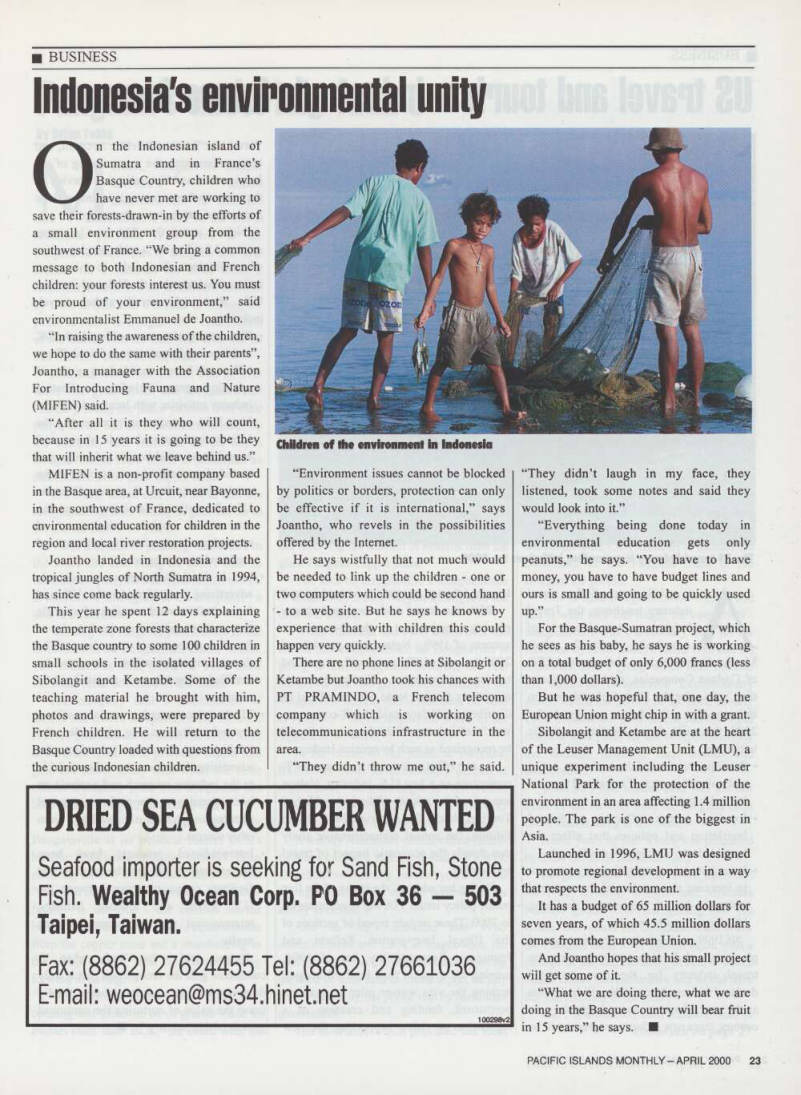
On the Indonesian island of Sumatra and in France’s Basque Country, children who have never met are working to save their forests-drawn-in by the efforts of a small environment group from the southwest of France. “We bring a common message to both Indonesian and French children: your forests interest us. You must be proud of your environment,” said environmentalist Emmanuel de Joantho.
“In raising the awareness of the children, we hope to do the same with their parents”, Joantho, a manager with the Association For Introducing Fauna and Nature (MIFEN) said.
“After all it is they who will count, because in 15 years it is going to be they that will inherit what we leave behind us.”
MIFEN is a non-profit company based in the Basque area, at Urcuit, near Bayonne, in the southwest of France, dedicated to environmental education for children in the region and local river restoration projects.
Joantho landed in Indonesia and the tropical jungles of North Sumatra in 1994, has since come back regularly.
This year he spent 12 days explaining the temperate zone forests that characterize the Basque country to some 100 children in small schools in the isolated villages of Sibolangit and Ketambe. Some of the teaching material he brought with him,
photos and drawings, were prepared by
French children. He will return to the Basque Country loaded with questions from the curious Indonesian children.
“Environment issues cannot be blocked by politics or borders, protection can only be effective if it is international,” says Joantho, who revels in the possibilities offered by the Internet.
He says wistfully that not much would be needed to link up the children - one or two computers which could be second hand - to a web site. But he says he knows by experience that with children this could happen very quickly.
There are no phone lines at Sibolangit or Ketambe but Joantho took his chances with PT PRAMINDO, a French telecom company which is working on telecommunications infrastructure in the area.
“They didn’t throw me out,” he said.
“They didn’t laugh in my face, they listened, took some notes and said they would look into it.”
“Everything being done today in environmental education gets only peanuts,” he says. “You have to have money, you have to have budget lines and ours is small and going to be quickly used up.”
For the Basque-Sumatran project, which he sees as his baby, he says he is working on a total budget of only 6,000 francs (less than 1,000 dollars).
But he was hopeful that, one day, the European Union might chip in with a grant.
Sibolangit and Ketambe are at the heart of the Leuser Management Unit (LMU), a unique experiment including the Leuser National Park for the protection of the environment in an area affecting 1.4 million people. The park is one of the biggest in Asia.
Launched in 1996, LMU was designed to promote regional development in a way that respects the environment.
It has a budget of 65 million dollars for seven years, of which 45.5 million dollars comes from the European Union.
And Joantho hopes that his small project will get some of it.
“What we are doing there, what we are doing in the Basque Country will bear fruit in 15 years,” he says. ■
Children of the environment in Indonesia
Advertisements & other items, p. 23 (1 item)
Dried Sea Cucumber Wanted
Seafood importer is seeking for Sand Fish, Stone Fish. Wealthy Ocean Corp. PO Box 36 503 Taipei, Taiwan.
Fax: (8862) 27624455 Tel: (8862) 27661036 E-mail: [email protected] 100298v2
US travel and tourism industry's future focus
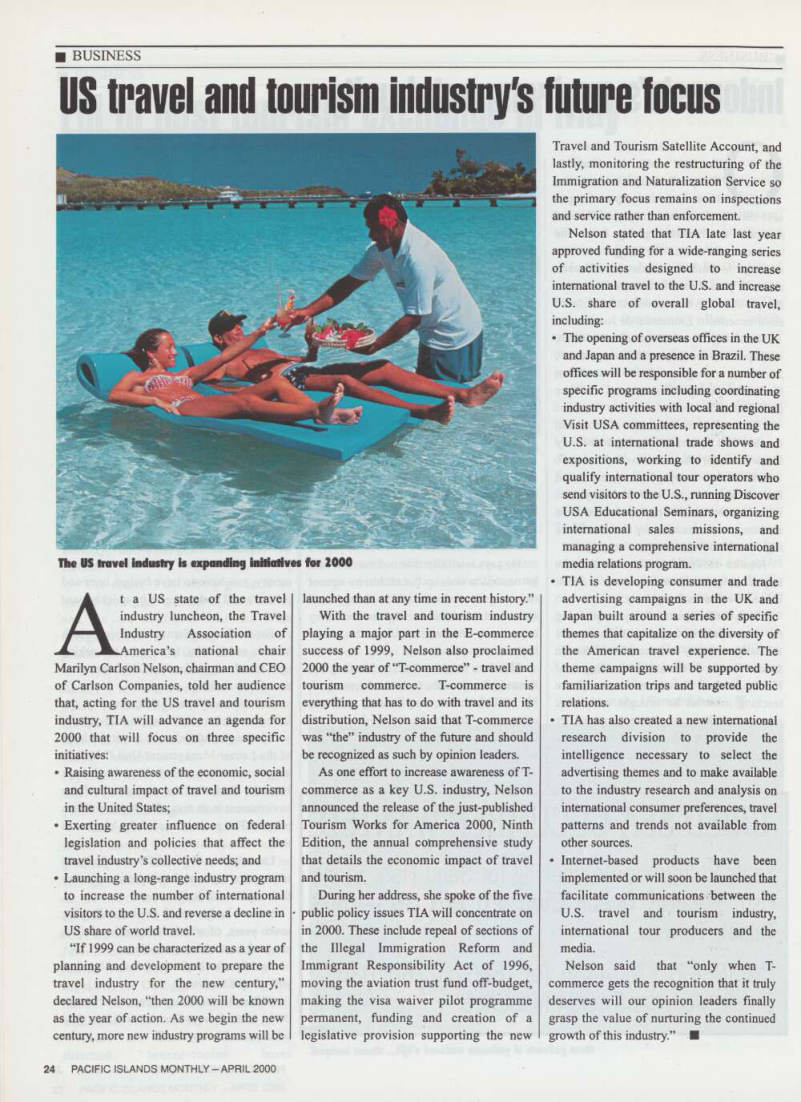
At a US state of the travel industry luncheon, the Travel Industry Association of America’s national chair Marilyn Carlson Nelson, chairman and CEO of Carlson Companies, told her audience that, acting for the US travel and tourism industry, TIA will advance an agenda for 2000 that will focus on three specific initiatives: • Raising awareness of the economic, social and cultural impact of travel and tourism in the United States; • Exerting greater influence on federal legislation and policies that affect the travel industry’s collective needs; and • Launching a long-range industry program to increase the number of international visitors to the U.S. and reverse a decline in US share of world travel.
“If 1999 can be characterized as a year of planning and development to prepare the travel industry for the new century,” declared Nelson, “then 2000 will be known as the year of action. As we begin the new century, more new industry programs will be
launched than at any time in recent history.”
With the travel and tourism industry playing a major part in the E-commerce success of 1999, Nelson also proclaimed 2000 the year of “T-commerce” - travel and tourism commerce. T-commerce is everything that has to do with travel and its distribution, Nelson said that T-commerce was “the” industry of the future and should be recognized as such by opinion leaders.
As one effort to increase awareness of T commerce as a key U.S. industry, Nelson announced the release of the just-published Tourism Works for America 2000, Ninth Edition, the annual comprehensive study that details the economic impact of travel and tourism.
During her address, she spoke of the five public policy issues TIA will concentrate on in 2000. These include repeal of sections of the Illegal Immigration Reform and Immigrant Responsibility Act of 1996, moving the aviation trust fund off-budget, making the visa waiver pilot programme permanent, funding and creation of a legislative provision supporting the new
Travel and Tourism Satellite Account, and lastly, monitoring the restructuring of the Immigration and Naturalization Service so the primary focus remains on inspections and service rather than enforcement.
Nelson stated that TIA late last year approved funding for a wide-ranging series of activities designed to increase international travel to the U.S. and increase U.S. share of overall global travel, including: • The opening of overseas offices in the UK and Japan and a presence in Brazil. These offices will be responsible for a number of
specific programs including coordinating
industry activities with local and regional Visit USA committees, representing the U.S. at international trade shows and expositions, working to identify and qualify international tour operators who send visitors to the U.S., running Discover USA Educational Seminars, organizing international sales missions, and
managing a comprehensive international
media relations program. • TIA is developing consumer and trade advertising campaigns in the UK and Japan built around a series of specific themes that capitalize on the diversity of the American travel experience. The theme campaigns will be supported by familiarization trips and targeted public relations. • TIA has also created a new international research division to provide the intelligence necessary to select the advertising themes and to make available to the industry research and analysis on international consumer preferences, travel patterns and trends not available from other sources. • Internet-based products have been implemented or will soon be launched that facilitate communications between the U.S. travel and tourism industry, international tour producers and the media.
Nelson said that “only when T commerce gets the recognition that it truly deserves will our opinion leaders finally grasp the value of nurturing the continued growth of this industry.” ■
The US travel industry is expanding initiatives for 2000
Panguna's uncertain future
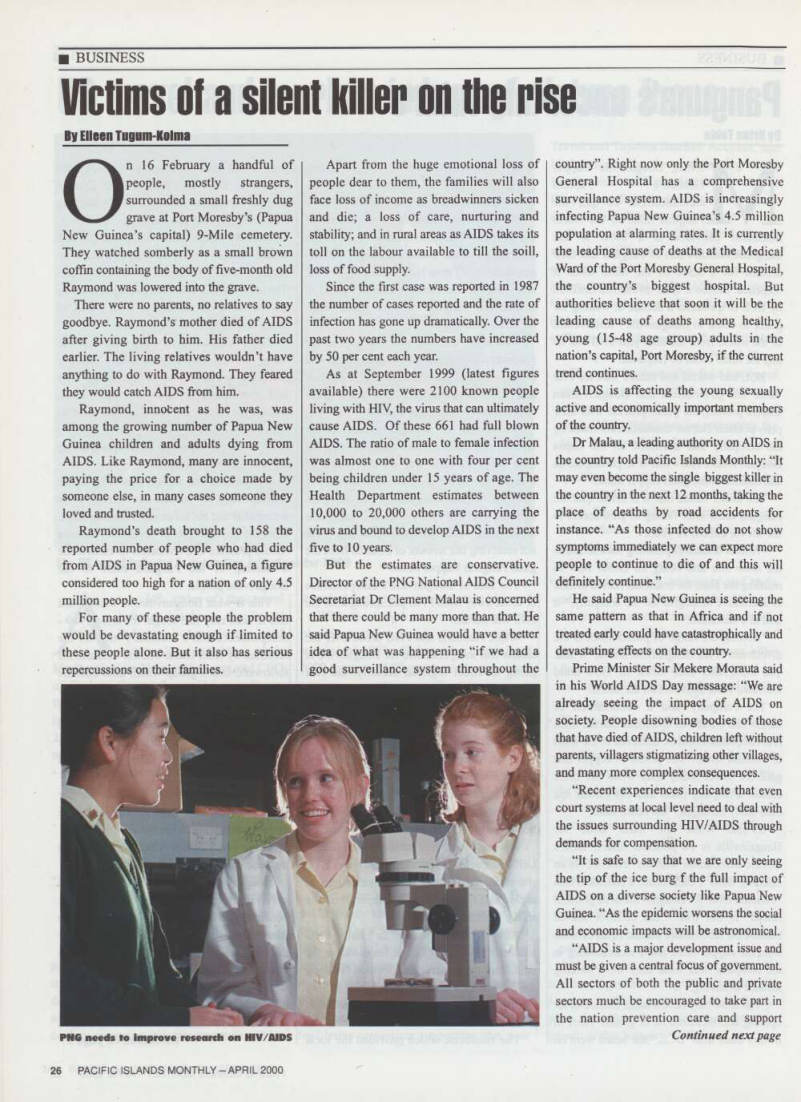
By Brian Tobia
MINER, Bouganville Copper Limited’s recent announcement to quit the Panguna mine in the North Solomons province is a blow to the indigenous landowners of Panguna and their dreams for a stake in the mine when it reopened. Indeed it is an investment decision by BCL to quit after a decade of waiting for peace to come to Bouganville - resurrection of the island from the nine-year civil war so that the mine could be reopened.
BCL had waited and cannot wait for-ever while the government and Bouganvillean leaders prolong the peace process with their petty politics. But the announcement made by the company had shattered all the hopes Bouganvilleans had - this is to participate as shareholder in the giant copper mine.
The miner stated that it is set to quit the Panguna mine after failing to gain access to the site for almost 10 years.
“After a decade of planning for a return to the mine site and being no closer now to realising the plan, the board has started to look at alternative strategies for the company,” it said in a statement.
“Among the range of possibilities is the divestment of the Bougainville assets,” it said.
The mine was shut down in 1998 amid increased rebel activities on the island.
The company said a combination of factors had eroded its optimism that the mine redevelopment could be achieved in the short to medium term. “The prices of copper and gold are lower today than when the mine closed. Company plant and equipment has been badly damaged,” the board said.
It said while the main issue for Bougainville is its political future, BCL’s historic association with the conflict “is an enduring issue”. BCL board’s statement that “the main issue for Bouganville is its political future” is not true - the conflict started because the landowners wanted equal benefits from the copper mine and a shareholding in the company was what they were looking forward to having.
“The mine may have a better chance of re opening and therefore be of greater value to owners other than BCL,” the board went on
to say. Who are the owners? The are mining giants, RTZ and CRA and of course the invisible owners are the landowners.
So after the massacre of thousands of indigenous Bouganivilleans and mass destruction of the island’s ecology, will the government of Papua New Guinea allow RTZ and Conzinc Rio Tinto, Australia (CRA) to reopen the Panguna Copper Mine when normalcy returns.
This is the question that is always at the forefront of the minds of Bouganvilleans and other interested parties while the Australian and PNG Governments and RTZ CRA executives are very silent about it.
Thousands of Bouganvilleans (men, women and children) and others died in the nine years of civil war on the island of Bouganville which is only several kilometres from the neighbouring country of Solomon Islands. The war really started because the landowners were dissatisfied that they were not receiving fair amount of benefits from the giant Panguna Copper Mine.
The idea of Bouganville’s independence or break away from PNG just sprung after the civil war started.
While Australia and PNG brood over the claims that independemce for Bouganville is going to affect regional security, the real reason for the two governments hostility on Bouganville literally lies underneath the land at Panguna - copper ore which is one of the biggest in the world.
In the centre of the island at Panguna, RTZ-CRA owns an enormously profitable copper mine - the mine begun in 1966 (before PNG became independent) and provided 11 per cent of PNG’s Gross Domestic Product.
A weekly Australian tabloid called Green- Left has quoted a statement made at a RTZ shareholders meeting several years ago as saying that the “right to land depends on the ability to defend it”.
And so the Australian and PNG administrators and CRA in league took the land from the people. And women resisting the theft of their land to create a port facility were clubbed by riot police sent by Australian government.
The rainforest which provided the local
people with their subsistence was destroyed to make way for Bouganville Copper Limited’s Panguna Mine which CRA controls a 52 to 56 per cent shareholding.
Land was taken at the point of the gun and whole villages were destroyed to make way for what is then the largest human made hole.
The mine is a half-a-kilometre deep and seven kilometers in circumference with a wall of waste dumped into the Java River.
The Financial Review reported that the value of CRA’s Panguna Mine sharply increased by $4B million on January 20, 1994 and speculators on the Australian Stock Exchange valued the mine at that time to about $144 million.
With the peace process slowly progressing and normalcy returning to Bouganville and a silent pondering of the shareholders to reopen the mine, it is anticipated that the value would further surge.
Both the governments of PNG and Australia should pressure CRA Minerals to transfer the ownership of the Panguna mine to the Bouganville people.
This is what Bouganvilleans wanted and this is what they had fought for since 1989 independence was a secondary item for the rebellion by rebel leader Francis Ona and his followers. Ona’s group which later became the outlawed Bouganville Revolutionary Army, forced the closure of the mine in early 1989 because the government and CRA did not hear their pleas for fair compensation for the damage done to their homes and environment.
What they had wanted also was the fair share of the benefits from the Panguna mine and a shareholding in the mine.
Nines years of war which was propelled by these demands and seen many Bouganvillieans lose their lives, many had survived tortures, hunger and diseases because goods were not getting into the island. But would the Bouganvilleans allow the Panguna mine to be opened again with a change in the shareholding structure which would ensure that the landowners would have the shareholding in the mine.
BRA commander, Sam Kauona, said in
Continued on page 27
Continued from page 25
May 1997 that the rebels might support the reopening of the giant Panguna Copper Mine.
The rebels would consider a deal to reopen the mine “provided independence from PNG is on the agenda”. Now that independence is out of the question with optimism for greater autonomy, is Mr Kauona considering to support the reopening of the mine with a deal for the landowners to have shareholding in the mine? But is CRA also going to consider this favorably, considering the fact that the war erupted of the landowners dissatisfaction over less benefits from the mine?
Former Prime Minister Sir Julius Chan had proposed to buy out RTZ-CRA’s 53.6 per cent stake in the mine in order to bring back normalcy to the trouble-tom island but the
developers had not yet received an offer from his government or other succeeding governments for that matter.
BCL chairman, Barry Cusack had also made it clear in a shareholders meeting in 1997 that the company would treat Panguna Mine “as a green field project if operations ever recommenced there”.
This v/ould mean undertaking a complete new feasibility study to reconfirm the size of the ore-body, depreciation of the assets, an environmental study and social and economic cost study. He said any plans to re-open the mine would not be considered before at least 2000. This plans never came about and BCL is quiting. So the Bouganville landowners would wait patiently on the decision of the owner (RTZ and CRA). ■
Victims of a silent killer on the rise
By Eileen Tugum-Kolma
On 16 February a handful of people, mostly strangers, surrounded a small freshly dug grave at Port Moresby’s (Papua New Guinea’s capital) 9-Mile cemetery.
They watched somberly as a small brown coffin containing the body of five-month old Raymond was lowered into the grave.
There were no parents, no relatives to say goodbye. Raymond’s mother died of AIDS after giving birth to him. His father died earlier. The living relatives wouldn’t have anything to do with Raymond. They feared they would catch AIDS from him.
Raymond, innofcent as he was, was among the growing number of Papua New Guinea children and adults dying from AIDS. Like Raymond, many are innocent, paying the price for a choice made by someone else, in many cases someone they loved and trusted.
Raymond’s death brought to 158 the reported number of people who had died from AIDS in Papua New Guinea, a figure considered too high for a nation of only 4.5 million people.
For many of these people the problem would be devastating enough if limited to these people alone. But it also has serious repercussions on their families.
Apart from the huge emotional loss of people dear to them, the families will also face loss of income as breadwinners sicken and die; a loss of care, nurturing and stability; and in rural areas as AIDS takes its toll on the labour available to till the soill, loss of food supply.
Since the first case was reported in 1987 the number of cases reported and the rate of infection has gone up dramatically. Over the past two years the numbers have increased by 50 per cent each year.
As at September 1999 (latest figures available) there were 2100 known people living with HIV, the virus that can ultimately cause AIDS. Of these 661 had full blown AIDS. The ratio of male to female infection was almost one to one with four per cent being children under 15 years of age. The Health Department estimates between 10,000 to 20,000 others are carrying the virus and bound to develop AIDS in the next five to 10 years.
But the estimates are conservative.
Director of the PNG National AIDS Council Secretariat Dr Clement Malau is concerned that there could be many more than that. He said Papua New Guinea would have a better idea of what was happening “if we had a good surveillance system throughout the
country”. Right now only the Port Moresby General Hospital has a comprehensive surveillance system. AIDS is increasingly infecting Papua New Guinea’s 4.5 million population at alarming rates. It is currently the leading cause of deaths at the Medical Ward of the Port Moresby General Hospital, the country’s biggest hospital. But authorities believe that soon it will be the leading cause of deaths among healthy, young (15-48 age group) adults in the nation’s capital, Port Moresby, if the current trend continues.
AIDS is affecting the young sexually active and economically important members of the country.
Dr Malau, a leading authority on AIDS in the country told Pacific Islands Monthly: “It may even become the single biggest killer in the country in the next 12 months, taking the place of deaths by road accidents for instance. “As those infected do not show symptoms immediately we can expect more people to continue to die of and this will
definitely continue.”
He said Papua New Guinea is seeing the same pattern as that in Africa and if not treated early could have catastrophically and devastating effects on the country.
Prime Minister Sir Mekere Morauta said in his World AIDS Day message: “We are already seeing the impact of AIDS on society. People disowning bodies of those that have died of AIDS, children left without
parents, villagers stigmatizing other villages,
and many more complex consequences.
“Recent experiences indicate that even court systems at local level need to deal with the issues surrounding HIV/AIDS through demands for compensation.
“It is safe to say that we are only seeing the tip of the ice burg f the full impact of AIDS on a diverse society like Papua New Guinea. “As the epidemic worsens the social and economic impacts will be astronomical.
“AIDS is a major development issue and must be given a central focus of government.
All sectors of both the public and private sectors much be encouraged to take part in the nation prevention care and support Continued next page
PNG needs to improve research on HIV/AIDS
Continued from previous page
strategy stipulated in the medium-term plan.
If measures are not put in place to curb this trend Papua New Guinea is heading for disaster. The future predicted if the trend continues is worrying. Papua New Guinea could end up as Prime Minister Sir Mekere said: “With a vaccum left by a whole generation of young people never to be filled”, especially in the labor force a whole generation of young children infected with HIV who may also be orphans because their parent(s) have died of AIDS, a poor economy due to a loss of a productive formal as well as informal workforce.
For a nation struggling with an ailing economy, disrupted by political upheaval, and law and order problems, AIDS is an added burden. And the country faces many challenges in tackling it. Sir Mekere said the biggest include the diversity of PNG culture, its difficult geographic terrain coupled with the language barriers (800 languages) and the high illiteracy rate (87 per cent?) which make communication a daunting task, myths about AIDS and different religious philosophies.
He said the evolution of culture and the shifts in rural subsistence way of life to an urban setting and the mixing of cultures and subcultures makes education for behavior changes a very challenging task.
Sir Mekere said: “In particular the practice of polygamy has become increasingly difficult to define in a modem setting. Polygamy in the traditional and rural setting had been well defined but appear to
have taken on a different form and entity in the modern setting, thus making sexual networking more complex then in the past.
This is also so with certain permissive cultural sexual encounters in traditional settings in some societies in the country.
The need and want for money he said has brought with it the practice of buying and selling goods and services, some of which are now regarded as needs and not luxury items. Close to 1 in 5 sex workers in Port Moresby are HIV positive He said also that the AIDS epidemic is bound to get worse as the economic situation worsens.
As more and more people continue to die and a few of those brave commendable people living with AIDS come out publicly, the country is slowly coming to terms with the fact that AIDS is very much alive and in PNG and is here to stay, many of the general public, especially those in the rural communities even more so than the leaders and the educated. But like many countries throughout the world PNG is now giving AIDS priority and has set up a National AIDS Council to develop comprehensive responses to combat the spread of AIDS.
The Prime Minister said there is not time for denial and urged all sectors to cooperate in the national AIDS response. He also urged everyone to do risk analysis at the family and individual level.
Dr Malau said; “AIDS is everybodyis business. And it will take individuals making a decision not to to put themselves at risk to effectively stop its spread.” ■
In brief
Due to the above factors we will need to be innovative in
developing interventions
that will be acceptable and that will work for PNG, said Dr Malau.
People with HIV or AIDS are sick just like any other patient.
They need the same love and care.
The National Constitution which is one of the best in the world protects all citizens of PNG. People living with AIDS share equal status as other citizens.
Figures are underreported because of weak surveillance system. If PNG we had a good surveillance system throughout the country it would have a better idea of trends. Currently some HIV/AIDS patients go away to the villages and authorities lose track of them.
Authorities are meeting with WHO in early May to discuss ways to get the best professional estimates under PNG’s current situation to challenge linking responsibilities with PNG’s local politicians so that they can put their money into AIDS prevention.
Malau said it is very difficult to follow up with known HIV positive and AIDS victims due to the weak surveillance system. But the Department of Health and the National AIDS Council are looking into ways to improving its AIDS surveillance.
He said AIDS also also affecting healthy women in normal relations with their husbands. It is creeping into every corner of society.
The DOH/NAD’s ability to monitor the trends is weak but it is giving priority to strenghtening this. Those most affected by HIV/AIDS are between the ages of 15 and 45, mostly healthy young people who are in the most economically productive and active part of their lives.
Predominantly spread through unprotected sex, this the case in 95 per cent of transimissions.
The second most common mode of transmission is from mother to child. ■
Net sparks revolution in South Korean stock market
South Korea has been plunged into a vortex of change as panic stricken stock brokerage houses scramble to catch up with
groundbreakers in the deep-discount
online share trading market.
The change was sparked by EMirae Asset Securities Co., which pioneered Internet stock trading here, riding an explosion in Internet usage, cyber banking and personal computers.
“The change here seems faster than in any other country,” said EMirae’s Choi Ki-Hoon. “From now on, the country’s stock brokerage industry will see a dramatic shake-up.”
For the first time for a local brokerage, EMirae last week offered a drastic price cut for some trading services - from 0.5 per cent to 0.29 per cent for off-line services and from 0.1 percent to 0.029 per cent for Internet linked “cyber trading.”
Other local players immediately followed suit, signalling the advent of standard deep-discount transactions in a nation where cyber trading has jumped from near zero two years ago to 44 per cent of total trading value by January.
“So far brokerage firms have kept their balance sheets mainly on improperly high trading fees by forming a cartel in pricing.
But this will no longer be the case as the system shifts fast toward cyber trading,”
Choi said.
“The proportion of cyber trading will increase further,” he said. Online trading will eliminate human intervention, helping firms to reduce personnel expenses.
Academics predict a “big bang” in the securities industry here where brokers once made around 70 per cent of their total revenue through classic trading commissions.
“Many players will inevitably be doomed due to the competition, a rapid
rise in online trading and deep-discount transactions,” Korea University Professor Lee Phil-Sang said.
But he urged security houses to compete to diversify resources and to offer value-added services, saying that cheap prices alsome would not attract customers.
“An upsurge in cyber trading is spawning a big bang in the sector which has been distorted by irresponsible trading, with brokers abusing the money of clients to boost company profits.”
His warning appears to be well founded. Daeshin Securities, a major local player, for example saw cyber stock trading jump to 72.2 per cent of its total transactions in January, from 10.9 per cent in April last year.
Overall online stock trading accounted for 44.6 per cent of South Korea’s total stock trade value in January, according to the Korea Securities Dealers’
Association. ■
Advertisements & other items, p. 28 (1 item)
Nations Unies
UNITED NATIONS
ECONOMIC AND SOCIAL COMMISSION FOR ASIA AND THE PACIFIC
PACIFIC OPERATIONS CENTRE (ESCAP/POC)
PORT VILA, VANUATU
HEAD, ESCAP PACIFIC OPERATIONS CENTRE, D-l
Under the direct supervision of the Executive Secretary, the incumbent acts as the representative of the Executive Secretary, in the Pacific sub-region to facilitate and enhance negotiations, liaises and cooperates with and among the 17 Governments concerning their socio-economic needs and ESCAP’s role in meeting them; informs the Executive Secretary of the Pacific Governments’ concerns and provides advice on policy matters: provides assistance to heads of substantive divisions in the development, formulation and implementation of their respective work programmes involving the Pacific island countries: liaises with government and non-governmental institutions as well as multi-lateral bodies and regional offices of UN agencies in the Pacific: manages the staff and operations of the Centre.
Requirements: Advanced university degree in social sciences, preferably in economics, development management, public or business administration. A minimum of 18 years experience in senior management positions with familiarity of political affairs and culture of the Pacific islands. Fluency in both written and spoken English. Working knowledge of French desirable, and knowledge of other official UN languages (i.e. Arabic, Chinese, Russian and Spanish) would be an asset.
Preference will be given to equally qualified women candidates.
Remuneration: Depending on professional background and experience, annual net salary (including post adjustment) from U 5579,272 (without dependants) and U 5585,761 - (with dependants) plus a number of additional benefits, where applicable, such as housing subsidy, dependency allowance, education allowance for children, repatriation grant, employer’s contribution to pension fund, six weeks’ annual vacation, paid home leave every two years.
Applications with full curriculum vitae, including salary history, birth date and nationality, should be sent to (quoting reference number VA: 00-A-ESC-00X051-E-VA) Staffing Support Section, Office of Human Resources Management, Room S-2475, United Nations, New York 10017, USA, Fax No: (212) 963-3134 or (212) 963-9560. Internet address: [email protected].
Closing date for receipt of applications: 6 May 2000. 100221 V
pro-independence president
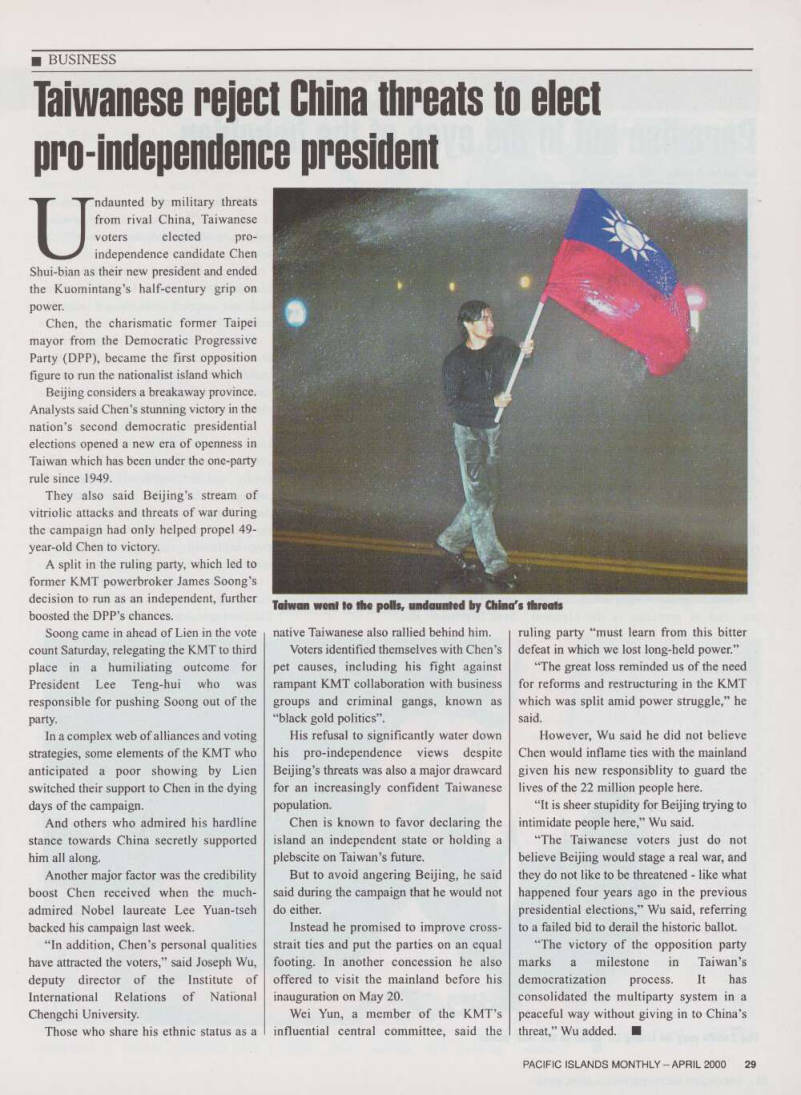
Taiwanese reject China threats to elect pro-independence president
Undaunted by military threats from rival China, Taiwanese voters elected pro independence candidate Chen Shui-bian as their new president and ended the Kuomintang’s half-century grip on power.
Chen, the charismatic former Taipei mayor from the Democratic Progressive Party (DPP), became the first opposition figure to run the nationalist island which Beijing considers a breakaway province.
Analysts said Chen’s stunning victory in the nation’s second democratic presidential elections opened a new era of openness in Taiwan which has been under the one-party rule since 1949.
They also said Beijing’s stream of vitriolic attacks and threats of war during the campaign had only helped propel 49year-old Chen to victory.
A split in the ruling party, which led to former KMT powerbroker James Soong’s decision to run as an independent, further boosted the DPP’s chances.
Soong came in ahead of Lien in the vote count Saturday, relegating the KMT to third place in a humiliating outcome for President Lee Teng-hui who was responsible for pushing Soong out of the party.
In a complex web of alliances and voting strategies, some elements of the KMT who anticipated a poor showing by Lien switched their support to Chen in the dying days of the campaign.
And others who admired his hardline stance towards China secretly supported him all along.
Another major factor was the credibility boost Chen received when the much admired Nobel laureate Lee Yuan-tseh backed his campaign last week.
“In addition, Chen’s personal qualities have attracted the voters,” said Joseph Wu, deputy director of the Institute of International Relations of National Chengchi University.
Those who share his ethnic status as a
native Taiwanese also rallied behind him.
Voters identified themselves with Chen’s pet causes, including his fight against rampant KMT collaboration with business groups and criminal gangs, known as “black gold politics”.
His refusal to significantly water down his pro-independence views despite Beijing’s threats was also a major drawcard for an increasingly confident Taiwanese
population.
Chen is known to favor declaring the island an independent state or holding a plebscite on Taiwan’s future.
But to avoid angering Beijing, he said said during the campaign that he would not do either.
Instead he promised to improve cross strait ties and put the parties on an equal footing. In another concession he also offered to visit the mainland before his inauguration on May 20.
Wei Yun, a member of the KMT’s influential central committee, said the
ruling party “must learn from this bitter defeat in which we lost long-held power.”
“The great loss reminded us of the need for reforms and restructuring in the KMT which was split amid power struggle,” he said.
However, Wu said he did not believe Chen would inflame ties with the mainland given his new responsiblity to guard the lives of the 22 million people here.
“It is sheer stupidity for Beijing trying to intimidate people here,” Wu said.
“The Taiwanese voters just do not believe Beijing would stage a real war, and they do not like to be threatened - like what happened four years ago in the previous presidential elections,” Wu said, referring to a failed bid to derail the historic ballot.
“The victory of the opposition party marks a milestone in Taiwan’s democratization process. It has consolidated the multiparty system in a peaceful way without giving in to China’s threat,” Wu added. ■
Taiwan went to the polls, undaunted by China's threats
Paradise net in the eyes of the beholder
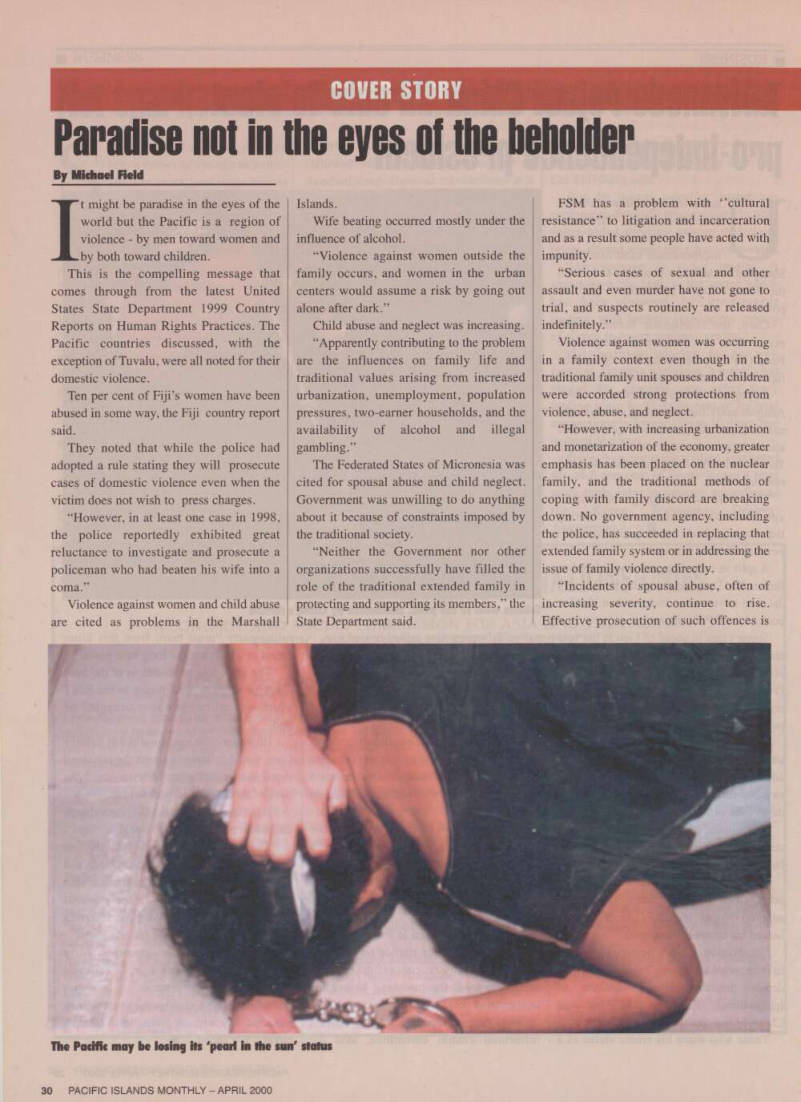
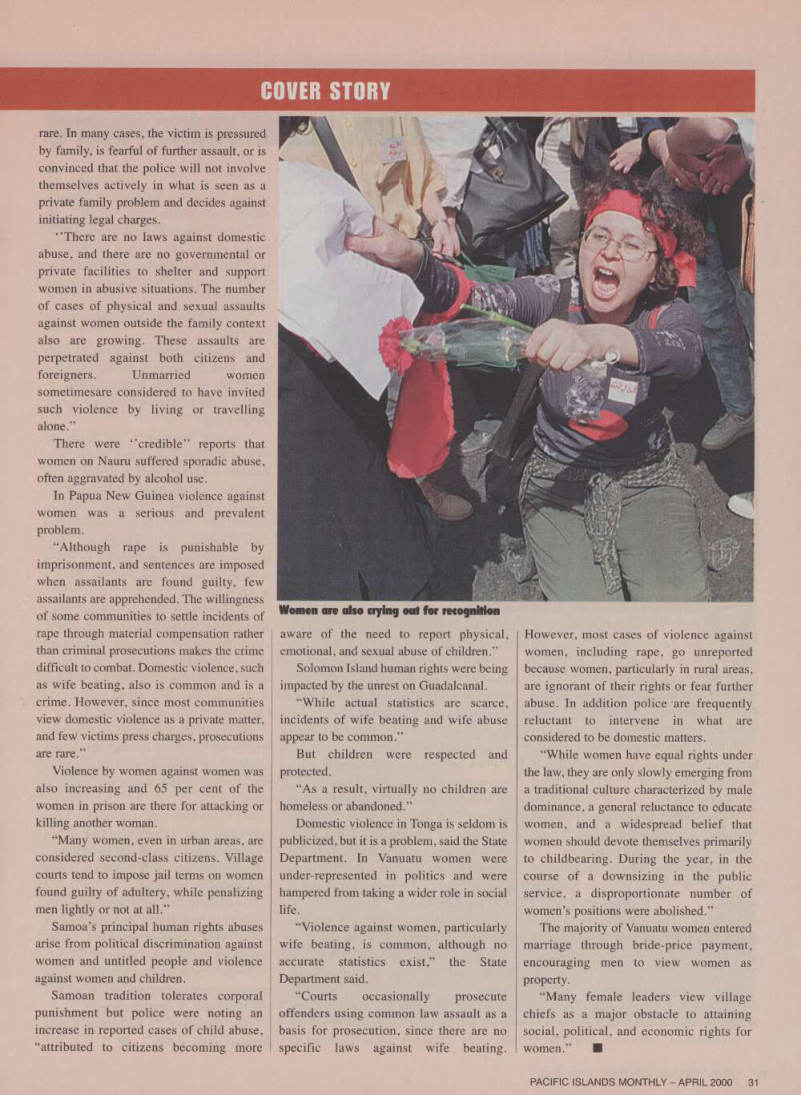
Cover Story
By Michael Field
It might be paradise in the eyes of the world but the Pacific is a region of violence - by men toward women and by both toward children.
This is the compelling message that comes through from the latest United States State Department 1999 Country Reports on Human Rights Practices. The Pacific countries discussed, with the exception of Tuvalu, were all noted for their domestic violence.
Ten per cent of Fiji’s women have been abused in some way, the Fiji country report said.
They noted that while the police had adopted a rule stating they will prosecute cases of domestic violence even when the victim does not wish to press charges.
“However, in at least one case in 1998, the police reportedly exhibited great reluctance to investigate and prosecute a policeman who had beaten his wife into a coma.”
Violence against women and child abuse are cited as problems in the Marshall
Islands.
Wife beating occurred mostly under the influence of alcohol.
“Violence against women outside the family occurs, and women in the urban centers would assume a risk by going out alone after dark.”
Child abuse and neglect was increasing.
“Apparently contributing to the problem are the influences on family life and traditional values arising from increased urbanization, unemployment, population pressures, two-earner households, and the availability of alcohol and illegal gambling.”
The Federated States of Micronesia was cited for spousal abuse and child neglect.
Government was unwilling to do anything about it because of constraints imposed by the traditional society.
“Neither the Government nor other organizations successfully have filled the role of the traditional extended family in protecting and supporting its members,” the State Department said.
FSM has a problem with ‘’cultural resistance” to litigation and incarceration and as a result some people have acted with impunity.
“Serious cases of sexual and other assault and even murder have not gone to trial, and suspects routinely are released
indefinitely.”
Violence against women was occurring in a family context even though in the traditional family unit spouses and children were accorded strong protections from violence, abuse, and neglect.
“However, with increasing urbanization and monetarization of the economy, greater emphasis has been placed on the nuclear family, and the traditional methods of coping with family discord are breaking down. No government agency, including the police, has succeeded in replacing that extended family system or in addressing the issue of family violence directly.
“Incidents of spousal abuse, often of increasing severity, continue to rise.
Effective prosecution of such offences is
The Pacific may be losing its 'pearl in the sun' status
rare. In many cases, the victim is pressured by family, is fearful of further assault, or is convinced that the police will not involve themselves actively in what is seen as a
private family problem and decides against
initiating legal charges.
‘There are no laws against domestic abuse, and there are no governmental or private facilities to shelter and support women in abusive situations. The number of cases of physical and sexual assaults against women outside the family context also are growing. These assaults are perpetrated against both citizens and foreigners. Unmarried women sometimesare considered to have invited such violence by living or travelling alone.”
There were ‘’credible” reports that women on Nauru suffered sporadic abuse, often aggravated by alcohol use.
In Papua New Guinea violence against women was a serious and prevalent problem.
“Although rape is punishable by imprisonment, and sentences are imposed when assailants are found guilty, few assailants are apprehended. The willingness of some communities to settle incidents of rape through material compensation rather than criminal prosecutions makes the crime difficult to combat. Domestic violence, such as wife beating, also is common and is a crime. However, since most communities view domestic violence as a private matter, and few victims press charges, prosecutions are rare.”
Violence by women against women was also increasing and 65 per cent of the women in prison are there for attacking or killing another woman.
“Many women, even in urban areas, are considered second-class citizens. Village courts tend to impose jail terms on women
found guilty of adultery, while penalizing
men lightly or not at all.”
Samoa’s principal human rights abuses arise from political discrimination against women and untitled people and violence against women and children.
Samoan tradition tolerates corporal punishment but police were noting an increase in reported cases of child abuse, “attributed to citizens becoming more
aware of the need to report physical, emotional, and sexual abuse of children.”
Solomon Island human rights were being impacted by the unrest on Guadalcanal.
“While actual statistics are scarce, incidents of wife beating and wife abuse appear to be common.”
But children were respected and protected.
“As a result, virtually no children are homeless or abandoned.”
Domestic violence in Tonga is seldom is publicized, but it is a problem, said the State Department. In Vanuatu women were under-represented in politics and were hampered from taking a wider role in social life.
“Violence against women, particularly wife beating, is common, although no accurate statistics exist,” the State Department said.
“Courts occasionally prosecute offenders using common law assault as a basis for prosecution, since there are no specific laws against wife beating.
However, most cases of violence against women, including rape, go unreported because women, particularly in rural areas, are ignorant of their rights or fear further abuse. In addition police are frequently reluctant to intervene in what are considered to be domestic matters.
“While women have equal rights under the law, they are only slowly emerging from a traditional culture characterized by male dominance, a general reluctance to educate women, and a widespread belief that women should devote themselves primarily to childbearing. During the year, in the course of a downsizing in the public service, a disproportionate number of women’s positions were abolished.”
The majority of Vanuatu women entered
marriage through bride-price payment,
encouraging men to view women as property.
“Many female leaders view village chiefs as a major obstacle to attaining social, political, and economic rights for women.” ■
Women ore also crying out for recognition
Report attacks Pacific nations human rights record
By Michael Field
Papua New Guinea has the worst human rights record in the Pacific. That’s if the US State Department individual country reports are a good guide.
They claim, in explicit language, that the PNG Government is responsible for human rights abuses, particularly its police force “Police committed extrajudicial killings, beat suspects, and engaged in excessively punitive and violent raids,” the latest country report says.
“The Government on occasion investigated allegations of abuse and prosecuted those believed responsible.”
Police claim that most people killed by them died in gunfights while resisting arrest.
One case though came about when police shot a man in both knees after he surrendered and he was left to bleed to death.
On Fiji they noted the constitutional changes in Fiji and the fact that ‘’peaceful and democratic elections” had been held.
“Nonetheless, ethnicity remains a
dominant factor in Fijian life and affects the country’s politics, economy, and society,” the report said.
“The ethnic division is illustrated by the contrast between the private and public sectors; Indo-Fijian families largely control most private businesses, while indigenous Fijians largely head the government ministries and the military.”
Fiji's principal human rights problem
was its ethnically based discrimination.
“Other human rights problems include
occasional police brutality, informal
constraints on the freedom of the press, efforts to restrict public comments by the diplomatic corps, discrimination and cases of violence against women, and instances of abuse of children.”
The Fiji Military Forces (FMF) was described as a small professional force.
“There continue to be credible reports of
human rights abuses by individual police
officers.”
In Palau loosening ties of the extended family and the increasing abuse of alcohol and other drugs are major contributing
factors that lead to instances of domestic violence and child neglect.
“Societal discrimination against certain foreign workers, who account for nearly 30 per cent of the population and 46 per cent of the paid work force, is also a serious problem.”
The foreigners are viewed negatively by Palauans.
“Foreign residents are subject to some forms of discrimination and are targets of petty, and sometimes violent, crimes, as well as other random acts against person and property.
“Credible complaints are made by foreign residents that crimes against non- Palauans are not pursued or persecuted by authorities with the same vigour as crimes against citizens. Certain foreign nationalities experience generalized discrimination in employment, pay, housing, education, and access to social services, although such discrimination is prohibited by law.
“While precise data is lacking, there continue to be anecdotal reports about abuse of workers’ civil rights perpetrated against domestic helpers, bar girls, construction laborers, and other semiskilled workers, the majority of whom are from the Philippines, China, and Bangladesh.
“The most common abuses identified are misrepresentation of contract terms and conditions of employment, withholding of pay or benefits, and, sometimes, physical abuse.
In a number of instances, local authorities have taken corrective action when alerted by social service and religious organizations to which foreign workers have turned for assistance.
Nonetheless, foreign workers often are reluctant to seek legal redress for fear of losing their employment and, thus, permission to remain in the country.”
Tonga’s “principal human rights abuse remains severe restrictions on the right of citizens to change their government.”
“The King and 33 hereditary nobles dominate political life.” ■
As Pacific islanders become aware of their rights, protests will increase
Atempts to muzzle watchdogs criticised
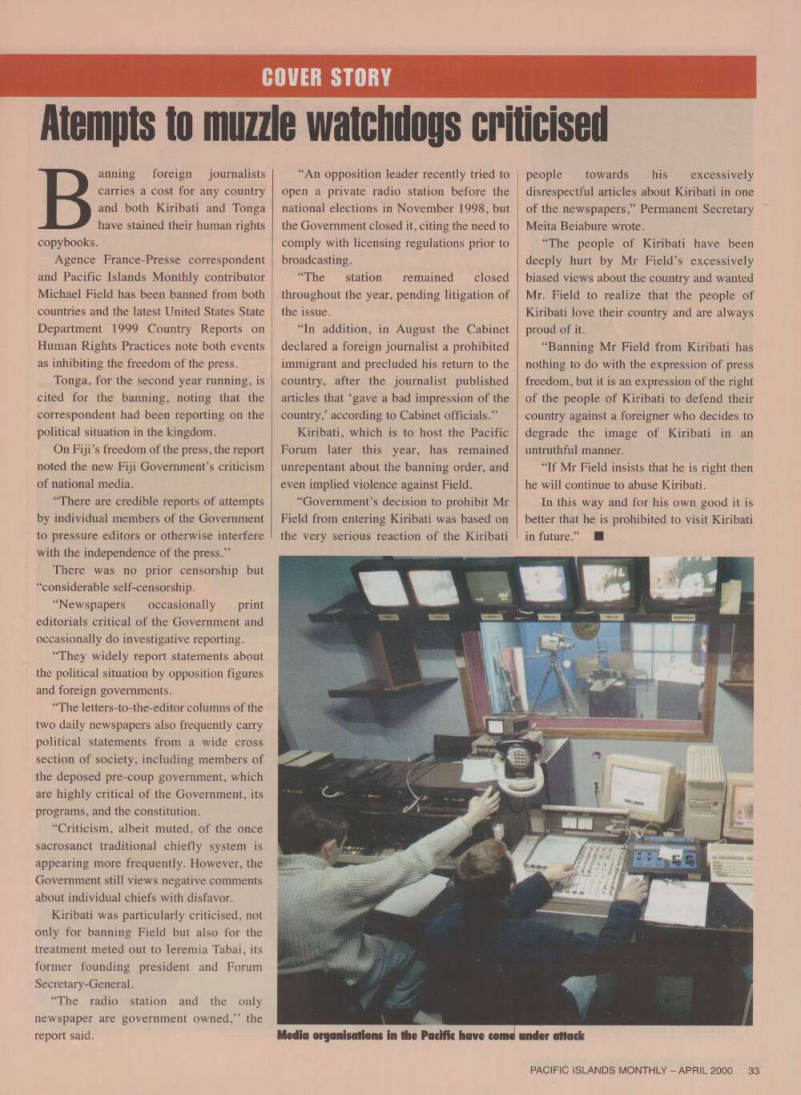
Banning foreign journalists
carries a cost for any country and both Kiribati and Tonga have stained their human rights copybooks.
Agence France-Presse correspondent and Pacific Islands Monthly contributor Michael Field has been banned from both countries and the latest United States State Department 1999 Country Reports on Human Rights Practices note both events as inhibiting the freedom of the press.
Tonga, for the second year running, is cited for the banning, noting that the correspondent had been reporting on the political situation in the kingdom.
On Fiji’s freedom of the press, the report noted the new Fiji Government’s criticism of national media.
“There are credible reports of attempts by individual members of the Government to pressure editors or otherwise interfere with the independence of the press.”
There was no prior censorship but
“considerable self-censorship.
“Newspapers occasionally print
editorials critical of the Government and occasionally do investigative reporting.
“They widely report statements about the political situation by opposition figures and foreign governments.
“The letters-to-the-editor columns of the two daily newspapers also frequently carry political statements from a wide cross section of society, including members of the deposed pre-coup government, which are highly critical of the Government, its programs, and the constitution.
“Criticism, albeit muted, of the once sacrosanct traditional chiefly system is appearing more frequently. However, the Government still views negative comments about individual chiefs with disfavor.
Kiribati was particularly criticised, not only for banning Field but also for the treatment meted out to leremia Tabai, its former founding president and Forum Secretary-General.
“The radio station and the only newspaper are government owned,” the report said.
“An opposition leader recently tried to open a private radio station before the national elections in November 1998, but the Government closed it, citing the need to comply with licensing regulations prior to
broadcasting.
“The station remained closed throughout the year, pending litigation of the issue.
“In addition, in August the Cabinet
declared a foreign journalist a prohibited
immigrant and precluded his return to the country, after the journalist published articles that ‘gave a bad impression of the country,’ according to Cabinet officials.”
Kiribati, which is to host the Pacific Forum later this year, has remained unrepentant about the banning order, and even implied violence against Field.
“Government’s decision to prohibit Mr Field from entering Kiribati was based on the very serious reaction of the Kiribati
people towards his excessively disrespectful articles about Kiribati in one of the newspapers,” Permanent Secretary Meita Beiabure wrote.
“The people of Kiribati have been
deeply hurt by Mr Field’s excessively
biased views about the country and wanted Mr. Field to realize that the people of Kiribati love their country and are always proud of it.
“Banning Mr Field from Kiribati has nothing to do with the expression of press freedom, but it is an expression of the right of the people of Kiribati to defend their country against a foreigner who decides to degrade the image of Kiribati in an untruthful manner.
“If Mr Field insists that he is right then he will continue to abuse Kiribati.
In this way and for his own good it is better that he is prohibited to visit Kiribati in future.” ■
Media organisations in the Pacific have come under attack
A sum of all fears
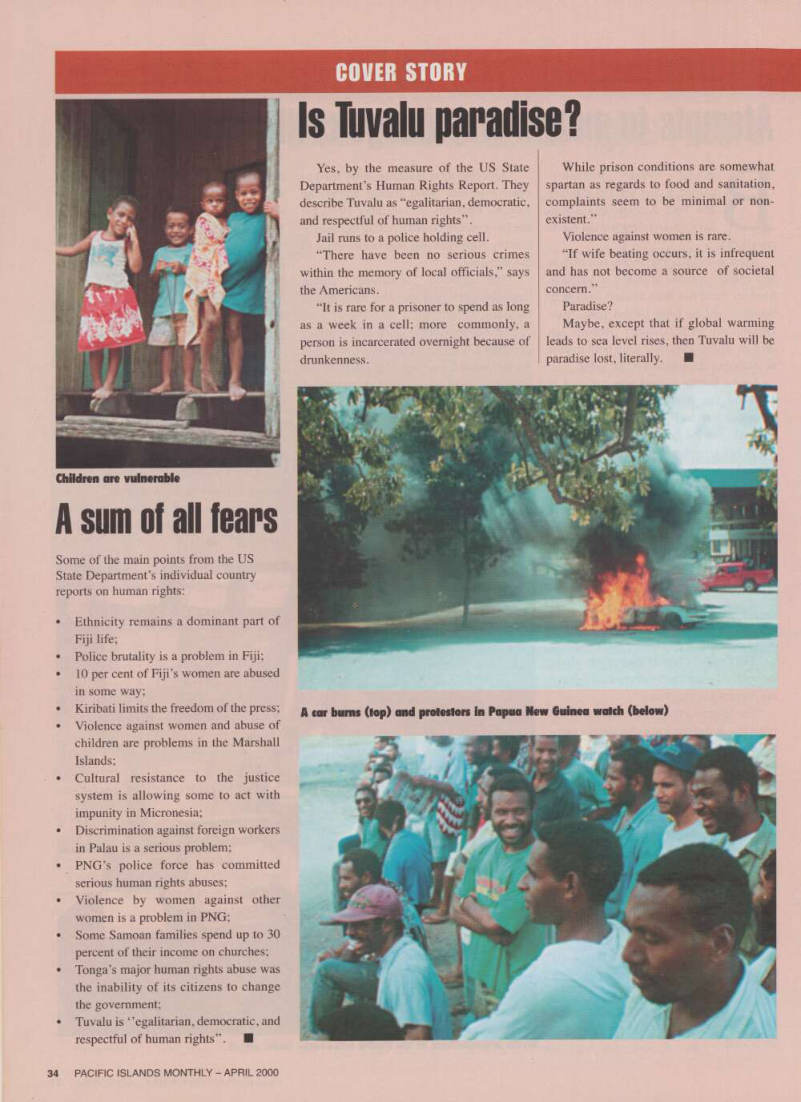
Some of the main points from the US State Department’s individual country reports on human rights: • Ethnicity remains a dominant part of Fiji life; • Police brutality is a problem in Fiji; • 10 per cent of Fiji’s women are abused in some way; • Kiribati limits the freedom of the press; • Violence against women and abuse of children are problems in the Marshall Islands; • Cultural resistance to the justice system is allowing some to act with impunity in Micronesia; • Discrimination against foreign workers in Palau is a serious problem; • PNG’s police force has committed serious human rights abuses; • Violence by women against other women is a problem in PNG; • Some Samoan families spend up to 30 percent of their income on churches; • Tonga’s major human rights abuse was the inability of its citizens to change the government; • Tuvalu is ‘ ’egalitarian, democratic, and respectful of human rights”. ■
Children are vulnerable
Is Tuvalu paradise?
Yes, by the measure of the US State Department’s Human Rights Report. They describe Tuvalu as “egalitarian, democratic, and respectful of human rights”.
Jail runs to a police holding cell.
“There have been no serious crimes within the memory of local officials,” says the Americans.
“It is rare for a prisoner to spend as long as a week in a cell; more commonly, a person is incarcerated overnight because of drunkenness.
While prison conditions are somewhat spartan as regards to food and sanitation, complaints seem to be minimal or non existent.”
Violence against women is rare.
“If wife beating occurs, it is infrequent and has not become a source of societal concern.”
Paradise?
Maybe, except that if global warming leads to sea level rises, then Tuvalu will be paradise lost, literally. ■
A car bums (top) and protestors in Papua New Guinea watch (below)
Advertisements & other items, p. 35 (1 item)
Subscribe to The Source.
For almost 70 years, Pacific Islands Monthly nra Pacific Community in the sew millennium (679) 303809 (679) 307460.
Pacific Islands Monthly
*Rates include Airspeeding to all destinations Conditions of Entry 1. To enter, subscriptions must be made before March 31st, 1999 which automatically enters the subscriber into the draw for the Pentium Notebook Computer. 2. Entry is open to all subscribers except employees of the Fiji Times Ltd., Pacific Islands Monthly. 3. Subscribers need to subscribe for 12 months to qualify. 4. The winner of the Pentium Notebook will e published in Pacific Islands Monthly Magazine, May Issue, 1999 and will be notified by registered mail. 5. The winner will receive their prize within one month of the draw. 6. The prize must be taken as offered and is not redeemable. 7. In the event of any dispute the decision of the promoter is final and no correspondence will be entered into.
YES! I wish to subscribe to The Source and receive a chance to win an IBM Pentium Notebook Computer! 12 ISSUE □ Cheque/Bank Draft/Money Order made payable to Pacific Islands Monthly SUBSCRIPTION O Please charge my credit card: (VISA/AMEX/MASTERCARD) I I Rate A I I Rate B I I Rate C I I Rate D □ Rate E This is a I I Renewal
I I New Subscription
Signature: Expiry date: Mr/Mrs/Ms: Delivery Address: Postal Address: Country Fax:
Islanders want bin bucks for key missile test range
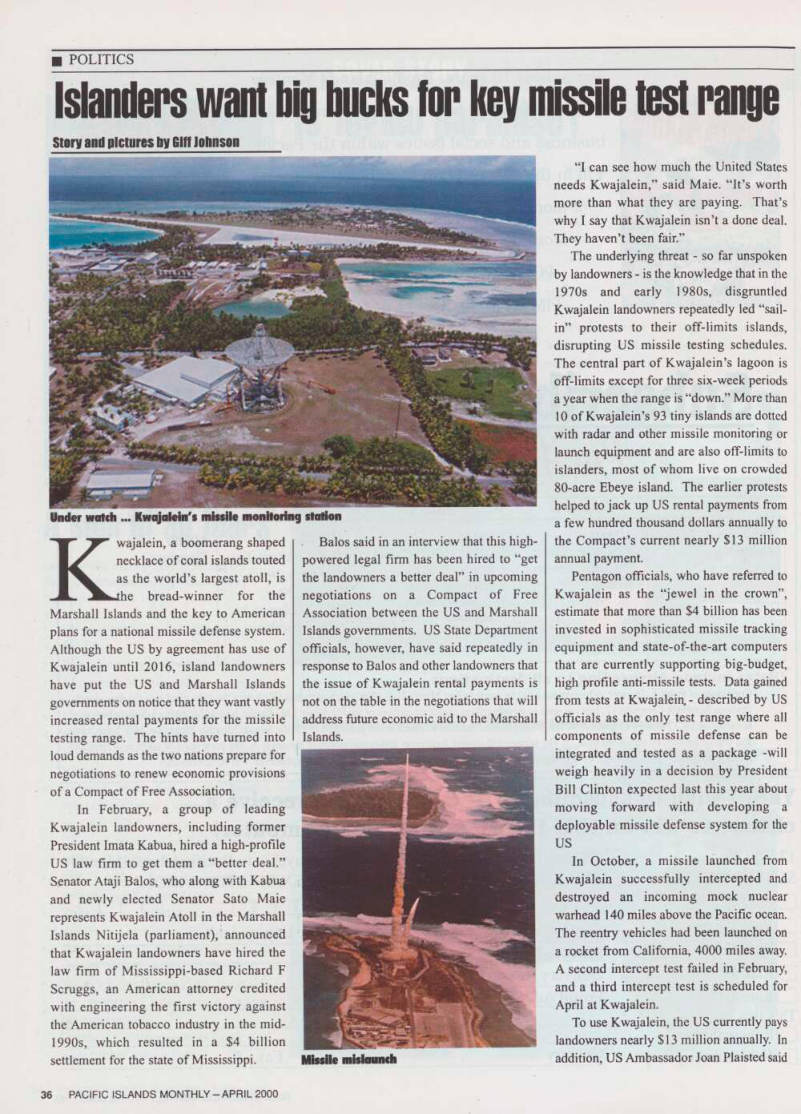
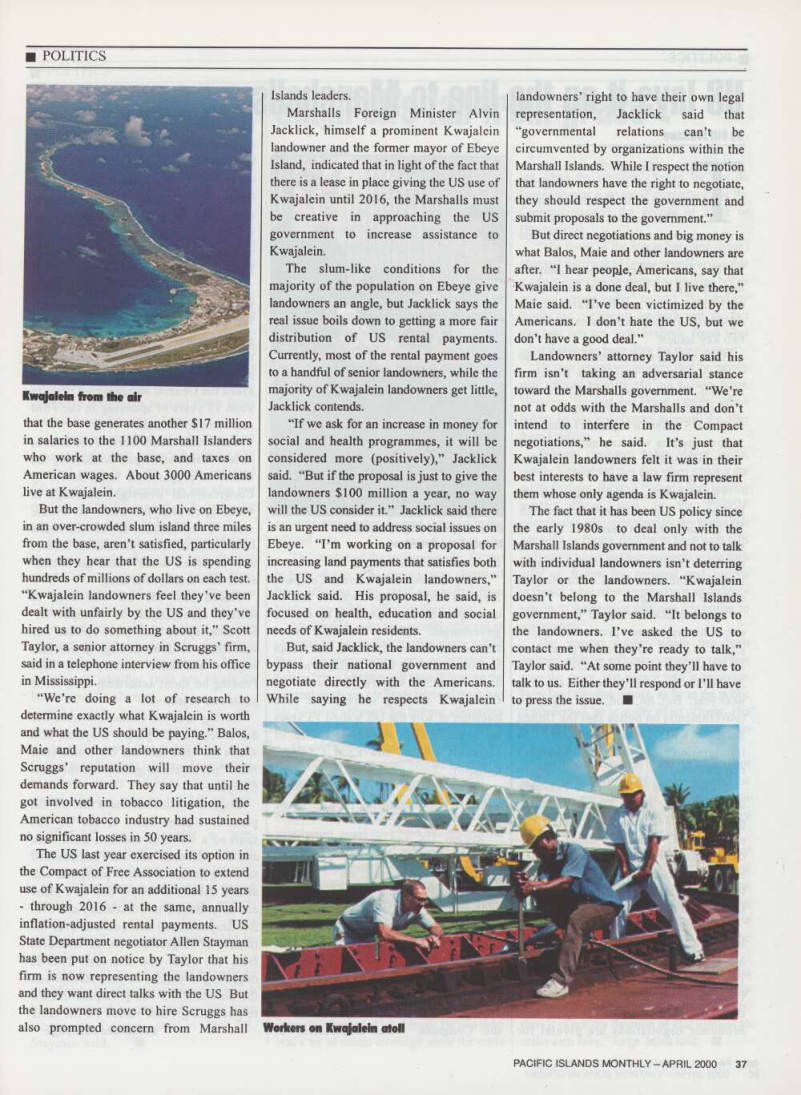
Politics
Story and pictures by Gift Johnson
Kwajalein, a boomerang shaped necklace of coral islands touted as the world’s largest atoll, is the bread-winner for the Marshall Islands and the key to American plans for a national missile defense system.
Although the US by agreement has use of Kwajalein until 2016, island landowners have put the US and Marshall Islands governments on notice that they want vastly increased rental payments for the missile testing range. The hints have turned into loud demands as the two nations prepare for negotiations to renew economic provisions of a Compact of Free Association.
In February, a group of leading Kwajalein landowners, including former President Imata Kabua, hired a high-profile US law firm to get them a “better deal.”
Senator Ataji Balos, who along with Kabua and newly elected Senator Sato Maie represents Kwajalein Atoll in the Marshall Islands Nitijela (parliament), announced that Kwajalein landowners have hired the law firm of Mississippi-based Richard F Scruggs, an American attorney credited with engineering the first victory against the American tobacco industry in the mid -19905, which resulted in a $4 billion settlement for the state of Mississippi.
Halos said in an interview that this high powered legal firm has been hired to “get the landowners a better deal” in upcoming negotiations on a Compact of Free Association between the US and Marshall Islands governments. US State Department officials, however, have said repeatedly in response to Halos and other landowners that the issue of Kwajalein rental payments is not on the table in the negotiations that will address future economic aid to the Marshall Islands.
“I can see how much the United States needs Kwajalein,” said Maie. “It’s worth more than what they are paying. That’s why I say that Kwajalein isn’t a done deal.
They haven’t been fair.”
The underlying threat - so far unspoken by landowners - is the knowledge that in the 1970 s and early 1980 s, disgruntled Kwajalein landowners repeatedly led “sail in’’ protests to their off-limits islands, disrupting US missile testing schedules.
The central part of Kwajalein’s lagoon is off-limits except for three six-week periods a year when the range is “down.” More than 10 of Kwajalein’s 93 tiny islands are dotted with radar and other missile monitoring or launch equipment and are also off-limits to islanders, most of whom live on crowded 80-acre Ebeye island. The earlier protests helped to jack up US rental payments from a few hundred thousand dollars annually to the Compact’s current nearly $l3 million annual payment.
Pentagon officials, who have referred to Kwajalein as the “jewel in the crown”, estimate that more than $4 billion has been invested in sophisticated missile tracking equipment and state-of-the-art computers that are currently supporting big-budget, high profile anti-missile tests. Data gained from tests at Kwajalein, - described by US officials as the only test range where all components of missile defense can be integrated and tested as a package -will weigh heavily in a decision by President Bill Clinton expected last this year about moving forward with developing a deployable missile defense system for the US In October, a missile launched from Kwajalein successfully intercepted and destroyed an incoming mock nuclear warhead 140 miles above the Pacific ocean.
The reentry vehicles had been launched on a rocket from California, 4000 miles away.
A second intercept test failed in February, and a third intercept test is scheduled for April at Kwajalein.
To use Kwajalein, the US currently pays landowners nearly $l3 million annually. In addition, US Ambassador Joan Plaisted said
Under watch ... Kwajalein's missile monitoring station
Missile mislaunch
that the base generates another $l7 million in salaries to the 1100 Marshall Islanders who work at the base, and taxes on American wages. About 3000 Americans live at Kwajalein.
But the landowners, who live on Ebeye, in an over-crowded slum island three miles from the base, aren’t satisfied, particularly when they hear that the US is spending hundreds of millions of dollars on each test.
“Kwajalein landowners feel they’ve been dealt with unfairly by the US and they’ve hired us to do something about it,” Scott Taylor, a senior attorney in Scruggs’ firm, said in a telephone interview from his office
in Mississippi.
“We’re doing a lot of research to determine exactly what Kwajalein is worth and what the US should be paying.” Balos, Maie and other landowners think that Scruggs’ reputation will move their demands forward. They say that until he got involved in tobacco litigation, the American tobacco industry had sustained no significant losses in 50 years.
The US last year exercised its option in the Compact of Free Association to extend use of Kwajalein for an additional 15 years - through 2016 - at the same, annually inflation-adjusted rental payments. US State Department negotiator Allen Stayman has been put on notice by Taylor that his firm is now representing the landowners and they want direct talks with the US But the landowners move to hire Scruggs has also prompted concern from Marshall
Islands leaders.
Marshalls Foreign Minister Alvin Jacklick, himself a prominent Kwajalein landowner and the former mayor of Ebeye Island, indicated that in light of the fact that there is a lease in place giving the US use of Kwajalein until 2016, the Marshalls must be creative in approaching the US government to increase assistance to
Kwajalein.
The slum-like conditions for the majority of the population on Ebeye give landowners an angle, but Jacklick says the real issue boils down to getting a more fair distribution of US rental payments.
Currently, most of the rental payment goes to a handful of senior landowners, while the majority of Kwajalein landowners get little, Jacklick contends.
“If we ask for an increase in money for social and health programmes, it will be considered more (positively),” Jacklick said. “But if the proposal is just to give the landowners $lOO million a year, no way will the US consider it.” Jacklick said there is an urgent need to address social issues on Ebeye. “I’m working on a proposal for increasing land payments that satisfies both the US and Kwajalein landowners,”
Jacklick said. His proposal, he said, is focused on health, education and social needs of Kwajalein residents.
But, said Jacklick, the landowners can’t bypass their national government and negotiate directly with the Americans.
While saying he respects Kwajalein
landowners’ right to have their own legal representation, Jacklick said that “governmental relations can’t be circumvented by organizations within the Marshall Islands. While I respect the notion that landowners have the right to negotiate, they should respect the government and submit proposals to the government.”
But direct negotiations and big money is what Balos, Maie and other landowners are after. “I hear people, Americans, say that Kwajalein is a done deal, but I live there,”
Maie said. “I’ve been victimized by the Americans. I don’t hate the US, but we don’t have a good deal.”
Landowners’ attorney Taylor said his firm isn’t taking an adversarial stance toward the Marshalls government. “We’re not at odds with the Marshalls and don’t intend to interfere in the Compact negotiations,” he said. It’s just that Kwajalein landowners felt it was in their best interests to have a law firm represent them whose only agenda is Kwajalein.
The fact that it has been US policy since the early 1980 s to deal only with the Marshall Islands government and not to talk with individual landowners isn’t deterring Taylor or the landowners. “Kwajalein doesn’t belong to the Marshall Islands government,” Taylor said. “It belongs to the landowners. I’ve asked the US to contact me when they’re ready to talk,”
Taylor said. “At some point they’ll have to talk to us. Either they’ll respond or I’ll have to press the issue. ■
Kwajalein from the air
Workers on Kwajolein atoll
US lays it on the line to Marshalls
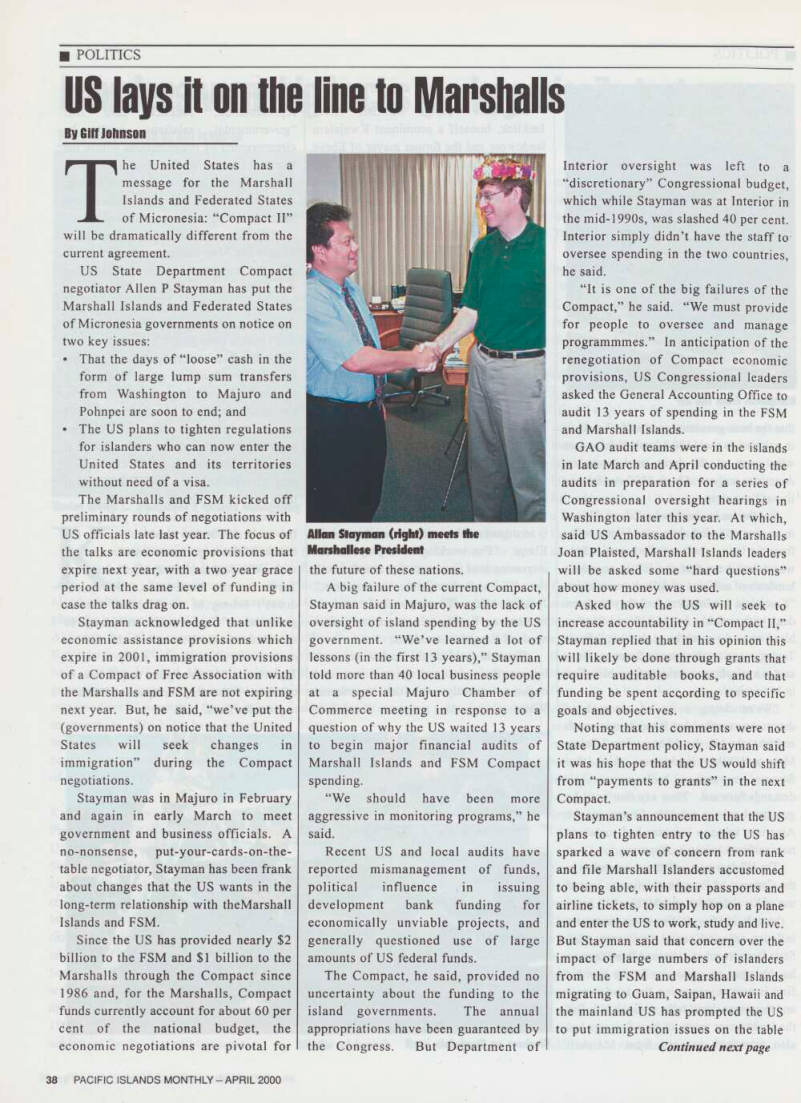
By Gift Johnson
The United States has a message for the Marshall Islands and Federated States of Micronesia: “Compact II” will be dramatically different from the current agreement.
US State Department Compact negotiator Allen P Stayman has put the Marshall Islands and Federated States of Micronesia governments on notice on two key issues: • That the days of “loose” cash in the form of large lump sum transfers from Washington to Majuro and Pohnpei are soon to end; and • The US plans to tighten regulations for islanders who can now enter the United States and its territories without need of a visa.
The Marshalls and FSM kicked off preliminary rounds of negotiations with US officials late last year. The focus of the talks are economic provisions that expire next year, with a two year grace period at the same level of funding in case the talks drag on.
Stayman acknowledged that unlike economic assistance provisions which expire in 2001, immigration provisions of a Compact of Free Association with the Marshalls and FSM are not expiring next year. But, he said, “we’ve put the (governments) on notice that the United States will seek changes in immigration” during the Compact negotiations.
Stayman was in Majuro in February and again in early March to meet government and business officials. A
no-nonsense, put-your-cards-on-the
table negotiator, Stayman has been frank about changes that the US wants in the long-term relationship with the Marshall Islands and FSM.
Since the US has provided nearly $2 billion to the FSM and $1 billion to the Marshalls through the Compact since 1986 and, for the Marshalls, Compact funds currently account for about 60 per cent of the national budget, the economic negotiations are pivotal for
the future of these nations.
A big failure of the current Compact, Stayman said in Majuro, was the lack of oversight of island spending by the US government. “We’ve learned a lot of lessons (in the first 13 years),” Stayman told more than 40 local business people at a special Majuro Chamber of Commerce meeting in response to a question of why the US waited 13 years to begin major financial audits of Marshall Islands and FSM Compact spending.
“We should have been more aggressive in monitoring programs,” he said.
Recent US and local audits have reported mismanagement of funds, political influence in issuing development bank funding for economically unviable projects, and generally questioned use of large amounts of US federal funds.
The Compact, he said, provided no uncertainty about the funding to the island governments. The annual appropriations have been guaranteed by the Congress. But Department of
Interior oversight was left to a “discretionary” Congressional budget, which while Stayman was at Interior in the mid-19905, was slashed 40 per cent.
Interior simply didn’t have the staff to oversee spending in the two countries, he said.
“It is one of the big failures of the Compact,” he said. “We must provide for people to oversee and manage programmmes.” In anticipation of the renegotiation of Compact economic provisions, US Congressional leaders asked the General Accounting Office to audit 13 years of spending in the FSM and Marshall Islands.
GAO audit teams were in the islands in late March and April conducting the audits in preparation for a series of Congressional oversight hearings in Washington later this year. At which, said US Ambassador to the Marshalls Joan Plaisted, Marshall Islands leaders will be asked some “hard questions” about how money was used.
Asked how the US will seek to increase accountability in “Compact 11,”
Stayman replied that in his opinion this will likely be done through grants that require auditable books, and that funding be spent according to specific goals and objectives.
Noting that his comments were not State Department policy, Stayman said it was his hope that the US would shift from “payments to grants” in the next Compact.
Stayman’s announcement that the US plans to tighten entry to the US has sparked a wave of concern from rank and file Marshall Islanders accustomed to being able, with their passports and airline tickets, to simply hop on a plane and enter the US to work, study and live.
But Stayman said that concern over the impact of large numbers of islanders from the FSM and Marshall Islands migrating to Guam, Saipan, Hawaii and the mainland US has prompted the US to put immigration issues on the table Continued next page
Allan Stayman (right) meets the Marshallese President
Continued from previous page during upcoming economic talks with the two island nations.
Stayman estimated that as many as 10,000-15,000 Federated States of Micronesia and Marshall Islands citizens have moved to Hawaii, Guam and Saipan since the Compact was established in 1986, becoming “quite a political issue” because of health and social costs to handle the large influx of islanders in those areas.
Political leaders in Guam, Saipan and Hawaii have increasingly demanded multi-million dollar annual reimbursements from the US federal government for the expense of providing social and health services to islanders who have moved there from the FSM and Marshall Islands.
A recent incident in which a nine year old Marshall Islands boy living in a small town in North Dakota infected 56 people with tuberculosis has also put the lack of health screening for entering islanders on the front burner.
In response to questions from Majuro business people about just how the US would seek to change the current visa free entry status of islanders, Stayman said that the US government has not exercised its right to screen people coming from the islands for such information as criminal records, health status and whether they are likely to becomepublic charges.
“The US hasn’t enforced this screening right because the Compact waived the need for visas,” he said.
Under the Compact of Free Association, Marshall Islands and FSM citizens may travel without visa to the US to live, work and study.
The US may consider a “pre screening mechanism” that would require islanders to apply for entry with a possible several week waiting period for US immigration to carry out its screening, he said. Or a more sophisticated tracking system could be used, he said.
This could be of mutual benefit to the Marshall Islands government, which has expressed an interest in knowing where its citizens are in the US, Stayman said. ■
Singirok's fall from grace
By Sam Vulum
Former army commander General Jerry Singirok, the people’s hero of the 1996 Sandline crisis in Papua New Guinea, shot himself on the back by doing what he did. He offered his own crucifixion by blowing the whistle on the then Government’s secret plan with British mercenary company, Sandline International, to flush out Bougainville secessionist rebels in a massive military backed operation.
At least that’s what it all appears to look today, almost five years later for the disgraced commander at the conclusion of a leadership tribunal hearing into bribery claims against him with international arms dealer Sydney Franklin and other questionable activities as required under the Leadership Code.
Although he may have escaped sedition charges which were brought against him for speaking out against the Government in separate case earlier, he was unlucky in the tribunal case.
The verdict of the trial was guilty for the bribery charge. The penalty was dismissal from office as army chief and barred from holding any public office for three years.
Mr Singirok, who was initially removed as commander immediately after going public about the mercenaries, was re-instated by former Prime Minister Bill Skate following the national elections. Mr Skate returned the job to Mr Singirok although the bribery allegations
had already been public knowledge.
However, he was again stood down by the current Government of Sir Mekere Morauta to appear before the leadership tribunal.
The grueling public scrutiny that he had to live with since the crisis and the recent punishment, could have been less severe, had .he done the right thing. He could have kept quiet and tagged along with the military operation or could have disclosed the gifts to the Ombudsman Commission before going public. He had been reduced, especially by the media, from a popular hero to nothing more humiliating than have been made to look like a convicted criminal. In one instance, he complained to the tribunal that he had been put on “trial by the media” without having been properly informed of his charges. He said there was a lot of media coverage about the crisis
but when the situation change, he was no longer seen as a savior of democracy and the Constitution and the people of PNG or Bougainville.
“The focus of the whole Sandline (issue) changed from one of saving people to one that is of a military leaderalleged to have got bribes and is a corrupt leader,” he said. “So I and my family and my friends are stuck with the fact that here you are Jerry Singirok, forget what good things you have done for this country.”
He also argued vehemently that the money was offered as gifts and not to win favor.
However, the fact that being a public office holder, he was not allowed to accept the offer from Franklin.
Tribunal chairman Judge Moses Jalina, rightly highlighted this fact when making the guilty findings. He said: “When a high ranking public official such as the PNGDF commander, who is required by law to disclose any gifts or favors, decides to keep such gifts or favors a secret and then proceeds to use such gifts or favors for personal and private purposes, what other conclusion is an ordinary person to reach other than one amounting to misconduct.”
The general public, which has been battered with the endemic corruption problem over the years, just cannot take it anymore.
How hard Singirok argues, as far as the public is concerned, he is guilty of an offense. His name is now in the bad books of many, even once loyal supporters.
The tribunal however found the general not guilty on allegations that he had influenced the Defence Force Supply and Tenders Board to buy more than K 1.5 million worth of military hardware from Unicom International.
Judge Jalina also dismissed submissions by the prosecution that leaders should be made to apologise for their wrongs, especially when General Singirok had Jied under oath during the Andrew Commission of Inquiry into the Sandline Affair, regarding gifts and benefits he received from J&S Franklin.
“If there is no law to compel a leader who is subject to the Leadership Code to publicly apologise for or acknowledge his misdeeds, then it is not the function of this tribunal to make such laws,” Judge Jalina said. ■
US presidential candidates in bind over
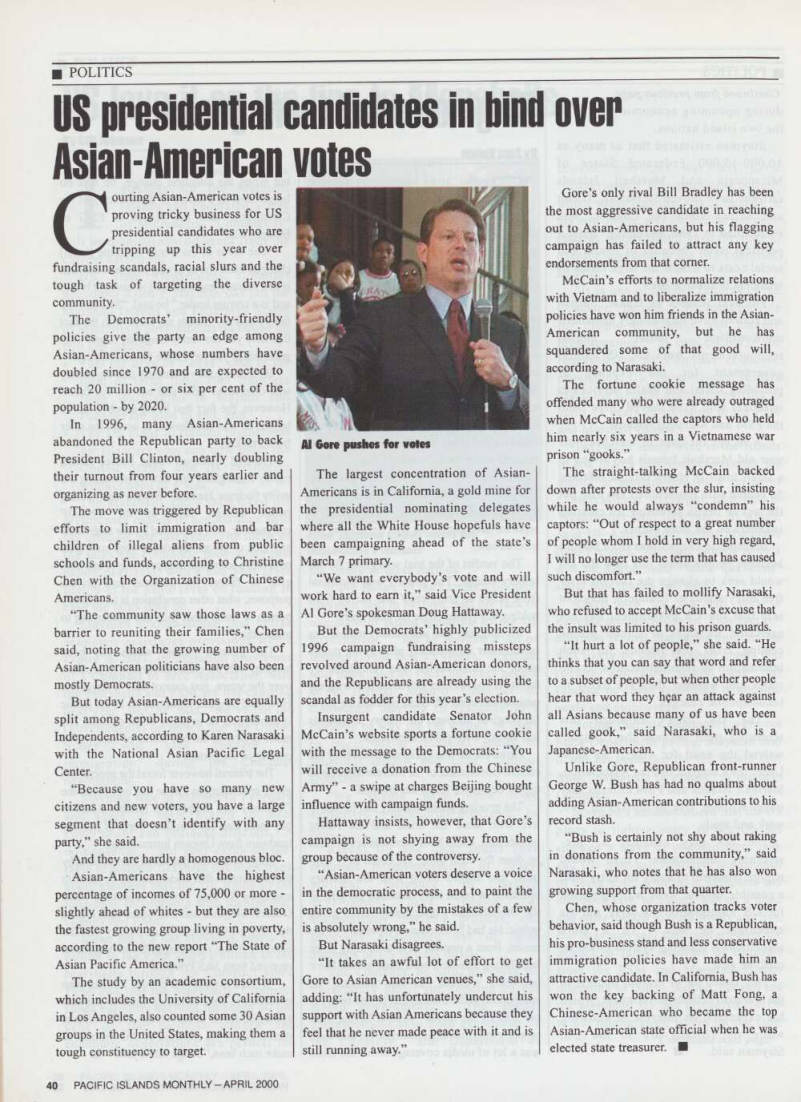
Asian-American votes
Courting Asian-American votes is proving tricky business for US presidential candidates who are tripping up this year over fundraising scandals, racial slurs and the tough task of targeting the diverse community.
The Democrats’ minority-friendly policies give the party an edge among Asian-Americans, whose numbers have doubled since 1970 and are expected to reach 20 million - or six per cent of the population - by 2020.
In 1996, many Asian-Americans abandoned the Republican party to back President Bill Clinton, nearly doubling their turnout from four years earlier and organizing as never before.
The move was triggered by Republican efforts to limit immigration and bar children of illegal aliens from public schools and funds, according to Christine Chen with the Organization of Chinese Americans.
“The community saw those laws as a barrier to reuniting their families,” Chen said, noting that the growing number of Asian-American politicians have also been mostly Democrats.
But today Asian-Americans are equally split among Republicans, Democrats and Independents, according to Karen Narasaki with the National Asian Pacific Legal Center.
“Because you have so many new citizens and new voters, you have a large segment that doesn’t identify with any party,” she said.
And they are hardly a homogenous bloc.
Asian-Americans have the highest percentage of incomes of 75,000 or more slightly ahead of whites - but they are also the fastest growing group living in poverty, according to the new report “The State of Asian Pacific America.”
The study by an academic consortium, which includes the University of California in Los Angeles, also counted some 30 Asian groups in the United States, making them a tough constituency to target.
The largest concentration of Asian- Americans is in California, a gold mine for the presidential nominating delegates where all the White House hopefuls have been campaigning ahead of the state’s March 7 primary.
“We want everybody’s vote and will work hard to earn it,” said Vice President
A 1 Gore’s spokesman Doug Hattaway.
But the Democrats’ highly publicized 1996 campaign fundraising missteps revolved around Asian-American donors, and the Republicans are already using the scandal as fodder for this year’s election.
Insurgent candidate Senator John McCain’s website sports a fortune cookie with the message to the Democrats: “You will receive a donation from the Chinese Army” - a swipe at charges Beijing bought influence with campaign funds.
Hattaway insists, however, that Gore’s campaign is not shying away from the group because of the controversy.
“Asian-American voters deserve a voice in the democratic process, and to paint the entire community by the mistakes of a few is absolutely wrong,” he said.
But Narasaki disagrees.
“It takes an awful lot of effort to get Gore to Asian American venues,” she said, adding: “It has unfortunately undercut his support with Asian Americans because they feel that he never made peace with it and is still running away.”
Gore’s only rival Bill Bradley has been the most aggressive candidate in reaching out to Asian-Americans, but his flagging campaign has failed to attract any key endorsements from that comer.
McCain’s efforts to normalize relations with Vietnam and to liberalize immigration policies have won him friends in the Asian- American community, but he has squandered some of that good will, according to Narasaki.
The fortune cookie message has offended many who were already outraged when McCain called the captors who held him nearly six years in a Vietnamese war prison “gooks.”
The straight-talking McCain backed down after protests over the slur, insisting while he would always “condemn” his captors: “Out of respect to a great number of people whom I hold in very high regard, I will no longer use the term that has caused such discomfort.”
But that has failed to mollify Narasaki, who refused to accept McCain’s excuse that the insult was limited to his prison guards.
“It hurt a lot of people,” she said. “He thinks that you can say that word and refer to a subset of people, but when other people hear that word they h?ar an attack against all Asians because many of us have been called gook,” said Narasaki, who is a
Japanese-American.
Unlike Gore, Republican front-runner George W. Bush has had no qualms about adding Asian-American contributions to his record stash.
“Bush is certainly not shy about raking in donations from the community,” said Narasaki, who notes that he has also won growing support from that quarter.
Chen, whose organization tracks voter behavior, said though Bush is a Republican, his pro-business stand and less conservative immigration policies have made him an attractive candidate. In California, Bush has won the key backing of Matt Fong, a Chinese-American who became the top Asian-American state official when he was elected state treasurer. ■
Al Gore pushes for votes
Papua New Guinea's privatisation woes
Development
By Brian Tobia
The government of Papua New Guinea seems to have been blinded by the debate on the issue of privatising state-owned entities and seems to have forgotten over four million grassroots people who could be potential shareholders.
Although the government made public announcements that employees of these public enterprises (to be privatised) would be given first preference to purchase shares in the organisations, it has not come out clear on what options are there available for ordinary Papua New Guineans who make up the total grassroots population in the country.
The grassroots must also be given equal
opportunity to buy shares in privatised
entities and the only way to go about it is through some form of education.
At least one organisation, the PNG Institute of Accountants (PNGIA for short and made up of practitioners in the accounting field in both the public and private sectors) have realised this major problem and taken the task to informing the grassroots population (through a seminar) of their chances to becoming shareholders in these entities and being involved in the decision making processes to effect changes.
PNGIA believes that the involvement of simple people making decisions at board level can propel the entities (now falling apart) to becoming profit making bodies into the new century.
At least this is the vision of the PNG Accountants Association where the government failed to see while dealing with the privatisation issue.
PNGIA executive director. Bob Wheeler said; “Regardless of whether or not your state of job security will be directly impinged upon as a result of privatisation, you could well find yourself benefiting from the sale of shares in those corporate entities about to be privatised.”
He said the government had recently announced the sale of at least 20 to 30 per cent stake holding in entities concerned to PNG citizens, with pre-emptive rights to existing employees.
“But unfortunately there is a lack of knowledge on the part of grassroots people on this new phenomenon. They too have the rights as anyone to invest in the entities that would be privatised so that they can reap the benefits in the long term when profitability is realised,” he said.
Mr Wheeler added that unions have taken up arms against the government on this whole issues of privatisation but one could argue that these dissensions could well be based on the lack of knowledge or without due regard for the benefits to the economy on a macro level.
The proposed seminar is scheduled for June 10, 2000 and targeted at the prospective grass roots shareholders.
PNG Prime Minister, Sir Mekere Morauta is adamant that the proposed privatisation of government entities would still go ahead and it is an issue which is “non-negotiable”.
While opening a recent seminar titled “Privatisation and Intergrity Pact” hosted by Transparency International, Sir Mekere
expressed the view that public enterprises
have “provided fertile ground for corruption and rent-seeking behaviour” - PNG cannot escape from that fact and privatisation is the only way to remedy this situation.
“We all know that the boards of these enterprises and their chief executives have
often being appointed on political grounds
and not necessarily on merits ... privatisation of these enterprises provide the opportunity to reduce corruption and eliminate political influence,” he added.
He said that in this way the government can be able to serve money that can be used to effectively deliver services like health, education, maintenance of infrastructure and other thing which is not been done currently because it spends much of its resources owning and managing banks, airlines, logging operations, sugar farms, cement factories, logging operations or buy and sell comodities.
Sir Mekere said the Government has made a commitment to repay all domestic loans by 2002 - and all resources from the sale of public enterprises can be used
directly to look at delivering services to the people.
This is rightly where the government focus should be and not in running easily
corruptive and manipulative (by political
means) enterprises.
The issue of privatisation is then the key pillar of the government’s economic reconstruction and development strategy.
He added that the newly established Privatisation Commission (which will oversee this transition) has inbuilt preventive mechanisms that provide the natural safeguard against abuse of the community interest.
“I am confident that the structure and the processes we have put in place will ensure that privatisation occurs through a transparent, honest and fair process that will maximise the proceeds to the people of Papua New Guinea and take into account the interest of the workers and consumers,” he added.
While responding to critics, the Prime Minister explained that privatisation was being undertaken with three important considerations in mind: • A fair and full market value will be received for any public assets divested; • The proceeds will be used to provide improved welfare to both the present and future generations through reductions in domestic debts; and, • It should lead to increased economic efficiency in the use of the country’s resources.
Sir Mekere said many people misunderstood the significance of debt reduction to the economy, the budget and to improvement in the people’s living standards. “Reduction of domestic debt will lead to an easing of interest rates, stabilisation of the exchange rate and other domestic prices,” he said.
“Privatisation will achieve a structural change that will result in large amounts of financial resources for improving social services. At the same time, it will increase efficiency in the economy and in the provision of services throughout the country.” ■
A fair deal for access to genetic resources

Senior representatives from 14
Pacific Island countries met in Fiji last month to discuss regional
guidelines for regulating the
access of local and overseas companies to the Pacific’s genetic resources and how to share the benefits arising from their use.
The week-long workshop in Nadi was jointly organised by the conservation organisation, WWF, the South Pacific Regional Environment Program (SPREP), the Foundation for International Environmental Law and Development (FIELD) and the Commonwealth Secretariat.
“Until now, when overseas companies have profited from the use of the Pacific’s genetic resources, few of the benefits have been returned to Pacific Islanders,” said Cedric Schuster of WWF. “Now Pacific Island governments want to secure their
rights through an appropriate legal and administrative framework that works for the whole region.”
Under the international Convention on Biological Diversity, CBD, (to which 14 Pacific Island countries have signed up), there are provisions aimed at ensuring the sustainable use of the Earth’s remaining genetic resources and the equitable sharing of benefits arising from their use.
Schuster said the Pacific has long been a region from which genetic resources have been extracted for analysis and profit making overseas but with little recourse to compensation by the often indigenous owners of the resources. He pointed to the case of kava, derived from the roots of a pepper plant and consumed as a drink throughout the Pacific for ceremonial and social purposes.
In recent years, European and
American pharmaceutical,
beverage and herb companies have developed a range of products from kava for the
treatment of stress, pain and sleeplessness, amongst other complaints. While farmers in the Pacific are receiving around SUSI per kilogram of kava root, it is reportedly selling on the European and American markets for up to $22 per kilogram. There is no evidence of these profits returning to the Pacific.
Participants at the workshop exchanged their experiences of how genetic resources have been accessed in their countries, suggest edways to share the benefits more fairly, and discussed ways to improve training of local people in adding value to local genetic resources.
The workshop emphasised formalising a set of access and benefit sharing guidelines for national legislation in the region so that there is no competition between Pacific Island countries with significant plant, animal and microbial species in common.
The meeting also provided a forum for Pacific Island countries to prepare as a region for the upcoming fifth conference of parties to the Convention on Biological Diversity to be held in Nairobi, Kenya in next month. Issues of concern to the Pacific at the CBD meeting include: • Access and benefit sharing; • Protection of traditional knowledge; • Financing the implementation of National Biodiversity Strategy Action Plans; and • Marine and coastal biodiversity programs and sustainable use of biodiversity.
The 14 countries represented at the Nadi meeting were: Federated States of Micronesia; Marshall Islands; Palau; Kiribati; Tuvalu; Nauru; PNG; Vanuatu; Solomon Islands; Fiji; Samoa; Cook Islands; Tonga; and Niue. ■
Pacific nations are waking up to the issues of genetic information and its ownership
Kanaka Kitsch: the return of poly-pop/tiki culture
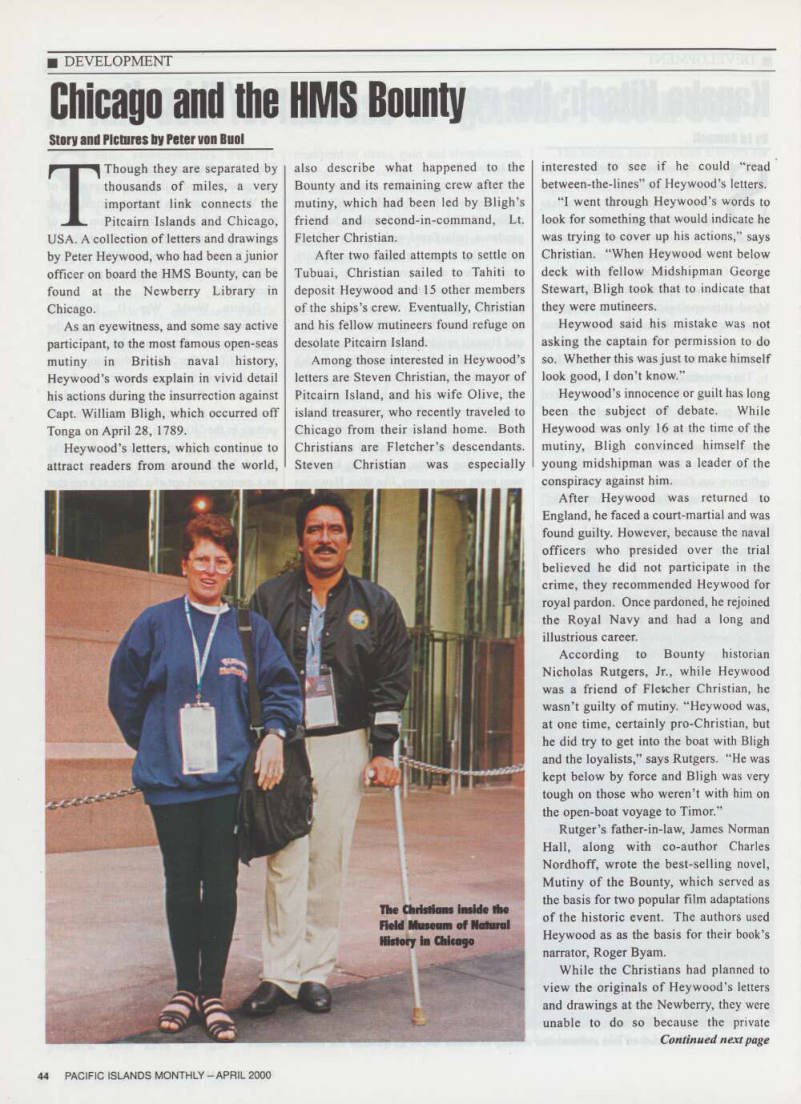
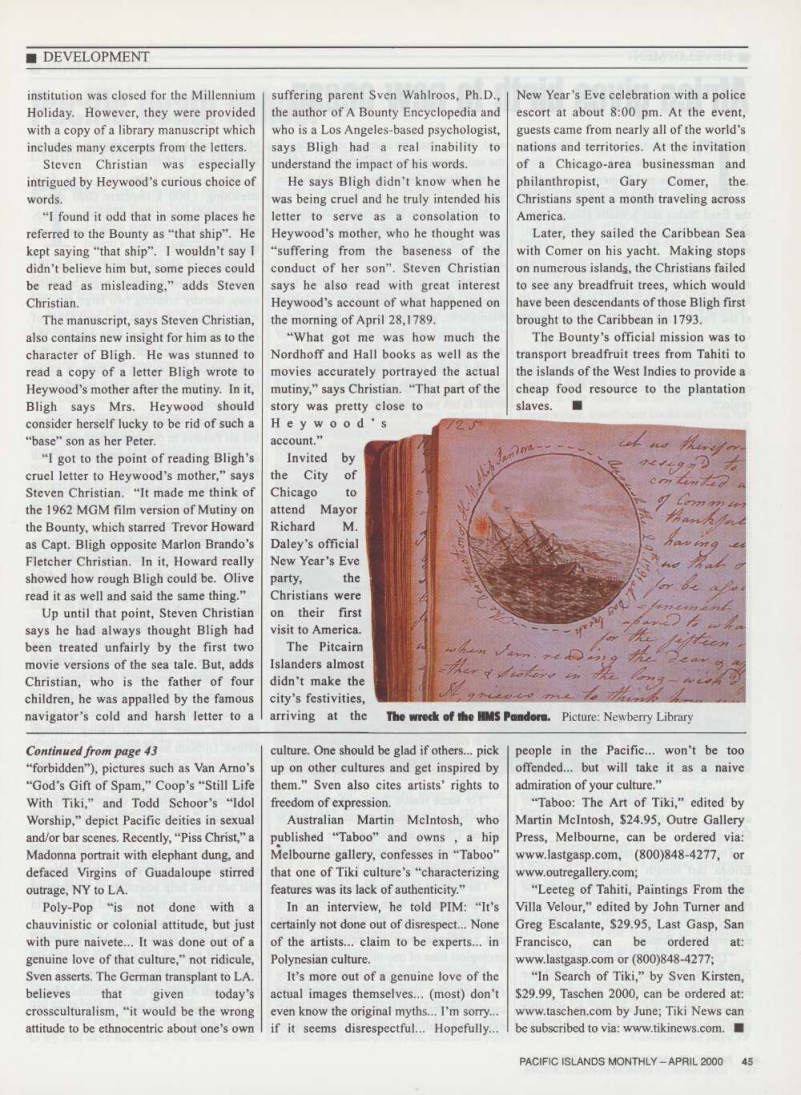
By Ed Rampell
Since the arrival of Westerners, the Pacific Islands have been rhapsodized as earthly paradises populated by heavenly heathen, unburdened by the constraints of civilization and its discontents. Captains’ logs, Melville novels, German postcards, exotica exhibits, Gauguin canvases, Tusitala tall tales, taller Mead anthropological studies, Maugham plays, hapa-haole ditties, far-flung location films, celebrated an Oceanic Eden inhabited by Islander Adams and Eves before the fall.
The romanticized view of the Pacific as a noble savage Nirvana of natural naked nubile pneumatic Native nymphs took on unique forms in the United States called Polynesia Americana.
Much has been made of Western influence on Oceania, but Sven Kirsten, who co-authored “Taboo: The Art of Tiki” and wrote the forthcoming “In Search of Tiki, A Guide For the Urban Archaeologist” points out; “Any Pacific Islander will be amazed to find out to what extent Polynesian culture was recreated on the mainland and how pervasive it was.”
“Taboo” editor Martin Mclntosh writes in his foreword that Poly-Pop is “a uniquely American interpretation of Tiki.”
The Poly-Pop phenomenon is making a comeback, due to the recent publication of the books “Taboo” and “Leeteg of Tahiti, Paintings From the Villa Velour” (“In Search of Tiki” follows by June ), the Tiki News newsletter, and two Los Angeles art exhibits at the La Luz de Jesus and
Copro/Nason galleries.
Inspired by Pacificana, and transmuted by American mass and commercial culture, Poly-Pop manifested itself as Isle-themed Disney attractions, Las Vegas casinos, motels, hotels, bars, and restaurants, from Trader Vic’s (nee Victor Bergeron) chain to Honolulu’s Tahitian Lanai to Manhattan’s Hawaii Kai (in the ‘7os, the Big Mango had a massage parlor named “Tahitia”). Tiki News publisher Otto von Stroheim calls restauranteur Don the Beachcomber (bom Ernest Raymond Beaumont-Gantt), who opened his Haole-wood haunt in 1934, “the undisputed founder of the 'Tiki culture’ as
we know it.”
These ersatz Oceanic oases in urban America, with faux Islander architecture, puffer fish lights, rattan furniture, bamboo, pandanus, palm frond, and tapa decor, black velvets (by Edgar Leeteg or an imitator), small streams and even waterfalls, and, but of course, tiki sculptures and other carvings, provided “exotica” for a fee: music (epitomized by “Leeteg of Tahiti” co-writer and Hawaii resident Martin Denny, whose “Quiet Village” features squawking birds), grass skirted dancers, sarong clad waitresses, Aloha shirt garbed waiters, pupu platter plates (usually more “Oriental” than Polynesian), and - often served in tiki mugs, coconuts, or pineapples - Island ambrosia.
According to Otto, this kitschy kava had even more outre names, like Blue Hawaiian (a vodka, pineapple, and essence of orange mix “which made Elvis flip”), Banana Bongo Bongo (“a rum based punch that will turn you into a spunky monkey”), Castaway (“you’ll get lost in a sea of pineapple, rum and a swirl of mocha”), and the ever popular Mai Tai (which is actually the Tahitian word for “good”). The Tiki News recipe for the volcanic “Smoking Eruption” is: pineapple, guava, lemon, and passion fruit juices, rock candy syrup, light rum, vodka, Appleton punch rum, and red food coloring, mixed (not stirred!) in a glass blender; inside the mug is a small glass full of dry ice, to pour hot water on before serving in order to create smoke.
Most tiki bastions are gone with the trade winds, but “Taboo” co-author Boyd Rice points out one of the best remains at San Francisco’s Fairmont Hotel, which turned its indoor pool into the Tonga Room. Shells and starfish festoon the pool’s bottom, now a lagoon upon which a floating band serenades diners. In “Taboo,” Boyd writes, “the final touch was sure genius.. .(a) sprinkler system... to replicate... a tropical downpour... every 20 minutes,” with tapes of storms and lightning-like flashes.
To be sure, London had its Beachcomber Bar in the Mayfair Hotel, Australia its share of Trader Micks, and even Oslo has the Kon Tiki Museum, paying homage to Thor
Heyerdahl. But sunny Southern California was ground zero for the Islander invasion of the West. Located on North America’s West Coast, the LA to San Diego region was, of course, the closest state to the South Pacific (until Hawaii’s statehood in 1959 inspired Poly-Pop, Rice points out) and part of the Pacific Rim.
Before World War 11, Polynesia Americana offered escapism from the Depression to a simpler, uninhibited, Edenic way of life. After WWII, this utopianism took on new forms, according to Sven: “Polynesian Pop is a term I invented to describe the American take on Polynesian culture in the ‘4os, ‘sos, and ‘6os.
It was something imported from the Islands by Gls and tourists to the mainland, as a memory and out of a desire to keep that experience alive here... It became synonymous with having a good time, recreation, and fun for that postwar
generation.”
Otto writes in “Leeteg of Tahiti”: “Tiki is not about the islands, it’s about fantasy. It’s about creating the island fantasy wherever you are at, mostly in non-exotic locations like New York. It’s about creating a fantasy that is warm and cosy and outside the doldrums of your job and city life.”
Sven, who’s been called one of Tiki culture’s Big Kahunas, says Poly-Pop peaked “in the mid-’6os, when the generation gap appeared..., but got so denounced by the younger generation that it virtually disappeared during the ‘7os and ‘Bos.” To unearth its remnants, one has to be what Sven calls an “urban archaeologist,” but as Kanaka kitsch makes a California comeback, it may face another denunciation - this time, by indigenous nationalists, for misappropriation of culture and cultural colonialism. Samoan film director Sima Urale has spoofed Tiki culture in her witty documentary “Velvet Dreams”.
Melanesian masks, Rapa Nui moai, Hawaiian tiki, are taken out of their traditional spiritual context in Poly-Pop. In “Taboo” (the Polynesian word for
Continued on page 45
Continued from page 43
“forbidden”), pictures such as Van Amo’s “God’s Gift of Spam,” Coop’s “Still Life With Tiki,” and Todd Schoor’s “Idol Worship,” depict Pacific deities in sexual and/or bar scenes. Recently, “Piss Christ,” a Madonna portrait with elephant dung, and defaced Virgins of Guadaloupe stirred outrage, NY to LA.
Poly-Pop “is not done with a chauvinistic or colonial attitude, but just with pure naivete... It was done out of a genuine love of that culture,” not ridicule, Sven asserts. The German transplant to LA.
believes that given today’s
crossculturalism, “it would be the wrong attitude to be ethnocentric about one’s own
culture. One should be glad if others... pick up on other cultures and get inspired by them.” Sven also cites artists’ rights to freedom of expression.
Australian Martin Mclntosh, who published “Taboo” and owns , a hip Melbourne gallery, confesses in “Taboo” that one of Tiki culture’s “characterizing features was its lack of authenticity.”
In an interview, he told PIM: “It’s certainly not done out of disrespect... None of the artists... claim to be experts... in Polynesian culture.
It’s more out of a genuine love of the actual images themselves... (most) don’t even know the original myths... I’m sorry... if it seems disrespectful... Hopefully...
people in the Pacific... won’t be too offended... but will take it as a naive admiration of your culture.”
“Taboo: The Art of Tiki,” edited by Martin Mclntosh, $24.95, Outre Gallery Press, Melbourne, can be ordered via: www.lastgasp.com, (800)848-4277, or www.outregallery.com; “Leeteg of Tahiti, Paintings From the Villa Velour,” edited by John Turner and Greg Escalante, $29.95, Last Gasp, San Francisco, can be ordered at: www.lastgasp.com or (800)848-4277; “In Search of Tiki,” by Sven Kirsten, $29.99, Taschen 2000, can be ordered at: www.taschen.com by June; Tiki News can be subscribed to via: www.tikinews.com. ■
Chicago and the HMS Bounty
Story and Pictures by Peter von Buol
T Though they are separated by thousands of miles, a very important link connects the Pitcairn Islands and Chicago, USA. A collection of letters and drawings by Peter Heywood, who had been a junior officer on board the HMS Bounty, can be found at the Newberry Library in Chicago.
As an eyewitness, and some say active participant, to the most famous open-seas mutiny in British naval history, Heywood’s words explain in vivid detail his actions during the insurrection against Capt. William Bligh, which occurred off Tonga on April 28, 1789.
Heywood’s letters, which continue to attract readers from around the world,
also describe what happened to the Bounty and its remaining crew after the mutiny, which had been led by Bligh’s friend and second-in-command, Lt.
Fletcher Christian.
After two failed attempts to settle on Tubuai, Christian sailed to Tahiti to deposit Heywood and 15 other members of the ships’s crew. Eventually, Christian and his fellow mutineers found refuge on desolate Pitcairn Island.
Among those interested in Heywood’s letters are Steven Christian, the mayor of Pitcairn Island, and his wife Olive, the island treasurer, who recently traveled to Chicago from their island home. Both Christians are Fletcher’s descendants.
Steven Christian was especially
interested to see if he could “read between-the-lines” of Heywood’s letters.
“I went through Heywood’s words to look for something that would indicate he was trying to cover up his actions,” says Christian. “When Heywood went below deck with fellow Midshipman George Stewart, Bligh took that to indicate that they were mutineers.
Heywood said his mistake was not asking the captain for permission to do so. Whether this was just to make himself look good, I don’t know.”
Heywood’s innocence or guilt has long been the subject of debate. While Heywood was only 16 at the time of the mutiny, Bligh convinced himself the young midshipman was a leader of the conspiracy against him.
After Heywood was returned to England, he faced a court-martial and was found guilty. However, because the naval officers who presided over the trial believed he did not participate in the crime, they recommended Heywood for royal pardon. Once pardoned, he rejoined the Royal Navy and had a long and illustrious career.
According to Bounty historian Nicholas Rutgers, Jr., while Heywood was a friend of Fletcher Christian, he wasn’t guilty of mutiny. “Heywood was, at one time, certainly pro-Christian, but he did try to get into the boat with Bligh and the loyalists,” says Rutgers. “He was kept below by force and Bligh was very tough on those who weren’t with him on the open-boat voyage to Timor.”
Rutger’s father-in-law, James Norman Hall, along with co-author Charles Nordhoff, wrote the best-selling novel, Mutiny of the Bounty, which served as the basis for two popular film adaptations of the historic event. The authors used Heywood as as the basis for their book’s narrator, Roger Byam.
While the Christians had planned to view the originals of Heywood’s letters and drawings at the Newberry, they were unable to do so because the private Continued next page
The Christians inside the Field Museum of Natural History in Chicago
institution was closed for the Millennium Holiday. However, they were provided with a copy of a library manuscript which includes many excerpts from the letters.
Steven Christian was especially intrigued by Heywood’s curious choice of words.
“I found it odd that in some places he referred to the Bounty as “that ship”. He kept saying “that ship”. I wouldn’t say I didn’t believe him but, some pieces could be read as misleading,” adds Steven Christian.
The manuscript, says Steven Christian, also contains new insight for him as to the character of Bligh. He was stunned to read a copy of a letter Bligh wrote to Heywood’s mother after the mutiny. In it, Bligh says Mrs. Heywood should consider herself lucky to be rid of such a “base” son as her Peter.
“I got to the point of reading Bligh’s cruel letter to Heywood’s mother,” says Steven Christian. “It made me think of the 1962 MGM film version of Mutiny on the Bounty, which starred Trevor Howard as Capt. Bligh opposite Marlon Brando’s Fletcher Christian. In it, Howard really showed how rough Bligh could be. Olive read it as well and said the same thing.”
Up until that point, Steven Christian says he had always thought Bligh had been treated unfairly by the first two movie versions of the sea tale. But, adds Christian, who is the father of four children, he was appalled by the famous navigator’s cold and harsh letter to a
suffering parent Sven Wahlroos, Ph.D., the author of A Bounty Encyclopedia and who is a Los Angeles-based psychologist, says Bligh had a real inability to understand the impact of his words.
He says Bligh didn’t know when he was being cruel and he truly intended his letter to serve as a consolation to Heywood’s mother, who he thought was “suffering from the baseness of the conduct of her son”. Steven Christian says he also read with great interest Heywood’s account of what happened on the morning of April 28,1789.
“What got me was how much the Nordhoff and Hall books as well as the movies accurately portrayed the actual mutiny,” says Christian. “That part of the story was pretty close to
Heywood’s account.”
Invited by fl the City of I Chicago to I attend Mayor ■ Richard M. I Daley’s official I New Year’s Eve party, the S Christians were H on their first H visit to America. J The Pitcairn 1 Islanders almost I didn’t make the S city’s festivities, wl arriving at the 1
New Year’s Eve celebration with a police escort at about 8:00 pm. At the event, guests came from nearly all of the world’s nations and territories. At the invitation of a Chicago-area businessman and philanthropist, Gary Comer, the Christians spent a month traveling across America.
Later, they sailed the Caribbean Sea with Comer on his yacht. Making stops on numerous islands, the Christians failed to see any breadfruit trees, which would have been descendants of those Bligh first brought to the Caribbean in 1793.
The Bounty’s official mission was to transport breadfruit trees from Tahiti to the islands of the West Indies to provide a cheap food resource to the plantation slaves. ■
The wreck off the HMS Pandora. Picture: Newberry Library
Africa gives birth to new ocean
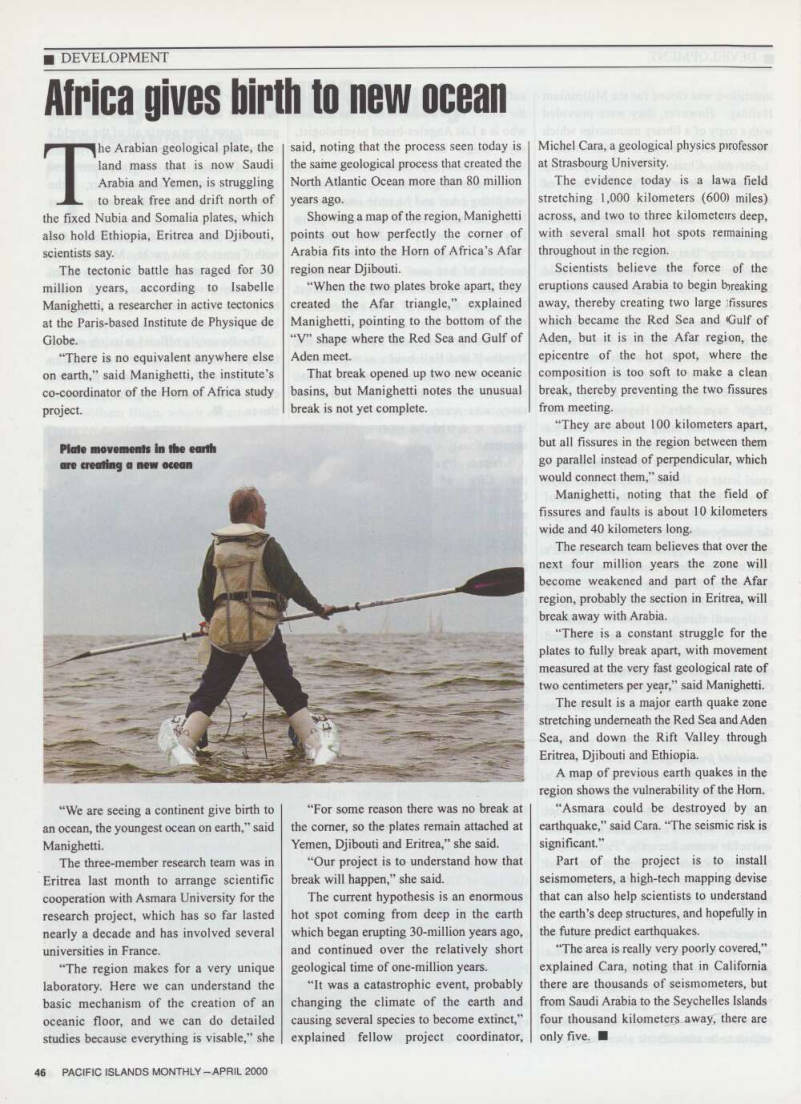
The Arabian geological plate, the land mass that is now Saudi Arabia and Yemen, is struggling to break free and drift north of the fixed Nubia and Somalia plates, which also hold Ethiopia, Eritrea and Djibouti, scientists say.
The tectonic battle has raged for 30 million years, according to Isabelle Manighetti, a researcher in active tectonics at the Paris-based Institute de Physique de Globe.
“There is no equivalent anywhere else on earth,” said Manighetti, the institute’s co-coordinator of the Horn of Africa study
project.
said, noting that the process seen today is the same geological process that created the North Atlantic Ocean more than 80 million years ago.
Showing a map of the region, Manighetti points out how perfectly the corner of Arabia fits into the Horn of Africa’s Afar region near Djibouti.
“When the two plates broke apart, they created the Afar triangle,” explained Manighetti, pointing to the bottom of the “V” shape where the Red Sea and Gulf of Aden meet.
That break opened up two new oceanic basins, but Manighetti notes the unusual break is not yet complete.
“We are seeing a continent give birth to an ocean, the youngest ocean on earth,” said
Manighetti.
The three-member research team was in Eritrea last month to arrange scientific cooperation with Asmara University for the research project, which has so far lasted nearly a decade and has involved several universities in France.
“The region makes for a very unique laboratory. Here we can understand the basic mechanism of the creation of an oceanic floor, and we can do detailed studies because everything is visable,” she
“For some reason there was no break at the comer, so the plates remain attached at Yemen, Djibouti and Eritrea,” she said.
“Our project is to understand how that break will happen,” she said.
The current hypothesis is an enormous hot spot coming from deep in the earth which began erupting 30-million years ago, and continued over the relatively short geological time of one-million years.
“It was a catastrophic event, probably changing the climate of the earth and causing several species to become extinct,” explained fellow project coordinator,
Michel Cara, a geological physics professor at Strasbourg University.
The evidence today is a lawa field stretching 1,000 kilometers (600) miles) across, and two to three kilometeirs deep, with several small hot spots reimaining throughout in the region.
Scientists believe the force of the eruptions caused Arabia to begin breaking away, thereby creating two large Ifissures which became the Red Sea and Gulf of Aden, but it is in the Afar region, the epicentre of the hot spot, where the composition is too soft to make a clean break, thereby preventing the two fissures from meeting.
“They are about 100 kilometers apart, but all fissures in the region between them go parallel instead of perpendicular, which would connect them,” said Manighetti, noting that the field of fissures and faults is about 10 kilometers wide and 40 kilometers long.
The research team believes that over the next four million years the zone will become weakened and part of the Afar region, probably the section in Eritrea, will break away with Arabia.
“There is a constant struggle for the plates to fully break apart, with movement measured at the very fast geological rate of two centimeters per year,” said Manighetti.
The result is a major earth quake zone stretching underneath the Red Sea and Aden Sea, and down the Rift Valley through Eritrea, Djibouti and Ethiopia.
A map of previous earth quakes in the region shows the vulnerability of the Horn.
“Asmara could be destroyed by an earthquake,” said Cara. “The seismic risk is significant.”
Part of the project is to install seismometers, a high-tech mapping devise that can also help scientists to understand the earth’s deep structures, and hopefully in the future predict earthquakes.
“The area is really very poorly covered,” explained Cara, noting that in California there are thousands of seismometers, but from Saudi Arabia to the Seychelles Islands four thousand there are only five. ■
Plate movements in the earth are creating a new ocean
Pacific death school
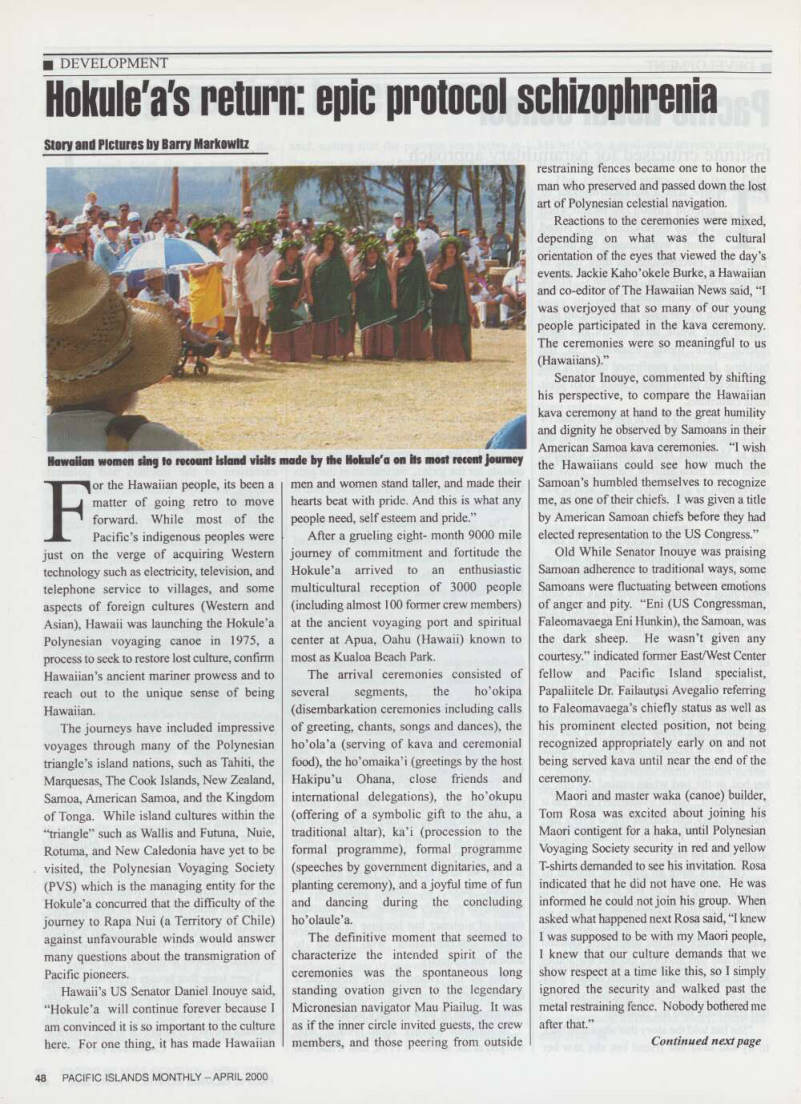
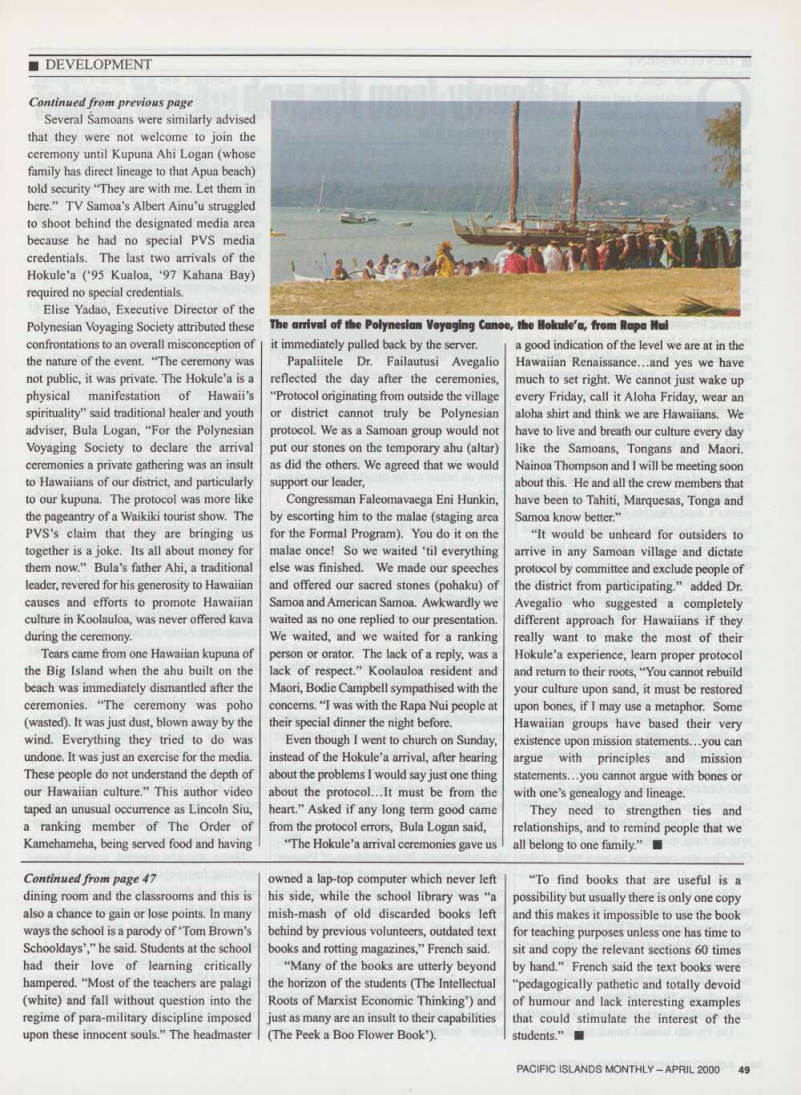
Institute criticised for paramilitary approach
There was a national outpour of grief in Tuvalu last month when 18 girls were killed in the island nation’s worst disaster last month.
They were electrocuted as they tried to escape their burning dormitory, Prime Minister lonatana lonatana said.
Fourteen of the girls were piled up at a locked door, while three others and their matron were found elsewhere in the building. lonatana confirmed the girls had been locked in to protect them from their male classmates. lonatana said 18 girls aged between 14 and 17 as well as an adult matron died in the fire at Motufoua High School at Vaitapu, north of the main atoll of Funifuti. Previous reports said 17 girls had died. He said it was standard practice to lock the girls into their dormitory.
“We have the girls locked in and in each dormitory there is supposed to be a matron.
The matron locks the door and locks everything to ensure that the boys are kept out from the girls.” He added: “The boys are not locked in of course, not normally.”
Asked if it was necessary to protect girls this way he replied: “Yes, from young men and young boys going after young women and girls so normally we lock in the girls.”
The fire spread rapidly. “It was started off by a candle light by one student who was not obedient to the orders of the school,” he said.
“She must have fallen asleep and just above her bed, or the bed which caused the fire, is a power point. “Some by-standers saw that it was electricity that carried fire to every part of the house.” The fire was fanned by a strong wind, he said.
“The girls were all piled up, instead of being piled up one by one from the door.
They were all in one place near the door.
“It must mean one of the girls had (electric) shock and the other girls touched her and she was shocked too and the bodies kept up accumulating. Fourteen bodies were found in one place.” He said one survivor had gone back into the building.
“She has told the story that she came back to try and save her friend but she saw her
friend on the floor alive. The girl told her not to come closer, that she had a shock and could not He said the dormitory had two doors, one through a matron’s room and another outside door, which is where most of the bodies were. A night-watchman kicked in the matron’s door and then tried, from the outside, to get through the other door. “He couldn’t do that because the kids were all piled up inside the door of the dormitory.” lonatana appealed for international aid to help the dead girl’s families and the survivors who were still suffering. lonatana said authorities had now been ordered to leave dormitory doors and windows unlocked. “We will provide a security fence outside for the girls... So instead of the girls being locked in, they will be locked into a fenced area.”
The general secretary of the World YWCA, Kenyan Musimbi Kanyoro, called for debate on the security measures while the Fiji Women’s Crisis Centre slammed the policy, saying it was widespread across the South Pacific.
“Is this not a question of the safety and security of women and girls? How do we join the people of Tuvalu in mourning the untimely death of these our sisters? We can speak to this issue to the whole world and intensify our efforts to make the world safe for women and girl,” Kanyoro said.
The Fiji group said many hostels in the Pacific locked girls in.
“Some boarding schools through their puritanical and out-dated ideas of female chastity lock girls up so they do not get up to mischief. It is utterly shameful and condemnatory of this world that in this day and age we have to lock up young girls, that women have to make prisoners of themselves not only because of the constant threat of violence but because of society’s blatant discrimination with regard to adolescent sexuality.”
But as the island nation mourned, a former teacher described the school as an “environment of para-military penalism.”
Stockholm teacher John French, who worked at the school in 1998, said it had 600
students between the ages of 13 and 21 and they were segregated by sex.
The pupils were “expected to leam a range of subjects from an elementary to a fairly high level in an environment of para military penalism where their own culture is devalued or ignored in favour of a culture that they will almost certainly never meet on it’s own terms,” he said.
“Their needs are largely ignored in a situation full of stress and competition that is in direct contrast to their own background.
“The low quality of the buildings, the bureaucracy, insufficient books and tools for the students, combined with the lack of pedagogic direction, archaic attitudes and careerism of the teachers and political leaders, are major stumbling blocks in the way of improving the general competence of the majority of students.” French, an English and economics teacher, was sent by the Swedish Polynesian Friendship Society to work at the school and his report on the experience was published on Hawaii’s East- West Center Pacific Islands Report (http://pidp.ewc.hawaii.edu/pireport/).
“As the school is run on the archaic principals and value systems of English boarding schools this means that the Tuvaluan student must radically change their modes and patterns of behaviour to conform to a cultural pattern imposed upon them by outside forces,” he reported.
“This often leads to traumatic
experiences during the adjustment period ...
and sows a seed of confusion in the mind of these young children.”
The school was established in 1923 by a New Zealand teacher, Donald Kennedy, who French described as “a brilliant innovator and administrator but unfortunately also a militaristic sadist who beat his students with a cricket bat. “The influence of Kennedy can still be felt in the running of Motufoua Secondary School to this day,” he said.
There were four houses in the school, and they were in competition with student life distorted by hunting for house points. “The students are forced to march to and from the
Continued on page 49
Continued from page 47
dining room and the classrooms and this is also a chance to gain or lose points. In many ways the school is a parody of ‘Tom Brown’s Schooldays’,” he said. Students at the school had their love of learning critically hampered. “Most of the teachers are palagi (white) and fall without question into the regime of para-military discipline imposed upon these innocent souls.” The headmaster
owned a lap-top computer which never left his side, while the school library was “a mish-mash of old discarded books left behind by previous volunteers, outdated text books and rotting magazines,” French said.
“Many of the books are utterly beyond the horizon of the students (The Intellectual Roots of Marxist Economic Thinking’) and just as many are an insult to their capabilities (The Peek a 800 Flower Book’).
“To find books that are useful is a possibility but usually there is only one copy and this makes it impossible to use the book for teaching purposes unless one has time to sit and copy the relevant sections 60 times by hand.” French said the text books were “pedagogically pathetic and totally devoid of humour and lack interesting examples that could stimulate the interest of the students.” ■
Hokule'a's return: epic protocol schizophrenia
Story and Pictures by Barry Markowitz
For the Hawaiian people, its been a matter of going retro to move forward. While most of the Pacific’s indigenous peoples were just on the verge of acquiring Western technology such as electricity, television, and telephone service to villages, and some aspects of foreign cultures (Western and Asian), Hawaii was launching the Hokule’a Polynesian voyaging canoe in 1975, a process to seek to restore lost culture, confirm Hawaiian’s ancient mariner prowess and to reach out to the unique sense of being Hawaiian.
The journeys have included impressive voyages through many of the Polynesian triangle’s island nations, such as Tahiti, the Marquesas, The Cook Islands, New Zealand, Samoa, American Samoa, and the Kingdom of Tonga. While island cultures within the “triangle” such as Wallis and Futuna, Nuie, Rotuma, and New Caledonia have yet to be visited, the Polynesian Voyaging Society (PVS) which is the managing entity for the Hokule’a concurred that the difficulty of the journey to Rapa Nui (a Territory of Chile) against unfavourable winds would answer many questions about the transmigration of
Pacific pioneers.
Hawaii’s US Senator Daniel Inouye said, “Hokule’a will continue forever because I am convinced it is so important to the culture here. For one thing, it has made Hawaiian
men and women stand taller, and made their hearts beat with pride. And this is what any people need, self esteem and pride.”
After a grueling eight- month 9000 mile journey of commitment and fortitude the Hokule’a arrived to an enthusiastic multicultural reception of 3000 people (including almost 100 former crew members) at the ancient voyaging port and spiritual center at Apua, Oahu (Hawaii) known to most as Kualoa Beach Park.
The arrival ceremonies consisted of several segments, the ho’okipa (disembarkation ceremonies including calls of greeting, chants, songs and dances), the ho’ola’a (serving of kava and ceremonial food), the ho’omaika’i (greetings by the host Hakipu’u Ghana, close friends and international delegations), the ho’okupu (offering of a symbolic gift to the ahu, a traditional altar), ka’i (procession to the formal programme), formal programme
(speeches by government dignitaries, and a
planting ceremony), and a joyful time of fun and dancing during the concluding ho’olaule’a.
The definitive moment that seemed to characterize the intended spirit of the ceremonies was the spontaneous long standing ovation given to the legendary Micronesian navigator Mau Piailug. It was as if the inner circle invited guests, the crew members, and those peering from outside
restraining fences became one to honor the man who preserved and passed down the lost art of Polynesian celestial navigation.
Reactions to the ceremonies were mixed, depending on what was the cultural orientation of the eyes that viewed the day’s events. Jackie Kaho’okele Burke, a Hawaiian and co-editor of The Hawaiian News said, “I was overjoyed that so many of our young people participated in the kava ceremony.
The ceremonies were so meaningful to us (Hawaiians).”
Senator Inouye, commented by shifting his perspective, to compare the Hawaiian kava ceremony at hand to the great humility and dignity he observed by Samoans in their American Samoa kava ceremonies. “I wish the Hawaiians could see how much the Samoan’s humbled themselves to recognize me, as one of their chiefs. I was given a title by American Samoan chiefs before they had elected representation to the US Congress.”
Old While Senator Inouye was praising Samoan adherence to traditional ways, some Samoans were fluctuating between emotions of anger and pity. “Eni (US Congressman, Faleomavaega Eni Hunkin), the Samoan, was the dark sheep. He wasn’t given any courtesy.” indicated former East/West Center fellow and Pacific Island specialist, Papaliitele Dr. Failautysi Avegalio referring to Faleomavaega’s chiefly status as well as his prominent elected position, not being recognized appropriately early on and not being served kava until near the end of the ceremony.
Maori and master waka (canoe) builder, Tom Rosa was excited about joining his Maori contigent for a haka, until Polynesian Voyaging Society security in red and yellow T-shirts demanded to see his invitation. Rosa indicated that he did not have one. He was informed he could not join his group. When asked what happened next Rosa said, “I knew I was supposed to be with my Maori people, I knew that our culture demands that we show respect at a time like this, so I simply ignored the security and walked past the metal restraining fence. Nobody bothered me after that.”
Continued next page
Hawaiian women sing to recount island visits made by the Hokule'a on its most recent journey
Continued from previous page
Several Samoans were similarly advised that they were not welcome to join the ceremony until Kupuna Ahi Logan (whose family has direct lineage to that Apua beach) told security “They are with me. Let them in here.” TV Samoa’s Albert Ainu’u struggled to shoot behind the designated media area because he had no special PVS media credentials. The last two arrivals of the Hokule’a (‘95 Kualoa, ‘97 Kahana Bay)
required no special credentials.
Elise Yadao, Executive Director of the Polynesian Voyaging Society attributed these confrontations to an overall misconception of the nature of the event. “The ceremony was not public, it was private. The Hokule’a is a physical manifestation of Hawaii’s spirituality” said traditional healer and youth adviser, Bula Logan, “For the Polynesian Voyaging Society to declare the arrival ceremonies a private gathering was an insult to Hawaiians of our district, and particularly to our kupuna. The protocol was more like the pageantry of a Waikiki tourist show. The PVS’s claim that they are bringing us together is a joke. Its all about money for them now.” Bula’s father Ahi, a traditional leader, revered for his generosity to Hawaiian causes and efforts to promote Hawaiian culture in Koolauloa, was never offered kava during the ceremony.
Tears came from one Hawaiian kupuna of the Big Island when the ahu built on the beach was immediately dismantled after the ceremonies. “The ceremony was poho (wasted). It was just dust, blown away by the wind. Everything they tried to do was undone. It was just an exercise for the media.
These people do not understand the depth of our Hawaiian culture.” This author video taped an unusual occurrence as Lincoln Siu, a ranking member of The Order of Kamehameha, being served food and having
it immediately pulled back by the server.
Papaliitele Dr. Failautusi Avegalio reflected the day after the ceremonies, “Protocol originating from outside the village or district cannot truly be Polynesian protocol. We as a Samoan group would not put our stones on the temporary ahu (altar) as did the others. We agreed that we would support our leader, Congressman Faleomavaega Eni Hunkin, by escorting him to the malae (staging area for the Formal Program). You do it on the malae once! So we waited ‘til everything else was finished. We made our speeches and offered our sacred stones (pohaku) of Samoa and American Samoa. Awkwardly we waited as no one replied to our presentation.
We waited, and we waited for a ranking person or orator. The lack of a reply, was a lack of respect.” Koolauloa resident and Maori, Bodie Campbell sympathised with the concerns. “I was with the Rapa Nui people at their special dinner the night before.
Even though I went to church on Sunday, instead of the Hokule’a arrival, after hearing about the problems I would say just one thing about the protocol...It must be from the heart.” Asked if any long term good came from the protocol errors, Bula Logan said, “The Hokule’a arrival ceremonies gave us
a good indication of the level we are at in the Hawaiian Renaissance...and yes we have much to set right. We cannot just wake up every Friday, call it Aloha Friday, wear an aloha shirt and think we are Hawaiians. We have to live and breath our culture every day like the Samoans, Tongans and Maori.
Nainoa Thompson and I will be meeting soon about this. He and all the crew members that have been to Tahiti, Marquesas, Tonga and Samoa know better.”
“It would be unheard for outsiders to arrive in any Samoan village and dictate protocol by committee and exclude people of the district from participating.” added Dr.
Avegalio who suggested a completely different approach for Hawaiians if they really want to make the most of their Hokule’a experience, leam proper protocol and return to their roots, “You cannot rebuild your culture upon sand, it must be restored upon bones, if I may use a metaphor. Some Hawaiian groups have based their very existence upon mission statements.. .you can argue with principles and mission statements...you cannot argue with bones or with one’s genealogy and lineage.
They need to strengthen ties and relationships, and to remind people that we all belong to one family.” ■
The arrival of the Polynesian Voyaging Canoe, the Hokule'a, from Rapa Nui
Bounty from the web
By Michael Field
Once upon a time it was sandalwood and pearls, then it was postage stamps. Now it is all in the world of the
Internet and the battle for the “top level domain” name. TLDs are suddenly big news; Pitcairn Island has won a significant international battle for its Dot PN (the .pn at the end of any email), while American Samoa has taken a pasting over its Dot AS and Tuvalu might finally, after years of frustration, now be cashing in on Dot TV.
Suddenly cyberspace is becoming important to the Pacific and its security is an issue. Niue is trying to nationalise its Dot Nu name while in Fiji there is bewilderment at how the state monopoly on Internet services has left the region’s leading nation with connections slower and more unreliable than practically anywhere else in the world. That included in February a complete collapse of the system which saw Fiji blaming MCI in America for it.
Firstly to Pitcairn, that settlement founded by descendant’s of history’s most popular mutiny. In the 1789 event on the ship Bounty master’s mate Fletcher Christian, driven by love for a Tahitian, led an up-rising against captain William Bligh, easily one of history’s more maligned characters.
Fletcher Christian’s ultimate fate was never resolved, but his descendant Tom Christian, 65, has tended to become the voice of Pitcairn Island. Along with the late King of Jordan he was the most popular contact in ham radio. This influence has diminished with the installation of an Inmarsat terminal on the island, offering easy, if expensive telephone calls. Mostly the islanders used it as a fax machine - and among the first faxes sent was a copy of Tom Christian’s ECG when he had a heart attack.
The Internet is not yet on Pitcairn but in 1997 Christian joined with a British Channel Islander, Nigel Roberts, to claim the Dot PN TLD. Robert’s company Orichalk picked up the revenue from one selling domain names and Christian was supposed to get a third of the money.
Pitcairn Commissioner Leon Salt, who is based in Auckland, believes that Christian should have got about NZ$3O,OOO based on the number of Web pages operating with the Dot PN. Christian says he never got any of the money and most are inclined to believe him.
After all, only 50 people now live on Pitcairn and it would be hard to hide that kind of wealth.
The Pitcairn Island Council and the British
Government set out to get the TLD, but to the continued opposition of Tom Christian.
“Certainly there was some tension on the island over this,” Salt said. In January the Internet Corporation for Assigned Names and Numbers (ICANN) awarded Dot PN to the Council. ICANN made its award after a report from the Internet Assigned Numbers Authority (IANA), written by one of the late founders of the Internet, Jon Postel.
IANA said the original 1997 designation was made in Christian’s name with Nigel Roberts as technical contact. Roberts is described as a private computer consultant.
After the award was made Salt appealed, saying the original award did “not adequately serve the interests” of Pitcairn. In November 1997 the island’s Chief Magistrate, Jay Warren, wrote on behalf of the island council seeking the name.
“The Island Council feels it is important to ensure the name “Pitcairn Island” and its abbreviated form “pn” should serve the interest of Pitcairn Island and the islanders rather than the interest of any individual or organisation not connected with the island,” Warren’s letter said.
Robert’s objected to what was going on and told IANA that “the very highest level in London” was considering over-ruling the island council. Enter, the following year, Baroness Simons, the British Government Minister with responsibility for UK Overseas Territories, who applied for the name and was told Roberts was not co-operating. Nor was Christian.
The Baroness then noted that the original award broke the rules because Tom Christian had no direct link to the Internet anyway.
In September last year Salt was back writing to IANA with a petition stating: “We, the undersigned, being residents of Pitcairn Island, do hereby request and require that the management of our nation’s Internet Top-Level Domain (.pn.) be reassigned forthwith to the Pitcairn Island Administration in Auckland, New Zealand... ”
For good measure Salt added the petition had been “signed by the entire resident adult population of Pitcairn Island (excluding other nationals), with the exception of two members of the community. Those two are Tom
Christian, who is the present designated administrative contact, and his wife.”
But things happen on small ships and islands and a month later Tom Christian
sent a letter saying “I now wish to change the delegation of the management of the TLD... ”
Now Dot Pn is in island hands and Salt is confident that with the selling and renting of domain names they will be able to raise enough money for the islanders to get the Internet perhaps free of charge as on Niue.
Meanwhile on American Samoa the Pitcairn outcome attracted keen interest.
Dot AS was, it seemed, in the hands of a private Internet administrator, one Joseph Matua, who lives in California.
The territory’s government wanted it, although American Samoan Governor Tauese Sunia was anxious to make the point there had been nothing wrong over the original Matua deal. ‘’There have been no underhanded deals made by the government or any individual, that I’m aware of, to gain from the .as Internet domain,” he said. He said if anyone is making money from Dot AS “I have no knowledge of it or allowed it to happen”.
His only involvement in the domain affair was when he was contacted by Matua with an offer to put up a webpage for the Governor’s Office, free of charge. Tauese said Matua was interested in promoting the good things that the government was doing as most of the news coming from American Samoa on the Internet was negative. “I jumped at the chance,” Tauese said.
“I wanted to take advantage of his offer to promote the good things that the government was doing.” Earlier the director of the Legislative Reference Bureau, Afoa Moega Lutu, alerted the Fono that the domain name was being sold without any revenues due to the people of American Samoa. The legislature passed an emergency resolution urging Tauese expedite the re-delegation of the American Samoa domain name.
Matua strongly objected, saying he was
providing free websites for the government, parliament, judiciary and schools, as well as a free chat line for Samoans across the world.
ICANN sided with him, saying any dispute had to be resolved by negotiating.
“The Internet is a private sector activity,” wrote ICANN General Counsel Louis Teuton, “and while the lAN A welcomes governmental viewpoints when they are offered, none were offered in the case of ‘dot-as’.” ■
Taboo: The Art of Tiki, Leeteg of Tahiti
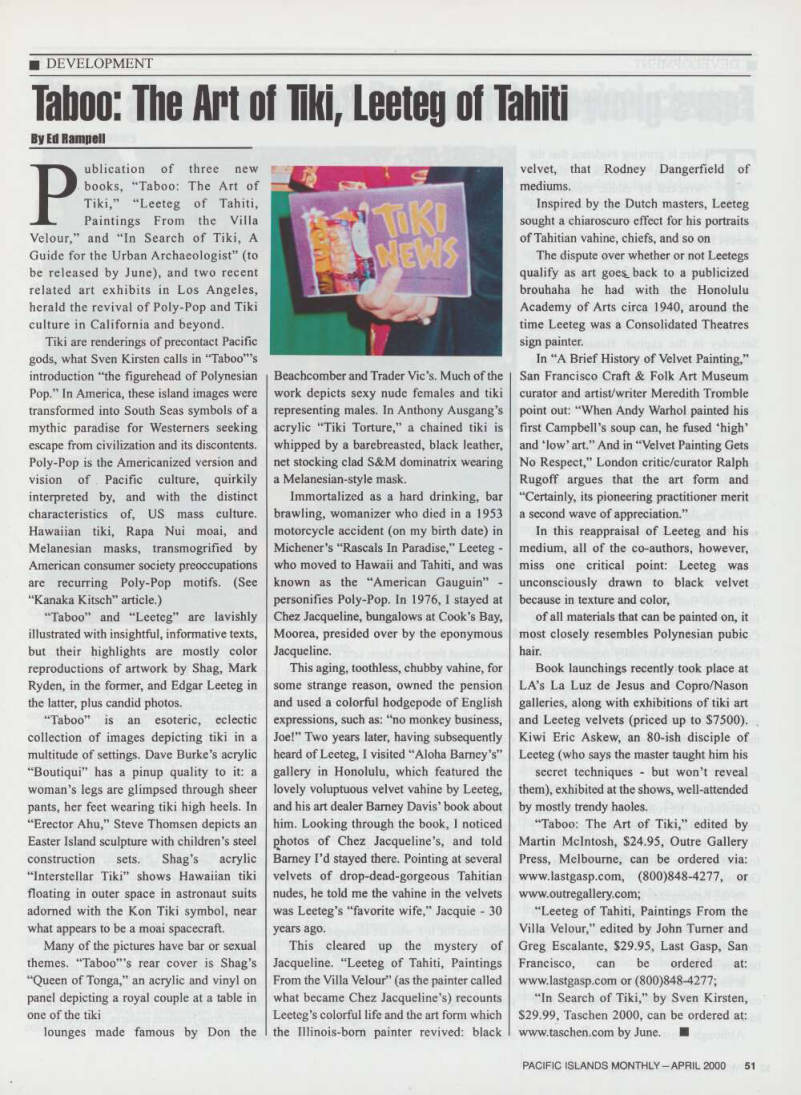
By Ed Rampell
Publication of three new books, “Taboo: The Art of Tiki,” “Leeteg of Tahiti, Paintings From the Villa Velour,” and “In Search of Tiki, A Guide for the Urban Archaeologist” (to be released by June), and two recent related art exhibits in Los Angeles, herald the revival of Poly-Pop and Tiki culture in California and beyond.
Tiki are renderings of precontact Pacific gods, what Sven Kirsten calls in “Taboo’”s introduction “the figurehead of Polynesian Pop.” In America, these island images were transformed into South Seas symbols of a mythic paradise for Westerners seeking escape from civilization and its discontents.
Poly-Pop is the Americanized version and vision of Pacific culture, quirkily interpreted by, and with the distinct characteristics of, US mass culture.
Hawaiian tiki, Rapa Nui moai, and Melanesian masks, transmogrified by American consumer society preoccupations are recurring Poly-Pop motifs. (See “Kanaka Kitsch” article.) “Taboo” and “Leeteg” are lavishly illustrated with insightful, informative texts, but their highlights are mostly color reproductions of artwork by Shag, Mark Ryden, in the former, and Edgar Leeteg in the latter, plus candid photos.
“Taboo” is an esoteric, eclectic collection of images depicting tiki in a multitude of settings. Dave Burke’s acrylic “Boutiqui” has a pinup quality to it: a woman’s legs are glimpsed through sheer pants, her feet wearing tiki high heels. In “Erector Ahu,” Steve Thomsen depicts an Easter Island sculpture with children’s steel
construction sets. Shag’s acrylic
“Interstellar Tiki” shows Hawaiian tiki floating in outer space in astronaut suits adorned with the Kon Tiki symbol, near what appears to be a moai spacecraft.
Many of the pictures have bar or sexual themes. “Taboo’”s rear cover is Shag’s “Queen of Tonga,” an acrylic and vinyl on panel depicting a royal couple at a table in one of the tiki lounges made famous by Don the
Beachcomber and Trader Vic’s. Much of the work depicts sexy nude females and tiki representing males. In Anthony Ausgang’s acrylic “Tiki Torture,” a chained tiki is whipped by a barebreasted, black leather, net stocking clad S&M dominatrix wearing a Melanesian-style mask.
Immortalized as a hard drinking, bar brawling, womanizer who died in a 1953 motorcycle accident (on my birth date) in Michener’s “Rascals In Paradise,” Leeteg who moved to Hawaii and Tahiti, and was known as the “American Gauguin” personifies Poly-Pop. In 1976, I stayed at Chez Jacqueline, bungalows at Cook’s Bay, Moorea, presided over by the eponymous Jacqueline.
This aging, toothless, chubby vahine, for some strange reason, owned the pension and used a colorful hodgepode of English expressions, such as: “no monkey business, Joe!” Two years later, having subsequently heard of Leeteg, I visited “Aloha Barney’s” gallery in Honolulu, which featured the lovely voluptuous velvet vahine by Leeteg, and his art dealer Barney Davis’ book about him. Looking through the book, I noticed photos of Chez Jacqueline’s, and told Barney I’d stayed there. Pointing at several velvets of drop-dead-gorgeous Tahitian nudes, he told me the vahine in the velvets was Leeteg’s “favorite wife,” Jacquie - 30 years ago.
This cleared up the mystery of Jacqueline. “Leeteg of Tahiti, Paintings From the Villa Velour” (as the painter called what became Chez Jacqueline’s) recounts Leeteg’s colorful life and the art form which the Illinois-born painter revived: black
velvet, that Rodney Dangerfield of mediums.
Inspired by the Dutch masters, Leeteg sought a chiaroscuro effect for his portraits of Tahitian vahine, chiefs, and so on The dispute over whether or not Leetegs qualify as art to a publicized brouhaha he had with the Honolulu Academy of Arts circa 1940, around the time Leeteg was a Consolidated Theatres sign painter.
In “A Brief History of Velvet Painting,”
San Francisco Craft & Folk Art Museum curator and artist/writer Meredith Tromble point out: “When Andy Warhol painted his first Campbell’s soup can, he fused ‘high’ and ‘low’ art.” And in “Velvet Painting Gets No Respect,” London critic/curator Ralph Rugoff argues that the art form and “Certainly, its pioneering practitioner merit a second wave of appreciation.”
In this reappraisal of Leeteg and his medium, all of the co-authors, however, miss one critical point; Leeteg was unconsciously drawn to black velvet because in texture and color, of all materials that can be painted on, it
most closely resembles Polynesian pubic
hair.
Book launchings recently took place at LA’s La Luz de Jesus and Copro/Nason galleries, along with exhibitions of tiki art and Leeteg velvets (priced up to $7500).
Kiwi Eric Askew, an 80-ish disciple of Leeteg (who says the master taught him his secret techniques - but won’t reveal them), exhibited at the shows, well-attended
by mostly trendy haoles.
“Taboo; The Art of Tiki,” edited by Martin Mclntosh, $24.95, Outre Gallery Press, Melbourne, can be ordered via: www.lastgasp.com, (800)848-4277, or
www.outregallery.com;
“Leeteg of Tahiti, Paintings From the Villa Velour,” edited by John Turner and Greg Escalante, $29.95, Last Gasp, San Francisco, can be ordered at: www.lastgasp.com or (800)848-4277; “In Search of Tiki,” by Sven Kirsten, $29.99, Taschen 2000, can be ordered at: www.taschen.com by June. ■
Fears grow of civil war in Solomon Islands
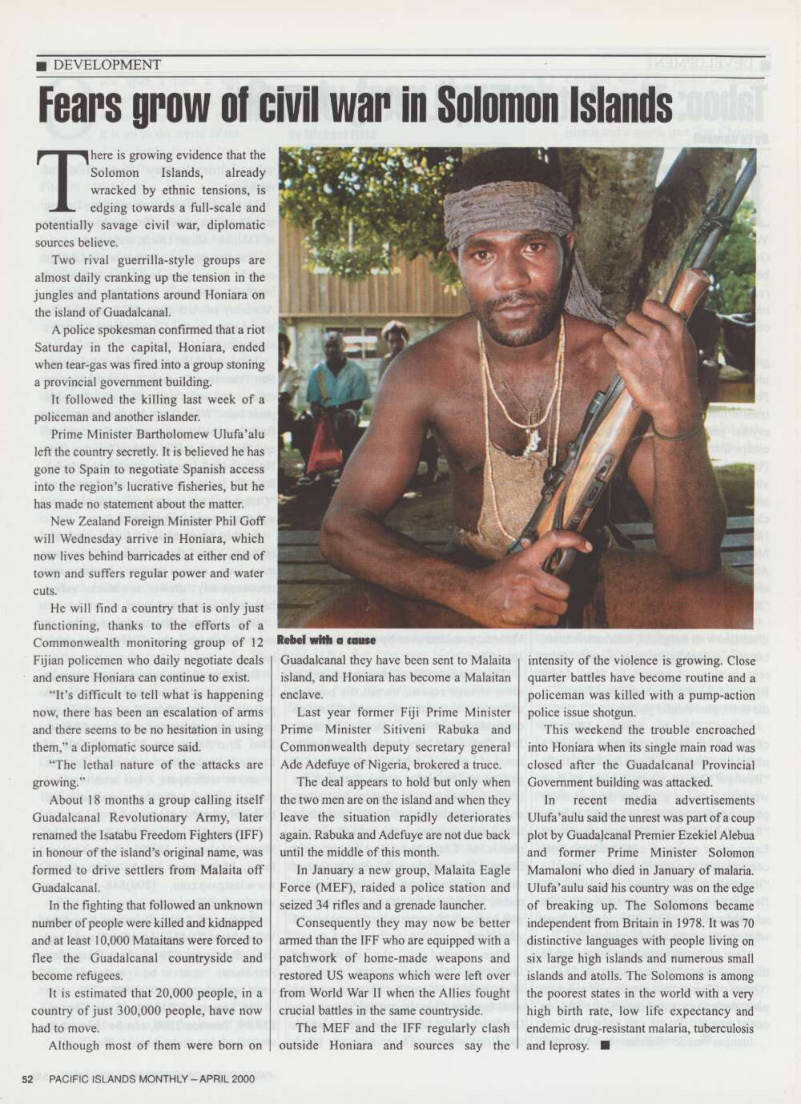
There is growing evidence that the Solomon Islands, already wracked by ethnic tensions, is edging towards a full-scale and potentially savage civil war, diplomatic sources believe.
Two rival guerrilla-style groups are almost daily cranking up the tension in the jungles and plantations around Honiara on the island of Guadalcanal.
A police spokesman confirmed that a riot Saturday in the capital, Honiara, ended when tear-gas was fired into a group stoning a provincial government building.
It followed the killing last week of a policeman and another islander.
Prime Minister Bartholomew Ulufa’alu left the country secretly. It is believed he has gone to Spain to negotiate Spanish access into the region’s lucrative fisheries, but he has made no statement about the matter.
New Zealand Foreign Minister Phil Golf will Wednesday arrive in Honiara, which now lives behind barricades at either end of town and suffers regular power and water cuts.
He will find a country that is only just functioning, thanks to the efforts of a Commonwealth monitoring group of 12 Fijian policemen who daily negotiate deals and ensure Honiara can continue to exist.
“It’s difficult to tell what is happening now, there has been an escalation of arms and there seems to be no hesitation in using them,” a diplomatic source said.
“The lethal nature of the attacks are growing.”
About 18 months a group calling itself Guadalcanal Revolutionary Army, later renamed the Isatabu Freedom Fighters (IFF) in honour of the island’s original name, was formed to drive settlers from Malaita off Guadalcanal.
In the fighting that followed an unknown number of people were killed and kidnapped and at least 10,000 Mataitans were forced to flee the Guadalcanal countryside and become refugees.
It is estimated that 20,000 people, in a country of just 300,000 people, have now had to move.
Although most of them were born on
Guadalcanal they have been sent to Malaita island, and Honiara has become a Malaitan enclave.
Last year former Fiji Prime Minister Prime Minister Sitiveni Rabuka and
Commonwealth deputy secretary general
Ade Adefuye of Nigeria, brokered a truce.
The deal appears to hold but only when the two men are on the island and when they leave the situation rapidly deteriorates again. Rabuka and Adefuye are not due back until the middle of this month.
In January a new group, Malaita Eagle Force (MEF), raided a police station and seized 34 rifles and a grenade launcher.
Consequently they may now be better armed than the IFF who are equipped with a patchwork of home-made weapons and restored US weapons which were left over from World War II when the Allies fought crucial battles in the same countryside.
The MEF and the IFF regularly clash outside Honiara and sources say the
intensity of the violence is growing. Close quarter battles have become routine and a policeman was killed with a pump-action police issue shotgun.
This weekend the trouble encroached into Honiara when its single main road was closed after the Guadalcanal Provincial Government building was attacked.
In recent media advertisements Ulufa’aulu said the unrest was part of a coup plot by Guadalcanal Premier Ezekiel Alebua and former Prime Minister Solomon Mamaloni who died in January of malaria.
Ulufa’aulu said his country was on the edge of breaking up. The Solomons became independent from Britain in 1978. It was 70 distinctive languages with people living on six large high islands and numerous small islands and atolls. The Solomons is among the poorest states in the world with a very high birth rate, low life expectancy and endemic drug-resistant malaria, tuberculosis and leprosy. ■
Rebel with a cause
Smart Kingan, oracle of Pacific technological change
Orbituary
By Arnold Stanbury
Stuart Kingan was bom in Dunedin, New Zealand on April 12, 1915. Soon afterwards the family moved to a farm at Prebbleton, near Christchurch. He finished primary schooling as dux of Prebbleton Primary School and moved on to Christchurch Boys High School where he became very interested in radio.
In 1932 he gained University Entrance and obtained his Amateur Radio License as ZL3GD.
Two years later, as a student at Otago University, using his own equipment, he pioneered investigations into the ionosphere, making first measurements in New Zealand. These experiments were published in the August 1934 issue of the amateur radio magazine Break In.
After a move to Christchurch in 1936 he was encouraged by Professor Coleridge Farr in his attempt to reflect VHP radio signals off the moon. This experiment was widely reported in the newspapers of the day but the equipment then available was not sensitive enough. In 1937 he worked with a new ionospheric programme at the University of Canterbury under Professor FWG White. After a short break working at the radiation laboratory, then run by the NZ Cancer Campaign Society, he returned to full time study of the ionosphere.
In 1942 he developed a manually operated ionosonde for field observations at Raoul Island.
It was while working there he came up with a suggestion that an observatory in Rarotonga could run in conjuction with the American one in Hawaii to make extremely useful observations.
In 1944 the International Radio Propagation Conference in Washington DC recommended that this be implemented. The result was that Stuart moved to Rarotonga which was to become his permanent home.
He married Tereapii Robati in 1949, and they raised three daughters, a feeding son and an adopted son. In 1957, following recommendations of the Belshaw-Stace report, Stuart was employed in the new Department of Social Development, first as Visual Aids Officer, then as Information Officer and later as Acting Secretary. By then it had been renamed the Department of Internal Affairs.
But during that time he conducted classes in radio and physics and his enthusiastic students constructed the first transmitter that was the
beginning of Radio Cook Islands. In 1971 he was transferred to the Scientific Research Division of the Premiers department and remained as head until his death in January this year. Cook Islands Premier Albert Henry, and his successor Prime Minister Tom Davis, both relied on Stuart’s advice on telecommunications and they made full use of the dial-up radio links to the outer islands that he had designed and built This service was completely reliable and he had the rewarding effect of doubling the export earnings of some islands simply because they then knew exactly when to have their produce ready for the irregular ship visits.
This network was enhanced by the new satellite technology of Peacesat, the educational satellite communications started by Professor John Bystron at the University of Hawaii. In 1972 Stuart, assisted by Tony Utanga, built equipment that enabled Rarotonga to join the network. For a number of years he was president of the Peacesat Consortium Council, and from 1975 to 1979 was a member of the Pacific Science Council.
He helped the University of the South Pacific in Fiji, and the South Pacific Commission with their satellite network. This involved a lot of travel around the Pacific dealing with their satellite network.
As a founding member of the Pacific Telecommunications Council, he served on its board of trustees and was appointed to the International Board of Advisers of the Satellite Communications Users Conference in the USA.
Much of the day to day operations of both the local and satellite networks was carried out by his late wife, Terepii. This included a major part of the communications with the ocean canoes Hokule’a, Te Aurere, Te Au-O-Tonga, Takitumu and others including the 1985 to 1987 voyage of rediscovery when Hokule’a made the return trip from Hawaii to New Zealand.
Over the last 20 years Stuart represented the Cook Islands at many conferences and meetings world-wide, presenting papers on communications, energy development, radio science and Pacific Island affairs. He attended the 1979 World Administration Radio Conference in Geneva and in 1982 he represented the New Zealand government at Unispace 82 in Vienna.
He will be remembered for his contributions to higher education in the Cook Islands through the teaching of science particularly physics, mathematics, electronics and amateur radio. He initiated public broadcasting and provided a news service and was editor and photographer for the Cook Island Press. He was a founding member of the Cook Island Library and Museum Society, and served a term as president He remained, until his death, an active member of the society.
Much of his “spare time” was spent on continued radio research. He had, for many years, worked in conjunction with the Stanford Research Institute of California, on the study of VHP transequatorial propagation.
For the last four years he had had also been working with the University of Colarado, Boulder, to set up an experiment using radio techniques to measure mesopheric winds (50km to 80km above the earth). Both of these experiments use the unique relationship between Rarotonga and Hawaii that Stuart was aware of back in 1942.
The present project requires an aerial system covering six acres and it must be said he was actively working on the planning and the physical erection of the aerials until his death.
Stuart was one of a handfrxl of people involved in the survey of the much publicised manganese nodules found on the sea bed around the Cook Islands. The research started back in the early 70s under the auspices of CCOP/SOPAC and Stuart’s association with it began in 1975.
He has summarised the findings of an extensive survey of the resource in a book Manganese Nodules of the Cook Islands published by the South Pacific Applied Geoscience Commission (SOPAC) in September 1998. A man of many of talents, Stuart will be remembered as a quiet, unassuming, always helpful individual.
He had no time for frivolous social activities - there were always so many interesting things to do, so many challenges, problems to solve, observations to pursue. He was not interested in financial gain or public accolades. His reward was a good conclusion, a new finding, a satisfied customer. He was one of those of whom it can be said that the world is a better place for his having lived here. ■
Coward’s crossing
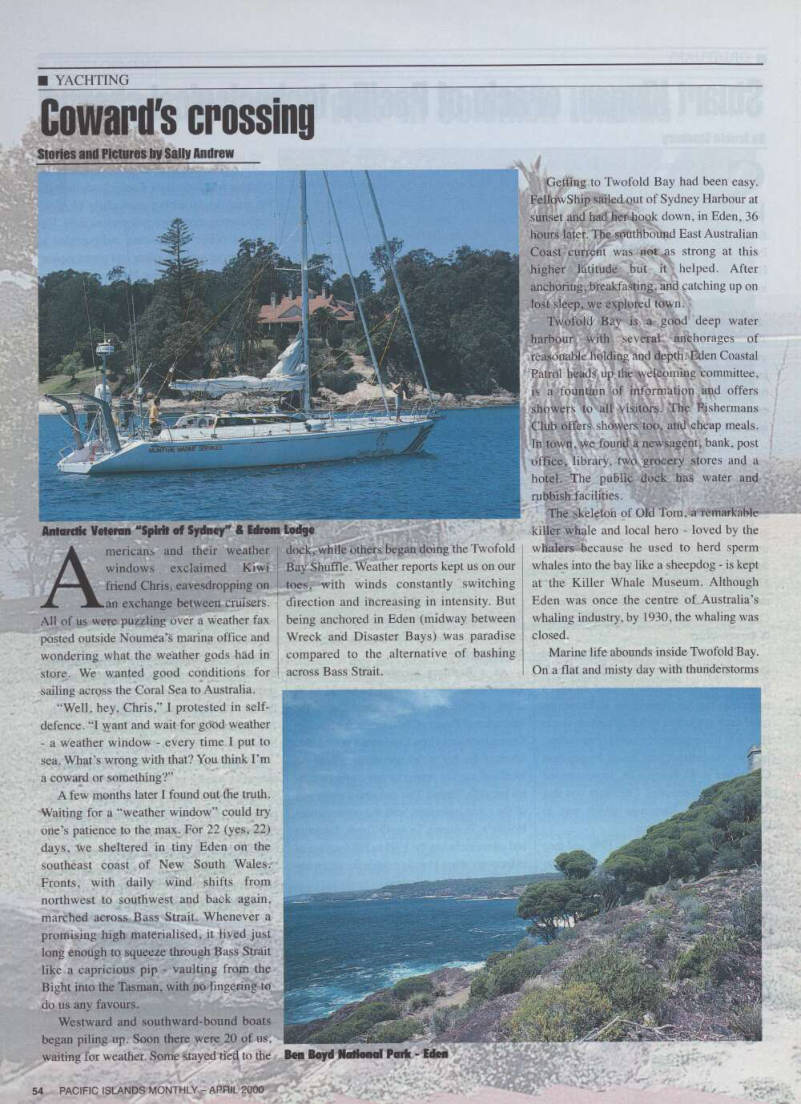
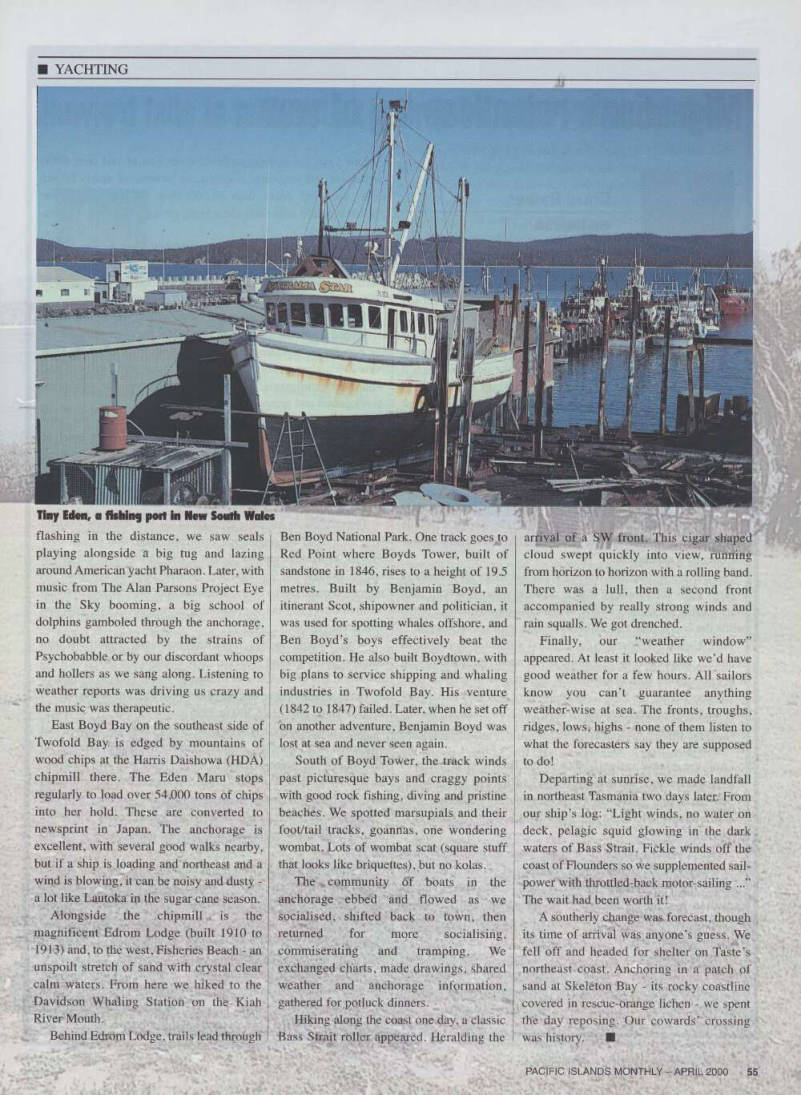
Yachting
Stories and Pictures by Sally Andrew
Americans and their weather windows exclaimed Kiwi friend Chris, eavesdropping on an exchange between cruisers.
All of us were puzzling over a weather fax posted outside Noumea’s marina office and wondering what the weather gods had in store. We wanted good conditions for sailing across the Coral Sea to Australia.
“Well, hey, Chris,” I protested in self defence. “I want and wait for good weather - a weather window - every time I put to sea. What’s wrong with that? You think I’m a coward or something?”
A few months later I found out the truth.
Waiting for a “weather window” could try one’s patience to the max. For 22 (yes, 22) days, we sheltered in tiny Eden on the southeast coast of New South Wales.
Fronts, with daily wind shifts from northwest to southwest and back again, marched across Bass Strait. Whenever a promising high materialised, it lived just long enough to squeeze through Bass Strait like a capricious pip - vaulting from the Bight into the Tasman, with no lingering to do us any favours.
Westward and southward-bound boats began piling up. Soon there were 20 of us, waiting for weather. Some stayed tied to the
dock, while others began doing the Twofold Bay Shuffle. Weather reports kept us on our toes, with winds constantly switching direction and increasing in intensity. But being anchored in Eden (midway between Wreck and Disaster Bays) was paradise compared to the alternative of bashing across Bass Strait.
(Jetting to Twofold Bay had been easy.
Fellowship sailed out of Sydney Harbour at sunset and had her hook down, in Eden, 36 hours later. The southbound East Australian Coast current was not as strong at this higher latitude but it helped. After anchoring, breakfasting, and catching up on lost sleep, we explored town.
Twofold Bay is a good deep water harbour with several anchorages of reasonable holding and depth. Eden Coastal Patrol heads up the welcoming committee, is a fountain of information ami offers showers to all visitors. The Fishermans Club offers showers too, and cheap meals.
In town, we found a newsagent, bank, post office, library, two grocery stores and a hotel. The public dock has water and rubbish facilities.
The skeleton of Old Tom, a remarkable killer whale and local hero - loved by the whalers because he used to herd sperm whales into the bay like a sheepdog - is kept at the Killer Whale Museum. Although Eden was once the centre of Australia’s whaling industry, by 1930, the whaling was closed.
Marine life abounds inside Twofold Bay.
On a flat and misty day with thunderstorms
Antarctic Veteran "Spirit of Sydney" & Edrom lodge
Ben Boyd Notional Park-Eden
flashing in the distance, we saw seals playing alongside a big tug and lazing around American yacht Pharaon. Later, with music from The Alan Parsons Project Eye in the Sky booming, a big school of dolphins gamboled through the anchorage, no doubt attracted by the strains of Psychobabble or by our discordant whoops and hollers as we sang along. Listening to weather reports was driving us crazy and the music was therapeutic.
East Boyd Bay on the southeast side of Twofold Bay is edged by mountains of wood chips at the Harris Daishowa (HDA) chipmill there. The Eden Maru stops regularly to load over 54,000 tons of chips into her hold. These are converted to newsprint in Japan. The anchorage is excellent, with several good walks nearby, but if a ship is loading and northeast and a wind is blowing, it can be noisy and dusty a lot like Lautoka in the sugar cane season.
Alongside the chipmill is the magnificent Edrom Lodge (built 1910 to 1913) and, to the west, Fisheries Beach - an unspoilt stretch of sand with crystal clear calm waters. From here we hiked to the Davidson Whaling Station on the Kiah River Mouth.
Behind Edrom Lodge, trails lead through
Ben Boyd National Park. One track goes to Red Point where Boyds Tower, built of sandstone in 1846, rises to a height of 19.5 metres. Built by Benjamin Boyd, an itinerant Scot, shipowner and politician, it was used for spotting whales offshore, and Ben Boyd’s boys effectively beat the competition. He also built Boydtown, with big plans to service shipping and whaling industries in Twofold Bay. His venture (1842 to 1847) failed. Later, when he set off on another adventure, Benjamin Boyd was lost at sea and never seen again.
South of Boyd Tower, the track winds past picturesque bays and craggy points with good rock fishing, diving and pristine beaches. We spotted marsupials and their foot/tail tracks, goannas, one wondering wombat. Lots of wombat scat (square stuff that looks like briquettes), but no kolas.
The community of boats in the anchorage ebbed and flowed as we socialised, shifted back to town, then returned for more socialising, commiserating and tramping. We exchanged charts, made drawings, shared weather and anchorage information, gathered for potluck dinners.
Hiking along the coast one day, a classic Bass Strait roller appeared. Heralding the
arrival of a SW front. This cigar shaped cloud swept quickly into view, running from horizon to horizon with a rolling band.
There was a lull, then a second front accompanied by really strong winds and rain squalls. We got drenched.
Finally, our “weather window” appeared. At least it looked like we’d have good weather for a few hours. All sailors know you can’t guarantee anything weather-wise at sea. The fronts, troughs, ridges, lows, highs - none of them listen to what the forecasters say they are supposed to do!
Departing at sunrise, we made landfall in northeast Tasmania two days later. From our ship’s log: “Light winds, no water on deck, pelagic squid glowing in the dark waters of Bass Strait. Fickle winds off the coast of Flounders so we supplemented sail power with throttled-back motor-sailing ...”
The wait had been worth it!
A southerly change was forecast, though its time of arrival was anyone’s guess. We fell off and headed for shelter on Taste’s northeast coast. Anchoring in a patch of sand at Skeleton Bay - its rocky coastline covered in rescue-orange lichen - we spent the day reposing. Our cowards’ crossing was history. ■
Tiny Eden, a fishing port in New South Wales
Migration's relentless tug of war
Opinion
A stroll down Auckland’s Queen Street at just about any time of the day offers evidence of the changing face of New Zealand. You will probably pass more Asians on the street than Pacific Island people, for instance and if you duck into any of the food courts in the side streets you’ll certainly find more people selling sushi than taro and nowadays even more noodles than the one-time standard pakeha fare of meat pies. Official statistics released recently prove this is not an anecdotal observation.
More than 57,000 Chinese from China, Hong Kong and Taiwan made up the largest group of new immigrants to settle in New Zealand during the 19905.
They were joined by another 69,000 Asian newcomers, mainly from Japan, Korea, India and South-east Asia, during a decade which saw a new immigration pattern start to irrevocably change the country’s appearance.
At the same time, the figures from Statistics New Zealand figures show thousands of kiwis; especially those in their 20s; were leaving the country to live in Australia throughout the 1990 s while the unprecedented numbers of Asian immigrants arrived.
The United Kingdom, New Zealand’s traditional source of migrants, dropped to No. 10 in the list of countries that provided a net population gain of permanent and long-term arrivals over departures during the 19905. Although there was substantial two way traffic of people between Britain and New Zealand, the net gain was a modest 6300, well below the 15,200 of South Africa, for instance.
And the relative insignificance of the Pacific as a source of immigrants over the last decade is shown by the fact that only Fiji (8500) shows up in the top 10 of contributing countries, with Western Samoa (3400) the sole other island country joining it in the top 20.
The exodus in search of greener grass across the Tasman resulted in New Zealand suffering a net loss of people to Australia of more than 89,000 during the decade of the 90s. (This is measured in terms of an excess of permanent and long-term departure; people leaving for 12 months or more - over those arriving and intending to stay.) This was offset by a net gain of 126,000 from Asia, plus another 24,000 from Europe, 15,250 from South Africa and 23,750 from all other countries, but the trend is worsening with migration deficits for the last two years following eight consecutive years of growth.
Last year, the country suffered a net loss of just over 9000 permanent and long-term migrants, an increase of nearly 50 per cent on 1998. More than 30,200 New Zealanders left for Australia, while only 6800 came back, giving a net trans-Tasman loss of 23,400.
There was a net migration gain of 10,400 from Asia and 2200 from South Africa, off-setting the losses to Australia, Europe and North America. For the record, the net gains from the islands in 1999 were Fiji (953), Samoa (513) and Tonga (188).
Now what all this means is that New Zealand which, like many developed countries, has a birth rate below the level required for the population to replace itself, is struggling in its efforts to keep New Zealanders at home, attract back those who have left and woo new immigrants; all desirable outcomes for economic development and prosperity.
The Immigration Service said in its brief to the new government elected last November that the current level of applications from prospective migrants was insufficient to meet its target of 38,000 residence approvals a year; a target set to achieve a net migration gain of 10,000 a year over the medium term.
The outflow to Australia throughout the 90s left New Zealand with an overall net population gain from migration of just over 99,000; an average gain of 10,000 a year in line with the policy target, though the immigration service pointed out that net migration could not be controlled because of the freedom of trans- Tasman travel and the unpredictable movement of migrants and long-term visitors.
With volatile swings reflecting economic conditions and changing immigration policies. New Zealand has suffered a net migration loss of 53,800 over the last 30 years. There is no pattern and annual figures have fluctuated between a loss of nearly 42,000 in 1979 and a gain of 28,500 in 1995.
Now, people in the islands should not be under any illusion that as a result of all this New Zealand is about to open its doors to all and sundry. The Samoan quota of up to 1100 a year will continue, as will flows from Fiji and Tonga, but successive governments have made it clear that their attention is focused on what they call “quality” migrants and unfortunately that means people with more money, skills and qualifications than the majority of islanders possess.
But there is evidence that many of those migrants who arrived from Asia and elsewhere over the last decade have gone home again, frustrated that their qualifications were not recognised here or that their skills could not get them the jobs they wanted. There is no shortage of stories of doctors driving taxis or engineers stacking supermarket shelves.
These settlement problems of new migrants are a priority for the new Immigration Minister Lianne Dalziel who is setting up an advisory group of outsiders to give her an alternative view to that
oMie^fficial^i^h^Tog^sh^ai^erth^olic^oi^rack^
David Barber
Wellington
Howard fails to take action over jailed aboriginal children
Something is rotten in the state of justice in Western Australia and the Northern Territory. In the past few months, a 16-year-old boy has been jailed for almost 24 hours for stealing 40 cents from a telephone box so he could pay for his train fare home and a 17-year-old boy with a mental age of eight, has been jailed for 3 months, again for stealing.
The worst case saw a 15-year-old boy commit suicide in a Darwin juvenile detention centre after serving 26 days of a 28day sentence for stealing some textas and paints.
What unites these boys is that they all come from severely disadvantaged backgrounds and are all Aboriginal.
In the case of all but the 16-year-old, what put them in jail were mandatory sentencing laws passed by the Prime Minister John Howard’s political allies in the Northern Territory and Western Australia. These ‘three strikes and you are in’ laws mean youths from the age of 15 years, convicted of a third property offence, must be given jail no matter how minor the offence or what extenuating circumstances may apply.
In the Northern Territory, you can expect to be treated as an adult from the age of 17. Then mandatory sentencing laws will see you get 14 days for your first property offence, 90 days for a second and one year for a third.
So it was recently, that a 21 -year-old man with no previous offences went to jail for 28 days for breaking a window in his own house. He had been reported to the police by his angry mother, who had no idea he would get more than a stem warning and was shocked and mortified when she discovered jail was the
only option.
In another recent Northern Territory case a 22-year-old (who like the 21-year-old was Aboriginal) was sentenced to a year in jail for stealing a box of biscuits on Christmas day because he
was hungry.
Since the beginning of February, Prime Minister John Howard, has been weathering a storm of protest over his refusal to step in and overturn the mandatory sentencing legislation.
While Howard himself, doubts the value of the laws enacted by his Liberal colleagues, he justifies his failure to act by his unwillingness to touch that Liberal sacred cow ‘States Rights’ (to make laws without Federal intervention).
He also appears to have taken notice of recent opinion polls that show voters in Western Australia and the Northern Territory support mandatory sentencing.
Jail particularly for young people, can lead to broken lives and suicide in jail is, unfortunately, a not infrequent response of people who feel their future and their nation has nothing to offer them. That the Prime Minister is willing to leave children vulnerable in the name of a political sacred cow is appalling.
While mandatory sentencing applies to all offenders, it falls disproportionately on the Aboriginal community.
It is this aspect of the legislation that prompted some of the most damning criticism of Mr Howard.
Four of the most senior judges in New South Wales, Justices James Wood, Tony Fitzgerald, Margaret Beazley and Paul Stein took the unusual step of writing to a Sydney newspaper.
Their views were devastating: ‘Racism and injustice are evil, particularly when they have popular support. It is unjust to imprison offenders without regard to their personal circumstances, life experience, prospects of rehabilitation or other, more suitable, sentences,’ the Justices said.
“It is racist (and cowardly) to enact and implement laws which apply most harshly to a disempowered minority. It might be thought clever politics but it is not leadership to pander to ignorance and prejudice,” the judges concluded with sting firmly aimed at Mr Howard. John Howard’s leadership on Aboriginal issues is now under serious question.
His refusal to say ‘sorry’ to the stolen generations of Aboriginal children who were taken away from their families, has stymied the reconciliation process. After 8 years work by the National Reconciliation Council, Mr Howard has now abandoned the December 2001 deadline for a document of reconciliation and said that the process will take years.
These moves contrast strongly with the Prime Minister’s passionate statement in his victory speech after the 1998 election in which he said: “I also want to commit myself very genuinely to the cause of true reconciliation with the Aboriginal people by the centenary of Federation”. John Howard’s handling of Aboriginal issues is now set to become an international issue and, during April, he will face a tough time in parliament.
The Senate is angry that Mr Howard gagged debate in the House of Representatives on its bill to overturn mandatory sentencing and is considering the unprecedented step of refusing to debate bills passed by the lower house.
In the international arena, Mr Howard is facing embarrassing disclosures about the way Australia lobbied the UN to remove findings that clearly show Australia’s mandatory sentencing laws are in breach of its international obligations to children, to prevent race discrimination and to uphold human rights.
Human Rights Commissioner, Chris Sidotti, says the Howard efforts on the UN report and its claim that mandatory sentencing is a purely ‘internal issue’ put Australia in the same class as notorious human rights violators such as China, Burma and Malaysia. With the intense international scrutiny that goes with the Olympics, Mr Howard can only expect the cacophony of criticism to get louder. ■
Jemima Garrett
Sydney
Pacific Puzzle

Extra
Across
1. Nationality of Pacific explorer Abel Tasman. 6. Personal windows on a watery world. 9. Author Robert Louis Stevenson lived on this Kiribati Island in 1889.
10. Tongan island group. (4’l) 11. Traditional Kiribati dance, banned by missionaries. 12. of Cook Island which means “in the direction of the prevailing wind, south.”
13-Polyisculptures.
14. Waffling lights. 16. boat. 18. Tropical treat. 19. Head northeast from 12 Across and you’ll find this island, next to Atiu. 21. Convent. 23. in Samoa, malo e lelei in Tonga, in New Zealand. 24. The sour carambola by another name. (4,5) 27. Large passenger ship. 28. Strange route to distant islands. 29. version of language. 30. navigation aids. 31. British author lan Flemming once said of this island tourist transport; “A is dangerous at both ends nd uncomfortable in the middle.”
Down
1. Frogman. 2. Hot surfing spot in Fiji’s Mamanuca Islands. 3. Most Tahitians prefer to live on the coast, believing tupapau their island’s interior. 4. Cultural division of the Pacific. 5. Vanuatu island which is a stronghold of the Jon Frum movement. 6. American author who wrote of Fiji’s beachcombers; “They lived worthless lives of sin and luxury.” (4,5) 7. Swimmer’s simple breathing device. 8. Ships’ rigging components. 14.1 n Samoa and Papua New Guinea, this likes to soar at sunset. 15. Small boat motors. 16. Octopus arms. 17. fish. 20. main town. 22.6 Down is a quote from the book Following the . 23.Ships’ storage areas.
24. Fiji’s sweet mainstay.
25. Found on top of a Vailima or a Fiji Bitter. 26. in Fiji, trois in Tahiti, in Australia.
Check Out Pim On The Web
@ www.pim.com.lj
Answers
ACROSS: I.Dutch 6.Masks 9.Abemama lO.Vava’u ll.Ruoia I2.Rarotonga 13.Tikis 14. Beacons 16. Trawler IS.lce 19.Takutea 21. Nunnery 23.He110 24. Star fruit 27. Liner 28.0uter 29. Dialect 30. Stars 31. Horse.
DOWN: I.Diver 2.Tavarua 3.Haunt 4.Melanesia S.Tanna 6.Mark Twain 7.Snorkel S.Spars 14.8 at IS.Outboards 16. Tentacles 17. Ray 20.Kolonia 22. Equator 23.H01ds 24. Sugar 25. Froth 26. Three
Advertisements & other items, pp. 59-60 (1 item)
your goods
Pacific...
J*.
I s ’ * IS - I
mu p
si mt
Bruce Johnson
Sales Executive XYZ Shipping.
Started in the shipping industry when he joined XYZ Shipping 12 months ago. He services Auckland customers for the Pacific leg of the round-the-world service. Prior to that, was employed as a sales rep with a computer company.
Has no discretion on the tariff. Reports to the National Sales Manager, who has greater authority, but all decisions arc referred to Pricing Division.
Tammy Hamawi
Line Manager/Commercial
Director Director and shareholder with PDL Line, a privately owned company whose sole purpose is to cater for trade in the South Pacific.
Based in Head Office.
Fifteen years in the shipping industry, working her way up from Shipping Clerk to Supervisor. PDL Line Manager since 1994.
Has total discretion when dealing with customers without referral to other Managers.
Ambition: To play a significant role in the success and growth of PDL through superlative customer service.
... who would you rely on?
At PACIFIC DIRECT LINE our people run the line. Our structure is streamlined and our clients' needs are met simply, efficiently and quickly. ;ss that has operated in the Pacific since 1968. Thirty-two years ling freight and logistics services in the region. il supplies, foodstuffs, building supplies and machinery plus w Zealand and Australia to almost every Pacific Island nation. 1508
PDL
8 information contact Pacific Direct Line, Auckland rhone 0064 9 358 5256 Fax 0064 9 358 4833
919
PAG
3) 5UeA^
vjyu
M |pi ' ' * ✓ Some of the specs may vary according to market specifications.
Tough, Rugged and Comfortable - Toyota Hilux People all over the world prefer Toyota. Because it makes bestsellers like Hilux. It maintains that rugged reputation, and now it sports tough, durable body styles as well. It's ready for any terrain.
Hilux offers more. More power - with a choice of engines and precision transmissions and transfers. More effective power distribution to match the terrain, thanks to Toyota's advanced
technology.
lululu. global.
toyota. com
For further information, please contact the following distributors or dealers
DISTRIBUTORS/DEALERS
NORFOLK ISLAND BORRY’S PTY LTD. PH 22114
SOLOMON ISLANDS ELA MOTORS PH 30314
VANUATU ASCO MOTORS PH 22341
COOK ISLANDS PACIFIC MOTORS LTD. PH 20796 And more passenger car-like comfort. With an ergonomic interior, all the conveniences you want, the fit and finish you'd expect from Toyota, and a ride that's smoothed out by precision-engineered suspension.
Hilux is built to take it. And to take you anywhere you want to go.
It's remarkably tough. And incredibly comfortable. With worldleading uncompromising quality. From the champion. Toyota.
® TOYOTA
KIRIBATI TARAWA MOTORS PH 21090
PAPUA NEW GUINEA ELA MOTORS PH 3229400
TAHITI NIPPON AUTOMOTO PH 429819
SAMOA ASCO MOTORS PH 20800
FIJI ASCO MOTORS PH 384888
NEW CALEDONIA S.IAP. PH 275562
TONGA ASCO MOTORS PH 23500
AMERICAN SAMOA ASCO MOTORS* PH 633-4281
(*HILUX is not being handled.)