Pacific Islands
Monthly
Special Report: The Pacific Communitv in the new millennium
March 2000
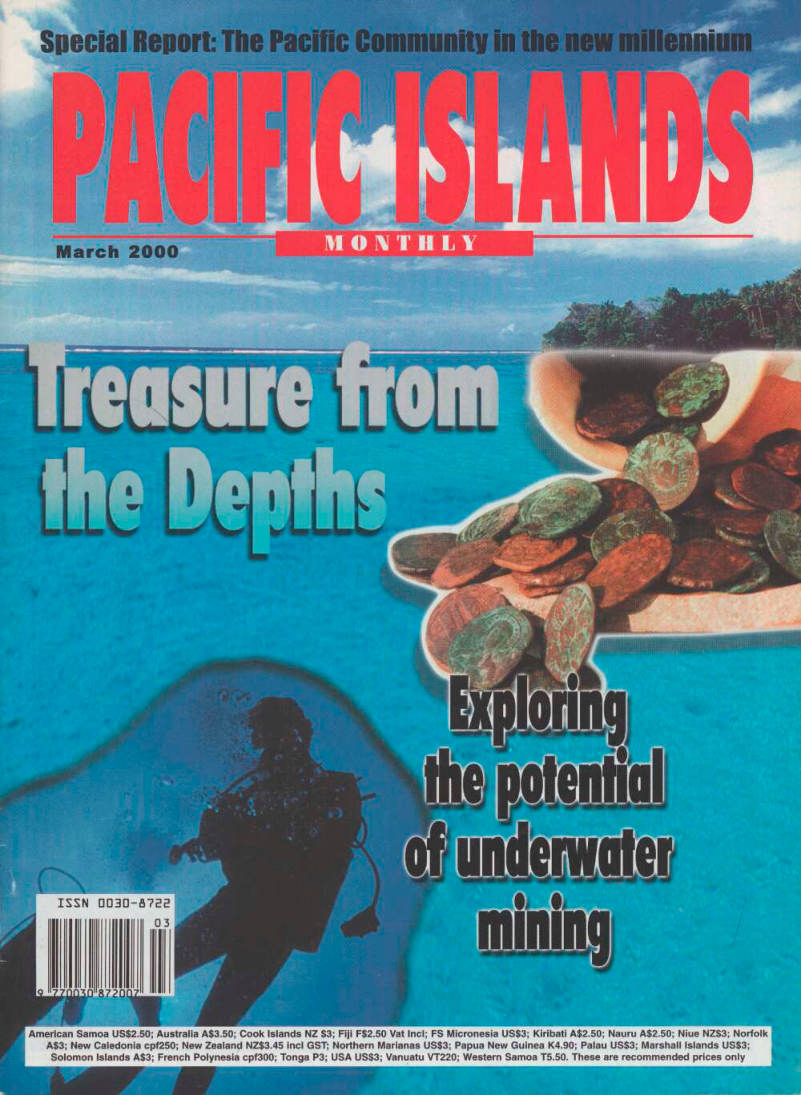
Treasure Dm
«Wk tynmrma hJfilv BVI HIM
the, potential
at underwater
ti i
mining
m
American Samoa US$2.5O; Australia A 53.50; Cook Islands NZ $3; Fiji F 52.50 Vat Incl; FS Micronesia US$3; Kiribati A 52.50; Nauru A 52.50; Niue NZ$3; Norfolk As 3; New Caledonia cpf2so; New Zealand NZ53.45 incl GST; Northern Marianas US$3; Papua New Guinea K 4.90; Palau US$3; Marshall Islands US$3; Solomon Islands As 3; French Polynesia cpf3oo; Tonga P 3; USA US$3; Vanuatu VT22O; Western Samoa T 5.50. These are recommended prices only
Advertisements & other items, p. 2 (1 item)
m Zm".
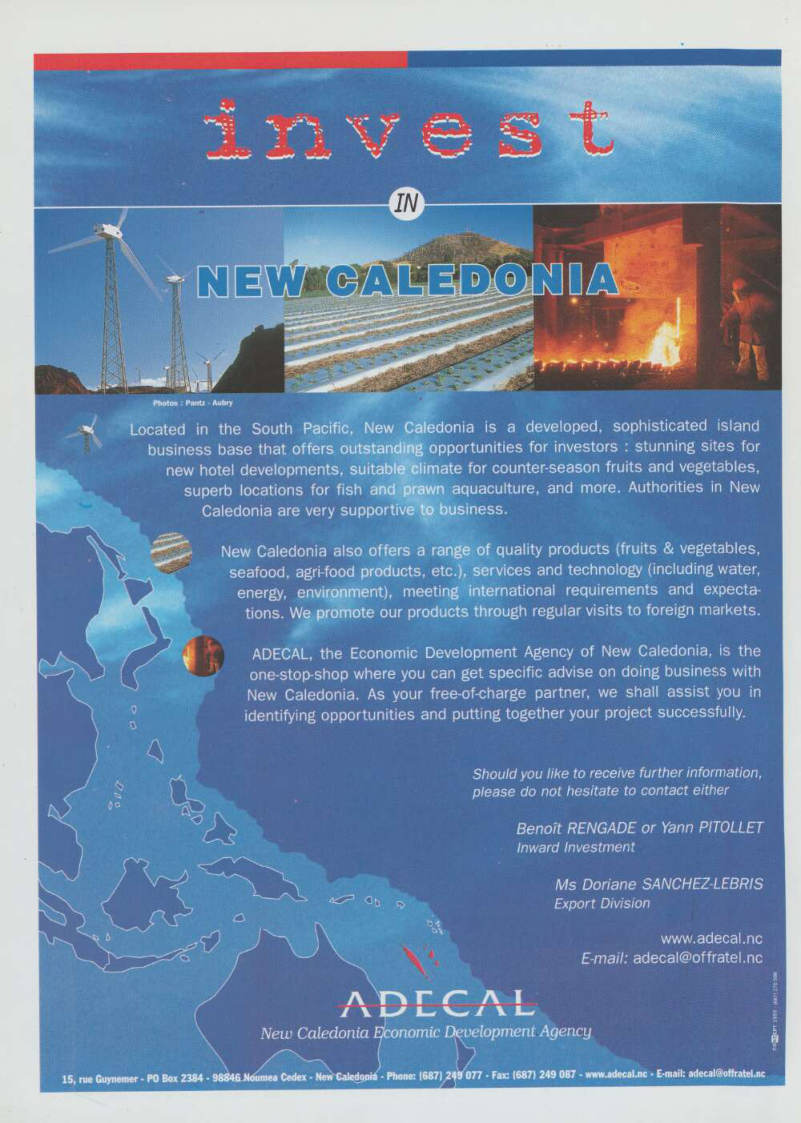
sr* . r— — -v V / 0 o % W?. r - ■ M Photos : Pantz - Aubry A <0 O b £3 A \ New Caledonia mea Cedex - New 15, rue Guynemer - PO Box 2384 - Located in the South Pacific, New Caledonia is a developed, sophisticated island business base that offers outstanding opportunities for investors : stunning sites for new hotel developments, suitable climate for counter-season fruits and vegetables, superb locations for fish and prawn aquaculture, and more. Authorities in New Caledonia are very supportive to business.
New Caledonia also offers a range of quality products (fruits & vegetables, seafood, agri-food products, etc.), services and technology (including water, energy, environment), meeting international requirements and expectations. We promote our products through regular visits to foreign markets.
ADECAL, the Economic Development Agency of New Caledonia, is the one-stop-shop where you can get specific advise on doing business with New Caledonia. As your free-of-charge partner, we shall assist you in identifying opportunities and putting together your project successfully.
Should you like to receive further information, please do not hesitate to contact either Benoit RENGADE or Yann PITOLLET Inward Investment Ms Doriane SANCHEZ-LEBRIS Export Division tt-? tA www.adecal.nc E-mail: [email protected] onomic Development Agency r* A Phone: {6B7J 249 077 - Fax: (687) 249 087 • www.adecal.nc - E-mail: [email protected]
Pacific Islands
Monthly
Vol. 72 No. 3
The News Magazine
March 2000
Alan Robinson Sophie Foster Hildebrand Michael Field, Giff Johnson, Sally Andrew, Sam Vulum, Ed Rampell, Alan Ah Mu, Brian Tobia.
David Barber (Wellington), Jemima Garrett (Sydney) Penina Magnus, Sovaia Ditoga Senior Regional Sales (South Pacific) Shayne Farah Hussein Tel (679)304111,303244, Fax (679) 303809.
Sydney, Canberra: Bob Hill Media Represen tation, Tel (61-2) 4164245, Fax (61-2)4165064.
Brisbane: Jane Fewings Media and Advertising Associates Tel (61-7) 3378 4522, Fax (61-7) 3878 1071.
Adelaide: Hastwell Williamsons Representa tives, Tel (61-8) 3799522, Fax (61-8) 3799735.
Melbourne: Brown Orr Fletcher Burrows (Aust) Pty Ltd.
Tel (61-3) 98265188, Fax (61-3) 98265644.
Auckland: McKay & Bowman. International Media Representatives Limited, Tel (64-9) 4190561, Fax (64-9) 4192243.
Japan: Universal Media Corporation, Tokyo, Tel (3) 3266626741, Cable: UNI-MEDIA Tokyo, Fax (3) 32626742.
Pacific Islands Monthly was founded in 1930
(Usps 9522480).
A Fiji Times Limited production.
Cover prices are recommended retail only. Registered by Australia Post. Publi cation No. NBPI2IO. © Copyright Fiji Times Limited. 177 Victoria Parade, Suva, Fiji.
Tel (679) 304111, fax (679) 303809.
Email: [email protected] PIM Website: http://www.pim.com.fj Pacific Islands Monthly is published monthly by Fiji Times Limited, a division of Nationwide News, 2 Holt Street, Surry Hills, Sydney, NSW 2010.
Pacific Islands Monthly PO Box 1167, Suva, Fiji.
Printed by Quality Print Limited, 16 Anna Street. Walu Bay, Suva, Fiji.
Cover design/Layout by Penina Magnus & Sovaia Ditoga All care, but no responsibility taken for material submitted for publication
[Cover:
Inside
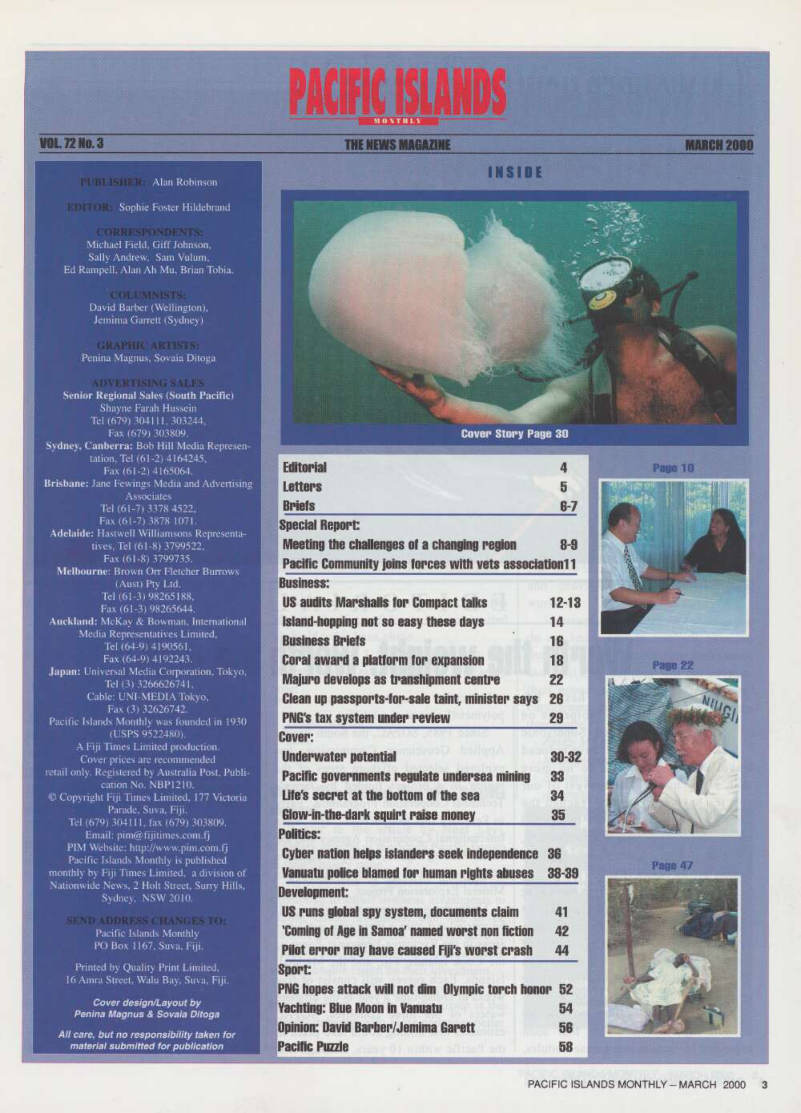
Cover Story Page 30
Editorial 4 Letters 5 Briefs B-7 Special Beport: Meeting the challenges of a changing region 8-9 Pacific Community joins forces with vets association! 1 Business: US audits Marshalls for Compact talks 12-13 Island-hopping not so easy these days 14 Business Briefs 16 Coral award a platform for expansion 18 Majuro develops as transhipment centre 22 Clean up passports-for-sale taint, minister says 26 PNG's tax system under review 29
[Cover:
Underwater potential 39-32 Pacific governments regulate undersea mining 33 Life's secret at the bottom of the sea 34 Giow-in-the-dark squirt raise money 35 Politics: Cyber nation helps islanders seek independence 36 Vanuatu police blamed for human rights abuses 38-39 Development: US runs global spy system, documents claim 41 'Coming of Age in Samoa' named worst non fiction 42 Pilot error may have caused Fiji's worst crash 44 Sport: PNG hopes attack will not dim Dlympic torch honor 52 Yachting: Blue Moon in Vanuatu 54 Dpinion; David Barber/Jemima Garett 56 Pacific Puzzle 58
Page 10
Page 22
Page 47
Worth the weight, worth the wait
Editorial
Mankind has left eternal footprints on the moon. Supersonic aircraft have reduced travel around the world to no more than a few hours. The bravest of our species have collectively reached the top of Mount Everest more than 1000 times. But as we enter a new century, no human has visited the farthest depths of the ocean floor.
This has not stopped us from attempting to explore the ocean. The Pacific plays an important role in research and exploration of the deep sea, particularly in search of minerals. Indeed, the region is believed to be one of the most prospective for offshore mineral resources.
Early interest was directed towards offshore hydrocarbons, but that soon expanded to include manganese nodules,
cobalt-rich manganese crusts and polymetallic massive sulphides.
Since 1985, SOPAC, the South Pacific Applied Geoscience Commission, has explored selected offshore areas of the region in a project funded by Japan’s Technical Cooperation Programme. Early in February this year SOPAC, The Japan International Cooperation Agency and the Metal Mining Agency of Japan signed a new agreement as part of the Deep Sea Mineral Exploration Project.
Under the new agreement, surveys will be carried out over a three-year period in areas in the Exclusive Economic Zones of the Cook Islands, Fiji, and the Marshall Islands. Each survey will consist of five weeks of cruise-time a year in the offshore waters of the three countries. SOPAC estimates that mining could take place in the Pacific within 10 years, although it is
more likely to occur within 20.
These deposits will be mined at some point so it is important that offshore mineral development is managed in a sustainable manner. The technology to mine manganese nodules for example has been proposed and developed. It varies from suction to dredging, but at the current stage of development, it would result in low recovery rates with much of the resource lost in the process.
Undersea minerals are an attractive source of income for the not-so-rich Pacific nations.
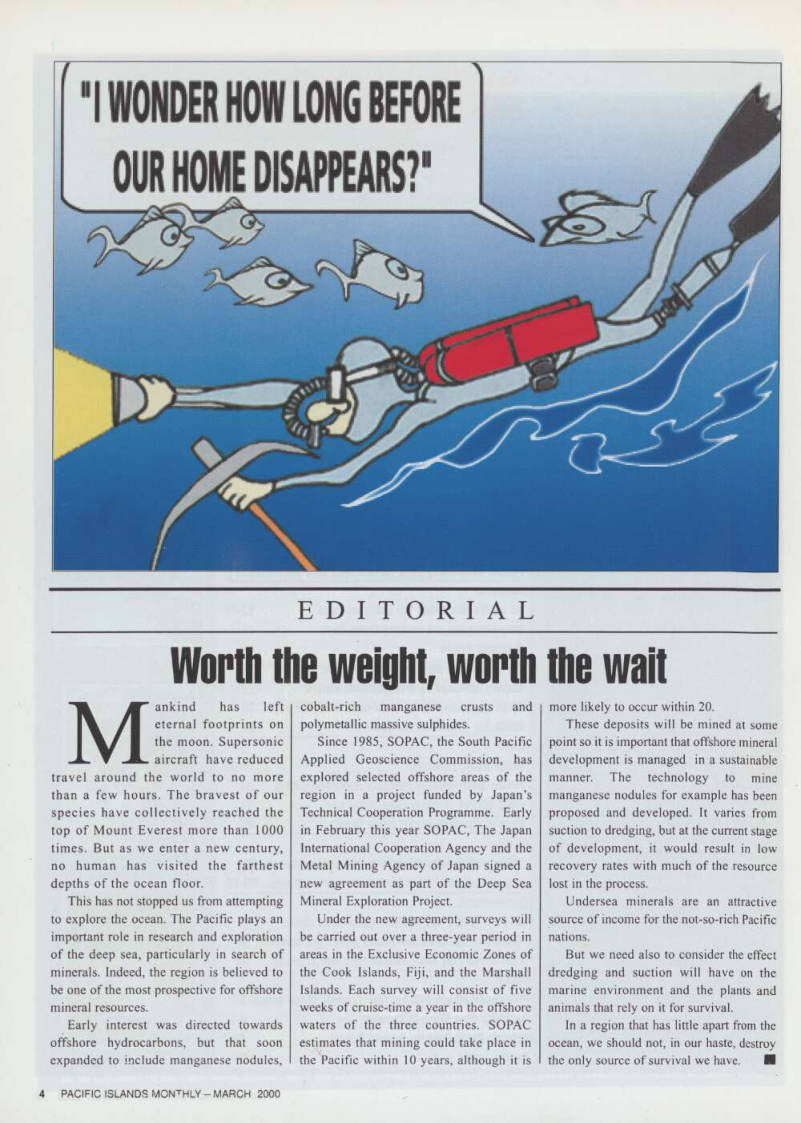
But we need also to consider the effect dredging and suction will have on the marine environment and the plants and animals that rely on it for survival.
In a region that has little apart from the ocean, we should not, in our haste, destroy the only source of survival we have. H
Advertisements & other items, p. 4 (1 item)
4
PACIFIC ISLANDS MON T HLY - MARCH 2000
Letters
Paradise Journalism
Apropos of Michael Field’s article “Paradise journalism is a farce” in your January 2000 issue.
I believe Michael Field misses the point.
To illustrate: A young Tongan man enters a kava party without noticing that he has stood on some dog waste.
In the kava circle there is a local village chief, the village “faifekau” (church minister), a young “tou’a” (unmarried woman who mixes the kava), and a good mix of male villagers.
As soon as it is determined that the source of the stink is the young man with dog waste on his foot, he will be addressed thus: “Young man.
It seems that in your haste to join our kava circle, you failed to notice that your foot is injured.
“Please go and have it treated.”
Being a sharp young man he immediately replies. “Please forgive me.
In my eagerness to get here and drink from the hands of the beautiful “tou’a” I failed to notice the broken glass.
“I shall leave immediately for the hospital for treatment.”
He makes a swift exit.
It is not that islanders avoid reality. Only we address reality in a way that, in the final analysis, is conducive to a society that is tolerant and is respectful of each individual’s “face”.
In that context I am not surprised that His Majesty the King of Tonga has not invited Mr Field to his kava circle.
Then again, I am surprised that His Majesty has not put a “fatwa” on Mr Field’s nose!
Lopeti Senituli Suva Fiji Whol lies ahead for Ihe Pacific
region?
I refer to the article by Noel Levi, secretary general of the South Pacific Forum in your January issue.
As one who is actively involved in attempting to attract overseas investments to Forum Group countries, one has to be realistic as to what these countries have to offer potential investors who require a safe and reasonable return on their investment.
Without doubt the greatest potential for each and every country in the group is the tourism industry, with some countries better
situated than others to take advantage of this. Other major industries such as garment manufacturing and fish canning also have the ability to attract investment and provide opportunities for local workers.
However, most countries in the group do not know how to correctly promote themselves or attract overseas investment and until they do, they will not advance their economies or provide meaningful employment for their people at the rates they desire.
Philip M Levy
Management consultant
Brisbane Australia
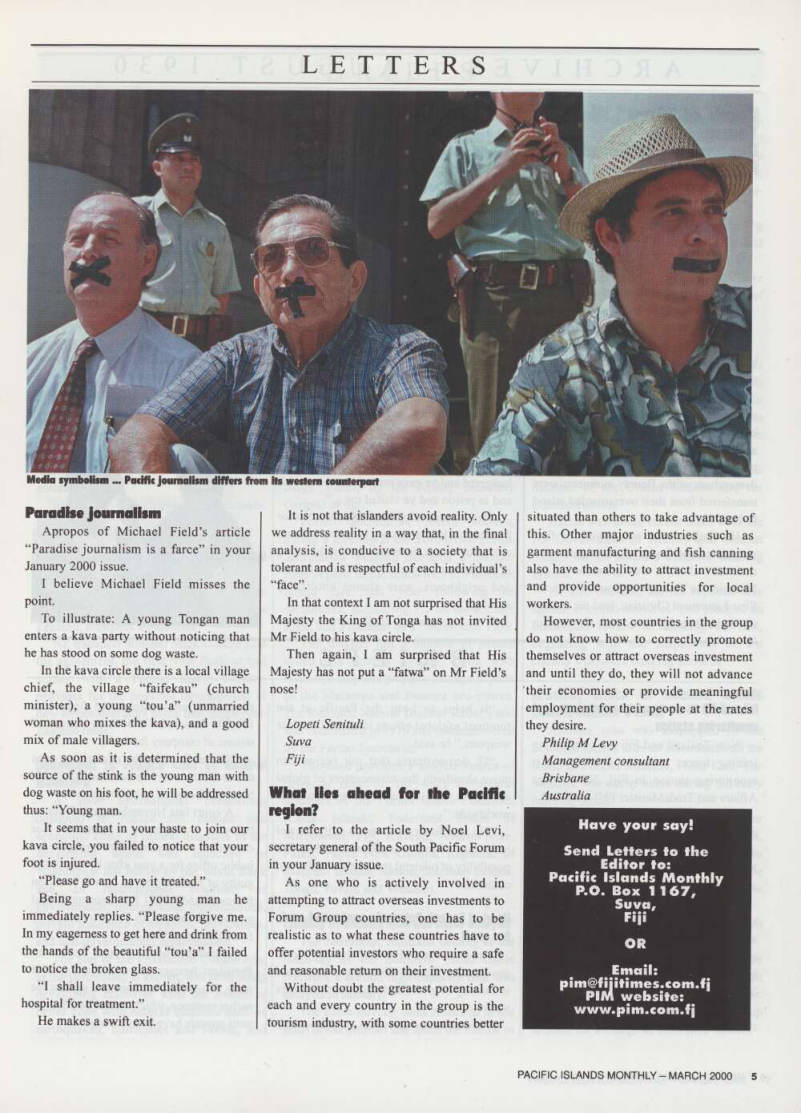
Media symbolism ... Pacific journalism differs from its western counterpart
Advertisements & other items, p. 5 (1 item)
Have your say!
Send Letters to the Editor to: Pacific Islands Monthly P.O. Box 1 1 67, Suva, M • •• Fi|i OR ' Email: pim@ffi jitimes.com.fi PIM website:
www.pim.com.fj
Archives-August 1930
Death of "Aunt" Ninnie
Young
Descendant of Bounty
Midshipman
From
Our Own Correspondent
Norfolk Island, July 25
I have just returned home from one of the most moving and picturesque ceremonies I have ever witnessed - the burial, after sudden death, of one of the remaining Pitcairners.
Old Miss Young - or Aunt Ninnie, was she was generally and most affectionately known - was actually born upon Pitcairn, and brought to Norfolk when she was only two or three years old, when the descendants of the Bounty mutineers were transferred from their overcrowded island to Norfolk.
Her father, who was appointed first magistrate and leader of his people upon their arrival here, was grandson of the Midshipman Young, who together with the First Lieutenant Christian, lead the mutiny upon the Bounty, cast adrift the captain
and other officers, sailed Bounty back to Tahiti, where they took native wives magnificent women of a magnificent race and sailed further on to Pitcairn where they sank the ship and settled ashore.
Young came, no doubt, from a middle class family, where children were taught to speak almost reverently of their parents; and that tradition was evidently maintained in the succeeding generations, for dear Miss Young would talk to me of “Dear Papa” or “Dear Mamma” in the best Victorian manner, and I loved to listen to her.
Her name, all her life long, was synonymous with charity, goodness and the deepest religious feeling and, islanders and mainlanders alike, we all had tears in our eyes as we stood around her grave this morning in the quaint old cemetery, beneath the wide blue sky, and joined in the singing of that wonderful anthem, “I was an hungered and ye gave me meat... I was sick and in prison and ye visited me ...”
Those words might have been written for the dear old lady and, sung in the rich, warm, colourful voices, harmonising and blending in the passion of grief of her lifelong friends and neighbours, were almost intolerably moving.
It is a memory I shall carry with me
wherever I may go.
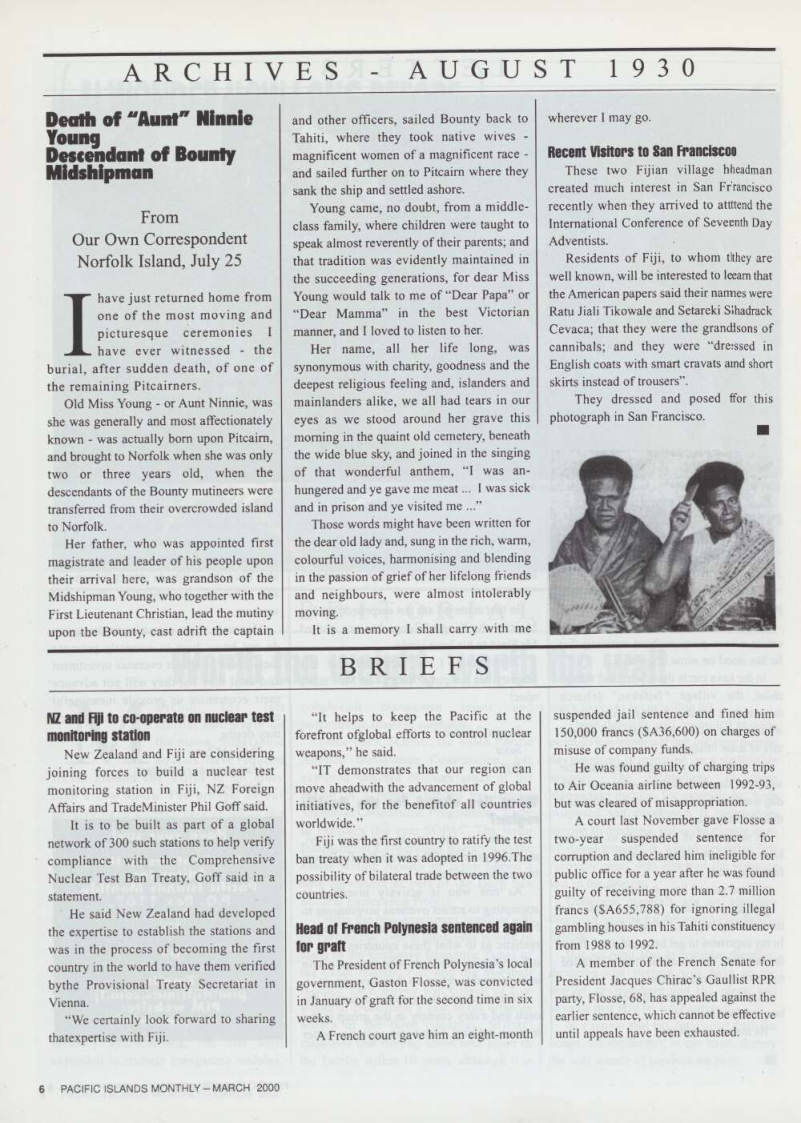
Recent Visitors to San Franciscoo These two Fijian village hheadman created much interest in San Ffrancisco recently when they arrived to attttend the International Conference of Seveenth Day Adventists.
Residents of Fiji, to whom tlthey are well known, will be interested to leeam that the American papers said their narmes were Ratu Jiali Tikowale and Setareki Slhadrack Cevaca; that they were the grandisons of cannibals; and they were “dre:ssed in English coats with smart cravats amd short skirts instead of trousers”.
They dressed and posed ffor this photograph in San Francisco.
Briefs
NZ and Fiji to co-operate on nuclear test
monitoring station
New Zealand and Fiji are considering joining forces to build a nuclear test monitoring station in Fiji, NZ Foreign Affairs and Trade Minister Phil Goff said.
It is to be built as part of a global network of 300 such stations to help verify
compliance with the Comprehensive
Nuclear Test Ban Treaty, Goff said in a statement.
He said New Zealand had developed the expertise to establish the stations and was in the process of becoming the first country in the world to have them verified bythe Provisional Treaty Secretariat in Vienna.
“We certainly look forward to sharing thatexpertise with Fiji.
“It helps to keep the Pacific at the forefront ofglobal efforts to control nuclear weapons,” he said.
“IT demonstrates that our region can move aheadwith the advancement of global initiatives, for the benefitof all countries worldwide.”
Fiji was the first country to ratify the test ban treaty when it was adopted in 1996. The possibility of bilateral trade between the two countries.
Head of French Polynesia sentenced again
for graft
The President of French Polynesia’s local government, Gaston Flosse, was convicted in January of graft for the second time in six weeks.
A French court gave him an eight-month
suspended jail sentence and fined him 150,000 francs ($A36,600) on charges of misuse of company funds.
He was found guilty of charging trips to Air Oceania airline between 1992-93, but was cleared of misappropriation.
A court last November gave Flosse a two-year suspended sentence for corruption and declared him ineligible for public office for a year after he was found guilty of receiving more than 2.7 million francs ($A655,788) for ignoring illegal gambling houses in his Tahiti constituency from 1988 to 1992.
A member of the French Senate for President Jacques Chirac’s Gaullist RPR party, Flosse, 68, has appealed against the earlier sentence, which cannot be effective until appeals have been exhausted.
FIJI considers sedition charges against
Korem The Fiji government is considering charging convicted Californian fraudster David Korem with sedition after he tried to incite the Fijian island of Rotuma to break away from the republic, a senior government official said Monday.
“We’re talking to the state lawyers to see if we can still slam a sedition charge on him outside the country,” acting secretary for Home Affairs George Konrote said.
The home affairs ministry is investigating how Korem was able to enter Fiji. It also wants to ensure Korem will not be able to re-enter the country by declaring him persona non grata.
Korem heads the so-called “Dominion of Melchizedek”, described by the US State Department as an Internet operation “fraudulent in intent and practice”. He entered Fiji using a Melchizedek diplomatic passport.
Cook Islands signs opens skies agreement with NZ The Cook Islands has signed a new open skies air services agreement with New Zealand, ministers announced.
NZ transport minister Mark Gosche said the agreement, the first New Zealand had signed with a Pacific Island country, provides for the possible development of new airline operators using Rarotonga-New Zealand route.
Consotium to reduce cost of natural disasters A new international consortium designed to reduce the human and economic costs of natural disasters in the developing world was launched in Washington last month by the World Bank and an international coalition of governments, international organizations, private insurance companies, universities, and non-governmental organizations.
The aim of the ProVention Consortium, as the partnership is known, will be to equip developing countries with the means to better cope with natural disasters such as earthquakes, hurricanes and floods, and
reduce the loss of life and destruction they cause.
In 1998, natural disasters killed more than 50,000 people and destroyed sUS6sbillion worth of property and infrastructure. Some 95 per cent of disaster-related deaths occurred in developing countries, where the poorest of the poor are the worst affected. The World Bank has lent more than $l9 billion for post-disaster reconstruction over the last 20 years, often more than once to the same country after successive disasters.
Relief funds for Vanuatu The South Pacific Forum Secretariat has released FJ$2O,OOO from a regional disaster relief fund to help the Government of Vanuatu with relief efforts following an earthquake and tsunami last November.
The cheque of F 520,000 was presented to Vanuatu’s Minister of Foreign Affairs, Serge Vohor, by the Acting Secretary General of the Forum Secretariat, losefa Maiava, during a meeting at the Suva-based Forum Secretariat. Vanuatu declared a disaster zone in parts of the south-west of Pentecost Island late last year following an earthquake, measuring 7.1 on the Richter scale, and a tsunami on 27 November 1999.
The disaster left a number of people killed and dozens injured, along with extensive crop and property damage in parts of the Malampa and Penama pro-vinces.
The Regional Natural Disaster Relief Fund was established in 1976 and is administered by the Forum Secretariat.
The fund provides a modest source of financial relief in the wake of natural disasters in the Forum Island Countries (Cook Islands, Federated States of Micronesia, Fiji, Kiribati, Nauru, Niue, Palau, Papua New Guinea, Republic of Marshall Islands, Samoa, Solomon Islands, Tonga, Tuvalu and Vanuatu).
Landing of second Internet cable delayed The Narrabeen, Australia landing of the main-lay of the Southern Cross Cable Network’s second high-capacity link was delayed in January.
The cable directly links Australia to the heart of the Internet and spans the Pacific to
North America.
The cable was winched ashore in north Sydney through a one kilometre conduit from the cable ship Vercors, which then began its 3665 km journey to Laucala Bay, Fiji. A second ship began the two-part Fiji- Hawaii segment last month.
Southern Cross Asia Pacific marketing director, Ross Pfeffer said this was the first many milestones in for the company.
Last year the company laid over 13,500 km of cable for phase one of operations.
Nauru combats money laundering President of Nauru, Rene Harris has reaffirmed his government’s commitment to revise Nauru’s financial services regime in accord with international standards, to combat claims of abuse of Nauru’s offshore banks for money laundering.
Nauru is the smallest and newest member of the United Nations and the Commonwealth.
Harris welcomed recent talks with the US Government to identify and combat illegal use of Nauru’s offshore banking system.
He also declared the the republic was against criminal activities and pledged an immediate review of banking services, beginning with the suspension of the country’s offshore banking services.
Arsonist attack on Solomon Islands cabinet home Another man was kidnapped in the Solomon Islands after an arson attack on the house of Forests Minister, Hilda Kari. The Minister was not at home during the early morning attack.
Assistant Police Commissioner (Operations) Wilfred Akao said the man, who works for the cabinet minister, was forcibly taken by the group, believed to be militants belonging to the Isatambu Freedom Fighters.
Police know the identities of the men and were pursuing them.
Akao said one of them is believed to be one of the militant leaders, Harold Keke, on the run from police since‘late last year.
Keke who was free on bail failed to turn up to court for a charge of attempted murder.
Meeting the challenges of a changing region
Special Report
By Patrick Pccloitre
Lourdes Pangelinan was elected last December as director general of the Pacific Community, the first woman to ever hold this position.
She is currently in Suva, Fiji islands, her first official trip outside SPC’s
headquarters in Noumea, New Caledonia, since she took office early in January.
She explains the reasons behind this trip, the challenges of her new position, and her visions for the Pacific Community’s future: Q : “What is the main purpose of this visit here in Suva, your first visit outside since you took up your position as Director General of
Spc?
A : I thought it was appropriate for my first official duty travel outside of Noumea to come to a very important office, Suva operations, here.
This week I’m here to present myself of course as director general to our staff, to sit down and work with my colleague Dr Jimmie Rodgers on the
future directions for the organisation, to meet some of the new staff of SPC-Suva whom I have not met before, but I’m also here to touch base with the Fiji government and the various partners that we have working here in Suva : the various development agencies, organisations, UN agencies, and of course with the representatives of the missions of our member countries and territories of
the Pacific Community based here in Suva.
Q : For the past four years, you worked under the direction of Dr Bob Dun, SPC’s former Director General.
How do you intend to carry on the work he initiated since 1995 and that you have already helped implement?
A : It’s been quite a privilege having worked with Bob Dun, as a team with
Jimmie Rodgers and the rest of the professionals at SPC. We were all elected to our positions four years ago. We came into SPC finding an organisation that was struggling in terms of its direction, had some difficulties with respect to gaining the continuing support of membership.
One of our founding members, the United Kingdom, was at the time exiting from the organisation. SPC was also having
difficulties in being able to retain the continued confidence of our donor partners. And as you know, most of the work we do in SPC is as a result of the
project funds provided by our donor
partners. So it was really an organisation which was in need of change. Under Bob’s leadership and working with Jimmie and everyone in SPC, the
organisation has completely turned around. 1 think today we have a modern, a very efficient organisation that has regained the confidence of our development partners.
Very happily, the United Kingdom has come back as a member of the organisation, we currently have, I think, a vision that also had been laid out by Bob, a vision we all share, a vision of an organisation that is even stronger in being able to deliver quality services to its member countries and territories, and an organisation that will continue to be in the forefront of meeting and addressing the changes of this region.
Q : How do you consider the relationship between the Noumea head quartersand the Suva operations?
A ; At present, we have a
total staff of 235 in the organisation, 103 of those are based in Suva, either directly or indirectly through agriculture programmes based out of Suva. Very clearly, the Suva operations is and has always been very important to the
organisation.
Q : How are these two locations going to evolve in future?
A : I think, overall, many of our Continued next page
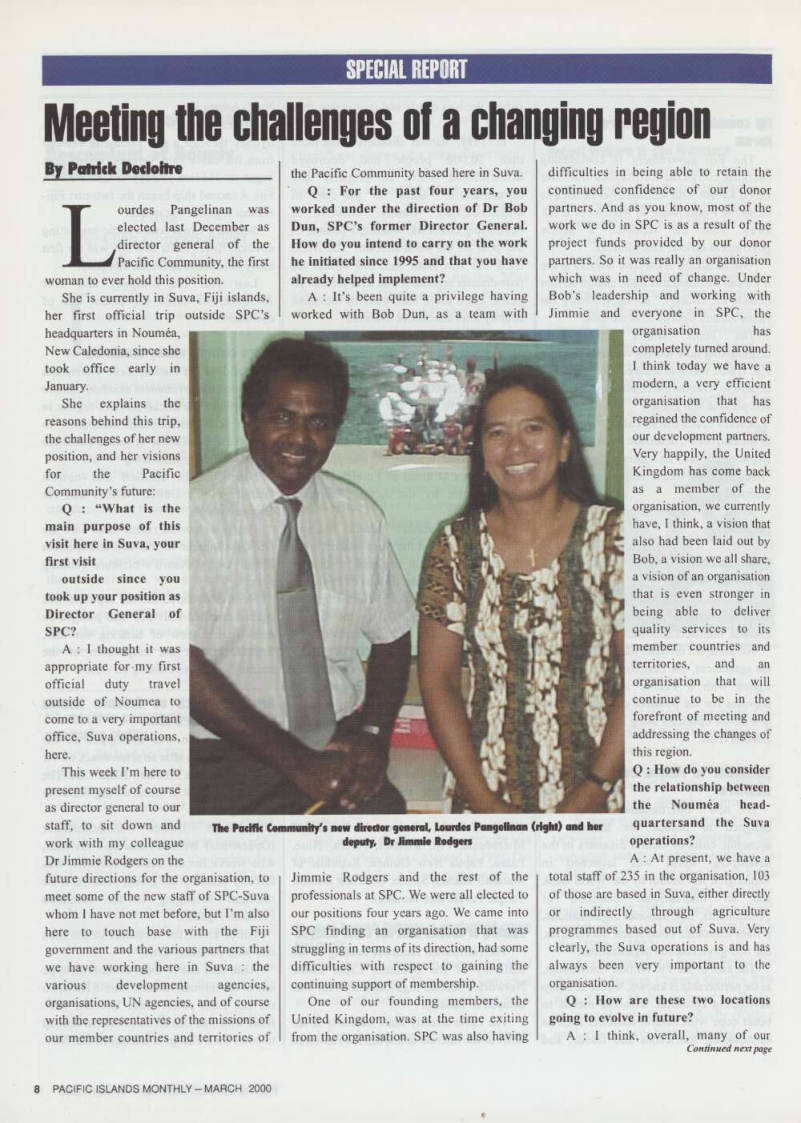
The Pacific Community's new director general, Lourdes Pangelinan (right) and her deputy. Dr Jimmie Rodgers
Continued from previous page programmes are in fact undergoing expansion, in Noumea our fisheries programme is taking on some new projects as well as our community health programme with the social division.
Likewise in agriculture ; there is a continuing interest on the part of our donor partners, particularly Australia and France, in further expansion of the agriculture programme. So very clearly, the programmes and activities that we have operating out of Suva are quite important.
Q : There is a project that is supposed to link Noumea and Suva very soon.
What is it about?
A : I’m actually very excited, we have this wonderful project, a satellite project that would in fact bridge this communication gap that has existed within SPC for quite a number of years. This
satellite project was made possible by
AusAID and France, we call it the COMET project. Essentially, it would enable SPC Suva and SPC Noumea to be linked through satellite and therefore enable the organisation to come closer together.
Information flow would be much smoother, we’d be able to share much more among our programmes that do have common clients throughout the Pacific, quite a bit of programme information that would enable us to become more efficient.
Q : Since you were elected last December as director general of the SPC, you have been seen, at least in the eyes of the media and the general public, as the first woman to hold this office.
Do you like this gender-based
categorisation?
A : Certainly, being the head of such an
organisation s the Pacific Community is a challenge anyway, for any individual. I have to admit being a woman as well presents perhaps additional elements of the challenges.
However, I’d just like to say this is a challenge that I take on enthusiastically, it’s one where I feel a great deal of support from my male and female colleagues. This is, going to be a very important challenge anyway. I think working together with the support of my colleagues and the member countries and territories who have given me this opportunity and bestowed this honour upon me, we can only succeed. Of course, I
think the implications for women in the future, as a result of my experience, are going to be very important.
Q : What would you like the Pacific Community to become under your leadership?
A : This sixth of February, the organisation has been in existence for a total of 53 years. It’s been very important to the region, it has had and still has a role to play in the next fifty years to come. SPC, for it to survive and be able to do well, however, has to always look at the changes that are occurring in the region, and has to stay in front of those changes.
The efficiency of the organisation is one that also needs to be maintained.
I think in the past four years, there’s been quite a number of changes that have occurred and have resulted in SPC administrative systems, programme development systems, to be put in place.
The foundation has been laid.
I think the challenge ahead is just to maintain, to continue on the good work and maintain the efficiency of the organisation, to continue to lead in its desire to change, and meet the challenges of the changing region.”
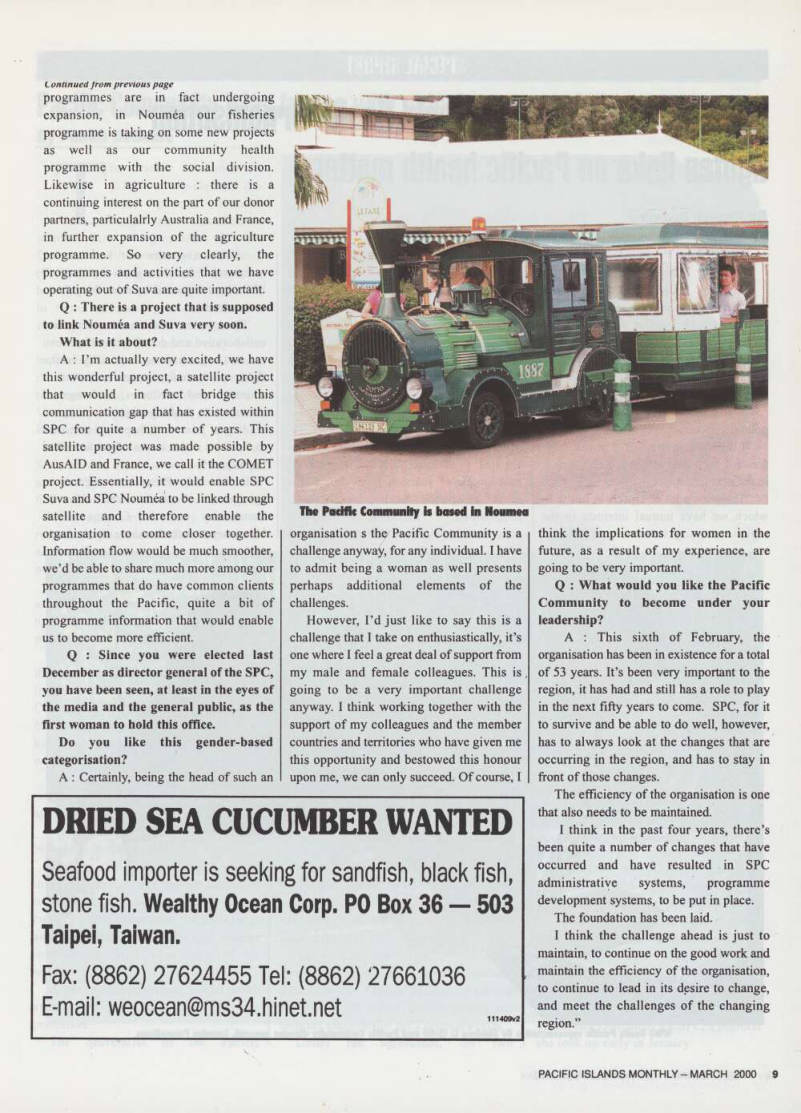
The Pacific Community is based in Noumea
Advertisements & other items, p. 9 (1 item)
Dried Sea Cucumber Wanted
Seafood importer is seeking for sandfish, black fish, stone fish. Wealthy Ocean Corp. PO Box 36 503 Taipei, Taiwan.
Fax: (8862) 27624455 Tel: (8862) 27661036 E-mail: [email protected]
Pacific Community and world Health Organisation
lighten linKs on Pacific health matters
By PaTrick Decloitre
The Pacific Community’s director general Lourdes Pangelinan and World
Health Organisation
(WHO) South Pacific representative Dr Shichuo Li signed a memorandum of understanding aimed at improving “health and well-being of Pacific island people”.
“WHO and SPC have a long time of good collaboration in the Pacific.
“I think this agreement is another step forward for closer efficient collaboration in the near future.
“There are a lot of aspects in health in which we have mutual interests in the region : training, information exchange.
technical activities and a lot of other projects,” Dr Li said.
The agreement follows earlier arrangements between the regional organisation and the UN body, which go back fourty years : on August 4, 1960, WHO and SPC had officially established work relations.
“Over the years, our two organisations have established an excellent partnership, at the technical level and at policy level.
“They have already worked closely together. In SPC and WHO’s case, over the past couple of years in particular, in the areas of public health, surveillance, tuberculosis, filariosis, nutrition, communicable diseases, HIV/AIDS.
“We make sure our services are common but that there is no duplication,”
SPC director general Lourdes Pangelinan commented.
The agreement sets out to “enhance collaboration and coordination” between the two organisations, especially in the fields of mutual support to members countries and territories, exchange of information, drafting of joint strategies, holding of joint workshops and seminars to “address major issues of public health importance”.
Earlier, Ms Pangelinan signed an agreement between the Pacific Community and the Commonwealth Veterinary Association along similar lines.
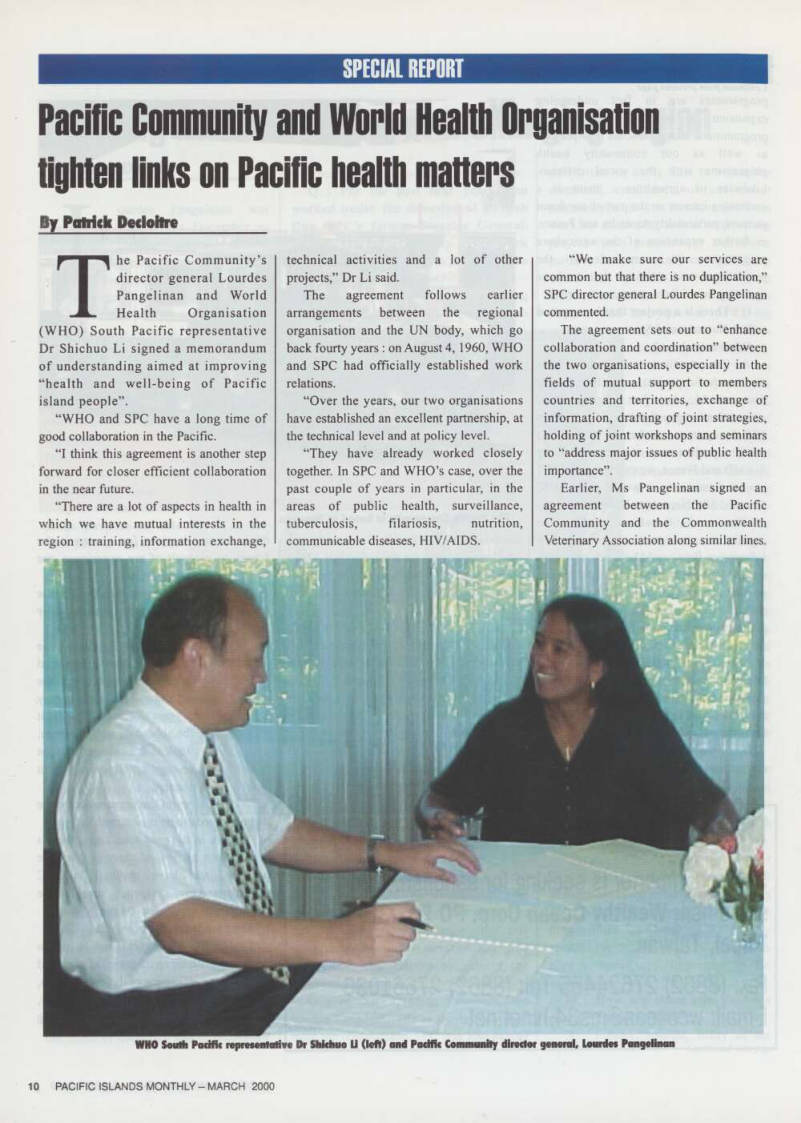
WHO South Pacific representative Dr Shichuo Li (left) and Pacific Community director general, Lourdes Pangelinan
Pacific Community joins forces with veterinary association
By Patrick Pecloitre
The Pacific Community’s (SPC) newly-elected dir ector general Lourdes Pangelinan ratified a memorandum of agreement with the Commonwealth Veterinary Ass-ociation (CVA) forma-lising a closer co-operation between the two organi-sations, especially in terms of training and information sharing for animal health in the Pacific.
“In practice, this had already been happening for a couple of years, SPC and the CVA have shared technical expertise, resources and information,” SPC’s Veterinary Epide-miologist Dr Gavin Ramsay said.
What it means in practice is that we, at SPC, provide expertise and our resources and the CVA, on their side, provide theirs, from within or outside the Pacific region.
The agreement mainly aims at reducing duplication of effort between the work programmes of the two organisations “in areas of mutual interest.
“For instance, last year, we did a workshop in Suva, where we had technical expertise from Malaysia provided by the CVA.
“And the participants came from both the Commonweatlh countries (outside and in the Pacific) and within the Pacific Community, including French Polynesia, New Caledonia and Guam, which, as you know, do not belong to the Common wealth”.
“So it shows quite clearly that both realms can benefit from that sort of joint approach”, Dr Ramsay added.
“In general, the animal health status is very good in the Pacific.
Having said that, we must ensure things remain this way and the best thing to do this is to ensure Pacific island countries have the means, the knowledge and the information to prevent disease introduction from other parts of the world.”
Areas concerned include animal health at large, including animal and livestock protection.
The Secretariat of the Pacific
Community covers 27 members (including 22 Pacific island countries and territories) and defines itself as “primarily service oriented, with significant training and limited research components”.
The Commonwealth Veteri-nary Association promotes the exchange and dissemination of technical information and experience on animal health among the member countries of the Commonwealth.
Under the agreement, the two
organisations would freely exchange information and share networks to communicate, share experts on training, consultancy or research projects, organise joint conferences and training workshops.
The agreement with signed by CVA President, Australia-based Bill Pryor.
It was also the first official deed signed by Ms Pangelinan in her capacity of Director General of the SPC, a position she took up early in January.
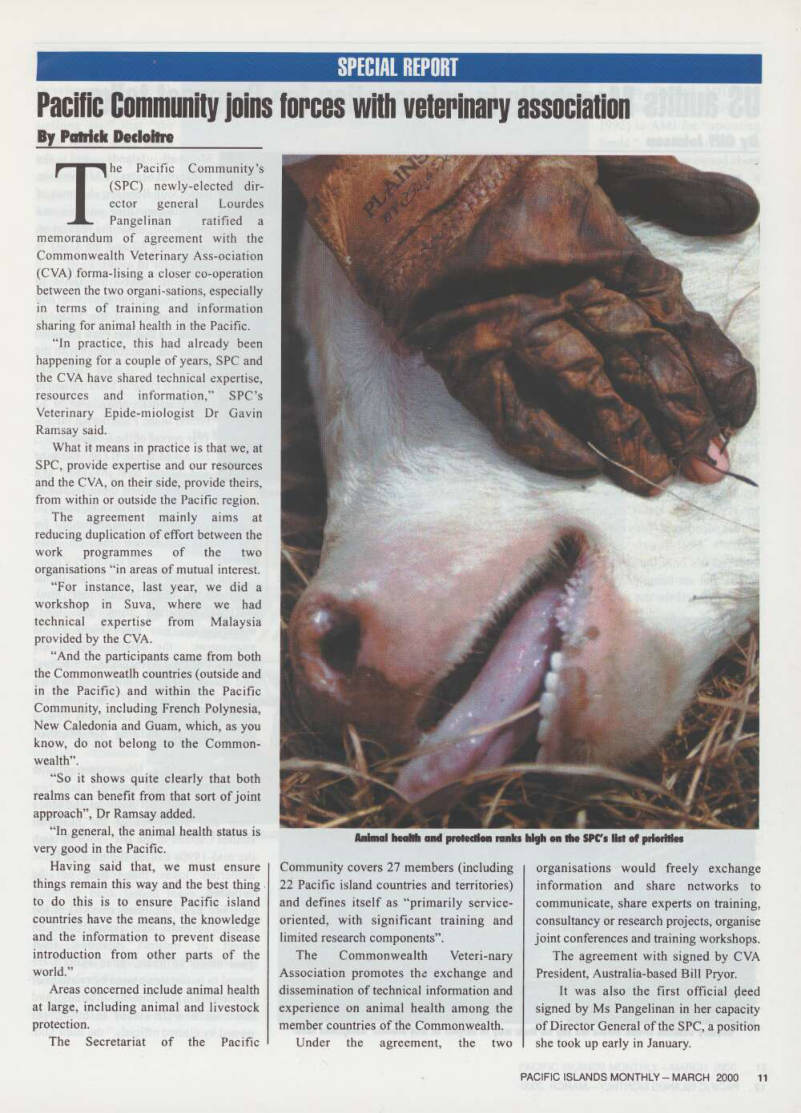
Animal health and protection ranks high on the SRC's list of priorities
US audits Marshalls in preparation for Compact talks
Business
By Gift Johnson
The first United States audit report on a Marshall Islands agency demonstrates that the newly elected government and its still-to-be-named negotiating team will have their work cut out for them when they start talks with the US on future funding for theislands.
An Interior Department Inspector General’s audit on the Marshall Islands Development Bank, released in Majuro in December, is going to be fodder for US Congressmen skeptical about handing over large sums of funding to the Marshalls in the next phase of the Compact,
whose economic provisions expire in 2001.
And it’s only the first in a series of audits that are being prepared as the US positions itself for the start-up of serious
talks.
Late last year, a powerful US Congressman asked the US General Accounting Office to conduct a broad review of Compact spending by the
Marshall Islands and the Federated States of Micronesia.
Rep. Doug Bereuter, chairman of the Subcommittee on Asia and the Pacific, made the request on September 30 and the GAO is gearing for its audits.
Bereuter asked the GAO to “review the amount, use and accountability of the financial assistance that has been provided by the US in accordance with the Compacts.” The US has provided close to $BOO million to the Marshalls and closer to $2 billion to the FSM during the 15year period of the Compacts.
He asked the GAO to “examine and assess how the FSM and RMI have used these resources provided by the US and, based on
this analysis, make recommendations for any future assistance the US may provide.”
The Inspector General’s review of the Marshall Islands Development Bank (M1DB), separate from the GAO investigation, was point blank in its assessment: the MIDB violated the Compact of Free Association, US federal and Marshall Islands laws, and its own policies in the use of $17.5 million in US funds. The Inspector General is now in the process of auditing Air Marshall Islands.
The scathing US review of the Majuro-based bank’s lending policies said that political influence from and directives of the Marshall Islands Cabinet in the late 1980 s through the mid-1990s caused the bank to issue numerous loans that could not be collected.
For 17 of 21 loans checked in the audit, “11 loans were issued based on direct or indirect direction from government officials, three loans were issued to businesses owned by relatives of senior-level government officials, and three loans were issued to businesses owned by elected officials,” the audit said.
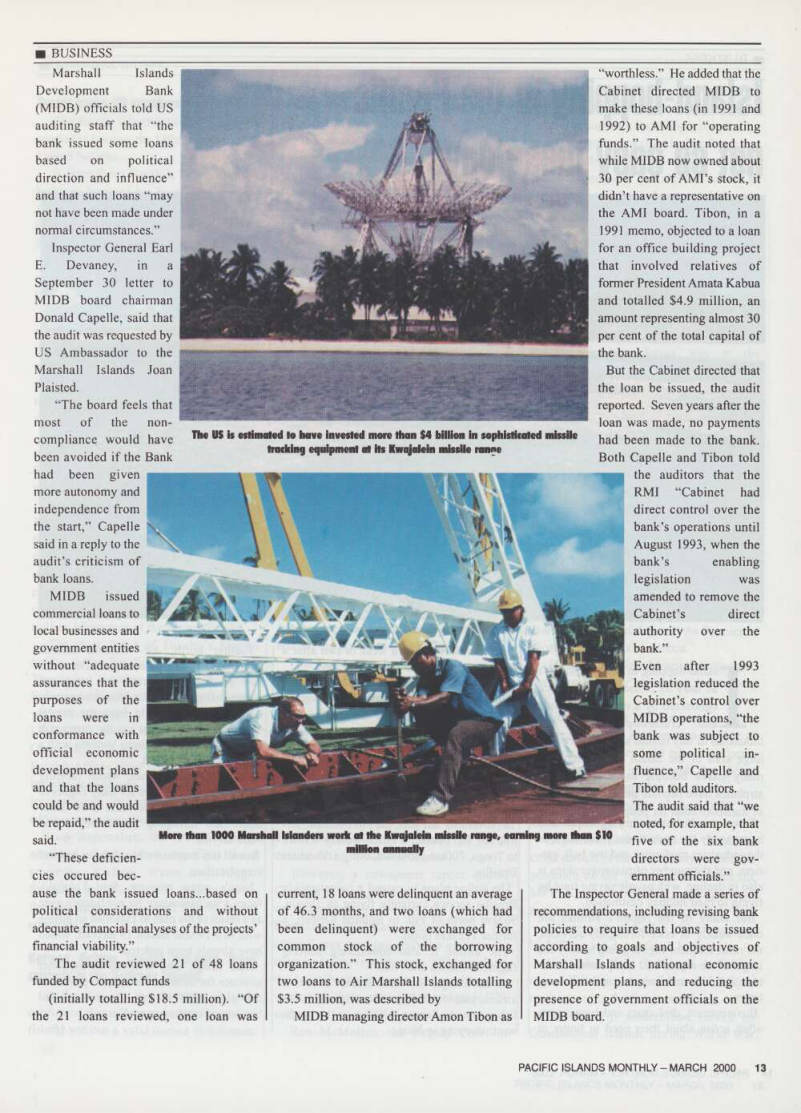
Reentry vehicles streak across the sky on their way to targets in and around Kwajalein Atoll
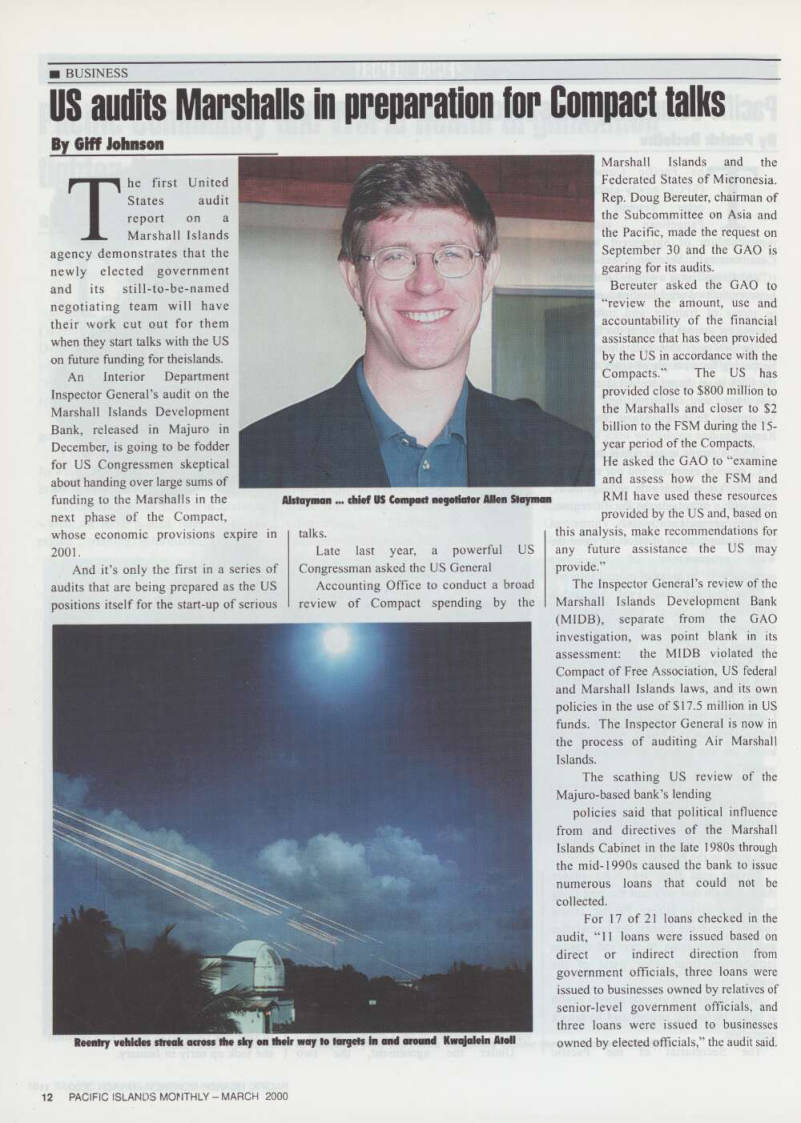
Alstayman ... chief US Compact negotiator Allen Stayman
Marshall Islands
Development Bank
(MIDB) officials told US auditing staff that “the bank issued some loans based on political direction and influence” and that such loans “may not have been made under normal circumstances.”
Inspector General Earl E. Devaney, in a September 30 letter to MIDB board chairman Donald Capelle, said that the audit was requested by US Ambassador to the Marshall Islands Joan Plaisted.
“The board feels that most of the non compliance would have been avoided if the Bank
had been given more autonomy and independence from the start,” Capelle said in a reply to the audit’s criticism of bank loans.
MIDB issued commercial loans to local businesses and government entities without “adequate assurances that the purposes of the loans were in conformance with official economic
development plans
and that the loans could be and would be repaid,” the audit said.
“These deficien cies occured bec
ause the bank issued loans...based on political considerations and without adequate financial analyses of the projects’ financial viability.”
The audit reviewed 21 of 48 loans funded by Compact funds (initially totalling $18.5 million). “Of the 21 loans reviewed, one loan was
current, 18 loans were delinquent an average of 46.3 months, and two loans (which had been delinquent) were exchanged for common stock of the borrowing organization.” This stock, exchanged for two loans to Air Marshall Islands totalling $3.5 million, was described by MIDB managing director Amon Tibon as
“worthless.” He added that the Cabinet directed MIDB to make these loans (in 1991 and 1992) to AMI for “operating funds.” The audit noted that while MIDB now owned about 30 per cent of AMDs stock, it didn’t have a representative on the AMI board. Tibon, in a 1991 memo, objected to a loan for an office building project that involved relatives of former President Amata Kabua and totalled $4.9 million, an amount representing almost 30 per cent of the total capital of the bank.
But the Cabinet directed that the loan be issued, the audit reported. Seven years after the loan was made, no payments had been made to the bank.
Both Capelle and Tibon told
the auditors that the RMI “Cabinet had direct control over the bank’s operations until August 1993, when the bank’s enabling
legislation was
amended to remove the Cabinet’s direct authority over the bank.”
Even after 1993 legislation reduced the Cabinet’s control over MIDB operations, “the bank was subject to some political in fluence,” Capelle and Tibon told auditors.
The audit said that “we noted, for example, that five of the six bank directors were gov ernment officials.”
The Inspector General made a series of recommendations, including revising bank policies to require that loans be issued according to goals and objectives of Marshall Islands national economic development plans, and reducing the presence of government officials on the MIDB board.
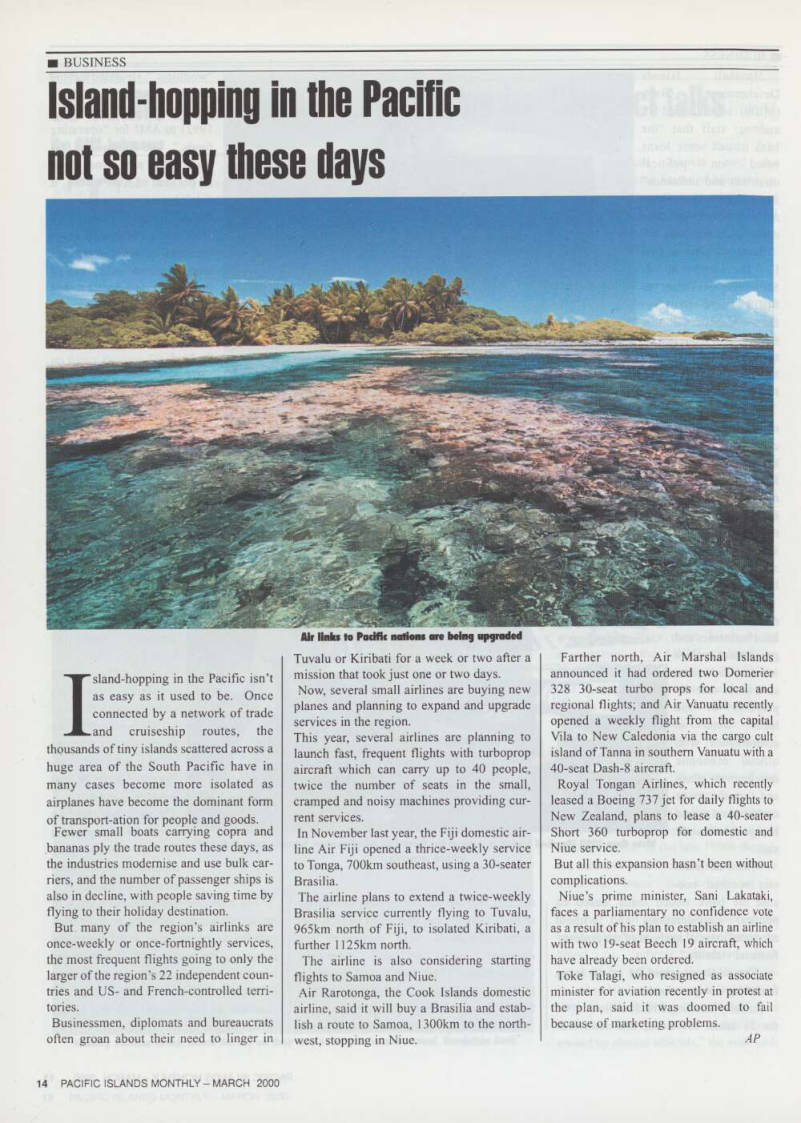
The US is estimated to have invested more than $4 billion in sophisticated missile tracking equipment at its Kwajalein missile range
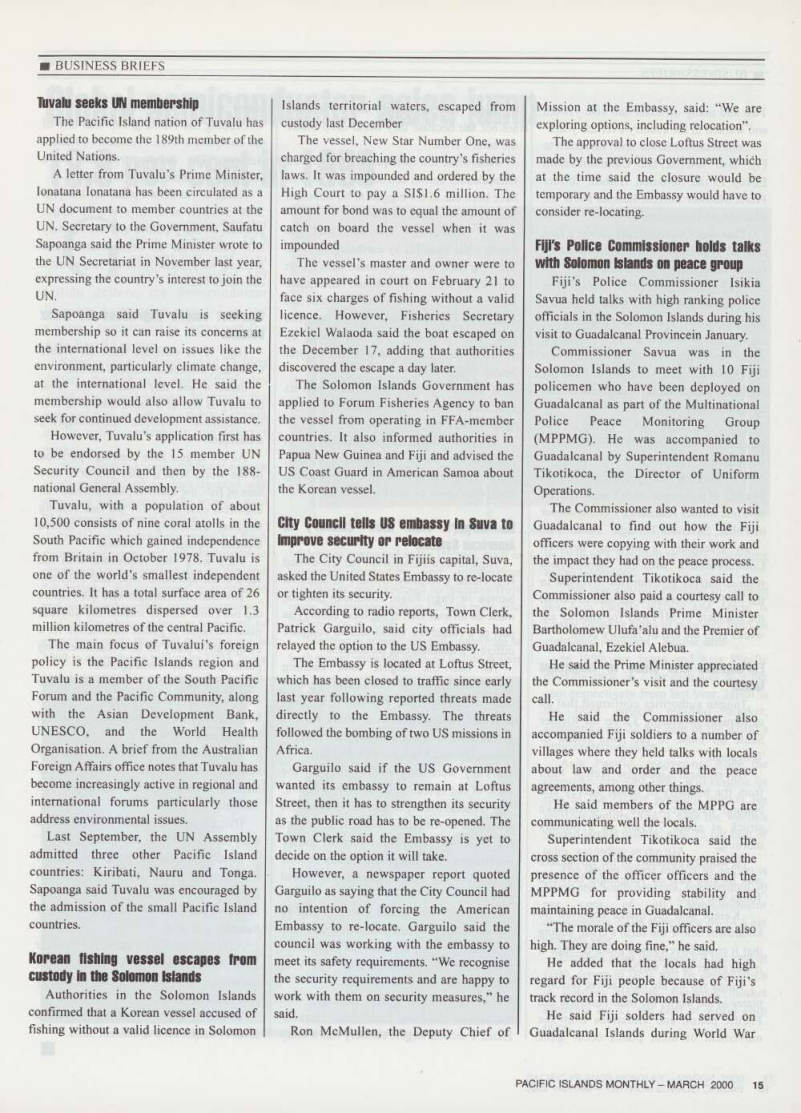
More than 1000 Marshall Islanders work at the Kwajalein missile range, earning more than $10 million annually
Island-hopping in the Pacific
not so easy these days
Island-hopping in the Pacific isn’t as easy as it used to be. Once connected by a network of trade and cruiseship routes, the thousands of tiny islands scattered across a huge area of the South Pacific have in many cases become more isolated as airplanes have become the dominant form of transport-ation for people and goods.
Fewer small boats carrying copra and bananas ply the trade routes these days, as the industries modernise and use bulk car riers, and the number of passenger ships is also in decline, with people saving time by flying to their holiday destination.
But. many of the region’s airlinks are once-weekly or once-fortnightly services, the most frequent flights going to only the larger of the region’s 22 independent coun tries and US- and French-controlled terri tories.
Businessmen, diplomats and bureaucrats often groan about their need to linger in
Tuvalu or Kiribati for a week or two after a mission that took just one or two days.
Now, several small airlines are buying new planes and planning to expand and upgrade services in the region.
This year, several airlines are planning to launch fast, frequent flights with turboprop aircraft which can carry up to 40 people, twice the number of seats in the small, cramped and noisy machines providing cur rent services.
In November last year, the Fiji domestic air line Air Fiji opened a thrice-weekly service to Tonga, 700 km southeast, using a 30-seater Brasilia.
The airline plans to extend a twice-weekly Brasilia service currently flying to Tuvalu, 965 km north of Fiji, to isolated Kiribati, a further 1125 km north.
The airline is also considering starting flights to Samoa and Niue.
Air Rarotonga, the Cook Islands domestic airline, said it will buy a Brasilia and estab lish a route to Samoa, 1300 km to the north west, stopping in Niue.
Farther north, Air Marshal Islands announced it had ordered two Domerier 328 30-seat turbo props for local and regional flights; and Air Vanuatu recently opened a weekly flight from the capital Vila to New Caledonia via the cargo cult island of Tanna in southern Vanuatu with a 40-seat Dash-8 aircraft.
Royal Tongan Airlines, which recently leased a Boeing 737 jet for daily flights to New Zealand, plans to lease a 40-seater Short 360 turboprop for domestic and Niue service.
But all this expansion hasn’t been without
complications.
Niue’s prime minister, Sani Lakataki, faces a parliamentary no confidence vote as a result of his plan to establish an airline with two 19-seat Beech 19 aircraft, which have already been ordered.
Toke Talagi, who resigned as associate minister for aviation recently in protest at the plan, said it was doomed to fail because of marketing problems.
AP
Air links to Pacific nations are being upgraded
Tuvalu seeks UN membership The Pacific Island nation of Tuvalu has applied to become the 189th member of the United Nations.
A letter from Tuvalu’s Prime Minister, lonatana lonatana has been circulated as a UN document to member countries at the UN. Secretary to the Government, Saufatu Sapoanga said the Prime Minister wrote to the UN Secretariat in November last year, expressing the country’s interest to join the UN.
Sapoanga said Tuvalu is seeking membership so it can raise its concerns at the international level on issues like the environment, particularly climate change, at the international level. He said the membership would also allow Tuvalu to seek for continued development assistance.
However, Tuvalu’s application first has to be endorsed by the 15 member UN Security Council and then by the 188national General Assembly.
Tuvalu, with a population of about 10,500 consists of nine coral atolls in the South Pacific which gained independence from Britain in October 1978. Tuvalu is one of the world’s smallest independent countries. It has a total surface area of 26 square kilometres dispersed over 1.3 million kilometres of the central Pacific.
The main focus of Tuvalu!’s foreign policy is the Pacific Islands region and Tuvalu is a member of the South Pacific Forum and the Pacific Community, along with the Asian Development Bank, UNESCO, and the World Health Organisation. A brief from the Australian Foreign Affairs office notes that Tuvalu has become increasingly active in regional and international forums particularly those address environmental issues.
Last September, the UN Assembly admitted three other Pacific Island countries: Kiribati, Nauru and Tonga.
Sapoanga said Tuvalu was encouraged by the admission of the small Pacific Island countries.
Korean fishing vessel escapes from custody in the Solomon islands Authorities in the Solomon Islands confirmed that a Korean vessel accused of fishing without a valid licence in Solomon
Islands territorial waters, escaped from custody last December The vessel, New Star Number One, was charged for breaching the country’s fisheries laws. It was impounded and ordered by the High Court to pay a SIS 1.6 million. The amount for bond was to equal the amount of catch on board the vessel when it was impounded The vessel’s master and owner were to have appeared in court on February 21 to face six charges of fishing without a valid licence. However, Fisheries Secretary Ezekiel Walaoda said the boat escaped on the December 17, adding that authorities discovered the escape a day later.
The Solomon Islands Government has applied to Forum Fisheries Agency to ban the vessel from operating in FFA-member countries. It also informed authorities in Papua New Guinea and Fiji and advised the US Coast Guard in American Samoa about the Korean vessel.
City Council tells US embassy in Suva to
Improve security or relocate
The City Council in Fijiis capital, Suva, asked the United States Embassy to re-locate or tighten its security.
According to radio reports, Town Clerk, Patrick Garguilo, said city officials had relayed the option to the US Embassy.
The Embassy is located at Loftus Street, which has been closed to traffic since early last year following reported threats made directly to the Embassy. The threats followed the bombing of two US missions in Africa.
Garguilo said if the US Government wanted its embassy to remain at Loftus Street, then it has to strengthen its security as the public road has to be re-opened. The Town Clerk said the Embassy is yet to decide on the option it will take.
However, a newspaper report quoted Garguilo as saying that the City Council had no intention of forcing the American Embassy to re-locate. Garguilo said the council was working with the embassy to meet its safety requirements. “We recognise the security requirements and are happy to work with them on security measures,” he said.
Ron McMullen, the Deputy Chief of
Mission at the Embassy, said; “We are exploring options, including relocation”.
The approval to close Loftus Street was made by the previous Government, which at the time said the closure would be temporary and the Embassy would have to
consider re-locating.
Fiji's Police Commissioner holds talks with Solomon Islands on peace group Fiji’s Police Commissioner Isikia Savua held talks with high ranking police officials in the Solomon Islands during his visit to Guadalcanal Provincein January.
Commissioner Savua was in the Solomon Islands to meet with 10 Fiji policemen who have been deployed on Guadalcanal as part of the Multinational Police Peace Monitoring Group (MPPMG). He was accompanied to Guadalcanal by Superintendent Romanu Tikotikoca, the Director of Uniform Operations.
The Commissioner also wanted to visit Guadalcanal to find out how the Fiji officers were copying with their work and the impact they had on the peace process.
Superintendent Tikotikoca said the Commissioner also paid a courtesy call to the Solomon Islands Prime Minister Bartholomew Ulufa’alu and the Premier of Guadalcanal, Ezekiel Alebua.
He said the Prime Minister appreciated the Commissioner’s visit and the courtesy call.
He said the Commissioner also accompanied Fiji soldiers to a number of villages where they held talks with locals about law and order and the peace agreements, among other things.
He said members of the MPPG are communicating well the locals.
Superintendent Tikotikoca said the cross section of the community praised the presence of the officer officers and the MPPMG for providing stability and maintaining peace in Guadalcanal.
“The morale of the Fiji officers are also high. They are doing fine,” he said.
He added that the locals had high regard for Fiji people because of Fiji’s track record in the Solomon Islands.
He said Fiji solders had served on Guadalcanal Islands during World War
Two and many officials had also visited and worked in the country over the years.
Commissioner Savua upon his return to Fiji also briefed the Commonwealth Envoy to the Solomon Islands, former Prime Minister Sitiveni Rabuka about the situation on Guadalcanal.
This was Commissioner Savua’s first official visit to the officers deployed on Guadalcanal since October last year.
The Fiji contingent left in October. The first three officers left on October 19, and the other seven followed on October 23.
The multinational group is assisting authorities in the Solomon Islands monitor the Honiara Peace Accord, the Panatina Agreement, and the surrender of weapons by Guadalcanal militants.
The multinational group was sanctioned by the Commonwealth Secretariat in London.
The multinational group, which also consists of policemen from Vanuatu, is led by Fijiis former Assistance Commissioner of Police, Savenaca Tuivaga.
In December a meeting between Commonwealth officials, donors and representatives of countries involved in the MPPMG operations decided to extend the mandate of MPPMG for another six weeks until the end of January 2000.
Earthquake hits close to Tongatapu Island Tongan authorities confirmed that an earthquake measuring 5.8 on the Richter Scale hit close to the main island of Tongatapu.
Government Geologist Kelepi Mafi from the Ministry of lands, Survey and Natural Resources said the earthquake struck at about 7.13 am on a Sunday morning.
He said the epicentre of the earthquake was located east of Tongatapu between Tonga and Niue.
Kelepi said the quake occurred 30 kilometres below the earth’s crust, adding that it could have caused much damage if it was closer to the surface.
Tonga sits on the most active tectonic plates in the world, the Indo-Australia and Pacific plates, and vibrations from the movement of these plates occur quite
regularly. However, Kelepi said the tremors are not felt because they occur deep inside the earth’s crust.
Meanwhile the earthquake which shook Guadalcanal earlier ion January is said to have been one of the biggest to hit Solomon Islands in more than 15 years.
The Seismology Division said the country has been hit by earthquakes since 1984 but none measuring more than six on the Richter scale. The National Earthquake Information Centre in Denver, Colorado has confirmed the earthquake, which occurred just after mid-day last Saturday on Guadalcanal, measured 6.4 on the Richter Scale.
It was an offshore earthquake and its epicentre was located 30 kilometres off the Weathercoast of Guadalcanal.
Solomon Islands biggest earthquake in recent times was the one recorded in 1977, which occurred on Guadalcanal measuring more than seven on the Richter scale US owners visit their cannery in American Samoan High level officials from the US-owned H.J. Heinz Company, owners of StarKist Samoa in Pago Pago, American Samoa, made an official visit to the local cannery as part of a round the world tour to compare different manufacturing techniques.
As one the largest tuna canning operation in the world with a daily output of 600 tonnes of fish, the StarKist plant provided an excellent case study for the fact-finding mission, according to StarKist Samoa General Manager Phil Thirkell.
“They were very impressed with the scale of the operation here,” said Thirkell.
The General Manager said the visitors did not come to American Samoan to inspect the StarKist plant but rather to gather information for a comparative study on how manufacturing plants around the world operate.
However, the visitors were not able to see the cannery in full production, as many of the cannery workers had not returned to work after the Christmas and New Year celebrations.
Nevertheless the group was taken with the size of the local plant, said Thirkell.
Heinz’s second largest cannery has a daily
output of 450-500 tonnes per day.
Leading the Heinz group was one of the company’s Vice Presidents Michael Bertasso. The visitors, travelling on a corporate jet, departed for Bangkok.
Asked of StarKist’s plans for the year 2000 Thirkell said there are no major projects in the pipeline and the cannery will concentrate on consolidation and meeting its present level of output on a consistent basis.
Starkist samoa impresses HJ Heinz officials High level officials from HJ Heinz Company, owners of StarKist Samoa, made a one day visit to the local cannery as part of a round the world tour to compare different manufacturing techniques.
As the largest tuna canning operation in the world with a daily output of 600 tons of fish, the StarKist plant provided an excellent case study for the fact finding mission, according to StarKist Samoa General Manager Phil Thirkell.
They were very impressed with the scale of the operation here, said Thirkell.
The General Manager said the visitors did not come here to inspect the StarKist plant but rather to gather information for a comparative study on how manufacturing plants around the world operate.
The visitors were not able to see the fish canning plant in full production however, as many of the cannery workers had not returned to work after the Christmas and New Year celebrations. Nevertheless the group was taken with the size of the local plant, said Thirkell.
Heinz’s second largest cannery has a daily output of 450 to 500 tons per day.
Leading the Heinz group was one of the company’s Vice Presidents Michael Bertasso. The visitors, traveling on a corporate jet, departed for Bangkok, early Saturday morning.
Asked of StarKist’s plans for the year 2000 Thirkell said there are no major projects in the pipeline and the cannery will concentrate on consolidation and meeting its present level of output on a consistent basis.
Global semiconductor
sales jump 18.9 per cent in 1999
sales jumped 18.9 percent last year over 1998 to a record 149 billion dollars, the Semiconductor
Industry Association reported, citing
a robust turnaround in Japan and the Asia Pacific region.
Sales in December came to 14.7 billion dollars, the SIA said, adding that sales worldwide should increase 20 percent this year and next in light of expected growth in the cellular telephone and Internet markets.
“We witnessed across the board growth in all markets and product demand was strong in all regions of the world,” said SIA president George Scalise.
“Sales were extremely strong for flash memory, chipsets and DRAM (dynamic random access memory) due to demand for Internet infrastructure, e-commerce and wired and wireless communications.”
Cellular phone sales are projected to grow from more than 200 million units in 1999 to more than a billion by 2003. Sales
of devices connected to the Internet, such as personal computers and information appliances, are expected to increase from some 200 million units in 1999 to more than 700 million in 2003.
Electronic commerce will contribute to both trends, growing from 50 billion dollars
in 1998 to 1.3 trillion in 2003, according to the association.
“We saw a strong rebound in 1999 in the Asia Pacific market and Japan is finally showing signs of recovery from an eight-year recession,” Scalise said.
In 1999, the Japan and Asia Pacific markets, grew 26.7 per cent and 28.9 per cent respectively from last year. Japan is the third largest regional market, accounting for 22 per cent of the world’s semiconductors sales.
Asia Pacific, recovering from the economic crisis of 1997, will resume its role as the fastest growing market for semiconductors, and is now the world’s second largest market, with 25 per cent of sales, according to the SIA.
The largest single market by region is North and South America, representing 30 per cent of all semiconductor consumption. Sales there grew by 14.6 per cent last year.
Europe’s sales increased 8.4 per cent in 1999, driven in large part by deregulation in telecom markets. Europe’s market accounts for 21 per cent of world chip sales.
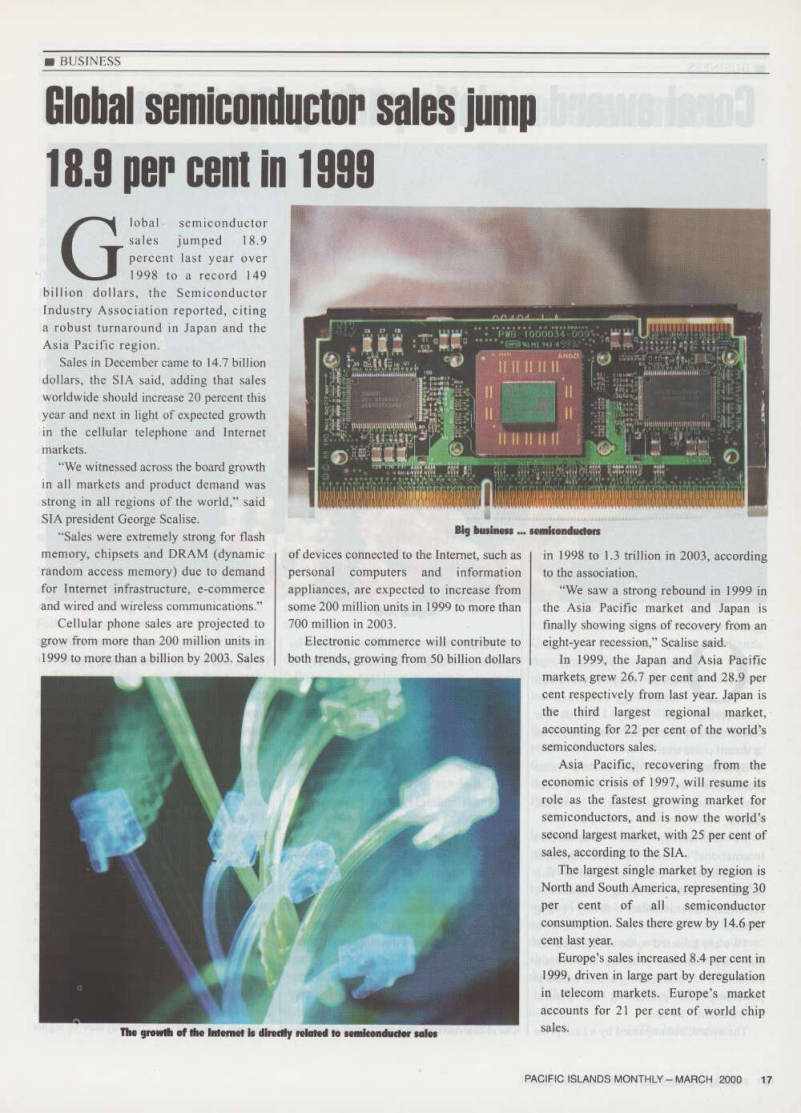
The growth of the Internet is directly related to semiconductor sales
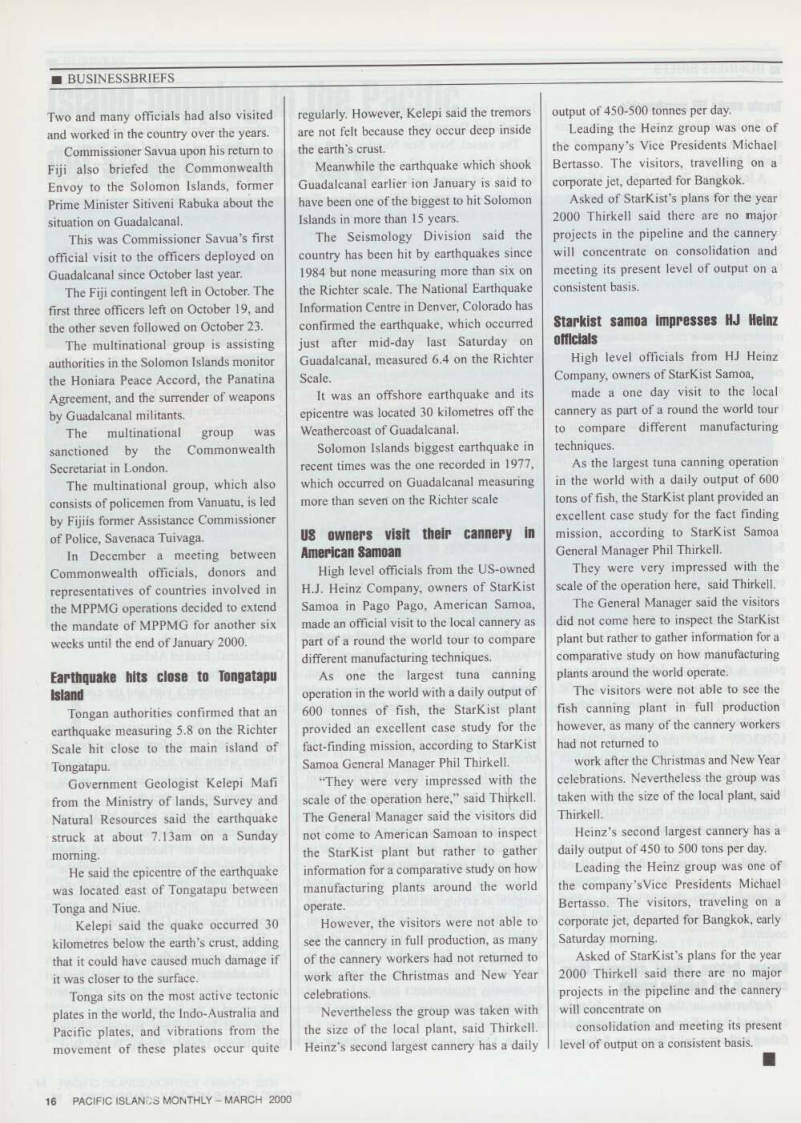
Big business ... semiconductors
Coral award a platform for expansion
One of the world’s leading pioneers of coral reef restoration technology describes receiving the Henry Award for Partnerships in Coral Reef Conservation as “a dream come true.”
Speaking about the world’s most prestigious award for coral reef conservation, Fiji-based marine biologist, Austin Bowden-Kerby, said Counterpart International’s vision of restoring coral reefs, planting corals to enhance fish habitats and creating economic opportunities for islanders is finally coming to pass.
“We are honored to be recognized for our Coral Gardens program and remain committed to spearheading action aimed at protecting and preserving the natural environment,” he said.
The award, accompanied by a cash prize
of $U525,000, recognised efforts by Counterpart and its affiliate FSP Fiji to empower island fishing communities to manage their reefs effectively.
This recognition follows a major three year grant from the New Zealand Government to embark on the regionalisation of the Coral Gardens programme.
“The timeliness of this award was impeccable,” noted Counterpart’s chief executive officer Stan Hosie.
“Not only did it come at the dawn of a new millennium, but it provided great stimulus as we seek to expand our activities beyond the island nation of Fiji,” he said.
Hosie, a native of Australia who has spent the last 35 years developing programs to address the special needs and vulnerabilities of island nations, reports that Counterpart will work with its sister FSP affiliates in the South Pacific to expand Coral Gardens to Papua New Guinea, the
Solomon Islands, Vanuatu, Tuvalu, Kiribati, Tonga, and Samoa in the coming years.
He lauded Counterpart affiliates in Australia and the United Kingdom for their support of Coral Gardens, and praised America’s NOAA Sea Grant Program and the Pacific Development and Conservation Trust of New Zealand for investing in the development of the low-tech coral
restoration methodology.
Founded in 1965 as the Foundation for the Peoples of South Pacific (FSP), Counterpart International is a not-for-profit development agency committed to building civil societies and advancing human development throughout the world. For 35 years. Counterpart’s “smart part-nership” philosophy, through which it teams with strategic partners in the public, private and NGO sectors, has resulted in successful environmental, social and economic development programs in more than 60 nations.
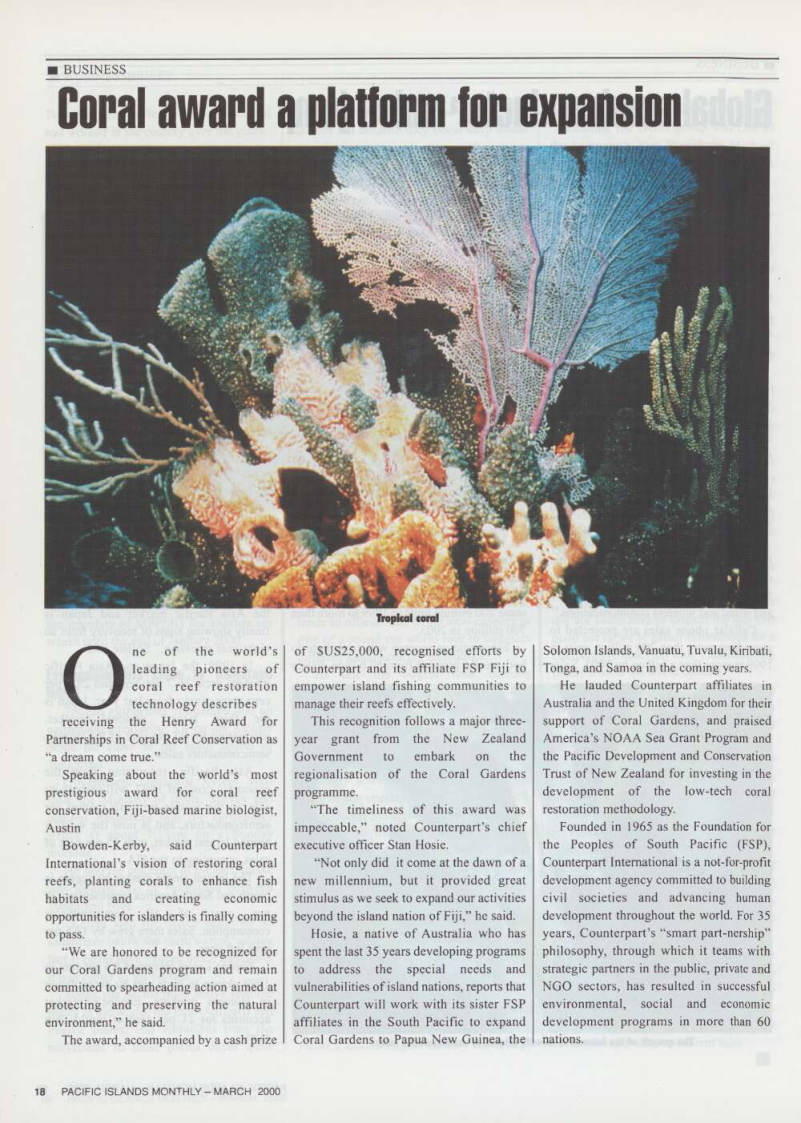
Tropical coral
Controversial Pago Hill project recommences
The multi-million kina Paga Hill Estate
Development project
adjoining metro-politan Port Moresby has been given the green light to recommence following an agreement between the developer, the Paga Hill Land Holding Company, Ltd. and the National Capital District Commission (NCDC) Physical Planning Board.
This is despite the US$3OO million (KBOO million) project being shelved by former prime minister Bill Skate following considerations then that there were health risks associated with it as well as other issues involving line government departments such as Environment and Conservation and Lands.
Skate’s decision was a paradox as he had supported the idea of such an investment and the subsequent benefits it was to bring when the project was in operation.
The project was conceived in 1996 when Skate, who was then governor of NCD, addressed business leaders in Cairns, Australia, inviting them to invest in PNG.
Following his invitation Jones Lang LeSalle assembled a team of experts and developed a concept for the project.
The site, which is one of the most sought after, has been the subject of constant demand by developers and investors alike.
This pact ends all delays and long standing disputes between the developer and many government agencies including the NCDC, which has seen the project become three years behind schedule.
The two parties signed a Section 81 agreement, which clearly defines the responsibilities of each party.
The master plan approved in the section 81 agreement allows for major public amenity areas, a five-star hotel, office towers, residential accommodation and a marina. The master plan also includes a cultural center on the peak of Paga Hill.
According to the plans, the value of the total development will be in excess of US$3OO (KBOO million). It is the largest single private property development ever to
be undertaken in PNG.
According to the site planner of the project, Jason Natoli, the development will be built over a period of seven to 10 years, with the first step being a detailed design of the various components of the estate.
“We are very excited. We have worked so hard over the last three years to develop a plan that would work for both the developers and the people of Port Moresby and finally we have found the successful ingredients for this major development,” said Natoli.
He added that the next major step for the development will be detailed drawings, followed by building approvals, so that construction can begin.
According to Natoli, once the buildings are in place, the site will attract significant international investment and will create jobs for thousands of local people.
Fellow director of the Paga Hill Land Holding Company, Gudmundur Fridriksson, said the company knew that the project would have to adapt world standards, but appropriate to Port Moresby.
“We want to make sure that Papua New Guinea receives a development that the people of the country can use and enjoy but that is of a quality that will attract international funds to this wonderful country. The master plan certainly achieves that aim,” said Fridriksson.
He said his company was working alongside Jones Lang LeSalle, the largest property advisor in the world, since its
inception and has confirmed their avid commitment to the project and will use their extensive connections to launch the project into the next stage.
Concerns over how the status of the land was changed from public reserve to urban development/commercial lease were raised, with claims that Lands Department officials had breached the Lands Act in the process.
It was reported that strict conditions have been placed on the title. Among these is for the land to be developed within five to seven years. A failure would result in the loss of the title.
Another condition is for 10 per cent of the land to be developed as a public reserve and handed back to the NCDC to run.
This area would contain a cultural center, war relics, public parks and a cable car service.
Under the provincial and local-level government reforms, public reserves are to become the responsibility of the provincial governments, in this case the NCDC.
The PNG Lands Board in August 1997 awarded the 13-hectare land, known as portion 1597, Milinch Granville Fourmill Moresby, NCD, to Paga Hill Land Holding Company, Pty Ltd after the Lands department - de-gazetted it as a public reserve to a commercial/urban development lease.
Paga Hill Land Holding Company won the title ahead of three other preselected tenderers the National Housing Corporation, which has a number of units on the land, Noko No. 96 and Gobe Hongu, Pty Ltd.
The de-gazettal and relocation of the land was gazetted on December 18, 1997 in gazette number Gll3.
Since the board decision, questions have been raised as to the manner in which the status of the land was hastily degazetted and again gazetted. Government ministers and departmental heads were alleged to have abused their powers to see the project through.
The project is expected to be completed in 2010. (The Independent)
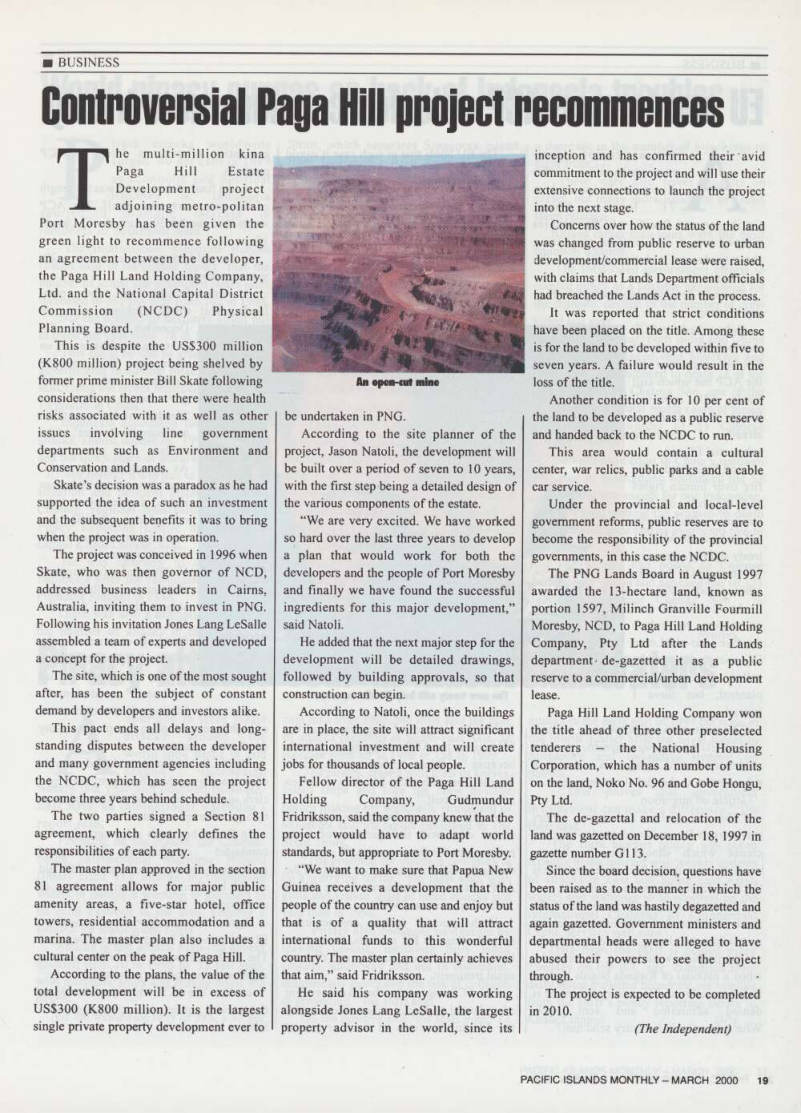
An open-cut mine
Ell and former AGP colonies conclude new treaty
After a year of stormy negotiations, the European Union and its 71 former Africa, Caribbean and Pacific (AGP) colonies wraped up a convention projecting their trade and aid ties well into the 21 st century.
Two new developments marked the two day meeting.
Cuba asked for AGP membership, a request heartily supported by the AGP but which still needs EU approval, likely since Cuba is already receiving substantial EU aid.
And Togo, under EU fire over human rights and the rule of law, abruptly withdrew its bid to host the May 31 treaty signing ceremony, which passed to the only other candidate, Fiji.
As a result, the new convention, to replace the five-year-old Lome IV pact, will not be called Lome V as planned, but Suva I instead.
The main sticking point to an accord, said an EU source, was agreement on the readmission of AGP nationals in transit, a sub-question in the global convention article on migration.
“The EU justice and home affairs ministers in December adopted a standard clause which should be in all our conventions with third countries and that is the basis for the EU position,” he said.
“It concerns not only nationals of the third countries, but stateless people and people in transit living in third countries.”
The problem would arise, for example, when a national of Rwanda boards a plane in Tanzania for an EU country, where he is denied admission and sent back.
Where does the EU country send him?
The EU holds that in such case it would be Tanzania’s duty to take back the immigrant, national or not, because he departed from its territory.
The ACP does not accept that, claiming the system poses an undue financial burden on countries that can ill afford it. It wants such questions dealt with on a bilateral basis between the EU and the ACP countries concerned.
In other matters of migration, said the EU source, the AGP is digging in its heels because “it objects to having obligations imposed on it that the EU does not even impose on itself.”
Another point of divergence still be be sorted out was the question of trade preferences for the poorest AGP countries during the eight-year transition in which the AGP is to adopt standards of the World Trade Organization (WTO).
If the poorest nations are accorded special access to EU markets, the rest are likely to claim discrimination and demand equal treatment.
EU-ACP commerce is based on a system of unilateral trade preferences accorded by the EU in the form of total or partial
exemption of customs duties on AGP
products.
And a final sticking point was the length of the new convention itself. The AGP wants it to run for 30 years, the EU wants 15.
In the end both groups agreed on a 20year compromise.
A breakthrough on the most fundamental treaty problems came in
December when the EU gave up its insistence on changing the elusive concept of “good governance” from a “fundamental element” to an “essential element” of the treaty.
As an essential element equal in weight with human rights, democracy and the rule of law - violation can result in suspension of EU aid and cooperation.
Violation of a fundamental element essentially brings a slap on the wrist from the EU.
Good governance - the efficiency with which a country runs itself - has become diplomatic language for the elimination
of high-level corruption that plagues many developing countries.
The AGP saw this as too broad, capable of embracing anything from petty theft by a clerk to embezzlement of millions of euros by a government minister.
In December, both sides agreed on “a combined commitment to good governance,” and that suspension of EU aid would be limited to “serious cases of corruption.”
Agreement must be reached as well on EU aid to the AGP over the next five years.
The EU has proposed 13.5 billion euros in addition to nine billion in unpaid credits. The AGP, which includes 38 of the world’s poorest countries, wants 14.6 billion.
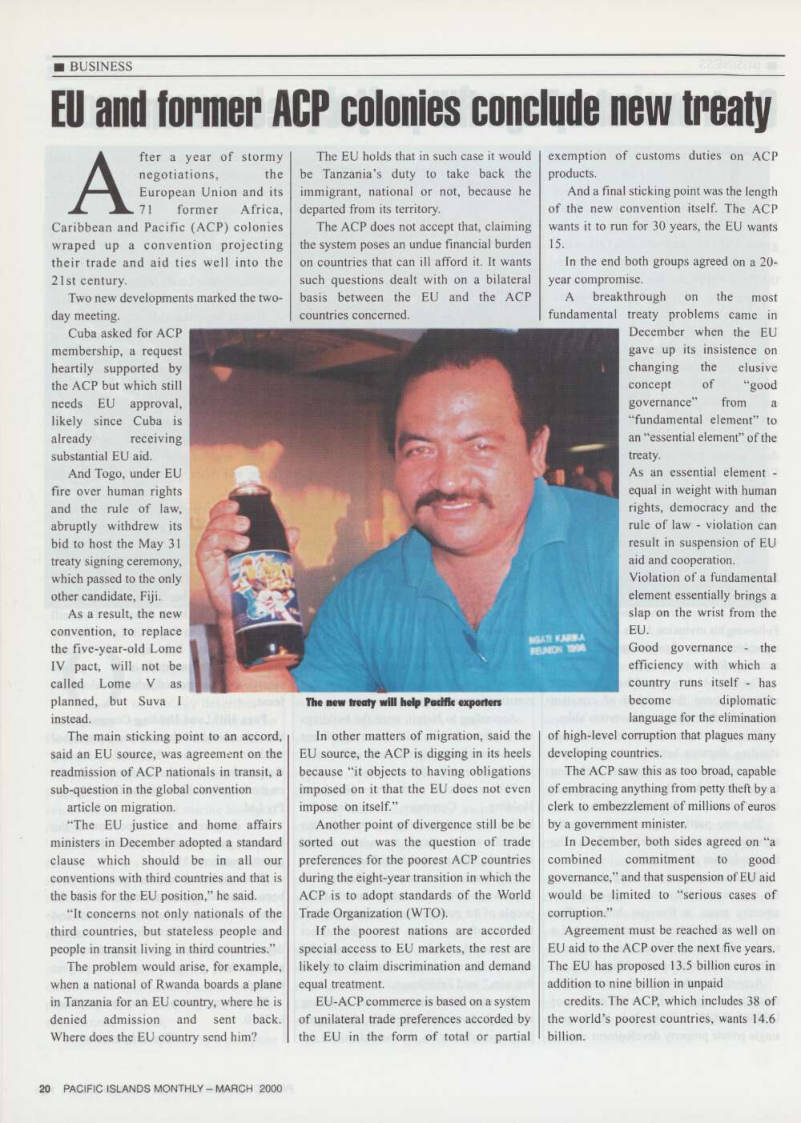
The new treaty will help Pacific exporters
World piracy surges on back of Indonesia troubles
Pirate attacks worldwide surged 40 per cent in 1999 as economic and political troubles in Indonesia spurred a dramatic increase in incidents in Southeast Asia.
The International Maritime Bureau (IMB) said in its annual report that the number of actual and attempted pirate raids increased to 285 last year from 202 in 1998.
But the number of seafarers killed fell to three last year from 78 in 1998.
“This could be due to greater efforts by governments to combat piracy,” the report said, citing the recent sentencing to death of 13 pirates in China.
Indonesia accounted for 113 of the attacks, almost double its 1998 total of 60 and the lion’s share of worldwide raids.
"We believe it was due to the economic situation and political instability,” Noel Choong, regional managerof the IMB’s Piracy Reporting Centre in Malaysia’s capital Kuala Lumpur, said.
He was referring to upheavals in Indonesia after the resignation of former President Suharto in 1998.
There was also a dramatic increase in the number of attacks in the Singapore
Strait, which separates Singapore island from Indonesia’s Riau Archipelago and links the Strait of Malacca with the South China Sea. There were 13 compared with just one in 1998.
But Choong said the frequency of attacks in that area dropped sharply after the Singapore Coast Guard and the Indonesian Marine Police stepped up patrols, and no incidents were reported in the final three months of 1999.
“It is a very clear indication that with cooperation, authorities can reduce piracy or eradicate it altogether,” Choong said.
The IMB has asked Indonesia to mount more patrols in its waters.
“There may be a decline in attacks if the Indonesian authorities are serious about eradicating piracy in their region,” Choong said.
Seven countries or regions accounted for more thantwo thirds of the attacks -
Indonesia (113), Bangladesh(23), Malaysia
(18), India (14), Singapore Strait (13), Somalia (11) and Nigeria (11).
Attacks dropped from 15 to six in the Philippines and from 10 to two in Ecuador.
Most of the attacks - 217 of 285 involved pirates boarding ships. There was
a decrease in the number of hijackings to eight from 17.
There were also fewer assaults on crews, but many more incidents of crews
taken hostage.
Knives rather than guns were the most common weapon.
The IMB cited government efforts to combat piracy as a possible explanation for the dramatic decline in the number of crew killed last year.
“In the last year, both India and China have arrested alleged ship hijackers and China recently sentenced to death 13 of the hijackers of MV Cheung Son, one of the country’s most brutal recent cases of piracy involving the murder of 23 Chinese seamen,” it said.
Last month, a court in China’s southern province of Guangdong sentenced the 13 men, all Chinese except for one Indonesian, to death for clubbing the seamen to death and throwing their bodies overboard tied to weights.
The pirates had posed as Chinese paramilitary police and hijacked the 10,373 tonne bulk carrier Cheung Son in November 1998.
Reuters
Piracy attacks soar in Indonesian waters
About one in three pirate attacks around the world took place in and around Indonesian waters last year and doubled in South- East Asia, an international watchdog’s report said.
Focusing on the region, the London based International Maritime Bureau (IMB) cited 113 attacks in Indonesian waters in issuing a warning to mariners to be extra cautious in the area, keeping a lookout for small speed boats.
Attacks in and around Malaysia almost doubled from 10 in 1998 to 18 last year, with merchant ships and fishing boats the targets.
Of the worldwide tally of 285, a 40 per
cent hike over 1998, the IMB said the bulk of attacks occurred in South-East Asia, an increase from 89 in 1998 to 158 in 1999.
The pirates, armed with guns or knives, board ships and take the crew hostage before making off with cash, equipment or valuables said the report published in The Strait Times.
“The potential for violence continues to be a worrying factor,” the IMB said, with guns and knives used in more attacks last year than in 1998.
' Pirates also endanger navigation by leaving vessels, including fully laden tankers, underway and not in command, dramatically increasing the risk of collision or grounding,” the IMB said.
On the positive side, the IMB noted 13
attacks in the early part of 1999 but none in the fourth quarter after the naval forces in Singapore and Indonesia stepped up patrols.
“This proves that government involvement can make a difference,” the IMB said.
The fight against piracy was taken
recently to the Internet with weekly updates of attacks in East and South-East Asian waters and warnings to shipowners on the International Chamber of Commercial Crime Services web sites.
Data from the IMB is posted every Tuesday on the ICC site, compiled from daily status bulletins broadcast via satellite from the IMB’s piracy reporting centre in Kuala Lumpur. DPA
transhipment center
Majuro develops as central Pacific transhipment center
By Gift Johnson
The pieces of the fisheries puzzle have begun coming together for Majuro; a new government fisheries policy cutting red tape and fees that has brought Asian fishing boats in droves; a recently opened tuna loining plant that is exporting processed fish to American Samoa; diplomatic ties with Taiwan drawing the ROC fishing fleet and investors.
A two-year fishing boom has Marshall Islands fisheries and elected leaders smiling all the way to the bank.
Five years ago, the only reason a purse seiner pulled into Majuro was in an emergency. But times have changed, and the advent of ties with the Republic of China has raised
hope that Majuro’s long-sought
after development as a central Pacific transshipment center will come to fruition.
Last year, the Marshalls netted about $5 million in license fees from Taiwan, Japanese and Korean purse seiners, as well as a modest amount from the transshipment
operation.
But, says MIMRA (Marshall Islands Marine Resources Authority) director Danny Wase, the point of the transshipment operation is not to make huge sums off the fees charged to the vessels, but rather to bring the vessels to Majuro, where the crews will spend money in stores, bars and restaurants, and the boats will refuel and resupply, injecting possibly millions of dollars into an economy long-dependent on funding from Washington.
“The government’s new fisheries policy (adopted in early 1998) has really worked well,” Wase said. The
“real money,” Wase said, is in the funds these boats spend for
reprovisioning and
refueling, as well as use of hotels, restaurants, bars and related businesses. But how to keep a mobile and fickle fleet hanging around Majuro is the vexing question. “Two things will keep the transshipment operation going in Majuro,” said new Marshalls Resources and Development Minister John Silk. “If the fish stay around
the Marshalls and if Majuro has infrastructure to service the fleet, transshipment will grow.” The country can’t do much about the former, but it may be able to do something about infrastructure.
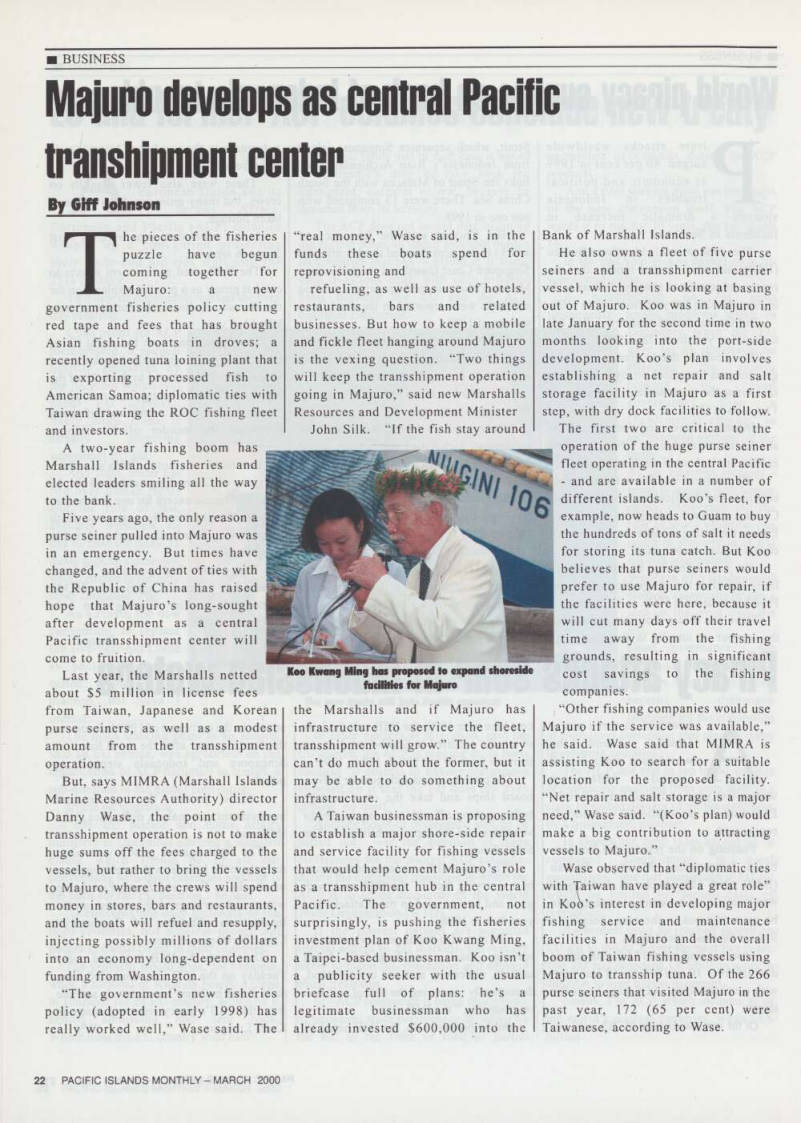
A Taiwan businessman is proposing to establish a major shore-side repair and service facility for fishing vessels that would help cement Majuro’s role as a transshipment hub in the central Pacific. The government, not surprisingly, is pushing the fisheries investment plan of Koo Kwang Ming, a Taipei-based businessman. Koo isn’t a publicity seeker with the usual briefcase full of plans: he’s a legitimate businessman who has already invested $600,000 into the
Bank of Marshall Islands.
He also owns a fleet of five purse seiners and a transshipment carrier vessel, which he is looking at basing out of Majuro. Koo was in Majuro in late January for the second time in two months looking into the port-side development. Koo’s plan involves establishing a net repair and salt storage facility in Majuro as a first step, with dry dock facilities to follow.
The first two are critical to the operation of the huge purse seiner fleet operating in the central Pacific - and are available in a number of different islands. Koo’s fleet, for example, now heads to Guam to buy the hundreds of tons of salt it needs for storing its tuna catch. But Koo believes that purse seiners would prefer to use Majuro for repair, if the facilities were here, because it will cut many days off their travel time away from the fishing
grounds, resulting in significant
cost savings to the fishing
companies.
“Other fishing companies would use Majuro if the service was available,” he said. Wase said that MIMRA is assisting Koo to search for a suitable location for the proposed facility.
“Net repair and salt storage is a major need,” Wase said. “(Koo’s plan) would make a big contribution to attracting vessels to Majuro.”
Wase observed that “diplomatic ties with Taiwan have played a great role” in Koo’s interest in developing major fishing service and maintenance facilities in Majuro and the overall boom of Taiwan fishing vessels using Majuro to transship tuna. Of the 266 purse seiners that visited Majuro in the past year, 172 (65 per cent) were Taiwanese, according to Wase.
Koo Kwang Ming has proposed to expand shoreside facilities for Majuro
Fish loining plant moves into high gear
By Gift Johnson
Majuro’s fish loining plant added a night shift at the end of January in order to increase its pace of tuna processing.
Opened last October, the loining operation
is approaching its 50-ton per day output envisioned by company planners, said general manager Rod McLachlin.
In early February, a dozen containers filled with processed tuna were shipped from Majuro to American Samoa on PM&O Line, which is the major investor in the plant. It marks the third fish export from the PMO. Processing plant since it started late last year.
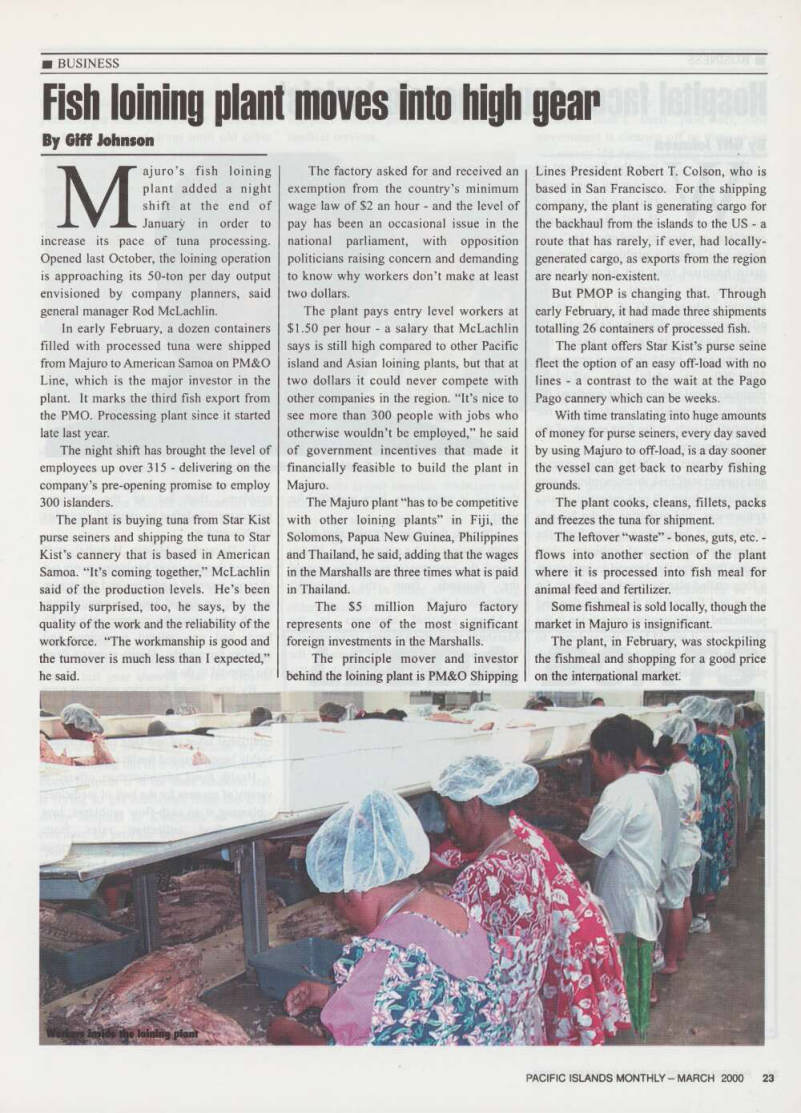
The night shift has brought the level of employees up over 315 - delivering on the company’s pre-opening promise to employ 300 islanders.
The plant is buying tuna from Star Kist purse seiners and shipping the tuna to Star Kist’s cannery that is based in American Samoa. “It’s coming together,” McLachlin said of the production levels. He’s been happily surprised, too, he says, by the quality of the work and the reliability of the workforce. “The workmanship is good and the turnover is much less than I expected,” he said.
The factory asked for and received an exemption from the country’s minimum wage law of $2 an hour - and the level of pay has been an occasional issue in the national parliament, with opposition
politicians raising concern and demanding
to know why workers don’t make at least two dollars.
The plant pays entry level workers at $1.50 per hour - a salary that McLachlin says is still high compared to other Pacific island and Asian loining plants, but that at two dollars it could never compete with other companies in the region. “It’s nice to see more than 300 people with jobs who otherwise wouldn’t be employed,” he said of government incentives that made it financially feasible to build the plant in Majuro.
The Majuro plant “has to be competitive with other loining plants” in Fiji, the Solomons, Papua New Guinea, Philippines and Thailand, he said, adding that the wages in the Marshalls are three times what is paid in Thailand.
The $5 million Majuro factory represents one of the most significant foreign investments in the Marshalls.
The principle mover and investor behind the loining plant is PM&O Shipping
Lines President Robert T. Colson, who is based in San Francisco. For the shipping company, the plant is generating cargo for the backhaul from the islands to the US - a route that has rarely, if ever, had locally generated cargo, as exports from the region are nearly non-existent.
But PMOP is changing that. Through early February, it had made three shipments totalling 26 containers of processed fish.
The plant offers Star Kist’s purse seine fleet the option of an easy off-load with no lines - a contrast to the wait at the Pago Pago cannery which can be weeks.
With time translating into huge amounts of money for purse seiners, every day saved by using Majuro to off-load, is a day sooner the vessel can get back to nearby fishing grounds.
The plant cooks, cleans, fillets, packs and freezes the tuna for shipment.
The leftover “waste” - bones, guts, etc. flows into another section of the plant where it is processed into fish meal for animal feed and fertilizer.
Some fishmeal is sold locally, though the market in Majuro is insignificant.
The plant, in February, was stockpiling
the fishmeal and shopping for a good price on the international market;
Hospital laces drug, morale 'crisis'
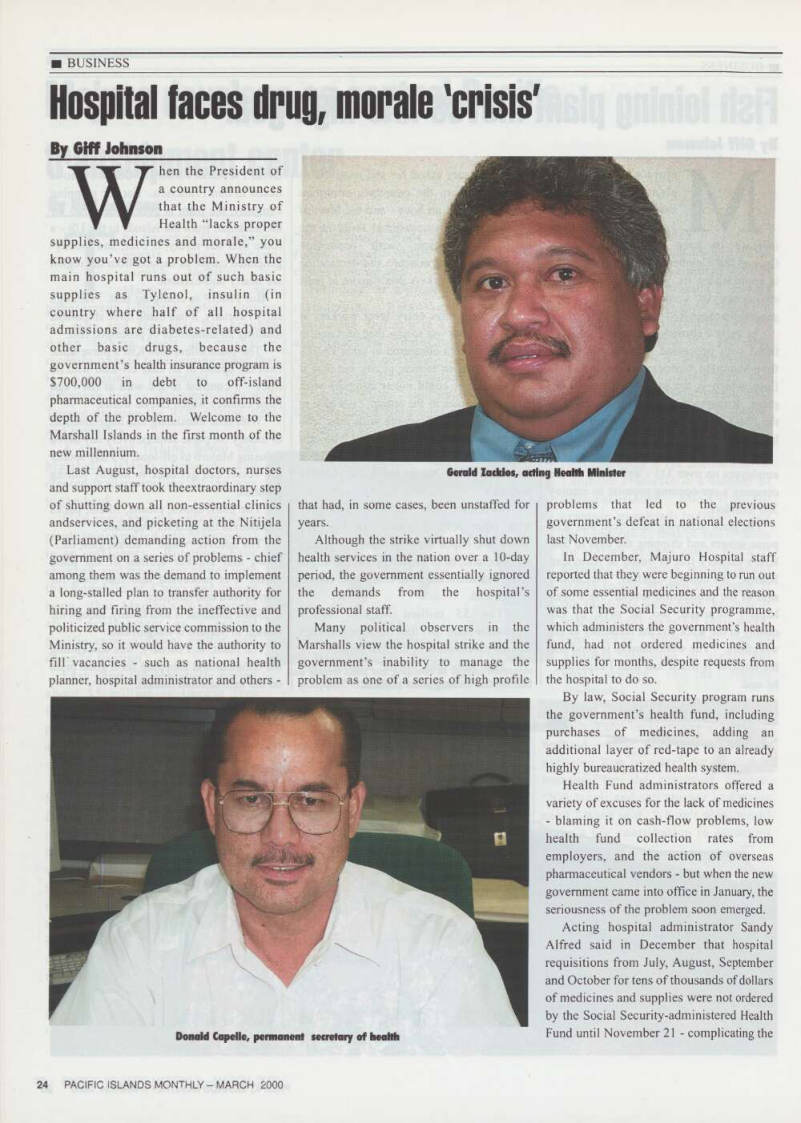
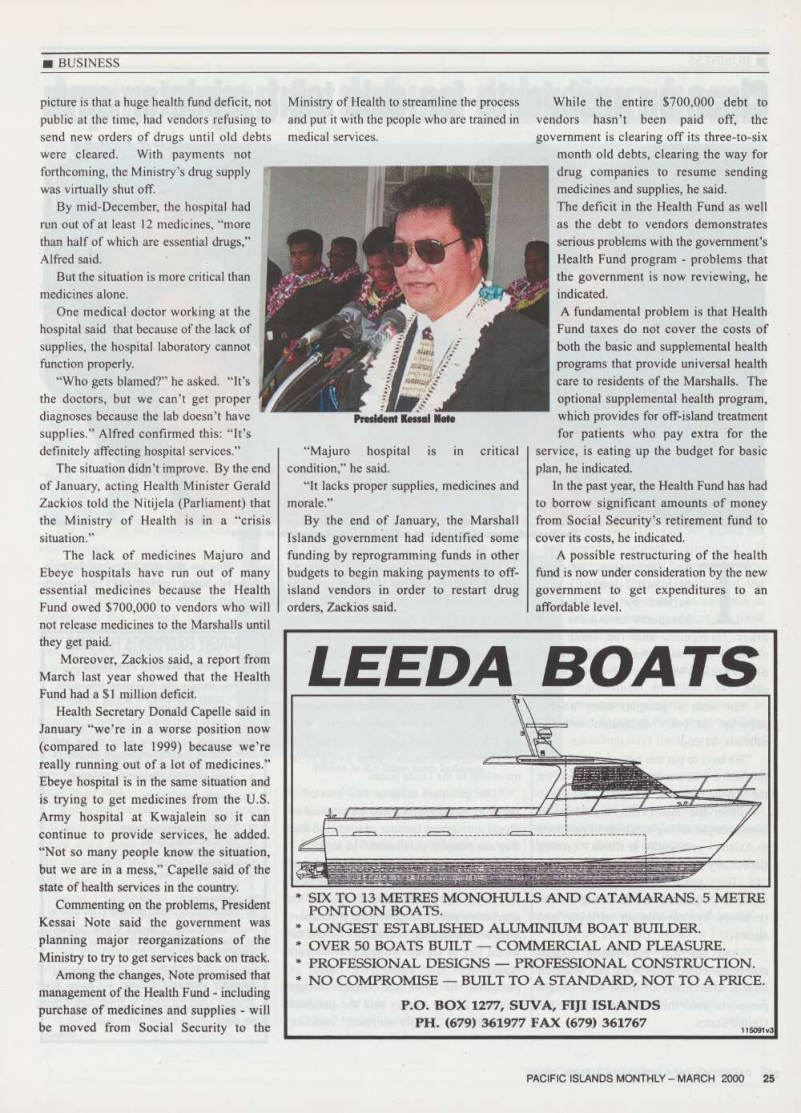
By Gifff Johnson
When the President of a country announces that the Ministry of Health “lacks proper supplies, medicines and morale,” you know you’ve got a problem. When the main hospital runs out of such basic supplies as Tylenol, insulin (in country where half of all hospital admissions are diabetes-related) and other basic drugs, because the government’s health insurance program is $700,000 in debt to off-island pharmaceutical companies, it confirms the depth of the problem. Welcome to the Marshall Islands in the first month of the new millennium.
Last August, hospital doctors, nurses and support staff took theextraordinary step of shutting down all non-essential clinics andservices, and picketing at the Nitijela (Parliament) demanding action from the government on a series of problems - chief among them was the demand to implement a long-stalled plan to transfer authority for hiring and firing from the ineffective and politicized public service commission to the Ministry, so it would have the authority to fill vacancies - such as national health planner, hospital administrator and others -
that had, in some cases, been unstaffed for years.
Although the strike virtually shut down health services in the nation over a 10-day period, the government essentially ignored the demands from the hospital’s professional staff.
Many political observers in the Marshalls view the hospital strike and the government’s inability to manage the problem as one of a series of high profile
problems that led to the previous government’s defeat in national elections last November.
In December, Majuro Hospital staff reported that they were beginning to run out of some essential medicines and the reason was that the Social Security programme, which administers the government’s health fund, had not ordered medicines and supplies for months, despite requests from the hospital to do so.
By law. Social Security program runs the government’s health fund, including purchases of medicines, adding an additional layer of red-tape to an already highly bureaucratized health system.
Health Fund administrators offered a variety of excuses for the lack of medicines - blaming it on cash-flow problems, low health fund collection rates from employers, and the action of overseas pharmaceutical vendors - but when the new government came into office in January, the seriousness of the problem soon emerged.
Acting hospital administrator Sandy Alfred said in December that hospital
requisitions from July, August, September
and October for tens of thousands of dollars of medicines and supplies were not ordered by the Social Security-administered Health Fund until November 21 - complicating the
Donald Capelle, permanent secretary of health
Gerald Zackios, acting Health Minister
picture is that a huge health fund deficit, not public at the time, had vendors refusing to send new orders of drugs until old debts
were cleared. With payments not forthcoming, the Ministry’s drug supply was virtually shut off.
By mid-December, the hospital had run out of at least 12 medicines, “more than half of which are essential drugs,”
Alfred said.
But the situation is more critical than medicines alone.
One medical doctor working at the hospital said that because of the lack of supplies, the hospital laboratory cannot function properly.
“Who gets blamed?” he asked. “It’s the doctors, but we can’t get proper diagnoses because the lab doesn’t have supplies.” Alfred confirmed this: “It’s definitely affecting hospital services.”
The situation didn’t improve. By the end of January, acting Health Minister Gerald Zackios told the Nitijela (Parliament) that the Ministry of Health is in a “crisis situation.”
The lack of medicines Majuro and Ebeye hospitals have run out of many essential medicines because the Health Fund owed $700,000 to vendors who will not release medicines to the Marshalls until they get paid.
Moreover, Zackios said, a report from March last year showed that the Health Fund had a $1 million deficit.
Health Secretary Donald Capelle said in January “we’re in a worse position now (compared to late 1999) because we’re really running out of a lot of medicines.”
Ebeye hospital is in the same situation and is trying to get medicines from the U.S.
Army hospital at Kwajalein so it can continue to provide services, he added.
“Not so many people know the situation, but we are in a mess,” Capelle said of the state of health services in the country.
Commenting on the problems, President Kessai Note said the government was planning major reorganizations of the Ministry to try to get services back on track.
Among the changes, Note promised that management of the Health Fund - including purchase of medicines and supplies - will be moved from Social Security to the
Ministry of Health to streamline the process and put it with the people who are trained in medical services.
“Majuro hospital is in critical condition,” he said.
“It lacks proper supplies, medicines and morale.”
By the end of January, the Marshall Islands government had identified some funding by reprogramming funds in other budgets to begin making payments to off island vendors in order to restart drug orders, Zackios said.
While the entire $700,000 debt to vendors hasn’t been paid off, the government is clearing off its three-to-six month old debts, clearing the way for
drug companies to resume sending medicines and supplies, he said.
The deficit in the Health Fund as well as the debt to vendors demonstrates serious problems with the government’s Health Fund program - problems that the government is now reviewing, he indicated.
A fundamental problem is that Health Fund taxes do not cover the costs of both the basic and supplemental health programs that provide universal health care to residents of the Marshalls. The optional supplemental health program, which provides for off-island treatment for patients who pay extra for the
service, is eating up the budget for basic plan, he indicated.
In the past year, the Health Fund has had to borrow significant amounts of money from Social Security’s retirement fund to cover its costs, he indicated.
A possible restructuring of the health fund is now under consideration by the new government to get expenditures to an affordable level.
President Kessai Note
Advertisements & other items, p. 25 (1 item)
Leeda Boats
SIX TO 13 METRES MONOHULLS AND CATAMARANS. 5 METRE
PONTOON BOATS.
LONGEST ESTABLISHED ALUMINIUM BOAT BUILDER.
OVER 50 BOATS BUILT COMMERCIAL AND PLEASURE.
PROFESSIONAL DESIGNS PROFESSIONAL CONSTRUCTION.
NO COMPROMISE BUILT TO A STANDARD, NOT TO A PRICE.
P.O. BOX 1277, SUVA, FIJI ISLANDS
PH. (679) 361977 FAX (679) 361767
Clean up passports-for-sale taint, minister says

The reputation of the Marshall Islands is still sullied by its sales of passports to Asians and other foreigners and the issue has clouded ties with the United States, new Foreign Minister Alvin Jacklick said.
The issue of passport sales “always pops up” in every discussion with US officials, he said.
“We have to put this behind us and move forward. It’s an uncomfortable situation for the Marshall Islands.”
From the mid-19905, the Marshall Islands began selling hundreds of passports to Asians - principally in China - earning the country tens of millions of dollars.
But government auditors have repeatedly queried the handling of the revenues by government officials and agents.
And the US government lodged numerous complaints with the Marshall Islands after many of those who bought passports used them to try to enter the United States.
Under the provisions of a treaty between the US and the Marshalls, natural bom Marshall Islanders can live, study and work in the United States without needing a visa. The government announced in mid -1996 that sales were halted, but Jacklick says he understands that passport sales have continued.
Jacklick said sales of Marshall Islands passports to aliens has caused friction with the US and had had a negative impact on the ordinary Marshalls citizen living in or travelling to the Unite States.
“The passport scheme has created a situation where Marshallese are targeted as illegal immigrants because of suspicion that they are passport purchasers,” he said.
Jacklick indicated he and the cabinet would be discussing the matter in the next few days, and he intended to “pursue an aggressive policy to determine if passport sales are continuing.” Personally he said he would like to see the Nitijela (Parliament) repeal the law authorizing sales of passports. In 1996, the former foreign minister Phillip Muller said the passport program was “totally stopped,” Jacklick
said. “But we still see Marshall Islands passports being advertised in papers (overseas).”
Afp
The Marshalls reputation has been sullied by sales of passports to Asians
Advertisements & other items, p. 26 (1 item)
Bakery Equipments For Sale
Cowley Bakery Finefekai Cowley Bakery on Finefekai Premises, Taufa’ahau Road, Nukualofa, Kingdom of Tonga is for sale.
This is still a going concern. Bakery Equipments is in very good order still operational. This bakery would be one of the oldest business in the South Pacific, but have kept equipment up to date.
Equipment consists of: 1. Mixer 2. 28 Tray Lidomatic Oven 3. 16 Tray Willet Oven 4. Sterling Divider 5. Rounder 6. Intermediate Proofer 7. Moulder 8. Conveyor 9. Hundreds of bread pans and buntrays Price negotiable. Contact Frank Cowley at phone (676) 24648 Or fax (676) 24365.
Please note: it is only the FINEFEKAI BAKERY that is for Sale. A Cowley & Sons Hot Bread Bin Bakeries throughout Tongatapu are not involved and are not for SALE. 115490v1
Japan urged to defuse debt time bomb
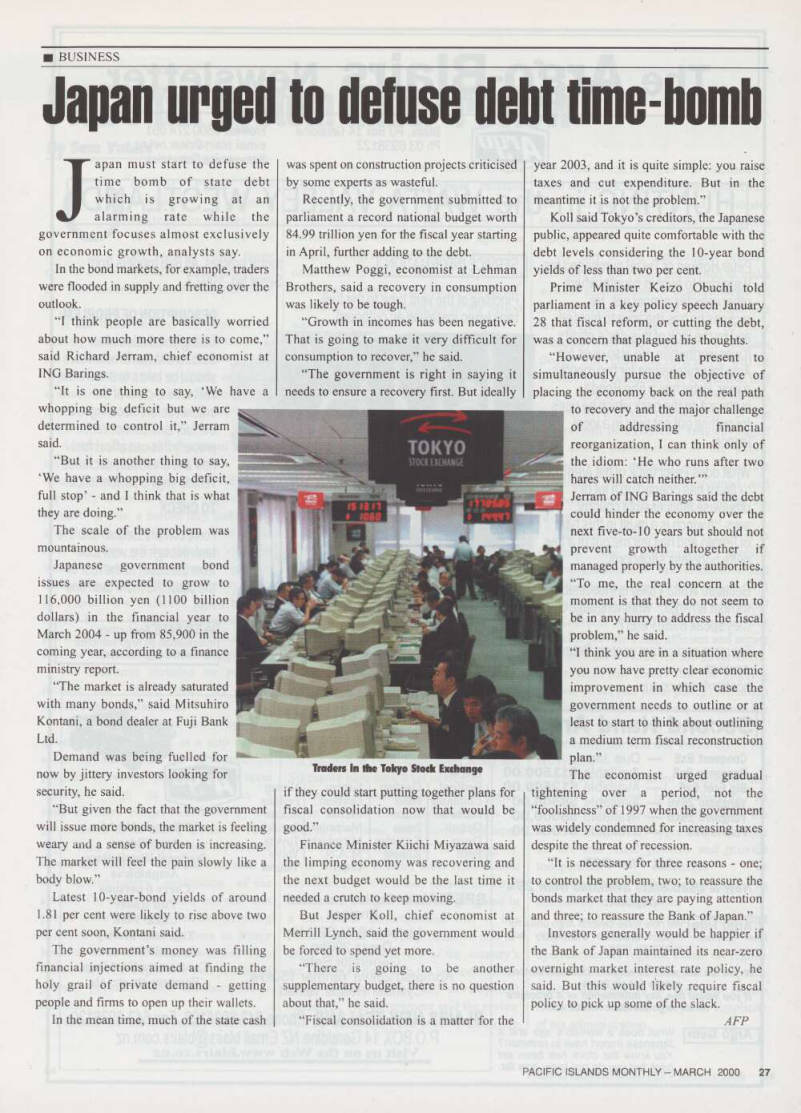
Japan must start to defuse the time bomb of state debt which is growing at an alarming rate while the government focuses almost exclusively on economic growth, analysts say.
In the bond markets, for example, traders were flooded in supply and fretting over the outlook.
“I think people are basically worried about how much more there is to come,” said Richard Jerram, chief economist at
ING Barings.
“It is one thing to say, ‘We have a
whopping big deficit but we are determined to control it,” Jerram said.
“But it is another thing to say, ‘We have a whopping big deficit, full stop’ - and I think that is what they are doing.”
The scale of the problem was mountainous.
Japanese government bond issues are expected to grow to 116,000 billion yen (1100 billion dollars) in the financial year to March 2004 - up from 85,900 in the coming year, according to a finance
ministry report.
“The market is already saturated with many bonds,” said Mitsuhiro Kontani, a bond dealer at Fuji Bank Ltd.
Demand was being fuelled for now by jittery investors looking for security, he said.
“But given the fact that the government will issue more bonds, the market is feeling weary and a sense of burden is increasing.
The market will feel the pain slowly like a
body blow.”
Latest 10-year-bond yields of around 1.81 per cent were likely to rise above two per cent soon, Kontani said.
The government’s money was filling financial injections aimed at finding the holy grail of private demand - getting people and firms to open up their wallets.
In the mean time, much of the state cash
was spent on construction projects criticised by some experts as wasteful.
Recently, the government submitted to parliament a record national budget worth 84.99 trillion yen for the fiscal year starting in April, further adding to the debt.
Matthew Poggi, economist at Lehman Brothers, said a recovery in consumption was likely to be tough.
“Growth in incomes has been negative.
That is going to make it very difficult for consumption to recover,” he said.
“The government is right in saying it needs to ensure a recovery first. But ideally
if they could start putting together plans for fiscal consolidation now that would be good.”
Finance Minister Kiichi Miyazawa said the limping economy was recovering and the next budget would be the last time it needed a crutch to keep moving.
But Jesper Koll, chief economist at Merrill Lynch, said the government would be forced to spend yet more.
“There is going to be another supplementary budget, there is no question about that,” he said.
“Fiscal consolidation is a matter for the
year 2003, and it is quite simple: you raise taxes and cut expenditure. But in the meantime it is not the problem.”
Koll said Tokyo’s creditors, the Japanese public, appeared quite comfortable with the debt levels considering the 10-year bond yields of less than two per cent.
Prime Minister Keizo Obuchi told parliament in a key policy speech January 28 that fiscal reform, or cutting the debt, was a concern that plagued his thoughts.
“However, unable at present to simultaneously pursue the objective of placing the economy back on the real path
to recovery and the major challenge of addressing financial reorganization, I can think only of the idiom: ‘He who runs after two hares will catch neither.’”
Jerram of ING Barings said the debt could hinder the economy over the next five-to-10 years but should not prevent growth altogether if managed properly by the authorities.
“To me, the real concern at the moment is that they do not seem to be in any hurry to address the fiscal problem,” he said.
“I think you are in a situation where you now have pretty clear economic improvement in which case the government needs to outline or at least to start to think about outlining a medium term fiscal reconstruction plan.”
The economist urged gradual tightening over a period, not the “foolishness” of 1997 when the government was widely condemned for increasing taxes despite the threat of recession.
“It is necessary for three reasons - one; to control the problem, two; to reassure the bonds market that they are paying attention and three; to reassure the Bank of Japan.”
Investors generally would be happier if the Bank of Japan maintained its near-zero overnight market interest rate policy, he said. But this would likely require fiscal policy to pick up some of the slack.
Afp
Traders in the Tokyo Stock Exchange
Advertisements & other items, p. 28 (1 item)
Second Hand Argo’s
Peter Hosken of Twizel purchased his Vanguard to hunt in country where other vehicles cannot get. He reckons he has the area to himself and by the look of this day’s efforts, it was worthwhile. He also uses his Argo for whitebaiting for two months a year. Peter has a 5hp Honda outboard on the back which he uses for putting out set nets in a local lagoon.
What does Peter think of his Argo!
“I find it has opened up a lot of otherwise inaccessible country.” He says “a winch is a must in this type of terrain and has got me out of a few quite hopeless situations.
Because Waita Valley is inaccesible without an Argo, “what language do they speak there Peter?”
For more particulars contact Peter on email at [email protected].
SERVICE INFORMATION
Pinching of the vent tube to the fuel tank when installing an outboard mm mm » motor bracket. All 8x8 models from Serial No. 10973.
DESCRIPTION OF PROBLEM:
During installation of an .,, v Outboard Motor Bracket care should be taken to ensure the III vent tube is clear of the bracket before securing it. If I the fuel tank cannot vent i properly this can affect fuel flow and drastically decrease vehicle engine performance.
TO CHECK
Force compressed air into the ill tank through the vent tube from the outlet at the rear of the body. (No more than one
PSI).
WEBSITE For further information on Argo vehicles visit www.argoatv.com
Second Hand Argo’s
Conquest 8x8 Response 8x8 Big Foot 6x6 Vanguard 26x6 Vanguard 16x6 Polaris 6x4 Due Jan Available Available Available Available Available
ALL Plus GST
New & Used Units available from 25% deposit.
We now have several Argo units for hire, subject to availability and minimum time.
Argo Hire If you do not wish to receive this newsletter, please let us know.
If you would like any information or a brochure on an Argo please contact us.
Argo Gem What does a woman’s age and a 1 Japanese import have in common?
You know the clock has been set back but you do not know how far.
ENGINE WAREHOUSE
New/Used - Engines Transmissions Parts Lister Yanmar SPECIALAir Cooled Industrial Engines Listers 18/21/32/44hp Deutz 290hp Generator Sets Komatsu 29kva Yanmar 150kva Cylinder Heads Tested All Terrain Vehicles Amphibious National Distributers Amphibious Carry 6 persons Pull trailer
USED FOR
Tourism Forestry Council Fisherman Contracters Govt Dept Farmers etc.etc. etc BLAIRS NEW ZEALAND Phone 643-6938122 Fax 643-6938120 P.O.BOX 14 Geraldine NZ Email [email protected] Visit us on the Web www.blairs.co.nz
PNG's tax system under review
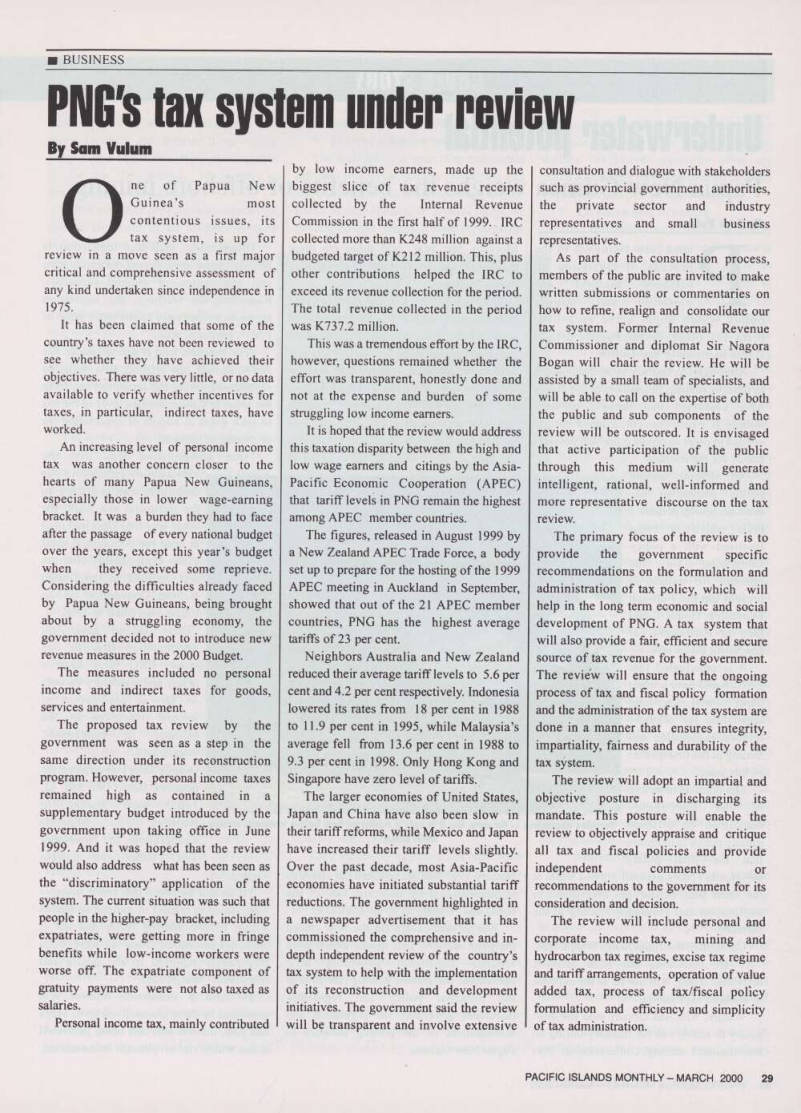
By Sam Vulum
One of Papua New Guinea’s most contentious issues, its tax system, is up for review in a move seen as a first major critical and comprehensive assessment of any kind undertaken since independence in 1975.
It has been claimed that some of the country’s taxes have not been reviewed to see whether they have achieved their objectives. There was very little, or no data available to verify whether incentives for taxes, in particular, indirect taxes, have worked.
An increasing level of personal income tax was another concern closer to the hearts of many Papua New Guineans, especially those in lower wage-earning bracket. It was a burden they had to face after the passage of every national budget over the years, except this year’s budget when they received some reprieve.
Considering the difficulties already faced by Papua New Guineans, being brought about by a struggling economy, the government decided not to introduce new revenue measures in the 2000 Budget.
The measures included no personal income and indirect taxes for goods, services and entertainment.
The proposed tax review by the government was seen as a step in the same direction under its reconstruction program. However, personal income taxes remained high as contained in a supplementary budget introduced by the government upon taking office in June 1999. And it was hoped that the review would also address what has been seen as the “discriminatory” application of the system. The current situation was such that people in the higher-pay bracket, including expatriates, were getting more in fringe benefits while low-income workers were worse off. The expatriate component of gratuity payments were not also taxed as salaries.
Personal income tax, mainly contributed
by low income earners, made up the biggest slice of tax revenue receipts collected by the Internal Revenue Commission in the first half of 1999. IRC collected more than K 248 million against a budgeted target of K 212 million. This, plus other contributions helped the IRC to exceed its revenue collection for the period.
The total revenue collected in the period was K 737.2 million.
This was a tremendous effort by the IRC, however, questions remained whether the effort was transparent, honestly done and not at the expense and burden of some struggling low income earners.
It is hoped that the review would address this taxation disparity between the high and low wage earners and citings by the Asia- Pacific Economic Cooperation (APEC) that tariff levels in PNG remain the highest among APEC member countries.
The figures, released in August 1999 by a New Zealand APEC Trade Force, a body set up to prepare for the hosting of the 1999 APEC meeting in Auckland in September, showed that out of the 21 APEC member countries, PNG has the highest average tariffs of 23 per cent.
Neighbors Australia and New Zealand reduced their average tariff levels to 5.6 per cent and 4.2 per cent respectively. Indonesia lowered its rates from 18 per cent in 1988 to 11.9 per cent in 1995, while Malaysia’s average fell from 13.6 per cent in 1988 to 9.3 per cent in 1998. Only Hong Kong and Singapore have zero level of tariffs.
The larger economies of United States, Japan and China have also been slow in their tariff reforms, while Mexico and Japan have increased their tariff levels slightly.
Over the past decade, most Asia-Pacific economies have initiated substantial tariff reductions. The government highlighted in a newspaper advertisement that it has commissioned the comprehensive and in depth independent review of the country’s tax system to help with the implementation of its reconstruction and development initiatives. The government said the review will be transparent and involve extensive
consultation and dialogue with stakeholders such as provincial government authorities, the private sector and industry representatives and small business representatives.
As part of the consultation process, members of the public are invited to make written submissions or commentaries on how to refine, realign and consolidate our tax system. Former Internal Revenue Commissioner and diplomat Sir Nagora Bogan will chair the review. He will be assisted by a small team of specialists, and will be able to call on the expertise of both the public and sub components of the review will be outscored. It is envisaged that active participation of the public through this medium will generate intelligent, rational, well-informed and more representative discourse on the tax review.
The primary focus of the review is to provide the government specific recommendations on the formulation and administration of tax policy, which will help in the long term economic and social development of PNG. A tax system that will also provide a fair, efficient and secure source of tax revenue for the government.
The review will ensure that the ongoing process of tax and fiscal policy formation and the administration of the tax system are done in a manner that ensures integrity, impartiality, fairness and durability of the tax system.
The review will adopt an impartial and objective posture in discharging its mandate. This posture will enable the review to objectively appraise and critique all tax and fiscal policies and provide independent comments or recommendations to the government for its consideration and decision.
The review will include personal and corporate income tax, mining and hydrocarbon tax regimes, excise tax regime and tariff arrangements, operation of value added tax, process of tax/fiscal policy formulation and efficiency and simplicity of tax administration.
Underwater potential
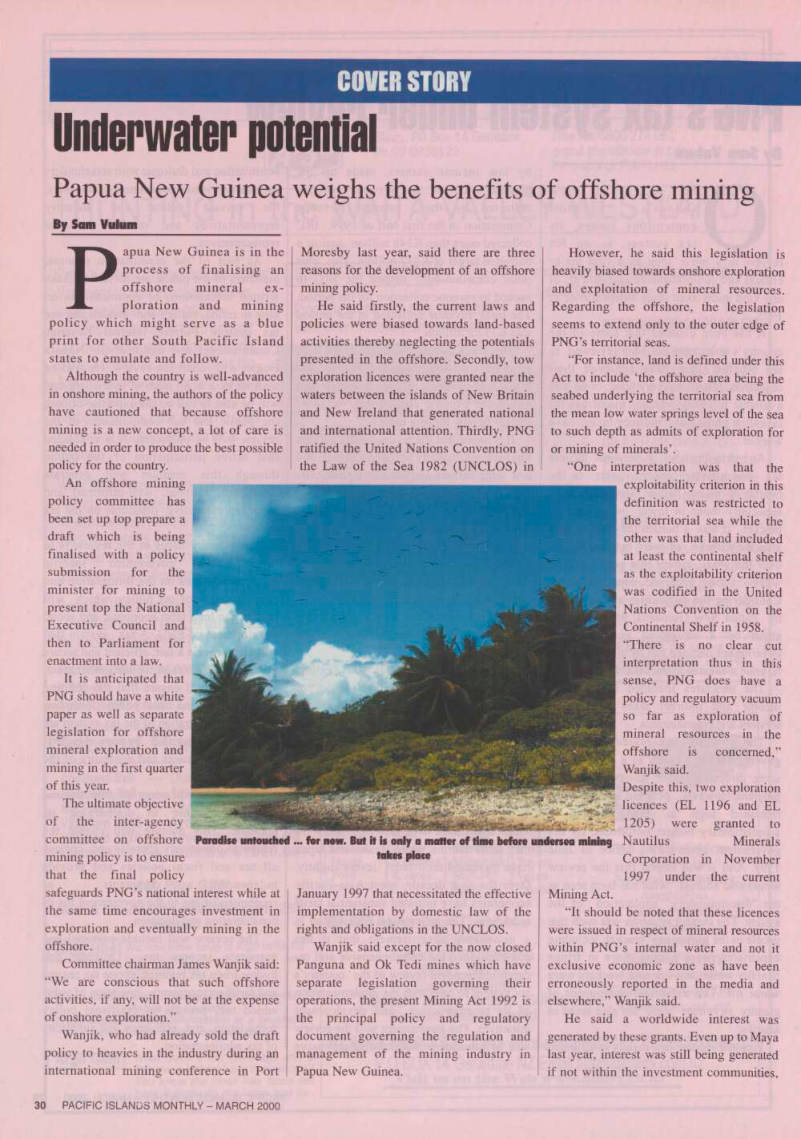
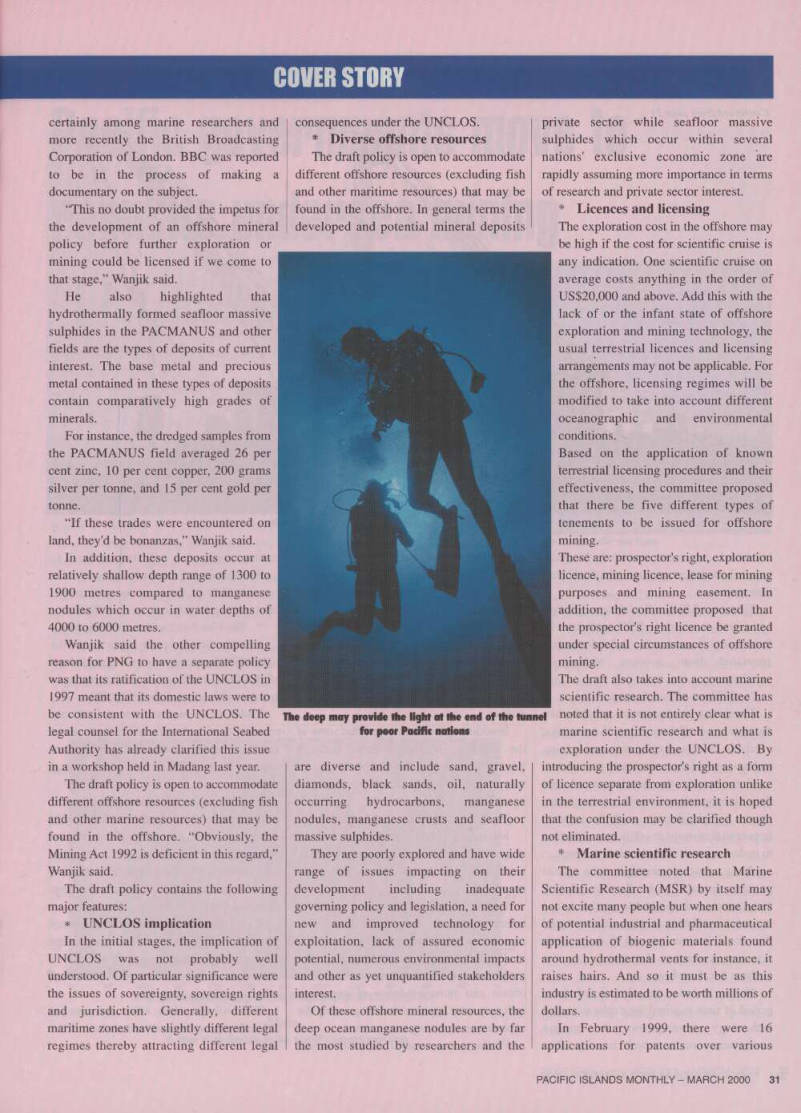
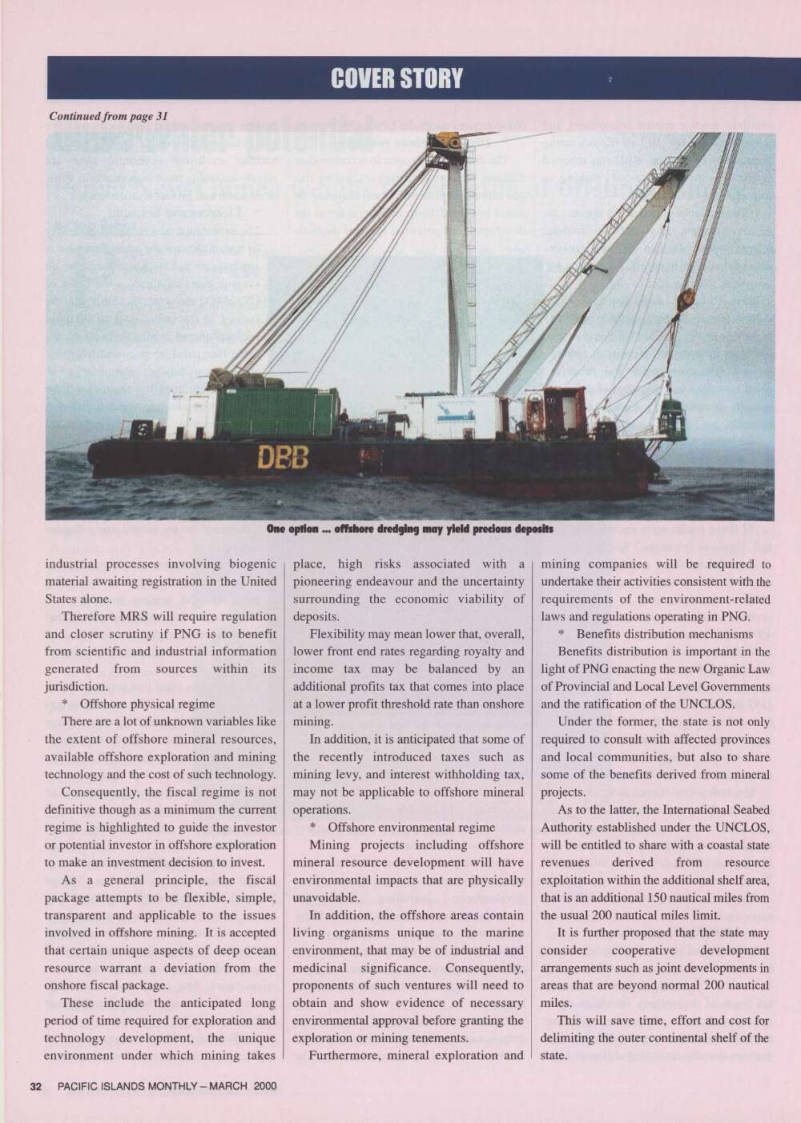
Cover Story
Papua New Guinea weighs the benefits of offshore mining
By Sam Vulum
Papua New Guinea is in the process of finalising an offshore mineral ex ploration and mining policy which might serve as a blue print for other South Pacific Island states to emulate and follow.
Although the country is well-advanced in onshore mining, the authors of the policy have cautioned that because offshore mining is a new concept, a lot of care is needed in order to produce the best possible policy for the country.
An offshore mining policy committee has been set up top prepare a draft which is being finalised with a policy submission for the minister for mining to present top the National Executive Council and then to Parliament for enactment into a law.
It is anticipated that PNG should have a white paper as well as separate legislation for offshore mineral exploration and mining in the first quarter of this year.
The ultimate objective of the inter-agency committee on offshore mining policy is to ensure that the final policy
safeguards PNG’s national interest while at the same time encourages investment in exploration and eventually mining in the offshore.
Committee chairman James Wanjik said: “We are conscious that such offshore activities, if any, will not be at the expense of onshore exploration.”
Wanjik, who had already sold the draft policy to heavies in the industry during an international mining conference in Port
Moresby last year, said there are three reasons for the development of an offshore
mining policy.
He said firstly, the current laws and policies were biased towards land-based activities thereby neglecting the potentials presented in the offshore. Secondly, tow exploration licences were granted near the waters between the islands of New Britain and New Ireland that generated national and international attention. Thirdly, PNG ratified the United Nations Convention on the Law of the Sea 1982 (UNCLOS) in
January 1997 that necessitated the effective implementation by domestic law of the rights and obligations in the UNCLOS.
Wanjik said except for the now closed Panguna and Ok Tedi mines which have separate legislation governing their operations, the present Mining Act 1992 is
the principal policy and regulatory
document governing the regulation and management of the mining industry in Papua New Guinea.
However, he said this legislation is heavily biased towards onshore exploration and exploitation of mineral resources.
Regarding the offshore, the legislation seems to extend only to the outer edge of PNG’s territorial seas.
“For instance, land is defined under this Act to include ‘the offshore area being the seabed underlying the territorial sea from the mean low water springs level of the sea to such depth as admits of exploration for or mining of minerals’.
“One interpretation was that the
exploitability criterion in this definition was restricted to the territorial sea while the other was that land included at least the continental shelf as the exploitability criterion was codified in the United Nations Convention on the Continental Shelf in 1958.
“There is no clear cut interpretation thus in this sense, PNG does have a
policy and regulatory vacuum
so far as exploration of mineral resources in the offshore is concerned,”
Wanjik said.
Despite this, two exploration licences (EL 1196 and EL 1205) were granted to Nautilus Minerals Corporation in November 1997 under the current
Mining Act.
“It should be noted that these licences were issued in respect of mineral resources within PNG’s internal water and not it exclusive economic zone as have been erroneously reported in the media and elsewhere,” Wanjik said.
He said a worldwide interest was generated by these grants. Even up to Maya last year, interest was still being generated if not within the investment communities,
Paradise untouched ... for now. But h is only a matter of time before undersea mining takes place
certainly among marine researchers and more recently the British Broadcasting Corporation of London. BBC was reported to be in the process of making a documentary on the subject.
“This no doubt provided the impetus for the development of an offshore mineral policy before further exploration or mining could be licensed if we come to I that stage,” Wanjik said.
He also highlighted that I hydrothermally formed seafloor massive I sulphides in the PACMANUS and other I fields are the types of deposits of current I interest. The base metal and precious I metal contained in these types of deposits I contain comparatively high grades of I minerals.
For instance, the dredged samples from I the PACMANUS field averaged 26 per I cent zinc, 10 per cent copper, 200 grams I silver per tonne, and 15 per cent gold per I tonne.
“If these trades were encountered on I land, they'd be bonanzas,” Wanjik said.
In addition, these deposits occur at I relatively shallow depth range of 1300 to I 1900 metres compared to manganese I nodules which occur in water depths of I 4000 to 6000 metres.
Wanjik said the other compelling I reason for PNG to have a separate policy I was that its ratification of the UNCLOS in 8 1997 meant that its domestic laws were to 8 be consistent with the UNCLOS. The legal counsel for the International Seabed Authority has already clarified this issue in a workshop held in Madang last year.
The draft policy is open to accommodate different offshore resources (excluding fish and other marine resources) that may be found in the offshore. “Obviously, the Mining Act 1992 is deficient in this regard,”
Wanjik said.
The draft policy contains the following major features: * UNCLOS implication In the initial stages, the implication of UNCLOS was not probably well understood. Of particular significance were the issues of sovereignty, sovereign rights and jurisdiction. Generally, different maritime zones have slightly different legal regimes thereby attracting different legal
consequences under the UNCLOS. * Diverse offshore resources The draft policy is open to accommodate different offshore resources (excluding fish and other maritime resources) that may be found in the offshore. In general terms the developed and potential mineral deposits
are diverse and include sand, gravel, diamonds, black sands, oil, naturally
occurring hydrocarbons, manganese
nodules, manganese crusts and seafloor massive sulphides.
They are poorly explored and have wide range of issues impacting on their development including inadequate governing policy and legislation, a need for new and improved technology for exploitation, lack of assured economic potential, numerous environmental impacts and other as yet unquantified stakeholders interest.
Of these offshore mineral resources, the deep ocean manganese nodules are by far the most studied by researchers and the
private sector while seafloor massive sulphides which occur within several nations' exclusive economic zone are
rapidly assuming more importance in terms
of research and private sector interest.
* Licences and licensing The exploration cost in the offshore may be high if the cost for scientific cruise is any indication. One scientific cruise on average costs anything in the order of US$2O,OOO and above. Add this with the lack of or the infant state of offshore exploration and mining technology, the usual terrestrial licences and licensing arrangements may not be applicable. For the offshore, licensing regimes will be modified to take into account different oceanographic and environmental conditions.
Based on the application of known terrestrial licensing procedures and their effectiveness, the committee proposed that there be five different types of tenements to be issued for offshore
mining.
These are: prospector's right, exploration licence, mining licence, lease for mining purposes and mining easement. In addition, the committee proposed that
the prospector's right licence be granted
under special circumstances of offshore
mining.
The draft also takes into account marine scientific research. The committee has noted that it is not entirely clear what is marine scientific research and what is exploration under the UNCLOS. By
introducing the prospector's right as a form of licence separate from exploration unlike in the terrestrial environment, it is hoped that the confusion may be clarified though not eliminated. * Marine scientific research The committee noted that Marine Scientific Research (MSR) by itself may not excite many people but when one hears of potential industrial and pharmaceutical application of biogenic materials found around hydrothermal vents for instance, it raises hairs. And so it must be as this industry is estimated to be worth millions of dollars.
In February 1999, there were 16 applications for patents over various
The deep may provide the light at the end of the tunnel for poor Pacific nations
Continued from page 31
industrial processes involving biogenic material awaiting registration in the United States alone.
Therefore MRS will require regulation and closer scrutiny if PNG is to benefit from scientific and industrial information generated from sources within its
jurisdiction.
* Offshore physical regime There are a lot of unknown variables like the extent of offshore mineral resources, available offshore exploration and mining technology and the cost of such technology.
Consequently, the fiscal regime is not definitive though as a minimum the current regime is highlighted to guide the investor or potential investor in offshore exploration to make an investment decision to invest.
As a general principle, the fiscal package attempts to be flexible, simple, transparent and applicable to the issues involved in offshore mining. It is accepted that certain unique aspects of deep ocean resource warrant a deviation from the onshore fiscal package.
These include the anticipated long period of time required for exploration and
technology development, the unique
environment under which mining takes
place, high risks associated with a pioneering endeavour and the uncertainty surrounding the economic viability of deposits.
Flexibility may mean lower that, overall, lower front end rates regarding royalty and income tax may be balanced by an additional profits tax that comes into place at a lower profit threshold rate than onshore mining.
In addition, it is anticipated that some of the recently introduced taxes such as mining levy, and interest withholding tax, may not be applicable to offshore mineral operations. * Offshore environmental regime
Mining projects including offshore
mineral resource development will have environmental impacts that are physically unavoidable.
In addition, the offshore areas contain
living organisms unique to the marine
environment, that may be of industrial and medicinal significance. Consequently, proponents of such ventures will need to obtain and show evidence of necessary environmental approval before granting the
exploration or mining tenements.
Furthermore, mineral exploration and
mining companies will be required to undertake their activities consistent with the requirements of the environment-related laws and regulations operating in PNG. * Benefits distribution mechanisms Benefits distribution is important in the light of PNG enacting the new Organic Law of Provincial and Local Level Governments and the ratification of the UNCLOS.
Under the former, the state is not only required to consult with affected provinces and local communities, but also to share some of the benefits derived from mineral
projects.
As to the latter, the International Seabed Authority established under the UNCLOS, will be entitled to share with a coastal state revenues derived from resource exploitation within the additional shelf area, that is an additional 150 nautical miles from the usual 200 nautical miles limit.
It is further proposed that the state may
consider cooperative development
arrangements such as joint developments in areas that are beyond normal 200 nautical miles.
This will save time, effort and cost for delimiting the outer continental shelf of the state.
One option ... offshore dredging may yield precious deposits
regulate undersea mining
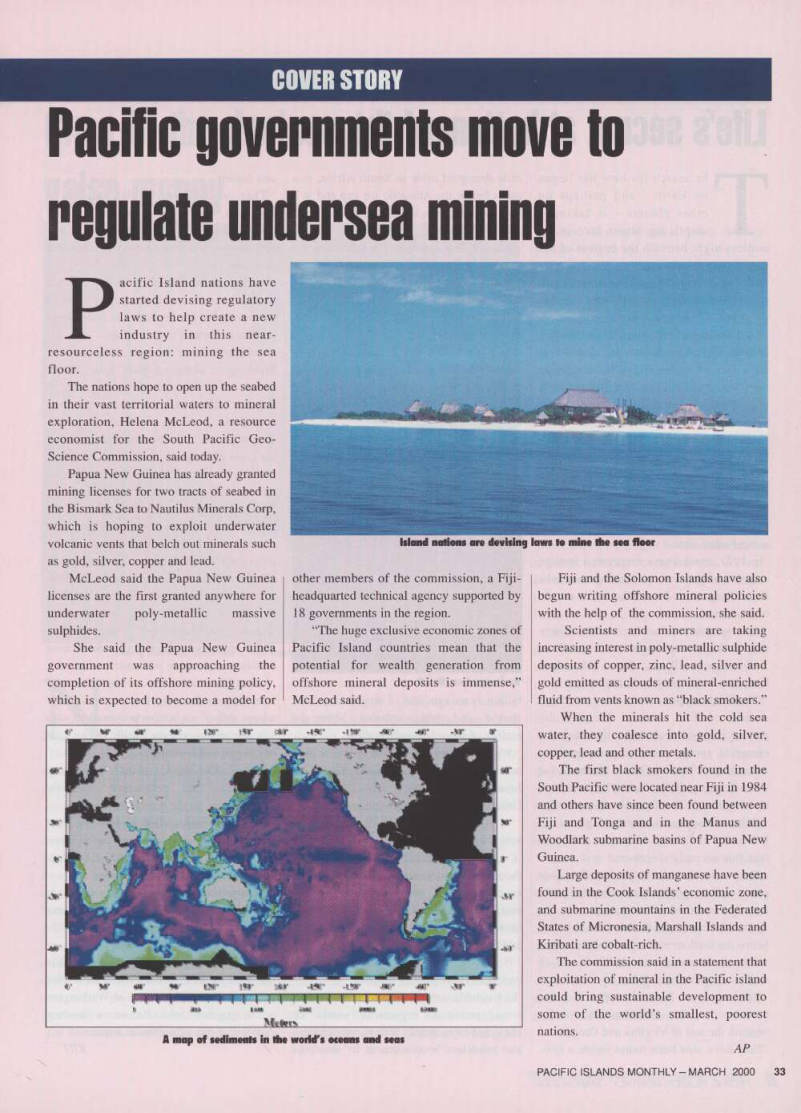
Pacific governments move to regulate undersea mining
Pacific Island nations have started devising regulatory laws to help create a new industry in this near resourceless region: mining the sea floor.
The nations hope to open up the seabed in their vast territorial waters to mineral exploration, Helena McLeod, a resource economist for the South Pacific Geo- Science Commission, said today.
Papua New Guinea has already granted mining licenses for two tracts of seabed in the Bismark Sea to Nautilus Minerals Corp, which is hoping to exploit underwater volcanic vents that belch out minerals such as gold, silver, copper and lead.
McLeod said the Papua New Guinea licenses are the first granted anywhere for underwater poly-metallic massive sulphides.
She said the Papua New Guinea government was approaching the
completion of its offshore mining policy,
which is expected to become a model for
other members of the commission, a Fiji headquarted technical agency supported by 18 governments in the region.
“The huge exclusive economic zones of Pacific Island countries mean that the potential for wealth generation from offshore mineral deposits is immense,”
McLeod said.
Fiji and the Solomon Islands have also
begun writing offshore mineral policies
with the help of the commission, she said.
Scientists and miners are taking increasing interest in poly-metallic sulphide deposits of copper, zinc, lead, silver and gold emitted as clouds of mineral-enriched fluid from vents known as “black smokers.”
When the minerals hit the cold sea water, they coalesce into gold, silver, copper, lead and other metals.
The first black smokers found in the South Pacific were located near Fiji in 1984 and others have since been found between Fiji and Tonga and in the Manus and Woodlark submarine basins of Papua New Guinea.
Large deposits of manganese have been found in the Cook Islands’ economic zone, and submarine mountains in the Federated States of Micronesia, Marshall Islands and Kiribati are cobalt-rich.
The commission said in a statement that exploitation of mineral in the Pacific island could bring sustainable development to some of the world’s smallest, poorest nations.
AP
Island nations are devising lows to mine the sea floor
A map of sediments in the world's oceans and seas
Life's secret at bottom of the sea
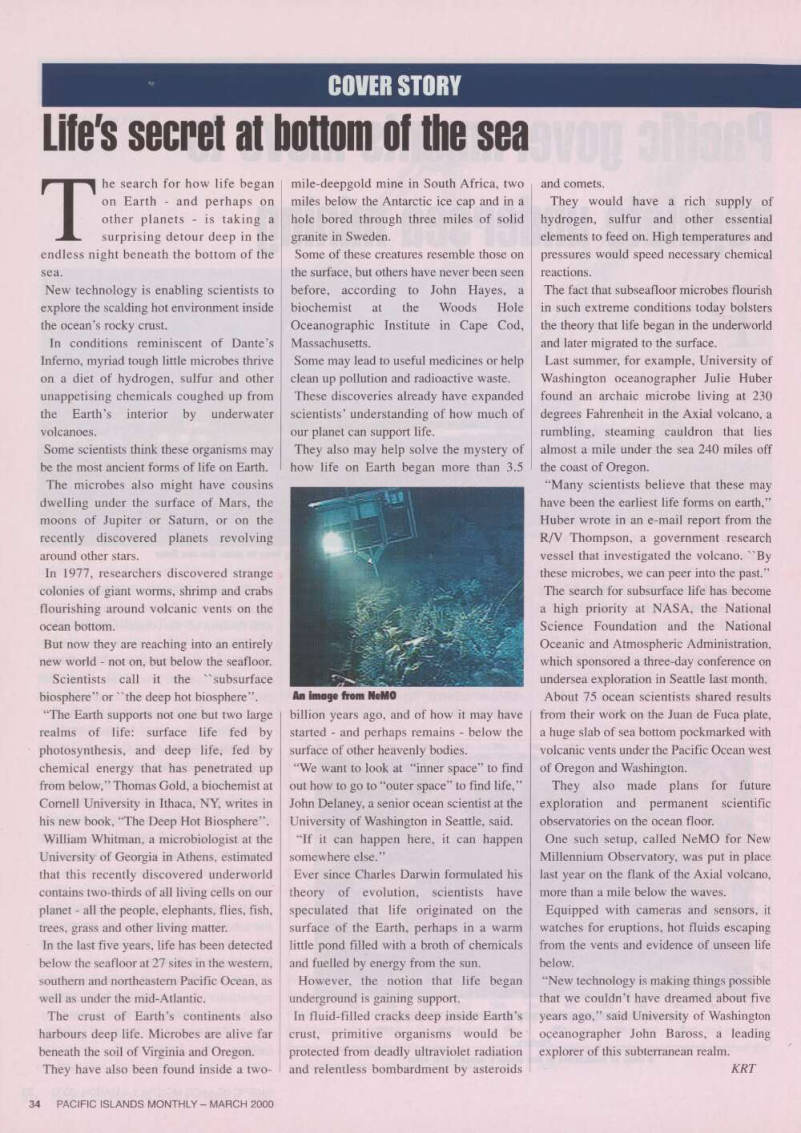
The search for how life began on Earth - and perhaps on other planets - is taking a surprising detour deep in the endless night beneath the bottom of the sea.
New technology is enabling scientists to explore the scalding hot environment inside the ocean’s rocky crust.
In conditions reminiscent of Dante’s Inferno, myriad tough little microbes thrive on a diet of hydrogen, sulfur and other unappetising chemicals coughed up from the Earth’s interior by underwater volcanoes.
Some scientists think these organisms may be the most ancient forms of life on Earth.
The microbes also might have cousins dwelling under the surface of Mars, the moons of Jupiter or Saturn, or on the
recently discovered planets revolving
around other stars.
In 1977, researchers discovered strange colonies of giant worms, shrimp and crabs flourishing around volcanic vents on the ocean bottom.
But now they are reaching into an entirely new world - not on, but below the seafloor.
Scientists call it the "subsurface
biosphere” or "the deep hot biosphere”.
“The Earth supports not one but two large realms of life: surface life fed by
photosynthesis, and deep life, fed by
chemical energy that has penetrated up from below,” Thomas Gold, a biochemist at Cornell University in Ithaca, NY, writes in his new book, “The Deep Hot Biosphere”.
William Whitman, a microbiologist at the University of Georgia in Athens, estimated that this recently discovered underworld contains two-thirds of all living cells on our planet - all the people, elephants, flies, fish, trees, grass and other living matter.
In the last five years, life has been detected below the seafloor at 27 sites in the western, southern and northeastern Pacific Ocean, as well as under the mid-Atlantic.
The crust of Earth’s continents also harbours deep life. Microbes are alive far beneath the soil of Virginia and Oregon.
They have also been found inside a two
mile-deepgold mine in South Africa, two miles below the Antarctic ice cap and in a hole bored through three miles of solid granite in Sweden.
Some of these creatures resemble those on the surface, but others have never been seen before, according to John Hayes, a biochemist at the Woods Hole Oceanographic Institute in Cape Cod, Massachusetts.
Some may lead to useful medicines or help clean up pollution and radioactive waste.
These discoveries already have expanded scientists’ understanding of how much of our planet can support life.
They also may help solve the mystery of how life on Earth began more than 3.5
billion years ago, and of how it may have started - and perhaps remains - below the surface of other heavenly bodies.
“We want to look at “inner space” to find out how to go to “outer space” to find life,”
John Delaney, a senior ocean scientist at the University of Washington in Seattle, said.
“If it can happen here, it can happen somewhere else.”
Ever since Charles Darwin formulated his theory of evolution, scientists have speculated that life originated on the surface of the Earth, perhaps in a warm little pond filled with a broth of chemicals and fuelled by energy from the sun.
However, the notion that life began
underground is gaining support.
In fluid-filled cracks deep inside Earth’s crust, primitive organisms would be protected from deadly ultraviolet radiation and relentless bombardment by asteroids
and comets.
They would have a rich supply of hydrogen, sulfur and other essential elements to feed on. High temperatures and pressures would speed necessary chemical reactions.
The fact that subseafloor microbes flourish in such extreme conditions today bolsters the theory that life began in the underworld and later migrated to the surface.
Last summer, for example, University of Washington oceanographer Julie Huber found an archaic microbe living at 230 degrees Fahrenheit in the Axial volcano, a rumbling, steaming cauldron that lies almost a mile under the sea 240 miles off the coast of Oregon.
“Many scientists believe that these may have been the earliest life forms on earth,”
Huber wrote in an e-mail report from the R/V Thompson, a government research vessel that investigated the volcano. "By these microbes, we can peer into the past.”
The search for subsurface life has become a high priority at NASA, the National Science Foundation and the National Oceanic and Atmospheric Administration, which sponsored a three-day conference on undersea exploration in Seattle last month.
About 75 ocean scientists shared results from their work on the Juan de Fuca plate, a huge slab of sea bottom pockmarked with volcanic vents under the Pacific Ocean west of Oregon and Washington.
They also made plans for future exploration and permanent scientific observatories on the ocean floor.
One such setup, called NeMO for New Millennium Observatory, was put in place last year on the flank of the Axial volcano, more than a mile below the waves.
Equipped with cameras and sensors, it watches for eruptions, hot fluids escaping from the vents and evidence of unseen life below.
“New technology is making things possible that we couldn’t have dreamed about five years ago,” said University of Washington oceanographer John Baross, a leading explorer of this subterranean realm.
Krt
An image from NeMO
Glow-in-the-dark squirt guns
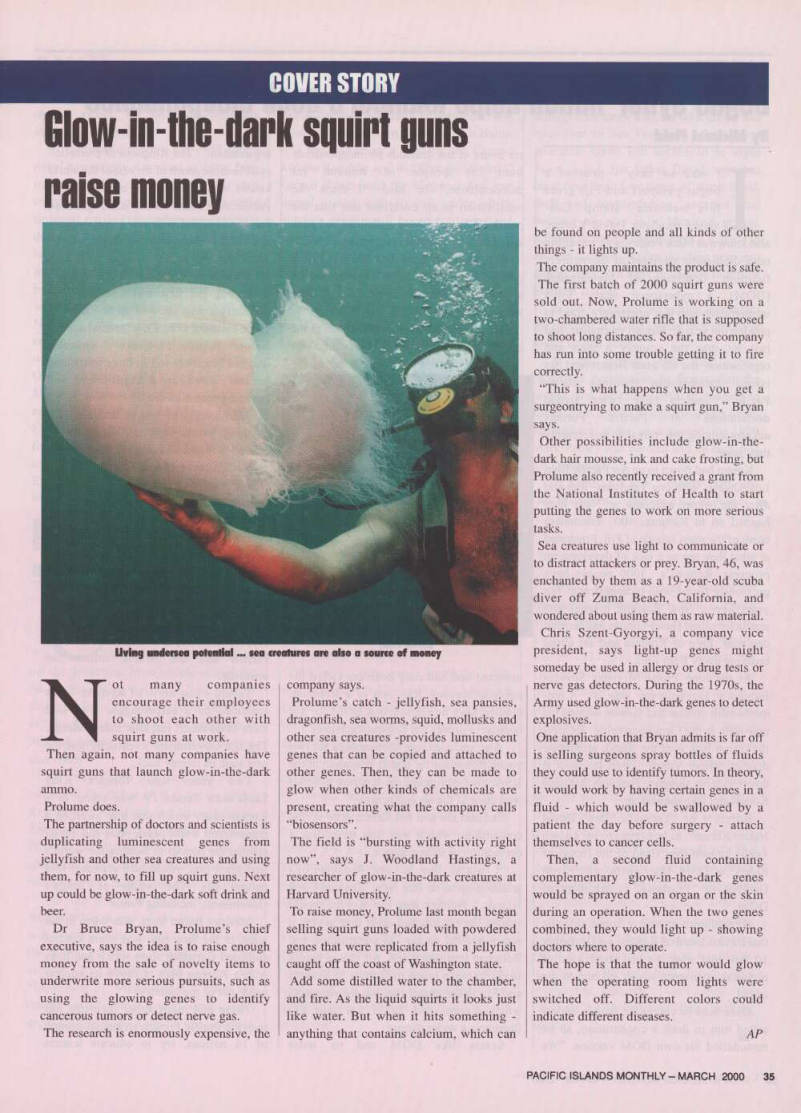
raise money
Not many companies
encourage their employees to shoot each other with squirt guns at work.
Then again, not many companies have squirt guns that launch glow-in-the-dark ammo.
Prolume does.
The partnership of doctors and scientists is duplicating luminescent genes from jellyfish and other sea creatures and using them, for now, to fill up squirt guns. Next up could be glow-in-the-dark soft drink and beer.
Dr Bruce Bryan, Prolume’s chief executive, says the idea is to raise enough money from the sale of novelty items to underwrite more serious pursuits, such as using the glowing genes to identify cancerous tumors or detect nerve gas.
The research is enormously expensive, the
company says.
Prolume’s catch - jellyfish, sea pansies, dragonfish, sea worms, squid, mollusks and other sea creatures -provides luminescent genes that can be copied and attached to other genes. Then, they can be made to glow when other kinds of chemicals are present, creating what the company calls “biosensors”.
The field is “bursting with activity right now”, says J. Woodland Hastings, a researcher of glow-in-the-dark creatures at
Harvard University.
To raise money, Prolume last month began
selling squirt guns loaded with powdered
genes that were replicated from a jellyfish caught off the coast of Washington state.
Add some distilled water to the chamber, and fire. As the liquid squirts it looks just like water. But when it hits something anything that contains calcium, which can
be found on people and all kinds of other things - it lights up.
The company maintains the product is safe.
The first batch of 2000 squirt guns were sold out. Now, Prolume is working on a two-chambered water rifle that is supposed to shoot long distances. So far, the company has run into some trouble getting it to fire correctly.
“This is what happens when you get a surgeontrying to make a squirt gun,” Bryan says.
Other possibilities include glow-in-the
dark hair mousse, ink and cake frosting, but Prolume also recently received a grant from the National Institutes of Health to start putting the genes to work on more serious tasks.
Sea creatures use light to communicate or to distract attackers or prey. Bryan, 46, was enchanted by them as a 19-year-old scuba diver off Zuma Beach, California, and wondered about using them as raw material.
Chris Szent-Gyorgyi, a company vice
president, says light-up genes might
someday be used in allergy or drug tests or nerve gas detectors. During the 19705, the Army used glow-in-the-dark genes to detect
explosives.
One application that Bryan admits is far off is selling surgeons spray bottles of fluids they could use to identify tumors. In theory, it would work by having certain genes in a fluid - which would be swallowed by a patient the day before surgery - attach themselves to cancer cells.
Then, a second fluid containing
complementary glow-in-the-dark genes
would be sprayed on an organ or the skin during an operation. When the two genes combined, they would light up - showing doctors where to operate.
The hope is that the tumor would glow when the operating room lights were switched off. Different colors could indicate different diseases.
AP
living undersea potential ... sea creatures are also a source of money
Bogus cyber nation helps Islanders seek Independence
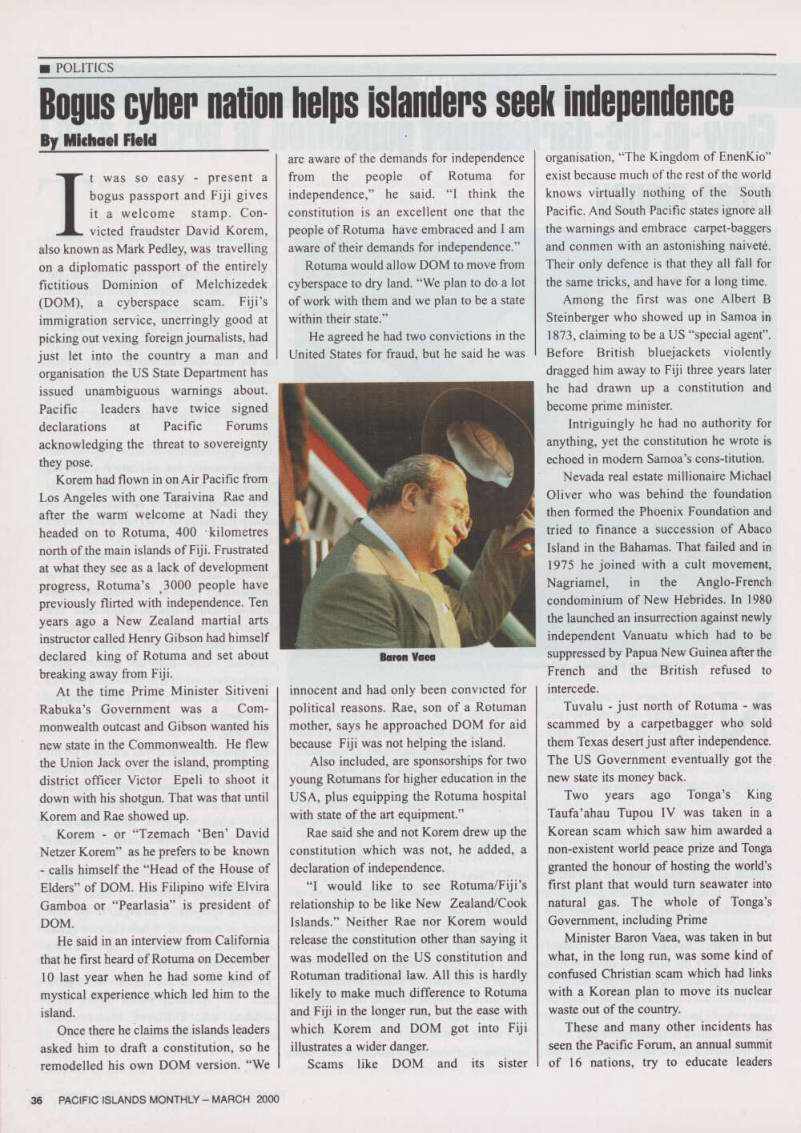
Politics
By Michael Field
It was so easy - present a bogus passport and Fiji gives it a welcome stamp. Con victed fraudster David Korem, also known as Mark Pedley, was travelling on a diplomatic passport of the entirely fictitious Dominion of Melchizedek (DOM), a cyberspace scam. Fiji’s
immigration service, unerringly good at
picking out vexing foreign journalists, had just let into the country a man and organisation the US State Department has issued unambiguous warnings about.
Pacific leaders have twice signed declarations at Pacific Forums acknowledging the threat to sovereignty they pose.
Korem had flown in on Air Pacific from Los Angeles with one Taraivina Rae and after the warm welcome at Nadi they headed on to Rotuma, 400 kilometres north of the main islands of Fiji. Frustrated at what they see as a lack of development progress, Rotuma’s 3000 people have previously flirted with independence. Ten years ago a New Zealand martial arts instructor called Henry Gibson had himself declared king of Rotuma and set about breaking away from Fiji.
At the time Prime Minister Sitiveni Rabuka’s Government was a Com monwealth outcast and Gibson wanted his new state in the Commonwealth. He flew the Union Jack over the island, prompting district officer Victor Epeli to shoot it down with his shotgun. That was that until Korem and Rae showed up.
Korem - or “Tzemach ‘Ben’ David Netzer Korem” as he prefers to be known - calls himself the “Head of the House of Elders” of DOM. His Filipino wife Elvira Gamboa or “Pearlasia” is president of
Dom.
He said in an interview from California that he first heard of Rotuma on December 10 last year when he had some kind of mystical experience which led him to the island.
Once there he claims the islands leaders asked him to draft a constitution, so he remodelled his own DOM version. “We
are aware of the demands for independence from the people of Rotuma for independence,” he said. “I think the constitution is an excellent one that the people of Rotuma have embraced and I am aware of their demands for independence.”
Rotuma would allow DOM to move from cyberspace to dry land. “We plan to do a lot of work with them and we plan to be a state within their state.”
He agreed he had two convictions in the United States for fraud, but he said he was
innocent and had only been convicted for political reasons. Rae, son of a Rotuman mother, says he approached DOM for aid because Fiji was not helping the island.
Also included, are sponsorships for two young Rotumans for higher education in the USA, plus equipping the Rotuma hospital with state of the art equipment.”
Rae said she and not Korem drew up the constitution which was not, he added, a declaration of independence.
“I would like to see Rotuma/Fiji’s relationship to be like New Zealand/Cook Islands.” Neither Rae nor Korem would release the constitution other than saying it was modelled on the US constitution and Rotuman traditional law. All this is hardly likely to make much difference to Rotuma and Fiji in the longer run, but the ease with which Korem and DOM got into Fiji illustrates a wider danger.
Scams like DOM and its sister
organisation, “The Kingdom of EnenKio” exist because much of the rest of the world knows virtually nothing of the South Pacific. And South Pacific states ignore all the warnings and embrace carpet-baggers and conmen with an astonishing naivete.
Their only defence is that they all fall for the same tricks, and have for a long time.
Among the first was one Albert B Steinberger who showed up in Samoa in 1873, claiming to be a US “special agent”.
Before British bluejackets violently dragged him away to Fiji three years later he had drawn up a constitution and become prime minister.
Intriguingly he had no authority for anything, yet the constitution he wrote is echoed in modem Samoa’s cons-titution.
Nevada real estate millionaire Michael Oliver who was behind the foundation then formed the Phoenix Foundation and tried to finance a succession of Abaco Island in the Bahamas. That failed and in 1975 he joined with a cult movement, Nagriamel, in the Anglo-French condominium of New Hebrides. In 1980 the launched an insurrection against newly independent Vanuatu which had to be suppressed by Papua New Guinea after the French and the British refused to intercede.
Tuvalu - just north of Rotuma - was scammed by a carpetbagger who sold them Texas desert just after independence.
The US Government eventually got the new state its money back.
Two years ago Tonga’s King Taufa’ahau Tupou IV was taken in a Korean scam which saw him awarded a non-existent world peace prize and Tonga granted the honour of hosting the world’s first plant that would turn seawater into natural gas. The whole of Tonga’s Government, including Prime Minister Baron Vaea, was taken in but what, in the long run, was some kind of confused Christian scam which had links with a Korean plan to move its nuclear waste out of the country.
These and many other incidents has seen the Pacific Forum, an annual summit of 16 nations, try to educate leaders
Baron Vaca
against swallowing American dreams of instant riches for their economically struggling nations.
A communique from the 1997 forum noted sovereignty was most at threat from transnational crime and added that they recognised “the potential for undesirable financial activities to undermine economic development.” The US State Department’s latest International Narcotics Control Strategy Report warned of the threat posed by offshore financial centers (OFCs) which had sprung up in real countries like Nauru.”... (It) is now possible for an enterprising jurisdiction anywhere in the world to establish itself as an emerging OFC. The newest OFCs. eg Niue and the Marshall Islands, are sprouting in remote areas of the world, such as the Pacific.
Even more ‘remote’ are mere figments of fertile imaginations such as the Dominion of Melchizedek or The Kingdom of EnenKio Atoll, both entirely fraudulent in intent and practice”. EnenKio, which is
linked to DOM, claims Wake Island in the North Pacific. Although it only currently exists as an address on the Internet, it claims it is recognised as a state by the Central African Republic and its “Foreign Minister”
Kermit Rydel said the kingdom had just signed a deal with Kuwait under which stateless people will become citizens and passport holders of EnenKio.
DOM claims its “ecclesiastical and constitutional sovereignty” rests on an island in French Polynesia called Karitane. It does not exist. Melchizedek has been termed “the world’s best-known virtual country” In 1998 three Melchizedek “officials” were arrested in the Philippines after duping hundreds of local Filipinos, Chinese and Bangladeshis to pay up to SUS3SOO for documents they were told were “internationally-recognised passports”. The three, an Australian, a Malaysian and a Hong Kong based British lawyer were believed to be working for an Australian previously convicted in a celebrated horse racing fixing scandal. In
1983, Mark Pedley (or as Fijian immigration know him, David Korem) was convicted in San Francisco of mail and interstate fraud and sentenced to eight years in jail. His father David, who has been convicted four times of stock fraud, theft and counterfeiting, escaped trial because he was in a Mexican prison, accused of having orchestrated a scheme to convert the then-fast devalu-ating peso into dollars through a bank in Saipan, Northern Mariana Islands.
In 1987, a casket purporting to contain the remains of David Pedley was sent back to the United States.
At the funeral, two FBI agents requested permission to fingerprint the corpse. But the family refused, leading to speculation that he is still alive and living somewhere under an assumed. In 1990 Mark Pedley was paroled and he launched his Dominion.
He named his new “country” after the Old Testament “righteous king of peace”. ■
Ignorance fuels Internet nation scams
By Michael J Field
Conmen hitting the world
have one thing on their side when it comes to using a Pacific dateline on the Internet. Most people cannot tell Nauru from Niue, Savusavu from Suva or Enenkio from Karitane. And in the snows of New Hampshire public relations expert Stephen Abbott is having a great joke on everybody.
He’s never been into the South Pacific but his is the father of the nation of the Republic of Howland and Baker Islands.
And on his web site he makes it so easy to fall for it all, particularly with the complaint that since the Millennium hotel room rates had fallen flat in the republic.
For the informed EnenKio is easily recognisable as one of the better known web scams with its claim to Wake Island in the North Pacific. Karitane is a fiction created by another web state, the “Dominion of Melchizedek”. When the drama of Rotuma arose some news organisations found Abbott’s site, and took
it seriously.
Adding to the confusing is the fact that both Howland and Baker do exist and are bleak US atolls just north of Kiribati - which does, quietly, claim them.
“I was genuinely unaware that ‘micronations’ in Fiji and in the Marshall Islands had taken a more real and concrete form until I did some research into the matter last week,” Abbott says.
“While I’m all in favour of sovereignty, and even secession, in many cases around the world, the artificial nature of these newly-created ‘nations’ clearly falls far short of any criteria for true national identity and legitimacy.” Abbott said after the Rotuma drama broke he created an explanation page for fear that somebody might take his republic too seriously.
“It is a model nation, in the sense that it is a sociological blank slate upon which economic, social, political, racial and various other societal issues can be played out in a neutral setting,” the note says. It is modelled on the laws and culture of Singapore.
Abbott has also created a history for the islands, diverging from what is known at the point American aviator Amelia Earhart became hopelessly, and fatally, lost in 1937. She had been heading for Howland Island from New Guinea. She never showed up, but on the Republic’s website she “lands on and takes off from Howland Island”. In 1948 a Texas billionaire buys the island and “transformed them into a Singapore-like business empire”. The other cybernations are little more than scams, as the US State Department warned, saying the Dominion and EnenKio were “both entirely fraudulent in intent and practice”. The Republic of Howland and Baker offers, according to the web site, “a wide range of offshore business attractions” although it comes with an interesting warning:
“Things aren’t always what they appear
and if it’s too good to be true, it probably is. Check with your bank for the best investment options. Don’t trust the Internet for investment and banking advice.”
Vanuatu police blamed fur human rights abuses
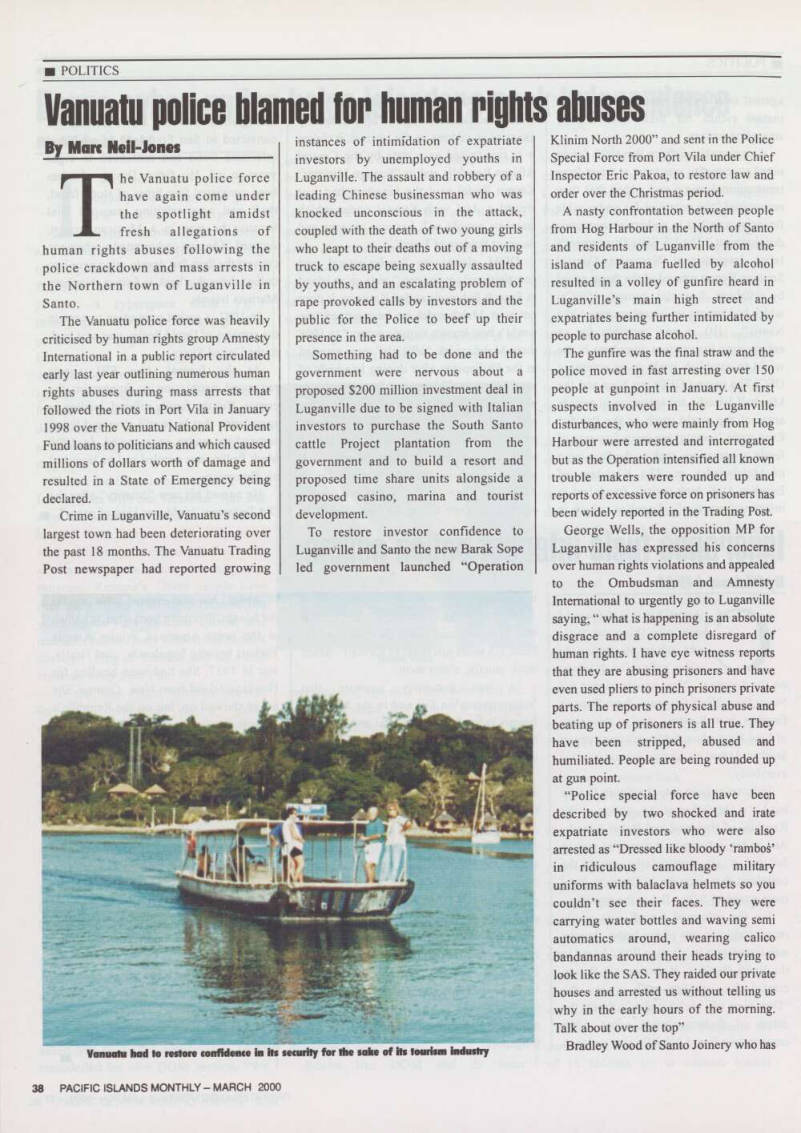
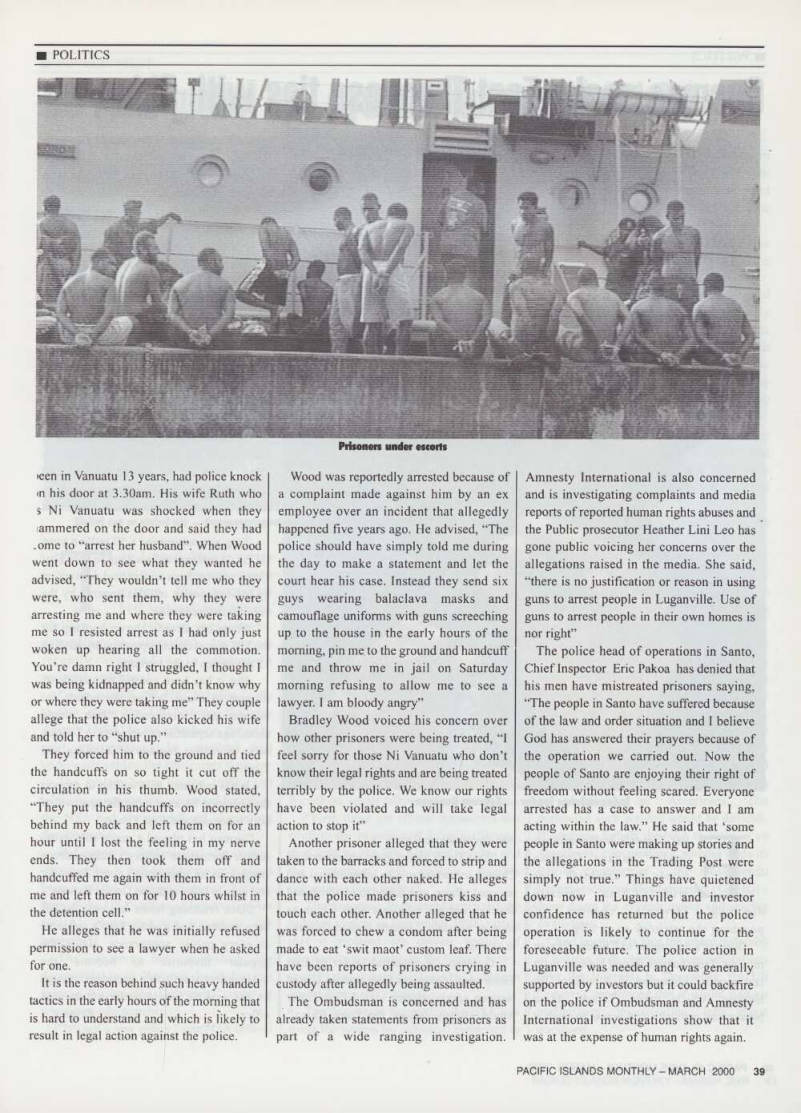
By Mare Heil-Jones
The Vanuatu police force
have again come under the spotlight amidst fresh allegations of human rights abuses following the police crackdown and mass arrests in the Northern town of Luganville in Santo.
The Vanuatu police force was heavily criticised by human rights group Amnesty International in a public report circulated early last year outlining numerous human rights abuses during mass arrests that followed the riots in Port Vila in January 1998 over the Vanuatu National Provident Fund loans to politicians and which caused millions of dollars worth of damage and resulted in a State of Emergency being declared.
Crime in Luganville, Vanuatu’s second largest town had been deteriorating over the past 18 months. The Vanuatu Trading Post newspaper had reported growing
instances of intimidation of expatriate investors by unemployed youths in Luganville. The assault and robbery of a leading Chinese businessman who was knocked unconscious in the attack, coupled with the death of two young girls who leapt to their deaths out of a moving truck to escape being sexually assaulted by youths, and an escalating problem of rape provoked calls by investors and the public for the Police to beef up their presence in the area.
Something had to be done and the government were nervous about a proposed $2OO million investment deal in Luganville due to be signed with Italian investors to purchase the South Santo cattle Project plantation from the government and to build a resort and proposed time share units alongside a proposed casino, marina and tourist development.
To restore investor confidence to Luganville and Santo the new Barak Sope led government launched “Operation
Klinim North 2000” and sent in the Police Special Force from Port Vila under Chief Inspector Eric Pakoa, to restore law and order over the Christmas period.
A nasty confrontation between people from Hog Harbour in the North of Santo and residents of Luganville from the island of Paama fuelled by alcohol resulted in a volley of gunfire heard in Luganville’s main high street and expatriates being further intimidated by people to purchase alcohol.
The gunfire was the final straw and the police moved in fast arresting over 150 people at gunpoint in January. At first suspects involved in the Luganville disturbances, who were mainly from Hog Harbour were arrested and interrogated but as the Operation intensified all known trouble makers were rounded up and reports of excessive force on prisoners has been widely reported in the Trading Post.
George Wells, the opposition MP for Luganville has expressed his concerns over human rights violations and appealed to the Ombudsman and Amnesty International to urgently go to Luganville saying, “ what is happening is an absolute disgrace and a complete disregard of human rights. I have eye witness reports that they are abusing prisoners and have even used pliers to pinch prisoners private parts. The reports of physical abuse and beating up of prisoners is all true. They have been stripped, abused and humiliated. People are being rounded up at gun point.
“Police special force have been described by two shocked and irate expatriate investors who were also arrested as “Dressed like bloody ‘rambos’ in ridiculous camouflage military uniforms with balaclava helmets so you couldn’t see their faces. They were carrying water bottles and waving semi automatics around, wearing calico bandannas around their heads trying to look like the SAS. They raided our private houses and arrested us without telling us why in the early hours of the morning.
Talk about over the top”
Bradley Wood of Santo Joinery who has
Vanuatu had to restore confidence in its security for the sake of its tourism industry
teen in Vanuatu 13 years, had police knock »n his door at 3.30 am. His wife Ruth who s Ni Vanuatu was shocked when they lammered on the door and said they had .ome to “arrest her husband”. When Wood went down to see what they wanted he advised, “They wouldn’t tell me who they were, who sent them, why they were arresting me and where they were taking me so I resisted arrest as I had only just woken up hearing all the commotion.
You’re damn right I struggled, I thought I was being kidnapped and didn’t know why or where they were taking me” They couple allege that the police also kicked his wife and told her to “shut up.”
They forced him to the ground and tied the handcuffs on so tight it cut off the circulation in his thumb. Wood stated, “They put the handcuffs on incorrectly behind my back and left them on for an hour until I lost the feeling in my nerve ends. They then took them off and handcuffed me again with them in front of me and left them on for 10 hours whilst in the detention cell.”
He alleges that he was initially refused permission to see a lawyer when he asked for one.
It is the reason behind such heavy handed tactics in the early hours of the morning that is hard to understand and which is likely to result in legal action against the police.
Wood was reportedly arrested because of a complaint made against him by an ex employee over an incident that allegedly happened five years ago. He advised, “The police should have simply told me during the day to make a statement and let the court hear his case. Instead they send six guys wearing balaclava masks and camouflage uniforms with guns screeching up to the house in the early hours of the morning, pin me. to the ground and handcuff me and throw me in jail on Saturday morning refusing to allow me to see a lawyer. I am bloody angry”
Bradley Wood voiced his concern over how other prisoners were being treated, “I feel sorry for those Ni Vanuatu who don’t know their legal rights and are being treated terribly by the police. We know our rights have been violated and will take legal action to stop it”
Another prisoner alleged that they were taken to the barracks and forced to strip and dance with each other naked. He alleges that the police made prisoners kiss and touch each other. Another alleged that he was forced to chew a condom after being made to eat ‘swit maof custom leaf. There have been reports of prisoners crying in custody after allegedly being assaulted.
The Ombudsman is concerned and has already taken statements from prisoners as part of a wide ranging investigation.
Amnesty International is also concerned and is investigating complaints and media reports of reported human rights abuses and the Public prosecutor Heather Lini Leo has gone public voicing her concerns over the allegations raised in the media. She said, “there is no justification or reason in using guns to arrest people in Luganville. Use of guns to arrest people in their own homes is nor right”
The police head of operations in Santo, Chief Inspector Eric Pakoa has denied that his men have mistreated prisoners saying, “The people in Santo have suffered because of the law and order situation and I believe God has answered their prayers because of the operation we carried out. Now the people of Santo are enjoying their right of freedom without feeling scared. Everyone arrested has a case to answer and I am acting within the law.” He said that ‘some people in Santo were making up stories and the allegations in the Trading Post were simply not true.” Things have quietened down now in Luganville and investor confidence has returned but the police operation is likely to continue for the foreseeable future. The police action in Luganville was needed and was generally supported by investors but it could backfire on the police if Ombudsman and Amnesty International investigations show that it was at the expense of human rights again.
Prisoners under escorts
Gusmao seeks East Timorese ties with China
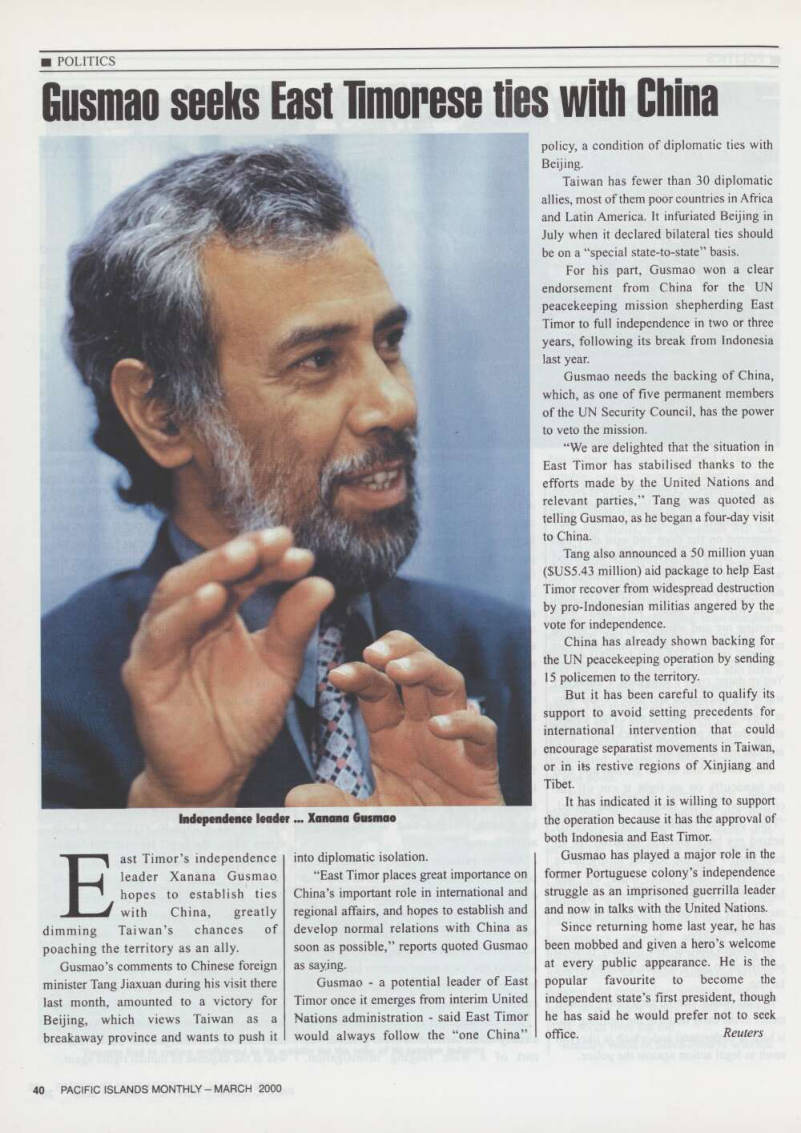
East Timor’s independence
leader Xanana Gusmao hopes to establish ties with China, greatly dimming Taiwan’s chances of poaching the territory as an ally.
Gusmao’s comments to Chinese foreign minister Tang Jiaxuan during his visit there last month, amounted to a victory for Beijing, which views Taiwan as a breakaway province and wants to push it
into diplomatic isolation.
“East Timor places great importance on China’s important role in international and regional affairs, and hopes to establish and develop normal relations with China as soon as possible,” reports quoted Gusmao
as saying.
Gusmao - a potential leader of East Timor once it emerges from interim United Nations administration - said East Timor would always follow the “one China”
policy, a condition of diplomatic ties with Beijing.
Taiwan has fewer than 30 diplomatic allies, most of them poor countries in Africa and Latin America. It infuriated Beijing in July when it declared bilateral ties should be on a “special state-to-state” basis.
For his part, Gusmao won a clear endorsement from China for the UN peacekeeping mission shepherding East Timor to full independence in two or three years, following its break from Indonesia last year.
Gusmao needs the backing of China, which, as one of five permanent members of the UN Security Council, has the power to veto the mission.
“We are delighted that the situation in East Timor has stabilised thanks to the efforts made by the United Nations and relevant parties,” Tang was quoted as telling Gusmao, as he began a four-day visit to China.
Tang also announced a 50 million yuan (5U55.43 million) aid package to help East Timor recover from widespread destruction
by pro-Indonesian militias angered by the
vote for independence.
China has already shown backing for the UN peacekeeping operation by sending 15 policemen to the territory.
But it has been careful to qualify its support to avoid setting precedents for international intervention that could encourage separatist movements in Taiwan, or in its restive regions of Xinjiang and Tibet.
It has indicated it is willing to support the operation because it has the approval of both Indonesia and East Timor.
Gusmao has played a major role in the former Portuguese colony’s independence struggle as an imprisoned guerrilla leader and now in talks with the United Nations.
Since returning home last year, he has been mobbed and given a hero’s welcome at every public appearance. He is the popular favourite to become the independent state’s first president, though he has said he would prefer not to seek office. Reuters
Independence leader ... Xanana Gusmao
US runs global spy system, documents claim
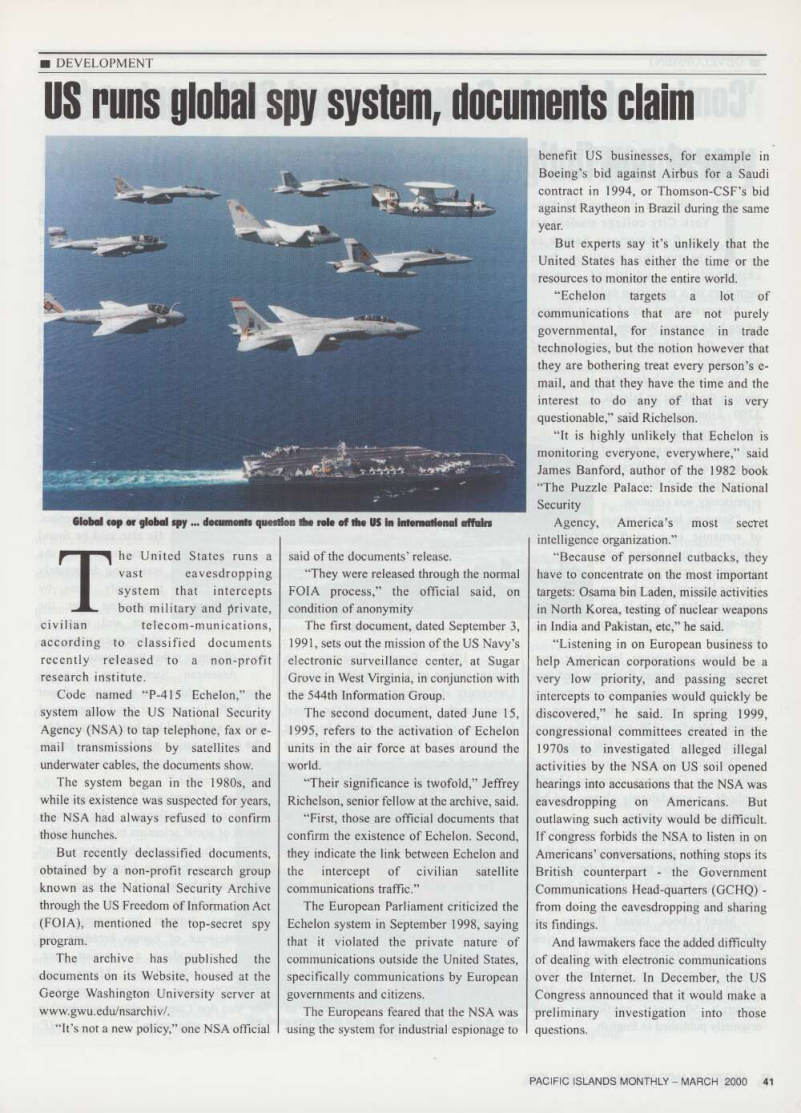
Development
The United States runs a vast eavesdropping system that intercepts both military and private, civilian telecom-munications, according to classified documents recently released to a non-profit research institute.
Code named “P-415 Echelon,” the system allow the US National Security Agency (NSA) to tap telephone, fax or e mail transmissions by satellites and underwater cables, the documents show.
The system began in the 1980 s, and while its existence was suspected for years, the NSA had always refused to confirm those hunches.
But recently declassified documents, obtained by a non-profit research group known as the National Security Archive through the US Freedom of Information Act (FOIA), mentioned the top-secret spy program.
The archive has published the documents on its Website, housed at the George Washington University server at www.gwu.edu/nsarchiv/.
“It’s not a new policy,” one NSA official
said of the documents’ release.
“They were released through the normal FOIA process,” the official said, on condition of anonymity The first document, dated September 3, 1991, sets out the mission of the US Navy’s electronic surveillance center, at Sugar Grove in West Virginia, in conjunction with the 544th Information Group.
The second document, dated June 15, 1995, refers to the activation of Echelon units in the air force at bases around the world.
“Their significance is twofold,” Jeffrey Richelson, senior fellow at the archive, said.
“First, those are official documents that confirm the existence of Echelon. Second, they indicate the link between Echelon and the intercept of civilian satellite communications traffic.”
The European Parliament criticized the Echelon system in September 1998, saying that it violated the private nature of communications outside the United States, specifically communications by European governments and citizens.
The Europeans feared that the NSA was using the system for industrial espionage to
benefit US businesses, for example in Boeing’s bid against Airbus for a Saudi contract in 1994, or Thomson-CSF’s bid against Raytheon in Brazil during the same year.
But experts say it’s unlikely that the United States has either the time or the resources to monitor the entire world.
“Echelon targets a lot of communications that are not purely governmental, for instance in trade technologies, but the notion however that they are bothering treat every person’s e mail, and that they have the time and the interest to do any of that is very questionable,” said Richelson.
“It is highly unlikely that Echelon is monitoring everyone, everywhere,” said James Banford, author of the 1982 book “The Puzzle Palace: Inside the National
Security
Agency, America’s most secret intelligence organization.”
“Because of personnel cutbacks, they have to concentrate on the most important targets: Osama bin Laden, missile activities in North Korea, testing of nuclear weapons in India and Pakistan, etc,” he said.
“Listening in on European business to help American corporations would be a very low priority, and passing secret intercepts to companies would quickly be discovered,” he said. In spring 1999, congressional committees created in the
1970 s to investigated alleged illegal
activities by the NSA on US soil opened hearings into accusations that the NSA was eavesdropping on Americans. But outlawing such activity would be difficult.
If congress forbids the NSA to listen in on Americans’ conversations, nothing stops its British counterpart - the Government Communications Head-quarters (GCHQ) from doing the eavesdropping and sharing its findings.
And lawmakers face the added difficulty of dealing with electronic communications over the Internet. In December, the US Congress announced that it would make a preliminary investigation into those questions.
Global cop or global spy ... documents question the role of the US in international affairs
'Coming of Age in Samoa' named 20th
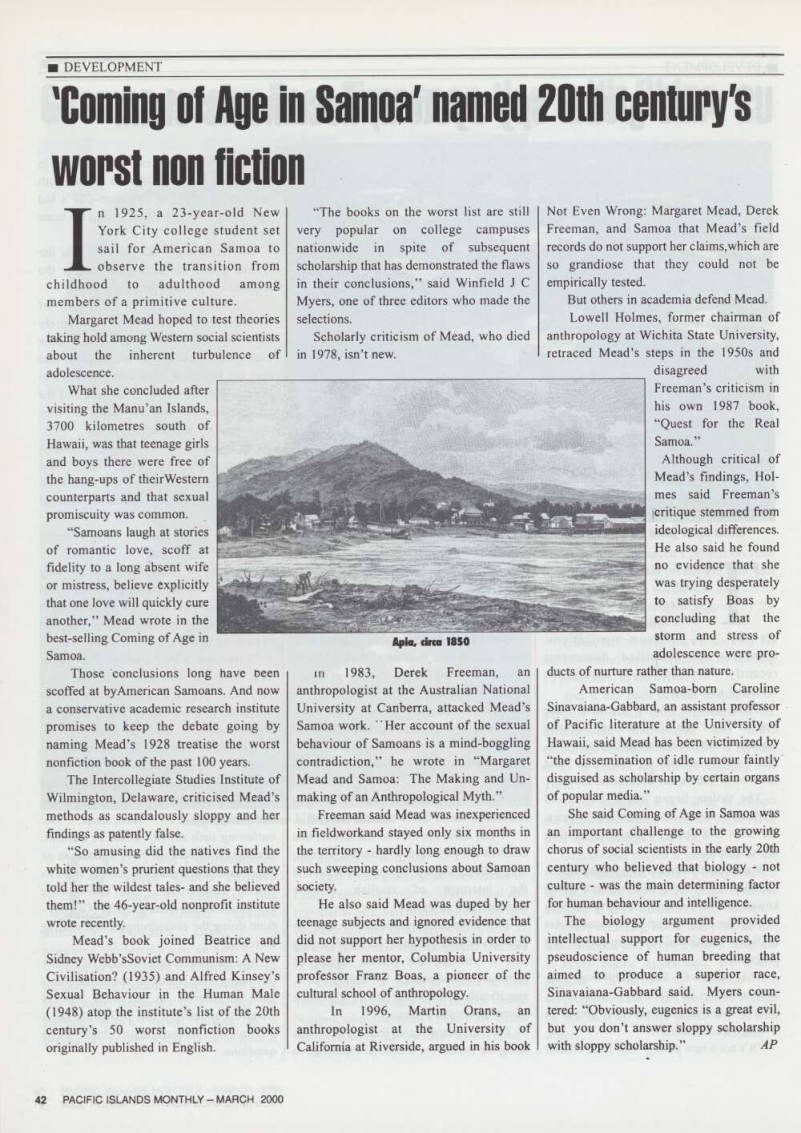
worst non fiction
In 1925, a 23-year-old New York City college student set sail for American Samoa to observe the transition from childhood to adulthood among members of a primitive culture.
Margaret Mead hoped to test theories taking hold among Western social scientists about the inherent turbulence of adolescence.
What she concluded after visiting the Manu’an Islands, 3700 kilometres south of Hawaii, was that teenage girls and boys there were free of the hang-ups of their Western counterparts and that sexual promiscuity was common.
“Samoans laugh at stories of romantic love, scoff at fidelity to a long absent wife or mistress, believe explicitly that one love will quickly cure another,” Mead wrote in the best-selling Coming of Age in Samoa.
Those conclusions long have been scoffed at by American Samoans. And now a conservative academic research institute promises to keep the debate going by naming Mead’s 1928 treatise the worst nonfiction book of the past 100 years.
The Intercollegiate Studies Institute of Wilmington, Delaware, criticised Mead’s methods as scandalously sloppy and her findings as patently false.
“So amusing did the natives find the white women’s prurient questions that they told her the wildest tales- and she believed them!” the 46-year-old nonprofit institute wrote recently.
Mead’s book joined Beatrice and Sidney Webb’s Soviet Communism: A New Civilisation? (1935) and Alfred Kinsey’s Sexual Behaviour in the Human Male (1948) atop the institute’s list of the 20th century’s 50 worst nonfiction books originally published in English.
“The books on the worst list are still very popular on college campuses nationwide in spite of subsequent scholarship that has demonstrated the flaws in their conclusions,” said Winfield J C Myers, one of three editors who made the selections.
Scholarly criticism of Mead, who died in 1978, isn’t new.
in 1983, Derek Freeman, an anthropologist at the Australian National University at Canberra, attacked Mead’s Samoa work. "Her account of the sexual behaviour of Samoans is a mind-boggling contradiction,” he wrote in “Margaret Mead and Samoa: The Making and Un making of an Anthropological Myth.”
Freeman said Mead was inexperienced in fieldworkand stayed only six months in the territory - hardly long enough to draw such sweeping conclusions about Samoan society.
He also said Mead was duped by her teenage subjects and ignored evidence that did not support her hypothesis in order to please her mentor, Columbia University professor Franz Boas, a pioneer of the cultural school of anthropology.
In 1996, Martin Orans, an anthropologist at the University of California at Riverside, argued in his book
Not Even Wrong; Margaret Mead, Derek Freeman, and Samoa that Mead’s field records do not support her claims,which are so grandiose that they could not be empirically tested.
But others in academia defend Mead.
Lowell Holmes, former chairman of anthropology at Wichita State University, retraced Mead’s steps in the 1950 s and
disagreed with Freeman’s criticism in his own 1987 book, “Quest for the Rea!
Samoa.”
Although critical of Mead’s findings, Hol mes said Freeman’s icritique stemmed from ideological differences.
He also said he found no evidence that she was trying desperately to satisfy Boas by concluding that the storm and stress of adolescence were pro
ducts of nurture rather than nature.
American Samoa-born Caroline Sinavaiana-Gabbard, an assistant professor of Pacific literature at the University of Hawaii, said Mead has been victimized by “the dissemination of idle rumour faintly disguised as scholarship by certain organs of popular media.”
She said Coming of Age in Samoa was an important challenge to the growing chorus of social scientists in the early 20th century who believed that biology - not culture - was the main determining factor for human behaviour and intelligence.
The biology argument provided intellectual support for eugenics, the pseudoscience of human breeding that aimed to produce a superior race, Sinavaiana-Gabbard said. Myers coun tered; “Obviously, eugenics is a great evil, but you don’t answer sloppy scholarship with sloppy scholarship.” AP
Apia, circa 1850
convention, biggest State gathering in Fiji's history
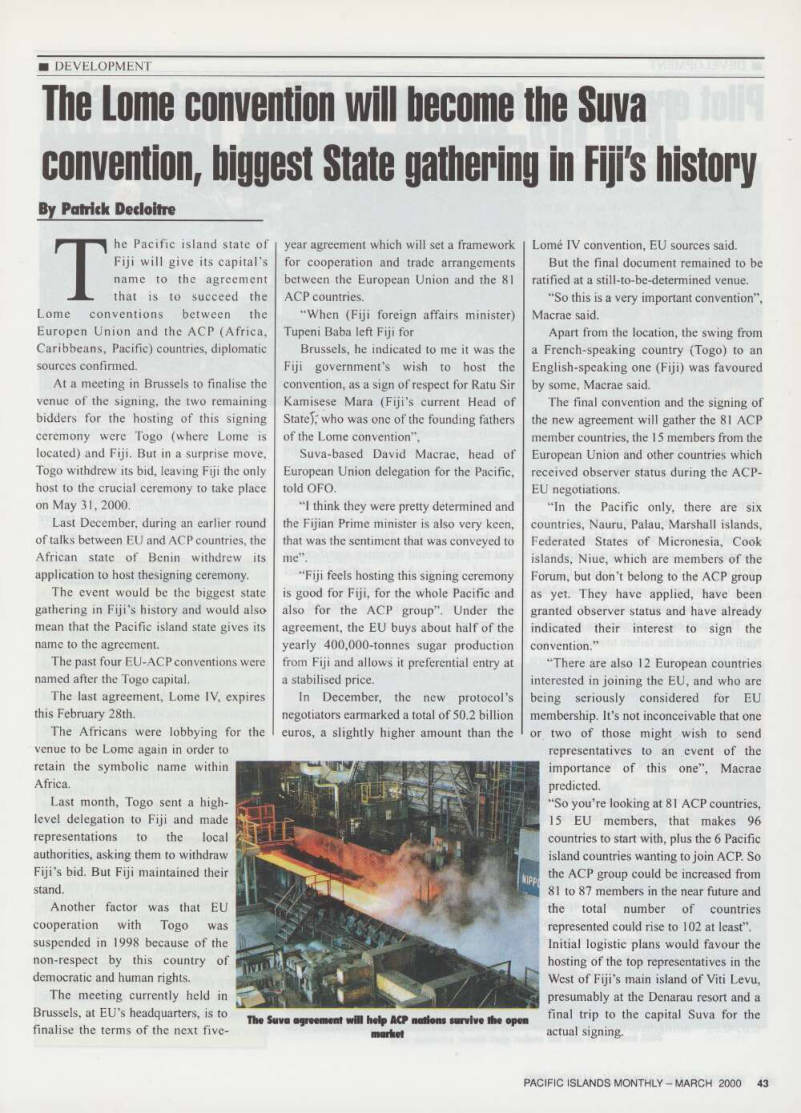
The Lome convention will become the Suva convention, biggest State gathering in Fiji's history
By Patrick Pecloitre
The Pacific island state of
Fiji will give its capital’s
name to the agreement that is to succeed the Lome conventions between the Europen Union and the ACP (Africa, Caribbeans, Pacific) countries, diplomatic sources confirmed.
At a meeting in Brussels to finalise the venue of the signing, the two remaining bidders for the hosting of this signing ceremony were Togo (where Lome is located) and Fiji. But in a surprise move, Togo withdrew its bid, leaving Fiji the only host to the crucial ceremony to take place on May 31, 2000.
Last December, during an earlier round of talks between EU and ACP countries, the African state of Benin withdrew its application to host thesigning ceremony.
The event would be the biggest state gathering in Fiji’s history and would also mean that the Pacific island state gives its name to the agreement.
The past four EU-ACP conventions were named after the Togo capital.
The last agreement, Lome IV, expires this February 28th.
The Africans were lobbying for the
venue to be Lome again in order to retain the symbolic name within Africa.
Last month, Togo sent a high level delegation to Fiji and made representations to the local authorities, asking them to withdraw Fiji’s bid. But Fiji maintained their stand.
Another factor was that EU cooperation with Togo was suspended in 1998 because of the non-respect by this country of democratic and human rights.
The meeting currently held in Brussels, at EU’s headquarters, is to finalise the terms of the next five
year agreement which will set a framework for cooperation and trade arrangements between the European Union and the 81 ACP countries.
“When (Fiji foreign affairs minister) Tupeni Baba left Fiji for Brussels, he indicated to me it was the Fiji government’s wish to host the convention, as a sign of respect for Ratu Sir Kamisese Mara (Fiji’s current Head of Stated who was one of the founding fathers of the Lome convention”, Suva-based David Macrae, head of European Union delegation for the Pacific, told OFO.
“I think they were pretty determined and the Fijian Prime minister is also very keen, that was the sentiment that was conveyed to me”.
“Fiji feels hosting this signing ceremony is good for Fiji, for the whole Pacific and also for the ACP group”. Under the agreement, the EU buys about half of the yearly 400,000-tonnes sugar production from Fiji and allows it preferential entry at a stabilised price.
In December, the new protocol’s negotiators earmarked a total of 50.2 billion euros, a slightly higher amount than the
Lome IV convention, EU sources said.
But the final document remained to be ratified at a still-to-be-determined venue.
“So this is a very important convention”, Macrae said.
Apart from the location, the swing from a French-speaking country (Togo) to an English-speaking one (Fiji) was favoured by some, Macrae said.
The final convention and the signing of the new agreement will gather the 81 ACP member countries, the 15 members from the European Union and other countries which received observer status during the ACP EU negotiations.
“In the Pacific only, there are six countries, Nauru, Palau, Marshall islands, Federated States of Micronesia, Cook islands, Niue, which are members of the Forum, but don’t belong to the ACP group as yet. They have applied, have been granted observer status and have already indicated their interest to sign the convention.”
“There are also 12 European countries interested in joining the EU, and who are being seriously considered for EU membership. It’s not inconceivable that one or two of those might wish to send
representatives to an event of the importance of this one”, Macrae predicted.
“So you’re looking at 81 ACP countries, 15 EU members, that makes 96 countries to start with, plus the 6 Pacific island countries wanting to join ACP. So the ACP group could be increased from 81 to 87 members in the near future and the total number of countries represented could rise to 102 at least”.
Initial logistic plans would favour the hosting of the top representatives in the West of Fiji’s main island of Viti Levu, presumably at the Denarau resort and a final trip to the capital Suva for the actual signing.
The Suva agreement will help ACP nations survive the open market
Pilot error may have caused Fiji's worst crash
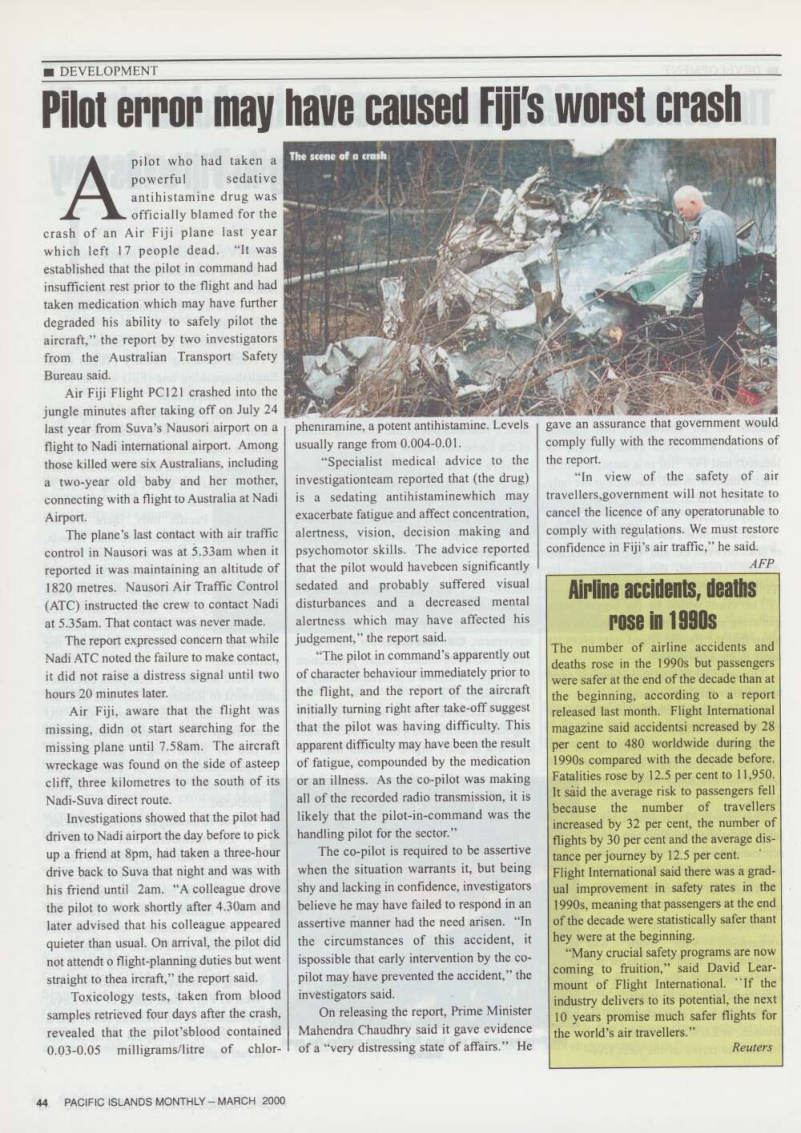
A pilot who had taken a
powerful sedative
antihistamine drug was officially blamed for the crash of an Air Fiji plane last year which left 17 people dead. “It was established that the pilot in command had insufficient rest prior to the flight and had taken medication which may have further degraded his ability to safely pilot the aircraft,” the report by two investigators from the Australian Transport Safety Bureau said.
Air Fiji Flight PCI2I crashed into the jungle minutes after taking off on July 24 last year from Suva’s Nausori airport on a flight to Nadi international airport. Among those killed were six Australians, including a two-year old baby and her mother, connecting with a flight to Australia at Nadi Airport.
The plane’s last contact with air traffic control in Nausori was at 5.33 am when it reported it was maintaining an altitude of 1820 metres. Nausori Air Traffic Control (ATC) instructed the crew to contact Nadi at 5.35 am. That contact was never made.
The report expressed concern that while Nadi ATC noted the failure to make contact, it did not raise a distress signal until two hours 20 minutes later.
Air Fiji, aware that the flight was missing, didn ot start searching for the missing plane until 7.58 am. The aircraft wreckage was found on the side of asteep cliff, three kilometres to the south of its Nadi-Suva direct route.
Investigations showed that the pilot had driven to Nadi airport the day before to pick up a friend at Bpm, had taken a three-hour drive back to Suva that night and was with his friend until 2am. “A colleague drove the pilot to work shortly after 4.30 am and later advised that his colleague appeared quieter than usual. On arrival, the pilot did not attendt o flight-planning duties but went straight to thea ircraft,” the report said.
Toxicology tests, taken from blood samples retrieved four days after the crash, revealed that the pilot’sblood contained 0.03-0.05 milligrams/litre of chlor-
phemramine, a potent antihistamine. Levels usually range from 0.004-0.01.
“Specialist medical advice to the investigationteam reported that (the drug) is a sedating antihistaminewhich may exacerbate fatigue and affect concentration, alertness, vision, decision making and psychomotor skills. The advice reported that the pilot would havebeen significantly sedated and probably suffered visual disturbances and a decreased mental alertness which may have affected his judgement,” the report said.
“The pilot in command’s apparently out of character behaviour immediately prior to the flight, and the report of the aircraft initially turning right after take-off suggest that the pilot was having difficulty. This apparent difficulty may have been the result of fatigue, compounded by the medication or an illness. As the co-pilot was making all of the recorded radio transmission, it is likely that the pilot-in-command was the handling pilot for the sector.”
The co-pilot is required to be assertive when the situation warrants it, but being shy and lacking in confidence, investigators believe he may have failed to respond in an assertive manner had the need arisen. “In the circumstances of this accident, it ispossible that early intervention by the co pilot may have prevented the accident,” the
investigators said.
On releasing the report, Prime Minister Mahendra Chaudhry said it gave evidence of a “very distressing state of affairs.” He
gave an assurance that government would comply fully with the recommendations of the report.
“In view of the safety of air travellers,government will not hesitate to cancel the licence of any operatorunable to comply with regulations. We must restore confidence in Fiji’s air traffic,” he said.
Afp
Airline accidents, deaths
rose in 1990s
The number of airline accidents and deaths rose in the 1990s but passengers were safer at the end of the decade than at the beginning, according to a report released last month. Flight International magazine said accidentsi ncreased by 28 per cent to 480 worldwide during the 1990s compared with the decade before.
Fatalities rose by 12.5 per cent to 11,950.
It said the average risk to passengers fell because the number of travellers increased by 32 per cent, the number of flights by 30 per cent and the average dis tance per journey by 12.5 per cent.
Flight International said there was a grad ual improvement in safety rates in the 1990s, meaning that passengers at the end of the decade were statistically safer thant hey were at the beginning.
“Many crucial safety programs are now coming to fruition,” said David Lear mount of Flight International. "If the industry delivers to its potential, the next 10 years promise much safer flights for the world’s air travellers.”
Reuters
Kiribati faces AIDS threat
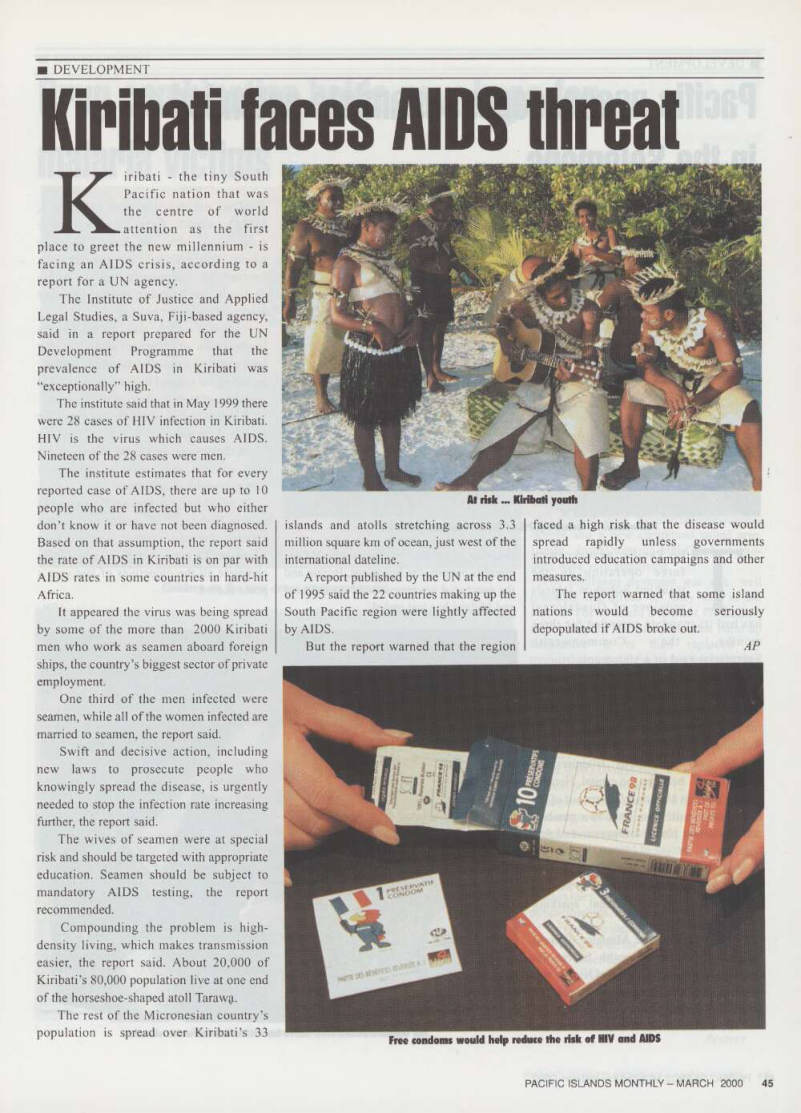
Kiribati - the tiny South Pacific nation that was the centre of world attention as the first place to greet the new millennium - is facing an AIDS crisis, according to a report for a UN agency.
The Institute of Justice and Applied Legal Studies, a Suva, Fiji-based agency, said in a report prepared for the UN Development Programme that the prevalence of AIDS in Kiribati was
“exceptionally” high.
The institute said that in May 1999 there were 28 cases of HIV infection in Kiribati.
HIV is the virus which causes AIDS.
Nineteen of the 28 cases were men.
The institute estimates that for every reported case of AIDS, there are up to 10 people who are infected but who either don’t know it or have not been diagnosed.
Based on that assumption, the report said the rate of AIDS in Kiribati is on par with AIDS rates in some countries in hard-hit Africa.
It appeared the virus was being spread by some of the more than 2000 Kiribati men who work as seamen aboard foreign ships, the country’s biggest sector of private
employment.
One third of the men infected were seamen, while all of the women infected are married to seamen, the report said.
Swift and decisive action, including new laws to prosecute people who knowingly spread the disease, is urgently needed to stop the infection rate increasing further, the report said.
The wives of seamen were at special risk and should be targeted with appropriate education. Seamen should be subject to mandatory AIDS testing, the report recommended.
Compounding the problem is high
density living, which makes transmission easier, the report said. About 20,000 of Kiribati’s 80,000 population live at one end of the horseshoe-shaped atoll Tarawa The rest of the Micronesian country’s population is spread over Kiribati’s 33
islands and atolls stretching across 3.3 million square km of ocean, just west of the international dateline.
A report published by the UN at the end of 1995 said the 22 countries making up the South Pacific region were lightly affected
by AIDS.
But the report warned that the region
faced a high risk that the disease would spread rapidly unless governments introduced education campaigns and other measures.
The report warned that some island nations would become seriously depopulated if AIDS broke out.
AP
At risk ... Kiribati youth
Free condoms would help reduce the risk of HIV and AIDS
Pacific peacekeepers mandate extended
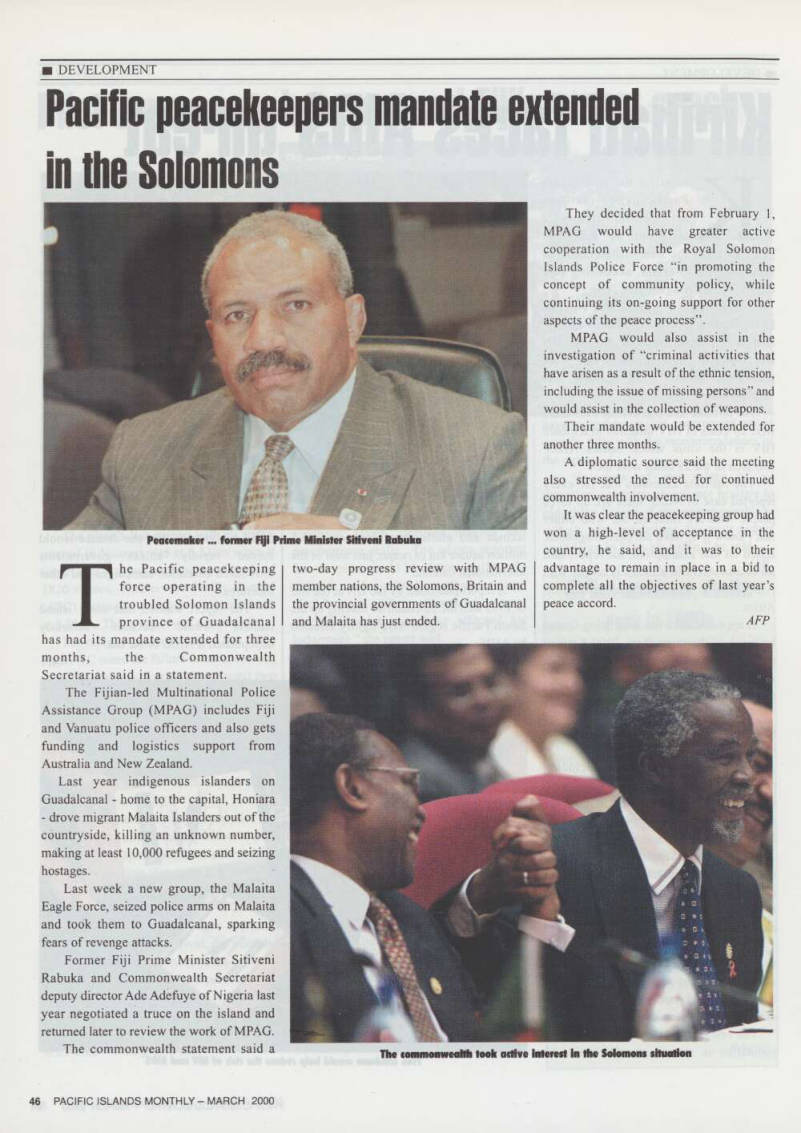
in the Solomons
The Pacific peacekeeping force operating in the troubled Solomon Islands province of Guadalcanal has had its mandate extended for three months, the Commonwealth Secretariat said in a statement.
The Fijian-led Multinational Police Assistance Group (MPAG) includes Fiji and Vanuatu police officers and also gets funding and logistics support from Australia and New Zealand.
Last year indigenous islanders on Guadalcanal - home to the capital, Honiara - drove migrant Malaita Islanders out of the countryside, killing an unknown number, making at least 10,000 refugees and seizing hostages.
Last week a new group, the Malaita Eagle Force, seized police arms on Malaita and took them to Guadalcanal, sparking fears of revenge attacks.
Former Fiji Prime Minister Sitiveni Rabuka and Commonwealth Secretariat deputy director Ade Adefuye of Nigeria last year negotiated a truce on the island and returned later to review the work of MPAG.
The commonwealth statement said a
two-day progress review with MPAG member nations, the Solomons, Britain and the provincial governments of Guadalcanal and Malaita has just ended.
They decided that from February 1, MPAG would have greater active cooperation with the Royal Solomon Islands Police Force “in promoting the concept of community policy, while continuing its on-going support for other aspects of the peace process”.
MPAG would also assist in the investigation of “criminal activities that have arisen as a result of the ethnic tension, including the issue of missing persons” and would assist in the collection of weapons.
Their mandate would be extended for another three months.
A diplomatic source said the meeting also stressed the need for continued commonwealth involvement.
It was clear the peacekeeping group had won a high-level of acceptance in the country, he said, and it was to their advantage to remain in place in a bid to complete all the objectives of last year’s peace accord.
Afp
Peacemaker... former Fiji Prime Minister Siveni Rabuka
The commonwealth took active interest in the Solomons situation
malaria victims

Drug combination holds new hope for
Anew drug combination
offers hope to chronic malaria sufferers who have built up immunity to exist ing treatments, researchers said. It may also prove an effective initial treatment for the mosquito-borne disease that kills up to three million people each year.
Scientists at the Medical Research Council in The Gambia had tried out combination therapy in malaria cases in the wake of its success in treating AIDS and tuberculosis, they said. “We believe that the use of com bination therapy against malaria will have an impact on the enormous damage malaria causes every year in Africa,” researcher Lorenz von Seidlein said in a statement.
Writing in the latest edition of The Lancet medical journal, Von Seidlein and his col leagues said they combined the standard
anti-malaria drug pyrimethamine-sulpha
doxine and a new compound called arte sunate. Initial tests on 600 Gambian chil dren were very promising.
“The combined treatment was safe, well tolerated and effective,” they said in the report. The standard treatment for malaria is Chloroquine but sufferers often build up resistance. It is then replaced by pyrimethamine-sulphadoxine but resistance can also develop to this. The researchers said that adding artesunate to current treat ment regimens in Africa, home to 90 per cent of malaria sufferers, will have an impact on the enormous damage malaria causes every year in Africa.
“The WHO (World Health Organisation) is
presently coordinating 12 large trials
throughout Africa which will evaluate the
advantages of using combination therapy as
first line treatment against malaria,” Von Seidlein was quoted as saying.
He said the children were randomly
assigned both drugs - pyrimethamine-sul
phadoxine and artesunate - or pyrimethamine-sulphadoxine with a place bo or just artesunate. After just one day, more children on the new combination were free of infection than those who received only the standard treatment. Symptoms were also relieved quicker in the two arte sunate groups. Malaria kills by invading red blood cells and multiplying quickly.
Reuters
Children on the new drugs recovered foster
A malaria victim receives treatment
Fiji to inject expertise into PNG's medical field
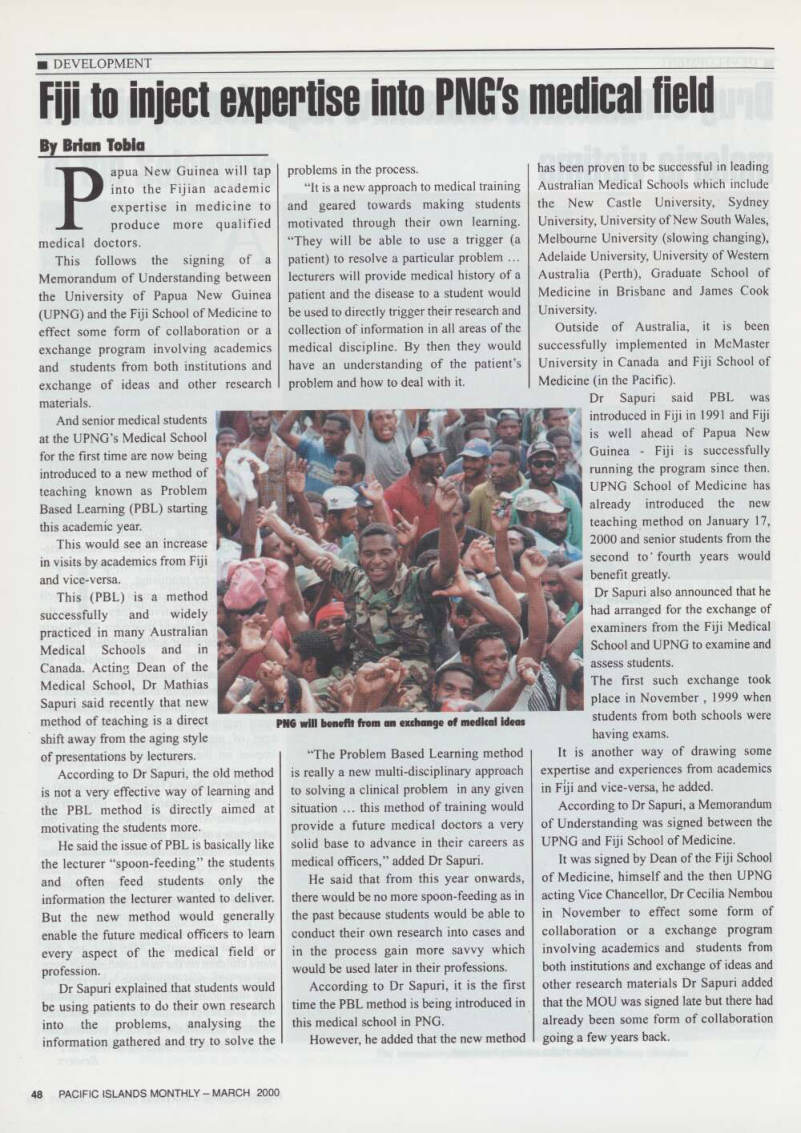
By Brian Tobia
Papua New Guinea will tap into the Fijian academic expertise in medicine to
produce more qualified
medical doctors.
This follows the signing of a Memorandum of Understanding between the University of Papua New Guinea (UPNG) and the Fiji School of Medicine to effect some form of collaboration or a exchange program involving academics and students from both institutions and exchange of ideas and other research
materials.
And senior medical students at the UPNG’s Medical School for the first time are now being introduced to a new method of teaching known as Problem Based Learning (PBL) starting this academic year.
This would see an increase in visits by academics from Fiji and vice-versa.
This (PBL) is a method successfully and widely practiced in many Australian Medical Schools and in Canada. Acting Dean of the Medical School, Dr Mathias Sapuri said recently that new method of teaching is a direct shift away from the aging style of presentations by lecturers.
According to Dr Sapuri, the old method is not a very effective way of learning and the PBL method is directly aimed at motivating the students more.
He said the issue of PBL is basically like the lecturer “spoon-feeding” the students and often feed students only the information the lecturer wanted to deliver.
But the new method would generally enable the future medical officers to leam every aspect of the medical field or profession.
Dr Sapuri explained that students would be using patients to do their own research into the problems, analysing the information gathered and try to solve the
problems in the process.
“It is a new approach to medical training and geared towards making students motivated through their own learning.
“They will be able to use a trigger (a patient) to resolve a particular problem ... lecturers will provide medical history of a patient and the disease to a student would be used to directly trigger their research and collection of information in all areas of the medical discipline. By then they would have an understanding of the patient’s problem and how to deal with it.
“The Problem Based Learning method is really a new multi-disciplinary approach to solving a clinical problem in any given situation ... this method of training would provide a future medical doctors a very solid base to advance in their careers as medical officers,” added Dr Sapuri.
He said that from this year onwards, there would be no more spoon-feeding as in the past because students would be able to conduct their own research into cases and in the process gain more savvy which would be used later in their professions.
According to Dr Sapuri, it is the first time the PBL method is being introduced in this medical school in PNG.
However, he added that the new method
has been proven to be successful in leading Australian Medical Schools which include the New Castle University, Sydney University, University of New South Wales, Melbourne University (slowing changing), Adelaide University, University of Western Australia (Perth), Graduate School of Medicine in Brisbane and James Cook University.
Outside of Australia, it is been successfully implemented in McMaster University in Canada and Fiji School of Medicine (in the Pacific).
Dr Sapuri said PBL was introduced in Fiji in 1991 and Fiji is well ahead of Papua New Guinea - Fiji is successfully running the program since then.
UPNG School of Medicine has already introduced the new teaching method on January 17, 2000 and senior students from the second to'fourth years would benefit greatly.
Dr Sapuri also announced that he had arranged for the exchange of examiners from the Fiji Medical School and UPNG to examine and assess students.
The first such exchange took place in November , 1999 when students from both schools were having exams.
It is another way of drawing some expertise and experiences from academics in Fiji and vice-versa, he added.
According to Dr Sapuri, a Memorandum of Understanding was signed between the UPNG and Fiji School of Medicine.
It was signed by Dean of the Fiji School of Medicine, himself and the then UPNG acting Vice Chancellor, Dr Cecilia Nembou in November to effect some form of collaboration or a exchange program involving academics and students from both institutions and exchange of ideas and other research materials Dr Sapuri added that the MOU was signed late but there had already been some form of collaboration going a few years back.
PNG will benefit from on exchange of medical ideas
statement for future
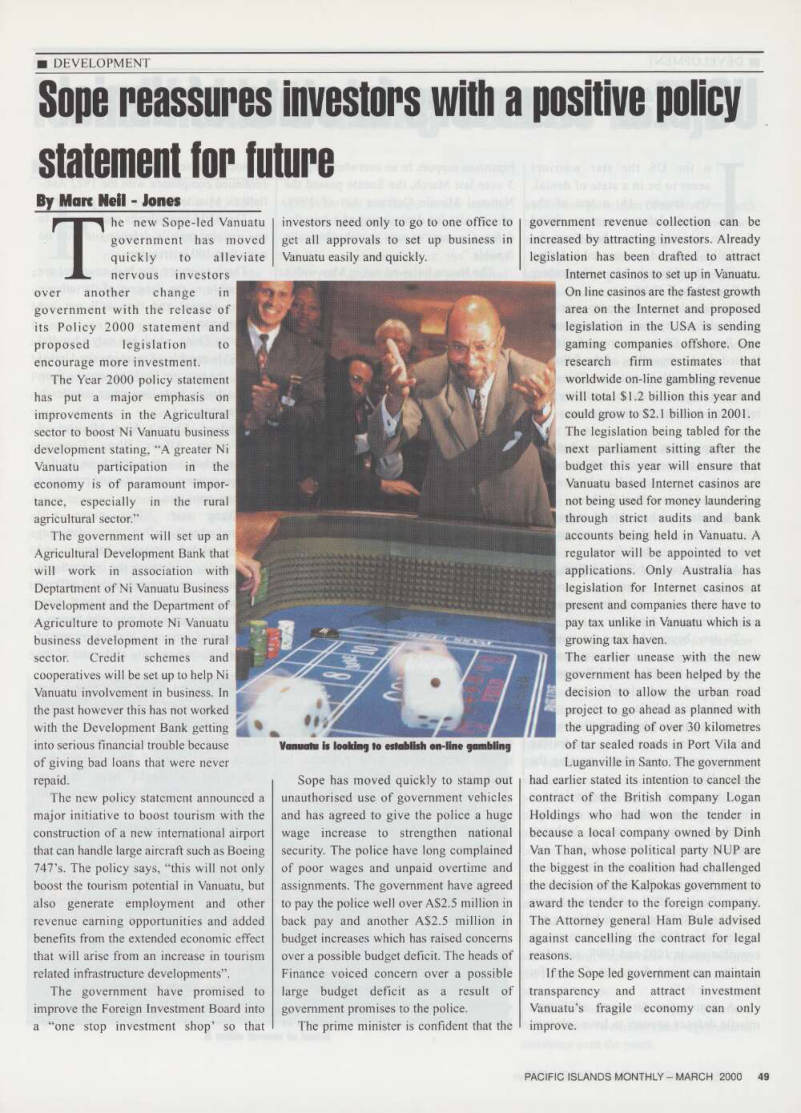
Sope reassures investors with a positive policy
By M are Neil-Jones
The new Sope-led Vanuatu government has moved quickly to alleviate nervous investors
over another change in government with the release of its Policy 2000 statement and
proposed legislation to
encourage more investment.
The Year 2000 policy statement has put a major emphasis on
improvements in the Agricultural
sector to boost Ni Vanuatu business development stating, “A greater Ni Vanuatu participation in the economy is of paramount impor tance, especially in the rural agricultural sector.”
The government will set up an
Agricultural Development Bank that
will work in association with Deptartment of Ni Vanuatu Business Development and the Department of Agriculture to promote Ni Vanuatu business development in the rural sector. Credit schemes and cooperatives will be set up to help Ni Vanuatu involvement in business. In the past however this has not worked with the Development Bank getting into serious financial trouble because of giving bad loans that were never
repaid.
The new policy statement announced a major initiative to boost tourism with the construction of a new international airport that can handle large aircraft such as Boeing 747’5. The policy says, “this will not only boost the tourism potential in Vanuatu, but also generate employment and other revenue earning opportunities and added benefits from the extended economic effect that will arise from an increase in tourism related infrastructure developments”.
The government have promised to improve the Foreign Investment Board into a “one stop investment shop’ so that
investors need only to go to one office to get all approvals to set up business in Vanuatu easily and quickly.
Sope has moved quickly to stamp out unauthorised use of government vehicles and has agreed to give the police a huge wage increase to strengthen national security. The police have long complained of poor wages and unpaid overtime and assignments. The government have agreed to pay the police well over A 52.5 million in back pay and another A 52.5 million in budget increases which has raised concerns over a possible budget deficit. The heads of Finance voiced concern over a possible large budget deficit as a result of government promises to the police.
The prime minister is confident that the
government revenue collection can be increased by attracting investors. Already legislation has been drafted to attract
Internet casinos to set up in Vanuatu.
On line casinos are the fastest growth area on the Internet and proposed legislation in the USA is sending
gaming companies offshore. One
research firm estimates that worldwide on-line gambling revenue will total $1.2 billion this year and could grow to $2.1 billion in 2001.
The legislation being tabled for the next parliament sitting after the budget this year will ensure that Vanuatu based Internet casinos are not being used for money laundering through strict audits and bank accounts being held in Vanuatu. A regulator will be appointed to vet
applications. Only Australia has
legislation for Internet casinos at present and companies there have to pay tax unlike in Vanuatu which is a growing tax haven.
The earlier unease with the new government has been helped by the decision to allow the urban road project to go ahead as planned with the upgrading of over 30 kilometres of tar sealed roads in Port Vila and Luganville in Santo. The government
had earlier stated its intention to cancel the contract of the British company Logan Holdings who had won the tender in because a local company owned by Dinh Van Than, whose political party NUP are the biggest in the coalition had challenged the decision of the Kalpokas government to award the tender to the foreign company.
The Attorney general Ham Buie advised against cancelling the contract for legal reasons.
If the Sope led government can maintain transparency and attract investment Vanuatu’s fragile economy can only
improve.
Vanuatu is looking to establish on-line gambling
US star warriors in state of denial
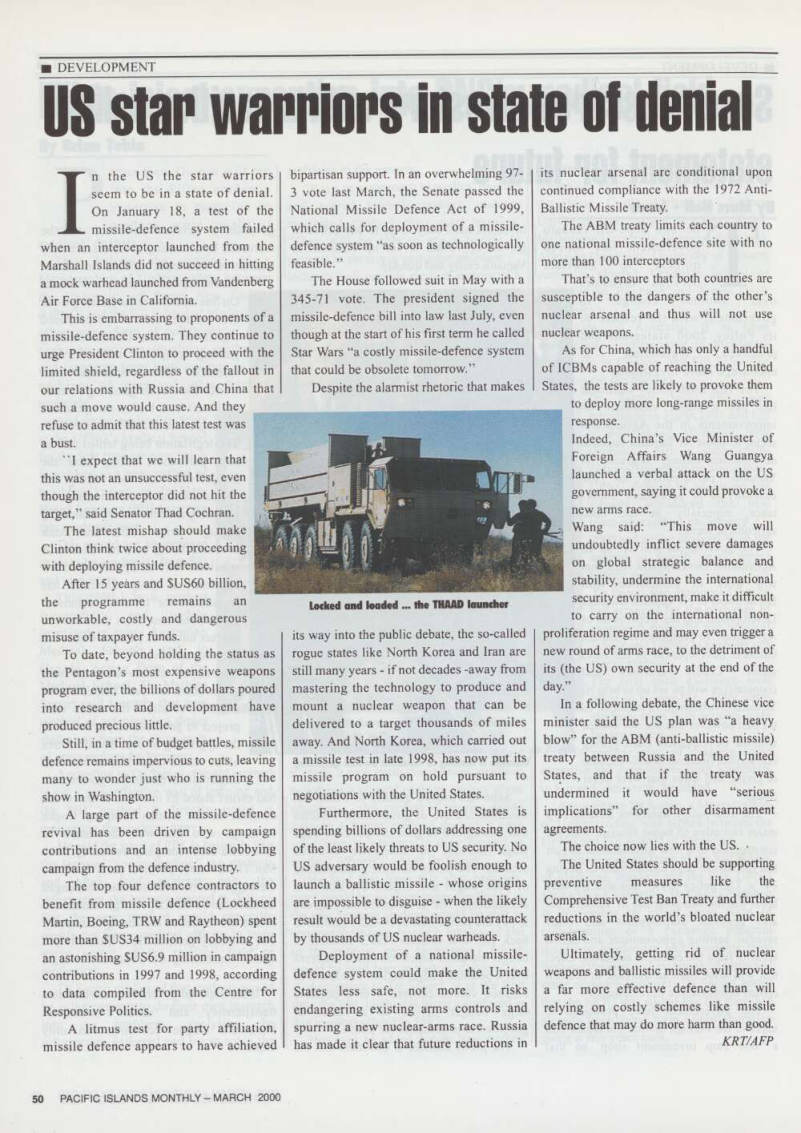
In the US the star warriors seem to be in a state of denial.
On January 18, a test of the missile-defence system failed when an interceptor launched from the Marshall Islands did not succeed in hitting a mock warhead launched from Vandenberg Air Force Base in California.
This is embarrassing to proponents of a missile-defence system. They continue to urge President Clinton to proceed with the limited shield, regardless of the fallout in our relations with Russia and China that
such a move would cause. And they refuse to admit that this latest test was a bust.
"I expect that we will learn that this was not an unsuccessful test, even though the interceptor did not hit the target,” said Senator Thad Cochran.
The latest mishap should make Clinton think twice about proceeding with deploying missile defence.
After 15 years and SUS6O billion, the programme remains an unworkable, costly and dangerous misuse of taxpayer funds.
To date, beyond holding the status as the Pentagon’s most expensive weapons program ever, the billions of dollars poured into research and development have produced precious little.
Still, in a time of budget battles, missile defence remains impervious to cuts, leaving many to wonder just who is running the show in Washington.
A large part of the missile-defence revival has been driven by campaign contributions and an intense lobbying campaign from the defence industry.
The top four defence contractors to benefit from missile defence (Lockheed Martin, Boeing, TRW and Raytheon) spent more than SUS 34 million on lobbying and an astonishing SUS 6.9 million in campaign contributions in 1997 and 1998, according to data compiled from the Centre for
Responsive Politics.
A litmus test for party affiliation, missile defence appears to have achieved
bipartisan support. In an overwhelming 97- 3 vote last March, the Senate passed the National Missile Defence Act of 1999, which calls for deployment of a missile defence system “as soon as technologically feasible.”
The House followed suit in May with a 345-71 vote. The president signed the missile-defence bill into law last July, even though at the start of his first term he called Star Wars “a costly missile-defence system that could be obsolete tomorrow.”
Despite the alarmist rhetoric that makes
its way into the public debate, the so-called rogue states like North Korea and Iran are still many years - if not decades -away from mastering the technology to produce and mount a nuclear weapon that can be delivered to a target thousands of miles away. And North Korea, which carried out a missile test in late 1998, has now put its missile program on hold pursuant to negotiations with the United States.
Furthermore, the United States is spending billions of dollars addressing one of the least likely threats to US security. No US adversary would be foolish enough to launch a ballistic missile - whose origins are impossible to disguise - when the likely result would be a devastating counterattack by thousands of US nuclear warheads.
Deployment of a national missile defence system could make the United States less safe, not more. It risks endangering existing arms controls and spurring a new nuclear-arms race. Russia has made it clear that future reductions in
its nuclear arsenal are conditional upon continued compliance with the 1972 Anti- Ballistic Missile Treaty.
The ABM treaty limits each country to one national missile-defence site with no more than 100 interceptors That’s to ensure that both countries are susceptible to the dangers of the other’s nuclear arsenal and thus will not use nuclear weapons.
As for China, which has only a handful of ICBMs capable of reaching the United States, the tests are likely to provoke them
to deploy more long-range missiles in response.
Indeed, China’s Vice Minister of Foreign Affairs Wang Guangya launched a verbal attack on the US government, saying it could provoke a new arms race.
Wang said: “This move will undoubtedly inflict severe damages on global strategic balance and stability, undermine the international security environment, make it difficult
to carry on the international non proliferation regime and may even trigger a new round of arms race, to the detriment of its (the US) own security at the end of the day.”
In a following debate, the Chinese vice minister said the US plan was “a heavy blow” for the ABM (anti-ballistic missile) treaty between Russia and the United States, and that if the treaty was undermined it would have “serious implications” for other disarmament agreements.
The choice now lies with the US. • The United States should be supporting preventive measures like the Comprehensive Test Ban Treaty and further reductions in the world’s bloated nuclear arsenals.
Ultimately, getting rid of nuclear weapons and ballistic missiles will provide a far more effective defence than will relying on costly schemes like missile defence that may do more harm than good.
Krt/Afp
Locked and loaded ... the THAAD launcher
Israel holds training course in Fiji
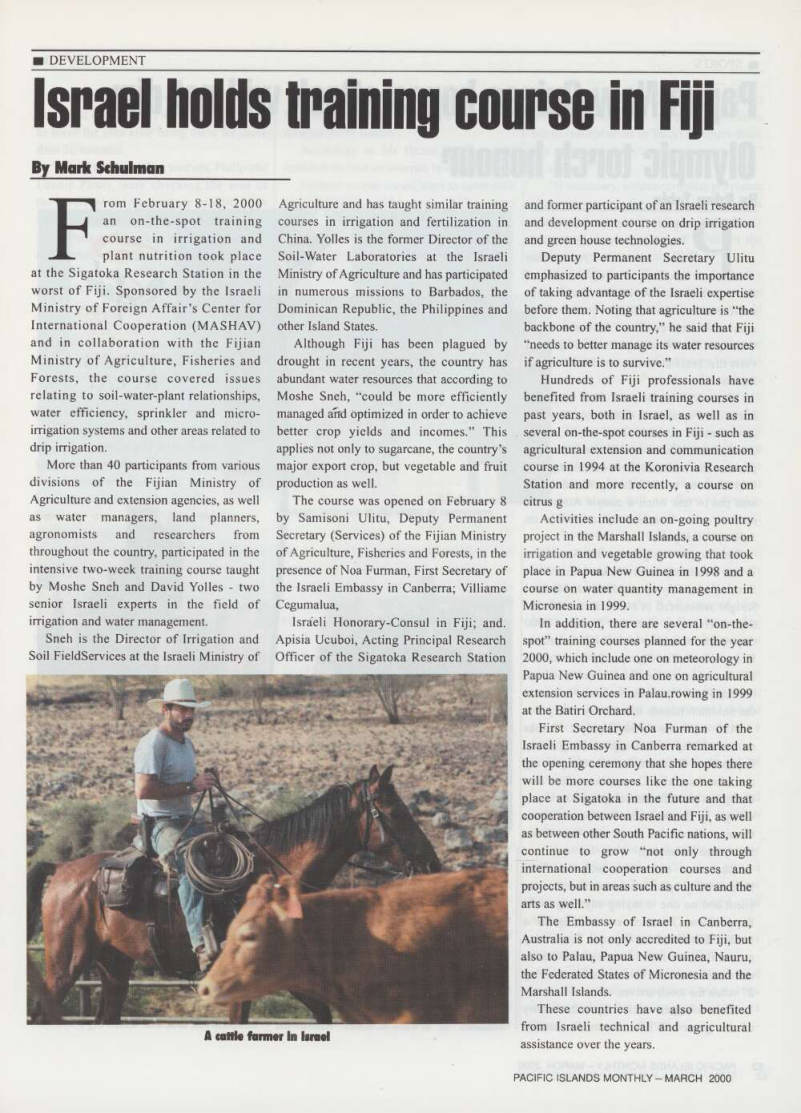
By Mark Schulman
From February 8-18, 2000
an on-the-spot training
course in irrigation and plant nutrition took place at the Sigatoka Research Station in the worst of Fiji. Sponsored by the Israeli Ministry of Foreign Affair’s Center for International Cooperation (MASHAV) and in collaboration with the Fijian Ministry of Agriculture, Fisheries and Forests, the course covered issues relating to soil-water-plant relationships, water efficiency, sprinkler and micro irrigation systems and other areas related to drip irrigation.
More than 40 participants from various divisions of the Fijian Ministry of Agriculture and extension agencies, as well as water managers, land planners, agronomists and researchers from throughout the country, participated in the intensive two-week training course taught by Moshe Sneh and David Yolles - two senior Israeli experts in the field of irrigation and water management.
Sneh is the Director of Irrigation and Soil Field Services at the Israeli Ministry of
Agriculture and has taught similar training courses in irrigation and fertilization in China. Yolles is the former Director of the Soil-Water Laboratories at the Israeli Ministry of Agriculture and has participated in numerous missions to Barbados, the Dominican Republic, the Philippines and other Island States.
Although Fiji has been plagued by drought in recent years, the country has abundant water resources that according to Moshe Sneh, “could be more efficiently managed and optimized in order to achieve better crop yields and incomes.” This applies not only to sugarcane, the country’s major export crop, but vegetable and fruit production as well.
The course was opened on February 8 by Samisoni Ulitu, Deputy Permanent Secretary (Services) of the Fijian Ministry of Agriculture, Fisheries and Forests, in the presence of Noa Furman, First Secretary of the Israeli Embassy in Canberra; Villiame Cegumalua, Israeli Honorary-Consul in Fiji; and.
Apisia Ucuboi, Acting Principal Research Officer of the Sigatoka Research Station
and former participant of an Israeli research and development course on drip irrigation and green house technologies.
Deputy Permanent Secretary Ulitu emphasized to participants the importance of taking advantage of the Israeli expertise before them. Noting that agriculture is “the backbone of the country,” he said that Fiji “needs to better manage its water resources if agriculture is to survive.”
Hundreds of Fiji professionals have benefited from Israeli training courses in past years, both in Israel, as well as in several on-the-spot courses in Fiji - such as agricultural extension and communication course in 1994 at the Koronivia Research Station and more recently, a course on citrus g Activities include an on-going poultry project in the Marshall Islands, a course on irrigation and vegetable growing that took place in Papua New Guinea in 1998 and a course on water quantity management in Micronesia in 1999.
In addition, there are several “on-the spot” training courses planned for the year 2000, which include one on meteorology in Papua New Guinea and one on agricultural extension services in Palau.rowing in 1999 at the Batiri Orchard.
First Secretary Noa Furman of the Israeli Embassy in Canberra remarked at the opening ceremony that she hopes there will be more courses like the one taking place at Sigatoka in the future and that cooperation between Israel and Fiji, as well as between other South Pacific nations, will continue to grow “not only through international cooperation courses and projects, but in areas such as culture and the arts as well.”
The Embassy of Israel in Canberra, Australia is not only accredited to Fiji, but also to Palau, Papua New Guinea, Nauru, the Federated States of Micronesia and the Marshall Islands.
These countries have also benefited from Israeli technical and agricultural assistance over the years.
A cattle fanner in Israel
Papua New Guinea hopes attack will not dim
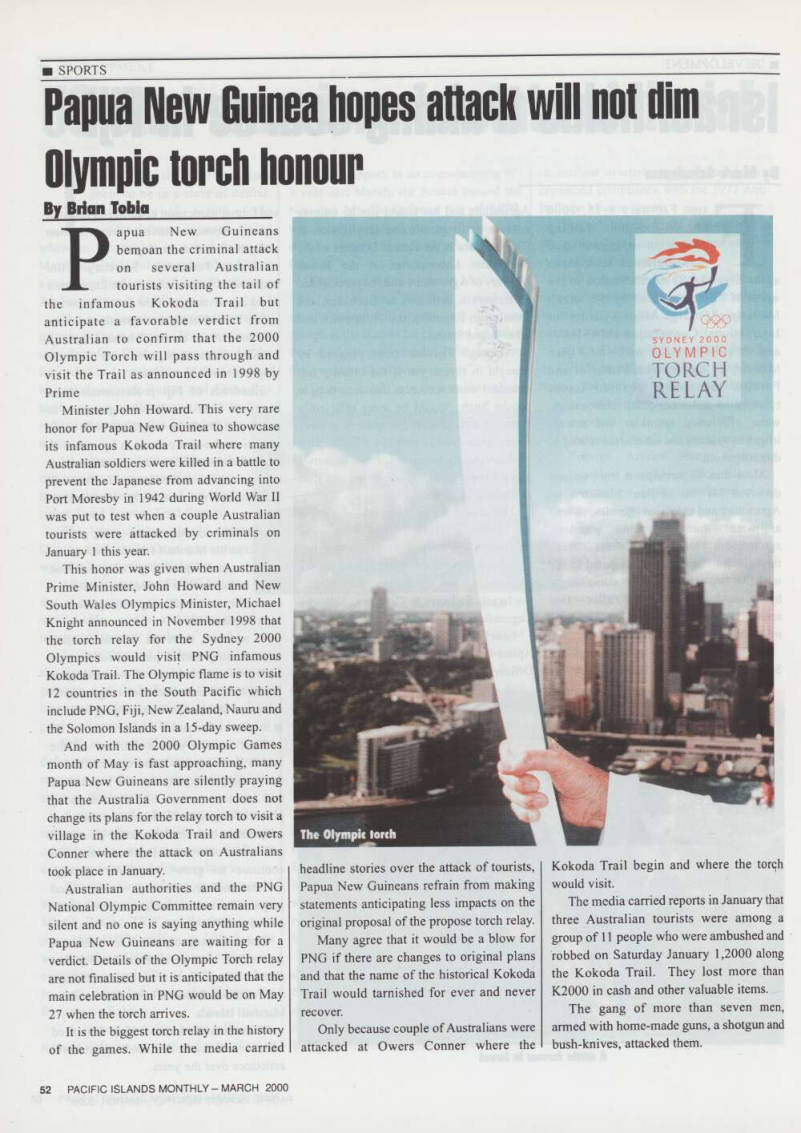
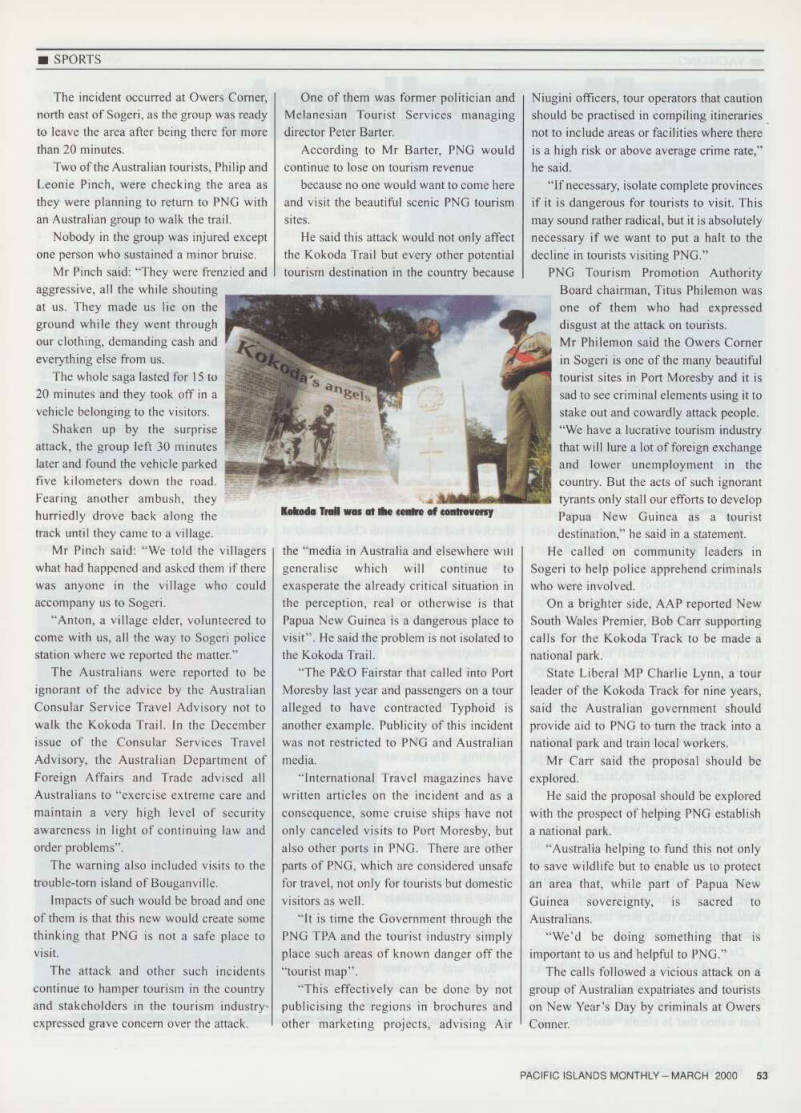
Sports
Olympic torch honour
By Briann Tobia
Papua New Guineans bemoan the criminal attack on several Australian tourists visiting the tail of the infamous Kokoda Trail but anticipate a favorable verdict from Australian to confirm that the 2000 Olympic Torch will pass through and visit the Trail as announced in 1998 by Prime Minister John Howard. This very rare honor for Papua New Guinea to showcase its infamous Kokoda Trail where many Australian soldiers were killed in a battle to prevent the Japanese from advancing into Port Moresby in 1942 during World War II was put to test when a couple Australian tourists were attacked by criminals on January 1 this year.
This honor was given when Australian Prime Minister, John Howard and New South Wales Olympics Minister, Michael Knight announced in November 1998 that the torch relay for the Sydney 2000 Olympics would visit PNG infamous Kokoda Trail. The Olympic flame is to visit 12 countries in the South Pacific which include PNG, Fiji, New Zealand, Nauru and the Solomon Islands in a 15-day sweep.
And with the 2000 Olympic Games month of May is fast approaching, many Papua New Guineans are silently praying that the Australia Government does not change its plans for the relay torch to visit a village in the Kokoda Trail and Owers Conner where the attack on Australians took place in January.
Australian authorities and the PNG National Olympic Committee remain very silent and no one is saying anything while Papua New Guineans are waiting for a verdict. Details of the Olympic Torch relay are not finalised but it is anticipated that the main celebration in PNG would be on May 27 when the torch arrives.
It is the biggest torch relay in the history of the games. While the media carried
headline stories over the attack of tourists, Papua New Guineans refrain from making statements anticipating less impacts on the original proposal of the propose torch relay.
Many agree that it would be a blow for PNG if there are changes to original plans and that the name of the historical Kokoda Trail would tarnished for ever and never recover.
Only because couple of Australians were attacked at Owers Conner where the
Kokoda Trail begin and where the torc;h would visit.
The media carried reports in January that three Australian tourists were among a group of 11 people who were ambushed and robbed on Saturday January 1,2000 along the Kokoda Trail. They lost more than K2OOO in cash and other valuable items.
The gang of more than seven men, armed with home-made guns, a shotgun and bush-knives, attacked them.
The Olympic torch
The incident occurred at Owers Comer, north east of Sogeri, as the group was ready to leave the area after being there for more than 20 minutes.
Two of the Australian tourists, Philip and Leonie Pinch, were checking the area as they were planning to return to PNG with an Australian group to walk the trail.
Nobody in the group was injured except one person who sustained a minor bruise.
Mr Pinch said: “They were frenzied and
aggressive, all the while shouting at us. They made us lie on the ground while they went through our clothing, demanding cash and everything else from us.
The whole saga lasted for 15 to 20 minutes and they took off in a vehicle belonging to the visitors.
Shaken up by the surprise attack, the group left 30 minutes later and found the vehicle parked five kilometers down the road.
Fearing another ambush, they hurriedly drove back along the track until they came to a village.
Mr Pinch said: “We told the villagers what had happened and asked them if there was anyone in the village who could accompany us to Sogeri.
“Anton, a village elder, volunteered to come with us, all the way to Sogeri police station where we reported the matter.”
The Australians were reported to be ignorant of the advice by the Australian Consular Service Travel Advisory not to walk the Kokoda Trail. In the December issue of the Consular Services Travel Advisory, the Australian Department of Foreign Affairs and Trade advised all Australians to “exercise extreme care and maintain a very high level of security awareness in light of continuing law and
order problems”.
The warning also included visits to the trouble-torn island of Bouganville.
Impacts of such would be broad and one of them is that this new would create some thinking that PNG is not a safe place to visit.
The attack and other such incidents continue to hamper tourism in the country and stakeholders in the tourism industry expressed grave concern over the attack.
One of them was former politician and Melanesian Tourist Services managing director Peter Barter.
According to Mr Barter, PNG would continue to lose on tourism revenue because no one would want to come here and visit the beautiful scenic PNG tourism sites.
He said this attack would not only affect the Kokoda Trail but every other potential tourism destination in the country because
the “media in Australia and elsewhere will generalise which will continue to exasperate the already critical situation in the perception, real or otherwise is that Papua New Guinea is a dangerous place to visit”. He said the problem is not isolated to the Kokoda Trail.
“The P&O Fairstar that called into Port Moresby last year and passengers on a tour alleged to have contracted Typhoid is another example. Publicity of this incident was not restricted to PNG and Australian media.
“International Travel magazines have written articles on the incident and as a consequence, some cruise ships have not only canceled visits to Port Moresby, but also other ports in PNG. There are other parts of PNG, which are considered unsafe for travel, not only for tourists but domestic visitors as well.
“It is time the Government through the PNG TPA and the tourist industry simply place such areas of known danger off the
“tourist map”.
“This effectively can be done by not publicising the regions in brochures and
other marketing projects, advising Air
Niugini officers, tour operators that caution should be practised in compiling itineraries not to include areas or facilities where there is a high risk or above average crime rate,” he said.
“If necessary, isolate complete provinces if it is dangerous for tourists to visit. This may sound rather radical, but it is absolutely necessary if we want to put a halt to the decline in tourists visiting PNG.”
PNG Tourism Promotion Authority
Board chairman, Titus Philemon was one of them who had expressed disgust at the attack on tourists.
Mr Philemon said the Owers Corner in Sogeri is one of the many beautiful tourist sites in Port Moresby and it is sad to see criminal elements using it to stake out and cowardly attack people.
“We have a lucrative tourism industry that will lure a lot of foreign exchange and lower unemployment in the country. But the acts of such ignorant tyrants only stall our efforts to develop Papua New Guinea as a tourist destination,” he said in a statement.
He called on community leaders in
Sogeri to help police apprehend criminals
who were involved.
On a brighter side, AAP reported New South Wales Premier, Bob Carr supporting calls for the Kokoda Track to be made a national park.
State Liberal MP Charlie Lynn, a tour leader of the Kokoda Track for nine years, said the Australian government should provide aid to PNG to turn the track into a national park and train local workers.
Mr Carr said the proposal should be explored.
He said the proposal should be explored with the prospect of helping PNG establish a national park.
“Australia helping to fund this not only to save wildlife but to enable us to protect an area that, while part of Papua New Guinea sovereignty, is sacred to Australians.
“We’d be doing something that is important to us and helpful to PNG.”
The calls followed a vicious attack on a group of Australian expatriates and tourists on New Year’s Day by criminals at Owers Conner.
Kokoda Trail was at the centre of controversy
Blue Moon in Vanuatu
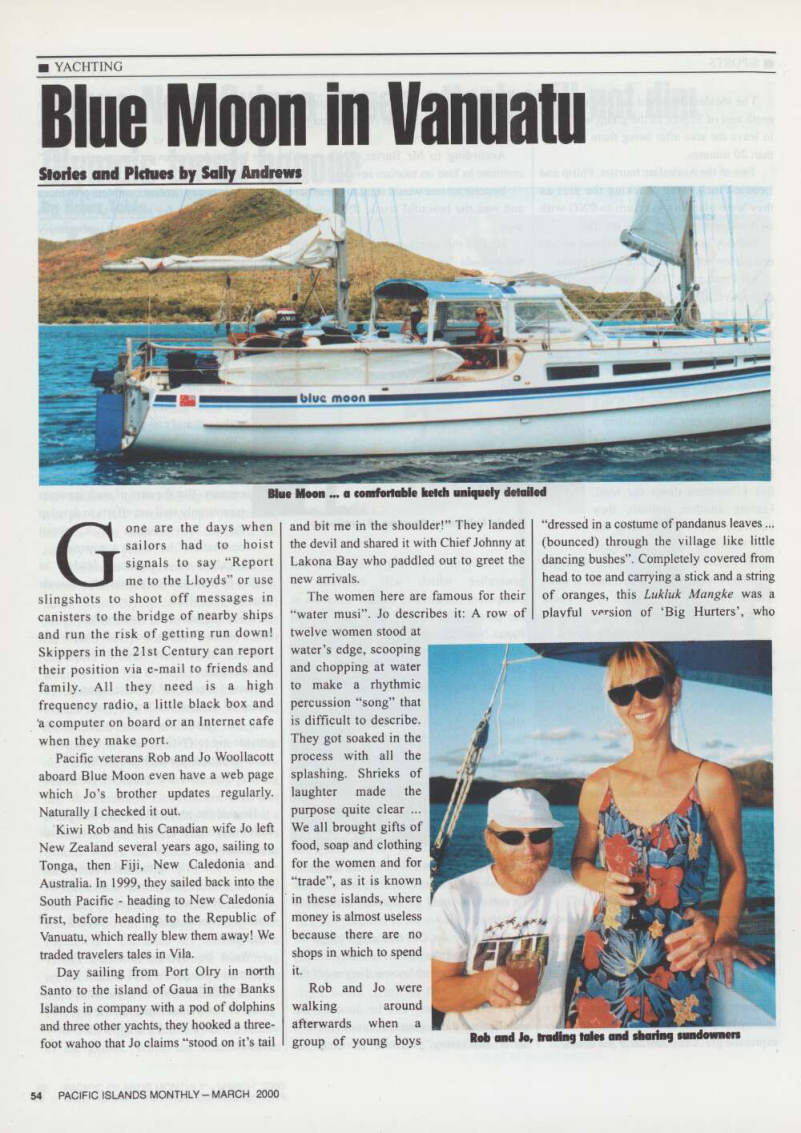
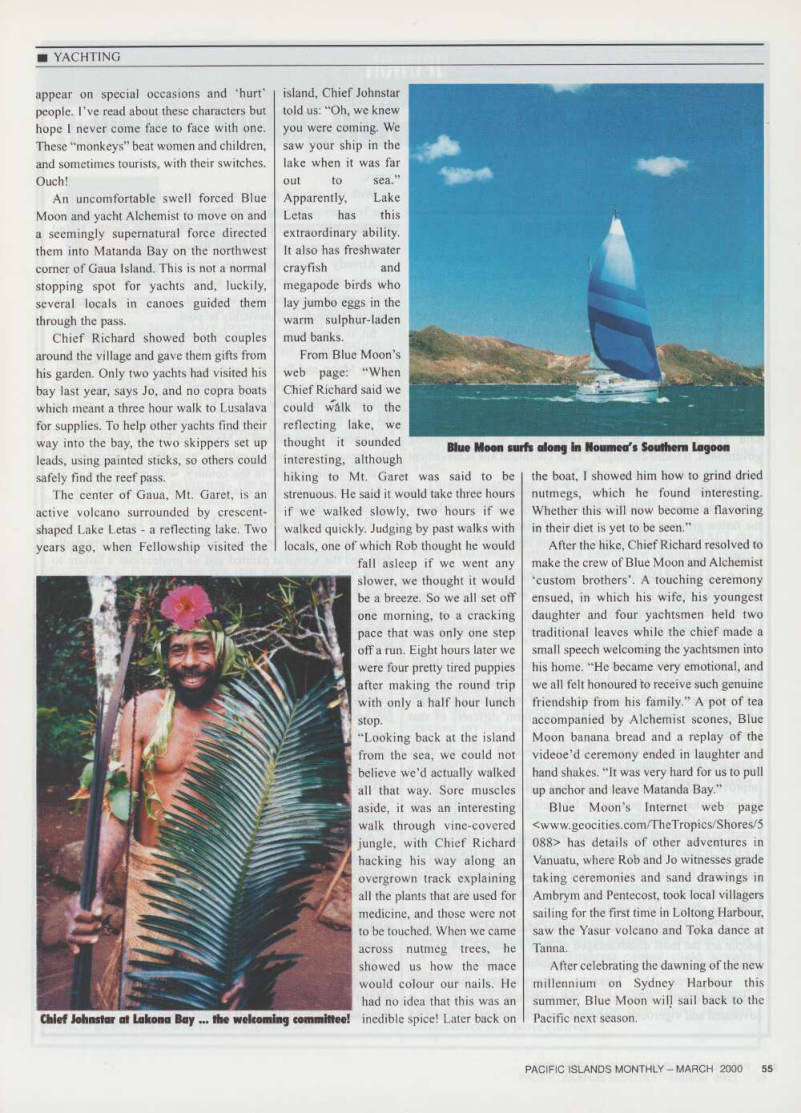
Yachting
Stories and Picfues by Sally Andrews
Gone are the days when sailors had to hoist signals to say “Report me to the Lloyds” or use slingshots to shoot off messages in canisters to the bridge of nearby ships and run the risk of getting run down!
Skippers in the 21st Century can report their position via e-mail to friends and family. All they need is a high frequency radio, a little black box and 'a computer on board or an Internet cafe when they make port.
Pacific veterans Rob and Jo Woollacott aboard Blue Moon even have a web page which Jo’s brother updates regularly.
Naturally I checked it out.
Kiwi Rob and his Canadian wife Jo left New Zealand several years ago, sailing to Tonga, then Fiji, New Caledonia and Australia. In 1999, they sailed back into the South Pacific - heading to New Caledonia first, before heading to the Republic of Vanuatu, which really blew them away! We traded travelers tales in Vila.
Day sailing from Port Olry in north Santo to the island of Gaua in the Banks Islands in company with a pod of dolphins and three other yachts, they hooked a three foot wahoo that Jo claims “stood on it’s tail
and bit me in the shoulder!” They landed the devil and shared it with Chief Johnny at Lakona Bay who paddled out to greet the new arrivals.
The women here are famous for their “water musi”. Jo describes it: A row of
twelve women stood at water’s edge, scooping and chopping at water to make a rhythmic percussion “song” that is difficult to describe.
They got soaked in the process with all the splashing. Shrieks of laughter made the purpose quite clear ...
We all brought gifts of food, soap and clothing for the women and for “trade”, as it is known in these islands, where money is almost useless because there are no shops in which to spend it.
Rob and Jo were walking around afterwards when a group of young boys
“dressed in a costume of pandanus leaves ... (bounced) through the village like little dancing bushes”. Completely covered from head to toe and carrying a stick and a string of oranges, this Lukluk Mangke was a playful version of ‘Big Hurters’, who
Blue Moon ... a comfortable ketch uniquely detailed
Rob and Jo, trading tales and sharing sundowners
appear on special occasions and ‘hurt’ people. I’ve read about these characters but hope I never come face to face with one.
These “monkeys” beat women and children, and sometimes tourists, with their switches.
Ouch!
An uncomfortable swell forced Blue Moon and yacht Alchemist to move on and a seemingly supernatural force directed them into Matanda Bay on the northwest comer of Gaua Island. This is not a normal stopping spot for yachts and, luckily, several locals in canoes guided them through the pass.
Chief Richard showed both couples around the village and gave them gifts from his garden. Only two yachts had visited his bay last year, says Jo, and no copra boats which meant a three hour walk to Lusalava for supplies. To help other yachts find their way into the bay, the two skippers set up leads, using painted sticks, so others could safely find the reef pass.
The center of Gaua, Mt. Caret, is an active volcano surrounded by crescent shaped Lake Letas - a reflecting lake. Two years ago, when Fellowship visited the
island, Chief Johnstar told us: “Oh, we knew you were coming. We saw your ship in the lake when it was far out to sea.”
Apparently, Lake Letas has this extraordinary ability.
It also has freshwater
crayfish and
megapode birds who lay jumbo eggs in the warm sulphur-laden mud banks.
From Blue Moon’s web page: “When Chief Richard said we could walk to the reflecting lake, we thought it sounded interesting, although
hiking to Mt. Caret was said to be strenuous. He said it would take three hours if we walked slowly, two hours if we walked quickly. Judging by past walks with locals, one of which Rob thought he would
fall asleep if we went any slower, we thought it would be a breeze. So we all set off one morning, to a cracking pace that was only one step off a run. Eight hours later we were four pretty tired puppies after making the round trip with only a half hour lunch stop.
“Looking back at the island from the sea, we could not believe we’d actually walked all that way. Sore muscles aside, it was an interesting walk through vine-covered jungle, with Chief Richard hacking his way along an overgrown track explaining all the plants that are used for medicine, and those were not to be touched. When we came across nutmeg trees, he showed us how the mace would colour our nails. He had no idea that this was an inedible spice! Later back on
the boat, 1 showed him how to grind dried nutmegs, which he found interesting.
Whether this will now become a flavoring in their diet is yet to be seen.”
After the hike, Chief Richard resolved to make the crew of Blue Moon and Alchemist ‘custom brothers’. A touching ceremony ensued, in which his wife, his youngest daughter and four yachtsmen held two traditional leaves while the chief made a small speech welcoming the yachtsmen into his home. “He became very emotional, and we all felt honoured to receive such genuine friendship from his family.” A pot of tea accompanied by Alchemist scones. Blue Moon banana bread and a replay of the videoe’d ceremony ended in laughter and hand shakes. “It was very hard for us to pull up anchor and leave Matanda Bay.”
Blue Moon’s Internet web page
<www.geocities.com/TheTropics/Shores/5
088> has details of other adventures in Vanuatu, where Rob and Jo witnesses grade taking ceremonies and sand drawings in Ambrym and Pentecost, took local villagers sailing for the first time in Loltong Harbour, saw the Yasur volcano and Toka dance at Tanna.
After celebrating the dawning of the new millennium on Sydney Harbour this summer, Blue Moon will sail back to the Pacific next season.
Chief lohnstar at lakona Bay ... the welcoming committee!
Blue Moon surfs along in Noumea's Southern Lagoon
Pacific Islanders weave New Zealand's future
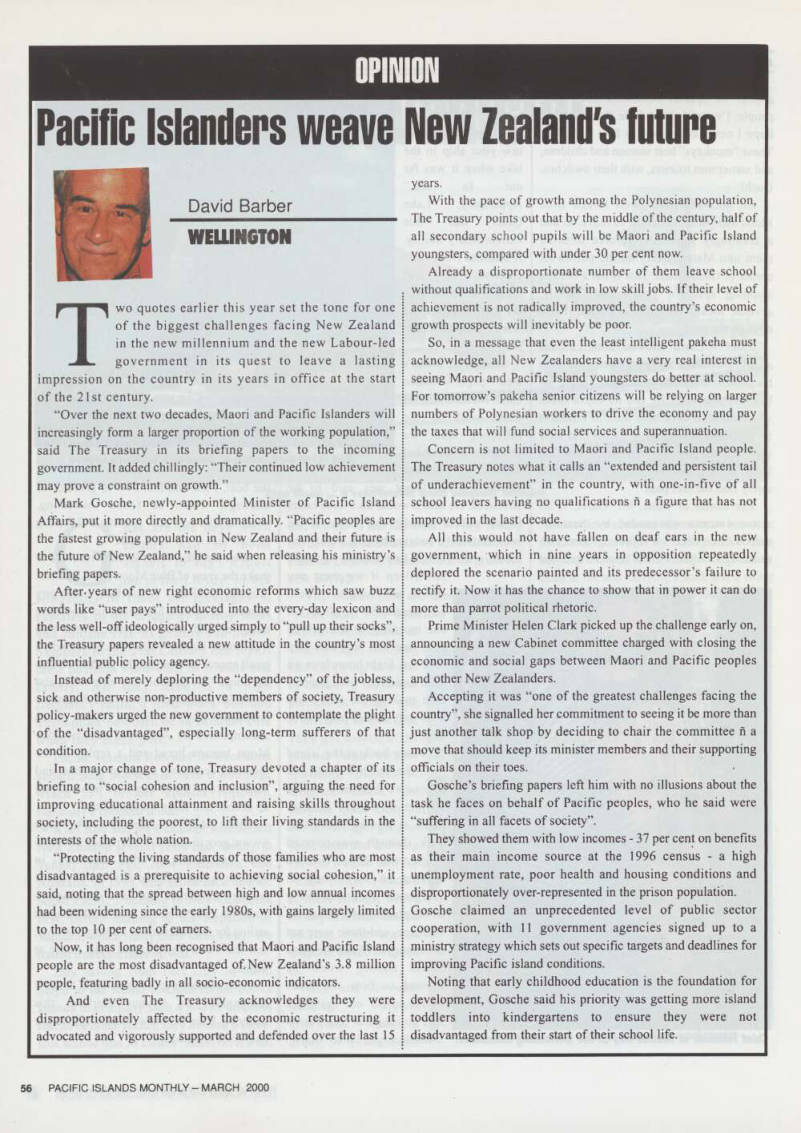
Opinion
Two quotes earlier this year set the tone for one of the biggest challenges facing New Zealand in the new millennium and the new Labour-led government in its quest to leave a lasting impression on the country in its years in office at the start of the 21st century.
“Over the next two decades, Maori and Pacific Islanders will increasingly form a larger proportion of the working population,” said The Treasury in its briefing papers to the incoming government. It added chillingly: “Their continued low achievement may prove a constraint on growth.”
Mark Gosche, newly-appointed Minister of Pacific Island Affairs, put it more directly and dramatically. “Pacific peoples are the fastest growing population in New Zealand and their future is the future of New Zealand,” he said when releasing his ministry’s briefing papers.
After.years of new right economic reforms which saw buzz words like “user pays” introduced into the every-day lexicon and the less well-off ideologically urged simply to “pull up their socks”, the Treasury papers revealed a new attitude in the country’s most influential public policy agency.
Instead of merely deploring the “dependency” of the jobless, sick and otherwise non-productive members of society, Treasury policy-makers urged the new government to contemplate the plight of the “disadvantaged”, especially long-term sufferers of that condition.
In a major change of tone, Treasury devoted a chapter of its briefing to “social cohesion and inclusion”, arguing the need for improving educational attainment and raising skills throughout society, including the poorest, to lift their living standards in the interests of the whole nation.
“Protecting the living standards of those families who are most disadvantaged is a prerequisite to achieving social cohesion,” it said, noting that the spread between high and low annual incomes had been widening since the early 1980 s, with gains largely limited to the top 10 per cent of earners.
Now, it has long been recognised that Maori and Pacific Island people are the most disadvantaged of New Zealand’s 3.8 million people, featuring badly in all socio-economic indicators.
And even The Treasury acknowledges they were disproportionately affected by the economic restructuring it advocated and vigorously supported and defended over the last 15
years.
With the pace of growth among the Polynesian population.
The Treasury points out that by the middle of the century, half of all secondary school pupils will be Maori and Pacific Island youngsters, compared with under 30 per cent now.
Already a disproportionate number of them leave school without qualifications and work in low skill jobs. If their level of achievement is not radically improved, the country’s economic growth prospects will inevitably be poor.
So, in a message that even the least intelligent pakeha must acknowledge, all New Zealanders have a very real interest in seeing Maori and Pacific Island youngsters do better at school.
For tomorrow’s pakeha senior citizens will be relying on larger numbers of Polynesian workers to drive the economy and pay the taxes that will fund social services and superannuation.
Concern is not limited to Maori and Pacific Island people.
The Treasury notes what it calls an “extended and persistent tail of underachievement” in the country, with one-in-five of all school leavers having no qualifications n a figure that has not improved in the last decade.
All this would not have fallen on deaf ears in the new government, which in nine years in opposition repeatedly deplored the scenario painted and its predecessor’s failure to rectify it. Now it has the chance to show that in power it can do more than parrot political rhetoric.
Prime Minister Helen Clark picked up the challenge early on, announcing a new Cabinet committee charged with closing the economic and social gaps between Maori and Pacific peoples and other New Zealanders.
Accepting it was “one of the greatest challenges facing the country”, she signalled her commitment to seeing it be more than just another talk shop by deciding to chair the committee n a move that should keep its minister members and their supporting officials on their toes.
Gosche’s briefing papers left him with no illusions about the task he faces on behalf of Pacific peoples, who he said were “suffering in all facets of society”.
They showed them with low incomes - 37 per cent on benefits as their main income source at the 1996 census - a high unemployment rate, poor health and housing conditions and disproportionately over-represented in the prison population.
Gosche claimed an unprecedented level of public sector cooperation, with 11 government agencies signed up to a ministry strategy which sets out specific targets and deadlines for improving Pacific island conditions.
Noting that early childhood education is the foundation for development, Gosche said his priority was getting more island toddlers into kindergartens to ensure they were not disadvantaged from their start of their school life.
David Barber
Wellington
Hie struggle to find justice and a future for East Timor
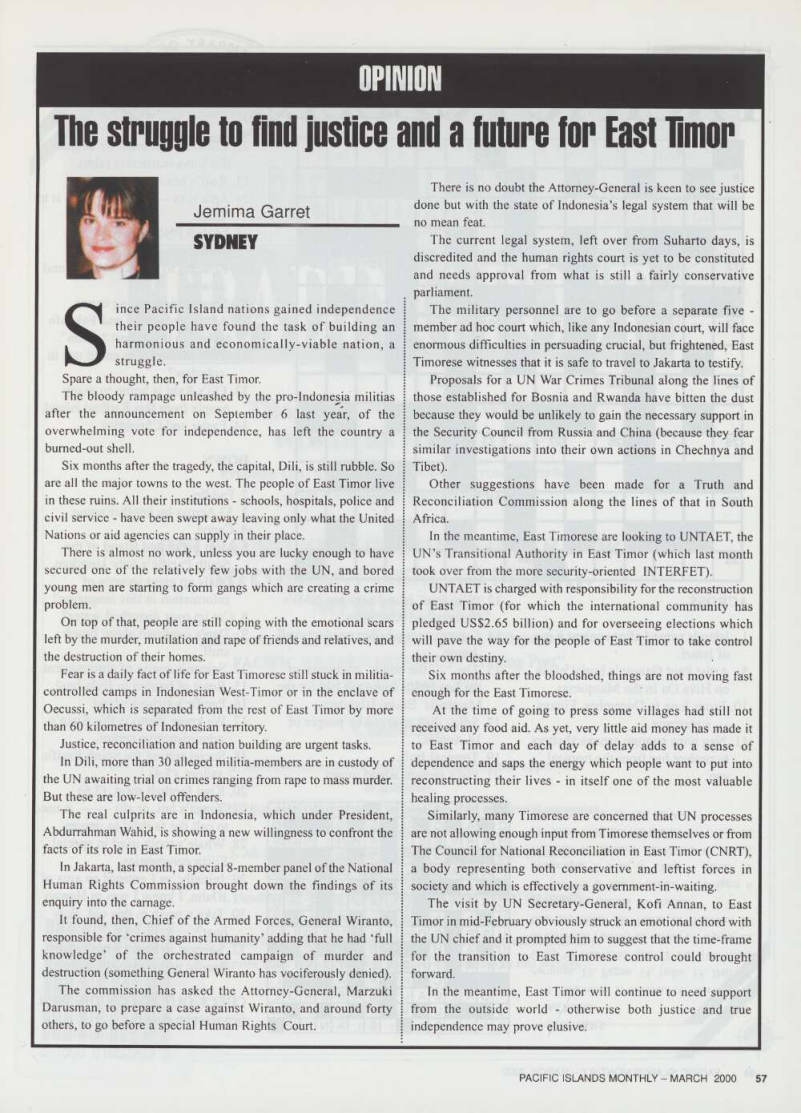
Since Pacific Island nations gained independence their people have found the task of building an harmonious and economically-viable nation, a struggle.
Spare a thought, then, for East Timor.
The bloody rampage unleashed by the pro-Indonesia militias after the announcement on September 6 last year, of the overwhelming vote for independence, has left the country a bumed-out shell.
Six months after the tragedy, the capital, Dili, is,still rubble. So are all the major towns to the west. The people of East Timor live in these ruins. All their institutions - schools, hospitals, police and civil service - have been swept away leaving only what the United Nations or aid agencies can supply in their place.
There is almost no work, unless you are lucky enough to have secured one of the relatively few jobs with the UN, and bored young men are starting to form gangs which are creating a crime problem.
On top of that, people are still coping with the emotional scars left by the murder, mutilation and rape of friends and relatives, and the destruction of their homes.
Fear is a daily fact of life for East Timorese still stuck in militia controlled camps in Indonesian West-Timor or in the enclave of Oecussi, which is separated from the rest of East Timor by more than 60 kilometres of Indonesian territory.
Justice, reconciliation and nation building are urgent tasks.
In Dili, more than 30 alleged militia-members are in custody of the UN awaiting trial on crimes ranging from rape to mass murder.
But these are low-level offenders.
The real culprits are in Indonesia, which under President, Abdurrahman Wahid, is showing a new willingness to confront the facts of its role in East Timor.
In Jakarta, last month, a special 8-member panel of the National Human Rights Commission brought down the findings of its enquiry into the carnage.
It found, then, Chief of the Armed Forces, General Wiranto, responsible for ‘crimes against humanity’ adding that he had ‘full knowledge’ of the orchestrated campaign of murder and destruction (something General Wiranto has vociferously denied).
The commission has asked the Attorney-General, Marzuki Darusman, to prepare a case against Wiranto, and around forty others, to go before a special Human Rights Court.
There is no doubt the Attorney-General is keen to see justice done but with the state of Indonesia’s legal system that will be no mean feat.
The current legal system, left over from Suharto days, is discredited and the human rights court is yet to be constituted and needs approval from what is still a fairly conservative parliament.
The military personnel are to go before a separate five member ad hoc court which, like any Indonesian court, will face enormous difficulties in persuading crucial, but frightened, East Timorese witnesses that it is safe to travel to Jakarta to testify.
Proposals for a UN War Crimes Tribunal along the lines of those established for Bosnia and Rwanda have bitten the dust because they would be unlikely to gain the necessary support in the Security Council from Russia and China (because they fear similar investigations into their own actions in Chechnya and Tibet).
Other suggestions have been made for a Truth and Reconciliation Commission along the lines of that in South Africa.
In the meantime, East Timorese are looking to UNTAET, the UN’s Transitional Authority in East Timor (which last month took over from the more security-oriented INTEREST).
UNTAET is charged with responsibility for the reconstruction of East Timor (for which the international community has pledged U 552.65 billion) and for overseeing elections which will pave the way for the people of East Timor to take control their own destiny.
Six months after the bloodshed, things are not moving fast enough for the East Timorese.
At the time of going to press some villages had still not received any food aid. As yet, very little aid money has made it to East Timor and each day of delay adds to a sense of dependence and saps the energy which people want to put into reconstructing their lives - in itself one of the most valuable healing processes.
Similarly, many Timorese are concerned that UN processes are not allowing enough input from Timorese themselves or from The Council for National Reconciliation in East Timor (CNRT), a body representing both conservative and leftist forces in society and which is effectively a govemment-in-waiting.
The visit by UN Secretary-General, Kofi Annan, to East Timor in mid-February obviously struck an emotional chord with the UN chief and it prompted him to suggest that the time-frame for the transition to East Timorese control could brought forward.
In the meantime, East Timor will continue to need support from the outside world - otherwise both justice and true independence may prove elusive.
Jemima Garret
Sydney
Pacific Puzzle
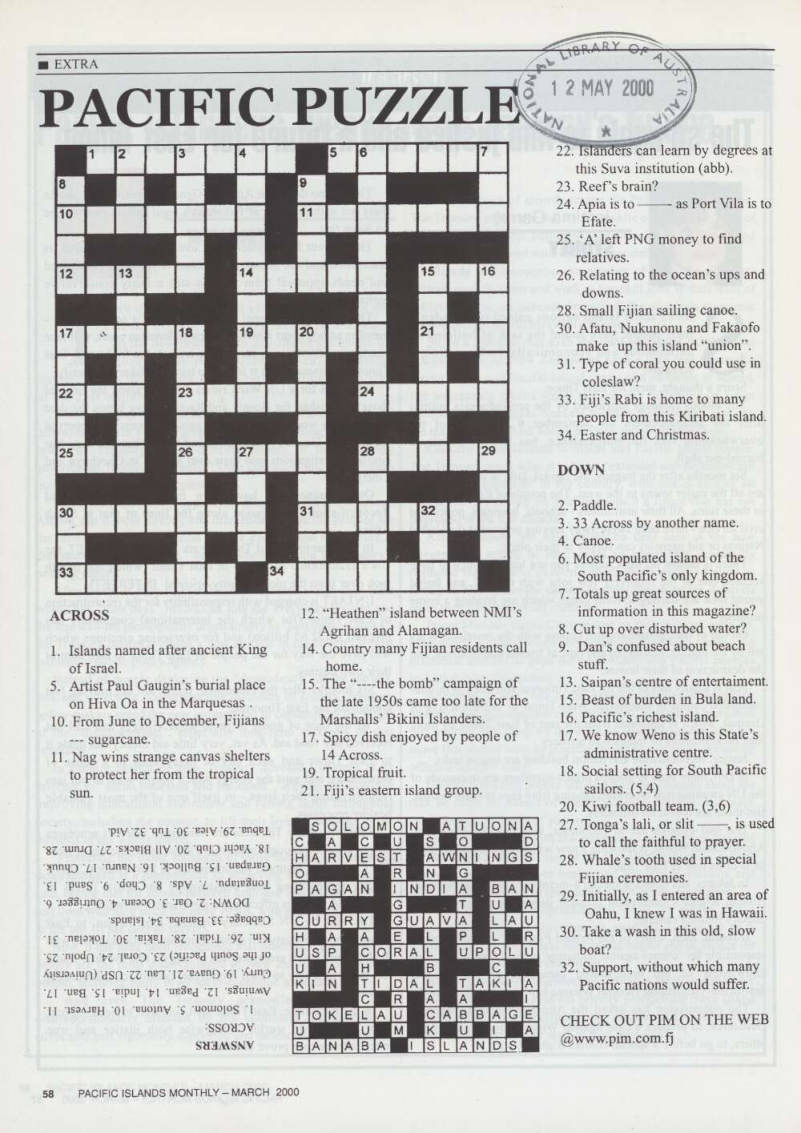
Extra
Across
I. Islands named after ancient King of Israel. 5. Artist Paul Gaugin’s burial place on Hiva Oa in the Marquesas . 10. From June to December, Fijians — sugarcane.
II. Nag wins strange canvas shelters to protect her from the tropical sun.
12. “Heathen” island between NMl’s Agrihan and Alamagan. 14. Country many Fijian residents call home. 15. The “ —the bomb” campaign of the late 1950 s came too late for the Marshalls’ Bikini Islanders. 17. Spicy dish enjoyed by people of 14 Across. 19. Tropical fruit. 21. Fiji’s eastern island group.
2a Mttolfefs can leam by degrees at this Suva institution (abb). 23. Reef’s brain? 24. Apia is to as Port Vila is to Efate. 25. ‘A’ left PNG money to find relatives. 26. Relating to the ocean’s ups and downs. 28. Small Fijian sailing canoe. 30. Afatu, Nukunonu and Fakaofo make up this island “union”. 31. Type of coral you could use in coleslaw? 33. Fiji’s Rabi is home to many people from this Kiribati island. 34. Easter and Christmas.
Down
2. Paddle. 3. 33 Across by another name. 4. Canoe. 6. Most populated island of the South Pacific’s only kingdom. 7. Totals up great sources of information in this magazine? 8. Cut up over disturbed water? 9. Dan’s confused about beach stuff. 13. Saipan’s centre of entertaiment. 15. Beast of burden in Bula land. 16. Pacific’s richest island. 17. We know Weno is this State’s administrative centre. 18. Social setting for South Pacific sailors. (5,4) 20. Kiwi football team. (3,6) 27. Tonga’s lali, or slit -, is used to call the faithful to prayer. 28. Whale’s tooth used in special Fijian ceremonies. 29. Initially, as I entered an area of Oahu, I knew I was in Hawaii. 30. Take a wash in this old, slow boat? 32. Support, without which many Pacific nations would suffer.
Check Out Pim On The Web
@www.pim.com.fj
Answers
Across:
1. Solomon. 5. Autona. 10. Harvest. 11.
Awnings. 12. Pagan. 14. India. 15. Ban. 17.
Gurry. 19. Guava. 21. Lau. 22. USP. (University of the South Pacific) 23. Coral. 24. Upolu. 25.
Kin. 26. Tidal. 28. Takia. 30. Tokelau. 31.
Cabbage. 33. Banaba. 34. Islands.
DOWN: 2. Oar. 3. Ocean. 4. Outrigger. 6.
Tongatapu. 7. Ads. 8. Chop. 9. Sand. 13.
Garapan. 15. Bullock. 16. Nauru. 17. Chuuk. 18. Yacht Club. 20. All Blacks. 27. Drum. 28.
Tabua. 29. Aiea. 30. Tub. 32. Aid.
Advertisements & other items, pp. 59-60 (1 item)
Trading Post
AND
Drams
TRADING POST CAN WORK
WONDERS FOR YOU...
Promote your business, or service, sell your household items, cars or heavy machinery etc.
ONLY AUSS2 (OR EQUIVALENT) PER WORD.
NO COMPANY LOGO. NO DISPLAY.
NO BOLD TYPE.
Just forward your Advertisement together with payment to:
PACIFIC ISLANDS MONTHLY "Trading Post",
PO Box 1167, Suva, Fiji.
Conditions: 1. All Advertisements are subject to acceptance and approval of publisher. 2. Advertisements are published as space permits; we cannot guarantee date of insertion. 3. All advertisements must be prepaid and should be typed or printed clearly 4. Deadline for receipt of advertisements is the 15th of the month prior to issue. 5. PACIFIC ISLANDS MONTHLY assumes no responsibility for any service other than publishing paid advertisements in this section. 3 1508 01052203 0
3) Skeioe3
re-Press Bureau
V/Jwra VmizitS , ._j ■
yourViskMl
B#©IUJJ33
pre-press services colour scanning Film output photo re-touching page composition File conversion design & layout Image manipulation
Sign writing
I ij u - A complete sign shop For oil your signs requirement.
Computer cut-out signs Billboards I Banners Shops Front signs j Frame board i air brushini
Screen Printing
One Stop Shop For All Your Promotional Requirements T-Shirts CoFlute Boards Bumper Stickers Jackets ScarFs Badges Caps Vinyl Printing- Decals Necktie
amine swum mm*
18 Disraeli Road, RO. Box 16149, Suva, Fiji; Phone: (679) 306100; Fax: (679) 306111 e-mail: graphic_sys@ xoommail.com