Pacific Islands

Monthly
Special Report: The tumultuous Tongan Royal Family
February 2000
:■% Im'%il4l I I * - h «
I- ’*■• -*' fr 't&M
n I I * *«a« —.-«®f ,> 1»lSBr-#'
Hu i t.,. v MM -^/i
- ' ' % * Hi I w aSSm U <. • . I M> ~-' , "* * -■• T «»*** V— i- . L* xw ..
Wt Hr. w w iff % .IP w w * w *«p ** **p 'sa^
American Samoa US$2.5O; Australia A 53.50; Cook Islands NZ $3; Fiji F 52.50 Vat Incl; FS Micronesia US$3; Kiribati A 52.50; Nauru A 52.50; Niue NZ$3; Norfolk As 3; New Caledonia cpf2so; New Zealand NZ53.45 incl GST; Northern Marianas US$3; Papua New Guinea K 4.90; Palau US$3; Marshall Islands US$3; Solomon Islands As 3; French Polynesia cpf3oo; Tonga P 3; USA US$3; Vanuatu VT22O; Western Samoa T 5.50. These are recommended prices only
Advertisements & other items, p. 2 (1 item)
Sr 1
■v.- \ m. m ii«S* m Vi- Photos : Pantz • Aubry * Located in the South Pacific, New Caledonia is a developed, sophisticated island business base that offers outstanding opportunities for investors : stunning sites for new hotel developments, suitable climate for counter-season fruits and vegetables, superb locations for fish and prawn aquaculture, and more. Authorities in New Caledonia are very supportive to business.
New Caledonia also offers a range of quality products {fruits & vegetables, seafood, agri-food products, etc.), services and technology (including water, energy, environment), meeting international requirements and expectations. We promote our products through regular visits to foreign markets.
ADECAL, the Economic Development Agency of New Caledonia, is the one-stop-shop where you can get specific advise on doing business with New Caledonia. As your free-of-charge partner, we shall assist you in identifying opportunities and putting together your project successfully.
Should you like to receive further information, please do not hesitate to contact either Benoit RENGADE or Vann PITOLLET Inward Investment Ms Doriane SANCHEZ-LEBRIS Export Division i A o O.fc cy O A % New Caledonia 15, rue Guynemer - PO Box 2384 - Cedex - New *5 www.adecal.nc E-mail: [email protected] tonormc Development Agency • Phone: (687) 249 077 - Fax; (687) 249 087 - www.adecal.nc - E-mail: [email protected]
)JEePT 1999 : (687) 275 566
Pacific Islands

Monthly
Vol. 71 No. 2
The News Magazine
February 2000
Alan Robinson Sophie Foster Hildebrand Michael Field, Gill'Johnson, Sally Andrew, Sam Vulum, Ed Rampell, Alan Ah Mu, Brian Tobia.
David Barber (Wellington), Jemima Garrett (Sydney) Penina Magnus, Sovaia Ditoga Senior Regional Sales (South Pacific) Shayne Farah Hussein Tel (679) 304111,303244, Fax (679) 303809.
Sydney. Canberra: Bob Hill Media Represen tation. Tel (61-2) 4164243.
Fax (61-2) 4165064.
Brisbane: Jane Fewings Media and Advertising Associates Tel (61-7) 3378 4522.
Fax (61-7) 3878 1071.
Adelaide: Hastwell Williamsons Representa tives. Tel (61-8)3799522, Fax (61-8) 3799735.
Melbourne: Brown Orr Fletcher Burrows (Aust) Pty Ltd.
Tel (61-3) 98265188.
Fax (61 -3) 98265644, Auckland: McKay & Bowman. International Media Representatives Limited.
Tel (64-9) 4190561, Fax (64-9) 4192243.
Japan: Universal Media Corporation, Tokyo.
Tel (3) 3266626741, Cable: UNI-MEDIA Tokyo.
Fax (3) 32626742.
Pacific Islands Monthly was founded in 1930
(Usps 9522480).
A Fiji Times Limited production.
Cover prices are recommended retail only. Registered by Australia Post, Publi cation No. NBP1210. © Copyright Fi ji Times Limited, 177 Victoria Parade. Suva, Fiji.
Tel (679) 304111, fax (679) 303809.
Email: [email protected] P1M Website: http://www.pim.com.fj Pacific Islands Monthly is published monthly by Fiji Times Limited, a division of Nationwide News. 2 Holt Street. Surry Hills, Sydney, NSW 2010.
Pacific Islands Monthly PC) Box 1167. Suva. Fiji.
Printed by Quality Print Limited, 16 Antra Street. Walu Bay, Suva. Fiji.
Cover design/Layout by Penina Magnus & Sovaia Ditoga All care, but no responsibility taken for material submitted for publication
Briefs B_
Inside
Cover Story Page 30
Editorial 4 Letters 5
Briefs B_
Special Report: Tonga's king favours youngest son for PM 8 Pearls of wisdom from a crown prince 10 Business: George hits the big time 12 BP Oil pulls assets out of Samoa 14 Only unleaded fuel now sold in PNG 16 All eyes on Australia for Olympics 18 Sacrifices for stardom 22 Shell money to become legal tender 20 Palau establishes Banking Commission 29 Cover: Bargain hunting on the Web hots up 30-31 RjiShop.com cashes in on E-commerce boom 32-33 Prospectors strike gold in Website names 34-35 Virus information on the Internet 35 Politics: West Papua mobilising (or freedom from Indonesia 30 Racist politics not dead, just 'mainstreamed' 39 Development: To-selling author reveals link to Joyita mystery 41 Newspapers show role in Papua New Guinea conflict 42 Propelling into the world markets 44 Orbituary: Solomons controversial ex-leader dies 51 Sport: Pride, poise and dignity 52 Yachting: Cruising Ku-ring-gai 54 Opinion: David Barber/Jemima Garett 56 Pacific Puzzle 58
Page 10
Page 22
Page 47
A netful! of opportunities

Editorial
The internet has changed business forever. Its advent has provided people with the infrastructure to extend the reach of their oiganisation while reducing the cost of serving customers.
Customers, on the other hand, have realised how easy it is to sit at home, click a mouse and be served. In the Pacific, 2000 looks like the year when electronic commerce can begin to accomplish its promise as a huge new marketplace.
Computer-based companies have sprung up in the region offering everything from music CDs to clothes.
One reason why e-commerce is becoming popular is that more families are connecting to the Web as internet fees drop. Apart from the growing number of customers, merchants jumping on the Net say that a moving force behind their decision to go on-line was seeing the success of early pioneers like Amazon.com.
The Seattle-based company was the first to open a megabookstore on the Net and it offered 2.5 million book titles - more than any concrete and steel competitor. The huge selection and easy access have played no small part in Amazon.com’s success. (In 1997, the company’s sales grew from US$l5.B million to U 55131.7 million). Right now all eyes are on FijiShop.com, the first on-line store from that part of the Pacific.
But the lesson from Amazon.com is this: Do not wait. Getting on the Net early can be a big advantage, especially for small startups.
Every day the internet becomes friendlier to users. On-line traders have made
cybershopping easier by letting customers put
the products they want in a virtual trolley. This way, shoppers can continue to browse the cyberstore without having to stop and pay for each item.
Traders are also using passwords to preserve
bills and creditcard information so that once shoppers register at the site, they no longer have to fill in that data again.
But for all its praiseworthy qualities, on-line shopping is not without its weaknesses.
Consumers still have to fill in forms at each separate site. And the Web still has a distance to go before it can deliver on the promise of easy to-find goods for every taste and price range.
Technology that can thoroughly search the entire Web and the thousands of shops out there is not available yet. And it is still difficult to judge colours and sizes.
There are also concerns about security, especially for customers from the Pacific who are new to the internet Credit card companies, one of those who would benefit most from the growth of on-line shopping, are not, as yet, pushing consumers to go cybershopping.
Still, internet savvy shoppers have a huge list of places to shop until they drop. ■
Letters

Rethink the kingdom's priorities
I read with interest your Briefs column in Pacific Islands Monthly September, 1999, (King of Tonga commissions new telephone exchange). There is no doubt that Tonga needs future development in its telecommunication system, converting to digital and better quality of communication.
However, I do not believe that a video telephone display is suitable for Tonga to spend 4.5 million pa’anga in upgrading and replacing the telephone exchanges in Nuku’alofa, Mu’a, Masilamea and ‘Eua, while the outer islands of Ha’apai and Vava’u are still struggling to get any phone lines at all.
Our local radio station, SBS in Melbourne, announced the same story of King Taufa’ahau of Tonga officially commissioning the island nation’s new telephone exchange in mid-August. At the same time, spending $4.5 million on a telephone video display.
It entailed a very poor story from Vaiola Hospital in Tonga to the poor people of the kingdom living in Australia, as the hospital appealed for help in collecting toilet paper, bedclothes, pillows, detergent and equipment.
It was sad to hear that half the body of the Government could borrow more that four million from EFI (Export Finance Insurance) with a return in future.
If that is the case, it seems that most non government organisations can run better without being fully controlled by the Government of Tonga.
The health system should follow their lead and borrow money from overseas to buy toilet paper and new equipment, and then invite our beloved king to officially open it and charge patients a small fee for better health conditions.
Aisea Filihia,
Australia.
Help slop Hie misinformation
I always enjoy Sally Andrew’s articles,
so I looked forward to the one she wrote on my home islands for the July 1999 issue.
Naturally I was pleased that she found Kaua’i people “friendly folk”, and happily read about her tour around the island, until I got to her North Shore visit.
My pleasant vicarious amble with Andrew screeched to a halt when I read that following: “At Key Beach we ... made the traditional offering of a stone wrapped in a ti leaf.”
Oh horror!
Where to begin?
In the first place, there is no place called Key Beach. Ke’e (neither spelled nor pronounced like the English word “key”) we do have, and it is the site of a number of heiau (I give Andrew full marks for not committing the linguistic misdemeanor of spelling it he’iau).
At none of these heiau is a “stone wrapped in ti leaf’ a traditional offering.
Quite the contrary.
For many years those who care about the ancient sites of Ke’e have tried to stop people from wrapping up rocks in leaves and leaving them around the temples there.
Not only are these unwanted and unwonted gifts completely inappropriate to the deities who reside at Ke’e, the usual method of creating them ( picking up a rock from one part of the site and moving it to another) is seriously damaging the
archaeological remains.
Unfortunately, thanks to ill-informed tour guides and equally ill-informed tourists, the
practice continues.
I hope that your magazine will help those of us who are trying to halt the desecration of these places which are holy not only to Hawaiians, but, as a resident of Laka (Lata, Rata, La’a), to people throughout Polynesia.
Please do not be a vehicle for misinformation.
Heu’ionalani Wyeth,
Hawaii.
Advertisements & other items, p. 5 (1 item)
Have your say!
Send Letters to the Editor to: Pacific Islands Monthly, P O Box 1167, Suva, Fiji OR Email; [email protected] PIM Website; www.pim.com.fj
i:\GI\E WAREHOUSE
New/Used - Engines Transmissions Parts
BMW
Lister Yanmar SPECIALAir Cooled Industrial
Engines
Listers 18/21 /32/44hp
Deutz 290 hp
Generator Sets Komatsu 29kva Yanmar 150kva Cylinder Heads Tested All Terrain Vehicles Amphibious National Distributers Amphibious Carry 6 persons Pull trailer
USED FOR
Tourism Forestry Council Fisherman Contracters Govt Dept Farmers etc.etc. etc BLAIRS NEW ZEALAND Phone 643-6938122 Fax 643-6938120
P.0.80X 14 Geraldine NZ Email [email protected]
Visit us on the Web www.blairs.co.nz
Archives-August 1930
Pacific Trade Prospects
Fiji-Samoa-Tonga
A strong spirit of optimism
Written for The Pacific Islands
Monthly by Sir Maynard Hedstrom
I can speak, on trade developments and prospects, only of the three groups of which I am personally interested - Fiji, Samoa, and Tonga. Business in Fiji is depressed by the very low price of our primary products; but there are other factors which give hope for the future.
Though our sugar is selling at, or below cost of production, the Colonial Sugar Refining Company Ltd continues its policy of expansion and consolidation, and continues to expend money in improvements which are intended to effect permanent reduction in the cost of production. The policy of establishing peasant farmers as growers of sugar is working out very successfully, so that when the pendulum swings and world production and consumption becomes more balanced.
the Colonial Sugar Refining Co. Ltd. Will be in an excellent position to take advantage of the improvement in market conditions. The copra producer, also, is having a rather “thin time” and, in the case of the small man, the selling price is almost below the cost of production. On the other hand, the output of the Colony is steadily increasing - partly owing to the successful work of the entomologists of the Coconut Committee. Producers will have to study economy during the present period of depressed prices and, when the market recovers, they will benefit substantially by the increased production per acre.
Owing to floods, last December, banana
shipments have been greatly reduced; but that is a temporary condition, and shipments will be back to normal about the end of the year.
Buffer and Pineapples Our little dairy factories are fully supplying local requirements, and we are exporting regularly to Honolulu and Canada.
The shareholders in the two small pineapple factories have confidence in the ultimate success of that industry. Probably, by January next, the Hawaiian Pineapple Company Ltd will have come to a decision as to whether they will commence operations on a commercial scale on the land over which they hold options. They have studied the proposition very carefully and, if they decide to establish themselves ion Fiji, there can be little doubt that the venture will be successful.
Our aim here is to get greater variety in our products, so that we may not be entirely dependent upon one or two lines, but build our prosperity on a broader basis. ■
Briefs
Niue to introduce a new cargo container vessel next month Niue’s Reef Shipping plans to introduce in March a new custom built cargo ship to service Auckland, Tonga and Cook Islands.
A report from Niue says the new cargo vessel is capable of holding 500 containers, break bulk and refrigerated cargo.
The vessel is expected to replace Reef Shippingis MV Hima and MV Southern Cross. (PNS) NZ attempts to puli down academic barriers (or Pacific islanders A paper written by New Zealand’s new Education Minister, Trevor Mallard, has called for an investigation into ways of addressing financial barriers preventing Maori and Pacific Islanders from setting up early childhood services. In a report obtained by the National newspaper, the Minister strongly recommended that “further work is needed to find out the barriers to early childhood education amongst Maoris and Pacific islanders”. The report recommended
investigating why some families were not taking part in early childhood education.
“Services and policies across government agencies need to be better co-ordinated to strengthen families with children at risk of low educational outcomes,” Mallard’s report said. “Low achievement is cumulative, with disparity increasing with age. Progressively, fewer students from poorer schools are achieving high grades as they move through the education system.”
The education minister said although the rising cost of tertiary education could pose a barrier to many Pacific islanders, lack of knowledge could also adversely affect academic excellence. (PNS) Minerals and crude oil still backbone of PNG economy Mineral and crude oil exports remained the main source of Papua New Guinea’s economy during the September quarter of 1999. The results were due to high production at the Ok Tedi, Porgera and Lihir mines and the Kutubu oil project.
The Bank of Papua New Guinea said copper and gold exports raised more than AU$37O million (US$23B million) while crude oil netted AU$22O million (US$l42 million) in exports during the quarter.
Agricultural and marine products were worth AU$ 170 million (US$ 109 million) due to favourable world prices, especially for copra and copra oil. The bank said the increased copra production followed a major recovery by the industry, which was severally affected by drought in 1997.
Forestry products accounted for nearly AU$3O million (US$l9.3 million). (PNS) Pacific tourism body to discuss future
funding
The South Pacific Tourism Organization will convene a special meeting early this month to discuss continued funding from the European Union.
The meeting in Auckland will develop a proposal to persuade the EU to continue funding the regional organization’s
Continued next page
Continued front previous page
marketing and research activities. Last November, the EU announced that it would discontinue funding the organization effective May 2001, to focus more on the private sector. But EU delegate, David Mcßae, has indicated that the European Union would consider continued support of marketing and research, if these activities were priorities for regional tourism.
Palau builds international coral reef centre Construction of the Palau International Coral Reef Centre and the Palau Aquarium are now underway in the capital, Koror.
Scheduled to be opened early next year, the Centre and Aquarium would be an addition to Palau’s many other tourist attractions. Palau has been labelled as one of the seven underwater wonders of the world.
The International Reef Centre is a joint project between Japan and the United States.
It was established to support a self-sustaining non profit coral reef centre and marine park that would provide a forum for coral reef studies, research and education.
The centre is designed to assist in improving the management, use and conservation of Palau’s and the world’s marine environment, in addition to serving as a tourist attraction. The project has received funding from the Government of Japan for the construction of the centre. The project has an estimated value of US$7.3 million. (PNS) Long time PNG businessman knighted by the
Queen
Long time businessman, Henry Chow, was the sole Papua New Guinean knight on the Queen’s New Year’s Honours List.
Sir Henry, the head of a major group of companies primarily centred in Lae and Rabaul, was knighted for his services to the community. He already has an OBE, awarded to him at Independence in 1975.
The next most senior award given was a CMG, Companion of the Order of Saint Michael and Saint George, awarded to a veteran local government leader, Walter Nombe of the Eastern Highlands, for services to the community and to politics.
Police Commissioner, John Wakon, had an extraordinary 1999. He was awarded the Queen’s Police Medal. In 1998, he was stripped of his post as Commander of Police for the National Capital District under the former government only to be elevated straight to the Commissioner’s chair under the new government. Thirty three others were recognised by the Queen for their contribution to the community, health, business, religious and womem's affairs.
(Pns)
Corruption Commission admits corruption
on the rise In FV Fiji’s Bribery and Corruption Commission admits corruption exists in Fiji but is not highly publicised. Commission chairman and High Court Judge, Daniel Fatiaki said people were not speaking up because at the end of the day they had to go back to live in the same community. Justice Fatiaki said all forms of corruption occurrred regularly in Fiji in various government departments and in the private sector. This needed to be addressed, he said, which needs to be addressed.
“I think the problem needs to be nipped in the bud as early as possible. This is to be done now if we are to rid our public service and
private sector free from payment of a secret commission or bribe. I think corruption needs to be tackled very seriously as the beginning,”
Fatiaki said.
The three-member comission is expected to hear submissions from members of the public and recommend changes to provisions on corruption and bribery in the penal code.
Currently the law is focussed on government officials. The inquiry is expected to incorporate corruption and bribery practises in the private sector. (PNS) Samoan prime minister and president of American Samoa sign MOU Samoa’s Prime Minister Tuilaepa Sailele Malielegaoi has signed a memorandum of understanding (MOU) with American Samoan Governor Tauese Sunia which is expected to enhance co-operation between the two Samoas on several fronts.
The agreement was signed last month at a summit of the two leaders in the American Samoan capital Pago Pago.
A statement from Governor Tauese’s office said the MOU would benefit the two countries through the sharing of resources, thereby creating, among other things, large cost savings.
The specific terms of the MOU will be worked out by the cabinet officials of both countries. Each official will be paired with his or her counterpart to work out the specific details of the co-operation initiative.
Governor Tauese and the Samoan prime minister are due to meet again in March/April in American Samoa to review the work of their cabinet officials. If the two leaders are happy with the details, they will then formalise the MOU. (PNS) Forum Samoa to be sold The government of Samoa intends to sell the Forum Samoa container ship and replace it with a new vessel. Several government officials, including Attorney General Brenda Heather, travelled to Germany late last year to negotiate construction of a new ship.
The ship will be built in China, at an estimated cost of $l2 million. Pacific Forum Line (PFL) and Samoa Shipping Services (SSS) will each contribute $1 million towards the cost of the new ship. The ship is scheduled to be completed in June 2001. (Samoa News) ■
Advertisements & other items, p. 7 (1 item)
Dried Sea Cucumber Wanted
Seafood importer is seeking for sandfish, black fish, stone fish. Wealthy Ocean Corp. PO Box 36 503 Taipei, Taiwan.
Fax: (8862) 27624455 Tel: (8862) 27661036 E-mail: [email protected]
Tonga's king favours youngest son for PM
Special Report
By Michael Field
Tonga has a new prime minister - only their fourth in 51 years. Some call that stability, but the arrival of Prime Minister ‘Ulukalala Lavaka Ata, third and youngest son of King Taufa’ahau Tupou IV, is a continuation of the inertia and poverty of the last decade.
His appointment also reveals disarray in the Royal Family as the 81-year-old king nears the end of his reign. His successor, the notoriously irritable 52-year-old Crown Prince Tupuoto’a, has no heir, and is in conflict with his sister.
Princess Salote Mafile’o Pilolevu, who has shown a great dedication in making a personal fortune on Tonga’s name. Tupuoto’a, who recently reminded top officials that the punishment for barratry or mutiny was death, seems to have wanted to shake up Tonga. He quit as foreign minister two years ago.
Elections for prime minister are unheard of in the near absolute monarchy of Tonga. The king is the only vote involved. Baron Vaea of Houma was appointed to the life-term post in 1991, taking over from the king’s brother, Prince Fatafehi Tu’ipelehake, who had been prime minister for 26 years. Vaea, a wartime pilot, ends his office with 56 years service to the government, the last six reluctantly and wearily performed. It has only recently been revealed
that he in fact resigned in 1995 but was left to languish in office while the king tried to sort out his family. Tupuoto’a was the obvious replacement prime minister; after all his father, before he became king, was premier for 16 years. But with his sister making personal millions on her satellite operation which is based on using the sovereign assets of the state, Tupuoto’a quit two years ago as foreign minister and set out to get into the telecommunications business too.
Palace rumour says the king tried to get him to take up the premiership but Tupuoto’a, for all his other faults, has no patience for inefficiency and ineptitude. He wanted to end the king’s right to make life-time appointments to cabinet; passing that right over the Legislative Assembly itself.
The tension had dragged on until January 3, 2000, with the sudden decree that Lavaka Ata, 41, foreign minister, would become premier. He would also be Minister for Agriculture, Fisheries and Marine. A former naval officer, Lavaka Ata, 41, is known for his austere conservatism and his intense commitment to the Wesleyan Church - the official church of the kingdom - where he is a lay preacher. He is strongly opposed to the democratic movement which has grown in Tonga in the last decade.
He is married to Vaea’s eldest daughter, Nanasipau’u. This accentuates the concentration of power and wealth in Tonga.
Pilolevu, 48, not only controls Tonga Sat, which controls the satellite slots Tonga has claimed as a nation, she is also the principal in a Hong Kong company, Pacific Asia Global Holdings Ltd, which is negotiating further satellite deals with China.
Nepotism may have lost its flavour elsewhere but not with Tonga. Its chief operations manager-trade, is 22-year-old BA graduate Lupepau’u Tuita, Pilolevu’s daughter.
“It is my first job, and even though I am working for my mother 1 still have to regard her as the boss and I can define that line. Outside the office it is back to normal, but it is my first real job, and I hope that I will not get fired.”
Another daughter recently received a 21st birthday gift from the increasingly influential Tokaikilo Fellowship, an extreme Methodist group. They gave the young woman Tsloo,ooo of their members funds.
Last year Pilolevu, who according to the US Forbes magazine has made a personal US$25 million out of Tonga Sat, was instrumental in Tonga’s move to dump Taiwan and recognise China. The king had opened Taiwan’s lavish new T 52.5 million embassy built on Tupouto’a’s land. He came up with the design concept and said it should be “something that should last for at least 100 years”, and he made a tidy commission on the deal. Then Pilolevu, with compelling business in China, organised a switch.
“I believe that God invented us to do this work otherwise we could have become just another foreigner knocking on doors in Beijing for years without having a chance to meet the leaders of China,” she said at the time.
“I look upon this new relationship with China as a means of spreading the Lord’s words to China. When China opens its doors to Christian evangelists, Tonga should be right there by the door.” Tonga Sat was formed after Tonga startled the international satellite market by claiming seven key equatorial satellite slots.
Although it did not need the slots itself it has, in partnership with other companies, used Russian
Continued next page
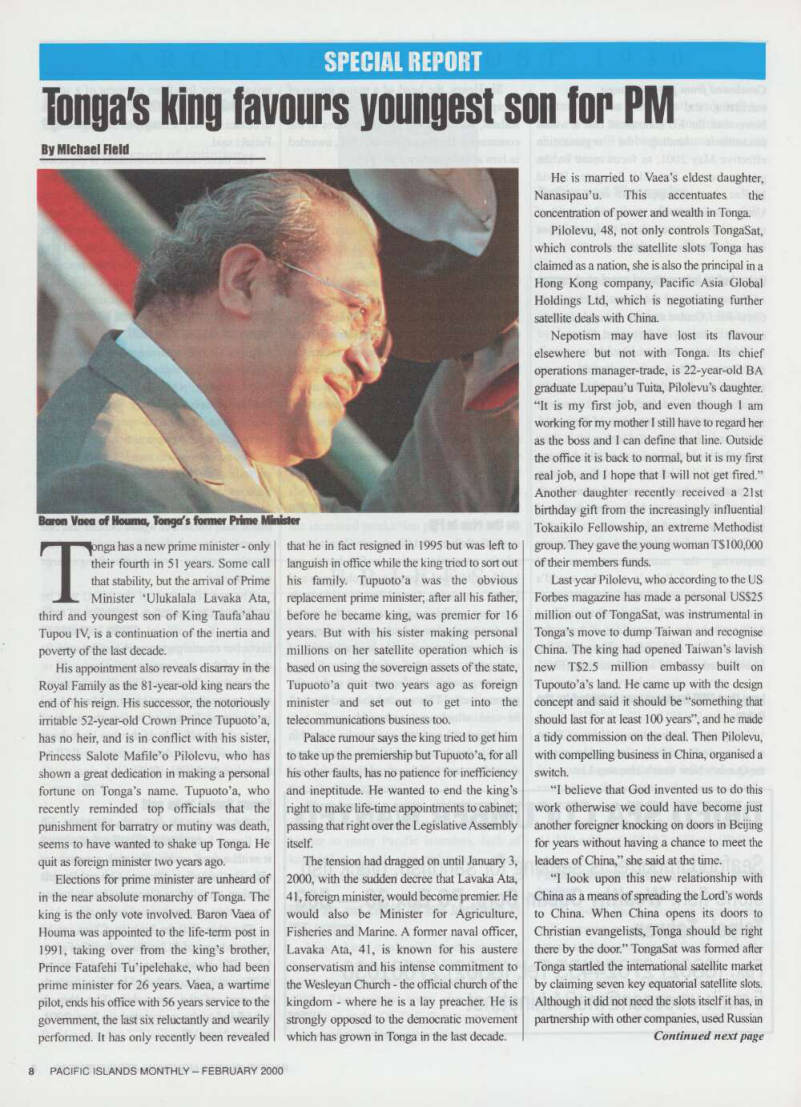
Baron Vaea of Houma, Tonga's former Prime Minister
Continued from previous page
satellites to fill what is now four slots.
Just under a year later Anna Tupou, marketing manager of the Pacific Asia Global Holdings Ltd, has denied they had changed from Taiwan to China purely for the advantage of Tonga Sat: “That is not true, we already had a relationship with China, APSTAR is Tonga’s number one client, and China is the major shareholder in APSTAR,” she told Matangi Tonga magazine. “We already have China as a client but we want to further enhance that because the whole world is at China’s door step, because of its huge market. Volume is the key to telecommunications.”
Tonga Sat wants to cash in on China’s acceptance into the World Trade Organisation which will force an opening of the telecommunications market there. They are now looking at a deal with the Chinese government owned company China Orient which can provide satellites while Tonga has the slots to fill. Meanwhile Tupouto’a is crashing around back home trying to bust up Cable & Wireless Pic’s (C&W) monopoly on international phone traffic out of Tonga and the C&W Internet Exchange in Hong Kong. It is also available to Fiji, Solomon Islands, Vanuatu and Tonga and reputedly offers those four countries cheaper Internet access.
Tupouto’a ([email protected]) has become a telecoms and internet authority and he believes he smells a rat. “The trouble with C&W, is that their interest is in making Fiji the hub of telecommunications for the Pacific,” he emailed Matangi Tonga. The resulting costs to Tonga were a rip-off, he said. He singled out Noble ‘Akau’ola for the blunder. That noble is now dead, but in his day was Police Minister and the kingdom’s hangman - and active at that too.
“It is a monument to the limited knowledge and negotiation powers of the late ‘Akau’ola, and in that sense, when Mark Anthony says in his eulogy for Julius Caesar that the evil that men do live on after them etc., he might care to have mentioned incompetence and stupidity as well,” the Crown Prince said.
“What truly worries me is, what precisely were the crowd of degree’d bureaucrats who constantly accompanied the late Hangman (‘Akau’ola) to London and Hong Kong (to attend the Hong Kong Sevens at the invitation of Cable and Wireless) doing when the extremely unequal terms of the Cable and Wires agreement were so readily agreed to?”
He is seeking to set up a rival international carrier out of Tonga, but has to await approval of a government that seemingly is hostile to him. In two recent terms as Prince Regent he made his hostility toward them more than apparent too. He sacked one non-performing board, something that has never happened before in Tonga, and cancelled the pension of civil servants who had reached retirement age but were still working.
Inertia in government had given people in positions of power “a false sense of security”
that they could not be made to answer for their actions. “Mutiny is when the lower orders rebel against higher authority,” he said referring to the ditference between civilian law and military law. “However, when those in authority wilfully behave in a highly irresponsible manner, it is termed a barratry. It is significant, furthermore, that both carry the death sentence. “While I do not advocate the death sentence in this case, I do with to point out the seriousness of harm that is caused by misconduct at high levels.” Perhaps that is why he not prime minister after all. ■
Advertisements & other items, p. 9 (1 item)
The West’s Motor Inn
FIJI ISLANDS
Phone: (679) 720044 E-mail; [email protected] Fax: (679) 720071. P.0.80x 10097, Nadi Airport. 111 1 Jam • Ideally situated between the International Airport and Nadi Town • 62 Rooms from standard to airconditoned deluxe • Poolside dining, variety at reasonable prices mhmt's • Entertainment performed by our very fjT motor inn talented pianist/vocalist • Free courtesy airport transfers on request • 24-hour reception and porterage \/p\
Pearls of wisdom from a crown prince
By Michael Field
Tupuoto’a lashes out at Tongan “squatter mentality”
Tongans are thieving people who let their pigs crap everywhere, are given to public drunkenness and have no pride. That is official, that is the word from His Royal Highness Prince Royal Tupuoto’a of Tonga.
His remarkable contempt for his subjects - and hapless Singaporeans who got in the way - came out in an email to the Matangi Tonga magazine in Nuku’alofa.
“The only thing that Tongans have in common with Singaporeans in an inherent squatter mentality,” he said.
“Singapore has become a Nanny State by necessity, because if left to their own devices they would urinate in the elevators.
Left to their own devices, Tongans would do the same.”
After all they let their pigs do it everywhere, he said. Matangi Tonga probed for a definition of squatter mentality and Tupuoto’a gave both barrels.
“Lack of consideration for the group. An insistence on exercising one’s ‘rights’ even to the most ridiculous degree regardless of the overall harm it does to the rest of society.
“Examples are: - vandalism; - lack of respect for other people’s property (buildings, cars, anything left in the open); - absence of pride when it comes to begging in the street; - public drunkenness; - Tongan borrowing (theft in other societies) from one’s relatives and friends; - litter; - squatting (viz. Tukutonga rubbish
dump).
“All of the above are found in abundance in Tongan society where extraordinary troubles are taken to attend long boring church services to the exclusion, by law, of every other activity on Sunday.”
These are no random meandering of a retired cabinet minister. As the collection of quotes below illustrates, the Crown Prince has a long tradition of blunt speaking: - “It does not matter how good or bad the economy is, we still have many more churches than schools.” - On being a 52-year-old bachelor and not getting married now: “I mean, it would be pretty ridiculous for a 60-year-old man to take his kids to kindergarten, you know, people will forever be asking the poor kid, is this your grandfather?” - “There are two drinks the world, kava, and a Russian drink called Kvass, which is made in the monastery out of fermented black bread, and it looks like kava and I would say that these two drinks are the only two in the world which taste as disgusting as they look.”
- “If you are 45 and not married you get accused of one of two things: you are either a playboy or you’re gay and I’m neither. I think I work rather hard.” - “I think there is nothing more ridiculous
than an impoverished democracy.”
- “Those people’s representatives who run around saying unkind words against the king, there is no Chinese among them. I know who they are and the nobility in the house know who they are and one day they will be dealt with, they will get what they deserve,” the
prince said.
- “I always thought that one might be criticised for going too slowly. I was taken aback by criticism that I was moving too fast. Just like sex, I
suppose.”
- “I would like to see politico constitutional change initiated within my father’s lifetime. I would then preside over its performance.” ■
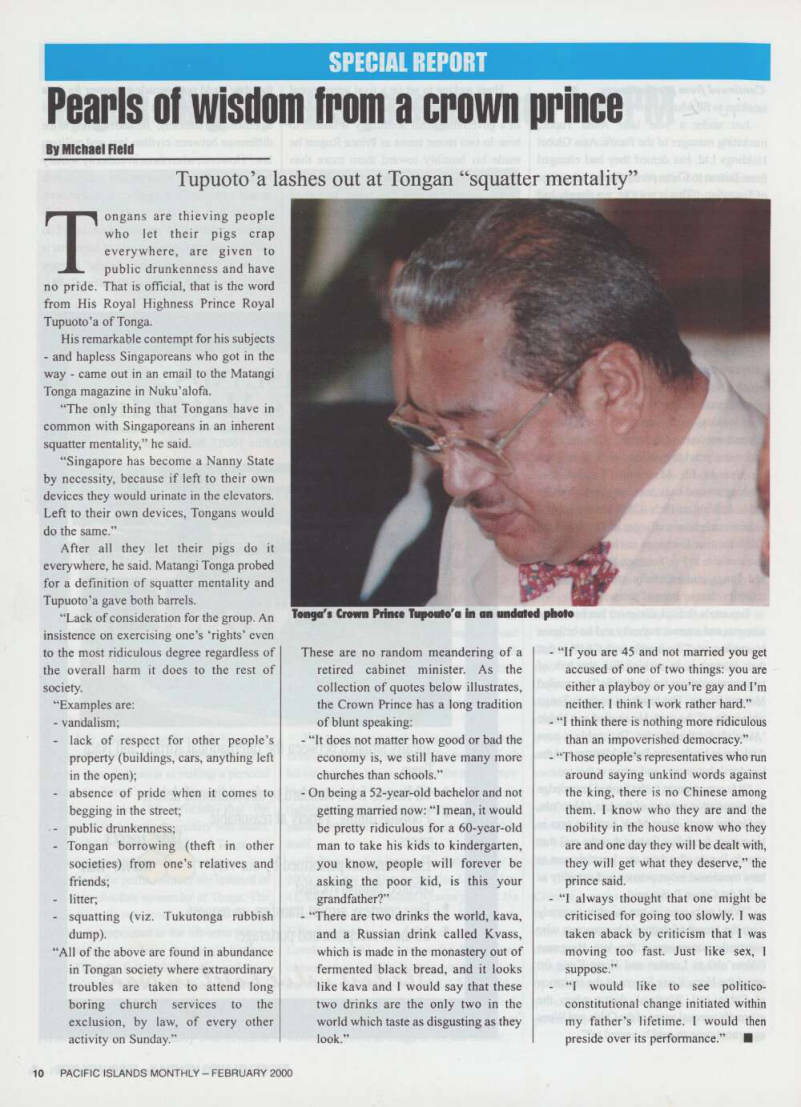
Tonga's Crown Prince Tupouto'a in an undated photo
Advertisements & other items, p. 11 (1 item)
South Pacific Regional Environment Programme (SPREP)
Vacancy: Coastal Management Officer
Applications are invited for the position of Coastal Management Officer with the South Pacific Regional Environment Programme (SPREP) in Apia, Samoa.
Post Description The Coastal Management Officer assists member countries and territories with the development and implementation of appropriate coastal management programmes and related activities. He or she is
responsible for the following;
• Identify priorities and appropriate funding mechanisms for coastal management in island member countries of SPREP; • Provide advice and assistance on coastal management issues to SPREP member countries and other international or regional organisations. • Promote, develop and oversee the implementation of conceptual frameworks, methods and tools for coastal resource planning, management and training programmes, appropriate to the Pacific region; • Co-ordinate activities under the International Coral Reef Initiative (ICRI) Pacific Regional Strategy, including the Global Coral Reef Monitoring Network for the Pacific region. Activity Plan for the Conservation and Management of Coral Reefs and the Regional Wetlands Action Plan; • Co-ordinate the development of proposals and policies related to the coastal environment within SPREP, it's member countries and other agencies, as required. • Provide technical guidance and supervision for the position of Wetlands Management Officer within
SPREP.
Required Qualifications and Experience
Candidates must have appropriate tertiary qualifications (preferably with post-graduate qualifications in an integrated coastal management related field) from a recognised institution and at least 5 years' work experience, preferably within the Pacific islands region, in a field related to this position. Other essential requirements are: proven project management experience; the ability to manage the work of consultants; a proven ability to work as a part of a inter-disciplinary and/or multi-cultural team; the ability to meet project deadlines (often under difficult circumstances); a proven ability to prepare proposals and reports; a proven ability to live and work within Pacific island communities. Applicants with a demonstrated interest and involvement in the environmental economic and social issues affecting the region, particularly as they relate to coastal management, will be highly regarded.
Appointment Appointment will be at either Project Officer or Adviser Level of SPREP's authorised salary scale for contract staff, depending on the successful applicant's qualifications and experience. SPREP remuneration is tax free in Samoa for non-residents and for people who are not citizens of Samoa.
The initial term is three years, renewable for a further three years depending on availability of funds and standard of the officer's performance during the first term.
Applications
Applications should be accompanied by a detailed curriculum vitae containing full personal details, information on qualifications and experience for the position, previous appointments, current position and salary, names, address and telephone and contact numbers of three persons associated with the applicant professionally and who would be prepared to provide testimonials. An indication of how soon the applicant would be available should be indicated.
Closing Date: 29 February 2000.
Applications should be addressed to: The Director South Pacific Regional Environment Programme (SPREP) Tel: (685) 21929 PO Box 240 Apia Fax: (685) 20231 Samoa E-mail [email protected]. ws Further information, including a full post description and details of remuneration and terms and conditions of appointment, is available from the SPREP Administration Officer at the above address/contact numbers or via direct Email: [email protected] 10 48«2v
George hits the big time
Business
By Arthur McCutchan
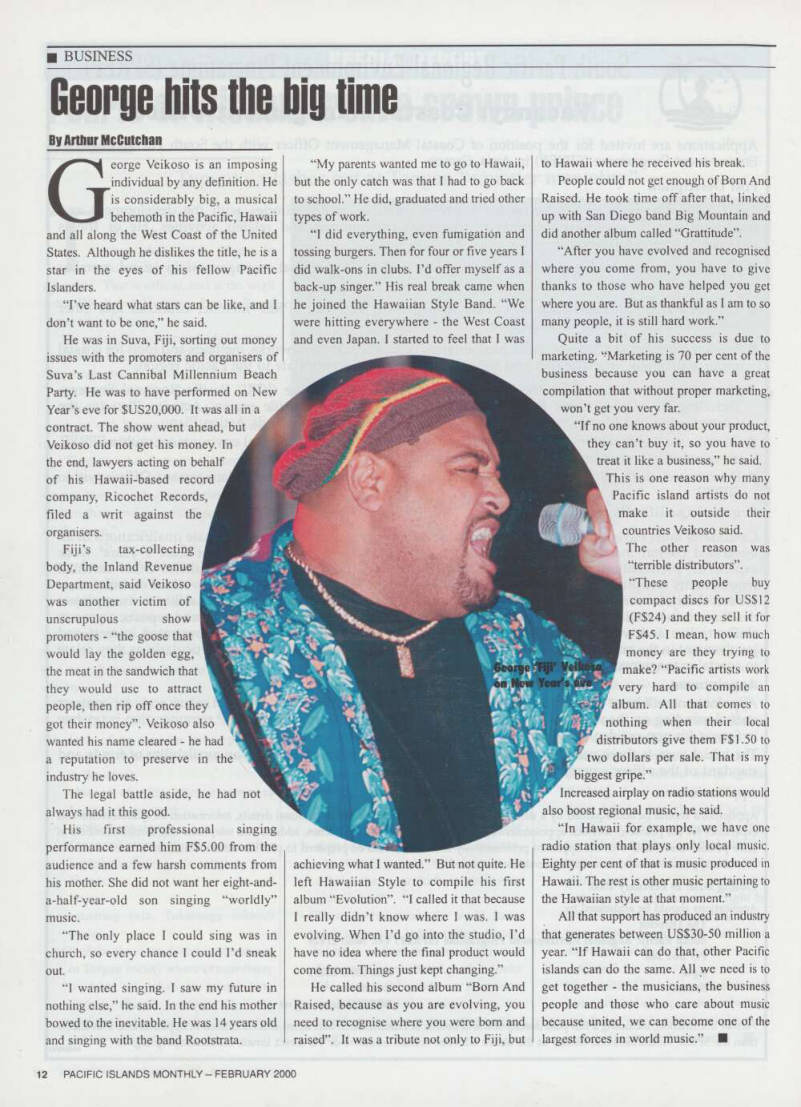
George Veikoso is an imposing individual by any definition. He is considerably big, a musical behemoth in the Pacific, Hawaii and all along the West Coast of the United States. Although he dislikes the title, he is a star in the eyes of his fellow Pacific Islanders.
“I’ve heard what stars can be like, and I don’t want to be one,” he said.
He was in Suva, Fiji, sorting out money issues with the promoters and organisers of Suva’s Last Cannibal Millennium Beach Party. He was to have performed on New Year’s eve for SUS2O,OOO. It was all ina i contract. The show went ahead, but Veikoso did not get his money. In JM the end, lawyers acting on behalf of his Hawaii-based record company, Ricochet Records, filed a writ against the M I
organisers.
Fiji’s tax-collecting B
body, the Inland Revenue Department, said Veikoso was another victim of unscrupulous show J*\ promoters - “the goose that would lay the golden egg, ■BbeylQpv the meat in the sandwich that they would use to attract people, then rip off once they got their money”. Veikoso also wanted his name cleared - he had a reputation to preserve in the industry he loves.
The legal battle aside, he had not always had it this good.
His first professional singing
performance earned him F 55.00 from the audience and a few harsh comments from his mother. She did not want her eight-and
a-half-year-old son singing “worldly”
music.
“The only place I could sing was in church, so every chance I could I’d sneak out.
“I wanted singing. I saw my future in nothing else,” he said. In the end his mother bowed to the inevitable. He was 14 years old and singing with the band Rootstrata.
“My parents wanted me to go to Hawaii, but the only catch was that I had to go back to school.” He did, graduated and tried other types of work.
“I did everything, even fumigation and tossing burgers. Then for four or five years I did walk-ons in clubs. I’d offer myself as a back-up singer.” His real break came when he joined the Hawaiian Style Band. “We were hitting everywhere - the West Coast and even Japan. I started to feel that I was
achieving what I wanted.” But not quite. He left Hawaiian Style to compile his first album “Evolution”. “I called it that because I really didn’t know where I was. 1 was evolving. When I’d go into the studio, I’d have no idea where the final product would
come from. Things just kept changing.”
He called his second album “Bom And Raised, because as you are evolving, you need to recognise where you were bom and raised”. It was a tribute not only to Fiji, but
to Hawaii where he received his break.
People could not get enough of Bom And Raised. He took time off after that, linked up with San Diego band Big Mountain and did another album called “Grattitude”.
“After you have evolved and recognised where you come from, you have to give thanks to those who have helped you get where you are. But as thankful as lamto so many people, it is still hard work.”
Quite a bit of his success is due to marketing. “Marketing is 70 per cent of the business because you can have a great compilation that without proper marketing, k won’t get you very far.
“If no one knows about your product, they can’t buy it, so you have to treat it like a business,” he said. ||X' Bl This is one reason why many r Pacific island artists do not Tu. / pip! make it outside their countries Veikoso said.
The other reason was “terrible distributors”.
“These people buy , fe compact discs for USSI2 I (FS24) and they sell it for 'T ■ FS4S. I mean, how much ■ money are they trying to BMPW make? “Pacific artists work very hard to compile an album. All that comes to nothing when their local B distributors give them F$ 1.50 to fcMjry two dollars per sale. That is my I gw biggest gripe.”
Increased airplay on radio stations would also boost regional music, he said.
“In Hawaii for example, we have one radio station that plays only local music.
Eighty per cent of that is music produced in Hawaii. The rest is other music pertaining to the Hawaiian style at that moment.”
All that support has produced an industry that generates between US$3O-50 million a year. “If Hawaii can do that, other Pacific islands can do the same. All we need is to get together - the musicians, the business people and those who care about music because united, we can become one of the largest forces in world music.” ■
on Hew Year's eve
Advertisements & other items, p. 13 (1 item)
South Pacific Regional Environment Programme (SPREP)
Vacancy: Action Strategy Coordinator
Applications are invited for the position of Action Strategy Coordinator with the South Pacific Regional Environment Programme (SPREP) in Apia, Samoa.
Post Description The Action Strategy Coordinator assists member countries and territories coordinate development and implementation of the following: *1999-2002 Action Strategy for Nature Conservation in the Pacific Islands region This will include: • Development and implementation of an annual work plan and budget and associated reporting requirements consistent with Action Strategy coordination. • Action Strategy Coordination includes securing of resources, advocacy and development of new strategic initiatives not currently being addressed in the region, particularly those requested by SPREP members. • Action Strategy Monitoring and Communication Tools further development and implementation of the indicators monitoring programme and development of information management tools for effective monitoring and review of the
Action Stategy;
• Nature Conservation Roundtable facilitate and participate in the work of the Nature Conservation Roundtable; and • Facilitate and coordinate the development, implementation and follow up for the Seventh Conference on Nature Conservation in the Pacific Islands Region.
on Biological Diversity
This will include: • Development and implementation of an annual work plan and budget and associated reporting requirements consistent with assisting PICs implement the Convention; • Provide technical and policy advisory support to PICs in CBD processes and meetings; • Support PlC's in their development and implementation of National Biodiversity Strategies and Action Plans; and • Develop and implement CBD issue-based initiatives to further assist PICs parties to this convention.
■♦Other biodiversity-related conventions and agreements
This will include providing advisory support as required and as resources allow to PICs in their consideration and implementation of other biodiversity related conventions including Ramsar, CITES, World Heritage Convention, International Whaling Convention and the Apia Convention. ■♦Assist with initiatives as required within SPREP's Biodiversity and Natural Resource Conservation
Programme.
Required Qualifications and Experience
Candidates must have appropriate tertiary qualifications with at least five years of working experience in this field. Sound coordination, analytical, communication and facilitation skills and relevant technical knowledge in the field of nature conservation and associated conventions, strategies and policy development and implementation will be necessary. An appreciation of conservation issues in Pacific Island countries is also essential. Candidates must also have the ability to; undertake work programme planning (including budgeting); deliver on agreed work programme outputs; and the ability to work as part of an inter-disciplinary and/or multi-cultural team and be prepared to travel extensively in the region and internationally.
Appointment Appointment will be at Project Officer Level of SPREP's authorised salary scale for contract staff, depending on the successful applicant's qualifications and experience. SPREP remuneration is tax free in Samoa for non-residents and for people who are not citizens of Samoa.
The initial term is three years, renewable for a further three years depending on availability of funds and standard of the officer's performance during the first term.
Applications
Applications should be accompanied by a detailed curriculum vitae containing full personal details, information on qualifications and experience for the position, previous appointments, current position and salary, names, addresses and contact numbers of three persons associated with the applicant professionally and who would be prepared to provide testimonials. An indication of how soon the applicant would be available should be provided.
Closing date : 29 February 2000.
Applications should be addressed to The Director South Pacific Regional Environment Programme (SPREP) PO Box 240 Tel: (685) 21929 Apia Fax: (685) 20231 Samoa E-mail: [email protected] Further information, including a full post description and details of remuneration and terms and conditions of appointment, is available from the SPREP Administration Officer at the above address/contact numbers or via direct Email: [email protected] r r o 104831V1
BP Oil pulls assets out of Samoa
British Petroleum Oil has moved out of Samoa. In December the company completed removal of its bulk storage tanks from its Asau Bulk Fuel Terminal and shipped them to Tonga.
In a major engineering project supervised by senior BP engineers from Fiji and local BP manager Phillip Seti, the two huge tanks were dismantled, loaded onto a barge and shipped off. The tanks were re installed at BP’s Touliki Terminal in Nuku’alofa.
According to Seti, this was a carefully planned and detailed operation using experienced local and overseas contractors as well as skilled laborers from the surrounding Asau area.
“The whole project went according to plan and is a credit to all the people involved,” he said. Environmental experts from Australia surveyed the site and a plan is in place to ensure that the land is cleaned up before it is returned to the owners.
“Our environmental survey revealed no serious issues, just a little bit of surface contamination which is quite normal in depots of this age,” said Seti.
“Our Australian consultants are returning to undertake the clean-up process which will be conducted to NSW EPA standards, which are amongst the most stringent in Australia.”
BP Oil’s general manager, Craig Fullerton, expressed sadness over the removal of the Asau Terminal but said that BP needed to find a productive use for the idle tanks. “We are not allowed to use our assets in Samoa so we need to use them
somewhere else,” he said.
“Our business has
grown substantially
in Tonga and these tanks will assist us to ensure secure supply for our customers there.” After the Asau removal, BP turned its attention to their assets at Faleolo Airport, expecting to remove the last of its tanks from there and ship them to another location over a period of a few weeks.
Some of the other assets may be used to support HP’s new business at Pago Pago Airport. BP recently announced that it was taking over the supply and marketing business of Tesoro in
American Samoa early in 2000, which includes supply to Pago Pago Airport.
BP is still involved in legal proceedings against the government of Samoa over the government’s actions in awarding Mobil Oil the fuel supply contract in 1998. ■
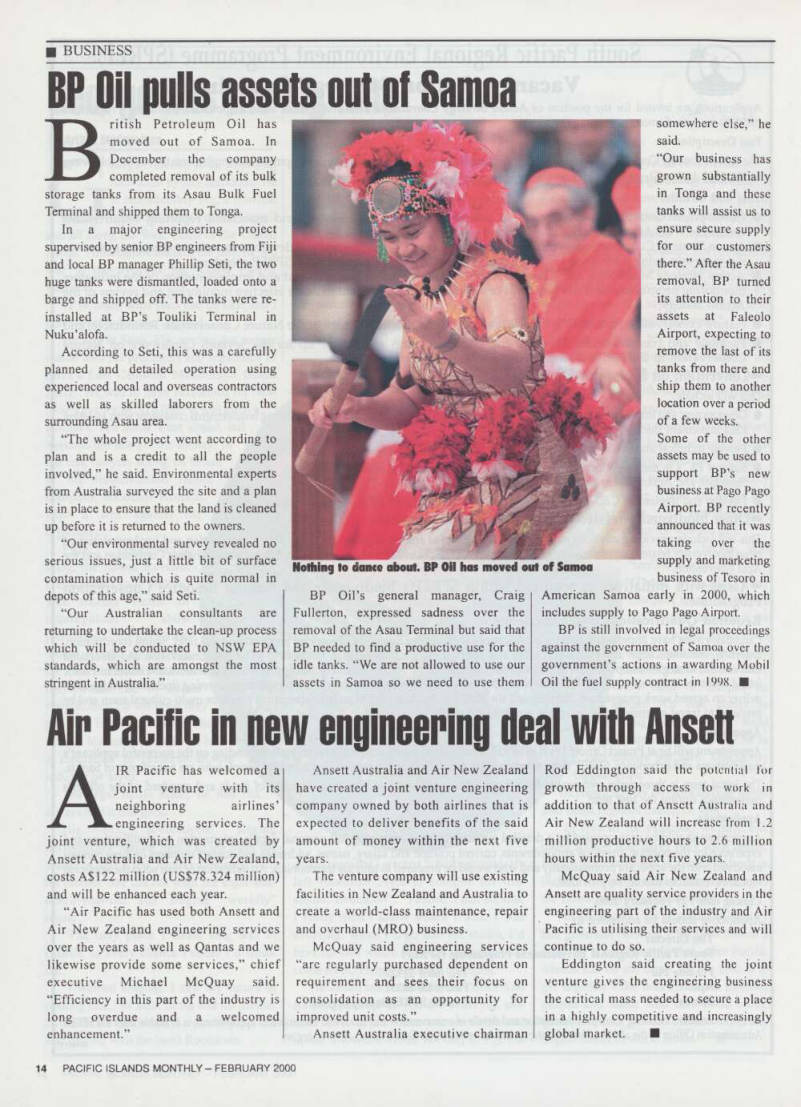
Nothing to dance about. BP Oil has moved out of Samoa
Air Pacific in new engineering deal with Ansett
AIR Pacific has welcomed a joint venture with its neighboring airlines’ engineering services. The joint venture, which was created by Ansett Australia and Air New Zealand, costs ASI22 million (U 5578,324 million) and will be enhanced each year.
“Air Pacific has used both Ansett and Air New Zealand engineering services over the years as well as Qantas and we likewise provide some services,” chief executive Michael McQuay said.
“Efficiency in this part of the industry is long overdue and a welcomed enhancement.”
Ansett Australia and Air New Zealand have created a joint venture engineering company owned by both airlines that is expected to deliver benefits of the said amount of money within the next five years.
The venture company will use existing facilities in New Zealand and Australia to create a world-class maintenance, repair and overhaul (MRO) business.
McQuay said engineering services “are regularly purchased dependent on requirement and sees their focus on consolidation as an opportunity for improved unit costs.”
Ansett Australia executive chairman
Rod Eddington said the potential for growth through access to work in addition to that of Ansett Australia and Air New Zealand will increase from 1.2 million productive hours to 2.6 million hours within the next five years.
McQuay said Air New Zealand and Ansett are quality service providers in the engineering part of the industry and Air Pacific is utilising their services and will continue to do so.
Eddington said creating the joint venture gives the engineering business the critical mass needed to secure a place in a highly competitive and increasingly global market. ■
Advertisements & other items, p. 15 (1 item)
Programme
(2B
South Pacific Regional Environment
(SPREP)
Vacancy: Project Officer Marine Species
Programme
Applications are invited for the position of Project Officer Marine Species with the South Pacific Regional Environment Programme (SPREP) in Apia, Samoa.
Post Description The Project Officer Marine Species will work under the direction of the Director of SPREP to assist member countries and territories coordinate development and implementation of the following: ■♦Plan oversee and facilitate the activities of the Regional Marine Turtle Conservation Programme
(RMTCP).
This will include: • Development and implementation of an annual work plan and budget and associated reporting requirements consistent with the RMTCP strategy; • RMTCP network co-ordination which provides for turtle database services, tagging programme, information exchange, international co-operation, training opportunities and securing of resources to implement the programme; • Development and implementation of in-country turtle conservation management initiatives in partnership with RMTCP network members (government and non government agencies); • Development of education and awareness resources for turtle conservation; and • Facilitating the RMTCP networks' review process, including regional workshops ■♦Plan oversee and facilitate the activities of the Regional Marine Mammal Conservation Programme
(RMMCP).
This will include: • Development and implementation of an annual work plan and budget and associated reporting requirements consistent with the objectives of the RMMCP; • RMMCP network co-ordination which provides for advisory services, information exchange, international co-operation, training opportunities and securing of resources to implement the programme. • Development and implementation of in-country marine mammal conservation management initiatives in partnership with RMMCP network members (government and non-govemment agencies). This will include continuation of existing projects such as the Tonga Whale Watching project; and • Development of education and awareness resources for marine mammal conservation. m Assist with and provide advice on the development of conservation initiatives for other marine species at the request of SPREP members and as resources allow; m Assist the South Pacific Biodiversity Conservation Programme Conservation Area Programme in addressing turtle and marine mammal species issues in these areas; ■» Ensure effective linkages are made with other SPREP marine programmes and initiatives, particularly the Coastal Management Programme and Coral Reef and Wetland Programme; and ■* Assist with initiatives as required within SPREP's Biodiversity and Natural Resource Conservation Programme.
Required Qualifications and Experience Candidates must be Pacific Islanders and have appropriate tertiary qualifications with at least five years of working experience in this field. Sound co-ordination, communication and facilitation skills and relevant technical knowledge in the field of turtle conservation and/ or marine mammal species is required. An appreciation of conservation issues in Pacific Island countries is also essential. Candidates must also have the ability or potential to; undertake work programme planning (including budgeting); deliver on agreed work programme outputs; and the ability to work as part of an inter-disciplinary and/or multi-cultural team and be prepared to travel extensively in the region. Training opportunities in the fields of marine mammal and turtles will be made available to the successful candidate.
Appointment
Appointment will be at Project Officer Level of SPREP's authorised salary scale for contract staff, depending on successful applicant's qualifications and experience. SPREP remuneration is tax free in Samoa for non-residents and for people who are not citizens of Samoa.
The initial term is three years, renewable for a further three years depending on availability of funds and standard of the officer's performance during the first term.
Applications
Applications should be accompanied by a detailed curriculum vitae containing full personal details, information on qualifications and experience for the position, previous appointments, current position and salary, names, addresses and contact numbers of three persons associated with the applicant professionally and who would be prepared to provide testimonials. An indication of how soon the applicant would be available should be indicated.
Closing Date: 29 February 2000.
Applications should be addressed to: The Director South Pacific Regional Environment Programme (SPREP) FO Box 240 Tel: (685) 21929 Apia Fax: (685) 20231 Samoa E-mail: [email protected]. ws Further information, including a full post description and details of remuneration and terms and conditions of appointment,, is available from the SPREP Administration Officer at the above address/contact numbers or via direct Email:[email protected] “ 1047g0y
Only unleaded fuel now sold in PNG
PAPUA New Guinea’? oil industry has taken a major step towards safeguarding the environment by choosing to sell only unleaded fuel in the country. And some of the country’s major car dealers are happy with the move.
Oil industry majors made the
announcement early January in public notices saying they had decided to sell only unleaded fuel as from January 1. The companies said the use of leaded petrol was not necessary any more.
“By using unleaded petrol, you will gain the advantage of having a cleaner operating engine resulting in increased life of spark plugs, exhaust pipes and engine oil. The shift will help reduce harmful levels in the
atmosphere.
“The only physical change the public will notice during this transition is that the color of motor spirit will change from red to purple,” the notice said.
The automobile companies said they supported the change and saw no drastic effects, to their trading, sales or otherwise.
According to the oil companies - which include BHP, Mobil, Niugini Oil Company
and Shell - the unleaded conversion is to bring the country in line with worldwide and regional trends in improving air quality.
The oil industry said the car dealers in the country had been informed and had accepted
the change.
PNG Motors general manager Rob Shiel
said the conversion from leaded fuel to unleaded had been done in Bangladesh and an African country and was in line with regional and international trends. He said many countries were involved in the transition and PNG was following that.
Shiel said PNG Motors saw nothing which would be negative from the change.
He said the only problem that may appear would be for very old cars that would have to make adjustments. He said there would be few such cars around.
Boroko Motors branch manager Kevin Eckersley said the conversion would not affect the sale of vehicles but would bring the old and new vehicles in line.
Eckersley said the change was for the better because it was a move to reduce pollution and, specifically, lead in the air and the environment. “The change is seen as an
advantage. Pollution will not be so bad for the environment as well as for people.
Adjustments will have to be made and old cars will have to be tuned,” he said.
Eckersley said car owners would spend some money to make the adjustments, but it would not be much. Shell retail manager and
spokesman of the oil companies, Tim Lai, said that the conversion of petrol and outboard motor fuel to unleaded fuel was in line with world trends to improve air quality by reducing exhaust fumes.
Lai said the conversion had been done by reducing the lead content in petrol from 96 per cent to 92 per cent. He said that all vehicles, which were manufactured in the past 15 years, had been designed to run on leaded as well as unleaded fuel.
He said only very old cars would need to make adjustments, and should speak with their local car dealers or the Motor Traffic office.
Lai said that the owners of old cars will need to see their local car dealers and get their cars fitted with lead injectors, which will inject lead into their car systems. He said the oil companies hoped to help as much as they could. (Post Courier) ■
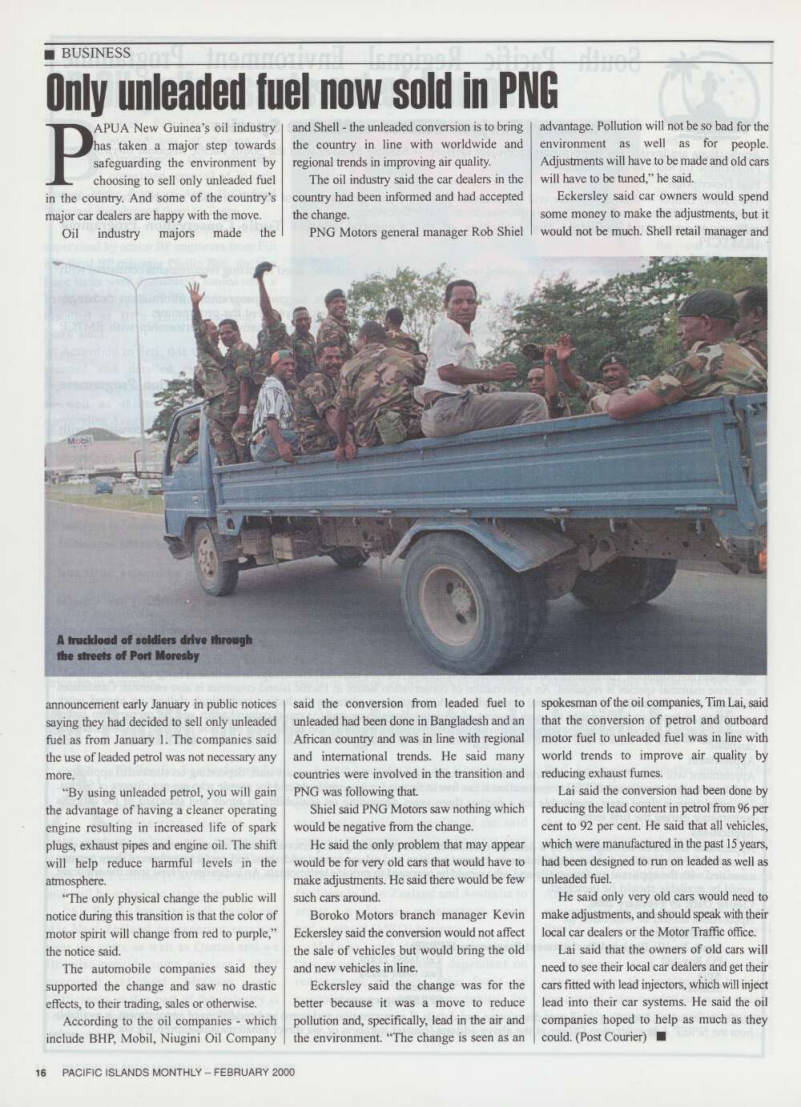
A truckload of soldiers drive through the streets of Port Moresby
Disney looks at sites for big-budget Pearl Harbor movie
The live-action picture about
the WWII attack is budgeted
at $145 million
WALT Disney studio
executives have begun scouting locations at the Pearl Harbor Naval Base for a Michael Bay-Jerry Bruckheimer film about the 1941 attack that, with its $145 million budget, is being called the most expensive live-action movie in motion picture history.
Bay, who directed “Armageddon” and “The Rock,” and Bruce Hendricks, president of physical production for the Walt Disney Motion Pictures Group, were in Honolulu in December with two other Disney executives.
The film, tentatively titled “Pearl Harbor,” was given the green light by Disney in November, reportedly with an “officially sanctioned $145 million budget” - $lO million more than “Armageddon,” which until now had the highest budget ever. Other films have cost more, including the $2OO million “Titanic” and $lB5 million “Waterworld,” but those pictures originally were budgeted for less.
“Pearl Harbor” will be written by Oscar nominated screenwriter Randall Wallace, who wrote “Braveheart.” Sources said that film production in Hawaii is expected to begin in the spring. Jerry Bruckheimer, with his late partner Don Simpson, made several financially successful films, including “Flashdance,” “Top Gun” and “Crimson Tide.” The production team looked at several facilities at Pearl Harbor.
They were accompanied by two officers from a Navy office in Los Angeles that serves as liaison with the entertainment industry, who came to escort the production team while on the base. Lt. Cmdr. Rod Gibbons, Navy public affairs officer at Pearl Harbor, was the local liaison. Also accompanying the group was Randy Spangler, Hawaii’s top location coordinator.
Despite the reputation of Bay and producer Bruckheimer for making successful big-budget films, Disney backed off from its initial enthusiasm, leading to weeks of discussion, according to sources.
Entertainment trade papers in Los Angeles reported the film’s original budget was as high as $2OO million, before being cut to about $154 million and then to $145 million.
Bay told the Star-Bulletin in September that the movie’s budget would be $lOO million to $125 million.
Bay said the film’s expense is due to some 300-plus highly technical special effects that will be used. Much the film’s special effects, including the sinking of the USS Oklahoma, will be shot at Fox’s Baja Studio, where “Titanic” was filmed.
Bay has insisted on completely re creating the Japanese attack on Pearl Harbor, which pushed the United States into World War 11. The director said he wants to use “a lot of live explosions” rather than just computer-generated ones, including taking “real ships and twisting them up and through the air.”
He had hoped for top-dollar actors such as Gene Hackman and Gwyneth Paltrow but, because of the cut in the film’s budget, will have to find stars without A-list salaries, sources said.
According to the Hollywood Reporter, part of the negotiations with Bay and Bruckheimer ended with the pair having to make several financial concessions to get their picture made, including neither of them receiving their regular first-dollar gross deal.
Their back-end participation also will be less than on previous pictures. And they also will be held personally responsible for budget overruns, the publication reported.
The story of “Pearl Harbor” begins months before the December 7, 1941, Japanese attack, and focuses on two brothers who love the same woman. One brother stays in America in the US Air Corps, and the other travels overseas to fight in the United Kingdom.
Bay said he and writer Wallace in June began interviewing veterans of the Pearl Harbor attack.
“Tennessee” was used as a code name for the film to prevent information about it from getting out, as happened with “Armageddon.” When word leaked out about that project, Dream Works and Paramount quickly put a similar story into production: “Deep Impact.”
Navy officials in Los Angeles must review and approve the “Pearl Harbor” script before granting permission for the production to film on a Navy base or lending other support.
Georgette Deemer, the state’s Film Office manager, and Walea Constantinau, Honolulu’s film commissioner, also met with the production executives during their stay.
Neither Bay nor Hendricks immediately returned several messages left at their Honolulu hotels. ■
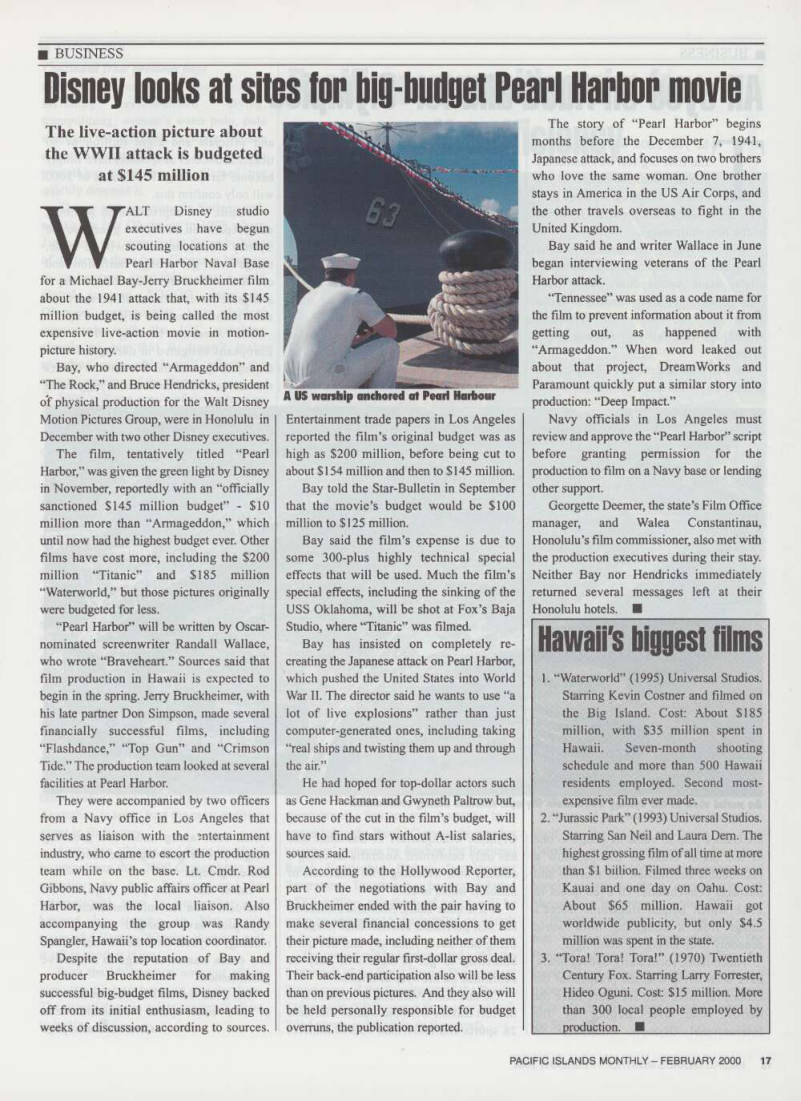
A US warship anchored at Pearl Harbour
Hawaii's biggest films
1. “Waterworld” (1995) Universal Studios.
Starring Kevin Costner and filmed on the Big Island. Cost: About $lB5 million, with $35 million spent in Hawaii. Seven-month shooting schedule and more than 500 Hawaii residents employed. Second most expensive film ever made. 2. “Jurassic Park” (1993) Universal Studios.
Starring San Neil and Laura Dem. The highest grossing film of all time at more than $1 biilion. Filmed three weeks on Kauai and one day on Oahu. Cost: About $65 million. Hawaii got worldwide publicity, but only $4.5 million was spent in the state. 3. “Tora! Tora! Tora!” (1970) Twentieth Century Fox. Starring Larry Forrester, Hideo Oguni. Cost: $l5 million. More than 300 local people employed by production. B
All eyes on Australia for Olympics

The year 2000 will go down as the first big test of Australia’s international reputation as the rest of the world watches how well the country runs the first Olympics of the new millennium.
Will the Sydney Olympics be like the last games in Atlanta which made the city’s name synonymous with poor organisation and punctured many illusions about the superiority of American technology and skills in staging major events?
Or will it be like the last Olympics in a seaside city - Barcelona in 1992 - where
the Games help to boost its image to one of the major cities in Europe, now a fashionable destination for tourists and business conventions? Or even Seoul in 1988 which helped transform Korea’s image from a struggling third world economy to an emerging Asian tiger.
Australians, particularly Sydneysiders, have been living with the prospect of the Games for more than six years since the narrow vote over Beijing by the International Olympic Committee in
Monte Carlo in September 1993. But the rest of the world will focus on Sydney for a few brief weeks - maybe less- and pass their judgement on the country under the glare of the international media.
If the rest of the world judges Australia as having done a good job, the Games will go down as a major step in Australia’s efforts to assert itself as a serious player on the world stage - and in its own struggle for identity.
The amazing sensitivity over who should utter the few words opening the Games at the Olympic Stadium on September 15 has raised eyebrows in the
Olympic headquarters in Lausanne and has only confirmed Australia as being a country still wrestling with what sort of nation it wants to be.
If it is done badly, Australia’s outdated but still persistent international image of being laid back, work shy and not quite bothering to get it right will only be confirmed on the eyes of critics.
On this score Australia is vulnerable to the fact that the Olympic Games with their 28 sports and more than 15,000 athletes
and officials and eight million or so tickets and scores of sponsors have simply become far too big. The Games of 2000 will only confirm this.
Despite the unprecedented planning
and preparation which has gone into the Sydney Games, mistakes will be made, things will go wrong, confusion and crowds will be the order of the day alongside the excitement of the sport and other events around the Olympic City.
The America bashing which the Europeans delighted in during the 1996 Olympics ignored the fact that the Games themselves have become a juggernaut
which rolls along under the groaning weight of ever growing expectations and interest groups.
Under the twenty year reign of lOC President Juan Antonio Samaranch, the Olympics have changed from a loss making, boycott-tarnished event which few cities wanted to stage to a massive
phenomenon.
The 2000 Games has seen the addition of two new sports - triathlon and
Continued next page
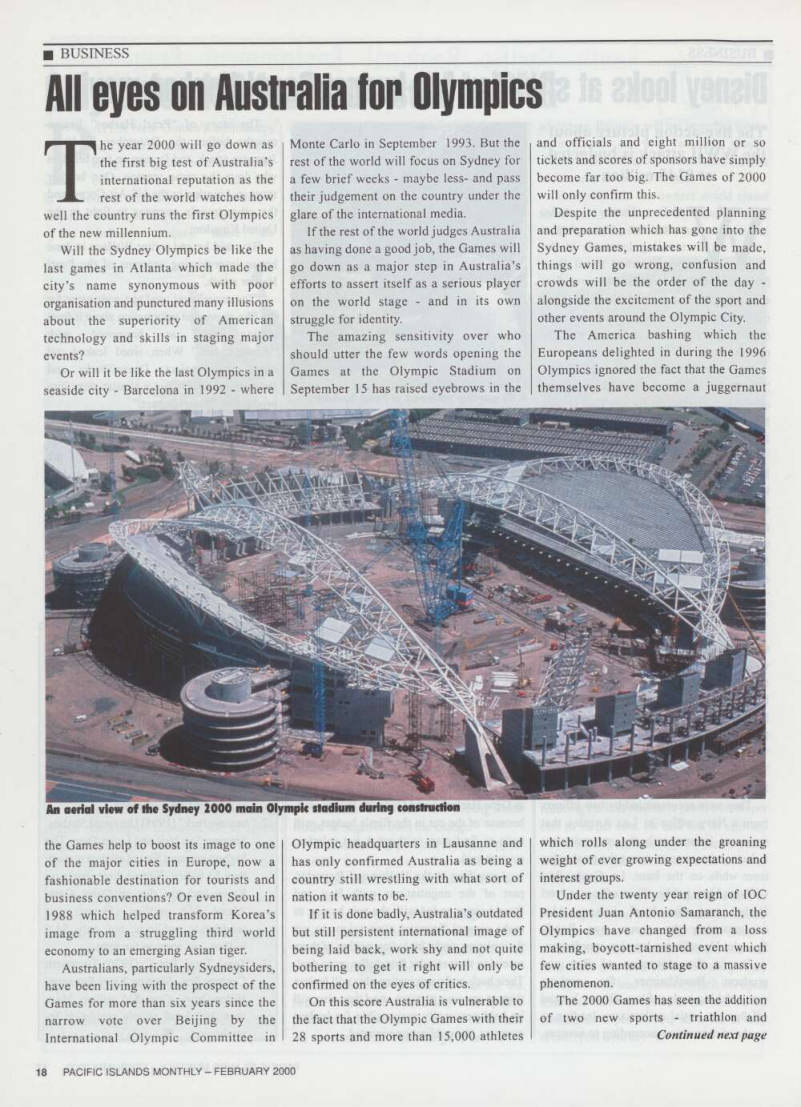
An aerial view of the Sydney 2000 main Olympic stadium during construction
Continued from previous page
taekwondo - and many more events including synchronised diving, trampolining, women’s water polo, pole vault and weightlifting. Samaranch made a half- hearted attempt to drop modern pentathlon after the last Games but quickly dropped it.
Things will go wrong in Sydney and, unlike the last Olympics in 1998 where Japan Inc. was prepared to throw billions of dollars at the winter Games in Nagano to make sure everything was a gold plated success, SOCOG starts the Olympic year under tight budget constraints with the lOC watching closely to see that it doesn’t make spending cuts which will affect the smooth running of the Games. 2000 will see a mix of rising tension in Sydney as the date of the opening ceremony approaches - a highly-charged combination of further controversies and bungles and last minute construction and preparation - and rising excitement around the country as the interest in Australia’s athletes and the realisation across sports mad Australia that their country is actually about to host the next Games starts to kick in.
The lOC’s own survey of the press leading up to the Atlanta Games shows a string of potential crisis issues which will resurface in Sydney in different shapes this year - Atlanta Battles with Violent Image; Organisers Late with City Payment; Olympic Officials Take Legal Action Against Counterfeit Olympic Merchandise; Olympic Protests Target Mayor Over Housing, Homeless; Atlanta Firms Warned of Olympic Threats.
But alongside all this will be the inescapable fact that Sydney - and Australia - is set to host the most exciting event in its history.
Australian athletes and those involved in organising the 2000 Games have the capacity to put Sydney on the international map in September and beyond by staging an historically successful Games. Whether they can pull it off is another thing.
With the Millennium now out of the way, it’s time to hang on to your hats.
The giant Olympic roller coaster is about to begin. ■
energy self-sufficiency
Pacific communities aim for energy self-sufficiency
Energy is essential for socio economic development; yet, as the 21st century dawns, at least 70 per cent of the Pacific region’s population has no access to electricity.
Renewable energy technologies, in particular solar photovoltaic and wind energy, have the potential to change all this, improving the quality of life and facilitating economic development. France and Australia have responded to the Pacific Community member countries’ requests by funding the Regional Rural Renewable Energy Development Programme. Together they have contributed A 53.5 million, two-thirds of which will be spent on equipment to be installed on islands in the region.
The project will be implemented within the framework of the Rural Energy Development Programme of the Secretariat of the Pacific Community (SPC) over a three-year period.
Wind energy is definitely on the agenda.
According to Patrice Courty, leader of the SPC programme, “conditions in the southern Cook Islands make it possible to consider using hybrid ‘diesel-wind turbine’ systems, thereby bolstering the energy self-sufficiency of these islands. The feasibility study for wind eneigy we completed in collaboration with the Vergnet Company, at the request of the Cook Islands, showed good results.”
Copra oil as a bio-fuel, which has proven itself on the island of Ouvea in New Caledonia, will be introduced to the Lau Island Group in Fiji. A 90 kVA electric generator will supply power to three communities on Vanuabalavu beginning in January 2000.
Hybrid electrification - solar/copra as a bio fuel - is being studied in the north Pacific. The Pohnpei government is considering the combined use of these two energy sources as a means for improving energy situation in some of its islands. This project is under study with the SPC. ■
Twenty windmills in a 20-metre-tall structure generate electricity in Japan
Irian Jaya seeks Freeport mine contract review
Irian Jaya governor Freddy Numberi has called for a review of the contract with PT Freeport Indonesia, saying that the local people had yet to fully benefit from the operation of the giant American mining company in the province.
In a meeting with representatives of the Irian academia in Jayapura, Numberi, however, rejected their demand that the contract with Freeport, which has a huge
gold and copper mining operation there,
be rescinded
altogether, Antara reported.
“You cannot simply revoke the contract because this will affect the international credibility of the Indonesian government. What we can do is to review the terms of the contract to give more benefits to the people of Irian Jaya,” he said.
He appealed to the people in Irian Jaya, particularly to students, to show restraint,
saying that
Freeport had a
legitimate contract to operate in the hinterland regency of Timika.
Timika has been the scene of many demonstrations, some of them violent, protesting against the presence of Freeport or against the environmental damage it causes. Security forces have been accused of human rights abuses in their dealings with protesters. Numberi warned that so many atrocities had been committed in Timika that there could be even worse trouble ahead unless the company heeded the complaints of the people.
A leading member of the House of Representatives, Amin Aryoso, also proposed ‘reforming’ the Freeport contract.
Speaking during a working visit to Timika, Amin was quoted by Antara as saying that Freeport’s operation in the area had produced “social costs,” reflected by the negative reaction of the local people, which had not been covered by the contract.
Amin, chair of the House’s Commission II for home and legal affairs, was visiting the area along with other members of his commission and that of Commission I, which oversees foreign, defense and
political affairs. He proposed the Freeport contract be reviewed to give the people a greater sense of belonging of their own resources.
This, he said, would be a win-win solution because Freeport in turn could operate without interruptions.
Asrid S. Susanto, deputy of the House’s Commission I, said Freeport must strive to provide jobs for the local people, so that they would not feel uprooted from their own land.
Numberi, who is also state minister for state administrative reforms, said Freeport and other big companies operating in Irian Jaya had not given any real benefit to the people.
“They came here to exploit the riches of the Land of the Bird of Paradise (Irian Jaya) without giving any regard to the well-being of the local people. That is why the people of Irian remain poor amid the province’s wealth,” he said.
He said he was personally hurt by Freeport’s neglect of his people. “The company has operated in Irian Jaya for 23 years, reaping huge profits, yet it has done little for the people.”
Freeport had not contributed to improving
the skills of the local people; while it had employed many local people in its operation, not a single Irianese served in management, he noted. ‘i’ll take my hat off
to Freeport
management if it succeeds in employing Irianese sons and daughters as managers, and if it finances dozens of Irianese to study for master’s and postgraduate degrees,” the retired Navy rear admiral said.
“The fact that it has
not done so to this day really hurts my feelings as governor,” he added.
Freeport was not a ‘Santa Claus’ when it gave royalties, amounting to one per cent of its gross sales, for the economic development of the Timika region, he said.
The company pays between Rp 300 billion (US$43 million) and Rp 400 billion a year in royalties to the local government. “That money was Freeport’s obligation in return for occupying the land and exploiting the mining resources, for causing environmental destruction and for destroying the forests in which people used to hunt for their food,” Numberi said. (Kabar Irian Trian News’) ■
Gold bugs look to new millennium for fresh start
For gold bugs, 1999 was the worst of times, it was the best of times ... but mostly it was the worst of times.
After continuing its long decline to plumb 20-year lows for much of that year, a late September commitment from key European central banks to limit lending and cap official sales suddenly reminded the market of the adrenaline surge only a gold rush can generate.
In the space of two weeks, spot prices ignited and shot from US$255 per ounce to a stellar US$33B an ounce as major hedge funds and international speculators scrabbled to cover massive short positions.
From talking the sector down, analysts overnight began to talk up the prospects for a new golden dawn marked by prices north of US$35O an ounce.
Gold would not return again to the lows of mid-1999 for the foreseeable future, they said. Consequently, gold stocks ran the world over and majors and minors alike began dusting off shelved development and exploration plans.
Now, just months later, the lustre is gone again and bullion is back where it started 1999, locked in a range around US$29O an ounce.
Most analysts are now predicting that bullion will remain highly volatile for the medium term as the same old bogeys - the overhang of central bank reserves and the activities of major hedge funds continue to shadow the market.
But most also agree that there is some hope for a breakout above US$3OO per ounce and that a new floor has been set around US$2BO.
CIBC Eyres Reed analyst John Macdonald said there was as yet no indication that the huge short positions that folded in September were being rebuilt, which bode well for medium term price prospects.
“WeTl just have to wait and see the figures ... but we’re still hoping US$32O - is achievable in the first quarter of (this) year,” he said.
Macquarie Bank’s James Mactier was
more bullish, suggesting bears stung by the September surge would be keen to avoid a repeat dose.
“Having been at US$33B an ounce just (a few) months ago, people are going to be very reluctant to initiate big short positions down at these sort of levels - the recovery is still well within people’s memories,” he said.
Bell Securities analyst Keith Goode tipped a trading range of USS2BO-320, but warned that the only safe assumption would be to “expect the unexpected.”
“Just about anything is possible ... because gold doesn’t obey normal rules,” he said. “But the key question remains whether central banks will allow gold to trade above US$32O an ounce ... which they will perceive as inflationary.”
While the September bank commitment was a positive gesture, Goode said the European Central Bank had clearly indicated that it was happier with gold at US$29O “purely and simply because that’s the price at which the Euro was formed.”
And when margin calls threatened to bankrupt Ashanti Goldfields, and with it the entire Ghanaian economy, banks aggressively intervened to peg gold back.
On the corporate front, 1999 will be remembered for two key developments the effective arrival of South African predators, and the headlong rush by junior explorers into cyberspace in a bid to remain afloat.
Early in the year, ambitious South African tailings outfit Durban Roodepoort Deeps Ltd unveiled plans to establish a 500,000 ounces a year Australasian base, soon followed by the world’s largest gold miner, Anglo Gold.
DRD was the first to move, making two unsuccessful raids on Fiji’s Emperor Mines, before winning control of NSW gold-copper producer Hargraves Resources, acquiring a 19.9 per cent stake in PNG miner Dome Resources and tying up the purchase of the Rawas gold mine in Indonesia.
Making bigger waves was Anglo Gold,
which trumped a $570 million bid by Delta Gold NL for its Sunrise Dam neighbour Acacia Resources with $B3O million worth of Anglo paper.
The ranks of major Australian producers have now been culled to virtually five stocks - Normandy Mining, Newcrest Mining, Delta, Sons of Gwalia and Lihir Gold - and most analysts are tipping a fresh round of predator activity is imminent, again led by Anglo Gold.
Meanwhile the emergence of attractive low-cost middle tier producers like Hill 50 Gold, PacMin Mining Corp, New Hampton Goldfields, Ross Mining and Ranger Minerals could also drive renewed corporate activity.
The much awaited rationalisation of the junior end too gained pace during the year, with Croesus Mining offering $2O million for Kalgoorlie neighbour Gilt- Edged Mining, immediately after heading off a boardroom coup aimed at ramming through a merger with New Hampton.
Ironically, the jump into cyberspace could spawn a whole raft of new gold floats in 2000. “There are now a lot of Internet companies with a lot of gold assets inside them for which they are going to get zero value,” Goode said.
“So it’s fairly logical for them to do anin-species distribution and spin them out - depending on the gold price of course.”
But one trend that will continue to worry miners is a dramatic drop off in exploration spending, resulting in nine successive quarters of decline.
By late December, official estimates put quarterly gold exploration spending in Australia at just $101.5 million, 45 per cent less than the June 1997 peak.
As one explorer asked AAP - “If we don’t put the money in the ground now, then where are the next batch of mines going to come from when reserves run out in five years time?”
And funds for explorers are not likely to flow at least until gold can keep its nose above the critical US$3OO an ounce barrier for a sustained period. (AAP) ■
Sacrifices for stardom

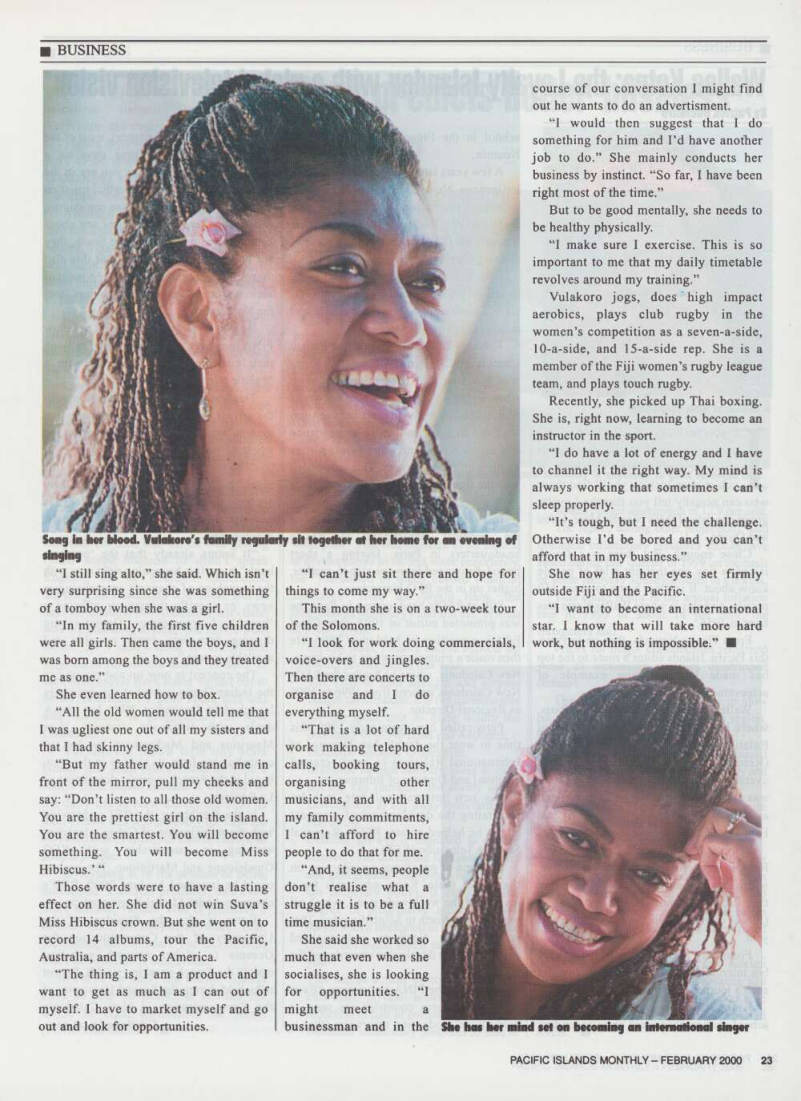
By Arthur McCutchan
Behind the apparent glamour and attractions of successful musicians, is the sacrifice and pain they go through. For Fiji singer, Laisa Vulakoro, it still takes a lot of hard work.
On a humid Wednesday afternoon Vulakoro arrives sweaty, hot and in a bad mood. She has just come back from the movies with nine children; she hasn’t had time to go to the bank; she missed her training; she lost an 18-carat gold saxophone pendant; her boyfriend has gone to Papua New Guinea for business and she misses him terribly; and now, an interview.
“This is the first time for me to miss him so badly like this,” she said. “I’m not supposed to miss him because I’m not supposed to be weak.” Usually she would drown herself in work and she wouldn’t miss anyone.
Not this time.
“I look after 10 people. And to provide breakfast, lunch and dinner for them, and to pay for everything else on top of that, takes a lot of hard work.”
But after two glasses of red wine she relaxes - the Vulakoro that people see on stage is back.
She had always wanted to be a singer.
“Even as a young girl in primary school, when the teacher would ask us what we wanted to be when we grew up, the others would say they wanted to be teachers or nurses or policemen.
“I would always say I wanted to be a star.
“Then they’d ask me what I meant and I’d say I wanted to be a singer.
“For me, stars were also those things that lit up the sky at night, but I decided I would get up there somehow.”
Her father , a choir master, wanted her to become a nurse or teacher, anything, as long as she worked for the Government.
“My parents can’t speak English and in the village, if one of your children works for Government, it becomes a very big thing. People would be proud of that.
“But I just wanted to sing. I think my father nearly died when I ran away from school to sing for the first time.”
When she became known and work rolled in, she would take her parents to some of the hotels and resorts she sang at. “I would introduce my father to the hotel managers, their wives and all the top people there.
“When we’d go home, I would ask him how things went and he’d say: ‘Fine.
But I hope you’ll get a real job.’ “ But those were the early days. “He
eventually came around,” she said.
They continue a family tradition - the whole family gets together at her home and they harmonise.
“In my home singing was very important. At times, it seemed even more important than studies because in the evening, my father would call us together, pull out his guitar and we’d all sing.”
There were 12 brothers and sisters in the family and each knew what scale to take.
Reach for the stars. Laisa Vulakoro still aims high
“I still sing alto,” she said. Which isn’t very surprising since she was something of a tomboy when she was a girl.
“In my family, the first five children were all girls. Then came the boys, and I was bom among the boys and they treated me as one.”
She even learned how to box.
“All the old women would tell me that I was ugliest one out of all my sisters and that I had skinny legs.
“But my father would stand me in front of the mirror, pull my cheeks and say: “Don’t listen to all those old women.
You are the prettiest girl on the island.
You are the smartest. You will become something. You will become Miss Hibiscus.’ “ Those words were to have a lasting effect on her. She did not win Suva’s Miss Hibiscus crown. But she went on to record 14 albums, tour the Pacific, Australia, and parts of America.
“The thing is, I am a product and I want to get as much as I can out of myself. I have to market myself and go out and look for opportunities.
“I can’t just sit there and hope for things to come my way.”
This month she is on a two-week tour of the Solomons.
“I look for work doing commercials,
voice-overs and jingles.
Then there are concerts to organise and I do everything myself.
“That is a lot of hard work making telephone calls, booking tours, organising other musicians, and with all my family commitments, I can’t afford to hire people to do that for me.
“And, it seems, people don’t realise what a struggle it is to be a full time musician.”
She said she worked so much that even when she socialises, she is looking for opportunities. “I might meet a businessman and in the
course of our conversation I might find out he wants to do an advertisment.
“1 would then suggest that I do something for him and I’d have another job to do.” She mainly conducts her business by instinct. “So far, I have been right most of the time.”
But to be good mentally, she needs to
be healthy physically.
“I make sure I exercise. This is so important to me that my daily timetable revolves around my training.”
Vulakoro jogs, does high impact aerobics, plays club rugby in the women’s competition as a seven-a-side, 10-a-side, and 15-a-side rep. She is a member of the Fiji women’s rugby league team, and plays touch rugby.
Recently, she picked up Thai boxing.
She is, right now, learning to become an instructor in the sport.
“I do have a lot of energy and I have to channel it the right way. My mind is always working that sometimes I can’t
sleep properly.
“It’s tough, but I need the challenge.
Otherwise I’d be bored and you can’t afford that in my business.”
She now has her eyes set firmly outside Fiji and the Pacific.
“I want to become an international star. I know that will take more hard work, but nothing is impossible.” ■
Song in her blood. Vulakoro's family regularly sit together at her home far an evening of singing
She has her mind set on becoming an international singer
Walles Kotra: the Loyalty Islander with a global television vision
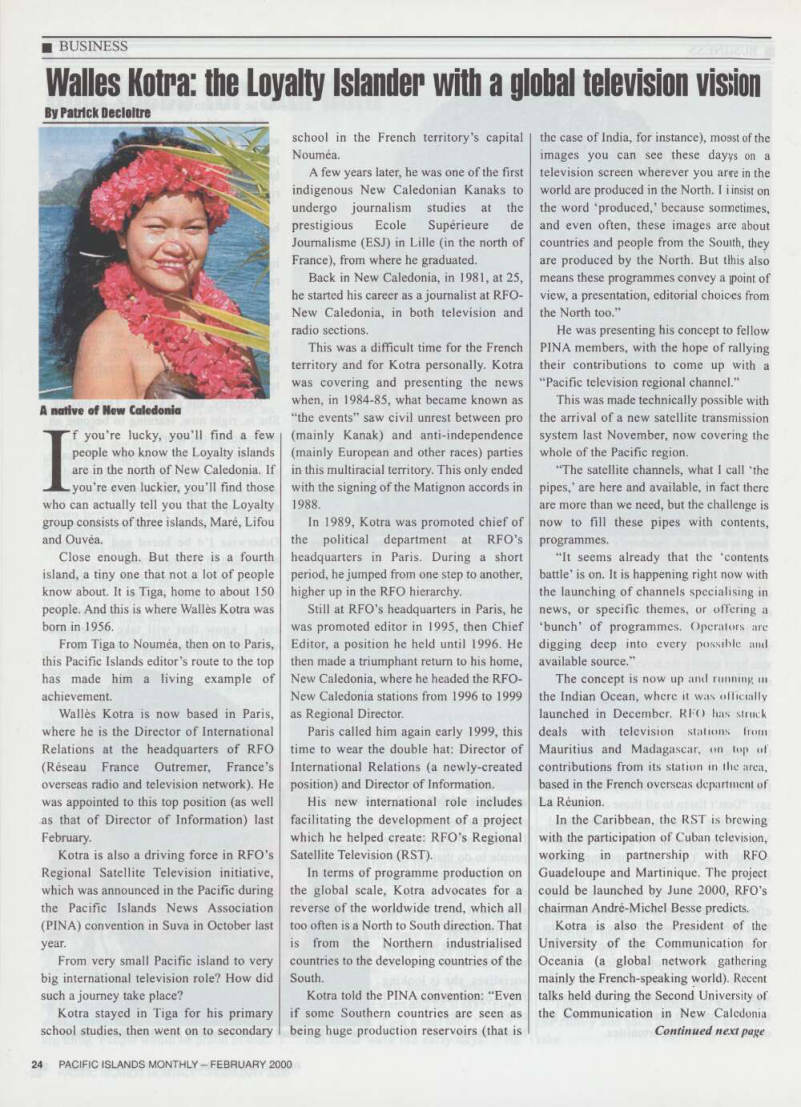
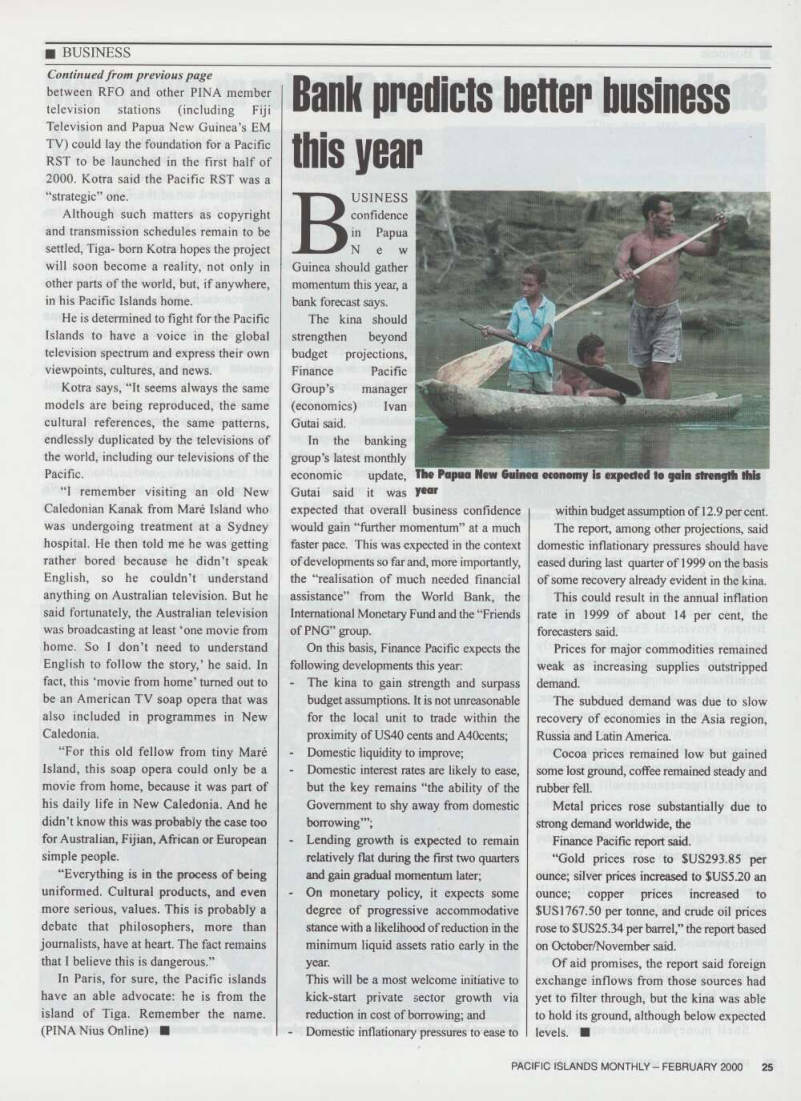
By Patrick Decloltre
If you’re lucky, you’ll find a few people who know the Loyalty islands are in the north of New Caledonia. If you’re even luckier, you’ll find those who can actually tell you that the Loyalty group consists of three islands, Mare, Lifou and Ouvea.
Close enough. But there is a fourth island, a tiny one that not a lot of people know about. It is Tiga, home to about 150 people. And this is where Walles Kotra was bom in 1956.
From Tiga to Noumea, then on to Paris, this Pacific Islands editor’s route to the top has made him a living example of achievement.
Walles Kotra is now based in Paris, where he is the Director of International Relations at the headquarters of RFO (Reseau France Outremer, France’s overseas radio and television network). He was appointed to this top position (as well as that of Director of Information) last February.
Kotra is also a driving force in RFO’s Regional Satellite Television initiative, which was announced in the Pacific during the Pacific Islands News Association (PINA) convention in Suva in October last year.
From very small Pacific island to very big international television role? How did such a journey take place?
Kotra stayed in Tiga for his primary school studies, then went on to secondary
school in the French territory’s capital Noumea.
A few years later, he was one of the first indigenous New Caledonian Kanaks to undergo journalism studies at the prestigious Ecole Superieure de Joumalisme (ESJ) in Lille (in the north of France), from where he graduated.
Back in New Caledonia, in 1981, at 25, he started his career as a journalist at RFO- New Caledonia, in both television and radio sections.
This was a difficult time for the French territory and for Kotra personally. Kotra was covering and presenting the news when, in 1984-85, what became known as “the events” saw civil unrest between pro (mainly Kanak) and anti-independence (mainly European and other races) parties in this multiracial territory. This only ended with the signing of the Matignon accords in 1988.
In 1989, Kotra was promoted chief of the political department at RFO’s headquarters in Paris. During a short period, he jumped from one step to another, higher up in the RFO hierarchy.
Still at RFO’s headquarters in Paris, he was promoted editor in 1995, then Chief Editor, a position he held until 1996. He then made a triumphant return to his home, New Caledonia, where he headed the RFO- New Caledonia stations from 1996 to 1999 as Regional Director.
Paris called him again early 1999, this time to wear the double hat: Director of International Relations (a newly-created position) and Director of Information.
His new international role includes facilitating the development of a project which he helped create: RFO’s Regional Satellite Television (RST).
In terms of programme production on the global scale, Kotra advocates for a reverse of the worldwide trend, which all too often is a North to South direction. That is from the Northern industrialised countries to the developing countries of the South.
Kotra told the PINA convention: “Even if some Southern countries are seen as being huge production reservoirs (that is
the case of India, for instance), mosst of the images you can see these dayys on a television screen wherever you anre in the world are produced in the North. I i insist on the word ‘produced,’ because somnetimes, and even often, these images arte about countries and people from the Souith, they are produced by the North. But tlhis also means these programmes convey a point of view, a presentation, editorial choices from the North too.”
He was presenting his concept to fellow PINA members, with the hope of rallying their contributions to come up with a “Pacific television regional channel.”
This was made technically possible with the arrival of a new satellite transmission system last November, now covering the whole of the Pacific region.
“The satellite channels, what I call ‘the pipes,’ are here and available, in fact there are more than we need, but the challenge is now to fill these pipes with contents, programmes.
“It seems already that the ‘contents battle’ is on. It is happening right now with the launching of channels specialising in news, or specific themes, or offering a ‘bunch’ of programmes. Operators arc digging deep into every possible and available source.”
The concept is now up and running in the Indian Ocean, where it was officially launched in December. RIO has struck deals with television stations from Mauritius and Madagascar, on top of contributions from its station in the area, based in the French overseas department of La Reunion.
In the Caribbean, the RST is brewing with the participation of Cuban television, working in partnership with RFO
Guadeloupe and Martinique. The project
could be launched by June 2000, RFO’s chairman Andre-Michel Besse predicts.
Kotra is also the President of the University of the Communication for Oceania (a global network gathering mainly the French-speaking world). Recent talks held during the Second University of the Communication in New Caledonia
Continued next page
A native of New Caledonia
Continued from previous page
between RFO and other PINA member
television stations (including Fiji
Television and Papua New Guinea’s EM TV) could lay the foundation for a Pacific RST to be launched in the first half of 2000. Kotra said the Pacific RST was a “strategic” one.
Although such matters as copyright and transmission schedules remain to be settled, Tiga- born Kotra hopes the project will soon become a reality, not only in other parts of the world, but, if anywhere, in his Pacific Islands home.
He is determined to fight for the Pacific Islands to have a voice in the global television spectrum and express their own viewpoints, cultures, and news.
Kotra says, “It seems always the same models are being reproduced, the same cultural references, the same patterns, endlessly duplicated by the televisions of the world, including our televisions of the Pacific.
“I remember visiting an old New Caledonian Kanak from Mare Island who was undergoing treatment at a Sydney hospital. He then told me he was getting rather bored because he didn’t speak English, so he couldn’t understand anything on Australian television. But he said fortunately, the Australian television was broadcasting at least ‘one movie from home. So I don’t need to understand English to follow the story,’ he said. In fact, this ‘movie from home’ turned out to be an American TV soap opera that was also included in programmes in New Caledonia.
“For this old fellow from tiny Mare Island, this soap opera could only be a movie from home, because it was part of his daily life in New Caledonia. And he didn’t know this was probably the case too for Australian, Fijian, African or European simple people.
“Everything is in the process of being uniformed. Cultural products, and even more serious, values. This is probably a debate that philosophers, more than journalists, have at heart. The fact remains that I believe this is dangerous.”
In Paris, for sure, the Pacific islands have an able advocate: he is from the island of Tiga. Remember the name. (PINA Nius Online) ■
Business
Bank predicts better business this year
confidence in Papua New Guinea should gather momentum this year, a bank forecast says.
The kina should strengthen beyond
budget projections.
Finance Pacific Group’s manager
(economics) Ivan
Gutai said.
In the banking group’s latest monthly
economic update,
Gutai said it was
expected that overall business confidence would gain “further momentum” at a much faster pace. This was expected in the context of developments so far and, more importantly, the “realisation of much needed financial assistance” from the World Bank, the International Monetary Fund and the “Friends of PNG” group.
On this basis, Finance Pacific expects the following developments this year: - The kina to gain strength and surpass budget assumptions. It is not unreasonable for the local unit to trade within the proximity of US4O cents and A4ocents; - Domestic liquidity to improve; - Domestic interest rates are likely to ease, but the key remains “the ability of the Government to shy away from domestic
borrowing”’;
- Lending growth is expected to remain relatively flat during the first two quarters and gain gradual momentum later; - On monetary policy, it expects some degree of progressive accommodative stance with a likelihood of reduction in the minimum liquid assets ratio early in the year.
This will be a most welcome initiative to kick-start private sector growth via reduction in cost of borrowing; and - Domestic inflationary pressures to ease to
within budget assumption of 12.9 per cent.
The report, among other projections, said domestic inflationary pressures should have eased during last quarter of 1999 on the basis of some recovery already evident in the kina.
This could result in the annual inflation rate in 1999 of about 14 per cent, the forecasters said.
Prices for major commodities remained weak as increasing supplies outstripped demand.
The subdued demand was due to slow recovery of economies in the Asia region, Russia and Latin America.
Cocoa prices remained low but gained some lost ground, coffee remained steady and rubber fell.
Metal prices rose substantially due to strong demand worldwide, the Finance Pacific report said.
“Gold prices rose to 5U5293.85 per ounce; silver prices increased to SUSS.2O an ounce; copper prices increased to SUS 1767.50 per tonne, and crude oil prices rose to 5U525.34 per barrel,” the report based on October/November said.
Of aid promises, the report said foreign exchange inflows from those sources had yet to filter through, but the kina was able to hold its ground, although below expected levels. ■
The Papua New Guinea economy is expected to gain strength this year
Shell money to become legal tender

The traditional Tolai currency, shell money, or “Tabu” will become legal tender in the
province.
This is as far as the East New Britain Provincial Executive Council is concerned. The assembly recently endorsed a paper titled “Promotion and Mobilisation of Customs Wealth” presented by chairman of commerce, industry and tourism, Leo Dion.
But before businesses and the community at large start exchanging Tabu in their business transaction, the provincial government will sponsor a study and extensive research into the use of Tabu, and putting in place relevant legislation to regulate the use of the shell money.
“The paper has been endorsed by the PEC which means Tabu will become legal tender as a second currency to the kina in the province.
However, before that can happen relevant legislation will have to be adopted and put in place to regulate the use of Tabu as a second currency,”
Dion said.
Shell money had been used in the
province for many generations, but there was never any proper control of its use, he said. Shell money is currently used in the villages, markets and even stores but there is wide spread misuse of it.
“There is a need to standardise and mobilise the Tabu. This means there is a need to carry out an extensive research into its use and recommend to the Government on ways to best standardise the shell spacing as well as the length or fathom of shell money,” he said.
Usually, a fathom of
shell money is valued at K 2, but recently due to the drops in the kina value, the same fathom is
exchangeable at K 3.50.
According to Dion, this trend would give way to misuse and non standardised use of the Tabu.
One of the issues which must also be regulated, before shell money gets into full use, is the spacing between shells in a fathom. Dion said the normal practice was five millimetres between each shell, which means two shell will occupy a space of one centimetre. Dion said the study would research the possibility of setting up a custom wealth bank which would assist to mobilise, regulate and control Tabu currency.
“Our country’s legal tender is being regulated and controlled by the Bank of Papua New Guinea where as Tabu is not regulated and has been manipulated by Tabu traders who have pushed the price of a fathom up while its purchasing power is only equivalent to the kina,” Dion said. A K 6 million estimate value of Tabu is available. (Post Courier) ■
Tradition wins. PM shell money will be recognised
Relevant legislation has yet to be put in place to govern the mass use of shell money
Moratorium on new PNG logging concessions praised
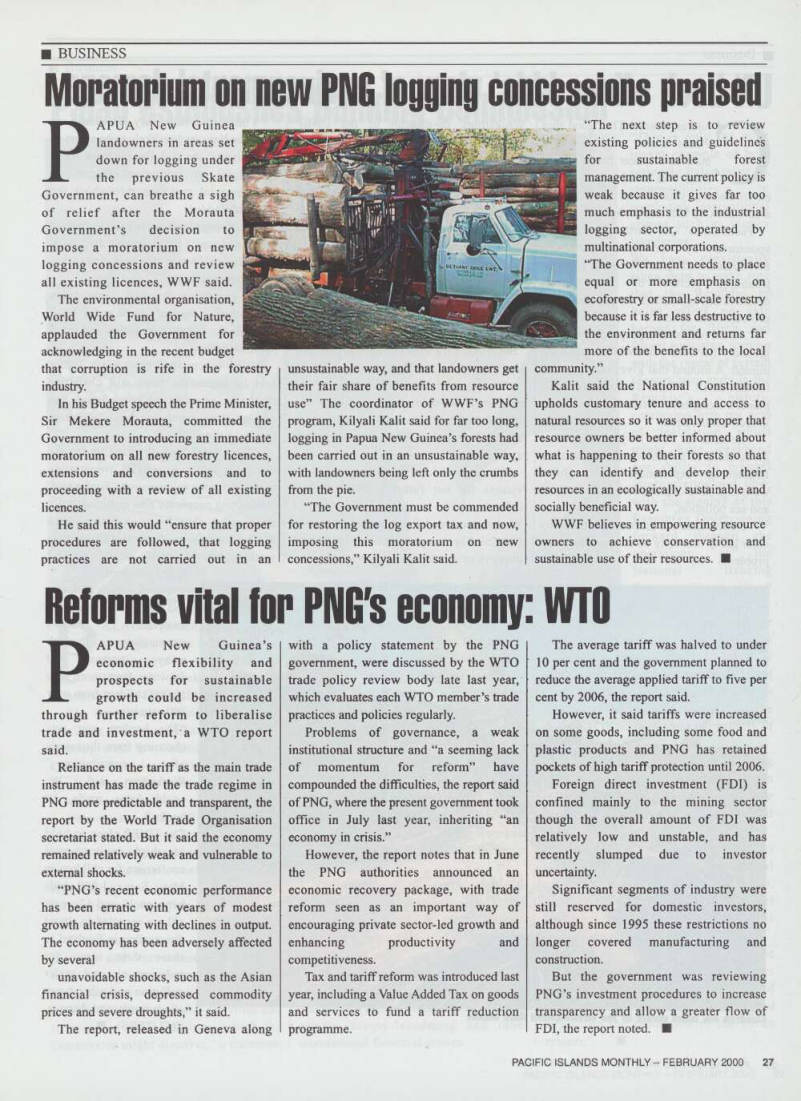
PAPUA New Guinea landowners in areas set down for logging under the previous Skate Government, can breathe a sigh of relief after the Morauta Government’s decision to impose a moratorium on new logging concessions and review all existing licences, WWF said.
The environmental organisation.
World Wide Fund for Nature, applauded the Government for acknowledging in the recent budget
that corruption is rife in the forestry industry.
In his Budget speech the Prime Minister, Sir Mekere Morauta, committed the Government to introducing an immediate moratorium on all new forestry licences, extensions and conversions and to proceeding with a review of all existing licences.
He said this would “ensure that proper procedures are followed, that logging practices are not carried out in an
unsustainable way, and that landowners get their fair share of benefits from resource use” The coordinator of WWF’s PNG program, Kilyali Kalit said for far too long, logging in Papua New Guinea’s forests had been carried out in an unsustainable way, with landowners being left only the crumbs from the pie.
“The Government must be commended for restoring the log export tax and now, imposing this moratorium on new concessions,” Kilyali Kalit said.
“The next step is to review existing policies and guidelines for sustainable forest management. The current policy is weak because it gives far too much emphasis to the industrial
logging sector, operated by
multinational corporations.
“The Government needs to place equal or more emphasis on ecoforestry or small-scale forestry because it is far less destructive to the environment and returns far more of the benefits to the local
community.”
Kalit said the National Constitution upholds customary tenure and access to natural resources so it was only proper that resource owners be better informed about what is happening to their forests so that they can identify and develop their resources in an ecologically sustainable and socially beneficial way.
WWF believes in empowering resource owners to achieve conservation and sustainable use of their resources. ■
Reforms vital for PNG's economy: WTO
PAPUA New Guinea’s economic flexibility and prospects for sustainable growth could be increased through further reform to liberalise trade and investment, a WTO report said.
Reliance on the tariff as the main trade instrument has made the trade regime in PNG more predictable and transparent, the report by the World Trade Organisation secretariat stated. But it said the economy remained relatively weak and vulnerable to external shocks.
“PNG’s recent economic performance has been erratic with years of modest growth alternating with declines in output.
The economy has been adversely affected by several unavoidable shocks, such as the Asian
financial crisis, depressed commodity
prices and severe droughts,” it said.
The report, released in Geneva along
with a policy statement by the PNG government, were discussed by the WTO trade policy review body late last year, which evaluates each WTO member’s trade
practices and policies regularly.
Problems of governance, a weak institutional structure and “a seeming lack of momentum for reform” have compounded the difficulties, the report said of PNG, where the present government took office in July last year, inheriting “an economy in crisis.”
However, the report notes that in June the PNG authorities announced an economic recovery package, with trade reform seen as an important way of
encouraging private sector-led growth and
enhancing productivity and
competitiveness.
Tax and tariff reform was introduced last year, including a Value Added Tax on goods and services to fund a tariff reduction programme.
The average tariff was halved to under 10 per cent and the government planned to reduce the average applied tariff to five per cent by 2006, the report said.
However, it said tariffs were increased on some goods, including some food and plastic products and PNG has retained pockets of high tariff protection until 2006.
Foreign direct investment (FDI) is confined mainly to the mining sector though the overall amount of FDI was relatively low and unstable, and has recently slumped due to investor uncertainty.
Significant segments of industry were still reserved for domestic investors, although since 1995 these restrictions no longer covered manufacturing and construction.
But the government was reviewing PNG’s investment procedures to increase transparency and allow a greater flow of FDI, the report noted. ■
UN book offers kids' view of environmental damage
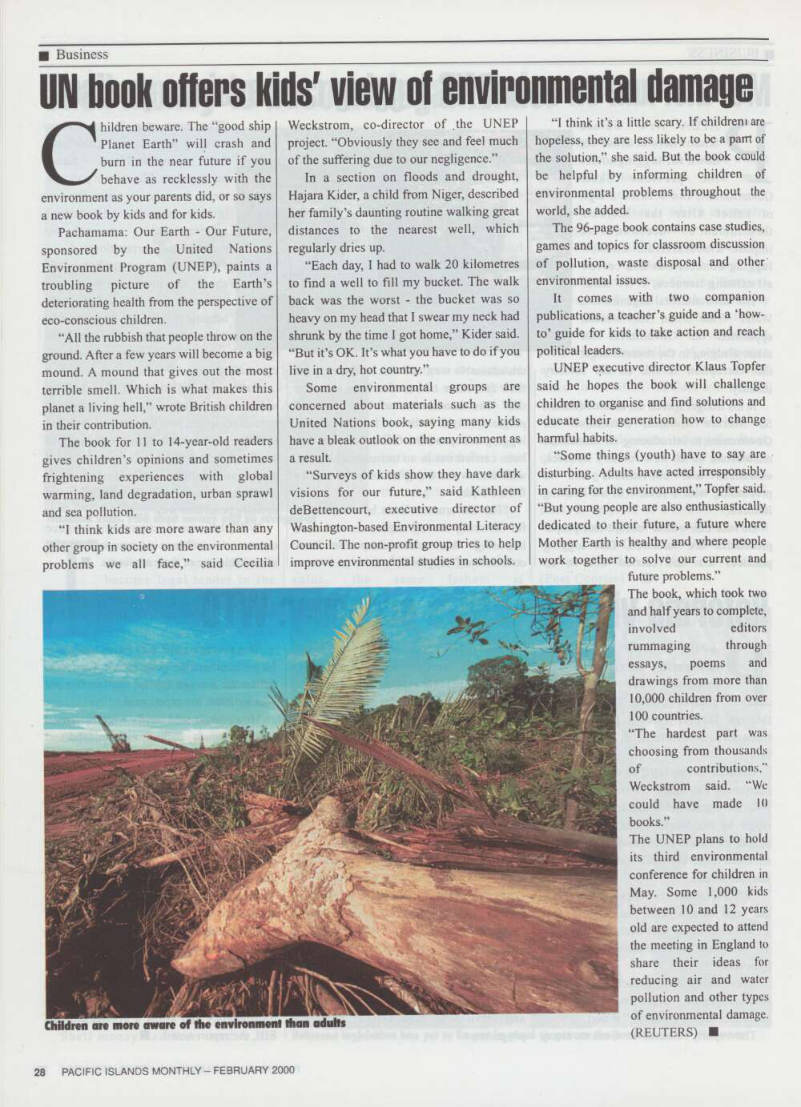
Children beware. The “good ship Planet Earth” will crash and burn in the near future if you behave as recklessly with the environment as your parents did, or so says a new book by kids and for kids.
Pachamama: Our Earth - Our Future, sponsored by the United Nations Environment Program (UNEP), paints a troubling picture of the Earth’s deteriorating health from the perspective of eco-conscious children.
“All the rubbish that people throw on the ground. After a few years will become a big mound. A mound that gives out the most terrible smell. Which is what makes this planet a living hell,” wrote British children in their contribution.
The book for 11 to 14-year-old readers gives children’s opinions and sometimes frightening experiences with global warming, land degradation, urban sprawl and sea pollution.
“I think kids are more aware than any other group in society on the environmental problems we all face,” said Cecilia
Weckstrom, co-director of .the UNEP project. “Obviously they see and feel much of the suffering due to our negligence.”
In a section on floods and drought, Hajara Kider, a child from Niger, described her family’s daunting routine walking great distances to the nearest well, which regularly dries up.
“Each day, I had to walk 20 kilometres to find a well to fill my bucket. The walk back was the worst - the bucket was so heavy on my head that I swear my neck had shrunk by the time I got home,” Kider said.
“But it’s OK. It’s what you have to do if you live in a dry, hot country.”
Some environmental groups are concerned about materials such as the United Nations book, saying many kids have a bleak outlook on the environment as a result.
“Surveys of kids show they have dark visions for our future,” said Kathleen deßettencourt, executive director of Washington-based Environmental Literacy Council. The non-profit group tries to help improve environmental studies in schools.
“I think it’s a little scary. If childreni are hopeless, they are less likely to be a parrt of the solution,” she said. But the book ccould be helpful by informing children of environmental problems throughout the world, she added.
The 96-page book contains case studlies, games and topics for classroom discussion of pollution, waste disposal and other environmental issues.
It comes with two companion publications, a teacher’s guide and a ‘how to’ guide for kids to take action and reach political leaders.
UNEP executive director Klaus Topfer said he hopes the book will challenge children to organise and find solutions and educate their generation how to change harmful habits.
“Some things (youth) have to say are disturbing. Adults have acted irresponsibly in caring for the environment,” Topfer said.
“But young people are also enthusiastically dedicated to their future, a future where Mother Earth is healthy and where people work together to solve our current and
future problems.”
The book, which took two and half years to complete, involved editors rummaging through essays, poems and drawings from more than 10,000 children from over 100 countries.
“The hardest part was choosing from thousands of contributions,”
Weckstrom said. “We could have made 10 books.”
The UNEP plans to hold its third environmental conference for children in May. Some 1,000 kids between 10 and 12 years old are expected to attend the meeting in England to share their ideas for reducing air and water pollution and other types of environmental damage.
(Reuters) ■
Children arc more aware of Hie environment than adults
Palau establishes Banking Commission
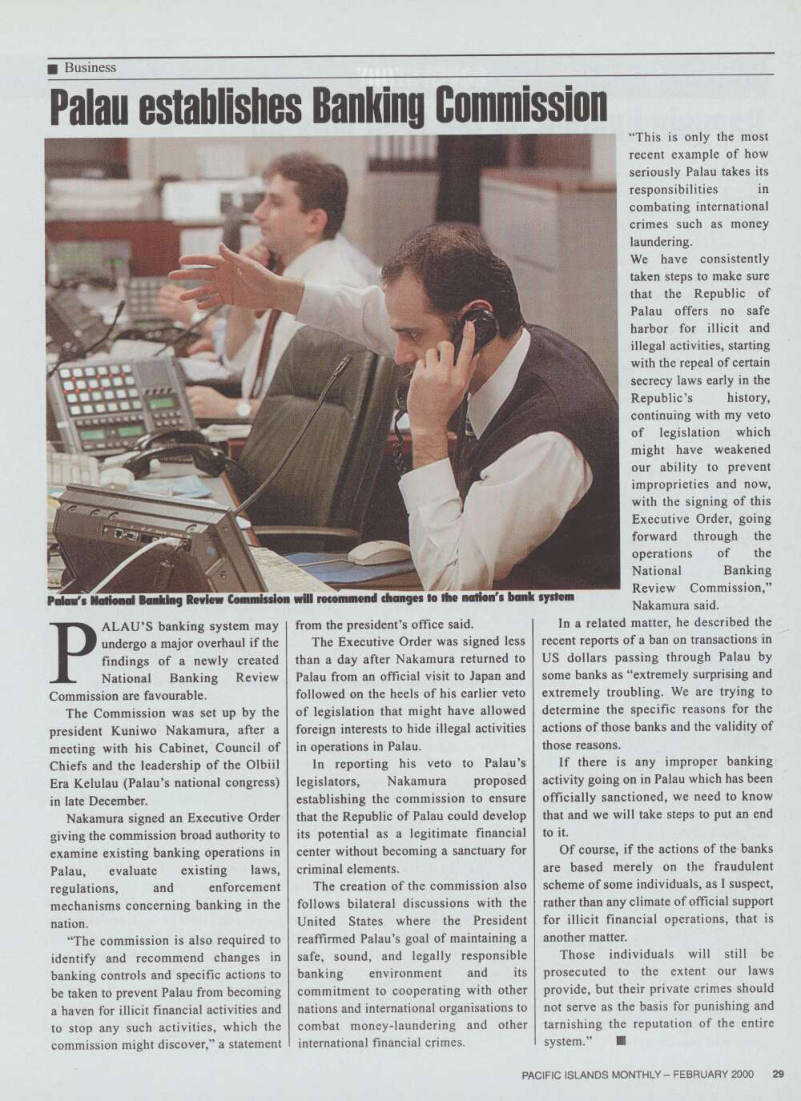
PALAU’S banking system may undergo a major overhaul if the findings of a newly created National Banking Review Commission are favourable.
The Commission was set up by the president Kuniwo Nakamura, after a meeting with his Cabinet, Council of Chiefs and the leadership of the Olbiil Era Kelulau (Palau’s national congress) in late December.
Nakamura signed an Executive Order giving the commission broad authority to
examine existing banking operations in
Palau, evaluate existing laws, regulations, and enforcement mechanisms concerning banking in the nation.
“The commission is also required to identify and recommend changes in banking controls and specific actions to be taken to prevent Palau from becoming a haven for illicit financial activities and to stop any such activities, which the commission might discover,” a statement
from the president’s office said.
The Executive Order was signed less than a day after Nakamura returned to Palau from an official visit to Japan and followed on the heels of his earlier veto of legislation that might have allowed foreign interests to hide illegal activities in operations in Palau.
In reporting his veto to Palau’s
legislators, Nakamura proposed
establishing the commission to ensure that the Republic of Palau could develop its potential as a legitimate financial center without becoming a sanctuary for criminal elements.
The creation of the commission also follows bilateral discussions with the United States where the President reaffirmed Palau’s goal of maintaining a safe, sound, and legally responsible banking environment and its commitment to cooperating with other nations and international organisations to combat money-laundering and other international financial crimes.
“This is only the most recent example of how seriously Palau takes its responsibilities in combating international crimes such as money laundering.
We have consistently taken steps to make sure that the Republic of Palau offers no safe harbor for illicit and illegal activities, starting with the repeal of certain secrecy laws early in the Republic’s history, continuing with my veto of legislation which might have weakened our ability to prevent improprieties and now, with the signing of this Executive Order, going forward through the operations of the National Banking Review Commission,”
Nakamura said.
In a related matter, he described the recent reports of a ban on transactions in US dollars passing through Palau by some banks as “extremely surprising and extremely troubling. We are trying to determine the specific reasons for the actions of those banks and the validity of those reasons.
If there is any improper banking activity going on in Palau which has been officially sanctioned, we need to know that and we will take steps to put an end to it.
Of course, if the actions of the banks are based merely on the fraudulent scheme of some individuals, as I suspect, rather than any climate of official support for illicit financial operations, that is another matter.
Those individuals will still be prosecuted to the extent our laws provide, but their private crimes should not serve as the basis for punishing and tarnishing the reputation of the entire system.” ■
Patau's National Banking Review Commission will recommend changes to the nation's bank system
Bargain hunting on the Web hots up
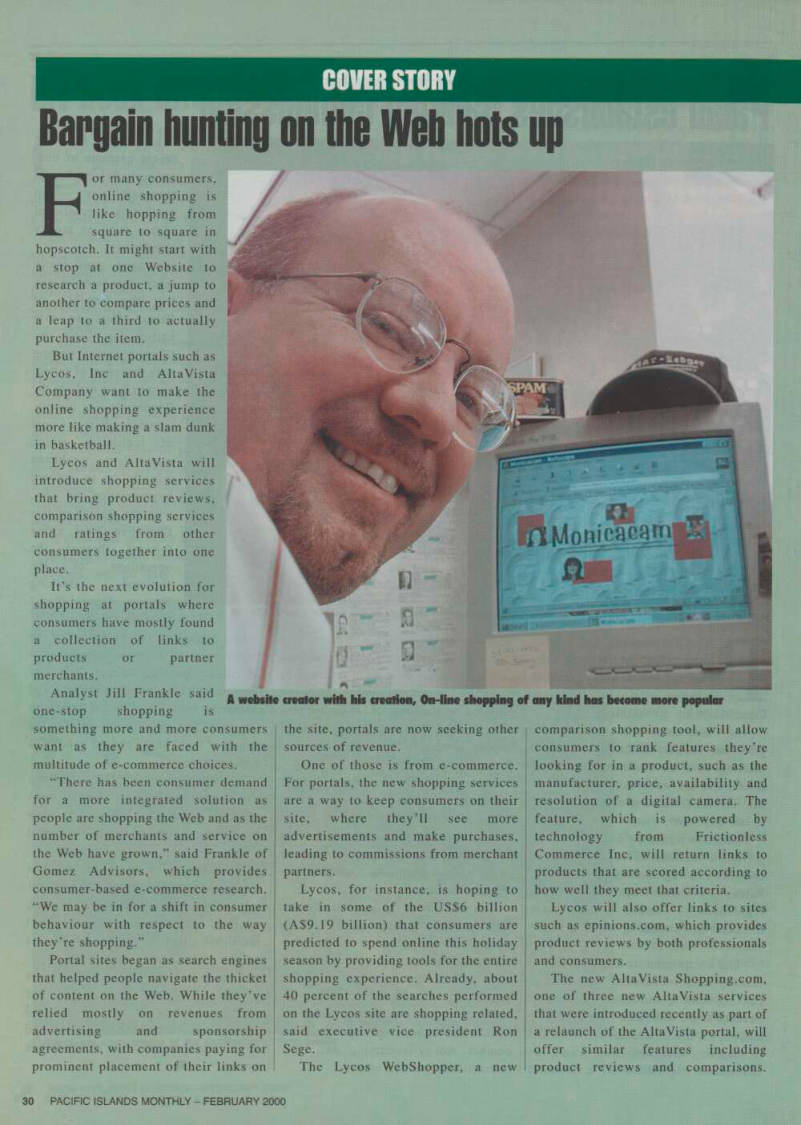
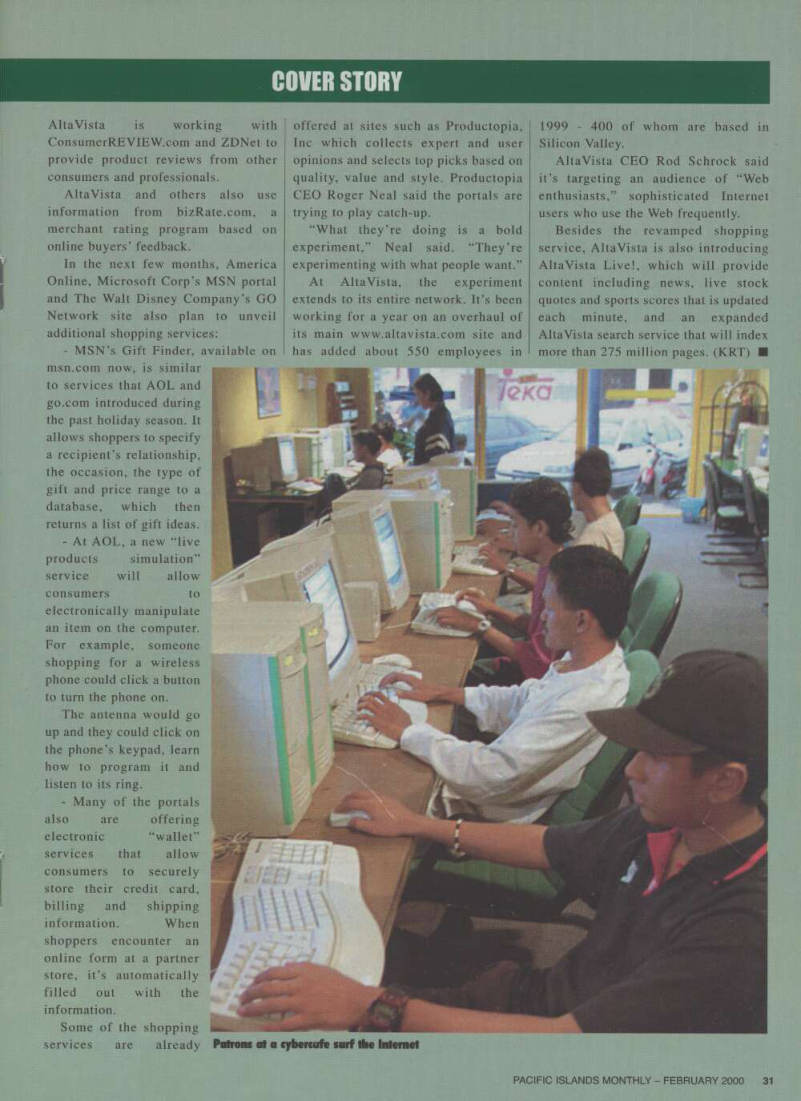
Cover Story
For many consumers, online shopping is like hopping from square to square in hopscotch. It might start with a stop at one Website to research a product, a jump to another to compare prices and a leap to a third to actually purchase the item.
But Internet portals such as Lycos, Inc and Alta Vista Company want to make the
online shopping experience
more like making a slam dunk in basketball.
Lycos and Alta Vista will introduce shopping services that bring product reviews, comparison shopping services and ratings from other consumers together into one place.
It’s the next evolution for shopping at portals where consumers have mostly found a collection of links to products or partner merchants.
Analyst Jill Frankie said one-stop shopping is
something more and more consumers want as they are faced with the multitude of e-commerce choices.
“There has been consumer demand for a more integrated solution as people are shopping the Web and as the number of merchants and service on the Web have grown,” said Frankie of Gomez Advisors, which provides consumer-based e-commerce research.
“We may be in for a shift in consumer behaviour with respect to the way
they’re shopping.”
Portal sites began as search engines
that helped people navigate the thicket
of content on the Web. While they’ve relied mostly on revenues from advertising and sponsorship agreements, with companies paying for prominent placement of their links on
the site, portals are now seeking other sources of revenue.
One of those is from e-commerce.
For portals, the new shopping services are a way to keep consumers on their site, where they’ll see more advertisements and make purchases, leading to commissions from merchant partners.
Lycos, for instance, is hoping to take in some of the US$6 billion (A 59.19 billion) that consumers are predicted to spend online this holiday season by providing tools for the entire shopping experience. Already, about 40 percent of the searches performed on the Lycos site are shopping related, said executive vice president Ron Sege.
The Lycos Web Shopper, a new
comparison shopping tool, will allow consumers to rank features they’re looking for in a product, such as the manufacturer, price, availability and resolution of a digital camera. The feature, which is powered by technology from Frictionless Commerce Inc, will return links to products that are scored according to how well they meet that criteria.
Lycos will also offer links to sites such as epinions.com, which provides
product reviews by both professionals
and consumers.
The new Alta Vista Shopping.com, one of three new Alta Vista services that were introduced recently as part of a relaunch of the Alta Vista portal, will offer similar features including product reviews and comparisons.
A website creator with his creation. On-line shopping of any kind has become more popular
Alta Vista is working with ConsumerßEVlEW.com and ZDNet to provide product reviews from other consumers and professionals.
Alta Vista and others also use information from bizßate.com, a merchant rating program based on online buyers’ feedback.
In the next few months, America Online, Microsoft Corp’s MSN portal and The Walt Disney Company’s GO Network site also plan to unveil additional shopping services; - MSN’s Gift Finder, available on
msn.com now, is similar to services that AOL and go.com introduced during the past holiday season. It allows shoppers to specify
a recipient’s relationship,
the occasion, the type of gift and price range to a database, which then returns a list of gift ideas. - At AOL, a new “live products simulation” service will allow consumers to
electronically manipulate
an item on the computer.
For example, someone shopping for a wireless phone could click a button to turn the phone on.
The antenna would go up and they could click on the phone’s keypad, learn how to program it and listen to its ring. - Many of the portals also are offering electronic “wallet” services that allow consumers to securely store their credit card,
billing and shipping
information. When shoppers encounter an online form at a partner store, it’s automatically filled out with the information.
Some of the shopping services are already
offered at sites such as Productopia, Inc which collects expert and user opinions and selects top picks based on quality, value and style. Productopia CEO Roger Neal said the portals are
trying to play catch-up.
“What they’re doing is a bold
experiment,” Neal said. “They’re
experimenting with what people want.”
At Alta Vista, the experiment extends to its entire network. It’s been working for a year on an overhaul of its main www.altavista.com site and has added about 550 employees in
1999 - 400 of whom are based in Silicon Valley.
Alta Vista CEO Rod Schrock said it’s targeting an audience of “Web enthusiasts,” sophisticated Internet users who use the Web frequently.
Besides the revamped shopping service, Alta Vista is also introducing Alta Vista Live!, which will provide content including news, live stock quotes and sports scores that is updated each minute, and an expanded Alta Vista search service that will index more than 275 million pages. (KRT) ■
Patrons at a cybercafe surf the Internet
FijiShop.com cashes in on E-commerce boom

By Bernadette Hussein
E -commerce is fast becoming a popular way to shop.
Thousands of companies around the world are falling into this trend because they don’t want to be left behind in the Internet rush.
One that aims to make Fijian products available to buyers on the World Wide Web is inet or Internet Fiji.
Internet Fiji offers professional web page design services, industrial strength web hosting and
electronic commerce solutions for small businesses, corporate clients, media and the tourist industry.
The brains behind the project are Dominic Sansom, Stefan Ali and Jan Dunlop. FijiShop.com went on-line in December offering 50 Fiji-made
products.
According to Ali, this was something they had thought about for a while.
“We got to the point early last year when we thought we’d do something for ourselves because at the time, the work that we did was pretty much determined by other people,” he said.
“We took a look at the avenues open to us and the only practical one was the shop. We bounced that around within the partners and then decided that the shop was what we were going to do.”
But he stressed that FijiShop.com wasn’t the end of it. In fact, many other things were in the pipeline.
“The shop has to establish a presence quickly because there are other things we want to do.
“The shop is very much limited to what we want to see. It is ours so we get to do what we want. We’ve gone out and picked quality products which we feel will do well.
“These are specifically local products which include books, CDs, a certain amount of clothing, spices, coffee, kava and handicraft. We feel these products provide value for money.”
The Internet address for the shop is
www.FijiShop.com.
Ali said when people visit the site, they will notice that all the items are genuinely homegrown.
“We have found that former residents or anyone who has had anything to do with Fiji are always after products from Fiji. And
unless they have it sent to them, there is no other way of getting hold of them. But FijiShop.com allows them to do this. It has it’s own niche market.”
Compared to other shops on-line, Ali said FijiShop.com was special.
“You find that a lot of items available on the web can be easily purchased at any electronic store and shop around the world.
But the products available on FijiShop.com can only be bought in Fiji. That is what
makes us different from
other shops.
“For example, Fijian music. Unless a relative or friend sends one from Fiji, there is no other avenue for people to purchase a CD or tape.
You are not going to find it in big Internet shops because they just don’t carry them.
“With FijiShop.com, they will be able to go on-line, listen to a couple of tracks and they can then place their order. It’s that
simple.”
Once the order is placed, the staff of FijiShop.com process credit card details and prepare the package for shipment. That usually takes a day or two.
In most cases, it does not take more than two weeks for the package to reach its destination.
“It depends on how the
customer wants the package shipped. Express courier will take only about three days, while DHL mail, about a week. A lot depends on where the customer is.”
The range of products available is wide.
It includes soap and lotions from Sandollars, shirts and T-shirts from Stolen
The FijiShop.com website
Advertisements & other items, p. 32 (1 item)
Cover Story
32
P/'.UFIC ISLANDS MONTHLY - FEBRUARY 2000
Prospectors strike gold in Website names

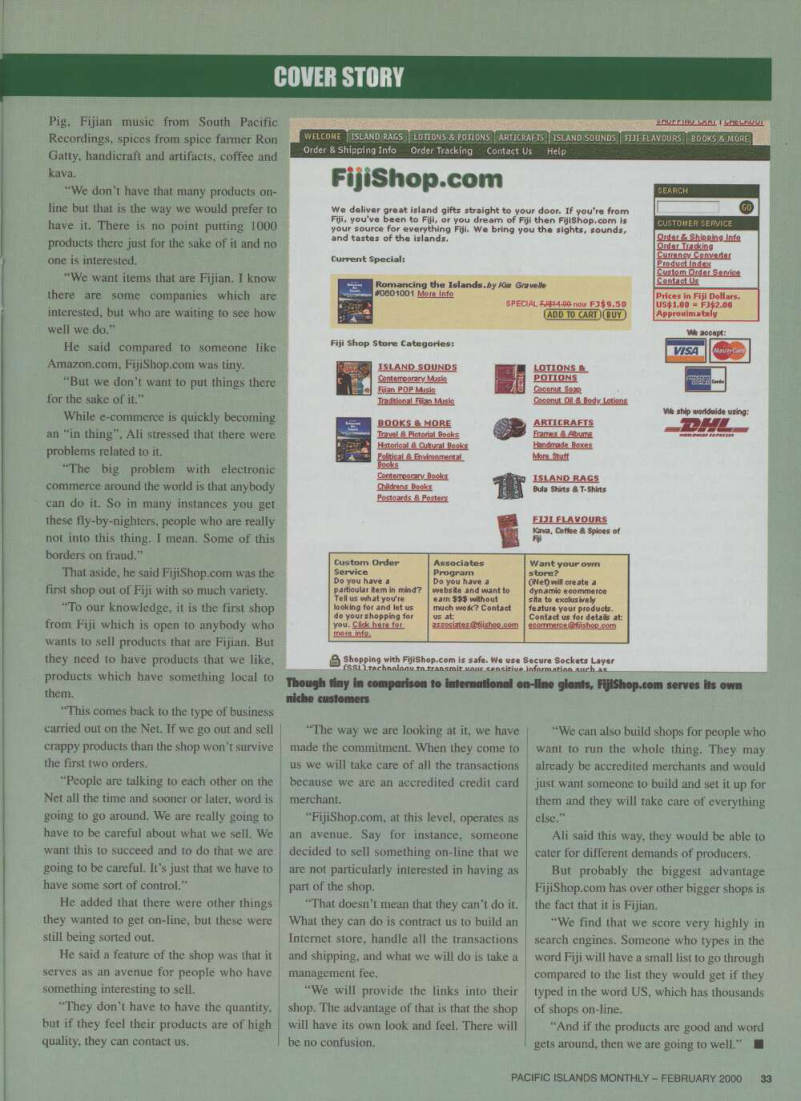

WHEN he was 13, Mark Zonarich ran his own
curb-painting business.
Now he is a 19-year old architecture student building castles in cyberspace by dreaming up Internet addresses and selling them to the highest bidder.
Like the California gold rush of the 1840 s, entrepreneurs big and small are digging deep - this time into the dictionary or thesaurus for dot-com nuggets as the Internet domain names business becomes a fast way to a fortune.
“It’s a bit like buying a painting at a garage sale and finding out it is a Picasso and it is too valuable to hang in your home,” said Tim Pluma, sales director of Greatdomains.com, a leading California based domain names broker.
In December, a California company paid a record US$7.5 million (A$ 11.48 million) for an Internet address when it bought the rights to use the domain name business.com from a Houston entrepreneur.
America.com is currently up for sale at an asking price of NZ$lO million (A 57.91 million). Celebrities.com could be yours for US$2 million (A 53.06 million), and tens of thousands of other names, ranging from the quirky to the blindingly obvious, are changing hands for a fistful of dollars in the cyber equivalent of real estate.
All you need is an eye for invention and US$7O(A$lO7) to register an Internet domain name not already in use. Players in the market range from college kids like Zonarich with talent and time on their hands to small businessmen who spotted the potential two or three years ago and registered dozens of addresses.
Texas businessman Jeremy Baldwin jumped in a couple of years ago when he wanted a Website address for his computer consulting company. “I found it was already taken and every iteration I could think of.
So I said to myself, there’s gold in them thar hills,” he said.
Baldwin started registering every generic name he could think of related to computers and put prices.com after it. Then
he put an e in front of all the products he thought people might want to buy on the Internet, like ecigars.com and ewine.com.
He is now owner or joint owner of some 370 Internet domain names and gets offers
ranging from US$5,OOO (A 57,654) to
Us$4O,Ooo (A 561,236).
Thanks to him and others like him, some 97 per cent of the words in Webster’s dictionary have been registered and the number of domain names in the United States has swollen from one million to six million in three years - all of which makes it harder for newcomers, who are turning to quirkier combinations to get a piece of the action.
“Very rarely do I find one that I think has a lot of potential that is still available. Most people don’t realise how hard it is,” said Zonarich, who has registered 17 names in the past month.
Heyuk.com and its British equivalent heyuk.co.ukare the proudest inventions to date of the University of Maryland student whose earlier moneymaking ventures included running his own curb-painting and lawn service businesses.
“I’ve always been very interested in business and looking for any opportunity to start my own. I am basically a young entrepreneur. I truly believe that it is completely possible to make a living out of this,” he said.
With about 50 domain names brokers in the United States alone, prices for a great online business address are expected to soar, especially for catchall generic names that are easy to remember and type.
“Prices will probably continue to go up until the bubble bursts or common sense prevails,” said David Redhill, an executive
Continued next page
Keys to success. Website names can sell for big money
Pig, Fijian music from South Pacific Recordings, spices from spice farmer Ron Gatty, handicraft and artifacts, coffee and kava.
“We don’t have that many products on line but that is the way we would prefer to have it. There is no point putting 1000 products there just for the sake of it and no one is interested.
“We want items that are Fijian. I know there are some companies which are interested, but who are waiting to see how well we do.”
He said compared to someone like Amazon.com, FijiShop.com was tiny.
“But we don’t want to put things there for the sake of it.”
While e-commerce is quickly becoming an “in thing”, Ali stressed that there were problems related to it.
“The big problem with electronic commerce around the world is that anybody can do it. So in many instances you get
these fly-by-nighters, people who are really
not into this thing. I mean. Some of this borders on fraud.”
That aside, he said FijiShop.com was the first shop out of Fiji with so much variety.
“To our knowledge, it is the first shop from Fiji which is open to anybody who wants to sell products that are Fijian. But they need to have products that we like, products which have something local to them.
“This comes back to the type of business carried out on the Net. If we go out and sell crappy products than the shop won’t survive the first two orders.
“People are talking to each other on the Net all the time and sooner or later, word is going to go around. We are really going to have to be careful about what we sell. We want this to succeed and to do that we are going to be careful. It’s just that we have to have some sort of control.”
He added that there were other things they wanted to get on-line, but these were still being sorted out.
He said a feature of the shop was that it serves as an avenue for people who have
something interesting to sell.
“They don’t have to have the quantity, but if they feel their products are of high quality, they can contact us.
“The way we are looking at it, we have made the commitment. When they come to us we will take care of all the transactions because we are an accredited credit card merchant.
“FijiShop.com, at this level, operates as an avenue. Say for instance, someone decided to sell something on-line that we are not particularly interested in having as part of the shop.
“That doesn’t mean that they can’t do it.
What they can do is contract us to build an Internet store, handle all the transactions and shipping, and what we will do is take a management fee.
“We will provide the links into their shop. The advantage of that is that the shop will have its own look and feel. There will be no confusion.
“We can also build shops for people who want to run the whole thing. They may already be accredited merchants and would just want someone to build and set it up for them and they will take care of everything else.”
Ali said this way, they would be able to cater for different demands of producers.
But probably the biggest advantage
FijiShop.com has over other bigger shops is the fact that it is Fijian.
“We find that we score very highly in search engines. Someone who types in the word Fiji will have a small list to go through compared to the list they would get if they typed in the word US, which has thousands of shops on-line.
“And if the products are good and word gets around, then we are going to well.” ■
Though tiny in comparison to intemotionnl on-line giants, FiyiShop.com serves its own niche customers
Continued from previous page
director at San Francisco-based Landor
Associates, a leading global branding
consultant.
Redhill was wary of predicting how the Internet would develop in its second generation. The dot-com milch cow could dry up if suffixes like dot biz or other variations are introduced, and as more organisations around the world go online style and a user-friendly Website even with an obscure address may count for more than an obvious name.
“The generic names have got the high ground at the moment but it is difficult to
say what will happen in a few years time,”
Redhill said. “If people want to continue to refer to one site they are going to bookmark it. If the site is worth revisiting then people are not going to have to keep typing a quirky or unusual name in. The name is only one part of it. The site architecture is important too,” he said.
Baldwin said the days of the domain names gold rush are numbered. “I think in the next two years people can make some ridiculously big numbers with this, but then it’s got to start to slow down because you are going to get to where the names are taken,” he said.
“I don’t know if my mind is weird but I just keep coming up with them. There’s probably got to be about another 100 in my head, especially after a good glass of red wine.”
Baldwin figures he has about half a dozen names that are worth about US$5OO,OOO (A 5765,462) a piece and he is planning to use the windfall to finance his own Website aimed at instructing professional salesmen in sales and
marketing techniques.
Needless to say, he will not be handing over millions to someone else for a Website address. (REUTERS) ■
Vims information on the Internet
Computers can be affected by virus via email, downloading software and file transfers between computers. Thus we must realise the importance of virus protection for your PC’s and Servers.
What is a virus and how does it work?
A virus is a parasitic programme, that infects a computer without the user’s permission or knowledge. The word parasitic is used because a virus attaches to files or programmes and enters your
machine. Usually a virus is inactive until the infected program is run and the virus replicates itself similar to a biological viral
replication.
Hints and Tips for Virus Protection If you follow a few simple guidelines, the risk of a virus attack can be reduced to
virtually zero.
- Never run or view any email attachments sent to you without first scanning for viruses. - Never use a used floppy disks without first scanning for viruses.
- When downloading from the Internet, always scan the files before running them. - Never boot your PC from a floppy disk unless you are certain that it is clean and free from viruses. - Always use software obtained from a
reputable source.
- Make regular backup copies of all your important files and store them securely. - Install and use a regular anti-virus software. - Make sure that the anti-virus are regularly updated to take account of new viruses and variants that are
developed nearly every day.
Anti-Virus Scanners?
Anti-Virus programmes are the best way to clean viruses and protect against virus attacks, but new viruses are continually developing so a regular update of the antivirus software is necessary.
Some very popular antivirus scanners in our opinion are Norton’s and Mcafee’s.
There are some website as well that contain information about the latest viruses discovered along with their cleaning instructions and one is advised to visit these sites regularly.
Some of these sites are: http ://www. Symantec .com/
http://www.mcafee.com/
- This information has been provided by Customer Services, Internet Services, Telecom Fiji Ltd ■
Computer viruses can make users feel trapped
West Papua mobilising for freedom from Indonesia
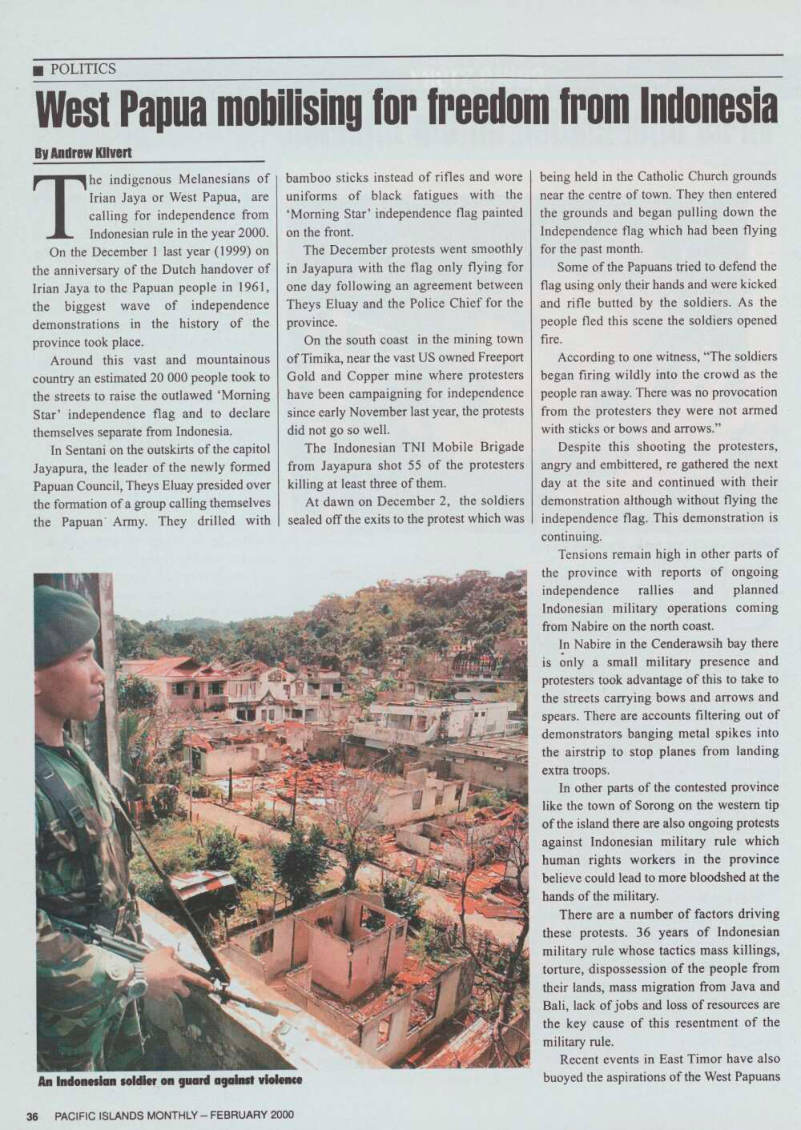
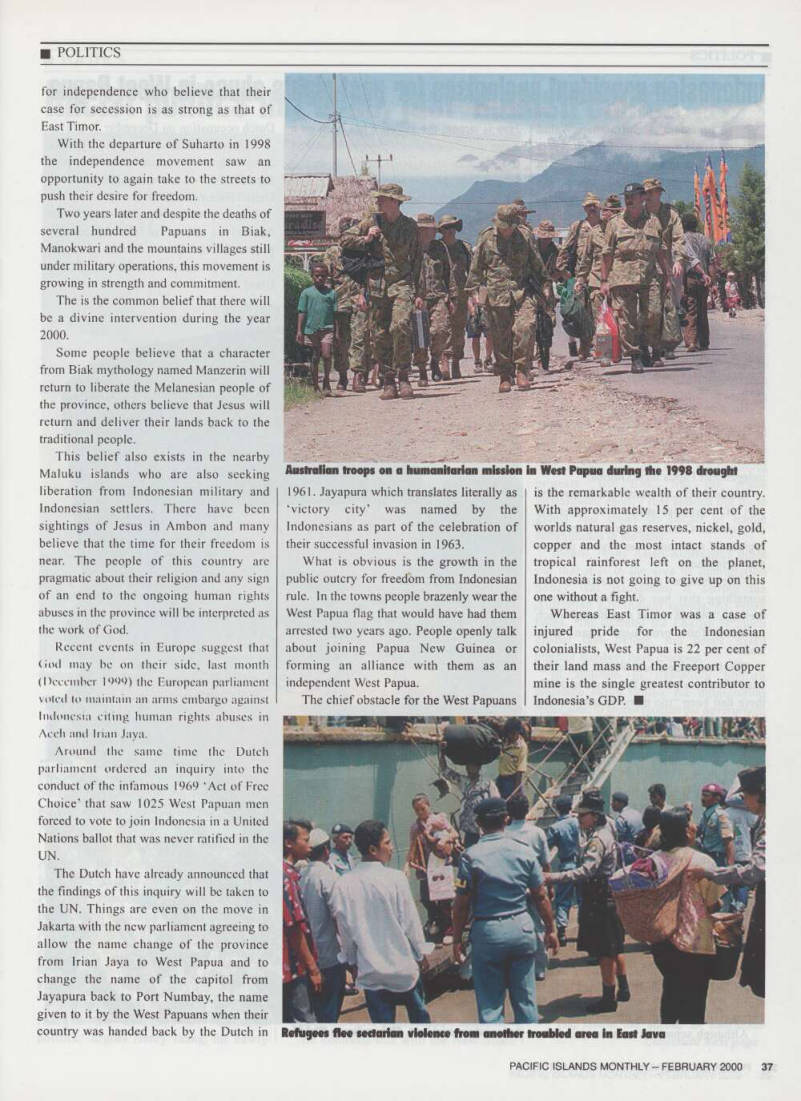
Politics
By Andrew Kllvert
The indigenous Melanesians of Irian Jaya or West Papua, are calling for independence from Indonesian rule in the year 2000.
On the December 1 last year (1999) on the anniversary of the Dutch handover of Irian Jaya to the Papuan people in 1961, the biggest wave of independence demonstrations in the history of the province took place.
Around this vast and mountainous country an estimated 20 000 people took to the streets to raise the outlawed ‘Morning Star’ independence flag and to declare themselves separate from Indonesia.
In Sentani on the outskirts of the capitol Jayapura, the leader of the newly formed Papuan Council, Theys Eluay presided over the formation of a group calling themselves the Papuan Army. They drilled with
bamboo sticks instead of rifles and wore uniforms of black fatigues with the ‘Morning Star’ independence flag painted on the front.
The December protests went smoothly in Jayapura with the flag only flying for one day following an agreement between Theys Eluay and the Police Chief for the
province.
On the south coast in the mining town of Timika, near the vast US owned Freeport Gold and Copper mine where protesters have been campaigning for independence since early November last year, the protests did not go so well.
The Indonesian TNI Mobile Brigade from Jayapura shot 55 of the protesters killing at least three of them.
At dawn on December 2, the soldiers sealed off the exits to the protest which was
being held in the Catholic Church grounds near the centre of town. They then entered the grounds and began pulling down the Independence flag which had been flying for the past month.
Some of the Papuans tried to defend the flag using only their hands and were kicked and rifle butted by the soldiers. As the people fled this scene the soldiers opened fire.
According to one witness, “The soldiers began firing wildly into the crowd as the people ran away. There was no provocation from the protesters they were not armed with sticks or bows and arrows.”
Despite this shooting the protesters, angry and embittered, re gathered the next day at the site and continued with their demonstration although without flying the independence flag. This demonstration is continuing.
Tensions remain high in other parts of the province with reports of ongoing independence rallies and planned Indonesian military operations coming from Nabire on the north coast.
In Nabire in the Cenderawsih bay there is only a small military presence and protesters took advantage of this to take to the streets carrying bows and arrows and spears. There are accounts filtering out of demonstrators banging metal spikes into the airstrip to stop planes from landing extra troops.
In other parts of the contested province like the town of Sorong on the western tip of the island there are also ongoing protests against Indonesian military rule which human rights workers in the province believe could lead to more bloodshed at the hands of the military.
There are a number of factors driving these protests. 36 years of Indonesian military rule whose tactics mass killings, torture, dispossession of the people from their lands, mass migration from Java and Bali, lack of jobs and loss of resources are the key cause of this resentment of the military rule.
Recent events in East Timor have also buoyed the aspirations of the West Papuans
An Indonesian soldier on guard against violence
for independence who believe that their case for secession is as strong as that of East Timor.
With the departure of Suharto in 1998 the independence movement saw an opportunity to again take to the streets to push their desire for freedom.
Two years later and despite the deaths of several hundred Papuans in Biak, Manokwari and the mountains villages still under military operations, this movement is growing in strength and commitment.
The is the common belief that there will be a divine intervention during the year 2000.
Some people believe that a character from Biak mythology named Manzerin will return to liberate the Melanesian people of the province, others believe that Jesus will return and deliver their lands back to the traditional people.
This belief also exists in the nearby Maluku islands who are also seeking liberation from Indonesian military and Indonesian settlers. There have been sightings of Jesus in Ambon and many believe that the time for their freedom is near. The people of this country arc pragmatic about their religion and any sign of an end to the ongoing human rights abuses in the province will be interpreted as the work of God.
Recent events in Europe suggest that God may be on their side, last month (December 1999) the European parliament voted to maintain an arms embargo against Indonesia citing human rights abuses in Aceh and Irian Jaya.
Around (he same time the Dutch parliament ordered an inquiry into the conduct of the infamous 1969 ‘Act of Free Choice' that saw 1025 West Papuan men forced to vote to join Indonesia in a United Nations ballot that was never ratified in the UN.
The Dutch have already announced that the findings of this inquiry will be taken to the UN. Things arc even on the move in Jakarta with the new parliament agreeing to allow the name change of the province from Irian Jaya to West Papua and to change the name of the capitol from Jayapura back to Port Numbay, the name given to it by the West Papuans when their country was handed back by the Dutch in
1961. Jayapura which translates literally as ‘victory city’ was named by the Indonesians as part of the celebration of their successful invasion in 1963.
What is obvious is the growth in the public outcry for freedom from Indonesian rule. In the towns people brazenly wear the West Papua flag that would have had them arrested two years ago. People openly talk about joining Papua New Guinea or forming an alliance with them as an independent West Papua.
The chief obstacle for the West Papuans
is the remarkable wealth of their country.
With approximately 15 per cent of the worlds natural gas reserves, nickel, gold, copper and the most intact stands of tropical rainforest left on the planet, Indonesia is not going to give up on this one without a fight.
Whereas East Timor was a case of injured pride for the Indonesian colonialists, West Papua is 22 per cent of their land mass and the Freeport Copper mine is the single greatest contributor to Indonesia’s GDP. ■
Australian troops on a humanitarian mission in West Papua during the 1998 drought
Refugees flee sectarian violence from another troubled area in East Java
Indonesian president apologises for past nights abuse in West Papua
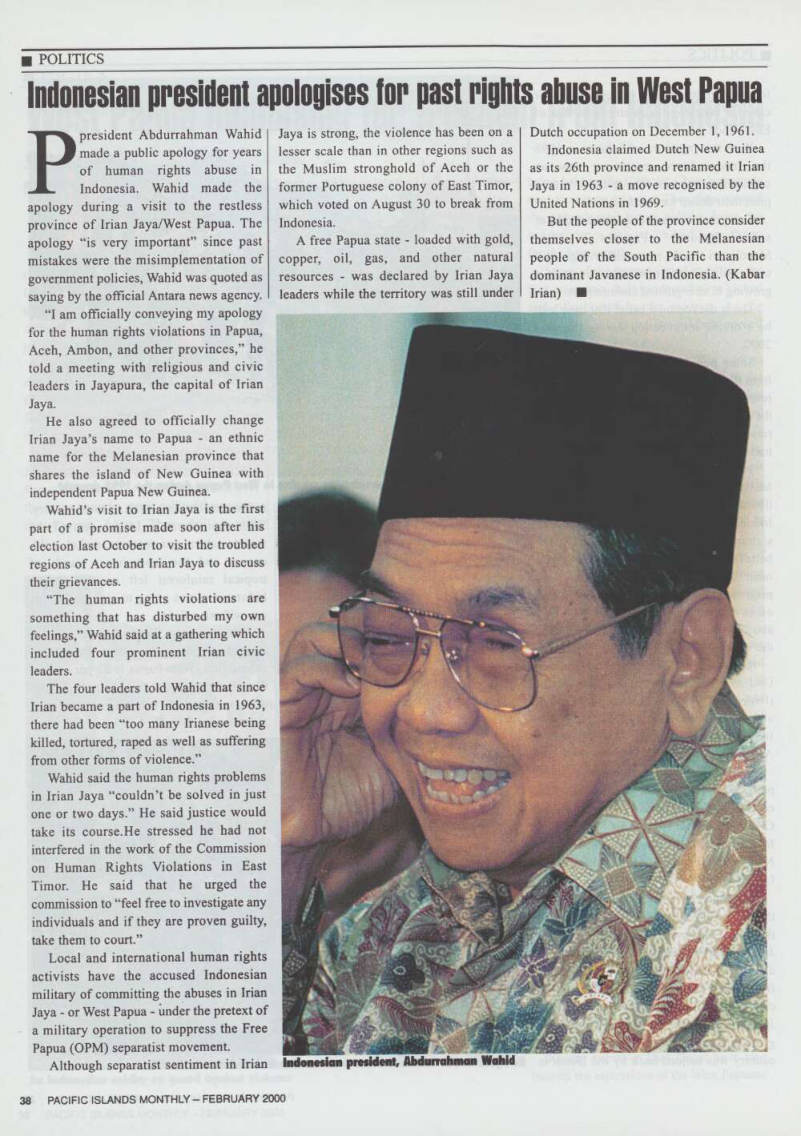
P president Abdurrahman Wahid
made a public apology for years of human rights abuse in Indonesia. Wahid made the apology during a visit to the restless province of Irian Jaya/West Papua. The apology “is very important” since past mistakes were the misimplementation of government policies, Wahid was quoted as saying by the official Antara news agency.
“I am officially conveying my apology
for the human rights violations in Papua, Aceh, Ambon, and other provinces,” he told a meeting with religious and civic leaders in Jayapura, the capital of Irian Jaya.
He also agreed to officially change Irian Jaya’s name to Papua - an ethnic name for the Melanesian province that shares the island of New Guinea with independent Papua New Guinea.
Wahid’s visit to Irian Jaya is the first part of a promise made soon after his election last October to visit the troubled regions of Aceh and Irian Jaya to discuss their grievances.
“The human rights violations are something that has disturbed my own feelings,” Wahid said at a gathering which included four prominent Irian civic leaders.
The four leaders told Wahid that since Irian became a part of Indonesia in 1963, there had been “too many Irianese being killed, tortured, raped as well as suffering from other forms of violence.”
Wahid said the human rights problems in Irian Jaya “couldn’t be solved in just one or two days.” He said justice would take its course.He stressed he had not interfered in the work of the Commission on Human Rights Violations in East Timor. He said that he urged the commission to “feel free to investigate any individuals and if they are proven guilty, take them to court.”
Local and international human rights activists have the accused Indonesian military of committing the abuses in Irian Jaya - or West Papua - under the pretext of a military operation to suppress the Free Papua (OPM) separatist movement.
Although separatist sentiment in Irian
Jaya is strong, the violence has been on a lesser scale than in other regions such as the Muslim stronghold of Aceh or the former Portuguese colony of East Timor, which voted on August 30 to break from Indonesia.
A free Papua state - loaded with gold, copper, oil, gas, and other natural resources - was declared by Irian Jaya leaders while the territory was still under
Dutch occupation on December 1, 1961.
Indonesia claimed Dutch New Guinea as its 26th province and renamed it Irian Jaya in 1963 - a move recognised by the United Nations in 1969.
But the people of the province consider themselves closer to the Melanesian people of the South Pacific than the dominant Javanese in Indonesia. (Kabar Irian) ■
Indonesian president, Abdurrahman Wahid
Racist politics not dead, Just 'mainstreamed'
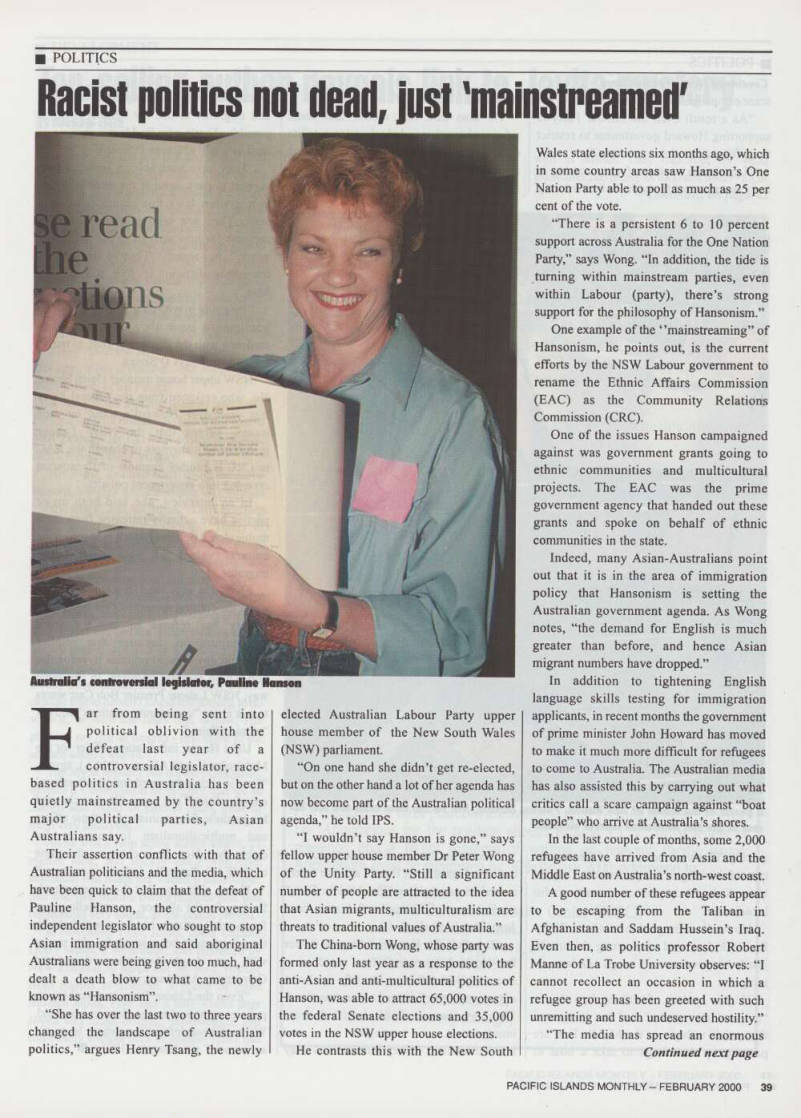
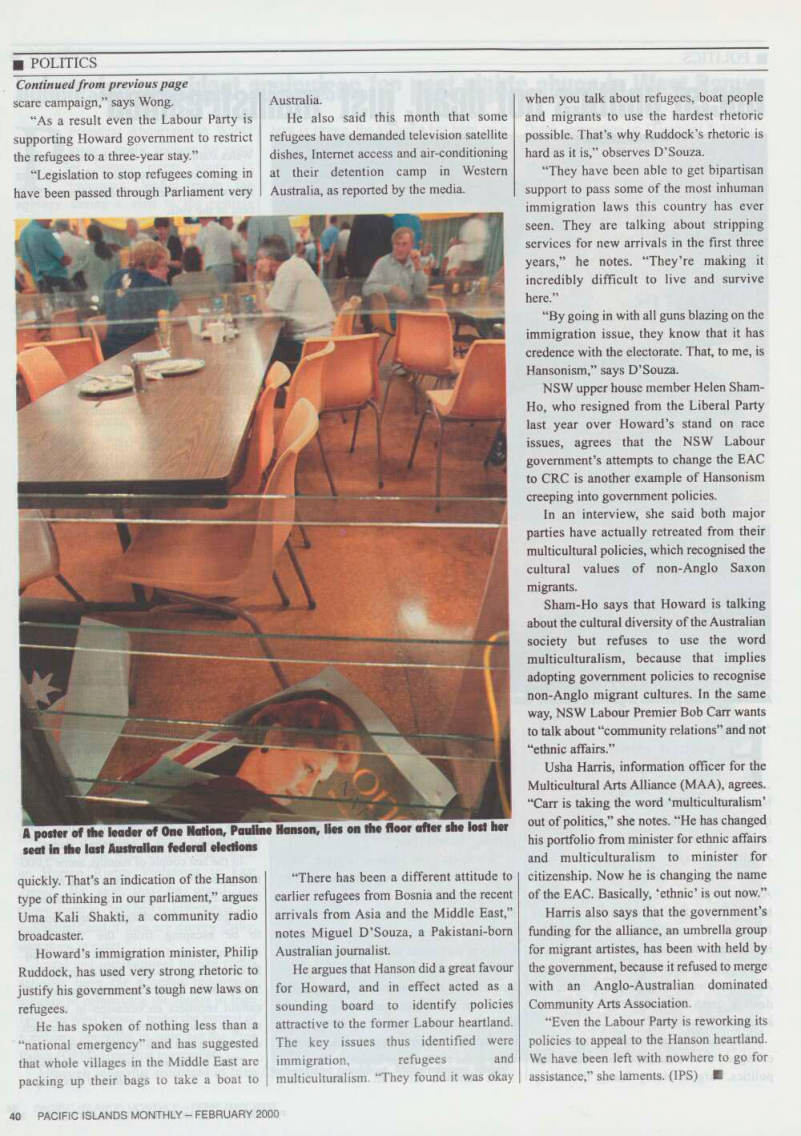
Far from being sent into political oblivion with the defeat last year of a controversial legislator, race based politics in Australia has been quietly mainstreamed by the country’s major political parties, Asian Australians say.
Their assertion conflicts with that of Australian politicians and the media, which have been quick to claim that the defeat of Pauline Hanson, the controversial independent legislator who sought to stop Asian immigration and said aboriginal Australians were being given too much, had dealt a death blow to what came to be known as “Hansonism”.
“She has over the last two to three years changed the landscape of Australian politics,” argues Henry Tsang, the newly
elected Australian Labour Party upper house member of the New South Wales (NSW) parliament.
“On one hand she didn’t get re-elected, but on the other hand a lot of her agenda has now become part of the Australian political agenda,” he told IPS.
“I wouldn’t say Hanson is gone,” says fellow upper house member Dr Peter Wong of the Unity Party. “Still a significant number of people are attracted to the idea that Asian migrants, multiculturalism are threats to traditional values of Australia.”
The China-bom Wong, whose party was formed only last year as a response to the anti-Asian and anti-multicultural politics of Hanson, was able to attract 65,000 votes in the federal Senate elections and 35,000 votes in the NSW upper house elections.
He contrasts this with the New South
Wales state elections six months ago, which in some country areas saw Hanson’s One Nation Party able to poll as much as 25 per cent of the vote.
“There is a persistent 6 to 10 percent support across Australia for the One Nation Party,” says Wong. “In addition, the tide is turning within mainstream parties, even within Labour (party), there’s strong support for the philosophy of Hansonism.”
One example of the ‘’mainstreaming” of Hansonism, he points out, is the current efforts by the NSW Labour government to rename the Ethnic Affairs Commission (EAC) as the Community Relations Commission (CRC).
One of the issues Hanson campaigned against was government grants going to ethnic communities and multicultural projects. The EAC was the prime government agency that handed out these grants and spoke on behalf of ethnic communities in the state.
Indeed, many Asian-Australians point out that it is in the area of immigration policy that Hansonism is setting the Australian government agenda. As Wong notes, “the demand for English is much greater than before, and hence Asian migrant numbers have dropped.”
In addition to tightening English language skills testing for immigration applicants, in recent months the government of prime minister John Howard has moved to make it much more difficult for refugees to come to Australia. The Australian media has also assisted this by carrying out what critics call a scare campaign against “boat people” who arrive at Australia’s shores.
In the last couple of months, some 2,000 refugees have arrived from Asia and the Middle East on Australia’s north-west coast.
A good number of these refugees appear to be escaping from the Taliban in Afghanistan and Saddam Hussein’s Iraq.
Even then, as politics professor Robert Manne of La Trobe University observes: “I cannot recollect an occasion in which a refugee group has been greeted with such unremitting and such undeserved hostility.”
“The media has spread an enormous
Continued next page
Continued from previous page
scare campaign,” says Wong.
“As a result even the Labour Party is supporting Howard government to restrict the refugees to a three-year stay.”
“Legislation to stop refugees coming in have been passed through Parliament very
quickly. That’s an indication of the Hanson type of thinking in our parliament,” argues Uma Kali Shakti, a community radio broadcaster.
Howard’s immigration minister, Philip Ruddock, has used very strong rhetoric to justify his government’s tough new laws on refugees.
He has spoken of nothing less than a “national emergency” and has suggested that whole villages in the Middle East are packing up their bags to take a boat to
Australia.
He also said this month that some refugees have demanded television satellite dishes, Internet access and air-conditioning at their detention camp in Western Australia, as reported by the media.
“There has been a different attitude to earlier refugees from Bosnia and the recent arrivals from Asia and the Middle East,” notes Miguel D’Souza, a Pakistani-bom Australian journalist.
He argues that Hanson did a great favour for Howard, and in effect acted as a sounding board to identify policies attractive to the former Labour heartland.
The key issues thus identified were immigration, refugees and multiculturalism. “They found it was okay
when you talk about refugees, boat people and migrants to use the hardest rhetoric possible. That’s why Ruddock’s rhetoric is hard as it is,” observes D’Souza.
“They have been able to get bipartisan support to pass some of the most inhuman immigration laws this country has ever seen. They are talking about stripping services for new arrivals in the first three years,” he notes. “They’re making it incredibly difficult to live and survive here.”
“By going in with all guns blazing on the immigration issue, they know that it has credence with the electorate. That, to me, is Hansonism,” says D’Souza.
NSW upper house member Helen Sham- Ho, who resigned from the Liberal Party last year over Howard’s stand on race issues, agrees that the NSW Labour government’s attempts to change the EAC to CRC is another example of Hansonism creeping into government policies.
In an interview, she said both major parties have actually retreated from their multicultural policies, which recognised the cultural values of non-Anglo Saxon migrants.
Sham-Ho says that Howard is talking about the cultural diversity of the Australian society but refuses to use the word multiculturalism, because that implies adopting government policies to recognise non-Anglo migrant cultures. In the same way, NSW Labour Premier Bob Carr wants to talk about “community relations” and not “ethnic affairs.”
Usha Harris, information officer for the Multicultural Arts Alliance (MAA), agrees.
“Carr is taking the word ‘multiculturalism’ out of politics,” she notes. “He has changed his portfolio from minister for ethnic affairs and multiculturalism to minister for citizenship. Now he is changing the name of the EAC. Basically, ‘ethnic’ is out now.”
Harris also says that the government’s funding for the alliance, an umbrella group for migrant artistes, has been with held by the government, because it refused to merge with an Anglo-Australian dominated Community Arts Association.
“Even the Labour Party is reworking its policies to appeal to the Hanson heartland.
We have been left with nowhere to go for assistance,” she laments. (IPS) ■
A poster of the leader of One Nation, Pauline Hanson, lies on the floor after she lost her seat in the last Australian federal elections
Top-selling author reveals link to Joyita mystery

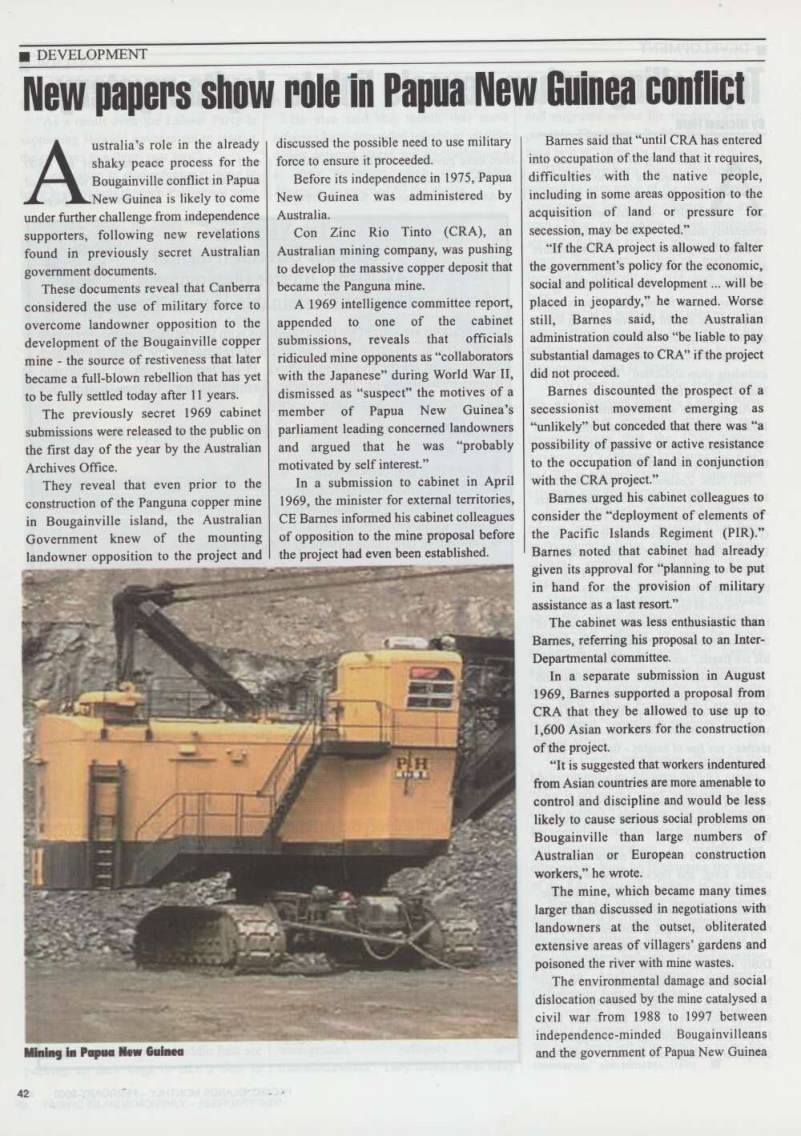
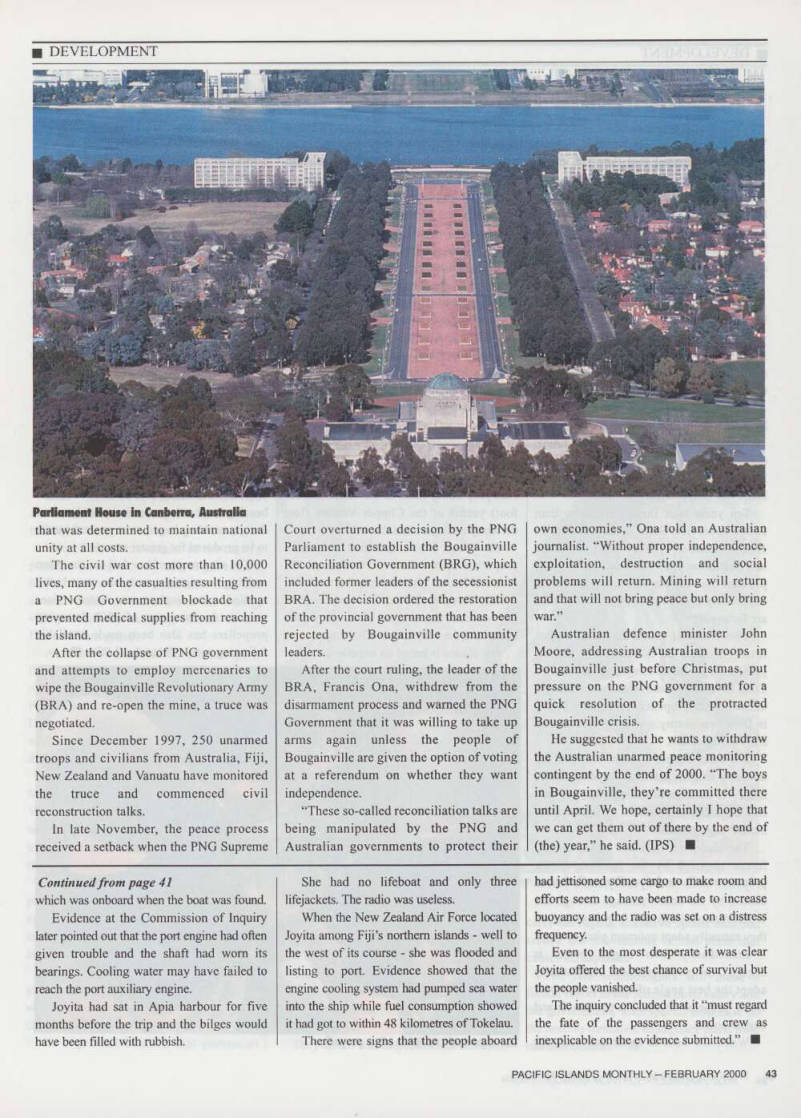
Development
By Michael Field
Atop-selling British author has revealed her link to one of the strangest mysteries of the South Pacific - one that saw 25 people completely disappear off the face of the Earth.
Forty-four years later, no one is any clearer about what happened to the boat Joyita somewhere between Samoa and Tokelau in 1956. Joyita was found, and still sails today, but the souls aboard have never been found and their fate is completely unknown.
Many theories have been advanced including alien abduction - but Joyita is the Mary Celeste of the Pacific.
Among those who disappeared was Andy Parsons, an Irish doctor who had emigrated to New Zealand. He had been posted to Samoa, then a New Zealand territory.
His New Zealand-bom daughter, Julie Parsons, is author the best-selling dark thrillers “Mary, Mary” and her latest, “The Courtship Gift”. In an interview with the Times of London Parsons says the disappearance of her father was influential in developing her psychologically tormented characters.
“You could say, because of what happened to our family, that I have a very strong sense of the unexpected, that the underpinnings of my life are fragile,” she told the Times.
“Inevitable, I suppose. You’re five and Daddy never comes back. How does a child explain that to herself? Logic has nothing to do with it, or with the fears that follow. The phobia - my fear of heights - first came to the surface when 1 was 14.”
The Joyita mystery has defied explanation, despite a Commission of Inquiry that sat in Samoa and found all kind of clues, none of them very satisfying.
Joyita was a twin screw motor vessel, 21 metres long, and thickly lined with cork insulation that made her virtually unsinkable.
She had two marine diesel engines and was regarded as very sound, as the drama proved.
In November 1955, Joyita, under Captain Dusty Miller, a Welshman, was chartered by New Zealand to make the 38 hour voyage from Samoa to Tokelau, a group of three isolated atolls. Five and a half weeks later Joyita was found drifting, water-logged and completely without trace of people. There had
been three government officials, six Tokelau and two other passengers, an American mate and 12 Samoan crew, as
well as Miller. They had fuel for 4800 kilometres and plenty of food and water - all of
Continued on page 43
Continued from page 41
which was onboard when the boat was found.
Evidence at the Commission of Inquiry later pointed out that the port engine had often given trouble and the shaft had worn its bearings. Cooling water may have failed to reach the port auxiliary engine.
Joyita had sat in Apia harbour for five months before the trip and the bilges would have been filled with rubbish.
She had no lifeboat and only three lifejackets. The radio was useless.
When the New Zealand Air Force located Joyita among Fiji’s northern islands - well to the west of its course - she was flooded and listing to port. Evidence showed that the engine cooling system had pumped sea water into the ship while fuel consumption showed it had got to within 48 kilometres of Tokelau.
There were signs that the people aboard
had jettisoned some cargo to make room and efforts seem to have been made to increase buoyancy and the radio was set on a distress frequency.
Even to the most desperate it was clear Joyita offered the best chance of survival but the people vanished.
The inquiry concluded that it “must regard the fate of the passengers and crew as inexplicable on the evidence submitted.” ■
Advertisements & other items, p. 41 (1 item)
Job Vacancies
Assistant Director (Finance)
Assistant Director (Environment) Assistant Director (Sustainable Human Development) ft Applications are sought for three positions with the Pacific Concerns Resource Centre (PCRC) in Suva, Fiji. PCRC is the secretariat for the Nuclear Free and Independent Pacific (NFIP) movement. PCRC has programs on Sustainable Human Development, Environment, Demilitarisation, Human Rights and Good Governance, and Decolonisation.
The position of Assistant Director (Finance) requires qualifications and experience in: • accounting and bookkeeping; • budgeting and financial management; • payroll, banking, tax and insurance; • office administration and staff management; • computing and management of computer networks.
The successful candidates for the other Assistant Director positions will be responsible for PCRC's programs on Environment or Sustainable Human Development in the Pacific. These positions require: • Experience in lobbying and campaigning on either environment or
development/economics/trade issues
• Knowledge of Pacific issues and a commitment to the NFIP agenda • Experience and ability in academic research and report writing • Organising, administrative and co-ordination skills • A university degree in relevant fields or equivalent qualification • Fluency in spoken and written English (Pacific languages and French an
advantage).
The three positions will be based in Suva, Fiji with a salary package in the range of F 530,000 $40,000, to commence in March 2000.
Full details of the three positions are available from Tej Kuar at PCRC in Suva, Fiji. Applications for the position should include a C.V., three letters of reference, and a recent example of writing on relevant Pacific issues.
Applications must be submitted by 20 February 2000, addressed to: The Director, Pacific Concerns Resource Centre (PCRC), 83 Amy Street, Toorak, Private Mail Bag, Suva, Fiji Phone: (679) 304649 Fax: (679) 304755
Email: [email protected]
Web: www.perc.org.fj
104711v2
New papers show role in Papua New Guinea conflict
Australia’s role in the already shaky peace process for the Bougainville conflict in Papua New Guinea is likely to come under further challenge from independence supporters, following new revelations found in previously secret Australian government documents.
These documents reveal that Canberra considered the use of military force to overcome landowner opposition to the development of the Bougainville copper mine - the source of restiveness that later became a full-blown rebellion that has yet to be fully settled today after 11 years.
The previously secret 1969 cabinet submissions were released to the public on the first day of the year by the Australian Archives Office.
They reveal that even prior to the construction of the Panguna copper mine in Bougainville island, the Australian Government knew of the mounting landowner opposition to the project and
discussed the possible need to use military force to ensure it proceeded.
Before its independence in 1975, Papua New Guinea was administered by Australia.
Con Zinc Rio Tinto (CRA), an Australian mining company, was pushing to develop the massive copper deposit that became the Panguna mine.
A 1969 intelligence committee report, appended to one of the cabinet submissions, reveals that officials ridiculed mine opponents as “collaborators with the Japanese” during World War 11, dismissed as “suspect” the motives of a member of Papua New Guinea’s parliament leading concerned landowners and argued that he was “probably motivated by self interest.”
In a submission to cabinet in April 1969, the minister for external territories, CE Bames informed his cabinet colleagues of opposition to the mine proposal before the project had even been established.
Barnes said that “until CRA has entered into occupation of the land that it requires, difficulties with the native people, including in some areas opposition to the acquisition of land or pressure for secession, may be expected.”
“If the CRA project is allowed to falter the government’s policy for the economic, social and political development... will be placed in jeopardy,” he warned. Worse still, Barnes said, the Australian administration could also “be liable to pay substantial damages to CRA” if the project did not proceed.
Barnes discounted the prospect of a secessionist movement emerging as “unlikely” but conceded that there was “a possibility of passive or active resistance to the occupation of land in conjunction with the CRA project.”
Bames urged his cabinet colleagues to consider the “deployment of elements of the Pacific Islands Regiment (PIR).”
Barnes noted that cabinet had already given its approval for “planning to be put in hand for the provision of military assistance as a last resort.”
The cabinet was less enthusiastic than Bames, referring his proposal to an Inter-
Departmental committee.
In a separate submission in August 1969, Barnes supported a proposal from CRA that they be allowed to use up to 1,600 Asian workers for the construction of the project.
“It is suggested that workers indentured from Asian countries are more amenable to control and discipline and would be less likely to cause serious social problems on Bougainville than large numbers of Australian or European construction workers,” he wrote.
The mine, which became many times larger than discussed in negotiations with landowners at the outset, obliterated extensive areas of villagers’ gardens and poisoned the river with mine wastes.
The environmental damage and social dislocation caused by the mine catalysed a civil war from 1988 to 1997 between
independence-minded Bougainvilleans
and the government of Papua New Guinea
Mining in Papua New Guinea
that was determined to maintain national unity at all costs.
The civil war cost more than 10,000 lives, many of the casualties resulting from a PNG Government blockade that prevented medical supplies from reaching the island.
After the collapse of PNG government and attempts to employ mercenaries to wipe the Bougainville Revolutionary Army (BRA) and re-open the mine, a truce was negotiated.
Since December 1997, 250 unarmed troops and civilians from Australia, Fiji, New Zealand and Vanuatu have monitored the truce and commenced civil reconstruction talks.
In late November, the peace process received a setback when the PNG Supreme
Court overturned a decision by the PNG Parliament to establish the Bougainville Reconciliation Government (BRG), which included former leaders of the secessionist BRA. The decision ordered the restoration of the provincial government that has been rejected by Bougainville community leaders.
After the court ruling, the leader of the BRA, Francis Ona, withdrew from the disarmament process and warned the PNG Government that it was willing to take up arms again unless the people of Bougainville are given the option of voting at a referendum on whether they want independence.
“These so-called reconciliation talks are being manipulated by the PNG and Australian governments to protect their
own economies,” Ona told an Australian journalist. “Without proper independence, exploitation, destruction and social problems will return. Mining will return and that will not bring peace but only bring war.”
Australian defence minister John Moore, addressing Australian troops in Bougainville just before Christmas, put pressure on the PNG government for a quick resolution of the protracted Bougainville crisis.
He suggested that he wants to withdraw the Australian unarmed peace monitoring contingent by the end of 2000. “The boys in Bougainville, they’re committed there until April. We hope, certainly I hope that we can get them out of there by the end of (the) year,” he said. (IPS) ■
Parliament House in Canberra, Australia
Advertisements & other items, p. 42 (1 item)
42
■ DEVELOPMENT
Propelling into the world markets
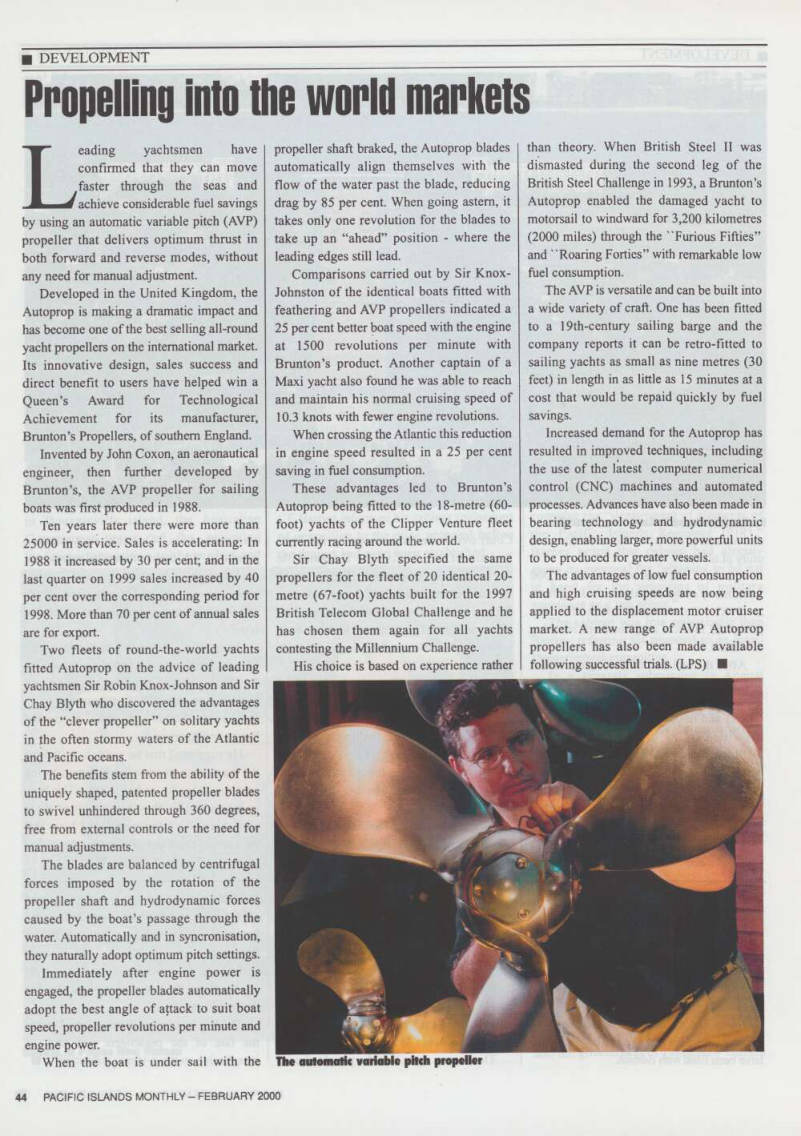
Leading yachtsmen have
confirmed that they can move faster through the seas and achieve considerable fuel savings by using an automatic variable pitch (AVP) propeller that delivers optimum thrust in both forward and reverse modes, without any need for manual adjustment.
Developed in the United Kingdom, the Autoprop is making a dramatic impact and has become one of the best selling all-round yacht propellers on the international market.
Its innovative design, sales success and direct benefit to users have helped win a Queen’s Award for Technological Achievement for its manufacturer, Brunton’s Propellers, of southern England.
Invented by John Coxon, an aeronautical engineer, then further developed by Brunton’s, the AVP propeller for sailing boats was first produced in 1988.
Ten years later there were more than 25000 in service. Sales is accelerating: In 1988 it increased by 30 per cent; and in the last quarter on 1999 sales increased by 40 per cent over the corresponding period for 1998. More than 70 per cent of annual sales are for export.
Two fleets of round-the-world yachts fitted Autoprop on the advice of leading yachtsmen Sir Robin Knox-Johnson and Sir Chay Blyth who discovered the advantages of the “clever propeller” on solitary yachts in the often stormy waters of the Atlantic and Pacific oceans.
The benefits stem from the ability of the
uniquely shaped, patented propeller blades
to swivel unhindered through 360 degrees, free from external controls or the need for
manual adjustments.
The blades are balanced by centrifugal forces imposed by the rotation of the propeller shaft and hydrodynamic forces caused by the boat’s passage through the water. Automatically and in syncronisation, they naturally adopt optimum pitch settings.
Immediately after engine power is engaged, the propeller blades automatically adopt the best angle of attack to suit boat speed, propeller revolutions per minute and engine power.
When the boat is under sail with the
propeller shaft braked, the Autoprop blades automatically align themselves with the flow of the water past the blade, reducing drag by 85 per cent. When going astern, it takes only one revolution for the blades to take up an “ahead” position - where the leading edges still lead.
Comparisons carried out by Sir Knox- Johnston of the identical boats fitted with feathering and AVP propellers indicated a 25 per cent better boat speed with the engine at 1500 revolutions per minute with Brunton’s product. Another captain of a Maxi yacht also found he was able to reach and maintain his normal cruising speed of 10.3 knots with fewer engine revolutions.
When crossing the Atlantic this reduction in engine speed resulted in a 25 per cent saving in fuel consumption.
These advantages led to Brunton’s Autoprop being fitted to the 18-metre (60foot) yachts of the Clipper Venture fleet currently racing around the world.
Sir Chay Blyth specified the same propellers for the fleet of 20 identical 20metre (67-foot) yachts built for the 1997 British Telecom Global Challenge and he has chosen them again for all yachts contesting the Millennium Challenge.
His choice is based on experience rather
than theory. When British Steel II was dismasted during the second leg of the British Steel Challenge in 1993, a Brunton’s Autoprop enabled the damaged yacht to motorsail to windward for 3,200 kilometres (2000 miles) through the "Furious Fifties” and "Roaring Forties” with remarkable low fuel consumption.
The AVP is versatile and can be built into a wide variety of craft. One has been fitted to a 19th-century sailing barge and the company reports it can be retro-fitted to sailing yachts as small as nine metres (30 feet) in length in as little as 15 minutes at a cost that would be repaid quickly by fuel savings.
Increased demand for the Autoprop has resulted in improved techniques, including the use of the latest computer numerical control (CNC) machines and automated processes. Advances have also been made in bearing technology and hydrodynamic design, enabling larger, more powerful units to be produced for greater vessels.
The advantages of low fuel consumption and high cruising speeds are now being applied to the displacement motor cruiser market. A new range of AVP Autoprop propellers has also been made available following successful trials. (LPS) ■
The automatic variable pitch propeller
Midway Island first and last tn greet millennium
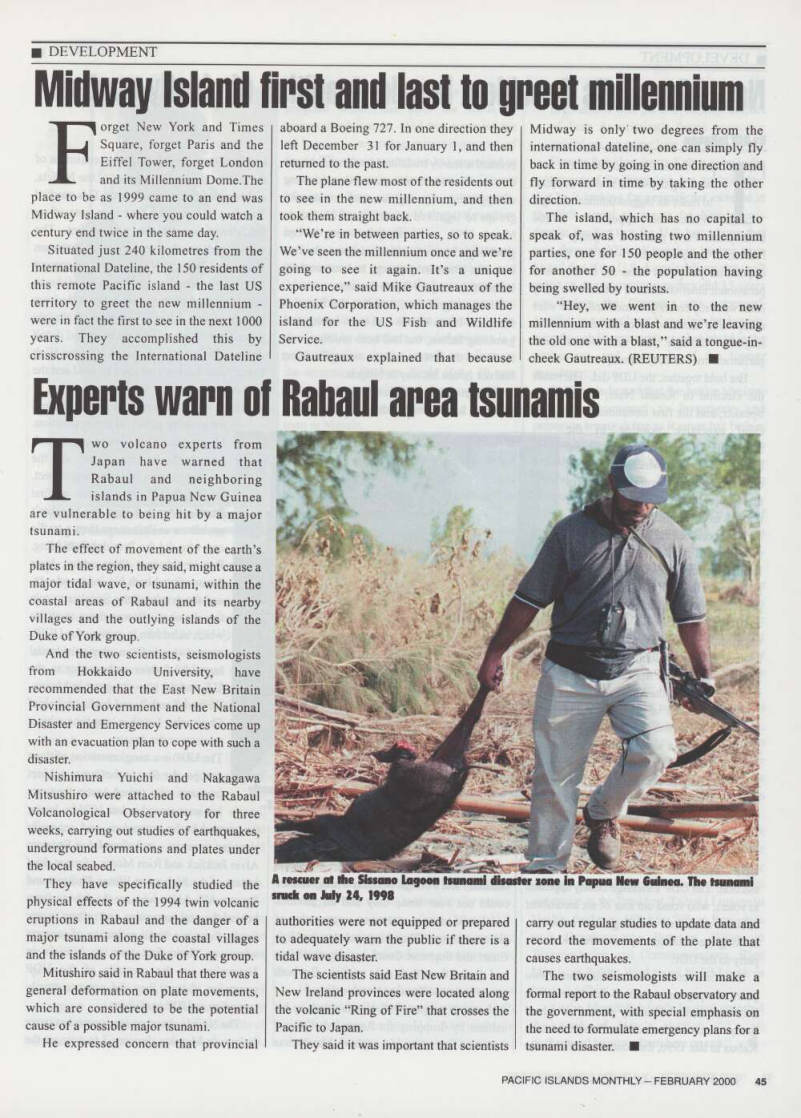
Forget New York and Times Square, forget Paris and the Eiffel Tower, forget London and its Millennium Dome. The place to be as 1999 came to an end was Midway Island - where you could watch a century end twice in the same day.
Situated just 240 kilometres from the International Dateline, the 150 residents of this remote Pacific island - the last US territory to greet the new millennium were in fact the first to see in the next 1000 years. They accomplished this by crisscrossing the International Dateline
aboard a Boeing 727. In one direction they left December 31 for January 1, and then returned to the past.
The plane flew most of the residents out to see in the new millennium, and then took them straight back.
“We’re in between parties, so to speak.
We’ve seen the millennium once and we’re going to see it again. It’s a unique experience,” said Mike Gautreaux of the Phoenix Corporation, which manages the island for the US Fish and Wildlife Service.
Gautreaux explained that because
Midway is only two degrees from the international dateline, one can simply fly back in time by going in one direction and fly forward in time by taking the other direction.
The island, which has no capital to speak of, was hosting two millennium parties, one for 150 people and the other for another 50 - the population having being swelled by tourists.
“Hey, we went in to the new millennium with a blast and we’re leaving the old one with a blast,” said a tongue-in cheek Gautreaux. (REUTERS) ■
Experts warn of Rabaul area tsunamis
Two volcano experts from Japan have warned that Rabaul and neighboring islands in Papua New Guinea are vulnerable to being hit by a major tsunami.
The effect of movement of the earth’s plates in the region, they said, might cause a major tidal wave, or tsunami, within the coastal areas of Rabaul and its nearby villages and the outlying islands of the Duke of York group.
And the two scientists, seismologists from Hokkaido University, have recommended that the East New Britain Provincial Government and the National Disaster and Emergency Services come up with an evacuation plan to cope with such a disaster.
Nishimura Yuichi and Nakagawa Mitsushiro were attached to the Rabaul Volcanological Observatory for three weeks, carrying out studies of earthquakes, underground formations and plates under the local seabed.
They have specifically studied the physical effects of the 1994 twin volcanic eruptions in Rabaul and the danger of a major tsunami along the coastal villages and the islands of the Duke of York group.
Mitushiro said in Rabaul that there was a general deformation on plate movements, which are considered to be the potential cause of a possible major tsunami.
He expressed concern that provincial
authorities were not equipped or prepared to adequately warn the public if there is a tidal wave disaster.
The scientists said East New Britain and New Ireland provinces were located along the volcanic “Ring of Fire” that crosses the Pacific to Japan.
They said it was important that scientists
carry out regular studies to update data and record the movements of the plate that causes earthquakes.
The two seismologists will make a formal report to the Rabaul observatory and the government, with special emphasis on the need to formulate emergency plans for a tsunami disaster. ■
A rescuer at the Sissano lagoon tsunami disaster zone in Papua New Guinea. The tsunami snick on July 24, 1998
New Marshalls President breaks tradition ot chiefly control
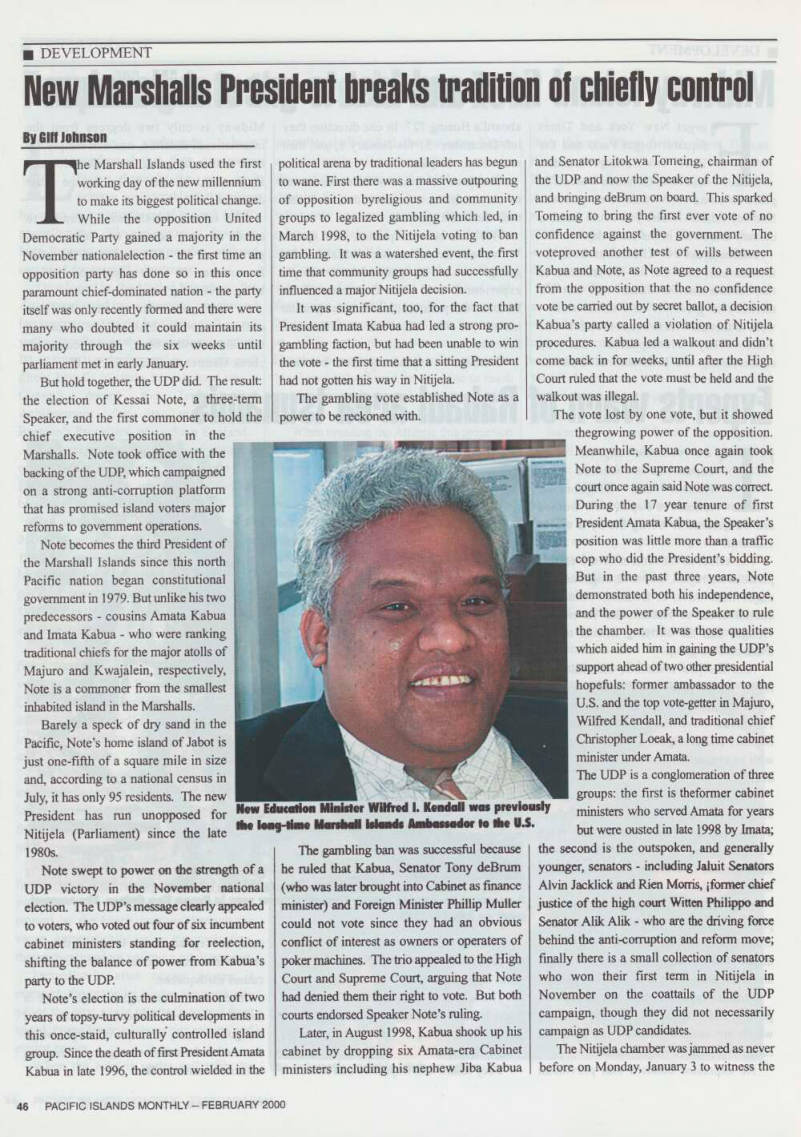
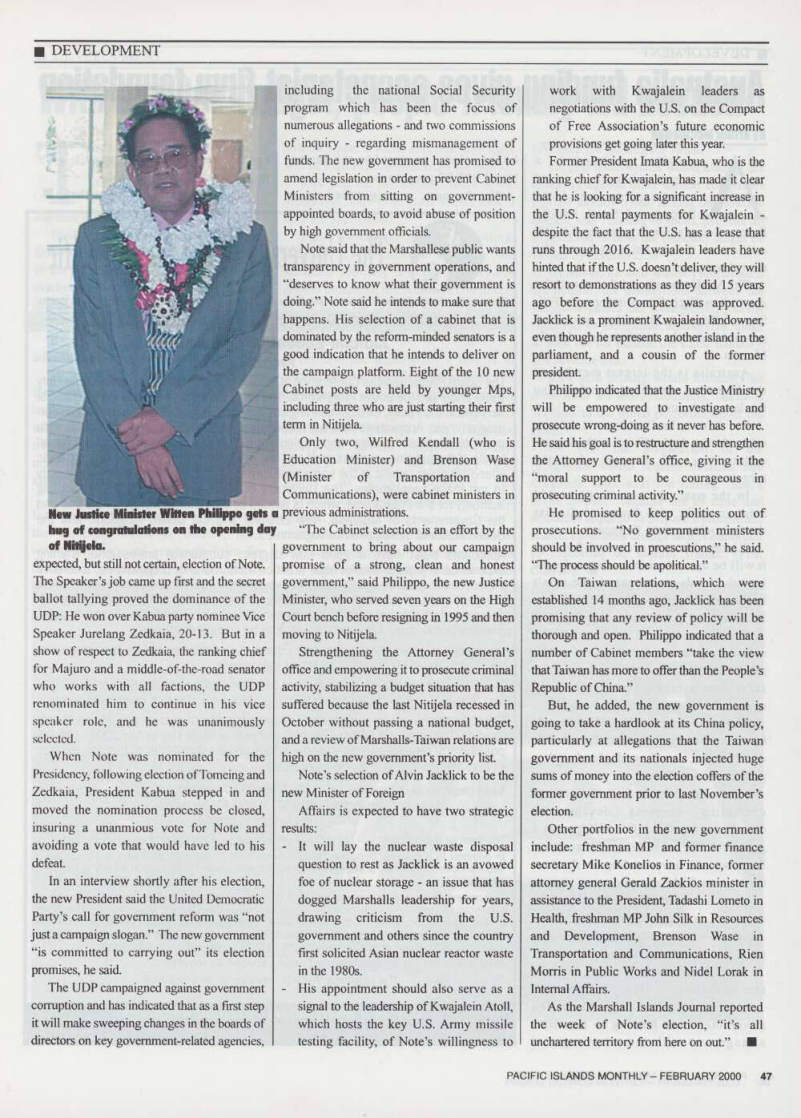
By Giff Johnson
The Marshall Islands used the first working day of the new millennium to make its biggest political change.
While the opposition United Democratic Party gained a majority in the November nationalelection - the first time an opposition party has done so in this once paramount chief-dominated nation - the party itself was only recently formed and there were many who doubted it could maintain its majority through the six weeks until parliament met in early January.
But hold together, the UDP did. The result: the election of Kessai Note, a three-term Speaker, and the first commoner to hold the
chief executive position in the Marshalls. Note took office with the backing of the UDP, which campaigned on a strong anti-corruption platform that has promised island voters major reforms to government operations.
Note becomes the third President of the Marshall Islands since this north Pacific nation began constitutional government in 1979. But unlike his two predecessors - cousins Amata Kabua and Imata Kabua - who were ranking traditional chiefs for the major atolls of Majuro and Kwajalein, respectively, Note is a commoner from the smallest inhabited island in the Marshalls.
Barely a speck of dry sand in the Pacific, Note’s home island of Jabot is just one-fifth of a square mile in size and, according to a national census in July, it has only 95 residents. The new President has run unopposed for Nitijela (Parliament) since the late 1980 s.
Note swept to power on the strength of a UDP victory in the November national election. The UDP’s message clearly appealed to voters, who voted out four of six incumbent cabinet ministers standing for reelection, shifting the balance of power from Kabua’s party to the UDP.
Note’s election is the culmination of two years of topsy-turvy political developments in this once-staid, culturally controlled island group. Since the death of first President Amata Kabua in late 1996, the control wielded in the
political arena by traditional leaders has begun to wane. First there was a massive outpouring of opposition byreligious and community groups to legalized gambling which led, in March 1998, to the Nitijela voting to ban gambling. It was a watershed event, the first time that community groups had successfully influenced a major Nitijela decision.
It was significant, too, for the fact that President Imata Kabua had led a strong pro gambling faction, but had been unable to win the vote - the first time that a sitting President had not gotten his way in Nitijela.
The gambling vote established Note as a power to be reckoned with.
The gambling ban was successful because he ruled that Kabua, Senator Tony deßrum (who was later brought into Cabinet as finance minister) and Foreign Minister Phillip Muller could not vote since they had an obvious conflict of interest as owners or operators of poker machines. The trio appealed to the High Court and Supreme Court, arguing that Note had denied them their right to vote. But both courts endorsed Speaker Note’s ruling.
Later, in August 1998, Kabua shook up his cabinet by dropping six Amata-era Cabinet ministers including his nephew Jiba Kabua
and Senator Litokwa Tomeing, chairman of the UDP and now the Speaker of the Nitijela, and bringing deßrum on board. This sparked Tomeing to bring the first ever vote of no confidence against the government. The voteproved another test of wills between Kabua and Note, as Note agreed to a request from the opposition that the no confidence vote be carried out by secret ballot, a decision Kabua’s party called a violation of Nitijela procedures. Kabua led a walkout and didn’t come back in for weeks, until after the High Court ruled that the vote must be held and the walkout was illegal.
The vote lost by one vote, but it showed
thegrowing power of the opposition.
Meanwhile, Kabua once again took Note to the Supreme Court, and the court once again said Note was correct.
During the 17 year tenure of first President Amata Kabua, the Speaker’s position was little more than a traffic cop who did the President’s bidding.
But in the past three years, Note demonstrated both his independence, and the power of the Speaker to rule the chamber. It was those qualities which aided him in gaining the UDP’s support ahead of two other presidential hopefuls: former ambassador to the U.S. and the top vote-getter in Majuro, Wilfred Kendall, and traditional chief Christopher Loeak, a long time cabinet minister under Amata.
The UDP is a conglomeration of three groups: the first is theformer cabinet ministers who served Amata for years but were ousted in late 1998 by Imata;
the second is the outspoken, and generally younger, senators - including Jaluit Senators Alvin Jacklick and Rien Morris, jfoimer chief justice of the high court Witten Philippe and Senator Alik Alik - who are the driving force behind the anti-corruption and reform move; finally there is a small collection of senators who won their first term in Nitijela in November on the coattails of the UDP campaign, though they did not necessarily campaign as UDP candidates.
The Nitijela chamber was jammed as never before on Monday, January 3 to witness the
New Education Minister Wilfred I. Kendall was previously the long-tine Marshall Islands Ambassador to the U.S.
expected, but still not certain, election of Note.
The Speaker’s job came up first and the secret ballot tallying proved the dominance of the UDP: He won over Kabua party nominee Vice Speaker Jurelang Zedkaia, 20-13. But in a show of respect to Zedkaia, the ranking chief for Majuro and a middle-of-the-road senator who works with all factions, the UDP renominated him to continue in his vice speaker role, and he was unanimously selected.
When Note was nominated for the Presidency, following election of Tomeing and Zedkaia, President Kabua stepped in and moved the nomination process be closed, insuring a unanmious vote for Note and avoiding a vote that would have led to his defeat.
In an interview shortly after his election, the new President said the United Democratic Party’s call for government reform was “not just a campaign slogan.” The new government “is committed to carrying out” its election promises, he said.
The UDP campaigned against government corruption and has indicated that as a first step it will make sweeping changes in the boards of directors on key government-related agencies.
including the national Social Security program which has been the focus of numerous allegations - and two commissions of inquiry - regarding mismanagement of funds. The new government has promised to amend legislation in order to prevent Cabinet Ministers from sitting on government appointed boards, to avoid abuse of position by high government officials.
Note said that the Marshallese public wants transparency in government operations, and “deserves to know what their government is doing.” Note said he intends to make sure that happens. His selection of a cabinet that is dominated by the reform-minded senators is a good indication that he intends to deliver on the campaign platform. Eight of the 10 new Cabinet posts are held by younger Mps, including three who are just starting their first term in Nitijela.
Only two, Wilfred Kendall (who is Education Minister) and Brenson Wase (Minister of Transportation and Communications), were cabinet ministers in previous administrations.
“The Cabinet selection is an effort by the government to bring about our campaign promise of a strong, clean and honest government,” said Philippo, the new Justice Minister, who served seven years on the High Court bench before resigning in 1995 and then moving to Nitijela.
Strengthening the Attorney General’s office and empowering it to prosecute criminal activity, stabilizing a budget situation that has suffered because the last Nitijela recessed in October without passing a national budget, and a review of Marshalls-Taiwan relations are high on the new government’s priority list.
Note’s selection of Alvin Jacklick to be the new Minister of Foreign Affairs is expected to have two strategic results: - It will lay the nuclear waste disposal question to rest as Jacklick is an avowed foe of nuclear storage - an issue that has dogged Marshalls leadership for years, drawing criticism from the U.S. government and others since the country first solicited Asian nuclear reactor waste in the 1980 s. - His appointment should also serve as a signal to the leadership of Kwajalein Atoll, which hosts the key U.S. Army missile testing facility, of Note’s willingness to
work with Kwajalein leaders as negotiations with the U.S. on the Compact of Free Association’s future economic provisions get going later this year.
Former President Imata Kabua, who is the ranking chief for Kwajalein, has made it clear that he is looking for a significant increase in the U.S. rental payments for Kwajalein despite the fact that the U.S. has a lease that runs through 2016. Kwajalein leaders have hinted that if the U.S. doesn’t deliver, they will resort to demonstrations as they did 15 years ago before the Compact was approved.
Jacklick is a prominent Kwajalein landowner, even though he represents another island in the parliament, and a cousin of the former president.
Philippo indicated that the Justice Ministry will be empowered to investigate and prosecute wrong-doing as it never has before.
He said his goal is to restructure and strengthen the Attorney General’s office, giving it the “moral support to be courageous in prosecuting criminal activity.”
He promised to keep politics out of prosecutions. “No government ministers should be involved in proescutions,” he said. ‘The process should be apolitical.”
On Taiwan relations, which were established 14 months ago, Jacklick has been promising that any review of policy will be thorough and open. Philippo indicated that a number of Cabinet members “take the view that Taiwan has more to offer than the People’s Republic of China.”
But, he added, the new government is going to take a hardlook at its China policy, particularly at allegations that the Taiwan government and its nationals injected huge sums of money into the election coffers of the former government prior to last November’s election.
Other portfolios in the new government include: freshman MP and former finance secretary Mike Konelios in Finance, former attorney general Gerald Zackios minister in assistance to the President, Tadashi Lometo in Health, freshman MP John Silk in Resources and Development, Brenson Wase in Transportation and Communications, Rien Morris in Public Works and Nidel Lorak in Internal Affairs.
As the Marshall Islands Journal reported the week of Note’s election, “it’s all unchartered territory from here on out.” ■
New Justice Minister Witten Philippo gets a hug of congratulations on the opening day of Nitijela.
Australia Mian gives secretariat firm foundation
By Arthur McCutchan
Australia signed a memorandum of understanding with the Suva-based South Pacific Forum Secretariat to provide SAUS9 million to the organisation over the next three years.
The MOU was signed last month by Australian High Commissioner to Fiji, Susan Body, and acting secretary general for the secretariat, losefo Maiava.
Australia is the largest member of the 16-nation secretariat and is also the largest donor.
But it was the first time it, or any other donor, had offered a three-year undertaking of support for the secretariat.
In the past, the secretariat would meet annually with donors to discuss
the following year’s finances.
“Under this new system of funding, it will be up to the secretariat to decide how the funds are managed. We won’t be looking over its shoulder at every little detail,” Boyd said.
Just over a third of the SAUS3 million put aside for the year 2000, ($AU51,027,327), will go to the secretariat’s regular budget to help cover operating expenses.
The remaining $AU51,972,603 will be used to meet the costs of a number of contract staff and fund other projects and activities.
“We do live in a climate of
decreasing overseas development
assistance, but this MOU will give us a greater sense of security because we know we will have funding for the next three years,” Maiava said.
He said the secretariat would try to convince other donors to follow Australia’s lead since it would allow it to plan programmes three years ahead.
John Davidson, an AusAID representative from Canberra, Australia, said the Australian government was moving to a similar arrangement with the other regional
bodies it helps support like the Samoa based SPREP programme.
“In the past, we negotiated on an
annual basis but that wasn’t very productive,” Davidson said.
This will hopefully change that. ■
Advertisements & other items, p. 48 (1 item)
© The University of the South Pacific
Serving the Cook Islands, Fiji, Kiribati, Marshall Islands, Nauru, Niue, Samoa, Solomon Islands, Tokelau, Tonga, Tuvalu, Vanuatu
PACIiFKJ REGIONAL JUDICIAL TRAINING PROGRAMME
Judicial Education Specialists
FVCOI2
The South Pacific Judicial Conference at its 13th meeting in Apia, Samoa June/July 1999 endorsed the above Programme. The Programme is to strengthen the judicial services in the Pacific through building capacity to design and run judicial education programmes. Appointees will be responsible together with the co-ordinator to promote, facilitate, design, and implement judicial education programmes for all levels of the judiciary, professional and lay, in-country and regionally, for 15 pacific island countries, whilst at the same time developing national and regional capacity to run these programmes. The University of the South Pacific is the executing authority for the Programme, which is funded by the Asian Development Bank, and the Governments of Australia, New Zealand and the United Kingdom, and the United National Development Programme.
Applicants must have a good Law degree; substantial professional training experience in judicial and/or legal practice institutions or programmes: extensive experience in judicial needs analysis; vocational workshop, seminar and course design, logistics, delivery and evaluation: proven training skills in adult learning: demonstrated presentation and communication skills; and experience in legal material production. Applicants must also be computer literate.
Knowledge of more than one pacific country jurisdiction would be advantageous.
Applicants must be prepared to travel extensively.
Enquiries and further information: Kim Stanford-Smith, ph: 212801 or 314273; fax: 309261, e-mail: [email protected] or kirn, [email protected] These positions will be designated Fellows, Institute of Justice and Applied Legal Studies. The posts will be fixed term of one year or to 31 December 2001, with the possibility of renewal subject to performance and the availability of funding. Periods of less than one year may be negotiated.
Salary range: Senior Lecturer level F 534,739 to F 545,709 per annum Associate Professor level F 558,507 to F 565,821 per annum (inclusive of 15% gratuity) The level of appointment will be determined subject to qualifications and experiences.
In addition to the above benefits, the University contributes 10% of salary to an approved superannuation scheme, provides airfare and relocation costs, and substantially subsidises housing.
Two copies of your application, including full curriculum vitae plus certified copies of academic qualifications and transcripts must be forwarded to The Recruitment Manager, The University of the South Pacific, Suva, Fiji, by 3 March 2000. Applicants must request three professional referees to forward signed reports (quoting reference number) to the above address. Please note that applications and referees reports sent by email will not be accepted.
Applications will not be acknowledged unless specifically requested.
The University Website address is: www.usp.ac.fj USP is a Multi-Modal Teaching Institution
With smaller budget, people-friendly aid needed

The timing of a share float and its pricing are critical to its success, participants at a Port Moresby, Papua New Guinea, seminar on equities were told October.
Broker, Anthony Kirk from Morgan Stockbroking in Brisbane, Australia spoke to the participants about accessing equity markets, what they need to do and discussed many other issues associated with listing a company.
Kirk said listing a company has both advantages and “consequences”.
He said the advantages of listing are that companies have access to provision of capital, the public will be able to buy and sell shares in it, use it as a platform to transfer its ownership and management, may change its corporate image, and attract and retain employees.
He said some of the consequences of listing were that the equity or control in the company would be diluted, there would be increased responsibilities for directors, the company’s accountability
will be under a wider scrutiny, and there will be high expectations from investors.
Kirk told the participants some of the things that share float underwriters look if they are approached.
These include the reasons for listing, the type of business or industry the particular company is in, its maturity and growth prospects, the valuation and timing of the float, the pricing, who its directors and management are, and look at their prospectus.
He said the underwriter’s role is to understand the key investment points of the company and assess how the market will value the stock, taking into consideration things like investor perception of the industry/company, historical earnings performance and quality, its growth prospects, the prevailing stock market conditions and the outlook.
Kirk said a company that is planning to list, must also investors provide investors with alternative opportunities because
investors are looking for value.
He said underwriters would also pit the company against other similar companies that are already listed, to find out how the market was reacting to them, provide an expectation of how the company might be valued by investors.
However, he said whilst comparisons are helpful, the distinctions between the listed companies and those planning to list must also be recognised, adding that things to look out for include the sizes, maturity, and revenue mix.
Kirk said pricing would normally be done after all the evaluations, but it is “critical to the initial performance of the stock.”
He said the preparation of the prospectus would require detailed due diligence. Kirk said the timing “has a major impact” because the of time and resources required to prepare a prospectus, market conditions change so it is important to capitalise on market trends. (Post Courier) ■
Students march towards parliament to join anti-government protests in Papua New Guinea
How green was our century
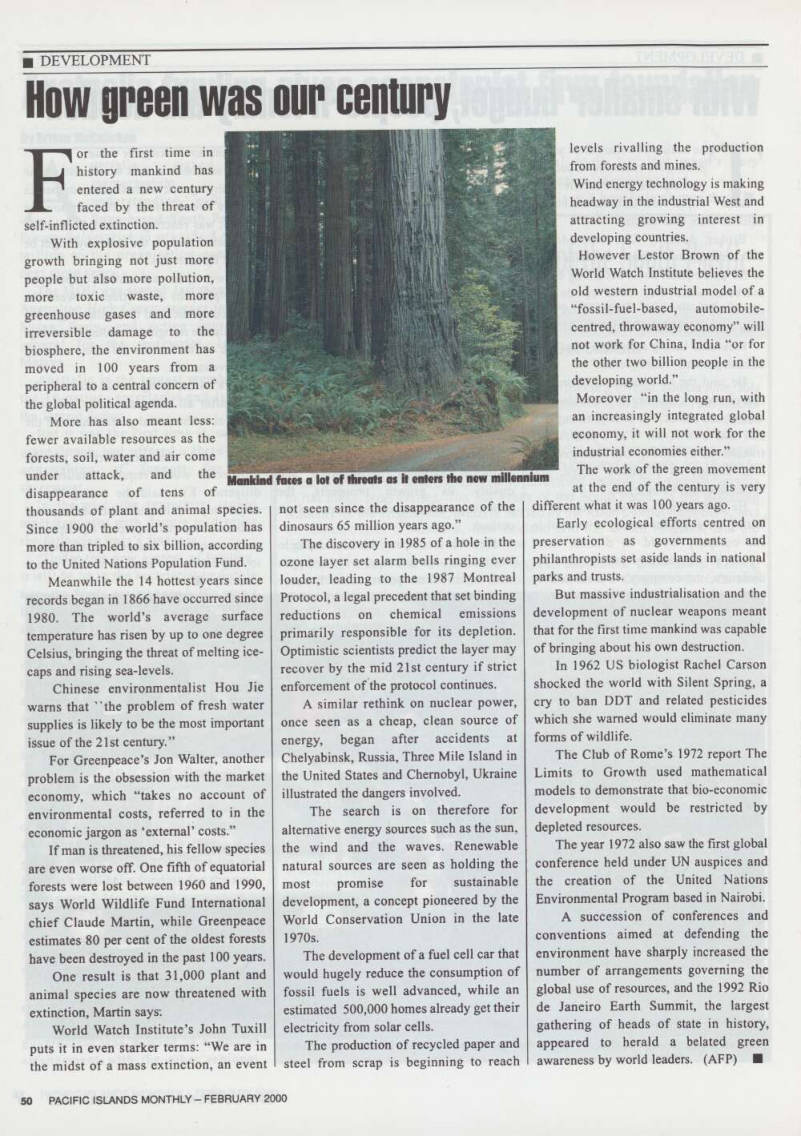
For the first time in history mankind has entered a new century faced by the threat of self-inflicted extinction.
With explosive population growth bringing not just more people but also more pollution, more toxic waste, more greenhouse gases and more irreversible damage to the biosphere, the environment has moved in 100 years from a peripheral to a central concern of
the global political agenda.
More has also meant less: fewer available resources as the forests, soil, water and air come under attack, and the disappearance of tens of
thousands of plant and animal species.
Since 1900 the world’s population has more than tripled to six billion, according to the United Nations Population Fund.
Meanwhile the 14 hottest years since records began in 1866 have occurred since 1980. The world’s average surface temperature has risen by up to one degree Celsius, bringing the threat of melting ice caps and rising sea-levels.
Chinese environmentalist Hou Jie warns that "the problem of fresh water supplies is likely to be the most important issue of the 21st century.”
For Greenpeace’s Jon Walter, another problem is the obsession with the market economy, which “takes no account of environmental costs, referred to in the economic jargon as ‘external’ costs.”
If man is threatened, his fellow species are even worse off. One fifth of equatorial forests were lost between 1960 and 1990, says World Wildlife Fund International chief Claude Martin, while Greenpeace estimates 80 per cent of the oldest forests have been destroyed in the past 100 years.
One result is that 31,000 plant and animal species are now threatened with extinction, Martin says - .
World Watch Institute’s John Tuxill puts it in even starker terms: “We are in the midst of a mass extinction, an event
not seen since the disappearance of the dinosaurs 65 million years ago.”
The discovery in 1985 of a hole in the ozone layer set alarm bells ringing ever louder, leading to the 1987 Montreal Protocol, a legal precedent that set binding reductions on chemical emissions
primarily responsible for its depletion.
Optimistic scientists predict the layer may recover by the mid 21st century if strict enforcement of the protocol continues.
A similar rethink on nuclear power, once seen as a cheap, clean source of energy, began after accidents at Chelyabinsk, Russia, Three Mile Island in the United States and Chernobyl, Ukraine illustrated the dangers involved.
The search is on therefore for alternative energy sources such as the sun, the wind and the waves. Renewable natural sources are seen as holding the most promise for sustainable development, a concept pioneered by the World Conservation Union in the late 19705.
The development of a fuel cell car that would hugely reduce the consumption of fossil fuels is well advanced, while an estimated 500,000 homes already get their electricity from solar cells.
The production of recycled paper and steel from scrap is beginning to reach
levels rivalling the production from forests and mines.
Wind energy technology is making headway in the industrial West and
attracting growing interest in
developing countries.
However Lestor Brown of the World Watch Institute believes the old western industrial model of a “fossil-fuel-based, automobile centred, throwaway economy” will not work for China, India “or for the other two billion people in the developing world.”
Moreover “in the long run, with an increasingly integrated global economy, it will not work for the industrial economies either.”
The work of the green movement at the end of the century is very
different what it was 100 years ago.
Early ecological efforts centred on preservation as governments and philanthropists set aside lands in national parks and trusts.
But massive industrialisation and the development of nuclear weapons meant that for the first time mankind was capable of bringing about his own destruction.
In 1962 US biologist Rachel Carson shocked the world with Silent Spring, a cry to ban DDT and related pesticides which she warned would eliminate many forms of wildlife.
The Club of Rome’s 1972 report The Limits to Growth used mathematical models to demonstrate that bio-economic development would be restricted by
depleted resources.
The year 1972 also saw the first global conference held under UN auspices and the creation of the United Nations Environmental Program based in Nairobi.
A succession of conferences and conventions aimed at defending the environment have sharply increased the number of arrangements governing the global use of resources, and the 1992 Rio de Janeiro Earth Summit, the largest gathering of heads of state in history, appeared to herald a belated green awareness by world leaders. (AFP) ■
Mankind faces a lot of threats as it enters the new millennium
Solomons controversial
Obituary
Solomons controversial ex-leader dies
By Michael Field
By any measure the Solomon Islands could be one of the region’s richest nations. It has gold, and probably other minerals if anybody looked for them, a lush
land and seascape that could attract tens of thousands of tourists to the astonishing environment and it has usually friendly people with rich and diverse cultures.
Instead the Solomons is the regional basket case; a country fraught with a low-level, nagging civil war and an economy veiging on bankruptcy.
Its dusty capital has sold its soul to a couple of Asian run casinos, its infrastructure is barely functioning and chronically endemic malaria continues to destroy its people. It is not the fault of any one person, but if anybody could have made a significant difference it was Solomon Sunaone Mamaloni who died January 11 from the effects of malaria. Hailed, after death, by Prime Minister Bartholomew Ulufa’alu as a “distinguished and respected leader” Mamaloni was grossly corrupt and inept.
He was bom in West Makira (San Cristobal) in 1943 and educated at local schools before being sent to Te Aute College in New Zealand, a celebrated Maori college which has produced more than its fair shares of leaders. In New Zealand he lived with the family of Bruce Beetham, then a leader of the Social Credit Party.
Much later New Zealand Prime Minister Jim Bolger and Australian Pacific Affairs Minister Gordon Bilney attributed Mamaloni’s domestic arrangements to his later economic ineptness.
Once educated Mamaloni joined the civil service and rose to become the clerk of the Legislative Council in what was then the British Solomon Islands. He was elected to the Governing Council in 1970, becoming its chairman three years later and then its elected First Chief Minister in 1975.
The country became independent in 1978 and Mamaloni left politics briefly to run Patosha Company. He was re-elected to Parliament in 1980, becoming Leader of the Opposition. In a mark of his considerable political skills he then set about to engineer the collapse of Prime Minister Peter Kenilorea, the country’s first leader. He succeed and became prime minister in 1981. The political instability and disunity saw him serve terms as prime minister from then until 1997/' 3 Early in his premiership Mamaloni flirted with Libya, causing some concern in Canberra and Wellington, but it was soon seen as just a
ploy to get more aid. It caused no damage, but Mamaloni’s relationship with Malaysian loggers was damaging and outrageous. The loggers, with no concern for the environment, were given enormous tax breaks to clearfell tropical forests.
The local land owners seldom got anything.
It is hard to pin down what personal gain Mamaloni made out of it all; he never flaunted any particular wealth and he seldom ever traveled. It suggests that the problem was his inability to manage an economy that was the problem. Politics was the only game Mamaloni knew - anything else was beyond him. The official Australian viewpoint on him was revealed in 1997 when the “Australian Eyes Only” document was made public accidentally a the Forum Economic Ministers meeting in Cairns. It described him as “wily”.
“Prime Minister Mamaloni will remain an obstacle to responsible Government for as long as he is in power,” the paper said.
“Even in opposition he will pose a threat which will make ministers wary of change. He bought support, with help from Malaysian logging interests, to topple the short-lived reformist (Francis Billy) Hilly Government in 1994.“ Mamaloni’s corrupt dealings with loggers and others enable him to continue to dominate Solomon Islands politics.
“He deflects blame for the Government’s financial straits by sacking ministers; the minister of finance has been replaced twice since September 1996.” The paper talked of fraud and mismanagement in the government Mamaloni’s poor health and a fear of travel kept him in the Solomons. The only time he attended a Pacific Forum was in 1991 - when it was held in Honiara. In 1995 he attended the Commonwealth Heads of Government summit in Auckland when it suspended Nigeria from the oiganisation after it hanged political dissidents. In the communique at the time it was noted that only Gambia and the Solomons voted not to suspend Nigeria. A Commonwealth Secretariat official later briefed journalists telling them that Mamaloni had seldom attended any of the sessions, had been drinking heavily and did not seem to know what was happening. This may not have been entirely true because it was
revealed much later that each Commonwealth leader had gone to Queenstown and had received a hand written card from a local child welcoming them.
Mamaloni had received one, and unlike any
other leader, he had gone around to the home of the child to thank the family.
As a father ofpigfit|4ie perhaps had a personal touch (and Mamaloni was opposed to birth control, arguing that it would weaken the indigenous family system at a time the country needed more people, not less).
At the time his press secretary, Johnson Honimae, had defended the Commonwealth decision saying the prime minister had not heard properly what was being discussed.
Illness, not helped by almost obsessive betel nut chewing, ground down Mamaloni, prompting opposition politician Andrew Nori to call for his resignation.
“You are ill and have been absent from office for a period of nine weeks during the past 23 months of your administration,,” Nori said.
“Your illness has prevented you from realising the full impact of the financial hardship and your resignation should allow in new blood to take over the leadership.”
Mamaloni served during much of the Bougainville war which dramatically affected die border regions of the Solomon Islands. He was very hostile toward Papua New Guinea and gave die impression of supporting the Bougainvilleans in their fight for independence. A minister in the Ulufa’alu Government, Alfre d Sasako, told the Australian Broadcasting Commission that Mamaloni would be remembered as one of the architects of the Solomons. Sasako did not deny the corruption, but engaged in a torturous, if irrational, justification of it Yes, that was due, but what other nations in the region whose leaders escaped those sorts of allegations and perceptions, allegations that perhaps were based on perceptions, and perhaps because his views were not held to be an accepted view across the region, or across the political spectrum in the nation, and therefore a lot of people would try to see that as part of the legacy that he had left behind.
He said Mamaloni’s condoversial Malaysian logging concessions were based on the realisation that the country was under pressure to
develop.
For good or ill, Mamaloni will be remembered as a remarkably different leader of the Pacific. ■
Pride, poise and dignity
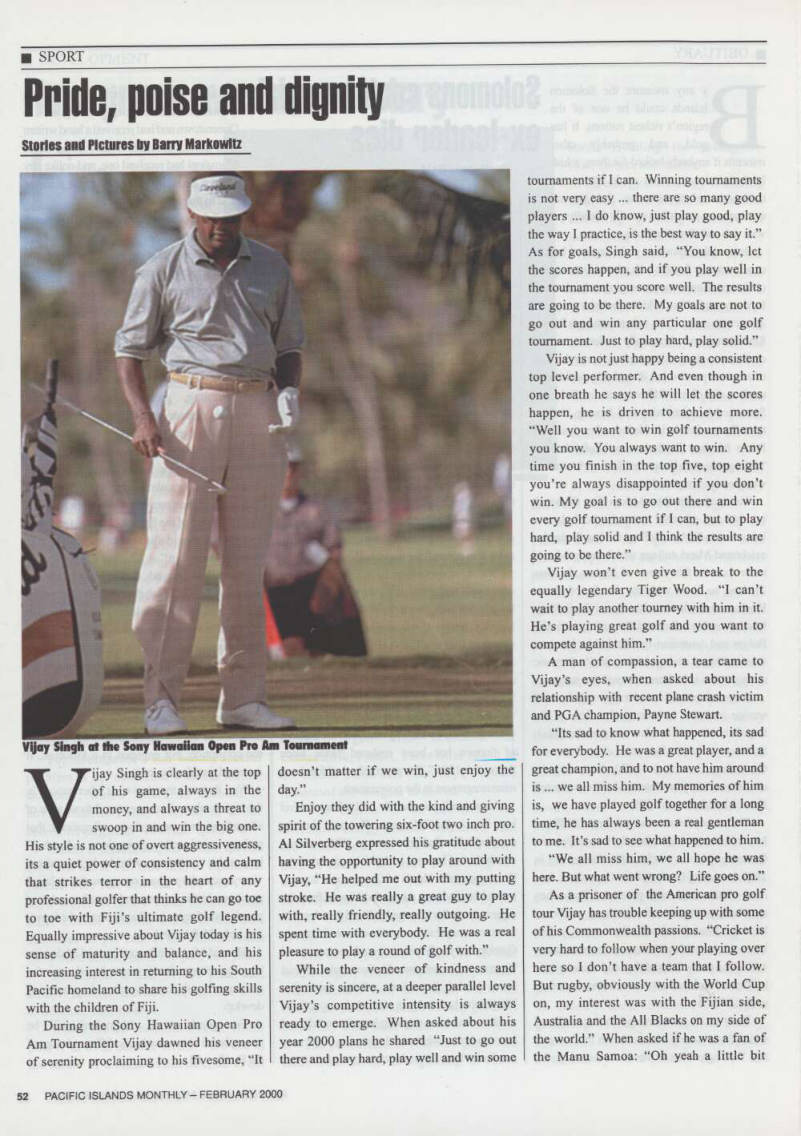
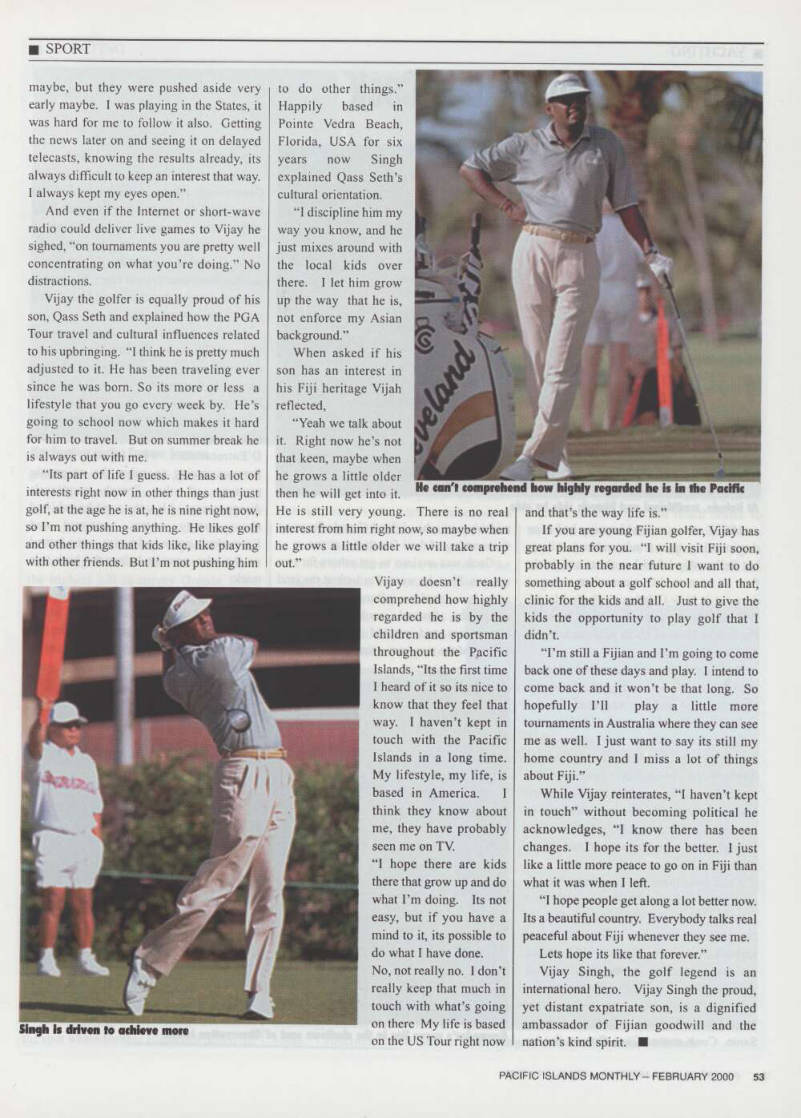
Sport
Stories and Pictures by Barry Markowitz
Vijay Singh is clearly at the top of his game, always in the money, and always a threat to swoop in and win the big one.
His style is not one of overt aggressiveness, its a quiet power of consistency and calm that strikes terror in the heart of any professional golfer that thinks he can go toe to toe with Fiji’s ultimate golf legend.
Equally impressive about Vijay today is his sense of maturity and balance, and his increasing interest in returning to his South Pacific homeland to share his golfing skills with the children of Fiji.
During the Sony Hawaiian Open Pro Am Tournament Vijay dawned his veneer of serenity proclaiming to his fivesome, “It
doesn’t matter if we win, just enjoy the day.”
Enjoy they did with the kind and giving spirit of the towering six-foot two inch pro.
A 1 Silverberg expressed his gratitude about having the opportunity to play around with Vijay, “He helped me out with my putting stroke. He was really a great guy to play with, really friendly, really outgoing. He spent time with everybody. He was a real pleasure to play a round of golf with.”
While the veneer of kindness and serenity is sincere, at a deeper parallel level Vijay’s competitive intensity is always ready to emerge. When asked about his year 2000 plans he shared “Just to go out there and play hard, play well and win some
tournaments if I can. Winning tournaments is not very easy ... there are so many good players ... I do know, just play good, play the way I practice, is the best way to say it.”
As for goals, Singh said, “You know, let the scores happen, and if you play well in the tournament you score well. The results are going to be there. My goals are not to go out and win any particular one golf tournament. Just to play hard, play solid.”
Vijay is not just happy being a consistent top level performer. And even though in one breath he says he will let the scores happen, he is driven to achieve more.
“Well you want to win golf tournaments you know. You always want to win. Any time you finish in the top five, top eight you’re always disappointed if you don’t win. My goal is to go out there and win every golf tournament if I can, but to play hard, play solid and I think the results are going to be there.”
Vijay won’t even give a break to the equally legendary Tiger Wood. “I can’t wait to play another tourney with him in it.
He’s playing great golf and you want to compete against him.”
A man of compassion, a tear came to Vijay’s eyes, when asked about his relationship with recent plane crash victim and PGA champion, Payne Stewart.
“Its sad to know what happened, its sad for everybody. He was a great player, and a great champion, and to not have him around is ... we all miss him. My memories of him is, we have played golf together for a long time, he has always been a real gentleman to me. It’s sad to see what happened to him.
“We all miss him, we all hope he was here. But what went wrong? Life goes on.”
As a prisoner of the American pro golf tour Vijay has trouble keeping up with some of his Commonwealth passions. “Cricket is very hard to follow when your playing over here so I don’t have a team that I follow.
But rugby, obviously with the World Cup on, my interest was with the Fijian side, Australia and the All Blacks on my side of the world.” When asked if he was a fan of the Manu Samoa: “Oh yeah a little bit
Vijay Singh at the Sony Hawaiian Open Pro Am Tournament
maybe, but they were pushed aside very early maybe. I was playing in the States, it was hard for me to follow it also. Getting the news later on and seeing it on delayed telecasts, knowing the results already, its always difficult to keep an interest that way.
I always kept my eyes open.”
And even if the Internet or short-wave radio could deliver live games to Vijay he sighed, “on tournaments you are pretty well concentrating on what you’re doing.” No distractions.
Vijay the golfer is equally proud of his son, Qass Seth and explained how the PGA Tour travel and cultural influences related to his upbringing. “I think he is pretty much adjusted to it. He has been traveling ever since he was born. So its more or less a lifestyle that you go every week by. He’s going to school now which makes it hard for him to travel. But on summer break he is always out with me.
“Its part of life I guess. He has a lot of interests right now in other things than just golf, at the age he is at, he is nine right now, so I’m not pushing anything. He likes golf and other things that kids like, like playing with other friends. But I’m not pushing him
to do other things.”
Happily based in Pointe Vedra Beach, Florida, USA for six years now Singh explained Qass Seth’s cultural orientation.
“I discipline him my way you know, and he just mixes around with the local kids over there. I let him grow up the way that he is, not enforce my Asian background.”
When asked if his son has an interest in
his Fiji heritage Vijah
reflected, “Yeah we talk about it. Right now he’s not that keen, maybe when he grows a little older then he will get into it.
He is still very young. There is no real interest from him right now, so maybe when he grows a little older we will take a trip out.”
Vijay doesn’t really comprehend how highly regarded he is by the children and sportsman throughout the Pacific Islands, “Its the first time I heard of it so its nice to know that they feel that way. I haven’t kept in touch with the Pacific Islands in a long time.
My lifestyle, my life, is based in America. I think they know about
me, they have probably
seen me on TV.
“I hope there are kids there that grow up and do what I’m doing. Its not easy, but if you have a mind to it, its possible to do what I have done.
No, not really no. I don’t really keep that much in touch with what’s going on there My life is based on the US Tour right now
and that’s the way life is.”
If you are young Fijian golfer, Vijay has great plans for you. “I will visit Fiji soon, probably in the near future I want to do something about a golf school and all that, clinic for the kids and all. Just to give the kids the opportunity to play golf that I didn’t.
“I’m still a Fijian and I’m going to come back one of these days and play. I intend to come back and it won’t be that long. So hopefully I’ll play a little more tournaments in Australia where they can see me as well. I just want to say its still my home country and I miss a lot of things
about Fiji.”
While Vijay reinterates, “I haven’t kept in touch” without becoming political he acknowledges, “I know there has been changes. I hope its for the better. I just like a little more peace to go on in Fiji than what it was when I left.
“I hope people get along a lot better now.
Its a beautiful country. Everybody talks real peaceful about Fiji whenever they see me.
Lets hope its like that forever.”
Vijay Singh, the golf legend is an international hero. Vijay Singh the proud, yet distant expatriate son, is a dignified ambassador of Fijian goodwill and the nation’s kind spirit. ■
Singh is driven to achieve more
He can't comprehend how highly regarded he is in the Pacific
In the wake of Captain Cook
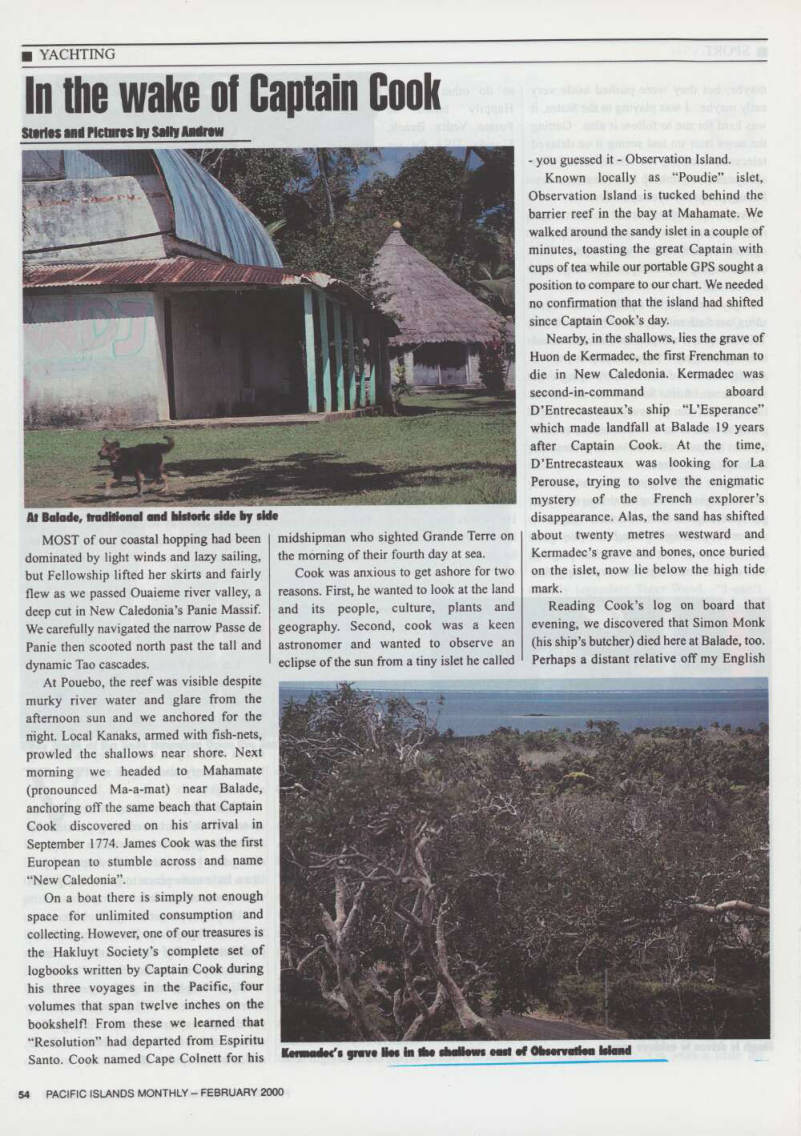
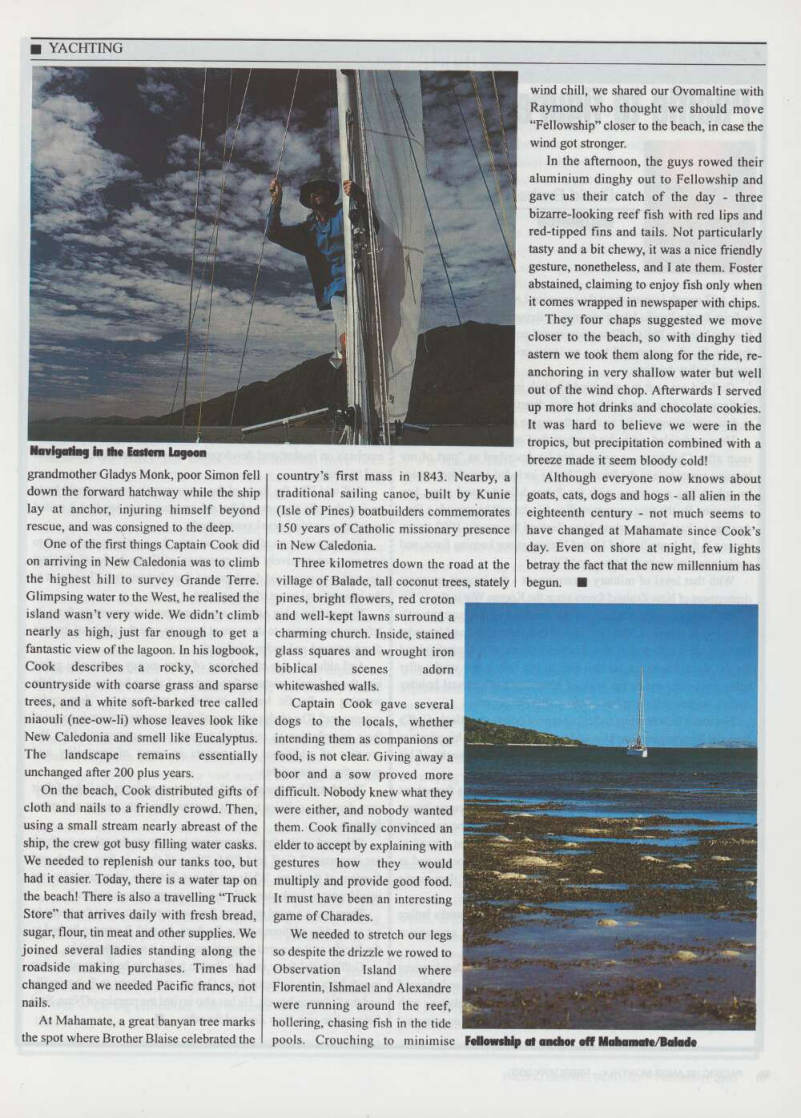
Yachting
In the wake of Captain Cook Stories and Pictures by Sally Andrew
MOST of our coastal hopping had been dominated by light winds and lazy sailing, but Fellowship lifted her skirts and fairly flew as we passed Ouaieme river valley, a deep cut in New Caledonia’s Panic Massif.
We carefully navigated the narrow Passe de Panic then scooted north past the tall and dynamic Tao cascades.
At Pouebo, the reef was visible despite murky river water and glare from the afternoon sun and we anchored for the night. Local Kanaks, armed with fish-nets, prowled the shallows near shore. Next morning we headed to Mahamate (pronounced Ma-a-mat) near Balade, anchoring off the same beach that Captain Cook discovered on his arrival in September 1774. James Cook was the first European to stumble across and name “New Caledonia”.
On a boat there is simply not enough space for unlimited consumption and collecting. However, one of our treasures is the Hakluyt Society’s complete set of logbooks written by Captain Cook during his three voyages in the Pacific, four volumes that span twelve inches on the bookshelf! From these we learned that “Resolution” had departed from Espiritu Santo. Cook named Cape Colnett for his
midshipman who sighted Grande Terre on the morning of their fourth day at sea.
Cook was anxious to get ashore for two reasons. First, he wanted to look at the land and its people, culture, plants and geography. Second, cook was a keen astronomer and wanted to observe an eclipse of the sun from a tiny islet he called
- you guessed it - Observation Island.
Known locally as “Poudie” islet, Observation Island is tucked behind the barrier reef in the bay at Mahamate. We walked around the sandy islet in a couple of minutes, toasting the great Captain with cups of tea while our portable GPS sought a position to compare to our chart. We needed no confirmation that the island had shifted since Captain Cook’s day.
Nearby, in the shallows, lies the grave of Huon de Kermadec, the first Frenchman to die in New Caledonia. Kermadec was second-in-command aboard D’Entrecasteaux’s ship “L’Esperance” which made landfall at Balade 19 years after Captain Cook. At the time, D’Entrecasteaux was looking for La Perouse, trying to solve the enigmatic mystery of the French explorer’s disappearance. Alas, the sand has shifted about twenty metres westward and Kermadec’s grave and bones, once buried on the islet, now lie below the high tide mark.
Reading Cook’s log on board that evening, we discovered that Simon Monk (his ship’s butcher) died here at Balade, too.
Perhaps a distant relative off my English
At Balade, traditional and historic side by side
Kennadec's grave Hoe in the shallows east of Observation Island
grandmother Gladys Monk, poor Simon fell down the forward hatchway while the ship lay at anchor, injuring himself beyond rescue, and was consigned to the deep.
One of the first things Captain Cook did on arriving in New Caledonia was to climb the highest hill to survey Grande Terre.
Glimpsing water to the West, he realised the island wasn’t very wide. We didn’t climb nearly as high, just far enough to get a fantastic view of the lagoon. In his logbook.
Cook describes a rocky, scorched countryside with coarse grass and sparse trees, and a white soft-barked tree called niaouli (nee-ow-li) whose leaves look like New Caledonia and smell like Eucalyptus.
The landscape remains essentially unchanged after 200 plus years.
On the beach, Cook distributed gifts of cloth and nails to a friendly crowd. Then, using a small stream nearly abreast of the ship, the crew got busy filling water casks.
We needed to replenish our tanks too, but had it easier. Today, there is a water tap on the beach! There is also a travelling “Truck Store” that arrives daily with fresh bread, sugar, flour, tin meat and other supplies. We joined several ladies standing along the roadside making purchases. Times had changed and we needed Pacific francs, not nails.
At Mahamate, a great banyan tree marks the spot where Brother Blaise celebrated the
country’s first mass in 1843. Nearby, a traditional sailing canoe, built by Kunie (Isle of Pines) boatbuilders commemorates 150 years of Catholic missionary presence in New Caledonia.
Three kilometres down the road at the village of Balade, tall coconut trees, stately
pines, bright flowers, red croton and well-kept lawns surround a charming church. Inside, stained glass squares and wrought iron biblical scenes adorn whitewashed walls.
Captain Cook gave several dogs to the locals, whether intending them as companions or food, is not clear. Giving away a boor and a sow proved more difficult. Nobody knew what they were either, and nobody wanted them. Cook finally convinced an elder to accept by explaining with gestures how they would multiply and provide good food.
It must have been an interesting game of Charades.
We needed to stretch our legs so despite the drizzle we rowed to Observation Island where Florentin, Ishmael and Alexandre were running around the reef, hollering, chasing fish in the tide pools. Crouching to minimise
wind chill, we shared our Ovomaltine with Raymond who thought we should move “Fellowship” closer to the beach, in case the wind got stronger.
In the afternoon, the guys rowed their aluminium dinghy out to Fellowship and gave us their catch of the day - three bizarre-looking reef fish with red lips and red-tipped fins and tails. Not particularly tasty and a bit chewy, it was a nice friendly gesture, nonetheless, and I ate them. Foster abstained, claiming to enjoy fish only when it comes wrapped in newspaper with chips.
They four chaps suggested we move closer to the beach, so with dinghy tied astern we took them along for the ride, re anchoring in very shallow water but well out of the wind chop. Afterwards I served up more hot drinks and chocolate cookies.
It was hard to believe we were in the tropics, but precipitation combined with a breeze made it seem bloody cold!
Although everyone now knows about goats, cats, dogs and hogs - all alien in the eighteenth century - not much seems to have changed at Mahamate since Cook’s day. Even on shore at night, few lights betray the fact that the new millennium has begun. ■
Navigating in the Eastern lagoon
Fellowship at anchor off Mahamate/Balade
Advertisements & other items, p. 55 (1 item)
■ Yachting
Pacific to figure prominently in NZ foreign policy
Opinion
LAST month I wrote about the incoming Labour-led government’s policies for the Pacific Island community living in New Zealand. New Foreign Minister Phil Goff has since wasted no time in making it clear that the Pacific region will have no less a priority in the coalition’s external policy thinking.
Goff did not wait to get behind his desk in Wellington’s Beehive Parliamentary executive building before directing foreign affairs staff to draw up an itinerary for travel to the region in the new year.
He even decided to take his family to the Cook Islands for a holiday soon after Christmas - a private trip he described as “part of my learning experience in the Pacific,” but he included a working session by scheduling a meeting with the Prime Minister and some key colleagues. By the time you are reading this, he will have made a five day trip to East Timor, where New Zealand has nearly 1000 troops serving in the Australian-led United Nations peace keeping force, and made inaugural visits to Samoa and Fiji.
With that level of military commitment - the biggest overseas deployment of New Zealand forces since the Korean War in the 1950 s - East Timor is, not unnaturally, at the forefront of the government’s international concerns. That Goff should then (after meeting Alexander Downer, his counterpart in New Zealand’s closest ally, Australia) head for the South Pacific on his first official trip only a few weeks after being sworn in, and at the peak of New Zealand’s annual holiday season, augurs well for warm relations with the region.
Not that it indicates any radical change of policy or outlook. Goff’s National Party predecessor Don McKinnon also signalled his priorities early on by heading into the Pacific in the first few weeks of his stewardship nine years ago.
But it must be comforting to leaders and their officials throughout the region to be reassured of the new government’s rapid commitment to its neighbourhood. All the signs are that Goff will be an ardent exponent of the Labour Party’s election manifesto that vowed to ensure New Zealand “plays a major role in regional advocacy and as a leader in sustainable regional development and democratic governance in the South Pacific.”
He will be well supported by his ministry that a few weeks before the election upgraded its Pacific coverage, creating a new senior executive position with responsibility for the region.
Gordon Shroff, previously director of the ministry’s development cooperation division, was appointed a deputy secretary and charged with the oversight and coordination of Nbw Zealand’s relations with the South Pacific and administration of the $225 million overseas aid
programme.
Shroff is a former head of the South Pacific division and his appointment reflected the importance new chief executive officer Neil Walter (himself an old Pacific hand, having been the official secretary for Tokelau, based in Apia in the 19705) attaches to ties with the region.
While it is too soon to think about any major boost in aid levels, it is significant that the Labour Party made a bold commitment to measures to help eradicate poverty in its pre-election overseas
assistance policy.
About 60 per cent of New Zealand’s total aid goes to the Pacific and the policy called for an inquiry into the relationship with the region, noting that many changes were taking place in development theory and practice and there was a need to establish how the needs could best be met.
New Zealand’s aid, it said, should comply with the principles of the Rio Declaration on Environment and Development, support sustainable industries such as eco-tourism and place particular emphasis on institutional development as well as technical assistance and training.
Goff told PIM the focus of the government’s inquiry would be to review the effectiveness of the aid programme to see that it suited recipient countries’ development needs.
With its accent on alleviating poverty, the government pledged to increase progressively the percentage of Gross National Product devoted to overseas aid development, from last year’s 0.27 per cent to the international target of 0.7 per cent.
That will be a big call for a government under pressure from its left-wing supporters to do more at home to ease the plight of its own disadvantaged and under-privileged.
And although this offers hope of more money eventually going into the regional assistance programme, Labour has issued a subtle warning to Pacific leaders in policy reference to “democratic governance”. The pledge to assess all development projects in terms of their contribution to reducing poverty was accompanied by the promise of additional assessments in terms of inequality and
promoting human rights.
This should be viewed by aid recipient countries in the light of their own domestic policies towards women, minority groups and press freedom.
“We work with other governments to promote the values we think are important,” Goff told PIM. “One of them is free speech and freedom of the Press. While we do not dictate to other countries, we would want to work alongside them to promote these values.”
There was a natural tendency for governments to want the media to act as a public relations agency for them, he said. It was not limited to the Pacific as it occurred internationally, but it was undesirable.
Goff’s initial foray into the Pacific is likely to be followed up this month by a visit to Papua New Guinea, and perhaps to Bougainville and the Solomon Islands. He has also invited the premier of Niue, Sani Lakatani, to visit New Zealand for talks. ■
David Barber
Wellington
A chance to get it right
For the past 15 years we have been hearing about the tantalizing potential of mining manganese nodules from the deep ocean floor. But the problem with these rich egg-shaped mineral deposits is that they are found between four and six kilometres under the ocean surface and, as yet, no commercially viable means has been devised for mining them.
The discovery of two new resources, cobalt-rich manganese crusts and polymetallic massive sulfides (PMS) is changing the picture entirely. Cobalt crusts (metalic crusts up to 15 cm thick found on the peaks and slopes of sea mounts) have been discovered in Kiribati, Tuvalu, the Marshall Islands, Samoa, Guam and the Federated States of Micronesia.
Polymetallic massive sulfides (metallic deposits rich in a variety of metals including copper, zinc, lead, silver and gold) have been found in Papua New Guinea and Fiji, with prospects awaiting exploration in other countries.
It is the PMS that are creating the most excitement. The Pacific PMS deposits are particularly high in gold content, prompting the New York Times to describe them as “the richest volcanic deposits ever found at sea”.
The estimated value of the deposits, even at this early stage, is believed to be billions of dollars. “If you found this deposit on dry land, you d call these bonanza figures,” the usually sedate newspaper enthused.
Papua New Guinea has now become the first country in the world to issue commercial exploration licenses for polymetallic massive sulphides and Fiji has also been approached.
Along with the potential for vast wealth, however, comes the potential for devastating environmental damage.
PMS are rich in toxic heavy metals such as lead, arsenic, cadmium and thallium. With water being such a fluid medium, disturbed sediments and waste will be much more difficult to control than they are on land, and are likely to affect widely dispersed sea-life. The bitter lessons leamt from the debacles with the OK Tedi and Bougainville mines have prompted Papua New Guinea to totally overhaul its legislation governing mining on land and shown just how important it is to get the regulatory framework right from the very beginning.
Undersea mining brings with it a very different set of problems and issues and will need a whole raft of new legislation.
One of the big difficulties with undersea mining, is just how little is known in this area.
Many Pacific countries have not finished mapping their sea
boundaries and may therefore find they do not know the extent to which resources fall in their territory. On the environmental front, very little is known about sea life in the deep ocean.
Recently, highly heat-tolerant bacteria that could be very useful to industry, have been found around the very same “black smoker”volcanic vents that produce PMS. All sorts of other micro-organisms that could be useful to medical science, fish and crustaceans have been discovered but are, as yet, little studied.
If the Australian experience with the orange roughy fishery in the southern ocean is anything to go by, the characteristics of sea life may be very different than nearshore or wider ocean fisheries. In that case, it was found that orange roughy (a relatively newly discovered species that congregate around sea mounts) were very long-lived and, as a result, slow to breed.
There is still a risk that the intense fishing to which the orange roughy have been subjected, in the past few years, may already have caused irreparable damage to the stocks.
With undersea mining, the technology that would be used to recover the minerals is still being developed and as a result, the sorts of issues it would throw up, are unclear.
For stake-holders, such as the people of the host nation and holders of traditional fishing rights, the issues and problems associated with undersea mining are unfamiliar and will therefore require more time for consultation and discussion.
Monitoring of work in this area also presents particular problems as the resources are often far from land and impossible to see, or check up on, without hugely expensive vessels and
equipment.
Add to that all the economic issues associated with issuing licenses and providing an appropriate taxation regime and incentives to such a new industry, and it is clear just how bewildering a job governments have ahead of them in coming up with a regulatory framework for undersea mining and exploration. But that has not stopped them. Papua New Guinea is now the world leader in this field, with detailed and innovative legislation almost ready to go to parliament.
Fiji and Solomon Islands, with the help of the South Pacific Applied Geoscience Commission (SOPAC), are in the process of developing Green Papers for public discussion.
This is a critical time, for the region. The legislation being developed will govern an industry that has the potential to be even more lucrative than that other big sea-based earner, tuna, but also to produce devastating and irreversible environmental damage. Until now we have been in the relatively gentile stage of scientific research. During that time Japan, alone, has invested US$45 million in research which has produced information which, in theory, is fully available to Pacific host governments.
Once this industry goes into the commercial stage, which it already has in PNG, companies will be playing hard-ball and being a lot more guarded about what they find and will have to be required to provide environmental data.
The only way to ensure this industry genuinely benefits the people of the host nations, is to start the public debate and get the governing legislation right. ■
Jemima Garrett
Sydney
Pacific Puzzle

Extra
Across
I. Benbow and Marum play an active role on this Vanuatu island. 5. Sweetest town on Fiji’s Vanua Levu. 9. Oaf confused with wind which destroyed Niue’s crops in 1990. 11. Gudalcanal’s metropolis on the banks of the Mataniko River.
12. Beer to drink when saying three cheer’s toßobert Louis Stevenson’s home. 13. South of the Marquesas’ Hiva Oa, Mendana and Cook both anchored here. 14. Pacific tourist’s paraphernalia. 17. Capital place to spend time on Nauru. 20, Nation named after sacred chickens where you can enjoy 12 across.
21. Prized wood for Solomon Islands’ carvers. 23. Port’s personal guide for big boats. 29. Hanan, Faa’a, Fua’amotu or Henderson. 31. Lagoon’s edible vegetables. 32. Reef between Hawaii and Samoa sounds like a royal male. 33. Fiji’s second largest city. 34. “M” left Guam, became confused, and headed for this island in Fiji’s Lomaiviti Group. 35. Vinaka in Fiji, Merci in French Polynesia, in Kiribati. (2,4) 36. Ship’s provisions.
Down
2. Hi man! I strangely thought you were in the Tuamotus. 3. During his second term as US President, New Zealand refused entry to a US naval ship. 4. Initially, Mick or A 1 lay around on this island SE of 34 across. 5. Cruel French priest who ruled Mangareva in the 1800 s. 6. Sydney’s “coat hanger”. 7. The CIA had a large base on this NMI island in the 19505. 8. Traditional island roof. 10. South Pacific’s largest bay on the east coast ofFiji’s Vanua Levu. 15. Whales’ “crusty” cuisine. 16. Cook’s oven? 17. Pay often confused in FSM area. 18. Fish trap. 19. Initially, talked of lagoon on FSM’s Chuuk. 22. Tiger, white and blue. 24. Atoll NW of Hawaii discovered by Captain NC Brooks in 1859. 25. Godfather who bought Tetiaroa, north of Tahiti, in 1962. 26. The Place de Cocotiers is central to this
city.
27. Robert Reimer’s home in the Marshalls. 28. Far, far away ... like many Pacific islands. 30. Cook’s Friendly Islands. 31. Fijian wraps.
Check Out Pim On The Web
@ www.pim.com.fj
Answers
ACROSS; 1. Ambrym. 5. Labasa. 9. Ofa. 11.
Honiara. 12. Vailima. 13. Tahuata. 14.
Luggage. 17. Yaren. 20. Samoa. 21. Ebony. 23. Pilot. 29. Airport. 31. Seaweed. 32.
Kingman. 33. Lautoka. 34. Gau. 35. Ko Raba. 36. Stores. DOWN: 2. Manihi. 3. (Ronald) Reagan. 4. Moala. s.(Father Honore) Laval. 6. Bridge. 7. Saipan. 8. Thatch. 10. Natewa. 15. Krill. 16. Umu. 17. Yap. 18. Net. 19. Tol. 22. Sharks. 24. Midway. 25. (Marlon) Brando. 26. Noumea. 27. Majuro. 28.
Remote. 30. Tonga. 31. Sulus.
Advertisements & other items, pp. 58-60 (2 items)
58
PACIFIC ’SLANDS MONTHLY - FEBRUARY 2000
Shipping your goods
around the Pacific...
mamm mm m ',l !j j ( J
Bruce Johnson
Sales Executive
XYZ Shipping.
Started in the shipping industry when he joined XYZ Shipping 12 months ago. He services Auckland customers for the Pacific leg of the round-the-world service. Prior to that, was employed as a sales rep with a computer company.
Has no discretion on the tariff. Reports to the National Sales Manager, who has greater authority, but all decisions are referred to Pricing Division.
Tammy Hamawi
Line Manager/Commercial
Director Director and shareholder with PDL Line, a privately owned company whose sole purpose is to cater for trade in the South Pacific.
Based in Head Office.
Fifteen years in the shipping industry, working her way up from Shipping Clerk to Supervisor. PDL Line Manager since 1994.
Has total discretion when dealing with customers without
referral to other Managers.
Ambition: To play a significant role in the success and growth of PDL through superlative customer service.
.. .who would you rely on?
At PACIFIC DIRECT LINE our people run the line. Our structure is streamlined and decisions are made so our clients' needs are met simply, efficiently and quickly.
PDL is a family business that has operated in the Pacific since 1968. Thirty-two years of dedication to providing freight and logistics services in the region.
PDL carries agricultural supplies, foodstuffs, building supplies and machinery plus other cargoes from New Zealand and Australia to almost every Pacific Island nation.
For further information contact Pacific Direct Line, Auckland Phone 0064 9 358 5256 Fax 0064 9 358 4833
PDL
a/
<t/f Pflc
.*• SI /1/tfS 4 r£: r w £»■ y r 4m feit, Safest. :.4
No challengers -
Toyota Land Cruiser stays on top
Toyota Land Cruiser 100 dominates the world of 4x4s. None other can match its robust power, provided by superior engine technology.
It gives breathtaking performance, backed by an amazingly rugged suspension that can take you anywhere you want to go, on road or off.
Nevertheless, riding in a Toyota Land Cruiser 100 is like travelling in a luxurious sedan. Its more than ample room inside contains all the comforts and conveniences you'd expect of a winner.
Remember this. Only Toyota's advanced technology can create the symphony of power, performance, and lavish comfort you find in Land Cruiser 100. No wonder it's the champion. Again.
CRI
STATION WAGON
<3£» TOYOTA
DISTRIBUTORS / DEALERS
NORFOLK ISLAND BORRY’S PTY LTD. PH 22114 KIRIBATI TARAWA MOTORS PH 21090 FIJI ASCO MOTORS PH 384888 SOLOMON ISLANDS ELA MOTORS PH 30314 PAPUA NEW GUINEA ELA MOTORS PH 3229400 NEW CALEDONIA S.IAP. PH 275562 VANUATU ASCO MOTORS PH 22341 TAHITI NIPPON AUTOMOTO PH 429819 TONGA ASCO MOTORS PH 23500 COOK ISLANDS PACIFIC MOTORS LTD. PH 20700 SAMOA ASCO MOTORS PH 20800 AMERICAN SAMOA ASCO MOTORS PH 633-4281