Moneys
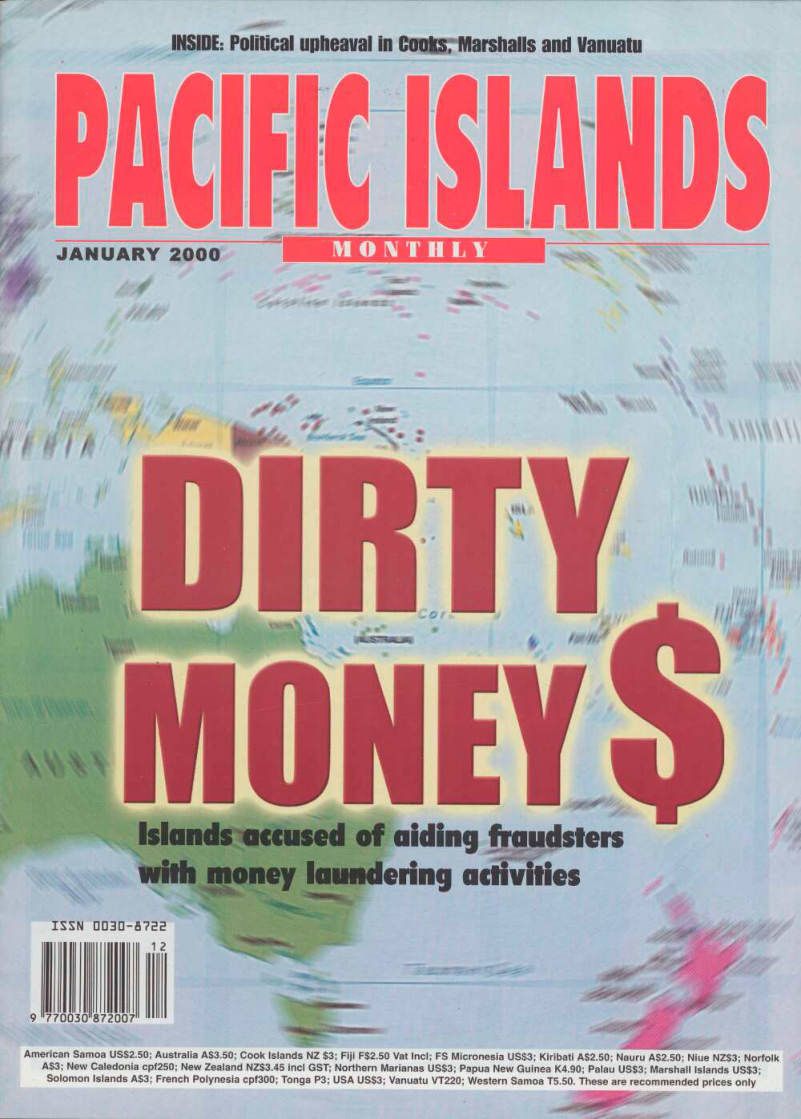
Pacific Islands
Monthly
INSIDE; Political upheaval in Cooks. Marshalls and Vanuatu
January 2000
' mmm ■hhhhhhmh vh jhmhv I HH * ‘ B / HH. m&rmkjsk & mm* :
Moneys
•***■ ' v ■ ■
Islands accused of aiding fraudsters
with money laundering aclivilies
* ... 10
American Samoa US$2.5O; Australia A 53.50; Cook Islands NZ $3; Fiji F 52.50 Vat Incl; FS Micronesia US$3; Kiribati A 52.50; Nauru A 52.50; Niue NZ$3; Norfolk As 3; New Caledonia cpf2so; New Zealand NZ53.45 incl GST; Northern Marianas US$3; Papua New Guinea K 4.90; Palau US$3; Marshall Islands US$3; Solomon Islands As 3; French Polynesia cpf3oo; Tonga P 3; USA US$3; Vanuatu VT22O; Western Samoa T 5.50. These are recommended prices only
Advertisements & other items, p. 2 (1 item)
y;
fr/v-.^
ras
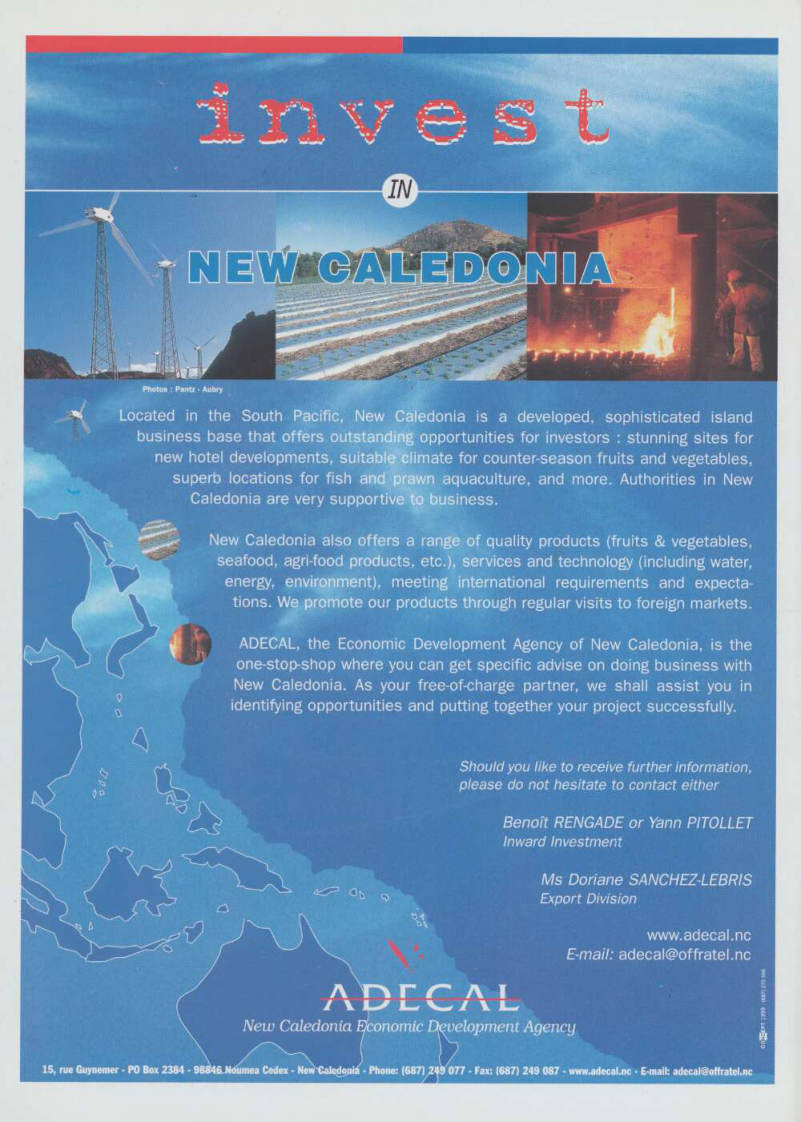
* iil i >■ > ' mm Pis m m -W* W Photos : Pantz - Aubry * Located in the South Pacific, New Caledonia is a developed, sophisticated island business base that offers outstanding opportunities for investors : stunning sites for new hotel developments, suitable climate for counter-season fruits and vegetables, superb locations for fish and prawn aquaculture, and more. Authorities in New Caledonia are very supportive to business.
New Caledonia also offers a range of quality products (fruits & vegetables, seafood, agri-food products, etc.), services and technology (including water, energy, environment), meeting international requirements and expectations. We promote our products through regular visits to foreign markets.
ADECAL, the Economic Development Agency of New Caledonia, is the one-stop-shop where you can get specific advise on doing business with New Caledonia. As your free-of-charge partner, we shall assist you in identifying opportunities and putting together your project successfully.
Should you like to receive further information, please do not hesitate to contact either Benoit RENGADE or Yann PITOLLET Inward Investment Ms Doriane SANCHEZ-LEBRIS Export Division A V 0 O o^ A v New Caledonia 15, rue Guynemer - PO Box 2384 - Cedex ■ New www.adecal.nc E-mail: [email protected] A I
7 V JU
conomic Development Agency ojjia - Phone: (687) 249 077 - Fax: (687) 249 087 - www.adecal.nc - E-mail: [email protected]
CoJBePT 1999 : (687} 275:
Pacific Islands
Nonthly
Vol. 70 No. T
The News Magazine
January 2000
Alan Robinson Sophie Foster Hildebrand Michael Field, Giff Johnson, Sally Andrew, Sam Vulum, Ed Rampell, Alan Ah Mu, Brian Tobia.
David Barber (Wellington), Jemima Garrett (Sydney) Penina Magnus, Sovaia Ditoga Senior Regional Sales (South Pacific) Shayne Farah Hussein Tel (679) 304111,303244, Fax (679) 303809.
Sydney, Canberra: Bob Hill Media Represen tation, Tel (61-2)4164245, Fax (61-2) 4165064.
Brisbane: Jane Fewings Media and Advertising Associates Tel (61-7) 3378 4522, Fax (61-7) 3878 1071.
Adelaide: Hastwell Williamsons Representa tives, Tel (61-8) 3799522, Fax (61-8) 3799735.
Melbourne: Brown Orr Fletcher Burrows (Aust) Pty Ltd.
Tel (61-3) 98265188, Fax (61-3) 98265644.
Auckland: McKay & Bowman, International Media Representatives Limited, Tel (64-9)4190561, Fax (64-9) 4192243.
Japan: Universal Media Corporation, Tokyo, Tel (3) 3266626741, Cable; UNI-MEDIA Tokyo, Fax (3) 32626742.
Pacific Islands Monthly was founded in 1930
(Usps 9522480).
A Fiji Times Limited production.
Cover prices are recommended retail only. Registered by Australia Post, Publi cation No. NBPI2IO. © Copyright Fiji Times Limited. 177 Victoria Parade, Suva, Fiji.
Tel (679) 304111, fax (679) 303809.
Email: [email protected]
PIM Website: http://www.pim.com.fj Pacific Islands Monthly is published monthly by Fiji Times Limited, a division of Nationwide News, 2 Holt Street, Surry Hills, Sydney, NSW 2010.
Pacific Islands Monthly PO Box 1167, Suva, Fiji.
Printed by Quality Print Limited, 16 Amra Street, Walu Bay, Suva, Fiji.
Cover design/Layout by Penina Magnus & Sovaia Ditoga All care, but no responsibility taken for material submitted for publication
I Development:
Inside
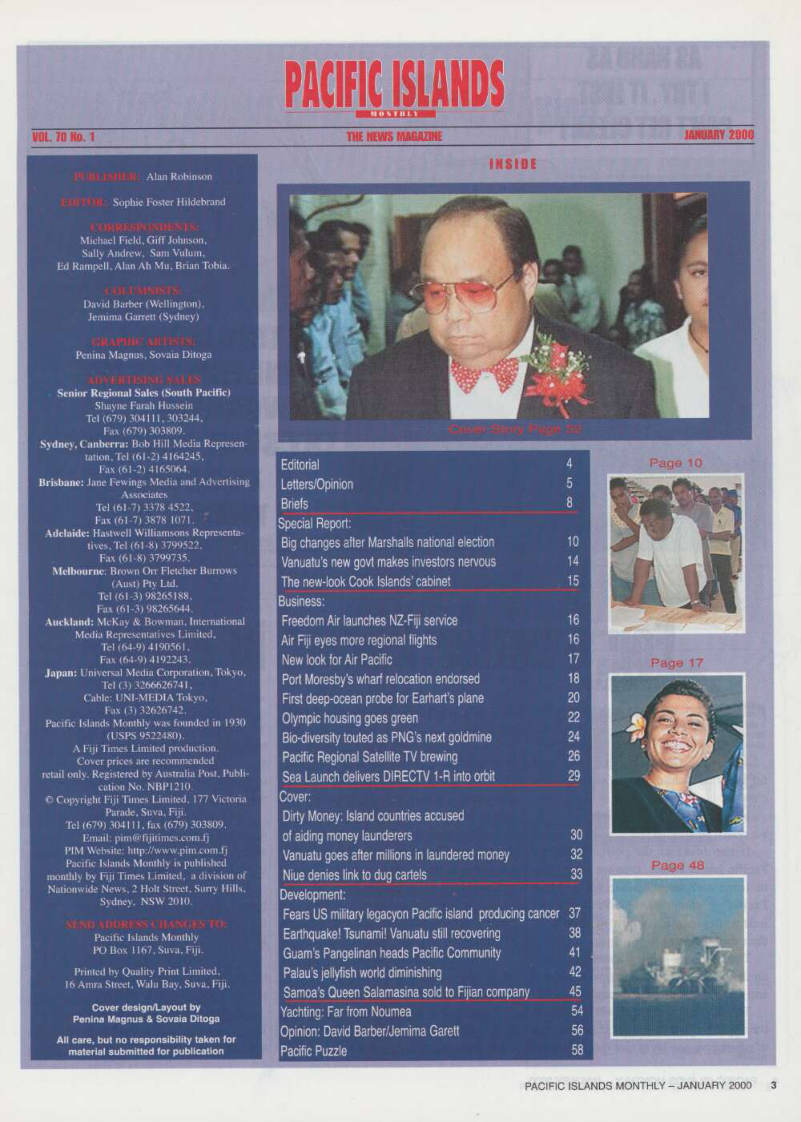
I Editorial 4 Letters/Opinion 5 Briefs 8 Special Report; Big changes after Marshalls national election 10 Vanuatu’s new govt makes investors nervous 14 The new-look Cook Islands’ cabinet 15 Business: Freedom Air launches NZ-Fiji service 16 Air Fiji eyes more regional flights 16 New look for Air Pacific 17 Port Moresby’s wharf relocation endorsed 18 First deep-ocean probe for Earhart’s plane 20 Olympic housing goes green 22 Bio-diversity touted as PNG’s next goldmine 24 Pacific Regional Satellite TV brewing 26 Sea Launch delivers DIRECTV 1-R into orbit 29 Cover; ■ Dirty Money: Island countries accused of aiding money launderers 30 f Vanuatu goes after millions in laundered money 32 y Niue denies link to dug cartels 33
Fears US military legacyon Pacific island producing cancer 37 Earthquake! Tsunami! Vanuatu still recovering 38 Guam’s Pangelinan heads Pacific Community 41 i: Palau’s jellyfish world diminishing 42 Samoa’s Queen Salamasina sold to Fijian company 45 Yachting: Far from Noumea 54 Opinion; David Barber/Jemima Garett 56 Pacific Puzzle 58
Page 10
Page 17
Page 48
For a better Pacific in 2000
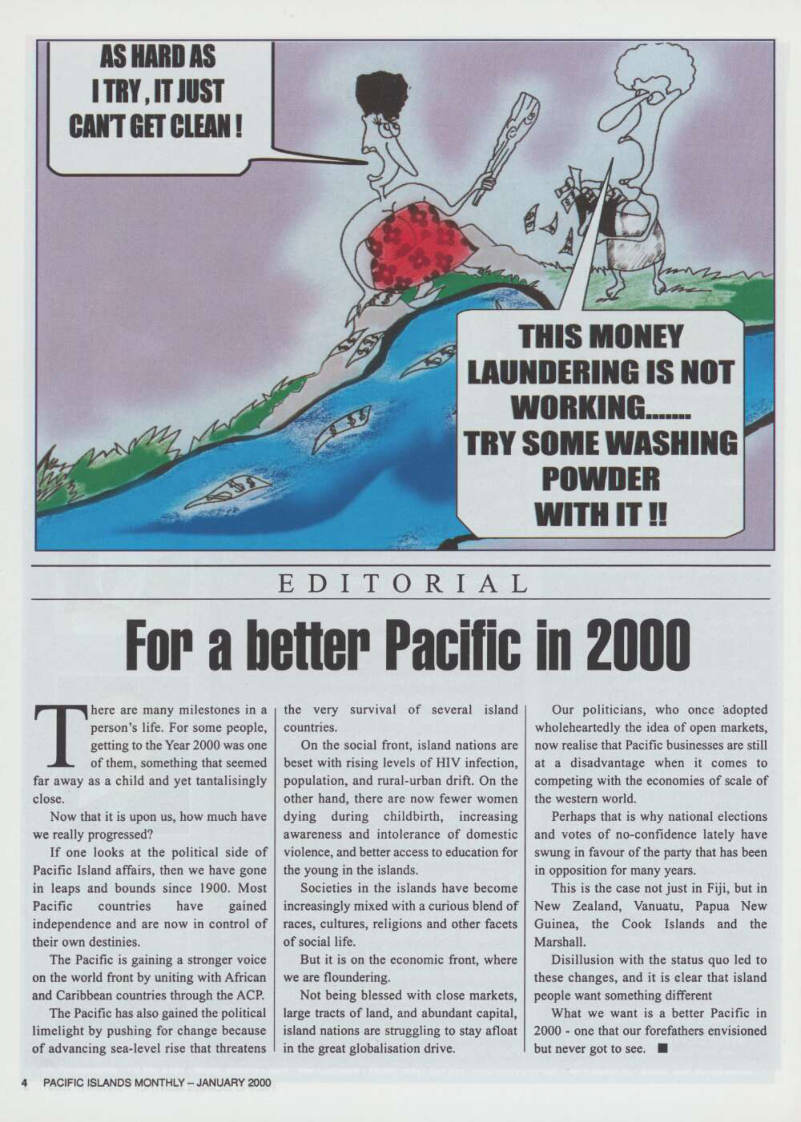
Editorial
There are many milestones in a person’s life. For some people, getting to the Year 2000 was one of them, something that seemed far away as a child and yet tantalisingly close.
Now that it is upon us, how much have
we really progressed?
If one looks at the political side of Pacific Island affairs, then we have gone in leaps and bounds since 1900. Most Pacific countries have gained independence and are now in control of their own destinies.
The Pacific is gaining a stronger voice on the world front by uniting with African and Caribbean countries through the ACP.
The Pacific has also gained the political limelight by pushing for change because of advancing sea-level rise that threatens
the very survival of several island countries.
On the social front, island nations are beset with rising levels of HIV infection, population, and rural-urban drift. On the other hand, there are now fewer women dying during childbirth, increasing awareness and intolerance of domestic violence, and better access to education for the young in the islands.
Societies in the islands have become increasingly mixed with a curious blend of races, cultures, religions and other facets of social life.
But it is on the economic front, where we are floundering.
Not being blessed with close markets, large tracts of land, and abundant capital, island nations are struggling to stay afloat in the great globalisation drive.
Our politicians, who once adopted wholeheartedly the idea of open markets, now realise that Pacific businesses are still at a disadvantage when it comes to competing with the economies of scale of the western world.
Perhaps that is why national elections and votes of no-confidence lately have swung in favour of the party that has been in opposition for many years.
This is the case not just in Fiji, but in New Zealand, Vanuatu, Papua New Guinea, the Cook Islands and the Marshall.
Disillusion with the status quo led to these changes, and it is clear that island people want something different What we want is a better Pacific in 2000 - one that our forefathers envisioned but never got to see. ■
What lies ahead in the Pacific region?
Opinion
BY Noel Levi, CBE, Secretary
General, South Pacific Forum
Secretariat
South Pacific Forum Leaders at their Palau meeting responded to WTO and globalisation by making the historic decision to establish a free trade area among Forum members.
What will the free trade area look like, and what are its implications for private sector development and business associations? Before attempting to answer these questions I would like to first explain the rationale behind Leaders’ decision to pursue this strategy.
All of us are aware that there has been a fundamental shift in global aid and trade regimes. On the one hand there has been, and continues to be, a decline in real aid flowing to developing countries.
This has given rise to the need to develop an alternative and more sustainable basis for our development agenda. This is where trade enters the picture. It is not a new idea. This is what founding members of the Forum envisaged when they talked about the need for “Trade not Aid.”
But we are also faced with the challenges to and loss of trade preferences that currently sustain some of our key industries. We see this in the WTO, and we see it in the way the benefits under the Lome Convention are being challenged and eroded. We also see how trade liberalisation and the debate in the WTO continues to chip away at aid, which has been critical to our survival as small and underdeveloped nations in this world of the “uneven playing field.”
All Forum members have begun to
respond to these challenges by undertaking
reforms to enhance economic management and liberalise their economies. In addition, we have also begun, to varying degrees, some measure of trade integration.
Many of our members have entered into bilateral trade agreements with each other.
In Melanesia, the Melanesian Spearhead
Group Trade Agreement has become in effect the ‘spearhead’ of trade liberalisation for all Forum Island countries. What the MSG countries have forged together is a good
practical example
of integration at the sub-regional level.
The aim of the Forum free trade area is to expand and deepen the MSG model to the region as a whole.
So exactly what benefits can we expect from doing this? Or in other words, how will the formation of a
regional trading
bloc strengthen our
position in the world of the ‘uneven playing field’?
It does so by addressing two fundamental characteristics of our individual economies that constrain economic growth - smallness and isolation.
One of the greatest problems confronting the region is that the market in most Forum Island countries is too small to adequately develop the private sector. A small domestic consumer base prevents enterprises from realising economies of scale in their production and reducing their unit costs.
The benefits of the potential economies of scale generated by the creation of a single market of six million people rather than 14 fragmented ones will be obvious to anyone in the business community.
Free trade will also encourage regional cooperation in areas of trade facilitation such as customs, quarantine, standards and statistics that will permit economies of
Continued next page
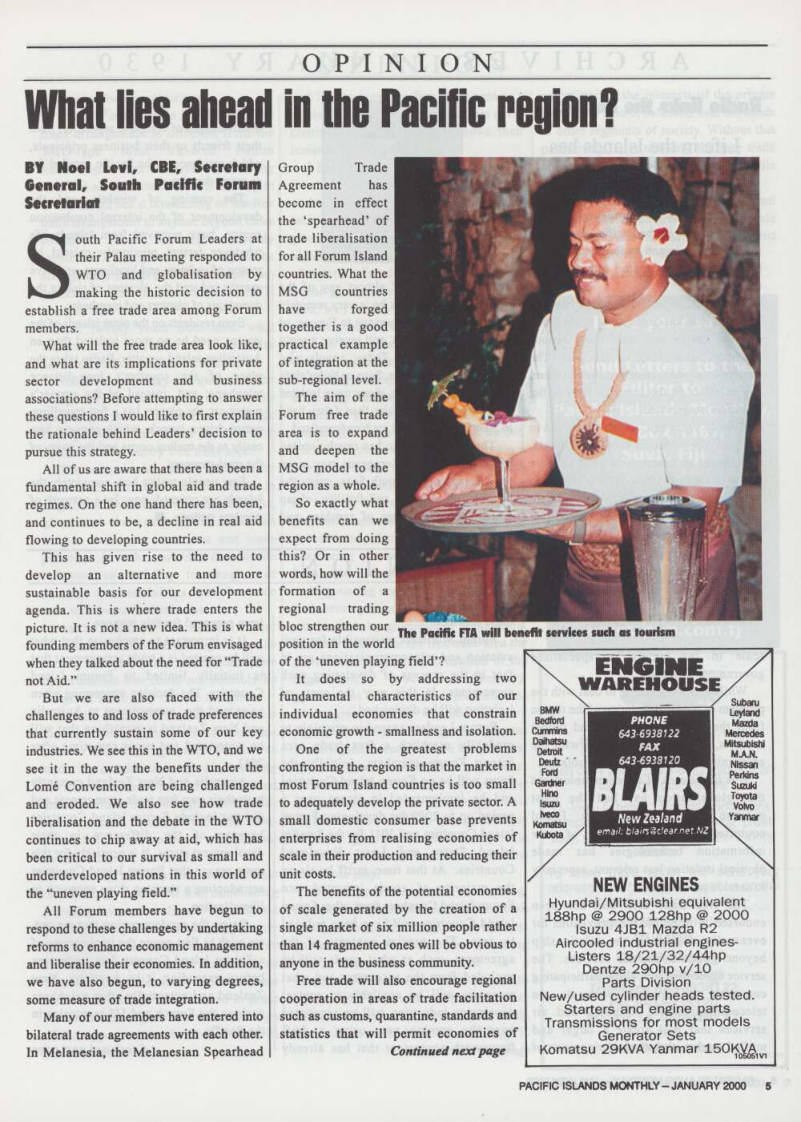
The Pacific FTA will benefit services such as tourism
Continued from previous page
scale in the supply of specialised government services.
While it is not possible to deal with the problem of physical isolation of the region from the rest of the world and global markets, it is possible to deal with the economic consequences of that isolation.
It is in the area of telecommunications that globalisation has had the most positive benefit for Forum Island countries. The development of new information technologies has made physical isolation less relevant, especially to service providers.
The free trade area that has been endorsed in principle has provisions for
eventually deepening the relationship
beyond goods to include services. The service agreement will allow participating countries to append protocols on telecommunications, shipping and air services that will create a larger and unified market, thereby lowering costs of
these services.
Forum Ministers responsible for civil aviation and telecommunications are in fact in the process of developing such agreements. In this way the costs of isolation will be diminished ...
Forum Leaders agreed in principle to gradually establish a free trade area among Forum members. Initially the focus will be on Forum Island Countries and be implemented in stages over a period up to 2009 for developing Forum Island Countries and 2011 for the Smaller Island States and Least Developed Countries. At that time, tariff levels on the majority of goods imported into Forum Island Countries from other Forum Island Countries will have been reduced to zero. The precise contents of the agreement, such as what goods will be excluded from the agreement and what measures will be available to protect developing industries, will be negotiated over the coming year using a draft framework agreement that has already
been prepared for this purpose.
It is important to emphasise that what will be created is a trade arrangement that is initially limited to Forum Island Countries. The decision concerning when to extend the arrangement to Australia and New Zealand is something that will be negotiated and occur sometime after 2011.
Australia and New Zealand currently have their own free trade arrangement and did not include Forum Island Countries because of the difference in their development status. It is precisely for this same reason that Forum Island Countries are adopting a stepping stone approach to liberalization.
Being the prudent region that we are, we wish to first gauge the implications of a Forum Island Country free trade area before extending it to Australia, New Zealand and potentially other neighbors such as the French and US territories in the Pacific.
Continued next page
Continued from previous page
It is also important to note that the free trade arrangement is different from the WTO-type Most Favored Nation liberalisation that is based on lowering tariffs to all countries. There is nothing in it that would see a broadening of the free trade arrangement to anyone beyond those countries and territories already mentioned. There is also nothing in the arrangement that prevents members from pursuing broader liberalisation at an MFN level, or with any country they wish.
Ten, twenty years from now, what impact can we expect the free trade area to have had on Forum Island Countries?
Some of you may be aware of the analysis we had prepared to estimate the welfare and economic benefits that might be expected to follow the creation of a Forum Island Country free trade area.
The analysis showed the benefits for almost all members to be small in magnitude. This in fact was not a surprise, given that the analysis was based on current economic structures and trade patterns. In other words, the results reflected an inability to imagine or envisage new possibilities that a free trade area will create for businesses.
As the Australia-New Zealand Closer Economic Relations Trade Agreement so clearly illustrates, free trade areas create opportunities that could not possibly be imagined at the time of their inception.
In the case of Australia and New Zealand - two countries with limited trade prior to their trade agreement - their free trade agreement created an enabling environment where businesses identified and capitalised on new opportunities. The Forum Island Country free trade area offers the private sector in our member countries similar potential.
We should not, however, underestimate the challenge associated with establishing a healthy investment climate. It includes a
long list of requirements including quality
infrastructure services at competitive prices, secure access to land and an educated and productive workforce. These issues will need to be addressed in order for businesses to grow and take advantage of the opportunities that free trade will create for our members.
I like to view the free trade area as a catalyst that will assist our members in the continuing challenge to improve their business environments.
I have already spoken about how the free trade approach will bring economy of scale to both producers in the private sector and suppliers of specialised government services. I have also highlighted how it will diminish the costs of isolation. In addition, and perhaps one of the greatest benefits of the free trade area, will be the discipline it forces on member countries to maintain economic policies that make it a competitive place to invest and do business.
Clearly, enterprises operating within efficiently administered, low cost, stable business environments will have a competitive edge over those that do not.
Those countries that do not maintain a competitive environment for their private sector will lose out to their neighbours that do. I expect the free trade area therefore to play an important role in maintaining government focus and resolve in continuing the economic reforms they have embarked upon.
Negotiating and implementing the free trade area agreement is not something that can be done by government in isolation.
In order to embrace the free trade area the private sector must be consulted in the negotiation process. Similarly, government officials and representatives of the private sector will need to work together to analyze existing trade patterns in the region, identify where the potential opportunities lie and determine what actions they should each be taking in order to take advantage of these them. This
requires close and on-going dialogue
between government and the private sector. This is where business associations come into play.
Government needs strong, representative business associations with which to interact. A fragmented business
community, with enterprises pursuing
their own narrow interests is a cumbersome and unproductive partner to work with. The private sector on the other hand needs a government that understands the realities of the business world and is
Continued next page
committed to the interests of the private sector as a whole, balanced with the needs of other segments of society. Without this partnership, it is unlikely the free trade area will generate the benefits it is capable of providing. * This text is part of an address to Maui Pacific Center Conference on “The Role of Business Associations in Pacific Island Economic Growth.” ■
Advertisements & other items, p. 5 (1 item)
New Engines
BMW
Bedford Cummins Haihatsu Detroit Deutz Ford Gardner Hino Isuzu Iveco Komatsu Kubota
WAREHOUSE
PHONE
643-6938122
FAX
643-6938120 Wl
New Zetland
email: blairs3clear.net.NZ Subaru Leyland Mazda Mercedes Mitsubishi
MAN.
Nissan Perkins Suzuki Toyota Volvo Yanmar
NEW ENGINES
Hyundai/Mitsubishi equivalent
188 hp @ 2900 128 hp @ 2000 Isuzu 4JBI Mazda R 2 Aircooled industrial engines-
Listers 18/21/32/44hp
Dentze 290 hp v/10
Parts Division
New/used cylinder heads tested.
Starters and engine parts
Transmissions for most models Generator Sets Komatsu 29KVA Yanmar 150K^A,
Archives-January 1930
Radio links the Pacific
Life in the Islands has
been revolutionised by
wireless
Practically all the Europeanised towns and settlements in the Pacific Islands, and many plantations and trading stations, now have direct communication with the rest of the world.
The complete isolation of “the islands,” which early in this century was at once their greatest charm and their most serious handicap, is a thing of the past. The economic importance of this development, and its effect on the future of the Pacific, cannot be exaggerated.
Twenty years ago, a man who lived in Bougainville or Vanua Levu, or Aitutaki, was almost as inaccessible as if he were buried in Darkest Africa. A letter written in London, or Sydney, or New York, might reach him six months after it was posted.
Today, a resident of almost any of the Pacific Islands, unless he is very remotely situated, can send a message to Europe, or America, or Australia, and receive a reply within twelve hours. Today, people who reside in Rabaul or Vila, Suva or Nuku’alofa or Rarotonga, are little, if any more isolated in relation to world affairs, than if they lived in New Zealand, Natal, or Newfoundland.
The magic of radio has revolutionised life in The Islands. Europeans may make their homes in the South Seas, enjoy the benefits of climate, soil-fertility, cheap labour, and the charm of sunshine and
colour, while suffering none of the disadvantages of complete separation from their friends or their business principals, which residence in the Pacific entailed for so many decades.
The coming of wireless, and the development of the internal combustion engine, have removed from Islands life whatever terrors previously existed by reason of isolation and loneliness, and have greatly reduced the element of risk in the operations of planters and merchants.
Even residents on the outer islands of the groups need be no more isolated than an Australian inland squatter. Radio takes the place of the squatter’s long-distance telephone; and, instead of the grazier’s motor-car, the planter has a fast-travelling, petrol-driven launch, which conveys him easily to the trading centre and the route of the mail-steamers.
Few people realise how completely the Islands are covered, now, by a network of wireless stations. ■
Advertisements & other items, p. 7 (1 item)
[email protected]
Have your say!
Send Letters to the Editor to: Pacific Islands Monthly, P O Box 1167,
Suva, Fiji
OR Email:
PIM Website:
www.pim.com.fj
/// I can go anywhere’
Can carry people, am amphibious, cart big loads, pull trailers “I love fishing, climbing mountains, camping in the outback, being profitable, weed spraying, leave others in my tracks.”
To learn more about me send your address for a brochure or visit us on the Web at www.argoatv.com
From NZSI2,SOO+CSI
BLAIRS
New Zealand National Distributors Telephone 643-6938122 Fax 643-6938120 PO Box 14, Geraldine NZ E-mail bUrivs6clear.net.nz
Briefs
PNG approves US company lor fixed satellite service A major US-based telecommunication company has been granted a license by the Papua New Guinea Telecommunication Authority (Pangtel) to provide domestic and international fixed satellite services in PNG, starting in 2004.
The license has been granted to Teledesic Corporation in which Microsoft Corporation chairman Bill Gates is a major stockholder, Pangtel board chairman Les Gavara-Nou said in statement.
Gavara-Nou said that through an authorised carrier like Telikom PNG Ltd, the Teledesic system would provide PNG with access to services that are increasingly necessary for economic development, such as Internet access, digital videoconferencing, interactive multimedia, and real-time, two-way, high-speed digital data transmissions.
“Teledesic also possess the requisite technical capacity and business experience to serve the PNG market. Additionally, the opportunity for PNG to have access to this new technology, and the expected contributions to the building of a modem national telecommunications infrastructure, are key considerations in granting this license,” he said.
He said Teledesic is well qualified in its corporate and financial capacities to provide services in PNG.
Gavara-Nanu said with their global coverage and small terminals, the Teledesic Network offers a way to augment the services of existing communications service providers and to create instant communications infrastructure where low user density, rugged terrain, or other factors could make other alternatives
impracticable.
Fiji windsurfer qualifies for Sydney 2000
Olympics
Fiji’s champion windsurfer, Tony Philip is the first Fiji athlete to qualify for the
Sydney 2000 Olympic Games.
Philip has also been picked as one of five athletes from around the world to be featured in an international television documentary for the Olympic Games.
International Olympic Committee (IOC) Member, Fiji’s Dr Robin Mitchell said the documentary will show Philip’s preparation before and during the Sydney Olympics.
“It will be a big boost to his career, and especially to Fiji for the publicity it will receive,” Dr Mitchell said.
The project, named Horizon, was initiated in November by the IOC to record the life of an athlete during the Olympics.
Philip has been chosen along with athletes from China, Kenya, Cuba and Europe, ahead of other world-ranked athletes.
The selection followed his second placing in the World Windsurfing Championships. Philips is now officially the second-best windsurfer in the world.
This makes him Fiji’s best bet for its first Olympic medal.
For Philip, this will be the second Olympics. His first was in 1992 in Barcelona, Spain where he was placed 10th overall.
Solomon islands government moves to get rid of quick money schemes The Solomon Islands Parliament has passed a bill to protect its citizens from rip off by quick money schemes.
Moved by Finance Minister Alpha Kimata, the bill was described by many MP’s as having been tabled too late in Parliament as there’s been much concern about pyramid schemes.
Kimata said the amendment was necessary in the absence of no fair trading legislation in the country, citing pyramid schemes as a source of instability in the financial system.
He said it was fortunate government had disassociated itself from the quick money schemes at the outset. The amendment also caters for penalties of pyramid scheme owners.
Meanwhile, private firms in Solomon Islands now have access to a new financial assistance scheme introduced by the European Union.
At its launch in Honiara, John Lympton, an administrator of the scheme in Brussels, Belgium, said the scheme is a new initiative by the European Union to assist member countries from Africa, Caribbean and Pacific (ACP) who are signatories to the
Lome Convention. Known as Ebas, the scheme provides financial assistance to the private sector on consultancy work required to promote business operations in the global market. It can provide funds up to more than 370-thousand dollars covering 50 percent of costs involved in the job.
Permanent secretary of the Department of National Planning, Donald Kudu said the introduction of Ebas scheme in Solomon Islands reflected government’s support for private sector development.
Fiji's Rabuka Vanuatu's Coconut Oil Mill chair Former Fiji Prime Minister Sitiveni Rabuka has been appointed Chairman of Vanuatu’s newly-formed Coconut Oil Production Company (COP), the Vanuatu
Weekly reported.
Rabuka’s appointment, which took place at COP’s official opening, symbolises “Melanesian cooperation among Melanesian Spearhead Group members,”
Vanuatu’s former prime minister Donald Kalpokas said in Luganville, Espiritu Santo Island.
The Melanesian Spearhead Group (MSG) consists of Vanuatu, Fiji, the Solomon Islands, Papua New Guinea and New Caledonia’s FLNKS party.
“This project demonstrates the reality of our commitment to build trade and business links,” Kalpokas said.
The oil mill is expected to produce 30,000 to 40,000 tons of oil annually.
Melanesian tourism alliance gets nod Papua New Guinea’s Tourism Promotion Authority Board has endorsed the creation of a Melanesian Tourism Alliance according to board chairman and Samarai Murua MP Titus Philemon.
At the end of a board meeting held recently in Alotau, Milne Bay, Philemon said the creation of the alliance comprising PNG, Vanuatu and the Solomon Islands made sense, given that each country had similar products and were geographically close.
“The concept originated with the Tourism Promotion Authority and positive discussions have taken place with the
National Tourism Offices (NTOs) of each country. “We now need to move the concept to the next stage,” Philemon said.
The concept involves a marketing and
promotional campaign combining the
resources of the three countries and utilising the TPA offices in Los Angeles, California and Frankfurt, Germany to target the long haul European and North American travelers.
“We are looking at ways to make the olfices more effective and we are looking to develop partnerships with our Melanesian neighbors in marketing and promoting our unique cultures, diving and ecotourism products,” he said.
Philemon said that the proposal would now be put to the Foreign Affairs Department for endorsement, and discussion at the next Melanesian Spearhead Group Forum meeting.
“Each office is doing a great job in marketing and promoting the country and they act as general sales agents for Air Niugini. There is no reason for them not to provide a similar service to the Solomons and Vanuatu and to act as agents for other airlines servicing those countries,” he said.
Western Pacific HIV-infections to exceed the million mark - WHO The World Health Organisation (WHO) warns that the total number of HIV-infected individuals is expected to exceed one million in the Western Pacific region this year.
WHO also warns that the annual number of new AIDS cases in this region would have doubled between 1998 and 2000.
The projections on HIV/AIDS cases in
the region were highlighted by WHO’s
Western Pacific Region in a fact sheet for World Aids Day which was celebrated on December 1.
“WHO estimates that each year there are more than 35 million new cases of curable sexually transmitted infections (STIs) in the Western Pacific region fl the majority of which are among 15-30 year olds,” the fact sheet titled ‘Facts and Figures about
Hiv/Aids/Sti’ Said.
“It is estimated that over 700,000 individuals were living with HIV in 1998.
This includes at least 70,000 cumulative
cases of AIDS, of which more than 80,000 new cases occurred in 1998. In the region, 17 per cent of reported AIDS cases and 43 per cent of reported HIV infections have occurred in the 13-29 age group.”
The fact sheet highlighted four patterns of HIV prevalence in the region, one of which shows that Australia and New Zealand have registered declining HIV prevalence.
“Countries with increasing HIV prevalence due to heterosexual transmission include Cambodia and Papua New Guinea.”
The theme for the World Aids campaign was “Listen, Learn, Live! World AIDS Campaign with Children and Young People.”
There are altogether 27 member states in the Western Pacific region, 14 of which are from the Pacific Islands region.
American Samoan governor Tauese signs
2000 budget
American Samoan governor, Tauese Sunia, has signed the territory’s budget for fiscal year 2000.
The U 55194.2 million budget approved by the governor is USsl.4 million less than the original budget approved by the territorial Legislature, or Fono.
The governor cut USsl.l million from the Legislature’s budget, U 55237,000 earmarked for special programs and U 5532,5000 from the Department of Human Resources.
Lawmakers will have to submit an appropriation bill this year to cover the USsl.l million shortfall, the governor said.
The Fono’s budget for its own operations in fiscal year 1999 was US$4.2 million, but lawmakers had increased it to more than US$5 million by reducing appropriations to other government
agencies.
Government representatives to be phased out hi the Cooks The post of Government Representative in all the outer islands will be phased out over a two-year period, says new Cook Island prime minister. Dr Terepai Maoate.
He says Aitutaki people already made it
clear to him while on a recent visit there that they don’t want a Government
Representative (GR).
He says it’s possible government may appoint someone who is prepared to work but not be on the state payroll as “consular officer”.
At the request of Manihiki MP, Dr Robert Woonton, and many of the northern islands’ people, Bruce Graham was recently re-appointed by the government as Manihiki GR.
The Democratic Alliance Party (DAP) manifesto promises to “sort out the present confusion and conflict in regards to the roles of MOID, the GRs and the CEOs.”
“The Ministry of Outer Islands Development (MOID) and the Office of the Government Representative will be phased out. The role of the existing Chief Administration Officers (CEO) will be reviewed and they will be responsible to the (Island) Council and not to MOID as at present,” states the DAP manifesto.
Dr Maoate says his government will try and fulfill as much of their manifesto pledges as quickly as possible.
“There are certain things we have already started, like the Rapae and the Investment Corporation, and I don’t see any future problems.”
Solomon Island public workers warn of strike The Solomon Islands Public Employees Union has warned the government to expect industrial trouble this year.
Radio Australia reported general secretary of the Public Employees Union, Clement Waiwori, warning he couldn’t rule out the possibility the Public Sector Unions could opt action to force the government to agree to their log of claims next year. Waiwori was reacting to the non inclusion of salary increases for public servants in the 2000 national budget. The Public Sector Unions are angry because their log of claims, which includes a 12.7 percent pay rise submitted to the government last year, is still outstanding.
Waiwori says whether the government likes it or not the unions will continue to exert pressure on it to ensure it responds positively to their demands. ■
Big changes after Marshalls national election
Special Report
By Gift Johnson
Marshall Islands’ voters knocked out two-thirds (four of six) of the cabinet ministers seeking re election and dropped other incumbents giving the United Democratic Party the first ever majority for an opposition group in this north Pacific nation.
The two most powerful cabinet ministers, finance minister Tony deßrum and foreign minister Phillip Muller, were unseated by a UDP landslide in the capital.
Majuro went from being a three-to-two government party stronghold to a four-to one UDP base as a result of the vote.
While the fates of a couple of ministers were decided by just one or two votes, Muller and deßrum didn’t even come close to returning. Both are 16 year veterans of the Nitijela.
The political changes evident since the death of first President Amata Kabua continue to escalate. Kabua, who died in December 1996, dominated Marshall Islands politics for three decades through his power as a paramount chief.
But the November national election is just the latest in a string of unprecedented
political developments as Marshall
islanders are increasingly shrugging off the yoke of traditional control.
The force of this year’s campaigning has its roots in a watershed event that occurred 18 months ago, in March 1998.
In that month, citizens of the Marshall Islands did something that had never done
before: the community led a campaign that resulted in the Nitijela (parliament) shutting off gambling in the country.
It demonstrated that ordinary people had the power to effect change in government policy - a previously unheard of concept in a country where traditional leaders have dominated the western political system.
The impact of that Nitijela vote continues to reverberate. President Imata Kabua, Muller and deßrum were barred from voting by Speaker Kessai Note because they owned gambling machines.
The High Court and Supreme Court supported the Speaker’s action. As well, Kabua brought in deßrum, formerly a leading opposition member, as finance minister, dropping five Amata-era cabinet ministers.
The country’s first vote of no confidence lost by a single vote, the United Democratic Party was formed, and now the voters have endorsed change.
The first national election in the post- Amata Kabua era was preceeded by aggressive campaigning by UDP candidates who campaigned on an anti-
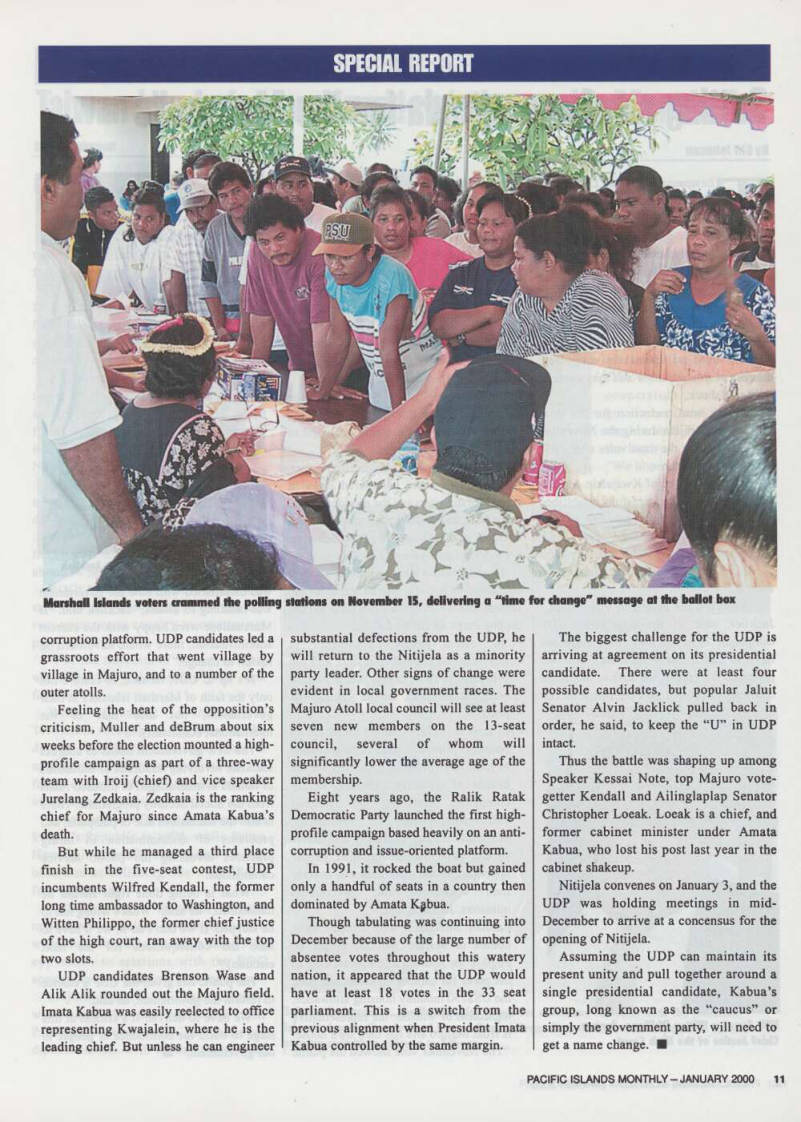
Many islanders waited for hours in line to cast their votes
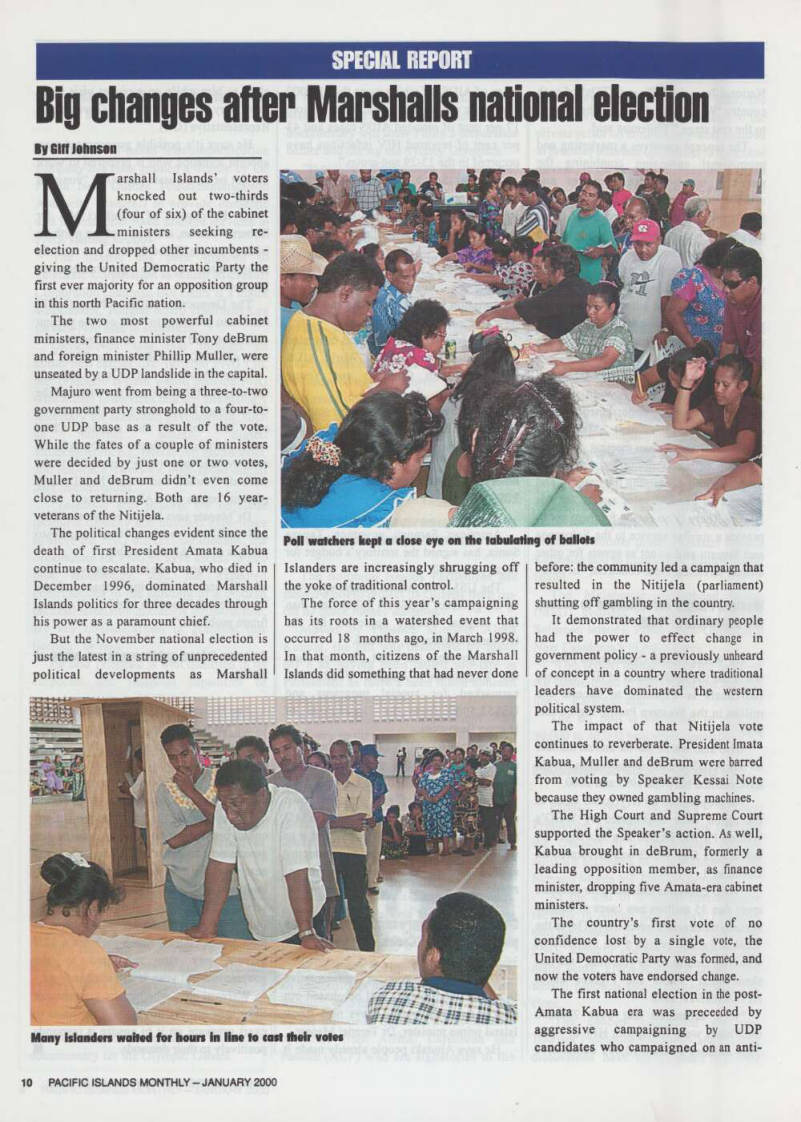
Poll watchers kept a close eye on the tabulating of ballots
corruption platform. UDP candidates led a grassroots effort that went village by village in Majuro, and to a number of the outer atolls.
Feeling the heat of the opposition’s criticism, Muller and deßrum about six weeks before the election mounted a high profile campaign as part of a three-way team with Iroij (chief) and vice speaker Jurelang Zedkaia. Zedkaia is the ranking chief for Majuro since Amata Kabua’s death.
But while he managed a third place finish in the five-seat contest, UDP incumbents Wilfred Kendall, the former long time ambassador to Washington, and Witten Philippo, the former chief justice of the high court, ran away with the top two slots.
UDP candidates Brenson Wase and Alik Alik rounded out the Majuro field.
Imata Kabua was easily reelected to office representing Kwajalein, where he is the leading chief. But unless he can engineer
substantial defections from the UDP, he will return to the Nitijela as a minority party leader. Other signs of change were evident in local government races. The Majuro Atoll local council will see at least seven new members on the 13-seat council, several of whom will significantly lower the average age of the membership.
Eight years ago, the Ralik Ratak Democratic Party launched the first high profile campaign based heavily on an anti corruption and issue-oriented platform.
In 1991, it rocked the boat but gained only a handful of seats in a country then dominated by Amata K^bua.
Though tabulating was continuing into December because of the large number of absentee votes throughout this watery nation, it appeared that the UDP would have at least 18 votes in the 33 seat parliament. This is a switch from the previous alignment when President Imata Kabua controlled by the same margin.
The biggest challenge for the UDP is arriving at agreement on its presidential candidate. There were at least four possible candidates, but popular Jaluit Senator Alvin Jacklick pulled back in order, he said, to keep the “U” in UDP intact.
Thus the battle was shaping up among Speaker Kessai Note, top Majuro vote getter Kendall and Ailinglaplap Senator Christopher Loeak. Loeak is a chief, and former cabinet minister under Amata Kabua, who lost his post last year in the cabinet shakeup.
Nitijela convenes on January 3, and the UDP was holding meetings in mid- December to arrive at a concensus for the opening of Nitijela.
Assuming the UDP can maintain its present unity and pull together around a single presidential candidate, Kabua’s group, long known as the “caucus” or simply the government party, will need to get a name change. ■
Marshall Islands voters crammed the polling stations on November 15, delivering a "time for change" message at the ballot box
Setting a reform agenda for the Marshalls
By Glff Johnson By Glff Johnson
The opposition United Democratic Party - expected to throw off the
“opposition” monicker by
forming the government in the Marshalls in early January - campaigned on an anti-corruption, reform-oriented platform.
UDP spokesman Alvin Jacklick says it’s now time to make words a reality.
In a country where politicians have become used to special privilege and conflict of interest, his words may come as a bit of a shock.
Jacklick won reelection for his third term in the Nitijela during the November election, gaining the most votes ever - 855 - for a Jaluit senator.
While the mayor of Kwajalein Atoll in the 1980 s, Jacklick successfully established functioning community services for the first time on overcrowded Ebeye Island.
This led to a new look and community spirit for an island long called the “slum of the Pacific.”
“We asked the people to vote for us,”
Jacklick said of the aggressive UDP campaign. “Now that they’ve done that, we have to fulfill our obligation. What we promised the people, we have to do. If we don’t deliver, it will be a big fiasco for our
organisation.”
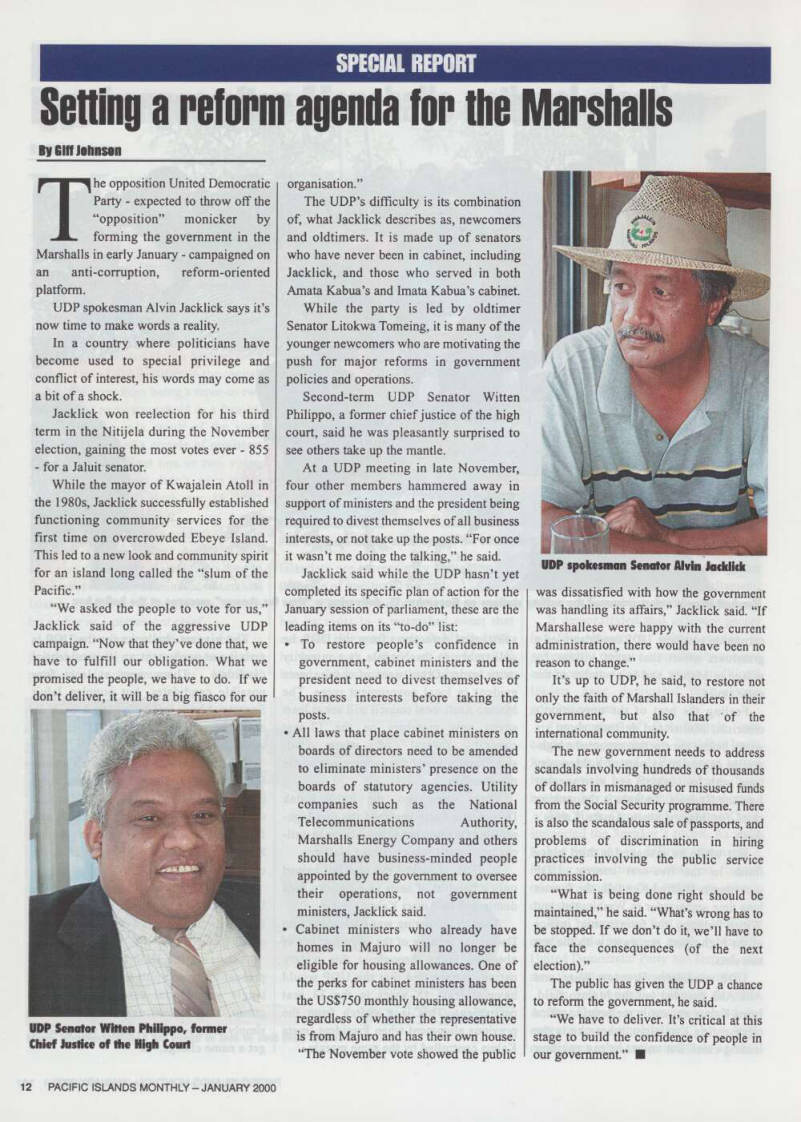
The UDP’s difficulty is its combination of, what Jacklick describes as, newcomers and oldtimers. It is made up of senators who have never been in cabinet, including Jacklick, and those who served in both Amata Kabua’s and Imata Kabua’s cabinet.
While the party is led by oldtimer Senator Litokwa Tomeing, it is many of the younger newcomers who are motivating the push for major reforms in government policies and operations.
Second-term UDP Senator Witten Philippo, a former chief justice of the high court, said he was pleasantly surprised to see others take up the mantle.
At a UDP meeting in late November, four other members hammered away in support of ministers and the president being required to divest themselves of all business interests, or not take up the posts. “For once it wasn’t me doing the talking,” he said.
Jacklick said while the UDP hasn’t yet completed its specific plan of action for the January session of parliament, these are the leading items on its “to-do” list: • To restore people’s confidence in government, cabinet ministers and the president need to divest themselves of business interests before taking the posts. • All laws that place cabinet ministers on boards of directors need to be amended to eliminate ministers’ presence on the boards of statutory agencies. Utility companies such as the National
Telecommunications Authority,
Marshalls Energy Company and others should have business-minded people appointed by the government to oversee their operations, not government ministers, Jacklick said. • Cabinet ministers who already have homes in Majuro will no longer be eligible for housing allowances. One of the perks for cabinet ministers has been the US$75O monthly housing allowance, regardless of whether the representative is from Majuro and has their own house.
“The November vote showed the public
was dissatisfied with how the government was handling its affairs,” Jacklick said. “If Marshallese were happy with the current administration, there would have been no reason to change.”
It’s up to UDP, he said, to restore not only the faith of Marshall Islanders in their government, but also that of the
international community.
The new government needs to address scandals involving hundreds of thousands of dollars in mismanaged or misused funds from the Social Security programme. There is also the scandalous sale of passports, and problems of discrimination in hiring practices involving the public service commission.
“What is being done right should be maintained,” he said. “What’s wrong has to be stopped. If we don’t do it, we’ll have to face the consequences (of the next election).”
The public has given the UDP a chance to reform the government, he said.
“We have to deliver. It’s critical at this stage to build the confidence of people in our government.” ■
UDP Senator Witten Philippo, former Chief Justice of the High Court
UDP spokesman Senator Alvin Jacklick
Taiwan hopes fee continued relations with Marshalls
By Glft Johnson
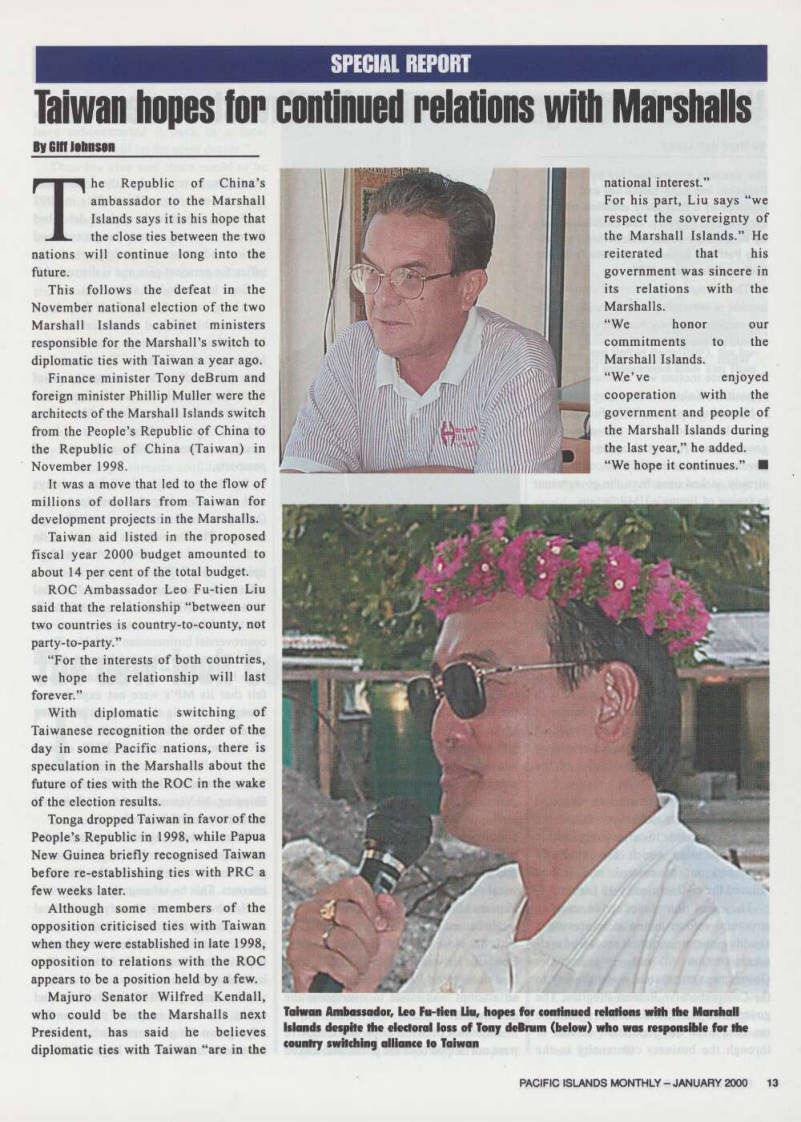
The Republic of China’s ambassador to the Marshall Islands says it is his hope that the close ties between the two nations will continue long into the future.
This follows the defeat in the November national election of the two Marshall Islands cabinet ministers responsible for the Marshall’s switch to diplomatic ties with Taiwan a year ago.
Finance minister Tony deßrum and foreign minister Phillip Muller were the architects of the Marshall Islands switch from the People’s Republic of China to the Republic of China (Taiwan) in November 1998.
It was a move that led to the flow of millions of dollars from Taiwan for development projects in the Marshalls.
Taiwan aid listed in the proposed fiscal year 2000 budget amounted to about 14 per cent of the total budget.
ROC Ambassador Leo Fu-tien Liu said that the relationship “between our two countries is country-to-county, not
party-to-party.”
“For the interests of both countries, we hope the relationship will last forever.”
With diplomatic switching of Taiwanese recognition the order of the day in some Pacific nations, there is speculation in the Marshalls about the future of ties with the ROC in the wake of the election results.
Tonga dropped Taiwan in favor of the People’s Republic in 1998, while Papua New Guinea briefly recognised Taiwan before re-establishing ties with PRC a few weeks later.
Although some members of the opposition criticised ties with Taiwan when they were established in late 1998, opposition to relations with the ROC appears to be a position held by a few.
Majuro Senator Wilfred Kendall, who could be the Marshalls next President, has said he believes diplomatic ties with Taiwan “are in the
national interest.”
For his part, Liu says “we respect the sovereignty of the Marshall Islands.” He reiterated that his government was sincere in its relations with the Marshalls.
“We honor our commitments to the Marshall Islands.
“We’ve enjoyed
cooperation with the government and people of the Marshall Islands during the last year,” he added.
“We hope it continues.” ■
Taiwan Ambassador, Leo Fu-tien Liu, hopes for continued relations with the Marshall Islands despite the electoral loss of Tony deBrum (below) who was responsible for the country switching alliance to Taiwan
Vanuatu's new government makes investors nervous
By Marc NeLL-lanes
Tlm Vaaoota government led by Donald Kalpokas has boon forced oat and replaced by a foar-party coalition with a very narrow majority. The coalition is led by Barak Sope off the Melanesian Progres sive Pali and backed by the late Fr Waller UnKs political party NUP.
The change of government comes after months of instability and statements by the opposition that they had the numbers to overthrow the government.
When a proposed Motion of No Confidence motion was announced by the opposition, Kalpokas chose give more time to his coalition partner, Willy Jimmy, to get more backbenchers in to support the government. He opted against forming government with the NUP whom they had already sacked once from the government in favour of Jimmy’s UMP faction.
The opposition seized the chance. On the day of the proposed Motion of No Confidence, November 26, the two Jon Brum members were persuaded to cross the floor in return for retaining the ministry of health portfolio. With the opposition having 28 and the government 24, Donald
Kalpokas resigned.
Kalpokas had caused concern with his party over his refusal to follow the request by his executive to form government with NUP. His resignation spells the demise of his political career as the party President Edward Natapei has now taken control of the party and is the new leader of the
opposition.
The VP-led government was supported by many investors in Vanuatu. It was the first government to effectively tackle
public spending which had gradually
ballooned out of control, and it had reduced the civil service by 10 per cent.
They had introduced wide ranging structural reform aimed at improving a shoddy government track record of mal administration and corruption.
Government transparency was the key to the Comprehensive Reform Program. The government introduced vat that spread the tax base over the population instead of through the business community in the
past.
The new government has made investors very nervous because of bad publicity surrounding critical reports by former Ombudsman Marie Noelle Patterson on Sope. These were over the infamous Bank Guarantee scheme that could have bankrupted the nation if SIOO million dollars worth of guarantees from the Reserve Bank of Vanuatu had been cashed in. Australian Peter Swanson, who had sold the idea of the scheme to Sope when he was Minister for Finance was subsequently jailed after he was found guilty and lost his appeal.
Barak Sope has had a long but controversial political career. Despite being educated at Essendon Grammar school in Australia, he has long been a vocal critic of Australian interference in Vanuatu affairs.
He caused concern in Canberra in 1987 with his close ties with Libyan Colonel Gaddaffi. He was jailed in 1988 following land riots in Port Vila and the mutiny when an attempt was made to overthrow the government.
Relations between Sope and Canberra were not helped over the publicised leaked
intelligence report by the Australian government foreign affairs office in 1997 on Pacific island leaders which described Sope as “corrupt, spurns due process and advice and attracts carpetbaggers. Seeks office for personal gain and is distrusted.”
Sope has denied all allegations.
Along with Sope, there has been unfavourable Ombud reports on the new lands minister and former prime minister, Maxime Carlot Korman. The allegations were misuse of cyclone emergency relief funds for personal use. New foreign affairs minister and another former PM, Serge Vohor, was alleged to have misappropriated funds with sale of passports.
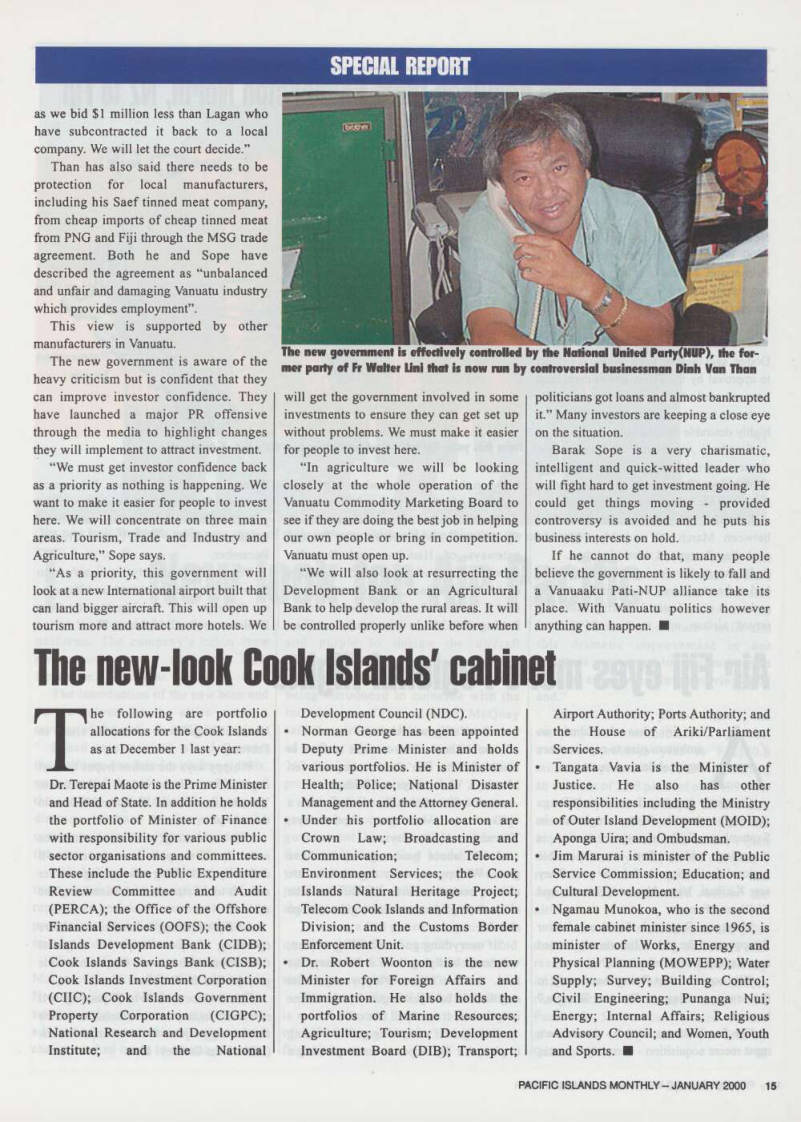
Barak Sope advised, “I have always said that the allegations made by the Ombudsman are not proven until they go to court. The Ombudsman has a job to do and can produce reports but it is their opinion only.” The new government is effectively controlled by the National United Party(NUP), the former party of Fr Walter Lini that is now run by controversial businessman Dinh Van Than.
NUP have the biggest bloc and should have had the position of PM but the party felt that its MP’s were not experienced enough to handle the top position. They gave it to Barak Sope in return for control of the main ministries. NUP control Internal Affairs, Judiciary, Police, Public Works, Trade and Industry, Transport and Shipping, Ni Vanuatu Business Affairs and Infrastructure/Public Works.
Than has been criticised in the past for
using politics and NUP’s position in
government to help further his business interests. This he vehemently denies.
However, he has already been vocal about putting a halt to a British company awarded the tender for a major road works improvement worth nearly $5 million that is much needed.
His company, SMET, involved in road works, has a case in court “put in on 7th July against the government who awarded the tender to British firm Lagan Holdings
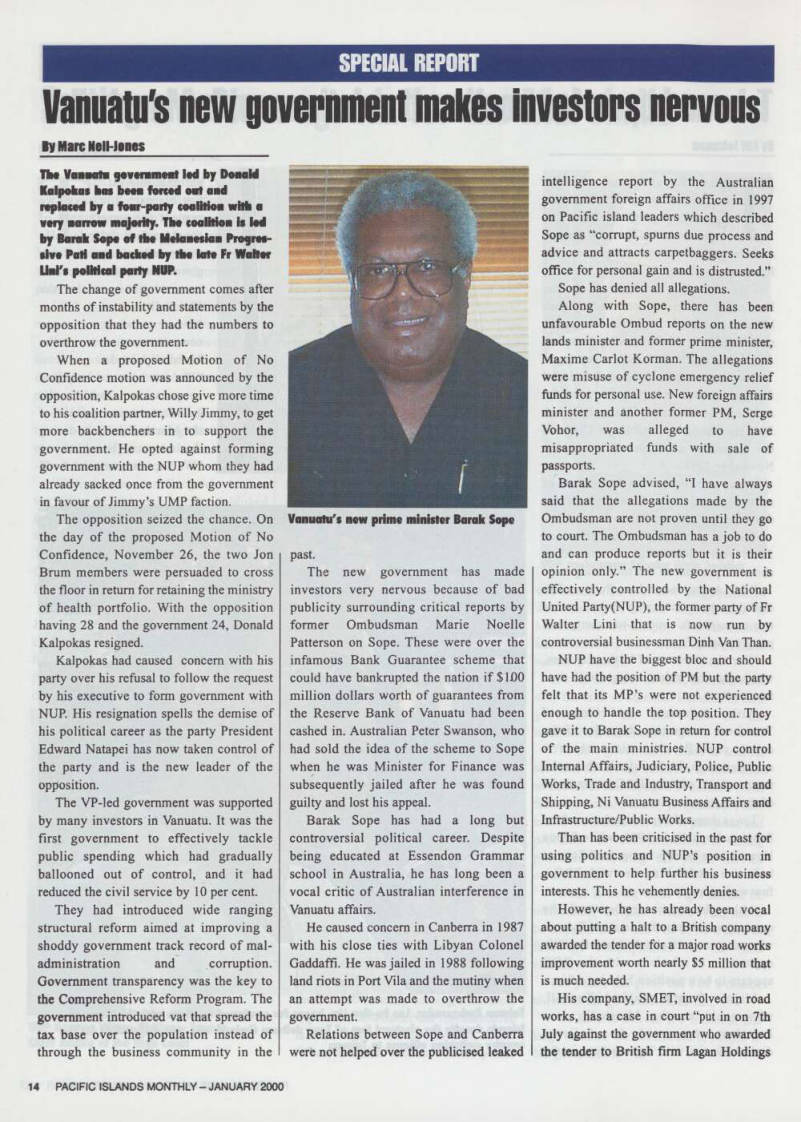
Vanuatu's new prime minister Barak Sope
as we bid $1 million less than Lagan who have subcontracted it back to a local company. We will let the court decide.”
Than has also said there needs to be protection for local manufacturers, including his Saef tinned meat company, from cheap imports of cheap tinned meat from PNG and Fiji through the MSG trade agreement. Both he and Sope have described the agreement as “unbalanced and unfair and damaging Vanuatu industry which provides employment”.
This view is supported by other manufacturers in Vanuatu.
The new government is aware of the heavy criticism but is confident that they can improve investor confidence. They have launched a major PR offensive through the media to highlight changes they will implement to attract investment.
“We must get investor confidence back as a priority as nothing is happening. We want to make it easier for people to invest here. We will concentrate on three main areas. Tourism, Trade and Industry and Agriculture,” Sope says.
“As a priority, this government will look at a new International airport built that can land bigger aircraft. This will open up tourism more and attract more hotels. We
will get the government involved in some investments to ensure they can get set up without problems. We must make it easier for people to invest here.
“In agriculture we will be looking closely at the whole operation of the Vanuatu Commodity Marketing Board to see if they are doing the best job in helping our own people or bring in competition.
Vanuatu must open up.
“We will also look at resurrecting the Development Bank or an Agricultural Bank to help develop the rural areas. It will be controlled properly unlike before when
politicians got loans and almost bankrupted it.” Many investors are keeping a close eye on the situation.
Barak Sope is a very charismatic, intelligent and quick-witted leader who will fight hard to get investment going. He could get things moving - provided controversy is avoided and he puts his business interests on hold.
If he cannot do that, many people believe the government is likely to fall and a Vanuaaku Pati-NUP alliance take its place. With Vanuatu politics however anything can happen. ■
The new government is effectively controlled by the Notional United Party(NUP), the for mer party of Fr Walter Uni that is now run by controversial businessman Dinh Van Than
The new-look Cook Islands' cabinet
The following are portfolio allocations for the Cook Islands as at December 1 last year: Dr. Terepai Maote is the Prime Minister and Head of State. In addition he holds the portfolio of Minister of Finance with responsibility for various public sector organisations and committees.
These include the Public Expenditure Review Committee and Audit (PERCA); the Office of the Offshore Financial Services (OOFS); the Cook Islands Development Bank (CIDB); Cook Islands Savings Bank (CISB); Cook Islands Investment Corporation (CIIC); Cook Islands Government Property Corporation (CIGPC); National Research and Development Institute; and the National
Development Council (NDC). • Norman George has been appointed Deputy Prime Minister and holds various portfolios. He is Minister of Health; Police; National Disaster Management and the Attorney General. • Under his portfolio allocation are Crown Law; Broadcasting and Communication; Telecom; Environment Services; the Cook Islands Natural Heritage Project; Telecom Cook Islands and Information Division; and the Customs Border Enforcement Unit. • Dr. Robert Woonton is the new Minister for Foreign Affairs and Immigration. He also holds the portfolios of Marine Resources; Agriculture; Tourism; Development Investment Board (DIB); Transport;
Airport Authority; Ports Authority; and the House of Ariki/Parliament Services. • Tangata Vavia is the Minister of Justice. He also has other responsibilities including the Ministry of Outer Island Development (MOID); Aponga Uira; and Ombudsman. • Jim Marurai is minister of the Public Service Commission; Education; and Cultural Development. • Ngamau Munokoa, who is the second female cabinet minister since 1965, is minister of Works, Energy and Physical Planning (MOWEPP); Water Supply; Survey; Building Control; Civil Engineering; Punanga Nui; Energy; Internal Affairs; Religious Advisory Council; and Women, Youth and Sports. ■
Freedom Air lauches services from Palmerston North, NZ to Fiji
Business
By Glff Johnson
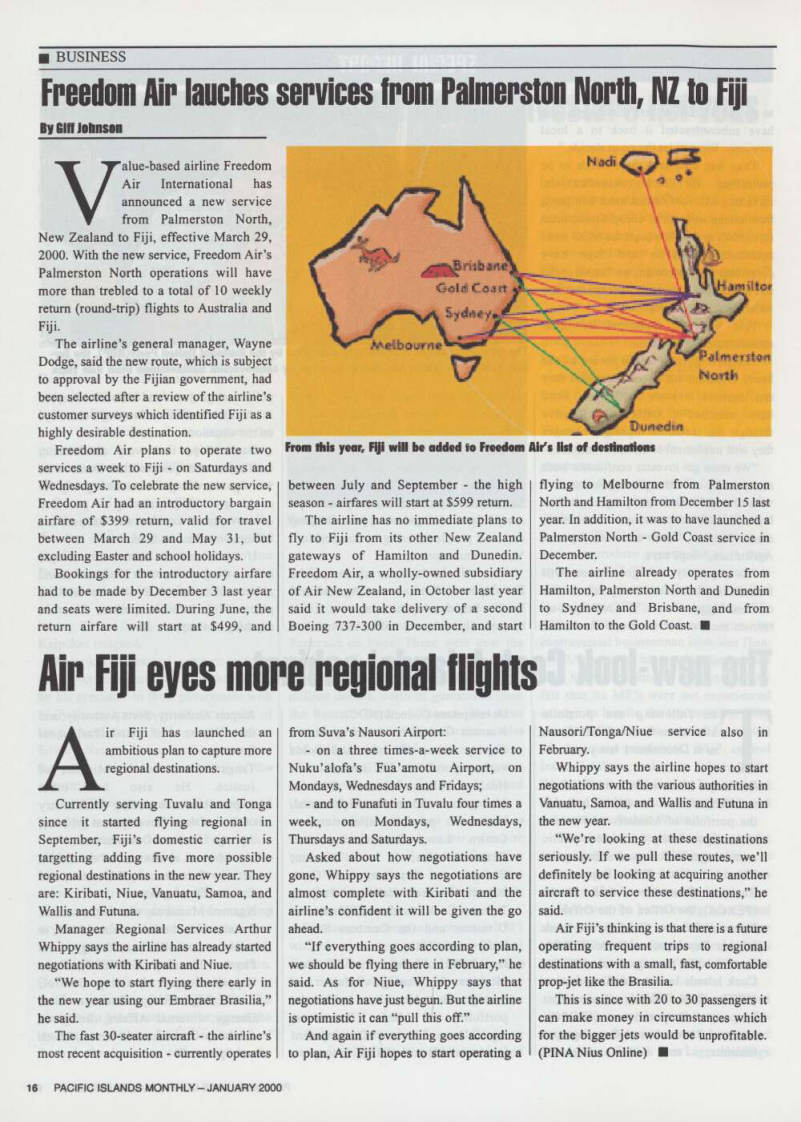
Value-based airline Freedom Air International has announced a new service from Palmerston North, New Zealand to Fiji, effective March 29, 2000. With the new service. Freedom Air’s Palmerston North operations will have more than trebled to a total of 10 weekly return (round-trip) flights to Australia and
Fiji.
The airline’s general manager, Wayne Dodge, said the new route, which is subject to approval by the Fijian government, had been selected after a review of the airline’s customer surveys which identified Fiji as a highly desirable destination.
Freedom Air plans to operate two services a week to Fiji - on Saturdays and Wednesdays. To celebrate the new service, Freedom Air had an introductory bargain airfare of $399 return, valid for travel between March 29 and May 31, but excluding Easter and school holidays.
Bookings for the introductory airfare had to be made by December 3 last year and seats were limited. During June, the return airfare will start at $499, and
between July and September - the high season - airfares will start at $599 return.
The airline has no immediate plans to fly to Fiji from its other New Zealand gateways of Hamilton and Dunedin.
Freedom Air, a wholly-owned subsidiary of Air New Zealand, in October last year said it would take delivery of a second Boeing 737-300 in December, and start
flying to Melbourne from Palmerston North and Hamilton from December 15 last year. In addition, it was to have launched a Palmerston North - Gold Coast service in December.
The airline already operates from Hamilton, Palmerston North and Dunedin to Sydney and Brisbane, and from Hamilton to the Gold Coast. ■
From this year, Fiji will be added fa Freedom Air's list of destinations
Air Fiji eyes more regional flights
Air Fiji has launched an ambitious plan to capture more regional destinations.
Currently serving Tuvalu and Tonga since it started flying regional in September, Fiji’s domestic carrier is targetting adding five more possible regional destinations in the new year. They are: Kiribati, Niue, Vanuatu, Samoa, and Wallis and Futuna.
Manager Regional Services Arthur Whippy says the airline has already started negotiations with Kiribati and Niue.
“We hope to start flying there early in the new year using our Embraer Brasilia,” he said.
The fast 30-seater aircraft - the airline’s most recent acquisition - currently operates
from Suva’s Nausori Airport: - on a three times-a-week service to Nukualofa’s Fua’amotu Airport, on Mondays, Wednesdays and Fridays; - and to Funafuti in Tuvalu four times a week, on Mondays, Wednesdays, Thursdays and Saturdays.
Asked about how negotiations have gone, Whippy says the negotiations are almost complete with Kiribati and the airline’s confident it will be given the go ahead.
“If everything goes according to plan, we should be flying there in February,” he said. As for Niue, Whippy says that negotiations have just begun. But the airline is optimistic it can “pull this off.”
And again if everything goes according to plan. Air Fiji hopes to start operating a
Nausori/Tonga/Niue service also in February.
Whippy says the airline hopes to start negotiations with the various authorities in Vanuatu, Samoa, and Wallis and Futuna in the new year.
“We’re looking at these destinations seriously. If we pull these routes, we’ll definitely be looking at acquiring another aircraft to service these destinations,” he said.
Air Fiji’s thinking is that there is a future operating frequent trips to regional destinations with a small, fast, comfortable prop-jet like the Brasilia.
This is since with 20 to 30 passengers it can make money in circumstances which for the bigger jets would be unprofitable. (PINA Nius Online) ■
New look for Air Pacific
If you fly Air Pacific this new year, you’ll
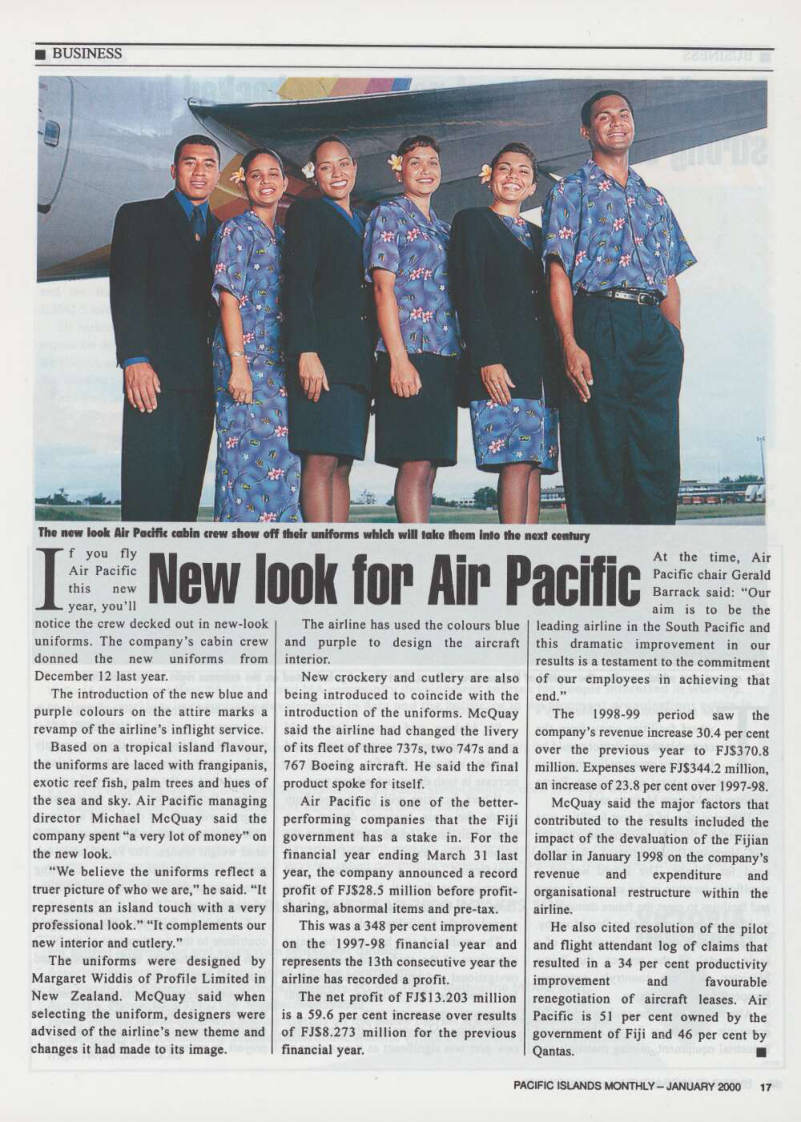
notice the crew decked out in new-look uniforms. The company’s cabin crew donned the new uniforms from December 12 last year.
The introduction of the new blue and purple colours on the attire marks a revamp of the airline’s inflight service.
Based on a tropical island flavour, the uniforms are laced with frangipanis, exotic reef fish, palm trees and hues of the sea and sky. Air Pacific managing director Michael McQuay said the company spent “a very lot of money” on the new look.
“We believe the uniforms reflect a truer picture of who we are,” he said. “It represents an island touch with a very professional look.” “It complements our new interior and cutlery.”
The uniforms were designed by Margaret Widdis of Profile Limited in New Zealand. McQuay said when selecting the uniform, designers were advised of the airline’s new theme and changes it had made to its image.
The airline has used the colours blue and purple to design the aircraft interior.
New crockery and cutlery are also being introduced to coincide with the introduction of the uniforms. McQuay said the airline had changed the livery of its fleet of three 7375, two 747 s and a 767 Boeing aircraft. He said the final product spoke for itself.
Air Pacific is one of the better performing companies that the Fiji government has a stake in. For the financial year ending March 31 last year, the company announced a record profit of FJ$2B.5 million before profit sharing, abnormal items and pre-tax.
This was a 348 per cent improvement on the 1997-98 financial year and represents the 13th consecutive year the airline has recorded a profit.
The net profit of FJ$ 13.203 million is a 59.6 per cent increase over results of FJ58.273 million for the previous financial year.
At the time. Air Pacific chair Gerald Barrack said: “Our aim is to be the
leading airline in the South Pacific and this dramatic improvement in our results is a testament to the commitment of our employees in achieving that end.”
The 1998-99 period saw the company’s revenue increase 30.4 per cent over the previous year to FJ5370.8 million. Expenses were FJ5344.2 million, an increase of 23.8 per cent over 1997-98.
McQuay said the major factors that contributed to the results included the impact of the devaluation of the Fijian dollar in January 1998 on the company’s revenue and expenditure and organisational restructure within the airline.
He also cited resolution of the pilot and flight attendant log of claims that resulted in a 34 per cent productivity improvement and favourable renegotiation of aircraft leases. Air Pacific is 51 per cent owned by the government of Fiji and 46 per cent by Qantas. ■
The new look Air Pacific cabin crew show off their uniforms which will lake them into the next century
Port Moresby wharf relocation backed by
strong environmental measures
The relocation of Port Moresby’s wharf facilities away from the central business district would be backed by strong policy measures to protect the natural environment, Prime Minister Sir Mekere Morauta said.
The relocation of the port facilities was endorsed by the last government after the PNG Harbours Board indicated a long-term need for change. The Board needed a significant increase in the amount of space and facilities to meet the future demands of trade and economic growth in Port Moresby.
Speaking at an official inspection of a scale model of the project, the Prime Minister said the country’s economic prospects looked promising.
Alternative ports, he said, would offer economic advantages for the shipment of industrial equipment, mining materials and
various products.
Sir Mekere said construction would create employment opportunities and provide national benefits through an increase in both direct and indirect taxes.
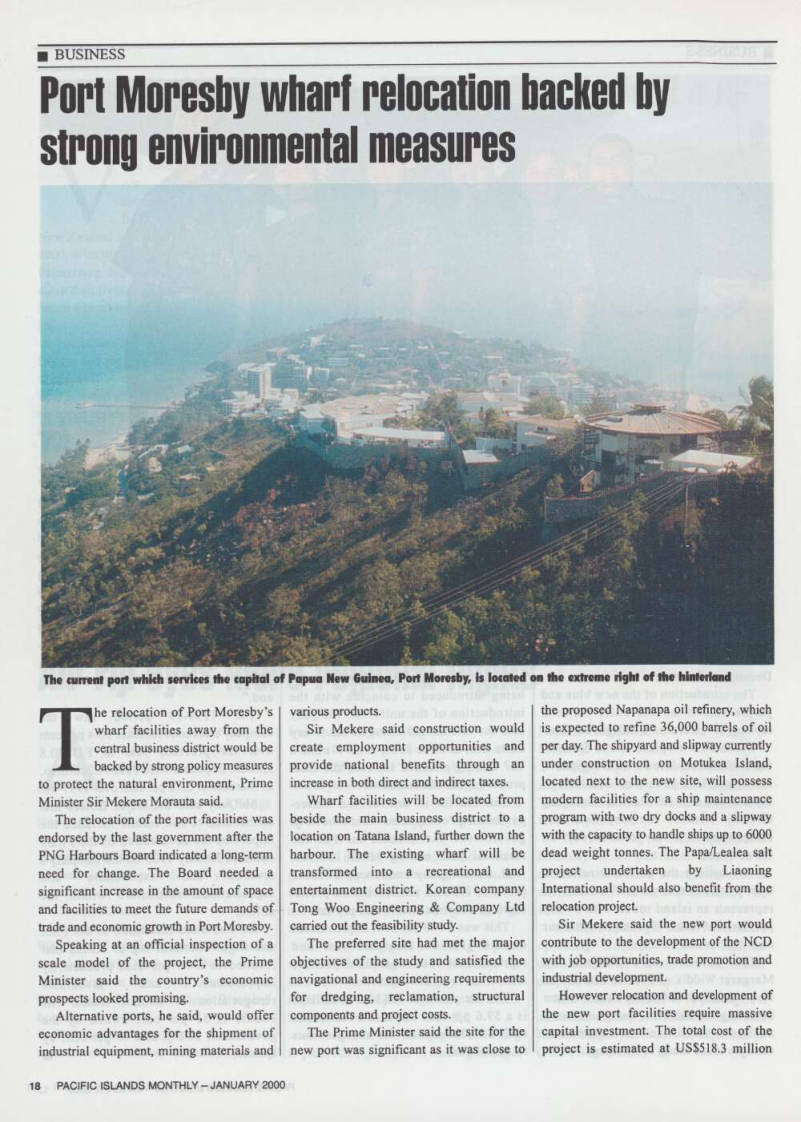
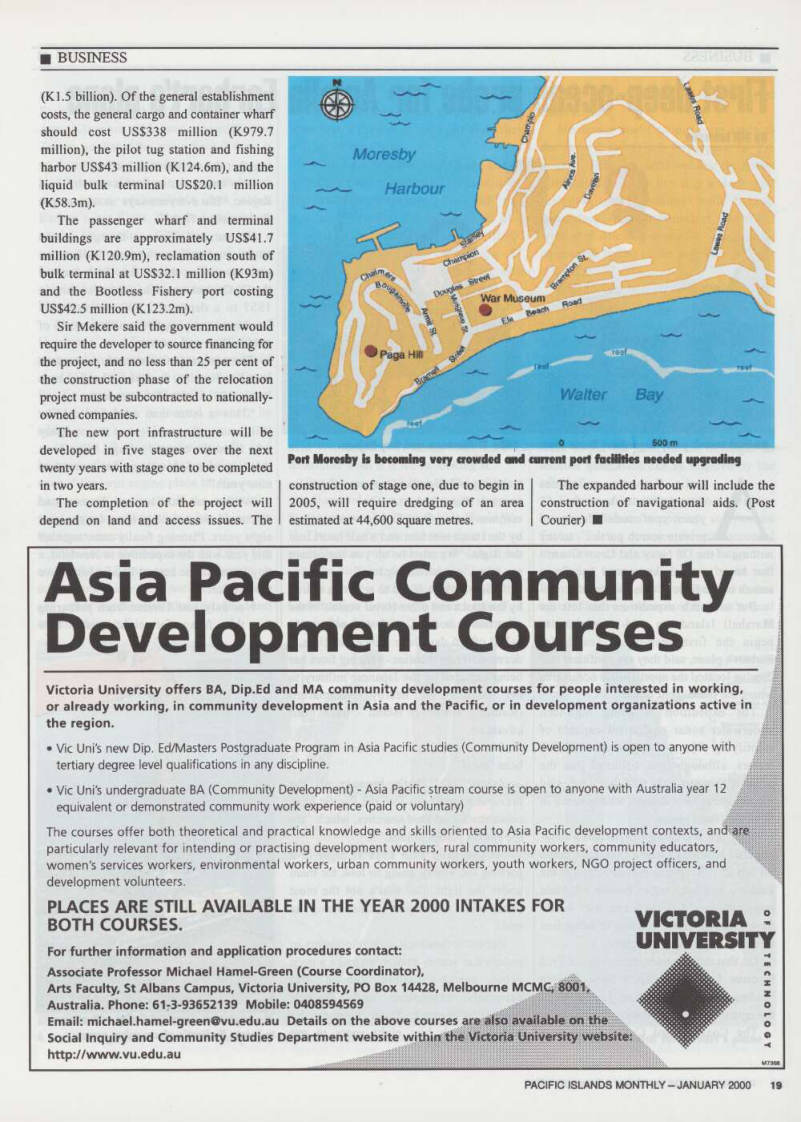
Wharf facilities will be located from beside the main business district to a location on Tatana Island, further down the harbour. The existing wharf will be transformed into a recreational and entertainment district. Korean company Tong Woo Engineering & Company Ltd carried out the feasibility study.
The preferred site had met the major objectives of the study and satisfied the navigational and engineering requirements for dredging, reclamation, structural components and project costs.
The Prime Minister said the site for the new port was significant as it was close to
the proposed Napanapa oil refinery, which is expected to refine 36,000 barrels of oil per day. The shipyard and slipway currently under construction on Motukea Island, located next to the new site, will possess modem facilities for a ship maintenance program with two dry docks and a slipway with the capacity to handle ships up to 6000 dead weight tonnes. The Papa/Lealea salt project undertaken by Liaoning International should also benefit from the relocation project.
Sir Mekere said the new port would contribute to the development of the NCD with job opportunities, trade promotion and industrial development.
However relocation and development of the new port facilities require massive capital investment. The total cost of the project is estimated at U 55518.3 million
The current port which services the capital of Papua New Guinea, Port Moresby, is located on the extreme right of the hinterland
(K 1.5 billion). Of the general establishment costs, the general cargo and container wharf should cost USS33B million (K 979.7 million), the pilot tug station and fishing harbor US$43 million (K124.6m), and the liquid bulk terminal US$2O.l million (K58.3m).
The passenger wharf and terminal buildings are approximately USs4l.7 million (K 120.9 m), reclamation south of bulk terminal at USs32.l million (K93m) and the Bootless Fishery port costing U 5542.5 million (K123.2m).
Sir Mekere said the government would require the developer to source financing for the project, and no less than 25 per cent of the construction phase of the relocation project must be subcontracted to nationally owned companies.
The new port infrastructure will be developed in five stages over the next twenty years with stage one to be completed in two years.
The completion of the project will depend on land and access issues. The
construction of stage one, due to begin in 2005, will require dredging of an area estimated at 44,600 square metres.
The expanded harbour will include the construction of navigational aids. (Post Courier) ■
Port Moresby is becoming very crowded and current port facilities needed upgrading
Advertisements & other items, p. 19 (1 item)
Development Courses
Asia Pacific Community
Victoria University offers BA, Dip.Ed and MA community development courses for people interested in working, or already working, in community development in Asia and the Pacific, or in development organizations active in the region. • Vic Uni's new Dip. Ed/Masters Postgraduate Program in Asia Pacific studies (Community Development) is open to anyone with tertiary degree level qualifications in any discipline. • Vic Uni's undergraduate BA (Community Development) - Asia Pacific stream course is open to anyone with Australia year 12 equivalent or demonstrated community work experience (paid or voluntary) The courses offer both theoretical and practical knowledge and skills oriented to Asia Pacific development contexts, and are particularly relevant for intending or practising development workers, rural community workers, community educators, women's services workers, environmental workers, urban community workers, youth workers, NGO project officers, and development volunteers.
PLACES ARE STILL AVAILABLE IN THE YEAR 2000 INTAKES FOR
BOTH COURSES.
For further information and application procedures contact: Associate Professor Michael Hamel-Green (Course Coordinator), Arts Faculty, St Albans Campus, Victoria University, PO Box 14428, Melbourne MCMC, 8091, Australia. Phone: 61-3-93652139 Mobile: 0408594569 Email: [email protected] Details on the above courses are also available on the Social Inquiry and Community Studies Department website within the Victoria University website: http://www.vu.edu.au
VICTORIA :
UNIVERSITY
M 7360
First deep-ocean probe for Amelia Earhart's plane
By Glft Johnson
Amelia Earhart’s mysterious disappearance has, for 62 years, confounded dozens of private search parties - to say nothing of the US Navy and Coast Guard that have scoured the central Pacific in search of the famous aviatrix’s plane.
But a search expedition that left the Marshall Islands in mid-November, to begin the first deep-ocean search for Earhart’s plane, said they are confident that they’ve located the approximate ocean area where the plane went down.
The expedition is using high-tech underwater sonar equipment capable of identifying objects at depths up to 10,000 meters, although it is believed that the plane is in water only half that deep, said trip organizer Guy Zajonc, who is based in
Spokane, Washington.
They are searching for Earhart’s twin engine Lockheed Electra that went down on July 2, 1937. It was midway through the Pacific - and last - leg of Earhart’s famous round-the-world flight - one that would have given her the distinction of being first female pilot to circle the globe.
On that day, Earhart and navigator Fred Noonan left Lae, Papua New Guinea heading for Howland Island, just north of the equator next to Kiribati.
The Coast Guard Cutter Itasca was
standing off Howland to provide radio contact for Earhart. The last radio communication from Earhart was received by the Itasca nineteen and a half hours into the flight. “We must be on you but cannot see you ... gas is running low.”
When Earhart failed to arrive, a search by the Itasca and other Naval vessels of the area found nothing, and was ultimately called off 16 days later. Since that time, a dozen different theories - ranging from her being captured by the Japanese military to her landing on nearby Nikumaroro (formerly Gardner) Island - have been advanced.
But no conclusive evidence has ever been found.
Zajonc said that’s because all the previous expeditions into the Pacific have concentrated on land searches, which “are the easiest places to look.”
“If you drop your keys at night in a parking lot, you’re going to look for them under the light. But that’s not the most likely place where you’ll find them,” he said.
Recent technological developments in
underwater search equipment make a deep ocean search feasible, though still extremely expensive, said Zajonc’s expedition partner, Dana Timmer. He added it took him eight years to put
together the current search effort.
“No one wants to fund a search,” said Zajonc. “But everyone says ‘as soon as you find it call us first.’”
Zajonc and Timmer brought in the ocean engineering company Williamson and Associates, that in the 1980 s located the SS Central America, a ship that sank in 1857 to a depth of 2,500 meters in the Caribbean carrying $4OO million worth of gold bullion and coins.
The company also recently located an Israeli submarine, the Dakar, that had been lost in 1961 in the Mediterranean.
“This is more than a job,” said Mike Williamson, the president of the company who is on the current voyage. “I’ve been thinking about this target for more than nine years.”
Williamson said he and Timmer had discussed the search project for the past eight years. Planning finally came together this year with the expedition to Howland, a tiny island in the central Pacific just above the equator.
Not only had Timmer been preparing for this foray for eight years, he’s
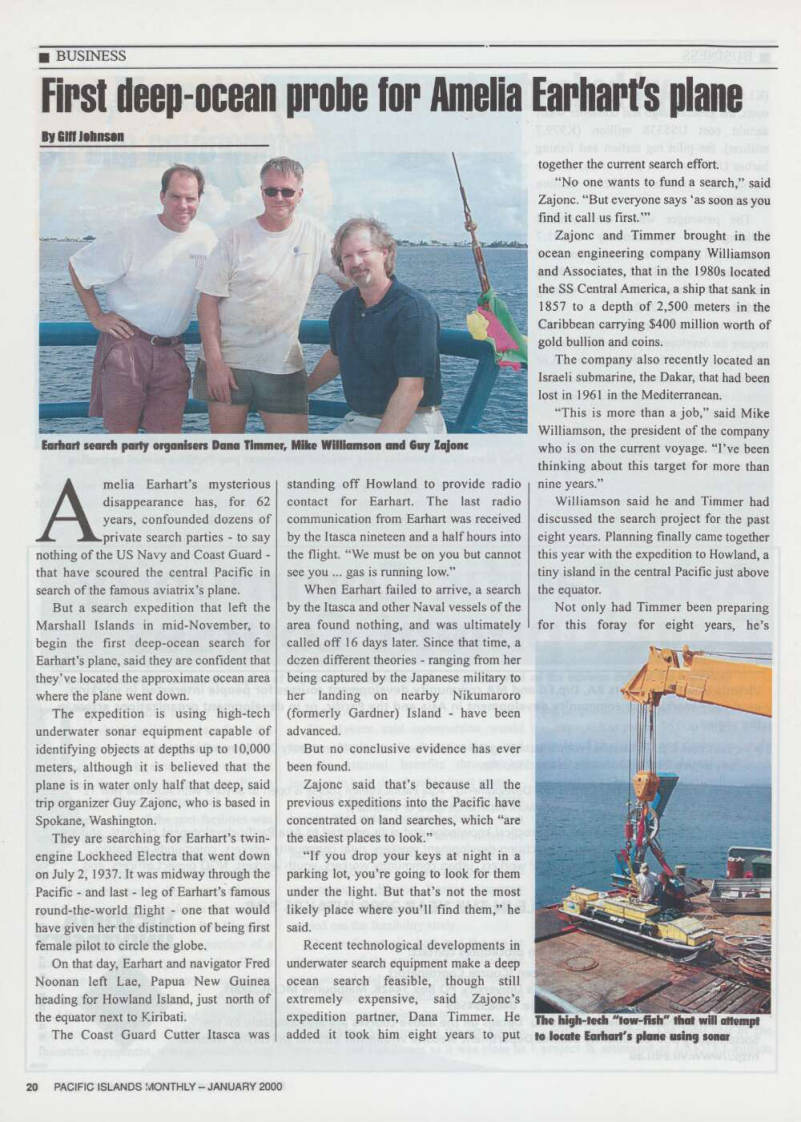
Earhart search parly organisers Dana Timmer, Mike Williamson and Guy Zajonc
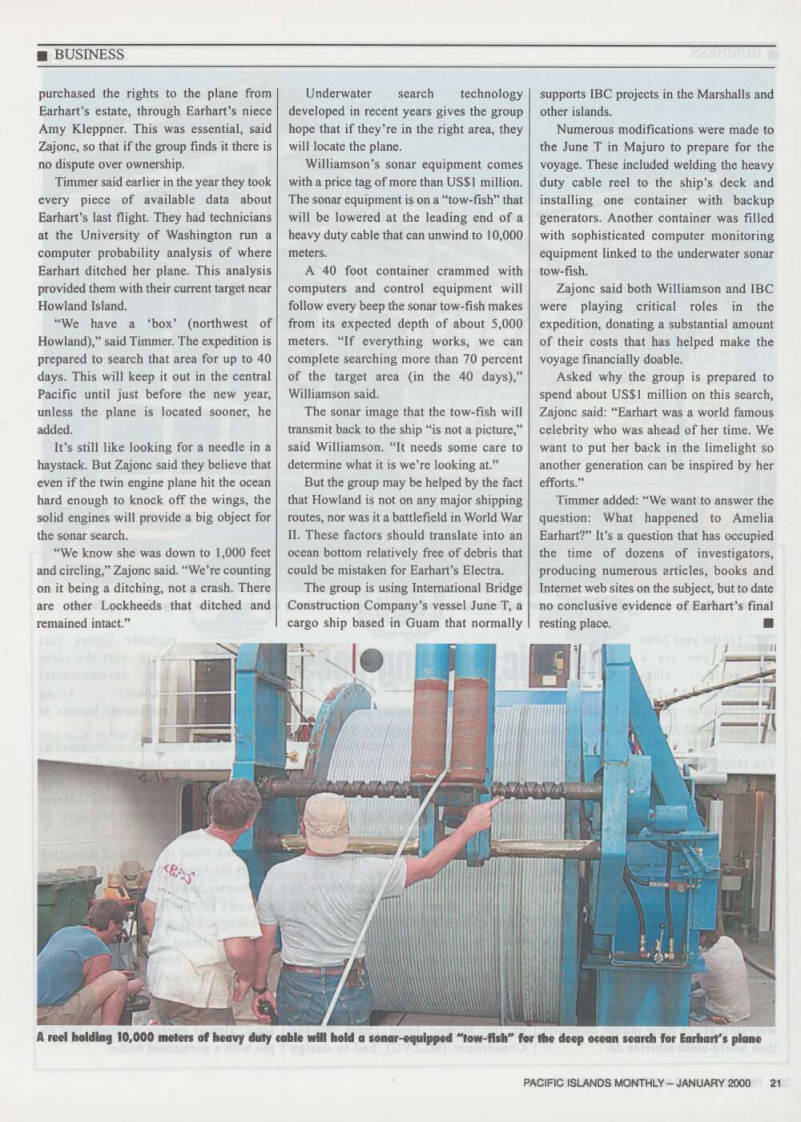
The high-tech "tow-fish" that will attempt to locate Earhart's plane using sonar
purchased the rights to the plane from Earhart’s estate, through Earhart’s niece Amy Kleppner. This was essential, said Zajonc, so that if the group finds it there is
no dispute over ownership.
Timmer said earlier in the year they took every piece of available data about Earhart’s last flight. They had technicians at the University of Washington run a computer probability analysis of where Earhart ditched her plane. This analysis provided them with their current target near Howland Island.
“We have a ‘box’ (northwest of Howland),” said Timmer. The expedition is prepared to search that area for up to 40 days. This will keep it out in the central Pacific until just before the new year, unless the plane is located sooner, he added.
It’s still like looking for a needle in a haystack. But Zajonc said they believe that even if the twin engine plane hit the ocean hard enough to knock off the wings, the solid engines will provide a big object for the sonar search.
“We know she was down to 1,000 feet and circling,” Zajonc said. “We’re counting on it being a ditching, not a crash. There are other Lockheeds that ditched and remained intact.”
Underwater search technology developed in recent years gives the group hope that if they’re in the right area, they will locate the plane.
Williamson’s sonar equipment comes with a price tag of more than US$l million.
The sonar equipment is on a “tow-fish” that will be lowered at the leading end of a heavy duty cable that can unwind to 10,000 meters.
A 40 foot container crammed with computers and control equipment will follow every beep the sonar tow-fish makes from its expected depth of about 5,000 meters. “If everything works, we can complete searching more than 70 percent of the target area (in the 40 days),”
Williamson said.
The sonar image that the tow-fish will transmit back to the ship “is not a picture,” said Williamson. “It needs some care to determine what it is we’re looking at.”
But the group may be helped by the fact that Howland is not on any major shipping routes, nor was it a battlefield in World War 11. These factors should translate into an ocean bottom relatively free of debris that could be mistaken for Earhart’s Electra.
The group is using International Bridge Construction Company’s vessel June T, a cargo ship based in Guam that normally
supports IBC projects in the Marshalls and other islands.
Numerous modifications were made to the June T in Majuro to prepare for the voyage. These included welding the heavy duty cable reel to the ship’s deck and installing one container with backup generators. Another container was filled with sophisticated computer monitoring equipment linked to the underwater sonar tow-fish.
Zajonc said both Williamson and IBC were playing critical roles in the expedition, donating a substantial amount of their costs that has helped make the voyage financially doable.
Asked why the group is prepared to spend about US$l million on this search, Zajonc said: “Earhart was a world famous celebrity who was ahead of her time. We want to put her back in the limelight so another generation can be inspired by her efforts.”
Timmer added: “We want to answer the question: What happened to Amelia Earhart?” It’s a question that has occupied the time of dozens of investigators, producing numerous articles, books and Internet web sites on the subject, but to date no conclusive evidence of Earhart’s final resting place. ■
A reel holding 10,000 meters of heavy duty cable will hold a sonar-equipped "tow-fish" for the deep ocean search for Earhart's plane
Olympic housing goes green

It is the year 2000 ::.r athlete. You
have just run your best time in a qualifying heat and are through to the finals.
You return to the Athletes’ Village for some “down time” to focus on the big challenge ahead. You enter your home for the period of the Games, one of the 300 temporary, demountable houses on site.
It is, in effect, a large plastic molded box. There is very little natural light and even less fresh air. The Australians reckon summer hasn’t started yet but to your northern European senses it feels hot - and even more so in this godforsaken plastic box.
Maybe writers spend more time worrying about their indoor comforts than world-class athletes do.
And maybe cross-flow ventilation is the last thing on anyone’s mind when
tomorrow they’ll be eyeballing Cathy
Freeman for the gold. But athletes at the Sydney 2000 Games will be glad somebody thought of cross-flow ventilation when they bed down with dreams of glory in the demountable homes currently being constructed at the Games’ Village.
The traditional demountable - or modular - home is box shaped, PVC internal and external, and has very little window space, for ease of transportation on the back of trucks.
The Sydney 2000 modular home, however, is a somewhat finer affair.
Architects working for Mirvac, as part of the Mirvac Lend Lease Village Consortium (MLLVC), had to design
modular homes that
sr r,
standards being
achieved in the permanent houses at the Athletes; Village.
“We had to meet our environmental targets but at the same time the cost of the modular home had to stay competitive in the market,” Maria Atkinson, Environment Manager of Lend Lease said.
It took close to a year of designing and re-designing before MLLVC had 10 homes with the right mix of economy and environment.
Energy efficiency in a modular home is almost unheard of but the Consortium homes were rated according to the National Housing Energy Rating Scheme.
They scored an average of three stars, almost energy efficient and on par with a permanent home.
It took an Olympic Games with Environmental Guidelines, for the rules of energy efficiency to be applied to budget housing design
Energy efficiency is difficult to achieve without the thermal mass in bricks and mortar, both impractical products in a transportable home.
So consideration was given to making the homes passively ventilated, and energy efficient in terms of orientation, window sizing and insulation. Efficient lighting will be installed as well as water saving devices.
“It was a long, drawn out and high risk project to work on - the environmental criteria were never written for modular homes; there wasn’t an understanding of the modular home industry; the designers would come up with brilliant ideas, but when the dollars went in they had to be dropped. It was a constant invent, reinvent process,” Atkinson said.
What’s more, MLLVC is not in the business of building or selling modular homes and there was a chance it would be left holding 352 environmentally
innovative but unsaleable homes.
It reduced the risk by teaming up with the existing modular home industry and, through that, a whole new workforce came into contact with the Green Guidelines.
An education process in the resourcing and use of new materials began - low off-gassing paints, PVC free pipes, sustainable timber - and in the waste separation necessary for reuse and recycling.
Many existing practices had to be changed and as a result some contractors have permanently changed their business practices.
So now picture this: you are Cathy Freeman. You have just won gold before the home crowd. You return to your modular home in the Games Village, tired but triumphant.
From the front deck of your home you can see the Stadium where it all took place - a gentle breeze cools your face and the last of the day’s sunshine
reflects the warmth off the gold medal in your hand.
Here’s to the Green Games. (Olympic Report, Greenpeace) ■
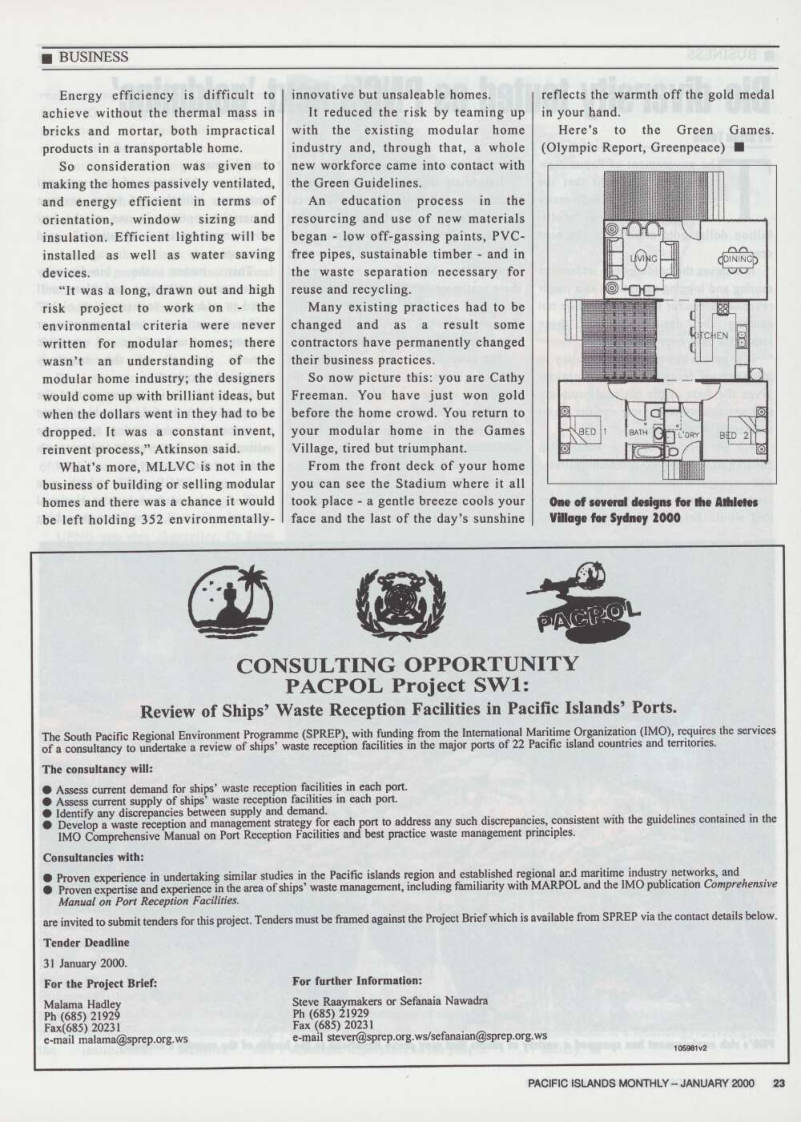
One of several designs for the Athletes Village for Sydney 2000
Advertisements & other items, p. 23 (1 item)
Consulting Opportunity
PACPOL Project SWI:
Review of Ships’ Waste Reception Facilities in Pacific Islands’ Ports.
The South Pacific Regional Environment Programme (SPREP), with funding from the International Maritime Organization (IMO), requires the services of a consultancy to undertake a review of ships’ waste reception facilities in the major ports of 22 Pacific island countnes and territories.
The consultancy will: • Assess current demand for ships’ waste reception facilities in each port. • Assess current supply of ships’ waste reception facilities in each port. 9 Identify any discrepancies between supply and demand. • Develop a waste reception and management strategy for each port to address any such discrepancies, consistent IMO Comprehensive Manual on Port Reception Facilities and best practice waste management principles. with the guidelines contained in the Consultancies with: • Proven experience in undertaking similar studies in the Pacific islands region and established regional and maritime industry networks, and • Proven expertise and experience in the area of ships’ waste management, including familiarity with MARPOL and the IMO publication Comprehensive Manual on Port Reception Facilities. are invited to submit tenders for this project. Tenders must be framed against the Project Brief which is available from SPREP via the contact details below.
Tender Deadline 31 January 2000.
For the Project Brief: Malama Hadley Ph (685) 21929 Fax(6Bs) 20231 e-mail [email protected] For further Information: Steve Raaymakers or Sefanaia Nawadra Ph (685) 21929 Fax (685) 20231
e-mail [email protected]/[email protected]
105981v2
Bio diversity touted as PNG'S next 'goldmine'
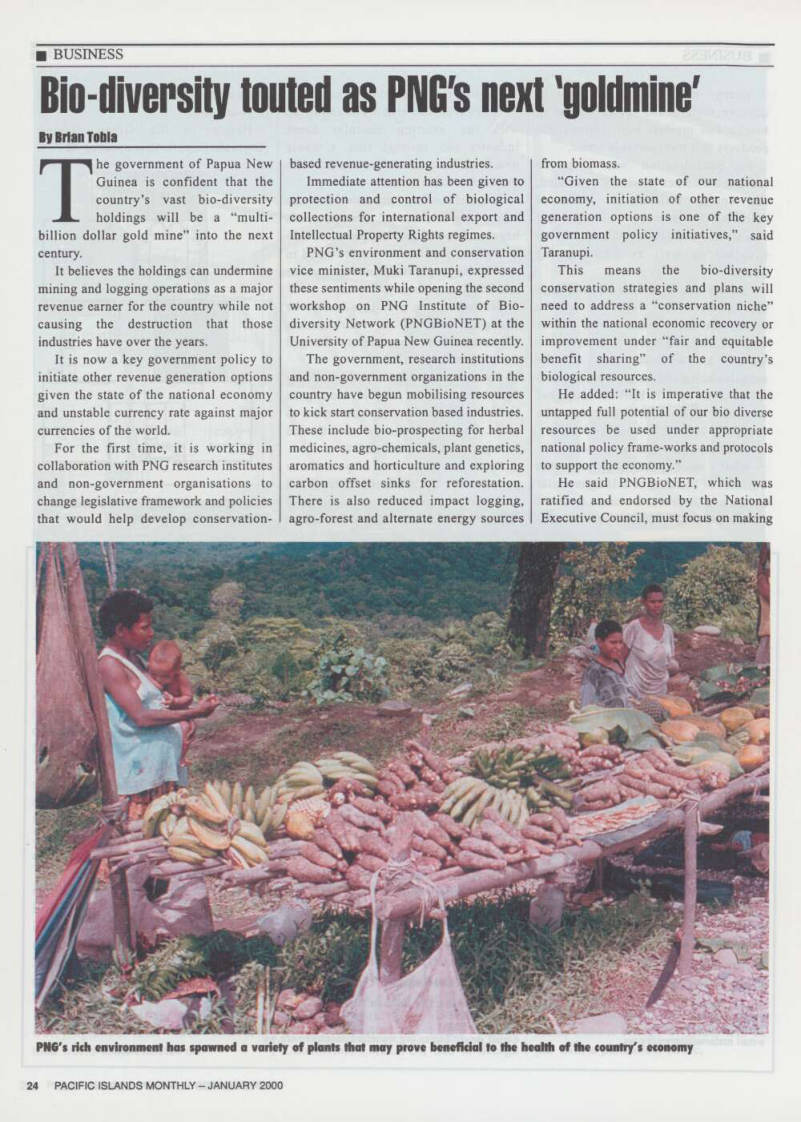
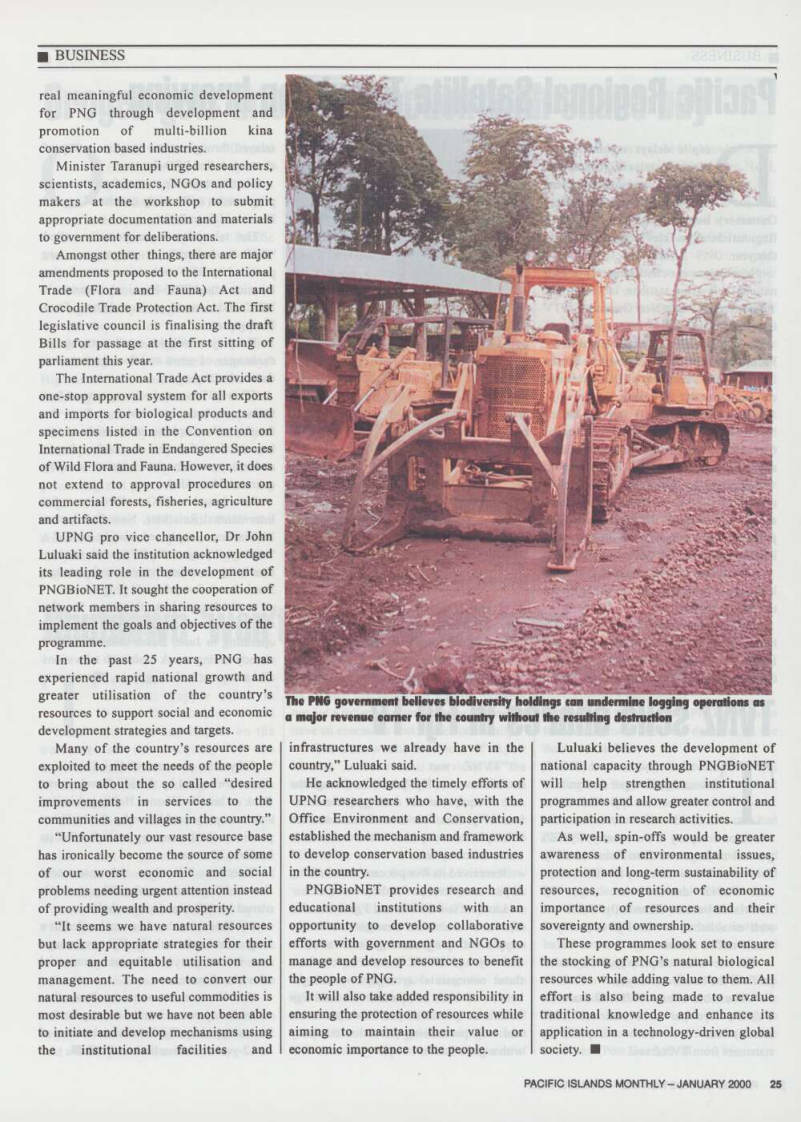
By Brlan Tobla
The government of Papua New Guinea is confident that the country’s vast bio-diversity holdings will be a “multi billion dollar gold mine” into the next century.
It believes the holdings can undermine mining and logging operations as a major revenue earner for the country while not causing the destruction that those industries have over the years.
It is now a key government policy to initiate other revenue generation options given the state of the national economy and unstable currency rate against major currencies of the world.
For the first time, it is working in collaboration with PNG research institutes and non-government organisations to change legislative framework and policies that would help develop conservation
based revenue-generating industries.
Immediate attention has been given to protection and control of biological collections for international export and
Intellectual Property Rights regimes.
PNG’s environment and conservation vice minister, Muki Taranupi, expressed these sentiments while opening the second workshop on PNG Institute of Bio diversity Network (PNGBioNET) at the University of Papua New Guinea recently.
The government, research institutions and non-government organizations in the country have begun mobilising resources to kick start conservation based industries.
These include bio-prospecting for herbal
medicines, agro-chemicals, plant genetics,
aromatics and horticulture and exploring carbon offset sinks for reforestation.
There is also reduced impact logging, agro-forest and alternate energy sources
from biomass.
“Given the state of our national economy, initiation of other revenue generation options is one of the key government policy initiatives,” said Taranupi.
This means the bio-diversity conservation strategies and plans will need to address a “conservation niche” within the national economic recovery or improvement under “fair and equitable benefit sharing” of the country’s biological resources.
He added: “It is imperative that the untapped full potential of our bio diverse resources be used under appropriate national policy frame-works and protocols to support the economy.”
He said PNGBioNET, which was ratified and endorsed by the National Executive Council, must focus on making
PNG's rich environment has spawned a variety of plants that may prove beneficial to the health of the country's economy
real meaningful economic development for PNG through development and promotion of multi-billion kina conservation based industries.
Minister Taranupi urged researchers, scientists, academics, NGOs and policy makers at the workshop to submit appropriate documentation and materials to government for deliberations.
Amongst other things, there are major amendments proposed to the International Trade (Flora and Fauna) Act and Crocodile Trade Protection Act. The first legislative council is finalising the draft Bills for passage at the first sitting of parliament this year.
The International Trade Act provides a one-stop approval system for all exports and imports for biological products and specimens listed in the Convention on International Trade in Endangered Species of Wild Flora and Fauna. However, it does not extend to approval procedures on commercial forests, fisheries, agriculture and artifacts.
UPNG pro vice chancellor, Dr John Luluaki said the institution acknowledged its leading role in the development of PNGBioNET. It sought the cooperation of network members in sharing resources to implement the goals and objectives of the programme.
In the past 25 years, PNG has experienced rapid national growth and greater utilisation of the country’s resources to support social and economic development strategies and targets.
Many of the country’s resources are exploited to meet the needs of the people to bring about the so called “desired improvements in services to the communities and villages in the country.”
“Unfortunately our vast resource base has ironically become the source of some of our worst economic and social problems needing urgent attention instead of providing wealth and prosperity.
“It seems we have natural resources but lack appropriate strategies for their proper and equitable utilisation and management. The need to convert our natural resources to useful commodities is most desirable but we have not been able to initiate and develop mechanisms using the institutional facilities and
infrastructures we already have in the country,” Luluaki said.
He acknowledged the timely efforts of UPNG researchers who have, with the Office Environment and Conservation, established the mechanism and framework to develop conservation based industries in the country.
PNGBioNET provides research and educational institutions with an opportunity to develop collaborative efforts with government and NGOs to manage and develop resources to benefit the people of PNG.
It will also take added responsibility in ensuring the protection of resources while aiming to maintain their value or economic importance to the people.
Luluaki believes the development of national capacity through PNGBioNET will help strengthen institutional programmes and allow greater control and participation in research activities.
As well, spin-offs would be greater awareness of environmental issues, protection and long-term sustainability of resources, recognition of economic importance of resources and their sovereignty and ownership.
These programmes look set to ensure the stocking of PNG’s natural biological resources while adding value to them. All effort is also being made to revalue traditional knowledge and enhance its application in a technology-driven global society. ■
The PNG government believes biodiversity holdings can undermine logging operations os a major revenue earner for the country without the resulting destruction
Pacific Regional Satellite Television brewing
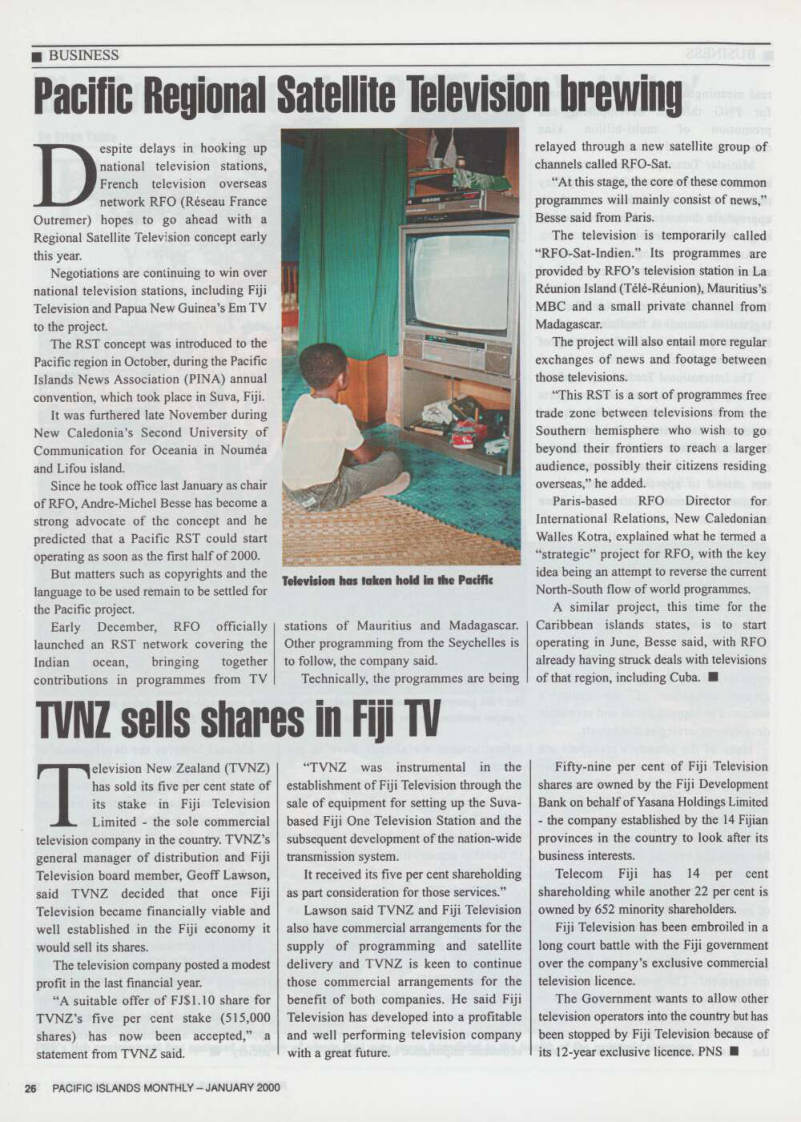
Despite delays in hooking up national television stations, French television overseas network RFO (Reseau France Outremer) hopes to go ahead with a Regional Satellite Television concept early this year.
Negotiations are continuing to win over national television stations, including Fiji Television and Papua New Guinea’s Em TV to the project.
The RST concept was introduced to the Pacific region in October, during the Pacific Islands News Association (PINA) annual convention, which took place in Suva, Fiji.
It was furthered late November during New Caledonia’s Second University of Communication for Oceania in Noumea and Lifou island.
Since he took office last January as chair of RFO, Andre-Michel Besse has become a strong advocate of the concept and he predicted that a Pacific RST could start operating as soon as the first half of 2000.
But matters such as copyrights and the language to be used remain to be settled for the Pacific project.
Early December, RFO officially launched an RST network covering the Indian ocean, bringing together contributions in programmes from TV
stations of Mauritius and Madagascar.
Other programming from the Seychelles is to follow, the company said.
Technically, the programmes are being
relayed through a new satellite group of channels called RFO-Sat.
“At this stage, the core of these common programmes will mainly consist of news,”
Besse said from Paris.
The television is temporarily called “RFO-Sat-Indien.” Its programmes are provided by RFO’s television station in La Reunion Island (Tele-Reunion), Mauritius’s MBC and a small private channel from
Madagascar.
The project will also entail more regular exchanges of news and footage between those televisions.
“This RST is a sort of programmes free trade zone between televisions from the Southern hemisphere who wish to go beyond their frontiers to reach a larger audience, possibly their citizens residing overseas,” he added.
Paris-based RFO Director for International Relations, New Caledonian Walles Kotra, explained what he termed a “strategic” project for RFO, with the key idea being an attempt to reverse the current North-South flow of world programmes.
A similar project, this time for the Caribbean islands states, is to start operating in June, Besse said, with RFO already having struck deals with televisions of that region, including Cuba. ■
Television has taken hold in the Pacific
TVNZ sells shares in Fiji TV
Television New Zealand (TVNZ) has sold its five per cent state of its stake in Fiji Television Limited - the sole commercial television company in the country. TVNZ’s general manager of distribution and Fiji Television board member, Geoff Lawson, said TVNZ decided that once Fiji Television became financially viable and well established in the Fiji economy it would sell its shares.
The television company posted a modest profit in the last financial year.
“A suitable offer of FJ$l.lO share for TVNZ’s five per cent stake (515,000 shares) has now been accepted,” a statement from TVNZ said.
“TVNZ was instrumental in the establishment of Fiji Television through the sale of equipment for setting up the Suva based Fiji One Television Station and the subsequent development of the nation-wide transmission system.
It received its five per cent shareholding as part consideration for those services.”
Lawson said TVNZ and Fiji Television also have commercial arrangements for the supply of programming and satellite delivery and TVNZ is keen to continue those commercial arrangements for the benefit of both companies. He said Fiji Television has developed into a profitable and well performing television company with a great future.
Fifty-nine per cent of Fiji Television shares are owned by the Fiji Development Bank on behalf of Yasana Holdings Limited - the company established by the 14 Fijian provinces in the country to look after its business interests.
Telecom Fiji has 14 per cent shareholding while another 22 per cent is owned by 652 minority shareholders.
Fiji Television has been embroiled in a long court battle with the Fiji government over the company’s exclusive commercial television licence.
The Government wants to allow other television operators into the country but has been stopped by Fiji Television because of its 12-year exclusive licence. PNS ■
Orogen gets into Ramu action with share buy
Orogen Minerals Limited (OML) intends to buy 31.5 percent of Nord Australex Nominees (PNG) Limited’s interest in the Ramu Nickel Project.
This will leave Highlands Pacific Limited (HPL)with 68.5 per cent of the project.
“OML’s purchase of Nord’s interest will significantly strengthen and facilitate the development of the Ramu project, which will make an important contribution to the Papua New Guinea economy,”
Highlands Pacific managing director lan Holzberger said in a statement on the deal.
“As Papua New Guinean companies with a common objective to see the project developed as soon as possible, OML and HPL will work together to finalise permitting and proceed to the financing stage.
“In addition HPL and OML are committed to work together to reinforce the joint venture by introducing a third major equity partner, with both OML and
HPL seeking to sell some of their joint venture equity to an incoming party,”
Holzberger said.
The statement said that following permitting and the issue of the Special Mining Lease, Orogen had also indicated that it intended to exercise its right under the Orogen option agreement with the PNG government to take a further 25 per cent interest in the venture.
After the exercise of this option and before any sell down to a third party, the joint venture equity in the Ramu Project would be HPL 47.95 per cent, OML 47.05 per cent and landowners 5 per cent.
As part of the transaction, HPL and Nord have also agreed to resolve the dispute over the operation of the joint venture. HPL will receive US$l.25 million, payable in three tranches, as part of the settlement.
Highlands has also agreed to a put option with Orogen where, if financing for the project is not secured within two years of completion of OML’s transaction with
Nord, OML may require Highlands Pacific to buy OML’s interest, bought from Nord, for its actual cost.
Downstream processing of the ore will take place in the first operation and the end products will be sold direct to international markets. PNG export earnings are expected to increase by 15 per cent.
The project is expected to produce 32,800 tonnes of high grade nickel and 3,200 tonnes of cobalt a year at an average operating cost, after cobalt credits of USO.4lc a pound of nickel.
This will place the operation in the lowest bracket of the world nickel cost curve.
The mineral resource is expected to support a mine life of 40 years, with a potential to extend beyond the project’s overall life.
Ramu’s annual capacity will be equivalent to 3.5 percent of world nickel production and 10.5 percent of world cobalt production. (Post Courier) ■
Shutdown 'won't harm Ok Tedi plan'
The closure of BHP Co Ltd’s Ok Tedi copper mine in Papua New Guinea would not have any impact on the outcome of the recovery of the environment, PNG’s Department of Mining director-mining Graeme Hancock said.
BHP recently admitted that it should never have become involved in the mine,
which has generated significant
environmental damage on both Ok Tedi and Fly rivers downstream from the mine.
Still, it has agreed to a request by the PNG government to delay any major operational changes to the mine until a review by the World Bank of recent scientific studies and waste options for the mine is complete.
“If we close now it would have no impact on the ultimate outcome,” Hancock told a mining conference in Sydney.
He said a closure of the mine ahead of its 10 year life would get a faster recovery but not a fuller ultimate recovery and would have an enormous cost to the community.
“The cost would be a loss of export income ... and social services to the community and this point in time based on the modelling which has been done to date, the estimated costs of the losses of revenue to the state would be in the order of US$ 1.6 billion,” he said.
The outcome of the World Bank review was expected to be complete by the middle of next year, Hancock said. The probable outcome of the review would be a new 9th Supplemental agreement that could be an act of parliament outlining the new regulatory regime governing the future operations of Ok Tedi, he said.
“What will be ultimately contained within that 9th Supple-mental agreement will ultimately depend on the outcomes of
the review currently in place,” Hancock told the conference participants.
He added that it was the PNG parliament that would make the final decision on the future of Ok Tedi.
Earlier managing director of Ok Tedi Mining Ltd, Roger Higgins, said that a draft mine closure plan, based around closure after exhaustion of the Ok Tedi mine, had
been prepared.
It included environmental, social and operational factors and would be reviewed and upgraded until eventual closure.
“It is likely that the present mine related economy will revert to primary industry based around agriculture, fisheries and
forestry,” Higgins said.
Earlier suggestions that the Ok Tedi mine could close soon were met with calls from local landowners to keep it going, to give them time to adjust to life without mine revenues. (Post Courier) ■
Tips for government accounting

Accrual accounting is an aid to government survival, a senior accountant said when addressing the annual PNG Institute of Accountants conference in Port Moresby.
David Hope, principal consultant with Skilmar Consultant and Deputy Chair of Public Sector Accounting Centre of Excellence of the Australian Society of CPA’s, told the participants that cash accounting by governments had outlived its usefulness.
Hope said modern governments need to have the benefit of the far broader scope, content and focus or financial information provided by accrual accounting.
Hope argued that while there is significant cost to implementing accrual accounting, this is clearly outweighed by its benefits. The two-day conference attracted more than 500 accountants from PNG and Australia. The theme of the conference was Business Survival Year 2000: Success in the future.
Hope discussed the critical need for governments to use accrual accounting as their system of accounting and financial
reporting.
He also discussed the pressures for changing from cash accounting to accrual accounting, its benefits, the challenges of making the change and the costs of accrual accounting.
To support this argument, Hope said while cash accounting is simple, does not require skilled accounting staff, is easily understood by managers and other staff and it does allow assessment of compliance with cash based budgets, it is readily manipulated by such practices as: • Deferring payments, so that the cash is paid in another accounting period; • Deferring receipting and banking, so that the cash appears to be received in another accounting period; • Make payments, for example, of the end-of-financial year payment frenzy so that budget is made; • Prepayment or deferment of debt payments; • Increasing or reducing transfers to reserve and other funds; • Making payments for operating expenses from funds set aside for capital outlays.
Hope said cash accounting has other
serious deficiencies such as: • Little or no attention paid to physical and non-physical assets or the management liabilities, because of the focus on cash transactions only; • Cash management is focused on spending the budget allocation rather than managing cash to provide for efficient and effective cash flows and investments.
Hope said that accrual accounting on the other hand recognises transactions or events at the time they occur, rather than where a receipt or payment is made.
This allows for the matching of transactions and events in the accounting
that period.
He said revenues are the earnings made during the accounting period, whether or not cash is received, while expenses are the goods or services consumed during an accounting period, irrespective of when payment is made.
Hope said accrual accounting also takes into consideration the resources controlled by an entity and assets which represents future economic benefits controlled by the entity as a result of past transactions. (Post Courier) ■
Strategy for fighting PNG government corruption set
A national strategy, which includes the establishment of an Independent Commission Against Corruption (ICAC), has been formulated to fight fraud in Papua New Guinea, the National reported.
The plans, adopted by several law enforcing agencies at a workshop, will be presented to the PNG government for its endorsement.
Representatives from a cross-section of society, including the police force, Ombudsman Commission, Transparency International and the Attorney General’s Department, participated in the workshop.
The workshop, initiated by the International Development Law Institute and the Center for Democratic Institutions, was funded by AusAID.
Among issues discussed was the need for PNG to develop a new culture of attacking corruption proactively and greater awareness for people to examine their own consciences.
There were also recommendations on electoral system reforms, a code of ethics for public servants and enactment of freedom of information legislation to protect people who report corrupt practices. Procedures, to ensure that all senior appointments in public service are made on merit, were also adapted.
During the workshop, the participants
also expressed the need for renewed commitment by schools and churches to teach ethical behavior.
The need for government institutions to work more closely in fighting corruption
also was stressed. Furthermore, donor agencies were urged to support the fight against corruption by funding training and equipment to strengthen investigation skills. Police Commissioner John Wakon said the police force, collaborating with other government agencies, hadachieved good results.
Wakon addressed the workshop along with Chief Ombudsman Simon Pentanu, Attorney-General Michael Gene and Transparency International chairman Sir Anthony Siaguru.
Sir Anthony said, “We hope and expect the Government to endorse and adopt the recommended strategies to strengthen existing Government institutions and implement means of curtailing corruption undermining our society.” ■
Sea Launch successfully delivers Directv 1-R satellite to orbit
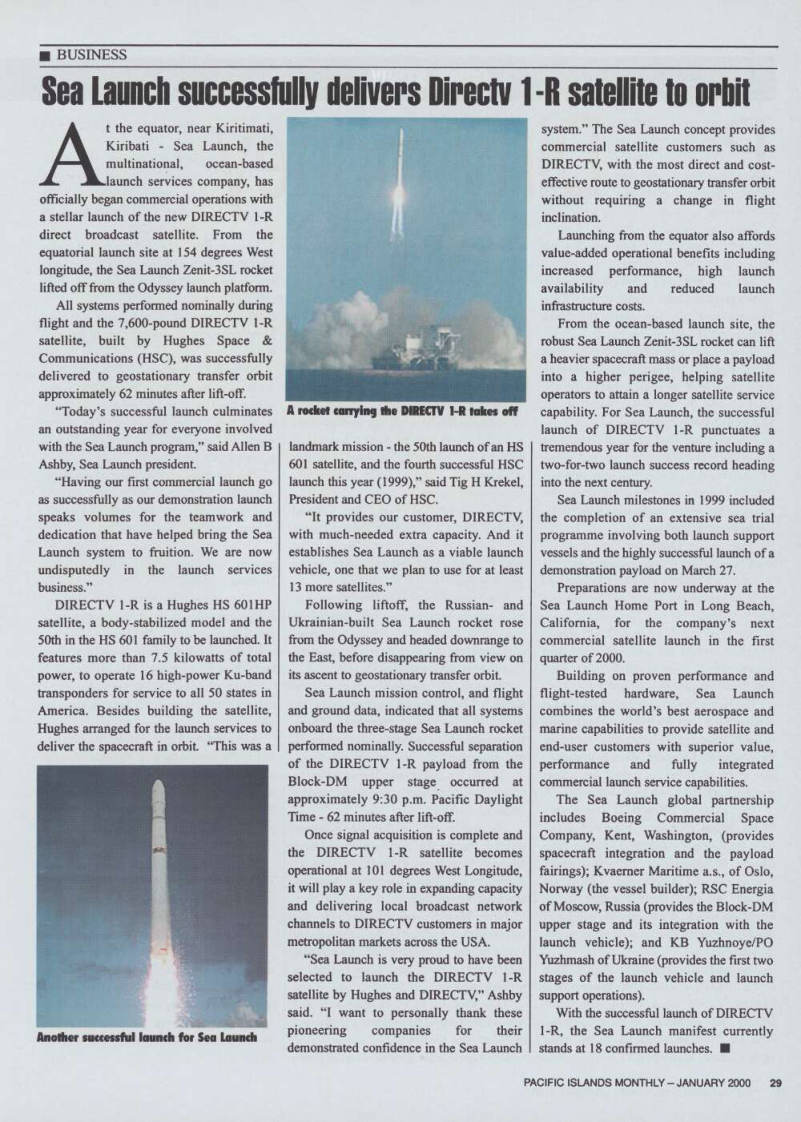
At the equator, near Kiritimati, Kiribati - Sea Launch, the multinational, ocean-based launch services company, has officially began commercial operations with a stellar launch of the new DIRECTV 1 -R direct broadcast satellite. From the equatorial launch site at 154 degrees West longitude, the Sea Launch Zenit-3 SL rocket lifted off from the Odyssey launch platform.
All systems performed nominally during flight and the 7,600-pound DIRECTV 1 -R satellite, built by Hughes Space & Communications (HSC), was successfully delivered to geostationary transfer orbit approximately 62 minutes after lift-off.
“Today’s successful launch culminates an outstanding year for everyone involved with the Sea Launch program,” said Allen B Ashby, Sea Launch president.
“Having our first commercial launch go as successfully as our demonstration launch speaks volumes for the teamwork and dedication that have helped bring the Sea Launch system to fruition. We are now undisputedly in the launch services business.”
DIRECTV 1-R is a Hughes HS 601 HP satellite, a body-stabilized model and the 50th in the HS 601 family to be launched. It features more than 7.5 kilowatts of total power, to operate 16 high-power Ku-band transponders for service to all 50 states in America. Besides building the satellite, Hughes arranged for the launch services to deliver the spacecraft in orbit. “This was a
landmark mission - the 50th launch of an HS 601 satellite, and the fourth successful HSC launch this year (1999),” said Tig H Krekel, President and CEO of HSC.
“It provides our customer, DIRECTV, with much-needed extra capacity. And it establishes Sea Launch as a viable launch vehicle, one that we plan to use for at least 13 more satellites.”
Following liftoff, the Russian- and Ukrainian-built Sea Launch rocket rose from the Odyssey and headed downrange to the East, before disappearing from view on its ascent to geostationary transfer orbit.
Sea Launch mission control, and flight and ground data, indicated that all systems onboard the three-stage Sea Launch rocket
performed nominally. Successful separation
of the DIRECTV 1-R payload from the Block-DM upper stage occurred at approximately 9:30 p.m. Pacific Daylight Time - 62 minutes after lift-off.
Once signal acquisition is complete and the DIRECTV 1-R satellite becomes operational at 101 degrees West Longitude, it will play a key role in expanding capacity and delivering local broadcast network channels to DIRECTV customers in major metropolitan markets across the USA.
“Sea Launch is very proud to have been selected to launch the DIRECTV 1-R satellite by Hughes and DIRECTV,” Ashby said. “I want to personally thank these pioneering companies for their demonstrated confidence in the Sea Launch
system.” The Sea Launch concept provides commercial satellite customers such as DIRECTV, with the most direct and cost effective route to geostationary transfer orbit without requiring a change in flight inclination.
Launching from the equator also affords value-added operational benefits including increased performance, high launch availability and reduced launch infrastructure costs.
From the ocean-based launch site, the robust Sea Launch Zenit-3 SL rocket can lift a heavier spacecraft mass or place a payload
into a higher perigee, helping satellite
operators to attain a longer satellite service capability. For Sea Launch, the successful launch of DIRECTV 1-R punctuates a tremendous year for the venture including a two-for-two launch success record heading into the next century.
Sea Launch milestones in 1999 included the completion of an extensive sea trial programme involving both launch support vessels and the highly successful launch of a demonstration payload on March 27.
Preparations are now underway at the Sea Launch Home Port in Long Beach, California, for the company’s next commercial satellite launch in the first quarter of 2000.
Building on proven performance and flight-tested hardware, Sea Launch combines the world’s best aerospace and marine capabilities to provide satellite and end-user customers with superior value, performance and fully integrated commercial launch service capabilities.
The Sea Launch global partnership
includes Boeing Commercial Space
Company, Kent, Washington, (provides
spacecraft integration and the payload fairings); Kvaemer Maritime a.s., of Oslo, Norway (the vessel builder); RSC Energia of Moscow, Russia (provides the Block-DM upper stage and its integration with the launch vehicle); and KB Yuzhnoye/PO Yuzhmash of Ukraine (provides the first two stages of the launch vehicle and launch
support operations).
With the successful launch of DIRECTV 1-R, the Sea Launch manifest currently stands at 18 confirmed launches. ■
Another successful launch for Sea Launch
A rocket carrying the DIRECTV 1-R takes off
Dirty money
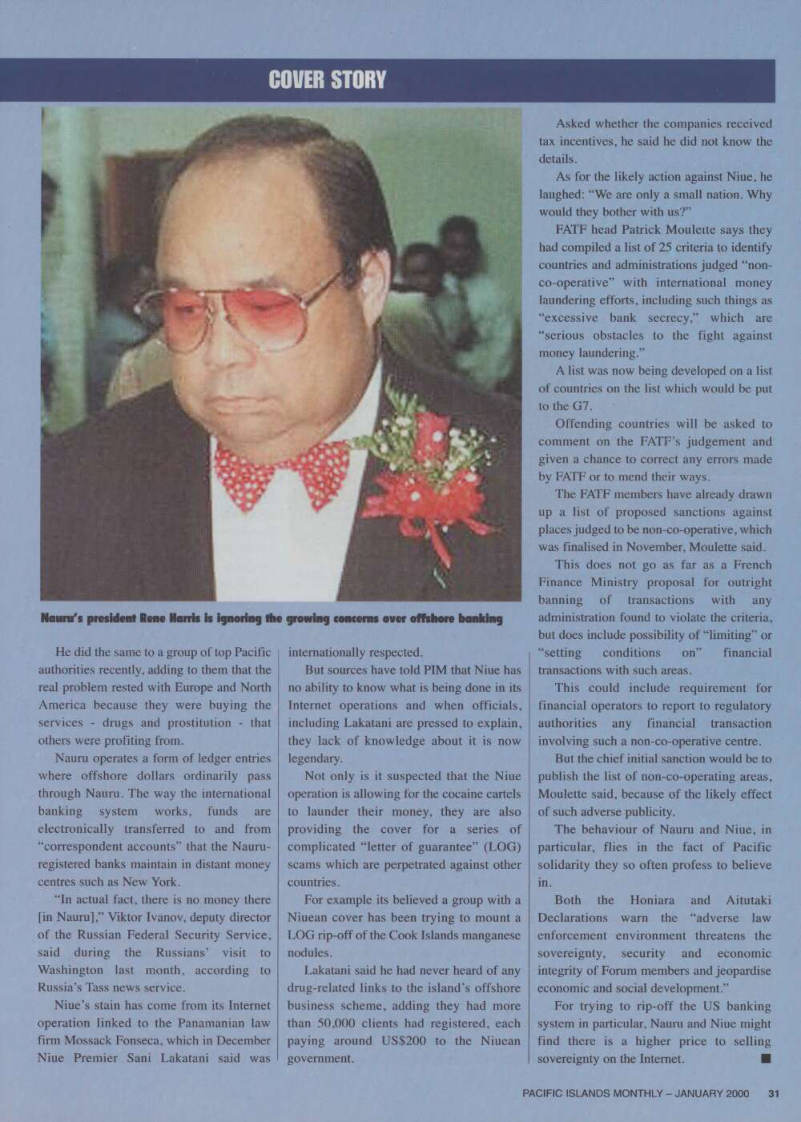
Cover Story
Island countries accused of aiding money “launderers”
Powerful forces
are moving in on Pacific states playing in the dangerous world of money
laundering.
Nauru, which has
allegedly become the Russian Mafia’s banker, is the primary target.
Niue, allegedly sheltering South American drug cartel wealth, is next. Then Vanuatu and the Solomons, the Cook Islands and Samoa.
Despite an avowed devotion to God these countries are suspected of supping with the Devil himself, thanks to the Internet and the shadowy world of tax havens and shell companies.
Not only are they allegedly guilty of hypocrisy in that they have allied themselves with prostitution, drug running, murder and counterfeiting, they are also violating the wordy declaration that Pacific countries made to stay clean.
Dangerously Nauru has been involved in an operation that threatened the integrity of America’s mainline banking system and so is incurring the wrath of Washington now.
Nauru, a country of just 10,605 people who live amidst the ruins of their strip mined island, is believed to have seen US$7O billion pass through its banks.
The figure is scarcely believable but it came from Victor Melnikov, deputy chair of the Russian central bank, who said it was the proceeds of Russian Mafia operations just short of Russia’s annual legitimate exports worth US$74 billion dollars.
The Group of Seven (G 7) - the United States, Japan, Germany, France, Britain, Italy and Canada - and the 25-nation Paris based Organisation of Economic Cooperation and Development (OECD) are putting the final draft together of an operation which, if carried out, will be as devastating to the Pacific economies as any cyclone can be.
The powerful Financial Action Task Force (FATF) - a kind of international banking police force based within the OECD - has a mandate to hit at countries who are “serious obstacles to the fight against money laundering.”
By Michael Field
So far FATF has not publicised what will be a list, but significantly key media outlets in the last two months have all received background briefings from senior
intelligence, diplomatic and law
enforcement outlets.
The Washington Post, the London Sunday Times and Agence France-Presse have all got similar messages; Nauru is the number one bad guy, the key banker to the criminal world.
The Sunday Times said everyday tens of millions of pounds were going through at least 200 banks and shell companies registered, mostly over the Internet, at the Nauru Agency Corporation (NAC).
“Dozens of companies run by the Russian Mafia prosper in the electronic ether behind two dated computers run from the ramshackle office in Yaren, the island’s principal town,” the newspaper said.
“Others are suspected of being linked to scams that have caused chaos in the world’s financial markets.”
The reason the G 7 has FATF taking action is that the Russian-Nauru banks have allegedly been trying to break into the City of London by offering investment packages and banking facilities.
John Merrit, the director of the commercial crime unit of the British-based International Chamber of Commerce (ICC),said Nauru has always been a problem area.
“The shell banks try to open accounts with an established bank and use it as a tool to add to their credibility.”
Investigators are looking carefully into
one Semion Mogillevich, “the Red Don”, vwho is believed to be the main figure behind the laumdering of between US$7-lUSSIO billion through the B;ank of New York.
Mogilevich has denied all[ the allegations against him, saying; “Thie case has been fabricated by dishonesit FBI officials.”
Police are also investigating wlhether Mogilevich has laundered money through Nauru.
Nagendi Goswami, general manager of the Bank of Nauru, said: “It has come to our notice that some of the banks have been involved in money laundering. The Nauru Agency Corporation has cancelled their agencies with those banks.”
The Washington Post quoted Melnikov on the US$7O billion figure but added it was only the middle of a wide range of estimates of what was going through Nauru.
Melnikov said he believes more than 90 percent of the money transferred to Nauruan accounts was returned to Russia.
“That is to say, simply, our economic entities use this method to transfer their assets, hiding them ... And later, when they need these funds for their work here, they bring them in as credits,” Melnikov said.
“They effectively evade taxes this way,” causing “great damage to the country,” he added.
A senior US official told the Washington Post: “The central bank of Russia has come to us and confirmed that large amounts of Russian capital are flowing into and out of Nauru, and that has raised concerns on their part and on ours and certainly raised
suspicions.”
Nauru has quickly risen on Washington’s radar. In 1996 it was not mentioned at all in official documents but last year the US State Department said: “Nauru’s current offshore banking regime ... is an open invitation to financial crime and money laundering.”
Nauru’s president Rene Harris is
ignoring the growing concerns.
“What’s it got to do with you?” he told the Washington Post angrily before hanging up.
He did the same to a group of top Pacific authorities recently, adding to them that the real problem rested with Europe and North America because they were buying the services - drugs and prostitution - that others were profiting from.
Nauru operates a form of ledger entries where offshore dollars ordinarily pass through Nauru. The way the international banking system works, funds are electronically transferred to and from “correspondent accounts” that the Nauru registered banks maintain in distant money centres such as New York.
“In actual fact, there is no money there [in Nauru],” Viktor Ivanov, deputy director of the Russian Federal Security Service, said during the Russians’ visit to Washington last month, according to Russia’s Tass news service.
Niue’s stain has come from its Internet operation linked to the Panamanian law firm Mossack Fonseca, which in December Niue Premier Sani Lakatani said was
internationally respected.
But sources have told PIM that Niue has no ability to know what is being done in its Internet operations and when officials, including Lakatani are pressed to explain, they lack of knowledge about it is now legendary.
Not only is it suspected that the Niue operation is allowing for the cocaine cartels to launder their money, they are also providing the cover for a series of complicated “letter of guarantee” (LOG) scams which are perpetrated against other countries.
For example its believed a group with a Niuean cover has been trying to mount a LOG rip-off of the Cook Islands manganese nodules.
Lakatani said he had never heard of any drug-related links to the island’s offshore business scheme, adding they had more than 50,000 clients had registered, each paying around US$2OO to the Niuean government.
Asked whether the companies received tax incentives, he said he did not know the details.
As for the likely action against Niue, he laughed: “We are only a small nation. Why would they bother with us?”
FATF head Patrick Mouleite says they had compiled a list of 25 criteria to identify countries and administrations judged “non co-operative” with international money laundering efforts, including such things as “excessive bank secrecy,” which are “serious obstacles to the fight against money laundering.”
A list was now being developed on a list of countries on the list which would be put totheG7.
Offending countries will be asked to comment on the FATF’s judgement and given a chance to correct any errors made by FATF or to mend their ways.
The FATF members have already drawn up a list of proposed sanctions against places judged to be non-co-operative, which was finalised in November, Moulette said.
This does not go as far as a French Finance Ministry proposal for outright banning of transactions with any administration found to violate the criteria, but does include possibility of “limiting” or “setting conditions on” financial transactions with such areas.
This could include requirement for financial operators to report to regulatory authorities any financial transaction involving such a non-co-operative centre.
But the chief initial sanction would be to publish the list of non-co-operating areas, Moulette said, because of the likely effect of such adverse publicity.
The behaviour of Nauru and Niue, in particular, flies in the fact of Pacific solidarity they so often profess to believe in.
Both the Honiara and Aitutaki Declarations warn the “adverse law enforcement environment threatens the
sovereignty, security and economic
integrity of Forum members and jeopardise economic and social development.”
For trying to rip-off the US banking system in particular, Nauru and Niue might find there is a higher price to selling sovereignty on the Internet. ■
Nauru's president Rene Harris is ignoring the growing concerns over offshore banking
Vanuatu goes after US$7.5 million in laundered money
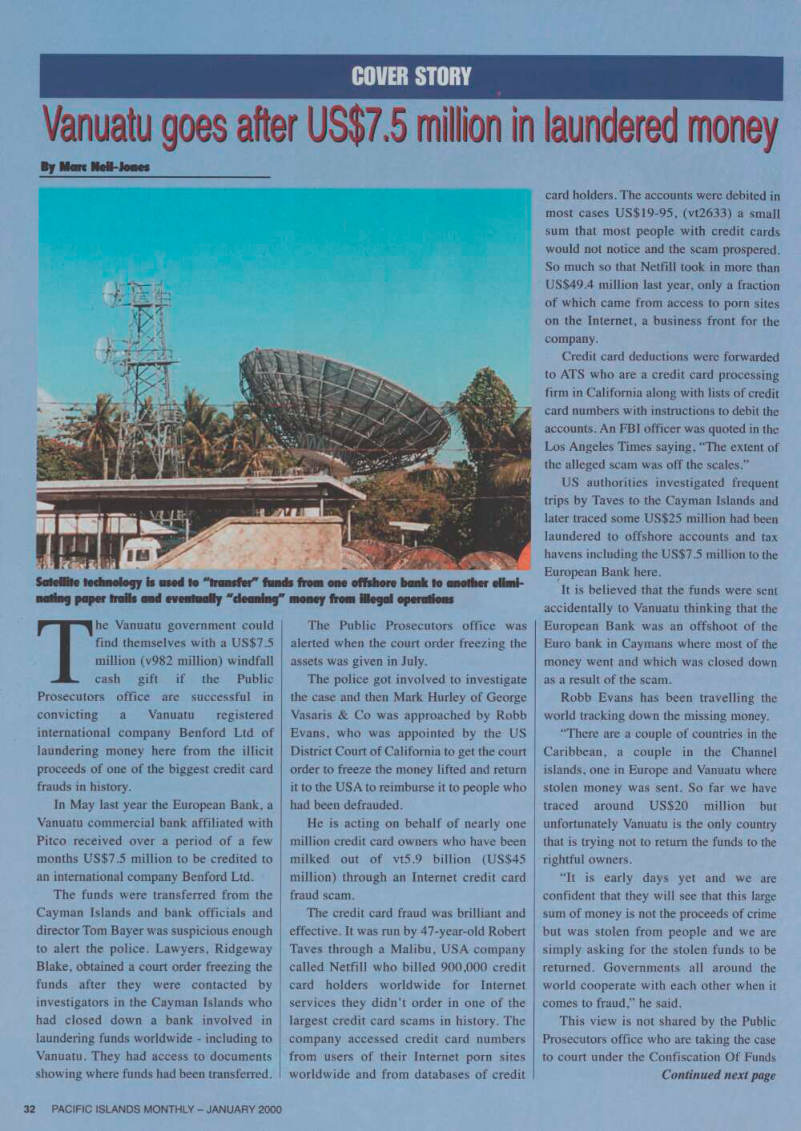
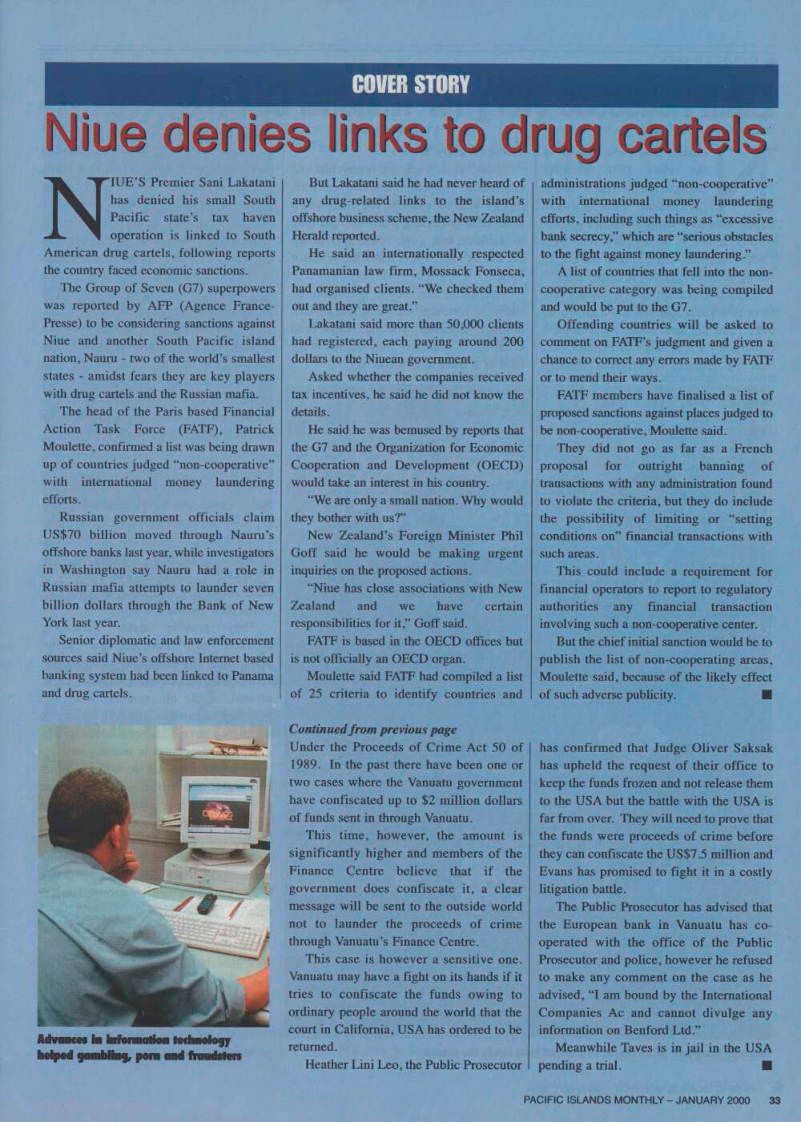
By Marc Neil-Jones
The Vanuatu government could find themselves with a US$7.5 million (v 982 million) windfall cash gift if the Public Prosecutors office are successful in
convicting a Vanuatu registered
international company Benford Ltd of laundering money here from the illicit proceeds of one of the biggest credit card frauds in history.
In May last year the European Bank, a Vanuatu commercial bank affiliated with Pitco received over a period of a few months US$7.5 million to be credited to an international company Benford Ltd.
The funds were transferred from the Cayman Islands and bank officials and director Tom Bayer was suspicious enough
to alert the police. Lawyers, Ridgeway
Blake, obtained a court order freezing the funds after they were contacted by investigators in the Cayman Islands who had closed down a bank involved in laundering funds worldwide - including to Vanuatu. They had access to documents showing where funds had been transferred.
The Public Prosecutors office was alerted when the court order freezing the assets was given in July.
The police got involved to investigate the case and then Mark Hurley of George Vasaris & Co was approached by Robb Evans, who was appointed by the US District Court of California to get the court order to freeze the money lifted and return it to the USA to reimburse it to people who had been defrauded.
He is acting on behalf of nearly one million credit card owners who have been milked out of vt5.9 billion (US$45 million) through an Internet credit card fraud scam.
The credit card fraud was brilliant and effective. It was run by 47-year-old Robert Taves through a Malibu, USA company called Netfill who billed 900,000 credit card holders worldwide for Internet services they didn’t order in one of the largest credit card scams in history. The company accessed credit card numbers from users of their Internet porn sites worldwide and from databases of credit
card holders. The accounts were debited in most cases US$l9-95, (vt2633) a small sum that most people with credit cards would not notice and the scam prospered.
So much so that Netfill took in more than U 5549.4 million last year, only a fraction of which came from access to porn sites on the Internet, a business front for the company.
Credit card deductions were forwarded to ATS who are a credit card processing firm in California along with lists of credit card numbers with instructions to debit the accounts. An FBI officer was quoted in the Los Angeles Times saying, “The extent of the alleged scam was off the scales.”
US authorities investigated frequent
trips by Taves to the Cayman Islands and later traced some US$25 million had been laundered to offshore accounts and tax havens including the US$7.5 million to the European Bank here.
It is believed that the funds were sent accidentally to Vanuatu thinking that the European Bank was an offshoot of the Euro bank in Caymans where most of the money went and which was closed down as a result of the scam.
Robb Evans has been travelling the world tracking down the missing money.
“There are a couple of countries in the Caribbean, a couple in the Channel islands, one in Europe and Vanuatu where stolen money was sent. So far we have traced around US$2O million but unfortunately Vanuatu is the only country that is trying not to return the funds to the
rightful owners.
“It is early days yet and we are confident that they will see that this large sum of money is not the proceeds of crime but was stolen from people and we are simply asking for the stolen funds to be returned. Governments all around the world cooperate with each other when it comes to fraud,” he said.
This view is not shared by the Public Prosecutors office who are taking the case to court under the Confiscation Of Funds
Continued next page
Satellite technology is used to "transfer" funds from one offshore bank to another elimi nating paper trails and eventually "cleaning" money from illegal operations
Continued from previous page
Under the Proceeds of Crime Act 50 of 1989. In the past there have been one or two cases where the Vanuatu government have confiscated up to $2 million dollars of funds sent in through Vanuatu.
This time, however, the amount is significantly higher and members of the Finance Centre believe that if the government does confiscate it, a clear message will be sent to the outside world not to launder the proceeds of crime through Vanuatu’s Finance Centre.
This case is however a sensitive one.
Vanuatu may have a fight on its hands if it tries to confiscate the funds owing to ordinary people around the world that the court in California, USA has ordered to be returned.
Heather Lini Leo, the Public Prosecutor
has confirmed that Judge Oliver Saksak has upheld the request of their office to keep the funds frozen and not release them to the USA but the battle with the USA is far from over. They will need to prove that the funds were proceeds of crime before they can confiscate the US$7.5 million and Evans has promised to fight it in a costly litigation battle.
The Public Prosecutor has advised that the European bank in Vanuatu has co operated with the office of the Public Prosecutor and police, however he refused to make any comment on the case as he advised, “I am bound by the International Companies Ac and cannot divulge any information on Benford Ltd.”
Meanwhile Taves is in jail in the USA pending a trial. ■
Advances in information technology helped gambling, pom and fraudsters
Niue denies links to drug cartels
NIUE’S Premier Sani Lakatani has denied his small South Pacific state’s tax haven operation is linked to South American drug cartels, following reports the country faced economic sanctions.
The Group of Seven (G 7) superpowers was reported by AFP (Agence France- Presse) to be considering sanctions against Niue and another South Pacific island nation, Nauru - two of the world’s smallest states - amidst fears they are key players with drug cartels and the Russian mafia.
The head of the Paris based Financial Action Task Force (FATF), Patrick Moulette, confirmed a list was being drawn up of countries judged “non-cooperative” with international money laundering efforts.
Russian government officials claim US$7O billion moved through Nauru’s offshore banks last year, while investigators in Washington say Nauru had a role in Russian mafia attempts to launder seven billion dollars through the Bank of New York last year.
Senior diplomatic and law enforcement sources said Niue’s offshore Internet based banking system had been linked to Panama and drug cartels.
But Lakatani said he had never heard of any drug-related links to the island’s offshore business scheme, the New Zealand Herald reported.
He said an internationally respected Panamanian law firm, Mossack Fonseca, had organised clients. “We checked them out and they are great.”
Lakatani said more than 50,000 clients had registered, each paying around 200 dollars to the Niuean government.
Asked whether the companies received tax incentives, he said he did not know the details.
He said he was bemused by reports that the G 7 and the Organization for Economic Cooperation and Development (OECD) would take an interest in his country.
“We are only a small nation. Why would they bother with us?”
New Zealand’s Foreign Minister Phil Goff said he would be making urgent inquiries on the proposed actions.
“Niue has close associations with New Zealand and we have certain responsibilities for it,” Goff said.
FATF is based in the OECD offices but is not officially an OECD organ.
Moulette said FATF had compiled a list of 25 criteria to identify countries and
administrations judged “non-cooperative” with international money laundering efforts, including such things as “excessive bank secrecy,” which are “serious obstacles to the fight against money laundering.”
A list of countries that fell into the non cooperative category was being compiled and would be put to the G 7.
Offending countries will be asked to comment on FATF’s judgment and given a chance to correct any errors made by FATF or to mend their ways.
FATF members have finalised a list of proposed sanctions against places judged to be non-cooperative, Moulette said.
They did not go as far as a French proposal for outright banning of transactions with any administration found to violate the criteria, but they do include
the possibility of limiting or “setting
conditions on” financial transactions with such areas.
This could include a requirement for financial operators to report to regulatory authorities any financial transaction involving such a non-cooperative center.
But the chief initial sanction would be to publish the list of non-cooperating areas, Moulette said, because of the likely effect of such adverse publicity. ■
Export success story for National Can (NZ) limited
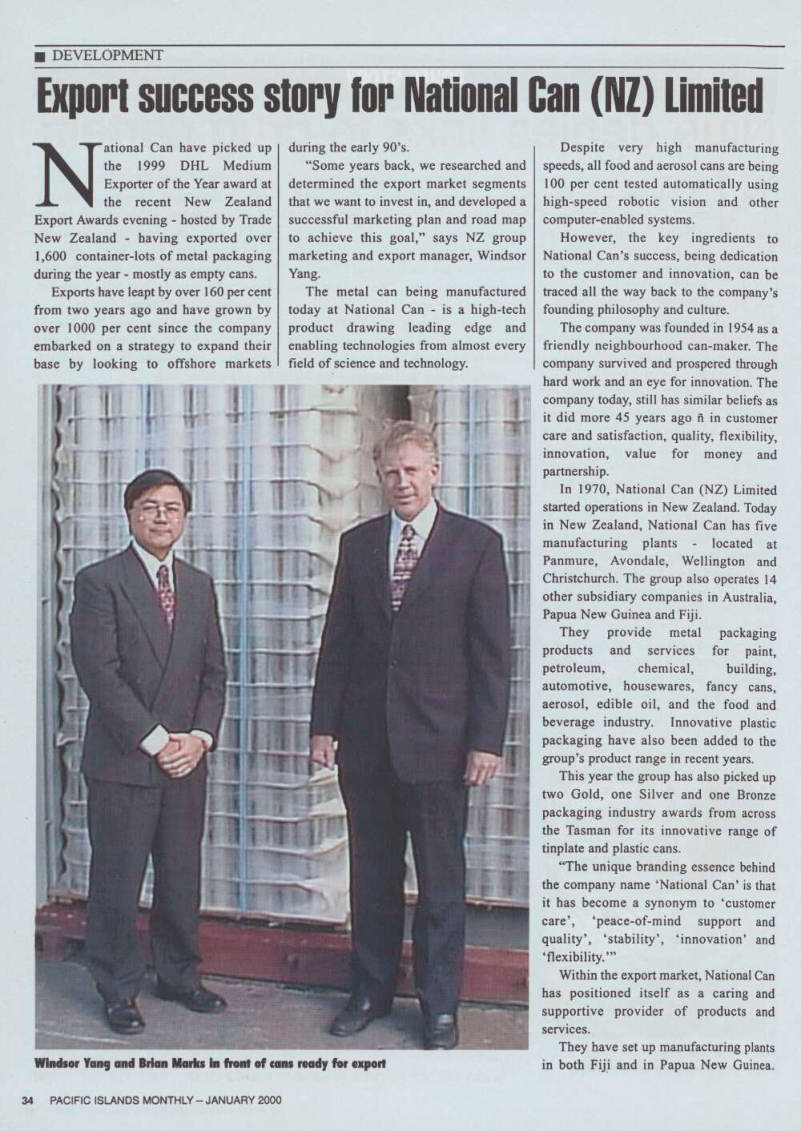
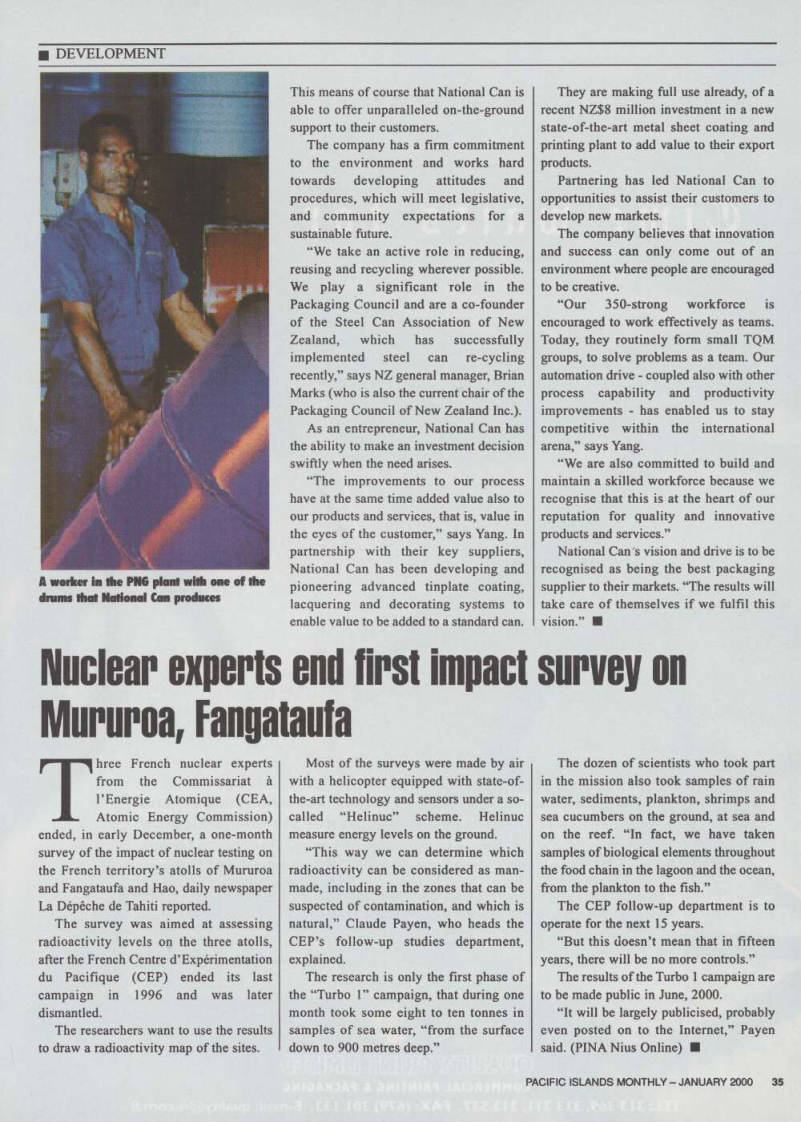
Development
National Can have picked up the 1999 DHL Medium Exporter of the Year award at the recent New Zealand Export Awards evening - hosted by Trade New Zealand - having exported over 1,600 container-lots of metal packaging during the year - mostly as empty cans.
Exports have leapt by over 160 per cent from two years ago and have grown by over 1000 per cent since the company embarked on a strategy to expand their base by looking to offshore markets
during the early 90’s.
“Some years back, we researched and determined the export market segments that we want to invest in, and developed a successful marketing plan and road map to achieve this goal,” says NZ group marketing and export manager, Windsor Yang.
The metal can being manufactured today at National Can - is a high-tech
product drawing leading edge and
enabling technologies from almost every field of science and technology.
Despite very high manufacturing speeds, all food and aerosol cans are being 100 per cent tested automatically using high-speed robotic vision and other computer-enabled systems.
However, the key ingredients to National Can’s success, being dedication to the customer and innovation, can be traced all the way back to the company’s founding philosophy and culture.
The company was founded in 1954 as a friendly neighbourhood can-maker. The company survived and prospered through hard work and an eye for innovation. The company today, still has similar beliefs as it did more 45 years ago n in customer care and satisfaction, quality, flexibility, innovation, value for money and partnership.
In 1970, National Can (NZ) Limited started operations in New Zealand. Today in New Zealand, National Can has five manufacturing plants - located at Panmure, Avondale, Wellington and Christchurch. The group also operates 14 other subsidiary companies in Australia, Papua New Guinea and Fiji.
They provide metal packaging products and services for paint, petroleum, chemical, building, automotive, housewares, fancy cans, aerosol, edible oil, and the food and beverage industry. Innovative plastic packaging have also been added to the group’s product range in recent years.
This year the group has also picked up two Gold, one Silver and one Bronze packaging industry awards from across the Tasman for its innovative range of tinplate and plastic cans.
“The unique branding essence behind the company name ‘National Can’ is that it has become a synonym to ‘customer care’, ‘peace-of-mind support and quality’, ‘stability’, ‘innovation’ and ‘flexibility.’”
Within the export market, National Can has positioned itself as a caring and supportive provider of products and services.
They have set up manufacturing plants in both Fiji and in Papua New Guinea.
Windsor Yang and Brian Marks in front of cans ready for export
This means of course that National Can is able to offer unparalleled on-the-ground support to their customers.
The company has a firm commitment to the environment and works hard towards developing attitudes and procedures, which will meet legislative, and community expectations for a sustainable future.
“We take an active role in reducing,
reusing and recycling wherever possible.
We play a significant role in the Packaging Council and are a co-founder of the Steel Can Association of New Zealand, which has successfully implemented steel can re-cycling recently,” says NZ general manager, Brian Marks (who is also the current chair of the Packaging Council of New Zealand Inc.).
As an entrepreneur. National Can has the ability to make an investment decision swiftly when the need arises.
“The improvements to our process have at the same time added value also to our products and services, that is, value in the eyes of the customer,” says Yang. In partnership with their key suppliers.
National Can has been developing and pioneering advanced tinplate coating, lacquering and decorating systems to enable value to be added to a standard can.
They are making full use already, of a recent NZ$B million investment in a new state-of-the-art metal sheet coating and printing plant to add value to their export
products.
Partnering has led National Can to opportunities to assist their customers to develop new markets.
The company believes that innovation and success can only come out of an environment where people are encouraged to be creative.
“Our 350-strong workforce is encouraged to work effectively as teams.
Today, they routinely form small TQM groups, to solve problems as a team. Our automation drive - coupled also with other process capability and productivity improvements - has enabled us to stay competitive within the international arena,” says Yang.
“We are also committed to build and maintain a skilled workforce because we recognise that this is at the heart of our reputation for quality and innovative products and services.”
National Can's vision and drive is to be recognised as being the best packaging supplier to their markets. “The results will take care of themselves if we fulfil this vision.” ■
A worker in the PNG plant with one of the drams that National Can produces
Mururoa, Fangataufa
Nuclear experts end first impact survey on Mururoa, Fangataufa
Three French nuclear experts from the Commissariat a FEnergie Atomique (CEA, Atomic Energy Commission) ended, in early December, a one-month survey of the impact of nuclear testing on the French territory’s atolls of Mururoa and Fangataufa and Hao, daily newspaper La Depeche de Tahiti reported.
The survey was aimed at assessing radioactivity levels on the three atolls, after the French Centre d’Experimentation du Pacifique (CEP) ended its last campaign in 1996 and was later dismantled.
The researchers want to use the results to draw a radioactivity map of the sites.
Most of the surveys were made by air with a helicopter equipped with state-of the-art technology and sensors under a so called “Helinuc” scheme. Helinuc measure energy levels on the ground.
“This way we can determine which radioactivity can be considered as man made, including in the zones that can be suspected of contamination, and which is natural,” Claude Payen, who heads the
CEP’s follow-up studies department,
explained.
The research is only the first phase of the “Turbo 1” campaign, that during one month took some eight to ten tonnes in samples of sea water, “from the surface down to 900 metres deep.”
The dozen of scientists who took part in the mission also took samples of rain water, sediments, plankton, shrimps and sea cucumbers on the ground, at sea and on the reef. “In fact, we have taken
samples of biological elements throughout
the food chain in the lagoon and the ocean, from the plankton to the fish,”
The CEP follow-up department is to operate for the next 15 years.
“But this doesn’t mean that in fifteen years, there will be no more controls.”
The results of the Turbo 1 campaign are to be made public in June, 2000.
“It will be largely publicised, probably
even posted on to the Internet,” Payen said. (PINA Nius Online) ■
Advertisements & other items, p. 36 (1 item)
fame toaits tor no one
HI 4 ■ -•v/t - ' W 4 Things get left to the last minute or a deadline is brought forward and every thing is required urgently. Sound familiar? Deadlines have always been part of the print industry and at Quality Print we know that you sometimes need your printing “yesterday”. We rarely miss a realistic deadline and if you have a really urgent job we’ll keep the presses running all night if necessary.
It is this kind of service that makes us one of the best printers in the Pacific. And we now have three full colour printing presses which also makes us the largest in the region.
We offer an extensive range of printing services from multi colour printing, special packaging and binding to UV gloss finishing, laminating and die-cutting. Call us or visit our “Pride in Print” printshop for a free quote.
COMMERCIAL PRINTING & PACKAGING
TEL: 313 369, 313 311,313 537. FAX: (679) 301 133. E-mail: [email protected]
Fears US military legacy en Pacific island producing cancer
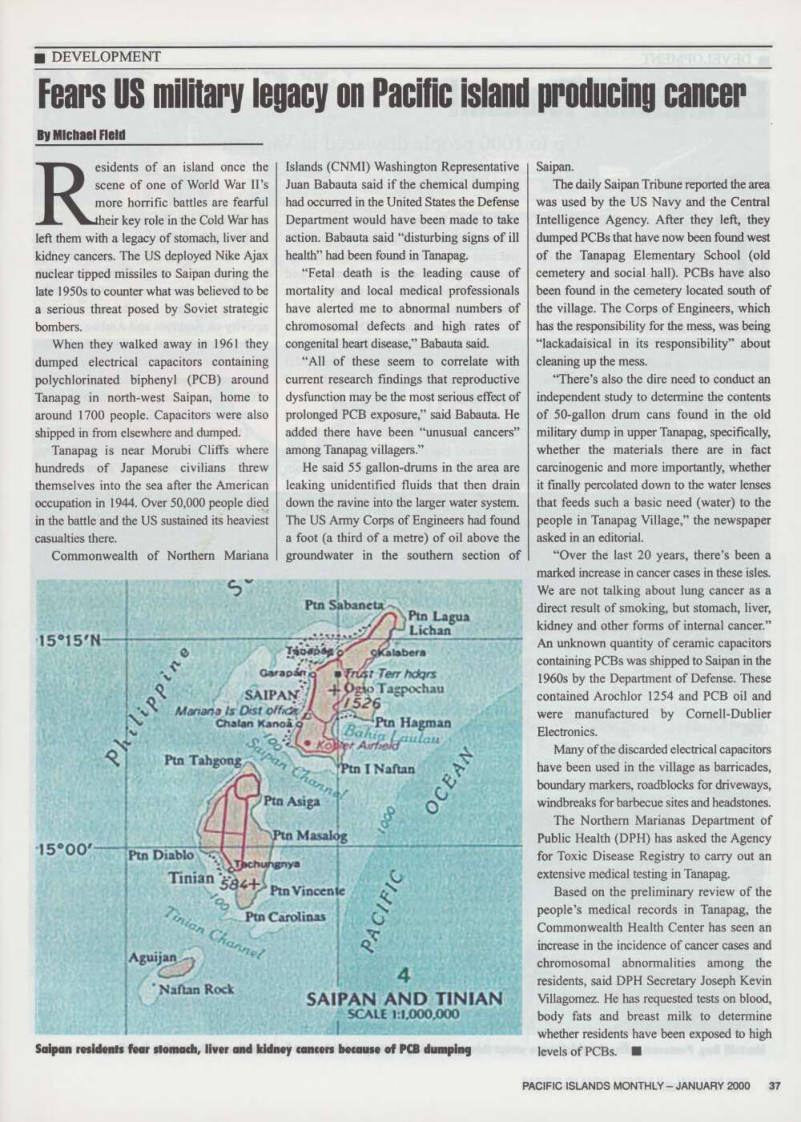
By Mlchael Field
Residents of an island once the scene of one of World War ll’s more horrific battles are fearful their key role in the Cold War has left them with a legacy of stomach, liver and kidney cancers. The US deployed Nike Ajax nuclear tipped missiles to Saipan during the late 1950 s to counter what was believed to be a serious threat posed by Soviet strategic bombers.
When they walked away in 1961 they dumped electrical capacitors containing polychlorinated biphenyl (PCB) around Tanapag in north-west Saipan, home to around 1700 people. Capacitors were also shipped in from elsewhere and dumped.
Tanapag is near Morubi Cliff's where hundreds of Japanese civilians threw themselves into the sea after the American occupation in 1944. Over 50,000 people died in the battle and the US sustained its heaviest casualties there.
Commonwealth of Northern Mariana
Islands (CNMI) Washington Representative Juan Babauta said if the chemical dumping had occurred in the United States the Defense Department would have been made to take action. Babauta said “disturbing signs of ill health” had been found in Tanapag.
“Fetal death is the leading cause of mortality and local medical professionals have alerted me to abnormal numbers of chromosomal defects and high rates of congenital heart disease,” Babauta said.
“All of these seem to correlate with current research findings that reproductive dysftinction may be the most serious effect of prolonged PCB exposure,” said Babauta. He added there have been “unusual cancers” among Tanapag villagers.”
He said 55 gallon-drums in the area are leaking unidentified fluids that then drain down the ravine into the larger water system.
The US Army Corps of Engineers had found a foot (a third of a metre) of oil above the groundwater in the southern section of
Saipan.
The daily Saipan Tribune reported the area was used by the US Navy and the Central Intelligence Agency. After they left, they dumped PCBs that have now been found west of the Tanapag Elementary School (old cemetery and social hall). PCBs have also been found in the cemetery located south of the village. The Corps of Engineers, which has the responsibility for the mess, was being “lackadaisical in its responsibility” about cleaning up the mess.
“There’s also the dire need to conduct an independent study to determine the contents of 50-gallon drum cans found in the old military dump in upper Tanapag, specifically, whether the materials there are in fact carcinogenic and more importantly, whether it finally percolated down to the water lenses that feeds such a basic need (water) to the people in Tanapag Village,” the newspaper asked in an editorial.
“Over the last 20 years, there’s been a marked increase in cancer cases in these isles.
We are not talking about lung cancer as a direct result of smoking, but stomach, liver, kidney and other forms of internal cancer.”
An unknown quantity of ceramic capacitors containing PCBs was shipped to Saipan in the 1960 s by the Department of Defense. These contained Arochlor 1254 and PCB oil and were manufactured by Comell-Dublier Electronics.
Many of the discarded electrical capacitors have been used in the village as barricades, boundary markers, roadblocks for driveways, windbreaks for barbecue sites and headstones.
The Northern Marianas Department of Public Health (DPH) has asked the Agency for Toxic Disease Registry to carry out an extensive medical testing in Tanapag.
Based on the preliminary review of the people’s medical records in Tanapag, the Commonwealth Health Center has seen an increase in the incidence of cancer cases and chromosomal abnormalities among the residents, said DPH Secretary Joseph Kevin Villagomez. He has requested tests on blood, body fats and breast milk to determine whether residents have been exposed to high levels of PCBs. ■
Saipan residents fear stomach, liver and kidney cancers because of PCB dumping
Earthquake! Tsunami!
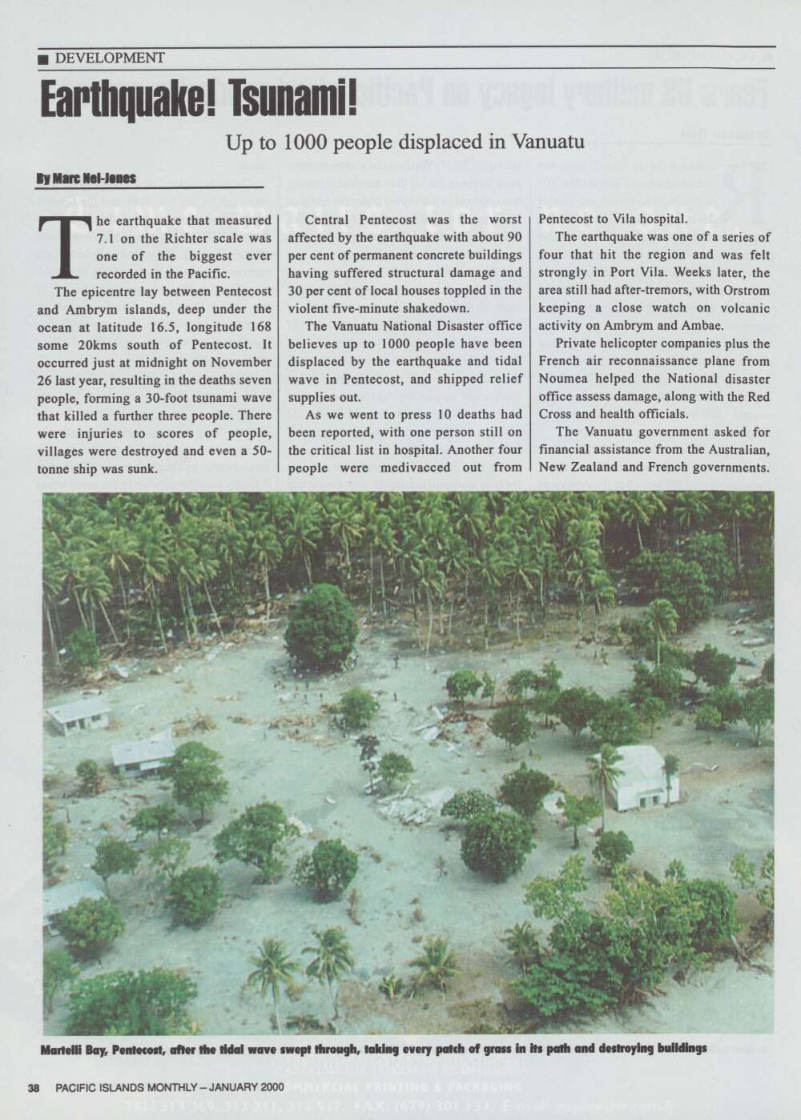
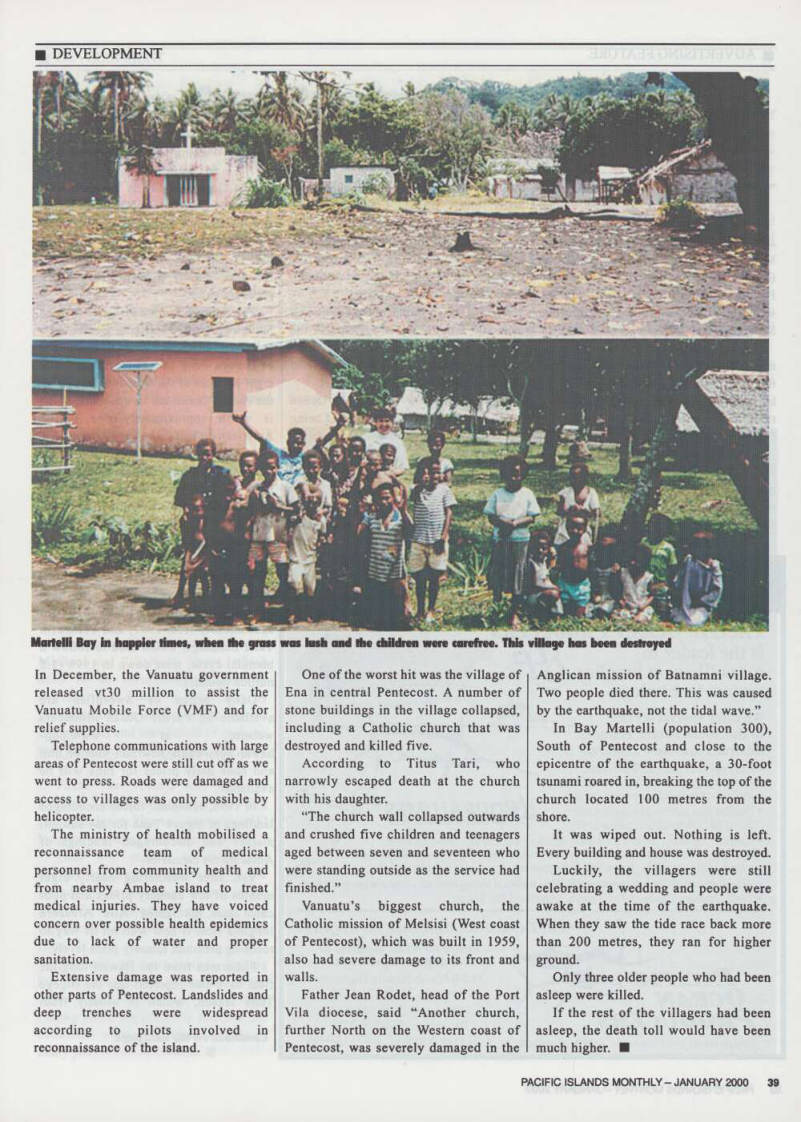
Up to 1000 people displaced in Vanuatu
By Marc Nel-Jones
The earthquake that measured 7.1 on the Richter scale was one of the biggest ever recorded in the Pacific.
The epicentre lay between Pentecost and Ambrym islands, deep under the ocean at latitude 16.5, longitude 168 some 20kms south of Pentecost. It occurred just at midnight on November 26 last year, resulting in the deaths seven people, forming a 30-foot tsunami wave that killed a further three people. There were injuries to scores of people, villages were destroyed and even a 50tonne ship was sunk.
Central Pentecost was the worst affected by the earthquake with about 90 per cent of permanent concrete buildings having suffered structural damage and 30 per cent of local houses toppled in the violent five-minute shakedown.
The Vanuatu National Disaster office believes up to 1000 people have been displaced by the earthquake and tidal wave in Pentecost, and shipped relief
supplies out.
As we went to press 10 deaths had been reported, with one person still on the critical list in hospital. Another four people were medivacced out from
Pentecost to Vila hospital.
The earthquake was one of a series of four that hit the region and was felt strongly in Port Vila. Weeks later, the area still had after-tremors, with Orstrom keeping a close watch on volcanic activity on Ambrym and Ambae.
Private helicopter companies plus the French air reconnaissance plane from Noumea helped the National disaster office assess damage, along with the Red Cross and health officials.
The Vanuatu government asked for financial assistance from the Australian, New Zealand and French governments.
Martelli Bay, Pentecost, after the tidal wave swept through, taking every patch of grass in its path and destroying buildings
In December, the Vanuatu government released vt3o million to assist the Vanuatu Mobile Force (VMF) and for relief supplies.
Telephone communications with large
areas of Pentecost were still cut off as we went to press. Roads were damaged and access to villages was only possible by
helicopter.
The ministry of health mobilised a reconnaissance team of medical personnel from community health and from nearby Ambae island to treat medical injuries. They have voiced concern over possible health epidemics due to lack of water and proper sanitation.
Extensive damage was reported in other parts of Pentecost. Landslides and
deep trenches were widespread
according to pilots involved in reconnaissance of the island.
One of the worst hit was the village of Ena in central Pentecost. A number of stone buildings in the village collapsed, including a Catholic church that was destroyed and killed five.
According to Titus Tari, who narrowly escaped death at the church with his daughter.
“The church wall collapsed outwards and crushed five children and teenagers aged between seven and seventeen who were standing outside as the service had finished.”
Vanuatu’s biggest church, the Catholic mission of Melsisi (West coast of Pentecost), which was built in 1959, also had severe damage to its front and walls.
Father Jean Rodet, head of the Port Vila diocese, said “Another church, further North on the Western coast of Pentecost, was severely damaged in the
Anglican mission of Batnamni village.
Two people died there. This was caused by the earthquake, not the tidal wave.”
In Bay Martelli (population 300), South of Pentecost and close to the epicentre of the earthquake, a 30-foot tsunami roared in, breaking the top of the church located 100 metres from the shore.
It was wiped out. Nothing is left.
Every building and house was destroyed.
Luckily, the villagers were still celebrating a wedding and people were awake at the time of the earthquake.
When they saw the tide race back more than 200 metres, they ran for higher ground.
Only three older people who had been asleep were killed.
If the rest of the villagers had been asleep, the death toll would have been much higher. ■
Martelli Bay in happier times, when the grass was lush and the children were carefree. This village has been destroyed
Tuna in the South Pacific
Advertising Feature
Delegates from 27 Pacific Islands gathered in Honolulu, Hawaii, to attend the Fifth Session of the Multilateral High-Level Conference on the Conservation and Management of Highly Migratory Fish Stocks in the western and central Pacific during September last year.
These delegates further pursued
negotiations for a regional agreement for the conservation and management of
highly migratory fish stocks, principally
tuna, in the western and central Pacific Ocean.
The next session has been scheduled for April 2000 in Honolulu to finalise negotiations for a new commission to regulate the western and central Pacific fisheries.
Several visiting delegates toured the
facilities of Pacific Ocean Producers to learn more about Lindgren-Pitman longline equipment and discuss fishery development with the owners, Jim Cook and Sean Martin, who have extensive backgrounds in longline fishing and often offer their consulting services.
Pacific Ocean Producers has delivered over 300 monofilament systems in the Pacific region and is still helping many customers expand their fleet with the best and most reliable fishing equipment.
Consequently, Pacific Ocean Producers has built a reputation of being the leader in monofilament longline system technology in the Asia-Pacific region.
Most recently, representatives of Pacific Ocean Producers flew from Honolulu to Suva, Fiji to personally supervise the installation of two longline
reels, which was completed in less than seven days.
X J Du, manager of Win Full Fishing Company was pleased to work with the staff of
Pacific Ocean Producers who provided design and technical support in the layout and installation of the two Twin Super Spool 2 reels. The two 32-metre “Win Full 1” and “Win Full 2” will be fishing for tuna, mainly Bigeye which has a
premium value.
The National Marine Fisheries Service Southwest Fisheries Science Center in La Jolla, California, states that the number of Bigeye Tuna caught represents only eight per cent of the total tuna caught in the Pacific Ocean but its economic value is worth approximately one billion American dollars annually.
Moreover, the growing demand for tuna has also affected the Hawaii longline fleet as there has been a “shift in targetting from Swordfish to Tuna, with only 32 vessels taking Swordfish directed trips in 1998.
Bigeye landings were 5.4 million pounds (valued at US$25 million), Albacore landings were 2.4 million pounds (valued at US$3.l million), down substantially from 1997, and Yellowfin Tuna Landings, which tend to follow a biennial cycle, were down in 1998 (1.8
million pounds).
Daily prices of Swordfish are available on Pacific Ocean Producers website at www.pop hawaii.com/whats_new/hon_auction.htm and soon daily prices for tuna will be available.
In 1998, economic forces encouraged landings of bigeye Tuna for the sashimi market and discouraged landings of Albacore for canneries.
Yet, after weathering nearly eight months of low cannery prices and poor catch rates, the Samoa “Alia” Albacore longline fleet is now well on its way to
realising premium cannery price levels.
Fishermen from the Hawaii longline fleet have also reported that the Bigeye Tuna season, which is usually from
Continued on the next page
Continued from previous page
October to May, looks promising as several successful fishing trips have already been made.
Several fishermen from the Pacific Northwest region have joined the Hawaii longline fleet this season to reap the profits that can be made from targetting Bigeye Tuna in the Hawaiian waters.
In fact, Pacific Ocean Producers has recently helped the owners of F/V St Michael and F/V Ruby Storm, which used to be shrimpers, successfully convert their boats to longliners by providing design and technical support in the layout and installation of reels, as well as training for captains and their crew.
These two vessels will soon be
longline fishing for Bigeye Tuna using
two Lindgren-Pitman monofilament longline systems, the Super Spool 2.
Tuna will remain a viable and healthy resource for the South Pacific Islands as the new commission, which should be instituted by April 2000, will regulate the western and central Pacific fisheries.
For many of these islands, fishing for Tunas could be compared to the “gold rush”. Indeed, revenues from fishing could significantly improve the economic welfare of these islands as many jobs could be created. ■
Advertisements & other items, p. 40 (1 item)
Hook Up With The Leader!
Pacific Ocean Producers
is the leader in
monofilament longline
system technology.
We offer special service to the South Pacific Islands, Australia and New Zealand. • Lindgren-Pitman gear, complete hydraulic systems, design and installation of monofilament longline systems including operations training, • Extensive Tuna and Swordfish supplies, bottom fishing gear, fish handling supplies and bait. • Duralumes Lightstick - the latest in lightsticks technology, extended light output, often used two nights, 5-year shelf life, not affected by moisture, easy-to- handle shipping carton. All popular colors available - green, blue, pink, yellow, white, violet and ultra-violet for best fishing results. • Wide selection of trolling equipment: over 180 different colors of trolling skirts and a large selection of lure heads.' • Weekly shipments to the South Pacific Islands, Australia and New Zealand.
FREE CATALOG AVAILABLE ON REQUEST
Please direct all inquiries to the Export Department: 965-B North Nimitz Highway Honolulu, HI 96817, USA.
Telephone: (808) 537-2905 Facsimile: (808) 536-3225 Shop on line for your convenience; www.pop-hawaii.com Toll Free Number 1-800-144-488
IDE
Pacific
Ocean
Producers
The Pacific
Development
Guam's Pangeflnan is first woman to head Pacific Community
Community’s 29th annual general meeting last month elected Lourdes
Pangelinan as the first woman to head the regional Pacific organisation.
After two and a half hours of debates behind closed doors, the Pacific Community (PC) delegates, including heads of the member governments and states, unanimously chose Pangelinan to replace outgoing director general, Australian Robert Dun, whose term expired last year.
Another candidate within the PC, Solomon islander Jimmy Rodgers, currently the PC’s first deputy director general, based
in Suva (Fiji islands) withdrew minutes before the vote took place in the consensual, non-confrontational ‘Pacific Way’.
Pangelinan was Dun’s recommended choice and was also supported by France, another major aid donor to the PC, because she speaks both English and French, the PC’s two official languages.
Other candidates were from Australia, Fiji and New Zealand.
Pangelinan was until now the PC’s other deputy director from the PC’s Noumea
headquarters.
She was also chief of staff to former Guam governor Joseph Ada until 1994, when she joined the Pacific
Community.
She also becomes the first Pacific island woman to head the Noumea-based regional organisation.
Upon her election, she gave credit to Australian Dun’s work for the past three years, saying since she had been working with him for the past four years, she would continue in the same direction.
Dr Jimmy Rodgers retains his position as first deputy director of the regional organisation. ■
for Forum in 2000
F$11.9 million budget for Forum in 2000
enior officials from South Pacific Forum countries have . approved an FJSII.9 million budget for the activities of the South Pacific Forum Secretariat in 2000.
The Forum Officials Committee (FOC), which oversees the Secretariat operations, also approved a Work Programme that focuses on supporting member country efforts in economic reform; representing their interests at international fora such as the United Nations and the World Trade Organisation, and promoting regional trade.
Other Secretariat activities this year include increased involvement in the establishment of a Free Trade Area within the region over the next decade.
The Secretariat will continue to coordinate a variety of initiatives in social policy issues (for example, education, gender and health) including an Education Ministers conference, regional security issues, and the advocacy of Forum positions on a range of political and economic issues.
Monitoring of issues in the French territory of New Caledonia (now an Observer to the Forum) will continue. A new sub-committee will also monitor developments in French Polynesia which has expressed an interest in developing a closer association with the Forum group.
Existing programmes are developed to reflect the priorities emerging from the Forum and Ministerial meetings including the Forum Economic Ministers Meeting (FEMM); Forum Trade Ministers Meeting (FTMM) and other Ministerial level meetings held in 1999 for aviation and communications.
About one third of the Secretariat budget is funded from contributions from the 16 member states (Australia, Cook Islands, Federated States of Micronesia, Fiji, Kiribati, Nauru, New Zealand, Niue, Palau, Papua New Guinea, Republic of Marshall Islands, Samoa, Solomon Islands, Tonga, Tuvalu and Vanuatu).
The balance is provided through extra budgetary support from development partners to the region. ■
Palau's jellyfish world diminishing
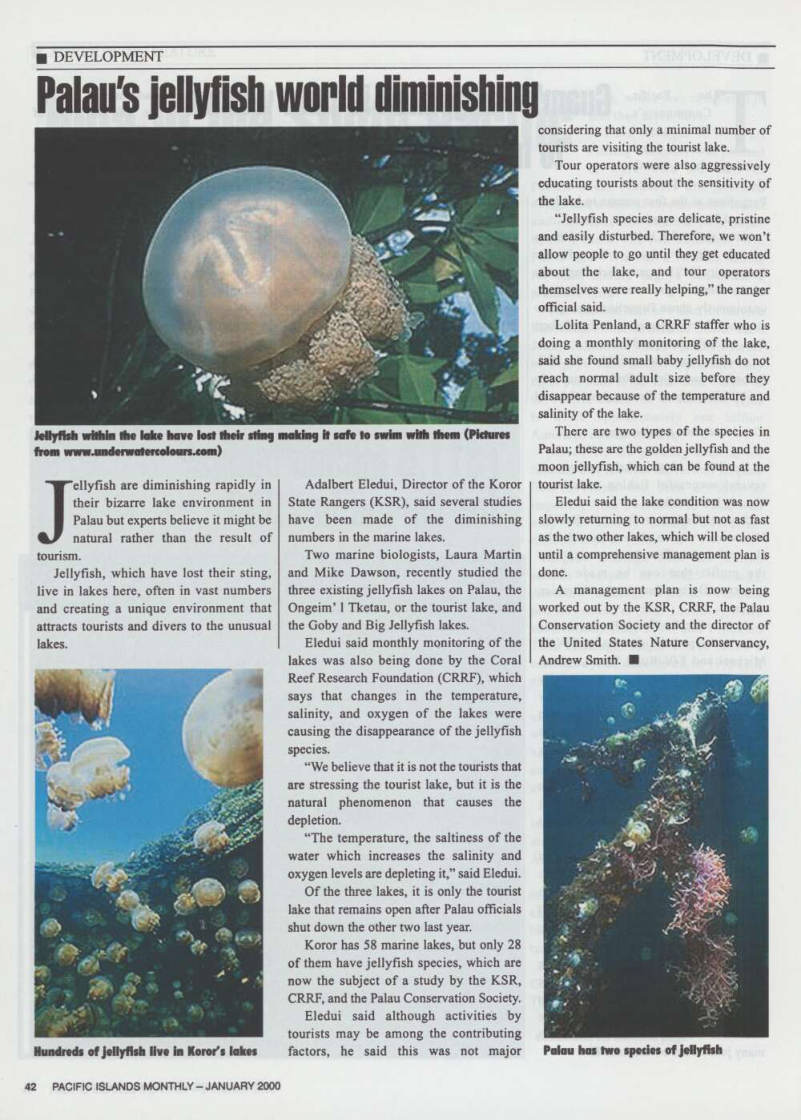
Jellyfish are diminishing rapidly in their bizarre lake environment in Palau but experts believe it might be natural rather than the result of tourism.
Jellyfish, which have lost their sting, live in lakes here, often in vast numbers and creating a unique environment that attracts tourists and divers to the unusual lakes.
Adalbert Eledui, Director of the Koror State Rangers (KSR), said several studies have been made of the diminishing numbers in the marine lakes.
Two marine biologists, Laura Martin and Mike Dawson, recently studied the three existing jellyfish lakes on Palau, the Ongeim’ 1 Tketau, or the tourist lake, and the Goby and Big Jellyfish lakes.
Eledui said monthly monitoring of the lakes was also being done by the Coral Reef Research Foundation (CRRF), which says that changes in the temperature, salinity, and oxygen of the lakes were causing the disappearance of the jellyfish species.
“We believe that it is not the tourists that are stressing the tourist lake, but it is the natural phenomenon that causes the depletion.
“The temperature, the saltiness of the water which increases the salinity and oxygen levels are depleting it,” said Eledui.
Of the three lakes, it is only the tourist lake that remains open after Palau officials shut down the other two last year.
Koror has 58 marine lakes, but only 28 of them have jellyfish species, which are now the subject of a study by the KSR, CRRF, and the Palau Conservation Society.
Eledui said although activities by tourists may be among the contributing factors, he said this was not major
considering that only a minimal number of tourists are visiting the tourist lake.
Tour operators were also aggressively educating tourists about the sensitivity of the lake.
“Jellyfish species are delicate, pristine and easily disturbed. Therefore, we won’t allow people to go until they get educated about the lake, and tour operators themselves were really helping,” the ranger official said.
Lolita Penland, a CRRF staffer who is doing a monthly monitoring of the lake, said she found small baby jellyfish do not reach normal adult size before they disappear because of the temperature and salinity of the lake.
There are two types of the species in Palau; these are the golden jellyfish and the moon jellyfish, which can be found at the tourist lake.
Eledui said the lake condition was now slowly returning to normal but not as fast as the two other lakes, which will be closed until a comprehensive management plan is done.
A management plan is now being worked out by the KSR, CRRF, the Palau Conservation Society and the director of the United States Nature Conservancy, Andrew Smith. ■
Jellyfish within the lake have lost their sting making it safe to swim with them (Pictures from www.underwatercolours.com)
Hundreds of jellyfish live in Koror's lakes
Palau has two species of jellyfish
'Miracle lea g' claimed in Leone, American Samoa
Is it true? What does it mean? Is it real? These are just a few of the questions being asked about an unusual occurrence stirring up Catholic families in Leone village, American Samoa.
The story goes like this: Two young girls are playing in the yard under a tree. They recall the appearance of a bright light, shining at their feet. The girls are entranced with this effect, and when the light disappears, a leaf falls to the ground to that spot.
The two girls, ages 8 and 10, bring their find to an older sister who takes it to their mother.
This woman then leaves the fallen leaf in the sun for some days (maybe 10). A picture of what appears to be the Blessed Virgin Mary and a young Jesus appears on the leaf.
The family takes the leaf to Leo’o Nua Sipili, who mounts it in a frame. Visitors and family members claim a wondrous “feeling” when in the presence of the leaf.
Small groups merge into larger crowds,
as believers arrive to say the Rosary.
It is a story very familiar to Catholics the world over. Visitations from the Virgin Mary have occurred in several famous manifestations, Such as those of Lourdes in France, Fatima in Spain, and Guadalupe in Mexico.
It is always a vision bestowed on children, followed by “miracles” (usually healing of the sick), and then the site of the visitation serves as a focus for pilgrimages by devout believers.
What is happening in Leone? Sceptics say it’s just a painted leaf.
The “Miracle Leaf’ was examined closely (but not scientifically) by Samoa News. There is certainly a picture on a real leaf. It is stylised, which means it is not a “photographic” reproduction. If painted, it was done extremely cleverly.
The leaf itself appears in remarkable preservation, as a fresh leaf taken from the same tree appeared withered and wrinkled within a few hours. However, the leaf was kept under glass in a picture frame, so its texture could not be determined.
The figures in the picture, a young woman and a younger male figure, are not labeled and bear no inscriptions or symbols on their clothes. However, a distinct circular “halo” can be seen over the woman’s head, and this does not appear to be part of the same paint that makes up the rest of the image. A similar yellowish “staining” appears as an “aura” around the young male
figure’s head.
Whatever interpretation one wishes to give to the claims and story concerning the “miracle leaf,” it is certainly apparent that many who have visited the site believe it is
something special.
Whether the Catholic Church will give sanction to the artifact remains to be seen.
For a true “miracle” to take place (and be “believed” as a miracle), a very strict and rigorous set of criteria must be met.
Indisputable evidence of “divine” events is almost impossible to demonstrate.
The story of the “Miracle Leaf’ is just beginning. Maybe we’ll all have a laugh over somebody’s idea of a joke sometime soon. Or maybe not. (Samoa News) ■
Rare albatross finds love on Midway
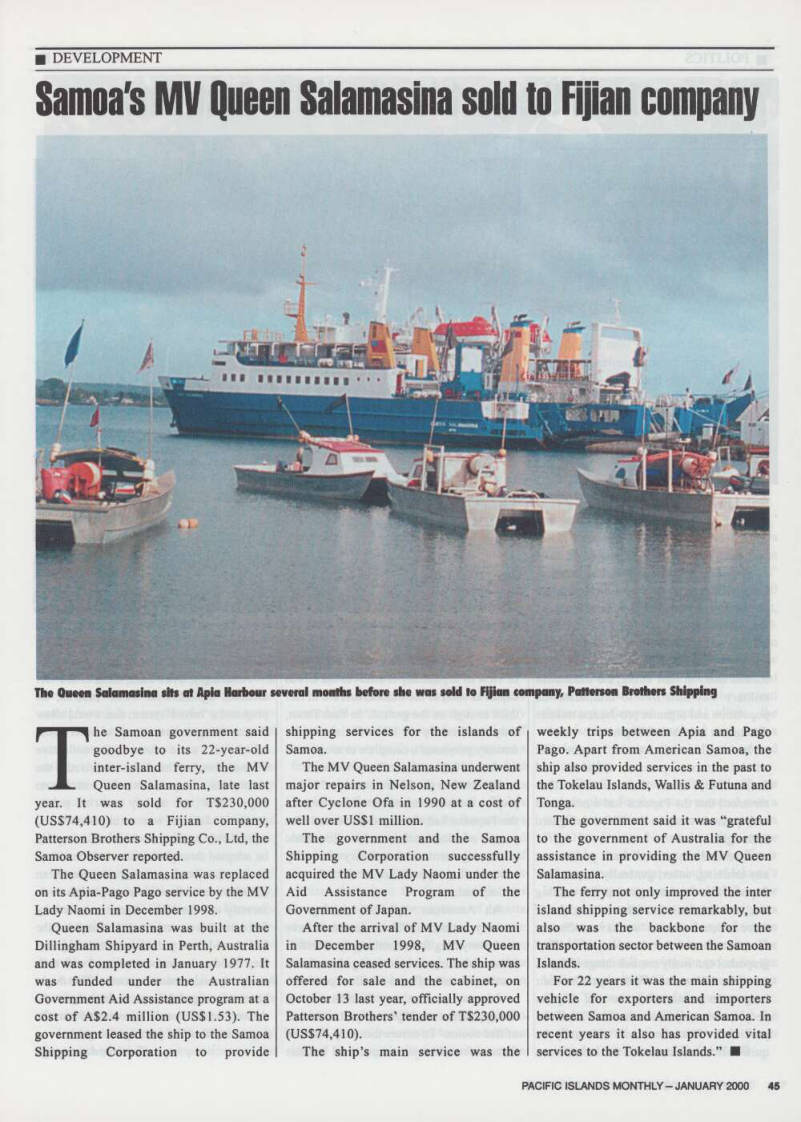
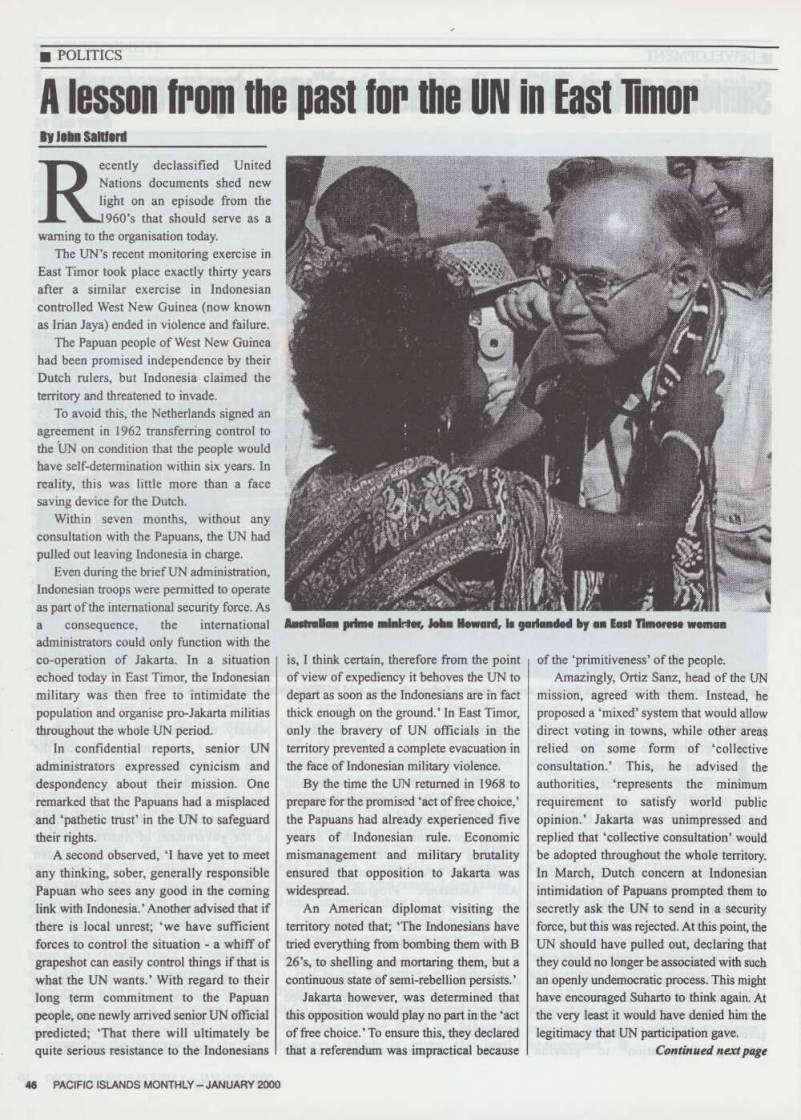
History is in the making, the US Fish and Wildlife Service hopes, at Midway Atoll National Wildlife Refuge.
This time it is not about a battle, but a love affair between two very rare albatross the US Fish and Wildlife Service hopes will produce an offspring.
An 18-year-old female short-tailed albatross has attracted attention for years on Midway Atoll as she returns every year during the nesting season in search of a mate. Normally she is greeted by thousands of the smaller Laysan and black-footed albatross. On November 17, someone more her size appeared, a male “golden gooney”.
The male short-tailed albatross landed about 150 yards from the female and was obviously interested in trying to mate with albatross located close by.
After several days of waiting in hopes they would find each other. Refuge
Manager Rob Shallenberger assisted the effort by moving the male within 40 feet of the female. About an hour later they were involved in a dynamic dancing ritual.
“Unfortunately, the male has now returned to his original spot, and although the female has not been sighted the past few days there is a possibility she is busy feeding to help her body produce an egg,” commented Shallenberger. “Just the fact they danced and possibly mated is
significant.
These massive seabirds have a seven and a half foot wingspan and stand three and a half feet tall. They are from an extremely small worldwide population with breeding restricted to two remote islands, Torishima and Minami-kojima in Japan. Only one other time in 1993 a short-tailed of the opposite sex displayed with Midway’s lone female.
“These two definitely stand out in the
crowd. Like their cousins, they deliver an almost comical, but much louder,
distinguishable, deep-throated ‘mooing’
sound as part of their mating ritual,” said Shallenberger. The female has laid an infertile egg every other year for the past six years. The good news is she is due to lay another this winter. So biologists are keeping their fingers crossed that the full moon and a stroke of luck produce a fertile egg- If albatross survive the first four to eight years of their life, the adolescents usually come back to the same island, arriving very close to the same rearing site to find a mate for life. They are ready to breed around age six.
“The current population is so low that the remote possibility of a successful union of these birds on Midway is exciting,” commented Robert Smith, Pacific Islands
Continued on page 50
Continued from page 43 Ecoregion Manager.
“This species is on the come back from a population thought to be extinct in 1949.
Fortunately, weathermen stationed on Torishima in 1951 discovered a small pocket of ten birds. Today there are at least 230 breeding pairs.”
Besides their home islands in Japan, short-tailed albatrosses occur across the Pacific Ocean south to the northwest Hawaiian islands, north to the Aleutian
Chain, west to the Asian coast, east to the coast of North America and in the Bering Sea. They have been listed as endangered under the US Endangered Species Act since the Act was passed in 1973. However, when the US and foreign endangered species lists were combined an administrative error resulted in protection throughout its range except in the States.
The US Fish and Wildlife Service is in the midst of correcting the error. Breeding habitat and future survival of the species are
threatened by volcanic activity and monsoon rains on Torishima Island, and by disputed ownership of Minami-kojima Island. Other mortalities are caused by longline fishing, plastics pollution and oil spills.
The US Fish and Wildlife Service has been working extensively with the fishing industry and the National Marine Fisheries Service to minimise effects of longline fishing on the short-tailed albatross and other migratory seabirds. ■
Landowners upset over "fast-tracking" of PNG timber projects
By Sam Vulum
The former Papua New Guinea government’s decision to “fast-track” several timber projects in 1998 has deprived thousands of landowners the right to be included in the selection of the developer for their forests.
Landowners of a huge timber concession in West New Britain province have claimed that the West New Britain provincial forest Management Committee breached several sections of the amended 1991 Forestry Act when selecting the developer of the project.
Landowners of the Rottock Bay consolidated timber area claimed that they were left out in the selection of the foreign developer for the project under Section 46 and 63(1) of the Act.
They told PIM that the developer selected would not serve their interest because of past experiences and selection was done on “closed tender” and not on “open tender” as required by the act.
They raised these and other concerns in several letters to the PFMC, the National Forest Authority and its board and minister for forest, Michael Oglo, either directly by themselves or others on their behalf, between July 21 and September 22 last year.
PIM was unable to verily the claims with the PFMC, the PNG Forest Board and the minister for forest despite several attempts.
However, it is understood that the Forest Board did not deliberate on the project in its October meeting because of several defects in the proposal.
The Rottock Bay Consolidated timber area comprises five small timber conversion in the Kandrian and Cape Gloucester districts - they include the Rottock Bay FMA, Aria Vanue Block II FMA, Inland Rauto FMA and Miu FMA.
In a letter to the PNG Forest Authority board chair, Gabriel Samol, on September 6, Latu Lawyers, representing the landowners, cited the following breaches: * The draft project guidelines were prepared by the PFMC without consulting the landowners of the five
areas that come under the Rottock Bay Consolidated timber area as required under section 63 (1) of the Forestry Act; * The National Forest board has not advertised the Rottock Bay
Consolidated as mandatorily required
by Section 64 (1) of the Forestry Act; * A proposal from the company has been considered without complying with the requirements under Section 64 (1) of the Forestry Act; and * The PFMC has failed to properly evaluate the project proposal by the company or if it has evaluated the said project proposal, then such evaluation is alleged to have been made hastily and with influence from outside forces who are not in any way whatever, considered as the said landowners of the project area.
Latu Lawyers said: “We note that despite the concerns by our clients, the PFMC has submitted to your board a report of its evaluation and a recommendation that further negotiations on this project proceed with the company.”
“We advise that if our clients’ requests are not considered by your board, then our clients will go to court to seek certain reliefs and remedies against the PFMC and the board.”
Spokesman for the 150 Incorporate Landowners Group (ILG) in the timber area, Luke Muta said that they were hoping to meet with Forest minister Michael Oglo, and possibly prime minister Sir Mekere Morauta, to discuss their concerns.
He said if all else failed, then they would pursue the court action.
Muta questioned the motives of PFMC and PNGNFA in selecting the company concerned. “For what reason, I don’t know.
I don’t understand their motives.
I am appealing to the prime minister for the project to go on open tender,” Muta said.
He is an executive of Bakarami Holdings, the umbrella company for the ILGS. The ILGS are represented through their chair in the board of Bakarami Holdings, which is given the legal
authority to represent them in their fight for justice.
In a brief to Oglo on august 24, Bakarami Holdings said there were a lot of questions and suspicions as to why a very large “stand alone” project could not attract more developers in the bidding process.
The company said in the brief that the developer’s past record in other projects in the province had not been anywhere near satisfaction.
They provided copies of letters by two landowner companies from projects once operated by the developer concerned to support their claims.
In one of the letters, landowner company. Central Arowe Resources, claimed that the developer failed to build and maintain roads, bridges, school and health centre buildings.
The company said the developer failed to pay them agriculture levies and by premiums in the last five years.
“We are pleading for your understanding and intervention. We are asking the developer to meet us soon to explain why it had not complied with the requirements of the timber permit,” the company said in the letter to the PFMC on July 21.
Another company, Milupoi Development corporation also expressed similar sentiments in a letter to the PFMC regarding the West Arowe timber permit number 14-53.
The landowners have been supported by non-govemment organisation, the Melanesian Environment Foundation.
In a letter to PNG Forest Board chair Gabriel Samol, national coordinator George Euling said: “Your board must be sure beyond any reasonable doubt that any decision that it makes contrary to the will of the resource owners both in the immediate future and in the long term will bring about positive and permanent social and economic benefits to them.”
“In this case, we are asking that the next phase of the process towards awarding the company the right to establish negotiation be suspended.” ■
Samoa's MV Queen Salamasina sold to Fijian company
The Samoan government said goodbye to its 22-year-old inter-island ferry, the MV Queen Salamasina, late last year. It was sold for T 5230,000 (U 5574,410) to a Fijian company, Patterson Brothers Shipping Co., Ltd, the Samoa Observer reported.
The Queen Salamasina was replaced on its Apia-Pago Pago service by the MV Lady Naomi in December 1998.
Queen Salamasina was built at the Dillingham Shipyard in Perth, Australia and was completed in January 1977. It was funded under the Australian Government Aid Assistance program at a cost of A 52.4 million (US$l.53). The government leased the ship to the Samoa Shipping Corporation to provide
shipping services for the islands of Samoa.
The MV Queen Salamasina underwent major repairs in Nelson, New Zealand after Cyclone Ofa in 1990 at a cost of well over US$l million.
The government and the Samoa
Shipping Corporation successfully
acquired the MV Lady Naomi under the Aid Assistance Program of the Government of Japan.
After the arrival of MV Lady Naomi in December 1998, MV Queen Salamasina ceased services. The ship was offered for sale and the cabinet, on October 13 last year, officially approved Patterson Brothers’ tender of T 5230,000 (U 5574,410).
The ship’s main service was the
weekly trips between Apia and Pago
Pago. Apart from American Samoa, the ship also provided services in the past to the Tokelau Islands, Wallis & Futuna and Tonga.
The government said it was “grateful to the government of Australia for the assistance in providing the MV Queen Salamasina.
The ferry not only improved the inter island shipping service remarkably, but also was the backbone for the transportation sector between the Samoan Islands.
For 22 years it was the main shipping vehicle for exporters and importers between Samoa and American Samoa. In recent years it also has provided vital services to the Tokelau Islands.” ■
The Queen Salamasina sits at Apia Harbour several months before she was sold to Fijian company, Patterson Brothers Shipping
A lesson from the past for the UN in East timer
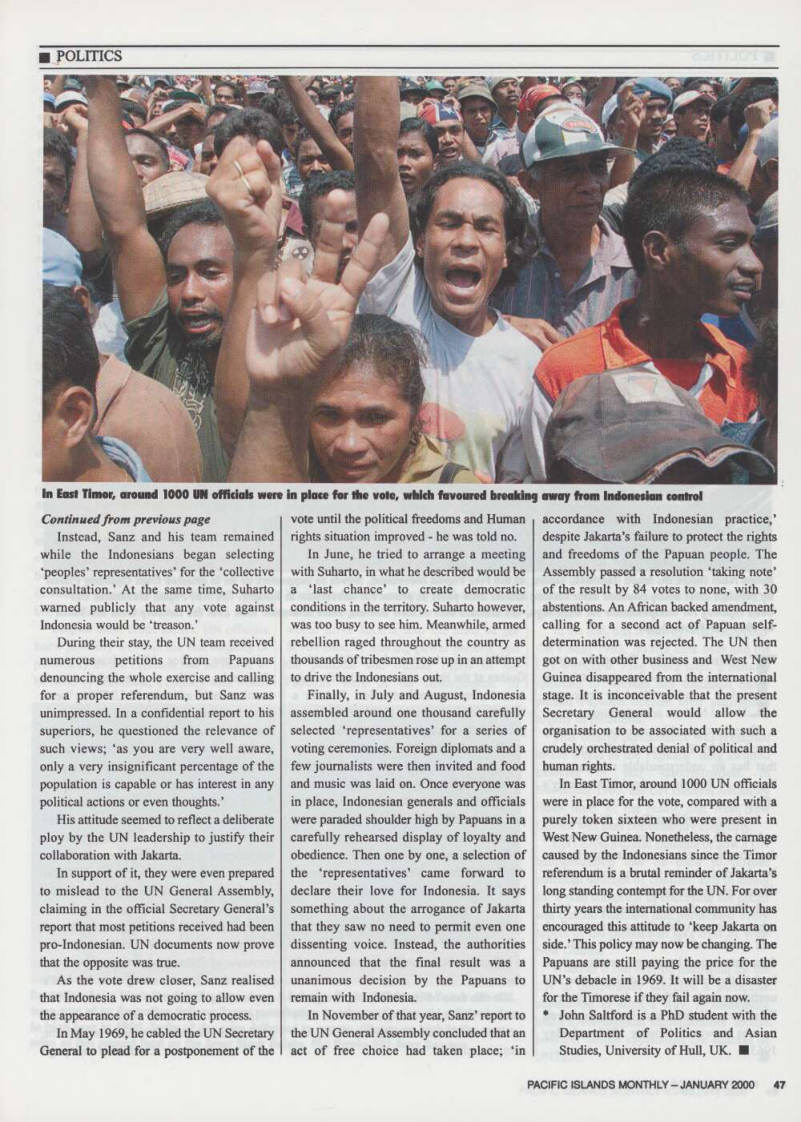
Politics
By John Saltford
Recently declassified United Nations documents shed new light on an episode from the J96o’s that should serve as a warning to the organisation today.
The UN’s recent monitoring exercise in East Timor took place exactly thirty years after a similar exercise in Indonesian controlled West New Guinea (now known as Irian Jaya) ended in violence and failure.
The Papuan people of West New Guinea had been promised independence by their Dutch rulers, but Indonesia claimed the territory and threatened to invade.
To avoid this, the Netherlands signed an agreement in 1962 transferring control to the UN on condition that the people would have self-determination within six years. In reality, this was little more than a face saving device for the Dutch.
Within seven months, without any consultation with the Papuans, the UN had pulled out leaving Indonesia in charge.
Even during the brief UN administration, Indonesian troops were permitted to operate as part of the international security force. As a consequence, the international administrators could only function with the co-operation of Jakarta. In a situation echoed today in East Timor, the Indonesian military was then free to intimidate the population and organise pro-Jakarta militias throughout the whole UN period.
In confidential reports, senior UN
administrators expressed cynicism and
despondency about their mission. One remarked that the Papuans had a misplaced and ‘pathetic trust’ in the UN to safeguard
their rights.
A second observed, T have yet to meet
any thinking, sober, generally responsible
Papuan who sees any good in the coming link with Indonesia. ’ Another advised that if there is local unrest; ‘we have sufficient forces to control the situation - a whiff of grapeshot can easily control things if that is what the UN wants.’ With regard to their long term commitment to the Papuan people, one newly arrived senior UN official predicted; ‘That there will ultimately be quite serious resistance to the Indonesians
is, I think certain, therefore from the point of view of expediency it behoves the UN to depart as soon as the Indonesians are in fact thick enough on the ground.’ In East Timor, only the bravery of UN officials in the territory prevented a complete evacuation in the face of Indonesian military violence.
By the time the UN returned in 1968 to prepare for the promised ‘act of free choice,’ the Papuans had already experienced five years of Indonesian rule. Economic mismanagement and military brutality ensured that opposition to Jakarta was
widespread.
An American diplomat visiting the territory noted that; ‘The Indonesians have tried everything from bombing them with B 26’s, to shelling and mortaring them, but a continuous state of semi-rebellion persists.’
Jakarta however, was determined that this opposition would play no part in the ‘act of free choice.’ To ensure this, they declared that a referendum was impractical because
of the ‘primitiveness’ of the people.
Amazingly, Ortiz Sanz, head of the UN mission, agreed with them. Instead, he proposed a ‘mixed’ system that would allow direct voting in towns, while other areas relied on some form of ‘collective consultation.’ This, he advised the authorities, ‘represents the minimum requirement to satisfy world public opinion.’ Jakarta was unimpressed and replied that ‘collective consultation’ would be adopted throughout the whole territory.
In March, Dutch concern at Indonesian intimidation of Papuans prompted them to secretly ask the UN to send in a security force, but this was rejected. At this point, the UN should have pulled out, declaring that they could no longer be associated with such an openly undemocratic process. This might have encouraged Suharto to think again. At the very least it would have denied him the legitimacy that UN participation gave.
Continued next page
Australian prime minister, John Howard, it garlanded by an East Timorese woman
Continued from previous page
Instead, Sanz and his team remained while the Indonesians began selecting ‘peoples’ representatives’ for the ‘collective consultation.’ At the same time, Suharto warned publicly that any vote against Indonesia would be ‘treason.’
During their stay, the UN team received numerous petitions from Papuans denouncing the whole exercise and calling for a proper referendum, but Sanz was unimpressed. In a confidential report to his superiors, he questioned the relevance of such views; ‘as you are very well aware, only a very insignificant percentage of the population is capable or has interest in any political actions or even thoughts.’
His attitude seemed to reflect a deliberate ploy by the UN leadership to justify their collaboration with Jakarta.
In support of it, they were even prepared to mislead to the UN General Assembly, claiming in the official Secretary General’s report that most petitions received had been pro-Indonesian. UN documents now prove that the opposite was true.
As the vote drew closer, Sanz realised that Indonesia was not going to allow even the appearance of a democratic process.
In May 1969, he cabled the UN Secretary General to plead for a postponement of the
vote until the political freedoms and Human rights situation improved - he was told no.
In June, he tried to arrange a meeting with Suharto, in what he described would be a ‘last chance’ to create democratic conditions in the territory. Suharto however, was too busy to see him. Meanwhile, armed rebellion raged throughout the country as thousands of tribesmen rose up in an attempt to drive the Indonesians out.
Finally, in July and August, Indonesia assembled around one thousand carefully selected ‘representatives’ for a series of
voting ceremonies. Foreign diplomats and a
few journalists were then invited and food and music was laid on. Once everyone was in place, Indonesian generals and officials were paraded shoulder high by Papuans in a carefully rehearsed display of loyalty and obedience. Then one by one, a selection of the ‘representatives’ came forward to declare their love for Indonesia. It says something about the arrogance of Jakarta that they saw no need to permit even one dissenting voice. Instead, the authorities announced that the final result was a unanimous decision by the Papuans to remain with Indonesia.
In November of that year, Sanz’ report to the UN General Assembly concluded that an act of free choice had taken place; ‘in
accordance with Indonesian practice,’ despite Jakarta’s failure to protect the rights and freedoms of the Papuan people. The Assembly passed a resolution ‘taking note’ of the result by 84 votes to none, with 30 abstentions. An African backed amendment, calling for a second act of Papuan self determination was rejected. The UN then got on with other business and West New Guinea disappeared from the international stage. It is inconceivable that the present Secretary General would allow the organisation to be associated with such a crudely orchestrated denial of political and
human rights.
In East Timor, around 1000 UN officials were in place for the vote, compared with a purely token sixteen who were present in West New Guinea. Nonetheless, the carnage caused by the Indonesians since the Timor referendum is a brutal reminder of Jakarta’s long standing contempt for the UN. For over thirty years the international community has encouraged this attitude to ‘keep Jakarta on side.’ This policy may now be changing. The Papuans are still paying the price for the UN’s debacle in 1969. It will be a disaster for the Timorese if they fail again now. * John Saltford is a PhD student with the Department of Politics and Asian Studies, University of Hull, UK. ■
In East Timor, around 1000 UN officials were in place for the vole, which favoured breaking away from Indonesian control
Subjects of the secretary-general
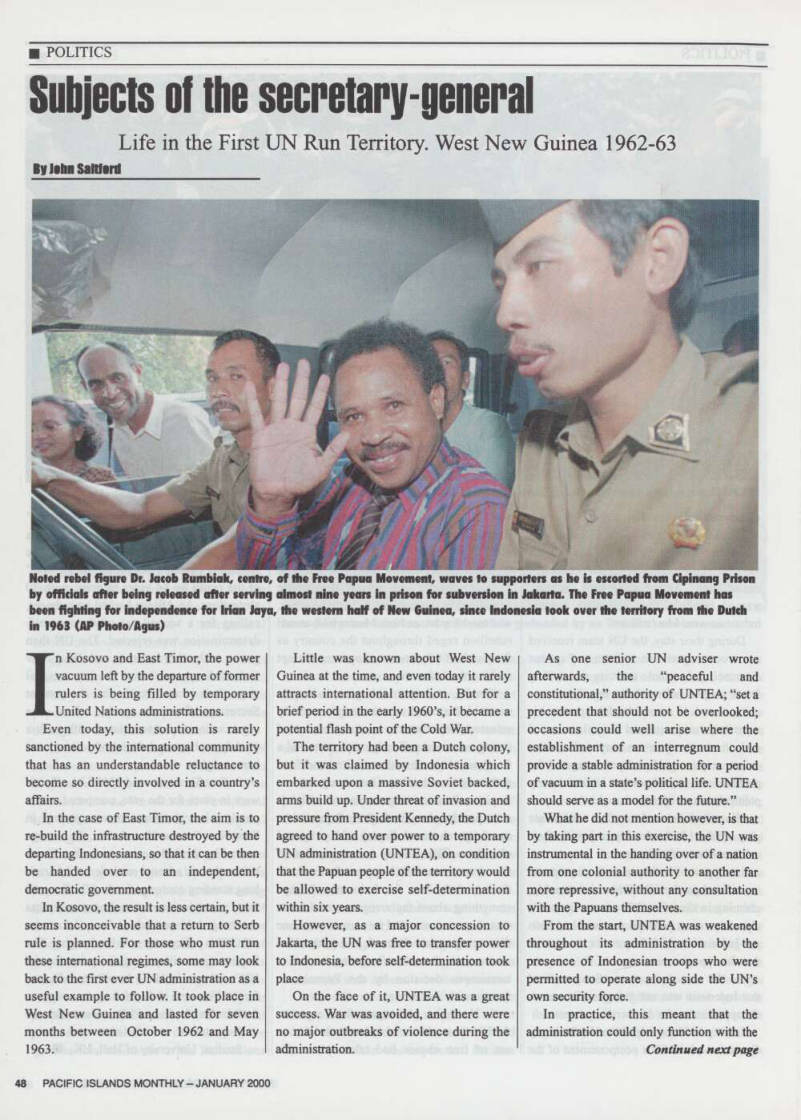
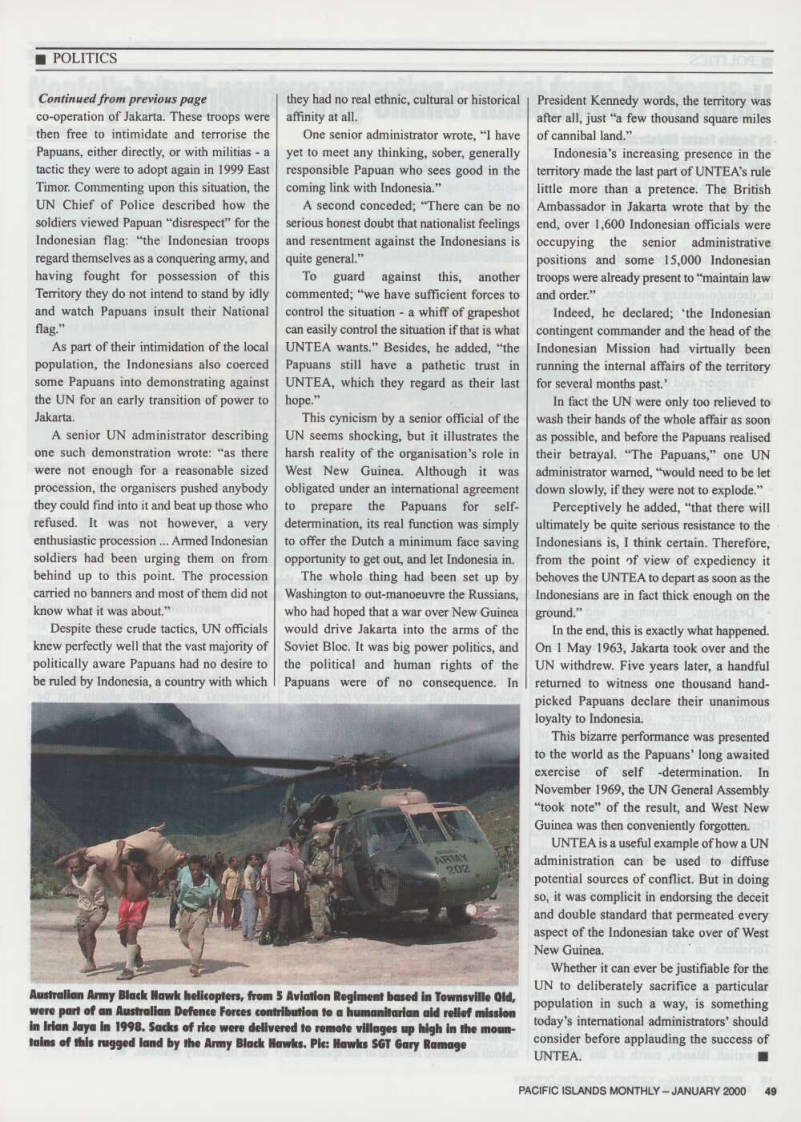
Life in the First UN Run Territory. West New Guinea 1962-63
By John Saltftrd
In Kosovo and East Timor, the power vacuum left by the departure of former rulers is being filled by temporary United Nations administrations.
Even today, this solution is rarely sanctioned by the international community that has an understandable reluctance to become so directly involved in a country’s affairs.
In the case of East Timor, the aim is to re-build the infrastructure destroyed by the departing Indonesians, so that it can be then be handed over to an independent, democratic government.
In Kosovo, the result is less certain, but it seems inconceivable that a return to Serb rule is planned. For those who must run these international regimes, some may look back to the first ever UN administration as a useful example to follow. It took place in West New Guinea and lasted for seven months between October 1962 and May 1963.
Little was known about West New Guinea at the time, and even today it rarely attracts international attention. But for a brief period in the early 1960’5, it became a potential flash point of the Cold War.
The territory had been a Dutch colony, but it was claimed by Indonesia which embarked upon a massive Soviet backed, arms build up. Under threat of invasion and pressure from President Kennedy, the Dutch agreed to hand over power to a temporary UN administration (UNTEA), on condition that the Papuan people of the territory would be allowed to exercise self-determination within six years.
However, as a major concession to Jakarta, the UN was free to transfer power to Indonesia, before self-determination took place On the face of it, UNTEA was a great success. War was avoided, and there were no major outbreaks of violence during the administration.
As one senior UN adviser wrote afterwards, the “peaceful and constitutional,” authority of UNTEA; “set a precedent that should not be overlooked; occasions could well arise where the establishment of an interregnum could provide a stable administration for a period of vacuum in a state’s political life. UNTEA should serve as a model for the future.”
What he did not mention however, is that by taking part in this exercise, the UN was instrumental in the handing over of a nation from one colonial authority to another far more repressive, without any consultation with the Papuans themselves.
From the start, UNTEA was weakened throughout its administration by the presence of Indonesian troops who were permitted to operate along side the UN’s own security force.
In practice, this meant that the administration could only function with the
Continued next page
Noted rebel figure Dr. Jacob Rumbiak, centre, of the Free Papua Movement, waves to supporters as he is escorted from Cipinang Prison by officials after being released after serving almost nine years in prison for subversion in Jakarta. The Free Papua Movement has been fighting for independence for lrian Jaya, the western half of New Guinea, since Indonesia took over the territory from the Dutch in 1963 (AP Photo/Agus)
Continued from previous page
co-operation of Jakarta. These troops were then free to intimidate and terrorise the Papuans, either directly, or with militias - a tactic they were to adopt again in 1999 East Timor. Commenting upon this situation, the UN Chief of Police described how the soldiers viewed Papuan “disrespect” for the Indonesian flag: “the Indonesian troops regard themselves as a conquering army, and having fought for possession of this Territory they do not intend to stand by idly and watch Papuans insult their National flag.”
As part of their intimidation of the local population, the Indonesians also coerced some Papuans into demonstrating against the UN for an early transition of power to Jakarta.
A senior UN administrator describing one such demonstration wrote: “as there were not enough for a reasonable sized procession, the organisers pushed anybody they could find into it and beat up those who refused. It was not however, a very enthusiastic procession ... Armed Indonesian soldiers had been urging them on from behind up to this point. The procession carried no banners and most of them did not know what it was about.”
Despite these crude tactics, UN officials knew perfectly well that the vast majority of politically aware Papuans had no desire to be ruled by Indonesia, a country with which
they had no real ethnic, cultural or historical affinity at all.
One senior administrator wrote, “I have yet to meet any thinking, sober, generally responsible Papuan who sees good in the coming link with Indonesia.”
A second conceded; “There can be no serious honest doubt that nationalist feelings and resentment against the Indonesians is
quite general.”
To guard against this, another commented; “we have sufficient forces to control the situation - a whiff of grapeshot can easily control the situation if that is what UNTEA wants.” Besides, he added, “the Papuans still have a pathetic trust in UNTEA, which they regard as their last hope.”
This cynicism by a senior official of the UN seems shocking, but it illustrates the harsh reality of the organisation’s role in West New Guinea. Although it was obligated under an international agreement to prepare the Papuans for self determination, its real function was simply to offer the Dutch a minimum face saving opportunity to get out, and let Indonesia in.
The whole thing had been set up by Washington to out-manoeuvre the Russians, who had hoped that a war over New Guinea would drive Jakarta into the arms of the Soviet Bloc. It was big power politics, and the political and human rights of the Papuans were of no consequence. In
President Kennedy words, the territory was after all, just “a few thousand square miles of cannibal land.”
Indonesia’s increasing presence in the territory made the last part of UNTEA’s rule little more than a pretence. The British Ambassador in Jakarta wrote that by the end, over 1,600 Indonesian officials were occupying the senior administrative positions and some 15,000 Indonesian troops were already present to “maintain law and order.”
Indeed, he declared; ‘the Indonesian contingent commander and the head of the Indonesian Mission had virtually been running the internal affairs of the territory for several months past.’
In fact the UN were only too relieved to wash their hands of the whole affair as soon as possible, and before the Papuans realised their betrayal. “The Papuans,” one UN administrator warned, “would need to be let down slowly, if they were not to explode.”
Perceptively he added, “that there will ultimately be quite serious resistance to the Indonesians is, I think certain. Therefore, from the point of view of expediency it behoves the UNTEA to depart as soon as the Indonesians are in fact thick enough on the ground.”
In the end, this is exactly what happened.
On 1 May 1963, Jakarta took over and the UN withdrew. Five years later, a handful returned to witness one thousand hand picked Papuans declare their unanimous loyalty to Indonesia.
This bizarre performance was presented to the world as the Papuans’ long awaited exercise of self -determination. In November 1969, the UN General Assembly “took note” of the result, and West New Guinea was then conveniently forgotten.
UNTEA is a useful example of how a UN administration can be used to diffuse potential sources of conflict. But in doing so, it was complicit in endorsing the deceit and double standard that permeated every aspect of the Indonesian take over of West New Guinea.
Whether it can ever be justifiable for the UN to deliberately sacrifice a particular population in such a way, is something today’s international administrators’ should consider before applauding the success of
Untea. ■
Australian Amy Black Hawk helicopters, from 5 Aviation Regiment based in Townsville Old, were part of an Australian Defence Forces contribution to a humanitarian aid relief mission in lrian jaya in 1998. Sacks of rice were delivered to remote villages up high in the moun tains of this ragged land by the Army Black Hawks. Pic: Hawks SGI Gary Ramage
Vanuatu Ombudsman slams government delay
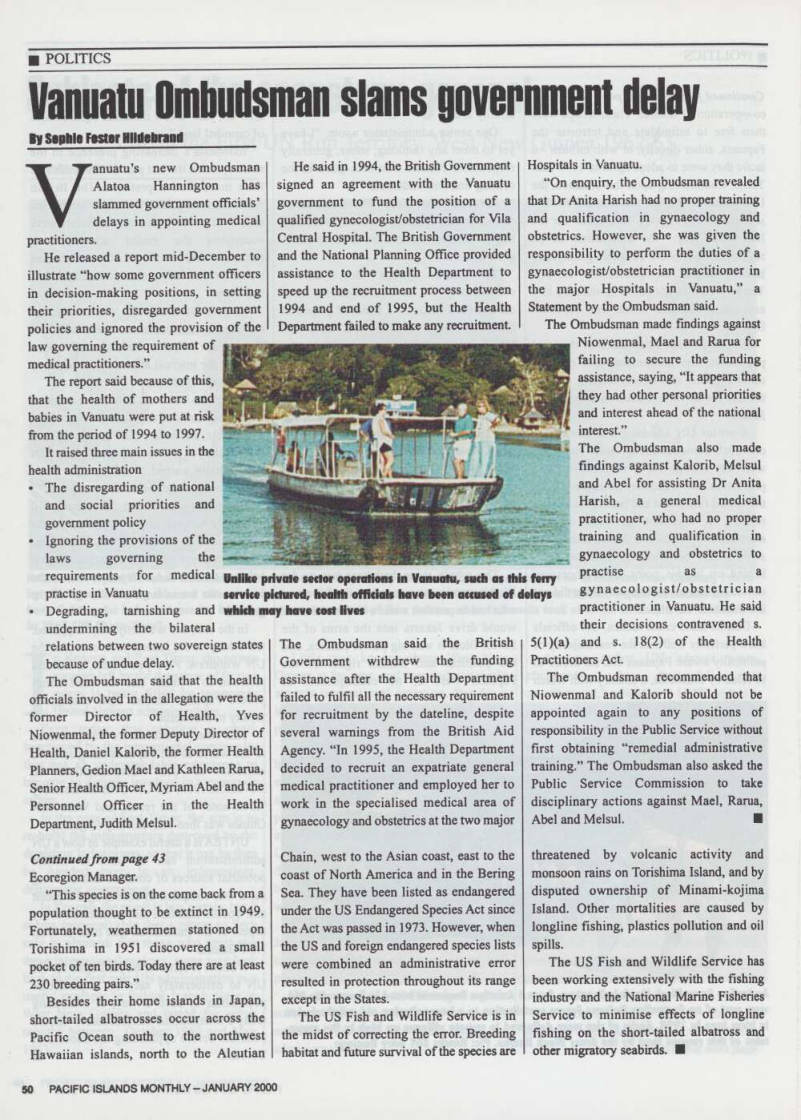
By Sophie Faster Hildebrand
Vanuatu’s new Ombudsman Alatoa Hannington has slammed government officials’ delays in appointing medical practitioners.
He released a report mid-December to illustrate “how some government officers in decision-making positions, in setting their priorities, disregarded government policies and ignored the provision of the
law governing the requirement of medical practitioners.”
The report said because of this, that the health of mothers and babies in Vanuatu were put at risk from the period of 1994 to 1997.
It raised three main issues in the health administration • The disregarding of national and social priorities and government policy • Ignoring the provisions of the laws governing the requirements for medical practise in Vanuatu • Degrading, tarnishing and undermining the bilateral
relations between two sovereign states because of undue delay.
The Ombudsman said that the health officials involved in the allegation were the former Director of Health, Yves Niowenmal, the former Deputy Director of Health, Daniel Kalorib, the former Health Planners, Gedion Mael and Kathleen Rama, Senior Health Officer, Myriam Abel and the Personnel Officer in the Health Department, Judith Melsul.
He said in 1994, the British Government signed an agreement with the Vanuatu government to fund the position of a qualified gynecologist/obstetrician for Vila Central Hospital. The British Government and the National Planning Office provided assistance to the Health Department to speed up the recruitment process between 1994 and end of 1995, but the Health Department failed to make any recruitment.
The Ombudsman said the British Government withdrew the funding assistance after the Health Department failed to fulfil all the necessary requirement for recruitment by the dateline, despite several warnings from the British Aid Agency. “In 1995, the Health Department decided to recruit an expatriate general medical practitioner and employed her to work in the specialised medical area of gynaecology and obstetrics at the two major
Hospitals in Vanuatu.
“On enquiry, the Ombudsman revealed that Dr Anita Harish had no proper training and qualification in gynaecology and obstetrics. However, she was given the responsibility to perform the duties of a
gynaecologist/obstetrician practitioner in
the major Hospitals in Vanuatu,” a Statement by the Ombudsman said.
The Ombudsman made findings against
Niowenmal, Mael and Rama for failing to secure the funding assistance, saying, “It appears that they had other personal priorities and interest ahead of the national interest.”
The Ombudsman also made findings against Kalorib, Melsul and Abel for assisting Dr Anita Harish, a general medical practitioner, who had no proper training and qualification in gynaecology and obstetrics to practise as a gynaecologist/obstetrician practitioner in Vanuatu. He said their decisions contravened s.
5(1 )(a) and s. 18(2) of the Health Practitioners Act.
The Ombudsman recommended that Niowenmal and Kalorib should not be appointed again to any positions of responsibility in the Public Service without first obtaining “remedial administrative training.” The Ombudsman also asked the Public Service Commission to take disciplinary actions against Mael, Rama, Abel and Melsul. ■
Unlike private sector operations in Vanuatu, such as this ferry service pictured, health officials have been accused of delays which may have cost lives
Norfolk Island ponders wresting control from Canberra
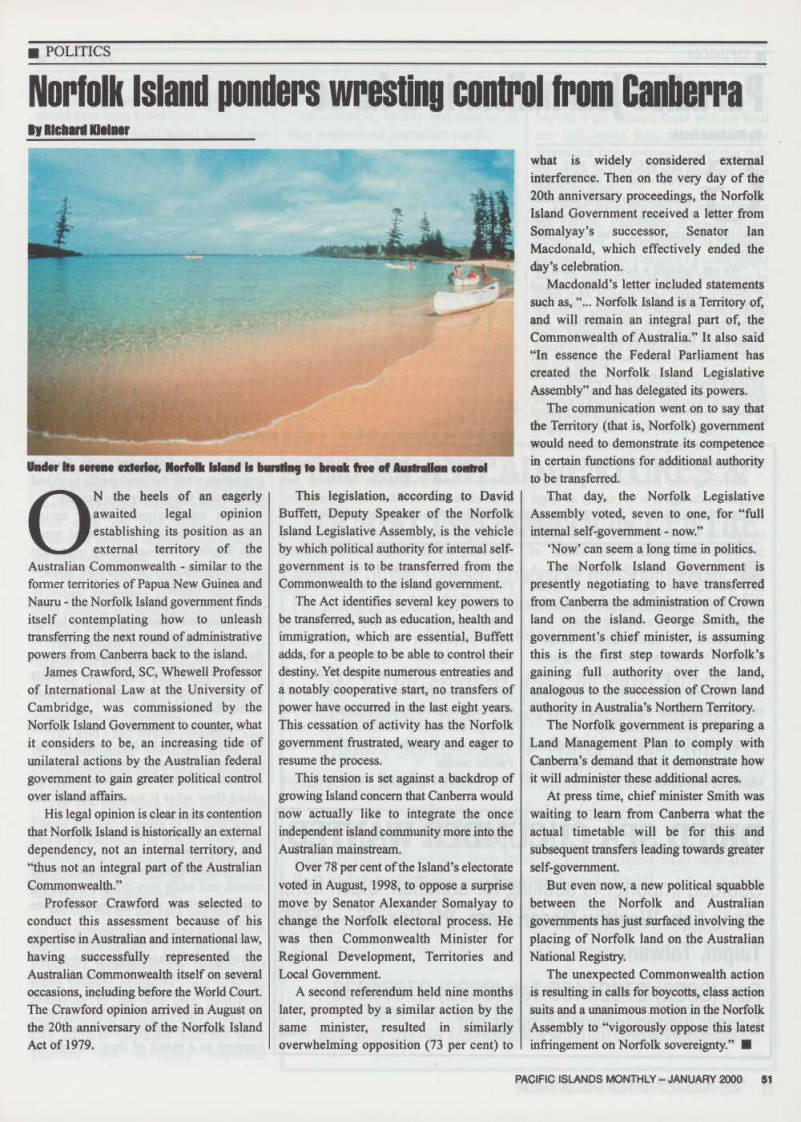
By Richard Kleiner
ON the heels of an eagerly awaited legal opinion establishing its position as an external territory of the Australian Commonwealth - similar to the former territories of Papua New Guinea and Nauru - the Norfolk Island government finds itself contemplating how to unleash transferring the next round of administrative powers from Canberra back to the island.
James Crawford, SC, Whewell Professor of International Law at the University of Cambridge, was commissioned by the Norfolk Island Government to counter, what it considers to be, an increasing tide of unilateral actions by the Australian federal government to gain greater political control over island affairs.
His legal opinion is clear in its contention that Norfolk Island is historically an external dependency, not an internal territory, and “thus not an integral part of the Australian Commonwealth.”
Professor Crawford was selected to conduct this assessment because of his expertise in Australian and international law,
having successfully represented the
Australian Commonwealth itself on several occasions, including before the World Court.
The Crawford opinion arrived in August on the 20th anniversary of the Norfolk Island Act of 1979.
This legislation, according to David Buffett, Deputy Speaker of the Norfolk Island Legislative Assembly, is the vehicle by which political authority for internal self government is to be transferred from the Commonwealth to the island government.
The Act identifies several key powers to be transferred, such as education, health and immigration, which are essential, Buffett adds, for a people to be able to control their destiny. Yet despite numerous entreaties and a notably cooperative start, no transfers of power have occurred in the last eight years.
This cessation of activity has the Norfolk government frustrated, weary and eager to resume the process.
This tension is set against a backdrop of growing Island concern that Canberra would now actually like to integrate the once independent island community more into the Australian mainstream.
Over 78 per cent of the Island’s electorate voted in August, 1998, to oppose a surprise move by Senator Alexander Somalyay to change the Norfolk electoral process. He was then Commonwealth Minister for
Regional Development, Territories and
Local Government.
A second referendum held nine months later, prompted by a similar action by the same minister, resulted in similarly overwhelming opposition (73 per cent) to
what is widely considered external interference. Then on the very day of the 20th anniversary proceedings, the Norfolk Island Government received a letter from Somalyay’s successor, Senator lan Macdonald, which effectively ended the
day’s celebration.
Macdonald’s letter included statements such as, “... Norfolk Island is a Territory of, and will remain an integral part of, the Commonwealth of Australia.” It also said “In essence the Federal Parliament has created the Norfolk Island Legislative Assembly” and has delegated its powers.
The communication went on to say that the Territory (that is, Norfolk) government would need to demonstrate its competence in certain functions for additional authority to be transferred.
That day, the Norfolk Legislative Assembly voted, seven to one, for “full internal self-government - now.” ‘Now’ can seem a long time in politics.
The Norfolk Island Government is presently negotiating to have transferred from Canberra the administration of Crown land on the island. George Smith, the government’s chief minister, is assuming this is the first step towards Norfolk’s gaining full authority over the land, analogous to the succession of Crown land authority in Australia’s Northern Territory.
The Norfolk government is preparing a Land Management Plan to comply with Canberra’s demand that it demonstrate how it will administer these additional acres.
At press time, chief minister Smith was waiting to leam from Canberra what the actual timetable will be for this and subsequent transfers leading towards greater
self-government.
But even now, a new political squabble between the Norfolk and Australian governments has just surfaced involving the placing of Norfolk land on the Australian
National Registry.
The unexpected Commonwealth action is resulting in calls for boycotts, class action suits and a unanimous motion in the Norfolk Assembly to “vigorously oppose this latest infringement on Norfolk sovereignty.” ■
Under its serene exterior, Norfolk Island is bursting to break free of Australian control
Paradise journalism is a farce
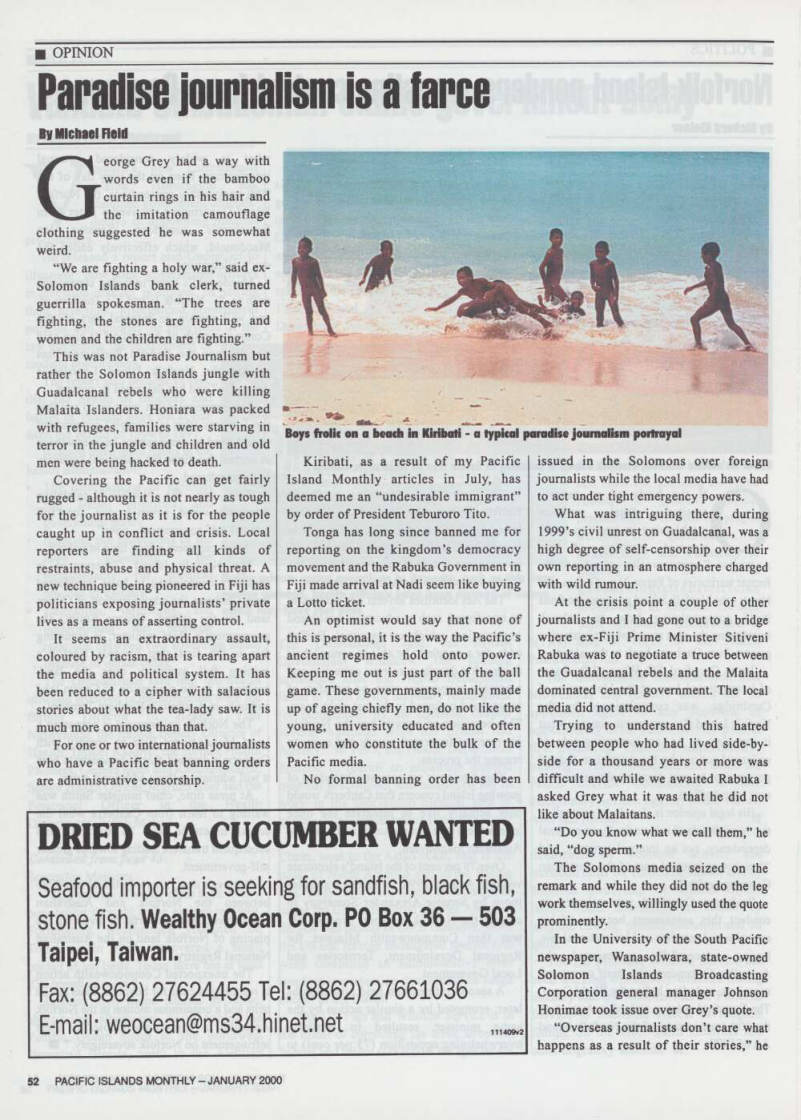
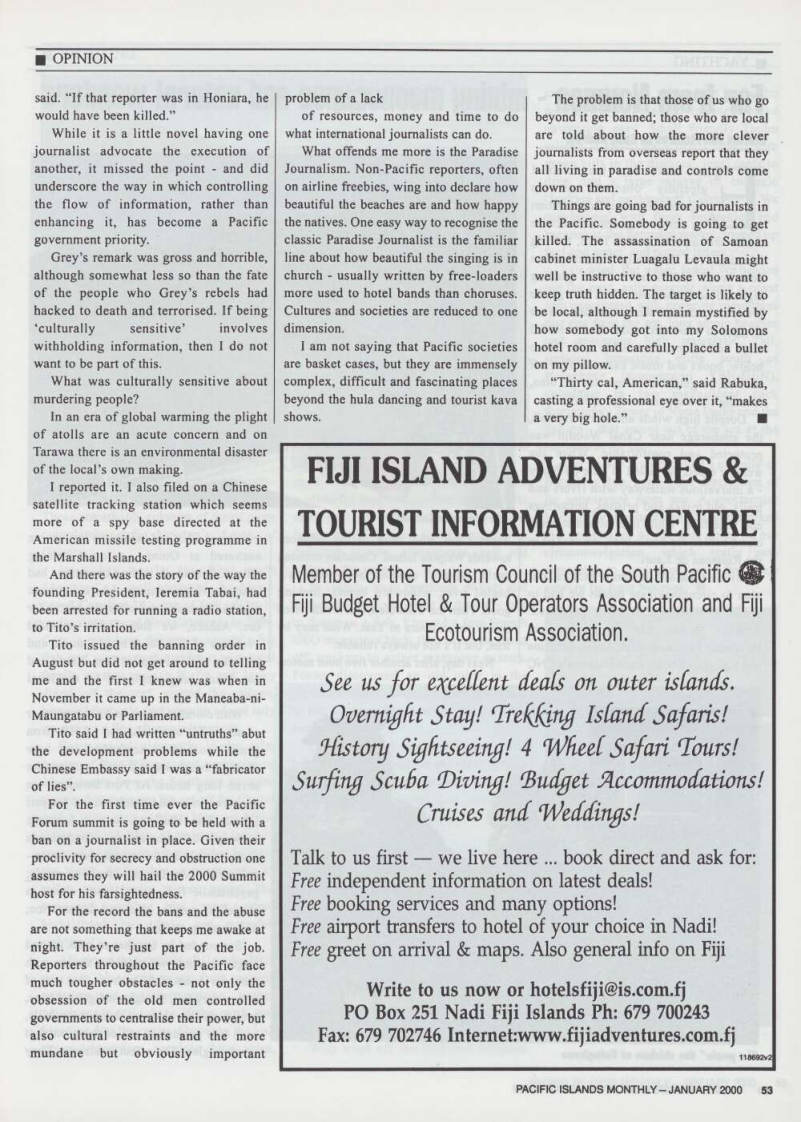
By Michael Field
George Grey had a way with words even if the bamboo curtain rings in his hair and the imitation camouflage clothing suggested he was somewhat weird.
“We are fighting a holy war,” said ex- Solomon Islands bank clerk, turned guerrilla spokesman. “The trees are fighting, the stones are fighting, and women and the children are fighting.”
This was not Paradise Journalism but rather the Solomon Islands jungle with Guadalcanal rebels who were killing Malaita Islanders. Honiara was packed with refugees, families were starving in terror in the jungle and children and old men were being hacked to death.
Covering the Pacific can get fairly rugged - although it is not nearly as tough for the journalist as it is for the people caught up in conflict and crisis. Local reporters are finding all kinds of restraints, abuse and physical threat. A new technique being pioneered in Fiji has
politicians exposing journalists’ private
lives as a means of asserting control.
It seems an extraordinary assault, coloured by racism, that is tearing apart the media and political system. It has been reduced to a cipher with salacious stories about what the tea-lady saw. It is much more ominous than that.
For one or two international journalists who have a Pacific beat banning orders are administrative censorship.
Kiribati, as a result of my Pacific Island Monthly articles in July, has deemed me an “undesirable immigrant” by order of President Teburoro Tito.
Tonga has long since banned me for reporting on the kingdom’s democracy movement and the Rabuka Government in Fiji made arrival at Nadi seem like buying a Lotto ticket.
An optimist would say that none of this is personal, it is the way the Pacific’s ancient regimes hold onto power.
Keeping me out is just part of the ball game. These governments, mainly made up of ageing chiefly men, do not like the young, university educated and often women who constitute the bulk of the Pacific media.
No formal banning order has been
issued in the Solomons over foreign journalists while the local media have had to act under tight emergency powers.
What was intriguing there, during 1999’s civil unrest on Guadalcanal, was a high degree of self-censorship over their own reporting in an atmosphere charged with wild rumour.
At the crisis point a couple of other journalists and I had gone out to a bridge where ex-Fiji Prime Minister Sitiveni Rabuka was to negotiate a truce between the Guadalcanal rebels and the Malaita dominated central government. The local media did not attend.
Trying to understand this hatred between people who had lived side-by side for a thousand years or more was difficult and while we awaited Rabuka I asked Grey what it was that he did not like about Malaitans.
“Do you know what we call them,” he said, “dog sperm.”
The Solomons media seized on the remark and while they did not do the leg work themselves, willingly used the quote
prominently.
In the University of the South Pacific newspaper, Wanasolwara, state-owned Solomon Islands Broadcasting Corporation general manager Johnson Honimae took issue over Grey’s quote.
“Overseas journalists don’t care what happens as a result of their stories,” he
Boys frolic on a beach in Kiribati = a typical paradise journalism portrayal
said. “If that reporter was in Honiara, he would have been killed.”
While it is a little novel having one journalist advocate the execution of another, it missed the point - and did underscore the way in which controlling the flow of information, rather than enhancing it, has become a Pacific government priority.
Grey’s remark was gross and horrible, although somewhat less so than the fate of the people who Grey’s rebels had hacked to death and terrorised. If being ‘culturally sensitive’ involves withholding information, then I do not want to be part of this.
What was culturally sensitive about
murdering people?
In an era of global warming the plight of atolls are an acute concern and on Tarawa there is an environmental disaster of the local’s own making.
I reported it. I also filed on a Chinese satellite tracking station which seems more of a spy base directed at the American missile testing programme in the Marshall Islands.
And there was the story of the way the founding President, leremia Tabai, had been arrested for running a radio station, to Tito’s irritation.
Tito issued the banning order in August but did not get around to telling me and the first I knew was when in November it came up in the Maneaba-ni- Maungatabu or Parliament.
Tito said I had written “untruths” abut the development problems while the Chinese Embassy said I was a “fabricator of lies”.
For the first time ever the Pacific Forum summit is going to be held with a ban on a journalist in place. Given their proclivity for secrecy and obstruction one assumes they will hail the 2000 Summit host for his farsightedness.
For the record the bans and the abuse are not something that keeps me awake at night. They’re just part of the job.
Reporters throughout the Pacific face much tougher obstacles - not only the obsession of the old men controlled governments to centralise their power, but also cultural restraints and the more mundane but obviously important
problem of a lack of resources, money and time to do what international journalists can do.
What offends me more is the Paradise Journalism. Non-Pacific reporters, often on airline freebies, wing into declare how beautiful the beaches are and how happy the natives. One easy way to recognise the classic Paradise Journalist is the familiar line about how beautiful the singing is in church - usually written by free-loaders more used to hotel bands than choruses.
Cultures and societies are reduced to one dimension.
I am not saying that Pacific societies are basket cases, but they are immensely complex, difficult and fascinating places beyond the hula dancing and tourist kava shows.
The problem is that those of us who go beyond it get banned; those who are local are told about how the more clever journalists from overseas report that they all living in paradise and controls come down on them.
Things are going bad for journalists in the Pacific. Somebody is going to get killed. The assassination of Samoan cabinet minister Luagalu Levaula might well be instructive to those who want to keep truth hidden. The target is likely to be local, although I remain mystified by how somebody got into my Solomons hotel room and carefully placed a bullet on my pillow.
“Thirty cal, American,” said Rabuka, casting a professional eye over it, “makes a very big hole.” ■
Advertisements & other items, pp. 52-53 (1 item)
Dried Sea Cucumber Wanted
Seafood importer is seeking for sandfish, black fish, stone fish. Wealthy Ocean Corp. PO Box 36 503 Taipei, Taiwan.
Fax: (8862) 27624455 Tel: (8862) 27661036 E-mail: [email protected]
FIJI ISLAND ADVENTURES &
TOURIST INFORMATION CENTRE
Member of the Tourism Council of the South Pacific Fiji Budget Hotel & Tour Operators Association and Fiji Ecotourism Association.
See us for excellent deals on outer islands.
Overnight Stay! ‘Trehfing Island Safaris!
History Sightseeing! 4 Wheel Safari Tours!
Surfing Seuha (Diving! ‘Budget Accommodations!
Cruises and Weddings!
Talk to us first we live here ... book direct and ask for: Free independent information on latest deals!
Free booking services and many options!
Free airport transfers to hotel of your choice in Nadi!
Free greet on arrival & maps. Also general info on Fiji Write to us now or [email protected] PO Box 251 Nadi Fiji Islands Ph: 679 700243 Fax: 679 702746 Internefcwww.fijiadventures.com.fj
Far trim Noumea - mining moonscapes and natural wonders
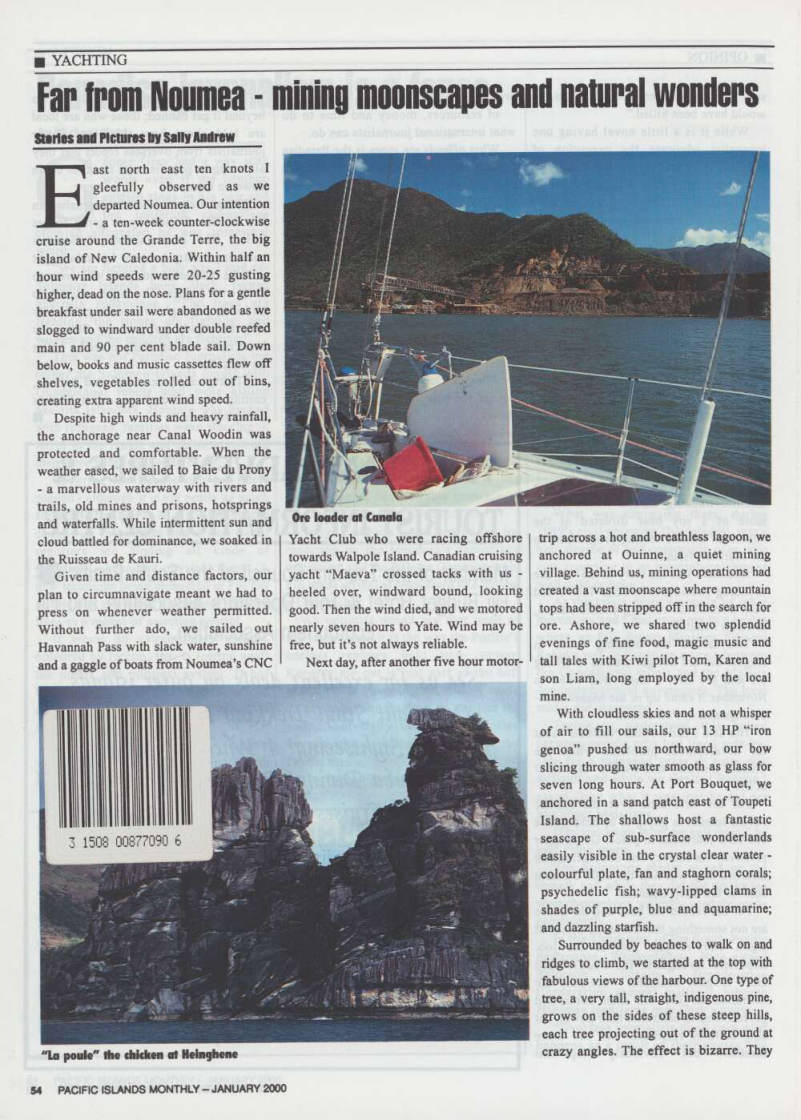
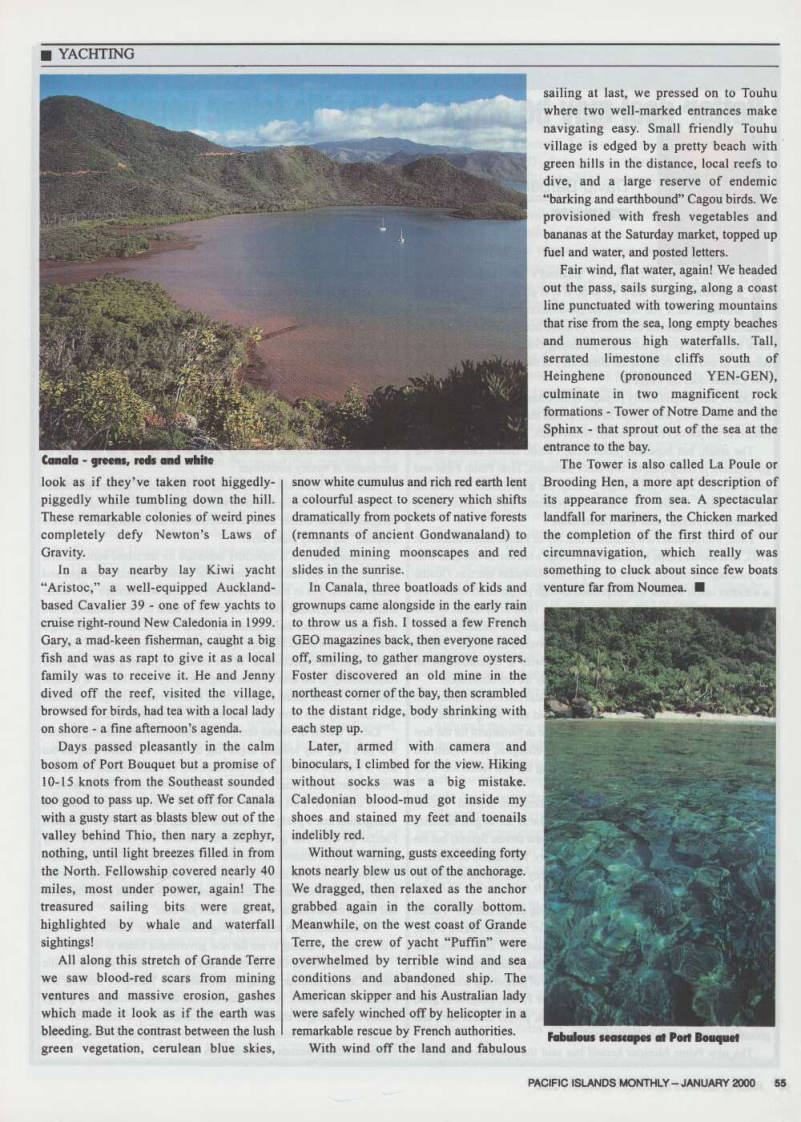
Yachting
Storles and Pictures by Sally Andrew
East north east ten knots I gleefully observed as we departed Noumea. Our intention - a ten-week counter-clockwise cruise around the Grande Terre, the big island of New Caledonia. Within half an hour wind speeds were 20-25 gusting higher, dead on the nose. Plans for a gentle breakfast under sail were abandoned as we slogged to windward under double reefed main and 90 per cent blade sail. Down below, books and music cassettes flew off shelves, vegetables rolled out of bins, creating extra apparent wind speed.
Despite high winds and heavy rainfall, the anchorage near Canal Woodin was protected and comfortable. When the weather eased, we sailed to Baie du Prony - a marvellous waterway with rivers and trails, old mines and prisons, hotsprings and waterfalls. While intermittent sun and cloud battled for dominance, we soaked in the Ruisseau de Kauri.
Given time and distance factors, our plan to circumnavigate meant we had to press on whenever weather permitted.
Without further ado, we sailed out Havannah Pass with slack water, sunshine and a gaggle of boats from Noumea’s CNC
Yacht Club who were racing offshore towards Walpole Island. Canadian cruising yacht “Maeva” crossed tacks with us heeled over, windward bound, looking good. Then the wind died, and we motored nearly seven hours to Yate. Wind may be free, but it’s not always reliable.
Next day, after another five hour motor
trip across a hot and breathless lagoon, we anchored at Ouinne, a quiet mining village. Behind us, mining operations had created a vast moonscape where mountain tops had been stripped off in the search for ore. Ashore, we shared two splendid evenings of fine food, magic music and tall tales with Kiwi pilot Tom, Karen and son Liam, long employed by the local mine.
With cloudless skies and not a whisper of air to fill our sails, our 13 HP “iron genoa” pushed us northward, our bow slicing through water smooth as glass for seven long hours. At Port Bouquet, we anchored in a sand patch east of Toupeti Island. The shallows host a fantastic seascape of sub-surface wonderlands easily visible in the crystal clear water colourful plate, fan and staghorn corals; psychedelic fish; wavy-lipped clams in shades of purple, blue and aquamarine; and dazzling starfish.
Surrounded by beaches to walk on and ridges to climb, we started at the top with fabulous views of the harbour. One type of tree, a very tall, straight, indigenous pine, grows on the sides of these steep hills, each tree projecting out of the ground at crazy angles. The effect is bizarre. They
"la poule" the chicken at Heinghene
Ore loader at Canala
look as if they’ve taken root higgedly piggedly while tumbling down the hill.
These remarkable colonies of weird pines completely defy Newton’s Laws of
Gravity.
In a bay nearby lay Kiwi yacht “Aristoc,” a well-equipped Auckland based Cavalier 39 - one of few yachts to cruise right-round New Caledonia in 1999.
Gary, a mad-keen fisherman, caught a big fish and was as rapt to give it as a local family was to receive it. He and Jenny dived off the reef, visited the village, browsed for birds, had tea with a local lady on shore - a fine afternoon’s agenda.
Days passed pleasantly in the calm bosom of Port Bouquet but a promise of 10-15 knots from the Southeast sounded too good to pass up. We set off for Canala with a gusty start as blasts blew out of the valley behind Thio, then nary a zephyr, nothing, until light breezes filled in from the North. Fellowship covered nearly 40 miles, most under power, again! The treasured sailing bits were great, highlighted by whale and waterfall
sightings!
All along this stretch of Grande Terre we saw blood-red scars from mining ventures and massive erosion, gashes which made it look as if the earth was bleeding. But the contrast between the lush green vegetation, cerulean blue skies.
snow white cumulus and rich red earth lent a colourful aspect to scenery which shifts dramatically from pockets of native forests (remnants of ancient Gondwanaland) to denuded mining moonscapes and red slides in the sunrise.
In Canala, three boatloads of kids and grownups came alongside in the early rain to throw us a fish. I tossed a few French GEO magazines back, then everyone raced off, smiling, to gather mangrove oysters.
Foster discovered an old mine in the northeast comer of the bay, then scrambled to the distant ridge, body shrinking with each step up.
Later, armed with camera and binoculars, I climbed for the view. Hiking without socks was a big mistake.
Caledonian blood-mud got inside my shoes and stained my feet and toenails indelibly red.
Without warning, gusts exceeding forty knots nearly blew us out of the anchorage.
We dragged, then relaxed as the anchor
grabbed again in the corally bottom.
Meanwhile, on the west coast of Grande Terre, the crew of yacht “Puffin” were overwhelmed by terrible wind and sea conditions and abandoned ship. The American skipper and his Australian lady were safely winched off by helicopter in a remarkable rescue by French authorities.
With wind off the land and fabulous
sailing at last, we pressed on to Touhu where two well-marked entrances make navigating easy. Small friendly Touhu village is edged by a pretty beach with green hills in the distance, local reefs to dive, and a large reserve of endemic “barking and earthbound” Cagou birds. We provisioned with fresh vegetables and bananas at the Saturday market, topped up fuel and water, and posted letters.
Fair wind, flat water, again! We headed out the pass, sails surging, along a coast line punctuated with towering mountains that rise from the sea, long empty beaches and numerous high waterfalls. Tall, serrated limestone cliffs south of Heinghene (pronounced YEN-GEN), culminate in two magnificent rock formations - Tower of Notre Dame and the Sphinx - that sprout out of the sea at the entrance to the bay.
The Tower is also called La Poule or Brooding Hen, a more apt description of its appearance from sea. A spectacular landfall for mariners, the Chicken marked the completion of the first third of our circumnavigation, which really was something to cluck about since few boats venture far from Noumea. ■
Canala - greens, reds and white
Fabulous seascapes at Port Bouquet
Better deal may be ahead for Pacific Island population
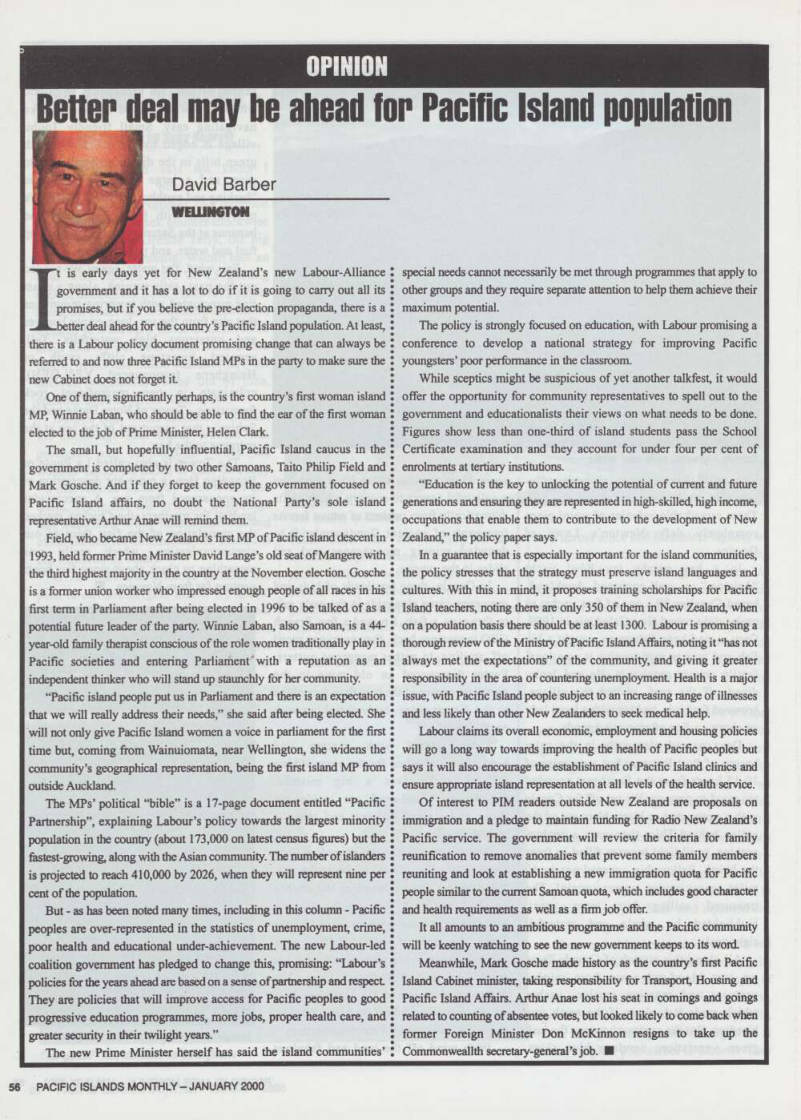
It is early days yet for New Zealand’s new Labour-Alliance government and it has a lot to do if it is going to cany out all its promises, but if you believe the pre-election propaganda, there is a better deal ahead for the country’s Pacific Island population. At least, there is a Labour policy document promising change that can always be referred to and now three Pacific Island MPs in the party to make sure the new Cabinet does not foiget it One of them, significantly perhaps, is the countiy’s first woman island MP, Winnie Laban, who should be able to find the ear of the first woman elected to the job of Prime Minister, Helen Clark.
The small, but hopefully influential. Pacific Island caucus in the government is completed by two other Samoans, Taito Philip Field and Mark Gosche. And if they forget to keep the government focused on Pacific Island affairs, no doubt the National Party’s sole island representative Arthur Anae will remind them.
Field, who became New Zealand’s first MP of Pacific island descent in 1993, held former Prime Minister David Lange’s old seat of Mangere with the third highest majority in the country at the November election. Gosche is a former union worker who impressed enough people of all races in his first term in Parliament after being elected in 1996 to be talked of as a potential future leader of the party. Winnie Laban, also Samoan, is a 44year-old family therapist conscious of the role women traditionally play in Pacific societies and entering Parliament with a reputation as an independent thinker who will stand up staunchly for her community.
“Pacific island people put us in Parliament and there is an expectation that we will really address their needs,” she said after being elected. She will not only give Pacific Island women a voice in parliament for the first time but, coming from Wainuiomata, near Wellington, she widens the community’s geographical representation, being the first island MP from outside Auckland.
The MPs’ political “bible” is a 17-page document entitled “Pacific Partnership”, explaining Labour’s policy towards the largest minority population in the country (about 173,000 on latest census figures) but the fastest-growing, along with the Asian community. The number of islanders is projected to reach 410,000 by 2026, when they will represent nine per cent of the population.
But - as has been noted many times, including in this column - Pacific peoples are over-represented in the statistics of unemployment, crime, poor health and educational under-achievement. The new Labour-led coalition government has pledged to change this, promising: “Labour’s policies for the years ahead are based on a sense of partnership and respect They are policies that will improve access for Pacific peoples to good progressive education programmes, more jobs, proper health care, and greater security in their twilight years.”
The new Prime Minister herself has said the island communities’
special needs cannot necessarily be met through programmes that apply to other groups and they require separate attention to help them achieve their maximum potential.
The policy is strongly focused on education, with Labour promising a conference to develop a national strategy for improving Pacific youngsters’ poor performance in the classroom.
While sceptics might be suspicious of yet another talkfest, it would offer the opportunity for community representatives to spell out to the government and educationalists their views on what needs to be done.
Figures show less than one-third of island students pass the School Certificate examination and they account for under four per cent of enrolments at tertiary institutions.
“Education is the key to unlocking the potential of current and future generations and ensuring they are represented in high-skilled, high income, occupations that enable them to contribute to the development of New Zealand,” the policy paper says.
In a guarantee that is especially important for the island communities, the policy stresses that the strategy must preserve island languages and cultures. With this in mind, it proposes training scholarships for Pacific Island teachers, noting there are only 350 of them in New Zealand, when on a population basis there should be at least 1300. Labour is promising a thorough review of the Ministry of Pacific Island Affairs, noting it “has not always met the expectations” of the community, and giving it greater responsibility in the area of countering unemployment Health is a major issue, with Pacific Island people subject to an increasing range of illnesses and less likely than other New Zealanders to seek medical help.
Labour claims its overall economic, employment and housing policies will go a long way towards improving the health of Pacific peoples but says it will also encourage the establishment of Pacific Island clinics and ensure appropriate island representation at all levels of the health service.
Of interest to PIM readers outside New Zealand are proposals on immigration and a pledge to maintain funding for Radio New Zealand’s Pacific service. The government will review the criteria for family reunification to remove anomalies that prevent some family members reuniting and look at establishing a new immigration quota for Pacific people similar to the current Samoan quota, which includes good character and health requirements as well as a firm job offer.
It all amounts to an ambitious programme and the Pacific community will be keenly watching to see the new government keeps to its word.
Meanwhile, Marie Gosche made history as the country’s first Pacific Island Cabinet minister, taking responsibility for Transport, Housing and Pacific Island Affairs. Arthur Anae lost his seat in comings and goings related to counting of absentee votes, but looked likely to come back when former Foreign Minister Don McKinnon resigns to take up the Commonweallth secretary-general’s job. ■
David Barber
Wellington
Riotous in Seattle
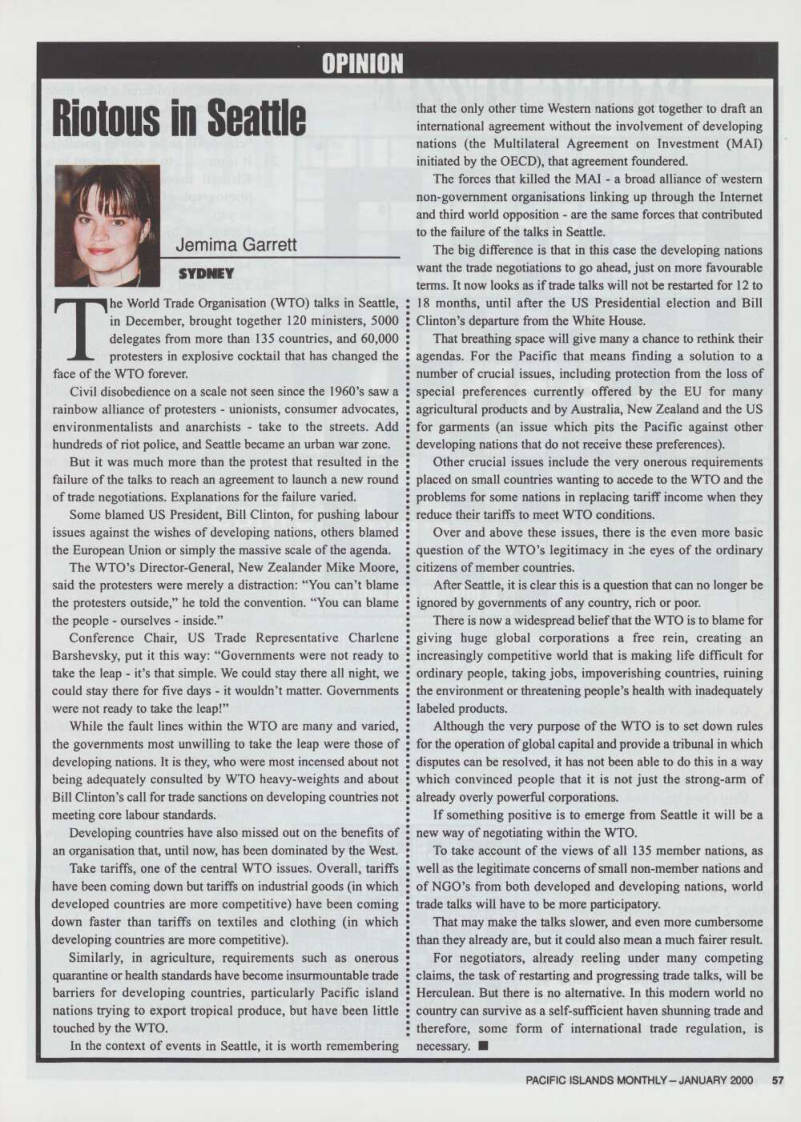
The World Trade Organisation (WTO) talks in Seattle, in December, brought together 120 ministers, 5000 delegates from more than 135 countries, and 60,000 protesters in explosive cocktail that has changed the face of the WTO forever.
Civil disobedience on a scale not seen since the 1960’s saw a rainbow alliance of protesters - unionists, consumer advocates, environmentalists and anarchists - take to the streets. Add hundreds of riot police, and Seattle became an urban war zone.
But it was much more than the protest that resulted in the failure of the talks to reach an agreement to launch a new round of trade negotiations. Explanations for the failure varied.
Some blamed US President, Bill Clinton, for pushing labour issues against the wishes of developing nations, others blamed the European Union or simply the massive scale of the agenda.
The WTO’s Director-General, New Zealander Mike Moore, said the protesters were merely a distraction: “You can’t blame the protesters outside,” he told the convention. “You can blame the people - ourselves - inside.”
Conference Chair, US Trade Representative Charlene Barshevsky, put it this way: “Governments were not ready to take the leap - it’s that simple. We could stay there all night, we could stay there for five days - it wouldn’t matter. Governments were not ready to take the leap!”
While the fault lines within the WTO are many and varied, the governments most unwilling to take the leap were those of developing nations. It is they, who were most incensed about not being adequately consulted by WTO heavy-weights and about Bill Clinton’s call for trade sanctions on developing countries not meeting core labour standards.
Developing countries have also missed out on the benefits of an organisation that, until now, has been dominated by the West.
Take tariffs, one of the central WTO issues. Overall, tariffs have been coming down but tariffs on industrial goods (in which developed countries are more competitive) have been coming down faster than tariffs on textiles and clothing (in which developing countries are more competitive).
Similarly, in agriculture, requirements such as onerous quarantine or health standards have become insurmountable trade barriers for developing countries, particularly Pacific island nations trying to export tropical produce, but have been little touched by the WTO.
In the context of events in Seattle, it is worth remembering
that the only other time Western nations got together to draft an international agreement without the involvement of developing nations (the Multilateral Agreement on Investment (MAI) initiated by the OECD), that agreement foundered.
The forces that killed the MAI - a broad alliance of western non-govemment organisations linking up through the Internet and third world opposition - are the same forces that contributed to the failure of the talks in Seattle.
The big difference is that in this case the developing nations want the trade negotiations to go ahead, just on more favourable terms. It now looks as if trade talks will not be restarted for 12 to 18 months, until after the US Presidential election and Bill Clinton’s departure from the White House.
That breathing space will give many a chance to rethink their agendas. For the Pacific that means finding a solution to a number of crucial issues, including protection from the loss of special preferences currently offered by the EU for many agricultural products and by Australia, New Zealand and the US for garments (an issue which pits the Pacific against other developing nations that do not receive these preferences).
Other crucial issues include the very onerous requirements placed on small countries wanting to accede to the WTO and the problems for some nations in replacing tariff income when they reduce their tariffs to meet WTO conditions.
Over and above these issues, there is the even more basic question of the WTO’s legitimacy in the eyes of the ordinary citizens of member countries.
After Seattle, it is clear this is a question that can no longer be ignored by governments of any country, rich or poor.
There is now a widespread belief that the WTO is to blame for giving huge global corporations a free rein, creating an increasingly competitive world that is making life difficult for ordinary people, taking jobs, impoverishing countries, ruining the environment or threatening people’s health with inadequately labeled products.
Although the very purpose of the WTO is to set down rules for the operation of global capital and provide a tribunal in which disputes can be resolved, it has not been able to do this in a way which convinced people that it is not just the strong-arm of already overly powerful corporations.
If something positive is to emerge from Seattle it will be a new way of negotiating within the WTO.
To take account of the views of all 135 member nations, as well as the legitimate concerns of small non-member nations and of NGO’s from both developed and developing nations, world trade talks will have to be more participatory.
That may make the talks slower, and even more cumbersome than they already are, but it could also mean a much fairer result.
For negotiators, already reeling under many competing claims, the task of restarting and progressing trade talks, will be Herculean. But there is no alternative. In this modem world no country can survive as a self-sufficient haven shunning trade and therefore, some form of international trade regulation, is necessary. ■
Jemima Garrett
Sydney
Pacific Puzzle

Extra
Across 1. With Hammerstein, he created the musical South Pacific. 4. Angling to find some food. 7. Go down. Vicar and strangely, you’ll see a mask, club or turtle. 9. Ratline confused with communal toilet. 10. The Sportsman’s Beer, Samoan’s Very Own Beer and It’s The Real
Thing! 11. Misguidedly, the mongoose was moved to Fiji to make a meal of this. 13. Groans about wraparound. 15. North-west Pacific dwellers. 16. Foreigner oddly found in Lae. 17. Skills ... or ships? 19. Crazy red cat searched his family tree to find ancestors.
22. Guam’s only indigenous mammal, considered a tasty treat by Chamorros. 24. FSM’s Lower Mortlock atoll “chuuked” as far east as possible. 25. It is an to stand upright in a Kiribati maeaba, or to take a photograph of an elderly person in yap. 26. I train lad to strangely take on ways of his ancestors. 27. Places of worship in Fiji. 28. Tuna treat could hardly be described as a raw deal.
Down 1. Lotteries? No, think of Singapore, Nadi and Suva 2. Confused? Ire soon will build over disappearing land 3. Played in more than 140 countries, you can watch this from February to November in Fiji 4. Fiji’s set for change in growing industry’s venue 5. Ocean wanderers 6. For drinks and shading yourself from the Pacific sun 7. Papeete’s meaning sounds like it could be used to carry liquid (6,6) 8. Honiara is a capital place on this Solomon island 12. Little eastern neighbour of Vanuatu’s Tanna Island 14. Island fuel 15. Small island on west coast of Pohnpei sounds like a social insect 17. Chemical element found in coral and milk 18. I-Kiribati name for Gilbert Islands 20. Purifies sugar ... or teaches how to use subtlety in speech 21. Red kite strangely flies over major waterways on Fiji’s Vanua Levu 22. Plaits, as in palm fronds or hair 23. Six not around when poisonous substances emerge
Check Out Pim On The Web
@ www.pim.com.fj
ACROSS: 1. (Richard) Rodgers 4, Fishing 7. Woodcarving 9. Latrine 10.
Slogans 11. Rat 13. Sarong 15. Asians 16. Alien 17. Grafts 19. Traced 22. Bat 24. Lukunor 25. Offence 26. Traditional 27. Mosques 28. Sashimi DOWN: 1. Raffles 2. Erosion 3. Soccer 4. Forest 5. Sailors 6. Glasses 7. Water Basket 8. Guadalcanal 12. Aniwa 14.
Gas 15. Ant 17. Calcium 18. Tungam 20.
Refines 21. Dreketi 22. Braids 23.
Toxins
Advertisements & other items, pp. 59-60 (1 item)
:# Video
ime m *
Conferencing
—T* Video Conferencing is an exciting
new technology involving a high-
speed, two-way, audio-visual
communications link
confer F&Eto FACE Wijth people
virtually Anywhere, in tl|e world.
pssafa The International Video Conferencing Service at Vatuwaqa in Suva, is par£ of RNTEb’S lent to the , s v, services. 1 r % m more information:
L FREE 0800 - 315718
V Fiji International Telecommunications Limited, Mercury House, 158 Victoria Parade, PO Box 59, Suva, Fiji Islands.
Telephone (679) 312 933, Fax (679) 301 025, Email [email protected] • Website http://www.fintel.com.fj
rA P/4<C V ; ¥> WA m ' f l Vf.
L A \ '
FSB
w am ‘ * 1 * ” c -"v ! :
vly
£
No challengers -
Toyota Land Cruiser stays on top
ftBRARY
OF
FEB
2000 Toyota Land Cruiser 100 dominates the world of 4x4s. None other can match its robust power, provided by superior engine technology.
It gives breathtaking performance, backed by an amazingly rugged suspension that can take you anywhere you want to go, on road or off.
Nevertheless, riding in a Toyota Land Cruiser 100 is like travelling in a luxurious sedan. Its more than ample room inside contains all the comforts and conveniences you’d expect of a winner.
Remember this. Only Toyota's advanced technology can create the symphony of power, performance, and lavish comfort you find in Land Cruiser 100. No wonder it's the champion. Again.
Cl Lr
STATION WAGON
<&> TOYOTA
KIRIBATI TARAWA MOTORS PH 21090
PAPUA NEW GUINEA ELA MOTORS PH 3229400
TAHITI NIPPON AUTOMOTO PH 429819
SAMOA ASCO MOTORS PH 20800
DISTRIBUTORS / DEALERS
NORFOLK ISLAND BORRY’S PTY LTD. PH 22114
SOLOMON ISLANDS ELA MOTORS PH 30314
VANUATU ASCO MOTORS PH 22341
COOK ISLANDS PACIFIC MOTORS LTD. PH 20700
FIJI ASCO MOTORS PH 384888
NEW CALEDONIA S.IAP. PH 275562
TONGA ASCO MOTORS PH 23500
AMERICAN SAMOA ASCO MOTORS PH 633-4281