lessons fee Poclfk must moll
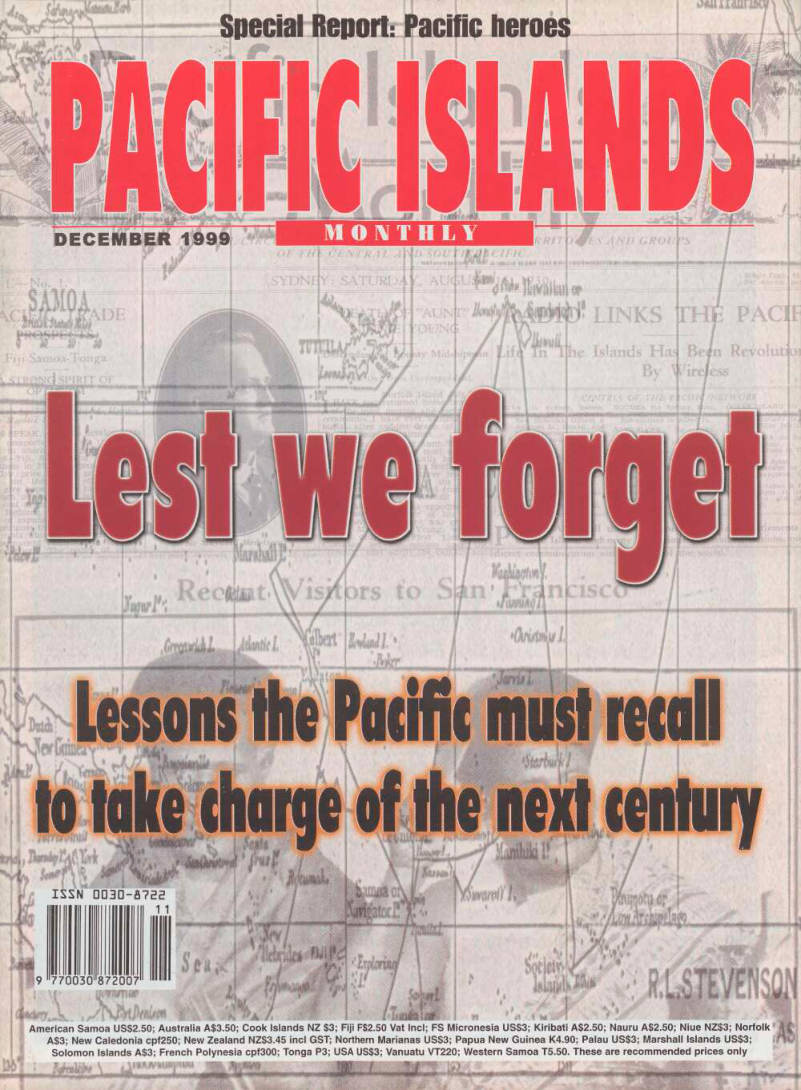
Pacific Islands
Monthly
Special Report: Pacific heroes
December 1999
WMMap ■ /f ' I I I I • D • fT /; 7 JL.^4„L. .BW ftrf" . * t 'I \% ' I =,.. Sft if !f- i. ! I . * ... I V' 1 % -i..
lessons fee Poclfk must moll
m bWbi^ip *4" ,^pminrpbmlll j^Vvlrh mmm^iwm f* .!*f< \* I ♦♦ I * ”js& I X * tsf ’ fk' ■
American Samoa USS2.SO; Australia A 53.50; Cook Islands NZ $3; Fiji F 52.50 Vat Incl; FS Micronesia USS 3; Kiribati A 52.50; Nauru A 52.50; Niue NZS3; Norfolk As 3; New Caledonia cpf2so; New Zealand NZ53.45 incl GST; Northern Marianas US$3; Papua New Guinea K 4.90; Palau US$3; Marshall Islands US$3; Solomon Islands As 3; French Polynesia cpf3oo; Tonga P 3; USA US$3; Vanuatu VT22O; Western Samoa T 5.50. These are recommended prices only
Advertisements & other items, p. 2 (1 item)
Co|2Oept J 999 (087)275 566
■v* ,Zm vr V. tm 3T
DZi»
w a o £3 V 15, rue Guynemer - PO Box 2384 Photos : Pantz - Aubry Located in the South Pacific, New Caledonia is a developed, sophisticated island business base that offers outstanding opportunities for investors : stunning sites for new hotel developments, suitable climate for counter-season fruits and vegetables, superb locations for fish and prawn aquaculture, and more. Authorities in New Caledonia are very supportive to business.
New Caledonia also offers a range of quality products (fruits & vegetables, seafood, agri-food products, etc.), services and technology (including water, energy, environment), meeting international requirements and expectations. We promote our products through regular visits to foreign markets.
ADECAL, the Economic Development Agency of New Caledonia, is the one-stop-shop where you can get specific advise on doing business with New Caledonia. As your free-of-charge partner, we shall assist you in identifying opportunities and putting together your project successfully.
Should you like to receive further information, please do not hesitate to contact either Benoit RENGADE or Yann PITOLLET Inward Investment On 55-5 S>\ Ms Doriane SANCHEZ-LEBRIS Export Division www.adecal.nc E-mail: [email protected]
Anrrai
1 V L_ / VL-
New Caledonia Economic Development Agency Cedex - New Phone; (687) ,249 077 • Fax: (687) 249 087 - www.adecal.nc • E-mail; [email protected]
CO|2OEPT J 999 (087)275 566
Pacific Islands
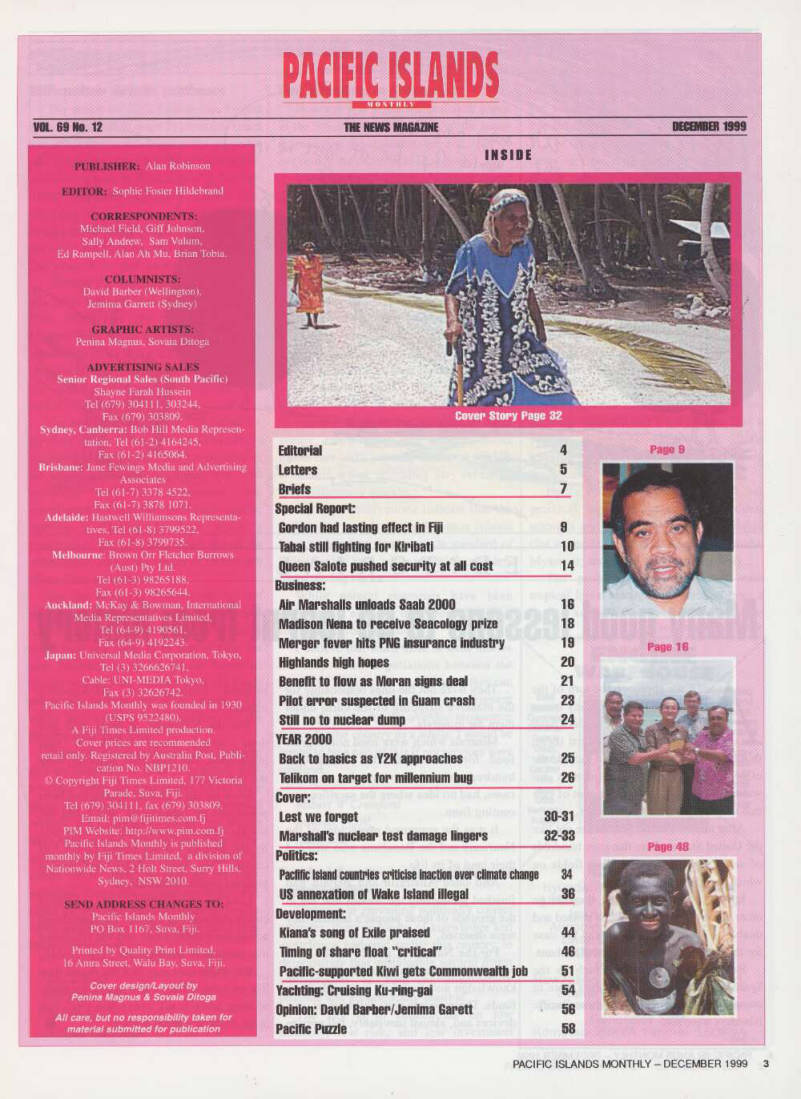
Vol. 69 No. 12
The News Magazine
December 1999
Alan Robinson Sophie Foster Hildebrand Michael Field, Giff Johnson, Sally Andrew, SamVulum, Ed Rampell, Alan Ah Mu, Brian Tobia.
David Barber (Wellington), Jemima Garrett (Sydney) Penina Magnus, Sovaia Ditoga Senior Regional Sales (South Pacific) Shayne Farah Hussein Tel (679) 304111,303244, Fax (679) 303809.
Sydney, Canberra: Bob Hill Media Represen tation, Tel (61-2)4164245, Fax (61-2) 4165064.
Brisbane: Jane Fewings Media and Advertising Associates Tel (61-7) 3378 4522, Fax (61-7) 3878 1071.
Adelaide: Hastwell Williamsons Representa tives, Tel (61-8) 3799522, Fax (61-8) 3799735.
Melbourne: Brown Orr Fletcher Burrows (Aust) Pty Ltd.
Tel (61-3) 98265188, Fax (61-3) 98265644.
Auckland: McKay & Bowman, International Media Representatives Limited, Tel (64-9) 4190561, Fax (64-9) 4192243.
Japan: Universal Media Corporation, Tokyo, Tel (3) 3266626741, Cable: UNI-MEDIA Tokyo, Fax (3) 32626742.
Pacific Islands Monthly was founded in 1930
(Usps 9522480).
A Fiji Times Limited production.
Cover prices are recommended retail only. Registered by Australia Post, Publi cation No. NBPI2IO. © Copyright Fiji Times Limited, 177 Victoria Parade, Suva, Fiji.
Tel (679) 304111, fax (679) 303809.
Email; [email protected] PIM Website: http://www.pim.com.fj Pacific Islands Monthly is published monthly by Fiji Times Limited, a division of Nationwide News, 2 Holt Street, Surry Hills, Sydney, NSW 2010.
Pacific Islands Monthly PO Box 1167, Suva. Fiji.
Printed by Quality Print Limited, 16 Amra Street, Walu Bay, Suva, Fiji.
Cover design/Layout by Penina Magnus & Sovaia Ditoga All care, but no responsibility taken for material submitted for publication
Inside
|V u'l U~ : ll
Editorial 4 Letters 5 Briefs 7 Special Report: Gordon had lasting effect in Fiji 9 Tabai still fighting for Kiribati 10 Queen Salote pushed security at all cost 14 Business: Air Marshalls unloads Saab 2000 16 Madison Nona to receive Seacology prize 18 Merger fever hits PNG insurance industry 19 Highlands high hopes 20 Benefit to flow as Moran signs deal 21 Pilot error suspected in Guam crash 23 Still no to nuclear dump 24
Year 2000
Back to basics as Y2K approaches 25 Telikom on target for millennium bug 26 Cover: Lest we forget 30-31 Marshall's nuclear test damage lingers 32-33 Politics: Pacfific Island countries criticise inaction over climate change 34 US annexation of Wake Island illegal 36 Development: Kiana's song of Exile praised 44 liming of share float "critical" 46 Pacific-supported Kiwi gets Commonwealth job 51 Yachting; Cruising Ku-ring-gai 54 Opinion: David Barber/Jemima Garett 56 Pacific Puzzle 58
Page 9
Page 16
Page 48
Many good lessons to be learnt from history
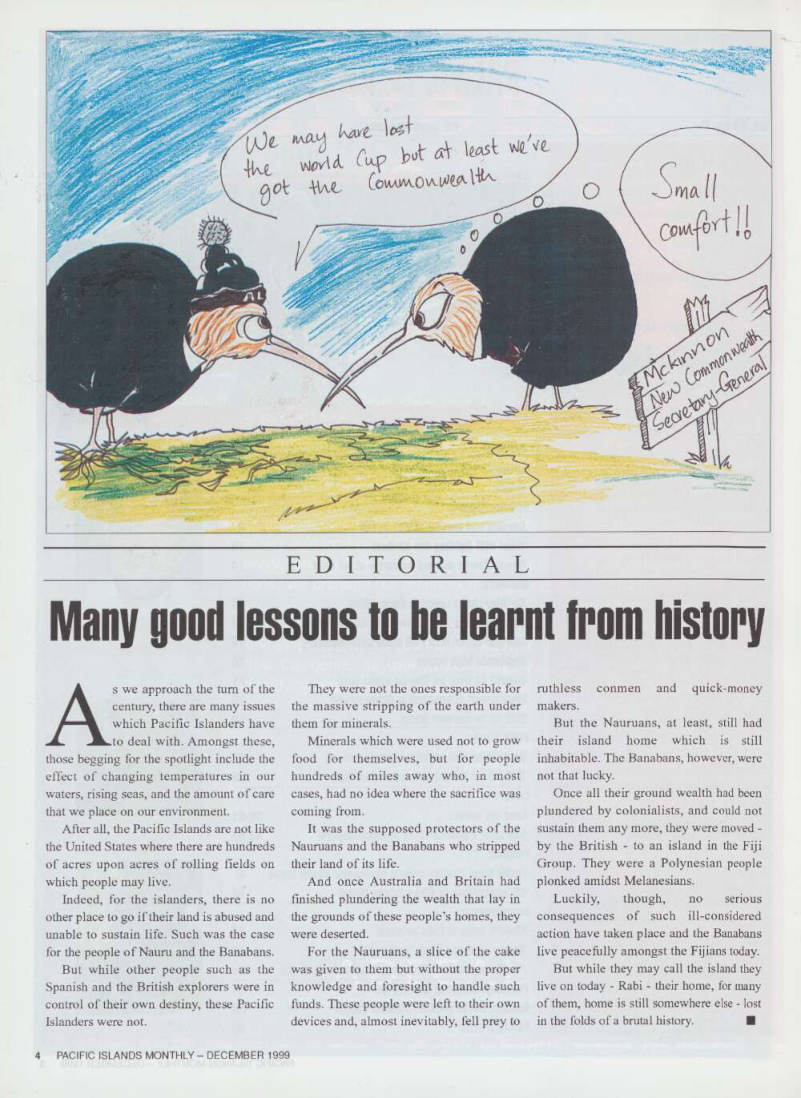
Editorial
As we approach the turn of the century, there are many issues which Pacific Islanders have to deal with. Amongst these, those begging for the spotlight include the effect of changing temperatures in our waters, rising seas, and the amount of care that we place on our environment.
After all, the Pacific Islands are not like the United States where there are hundreds of acres upon acres of rolling fields on which people may live.
Indeed, for the islanders, there is no other place to go if their land is abused and unable to sustain life. Such was the case for the people of Nauru and the Banabans.
But while other people such as the Spanish and the British explorers were in control of their own destiny, these Pacific Islanders were not.
They were not the ones responsible for the massive stripping of the earth under them for minerals.
Minerals which were used not to grow food for themselves, but for people hundreds of miles away who, in most cases, had no idea where the sacrifice was
coming from.
It was the supposed protectors of the Nauruans and the Banabans who stripped their land of its life.
And once Australia and Britain had finished plundering the wealth that lay in the grounds of these people’s homes, they were deserted.
For the Nauruans, a slice of the cake was given to them but without the proper knowledge and foresight to handle such funds. These people were left to their own devices and, almost inevitably, fell prey to
ruthless conmen and quick-money makers.
But the Nauruans, at least, still had their island home which is still inhabitable. The Banabans, however, were not that lucky.
Once all their ground wealth had been plundered by colonialists, and could not sustain them any more, they were moved by the British - to an island in the Fiji Group. They were a Polynesian people plonked amidst Melanesians.
Luckily, though, no serious
consequences of such ill-considered action have taken place and the Banabans
live peacefully amongst the Fijians today.
But while they may call the island they live on today - Rabi - their home, for many of them, home is still somewhere else - lost in the folds of a brutal history. ■
Letters
Millennium debate continues
The article on Fiji’s Millennium Project (October 1999 PIM, page 21) contains errors and misinterpretations about the purposes and outcomes of the Meridian Conference, which was held in Washington in October 1884. The most important error is that, although the Meridian Conference did define the location of the 180 meridian, it did NOT establish- the 180 meridian as “the line where every day starts and ends.”
The line that determines where the new day starts and ends is the International Date Line. While the 180 meridian and the International Date Line do have some similarities (both being artificial, man-made constructs, overlapping in some places), they are two entirely different things, with entirely different functions.
The Meridian Conference did define the location of the 0 meridian (at Greenwich) and by doing so also defined the location of all other meridians, including the 180 meridian. And this conference also established a Universal Day/Time (again, starting at Greenwich) from which a progressive set of time zones would be established. This is the origin of Greenwich Mean Time (GMT).
But the Meridian Conference did not define the 180-degree line where every new day starts and ends. Accordingly, Fiji cannot make base any claim to be first to greet the new Millennium based on the Meridian Conference and the 180 meridian. As I said previously, determining where each new day starts and ends is the function of the International Date Line.
There are places where the 180 meridian and the International Date Line march side by-side. There are also places where their : paths go separate ways. For historical reasons, the Kingdom of Tonga has always been west of the International Date Line, and so shares the same day as Fiji. But, by virtue of its position east of the 180meridian, Tonga reaches that day before Fiji.
Good try, Fiji. But when it comes to the new Millennium, Tonga will still get there first.
Happy New Year!
Denis Wolff
PO Box 1239 Nuku ’alofa Kingdom of Tonga
Sod situation in Solomons
How sad it is to see the prevalent unrest in the Solomon Islands. Although the issues representing the arguments are real, they do not justify the recent acts of violence.
There is clearly a lack of leadership and direction for the people, in terms of better living standards and economic prosperity for the country as a whole.
It should be obvious to the people of the Solomon Islands (responsible for the violence) that if they cannot work together as a people, they cannot united as a nation and thereby resolve the problems.
Having visited the Solomon Islands many times in recent years, I have found the people to be true to their reputation earned as “friendly and kind”. There are immense opportunities for the Solomon Island people to move into the new millennium with secure employment and growth, better health care and a greater place in the world’s economic arena, providing they reconcile their differences quickly.
My own observations indicate that the indigenous people of the Solomon islands have endured an unacceptable standard of living for too long, while watching outsiders make the big bucks.
While natural resources have been exploited, at a loss to the “people”, all this can change, for the better.
I believe that when there is some mature and responsible negotiations between the people of Malaita and Guadalcanal, they can as ONE people approach the government and begin plans for the overdue prosperous future for the country as a whole. I would be happy to be a part of this if my services were
required.
Robert W Crawford
Inverell, NSW, Australia
sustainability

Tropical forestry: a long history of sustainability
Contrary to prevailing politically correct attitudes, there is plenty of knowledge and experience, gathered earlier this century, to demonstrate that sustainable natural forest management is both environmentally possible and economically feasible.
The key is to concentrate on low intensity, low risk, and low investment
operations, based on a long felling cycle and the supply of small volumes of quality tropical hardwoods.
The suggested viable operations that came out from my research in the Solomon Islands native forestry areas is an operation that can yield 4,000 to 6,000 cubic metres of
export-grade quality logs every 45-days
cycle and can last for up to three (3) years operation and within 5-12 kilometres radius from its logpond area.
The modern vogue towards Reduced
Impact Logging (RIL) is re-inventing
principles of good tropical forestry practiced
extensively prior to the 19605. These themes were introduced in a paper presented by one Professor E F Bruenig at a meeting at Oxford University wherein I am a member of its sponsored and backed Oxford Club.
Bruenig suggests and I fully agree that a century of progress prior to the 1960 s towards sustainable tropical forest management is well recorded.
By the end of that period, elaborate, but practical, logging and management codes, manuals and plans were readily available (for example in India, Indonesia, Uganda, Myanmar, and Malaysia to name a few).
The problems now associated with tropical forest management resulted from a move away from planned Selection
Continued next page
Continued from previous page
Silviculture Management systems towards exploitative Selective Logging from the 1960 s onwards.
During these years, strong political support for forestry faded as what happened in the Solomon Islands. Politicians and economists questioned the relevance for developing countries of keeping forests standing, arguing for liquidation and reinvestment of the proceeds in the country.
Far from helping to prevent this process, western environmentalism in the 1980 s contributed to the problem.
Environmentalists came up with the unhelpful notion that tropical hardwood boycotts would slow the plunder. Their campaigns were based on a romanticised emotional response rather than a
recognition of real problems.
They only blurred the distinction between exploitative Selective Logging and regulated Selection silviculture.
The public has been misled into
believing that tropical forests are too fragile to be managed for timber. In fact, rainforest are “robust, elastic, and resilient, exactly because of their ... diversity. Contrary to common belief tropical rainforest ecosystems are, as a result, easy to manage with commonsense and an ecosystem
compatible attitude.”
Much of the international forest policy debate during the 1990 s has provided little new insight, involving esoteric but uninformed discussions of “sustainability” and reinventing “new” criteria for
measuring sustainability.
Certification is anew and potentially useful idea, but is no panacea. It “is over
optimistic, ignores existing forestry
procedures and social and economic realities.” Certification only covers a tiny proportion of the world’s forests and demand is weak except within the European Market. Forest dwelling people in the
tropics are often adamantly opposed to
certification.
So what is the answer?
Bruenig suggests that “the transition from timber mining to sustainable management in tropical forests will certainly need more than the decade set by ITTO Target 2000.”
In European forestry, this evolution took more than a millennium.
Only three tropical countries seem to set on the road to sustainability.
Implementation of sustainability requires a complete reshaping of moral behaviour.
It also depends on public support.
Systems and ownership structures that
involve local people directly in forestry
management, like those that evolved over centuries in European countries, are essential.
Through consultation, tropical countries need to develop national and regional goals for forest management. With political and public support and adequate resources, state forest services can deliver sustainable management.
Natural tropical forest management
Continued next page
Continued from previous page
should focus on the production of limited volumes of high quality hardwood like kwila, vitex, pometia, calophyllum, terminalia, dillenia and amoora, for which continued and increasing demand seems assured. Other timber grades, “lesser known species”, and non-wood forest products will
play only a supplementary role particularly
if they are having to compete with similar
products from plantations.
“Nature mimicking ecosystem management in some form of Selection Management System has the greatest chance to be the ‘least wrong’ approach to tropical forest management ecologically, economically, and socially.”
Now, the only problem being experienced by the indigenous Solomon Islanders who are forest resource owners is that there’s no real and direct support from the ministry of forestry explaining to these people that there’s an answer and a way for a sustainable tropical forest harvesting.
It was really quite surprising to read, in a previous issue of the Solomon Star, about current commissioner of forests, Peter Sheehan, making a complaint about the way that the natural forests of the country are being harvested. If there is a violation on the part of a logging company, why not cancel their logging licence(s) immediately?
Some time in September, I wrote a letter to the “Pacific Islands Forests & Trees Support Programme (PIFTSP) in Suva, Fiji, requesting information about their organisation and programmes related to sustainable harvesting of tropical forests in the Pacific.
And it’s really quite surprising that a month later, we received a faxed correspondence from Peter Sheehan
requesting our indigenous-owned Solomon
Islander company, the Island Timber’s Enterprise, provide him with details and information about our company because PIFTSP had requested it.
The best thing he could have done was just advise PIFTSP to provide the information we requested from them. Why the fuss?
Do those foreigners, working within the ministry of forests, not want the indigenous people of the Solomon Islands to run logging operations in a sustainable way? If they do, then it would be contrary to what they are publicly preaching. Why is the action against the indigenous Solomon Islanders and not against those big foreign
owned companies?
I, through the Island Timber’s Enterprise, am now invoking a crusade - to assist all indigenous resource owners, who seek our assistance, to manage their forests
sustainably and economically.
We are prepared to eradicate any obstacle and opposition that we may find on the way to Solomon Islanders fully benefitting from their God-given natural forest resources.
Ramon Jun Quitales, 11, CIF, Marketing director, Island Timber’s Enterprise, Solomon Islands
Advertisements & other items, p. 5 (1 item)
■engine!
BMW
Bedford Cummins Daihatsu Detroit Deutz Ford Gardner Hino Isuzw tveco Komatsu Kubota
WAREHOUSE
PHONE
643-6938122
FAX
643-6938120 mm
New Zetland
email: blairsGdearnelNZ Subaru Leyland Mazda Mercedes Mitsubishi
MAN.
Nissan Perkins Suzuki Toyota Volvo Yanmar
NEW ENGINES
Hyundai/Mitsubishi equivalent
188 hp @ 2900 128 hp @ 2000 Isuzu 4JBI Mazda R 2 Aircooled industrial engines-
Listers 18/21/32/44hp
Dentze 290 hp v/10
Parts Division
New/used cylinder heads tested.
Starters and engine parts
Transmissions for most models Generator Sets Komatsu 29KVA Yanmar 150KVA 105051V1
Archives-December 1944
Wasted petrol in Tahiti
THERE probably is no place on earth where petrol is so persistently and joyously wasted as in Tahiti particularly by truck drivers.
One of the favourite procedures is to clean (or attempt to clean) foul sparkplugs by racing the motors.
When a motor begins to stutter in a manner that informs any experienced driver that a foul spark plug is the cause, our learned Tahiti chauffeurs will try everything but the obvious method of unscrewing and cleaning the
plug.
Often the lorry will stand on one spot for half an hour while the chauffeur presses down the accelerator pedal, at intervals of five seconds, until the whole neighbourhood is filled with noise, petrol fumes, and profanity - as though a Panzer division were operating there.
The only variation, in the case of a choked carburettor, is that - after the usual period of thunder and profanity the lorry is bunted ahead a hundred yards, and the process repeated.
Another procedure is carried out whenever a lorry is sent to deliver a box of groceries to the Mission (distance half a kilometre). The route home is invariably via Fautaua Avenue, and Prince Hinoi Road (a distance of two and a half kilometres) in order that the chauffeur and his assistants may be refreshed after their arduous labours.
The enigma of the errands of the empty lorries that buzz throuigh the highways and byways of Papeette at all hours of the day and far into tine night, constitutes a mystery as profoumd and dismal as Easter Island.
Airmail to Cook Islands
The arrival of the first plane to land on Rarotonga (chief island of the Cook Group) was made the occasion, in November, of a public celebration.
It was a civilian plane, with a NZ Air Force crew, and it inaugurated what is hoped will become a regular weekly airmail service - Auckland - Nukualofa (Tonga) - Aitutaki (Cook Is) - Rarotonga.
Among civilian officials who made this initial survey flight was Mr C McKay, secretary of the NZ Islands Territories Department. ■
Used phone cards wanted
My name is Mario Beltramini, and I am sending you this message on behalf of my son, Michel, who wishes to ask a favour, which, I hope, will not be of too much trouble.
He is collecting telephone cards, so, should anyone have any used ones, would you mind not throwing them away, but sending them to him? Many thanks in advance!
My son address: Michel Beltramini 2, Boulevard du Tenao Monte Carlo (Principality of Monaco) Mario Beltramini Monte Carlo Monaco
Briefs
PNG signs border treaty with AustraEa Papua New Guinea has agreed to make it easier for the entry and exit of Australian officials on cross-border patrols. This is an agreement that Australia already has in place for PNG officials. This was one of the important decisions reached at the PNG/Australia Torres Strait Joint Advisory Council meeting held in Port Moresby in November. Two other important matters that arose from the meeting were an agreement by PNG and Australia to work together on responses to cross border emergencies and the start of negotiations on a bilateral
expedition treaty.
Australian High Commissioner, Nick Warner described the treaty as unique in character. “I can’t think of any other treaty between two countries that is as flexible as
this treaty. It is open and willing in its provisions to allow cross- border movements by traditional inhabitants,” he said. He said the treaty shows the special relationship between Australia and PNG. 67 fishermen granted licences The French Polynesian cabinet has approved some 67 deep sea fishing licences, the government’s press office announced. The licences were granted to seven large-size tuna fishing boats, and sixty smaller-sized fishing vessels. Sixty-four per cent of these are fishing in the Wayward group of islands (East of Tahiti), 19 per cent in the Leeward group (West of Tahiti), 10 per cent in the Tuamotu archipelago (East of Tahiti) and six per cent in the Marquesas group (East of Tahiti). Fifteen of the 67 are renewals.
Continued next page
The licencing move is also aimed at making it easier for small fishing businesses to justify some sort of government approval when asking for loans with financial institutions.
New Caledonia forecasts a record 1,600
tonnes farm shrimp production
New Caledonia’s farm shrimp producing group Sopac forecasts a record figure of 1,600 tonnes of shrimps by the end of the year, daily newspaper Les Nouvelles Caledoniennes reported.
The expected quantity is 28 per cent higher than last year and twice as much as the production of three years ago. Sopac is packaging about 80 per cent of the shrimps
for export. The group explains this year was good for shrimp production, because of the
frequent rains, which are boosting shrimp
growth in a farming environment. Latest figures show some 1,434 tonnes were already produced as at June 30 this year.
Court closed to pubic, media The public and the media were not allowed to “further mentions” in the Supreme Court of the murder charges against the former Samoan cabinet ministers, Leafa Vitale and Toi Aokuso.
Leafa and Toi are charged jointly with the murder of the late Samoan minister of public works, Luagalau Levaula Kamu, on the night of July 16 this year. Toi is also charged with incite to murder and incite to murder the PM in connection with
Levaula's assassination.
Leafa and Toi themselves were ddenied bail and have been detained in PPolice custody since charges were filed aggainst them in late July. The trials will begpn on January 17, 2000, and unless an ordder is made otherwise, they will be in open court and the public and the media will have access to the courtroom.
Frenchman to cross the Pacific on
floating skis
Frenchman Remi Brica intends tov start a walk across the Pacific ocean this month on his floating skis, RFO-radio reported.
Once known as a one-man band singer making regular appearances on French television in the late seventies, Brica has since devoted his time to his real passion: challenging the sea.
“I will cross the Pacific from Los Angeles to Sydney on my floating skis,” he said at a press conference held in Paris. The distance is estimated to be about 14,000 kilometres. Brica would start his trans pacific floating marathon on December 15 from Los Angeles.
Way paved for anti-trust protection for
US territories US Congressman Robert Underwood said Guam and the territories may soon
have equal protection against monopolistic
business practices with passage in the House of H.R. 1801, a bill that clarifies that US anti-trust laws fully apply to the territories.
“This is very important corrective legislation,” the Congressman said. “We wanted to make sure that the businesses that conduct their affairs in Guam and the other territories, whether they are corporations from the outside or are locally owned, do not engage in monopolistic practices.”
“This legislation is necessary because of the fact that many of the anti-trust laws are discussed only in terms of the states.
When attempts were made to thwart those corporations which tried to establish monopolies in the territories, the issues were sometimes clouded by the political status of the territories and by questions of the applicability of the laws,” Underwood said. H.R. 1801 will now go to the Senate, where it is expected to pass and become law sometime next year. ■
Advertisements & other items, pp. 7-8 (2 items)
“I can go
anywhere”
Can carry people, am amphibious, cart big loads, pull trailers “I love fishing, climbing mountains, camping in the outback, being profitable, weed spraying, leave others in my tracks.”
To learn more about me send your address for a brochure or visit us on the Web at www.argoatu.com
From NZSI2,SOO+CSI
BLAIRS
New Zealand National Distributors Telephone 643-6938122 Fax 643-6938120 PO Box 14, Geraldine NZ E-mail [email protected] 119312V1
FIJI ISLAND ADVENTURES &
TOURIST INFORMATION CENTRE
Member of the Tourism Council of the South Pacific m Fiji Budget Hotel & Tour Operators Association and Fiji Ecotourism Association.
See us for excellent deals on outer islands.
Overnight Stay! ‘Trekking Island Safaris!
dhstory Sightseeing! 4 Wheel Safari Hours!
Surfing Seuha Diving! “Budget Accommodations!
Cruises and Weddings!
Talk to us first we live here ... book direct and ask for: Free independent information on latest deals!
Free booking services and many options!
Free airport transfers to hotel of your choice in Nadi!
Free greet on arrival & maps. Also general info on Fiji Write to us now or [email protected] PO Box 251 Nadi Fiji Islands Ph: 679 700243 Fax: 679 702746 Internetrwww.fijiadventures.com.fj
Continued from previous page
Gordon had lasting effect In Fig
Special Report
By Sophie Foster Hildebrand
There are many people whose actions have had an impact on
Fiji’s development this century
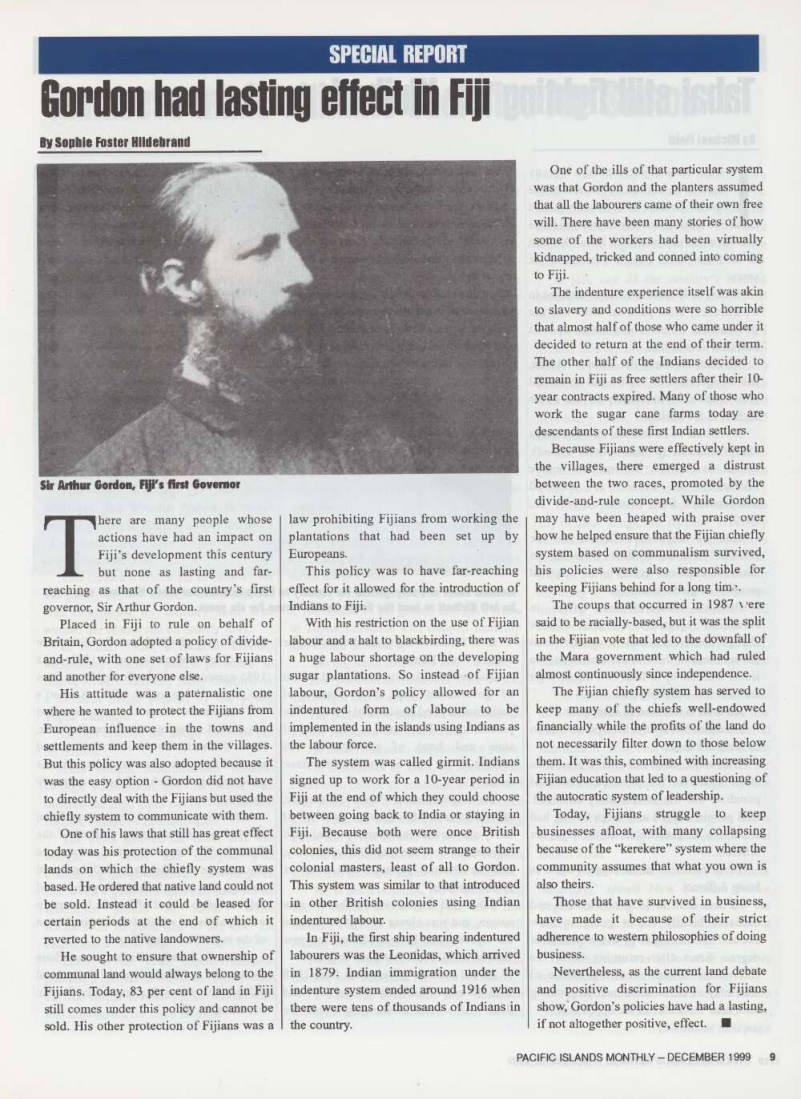
but none as lasting and far reaching as that of the country’s first governor, Sir Arthur Gordon.
Placed in Fiji to rule on behalf of Britain, Gordon adopted a policy of divide and-rule, with one set of laws for Fijians and another for everyone else.
His attitude was a paternalistic one where he wanted to protect the Fijians from European influence in the towns and settlements and keep them in the villages.
But this policy was also adopted because it was the easy option - Gordon did not have to directly deal with the Fijians but used the chiefly system to communicate with them.
One of his laws that still has great effect today was his protection of the communal lands on which the chiefly system was based. He ordered that native land could not be sold. Instead it could be leased for certain periods at the end of which it reverted to the native landowners.
He sought to ensure that ownership of communal land would always belong to the Fijians. Today, 83 per cent of land in Fiji still comes under this policy and cannot be sold. His other protection of Fijians was a
law prohibiting Fijians from working the plantations that had been set up by Europeans.
This policy was to have far-reaching effect for it allowed for the introduction of Indians to Fiji.
With his restriction on the use of Fijian labour and a halt to blackbirding, there was a huge labour shortage on the developing sugar plantations. So instead of Fijian labour, Gordon’s policy allowed for an indentured form of labour to be implemented in the islands using Indians as the labour force.
The system was called girmit. Indians signed up to work for a 10-year period in Fiji at the end of which they could choose between going back to India or staying in Fiji. Because both were once British colonies, this did not seem strange to their colonial masters, least of all to Gordon.
This system was similar to that introduced in other British colonies using Indian indentured labour.
In Fiji, the first ship bearing indentured labourers was the Leonidas, which arrived in 1879. Indian immigration under the indenture system ended around 1916 when there were tens of thousands of Indians in the country.
One of the ills of that particular system was that Gordon and the planters assumed that all the labourers came of their own free will. There have been many stories of how some of the workers had been virtually kidnapped, tricked and conned into coming
to Fiji.
The indenture experience itself was akin to slavery and conditions were so horrible that almost half of those who came under it decided to return at the end of their term.
The other half of the Indians decided to remain in Fiji as free settlers after their 10year contracts expired. Many of those who work the sugar cane farms today are descendants of these first Indian settlers.
Because Fijians were effectively kept in the villages, there emerged a distrust between the two races, promoted by the divide-and-rule concept. While Gordon may have been heaped with praise over how he helped ensure that the Fijian chiefly system based on communalism survived, his policies were also responsible for keeping Fijians behind for a long time.
The coups that occurred in 1987 were said to be racially-based, but it was the split in the Fijian vote that led to the downfall of the Mara government which had ruled
almost continuously since independence.
The Fijian chiefly system has served to keep many of the chiefs well-endowed financially while the profits of the land do not necessarily filter down to those below them. It was this, combined with increasing Fijian education that led to a questioning of the autocratic system of leadership.
Today, Fijians struggle to keep businesses afloat, with many collapsing because of the “kerekere” system where the community assumes that what you own is also theirs.
Those that have survived in business, have made it because of their strict adherence to western philosophies of doing business.
Nevertheless, as the current land debate and positive discrimination for Fijians show, Gordon’s policies have had a lasting, if not altogether positive, effect. ■
Sir Arthur Gordon, Fiji's first Governor
Tabai still fighting far Kiribati
By Michael Held
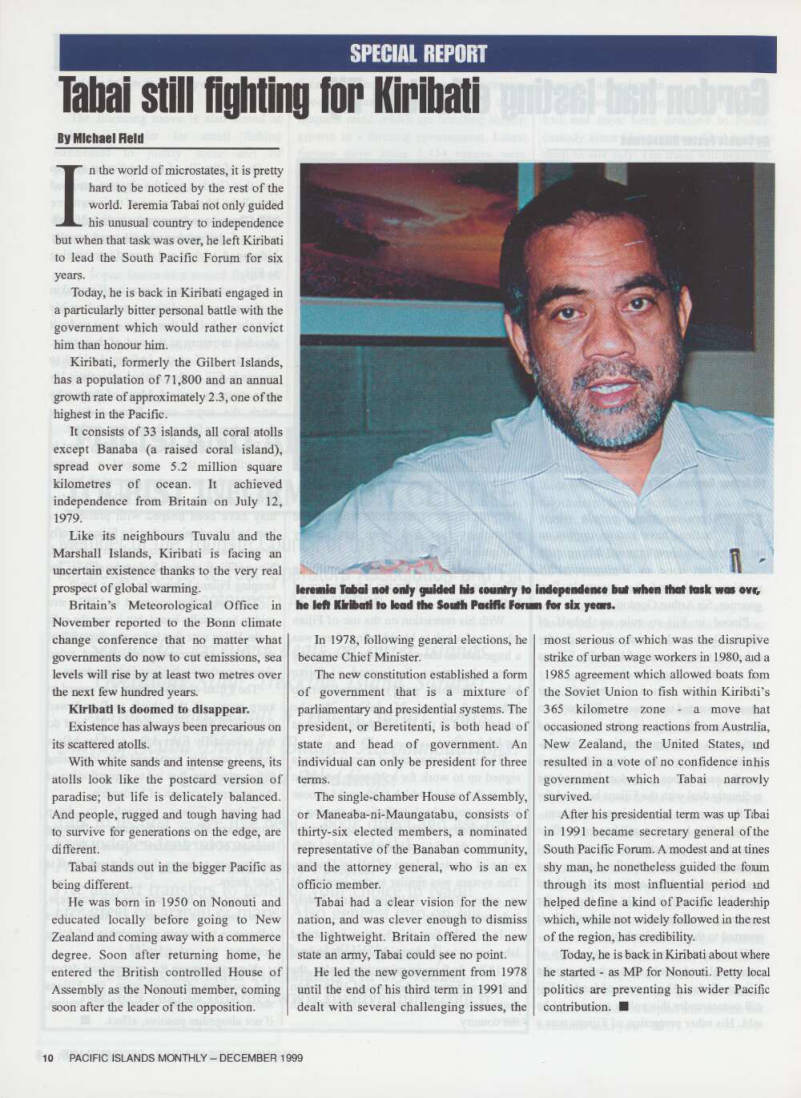
In the world of microstates, it is pretty hard to be noticed by the rest of the world. leremia Tabai not only guided his unusual country to independence but when that task was over, he left Kiribati to lead the South Pacific Forum for six years.
Today, he is back in Kiribati engaged in a particularly bitter personal battle with the government which would rather convict him than honour him.
Kiribati, formerly the Gilbert Islands, has a population of 71,800 and an annual growth rate of approximately 2.3, one of the highest in the Pacific.
It consists of 33 islands, all coral atolls except Banaba (a raised coral island), spread over some 5.2 million square kilometres of ocean. It achieved independence from Britain on July 12, 1979.
Like its neighbours Tuvalu and the Marshall Islands, Kiribati is facing an uncertain existence thanks to the very real prospect of global warming.
Britain’s Meteorological Office in November reported to the Bonn climate change conference that no matter what governments do now to cut emissions, sea levels will rise by at least two metres over the next few hundred years.
Kiribati Is doomed to disappear.
Existence has always been precarious on its scattered atolls.
With white sands and intense greens, its atolls look like the postcard version of paradise; but life is delicately balanced.
And people, rugged and tough having had to survive for generations on the edge, are different.
Tabai stands out in the bigger Pacific as
being different.
He was born in 1950 on Nonouti and educated locally before going to New Zealand and coming away with a commerce degree. Soon after returning home, he entered the British controlled House of Assembly as the Nonouti member, coming soon after the leader of the opposition.
In 1978, following general elections, he became Chief Minister.
The new constitution established a form of government that is a mixture of parliamentary and presidential systems. The president, or Beretitenti, is both head of state and head of government. An individual can only be president for three terms.
The single-chamber House of Assembly, or Maneaba-ni-Maungatabu, consists of thirty-six elected members, a nominated representative of the Banaban community, and the attorney general, who is an ex officio member.
Tabai had a clear vision for the new nation, and was clever enough to dismiss the lightweight. Britain offered the new state an army, Tabai could see no point.
He led the new government from 1978 until the end of his third term in 1991 and dealt with several challenging issues, the
most serious of which was the disrupive strike of urban wage workers in 1980, aid a 1985 agreement which allowed boats fom the Soviet Union to fish within Kiribdi’s 365 kilometre zone - a move hat occasioned strong reactions from Australia, New Zealand, the United States, md resulted in a vote of no confidence inhis government which Tabai narrovly survived.
After his presidential term was up T;bai in 1991 became secretary general of the South Pacific Forum. A modest and at tines shy man, he nonetheless guided the fount through its most influential period md helped define a kind of Pacific leadership which, while not widely followed in the rest of the region, has credibility.
Today, he is back in Kiribati about where he started - as MP for Nonouti. Petty local politics are preventing his wider Pacific contribution. ■
Lere[?]ia Tabai not only guided his country to independence but when that task was ovr, he left Ki[?]ba[?]i to lead the South Pacific Forum for six years.
Tamasese made ultimate sacrifice for Samoa

By Michael Held
It is politically expedient in Samoa
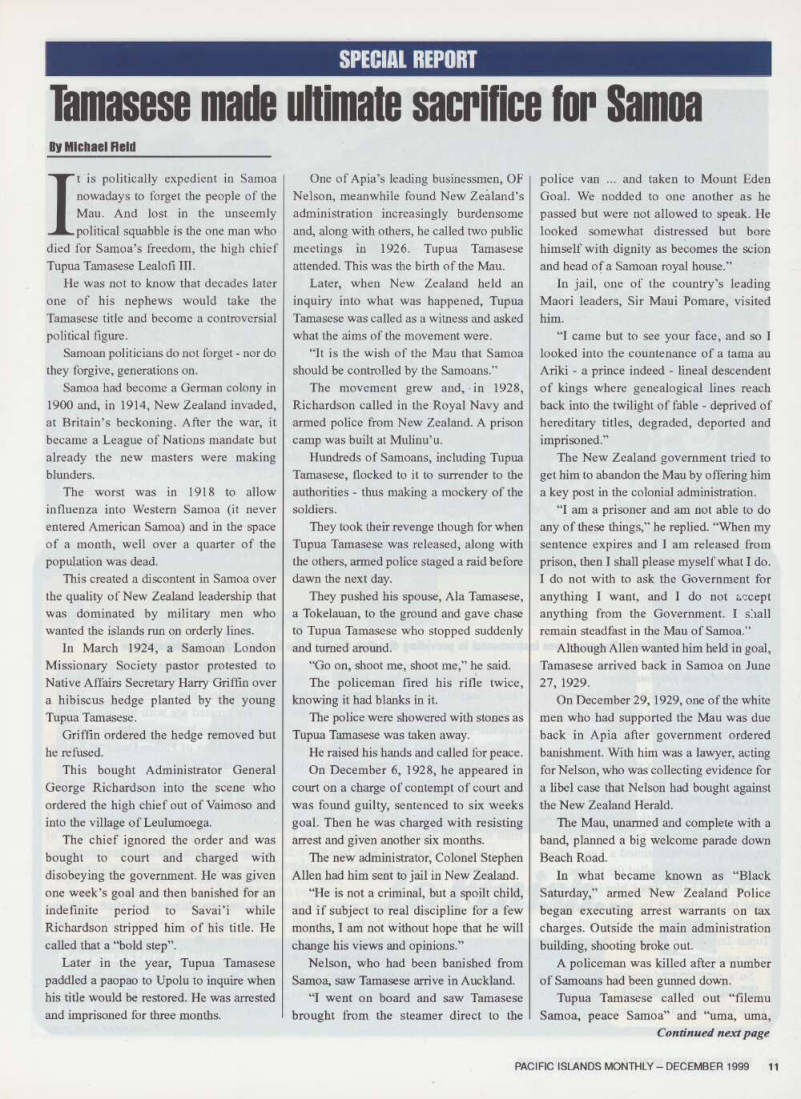
nowadays to forget the people of the Mau. And lost in the unseemly political squabble is the one man who died for Samoa’s freedom, the high chief Tupua Tamasese Lealofi 111.
He was not to know that decades later one of his nephews would take the Tamasese title and become a controversial
political figure.
Samoan politicians do not forget - nor do
they forgive, generations on.
Samoa had become a German colony in 1900 and, in 1914, New Zealand invaded, at Britain’s beckoning. After the war, it became a League of Nations mandate but already the new masters were making blunders.
The worst was in 1918 to allow influenza into Western Samoa (it never entered American Samoa) and in the space of a month, well over a quarter of the population was dead.
This created a discontent in Samoa over the quality of New Zealand leadership that was dominated by military men who wanted the islands run on orderly lines.
In March 1924, a Samoan London
Missionary Society pastor protested to
Native Affairs Secretary Harry Griffin over a hibiscus hedge planted by the young Tupua Tamasese.
Griffin ordered the hedge removed but he refused.
This bought Administrator General George Richardson into the scene who ordered the high chief out of Vaimoso and into the village of Leulumoega.
The chief ignored the order and was bought to court and charged with disobeying the government. He was given one week’s goal and then banished for an indefinite period to Savai’i while Richardson stripped him of his title. He called that a “bold step”.
Later in the year, Tupua Tamasese paddled a paopao to Upolu to inquire when his title would be restored. He was arrested and imprisoned for three months.
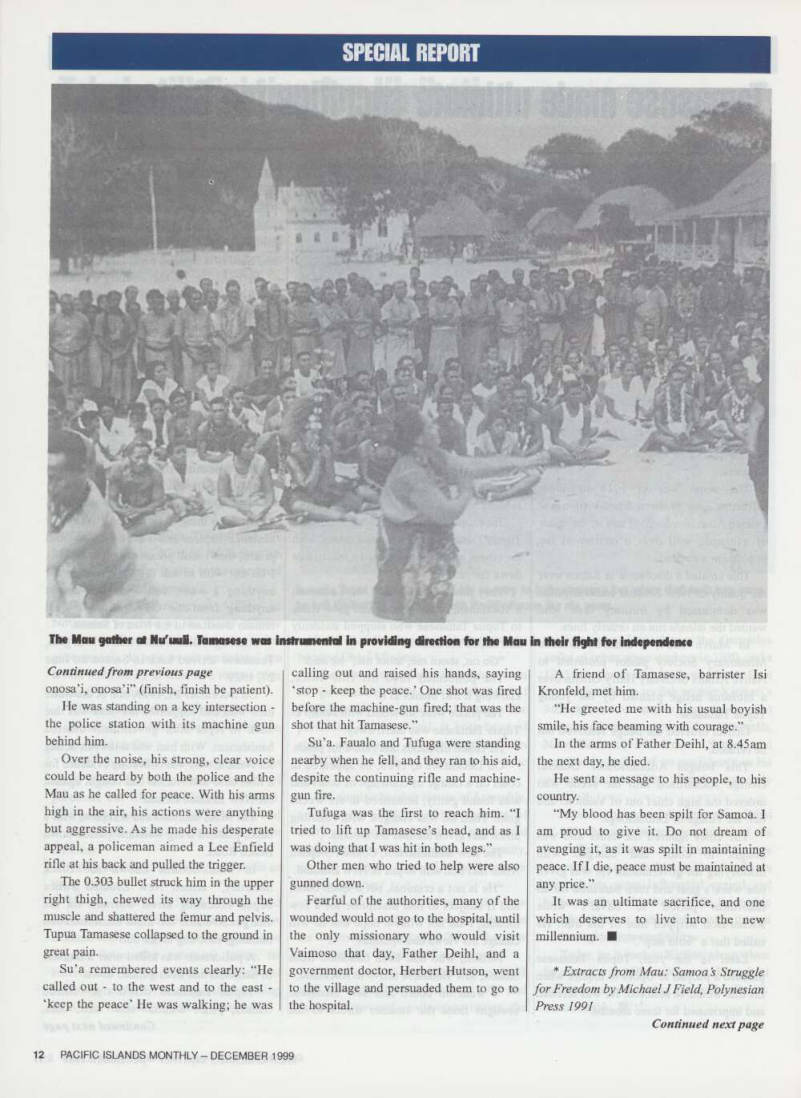
One of Apia’s leading businessmen, OF Nelson, meanwhile found New Zealand’s administration increasingly burdensome and, along with others, he called two public meetings in 1926. Tupua Tamasese attended. This was the birth of the Mau.
Later, when New Zealand held an inquiry into what was happened, Tupua Tamasese was called as a witness and asked what the aims of the movement were.
“It is the wish of the Mau that Samoa should be controlled by the Samoans.”
The movement grew and, in 1928, Richardson called in the Royal Navy and armed police from New Zealand. A prison camp was built at Mulinu’u.
Flundreds of Samoans, including Tupua Tamasese, flocked to it to surrender to the authorities - thus making a mockery of the soldiers.
They took their revenge though for when Tupua Tamasese was released, along with the others, armed police staged a raid before dawn the next day.
They pushed his spouse, Ala Tamasese, a Tokelauan, to the ground and gave chase to Tupua Tamasese who stopped suddenly and turned around.
“Go on, shoot me, shoot me,” he said.
The policeman fired his rifle twice, knowing it had blanks in it.
The police were showered with stones as Tupua Tamasese was taken away.
He raised his hands and called for peace.
On December 6, 1928, he appeared in court on a charge of contempt of court and was found guilty, sentenced to six weeks goal. Then he was charged with resisting arrest and given another six months.
The new administrator, Colonel Stephen Allen had him sent to jail in New Zealand.
“He is not a criminal, but a spoilt child, and if subject to real discipline for a few months, I am not without hope that he will change his views and opinions.”
Nelson, who had been banished from Samoa, saw Tamasese arrive in Auckland.
“I went on board and saw Tamasese brought from the steamer direct to the
police van ... and taken to Mount Eden Goal. We nodded to one another as he passed but were not allowed to speak. He looked somewhat distressed but bore himself with dignity as becomes the scion and head of a Samoan royal house.”
In jail, one of the country’s leading Maori leaders, Sir Maui Pomare, visited him.
“I came but to see your face, and so I looked into the countenance of a tama au Ariki - a prince indeed - lineal descendent of kings where genealogical lines reach back into the twilight of fable - deprived of hereditary titles, degraded, deported and
imprisoned.”
The New Zealand government tried to get him to abandon the Mau by offering him a key post in the colonial administration.
“I am a prisoner and am not able to do any of these things,” he replied. “When my sentence expires and I am released from prison, then I shall please myself what I do.
I do not with to ask the Government for anything I want, and I do not accept anything from the Government. I shall remain steadfast in the Mau of Samoa.”
Although Allen wanted him held in goal, Tamasese arrived back in Samoa on June 27, 1929.
On December 29,1929, one of the white men who had supported the Mau was due back in Apia after government ordered banishment. With him was a lawyer, acting for Nelson, who was collecting evidence for a libel case that Nelson had bought against the New Zealand Herald.
The Mau, unarmed and complete with a band, planned a big welcome parade down Beach Road.
In what became known as “Black Saturday,” armed New Zealand Police began executing arrest warrants on tax charges. Outside the main administration
building, shooting broke out.
A policeman was killed after a number of Samoans had been gunned down.
Tupua Tamasese called out “filemu Samoa, peace Samoa” and “uma, uma.
Continued next page
Continued from previous page
onosa’i, onosa’i” (finish, finish be patient).
He was standing on a key intersection the police station with its machine gun behind him.
Over the noise, his strong, clear voice could be heard by both the police and the Mau as he called for peace. With his arms high in the air, his actions were anything but aggressive. As he made his desperate appeal, a policeman aimed a Lee Enfield rifle at his back and pulled the trigger.
The 0.303 bullet struck him in the upper right thigh, chewed its way through the muscle and shattered the femur and pelvis.
Tupua Tamasese collapsed to the ground in great pain.
Su’a remembered events clearly: “He called out - to the west and to the east - ‘keep the peace’ He was walking; he was
calling out and raised his hands, saying ‘stop - keep the peace.’ One shot was fired before the machine-gun fired; that was the shot that hit Tamasese.”
Su’a. Faualo and Tufuga were standing nearby when he fell, and they ran to his aid, despite the continuing rifle and machine gun fire.
Tufuga was the first to reach him. “I tried to lift up Tamasese’s head, and as I was doing that I was hit in both legs.”
Other men who tried to help were also gunned down.
Fearful of the authorities, many of the wounded would not go to the hospital, until the only missionary who would visit Vaimoso that day, Father Deihl, and a government doctor, Herbert Hutson, went to the village and persuaded them to go to
the hospital.
A friend of Tamasese, barrister Isi Kronfeld, met him.
“He greeted me with his usual boyish smile, his face beaming with courage.”
In the arms of Father Deihl, at 8.45am the next day, he died.
He sent a message to his people, to his country.
“My blood has been spilt for Samoa. I am proud to give it. Do not dream of avenging it, as it was spilt in maintaining peace. If I die, peace must be maintained at
any price.”
It was an ultimate sacrifice, and one which deserves to live into the new millennium. ■ * Extracts from Man: Samoa’s Struggle for Freedom by Michael JField, Polynesian Press 1991 Continued next page
The Mau gather at Nu'uuli. Tamasese was instrumental in providing direction for the Mau in their fight for independence
Continued from previous page
Methodist based sect the monarch was nominally head of. The church was corrupt and power had slipped to a man, one Jabez Watkin.
Salote’s long legal and political battle eventually saw her win, the bulk of the church rejoined to the Free Wesleyan Church.
She was head of it and given the role of religion in Tongan life it gave her inordinate, near absolute power over Tongans. This has continued to her son and the Church, along with the Royals, continues to oppose change and any increased level of democracy.
Her reign was not repressive; rather it was mostly inert and conservative. Most of the world failed to notice and Salote’s one appearance on the global stage came at the coronation of Britain’s Elizabeth 11, she rode in a carriage in pouring rain with the roof down so people could see her winning the hearts of Londoners in the process. “I told the policeman to leave the
hood of our carriage down,” the Queen is quoted as saying. “I did not think to ask the chief (the Sultan of Kelantan), and he maintained silence with good grace.”
Salote died in Auckland in 1965, ending a reign of 47 years that saw the country change very little.
“Since the death of Queen Salote in 1965,” writes Wood-Ellem, “Tonga has
been struggling with the forces of modern economics; so much so that change seems to be spinning out of control, and Tonga survives only because about 40 percent of its people live overseas.”
Salote had clear goals; simply to secure her own future and that of her dynasty.
Tonga itself, and its people, came a distant third. ■
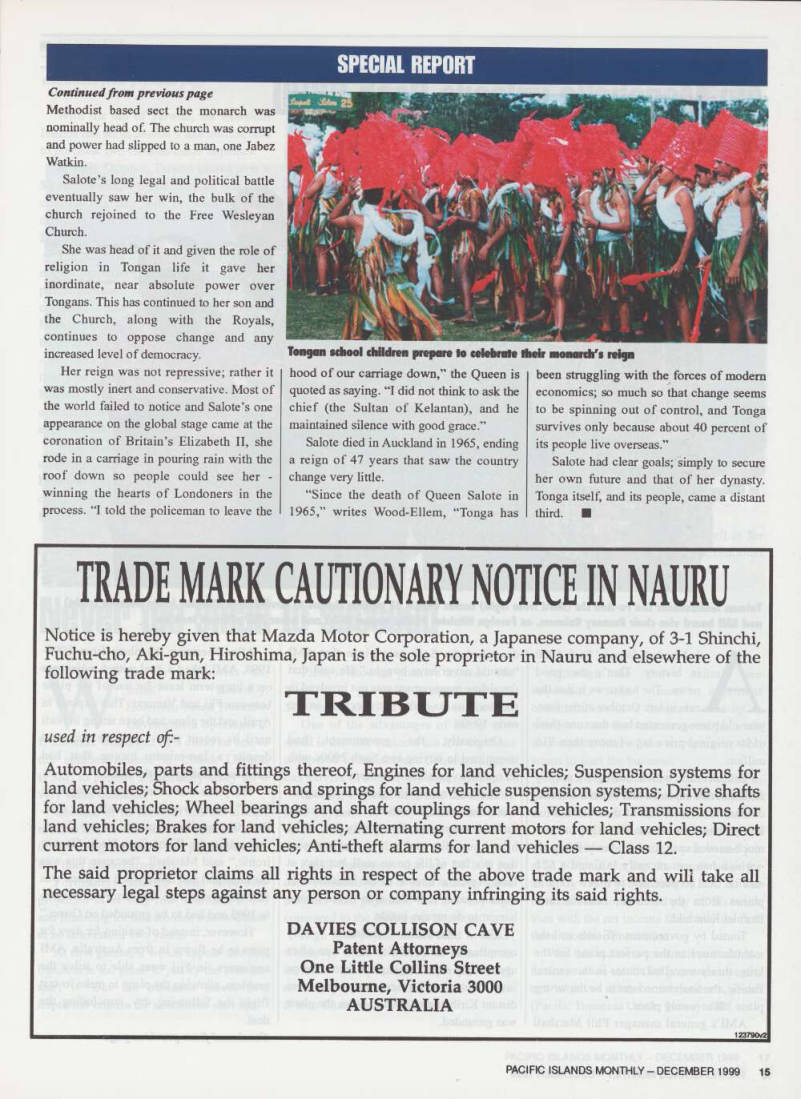
Tongan school children prepare to celebrate their monarch's reign
DeRoburt helped change Nauru's destiny
By Michael Held
As political leaders of the century go nobody quite touches Hammer Deßoburt for intrigue and mystery.
While he was tainted with corruption and frequently accused of gross mismanagement, Nauru owes its continued existence to the man who fought for their
independence.
He was born in 1923 when his country, just south of the Equator, was being destroyed by its new colonial masters, Britain, Australia and New Zealand who were secretly violating the League of Nation’s mandate they had been given over the former German colony.
Deßoburt got an education in Australia and became, for a time, part of the administration on the island until 1942 when the Japanese showed up.
The Japanese seemed to have a strange hatred of the Nauruans, subjecting them to a great deal of violence and insult - even while recognising that they were a
colonised people supposedly being
liberated from the West.
During the war 1200 Nauruans were taken off Nauru to Chuuk as slaves. By war’s end only 793 survived - including 23year-old Hammer Deßoburt.
In 1955, Deßoburt became the Head Chief of the Nauru Local Government Council, a position he was to never give up.
He, more than anybody else, led the charge for Nauru’s independence -and he had to deal the most with Australia which resisted him. At one point during negotiations Australia, anxious to hold onto
the phosphate riches, proposed moving the
Nauruans to Curtis Island off Queensland.
DeRoburt, observing it was rich in mosquitoes, dismissed the proposal saying it would mean the Nauruans would become like “another tribe of Aboriginals.”
He passionately argued his case before the UN Trusteeship Council, as noted in one of its reports.
“At its thirty-third session. Councillor Hammer DeRoburt, member of the Australian delegation and elected Head Chief of the Nauruan people, informed the Trusteeship Council that there was a very strong and earnest desire on the part of the Nauruan people to remain the people of a distinct small nation, which in a sense they were. No matter how small they were and how unimportant they may be to others, they wanted to be free to perpetuate their Continued next page
Continued from previous page homogeneity and to preserve themselves as a distinct people and nation. They wanted to shape their own destiny.”
In 1968 Nauru won its independence.
“In the end the people of Nauru had come to the conclusion that the island of Nauru, to which they had always belonged, must be their permanent homeland,”
Deßoburt said.
Hammer Deßoburt became president upon independence, serving from 1968 to 1976. He was returned to the presidency in 1978 and was re-elected in 1980, 1983, and 1987.
Deßoburt died in Melbourne in 1992.
He was a sinister man in many ways.
Unsmiling, short and aggressive, he surrounded himself with strange advisers.
He flew with a briefcase of money and turned Air Nauru into his personal carrier.
He was legendary for interfering in other countries, particularly the Cook Islands and Samoa. He was very secretive; Nauru would not belong to any international organisations under his leadership and government accounts was sparse at best.
History is coming to judge him as the father of his modern country but also the man who lost all the family silver. ■
Advertisements & other items, p. 13 (1 item)
From Start.
SCHOOLS
CHURCHES
-e Copymasters Hawaii can help you with all of your duplicating needs from start to finish. Featuring Duplo® Digital Duplicators, Copiers, Shredders, Laminators, Poster Printers, Collators, & Folding Equipment. We also sell Stencil & Duplicator Supplies, Paper Supply, and all brands of Copier Supplies, & Computers.
Copymasters Hawaii
96-1173 Waihona Street, Suite B-2 • Pearl City, HI 96782 Photic (808) 678-2263 • Fax (808) 456-5678
GOVERNMENT • COMMERCIAL
Serving:
STATE OF MWAH
ENTIRE
SOUTH PACIFIC,
INCLUDING:
FIJI
SAMOA
TAHITI
TONGA
COOK ISLANDS
m
MICRONESIA:
FEDERATED STATES
OF MICRONESIA
GUAM
MARIANAS
MARSHALL
ISLANDS
PALAU
copymasters
hawaii
Queen Salute pushed security at all costs
By Michael Held
If stability was a complete virtue, the Kingdom of Tonga would be among the world’s superpowers.
That most of its people are still as poor going into the new millennium as they were at the beginning of the 20th Century illustrates the perils of such stability.
In the entire 20th Century, Tonga has had just three heads of state and since 1923 has had just five unelected prime ministers.
More Tongans now live outside the Kingdom than in it while the royal family through schemes like passport sales, satellite slot leasing, breweries and Internet operations are richer than they have ever been.
The bulwark against change and development and the most influential figure in Tongan 20th Century was Salote Mafile’o Pilolevu, born on March 13, 1900, in the white wooden palace on Nuku’alofa’s coast.
She was the daughter of King Taufa’ahau Tupou II and Queen Levinia. At the time the royal family was both unpopular and uncertain, caught up in a swirl of domestic Tongan power struggle and imperial colonialism.
Salote’s mother died when she was two years-old. As a teenager she was sent to an Auckland boarding school where she lived for seven years.
When 18-years-old she returned home to an arranged marriage. Seven months later her father died and, on April 5, 1918, she was crowned Queen Salote Tupou 111.
Her first test of leadership was a disaster - the arrival of influenza on November 12, 1918. The ship Talune had also introduced
it into Samoa by evading quarantine.
Thousands of Tongans died within weeks.
Salote’s recent biographer, Elizabeth Wood-Ellem, says the queen failed her first test of her leadership.
“Her government broke down and took no action whatsoever to ameliorate the effects of the epidemic, either locally or nationally,” she wrote.
A white official strongly reprimanded
her at one point when she wanted to make a royal visit through Tongatapu villages. It was pointed out to her that more deaths would follow as a result.
“Salote took the reproach to heart, and was never again so neglectful of the welfare of her subjects,” Wood-Ellem said.
The queen was among the first advocates of the idea, still around, that Tonga is some kind of nirvana.
“There is not in the world a little
Kingdom like Tonga, peaceful, contented and happy,” said Salote in 1937.
She had three children, one of whom died when he was 16, another who as Prince Fatafehi Tu’ipelehake became the
kingdom's longest serving premier and her
eldest, Taufa’ahau Tupou IV who was born a crown prince and is the current king.
Salote’s major political battle was over religion and the Free Church of Tonga, the
Continued next page
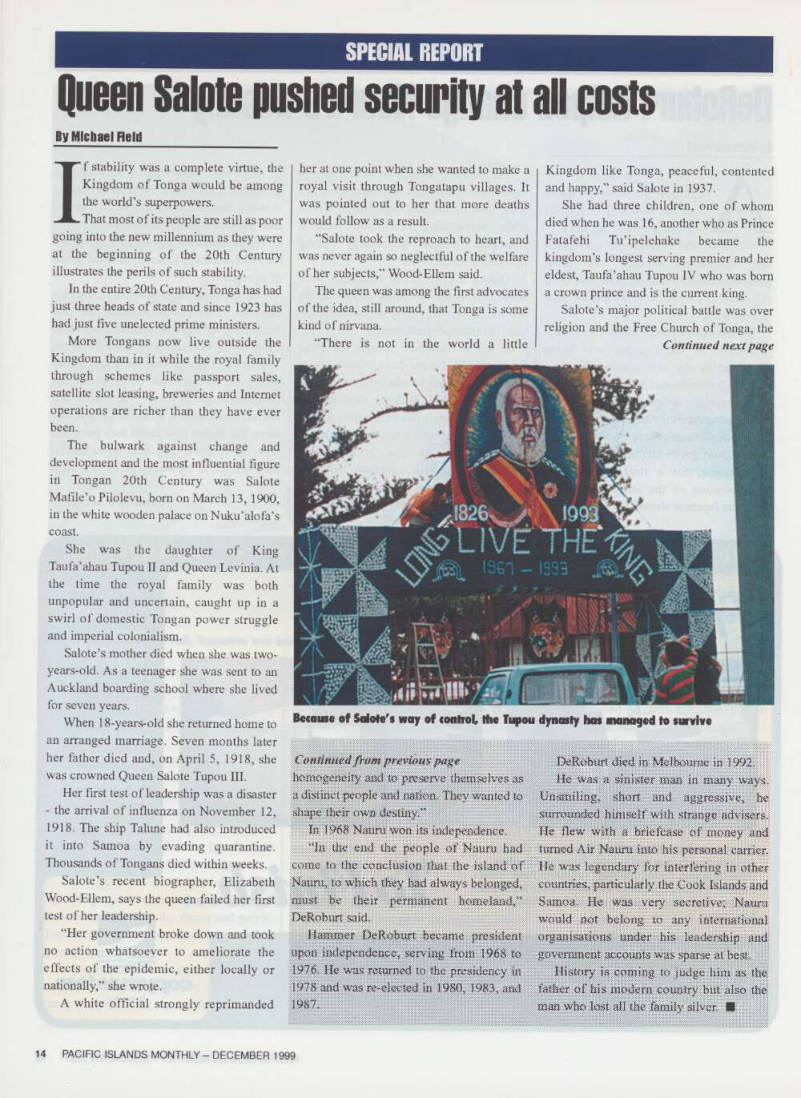
Because of S[?]ote's way of control, the Tupou dynasty has managed to survive
Continued from previous page
With the aid of Taiwan, the Marshall Islands has set in motion a $2B million deal to purchase two German-made airplanes.
In early October, Taiwan turned over a $2 million cheque to Air Marshall Islands, a contribution that will be used to fund downpayment on two new German Dornier Fairchild 328 airplanes.
The purchase of two Dornier 328 s - twin engine propeller planes that seat up to 31 passengers and are made by the same company that manufactures smaller Dorniers commuter planes now in use for travel to remote outer atolls in the Marshalls - has been under negotiation since earlier this year. The first plane should be in Majuro by mid- to late-December, according to Marshall. The second plane is expected next March.
With spare parts, training and other elements in the package, each of the new Dorniers will cost about $l4 million. The deal is being financed by a loan through the Berliner Bank in Germany, he said.
“There’s a lot that has to be done between now and when the plane arrives,”
Marshall said. He said that both pilots and
mechanics have to be trained for working on the larger planes. The Domier 328 s will be used for travellers heading to the scuba
dive mecca at Bikini Atoll, as well as for other domestic service and international travel to Tarawa, Kiribati. ■
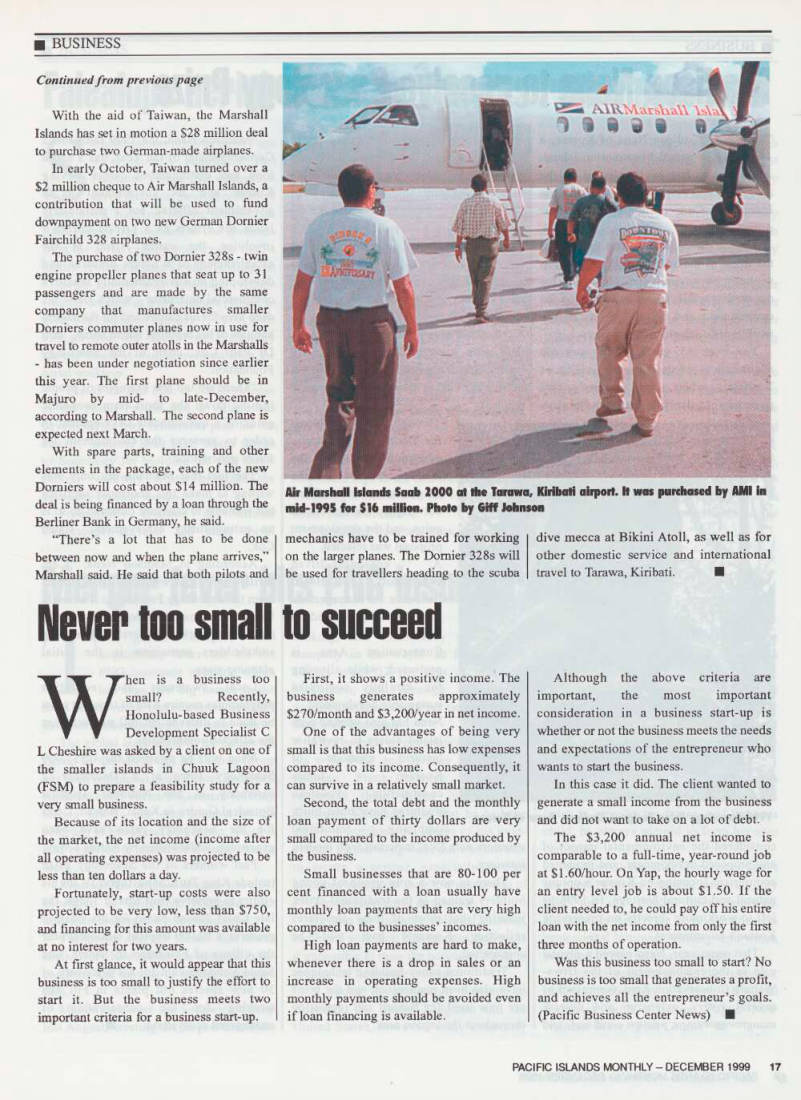
Air Marshall Islands Saab 2000 at the Tarawa, Kiribati airport. It was purchased by AMI in mid-1995 for $16 million. Photo by Giff Johnson
Advertisements & other items, p. 15 (1 item)
Trade Mark Cautionary Notice In Nauru
Notice is hereby given that Mazda Motor Corporation, a Japanese company, of 3-1 Shinchi, Fuchu-cho, Aki-gun, Hiroshima, Japan is the sole proprietor in Nauru and elsewhere of the following trade mark:
TRIBUTE
used in respect of:- Automobiles, parts and fittings thereof, Engines for land vehicles; Suspension systems for land vehicles; Shock absorbers and springs for land vehicle suspension systems; Drive shafts for land vehicles; Wheel bearings and shaft couplings for land vehicles; Transmissions for land vehicles; Brakes for land vehicles; Alternating current motors for land vehicles; Direct current motors for land vehicles; Anti-theft alarms for land vehicles Class 12.
The said proprietor claims all rights in respect of the above trade mark and will take all necessary legal steps against any person or company infringing its said rights.
DAVIES COLLISON CAVE
Patent Attorneys One Little Collins Street Melbourne, Victoria 3000
AUSTRALIA
—— 123790v2
Air Marshalls unloads Saab 2000
Business
By Gift Johnson
Air Marshall Islands’ Saab 2000 is history. That’s the good news. The bad news is that the sale in late October of the four year-old plane generated less than one-third of its original price tag of more than $l6 million.
The aircraft, which during its use by AMI suffered repeated and extended break downs, was sold for $5.3 million to a Europe-based air carrier. The sale generates much-needed cash for Air Marshall Islands - which has just recently initiated a $2B million deal to purchase two new 31 seat planes from the German manufacturer Dornier Fairchild.
Touted by government officials and the manufacturer as the perfect plane for the long, thinly travelled routes in the central Pacific, the Saab turned out to be the wrong plane in the wrong place.
AMl’s general manager Phil Marshall
described the Saab as a plane that AMI “should never have bought.” He said that the airline management was not involved in the decision to make the purchase in the
early 19905.\
Originally, the government had committed to buying two Saab 2000 s with an option to purchase two more.
The fast, nearly jet-speed twin-engine Saab, was so high tech that it, ironically, broke down repeatedly - partly due to the heavy humidity and salt air environment that is a fact of life on an atoll, but also, at least in part, as a result of the limitations of a maintenance crew that didn’t even have a hangar to do repairs inside.
The Marshalls isolation only complicated the breakdowns. It was often agonisingly slow to get parts from Europe into Majuro or, on occasion, even more distant Kiribati and Tuvalu, when the plane was grounded.
After operating the plane from 1995- 1998, AMI inked a deal with Air Vanuatu on a long-term lease for use of the plane between Fiji and Vanuatu. That expired in April, and the plane had been sitting in Nadi until its recent sale. The Saab was sold despite a last-minute hiccup that had threatened to drag out the sale.
The plane was to make an “acceptance flight”, which would have sealed the deal.
But the auxiliary power went down, preventing the flight from Nadi. “It was ironic,” said Marshall, “because this was the same part that failed when the plane was first flown out from the factory to Majuro in 1995 and had to be grounded on Guam.”
However, instead of waiting for days for parts to be flown in from Australia, AMI engineers in Fiji were able to solve the problem, allowing the plane to make its test
flight the following day, concluding the
deal.
Continued from previous page
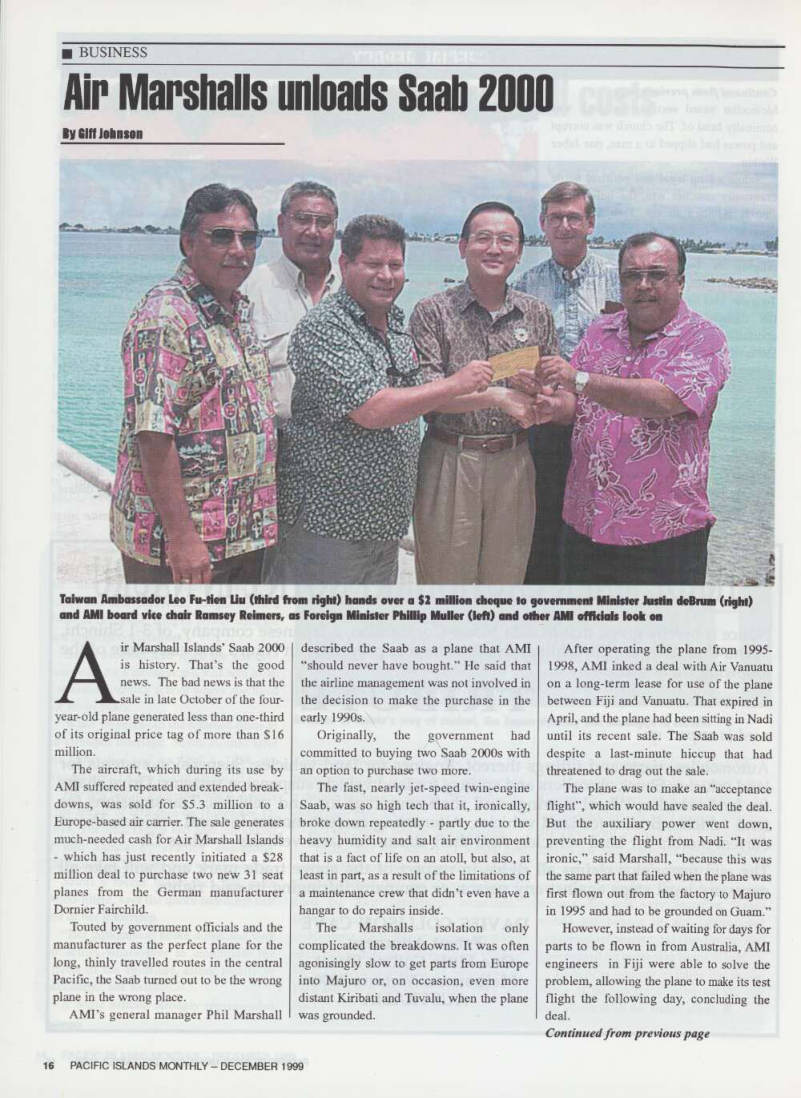
Taiwan Ambassador Leo Fu-tien Liu (third from right) hands over a $2 million cheque to government Minister Justin deBrum (right) and AMI board vice chair Ramsey Reimers, as Foreign Minister Phillip Muller (left) and other AMI officials look on
Never too small to succeed
When is a business too small? Recently, Honolulu-based Business Development Specialist C L Cheshire was asked by a client on one of the smaller islands in Chuuk Lagoon (FSM) to prepare a feasibility study for a very small business.
Because of its location and the size of the market, the net income (income after all operating expenses) was projected to be less than ten dollars a day.
Fortunately, start-up costs were also projected to be very low, less than $750, and financing for this amount was available at no interest for two years.
At first glance, it would appear that this business is too small to justify the effort to start it. But the business meets two important criteria for a business start-up.
First, it shows a positive income. The business generates approximately $270/month and $3,200/year in net income.
One of the advantages of being very small is that this business has low expenses compared to its income. Consequently, it can survive in a relatively small market.
Second, the total debt and the monthly loan payment of thirty dollars are very small compared to the income produced by the business.
Small businesses that are 80-100 per cent financed with a loan usually have monthly loan payments that are very high compared to the businesses’ incomes.
High loan payments are hard to make, whenever there is a drop in sales or an increase in operating expenses. High monthly payments should be avoided even if loan financing is available.
Although the above criteria are important, the most important consideration in a business start-up is whether or not the business meets the needs and expectations of the entrepreneur who wants to start the business.
In this case it did. The client wanted to generate a small income from the business and did not want to take on a lot of debt.
The $3,200 annual net income is
comparable to a full-time, year-round job
at $1.60/hour. On Yap, the hourly wage for an entry level job is about $1.50. If the client needed to, he could pay off his entire loan with the net income from only the first three months of operation.
Was this business too small to start? No business is too small that generates a profit, and achieves all the entrepreneur’s goals. (Pacific Business Center News) ■
Madison Nona to receive Seacology Prize
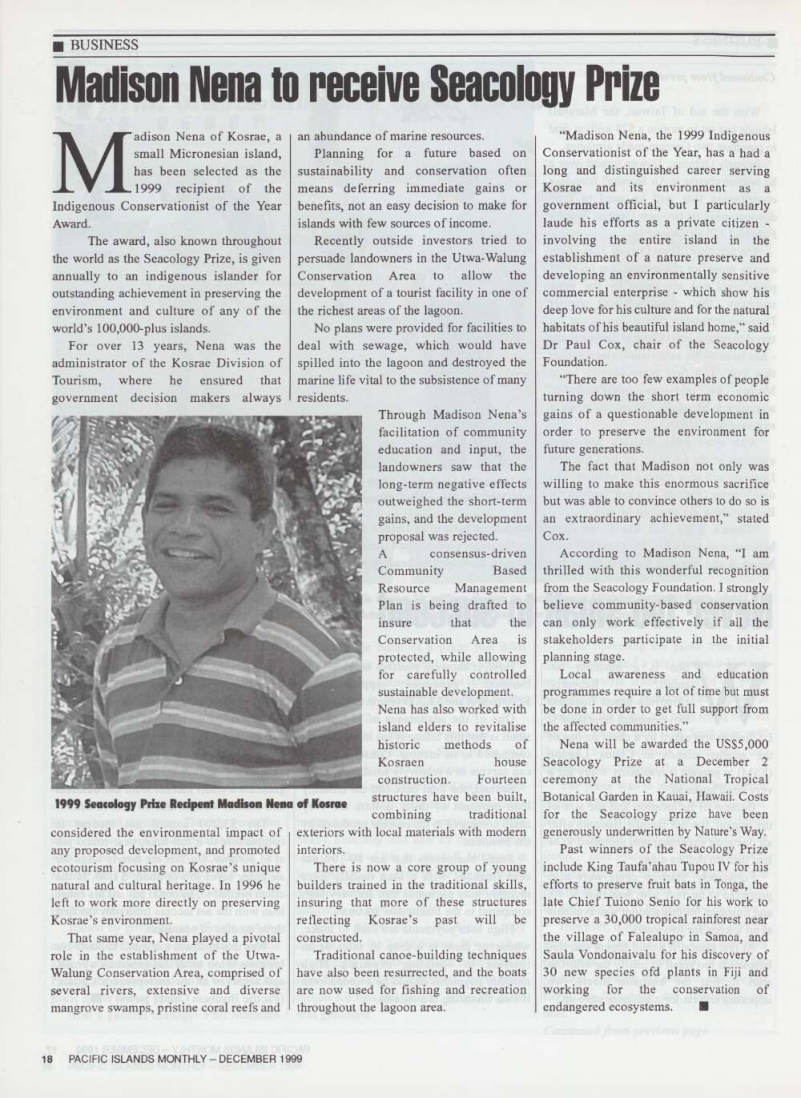
Madison Nena of Kosrae, a small Micronesian island, has been selected as the 1999 recipient of the Indigenous Conservationist of the Year Award.
The award, also known throughout the world as the Seacology Prize, is given annually to an indigenous islander for outstanding achievement in preserving the environment and culture of any of the world’s 100,000-plus islands.
For over 13 years, Nena was the administrator of the Kosrae Division of Tourism, where he ensured that government decision makers always
considered the environmental impact of any proposed development, and promoted ecotourism focusing on Kosrae’s unique natural and cultural heritage. In 1996 he left to work more directly on preserving Kosrae’s environment.
That same year, Nena played a pivotal role in the establishment of the Utwa- Walung Conservation Area, comprised of several rivers, extensive and diverse mangrove swamps, pristine coral reefs and
an abundance of marine resources.
Planning for a future based on sustainability and conservation often means deferring immediate gains or benefits, not an easy decision to make for islands with few sources of income.
Recently outside investors tried to persuade landowners in the Utwa-Walung Conservation Area to allow the development of a tourist facility in one of the richest areas of the lagoon.
No plans were provided for facilities to deal with sewage, which would have spilled into the lagoon and destroyed the marine life vital to the subsistence of many residents.
Through Madison Nena’s facilitation of community education and input, the landowners saw that the long-term negative effects outweighed the short-term gains, and the development proposal was rejected.
A consensus-driven Community Based Resource Management Plan is being drafted to insure that the Conservation Area is protected, while allowing for carefully controlled sustainable development.
Nena has also worked with island elders to revitalise historic methods of Kosraen house construction. Fourteen structures have been built, combining traditional
exteriors with local materials with modern interiors.
There is now a core group of young builders trained in the traditional skills, insuring that more of these structures reflecting Kosrae’s past will be constructed.
Traditional canoe-building techniques have also been resurrected, and the boats are now used for fishing and recreation throughout the lagoon area.
“Madison Nena, the 1999 Indigenous Conservationist of the Year, has a had a
long and distinguished career serving
Kosrae and its environment as a government official, but I particularly laude his efforts as a private citizen involving the entire island in the establishment of a nature preserve and developing an environmentally sensitive commercial enterprise - which show his deep love for his culture and for the natural habitats of his beautiful island home,” said Dr Paul Cox, chair of the Seacology Foundation.
“There are too few examples of people turning down the short term economic
gains of a questionable development in
order to preserve the environment for
future generations.
The fact that Madison not only was willing to make this enormous sacrifice but was able to convince others to do so is an extraordinary achievement,” stated Cox.
According to Madison Nena, “I am thrilled with this wonderful recognition from the Seacology Foundation. I strongly believe community-based conservation can only work effectively if all the stakeholders participate in the initial
planning stage.
Local awareness and education programmes require a lot of time but must be done in order to get full support from the affected communities.”
Nena will be awarded the US$5,OOO Seacology Prize at a December 2 ceremony at the National Tropical Botanical Garden in Kauai, Hawaii. Costs for the Seacology prize have been generously underwritten by Nature’s Way.
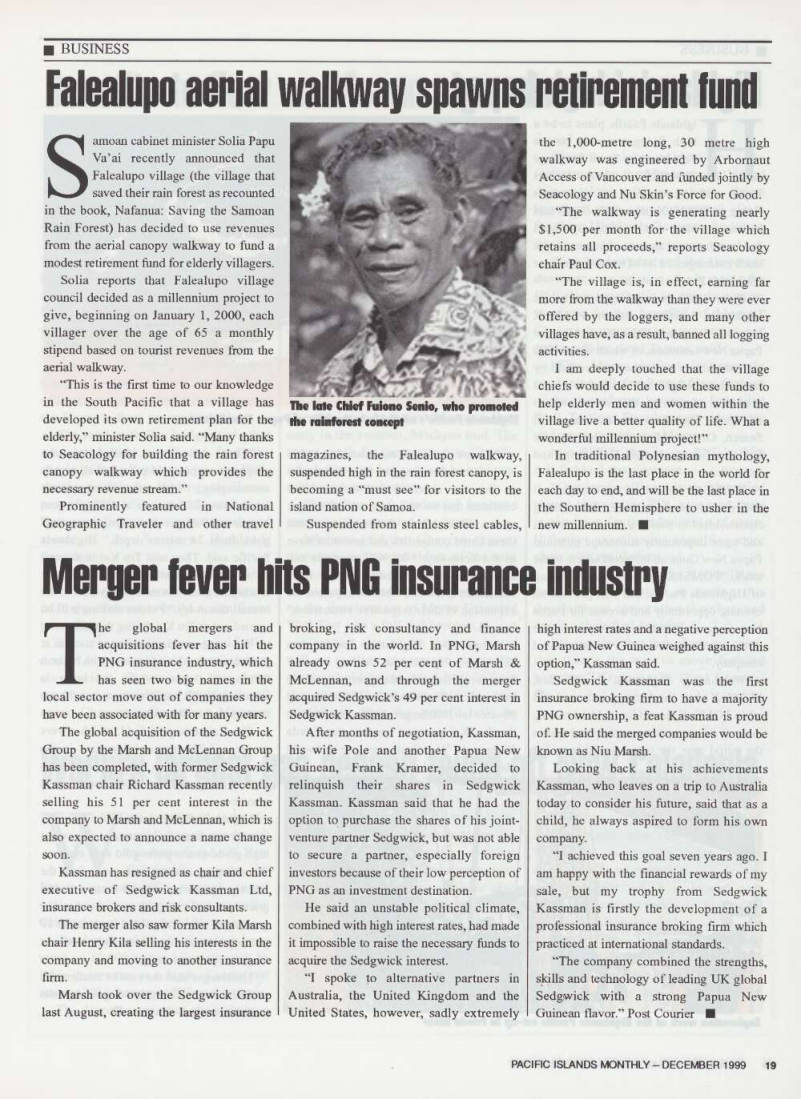
Past winners of the Seacology Prize include King Taufa’ahau Tupou IV for his efforts to preserve fruit bats in Tonga, the late Chief Tuiono Senio for his work to preserve a 30,000 tropical rainforest near the village of Falealupo in Samoa, and Saula Vondonaivalu for his discovery of 30 new species ofd plants in Fiji and working for the conservation of endangered ecosystems. ■
1999 Seacology Prize Recipent Madison Nena of Kosrae
Falealupo aerial walkway spawns retirement fund
Samoan cabinet minister Sofia Papu Va’ai recently announced that
Falealupo village (the village that
saved their rain forest as recounted in the book, Nafanua: Saving the Samoan Rain Forest) has decided to use revenues from the aerial canopy walkway to fund a modest retirement fond for elderly villagers.
Sofia reports that Falealupo village council decided as a millennium project to give, beginning on January 1, 2000, each villager over the age of 65 a monthly stipend based on tourist revenues from the aerial walkway.
“This is the first time to our knowledge in the South Pacific that a village has developed its own retirement plan for the elderly,” minister Sofia said. “Many thanks to Seacology for building the rain forest canopy walkway which provides the necessary revenue stream.”
Prominently featured in National Geographic Traveler and other travel
magazines, the Falealupo walkway,
suspended high in the rain forest canopy, is becoming a “must see” for visitors to the island nation of Samoa.
Suspended from stainless steel cables,
the 1,000-metre long, 30 metre high walkway was engineered by Arbornaut Access of Vancouver and funded jointly by Seacology and Nu Skin’s Force for Good.
“The walkway is generating nearly $1,500 per month for the village which retains all proceeds,” reports Seacology chair Paul Cox.
“The village is, in effect, earning far more from the walkway than they were ever offered by the loggers, and many other villages have, as a result, banned all logging activities.
I am deeply touched that the village chiefs would decide to use these funds to help elderly men and women within the village live a better quality of life. What a wonderful millennium project!”
In traditional Polynesian mythology, Falealupo is the last place in the world for each day to end, and will be the last place in the Southern Hemisphere to usher in the new millennium. ■
The late Chief Fuiono Senio, who promoted the rainforest concept
Merger fever hits PNG insurance Industry
The global mergers and
acquisitions fever has hit the PNG insurance industry, which has seen two big names in the local sector move out of companies they have been associated with for many years.
The global acquisition of the Sedgwick Group by the Marsh and McLennan Group has been completed, with former Sedgwick Kassman chair Richard Kassman recently selling his 51 per cent interest in the company to Marsh and McLennan, which is also expected to announce a name change soon.
Kassman has resigned as chair and chief executive of Sedgwick Kassman Ltd, insurance brokers and risk consultants.
The merger also saw former Kila Marsh chair Henry Kila selling his interests in the company and moving to another insurance firm.
Marsh took over the Sedgwick Group last August, creating the largest insurance
broking, risk consultancy and finance company in the world. In PNG, Marsh already owns 52 per cent of Marsh & McLennan, and through the merger acquired Sedgwick’s 49 per cent interest in
Sedgwick Kassman.
After months of negotiation, Kassman, his wife Pole and another Papua New Guinean, Frank Kramer, decided to relinquish their shares in Sedgwick Kassman. Kassman said that he had the option to purchase the shares of his joint venture partner Sedgwick, but was not able to secure a partner, especially foreign investors because of their low perception of PNG as an investment destination.
He said an unstable political climate, combined with high interest rates, had made it impossible to raise the necessary funds to acquire the Sedgwick interest.
“I spoke to alternative partners in Australia, the United Kingdom and the United States, however, sadly extremely
high interest rates and a negative perception of Papua New Guinea weighed against this option,” Kassman said.
Sedgwick Kassman was the first insurance broking firm to have a majority PNG ownership, a feat Kassman is proud of. He said the merged companies would be known as Niu Marsh.
Looking back at his achievements Kassman, who leaves on a trip to Australia today to consider his future, said that as a child, he always aspired to form his own company.
“I achieved this goal seven years ago. I am happy with the financial rewards of my sale, but my trophy from Sedgwick Kassman is firstly the development of a professional insurance broking firm which practiced at international standards.
“The company combined the strengths, skills and technology of leading UK global Sedgwick with a strong Papua New Guinean flavor.” Post Courier ■
Highlands' high hopes
Highlands Pacific plans to be a high flying company on the Port Moresby Stock Exchange (POMSoX), chair Robert Bryan said. Announcing the company’s listing on POMSoX last month, Bryan said he was confident that the company would “add a substantial amount of interest to the stock exchange ... a lot of turnover, because Highlands Pacific is on the move.”
Bryan said it was appropriate for Highlands Pacific to list on POMSoX because 70 per cent of its shareholders are Papua New Guineans, of which about 4000 are individuals while the rest are held by institutions. Highlands’ listing brings to nine the companies that are listed on POMSoX. The others are Steamships, Oil Search, Orogen Minerals, Lihir, Mosaic Oil, Cue Energy, Cardia Technology and Inter Oil.
“POMSoX welcomes the listing, as it will provide an opportunity for existing shareholders to easily trade in the stock, and more importantly encourage potential Papua New Guinean investors access to the stock. “POMSoX believes that the listing of Highlands Pacific Ltd will provide an exciting opportunity and avenue for Papua New Guinea citizens to participate in one of the country’s most active resource based company.”
Welcoming Highlands Pacific Ltd, POMSoX chair Sir Anthony indicated that when POMSoX started limited trial trading in April this year, it was anticipated that in the initial year, the target would be to list ten companies.
“We are pleased to announce that within six months of trading, we have listed nine so far, one short of that target. I am confident that we will soon reach the target of ten. This reflects the confidence that these listed companies and investors have in the economy. “We will continue our efforts to secure medium-sized PNG companies to list on POMSoX to pursue the expansion of their respective businesses,” he said.
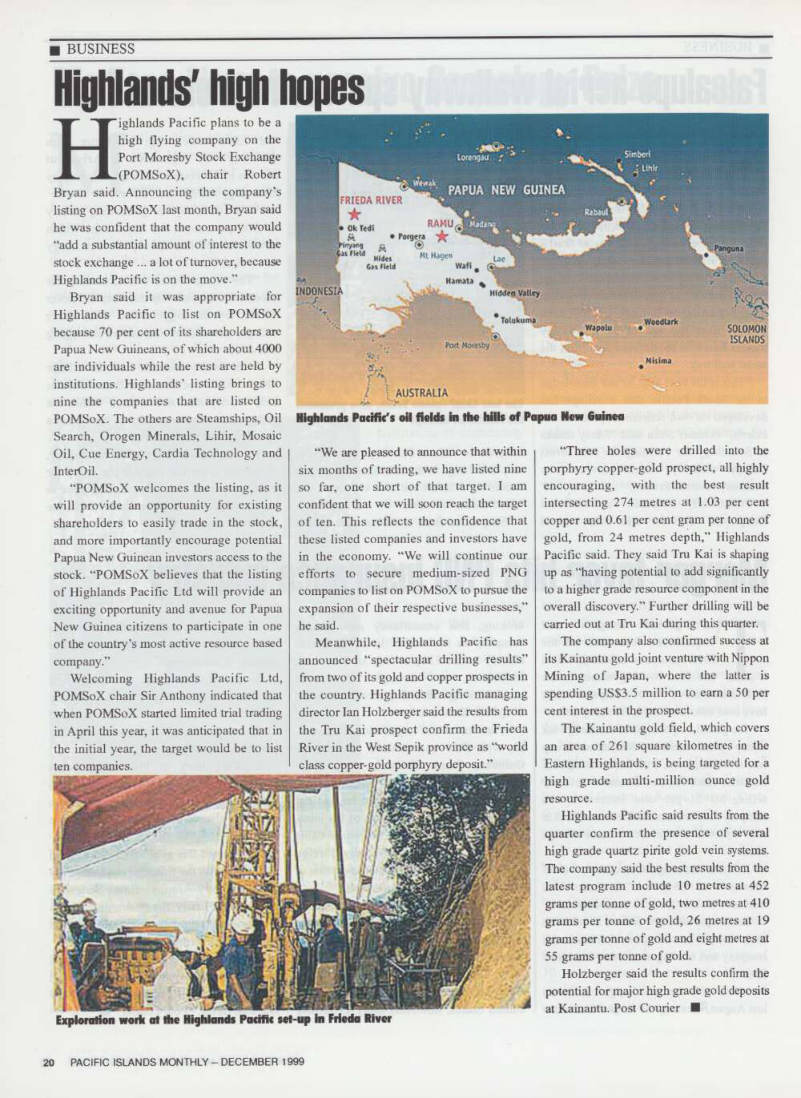
Meanwhile, Highlands Pacific has announced “spectacular drilling results” from two of its gold and copper prospects in the country. Highlands Pacific managing director lan Holzberger said the results from the Tru Kai prospect confirm the Frieda River in the West Sepik province as “world
class copper-gold porphyry deposit.”
“Three holes were drilled into the porphyry copper-gold prospect, all highly encouraging, with the best result intersecting 274 metres at 1.03 per cent copper and 0.61 per cent gram per tonne of gold, from 24 metres depth,” Highlands Pacific said. They said Tru Kai is shaping up as “having potential to add significantly to a higher grade resource component in the overall discovery.” Further drilling will be carried out at Tru Kai during this quarter.
The company also confirmed success at its Kainantu gold joint venture with Nippon Mining of Japan, where the latter is spending US$3.5 million to earn a 50 per cent interest in the prospect.
The Kainantu gold field, which covers an area of 261 square kilometres in the Eastern Highlands, is being targeted for a high grade multi-million ounce gold resource.
Highlands Pacific said results from the quarter confirm the presence of several high grade quartz pirite gold vein systems.
The company said the best results from the latest program include 10 metres at 452 grams per tonne of gold, two metres at 410 grams per tonne of gold, 26 metres at 19 grams per tonne of gold and eight metres at 55 grams per tonne of gold.
Holzberger said the results confirm the potential for major high grade gold deposits at Kainantu. Post Courier ■
Exploration work at the Highlands Pacific set-up in Frieda River
Highlands Pacific's oil fields in the hills of Papua New Guinea
Benefits to flow as Moran signs deal

Immediate economic benefits in the form of business contracts are likely to flow to landowners of the Moran Oil project, following the signing of a milestone agreement at the end of October.
Huli-speaking landowners from the areas surrounding Homa, Paua and Baguala villages have formed an umbrella company to derive further business development from the Moran project, and Chevron has immediately awarded them their first major contract.
The Moran Development Corporation has entered into a K 15.4 million contract to build Stage Two of the Homa to Paua tax credit road.
The road, with five bridges and other associated works, will run from the shores of Lake Kutubu up into the Huli speaking villages leading to Homa, providing the village people with their first road link to the more developed areas of the Southern Highlands Province.
As well as benefiting from use of the new road, landowners will earn income from the contract to build a significant part of it.
The contract is also specifically drafted to nurture the new development corporation. The contract has been structured to minimise the risk in all areas, Chevron’s Operations Manager
Dave Madison said at brief signing ceremony.
To assist the Moran Development Corporation, CNGL has included K 300,000 in the mobilisation payment to allow for the purchase of tools and spare parts.
CNGL has also exempted the corporation from retention, for the first twelve months of the project.
In addition, CNGL will meet the cost of Project Manager and Project Administrator, external to the contract.
This will significantly assist in the reduction of overhead costs, making it easier for Moran Development Corporation to have a positive cash flow early in the contract, Madison said. The target profit for the contract is 12-15%, which Chevron believes can be achieved with good management.
Discipline and prudential business practices are expected in return.
Madison said that Chevron expects directors and shareholders of the new corporation to be committed to working as a team, both on the road project and on the development of Moran Extended Well Test into a full-field project.
Chevron also hopes that the board will put in place measures to ensure that all shareholders get equal benefit from the contract, and are able to gain confidence that the benefit will be
passed on.
Eleven clans, identified as landowners by the Moran project’s land demarcation officers, have come together with encouragement from Southern Highlands Governor Anderson
Agiru.
“The landowners and the Governor deserve congratulations for bringing the Huli clans together in an orderly manner to share in the benefits of Moran,”
Chevron’s manager of government and public affairs, Imbi Tagune, said.
“The Moran project is currently producing oil for Papua New Guinea under the scheme known as Extended
Well Testing. Development plans are
underway to progress Moran into PDLS, that is, as PNG’s fifth full-field oil development.
“Our lands officers have identified eleven clans in the PDL area, and there is provision for the admittance of more, if further examination identifies more clans with entitlement.
“In the meantime, the Huli villages have shown foresight in getting this development corporation together, and earning their first contract.
We are glad that they share our view, that this is the way to move forward together,” Tagune said. (Post Courier) ■
World's largest gas deposit found off New Caledonia
What is believed to be the
world’s largest gas deposit
has been found off New Caledonia’s coasts by French oceanographic research vessel Atalante, daily newspaper Les nouvelles Caledoniennes reported mid-November.
The deposit, which is estimated to be as much as 80,000 square kilometre-rich, is lying underwater at a depth of some 600 meters, 240 kilometres off New Caledonia.
The deposit consists of gas hydrate, a
mix of water and methane, and was initially located by a joint French-Australian research mission last year under a so-called ZONECO programme, purporting to scan New Caledonia’s exclusive economic zone and assess its marine and mineral resources
potential.
The gas deposit also signal the potential presence of oil at an estimated depth of 2,000 metres underwater, ZONECO mission leader, geologist Jean-Marc Auzende said.
Scientists in Noumea believe the oil deposit could also be “huge” and “potentially interesting” for future exploitation by oil companies.
The deposit, which is located near Australian territorial waters, is “technically exploitable”, scientists said.
“The conditions are very similar to what you can find in the Mexican Gulf, where exploitation had been going full swing for years,” Auzende noted. (PINA Nius Online) ■
Porgera has best result In 3 years

The giant Porgera gold mine in the Enga province had its best quarter for three years during the
September period, pouring
245,934 ounces of gold, the Porgera Joint Venture (PJV) said.
This compares with just 161,637 ounces
in the previous corresponding period, and
continues a rising trend in production over the current year. Porgera has now produced 542,132 ounces over the past nine months, only marginally behind 553,779 ounces poured in the same period last year.
The PJV has attributed the increase to the “continued development of the high grade ore zone,” following an initial delay between pit stages earlier in the year.
“The shortfall in gold production caused by this delay is expected to be made up by the end of the year,” the PJV said. “The operation continues to position itself as a long term, low cost producer through improvements to recovery and throughput rates, combined with cost saving and
efficiency measures,” the PJV said. They
said the improving production profile
indicated that delays in mine scheduling experienced earlier this year have now been overcome.
While noting that average gold recovery of 80 per cent was two per cent better than budget, and 18.5 million tonnes were mined in the quarter compared to 17 million tonnes previously, the PJV failed to report cash production costs. The PJV also reported that mining equipment at the mine continue to improve, which will assist waste stripping and the increasing haul profile requirements.
They said specialised mining equipment was commissioned to deal with open pit mining around the old underground mine voids. The PJV also reported that the mill continued to perform well with throughput averaging 15322 tonnes per day, which was marginally lower than the previous quarter but the PJV said this was due to “planned mill relines”.
The mill throughput for September was
1.4 million tonnes compared with 1.5 million tonnes in the June quarter. Mill head grade averaged 6.5 grams of gold per tonne, which the PJV said was a “substantial improvement over 5.3 grams per tonne in the June quarter.”
The PJV also reported that the expansion of the rougher/scavenger flotation circuit was successfully commissioned in September, almost three months ahead of schedule, and is expected to “improve gold recoveries by more than 2 per cent of the on a life of mine average.”
Meanwhile, they also reported that the first low of new houses that are being constructed under the Paiam township
development agreement are “approaching
completion”. The PJV also reported that one of their priority activities is to achieve
exploration success, with drilling continuing
from the old underground workings.
The current shareholders in Porgera are; Placer Dome - 50 per cent, Goldfields Ltd - 25 per cent, and Orogen Minerals - 25 per cent. (Post Courier) ■
Advertisements & other items, p. 22 (1 item)
Trade Mark Cautionary Notice In Micronesia
Notice is hereby given that Mondex International Limited, a British company of 47-53 Cannon Street, London EC4M SSQ, England, is the sole proprietor in Micronesia and elsewhere of the following trade mark.
MULTOS
used in respect of:- Data processing, transmitting, receiving and storage apparatus and instruments; computer hardware and software; computer programs; modems; electrical and electronic installations and apparatus; magnetic and/or encoded cards, discs or tapes; parts and fittings for all the aforesaid goods Class 9.
Advisory and consultancy services relating to electronic data capture and transmission systems, computers, computer software and computer programs Class 42.
The said proprietor claims all rights in respect of the above trade mark and will take all necessary legal steps against any person or company infringing their said rights.
DAVIES COLLISON CAVE
Patent Attorneys
One Little Collins Street Melbourne, Victoria, 3000
AUSTRALIA
104765v2
Pilot error suspected in Guam crash
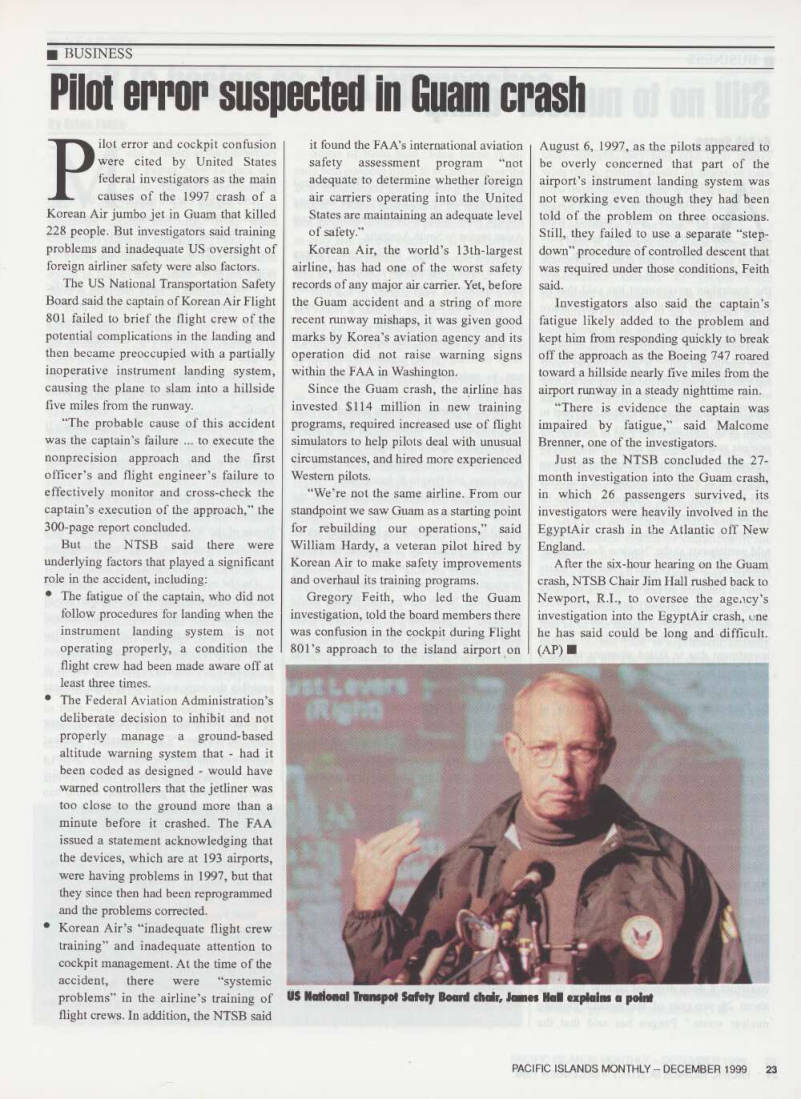
Pilot error and cockpit confusion were cited by United States federal investigators as the main causes of the 1997 crash of a Korean Air jumbo jet in Guam that killed 228 people. But investigators said training problems and inadequate US oversight of foreign airliner safety were also factors.
The US National Transportation Safety Board said the captain of Korean Air Flight 801 failed to brief the flight crew of the potential complications in the landing and then became preoccupied with a partially
inoperative instrument landing system,
causing the plane to slam into a hillside five miles from the runway.
“The probable cause of this accident was the captain's failure ... to execute the nonprecision approach and the first officer’s and flight engineer’s failure to effectively monitor and cross-check the captain’s execution of the approach,” the 300-page report concluded.
But the NTSB said there were underlying factors that played a significant role in the accident, including: • The fatigue of the captain, who did not follow procedures for landing when the instrument landing system is not operating properly, a condition the flight crew had been made aware off at least three times. • The Federal Aviation Administration’s deliberate decision to inhibit and not
properly manage a ground-based
altitude warning system that - had it been coded as designed - would have warned controllers that the jetliner was too close to the ground more than a minute before it crashed. The FAA issued a statement acknowledging that the devices, which are at 193 airports, were having problems in 1997, but that they since then had been reprogrammed and the problems corrected. • Korean Air’s “inadequate flight crew training” and inadequate attention to cockpit management. At the time of the accident, there were “systemic problems” in the airline’s training of flight crews. In addition, the NTSB said
it found the FAA’s international aviation safety assessment program “not adequate to determine whether foreign air carriers operating into the United States are maintaining an adequate level
of safety.”
Korean Air, the world’s 13th-largest airline, has had one of the worst safety records of any major air carrier. Yet, before the Guam accident and a string of more recent runway mishaps, it was given good marks by Korea’s aviation agency and its operation did not raise warning signs within the FAA in Washington.
Since the Guam crash, the airline has invested $ll4 million in new training programs, required increased use of flight simulators to help pilots deal with unusual circumstances, and hired more experienced Western pilots.
“We’re not the same airline. From our standpoint we saw Guam as a starting point for rebuilding our operations,” said William Hardy, a veteran pilot hired by Korean Air to make safety improvements and overhaul its training programs.
Gregory Feith, who led the Guam investigation, told the board members there was confusion in the cockpit during Flight 801’s approach to the island airport on
August 6, 1997, as the pilots appeared to be overly concerned that part of the airport’s instrument landing system was not working even though they had been told of the problem on three occasions.
Still, they failed to use a separate “step down” procedure of controlled descent that was required under those conditions, Feith said.
Investigators also said the captain’s fatigue likely added to the problem and kept him from responding quickly to break off the approach as the Boeing 747 roared toward a hillside nearly five miles from the airport runway in a steady nighttime rain.
“There is evidence the captain was impaired by fatigue,” said Malcome Brenner, one of the investigators.
Just as the NTSB concluded the 27month investigation into the Guam crash, in which 26 passengers survived, its investigators were heavily involved in the Egypt Air crash in the Atlantic off New England.
After the six-hour hearing on the Guam crash, NTSB Chair Jim Hall rushed back to Newport, R. 1., to oversee the agency’s investigation into the Egypt Air crash, one he has said could be long and difficult. (AP) ■
US Notional Transpot Safety Board chair, James Hal explains a point
Still no to nuclear dump
By Bob Burton
A consortium dominated by the British Nuclear Fuels (BNFL) is trying to gain support from governments in the Asia-Pacific region for a global nuclear waste dump in the Australian outback. This despite the fact that the Australian government has said that its current policy is not to accept the radioactive waste of other countries.
According to Department of Industry, Science and Resources spokesperson Caroline Perkins, the government’s position “is based on the clear principle that countries deriving benefits from nuclear power should expect to make their own arrangement to dispose of nuclear waste.” But the consortium, Pangea Resources, is apparently undeterred and even suggested in a conference held in Canberra mid-November that Australia could be persuaded to change its stance.
Pangea General Manager Marcis Kurzeme told participants at the ‘Nuclear Renaissance’ conference that “(a) new nuclear waste disposal initiative was justified because many national waste repository programmes were suffering delays, cost overruns, and in some unfortunate cases, significant lot of loss of investment due to failed attempts to site a geological repository.” He also confirmed that Pangea is “informing other governments on the Pangea concept and the global benefits” of the proposed nuclear waste dump.
Still, he admitted that the “the current group of supporters of Pangea are acutely aware this project can succeed only with the support of the Australian people and with the
participation of Australian industry.”
Pangea is 70 percent owned by the British government-owned BNFL, with minor shareholdings held by the Swiss company Nagra, and the parent company of Canadian based geo-technical company Colder Associates. Previous BNFL attempts to establish low and intermediate level dumps in Britain have failed. According to Kurzeme, Pangea is undertaking a feasibility study “to construct a deep disposal facility for up to about 25 per cent of the world’s existing nuclear waste.” Pangea has said that the
project would require a fleet of five dedicated ships continually plying the seas carrying nuclear waste from Europe and the North-east Asian region to South Australia.
Kurzeme, though, denied that Pangea wanted other governments to help “lobby” for the Canberra’s approval of the proposed nuclear waste dump. “Lobbying is a very emotional word,” he told IPS.
Pangea, however, has been advised on a range of foreign policy arguments that it could use to persuade Australia to support its
proposal.
These arguments are in a leaked 61-page “commercial-in-confidence” briefing paper for Pangea prepared in August by Canberra based security consultants, Du Pont & Associates and Bergin & Associates.
The paper explains why Australia is the “ideal” site for the dump: “Australia is probably one of the few regional states which would be politically acceptable to Japan, South Korea and problem as an end destination for the nuclear waste product.”
“China, North Korea and Russia could probably be persuaded to use a geological repository in Australia,” the brief adds.
It then argues that the project would benefit Australia by gaining recognition for its efforts to “protect the global environment”, “strengthen disarmament”, “promote non proliferation” and “strengthen the alliance with the (United States)”. Its authors suggest that by accepting a nuclear waste dump, Australia would be in a position to extract concessions from Washington.
“Given that the US would derive substantial political and security benefits,” the authors say, the Australian government could “extract trade and political concessions from Washington, including guarantees that Australia would not be economically damaged by US export subsidies or restrictions on market access.”
The consultants advise Pangea to point out that Australia’s approval of the dump would “enhance (the country’s) regional standing as well as increase its leverage with a number of its key friends and allies, particularly the US,
Japan and South Korea.”
Anti-nuclear Pacific nations too, the report argues, could be persuaded to support the dump. “Samoa, Tonga, Fiji, the Cook Islands and Papua New Guinea would probably acquiesce to the idea,” it states.
This, it says, would address Pacific nations’ long-time concern about the possible effects on the marine environment from a procession of ships. The consultants say Pangea could argue that “locating such a facility in Australia would discourage private schemes for storing nuclear waste in the South Pacific.”
But Pangea is in for a tough fight ahead. It is already reeling from a string of legislative setbacks in both Commonwealth and State parliaments.
Legislation against the proposed nuclear waste dump has passed through the Lower House of the West Australian Parliament, and a motion opposing the dump went through the Australian Senate recently.
On the eve of the conference - organised by the Australian Nuclear Association - a poll commissioned by the international environmental watchdog Greenpeace also revealed that 85 percent of Australians support the federal government passing legislation to prohibit the importation of foreign nuclear waste.
Said Greenpeace anti-nuclear campaigner
Jean McSorley: “The Australian nuclear industry is attempting to create what it terms a ‘nuclear renaissance’. The Australian public clearly believes the government should ban the importing of foreign nuclear waste.”
She added, “A nuclear waste dump will perpetuate the nuclear industry and increase the hazards from many more ships carrying nuclear materials through the region,” she says.
But Pangea’s Kurzeme criticised the
opposition in state legislatures against
nuclear waste dumps. “The government hasn’t felt the need to be informed while it is legislating,” he said of the West Australia action. “The debate in Parliament was something to behold.” IPS ■
Back to basics as Y2K approaches
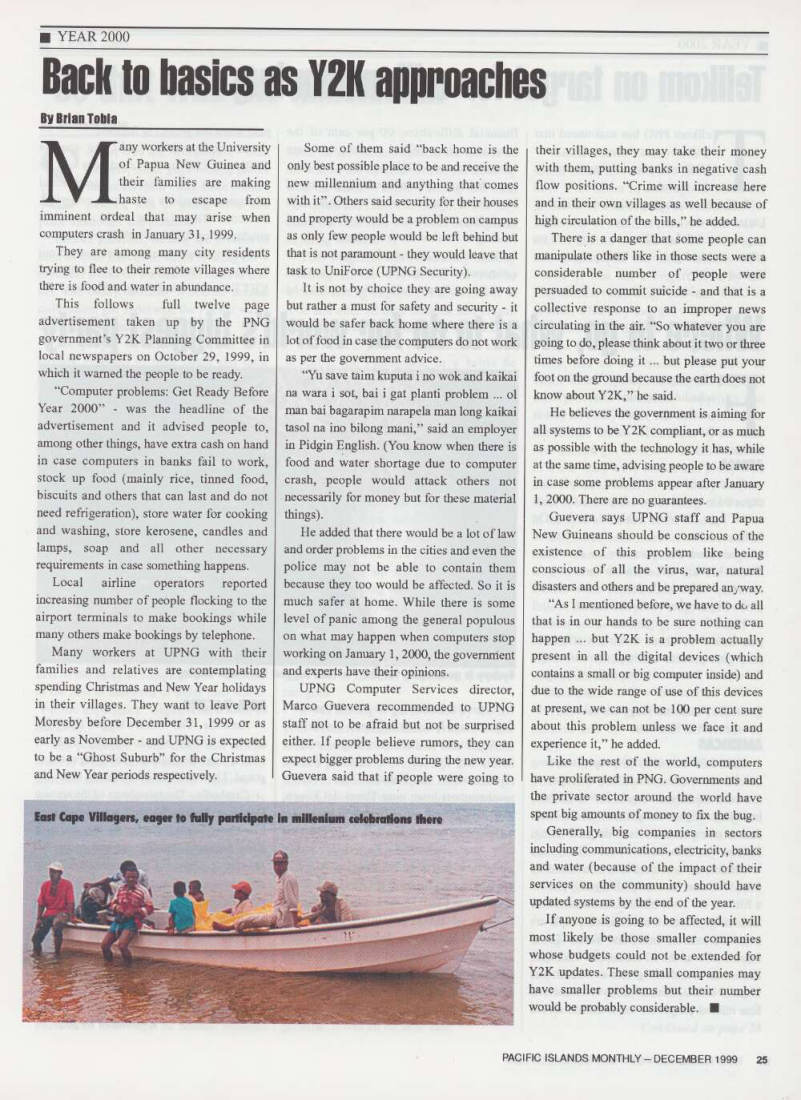
Year 2000
By Brian Tobla
Many workers at the University of Papua New Guinea and their families are making haste to escape from imminent ordeal that may arise when computers crash in January 31, 1999.
They are among many city residents trying to flee to their remote villages where there is food and water in abundance.
This follows full twelve page advertisement taken up by the PNG government’s Y2K Planning Committee in local newspapers on October 29, 1999, in which it warned the people to be ready.
“Computer problems: Get Ready Before Year 2000” - was the headline of the advertisement and it advised people to, among other things, have extra cash on hand in case computers in banks fail to work, stock up food (mainly rice, tinned food, biscuits and others that can last and do not need refrigeration), store water for cooking and washing, store kerosene, candles and lamps, soap and all other necessary requirements in case something happens.
Local airline operators reported increasing number of people flocking to the airport terminals to make bookings while many others make bookings by telephone.
Many workers at UPNG with their families and relatives are contemplating spending Christmas and New Year holidays in their villages. They want to leave Port Moresby before December 31, 1999 or as early as November - and UPNG is expected to be a “Ghost Suburb” for the Christmas and New Year periods respectively.
Some of them said “back home is the only best possible place to be and receive the new millennium and anything that comes with it”. Others said security for their houses and property would be a problem on campus as only few people would be left behind but that is not paramount - they would leave that task to UniForce (UPNG Security).
It is not by choice they are going away but rather a must for safety and security - it would be safer back home where there is a lot of food in case the computers do not work as per the government advice.
“Yu save taim kuputa i no wok and kaikai na wara i sot, bai i gat planti problem ... ol man bai bagarapim narapela man long kaikai tasol na ino bilong mani,” said an employer in Pidgin English. (You know when there is food and water shortage due to computer crash, people would attack others not necessarily for money but for these material
things).
He added that there would be a lot of law and order problems in the cities and even the police may not be able to contain them because they too would be affected. So it is much safer at home. While there is some level of panic among the general populous on what may happen when computers stop working on January 1,2000, the government and experts have their opinions.
UPNG Computer Services director, Marco Guevera recommended to UPNG staff not to be afraid but not be surprised either. If people believe rumors, they can expect bigger problems during the new year.
Guevera said that if people were going to
their villages, they may take their money with them, putting banks in negative cash flow positions. “Crime will increase here and in their own villages as well because of high circulation of the bills,” he added.
There is a danger that some people can manipulate others like in those sects were a considerable number of people were persuaded to commit suicide - and that is a collective response to an improper news circulating in the air. “So whatever you are going to do, please think about it two or three times before doing it ... but please put your foot on the ground because the earth does not know about Y2K,” he said.
He believes the government is aiming for all systems to be Y2K compliant, or as much as possible with the technology it has, while at the same time, advising people to be aware in case some problems appear after January 1, 2000. There are no guarantees.
Guevera says UPNG staff and Papua New Guineans should be conscious of the existence of this problem like being conscious of all the virus, war, natural disasters and others and be prepared anyway.
“As I mentioned before, we have to do all that is in our hands to be sure nothing can happen ... but Y2K is a problem actually present in all the digital devices (which contains a small or big computer inside) and due to the wide range of use of this devices at present, we can not be 100 per cent sure about this problem unless we face it and experience it,” he added.
Like the rest of the world, computers have proliferated in PNG. Governments and the private sector around the world have spent big amounts of money to fix the bug.
Generally, big companies in sectors
including communications, electricity, banks
and water (because of the impact of their services on the community) should have updated systems by the end of the year.
Jf anyone is going to be affected, it will most likely be those smaller companies whose budgets could not be extended for Y2K updates. These small companies may have smaller problems but their number would be probably considerable. ■
East Cape Villagers, eager to fully participate in millenium celebrations there
Telikom on target for millennium bug

Telikom PNG has announced that it is on target to have all its non- Y2K compliant systems ready this month.
Telikom managing director Lindsay
Lailai said the company was aware of the importance of the millennium bug and its effects and had given the Y2K program the
highest priority.
Lailai said that despite Telikom’s
financial difficulties, 90 per cent of the mission/revenue critical systems that were identified as non-Y2K compliant had been upgraded and replaced by the beginning of November. But he said to finish the upgrading, Telikom needed external funding to finance the programme.
The total Y2K rectification cost was estimated at K 23 million. Kl 6 million has already been paid, while the rest is to be
paid when the project is finished.
An independent audit to assess Telikom’s Y2K state of readiness will be carried out by German international telecommunications consultant company, Detecon. This is the third appraisal conducted on Telikom’s Y2K programme.
The previous assessments were carried out by Telstra Australia in November 1998 and YBT Enterprises in February this year. ■
Where to go, what to do for world's biggest party
Following is a partial list of events scheduled around the world to usher in the year 2000. The date is December 31 unless otherwise indicated.
Africa
South Africa - 200,000 people are expected to attend a naval display at the Cape and a light-show on Table Mountain. On Robben Island, near the Cape, Nelson Mandela and his successor as president, Thabo Mbeki, will attend a ceremony in memory of Mandela’s detention there for 18 of the 27 years he was held prisoner.
Nigeria - A programme of concerts, parades and traditional dancing is scheduled for the inauguration of a huge dome in Abuja, the capital. Democratic Republic of Congo - A Miss millennium will be elected and a
torchlight parade marking national unity will
be organised in Kinshasa.
Americas
United States - 600,000 people including Bill Clinton and his wife Hillary are expected to attend a millennium gala in Washington, including a high-tech light show on the Mall.
Scores of entertainers including BB King, Aretha Franklin and Chuck Berry are scheduled, as is an orchestra conducted by John Williams, Steven Spielberg will present a film on the most historic moments of the 20th century. More than a million people are expected to cram into New York’s Times Square to hear the 12 strokes of midnight.
Barbra Streisand will give a concert in Las Vegas, Nevada. Brazil - Between three and four million people are expected to turn out
for a fireworks display on Rio de Janeiro’s Copacabana, Ipanema and Barra beaches.
Argentina - A fireworks display will be held along the Rio de la Plata in Buenos Aires, while at Ushuaia, the world’s southernmost town near Tierra del Fuego, with daylight still visible in the midnight sky, a symphony concert and ballet will greet the new year. Panama - Festivities and a millennium marathon are being organised, as are ceremonies marking the handing back of the Panama Canal by the United States.
Peru - 700,000 people are expected to attend a light-show in the Pachacamac archaeological centre in Lima. The capitals of several countries, notably Chile and Mexico, are organising lavish festivities and fireworks displays.
Asia/Pacffic
Australia - The “world’s biggest fireworks display” will be held in Sydney Harbour, with at least two million people expected to attend. The event will be broadcast live.
Cambodia - The splendours of the ancient empire of Angkor Wat will be reconstructed in a son-et-lumiere display on the site, with King Sihanouk among the audience. Till January 2. China - Celebrations are being organised around an Altar for the Century.
Also January 1, the city of Harbin stages a snow and ice festival.
India - Festivities are scheduled at the Taj Mahal, and at Khajuraho, Madhya Pradesh, on the site of the temples of love.
New Zealand - A children’s chorus will greet sunrise on the summit of Mount
Continued on page 28
Sydney Is gearing up for Hie "world's biggest fireworks display"
Continued from page 26
Hakepa, on Pitt Islands in the Chatham archipelago, 800 kilometres east of Wellington, at 04.49 local time on January 1.
On Chatham Island itself, at midnight local time, the descendents of the island’s first inhabitants, the Moriori, will take part in New Year ceremonies. In Wellington, a 15metre pyramid-shaped Time Vault Memorial containing thousands of individual capsules will be sealed for 100 years.
In Christchurch, the “first golf tournament of 2000” will tee off at midnight. Tonga - A series of native ceremonies will be held from December 29 to January 4 in what the local authorities say is the first country to greet 2000.
Europe
Britain - Celebrations at the millennium dome near Greenwich, east of London, will be attended by Queen Elizabeth 11. The Mall, the avenue leading up to Buckingham Palace, will become a fairground from December 31 to January 2. On the site of the Greenwich Observatory, marking the zero meridian of longitude, a rock concert will feature Simply Red and the Eurythmics, and the London
Symphony Orchestra will play a concert of classical music.
The bells of Britain’s 5,200 churches will ring out at midday on January 1.
France - Millions of people are expected to flock to the Champs Elysses, scene of a rock concert featuring stars such as Johnny Hallyday. At midnight, 11 large wheels
installed on the Champs Elysees, designated
the Doors of the Year 2000, will start to turn.
A variety show has been organised at the Eiffel Tower where a huge counter will count down the minutes to the end of the year. Most of France’s Alpine ski-resorts will organise fireworks displays. At Viella, in southeastern France, the “first wine harvest of the millennium” will begin on December 31.
Greece - Festivities have been organised at the foot of the Acropolis in central Athens.
On January 1, at Cape Sunion, southeast of Athens, ceremonies at the ruins of the temple of Poseidon will mark the “first sunrise of the new millennium”.
Italy/Vatican - on December 24, at Saint Peter’s Basilica, the Holy gates will be opened, followed by midnight mass. In line with a 500-year-old tradition, the pope will
strike three blows against the wall blocking the Holy Gates, which are only opened on jubilee occasions. The wall is then opened and the pope enters the Basilica followed by pilgrims singing canticles and prayers.
Christmas mass is followed at midnight by the Urbi el Orbi blessing by the pope. On December 31, a Te Deum is celebrated at Saint Peter’s Basilica and at midnight the pope will make an Urbi and Orbi statement in the Vatican. Festivities are being organised in most capitals and main cities in Europe, most of which will focus on local historical or geographical features. Israel/Palestinian Territories - 2,000 pigeons will be released at Bethlehem, in the West Bank, to bring a message of peace, happiness and love, as part of the spectacle including Palestinian dances and a son-et-lumiere show, followed by a concert that will see in the millennium.
Egypt - The pyramids outside Cairo will provide the setting for an electronic opera by French composer Jean-Michel Jarre entitled The 12 Dreams of the Sun.
The show will include laser projections and a programme of contemporary and traditional dances. (AFP) ■
So that was the millennium
By Michael Held
So that was the Millennium - hula dancers, white guys finding places the locals hadn’t lost, atom bombs, pastors, lots of going from one place to another and paradise.
Lots of paradise, feeding the dreams of men in cold European cities looking for a mythical world of warmth and endless free sex with dusky maidens. When the second millennium got underway, the Pacific was a fairly mobile kind of place.
The people we know as Fijians were already veterans of their lands and their descendants had pretty well pressed out to the Marquesas and perhaps as far as Hawaii.
New Zealand was being settled about the same time. Rapa Nui or Easter Island was empty though. Some of them might have even gone on to meet the South Americans and come back with the sweet potato.
Centuries later rampaging South Americans would return to the Pacific and plunder them, not of plants, but of people.
The behaviour of the Chileans and the Peruvians was one of many dark chapters written across the Pacific in this Millennium just over. The last five hundreds years were the tricky ones - when the rest of the world started coming into the Pacific.
It began in Vasco Nunez de Balboa, the first of the Spanish conquistadors - and one of the first of hundreds of white men whose “Pacific experience” began with a need to run away.
His plantation went broke and off he went to what is now Panama and in 1513 marched across the Isthmus to “discover” a whole ocean on the other side. Prosaically he named it Mar del Sur (South Sea) and extravagantly claimed it all for Spain.
The first of the great decisions where the fate of the Pacific was determined in Europe. Actually that wasn’t Balboa’s fault; the 1494 Treaty of Tordesillas had divided the world between Portugal and Spain with the line going through South America.
Everything west was Spain’s.
Ferdinand Magellan is given the credit for being the first to circumnavigate the globe - except he got wacked on the head in 1521. Bom in Portugal he became Spanish
when he set out to establish the details of the rest of the Spanish world. He came up with the name “Pacific”, sailing info it on November 28, 1520. He thought it was very calm, but then after the Straits of Magellan
anything would.
Poor Magellan was remarkably unlucky - sailing all the way across the Pacific without hitting anything. They ran out of food and after 98 days bumped into Guam.
He named Guam The Island of Thieves.
On April 27, 1521, Magellan was killed in Cebu, the Phillipines, in a battle he created when he “converted” a tribe to Christianity. The chieftain who resisted him, Lapu-Lapu, is a hero even today in the Philippines - but all the same an obscure Middle Eastern religious sect began its hold over the Pacific.
The first of the white guys to actually make contact in the South Pacific is remembered these days for the fact that they’ve named a hotel after him in Honiara - and have his awkward painting. Alvaro de
Mendana kept up the glorious Spanish
tradition of sailing right across the Pacific and missing everything - until he got to the Solomon Islands. He was looking for the King Solomon’s treasure trove. He didn’t find it; it took Australians just over 400 years later to find that yes, indeed, the place
had gold.
It was starting to get crowded by the late 16th Century. Englishman Francis Drake sailed across the Pacific and like Magellan missed practically everything. The Dutch started to fill in the European maps although in an early sign of cross-cultural blundering, one of them, Abel Tasman, managed to kill locals in New Zealand, all the while really have no clue about where he was.
All this wouldn’t have meant a lot in Europe had it not been for a plainly romantic Frenchman, Louis de Bougainville. Around 1768 he visited Samoa, the Solomons and, most importantly, Tahiti. He named it after the birthplace of the goddess of love, Cythera, and planted in the European mind the image of the Noble Savage and the Pacific paradise. It was all on after that.
Heroic James Cook wasn’t, it would seem, much into sex. His journals do not have a lot about it, although he notes the presence of transsexuals in Tahiti and the behaviour of some of his crew. He was a man of science but like the first white man into the area, he too died violently on a beach. It was not a bright move by the Polynesians knocking out the men of science; what they then got were the men of exploitation and dogma.
One of Cook’s naval colleagues, William Bligh, had an unfortunate experience in Tahiti which enriched the English language
and provided countless copyright-free
scores for Hollywood. The first versions did not feature brown women but by the time Mel Gibson got around to do his rendition of it all, they were brown and pretty well naked. An incident of the lousy English class system ended up defining the Pacific in the eyes of the rest of the world.
Bligh had been there to take breadfruit trees - London had figured it was a good way to feed the slaves in the Caribbean.
Others with exploitation were quick to follow; the list was pretty long; sandlewood, timber, beche-de-mer, gold if it could be found, labour if it could be stolen into slavery or tricked into blackbirding and, most of all, territory.
And souls.
That was the great ultimate colonising mission and the one that survives even today.
The men who founded the London Missionary Society who in 1797 created stations in Tahiti and Tongatapu were not terribly bright and were mostly a bigoted bunch who, to our continuing misfortune ensured that the Pacific to this day remains locked in a kind of medieval Christianity.
The general drift of what was to happen was clear from the start.
“But amidst these enchanting scenes, savage nature still feasts on the flesh of its prisoners - appeases its Gods with human sacrifices - while societies of men and women live promiscuously, and murder every infant born amongst them,’’ said
Continued on page 28
Continued from page 27
Thomas Haweis, one of the founders of the LMIS who believed islanders spent they days at ease and their nights in music and dance. The men who were to “save” the Pacific from themselves were English carpenters, shoemakers, drapers and tailors who believed they were one of God’s
chosen people.
Their followers have continued to come; Catholics and Methodists and a whole range of strange new religions including one which for a long time declared Polynesians were ineligible to get into heaven because they were not white. That was the Mormons, but they’ve since integrated heaven.
Its been the missionaries who, more than anybody else in the Millennium, have defined the Pacific. Their effects have been more than religious; despite limited language skills the early missionaries managed rudimentary written translations of the King James Version of the Bible (published in 1611) into the previously oral Polynesian languages and these have
become the cultural and social cornerstone of Polynesian culture. Its caught places like Tonga in a time warp. The churches, all imported from Europe and now bearing only casual resemblance to these now practising in the West, are the Pacific’s most powerful institutions and have their people by the throat.
Their leaders live well, extravagantly so in cases like Samoa’s Congregational Christian Church, while their people live in little more than poverty. Others have helped create the Pacific image around the world too; artists, writers, soldiers and explorers.
Paul Gauguin lush colour still sets a benchmark for defining the Pacific. His life style in which he ran away from family and “everything that is artificial and conventional” to find young love in Tahiti.
He died broke but was crucial in helping develop what is now the image of the Pacific - paradise.
Herman Melville and Robert Louis Stevenson did their bit and this century James Mitchner created “Bloody Mary” in his Tales of the South Pacific which led to a
movie and a musical. It was Hollywood that had a decisive effect on the region’s arts.
The hula from Hawaii had been fairly racy until the missionaries clothed it, controlled it and oppressed it. But the movies bought it back, distorted it and eventually ensured it was every where for the tourists, although in more recent years the more nationalistic nations - Samoa, Tonga and New Zealand for example - managed to hold it out.
As the Millennium seeps away into the evening sky over Falealupo in Savai’i, its interesting to see the way Pacific cultures have begun to re-assert themselves after the historically brief period of Western intrusion. It is more than just Jonah Lomu too - its a whole host of artists, writers, thinkers and politicians - although the latter have tended not to be a great strength in this region.
But just as distance and isolation in this Millennium was ultimately no protection from the outside world, the next Millennium promises, and perhaps threatens, even more change for the Pacific Islands. ■
Slow automation saves India from Y2K bug

India, which earned 2.5 billion dollars providing Y2K software solutions to advanced countries, has itself been spared the millennium bug largely because of slow automation.
Power lines, for example, will not go on the blink on New Year’s Day for the simple reason that two thirds of India’s power stations are controlled by outdated analogue rather than modern but bug-susceptible
digital equipment.
“Of the 92,000 MW of installed
generating capacity, only 30,000 MW is
controlled by digital equipment and this will be Y2K compliant by the end of October,” said Montek Singh Ahluwalia, head of India’s Y2K Task Force.
Much the same goes for 10 other ‘critical’ sectors targeted by the task force encouraging Ahluwalia, a leading bureaucrat with a reputation for being liberalisation savvy, to declare India is 99 percent ready to take on the bug.
Dewang Mehta, chief of NASSCOM, an umbrella organisation for private software exporters, is quick to prick any hype: “The truth is that low levels of automation, systems integration and computerisation has taken care of most of India’s problem.”
However, Ahluwalia himself and a host of film stars and sports personalities continue to figure in slick television advertisements that daily exhort the potentially vulnerable in India to be Y2K ready. Ahluwalia said India would prefer to err on the side of abundant caution with an array of contingency plans covering all the targeted sectors - just in case.
That means power stations across the country would, regardless, maintain a state of alert starting New Year’s Eve and ending on Jan 2, 2000 with hourly reviews of demand and fire engines on standby.
According to an official report released by the Y2K Task Force, mock exercises were to be conducted in the first week of November and in December to ensure quick restoration of power supply to key consumers such as the railways. For ordinary consumers plagued by all too frequent blackouts and brownouts at all times, the government’s contingency plans to meet the
bug would seem a trifle elaborate and unreal.
What is also now most reassuring for the long-suffering clients of India’s manpower intensive public sector banks are the laborious multiple entries that continue to be made on ledgers and folios by clerks in spite
of computerisation.
While most banks now use local area networks, centralised links with branches are still a far cry as anyone trying to cash a cheque in major towns neighbouring the capital city such as Ghaziabad or Gurgaon quickly discover. Outstation cheques, as they are called, cannot be cashed inside of a month and the large roll-over period is taken advantage of by unscrupulous bankers who have been known to use the funds for quick speculation in the stock markets.
The insurance business, so far a monopoly of the state, began
computerisation only recently and
exchanges no data outside the industry electronically - a cause for its legendary inefficiency and recent moves allow its
privatisation. “Policies will be correctly issued to customers. There will be no business interruption on the internal working of the industry,” a government spokesman said.
At least some of the credit must go to the trade unions in the insurance and banking sectors that fiercely resist computerisation and possible redundancies of their members.
Nobody is therefore in any real danger of losing an insurance policy or a paycheque.
But the government, again as a matter of abundant caution, has ordered disbursal of salaries by December 24.
The real worry at the launch seemed to be India’s defence, space and atomic energy sectors - understandable in the background of India’s nuclear tests last year and the launch of intermediate range ballistic missiles (IRBMs). According to the report, India’s indigenously built satellites, launch vehicles and ground control systems were tested for waywardness due to the bug as far back as June 1998.
“Even international ground stations which handle data from Indian satellites have been supplied with Y2K ready software,” said R. Kasturirangan, chief of the Indian Space Research Organisation
(ISRO) recently.
As for India’s 22 atomic power facilities of which 10 produce electricity, complete readiness was expected by the end of November although the latest review on October 10 already certified full compliance.
Another area of public anxiety are stock exchanges but brokers have been warned that their terminals would be disconnected unless they proved compliance to the Securities and Exchange Board of India
(SEBI) by end-November.
All stock exchanges have been have been ordered to conduct mock trading and settlement on January 1 although the day is
traditionally a holiday. Besides
intermediaries have been ordered to maintain hard copies of all transactions.
“Let’s show the world that we are Y2K ready,” the television advertisements say.
And so whether there was indeed a problem or not in the first place, India will be ready.
Ips ■
India's atomic power facilities, of which 10 produce electricity, were ready for Y2K at the end of November
Lest we forget
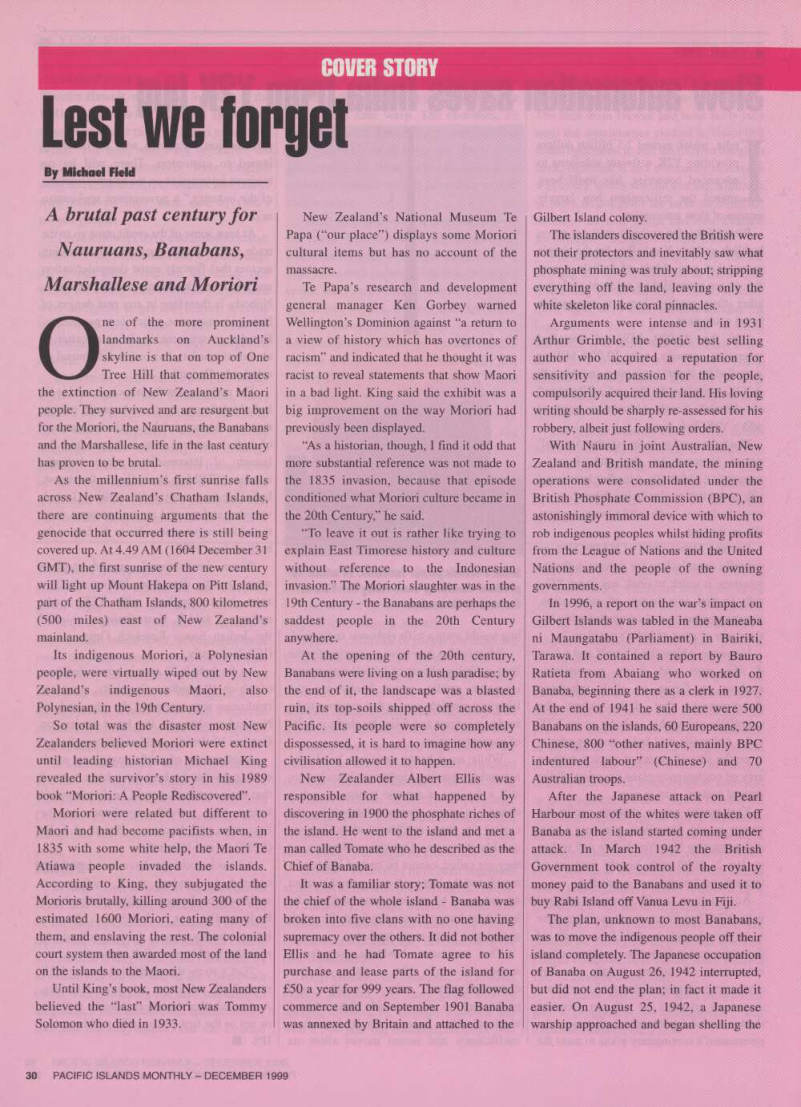
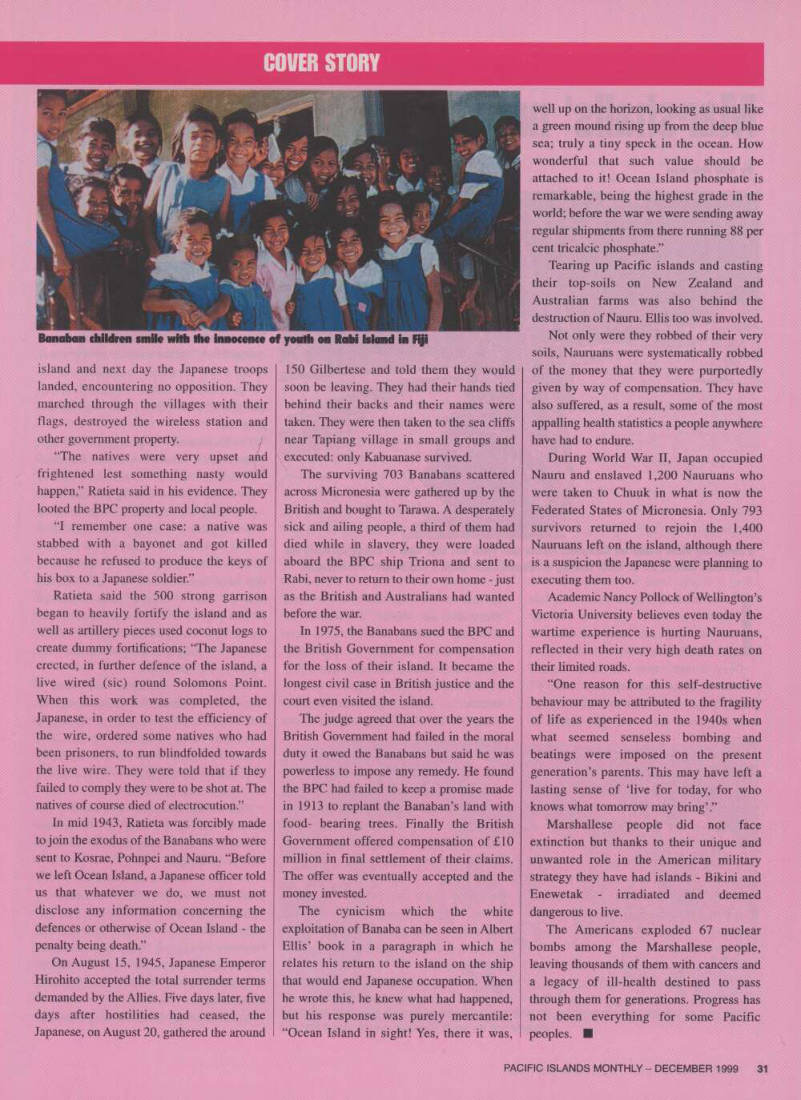
Cover Story
By Michael Field
A brutal past century for
Nauruans, Banabans,
Marshallese and Moriori
One of the more prominent landmarks on Auckland’s skyline is that on top of One Tree Hill that commemorates the extinction of New Zealand’s Maori people. They survived and are resurgent but for the Moriori, the Nauruans, the Banabans and the Marshallese, life in the last century has proven to be brutal.
As the millennium’s first sunrise falls across New Zealand’s Chatham Islands, there are continuing arguments that the genocide that occurred there is still being covered up. At 4.49 AM (1604 December 31 GMT), the first sunrise of the new century will light up Mount Hakepa on Pitt Island, part of the Chatham Islands, 800 kilometres (500 miles) east of New Zealand’s mainland.
Its indigenous Moriori, a Polynesian people, were virtually wiped out by New Zealand’s indigenous Maori, also Polynesian, in the 19th Century.
So total was the disaster most New Zealanders believed Moriori were extinct until leading historian Michael King revealed the survivor’s story in his 1989 book “Moriori: A People Rediscovered”.
Moriori were related but different to Maori and had become pacifists when, in 1835 with some white help, the Maori Te Atiawa people invaded the islands.
According to King, they subjugated the Morioris brutally, killing around 300 of the estimated 1600 Moriori, eating many of them, and enslaving the rest. The colonial court system then awarded most of the land on the islands to the Maori.
Until King’s book, most New Zealanders believed the “last” Moriori was Tommy Solomon who died in 1933.
New Zealand’s National Museum Te Papa (“our place”) displays some Moriori cultural items but has no account of the massacre.
Te Papa’s research and development general manager Ken Gorbey warned Wellington’s Dominion against “a return to a view of history which has overtones of racism” and indicated that he thought it was racist to reveal statements that show Maori in a bad light. King said the exhibit was a big improvement on the way Moriori had
previously been displayed.
“As a historian, though, I find it odd that more substantial reference was not made to the 1835 invasion, because that episode conditioned what Moriori culture became in the 20th Century,” he said.
“To leave it out is rather like trying to explain East Timorese history and culture without reference to the Indonesian invasion.” The Moriori slaughter was in the 19th Century - the Banabans are perhaps the saddest people in the 20th Century anywhere.
At the opening of the 20th century, Banabans were living on a lush paradise; by the end of it, the landscape was a blasted ruin, its top-soils shipped off across the Pacific. Its people were so completely dispossessed, it is hard to imagine how any civilisation allowed it to happen.
New Zealander Albert Ellis was responsible for what happened by discovering in 1900 the phosphate riches of the island. He went to the island and met a man called Tomate who he described as the Chief of Banaba.
It was a familiar story; Tomate was not the chief of the whole island - Banaba was broken into five clans with no one having supremacy over the others. It did not bother Ellis and he had Tomate agree to his purchase and lease parts of the island for £5O a year for 999 years. The flag followed commerce and on September 1901 Banaba was annexed by Britain and attached to the
Gilbert Island colony.
The islanders discovered the British were not their protectors and inevitably saw what phosphate mining was truly about; stripping everything off the land, leaving only the white skeleton like coral pinnacles.
Arguments were intense and in 1931 Arthur Grimble, the poetic best selling author who acquired a reputation for sensitivity and passion for the people, compulsorily acquired their land. His loving writing should be sharply re-assessed for his robbery, albeit just following orders.
With Nauru in joint Australian, New Zealand and British mandate, the mining operations were consolidated under the British Phosphate Commission (BPC), an astonishingly immoral device with which to rob indigenous peoples whilst hiding profits from the League of Nations and the United Nations and the people of the owning governments.
In 1996, a report on the war’s impact on Gilbert Islands was tabled in the Maneaba ni Maungatabu (Parliament) in Bairiki, Tarawa. It contained a report by Bauro Ratieta from Abaiang who worked on Banaba, beginning there as a clerk in 1927.
At the end of 1941 he said there were 500 Banabans on the islands, 60 Europeans, 220 Chinese, 800 “other natives, mainly BPC indentured labour” (Chinese) and 70 Australian troops.
After the Japanese attack on Pearl Harbour most of the whites were taken off Banaba as the island started coming under attack. In March 1942 the British Government took control of the royalty money paid to the Banabans and used it to buy Rabi Island off Vanua Levu in Fiji.
The plan, unknown to most Banabans, was to move the indigenous people off their island completely. The Japanese occupation of Banaba on August 26, 1942 interrupted, but did not end the plan; in fact it made it easier. On August 25, 1942, a Japanese warship approached and began shelling the
island and next day the Japanese troops landed, encountering no opposition. They marched through the villages with their flags, destroyed the wireless station and other government property.
“The natives were very upset and frightened lest something nasty would happen,” Ratieta said in his evidence. They looted the BPC property and local people.
“I remember one case: a native was stabbed with a bayonet and got killed because he refused to produce the keys of his box to a Japanese soldier.”
Ratieta said the 500 strong garrison began to heavily fortify the island and as well as artillery pieces used coconut logs to create dummy fortifications; “The Japanese erected, in further defence of the island, a live wired (sic) round Solomons Point.
When this work was completed, the Japanese, in order to test the efficiency of the wire, ordered some natives who had been prisoners, to run blindfolded towards the live wire. They were told that if they failed to comply they were to be shot at. The natives of course died of electrocution.”
In mid 1943, Ratieta was forcibly made to join the exodus of the Banabans who were sent to Kosrae, Pohnpei and Nauru. “Before we left Ocean Island, a Japanese officer told us that whatever we do, we must not disclose any information concerning the defences or otherwise of Ocean Island - the penalty being death.”
On August 15, 1945, Japanese Emperor Hirohito accepted the total surrender terms demanded by the Allies. Five days later, five days after hostilities had ceased, the Japanese, on August 20, gathered the around
150 Gilbertese and told them they would soon be leaving. They had their hands tied behind their backs and their names were taken. They were then taken to the sea cliffs near Tapiang village in small groups and executed: only Kabuanase survived.
The surviving 703 Banabans scattered across Micronesia were gathered up by the British and bought to Tarawa. A desperately sick and ailing people, a third of them had died while in slavery, they were loaded aboard the BPC ship Triona and sent to Rabi, never to return to their own home - just as the British and Australians had wanted before the war.
In 1975, the Banabans sued the BPC and the British Government for compensation for the loss of their island. It became the longest civil case in British justice and the court even visited the island.
The judge agreed that over the years the British Government had failed in the moral duty it owed the Banabans but said he was powerless to impose any remedy. He found the BPC had failed to keep a promise made in 1913 to replant the Banaban’s land with food- bearing trees. Finally the British Government offered compensation of £lO million in final settlement of their claims.
The offer was eventually accepted and the money invested.
The cynicism which the white exploitation of Banaba can be seen in Albert Ellis’ book in a paragraph in which he relates his return to the island on the ship that would end Japanese occupation. When he wrote this, he knew what had happened, but his response was purely mercantile: “Ocean Island in sight! Yes, there it was,
well up on the horizon, looking as usual like a green mound rising up from the deep blue sea; truly a tiny speck in the ocean. How wonderful that such value should be attached to it! Ocean Island phosphate is remarkable, being the highest grade in the world; before the war we were sending away regular shipments from there running 88 per cent tricalcic phosphate.”
Tearing up Pacific islands and casting their top-soils on New Zealand and Australian farms was also behind the destruction of Nauru. Ellis too was involved.
Not only were they robbed of their very soils, Nauruans were systematically robbed of the money that they were purportedly given by way of compensation. They have also suffered, as a result, some of the most appalling health statistics a people anywhere have had to endure.
During World War 11, Japan occupied Nauru and enslaved 1,200 Nauruans who were taken to Chuuk in what is now the Federated States of Micronesia. Only 793 survivors returned to rejoin the 1,400 Nauruans left on the island, although there is a suspicion the Japanese were planning to executing them too.
Academic Nancy Pollock of Wellington’s Victoria University believes even today the wartime experience is hurting Nauruans, reflected in their very high death rates on their limited roads.
“One reason for this self-destructive behaviour may be attributed to the fragility of life as experienced in the 1940 s when what seemed senseless bombing and beatings were imposed on the present generation’s parents. This may have left a lasting sense of ‘live for today, for who knows what tomorrow may bring’.”
Marshallese people did not face extinction but thanks to their unique and unwanted role in the American military strategy they have had islands - Bikini and Enewetak - irradiated and deemed dangerous to live.
The Americans exploded 67 nuclear bombs among the Marshallese people, leaving thousands of them with cancers and a legacy of ill-health destined to pass through them for generations. Progress has not been everything for some Pacific
peoples. ■
Banaban children smile with the innocence of youth on Rabi Island in Fiji
Marshalls' nuclear test damage lingers
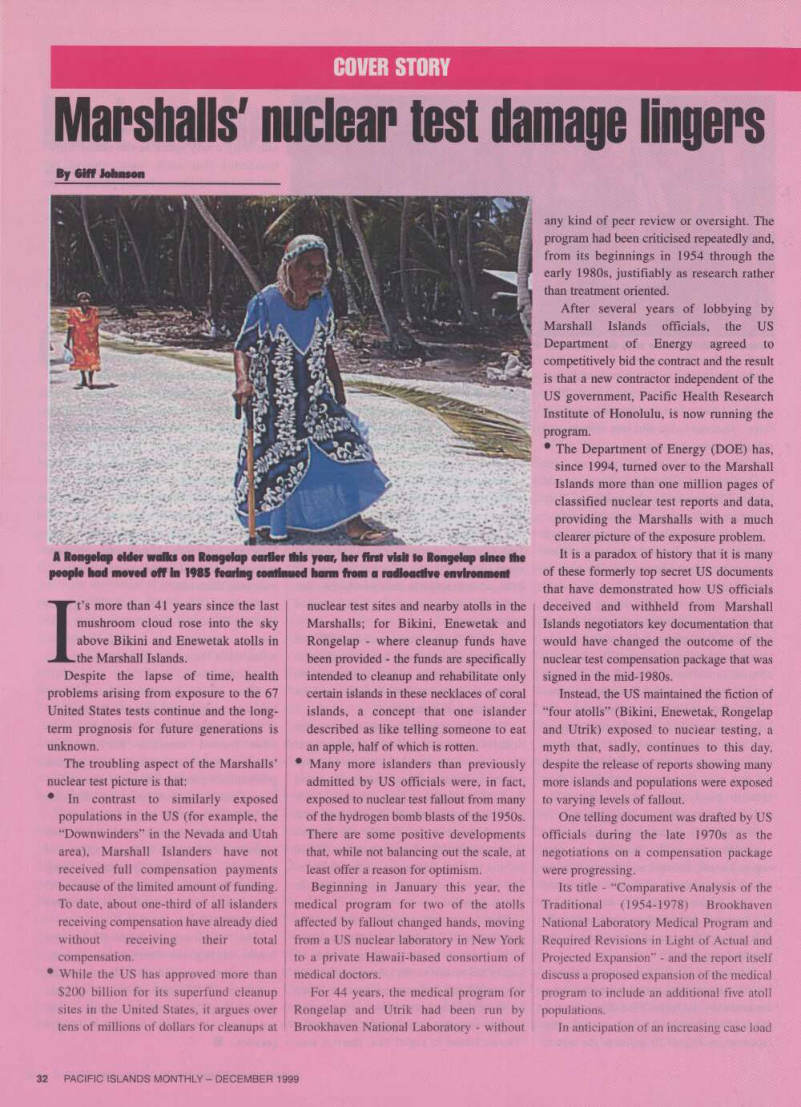
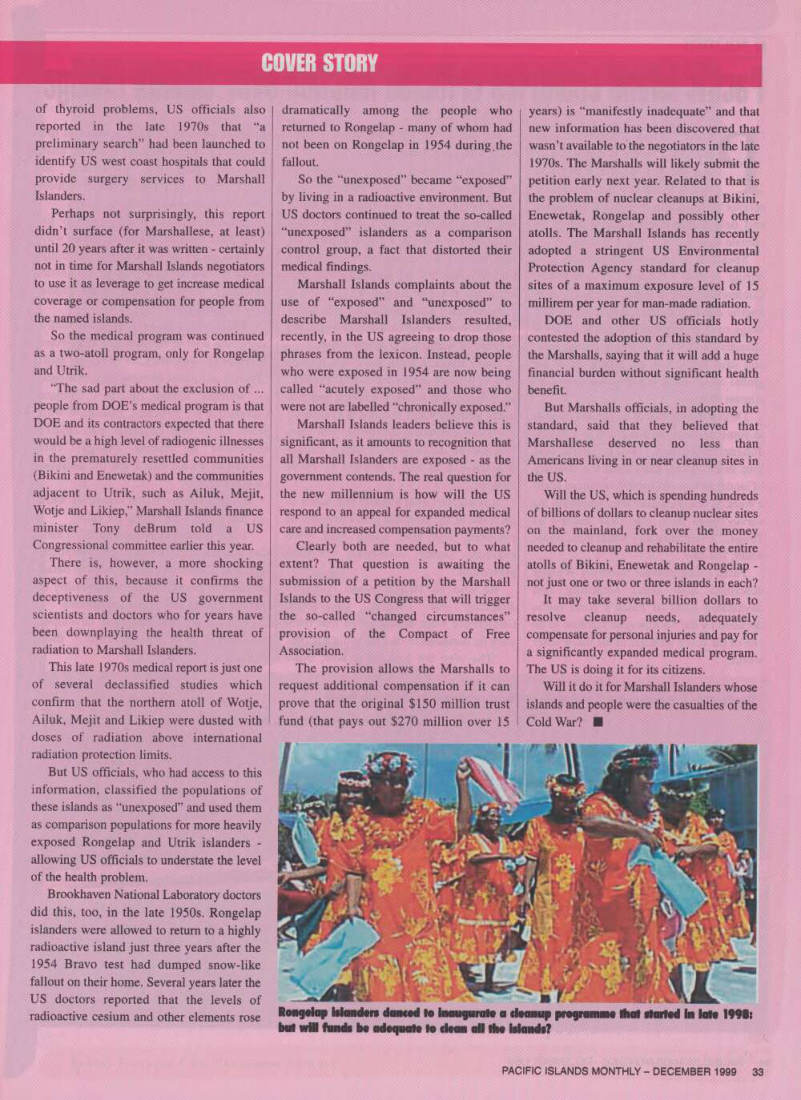
By Giff Johnson
It’s more than 41 years since the last mushroom cloud rose into the sky above Bikini and Enewetak atolls in the Marshall Islands.
Despite the lapse of time, health problems arising from exposure to the 67 United States tests continue and the long term prognosis for future generations is unknown.
The troubling aspect of the Marshalls’ nuclear test picture is that: • In contrast to similarly exposed populations in the US (for example, the “Downwinders” in the Nevada and Utah area), Marshall Islanders have not received full compensation payments because of the limited amount of funding.
To date, about one-third of all islanders receiving compensation have already died without receiving their total compensation. • While the US has approved more than $2OO billion for its superfund cleanup sites in the United States, it argues over tens of millions of dollars for cleanups at
nuclear test sites and nearby atolls in the Marshalls; for Bikini, Enewetak and Rongelap - where cleanup funds have been provided - the funds are specifically intended to cleanup and rehabilitate only certain islands in these necklaces of coral islands, a concept that one islander described as like telling someone to eat an apple, half of which is rotten. • Many more islanders than previously admitted by US officials were, in fact, exposed to nuclear test fallout from many of the hydrogen bomb blasts of the 19505.
There are some positive developments that, while not balancing out the scale, at least offer a reason for optimism.
Beginning in January this year, the medical program for two of the atolls
affected by fallout changed hands, moving
from a US nuclear laboratory in New York to a private Hawaii-based consortium of medical doctors.
For 44 years, the medical program for Rongelap and Utrik had been run by Brookhaven National Laboratory - without
any kind of peer review or oversight. The program had been criticised repeatedly and, from its beginnings in 1954 through the early 1980 s, justifiably as research rather than treatment oriented.
After several years of lobbying by Marshall Islands officials, the US Department of Energy agreed to competitively bid the contract and the result is that a new contractor independent of the US government. Pacific Health Research Institute of Honolulu, is now running the program. • The Department of Energy (DOE) has, since 1994, turned over to the Marshall Islands more than one million pages of classified nuclear test reports and data, providing the Marshalls with a much clearer picture of the exposure problem.
It is a paradox of history that it is many of these formerly top secret US documents that have demonstrated how US officials deceived and withheld from Marshall Islands negotiators key documentation that would have changed the outcome of the nuclear test compensation package that was signed in the mid-1980s.
Instead, the US maintained the fiction of “four atolls” (Bikini, Enewetak, Rongelap and Utrik) exposed to nuclear testing, a myth that, sadly, continues to this day, despite the release of reports showing many more islands and populations were exposed to varying levels of fallout.
One telling document was drafted by US officials during the late 1970 s as the
negotiations on a compensation package
were progressing.
Its title - “Comparative Analysis of the Traditional (1954-1978) Brookhaven National Laboratory Medical Program and Required Revisions in Light of Actual and Projected Expansion” - and the report itself discuss a proposed expansion of the medical program to include an additional five atoll populations.
In anticipation of an increasing case load
A Rongelap elder walks on Rongelap earlier Nils year, her first visit to Rongelap since the people bad moved off In 1985 fearing continued harm from a radioactive environment
of thyroid problems, US officials also reported in the late 1970 s that “a preliminary search” had been launched to identify US west coast hospitals that could provide surgery services to Marshall Islanders.
Perhaps not surprisingly, this report didn’t surface (for Marshallese, at least) until 20 years after it was written - certainly not in time for Marshall Islands negotiators to use it as leverage to get increase medical coverage or compensation for people from the named islands.
So the medical program was continued as a two-atoll program, only for Rongelap and Utrik.
“The sad part about the exclusion of ... people from DOE’s medical program is that DOE and its contractors expected that there would be a high level of radiogenic illnesses in the prematurely resettled communities (Bikini and Enewetak) and the communities adjacent to Utrik, such as Ailuk, Mejit, Wotje and Likiep,” Marshall Islands finance minister Tony deßrum told a US Congressional committee earlier this year.
There is, however, a more shocking aspect of this, because it confirms the deceptiveness of the US government scientists and doctors who for years have been downplaying the health threat of radiation to Marshall Islanders.
This late 1970 s medical report is just one of several declassified studies which confirm that the northern atoll of Wotje, Ailuk, Mejit and Likiep were dusted with doses of radiation above international radiation protection limits.
But US officials, who had access to this information, classified the populations of these islands as “unexposed” and used them as comparison populations for more heavily exposed Rongelap and Utrik islanders allowing US officials to understate the level of the health problem.
Brookhaven National Laboratory doctors did this, too, in the late 19505. Rongelap islanders were allowed to return to a highly radioactive island just three years after the 1954 Bravo test had dumped snow-like fallout on their home. Several years later the US doctors reported that the levels of radioactive cesium and other elements rose
dramatically among the people who returned to Rongelap - many of whom had not been on Rongelap in 1954 during, the fallout.
So the “unexposed” became “exposed” by living in a radioactive environment. But US doctors continued to treat the so-called “unexposed” islanders as a comparison control group, a fact that distorted their
medical findings.
Marshall Islands complaints about the use of “exposed” and “unexposed” to describe Marshall Islanders resulted, recently, in the US agreeing to drop those phrases from the lexicon. Instead, people who were exposed in 1954 are now being called “acutely exposed” and those who were not are labelled “chronically exposed.”
Marshall Islands leaders believe this is significant, as it amounts to recognition that all Marshall Islanders are exposed - as the government contends. The real question for the new millennium is how will the US respond to an appeal for expanded medical care and increased compensation payments?
Clearly both are needed, but to what extent? That question is awaiting the submission of a petition by the Marshall Islands to the US Congress that will trigger the so-called “changed circumstances” provision of the Compact of Free Association.
The provision allows the Marshalls to request additional compensation if it can prove that the original $l5O million trust fund (that pays out $270 million over 15
years) is “manifestly inadequate” and that new information has been discovered that wasn’t available to the negotiators in the late 19705. The Marshalls will likely submit the petition early next year. Related to that is the problem of nuclear cleanups at Bikini, Enewetak, Rongelap and possibly other atolls. The Marshall Islands has recently adopted a stringent US Environmental Protection Agency standard for cleanup sites of a maximum exposure level of 15 millirem per year for man-made radiation.
DOE and other US officials hotly contested the adoption of this standard by the Marshalls, saying that it will add a huge financial burden without significant health benefit.
But Marshalls officials, in adopting the standard, said that they believed that Marshallese deserved no less than Americans living in or near cleanup sites in the US.
Will the US, which is spending hundreds of billions of dollars to cleanup nuclear sites on the mainland, fork over the money needed to cleanup and rehabilitate the entire atolls of Bikini, Enewetak and Rongelap not just one or two or three islands in each?
It may take several billion dollars to resolve cleanup needs, adequately compensate for personal injuries and pay for a significantly expanded medical program.
The US is doing it for its citizens.
Will it do it for Marshall Islanders whose islands and people were the casualties of the Cold War? ■
Rongelap islanders danced to inaugurate a cleanup programme that started In late 1998: but will fends be adequate to clean all the Islands?
Pacific Island countries criticise inaction ever climate change
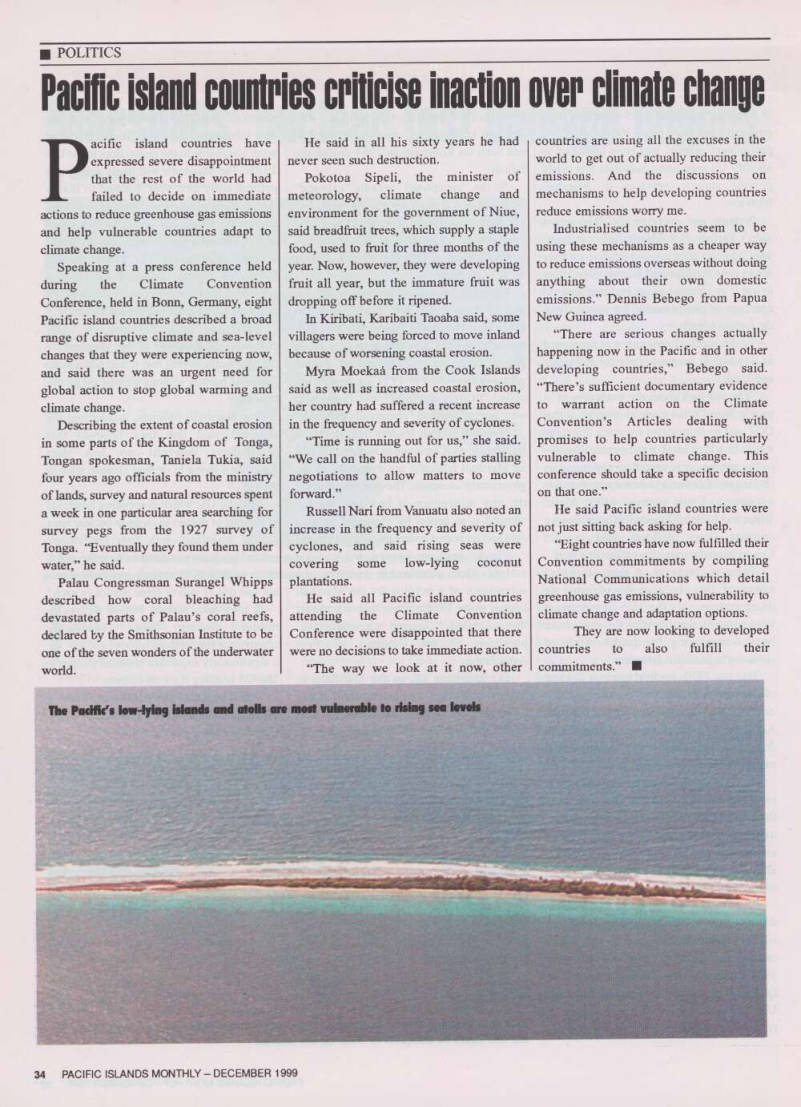
Politics
Pacific island countries have expressed severe disappointment that the rest of the world had failed to decide on immediate actions to reduce greenhouse gas emissions and help vulnerable countries adapt to climate change.
Speaking at a press conference held during the Climate Convention Conference, held in Bonn, Germany, eight Pacific island countries described a broad range of disruptive climate and sea-level changes that they were experiencing now, and said there was an urgent need for global action to stop global warming and climate change.
Describing the extent of coastal erosion in some parts of the Kingdom of Tonga, Tongan spokesman, Taniela Tukia, said four years ago officials from the ministry of lands, survey and natural resources spent a week in one particular area searching for survey pegs from the 1927 survey of Tonga. “Eventually they found them under water,” he said.
Palau Congressman Surangel Whipps described how coral bleaching had devastated parts of Palau’s coral reefs, declared by the Smithsonian Institute to be one of the seven wonders of the underwater world.
He said in all his sixty years he had never seen such destruction.
Pokotoa Sipeli, the minister of meteorology, climate change and environment for the government of Niue, said breadfruit trees, which supply a staple food, used to fruit for three months of the year. Now, however, they were developing fruit all year, but the immature fruit was dropping off before it ripened.
In Kiribati, Karibaiti Taoaba said, some villagers were being forced to move inland because of worsening coastal erosion.
Myra Moekaa from the Cook Islands said as well as increased coastal erosion, her country had suffered a recent increase in the frequency and severity of cyclones.
“Time is running out for us,” she said.
“We call on the handful of parties stalling negotiations to allow matters to move forward.”
Russell Nari from Vanuatu also noted an increase in the frequency and severity of cyclones, and said rising seas were
covering some low-lying coconut
plantations.
He said all Pacific island countries attending the Climate Convention Conference were disappointed that there were no decisions to take immediate action.
“The way we look at it now, other
countries are using all the excuses in the world to get out of actually reducing their emissions. And the discussions on mechanisms to help developing countries reduce emissions worry me.
Industrialised countries seem to be using these mechanisms as a cheaper way to reduce emissions overseas without doing anything about their own domestic emissions.” Dennis Bebego from Papua New Guinea agreed.
“There are serious changes actually happening now in the Pacific and in other developing countries,” Bebego said.
“There’s sufficient documentary evidence to warrant action on the Climate Convention’s Articles dealing with promises to help countries particularly vulnerable to climate change. This conference should take a specific decision on that one.”
He said Pacific island countries were not just sitting back asking for help.
“Eight countries have now fulfilled their Convention commitments by compiling National Communications which detail greenhouse gas emissions, vulnerability to climate change and adaptation options.
They are now looking to developed countries to also fulfill their commitments.” ■
The Pacific's low-tying islands and atolls are most vulnerable to rising sea levels
Advertisements & other items, p. 35 (1 item)
S'it tack and relax
St • '••*■ i&gs**, Lgis L ij,, s *■ -'“S!>- & ' g* • ■ -.■■aegafaft»—- s ♦ .Xr mtm
on your Island In £Ke sky,.
When you fly with ftir Pacific the friendliness, caring and relaxed service, and fresh healthy food all make your flight as stress free as possible.ftnd no matter which class you choose, we have features to help you enjoy our flights, (ike Individual entertainment units in business class and a video unit every three rows In Pacific class on our new Boeing 737’5. ftnd the biggest difference Is our people, their friendly smiles and genuine caring.
AIR PACIFIC
your Island In 6he sky
Qanfas Frequent Flyer Programme Partner www.airpacific.com
US annexation of Wake Island illegal
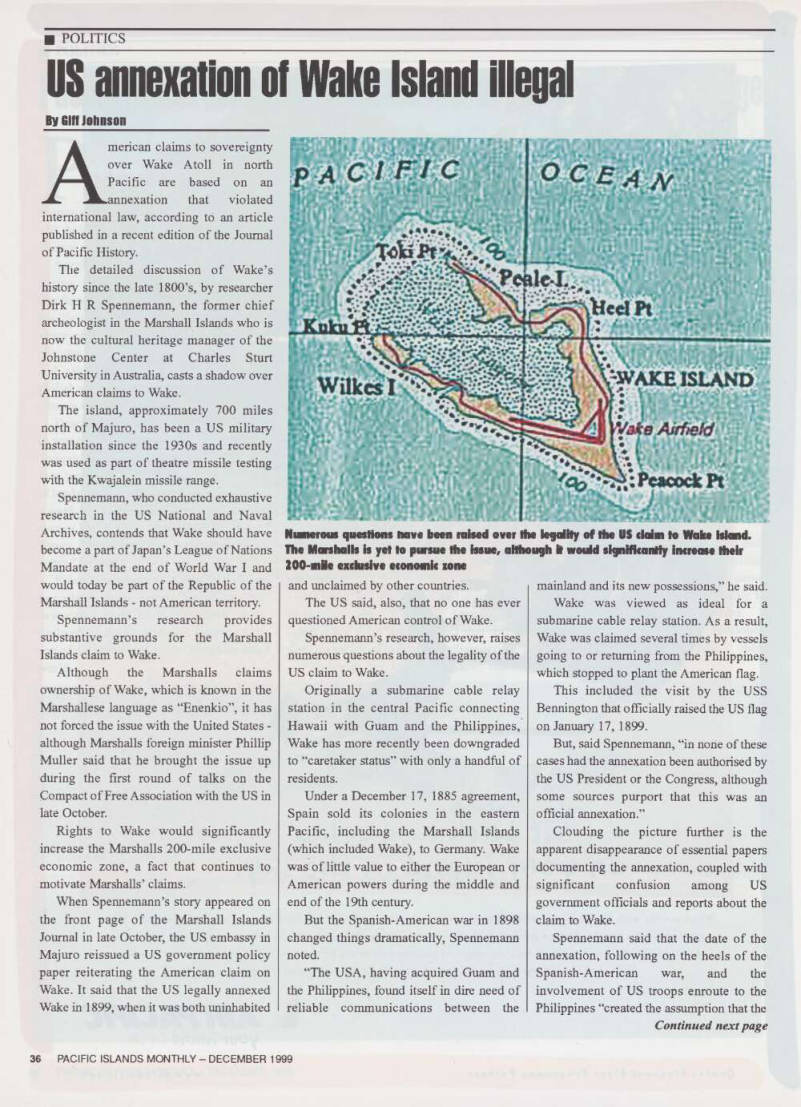
By Giff Johnson
American claims to sovereignty
over Wake Atoll in north Pacific are based on an annexation that violated international law, according to an article published in a recent edition of the Journal of Pacific History.
The detailed discussion of Wake’s history since the late 1800’s, by researcher Dirk H R Spennemann, the former chief archeologist in the Marshall Islands who is now the cultural heritage manager of the Johnstone Center at Charles Sturt University in Australia, casts a shadow over American claims to Wake.
The island, approximately 700 miles north of Majuro, has been a US military installation since the 1930 s and recently was used as part of theatre missile testing with the Kwajalein missile range.
Spennemann, who conducted exhaustive research in the US National and Naval Archives, contends that Wake should have become a part of Japan’s League of Nations Mandate at the end of World War I and would today be part of the Republic of the Marshall Islands - not American territory.
Spennemann’s research provides substantive grounds for the Marshall Islands claim to Wake.
Although the Marshalls claims ownership of Wake, which is known in the Marshallese language as “Enenkio”, it has not forced the issue with the United States although Marshalls foreign minister Phillip Muller said that he brought the issue up during the first round of talks on the Compact of Free Association with the US in late October.
Rights to Wake would significantly increase the Marshalls 200-mile exclusive economic zone, a fact that continues to motivate Marshalls’ claims.
When Spennemann’s story appeared on the front page of the Marshall Islands Journal in late October, the US embassy in Majuro reissued a US government policy paper reiterating the American claim on Wake. It said that the US legally annexed Wake in 1899, when it was both uninhabited
and unclaimed by other countries.
The US said, also, that no one has ever questioned American control of Wake.
Spennemann’s research, however, raises numerous questions about the legality of the US claim to Wake.
Originally a submarine cable relay station in the central Pacific connecting Hawaii with Guam and the Philippines, Wake has more recently been downgraded to “caretaker status” with only a handful of residents.
Under a December 17, 1885 agreement, Spain sold its colonies in the eastern Pacific, including the Marshall Islands (which included Wake), to Germany. Wake was of little value to either the European or American powers during the middle and end of the 19th century.
But the Spanish-American war in 1898
changed things dramatically, Spennemann
noted.
“The USA, having acquired Guam and the Philippines, found itself in dire need of reliable communications between the
mainland and its new possessions,” he said.
Wake was viewed as ideal for a submarine cable relay station. As a result, Wake was claimed several times by vessels going to or returning from the Philippines, which stopped to plant the American flag.
This included the visit by the USS Bennington that officially raised the US flag on January 17, 1899.
But, said Spennemann, “in none of these cases had the annexation been authorised by the US President or the Congress, although some sources purport that this was an official annexation.”
Clouding the picture further is the apparent disappearance of essential papers documenting the annexation, coupled with significant confusion among US government officials and reports about the claim to Wake.
Spennemann said that the date of the annexation, following on the heels of the Spanish-American war, and the involvement of US troops enroute to the Philippines “created the assumption that the
Continued next page
Numerous questions nave been raised over the legality of the US claim to Wake Island.
The Marshalls is yet to pursue the issue, although it would significantly increase their 200-mile exclusive economic zone
Continued from previous page US annexed Wake from Spain.”
But if Spain had considered Wake still a part of its Micronesian holdings, the island would have been included in the negotiations of the Paris Treaty of Peace at the end of the Spanish-American war. “This was not the case,” Spennemann said. “In the eyes of Germany, Wake had been obtained from Spain as part of the Marshalls” when the two nations signed the treaty in 1885.
Why, then, didn’t Germany object to this infringement on its territory? The aftermath of the Spanish-American war saw major realignment of colonial control over possessions in the region: the US took control of the Philippines and Guam, Hawaii became a US territory and the Carolines, Palau and the rest of the Marianas became German.
Control of Samoa and the economic interests that resulted “had been the focus of a long-running dispute among Germany, the US and England. The German government, which saw Samoa as a prize possession, did not wish to endanger any emerging agreement,” he said. “In this game, Wake was a pawn.” With Germany’s defeat in World War I, the ownership issue was conveniently forgotten, Spennemann said.
But the fact that Germany - not Spain claimed ownership of Wake is indisputable, Spennemann said.
In addition to the sale agreement of 1885, following the Spanish-American war,
Spain and Germany signed another
agreement on September 10, 1898 guaranteeing that Germany would
eventually gain control of all Spanish
possessions in the South Pacific that were not ceded to or otherwise disposed of by treaty with the United States.
“Even if the US were in doubt as to the German ownership of Wake based on the 1885 agreement, the terms of the 1898 agreement and the non-inclusion of Wake in the Treaty of Paris (between Spain and the
US) unequivocally reconfirmed Germany’s
claim (to Wake),” Spennemann said.
Indeed, while in 1906 the Navy said rather ambiguously that it “was of the opinion” that Wake was under its jurisdiction, in 1913 the General Board of the Navy was more blunt.
“The records in the Department (of the Navy) afford little definite information in regard of Wake Island aside from the fact that it belongs to the US. It does not appear that this island has ever been placed under the control of any of the executive
departments.”
Interestingly, noted Spennemann, the US did not take aggressive action to enforce its sovereignty at Wake when the uninhabited island was being lived on and used by
Japanese fishermen intermittently between
1902 and 1908. In contrast, he said, when the same situation occurred on German controlled Taongi and US-controlled Laysan/Lisianski, both countries acted to enforce sovereignty. “The US did nothing to develop Wake or to enforce its sovereignty,” he said.
Spennemann said the record demonstrates that “the annexation of Wake is far from straightforward.”
Because Germany controlled Wake by the time of the Spanish-American war of
1898, “the US annexation contravened international law, especially as Germany had been neutral"’ during the war, he said.
“That the US felt uneasy over the ownership issue becomes clear in light of the internal confusion on its own authority on the island and the government’s reluctance to spell out details of the annexation.
“The disappearance of crucial documents relating to the US annexation and the lack of material on a German- American agreement on Wake leaves a bad aftertaste especially in view of its
implications.
“If the atoll had been annexed illegally, then under international law it would have remained German until the end of the First World War, and in 1919 have become part of Japan’s Mandate over the former German possessions and, via the post-Second World War US Trust Territory period, would today be an integral part of the Republic of the Marshall Islands.” ■
Wake's orange flower and moon rocks
By Giff Johnson
EneaJdo. the Marshallese name for Wake Island, has great
significance in island legends,
for Enenkio, the most distant northern atoll in the Marshalls’ chain, kid a prize that led many ah islander to make the some 700- mile voyage in outrigger canoes.
The name translates literally as “island of the orange flower.” This flower, according to legend, had so special a fragrance that no man could ignore a woman wearing it.
Enenkio was at one time the only island where this flower grew, but now it is said to grow on a number of the northern atolls in the Marshalls.
But flowers and legends and feats of navigation don’t mean much to the US government, which claims the island.
The Marshall Islands Guidebook noted that “over the centuries, Marshallese navigators (who obviously discovered Wake before the date claimed by the British - 1796) used to ride up to Wake to pick the orange flowers and then return to the
various other islands here to tout their bravery in having gone to such extremes just for beauty.
“The girls loved it, stories were told about it, and it was just about as silly as going to the moon. Maybe not quite, since it does appear that orange flowers are more attractive than moon rocks.
“Well, the Marshallese of course do respect the fact that the Americans were the first to go to the moon, and from the general talk around town, are very happy to respect the claim the Americans may have regarding ownership of the lunar satellite.
They wish, though, that as much respect should be accorded them regarding Wake Island since, truth to tell, discovery was not a 17th century happening."
Commenting on the competitive claim of ownership, the Guidebook noted that the United States is advancing its claim “despite the fact that the United States has only been in existence just over 200 years and Wake Island was around much longer
Advertisements & other items, p. 38 (1 item)
xjelstra ~elstra
TRADE MARK CAUTIONARY NOTICE
Notice is hereby given that Telstra Corporation Limited, a corporation duly organised and existing under the laws of Australia, and having ACN 051 775 556, the Corporate Secretary being located at 242 Exhibition Street, Melbourne, Australia is the sole proprietor of the following trade marks:-
TELSTRA
xjelstra ~elstra
Used in respect of:— Telecommunications and communications equipment, apparatus and systems, including but not limited to electronic and optical telecommunications and communications equipment, apparatus and systems; satellite and earth station telecommunications and communications equipment, apparatus and systems; Telephone equipment, apparatus and systems, including but not nimted to telephone; telephone receivers; telephone handsets; telephone network, telephone exchanges, telephone switching, telephone answering, telephone card vending and telephone dialling equipment, apparatus and systems; Transmission, receiving and storage equipment, apparatus and systems, including but not limited to facsimile, teleeraph, telex, teleprinting, cable and paging equipment, apparatus and systems; data and video networking and conferencing equipment, apparatus and systems; data processing, message handling and switching equipment, apparatus and systems; digital equipment, apparatus and systems; electronic, voice, text and facsimile mail equipment, apparatus and systems; electronic directory equipment, apparatus and systems; Computer equipment, apparatus and systems, including but not limited to computer programs; computer software; computer hardware; computer terminals; computer memories; computer networking equipment, apparatus and systems; computer manuals in this class; modems; Video and audio equipment, apparatus and systems, including but not limited to sound and image recording, transmission and reproduction equipment, apparatus and systems; video cassettes and tapes; compact discs; records; digital, electric and electronic radio equipment, apparatus and systems; magnetic tapes; cinematographic, television and amusement equipment, apparatus and systems; amusement machines; All associated parts and accessories being goods in class 9, paper, cardboard and goods made from these materials; printed matter including directories, journals and manuals and all goods in class 16; advertising, promotional, consultancy and business services; compiling, arranging and publishing directories; telephone answering services; market research and statistical services; being services in class 35, repair installation, maintenance and construction services; being services in class 37, telecommunication services being services in class 38, amusement, entertainment, education and information services; multi-media services; being services in class 41, research services; computer programming services; retail and wholesaling services; consultancy services being services in Class 42'.
The said proprietor claims all rights in respect of the above trade marks and will take all necessary legal steps against any person or company infringing their said rights.
DAVIES COLLISON CAVE
PATENT ATTORNEYS
One Little Collins Street Level 10 AMP Building Melbourne, Victoria, 3000 10 Barrack Street Hobart Place Australia Sydney, New South Wales, 2000 Canberra City 2601
First round of Compact negotiations over
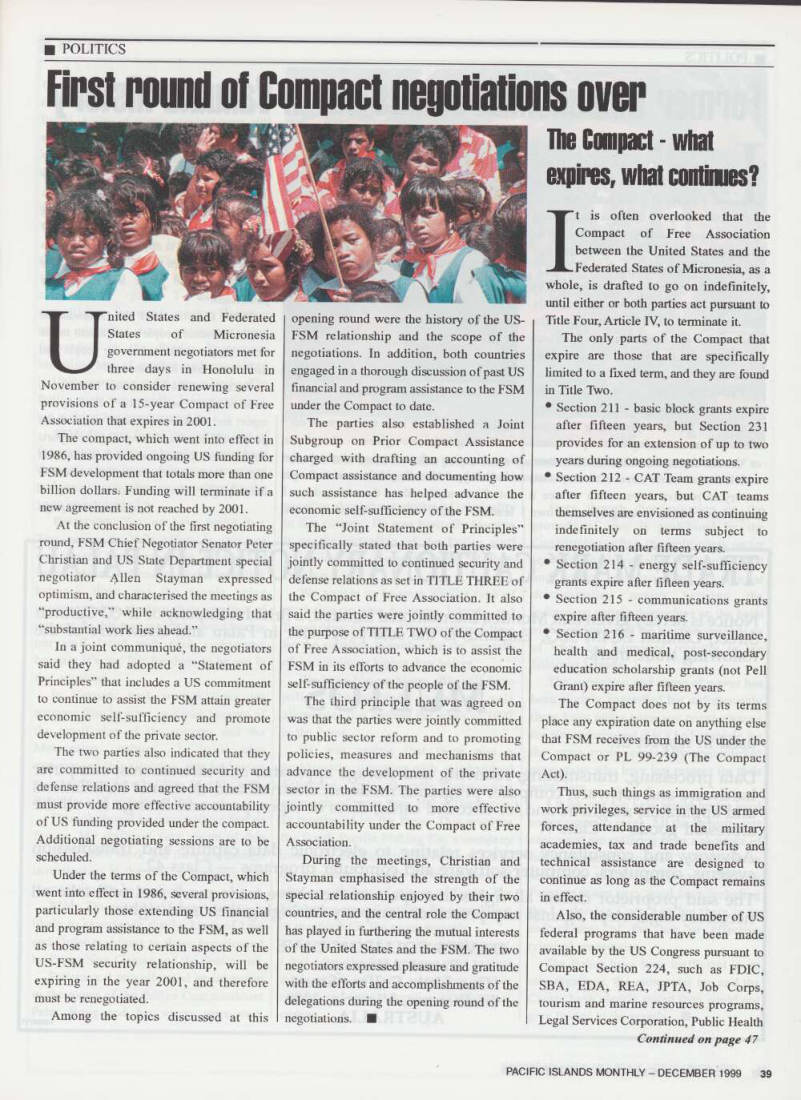
United States and Federated States of Micronesia government negotiators met for three days in Honolulu in November to consider renewing several provisions of a 15-year Compact of Free Association that expires in 2001.
The compact, which went into effect in 1986, has provided ongoing US funding for FSM development that totals more than one billion dollars. Funding will terminate if a new agreement is not reached by 2001.
At the conclusion of the first negotiating round, FSM Chief Negotiator Senator Peter Christian and US State Department special negotiator Stayman expressed optimism, and characterised the meetings as “productive,” while acknowledging that “substantial work lies ahead.”
In a joint communique, the negotiators said they had adopted a “Statement of Principles” that includes a US commitment to continue to assist the FSM attain greater economic self-sufficiency and promote development of the private sector.
The two parties also indicated that they are committed to continued security and defense relations and agreed that the FSM must provide more effective accountability of US funding provided under the compact.
Additional negotiating sessions are to be scheduled.
Under the terms of the Compact, which went into effect in 1986, several provisions, particularly those extending US financial and program assistance to the FSM, as well as those relating to certain aspects of the US-FSM security relationship, will be expiring in the year 2001, and therefore must be renegotiated.
Among the topics discussed at this
opening round were the history of the US FSM relationship and the scope of the negotiations. In addition, both countries engaged in a thorough discussion of past US financial and program assistance to the FSM under the Compact to date.
The parties also established a Joint Subgroup on Prior Compact Assistance charged with drafting an accounting of Compact assistance and documenting how such assistance has helped advance the economic self-sufficiency of the FSM.
The “Joint Statement of Principles” specifically stated that both parties were jointly committed to continued security and defense relations as set in TITLE THREE of the Compact of Free Association. It also said the parties were jointly committed to the purpose of TITLE TWO of the Compact of Free Association, which is to assist the FSM in its efforts to advance the economic self-sufficiency of the people of the FSM.
The third principle that was agreed on was that the parties were jointly committed to public sector reform and to promoting policies, measures and mechanisms that advance the development of the private sector in the FSM. The parties were also jointly committed to more effective accountability under the Compact of Free Association.
During the meetings, Christian and Stayman emphasised the strength of the
special relationship enjoyed by their two
countries, and the central role the Compact has played in furthering the mutual interests of the United States and the FSM. The two negotiators expressed pleasure and gratitude with the efforts and accomplishments of the delegations during the opening round of the negotiations. ■
expires, what continues?
The Compact - what expires, what continues?
It is often overlooked that the Compact of Free Association between the United States and the Federated States of Micronesia, as a whole, is drafted to go on indefinitely, until either or both parties act pursuant to Title Four, Article IV, to terminate it.
The only parts of the Compact that expire are those that are specifically limited to a fixed term, and they are found in Title Two. • Section 211 - basic block grants expire after fifteen years, but Section 231 provides for an extension of up to two
years during ongoing negotiations.
• Section 212 - CAT Team grants expire after fifteen years, but CAT teams themselves are envisioned as continuing indefinitely on terms subject to renegotiation after fifteen years. • Section 214 - energy self-sufficiency grants expire after fifteen years. • Section 215 - communications grants expire after fifteen years. • Section 216 - maritime surveillance, health and medical, post-secondary education scholarship grants (not Pell Grant) expire after fifteen years.
The Compact does not by its terms place any expiration date on anything else that FSM receives from the US under the Compact or PL 99-239 (The Compact Act).
Thus, such things as immigration and work privileges, service in the US armed forces, attendance at the military academies, tax and trade benefits and technical assistance are designed to continue as long as the Compact remains in effect.
Also, the considerable number of US federal programs that have been made available by the US Congress pursuant to Compact Section 224, such as FDIC,
Sba, Eda, Rea, Jpta, Job Corps,
tourism and marine resources programs.
Legal Services Corporation, Public Health
Continued on page 47
Former Ombudsman stands out in Vanuatu history
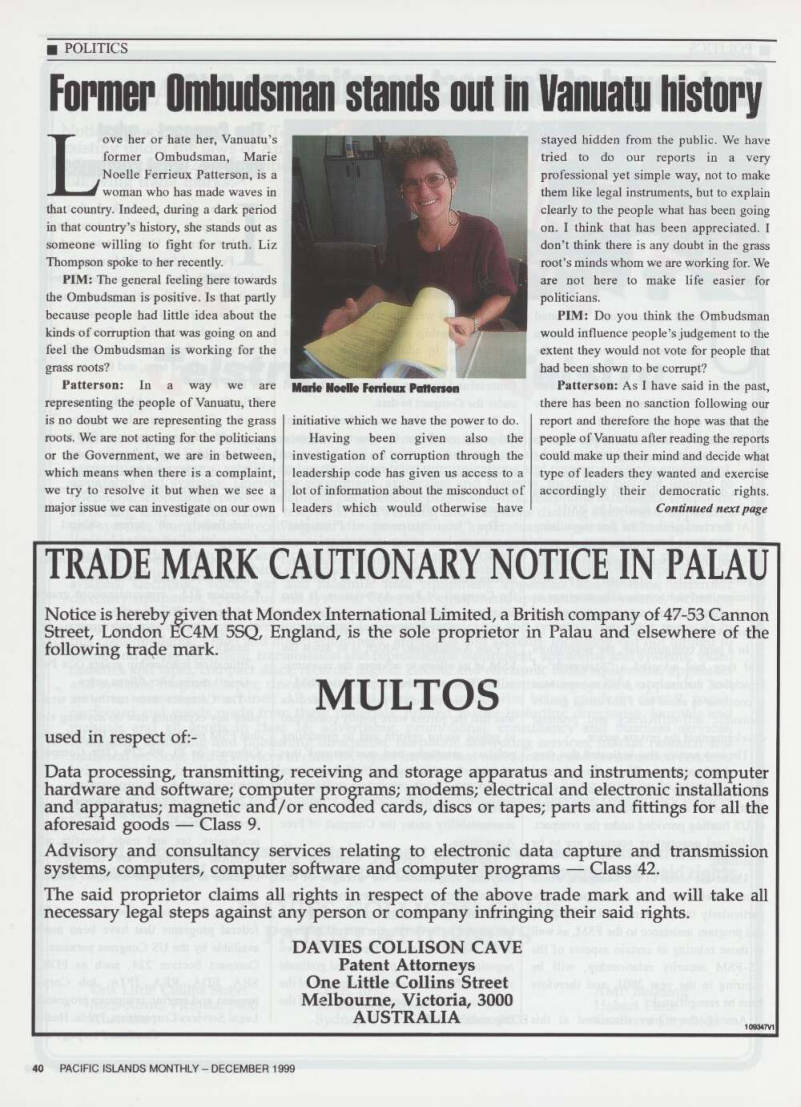

Love her or hate her, Vanuatu’s former Ombudsman, Marie Noelle Ferrieux Patterson, is a woman who has made waves in that country. Indeed, during a dark period in that country’s history, she stands out as someone willing to fight for truth. Liz Thompson spoke to her recently.
PIM: The general feeling here towards the Ombudsman is positive. Is that partly because people had little idea about the kinds of corruption that was going on and feel the Ombudsman is working for the grass roots?
Patterson: In a way we are representing the people of Vanuatu, there is no doubt we are representing the grass roots. We are not acting for the politicians or the Government, we are in between, which means when there is a complaint, we try to resolve it but when we see a major issue we can investigate on our own
initiative which we have the power to do.
Having been given also the investigation of corruption through the leadership code has given us access to a lot of information about the misconduct of leaders which would otherwise have
stayed hidden from the public. We have tried to do our reports in a very professional yet simple way, not to make them like legal instruments, but to explain clearly to the people what has been going on. I think that has been appreciated. I don’t think there is any doubt in the grass root’s minds whom we are working for. We are not here to make life easier for
politicians.
PIM: Do you think the Ombudsman would influence people’s judgement to the extent they would not vote for people that had been shown to be corrupt?
Patterson: As I have said in the past, there has been no sanction following our report and therefore the hope was that the people of Vanuatu after reading the reports could make up their mind and decide what type of leaders they wanted and exercise accordingly their democratic rights.
Continued next page
Mane Noelle Ferrieux Patterson
Continued from previous page
However this has not been so as leaders found guilty of wrong conduct were still elected. Our job is to make sure that people know the truth. And after that the people decide.
PIM: I ’ve heard that you have received death threats; does a job like this bring with it a lot of enemies?
Patterson: There were some death threats at some point. The main one was in 1998 warning me of a potential assassination plot. I had Police surveillance for many weeks. However more recently, some statements were forwarded to the Public Prosecutor, informing him of another such conspiracy in 1996, involving at the time a leader. The Police were supposedly investigating it, but nothing has come out of it.
PIM: Do you found the cultural ties of the wantok system, whereby people from the same clans have obligations to protect and assist each other on occasions hinder your investigators?
Patterson: Yes, we have found that.
The policy in this office is that we recommend very strongly or, even oblige investigators, whenever there is a link between them and the people being investigated to declare their conflict of interest. In this way we try to avoid having our staff faced with such a dilemma because it’s not fair for them to be put in that situation In Vanuatu such wantok links are stronger than in other countries because of the small size of the country and the Melanesian culture. I have also experienced this situation, that is, having to investigate people I was friendly with.
But there was no wantok link.
This job should be done without fear or favour. My staff are very aware of this aspect of their work and there are enough investigators in the Office to ensure that
impartiality can be applied.
PIM: Do you think that Vanuatu is likely to experience similar kinds of Law and Order problems to those experienced by Papua New Guinea and the Solomons?
Patterson: I recently read an interview in the paper of the Police Commissioner Peter Bong and his views were very
negative about the evolution of criminality in this country. He was basically blaming it on the reduction of the Police staff following the Comprehensive Reform Program.
We appear to be on a similar type of evolution to the Solomon Islands and Papua New Guinea. It’s a matter of time for the situation to evolve but the increase of criminality is higher than before.
We have big problems. We still have police who allegedly have not paid allowances that created the crisis of 1997 in the Force.
He was saying that there was a problematic situation with six hundred
fishermen and allegedly outstanding
payments of more than 100 millions vatu as mentioned by the Press. This involves the South Pacific Fishing Co, a company owned by the Vanuatu Government.. Now the company is on edge of being liquidated after accusations of misuse of funds. The Fishermen are still waiting for a resolution as mentioned in the paper recently.
Even though I am a citizen of Vanuatu, I feel often the first weapon used against me is racism and that I come from another country and am not familiar with the local custom.
Even though discrimination on the grounds of race is prohibited by the Constitution, often the politicians under investigation have called me a colonialist and other names. But a similar discrimination occurs between the indigenous people themselves on the basis of their islands and the reaction reminds us of what has happened recently in the Solomon Islands.
The corruption and abuse of power has been slightly controlled but unfortunately there have never been any consequences for wrongdoers and it is a bad example for the grass roots, especially unemployed grass roots who have lost respect for their politicians.
I think one big help would be for legal enforcement to come. All the Departments concerned are suffering from a shortage of funds or human resources. We have set up now with the Comprehensive Reform
Program many very good laws including
the Leadership Code Act but there is no enforcement of the law or effective
criminal prosecution.
The Police have been inefficient in its investigations, the prosecuter too and the Courts have clearly stated they could not give Justice to the people. ■
"Our job is to moke sure that people know the truth. And after that the people decide," says Patterson of the effect of her job in Vanuatu
Advertisements & other items, pp. 40-43 (1 item)
Trade Mark Cautionary Notice In Palau
Notice is hereby given that Mondex International Limited, a British company of 47-53 Cannon Street, London EC4M SSQ, England, is the sole proprietor in Palau and elsewhere of the following trade mark.
MULTOS
used in respect of:- Data processing, transmitting, receiving and storage apparatus and instruments; computer hardware and software; computer programs; modems; electrical and electronic installations and apparatus; magnetic and/or encoded cards, discs or tapes; parts and fittings for all the aforesaid goods Class 9.
Advisory and consultancy services relating to electronic data capture and transmission systems, computers, computer software and computer programs Class 42.
The said proprietor claims all rights in respect of the above trade mark and will take all necessary legal steps against any person or company infringing their said rights.
DAVIES COLLISON CAVE
Patent Attorneys One Little Collins Street Melbourne, Victoria, 3000
AUSTRALIA
109347V1
ASIAN DEVELOPMENT BANK-JAPAN SCHOLARSHIP PROGRAM
(funded by the Government of Japan)
Qualified citizens of developing member countries of the Asian Development Bank, who intend to pursue post-graduate studies in selected disciplines are invited to apply for scholarships under the Asian Development Bank-Japan Scholarship Program. It is anticipated that upon successful completion of their graduate studies under the Program, the scholars will return to their countries and contribute to its socioeconomic development. Scholarships are awarded for graduate studies at designated institutions in courses of study approved by ADB. The Program especially welcomes women applicants who are qualified but have limited financial means to obtain university education.
THE SCHOLARSHIPS
* Level of education : Post-graduate (Diploma, Masters and Doctorate degrees) * Duration : From one to three years * Coverage : Tuition fees, books, subsistence and housing allowance, insurance, economy airfare research subsidy
ELIGIBILITY REQUIREMENTS
Prospective applicants must: * be a citizen of an ADB developing member country * have at least two years work experience * have gained admission to an approved course in a designated institution * be in good health (Staff of ADB and the designated institutions and their close relatives are not eligible to apply)
DESIGNATED INSTITUTIONS
1 ASIAN INSTITUTE OF MANAGEMENT
123 Paseo de Roxas, Makati City Metro Manila, Philippines Attn: Admissions Director Telephone No. (632) 893-7631/892-4011 to 25
FAX No. (632) 893-7631
URL: http://www.aim.edu.ph Email:[email protected]
2. ASIAN INSTITUTE OF TECHNOLOGY
P.O. Box 4, Klong Luang Pathumthani, Thailand 12120 Attn.: Chief Admission Officer Telephone No. (662) 5126-0110 to 44 (662) 524-5031
FAX No. (662) 516-2126/(662) 524-6346
URL: http://www.ait.ac.th Email: [email protected]: [email protected]
3. EAST-WEST CENTER/UNIVERSITY OF HAWAII
1601 East-West Road, Honolulu Hawaii 96848, U.S.A Attn.: ADB Scholarship Program Administrator Telephone No. (808) 944-7597
FAX No. (808) 944-7070
URL: http://www.ewc.hawaii.edu Email; [email protected]
4. INDIAN INSTITUTE OF TECHNOLOGY, DELHI
New Delhi 110016, India Attn: The Registrar Telephone No. (9111) 666-979
FAX No. (9111) 686-2037
URL: http:..www.iitd.emet.in Email: [email protected]
APPLICATION REQUIREMENTS
Applicants should: * obtain application forms from the designated institutions of their choice * submit the completed application form and required documentation to the institution * indicate on the application form that the applicant wishes to be considered for an Asian Development Bank-Japan Scholarship (From among those admitted by the, institutions, ADB will select candidates for award of scholarships. A separate application to ADB is not necessary)
APPROVED FIELDS OF STUDY
Business Management, Development Management, Management Science, Engineering and Technology including Computer Science & Information Management, Industrial Systems Engineering, Mechatronics Telecommunications Space Technology Applications & Research Geotechnical & Transportation Engineering Structural Engineering & Construction Water Engineering & Management Water Supply, Drainage & Sewerage Engineering Management of Technology, International Business Agriculture & Aquatic Systems Engineering Natural Resources Management Gender & Development Studies Energy, Processing Technology Urban Environmental Engineerings Management Agricultural and Resource Economics Business Administration Economics Geography Horticulture Japan-focussed Executive MBA Ocean Engineering Oceanography Pacific Islands Studies Public Administration Sociology Urban and Regional Planning Science and Technology 112828v7
5. INTERNATIONAL RICE RESEARCH INSTITUTE/
UNIVERSITY OF THE PHILIPPINES IN LOS BANOS P.O. 80x933, Manila, Philippines Attn.: Director, Research and Training Telephone No. (632)845-0563/845-0569/845-05570
FAX No. (632) 845-0606/891-1292
URL: http://www.cglar.org/irri Email: [email protected]
6. INTERNATIONAL UNIVERSITY OF JAPAN
Graduate School of International Relations Yamato-machi, Minami Uonuma-gun Niigata 949-7277, Japan Attn.: Office ofGSIR Telephone No. (81257) 79-1200
FAX No. (81257) 79-1187
URL: http://www.iuj.ac.jp Email: [email protected]
7. LAHORE UNIVERSITY OF MANAGEMENT SCIENCES
Opposite Sector “U”, LOCHS Lahore Cantt. 54792 Lahore, Pakistan Attn.: Senior Manager Student Affairs Telephone No. (9242) 572-2670 to 2679
FAX No. (9242) 572-2591
URL: http://www.lums.edu.pk Email: [email protected]
8= NATIONAL CENTRE FOR DEVELOPMENT STUDIES/
AUSTRALIAN NATIONAL UNIVERSITY
GPO Box 4, Canberra ACT 0200, Australia Attn.: Program Director Telephone No. (612) 6249-4705
FAX No. (612) 7257-2886
URL: http://www.ncdsnet.anu.edu.au Email; Billie, [email protected] 9. NATIONAL GRADUATE INSTITUTE FOR POLICY STUDIES (formerly the Graduate School of Policy Science of the Saitama University) 2-2 Wakamatsu-cho, Shinjuku-ku Tokyo 162-8677, Japan Attn.: Admissions Officer Telephone No. (813) 3341-0590 URL: http://www.grips.ac.jp Email: [email protected]
10. NATIONAL UNIVERSITY OF SINGAPORE
10 Kent Ridge Crescent, Singapore 119260 Attn.: Director, Graduate School of Business Telephone No. (65)874-2068/874-6149
FAX No. (65) 778-2681
URL: http://www.fba.nus.edu.sg/postgrad/gsb Email: [email protected]
11. SAITAMA UNIVERSITY
Department of Civil & Environmental Engineering 255 Shimo-Ohkubo Urawa City 338-8570, Japan Attn.: The Foreign Student Office Phone/FAX No. (81-48) 858-3555 URL: http://www.civil.saitama-u.ac.jp/fso/fso.html Email: [email protected]
12. THAMMASAT UNIVERSITY
2 Prachand Road, Bangkok 10200, Thailand Attn: Vice-Rector for Academic Affairs Phone/FAX No. (662) 2230194 URL: http.//www.tu.ac.th/org/.grad/grad.htm Email: [email protected]
13. UNIVERSITY OF AUCKLAND
Private Bag 92019, Auckland, New Zealand Attn: International Student Officer International Student Officer International Student office Telephone No. (649) 373-7513
FAX N. (649) 373-7405
URL: http:..www.auckland.ac.nz Email: [email protected] Fields related to Rice and Rice-Based Farming International Development International Relations Business Administration Economics of Development, Development Administration, Environmental Management & Development Infrastructure Management Public Policy, Development Studies Transition Economy & Taxation Business Administration, Management of Technology, Social Sciences (Economics) Civil and Environmental Engineering and Related Subjects Economics, Engineering International Business, Development Studies, Environmental Science and Management, Engineering, Public Health 113827vS
Klana's Song of Exile praised
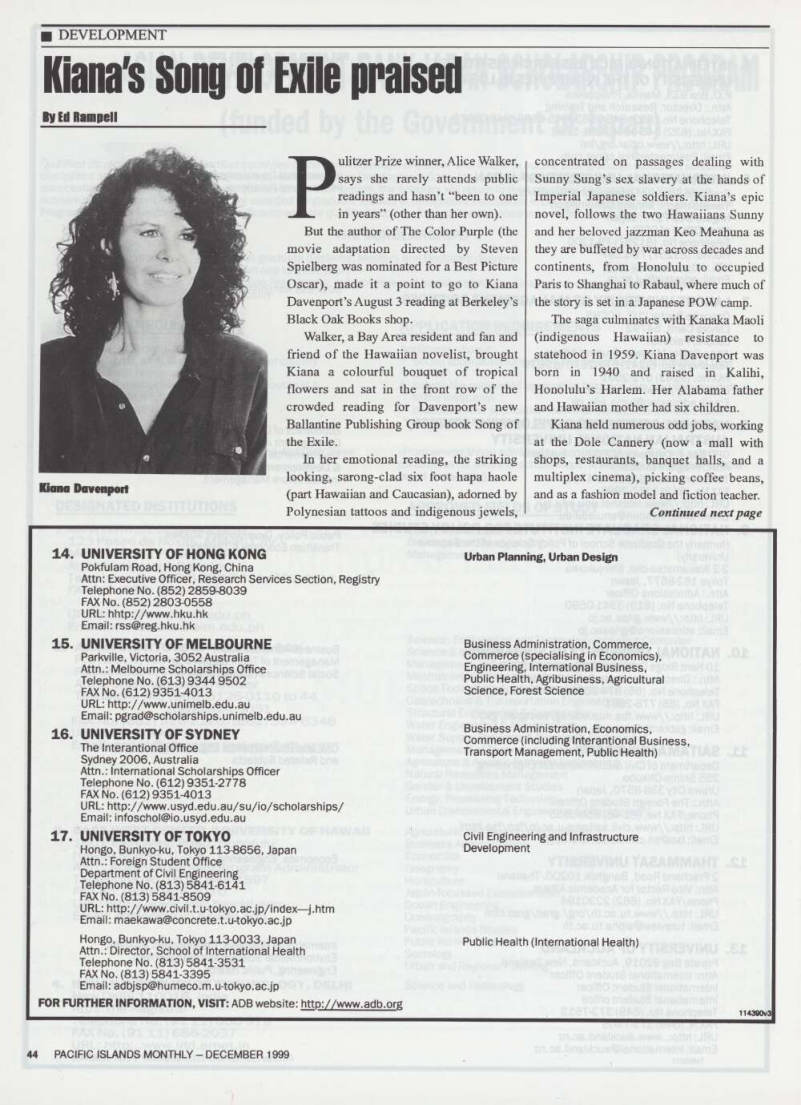
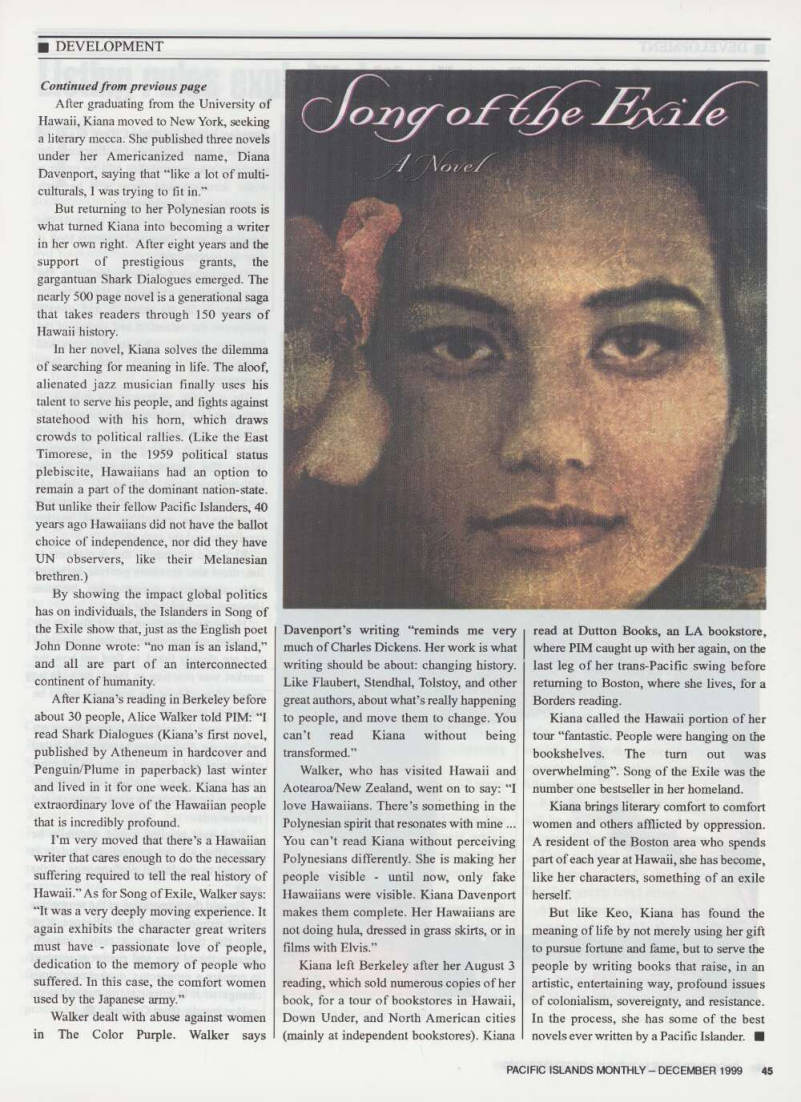
Development
By Ed Rampell
Pulitzer Prize winner, Alice Walker, says she rarely attends public readings and hasn’t “been to one in years” (other than her own).
But the author of The Color Purple (the movie adaptation directed by Steven Spielberg was nominated for a Best Picture Oscar), made it a point to go to Kiana
Davenport’s August 3 reading at Berkeley’s
Black Oak Books shop.
Walker, a Bay Area resident and fan and friend of the Hawaiian novelist, brought Kiana a colourful bouquet of tropical flowers and sat in the front row of the crowded reading for Davenport’s new Ballantine Publishing Group book Song of the Exile.
In her emotional reading, the striking looking, sarong-clad six foot hapa haole (part Hawaiian and Caucasian), adorned by Polynesian tattoos and indigenous jewels.
concentrated on passages dealing with Sunny Sung’s sex slavery at the hands of Imperial Japanese soldiers. Kiana’s epic novel, follows the two Hawaiians Sunny and her beloved jazzman Keo Meahuna as they are buffeted by war across decades and continents, from Honolulu to occupied Paris to Shanghai to Rabaul, where much of the story is set in a Japanese POW camp.
The saga culminates with Kanaka Maoli
(indigenous Hawaiian) resistance to
statehood in 1959. Kiana Davenport was born in 1940 and raised in Kalihi, Honolulu’s Harlem. Her Alabama father and Hawaiian mother had six children.
Kiana held numerous odd jobs, working at the Dole Cannery (now a mall with shops, restaurants, banquet halls, and a multiplex cinema), picking coffee beans, and as a fashion model and fiction teacher.
Continued next page
Kiana Davenport
Continued from previous page
After graduating from the University of Hawaii, Kiana moved to New York, seeking a literary mecca. She published three novels under her Americanized name, Diana Davenport, saying that “like a lot of multi culturals, I was trying to fit in.”
But returning to her Polynesian roots is what turned Kiana into becoming a writer in her own right. After eight years and the support of prestigious grants, the gargantuan Shark Dialogues emerged. The nearly 500 page novel is a generational saga that takes readers through 150 years of
Hawaii history.
In her novel, Kiana solves the dilemma of searching for meaning in life. The aloof, alienated jazz musician finally uses his talent to serve his people, and fights against statehood with his horn, which draws crowds to political rallies. (Like the East Timorese, in the 1959 political status plebiscite, Hawaiians had an option to remain a part of the dominant nation-state.
But unlike their fellow Pacific Islanders, 40 years ago Hawaiians did not have the ballot choice of independence, nor did they have UN observers, like their Melanesian
brethren.)
By showing the impact global politics has on individuals, the Islanders in Song of the Exile show that, just as the English poet John Donne wrote: “no man is an island,” and all are part of an interconnected continent of humanity.
After Kiana’s reading in Berkeley before about 30 people, Alice Walker told PIM; “I read Shark Dialogues (Kiana’s first novel, published by Atheneum in hardcover and Penguin/Plume in paperback) last winter and lived in it for one week. Kiana has an extraordinary love of the Hawaiian people that is incredibly profound.
I’m very moved that there’s a Hawaiian writer that cares enough to do the necessary suffering required to tell the real history of Hawaii.” As for Song of Exile, Walker says: “It was a very deeply moving experience. It again exhibits the character great writers must have - passionate love of people, dedication to the memory of people who suffered. In this case, the comfort women used by the Japanese army.”
Walker dealt with abuse against women in The Color Purple. Walker says
Davenport’s writing “reminds me very much of Charles Dickens. Her work is what
writing should be about: changing history.
Like Flaubert, Stendhal, Tolstoy, and other great authors, about what’s really happening to people, and move them to change. You can’t read Kiana without being transformed.”
Walker, who has visited Hawaii and Aotearoa/New Zealand, went on to say: “I love Hawaiians. There’s something in the Polynesian spirit that resonates with mine ...
You can’t read Kiana without perceiving
Polynesians differently. She is making her
people visible - until now, only fake Hawaiians were visible. Kiana Davenport makes them complete. Her Hawaiians are not doing hula, dressed in grass skirts, or in films with Elvis.”
Kiana left Berkeley after her August 3 reading, which sold numerous copies of her book, for a tour of bookstores in Hawaii, Down Under, and North American cities
(mainly at independent bookstores). Kiana
read at Dutton Books, an LA bookstore, where PIM caught up with her again, on the last leg of her trans-Pacific swing before returning to Boston, where she lives, for a Borders reading.
Kiana called the Hawaii portion of her tour “fantastic. People were hanging on the bookshelves. The turn out was overwhelming”. Song of the Exile was the number one bestseller in her homeland.
Kiana brings literary comfort to comfort women and others afflicted by oppression.
A resident of the Boston area who spends part of each year at Hawaii, she has become, like her characters, something of an exile herself.
But like Keo, Kiana has found the meaning of life by not merely using her gift to pursue fortune and fame, but to serve the people by writing books that raise, in an artistic, entertaining way, profound issues of colonialism, sovereignty, and resistance.
In the process, she has some of the best novels ever written by a Pacific Islander. ■
Advertisements & other items, p. 44 (1 item)
14. University Of Hong Kong
Pokfulam Road, Hong Kong, China Attn: Executive Officer, Research Services Section, Registry Telephone No. (852) 2859-8039
FAX No. (852) 2803-0558
URL: hhtp;//www.hku.hk Email; [email protected]
15. UNIVERSITY OF MELBOURNE
Parkville, Victoria, 3052 Australia Attn.: Melbourne Scholarships Office Telephone No. (613) 9344 9502
FAX No. (612) 9351-4013
URL: http://www.unimelb.edu.au Email: [email protected]
16. UNIVERSITY OF SYDNEY
The Interantional Office Sydney 2006, Australia Attn.: International Scholarships Officer Telephone No. (612) 9351-2778
FAX No. (612) 9351-4013
URL: http://www.usyd.edu.au/su/io/scholarships/ Email; [email protected]
17. UNIVERSITY OF TOKYO
Hongo, Bunkyo-ku, Tokyo 113-8656, Japan Attn.: Foreign Student Office Department of Civil Engineering Telephone No. (813) 5841-6141
FAX No. (813) 5841-8509
URL: http://www.civil.t.u-tokyo.ac.jp/index—j.htm Email: [email protected] Hongo, Bunkyo-ku, Tokyo 113-0033, Japan Attn.: Director, School of International Health Telephone No. (813) 5841-3531
FAX No. (813) 5841-3395
Email: [email protected] FOR FURTHER INFORMATION, VISIT: ADB website: http://www.adb.org Urban Planning, Urban Design Business Administration, Commerce, Commerce (specialising in Economics), Engineering, International Business, Public Health, Agribusiness, Agricultural Science, Forest Science Business Administration, Economics, Commerce (including Interantional Business, Transport Management, Public Health) Civil Engineering and Infrastructure Development Public Health (International Health) 114390v3
Timing of share float "critical"
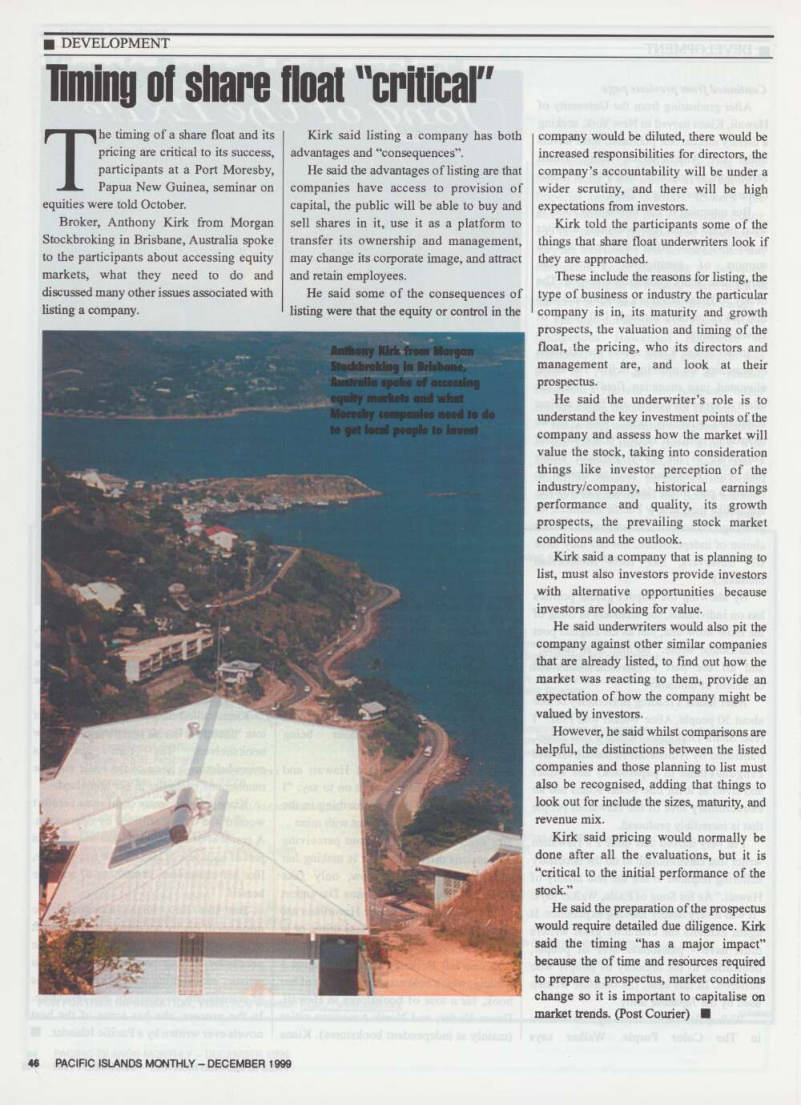
The timing of a share float and its pricing are critical to its success, participants at a Port Moresby, Papua New Guinea, seminar on equities were told October.
Broker, Anthony Kirk from Morgan Stockbroking in Brisbane, Australia spoke to the participants about accessing equity markets, what they need to do and discussed many other issues associated with listing a company.
Kirk said listing a company has both
advantages and “consequences”.
He said the advantages of listing are that companies have access to provision of capital, the public will be able to buy and sell shares in it, use it as a platform to transfer its ownership and management, may change its corporate image, and attract and retain employees.
He said some of the consequences of listing were that the equity or control in the
company would be diluted, there would be increased responsibilities for directors, the company’s accountability will be under a wider scrutiny, and there will be high expectations from investors.
Kirk told the participants some of the things that share float underwriters look if they are approached.
These include the reasons for listing, the type of business or industry the particular company is in, its maturity and growth prospects, the valuation and timing of the float, the pricing, who its directors and management are, and look at their prospectus.
He said the underwriter’s role is to understand the key investment points of the company and assess how the market will value the stock, taking into consideration things like investor perception of the industry/company, historical earnings performance and quality, its growth prospects, the prevailing stock market conditions and the outlook.
Kirk said a company that is planning to list, must also investors provide investors with alternative opportunities because investors are looking for value.
He said underwriters would also pit the company against other similar companies that are already listed, to find out how the market was reacting to them, provide an expectation of how the company might be valued by investors.
However, he said whilst comparisons are helpful, the distinctions between the listed companies and those planning to list must also be recognised, adding that things to look out for include the sizes, maturity, and revenue mix.
Kirk said pricing would normally be done after all the evaluations, but it is “critical to the initial performance of the stock.”
He said the preparation of the prospectus would require detailed due diligence. Kirk said the timing “has a major impact” because the of time and resources required to prepare a prospectus, market conditions change so it is important to capitalise on market trends. (Post Courier) ■
Anthony Kirk from Morgan Stockbroking in Brisbane, Auslralia spoke of accessing equity markes and what Moresby companies need to do to get local people to invent
Listing rules explained
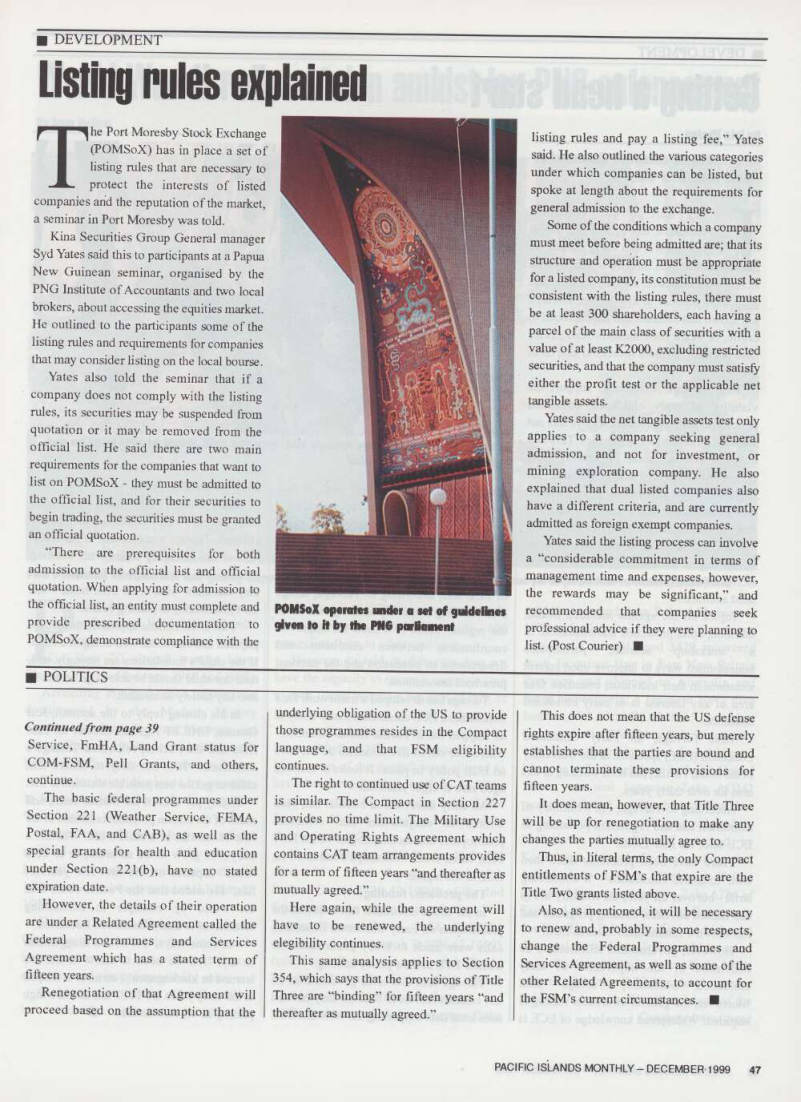
The Port Moresby Stock Exchange
(POMSoX) has in place a set of listing rules that are necessary to protect the interests of listed companies and the reputation of the market, a seminar in Port Moresby was told.
Kina Securities Group General manager Syd Yates said this to participants at a Papua New Guinean seminar, organised by the PNG Institute of Accountants and two local brokers, about accessing the equities market.
He outlined to the participants some of the listing rules and requirements for companies that may consider listing on the local bourse.
Yates also told the seminar that if a company does not comply with the listing rules, its securities may be suspended from quotation or it may be removed from the official list. He said there are two main requirements for the companies that want to list on POMSoX - they must be admitted to the official list, and for their securities to begin trading, the securities must be granted an official quotation.
“There are prerequisites for both admission to the official list and official quotation. When applying for admission to the official list, an entity must complete and provide prescribed documentation to POMSoX, demonstrate compliance with the
listing rules and pay a listing fee,” Yates said. He also outlined the various categories under which companies can be listed, but spoke at length about the requirements for general admission to the exchange.
Some of the conditions which a company must meet before being admitted are; that its structure and operation must be appropriate for a listed company, its constitution must be consistent with the listing rules, there must be at least 300 shareholders, each having a parcel of the main class of securities with a value of at least K2OOO, excluding restricted securities, and that the company must satisfy either the profit test or the applicable net tangible assets.
Yates said the net tangible assets test only applies to a company seeking general admission, and not for investment, or mining exploration company. He also explained that dual listed companies also have a different criteria, and are currently admitted as foreign exempt companies.
Yates said the listing process can involve a “considerable commitment in terms of management time and expenses, however, the rewards may be significant,” and recommended that companies seek professional advice if they were planning to list. (Post Courier) ■
POMSoX operates under a set of guidelines given to it by the PNG parliament
Advertisements & other items, p. 47 (1 item)
Politics
Getting a head start
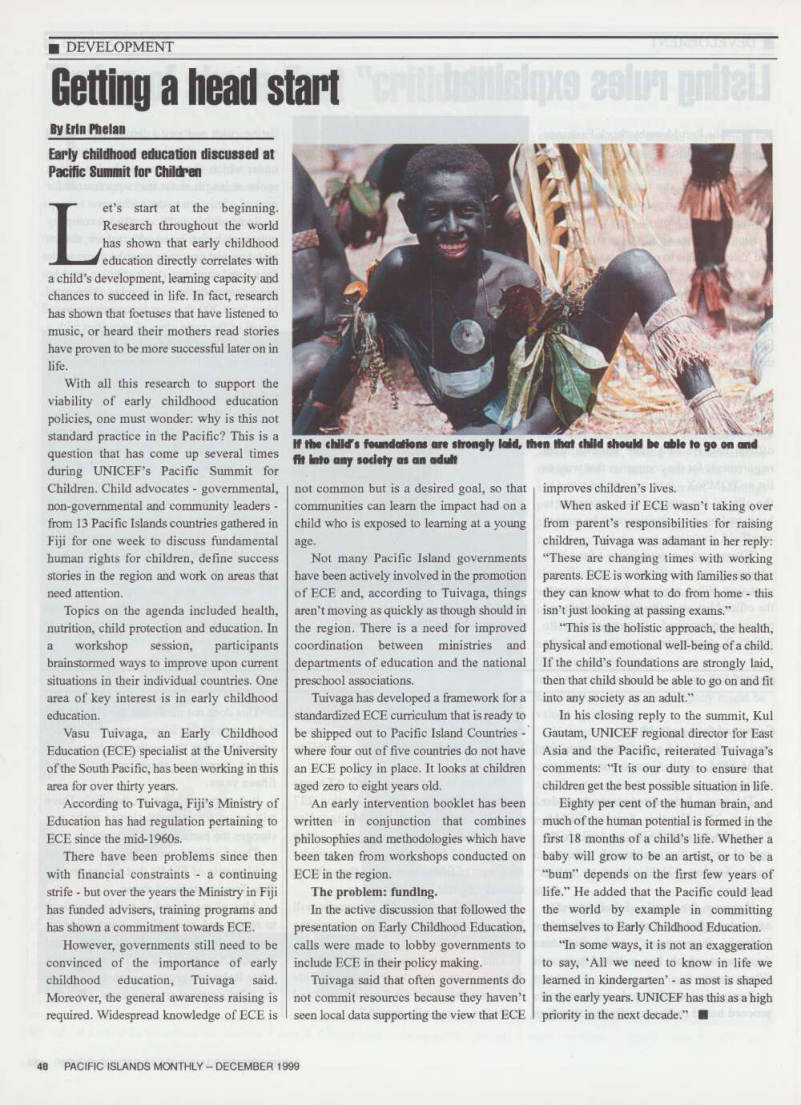
By Erin Phelan
Early childhood education discussed at Pacific Summit for Children Let’s start at the beginning.
Research throughout the world has shown that early childhood education directly correlates with a child’s development, learning capacity and chances to succeed in life. In fact, research has shown that foetuses that have listened to music, or heard their mothers read stories have proven to be more successful later on in life.
With all this research to support the viability of early childhood education policies, one must wonder; why is this not standard practice in the Pacific? This is a question that has come up several times during UNICEF’s Pacific Summit for Children. Child advocates - governmental, non-governmental and community leaders from 13 Pacific Islands countries gathered in Fiji for one week to discuss fundamental human rights for children, define success stories in the region and work on areas that need attention.
Topics on the agenda included health, nutrition, child protection and education. In a workshop session, participants brainstormed ways to improve upon current situations in their individual countries. One area of key interest is in early childhood education.
Vasu Tuivaga, an Early Childhood
Education (ECE) specialist at the University
of the South Pacific, has been working in this area for over thirty years.
According to Tuivaga, Fiji’s Ministry of
Education has had regulation pertaining to ECE since the mid-19605.
There have been problems since then with financial constraints - a continuing strife - but over the years the Ministry in Fiji has funded advisers, training programs and has shown a commitment towards ECE.
However, governments still need to be convinced of the importance of early childhood education, Tuivaga said.
Moreover, the general awareness raising is required. Widespread knowledge of ECE is
not common but is a desired goal, so that communities can leam the impact had on a child who is exposed to learning at a young age.
Not many Pacific Island governments have been actively involved in the promotion of ECE and, according to Tuivaga, things aren’t moving as quickly as though should in the region. There is a need for improved coordination between ministries and departments of education and the national
preschool associations.
Tuivaga has developed a framework for a standardized ECE curriculum that is ready to be shipped out to Pacific Island Countries where four out of five countries do not have an ECE policy in place. It looks at children aged zero to eight years old.
An early intervention booklet has been written in conjunction that combines philosophies and methodologies which have been taken from workshops conducted on ECE in the region.
The problem: funding.
In the active discussion that followed the presentation on Early Childhood Education, calls were made to lobby governments to include ECE in their policy making.
Tuivaga said that often governments do not commit resources because they haven’t seen local data supporting the view that ECE
improves children’s lives.
When asked if ECE wasn’t taking over from parent’s responsibilities for raising children, Tuivaga was adamant in her reply: “These are changing times with working parents. ECE is working with families so that they can know what to do from home - this isn’t just looking at passing exams.’’
“This is the holistic approach, the health, physical and emotional well-being of a child.
If the child’s foundations are strongly laid, then that child should be able to go on and fit into any society as an adult.”
In his closing reply to the summit, Kul Gautam, UNICEF regional director for East Asia and the Pacific, reiterated Tuivaga’s comments: “It is our duty to ensure that children get the best possible situation in life.
Eighty per cent of the human brain, and much of the human potential is formed in the first 18 months of a child’s life. Whether a baby will grow to be an artist, or to be a “bum” depends on the first few years of life.” He added that the Pacific could lead the world by example in committing themselves to Early Childhood Education.
“In some ways, it is not an exaggeration to say, ‘All we need to know in life we learned in kindergarten’ - as most is shaped in the early years. UNICEF has this as a high priority in the next decade.” ■
If the child's foundations are strongly laid, then that child should be able to go on and fit into any society as an adult
World War II relics stolen amidst lax PNG enforcement
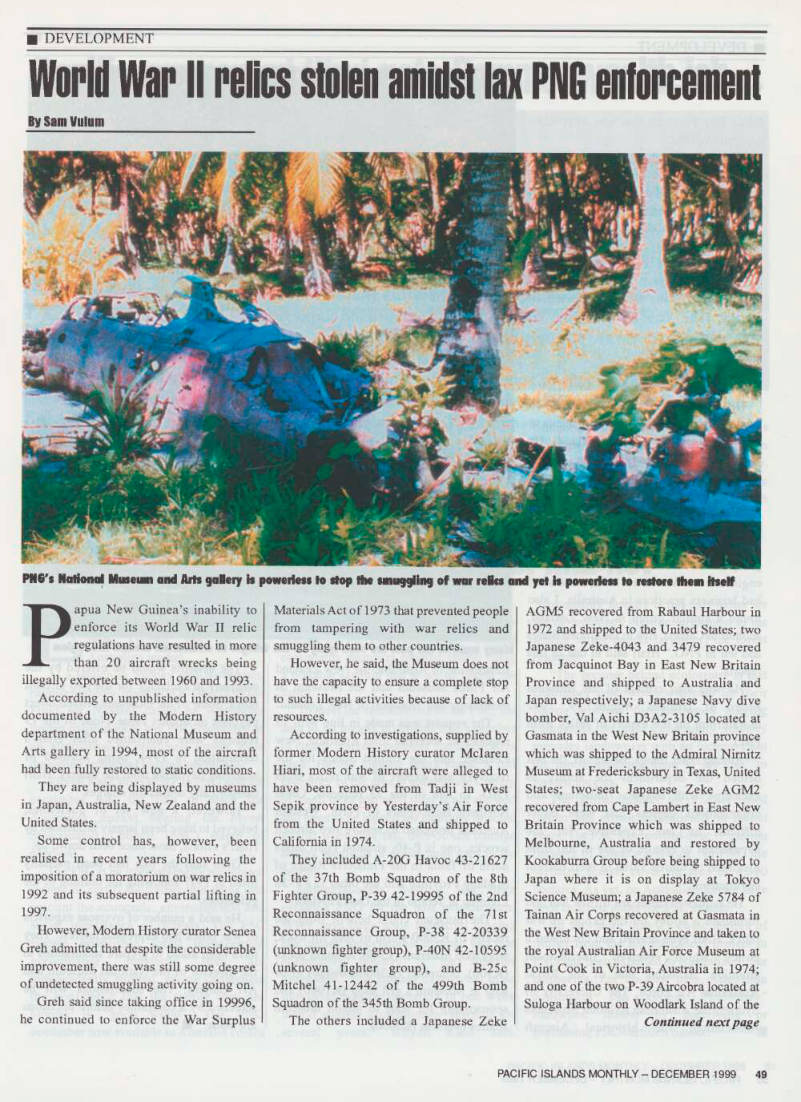
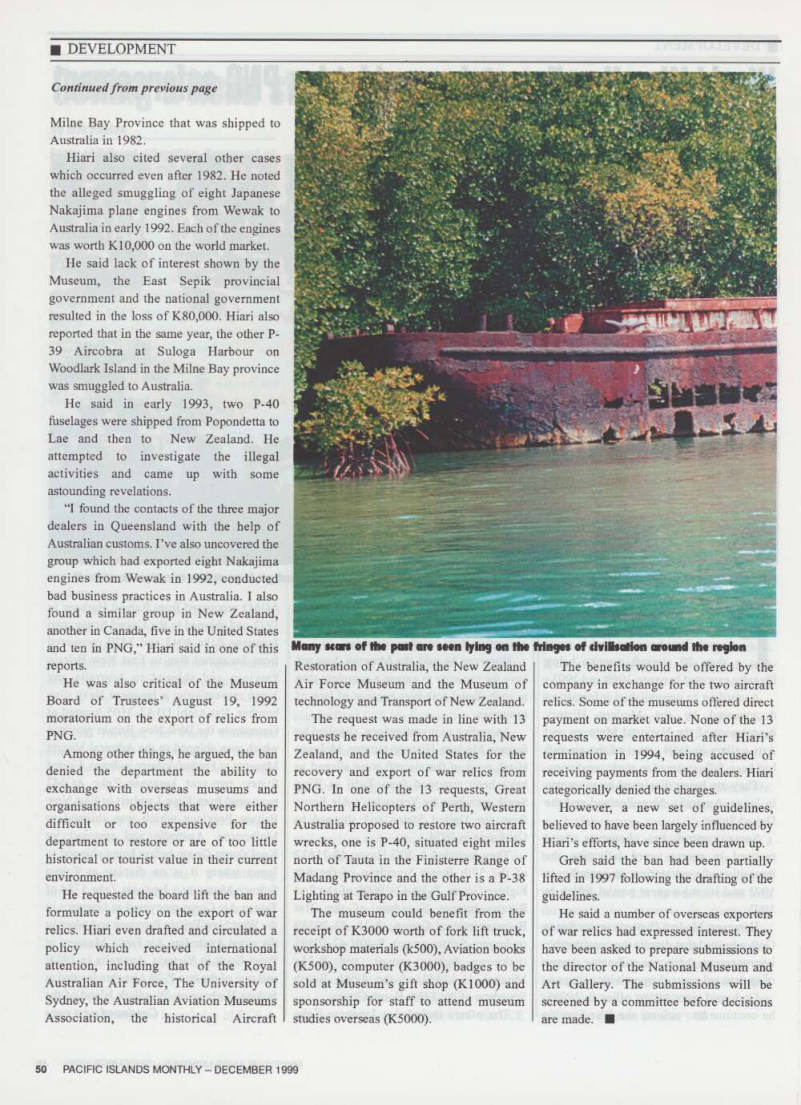
By Sam Vulum
Papua New Guinea’s inability to enforce its World War II relic regulations have resulted in more than 20 aircraft wrecks being illegally exported between 1960 and 1993.
According to unpublished information documented by the Modern History department of the National Museum and Arts gallery in 1994, most of the aircraft had been fully restored to static conditions.
They are being displayed by museums
in Japan, Australia, New Zealand and the United States.
Some control has, however, been realised in recent years following the imposition of a moratorium on war relics in 1992 and its subsequent partial lifting in 1997.
However, Modem History curator Senea Greh admitted that despite the considerable improvement, there was still some degree
of undetected smuggling activity going on.
Greh said since taking office in 19996, he continued to enforce the War Surplus
Materials Act of 1973 that prevented people from tampering with war relics and smuggling them to other countries.
However, he said, the Museum does not have the capacity to ensure a complete stop to such illegal activities because of lack of resources.
According to investigations, supplied by
former Modern History curator Mclaren Hiari, most of the aircraft were alleged to have been removed from Tadji in West Sepik province by Yesterday’s Air Force from the United States and shipped to California in 1974.
They included A-20G Havoc 43-21627 of the 37th Bomb Squadron of the Bth Fighter Group, P-39 42-19995 of the 2nd Reconnaissance Squadron of the 71st Reconnaissance Group, P-38 42-20339 (unknown fighter group), P-40N 42-10595 (unknown fighter group), and B-25c Mitchel 41-12442 of the 499th Bomb Squadron of the 345th Bomb Group.
The others included a Japanese Zeke
AGMS recovered from Rabaul Harbour in 1972 and shipped to the United States; two Japanese Zeke-4043 and 3479 recovered from Jacquinot Bay in East New Britain Province and shipped to Australia and
Japan respectively; a Japanese Navy dive
bomber, Val Aichi D3A2-3105 located at Gasmata in the West New Britain province which was shipped to the Admiral Nirnitz Museum at Fredericksbury in Texas, United States; two-seat Japanese Zeke AGM2 recovered from Cape Lambert in East New Britain Province which was shipped to Melbourne, Australia and restored by
Kookaburra Group before being shipped to
Japan where it is on display at Tokyo Science Museum; a Japanese Zeke 5784 of Tainan Air Corps recovered at Gasmata in the West New Britain Province and taken to the royal Australian Air Force Museum at Point Cook in Victoria, Australia in 1974; and one of the two P-39 Aircobra located at Suloga Harbour on Woodlark Island of the
Continued next page
PNG's Notional Museum and Arts gallery is powerless to restore them itself
Continued from previous page
Milne Bay Province that was shipped to Australia in 1982.
Hiari also cited several other cases which occurred even after 1982. He noted the alleged smuggling of eight Japanese
Nakajima plane engines from Wewak to
Australia in early 1992. Each of the engines was worth KlO,OOO on the world market.
He said lack of interest shown by the Museum, the East Sepik provincial government and the national government resulted in the loss of KBO,OOO. Hiari also reported that in the same year, the other P -39 Aircobra at Suloga Harbour on Woodlark Island in the Milne Bay province was smuggled to Australia.
He said in early 1993, two P-40 fuselages were shipped from Popondetta to Lae and then to New Zealand. He attempted to investigate the illegal activities and came up with some astounding revelations.
“I found the contacts of the three major dealers in Queensland with the help of Australian customs. I’ve also uncovered the group which had exported eight Nakajima engines from Wewak in 1992, conducted bad business practices in Australia. I also found a similar group in New Zealand, another in Canada, five in the United States and ten in PNG,” Hiari said in one of this reports.
He was also critical of the Museum Board of Trustees’ August 19, 1992 moratorium on the export of relics from
Png.
Among other things, he argued, the ban denied the department the ability to exchange with overseas museums and organisations objects that were either difficult or too expensive for the department to restore or are of too little historical or tourist value in their current environment.
He requested the board lift the ban and formulate a policy on the export of war relics. Hiari even drafted and circulated a policy which received international attention, including that of the Royal Australian Air Force, The University of Sydney, the Australian Aviation Museums Association, the historical Aircraft
Restoration of Australia, the New Zealand Air Force Museum and the Museum of technology and Transport of New Zealand.
The request was made in line with 13 requests he received from Australia, New Zealand, and the United States for the recovery and export of war relics from PNG. In one of the 13 requests, Great Northern Helicopters of Perth, Western Australia proposed to restore two aircraft wrecks, one is P-40, situated eight miles north of Tauta in the Finisterre Range of Madang Province and the other is a P-38 Lighting at Terapo in the Gulf Province.
The museum could benefit from the receipt of K3OOO worth of fork lift truck, workshop materials (k 500), Aviation books (K 500), computer (K 3000), badges to be sold at Museum’s gift shop (K 1000) and sponsorship for staff to attend museum studies overseas (K 5000).
The benefits would be offered by the company in exchange for the two aircraft relics. Some of the museums offered direct payment on market value. None of the 13 requests were entertained after Hiari’s termination in 1994, being accused of receiving payments from the dealers. Hiari categorically denied the charges.
However, a new set of guidelines, believed to have been largely influenced by Hiari’s efforts, have since been drawn up.
Greh said the ban had been partially lifted in 1997 following the drafting of the guidelines.
He said a number of overseas exporters of war relics had expressed interest. They have been asked to prepare submissions to the director of the National Museum and Art Gallery. The submissions will be screened by a committee before decisions are made. ■
Many s[?]s of the past an seen lying on the fringes of civilis[?]tion around the region
Pacific-supported Kiwi gets Commonwealth job

The Commonwealth has a new Secretary-General, New Zealand’s Foreign Minister Don McKinnon.
McKinnon was elected in Durban at the Commonwealth Heads of Government Meeting (CHOGM). The Pacific Islands states had been backing Mr McKinnon, who has been a regular visitor to the Pacific Islands and played a major role bringing a peace settlement on Bougainville.
McKinnon succeeds Chief Emeka Anyaoku from Nigeria in April.
In his inaugural speech after his election, McKinnon said his primary aim will be to educate people about the Commonwealth and its agencies’ activities.
He paid tribute to Chief Emeka Anyaoku, who held the post for the past ten years saying that the Commonwealth had achieved a lot during his time.
McKinnon however admitted that there are challenges ahead that must be borne by
the organisation especially in meeting the aspirations of its members.
He said “the Commonwealth must be flexible so that it can be able to meet its members’ aspirations as time changes.’’
The election of McKinnon as
Commonwealth’s Secretary-General makes two New Zealanders holding top posts in international organisations. The other, former New Zealand Prime Minister Mike Moore, heads the World Trade Organisation
(Wto). ■
The new Commonwealth Secretary-General, Don McKinnon of New Zealand
PNG ecotbnber hits the Australian market
E cotimber produced sustainably by forest communities in Papua New Guinea has hit the Australian market.
At a launch in Sydney mid-November, representatives from WWF (World Wide Fund for Nature) called on Australian timber consumers to buy PNG ecotimber as an alternative to rainforest timber from
damaging industrial logging operations.
Kilyali Kalit from WWF in PNG said the ecotimber was the first to reach the Australian market bearing the Forest Stewardship Council (FSC) stamp of approval.
The FSC is an internationally recognised system of certifying timber that takes into account the economic, environmental and social importance of forests. The FSC system establishes forest management performance standards that are
independently audited, giving consumers
the confidence that the timber they are buying is “good wood”. The PNG ecotimber now available in Australia comes
from a community-run project in West New Britain, a PNG Government initiative funded by the European Union. Trained community members produce timber using a portable sawmill that is set up within the forest.
To meet the strict criteria of the FSC, the area to be logged is divided into a number of clearly marked coupes of 5 to 20 hectares each. Before logging takes place, a full inventory of the area is undertaken. Cutting of small trees and seed trees is not allowed and trees to be logged are carefully selected so that when they fall, they do not damage nearby seedlings or create large gaps in the canopy.
Industrial-scale logging has been ravaging PNG for the past two decades.
WWF says large-scale industrial logging has caused unacceptable damage and that
community forestry is the superior
alternative. “The number of trees cut in an industrial logging operation in one week would sustain a community sawmill for several years,” Kilyali Kalit said.
“Community forestry is not only better for the environment, it also returns most of the wealth to the people living off the forest resource.
“The premise behind ecoforestry is that customary landowners will care for their forest, whereas foreign-owned logging companies do not. Community forestry provides landowners with an income from the forest, enabling them to say “no” to foreign loggers.”
The global market for FSC-certified timber has grown dramatically in recent years. The FSC has certified over 17 million hectares of forest worldwide. In PNG the certified forests cover an area of 4,310 hectares. As yet, no Australian forests have been certified under the FSC system.
So far, more than 25 cubic metres of timber from the EU-sponsored project in PNG has been exported to Australia in four shipments. For the first time, Australian consumers can choose “guilt-free” hardwood timber by specifying or purchasing FSC-certified timber. ■
East Asia tops growth amongst developing countries
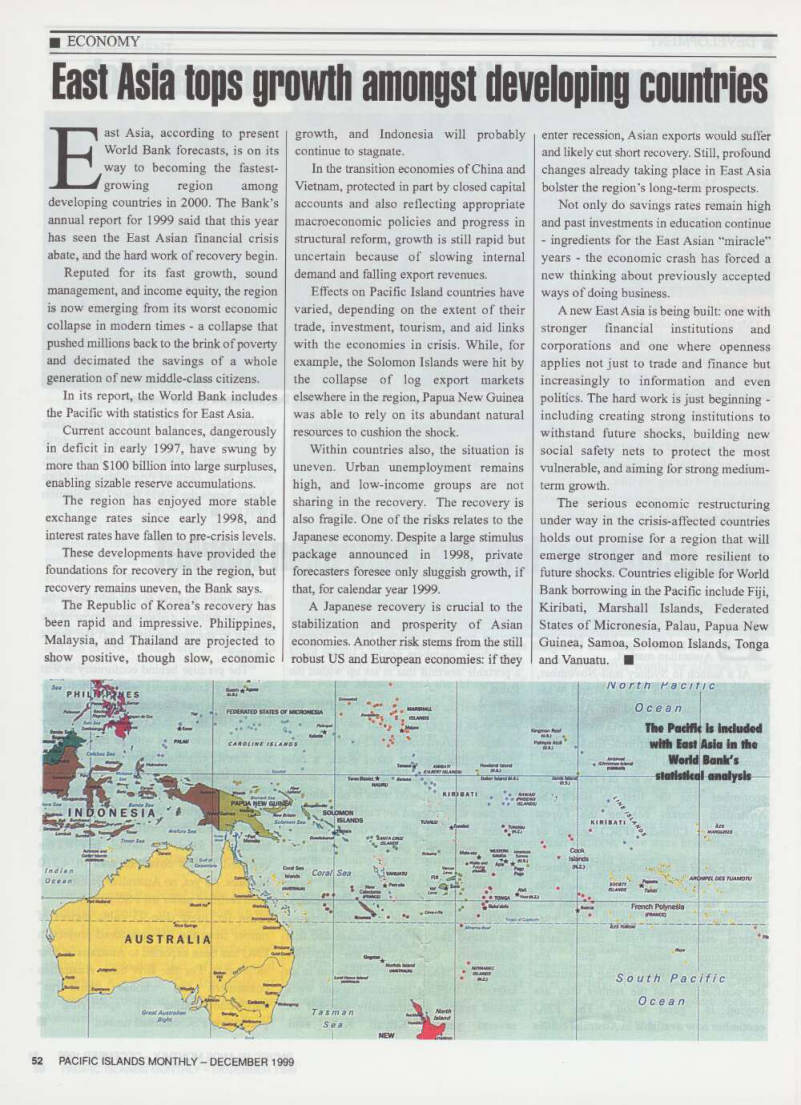
Economy
East Asia, according to present World Bank forecasts, is on its way to becoming the fastest growing region among developing countries in 2000. The Bank’s annual report for 1999 said that this year has seen the East Asian financial crisis abate, and the hard work of recovery begin.
Reputed for its fast growth, sound management, and income equity, the region is now emerging from its worst economic collapse in modern times - a collapse that pushed millions back to the brink of poverty and decimated the savings of a whole generation of new middle-class citizens.
In its report, the World Bank includes the Pacific with statistics for East Asia.
Current account balances, dangerously in deficit in early 1997, have swung by more than $lOO billion into large surpluses, enabling sizable reserve accumulations.
The region has enjoyed more stable exchange rates since early 1998, and interest rates have fallen to pre-crisis levels.
These developments have provided the foundations for recovery in the region, but recovery remains uneven, the Bank says.
The Republic of Korea’s recovery has been rapid and impressive. Philippines, Malaysia, and Thailand are projected to show positive, though slow, economic
growth, and Indonesia will probably continue to stagnate.
In the transition economies of China and Vietnam, protected in part by closed capital accounts and also reflecting appropriate macroeconomic policies and progress in structural reform, growth is still rapid but uncertain because of slowing internal demand and falling export revenues.
Effects on Pacific Island countries have varied, depending on the extent of their trade, investment, tourism, and aid links with the economies in crisis. While, for example, the Solomon Islands were hit by the collapse of log export markets elsewhere in the region, Papua New Guinea was able to rely on its abundant natural resources to cushion the shock.
Within countries also, the situation is uneven. Urban unemployment remains high, and low-income groups are not sharing in the recovery. The recovery is also fragile. One of the risks relates to the Japanese economy. Despite a large stimulus package announced in 1998, private
forecasters foresee only sluggish growth, if
that, for calendar year 1999.
A Japanese recovery is crucial to the stabilization and prosperity of Asian economies. Another risk stems from the still robust US and European economies; if they
enter recession, Asian exports would suffer and likely cut short recovery. Still, profound changes already taking place in East Asia bolster the region’s long-term prospects.
Not only do savings rates remain high and past investments in education continue - ingredients for the East Asian “miracle” years - the economic crash has forced a new thinking about previously accepted ways of doing business.
A new East Asia is being built: one with stronger financial institutions and corporations and one where openness applies not just to trade and finance but increasingly to information and even politics. The hard work is just beginning including creating strong institutions to withstand future shocks, building new social safety nets to protect the most vulnerable, and aiming for strong medium term growth.
The serious economic restructuring under way in the crisis-affected countries holds out promise for a region that will emerge stronger and more resilient to future shocks. Countries eligible for World Bank borrowing in the Pacific include Fiji, Kiribati, Marshall Islands, Federated States of Micronesia, Palau, Papua New Guinea, Samoa, Solomon Islands, Tonga and Vanuatu. ■
The Pacific is included with East Asia in the WoHd Bank's statistical analysis
ADB critical of FBM reform process
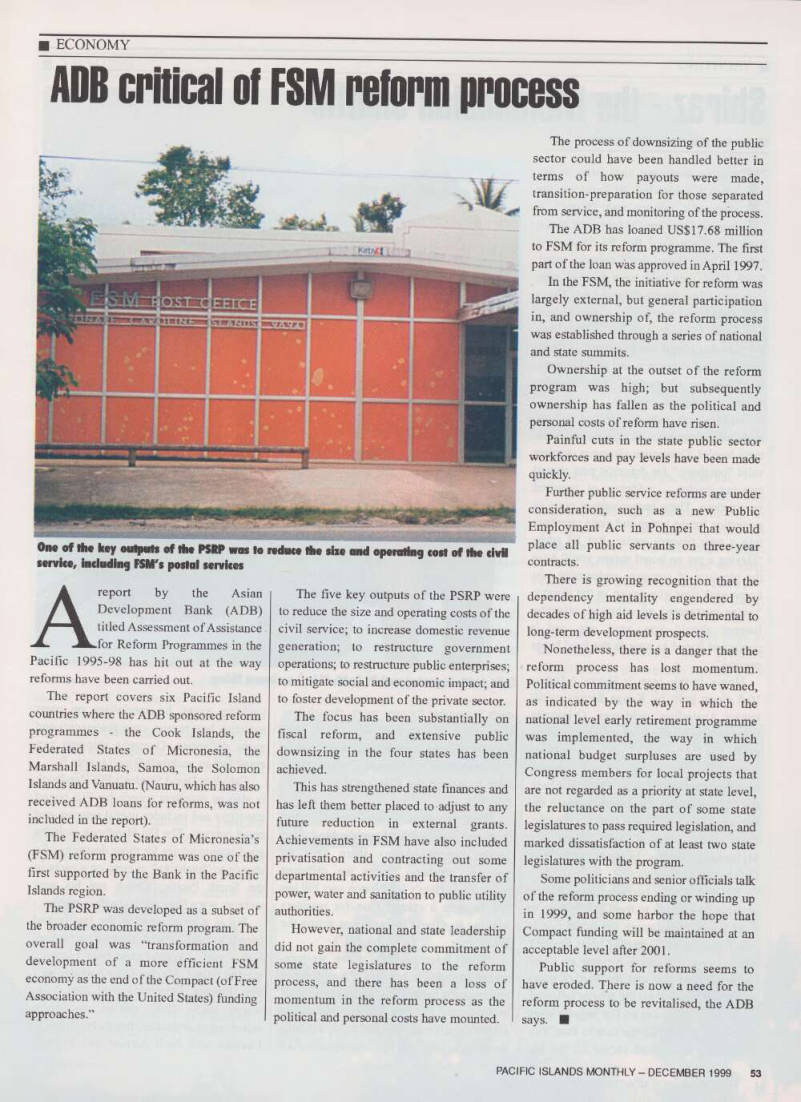
A report by the Asian Development Bank (ADB) titled Assessment of Assistance. for Reform Programmes in the Pacific 1995-98 has hit out at the way reforms have been carried out.
The report covers six Pacific Island countries where the ADB sponsored reform programmes - the Cook Islands, the Federated States of Micronesia, the Marshall Islands, Samoa, the Solomon Islands and Vanuatu. (Nauru, which has also received ADB loans for reforms, was not included in the report).
The Federated States of Micronesia’s (FSM) reform programme was one of the first supported by the Bank in the Pacific Islands region.
The PSRP was developed as a subset of the broader economic reform program. The overall goal was “transformation and development of a more efficient FSM economy as the end of the Compact (of Free Association with the United States) funding
approaches.”
The five key outputs of the PSRP were to reduce the size and operating costs of the civil service; to increase domestic revenue generation; to restructure government operations; to restructure public enterprises; to mitigate social and economic impact; and to foster development of the private sector.
The focus has been substantially on fiscal reform, and extensive public downsizing in the four states has been achieved.
This has strengthened state finances and has left them better placed to adjust to any future reduction in external grants.
Achievements in FSM have also included privatisation and contracting out some departmental activities and the transfer of power, water and sanitation to public utility authorities.
However, national and state leadership did not gain the complete commitment of some state legislatures to the reform process, and there has been a loss of momentum in the reform process as the political and personal costs have mounted.
The process of downsizing of the public sector could have been handled better in terms of how payouts were made, transition-preparation for those separated from service, and monitoring of the process.
The ADB has loaned US$17.68 million to FSM for its reform programme. The first part of the loan was approved in April 1997.
In the FSM, the initiative for reform was largely external, but general participation in, and ownership of, the reform process wag established through a series of national and state summits.
Ownership at the outset of the reform program was high; but subsequently ownership has fallen as the political and personal costs of reform have risen.
Painful cuts in the state public sector workforces and pay levels have been made
quickly.
Further public service reforms are under consideration, such as a new Public Employment Act in Pohnpei that would place all public servants on three-year contracts.
There is growing recognition that the dependency mentality engendered by decades of high aid levels is detrimental to
long-term development prospects.
Nonetheless, there is a danger that the reform process has lost momentum.
Political commitment seems to have waned, as indicated by the way in which the national level early retirement programme was implemented, the way in which national budget surpluses are used by Congress members for local projects that are not regarded as a priority at state level, the reluctance on the part of some state
legislatures to pass required legislation, and
marked dissatisfaction of at least two state legislatures with the program.
Some politicians and senior officials talk of the reform process ending or winding up in 1999, and some harbor the hope that Compact funding will be maintained at an acceptable level after 2001.
Public support for reforms seems to have eroded. There is now a need for the reform process to be revitalised, the ADB says. ■
One of the key outputs off the PSRP was to reduce the size and operating cost of the civil service, including FSM's postal services
Shiraz - the Melanesian shuffle
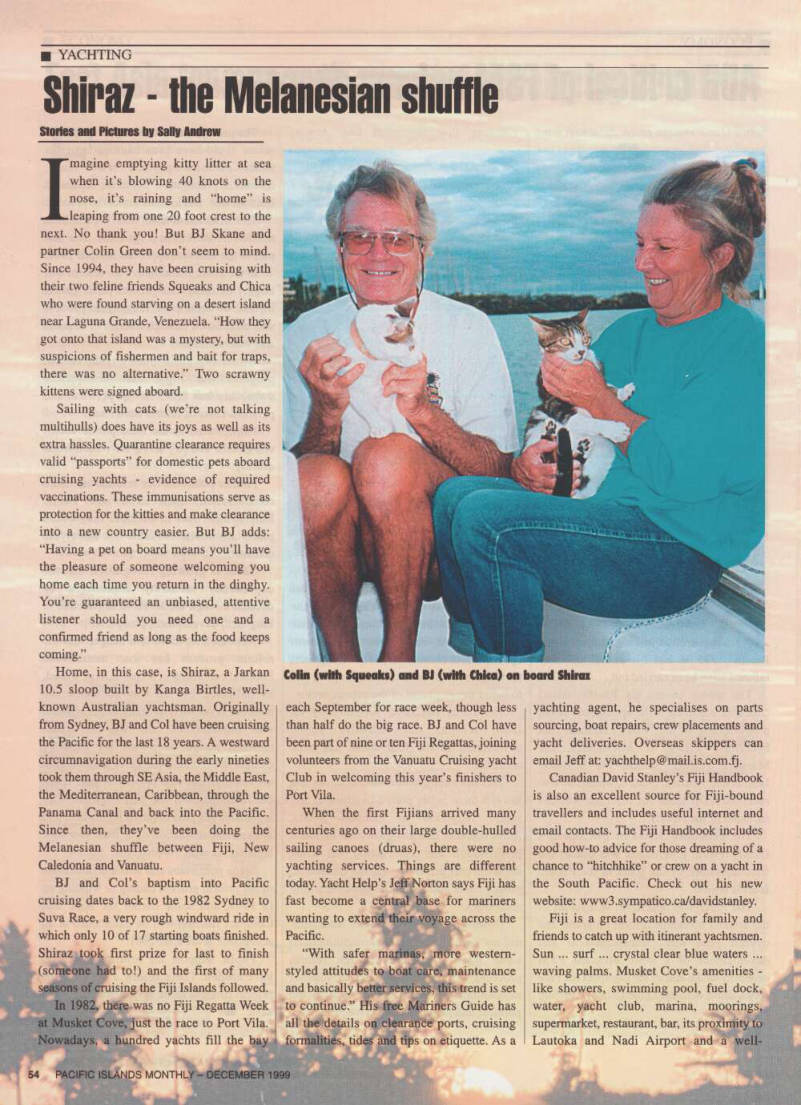
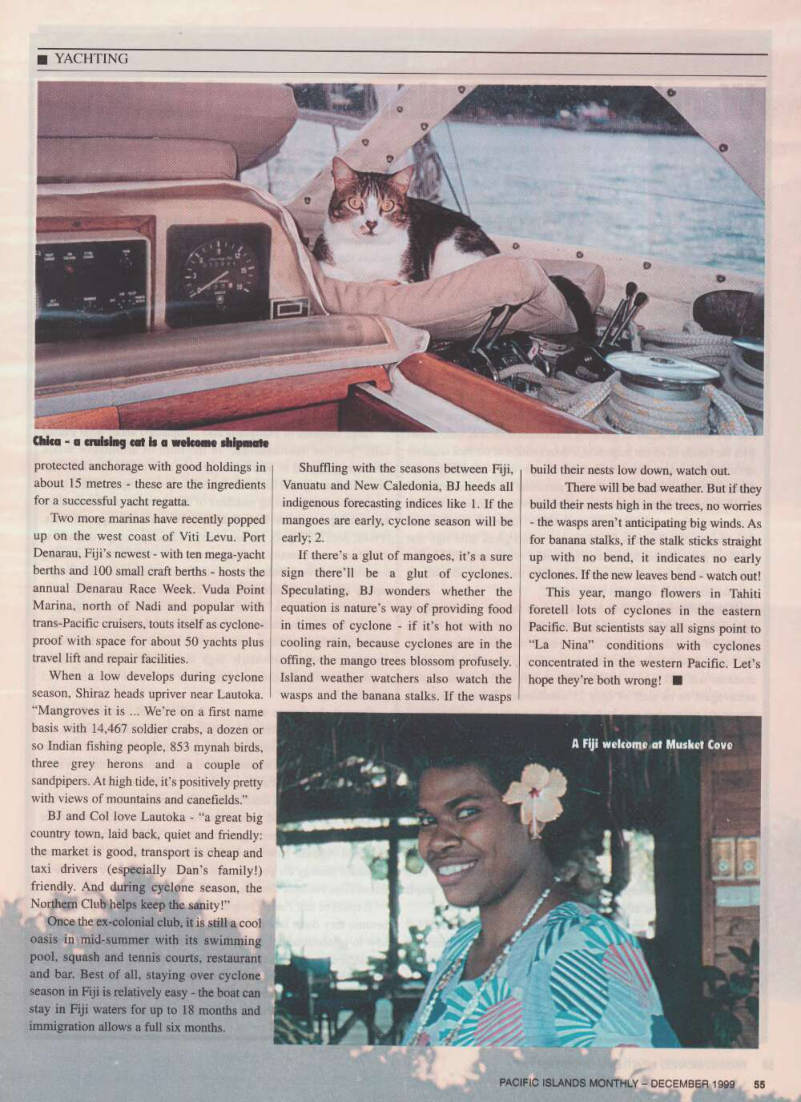
Yachting
Stories and Pictures by Sally Andrew
Imagine emptying kitty litter at sea when it’s blowing 40 knots on the nose, it’s raining and “home” is leaping from one 20 foot crest to the next. No thank you! But BJ Skane and partner Colin Green don’t seem to mind.
Since 1994, they have been cruising with their two feline friends Squeaks and Chica who were found starving on a desert island near Laguna Grande, Venezuela. “How they got onto that island was a mystery, but with suspicions of fishermen and bait for traps, there was no alternative.” Two scrawny kittens were signed aboard.
Sailing with cats (we’re not talking multihulls) does have its joys as well as its extra hassles. Quarantine clearance requires valid “passports” for domestic pets aboard cruising yachts - evidence of required vaccinations. These immunisations serve as protection for the kitties and make clearance into a new country easier. But BJ adds: “Having a pet on board means you’ll have the pleasure of someone welcoming you home each time you return in the dinghy.
You’re guaranteed an unbiased, attentive listener should you need one and a confirmed friend as long as the food keeps coming.”
Home, in this case, is Shiraz, a Jarkan 10.5 sloop built by Kanga Birtles, well known Australian yachtsman. Originally from Sydney, BJ and Col have been cruising the Pacific for the last 18 years. A westward circumnavigation during the early nineties took them through SE Asia, the Middle East, the Mediterranean, Caribbean, through the Panama Canal and back into the Pacific.
Since then, they’ve been doing the Melanesian shuffle between Fiji, New Caledonia and Vanuatu.
BJ and Col’s baptism into Pacific cruising dates back to the 1982 Sydney to Suva Race, a very rough windward ride in which only 10 of 17 starting boats finished.
Shiraz took first prize for last to finish * (someone had to!) and the first of many seasons of cruising the Fiji Islands followed.
In 1982, there was no Fiji Regatta Week at Musket Cove, just the race to Port Vila.
Nowadays, a hundred yachts fill the bay
each September for race week, though less than half do the big race. BJ and Col have been part of nine or ten Fiji Regattas, joining volunteers from the Vanuatu Cruising yacht Club in welcoming this year’s finishers to Port Vila.
When the first Fijians arrived many centuries ago on their large double-hulled sailing canoes (druas), there were no yachting services. Things are different today. Yacht Help’s Jeff Norton says Fiji has fast become a central base for mariners wanting to extend their voyage across the Pacific.
“With safer marinas, more western styled attitudes to boat care, maintenance and basically better services, this trend is set to continue.” His free Mariners Guide has all the details on clearance ports, cruising formalities, tides and tips on etiquette. As a
yachting agent, he specialises on parts sourcing, boat repairs, crew placements and yacht deliveries. Overseas skippers can email Jeff at: [email protected].
Canadian David Stanley’s Fiji Handbook is also an excellent source for Fiji-bound travellers and includes useful internet and email contacts. The Fiji Handbook includes good how-to advice for those dreaming of a chance to “hitchhike” or crew on a yacht in the South Pacific. Check out his new
website: www3. sympatico.ca/davidstanley.
Fiji is a great location for family and friends to catch up with itinerant yachtsmen.
Sun ... surf ... crystal clear blue waters ... waving palms. Musket Cove’s amenities like showers, swimming pool, fuel dock, water, yacht club, marina, moorings, supermarket, restaurant, bar, its proximity to Lautoka and Nadi Airport and a well-
Colin (with Squeaks) and BJ (with Chico) on board Shiraz
protected anchorage with good holdings in about 15 metres - these are the ingredients for a successful yacht regatta.
Two more marinas have recently popped up on the west coast of Viti Levu. Port Denarau, Fiji’s newest - with ten mega-yacht berths and 100 small craft berths - hosts the annual Denarau Race Week. Vuda Point Marina, north of Nadi and popular with trans-Pacific cruisers, touts itself as cyclone proof with space for about 50 yachts plus travel lift and repair facilities.
When a low develops during cyclone season, Shiraz heads upriver near Lautoka.
“Mangroves it is ... We’re on a first name basis with 14,467 soldier crabs, a dozen or so Indian fishing people, 853 mynah birds, three grey herons and a couple of sandpipers. At high tide, it’s positively pretty with views of mountains and canefields.”
BJ and Col love Lautoka - “a great big country town, laid back, quiet and friendly: the market is good, transport is cheap and taxi drivers (especially Dan’s family!) friendly. And during cyclone season, the Northern Club helps keep the sanity!”
Once the ex-colonial club, it is still a cool oasis in mid-summer with its swimming pool, squash and tennis courts, restaurant and bar. Best of all, staying over cyclone season in Fiji is relatively easy - the boat can stay in Fiji waters for up to 18 months and immigration allows a full six months.
Shuffling with the seasons between Fiji, Vanuatu and New Caledonia, BJ heeds all indigenous forecasting indices like 1. If the mangoes are early, cyclone season will be
early; 2.
If there’s a glut of mangoes, it’s a sure sign there’ll be a glut of cyclones.
Speculating, BJ wonders whether the equation is nature’s way of providing food in times of cyclone - if it’s hot with no cooling rain, because cyclones are in the offing, the mango trees blossom profusely.
Island weather watchers also watch the wasps and the banana stalks. If the wasps
build their nests low down, watch out.
There will be bad weather. But if they build their nests high in the trees, no worries - the wasps aren’t anticipating big winds. As for banana stalks, if the stalk sticks straight up with no bend, it indicates no early cyclones. If the new leaves bend - watch out!
This year, mango flowers in Tahiti foretell lots of cyclones in the eastern Pacific. But scientists say all signs point to “La Nina” conditions with cyclones concentrated in the western Pacific. Let’s hope they’re both wrong! ■
Chica - a cruising cat is a welcome shipmate
A Fiji welcome at Musket Cove
Warnings of institutionalised racism in NZ
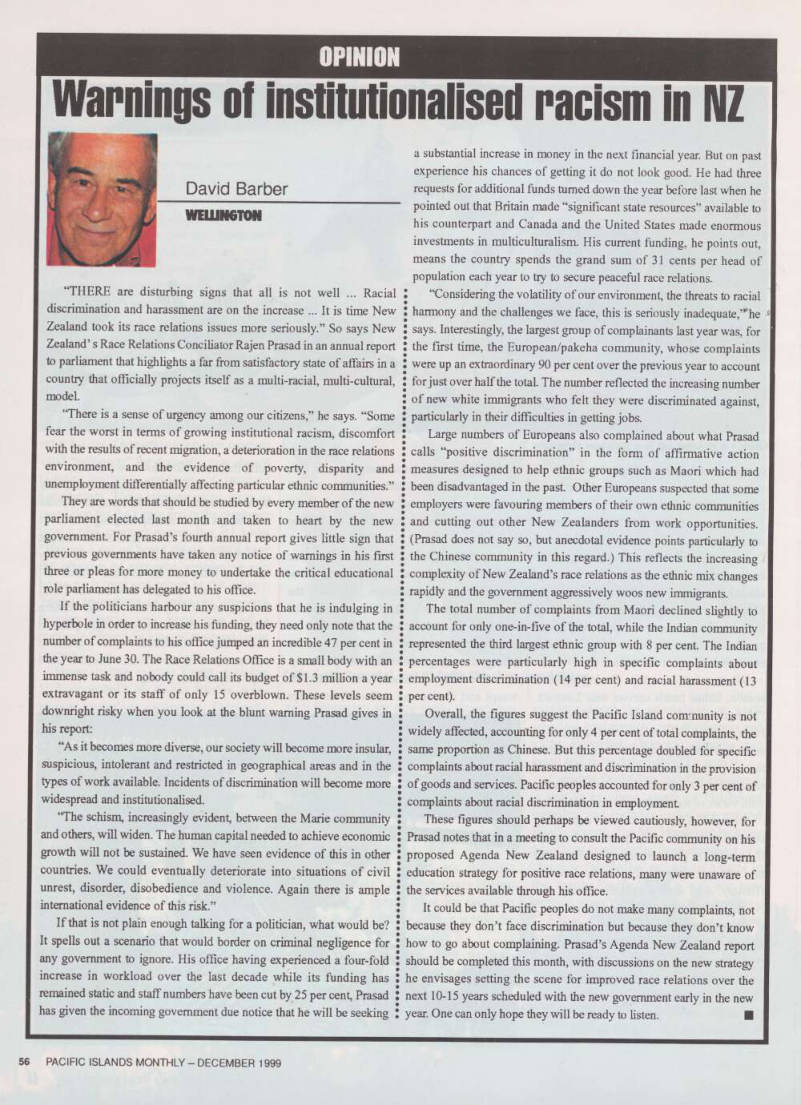
Opinion
“THERE are disturbing signs that all is not well ... Racial discrimination and harassment are on the increase ... It is time New Zealand took its race relations issues more seriously.” So says New Zealand’s Race Relations Conciliator Rajen Prasad in an annual report to parliament that highlights a far from satisfactory state of affairs in a country that officially projects itself as a multi-racial, multi-cultural, model. ‘There is a sense of urgency among our citizens,” he says. “Some fear the worst in terms of growing institutional racism, discomfort with the results of recent migration, a deterioration in the race relations environment, and the evidence of poverty, disparity and unemployment differentially affecting particular ethnic communities.”
They are words that should be studied by every member of the new parliament elected last month and taken to heart by the new government. For Prasad’s fourth annual report gives little sign that previous governments have taken any notice of warnings in his first three or pleas for more money to undertake the critical educational role parliament has delegated to his office.
If the politicians harbour any suspicions that he is indulging in hyperbole in order to increase his funding, they need only note that the number of complaints to his office jumped an incredible 47 per cent in the year to June 30. The Race Relations Office is a small body with an immense task and nobody could call its budget of $1.3 million a year extravagant or its staff of only 15 overblown. These levels seem downright risky when you look at the blunt warning Prasad gives in his report: “As it becomes more diverse, our society will become more insular, suspicious, intolerant and restricted in geographical areas and in the types of work available. Incidents of discrimination will become more widespread and institutionalised. ‘The schism, increasingly evident, between the Marie community and others, will widen. The human capital needed to achieve economic growth will not be sustained. We have seen evidence of this in other countries. We could eventually deteriorate into situations of civil unrest, disorder, disobedience and violence. Again there is ample international evidence of this risk.”
If that is not plain enough talking for a politician, what would be?
It spells out a scenario that would border on criminal negligence for any government to ignore. His office having experienced a four-fold increase in workload over the last decade while its funding has remained static and staff numbers have been cut by 25 per cent, Prasad has given the incoming government due notice that he will be seeking
a substantial increase in money in the next financial year. But on past experience his chances of getting it do not look good. He had three requests for additional funds turned down the year before last when he pointed out that Britain made “significant state resources” available to his counterpart and Canada and the United States made enormous investments in multiculturalism. His current funding, he points out, means the country spends the grand sum of 31 cents per head of population each year to try to secure peaceful race relations.
“Considering the volatility of our environment, the threats to racial harmony and the challenges we face, this is seriously inadequate,’’’"he says. Interestingly, the largest group of complainants last year was, for the first time, the European/pakeha community, whose complaints were up an extraordinary 90 per cent over the previous year to account for just over half the total. The number reflected the increasing number of new white immigrants who felt they were discriminated against, particularly in their difficulties in getting jobs.
Large numbers of Europeans also complained about what Prasad calls “positive discrimination” in the form of affirmative action measures designed to help ethnic groups such as Maori which had been disadvantaged in the past. Other Europeans suspected that some employers were favouring members of their own ethnic communities and cutting out other New Zealanders from work opportunities. (Prasad does not say so, but anecdotal evidence points particularly to the Chinese community in this regard.) This reflects the increasing complexity of New Zealand’s race relations as the ethnic mix changes rapidly and the government aggressively woos new immigrants.
The total number of complaints from Maori declined slightly to account for only one-in-five of the total, while the Indian community represented the third largest ethnic group with 8 per cent. The Indian percentages were particularly high in specific complaints about employment discrimination (14 per cent) and racial harassment (13 per cent).
Overall, the figures suggest the Pacific Island community is not widely affected, accounting for only 4 per cent of total complaints, the same proportion as Chinese. But this percentage doubled for specific complaints about racial harassment and discrimination in the provision of goods and services. Pacific peoples accounted for only 3 per cent of complaints about racial discrimination in employment These figures should perhaps be viewed cautiously, however, for Prasad notes that in a meeting to consult the Pacific community on his proposed Agenda New Zealand designed to launch a long-term education strategy for positive race relations, many were unaware of the services available through his office.
It could be that Pacific peoples do not make many complaints, not Decause they don’t face discrimination but because they don’t know how to go about complaining. Prasad’s Agenda New Zealand report should be completed this month, with discussions on the new strategy le envisages setting the scene for improved race relations over the next 10-15 years scheduled with the new government early in the new year. One can only hope they will be ready to listen. ■
David Barber
Wellington
Republic Conundrum
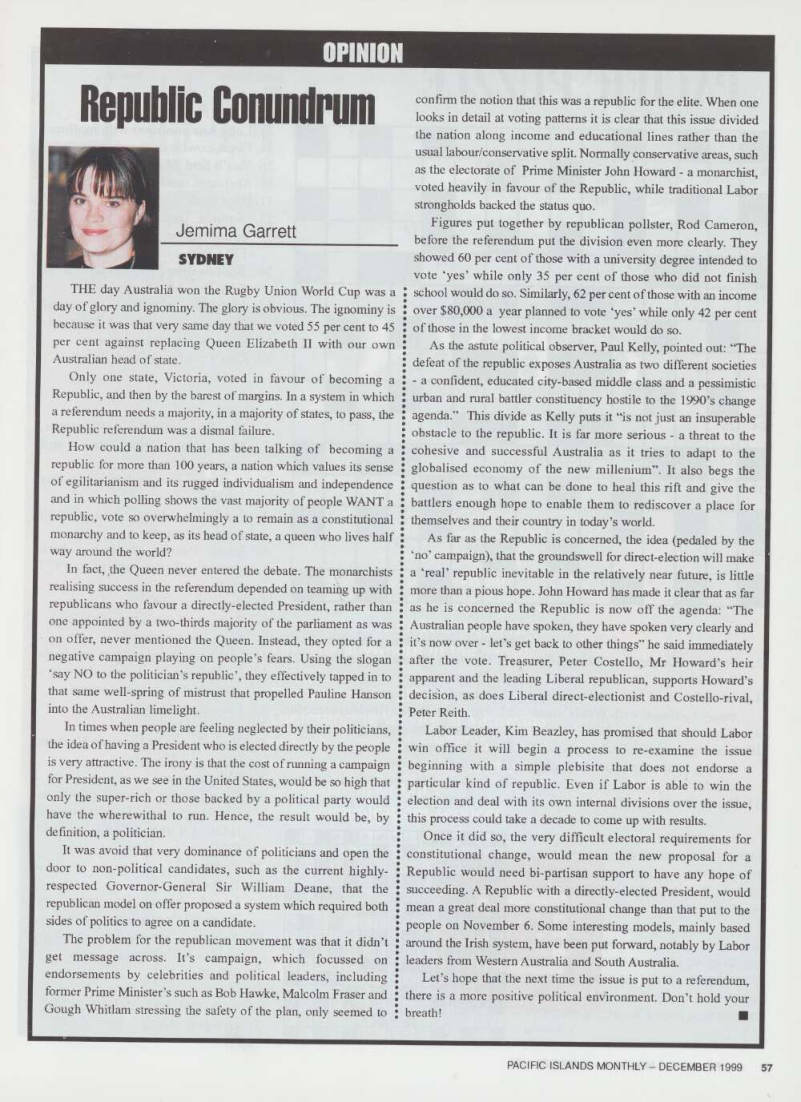
THE day Australia won the Rugby Union World Cup was day of glory and ignominy. The glory is obvious. The ignominy is because it was that very same day that we voted 55 per cent to 45 per cent against replacing Queen Elizabeth II with our own Australian head of state.
Only one state, Victoria, voted in favour of becoming a Republic, and then by the barest of margins. In a system in which a referendum needs a majority, in a majority of states, to pass, the Republic referendum was a dismal failure.
How could a nation that has been talking of becoming a republic for more than 100 years, a nation which values its sense of egilitarianism and its rugged individualism and independence and in which polling shows the vast majority of people WANT a republic, vote so overwhelmingly a to remain as a constitutional monarchy and to keep, as its head of state, a queen who lives half way around the world?
In fact, the Queen never entered the debate. The monarchists realising success in the referendum depended on teaming up with republicans who favour a directly-elected President, rather than one appointed by a two-thirds majority of the parliament as was on offer, never mentioned the Queen. Instead, they opted for a negative campaign playing on people’s fears. Using the slogan ‘say NO to the politician’s republic’, they effectively tapped in to that same well-spring of mistrust that propelled Pauline Hanson into the Australian limelight.
In times when people are feeling neglected by their politicians, the idea of having a President who is elected directly by the people is very attractive. The irony is that the cost of running a campaign for President, as we see in the United States, would be so high that only the super-rich or those backed by a political party would have the wherewithal to run. Hence, the result would be, by definition, a politician.
It was avoid that very dominance of politicians and open the door to non-political candidates, such as the current highly respected Governor-General Sir William Deane, that the republican model on offer proposed a system which required both sides of politics to agree on a candidate.
The problem for the republican movement was that it didn’t get message across. It's campaign, which focussed on endorsements by celebrities and political leaders, including former Prime Minister’s such as Bob Hawke, Malcolm Fraser and Gough Whitlam stressing the safety of the plan, only seemed to
confirm the notion that this was a republic for the elite. When one looks in detail at voting patterns it is clear that this issue divided the nation along income and educational lines rather than the usual labour/conservative split. Normally conservative areas, such as the electorate of Prime Minister John Howard - a monarchist, voted heavily in favour of the Republic, while traditional Labor strongholds backed the status quo.
Figures put together by republican pollster, Rod Cameron, before the referendum put the division even more clearly. They showed 60 per cent of those with a university degree intended to vote ‘yes’ while only 35 per cent of those who did not finish school would do so. Similarly, 62 per cent of those with an income over $BO,OOO a year planned to vote ‘yes’ while only 42 per cent of those in the lowest income bracket would do so.
As the astute political observer, Paul Kelly, pointed out: “The defeat of the republic exposes Australia as two different societies - a confident, educated city-based middle class and a pessimistic urban and rural battler constituency hostile to the 1990’s change agenda.” This divide as Kelly puts it “is not just an insuperable obstacle to the republic. It is far more serious - a threat to the cohesive and successful Australia as it tries to adapt to the globalised economy of the new millenium”. It also begs the question as to what can be done to heal this rift and give the battlers enough hope to enable them to rediscover a place for themselves and their country in today’s world.
As far as the Republic is concerned, the idea (pedaled by the ‘no’ campaign), that the groundswell for direct-election will make a ‘real’ republic inevitable in the relatively near future, is little more than a pious hope. John Howard has made it clear that as far as he is concerned the Republic is now off the agenda; “The Australian people have spoken, they have spoken very clearly and it’s now over - let’s get back to other things” he said immediately after the vote. Treasurer, Peter Costello, Mr Howard’s heir apparent and the leading Liberal republican, supports Howard’s decision, as does Liberal direct-electionist and Costello-rival, Peter Reith.
Labor Leader, Kim Beazley, has promised that should Labor win office it will begin a process to re-examine the issue beginning with a simple plebisite that does not endorse a particular kind of republic. Even if Labor is able to win the election and deal with its own internal divisions over the issue, this process could take a decade to come up with results.
Once it did so, the very difficult electoral requirements for constitutional change, would mean the new proposal for a Republic would need bi-partisan support to have any hope of succeeding. A Republic with a directly-elected President, would mean a great deal more constitutional change than that put to the people on November 6. Some interesting models, mainly based around the Irish system, have been put forward, notably by Labor leaders from Western Australia and South Australia.
Let’s hope that the next time the issue is put to a referendum, there is a more positive political environment. Don’t hold your wreath! m
Jemima Garrett
Sydney
Advertisements & other items, p. 57 (1 item)
Opinion
Pacific Puzzle

Extra
Across 3. Strange faces in Papeete’s coffee houses 8. Island east of Vanuatu’s Tanna, easily confused with Wallis’ mate 9. Capital place of Kiribati 10. Christopher? No, Sailors ways of saying “pass the rope through a block” 11. Handy Pacific tree?
Answers: Arnocc. o Cafes 8. Futuna 9. Tarawa 10. fl 80S I £ 12. Gold 13. Volcano 15. mi ast 20. Nippers 21. Squid 22.
I 11 done 24. Shell 26. Reefs 28.
I II faro 33. Dogs 34. Rosie 35. 1 II its 37. Skate I II Jva l u 2. Guam 3. Cargo 4. sia 5. Stem 6. Grog 7. Swells I II Oysters 15. Buses 16. Azure 18. Ambae 19. Treks 25. Ha’Apai 27. Fights 29. Ports 30. Ebeye 32. Opua 33. Dock
12. Fiji’s miners are going for ... 13. Hawaii’s Mauna Loa or Vanuatu’s Yasur 15. Nauru’s little lagoon 17. Fiji’s Hot Bread Kitchen uses this to rise to the challenge 20. Crab weapons 21. Cuttlefish cousin 22. Presumably you can eat off this type of coral
23. Lobe Ana confused with mollusc 24. Cone, cowrie or conch 26. You’ll find 24 Across on these 28. Skeletons used to mop up? 31. Root food 33. Sounds like these beasts are bound to be found in western FSM state 34. Sounds like her Fijian Travel Service is blooming 35. Marshalls island was a capital place for Germans and Japanese 36. Sloop, ketch and schooner 37. Kate’s confused about Ray Down 1. You’ll find Nanumea, Nukulaelae, Nukufetau and Niulakita here 2. Agana is a capital place in this US territory 3. Jon Frum cult once embraced in parts of Vanuatu 4. South Pacific territory which
gained self-government in 1977
(6,9) 5. Strict boat part? 6. Booze in Australia, kava in Fiji 7. Sea’s ups and downs 13. Lads’ van changed them into louts 14. Rockefeller liked these done in a spinach and seasoned sauce 15. Commuter vehicles 16. Lagoon’s hue 18. Vanuatu island between Espiritu Santo and Mae wo 19. Walking tours 25. King George Tupou I ruled this island group before becoming ruler of a united Tonga in 1845 (2’4) 27. Battles 29. Harbours 30. Island home for many of
Kwajalein’s workers
32. Yachties’ mecca and check-in spot in NZ’s Bay of Islands 33. Wharf
Check Out Pim On The Web
@ www.pim.com.fj
Advertisements & other items, pp. 59-60 (1 item)
r Video
- « c* - :fe * --
\% \:.w; * *
Conferencing
w-: ' - ' ; - - a % * r ■ & 'f.’ - r 4' ' : f ■ BN bhi Video Conferencing is an exciting
new technology involving a high-
speed, two-way, audio-visual
communications link thatWet%ou
confer fo FACEt people
virtually anywhere in tfpe world.
The International Video
Conferencing Service at Vatuwaqa
in Suva, is part of FJNTEL’S
continuing commitment to the
developmer
telecomim..,.,
mm 1 \ S“T m k m se es. more information:
L FREE 0800 - 315718
Fiji International Telecommunications Limited, Mercury House, 158 Victoria Parade, PO Telephone (679) 312 933, Fax (679) 301 025, Email [email protected] • Website http m Box 59, Suva, ://www.fintel Fiji Islands. com.fj
N : *sees <UI * 97 Sht lc/^S
P/fC.
■ ■ i ■ j si -SS- ' v_y
No challengers -
Toyota Land Cruiser stays on top
Toyota Land Cruiser 100 dominates the world of 4x4s. None other can match its robust power, provided by superior engine technology.
It gives breathtaking performance, backed by an amazingly rugged suspension that can take you anywhere you want to go, on road or off.
Nevertheless, riding in a Toyota Land Cruiser 100 is like travelling in a luxurious sedan. Its more than ample room inside contains all the comforts and conveniences you'd expect of a winner.
Only Toyota's advanced technology can create the symphony of power, performance, and lavish comfort voufind in Land Cruiser 100. No wonder it's the champion. Again.
t\BRARV^
*O. 1 1
FEB 2000
STATION WAGON
TOYOTA
DISTRIBUTORS /DEALERS
NORFOLK ISLAND BORRY’S PTYLTD. PH 22114
SOLOMON ISLANDS ELA MOTORS PH 30314
VANUATU ASCO MOTORS PH 22341
COOK ISLANDS ! PACIFIC MOTORS LTD. PH 20700
KIRIBATI TARAWA MOTORS PH 21090
PAPUA NEW GUINEA ELA MOTORS PH 3229400
TAHITI NIPPON AUTOMOTO PH 429819
SAMOA ASCO MOTORS PH 20800
FIJI ASCO MOTORS • PH 384888
NEW CALEDONIA S.I.A.P. PH 275562
TONGA ASCO MOTORS PH 23500
AMERICAN SAMOA ASCO MOTORS PH 633-4281