Norfolk Island: A “jewel in the Pacific"...at
pp. 48-49 · Read in the full issue
Pacific"...at a crossroads
Stories and pictures by Richard Kleiner
Captain James Cook is reported to have been the first European to have called Norfolk Island, “A jewel.” It is unquestionably a beautiful place, both to residents and visitors alike. Yet few island communities have undergone greater economic and demographic change in the last 100 years than Norfolk Island since the 1960’5.
From a standing start with little electricity, no television and a
negligible tourist
industry 35 years ago, this three-by-five mile volcanic island 500 miles south of Noumea and 900 miles east of Brisbane now boasts two Internet service providers and is dotted with satellite dishes.
It’s 1,900 residents, up 35 per cent since 1970, care for some 6,000 vehicles servicing over 37,000 visitors per
year. Significant change
has occurred on Norfolk. Three airlines, Air New Zealand, Flight West and Norfolk Jet
Express, flying 737 s have replaced the lone Qantas DC-4 prop-plane that flew as late as I 977.
Yet somehow the island has been able to keep its sense of community and charm. Islanders can still be seen fishing off rocks with bamboo poles.
Keys are commonly left in unlocked cars. Cows have the right-of-way on public roads. It’s not a backward place by any means, just very relaxed. That is except when it comes to two long standing subjects: Norfolk’s economic
The entire population of Pitcairn Island, 194 men, women and children, boarded the 830-ton Morayshire in 1856 and migrated en masse to Norfolk.
development and its political
relationship with Australia.
The two issues are inextricably linked. One gets the sense they will be resolved, one way or another, within the next few years.
There is no question that the great increase in tourism, Norfolk’s single industry, has brought a stand-of-living previously unknown to the island. There is virtually no unemployment; the government operates in the black. But one often can’t find a parking space in
the downtown area, locals compete with hotels for fresh fruit and vegetables (and lose), while the price of land has gone beyond the reach of most young Islanders.
This is an all too familiar predicament across the Pacific. Norfolk’s issues, however, and future options are clouded by the island’s diverse and colourful past.
Although there is evidence of early Polynesian or Melanesian settlement, Norfolk was uninhabited when Cook claimed it in 1774 for the English Crown.
Within three weeks of founding a settlement at Sydney, in 1778, a penal colony was established on the island, making Norfolk the second oldest British settlement in the Pacific.
Norfolk thus plays a significant part in
Continued on next page
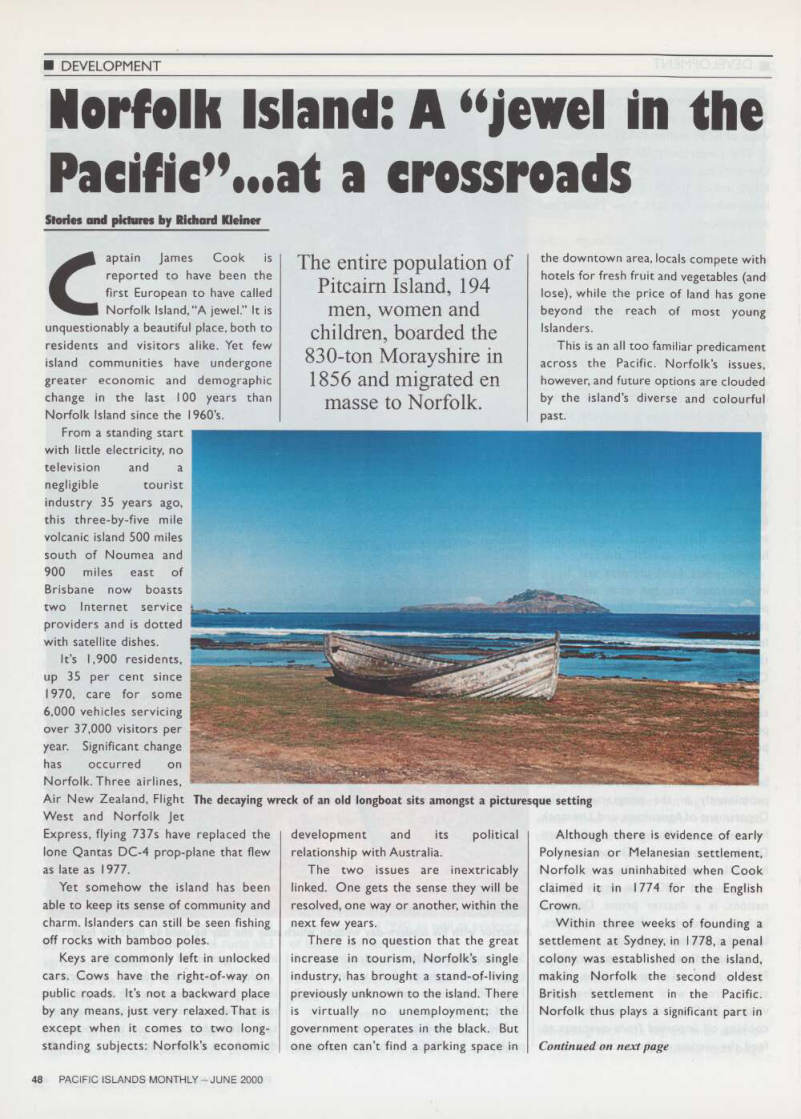
The decaying wreck of an old longboat sits amongst a picturesque setting
Continued from previous page
British and Australian history. It, at the same time, plays a critical role in the history of the Pitcairn people, descendants of the mutineers of the HMS Bounty and their Tahitian wives.
The entire population of Pitcairn Island, 194 men, women and children, boarded the 830-ton Morayshire in 1856 and migrated en masse to Norfolk. (Those on Pitcairn Island today are the descendants of 42 individuals who returned to Pitcairn within a few years of arriving on Norfolk.) Except for a caretaker staff, Norfolk was again uninhabited when the Pitcairn people arrived, the penal colony with its extensive apparatus of buildings and roads having been abandoned the year before.
Whether the island had been ceded to them by Her Majesty Queen Victoria, which the Pitcairners believed upon departure from their old home, or merely offered acreage by the Governor
Ethnic Norfolk Islanders,
those of Pitcairn descent,
now comprise a minority
47 per cent of the
population, calling into
question - at least
certainly refining - who
and what, indeed, is a
Norfolk Islander.
of New South Wales became a question within days of their arrival.
The relationship between the Pitcairn, now Norfolk Island people, and the New South Wales and ultimately Commonwealth governments has been ambiguous, intertwined and occasionally contentious ever since.
The expected solution to this conundrum, The Norfolk Island Act 1979, which bestowed a measure of self government to the island, seems to have
only extended the controversy with the Norfolk and Commonwealth Governments disagreeing on what, in fact, self-government means.
And strongly influencing this debate are the demands and consequences of that single industry, tourism.
The remarkable increase in tourism has not only brought in much-needed revenue, but a huge increase in new residents, mostly from Australia and New Zealand, associated with the trade.
Ethnic Norfolk Islanders, those of Pitcairn descent, now comprise a minority 47 per cent of the population, calling into question - at least certainly refining - who and what, indeed, is a Norfolk Islander.
Norfolk Island is no doubt beautiful, and at a crossroads. It is trying to decide how to stay economically healthy and still beautiful; how to live within the Australian sphere, yet remain “distinct and separate”. At risk, if you were to ask its “old timers,” is no less than a civilisation. ■
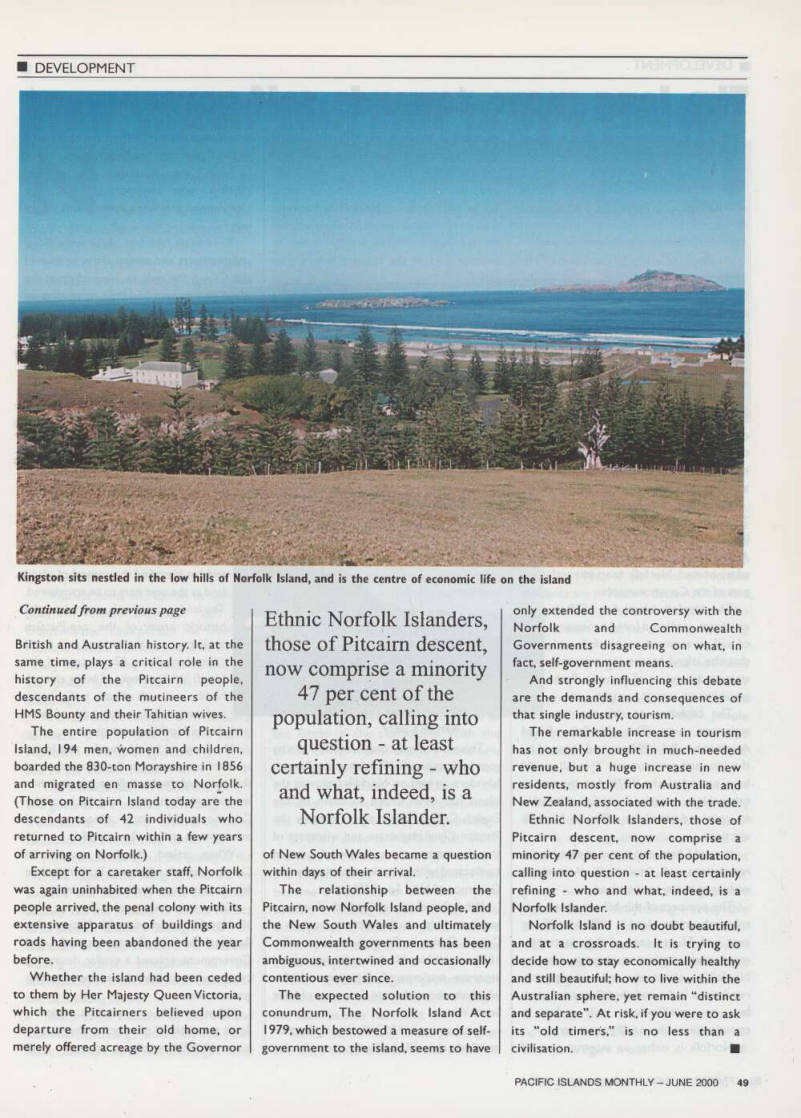
Kingston sits nestled in the low hills of Norfolk Island, and is the centre of economic life on the island