food crisis
pp. 46-47 · Read in the full issue
PNG could face food crisis
By Sam Vulum
Papua New Guinea could face a food supply crisis soon unless urgent measures are implemented to increase local production.
This is because food
production locally is growing
1.3 per cent slower than the country’s population - which will reach five million this year.
Eileen Lloyd of the Consumer Affairs Council of PNG said PNG was one of 77 countries classified as of low income and food deficit by the Food and Agriculture Organisation of the United Nations (FAO).This is based on the net import status of cereal crops such as rice as well as other food items.
She said the situation is alarming, especially considering the fact that about 85 percent of its population is rural and
agriculture based.
“Food insecurity is stalking us in the form of lack of finance, manpower, infrastructure, farmer training, down stream processing, reasonable resource misuse and lack of sustainable political
will to implement food production programmes addressing food insecurity needs.
“Unless we have the resources to import the shortfall, at an affordable price, it is likely that we will face a problem with food supply in the near future,” she said.
Papua New Guinea is already experiencing problems of land shortage in some parts of PNG as well as evidence of loss of soil fertility.
The high demand for food has meant farmers frequently cultivate the same piece of land.
This cultivation is often done without soil fertility management on land where traditional fallow periods of 15-20 years
have been reduced to three to six years.
Lloyd said other factors such as drought, frost, reduced water availability, lack of infrastructure and downstream processing, access to markets and not very strong political commitment also contribute
to food insecurity.
She said, currently, PNG produces root and tuber crops and bananas in reasonable quantities but lags behind in other food crops notably rice, wheat, maize, sorghum, vegetables and fruit.
Tuber and root crops are grown for household use only but not in large enough quantities for commercial purposes.
PNG’s domestic meat production is about adequate for chicken and pigs, but imports of other meat products, including lamb, mutton and beef, are on the increase.
Imports of other food items were increasing with rice highest with a net of
Continued next page
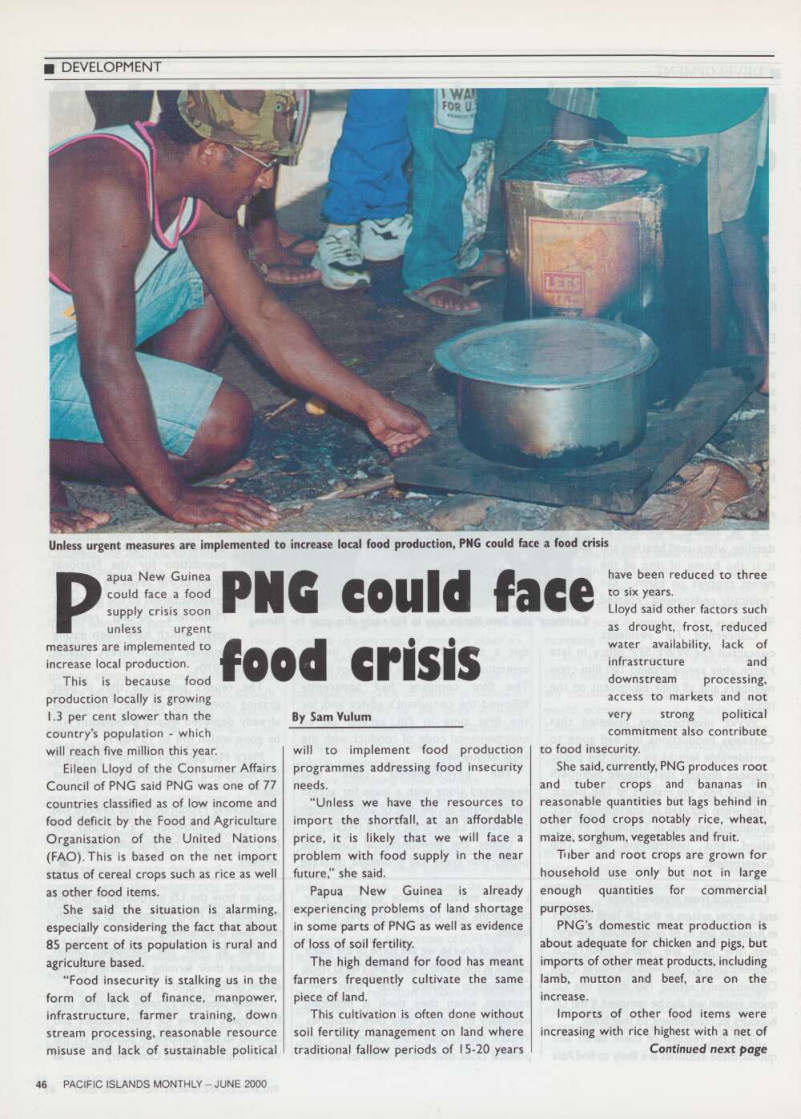
Unless urgent measures are implemented to increase local food production, PNG could face a food crisis
Continued from previous page
170,000 tonnes per year - an estimated
value of Kl5O million (US$344 million).
The Department of Agriculture and Livestock has estimated that PNG spends K4OO million (US$9l7 million) on food imports from Australia, New Zealand and Asian nations.
Lloyd adds that although the government started several projects to increase food supply, these were not successful because the provinces were not given extra funding to implement them.
The projects included the Department of Agriculture and Livestock’s market fruit and vegetable project, tree fruit development project, small holder market access and food supply projects, sheep project and the village livestock project.
“These projects were supposed to improve, enhance and promote the country’s food security with potential to replace imports of food, but provinces have not been given extra funding to implement these projects. These projects have not been successful,” she said.
Two other food projects still being implemented are the rice and grain project, which comes under the special programme in support of food production for food security, and the establishment of the Fresh Produce Development
Company.
Regarding the role of women in food security, Lloyd said it is estimated that 80 per cent of agriculture labor in PNG is
provided by women.
“But it is sad to state that women have been neglected and do not feature prominently in the programmes. The Department of Agriculture and Livestock has set up a Women in Agriculture Development Unit in the Department, but it is still to start,” she said.
Lloyd said PNG, like many Pacific nations, is a disaster prone. Disasters include droughts, frosts, cyclones, landslides, floods and tsunami.
“These disasters have proven that PNG is not food secure as none of the staple crops were used to feed the victims. PNG relied on rice, flour and cooking oil imported from overseas to feed the victims of the recent tsunami.
Sweet potato seeds were also imported to give to drought and frost victims in the Highland region to replant their gardens,”
Lloyd said.
She said food security is already a problem in PNG with the country
importing most of its foodstuff.
Lloyd said the food production industry is not given enough financial and manpower resources to make it become self-sustainable and ease the country’s dependence on imports. ■
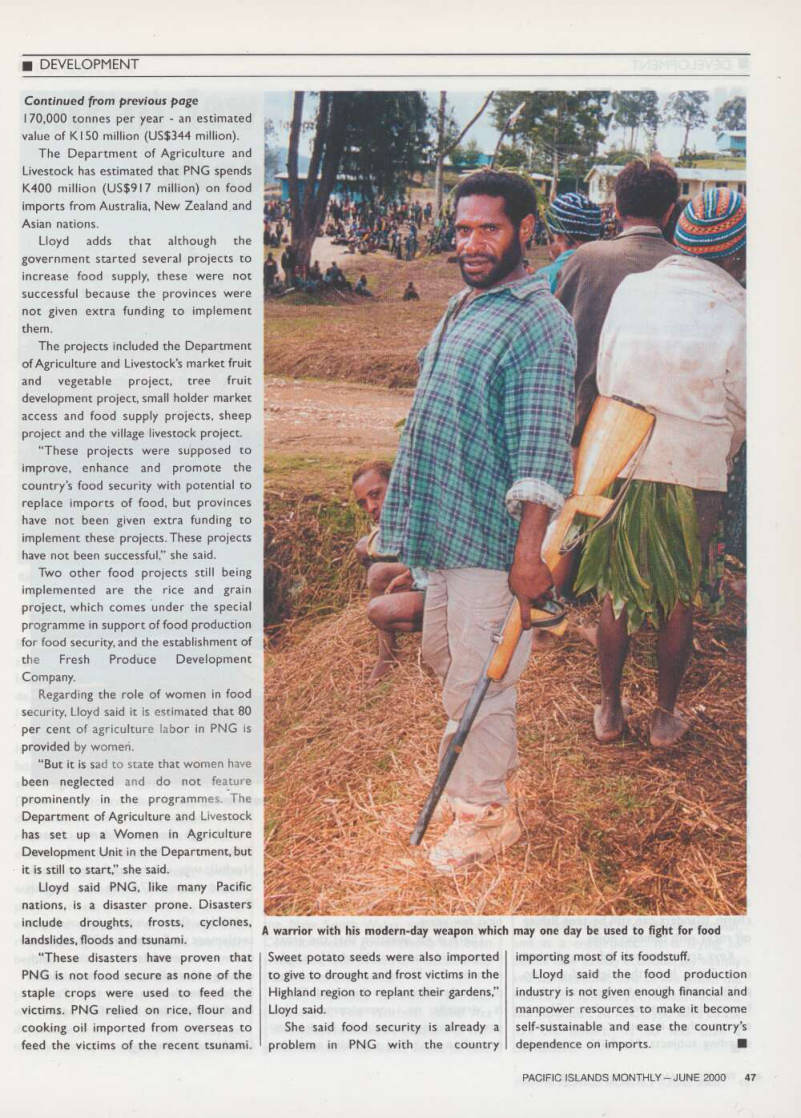
A warrior with his modern-day weapon which may one day be used to fight for food