How much tourism is too much?
p. 51 · Read in the full issue
Norfolk Island is first and foremost the home of its residents: This is the preamble to virtually every tourist development document produced for Norfolk in the past 20 years.
It was the reasoning of a 1981 Select Committee recommending capping the number of annual tourists at 20,000.
The same words were a governing principle in a 1 996 Tourism Norfolk Island report successfully arguing for the deregulation of the tourist accommodation industry and increasing the number of annual visitors to 49,000 by 2005.
This very sentiment was also the impetus behind the Legislative Assembly last April enacting a moratorium on new accommodations, abruptly ending the
deregulation.
Norfolk has a struggle with tourism of the blessed kind. It’s struggling with the prospect of too many tourists, and the consequence to the island’s environment and way of life.
“Tourists come to Norfolk because its beautiful, relaxed and safe,” says Bob Goldsworthy, chairperson of Tourism Norfolk Island, Norfolk’s tourist board.
“They come for the Pitcairn culture and the penal history. Plus the duty-free
shopping.”
And tourists do come, in ever increasirtg numbers. Over 37,000 persons visited Norfolk in 1999, up 60 per cent from 1990, and 30 per cent since just 1995.
This increase has some business owners and government officials salivating, but is troublesome to many others, including Goldsworthy, a retail shop owner.
He is concerned about the quality of the Norfolk experience being diminished, for tourists and residents alike, and would actually cap the number of annual visitors at its present numbers. Strong words from the chair of a tourist board. He cites the leading tourist complaint of the unavailability of fresh food as an example of the diminishing return.
The present Minister of Tourism and Commerce, George Smith, on the other hand, considers these shortcomings market
opportunities and is unsure where the ceiling should lie. Both would probably agree, however, that at stake is the future well-being of the island.
How to develop and sustain a vibrant tourist industry while not destroying the resident culture is the challenge throughout the Pacific.
Two issues on Norfolk are complicating the usual attempts at deliberation. The first is that, with no income and property tax, the public coffers are dependent on how much revenue the tourist-specific taxes and customs duties produce. Increased public monies presently requires on either higher tourist-related taxes or more tourists.
The second issue is more structural to the fabric of the community. With the advent of the tourist industry came new residents - “settlers,” as the Islanders have always called them - attracted to the lucrative, income-tax free opportunities this mushrooming industry was providing.
So many came to Norfolk that, within five years of the initial boom, by the end of the 19605, ethnic Norfolk Islanders had become a minority on the island. This sudden demographic shift was accompanied by local attempts in 1968 and 1974 at restricting who and how many could immigrate.
Each Ordinance gave preference to Pitcairn descendants, which acknowledged the island as their homeland.
Similar to so many issues pivoting on Norfolk’s constitutional relationship with
Australia, these clauses, according to the Australian Human Rights and Equal
Opportunities Commission report (March,
1999), were considered discriminatory to “other Australians” by the Commonwealth.
This preference was removed as a condition for progressing the Norfolk Island Act. Today, based on the last census taken in 1996, 47 per cent of Norfolk residents are of Pitcairn descent. Decisions today of “how much is too much,” and who benefits from what, can ultimately fall along ethnic lines.
It is easily argued that these new faces were required to provide the necessary skills and financing to fuel the tourist boom.
A considerable number of these people have been here over 30 years, have raised their children and consider the island their home.
Indeed, desires for self-government would probably not be so prevailing without the participation of these “expats.”
It is also arguable, however, that for many of these people, Norfolk is foremost a lucrative business venture fueled by ever greater numbers. It makes defining adverse impact and determining acceptable thresholds - of numbers of visitors, of water storage requirements for tourist accommodations, of allowable percentages of “foreign” ownership of tourist facilities -
inescapably problematic.
During this 12-month moratorium period, the Norfolk Island Government will attempt to figure it out. ■
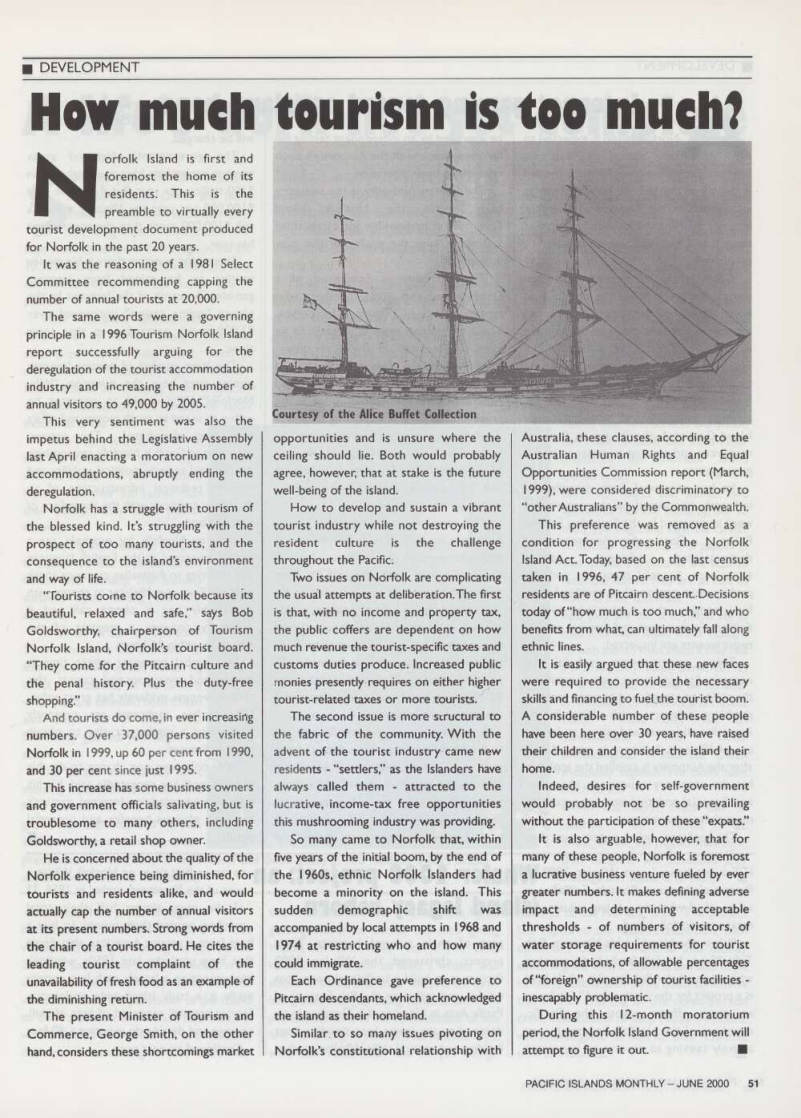
Courtesy of the Alice Buffet Collection