Terrorism in Fiji
p. 36 · Read in the full issue
The international community has few known and reliable weapons, apart from slow-action economic sanctions
THE international community has few known and reliable weapons, apart from slow-action economic sanctions, to counter the type of thuggery that one has been witnessing in Suva, capital of the tiny South Pacific island nation of Fiji.
The collective voice of institutions such as the United Nations and the Commonwealth counts for almost little in situations, rather rare no doubt, where gangsters hold a Government and a country to ransom.
The new military ruler, Commodore
Frank Bainimarama, after imposing martial law and sidelining the veteran political operator and President, Ratu Kamisese Mara, has belied the initial impression of fairness and surrendered to the so-called rebels by scrapping the 19 9 7
Constitution that had restored the multiracial character of the island.
Fijians of Indian origin, who saw their political rights being taken away after the 1987 coup under a Constitution that barred them from top Government positions, were given back their political dignity through an amended statute in 1997. This is now sought to be scrapped.
If Fijians of Indian origin are not again to be reduced to the status of second class citizens, the international community must immediately warn the rebels and their benefactors that it will not countenance
the creation of a system which does not respect and protect the rights of all Fijians irrespective of their ethnic origins.
The restoration of the democratically elected Government under Mahendra Chaudhry must be the logical first step.
Despite the fact that this is a repetition of what happened in 1987, India has apparently been caught off guard, not learning the right lessons from the criticism last time when Delhi did not even have enough diplomatic representation in Suva and could not therefore respond
adequately. But by moving the Commonwealth and Fiji’s big neighbours, it has been initiating the right actions.
The Commonwealth’s watchdog body is reactivating itself and Fiji’s neighbours.
New Zealand and Australia, on whose trade connections the country thrives have reacted strongly.
Trade and economic sanctions imposed after the first coup in 1987, that saw the rise to power of Sitiveni Rabuka, ultimately produced the desired results by forcing the native Fijian leadership to drop the
racially-biased provisions. Elections under the multiracial constitution brought an ethnic Indian to the Prime Ministership. Sanctions will most certainly be imposed again and Fiji expelled from the Commonwealth.
But, more immediately, the UN must deliver the clear warning to the thugs in Suva that unlike the last time the world body can activate more potent
mechanisms to end victimisation of civilian
populations.
Through their unacceptable actions on the streets and their hostage-takings and killings, sections of native Fijians are seeking to reverse the progress to democratic plurality that was ensured three years ago.
Any political system that attempts to guarantee power to the native Melanesian population will be welcomed by the international community.
But what is being sought to be achieved
through coercion
and violence is the elimination of an entire ethnic population from the political life of the country.
This is most repugnant.
At the root of the Fijian crisis is the attempt, since derailed, by the
democratically
elected Government of Mahendra
Chaudhry, to work out a fair deal for the tenant farmers, who are mostly people of Indian origin and whose sugar plantation leases are running out. These leasehold farmers control the vital sugar industry.
The first coup led by Rabuka, who still wields considerable influence, saw the flight of thousands of Fijians of Indian origin to other countries, mostly Australia, New Zealand and Canada.
Fiji was the loser. Native leaders must realise that another exodus can reduce their tiny land to even greater poverty. (The Hindu/AFP) ■
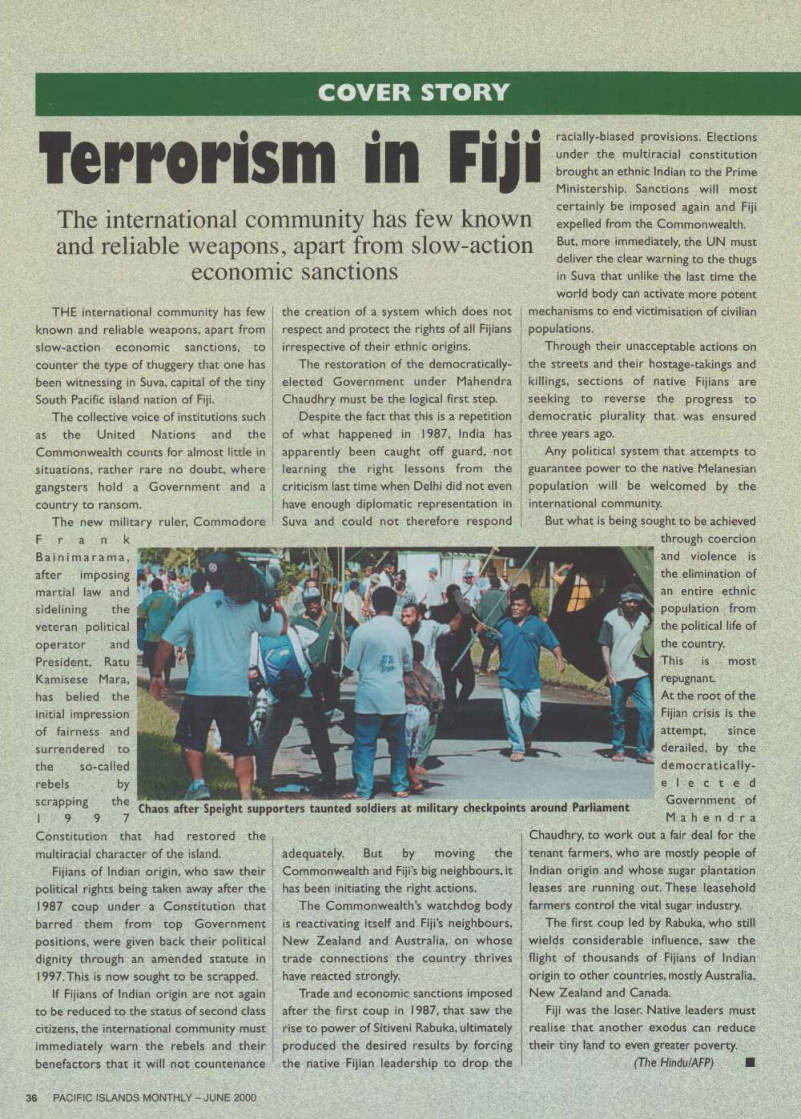
Chaos after Speight supporters taunted soldiers at military checkpoints around Parliament