Ethnic tensions boil over again
p. 37 · Read in the full issue
The tiny South Pacific nation of Fiji, where the army took control May 29, is split down the middle by tensions between the ethnic Indian and indigenous Fijian communities.
Seizing on the ethnic tensions, a bankrupt businessman who is only part- Fijian took the country’s first Indo-Fijian prime minister and his cabinet hostage on May 19 and started a slow slide into anarchy.
Following the failure of several attempts to resolve the crisis by President Ratu Sir Kamisese Mara, army chief Commodore Frank Bainimarama declared martial law on Monday and assumed executive authority.
The move was the latest dramatic twist in a lengthy ethnic saga which has divided the Pacific nation of nearly 800,000 people, which became an independent state within the Commonwealth on October 10, 1970.
Some 43 per cent of Fiji’s population are of Indian origin, descendants of workers imported by the British in the late 19th century to work in the sugarcane fields.
Die-hard indigenous Fijians, whose ethnic group makes up 51 percent of the population, have consistently played on fears of Indian domination of power, particularly given their control over much of the economically vital sugarcane
industry.
Two bloodless coups in 1987 were undertaken precisely because of those fears, and led to a new, racially-biased constitution which guaranteed ethnic Fijians a majority of seats in parliament.
After it gained independence from Britain in 1970, the nation’s politics were long controlled by the Fijian-dominated Alliance Party of Ratu Sir Kamisese Mara.
But elections in April 1987 saw the Alliance Party supplanted by a multi-racial coalition which divided ministerial jobs evenly between Fijians and Indians, to the horror of hardline indigenous nationalists.
The next month, a handpicked team of army officers under Colonel Sitiveni Rabuka deposed the new government,
suspending the constitution.
A second military coup in September that year led to Fiji
being expelled from the
Commonwealth and declared a
republic.
Military rule remained in force for eight years, and when Rabuka eventually became civilian prime minister in 1990, he did so under a new constitution which gave power to indigenous Fijians and did not permit ethnic Indians to hold top political posts.
The constitution reserved 37 of 70 seats in the House of Representatives for indigenous Fijians, as well as 24 out of 34 Senate seats. It was widely condemned as racist.
A constituional amendment in 1997 removed the in-built Fijian majority, and equality appeared to have been fully restored when Mahendra Chaudhry, an ethnic Indian, was sworn in as prime minister on May 19, 1999.
But even then, many in Fiji held their breath and waited to see how the indigenous Fijian nationalists would react.
The then opposition leader
Jai Ram Reddy, who Chaudhry
defeated in the 1999 general election, issued a telling and prescient warning at the time.
“Fiji is not yet ready for an Indian prime minister,” he declared.
On May 19, the anniversary of Chaudhry’s inauguration,
disgruntled businessman
George Speight and a half dozen hooded gunmen stormed the parliament building and launched the island’s worst political crisis.
(Afp) M
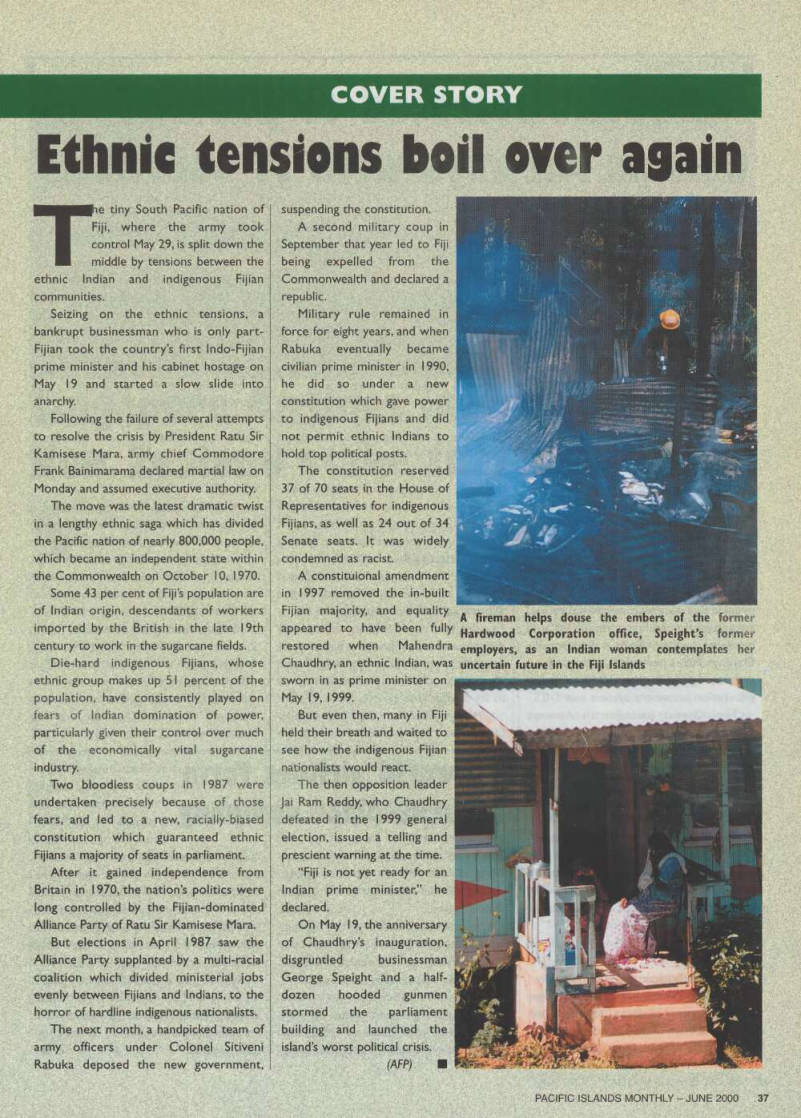
A fireman helps douse the embers of the former Hardwood Corporation office, Speight’s former employers, as an Indian woman contemplates her uncertain future in the Fiji Islands