Ratu Kara flees as military move in
pp. 33-35 · Read in the full issue
FIJI’S former president fled to his island home as the new military
ruler postponed the planned
swearing in of an interim civil administration and ruled out restoring the prime minister to power.
President Ratu Sir Kamisese Mara fled to his remote Pacific island home in fear of his life, police sources said.
Prime Minister Mahendra Chaudhry’s wife Virmati was reportedly offered sanctuary by the Mara family on Lakeba, in the Lau group of islands, 200 kilometres (125 miles) east of Suva.
The 80-year old president was flown by helicopter to Lakeba, one of the southernmost Fijian islands, of which he is high chief, a police source said.
Mara stepped down from his post May
29 after martial law was declared following the May 19 coup by businessman George Speight, who continued to hold Chaudhry and up to 35 legislators hostage in Parliament.
During violence May 28, guns were fired outside Government House, the president’s official residence, by a horde
of angry youths, killing one policeman.
Police sources also reported that a number of senior police and army officers had moved their families out of Suva following threats from Speight’s men.
News of Mara’s departure followed the announcement on Wednesday by Fiji’s new military ruler that there was no chance Chaudhry’s government would resume its leadership of the Pacific island nation.
“Mahendra Chaudhry will no longer come back as prime minister,” said Commodore Voreqe (Frank) Bainimarama.
Bainimarama also announced an indefinite postponement of the planned naming and swearing-in of an interim civil
Continued on page 35
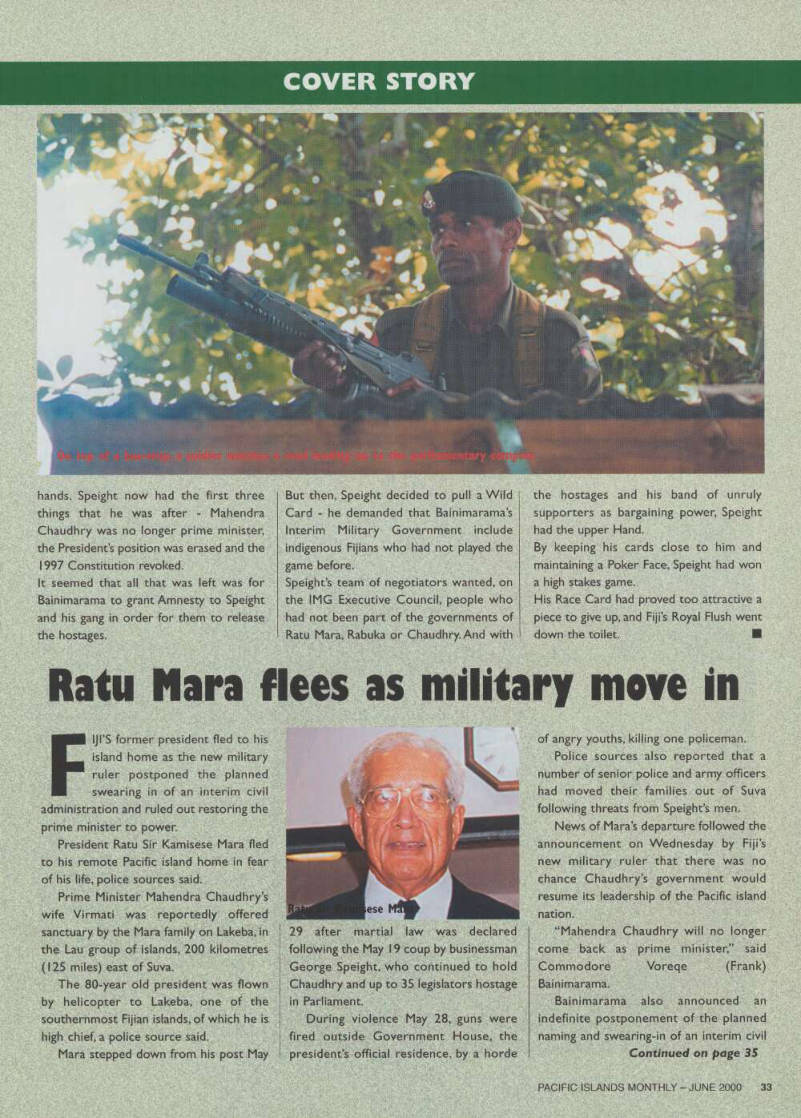
R etu [?] sese Ma[?]
Continued from page 33
administration. “It is prudent at this point in time to retain (the) military council until the climate is right for a civil administration to take over,” he told senior officers at Fiji’s military headquarters.
“We will defer the naming and swearing-in of the interim government until we are sure that the situation has
stabilised to a point where they can ... put in place a viable constitution and pave the way for the next general elections and the return to democratic rule.”
The interim military government would be in place until all the hostages were released and all arms had been returned to the army, Bainimarama said.
Despite the declaration of martial law, the scene outside
the besieged parliament was
chaotic and it appeared the military was still unable to enforce control over the coup leaders.
Speight’s armed supporters went on the rampage outside the building’s rear entrance.
Police confirmed that at least 10 cars were hijacked and driven inside the compound.
Bainimarama named Ratu Epeli Nailatikau - a former army commander and son-in-law of President Ratu Sir Kamisese Mara - as his prime minister in a government of non-aligned professionals.
The coup leaders have claimed to be acting on behalf of indigenous Fijians in
ousting Chaudhry - Fiji’s first ethnic Indian prime minister.
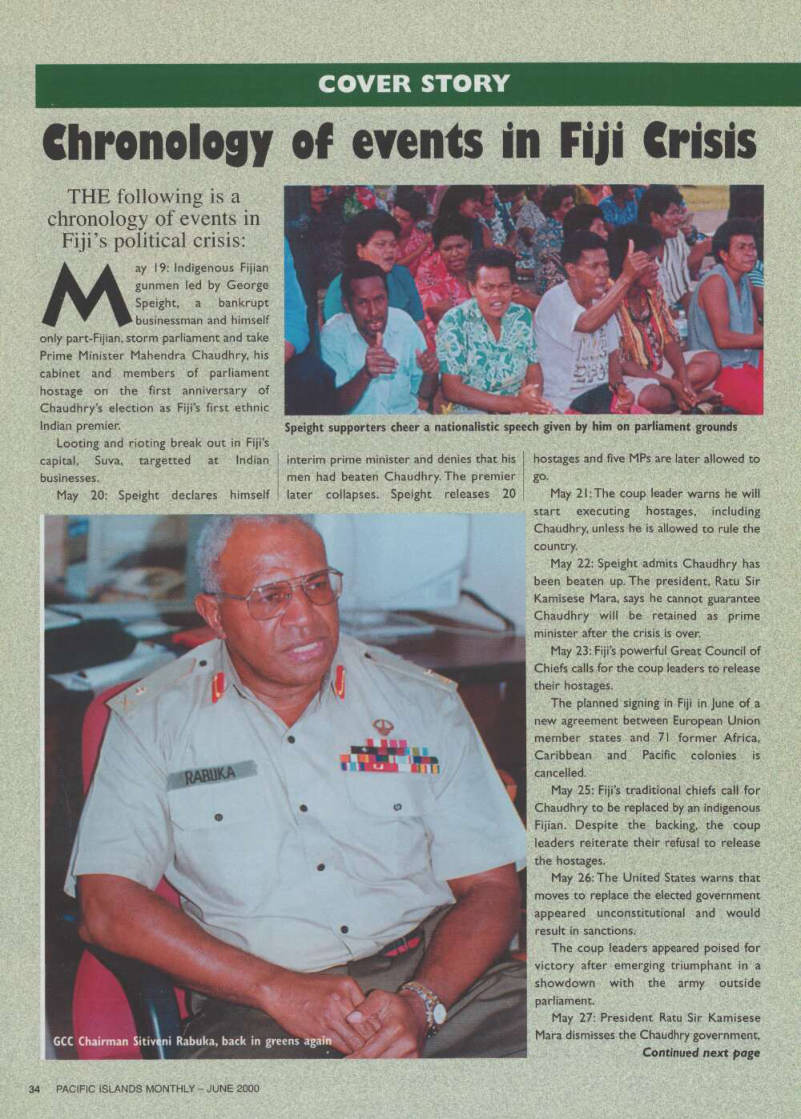
Although Bainimarama’s eight-member military council has not been named publicly, former prime minister and two time coup leader Sitiveni Rabuka is believed to be playing a key role on it, diplomatic sources say.
President Mara attempted to end the crisis May 27 by dismissing Chaudhry and
promising to restore the indigenous population’s former monopoly on power.
But Speight rejected the move.
Bainimarama then stepped to try to restore order following the night of violence in Suva.
A senior lecturer in constitutional law at the Australian National University, George Williams, said Mara and the Great
Council of Chiefs had no right to abrogate Fiji’s constitution in the first place.
“The constitution establishes the Parliament as the sole arbiter of constitutional change. No power to abrogate or amend the constitution is conferred upon the President or the Great Council of Chiefs,” he said.
Australia was set to announce sanctions against Fiji’s military take-over,
Prime Minister John Howard said.
He said the Australian cabinet’s National Security Council had met and remained committed to implementing sanctions following the May 19 coup in Fiji.
“We are committed to the imposition of a range of sanctions and measures,” he said. Headline:The
Continued on page 36
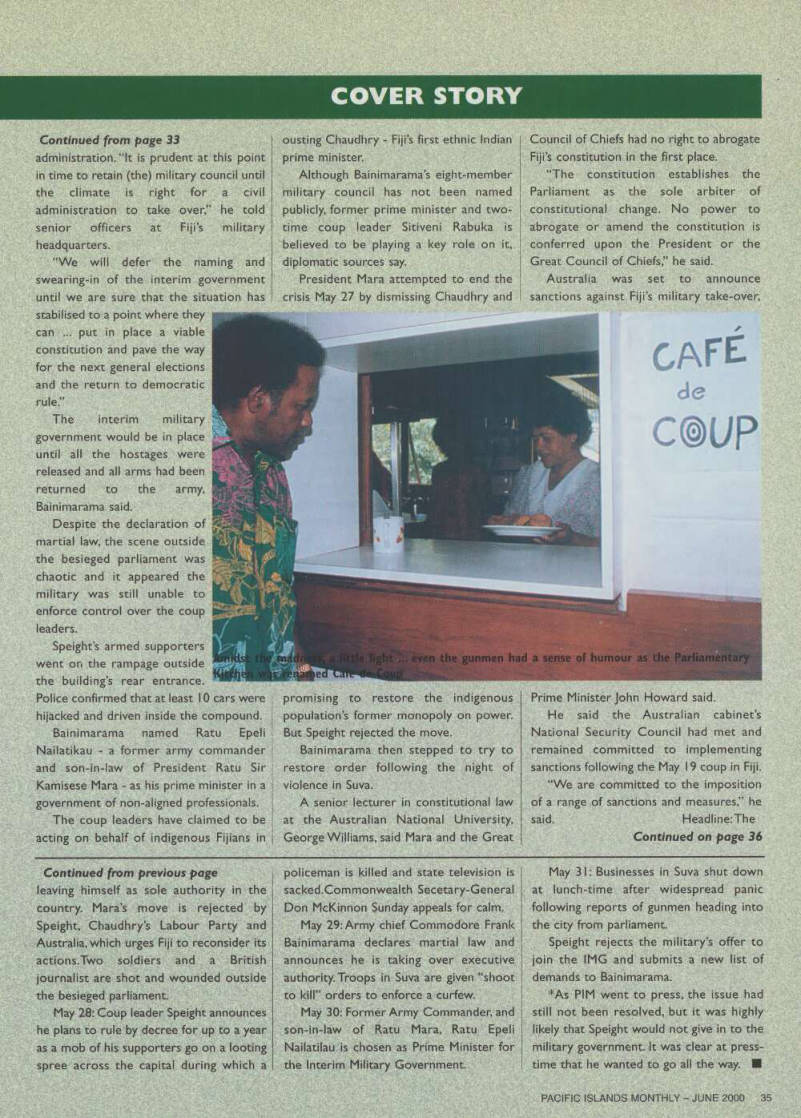
Amidst the madr[?] a little light ... even the gunmen had a sense of humour as the parliamentary kitchen was renamed cafe de coup