Poker Face
pp. 30-33 · Read in the full issue
Cover Story
Poker Face Who dares wins in Fiji’s political gamble
By Sophie Foster Hildebrand
When Fiji was plunged into
its first coup de tat in 1987, national success was not in the cards. But by the turn of the century, the country pulled out of a two-year recession and achieved an economic growth rate of eight per cent.
She held a Royal Flush.
Against the odds, she had as prime minister a person of Indian ancestry, thus
dispelling the ghosts of
1987’s racism criticisms.
She was back in the Commonwealth, and getting ready to host Heads of State from over 70 ACP-EU countries for the signing of the successor agreement to the Lome Convention. The Suva Convention, as it was to be known, was an honour hard won in
diplomatic circles.
But just as the time came to collect her winnings, Fiji folded. Someone had played the Race Card again, and in doing so, brought back all her
earlier shame. Having placed everything she
had on the game, she lost the lot. Her fate was now in the hands of the player who had rudely barged in on the game with the Race Card.
On that fateful day, George Speight set Fiji back many years. Everything she had achieved in the years since her 1987 decline became null and void. Speight wanted her Constitution, her Prime minister and her
President. And he wanted Amnesty for pulling the Race Card.
On May 19 this year, a new game began as Fiji took a backseat to her politics.
Holding a gun to the head of Fiji’s Prime Minister, Mahendra Chaudhry, and surrounded by armed guards, Speight made
for an imposing figure in the game. With her Parliament at gunpoint, Speight had seized his first Ace and paralysed Fiji.
But by letting loose the Race Card and declaring the paramountcy of indigenous Fijian rights, Speight also triggered a reign of terror on Fiji’s capital city.
That day Suva was looted and burned. Years of hard work for her businesspeople literally went up in smoke. Hundreds of
curiousity seekers crowded the city and rampaged through her streets. Indian businesses were targetted, their stock stolen, and many of their workplaces burned to a shell.
The people of Suva had to throw in their cards and concede. Many went into hiding,
fleeing the scene as Suva burned behind them.
Fiji’s police were powerless to act against such madness - the mob had taken over and its mentality was
crippling.
But within hours of Speight declaring himself Head of State, Fiji’s constitutional Head of State, President Ratu Sir Kamisese Mara, played his hand.
Declaring a State of Emergency, Ratu Mara instantly placed himself at the opposite end of the card table. His trump card was that his reputation had preceeded him.
Desperate for someone to take over their hand, the Fiji
Police Force gladly obliged
him. Police batons were no match for the sheer terror
of a mob, especially when some of the mob were armed with semi-automatic rifles.
Not wanting to antagonise Speight and his band of hostage-takers, the police let into parliament hundreds of people eager to show their support for the Race Card. Asa result, Speight picked up his second Ace.
These newcomers acted as human shields and, unknowingly, provided extra insurance against attack for the hostage-takers.
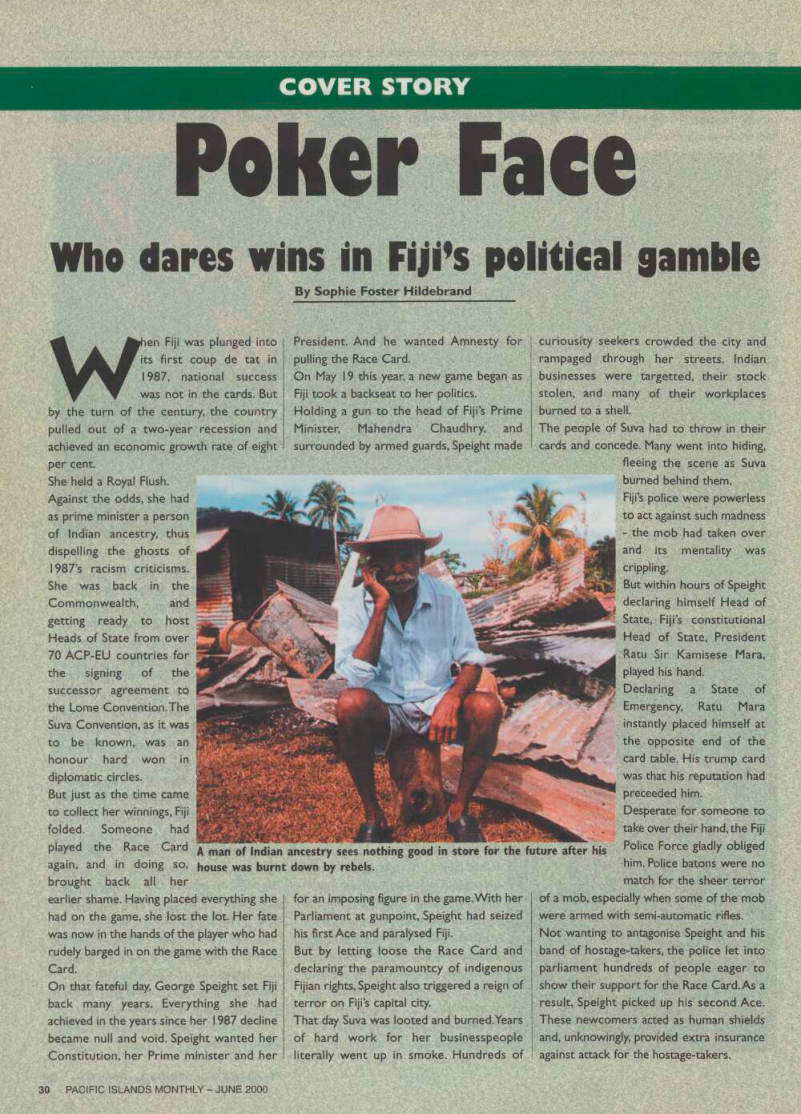
A man of Indian ancestry sees nothing good in store for the future after his house was burnt down by rebels.
The stakes were high as Ratu Mara and
Speight negotiated their way through this
loaded deck of cards. Jk For Speight, the unexpected arrival of A Ratu Mara had put a new twist on jHB what was to have been a straight forward hand. The President’s m" decision to challenge the Race jHSH Card forced Speight to call on all ||i :
favours. He challenged the right ■pHp
of Ratu Mara to hold office, thus B resulting in an emergency meeting of the Great Council of Chiefs - the body which appoints the President. l| But when the GCC came out in vH support of Ratu Mara, what began as a ljj small band of disgruntled men quickly turned into a challenge on the very ■ institution for which they claimed to be
fighting.
Speight rejected the GCCs
recommendations, claiming Ratu Mara had railroaded his way into staying in contention. He demanded that Ratu Mara step down.
For the President, the rigours of office were hard. Having just celebrated his 80th birthday, he would have been able to retire knowing he had done his country great service. But at this late stage in the game, he could not abandon her to the Race Card.As well, it would not have helped that amongst the hostages was his daughter, Adi Koila Nailatikau, who is said to be the apple of his eye.
Torn between upholding Fiji’s Constitution and living out the rest of his days in peace, Ratu Mara used as negotiator the instigator of the first and second of Fiji’s coups - Sitiveni Rabuka.
Chairman of the GCC, Rabuka was cheered as he turned up at the Poker Table, and was
welcomed by Speight. However, things
quickly turned nasty as Speight and his supporters discovered that Rabuka was in the same camp as Ratu Mara - he wanted Speight to concede so that Fiji could attempt to recapture her Royal Flush.
Speight refused to give in and accused Rabuka of cheating in an earlier game. He claimed that Rabuka had played the Race Card in 1987 but did not share his winnings with the indigenous Fijian supporters. As well, he claimed that Rabuka had
changed sides mid game and was now acting against the best interests of Fijian paramountcy.
As this discourse continued, people claiming to be Speight’s supporters taunted police and military forces loyal to the President. Suva
was quickly
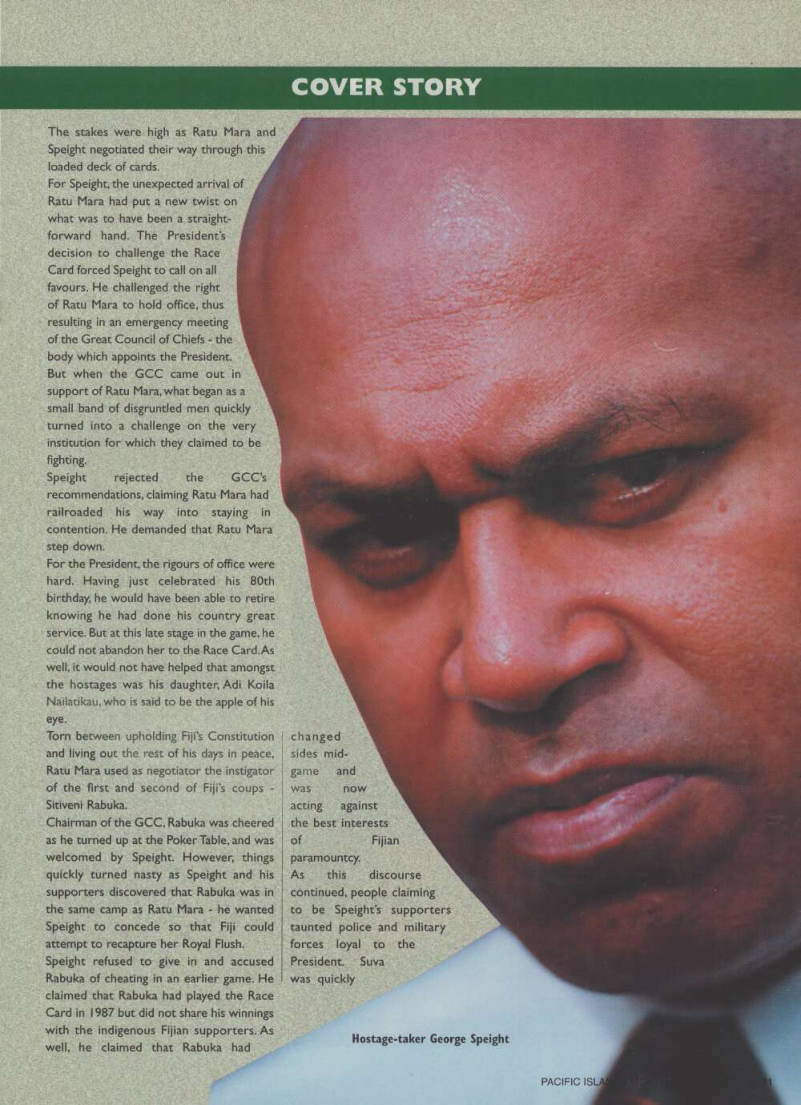
Hostage-taker George Speight
becoming a battleground where civil disobedience ran riot.
What resulted was an impasse between Speight and his band of so-called nationalists on one side, and the President, Rabuka and the GCC on the other. It seemed that there would be no end to negotiations.
As well as the pressure to hold on to their cards and maintain a poker face, each player had to deal with the knowledge that outside forces were watching the game with great interest.
Speight claimed that this did not affect the way he would play his cards. He was willing to break all the rules of the game in order to secure the Race Card.
Ratu Mara, however, had the pressure of balancing his status as a Fijian Chief and that of a Statesman. As a chief, there was pressure to go for a Flush (where all the cards would be of the same suit, that is, Fijian). But as a Statesman, he was obliged to uphold the Constitution and go for a Straight (where the numbers are in order but of different suits, that is, multicultural).
He was also conscious of the knowledge that the onlookers wanted him to restore Fiji’s Parliament to pre-Speight days. If he did not, Fiji would be heavily penalised by the onlookers, who would withdraw their goodwill from her.
While this left a bitter taste in his mouth, even worse was the knowledge that if he did not give way to some of Speight’s demands, bloodshed was sure to follow.
As all hell looked to be breaking loose, a powerful player took his cards off him. The Fiji Military Forces “with great reluctance”, had decided it was time to act.
Declaring a 48-hour Curfew in the country, FMF Commander Frank Bainimarama had pulled an Ace out of his sleeve. On May 29, 10 days after Speight forced himself into the game, martial law was announced in Fiji.
Fiji’s reaction to the military takeover was a far cry from that of 1987. Indeed, it seemed that people were relieved, rather than overly astonished by the news.
But in order to rule, albeit as an interim measure, Bainimarama had to revoke Fiji’s 1997 Constitution. In doing so, the position of the President was admonished, and the
Commander had played right into Speight’s
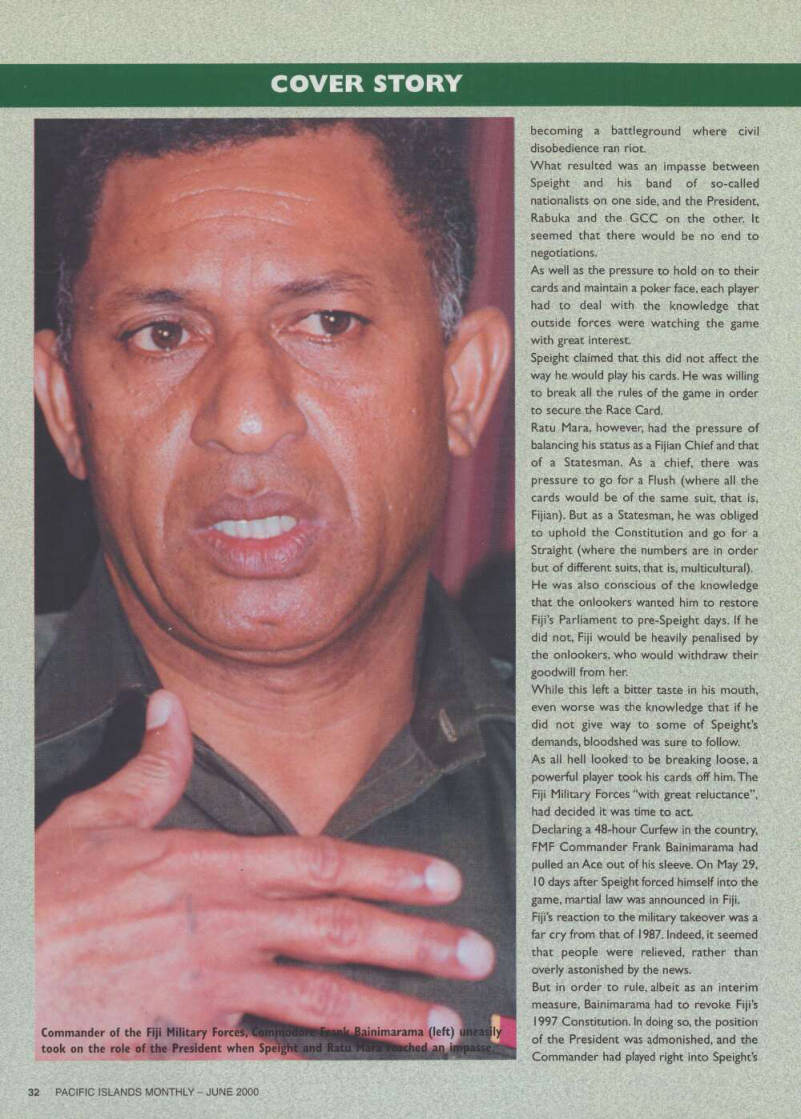
Commander of the Fiji Military Forces, Commodore Fank Bainimarama (left) uneasily took on the role of the President when Speight and Ratu Mara reached an impasse.
hands. Speight now had the first three things that he was after - Mahendra Chaudhry was no longer prime minister, the President’s position was erased and the 1997 Constitution revoked.
It seemed that all that was left was for Bainimarama to grant Amnesty to Speight and his gang in order for them to release the hostages.
But then, Speight decided to pull a Wild Card - he demanded that Bainimarama’s Interim Military Government include indigenous Fijians who had not played the game before.
Speight’s team of negotiators wanted, on the IMG Executive Council, people who had not been part of the governments of Ratu Mara, Rabuka or Chaudhry. And with
the hostages and his band of unruly supporters as bargaining power, Speight had the upper Hand.
By keeping his cards close to him and maintaining a Poker Face, Speight had won a high stakes game.
His Race Card had proved too attractive a piece to give up, and Fiji’s Royal Flush went down the toilet. ■