Report attacks Pacific nations human rights record
p. 32 · Read in the full issue
By Michael Field
Papua New Guinea has the worst human rights record in the Pacific. That’s if the US State Department individual country reports are a good guide.
They claim, in explicit language, that the PNG Government is responsible for human rights abuses, particularly its police force “Police committed extrajudicial killings, beat suspects, and engaged in excessively punitive and violent raids,” the latest country report says.
“The Government on occasion investigated allegations of abuse and prosecuted those believed responsible.”
Police claim that most people killed by them died in gunfights while resisting arrest.
One case though came about when police shot a man in both knees after he surrendered and he was left to bleed to death.
On Fiji they noted the constitutional changes in Fiji and the fact that ‘’peaceful and democratic elections” had been held.
“Nonetheless, ethnicity remains a
dominant factor in Fijian life and affects the country’s politics, economy, and society,” the report said.
“The ethnic division is illustrated by the contrast between the private and public sectors; Indo-Fijian families largely control most private businesses, while indigenous Fijians largely head the government ministries and the military.”
Fiji's principal human rights problem
was its ethnically based discrimination.
“Other human rights problems include
occasional police brutality, informal
constraints on the freedom of the press, efforts to restrict public comments by the diplomatic corps, discrimination and cases of violence against women, and instances of abuse of children.”
The Fiji Military Forces (FMF) was described as a small professional force.
“There continue to be credible reports of
human rights abuses by individual police
officers.”
In Palau loosening ties of the extended family and the increasing abuse of alcohol and other drugs are major contributing
factors that lead to instances of domestic violence and child neglect.
“Societal discrimination against certain foreign workers, who account for nearly 30 per cent of the population and 46 per cent of the paid work force, is also a serious problem.”
The foreigners are viewed negatively by Palauans.
“Foreign residents are subject to some forms of discrimination and are targets of petty, and sometimes violent, crimes, as well as other random acts against person and property.
“Credible complaints are made by foreign residents that crimes against non- Palauans are not pursued or persecuted by authorities with the same vigour as crimes against citizens. Certain foreign nationalities experience generalized discrimination in employment, pay, housing, education, and access to social services, although such discrimination is prohibited by law.
“While precise data is lacking, there continue to be anecdotal reports about abuse of workers’ civil rights perpetrated against domestic helpers, bar girls, construction laborers, and other semiskilled workers, the majority of whom are from the Philippines, China, and Bangladesh.
“The most common abuses identified are misrepresentation of contract terms and conditions of employment, withholding of pay or benefits, and, sometimes, physical abuse.
In a number of instances, local authorities have taken corrective action when alerted by social service and religious organizations to which foreign workers have turned for assistance.
Nonetheless, foreign workers often are reluctant to seek legal redress for fear of losing their employment and, thus, permission to remain in the country.”
Tonga’s “principal human rights abuse remains severe restrictions on the right of citizens to change their government.”
“The King and 33 hereditary nobles dominate political life.” ■
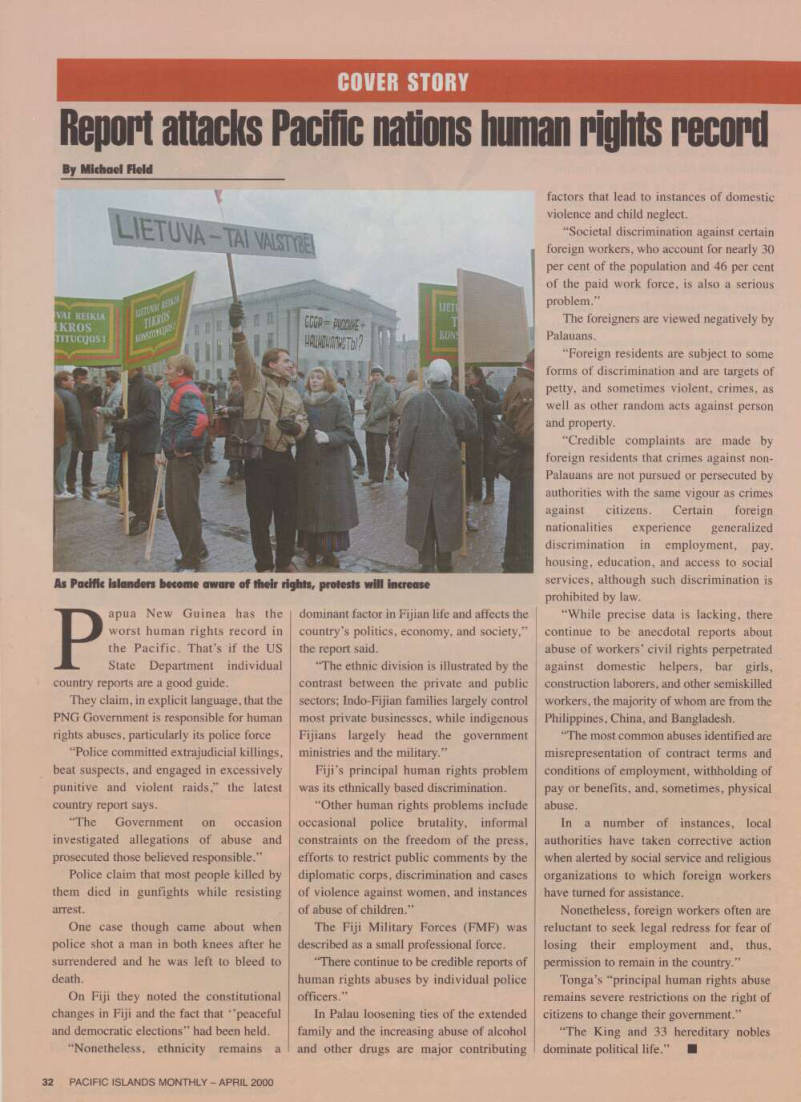
As Pacific islanders become aware of their rights, protests will increase