Atempts to muzzle watchdogs criticised
p. 33 · Read in the full issue
Banning foreign journalists
carries a cost for any country and both Kiribati and Tonga have stained their human rights copybooks.
Agence France-Presse correspondent and Pacific Islands Monthly contributor Michael Field has been banned from both countries and the latest United States State Department 1999 Country Reports on Human Rights Practices note both events as inhibiting the freedom of the press.
Tonga, for the second year running, is cited for the banning, noting that the correspondent had been reporting on the political situation in the kingdom.
On Fiji’s freedom of the press, the report noted the new Fiji Government’s criticism of national media.
“There are credible reports of attempts by individual members of the Government to pressure editors or otherwise interfere with the independence of the press.”
There was no prior censorship but
“considerable self-censorship.
“Newspapers occasionally print
editorials critical of the Government and occasionally do investigative reporting.
“They widely report statements about the political situation by opposition figures and foreign governments.
“The letters-to-the-editor columns of the two daily newspapers also frequently carry political statements from a wide cross section of society, including members of the deposed pre-coup government, which are highly critical of the Government, its programs, and the constitution.
“Criticism, albeit muted, of the once sacrosanct traditional chiefly system is appearing more frequently. However, the Government still views negative comments about individual chiefs with disfavor.
Kiribati was particularly criticised, not only for banning Field but also for the treatment meted out to leremia Tabai, its former founding president and Forum Secretary-General.
“The radio station and the only newspaper are government owned,” the report said.
“An opposition leader recently tried to open a private radio station before the national elections in November 1998, but the Government closed it, citing the need to comply with licensing regulations prior to
broadcasting.
“The station remained closed throughout the year, pending litigation of the issue.
“In addition, in August the Cabinet
declared a foreign journalist a prohibited
immigrant and precluded his return to the country, after the journalist published articles that ‘gave a bad impression of the country,’ according to Cabinet officials.”
Kiribati, which is to host the Pacific Forum later this year, has remained unrepentant about the banning order, and even implied violence against Field.
“Government’s decision to prohibit Mr Field from entering Kiribati was based on the very serious reaction of the Kiribati
people towards his excessively disrespectful articles about Kiribati in one of the newspapers,” Permanent Secretary Meita Beiabure wrote.
“The people of Kiribati have been
deeply hurt by Mr Field’s excessively
biased views about the country and wanted Mr. Field to realize that the people of Kiribati love their country and are always proud of it.
“Banning Mr Field from Kiribati has nothing to do with the expression of press freedom, but it is an expression of the right of the people of Kiribati to defend their country against a foreigner who decides to degrade the image of Kiribati in an untruthful manner.
“If Mr Field insists that he is right then he will continue to abuse Kiribati.
In this way and for his own good it is better that he is prohibited to visit Kiribati in future.” ■
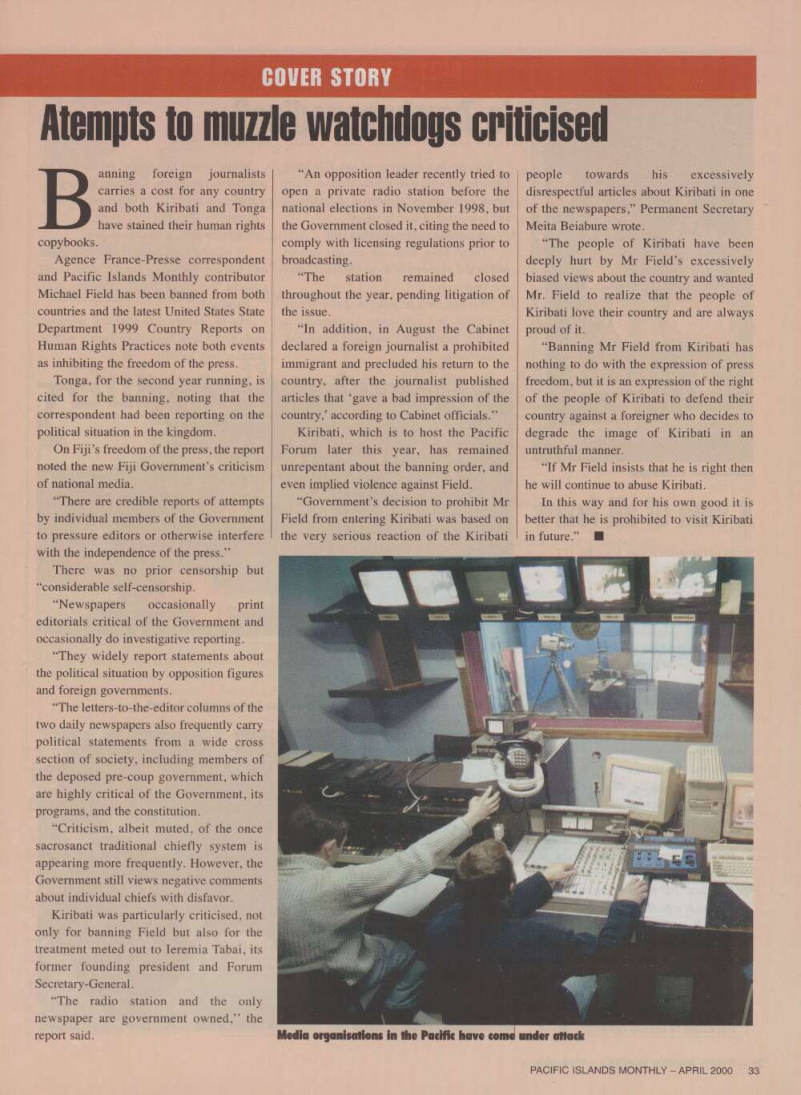
Media organisations in the Pacific have come under attack