Paradise net in the eyes of the beholder
pp. 30-31 · Read in the full issue
Cover Story
By Michael Field
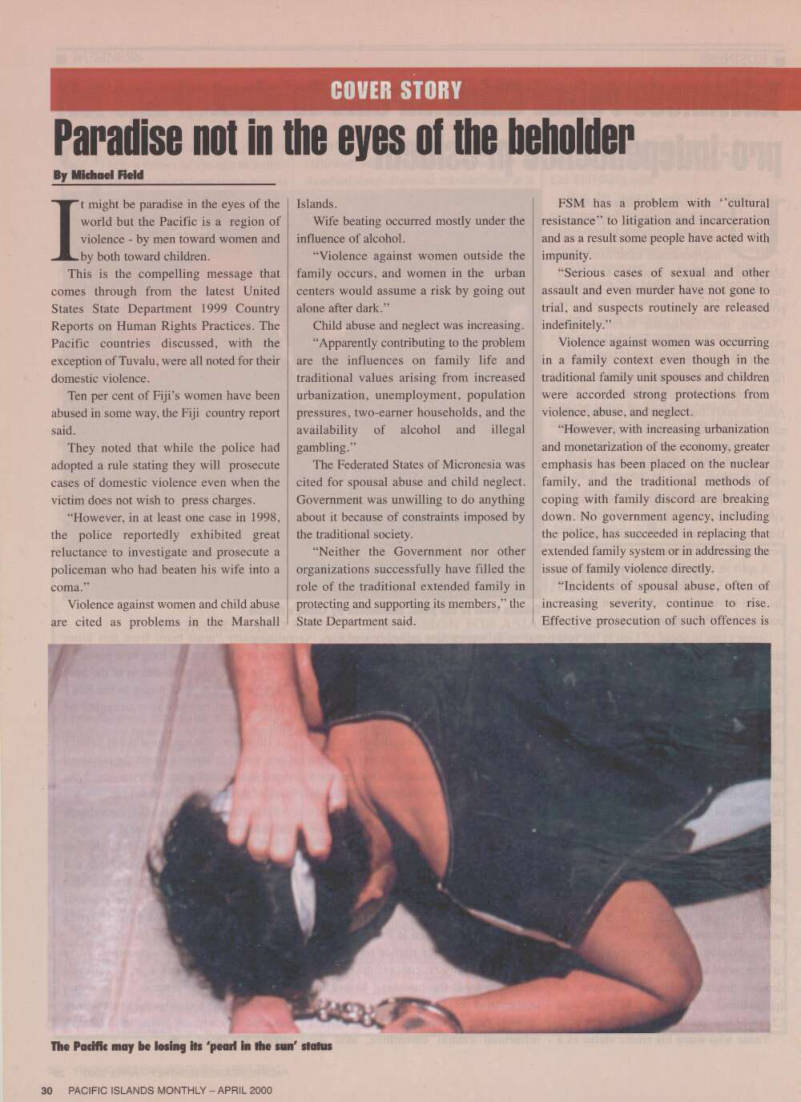
It might be paradise in the eyes of the world but the Pacific is a region of violence - by men toward women and by both toward children.
This is the compelling message that comes through from the latest United States State Department 1999 Country Reports on Human Rights Practices. The Pacific countries discussed, with the exception of Tuvalu, were all noted for their domestic violence.
Ten per cent of Fiji’s women have been abused in some way, the Fiji country report said.
They noted that while the police had adopted a rule stating they will prosecute cases of domestic violence even when the victim does not wish to press charges.
“However, in at least one case in 1998, the police reportedly exhibited great reluctance to investigate and prosecute a policeman who had beaten his wife into a coma.”
Violence against women and child abuse are cited as problems in the Marshall
Islands.
Wife beating occurred mostly under the influence of alcohol.
“Violence against women outside the family occurs, and women in the urban centers would assume a risk by going out alone after dark.”
Child abuse and neglect was increasing.
“Apparently contributing to the problem are the influences on family life and traditional values arising from increased urbanization, unemployment, population pressures, two-earner households, and the availability of alcohol and illegal gambling.”
The Federated States of Micronesia was cited for spousal abuse and child neglect.
Government was unwilling to do anything about it because of constraints imposed by the traditional society.
“Neither the Government nor other organizations successfully have filled the role of the traditional extended family in protecting and supporting its members,” the State Department said.
FSM has a problem with ‘’cultural resistance” to litigation and incarceration and as a result some people have acted with impunity.
“Serious cases of sexual and other assault and even murder have not gone to trial, and suspects routinely are released
indefinitely.”
Violence against women was occurring in a family context even though in the traditional family unit spouses and children were accorded strong protections from violence, abuse, and neglect.
“However, with increasing urbanization and monetarization of the economy, greater emphasis has been placed on the nuclear family, and the traditional methods of coping with family discord are breaking down. No government agency, including the police, has succeeded in replacing that extended family system or in addressing the issue of family violence directly.
“Incidents of spousal abuse, often of increasing severity, continue to rise.
Effective prosecution of such offences is
The Pacific may be losing its 'pearl in the sun' status
rare. In many cases, the victim is pressured by family, is fearful of further assault, or is convinced that the police will not involve themselves actively in what is seen as a
private family problem and decides against
initiating legal charges.
‘There are no laws against domestic abuse, and there are no governmental or private facilities to shelter and support women in abusive situations. The number of cases of physical and sexual assaults against women outside the family context also are growing. These assaults are perpetrated against both citizens and foreigners. Unmarried women sometimesare considered to have invited such violence by living or travelling alone.”
There were ‘’credible” reports that women on Nauru suffered sporadic abuse, often aggravated by alcohol use.
In Papua New Guinea violence against women was a serious and prevalent problem.
“Although rape is punishable by imprisonment, and sentences are imposed when assailants are found guilty, few assailants are apprehended. The willingness of some communities to settle incidents of rape through material compensation rather than criminal prosecutions makes the crime difficult to combat. Domestic violence, such as wife beating, also is common and is a crime. However, since most communities view domestic violence as a private matter, and few victims press charges, prosecutions are rare.”
Violence by women against women was also increasing and 65 per cent of the women in prison are there for attacking or killing another woman.
“Many women, even in urban areas, are considered second-class citizens. Village courts tend to impose jail terms on women
found guilty of adultery, while penalizing
men lightly or not at all.”
Samoa’s principal human rights abuses arise from political discrimination against women and untitled people and violence against women and children.
Samoan tradition tolerates corporal punishment but police were noting an increase in reported cases of child abuse, “attributed to citizens becoming more
aware of the need to report physical, emotional, and sexual abuse of children.”
Solomon Island human rights were being impacted by the unrest on Guadalcanal.
“While actual statistics are scarce, incidents of wife beating and wife abuse appear to be common.”
But children were respected and protected.
“As a result, virtually no children are homeless or abandoned.”
Domestic violence in Tonga is seldom is publicized, but it is a problem, said the State Department. In Vanuatu women were under-represented in politics and were hampered from taking a wider role in social life.
“Violence against women, particularly wife beating, is common, although no accurate statistics exist,” the State Department said.
“Courts occasionally prosecute offenders using common law assault as a basis for prosecution, since there are no specific laws against wife beating.
However, most cases of violence against women, including rape, go unreported because women, particularly in rural areas, are ignorant of their rights or fear further abuse. In addition police are frequently reluctant to intervene in what are considered to be domestic matters.
“While women have equal rights under the law, they are only slowly emerging from a traditional culture characterized by male dominance, a general reluctance to educate women, and a widespread belief that women should devote themselves primarily to childbearing. During the year, in the course of a downsizing in the public service, a disproportionate number of women’s positions were abolished.”
The majority of Vanuatu women entered
marriage through bride-price payment,
encouraging men to view women as property.
“Many female leaders view village chiefs as a major obstacle to attaining social, political, and economic rights for women.” ■
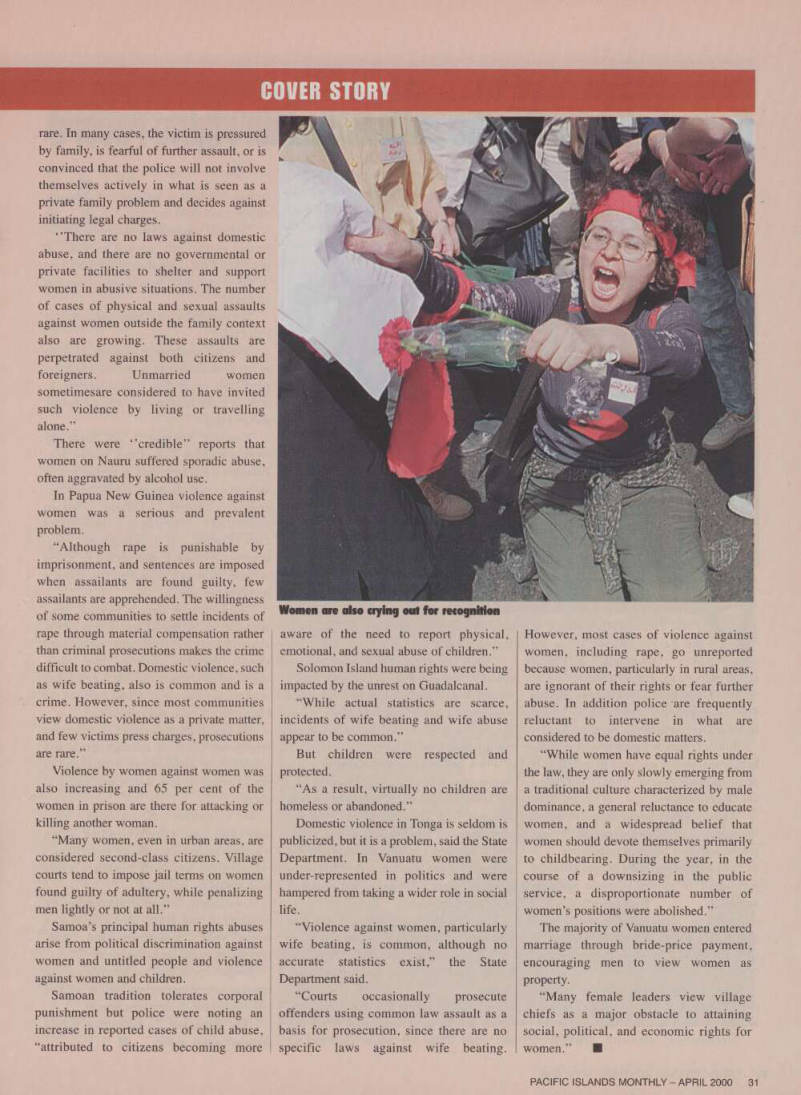
Women ore also crying out for recognition