pro-independence president
p. 29 · Read in the full issue
Taiwanese reject China threats to elect pro-independence president
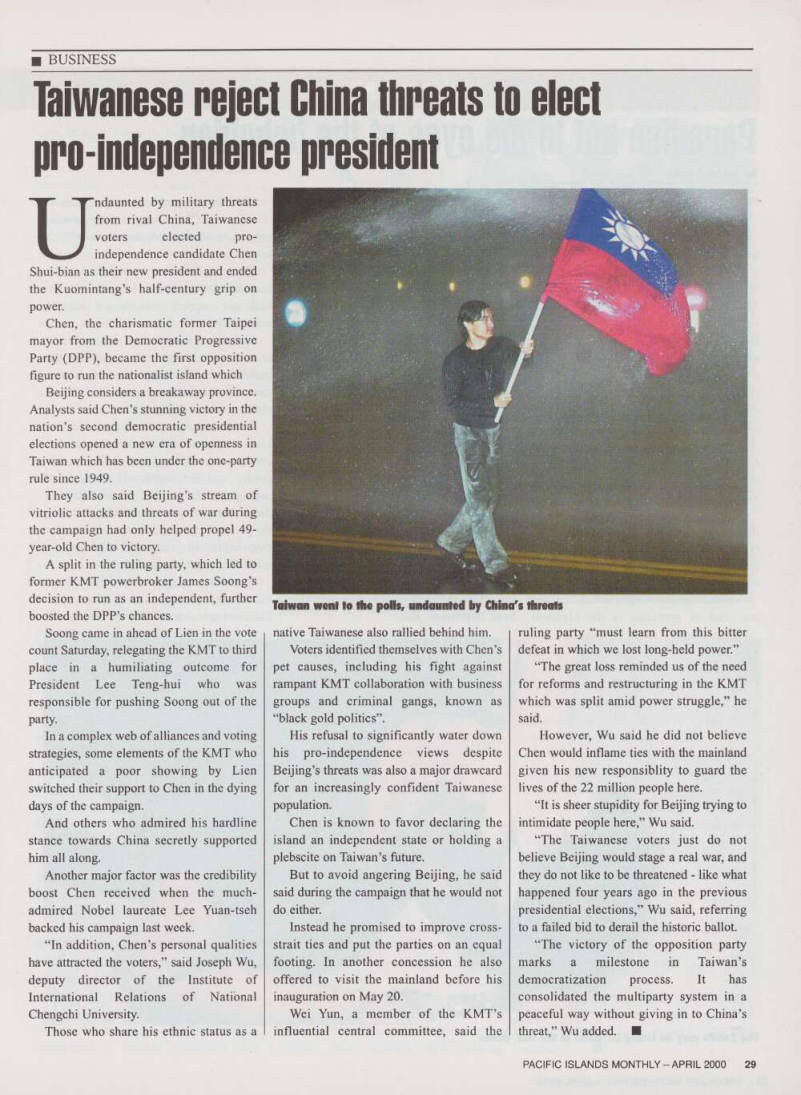
Undaunted by military threats from rival China, Taiwanese voters elected pro independence candidate Chen Shui-bian as their new president and ended the Kuomintang’s half-century grip on power.
Chen, the charismatic former Taipei mayor from the Democratic Progressive Party (DPP), became the first opposition figure to run the nationalist island which Beijing considers a breakaway province.
Analysts said Chen’s stunning victory in the nation’s second democratic presidential elections opened a new era of openness in Taiwan which has been under the one-party rule since 1949.
They also said Beijing’s stream of vitriolic attacks and threats of war during the campaign had only helped propel 49year-old Chen to victory.
A split in the ruling party, which led to former KMT powerbroker James Soong’s decision to run as an independent, further boosted the DPP’s chances.
Soong came in ahead of Lien in the vote count Saturday, relegating the KMT to third place in a humiliating outcome for President Lee Teng-hui who was responsible for pushing Soong out of the party.
In a complex web of alliances and voting strategies, some elements of the KMT who anticipated a poor showing by Lien switched their support to Chen in the dying days of the campaign.
And others who admired his hardline stance towards China secretly supported him all along.
Another major factor was the credibility boost Chen received when the much admired Nobel laureate Lee Yuan-tseh backed his campaign last week.
“In addition, Chen’s personal qualities have attracted the voters,” said Joseph Wu, deputy director of the Institute of International Relations of National Chengchi University.
Those who share his ethnic status as a
native Taiwanese also rallied behind him.
Voters identified themselves with Chen’s pet causes, including his fight against rampant KMT collaboration with business groups and criminal gangs, known as “black gold politics”.
His refusal to significantly water down his pro-independence views despite Beijing’s threats was also a major drawcard for an increasingly confident Taiwanese
population.
Chen is known to favor declaring the island an independent state or holding a plebscite on Taiwan’s future.
But to avoid angering Beijing, he said said during the campaign that he would not do either.
Instead he promised to improve cross strait ties and put the parties on an equal footing. In another concession he also offered to visit the mainland before his inauguration on May 20.
Wei Yun, a member of the KMT’s influential central committee, said the
ruling party “must learn from this bitter defeat in which we lost long-held power.”
“The great loss reminded us of the need for reforms and restructuring in the KMT which was split amid power struggle,” he said.
However, Wu said he did not believe Chen would inflame ties with the mainland given his new responsiblity to guard the lives of the 22 million people here.
“It is sheer stupidity for Beijing trying to intimidate people here,” Wu said.
“The Taiwanese voters just do not believe Beijing would stage a real war, and they do not like to be threatened - like what happened four years ago in the previous presidential elections,” Wu said, referring to a failed bid to derail the historic ballot.
“The victory of the opposition party marks a milestone in Taiwan’s democratization process. It has consolidated the multiparty system in a peaceful way without giving in to China’s threat,” Wu added. ■
Taiwan went to the polls, undaunted by China's threats