Israel holds training course in Fiji
p. 51 · Read in the full issue
By Mark Schulman
From February 8-18, 2000
an on-the-spot training
course in irrigation and plant nutrition took place at the Sigatoka Research Station in the worst of Fiji. Sponsored by the Israeli Ministry of Foreign Affair’s Center for International Cooperation (MASHAV) and in collaboration with the Fijian Ministry of Agriculture, Fisheries and Forests, the course covered issues relating to soil-water-plant relationships, water efficiency, sprinkler and micro irrigation systems and other areas related to drip irrigation.
More than 40 participants from various divisions of the Fijian Ministry of Agriculture and extension agencies, as well as water managers, land planners, agronomists and researchers from throughout the country, participated in the intensive two-week training course taught by Moshe Sneh and David Yolles - two senior Israeli experts in the field of irrigation and water management.
Sneh is the Director of Irrigation and Soil Field Services at the Israeli Ministry of
Agriculture and has taught similar training courses in irrigation and fertilization in China. Yolles is the former Director of the Soil-Water Laboratories at the Israeli Ministry of Agriculture and has participated in numerous missions to Barbados, the Dominican Republic, the Philippines and other Island States.
Although Fiji has been plagued by drought in recent years, the country has abundant water resources that according to Moshe Sneh, “could be more efficiently managed and optimized in order to achieve better crop yields and incomes.” This applies not only to sugarcane, the country’s major export crop, but vegetable and fruit production as well.
The course was opened on February 8 by Samisoni Ulitu, Deputy Permanent Secretary (Services) of the Fijian Ministry of Agriculture, Fisheries and Forests, in the presence of Noa Furman, First Secretary of the Israeli Embassy in Canberra; Villiame Cegumalua, Israeli Honorary-Consul in Fiji; and.
Apisia Ucuboi, Acting Principal Research Officer of the Sigatoka Research Station
and former participant of an Israeli research and development course on drip irrigation and green house technologies.
Deputy Permanent Secretary Ulitu emphasized to participants the importance of taking advantage of the Israeli expertise before them. Noting that agriculture is “the backbone of the country,” he said that Fiji “needs to better manage its water resources if agriculture is to survive.”
Hundreds of Fiji professionals have benefited from Israeli training courses in past years, both in Israel, as well as in several on-the-spot courses in Fiji - such as agricultural extension and communication course in 1994 at the Koronivia Research Station and more recently, a course on citrus g Activities include an on-going poultry project in the Marshall Islands, a course on irrigation and vegetable growing that took place in Papua New Guinea in 1998 and a course on water quantity management in Micronesia in 1999.
In addition, there are several “on-the spot” training courses planned for the year 2000, which include one on meteorology in Papua New Guinea and one on agricultural extension services in Palau.rowing in 1999 at the Batiri Orchard.
First Secretary Noa Furman of the Israeli Embassy in Canberra remarked at the opening ceremony that she hopes there will be more courses like the one taking place at Sigatoka in the future and that cooperation between Israel and Fiji, as well as between other South Pacific nations, will continue to grow “not only through international cooperation courses and projects, but in areas such as culture and the arts as well.”
The Embassy of Israel in Canberra, Australia is not only accredited to Fiji, but also to Palau, Papua New Guinea, Nauru, the Federated States of Micronesia and the Marshall Islands.
These countries have also benefited from Israeli technical and agricultural assistance over the years.
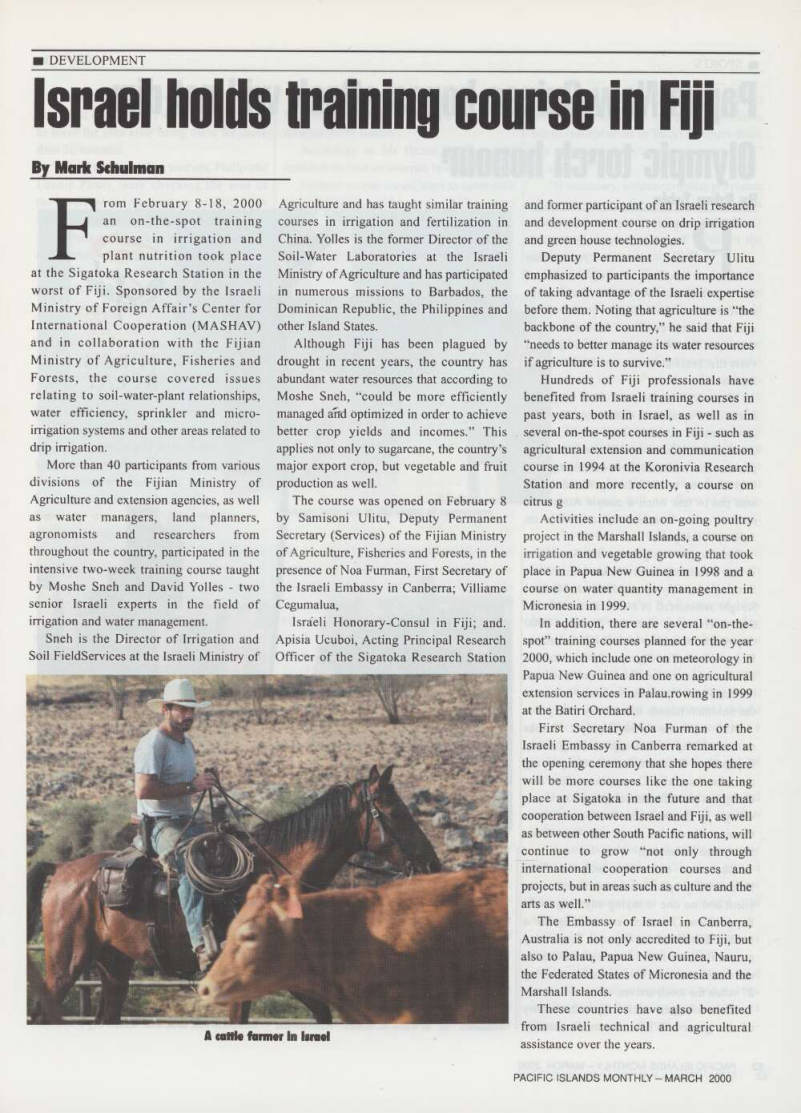
A cattle fanner in Israel