US star warriors in state of denial
p. 50 · Read in the full issue
In the US the star warriors seem to be in a state of denial.
On January 18, a test of the missile-defence system failed when an interceptor launched from the Marshall Islands did not succeed in hitting a mock warhead launched from Vandenberg Air Force Base in California.
This is embarrassing to proponents of a missile-defence system. They continue to urge President Clinton to proceed with the limited shield, regardless of the fallout in our relations with Russia and China that
such a move would cause. And they refuse to admit that this latest test was a bust.
"I expect that we will learn that this was not an unsuccessful test, even though the interceptor did not hit the target,” said Senator Thad Cochran.
The latest mishap should make Clinton think twice about proceeding with deploying missile defence.
After 15 years and SUS6O billion, the programme remains an unworkable, costly and dangerous misuse of taxpayer funds.
To date, beyond holding the status as the Pentagon’s most expensive weapons program ever, the billions of dollars poured into research and development have produced precious little.
Still, in a time of budget battles, missile defence remains impervious to cuts, leaving many to wonder just who is running the show in Washington.
A large part of the missile-defence revival has been driven by campaign contributions and an intense lobbying campaign from the defence industry.
The top four defence contractors to benefit from missile defence (Lockheed Martin, Boeing, TRW and Raytheon) spent more than SUS 34 million on lobbying and an astonishing SUS 6.9 million in campaign contributions in 1997 and 1998, according to data compiled from the Centre for
Responsive Politics.
A litmus test for party affiliation, missile defence appears to have achieved
bipartisan support. In an overwhelming 97- 3 vote last March, the Senate passed the National Missile Defence Act of 1999, which calls for deployment of a missile defence system “as soon as technologically feasible.”
The House followed suit in May with a 345-71 vote. The president signed the missile-defence bill into law last July, even though at the start of his first term he called Star Wars “a costly missile-defence system that could be obsolete tomorrow.”
Despite the alarmist rhetoric that makes
its way into the public debate, the so-called rogue states like North Korea and Iran are still many years - if not decades -away from mastering the technology to produce and mount a nuclear weapon that can be delivered to a target thousands of miles away. And North Korea, which carried out a missile test in late 1998, has now put its missile program on hold pursuant to negotiations with the United States.
Furthermore, the United States is spending billions of dollars addressing one of the least likely threats to US security. No US adversary would be foolish enough to launch a ballistic missile - whose origins are impossible to disguise - when the likely result would be a devastating counterattack by thousands of US nuclear warheads.
Deployment of a national missile defence system could make the United States less safe, not more. It risks endangering existing arms controls and spurring a new nuclear-arms race. Russia has made it clear that future reductions in
its nuclear arsenal are conditional upon continued compliance with the 1972 Anti- Ballistic Missile Treaty.
The ABM treaty limits each country to one national missile-defence site with no more than 100 interceptors That’s to ensure that both countries are susceptible to the dangers of the other’s nuclear arsenal and thus will not use nuclear weapons.
As for China, which has only a handful of ICBMs capable of reaching the United States, the tests are likely to provoke them
to deploy more long-range missiles in response.
Indeed, China’s Vice Minister of Foreign Affairs Wang Guangya launched a verbal attack on the US government, saying it could provoke a new arms race.
Wang said: “This move will undoubtedly inflict severe damages on global strategic balance and stability, undermine the international security environment, make it difficult
to carry on the international non proliferation regime and may even trigger a new round of arms race, to the detriment of its (the US) own security at the end of the day.”
In a following debate, the Chinese vice minister said the US plan was “a heavy blow” for the ABM (anti-ballistic missile) treaty between Russia and the United States, and that if the treaty was undermined it would have “serious implications” for other disarmament agreements.
The choice now lies with the US. • The United States should be supporting preventive measures like the Comprehensive Test Ban Treaty and further reductions in the world’s bloated nuclear arsenals.
Ultimately, getting rid of nuclear weapons and ballistic missiles will provide a far more effective defence than will relying on costly schemes like missile defence that may do more harm than good.
Krt/Afp
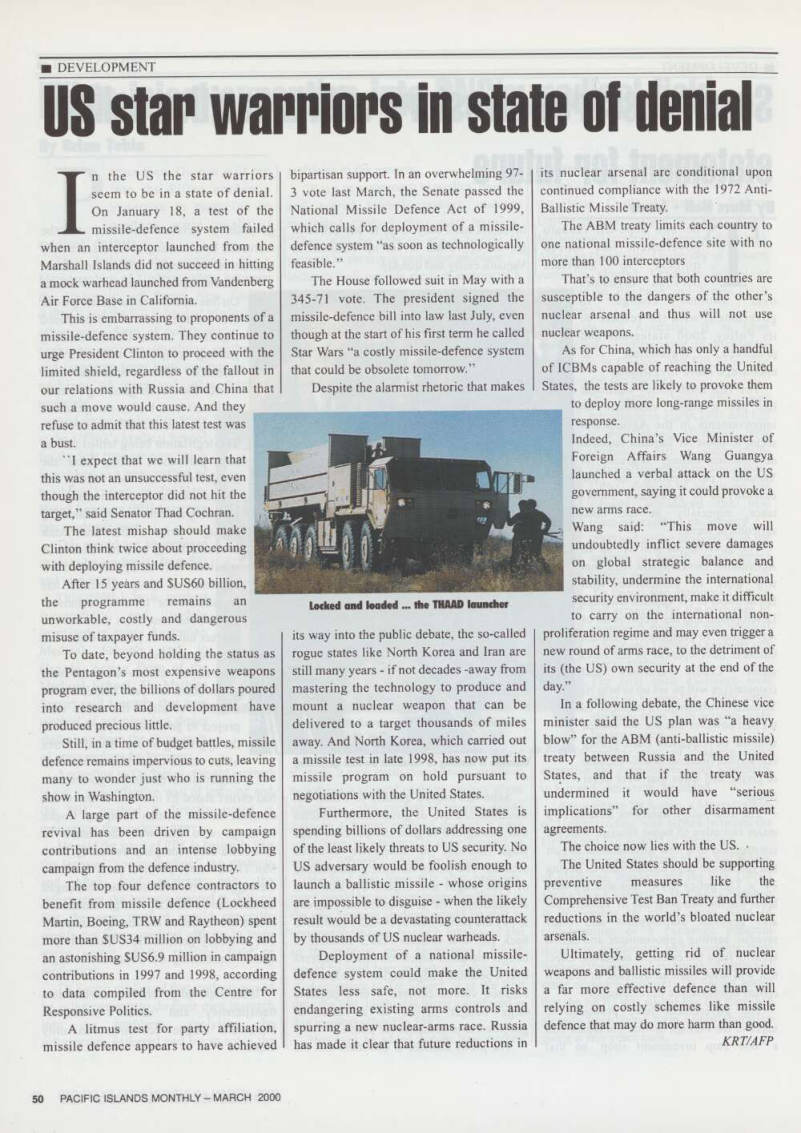
Locked and loaded ... the THAAD launcher