Papua New Guinea hopes attack will not dim
pp. 52-53 · Read in the full issue
Sports
Olympic torch honour
By Briann Tobia
Papua New Guineans bemoan the criminal attack on several Australian tourists visiting the tail of the infamous Kokoda Trail but anticipate a favorable verdict from Australian to confirm that the 2000 Olympic Torch will pass through and visit the Trail as announced in 1998 by Prime Minister John Howard. This very rare honor for Papua New Guinea to showcase its infamous Kokoda Trail where many Australian soldiers were killed in a battle to prevent the Japanese from advancing into Port Moresby in 1942 during World War II was put to test when a couple Australian tourists were attacked by criminals on January 1 this year.
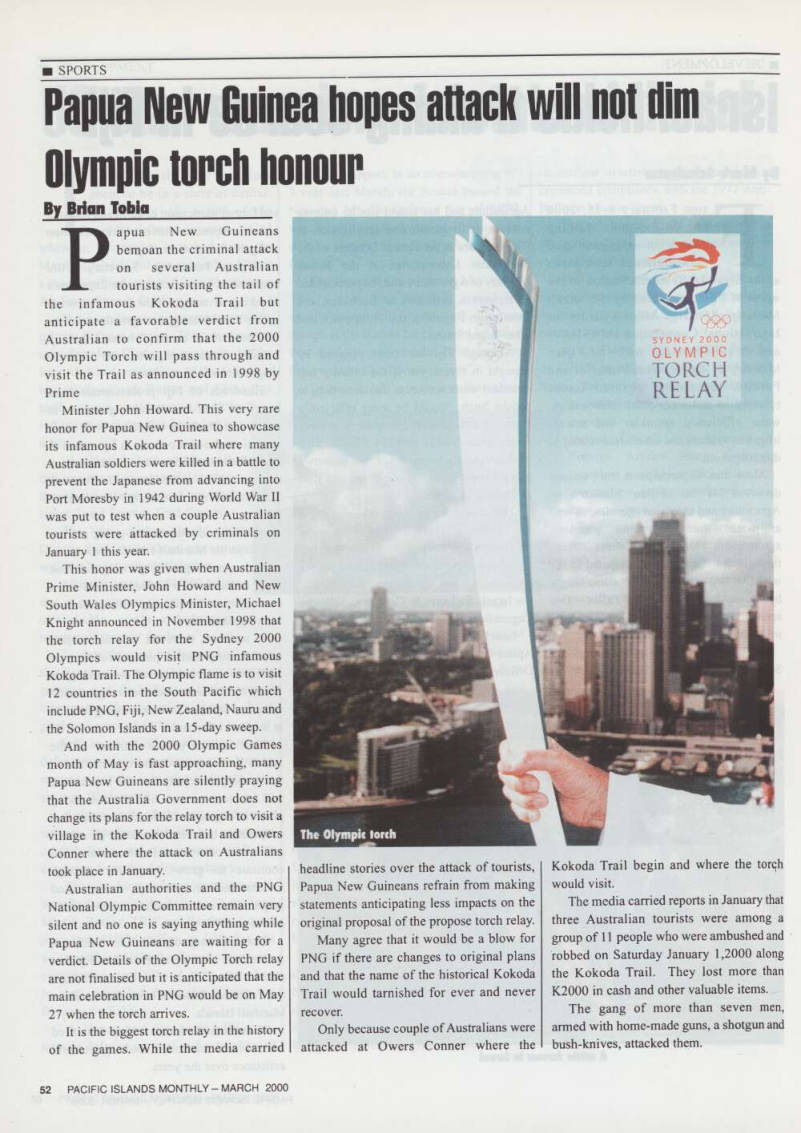
This honor was given when Australian Prime Minister, John Howard and New South Wales Olympics Minister, Michael Knight announced in November 1998 that the torch relay for the Sydney 2000 Olympics would visit PNG infamous Kokoda Trail. The Olympic flame is to visit 12 countries in the South Pacific which include PNG, Fiji, New Zealand, Nauru and the Solomon Islands in a 15-day sweep.
And with the 2000 Olympic Games month of May is fast approaching, many Papua New Guineans are silently praying that the Australia Government does not change its plans for the relay torch to visit a village in the Kokoda Trail and Owers Conner where the attack on Australians took place in January.
Australian authorities and the PNG National Olympic Committee remain very silent and no one is saying anything while Papua New Guineans are waiting for a verdict. Details of the Olympic Torch relay are not finalised but it is anticipated that the main celebration in PNG would be on May 27 when the torch arrives.
It is the biggest torch relay in the history of the games. While the media carried
headline stories over the attack of tourists, Papua New Guineans refrain from making statements anticipating less impacts on the original proposal of the propose torch relay.
Many agree that it would be a blow for PNG if there are changes to original plans and that the name of the historical Kokoda Trail would tarnished for ever and never recover.
Only because couple of Australians were attacked at Owers Conner where the
Kokoda Trail begin and where the torc;h would visit.
The media carried reports in January that three Australian tourists were among a group of 11 people who were ambushed and robbed on Saturday January 1,2000 along the Kokoda Trail. They lost more than K2OOO in cash and other valuable items.
The gang of more than seven men, armed with home-made guns, a shotgun and bush-knives, attacked them.
The Olympic torch
The incident occurred at Owers Comer, north east of Sogeri, as the group was ready to leave the area after being there for more than 20 minutes.
Two of the Australian tourists, Philip and Leonie Pinch, were checking the area as they were planning to return to PNG with an Australian group to walk the trail.
Nobody in the group was injured except one person who sustained a minor bruise.
Mr Pinch said: “They were frenzied and
aggressive, all the while shouting at us. They made us lie on the ground while they went through our clothing, demanding cash and everything else from us.
The whole saga lasted for 15 to 20 minutes and they took off in a vehicle belonging to the visitors.
Shaken up by the surprise attack, the group left 30 minutes later and found the vehicle parked five kilometers down the road.
Fearing another ambush, they hurriedly drove back along the track until they came to a village.
Mr Pinch said: “We told the villagers what had happened and asked them if there was anyone in the village who could accompany us to Sogeri.
“Anton, a village elder, volunteered to come with us, all the way to Sogeri police station where we reported the matter.”
The Australians were reported to be ignorant of the advice by the Australian Consular Service Travel Advisory not to walk the Kokoda Trail. In the December issue of the Consular Services Travel Advisory, the Australian Department of Foreign Affairs and Trade advised all Australians to “exercise extreme care and maintain a very high level of security awareness in light of continuing law and
order problems”.
The warning also included visits to the trouble-torn island of Bouganville.
Impacts of such would be broad and one of them is that this new would create some thinking that PNG is not a safe place to visit.
The attack and other such incidents continue to hamper tourism in the country and stakeholders in the tourism industry expressed grave concern over the attack.
One of them was former politician and Melanesian Tourist Services managing director Peter Barter.
According to Mr Barter, PNG would continue to lose on tourism revenue because no one would want to come here and visit the beautiful scenic PNG tourism sites.
He said this attack would not only affect the Kokoda Trail but every other potential tourism destination in the country because
the “media in Australia and elsewhere will generalise which will continue to exasperate the already critical situation in the perception, real or otherwise is that Papua New Guinea is a dangerous place to visit”. He said the problem is not isolated to the Kokoda Trail.
“The P&O Fairstar that called into Port Moresby last year and passengers on a tour alleged to have contracted Typhoid is another example. Publicity of this incident was not restricted to PNG and Australian media.
“International Travel magazines have written articles on the incident and as a consequence, some cruise ships have not only canceled visits to Port Moresby, but also other ports in PNG. There are other parts of PNG, which are considered unsafe for travel, not only for tourists but domestic visitors as well.
“It is time the Government through the PNG TPA and the tourist industry simply place such areas of known danger off the
“tourist map”.
“This effectively can be done by not publicising the regions in brochures and
other marketing projects, advising Air
Niugini officers, tour operators that caution should be practised in compiling itineraries not to include areas or facilities where there is a high risk or above average crime rate,” he said.
“If necessary, isolate complete provinces if it is dangerous for tourists to visit. This may sound rather radical, but it is absolutely necessary if we want to put a halt to the decline in tourists visiting PNG.”
PNG Tourism Promotion Authority
Board chairman, Titus Philemon was one of them who had expressed disgust at the attack on tourists.
Mr Philemon said the Owers Corner in Sogeri is one of the many beautiful tourist sites in Port Moresby and it is sad to see criminal elements using it to stake out and cowardly attack people.
“We have a lucrative tourism industry that will lure a lot of foreign exchange and lower unemployment in the country. But the acts of such ignorant tyrants only stall our efforts to develop Papua New Guinea as a tourist destination,” he said in a statement.
He called on community leaders in
Sogeri to help police apprehend criminals
who were involved.
On a brighter side, AAP reported New South Wales Premier, Bob Carr supporting calls for the Kokoda Track to be made a national park.
State Liberal MP Charlie Lynn, a tour leader of the Kokoda Track for nine years, said the Australian government should provide aid to PNG to turn the track into a national park and train local workers.
Mr Carr said the proposal should be explored.
He said the proposal should be explored with the prospect of helping PNG establish a national park.
“Australia helping to fund this not only to save wildlife but to enable us to protect an area that, while part of Papua New Guinea sovereignty, is sacred to Australians.
“We’d be doing something that is important to us and helpful to PNG.”
The calls followed a vicious attack on a group of Australian expatriates and tourists on New Year’s Day by criminals at Owers Conner.
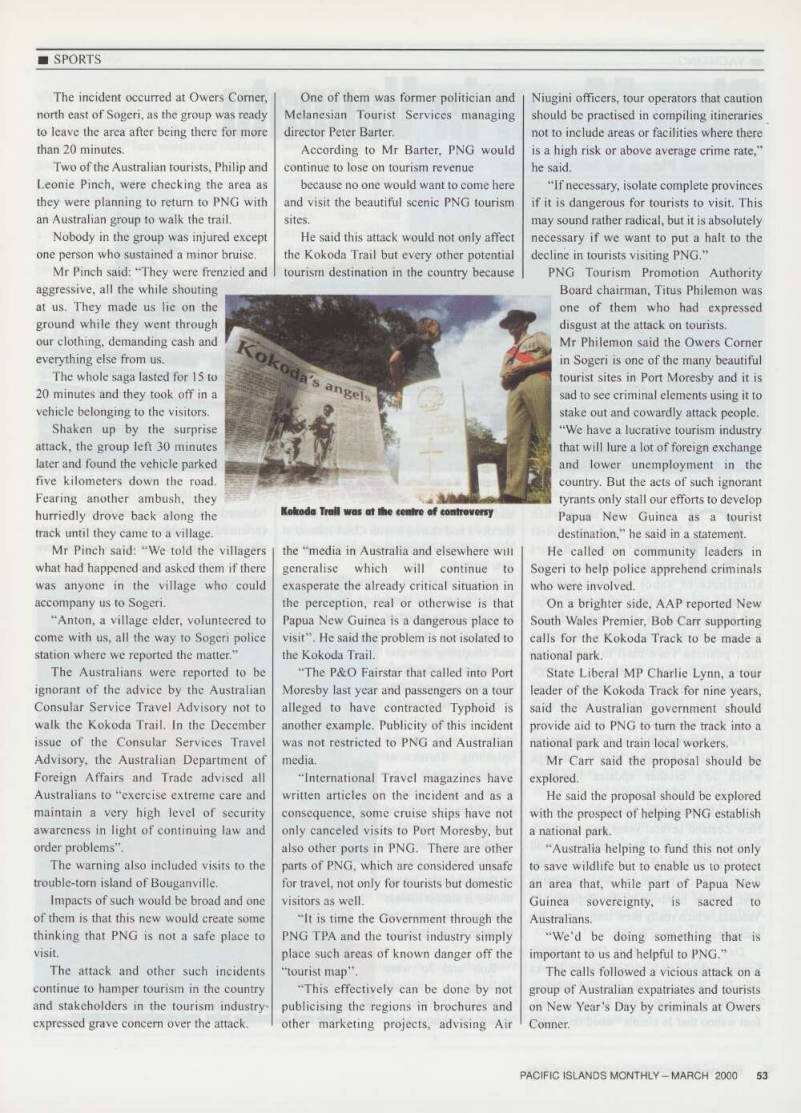
Kokoda Trail was at the centre of controversy