Life's secret at bottom of the sea
p. 34 · Read in the full issue
The search for how life began on Earth - and perhaps on other planets - is taking a surprising detour deep in the endless night beneath the bottom of the sea.
New technology is enabling scientists to explore the scalding hot environment inside the ocean’s rocky crust.
In conditions reminiscent of Dante’s Inferno, myriad tough little microbes thrive on a diet of hydrogen, sulfur and other unappetising chemicals coughed up from the Earth’s interior by underwater volcanoes.
Some scientists think these organisms may be the most ancient forms of life on Earth.
The microbes also might have cousins dwelling under the surface of Mars, the moons of Jupiter or Saturn, or on the
recently discovered planets revolving
around other stars.
In 1977, researchers discovered strange colonies of giant worms, shrimp and crabs flourishing around volcanic vents on the ocean bottom.
But now they are reaching into an entirely new world - not on, but below the seafloor.
Scientists call it the "subsurface
biosphere” or "the deep hot biosphere”.
“The Earth supports not one but two large realms of life: surface life fed by
photosynthesis, and deep life, fed by
chemical energy that has penetrated up from below,” Thomas Gold, a biochemist at Cornell University in Ithaca, NY, writes in his new book, “The Deep Hot Biosphere”.
William Whitman, a microbiologist at the University of Georgia in Athens, estimated that this recently discovered underworld contains two-thirds of all living cells on our planet - all the people, elephants, flies, fish, trees, grass and other living matter.
In the last five years, life has been detected below the seafloor at 27 sites in the western, southern and northeastern Pacific Ocean, as well as under the mid-Atlantic.
The crust of Earth’s continents also harbours deep life. Microbes are alive far beneath the soil of Virginia and Oregon.
They have also been found inside a two
mile-deepgold mine in South Africa, two miles below the Antarctic ice cap and in a hole bored through three miles of solid granite in Sweden.
Some of these creatures resemble those on the surface, but others have never been seen before, according to John Hayes, a biochemist at the Woods Hole Oceanographic Institute in Cape Cod, Massachusetts.
Some may lead to useful medicines or help clean up pollution and radioactive waste.
These discoveries already have expanded scientists’ understanding of how much of our planet can support life.
They also may help solve the mystery of how life on Earth began more than 3.5
billion years ago, and of how it may have started - and perhaps remains - below the surface of other heavenly bodies.
“We want to look at “inner space” to find out how to go to “outer space” to find life,”
John Delaney, a senior ocean scientist at the University of Washington in Seattle, said.
“If it can happen here, it can happen somewhere else.”
Ever since Charles Darwin formulated his theory of evolution, scientists have speculated that life originated on the surface of the Earth, perhaps in a warm little pond filled with a broth of chemicals and fuelled by energy from the sun.
However, the notion that life began
underground is gaining support.
In fluid-filled cracks deep inside Earth’s crust, primitive organisms would be protected from deadly ultraviolet radiation and relentless bombardment by asteroids
and comets.
They would have a rich supply of hydrogen, sulfur and other essential elements to feed on. High temperatures and pressures would speed necessary chemical reactions.
The fact that subseafloor microbes flourish in such extreme conditions today bolsters the theory that life began in the underworld and later migrated to the surface.
Last summer, for example, University of Washington oceanographer Julie Huber found an archaic microbe living at 230 degrees Fahrenheit in the Axial volcano, a rumbling, steaming cauldron that lies almost a mile under the sea 240 miles off the coast of Oregon.
“Many scientists believe that these may have been the earliest life forms on earth,”
Huber wrote in an e-mail report from the R/V Thompson, a government research vessel that investigated the volcano. "By these microbes, we can peer into the past.”
The search for subsurface life has become a high priority at NASA, the National Science Foundation and the National Oceanic and Atmospheric Administration, which sponsored a three-day conference on undersea exploration in Seattle last month.
About 75 ocean scientists shared results from their work on the Juan de Fuca plate, a huge slab of sea bottom pockmarked with volcanic vents under the Pacific Ocean west of Oregon and Washington.
They also made plans for future exploration and permanent scientific observatories on the ocean floor.
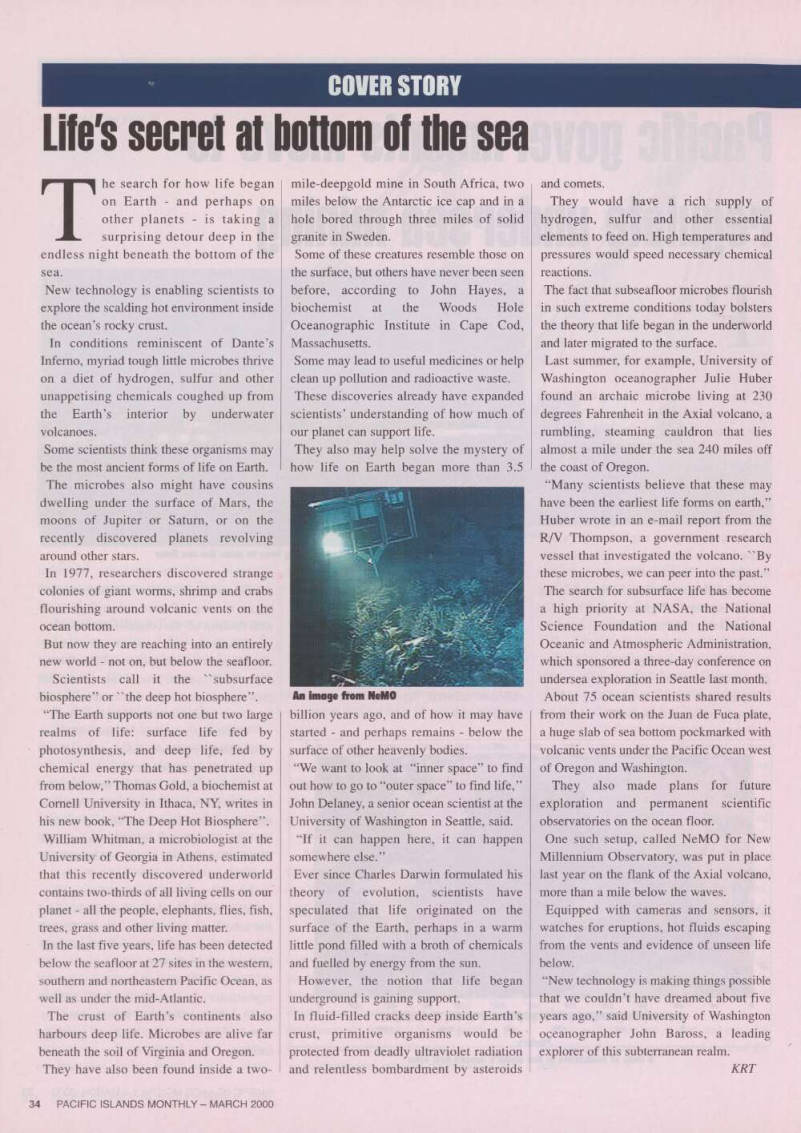
One such setup, called NeMO for New Millennium Observatory, was put in place last year on the flank of the Axial volcano, more than a mile below the waves.
Equipped with cameras and sensors, it watches for eruptions, hot fluids escaping from the vents and evidence of unseen life below.
“New technology is making things possible that we couldn’t have dreamed about five years ago,” said University of Washington oceanographer John Baross, a leading explorer of this subterranean realm.
Krt
An image from NeMO