regulate undersea mining
p. 33 · Read in the full issue
Pacific governments move to regulate undersea mining
Pacific Island nations have started devising regulatory laws to help create a new industry in this near resourceless region: mining the sea floor.
The nations hope to open up the seabed in their vast territorial waters to mineral exploration, Helena McLeod, a resource economist for the South Pacific Geo- Science Commission, said today.
Papua New Guinea has already granted mining licenses for two tracts of seabed in the Bismark Sea to Nautilus Minerals Corp, which is hoping to exploit underwater volcanic vents that belch out minerals such as gold, silver, copper and lead.
McLeod said the Papua New Guinea licenses are the first granted anywhere for underwater poly-metallic massive sulphides.
She said the Papua New Guinea government was approaching the
completion of its offshore mining policy,
which is expected to become a model for
other members of the commission, a Fiji headquarted technical agency supported by 18 governments in the region.
“The huge exclusive economic zones of Pacific Island countries mean that the potential for wealth generation from offshore mineral deposits is immense,”
McLeod said.
Fiji and the Solomon Islands have also
begun writing offshore mineral policies
with the help of the commission, she said.
Scientists and miners are taking increasing interest in poly-metallic sulphide deposits of copper, zinc, lead, silver and gold emitted as clouds of mineral-enriched fluid from vents known as “black smokers.”
When the minerals hit the cold sea water, they coalesce into gold, silver, copper, lead and other metals.
The first black smokers found in the South Pacific were located near Fiji in 1984 and others have since been found between Fiji and Tonga and in the Manus and Woodlark submarine basins of Papua New Guinea.
Large deposits of manganese have been found in the Cook Islands’ economic zone, and submarine mountains in the Federated States of Micronesia, Marshall Islands and Kiribati are cobalt-rich.
The commission said in a statement that exploitation of mineral in the Pacific island could bring sustainable development to some of the world’s smallest, poorest nations.
AP
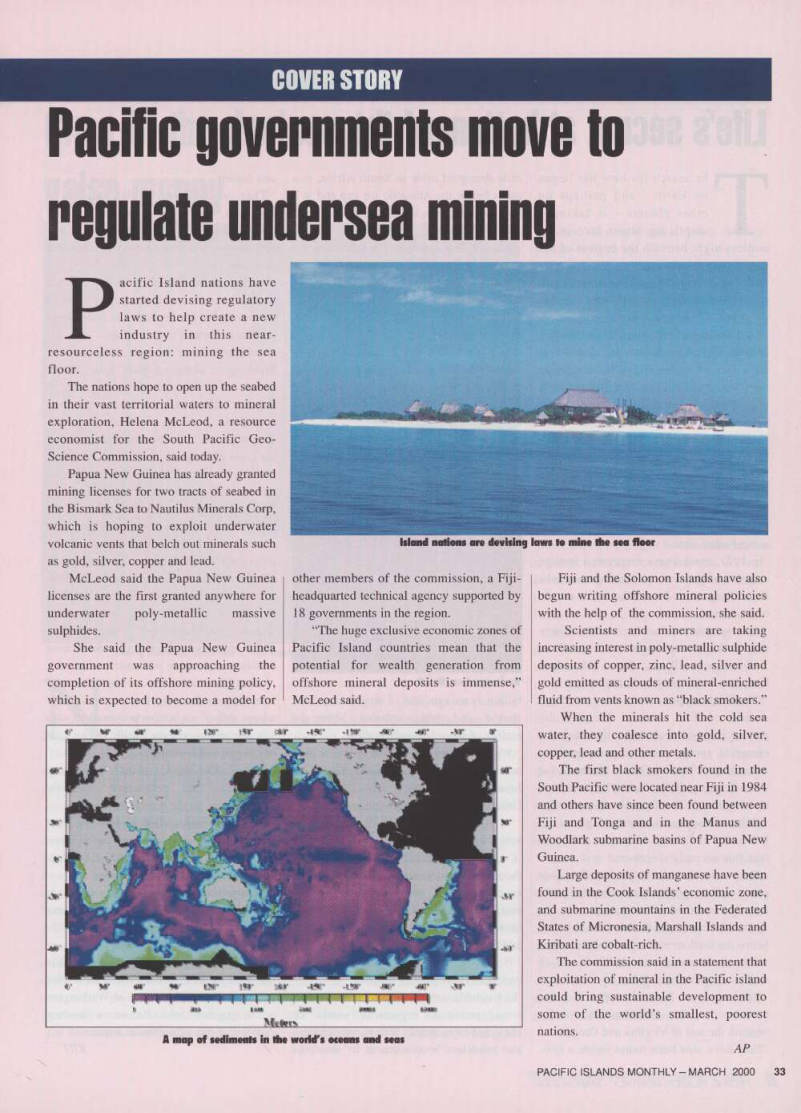
Island nations are devising lows to mine the sea floor
A map of sediments in the world's oceans and seas