Underwater potential
pp. 30-32 · Read in the full issue
Cover Story
Papua New Guinea weighs the benefits of offshore mining
By Sam Vulum
Papua New Guinea is in the process of finalising an offshore mineral ex ploration and mining policy which might serve as a blue print for other South Pacific Island states to emulate and follow.
Although the country is well-advanced in onshore mining, the authors of the policy have cautioned that because offshore mining is a new concept, a lot of care is needed in order to produce the best possible policy for the country.
An offshore mining policy committee has been set up top prepare a draft which is being finalised with a policy submission for the minister for mining to present top the National Executive Council and then to Parliament for enactment into a law.
It is anticipated that PNG should have a white paper as well as separate legislation for offshore mineral exploration and mining in the first quarter of this year.
The ultimate objective of the inter-agency committee on offshore mining policy is to ensure that the final policy
safeguards PNG’s national interest while at the same time encourages investment in exploration and eventually mining in the offshore.
Committee chairman James Wanjik said: “We are conscious that such offshore activities, if any, will not be at the expense of onshore exploration.”
Wanjik, who had already sold the draft policy to heavies in the industry during an international mining conference in Port
Moresby last year, said there are three reasons for the development of an offshore
mining policy.
He said firstly, the current laws and policies were biased towards land-based activities thereby neglecting the potentials presented in the offshore. Secondly, tow exploration licences were granted near the waters between the islands of New Britain and New Ireland that generated national and international attention. Thirdly, PNG ratified the United Nations Convention on the Law of the Sea 1982 (UNCLOS) in
January 1997 that necessitated the effective implementation by domestic law of the rights and obligations in the UNCLOS.
Wanjik said except for the now closed Panguna and Ok Tedi mines which have separate legislation governing their operations, the present Mining Act 1992 is
the principal policy and regulatory
document governing the regulation and management of the mining industry in Papua New Guinea.
However, he said this legislation is heavily biased towards onshore exploration and exploitation of mineral resources.
Regarding the offshore, the legislation seems to extend only to the outer edge of PNG’s territorial seas.
“For instance, land is defined under this Act to include ‘the offshore area being the seabed underlying the territorial sea from the mean low water springs level of the sea to such depth as admits of exploration for or mining of minerals’.
“One interpretation was that the
exploitability criterion in this definition was restricted to the territorial sea while the other was that land included at least the continental shelf as the exploitability criterion was codified in the United Nations Convention on the Continental Shelf in 1958.
“There is no clear cut interpretation thus in this sense, PNG does have a
policy and regulatory vacuum
so far as exploration of mineral resources in the offshore is concerned,”
Wanjik said.
Despite this, two exploration licences (EL 1196 and EL 1205) were granted to Nautilus Minerals Corporation in November 1997 under the current
Mining Act.
“It should be noted that these licences were issued in respect of mineral resources within PNG’s internal water and not it exclusive economic zone as have been erroneously reported in the media and elsewhere,” Wanjik said.
He said a worldwide interest was generated by these grants. Even up to Maya last year, interest was still being generated if not within the investment communities,
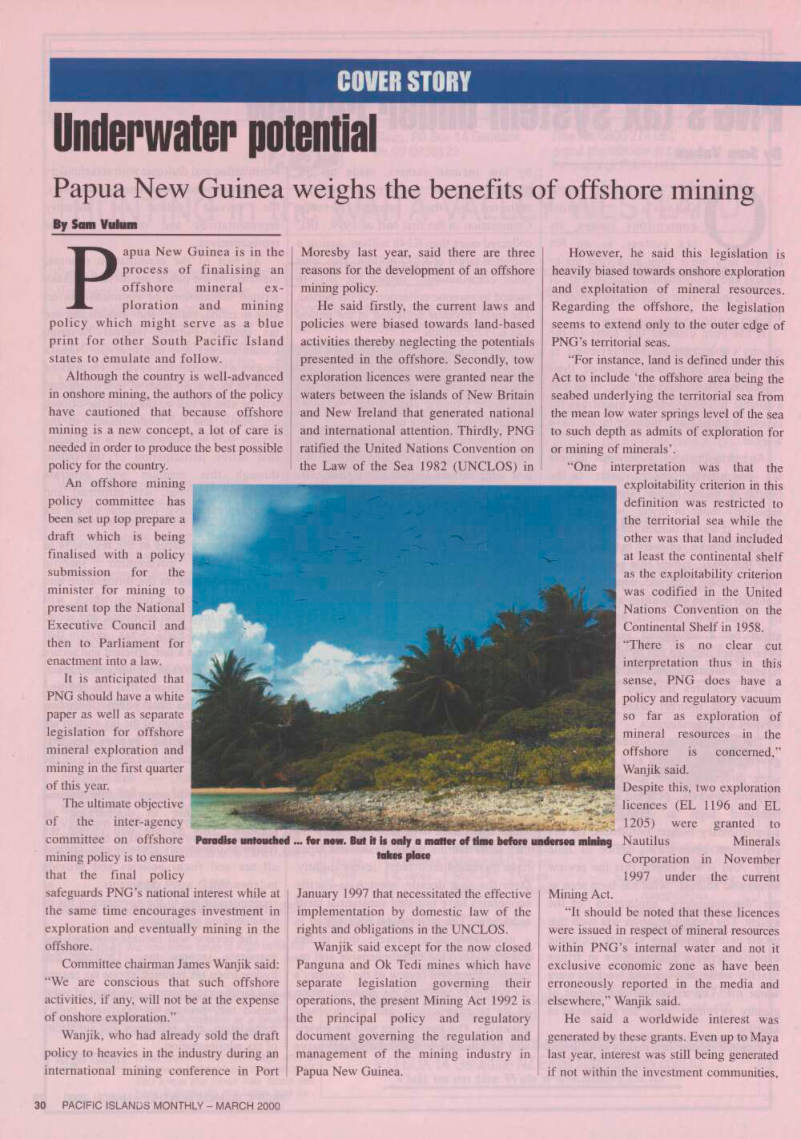
Paradise untouched ... for now. But h is only a matter of time before undersea mining takes place
certainly among marine researchers and more recently the British Broadcasting Corporation of London. BBC was reported to be in the process of making a documentary on the subject.
“This no doubt provided the impetus for the development of an offshore mineral policy before further exploration or mining could be licensed if we come to I that stage,” Wanjik said.
He also highlighted that I hydrothermally formed seafloor massive I sulphides in the PACMANUS and other I fields are the types of deposits of current I interest. The base metal and precious I metal contained in these types of deposits I contain comparatively high grades of I minerals.
For instance, the dredged samples from I the PACMANUS field averaged 26 per I cent zinc, 10 per cent copper, 200 grams I silver per tonne, and 15 per cent gold per I tonne.
“If these trades were encountered on I land, they'd be bonanzas,” Wanjik said.
In addition, these deposits occur at I relatively shallow depth range of 1300 to I 1900 metres compared to manganese I nodules which occur in water depths of I 4000 to 6000 metres.
Wanjik said the other compelling I reason for PNG to have a separate policy I was that its ratification of the UNCLOS in 8 1997 meant that its domestic laws were to 8 be consistent with the UNCLOS. The legal counsel for the International Seabed Authority has already clarified this issue in a workshop held in Madang last year.
The draft policy is open to accommodate different offshore resources (excluding fish and other marine resources) that may be found in the offshore. “Obviously, the Mining Act 1992 is deficient in this regard,”
Wanjik said.
The draft policy contains the following major features: * UNCLOS implication In the initial stages, the implication of UNCLOS was not probably well understood. Of particular significance were the issues of sovereignty, sovereign rights and jurisdiction. Generally, different maritime zones have slightly different legal regimes thereby attracting different legal
consequences under the UNCLOS. * Diverse offshore resources The draft policy is open to accommodate different offshore resources (excluding fish and other maritime resources) that may be found in the offshore. In general terms the developed and potential mineral deposits
are diverse and include sand, gravel, diamonds, black sands, oil, naturally
occurring hydrocarbons, manganese
nodules, manganese crusts and seafloor massive sulphides.
They are poorly explored and have wide range of issues impacting on their development including inadequate governing policy and legislation, a need for new and improved technology for exploitation, lack of assured economic potential, numerous environmental impacts and other as yet unquantified stakeholders interest.
Of these offshore mineral resources, the deep ocean manganese nodules are by far the most studied by researchers and the
private sector while seafloor massive sulphides which occur within several nations' exclusive economic zone are
rapidly assuming more importance in terms
of research and private sector interest.
* Licences and licensing The exploration cost in the offshore may be high if the cost for scientific cruise is any indication. One scientific cruise on average costs anything in the order of US$2O,OOO and above. Add this with the lack of or the infant state of offshore exploration and mining technology, the usual terrestrial licences and licensing arrangements may not be applicable. For the offshore, licensing regimes will be modified to take into account different oceanographic and environmental conditions.
Based on the application of known terrestrial licensing procedures and their effectiveness, the committee proposed that there be five different types of tenements to be issued for offshore
mining.
These are: prospector's right, exploration licence, mining licence, lease for mining purposes and mining easement. In addition, the committee proposed that
the prospector's right licence be granted
under special circumstances of offshore
mining.
The draft also takes into account marine scientific research. The committee has noted that it is not entirely clear what is marine scientific research and what is exploration under the UNCLOS. By
introducing the prospector's right as a form of licence separate from exploration unlike in the terrestrial environment, it is hoped that the confusion may be clarified though not eliminated. * Marine scientific research The committee noted that Marine Scientific Research (MSR) by itself may not excite many people but when one hears of potential industrial and pharmaceutical application of biogenic materials found around hydrothermal vents for instance, it raises hairs. And so it must be as this industry is estimated to be worth millions of dollars.
In February 1999, there were 16 applications for patents over various
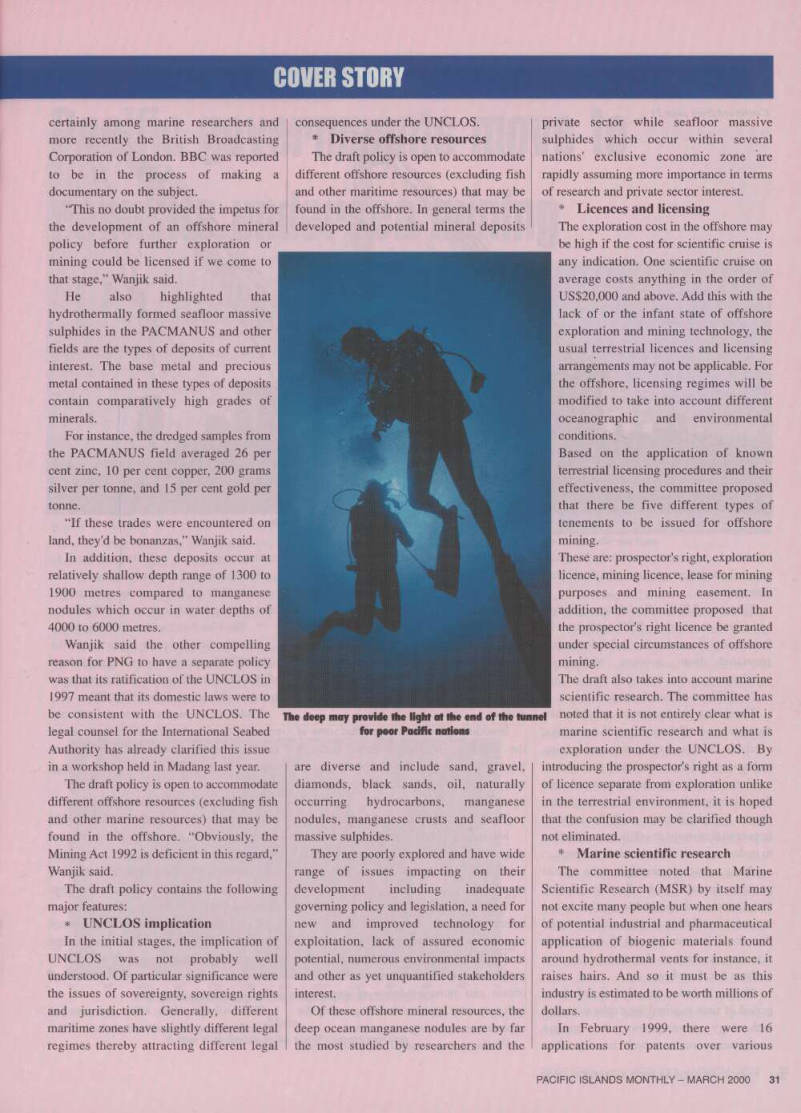
The deep may provide the light at the end of the tunnel for poor Pacific nations
Continued from page 31
industrial processes involving biogenic material awaiting registration in the United States alone.
Therefore MRS will require regulation and closer scrutiny if PNG is to benefit from scientific and industrial information generated from sources within its
jurisdiction.
* Offshore physical regime There are a lot of unknown variables like the extent of offshore mineral resources, available offshore exploration and mining technology and the cost of such technology.
Consequently, the fiscal regime is not definitive though as a minimum the current regime is highlighted to guide the investor or potential investor in offshore exploration to make an investment decision to invest.
As a general principle, the fiscal package attempts to be flexible, simple, transparent and applicable to the issues involved in offshore mining. It is accepted that certain unique aspects of deep ocean resource warrant a deviation from the onshore fiscal package.
These include the anticipated long period of time required for exploration and
technology development, the unique
environment under which mining takes
place, high risks associated with a pioneering endeavour and the uncertainty surrounding the economic viability of deposits.
Flexibility may mean lower that, overall, lower front end rates regarding royalty and income tax may be balanced by an additional profits tax that comes into place at a lower profit threshold rate than onshore mining.
In addition, it is anticipated that some of the recently introduced taxes such as mining levy, and interest withholding tax, may not be applicable to offshore mineral operations. * Offshore environmental regime
Mining projects including offshore
mineral resource development will have environmental impacts that are physically unavoidable.
In addition, the offshore areas contain
living organisms unique to the marine
environment, that may be of industrial and medicinal significance. Consequently, proponents of such ventures will need to obtain and show evidence of necessary environmental approval before granting the
exploration or mining tenements.
Furthermore, mineral exploration and
mining companies will be required to undertake their activities consistent with the requirements of the environment-related laws and regulations operating in PNG. * Benefits distribution mechanisms Benefits distribution is important in the light of PNG enacting the new Organic Law of Provincial and Local Level Governments and the ratification of the UNCLOS.
Under the former, the state is not only required to consult with affected provinces and local communities, but also to share some of the benefits derived from mineral
projects.
As to the latter, the International Seabed Authority established under the UNCLOS, will be entitled to share with a coastal state revenues derived from resource exploitation within the additional shelf area, that is an additional 150 nautical miles from the usual 200 nautical miles limit.
It is further proposed that the state may
consider cooperative development
arrangements such as joint developments in areas that are beyond normal 200 nautical miles.
This will save time, effort and cost for delimiting the outer continental shelf of the state.
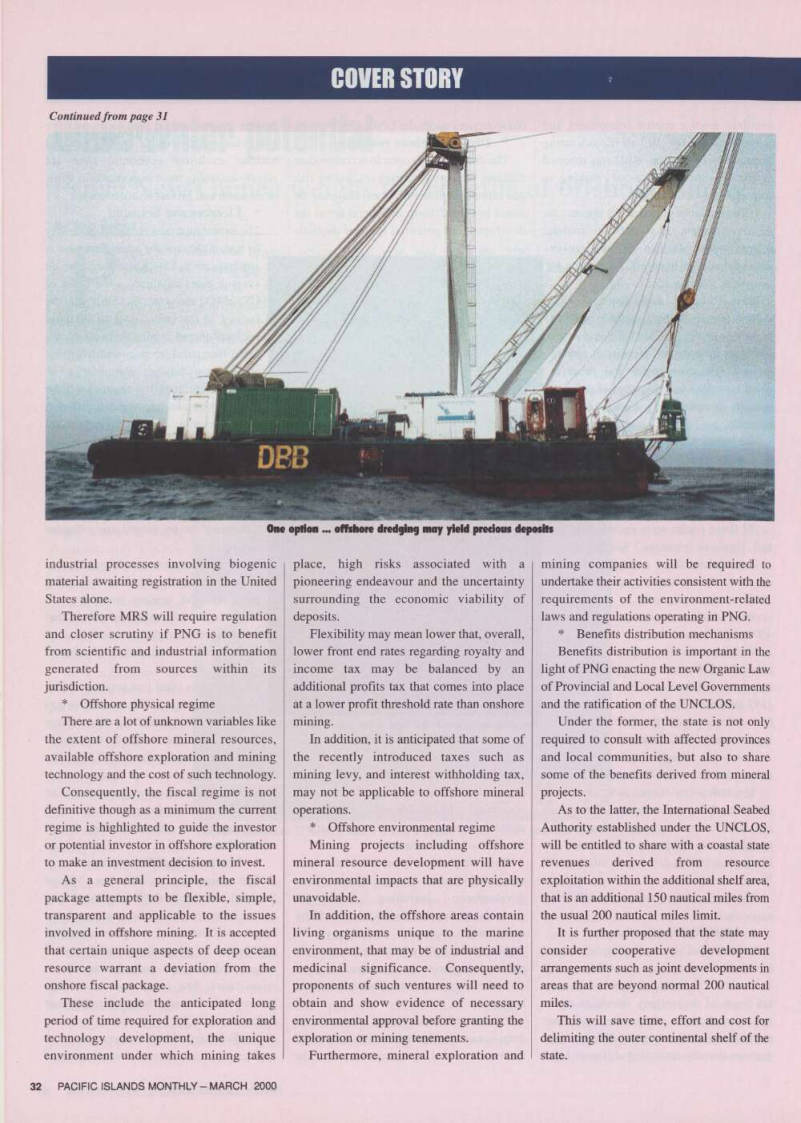
One option ... offshore dredging may yield precious deposits