Glow-in-the-dark squirt guns
p. 35 · Read in the full issue
raise money
Not many companies
encourage their employees to shoot each other with squirt guns at work.
Then again, not many companies have squirt guns that launch glow-in-the-dark ammo.
Prolume does.
The partnership of doctors and scientists is duplicating luminescent genes from jellyfish and other sea creatures and using them, for now, to fill up squirt guns. Next up could be glow-in-the-dark soft drink and beer.
Dr Bruce Bryan, Prolume’s chief executive, says the idea is to raise enough money from the sale of novelty items to underwrite more serious pursuits, such as using the glowing genes to identify cancerous tumors or detect nerve gas.
The research is enormously expensive, the
company says.
Prolume’s catch - jellyfish, sea pansies, dragonfish, sea worms, squid, mollusks and other sea creatures -provides luminescent genes that can be copied and attached to other genes. Then, they can be made to glow when other kinds of chemicals are present, creating what the company calls “biosensors”.
The field is “bursting with activity right now”, says J. Woodland Hastings, a researcher of glow-in-the-dark creatures at
Harvard University.
To raise money, Prolume last month began
selling squirt guns loaded with powdered
genes that were replicated from a jellyfish caught off the coast of Washington state.
Add some distilled water to the chamber, and fire. As the liquid squirts it looks just like water. But when it hits something anything that contains calcium, which can
be found on people and all kinds of other things - it lights up.
The company maintains the product is safe.
The first batch of 2000 squirt guns were sold out. Now, Prolume is working on a two-chambered water rifle that is supposed to shoot long distances. So far, the company has run into some trouble getting it to fire correctly.
“This is what happens when you get a surgeontrying to make a squirt gun,” Bryan says.
Other possibilities include glow-in-the
dark hair mousse, ink and cake frosting, but Prolume also recently received a grant from the National Institutes of Health to start putting the genes to work on more serious tasks.
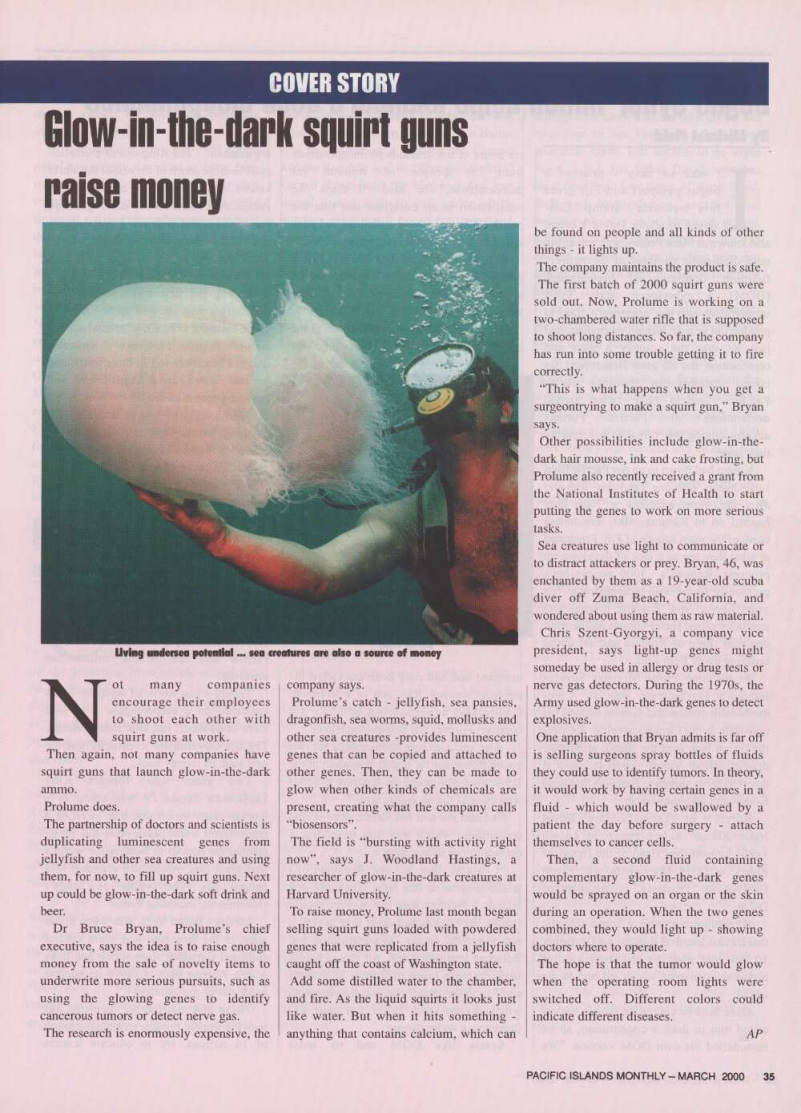
Sea creatures use light to communicate or to distract attackers or prey. Bryan, 46, was enchanted by them as a 19-year-old scuba diver off Zuma Beach, California, and wondered about using them as raw material.
Chris Szent-Gyorgyi, a company vice
president, says light-up genes might
someday be used in allergy or drug tests or nerve gas detectors. During the 19705, the Army used glow-in-the-dark genes to detect
explosives.
One application that Bryan admits is far off is selling surgeons spray bottles of fluids they could use to identify tumors. In theory, it would work by having certain genes in a fluid - which would be swallowed by a patient the day before surgery - attach themselves to cancer cells.
Then, a second fluid containing
complementary glow-in-the-dark genes
would be sprayed on an organ or the skin during an operation. When the two genes combined, they would light up - showing doctors where to operate.
The hope is that the tumor would glow when the operating room lights were switched off. Different colors could indicate different diseases.
AP
living undersea potential ... sea creatures are also a source of money