Paradise journalism is a farce
pp. 52-53 · Read in the full issue
By Michael Field
George Grey had a way with words even if the bamboo curtain rings in his hair and the imitation camouflage clothing suggested he was somewhat weird.
“We are fighting a holy war,” said ex- Solomon Islands bank clerk, turned guerrilla spokesman. “The trees are fighting, the stones are fighting, and women and the children are fighting.”
This was not Paradise Journalism but rather the Solomon Islands jungle with Guadalcanal rebels who were killing Malaita Islanders. Honiara was packed with refugees, families were starving in terror in the jungle and children and old men were being hacked to death.
Covering the Pacific can get fairly rugged - although it is not nearly as tough for the journalist as it is for the people caught up in conflict and crisis. Local reporters are finding all kinds of restraints, abuse and physical threat. A new technique being pioneered in Fiji has
politicians exposing journalists’ private
lives as a means of asserting control.
It seems an extraordinary assault, coloured by racism, that is tearing apart the media and political system. It has been reduced to a cipher with salacious stories about what the tea-lady saw. It is much more ominous than that.
For one or two international journalists who have a Pacific beat banning orders are administrative censorship.
Kiribati, as a result of my Pacific Island Monthly articles in July, has deemed me an “undesirable immigrant” by order of President Teburoro Tito.
Tonga has long since banned me for reporting on the kingdom’s democracy movement and the Rabuka Government in Fiji made arrival at Nadi seem like buying a Lotto ticket.
An optimist would say that none of this is personal, it is the way the Pacific’s ancient regimes hold onto power.
Keeping me out is just part of the ball game. These governments, mainly made up of ageing chiefly men, do not like the young, university educated and often women who constitute the bulk of the Pacific media.
No formal banning order has been
issued in the Solomons over foreign journalists while the local media have had to act under tight emergency powers.
What was intriguing there, during 1999’s civil unrest on Guadalcanal, was a high degree of self-censorship over their own reporting in an atmosphere charged with wild rumour.
At the crisis point a couple of other journalists and I had gone out to a bridge where ex-Fiji Prime Minister Sitiveni Rabuka was to negotiate a truce between the Guadalcanal rebels and the Malaita dominated central government. The local media did not attend.
Trying to understand this hatred between people who had lived side-by side for a thousand years or more was difficult and while we awaited Rabuka I asked Grey what it was that he did not like about Malaitans.
“Do you know what we call them,” he said, “dog sperm.”
The Solomons media seized on the remark and while they did not do the leg work themselves, willingly used the quote
prominently.
In the University of the South Pacific newspaper, Wanasolwara, state-owned Solomon Islands Broadcasting Corporation general manager Johnson Honimae took issue over Grey’s quote.
“Overseas journalists don’t care what happens as a result of their stories,” he
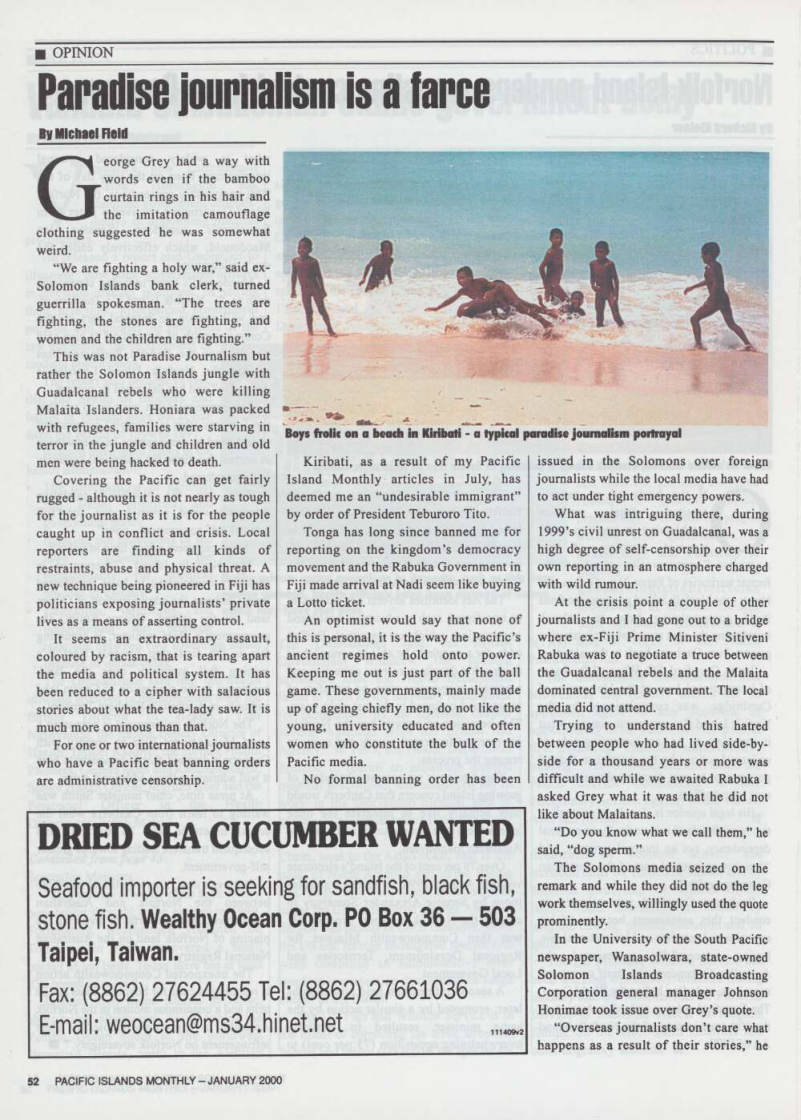
Boys frolic on a beach in Kiribati = a typical paradise journalism portrayal
said. “If that reporter was in Honiara, he would have been killed.”
While it is a little novel having one journalist advocate the execution of another, it missed the point - and did underscore the way in which controlling the flow of information, rather than enhancing it, has become a Pacific government priority.
Grey’s remark was gross and horrible, although somewhat less so than the fate of the people who Grey’s rebels had hacked to death and terrorised. If being ‘culturally sensitive’ involves withholding information, then I do not want to be part of this.
What was culturally sensitive about
murdering people?
In an era of global warming the plight of atolls are an acute concern and on Tarawa there is an environmental disaster of the local’s own making.
I reported it. I also filed on a Chinese satellite tracking station which seems more of a spy base directed at the American missile testing programme in the Marshall Islands.
And there was the story of the way the founding President, leremia Tabai, had been arrested for running a radio station, to Tito’s irritation.
Tito issued the banning order in August but did not get around to telling me and the first I knew was when in November it came up in the Maneaba-ni- Maungatabu or Parliament.
Tito said I had written “untruths” abut the development problems while the Chinese Embassy said I was a “fabricator of lies”.
For the first time ever the Pacific Forum summit is going to be held with a ban on a journalist in place. Given their proclivity for secrecy and obstruction one assumes they will hail the 2000 Summit host for his farsightedness.
For the record the bans and the abuse are not something that keeps me awake at night. They’re just part of the job.
Reporters throughout the Pacific face much tougher obstacles - not only the obsession of the old men controlled governments to centralise their power, but also cultural restraints and the more mundane but obviously important
problem of a lack of resources, money and time to do what international journalists can do.
What offends me more is the Paradise Journalism. Non-Pacific reporters, often on airline freebies, wing into declare how beautiful the beaches are and how happy the natives. One easy way to recognise the classic Paradise Journalist is the familiar line about how beautiful the singing is in church - usually written by free-loaders more used to hotel bands than choruses.
Cultures and societies are reduced to one dimension.
I am not saying that Pacific societies are basket cases, but they are immensely complex, difficult and fascinating places beyond the hula dancing and tourist kava shows.
The problem is that those of us who go beyond it get banned; those who are local are told about how the more clever journalists from overseas report that they all living in paradise and controls come down on them.
Things are going bad for journalists in the Pacific. Somebody is going to get killed. The assassination of Samoan cabinet minister Luagalu Levaula might well be instructive to those who want to keep truth hidden. The target is likely to be local, although I remain mystified by how somebody got into my Solomons hotel room and carefully placed a bullet on my pillow.
“Thirty cal, American,” said Rabuka, casting a professional eye over it, “makes a very big hole.” ■