Norfolk Island ponders wresting control from Canberra
p. 51 · Read in the full issue
By Richard Kleiner
ON the heels of an eagerly awaited legal opinion establishing its position as an external territory of the Australian Commonwealth - similar to the former territories of Papua New Guinea and Nauru - the Norfolk Island government finds itself contemplating how to unleash transferring the next round of administrative powers from Canberra back to the island.
James Crawford, SC, Whewell Professor of International Law at the University of Cambridge, was commissioned by the Norfolk Island Government to counter, what it considers to be, an increasing tide of unilateral actions by the Australian federal government to gain greater political control over island affairs.
His legal opinion is clear in its contention that Norfolk Island is historically an external dependency, not an internal territory, and “thus not an integral part of the Australian Commonwealth.”
Professor Crawford was selected to conduct this assessment because of his expertise in Australian and international law,
having successfully represented the
Australian Commonwealth itself on several occasions, including before the World Court.
The Crawford opinion arrived in August on the 20th anniversary of the Norfolk Island Act of 1979.
This legislation, according to David Buffett, Deputy Speaker of the Norfolk Island Legislative Assembly, is the vehicle by which political authority for internal self government is to be transferred from the Commonwealth to the island government.
The Act identifies several key powers to be transferred, such as education, health and immigration, which are essential, Buffett adds, for a people to be able to control their destiny. Yet despite numerous entreaties and a notably cooperative start, no transfers of power have occurred in the last eight years.
This cessation of activity has the Norfolk government frustrated, weary and eager to resume the process.
This tension is set against a backdrop of growing Island concern that Canberra would now actually like to integrate the once independent island community more into the Australian mainstream.
Over 78 per cent of the Island’s electorate voted in August, 1998, to oppose a surprise move by Senator Alexander Somalyay to change the Norfolk electoral process. He was then Commonwealth Minister for
Regional Development, Territories and
Local Government.
A second referendum held nine months later, prompted by a similar action by the same minister, resulted in similarly overwhelming opposition (73 per cent) to
what is widely considered external interference. Then on the very day of the 20th anniversary proceedings, the Norfolk Island Government received a letter from Somalyay’s successor, Senator lan Macdonald, which effectively ended the
day’s celebration.
Macdonald’s letter included statements such as, “... Norfolk Island is a Territory of, and will remain an integral part of, the Commonwealth of Australia.” It also said “In essence the Federal Parliament has created the Norfolk Island Legislative Assembly” and has delegated its powers.
The communication went on to say that the Territory (that is, Norfolk) government would need to demonstrate its competence in certain functions for additional authority to be transferred.
That day, the Norfolk Legislative Assembly voted, seven to one, for “full internal self-government - now.” ‘Now’ can seem a long time in politics.
The Norfolk Island Government is presently negotiating to have transferred from Canberra the administration of Crown land on the island. George Smith, the government’s chief minister, is assuming this is the first step towards Norfolk’s gaining full authority over the land, analogous to the succession of Crown land authority in Australia’s Northern Territory.
The Norfolk government is preparing a Land Management Plan to comply with Canberra’s demand that it demonstrate how it will administer these additional acres.
At press time, chief minister Smith was waiting to leam from Canberra what the actual timetable will be for this and subsequent transfers leading towards greater
self-government.
But even now, a new political squabble between the Norfolk and Australian governments has just surfaced involving the placing of Norfolk land on the Australian
National Registry.
The unexpected Commonwealth action is resulting in calls for boycotts, class action suits and a unanimous motion in the Norfolk Assembly to “vigorously oppose this latest infringement on Norfolk sovereignty.” ■
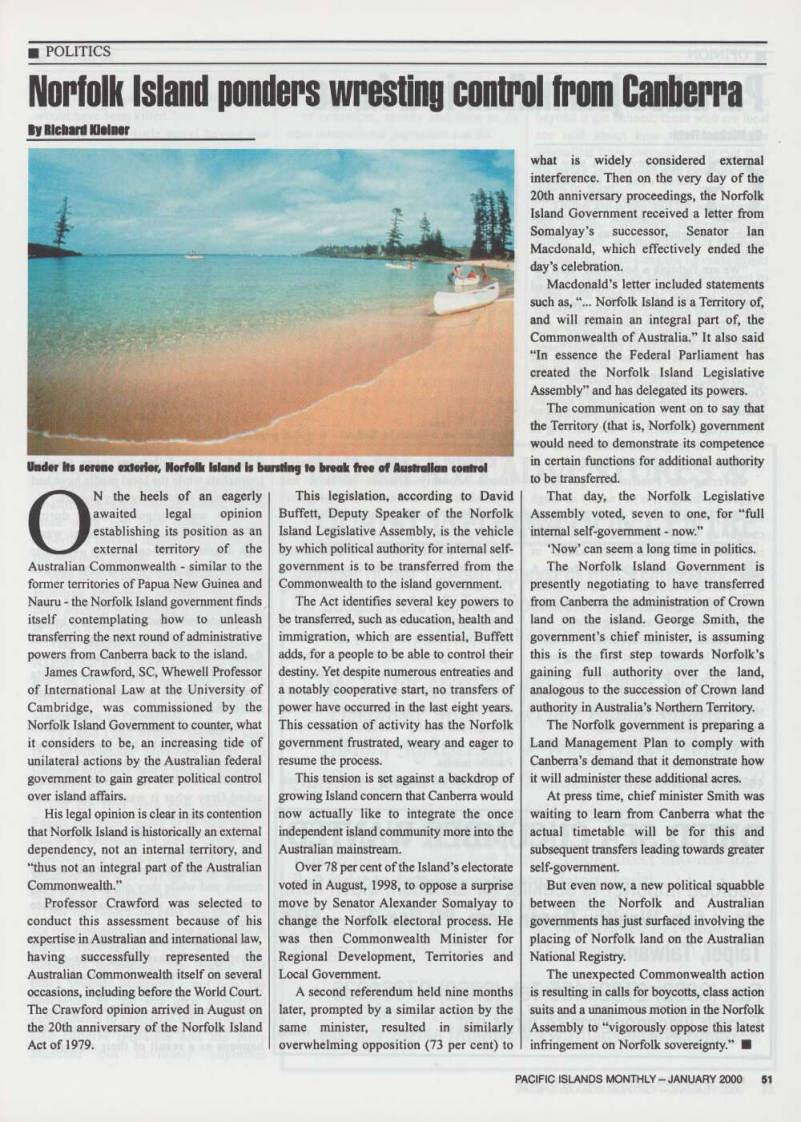
Under its serene exterior, Norfolk Island is bursting to break free of Australian control