Far trim Noumea - mining moonscapes and natural wonders
pp. 54-55 · Read in the full issue
Yachting
Storles and Pictures by Sally Andrew
East north east ten knots I gleefully observed as we departed Noumea. Our intention - a ten-week counter-clockwise cruise around the Grande Terre, the big island of New Caledonia. Within half an hour wind speeds were 20-25 gusting higher, dead on the nose. Plans for a gentle breakfast under sail were abandoned as we slogged to windward under double reefed main and 90 per cent blade sail. Down below, books and music cassettes flew off shelves, vegetables rolled out of bins, creating extra apparent wind speed.
Despite high winds and heavy rainfall, the anchorage near Canal Woodin was protected and comfortable. When the weather eased, we sailed to Baie du Prony - a marvellous waterway with rivers and trails, old mines and prisons, hotsprings and waterfalls. While intermittent sun and cloud battled for dominance, we soaked in the Ruisseau de Kauri.
Given time and distance factors, our plan to circumnavigate meant we had to press on whenever weather permitted.
Without further ado, we sailed out Havannah Pass with slack water, sunshine and a gaggle of boats from Noumea’s CNC
Yacht Club who were racing offshore towards Walpole Island. Canadian cruising yacht “Maeva” crossed tacks with us heeled over, windward bound, looking good. Then the wind died, and we motored nearly seven hours to Yate. Wind may be free, but it’s not always reliable.
Next day, after another five hour motor
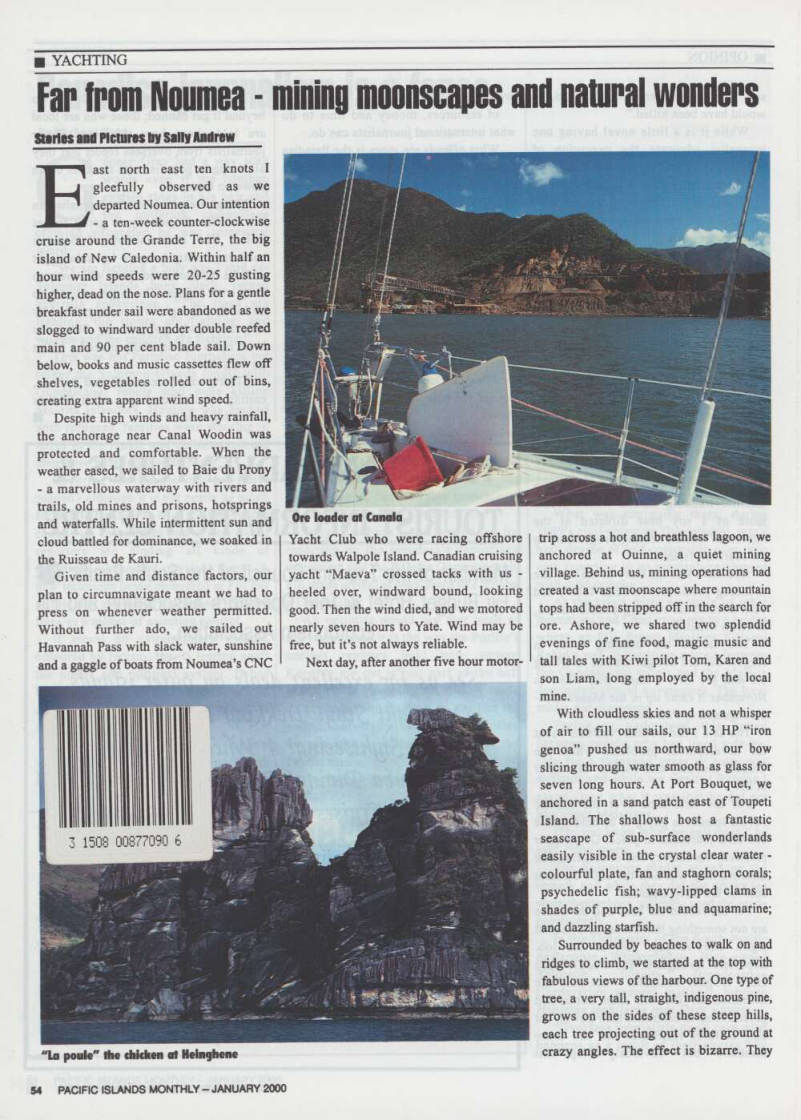
trip across a hot and breathless lagoon, we anchored at Ouinne, a quiet mining village. Behind us, mining operations had created a vast moonscape where mountain tops had been stripped off in the search for ore. Ashore, we shared two splendid evenings of fine food, magic music and tall tales with Kiwi pilot Tom, Karen and son Liam, long employed by the local mine.
With cloudless skies and not a whisper of air to fill our sails, our 13 HP “iron genoa” pushed us northward, our bow slicing through water smooth as glass for seven long hours. At Port Bouquet, we anchored in a sand patch east of Toupeti Island. The shallows host a fantastic seascape of sub-surface wonderlands easily visible in the crystal clear water colourful plate, fan and staghorn corals; psychedelic fish; wavy-lipped clams in shades of purple, blue and aquamarine; and dazzling starfish.
Surrounded by beaches to walk on and ridges to climb, we started at the top with fabulous views of the harbour. One type of tree, a very tall, straight, indigenous pine, grows on the sides of these steep hills, each tree projecting out of the ground at crazy angles. The effect is bizarre. They
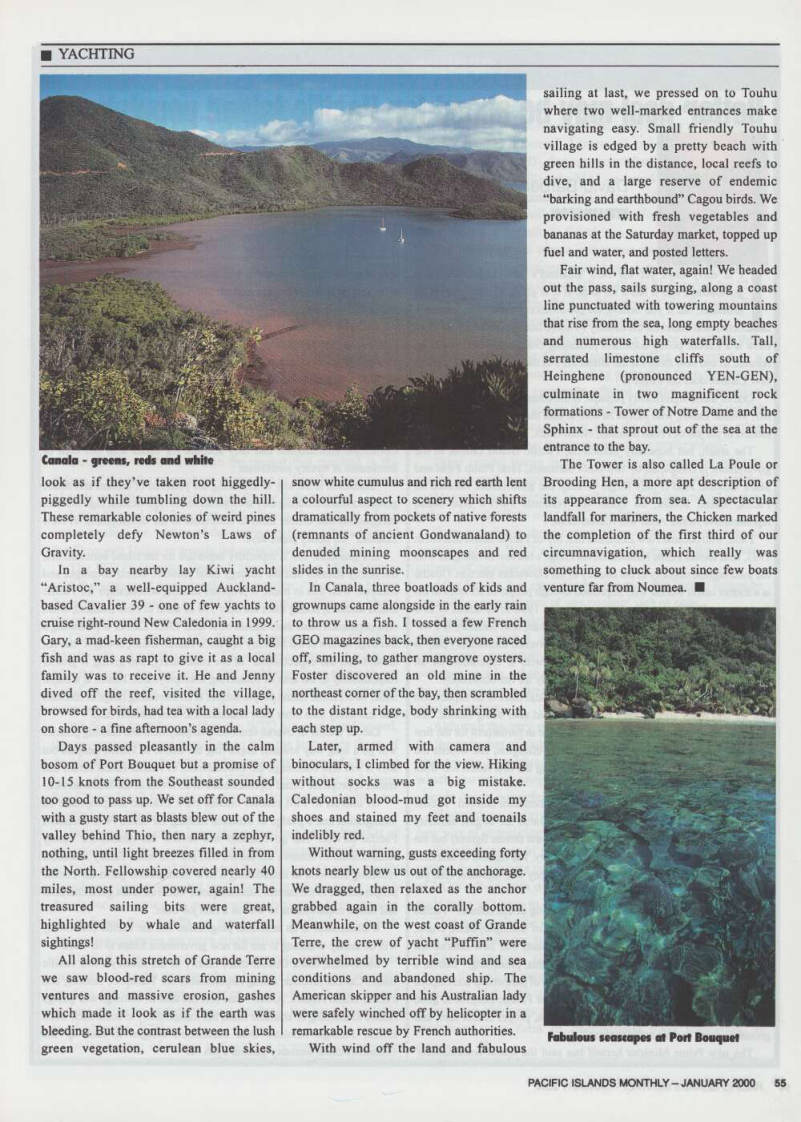
"la poule" the chicken at Heinghene
Ore loader at Canala
look as if they’ve taken root higgedly piggedly while tumbling down the hill.
These remarkable colonies of weird pines completely defy Newton’s Laws of
Gravity.
In a bay nearby lay Kiwi yacht “Aristoc,” a well-equipped Auckland based Cavalier 39 - one of few yachts to cruise right-round New Caledonia in 1999.
Gary, a mad-keen fisherman, caught a big fish and was as rapt to give it as a local family was to receive it. He and Jenny dived off the reef, visited the village, browsed for birds, had tea with a local lady on shore - a fine afternoon’s agenda.
Days passed pleasantly in the calm bosom of Port Bouquet but a promise of 10-15 knots from the Southeast sounded too good to pass up. We set off for Canala with a gusty start as blasts blew out of the valley behind Thio, then nary a zephyr, nothing, until light breezes filled in from the North. Fellowship covered nearly 40 miles, most under power, again! The treasured sailing bits were great, highlighted by whale and waterfall
sightings!
All along this stretch of Grande Terre we saw blood-red scars from mining ventures and massive erosion, gashes which made it look as if the earth was bleeding. But the contrast between the lush green vegetation, cerulean blue skies.
snow white cumulus and rich red earth lent a colourful aspect to scenery which shifts dramatically from pockets of native forests (remnants of ancient Gondwanaland) to denuded mining moonscapes and red slides in the sunrise.
In Canala, three boatloads of kids and grownups came alongside in the early rain to throw us a fish. I tossed a few French GEO magazines back, then everyone raced off, smiling, to gather mangrove oysters.
Foster discovered an old mine in the northeast comer of the bay, then scrambled to the distant ridge, body shrinking with each step up.
Later, armed with camera and binoculars, I climbed for the view. Hiking without socks was a big mistake.
Caledonian blood-mud got inside my shoes and stained my feet and toenails indelibly red.
Without warning, gusts exceeding forty knots nearly blew us out of the anchorage.
We dragged, then relaxed as the anchor
grabbed again in the corally bottom.
Meanwhile, on the west coast of Grande Terre, the crew of yacht “Puffin” were overwhelmed by terrible wind and sea conditions and abandoned ship. The American skipper and his Australian lady were safely winched off by helicopter in a remarkable rescue by French authorities.
With wind off the land and fabulous
sailing at last, we pressed on to Touhu where two well-marked entrances make navigating easy. Small friendly Touhu village is edged by a pretty beach with green hills in the distance, local reefs to dive, and a large reserve of endemic “barking and earthbound” Cagou birds. We provisioned with fresh vegetables and bananas at the Saturday market, topped up fuel and water, and posted letters.
Fair wind, flat water, again! We headed out the pass, sails surging, along a coast line punctuated with towering mountains that rise from the sea, long empty beaches and numerous high waterfalls. Tall, serrated limestone cliffs south of Heinghene (pronounced YEN-GEN), culminate in two magnificent rock formations - Tower of Notre Dame and the Sphinx - that sprout out of the sea at the entrance to the bay.
The Tower is also called La Poule or Brooding Hen, a more apt description of its appearance from sea. A spectacular landfall for mariners, the Chicken marked the completion of the first third of our circumnavigation, which really was something to cluck about since few boats venture far from Noumea. ■
Canala - greens, reds and white
Fabulous seascapes at Port Bouquet