Olympic housing goes green
pp. 22-23 · Read in the full issue
It is the year 2000 ::.r athlete. You
have just run your best time in a qualifying heat and are through to the finals.
You return to the Athletes’ Village for some “down time” to focus on the big challenge ahead. You enter your home for the period of the Games, one of the 300 temporary, demountable houses on site.
It is, in effect, a large plastic molded box. There is very little natural light and even less fresh air. The Australians reckon summer hasn’t started yet but to your northern European senses it feels hot - and even more so in this godforsaken plastic box.
Maybe writers spend more time worrying about their indoor comforts than world-class athletes do.
And maybe cross-flow ventilation is the last thing on anyone’s mind when
tomorrow they’ll be eyeballing Cathy
Freeman for the gold. But athletes at the Sydney 2000 Games will be glad somebody thought of cross-flow ventilation when they bed down with dreams of glory in the demountable homes currently being constructed at the Games’ Village.
The traditional demountable - or modular - home is box shaped, PVC internal and external, and has very little window space, for ease of transportation on the back of trucks.
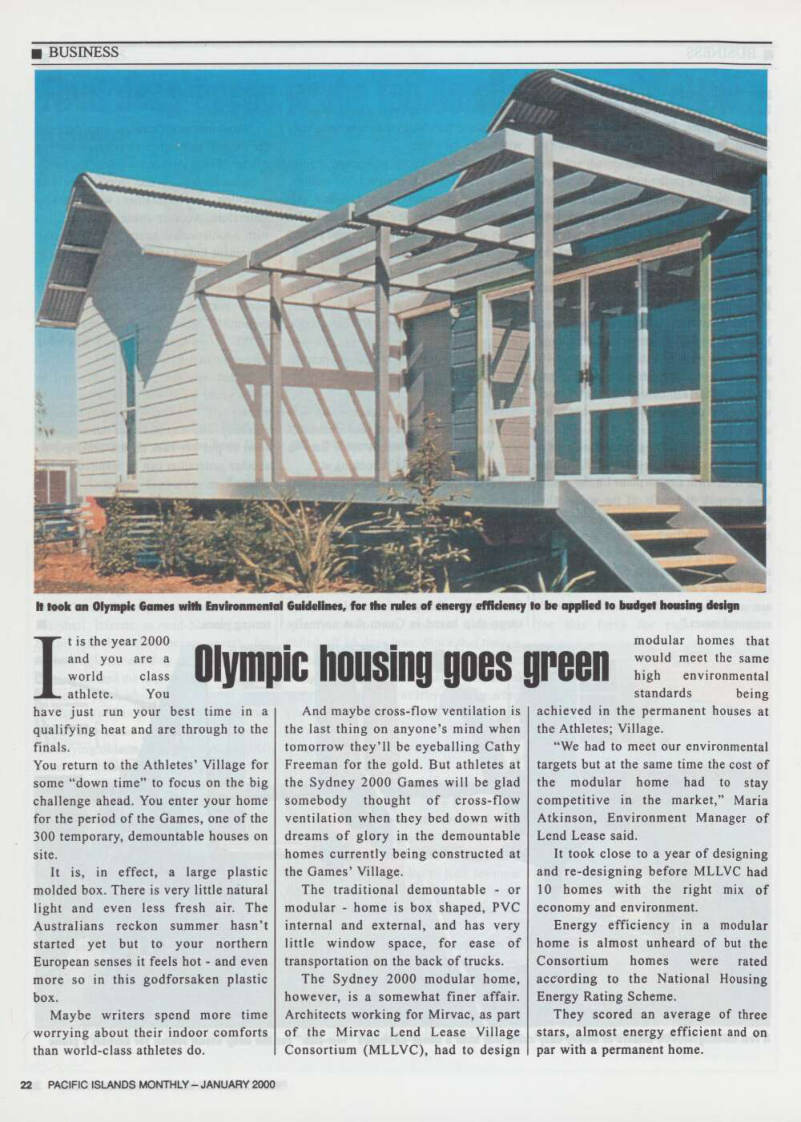
The Sydney 2000 modular home, however, is a somewhat finer affair.
Architects working for Mirvac, as part of the Mirvac Lend Lease Village Consortium (MLLVC), had to design
modular homes that
sr r,
standards being
achieved in the permanent houses at the Athletes; Village.
“We had to meet our environmental targets but at the same time the cost of the modular home had to stay competitive in the market,” Maria Atkinson, Environment Manager of Lend Lease said.
It took close to a year of designing and re-designing before MLLVC had 10 homes with the right mix of economy and environment.
Energy efficiency in a modular home is almost unheard of but the Consortium homes were rated according to the National Housing Energy Rating Scheme.
They scored an average of three stars, almost energy efficient and on par with a permanent home.
It took an Olympic Games with Environmental Guidelines, for the rules of energy efficiency to be applied to budget housing design
Energy efficiency is difficult to achieve without the thermal mass in bricks and mortar, both impractical products in a transportable home.
So consideration was given to making the homes passively ventilated, and energy efficient in terms of orientation, window sizing and insulation. Efficient lighting will be installed as well as water saving devices.
“It was a long, drawn out and high risk project to work on - the environmental criteria were never written for modular homes; there wasn’t an understanding of the modular home industry; the designers would come up with brilliant ideas, but when the dollars went in they had to be dropped. It was a constant invent, reinvent process,” Atkinson said.
What’s more, MLLVC is not in the business of building or selling modular homes and there was a chance it would be left holding 352 environmentally
innovative but unsaleable homes.
It reduced the risk by teaming up with the existing modular home industry and, through that, a whole new workforce came into contact with the Green Guidelines.
An education process in the resourcing and use of new materials began - low off-gassing paints, PVC free pipes, sustainable timber - and in the waste separation necessary for reuse and recycling.
Many existing practices had to be changed and as a result some contractors have permanently changed their business practices.
So now picture this: you are Cathy Freeman. You have just won gold before the home crowd. You return to your modular home in the Games Village, tired but triumphant.
From the front deck of your home you can see the Stadium where it all took place - a gentle breeze cools your face and the last of the day’s sunshine
reflects the warmth off the gold medal in your hand.
Here’s to the Green Games. (Olympic Report, Greenpeace) ■
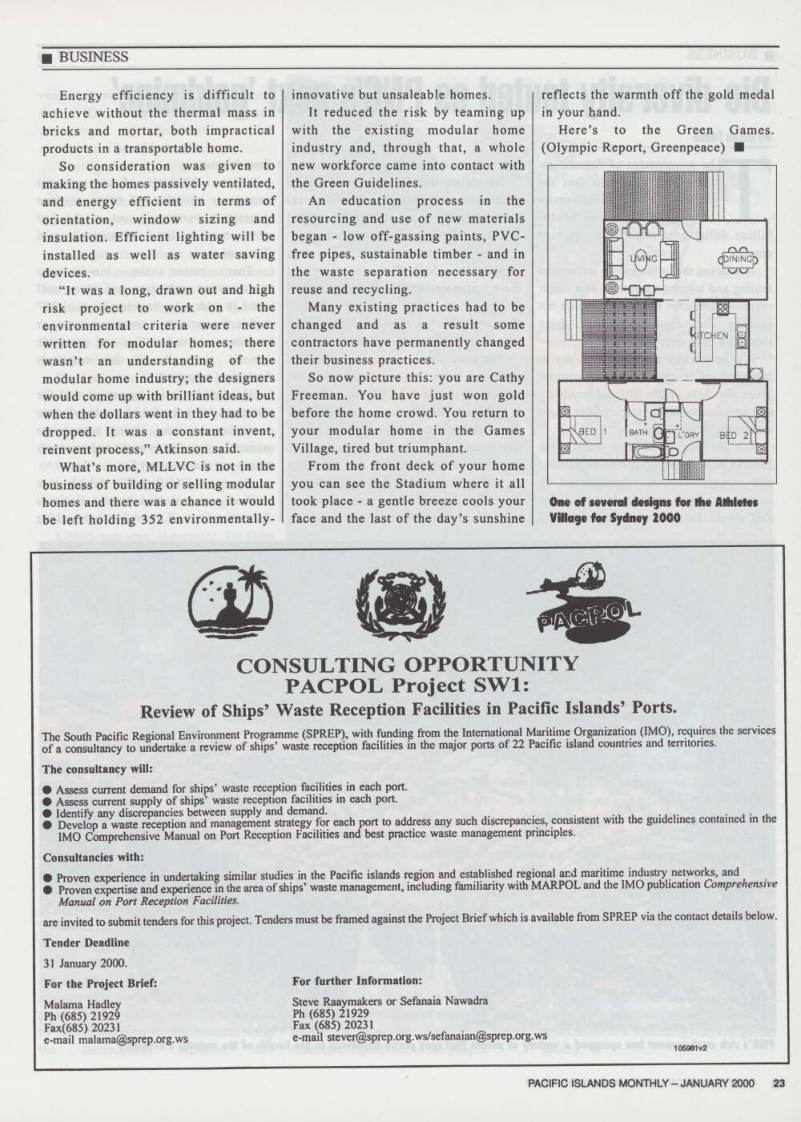
One of several designs for the Athletes Village for Sydney 2000