First deep-ocean probe for Amelia Earhart's plane
pp. 20-21 · Read in the full issue
By Glft Johnson
Amelia Earhart’s mysterious disappearance has, for 62 years, confounded dozens of private search parties - to say nothing of the US Navy and Coast Guard that have scoured the central Pacific in search of the famous aviatrix’s plane.
But a search expedition that left the Marshall Islands in mid-November, to begin the first deep-ocean search for Earhart’s plane, said they are confident that they’ve located the approximate ocean area where the plane went down.
The expedition is using high-tech underwater sonar equipment capable of identifying objects at depths up to 10,000 meters, although it is believed that the plane is in water only half that deep, said trip organizer Guy Zajonc, who is based in
Spokane, Washington.
They are searching for Earhart’s twin engine Lockheed Electra that went down on July 2, 1937. It was midway through the Pacific - and last - leg of Earhart’s famous round-the-world flight - one that would have given her the distinction of being first female pilot to circle the globe.
On that day, Earhart and navigator Fred Noonan left Lae, Papua New Guinea heading for Howland Island, just north of the equator next to Kiribati.
The Coast Guard Cutter Itasca was
standing off Howland to provide radio contact for Earhart. The last radio communication from Earhart was received by the Itasca nineteen and a half hours into the flight. “We must be on you but cannot see you ... gas is running low.”
When Earhart failed to arrive, a search by the Itasca and other Naval vessels of the area found nothing, and was ultimately called off 16 days later. Since that time, a dozen different theories - ranging from her being captured by the Japanese military to her landing on nearby Nikumaroro (formerly Gardner) Island - have been advanced.
But no conclusive evidence has ever been found.
Zajonc said that’s because all the previous expeditions into the Pacific have concentrated on land searches, which “are the easiest places to look.”
“If you drop your keys at night in a parking lot, you’re going to look for them under the light. But that’s not the most likely place where you’ll find them,” he said.
Recent technological developments in
underwater search equipment make a deep ocean search feasible, though still extremely expensive, said Zajonc’s expedition partner, Dana Timmer. He added it took him eight years to put
together the current search effort.
“No one wants to fund a search,” said Zajonc. “But everyone says ‘as soon as you find it call us first.’”
Zajonc and Timmer brought in the ocean engineering company Williamson and Associates, that in the 1980 s located the SS Central America, a ship that sank in 1857 to a depth of 2,500 meters in the Caribbean carrying $4OO million worth of gold bullion and coins.
The company also recently located an Israeli submarine, the Dakar, that had been lost in 1961 in the Mediterranean.
“This is more than a job,” said Mike Williamson, the president of the company who is on the current voyage. “I’ve been thinking about this target for more than nine years.”
Williamson said he and Timmer had discussed the search project for the past eight years. Planning finally came together this year with the expedition to Howland, a tiny island in the central Pacific just above the equator.
Not only had Timmer been preparing for this foray for eight years, he’s
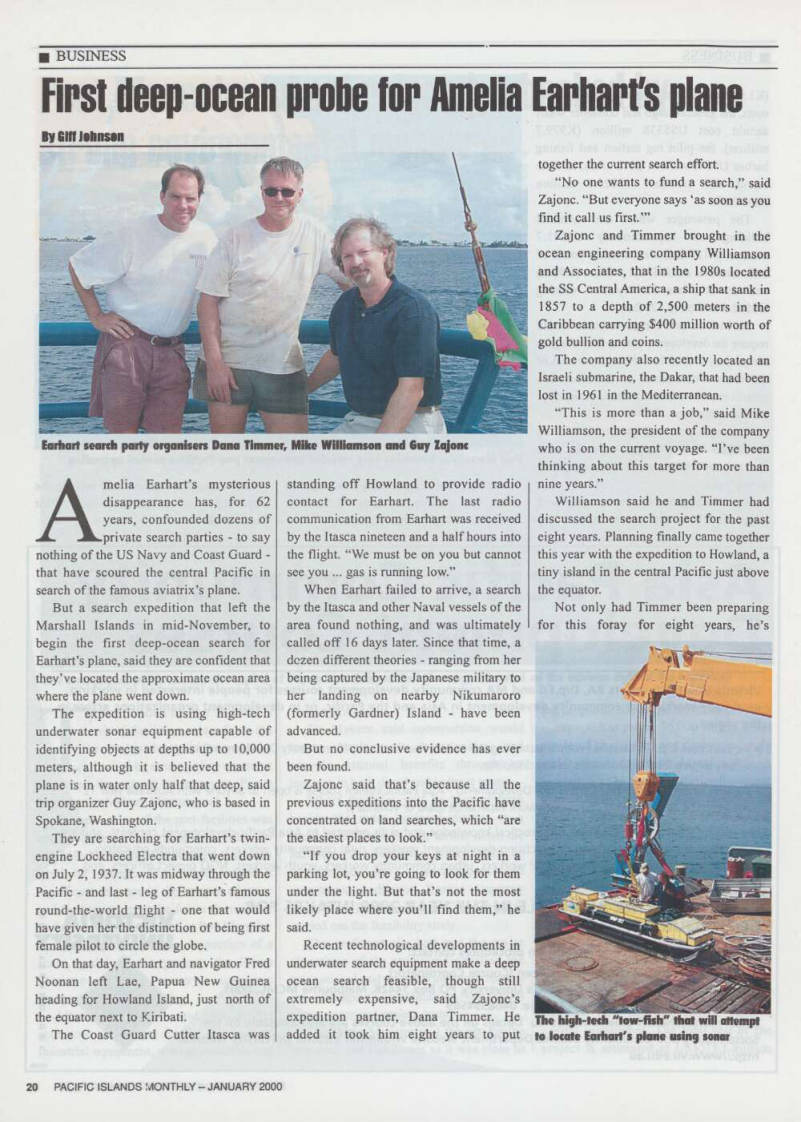
Earhart search parly organisers Dana Timmer, Mike Williamson and Guy Zajonc
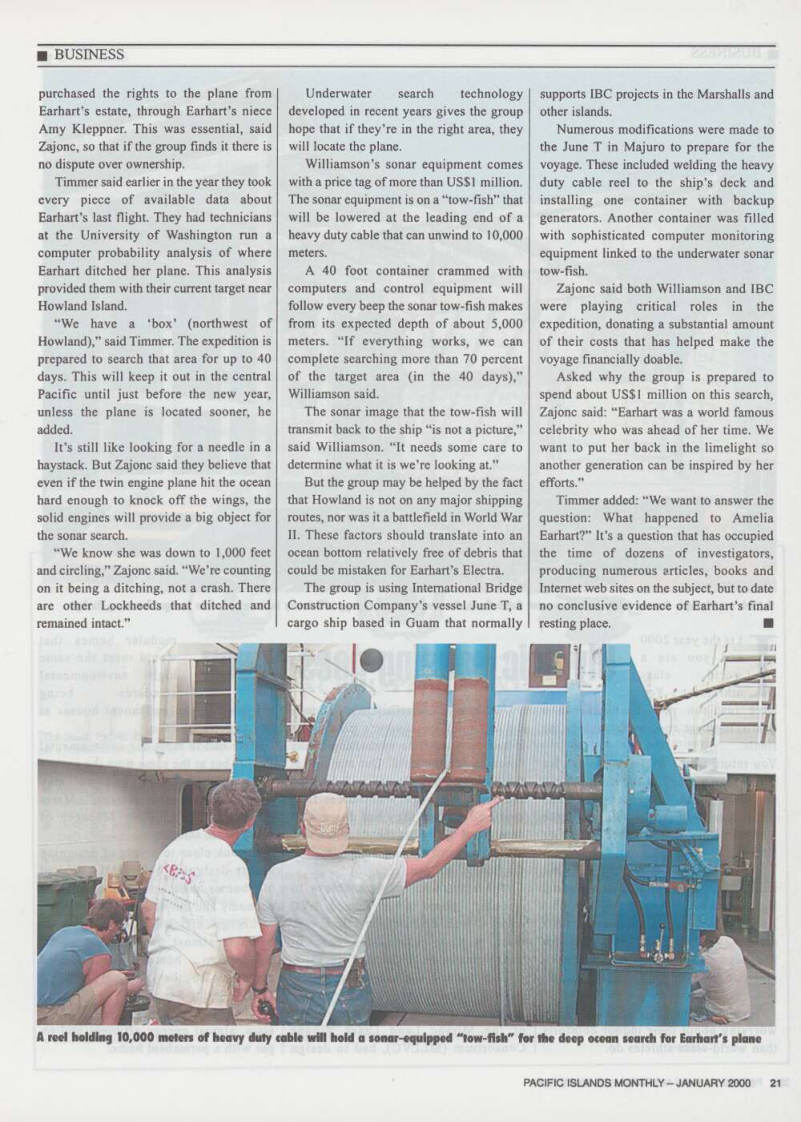
The high-tech "tow-fish" that will attempt to locate Earhart's plane using sonar
purchased the rights to the plane from Earhart’s estate, through Earhart’s niece Amy Kleppner. This was essential, said Zajonc, so that if the group finds it there is
no dispute over ownership.
Timmer said earlier in the year they took every piece of available data about Earhart’s last flight. They had technicians at the University of Washington run a computer probability analysis of where Earhart ditched her plane. This analysis provided them with their current target near Howland Island.
“We have a ‘box’ (northwest of Howland),” said Timmer. The expedition is prepared to search that area for up to 40 days. This will keep it out in the central Pacific until just before the new year, unless the plane is located sooner, he added.
It’s still like looking for a needle in a haystack. But Zajonc said they believe that even if the twin engine plane hit the ocean hard enough to knock off the wings, the solid engines will provide a big object for the sonar search.
“We know she was down to 1,000 feet and circling,” Zajonc said. “We’re counting on it being a ditching, not a crash. There are other Lockheeds that ditched and remained intact.”
Underwater search technology developed in recent years gives the group hope that if they’re in the right area, they will locate the plane.
Williamson’s sonar equipment comes with a price tag of more than US$l million.
The sonar equipment is on a “tow-fish” that will be lowered at the leading end of a heavy duty cable that can unwind to 10,000 meters.
A 40 foot container crammed with computers and control equipment will follow every beep the sonar tow-fish makes from its expected depth of about 5,000 meters. “If everything works, we can complete searching more than 70 percent of the target area (in the 40 days),”
Williamson said.
The sonar image that the tow-fish will transmit back to the ship “is not a picture,” said Williamson. “It needs some care to determine what it is we’re looking at.”
But the group may be helped by the fact that Howland is not on any major shipping routes, nor was it a battlefield in World War 11. These factors should translate into an ocean bottom relatively free of debris that could be mistaken for Earhart’s Electra.
The group is using International Bridge Construction Company’s vessel June T, a cargo ship based in Guam that normally
supports IBC projects in the Marshalls and other islands.
Numerous modifications were made to the June T in Majuro to prepare for the voyage. These included welding the heavy duty cable reel to the ship’s deck and installing one container with backup generators. Another container was filled with sophisticated computer monitoring equipment linked to the underwater sonar tow-fish.
Zajonc said both Williamson and IBC were playing critical roles in the expedition, donating a substantial amount of their costs that has helped make the voyage financially doable.
Asked why the group is prepared to spend about US$l million on this search, Zajonc said: “Earhart was a world famous celebrity who was ahead of her time. We want to put her back in the limelight so another generation can be inspired by her efforts.”
Timmer added: “We want to answer the question: What happened to Amelia Earhart?” It’s a question that has occupied the time of dozens of investigators, producing numerous articles, books and Internet web sites on the subject, but to date no conclusive evidence of Earhart’s final resting place. ■
A reel holding 10,000 meters of heavy duty cable will hold a sonar-equipped "tow-fish" for the deep ocean search for Earhart's plane