Port Moresby wharf relocation backed by
pp. 18-19 · Read in the full issue
strong environmental measures
The relocation of Port Moresby’s wharf facilities away from the central business district would be backed by strong policy measures to protect the natural environment, Prime Minister Sir Mekere Morauta said.
The relocation of the port facilities was endorsed by the last government after the PNG Harbours Board indicated a long-term need for change. The Board needed a significant increase in the amount of space and facilities to meet the future demands of trade and economic growth in Port Moresby.
Speaking at an official inspection of a scale model of the project, the Prime Minister said the country’s economic prospects looked promising.
Alternative ports, he said, would offer economic advantages for the shipment of industrial equipment, mining materials and
various products.
Sir Mekere said construction would create employment opportunities and provide national benefits through an increase in both direct and indirect taxes.
Wharf facilities will be located from beside the main business district to a location on Tatana Island, further down the harbour. The existing wharf will be transformed into a recreational and entertainment district. Korean company Tong Woo Engineering & Company Ltd carried out the feasibility study.
The preferred site had met the major objectives of the study and satisfied the navigational and engineering requirements for dredging, reclamation, structural components and project costs.
The Prime Minister said the site for the new port was significant as it was close to
the proposed Napanapa oil refinery, which is expected to refine 36,000 barrels of oil per day. The shipyard and slipway currently under construction on Motukea Island, located next to the new site, will possess modem facilities for a ship maintenance program with two dry docks and a slipway with the capacity to handle ships up to 6000 dead weight tonnes. The Papa/Lealea salt project undertaken by Liaoning International should also benefit from the relocation project.
Sir Mekere said the new port would contribute to the development of the NCD with job opportunities, trade promotion and industrial development.
However relocation and development of the new port facilities require massive capital investment. The total cost of the project is estimated at U 55518.3 million
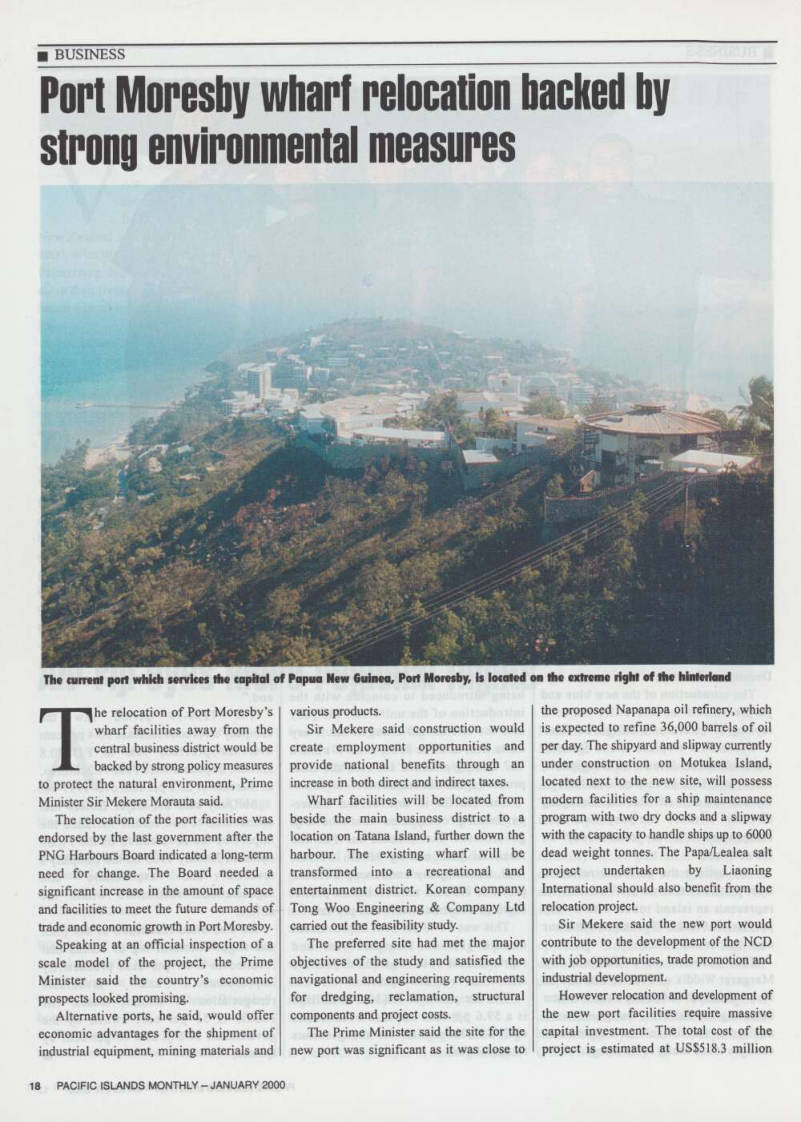
The current port which services the capital of Papua New Guinea, Port Moresby, is located on the extreme right of the hinterland
(K 1.5 billion). Of the general establishment costs, the general cargo and container wharf should cost USS33B million (K 979.7 million), the pilot tug station and fishing harbor US$43 million (K124.6m), and the liquid bulk terminal US$2O.l million (K58.3m).
The passenger wharf and terminal buildings are approximately USs4l.7 million (K 120.9 m), reclamation south of bulk terminal at USs32.l million (K93m) and the Bootless Fishery port costing U 5542.5 million (K123.2m).
Sir Mekere said the government would require the developer to source financing for the project, and no less than 25 per cent of the construction phase of the relocation project must be subcontracted to nationally owned companies.
The new port infrastructure will be developed in five stages over the next twenty years with stage one to be completed in two years.
The completion of the project will depend on land and access issues. The
construction of stage one, due to begin in 2005, will require dredging of an area estimated at 44,600 square metres.
The expanded harbour will include the construction of navigational aids. (Post Courier) ■
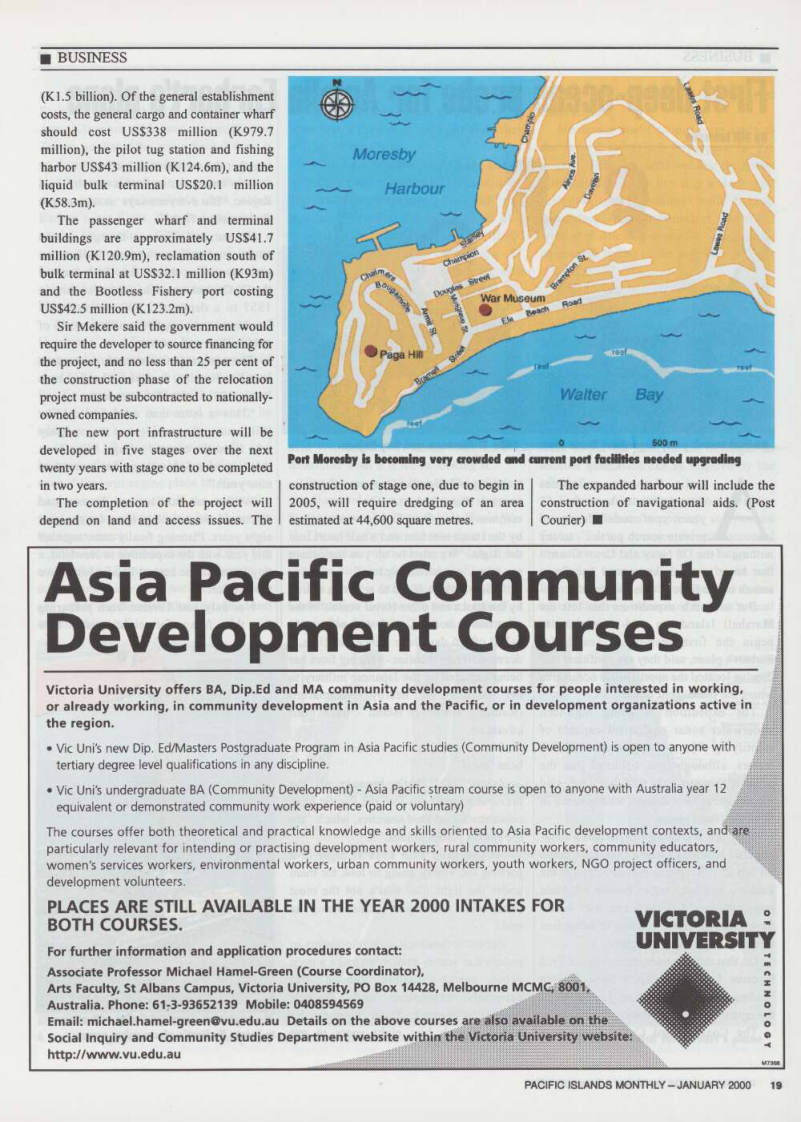
Port Moresby is becoming very crowded and current port facilities needed upgrading