Bio diversity touted as PNG'S next 'goldmine'
pp. 24-25 · Read in the full issue
By Brlan Tobla
The government of Papua New Guinea is confident that the country’s vast bio-diversity holdings will be a “multi billion dollar gold mine” into the next century.
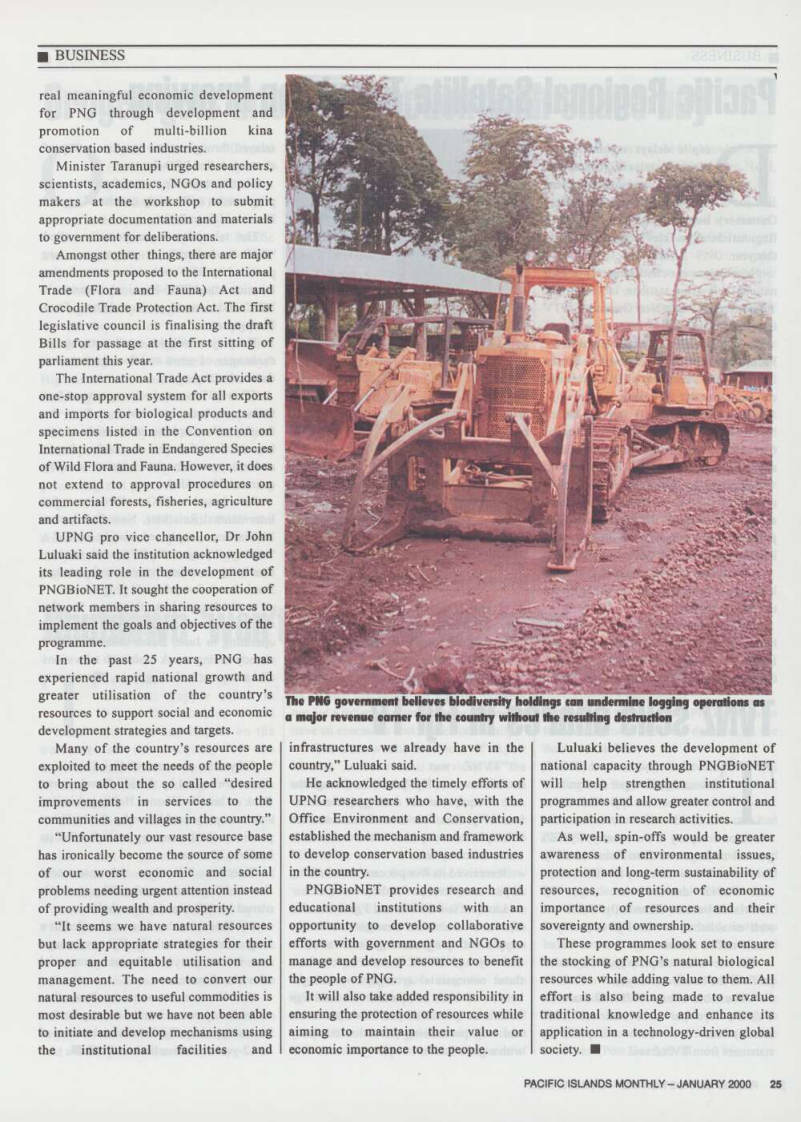
It believes the holdings can undermine mining and logging operations as a major revenue earner for the country while not causing the destruction that those industries have over the years.
It is now a key government policy to initiate other revenue generation options given the state of the national economy and unstable currency rate against major currencies of the world.
For the first time, it is working in collaboration with PNG research institutes and non-government organisations to change legislative framework and policies that would help develop conservation
based revenue-generating industries.
Immediate attention has been given to protection and control of biological collections for international export and
Intellectual Property Rights regimes.
PNG’s environment and conservation vice minister, Muki Taranupi, expressed these sentiments while opening the second workshop on PNG Institute of Bio diversity Network (PNGBioNET) at the University of Papua New Guinea recently.
The government, research institutions and non-government organizations in the country have begun mobilising resources to kick start conservation based industries.
These include bio-prospecting for herbal
medicines, agro-chemicals, plant genetics,
aromatics and horticulture and exploring carbon offset sinks for reforestation.
There is also reduced impact logging, agro-forest and alternate energy sources
from biomass.
“Given the state of our national economy, initiation of other revenue generation options is one of the key government policy initiatives,” said Taranupi.
This means the bio-diversity conservation strategies and plans will need to address a “conservation niche” within the national economic recovery or improvement under “fair and equitable benefit sharing” of the country’s biological resources.
He added: “It is imperative that the untapped full potential of our bio diverse resources be used under appropriate national policy frame-works and protocols to support the economy.”
He said PNGBioNET, which was ratified and endorsed by the National Executive Council, must focus on making
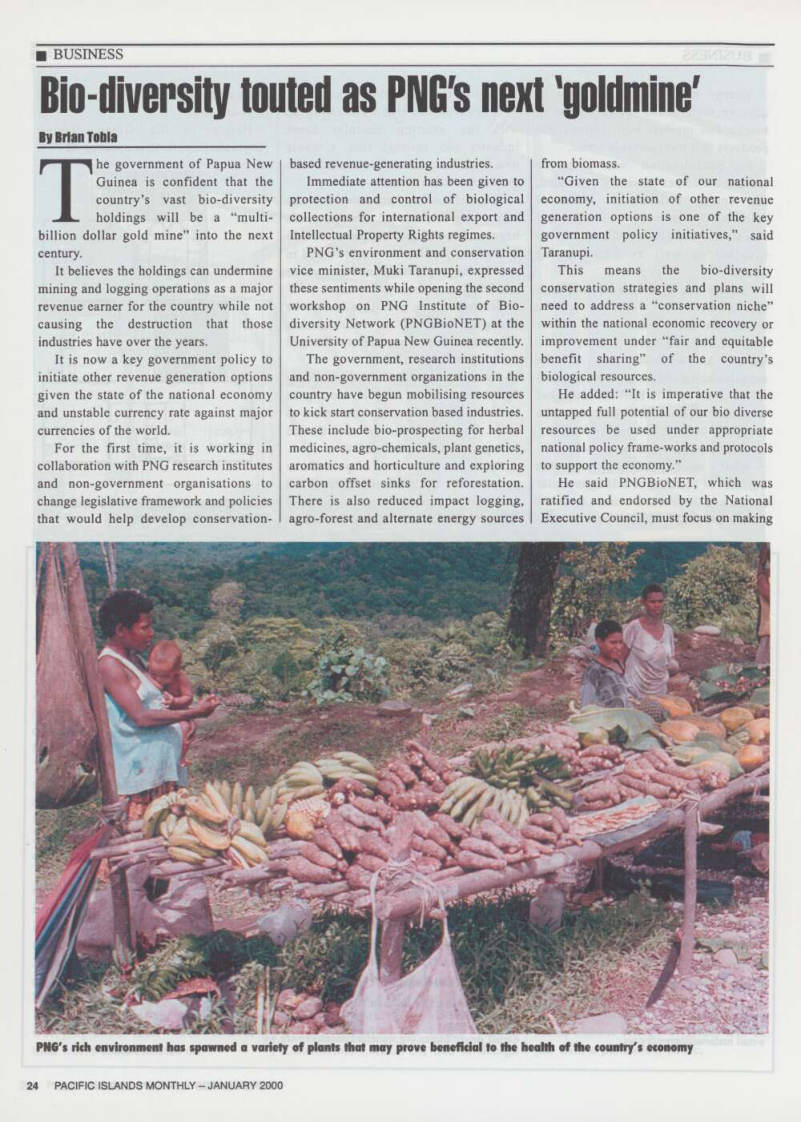
PNG's rich environment has spawned a variety of plants that may prove beneficial to the health of the country's economy
real meaningful economic development for PNG through development and promotion of multi-billion kina conservation based industries.
Minister Taranupi urged researchers, scientists, academics, NGOs and policy makers at the workshop to submit appropriate documentation and materials to government for deliberations.
Amongst other things, there are major amendments proposed to the International Trade (Flora and Fauna) Act and Crocodile Trade Protection Act. The first legislative council is finalising the draft Bills for passage at the first sitting of parliament this year.
The International Trade Act provides a one-stop approval system for all exports and imports for biological products and specimens listed in the Convention on International Trade in Endangered Species of Wild Flora and Fauna. However, it does not extend to approval procedures on commercial forests, fisheries, agriculture and artifacts.
UPNG pro vice chancellor, Dr John Luluaki said the institution acknowledged its leading role in the development of PNGBioNET. It sought the cooperation of network members in sharing resources to implement the goals and objectives of the programme.
In the past 25 years, PNG has experienced rapid national growth and greater utilisation of the country’s resources to support social and economic development strategies and targets.
Many of the country’s resources are exploited to meet the needs of the people to bring about the so called “desired improvements in services to the communities and villages in the country.”
“Unfortunately our vast resource base has ironically become the source of some of our worst economic and social problems needing urgent attention instead of providing wealth and prosperity.
“It seems we have natural resources but lack appropriate strategies for their proper and equitable utilisation and management. The need to convert our natural resources to useful commodities is most desirable but we have not been able to initiate and develop mechanisms using the institutional facilities and
infrastructures we already have in the country,” Luluaki said.
He acknowledged the timely efforts of UPNG researchers who have, with the Office Environment and Conservation, established the mechanism and framework to develop conservation based industries in the country.
PNGBioNET provides research and educational institutions with an opportunity to develop collaborative efforts with government and NGOs to manage and develop resources to benefit the people of PNG.
It will also take added responsibility in ensuring the protection of resources while aiming to maintain their value or economic importance to the people.
Luluaki believes the development of national capacity through PNGBioNET will help strengthen institutional programmes and allow greater control and participation in research activities.
As well, spin-offs would be greater awareness of environmental issues, protection and long-term sustainability of resources, recognition of economic importance of resources and their sovereignty and ownership.
These programmes look set to ensure the stocking of PNG’s natural biological resources while adding value to them. All effort is also being made to revalue traditional knowledge and enhance its application in a technology-driven global society. ■
The PNG government believes biodiversity holdings can undermine logging operations os a major revenue earner for the country without the resulting destruction