ADB critical of FBM reform process
p. 53 · Read in the full issue
A report by the Asian Development Bank (ADB) titled Assessment of Assistance. for Reform Programmes in the Pacific 1995-98 has hit out at the way reforms have been carried out.
The report covers six Pacific Island countries where the ADB sponsored reform programmes - the Cook Islands, the Federated States of Micronesia, the Marshall Islands, Samoa, the Solomon Islands and Vanuatu. (Nauru, which has also received ADB loans for reforms, was not included in the report).
The Federated States of Micronesia’s (FSM) reform programme was one of the first supported by the Bank in the Pacific Islands region.
The PSRP was developed as a subset of the broader economic reform program. The overall goal was “transformation and development of a more efficient FSM economy as the end of the Compact (of Free Association with the United States) funding
approaches.”
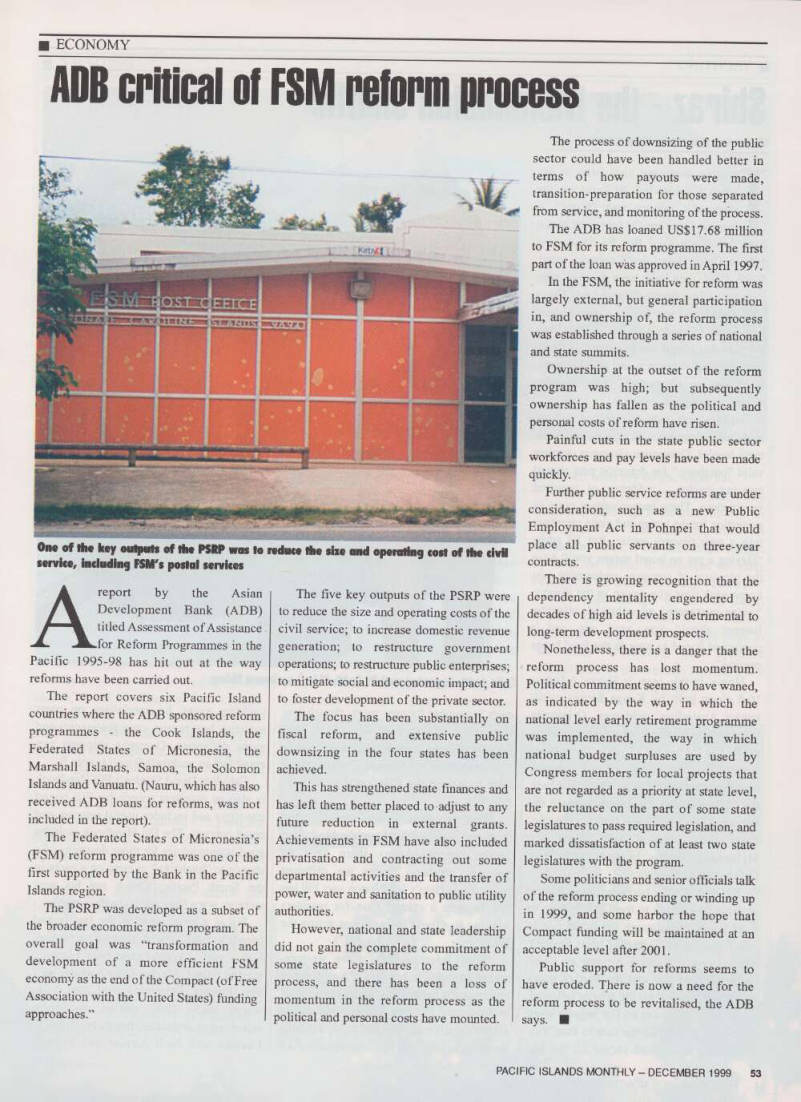
The five key outputs of the PSRP were to reduce the size and operating costs of the civil service; to increase domestic revenue generation; to restructure government operations; to restructure public enterprises; to mitigate social and economic impact; and to foster development of the private sector.
The focus has been substantially on fiscal reform, and extensive public downsizing in the four states has been achieved.
This has strengthened state finances and has left them better placed to adjust to any future reduction in external grants.
Achievements in FSM have also included privatisation and contracting out some departmental activities and the transfer of power, water and sanitation to public utility authorities.
However, national and state leadership did not gain the complete commitment of some state legislatures to the reform process, and there has been a loss of momentum in the reform process as the political and personal costs have mounted.
The process of downsizing of the public sector could have been handled better in terms of how payouts were made, transition-preparation for those separated from service, and monitoring of the process.
The ADB has loaned US$17.68 million to FSM for its reform programme. The first part of the loan was approved in April 1997.
In the FSM, the initiative for reform was largely external, but general participation in, and ownership of, the reform process wag established through a series of national and state summits.
Ownership at the outset of the reform program was high; but subsequently ownership has fallen as the political and personal costs of reform have risen.
Painful cuts in the state public sector workforces and pay levels have been made
quickly.
Further public service reforms are under consideration, such as a new Public Employment Act in Pohnpei that would place all public servants on three-year contracts.
There is growing recognition that the dependency mentality engendered by decades of high aid levels is detrimental to
long-term development prospects.
Nonetheless, there is a danger that the reform process has lost momentum.
Political commitment seems to have waned, as indicated by the way in which the national level early retirement programme was implemented, the way in which national budget surpluses are used by Congress members for local projects that are not regarded as a priority at state level, the reluctance on the part of some state
legislatures to pass required legislation, and
marked dissatisfaction of at least two state legislatures with the program.
Some politicians and senior officials talk of the reform process ending or winding up in 1999, and some harbor the hope that Compact funding will be maintained at an acceptable level after 2001.
Public support for reforms seems to have eroded. There is now a need for the reform process to be revitalised, the ADB says. ■
One of the key outputs off the PSRP was to reduce the size and operating cost of the civil service, including FSM's postal services