East Asia tops growth amongst developing countries
p. 52 · Read in the full issue
Economy
East Asia, according to present World Bank forecasts, is on its way to becoming the fastest growing region among developing countries in 2000. The Bank’s annual report for 1999 said that this year has seen the East Asian financial crisis abate, and the hard work of recovery begin.
Reputed for its fast growth, sound management, and income equity, the region is now emerging from its worst economic collapse in modern times - a collapse that pushed millions back to the brink of poverty and decimated the savings of a whole generation of new middle-class citizens.
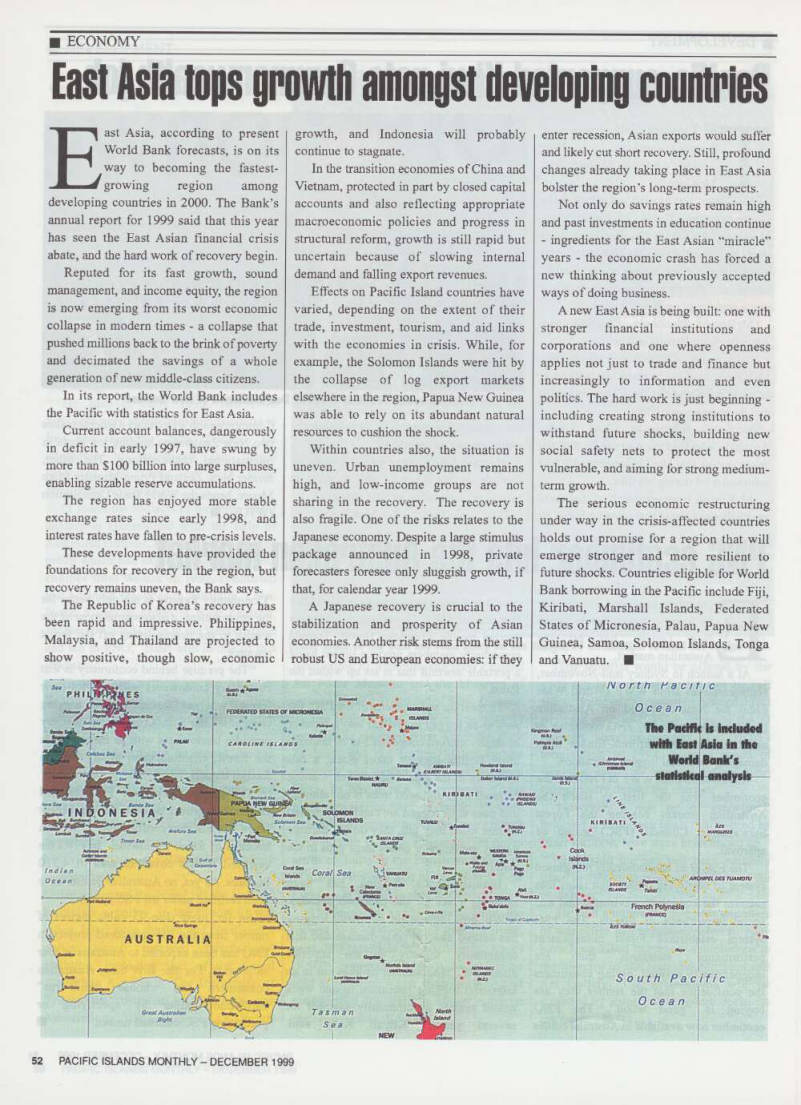
In its report, the World Bank includes the Pacific with statistics for East Asia.
Current account balances, dangerously in deficit in early 1997, have swung by more than $lOO billion into large surpluses, enabling sizable reserve accumulations.
The region has enjoyed more stable exchange rates since early 1998, and interest rates have fallen to pre-crisis levels.
These developments have provided the foundations for recovery in the region, but recovery remains uneven, the Bank says.
The Republic of Korea’s recovery has been rapid and impressive. Philippines, Malaysia, and Thailand are projected to show positive, though slow, economic
growth, and Indonesia will probably continue to stagnate.
In the transition economies of China and Vietnam, protected in part by closed capital accounts and also reflecting appropriate macroeconomic policies and progress in structural reform, growth is still rapid but uncertain because of slowing internal demand and falling export revenues.
Effects on Pacific Island countries have varied, depending on the extent of their trade, investment, tourism, and aid links with the economies in crisis. While, for example, the Solomon Islands were hit by the collapse of log export markets elsewhere in the region, Papua New Guinea was able to rely on its abundant natural resources to cushion the shock.
Within countries also, the situation is uneven. Urban unemployment remains high, and low-income groups are not sharing in the recovery. The recovery is also fragile. One of the risks relates to the Japanese economy. Despite a large stimulus package announced in 1998, private
forecasters foresee only sluggish growth, if
that, for calendar year 1999.
A Japanese recovery is crucial to the stabilization and prosperity of Asian economies. Another risk stems from the still robust US and European economies; if they
enter recession, Asian exports would suffer and likely cut short recovery. Still, profound changes already taking place in East Asia bolster the region’s long-term prospects.
Not only do savings rates remain high and past investments in education continue - ingredients for the East Asian “miracle” years - the economic crash has forced a new thinking about previously accepted ways of doing business.
A new East Asia is being built: one with stronger financial institutions and corporations and one where openness applies not just to trade and finance but increasingly to information and even politics. The hard work is just beginning including creating strong institutions to withstand future shocks, building new social safety nets to protect the most vulnerable, and aiming for strong medium term growth.
The serious economic restructuring under way in the crisis-affected countries holds out promise for a region that will emerge stronger and more resilient to future shocks. Countries eligible for World Bank borrowing in the Pacific include Fiji, Kiribati, Marshall Islands, Federated States of Micronesia, Palau, Papua New Guinea, Samoa, Solomon Islands, Tonga and Vanuatu. ■
The Pacific is included with East Asia in the WoHd Bank's statistical analysis